/




Tags: weapons military affairs patent
Year: 2007

Text
                    (12) INTERNATIONAL APPLICATION PUBLISHED UNDER THE PATENT COOPERATION TREATY (PCT)
(19) World Intellectual Property Organization
International Bureau
(43) International Publication Date
6 December 2007 (06.12.2007)
PCT
llllllllllllllllllllllllllllllllllllll^
(10) International Publication Number
WO 2007/137524 A2
(51) International Patent Classification:
F41A 3/38 (2006.01)
(21) International Application Number:
PCT/CZ2007/000034
(22) International Filing Date:	23 May	2007 (23.05.2007)
(25)	Filing Language:	English
(26)	Publication Language:	English
(30)	Priority Data:
PV 2006-341	25 May 2006 (25.05.2006) CZ
(71)	Applicant: CZECH WEAPONS S.R.O. [CZ/CZ];
Druzstevni 195, 763 21 Slavicin (CZ).
(72)	Inventor: FINDORAK, Ladislav (deceased).
(74)	Agent: SEDLAK, Zdenek; KANIA, SEDLAK, SMOLA,
Patent Attorneys, Mendlovo nam. la, 603 00 Brno (CZ).
(81)	Designated States (unless otherwise indicated, for every
kind of national protection available): AE, AG, AL, AM,
AT, AU, AZ, BA, BB, BG, BH, BR, BW, BY, BZ, CA, CH,
CN, CO, CR, CU, CZ, DE, DK, DM, DZ, EC, EE, EG, ES,
FI, GB, GD, GE, GH, GM, GT, HN, HR, HU, ID, IL, IN,
IS, JP, KE, KG, KM, KN, KP, KR, KZ, LA, LC, LK, LR,
LS, LT, LU, LY, MA, MD, MG, MK, MN, MW, MX, MY,
MZ, NA, NG, NI, NO, NZ, OM, PG, PH, PL, PT, RO, RS,
RU, SC, SD, SE, SG, SK, SL, SM, SV, SY, TJ, TM, TN,
TR, TT, TZ, UA, UG, UZ, VC, VN, ZA, ZM, ZW.
(84) Designated States (unless otherwise indicated, for every
kind of regional protection available): ARIPO (BW, GH,
GM, KE, LS, MW, MZ, NA, SD, SL, SZ, TZ, UG, ZM,
ZW), Eurasian (AM, AZ, BY, KG, KZ, MD, RU, TJ, TM),
European (AT, BE, BG, CH, CY, CZ, DE, DK, EE, ES, FI,
FR, GB, GR, HU, IE, IS, IT, LT, LU, LV, MC, MT, NL, PL,
PT, RO, SE, SI, SK, TR), OAPI (BF, BJ, CF, CG, CI, CM,
GA, GN, GQ, GW, ML, MR, NE, SN, TD, TG).
Published:
— without international search report and to be republished
upon receipt of that report
For two-letter codes and other abbreviations, refer to the "Guid-
ance Notes on Codes and Abbreviations " appearing at the begin-
ning of each regular issue of the PCT Gazette.
(54) Title: LOCKING MECHANISM OF A HAND FIREARM
WO 2007/137524 A2 lllllllllllllllllllllllllllllllllllll
(57) Abstract: Locking mechanism of a hand firearm consisting of a breech block (1) with a longitudinally slidingly arranged
firing pin (33) and provided on its upper side with a carrier (2) having a stepped through hole (3), inside which a return spring (5)
is arranged on a guide bar (4), and further with a single arm transmission lever (37), which is swingingly arranged in the carrier (2)
and the free end of which is adapted for an engagement with a cross trip (47) provided in a cutoff case (7). The locking mechanism
has got the single arm transmission lever (37) provided with a cylindrical crossbar (38), which is swingingly and slidingly arranged
in an oval cross seat (40) in the carrier (2) and which is provided with a back supporting surface (41) and a front supporting surface
(42) for an engagement with the cylindrical crossbar (38) of the single arm transmission lever (37), wherein the free end (43) of the
single arm transmission lever (37) is provided with a cross stop (44) overlapping on both sides and having an engagement surface
(45) for an engagement with a stop surface (46) of the cross trip (47), and a locking clearance (X) exists between the engagement
surface (45) and the stop surface (46).
WO 2007/137524
PCT/CZ2007/000034
5
10
15
20
25
Locking mechanism of a hand firearm
Technical field
The invention relates to a locking mechanism of a hand firearm,
the locking mechanism consisting of a breech block provided with a
longitudinally sliding firing pin and with a carrier with a stepped through
hole at the upper side, wherein a return spring is arranged in the through
hole, and further provided with a single arm transmission lever, which is
arranged in the carrier in a swinging way and its free end is adapted to
engage a cross stop provided in the cutoff case.
Background of the invention
A locking mechanism of a hand firearm is know from US Patent
No. 2,270,683, which describes a locking mechanism consisting of a
breech block and of its mutually slidingly arranged carrier, which are
connected with each other by means of a single arm lever, the lever
being set in the carrier swingingly and the free end of the lever being
supported by the rear face of the breech block. The free end of said
single arm lever is also adapted for engagement with a stop provided in a
cutoff case and said lever has a through hole to be entered by a hammer
to enable an actuation of a cartridge by a stroke on a firing pin with a
striker.
Practical experience in the utilisation of said apparatus has proven
that its use for present hand firearms is limited, because its design cannot
be used well for automatic firing, i.e. for batch firing, in case the firing
proceeds at a so called closed cutoff and a trigger and striking apparatus,
e.g. of a hammer type, is used to fire the cartridge. The disadvantage of
said type of cutoff mechanism consists in the unsuitable mutual coaction
i
WO 2007/137524
PCT/CZ2007/000034
5
10
15
20
25
of said parts of the cutoff mechanism and their unsuitable mutual
coaction with the cutoff case. Due to the unsuitable coaction a
substantive recoil of the cutoff mechanism or of its part occurs during
the locking of the cartridge chamber, namely at the time when the cutoff
mechanism reaches the front, i.e. locking position and when the
transmission ratio of the single arm lever, of the so called accelerator is
fully utilised to intensify the locking force for a proper and sure locking
of the cartridge chamber. The driving means of the breach block recoils
furthest after said stroke, wherein the single arm lever is arranged within
and is subjected to bending within the elastic deformation region during
the final stage of the locking of the cartridge chamber. The side walls of
the cutoff mechanism, too, are subjected to tension within the region of
die elastic deformation between the cartridge chamber and the stop. The
breech block, too, is subjected to buckling within the elastic deformation
region during the locking. Any springing within the material of the parts
of the locking mechanism and the cutoff case is intensified additionally
by the transmission ratio of the single arm lever. The extent of the recoil
depends mainly on the size of the transmission ratio of the single arm
lever, on the strength of the return spring, on the modules of elasticity of
the materials, from which the particular parts of the locking mechanism
and of the cutoff case are formed, on the weight of the breech block
carrier, on the frictional resistance at guiding the moving parts of the
locking mechanism and on the angular displacement of the firearm
during the firing, i.e. on the elevation and on the depression. Any more
substantial recoil of the locking mechanism is not permissible, as it is
hazardous for the firearm function as well as for the operator, because
the cartridge may be fired during an incomplete locking of the cartridge
2
WO 2007/137524
PCT/CZ2007/000034
5
10
15
20
25
chamber, i.e. at the time, when the recoil is in progress. The longer the
recoil path, the greater the danger that the cartridge will be fired
prematurely, i.e. when the cartridge chamber is not locked fully.
Subsequently, such firing of the cartridge leads to a loss of the
automatic function of the firearm and, in a worse case, to a destruction of
the shell at its bottom region, as in the critical moment of the recoil, the
pressure of the combustion gas presses the shell out of the cartridge
chamber so forcefully that a part of the shell wall gets outside the
cartridge chamber into the free unprotected space and said unprotected
part of the shell wall does not withstand the high pressure of the
combustion gas within the shell. So the destruction of the unprotected
shell wall and the expansion of the leaked combustion gas occurs, which
may substantially affect not only the construction of the firearm but also
the health of its operator.
Summary of the invention
The objective of the invention is to remove the above deficiencies
and to design such a locking mechanism for a hand firearm, which would
be reliable and secure during firing in any position of the firearm, at
shooting single shots as well as at batch shooting, due to the fact that the
cartridge chamber would be securely locked by the locking mechanism
at the time of firing the cartridge.
Said objective is accomplished and the above disadvantages are removed
by the locking mechanism of a hand firearm, which consists of a breech
block provided with a longitudinally slidingly arranged firing pin and on
its upper side with a carrier having a stepped through hole, inside which
a return spring is arranged, and further with a single arm transmission
lever, which is arranged in the carrier and the free end of which is
з
WO 2007/137524
PCT/CZ2007/000034
5
10
15
20
25
adapted for an engagement with a cross trip in a cutoff case, according to
the invention, wherein the single arm transmission lever is provided with
a cylindrical crossbar, which is swingingly and slidingly arranged in an
oval cross seat in the carrier and which is provided with a back
supporting surface and a front supporting surface for an engagement
with the cylindrical crossbar of the single arm transmission lever,
wherein the free end of the single arm transmission lever is provided
with a cross stop overlapping on both sides and having an engagement
surface for an engagement with a stop surface of the cross trip, and a
locking clearance exists between the engagement surface and the stop
surface.
It is preferable when the overlapping cross stop of the single arm
transmission lever is further provided with a control surface for an
engagement with a nose of a single arm release lever for catching the
hammer by its catch protrusion.
It is further preferable when the single arm transmission lever is
provided with a firing element, which is arranged in a limited sliding
way and has an end intended for an engagement with the firing pin and
the opposite end for an engagement with the striking surface of the
hammer.
An advantage of the locking mechanism of a hand firearm
according to the invention consists in the fact, that the unfavourable
recoil of the locking mechanism is prevented by preventing any
springing of the single arm transmission lever. So the firing of the
cartridge is safe and reliable in any mode of firing and in any position of
the firearm. This is achieved especially due the fact that, when the
locking mechanism is in the locked position, the single arm transmission
4
WO 2007/137524
PCT/CZ2007/000034
5
10
15
20
25
lever is inactive as a mass reducer and as an accelerator for a requisite
time, so that the transmission ratio of the single arm transmission lever is
not utilised until the moment of firing of the cartridge. This is possible
because the engagement surface on the cross stop of the single arm lever
does not contact the stop surface of the cross trip on the cutoff case until
the moment of firing of the cartridge and there is a locking clearance
between them. Said locking clearance prevents any springing on the
single arm transmission lever and therefore also any transmission of
elastic forces modified by the transmission ratio of the single arm
transmission lever via its cylindrical crossbar onto the mass of the carrier
of the breech block is prevented.
Brief description of the drawings
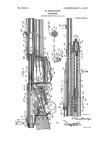
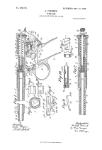
An exemplifying embodiment of the invention is shown in the
drawings, wherein Fig. 1 shows a front view of a sectional longitudinal
axial section of a hand firearm with a locking mechanism in the locked
position just after the firing of the cartridge; Fig. 2 shows the front view
of the same section of the hand firearm with the locking mechanism in
the open position; Fig. 3 shows a partial view and a partial section of the
detail A of Fig. 1; Fig. 4 shows a partial view and a partial section of the
detail В of Fig. 1, Fig. 5 shows a front view of a partial longitudinal axial
section of a cutoff case , Fig. 6 shows a cross section of the cutoff case
along the line VI-VI in Fig. 5; Fig. 7 shows a cross section of a part of
the cutoff case with a breech block, its carrier and its enclosure along the
line VII-VII in Fig. 2; and Fig. 8 shows a transmission lever in the
direction from the barrel.
WO 2007/137524
PCT/CZ2007/000034
5
10
15
20
25
Exemplifying embodiments of the invention
First of all, the locking mechanism according to Fig. 1 consists of
a breech block 1 provided on its upper side with a carrier 2, having a
stepped through hole 3, inside which a return spring 5 is arranged on a
guide bar 4. The rear end of the spring 5 is supported by a perpendicular
wall 6, which closes the rear end of a cutoff case 7 and in which the rear
end of the guide bar 4 of the return spring 5 is anchored. The
perpendicular wall 6 is a part of a mounting seat 8 of a butt (not shown)
of the hand firearm, the mounting seat 8 being inserted in the rear part of
the cutoff case 7, to which it is fastened by means of a mounting pin 9.
The front end of the cutoff case 7 consists of a supporting collar 10. in
which a barrel 12 with a cartridge chamber 13 is inserted and secured by
a cross pin 11. The lower side of the supporting collar 10 is provided
with a tapped hole 14, into which a fastening screw 15 is screwed
passing through the lower grip part 16 for its attachment. A supporting
frame 17 is inserted into the cutoff case 7 from below and it is secured
therein by means of two securing pins 18,19. The supporting frame 17 is
provided with a longitudinal sleeve 20, inside which a magazine 21 for
cartridges 22 along with a feeder 23 and a feeding spring 24 are
arranged. There is a bow 25 arranged backwards next to the longitudinal
sleeve 20, a trigger 26 protrudes into the bow 25 and a magazine lock 27
is hinged flexibly by a cross bolt 28 in the bow 25. The rear part of the
supporting frame 17 is provided with a grip 29. The cutoff case 7 is
closed at its upper side and its lateral sides by an enclosure 30 with an
ejection slot 31 for empty shells 32 (Fig. 1). A firing pin 33 with a striker
34 is arranged in the breech block 1 in a flexible sliding way, wherein its
movement is limited by a delimiting pin 35, which protrudes partially
6
WO 2007/137524
PCT/CZ2007/000034
5
10
15
20
25
into an elongated cross groove 36 on the firing pin 33. The locking
mechanism consists further of a single arm transmission lever 37
provided with a cylindrical crossbar 38, the central part of its length
being provided with a flute-like seat 39 (Fig. 8) for the passage of the
return spring 5. The cylindrical crossbar 38 extends into an oval cross
seat 40 formed in the carrier 2 of the breech block 1. The oval cross seat
40 is provided with a back supporting surface 41 and a front supporting
surface 42 for an engagement with the cylindrical crossbar 38 of the
single arm transmission lever 37. The free end 43 of the single arm
transmission lever 37 is provided with a cross stop 44 overlapping both
sides of the free end 43. The cross stop 44 has got an engagement surface
45 for an engagement with a stop surface 46 of a cross trip 47 formed in
the cutoff case 7, as well as a control surface 48 for an engagement with
a nose 49 of a single arm release lever 50 arranged in a flexible sliding
way on a suspension bolt 51. which is imbedded in the supporting frame
17, inside which a supporting spring 52 for the single arm release lever
50 is disposed. The single arm release lever 50 has got a grip end 53.
which is intended for an engagement with a catch protrusion 54 formed
on a hammer 55 in the region of its mounting on a hammer bolt 56. on
which a striking spring 57 is wound and which has its ends suspended in
the supporting frame 17. The hammer 55 consists of a single arm lever
provided with a striking surface 58 for an engagement with a firing
element 59. which is slidingly mounted in the single arm transmission
lever 37 and its movement is limited by a limiting pin 60 (Fig. 2), as well
as with a guide surface 61 at the free end of the hammer 55 for an
engagement with a control surface 62 (Fig. 4) formed on a lower part of
a back face 63 of the carrier 2 of the breech block 1. The hammer 55 is
7
WO 2007/137524
PCT/CZ2007/000034
5
10
15
20
25
provided with a retaining protrusion 64 arranged opposite the guide
surface 61, intended for an engagement with a retaining nose 65
arranged at the end of a retaining arm 66 of a trigger lever 67, which is
fixed to the trigger 26 and swingingly suspended on a trigger bolt 68.
There is a fire interrupter 70 swingingly suspended also on the trigger
bolt 68, the interrupter 70 being provided with a spring (not shown) and
controlled by means of an ordinary firing mode switch 71 which is
combined with a firearm lock. A flat spring 73 is mounted to the
supporting frame 17, e.g. by means of a rivet 72, and it is designed to
return the trigger lever 67 back to the starting position. The breech block
1 is provided with a pair of longitudinal guiding grooves 74, 75, which
are arranged at opposite sides of the breech block 1 and into which the
respective longitudinal guiding ribs 76, 77 are inserted, the longitudinal
guiding ribs 76, 77 being formed at the inner sides of the cutoff case 7.
The breech block 1 is provided at its front face 78 with a seat 79 for the
bottom of the cartridge 22 and with a supporting protrusion 80, which is
arranged near to the front face 78 protruding from its upper side and is
provided at the back side with a supporting surface 81 for an engagement
with the respective stop surface 82 formed at the lower side near to the
front wall 83 of the carrier 2 of the breech block 1. The longitudinally
sliding coupling of the carrier 2 with the breech block 1 is realised by
means of a pair of slide-ways 84, 85 arranged opposite each other on the
breech block 1 and inserted into the respective guiding slots 86, 87 on
the carrier 2 of the breech block 1.
The hand firearm according to the invention operates as follows:
Prior to the single or batch firing, the operator takes a tensioning
lever (not shown), which is connected with the carrier 2 of the breech
8
WO 2007/137524
PCT/CZ2007/000034
5
10
15
20
25
block 1, and he moves said system to the back position. Upon said
movement the cylindrical crossbar 38 contacts the front supporting
surface 42 of the oval cross seat 40 and the return spring 5 is
compressed. At the same time, the single arm transmission lever 37 is
tilted drifting behind the cylindrical crossbar and dragging its cross stop
44 over the cross trip 47 of the cutoff case 7 and the hammer 55 is tilted
below the lower surface of the breech block 1 against the power of the
striking spring 57. When the hammer 55 is in that position, it is arrested
with its catch protrusion 54 by the grip end 53 of the single arm release
lever 50 due to the operation of the supporting spring 52, as well as with
its retaining protrusion 64 by the retaining nose 65 on the retaining arm
66 of the trigger lever 67. Due to the operation of the return spring 5, a
releasing of the tensioning lever (not shown) issues in a forward
movement of the carrier 2, wherein the back supporting surface 41 in the
oval cross seat 40 touches the cylindrical crossbar 38, which issues in a
forward movement of the single arm transmission lever 37, which slides
with its cross stop 44 with the control surface 48 over the cutoff case 7
and pushes ahead of itself the breech block 1. The breech block 1 hits
against the bottom of the cartridge 22, pushes the cartridge 22 out of the
magazine 21 and gets it into the cartridge chamber 13 of the barrel 12.
During said movement of the locking mechanism, the cross stop 44 is
shifted over the cross trip 47, and as a result, the single arm transmission
lever 37 is erected and this enables - due to a further operation of the
return spring 5 - a further forward movement of the carrier 2 till its stop
surface 82 hits against the supporting surface 81 of the supporting
protrusion 80 on the breech block 1. When the breech block 1 is pushed
till its front face 78 touches the rear end of the barrel 12, eventually to
9
WO 2007/137524
PCT/CZ2007/000034
5
10
15
20
25
the face of the supporting collar 10, the cartridge 22 is locked in the
cartridge chamber 13. When the single arm transmission lever 37 is
erected, its cross stop 44 engages the nose 49 of the single arm release
lever 50 and therefore it is swung against the force of the supporting
spring 52. Consequently, the catch protrusion 54 of the hammer 55 is
released, but the hammer stays in the dropped position as its retaining
protrusion 64 is caught by the retaining nose 65 of the trigger lever 67.
When the trigger 26 is pulled, the retaining protrusion 64 is released and
- due to the operation of the striking spring 57 - the hammer 55 is flirted
around the hammer bolt 56 towards the single arm transmission lever 37,
where the striking surface 58 of the hammer 55 contacts the firing
element 59 and, at the same time, its guide surface 61 contacts the
control surface 62 of the carrier 2 of the breech block 1. Consequently,
the movement of the firing element 59 is transmitted to the firing pin 33
with the striker 34, so that the primer (not shown) is initiated and the
cartridge is fired. The power of the powder gas acts onto the bottom of
the empty shell 32 (Fig. 1) and said power is transmitted to the breech
block 1, which starts to move along with the carrier 2 and with the single
arm transmission lever 37 towards the back position against the power of
the return spring 5. During the first phase of said movement, the single
arm transmission lever 37 remains in the erected position until its cross
stop 44 overcomes the locking clearance X between its engagement
surface 45 and the stop surface 46 of the cross trip 47 on the cutoff case
7 and the cross stop 44 leans against it. From this moment on, the
function of the single arm transmission lever 37 as a mass reducer and an
accelerator is fully utilised, wherein a further movement of the empty
shell 32 depends especially on the drive ratio of the single arm
io
WO 2007/137524
PCT/CZ2007/000034
5
10
15
20
25
transmission lever 37, on the mass quantum of the carrier 2 of the breech
block 1, on the strength of the return spring 5 and on the process of the
ballistic pressure inside the barrel 12. During said further movement of
the locking mechanism, the single arm transmission lever 37 is tilted and
therefore the speed of the carrier 2 backwards against the power of the
return spring 5 is increased. During said accelerated movement
backwards, the empty shell 32 is thrown from the firearm through the
ejection slot 31 by means of an ejector (not shown). Due to the backward
movement of the single arm transmission lever 37, the hammer 55 is
tilted under the lower surface of the breech block 1 against the power of
the striking spring 57, wherein the hammer 55 is caught again by the
single arm release lever 50. The locking mechanism, after reaching the
back dead point, is moved forwards by means of the return spring 5, and
another cartridge 22 is pushed into the cartridge chamber 13 during said
forward movement and, during the final phase of the movement, after the
cross stop 44 is shifted over the cross trip 47, the single arm transmission
lever 37 is erected. At that moment, the single arm release lever 50 is
swung by the control surface 48 of the single arm transmission lever 37
and therefore, the hammer 55 is released. In case the trigger 26 is kept
pulled, the hammer 55 is shot and fires said another cartridge 22 in the
above mentioned way. Said cycle is repeated as long as the trigger 26 is
pulled until the moment, when the last cartridge 22 from the magazine
21 is fired. In case the trigger 26 has been released before the erection of
the single arm transmission lever 37, the retaining protrusion 64 on the
hammer 55 is caught by the retaining nose 65 of the trigger lever 67,
whereby the batch firing is stopped, even if the single arm transmission
lever 37 swings the single arm release lever 50 and releases the hammer
ii
WO 2007/137524
PCT/CZ2007/000034
55 thereby. The cartridge 22, which has been pushed into the cartridge
chamber 13, has not been fired and is prepared for firing at the next
pulling of the trigger 26. In case a single shot firing is required, the fire
interrupter 70 is activated by turning the firing mode switch 71, so that
5 the hammer 55 is caught in the requisite moment and the firing is
interrupted. The trigger 26 has to be released for the next firing and at
the same time the hammer 55 is released by the fire interrupter 70 and is
caught by the retaining nose 65 of the trigger lever. So, the hand firearm
is prepared for another firing.
10 Industrial applicability
The locking mechanism according to the invention may be used in
hand firearms, when it is required that the cartridge chamber is reliable
and safely locked before firing the inside located cartridge and that any
recoil of the locking mechanism before the cartridge firing itself is
15 prevented.
12
WO 2007/137524	PCT/CZ2007/000034
List of reference numerals
1	breech block	45	engagement surface
2	carrier	46	stop surface
3	through hole	47	cross trip
4	guide bar	48	control surface
5	return spring	49	nose
6	perpendicular wall	50	single arm release lever
7	cutoff case	51	suspension bolt
8	mounting seat	52	supporting spring
9	mounting pin	53	grip end
10	supporting collar	54	catch protrusion
11	cross pin	55	hammer
12	barrel	56	hammer bolt
13	cartridge chamber	57	striking spring
14	tapped hole	58	striking surface
15	fastening screw	59	firing element
16	lower grip part	60	limiting pin
17	supporting frame	61	guide surface
18	securing pin	62	control surface
19	securing pin	63	back face
20	longitudinal sleeve	64	retaining protrusion
21	magazine	65	retaining nose
22	cartridge	66	retaining arm
23	feeder	67	trigger lever
24	feeding spring	68	trigger bolt
25	bow	69	securing arm
26	trigger	70	fire interrupter
27	magazine lock	71	switch
28	cross bolt	72	rivet
29	trip	73	flat spring
30	enclosure	74 longitudinal guiding groove
31	ejection slot	75 longitudinal guiding groove
32	empty shell	76	longitudinal guiding rib
33	firing pin	77	longitudinal guiding rib
34	striker	78	front face
35	delimiting pin	79	seat
36	ongated cross groove	80	supporting protrusion
37	single arm transmission lever	81	supporting surface
38	cylindrical crossbar	82	stop surface
39	flute-like seat	83	front wall
40	oval cross seat	84	slide way
41	back supporting surface	85	slide way
42	front supporting surface	86	guiding slot
43	free end	87	guiding slot
44	cross stop	X	locking clearance
13
WO 2007/137524
PCT/CZ2007/000034
5
10
15
20
25
PATENT CLAIMS
1.	Locking mechanism of a hand firearm consisting of a breech block (1)
with a longitudinally slidingly arranged firing pin (33) and provided
on its upper side with a carrier (2) having a stepped through hole (3),
inside which a return spring (5) is arranged, and further with a single
arm transmission lever (37), which is arranged in the carrier (2) and
the free end of which is adapted for an engagement with a cross trip
(47) provided in a cutoff case (7), characterised in that the single
arm transmission lever (37) is provided with a cylindrical crossbar
(38), which is swingingly and slidingly arranged in an oval cross seat
(40) in the carrier (2) and which is provided with a back supporting
surface (41) and a front supporting surface (42) for an engagement
with the cylindrical crossbar (38) of the single arm transmission lever
(37), wherein the free end (43) of the single arm transmission lever
(37) is provided with a cross stop (44) overlapping on both sides and
having an engagement surface (45) for an engagement with a stop
surface (46) of the cross trip (47), and a locking clearance (X) exists
between the engagement surface (45) and the stop surface (46).
2.	Locking mechanism of a hand firearm according to claim 1,
characterised in that the overlapping cross stop (44) of the single
arm transmission lever (37) is further provided with a control surface
(48) for an engagement with a nose (49) of a single arm release lever
(50) for catching the hammer (55) by its catch protrusion (54).
3.	Locking mechanism of a hand firearm according to claim 1,
characterised in that the single arm transmission lever (37) is
provided with a firing element (59) arranged in a limited sliding way,
having an end intended for an engagement with the firing pin (33) and
14
WO 2007/137524
PCT/CZ2007/000034
the opposite end for an engagement with the striking surface (58) of
the hammer (55).
5
10
15
20
25
15
WO 2007/137524
PCT/CZ2007/000034

PCT/CZ2007/000034
WO 2007/137524
£0
WO 2007/137524
PCT/CZ2007/000034
CO