/









Text
                    http://jntu.blog.com

http://jntu.blog.com

http://jntu.blog.com

VLIW Microprocessor
Hardware Design

http://jntu.blog.com

http://jntu.blog.com

ABOUT THE AUTHOR
Weng Fook Lee is a senior member of the technical staff at
Emerald Systems Design Center. He is an acknowledged
expert in the field of RTL coding and logic synthesis, with
extensive experience in microprocessor design, chipsets,
ASIC, and SOC devices. Lee is the inventor/coinventor of
14 design patents and is also the author of VHDL Coding
and Logic Synthesis with Synopsys and Verilog Coding for
Logic Synthesis.

http://jntu.blog.com

http://jntu.blog.com

VLIW Microprocessor
Hardware Design
For ASIC and FPGA

Weng Fook Lee

New York

Chicago San Francisco Lisbon London Madrid
Mexico City Milan New Delhi San Juan Seoul
Singapore Sydney Toronto

http://jntu.blog.com

http://jntu.blog.com

Copyright © 2008 by The McGraw-Hill Companies, Inc. All rights reserved. Manufactured in the
United States of America. Except as permitted under the United States Copyright Act of 1976, no part
of this publication may be reproduced or distributed in any form or by any means, or stored in a database or retrieval system, without the prior written permission of the publisher.
0-07-159584-8
The material in this eBook also appears in the print version of this title: 0-07-149702-1.
All trademarks are trademarks of their respective owners. Rather than put a trademark symbol after
every occurrence of a trademarked name, we use names in an editorial fashion only, and to the
benefit of the trademark owner, with no intention of infringement of the trademark. Where such
designations appear in this book, they have been printed with initial caps.
McGraw-Hill eBooks are available at special quantity discounts to use as premiums and sales
promotions, or for use in corporate training programs. For more information, please contact George
Hoare, Special Sales, at george_hoare@mcgraw-hill.com or (212) 904-4069.
TERMS OF USE
This is a copyrighted work and The McGraw-Hill Companies, Inc. (“McGraw-Hill”) and its licensors
reserve all rights in and to the work. Use of this work is subject to these terms. Except as permitted
under the Copyright Act of 1976 and the right to store and retrieve one copy of the work, you may not
decompile, disassemble, reverse engineer, reproduce, modify, create derivative works based upon,
transmit, distribute, disseminate, sell, publish or sublicense the work or any part of it without
McGraw-Hill’s prior consent. You may use the work for your own noncommercial and personal use;
any other use of the work is strictly prohibited. Your right to use the work may be terminated if you
fail to comply with these terms.
THE WORK IS PROVIDED “AS IS.” McGRAW-HILL AND ITS LICENSORS MAKE NO
GUARANTEES OR WARRANTIES AS TO THE ACCURACY, ADEQUACY OR
COMPLETENESS OF OR RESULTS TO BE OBTAINED FROM USING THE WORK,
INCLUDING ANY INFORMATION THAT CAN BE ACCESSED THROUGH THE WORK VIA
HYPERLINK OR OTHERWISE, AND EXPRESSLY DISCLAIM ANY WARRANTY, EXPRESS
OR IMPLIED, INCLUDING BUT NOT LIMITED TO IMPLIED WARRANTIES OF
MERCHANTABILITY OR FITNESS FOR A PARTICULAR PURPOSE. McGraw-Hill and its
licensors do not warrant or guarantee that the functions contained in the work will meet your
requirements or that its operation will be uninterrupted or error free. Neither McGraw-Hill nor its
licensors shall be liable to you or anyone else for any inaccuracy, error or omission, regardless of
cause, in the work or for any damages resulting therefrom. McGraw-Hill has no responsibility for the
content of any information accessed through the work. Under no circumstances shall McGraw-Hill
and/or its licensors be liable for any indirect, incidental, special, punitive, consequential or similar
damages that result from the use of or inability to use the work, even if any of them has been advised
of the possibility of such damages. This limitation of liability shall apply to any claim or cause
whatsoever whether such claim or cause arises in contract, tort or otherwise.
DOI: 10.1036/0071497021

http://jntu.blog.com

http://jntu.blog.com

Professional

Want to learn more?
We hope you enjoy this
McGraw-Hill eBook! If
you’d like more information about this book,
its author, or related books and websites,
please click here.

http://jntu.blog.com

http://jntu.blog.com

Dedicated to my wife,
for all her sacrifices

http://jntu.blog.com

http://jntu.blog.com

This page intentionally left blank

http://jntu.blog.com

For more information about this title, click here

http://jntu.blog.com

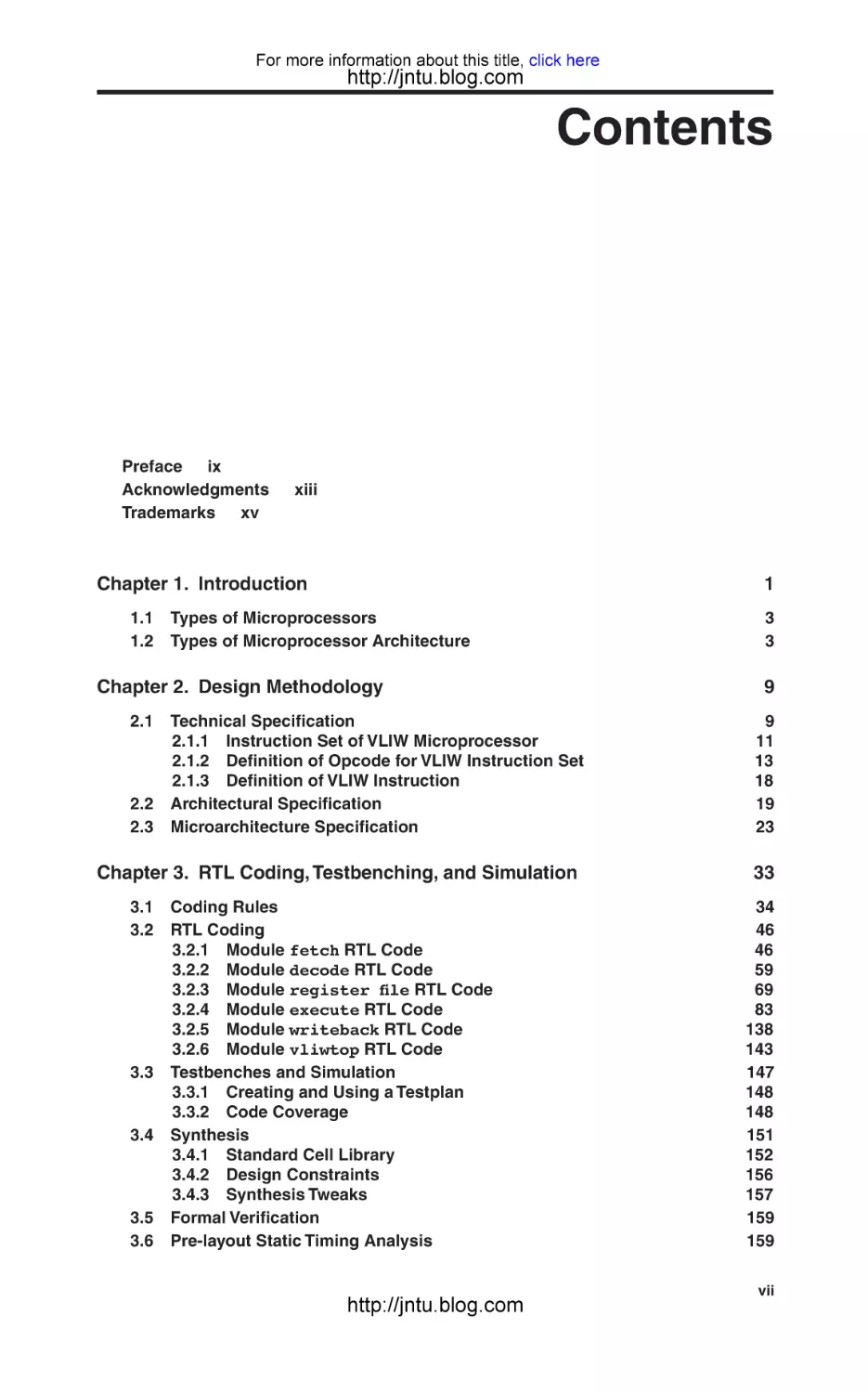
Contents

Preface
ix
Acknowledgments
Trademarks
xv

xiii

Chapter 1. Introduction
1.1
1.2

1

Types of Microprocessors
Types of Microprocessor Architecture

Chapter 2. Design Methodology
2.1

2.2
2.3

Technical Specification
2.1.1 Instruction Set of VLIW Microprocessor
2.1.2 Definition of Opcode for VLIW Instruction Set
2.1.3 Definition of VLIW Instruction
Architectural Specification
Microarchitecture Specification

Chapter 3. RTL Coding, Testbenching, and Simulation
3.1
3.2

3.3

3.4

3.5
3.6

Coding Rules
RTL Coding
3.2.1 Module fetch RTL Code
3.2.2 Module decode RTL Code
3.2.3 Module register file RTL Code
3.2.4 Module execute RTL Code
3.2.5 Module writeback RTL Code
3.2.6 Module vliwtop RTL Code
Testbenches and Simulation
3.3.1 Creating and Using a Testplan
3.3.2 Code Coverage
Synthesis
3.4.1 Standard Cell Library
3.4.2 Design Constraints
3.4.3 Synthesis Tweaks
Formal Verification
Pre-layout Static Timing Analysis

http://jntu.blog.com

3
3

9
9
11
13
18
19
23

33
34
46
46
59
69
83
138
143
147
148
148
151
152
156
157
159
159
vii

viii

http://jntu.blog.com

Contents

3.7

3.8
3.9
3.10
3.11
3.12
3.13
3.14
3.15

Layout
3.7.1 Manual/Custom Layout
3.7.2 Semi-custom/Auto Layout
3.7.3 Auto Place and Route
DRC / LVS
RC Extraction
Post-layout Logic Verification
Post-layout Performance Verification
Tapeout
Linking Front End and Back End
Power Consumption
ASIC Design Testability

Chapter 4. FPGA Implementation
4.1
4.2
4.3
4.4

FPGA Versus ASIC
FPGA Design Methodology
Testing FPGA
Structured ASIC

162
163
164
164
165
166
166
167
167
168
171
172

175
175
176
177
178

Appendix A. Testbenches and Simulation Results

181

Appendix B. Synthesis Results, Gate Level Netlist

201

Bibliography
Index
209

207

http://jntu.blog.com

http://jntu.blog.com

Preface

Microcontrollers and microprocessors are used in everyday systems.
Basically, any electronic systems that require computation or instruction
execution require a microcontroller or microprocessor. Microcontrollers
are basically microprocessors coupled with surrounding periphery logic
that perform a certain functionality. Therefore, at the core of electronic
systems with computational capability (for example, a POS system, an
ATM machine, handheld devices, control systems and others) is a microprocessor.
Microprocessors have grown from 8 bits to 16 bits, 32 bits, and currently to 64 bits. Microprocessor architecture has also grown from complex instruction set computing (CISC) based to reduced instruction set
computing (RISC) based on a combination of RISC-CISC based and currently very long instruction word (VLIW) based. This book discusses the
hardware design and implementation of a 64-bit VLIW microprocessor
capable of operating three operations per VLIW instruction word on
ASIC and FPGA technology.
The architecture and microarchitecture of the design are discussed in
detail in Chapter 2. The ASIC design methodology used for designing
the VLIW microprocessor is also discussed by showing each step of the
methodology. The VLIW microprocessor begins with the technical specifications which involve the voltage requirements, performance requirements, area utilization, VLIW instruction set, register file definition,
and details of operation for each instruction. From these technical details,
the architecture and microarchitecture consisting of three pipes running
in parallel allowing for three operations executed in parallel are described
in detail with each pipe being split into four stages of pipelining.
Chapter 3 discusses best known methods (BKM) on RTL coding guidelines which must be met in order to obtain good coding style that can
yield optimized synthesis results in terms of area and performance. The
reader is shown the importance of each guideline and how it affects the
design. Based on these guidelines, the RTL code for each of the modules
within the VLIW microprocessor is written. Chapter 3 continues with
http://jntu.blog.com

ix

x

Preface

http://jntu.blog.com

detailed descriptions of the steps following RTL coding, namely simulation, synthesis, standard cell library, layout, DRC, LVS, formal verification, and physical verification. Creation of testbenches and usage of test
plans in verifying the functionality of the RTL code are also discussed.
The reader is also shown how code coverage can be used as a method to
determine if the testbenches are adequate for verifying the design.
The requirements for synthesis are discussed with topics on standard cell library, design constraints, and synthesis tweaks in Section 3.4.
In this chapter, contents and creation of a standard cell library are discussed with information on how the flavors of a standard cell library may
affect the synthesis process of a design. For synthesized circuits that
cannot meet performance due to tight design constraints, some common
methods of design tweaks are discussed.
Section 3.5 shows the reader how formal a verification method can be
used to check if a synthesized design matches the golden model of the
design (RTL code). If formal verification fails, it indicates that the synthesized netlist and the golden RTL code do not match. Formal verification does not need any stimulus, thereby allowing comparison of the
design much quicker compared to gate level simulation.
Section 3.6 discusses pre-layout static timing analysis. During this
step of the ASIC flow, the design is checked for setup-time violation and
hold-time violation. What these violations are and how they are created
are discussed with methods of fixing them.
Section 3.7 addresses the layout portion of the ASIC flow which
explains to the readers the three types of layout that can be used for
ASIC design, namely custom/manual layout, schematic driven layout,
and auto place and route. The advantages and disadvantages of each
method are discussed.
Section 3.8 explains what DRC and LVS are, and how they are used
to verify the layout of a design. If a design does not pass all the DRC
rules, it cannot be sent to a fab for fabrication.
Sections 3.9 to 3.11 describe parasitic extraction and how this information is back annotated to the design phase to enable an accurate
post-layout logic and performance verification of the design. Designs
with deep-submicron technologies must always be back annotated to
ensure the parasitic does not cause the design to fail. It is common for
designs that pass simulation and timing analysis at the pre-layout
phase fail at the post-layout phase when parasitic are back annotated.
Section 3.12 describes about tapeout (design completed and ready to
be sent to fab). Section 3.13 discusses other issues that need to be considered in design such as clock tree and back annotation.
Section 3.14 shows the reader different methods that are used by
designers for low power design. Section 3.15 discusses testability issues.
Most designs today are so complex that scan chains are commonly built
http://jntu.blog.com

http://jntu.blog.com

Preface

xi

into the design to allow for ease of testability of the internal logic and
external board level connectivity.
Chapter 4 describes a different method to implement the VLIW microprocessor using FPGA. Differences between FPGA and ASIC are
explained in this chapter. Advantages and disadvantages of ASIC and
FPGA are discussed in detail.
Appendix A shows several examples of testbenches for verifying the
functionality and features of the VLIW microprocessor while
Appendix B shows the synthesized results and netlist for ASIC and
FPGA implementation.

http://jntu.blog.com

http://jntu.blog.com

This page intentionally left blank

http://jntu.blog.com

http://jntu.blog.com

Acknowledgments

This book would not have been possible without the help of many people.
I would like to put forward a word of thanks to Prof. Dr. Ali Yeon of the
University Malaysia Perlis, Dr. Bala Amawasai, Bernard Lee (CEO of
Emerald Systems), Azrul Abdul Halim (Director of Design Engineering,
Emerald Systems), Mona Chee, Soo Me, Sun Chong See, Colin Lim,
Tim Chen, Azydee Hamid, Steve Chapman, and the staff at McGraw-Hill
Professional.

http://jntu.blog.com

xiii

http://jntu.blog.com

This page intentionally left blank

http://jntu.blog.com

http://jntu.blog.com

Trademarks

ModelSim, Leonardo Spectrum, FormalPro, IC Station, and IC Station
SDL are trademarks of Mentor Graphics Inc.
VCS, Design Compiler, Astro, Formality are trademarks of Synopsys
Inc.
NC Verilog, Ambit, Silicon Ensemble, and Incisive are trademarks of
Cadence Inc.
Silterra is a trademark of Silterra Malaysia.

http://jntu.blog.com

xv

http://jntu.blog.com

This page intentionally left blank

http://jntu.blog.com

http://jntu.blog.com

VLIW Microprocessor
Hardware Design

http://jntu.blog.com

http://jntu.blog.com

This page intentionally left blank

http://jntu.blog.com

http://jntu.blog.com

Chapter

1
Introduction

Microprocessors and microcontrollers are widely used in the world today.
They are used in everyday electronic systems, be it systems used in
industry or systems used by consumers. Complex electronic systems
such as computers, ATM machines, POS systems, financial systems,
transaction systems, control systems, and database systems all use
some form of microcontroller or microprocessor as the core of their
system. Consumer electronic systems such as home security systems,
chip-based credit cards, microwave ovens, cars, cell phones, PDAs, refrigerators, and other daily appliances have within the core of their systems
either a microcontroller or microprocessor.
What are microcontrollers and microprocessors? If they are such a big
part of our daily lives, what exactly are their function?
Microprocessors and microcontrollers are very similar in nature. In
fact, from a top level perspective, a microprocessor is the core of a microcontroller. A microcontroller basically consists of a microprocessor as its
central processing unit (CPU) with peripheral logic surrounding the
microprocessor core. As such it can be viewed that a microprocessor is
the building block for a microcontroller (Figure 1.1).
A microcontroller has many uses. It is commonly used to provide a system
level solution for things such as controlling a car’s electronic system, home
security systems, ATM system, communication systems, daily consumer
appliances (such as microwave oven, washing machine), and many others.
From a general point of view, a microcontroller is composed of three
basic blocks:
1. Memory
■ A nonvolatile memory block to store the program for the microcontroller. When the system is initiated, the microcontroller reads

http://jntu.blog.com

1

2

Chapter One

http://jntu.blog.com

Microcontroller

Microprocessor Peripheral logic,
memory, IO logic
core

Figure 1.1 Diagram showing
microprocessor as core of microcontroller.

the contents of the nonvolatile memory and starts performing its
task based on the programming instructions. Examples of nonvolatile memory are electronic programmable read only memory
(EPROM), read only memory (ROM), and flash memory.
■ A block of volatile memory that is used as temporary storage location
by the microcontroller when it is performing its task. When power is
turned off from the microcontroller, the contents of the volatile
memory are lost. Examples of volatile memory are Random Access
Memory (RAM), SRAM, DRAM, DDRRAM, SDRAM, and others.
2. CPU that does all the processing of the instructions read from the
nonvolatile memory.
3. Peripheral logic allowing the microcontroller to have access to external IC chips through input/output (IO).
As stated previously, a microprocessor is the CPU of the microcontroller. Within the microprocessor is an arithmetic logic unit (ALU) that
allows the microprocessor to process arithmetic and logic instructions
provided to the microprocessor.
Our daily lives are filled with use of computers, whether we are
aware of it or not. For example, when we go to a bank and make a withdrawal using an ATM, the ATM identifies us and our bank account
using an ATM card issued by the bank. That information is relayed
from the ATM machine to a central computer system that transmits
information back to the ATM regarding the amount of savings in the
account and how much can be withdrawn at that moment. When we
decide to withdraw a certain sum of money, that transaction is automatically recorded in the bank’s central computer system and the
corresponding bank account. This process is automated within a computer system, and at the very heart of the computer systems lies
many microprocessors.
Computers that we use daily at home or at work have a microprocessor
as their brain. The microprocessor does all the necessary functions of
the computer when we are using a word editor, spreadsheet, presentation
http://jntu.blog.com

http://jntu.blog.com

Introduction

3

slides, surfing the internet, or playing computer games. Computers
cannot function without a microprocessor.
1.1

Types of Microprocessors

The first microprocessor was developed by Intel Corp in 1971. It was
called 4004. The 4004 was a simple design compared to the microprocessors that we have today. However, back in 1971 the 4004 was a
state-of-the-art microprocessor.
Microprocessors today have grown manifold from their beginnings.
Present-day microprocessors typically run in hundreds of megahertz
ranging to gigahertz in their clock speeds. They have also grown from
8 bits to 16, 32, and 64 bits. The architecture of a microprocessor has
also grown from CISC to RISC and VLIW.
Complex instruction set computing (CISC) is based on the concept of
using as little instruction as possible in programming a microprocessor.
CISC instruction sets are large with instructions ranging from basic to
complex instructions. CISC microprocessors were widely used in the
early days of microprocessor history.
Reduced instruction set computing (RISC) microprocessors are very
different from CISC microprocessors. RISC uses the concept of keeping
the instruction set as simple as possible to allow the microprocessor’s
program to be written using only simple instructions. This idea was
presented by John Cocke from IBM Research when he noticed that most
complex instructions in the CISC instruction set were seldom used while
the basic instructions were heavily utilized.
Apart from the CISC and RISC microprocessors, there is a different
generation of microprocessor based on a concept called very long instruction word (VLIW). VLIW microprocessors make use of a concept of
instruction level parallelism (ILP)—executing multiple instructions in
parallel.
VLIW microprocessors are not the only type of microprocessors that
take advantage of executing multiple instructions in parallel.
Superscalar superpipeline CISC/RISC microprocessors are also able to
achieve parallel execution of instructions.
1.2

Types of Microprocessor Architecture

To achieve high performance for microprocessors, the concept of pipeline
is introduced into microprocessor architecture. In pipelining, a microprocessor is divided into multiple pipe stages. Each pipe stage can execute an instruction simultaneously. When a stage in the pipe has
completed executing its instruction, it will pass the results to the next
stage for further processing while it takes another instruction from its
http://jntu.blog.com

4

http://jntu.blog.com

Chapter One

F

D

E

W

t1
t2
t3
t4
Figure 1.2 Diagram showing instruction execution for
pipeline microprocessor.

preceding stage. Figure 1.2 shows the instruction execution for a pipeline
microprocessor that has the four basic stages of pipe:
1. fetch—This stage of the pipeline fetches instruction/data from
instruction cache/memory.
2. decode—This stage of the pipeline decodes the instruction fetched
by the fetch stage. The decode stage also fetches register data
from the register file.
3. execute—This stage of the pipeline executes the instruction. This
is the stage where the ALU (arithmetic logic unit) is located.
4. writeback—This stage of the pipeline writes data into the register
file.
A pipeline microprocessor as shown in Figure 1.2 consists of basic four
stages. These stages can be further subdivided into more stages to form
F

D

E

W

t1

t2

t3

t4

Figure 1.3 Diagram showing instruction execution for superscalar pipeline microprocessor.

http://jntu.blog.com

http://jntu.blog.com

F

D

E

Introduction

5

W

t1

t2

t3

t4
Diagram showing instruction execution for VLIW
microprocessor.

Figure 1.4

a superpipeline microprocessor. A superpipeline microprocessor has
the disadvantage of requiring more clock cycles to recover from a branch
instruction compared to a fewer-stage pipeline microprocessor.
To achieve multiple instruction execution, multiple pipes can be put
together to form a superscalar microprocessor. A superscalar microprocessor increases in complexity but allows multiple instructions to be
executed in parallel. Figure 1.3 shows the instruction execution for a
superscalar pipeline microprocessor.
VLIW microprocessors use a long instruction word that is a combination
of several operations combined into one single long instruction word. This
allows a VLIW microprocessor to execute multiple operations in parallel.
Figure 1.4 shows the instruction execution for a VLIW microprocessor.
Although both superscalar pipeline and VLIW microprocessors can
execute multiple instructions in parallel, each microprocessor is very different and has its own set of advantages and disadvantages.
Superscalar pipeline

VLIW

Multiple instructions issued per cycle

Hardware is complex as the microprocessor has multiple
instructions incoming.
Compiler is not as complicated
as that of VLIW compiler.
Smaller program memory is needed.

One VLIW word is executed per cycle.
However each VLIW word consists of several
instructions.
Hardware is simpler as the microprocessor
has a single VLIW word incoming.
Compiler is complicated as the compiler
needs to keep track of the scheduling of
instructions.
Larger program memory is needed.

http://jntu.blog.com

6

Chapter One

http://jntu.blog.com

VLIW microprocessors typically require a compiler that is more complicated as it needs to ensure that code dependency in its long instruction word is kept to a minimum.
1. The VLIW microprocessor takes advantage of the parallelism
achieved by packing several instructions into a single VLIW word
and executing each instruction within the VLIW word in parallel.
However, these instructions must have dependency among them
kept to a minimum, otherwise the VLIW microprocessor would not
be efficient. VLIW microprocessors rely heavily on the compiler to
ensure that the instructions packed into a VLIW word have minimal dependency. Creating that “intelligence” into a VLIW compiler
is not trivial; much research has been done in this area. This book
does not discuss how an efficient compiler can be created or compiler concepts for VLIW, but concentrates instead on the hardware
design of a VLIW microprocessor and how it can be achieved using
Verilog HDL.
2. VLIW uses multiple operations in a single long instruction word. If
one operation is dependent on another operation within the same
VLIW word, the second operation may have to wait for the first operation to complete. In these situations, the compiler would insert NOP
(no operation) into the VLIW word, thereby slowing down the efficiency of the VLIW microprocessor. To look at the problem of operation dependency during the execution of the operation, let us assume
a VLIW instruction that consists of two operations.
add r0, r1, r2 : add r2, r3, r4
Because the operations in the VLIW instruction are dependent (second
operation of add r2, r3, r4 needs the result from the first operation, add r0, r1, r2), the second operation cannot execute until
the first operation is complete. The simplest solution would be for the
compiler to insert NOP between the two operations to ensure that the
results of the first operation are ready when the second operation
is executed. VLIW instruction after insertion of NOP:
add r0, r1, r2 : NOP
NOP : add r2, r3, r4
As a result of the NOP insertion, there will be two VLIW instructions
instead of one. Assuming that the VLIW microprocessor is a four
stage pipeline with the first stage fetch, second stage decode, third
stage execute, and final stage writeback (each stage of the VLIW
microprocessor is explained in detail in Section 2.3), the VLIW
instructions which consist of two operations per instruction will enter
the pipeline serially.
http://jntu.blog.com

http://jntu.blog.com

add r0,r1,r2
NOP
NOP
add r2,r3,r4

Introduction

7

Time T1
add r0,r1,r2
NOP
NOP
add r2,r3,r4

Time T2
add r0,r1,r2
NOP
NOP
add r2,r3,r4

Time T3
add r0,r1,r2
NOP

Time T4

By inserting NOP into the VLIW instruction, the first operation of add
r0, r1, r2 is executed by the microprocessor before the second operation of add r2, r3, r4 is executed. This ensures that the issue
of operation dependency is avoided. However, the disadvantage of this
method is that the instruction code size will increase while performance of the microprocessor is affected. There are two possible solutions to this problem:
1. The VLIW compiler ensures that there is no dependency between
operations within a VLIW instruction.
2. Implement hardware register bypass logic between operations of
a VLIW instruction. Register bypass implementation is discussed
in Section 3.2.4.

http://jntu.blog.com

http://jntu.blog.com

This page intentionally left blank

http://jntu.blog.com

http://jntu.blog.com

Chapter

2
Design Methodology

To design a VLIW microprocessor, the first step is to determine the
design methodology. The methodology will show each step that needs to
be taken from the beginning of the microprocessor design to verification
and final testing. Figure 2.1 shows the design methodology that is used
for the design of the VLIW microprocessor.

2.1

Technical Specification

This is the beginning of the design methodology flow. In this step, the
technical features and capability of the VLIW and superscalar pipeline
microprocessor are defined. The specifications will influence the architecture and microarchitecture of the microprocessor. From the specifications, all design considerations are made with respect to meeting the
specified technical requirements. A list of the technical specifications for
the design and implementation of the microprocessor follows:
■

Must be able to operate at 3.0V conditions


In order for the design to operate in 3.0V conditions, the fab process
technology considered for doing the design must be able to support
3.0V operation.
Normally, the chosen fab for fabricating the design will have different technology catered to different operating voltages and design
requirements. The technologies provided by the fab may cover
5V operations, 3V operations, 1.8V operations or lower, mixed
signal design, logic design, or RF design.

http://jntu.blog.com

9

10

http://jntu.blog.com

Chapter Two

Technical
specification
Tapeout
Architectural
specification
Post-layout performance verification
Microarchitectural
specification
FPGA
testing

Post-layout logic verification

RTL coding

FPGA
prototyping

Parasitic extraction

Testbench

Simulation

Synthesis

Standard cell library

Formal verification

Figure 2.1

■

DRC/LVS

Layout

Static timing analysis

Diagram showing design methodology flow.

Performance must meet a minimum of 200 MIPS (200 million instructions per second)
This is an important requirement that will have great impact on
the architectural specification. By having a minimum requirement of 200 MIPS, the architecture of the VLIW microprocessor
must be able to operate under conditions that can achieve such
speed. For example, if the microprocessor can operate at 100 MHz,
it must execute two instructions at any one time in order to achieve
200 MIPS.
Microprocessor operates in 64 bits.


■

Data bus and internal registers must be architectured to 64 bits.
Area of design implementation must be kept to a minimum to
reduce cost. Transistor count should not exceed 400,000 to limit the
size.


■

■

The microprocessor has sixteen internal registers, 64 bits each. This
will form the register file of the microprocessor. Each register is
addressed using 5 bits, ranging from address R0000 for register 0 to
address R1111 for register 15. The most significant bit of the address
is reserved for future expansion (see Table 2.1).
http://jntu.blog.com

http://jntu.blog.com

Design Methodology

11

Note: VLIW microprocessors commonly have larger register file. It is
common for VLIW microprocessors to have 256 registers or more. Having
a large register file allows the microprocessor to store more data internally rather than externally. This boosts performance as access to register file is faster compared to external memory access. However, having
a large register file increases the die size. A balance needs to be achieved
between register file size and die size. For ease of understanding, the
VLIW microprocessor example is defined with only 16 registers.

■

Instruction sets include arithmetic operations, load operations, read
of internal register operations, and compare operations. Section 2.1.1
explains the operations defined for the microprocessor.

2.1.1 Instruction Set of VLIW
Microprocessor

When creating the instruction set for the VLIW microprocessor, the
operations of arithmetic, load, read, and compare are considered and
included in the instruction set. For the design of the VLIW microprocessor, an arithmetic and logic set of 16 operations is created. The
list of operations is shown in Table 2.2, with each operation represented
by a 5-bit code, with the most significant bit being a reserved bit for
future operation code expansion.

TABLE 2.1

Register Address for Internal Register of register file

Internal Register Name

Register Address

r0
r1
r2
r3
r4
r5
r6
r7
r8
r9
r10
r11
r12
r13
r14
r15

R0000
R0001
R0010
R0011
R0100
R0101
R0110
R0111
R1000
R1001
R1010
R1011
R1100
R1101
R1110
R1111

http://jntu.blog.com

12

http://jntu.blog.com

Chapter Two

Note: VLIW microprocessors commonly have anywhere up to 64 instructions or more. For ease of understanding, the VLIW microprocessor example is defined with only 16 instructions.

TABLE 2.2

Operation Code for the VLIW Microprocessor Instruction Set

Operation

Code
R0000
R0001
R0010
R0011
R0100
R0101
R0110
R0111
R1000
R1001
R1010
R1011
R1100
R1101
R1110
R1111

nop
add
sub
mul
load
move
read
compare
xor
nand
nor
not
shift left
shift right
barrel shift left
barrel shift right

Each operation code is combined with the internal register address
to form an arithmetic or logic operation. Each operation consists of 5 bits
for defining the operation code (as shown in Table 2.2) and 15 bits for
defining the internal register addresses (as shown in Table 2.1). In total,
an operation will consists of 20 bits. Table 2.3 shows how the different
bits of the operation code and internal register addresses are combined
to form an operation.
Combination of Operation Code and Internal Register Addresses to Form
an Operation
TABLE 2.3

Bits [19:15]
Operation code

Bits [14:10]

Bits [9:5]

Bits [4:0]

source1 address

source2 address

destination address

The columns for source1, source2 and destination address are
internal register addresses. The VLIW microprocessor has sixteen internal registers and each is defined with its own register address as shown
in Table 2.1.
Section 2.1.2 explains how each operation code can be used with the
internal register addresses to form an operation.
http://jntu.blog.com

http://jntu.blog.com

Design Methodology

13

2.1.2 Definition of Opcode for VLIW
Instruction Set

The operation code shown in Table 2.2 consists of 5 bits, with the most
significant bit being a reserved bit for future expansion. Bits 3 to 0 are
used to represent the 16 different possible operations. Similarly, each
internal register is assigned five address bits with the most significant
bit being a reserved bit for future expansion, as shown in Table 2.1.
1. Operation code R0000—nop
This operation code is for a “no operation” performed. This means
that the VLIW microprocessor is idle when this operation code is
decoded. Table 2.4 shows the bit format for operation code nop.
Bits 19, 14, 9, and 4 are reserved bits. For the nop, the internal register addresses of source1, source2, and destination are
ignored because no internal register access is required.
Bit Format for Operation Code nop

TABLE 2.4

Bits [19:15]
R0000

Bits [14:10]

Bits [9:5]

RXXXX

RXXXX

Bits [4:0]
RXXXX

2. Operation code R0001—add
This operation code is for arithmetic addition. The VLIW microprocessor will perform an addition of data from internal registers
specified by source1 and source2, and write the results of the
addition into the internal register specified by destination.
destination = source1 + source2
Since all the internal registers are 64 bits, if an addition creates a
result that have a carry out, it is ignored. Only the sum of the addition
is written into the 64 bit destination register (shown in Table 2.5).
TABLE 2.5

Bit Format for Operation Code add

Bits [19:15]

Bits [14:10]

Bits [9:5]

R0001

source1

source2

Bits [4:0]
destination

3. Operation code R0010—sub
This operation code is for arithmetic subtraction. The VLIW microprocessor will perform a subtraction of data from internal registers
specified by source2 from source1, and write the results of the
subtraction into the internal register specified by destination.
destination = source1 - source2
http://jntu.blog.com

14

http://jntu.blog.com

Chapter Two

If the results of the subtraction creates a borrow, it is ignored (shown
in Table 2.6).
TABLE 2.6

Bit Format for Operation Code sub

Bits [19:15]
R0010

Bits [14:10]

Bits [9:5]

source1

source2

Bits [4:0]
destination

4. Operation code R0011—mul
This operation code is for arithmetic multiplication. The VLIW
microprocessor will perform a multiplication of data from internal registers specified by source1 and source2, and write the
results of the multiplication into the internal register specified
by destination.
destination = source1 * source2
For the multiply operation code, the data at source1 and source2
are limited to the lower 32 bits even though the internal registers
source1 and source2 are 64 bits. The results of the multiply operation is 64 bits (shown in Table 2.7).
TABLE 2.7

Bit Format for Operation Code mul

Bits [19:15]
R0011

Bits [14:10]
source1 (limited to
lower 32 bit contents)

Bits [9:5]

Bits [4:0]

source2 (limited to
destination
lower 32 bit contents)

5. Operation code R0100—load
This operation code is for loading data into an internal register. The
VLIW microprocessor will load the data from the 64 bit data bus
input into an internal register specified by destination (shown
in Table 2.8).
destination = data on data bus
TABLE 2.8

Bit Format for Operation Code load

Bits [19:15]
R0100

Bits [14:10]
RXXXX

Bits [9:5]

Bits [4:0]

RXXXX

destination

6. Operation code R0101—move
This operation code is for moving data from one internal register
to another. The VLIW microprocessor will move the contents of the
http://jntu.blog.com

http://jntu.blog.com

Design Methodology

15

internal register specified by source1 to the internal register specified by destination (shown in Table 2.9).
destination = source1
TABLE 2.9

Bit Format for Operation Code move

Bits [19:15]
R0101

Bits [14:10]

Bits [9:5]

Bits [4:0]

source1

RXXXX

destination

7. Operation code R0110—read
This operation code is for reading of data from an internal register.
The VLIW microprocessor will read the contents of internal register specified by source1 and send the data to the output port of the
microprocessor (shown in Table 2.10).
Output port = source1
TABLE 2.10

Bits [19:15]
R0110

Bit Format for Operation Code read
Bits [14:10]

Bits [9:5]

Bits [4:0]

source1

RXXXX

RXXXX

8. Operation code R0111—compare
This operation code is for arithmetic comparison. The VLIW microprocessor will perform a comparison of data from internal registers
specified by source1 and source2 and the outcome of the comparison will set the appropriate bit of the internal register specified by destination (shown in Table 2.11).
If the data of source1 is compared equal to the data of source2, a
jump is executed (branch to another instruction).
TABLE 2.11

Bits [19:15]
R0111

Bit Format for Operation Code compare
Bits [14:10]

Bits [9:5]

Bits [4:0]

source1

source2

destination

i. source1 = source2 → Branch to another instruction, a jump
is required
ii. source1 ⬎ source2 → Bit 1 of destination register = 1
iii. source1 ⬍⫽ source2 → Bit 2 of destination register = 1
iv. source1 ⬍⫽ source2 → Bit 3 of destination register = 1
v. source1 ⬎⫽ source2 → Bit 4 of destination register = 1
vi. All other bits of destination register are set to 0.
http://jntu.blog.com

16

Chapter Two

http://jntu.blog.com

9. Operation code R1000—xor
This operation code is for XOR function. The VLIW microprocessor
perform an XOR function on data from internal registers specified
by source1 and source2, and write the results into the internal
register specified by destination (shown in Table 2.12).
TABLE 2.12

Bits [19:15]
R1000

Bit Format for Operation Code xor
Bits [14:10]

Bits [9:5]

Bits [4:0]

source1

source2

destination

10. Operation code R1001—nand
This operation code is for NAND function. The VLIW microprocessor will perform a NAND function on data from internal registers
specified by source1 and source2, and write the results into the
internal register specified by destination (shown in Table 2.13).
TABLE 2.13

Bits [19:15]
R1001

Bit Format for Operation Code nand
Bits [14:10]

Bits [9:5]

Bits [4:0]

source1

source2

destination

11. Operation code R1010—nor
This operation code is for NOR function. The VLIW microprocessor
will perform a NOR function on data from internal registers specified by source1 and source2, and write the results into the internal register specified by destination (shown in Table 2.14).
TABLE 2.14

Bits [19:15]
R1010

Bit Format for Operation Code nor
Bits [14:10]

Bits [9:5]

Bits [4:0]

source1

source2

destination

12. Operation code R1011—not
This operation code is for NOT function. The VLIW microprocessor
will perform a NOT function on data from internal register specified by source1 and write the results into the internal register
specified by destination (shown in Table 2.15).
TABLE 2.15

Bits [19:15]
R1011

Bit Format for Operation Code not
Bits [14:10]

Bits [9:5]

Bits [4:0]

source1

RXXXX

destination

http://jntu.blog.com

http://jntu.blog.com

Design Methodology

17

13. Operation code R1100—shift left
This operation code is for shifting left function. The VLIW microprocessor will perform a shift left function on data from internal registers specified by source1 and write the results in internal register
specified by destination. The amount of bits that shift left on
source1 is decoded by bits [3:0] of source2. For example, if
source2 [3:0] is 0001, source1 is shifted left by one bit. If source2
[3:0] is 1001, source1 is shifted left by nine bits. When shifting left,
the least significant bit appended to source1 is logic zero. Since only
bits [3:0] of source2 is decoded, the shift left operation code can only
shift left a maximum of 15 bits at any one time (shown in Table 2.16).
TABLE 2.16

Bits [19:15]
R1100

Bit Format for Operation Code shift left
Bits [14:10]

Bits [9:5]

Bits [4:0]

source1

source2

destination

14. Operation code R1101—shift right
This operation code is for shifting right function. The VLIW microprocessor will perform a shift right function on data from internal registers specified by source1 and write the results in internal register
specified by destination. The amount of bits that shifts right on
source1 is decoded by bits [3:0] of source2. For example, if source2
[3:0] is 0001, source1 is shifted right by 1 bit. If source2 [3:0] is
1001, source1 is shifted right by 9 bits. When shifting right, the
most significant bit appended to source1 is a zero. Because only bits
[3:0] of source2 are decoded, the shift right operation code can only
shift right a maximum of 15 bits at any one time (shown in Table 2.17).
TABLE 2.17

Bits [19:15]
R1101

Bit Format for Operation Code shift right
Bits [14:10]

Bits [9:5]

Bits [4:0]

source1

source2

destination

15. Operation code R1110—barrel shift left
This operation code is for barrel shift left function. The VLIW microprocessor will perform a barrel shift left function on data from
internal registers specified by source1 and write the results in
internal register specified by destination. The amount of bits
that barrel shift left on source1 is decoded by bits [3:0] of source2.
For example, if source2 [3:0] is 0001, source1 is barrel shifted left
by 1 bit. If source2 [3:0] is 1001, source1 is barrel shifted left by
9 bits. When barrel shifting left, the most significant bit becomes
the least significant bit. Because only bits [3:0] of source2 are
http://jntu.blog.com

18

Chapter Two

http://jntu.blog.com

decoded, the barrel shift left operation code can only barrel shift left
a maximum of 15 bits at any one time (shown in Table 2.18).
TABLE 2.18

Bits [19:15]
R1110

Bit format for Operation Code barrel shift left
Bits [14:10]

Bits [9:5]

Bits [4:0]

source1

source2

destination

16. Operation code R1111—barrel shift right
This operation code is for barrel shift right function. The VLIW
microprocessor will perform a barrel shift right function on data
from internal registers specified by source1 and write the results
in internal register specified by destination. The amount of bits
that barrel shift right on source1 is decoded by bits [3:0] of source2.
For example, if source2 [3:0] is 0001, source1 is barrel shifted
right by 1 bit. If source2 [3:0] is 1001, source1 is barrel shifted
right by 9 bits. When barrel shifting right, the least significant bit
becomes the most significant bit. Because only bits [3:0] of source2
are decoded, the barrel shift right operation code can only barrel shift
right a maximum of 15 bits at any one time (shown in Table 2.19).
TABLE 2.19

Bits [19:15]
R1110

Bit Format for Operation Code barrel shift right
Bits [14:10]

Bits [9:5]

Bits [4:0]

source1

source2

destination

2.1.3 Definition of VLIW Instruction

Section 2.1.2 describes the definition of the operation code for the VLIW
microprocessor. These operation codes are combined together to form a
Very Long Instruction Word. Each VLIW instruction word is 64 bits and
consists of three operations. Each of the operations can be any one of the
operation codes described in Section 2.1.2. For example, let us assume
that there are three operations (add, sub, move) combined to form a
VLIW instruction word.

Note: VLIW microprocessors commonly have between 64 and 1024 bits for
a VLIW instruction word, while some have variable length. For ease of
understanding, the VLIW microprocessor example is defined with 64-bit
VLIW instruction word.

http://jntu.blog.com

http://jntu.blog.com

Design Methodology

19

Operation 1: add r0,r1,r2
Bits [19:15]
R0001

Bits [14:10]

Bits [9:5]

Bits [4:0]

R0000

R0001

R0010

Bits [14:10]

Bits [9:5]

Bits [4:0]

R0011

R0100

R0101

Bits [14:10]

Bits [9:5]

Bits [4:0]

R1010

RXXXX

R1000

Operation 2: sub r3,r4,r5
Bits [19:15]
R0010

Operation 3: move r10, r8
Bits [19:15]
R0101

VLIW instruction word:
Bits [64:60]
RRRR

Bits [59:40]

Bits [39:20]

Bits [19:0]

R0001R0000R0001R0010
add r0, r1, r2
Operation 1

R0010R0011R0100R0101
sub r3, r4, r5
Operation 2

R0101R1010RXXXXR1000
move r10, r8
Operation 3

R indicates the reserved bits for future expansion; X indicates don’t
care for the corresponding operation.
The three operations combined to form one VLIW instruction word
allows the VLIW microprocessor to read one instruction but execute
three operations in parallel.
2.2

Architectural Specification

Section 2.1 describes the technical specification for the VLIW microprocessor. From the technical specification, the architectural specification is derived. This is a crucial step because the architecture of a design
plays an important part in the performance capability and area utilization of the design. For example, if the microprocessor is architectured for
100 MHz, designing it to achieve performance greater than 100 MHz will
be a difficult task. The architecture of a design plays a major role in the
overall capability of a design.
Figure 2.2 shows a generic architecture that can be used to represent
the VLIW microprocessor. The microprocessor fetches instructions from
an external instruction cache into its internal instruction buffers and
decoders. The instruction is then passed on to multiple execution units
which allows for multiple operations to be executed in parallel.
http://jntu.blog.com

20

http://jntu.blog.com

Chapter Two

Logic to
write to
register
file
External
instruction
cache

register
file

Instruction
fetching/
buffering/
decoding

Multiple
execution
unit

Data
cache

Figure 2.2 Diagram showing a generic architecture for VLIW
microprocessor.

Based on the technical specifications described in Section 2.1 and the
generic architecture diagram of Figure 2.2, the VLIW microprocessor can
be simplified and architectured using a pipeline technology of four stages:
1. The VLIW microprocessor is architectured to take advantage of the
pipeline technology. (For further information on pipeline technology,
please refer to Hennessy and Patterson, Computer Architecture: A
Quantitative Approach [Morgan Kaufmann], and Patterson and
Hennessy, Computer Organization & Design: The Hardware/Software
Interface [Morgan Kaufman].)
2. Each 64-bit VLIW instruction word consists of three operations. To
maximize the performance capability, the architecture is built to execute the three operations in parallel. Each operation is numbered and
categorized as pipe1, pipe2, and pipe3 with pipe1 operating operation
1, pipe2 operating operation 2 and pipe3 operating operation 3.
3. Each operation is split into four stages: fetch stage, decode stage,
execute stage, and writeback stage. Four stages are chosen to
keep the architecture simple yet efficient. The fetch stage fetches
the VLIW instruction and data from external devices such as memory.
The decode stage decodes the VLIW instruction to determine what
operations each pipe needs to execute. The execute stage executes
the operation decoded by the decode stage. The writeback stage
(the last stage of the pipe) writes the results from the execution of
the instruction into internal registers.
http://jntu.blog.com

http://jntu.blog.com

Design Methodology

21

4. All three operations share a set of sixteen 64-bit internal registers,
which forms a register file. During the decode stage, data are
read from the register file and during writeback stage, data are
written into the register file.
Based on these requirements, the VLIW microprocessor is architectured to Figure 2.3.
In Figure 2.3, the incoming instructions and data from external systems to the VLIW microprocessor are fetched by the fetch unit, the first
stage of the VLIW microprocessor.
After the instruction and data have been fetched, it is passed to the
decode stage. The 64-bit instruction consists of three operations (refer
Section 2.1.3). Each operation is passed to the corresponding decode
stage. Each operation is also passed from the fetch stage to the
register file to allow the data to be read from the register file
for each corresponding operation.
In the decode stage, the operations are decoded and passed onto the
execute stage. The execute stage, as its name implies, will execute
the corresponding decoded operation. The execute stage has access to
the shared register file for reading of data during execution.
Upon completion of execution of an operation, the final stage (writeback stage) will write the results of the operation into the register file,
or read data to the output of the VLIW microprocessor for read operation.
Table 2.20 describes the interface signals defined for the architecture
of the VLIW microprocessor. Figure 2.4 shows the interface signal diagram of the VLIW microprocessor.
To allow ease of understanding on the implemented RTL code of the
VLIW microprocessor, the following are taken into consideration:

Operation 1
execute 1

Operation 2
fetch

decode

execute 2

write back

Operation 3

1st stage
Figure 2.3

register
file (shared)

execute 3

2nd stage

3rd stage

Diagram showing top level architecture.

http://jntu.blog.com

4th stage

22

http://jntu.blog.com

Chapter Two

TABLE 2.20

Description of VLIW Microprocessor Interface Signals
Input/
Output

Bit
Size

clock

input

1

reset

input

1

word

input

64

data

input

192

readdatapipe1

output

64

readdatapipe2

output

64

readdatapipe3

output

64

readdatavalid

output

1

jump

output

1

Pin Name

Description
Input clock pin. The VLIW microprocessor is
active on rising edge clock.
Input reset pin. Reset is asynchronous and
active high.
The 64-bit word represents the VLIW
instruction from external instruction memory.
The 64 bits are represented as:
■ Bits 64 to 60, 59, 54, 49, 44, 39, 34, 29, 24, 19,
14, 9, and 4 are reserved bits.
■ Bits 58 to 55 represent opcode for operation 1.
■ Bits 53 to 50 represent source1 for operation 1.
■ Bits 48 to 45 represent source2 for operation 1.
■ Bits 43 to 40 represent destination for
operation 1.
■ Bits 38 to 35 represent opcode for operation 2.
■ Bits 33 to 30 represent source1 for operation 2
■ Bits 28 to 25 represent source2 for operation 2
■ Bits 23 to 20 represent destination for
operation 2
■ Bits 18 to 15 represent opcode for operation 3
■ Bits 13 to 10 represent source1 for operation 3
■ Bits 8 to 5 represent source2 for operation 3
■ Bits 3 to 0 represent destination for
operation 3
This is a 192-bit data input to the VLIW
microprocessor. Bits 191 to 128 represent data
for operation 1, bits 127 to 64 represent data
for operation 2, and bits 63 to 0 represents
data for operation 3 of the VLIW instruction.
Data output port for reading of data for
operation 1 of VLIW instruction. When it is
not reading data, the values are set to logic 0.
Data output port for reading of data for
operation 2 of VLIW instruction. When it is
not reading data, the values are set to logic 0.
Data output port for reading of data for
operation 3 of VLIW instruction. When it is
not reading data, the values are set to logic 0.
This output signal is active high, indicating
that the data at readdatapipe1 or
readdatapipe2 or readdatapipe3 are valid.
Output from VLIW microprocessor indicating
that a branch has occurred and the instruction
cache external to the VLIW microprocessor
needs to fetch new instructions due to the
branch.

http://jntu.blog.com

http://jntu.blog.com

Design Methodology

23

readdatavalid
readdatapipe 1

clock
reset
data[191:0]
word[63:0]

VLIW
microprocessor

readdatapipe 2
readdatapipe 3
jump

Diagram showing interface signals for VLIW
microprocessor.

Figure 2.4

1. Instructions and data are fetched using an external instruction
memory that has its own instruction cache. The defined VLIW microprocessor loads instructions and data directly from the external
instruction memory through the 64-bit bus interface word and the
192-bit bus interface data. The output interface signal jump from the
VLIW microprocessor is feedback as an input to the external instruction memory as an indicator that a branch has been taken and the
instruction memory needs to pass another portion of instructions
and data to the VLIW microprocessor.
2. The input signal clock to the VLIW microprocessor is generated
from an external clock generator module.
3. The output bus readdatapipe1, readdatapipe2, readdatapipe3
is a 64-bit data bus that allows data to be read out of the VLIW
microprocessor to external systems. The data are only valid when the
output port readdatavalid is at logic 1.
4. The microprocessor does not have any register scoreboarding features within its shared register file.
Figure 2.5 shows the diagram of interfacing between the VLIW microprocessor with external systems.
2.3

Microarchitecture Specification

Section 2.2 describes the architecture for the VLIW microprocessor. The
architecture shows the overall technical viewpoint of the design of the
microprocessor. The next step after architectural specification is the microarchitectural definition. The architecture and microarchitecture are closely
related as both are the starting points on which a design is defined.
In this step (microarchitecture specification), the block modules for the
design are defined together with the top level intermodule signals. This
step is viewed as the step in which a top level block diagram is defined.
The following are considered for definition of the microarchitecture:
http://jntu.blog.com

24

Chapter Two

http://jntu.blog.com

To external
systems

clock
generation
module

readdatavalid
readdatapipe 1

clock
reset
data[191:0]

VLIW
microprocessor

word[63:0]

readdatapipe 2
readdatapipe 3
jump

Instruction
memory
(with built-in
memory cache)
Diagram showing interface between VLIW microprocessor and
external systems.

Figure 2.5

■

Functional partitioning of the design

■

Blocks with similar functionality can be grouped together to form
a design module. Designs with good functional partitioning allow
the design to achieve optimal performance and gate utilization.
Intermodule connectivity signals

■

Too many intermodule connectivity signals can complicate top level
layout connection and may take up more area than necessary due
to heavy congestion. However, this is dependent on the allowed
area of layout and the fabrication process involved (the more layers
the fabrication process allows, the better it is in handling congestion, but will increase the cost of fabrication).
Intermodule signal naming


It is important to have a good naming convention in place in the
design methodology. A proper naming convention allows the design
to use proper names that are meaningful.
Having a proper naming convention is commonly overlookeded in
a design project.
A good naming convention can be very useful during the design
debug phase. It is ideal if a designer can obtain information on the
design start-point, end-point, and active level (active high or low)
of a signal just by its name.

Figure 2.6 shows the microarchitecture diagram for the VLIW microprocessor (figure drawn using Mentor Graphics’ HDL Designer). The
design is broken into five design modules:
http://jntu.blog.com

http://jntu.blog.com

Figure 2.6

Diagram showing microarchitecture of microprocessor.

25

http://jntu.blog.com

26

Chapter Two

http://jntu.blog.com

1. Module fetch—The functionality of this module is to fetch the necessary instructions and data from the external instruction memory
module. The information is then passed to the register file module
and decode module.
2. Module decode—In this module, the instructions fetched are decoded.
It allows the VLIW microprocessor to “know” if the instruction is an
add, sub, mul, shift left, shift right, or any of the other
available operations. The information upon decoding is passed to the
execute module.
3. Module execute—The decoded instruction is executed in this
stage. It also receives data from the register file module to
allow it to execute operations based on data from the internal registers. The result of the operation is passed to the writeback
module.
4. Module writeback—In this module, the data computed by the
execute module are written into the register file module for
storage. Alternatively, the data can be output from this module to
external systems for read operations.
5. Module register file—Register file module contains sixteen
64-bit registers which is used as internal storage for the VLIW
microprocessor. When the fetch module has fetched an instruction
from external instruction memory, it passes the information to the
register file. This information allows the register file to
pass the necessary data of its internal registers to the execute
module. For example:
add r0, r1, r2
This operation requires the contents of register r0 and r1 to be added
and stored into r2. The register file module passes the contents
of r0 and r1 to the execute module. The results of the addition are
passed to the writeback module and subsequently written into the
register file module at r2.
Referring to the microarchitecture shown in Figure 2.10, the intermodule signals names are based on several simple rules:
■

Each intermodule signal name is divided into two portions. Portion 1
and portion 2 of the name are separated by an underscore (_).

■

Portion 1 of the signal name specifies where the signal came from and
where the signal is heading.

■

Portion 2 of the signal name represents the signal’s true name.

http://jntu.blog.com

http://jntu.blog.com

Design Methodology

27

■

For example, the intermodule signal e2w_wrdatapipe1 is an output
from module execute and input to module writeback (e2w represent
the signal as an output from execute and an input to writeback).
wrdatapipe1 is the name of the signal.

■

Intermodule signal f2dr_instpipe1 is an output from fetch and
input to decode and register file (f2dr represents the signal as
an output from fetch and an input to decode and register file).
instpipe1 is the name of the signal.

■

The other signals that do not have portion 1 of the naming convention
(signals that do not have f2d_, f2dr_, d2e_, e2w_, or w2r_) are
the inputs and outputs of the VLIW microprocessor. For example, word,
data, readdatapipe1, readdatapipe2, readdatapipe3, readdatavalid, jump, clock, and reset are input/output signals for the
VLIW microprocessor.

Table 2.21 shows the description of the intermodule signals for the
VLIW microprocessor.
Description of Intermodule Signals for Microarchitecture
of VLIW Microprocessor
TABLE 2.21

Signal Name

Output
From

Input To

Bits

Description

f2d_destpipe1

fetch

decode

4

f2d_destpipe2

fetch

decode

4

f2d_destpipe3

fetch

decode

4

f2d_data

fetch

decode

192

f2dr_instpipe1

fetch

4

f2dr_instpipe2

fetch

f2dr_instpipe3

fetch

f2r_src1pipe1

fetch

decode,
register
file
decode,
register
file
decode,
register
file
register
file

Represents the destination
register for operation 1
of a VLIW instruction
Represents the destination
register for operation 2
of a VLIW instruction
Represents the destination
register for operation 3
of a VLIW instruction
192-bit data bus from
the fetch module to the
decode module
Represents the instruction
of operation 1

4

Represents the instruction
of operation 2

4

Represents the instruction
of operation 3

4

Represents the source1
register for operation 1
(Continued)

http://jntu.blog.com

28

http://jntu.blog.com

Chapter Two

Description of Intermodule Signals for Microarchitecture of VLIW
Microprocessor (continued)
TABLE 2.21

Signal Name

Output
From

f2r_src1pipe2

fetch

f2r_src1pipe3

fetch

f2r_src2pipe1

fetch

f2r_src2pipe2

fetch

f2r_src2pipe3

fetch

d2e_instpipe1

Input To

Bits

Description

4

decode

register
file
register
file
register
file
register
file
register
file
execute

d2e_instpipe2

decode

execute

4

d2e_instpipe3

decode

execute

4

d2e_datapipe1

decode

execute

64

d2e_datapipe2

decode

execute

64

d2e_datapipe3

decode

execute

64

d2e_destpipe1

decode

execute

4

d2e_destpipe2

decode

execute

4

d2e_destpipe3

decode

execute

4

e2w_destpipe1

execute

writeback

4

e2w_destpipe2

execute

writeback

4

e2w_destpipe3

execute

writeback

4

e2w_datapipe1

execute

writeback

64

e2w_datapipe2

execute

writeback

64

e2w_datapipe3

execute

writeback

64

Represents the source1
register for operation 2
Represents the source1
register for operation 3
Represents the source2
register for operation 1
Represents the source2
register for operation 2
Represents the source2
register for operation 3
Represents the instruction
of operation 1
Represents the instruction
of operation 2
Represents the instruction
of operation 3
Represents the data for
operation 1
Represents the data for
operation 2
Represents the data for
operation 3
Represents the destination
register for operation 1
Represents the destination
register for operation 2
Represents the destination
register for operation 3
Represents the destination
register for operation 1
Represents the
destination register for
operation 2
Represents the
destination register for
operation 3
Represents the computed
data for operation 1 after
the operation has
executed
Represents the computed
data for operation 2
after the operation has
executed
Represents the computed
data for operation 3
after the operation has
executed

4
4
4
4
4

http://jntu.blog.com

http://jntu.blog.com

Design Methodology

29

Description of Intermodule Signals for Microarchitecture
of VLIW Microprocessor (continued)
TABLE 2.21

Signal Name

Output
From

Input To

Bits

Description

e2w_wrpipe1

execute

writeback

1

e2w_wrpipe2

execute

writeback

1

e2w_wrpipe3

execute

writeback

1

e2w_readpipe1

execute

writeback

1

e2w_readpipe2

execute

writeback

1

e2w_readpipe3

execute

writeback

1

flush

execute

w2r_wrpipe1

writeback

fetch,
1
decode,
writeback,
register
file
register
1
file

Signifies to the writeback
module that a write to
register file is
required for operation 1
Signifies to the writeback
module that a write
to register file is
required for operation 2
Signifies to the writeback
module that a write to
register file is
required for operation 3
Signifies to the writeback
module that a read to
external system is
required for operation 1
Signifies to the writeback
module that a read to
external system is
required for operation 2
Signifies to the writeback
module that a read to
external system is
required for operation 3
Global signal that
flushes all the modules,
indicating that a branch
is to occur

w2r_wrpipe2

writeback

register
file

1

w2r_wrpipe3

writeback

register
file

1

w2re_destpipe1

writeback

register
file,
execute

4

This signal when valid
represents writing of data
from w2r_datapipe1 into
register designated by
w2r_destpipe1
This signal when valid
represents writing of
data from w2r_datapipe2
into register designated
by w2r_destpipe2
This signal when valid
represents writing
of data from
w2r_datapipe3 into
register designated
by w2r_destpipe3
Represents the
destination register
in the register file for
a write on operation 1
(Continued)

http://jntu.blog.com

30

http://jntu.blog.com

Chapter Two

Description of Intermodule Signals for Microarchitecture
of VLIW Microprocessor (continued)
TABLE 2.21

Signal Name

Output
From

w2re_destpipe2

Input To

Bits

Description

writeback

register
file,
execute

4

w2re_destpipe3

writeback

register
file,
execute

4

w2re_datapipe1

writeback

register
file,
execute

64

w2re_datapipe2

writeback

register
file,
execute

64

w2re_datapipe3

writeback

register
file,
execute

64

r2e_src1datapipe1

register
file

execute

64

r2e_src1datapipe2

register
file

execute

64

r2e_src1datapipe3

register
file

execute

64

r2e_src2datapipe1 register
file

execute

64

r2e_src2datapipe2 register
file

execute

64

Represents the
destination register in
the register file for a
write on operation 2
Represents the
destination register in
the register file for a
write on operation 3
Represents the data
to be written into the
register designated by
w2r_destpipe1
Represents the data
to be written into the
register designated by
w2r_destpipe2
Represents the data
to be written into the
register designated by
w2r_destpipe3
Represents the contents
of register designated by
f2r_src1pipe1; the data
are passed to the execute
module for execution of
operation 1
Represents the contents
of register designated by
f2r_src1pipe2; the data
are passed to the execute
module for execution of
operation 2
Represents the contents
of register designated by
f2r_src1pipe3; the data
are passed to the execute
module for execution of
operation 3
Represent the contents
of register designated by
f2r_src2pipe1; the data
are passed to the execute
module for execution of
operation 1
Represent the contents
of register designated
by f2r_src2pipe2;
the data are passed to
the execute module for
execution of operation 2

http://jntu.blog.com

http://jntu.blog.com

Design Methodology

31

Description of Intermodule Signals for Microarchitecture
of VLIW Microprocessor (continued)
TABLE 2.21

Signal Name

Output
From

Input To

Bits

Description

r2e_src2datapipe3 register
file

execute

64

r2e_src1pipe1

register
file

execute

4

r2e_src1pipe2

register
file

execute

4

r2e_src1pipe3

register
file

execute

4

r2e_src2pipe1

register
file

execute

4

r2e_src2pipe2

register
file

execute

4

r2e_src2pipe3

register
file

execute

4

Represent the contents
of register designated by
f2r_src2pipe3; the data
are passed to the execute
module for execution of
operation 3
Represents the source1
register in the register
file for operation 1
Represents the source1
register in the register
file for operation 2
Represents the source1
register in the register
file for operation 3
Represents the source2
register in the register
file for operation 1
Represents the source2
register in the register
file for operation 2
Represents the source2
register in the register
file for operation 3

http://jntu.blog.com

http://jntu.blog.com

This page intentionally left blank

http://jntu.blog.com

http://jntu.blog.com

Chapter

3
RTL Coding, Testbenching,
and Simulation

Section 2.2 in Chapter 2 shows the architecture and Section 2.3 shows
the microarchitecture of the VLIW microprocessor. Once the microarchitecture has been defined with the intermodule signals, the next step
is to write the RTL code and testbenches to verify the code.
The RTL code is written based on the functionality of the design
blocks or modules that are defined in the microarchitecture. For example, the fetch module will have the RTL code written for the functionality of fetching the VLIW instruction and data from external memory
module to the decode module.
Note: RTL is register transfer level. RTL code refers to code that is written to reflect the functionality of a design. RTL code can be synthesized to
logic gates using logic synthesis tools.

Note: There are three types of verilog code: structural, RTL, and behavioral.
Structural verilog code describes the netlist of a design. An example of
structural verilog is as follows:
AND and_inst_0 (.O(abc), .I1(def), .I2(ghi));
OR or_inst_3 (.O(xyz), .I1(kjl), .I2(mbp), .I3(hyf));
RTL code describes the functionality of a design and is synthesizable.
Behavioral code describes the behavior of a design as a black box. It does
not have details on how the functionality of a design is achieved, but rather
a behavioral description of the design. Behavioral codes are normally used
for verification and not for synthesis.

http://jntu.blog.com

33

34

Chapter Three

http://jntu.blog.com

When writing the RTL code, it is important to follow a certain set of
coding rules in order to have an efficient code that can synthesize to optimal solution. Different design centers normally have slightly different
coding rules, but the objective of the coding rules is always the same: to
achieve optimal synthesis results.
It is important to note that not all verilog syntax is synthesizable. Only
a portion of verilog syntax can be synthesized. And synthesis results can
vary greatly between a well written RTL code and an inefficient RTL code.
It is therefore important to have a good set of coding rules in place
when writing verilog RTL code. Section 3.1 shows a set of coding rules
that is used for the design of the VLIW microprocessor.
3.1

Coding Rules

The coding rules described in this chapter are a set of generic coding
rules that can be used as a guideline to ensure good coding style as well
as to obtain good verilog code to ensure optimal synthesis. Not having
a good set of coding rules can result in badly coded RTL, which can
cause a synthesis tool to synthesize redundant logic to a design. This will
result in a greater number of logic gates. Alternately, the synthesis tool
may also synthesize garbage logic, causing a mismatch between the
RTL simulation and the synthesized logic circuit.
1. Use comments in RTL code. Many inexperienced designers often neglect putting comments into RTL code. This may cause difficulty when
the RTL code is reused or reanalyzed at a later stage, because the original designer may have forgotten the reasons for the RTL code. Adding
comments to a RTL code makes it readable and easier to understand.
It is a good coding practice to always use comments when writing code.
2. Module name matching filename. Section 2.3 explained the advantages of using a naming convention for intermodule signals. Apart
from the signals having a naming convention, it is good practice to
ensure that the filename of the RTL code matches the module name
of the code. Each filename should only have one RTL module.
Following this rule makes the fullchip easily readable, especially
when the fullchip is a large ASIC or SOC design that consists of
many files.
3. Output of each design module/block must be driven by a flip-flop
(Figure 3.1). Having a flip-flop at the output of each design module
allows the timing path to end at the output, therefore simplifying the
timing analysis of the design. Each flip-flop must also be resetable to
ensure that during power up, the flip-flop can be reset to a known state.
The VLIW microprocessor consists of five design modules (fetch,
decode, execute, writeback, and register file) as shown in
Figure 2.6. Having a flip-flop at the output of each of the design
http://jntu.blog.com

http://jntu.blog.com

RTL Coding, Testbenching, and Simulation

35

RST

Data
Combinational
logic

D

Q

CLK
Clock
Timing path ends at the flip-flop
Figure 3.1 Diagram showing end of timing path at flip-flop.

module ensures that the timing path of each design modules ends at
the output of each module. This simplifies the timing analysis of each
module as the timing path is limited to only the corresponding module.
4. Clock signal must be treated as a golden signal and no buffering is
allowed in RTL code. When writing RTL code to describe the functionality of a design, the clock input signal must be treated as
golden, meaning the clock input signal cannot be coded to have any
buffering. This is important because the control of clock skew in a
design is done during clock tree synthesis (clock tree synthesis is
part of auto-place-route). If any buffering is required, it is only
allowed during clock tree synthesis (discussed in Section 3.13).
Adding clock buffering into RTL code is inefficient and misleading because during RTL coding, the designer does not have accurate
information on parasitic that is generated during layout. Therefore,
adding clock buffers during the RTL coding stage is overkill as some
of the buffering may not be necessary. Permitting clock buffering
during clock tree synthesis allows much better control of clock skew.
5. Gated clock should not be used unless necessary. Gated clock is commonly used when designing for low power. Therefore, if a design is
not meant for low power, clock gating should never be used in the
RTL code. Use of gated clock in RTL code complicates the verification of the design because it may cause unnecessary glitches in the
gated clock domain. Furthermore, gated clock complicates timing
analysis. Gated clock is discussed in Section 3.13.
6. It is important to define a reset as asynchronous or synchronous.
Asynchronous reset is a reset that can occur anytime while synchronous reset is a reset that can only occur during a valid clock.
Table 3.1 shows the differences between asynchronous and synchronous resets.
http://jntu.blog.com

http://jntu.blog.com
TABLE 3.1 Differences between Asynchronous and Synchronous Reset

Asynchronous Reset

Synchronous Reset

// for active high reset
always @ (posedge clock or posedge
reset)
begin
if (reset)
Q <= 0;
else
Q <= D;
end

// for active high reset
always @ (posedge clock)
begin
if (reset)
Q <= 0;
else
Q <= D;
end

Referring to the diagram below, output Q
is reset to logic zero whenever reset is
high, irrespective of clock.

Referring to the diagram below,
output Q is reset to logic zero
whenever reset is high during
a rising edge of clock.

Reset

Reset

Clock

Clock

D

D

Q

Q

Asynchronous Active High Reset

Synchronous Active High Reset

// for active low reset
always @ (posedge clock or negedge
reset)
begin
if (~reset)
Q <= 0;
else
Q <= D;
end

//for active low reset
always @ (posedge clock)
begin
if (~reset)
Q <= 0;
else
Q <= D;
end

Referring to diagram below, output Q
is reset to logic zero whenever reset
is low, irrespective of clock.

Referring to digram below, output Q
is reset to logic zero whenever reset
is low during a rising edge of clock

Reset

Reset

Clock

Clock

D

D

Q

Q

Asynchronous Active Low Reset

Synchronous Active Low Reset

36

http://jntu.blog.com

http://jntu.blog.com

RTL Coding, Testbenching, and Simulation

37

7. Usage of blocking and nonblocking statement. Both of these statements are procedural statements used in always block. When an
assignment occurs in blocking statement, the assignment is executed before proceeding to the next procedural statement. For
a nonblocking statement, the assignment is scheduled at the end
of the queue. The assignment execution occurs only at the end of
the respective cycle. Table 3.2 shows an example of usage of blocking and nonblocking statements. The example shown for a nonblocking statement is correct while the use of a blocking statement
is wrong.
Referring to the blocking statement of Table 3.2, changing the
position of Q1 and Q2 in the procedural sequence will create different simulation results.
If the nonblocking statement in Table 3.2 is simulated, whether
Q1 or Q2 is placed first in the procedural sequence, the simulation
results are the same.
When writing RTL code, to ensure that simulation will never see
any ambiguity in the simulation results, always follow these two
rules when using nonblocking and blocking statements:
i. Use a nonblocking statement when writing code for sequential
always block
always @ (posedge clock)
begin
Q1 <= A & B;
end

ii. Use a blocking statement when writing code for combinational
always block
always @ (A or B)
begin
Q1 = A & B;
end

TABLE 3.2

Wrong Use of Blocking Statement

Nonblocking statement

Blocking statement

always @ (posedge clock)
begin
Q1 <= A & B;
Q2 <= Q1 | C;
end

always @ (posedge clock)
begin
Q1 = A & B;
Q2 = Q1 | C;
end

http://jntu.blog.com

38

Chapter Three

http://jntu.blog.com

Note: A sequential “always block” refers to an always block that uses a
posedge clock or negedge clock as its sensitivity list. When synthesized, a sequential always block will translate to rising edge flip-flop for
posedge clock and a falling edge flip-flop for negedge clock.

Note: A combinational “always block” is an always block that does not have
negedge or posedge in its sensitivity list. It only uses signals in the always
block list. When a combinational always block is synthesized, it will translate to combinational logic only.

For an indepth understanding on blocking and nonblocking statements, please
refer to Verilog Coding For Logic Synthesis by Weng Fook Lee (John Wiley).

8. Do not mix blocking and nonblocking statements in one always
block. Most synthesis tools do not allow an always block to have a
combination of blocking and nonblocking statements. Although
having such a combination allows the code to be simulated, synthesis will fail. It is a good coding practice to ensure that RTL code
does not violate this rule!
9. Avoid using initial statements in RTL code. An initial statement is used to initialize values of signals in a verilog code. Some
synthesis tools will fail when there are initial statements in the
RTL code, while some synthesis tools will ignore the initial statements. However synthesis tools treat the initial statements, it
should not be used in RTL coding. Usage of initial statements in
RTL can cause problems during verification due to the mismatch
between pre- and post-synthesis.
10. Using bitwise operator and logical operator. When bitwise operators
are used on a bus, they operate on each bit of the bus and return
the result in bus format. However, for logical operators the result
of the operation is in TRUE or FALSE form. When a logical operator is used on a bus, the end result of the operation is a single bit
TRUE or FALSE. Table 3.3 shows the difference between Logical
operator and Bitwise operator.
11. When using an if-else statement, ensure that unwanted latch is
not inferred. When using an if-else statement, all possible combinations must be specified. Alternatively, the if-else statement
can use an else condition at the end of the if-else statement.
This will ensure that unwanted latch is not inferred in the design.
Table 3.4 shows the differences between a Complete and
Incomplete if-else statement.
http://jntu.blog.com

http://jntu.blog.com

RTL Coding, Testbenching, and Simulation

TABLE 3.3

39

Differences between Logical Operator and Bitwise Operator

Logical Operator

Bitwise Operator

module logical (A, B, C);
input [3:0] A, B;
output [3:0] C;
wire [3:0] C;
assign C = A && B;
endmodule

module bitwise (A, B, C);
input [3:0] A,B;
output [3:0] C;
wire [3:0] C;
assign C = A & B;
endmodule

A
B

1011
0111

A
B

1011
0111

C

0001

C

0011

Logical operator returns the value of the
Bitwise operator returns the value of the
operation in TRUE or FALSE form. If the
operation in bus form when the inputs are
value of A is 1011, this translates to A being
in bus form. If the value of A is 1011 and
TRUE. If the value of B is 0111, this
the value of B is 0111, the bitwise AND of
translates to B being TRUE. Therefore,
A and B is 0011.
the logical AND of A and B is TRUE:
C = A && B
= TRUE && TRUE
= TRUE
When synthesized, bits [3:1] of C will be
tied to ground (logic zero). Only bit 0 is
built using NOR gates. Synthesized
circuit for module logical is shown
in the diagram below.

When synthesized, all 4 bits of output
is built using an AND gate between
bits of A and B. Synthesized circuit for
module bitwise is shown in the
diagram below.

A[0]
B[0]
A[1]
B[1]

A[3:0]
C[0]
B[3:0]

A[2]

C[3:0]

B[2]
C[3:1]
A[3]
B[3]

Synthesized Logic for Logical Operation

Synthesized Logic for Bitwise Operation

12. When using a case statement, ensure that unwanted latch is not
inferred. When using a case statement, all possible combinations
must be specified. Alternatively, the case statement can use a
default condition at the end of the case statement. This will ensure
that unwanted latch is not inferred in the design. Table 3.5 shows the
differences between a Complete and Incomplete case statement.
http://jntu.blog.com

40

Chapter Three

TABLE 3.4

http://jntu.blog.com

Differences between a Complete and an Incomplete if-else Statement

Complete if-else Statement

Incomplete if-else Statement

module complete (A,B,Q);
input A,B,C;
output Q;
reg Q;
always @ (A or B)
begin
if (A & B)
Q = 1;
else if (~A & B)
Q = 0;
else if (A & ~B)
Q = 0;
else if (~A & ~B)
Q = 0;
end
end module

module incomplete (A,B,Q);
input A,B;
output Q;
reg Q;
always @ (A or B)
begin
if (A & B)
Q = 1;
else if (~A & B)
Q = 0;
end
endmodule

All the different possible
combination of A and B are
specified in the if-else statement.
The logic synthesized from the
verilog code is an AND gate.

Only the combination of A=1,
B=1 and A=0, B=1 are specified
Since the other combination of A and B
is not specified, during simulation the
verilog simulator will maintain the previous
value of Q if A=1, B=0 or A=0, B=0. As a
result, if the incomplete verilog code is
synthesized, the synthesis tool will infer a latch
to enable output Q to hold its previous value.
This is referred to as latch inference.

B
A
A
B

S
VCC

QB

Q

D

Q

Clk

Synthesized Logic
Complete if-else
Statement

Synthesized Logic for Incomplete if-else
Statement

Referring to the diagram above, the logic
synthesized is an AND gate. This is in
accordance to the functionality of Q
being generated from an AND function
in verilog. Specifying all the possible
combinations of A and B allows the
synthesis tool to evaluate all the
different combinations and synthesize
the best logic that can fit the
functionality. There may be occasions
where it is difficult or tedious to specify
all the possible combinations (especially
for cases that involve many signals);
use of keyword else at the end of the
if-else statement is adequate.

Referring to the diagram above, a latch is
inferred during synthesis as a means to allow
output Q to maintain its previous value if
A=1, B=0 or A=0, B=0. Therefore if a verilog
code has an incomplete if-else statement, a
latch is inferred. This is undesirable because
it increases the amount of logic. To avoid latch
inference, use a complete if-else statement
that specifies all the different combination of
A and B, or use the keyword else at the end
of the if-else statement.

http://jntu.blog.com

http://jntu.blog.com

RTL Coding, Testbenching, and Simulation

41

Differences between a Complete and an Incomplete if-else Statement
(Continued)
TABLE 3.4

Complete if-else Statement

Incomplete if-else Statement

module useelse (A,B,Q);
input A,B;
output Q;
reg Q;
always @ (A or B)
begin
if (A & B)
Q = 1;
else
Q = 0;
end
endmodule
By using the else keyword, all other combinations of A and B that are not specified will
assign the value of 0 to output Q. This ensures that a latch is not inferred even though not all
possible combinations of A and B are specified. The logic synthesized for module useelse is
the same as the AND logic shown in the diagram above.

13. Partition a design such that each design module is between 5,000
gates and 50,000 gates. A design can consist of many modules. Each
module should be partitioned such that it should not be less than
5,000 gates or more than 50,000 gates. A design module that is partitioned too small would cause inefficient synthesis, while a design
module that is partitioned too large will have very long synthesis
run-time. Figure 3.2 shows a diagram of a design with poor partitioning with modules that are too small while other modules are too
large.
Figure 3.3 shows a design with good partitioning whereby all
the design modules are within the range of 5,000 gates to 50,000
gates.
14. Using X in coding for synthesis. X is interpreted differently in simulation and in synthesis. During synthesis, an X represents a don’t
care, whereas during simulation, an X represents an unknown.
When a synthesis tool encounters an X, the synthesis tool can perform optimization on the signal, as it is a don’t care. Therefore,
when coding for synthesis, RTL code can use X. However, use of X
in RTL should be limited to internal signals and only used when
necessary. Signals that are output of a design module should never
be assigned with X’s as these X’s will propagate to other design
modules during simulation and complicate simulation results analysis. Example 3.1 shows the RTL code that is used for coding a multiplexer with 2 bits select. In this example, output of the
multiplexer is a don’t care if select occurs at 11.
http://jntu.blog.com

42

http://jntu.blog.com

Chapter Three

TABLE 3.5

Differences between a Complete and an Incomplete case Statement

Complete case Statement

Incomplete case Statement

module completecase (A,B,sel,Q);
input A,B;
input [1:0] sel;
output Q;
reg Q;
always @ (A or B or sel)
begin
case (sel)
2’b00: Q = A;
2’b01: Q = B;
2’b10: Q = 0;
2’b11: Q = 0;
endcase
end
endmodule

module incompletecase (A,B,sel,Q);
input A,B;
input [1:0] sel;
output Q;
reg Q;
always @ (A or B or sel)
begin
case (sel)
2’b00: Q = A;
2’b01: Q = B;
2’b10: Q = 0;
endcase
end
endmodule

All the different combinations of
sel are specified in the case
statement. The logic synthesized
from the verilog code uses
combinational logic of a
multiplexer and NOR gate to form
the required functionality.

Only the combination of sel=00, sel=01, and
sel=10 are specified. Because the remaining
combination of sel=11 is not specified,
during simulation the verilog simulator will
maintain the previous value of Q if sel=11. If
the verilog code is synthesized, the synthesis
tool will infer a latch to enable output Q to
hold its previous value for sel=11. This is
referred to as latch inference.

A
B

A

0
1

Q

B

0
1

D

Q

Q

sel[0]
sel[1]

sel[0]
sel[1]

Synthesized Logic for Complete
case Statement

Synthesized Logic for Incomplete case Statement

Referring to the diagram above, the
logic synthesized is a combination
of a multiplexer and a NOR gate.
Similarly to the if-else, there
may be occasions where it is
difficult or tedious to specify all the
possible combinations (especially for
cases that involve many signals);
use of keyword default at the end
of the case statement is adequate.

Clk

Referring to the diagram above, a latch is
inferred during synthesis as a means to allow
output Q to maintain its previous value if
sel=11. This occurrence is similar to the
latch inference for the incomplete if-else
statement.

module defaultcase (A,B,sel,Q);
input A,B;
input [1:0] sel;
output Q;

http://jntu.blog.com

http://jntu.blog.com

RTL Coding, Testbenching, and Simulation

43

Differences between a Complete and an Incomplete case Statement
(Continued)
TABLE 3.5

Complete case Statement

Incomplete case Statement

reg Q;
always @ (A or B or sel)
begin
case (sel)
2’b00: Q = A;
2’b01: Q = B;
default: Q = 0;
endcase
end
endmodule
By using the default keyword, other combinations of sel that are not specified will
assign the value of 0 to output Q. This ensures that a latch is not inferred even though
not all possible combinations of sel are specified.

Example 3.1

Use of X for Synthesis

case (sel)
2’b00: temp =
2’b01: temp =
2’b10: temp =
default: temp
endcase

A
B
C
=

& B;
& C;
& D;
1’bX;

15. Avoid using infinite timing loop. Infinite timing loops or “feedback”
loops are combinational logic loops that have the output of the combinational logic being “feedback” to the input. Figure 3.4 shows an
example of a combinational logic circuit having its output “feedback”
to its input. This creates an infinite timing loop and complicates
timing analysis. Designs with infinite timing loop on combinational
logic must be avoided.
16. Ensure that the sensitivity list is complete. The sensitivity list is the
list of signals that are used with an always block. Whenever a
signal within the sensitivity list changes, the verilog code in the
always block is evaluated by the simulator.

25 gates

350 gates

750,000
gates

2,000,000
gates

Diagram showing a
design with poor partitioning.

Figure 3.2

http://jntu.blog.com

http://jntu.blog.com

Chapter Three

25,000
gates

35,000
gates

45,000
gates

Example 3.2

Diagram showing a
design with good partitioning.

Figure 3.3

20,000
gates

Complete Sensitivity List for AND Function

module sensitivity (A, B, Q);
input A, B;
output Q;
reg Q;
always @ (A or B)
begin
Q = A & B;
end
endmodule

←⎯

44

Complete sensitivity
list. This always block
is triggered whenever
signal A or B changes.

Example 3.3 Shows the same verilog code as Example 3.2, but with an incomplete sensitivity list.
Example 3.3 Incomplete Sensitivity List for AND Function

←⎯

module sensitivity (A, B, Q);
input A, B;
output Q;
reg Q;
always @ (A)
begin
Q = A & B;
end
endmodule

Incomplete sensitivity
list. The code is not
evaluated by the simulator when signal B
changes.

Other
combinational
logic

Figure 3.4 Diagram showing infinite timing loop of combinational logic.

http://jntu.blog.com

http://jntu.blog.com

RTL Coding, Testbenching, and Simulation

45

A
B
Figure 3.5 Simulation Waveform
for verilog code with complete sensitivity list.

Q
t1

t2

t3

t4

When the verilog codes of Example 3.2 and Example 3.3 are simulated,
both will yield different simulation results due to the incomplete sensitivity list. Figure 3.5 shows the simulation waveform of Example 3.2.
Referring to Figure 3.5:
a. At time t1, signal A changes. The sensitivity list for Example
3.2 is triggered and the evaluation of Q occurs. Since B is 0, Q
is also 0.
b. At time t2, signal B changes. The sensitivity list is triggered and
the evaluation of Q occurs. Since A and B are 1, Q is 1.
c. At time t3, signal A changes. The sensitivity list is triggered and
the evaluation of Q occurs. Since A is 0, Q is 0.
d. At time t4, signal B changes. The sensitivity list is triggered and
the evaluation of Q occurs. Since B is 0, Q is 0.
Figure 3.6 shows the simulation waveform of Example 3.3.
Referring to Figure 3.6:
a. At time t1, signal A changes. The sensitivity list for Example 3.3
is triggered and the evaluation of Q occurs. Since B is 0, Q is
also 0.
b. At time t2, signal B changes. However, signal B is not in the sensitivity list. Nothing occurs due to an incomplete sensitivity list.

A
B
Figure 3.6 Simulation Waveform
for verilog code with incomplete
sensitivity list.

Q
t1

t2

t3

t4

http://jntu.blog.com

46

Chapter Three

http://jntu.blog.com

c. At time t3, signal A changes. The sensitivity list is triggered and
the evaluation of Q occurs. Since A is 0, Q is 0.
d. At time t4, signal B changes. However, signal B is not in the
sensitivity list. For Example 3.3, nothing occurs on Q due to an
incomplete sensitivity list.
When simulating a verilog code, an incomplete sensitivity list will
yield simulation results that do not accurately reflect the functionality
of the RTL code.
However, when synthesized, both Example 3.2 and Example 3.3 will
synthesize to an AND gate. But from simulation waveforms of Example
3.3, the output waveform does not reflect that of an AND gate, causing
a mismatch between simulation and synthesis.
When writing RTL code, it is good practice to always ensure that the
sensitivity list is complete to avoid mismatch.

3.2

RTL Coding

Section 3.1 shows a list of coding rules as a guideline when writing RTL
code. These rules must be followed in order to obtain good RTL code that
can translate to optimal synthesis results.
Referring to the architectural diagram of Figure 2.3 and microarchitectural diagram of Figure 2.6, the VLIW microprocessor consists of
four stages (named fetch, decode, execute and writeback). For
ease of understanding, each operation is numbered and categorized as
pipe1, pipe2, and pipe3 with pipe1 operating operation 1, pipe2 operating operation 2, and pipe3 operating operation 3. All three operations
within the VLIW instruction word have access to a sixteen 64-bit
register file.
The RTL code for the VLIW microprocessor can be split into five separate modules: fetch, decode, execute, writeback, and register
file (refer to Figure 2.6).
3.2.1 Module fetch RTL Code

The fetch module’s functionality is to fetch VLIW instruction and
data from an external instruction/data cache as shown in Figure 2.5. The
fetched information is passed to the decode module to allow the instruction to be decoded. It is also passed to the register file module to
allow the execute module to retrieve data from its register file for those
operations that access internal registers.
Table 3.6 shows the interface signals for the fetch module and its
interface signal functionality. Figure 3.7 shows the interface signal diagram of the fetch module.
http://jntu.blog.com

http://jntu.blog.com

RTL Coding, Testbenching, and Simulation

TABLE 3.6

47

Interface Signals of fetch Module

Signal
Name

Input/
Output

word

Input

64

data

Input

192

clock

Input

1

reset

Input

1

flush

Input

1

f2d_data

Output

192

f2d_destpipe1

Output

4

f2d_destpipe2

Output

4

f2d_destpipe3

Output

4

f2dr_instpipe1

Output

4

f2dr_instpipe2

Output

4

f2dr_instpipe3

Output

4

f2r_src1pipe1

Output

4

f2r_src1pipe2

Output

4

f2r_src1pipe3

Output

4

f2r_src2pipe1

Output

4

f2r_src2pipe2

Output

4

f2r_src2pipe3

Output

4

Bits

Description
64-bit VLIW instruction word that
represents three operations in
parallel. Representation of each
operation within the VLIW instruction
word is shown in Section 2.1.1.
The VLIW microprocessor processes
three operations in parallel within
one instruction word. The data
provided for each operation are
represented by this 192-bit data bus.
As shown in Table 2.20, bits 191 to
128 represent data for operation 1,
bits 127 to 64 represent data for
operation 2, and bits 63 to 0
represent data for operation 3 of the
VLIW instruction word.
Input clock pin. The VLIW microprocessor is active on rising edge of clock.
Input reset pin. Reset is asynchronous
and active high.
This is a global signal that flushes all
the modules, indicating that a branch
is to occur.
This is a 192-bit bus to pass the data
fetched from external instruction
memory to the decode unit.
Represents the destination register
for operation 1.
Represents the destination register
for operation 2.
Represents the destination register
for operation 3.
Represents the instruction of
operation 1.
Represent the instruction of
operation 2.
Represents the instruction of
operation 3.
Represents the source1 register for
operation 1.
Represents the source1 register for
operation 2.
Represents the source1 register for
operation 3.
Represents the source2 register for
operation 1.
Represents the source2 register for
operation 2.
Represents the source2 register for
operation 3.

http://jntu.blog.com

48

Chapter Three

http://jntu.blog.com

f2d_data[191:0]
f2d_destpipe1[3:0]
f2d_destpipe2[3:0]
f2d_destpipe3[3:0]
word[63:0]

f2dr_instpipe1[3:0]

data[191:0]
clock
reset

f2dr_instpipe2[3:0]

Fetch
module

f2dr_instpipe3[3:0]
f2r_src1pipe1[3:0]
f2r_src1pipe2[3:0]

flush

f2r_src1pipe3[3:0]
f2r_src2pipe1[3:0]
f2r_src2pipe2[3:0]
f2r_src2pipe3[3:0]

Figure 3.7

Diagram showing interface signals for fetch module.

Based on the interface signals shown in Table 3.6 with the signal
functionality, the RTL verilog code for fetch module is shown in
Example 3.4.
Example 3.4 RTL Verilog Code of fetch Module
module fetch (word, data, clock, reset, flush,
f2d_data,
f2d_destpipe1, f2d_destpipe2, f2d_destpipe3,
f2dr_instpipe1, f2dr_instpipe2, f2dr_instpipe3,
f2r_src1pipe1, f2r_src1pipe2, f2r_src1pipe3,
f2r_src2pipe1, f2r_src2pipe2, f2r_src2pipe3);

←⎯

input clock; // clock input
input reset; // asynchronous reset active high
input flush; // when active high, the pipe is flushed
input [63:0] word; // this is for incoming VLIW
// instruction word
input [191:0] data; // incoming 192 bit data bus,
// 64 bits for each pipe

Input port
declaration

// represent the instruction for each pipe
Output port
output [3:0] f2dr_instpipe1, f2dr_instpipe2,
f2dr_instpipe3;
declaration
// represent the destination register for each
pipe
output [3:0] f2d_destpipe1, f2d_destpipe2, f2d_destpipe3;

←⎯

http://jntu.blog.com

http://jntu.blog.com

RTL Coding, Testbenching, and Simulation

// represent the source1 register for each
output [3:0] f2r_src1pipe1, f2r_src1pipe2,
// represent the source2 register for each
output [3:0] f2r_src2pipe1, f2r_src2pipe2,
// data bus output from fetch unit
output [191:0] f2d_data;
include the file that declares the
parameter declaration for
register names and also instruction
operations
,
include “regname.v”

reg
reg
reg
reg
reg

←⎯

//
//
//
//

pipe
f2r_src1pipe3;
pipe
f2r_src2pipe3;

Refer to
Section 3.2.1.2

[3:0] f2dr_instpipe1, f2dr_instpipe2, f2dr_instpipe3;
[3:0] f2r_src1pipe1, f2r_src1pipe2, f2r_src1pipe3;
[3:0] f2r_src2pipe1, f2r_src2pipe2, f2r_src2pipe3;
[3:0] f2d_destpipe1, f2d_destpipe2, f2d_destpipe3;
[191:0] f2d_data;

always @ (posedge clock or posedge reset)
begin
// use non blocking for the following statements
// within the posedge clock block
if (reset)
begin
f2dr_instpipe1 <= nop;
f2dr_instpipe2 <= nop;
f2dr_instpipe3 <= nop;
f2r_src1pipe1 <= reg0;
f2r_src1pipe2 <= reg0;
f2r_src1pipe3 <= reg0;
f2r_src2pipe1 <= reg0;
f2r_src2pipe2 <= reg0;
f2r_src2pipe3 <= reg0;
f2d_destpipe1 <= reg0;
f2d_destpipe2 <= reg0;
f2d_destpipe3 <= reg0;
f2d_data <= 0;
end
else // positive edge clock detected
begin
if (~flush) // pipe is not being flushed
begin
// bits 64:60 are reserved
// bits 59:40 are for operation 1
// bits 39:20 are for operation 2
// bits 19:0 are for operation 3

←⎯

// fetch for operation 1
// bits 59, 54, 49, 44 are reserved
// bits 58:55 are for opcode
// bits 53:50 are for source1
// bits 48:45 are for source2
// bits 43:40 are for destination
case (word[58:55])
4’b0000:
begin
f2dr_instpipe1 <= nop;
end
4’b0001:

Reset the
signal to its
default when
reset occurs.

The 64-bit VLIW
instruction word is fetched
and passed on to decode
module as instruction for
operation 1.

←⎯

http://jntu.blog.com

49

50

Chapter Three

http://jntu.blog.com

begin
f2dr_instpipe1 <= add;
end
4’b0010:
begin
f2dr_instpipe1 <= sub;
end
4’b0011:
begin
f2dr_instpipe1 <= mul;
end
4’b0100:
begin
f2dr_instpipe1 <= load;
end
4’b0101:
begin
f2dr_instpipe1 <= move;
end
4’b0110:
begin
f2dr_instpipe1 <= read;
end
4’b0111:
begin
f2dr_instpipe1 <= compare;
end
4’b1000:
begin
f2dr_instpipe1 <= xorinst;
end
4’b1001:
begin
f2dr_instpipe1 <= nandinst;
end
4’b1010:
begin
f2dr_instpipe1 <= norinst;
end
4’b1011:
begin
f2dr_instpipe1 <= notinst;
end
4’b1100:
begin
f2dr_instpipe1 <= shiftleft;
end
4’b1101:
begin
f2dr_instpipe1 <= shiftright;
end
4’b1110:
begin
f2dr_instpipe1 <= bshiftleft;
end
4’b1111:
begin
f2dr_instpipe1 <= bshiftright;
end
default:
begin
f2dr_instpipe1 <= nop;
end
endcase

http://jntu.blog.com

http://jntu.blog.com

RTL Coding, Testbenching, and Simulation

←⎯

case (word[53:50]) // for source1
register for pipe1
4’b0000: f2r_src1pipe1 <= reg0;
4’b0001: f2r_src1pipe1 <= reg1;
4’b0010: f2r_src1pipe1 <= reg2;
4’b0011: f2r_src1pipe1 <= reg3;
4’b0100: f2r_src1pipe1 <= reg4;
4’b0101: f2r_src1pipe1 <= reg5;
4’b0110: f2r_src1pipe1 <= reg6;
4’b0111: f2r_src1pipe1 <= reg7;
4’b1000: f2r_src1pipe1 <= reg8;
4’b1001: f2r_src1pipe1 <= reg9;
4’b1010: f2r_src1pipe1 <= reg10;
4’b1011: f2r_src1pipe1 <= reg11;
4’b1100: f2r_src1pipe1 <= reg12;
4’b1101: f2r_src1pipe1 <= reg13;
4’b1110: f2r_src1pipe1 <= reg14;
4’b1111: f2r_src1pipe1 <= reg15;
default: f2r_src1pipe1 <= reg0;
endcase

51

The 64-bit VLIW
instruction word is
fetched and passed
on to decode module
as source1 register
for operation 1.

case (word[48:45]) // for source2 register for pipe1
4’b0000: f2r_src2pipe1 <= reg0;
4’b0001: f2r_src2pipe1 <= reg1;
The 64-bit VLIW
4’b0010: f2r_src2pipe1 <= reg2;
instruction word is
4’b0011: f2r_src2pipe1 <= reg3;
4’b0100: f2r_src2pipe1 <= reg4;
fetched and passed on
4’b0101: f2r_src2pipe1 <= reg5;
to decode module as
4’b0110: f2r_src2pipe1 <= reg6;
4’b0111: f2r_src2pipe1 <= reg7;
source2 register for
4’b1000: f2r_src2pipe1 <= reg8;
operation 1.
4’b1001: f2r_src2pipe1 <= reg9;
4’b1010: f2r_src2pipe1 <= reg10;
4’b1011: f2r_src2pipe1 <= reg11;
4’b1100: f2r_src2pipe1 <= reg12;
4’b1101: f2r_src2pipe1 <= reg13;
4’b1110: f2r_src2pipe1 <= reg14;
4’b1111: f2r_src2pipe1 <= reg15;
default: f2r_src2pipe1 <= reg0;
endcase

←⎯

case (word[43:40]) // for destination register // for pipe1
4’b0000: f2d_destpipe1 <= reg0;
4’b0001: f2d_destpipe1 <= reg1;
The 64-bit VLIW
4’b0010: f2d_destpipe1 <= reg2;
instruction word is
4’b0011: f2d_destpipe1 <= reg3;
4’b0100: f2d_destpipe1 <= reg4;
fetched and passed on
4’b0101: f2d_destpipe1 <= reg5;
to decode module as
4’b0110: f2d_destpipe1 <= reg6;
4’b0111: f2d_destpipe1 <= reg7;
destination register
4’b1000: f2d_destpipe1 <= reg8;
for operation 1.
4’b1001: f2d_destpipe1 <= reg9;
4’b1010: f2d_destpipe1 <= reg10;
4’b1011: f2d_destpipe1 <= reg11;
4’b1100: f2d_destpipe1 <= reg12;
4’b1101: f2d_destpipe1 <= reg13;
4’b1110: f2d_destpipe1 <= reg14;
4’b1111: f2d_destpipe1 <= reg15;
default: f2d_destpipe1 <= reg0;
endcase

←⎯

http://jntu.blog.com

Chapter Three

http://jntu.blog.com

// fetch for operation 2
// bits 39, 34, 29, 24
// bits 38:35 are for opcode
// bits 33:30 are for source1
// bits 28:25 are for source2
// bits 23:20 are for destination
case (word[38:35])
4’b0000:
begin
f2dr_instpipe2 <= nop;
end
4’b0001:
begin
f2dr_instpipe2 <= add;
end
4’b0010:
begin
f2dr_instpipe2 <= sub;
end
4’b0011:
begin
f2dr_instpipe2 <= mul;
end
4’b0100:
begin
f2dr_instpipe2 <= load;
end
4’b0101:
begin
f2dr_instpipe2 <= move;
end
4’b0110:
begin
f2dr_instpipe2 <= read;
end
4’b0111:
begin
f2dr_instpipe2 <= compare;
end
4’b1000:
begin
f2dr_instpipe2 <= xorinst;
end
4’b1001:
begin
f2dr_instpipe2 <= nandinst;
end
4’b1010:
begin
f2dr_instpipe2 <= norinst;
end
4’b1011:
begin
f2dr_instpipe2 <= notinst;
end
4’b1100:
begin
f2dr_instpipe2 <= shiftleft;
end
4’b1101:
begin
f2dr_instpipe2 <= shiftright;
end

←⎯

52

http://jntu.blog.com

The 64-bit VLIW
instruction word is
fetched and passed on
to decode module as
instruction for
operation 2.

http://jntu.blog.com

RTL Coding, Testbenching, and Simulation

4’b1110:
begin
f2dr_instpipe2 <= bshiftleft;
end
4’b1111:
begin
f2dr_instpipe2 <= bshiftright;
end
default:
begin
f2dr_instpipe2 <= nop;
end
endcase

The 64-bit VLIW
instruction word is
fetched and passed on
to decode module as
source1 register for
operation 2.

←⎯

case (word[28:25]) // for source2
register for pipe2
4’b0000: f2r_src2pipe2 <= reg0;
4’b0001: f2r_src2pipe2 <= reg1;
4’b0010: f2r_src2pipe2 <= reg2;
4’b0011: f2r_src2pipe2 <= reg3;
4’b0100: f2r_src2pipe2 <= reg4;
4’b0101: f2r_src2pipe2 <= reg5;
4’b0110: f2r_src2pipe2 <= reg6;
4’b0111: f2r_src2pipe2 <= reg7;
4’b1000: f2r_src2pipe2 <= reg8;
4’b1001: f2r_src2pipe2 <= reg9;
4’b1010: f2r_src2pipe2 <= reg10;
4’b1011: f2r_src2pipe2 <= reg11;
4’b1100: f2r_src2pipe2 <= reg12;
4’b1101: f2r_src2pipe2 <= reg13;
4’b1110: f2r_src2pipe2 <= reg14;
4’b1111: f2r_src2pipe2 <= reg15;
default: f2r_src2pipe2 <= reg0;
endcase

←⎯

case (word[33:30]) // for source1
register for pipe2
4’b0000: f2r_src1pipe2 <= reg0;
4’b0001: f2r_src1pipe2 <= reg1;
4’b0010: f2r_src1pipe2 <= reg2;
4’b0011: f2r_src1pipe2 <= reg3;
4’b0100: f2r_src1pipe2 <= reg4;
4’b0101: f2r_src1pipe2 <= reg5;
4’b0110: f2r_src1pipe2 <= reg6;
4’b0111: f2r_src1pipe2 <= reg7;
4’b1000: f2r_src1pipe2 <= reg8;
4’b1001: f2r_src1pipe2 <= reg9;
4’b1010: f2r_src1pipe2 <= reg10;
4’b1011: f2r_src1pipe2 <= reg11;
4’b1100: f2r_src1pipe2 <= reg12;
4’b1101: f2r_src1pipe2 <= reg13;
4’b1110: f2r_src1pipe2 <= reg14;
4’b1111: f2r_src1pipe2 <= reg15;
default: f2r_src1pipe2 <= reg0;
endcase

The 64-bit VLIW
instruction word is
fetched and passed on
to decode module as
source2 register for
operation 2.

case (word[23:20]) // for destination register for // pipe2
4’b0000: f2d_destpipe2 <= reg0;
4’b0001: f2d_destpipe2 <= reg1;
4’b0010: f2d_destpipe2 <= reg2;
4’b0011: f2d_destpipe2 <= reg3;
4’b0100: f2d_destpipe2 <= reg4;

http://jntu.blog.com

53

4’b0101:
4’b0110:
4’b0111:
4’b1000:
4’b1001:
4’b1010:
4’b1011:
4’b1100:
4’b1101:
4’b1110:
4’b1111:
default:
endcase

http://jntu.blog.com

f2d_destpipe2
f2d_destpipe2
f2d_destpipe2
f2d_destpipe2
f2d_destpipe2
f2d_destpipe2
f2d_destpipe2
f2d_destpipe2
f2d_destpipe2
f2d_destpipe2
f2d_destpipe2
f2d_destpipe2

<=
<=
<=
<=
<=
<=
<=
<=
<=
<=
<=
<=

reg5;
reg6;
reg7;
reg8;
reg9;
reg10;
reg11;
reg12;
reg13;
reg14;
reg15;
reg0;

// fetch for operation 3
// bits 19, 14, 9, 4
// bits 18:15 are for opcode
// bits 13:10 are for source1
// bits 8:5 are for source2
// bits 3:0 are for destination
case (word[18:15])
4’b0000:
begin
f2dr_instpipe3 <= nop;
end
4’b0001:
begin
f2dr_instpipe3 <= add;
end
4’b0010:
begin
f2dr_instpipe3 <= sub;
end
4’b0011:
begin
f2dr_instpipe3 <= mul;
end
4’b0100:
begin
f2dr_instpipe3 <= load;
end
4’b0101:
begin
f2dr_instpipe3 <= move;
end
4’b0110:
begin
f2dr_instpipe3 <= read;
end
4’b0111:
begin
f2dr_instpipe3 <= compare;
end
4’b1000:
begin
f2dr_instpipe3 <= xorinst;
end
4’b1001:
begin
f2dr_instpipe3 <= nandinst;
end

The 64-bit VLIW
instruction word is
fetched and passed on
to decode module as
destination register
for operation 2.

←⎯

Chapter Three

←⎯

54

The 64-bit VLIW
instruction word is
fetched and passed on
to decode module as
instruction for
operation 3.

http://jntu.blog.com

http://jntu.blog.com

RTL Coding, Testbenching, and Simulation

<= norinst;

<= notinst;

<= shiftleft;

<= shiftright;

<= bshiftleft;

<= bshiftright;

<= nop;

case (word[8:5]) // for source2
register for pipe3
4’b0000: f2r_src2pipe3 <= reg0;
4’b0001: f2r_src2pipe3 <= reg1;
4’b0010: f2r_src2pipe3 <= reg2;
4’b0011: f2r_src2pipe3 <= reg3;
4’b0100: f2r_src2pipe3 <= reg4;
4’b0101: f2r_src2pipe3 <= reg5;
4’b0110: f2r_src2pipe3 <= reg6;
4’b0111: f2r_src2pipe3 <= reg7;
4’b1000: f2r_src2pipe3 <= reg8;
4’b1001: f2r_src2pipe3 <= reg9;

The 64-bit VLIW
instruction word is
fetched and passed on
to decode module as
source1 register for
operation 3.

←⎯

case (word[13:10]) // for source1
register for pipe3
4’b0000: f2r_src1pipe3 <= reg0;
4’b0001: f2r_src1pipe3 <= reg1;
4’b0010: f2r_src1pipe3 <= reg2;
4’b0011: f2r_src1pipe3 <= reg3;
4’b0100: f2r_src1pipe3 <= reg4;
4’b0101: f2r_src1pipe3 <= reg5;
4’b0110: f2r_src1pipe3 <= reg6;
4’b0111: f2r_src1pipe3 <= reg7;
4’b1000: f2r_src1pipe3 <= reg8;
4’b1001: f2r_src1pipe3 <= reg9;
4’b1010: f2r_src1pipe3 <= reg10;
4’b1011: f2r_src1pipe3 <= reg11;
4’b1100: f2r_src1pipe3 <= reg12;
4’b1101: f2r_src1pipe3 <= reg13;
4’b1110: f2r_src1pipe3 <= reg14;
4’b1111: f2r_src1pipe3 <= reg15;
default: f2r_src1pipe3 <= reg0;
endcase

←⎯

4’b1010:
begin
f2dr_instpipe3
end
4’b1011:
begin
f2dr_instpipe3
end
4’b1100:
begin
f2dr_instpipe3
end
4’b1101:
begin
f2dr_instpipe3
end
4’b1110:
begin
f2dr_instpipe3
end
4’b1111:
begin
f2dr_instpipe3
end
default:
begin
f2dr_instpipe3
end
endcase

The 64-bit VLIW
instruction word is
fetched and passed on
to decode module as
source2 register for
operation 3.

http://jntu.blog.com

55

56

Chapter Three

4’b1010:
4’b1011:
4’b1100:
4’b1101:
4’b1110:
4’b1111:
default:
endcase

http://jntu.blog.com

f2r_src2pipe3
f2r_src2pipe3
f2r_src2pipe3
f2r_src2pipe3
f2r_src2pipe3
f2r_src2pipe3
f2r_src2pipe3

<=
<=
<=
<=
<=
<=
<=

reg10;
reg11;
reg12;
reg13;
reg14;
reg15;
reg0;

case (word[3:0]) // for destination register for // pipe3
4’b0000: f2d_destpipe3 <= reg0;
4’b0001: f2d_destpipe3 <= reg1;
4’b0010: f2d_destpipe3 <= reg2;
The 64-bit VLIW
4’b0011: f2d_destpipe3 <= reg3;
instruction word is
4’b0100: f2d_destpipe3 <= reg4;
4’b0101: f2d_destpipe3 <= reg5;
fetched and passed on
4’b0110: f2d_destpipe3 <= reg6;
to decode module as
4’b0111: f2d_destpipe3 <= reg7;
4’b1000: f2d_destpipe3 <= reg8;
destination register
4’b1001: f2d_destpipe3 <= reg9;
for operation 3.
4’b1010: f2d_destpipe3 <= reg10;
4’b1011: f2d_destpipe3 <= reg11;
4’b1100: f2d_destpipe3 <= reg12;
4’b1101: f2d_destpipe3 <= reg13;
4’b1110: f2d_destpipe3 <= reg14;
4’b1111: f2d_destpipe3 <= reg15;
default: f2d_destpipe3 <= reg0;
endcase

←⎯

if ((word[58:55] == 4’b0100) |
(word[38:35] ==
4’b0100) | (word[18:15] == 4’b0100))
// load command
f2d_data <= data;
else
f2d_data <= 0;
end

←⎯

←⎯

else // flush
begin
f2dr_instpipe1 <= nop;
f2dr_instpipe2 <= nop;
f2dr_instpipe3 <= nop;
f2r_src1pipe1 <= reg0;
f2r_src1pipe2 <= reg0;
f2r_src1pipe3 <= reg0;
f2r_src2pipe1 <= reg0;
f2r_src2pipe2 <= reg0;
f2r_src2pipe3 <= reg0;
f2d_destpipe1 <= reg0;
f2d_destpipe2 <= reg0;
f2d_destpipe3 <= reg0;
f2d_data <= 0;
end
end
end
endmodule

The 192-bit data bus
is fetched and passed
on to decode module
if any of the operation
is load.

Reset the signals to
its default when
flushing occurs.

The fetch module’s functionality is to fetch the VLIW instruction and
pass it to following stage. However, referring to Example 3.4 of the RTL
http://jntu.blog.com

http://jntu.blog.com

RTL Coding, Testbenching, and Simulation

57

verilog code, some of the logic in fetch module is used for decoding the
fetched VLIW instruction. An example is the decoding of word[63:0] to
form source1, source2, destination, and instruction. This decoding
logic is put in the fetch module and not in the decode module to enable
sharing of decoding logic between the fetch module and the decode
module. Commonly all decoding logic is located in the decode module.
However, putting too much logic in one module will slow the module’s performance, thereby hindering the performance of the VLIW microprocessor. Therefore, some of the decoding logic is brought forward to the
fetch module, allowing both the fetch and decode module’s to share
the responsibility of decoding. This in turn balances the critical path
between the fetch module and decode module, allowing better overall
speed performance. This concept is referred as register/logic
balancing.
3.2.1.1 Register/logic Balancing Register/logic balancing is a method
used in design to balance the amount of logic between several register
stages to achieve optimal performance of a design. Most synthesis tools
like Synopsys’s Design Compiler have built-in synthesis commands that
allow a synthesis tool to perform logic balancing between different levels
of register stages.
Figure 3.8 shows a logic circuit that cannot meet clock specification.
The clock is targeted to run at 100 MHz or 10 ns per clock period.
However, the first set of logic in the circuit has a total propagation delay
of 13ns while the second set of logic has a total propagation delay of
2 ns. This creates a negative slack of 3 ns.

Note: Negative slack occurs when a design is not able to meet timing
specification. A design with negative slack of 3 ns is a design that
cannot meet timing specification by 3 ns.
To optimize the design shown in Figure 3.8, the concept of
register/logic balancing is used to balance the logic between both stages

13 ns
D

Q

2 ns
D

clk(100 MHz)

Figure 3.8

Diagram showing a critical path design.

http://jntu.blog.com

Q

D

Q

58

http://jntu.blog.com

Chapter Three

8 ns
D

Q

7 ns
D

Q

D

Q

clk (100 MHz)

Figure 3.9

Diagram showing the critical path design with register balancing.

of the circuit. Because the first set of logic requires 13 ns while the
second stage of logic requires only 2 ns, some of the logic from the first
set can be moved to the second set. This allows the logic functionality
of the design to be shared equally among both sets of logic, allowing for
an optimized design.
Figure 3.9 shows the design after register balancing to share the functionality between both sets of logic gates. By sharing the logic, the first
set of logic gates has a propagation delay of 8 ns while the second set of
logic gates has a propagation delay of 7 ns, allowing the design to achieve
the specified 100-MHz clock speed.
Contents of regname.v Verilog File The RTL verilog code of
Example 3.4 includes a separate verilog file regname.v. The contents
of regname.v declare two lists of names. One is for representation of
the register names as reg0, reg1, reg2, .... reg15, while the second represents the operations as nop, add, sub, ... bshiftright, instead
of hexadecimal numbers. This allows for simple representation using
names rather than numbers. The verilog code of regname.v is shown
in Example 3.5.

3.2.1.2

Example 3.5

Verilog Code for regname.v

parameter [3:0] reg0 = 4’h0,
reg1 = 4’h1,
reg2 = 4’h2,
reg3 = 4’h3,
reg4 = 4’h4,
reg5 = 4’h5,
reg6 = 4’h6,
reg7 = 4’h7,
reg8 = 4’h8,
reg9 = 4’h9,
reg10 = 4’ha,
reg11 = 4’hb,
reg12 = 4’hc,
reg13 = 4’hd,
reg14 = 4’he,
reg15 = 4’hf;
parameter [3:0] nop = 4’h0,
add = 4’h1,
sub = 4’h2,

http://jntu.blog.com

http://jntu.blog.com

RTL Coding, Testbenching, and Simulation

59

mul = 4’h3,
load = 4’h4,
move = 4’h5,
read = 4’h6,
compare = 4’h7,
xorinst = 4’h8,
nandinst = 4’h9,
norinst = 4’ha,
notinst = 4’hb,
shiftleft = 4’hc,
shiftright = 4’hd,
bshiftleft = 4’he,
bshiftright = 4’hf;

3.2.2 Module decode RTL Code

The decode module’s functionality is to decode the operation passed
from the fetch module. The operation is passed to execute module for
execution. Table 3.7 shows the interface signals for the decode module
and its functionality. Figure 3.10 shows the interface signal diagram of
the decode module.
The RTL verilog code for decode module is shown in Example 3.6.
Example 3.6

RTL Verilog Code of decode Module

module decode (
f2d_destpipe1, f2d_destpipe2, f2d_destpipe3,
f2dr_instpipe1, f2dr_instpipe2, f2dr_instpipe3,
d2e_instpipe1, d2e_instpipe2, d2e_instpipe3,
d2e_destpipe1, d2e_destpipe2, d2e_destpipe3,
d2e_datapipe1, d2e_datapipe2, d2e_datapipe3,
clock, reset, flush, f2d_data);

←⎯

input [3:0] f2d_destpipe1,
f2d_destpipe2, f2d_destpipe3;
input [3:0] f2dr_instpipe1,
f2dr_instpipe2, f2dr_instpipe3;

Input port declaration

input [191:0] f2d_data; // 192 bits
// data, 64 bit each pipe
input clock, flush, reset;
output [3:0] d2e_destpipe1,
d2e_destpipe2, d2e_destpipe3;
Output port declaration
output [3:0] d2e_instpipe1,
d2e_instpipe2, d2e_instpipe3;
output [63:0] d2e_datapipe1, d2e_datapipe2, d2e_datapipe3;

←⎯

reg [3:0] d2e_destpipe1, d2e_destpipe2, d2e_destpipe3;
reg [3:0] d2e_instpipe1, d2e_instpipe2, d2e_instpipe3;
reg [63:0] d2e_datapipe1, d2e_datapipe2, d2e_datapipe3;

←⎯

// include the file that declares the
// parameter declaration for
// register names and also
//
, instruction operations
include “regname.v”

http://jntu.blog.com

Refer to Section 3.2.1.2

60

http://jntu.blog.com

Chapter Three

TABLE 3.7

Interface Signals of decode Module

Signal
Name

Input/
Output

clock

Input

1

reset

Input

1

flush

Input

1

f2d_data

Input

192

f2d_destpipe1

Input

4

f2d_destpipe2

Input

4

f2d_destpipe3

Input

4

f2dr_instpipe1
f2dr_instpipe2
f2dr_instpipe3
d2e_instpipe1
d2e_instpipe2
d2e_instpipe3
d2e_destpipe1

Input
Input
Input
Output
Output
Output
Output

4
4
4
4
4
4
4

d2e_destpipe2

Output

4

d2e_destpipe3

Output

4

d2e_datapipe1

Output

64

d2e_datapipe2

Output

64

d2e_datapipe3

Output

64

Bits

Description
Input clock pin. The VLIW microprocessor
is active on rising edge of clock.
Input reset pin. Reset is asynchronous
and active high.
This is a global signal that flushes all the
modules, indicating that a branch is to
occur.
This is a 192-bit bus to pass the data
fetched from external instruction
memory to the decode unit.
Represents the destination register for
operation 1.
Represents the destination register for
operation 2.
Represents the destination register for
operation 3.
Represents the instruction of operation 1.
Represents the instruction of operation 2.
Represents the instruction of operation 3.
Represents the instruction of operation 1.
Represents the instruction of operation 2.
Represents the instruction of operation 3.
Represents the destination register for
operation 1.
Represents the destination register for
operation 2.
Represents the destination register for
operation 3.
Represents the data for operation 1 of the
VLIW instruction. The data bus is used
only during load instruction.
Represents the data for operation 2 of the
VLIW instruction. The data bus is used
only during load instruction.
Represents the data for operation 3 of the
VLIW instruction. The data bus is used
only during load instruction.

always @ (posedge clock or posedge reset)
begin
if (reset)
begin
d2e_instpipe1 <= nop;
d2e_instpipe2 <= nop;
d2e_instpipe3 <= nop;
d2e_destpipe1 <= reg0;
d2e_destpipe2 <= reg0;
d2e_destpipe3 <= reg0;
d2e_datapipe1 <= 0;

←⎯

d2e_datapipe2 <= 0;
d2e_datapipe3 <= 0;
end

http://jntu.blog.com

Reset the signals to
its default when reset
occurs.

http://jntu.blog.com

RTL Coding, Testbenching, and Simulation

f2d_destpipe1[3:0]
d2e_datapipe1[63:0]

f2d_destpipe2[3:0]

d2e_datapipe2[63:0]

f2d_destpipe3[3:0]

d2e_datapipe3[63:0]

f2dr_instpipe1[3:0]

d2e_instpipe1[3:0]

f2dr_instpipe2[3:0]
f2dr_instpipe3[3:0]

d2e_instpipe2[3:0]

Decode
module

d2e_instpipe3[3:0]

f2d_data[191:0]

d2e_destpipe1[3:0]

clock

d2e_destpipe2[3:0]

reset

d2e_destpipe3[3:0]

flush

Figure 3.10

Diagram showing interface signals for decode module.

else // positive edge of clock detected
begin
if (~flush)
begin
// decode for operation 1, pipe1
case (f2dr_instpipe1)
nop:
begin
// in no operation, all default to
// zero
d2e_destpipe1 <= reg0;
d2e_datapipe1 <= 0;
end
add:
begin
// add src1, src2, dest -> src1 +
// src2
d2e_destpipe1 <= f2d_destpipe1;
d2e_datapipe1 <= 0;
end
sub:
begin
// sub src1, src2, dest -> src1 –
// src2
d2e_destpipe1 <= f2d_destpipe1;
d2e_datapipe1 <= 0;
end
mul:
begin
// mul src1, src2, dest
// -> src1 x src2.
// only 32 bits of src1, src2

←⎯

http://jntu.blog.com

Passing of destination register

61

Chapter Three

http://jntu.blog.com

// considered
d2e_destpipe1 <= f2d_destpipe1;
d2e_datapipe1 <= 0;
end
load:
begin
// load data from data bus to dest
d2e_destpipe1 <= f2d_destpipe1;
d2e_datapipe1 <= f2d_data[191:128];
// operation 1 data load
end
move:
begin
// move contents from src1 to dest
d2e_destpipe1 <= f2d_destpipe1;
d2e_datapipe1 <= 0;
end
read:
begin
// read data to dest
d2e_destpipe1 <= f2d_destpipe1;
d2e_datapipe1 <= 0;
end
compare:
begin
// compare src1, src2, dest
// results of comparison stored in
// dest
d2e_destpipe1 <= f2d_destpipe1;
d2e_datapipe1 <= 0;
end
xorinst:
begin
// xorinst src1, src2, dest
d2e_destpipe1 <= f2d_destpipe1;
d2e_datapipe1 <= 0;
end
nandinst:
begin
// nandinst src1, src2, dest
d2e_destpipe1 <= f2d_destpipe1;
d2e_datapipe1 <= 0;
end
norinst:
begin
// norinst src1, src2, dest
d2e_destpipe1 <= f2d_destpipe1;
d2e_datapipe1 <= 0;
end
notinst:
begin
// notinst src1, dest
d2e_destpipe1 <= f2d_destpipe1;
d2e_datapipe1 <= 0;
end
shiftleft:
begin
// shiftleft src1, src2, dest
d2e_destpipe1 <= f2d_destpipe1;
d2e_datapipe1 <= 0;
end

←⎯

62

http://jntu.blog.com

Passing of data
for load instruction of operation 1

http://jntu.blog.com

RTL Coding, Testbenching, and Simulation

63

shiftright:
begin
// shiftright src1, src2, dest
d2e_destpipe1 <= f2d_destpipe1;
d2e_datapipe1 <= 0;
end
bshiftleft:
begin
// bshiftleft left src1, src2, dest
d2e_destpipe1 <= f2d_destpipe1;
d2e_datapipe1 <= 0;
end
bshiftright:
begin
// bshiftright src1, src2, dest
d2e_destpipe1 <= f2d_destpipe1;
d2e_datapipe1 <= 0;
end
default:
begin
// default
d2e_destpipe1 <= reg0;
d2e_datapipe1 <= 0;
end
endcase
// decode for operation 2, pipe2
case (f2dr_instpipe2)
nop:
begin
// in no operation, all default to
// zero
d2e_destpipe2 <= reg0;
d2e_datapipe2 <= 0;
end
add:
begin
// add src1, src2, dest -> src1 +
// src2
d2e_destpipe2 <= f2d_destpipe2;
d2e_datapipe2 <= 0;
end
sub:
begin
// sub src1, src2, dest -> src1 –
// src2
d2e_destpipe2 <= f2d_destpipe2;
d2e_datapipe2 <= 0;
end
mul:
begin
// mul src1, src2, dest
// -> src1 x src2
// only 32 bits of src1, src2
// considered
d2e_destpipe2 <= f2d_destpipe2;
d2e_datapipe2 <= 0;
end
load:
begin
// load data from data bus to dest
d2e_destpipe2 <= f2d_destpipe2;
d2e_datapipe2 <= f2d_data[127:64];

←⎯

Passing of destination register

←⎯

Passing of data for
load instruction of
operation 2

http://jntu.blog.com

64

Chapter Three

http://jntu.blog.com

// operation 2 data load
end
move:
begin
// move contents from src1 to dest
d2e_destpipe2 <= f2d_destpipe2;
d2e_datapipe2 <= 0;
end
read:
begin
// read data to dest
d2e_destpipe2 <= f2d_destpipe2;
d2e_datapipe2 <= 0;
end
compare:
begin
// compare src1, src2, dest
// results of comparison stored in
// destination
d2e_destpipe2 <= f2d_destpipe2;
d2e_datapipe2 <= 0;
end
xorinst:
begin
// xorinst src1, src2, dest
d2e_destpipe2 <= f2d_destpipe2;
d2e_datapipe2 <= 0;
end
nandinst:
begin
// nandinst src1, src2, dest
d2e_destpipe2 <= f2d_destpipe2;
d2e_datapipe2 <= 0;
end
norinst:
begin
// norinst src1, src2, dest
d2e_destpipe2 <= f2d_destpipe2;
d2e_datapipe2 <= 0;
end
notinst:
begin
// notinst src1, dest
d2e_destpipe2 <= f2d_destpipe2;
d2e_datapipe2 <= 0;
end
shiftleft:
begin
// shiftleft src1, src2, dest
d2e_destpipe2 <= f2d_destpipe2;
d2e_datapipe2 <= 0;
end
shiftright:
begin
// shiftright src1, src2, dest
d2e_destpipe2 <= f2d_destpipe2;
d2e_datapipe2 <= 0;
end
bshiftleft:
begin
// bshiftleft left src1, src2, dest
d2e_destpipe2 <= f2d_destpipe2;

http://jntu.blog.com

http://jntu.blog.com

RTL Coding, Testbenching, and Simulation

←⎯

Passing of destination register

←⎯

d2e_datapipe2 <= 0;
end
bshiftright:
begin
// bshiftright src1, src2, dest
d2e_destpipe2 <= f2d_destpipe2;
d2e_datapipe2 <= 0;
end
default:
begin
// default
d2e_destpipe2 <= reg0;
d2e_datapipe2 <= 0;
end
endcase
// decode for operation 3, pipe3
case (f2dr_instpipe1)
nop:
begin
// in no operation, all default to
// zero
d2e_destpipe3 <= reg0;
d2e_datapipe3 <= 0;
end
add:
begin
// add src1, src2, dest -> src1 +
// src2
d2e_destpipe3 <= f2d_destpipe3;
d2e_datapipe3 <= 0;
end
sub:
begin
// sub src1, src2, dest -> src1 –
// src2
d2e_destpipe3 <= f2d_destpipe3;
d2e_datapipe3 <= 0;
end
mul:
begin
// mul src1, src2, dest
// -> src1 x src2
// only 32 bits of src1, src2
// considered
d2e_destpipe3 <= f2d_destpipe3;
d2e_datapipe3 <= 0;
end
load:
begin
// load data from data bus to
dest
d2e_destpipe3 <= f2d_destpipe3;
d2e_datapipe3 <= f2d_data[63:0];
// operation 3 data load
end
move:
begin
// move contents from src1 to dest
d2e_destpipe3 <= f2d_destpipe3;
d2e_datapipe3 <= 0;
end

Passing of data for
load instruction of
operation 3

http://jntu.blog.com

65

66

Chapter Three

http://jntu.blog.com

read:
begin
// read data to dest
d2e_destpipe3 <= f2d_destpipe3;
d2e_datapipe3 <= 0;
end
compare:
begin
// compare src1, src2, dest
// results of comparison stored in
// destination
d2e_destpipe3 <= f2d_destpipe3;
d2e_datapipe3 <= 0;
end
xorinst:
begin
// xorinst src1, src2, dest
d2e_destpipe3 <= f2d_destpipe3;
d2e_datapipe3 <= 0;
end
nandinst:
begin
// nandinst src1, src2, dest
d2e_destpipe3 <= f2d_destpipe3;
d2e_datapipe3 <= 0;
end
norinst:
begin
// norinst src1, src2, dest
d2e_destpipe3 <= f2d_destpipe3;
d2e_datapipe3 <= 0;
end
notinst:
begin
// notinst src1, dest
d2e_destpipe3 <= f2d_destpipe3;
d2e_datapipe3 <= 0;
end
shiftleft:
begin
// shiftleft src1, src2, dest
d2e_destpipe3 <= f2d_destpipe3;
d2e_datapipe3 <= 0;
end
shiftright:
begin
// shiftright src1, src2, dest
d2e_destpipe3 <= f2d_destpipe3;
d2e_datapipe3 <= 0;
end
bshiftleft:
begin
// bshiftleft left src1, src2, dest
d2e_destpipe3 <= f2d_destpipe3;
d2e_datapipe3 <= 0;
end
bshiftright:
begin
// bshiftright src1, src2, dest
d2e_destpipe3 <= f2d_destpipe3;
d2e_datapipe3 <= 0;
end

http://jntu.blog.com

http://jntu.blog.com

RTL Coding, Testbenching, and Simulation

67

default:
begin
// default
d2e_destpipe3 <= reg0;
d2e_datapipe3 <= 0;
end
endcase
d2e_instpipe1 <= f2dr_instpipe1;
d2e_instpipe2 <= f2dr_instpipe2;
d2e_instpipe3 <= f2dr_instpipe3;
end
else // flush
begin
// flushing causing all set to default
d2e_instpipe1 <= nop;
d2e_instpipe2 <= nop;
d2e_instpipe3 <= nop;
d2e_destpipe1 <= reg0;
d2e_destpipe2 <= reg0;
d2e_destpipe3 <= reg0;
d2e_datapipe1 <= 0;
d2e_datapipe2 <= 0;
d2e_datapipe3 <= 0;
end
end
end
endmodule

The output signals d2e_datapipe1, d2e_datapipe2, d2e_datapipe3
are always set to zero except for the load instruction. The output signals d2e_destpipe1, d2e_destpipe2, d2e_destpipe3 are always
the flopped version of input signals f2d_destpipe1, f2d_destpipe2,
f2d_destpipe3 for all instruction except for nop instruction. This
allows for simplifying the verilog RTL code of Example 3.6 to that shown
in Example 3.7. Both Example 3.6 and Example 3.7 are the same functionally and synthesize to the same logic.
Example 3.7 Simplified Verilog Code of Example 3.6
module decode (
f2d_destpipe1, f2d_destpipe2, f2d_destpipe3,
f2dr_instpipe1, f2dr_instpipe2, f2dr_instpipe3,
d2e_instpipe1, d2e_instpipe2, d2e_instpipe3,
d2e_destpipe1, d2e_destpipe2, d2e_destpipe3,
d2e_datapipe1, d2e_datapipe2, d2e_datapipe3,
clock, reset, flush, f2d_data
);
input
input
input
input

[3:0] f2d_destpipe1, f2d_destpipe2, f2d_destpipe3;
[3:0] f2dr_instpipe1, f2dr_instpipe2, f2dr_instpipe3;
[191:0] f2d_data; // 192 bits data, 64 bit each pipe
clock, flush, reset;

output [3:0] d2e_destpipe1, d2e_destpipe2, d2e_destpipe3;
output [3:0] d2e_instpipe1, d2e_instpipe2, d2e_instpipe3;
output [63:0] d2e_datapipe1, d2e_datapipe2, d2e_datapipe3;
reg [3:0] d2e_destpipe1, d2e_destpipe2, d2e_destpipe3;
reg [3:0] d2e_instpipe1, d2e_instpipe2, d2e_instpipe3;

http://jntu.blog.com

68

Chapter Three

http://jntu.blog.com

reg [63:0] d2e_datapipe1, d2e_datapipe2, d2e_datapipe3;
// include the file that declares the parameter declaration for register
//
, names and also instruction operations
include “regname.v”
always @ (posedge clock or posedge reset)
begin
if (reset)
begin
d2e_instpipe1 <= nop;
d2e_instpipe2 <= nop;
d2e_instpipe3 <= nop;
d2e_destpipe1 <= reg0;
d2e_destpipe2 <= reg0;
d2e_destpipe3 <= reg0;
d2e_datapipe1 <= 0;
d2e_datapipe2 <= 0;
d2e_datapipe3 <= 0;
end
else // positive edge of clock detected
begin
if (~flush)
begin
if (f2dr_instpipe1 == load)
d2e_datapipe1 <= f2d_data[191:128];
else
d2e_datapipe1 <= 0;
if (f2dr_instpipe2 == load)
d2e_datapipe2 <= f2d_data[127:64];
else
d2e_datapipe2 <= 0;
if (f2dr_instpipe3 == load)
d2e_datapipe3 <= f2d_data[63:0];
else
d2e_datapipe3 <= 0;
if (f2dr_instpipe1 == nop)
d2e_destpipe1 <= reg0;
else
d2e_destpipe1 <= f2d_destpipe1;
if (f2dr_instpipe2 == nop)
d2e_destpipe2 <= reg0;
else
d2e_destpipe2 <= f2d_destpipe2;
if (f2dr_instpipe3 == nop)
d2e_destpipe3 <= reg0;
else
d2e_destpipe3 <= f2d_destpipe3;
d2e_instpipe1 <= f2dr_instpipe1;
d2e_instpipe2 <= f2dr_instpipe2;
d2e_instpipe3 <= f2dr_instpipe3;
end
else // flush
begin
// flushing causing all set to default
d2e_instpipe1 <= nop;
d2e_instpipe2 <= nop;
d2e_instpipe3 <= nop;

http://jntu.blog.com

http://jntu.blog.com

RTL Coding, Testbenching, and Simulation

d2e_destpipe1
d2e_destpipe2
d2e_destpipe3
d2e_datapipe1
d2e_datapipe2
d2e_datapipe3
end
end
end
endmodule

<=
<=
<=
<=
<=
<=

69

reg0;
reg0;
reg0;
0;
0;
0;

3.2.3 Module register file RTL Code

The register file module’s functionality is to act as a local storage
space in the VLIW microprocessor. Contents of the register file
module is read and passed to the execute module, while results of
operations is written to the register file module by the writeback
module.
To maintain simplicity and ease of understanding on the register
file module, the function of register scoreboarding is not implemented.
Table 3.8 shows the interface signals for the register file module
and its interface signal functionality. Figure 3.11 shows the interface
signal diagram of the register file module.
Based on the interface signals shown in Table 3.8 with the signal
functionality, the RTL verilog code for register file module is shown
in Example 3.8.
Example 3.8 RTL Verilog Code of register file Module
module registerfile (
clock, flush, reset,
f2r_src1pipe1, f2r_src1pipe2, f2r_src1pipe3,
f2r_src2pipe1, f2r_src2pipe2, f2r_src2pipe3,
f2dr_instpipe1, f2dr_instpipe2, f2dr_instpipe3,
w2re_datapipe1, w2re_datapipe2, w2re_datapipe3,
w2r_wrpipe1, w2r_wrpipe2, w2r_wrpipe3,
w2re_destpipe1, w2re_destpipe2, w2re_destpipe3,
r2e_src1datapipe1, r2e_src1datapipe2, r2e_src1datapipe3,
r2e_src2datapipe1, r2e_src2datapipe2, r2e_src2datapipe3,
r2e_src1pipe1, r2e_src1pipe2, r2e_src1pipe3,
r2e_src2pipe1, r2e_src2pipe2, r2e_src2pipe3
);
input
input
input
input
input
input
input
output
output
output
output

[3:0] f2r_src1pipe1, f2r_src1pipe2, f2r_src1pipe3;
[3:0] f2r_src2pipe1, f2r_src2pipe2, f2r_src2pipe3;
[3:0] f2dr_instpipe1, f2dr_instpipe2, f2dr_instpipe3;
clock, flush, reset;
[63:0] w2re_datapipe1, w2re_datapipe2, w2re_datapipe3;
w2r_wrpipe1, w2r_wrpipe2, w2r_wrpipe3;
[3:0] w2re_destpipe1, w2re_destpipe2, w2re_destpipe3;
[63:0] r2e_src1datapipe1, r2e_src1datapipe2, r2e_src1datapipe3;
[63:0] r2e_src2datapipe1, r2e_src2datapipe2, r2e_src2datapipe3;
[3:0] r2e_src1pipe1, r2e_src1pipe2, r2e_src1pipe3;
[3:0] r2e_src2pipe1, r2e_src2pipe2, r2e_src2pipe3;

http://jntu.blog.com

70

http://jntu.blog.com

Chapter Three

TABLE 3.8

Interface Signals of register file Module

Signal
Name

Input/
Output Bits Description

clock

Input

1

reset

Input

1

flush

Input

1

f2r_src1pipe2
f2r_src1pipe3
f2r_src2pipe1
f2r_src2pipe2
f2r_src2pipe3
f2dr_instpipe1
f2dr_instpipe2
f2dr_instpipe3
w2re_datapipe1

Input
Input
Input
Input
Input
Input
Input
Input
Input

4
4
4
4
4
4
4
4
64

w2re_datapipe2

Input

64

w2re_datapipe3

Input

64

w2r_wrpipe1

Input

1

w2r_wrpipe2

Input

1

w2r_wrpipe3

Input

1

w2re_destpipe1
w2re_destpipe2
w2re_destpipe3
r2e_src1datapipe1

Input
Input
Input
Output

4
4
4
64

r2e_src1datapipe2

Output

64

r2e_src1datapipe3

Output

64

Input clock pin. The VLIW microprocessor is
active on rising edge of clock.
Input reset pin. Reset is asynchronous and
active high.
This is a global signal that flushes all the
modules, indicating that a branch is to occur.
Represents the source1 register for operation 2.
Represents the source1 register for operation 3.
Represents the source2 register for operation 1.
Represents the source2 register for operation 2.
Represents the source2 register for operation 3.
Represents the instruction of operation 1.
Represents the instruction of operation 2.
Represents the instruction of operation 3.
Represents the 64-bit result of operation 1
executed by execute module. These data are
written into the register file module if signal
w2r_wrpipe1 is at logic 1.
Represents the 64-bit result of operation 2
executed by execute module. These data are
written into the register file module if signal
w2r_wrpipe2 is at logic 1.
Represents the 64-bit result of operation 3
executed by execute module. These data are
written into the register file module if signal
w2r_wrpipe3 is at logic 1.
Represents the write signal from writeback
module to register file module. When this signal
is logic 1, contents of w2re_datapipe1 is stored
into register specified by w2re_destpipe1.
Represents the write signal from writeback
module to register file module. When this signal
is logic 1, contents of w2re_datapipe2 are stored
into the register specified by w2re_destpipe2.
Represents the write signal from writeback
module to register file module. When this signal
is logic 1, contents of w2re_datapipe3 are stored
into the register specified by w2re_destpipe3.
Represents the destination register of operation 1.
Represents the destination register of operation 2.
Represents the destination register of operation 3.
Represents the 64-bit data contents of register
specified by r2e_src1pipe1. The contents are the
source1 data of operation 1.
Represents the 64-bit data contents of register
specified by r2e_src1pipe2. The contents are the
source1 data of operation 2.
Represents the 64-bit data contents of register
specified by r2e_src1pipe3. The contents
are the source1 data of operation 3.

(Continued)

http://jntu.blog.com

http://jntu.blog.com

RTL Coding, Testbenching, and Simulation

TABLE 3.8

Interface Signals of register file Module (Continued)

Signal
Name

Input/
Output Bits Description

r2e_src2datapipe1

Output

64

r2e_src2datapipe2

Output

64

r2e_src2datapipe3

Output

64

r2e_src1pipe1
r2e_src1pipe2
r2e_src1pipe3
r2e_src2pipe1
r2e_src2pipe2
r2e_src2pipe3

Output
Output
Output
Output
Output
Output

4
4
4
4
4
4

reg
reg
reg
reg
reg

71

Represents the 64-bit data contents of register
specified by r2e_src2pipe1. The contents are the
source2 data of operation 1.
Represents the 64-bit data contents of register
specified by r2e_src2pipe2. The contents are the
source2 data of operation 2.
Represents the 64-bit data contents of register
specified by r2e_src2pipe3. The contents are
the source2 data of operation 3.
Represents the source1 register of operation 1.
Represents the source1 register of operation 2.
Represents the source1 register of operation 3.
Represents the source2 register of operation 1.
Represents the source2 register of operation 2.
Represents the source2 register of operation 3.

[63:0] r2e_src1datapipe1, r2e_src1datapipe2, r2e_src1datapipe3;
[63:0] r2e_src2datapipe1, r2e_src2datapipe2, r2e_src2datapipe3;
[63:0] memoryarray [0:15];
[3:0] r2e_src1pipe1, r2e_src1pipe2, r2e_src1pipe3;
[3:0] r2e_src2pipe1, r2e_src2pipe2, r2e_src2pipe3;

integer i;
always @ (posedge clock or posedge reset)
begin
if (reset)

f2r_src1pipe1[3:0]
f2r_src1pipe2[3:0]
f2r_src1pipe3[3:0]
f2r_src2pipe1[3:0]
f2r_src2pipe2[3:0]
f2r_src2pipe3[3:0]
f2dr_instpipe1[3:0]
f2dr_instpipe2[3:0]
f2dr_instpipe3[3:0]
w2re_datapipe1[63:0]
w2re_datapipe2[63:0]
w2re_datapipe3[63:0]
w2re_destpipe1[63:0]
w2re_destpipe2[63:0]
w2re_destpipe3[63:0]
w2r_wrpipe1[63:0]
w2r_wrpipe2[63:0]
w2r_wrpipe3[63:0]
clock
reset
flush
Figure 3.11

Register file
module

r2e_src1datapipe1[63:0]
r2e_src1datapipe2[63:0]
r2e_src1datapipe3[63:0]
r2e_src2datapipe1[63:0]
r2e_src2datapipe2[63:0]
r2e_src2datapipe3[63:0]
r2e_src1pipe1[3:0]
r2e_src1pipe2[3:0]
r2e_src1pipe3[3:0]
r2e_src2pipe1[3:0]
r2e_src2pipe2[3:0]
r2e_src2pipe3[3:0]

Diagram showing interface signals for register file module.

http://jntu.blog.com

http://jntu.blog.com

begin
for (i=0; i < 16; i=i+1)
memoryarray [i] <= 0;
r2e_src1datapipe1 <= 0;
r2e_src1datapipe2 <= 0;
r2e_src1datapipe3 <= 0;
r2e_src2datapipe1 <= 0;
r2e_src2datapipe2 <= 0;
r2e_src2datapipe3 <= 0;
r2e_src1pipe1 <= 0;
r2e_src1pipe2 <= 0;
r2e_src1pipe3 <= 0;
r2e_src2pipe1 <= 0;
r2e_src2pipe2 <= 0;
r2e_src2pipe3 <= 0;
end
else // positive edge clock detected
begin
if (~flush) // not flushing
begin
// for instruction on pipe1
case (f2dr_instpipe1)
4’b0000:
begin
// nop, src registers are zero
r2e_src1datapipe1 <= 0;
r2e_src2datapipe1 <= 0;
end
4’b0001:
begin
// add inst
r2e_src1datapipe1 <=
memoryarray [f2r_src1pipe1];
r2e_src2datapipe1 <=
memoryarray [f2r_src2pipe1];
end
4’b0010:
begin
// sub inst
r2e_src1datapipe1 <=
memoryarray [f2r_src1pipe1];
r2e_src2datapipe1 <=
memoryarray [f2r_src2pipe1];
end
4’b0011:
begin
// mul inst
// for mul, only bits 31 to 0 are
// used. upper bits on src1 and
// src2 are truncated to zeros
r2e_src1datapipe1 <=
64’h00000000ffffffff &
memoryarray [f2r_src1pipe1];
r2e_src2datapipe1 <=
64’h00000000ffffffff &
memoryarray [f2r_src2pipe1];
end
4’b0100:
begin
// load inst
// register data from rf are all
// zeros caused not needed

←⎯

Chapter Three

←⎯

←⎯

72

http://jntu.blog.com

During reset,
all the contents
of register file are
cleared to zero.

During nop, the
source1 and
source2 contents
passed to execute
module are zero.

In multiply operation,
only lower 32 bits are
used to form a 64-bit
multiply result.

http://jntu.blog.com

RTL Coding, Testbenching, and Simulation

73

r2e_src1datapipe1 <= 0;
r2e_src2datapipe1 <= 0;
end
4’b0101:
begin
// move inst
// move src1 to dest
r2e_src1datapipe1 <=
memoryarray [f2r_src1pipe1];
r2e_src2datapipe1 <= 0;
end
4’b0110:
begin
// read inst - read src1
r2e_src1datapipe1 <=
memoryarray [f2r_src1pipe1];
r2e_src2datapipe1 <= 0;
If a write and read occur
end
simultaneously to the register file, the
4’b0111:
data read out at r2e_src1datapipe
begin
and r2e_src2datapipe will be stale
// compare inst
data. This can be overcome by using the
r2e_src1datapipe1 <=
following code which uses more logic.
memoryarray [f2r_src1pipe1];
r2e_src2datapipe1 <=
r2e_src1datapipe1 <=
memoryarray [f2r_src2pipe1];
(w2r_wrpipe1 & (w2re_destpipe1
end
== f2r_src1pipe1)) ?
4’b1000:
w2re_datapipe1 : (w2r_wrpipe2
begin
& (w2re_destpipe2 ==
// xor inst
f2r_src1pipe1)) ?
r2e_src1datapipe1 <=
w2re_datapipe2 : (w2r_wrpipe3
memoryarray [f2r_src1pipe1];
& (w2re_destpipe3 ==
r2e_src2datapipe1 <=
f2r_src1pipe1)) ?
memoryarray [f2r_src2pipe1];
end
w2re_datapipe3 : memoryarray
4’b1001:
[f2r_src1pipe1];
begin
r2e_src2datapipe1 <=
// nand inst
(w2r_wrpipe1 & (w2re_destpipe1
r2e_src1datapipe1 <=
== f2r_src2pipe1)) ?
memoryarray [f2r_src1pipe1];
w2re_datapipe1 : (w2r_wrpipe2
r2e_src2datapipe1 <=
& (w2re_destpipe2 ==
memoryarray [f2r_src2pipe1];
f2r_src2pipe1)) ?
end
4’b1010:
w2re_datapipe2 : (w2r_wrpipe3
begin
& (w2re_destpipe3 ==
// nor inst
f2r_src2pipe1)) ?
r2e_src1datapipe1 <=
w2re_datapipe3 : memoryarray
memoryarray [f2r_src1pipe1];
[f2r_src2pipe1];
r2e_src2datapipe1 <=
Similarly code changes for pipe2 and
memoryarray [f2r_src2pipe1];
pipe3.
end
4’b1011:
begin
// not inst
// src2 are put to zeros since not
// used
r2e_src1datapipe1 <=
memoryarray [f2r_src1pipe1];
r2e_src2datapipe1 <= 0;
end

←⎯

http://jntu.blog.com

74

Chapter Three

http://jntu.blog.com

4’b1100:
begin
// shift left inst
// src1 data shifted left
// the amount of shift left decided
// by src2[3:0]
r2e_src1datapipe1 <=
memoryarray [f2r_src1pipe1];
r2e_src2datapipe1 <=
64’h000000000000000f &
memoryarray [f2r_src2pipe1];
end
4’b1101:
begin
// shift right inst
// src1 data shifted right
// the amount of shift right
// decided by src2[3:0]
r2e_src1datapipe1 <=
memoryarray [f2r_src1pipe1];
r2e_src2datapipe1 <=
64’h000000000000000f &
memoryarray [f2r_src2pipe1];
end
4’b1110:
begin
// barrel shift left inst
// src1 data barrel shifted left
// the amount of barrel shift left
// decided by src2[3:0]
r2e_src1datapipe1 <=
memoryarray [f2r_src1pipe1];
r2e_src2datapipe1 <=
64’h000000000000000f &
memoryarray [f2r_src2pipe1];
end
4’b1111:
begin
// barrel shift right inst
// src1 data barrel shifted right
// the amount of barrel shift right
// decided by src2[3:0]
r2e_src1datapipe1 <=
memoryarray [f2r_src1pipe1];
r2e_src2datapipe1 <=
64’h000000000000000f &
memoryarray [f2r_src2pipe1];
end
default:
begin
r2e_src1datapipe1 <= 0;
r2e_src2datapipe1 <= 0;
end
endcase
// for instruction on pipe2
case (f2dr_instpipe2)
4’b0000:
begin
// nop, src registers are zero
r2e_src1datapipe2 <= 0;
r2e_src2datapipe2 <= 0;
end

http://jntu.blog.com

http://jntu.blog.com

RTL Coding, Testbenching, and Simulation

4’b0001:
begin
// add inst
r2e_src1datapipe2 <=
memoryarray [f2r_src1pipe2];
r2e_src2datapipe2 <=
memoryarray [f2r_src2pipe2];
end
4’b0010:
begin
// sub inst
r2e_src1datapipe2 <=
memoryarray [f2r_src1pipe2];
r2e_src2datapipe2 <=
memoryarray [f2r_src2pipe2];
end
4’b0011:
begin
// mul inst
// for mul, only bits 31 to 0 are
// used. upper bits on src1 and
// src2 are truncated to zeros
r2e_src1datapipe2 <=
64’h00000000ffffffff & memoryarray
[f2r_src1pipe2];
r2e_src2datapipe2 <=
64’h00000000ffffffff & memoryarray
[f2r_src2pipe2];
end
4’b0100:
begin
// load inst
// register data from rf are all
// zeros caused not needed
r2e_src1datapipe2 <= 0;
r2e_src2datapipe2 <= 0;
end
4’b0101:
begin
// move inst
// move src1 to dest
r2e_src1datapipe2 <=
memoryarray [f2r_src1pipe2];
r2e_src2datapipe2 <= 0;
end
4’b0110:
begin
// read inst - read src1
r2e_src1datapipe2 <=
memoryarray [f2r_src1pipe2];
r2e_src2datapipe2 <= 0;
end
4’b0111:
begin
// compare inst
r2e_src1datapipe2 <=
memoryarray [f2r_src1pipe2];
r2e_src2datapipe2 <=
memoryarray [f2r_src2pipe2];
end

http://jntu.blog.com

75

76

Chapter Three

http://jntu.blog.com

4’b1000:
begin
// xor inst
r2e_src1datapipe2 <=
memoryarray [f2r_src1pipe2];
r2e_src2datapipe2 <=
memoryarray [f2r_src2pipe2];
end
4’b1001:
begin
// nand inst
r2e_src1datapipe2 <=
memoryarray [f2r_src1pipe2];
r2e_src2datapipe2 <=
memoryarray [f2r_src2pipe2];
end
4’b1010:
begin
// nor inst
r2e_src1datapipe2 <=
memoryarray [f2r_src1pipe2];
r2e_src2datapipe2 <=
memoryarray [f2r_src2pipe2];
end
4’b1011:
begin
// not inst
// src2 are put to zeros since not
// used
r2e_src1datapipe2 <=
memoryarray [f2r_src1pipe2];
r2e_src2datapipe2 <= 0;
end
4’b1100:
begin
// shift left inst
// src1 data shifted left
// the amount of shift left decided
// by src2[3:0]
r2e_src1datapipe2 <=
memoryarray [f2r_src1pipe2];
r2e_src2datapipe2 <=
64’h000000000000000f &
memoryarray [f2r_src2pipe2];
end
4’b1101:
begin
// shift right inst
// src1 data shifted right
// the amount of shift right
// decided by src2[3:0]
r2e_src1datapipe2 <=
memoryarray [f2r_src1pipe2];
r2e_src2datapipe2 <=
64’h000000000000000f &
memoryarray [f2r_src2pipe2];
end
4’b1110:
begin
// barrel shift left inst
// src1 data barrel shifted left
// the amount of barrel shift left

http://jntu.blog.com

http://jntu.blog.com

RTL Coding, Testbenching, and Simulation

// decided by src2[3:0]
r2e_src1datapipe2 <=
memoryarray [f2r_src1pipe2];
r2e_src2datapipe2 <=
64’h000000000000000f &
memoryarray [f2r_src2pipe2];
end
4’b1111:
begin
// barrel shift right inst
// src1 data barrel shifted right
// the amount of barrel shift right
// decided by src2[3:0]
r2e_src1datapipe2 <=
memoryarray [f2r_src1pipe2];
r2e_src2datapipe2 <=
64’h000000000000000f &
memoryarray [f2r_src2pipe2];
end
default:
begin
r2e_src1datapipe2 <= 0;
r2e_src2datapipe2 <= 0;
end
endcase
// for instruction on pipe3
case (f2dr_instpipe3)
4’b0000:
begin
// nop, src registers are zero
r2e_src1datapipe3 <= 0;
r2e_src2datapipe3 <= 0;
end
4’b0001:
begin
// add inst
r2e_src1datapipe3 <=
memoryarray [f2r_src1pipe3];
r2e_src2datapipe3 <=
memoryarray [f2r_src2pipe3];
end
4’b0010:
begin
// sub inst
r2e_src1datapipe3 <=
memoryarray [f2r_src1pipe3];
r2e_src2datapipe3 <=
memoryarray [f2r_src2pipe3];
end
4’b0011:
begin
// mul inst
// for mul, only bits 31 to 0 are
// used
// upper bits on src1 and src2 are
// truncated to zeros
r2e_src1datapipe3 <=
64’h00000000ffffffff &
memoryarray [f2r_src1pipe3];
r2e_src2datapipe3 <=

http://jntu.blog.com

77

78

Chapter Three

http://jntu.blog.com

64’h00000000ffffffff &
memoryarray [f2r_src2pipe3];
end
4’b0100:
begin
// load inst
// register data from rf are all
// zeros caused not needed
r2e_src1datapipe3 <= 0;
r2e_src2datapipe3 <= 0;
end
4’b0101:
begin
// move inst
// move src1 to dest
r2e_src1datapipe3 <=
memoryarray [f2r_src1pipe3];
r2e_src2datapipe3 <= 0;
end
4’b0110:
begin
// read inst - read src1
r2e_src1datapipe3 <=
memoryarray [f2r_src1pipe3];
r2e_src2datapipe3 <= 0;
end
4’b0111:
begin
// compare inst
r2e_src1datapipe3 <=
memoryarray [f2r_src1pipe3];
r2e_src2datapipe3 <=
memoryarray [f2r_src2pipe3];
end
4’b1000:
begin
// xor inst
r2e_src1datapipe3 <=
memoryarray [f2r_src1pipe3];
r2e_src2datapipe3 <=
memoryarray [f2r_src2pipe3];
end
4’b1001:
begin
// nand inst
r2e_src1datapipe3 <=
memoryarray [f2r_src1pipe3];
r2e_src2datapipe3 <=
memoryarray [f2r_src2pipe3];
end
4’b1010:
begin
// nor inst
r2e_src1datapipe3 <=
memoryarray [f2r_src1pipe3];
r2e_src2datapipe3 <=
memoryarray [f2r_src2pipe3];
end
4’b1011:
begin
// not inst
// src2 are put to zeros since not

http://jntu.blog.com

http://jntu.blog.com

RTL Coding, Testbenching, and Simulation

// used
r2e_src1datapipe3 <=
memoryarray [f2r_src1pipe3];
r2e_src2datapipe3 <= 0;
end
4’b1100:
begin
// shift left inst
// src1 data shifted left
// the amount of shift left decided
// by src2[3:0]
r2e_src1datapipe3 <=
memoryarray [f2r_src1pipe3];
r2e_src2datapipe3 <=
64’h000000000000000f &
memoryarray [f2r_src2pipe3];
end
4’b1101:
begin
// shift right inst
// src1 data shifted right
// the amount of shift right
// decided by src2[3:0]
r2e_src1datapipe3 <=
memoryarray [f2r_src1pipe3];
r2e_src2datapipe3 <=
64’h000000000000000f &
memoryarray [f2r_src2pipe3];
end
4’b1110:
begin
// barrel shift left inst
// src1 data barrel shifted left
// the amount of barrel shift left
// decided by src2[3:0]
r2e_src1datapipe3 <=
memoryarray [f2r_src1pipe3];
r2e_src2datapipe3 <=
64’h000000000000000f &
memoryarray [f2r_src2pipe3];
end
4’b1111:
begin
// barrel shift right inst
// src1 data barrel shifted right
// the amount of barrel shift right
// decided by src2[3:0]
r2e_src1datapipe3 <=
memoryarray [f2r_src1pipe3];
r2e_src2datapipe3 <=
64’h000000000000000f &
memoryarray [f2r_src2pipe3];
end
default:
begin
r2e_src1datapipe3 <= 0;
r2e_src2datapipe3 <= 0;
end
endcase
r2e_src1pipe1 <= f2r_src1pipe1;
r2e_src1pipe2 <= f2r_src1pipe2;
r2e_src1pipe3 <= f2r_src1pipe3;

http://jntu.blog.com

79

80

Chapter Three

http://jntu.blog.com

r2e_src2pipe1 <= f2r_src2pipe1;
r2e_src2pipe2 <= f2r_src2pipe2;
r2e_src2pipe3 <= f2r_src2pipe3;
end
else // flush the pipe
begin
r2e_src1datapipe1 <= 0;
r2e_src1datapipe2 <= 0;
r2e_src1datapipe3 <= 0;
r2e_src2datapipe1 <= 0;
r2e_src2datapipe2 <= 0;
r2e_src2datapipe3 <= 0;
r2e_src1pipe1 <= 0;
r2e_src1pipe2 <= 0;
r2e_src1pipe3 <= 0;
r2e_src2pipe1 <= 0;
r2e_src2pipe2 <= 0;
r2e_src2pipe3 <= 0;
end
// writing of data into register file for pipe1
if (w2r_wrpipe1)
memoryarray [w2re_destpipe1]
<= w2re_datapipe1;

Writing of contents
into the register
file module

←⎯

// writing of data into register file
for pipe2
if (w2r_wrpipe2)
memoryarray [w2re_destpipe2] <= w2re_datapipe2;
// writing of data into register file for pipe3
if (w2r_wrpipe3)
memoryarray [w2re_destpipe3] <= w2re_datapipe3;
end
end
endmodule

Referring to the RTL code of register file module shown in
Example 3.8, there are two possible scenarios that can “break” the design:
1. A possible data corruption situation may occur. If the write and read
operations to the register file module occur at the same time to the
same register location, data corruption may happen. For example, if
signal w2r_wrpipe1 is at logic 1, w2re_destpipe1 is reg5,
f2dr_instpipe1 is 0001 (add operation), f2r_src1pipe1 is reg5,
a read and write both occur at reg5 at the same time. This situation
will lead to the data at bus r2e_src1datapipe1 potentially being
corrupted, causing the execute module to execute on corrupted data.
2. A possible stale data situation may occur when there is data dependency between different VLIW instructions. Consider the following two
VLIW instructions:
load #0001, r1 : load #0002, r2 : load #0003, r3
add r1, r2, r4 : sub r2, r3, r5 : read r6
http://jntu.blog.com

http://jntu.blog.com

RTL Coding, Testbenching, and Simulation

Fetch
Ld #0001, r1
Ld #0002, r2
Ld #0003, r3
Add r1, r2, r4
Sub r2, r3, r5
Read r6

Decode

Execute

Ld #0001, r1
Ld #0002, r2
Ld #0003, r3
Add r1, r2, r4
Sub r2, r3, r5
Read r6

Ld #0001, r1
Ld #0002, r2
Ld #0003, r3
Add r1, r2, r4
Sub r2, r3, r5
Read r6

81

Writeback

Ld #0001, r1
Ld #0002, r2
Ld #0003, r3

Data read (for 2nd VLIW
instruction) from register file
passed to execute
Register file
Read data from
register file for 2nd
VLIW instruction

Write data (1st
VLIW instruction)
into register file

Diagram showing two VLIW instructions passing through the VLIW
microprocessor four-stage pipeline.
Figure 3.12

The first VLIW operation consists of three load operations to load data into
register reg1, reg2, and reg3. The second VLIW operation consists of
an addition function of contents reg1 and reg2, a subtraction function of
contents of reg2 and reg3, and a read function of reg6. Figure 3.12
shows the two VLIW instructions passing through the four-stage pipeline
of the VLIW microprocessor.
Referring to Figure 3.12, at the writeback stage, the data from the
load operation are written into the register file at register reg1,
reg2, and reg3. However, before the writeback stage can complete
writing the data into the three mentioned registers, the contents of register reg1, reg2, and reg3 are read. The contents of reg1, reg2,
and reg3 are passed to the execute stage to allow the execution of the
operations of the second VLIW instruction (add r1,r2,r4:sub
r2,r3,r5:read r6). This creates a situation of stale data being passed
to the execute stage as the data from the load operation have not
been written into the registers.
To workaround the problem of data corruption and stale data, a design
concept called register bypassing is introduced to the VLIW microprocessor. Register bypassing allows the data to be written into the
http://jntu.blog.com

82

http://jntu.blog.com

Chapter Three

Fetch
Ld #0001, r1
Ld #0002, r2
Ld #0003, r3
Add r1, r2, r4
Sub r2, r3, r5
Read r6

Decode

Ld #0001, r1
Ld #0002, r2
Ld #0003, r3
Add r1, r2, r4
Sub r2, r3, r5
Read r6

Execute

Ld #0001, r1
Ld #0002, r2
Ld #0003, r3
Add r1, r2, r4
Sub r2, r3, r5
Read r6

Writeback

Ld #0001, r1
Ld #0002, r2
Ld #0003, r3

Data read (for 2nd VLIW
instruction) from register
file passed to execute
Register file
Read data from register
file for 2nd VLIW
instruction

Write data (1st VLIW
instruction) into
register file

Figure 3.13 Diagram showing two VLIW instructions passing through the VLIW microprocessor four-stage pipeline with register bypassing.

register file to be bypassed back into the execute stage. This
allows the data to be written into the register file to be used directly
by the execute stage instead of reading stale data from the register file. Register bypassing also eliminates the possibility of data at
bus r2e_src1datapipe1, r2e_src1datapipe2, r2e_src1datapipe3
and r2e_src2datapipe1,
r2e_src2datapipe2,
r2e_src2datapipe3 being corrupted. From an architectural perspective, implementation of register bypassing is shown in Figure 3.13.
In Figure 3.13, the data output of the writeback stage is bypassed
back into the execute stage through a multiplexer, while at the same
time being written into the corresponding register in the register
file. The multiplexer chooses between the contents read from the register file or the output of the writeback stage to be used by the execute stage. Which data are chosen depends on whether instruction
dependency is detected by the VLIW microprocessor. This will require
additional logic to monitor for instruction dependency.
For the VLIW microprocessor, the feature of register bypass and
instruction dependency monitoring is implemented in the execute
stage, which is discussed in Section 3.2.4.
http://jntu.blog.com

http://jntu.blog.com

RTL Coding, Testbenching, and Simulation

83

Note: For a detailed explanation on register bypass, please refer to
Computer Architecture, Third Edition: A Quantitative Approach by John L.
Hennessy and David A. Patterson (Morgan Kaufmann).

3.2.4 Module execute RTL Code

The execute module is the most complex and complicated module
within the VLIW microprocessor. Its functionality is to execute the
operations of the VLIW instruction. The feature of register bypassing
is also implemented in the execute module.
Table 3.9 shows the interface signals for the execute module and its
interface signal functionality. Figure 3.14 shows the interface signal
diagram of the execute module.
TABLE 3.9

Interface Signals of execute Module

Signal
Name

Input/
Output

Bits

Description

clock

Input

1

reset

Input

1

d2e_destpipe1

Input

4

d2e_destpipe2

Input

4

d2e_destpipe3

Input

4

d2e_instpipe1
d2e_instpipe2
d2e_instpipe3
d2e_datapipe1

Input
Input
Input
Input

4
4
4
64

d2e_datapipe2

Input

64

d2e_datapipe3

Input

64

r2e_src1datapipe1

Input

64

r2e_src1datapipe2

Input

64

r2e_src1datapipe3

Input

64

Input clock pin. The VLIW microprocessor is active on rising edge of clock.
Input reset pin. Reset is asynchronous
and active high.
Represents the destination register
for operation 1.
Represents the destination register
for operation 2.
Represents the destination register
for operation 3.
Represents the instruction of operation 1.
Represents the instruction of operation 2.
Represents the instruction of operation 3.
Represents the data for operation 1. The
data bus is used only for load instruction.
Represents the data for operation 2. The
data bus is used only for load instruction.
Represents the data for operation 3. The
data bus is used only for load instruction.
Represents the 64-bit data contents of
register specified by r2e_src1pipe1.
The contents are the source1 data of
operation 1.
Represents the 64-bit data contents of
register specified by r2e_src1pipe2.
The contents are the source1 data of
operation 2.
Represents the 64-bit data contents of
register specified by r2e_src1pipe3.
The contents are the source1 data of
operation 3.
(Continued)

http://jntu.blog.com

84

http://jntu.blog.com

Chapter Three

TABLE 3.9

Interface Signals of execute Module (Continued)

Signal
Name

Input/
Output

Bits

Description

r2e_src2datapipe1

Input

64

r2e_src2datapipe2

Input

64

r2e_src2datapipe3

Input

64

r2e_src1pipe1

Input

4

r2e_src1pipe2

Input

4

r2e_src1pipe3

Input

4

r2e_src2pipe1

Input

4

r2e_src2pipe2

Input

4

r2e_src2pipe3

Input

4

w2re_destpipe1

Input

4

w2re_destpipe2

Input

4

w2re_destpipe3

Input

4

w2re_datapipe1

Input

64

w2re_datapipe2

Input

64

w2re_datapipe3

Input

64

flush

Output

1

e2w_destpipe1

Output

4

e2w_destpipe2

Output

4

e2w_destpipe3

Output

4

e2w_datapipe1
e2w_datapipe2
e2w_datapipe3

Output
Output
Output

64
64
64

Represents the 64-bit data contents of
register specified by r2e_src2pipe1.
The contents are the source2 data of
operation 1.
Represents the 64-bit data contents of
register specified by r2e_src2pipe2.
The contents are the source2 data of
operation 2.
Represents the 64-bit data contents of
register specified by r2e_src2pipe3.
The contents are the source2 data of
operation 3.
Represents the source1 register of
operation 1.
Represents the source1 register of
operation 2.
Represents the source1 register of
operation 3.
Represents the source2 register of
operation 1.
Represents the source2 register of
operation 2.
Represents the source2 register of
operation 3.
Represents the destination register of
operation 1.
Represents the destination register of
operation 2.
Represents the destination register of
operation 3.
Represents the 64-bit result of
operation 1.
Represents the 64-bit result of
operation 2.
Represents the 64-bit result of
operation 3.
This is a global signal that flushes all the
modules, indicating that a branch is to
occur.
Represents the destination register for
operation 1.
Represents the destination register for
operation 2.
Represents the destination register for
operation 3.
Represents the data for operation 1.
Represents the data for operation 2.
Represents the data for operation 3.
(Continued)

http://jntu.blog.com

http://jntu.blog.com

RTL Coding, Testbenching, and Simulation

TABLE 3.9

85

Interface Signals of execute Module (Continued)

Signal
Name

Input/
Output

Bits

Description

e2w_wrpipe1

Output

1

e2w_wrpipe2

Output

1

e2w_wrpipe3

Output

1

e2w_readpipe1

Output

1

e2w_readpipe2

Output

1

e2w_readpipe3

Output

1

jump

Output

1

Represents the write signal from execute
module to writeback module. This signal
is passed from writeback module to
register file module. It indicates the
contents of w2re_datapipe1 to be stored
into register specified by w2re_destpipe1.
Represents the write signal from execute
module to writeback module. This signal
is passed from writeback module to
register file module. It indicates the
contents of w2re_datapipe2 to be
stored into register specified by
w2re_destpipe2.
Represents the write signal from execute
module to writeback module. This
signal is passed from writeback
module to register file module. It
indicates the contents of
w2re_datapipe3 to be stored into
register specified by w2re_destpipe3.
This signal indicates to the writeback
module that the data on e2w_datapipe1
are to be read out of the VLIW
microprocessor, through the output port
readdatapipe1.
This signal indicates to the writeback
module that the data on e2w_datapipe2
are to be read out of the VLIW
microprocessor, through the output port
readdatapipe2.
This signal indicates to the writeback
module that the data on e2w_datapipe3
are to be read out of the VLIW
microprocessor, through the output port
readdatapipe3.
This signal indicates to the external
instruction memory module that a
branch to another VLIW instruction is
occurring. The external instruction
memory module will fetch the newly
branched instruction.

Based on the interface signals shown in Table 3.9 with the signal
functionality, the RTL verilog code for the execute module is shown in
Example 3.9. A significant portion of the logic required for the execute
module is for the register bypassing mechanism for avoiding data corruption and stale data as discussed in Section 3.2.3.
For the implementation of a VLIW microprocessor which consists of
three separate operations executed in parallel, the register bypass logic
http://jntu.blog.com

86

Chapter Three

http://jntu.blog.com

d2e_destpipe1[3:0]
d2e_destpipe2[3:0]
d2e_destpipe3[3:0]
d2e_instpipe1[3:0]
d2e_instpipe2[3:0]
d2e_instpipe3[3:0]
d2e_datapipe1[63:0]
d2e_datapipe2[63:0]
d2e_datapipe3[63:0]
r2e_src1datapipe1[63:0]
r2e_src1datapipe2[63:0]
r2e_src1datapipe3[63:0]
r2e_src2datapipe1[63:0]
r2e_src2datapipe2[63:0]
r2e_src2datapipe3[63:0]
r2e_src1pipe1[3:0]
r2e_src1pipe2[3:0]
r2e_src1pipe3[3:0]
r2e_src2pipe1[3:0]
r2e_src2pipe2[3:0]
r2e_src2pipe3[3:0]
w2re_destpipe1[3:0]
w2re_destpipe2[3:0]
w2re_destpipe3[3:0]
w2re_datapipe1[63:0]
w2re_datapipe2[63:0]
w2re_datapipe3[63:0]
clock
reset
Figure 3.14

Execute
module

e2w_wrpipe1
e2w_wrpipe2
e2w_wrpipe3
e2w_datapipe1[63:0]
e2w_datapipe2[63:0]
e2w_datapipe3[63:0]
e2w_readpipe1
e2w_readpipe2
e2w_readpipe3
e2w_destpipe1[3:0]
e2w_destpipe2[3:0]
e2w_destpipe3[3:0]
flush
jump

Diagram showing interface signals for execute module.

must be able to cater for interpipe and intrapipe data dependency within
the VLIW microprocessor.
Among the different conditions which require register bypassing are
the following:
1. operation1 to operation1 bypass on source1
A register bypass is required when two VLIW instructions with
operation1 on each instruction referencing to the same register on
source1.
>ld #fafa, r0: ld #abab, r1: ld #bcbc, r2
ld #1234, r3: ld #5678, r4: ld #9abc, r5
add r3, r0, r10: sub r0, r1, r11: mul r1, r2, r12

fetch
module

decode
module

execute
module

ld #fafa, r0
ld #abab, r1
ld #bcbc, r2
ld #1234, r3
ld #5678, r4
ld #9abc, r5

ld #fafa, r0
ld #abab, r1
ld #bcbc, r2

http://jntu.blog.com

writeback
module

http://jntu.blog.com

RTL Coding, Testbenching, and Simulation

add r3,r0,r10
sub r0,r1,r11
mul r1,r2,r12

87

ld #1234, r3
ld #5678, r4
ld #9abc, r5

ld #fafa, r0
ld #abab, r1
ld #bcbc, r2

add r3,r0,r10
sub r0,r1,r11
mul r1,r2,r12

ld #1234, r3
ld #5678, r4
ld #9abc, r5

ld #fafa, r0
ld #abab, r1
ld #bcbc, r2

add r3,r0,r10
sub r0,r1,r11
mul r1,r2,r12

ld #1234, r3
ld #5678, r4
ld #9abc, r5
add r3,r0,r10
sub r0,r1,r11
mul r1,r2,r12

When the VLIW instruction ld #1234, r3: ld #5678, r4: ld
#9abc, r5 reaches the writeback module, the VLIW instruction
add r3, r0, r10: sub r0, r1, r11: mul r1, r2, r12 reaches
the execute module. Before the data #1234 is written into register
r3 in the register file, the contents of register r3 are read and
passed from the register file to the execute module for use on
the VLIW instruction add r3, r0, r10: sub r0, r1, r11: mul
r1, r2, r12. This causes stale data on the contents of register r3.
To work around this problem, a register bypass is required between
source1 data of operation1 to operation1 of VLIW instruction.
2. operation1 to operation1 bypass on source2
3. operation1 to operation2 bypass on source1
4. operation1 to operation2 bypass on source2
5. operation1 to operation3 bypass on source1
6. operation1 to operation3 bypass on source2
7. operation1 to operation1 bypass on source1, and operation1 to
operation1 bypass on source2
8. operation1 to operation1 bypass on source1, and operation1 to
operation2 bypass on source2
9. operation1 to operation1 bypass on source1, and operation1 to
operation3 bypass on source2
10. operation1 to operation1 bypass on source1, and operation2 to
operation1 bypass on source2
11. operation1 to operation1 bypass on source1, and operation2 to
operation2 bypass on source2
12. operation1 to operation1 bypass on source1, and operation2 to
operation3 bypass on source2
13. operation1 to operation1 bypass on source1, and operation3 to
operation1 bypass on source2
http://jntu.blog.com

88

Chapter Three

http://jntu.blog.com

14. operation1 to operation1 bypass
operation2 bypass on source2
15. operation1 to operation1 bypass
operation3 bypass on source2
16. operation1 to operation2 bypass
operation1 bypass on source2
17. operation1 to operation2 bypass
operation2 bypass on source2
18. operation1 to operation2 bypass
operation3 bypass on source2
19. operation1 to operation2 bypass
operation1 bypass on source2
20. operation1 to operation2 bypass
operation2 bypass on source2
21. operation1 to operation2 bypass
operation3 bypass on source2
22. operation1 to operation2 bypass
operation1 bypass on source2
23. operation1 to operation2 bypass
operation2 bypass on source2
24. operation1 to operation2 bypass
operation3 bypass on source2
25. operation1 to operation3 bypass
operation1 bypass on source2
26. operation1 to operation3 bypass
operation2 bypass on source2
27. operation1 to operation3 bypass
operation3 bypass on source2
28. operation1 to operation3 bypass
operation1 bypass on source2
29. operation1 to operation3 bypass
operation2 bypass on source2
30. operation1 to operation3 bypass
operation3 bypass on source2
31. operation1 to operation3 bypass
operation1 bypass on source2
32. operation1 to operation3 bypass
operation2 bypass on source2
33. operation1 to operation3 bypass
operation3 bypass on source2

on source1, and operation3 to
on source1, and operation3 to
on source1, and operation1 to
on source1, and operation1 to
on source1, and operation1 to
on source1, and operation2 to
on source1, and operation2 to
on source1, and operation2 to
on source1, and operation3 to
on source1, and operation3 to
on source1, and operation3 to
on source1, and operation1 to
on source1, and operation1 to
on source1, and operation1 to
on source1, and operation2 to
on source1, and operation2 to
on source1, and operation2 to
on source1, and operation3 to
on source1, and operation3 to
on source1, and operation3 to

http://jntu.blog.com

http://jntu.blog.com

RTL Coding, Testbenching, and Simulation

89

34. operation2 to operation1 bypass on source1
35. operation2 to operation1 bypass on source2
36. operation2 to operation2 bypass on source1
37. operation2 to operation2 bypass on source2
38. operation2 to operation3 bypass on source1
39. operation2 to operation3 bypass on source2
40. operation2 to operation1 bypass on source1, and operation1 to
operation1 bypass on source2
41. operation2 to operation1 bypass on source1, and operation1 to
operation2 bypass on source2
42. operation2 to operation1 bypass on source1, and operation1 to
operation3 bypass on source2
43. operation2 to operation1 bypass on source1, and operation2 to
operation1 bypass on source2
44. operation2 to operation1 bypass on source1, and operation2 to
operation2 bypass on source2
45. operation2 to operation1 bypass on source1, and operation2 to
operation3 bypass on source2
46. operation2 to operation1 bypass on source1, and operation3 to
operation1 bypass on source2
47. operation2 to operation1 bypass on source1, and operation3 to
operation2 bypass on source2
48. operation2 to operation1 bypass on source1, and operation3 to
operation3 bypass on source2
49. operation2 to operation2 bypass on source1, and operation1 to
operation1 bypass on source2
50. operation2 to operation2 bypass on source1, and operation1 to
operation2 bypass on source2
51. operation2 to operation2 bypass on source1, and operation1 to
operation3 bypass on source2
52. operation2 to operation2 bypass on source1, and operation2 to
operation1 bypass on source2
53. operation2 to operation2 bypass on source1, and operation2 to
operation2 bypass on source2
54. operation2 to operation2 bypass on source1, and operation2 to
operation3 bypass on source2
55. operation2 to operation2 bypass on source1, and operation3 to
operation1 bypass on source2
http://jntu.blog.com

90

Chapter Three

http://jntu.blog.com

56. operation2 to operation2 bypass on source1, and operation3 to
operation2 bypass on source2
57. operation2 to operation2 bypass on source1, and operation3 to
operation3 bypass on source2
58. operation2 to operation3 bypass on source1, and operation1 to
operation1 bypass on source2
59. operation2 to operation3 bypass on source1, and operation1 to
operation2 bypass on source2
60. operation2 to operation3 bypass on source1, and operation1 to operation3 bypass on source2
61. operation2 to operation3 bypass on source1, and operation2 to
operation1 bypass on source2
62. operation2 to operation3 bypass on source1, and operation2 to
operation2 bypass on source2
63. operation2 to operation3 bypass on source1, and operation2 to
operation3 bypass on source2
64. operation2 to operation3 bypass on source1, and operation3 to
operation1 bypass on source2
65. operation2 to operation3 bypass on source1, and operation3 to
operation2 bypass on source2
66. operation2 to operation3 bypass on source1, and operation3 to
operation3 bypass on source2
67. operation3 to operation1 bypass on source1
68. operation3 to operation1 bypass on source2
69. operation3 to operation2 bypass on source1
70. operation3 to operation2 bypass on source2
71. operation3 to operation3 bypass on source1
72. operation3 to operation3 bypass on source2
73. operation3 to operation1 bypass on source1, and operation1 to
operation1 bypass on source2
74. operation3 to operation1 bypass on source1, and operation1 to
operation2 bypass on source2
75. operation3 to operation1 bypass on source1, and operation1 to
operation3 bypass on source2
76. operation3 to operation1 bypass on source1, and operation2 to
operation1 bypass on source2
http://jntu.blog.com

http://jntu.blog.com

RTL Coding, Testbenching, and Simulation

91

77. operation3 to operation1 bypass on source1, and operation2 to
operation2 bypass on source2
78. operation3 to operation1 bypass on source1, and operation2 to
operation3 bypass on source2
79. operation3 to operation1 bypass on source1, and operation3 to
operation1 bypass on source2
80. operation3 to operation1 bypass on source1, and operation3 to
operation2 bypass on source2
81. operation3 to operation1 bypass on source1, and operation3 to
operation3 bypass on source2
82. operation3 to operation2 bypass on source1, and operation1 to
operation1 bypass on source2
83. operation3 to operation2 bypass on source1, and operation1 to
operation2 bypass on source2
84. operation3 to operation2 bypass on source1, and operation1 to
operation3 bypass on source2
85. operation3 to operation2 bypass on source1, and operation2 to
operation1 bypass on source2
86. operation3 to operation2 bypass on source1, and operation2 to
operation2 bypass on source2
87. operation3 to operation2 bypass on source1, and operation2 to
operation3 bypass on source2
88. operation3 to operation2 bypass on source1, and operation3 to
operation1 bypass on source2
89. operation3 to operation2 bypass on source1, and operation3 to operation2 bypass on source2
90. operation3 to operation2 bypass on source1, and operation3 to
operation3 bypass on source2
91. operation3 to operation3 bypass on source1, and operation1 to
operation1 bypass on source2
92. operation3 to operation3 bypass on source1, and operation1 to
operation2 bypass on source2
93. operation3 to operation3 bypass on source1, and operation1 to
operation3 bypass on source2
94. operation3 to operation3 bypass on source1, and operation2 to
operation1 bypass on source2
95. operation3 to operation3 bypass on source1, and operation2 to
operation2 bypass on source2
http://jntu.blog.com

92

Chapter Three

http://jntu.blog.com

96. operation3 to operation3 bypass on source1, and operation2 to
operation3 bypass on source2
97. operation3 to operation3 bypass on source1, and operation3 to
operation1 bypass on source2
98. operation3 to operation3 bypass on source1, and operation3 to
operation2 bypass on source2
99. operation3 to operation3 bypass on source1, and operation3 to
operation3 bypass on source2
There are a total of 99 different conditions that require register bypass
mechanism, as register bypassing is required not only for intraoperation (between operation1 to operation1 or operation2 to operation2 or
operation3 to operation3) but also for interoperation (between operation1
and operation2, operation2 to operation3 and so forth). As such, the
amount of logic required in the execute module for register bypass is
rather significant and complex. This complexity increases when the
VLIW microprocessor increases the number of operations in parallel. For
example, a VLIW microprocessor that has four operations combined
into one VLIW instruction increases the register bypassing logic
significantly. For four parallel pipes, a total of 288 different conditions
require register bypassing. Example 3.9 shows the RTL code for the
execute module, with logic for register bypassing for all mentioned 99
different conditions.
Note: To ease understanding on the RTL code of the execute module, only partial bypassing logic is implemented. For load instructions, a written register value can only be used for instruction dependency after 2 clocks. For other
instructions, a written register value can only be used for instruction dependency after 1 clock for intrapipe bypass and 2 clocks for interpipe bypass.

Example 3.9 RTL Verilog Code of execute Module
module execute (clock, reset,
d2e_instpipe1, d2e_instpipe2, d2e_instpipe3,
d2e_destpipe1, d2e_destpipe2, d2e_destpipe3,
d2e_datapipe1, d2e_datapipe2, d2e_datapipe3,
r2e_src1datapipe1, r2e_src1datapipe2, r2e_src1datapipe3,
r2e_src2datapipe1, r2e_src2datapipe2, r2e_src2datapipe3,
r2e_src1pipe1, r2e_src1pipe2, r2e_src1pipe3,
r2e_src2pipe1, r2e_src2pipe2, r2e_src2pipe3,
w2re_destpipe1, w2re_destpipe2, w2re_destpipe3,
w2re_datapipe1, w2re_datapipe2, w2re_datapipe3,
e2w_destpipe1, e2w_destpipe2, e2w_destpipe3,
e2w_datapipe1, e2w_datapipe2, e2w_datapipe3,
e2w_wrpipe1, e2w_wrpipe2, e2w_wrpipe3,
e2w_readpipe1, e2w_readpipe2, e2w_readpipe3,
flush, jump);

http://jntu.blog.com

http://jntu.blog.com

RTL Coding, Testbenching, and Simulation

93

input
input
input
input
input
input

clock, reset;
[3:0] d2e_destpipe1, d2e_destpipe2, d2e_destpipe3;
[3:0] d2e_instpipe1, d2e_instpipe2, d2e_instpipe3;
[63:0] d2e_datapipe1, d2e_datapipe2, d2e_datapipe3;
[63:0] r2e_src1datapipe1, r2e_src1datapipe2, r2e_src1datapipe3;
[63:0] r2e_src2datapipe1, r2e_src2datapipe2, r2e_src2datapipe3;

input
input
input
input

[3:0] r2e_src1pipe1, r2e_src1pipe2, r2e_src1pipe3;
[3:0] r2e_src2pipe1, r2e_src2pipe2, r2e_src2pipe3;
[3:0] w2re_destpipe1, w2re_destpipe2, w2re_destpipe3;
[63:0] w2re_datapipe1, w2re_datapipe2, w2re_datapipe3;

output
output
output
output
output
reg
reg
reg
reg
reg
reg

[3:0] e2w_destpipe1, e2w_destpipe2, e2w_destpipe3;
[63:0] e2w_datapipe1, e2w_datapipe2, e2w_datapipe3;
e2w_wrpipe1, e2w_wrpipe2, e2w_wrpipe3;
e2w_readpipe1, e2w_readpipe2, e2w_readpipe3;
flush, jump;

[3:0] e2w_destpipe1, e2w_destpipe2, e2w_destpipe3;
[63:0] e2w_datapipe1, e2w_datapipe2, e2w_datapipe3;
e2w_wrpipe1, e2w_wrpipe2, e2w_wrpipe3;
e2w_readpipe1, e2w_readpipe2, e2w_readpipe3;
flush, jump;
preflush;

reg [63:0] int_src1datapipe1, int_src1datapipe2, int_src1datapipe3;
reg [63:0] int_src2datapipe1, int_src2datapipe2, int_src2datapipe3;
reg [3:0] postw2re_destpipe1, postw2re_destpipe2, postw2re_destpipe3;
reg [63:0] postw2re_datapipe1, postw2re_datapipe2, postw2re_datapipe3;
// include the file that declares the parameter declaration for
// register names and also instruction operations
`include “regname.v”
always @ (posedge clock or posedge reset)
begin
if (reset)
begin
postw2re_destpipe1 <= reg0;
postw2re_datapipe1 <= 0;
postw2re_destpipe2 <= reg0;
postw2re_datapipe2 <= 0;
postw2re_destpipe3 <= reg0;
postw2re_datapipe3 <= 0;
end
else
begin
postw2re_destpipe1 <= w2re_destpipe1;
postw2re_datapipe1 <= w2re_datapipe1;
postw2re_destpipe2 <= w2re_destpipe2;
postw2re_datapipe2 <= w2re_datapipe2;
postw2re_destpipe3 <= w2re_destpipe3;
postw2re_datapipe3 <= w2re_datapipe3;
end
end
wire comp_w2re_dest = (w2re_destpipe1 == w2re_destpipe2)
& (w2re_destpipe2 == w2re_destpipe3);
wire comp_postw2re_dest = (postw2re_destpipe1 == postw2re_destpipe2)
& (postw2re_destpipe2 == postw2re_destpipe3);
// for register bypass for operation1
always @ (d2e_instpipe1 or postw2re_destpipe1 or r2e_src1pipe1 or
r2e_src2pipe1 or r2e_src1datapipe1 or r2e_src2datapipe1 or
postw2re_datapipe1 or w2re_destpipe1 or w2re_datapipe1 or

http://jntu.blog.com

Chapter Three

http://jntu.blog.com

e2w_wrpipe1 or postw2re_destpipe2 or postw2re_datapipe2 or
postw2re_destpipe3 or postw2re_datapipe3 or comp_w2re_dest or
comp_postw2re_dest)
begin
if ((d2e_instpipe1 == load) | (d2e_instpipe1 == nop))
begin
int_src1datapipe1 = r2e_src1datapipe1;
int_src2datapipe1 = r2e_src2datapipe1;
end
/* else if (e2w_wrpipe1) // for debug only
begin
if (postw2re_destpipe1 == r2e_src1pipe1)
begin
int_src1datapipe1 = postw2re_datapipe1;
int_src2datapipe1 = r2e_src2datapipe1;
end
else if (postw2re_destpipe1 == r2e_src2pipe1)
begin
int_src1datapipe1 = r2e_src1datapipe1;
int_src2datapipe1 = postw2re_datapipe1;
end
else
begin
int_src1datapipe1 = r2e_src1datapipe1;
int_src2datapipe1 = r2e_src2datapipe1;
end */
end
This portion of the
else
code is for
begin
intrapipe bypass
if ((w2re_destpipe1 == r2e_src1pipe1)
for
& ~comp_w2re_dest)
w2re_destpipe.
begin
Extend the "else
int_src1datapipe1 = w2re_datapipe1;
if
int_src2datapipe1 = r2e_src2datapipe1;
end
(w2re_destpipe
else if (((w2re_destpipe1 == r2e_src2pipe1)
" portion of this
& ~((w2re_destpipe1 == reg0)
code for interpipe
&(r2e_src2pipe1==reg0)&(d2e_instpipe1
bypass, similar to
==read)) &~comp_w2re_dest)
the code for the
begin
bypass for
int_src1datapipe1 = r2e_src1datapipe1;
postw2re_dest
int_src2datapipe1 = w2re_datapipe1;
pipe below.
end
// for cross operation register bypass between
// operation3 and operation1 for src2 AND
// between operation2 and operation1 for src1.
else if ((postw2re_destpipe2 == r2e_src1pipe1) &
(postw2re_destpipe3 == r2e_src2pipe1))
begin
case (d2e_instpipe1)
4’b0011: // mul
begin
int_src1datapipe1 = 64’h00000000ffffffff
& postw2re_datapipe2;
int_src2datapipe1 = 64’h00000000ffffffff Shift left inst.
& postw2re_datapipe3;
src1 data
end
4’b1100:
shifted left.
// shift left inst.
Amount of shift
begin
int_src1datapipe1 = postw2re_datapipe2;
left decided by
int_src2datapipe1 =64’h000000000000000f
src2[3:0].
& postw2re_datapipe3;
end

←⎯

94

http://jntu.blog.com

http://jntu.blog.com

RTL Coding, Testbenching, and Simulation

4’b1101:
// shift right inst.
Shift right inst.
begin
src1 data shifted
int_src1datapipe1 = postw2re_datapipe2;
int_src2datapipe1 =64’h000000000000000f
right. Amount of
& postw2re_datapipe3;
shift left decided
end
by src2[3:0].
4’b1110:
// barrel shift left inst.
begin
int_src1datapipe1 = postw2re_datapipe2;
int_src2datapipe1= 64’h000000000000000f
& postw2re_datapipe3;
end
4’b1111:
// barrel shift right inst.
begin
int_src1datapipe1 = postw2re_datapipe2;
int_src2datapipe1 =64’h000000000000000f
& postw2re_datapipe3;
end
default:
begin
int_src1datapipe1 = postw2re_datapipe2;
int_src2datapipe1 = postw2re_datapipe3;
end
endcase
end
// for cross operation register bypass between
// operation3 and operation1 for src1 AND
// between operation2 and operation1 for src2.
else if ((postw2re_destpipe2 == r2e_src2pipe1) &
(postw2re_destpipe3 == r2e_src1pipe1))
begin
case (d2e_instpipe1)
4’b0011: // mul
begin
int_src1datapipe1 = 64’h00000000ffffffff
& postw2re_datapipe3;
int_src2datapipe1 = 64’h00000000ffffffff
& postw2re_datapipe2;
end
4’b1100: // shift left inst.
begin
int_src1datapipe1 = postw2re_datapipe3;
int_src2datapipe1 =64’h000000000000000f
& postw2re_datapipe2;
end
4’b1101: // shift right inst.
begin
int_src1datapipe1 = postw2re_datapipe3;
int_src2datapipe1 =64’h000000000000000f
& postw2re_datapipe2;
end
4’b1110: // barrel shift left inst.
begin
int_src1datapipe1 = postw2re_datapipe3;
int_src2datapipe1 =64’h000000000000000f
& postw2re_datapipe2;
end

←⎯

http://jntu.blog.com

95

96

Chapter Three

http://jntu.blog.com

4’b1111: // barrel shift right inst.
begin
int_src1datapipe1 = postw2re_datapipe3;
int_src2datapipe1 =64’h000000000000000f
& postw2re_datapipe2;
end
default:
begin
int_src1datapipe1 = postw2re_datapipe3;
int_src2datapipe1 = postw2re_datapipe2;
end
endcase
end
// for cross operation register bypass between
// operation1 and operation1 for src2 AND
// between operation3 and operation1 for src1.
else if ((postw2re_destpipe1 == r2e_src2pipe1) &
(postw2re_destpipe3 == r2e_src1pipe1))
begin
case (d2e_instpipe1)
4’b0011: // mul
begin
int_src1datapipe1 =64’h00000000ffffffff
& postw2re_datapipe3;
int_src2datapipe1 =64’h00000000ffffffff
& postw2re_datapipe1;
end
4’b1100: // shift left inst.
begin
int_src1datapipe1 = postw2re_datapipe3;
int_src2datapipe1 =64’h000000000000000f
& postw2re_datapipe1;
end
4’b1101: // shift right inst.
begin
int_src1datapipe1 = postw2re_datapipe3;
int_src2datapipe1 =64’h000000000000000f
& postw2re_datapipe1;
end
4’b1110: // barrel shift left inst.
begin
int_src1datapipe1 = postw2re_datapipe3;
int_src2datapipe1 =64’h000000000000000f
& postw2re_datapipe1;
end
4’b1111: // barrel shift right inst.
begin
int_src1datapipe1 = postw2re_datapipe3;
int_src2datapipe1 =64’h000000000000000f
& postw2re_datapipe1;
end
default:
begin
int_src1datapipe1 = postw2re_datapipe3;
int_src2datapipe1 = postw2re_datapipe1;
end
endcase
end
// for cross operation register bypass between
// operation1 and operation1 for src1 AND
// between operation3 and operation1 for src2.

http://jntu.blog.com

http://jntu.blog.com

RTL Coding, Testbenching, and Simulation

else if ((postw2re_destpipe1 == r2e_src1pipe1) &
(postw2re_destpipe3 == r2e_src2pipe1))
begin
case (d2e_instpipe1)
4’b0011: // mul
begin
int_src1datapipe1 =64’h00000000ffffffff
& postw2re_datapipe1;
int_src2datapipe1 =64’h00000000ffffffff
& postw2re_datapipe3;
end
4’b1100: // shift left inst.
begin
int_src1datapipe1 = postw2re_datapipe1;
int_src2datapipe1 =64’h000000000000000f
& postw2re_datapipe3;
end
4’b1101: // shift right inst
begin
int_src1datapipe1 = postw2re_datapipe1;
int_src2datapipe1 =64’h000000000000000f
& postw2re_datapipe3;
end
4’b1110: // barrel shift left inst
begin
int_src1datapipe1 = postw2re_datapipe1;
int_src2datapipe1 =64’h000000000000000f
& postw2re_datapipe3;
end
4’b1111: // barrel shift right inst
begin
int_src1datapipe1 = postw2re_datapipe1;
int_src2datapipe1 =64’h000000000000000f
& postw2re_datapipe3;
end
default:
begin
int_src1datapipe1 = postw2re_datapipe1;
int_src2datapipe1 = postw2re_datapipe3;
end
endcase
end
// for cross operation register bypass between
// operation1 and operation1 for src1 AND
// between operation1 and operation1 for src2.
else if ((postw2re_destpipe1 == r2e_src1pipe1) &
(postw2re_destpipe1 == r2e_src2pipe1))
begin
case (d2e_instpipe1)
4’b0011: // mul
begin
int_src1datapipe1 =64’h00000000ffffffff
& postw2re_datapipe1;
int_src2datapipe1 =64’h00000000ffffffff
& postw2re_datapipe1;
end
4’b1100: // shift left inst
begin
int_src1datapipe1 = postw2re_datapipe1;
int_src2datapipe1 =64’h000000000000000f
& postw2re_datapipe1;
end

http://jntu.blog.com

97

98

Chapter Three

http://jntu.blog.com

4’b1101: // shift right inst
begin
int_src1datapipe1 = postw2re_datapipe1;
int_src2datapipe1 =64’h000000000000000f
& postw2re_datapipe1;
end
4’b1110: // barrel shift left inst
begin
int_src1datapipe1 = postw2re_datapipe1;
int_src2datapipe1 =64’h000000000000000f
& postw2re_datapipe1;
end
4’b1111: // barrel shift right inst
begin
int_src1datapipe1 = postw2re_datapipe1;
int_src2datapipe1 =64’h000000000000000f
& postw2re_datapipe1;
end
default:
begin
int_src1datapipe1 = postw2re_datapipe1;
int_src2datapipe1 = postw2re_datapipe1;
end
endcase
end
// for cross operation register bypass between
// operation2 and operation1 for src1 AND
// between operation2 and operation1 for src2.
else if ((postw2re_destpipe2 == r2e_src2pipe1) &
(postw2re_destpipe2 == r2e_src1pipe1))
begin
case (d2e_instpipe1)
4’b0011: // mul
begin
int_src1datapipe1 =64’h00000000ffffffff
& postw2re_datapipe2;
int_src2datapipe1 =64’h00000000ffffffff
& postw2re_datapipe2;
end
4’b1100: // shift left inst
begin
int_src1datapipe1 = postw2re_datapipe2;
int_src2datapipe1 =64’h000000000000000f
& postw2re_datapipe2;
end
4’b1101: // shift right inst
begin
int_src1datapipe1 = postw2re_datapipe2;
int_src2datapipe1 =64’h000000000000000f
& postw2re_datapipe2;
end
4’b1110: // barrel shift left inst
begin
int_src1datapipe1 = postw2re_datapipe2;
int_src2datapipe1 =64’h000000000000000f
& postw2re_datapipe2;
end
4’b1111: // barrel shift right inst
begin
int_src1datapipe1 = postw2re_datapipe2;
int_src2datapipe1 =64’h000000000000000f
& postw2re_datapipe2;
end

http://jntu.blog.com

http://jntu.blog.com

RTL Coding, Testbenching, and Simulation

default:
begin
int_src1datapipe1 = postw2re_datapipe2;
int_src2datapipe1 = postw2re_datapipe2;
end
endcase
end
// for cross operation register bypass between
// operation3 and operation1 for src1 AND
// between operation3 and operation1 for src2.
else if ((postw2re_destpipe3 == r2e_src1pipe1) &
(postw2re_destpipe3 == r2e_src2pipe1))
begin
case (d2e_instpipe1)
4’b0011: // mul
begin
int_src1datapipe1 =64’h00000000ffffffff
& postw2re_datapipe3;
int_src2datapipe1 =64’h00000000ffffffff
& postw2re_datapipe3;
end
4’b1100: // shift left inst
begin
int_src1datapipe1 = postw2re_datapipe3;
int_src2datapipe1 =64’h000000000000000f
& postw2re_datapipe3;
end
4’b1101: // shift right inst
begin
int_src1datapipe1 = postw2re_datapipe3;
int_src2datapipe1 =64’h000000000000000f
& postw2re_datapipe3;
end
4’b1110: // barrel shift left inst
begin
int_src1datapipe1 = postw2re_datapipe3;
int_src2datapipe1 =64’h000000000000000f
& postw2re_datapipe3;
end
4’b1111: // barrel shift right inst
begin
int_src1datapipe1 = postw2re_datapipe3;
int_src2datapipe1 =64’h000000000000000f
& postw2re_datapipe3;
end
default:
begin
int_src1datapipe1 = postw2re_datapipe3;
int_src2datapipe1 = postw2re_datapipe3;
end
endcase
end
// for cross operation register bypass between
// operation1 and operation1 for src1 AND
// between operation2 and operation1 for src2.
else if ((postw2re_destpipe2 == r2e_src2pipe1) &
(postw2re_destpipe1 == r2e_src1pipe1))
begin
case (d2e_instpipe1)
4’b0011: // mul
begin
int_src1datapipe1 =64’h00000000ffffffff
& postw2re_datapipe1;
int_src2datapipe1 =64’h00000000ffffffff
& postw2re_datapipe2;
end

http://jntu.blog.com

99

100

Chapter Three

http://jntu.blog.com

4’b1100: // shift left inst
begin
int_src1datapipe1 = postw2re_datapipe1;
int_src2datapipe1 =64’h000000000000000f
& postw2re_datapipe2;
end
4’b1101: // shift right inst
begin
int_src1datapipe1 = postw2re_datapipe1;
int_src2datapipe1 =64’h000000000000000f
& postw2re_datapipe2;
end
4’b1110: // barrel shift left inst
begin
int_src1datapipe1 = postw2re_datapipe1;
int_src2datapipe1 =64’h000000000000000f
& postw2re_datapipe2;
end
4’b1111: // barrel shift right inst
begin
int_src1datapipe1 = postw2re_datapipe1;
int_src2datapipe1 =64’h000000000000000f
& postw2re_datapipe2;
end
default:
begin
int_src1datapipe1 = postw2re_datapipe1;
int_src2datapipe1 = postw2re_datapipe2;
end
endcase
end
// for cross operation register bypass between
// operation2 and operation1 for src1 AND
// between operation1 and operation1 for src2.
else if ((postw2re_destpipe1 == r2e_src2pipe1) &
(postw2re_destpipe2 == r2e_src1pipe1))
begin
case (d2e_instpipe1)
4’b0011: // mul
begin
int_src1datapipe1 =64’h00000000ffffffff
& postw2re_datapipe2;
int_src2datapipe1 =64’h00000000ffffffff
& postw2re_datapipe1;
end
4’b1100: // shift left inst
begin
int_src1datapipe1 = postw2re_datapipe2;
int_src2datapipe1 =64’h000000000000000f
& postw2re_datapipe1;
end
4’b1101: // shift right inst
begin
int_src1datapipe1 = postw2re_datapipe2;
int_src2datapipe1 =64’h000000000000000f
& postw2re_datapipe1;
end
4’b1110: // barrel shift left inst
begin
int_src1datapipe1 = postw2re_datapipe2;
int_src2datapipe1 =64’h000000000000000f
& postw2re_datapipe1;
end

http://jntu.blog.com

http://jntu.blog.com

RTL Coding, Testbenching, and Simulation

4’b1111: // barrel shift right inst
begin
int_src1datapipe1 = postw2re_datapipe2;
int_src2datapipe1 =64’h000000000000000f
& postw2re_datapipe1;
end
default:
begin
int_src1datapipe1 = postw2re_datapipe2;
int_src2datapipe1 = postw2re_datapipe1;
end
endcase
end
// for register bypass between operation1 and
// operation1 for src2
else if ((postw2re_destpipe1 == r2e_src2pipe1)
& ~comp_postw2re_dest)
begin
int_src1datapipe1 = r2e_src1datapipe1;
case (d2e_instpipe1)
4’b0011: // mul
int_src2datapipe1 =64’h00000000ffffffff
& postw2re_datapipe1;
4’b1100: // shift left inst
int_src2datapipe1 =64’h000000000000000f
& postw2re_datapipe1;
4’b1101: // shift right inst
int_src2datapipe1 =64’h000000000000000f
& postw2re_datapipe1;
4’b1110: // barrel shift left inst
int_src2datapipe1 =64’h000000000000000f
& postw2re_datapipe1;
4’b1111: // barrel shift right inst
int_src2datapipe1 =64’h000000000000000f
& postw2re_datapipe1;
default:
int_src2datapipe1 = postw2re_datapipe1;
endcase
end
// for register bypass between operation1 and
// operation1 for src1
else if ((postw2re_destpipe1 == r2e_src1pipe1)
& ~comp_postw2re_dest)
begin
int_src2datapipe1 = r2e_src2datapipe1;
case (d2e_instpipe1)
4’b0011: // mul
int_src1datapipe1 =64’h00000000ffffffff
& postw2re_datapipe1;
4’b1100: // shift left inst
int_src1datapipe1 = postw2re_datapipe1;
4’b1101: // shift right inst
int_src1datapipe1 = postw2re_datapipe1;
4’b1110: // barrel shift left inst
int_src1datapipe1 = postw2re_datapipe1;
4’b1111: // barrel shift right inst
int_src1datapipe1 = postw2re_datapipe1;
default:
int_src1datapipe1 = postw2re_datapipe1;
endcase
end
// for cross operation register bypass between
// operation2 and operation1 for src1
else if ((postw2re_destpipe2 == r2e_src1pipe1)
& ~comp_postw2re_dest)

http://jntu.blog.com

101

102

Chapter Three

http://jntu.blog.com

begin
int_src2datapipe1 = r2e_src2datapipe1;
case (d2e_instpipe1)
4’b0011: // mul
int_src1datapipe1 =64’h00000000ffffffff
& postw2re_datapipe2;
4’b1100: // shift left inst
int_src1datapipe1 = postw2re_datapipe2;
4’b1101: // shift right inst
int_src1datapipe1 = postw2re_datapipe2;
4’b1110: // barrel shift left inst
int_src1datapipe1 = postw2re_datapipe2;
4’b1111: // barrel shift right inst
int_src1datapipe1 = postw2re_datapipe2;
default:
int_src1datapipe1 = postw2re_datapipe2;
endcase
end
// for cross operation register bypass between
// operation2 and operation1 for src2
else if ((postw2re_destpipe2 == r2e_src2pipe1)
& ~comp_postw2re_dest)
begin
int_src1datapipe1 = r2e_src1datapipe1;
case (d2e_instpipe1)
4’b0011: // mul
int_src2datapipe1 =64’h00000000ffffffff
& postw2re_datapipe2;
4’b1100: // shift left inst
int_src2datapipe1 =64’h000000000000000f
& postw2re_datapipe2;
4’b1101: // shift right inst
int_src2datapipe1 =64’h000000000000000f
& postw2re_datapipe2;
4’b1110: // barrel shift left inst
int_src2datapipe1 =64’h000000000000000f
& postw2re_datapipe2;
4’b1111: // barrel shift right inst
int_src2datapipe1 =64’h000000000000000f
& postw2re_datapipe2;
default:
int_src2datapipe1 = postw2re_datapipe2;
endcase
end
// for cross operation register bypass between
// operation3 and operation1 for src1
else if ((postw2re_destpipe3 == r2e_src1pipe1)
& ~comp_postw2re_dest)
begin
int_src2datapipe1 = r2e_src2datapipe1;
case (d2e_instpipe1)
4’b0011: // mul
int_src1datapipe1 =64’h00000000ffffffff
& postw2re_datapipe3;
4’b1100: // shift left inst
int_src1datapipe1 = postw2re_datapipe3;
4’b1101: // shift right inst
int_src1datapipe1 = postw2re_datapipe3;
4’b1110: // barrel shift left inst
int_src1datapipe1 = postw2re_datapipe3;
4’b1111: // barrel shift right inst
int_src1datapipe1 = postw2re_datapipe3;

http://jntu.blog.com

http://jntu.blog.com

RTL Coding, Testbenching, and Simulation

103

default:
int_src1datapipe1 = postw2re_datapipe3;
endcase
end
// for cross operation register bypass between
// operation3 and operation1 for src2
else if ((postw2re_destpipe3 == r2e_src2pipe1)
& ~comp_postw2re_dest)
begin
int_src1datapipe1 = r2e_src1datapipe1;
case (d2e_instpipe1)
4’b0011: // mul
int_src2datapipe1 =64’h00000000ffffffff
& postw2re_datapipe3;
4’b1100: // shift left inst
int_src2datapipe1 =64’h000000000000000f
& postw2re_datapipe3;
4’b1101: // shift right inst
int_src2datapipe1 =64’h000000000000000f
& postw2re_datapipe3;
4’b1110: // barrel shift left inst
int_src2datapipe1 =64’h000000000000000f
& postw2re_datapipe3;
4’b1111: // barrel shift right inst
int_src2datapipe1 =64’h000000000000000f
& postw2re_datapipe3;
default:
int_src2datapipe1 = postw2re_datapipe3;
endcase
end
else
begin
int_src1datapipe1 = r2e_src1datapipe1;
int_src2datapipe1 = r2e_src2datapipe1;
end
end
end
// for register bypass on operation2
always @ (d2e_instpipe2 or postw2re_destpipe2 or r2e_src1pipe2 or
r2e_src2pipe2 or r2e_src1datapipe2 or r2e_src2datapipe2 or
postw2re_datapipe2 or w2re_destpipe2 or w2re_datapipe2 or
postw2re_datapipe1 or postw2re_destpipe1 or e2w_wrpipe2 or
postw2re_destpipe3 or postw2re_datapipe3) or comp_w2re_dest or
comp_postw2re_dest
begin
if ((d2e_instpipe2 == load) | (d2e_instpipe2 == nop))
begin
int_src1datapipe2 = r2e_src1datapipe2;
int_src2datapipe2 = r2e_src2datapipe2;
end
/* else if (e2w_wrpipe2) // for debug only
begin
if (postw2re_destpipe2 == r2e_src1pipe2)
begin
int_src1datapipe2 = postw2re_datapipe2;
int_src2datapipe2 = r2e_src2datapipe2;
end
else if (postw2re_destpipe2 == r2e_src2pipe2)
begin
int_src1datapipe2 = r2e_src1datapipe2;
int_src2datapipe2 = postw2re_datapipe2;
end
else

http://jntu.blog.com

104

Chapter Three

http://jntu.blog.com

begin
int_src1datapipe2 = r2e_src1datapipe2;
int_src2datapipe2 = r2e_src2datapipe2;
end
end */
else
begin
if ((w2re_destpipe2 == r2e_src1pipe2)
& ~comp_w2re_dest)
begin
int_src1datapipe2 = w2re_datapipe2;
int_src2datapipe2 = r2e_src2datapipe2;
end
else if ((w2re_destpipe2 == r2e_src2pipe2)
& ~((w2re_destpipe2== reg0)&(r2e_src2pipe2==reg0)
&(d2e_instpipe2==read)) &~comp_w2re_dest)
begin
int_src1datapipe2 = r2e_src1datapipe2;
int_src2datapipe2 = w2re_datapipe2;
end
// for cross operation register bypass between
// operation2 and operation2 for src2 AND
// between operation1 and operation2 for src1.
else if ((postw2re_destpipe2 == r2e_src2pipe2)
& (postw2re_destpipe1 == r2e_src1pipe2))
begin
case (d2e_instpipe2)
4’b0011: // mul
begin
int_src1datapipe2 =64’h00000000ffffffff
& postw2re_datapipe1;
int_src2datapipe2 =64’h00000000ffffffff
& postw2re_datapipe2;
end
4’b1100: // shift left inst
begin
int_src1datapipe2 = postw2re_datapipe1;
int_src2datapipe2 =64’h000000000000000f
& postw2re_datapipe2;
end
4’b1101: // shift right inst
begin
int_src1datapipe2 = postw2re_datapipe1;
int_src2datapipe2 =64’h000000000000000f
& postw2re_datapipe2;
end
4’b1110: // barrel shift left inst
begin
int_src1datapipe2 = postw2re_datapipe1;
int_src2datapipe2 =64’h000000000000000f
& postw2re_datapipe2;
end
4’b1111: // barrel shift right inst
begin
int_src1datapipe2 = postw2re_datapipe1;
int_src2datapipe2 =64’h000000000000000f
& postw2re_datapipe2;
end
default:
begin
int_src1datapipe2 = postw2re_datapipe1;
int_src2datapipe2 = postw2re_datapipe2;
end
endcase
end

http://jntu.blog.com

This portion of
the code is for
intrapipe bypass
for
w2re_destpipe.
Extend the
"else if
(w2re_destpipe"
portion of this
code for interpipe
bypass, similar to
the code for the
bypass for
postw2re_dest
pipe below.

http://jntu.blog.com

RTL Coding, Testbenching, and Simulation

// for cross operation register bypass between
// operation2 and operation2 for src2 AND
// between operation3 and operation2 for src1.
else if ((postw2re_destpipe2 == r2e_src2pipe2) &
(postw2re_destpipe3 == r2e_src1pipe2))
begin
case (d2e_instpipe2)
4’b0011: // mul
begin
int_src1datapipe2 =64’h00000000ffffffff
& postw2re_datapipe3;
int_src2datapipe2 =64’h00000000ffffffff
& postw2re_datapipe2;
end
4’b1100: // shift left inst
begin
int_src1datapipe2 = postw2re_datapipe3;
int_src2datapipe2 =64’h000000000000000f
& postw2re_datapipe2;
end
4’b1101: // shift right inst
begin
int_src1datapipe2 = postw2re_datapipe3;
int_src2datapipe2 =64’h000000000000000f
& postw2re_datapipe2;
end
4’b1110: // barrel shift left inst
begin
int_src1datapipe2 = postw2re_datapipe3;
int_src2datapipe2 =64’h000000000000000f
& postw2re_datapipe2;
end
4’b1111: // barrel shift right inst
begin
int_src1datapipe2 = postw2re_datapipe3;
int_src2datapipe2 =64’h000000000000000f
& postw2re_datapipe2;
end
default:
begin
int_src1datapipe2 = postw2re_datapipe3;
int_src2datapipe2 = postw2re_datapipe2;
end
endcase
end
// for cross operation register bypass between
// operation2 and operation2 for src1 AND
// between operation1 and operation2 for src2.
else if ((postw2re_destpipe2 == r2e_src1pipe2) &
(postw2re_destpipe1 == r2e_src2pipe2))
begin
case (d2e_instpipe2)
4’b0011: // mul
begin
int_src1datapipe2 =64’h00000000ffffffff
& postw2re_datapipe2;
int_src2datapipe2 =64’h00000000ffffffff
& postw2re_datapipe1;
end

http://jntu.blog.com

105

106

Chapter Three

http://jntu.blog.com

4’b1100: // shift left inst
begin
int_src1datapipe2 = postw2re_datapipe2;
int_src2datapipe2 =64’h000000000000000f
& postw2re_datapipe1;
end
4’b1101: // shift right inst
begin
int_src1datapipe2 = postw2re_datapipe2;
int_src2datapipe2 =64’h000000000000000f
& postw2re_datapipe1;
end
4’b1110: // barrel shift left inst
begin
int_src1datapipe2 = postw2re_datapipe2;
int_src2datapipe2 =64’h000000000000000f
& postw2re_datapipe1;
end
4’b1111: // barrel shift right inst
begin
int_src1datapipe2 = postw2re_datapipe2;
int_src2datapipe2 =64’h000000000000000f
& postw2re_datapipe1;
end
default:
begin
int_src1datapipe2 = postw2re_datapipe2;
int_src2datapipe2 = postw2re_datapipe1;
end
endcase
end
// for cross operation register bypass between
// operation2 and operation2 for src1 AND
// between operation3 and operation2 for src2.
else if ((postw2re_destpipe2 == r2e_src1pipe2) &
(postw2re_destpipe3 == r2e_src2pipe2))
begin
case (d2e_instpipe2)
4’b0011: // mul
begin
int_src1datapipe2 =64’h00000000ffffffff
& postw2re_datapipe2;
int_src2datapipe2 =64’h00000000ffffffff
& postw2re_datapipe3;
end
4’b1100: // shift left inst
begin
int_src1datapipe2 = postw2re_datapipe2;
int_src2datapipe2 =64’h000000000000000f
& postw2re_datapipe3;
end
4’b1101: // shift right inst
begin
int_src1datapipe2 = postw2re_datapipe2;
int_src2datapipe2 =64’h000000000000000f
& postw2re_datapipe3;
end
4’b1110: // barrel shift left inst
begin
int_src1datapipe2 = postw2re_datapipe2;
int_src2datapipe2 =64’h000000000000000f
& postw2re_datapipe3;
end

http://jntu.blog.com

http://jntu.blog.com

RTL Coding, Testbenching, and Simulation

4’b1111: // barrel shift right inst
begin
int_src1datapipe2 = postw2re_datapipe2;
int_src2datapipe2 =64’h000000000000000f
& postw2re_datapipe3;
end
default:
begin
int_src1datapipe2 = postw2re_datapipe2;
int_src2datapipe2 = postw2re_datapipe3;
end
endcase
end
// for cross operation register bypass between
// operation2 and operation2 for src1 AND
// between operation2 and operation2 for src2.
else if ((postw2re_destpipe2 == r2e_src1pipe2) &
(postw2re_destpipe2 == r2e_src2pipe2))
begin
case (d2e_instpipe2)
4’b0011: // mul
begin
int_src1datapipe2 =64’h00000000ffffffff
& postw2re_datapipe2;
int_src2datapipe2 =64’h00000000ffffffff
& postw2re_datapipe2;
end
4’b1100: // shift left inst
begin
int_src1datapipe2 = postw2re_datapipe2;
int_src2datapipe2 =64’h000000000000000f
& postw2re_datapipe2;
end
4’b1101: // shift right inst
begin
int_src1datapipe2 = postw2re_datapipe2;
int_src2datapipe2 =64’h000000000000000f
& postw2re_datapipe2;
end
4’b1110: // barrel shift left inst
begin
int_src1datapipe2 = postw2re_datapipe2;
int_src2datapipe2 =64’h000000000000000f
& postw2re_datapipe2;
end
4’b1111: // barrel shift right inst
begin
int_src1datapipe2 = postw2re_datapipe2;
int_src2datapipe2 =64’h000000000000000f
& postw2re_datapipe2;
end
default:
begin
int_src1datapipe2 = postw2re_datapipe2;
int_src2datapipe2 = postw2re_datapipe2;
end
endcase
end

http://jntu.blog.com

107

108

Chapter Three

http://jntu.blog.com

// for cross operation register bypass between
// operation1 and operation2 for src1 AND
// between operation1 and operation2 for src2.
else if ((postw2re_destpipe1 == r2e_src2pipe2) &
(postw2re_destpipe1 == r2e_src1pipe2))
begin
case (d2e_instpipe2)
4’b0011: // mul
begin
int_src1datapipe2 =64’h00000000ffffffff
& postw2re_datapipe1;
int_src2datapipe2 =64’h00000000ffffffff
& postw2re_datapipe1;
end
4’b1100: // shift left inst
begin
int_src1datapipe2 = postw2re_datapipe1;
int_src2datapipe2 =64’h000000000000000f
& postw2re_datapipe1;
end
4’b1101: // shift right inst
begin
int_src1datapipe2 = postw2re_datapipe1;
int_src2datapipe2 =64’h000000000000000f
& postw2re_datapipe1;
end
4’b1110: // barrel shift left inst
begin
int_src1datapipe2 = postw2re_datapipe1;
int_src2datapipe2 =64’h000000000000000f
& postw2re_datapipe1;
end
4’b1111: // barrel shift right inst
begin
int_src1datapipe2 = postw2re_datapipe1;
int_src2datapipe2 =64’h000000000000000f
& postw2re_datapipe1;
end
default:
begin
int_src1datapipe2 = postw2re_datapipe1;
int_src2datapipe2 = postw2re_datapipe1;
end
endcase
end
// for cross operation register bypass between
// operation3 and operation2 for src1 AND
// between operation3 and operation2 for src2.
else if ((postw2re_destpipe3 == r2e_src2pipe2) &
(postw2re_destpipe3 == r2e_src1pipe2))
begin
case (d2e_instpipe2)
4’b0011: // mul
begin
int_src1datapipe2 =64’h00000000ffffffff
& postw2re_datapipe3;
int_src2datapipe2 =64’h00000000ffffffff
& postw2re_datapipe3;
end

http://jntu.blog.com

http://jntu.blog.com

RTL Coding, Testbenching, and Simulation

4’b1100: // shift left inst
begin
int_src1datapipe2 = postw2re_datapipe3;
int_src2datapipe2 =64’h000000000000000f
& postw2re_datapipe3;
end
4’b1101: // shift right inst
begin
int_src1datapipe2 = postw2re_datapipe3;
int_src2datapipe2 =64’h000000000000000f
& postw2re_datapipe3;
end
4’b1110: // barrel shift left inst
begin
int_src1datapipe2 = postw2re_datapipe3;
int_src2datapipe2 =64’h000000000000000f
& postw2re_datapipe3;
end
4’b1111: // barrel shift right inst
begin
int_src1datapipe2 = postw2re_datapipe3;
int_src2datapipe2 =64’h000000000000000f
& postw2re_datapipe3;
end
default:
begin
int_src1datapipe2 = postw2re_datapipe3;
int_src2datapipe2 = postw2re_datapipe3;
end
endcase
end
// for cross operation register bypass between
// operation3 and operation2 for src2 AND
// between operation1 and operation2 for src1.
else if ((postw2re_destpipe3 == r2e_src2pipe2) &
(postw2re_destpipe1 == r2e_src1pipe2))
begin
case (d2e_instpipe2)
4’b0011: // mul
begin
int_src1datapipe2 =64’h00000000ffffffff
& postw2re_datapipe1;
int_src2datapipe2 =64’h00000000ffffffff
& postw2re_datapipe3;
end
4’b1100: // shift left inst
begin
int_src1datapipe2 = postw2re_datapipe1;
int_src2datapipe2 =64’h000000000000000f
& postw2re_datapipe3;
end
4’b1101: // shift right inst
begin
int_src1datapipe2 = postw2re_datapipe1;
int_src2datapipe2 =64’h000000000000000f
& postw2re_datapipe3;
end
4’b1110: // barrel shift left inst
begin
int_src1datapipe2 = postw2re_datapipe1;
int_src2datapipe2 =64’h000000000000000f
& postw2re_datapipe3;
end

http://jntu.blog.com

109

110

Chapter Three

http://jntu.blog.com

4’b1111: // barrel shift right inst
begin
int_src1datapipe2 = postw2re_datapipe1;
int_src2datapipe2 =64’h000000000000000f
& postw2re_datapipe3;
end
default:
begin
int_src1datapipe2 = postw2re_datapipe1;
int_src2datapipe2 = postw2re_datapipe3;
end
endcase
end
// for cross operation register bypass between
// operation1 and operation2 for src2 AND
// between operation3 and operation2 for src1.
else if ((postw2re_destpipe1 == r2e_src2pipe2) &
(postw2re_destpipe3 == r2e_src1pipe2))
begin
case (d2e_instpipe2)
4’b0011: // mul
begin
int_src1datapipe2 =64’h00000000ffffffff
& postw2re_datapipe3;
int_src2datapipe2 =64’h00000000ffffffff
& postw2re_datapipe1;
end
4’b1100: // shift left inst
begin
int_src1datapipe2 = postw2re_datapipe3;
int_src2datapipe2 =64’h000000000000000f
& postw2re_datapipe1;
end
4’b1101: // shift right inst
begin
int_src1datapipe2 = postw2re_datapipe3;
int_src2datapipe2 =64’h000000000000000f
& postw2re_datapipe1;
end
4’b1110: // barrel shift left inst
begin
int_src1datapipe2 = postw2re_datapipe3;
int_src2datapipe2 =64’h000000000000000f
& postw2re_datapipe1;
end
4’b1111: // barrel shift right inst
begin
int_src1datapipe2 = postw2re_datapipe3;
int_src2datapipe2 =64’h000000000000000f
& postw2re_datapipe1;
end
default:
begin
int_src1datapipe2 = postw2re_datapipe3;
int_src2datapipe2 = postw2re_datapipe1;
end
endcase
end
// for cross operation register bypass between
// operation1 and operation2 for src2
else if ((postw2re_destpipe1 == r2e_src2pipe2)
& ~comp_postw2re_dest)

http://jntu.blog.com

http://jntu.blog.com

RTL Coding, Testbenching, and Simulation

begin
int_src1datapipe2 = r2e_src1datapipe2;
case (d2e_instpipe2)
4’b0011: // mul
int_src2datapipe2 = 64’h00000000ffffffff
postw2re_datapipe1;
4’b1100: // shift left inst
int_src2datapipe2 = 64’h000000000000000f
postw2re_datapipe1;
4’b1101: // shift right inst
int_src2datapipe2 = 64’h000000000000000f
postw2re_datapipe1;
4’b1110: // barrel shift left inst
int_src2datapipe2 = 64’h000000000000000f
postw2re_datapipe1;
4’b1111: // barrel shift right inst
int_src2datapipe2 = 64’h000000000000000f
postw2re_datapipe1;
default:
int_src2datapipe2 = postw2re_datapipe1;
endcase
end
// for cross operation register bypass between
// operation1 and operation2 for src1
else if ((postw2re_destpipe1 == r2e_src1pipe2)
& ~comp_postw2re_dest)
begin
int_src2datapipe2 = r2e_src2datapipe2;
case (d2e_instpipe2)
4’b0011: // mul
int_src1datapipe2 = 64’h00000000ffffffff &
postw2re_datapipe1;
4’b1100: // shift left inst
int_src1datapipe2 = postw2re_datapipe1;
4’b1101: // shift right inst
int_src1datapipe2 = postw2re_datapipe1;
4’b1110: // barrel shift left inst
int_src1datapipe2 = postw2re_datapipe1;
4’b1111: // barrel shift right inst
int_src1datapipe2 = postw2re_datapipe1;
default:
int_src1datapipe2 = postw2re_datapipe1;
endcase
end
// for register bypass between operation2 and
// operation2 for src2
else if ((postw2re_destpipe2 == r2e_src2pipe2)
& ~comp_postw2re_dest)
begin
int_src1datapipe2 = r2e_src1datapipe2;
case (d2e_instpipe2)
4’b0011: // mul
int_src2datapipe2 = 64’h00000000ffffffff &
postw2re_datapipe2;
4’b1100: // shift left inst
int_src2datapipe2 = 64’h000000000000000f &
postw2re_datapipe2;
4’b1101: // shift right inst
int_src2datapipe2 = 64’h000000000000000f &
postw2re_datapipe2;
4’b1110: // barrel shift left inst
int_src2datapipe2 = 64’h000000000000000f &
postw2re_datapipe2;

http://jntu.blog.com

&

&

&

&

&

111

112

Chapter Three

http://jntu.blog.com

4’b1111: // barrel shift right inst
int_src2datapipe2 = 64’h000000000000000f &
postw2re_datapipe2;
default:
int_src2datapipe2 = postw2re_datapipe2;
endcase
end
// for register bypass between operation2 and
// operation2 for src1
else if ((postw2re_destpipe2 == r2e_src1pipe2)
& ~comp_postw2re_dest)
begin
int_src2datapipe2 = r2e_src2datapipe2;
case (d2e_instpipe2)
4’b0011: // mul
int_src1datapipe2 = 64’h00000000ffffffff &
postw2re_datapipe2;
4’b1100: // shift left inst
int_src1datapipe2 = postw2re_datapipe2;
4’b1101: // shift right inst
int_src1datapipe2 = postw2re_datapipe2;
4’b1110: // barrel shift left inst
int_src1datapipe2 = postw2re_datapipe2;
4’b1111: // barrel shift right inst
int_src1datapipe2 = postw2re_datapipe2;
default:
int_src1datapipe2 = postw2re_datapipe2;
endcase
end
// for cross operation register bypass between
// operation3 and operation2 for src1
else if ((postw2re_destpipe3 == r2e_src1pipe2)
& ~comp_postw2re_dest)
begin
int_src2datapipe2 = r2e_src2datapipe2;
case (d2e_instpipe2)
4’b0011: // mul
int_src1datapipe2 = 64’h00000000ffffffff &
postw2re_datapipe3;
4’b1100: // shift left inst
int_src1datapipe2 = postw2re_datapipe3;
4’b1101: // shift right inst
int_src1datapipe2 = postw2re_datapipe3;
4’b1110: // barrel shift left inst
int_src1datapipe2 = postw2re_datapipe3;
4’b1111: // barrel shift right inst
int_src1datapipe2 = postw2re_datapipe3;
default:
int_src1datapipe2 = postw2re_datapipe3;
endcase
end
// for cross operation register bypass between
// operation3 and operation2 for src2
else if ((postw2re_destpipe3 == r2e_src2pipe2)
& ~comp_postw2re_dest)
begin
int_src1datapipe2 = r2e_src1datapipe2;
case (d2e_instpipe2)
4’b0011: // mul
int_src2datapipe2 = 64’h00000000ffffffff &
postw2re_datapipe3;
4’b1100: // shift left inst
int_src2datapipe2 = 64’h000000000000000f &
postw2re_datapipe3;

http://jntu.blog.com

http://jntu.blog.com

RTL Coding, Testbenching, and Simulation

113

4’b1101: // shift right inst
int_src2datapipe2 = 64’h000000000000000f &
postw2re_datapipe3;
4’b1110: // barrel shift left inst
int_src2datapipe2 = 64’h000000000000000f &
postw2re_datapipe3;
4’b1111: // barrel shift right inst
int_src2datapipe2 = 64’h000000000000000f &
postw2re_datapipe3;
default:
int_src2datapipe2 = postw2re_datapipe3;
endcase
end
else
begin
int_src1datapipe2 = r2e_src1datapipe2;
int_src2datapipe2 = r2e_src2datapipe2;
end
end
end
// for register bypass on operation3
always @ (d2e_instpipe3 or postw2re_destpipe3 or r2e_src1pipe3 or
r2e_src2pipe3 or r2e_src1datapipe3 or r2e_src2datapipe3 or
postw2re_datapipe3 or w2re_destpipe3 or w2re_datapipe3 or
postw2re_datapipe1 or postw2re_destpipe1 or e2w_wrpipe3 or postw2re_
destpipe2 or postw2re_datapipe2 or comp_w2re_dest or comp_postw2re_dest)
begin
if ((d2e_instpipe3 == load) | (d2e_instpipe3 == nop))
begin
int_src1datapipe3 = r2e_src1datapipe3;
int_src2datapipe3 = r2e_src2datapipe3;
end
/* else if (e2w_wrpipe3) // for debug only
begin
if (postw2re_destpipe3 == r2e_src1pipe3)
begin
int_src1datapipe3 = postw2re_datapipe3;
int_src2datapipe3 = r2e_src2datapipe3;
end
else if (postw2re_destpipe3 == r2e_src2pipe3)
begin
int_src1datapipe3 = r2e_src1datapipe3;
int_src2datapipe3 = postw2re_datapipe3;
end
else
begin
int_src1datapipe3 = r2e_src1datapipe3;
int_src2datapipe3 = r2e_src2datapipe3;
end
end */
else
begin
This portion of the
if ((w2re_destpipe3 == r2e_src1pipe3)
code is for intrapipe
& ~comp_w2re_dest)
bypass for
begin
w2re_destpipe.
int_src1datapipe3 = w2re_datapipe3;
int_src2datapipe3 = r2e_src2datapipe3;
Extend the "else if
end
(w2re_destpipe"
else if ((w2re_destpipe3 == r2e_src2pipe3)
portion of this code for
& ~((w2re_destpipe3 == reg0)
interpipe bypass,
&(r2e_src2pipe3==reg0) &(d2e_instpipe3==read))
similar to the code for
& ~comp_w2re_dest)
the bypass for
begin
postw2re_destpipe
int_src1datapipe3 = r2e_src1datapipe3;
below.
int_src2datapipe3 = w2re_datapipe3;
end

http://jntu.blog.com

114

Chapter Three

http://jntu.blog.com

// for cross operation register bypass between
// operation3 and operation3 for src1 AND
// between operation2 and operation3 for src2.
else if ((postw2re_destpipe3 == r2e_src1pipe3) &
(postw2re_destpipe2 == r2e_src2pipe3))
begin
case (d2e_instpipe3)
4’b0011: // mul
begin
int_src1datapipe3 =64’h00000000ffffffff
& postw2re_datapipe3;
int_src2datapipe3 =64’h00000000ffffffff
& postw2re_datapipe2;
end
4’b1100: // shift left inst
begin
int_src1datapipe3 = postw2re_datapipe3;
int_src2datapipe3 =64’h000000000000000f
& postw2re_datapipe2;
end
4’b1101: // shift right inst
begin
int_src1datapipe3 = postw2re_datapipe3;
int_src2datapipe3 =64’h000000000000000f
& postw2re_datapipe2;
end
4’b1110: // barrel shift left inst
begin
int_src1datapipe3 = postw2re_datapipe3;
int_src2datapipe3 =64’h000000000000000f
& postw2re_datapipe2;
end
4’b1111: // barrel shift right inst
begin
int_src1datapipe3 = postw2re_datapipe3;
int_src2datapipe3 =64’h000000000000000f
& postw2re_datapipe2;
end
default:
begin
int_src1datapipe3 = postw2re_datapipe3;
int_src2datapipe3 = postw2re_datapipe2;
end
endcase
end
// for cross operation register bypass between
// operation3 and operation3 for src2 AND
// between operation2 and operation3 for src1.
else if ((postw2re_destpipe3 == r2e_src2pipe3) &
(postw2re_destpipe2 == r2e_src1pipe3))
begin
case (d2e_instpipe3)
4’b0011: // mul
begin
int_src1datapipe3 =64’h00000000ffffffff
& postw2re_datapipe2;
int_src2datapipe3 =64’h00000000ffffffff
& postw2re_datapipe3;
end

http://jntu.blog.com

http://jntu.blog.com

RTL Coding, Testbenching, and Simulation

4’b1100: // shift left inst
begin
int_src1datapipe3 = postw2re_datapipe2;
int_src2datapipe3 =64’h000000000000000f
& postw2re_datapipe3;
end
4’b1101: // shift right inst
begin
int_src1datapipe3 = postw2re_datapipe2;
int_src2datapipe3 =64’h000000000000000f
& postw2re_datapipe3;
end
4’b1110: // barrel shift left inst
begin
int_src1datapipe3 = postw2re_datapipe2;
int_src2datapipe3 =64’h000000000000000f
& postw2re_datapipe3;
end
4’b1111: // barrel shift right inst
begin
int_src1datapipe3 = postw2re_datapipe2;
int_src2datapipe3 =64’h000000000000000f
& postw2re_datapipe3;
end
default:
begin
int_src1datapipe3 = postw2re_datapipe2;
int_src2datapipe3 = postw2re_datapipe3;
end
endcase
end
// for cross operation register bypass between
// operation3 and operation3 for src2 AND
// between operation1 and operation3 for src1.
else if ((postw2re_destpipe3 == r2e_src2pipe3) &
(postw2re_destpipe1 == r2e_src1pipe3))
begin
case (d2e_instpipe3)
4’b0011: // mul
begin
int_src1datapipe3 =64’h00000000ffffffff
& postw2re_datapipe1;
int_src2datapipe3 =64’h00000000ffffffff
& postw2re_datapipe3;
end
4’b1100: // shift left inst
begin
int_src1datapipe3 = postw2re_datapipe1;
int_src2datapipe3 =64’h000000000000000f
& postw2re_datapipe3;
end
4’b1101: // shift right inst
begin
int_src1datapipe3 = postw2re_datapipe1;
int_src2datapipe3 =64’h000000000000000f
& postw2re_datapipe3;
end
4’b1110: // barrel shift left inst
begin
int_src1datapipe3 = postw2re_datapipe1;
int_src2datapipe3 =64’h000000000000000f
& postw2re_datapipe3;
end

http://jntu.blog.com

115

116

Chapter Three

http://jntu.blog.com

4’b1111: // barrel shift right inst
begin
int_src1datapipe3 = postw2re_datapipe1;
int_src2datapipe3 =64’h000000000000000f
& postw2re_datapipe3;
end
default:
begin
int_src1datapipe3 = postw2re_datapipe1;
int_src2datapipe3 = postw2re_datapipe3;
end
endcase
end
// for cross operation register bypass between
// operation3 and operation3 for src1 AND
// between operation1 and operation3 for src2.
else if ((postw2re_destpipe3 == r2e_src1pipe3) &
(postw2re_destpipe1 == r2e_src2pipe3))
begin
case (d2e_instpipe3)
4’b0011: // mul
begin
int_src1datapipe3 =64’h00000000ffffffff
& postw2re_datapipe3;
int_src2datapipe3 =64’h00000000ffffffff
& postw2re_datapipe1;
end
4’b1100: // shift left inst
begin
int_src1datapipe3 = postw2re_datapipe3;
int_src2datapipe3 =64’h000000000000000f
& postw2re_datapipe1;
end
4’b1101: // shift right inst
begin
int_src1datapipe3 = postw2re_datapipe3;
int_src2datapipe3 =64’h000000000000000f
& postw2re_datapipe1;
end
4’b1110: // barrel shift left inst
begin
int_src1datapipe3 = postw2re_datapipe3;
int_src2datapipe3 =64’h000000000000000f
& postw2re_datapipe1;
end
4’b1111: // barrel shift right inst
begin
int_src1datapipe3 = postw2re_datapipe3;
int_src2datapipe3 =64’h000000000000000f
& postw2re_datapipe1;
end
default:
begin
int_src1datapipe3 = postw2re_datapipe3;
int_src2datapipe3 = postw2re_datapipe1;
end
endcase
end

http://jntu.blog.com

http://jntu.blog.com

RTL Coding, Testbenching, and Simulation

// for cross operation register bypass between
// operation3 and operation3 for src1 AND
// between operation3 and operation3 for src2.
else if ((postw2re_destpipe3 == r2e_src1pipe3) &
(postw2re_destpipe3 == r2e_src2pipe3))
begin
case (d2e_instpipe3)
4’b0011: // mul
begin
int_src1datapipe3 =64’h00000000ffffffff
& postw2re_datapipe3;
int_src2datapipe3 =64’h00000000ffffffff
& postw2re_datapipe3;
end
4’b1100: // shift left inst
begin
int_src1datapipe3 = postw2re_datapipe3;
int_src2datapipe3 =64’h000000000000000f
& postw2re_datapipe3;
end
4’b1101: // shift right inst
begin
int_src1datapipe3 = postw2re_datapipe3;
int_src2datapipe3 =64’h000000000000000f
& postw2re_datapipe3;
end
4’b1110: // barrel shift left inst
begin
int_src1datapipe3 = postw2re_datapipe3;
int_src2datapipe3 =64’h000000000000000f
& postw2re_datapipe3;
end
4’b1111: // barrel shift right inst
begin
int_src1datapipe3 = postw2re_datapipe3;
int_src2datapipe3 =64’h000000000000000f
& postw2re_datapipe3;
end
default:
begin
int_src1datapipe3 = postw2re_datapipe3;
int_src2datapipe3 = postw2re_datapipe3;
end
endcase
end
// for cross operation register bypass between
// operation1 and operation3 for src1 AND
// between operation1 and operation3 for src2.
else if ((postw2re_destpipe1 == r2e_src1pipe3) &
(postw2re_destpipe1 == r2e_src2pipe3))
begin
case (d2e_instpipe3)
4’b0011: // mul
begin
int_src1datapipe3 =64’h00000000ffffffff
& postw2re_datapipe1;
int_src2datapipe3 =64’h00000000ffffffff
& postw2re_datapipe1;
end

http://jntu.blog.com

117

118

Chapter Three

http://jntu.blog.com

4’b1100: // shift left inst
begin
int_src1datapipe3 = postw2re_datapipe1;
int_src2datapipe3 =64’h000000000000000f
& postw2re_datapipe1;
end
4’b1101: // shift right inst
begin
int_src1datapipe3 = postw2re_datapipe1;
int_src2datapipe3 =64’h000000000000000f
& postw2re_datapipe1;
end
4’b1110: // barrel shift left inst
begin
int_src1datapipe3 = postw2re_datapipe1;
int_src2datapipe3 =64’h000000000000000f
& postw2re_datapipe1;
end
4’b1111: // barrel shift right inst
begin
int_src1datapipe3 = postw2re_datapipe1;
int_src2datapipe3 =64’h000000000000000f
& postw2re_datapipe1;
end
default:
begin
int_src1datapipe3 = postw2re_datapipe1;
int_src2datapipe3 = postw2re_datapipe1;
end
endcase
end
// for cross operation register bypass between
// operation2 and operation3 for src1 AND
// between operation2 and operation3 for src2.
else if ((postw2re_destpipe2 == r2e_src1pipe3) &
(postw2re_destpipe2 == r2e_src2pipe3))
begin
case (d2e_instpipe3)
4’b0011: // mul
begin
int_src1datapipe3 =64’h00000000ffffffff
& postw2re_datapipe2;
int_src2datapipe3 =64’h00000000ffffffff
& postw2re_datapipe2;
end
4’b1100: // shift left inst
begin
int_src1datapipe3 = postw2re_datapipe2;
int_src2datapipe3 =64’h000000000000000f
& postw2re_datapipe2;
end
4’b1101: // shift right inst
begin
int_src1datapipe3 = postw2re_datapipe2;
int_src2datapipe3 =64’h000000000000000f
& postw2re_datapipe2;
end
4’b1110: // barrel shift left inst
begin
int_src1datapipe3 = postw2re_datapipe2;
int_src2datapipe3 =64’h000000000000000f
& postw2re_datapipe2;
end

http://jntu.blog.com

http://jntu.blog.com

RTL Coding, Testbenching, and Simulation

4’b1111: // barrel shift right inst
begin
int_src1datapipe3 = postw2re_datapipe2;
int_src2datapipe3 =64’h000000000000000f
& postw2re_datapipe2;
end
default:
begin
int_src1datapipe3 = postw2re_datapipe2;
int_src2datapipe3 = postw2re_datapipe2;
end
endcase
end
// for cross operation register bypass between
// operation1 and operation3 for src1 AND
// between operation2 and operation3 for src2.
else if ((postw2re_destpipe1 == r2e_src1pipe3) &
(postw2re_destpipe2 == r2e_src2pipe3))
begin
case (d2e_instpipe3)
4’b0011: // mul
begin
int_src1datapipe3 =64’h00000000ffffffff
& postw2re_datapipe1;
int_src2datapipe3 =64’h00000000ffffffff
& postw2re_datapipe2;
end
4’b1100: // shift left inst
begin
int_src1datapipe3 = postw2re_datapipe1;
int_src2datapipe3 =64’h000000000000000f
& postw2re_datapipe2;
end
4’b1101: // shift right inst
begin
int_src1datapipe3 = postw2re_datapipe1;
int_src2datapipe3 =64’h000000000000000f
& postw2re_datapipe2;
end
4’b1110: // barrel shift left inst
begin
int_src1datapipe3 = postw2re_datapipe1;
int_src2datapipe3 =64’h000000000000000f
& postw2re_datapipe2;
end
4’b1111: // barrel shift right inst
begin
int_src1datapipe3 = postw2re_datapipe1;
int_src2datapipe3 =64’h000000000000000f
& postw2re_datapipe2;
end
default:
begin
int_src1datapipe3 = postw2re_datapipe1;
int_src2datapipe3 = postw2re_datapipe2;
end
endcase
end

http://jntu.blog.com

119

120

Chapter Three

http://jntu.blog.com

// for cross operation register bypass between
// operation2 and operation3 for src1 AND
// between operation1 and operation3 for src2.
else if ((postw2re_destpipe2 == r2e_src1pipe3) &
(postw2re_destpipe1 == r2e_src2pipe3))
begin
case (d2e_instpipe3)
4’b0011: // mul
begin
int_src1datapipe3 =64’h00000000ffffffff
& postw2re_datapipe2;
int_src2datapipe3 =64’h00000000ffffffff
& postw2re_datapipe1;
end
4’b1100: // shift left inst
begin
int_src1datapipe3 = postw2re_datapipe2;
int_src2datapipe3 =64’h000000000000000f
& postw2re_datapipe1;
end
4’b1101: // shift right inst
begin
int_src1datapipe3 = postw2re_datapipe2;
int_src2datapipe3 =64’h000000000000000f
& postw2re_datapipe1;
end
4’b1110: // barrel shift left inst
begin
int_src1datapipe3 = postw2re_datapipe2;
int_src2datapipe3 =64’h000000000000000f
& postw2re_datapipe1;
end
4’b1111: // barrel shift right inst
begin
int_src1datapipe3 = postw2re_datapipe2;
int_src2datapipe3 =64’h000000000000000f
& postw2re_datapipe1;
end
default:
begin
int_src1datapipe3 = postw2re_datapipe2;
int_src2datapipe3 = postw2re_datapipe1;
end
endcase
end
// for cross operation register bypass between
// operation1 and operation3 for src1
else if ((postw2re_destpipe1 == r2e_src1pipe3)
& ~comp_postw2re_dest)
begin
int_src2datapipe3 = r2e_src2datapipe3;
case (d2e_instpipe3)
4’b0011: // mul
int_src1datapipe3 = 64’h00000000ffffffff &
postw2re_datapipe1;
4’b1100: // shift left inst
int_src1datapipe3 = postw2re_datapipe1;
4’b1101: // shift right inst
int_src1datapipe3 = postw2re_datapipe1;
4’b1110: // barrel shift left inst
int_src1datapipe3 = postw2re_datapipe1;

http://jntu.blog.com

http://jntu.blog.com

RTL Coding, Testbenching, and Simulation

4’b1111: // barrel shift right inst
int_src1datapipe3 = postw2re_datapipe1;
default:
int_src1datapipe3 = postw2re_datapipe1;
endcase
end
// for cross operation register bypass between
// operation1 and operation3 for src2
else if ((postw2re_destpipe1 == r2e_src2pipe3)
& ~comp_postw2re_dest)
begin
int_src1datapipe3 = r2e_src1datapipe3;
case (d2e_instpipe3)
4’b0011: // mul
int_src2datapipe3 = 64’h00000000ffffffff
postw2re_datapipe1;
4’b1100: // shift left inst
int_src2datapipe3 = 64’h000000000000000f
postw2re_datapipe1;
4’b1101: // shift right inst
int_src2datapipe3 = 64’h000000000000000f
postw2re_datapipe1;
4’b1110: // barrel shift left inst
int_src2datapipe3 = 64’h000000000000000f
postw2re_datapipe1;
4’b1111: // barrel shift right inst
int_src2datapipe3 = 64’h000000000000000f
postw2re_datapipe1;
default:
int_src2datapipe3 = postw2re_datapipe1;
endcase
end
// for cross operation register bypass between
// operation2 and operation3 for src1
else if ((postw2re_destpipe2 == r2e_src1pipe3)
& ~comp_postw2re_dest)
begin
int_src2datapipe3 = r2e_src2datapipe3;
case (d2e_instpipe3)
4’b0011: // mul
int_src1datapipe3 = 64’h00000000ffffffff
postw2re_datapipe2;
4’b1100: // shift left inst
int_src1datapipe3 = postw2re_datapipe2;
4’b1101: // shift right inst
int_src1datapipe3 = postw2re_datapipe2;
4’b1110: // barrel shift left inst
int_src1datapipe3 = postw2re_datapipe2;
4’b1111: // barrel shift right inst
int_src1datapipe3 = postw2re_datapipe2;
default:
int_src1datapipe3 = postw2re_datapipe2;
endcase
end
// for cross operation register bypass between
// operation2 and operation3 for src2
else if ((postw2re_destpipe2 == r2e_src2pipe3)
& ~comp_postw2re_dest)
begin
int_src1datapipe3 = r2e_src1datapipe3;
case (d2e_instpipe3)
4’b0011: // mul
int_src2datapipe3 = 64’h00000000ffffffff
postw2re_datapipe2;

http://jntu.blog.com

&

&

&

&

&

&

&

121

122

Chapter Three

http://jntu.blog.com

4’b1100: // shift left inst
int_src2datapipe3 = 64’h000000000000000f
postw2re_datapipe2;
4’b1101: // shift right inst
int_src2datapipe3 = 64’h000000000000000f
postw2re_datapipe2;
4’b1110: // barrel shift left inst
int_src2datapipe3 = 64’h000000000000000f
postw2re_datapipe2;
4’b1111: // barrel shift right inst
int_src2datapipe3 = 64’h000000000000000f
postw2re_datapipe2;
default:
int_src2datapipe3 = postw2re_datapipe2;
endcase
end
// for register bypass between operation3 and
// operation3 for src1
else if ((postw2re_destpipe3 == r2e_src1pipe3)
& ~comp_postw2re_dest)
begin
int_src2datapipe3 = r2e_src2datapipe3;
case (d2e_instpipe3)
4’b0011: // mul
int_src1datapipe3 = 64’h00000000ffffffff
postw2re_datapipe3;
4’b1100: // shift left inst
int_src1datapipe3 = postw2re_datapipe3;
4’b1101: // shift right inst
int_src1datapipe3 = postw2re_datapipe3;
4’b1110: // barrel shift left inst
int_src1datapipe3 = postw2re_datapipe3;
4’b1111: // barrel shift right inst
int_src1datapipe3 = postw2re_datapipe3;
default:
int_src1datapipe3 = postw2re_datapipe3;
endcase
end
// for register bypass between operation3 and
// operation3 for src2
else if ((postw2re_destpipe3 == r2e_src2pipe3)
& ~comp_postw2re_dest)
begin
int_src1datapipe3 = r2e_src1datapipe3;
case (d2e_instpipe3)
4’b0011: // mul
int_src2datapipe3 = 64’h00000000ffffffff
postw2re_datapipe3;
4’b1100: // shift left inst
int_src2datapipe3 = 64’h000000000000000f
postw2re_datapipe3;
4’b1101: // shift right inst
int_src2datapipe3 = 64’h000000000000000f
postw2re_datapipe3;
4’b1110: // barrel shift left inst
int_src2datapipe3 = 64’h000000000000000f
postw2re_datapipe3;
4’b1111: // barrel shift right inst
int_src2datapipe3 = 64’h000000000000000f
postw2re_datapipe3;
default:
int_src2datapipe3 = postw2re_datapipe3;
endcase
end

http://jntu.blog.com

&

&

&

&

&

&

&

&

&

&

http://jntu.blog.com

RTL Coding, Testbenching, and Simulation

else
begin
int_src1datapipe3 = r2e_src1datapipe3;
int_src2datapipe3 = r2e_src2datapipe3;
end
end
end
always @ (posedge clock or posedge reset)
begin
if (reset)
begin
e2w_destpipe1 <= reg0;
e2w_destpipe2 <= reg0;
e2w_destpipe3 <= reg0;
e2w_datapipe1 <= 0;
e2w_datapipe2 <= 0;
e2w_datapipe3 <= 0;
e2w_wrpipe1 <= 0;
e2w_wrpipe2 <= 0;
e2w_wrpipe3 <= 0;
e2w_readpipe1 <= 0;
e2w_readpipe2 <= 0;
e2w_readpipe3 <= 0;
preflush <= 0;
jump <= 0;
end
else // positive edge of clock detected
begin
// execute for operation 1 pipe1
case (d2e_instpipe1)
nop:
begin
// in noop, all default to zero
e2w_destpipe1 <= reg0;
e2w_datapipe1 <= 0;
e2w_wrpipe1 <= 0;
e2w_readpipe1 <= 0;
end
add:
begin
// src1 + src2 -> dest
e2w_destpipe1 <= d2e_destpipe1;
e2w_datapipe1 <= int_src1datapipe1
+ int_src2datapipe1;
e2w_wrpipe1 <= 1;
e2w_readpipe1 <= 0;
end
sub:
begin
// src1 - src2 -> dest
e2w_destpipe1 <= d2e_destpipe1;
e2w_datapipe1 <= int_src1datapipe1
- int_src2datapipe1;
e2w_wrpipe1 <= 1;
e2w_readpipe1 <= 0;
end
mul:
begin
// src1 x src2 -> dest
// only 32 bits considered
e2w_destpipe1 <= d2e_destpipe1;
e2w_datapipe1 <= int_src1datapipe1
* int_src2datapipe1;

http://jntu.blog.com

123

124

Chapter Three

http://jntu.blog.com

e2w_wrpipe1 <= 1;
e2w_readpipe1 <= 0;
end
load:
begin
// load data from data bus to dest
e2w_destpipe1 <= d2e_destpipe1;
e2w_datapipe1 <= d2e_datapipe1;
e2w_wrpipe1 <= 1;
e2w_readpipe1 <= 0;
end
move:
begin
// move contents from src1 to dest
e2w_destpipe1 <= d2e_destpipe1;
e2w_datapipe1 <= int_src1datapipe1;
e2w_wrpipe1 <= 1;
e2w_readpipe1 <= 0;
end
read:
begin
// read data src1 to output
e2w_destpipe1 <= reg0;
e2w_datapipe1 <= int_src1datapipe1;
e2w_wrpipe1 <= 0;
e2w_readpipe1 <= 1;
end
compare:
begin
// compare src1, src2, dest
// results stored in dest
if (int_src1datapipe1 >
int_src2datapipe1)
e2w_datapipe1[1] <= 1;
else
e2w_datapipe1[1] <= 0;
if (int_src1datapipe1 <
int_src2datapipe1)
e2w_datapipe1[2] <= 1;
else
e2w_datapipe1[2] <= 0;
if (int_src1datapipe1 <=
int_src2datapipe1)
e2w_datapipe1[3] <= 1;
else
e2w_datapipe1[3] <= 0;
if (int_src1datapipe1 >=
int_src2datapipe1)
e2w_datapipe1[4] <= 1;
else
e2w_datapipe1[4] <= 0;
e2w_datapipe1[63:5] <= 0;
e2w_datapipe1[0] <= 0;
e2w_destpipe1 <= d2e_destpipe1;
e2w_wrpipe1 <= 1;
e2w_readpipe1 <= 0;
end
xorinst:
begin
// xorinst src1, src2, dest
e2w_destpipe1 <= d2e_destpipe1;

http://jntu.blog.com

http://jntu.blog.com

RTL Coding, Testbenching, and Simulation

e2w_datapipe1 <= int_src1datapipe1
^ int_src2datapipe1;
e2w_wrpipe1 <= 1;
e2w_readpipe1 <= 0;
end
nandinst:
begin
// nandinst src1, src2, dest
e2w_destpipe1 <= d2e_destpipe1;
e2w_datapipe1 <=~(int_src1datapipe1
& int_src2datapipe1);
e2w_wrpipe1 <= 1;
e2w_readpipe1 <= 0;
end
norinst:
begin
// norinst src1, src2, dest
e2w_destpipe1 <= d2e_destpipe1;
e2w_datapipe1 <=~(int_src1datapipe1
| int_src2datapipe1);
e2w_wrpipe1 <= 1;
e2w_readpipe1 <= 0;
end
notinst:
begin
// notinst src1, dest
e2w_destpipe1 <= d2e_destpipe1;
e2w_datapipe1 <=~int_src1datapipe1;
e2w_wrpipe1 <= 1;
e2w_readpipe1 <= 0;
end
shiftleft:
begin
// shiftleft src1, src2, dest
e2w_destpipe1 <= d2e_destpipe1;
case (int_src2datapipe1[3:0])
4’b0000:
e2w_datapipe1 <= int_src1datapipe1;
4’b0001:
e2w_datapipe1<=(int_src1datapipe1 <<
4’b0010:
e2w_datapipe1<=(int_src1datapipe1 <<
4’b0011:
e2w_datapipe1<=(int_src1datapipe1 <<
4’b0100:
e2w_datapipe1<=(int_src1datapipe1 <<
4’b0101:
e2w_datapipe1<=(int_src1datapipe1 <<
4’b0110:
e2w_datapipe1<=(int_src1datapipe1 <<
4’b0111:
e2w_datapipe1<=(int_src1datapipe1 <<
4’b1000:
e2w_datapipe1<=(int_src1datapipe1 <<
4’b1001:
e2w_datapipe1<=(int_src1datapipe1 <<
4’b1010:
e2w_datapipe1<=(int_src1datapipe1 <<
4’b1011:
e2w_datapipe1<=(int_src1datapipe1 <<
4’b1100:
e2w_datapipe1<=(int_src1datapipe1 <<

http://jntu.blog.com

1);
2);
3);
4);
5);
6);
7);
8);
9);
10);
11);
12);

125

126

Chapter Three

http://jntu.blog.com

4’b1101:
e2w_datapipe1<=(int_src1datapipe1 << 13);
4’b1110:
e2w_datapipe1<=(int_src1datapipe1 << 14);
4’b1111:
e2w_datapipe1<=(int_src1datapipe1 << 15);
default:
e2w_datapipe1<=int_src1datapipe1;
endcase
e2w_wrpipe1 <= 1;
e2w_readpipe1 <= 0;
end
shiftright:
begin
// shiftright src1, src2, dest
e2w_destpipe1 <= d2e_destpipe1;
case (int_src2datapipe1[3:0])
4’b0000:
e2w_datapipe1 <= int_src1datapipe1;
4’b0001:
e2w_datapipe1<=(int_src1datapipe1 >> 1);
4’b0010:
e2w_datapipe1<=(int_src1datapipe1 >> 2);
4’b0011:
e2w_datapipe1<=(int_src1datapipe1 >> 3);
4’b0100:
e2w_datapipe1<=(int_src1datapipe1 >> 4);
4’b0101:
e2w_datapipe1<=(int_src1datapipe1 >> 5);
4’b0110:
e2w_datapipe1<=(int_src1datapipe1 >> 6);
4’b0111:
e2w_datapipe1<=(int_src1datapipe1 >> 7);
4’b1000:
e2w_datapipe1<=(int_src1datapipe1 >> 8);
4’b1001:
e2w_datapipe1<=(int_src1datapipe1 >> 9);
4’b1010:
e2w_datapipe1<=(int_src1datapipe1 >> 10);
4’b1011:
e2w_datapipe1<=(int_src1datapipe1 >> 11);
4’b1100:
e2w_datapipe1<=(int_src1datapipe1 >> 12);
4’b1101:
e2w_datapipe1<=(int_src1datapipe1 >> 13);
4’b1110:
e2w_datapipe1<=(int_src1datapipe1 >> 14);
4’b1111:
e2w_datapipe1<=(int_src1datapipe1 >> 15);
default:
e2w_datapipe1 <= int_src1datapipe1;
endcase
e2w_wrpipe1 <= 1;
e2w_readpipe1 <= 0;
end
bshiftleft:
begin
// bshiftleft left src1, src2, dest
e2w_destpipe1 <= d2e_destpipe1;
case (int_src2datapipe1[3:0])
4’b0000:e2w_datapipe1 <= int_src1datapipe1;
4’b0001:e2w_datapipe1<={int_src1datapipe1
[62:0],int_src1datapipe1[63]};

http://jntu.blog.com

http://jntu.blog.com

RTL Coding, Testbenching, and Simulation

4’b0010:e2w_datapipe1<={int_src1datapipe1
[61:0],int_src1datapipe1[63:62]};
4’b0011:e2w_datapipe1<={int_src1datapipe1
[60:0],int_src1datapipe1[63:61]};
4’b0100:e2w_datapipe1<={int_src1datapipe1
[59:0],int_src1datapipe1[63:60]};
4’b0101:e2w_datapipe1<={int_src1datapipe1
[58:0],int_src1datapipe1[63:59]};
4’b0110:e2w_datapipe1<={int_src1datapipe1
[57:0],int_src1datapipe1[63:58]};
4’b0111:e2w_datapipe1<={int_src1datapipe1
[56:0],int_src1datapipe1[63:57]};
4’b1000:e2w_datapipe1<={int_src1datapipe1
[55:0],int_src1datapipe1[63:56]};
4’b1001:e2w_datapipe1<={int_src1datapipe1
[54:0],int_src1datapipe1[63:55]};
4’b1010:e2w_datapipe1<={int_src1datapipe1
[53:0],int_src1datapipe1[63:54]};
4’b1011:e2w_datapipe1<={int_src1datapipe1
[52:0],int_src1datapipe1[63:53]};
4’b1100:e2w_datapipe1<={int_src1datapipe1
[51:0],int_src1datapipe1[63:52]};
4’b1101:e2w_datapipe1<={int_src1datapipe1
[50:0],int_src1datapipe1[63:51]};
4’b1110:e2w_datapipe1<={int_src1datapipe1
[49:0],int_src1datapipe1[63:50]};
4’b1111:e2w_datapipe1<={int_src1datapipe1
[48:0],int_src1datapipe1[63:49]};
default:e2w_datapipe1 <= int_src1datapipe1;
endcase
e2w_wrpipe1 <= 1;
e2w_readpipe1 <= 0;
end
bshiftright:
begin
// bshiftright src1, src2, dest
e2w_destpipe1 <= d2e_destpipe1;
case (int_src2datapipe1[3:0])
4’b0000:e2w_datapipe1 <= int_src1datapipe1;
4’b0001:e2w_datapipe1<={int_src1datapipe1
[0],int_src1datapipe1[63:1]};
4’b0010:e2w_datapipe1 <= {int_src1datapipe1
[1:0],int_src1datapipe1[63:2]};
4’b0011:e2w_datapipe1 <= {int_src1datapipe1
[2:0],int_src1datapipe1[63:3]};
4’b0100:e2w_datapipe1 <= {int_src1datapipe1
[3:0],int_src1datapipe1[63:4]};
4’b0101:e2w_datapipe1 <= {int_src1datapipe1
[4:0],int_src1datapipe1[63:5]};
4’b0110:e2w_datapipe1 <= {int_src1datapipe1
[5:0],int_src1datapipe1[63:6]};
4’b0111:e2w_datapipe1 <= {int_src1datapipe1
[6:0],int_src1datapipe1[63:7]};
4’b1000:e2w_datapipe1 <= {int_src1datapipe1
[7:0],int_src1datapipe1[63:8]};
4’b1001:e2w_datapipe1 <= {int_src1datapipe1
[8:0],int_src1datapipe1[63:9]};
4’b1010:e2w_datapipe1 <= {int_src1datapipe1
[9:0],int_src1datapipe1[63:10]};
4’b1011:e2w_datapipe1 <= {int_src1datapipe1
[10:0],int_src1datapipe1[63:11]};

http://jntu.blog.com

127

128

Chapter Three

http://jntu.blog.com

4’b1100:e2w_datapipe1 <= {int_src1datapipe1
[11:0],int_src1datapipe1[63:12]};
4’b1101:e2w_datapipe1 <= {int_src1datapipe1
[12:0],int_src1datapipe1[63:13]};
4’b1110:e2w_datapipe1 <= {int_src1datapipe1
[13:0],int_src1datapipe1[63:14]};
4’b1111:e2w_datapipe1 <= {int_src1datapipe1
[14:0],int_src1datapipe1[63:15]};
default:e2w_datapipe1 <= int_src1datapipe1;
endcase
e2w_wrpipe1 <= 1;
e2w_readpipe1 <= 0;
end
default:
begin
// default
e2w_destpipe1 <= reg0;
e2w_datapipe1 <= 0;
e2w_wrpipe1 <= 0;
e2w_readpipe1 <= 0;
end
endcase
// execute for operation 2 pipe2
case (d2e_instpipe2)
nop:
begin
// in noop, all default to zero
e2w_destpipe2 <= reg0;
e2w_datapipe2 <= 0;
e2w_wrpipe2 <= 0;
e2w_readpipe2 <= 0;
end
add:
begin
// src1 + src2 -> dest
e2w_destpipe2 <= d2e_destpipe2;
e2w_datapipe2 <= int_src1datapipe2
+ int_src2datapipe2;
e2w_wrpipe2 <= 1;
e2w_readpipe2 <= 0;
end
sub:
begin
// src1 - src2 -> dest
e2w_destpipe2 <= d2e_destpipe2;
e2w_datapipe2 <= int_src1datapipe2
- int_src2datapipe2;
e2w_wrpipe2 <= 1;
e2w_readpipe2 <= 0;
end
mul:
begin
// src1 x src2 -> dest
// only 32 bits considered
e2w_destpipe2 <= d2e_destpipe2;
e2w_datapipe2 <= int_src1datapipe2
* int_src2datapipe2;
e2w_wrpipe2 <= 1;
e2w_readpipe2 <= 0;
end

http://jntu.blog.com

http://jntu.blog.com

RTL Coding, Testbenching, and Simulation

load:
begin
// load data from data bus to dest
e2w_destpipe2 <= d2e_destpipe2;
e2w_datapipe2 <= d2e_datapipe2;
e2w_wrpipe2 <= 1;
e2w_readpipe2 <= 0;
end
move:
begin
// move contents from src1 to dest
e2w_destpipe2 <= d2e_destpipe2;
e2w_datapipe2 <= int_src1datapipe2;
e2w_wrpipe2 <= 1;
e2w_readpipe2 <= 0;
end
read:
begin
// read data src1 to output
e2w_destpipe2 <= reg0;
e2w_datapipe2 <= int_src1datapipe2;
e2w_wrpipe2 <= 0;
e2w_readpipe2 <= 1;
end
compare:
begin
// compare src1, src2, dest
// results stored in dest
if (int_src1datapipe2 >
int_src2datapipe2)
e2w_datapipe2[1] <= 1;
else
e2w_datapipe2[1] <= 0;
if (int_src1datapipe2 <
int_src2datapipe2)
e2w_datapipe2[2] <= 1;
else
e2w_datapipe2[2] <= 0;
if (int_src1datapipe2 <=
int_src2datapipe2)
e2w_datapipe2[3] <= 1;
else
e2w_datapipe2[3] <= 0;
if (int_src1datapipe2 >=
int_src2datapipe2)
e2w_datapipe2[4] <= 1;
else
e2w_datapipe2[4] <= 0;
e2w_datapipe2[63:5] <= 0;
e2w_datapipe2[0] <= 0;
e2w_destpipe2 <= d2e_destpipe2;
e2w_wrpipe2 <= 1;
e2w_readpipe2 <= 0;
end
xorinst:
begin
// xorinst src1, src2, dest
e2w_destpipe2 <= d2e_destpipe2;
e2w_datapipe2 <= int_src1datapipe2
^ int_src2datapipe2;
e2w_wrpipe2 <= 1;
e2w_readpipe2 <= 0;
end

http://jntu.blog.com

129

130

Chapter Three

http://jntu.blog.com

nandinst:
begin
// nandinst src1, src2, dest
e2w_destpipe2 <= d2e_destpipe2;
e2w_datapipe2 <=~(int_src1datapipe2
& int_src2datapipe2);
e2w_wrpipe2 <= 1;
e2w_readpipe2 <= 0;
end
norinst:
begin
// norinst src1, src2, dest
e2w_destpipe2 <= d2e_destpipe2;
e2w_datapipe2 <=~(int_src1datapipe2
| int_src2datapipe2);
e2w_wrpipe2 <= 1;
e2w_readpipe2 <= 0;
end
notinst:
begin
// notinst src1, dest
e2w_destpipe2 <= d2e_destpipe2;
e2w_datapipe2 <=~int_src1datapipe2;
e2w_wrpipe2 <= 1;
e2w_readpipe2 <= 0;
end
shiftleft:
begin
// shiftleft src1, src2, dest
e2w_destpipe2 <= d2e_destpipe2;
case (int_src2datapipe2[3:0])
4’b0000:
e2w_datapipe2<=int_src1datapipe2;
4’b0001:
e2w_datapipe2<=(int_src1datapipe2 <<
4’b0010:
e2w_datapipe2<=(int_src1datapipe2 <<
4’b0011:
e2w_datapipe2<=(int_src1datapipe2 <<
4’b0100:
e2w_datapipe2<=(int_src1datapipe2 <<
4’b0101:
e2w_datapipe2<=(int_src1datapipe2 <<
4’b0110:
e2w_datapipe2<=(int_src1datapipe2 <<
4’b0111:
e2w_datapipe2<=(int_src1datapipe2 <<
4’b1000:
e2w_datapipe2<=(int_src1datapipe2 <<
4’b1001:
e2w_datapipe2<=(int_src1datapipe2 <<
4’b1010:
e2w_datapipe2<=(int_src1datapipe2 <<
4’b1011:
e2w_datapipe2<=(int_src1datapipe2 <<
4’b1100:
e2w_datapipe2<=(int_src1datapipe2 <<
4’b1101:
e2w_datapipe2<=(int_src1datapipe2 <<
4’b1110:
e2w_datapipe2<=(int_src1datapipe2 <<

http://jntu.blog.com

1);
2);
3);
4);
5);
6);
7);
8);
9);
10);
11);
12);
13);
14);

http://jntu.blog.com

RTL Coding, Testbenching, and Simulation

4’b1111:
e2w_datapipe2<=(int_src1datapipe2 << 15);
default:
e2w_datapipe2 <= int_src1datapipe2;
endcase
e2w_wrpipe2 <= 1;
e2w_readpipe2 <= 0;
end
shiftright:
begin
// shiftright src1, src2, dest
e2w_destpipe2 <= d2e_destpipe2;
case (int_src2datapipe2[3:0])
4’b0000:
e2w_datapipe2 <= int_src1datapipe2;
4’b0001:
e2w_datapipe2<=(int_src1datapipe2 >> 1);
4’b0010:
e2w_datapipe2<=(int_src1datapipe2 >> 2);
4’b0011:
e2w_datapipe2<=(int_src1datapipe2 >> 3);
4’b0100:
e2w_datapipe2<=(int_src1datapipe2 >> 4);
4’b0101:
e2w_datapipe2<=(int_src1datapipe2 >> 5);
4’b0110:
e2w_datapipe2<=(int_src1datapipe2 >> 6);
4’b0111:
e2w_datapipe2<=(int_src1datapipe2 >> 7);
4’b1000:
e2w_datapipe2<=(int_src1datapipe2 >> 8);
4’b1001:
e2w_datapipe2<=(int_src1datapipe2 >> 9);
4’b1010:
e2w_datapipe2<=(int_src1datapipe2 >> 10);
4’b1011:
e2w_datapipe2<=(int_src1datapipe2 >> 11);
4’b1100:
e2w_datapipe2<=(int_src1datapipe2 >> 12);
4’b1101:
e2w_datapipe2<=(int_src1datapipe2 >> 13);
4’b1110:
e2w_datapipe2<=(int_src1datapipe2 >> 14);
4’b1111:
e2w_datapipe2<=(int_src1datapipe2 >> 15);
default:
e2w_datapipe2 <= int_src1datapipe2;
endcase
e2w_wrpipe2 <= 1;
e2w_readpipe2 <= 0;
end
bshiftleft:
begin
// bshiftleft left src1, src2, dest
e2w_destpipe2 <= d2e_destpipe2;
case (int_src2datapipe2[3:0])
4’b0000:e2w_datapipe2 <= int_src1datapipe2;
4’b0001:e2w_datapipe2 <= {int_src1datapipe2
[62:0],int_src1datapipe2[63]};
4’b0010:e2w_datapipe2 <= {int_src1datapipe2
[61:0],int_src1datapipe2[63:62]};

http://jntu.blog.com

131

132

Chapter Three

http://jntu.blog.com

4’b0011:e2w_datapipe2 <= {int_src1datapipe2
[60:0],int_src1datapipe2[63:61]};
4’b0100:e2w_datapipe2 <= {int_src1datapipe2
[59:0],int_src1datapipe2[63:60]};
4’b0101:e2w_datapipe2 <= {int_src1datapipe2
[58:0],int_src1datapipe2[63:59]};
4’b0110:e2w_datapipe2 <= {int_src1datapipe2
[57:0],int_src1datapipe2[63:58]};
4’b0111:e2w_datapipe2 <= {int_src1datapipe2
[56:0],int_src1datapipe2[63:57]};
4’b1000:e2w_datapipe2 <= {int_src1datapipe2
[55:0],int_src1datapipe2[63:56]};
4’b1001:e2w_datapipe2 <= {int_src1datapipe2
[54:0],int_src1datapipe2[63:55]};
4’b1010:e2w_datapipe2 <= {int_src1datapipe2
[53:0],int_src1datapipe2[63:54]};
4’b1011:e2w_datapipe2 <= {int_src1datapipe2
[52:0],int_src1datapipe2[63:53]};
4’b1100:e2w_datapipe2 <= {int_src1datapipe2
[51:0],int_src1datapipe2[63:52]};
4’b1101:e2w_datapipe2 <= {int_src1datapipe2
[50:0],int_src1datapipe2[63:51]};
4’b1110:e2w_datapipe2 <= {int_src1datapipe2
[49:0],int_src1datapipe2[63:50]};
4’b1111:e2w_datapipe2 <= {int_src1datapipe2
[48:0],int_src1datapipe2[63:49]};
default:e2w_datapipe2 <= int_src1datapipe2;
endcase
e2w_wrpipe2 <= 1;
e2w_readpipe2 <= 0;
end
bshiftright:
begin
// bshiftright src1, src2, dest
e2w_destpipe2 <= d2e_destpipe2;
case (int_src2datapipe2[3:0])
4’b0000:e2w_datapipe2 <= int_src1datapipe2;
4’b0001:e2w_datapipe2 <= {int_src1datapipe2
[0],int_src1datapipe2[63:1]};
4’b0010:e2w_datapipe2 <= {int_src1datapipe2
[1:0],int_src1datapipe2[63:2]};
4’b0011:e2w_datapipe2 <= {int_src1datapipe2
[2:0],int_src1datapipe2[63:3]};
4’b0100:e2w_datapipe2 <= {int_src1datapipe2
[3:0],int_src1datapipe2[63:4]};
4’b0101:e2w_datapipe2 <= {int_src1datapipe2
[4:0],int_src1datapipe2[63:5]};
4’b0110:e2w_datapipe2 <= {int_src1datapipe2
[5:0],int_src1datapipe2[63:6]};
4’b0111:e2w_datapipe2 <= {int_src1datapipe2
[6:0],int_src1datapipe2[63:7]};
4’b1000:e2w_datapipe2 <= {int_src1datapipe2
[7:0],int_src1datapipe2[63:8]};
4’b1001:e2w_datapipe2 <= {int_src1datapipe2
[8:0],int_src1datapipe2[63:9]};
4’b1010:e2w_datapipe2 <= {int_src1datapipe2
[9:0],int_src1datapipe2[63:10]};
4’b1011:e2w_datapipe2 <= {int_src1datapipe2
[10:0],int_src1datapipe2[63:11]};
4’b1100:e2w_datapipe2 <= {int_src1datapipe2
[11:0],int_src1datapipe2[63:12]};

http://jntu.blog.com

http://jntu.blog.com

RTL Coding, Testbenching, and Simulation

4’b1101:e2w_datapipe2 <= {int_src1datapipe2
[12:0],int_src1datapipe2[63:13]};
4’b1110:e2w_datapipe2 <= {int_src1datapipe2
[13:0],int_src1datapipe2[63:14]};
4’b1111:e2w_datapipe2 <= {int_src1datapipe2
[14:0],int_src1datapipe2[63:15]};
default:e2w_datapipe2 <= int_src1datapipe2;
endcase
e2w_wrpipe2 <= 1;
e2w_readpipe2 <= 0;
end
default:
begin
// default
e2w_destpipe2 <= reg0;
e2w_datapipe2 <= 0;
e2w_wrpipe2 <= 0;
e2w_readpipe2 <= 0;
end
endcase
// execute for operation 3 pipe3
case (d2e_instpipe3)
nop:
begin
// in noop, all default to zero
e2w_destpipe3 <= reg0;
e2w_datapipe3 <= 0;
e2w_wrpipe3 <= 0;
e2w_readpipe3 <= 0;
end
add:
begin
// src1 + src2 -> dest
e2w_destpipe3 <= d2e_destpipe3;
e2w_datapipe3 <= int_src1datapipe3
+ int_src2datapipe3;
e2w_wrpipe3 <= 1;
e2w_readpipe3 <= 0;
end
sub:
begin
// src1 - src2 -> dest
// if borrow occurs, it is ignored
e2w_destpipe3 <= d2e_destpipe3;
e2w_datapipe3 <= int_src1datapipe3
- int_src2datapipe3;
e2w_wrpipe3 <= 1;
e2w_readpipe3 <= 0;
end
mul:
begin
// src1 x src2 -> dest
// only 32 bits considered
e2w_destpipe3 <= d2e_destpipe3;
e2w_datapipe3 <= int_src1datapipe3
* int_src2datapipe3;
e2w_wrpipe3 <= 1;
e2w_readpipe3 <= 0;
end

http://jntu.blog.com

133

134

Chapter Three

http://jntu.blog.com

load:
begin
// load data from data bus to dest
e2w_destpipe3 <= d2e_destpipe3;
e2w_datapipe3 <= d2e_datapipe3;
e2w_wrpipe3 <= 1;
e2w_readpipe3 <= 0;
end
move:
begin
// move contents from src1 to dest
e2w_destpipe3 <= d2e_destpipe3;
e2w_datapipe3 <= int_src1datapipe3;
e2w_wrpipe3 <= 1;
e2w_readpipe3 <= 0;
end
read:
begin
// read data src1 to output
e2w_destpipe3 <= reg0;
e2w_datapipe3 <= int_src1datapipe3;
e2w_wrpipe3 <= 0;
e2w_readpipe3 <= 1;
end
compare:
begin
// compare src1, src2, dest
// results stored in dest
if (int_src1datapipe3 >
int_src2datapipe3)
e2w_datapipe3[1] <= 1;
else
e2w_datapipe3[1] <= 0;
if (int_src1datapipe3 <
int_src2datapipe3)
e2w_datapipe3[2] <= 1;
else
e2w_datapipe3[2] <= 0;
if (int_src1datapipe3 <=
int_src2datapipe3)
e2w_datapipe3[3] <= 1;
else
e2w_datapipe3[3] <= 0;
if (int_src1datapipe3 >=
int_src2datapipe3)
e2w_datapipe3[4] <= 1;
else
e2w_datapipe3[4] <= 0;
e2w_datapipe3[63:5] <= 0;
e2w_datapipe3[0] <= 0;
e2w_destpipe3 <= d2e_destpipe3;
e2w_wrpipe3 <= 1;
e2w_readpipe3 <= 0;
end
xorinst:
begin
// xorinst src1, src2, dest
e2w_destpipe3 <= d2e_destpipe3;
e2w_datapipe3 <= int_src1datapipe3
^ int_src2datapipe3;
e2w_wrpipe3 <= 1;
e2w_readpipe3 <= 0;
end

http://jntu.blog.com

http://jntu.blog.com

RTL Coding, Testbenching, and Simulation

nandinst:
begin
// nandinst src1, src2, dest
e2w_destpipe3 <= d2e_destpipe3;
e2w_datapipe3 <=~(int_src1datapipe3
& int_src2datapipe3);
e2w_wrpipe3 <= 1;
e2w_readpipe3 <= 0;
end
norinst:
begin
// norinst src1, src2, dest
e2w_destpipe3 <= d2e_destpipe3;
e2w_datapipe3 <=~(int_src1datapipe3
| int_src2datapipe3);
e2w_wrpipe3 <= 1;
e2w_readpipe3 <= 0;
end
notinst:
begin
// notinst src1, dest
e2w_destpipe3 <= d2e_destpipe3;
e2w_datapipe3 <=~int_src1datapipe3;
e2w_wrpipe3 <= 1;
e2w_readpipe3 <= 0;
end
shiftleft:
begin
// shiftleft src1, src2, dest
e2w_destpipe3 <= d2e_destpipe3;
case (int_src2datapipe3[3:0])
4’b0000:
e2w_datapipe3 <= int_src1datapipe3;
4’b0001:
e2w_datapipe3 <=(int_src1datapipe3 << 1);
4’b0010:
e2w_datapipe3 <=(int_src1datapipe3 << 2);
4’b0011:
e2w_datapipe3 <=(int_src1datapipe3 << 3);
4’b0100:
e2w_datapipe3 <=(int_src1datapipe3 << 4);
4’b0101:
e2w_datapipe3 <=(int_src1datapipe3 << 5);
4’b0110:
e2w_datapipe3 <=(int_src1datapipe3 << 6);
4’b0111:
e2w_datapipe3 <=(int_src1datapipe3 << 7);
4’b1000:
e2w_datapipe3 <=(int_src1datapipe3 << 8);
4’b1001:
e2w_datapipe3 <=(int_src1datapipe3 << 9);
4’b1010:
e2w_datapipe3<=(int_src1datapipe3 << 10);
4’b1011:
e2w_datapipe3<=(int_src1datapipe3 << 11);
4’b1100:
e2w_datapipe3<=(int_src1datapipe3 << 12);
4’b1101:
e2w_datapipe3<=(int_src1datapipe3 << 13);
4’b1110:
e2w_datapipe3<=(int_src1datapipe3 << 14);
4’b1111:
e2w_datapipe3<=(int_src1datapipe3 << 15);
default:
e2w_datapipe3 <= int_src1datapipe3;
endcase

http://jntu.blog.com

135

136

Chapter Three

http://jntu.blog.com

e2w_wrpipe3 <= 1;
e2w_readpipe3 <= 0;
end
shiftright:
begin
// shiftright src1, src2, dest
e2w_destpipe3 <= d2e_destpipe3;
case (int_src2datapipe3[3:0])
4’b0000:
e2w_datapipe3 <= int_src1datapipe3;
4’b0001:
e2w_datapipe3 <=(int_src1datapipe3 >> 1);
4’b0010:
e2w_datapipe3 <=(int_src1datapipe3 >> 2);
4’b0011:
e2w_datapipe3 <=(int_src1datapipe3 >> 3);
4’b0100:
e2w_datapipe3 <=(int_src1datapipe3 >> 4);
4’b0101:
e2w_datapipe3 <=(int_src1datapipe3 >> 5);
4’b0110:
e2w_datapipe3 <=(int_src1datapipe3 >> 6);
4’b0111:
e2w_datapipe3 <=(int_src1datapipe3 >> 7);
4’b1000:
e2w_datapipe3 <=(int_src1datapipe3 >> 8);
4’b1001:
e2w_datapipe3 <=(int_src1datapipe3 >> 9);
4’b1010:
e2w_datapipe3<=(int_src1datapipe3 >> 10);
4’b1011:
e2w_datapipe3<=(int_src1datapipe3 >> 11);
4’b1100:
e2w_datapipe3<=(int_src1datapipe3 >> 12);
4’b1101:
e2w_datapipe3<=(int_src1datapipe3 >> 13);
4’b1110:
e2w_datapipe3<=(int_src1datapipe3 >> 14);
4’b1111:
e2w_datapipe3<=(int_src1datapipe3 >> 15);
default:
e2w_datapipe3 <= int_src1datapipe3;
endcase
e2w_wrpipe3 <= 1;
e2w_readpipe3 <= 0;
end
bshiftleft:
begin
// bshiftleft left src1, src2, dest
e2w_destpipe3 <= d2e_destpipe3;
case (int_src2datapipe3[3:0])
4’b0000:e2w_datapipe3 <= int_src1datapipe3;
4’b0001:e2w_datapipe3 <= {int_src1datapipe3
[62:0],int_src1datapipe3[63]};
4’b0010:e2w_datapipe3 <= {int_src1datapipe3
[61:0],int_src1datapipe3[63:62]};
4’b0011:e2w_datapipe3 <= {int_src1datapipe3
[60:0],int_src1datapipe3[63:61]};
4’b0100:e2w_datapipe3 <= {int_src1datapipe3
[59:0],int_src1datapipe3[63:60]};
4’b0101:e2w_datapipe3 <= {int_src1datapipe3
[58:0],int_src1datapipe3[63:59]};
4’b0110:e2w_datapipe3 <= {int_src1datapipe3
[57:0],int_src1datapipe3[63:58]};

http://jntu.blog.com

http://jntu.blog.com

RTL Coding, Testbenching, and Simulation

4’b0111:e2w_datapipe3 <= {int_src1datapipe3
[56:0],int_src1datapipe3[63:57]};
4’b1000:e2w_datapipe3 <= {int_src1datapipe3
[55:0],int_src1datapipe3[63:56]};
4’b1001:e2w_datapipe3 <= {int_src1datapipe3
[54:0],int_src1datapipe3[63:55]};
4’b1010:e2w_datapipe3 <= {int_src1datapipe3
[53:0],int_src1datapipe3[63:54]};
4’b1011:e2w_datapipe3 <= {int_src1datapipe3
[52:0],int_src1datapipe3[63:53]};
4’b1100:e2w_datapipe3 <= {int_src1datapipe3
[51:0],int_src1datapipe3[63:52]};
4’b1101:e2w_datapipe3 <= {int_src1datapipe3
[50:0],int_src1datapipe3[63:51]};
4’b1110:e2w_datapipe3 <= {int_src1datapipe3
[49:0],int_src1datapipe3[63:50]};
4’b1111:e2w_datapipe3 <= {int_src1datapipe3
[48:0],int_src1datapipe3[63:49]};
default:e2w_datapipe3 <= int_src1datapipe3;
endcase
e2w_wrpipe3 <= 1;
e2w_readpipe3 <= 0;
end
bshiftright:
begin
// bshiftright src1, src2, dest
e2w_destpipe3 <= d2e_destpipe3;
case (int_src2datapipe3[3:0])
4’b0000:e2w_datapipe3 <= int_src1datapipe3;
4’b0001:e2w_datapipe3 <= {int_src1datapipe3
[0],int_src1datapipe3[63:1]};
4’b0010:e2w_datapipe3 <= {int_src1datapipe3
[1:0],int_src1datapipe3[63:2]};
4’b0011:e2w_datapipe3 <= {int_src1datapipe3
[2:0],int_src1datapipe3[63:3]};
4’b0100:e2w_datapipe3 <= {int_src1datapipe3
[3:0],int_src1datapipe3[63:4]};
4’b0101:e2w_datapipe3 <= {int_src1datapipe3
[4:0],int_src1datapipe3[63:5]};
4’b0110:e2w_datapipe3 <= {int_src1datapipe3
[5:0],int_src1datapipe3[63:6]};
4’b0111:e2w_datapipe3 <= {int_src1datapipe3
[6:0],int_src1datapipe3[63:7]};
4’b1000:e2w_datapipe3 <= {int_src1datapipe3
[7:0],int_src1datapipe3[63:8]};
4’b1001:e2w_datapipe3 <= {int_src1datapipe3
[8:0],int_src1datapipe3[63:9]};
4’b1010:e2w_datapipe3 <= {int_src1datapipe3
[9:0],int_src1datapipe3[63:10]};
4’b1011:e2w_datapipe3 <= {int_src1datapipe3
[10:0],int_src1datapipe3[63:11]};
4’b1100:e2w_datapipe3 <= {int_src1datapipe3
[11:0],int_src1datapipe3[63:12]};
4’b1101:e2w_datapipe3 <= {int_src1datapipe3
[12:0],int_src1datapipe3[63:13]};
4’b1110:e2w_datapipe3 <= {int_src1datapipe3
[13:0],int_src1datapipe3[63:14]};
4’b1111:e2w_datapipe3 <= {int_src1datapipe3
[14:0],int_src1datapipe3[63:15]};
default:e2w_datapipe3 <= int_src1datapipe3;
endcase
e2w_wrpipe3 <= 1;
e2w_readpipe3 <= 0;
end

http://jntu.blog.com

137

138

Chapter Three

http://jntu.blog.com

default:
begin
// default
e2w_destpipe3 <= reg0;
e2w_datapipe3 <= 0;
e2w_wrpipe3 <= 0;
e2w_readpipe3 <= 0;
end
endcase
if (((d2e_instpipe3 == compare) & (int_src1datapipe3
== int_src2datapipe3)) | ((d2e_instpipe2 == compare)
& (int_src1datapipe2 == int_src2datapipe2)) |
((d2e_instpipe1 == compare) & (int_src1datapipe1 ==
int_src2datapipe1)))
begin
preflush <= 1;
jump <= 1;
end
else
begin
preflush <= 0;
jump <= 0;
end
end
end
// flush needs to be delayed 1 clock cycle to ensure adequate time for
// writeback to write the necessary data into registers in register file
always @ (posedge clock or posedge reset)
begin
if (reset)
begin
flush <= 0;
end
else
begin
flush <= preflush;
end
end
endmodule

3.2.5 Module writeback RTL Code

The writeback module is the last stage within the VLIW microprocessor. Its functionality is to write the results of executed operations
into the register file. Table 3.10 shows the interface signals for the
writeback module and its interface signal functionality. Figure 3.15
shows the interface signal diagram of the writeback module.
Based on the interface signals shown in Table 3.10 with the signal
functionality, the RTL verilog code for the writeback module is shown
in Example 3.10.
Example 3.10 RTL Verilog Code of writeback Module
module writeback (clock, reset, flush,
e2w_destpipe1, e2w_destpipe2, e2w_destpipe3,
e2w_datapipe1, e2w_datapipe2, e2w_datapipe3,

http://jntu.blog.com

http://jntu.blog.com

RTL Coding, Testbenching, and Simulation

TABLE 3.10

139

Interface Signals of writeback Module

Signal
Name

Input/
Output

Bits

Description

clock

Input

1

reset

Input

1

flush

Input

1

e2w_destpipe1

Input

4

e2w_destpipe2

Input

4

e2w_destpipe3

Input

4

e2w_datapipe1
e2w_datapipe2
e2w_datapipe3
e2w_wrpipe1

Input
Input
Input
Input

64
64
64
1

e2w_wrpipe2

Input

1

e2w_wrpipe3

Input

1

e2w_readpipe1

Input

1

Input clock pin. The VLIW
microprocessor is active on rising
edge of clock.
Input reset pin. Reset is
asynchronous and active high.
This is a global signal that flushes
all the modules, indicating that a
branch is to occur.
Represents the destination
register for operation 1.
Represents the destination
register for operation 2.
Represents the destination
register for operation 3.
Represents the data for operation 1.
Represents the data for operation 2.
Represents the data for operation 3.
Represents the write signal from
execute module to writeback
module. This signal is passed from
writeback module to register
file module. It indicates the
contents of w2re_datapipe1 to be
stored into register specified by
w2re_destpipe1.
Represents the write signal from
execute module to writeback
module. This signal is passed from
writeback module to register
file module. It indicates the
contents of w2re_datapipe2 to be
stored into register specified by
w2re_destpipe2.
Represents the write signal from
execute module to writeback
module. This signal is passed from
writeback module to register
file module. It indicates the
contents of w2re_datapipe3 to be
stored into register specified by
w2re_destpipe3.
This signal indicates to the
writeback module that the data
on e2w_datapipe1 is to be read
out of the VLIW microprocessor,
through the output port
readdatapipe1.
(Continued)

http://jntu.blog.com

140

http://jntu.blog.com

Chapter Three

TABLE 3.10

Interface Signals of writeback Module (Continued)

Signal
Name

Input/
Output

Bits

Description

e2w_readpipe2

Input

1

e2w_readpipe3

Input

1

w2r_wrpipe1

Output

1

w2r_wrpipe2

Output

1

w2r_wrpipe3

Output

1

w2re_destpipe1

Output

4

w2re_destpipe2

Output

4

w2re_destpipe3

Output

4

w2re_datapipe1

Output

64

w2re_datapipe2

Output

64

w2re_datapipe3

Output

64

This signal indicates to the
writeback module that the data
on e2w_datapipe2 is to be read
out of the VLIW microprocessor,
through the output port
readdatapipe2.
This signal indicates to the
writeback module that the data
on e2w_datapipe3 is to be read
out of the VLIW microprocessor,
through the output port
readdatapipe3.
Represents the write signal to
register file module. When
this signal is logic 1, contents of
w2re_datapipe1 is stored into
register specified by
w2re_destpipe1.
Represents the write signal to
register file module. When this
signal is logic 1, contents of
w2re_datapipe2 is stored
into register specified by
w2re_destpipe2.
Represents the write signal to
register file module. When this
signal is logic 1, contents of
w2re_datapipe3 is stored into
register specified by
w2re_destpipe3.
Represents the destination
register of operation 1.
Represents the destination
register of operation 2.
Represents the destination
register of operation 3.
Represents the 64-bit result of
operation 1 executed by execute
module. This data are written into
the register file module if
signal w2r_wrpipe1 is at logic 1.
Represents the 64-bit result of
operation 2 executed by execute
module. This data are written into
the register file module if
signal w2r_wrpipe2 is at logic 1.
Represents the 64-bit result of
operation 3 executed by execute
module. This data are written into
the register file module if
signal w2r_wrpipe3 is at logic 1.

http://jntu.blog.com

http://jntu.blog.com

RTL Coding, Testbenching, and Simulation

TABLE 3.10

141

Interface Signals of writeback Module (Continued)

Signal
Name

Input/
Output

Bits

Description

readdatapipe1

Output

64

readdatapipe2

Output

64

readdatapipe3

Output

64

readdatavalid

Output

1

Represents the 64-bit data read out
of the VLIW microprocessor for
operation1.
Represents the 64-bit data read out
of the VLIW microprocessor for
operation2.
Represents the 64-bit data read out
of the VLIW microprocessor for
operation3.
Represents a data valid condition
on the output port of
readdatapipe1, readdatapipe2,
and readdatapipe3.

e2w_wrpipe1, e2w_wrpipe2, e2w_wrpipe3,
e2w_readpipe1, e2w_readpipe2, e2w_readpipe3,
w2r_wrpipe1, w2r_wrpipe2, w2r_wrpipe3,
w2re_destpipe1, w2re_destpipe2, w2re_destpipe3,
w2re_datapipe1, w2re_datapipe2, w2re_datapipe3,
readdatapipe1, readdatapipe2, readdatapipe3,
readdatavalid);
input clock, reset, flush;
input [3:0]e2w_destpipe1, e2w_destpipe2, e2w_destpipe3;
input [63:0] e2w_datapipe1, e2w_datapipe2, e2w_datapipe3;
input e2w_wrpipe1, e2w_wrpipe2, e2w_wrpipe3;
input e2w_readpipe1, e2w_readpipe2, e2w_readpipe3;
output w2r_wrpipe1, w2r_wrpipe2, w2r_wrpipe3;
output [3:0] w2re_destpipe1, w2re_destpipe2, w2re_destpipe3;
output [63:0] w2re_datapipe1, w2re_datapipe2, w2re_datapipe3;
output [63:0] readdatapipe1, readdatapipe2, readdatapipe3;
output readdatavalid;

e2w_readpipe1
e2w_readpipe2
e2w_readpipe3
e2w_wrpipe1
e2w_wrpipe2
e2w_wrpipe3
e2w_datapipe1[63:0]
e2w_datapipe2[63:0]
e2w_datapipe3[63:0]
e2w_destpipe1[3:0]
e2w_destpipe2[3:0]
e2w_destpipe3[3:0]
flush
clock
reset
Figure 3.15

Writeback
module

w2r_wrpipe1
w2r_wrpipe2
w2r_wrpipe3
w2re_datapipe1[63:0]
w2re_datapipe2[63:0]
w2re_datapipe3[63:0]
readdatapipe1[63:0]
readdatapipe2[63:0]
readdatapipe3[63:0]
w2re_destpipe1[3:0]
w2re_destpipe2[3:0]
w2re_destpipe3[3:0]
readdatavalid

Diagram showing interface signals for writeback module.

http://jntu.blog.com

142

reg
reg
reg
reg
reg

Chapter Three

http://jntu.blog.com

w2r_wrpipe1, w2r_wrpipe2, w2r_wrpipe3;
[3:0] w2re_destpipe1, w2re_destpipe2, w2re_destpipe3;
[63:0] w2re_datapipe1, w2re_datapipe2, w2re_datapipe3;
[63:0] readdatapipe1, readdatapipe2, readdatapipe3;
readdatavalid;

// include the file that declares the parameter declaration for
// register names and also instruction operations
`include “regname.v”
always @ (posedge clock or posedge reset)
begin
if (reset)
begin
w2r_wrpipe1 <= 0;
w2r_wrpipe2 <= 0;
w2r_wrpipe3 <= 0;
w2re_destpipe1 <= reg0;
w2re_destpipe2 <= reg0;
w2re_destpipe3 <= reg0;
w2re_datapipe1 <= 0;
w2re_datapipe2 <= 0;
w2re_datapipe3 <= 0;
readdatapipe1 <= 0;
readdatapipe2 <= 0;
readdatapipe3 <= 0;
readdatavalid <= 0;
end
else // positive edge of clock detected
begin
if (~flush)
begin
if (e2w_readpipe1)
begin
readdatapipe1 <= e2w_datapipe1;
end
else
begin
readdatapipe1 <= 0;
end
if (e2w_readpipe2)
begin
readdatapipe2 <= e2w_datapipe2;
end
else
begin
readdatapipe2 <= 0;
end
if (e2w_readpipe3)
begin
readdatapipe3 <= e2w_datapipe3;
end
else
begin
readdatapipe3 <= 0;
end
readdatavalid <= e2w_readpipe1 | e2w_readpipe2 |
e2w_readpipe3;
w2r_wrpipe1 <= e2w_wrpipe1;
w2r_wrpipe2 <= e2w_wrpipe2;
w2r_wrpipe3 <= e2w_wrpipe3;

http://jntu.blog.com

http://jntu.blog.com

RTL Coding, Testbenching, and Simulation

143

w2re_destpipe1 <= e2w_destpipe1;
w2re_destpipe2 <= e2w_destpipe2;
w2re_destpipe3 <= e2w_destpipe3;
w2re_datapipe1 <= e2w_datapipe1;
w2re_datapipe2 <= e2w_datapipe2;
w2re_datapipe3 <= e2w_datapipe3;
end
else // flush
begin
w2r_wrpipe1 <= 0;
w2r_wrpipe2 <= 0;
w2r_wrpipe3 <= 0;
w2re_destpipe1 <= reg0;
w2re_destpipe2 <= reg0;
w2re_destpipe3 <= reg0;
w2re_datapipe1 <= 0;
w2re_datapipe2 <= 0;
w2re_datapipe3 <= 0;
readdatapipe1 <= 0;
readdatapipe2 <= 0;
readdatapipe3 <= 0;
readdatavalid <= 0;
end
end
end
endmodule

3.2.6 Module vliwtop RTL Code

The vliwtop module is the top level module of the VLIW microprocessor. It is a top level instantiation of the five modules of fetch,
decode, execute, writeback, and register file. The top level
interface signals for the VLIW microprocessor and its interface signal
functionality are shown in Table 2.20. Figure 3.16 shows the interface
signal diagram.
The module vliwtop is integrated with periphery modules as shown
in Figure 2.5. Example 3.11 shows the RTL verilog code for the module
vliwtop.

data[191:0]
word[63:0]
clock
reset

Figure 3.16

Vliwtop
module

readdatapipe1[63:0]
readdatapipe2[63:0]
readdatapipe3[63:0]
jump
readdatavalid

Diagram showing interface signals for vliwtop module.

http://jntu.blog.com

144

Chapter Three

http://jntu.blog.com

Example 3.11 RTL Verilog Code of vliwtop Module
module vliw_top (
clock, reset, word, data, readdatapipe1, readdatapipe2, readdatapipe3,
readdatavalid, jump);
input clock, reset;
input [63:0] word;
input [191:0] data;
output [63:0] readdatapipe1, readdatapipe2, readdatapipe3;
output readdatavalid;
output jump;
wire
wire
wire
wire
wire
wire
wire
wire
wire
wire
wire
wire
wire
wire
wire
wire
wire
wire
wire
wire
wire
wire

[63:0] readdatapipe1, readdatapipe2, readdatapipe3;
readdatavalid;
jump;
[3:0] f2dr_instpipe1, f2dr_instpipe2, f2dr_instpipe3;
[3:0] f2d_destpipe1, f2d_destpipe2, f2d_destpipe3;
[3:0] f2r_src1pipe1, f2r_src1pipe2, f2r_src1pipe3;
[3:0] f2r_src2pipe1, f2r_src2pipe2, f2r_src2pipe3;
[191:0] f2d_data;
[3:0] d2e_instpipe1, d2e_instpipe2, d2e_instpipe3;
[3:0] d2e_destpipe1, d2e_destpipe2, d2e_destpipe3;
[63:0] d2e_datapipe1, d2e_datapipe2, d2e_datapipe3;
[63:0] r2e_src1datapipe1, r2e_src1datapipe2, r2e_src1datapipe3;
[63:0] r2e_src2datapipe1, r2e_src2datapipe2, r2e_src2datapipe3;
[3:0] e2w_destpipe1, e2w_destpipe2, e2w_destpipe3;
[63:0] e2w_datapipe1, e2w_datapipe2, e2w_datapipe3;
e2w_wrpipe1, e2w_wrpipe2, e2w_wrpipe3;
e2w_readpipe1, e2w_readpipe2, e2w_readpipe3;
w2r_wrpipe1, w2r_wrpipe2, w2r_wrpipe3;
[3:0] w2re_destpipe1, w2re_destpipe2, w2re_destpipe3;
[63:0] w2re_datapipe1, w2re_datapipe2, w2re_datapipe3;
[3:0] r2e_src1pipe1, r2e_src1pipe2, r2e_src1pipe3;
[3:0] r2e_src2pipe1, r2e_src2pipe2, r2e_src2pipe3;

fetch fetchinst (
.word(word), .data(data),
.f2d_destpipe1(f2d_destpipe1),
.f2d_destpipe2(f2d_destpipe2),
.f2d_destpipe3(f2d_destpipe3),
.f2d_data(f2d_data),
.f2dr_instpipe1(f2dr_instpipe1),
.f2dr_instpipe2(f2dr_instpipe2),
.f2dr_instpipe3(f2dr_instpipe3),
.f2r_src1pipe1(f2r_src1pipe1),
.f2r_src1pipe2(f2r_src1pipe2),
.f2r_src1pipe3(f2r_src1pipe3),
.f2r_src2pipe1(f2r_src2pipe1),
.f2r_src2pipe2(f2r_src2pipe2),
.f2r_src2pipe3(f2r_src2pipe3),
.clock(clock), .reset(reset),
.flush(flush));
decode decodeinst (
.f2d_destpipe1(f2d_destpipe1),
.f2d_destpipe2(f2d_destpipe2),
.f2d_destpipe3(f2d_destpipe3),
.f2d_data(f2d_data),
.f2dr_instpipe1(f2dr_instpipe1),

http://jntu.blog.com

http://jntu.blog.com

RTL Coding, Testbenching, and Simulation

145

.f2dr_instpipe2(f2dr_instpipe2),
.f2dr_instpipe3(f2dr_instpipe3),
.clock(clock),
.reset(reset),
.flush(flush),
.d2e_instpipe1(d2e_instpipe1),
.d2e_instpipe2(d2e_instpipe2),
.d2e_instpipe3(d2e_instpipe3),
.d2e_destpipe1(d2e_destpipe1),
.d2e_destpipe2(d2e_destpipe2),
.d2e_destpipe3(d2e_destpipe3),
.d2e_datapipe1(d2e_datapipe1),
.d2e_datapipe2(d2e_datapipe2),
.d2e_datapipe3(d2e_datapipe3));
execute executeinst (
.clock(clock),
.reset(reset),
.d2e_instpipe1(d2e_instpipe1),
.d2e_instpipe2(d2e_instpipe2),
.d2e_instpipe3(d2e_instpipe3),
.d2e_destpipe1(d2e_destpipe1),
.d2e_destpipe2(d2e_destpipe2),
.d2e_destpipe3(d2e_destpipe3),
.d2e_datapipe1(d2e_datapipe1),
.d2e_datapipe2(d2e_datapipe2),
.d2e_datapipe3(d2e_datapipe3),
.r2e_src1datapipe1(r2e_src1datapipe1),
.r2e_src1datapipe2(r2e_src1datapipe2),
.r2e_src1datapipe3(r2e_src1datapipe3),
.r2e_src2datapipe1(r2e_src2datapipe1),
.r2e_src2datapipe2(r2e_src2datapipe2),
.r2e_src2datapipe3(r2e_src2datapipe3),
.r2e_src1pipe1 (r2e_src1pipe1),
.r2e_src1pipe2 (r2e_src1pipe2),
.r2e_src1pipe3 (r2e_src1pipe3),
.r2e_src2pipe1 (r2e_src2pipe1),
.r2e_src2pipe2 (r2e_src2pipe2),
.r2e_src2pipe3 (r2e_src2pipe3),
.w2re_destpipe1 (w2re_destpipe1),
.w2re_destpipe2 (w2re_destpipe2),
.w2re_destpipe3 (w2re_destpipe3),
.w2re_datapipe1 (w2re_datapipe1),
.w2re_datapipe2 (w2re_datapipe2),
.w2re_datapipe3 (w2re_datapipe3),
.e2w_destpipe1(e2w_destpipe1),
.e2w_destpipe2(e2w_destpipe2),
.e2w_destpipe3(e2w_destpipe3),
.e2w_datapipe1(e2w_datapipe1),
.e2w_datapipe2(e2w_datapipe2),
.e2w_datapipe3(e2w_datapipe3),
.e2w_wrpipe1(e2w_wrpipe1),
.e2w_wrpipe2(e2w_wrpipe2),
.e2w_wrpipe3(e2w_wrpipe3),
.e2w_readpipe1(e2w_readpipe1),
.e2w_readpipe2(e2w_readpipe2),
.e2w_readpipe3(e2w_readpipe3),
.flush(flush),
.jump(jump)
);

Top level execute bypass can be
achieved with the following code
for src1 on pipe1:
wire [63:0]
r2e_src1bypasspipe1 =
((e2w_destpipe1 ==
r2e_src1pipe1)&(d2e_
instpipe1 != load) &
(d2e_instpipe1 != nop)) ?
e2w_datapipe1 :
((e2w_destpipe2 ==
r2e_src1pipe1) &
(d2e_instpipe2 !=
load)&(d2e_instpipe2 !=
nop)) ? e2w_datapipe2 :
((e2w_destpipe3 ==
r2e_src1pipe1) &
(d2e_instpipe3 != load) &
(d2e_instpipe3 != nop)) ?
e2w_datapipe3 :
r2e_src1datapipe1;
Replace the execute module
connectivity of
.r2e_src1datapipe1(r2e_src
1datapipe1)
with
.r2e_src1datapipe1
(r2e_src1bypasspipe1)
Similarly code changes for
r2e_src2bypasspipe1 and also
for the other pipe2 and pipe3.

←⎯

writeback writebackinst (
.clock(clock),
.reset(reset),
.flush(flush),

http://jntu.blog.com

146

Chapter Three

http://jntu.blog.com

.e2w_destpipe1(e2w_destpipe1),
.e2w_destpipe2(e2w_destpipe2),
.e2w_destpipe3(e2w_destpipe3),
.e2w_datapipe1(e2w_datapipe1),
.e2w_datapipe2(e2w_datapipe2),
.e2w_datapipe3(e2w_datapipe3),
.e2w_wrpipe1(e2w_wrpipe1),
.e2w_wrpipe2(e2w_wrpipe2),
.e2w_wrpipe3(e2w_wrpipe3),
.e2w_readpipe1(e2w_readpipe1),
.e2w_readpipe2(e2w_readpipe2),
.e2w_readpipe3(e2w_readpipe3),
.w2r_wrpipe1(w2r_wrpipe1),
.w2r_wrpipe2(w2r_wrpipe2),
.w2r_wrpipe3(w2r_wrpipe3),
.w2re_destpipe1(w2re_destpipe1),
.w2re_destpipe2(w2re_destpipe2),
.w2re_destpipe3(w2re_destpipe3),
.w2re_datapipe1(w2re_datapipe1),
.w2re_datapipe2(w2re_datapipe2),
.w2re_datapipe3(w2re_datapipe3),
.readdatapipe1(readdatapipe1),
.readdatapipe2(readdatapipe2),
.readdatapipe3(readdatapipe3),
.readdatavalid(readdatavalid));
registerfile registerfileinst (
.f2r_src1pipe1(f2r_src1pipe1),
.f2r_src1pipe2(f2r_src1pipe2),
.f2r_src1pipe3(f2r_src1pipe3),
.f2r_src2pipe1(f2r_src2pipe1),
.f2r_src2pipe2(f2r_src2pipe2),
.f2r_src2pipe3(f2r_src2pipe3),
.f2dr_instpipe1(f2dr_instpipe1),
.f2dr_instpipe2(f2dr_instpipe2),
.f2dr_instpipe3(f2dr_instpipe3),
.clock(clock),
.flush(flush),
.reset(reset),
.w2re_datapipe1(w2re_datapipe1),
.w2re_datapipe2(w2re_datapipe2),
.w2re_datapipe3(w2re_datapipe3),
.w2r_wrpipe1(w2r_wrpipe1),
.w2r_wrpipe2(w2r_wrpipe2),
.w2r_wrpipe3(w2r_wrpipe3),
.w2re_destpipe1(w2re_destpipe1),
.w2re_destpipe2(w2re_destpipe2),
.w2re_destpipe3(w2re_destpipe3),
.r2e_src1datapipe1(r2e_src1datapipe1),
.r2e_src1datapipe2(r2e_src1datapipe2),
.r2e_src1datapipe3(r2e_src1datapipe3),
.r2e_src2datapipe1(r2e_src2datapipe1),
.r2e_src2datapipe2(r2e_src2datapipe2),
.r2e_src2datapipe3(r2e_src2datapipe3),
.r2e_src1pipe1 (r2e_src1pipe1),
.r2e_src1pipe2 (r2e_src1pipe2),
.r2e_src1pipe3 (r2e_src1pipe3),
.r2e_src2pipe1 (r2e_src2pipe1),
.r2e_src2pipe2 (r2e_src2pipe2),
.r2e_src2pipe3 (r2e_src2pipe3)
);
Endmodule

http://jntu.blog.com

http://jntu.blog.com

RTL Coding, Testbenching, and Simulation

3.3

147

Testbenches and Simulation

When the RTL code of a design is completed, the next step would be to
create testbenches to simulate the design. Testbenches can be in many
different forms. Some design engineers use verilog, VHDL, C, systemC,
systemVerilog or a mixture of them. Whatever the language used for
writing testbench, the end result is the same: creation of testbenches
used for simulating the design.
Testbenches is a wrap-around of a design, which allows the testbench
to pump in stimulus into the design under test, and monitoring the
output of the design. If the output waveforms of the design are not as
expected, a bug has occurred. The bug could be in the design or in the
testbench.
When a bug is found, the designer must debug the waveforms and
decide if it is from the design or the testbench. Either way, the bug must
be fixed and simulation is performed again. Only when the output waveform of the design is as expected can the designer proceed to the next
phase of the design flow (synthesis).
Figure 3.17 shows how a testbench can wrap around a design for
simulation.
Figure 3.18 shows the flow used for simulation of RTL design using
testbenches. The testbench and RTL code of the design are simulated
using a verilog simulator. There are many verilog simulators available in the market, for example, Modelsim from Mentor Graphics,
VCS from Synopsys, NC Verilog from Cadence, and many others. The
simulation waveform from the verilog simulation is checked for
matches with the expected waveform. If the simulated waveform is not
what is expected, the designer will have to modify the RTL code of the
design or the testbench, depending on which causes the error. A resimulation is performed, and this action is repeated until the designer
is satisfied that the simulated waveform matches what is expected of
the design.
Appendix A shows some of the testbenches that are used to verify the
VLIW microprocessor and its corresponding simulation waveform.

Testbench
Pump in
stimulus

Monitor
waveform

Design under
test (RTL)

Diagram showing a
testbench wrapping around a
design under test.

Figure 3.17

http://jntu.blog.com

148

http://jntu.blog.com

Chapter Three

RTL code
Testbenches
Simulation

Expected
waveform?

N

Y

Figure 3.18 Diagram showing
flow used for simulation of design.

Proceed to synthesis
3.3.1 Creating and Using a Testplan

A design has many features. Each of these features has to be thoroughly
simulated in order to ensure that the design is fully functional. As such,
it is a good practice to always create a testplan to define the different
testbenches that are needed to fully validate the design. The testplan
will serve as a useful guide to achieving the targeted verification milestone. Table 3.11 shows an example of a simple testplan that is created
for verification of the VLIW microprocessor.
3.3.2 Code Coverage

To fully verify a design, all features of the design need to be simulated.
Therefore, each design will have many different testbenches, with
TABLE 3.11

Example of a Simple Testplan for the VLIW Microprocessor
Week 1

Week 2

Week 3

Basic tests for all
16 instructions
Tests to check
for “jump”
Tests to check for different
combinations of
instructions
Tests to check for all
conditions of register
bypass
Tests to check for external
read

http://jntu.blog.com

Week 4

Week 5

Week 6

http://jntu.blog.com

RTL Coding, Testbenching, and Simulation

149

each testbench simulating a certain feature of the design. In a design
project, it is common for a design module to be checked for its code coverage to ensure that most portions of the RTL verilog code have been
verified.
Code coverage is a method in which a code coverage tool can analyze
all the testbenches and the RTL verilog code of the design and provide
a report on portions of the RTL code that is not exercised by the testbenches. The more RTL verilog code that is exercised, the better the code
coverage. It is common design practice to have at least 95% code coverage for a design module. If the code coverage is less than the targeted
rate, more testbenches must be written to verify those parts of the RTL
verilog code that are not exercised. It is, however, rather difficult to
obtain complete (100%) code coverage, especially for a large design with
many lines of RTL verilog code.
Figure 3.19 shows the flow used for code coverage. The code coverage
analysis tool analyzes all the different testbenches with the RTL code,
and provides a detailed report on portions of the RTL code that are not
exercised. More testbenches are written to exercise the unexcersised
parts of the RTL code in order to increase the code coverage percentage
to a minimum of 95%.
Example 3.12 and Figure 3.20 show examples of a report from a code
coverage analysis tool indicating that certain parts of the RTL verilog code
of the VLIW microprocessor have not been exercised by the testbenches.

RTL Code
Proceed to synthesis
Testbench 1
Y
Testbench 2

Testbench 3

Code
coverage
analysis
tool

Code
coverage
adequate?

Testbench 4

N

Create more
testbenches

Testbench N
Figure 3.19

Diagram showing flow for code coverage analysis.

http://jntu.blog.com

150

Chapter Three

http://jntu.blog.com

Diagram showing an example of missing coverage in coverage analysis
report (generated from Mentor Graphics Modelsim Simulator).

Figure 3.20

Example 3.12 Coverage Report for Code Coverage Analysis (Generated from Mentor
Graphics’ Modelsim Simulator)
# Coverage Report for instance /vliw_top_tb/vliw_top_inst/fetchinst
with # line data
# Statement Coverage:
#
Inst
DU
Stmts
Hits
%
Coverage Enabled
#
----------------------------------/vliw_top_tb/
vliw_top_inst/
fetchinst
fetch
248
100
40.3
Stmt
#
#Statement Coverage for instance /vliw_top_tb/vliw_top_inst/fetchinst —
#
#
Line
Stmt
Count
Source
#
------------------File /project/VLIW/64bit/simulation/fetch.v
1
module fetch (
2
word, data, clock, reset, flush,
3
f2d_data,
4
f2d_destpipe1, f2d_destpipe2, f2d_destpipe3,
5
f2dr_instpipe1, f2dr_instpipe2,f2dr_instpipe3,
6
f2r_src1pipe1, f2r_src1pipe2, f2r_src1pipe3,
7
f2r_src2pipe1, f2r_src2pipe2, f2r_src2pipe3
8
);
9
10
input clock; // clock input
11
input reset; // asynchronous reset active high
......
......
29
30
1
115
always @ (posedge clock or posedge reset)
31
begin
32
1
115
if (reset)
33
begin
34
1
3
f2dr_instpipe1 <= nop;
35
1
3
f2dr_instpipe2 <= nop;
36
1
3
f2dr_instpipe3 <= nop;
37
1
3
f2r_src1pipe1 <= reg0;

http://jntu.blog.com

http://jntu.blog.com

RTL Coding, Testbenching, and Simulation

38
39
.....
.....
63
64
65
66
67
68
69

1
1

3
3

f2r_src1pipe2 <= reg0;
f2r_src1pipe3 <= reg0;

1

111

1

101

case (word[58:55])
4’b0000:
begin
f2dr_instpipe1 <= nop;
end
4’b0001:
begin

70

1

0

f2dr_instpipe1 <= add;
end
4’b0010:
begin

1

1

f2d_data <= 0;
end
end
end
endmodule

←⎯

71
72
73
.....
.....
488
489
490
491
492
493

151

This code
is not
exercised.

Referring to Example 3.12, the code coverage is checked for the module
fetch in the VLIW microprocessor. The column “count” of the code coverage report indicates if a particular statement of the fetch module is
exercised by the testbench. Statements that indicate zero count show
that it has not been exercised. The designer will have to expand or
create new testbenches to exercise those statements with zero count.
3.4

Synthesis

After verifying the simulation results of the design, the next step is to
synthesize the design. Synthesis is the process of converting and mapping the RTL verilog code into logic gates based on a standard cell
library.
The process of synthesis requires three separate inputs:
1. standard cell library
2. design constraints
3. RTL design code
Synthesis can be categorized into pre-layout synthesis and post-layout
synthesis. Pre-layout synthesis is synthesis on the RTL code using estimation on the interconnects between gates. Pre-layout synthesis uses
wireload models which are statistical models of estimation on interconnects. Post-layout synthesis is an incremental synthesis process that is
performed after layout. The interconnects between gates are accurately
extracted after layout and back annotated for post-layout synthesis.
http://jntu.blog.com

152

Chapter Three

http://jntu.blog.com

3.4.1 Standard Cell Library

A standard cell library is a library that consists of many different types
of logic gates (and, or, not, nand, nor, xor, flip-flop, latch, and-nor, ornand, and many others) with different types of sizing. A standard cell
library normally consists of the following:
• basic logic gates
i. and_a, and_b, and_c
ii. or_a, or_b, or_c
iii. nand_a, nand_b, nand_c
iv. nor_a, nor_b, nor_c
v. not_a, not_b, not_c, not_d, not_e, ... not_j
vi. xor_a, xor_b, xor_c
• complex logic gates
vii. and_nor_a, and_nor_b, and_nor_c (refer to Figure 3.21)
viii. or_nand_a, or_nand_b, or_nand_c (refer to Figure 3.22)
ix. or_or_nand_a, or_or_nand_b, or_or_nand_c (Refer to Figure 3.23)
x. and_and_nor_a, and_and_nor_b, and_and_nor_c (refer to Figure
3.24)
• Registers (refer to Figure 3.25)
xi. d_flop_a, d_flop_b, d_flop_c
xii. reset_flop_a, reset_flop_b, reset_flop_c
xiii. set_flop_a, set_flop_b, set_flop_c
xiv. set_reset_flop_a, set_reset_flop_b, set_reset_flop_c

Figure 3.21

Diagram showing different types of and_nor gates.

http://jntu.blog.com

http://jntu.blog.com

RTL Coding, Testbenching, and Simulation

Figure 3.22

Diagram showing different types of or_nand gates.

Figure 3.23

Diagram showing an or_or_nand gate.

Figure 3.24

Diagram showing an and_and_nor gate.

http://jntu.blog.com

153

154

Chapter Three

D

http://jntu.blog.com

Q

D

Q

Rst

Set
D

Set
Q

D

Q

Rst
Figure 3.25

Diagram showing different types of registers.

• Latches (refer to Figure 3.26)
xv.

d_latch_a, d_latch_b, d_latch_c

xvi.

reset_latch_a, reset_latch_b, reset_latch_c

xvii.

set_latch_a, set_latch_b, set_latch_c

xviii. set_reset_latch_a, set_reset_latch_b, set_reset_latch_c
All the gates in the standard cell library end with an alphabet. The
alphabet represents the size of the gate. A larger alphabet represents a
larger size gate which has larger drive strength.
The standard cell library is an important requirement during synthesis,
as the RTL code is mapped to the logic gates of the standard cell library.
Size of a standard cell library varies greatly between different
designs. Typically a standard cell library has at least 50 types of gates
to several hundred types of gates. A larger standard cell library can have
better synthesis optimization compared to a smaller standard cell
library. However, a large standard cell library is difficult to create and
maintain. The size of a standard cell library is dependent on the type
of application for which the design is targeted. Designs targeted for high
speed performance commonly have a large standard cell library that
consists of hundreds of logic gates while designs that do not require high
speed performance commonly have a smaller standard cell library.
Figure 3.27 shows a flow to create a standard cell library.
http://jntu.blog.com

http://jntu.blog.com

RTL Coding, Testbenching, and Simulation

D

Q

D

CLK

155

Q

CLK
Rst

Set
D

Set
Q

D

CLK

Q

CLK
Rst

Figure 3.26

Diagram showing different types of latches.

Design different types of
logic gates in schematic

not_a

2W/L

4W/L

6W/L

W/L

2W/L

3W/L

not_b

not_c

Simulate in spice to
obtain correct
sizing for required
drive strength

Characterize the
logic gates and
create a .lib library
file

Figure 3.27

Use library compiler
of synthesis tool to
generate a binary
format of standard
cell library that the
synthesis tool uses

.db for synopsys
design compiler,
.syn for mentor
graphics’ leonardo
spectrum, and other
binary format for
other synthesis tool

Diagram showing flow for creating a standard cell library.

http://jntu.blog.com

156

Chapter Three

http://jntu.blog.com

In Figure 3.27, characterization of the standard cell logic gates creates a .lib (Synopsys Liberty format) file which is readable as text. This
file contains all the information about the different logic gates, its input
capacitance, its area, fan-out information, and timing information on
each pin of the logic gate.
There are many ASIC synthesis tools available in the market, for
example, Synopsys’s Design Compiler, Mentor Graphics’ Leonardo
Spectrum, Cadence’s Ambit, and many others. Each of these synthesis
tools uses its own binary format for the standard cell library. An example is Mentor Graphics’ Leonardo Spectrum which uses .syn format for
its standard cell library. The synthesis tool provides for a Library
Compiler that can compile the .lib text file into a corresponding binary
format that the synthesis tool can use for synthesis process.
3.4.2 Design Constraints

During the process of synthesis, the synthesis tool reads in the RTL code
and maps it into logic gates based on the standard cell library. Apart
from requiring an RTL code and standard cell library, the process of synthesis also requires design constraints.
Design constraints specify requirements of the synthesized circuit, for
example:
1. What is the clock frequency?
2. Should synthesis focus on synthesizing a circuit for performance or
should it synthesize for area optimization?
3. What is the allowed fan-out for the logic gates?
4. Are there any multicycle paths?
i. Multicycle paths are paths in a design that require more than
one clock cycle (Refer to Figure 3.28).
ii. Multicycle paths must be specified during synthesis to “inform” the
synthesis tool that a particular path requires more than one clock
cycle. Otherwise, the synthesis tool may spend a lot of its computational resource to optimize that path when there is no necessity
for it since the path requires more than one clock cycle.
5. Are there any false paths?
iii. False paths are paths that are asynchronous in nature and can
occur at any given time, irrespective of clock reference.
iv. False paths must be specified to allow the synthesis tool to understand which paths are false. An example of a false path is reset path.
Most synthesis tools also have additional commands that can be used
as design constraints to allow for an efficient synthesis either in terms
http://jntu.blog.com

http://jntu.blog.com

RTL Coding, Testbenching, and Simulation

157

Multicycle path (delay = 27 ns)

D

Q

D

Q

Clock (100 MHz)
Figure 3.28

Diagram showing a multicycle path.

of performance optimization or area optimization. This is commonly
referred to as synthesis tweaks. Several methods of performing synthesis tweaks are described in Section 3.4.3.
Appendix B shows the synthesis results of the VLIW microprocessor
with timing and area report. The output of synthesis is a structural gate
level netlist which is passed to layout. Appendix B shows the structural
gate level netlist of the VLIW microprocessor generated from synthesis.

3.4.3 Synthesis Tweaks

When an RTL code is synthesized, it is common that the synthesized circuit is unable to meet requirements, either in terms of performance or
area utilization. The designer will need to perform synthesis tweaks to
squeeze the synthesis tool to obtain better and improved synthesis
results. There are several ways to tweak the synthesis process:
1. Register/logic balancing. This method balances the amount of logic
from one path to another path, thereby allowing better performance
for all paths. This method is described in detail in Section 3.2.1.1
2. Decode early arriving signals compared to late arriving signals. Some
signals may arrive at a given node earlier or later compared to others.
For circuits that have signals that are late, the decoding logic can be
moved to decode early arriving signals, thereby reducing the overall path delay. Figure 3.29 shows a logic circuit that have a late arriving signal.
Referring to Figure 3.29, the worst path delay is
Delay = 7.2 ns + 1.5 ns + 12 ns = 20.7 ns
http://jntu.blog.com

158

Chapter Three

Td = 1.5 ns
A (tvalid = 0.8 ns)
B (tvalid = 1.1 ns)

http://jntu.blog.com

Td = 12 ns

0

Q

1

Diagram showing
signal C as late arriving signal.

Figure 3.29

C (tvalid = 7.2 ns)

In order to improve this circuit, the decoding logic can be brought forward before the multiplexer to allow decoding of the early signals A
and B, as shown in Figure 3.30.
Referring to Figure 3.30, the worst path delay is
Delay = 1.1 ns + 12 ns + 1.5 ns = 14.6 ns
This method is referred to as logic duplication, whereby the combinational logic after the multiplexer is duplicated and brought before
the multiplexer allowing the two earlier arriving signals (A and B)
to be decoded before late arriving signal C is valid.
3. Using multiplex encoding and priority encoding. Figure 3.31 shows
an example of multiplex encoding and priority encoding. Priority
encoding is normally used when any of the signals are late arriving.
In the example shown in Figure 3.31, signal D is the late arriving
signal. Multiplex encoding is normally used when all the signals are
valid at the same time.

Td = 12 ns
A (tvalid =
0.8 ns)

Td = 1.5 ns

0
B (tvalid =
1.1 ns)

Q

1

Diagram showing decoding of early arriving signals A and B.

Figure 3.30

C (tvalid = 7.2 ns)

http://jntu.blog.com

http://jntu.blog.com

RTL Coding, Testbenching, and Simulation

Priority
encoding

A
B

159

Q
C

D

A
B
Multiplex
encoding

Figure 3.31

Q
C
D
Diagram showing priority encoding and multiplex

encoding.

4. All synthesis tools have their own set of synthesis commands that
allow the designer to squeeze synthesis to obtain better synthesis
results. Some tools allow for weightage on a net and some tools allow
for critical level set on a net, but both allow the synthesis tool to
focus its optimization on those nets.
3.5

Formal Verification

When synthesis is completed, designers will perform a formal verification on the synthesized netlist. This process compares the synthesized
netlist and the RTL code to ensure that the synthesized circuit matches
the RTL code, using equivalence checking techniques.
If a mismatch occurs during formal verification, the designer must
look into the synthesis process as well as the RTL code to debug the
source of the mismatch. The mismatch may be caused by nonsynthesizable verilog code in the design, or by errors introduced during the synthesis process. Figure 3.32 shows a flow used for formal verification.
There are many formal verification tools used in the industry, including Incisive, Formality, and FormalPro.
3.6

Pre-layout Static Timing Analysis

Static timing analysis is the process of timing verification that verifies
a design for setup time violation and hold time violation.
Setup time violation occurs when a path takes longer than the
required time. If a path has setup time violation, that path is too slow
compared to the required timing. To fix a setup time violation, the path
must be optimized for faster timing. Figure 3.33 shows a path that has
a setup time violation.
Referring to Figure 3.33, the rising clock edge flip-flop has a setup time
requirement of 1 ns. In order for the flip-flop to capture the data at
http://jntu.blog.com

160

http://jntu.blog.com

Chapter Three

RTL code

Synthesized
gate level
netlist

Formal
verification

Mismatch?

N

Proceed to
layout

Y
Figure 3.32

Diagram showing flow for formal verification.

input D during the rising edge of clock, the data at input D must be
valid before the setup time requirement of the flip-flop. In this case, the
signal at netB must be valid at least 1 ns before the rising edge of
clock. Figure 3.34 shows a timing diagram of signal netB with a setup
time requirement of the flip-flop.
Referring to Figure 3.34, the signal netB is valid at time tx before the
rising edge of clock. Signal netB meets the setup time requirement if
tx > tsetup. Based on this requirement, the circuit shown in Figure 3.33
has a setup time violation because the signal netB is valid after the
rising edge of clock. In order for the circuit of Figure 3.33 to meet setup
Td = 12 ns

netA

netB

D
Tsetup = 1 ns

Clock (10 ns period)
Figure 3.33

Diagram showing a setup time violation.

http://jntu.blog.com

Q

http://jntu.blog.com

RTL Coding, Testbenching, and Simulation

161

10 ns

Clock

netB

tx
Diagram showing timing of netB with a setup time
requirement.
Figure 3.34

time, the delay Td of the logic block must be reduced to less than (clock
period – tsetup). If the circuit of Figure 3.33 is optimized to a delay of
Td = 9 ns or lower, the circuit is able to meet the setup time requirement.
Hold time violation is a violation that occurs when a path does not hold
its signal valid for a minimum amount of time. If a path has hold time
violation, that path is “too fast” compared to the required timing. To fix
a hold time violation, the path must be slowed down by inserting buffers.
Figure 3.35 shows a path that has a hold time violation.
Referring to Figure 3.35, hold time violation occurs when netB holds
its value valid for a time less than the specified hold time of the flip-flop
(tx < Thold).
During pre-layout static timing analysis, the synthesized gate level
netlist and estimated interconnect delay from synthesis is used to build
a pre-layout static timing model. The timing of each path within the synthesized circuit is calculated and a timing report is generated. Paths that
have setup violation and hold violation are reported. This information is
used for synthesis tweaks to reoptimize those failing paths. Paths that

netB

D

Q
Thold = 1 ns

Clock (10 ns period)
tx
Hold violation occurs when tx < Thold
Figure 3.35

Diagram showing a hold time violation.

http://jntu.blog.com

162

Chapter Three

http://jntu.blog.com

Estimated interconnect
timing info from synthesis

Synthesized gate level netlist

Pre-layout static timing analysis

Synthesis tweaks to
insert buffers to fix
hold time violations

Synthesis tweaks to
optimize paths to
reduce path delay

For extreme cases, synthesis tweaks may not be adequate
to optimize the path sufficiently. For these cases, designer
will have to modify the RTL or architecture of the design.

Figure 3.36

Diagram showing flow for fixing pre-layout static timing analysis failures.

have setup violation are tweaked for optimization to shorten the delay of
the path while paths that have hold violation will have buffers inserted
into them. For a better understanding of synthesis tweaks that can be
used for optimization during synthesis, please refer to VHDL Coding and
Logic Synthesis With Synopsys by Weng Fook Lee (Academic Press).
Since this process is pre-layout and the interconnect delays are estimated, not all the failing paths need to be fixed. Most designers will fix
only those paths with timing failure greater than 10% of the setup and
hold time requirement. Those failing within 10% of the setup and hold
requirement are usually ignored.
For some extreme cases, synthesis tweaks for optimization may not
be adequate to obtain sufficient timing to get the failing path to pass.
For example, if a failing path needs to be optimized and reduce its delay
by 30% or greater, this failing path will likely fail after synthesis tweaks.
For such cases, the designer will have to modify the RTL code or the
architecture of the design. Figure 3.36 shows the flow used for fixing
setup and hold time violations in pre-layout static timing analysis.
3.7

Layout

Upon completion of pre-layout synthesis as mentioned in Section 3.4, the
synthesized gate level netlist is passed to layout. In the layout process,
the synthesized circuit is implemented using physical fabrication layers.
http://jntu.blog.com

http://jntu.blog.com

RTL Coding, Testbenching, and Simulation

163

VDD power line (M2)

Pmos transistor
Poly

M1

Nmos transistor

VSS power line (M2)

Figure 3.37 Diagram showing physical layout of an inverter (layout is
generated using Mentor Graphics IC Station SDL).

During this process, the layout designer uses different layers (poly,
metal, n+, p+, and others) to form transistors, logic gates, resistors, and
capacitors. Figure 3.37 shows an example of layout of an inverter (layout
design in Mentor Graphics’ IC Station).
There are three methods of performing layout:
1. manual/custom layout
2. semi-custom/auto layout
3. auto place and route
Each of the methods requires a different amount of engineering
resource and each has its own set of layout issues that must be addressed
carefully.
3.7.1 Manual/Custom Layout

Manual/custom layout as the name implies is based on layout performed
manually by a layout designer. Manual/custom layout is tedious and
time consuming as all transistors, logic gates, capacitors, and resistors
are drawn manually. The size of each transistor (W/L) is manually
http://jntu.blog.com

164

Chapter Three

http://jntu.blog.com

measured and drawn in layout. Examples of some manual layout tools
are Mentor Graphics’ IC Station and Cadence’s Virtuoso.
Although manual/custom layout is tedious and time consuming, it
creates layouts that are smaller and therefore creates silicon dies that
are compact and lower in cost. Due to its smaller die size, custom layout
also provides for better design performance. A small die translates to
shorter interconnects, which in turn translates to smaller interconnect
RC parasitic.
Manual/custom layout is commonly used, especially for analog circuits
or sensitive circuits such as sense amplifiers, charge pumps, cascades,
IO buffers, phase locked loops (PLL), and others. It is also performed on
digital circuits that require high speed performance, as manual layout
allows for much flexibility in creating the shortest possible path for critical signals.
3.7.2 Semi-custom/Auto Layout

This layout process, as the name implies, is partially automated and partially manual. It is also referred to as schematic driven layout. In this
layout process, the transistor or gate level layout is automatically generated by the layout tool. An example of such a tool is Mentor Graphics’
IC Station SDL.
In this process, the layout tool reads the schematic of a design and
allows the designer to point and click on a particular transistor or logic
gate in the schematic. The layout tool will generate the layout of the
mentioned transistor or logic gate based on the W/L parameters indicated in the schematic. The layout designer can manually place the
generated layout anywhere in the floorplan. This process is repeated for
the other transistors/gates/resistors/capacitors and manually placed.
Upon completion of transistor or logic gate placement, the layout tool
can auto-route all the components together. If the layout designer is not
satisfied with the automated routing interconnects, those interconnects
can be deleted and manually routed.
The process of semi-custom/auto layout is a more efficient means of
layout than manual/custom layout. However, the die area obtained
from this layout process is larger than manual/custom layout, although
it does allow the designer to design the layout in a much shorter
timeframe.
3.7.3 Auto Place and Route

Auto place and route, more commonly known as APR (some designers
refer to this process as BPR—block place and route), is a very different
layout process. In the manual/custom layout and semi custom/auto
layout, there is manual intervention from the layout designer. In APR,
http://jntu.blog.com

http://jntu.blog.com

RTL Coding, Testbenching, and Simulation

165

the layout is performed automatically by an APR tool. An example of an
APR tool is Synopsys’s Astro and Cadence’s Silicon Ensemble.
In this method, the synthesized gate level netlist from synthesis is
read into the APR tool together with a standard cell library. The standard cell library used by the APR tool is similar to the standard cell
library used during synthesis. In APR, the standard cell library consists
of the layout of all the different types of logic gates defined in the standard cell library for synthesis.
During APR, the tool maps the synthesized gate level netlist to the
corresponding layout of each cell as specified in the APR’s standard cell
library. Each cell is placed automatically and the APR tool will route
them automatically.
APR is a very efficient method of layout. It requires little time to complete a layout of a multimillion gate design compared to the other two.
However, there is a disadvantage to using APR. Layout generated from
APR tools is larger compared to the other two methods. It is also slower
in performance due to the bigger interconnect RC parasitic as the interconnect routes are longer.
When considering these three methods of layout, the chosen method
is largely dependent on the type of chip being designed. ASIC chips
which are multimillion gate size are commonly APR as the time required
to do manual/custom layout or semi-custom/auto layout is too long.
On the other hand, IC designs such as SOC or mixed signal IC chips
commonly use a combination of all three layout methods. The analog circuits, sensitive circuits, and high speed digital circuits within SOC are
manual/custom layout or semi-custom/auto layout, while the remaining
digital circuits which do not require performance are APR.
3.8

DRC / LVS

When layout is completed, the layout must be verified for a set of design
rules specified by the fab. For example, if the VLIW microprocessor is
to be fab by Silterra’s 0.35 micron process, the layout of the VLIW microprocessor must be verified by a set of design rules specified by Silterra
for its 0.35 micron process technology. The design rules specify rules of
fabrication that must be met prior to fabrication. Some examples of
design rules are as follows:
• minimum active area width
• minimum active area spacing
• minimum N channel body implant spacing
• minimum poly width
• minimum poly spacing
http://jntu.blog.com

166

Chapter Three

http://jntu.blog.com

• minimum N+ implant spacing
• minimum contact spacing
• minimum contact to gate spacing
• minimum metal width
• minimum metal spacing
During the design rule check (DRC) process, a check for any violations
to the fab’s specified rules is performed. If any violations occur, the
layout designer must fix them in layout. DRC is performed again to
verify the fixes. This is repeated until the design does not have any
DRC violations.
Once DRC is verified clean, the layout designer will perform layout
versus schematic (LVS). In LVS, layout is verified to match the schematic
(the schematic can be a custom designed schematic or a synthesized
schematic). If any violations occur (layout does not match schematic),
the layout designer will have to fix these violations. When DRC and LVS
are both verified clean, the design proceeds to RC extraction.
3.9

RC Extraction

As described in Section 3.4, during pre-layout synthesis the interconnect
delays are estimated based on statistical wireload model. Therefore,
the timing information obtained is inaccurate and estimated. When
layout is completed with DRC and LVS clean, the accurate delay for each
interconnect is extracted and calculated in RC extraction. The extracted
information can be in the form of sdf (standard delay format), dspf, or
spef format. This extracted delay is used for post-layout logic verification and post-layout performance verification.
3.10

Post-layout Logic Verification

This process is referred to as gate level simulation. It involves resimulation of the design using the gate level netlist, extracted gate level
delay, and interconnect delay from RC extraction. This step allows for
an accurate simulation of the gate level functionality with accurate
delay of each gate and net. Any functionality failure during this process
may be caused by timing issues such as race conditions or glitches. Any
failures caught must be fixed using synthesis tweaks for incremental
synthesis, layout tweaks for incremental layout improvements, or in
some extreme conditions rewriting the RTL code. Figure 3.38 shows
the flow for post-layout logic verification.
Post-layout logic verification uses large amounts of computation
power and requires long simulation time due to the large amount
http://jntu.blog.com

http://jntu.blog.com

RTL Coding, Testbenching, and Simulation

167

Gate level netlist
Timing information
from layout extraction
(spef/sdf/dspf)

Testbenches

Simulation

Synthesis tweaks
for incremental
synthesis optimization

Figure 3.38

Layout tweaks
for incremental
layout improvements

Diagram showing design flow for post-layout logic verification.

of delay information for gate and interconnect obtained from RC
extraction.
3.11

Post-layout Performance Verification

This process is performed in parallel with post-layout logic verification.
Its main objective is to catch any timing problems such as setup and hold
violations in the design. This process is similar to the pre-layout static
timing analysis except that the gate delays and interconnect delays are
now accurate.
During this process, any setup and hold violations caught are fixed
using either synthesis tweaks for synthesis incremental optimizations
or incremental layout improvements. Its design flow shown in Figure 3.39
is similar to the pre-layout static timing analysis.
3.12

Tapeout

When all the violations and failures of post-layout logic verification and
post-layout performance verification have been fixed and verified, the
design is checked to ensure DRC/LVS is clean. When this is achieved,
the design is ready for tapeout.
During this process, a GDSII file is generated from layout and this
file is passed to mask making for fabrication of the ASIC device.
There are occasions when a design is tapeout without all violations being fixed. This occurs when the violations are taught to be
false violations which never happens in a real life use of the design.
http://jntu.blog.com

168

Chapter Three

http://jntu.blog.com

Gate level netlist
Timing information
from layout extraction
(spef/sdf/dspf)

Timing analysis

Synthesis tweaks
for incremental
synthesis optimization

Figure 3.39

Layout tweaks
for incremental
layout improvements

Diagram showing design flow for post-layout performance verification.

Such violations are waived by the project managers before proceeding to tapeout.
3.13

Linking Front end and Back end

The front end portion of the design flow is categorized as those steps
that involve design, simulation, and synthesis. The back end portion
includes the layout, physical verification, and physical extraction for
back annotation.
It is common in today’s complex devices that most designs that pass
logic verification and timing analysis in the pre-layout phase of the flow
will fail when layout parasitic is back annotated into the design.
Synthesis tweaks are performed to fix the failures. For extreme cases,
synthesis tweaks alone are not adequate and may require some RTL
recoding or even architectural changes. Once the fixes are made, the
whole flow is executed again. This is repeated until the design converges and post-layout timing analysis and functional verification
passes. Only then can tapeout occur.
To tapeout a design, there are several iterations of the design flow. Fewer
iterations are desired to achieve convergence of a design and tapeout. Several
methods are used by designers to minimize the number of iterations:
1. Floorplanning. In floorplanning, different groups of circuits are categorized into certain portions of the chip. The objective is to achieve
as few “long” interconnects as possible during layout of the fullchip.
Different circuits that have many interconnects between them are
http://jntu.blog.com

http://jntu.blog.com

RTL Coding, Testbenching, and Simulation

169

placed close to each other in order to avoid long interconnect lines
between them. Long interconnect lines result in large parasitic and
increases the routing area of the chip. Having a good floorplan is
important to achieve a small layout and minimize the effects of
parasitic. Floorplanning is not limited to the layout phase but is also
used prior to synthesis. A good floorplan will group logic with similar features and functionality into groups, thereby allowing for more
optimal logic sharing during synthesis. It also reduces the amount
of nets between different groups of logic.
2. Forward annotation. After synthesis, the synthesized gate level
netlist is passed to layout. In forward annotation, timing information
from synthesis is forward annotated to the layout phase. This provides information to the layout tool on expected timing between gates
and nets. Some synthesis tools have built-in layout placement algorithms that allow the synthesis tool to predict the layout placement,
thus allowing better optimization during synthesis.
3. Layout of clock tree. Clock is the most important signal in fullchip.
The clock signal is routed to all the clock ports of every flip-flop and
latch. Different clock routing to different flip-flop/latches will have
different clock skew. If the difference in clock skew between the flipflops/latches is large, the design may fail. Figure 3.40 shows a fullchip
design with several different flip-flops placed across different locations on the fullchip. In this figure, flip-flops A, B, and C are located
near to each other, while flip-flop D is further away.

Fullchip

D

C
Clock
generation
circuit
Figure 3.40

Clock

B
A

Diagram showing clock routing for different

flip-flops.

http://jntu.blog.com

170

Chapter Three

http://jntu.blog.com

Each flip-flop has a different length of clock routing connected to
it. The parasitic on each of the clock routing is different. When the
clock generation circuit generates a clock pulse, each of the flip-flops
will see a rising edge of clock signal at different times. The larger the
parasitic on the clock routing, the larger will be its clock skew. Flipflops A, B, and C are relatively near to each other, thus the clock skew
for these three flip-flops are negligible. However, because flip-flop D
is placed far away, its clock skew is larger. Figure 3.41 shows the clock
skew at the different flip-flops.
Flip-flops A, B, and C will flop the data at their output at approximately the same time. Flip-flop D will only flop the data at a later time,
as the clock takes a longer time to reach flip-flop D. The output of flipflops A, B, C, and D are valid at different times although they are clocked
by the same clock signal. This difference may cause the design to fail.
To avoid this problem, placement of flip-flops in layout have the
highest priority with the clock network being the first to be routed.
During the process of APR, the first step is to layout the clock tree
(some designers refer to this as clock tree synthesis). During clock tree
layout, if a certain clock branch on the clock network has its clock skew
drifting away from the specified clock skew (due to heavy parasitic),
the APR tool will automatically insert buffers to the clock branch.
For manual/custom layout and semi-custom/auto layout, the insertion
of clock buffers are manually performed. Whether the clock buffers are

Clock

FlopA

FlopB

FlopC

FlopD

Figure 3.41

Diagram showing clock skew of different

flip-flops.

http://jntu.blog.com

http://jntu.blog.com

RTL Coding, Testbenching, and Simulation

171

inserted manually or automatically, the objective is the same—to
achieve a clock network with a clock skew within specified target.
4. Layout of critical nets. After layout of the clock tree, the next step is
to layout the critical nets of a design. Prior to layout, designers will
create a list of critical signals which are given high priority for routing. The objective is to obtain layout routing with as minimal parasitic as possible on these critical signals.
5. Back annotation. As described in Section 3.9, once layout is completed and DRC/LVS is clean, RC extraction is performed to extract
the parasitic RC. This information is then back annotated to the
design to allow the design to resimulate with accurate information
on gate and interconnect delays.
3.14

Power Consumption

Power consumption is an important part of design. Large adoption of
handheld devices utilizing batteries has created a need for IC chips that
are energy efficient. Designing devices that have low power consumption
allows the devices to have longer usage time per single charge of battery.
This need for low power consumption has lead design to change its
VCC or power voltage from 5V to 3V and is currently at 1.8V. There are
new devices operating at 1.5V and lower. Using a lower VCC voltage
would translate to less power consumption.
To address this requirement, there are several ways that designers
use for their design:
1. Using a clock generation circuit that is able to vary its clock speed to
a lower frequency when the device is not plugged in to a power socket.
By moving to a lower clock frequency, the power consumption reduces.
2. Use clock gating to disable clock to localized portions of circuit in a
design.
In this method, a custom designed AND gate is used to block the clock
using an enable signal. Figure 3.42 shows an example of a gated clock.

Clock
Gated clock
Enable
Figure 3.42

Diagram showing an AND Gate for gated

clock.

http://jntu.blog.com

172

http://jntu.blog.com

Chapter Three

In Figure 3.42, the AND gate is custom built specifically for use for
clock gating. A normal AND gate from a standard cell library is not
used because special requirements such as clock skew control, clock
fanout, and clock driving strength are needed for the AND gate used
for gated clock. Some designers choose to use a custom built OR gate
for clock gating instead of a custom built AND gate.
3.15

ASIC Design Testability

ASIC chips commonly consist of multi-million gates due to the many features and functionality cramped into a single ASIC chip. With this complexity, testing the ASIC chip becomes an issue due to the large amount
of logic and functionality.
During design phase, designers have to take into consideration DFT
(design for testability) to ensure that the chip can be easily tested for
defects. There are several ways in which designers approach testability issues:
1. BIST (built-in self-test). In this method, designers design built-in special circuits that function to execute tests to determine if certain features on the ASIC chip are functional. Ideally, the BIST circuit can
execute tests to check for all the features and functionality of the ASIC
chip. However, checking all features and functionalities are not practical as the BIST circuits will be too large. Therefore, BIST circuits are
designed to self-test certain critical functions or features without the
use of complex and expensive testers. Use of BIST increases die size
and therefore increases die cost. However, it reduces test cost as some
of the functionalities and features are self-tested by the ASIC chip.
2. JTAG (boundary scan and scan chain). JTAG is a method developed
by a group called Joint Test Action Group. The group developed a
method of testing referred to as boundary scan. In this method, the
registers of the design are replaced by scan registers. Figure 3.43
shows the difference between a register and a scan register. A scan
register is a data register with a multiplexer to multiplex either data
D
D

D

Q

Q
TDI

0
D

Q

Q/TDO

1

TEN
Clk

Clk

Figure 3.43

Clk/Tclk

Clk

Diagram showing a register replaced by scan register.

http://jntu.blog.com

http://jntu.blog.com

RTL Coding, Testbenching, and Simulation

173

Logic

D
TDI

Q
TDO

T/CLK TEN

D
TDI

Q
TDO

T/CLK TEN

D
TDI

Q
TDO

T/CLK TEN

JTAG controller
Figure 3.44

Diagram showing a boundary scan chain with JTAG state controller.

or TDI (test data in). The clock of the scan register is controlled by
either the clock of the ASIC chip during normal operations or by
TClk (test clock) during testing. The signal TEN (test enable) determines if the scan register is to function as a “normal” register or a
scan register by controlling the select path of the multiplexer.
The scan registers are stitched together to form a boundary scan
chain through the scan path and output pin TDO. When multiple
IC/ASIC chips are placed on a board, the connection of these pins
allows testing of external interconnection between different IC/ASIC
chips, as well as testing of internal logic within the IC/ASIC chip.
Each IC/ASIC chip that uses this method has a 16-state controller
(TAP controller) that controls the propagation of these test signals.
Figure 3.44 shows different scan registers stitched to form a boundary scan chain.
In Figure 3.44, test data can be inserted into the design using TDI,
serially moved from one scan register to the next through the scan
chain before propagating to the output pin TDO.
3. Custom DFT. Some designers design built-in custom testability circuits that are used for specialized in-house testing.
http://jntu.blog.com

http://jntu.blog.com

This page intentionally left blank

http://jntu.blog.com

http://jntu.blog.com

Chapter

4
FPGA Implementation

Figure 2.1 shows the design methodology flow for implementation of
an ASIC design. Sections 3.4 to 3.12 in Chapter 3 describe the steps
involved in synthesis to tapeout of an ASIC design. There is another
alternative available to designers that do not wish to proceed with
the ASIC path. Field-programmable gate array (FPGA) implementation is a different method of transforming the design into an IC
device.
There are several reasons why some designers prefer FPGA implementation to ASIC implementation. Each has its own set of advantages
and disadvantages and provides for very different cost structures.
Section 4.1 describes the differences between FPGA and ASIC
implementation.

4.1

FPGA Versus ASIC

An FPGA is an IC chip that allows designers to “download” their digital circuit into the IC chip and allows the IC chip to function as described
by the downloaded digital circuit. A designer can design many different
digital circuits and program these digital circuits into the FPGA. Among
the many FPGAs that are available in the market are Altera, Xilinx,
Actel and Atmel. FPGAs are programmable and allow for ease of configuration of digital circuits.
Conversely, an ASIC is an IC chip that specifically caters only to a
digital circuit for which the ASIC chip was designed. Table 4.1 shows
a detailed description of the advantages and disadvantages between
each.

http://jntu.blog.com

175

176

Chapter Four

TABLE 4.1

http://jntu.blog.com

Advantages and Disadvantages of FPGA and ASIC

FPGA

ASIC

FPGA can be “reprogrammed” to
function as different digital circuits.
Per unit cost of an FPGA device is high
compared to an ASIC device.
Overall cost of creating an IC chip for a
particular design using FPGA is low.
FPGAs are sold as an IC chip that the
designer can use to program the
digital circuit. Designing with FPGA
does not require mask making,
fabrication, creation of wafer,
packaging, and package testing.
Time to completion of design is faster as
there is no need for layout, DRC, or
LVS.
FPGA consumes large amount of
current and is not suitable for designs
that require low power consumption.
A digital circuit implemented in FPGA
is slower. It is common to estimate
that the same digital circuit
implemented in FPGA can be 2⫻ faster
or more when implemented using the
same process technology in ASIC.
Suitable for use as a prototyping device
as it allows for reprogrammability.

ASIC chip once fabricated can only be used
as the circuit for which it was designed.
Per unit cost of an ASIC is lower than an
FPGA device.
Overall cost of creating an IC chip for a
particular design for ASIC is high (mask
cost, fabrication cost, wafer saw, wafer
sort, die attach, packaging, and package
testing increases the overall cost of ASIC
significantly compared to FPGA).

Suitable for low volume production as
cost per unit is high.

4.2

Time to completion of design is long as
layout, DRC, and LVS requires
engineering resource and time.
ASIC consumes much less current and is
ideally suited for designs that require
low power consumption.
A digital circuit implemented in ASIC is
faster.

Not suitable for prototyping. A digital
circuit implemented in ASIC cannot be
modified without layout changes, DRC,
LVS, mask remaking, and refabrication.
Ideal for high volume production as cost
per unit is low for high volume.

FPGA Design Methodology

The design methodology flow shown in Figure 2.1 is for an ASIC flow.
An FPGA flow is similar to that of an ASIC; however, FPGA flow does
not have any layout/DRC/LVS involved. The design is synthesized for
an FPGA technology (for example, a design is synthesized to Altera’s
Cyclone2 technology or Xilinx’s Spartan 2 technology) and placed and
routed using that particular technology. The completed place and route
data are then downloaded into the FPGA. Once the download is completed, the FPGA will function as an IC chip with the functionality and
features of the design.
In Figure 4.1, after verifying the functionality of the design, synthesis is performed using the targeted FPGA technology. FPGA synthesis tools are different from ASIC synthesis tools. ASIC synthesis
tools as described in Chapter 3, Section 3.4 use a standard cell library.
http://jntu.blog.com

http://jntu.blog.com

FPGA Implementation

177

Technical
specification

Architectural
specification

Download design into FPGA

Microarchitectural
specification

Resimulate design
with FPGA back annotation

RTL coding

Simulation

FPGA synthesis

Figure 4.1

Testbench

FPGA place & route

FPGA technology library

Diagram showing FPGA design methodology.

FPGA synthesis tools use an FPGA technology library which is provided
by the FPGA supplier (Altera, Xilinx, Atmel, and others). Some examples of FPGA synthesis tools are Altera’s Quartus II, Xilinx’s ISE,
Mentor Graphics’ Precision, Synplicity’s Synplify, and Synopsys’s FPGA
Express.
Once synthesis is completed, the design is placed and routed using the
FPGA tools provided by the FPGA supplier (Altera’s Quartus II, Xilinx’s
ISE). When completed, the designer can either choose to download the
design onto the FPGA or alternatively recheck timing of the design by
back annotating the delay information for resimulation.
4.3

Testing FPGA

FPGAs are widely used in the design industry due to their ease of usage
and short design cycles. Not needing to do layout/DRC/LVS for a VLSI
design tremendously reduces the required engineering resources.
http://jntu.blog.com

178

Chapter Four

http://jntu.blog.com

Furthermore, most FPGAs today have built-in useful cores such as
phase lock loop (PLL), clock management circuits, and PCI interfaces.
These built-in cores allow designers to prototype a design with ease.
Once a design has been downloaded into an FPGA, the design must
be tested for its functionality and features on the FPGA. As such, it is
common for designers to use an FPGA development board. These boards
consist of an FPGA and several other peripheral ICs, push buttons, an
LCD display, an LED display, connectors to off-board function generators, and oscilloscopes, allowing for system level testing of the FPGA.
4.4

Structured ASIC

As described in Section 4.1, FPGAs have a high cost per unit. They are
widely used to prototype a design and also for low volume design.
However, if the volume increases, it does not make economical sense to
continue to use FPGAs. The most cost-effective method for large volume
production is ASIC, but ASIC requires a lot of engineering resource
(layout/DRC/LVS) to transform the particular design into an ASIC design.
A more cost-effective and economical method for converting FPGA
designs for medium-scale volume is to use structured ASIC. Structured

Implement design on FPGA

Verify FPGA

Submit design to FPGA
supplier (or fabs that licenses
the technology from FPGA
supplier) to convert to
structured ASIC

Diagram showing flow
for conversion to structured
ASIC.

Figure 4.2

Obtain structured ASIC from
FPGA supplier (or fabs)

http://jntu.blog.com

http://jntu.blog.com

FPGA Implementation

179

ASIC is similar to FPGA and it also uses the technology of FPGA.
Structured ASIC provides for an IC solution that has a lower cost per
unit than FPGA but a higher cost per unit compared to ASIC, better
power savings compared to FPGA but not as good as ASIC, and better
speed performance compared to FPGA but not as good as ASIC.
Structured ASIC is somewhere between FPGA and ASIC in terms of its
capability. Figure 4.2 shows a general flow to convert a design from
FPGA to structured ASIC. However, not all FPGA designs can be converted to structured ASIC. Each FPGA supplier has its selected target
FPGA technology that allows for conversion to structured ASIC.
Appendix B shows the results for the FPGA synthesis of the VLIW
microprocessor.

http://jntu.blog.com

http://jntu.blog.com

This page intentionally left blank

http://jntu.blog.com

http://jntu.blog.com

Appendix

A
Testbenches and
Simulation Results

Appendix A shows several of the testbenches used for verifying the
VLIW microprocessor. A complete verification plan consists of many
tests to fully verify each functionality and feature of the VLIW microprocessor. Example A.1 shows the verilog code for a testbench verifying
the functionality of operation barrel shift left, subtract, multiply, and
read.
Example A.1

Testbenches Verifying Barrel Shift Left, Subtract, Multiply, and

Read
module vliw_top_tb();
reg clock, reset;
reg [191:0] data;
reg [63:0] word;
wire [63:0] readdatapipe1, readdatapipe2, readdatapipe3;
wire jump;
parameter halfperiod = 5;
parameter twocycle = 20;
parameter delay = 100;
// include the file that declares the parameter declaration for
// register
// names and also instruction operations
´include “/project/VLIW/64bit/simulation/regname.v”
// clock generation
initial
begin
clock = 0;
forever #halfperiod clock = ~clock;
end
// pump in stimulus for vliw processor
initial
begin
// do a reset
data = 0;

http://jntu.blog.com

181

182

Appendix A

http://jntu.blog.com

setreserved;
setreset;
// word [58:55]opcode [53:50]src1 [48:45]src2 [43:40]dest op1
// word [38:35]opcode [33:30]src1 [28:25]src2 [23:20]dest op2
// word [18:15]opcode [13:10]src1 [8:5]src2
[3:0]dest
op3
// load all necessary values into r0 to r8
// load #123456789abcdef0, reg0 -> op1
word [58:55]
= 4’b0100; // load inst op1
word [53:50]
= reg0;
// src1 default to reg0 cause not used
word [48:45]
= reg0;
// src2 default to reg0 cause not used
word [43:40]
= reg0;
data [191:128] = 64’h123456789abcdef0; // data for op1
// load #1000000000000001, reg1 -> op2
word [38:35]
= 4’b0100; // load inst op2
word [33:30]
= reg0;
// src1 default to reg0 cause not used
word [28:25]
= reg0;
// src2 default to reg0 cause not used
word [23:20]
= reg1;
data [127:64] = 64’h1000000000000001; // data for op2
// load #0111111111111110, reg2 -> op3
word [18:15]
= 4’b0100; // load inst op3
word [13:10]
= reg0;
// src1 default to reg0 cause not used
word [8:5]
= reg0;
// src2 default to reg0 cause not used
word [3:0]
= reg2;
data [63:0]
= 64’h0111111111111110;
// one clock delay
#halfperiod;
#halfperiod;
// load #abababababababab, reg3 -> op1
word [58:55]
= 4’b0100; // load inst op1
word [53:50]
= reg0;
// src1 default to reg0 cause
word [48:45]
= reg0;
// src2 default to reg0 cause
word [43:40]
= reg3;
data [191:128] = 64’habababababababab; // data for op1
// load #100000aaa19a8654, reg4 -> op2
word [38:35]
= 4’b0100; // load inst op2
word [33:30]
= reg0;
// src1 default to reg0 cause
word [28:25]
= reg0;
// src2 default to reg0 cause
word [23:20]
= reg4;
data [127:64] = 64’h100000aaa19a8654; // data for op2
// load #01111111abc739ab, reg5 -> op3
word [18:15]
= 4’b0100; // load inst op3
word [13:10]
= reg0;
// src1 default to reg0 cause
word [8:5]
= reg0;
// src2 default to reg0 cause
word [3:0]
= reg5;
data [63:0]
= 64’h01111111abc739ab;

not used
not used

not used
not used

not used
not used

// one clock delay
#halfperiod;
#halfperiod;
// load #2121212123232323, reg6 -> op1
word [58:55]
= 4’b0100; // load inst op1
word [53:50]
= reg0;
// src1 default to reg0 cause
word [48:45]
= reg0;
// src2 default to reg0 cause
word [43:40]
= reg6;
data [191:128] = 64’h2121212123232323; // data for op1
// load #5a5a5a5aa5a5a5a5, reg7 -> op2
word [38:35]
= 4’b0100; // load inst op2
word [33:30]
= reg0;
// src1 default to reg0 cause
word [28:25]
= reg0;
// src2 default to reg0 cause

http://jntu.blog.com

not used
not used

not used
not used

http://jntu.blog.com

Testbenches and Simulation Results

183

word [23:20]
= reg7;
data [127:64] = 64’h5a5a5a5aa5a5a5a5; // data for op2
// load #9236104576530978, reg8 -> op3
word [18:15]
= 4’b0100; // load inst op3
word [13:10]
= reg0;
// src1 default to reg0 cause not used
word [8:5]
= reg0;
// src2 default to reg0 cause not used
word [3:0]
= reg8;
data [63:0]
= 64’h9236104576530978;
// one clock delay
#halfperiod;
#halfperiod;
// read r0 -> op1
word [58:55]
= 4’b0110;
word [53:50]
= reg0;
word [48:45]
= reg0;
word [43:40]
= reg0;
data [191:128] = 0;
// read r1 -> op2
word [38:35]
= 4’b0110;
word [33:30]
= reg1;
word [28:25]
= reg0;
word [23:20]
= reg0;
data [127:64] = 0;
// read reg2 -> op3
word [18:15]
= 4’b0110;
word [13:10]
= reg2;
word [8:5]
= reg0;
word [3:0]
= reg0;
data [63:0]
= 0;

//
//
//
//
//

read inst op1
src1 is reg0
src2 default to reg0 cause not used
dest default to reg0 cause not used
not used

//
//
//
//
//

read inst op2
src1 is reg1
src2 default to reg0 cause not used
dest default to reg0 cause not used
not used

//
//
//
//
//

read inst op3
src1 is reg2
src2 default to reg0 cause not used
dest default to reg0 cause not used
not used

// one clock delay
#halfperiod;
#halfperiod;
// barrel shift left r3, r4, r10 -> op1
word [58:55]
= 4’b1110; // barrel shift left inst op1
word [53:50]
= reg3;
// src1 is reg3
word [48:45]
= reg4;
// src2 is reg4
word [43:40]
= reg10;
// destination is reg10
data [191:128] = 0;
// data is not used
// sub r0, r1, r11 -> op2
word [38:35]
= 4’b0010; // sub inst op2
word [33:30]
= reg0;
// src1 is reg0
word [28:25]
= reg1;
// src2 is reg1
word [23:20]
= reg11;
// destination is reg11
data [127:64] = 0;
// data is not used
// mul r2, r1, r12 -> op3
word [18:15]
= 4’b0011; // mul inst op3
word [13:10]
= reg2;
// src1 is reg2
word [8:5]
= reg1;
// src2 is reg1
word [3:0]
= reg12;
// destination is reg12
data [63:0]
= 0;
// data is not used
// one clock delay
#halfperiod;
#halfperiod;
// read r3 -> op1
word [58:55]
= 4’b0110; // read inst op1
word [53:50]
= reg3;
// src1 is reg3

http://jntu.blog.com

184

http://jntu.blog.com

Appendix A

word [48:45]
= reg0;
word [43:40]
= reg0;
data [191:128] = 0;
// read r4 -> op2
word [38:35]
= 4’b0110;
word [33:30]
= reg4;
word [28:25]
= reg0;
word [23:20]
= reg0;
data [127:64] = 0;
// read reg5 -> op3
word [18:15]
= 4’b0110;
word [13:10]
= reg5;
word [8:5]
= reg0;
word [3:0]
= reg0;
data [63:0]
= 0;

// src2 default to reg0 cause not used
// dest default to reg0 cause not used
// not used
//
//
//
//
//

read inst op2
src1 is reg4
src2 default to reg0 cause not used
dest default to reg0 cause not used
not used

//
//
//
//
//

read inst op3
src1 is reg5
src2 default to reg0 cause not used
dest default to reg0 cause not used
not used

//
//
//
//
//

read inst op1
src1 is reg10
src2 default to reg0 cause not used
dest default to reg0 cause not used
not used

//
//
//
//
//

read inst op2
src1 is reg11
src2 default to reg0 cause not used
dest default to reg0 cause not used
not used

//
//
//
//
//

read inst op3
src1 is reg12
src2 default to reg0 cause not used
dest default to reg0 cause not used
not used

// one clock delay
#halfperiod;
#halfperiod;
// read r10 -> op1
word [58:55]
= 4’b0110;
word [53:50]
= reg10;
word [48:45]
= reg0;
word [43:40]
= reg0;
data [191:128] = 0;
// read r11 -> op2
word [38:35]
= 4’b0110;
word [33:30]
= reg11;
word [28:25]
= reg0;
word [23:20]
= reg0;
data [127:64] = 0;
// read reg12 -> op3
word [18:15]
= 4’b0110;
word [13:10]
= reg12;
word [8:5]
= reg0;
word [3:0]
= reg0;
data [63:0]
= 0;
// one clock delay
#halfperiod;
#halfperiod;
// nop -> op1
word [58:55]
word [53:50]
word [48:45]
word [43:40]
data [191:128]
// nop -> op2
word [38:35]
word [33:30]
word [28:25]
word [23:20]
data [127:64]
// nop -> op3
word [18:15]
word [13:10]
word [8:5]
word [3:0]
data [63:0]

=
=
=
=
=

4’b0000;
reg0;
reg0;
reg0;
0;

//
//
//
//
//

nop inst op1
src1 default to reg0 cause not used
src2 default to reg0 cause not used
dest default to reg0 cause not used
not used

=
=
=
=
=

4’b0000;
reg0;
reg0;
reg0;
0;

//
//
//
//
//

nop inst op2
src1 default to reg0 cause not used
src2 default to reg0 cause not used
dest default to reg0 cause not used
not used

=
=
=
=
=

4’b0000;
reg0;
reg0;
reg0;
0;

//
//
//
//
//

nop inst op3
src1 default to reg0 cause not used
src2 default to reg0 cause not used
dest default to reg0 cause not used
not used

http://jntu.blog.com

http://jntu.blog.com

Testbenches and Simulation Results

185

// one clock delay
#halfperiod;
#halfperiod;
#1000 $stop;
end
task setreserved;
begin
// all these bits in the vliw word are reserved and therefore not
// used. they are meant for future expansion
word [63:60] = 4’bxxxx;
word [59] = 1’bx;
word [54] = 1’bx;
word [49] = 1’bx;
word [44] = 1’bx;
word [39] = 1’bx;
word [34] = 1’bx;
word [29] = 1’bx;
word [24] = 1’bx;
word [19] = 1’bx;
word [14] = 1’bx;
word [9] = 1’bx;
word [4] = 1’bx;
end
endtask
task setreset;
begin
// do a reset
reset = 0;
#twocycle;
reset = 1;
#twocycle;
reset = 0;
#twocycle;
end
endtask
vliw_top vliw_top_inst (clock, reset, word, data, readdatapipe1,
readdatapipe2, readdatapipe3, readdatavalid, jump);
endmodule

Figure A.1 shows the simulation results of Example A.1.
In this figure, the contents of register r10 are babababababababa
which are barrel shift left of contents of r3 (abababababababab) by
lowest nibble of r4 (100000aaa19a8654). The contents of register r11
are 023456789abcdeef which are subtraction results of r1
(1000000000000001) from r0 (123456789abcdef0). The contents of
register r12 are 0000000011111110 which are multiplication of
r2 (0111111111111110) and r1 (1000000000000001). The upper
32 bits of register r12 are zero because for multiplication operation, the
operands defined are only lower 32 bits (refer to Chapter 2, Section 2.1.2
on explanation of multiply operation).
Figure A.2 shows the simulation result of the read operation of
Example A.1.
In this figure, when output port readdatavalid goes high, data at
output port readatapipe1, readdatapipe2, readatapipe3 are
http://jntu.blog.com

186

http://jntu.blog.com

Figure A.1

Diagram showing simulation result of Example A.1 for barrel shift left, subtract, and multiply.

http://jntu.blog.com

http://jntu.blog.com

Figure A.2

Diagram showing read simulation result for Example A.1.

187

http://jntu.blog.com

188

Appendix A

http://jntu.blog.com

123456789abcdef0, 1000000000000001, and 0111111111111110
which are contents of register r0, r1, and r2. Subsequent reads are data
abababababababab, 100000aaa198654, 01111111abc739ab on
output port readdatapipe1, readdatapipe2, readdatapipe3 which
are contents of register r3, r4, and r5, followed by babababababababa,
023456789abcdeef and 0000000011111110 which are contents of
register r10, r11, and r12.
Example A.2 shows the testbench for simulating multiple register
bypass conditions between operation1, operation2 and operation3.
Testbench Verifying Multiple Register Bypass Condition between
Operation1, Operation2, and Operation3

Example A.2

module vliw_top_tb();
reg clock, reset;
reg [191:0] data;
reg [63:0] word;
wire [63:0] readdatapipe1, readdatapipe2, readdatapipe3;
wire jump;
parameter halfperiod = 5;
parameter twocycle = 20;
parameter delay = 100;
// include the file that declares the parameter declaration for register
// names and also instruction operations
`include “/project/VLIW/64bit/simulation/regname.v”
// clock generation
initial
begin
clock = 0;
forever #halfperiod clock = ~clock;
end
// pump in stimulus for vliw processor
initial
begin
// do a reset
data = 0;
setreserved;
setreset;
// word [58:55]opcode [53:50]src1 [48:45]src2 [43:40]dest op1
// word [38:35]opcode [33:30]src1 [28:25]src2 [23:20]dest op2
// word [18:15]opcode [13:10]src1 [8:5]src2
[3:0]dest
op3
// load all necessary values into r0 to r8
// load #123456789abcdef0, reg0 -> op1
word [58:55]
= 4’b0100; // load inst op1
word [53:50]
= reg0;
// src1 default to reg0 cause
word [48:45]
= reg0;
// src2 default to reg0 cause
word [43:40]
= reg0;
data [191:128] = 64’h123456789abcdef0; // data for op1
// load #1000000000000001, reg1 -> op2
word [38:35]
= 4’b0100; // load inst op2
word [33:30]
= reg0;
// src1 default to reg0 cause
word [28:25]
= reg0;
// src2 default to reg0 cause
word [23:20]
= reg1;

http://jntu.blog.com

not used
not used

not used
not used

http://jntu.blog.com

Testbenches and Simulation Results

189

data [127:64] = 64’h1000000000000001; // data for op2
// load #0111111111111110, reg2 -> op3
word [18:15]
= 4’b0100; // load inst op3
word [13:10]
= reg0;
// src1 default to reg0 cause not used
word [8:5]
= reg0;
// src2 default to reg0 cause not used
word [3:0]
= reg2;
data [63:0]
= 64’h0111111111111110;
// one clock delay
#halfperiod;
#halfperiod;
// load #abababababababab, reg3 -> op1
word [58:55]
= 4’b0100; // load inst op1
word [53:50]
= reg0;
// src1 default to reg0 cause
word [48:45]
= reg0;
// src2 default to reg0 cause
word [43:40]
= reg3;
data [191:128] = 64’habababababababab; // data for op1
// load #100000aaa19a8654, reg4 -> op2
word [38:35]
= 4’b0100; // load inst op2
word [33:30]
= reg0;
// src1 default to reg0 cause
word [28:25]
= reg0;
// src2 default to reg0 cause
word [23:20]
= reg4;
data [127:64] = 64’h100000aaa19a8654; // data for op2
// load #01111111abc739ab, reg5 -> op3
word [18:15]
= 4’b0100; // load inst op3
word [13:10]
= reg0;
// src1 default to reg0 cause
word [8:5]
= reg0;
// src2 default to reg0 cause
word [3:0]
= reg5;
data [63:0]
= 64’h01111111abc739ab;

not used
not used

not used
not used

not used
not used

// one clock delay
#halfperiod;
#halfperiod;
// load #2121212123232323, reg6 -> op1
word [58:55]
= 4’b0100; // load inst op1
word [53:50]
= reg0;
// src1 default to reg0 cause
word [48:45]
= reg0;
// src2 default to reg0 cause
word [43:40]
= reg6;
data [191:128] = 64’h2121212123232323; // data for op1
// load #5a5a5a5aa5a5a5a5, reg7 -> op2
word [38:35]
= 4’b0100; // load inst op2
word [33:30]
= reg0;
// src1 default to reg0 cause
word [28:25]
= reg0;
// src2 default to reg0 cause
word [23:20]
= reg7;
data [127:64] = 64’h5a5a5a5aa5a5a5a5; // data for op2
// load #9236104576530978, reg8 -> op3
word [18:15]
= 4’b0100; // load inst op3
word [13:10]
= reg0;
// src1 default to reg0 cause
word [8:5]
= reg0;
// src2 default to reg0 cause
word [3:0]
= reg8;
data [63:0]
= 64’h9236104576530978;

not used
not used

not used
not used

not used
not used

// one clock delay
#halfperiod;
#halfperiod;
// read r0 ->
word [58:55]
word [53:50]
word [48:45]

op1
= 4’b0110; // read inst op1
= reg0;
// src1 is reg0
= reg0;
// src2 default to reg0 cause not used

http://jntu.blog.com

190

http://jntu.blog.com

Appendix A

word [43:40]
= reg0;
data [191:128] = 0;
// read r1 -> op2
word [38:35]
= 4’b0110;
word [33:30]
= reg1;
word [28:25]
= reg0;
word [23:20]
= reg0;
data [127:64] = 0;
// read reg2 -> op3
word [18:15]
= 4’b0110;
word [13:10]
= reg2;
word [8:5]
= reg0;
word [3:0]
= reg0;
data [63:0]
= 0;

// dest default to reg0 cause not used
// not used
//
//
//
//
//

read inst op2
src1 is reg1
src2 default to reg0 cause not used
dest default to reg0 cause not used
not used

//
//
//
//
//

read inst op3
src1 is reg2
src2 default to reg0 cause not used
dest default to reg0 cause not used
not used

//
//
//
//
//

add inst op1
src1 is reg4
src2 is reg5
destination is reg10
data is not used

//
//
//
//
//

sub inst op2
src1 is reg3
src2 is reg3
destination is reg11
data is not used

//
//
//
//
//

mul inst op3
src1 is reg2
src2 is reg1
destination is reg12
data is not used

//
//
//
//
//

read inst op1
src1 is reg3
src2 default to reg0 cause not used
dest default to reg0 cause not used
not used

//
//
//
//
//

read inst op2
src1 is reg4
src2 default to reg0 cause not used
dest default to reg0 cause not used
not used

//
//
//
//
//

read inst op3
src1 is reg5
src2 default to reg0 cause not used
dest default to reg0 cause not used
not used

// one clock delay
#halfperiod;
#halfperiod;
// add r4, r5,
word [58:55]
word [53:50]
word [48:45]
word [43:40]
data [191:128]
// sub r3, r3,
word [38:35]
word [33:30]
word [28:25]
word [23:20]
data [127:64]
// mul r2, r1,
word [18:15]
word [13:10]
word [8:5]
word [3:0]
data [63:0]

r10 -> op1
= 4’b0001;
= reg4;
= reg5;
= reg10;
= 0;
r11 -> op2
= 4’b0010;
= reg3;
= reg3;
= reg11;
= 0;
r12 -> op3
= 4’b0011;
= reg2;
= reg1;
= reg12;
= 0;

// one clock delay
#halfperiod;
#halfperiod;
// read r3 -> op1
word [58:55]
= 4’b0110;
word [53:50]
= reg3;
word [48:45]
= reg0;
word [43:40]
= reg0;
data [191:128] = 0;
// read r4 -> op2
word [38:35]
= 4’b0110;
word [33:30]
= reg4;
word [28:25]
= reg0;
word [23:20]
= reg0;
data [127:64] = 0;
// read reg5 -> op3
word [18:15]
= 4’b0110;
word [13:10]
= reg5;
word [8:5]
= reg0;
word [3:0]
= reg0;
data [63:0]
= 0;
// one clock delay
#halfperiod;
#halfperiod;

http://jntu.blog.com

http://jntu.blog.com

Testbenches and Simulation Results

// read r10 -> op1
word [58:55]
= 4’b0110;
word [53:50]
= reg10;
word [48:45]
= reg0;
word [43:40]
= reg0;
data [191:128] = 0;
// read r11 -> op2
word [38:35]
= 4’b0110;
word [33:30]
= reg11;
word [28:25]
= reg0;
word [23:20]
= reg0;
data [127:64] = 0;
// read reg12 -> op3
word [18:15]
= 4’b0110;
word [13:10]
= reg12;
word [8:5]
= reg0;
word [3:0]
= reg0;
data [63:0]
= 0;

191

//
//
//
//
//

read inst op1
src1 is reg10
src2 default to reg0 cause not used
dest default to reg0 cause not used
not used

//
//
//
//
//

read inst op2
src1 is reg11
src2 default to reg0 cause not used
dest default to reg0 cause not used
not used

//
//
//
//
//

read inst op3
src1 is reg12
src2 default to reg0 cause not used
dest default to reg0 cause not used
not used

// one clock delay
#halfperiod;
#halfperiod;
// nop -> op1
word [58:55]
word [53:50]
word [48:45]
word [43:40]
data [191:128]
// nop -> op2
word [38:35]
word [33:30]
word [28:25]
word [23:20]
data [127:64]
// nop -> op3
word [18:15]
word [13:10]
word [8:5]
word [3:0]
data [63:0]

=
=
=
=
=

4’b0000;
reg0;
reg0;
reg0;
0;

//
//
//
//
//

nop inst op1
src1 default to reg0 cause not used
src2 default to reg0 cause not used
dest default to reg0 cause not used
not used

=
=
=
=
=

4’b0000;
reg0;
reg0;
reg0;
0;

//
//
//
//
//

nop inst op2
src1 default to reg0 cause not used
src2 default to reg0 cause not used
dest default to reg0 cause not used
not used

=
=
=
=
=

4’b0000;
reg0;
reg0;
reg0;
0;

//
//
//
//
//

nop inst op3
src1 default to reg0 cause not used
src2 default to reg0 cause not used
dest default to reg0 cause not used
not used

// one clock delay
#halfperiod;
#halfperiod;
#1000 $stop;
end
task setreserved;
begin
// all these bits in the vliw word are reserved and therefore not
used.
// they are meant for future expansion
word [63:60] = 4’bxxxx;
word [59] = 1’bx;
word [54] = 1’bx;
word [49] = 1’bx;
word [44] = 1’bx;
word [39] = 1’bx;
word [34] = 1’bx;
word [29] = 1’bx;
word [24] = 1’bx;

http://jntu.blog.com

192

http://jntu.blog.com

Appendix A

word
word
word
word

[19]
[14]
[9]
[4]

=
=
=
=

1’bx;
1’bx;
1’bx;
1’bx;

end
endtask
task setreset;
begin
// do a reset
reset = 0;
#twocycle;
reset = 1;
#twocycle;
reset = 0;
#twocycle;
end
endtask
vliw_top vliw_top_inst (clock, reset, word, data, readdatapipe1,
readdatapipe2, readdatapipe3, readdatavalid, jump);
endmodule

Figure A.3 shows the simulation results for the register bypassing conditions of Example A.2.
Referring to Figure A.3, four register bypass conditions occur during
this simulation:
1. operation1 (register r3 with contents abababababababab) to operation2 on source1 (contents int_src1datapipe2 abababababababab)
2. operation1 (register r3 with contents abababababababab) to operation2 on source2 (contents int_src2datapipe2 abababababababab)
3. operation2 (register r4 with contents 100000aaa19a8654) to operation1 on source1 (contents int_src1datapipe1 100000aaa19a8654)
4. operation3 (register r5 with contents 01111111abc739ab) to operation1 on source2 (contents int_src2datapipe1 01111111abc739ab)
Example A.3 shows the testbench for simulating a flush and jump condition during compare operation.
Example A.3

Testbench Verifying a flush and jump Condition during compare

Operation
module vliw_top_tb();
reg clock, reset;
reg [191:0] data;
reg [63:0] word;
wire [63:0] readdatapipe1, readdatapipe2, readdatapipe3;
wire jump;
parameter halfperiod = 5;
parameter twocycle = 20;
parameter delay = 100;

http://jntu.blog.com

http://jntu.blog.com

193

Figure A.3

Diagram showing register bypass conditions of Example A.2.

http://jntu.blog.com

194

Appendix A

http://jntu.blog.com

// include the file that declares the parameter declaration for register
// names and also instruction operations
`include “/project/VLIW/64bit/simulation/regname.v”
// clock generation
initial
begin
clock = 0;
forever #halfperiod clock = ~clock;
end
// pump in stimulus for vliw processor
initial
begin
// do a reset
data = 0;
setreserved;
setreset;
// word [58:55]opcode [53:50]src1 [48:45]src2 [43:40]dest op1
// word [38:35]opcode [33:30]src1 [28:25]src2 [23:20]dest op2
// word [18:15]opcode [13:10]src1 [8:5]src2
[3:0]dest
op3
// load all necessary values into r0 to r8
// load #123456789abcdef0, reg0 -> op1
word [58:55]
= 4’b0100; // load inst op1
word [53:50]
= reg0;
// src1 default to reg0 cause
word [48:45]
= reg0;
// src2 default to reg0 cause
word [43:40]
= reg0;
data [191:128] = 64’h123456789abcdef0; // data for op1
// load #1000000000000001, reg1 -> op2
word [38:35]
= 4’b0100; // load inst op2
word [33:30]
= reg0;
// src1 default to reg0 cause
word [28:25]
= reg0;
// src2 default to reg0 cause
word [23:20]
= reg1;
data [127:64] = 64’h1000000000000001; // data for op2
// load #0111111111111110, reg2 -> op3
word [18:15]
= 4’b0100; // load inst op3
word [13:10]
= reg0;
// src1 default to reg0 cause
word [8:5]
= reg0;
// src2 default to reg0 cause
word [3:0]
= reg2;
data [63:0]
= 64’h0111111111111110;

not used
not used

not used
not used

not used
not used

// one clock delay
#halfperiod;
#halfperiod;
// load #abababababababab, reg3 -> op1
word [58:55]
= 4’b0100; // load inst op1
word [53:50]
= reg0;
// src1 default to reg0 cause
word [48:45]
= reg0;
// src2 default to reg0 cause
word [43:40]
= reg3;
data [191:128] = 64’habababababababab; // data for op1
// load #100000aaa19a8654, reg4 -> op2
word [38:35]
= 4’b0100; // load inst op2
word [33:30]
= reg0;
// src1 default to reg0 cause
word [28:25]
= reg0;
// src2 default to reg0 cause
word [23:20]
= reg4;
data [127:64] = 64’h100000aaa19a8654; // data for op2
// load #01111111abc739ab, reg5 -> op3
word [18:15]
= 4’b0100; // load inst op3
word [13:10]
= reg0;
// src1 default to reg0 cause
word [8:5]
= reg0;
// src2 default to reg0 cause

http://jntu.blog.com

not used
not used

not used
not used

not used
not used

http://jntu.blog.com

Testbenches and Simulation Results

word [3:0]
data [63:0]

195

= reg5;
= 64’h01111111abc739ab;

// one clock delay
#halfperiod;
#halfperiod;
// load #2121212123232323, reg6 -> op1
word [58:55]
= 4’b0100; // load inst op1
word [53:50]
= reg0;
// src1 default to reg0 cause
word [48:45]
= reg0;
// src2 default to reg0 cause
word [43:40]
= reg6;
data [191:128] = 64’h2121212123232323; // data for op1
// load #5a5a5a5aa5a5a5a5, reg7 -> op2
word [38:35]
= 4’b0100; // load inst op2
word [33:30]
= reg0;
// src1 default to reg0 cause
word [28:25]
= reg0;
// src2 default to reg0 cause
word [23:20]
= reg7;
data [127:64] = 64’h5a5a5a5aa5a5a5a5; // data for op2
// load #9236104576530978, reg8 -> op3
word [18:15]
= 4’b0100; // load inst op3
word [13:10]
= reg0;
// src1 default to reg0 cause
word [8:5]
= reg0;
// src2 default to reg0 cause
word [3:0]
= reg8;
data [63:0]
= 64’h9236104576530978;

not used
not used

not used
not used

not used
not used

// one clock delay
#halfperiod;
#halfperiod;
// read r0 -> op1
word [58:55]
= 4’b0110;
word [53:50]
= reg0;
word [48:45]
= reg0;
word [43:40]
= reg0;
data [191:128] = 0;
// read r1 -> op2
word [38:35]
= 4’b0110;
word [33:30]
= reg1;
word [28:25]
= reg0;
word [23:20]
= reg0;
data [127:64] = 0;
// read reg2 -> op3
word [18:15]
= 4’b0110;
word [13:10]
= reg2;
word [8:5]
= reg0;
word [3:0]
= reg0;
data [63:0]
= 0;
// one clock delay
#halfperiod;
#halfperiod;
// add r0, r1,
word [58:55]
word [53:50]
word [48:45]
word [43:40]
data [191:128]
// sub r3, r3,
word [38:35]
word [33:30]
word [28:25]

r10 -> op1
= 4’b0001;
= reg0;
= reg1;
= reg10;
= 0;
r11 -> op2
= 4’b0010;
= reg3;
= reg3;

//
//
//
//
//

read inst op1
src1 is reg0
src2 default to reg0 cause not used
dest default to reg0 cause not used
not used

//
//
//
//
//

read inst op2
src1 is reg1
src2 default to reg0 cause not used
dest default to reg0 cause not used
not used

//
//
//
//
//

read inst op3
src1 is reg2
src2 default to reg0 cause not used
dest default to reg0 cause not used
not used

//
//
//
//
//

add inst op1
src1 is reg0
src2 is reg1
destination is reg10
data is not used

// sub inst op2
// src1 is reg3
// src2 is reg3

http://jntu.blog.com

196

http://jntu.blog.com

Appendix A

word [23:20]
data [127:64]
// compare r4,
word [18:15]
word [13:10]
word [8:5]
word [3:0]
data [63:0]

= reg11;
= 0;
r4, r12 ->
= 4’b0111;
= reg4;
= reg4;
= reg12;
= 0;

// destination is reg11
// data is not used
op3
// compare inst op3
// src1 is reg4
// src2 is reg4
// destination is reg12
// data is not used

// one clock delay
#halfperiod;
#halfperiod;
// read r3 -> op1
word [58:55]
= 4’b0110;
word [53:50]
= reg3;
word [48:45]
= reg0;
word [43:40]
= reg0;
data [191:128] = 0;
// read r4 -> op2
word [38:35]
= 4’b0110;
word [33:30]
= reg4;
word [28:25]
= reg0;
word [23:20]
= reg0;
data [127:64] = 0;
// read reg5 -> op3
word [18:15]
= 4’b0110;
word [13:10]
= reg5;
word [8:5]
= reg0;
word [3:0]
= reg0;
data [63:0]
= 0;

//
//
//
//
//

read inst op1
src1 is reg3
src2 default to reg0 cause not used
dest default to reg0 cause not used
not used

//
//
//
//
//

read inst op2
src1 is reg4
src2 default to reg0 cause not used
dest default to reg0 cause not used
not used

//
//
//
//
//

read inst op3
src1 is reg5
src2 default to reg0 cause not used
dest default to reg0 cause not used
not used

//
//
//
//
//

read inst op1
src1 is reg10
src2 default to reg0 cause not used
dest default to reg0 cause not used
not used

//
//
//
//
//

read inst op2
src1 is reg11
src2 default to reg0 cause not used
dest default to reg0 cause not used
not used

//
//
//
//
//

read inst op3
src1 is reg12
src2 default to reg0 cause not used
dest default to reg0 cause not used
not used

// one clock delay
#halfperiod;
#halfperiod;
// read r10 -> op1
word [58:55]
= 4’b0110;
word [53:50]
= reg10;
word [48:45]
= reg0;
word [43:40]
= reg0;
data [191:128] = 0;
// read r11 -> op2
word [38:35]
= 4’b0110;
word [33:30]
= reg11;
word [28:25]
= reg0;
word [23:20]
= reg0;
data [127:64] = 0;
// read reg12 -> op3
word [18:15]
= 4’b0110;
word [13:10]
= reg12;
word [8:5]
= reg0;
word [3:0]
= reg0;
data [63:0]
= 0;
// one clock delay
#halfperiod;
#halfperiod;
// nop -> op1
word [58:55]
word [53:50]

= 4’b0000; // nop inst op1
= reg0;
// src1 default to reg0 cause not used

http://jntu.blog.com

http://jntu.blog.com

Testbenches and Simulation Results

word [48:45]
word [43:40]
data [191:128]
// nop -> op2
word [38:35]
word [33:30]
word [28:25]
word [23:20]
data [127:64]
// nop -> op3
word [18:15]
word [13:10]
word [8:5]
word [3:0]
data [63:0]

197

= reg0;
= reg0;
= 0;

// src2 default to reg0 cause not used
// dest default to reg0 cause not used
// not used

=
=
=
=
=

4’b0000;
reg0;
reg0;
reg0;
0;

//
//
//
//
//

nop inst op2
src1 default to reg0 cause not used
src2 default to reg0 cause not used
dest default to reg0 cause not used
not used

=
=
=
=
=

4’b0000;
reg0;
reg0;
reg0;
0;

//
//
//
//
//

nop inst op3
src1 default to reg0 cause not used
src2 default to reg0 cause not used
dest default to reg0 cause not used
not used

// one clock delay
#halfperiod;
#halfperiod;
#1000 $stop;
end
task setreserved;
begin
// all these bits in the vliw word are reserved and therefore not
used.
// they are meant for future expansion
word [63:60] = 4’bxxxx;
word [59] = 1’bx;
word [54] = 1’bx;
word [49] = 1’bx;
word [44] = 1’bx;
word [39] = 1’bx;
word [34] = 1’bx;
word [29] = 1’bx;
word [24] = 1’bx;
word [19] = 1’bx;
word [14] = 1’bx;
word [9] = 1’bx;
word [4] = 1’bx;
end
endtask
task setreset;
begin
// do a reset
reset = 0;
#twocycle;
reset = 1;
#twocycle;
reset = 0;
#twocycle;
end
endtask
vliw_top vliw_top_inst (clock, reset, word, data, readdatapipe1, readdatapipe2, readdatapipe3, readdatavalid, jump);
endmodule

Figure A.4 shows the simulation results of testbench shown in
Example A.3.
http://jntu.blog.com

198

http://jntu.blog.com

Figure A.4

Diagram showing jump and flush condition for Example A.3.

http://jntu.blog.com

http://jntu.blog.com

Testbenches and Simulation Results

199

Referring to Figure A.4, the contents of register r10 are
223456789abcdef1 which are addition of contents of r0
(123456789abcdef0) and r1 (1000000000000001). The contents of
register r11 are 0000000000000000 which are subtraction results of
r3 (abababababababab) from r3 (abababababababab). The contents
of register r12 are 0000000000000018 which are results of comparison of r4 (100000aaa19a8654) with r4. Comparison results are defined
as following in Chapter 2, Section 2.1.2.
i. source1 ⫽ source2
required

→ Branch to another instruction, a jump is

ii. source1 ⬎ source2

→ Bit 1 of destination register ⫽ 1

iii. source1 ⬍ source2

→ Bit 2 of destination register ⫽ 1

iv. source1 <⫽ source2 → Bit 3 of destination register ⫽ 1
v. source1 >⫽ source2 → Bit 4 of destination register ⫽ 1
vi. All other bits of destination register are set to 0.
Referring to Figure A.4, when the comparison of reg r4 with r4 occurs,
the signal jump goes to logic 1 indicating that a branch is taken because
both source1 and source2 are equal. The signal flush goes to logic 1 one
clock cycle later, allowing time for the write operation at writeback to
occur. When signal flush is high, the whole VLIW microprocessor is
flushed.

http://jntu.blog.com

http://jntu.blog.com

This page intentionally left blank

http://jntu.blog.com

http://jntu.blog.com

Appendix

B
Synthesis Results, Gate
Level Netlist

Table B.1 shows the ASIC synthesized results in terms of performance
and area of the VLIW microprocessor implemented on a 0.35 micron
technology.
In Table B.1, the VLIW microprocessor is limited in performance by
the execute unit because it is the slowest unit due to the large ALU
required to perform the VLIW microprocessor’s computation. The performance for the VLIW microprocessor therefore is limited to 270 MIPS
(maximum performance of 3 operations per clock cycle but varies
depending on application).
Example B.1 shows a portion of the gate level netlist generated from
synthesis utilizing a 0.35-micron standard cell library.
Example B.1

Verilog Gate Netlist of VLIW Microprocessor

//
// Verilog description for cell vliw_top,
// 07/20/05 10:41:53
//

TABLE B.1

Synthesis Results of VLIW Microprocessor Implemented on 0.35 Micron

Technology
Module
Fetch
Decode
Execute
Register file
Writeback

Performance (MHz)

Transistor Count

450
600
90
300
900

9788
9068
156374
147414
16544

http://jntu.blog.com

201

202

http://jntu.blog.com

Appendix B

// LeonardoSpectrum Level 3, 2004a.30
//
module vliw_top ( clock, reset, word, data, readdatapipe1, readdatapipe2,
readdatapipe3, readdatavalid, jump ) ;
input clock ;
input reset ;
input [63:0]word ;
input [191:0]data ;
output [63:0]readdatapipe1 ;
output [63:0]readdatapipe2 ;
output [63:0]readdatapipe3 ;
output readdatavalid ;
output jump ;
wire r2e_src2pipe3_3_, r2e_src2pipe3_2_, r2e_src2pipe3_1_,
r2e_src2pipe3_0_, r2e_src2pipe2_3_, r2e_src2pipe2_2_,
r2e_src2pipe2_1_, r2e_src2pipe2_0_, r2e_src2pipe1_3_,
r2e_src2pipe1_2_, r2e_src2pipe1_1_, r2e_src2pipe1_0_,
...
...
nx99050, nx99051, nx99052, nx99053, nx99054, nx99055, nx99056,
nx99057, nx99058, nx99059, nx99060, nx99061, nx99062, nx99063,
nx99064, nx99065, nx99066, nx99067, nx99068, nx99069, nx99070,
nx99071, nx99072, nx99073, nx99074, _9356901__XX0_XREP321,
nx99075, nx99076, _9122375__XX0_XREP327, nx99077, nx99078,
nx99079, nx99080, nx99081, nx99082, nx99083, nx99084, nx99085,
nx99086, nx99087, nx99088, nx99089, nx99090, nx99091, nx99092,
nx99093, nx99094, nx99095, nx99096, nx99097, nx99098, nx99099,
nx99100, nx99101, nx99102, nx99103, nx99104;
wire [951:0] \$dummy ;
...
...
dffr reg_r2e_src2pipe3_0_ (.Q (r2e_src2pipe3[0]), .QB (\$dummy [0]),
.D (nx39236), .CLK (clock), .R (reset)) ;
nor02 ix39237 (.Y (nx39236), .A0 (nx95888), .A1 (nx96190)) ;
dffr reg_r2e_src2pipe3_1_ (.Q (r2e_src2pipe3[1]), .QB (\$dummy [1]),
.D (nx39252), .CLK (clock), .R (reset)) ;
nor02 ix39253 (.Y (nx39252), .A0 (nx96156), .A1 (nx96190)) ;
dffr reg_r2e_src2pipe3_2_ (.Q (r2e_src2pipe3[2]), .QB (\$dummy [2]),
.D (nx39340), .CLK (clock), .R (reset)) ;
nor02 ix39341 (.Y (nx39340), .A0 (nx87648), .A1 (nx96190)) ;
...
...
inv01 ix2018
inv01 ix2020
inv01 ix2022
inv01 ix2024
inv01 ix2026
endmodule

(.Y
(.Y
(.Y
(.Y
(.Y

(nx2019),
(nx2021),
(nx2023),
(nx2025),
(nx2027),

.A
.A
.A
.A
.A

(nx2027)) ;
(nx803)) ;
(flush)) ;
(flush)) ;
(flush)) ;

Table B.2 shows the FPGA synthesized results in terms of performance and area of the VLIW microprocessor implemented on an Altera
Stratix EP1S25F1020C FPGA.
Referring to Table B.2, the performance for the VLIW microprocessor
is limited by the execute unit to only 120 MIPS (maximum performance
http://jntu.blog.com

http://jntu.blog.com

Synthesis Results, Gate Level Netlist

203

Synthesis Results of VLIW Microprocessor Implemented on Altera Stratix
EP1S25F1020C FPGA
TABLE B.2

Module
Fetch
Decode
Execute
Register file
Writeback

Performance (MHz)

Area Utilization (LC)

230
250
40
170
300

246
219
6005
7172
400

of 3 operations per clock cycle but varies depending on application). The
FPGA implementation only has 44% performance compared to ASIC
implementation.
Example B.2 shows a portion of the gate level netlist generated from
the Altera Stratix EP1S25F1020C FPGA synthesis.
Example B.2 Verilog Gate Netlist of VLIW Microprocessor from FPGA Synthesis
//
// Verilog description for cell vliwtop_str,
// 09/21/05 17:14:35
//
// LeonardoSpectrum Level 3, 2004a.30
//
module vliwtop_str ( clock, reset, word, data,
readdatapipe2, readdatapipe3, readdatavalid, jump ) ;

readdatapipe1,

input clock ;
input reset ;
input [63:0]word ;
input [191:0]data ;
output [63:0]readdatapipe1 ;
output [63:0]readdatapipe2 ;
output [63:0]readdatapipe3 ;
output readdatavalid ;
output jump ;
wire flush, r2e_src2pipe3_3, r2e_src2pipe3_2, r2e_src2pipe3_1,
r2e_src2pipe3_0, r2e_src2pipe2_3, r2e_src2pipe2_2,
r2e_src2pipe2_1, r2e_src2pipe2_0, r2e_src2pipe1_3,
r2e_src2pipe1_2, r2e_src2pipe1_1, r2e_src2pipe1_0,
r2e_src1pipe3_3, r2e_src1pipe3_2, r2e_src1pipe3_1,
r2e_src1pipe3_0, r2e_src1pipe2_3, r2e_src1pipe2_2,
r2e_src1pipe2_1, r2e_src1pipe2_0, r2e_src1pipe1_3,
r2e_src1pipe1_2, r2e_src1pipe1_1, r2e_src1pipe1_0,
w2re_datapipe3_63, w2re_datapipe3_62,
w2re_datapipe3_61, w2re_datapipe3_60, w2re_datapipe3_59,
...
...
f2r_src1pipe1_3,
f2r_src1pipe1_0,
f2d_destpipe3_1,
f2d_destpipe2_2,
f2d_destpipe1_3,
f2d_destpipe1_0,

f2r_src1pipe1_2, f2r_src1pipe1_1,
f2d_destpipe3_3, f2d_destpipe3_2,
f2d_destpipe3_0, f2d_destpipe2_3,
f2d_destpipe2_1, f2d_destpipe2_0,
f2d_destpipe1_2, f2d_destpipe1_1,
f2dr_instpipe3_3, f2dr_instpipe3_2,

http://jntu.blog.com

204

http://jntu.blog.com

Appendix B

f2dr_instpipe3_1,
f2dr_instpipe2_2,
f2dr_instpipe1_3,
f2dr_instpipe1_0,

f2dr_instpipe3_0, f2dr_instpipe2_3,
f2dr_instpipe2_1, f2dr_instpipe2_0,
f2dr_instpipe1_2, f2dr_instpipe1_1,
nx3476;

...
...
fetch fetchinst (.word
({nx3476,nx3476,nx3476,nx3476,nx3476,word[58],
word[57],word[56],word[55],nx3476,word[53],word[52],word[51],word[50],
nx3476,word[48],word[47],word[46],word[45],nx3476,word[43],word[42],
word[41],word[40],nx3476,word[38],word[37],word[36],word[35],nx3476,
word[33],word[32],word[31],word[30],nx3476,word[28],word[27],word[26],
word[25],nx3476,word[23],word[22],word[21],word[20],nx3476,word[18],
word[17],word[16],word[15],nx3476,word[13],word[12],word[11],word[10],
nx3476,word[8],word[7],word[6],word[5],nx3476,word[3],word[2],word[1],
word[0]}), .data ({data[191],data[190],data[189],data[188],data[187],
data[186],data[185],data[184],data[183],data[182],data[181],data[180],
...
...
{f2r_src1pipe2_3,f2r_src1pipe2_2,f2r_src1pipe2_1,f2r_src1pipe2_0}),
.f2r_src1pipe3
({f2r_src1pipe3_3,f2r_src1pipe3_2,f2r_src1pipe3_1,f2r_src1pipe3_0}),
.f2r_src2pipe1
({f2r_src2pipe1_3,f2r_src2pipe1_2,f2r_src2pipe1_1,f2r_src2pipe1_0}),
.f2r_src2pipe2
({f2r_src2pipe2_3,f2r_src2pipe2_2,f2r_src2pipe2_1,f2r_src2pipe2_0}),
.f2r_src2pipe3
({f2r_src2pipe3_3,f2r_src2pipe3_2,f2r_src2pipe3_1,f2r_src2pipe3_0})) ;
decode decodeinst (.f2d_destpipe1 ({f2d_destpipe1_3,f2d_destpipe1_2,
f2d_destpipe1_1,f2d_destpipe1_0}), .f2d_destpipe2 ({f2d_destpipe2_3,
f2d_destpipe2_2,f2d_destpipe2_1,f2d_destpipe2_0}), .f2d_destpipe3 ({
f2d_destpipe3_3,f2d_destpipe3_2,f2d_destpipe3_1,f2d_destpipe3_0}),
.f2d_data
({f2d_data_191,f2d_data_190,f2d_data_189,f2d_data_188,f2d_data_187,
f2d_data_186,f2d_data_185,f2d_data_184,f2d_data_183,f2d_data_182,
f2d_data_181,f2d_data_180,f2d_data_179,f2d_data_178,f2d_data_177,
f2d_data_176,f2d_data_175,f2d_data_174,f2d_data_173,f2d_data_172,
...
...
d2e_datapipe3_15,d2e_datapipe3_14,d2e_datapipe3_13,d2e_datapipe3_12,
d2e_datapipe3_11,d2e_datapipe3_10,d2e_datapipe3_9,d2e_datapipe3_8,
d2e_datapipe3_7,d2e_datapipe3_6,d2e_datapipe3_5,d2e_datapipe3_4,
d2e_datapipe3_3,d2e_datapipe3_2,d2e_datapipe3_1,d2e_datapipe3_0})) ;
execute executeinst (.clock (clock), .reset (reset), .d2e_instpipe1 ({
d2e_instpipe1_3,d2e_instpipe1_2,d2e_instpipe1_1,d2e_instpipe1_0}),
.d2e_instpipe2
({d2e_instpipe2_3,d2e_instpipe2_2,d2e_instpipe2_1,d2e_instpipe2_0}),
.d2e_instpipe3 ({d2e_instpipe3_3,d2e_instpipe3_2,d2e_instpipe3_1,
d2e_instpipe3_0}), .d2e_destpipe1 ({d2e_destpipe1_3,d2e_destpipe1_2,
d2e_destpipe1_1,d2e_destpipe1_0}), .d2e_destpipe2 ({d2e_destpipe2_3,
...
...
e2w_datapipe3_3,e2w_datapipe3_2,e2w_datapipe3_1,e2w_datapipe3_0}),
.e2w_wrpipe1 (e2w_wrpipe1), .e2w_wrpipe2 (e2w_wrpipe2), .e2w_wrpipe3
(e2w_wrpipe3), .e2w_readpipe1 (e2w_readpipe1), .e2w_readpipe2

http://jntu.blog.com

http://jntu.blog.com

Synthesis Results, Gate Level Netlist

205

(e2w_readpipe2), .e2w_readpipe3 (e2w_readpipe3), .flush (flush), .jump
(jump)) ;
writeback writebackinst (.clock (clock), .reset (reset), .flush (flush),
.e2w_destpipe1
({e2w_destpipe1_3,e2w_destpipe1_2,e2w_destpipe1_1,e2w_destpipe1_0}),
.e2w_destpipe2 ({e2w_destpipe2_3,e2w_destpipe2_2,e2w_destpipe2_1,
e2w_destpipe2_0}), .e2w_destpipe3 ({e2w_destpipe3_3,
e2w_destpipe3_2,e2w_destpipe3_1,e2w_destpipe3_0}), .e2w_datapipe1 (
...
...
readdatapipe3[8],readdatapipe3[7],readdatapipe3[6],
readdatapipe3[5],readdatapipe3[4],readdatapipe3[3],
readdatapipe3[2],readdatapipe3[1],readdatapipe3[0]}),
.readdatavalid (readdatavalid)) ;
registerfile registerfileinst (.f2r_src1pipe1 ({f2r_src1pipe1_3,
f2r_src1pipe1_2,f2r_src1pipe1_1,f2r_src1pipe1_0}), .f2r_src1pipe2 (
{f2r_src1pipe2_3,f2r_src1pipe2_2,f2r_src1pipe2_1,
f2r_src1pipe2_0}), .f2r_src1pipe3 ({f2r_src1pipe3_3,
f2r_src1pipe3_2,f2r_src1pipe3_1,f2r_src1pipe3_0}), .f2r_src2pipe1 (
...
...
r2e_src2pipe2_2,r2e_src2pipe2_1,r2e_src2pipe2_0}), .r2e_src2pipe3 (
{r2e_src2pipe3_3,r2e_src2pipe3_2,r2e_src2pipe3_1,
r2e_src2pipe3_0})) ;
endmodule
module registerfile ( f2r_src1pipe1, f2r_src1pipe2, f2r_src1pipe3,
f2r_src2pipe1, f2r_src2pipe2, f2r_src2pipe3, f2dr_instpipe1,
f2dr_instpipe2, f2dr_instpipe3, clock, flush, reset,
w2re_datapipe1, w2re_datapipe2, w2re_datapipe3,
w2r_wrpipe1, w2r_wrpipe2, w2r_wrpipe3, w2re_destpipe1,
w2re_destpipe2, w2re_destpipe3, r2e_src1datapipe1,
r2e_src1datapipe2, r2e_src1datapipe3, r2e_src2datapipe1,
r2e_src2datapipe2, r2e_src2datapipe3, r2e_src1pipe1,
r2e_src1pipe2, r2e_src1pipe3, r2e_src2pipe1, r2e_src2pipe2,
r2e_src2pipe3 ) ;
input [3:0]f2r_src1pipe1 ;
input [3:0]f2r_src1pipe2 ;
input [3:0]f2r_src1pipe3 ;
input [3:0]f2r_src2pipe1 ;
...
...
output [3:0]r2e_src1pipe3 ;
output [3:0]r2e_src2pipe1 ;
output [3:0]r2e_src2pipe2 ;
output [3:0]r2e_src2pipe3 ;
wire r2e_src1datapipe1_dup0_63, r2e_src1datapipe1_dup0_62,
r2e_src1datapipe1_dup0_61, r2e_src1datapipe1_dup0_60,
r2e_src1datapipe1_dup0_59, r2e_src1datapipe1_dup0_58,
...
...
wire [128678:0] \$dummy ;
stratix_lcell reg_r2e_src2datapipe3_63 (.regout
(r2e_src2datapipe3_dup0_63), .combout (\$dummy [0]), .cout (\$dummy [1]),
.cout0 (\$dummy [2]), .cout1 (\$dummy [3]), .cin (1’b0), .dataa (
f2r_src2pipe3_int_0), .datab (nx65590), .datac (nx65591), .datad (

http://jntu.blog.com

206

Appendix B

http://jntu.blog.com

nx65592), .clk (clock_int), .ena (1’b1), .aclr (reset_int), .aload (
\$dummy [4]), .sclr (flush_int), .sload (\$dummy [5]), .cin0 (1’b0),
.cin1 (1’b1), .inverta (1’b0), .regcascin (1’b0), .devclrn (1’b1),
.devpor (1’b1)) ;
defparam reg_r2e_src2datapipe3_63.operation_mode = “normal”;
defparam reg_r2e_src2datapipe3_63.synch_mode = “on”;
defparam reg_r2e_src2datapipe3_63.lut_mask = “d080”;
...
...
endmodule

http://jntu.blog.com

http://jntu.blog.com

Bibliography

Altera, http://www.altera.com
“Core Technologies: VLIW.” BYTE Magazine Publication, Nov. 1994.
Fisher, Joseph A., Paolo Faraboschi, and Cliff Young. Embedded Computing: A VLIW
Approach to Architecture, Compilers and Tools. New York: Morgan Kaufmann, 2004.
Halfhill, Tom R. “VLIW Microprocessors.” ComputerWorld, Feb. 14, 2000.
Hennessey, John L., and David A. Patterson. Computer Architecture: A Quantitative
Approach, Third Edition (The Morgan Kaufmann Series in Computer Architecture
and Design). New York: Morgan Kaufmann, 2002.
The Intel 4004 Home, http://www.intel4004.com.
Lee, Weng Fook. VHDL Coding and Logic Synthesis With Synopsys. San Diego: Academic
Press, 2000.
Lee, Wang Fook. Verilog Coding for Logic Synthesis. New York: John Wiley, 2003.
Patterson, David A., and John L. Hennessey. Computer Organization and Design: The
Hardware/Software Interface, Third Edition (The Morgan Kaufmann Series in
Computer Architecture and Design). New York: Morgan Kaufmann, 2004.
VLIW Research at IBM Research, http://www.research.ibm.com/vliw.
VLIW Computer Architecture, Philips Semiconductor, Pub. no. 9397-750-01759.
Xilinx, http://www.xilinx.com.

http://jntu.blog.com

207

http://jntu.blog.com

This page intentionally left blank

http://jntu.blog.com

http://jntu.blog.com

Index

http://jntu.blog.com

http://jntu.blog.com

This page intentionally left blank

http://jntu.blog.com

http://jntu.blog.com

A
Add (operation code), 13
Addition (arithmetic), 13
ALU (arithmetic logic unit), 2
Always block, 37–38
flip-flops and, 38
sensitivity list and, 37–38, 43
AND function, sensitivity list
for, 44
And_and_nor gates, 153
And_nor gates, 152
Annotation, 169
Application-Specific Integrated
Circuit (ASIC):
chips of, 172
FPGA vs., 175–176, 179
implementing design of, 176
structured, 178–179
synthesis, 176
testability and, 172–173
APR (see Auto place and route)
Architecture:
of microprocessors, 3–7
pipeline, 3–4, 20
specifications for, 19–23
Arithmetic logic unit (ALU), 2
ASIC (see Application-Specific
Integrated Circuit)
Asynchronous reset, 35–36
ATM, 2
Auto place and route (APR, block
place and route, BPR), 164–165
clock tree synthesis, 35
steps of, 170
Auto/semi-custom layout, 164

B
Back annotation, 171
Back end, linking to front end,
168–171
Barrel shift left (function), 17–18
Barrel shift left (operation
code):
bit format for, 18
testbenches for verifying, 181–188
Barrel shift right (function), 18
Barrel shift right (operation
code), 18
Basic logic gates, in standard cell
libraries, 152
Behavioral codes, 33
BIST (built-in self test), 172
Bits, for VLIW instruction words, 18
Bitwise operators:
logical operators vs., 39
in RTL code, 38
Block place and route (see Auto place
and route)
Blocking statements, 37–38
Borrows, in subtraction operations,
14
Boundary scan (scan chain, JTAG
method), 172–173
BPR (see Auto place and route)
Built-in self test (BIST), 172
C
Case statements:
Complete vs. Incomplete, 42–43
in RTL code, 39
unwanted latch in, 39

http://jntu.blog.com

211

212

Index

http://jntu.blog.com

Central processing unit (CPU), 1, 2
CISC (complex instruction set
computing) microprocessors, 3
Clock, 22, 23
in decode module, 60
in execute module, 83
in fetch module, 47
in register file module, 70
in writeback module, 139
Clock buffering, 35
Clock gating, 35, 171
Clock generation circuits, 171
Clock pulse, 170
Clock routing, 169–170
Clock signals, 35
Clock skew, 35, 169
Clock tree synthesis, 35
in APR, 35
layout of, 169
Comments, in RTL code, 34
Compare (operation code):
bit format for, 15
flush and jump during, 192–199
Comparison (arithmetic), 15
Complete case statements,
42–43
Complete if-else statements,
40–41
Complex instruction set computing
(CISC) microprocessors, 3
Complex logic gates, in standard cell
libraries, 152
Computers, 2–3
Cooke, John, 3
CPU (see Central processing unit)
Critical nets, 171
Custom DFT, 173
Custom/manual layout, 163–164
D
D2e_datapipe1, 28
in decode module, 60, 67
in execute module, 83
in load instruction, 67
D2e_datapipe2, 28
in decode module, 60, 67
in execute module, 83
in load instruction, 67

D2e_datapipe3, 28
in decode module, 60, 67
in execute module, 83
in load instruction, 67
D2e_destpipe1, 28
in decode module, 60, 67
in execute module, 83
and f2d_destpipe1, 67
and nop instruction, 67
D2e_destpipe2, 28
in decode module, 60, 67
in execute module, 83
and f2d_destpipe2, 67
and nop instruction, 67
D2e_destpipe3, 28
in decode module, 60, 67
in execute module, 83
and f2d_destpipe3, 67
and nop instruction, 67
D2e_instpipe1, 28
in decode module, 60
in execute module, 83
D2e_instpipe2, 28
in decode module, 60
in execute module, 83
D2e_instpipe3, 28
in decode module, 60
in execute module, 83
Data, in fetch module, 47
Data corruption, in register
file, 80
Data signal, 22
Decode module, 26
clock in, 60
fetch module and, 57
interface signals of, 60
intermodule signals and, 28
RTL code, 59–69
Decode stage (pipeline architecture),
4, 20, 21
and NOP, 6
operations in, 21
register file and, 21
Default condition, in case
statements, 39
Design methodology, 9–31
architectural specifications,
19–23

http://jntu.blog.com

http://jntu.blog.com

flow of, 9, 10
of FPGA, 176–177
microarchitecture specifications,
23–31
technical specifications, 9–19
Design rule check (DRC), 165–166
Destination register, 13, 14
DRC (design rule check), 165–166
dspf format, 166
Duplication, logic, 158
E
E2w_datapipe1, 28
in execute module, 84
in writeback module, 139
E2w_datapipe2, 28
in execute module, 84
in writeback module, 139
E2w_datapipe3, 28
in execute module, 84
in writeback module, 139
E2w_destpipe1, 28
in execute module, 84
in writeback module, 139
E2w_destpipe2, 28
in execute module, 84
in writeback module, 139
E2w_destpipe3, 28
in execute module, 84
in writeback module, 139
E2w_readpipe1, 29
in execute module, 84
in writeback module, 139
E2w_readpipe2, 29
in execute module, 84
in writeback module, 140
E2w_readpipe3, 29
in execute module, 84
in writeback module, 140
E2w_wrpipe1, 29
in execute module, 84
in writeback module, 139
E2w_wrpipe2, 29
in execute module, 84
in writeback module, 139
E2w_wrpipe3, 29
in execute module, 84
in writeback module, 139

Index

213

Early arriving signals, decoding, 157
Efficiency, 6
Electronic programmable read only
memory (EPROM), 2
Encoding, 158
EPROM (electronic programmable
read only memory), 2
Execute module, 26
clock in, 83
interface signals of, 83–85
intermodule signals and, 28–29
performance and, 201–203
register bypassing in, 86,
92–138
RTL code, 83–138
Execute stage (pipeline architecture),
4, 20
and NOP, 6
operations in, 21
F
F2d_data, 27
in decode module, 60
in fetch module, 47
F2d_destpipe1, 27
d2e_destpipe1 and, 67
in decode module, 60, 67
in fetch module, 47
F2d_destpipe2, 27
d2e_destpipe2 and, 67
in decode module, 60, 67
in fetch module, 47
F2d_destpipe3, 27
d2e_destpipe3 and, 67
in decode module, 60, 67
in fetch module, 47
F2dr_instpipe1, 27
in decode module, 60
in fetch module, 47
in register file module, 70
F2dr_instpipe2, 27
in decode module, 60
in fetch module, 47
in register file module, 70
F2dr_instpipe3, 27
in decode module, 60
in fetch module, 47
in register file module, 70

http://jntu.blog.com

214

Index

http://jntu.blog.com

F2r_src1pipe1, 27
in fetch module, 47
in register file module, 70
F2r_src1pipe2, 28
in fetch module, 47
in register file module, 70
F2r_src1pipe3, 28
in fetch module, 47
in register file module, 70
F2r_src2pipe1, 28
in fetch module, 47
in register file module, 70
F2r_src2pipe2, 28
in fetch module, 47
in register file module, 70
F2r_src2pipe3, 28
in fetch module, 47
in register file module, 70
“Feedback” loops (infinite timing
loops), 43
Fetch module, 26
clock in, 47
decoding logic in, 57
functionality, 56–57
interface signals of, 47–48
intermodule signals and,
27–28
register/logic balancing, 57–58
RTL code, 46–59
verilog code for, 48–56
Fetch stage (pipeline architecture),
4, 20
and NOP, 6
and register file, 21
Field-programmable gate array
(FPGA), 175–179
ASIC vs., 175–176, 179
cost of, 178
design methodology, 176–177
structured ASIC and, 178–179
synthesis, 177
testing, 177–178
Flash memory, 2
Flip-flops, 34–35
always block and, 38
clock routing and, 169–170
placement of, 170
Floorplanning, 168–169

Flush, 29
during compare, 192–199
in decode module, 60
in execute module, 84
in fetch module, 47
testbenches for verifying multiple,
192–199
in writeback module, 139
Forward annotation, 169
4004 (microprocessor), 3
FPGA (see Field-programmable gate
array)
Front end, linking back end to,
168–171
Functional partitioning, 24
G
Gate(s):
size of, 154
in standard cell library, 154
(See also specific types, e.g.:
Or_nand gates)
Gate level netlist, 201–206
with 0.35 micron technology,
201–202
for Altera Stratix EP1S25F1020C,
203–206
Gated clock (see Clock gating)
GDSII file, 166
H
Hold time violations, 161–162
I
IBM Research, 3
IC chips, 175 (See also specific types,
e.g.: Application-Specific
Integrated Circuit)
IC/ASIC chips, 173
If-else statements:
Complete vs. Incomplete, 40–41
in RTL code, 38
unwanted latch in, 38
ILP (instruction level parallelism),
3
Incomplete case statements, 42–43
Incomplete if-else statements,
40–41

http://jntu.blog.com

http://jntu.blog.com

Infinite timing loops (“feedback”
loops), 43
Initial statements, in RTL code,
38
Instruction execution, 5
Instruction level parallelism (ILP), 3
Instruction sets, 11–12
amount of, 12
technical specifications for, 11
Intel Corp., 3
Interface signals, 22–23
Intermodule signals, 27–31
connectivity, 24
naming, 24–26
Internal registers, 10, 13
comparing data between, 15
loading data into, 14
moving data between, 14–15
reading data from, 15
Interoperation, register
bypassing for, 92
Intraoperation, register
bypassing for, 92
J
Joint Test Action Group, 172
Jump, 22, 23
during compare, 192–199
in execute module, 84
testbenches for verifying multiple,
192–199
L
Latches:
in standard cell libraries, 154
types of, 155
Late arriving signals, decoding,
157–158
Layout, 162–165
auto place and route, 164–165
manual/custom, 163–164
semi-custom/auto, 164
Layout versus schematic (LVS),
165–166
.lib (Synopsys Liberty format), 156
Load (operation code), 14
Logic duplication, 158
Logic instruction set, 11–12

Index

Logic verification, post-layout,
166–167
Logical operators:
bitwise operators vs., 39
in RTL code, 38
Loops, infinite timing, 43
LVS (layout versus schematic),
165–166
M
Manual/custom layout, 163–164
Memory, in microcontrollers, 1, 2
Microarchitecture specifications,
23–31
Microcontrollers, 1–2
microprocessors and, 1, 2
parts of, 1, 2
uses of, 1
Microprocessors, 1–7
architecture of, 3–7
microcontrollers and, 1, 2
types of, 3
uses of, 1
(See also specific types,
e.g.: Superpipeline
microprocessors)
million instructions per second
(MIPS), 10
Move (operation code), 15
Mul (operation code), 14
Multiplex encoding, 158
Multiplication (arithmetic), 14,
181–188
N
Naming:
conventions for, 24
intermodule signals, 24–26
RTL and, 34
Nand (operation code), 16
NAND function, 16
Negative slack, 57
Negedge clock, 38
No operation (see NOP)
Nonblocking statements, 37–38
NOP (no operation), 6–7, 13–18
Nor (operation code), 16
NOR function, 16

http://jntu.blog.com

215

216

Index

http://jntu.blog.com

Not (operation code), 16
NOT function, 16
O
Operation codes (opcodes), 6, 12–18
Operators (see specific types, e.g.:
Bitwise operators)
Or_nand gates, 153
Or_or_nand gates, 153
P
Partitioning, 41
Performance:
on 0.35 micron technology, 201–202
on Altera Stratix EP1S25F1020C,
202–206
post-layout verification, 167
Phase lock loop (PLL):
in FPGA, 178
in manual/custom layouts, 164
Pipeline architecture, 3–4, 20
PLL (see Phase lock loop)
Posedge clock, 38
Post-layout logic verification, 166–167
Post-layout performance
verification, 167
Post-layout synthesis, 151
Power consumption, 171–172
Pre-layout static timing analysis,
159–162
Pre-layout synthesis, 151
Priority encoding, 158
R
R0000—nop, 13–18
R0001—add, 13–18
R0010—sub, 13–14
R0011—mul, 14
R0100—load, 14
R0101—move, 14–15
R0110—read, 15
R0111—compare, 15
R1000—xor, 16
R1001—nand, 16
R1010—nor, 16
R1011—not, 16
R1100—shift left, 17
R1101—shift right, 17

R1110—barrel shift left, 17–18
R1111—barrel shift right, 18
R2e_src1datapipe1, 30
in execute module, 83
in register file module, 70
R2e_src1datapipe2, 30
in execute module, 83
in register file module, 70
R2e_src1datapipe3, 30
in execute module, 83
in register file module, 70
R2e_src1pipe1, 31
in execute module, 84
in register file module, 71
R2e_src1pipe2, 31
in execute module, 84
in register file module, 71
R2e_src1pipe3, 31
in execute module, 84
in register file module, 71
R2e_src2datapipe1, 30
in execute module, 84
in register file module, 71
R2e_src2datapipe2, 30
in execute module, 84
in register file module, 71
R2e_src2datapipe3, 31
in execute module, 84
in register file module, 71
R2e_src2pipe1, 31
in execute module, 84
in register file module, 71
R2e_src2pipe2, 31
in execute module, 84
in register file module, 71
R2e_src2pipe3, 31
in execute module, 84
in register file module, 71
Random Access Memory (RAM), 2
RC extraction, 166, 171
Read (operation code):
bit format for, 15
testbenches for verifying,
181–188
Read only memory (ROM), 2
Readdatapipe1:
description, 22
in writeback module, 141

http://jntu.blog.com

http://jntu.blog.com

Readdatapipe2:
description, 22
in writeback module, 141
Readdatapipe3:
description, 22
in writeback module, 141
Readdatavalid, 22
Reduced instruction set computing
(RISC) microprocessors, 3
Register(s):
in standard cell libraries, 152
types of, 154
Register bypassing:
conditions requiring, 86–92
in execute module, 86, 92–138
logic for, 92
in register file, 81–82
register file and, 81–82
testbenches for verifying multiple,
188–193
Register file, 10, 21, 26
clock in, 70
and data corruption, 80
functionality, 69
interface signals of, 70–71
intermodule signals and, 30–31
and register bypassing, 81–82
register bypassing in, 81–82
RTL code, 69–83
and stale data, 80–82
in VLIW microprocessors, 11
and writeback module, 138
Register scoreboarding, 69
Register transfer level (RTL) coding,
21, 33, 34–151
decode module, 59–69
execute module, 83–138
fetch module, 46–59
formal verification for, 159
layout, 162–165
register file module, 69–83
rules for, 34–46
static timing analysis, pre-layout,
159–162
synthesis and, 151–159
testbenches for, 147–151
vliwtop module, 143–146
writeback module, 138–143

Index

217

Register/logic balancing, 57–58
in Synopsys’s Design Compiler, 57
as synthesis tweak, 157
Regname.v, 58–59
Reset, 22
asynchronous, 35–36
in decode module, 60
in execute module, 83
in fetch module, 47
in register file module, 70
synchronous, 35–36
in writeback module, 139
RISC (reduced instruction set
computing) microprocessors, 3
ROM (read only memory), 2
RTL coding (see Register transfer
level coding)
S
Scan chain (JTAG method, boundary
scan), 172–173
Scoreboarding, register, 69
sdf (standard delay format), 166
Semi-custom/auto layout, 164
Sensitivity list:
always block and, 37–38, 43
for AND function, 44
complete, 43–44, 46
incomplete, 44, 46
mismatch and, 46
simulation waveforms and,
45–46
Setup time violations, 159–161
Shift left (function), 17
Shift left (operation code), 17
Shift right (function), 17
Shift right (operation code), 17
Simulation waveforms, 45–46
SOC, 165
spef format, 166
Stale data, 80–82
Standard cell library:
creating, 154, 155
gates in, 154
latches in, 154
size of, 154
synthesis and, 152–156
synthesis tools for, 156

http://jntu.blog.com

218

Index

http://jntu.blog.com

Standard delay format (sdf), 166
Statements:
blocking, 37–38
case, 39, 42–43
if-else, 38, 40–41
initial, 38
nonblocking, 37–38
Static timing analysis, pre-layout,
159–162
Structural verilog code, 33
Structured ASIC, 178–179
Sub (operation code), 14
Subtraction (arithmetic):
operation code for, 13–14
testbenches for verifying, 181–188
Superpipeline microprocessors, 5
Superscalar microprocessors, 4
Superscalar pipeline, VLIW vs., 5
Synchronous reset, 35–36
Synopsys Liberty format (.lib), 156
Synopsys’s Design Compiler,
register/logic balancing in, 57
Synthesis, 151–159
on 0.35 micron technology,
201–202
on Altera Stratix EP1S25F1020C,
202–206
ASIC, 176
design constraints and, 156–157
formal verification for, 159
FPGA, 177
and gate level netlist, 201–206
post-layout, 151
pre-layout, 151
standard cell library and, 152–156
tweaking process of, 157–159
X and, 41, 43
T
Tapeout, 167–171
TClk (test clock), 173
Technical specifications, 9–19
for instruction sets, 11–12
for operation code, 13–18
for VLIW definition, 18–19
TEN (test enable), 173
Test clock (TClk), 173
Test enable (TEN), 173

Testbenches, 147–151, 181–199
for barrel shift left, 181–188
for code coverage, 148–151
for flush, 192–199
for jump, 192–199
for multiplication, 181–188
for read, 181–188
for register bypassing,
188–193
for subtraction, 181–188
testplans for, 148
Testing FPGAs, 177–178
Testplans, 148
3.0V conditions, 9
Timing loops, infinite, 43
Transistors, 10
U
Unwanted latch:
in case statements, 39
in if-else statements, 38
V
VCC, 171
Verification:
design rule check process,
165–166
formal, 159
layout, 165–166
layout versus schematic,
165–166
logic verification, post-layout,
166–167
performance verification, postlayout, 167
static timing analysis, pre-layout,
159–162
Very Long Instruction Word (VLIW)
microprocessors, 3, 5–7
advantages and disadvantages of,
6–7
design modules of, 34–35
efficiency of, 6
instruction execution for, 5
superscalar pipeline vs., 5
Violations:
hold time, 161–162
setup time, 159–161

http://jntu.blog.com

http://jntu.blog.com

VLIW instruction words, 18–20
VLIW microprocessors (see Very long
instruction word
microprocessors)
Vliwtop module, 143–146
W
W2re_datapipe1, 30
in execute module, 84
in register file module, 70
in writeback module, 140
W2re_datapipe2, 30
in execute module, 84
in register file module, 70
in writeback module, 140
W2re_datapipe3, 30
in execute module, 84
in register file module, 70
in writeback module, 140
W2re_destpipe1, 29
in execute module, 84
in register file module, 70
in writeback module, 140
W2re_destpipe2, 30
in execute module, 84
in register file module, 70
in writeback module, 140
W2re_destpipe3, 30
in execute module, 84
in register file module, 70

Index

219

in writeback module, 140
W2r_wrpipe1, 29
in register file module, 70
in writeback module, 140
W2r_wrpipe2, 29
in register file module, 70
in writeback module, 140
W2r_wrpipe3, 29
in register file module, 70
in writeback module, 140
Word, 47
Word signal, 22, 23
Writeback module, 26
clock in, 139
functionality, 138
interface signals of, 139–141
intermodule signals and, 29–30
register file and, 138
RTL code, 138–143
Writeback stage (pipeline
architecture), 4, 20
and NOP, 6
operations in, 21
register file and, 21
X
X (variable), in coding for synthesis,
41, 43
Xor (operation code), 16
XOR function, 16

http://jntu.blog.com