/



Text
                    Stefan Berger, Siegmar Braun
©WILEY-VCH
200 and More
NMR Experiments
A Practical Course
Related Titles from WILEY-VCH:
H. Friebolin
Basic One- and Two-Dimensional NMR Spectroscopy
4,h Updated and Revised Edition
2004, ISBN 3-527-31233-1
O. Zerbe
BioNMR in Drug Research
2003, ISBN 3-527-30465-7
E. Pretsch, G. Toth, M. E. Munk, M. Badertscher
Computer-Aided Structure Elucidation
Spectra Interpretation and Structure Generation
2003, ISBN 3-527-30640-4
M. H. Le itt
Spin Dynamics
Basics of Nuclear Magnetic Resonance
2002, ISBN 0-471-48922-0
Stefan Berger, Siegmar Braun
200 and More
NMR Experiments
A Practical Course
WILEY-
VCH
WILEY-VCH Verlag GmbH & Co. KGaA
Prof. Dr. S. Berger
Department of Analytical Chemistry
University of Leipzig
Lin nest r. 3
04103 Leipzig
Germany
Dr. S. Braun
Taunusstr. 122
64380 RoBdorf
Germany
This book was carefully produced. Nevertheless, authors and publisher do not warrant the information
contained therein to be free of errors. Readers are advised to keep in mind that statements, data,
illustrations, procedural details or other items may inadvertently be inaccurate.
Iм edition 1996 (“100 and More Basic NMR Experiments”)
2nd expanded edition 1998
200 and More NMR Experiments is the expanded version of 100 and More Basic NMR Experiments and
150 and More Basic NMR Experiments, written by S. Berger, and the late H.-O. Kalinowski.
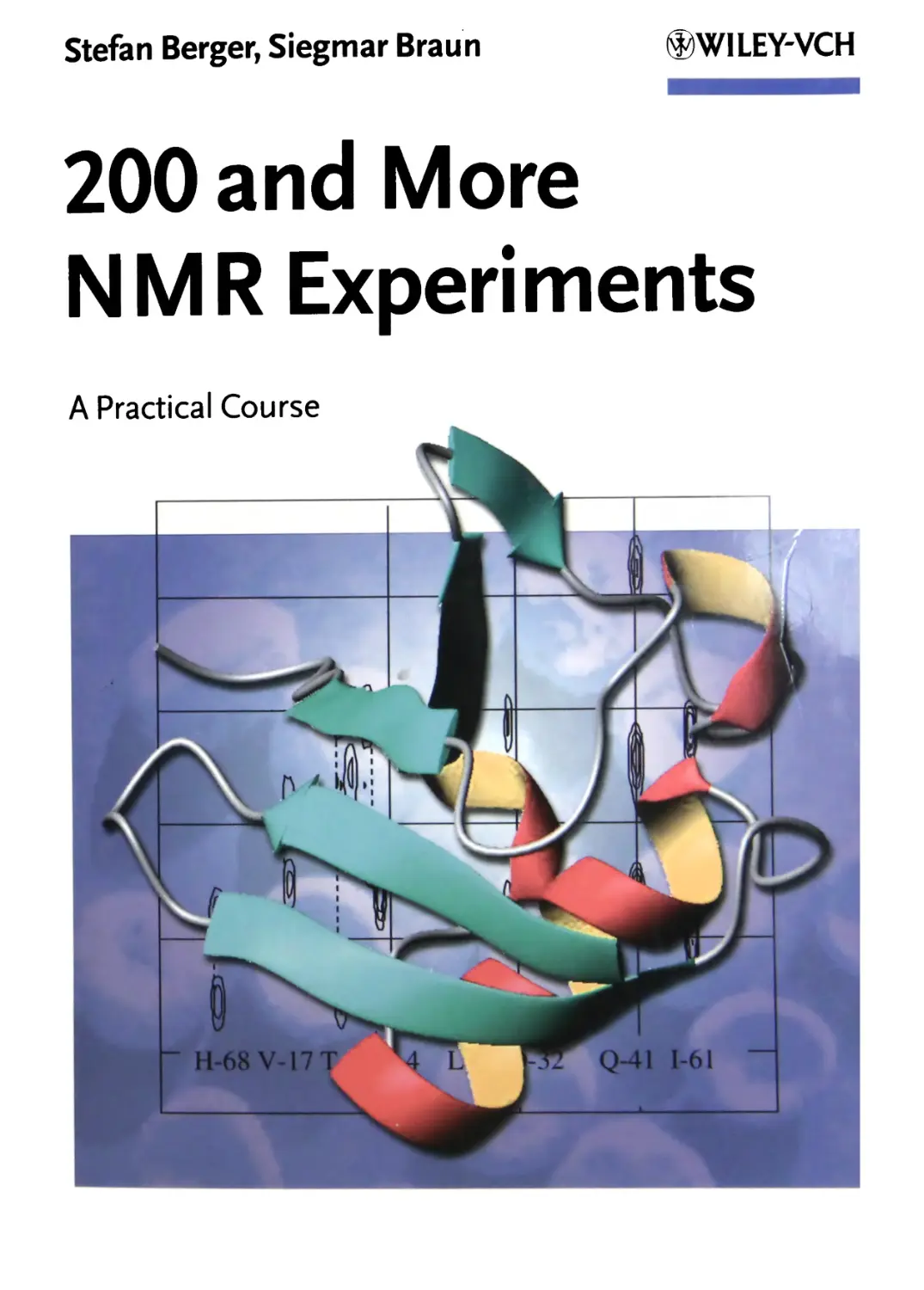
Cover picture. The cover shows the structure of ubiquitin determined by 3D NMR, with a 2D plane
taken from 3D HN(CA)NNH NMR spectrum of this protein. In the background are the seed capsules
of Strychnos nux vomica, from which strychnine, one of the model compounds used in many of the expe-
riments in this book, is extracted.
Library of Congress Card No. applied for.
A catalogue record for this book is available from the British Library.
Bibliographic information published by Die Deutsche Bibliothek
Die Deutsche Bibliothek lists this publication in the Deutsche Nationalbibliografie; detailed biblio-
graphic data is available in the Internet at <http://dnb.ddb.de>.
© 2004 WILEY-VCH Verlag GmbH & Co. KGaA, Weinheim
Printed on acid-free paper.
Printed in the Federal Republic of Germany.
All rights reserved (including those of translation into other languages). No part of this book may be
reproduced in any form - nor transmitted or translated into machine language without written permis-
sion from the publishers. Registered names, trademarks, etc. used in this book, even when not specifi-
cally marked as such, are not to be considered unprotected by law.
Printing Strauss GmbH, Mttrlenbach
Bookbinding GroBbuchbinderei J. Schfiffer GmbH & Co. KG, Grtinstadt
ISBN 3-527-31067-3
Preface
After a period of almost 60 years during which NMR spectroscopy has developed at
a breathtaking rate, and continues to do so, it is unnecessary to emphasize its
outstanding importance. That is further underlined by the recent award of two more
Nobel Prizes in the field, for NMR spectroscopy of proteins in 2002 and for medical
applications in 2003.
Accordingly, fascinated and challenged by this continued forging ahead with new
developments in NMR spectroscopy, as well as encouraged by the wide acceptance
and favorable reception of our earlier books 100 and More Basic NMR Experiments
(1996) and 150 and More Basic NMR Experiments (1998), we feel that it is now time
to present another revised and expanded edition of our work-book containing NMR
experiments in the field of chemistry: 200 and More NMR Experiments - A Practical
Course. The whole book again follows the principle of “learning by doing”.
So what is new in this third edition?
1.	All the experiments of the second edition have been checked and some bugs
eliminated.
2.	24 new experiments have been inserted into the 14 chapters that were in the 2nd
edition, the majority of these (15) into Chapters 11 and 12, comprising impor-
tant new 1D and 2D experiments with gradient selection: double-quantum and
dual-step filters, a/p-SELINCOR-TOCSY, WET, three DOSY experiments, ct-
COSY, HMSC, edited HSQC, HSQC with adiabatic pulses, HETLOC, J-
resolved HMBC, and (1,1)- and (l,n)-ADEQUATE. Three experiments have
been added to the more chemistry-orientated Chapter 8 (determination of Ka,
H2O suppression by an exchange reaction, and STD) and two to Chapter 14 on
solid state NMR (REDOR and HR-MAS). Other experiments that have been
added are those on r.f. field homogeneity (Chapter 3), basic NOE difference
spectroscopy (Chapter 4), DEPTQ (Chapter 6), and normal HETLOC (Chapter
10).
3.	20 new protein NMR experiments have been specially devised and are collected
in the newly added Chapter 15, Protein NMR. which is certainly another impor-
tant feature and a key part of the present book. It is this chapter that contains the
most advanced and demanding experiments - mostly of the 3D type - and it will
introduce the beginner in this field to the challenging world of protein structure
determination. For these experiments one needs a special model sample: fully
I3C- and ,5N-labeled human ubiquitin. The process of elucidating protein struc-
ture by means of these often very long and complicated pulse sequences is pre-
sented on the basis of key “building blocks”, many of which have been intro-
duced as separate preparatory experiments in the preceding chapters: INEPT
transfer, the CT principle, the PEP method, filters, gradient selection, the
echo/anti-echo procedure, etc.
4.	To the two appendices that already existed (Instrument Dialects, which has now
become Appendix 2, and Elementary Product Operator Formalism Rules, now
vi
Appendix 4), we have added three more to help the novice overcome initial
hurdles. Appendix 1 is a list of the standard Bruker pulse programs that have
been used in the experiments. It is expected that the corresponding pulse pro-
grams of other instrument manufacturers will be published on our Internet site
with the help of users of our book who are familiar with those systems. Appen-
dix 3 presents, as a kind of “Ariadne’s file”, a classification of the experiments
according to certain important tasks: calibration, maintenance, routine organic
structure determination, determination of numerical values of coupling con-
stants and neighbourhood / distance relationships between nuclei, and finally
experiments of a more educational character. Appendix 5 lists the lH and ,3C
chemical shifts and spin coupling constants of ethyl crotonate and strychnine.
Thus, the present book is greatly enlarged and contains 206 experiments arranged in
15 chapters, as well as five appendices.
And what remains unchanged? As already mentioned, we have kept the overall
scheme of organization into the former 14 chapters, to which is now added Chapter 15,
and the well-proven system of describing each experiment under a set of standard
section headings.
For readers new to the work-book, the following is an outline of its structure. An
introductory chapter on the FT NMR spectrometer and on practical aspects such as
probe-head tuning, lock operation, and shimming, is followed in Chapters 2--15 by
descriptions of the experiments, mostly on ’H and 13C, arranged in chapters devoted to
specific purposes or techniques, each with a short survey at the beginning. The content
ranges from the determination of pulse-durations, routine spectra and test procedures,
through decoupling techniques, variable temperature work, and measurements of
lanthanide-induced shifts, to ID multipulse sequences and the observation of
heteronuclides such as 6Li, 15N, and ,7O. More demanding experiments include those
using selective pulses, introducing the second and third dimensions, applying field
gradients, observing solid samples, and, as a new topic, protein structure elucidation
by NMR spectroscopy.
All the experiments have been specially performed for this book, exactly as de-
scribed and depicted. Four compounds have been chosen as the main demonstration
samples: chloroform, ethyl crotonate, strychnine, and labeled human ubiquitin (the
latter two must be used as sealed samples).
The procedure for carrying out each experiment is described in detail, accompanied
by relevant background information, organized in the following sections:
Purpose explains the idea and goal of an experiment, and refers the user to related
experiments.
Literature presents references to the original publications and to subsequent
improvements and/or sections in monographs and reviews.
Pulse Scheme and Phase Cycle gives the pulse sequence in an instrument-
independent graphic and self-explanatory form, and the full phase cycles of the pulses
and the receiver, even in cases where the particular experiment can be performed with
vii
only one transient. For many experiments the coherence pathway is also given for
better understanding.
Acquisition is the main section, with instructions on the sample to be used, the
spectrometer configuration, the type of program, and finally the parameters that must
be set to perform the experiment.
Processing describes how to treat the time-domain data.
Results presents the spectrum obtained by following the procedure exactly, and
includes some remarks concerning the interpretation.
Comments contains an explanation of the most important steps of the pulse
sequence, sometimes with a description using the Product Operator Formalism.
Own Observations may encourage the user to add his or her own remarks, correc-
tions, or hints important for performing the experiment on the particular spectrometer
used.
Corresponding to the spectrometers used by the authors, the nomenclature of the
experimental parameters follows the Bruker notation. It is obvious that the acquisition
program of a specific experiment cannot be given explicitly, but Appendix 1 may give
you information on the Bruker pulse program used. However, be aware that an
acquisition program is not necessarily transferable to another spectrometer of the same
company, since the same manufacturer may have different dialects in use; more
seriously, the languages of various other equally well-known manufacturers are totally
different. Appendix 2 with a synopsis of the instrument dialects may help in both
cases. It should be noted that the "Time Requirement" given at the beginning of the
"Acquisition" section only includes the measuring time and should only be regarded as
a rough indication; the smallest time unit is 5 min.
For several of the experiments, especially the newest ones, the instrument manufac-
turer’s software may not contain the specific acquisition program (cf. Appendix 1). In
this case, ask an application chemist of your manufacturer for support. In cases where
the program has been written by the present authors, or if you need the program for the
particular instrument referred to in the experiment described here (AM-, AC-, AMX-,
ARX- or Advance-spectrometer), just send a fax or an e-mail to the correspondence-
author.
In general, the conditions for the experiments have not been optimized. In all cases
the results are presented exactly as they were obtained, without cosmetic retouching;
sometimes the samples used even show impurities.
Some recommendations regarding how best to use the collection presented here will
help the user to get maximum benefit. In principle, one could just jump into the
chapter at the experiment one wants to perform, since each experiment is self-
contained. However, the novice is recommended to first read Chapter 1 and the
introductory remarks to Chapter 3 to perform the standard *H and l3C experiments 3.1
and 3.2 (using the current settings of 90° pulse lengths etc. for the instrument being
used). Then one should determine the pulses oneself, completing at least Experiments
2.1 to 2.3 before going on. In each case, whether a beginner or not, one should read the
whole description first, including the "Comments". By doing so, one will get
information about the context, about essential prerequisites, and about possible
problems. One will also find references to experiments that can be performed with less
sophisticated equipment. When planning more advanced experiments, one may start
with an already known one near the level of the intended experiment, as a check and in
viii
order to become familiar with the notation used in the descriptions. It should be noted
that no exhaustive theory is given, but in “Comments” you will often find some
theoretical background information on the basis of the product operator formalism
(POF, cf. Appendix 4). The references, too, may serve as stimuli for further studies
leading to a deeper insight and understanding.
The selection of the experiments is admittedly to some extent a matter of our
subjective preferences. If the reader fails to find his or her favourite experiment, he or
she should not hesitate to notify us. In general we encourage all users, in order that
they gain maximum benefit from this learning medium, to send comments, suggestions
for improvements, or hints on mistakes and inconsistencies. E-mail has proven to be a
quick and informal means for communication between the users and the authors,
leading to a kind of a living work-book. In the Internet, too, you will in the future find
a list, hopefully short, of the more serious bugs.
The address of the correspondence-author is:
Prof. Dr. Stefan Berger
Institut ftlr Analytische Chemie
der Universittit Leipzig
Linndstr. 3
D-04103 Leipzig
e-mail: stberger@rz.uni-leipzig.de
Fax: + 49 341 -9736115 or -9711833
Internet: http://www.uni-leipzig.de/~nmr/STB/index.html
Finally, we would like to thank many colleagues and readers for suggestions and
corrections, our graduate students for helpful criticism, Dr. Wolfgang Bermel (Bruker-
Biospin) for reading the manuscripts of Chapter 15, Dr. J. K. Becconsall for his
meticulous and excellent copy-editing, and our secretary Frau Uta Zeller for fine
adjustments to the final 850 pages of text.
(March 2004)
S.	Berger
S. Braun
ix
Longum iter est per praecepta,
breve et efficax per exempla.
L. A. Seneca, Ad Lucilium Epistidae Morales, VI
Obituary
With deep regret we have to inform our readers of the premature death of our
colleague Dr. Hans-Otto Kalinowski, who had suffered from a stroke and passed away
in 1999 after a long illness. Dr. Kalinowski initiated our first collaborative book on l3C
NMR spectroscopy and was a dedicated researcher and teacher.
Contents
Preface	v
Chapter 1	The NMR Spectrometer	1
1.1	Components of an NMR Spectrometer	1
1.1.1	The Magnet	1
1.1.2	The Spectrometer Cabinet	2
1.1.3	The Computer	3
1.1.4	Maintenance	3
1.2	TuningaProbe-Head	3
1.3	The Lock Channel	4
1.4	The Art of Shimming	6
1.4.1	The Shim Gradients	6
1.4.2	The Shimming Procedure	8
1.4.3	Gradient Shimming	11
Chapter 2	Determination of Pulse-Duration	14
Exp. 2.1:	Determination of the 90° *H Transmitter Pulse-Duration	15
Exp. 2.2:	Determination of the 90° 13C Transmitter Pulse-Duration	18
Exp. 2.3:	Determination of the 90° *H Decoupler Pulse-Duration	21
Exp. 2.4:	The 90° 'H Pulse with Inverse Spectrometer Configuration	24
Exp. 2.5:	The 90° I3C Decoupler Pulse with	Inverse Configuration	27
Exp. 2.6:	Composite Pulses	30
Exp. 2.7:	Radiation Damping	33
Exp. 2.8:	Pulse and Receiver Phases	36
Exp. 2.9:	Determination of Radiofrequency	Power	39
Chapter 3	Routine NMR Spectroscopy and Standard Tests 43
Exp. 3.1:	The Standard'H NMR Experiment	44
Exp. 3.2:	The Standard l3C NMR Experiment	49
Exp. 3.3:	The Application of Window Functions	54
Exp. 3.4:	Computer-Aided Spectral Analysis	58
Exp. 3.5:	Line Shape Test for *H NMR Spectroscopy	61
Exp. 3.6:	Resolution Test for 'H NMR Spectroscopy	64
Exp. 3.7:	Sensitivity Test for *H NMR Spectroscopy	67
Exp. 3.8:	Line Shape Test for l3C NMR Spectroscopy	70
Exp. 3.9:	ASTM Sensitivity Test for l3C NMR Spectroscopy	73
Exp. 3.10:	Sensitivity Test for l3C NMR Spectroscopy	76
Exp. 3.11:	Quadrature Image Test	79
Exp. 3.12:	Dynamic Range Test for Signal Amplitudes	82
Exp. 3.13:	13° Phase Stability Test	85
Exp. 3.14:	Radiofrequency Field Homogeneity	88
Chapter 4 Decoupling Techniques		91
Exp. 4.1:	Decoupler Calibration for Homonuclear Decoupling	92
Exp. 4.2:	Decoupler Calibration for Heteronuclear Decoupling	95
Exp. 4.3:	Low-Power Calibration for Heteronuclear Decoupling	98
Exp. 4.4:	Homonuclear Decoupling	101
Exp. 4.5:	Homonuclear Decoupling at Two Frequencies	104
Exp. 4.6:	The Homonuclear SPT Experiment	107
Exp. 4.7:	The Heteronuclear SPT Experiment	110
Exp. 4.8:	The Basic Homonuclear NOE Difference Experiment	113
Exp. 4.9:	1D Nuclear Overhauser Difference Spectroscopy	116
Exp. 4.10:	1D NOE Spectroscopy with Multiple Selective Irradiation	119
Exp. 4.11:	*H Off-Resonance Decoupled ,3C NMR Spectra	122
Exp. 4.12:	The Gated ’H-Decoupling Technique	125
Exp. 4.13:	The Inverse Gated ’H-Decoupling Technique	128
Exp. 4.14:	*H Single-Frequency Decoupling of ,3C NMR Spectra	131
Exp. 4.15:	’H Low-Power Decoupling of I3C NMR Spectra	134
Exp. 4.16:	Measurement of the Heteronuclear Overhauser Effect	137
Chapter 5 Dynamic NMR Spectroscopy		140
Exp. 5.1:	Low-Temperature Calibration Using Methanol	141
Exp. 5.2:	High-Temperature Calibration Using 1,2-Ethanediol	145
Exp. 5.3:	Dynamic *H NMR Spectroscopy on Dimethylformamide	149
Exp. 5.4:	The Saturation Transfer Experiment	152
Exp. 5.5:	Measurement of the Rotating-Frame Relaxation Time T!p	155
Chapter 6	ID Multipulse Sequences	159
Exp. 6.1:	Measurement of the Spin-Lattice Relaxation Time T\	160
Exp. 6.2:	Measurement of the Spin-Spin Relaxation Time T2	164
Exp. 6.3:	13C NMR Spectra with SEFT	167
Exp. 6.4:	,3C NMR Spectra with APT	170
Exp. 6.5:	The Basic INEPT Technique	173
Exp. 6.6:	INEPT+	176
Exp. 6.7:	Refocused INEPT	179
Exp. 6.8:	Reverse INEPT	182
Exp. 6.9:	DEPT-135	185
Exp. 6.10:	Editing ,3C NMR Spectra Using DEPT	188
Exp. 6.11:	DEPTQ	191
Exp. 6.12:	Multiplicity Determination Using PENDANT	194
Exp. 6.13:	ID-INADEQUATE	197
Exp. 6.14:	The BIRD Filter	201
Exp. 6.15:	TANGO	204
Exp. 6.16:	The Heteronuclear Double-Quantum Filter	207
Exp. 6.17:	Purging with a Spin-Lock Pulse	210
Exp. 6.18:	Water Suppression by Presaturation	213
Exp. 6.19:	Water Suppression by the Jump-and-Retum Method	216
xii
Chapter? NMR Spectroscopy with Selective Pulses	219
Exp. 7.1:	Determination of a Shaped 90° *H Transmitter Pulse	220
Exp. 7.2:	Determination of a Shaped 90° 'H Decoupler Pulse	223
Exp. 7.3:	Determination of a Shaped 90° l3C Decoupler Pulse	226
Exp. 7.4:	Selective Excitation Using DANTE	229
Exp. 7.5:	SELCOSY	232
Exp. 7.6:	SELINCOR: Selective Inverse H,C Correlation via ’j(C,H)	235
Exp. 7.7:	SELINQUATE	238
Exp. 7.8:	Selective TOCSY	242
Exp. 7.9:	INAPT	246
Exp. 7.10:	Determination of Long-Range C,H Coupling Constants	249
Exp. 7.11:	SELRESOLV	252
Exp. 7.12:	SERF	255
Chapter 8 Auxiliary Reagents, Quantitative Determinations, 258
and Reaction Mechanisms
Exp. 8.1: Signal Separation Using a Lanthanide Shift Reagent	259
Exp. 8.2:	Signal Separation of Enantiomers Using a Chiral Shift Reagent	262
Exp. 8.3:	Signal Separation of Enantiomers Using a Chiral Solvating Agent	265
Exp. 8.4:	Determination of Enantiomeric Purity with Pirkle’s Reagent	268
Exp. 8.5:	Determination of Enantiomeric Purity by 3IP NMR	271
Exp. 8.6:	Determination of Absolute Configuration by the Advanced
Mosher Method	274
Exp. 8.7:	Aromatic Solvent-Induced Shift (ASIS)	277
Exp. 8.8:	NMR Spectroscopy of OH Protons and H/D Exchange	280
Exp. 8.9:	Water Suppression Using an Exchange Reagent	283
Exp. 8.10:	Isotope Effects on Chemical Shielding	286
Exp. 8.11:	p/fa Determination by l3C NMR	290
Exp. 8.12:	Determination of Association Constants Kn	293
Exp. 8.13:	Saturation Transfer Difference NMR	298
Exp. 8.14:	The Relaxation Reagent Cr(acac)3	302
Exp. 8.15:	Determination of Paramagnetic Susceptibility by NMR	305
Exp. 8.16:	'H and l3C NMR of Paramagnetic Compounds	308
Exp. 8.17:	The CIDNP Effect	312
Exp. 8.18:	Quantitative ’H NMR Spectroscopy: Determination of the
Alcohol Content of Polish Vodka	315
Exp. 8.19: Quantitative l3C NMR Spectroscopy with Inverse Gated
’H-Decoupling	318
Exp. 8.20:	NMR Using Liquid-Crystal Solvents	321
Chapter 9	Heteronuclear NMR Spectroscopy	324
Exp. 9.1:	1 H-Decoupled ,5N NMR Spectra Using DEPT	330
Exp. 9.2:	‘H-Coupled l5N NMR Spectra Using DEPT	333
Exp. 9.3:	l9F NMR Spectroscopy	336
Exp. 9.4:	24Si NMR Spectroscopy Using DEPT	339
xiii
Exp. 9.5: 2QSi NMR Spectroscopy Using Spin-Lock Polarization
Exp. 9.6:	1 l9Sn NMR Spectroscopy
Exp. 9.7:	2H NMR Spectroscopy
Exp. 9.8:	11В NMR Spectroscopy
Exp. 9.9: l7O NMR Spectroscopy Using RIDE
Exp. 9.10: 47/49Ti NMR Spectroscopy Using ARING
Chapter 10 The Second Dimension
Exp. 10.1:	2D J-Resolved H NMR Spectroscopy
Exp. 10.2:	2D J-Resolved l3C NMR Spectroscopy
Exp. 10.3:	The Basic H,H-COSY Experiment
Exp. 10.4:	Long-Range COSY
Exp. 10.5:	Phase-Sensitive COSY
Exp. 10.6:	Phase-Sensitive COSY-45
Exp. 10.7:	E.COSY
Exp. 10.8:	Double-Quantum-Filtered COSY with Presaturation
Exp. 10.9:	Fully Coupled C,H Correlation (FUCOUP)
Exp. 10.10:	C,H-Correlation by Polarization Transfer (HETCOR)
Exp. 10.11:	Long-Range C,H-Correlation by Polarization Transfer
Exp. 10.12:	C,H Correlation via Long-Range Couplings (COLOC)
Exp. 10.13:	The Basic HMQC Experiment
Exp. 10.14:	Phase-Sensitive HMQC with BIRD Filter and GARP Decoupling
Exp. 10.15:	Poor Man’s Gradient HMQC
Exp. 10.16:	Phase-Sensitive HMBC with BIRD Filter
Exp. 10.17:	The Basic HSQC Experiment
Exp. 10.18:	The НОНАНА orTOCSY Experiment
Exp. 10.19:	HETLOC
Exp. 10.20:	The NOESY Experiment
Exp. 10.21:	The CAMELSPIN or ROESY Experiment
Exp. 10.22:	The HOESY Experiment
Exp. 10.23:	2D-INADEQUATE
Exp. 10.24:	The EXSY Experiment
Exp. 10.25:	X,Y-Correlation
Chapter 11 ID NMR Spectroscopy with Pulsed Field Gradients
Exp. 11.1:	Calibration of Pulsed Field Gradients
Exp. 11.2:	Gradient Pre-emphasis
Exp. 11.3:	Gradient Amplifier Test
Exp. 11.4:	Determination of Pulsed Field Gradient Ring-Down Delays
Exp. 11.5:	The Pulsed Field Gradient Spin-Echo Experiment
Exp. 11.6:	Excitation Pattern of Selective Pulses
Exp. 11.7:	The Gradient Heteronuclear Double-Quantum Filter
Exp. 11.8:	The Gradient «-Filter
Exp. 11.9:	The Gradient-Selected Dual Step Low-Pass Filter
Exp. 11.10:	gs-SELCOSY
Exp. 11.11:	gs-SELTOCSY
342
346
349
352
355
358
362
367
370
373
377
380
383
386
389
393
396
399
402
405
409
412
415
418
422
426
430
434
438
441
445
448
453
455
458
461
464
467
470
474
477
480
484
488
xiv
Exp. 11.12:	DPFGSE-NOE	492
Exp. 11.13:	gs-SELINCOR	496
Exp. 11.14:	a/p-SELINCOR-TOCSY	499
Exp. 11.15:	GRECCO	503
Exp. 11.16:	WATERGATE	506
Exp. 11.17:	Water Suppression by Excitation Sculpting	509
Exp. 11.18:	Solvent Suppression	Using WET	512
Exp. 11.19:	DOSY	515
Exp. 11.20:	INEPT-DOSY	518
Exp. 11.21:	DOSY-HMQC	521
Chapter 12	2D NMR Spectroscopy With Field Gradients 525
Exp. 12.1:	gs-COSY	526
Exp. 12.2:	Constant-Time COSY	530
Exp. 12.3:	Phase-Sensitive gs-DQF-COSY	534
Exp. 12.4:	gs-HMQC	538
Exp. 12.5:	gs-HMBC	542
Exp. 12.6:	ACCORD-HMBC	546
Exp. 12.7:	HMSC	550
Exp. 12.8:	Phase-Sensititive gs-HSQC with Sensitivity Enhancement	554
Exp. 12.9:	Edited HSQC with Sensitivity Enhancement	558
Exp. 12.10:	HSQC with Adiabatic Pulses for High-Field Instruments	563
Exp. 12.11:	gs-TOCSY	567
Exp. 12.12:	gs-HMQC-TOCSY	571
Exp. 12.13:	gs-HETLOC	575
Exp. 12.14:	gs-J-Resolved HMBC	581
Exp. 12.15:	2Q-HMBC	585
Exp. 12.16:	‘H-Detected 2D INEPT-INADEQUATE	589
Exp. 12.17:	1,1-ADEQUATE	593
Exp. 12.18:	l,n-ADEQUATE	597
Exp. 12.19:	gs-NOESY	601
Exp. 12.20:	gs-HSQC-NOESY	604
Exp. 12.21:	gs-HOESY	608
Exp. 12.22:	rH,l5N Correlation with gs-HMQC	612
Chapter 13	The Third Dimension	616
Exp. 13.1:	3DHMQC-COSY	618
Exp. 13.2:	3D gs-HSQC-TOCSY	622
Exp. 13.3:	3D H,C,P-Correlation	626
Exp. 13.4:	3D HMBC	630
Chapter 14	Solid-State NMR Spectroscopy	634
Exp. 14.1:	Shimming Solid-State Probe-Heads	635
Exp. 14.2:	Adjusting the Magic Angle	639
Exp. 14.3:	Hartmann-Hahn Matching	642
XV
Exp. 14.4:	The Basic СР/MAS Experiment	645
Exp. 14.5:	TOSS	649
Exp. 14.6:	SELTICS	653
Exp. 14.7:	Connectivity Determination in the Solid State	656
Exp. 14.8:	REDOR	659
Exp. 14.9:	High-Resolution Magic-Angle Spinning	663
Chapter 15	Protein NMR	666
Exp. 15.1:	Pulse Determination for Protein NMR	670
Exp. 15.2:	HN-HSQC	673
Exp. 15.3:	HC-HSQC	678
Exp. 15.4:	MUSIC	682
Exp. 15.5:	HN-Correlation using TROSY	688
Exp. 15.6:	HN-TOCSY-HSQC	692
Exp. 15.7:	HNCA	698
Exp. 15.8:	HN(CO)CA	705
Exp. 15.9:	HNCO	711
Exp. 15.10:	HN(CA)CO	718
Exp. 15.11:	HCACO	725
Exp. 15.12:	HCCH-TOCSY	732
Exp. 15.13:	CBCANH	739
Exp. 15.14:	CBCA(CO)NH	746
Exp. 15.15:	HBHA(CBCACO)NH	753
Exp. 15.16:	HN(CA)NNH	760
Exp. 15.17:	HN-NOESY-HSQC	766
Exp. 15.18:	HC-NOESY-HSQC	773
Exp. 15.19:	3DHCN-NOESY	779
Exp. 15.20:	HNCA-J	785
Appendix 1	791
Pulse Programs
Appendix 2	794
Instrument Dialects
Appendix 3	797
Classification of Experiments
Appendix 4	799
Elementary Product Operator Formalism Rules
Appendix 5	802
Chemical Shift and Spin-Coupling Data for Ethyl Crotonate and Strychnine
Glossary and Index	804
Chapter 1
1 The NMR Spectrometer
1.1	Components of an NMR Spectrometer
1.1.1 The Magnet
In most current NMR spectrometers the magnetic field is generated by a superconduct-
ing magnet (Fig. 1.1). The first stage in reaching the very low temperature needed is
an outer stainless steel or aluminum dewar which contains liquid nitrogen. Typically,
this has to be refilled every ten days. In practice, it is advisable to do this refilling on a
fixed day every week. An inner dewar contains the superconducting coil (4) immersed
in liquid helium, which has to be refilled, depending on the construction, every two to
eight months. The helium refill should be carried out only by experienced people. A
room-temperature bore is fitted with the shim coils (7), providing a room-temperature
homogeneity adjustment, and a spinner assembly (5), which contains the turbine sys-
tem for spinning the NMR sample tube. The probe-head (8) is usually introduced into
the magnet from the bottom and is connected to at least three radiofrequency (r.f.) ca-
bles providing the I 2 3 4 5 6 7 8H lock, !H frequency, and one X-nucleus frequency. Additional
devices to control temperature (heater, thermoelement, air, sometimes water to insulate
the probe-head from the magnet) are needed. New developments include the digital
transmission of the probe-head parameters to the console via a data line.
2	2
7
I Ports for liquid N2
2 Ports for liquid I Ic
3 Superinsulalion and
high vacuum
4 Main magnet coils t liquid helium
5 Sample lift and spinner
assembly
6 NMR tube
7 Shim assembly
8 Probe-head
n8
Fig. 1.1 Principles of a superconducting magnet
2 The NMR Spectrometer
1.1.2 The Spectrometer Cabinet
The spectrometer cabinet provides at least three radiofrequency channels, i. e. the ob-
serve, the lock and another channel, e.g. for decoupling. Usually these frequencies are
derived from digital frequency synthesizers which are phase-locked to a central quartz
oscillator. These frequencies are controlled, amplified, pulsed, and transmitted to the
probe-head. The various NMR signals are preamplified, then mixed with the local os-
cillator frequency to yield the intermediate frequency (i.f.). The i.f. signal is further
amplified, then in a second mixing stage the NMR audio signal is obtained after quad-
rature phase detection. The two signal components are digitized in the analog-to-
digital converter (ADC) and fed into the computer memory or, in the case of the lock
signal, used for field/frequency regulation. Figures 1.2 and 1.3 show the principles of
the system.
Fig. 1.2 Principles of an NMR spectrometer
Fig. 1.3 Components of the observe channel
Principles
3
1.1.3 The Computer
Modem NMR instruments are controlled by a PC or a workstation, commonly based
on the Windows-NT, LINUX or UNIX operating system. In addition, one finds a proc-
ess controller integrated into the spectrometer cabinet. The computing system has, in
principle, two different tasks. First, the process controller must have on-line control of
many spectrometer functions such as lock, generation and timing of r.f. pulses, dig-
itization and accumulation of the NMR signal (FID, free induction decay). Less time
demanding are the other, mainly graphic, tasks in the processing of the NMR spectra.
However, the massive amount of data in modem two- or multidimensional NMR spec-
troscopy techniques requires high storage capacities both on disk and in RAM, and a
very high speed of computing.
1.1.4 Maintenance
Although most parts of modem NMR spectrometers are more or less maintenance-
free, it is the experience of the authors that careful and regular checking of several
components can save considerable money and time. Most important is the regular
checking of the cryogens, which should be replenished on a strict schedule. Of course
all magnet openings equipped with О-rings have to be carefully monitored. This is
especially important for very low temperature work which can lead to icing of the O-
rings. Regular checking of several hidden fans within the spectrometer console is ad-
visable.
1.2	Tuning a Probe-Head
With a high field superconducting NMR spectrometer it is essential for obtaining a
good signal-to-noise ratio, and for some advanced experiments to get any meaningful
results at all, that the probe-head should be correctly tuned to the observe frequency
with the particular sample of interest. There can be a huge difference depending on
whether a compound is dissolved in water or in an organic solvent.
Although the construction of the resonant circuits of different probe-heads may vary
considerably, one has in general two capacitors to adjust, one which tunes the circuit
to the desired resonance frequency (tuning) and one which performs the necessary im-
pedance matching of the network (matching). However, these are mutually interactive
and therefore they have to be adjusted in turn.
Professionals tune the probe-head with a wobble generator, which, in addition, pro-
vides symmetry information about the frequency dependence of the tuning. In cur-
rently built NMR spectrometers wobbling functions are programmed in the software,
thus making tuning and matching a very easy process which can be followed on the
computer screen. This replaces the older routine with a reflection meter or using an
oscilloscope. One simply has to obtain the lowest point on resonance of the wobbling
curve. Such a curve is shown in Figure 1.4. Very recent probe-heads can be tuned
automatically without operator interference.
4
The NMR Spectrometer
Fig. 1.4 Wobbling curve during probe-head tuning
1.3	The Lock Channel
As neither magnetic fields nor frequencies derived from synthesizers are stable enough
for a long period of time, high resolution NMR measurements require a special
field/frequency stabilization to allow accumulation of signals, which may be separated
by less than one Hz. The basic idea of this stabilization device, called the "lock", is to
hold the resonance condition by a separate NMR experiment, which runs parallel to
the one in the observe channel. As long as the lock signal is held in resonance the
field/frequency relationship is defined also for the observe channel. Figure 1.5 shows
the principles of the lock channel.
Usually the 2H resonance of the deuterated solvent is used to provide the NMR lock
signal. Thus, an extra 2H lock transmitter is needed, which transmits its frequency in
pulsed form to the probe-head, in which the coil is often doubly tuned to both the
H and 2H frequencies. The deuterium signal is preamplified and processed in the same
way as the normal NMR signals in the observe channel. However, the final audio sig-
nal is used in dispersion mode to derive a negative or positive control voltage, which
regulates the field position. Recent developments employ a so-called digital lock,
where the lock i.f. is fed directly into the ADC. The lock signal is displayed on the
computer screen and provides a means of shimming the magnet (Section 1.4). This is
possible, because a narrower lock signal results in a higher d.c. voltage after rectifica-
tion. Thus, by adjusting the various shim currents one aims for an optimum lock sig-
nal.
Principles
5
Figure 1.5 Schematic arrangement of the lock channel
For special cases, e.g. for 2H NMR spectroscopy, an ,9F lock is used instead of the
2H resonance. The lock substance can be just the solvent, as described above, or may
be provided within a capillary for chemical reasons. Special applications, such as
probe-heads used as detectors for LC-NMR, use an external lock derived from an extra
capillary within the probe-head.
On current NMR instruments, which are equipped with automatic sample changers,
the lock capture and lock-in procedure is done by the instrument itself. However, any
beginner in the NMR field should first learn how to do it manually. This is the basic
start of any NMR experiment and a meaningful shimming procedure is only possible
after having properly locked in.
There are several parameters which control the lock display on the computer screen.
First, one needs a device to sweep the magnetic field (mostly forward and backward)
over the lock resonance position, usually a triangle modulation. Its amplitude and
sweep rate can be adjusted. Secondly, the position of the magnetic field must be ad-
justed to find the lock signal and to fix it at its lock-in position. The r.f. power of the
lock transmitter, the gain of the lock receiver, and the phase and d.c. offset of the lock
6 The NMR Spectrometer
signal have to be correctly chosen. As for any NMR application, the lock transmitter
power should not saturate the signal, and thus the lock transmitter must be sufficiently
attenuated. The noise level of the receiver, however, should not be excessive. The
lock-in procedure (i. e. pressing the "lock" button) automatically switches off the field
sweep and holds the lock signal at its resonance position. After the lock-in procedure
the operator should fine-adjust the magnetic field homogeneity by maximizing the
lock signal level. Further attenuation adjustment of the transmitter power may be
needed to ensure that the lock signal is not saturated.
By locking on a particular solvent signal the software adjusts all dependent offsets
automatically using a look-up table, where the chemical shifts of the lock solvents are
entered. If, for some reason, one wants to measure NMR spectra without the lock, one
must turn off the field modulation manually; however, one has to be aware of the mag-
net field drift.
1.4	The Art of Shimming
The process of optimizing the magnetic field homogeneity for recording high resolu-
tion spectra is called "shimming" a magnet. Usually this is done by observing an NMR
signal which has a natural line-width less than 0.1 Hz. This line-width corresponds to a
homogeneity of the magnetic field better than 1 ppb for a 500 MHz spectrometer. Ad-
justing the homogeneity can be performed in different ways, by observing on the com-
puter screen (i) a swept NMR signal (without lock), (ii) the lock level (with locking),
or (iii) the FID or the area of the FID on the observe channel. The homogeneity is
checked by the procedures described in Experiments 3.3, 3.4, and 3.6.
In the veiy first days of NMR spectroscopy shimming was performed mechanically
(in the original meaning shims are small pieces of metal), but in modem spectrometers
an electronic device called the shim system is used for the shimming process. This de-
vice is essentially a set of coils controlling very specific magnetic field contours. Be-
cause the homogeneity must be maintained over the total volume of NMR observation
(probe coil), the shim system is installed in the room-temperature bore of the magnet
and surrounds the probe-head and especially the sample region. The currents for the
shim coils can create various gradients of any desired strength and shape and can be
controlled separately by potentiometers from the spectrometer console. Table 1.1
shows the common room-temperature shims together with their specific functions and
their interaction order. There is a second set of shims called cryoshims, which are ad-
justed during the installation of the magnet.
1.4.1 The Shim Gradients
The different shims are also called shim gradients. One has to adjust the shim currents
so that they cancel any gradients in the NMR sample as accurately as possible. There
are two types of gradients: spinning (Z0-Z5) and non-spinning shims where z is the
coordinate direction of the field Bo. Spinning the sample averages the field inhomoge-
neities along two axes but not along the axis about which the sample is spun.
Shimming
7
Table 1.1 Common room temperature shims with function and interaction order
Common Shim Name	Function	Gradient order	Inter- action order
ZO	1	0	0
Zl	z	1	0
72	2z2-(x2+j2)	2	1
Z3	z[2z2 -3(? V)]	3	2
74	8z2[? -3(x2 + y2)] +3(x2 + y2)2	4	2
Z5	48z\z2 -5(x2 + y2)] + 90z(x2 +y2)2	5	2
X	X	1	0
Y	У	1	0
ZX	ZX	2	2
ZY	zy	2	2
XY	*y	2	1
x2-y2		2	1
Z2X	x[4z2-(x2 +/)]	3	2
z2y	y[4z2-(x2+y2)]	3	2
ZXY	zxy	3	2
Z(X2 - Y2)	z(x2-y2)	3	2
X*	x(x2-3y2)	3	1
r3	X3x2 -y2)	3	J
Therefore the shim procedure can be divided into two steps: shimming with and
shimming without spinning the sample. Usually the sample spinning produces an am-
plitude modulation of the NMR signal, which gives rise to spinning sidebands on both
sides of the signal. The spinning sidebands occur at integer multiples of the spinning
frequency and become smaller as the homogeneity increases or the spinning rate is
increased. Shimming is not a simple maximization process, because the shims have
different gradient order and different interaction order (see Table 1.1). For the shim
process you should use sample tubes with a filling height prescribed by the manufac-
ture to avoid vortices. The following classification follows the gradient order. The to-
tal number of available shim gradients increases with the magnetic field strength of the
magnet:
Zero order: The ZO shim is the only zero order shim. This is the field position in
most instruments.
First order: The Zl, X and Y shims are first order shims. These gradients produce a
linear variation of magnetic field strength and have shapes like the p atomic orbitals.
They are optimized by a simple maximization process; this corresponds to an interac-
tion order of 0.
Second order: There are five second order shim gradients (see Table 1.1; on older
instruments Z2 is called curvature), which have shapes like d atomic orbitals, e.g. Z2
8
The NMR Spectrometer
corresponds to the dz2 orbital. These gradients cause quadratic variations in field
strength. For three of them the interaction order is I, for the other two the interaction
order is 2. First order interaction means that the shims are adjusted by a successive
iterative process. After the adjustment of the complete set of shims, you have to read-
just the first shim of the set and you will find a different optimum. Successive itera-
tions will lead to smaller and smaller changes on readjustment until no further change
is observed. A typical example is Z\ and Z2. After optimization of Zl followed by Z2,
you will find a new optimum for Zl when readjusted. With an interaction order of 2
you have to change a given shim first and then adjust others before any improvement
of the homogeneity can be observed. This means: change the shim a measured amount
and optimize the other shims of the set. If this leads to a better response proceed to
change the shim in the same direction another measured amount and repeat the process
until the response (lock level or FID area) starts to decline. If the initial response is
worse try the other direction.
Third order: The complete set of third order shims has seven different gradients
corresponding to the shape of the seven f atomic orbitals. A complete set of these gra-
dients is found on 600 and 800 MHz spectrometers. These gradients produce cubic
variations of field strength. Usually there is only one 4th order and one 5th order shim
gradient on high field instruments.
1.4.2 The Shimming Procedure
In the following shimming procedure, which is described very precisely by Conover
[1], it is assumed that the sample is in the center of the shim-set. If this is not the case
the center of the shim-set has to be located first. This is done by moving the sample
with respect to the receiver coil. Usually the field centering has been performed by the
manufacturer's engineer in the course of the installation of the magnet.
First Round
If the magnetic field is in a state of unknown homogeneity or is known to have poor
homogeneity, use the swept NMR signal, usually the deuterium lock signal, for the
first steps in the shimming process. Otherwise proceed with the second round.
1.	Spin the sample (20 to 30 Hz) and adjust the phase of the lock signal for ab-
sorption. The signal-to-noise ratio should be sufficient to allow signal height
and the ring-down pattern (wiggles) to be observed. The ring-down pattern can
be used for the final adjustment. Adjust Zl and Z2 interactively to produce the
tallest swept signal (first order process).
2.	Stop the spinner and adjust X and Y for the tallest swept signal response (first-
order process).
3.	Adjust X and ZX for the tallest swept signal (second-order process).
4.	Adjust Y and ZY for the tallest swept signal (second-order process).
5.	Adjust XY and X2 - Y2 for the tallest swept signal (first-order process)
Shimming
9
6.	If any large shim changes were observed in the above process then repeat the
process from 1. The NMR spectrometer should now be capable of operating
with a field-frequency lock.
Fig. 1.6 Spinning sidebands obtained after incorrectly setting the X gradient
Second Round (Spinning Shims)
Spin the sample at 20 to 30 Hz, make sure that there is no vortex, especially if using a
probe-head for 10 mm sample tubes. A vortex will lead to a false shim optimum, espe-
cially for Z2. If the lock signal is used for shimming, avoid saturation by using as low
a lock power as possible. If the FID or FID area is used for shimming, use a pulse
repetition time which is long enough for full relaxation; otherwise the NMR signal is
saturated. The lock phase should be carefully adjusted and re-examined each time a
large change is made to a shim with an even interaction order [Z3, Z4, Z5, ZX, ZY, Z1 2 3X,
Z2Y,ZXY,Z(X2- У2)].
1. Optimize Zl and Z2 (first order process).
2. Optimize Z3 (second order process). Note the setting of Z3 and the response.
Change Z3 to degrade the response by 20-30%. Repeat the process in step 1. If
the new setting for Z3 has yielded a better response then continue in the same
direction. If the new response is less then try the other direction for Z3.
3. Optimize Z4 (second order process). Note the position of Z4 and the response.
Change Z4 to degrade the response by 30-40%. Repeat the process in step I.
Adjust Z3 to provide the optimum response. If the Z3 shim change is consider-
able, then repeat step 1 again and readjust Z3 for maximum response. If, after
optimizing Z3, Z2, and Zl, the new response is better than the previous one,
continue in the same direction. If the response is worse then try the other direc-
tion.
10
The NMR Spectrometer
4. The Z5 shim normally needs to be adjusted only with wide-bore magnets and
large-diameter sample tubes. Change Z5 enough to degrade the response by
30-50%. Repeat step 1 and reoptimize Z3. Adjust Z4 for maximum response. If
either Z3 or Z4 changed by a considerable amount, repeat step 1 and reoptimize
Z3 and Z4. If the new response obtained after this procedure is better than be-
fore, continue in the same direction. If the response is worse, try the other direc-
tion with Z5.
Fig. 1.7 Typical result obtained after incorrectly setting the Z4 gradient
Third Round (Non-Spinning Shims)
This shim-set has to be adjusted while the sample is not spinning. Changing the shim
gradients with Z-components causes changes in the spinning shim set. The spinning
shim sequence should be repeated after completion of the non-spinning shim proce-
dure, especially if one of the non-spinning shims changes significantly.
1.	Turn the spinner off. Adjust X and Y for maximum response (first-order proc-
ess).
2.	Note the position of ZX and the response. Change ZX to degrade the response
by 10% and adjust X for a maximum response. If the new response is better,
continue in the same direction with ZX. If the response is less, try the opposite
direction with ZX.
3.	Repeat step 2 but using the Y and ZY shims.
4.	Adjust XY and X2 - Y2 interactively (first-order process) for maximum response.
If either XY or X2 - Y2 changed significantly then repeat steps 2 and 3.
5.	Adjust Z2X (second-order process). Note the position of Z2X and the response.
Change Z2X enough to degrade the response by 30%. Maximize the response
with ZX. Optimize the response with X. If the new response is larger than the
initial response continue with Z?X in the same direction. If the response is less
then try the other direction.
6.	Repeat step 5 but using Z2K, ZY and Y.
Shimming
11
7.	Adjust ZXY (second-order process). Note the position of ZXY and the response.
Change ZXY enough to degrade the response by 20%. Maximize the response
with XY. If the new response is larger than the initial one, continue with ZXY in
the same direction. If the response is less, try the other direction.
8.	Repeat step 7 but using Z(X2 - Y1) and X2 - Y2.
9.	Adjust Л3 and X interactively for maximum response (first-order process).
10.	Adjust У3 and Y interactively for maximum response (first-order process).
11.	If the non-spinning shim settings have significantly changed, then repeat the
second round. If there are significant changes in the spinning shims, repeat the
non-spinning shim procedure also.
Final Round
After all spinning and non-spinning shim gradients have been optimized the NMR in-
strument should be delivering less than 0.5 Hz line-width with a good line-shape (see
Exp. 3.5) and minimal spinning sidebands. After all these efforts, the shim settings
should be saved electronically.
1.4.3 Gradient Shimming
Recent developments use a probe-head with x-, y- and z-axis pulsed field gradients.
With such a device it is possible to record an image of the homogeneity. With this the
computer calculates the required changes for good homogeneity and finds the opti-
mum after a few iterations [3, 4]. This procedure can also be performed with a z-only
gradient probe-head providing that the shims containing x and у elements have been
adjusted by hand. A more recent method uses a z-gradient probe-head to adjust the z-
shims, but the normal room temperature shim gradients to perform a 3D gradient
shimming.
In practice one starts by generating a field map which indicates how the probe-head
in use reacts towards the settings of the shims. This is done with a sample giving a
strong signal, usually water. Figure 1.8 shows a typical field map for a z-gradient
probe-head. On the x-axis of the plot the length of the r.f. coil is measured and the y-
axis gives in relative units the signal response towards changes of the shim settings.
The field map has, in principle, to be created only once for each probe head.
12
The NMR Spectrometer
r.f. coil
Figure 1.8 Field map obtained with a z gradient probe-head
Using the values of the field map the actual shims are adjusted in several iteration
steps; again the sample should contain just one strong signal. Since the x- andj'- shim
groups do not change too much in practice, the z-gradient shimming method is a time-
saving approach to obtain very good z-shims, especially for biological samples dis-
solved in water. A typical result depicting the z-homogeneity achieved across the sam-
ple is shown in Figure 1.9. Note the change in vertical scale compared to Figure 1.8.
Current developments include the gradient shimming on the deuterium lock signal,
so that one can use gradient shimming directly on the actual sample. Other develop-
ments use selective pulses to generate the shim information from one chosen signal.
Shimming
13
length of	center
r.f. coil
Figure 1.9 z-Homogeneity obtained with a z-gradient probe-head after gradient shimming
Literature
[I]	W. W. Conover, Top. Carbon-13 NMR Spectrosc. 1984,4,37-51.
[2]	SAM 1.0, Shimming Simulation Software package for IBM-PC compatible
Computers, ACORN NMR, 46560 Fremont Blvd., Fremont, CA 94538-6482.
[3]	P. С. M. van Zijl, S. Sukumar, M. O'Neil Johnson, P. Webb, R. E. Hurd, J. Magn.
Reson. Ser. A 1994, 111, 203-207.
[4]	J. Hu, T. Javaid, F. Arias-Mendoza, Z. Liu, R. McNamara, T. R. Brown, J. Magn.
Reson. Ser. В 1995,108,213-219.
Chapter 2
Determination of Pulse-Duration
In pulsed Fourier transform NMR spectroscopy there is nothing more important than
the use of radiofrequency pulses of correct duration. This applies not only for ad-
vanced multipulse and multidimensional methods but for the most simple routine ex-
periments as well. The use of a wrong excitation pulse can render all FT experiments
insensitive and useless. Regular determinations of pulse-duration (also often called
pulse-width or pulse-length) are also necessary for instruments working in an auto-
matic mode with a sample changer. Aging or malfunctioning components can increase
the pulse-duration corresponding to the normal setting (e.g. 90°) and therefore degrade
the performance of these spectrometers, if not corrected.
In this first experimental chapter we therefore provide five basic methods for meas-
uring the pulse-duration. First we describe the calibration of transmitter pulse-width
both for ’H and 13C (Exps. 2.1-2.2) and of the *H decoupler pulse-width (Exp. 2.3).
Corresponding experiments are then performed for the inverse mode of operation
(Exps. 2.4-2.5).
We demonstrate further the use of composite pulses (Exp. 2.6) and the effect of ra-
diation damping which renders the determination of the 90° pulse duration in normal
water difficult (Exp. 2.7). At the end of the chapter we show the relationship between
pulse and receiver phases (Exp. 2.8) and how the pulse-length is connected to radiof-
requency power and the excitation bandwidth (Exp. 2.9).
This provides important knowledge for the setting up of more advanced experi-
ments such as those using spin-locks or selective pulses. The calibration of selective
pulses is demonstrated in Chapter 7.
Literature
[1] T. D. W. Claridge, High-Resolution NMR Techniques in Organic Chemistry, Per-
gamon, Oxford, 1999, 94-99.
[2] E. Fukushima, S. B. W. Roeder, Experimental Pulse NMR, Addison-Wesley,
Reading, 1981,47-60.
90° 'Н Transmitter Pulse
15
Experiment 2.1
Determination of the 90° *H Transmitter Pulse-Duration
1. Purpose
One of the basic requirements of NMR spectrometer operation is the knowledge of the
90° pulse-length. The 90° or л/2 pulse or in general the flip angle в is important not
only for ID multipulse and multidimensional NMR experiments, but also for routine
operation. The flip angle depends on the r.f. magnetic field strength the pulse-
length p, and the gyromagnetic ratio у of the nucleus under observation, as expressed
in radians and in degrees by Equations (1) and (2).
в [rad] = yB] • p
(1)
a [°] = (360/2^)7^ -p
(2)
Usually the 90° or л/2 pulse-duration is determined by measuring the 180° (я) or 360°
(2я) pulse-lengths since these pulses give a minimum signal. Here we present a de-
scription for the *H transmitter pulse calibration.
2. Literature
[1]	P. A. Keifer, Concepts in Magn. Reson. 1999, //, 165-180.
[2]	J. К. M. Sanders, В. K. Hunter, Modern NMR Spectroscopy, 2nd Edition, Oxford
University Press, Oxford, 1993, 33-34.
[3]	T. D. W. Claridge, High-Resolution NMR Techniques in Organic Chemistry,, Per-
gamon, Oxford, 1999, 94-97.
3. Pulse Scheme and Phase Cycle
1H
d1 p1 aq
p1: x, x, -x, -x, y, y, -y, -y
aq: x, x, -x, -x, y, y, -y, -y
4. Acquisition
Time requirement: 30 min
16	Determination of the Pulse-Duration
Sample: 10% CHC13 in [D6]acetone; do not use a degassed and sealed sample, since
that would make the relaxation time of the CHC13 protons exceedingly long.
The probe-head should be tuned to the sample. Load standard ’H parameters, record a
normal 'H NMR spectrum and note the offset of the CHCh-proton. On older instru-
ments change to the absolute intensity mode. You have to set:
td:4k
sw: 500 Hz
ol: on resonance of CHCI3 signal
p 1: 1H transmitter pulse, to be varied, 1 ps as initial value
dl: 30 s
rg: receiver gain for correct ADC input
transmitter attenuation [3 dB]
ns: 1
Increase pl in 2 ps steps until the intensity of the processed signal begins to drop to
nearly zero. Now use smaller steps in increasing pl, e.g. 0.1 ps, to find the minimum
for the 180° pulse. With the determined pulse-length check the 90° pulse (maximum
positive intensity), the 270° pulse (maximum negative intensity) and the 360° pulse
(minimum intensity). If there are small deviations, calculate an average value for the
90° pulse-length. In case of large deviations repeat the procedure. If the deviations are
still present, the probe-head may be arcing; increase the transmitter attenuation.
5.	Processing
Use standard ID processing (see Exp. 3.1) applying an exponential window with a
line-broadening factor lb = 1 Hz. Adjust the phase of the first spectrum for pure ab-
sorption and always use the same phase correction.
6.	Result
90° 'H Transmitter Pulse
17
The figure shows the full sinusoidal dependence of the signal intensity obtained on an
AM-400 spectrometer with a 5 mm dual probe-head. The pulse-width was incre-
mented in steps of 1 ps; the 90° pulse-duration was determined as 12.5 ps.
7.	Comments
It is important to avoid using too short a pulse repetition time. The delay between suc-
cessive measurements should be 5 times T\. For protons in small molecules like CHC13
with long relaxation times this can pose a problem, if the sample is degassed. For such
nuclei it is more convenient to measure the 360° pulse-length. This is also necessaiy in
case of radiation damping, see Exp. 2.7.
In the rotating frame the r.f. pulse rotates the magnetization vector MQ= Мг, creating
an observable transverse magnetization Л/ху. After a 180° x-pulse AfXy is theoretically
zero and Mo = -A/z, but in practice residual signals caused by inhomogeneities in B\
can be seen.
Normally the transmitter pulse duration is determined at the highest possible power
level without arcing in the probe-head; that is for Bruker instruments an attenuation of
about 0 ± 3 dB. Since power and pulse duration are intrinsically interconnected, the
values of both parameters should be recorded for each probe-head in the log book of
the instrument (cf. Exp. 2.9).
8.	Own Observations
18
Determination of the Pulse-Duration
Experiment 2.2
Determination of the 90° ,3C Transmitter Pulse-Duration
1.	Purpose
This experiment is very similar to Experiment 2.1. Here, however, the pulse-width
determination is described for the l3C nucleus and has to be performed with ‘H broad-
band decoupling. Although the experiment could be performed exactly like Exp. 2.1,
we describe here a procedure given by [4] which yields the 90° pulse by just two
measurements. This method is helpful for very slowly relaxing nuclei.
2.	Literature
[1]	P. A. Keifer, Concepts in Magn. Reson. 1999,11, 165-180.
[2]	J. К. M. Sanders, В. K. Hunter, Modern NMR Spectroscopy, 2nd Edition, Oxford
University Press, Oxford,. 1993, 33-34.
[3]	T. D. W. Claridge, High-Resolution NMR Techniques in Organic Chemistry, Per-
gamon, Oxford, 1999,94-96.
[4]	E. Haupt, J. Magn. Reson. 1982, 49,358-364;
http://haupt 1 .chemie.uni-hamburg.de/haupt/start.htm.
3.	Pulse Scheme and Phase Cycle
composite pulse decoupling
p1: x, x, -x, -x, y, y, -y, -y
I д	aq: x, x,-x,-X, y, y,-y,-y
d1 p1 aq
4.	Acquisition
Time requirement: 15 min
Sample: 40% CHCI3 in [D6]acetone; do not use a degassed and sealed sample, since
that would make the relaxation time of the CHCI3 carbons exceedingly long.
90° l3C Transmitter Pulse
19
The probe-head should be tuned to the sample. Load standard ,3C parameters with !H
broad-band decoupling, record a normal 13C NMR spectrum and note the offset of
CHCI3. On older instruments change to the absolute intensity mode. You have to set:
td:4k
sw: 500 Hz
ol: on resonance of ,3C signal
o2: middle of ’H NMR spectrum
pl: ,3C transmitter pulse, 7 ps for experiment a and 14 ps for experiment b
dl:60s
rg: receiver gain for correct ADC input
transmitter attenuation [3dB]
decoupler attenuation and 90° pulse duration for composite pulse decoupling
(CPD
ns: 1
Record spectrum a with pl = 7 ps and spectrum b with pl = 14 ps. Note the heights I\
and /2 of the CHC13 signal in these two spectra. If the pulse-width in the second ex-
periment is double that in the first experiment, Equation (1) holds, from which the
pulse angle a\ (in degrees) of the first experiment can be calculated:
a\ = arccos (0.5/2 / Л)	(1)
Using Equation (2) the 90° pulse-length p90 can be calculated, where pl is the pulse-
length of the first experiment. p90 should be checked by applying the corresponding
180° pulse.
p90 =90pl/a1	(2)
5.	Processing
Use standard ID processing (see Exp. 3.2) applying an exponential window with a
line-broadening factor lb = 1 Hz. Adjust the phase of the first spectrum for absorption
and use the same phase correction for the second experiment.
6.	Result
78	76
78
76
78
20 Determination of the Pulse-Duration
The figure shows the result obtained on an AM-400 spectrometer with a 5 mm dual
probe-head. Spectrum a (pl: 7 ps) yielded /, = 12.43, spectrum b (pl: 14 ps) yielded
I2 = 2.56. According to Equation (1) a, is calculated to be 84°, and using Equation (2)
gives p90 to be 7.5 ps. This was checked in c using pl = 15 ps.
7.	Comments
This procedure is very convenient if one does not know anything about the pulse-
length, e.g. if one is using a probe-head for the very first time or studying a heteronu-
clide for the first time. The method works best if a, can be estimated to about 60°.
The pulse-width determinations in Experiments 2.1 and 2.2 use a narrow spectral
width of only 500 Hz and the transmitter on resonance. Note that radiofrequency
pulse-lengths are offset-dependent, the 180° pulse-length especially is quite different
for signals with different offsets.
8.	Own Observations
90° 'H Decoupler Pulse
21
Experiment 2.3
Determination of the 90° *H Decoupler Pulse-Duration
1.	Purpose
Many ID and 2D multipulse sequences with X observation use defined *H decoupling
pulses. Without knowledge of these pulses some important experiments such as DEPT
(Exp. 6.9) or HETCOR (Exp. 10.10) cannot be performed.
Furthermore, the common 'H broad-band decoupling technique for ,3C NMR
spectroscopy, which uses composite pulses (CPD), fails if the decoupler pulse is
wrong. This experiment has typically to be performed twice, once with low attenuation
of the decoupler to calibrate the "hard" pulses which are used during a pulse sequence
and once with high attenuation of the decoupler to define the pulses used for CPD.
2.	Literature
[1]	A. Bax, J. Magn. Reson. 1983,52, 76-80.
[2]	N. C. Nielsen, H. Bildsoe, J. Jakobsen, O. W. Sorensen, J. Magn. Reson. 1986,
66,456-469.
[3]	T. D. W. Claridge, High-Resolution NMR Techniques in Organic Chemistry, Per-
gamon, Oxford, 1999,97-99.
3.	Pulse Scheme and Phase Cycle
1h	„
p2
13C	[~l
di pl d2^ aq
p1:x,-x,-x,x,y,-у,-у, у
p2: x, -x, -x, x, у, -у, -у, у
aq: x, -x, -x, x, у, -у, -у, у
4.	Practical Procedure
Time requirement: 10 min
Sample: 50% CHClj in [D6]acetone, do not use a degassed and sealed sample since
that would make the relaxation times of carbons and protons exceedingly long.
22
Determination of the Pulse-Duration
Obtain both offsets for the 'H and l3C signals of the sample. Load the pulse program
for the sequence shown above. You have to set:
td:4k
sw: 500 Hz
ol: on resonance of l3C signal
o2: on resonance of 'H signal, very important for Exp. b
pl: 90° l3C transmitter pulse (Exp. 2.2)
p2: 'Н decoupler pulse, Exp. a: 0 ps as starting value, to be varied;
Exp. b: 100 ps
dl: 10s
d2: l/[2 J(C,H)] = 2.36 ms, calculated from ‘J(C,H) = 212 Hz
rg: receiver gain for correct ADC input
decoupler attenuation Exp. a: [0 dB];
Exp. b: to be varied. [22 dB]
ns: 1
Exp. a: Record a first spectrum with p2 = 0 and adjust the doublet in antiphase.
Then repeat the experiment with increasing pulse lengths p2 until the signals disap-
pear, which corresponds to the 90° hard decoupler pulse.
Exp. b: In a second set of experiments use high decoupler attenuation for CPD
[22 dB] and vary it so that p2 is in the region of 100 ps.
5.	Processing
Use standard ID processing (see Exp. 3.2) applying an exponential window with a
line-broadening factor lb = 2 Hz.
6.	Result
b
90° 'H Decoupler Pulse
23
The figure shows the result of a 0° decoupling pulse (a) and of a 90° decoupling pulse
(b) obtained on an AM-400 spectrometer with a 5mm dual probe-head. Note the dis-
appearance of the signals in b. The spectrum c was obtained with a 180° pulse.
7.	Comments
We consider a l3C, 'H spin pair. The equilibrium magnetization is converted by the
90° l3C pulse into a transverse 13C magnetization as described by Equation (1).
90°/r
Zcz+/Hz----------s-^-/cy+/Hz	(D
During the period т = d2 = 1/2J spin-spin coupling between proton and ,3C evolves,
as in Equation (2).
лЛ2/н lc
-/су+/н2---------—1—>2/c	sinitA-Zc cosnA + /H	(2)
Since rwas set to 1/2J, (2) simplifies to (3).
2/Cx/Hzsin’^T-/cvcosnJT + /H2 =2/c /Hz +/hz	0)
A 90x *H pulse converts 2/cx7hz *nt0 double quantum magnetization as in Equation
(4), from which no observable ,3C signal can be generated. Thus, if the decoupling
pulse is exactly 90°, the doublet disappears.
90°Zh
2/cx /н2 + 4-------^-2/Cx /Ну - /Hy	(4)
Note that with this method, in contrast to Experiments 2.1 and 2.2, the 90° pulse yields
a minimum signal, whereas the 180° pulse inverts the initial phases of the doublet.
8.	Own Observations
24
Determination of the Pulse-Duration
Experiment 2.4
The 90° ‘H Pulse with Inverse Spectrometer Configuration
1.	Purpose
In "inverse" experiments one observes protons and “decouples” heteronuclei X (e.g.
I3C, l5N). On NMR instruments built later than 1991 the pulse-lengths in the normal
and the inverse mode are usually quite similar. Older instruments, however, use differ-
ent r.f. sources and signal routings in these two configurations. Therefore, before start-
ing an inverse experiment, such as an HMQC experiment (Exp. 10.13), the pulse-
durations for protons and X nuclei have to be determined in this spectrometer configu-
ration. For 'Н this can be done exactly as described in Experiment 2.1. Here, however,
we describe the 360° method using only the FID and not transforming the spectra.
2.	Literature
[1]	E. Fukushima, S. B. W. Roeder, Experimental Pulse NMR Addison-Wesley,
Reading, 1981,47-60.
3.	Pulse Scheme and Phase Cycle
1H
d1 p1 aq
p1: x, x, -x, -x, y, y, -y, -y
aq: x, x, -x, -x, y, y, -y, -y
4.	Acquisition
Time requirement' 10 min
Sample*. 3% CHCI3 in [D6]acetone, do not use a degassed and sealed sample since
that would make the relaxation times of the protons exceedingly long.
An inverse probe-head (inner coil *H, outer coil ,3C or other heteronuclei) is placed
into the magnet; both coils are tuned to the sample. On older instruments change to the
inverse set-up. Since the inverse set-up varies widely depending on the year of the
spectrometer’s construction it cannot be discussed here. Load the correct pulse pro-
gram to obtain a !H NMR spectrum in the inverse mode. You have to set:
Inverse 90° 'H Pulse
25
td:4k
sw: 500 Hz
ol: 100 Hz towards higher frequency of CHC13 signal
pl: *H transmitter pulse, near 360° as starting value, to be varied
dl: 5 s
rg: receiver gain for correct ADC input
ns: 8
Set the pulse-duration approximately to 360°, typically in the order of 40 ps, and re-
cord 8 transients. If the pulse-width is not exactly 360° a large FID signal will build up
during the accumulation. Change the pulse-width until you observe a minimum FID
signal. Divide the value by 4 and by 2 and check with the 90° and 180° pulses using
one transient in each case.
5.	Processing
No signal processing is required, since the FID is used for the pulse-length determina-
tion.
6.	Result
c
The figure shows the result obtained on an AM-400 spectrometer in the inverse mode.
In a pl was 39 ps, in b 40 ps and in c 41 ps. Note how the signal area changes if the
26
Determination of the Pulse-Duration
pulse-width is increased only by 1 ps, which corresponds to a change of 0.25 ps for
the 90° pulse.
7.	Comments
The advantage of the method is that no long waiting times are needed to allow
spin-lattice relaxation, since r.f. pulses that are close to 360° will tip the magnetization
vector only slightly from the z-direction. This method is very sensitive, since even
small deviations from 360° will cause a large FID signal.
Inverse experiments can be performed in normal probe-heads as well. As an exer-
cise you may measure the pulse-length using a standard dual probe-head.
8.	Own Observations
Inverse "C Decoupler Pulse
27
Experiment 2.5
The 90° ,3C Decoupler Pulse with Inverse Configuration
1.	Purpose
In '’inverse" experiments one observes protons and “decouples” heteronuclei X (e.g.
I3C, l5N). On NMR instruments built later than 1991 the pulse-lengths in normal and
inverse set-up are usually quite similar but not identical. Older instruments, however,
use quite different signal routings and r.f. sources in these two configurations. There-
fore, before starting an inverse experiment, such as an HMQC experiment (Exp.
10.13), the pulse-lengths have to be determined in this spectrometer configuration.
Here the ,3C decoupling pulse is determined; prior to this experiment you have to per-
form Experiment 2.4. Depending on the attenuation of the decoupler the pulse-
durations are quite different. Short ("hard") pulses with low decoupler attenuation are
used for 90° or 180° pulses during a pulse sequence, whereas long l3C pulses with
high decoupler attenuation are needed for composite pulse decoupling such as GARP
during acquisition. Thus, this experiment has typically to be performed twice, once
with low and once with high attenuation of the decoupler.
2.	Literature
[1]	A. Bax, J. Magn. Reson. 1983, 52, 76-80.
[2]	T. D. W. Claridge, High-Resolution NMR Techniques in Organic Chemistry, Per-
gamon, Oxford, 1999, 97-100.
3.	Pulse Scheme and Phase Cycle
p1:x, -x,-x. x, у,-у,-у, у
p2: x, -x. -x, x. у, -у, -у. у
aq: x. -x, -x, x, у, -у, -у, у
di pl d2^ aq
p2
4.	Acquisition
Time requirement: 10 min
28
Determination of the Pulse-Duration
Sample: 10% CHC13 in [D6]acetone, do not use a degassed and sealed sample since
that would make the relaxation times of carbons and protons exceedingly long.
Obtain both offsets for the ‘H and l3C signals of the sample with the spectrometer in
the normal mode and tune both coils to the sample. Older spectrometers are then
changed to inverse set-up, and an inverse probe-head (inner coil *H, outer coil 13C) is
placed into the magnet. Since the inverse set-up varies widely dependent on the year of
the spectrometer's construction it cannot be discussed here. Load the correct pulse pro-
gram to obtain an inverse !H NMR spectrum with l3C decoupling. You have to set:
td:4k
sw: 500 Hz
ol: on resonance of ’H signal
o2: on resonance of ,3C signal, very important for Exp. b
pl: 90° ’H transmitter pulse in inverse configuration (Exp. 2.4)
p2: I3C decoupler pulse in inverse configuration, exp. a: 0 ps as starting
value, to be varied; exp. b: 100 ps
dl: 10s
d2: l/[2 J(C,H)] = 2.33 ms for 1 J(C,H) = 215 Hz
rg: receiver gain for correct ADC input
,3C decoupler attenuation exp. a: [0 dB]; exp. b: to be varied [70 ps]
ns: 1
Exp. a: Record a first spectrum with p2 = 0 and adjust the phase of the big signal
stemming from the protons bound to ,2C in dispersion; look for a clean antiphase
pattern of the I3C satellites. Then repeat the experiment with increasing pulse-
durations p2 until you get a zero for the satellites, which corresponds to the 90° de-
coupler pulse.
Exp. b: In a second set of experiments use a high decoupler attenuation for GARP
[13 dB] and vary it so that p2 is in the region of 70 ps (depending on the magnetic
field strength BQ of the instrument used).
5.	Processing
Use standard ID processing (see Exp. 3.1) applying an exponential window with a
line-broadening factor lb = 1 Hz.
6.	Result
The figure shows the results of a 0° decoupling pulse (a) and of a 90° decoupling
pulse (b) obtained on an AMX-500 spectrometer with an inverse probe-head. Note the
disappearance of the satellites in (b).
7.	Comments
The product operator formalism is exactly the same as given in Experiment 2.3, only
the notation for C and H spins has to be interchanged. If this method is used to deter-
Inverse ,3C Decoupler Pulse
29
mine ,3C decoupler pulses for GARP decoupling, ensure that the chosen nC offset is
correct.
There are several techniques to reduce the big centre signal which can be a nuisance
in case of bad line-shape. The easiest way is a spinlock pulse of 2 ms from the x-
direction in the proton channel directly after pl.
30
Determination of the Pulse-Duration
Experiment 2.6
Composite Pulses
1.	Purpose
Ideally, the intense r.f. pulses used in NMR spectroscopy should be rather short (~ 10
ps), should have true rectangular shape, and should excite the resonances present in
the sample equally without a marked offset dependence. In reality these conditions are
rarely met. Therefore composite pulses have been designed to compensate for pulse
imperfections and offset-dependent deviations. In addition, composite pulses are now
widely used in all current broad-band decoupling schemes and within spin-locks. This
educational experiment demonstrates the inversion performance of a composite 180°
pulse on chloroform at a large offset. For the composite pulse, the sequence 90°y,
180°x, 90°y is chosen.
2.	Literature
[1]	M. H. Levitt, Prog. NMR Spectrosc. 1985,18,61-122.
[2]	R. Freeman, Spin Choreography, Spektrum, Oxford, 1997,59-61.
3.	Pulse Scheme and Phase Cycle
Experiment a
p1 d2p2 aq
Experiment b
p1:x,-x
p2: x, x, -x, -x, y, y, -y, -y
p3, p4: y, -y
aq: x, x, -x, -x, y, y, -y, -y
d1 p3p1p4d2p2 aq
4.	Acquisition
Time requirement. 10 min
Composite Pulses
31
Sample: 10% CHCI3 in [D6]acetone; do not use a degassed and sealed sample, since
that would make the relaxation time of the CHCI3 protons exceedingly long.
The probe-head should be tuned to the sample. Load standard *H parameters, record a
normal 'H NMR spectrum and note the offset of CHCI3. Determine exactly the 90°
pulse-duration according to Experiment 2.1. The experiment compares the inversion
property of a normal 180° pulse with that of a composite one. Therefore you have to
perform two experiments a and b according to the two pulse schemes shown above.
You have to set:
td: 64 к
sw: 80 ppm
ol: 10 kHz towards higher frequencies from the resonance of the CHCI3
signal
p2, p3, p4: 90o,H transmitter pulse
pl: 180° *H transmitter pulse
dl:30 s
d2: 10 ms
rg: receiver gain for correct ADC input
transmitter attenuation [3 dB]
ns: 2
5.	Processing
Use standard ID processing (see Exp. 3.1) applying an exponential window with a
line-broadening factor lb = 1 Hz. Adjust the phase of the CHCI3 signal to be negative.
6.	Result
The figure shows the results obtained on an AMX-500 spectrometer in a 5 mm multi-
nuclear probe-head. In a the signal after inversion by a normal 180° pulse is given, in
b the same signal is shown, but inverted by the composite pulse, leading to nearly
fourfold greater intensity.
a
4^ ’	72	7.1
ь I
4l ' ГЗ 72 7J
32
Determination of the Pulse-Duration
7.	Comments
In both experiments a and b the magnetization is first inverted by a 180° pulse and
after a short relaxation delay (10 ms) d2 read by a 90° pulse, similar to the T, determi-
nation as given in Experiment 6.1. A large offset is chosen to demonstrate the offset
dependence of normal r.f. pulses as used in experiment a, which can be compensated
by the use of composite pulses as shown in experiment b. Here the first 90°y pulse of
the composite pulse turns the magnetization towards the +x-axis; however, because of
pulse imperfections and the offset dependence, we assume that the magnetization ends
somewhat above the x-axis. A perfect 180°x pulse would now align the magnetization
into the mirror position beneath the x-axis, and the subsequent imperfect 90°y pulse
would turn the magnetization exactly into -z. Since the deviation after the first 90°y
pulse is only small, even an imperfect 180° pulse will be able to correct the situation to
the effect that the total performance of the composite 180° pulse is far better than that
of a single 180° pulse, as borne out by the experiment.
There are many different varieties of composite pulses serving various purposes.
Composite pulses are the standard building blocks of current decoupling techniques
and should be used where large offsets are required, such as in INADEQUATE ex-
periments. Many current spin-lock schemes (MLEV, DIPSI etc.) use composite pulses.
8.	Own Observations
Radiation Damping
33
Experiment 2.7
Radiation Damping
1.	Purpose
The pulse-length determination on samples dissolved in water often reveals a strong
and special signal pattern at or near the 180° pulse which is caused by an effect called
radiation damping. This effect, although already described in detail in the early days of
NMR, becomes a problem especially at high magnetic fields using probe-heads with a
high Q-factor. Transverse magnetization created by an r.f. pulse induces a voltage in
the NMR coil. This oscillating signal is amplified in the preamplifier and detected by
the spectrometer. However, at the same time, the voltage in the NMR coil results in a
current, producing in turn an r.f. field, which lags behind the transverse magnetization
by 90°. Therefore it provides a torque to restore the magnetization towards the +z axis,
leading to a much faster relaxation than expected from natural T\ and T2 processes.
This is the cause of the large line-width of the water signal after a 90° pulse. In the
educational experiment described here, radiation damping is demonstrated on a water
sample.
2.	Literature
[1]	N. Bloembergen, R. V. Pound, Phys. Rev. 1954, 95, 8-12.
[2]	A. Szoke, S. Meiboom, Phys. Rev. 1959,113, 585-586.
[3]	R. Freeman, Spin Choreography, Spektrum, Oxford, 1997,48; 345-347.
[4]	X.-A. Mao, C.-H. Ye, Concepts in Magn. Reson. 1997, 9, 173-187.
[5]	H. Barjat, D. L. Mattiello, R. Freeman, J. Magn. Reson., 1999,136, 114-117.
[6]	M.P. Augustine, Progr. NMR Spectrosc. 2002, 40, 111-150.
3.	Pulse Scheme and Phase Cycle
1H
p1: x, x, -x, -x, y, y, -y, -y
aq: x, x, -x, -x, y, y, -y, -y
d1 p1 aq
34
Determination of the Pulse-Duration
4.	Acquisition
Time requirement'. 10 min
Sample'. 90% H2O with 10% D2O
The probe-head should be tuned to the sample. Load standard 'H parameters, record a
normal 'H NMR spectrum and note the offset of H2O. You have to set:
td:4k
sw: 500 Hz
ol: on resonance of H2O signal
pl: exp. a: 360° and exp. b: 180° 'H transmitter pulse
dl:2s
rg: receiver gain for correct ADC input
transmitter attenuation [3 dB]
ns: 1
Determine the 360° pulse as described in Experiment 2.1 and record the spectrum a. In
addition, record the spectrum b with a 180° pulse and compare the residual signal
strength in both experiments.
5.	Processing
Use standard ID processing (see Exp. 3.1) applying an exponential window with a
line-broadening factor lb = 0.3 Hz.
6.	Result
The figure shows the result obtained on an AMX-500 spectrometer with an inverse
probe-head. In a the absence of radiation damping after a 360° pulse, in b the hyper-
bolic secant signal behavior produced by radiation damping after a 180° pulse is
shown. Both traces are plotted on the same vertical scale! Note that this signal is often
even stronger than the signal after a 90° pulse.
7.	Comments
The nutational behavior of the signals produced by radiation damping can be calcu-
lated from the Bloch equations [5]. Radiation damping can be observed even after a
perfect 180° pulse, since transverse components can be created by thermal noise or r.f.
leaking effects. Thus, if one applies a pulsed field gradient (see Chapter 11) after the
180° pulse to destroy any residual transverse components, the effect may still be ob-
served [5]. In pulse sequences which establish -z-magnetization, radiation damping
may cause loss of signal during the following delays, since the magnetization is driven
back by the r.f. field in the coil. Radiation damping may further cause line-broadening
and distortion in the relative intensities of multiplets. Possible remedies are detuning
Radiation Damping
35
of the probe-head or, more recently, use of probe-heads with Q-switching or with ac-
tive electronic feedback circuits.
8.	Own Observations
36
Determination of the Pulse-Duration
Experiment 2.8
Pulse and Receiver Phases
1.	Purpose
The radiofrequency pulses of the transmitter and the NMR receiver have phases which
are given in the pulse schemes throughout this book. By use of phase-cycling proce-
dures (i.e. systematic variation of transmitter and receiver phases), several important
features of NMR experiments can be realized, such as the suppression of artefacts, e.g.
quadrature images, or the selection of desired coherences, e.g. double quantum signals,
and in 2D or 3D spectroscopy the sign discrimination of the signals in the indirect di-
mensions. Thus the understanding of the basic phase behavior of transmitter and re-
ceiver is of fundamental importance. In this educational experiment we describe a
method of studying the phases generated by the NMR instrument using the single-line
spectrum of chloroform.
2.	Literature
[1]	T. D. W. Claridge, High-Resolution NMR Techniques in Organic Chemistry, Per-
gamon, Oxford, 1999, 63-65.
[2]	M. H. Levitt, O. G. Johannessen, J. Magn. Reson. 1997,126, 164-182; ibid. 2000,
142, 190-194.
3.	Pulse Scheme and Phase Cycle
1H
d1 p1 aq
phase of p1 and aq to be varied
4.	Acquisition
Time requirement'. 20 min
Sample. 10% CHCI3 in [D6]acetone with added Сг(асас)з
Load standard 'H parameters, record a normal *H NMR spectrum and note the offset
of CHCI3. You have to set:
td:4k
sw: 500 Hz
Pulse and Receiver Phases
37
ol: 50 Hz off resonance of CHC13 signal
pl: 90o,H transmitter pulse
dl: 1 s
rg: receiver gain for correct ADC input
transmitter attenuation [3 dB]
ns: 1
First set the offset on resonance of the chloroform signal, and set the instrument in the
mode to display both quadrature channels of the receiver. Record an FID and, in your
pulse program, change the transmitter phase (or on recent instruments the correspond-
ing phase correction parameter) so that only the left quadrature channel receives a sig-
nal. Then set the offset 50 Hz off resonance and repeat the experiment. The left quad-
rature channel will display a cosine FID whereas the right channel will display a sine
FID. Transform this FID and adjust the processing phases for absorption. Now change
the transmitter phase in 90° steps and observe the changes on both FID channels and
on the spectrum. Repeat this procedure, but leave the transmitter phase unchanged and
cycle instead the receiver phase. In a final experiment use two transients and observe
the adding of the FIDs. Then introduce a 180° transmitter or receiver phase shift for
the second transient in your pulse program and observe the subtraction of the FIDs.
5.	Processing
Use standard ID processing (see Exp. 3.1) applying an exponential window with a
line-broadening factor lb = 1 Hz. Adjust the phase of the first spectrum for pure ab-
sorption and always use the same phase correction.
38
Determination of the Pulse-Duration
6.	Result
The figure shows the result obtained on an ARX-200 spectrometer in a dual probe-
head. An expansion of the FID in the left quadrature channel is plotted with the corre-
sponding transformed spectrum. In a and b the initial FID and spectrum is shown,
whereas in c/d, e/f, and g/h the transmitter phase was incremented by 90° steps. Note
that due to digital filtering the first points of a FID cannot be displayed.
7.	Comments
If the transmitter is exactly on resonance, no chemical shift can develop after excita-
tion. Therefore only one channel of the phase-sensitive detector will receive a signal.
If, however, the transmitter offset is somewhat displaced with respect to the resonance
frequency, chemical shift evolution will take place to form a sinusoidal FID as given
by the product operator treatment in Eq. (2). The cosine and the sine components are
detected separately by the quadrature receiver.
90° /
> - /и
Hy
_/н
Ну
>-/ц со8Й/ + /ц sinfl/
у	*
(1)
(2)
As demonstrated in this experiment, the phase of a signal can be changed with either
transmitter or receiver phase. This is the basis of all phase-cycling procedures used
throughout this book.
8.	Own Observations
Radiofrequency Power
39
Experiment 2.9
Determination of Radiofrequency Power
1.	Purpose
In many experiments the transmitter or decoupler power is attenuated to produce a
radiofrequency field of a certain strength. This is needed e.g. for presaturation to sup-
press water signals (Exp. 6.17), for SPT investigations (Exp. 4.6), for TOCSY (Exp.
10.18), or for ROESY (Exp 10.21) experiments. The NMR literature uses a variety of
measures to describe the power of a frequency source. In the experiment described
here the fundamental parameters 90° pulse-duration [ps], transmitter attenuation [dB],
transmitter power [W], radiofrequency field strength [Hz] and peak-to-peak voltage
[V] are measured and interrelated in a tabular form. The example is chosen from ’H
NMR spectroscopy, but the procedure can be used for any nuclide. In addition to a
deeper understanding of the function of a frequency source, this experiment provides a
check on the performance of the transmitter and the attenuators.
2.	Literature
[1]	M. L. Martin, J. J. Delpuech and G. J. Martin, Practical NMR Spectroscopy^
Heyden, London, 1980, 100-101.
3.	Pulse Scheme and Phase Cycle
p1: x, x, -x, -x, y, y, -y, -y
aq: x, x, -x, -x, y, y, -y, -y
d1 p1
aq
4.	Acquisition
Time requirement. 2 h
Sample. 10% CHC13 in [D6]acetone
Experimentally, this is a 90° pulse-width determination (actually performed by finding
the 180° pulse), exactly as described in Experiment 2.1. However, in addition, we vary
the transmitter attenuation and determine the pulse-width as a function of transmitter
attenuation. On older instruments which do not allow variation of the transmitter
40
Determination of the Pulse-Duration
power, the experiment can be performed in the inverse mode using the decoupler as
the frequency source (Exp. 2.4). Load standard 'H NMR parameters, record a normal
'H NMR spectrum, and note the offset of CHClj. You have to set:
td:4k
sw: 500 Hz
ol: on resonance of ’H signal
pl: 90° 'H transmitter pulse, to be determined for each attenuation level
dl:60s
ns: 1
transmitter attenuation: 0 dB initial value, to be increased in 3 dB steps
Determine the 90° pulse-width at 0 dB attenuation. Then change the attenuation in
3 dB steps and redetermine the 90° pulse-width for each attenuation level by varying
pl. If available, measure with an oscilloscope the peak-to-peak voltage of your pulse
(for this, set ns to 64 k, dl to 10 ms, pl to 40 ps and td to 256 points in order to obtain
rapid pulsing; connect the transmitter cable to an external attenuator and an oscillo-
scope with 50 ohm impedance).
5.	Processing
Use standard ID processing (see Exp. 3.1) applying an exponential window with a
line-broadening factor lb = 1 Hz. From the 90° pulse duration calculate the radiofre-
quency field using Equation (3). Verify that the expected values correspond to the at-
tenuation. Note the large power range, from 0 to 90 dB, required in different types of
NMR experiments.
6.	Result
The table lists results obtained with an ARX-200 spectrometer.
Attenuation [dB]	90°Pulse-width [Ms]	[Hz]	ЦрМ	P[W]
0	7.8	32051	107	28.6
3	10.3	24271	82	16.8
6	13	19230	59	8.7
9	19.5	12820	41	4.2
12	27.5	9090	29	2.1
15	39.5	6329	20	1.
18	55	4545	15	0.56
21	75	3333	11	0.30
24	105	2380	7.9	0.16
27	145	1724	5.9	0.087
30	200	1250	4.3	0.046
33	290	862	3.3	0.027
36	425	588	2.2	0.012
Radiofrequency Power
41
39	600	416	1.6	0.0064
42	825	303	1.3	0.0042
45	1100	227	1	0.0025
48	1600	156	0.74	0.0014
51	2400	104	0.46	0.00053
54	3500	71	0.33	0.00027
57	5000	50	0.23	0.00013
60	6800	37	0.17	0.000072
63	9000	28	0.13	0.000042
66	12500	20	0.099	0.000024
69	19000	13	0.073	0.000013
72	28500	9	0.054	0.0000073
75	41000	6	0.043	0.0000046
78	55600	4.5	*
81	80000	3	*
84	110000	2.3	*
87	145000	1.7	*
90	200000	1.25	*
* Oscilloscope used not sensitive enough
7.	Comments
The magnetization vector precesses around the radiofrequency field B\ according to
Equation (1).
(0 = 2nv = yB\	(1)
The angle of precession 6, measured in radians, is proportional to the pulse-width p
and is given by Equation (2). For a 90° pulse (0= я/2) Equation (3) follows from (1)
and (2).
0 = /BiP	(2)
(3)
Thus, knowing the pulse-width of a 90° pulse at a certain transmitter attenuation, we
can estimate the radiofrequency field strength fBi measured in Hz from the simple
relationship in Equation (3).
The dB unit used on NMR instruments is defined by Equation (4).
dB = 101og(P//b)	(4)
42
Determination of the Pulse-Duration
Thus, attenuation by 3 dB means that the ratio P/Po decreases by a factor of 2. The
power P of a transmitter measured in watt is given by Equation (5).
t/L
p = ei*
R
(5)
Ueff is the effective voltage, which is equal to
U„
—, and R is the load resistance. By
2>/2	3
measuring the peak-to-peak voltage Um on a 50 ohm load one can calculate the trans-
mitter power in watt. The strength of the radiofrequency field is proportional to the
square root of the transmitter power, as evident from Equation (6), and is therefore
proportional to the peak-to-peak voltage measured with an oscilloscope. It can be cal-
culated in tesla (SI magnetic field unit) from equation (6) if the quality factor Q, the
frequency ц and the volume V of the NMR coil are known.
5] = 3 10"4.®
1 VW
(6)
On recent NMR instruments one also finds the unit dBm. Whereas dB is a relative
unit, dBm refers to a Po of 1 mW, as given in Equation (7).
dBm=101og(P/l mW)	(7)
Thus, the power of 1 mW corresponds to a dBm value of 0,1 W corresponds to 30
dBm and 1 pW to -30 dBm.
8. Own Observations
Chapter 3
Routine NMR Spectroscopy and Standard Tests
This chapter begins by describing how to record standard *H and I3C NMR spectra.
These descriptions are somewhat detailed, so that a beginner in this field should find
sufficient advice. These experiments are followed by a description of how to apply
various window functions (Exp. 3.3) and how to use a PC for computer-aided spectral
analysis (Exp. 3.4). Furthermore, we describe in this chapter several important test
procedures which are essential for the maintenance of an NMR spectrometer.
Performed regularly they give an early indication of developing problems.
Since a great variety of spectrometers and, much more importantly, of field
strengths exists, one should have in mind all the possible consequences thereof when
performing the experiments at a field strength different from that used here and
comparing the results. These include the following:
1.	The experimental time given depends on the acquisition time, since it is
determined by the spectral width, entered in Hz and thus depending on field strength
(and sometimes on the way the data are transferred to disk). It should be mentioned
here that the time given for each experiment only roughly represents the time from the
starting command just to the last acquisition step; preparations, setting-up, processing
and output are not included; the smallest time unit is 5 min.
2.	At a different field strength the appearance of a spectrum may change due to
differences in the extent of signal overlap and to higher-order effects in spectra of
spin-coupled nuclei.
3.	The field strength also affects the digital resolution (for a given spectral width
and time-domain data file); the data file and/or the processing parameters may be
changed accordingly.
4.	At other field strengths the relaxation behavior may be different, with
consequences for the line-widths.
5.	The signal-to-noise ratio depends on field strength (also, of course, on the probe-
head used and on its tuning).
Literature
[1]	M. L. Martin, J. J. Delpuech, G. J. Martin, Practical NMR Spectroscopy*
Heyden, London, 1980.
[2]	E. Fukushima, S. B. W. Roeder, Experimental Pulse NMR* Addison-Wesley,
Reading, 1981.
[3]	T. D. W. Claridge, High-Resolution NMR Techniques in Organic Chemistry*
Pergamon, Oxford, 1999.
44
Routine NMR and Standard Tests
Experiment 3.1
The Standard 'H NMR Experiment
1.	Purpose
The aim of the standard 'H NMR experiment is to record a routine proton NMR spec-
trum in order to get structure-related information for the protons of the sample, i.e.
chemical shifts, spin-spin couplings, and intensities. Here we apply this standard pro-
cedure to ethyl crotonate.
2.	Literature
[1]	T. D. W. Claridge, High-Resolution NMR Techniques in Organic Chemistry, Per-
gamon, Oxford, 1999.
[2]	I. К. M. Sanders, В. K. Hunter, Modern NMR Spectroscopy, 2nd Edition, Oxford
University Press, Oxford, 1993.
[3]	H. Friebolin, Basic One- and Two-Dimensional NMR Spectroscopy, 3rd Edition,
Wiley-VCH, Weinheim, 1998.
[4]	H. Gunther, NMR Spectroscopy, 2nd Edition, Wiley, Chichester, 1995.
3.	Pulse Scheme and Phase Cycle
p1: x, x, -x, -x, y, y, -y, -y
aq: x, x, -x, -x, y, y, -y, -y
d1 p1 aq
4.	Acquisition
Time requirement: 5 min
Sample: 5% ethyl crotonate in CDCI3 with TMS as standard
For sample preparation fill a clean and dry 5 mm sample tube with 0.7 ml CDCI3 (5
cm filling height), 40 pl ethyl crotonate, and few drops of a solution of 3% TMS in
CDCI3 (for easier dosage). Clean the tube outside, close it with a cap, mark it (do not
use a flag-like label which hinders rotation) and put it into the spinner turbine. Be sure
that it is tight, but not too tight in the spinner, and adjust the depth of the tube using
the depth gauge.
Standard'H NMR
45
Put the tube into the magnet by means of the air lift, adjust the rotation frequency (20
Hz), and display the lock signal on the screen. Perform the lock procedure and opti-
mize the field homogeneity (see Ch. 1, Section 1.4).
The spectrometer is to be adjusted for *H observation in quadrature detection mode.
Load the ’Н acquisition program, which comprises the following basic commands:
zero memory, set the relaxation delay, set the excitation pulse, perform acquisition,
and write the data on file.
For acquisition the following parameters have to be set:
td: 32 к
td (time domain) is the number of points at which the free induction decay (FID) is
sampled and the data stored. This parameter has to be chosen according to the desired
digital resolution of the FID, which in turn depends on the spectral width sw. The set-
tings of td and sw determine the acquisition time aq.
sw: 20 ppm
sw, the spectral width, has to be chosen so that all types of protons are within this
spectral window; otherwise folding occurs. Folding of noise is prevented by appropri-
ate filters which are set by the software corresponding to sw. The settings of sw and td
determine the acquisition time aq, the time during which the FID data are acquired.
The relationship between these three parameters, where aq is usually the dependent
variable and sw has to be expressed in Hz, is described by the following fundamental
equation (1):
Thus, with the above settings at 300 MHz, the acquisition time is 2.7 s.
ol: frequency (offset) of the r.f pulse at the center of the lH NMR spectrum:
In quadrature detection mode the frequency of the exciting r.f. pulse (often called
transmitter offset) is positioned in the center of sw, e.g. at about = 7. On older in-
struments without digital lock, ol depends on the field position of the deuterium lock
and thus on the deuterated solvent used.
pl: 30°
pl, the *H transmitter pulse, creates an observable jqy-magnetization by tipping the
magnetization vector towards the -у-axis through an angle a, determined by Equation
(2):
a = (360°/2^) у	p	(2)
where / is the proton gyromagnetic ratio, B\ the field strength of the radiofrequency
field, and p the duration of the pulse. Since pl is known for a flip angle a = 90° (see
Exp. 2.1), the duration of pl corresponding to 30° is easily obtained.
Although a 90° pulse gives maximum signal intensity (Exp. 2.1), a shorter pulse-
length of about 30° is used for routine work with data accumulation in order to avoid a
long pulse repetition time of 5 T|, which is necessary after a 90° pulse (see dl).
It should be mentioned here that between the irradiating pulse and the opening of
the detector a preacquisition delay is introduced. It prevents the break-through of the
46
Routine NMR and Standard Tests
transmitter pulse into the detector, is in the order of 5 to 50 ps, and is automatically
calculated and set by the software.
dl:0.1 s
dl, the relaxation delay, is introduced in order to establish thermal equilibrium of the
spin system before the excitation pulse is applied. In routine !H NMR work with small
flip angles and relatively long acquisition times, this delay may be short, especially for
larger molecules with short T\-values, since it is the pulse repetition time, the sum of
aq and dl, which serves for spin-lattice relaxation.
rg:
rg, the receiver gain, has to be carefully adjusted so that the incoming FID does not
exceed the ADC input limits. Otherwise signal distortions at the baseline will occur
after Fourier transformation. On recent instruments this is performed in an automatic
mode by the spectrometer software, since due to digital filtering the start of the FID
signal is not visible.
ns: 8
ns, the number of "scans" (individual FIDs), is chosen so that a reasonable signal-to-
noise ratio is obtained in the final spectrum. Because of phase cycling a multiple of 8
and a minimum of 4 is advisable.
5.	Processing
After data acquisition you have to process the data. Perform the following steps using
the given settings:
size of the processed real data file: set si = 16 k. Normally si corresponds to td/2
(see acquisition), since, after Fourier transformation, half of the td data addresses con-
tain the real part of the spectrum. This gives a digital resolution (Hz/data point) after
Fourier transformation of 2 sw/td. (Note that on the older Broker instrument series the
parameter SI corresponds to 2 si of the newer ones.)
However, si may be set to a value greater than td/2, e.g. si = 32 k; this procedure is
termed "zero filling" and leads, according to Equation (3) for the general case, to a
higher digital resolution:
digital resolution = sw/si	(3)
With the above data, the digital resolution is 0.37 Hz/point, a reasonable value in com-
parison to the line-width usually obtained for a non-degassed sample. If a higher digi-
tal resolution is desired, one may optimize sw, increase td, or perform zero filling.
baseline correction: perform this correction on the FID in order to eliminate the
d.c. offset between the two channels used in quadrature detection mode.
digital filtering: for standard applications use as window function an exponential
window on the FID, characterized by the line-broadening factor lb;
Standard1 H NMR
47
here set lb = 0.1 Hz. This type of digital filtering generally improves the signal-to-
noise ratio, but at the cost of resolution. Here a very mild filtering is used since there is
no signal-to-noise problem. On the other hand, by applying a Lorentz-Gauss multipli-
cation, a resolution enhancement may be achieved; here one has to pay with a reduc-
tion of the signal-to-noise ratio.
Fourier transformation: use the correct type in accordance with the simultaneous
or sequential quadrature acquisition mode.
phase correction: adjust to achieve pure absorption mode signals.
baseline correction: perform this correction on the spectrum in order to remove
baseline rolling.
referencing: set the TMS signal to <5^ = 0.
peak picking: choose the desired level.
integration: carefully generate the integrals.
plot: set parameters and plot spectrum, including integrals, peak picking, and the
relevant acquisition and processing parameters.
48	Routine NMR and Standard Tests
The figure shows the 300 MHz 'H NMR spectrum of ethyl crotonate recorded on an
ARX-300 spectrometer equipped with a dual probe-head; the region = -0.5 to 7.5
including the integrals is displayed. The insert contains an expansion of the signal at
ca. 4i = 7 (H-3). Peak picking in Hz then permits the determination of coupling con-
stants.
A closer inspection of the integrals reveals that those of H-2 and H-3 are too small
as compared to the integrals of the two methyl groups. This may be due to the fact that
the T\ values of the protons of ethyl crotonate are relatively long and somewhat
shorter for the two CH3 groups than for H-2 and H-3. As an exercise you should per-
form the experiment with dl = 3 s, corresponding to a pulse repetition time of nearly 6
s. (Concerning the determination of T\ values see Exp. 6.1).
7.	Comments
The excitation pulse pl converts the equilibrium magnetization /Hz of the *H nuclei
into a transverse magnetization -7цу as shown in Equation (1). During the acquisi-
tion time chemical shifts and spin-spin couplings develop in the xj plane, as shown
separately in Equations (2) and (3) and are detected by the receiver in the xy plane in
quadrature mode.
7HZ-------
_/ц —QJjJ. >-/H cos$2z + Zh sinDr
-/и —>-/h cos^Jt + 2/ц 7h sinnrJr
у	у	X z
8.	Own Observations
(1)
(2)
(3)
Standard !iC NMR
49
Experiment 3.2
The Standard ,3C NMR Experiment
1.	Purpose
The aim of the standard ,3C NMR experiment is to record a ,3C NMR spectrum with
proton broad-band decoupling and data accumulation in order to get chemical shift
information for structure determination. Here we apply this standard procedure to
ethyl crotonate.
2.	Literature
[1]	H.-O. Kalinowski, S. Berger, S. Braun, Carbon-13 NMR Spectroscopy, Wiley,
Chichester, 1988.
[2]	T. D. W. Claridge, High-Re solution NMR Techniques in Organic Chemistry, Per-
gamon, Oxford, 1999.
[3]	К. M. Sanders, В. K. Hunter, Modern NMR Spectroscopy, 2nd Edition, Oxford
University Press, Oxford, 1993.
3.	Pulse Scheme and Phase Cycle
composite pulse decoupling
p1: x, x, -x, -x, y, y, -y, -y
aq: x, x, -x, -x, y, y, -y, -y
d1 p1 aq
4.	Acquisition
Time requirement'. 5 min
Sample'. 20% ethyl crotonate in CDC13 with TMS as standard.
For sample preparation fill a clean and dry 5 mm sample tube of a quality appropriate
to the spectrometer frequency with 0.7 ml CDCl3 (5 cm filling height), 150 pl ethyl
crotonate, and one drop of TMS. Clean the tube outside, close it with a cap, mark it
(do not use a flag-like label which hinders rotation) and put it into the spinner turbine.
Be sure that it is tight, but not too tight in the spinner, and adjust the depth of the tube
using the depth gauge.
50
Routine NMR and Standard Tests
Put the tube into the magnet by means of the air lift, adjust the rotation frequency
(about 20 Hz), and display the lock signal on the screen. Perform the lock procedure
and optimize the field homogeneity (see Ch. 1, Section 1.4).
The spectrometer is to be adjusted for l3C observation in quadrature detection
mode. Load the l3C acquisition program which comprises the following basic com-
mands: zero memory, set 'H broad-band decoupling (CPD-mode), set the relaxation
delay, set the excitation pulse, perform acquisition, and write the data on file.
For acquisition the following parameters have to be set:
td: 32 к
td (time domain) is the number of points at which the free induction decay (FID) is
sampled and the data stored. This parameter has to be chosen according to the desired
digital resolution, which in turn depends on the spectral width sw. The settings of td
and sw determine the acquisition time aq.
sw: 250 ppm
sw, the spectral width, has to be chosen so that the resonance frequencies of all types
of 13C nuclei are within this spectral window; otherwise folding occurs. Folding of
noise is prevented by appropriate filters which are set by the software corresponding to
sw. The settings of sw and td determine the acquisition time aq, the time during which
the FID data are acquired. The relationship between these three parameters, where aq
is usually the dependent variable and sw has to be expressed in Hz, is described by the
following fundamental equation (1):
Thus, with the above settings and a l3C resonance frequency of 75 MHz, the acquisi-
tion time is 0.9 s.
ol: frequency (offset) of the r.f pulse at the center of the 13C NMR spectrum:
In quadrature detection mode the frequency of the exciting r.f. pulse (often called
transmitter offset) is positioned in the center of sw, e.g. at about 3c = 120. On older
instruments without digital lock, ol depends on the field position of the deuterium
lock and thus on the deuterated solvent used.
o2: frequency (offset) of the decoupler at the center of the 'H NMR spectrum:
The frequency of the decoupling r.f. pulse (often called decoupler offset) is positioned
in the center of the *H NMR spectrum, e.g. about 3ц = 5. On older instruments without
digital lock, o2 depends on the field position of the deuterium lock and thus on the
deuterated solvent used.
pl: 30°
pl, the l3C transmitter pulse, creates an observable xj^-magnetization by tipping the
magnetization vector towards the —у-axis through an angle a, determined by eq. (32:
a=(360/2я) уВср	(2)
where / is the gyromagnetic ratio for l3C, B\ the strength of the radiofrequency field,
and p the duration of the pulse. Since pl is known for a = 90° (see Exp. 2.2), the dura-
tion of pl for a flip angle of 30° is easily obtained. Although a 90° pulse gives maxi-
mum signal intensity (Exp. 2.2), a shorter pulse-length of about 30° is used for routine
Standard l3C NMR
51
work with data accumulation; thus the long pulse repetition time of 5Tb which is nec-
essary after a 90° pulse, may be reduced.
It should be mentioned here that between the irradiating pulse and the opening of
the detector a preacquisition delay (de) is introduced. It prevents the break-through of
the transmitter pulse into the detector, is in the order of 5 to 50 ps and is normally set
by the computer.
dl:0.4s
dl, the relaxation delay, is introduced in order to establish thermal equilibrium of the
spin system before the excitation pulse is applied. However, in routine ,3C NMR spec-
troscopy with long relaxation times, especially those of quaternary carbon nuclei, one
accepts reduced intensities of their signals and uses a short dl for time saving reasons.
Often, especially for smaller molecules with longer I\ values, thermal equilibrium is
not reestablished; instead there is a steady state, reached initially by the introduction of
a few dummy scans (ds) at the beginning of the experiment.
decoupler attenuation and 90° pulse-duration for CPD
In routine work proton broad-band decoupling is usually performed by CPD (compos-
ite pulse decoupling), for which the 90° decoupler pulse and the attenuation have to be
known (see Exp. 2.3).
ds: 2
ds, dummy scans, are inserted before accumulation starts in order to establish a steady
state.
rg:
rg, the receiver gain, has to be carefully adjusted so that the incoming FID does not
exceed the ADC input limits. Otherwise signal distortions at the baseline will occur
after Fourier transformation. On recent instruments this is performed in an automatic
mode by the spectrometer software, since due to digital filtering the start of the FID
signal is not visible.
ns: 128
ns, the number of ’’scans" (individual FIDs), is chosen so that a reasonable signal-to-
noise ratio is obtained in the final spectrum. Because of phase cycling a multiple of 8
is advisable.
5.	Processing
After data acquisition you have to process the data. Perform the following steps using
the given settings:
size of the processed real data file: set si = 16 k. Normally si corresponds to td/2
(see acquisition), since, after Fourier transformation, half of the td data addresses con-
tain the real part of the spectrum. This gives a digital resolution (Hz/data point) after
Fourier transformation of 2 sw/td. (Note that on the older Bruker instrument series the
parameter SI corresponds to 2 si of the newer ones.)
However, si may be set to a value greater than td/2, e.g. si = 32 k; this procedure is
termed zero-filling and leads, according to Equation (3) for the general case, to a
higher digital resolution:
52
Routine NMR and Standard Tests
digital resolution = sw/si	(3)
With the above data and at 75 MHz, the digital resolution is 1.1 Hz/point, a reasonable
value in comparison to the line-width and peak separations normally encountered in
l3C NMR spectroscopy. If a higher digital resolution is desired, one may optimize sw,
increase td, or perform zero-filling.
baseline correction: perform this correction on the FID in order to eliminate the
d.c. offset between the two channels used in quadrature detection mode.
digital filtering: for standard applications use as window function an exponential
window function on the FID, characterized by the line broadening parameter lb; here
set lb = 2 Hz.
This type of digital filtering generally improves the signal to-noise-ratio, but at the
cost of resolution. Usually a value equal to the line-width obtained without application
of an exponential multiplication is used.
Fourier transformation: use the correct type in accordance with the simultaneous
or sequential quadrature acquisition mode.
phase correction: adjust to achieve pure absorption mode signals.
baseline correction: perform this correction on the spectrum in order to remove
baseline rolling.
referencing: set the TMS signal to = 0.
peak picking: choose the desired level.
plot: set parameters and plot spectrum, including integrals, peak picking, and the
relevant acquisition and processing parameters.
6.	Result
The figure shows the 'H broad-band decoupled l3C NMR spectrum of ethyl crotonate
as obtained on an ARX-300 spectrometer using a dual probe-head (region 6c = -5 to
180). Note that as usual no integration is performed, since under routine conditions the
signal areas are not necessarily proportional to the number of l3C nuclei giving rise to
that signal (see especially the signal of the quaternary carbon C-1).
7.	Comments
The excitation pulse pl converts the equilibrium magnetization 1q^ of the l3C nuclei
to transverse magnetization -Iq^zs shown in Equation (1). During the acquisition
time the chemical shift develops in the xj’-plane as shown in Equation (2), and the
resulting magnetization is detected by the receiver in the xj'-plane in quadrature mode.
Standard13 C NMR
53
5	6
O-CH2-CH3
сн3
_/c —0Ы >_/c cosfl/ + /r sinQ/
Vy	Vy	ux
8.	Own Observations
(1)
(2)
54
Routine NMR and Standard Tests
Experiment 3.3
The Application of Window Functions
1.	Purpose
Once the FID is measured, it can be Fourier-transformed into the frequency domain to
yield the NMR spectrum. However, before this transformation it may be digitally fil-
tered to enhance either the signal-to-noise ratio or the resolution and to remove apodi-
zation artefacts. This is done by multiplying the FID by a window function provided
by the software, and relies on the fact that in the time domain a good signal-to-noise
ratio is present mainly at the beginning of the FID, whereas the resolution information
develops at a later stage. Typical window functions supplied by the software are the
exponential, Lorentz-Gaussian, sinusoidal, squared sinusoidal and trapezoidal. In this
experiment we demonstrate the use of exponential weighting for sensitivity enhance-
ment and the Lorentz-Gaussian window for resolution enhancement. These are the
most important functions used for ID NMR spectroscopy, whereas the sinusoidal
functions are mainly used in multidimensional NMR.
2.	Literature
[1]	R. R. Ernst, Adv. Magn. Reson. 1966, 2, 1-135.
[2]	E. D. Becker, J. A. Feretti, P. N. Gambhir, Anal. Chem. 1979, 51, 1413-1420.
[3]	J. C. Lindon, A. G. Ferrige, Prog. Nucl. Magn. Reson. 1980,14,27-66.
[4]	T. D. W. Claridge, High-Resolution NMR Techniques in Organic Chemistry, Per-
gamon, Oxford, 1999,70-73.
[5]	C. R. Pacheco, D. D. Traficante, J. Magn. Reson. Ser. A 1996,120, 116-120.
3.	Pulse Scheme and Phase Cycle
p1: x, x, -x, -x, y, y, -y, -y
aq: x, x, -x, -x, y, y, -y, -y
d1 p1 aq
4.	Acquisition
Time requirement: 5 min
Sample: 10% or/Ao-dichlorobenzene (ODCB) in [DeJacetone, degassed and sealed.
Window Functions
55
Experimentally this is identical with the resolution test as described in Exp. 3.6.
You have to set:
td: 32 к
sw: 1 ppm
ol: center of ODCB multiplet
pl: 90° *H transmitter pulse
dl: 1 s
rg: receiver gain for correct ADC input
ns: 1
5.	Processing
First transform the FID without any weighting function and observe the line-width of
the eighth signal from the left, which should, after good shimming, be in the order of
0.1 Hz.
The theory of the ’’matched filter” for sensitivity enhancement requires multiplica-
tion of the original FID with a function having the same decay constant. This doubles
the original line-width and yields the best signal-to-noise ratio without introducing too
much distortion or reduction of fine structure. Thus, having measured a line-width of
0.07 Hz in this example, an exponential function with lb = 0.07 Hz was applied to the
FID.
The application of Lorentz-Gaussian resolution enhancement requires enough data
points to make the improvement visible; thus, zero-filling should be applied first. Ad-
just the data size si from 16 к to 32 k, which gives a zero-filling of 16 к data points.
The Lorentz-Gauss function has two adjustable parameters, gb and lb (Bruker soft-
ware). The first determines where the maximum of the function is and is given as a
fraction of the FID length. Thus a gb of 0.33 puts the maximum of the window func-
tion at the end of the first third of the FID, reducing the initial fast-decaying compo-
nents. The parameter lb is similar to the lb used in exponential weighting, but in some
software packages it is applied with a negative sign for distinction. Especially for the
Lorentz-Gauss function it is very advantageous to test the result interactively, which is
possible in recent software packages. Thus one can, while observing a certain multi-
plet, make fine adjustments to both parameters to yield optimum results.
6.	Result
The figure shows in a the left part of the AA’XX’ spectrum obtained on an ARX-200
spectrometer in a dual probe-head without digital filtering, and in b after application of
exponential weighting with lb = 0.07 Hz. Note the improvement in signal-to-noise as
judged from the baseline, but also the loss of resolution as seen best for the lines 5 and
6 from the left. In c the result of Lorentz-Gaussian multiplication is given with gb =
0.25 and lb = -0.06. Note the decrease in signal-to-noise, but the improved resolution
for lines 5 and 6. Often the Lorentz-Gaussian filtering is excessively applied, leading
to negative overshoots at the feet of the signals.
56
Routine NMR and Standard Tests
Window Functions
57
7.	Comments
A procedure called convolution difference should be mentioned, which tries to sepa-
rate sharp signals from broad background signals. The FID is multiplied by an expo-
nential function corresponding to the line-width of the broad background signal. The
result is subtracted from the original FID, leaving an FID with only the slowly decay-
ing components.
In 2D NMR one has to cope with two problems. If the determination of the sign of
the frequency in F\ leads to addition of cosine and sine components within one FID (N
or P type detection) one obtains a skewed line-shape. Furthermore, because of the lim-
ited number of data points in F| and F2 these FIDs are often cut off without having
decayed smoothly. Both problems are somewhat remedied by the application of sinus-
oidal window functions which significantly narrow the foot of a signal and decay to a
true zero. With the software routines the sinusoidal functions can be shifted by a frac-
tion of n.
8.	Own Observations
58
Routine NMR and Standard Tests
Experiment 3.4
Computer-Aided Spectral Analysis
1.	Purpose
Having acquired an 'Н NMR spectrum (see Exp. 3.1) or an ’H-coupled l3C NMR
spectrum (see Exp. 4.11) the chemist has to extract correct chemical shifts and spin
coupling constants. This task may be difficult because of higher order effects of the
spin systems. In such cases a computer-aided spin simulation with following iteration
may be performed.
A spin simulation starts with a set of chemical shift values and spin coupling con-
stants taken from the experimental spectrum and from chemical experience with simi-
lar compounds. Simple simulation programs available as public-domain software for
PCs are able to generate spectra which can be compared with the experimental result.
For a correct solution iterative programs are required. Only if both the theoretical and
the experimental spectra are identical can the evaluated chemical shifts and spin cou-
pling constants be considered to be correct.
The LAOCOON type programs (Least squares Adjustment Of Calculated On Ob-
served NMR spectra [2]) or the NMRIT-type programs [6], which require input and
appropriate conversion of the experimental spectra, can be obtained for a variety of
platforms [4]. These programs take only transition frequencies into account, and the
solution can be considered to be correct if the intensities are also matched. Iterative
programs [3,5] working on the full line-shape of the NMR spectrum provide the ulti-
mate solution for the spectral evaluation. In the experiment described here we demon-
strate the performance of a PC-based NMRIT-type program on or/Ao-dichlorobenzene.
2.	Literature
[I]	H. Giinther, NMR Spectroscopy, 2nd Edition, Wiley, Chichester, 1995.
[2]	S. Castellano, A. A. Bothner-By, J. Chem. Phys. 1964,41,3863-3869.
[3]	D. S. Stephenson, G. Binsch, J. Magn. Reson. 1980,37,395-408; 409-430.
[4]	K. Marat, SpinWorks version 1.3,2002, University of Manitoba,
http://www.umanitoba.ca/chemistry/nmr/nmrsource2.html
[5]	U. Weber, H. Thiele, NMR Spectroscopy: Modern Spectral Analysis, Wiley-VCH,
Weinheim, 1998.
[6]	S. L. Manatt, Magn. Reson. Chem., 2002,40,317-330.
3.	Pulse Scheme and Phase Cycle
see Experiment 3.6
4.	Acquisition
perform Experiment 3.6
Spin Simulation
59
5.	Processing
Transfer the FID obtained in Experiment 3.6 to a PC. The procedure shown here was
performed with the SpinWorks software [4], obtainable on the Internet. Reference the
experimental spectrum as normal. The centers of the two parts of the AA'BB' pattern
will then be at бн= 7.53 and 7.32 respectively (400 MHz spectrometer). Calculate a
trial spectrum using <Sj = 64 = 7.53 (in Hz) and <% = <% = 7.32 (in Hz), J( 1,2) = J(3,4) =
7.5 Hz, J( 1,3) = J(2,4) = 1.5 Hz, J(2,3) = 8 Hz and J( 1,4) = 0.3 Hz. Refer to the pro-
gram manual for how to apply symmetry. Display both the experimental and calcu-
lated spectra. For the iteration step they should look rather similar. Use the assignment
mode and assign each theoretical transition to an experimental one. For the iteration
allow the program to change all parameters; however, be sure to use the inherent
symmetry option, which means that, for example J( 1,2) is always equal to J(3,4). The
program tries to adjust the chemical shifts and spin coupling constants according to the
least squares principle. The rms value obtained should in general be significantly less
than 10%.
6.	Result
The figure shows the left part of the spectrum of or/Ao-dichlorobenzene. The lower
trace a is the experimental spectrum, the upper trace b the calculated one obtained
from the iteration. After assigning all 24 lines of the spectrum an rms value of 0.03 Hz
was obtained with the following parameters (chemical shifts converted to the 6h-
scale):
<5(1) =<5(4) =7.530
<5(2) = <5(3) =7.319
J(l,2) = J(3,4) = 8.063 Hz
Л 1,3) = J(2,4) = 1.531 Hz
J(l,4) = 0.332 Hz
Д2.3) = 7.502 Hz
For the calculation of the theoretical spectrum a line-width of 0.07 Hz was applied as
taken from the experimental spectrum.
7.	Comments
The first and basic requirement for any kind of spectral analysis is an NMR spectrum
recorded and processed with high resolution. There is no point to iterate on badly re-
solved spectra. The choice of the type of spin simulation software used is very de-
pendent on the purpose and availability. Simple simulators very often give a quick and
sufficient answer to the question of, whether the understanding of the spin system and
the signs or magnitudes of the coupling constants are correct in principle.
60
Routine NMR and Standard Tests
---. J , J , ! , 1 , । , , , ! . r—Г--T- -T- Д . - -q . 1 -Г- n > -J—
PPM 7.556 7.552 7.548 7.544 7.540 7.536 7.532 7.528 7.524 7.520 7.516 7.512 7.508 7.504
The LAOCOON or NMRIT type iteration programs require that the starting spectrum
is already rather close to the experimental spectrum. The line-shape analysis programs
are less demanding of a good starting model, but are costly and require recent com-
puters for reasonable performance. In these programs it is of coarse necessary to ex-
clude spectral regions where impurities or solvent signals are present, in order not to
iterate on these signals.
Another important distinction between the available programs is the number of in-
dependent spins they are able to handle, and whether they allow for symmetry groups,
which may be very important, especially for spin systems occurring in inorganic
chemistry. Here the WIN-DAISY package [5] and SpinWorks [4] seem currently to be
the most advanced systems.
8.	Own Observations
'H Line-Shape Test
61
Experiment 3.5
Line Shape Test for 'H NMR Spectroscopy
1.	Purpose
A good line-shape, as well as high resolution and high sensitivity, are the most
important features for the performance of an NMR spectrometer (Exps. 3.5-3.10). In
the line-shape test, also often called the hump test, the ’H NMR signal of CHCI3 is
tested with regard to its line-width by measuring not only the width at half height
(50%), but also that at the height of the ,3C satellites (0.55%) and at 1/5 of this height
(0.11%). NMR signals should have a Lorentzian line-shape. Therefore the widths at
the latter two heights should be 13.5 and 30 times the half-height line-width А ц/2 (e.g.,
for A V|/2 = 0.2 Hz these "hump" values are calculated to be 2.7 and 6 Hz). Deviations
from these ratios indicate a non-Lorentzian line-shape; such a situation should be
avoided, even if the measured values are smaller than the calculated ones.
2.	Literature
[1]	T. D. W. Claridge, High-Resolution NMR Techniques in Organic Chemistry,
Pergamon, Oxford, 1999, 106-107.
[2]	V. W. Miner, W. W. Conover, The Shimming of High Resolution NMR Magnets,
1997, http://www.acomnmr.com.
[3]	C. Anklin, D. v. Ow, H. Ruegger, Standard Test Procedures for Supercon
Systems. Spectrospin AG, Fallanden, 1988.
3.	Pulse Scheme and Phase Cycle
p1: x, x, -x, -x, y, y, -y, -y
aq: x, x, -x, -x, y, y, -y, -y
d1 p1 aq
4.	Acquisition
Time requirement*, approx. 1 h, very dependent on the skill of the operator and the
state of the system.
Sample*. 10% CHCI3 in [D6]acetone, degassed and sealed, or the appropriate line-
shape sample delivered with your instrument.
62
Routine NMR and Standard Tests
The magnet is shimmed as well as possible (see Ch. 1, Section 1.4). Record a normal
’H NMR spectrum (see Exp. 3.1) and note the offset of the CHC13 signal. You have to
set:
spinning rate: 20 Hz
td: 32 к
sw: 500 Hz
ol: on resonance of 'H signal
pl: 90° ’H transmitter pulse
dl:60s
rg: receiver gain for correct ADC input
ns: 1
5.	Processing
Use standard ID processing (see Exp. 3.1) with zero-filling to 32 к and no window
multiplication. Set the intensity of the main signal to 1000 and check whether the
satellites have a height of 5.5. Measure the line-width at half height, at the height of
the satellites, and at 1/5 of their height.
6.	Result
The figure shows the result obtained with a 5 mm dual probe-head on an ARX-200
spectrometer. Note that no spinning sidebands can be seen. The line-shape test is also
a test for spinning sidebands, which must not exceed the height of the ,3C satellites.
‘Н Line-Shape Test
63
7.	Comments
The protons bound to ,3C have a shorter relaxation time than those producing the main
signal. Therefore a "good" but incorrect hump test result may be obtained if too short a
relaxation delay dl is used. A bad hump results in a severe loss of sensitivity, since the
main part of the signal intensity lies in the foot of the signal. The hump test should be
performed regularly for all probe-heads available and recorded in the log-book of the
instrument.
In recent years spinning of the sample is increasingly being avoided, since it
introduces mechanical noise for 2D experiments. In the context of multidimensional
NMR spectroscopy with current inverse probe-heads, the non-spinning line-shape test
therefore becomes more and more important.
8.	Own Observations
64
Routine NMR and Standard Tests
Experiment 3.6
Resolution Test for *H NMR Spectroscopy
1.	Purpose
Resolution is the ability of an NMR spectrometer to observe resonance lines that are
very close together as separate lines. This ability is measured by the line-width at half-
height, Avi/2, which is usually greater than the natural line-width. The experimental
line-width Ац/2 is determined by the homogeneity of the magnetic field. The tradi-
tional test for ’H NMR resolution is or/Ao-dichlorobenzene (ODCB) which gives an
AA’BB’ pattern. Usually the eighth line from the left is used for resolution measure-
ment. Although the manufacturers have abandoned this test as a standard routine on
delivery of a new instrument, we feel that this test is still of great value and tells a lot
about the performance of the instrument and the operator.
2.	Literature
[1]	T. D. W. Claridge, High-Resolution NMR Techniques in Organic Chemistry, Per-
gamon, Oxford, 1999, 87-94.
[2]	V. W. Miner, W. W. Conover, The Shimming of High Resolution NMR Magnets,
1997, http://www.acomnmr.com.
[3]	C. Anklin, D. v. Ow, H. Ruegger, Standard Test Procedures for Supercon Sys-
tems, Spectrospin AG, Fallanden, 1988.
3.	Pulse Scheme and Phase Cycle
p1: x, x, -x, -x, y, y, -y, -y
aq: x, x, -x, -x, y, y, -y, -y
d1 p1 aq
4.	Acquisition
Time requirement: approx. 1 h, very dependent on the skill of the operator and the
state of the system.
Sample: 10% or/Ao-dichlorobenzene in [D6]acetone, degassed and sealed.
'H Resolution Test
65
The magnet is shimmed as well as possible (see Ch. 1, Section 1.4). Record a normal
*H NMR spectrum (see Exp. 3.1) and note the offset of the center of the ODCB multi-
plet. You have to set:
spinning rate: 20 Hz
td: 32 к
sw: 1 ppm
ol: center of ODCB multiplet
pl: 90° 'H transmitter pulse
dl: 1 s
rg: receiver gain for correct ADC input
ns: I
5.	Processing
Use standard ID processing as described in Experiment 3.1 with zero-filling to 32 к
and no window multiplication.
6.	Result
The figure shows the result (only the left half of the full AA'BB' pattern) obtained with
a 5 mm probe-head on an ARX-200 spectrometer. The line-width at half-height meas-
ured on the eighth signal from the left was 0.07 Hz.
66
Routine NMR and Standard Tests
7.	Comments
Note that the AA'BB* pattern is field-dependent and slightly different splittings can be
observed at higher field strength. The hump should not exceed 50% of the small inner
signals (at 0 Hz), as indicated by the dotted line in the figure. The ODCB test should
be performed regularly and the results should be recorded in the log-book of the in-
strument. Compared with the line-shape test in Experiment 3.5, the resolution test can
be more rapidly achieved in practice. The test demonstrates the capability of an in-
strument and an operator to achieve a resolution in the order of 0.1 Hz, and this is the
quality of traditional high resolution NMR spectroscopy in the environment of organic
chemistry. Certainly, due to digital limitations, this resolution will not be achievable in
multidimensional NMR.
8.	Own Observations
'Н Sensitivity Test
67
Experiment 3.7
Sensitivity Test for *H NMR Spectroscopy
1.	Purpose
Sensitivity is one of the most debated points between manufacturers and customers
buying new NMR instruments. Furthermore, sensitivity plays a central role concerning
the performance of an NMR instrument in its everyday use. Therefore, standardized
tests have been developed which must be critically and honestly performed to yield
meaningful results. In this experiment we describe the standard *H sensitivity test us-
ing ethyl benzene.
2.	Literature
[1]	T. D. W. Claridge, High-Resolution NMR Techniques in Organic Chemistry, Per-
gamon, Oxford, 1999, 107-108.
[2]	C. Anklin, D. v. Ow, H. Ruegger, Standard Test Procedures for Supercon Sys-
tems, Spectrospin AG, Fallanden, 1988.
3.	Pulse Scheme and Phase Cycle
p1: x, x, -x, -x, y, y, -y, -y
aq: x, x, -x, -x, y, y, -y, -y
d1 p1 aq
4.	Acquisition
Time requirement'. 10 min
Sample-. 0.1% ethyl benzene in CDCI3, degassed and sealed.
The magnet is shimmed as well as possible (see Ch. 1, Section 1.4). For a meaningful
sensitivity test, the line-shape and resolution tests (Exps. 3.5 and 3.6) should be satis-
factory. Load standard *H NMR parameters. You have to set:
td: 32 к
sw:10 ppm
68
Routine NMR and Standard Tests
ol: middle of *H NMR spectrum
pl: 90° 'H transmitter pulse
dl:60s
rg: receiver gain for correct ADC input
ns: 1
5.	Processing
Apply standard ID processing (see Exp. 3.1); zero-filling to 32 к and an exponential
window with lb = 1 Hz should be used. The full spectrum should be plotted and the
noise between <5h = 3 and 5 enlarged to allow a correct peak-to-peak noise measure-
ment.
6.	Result
The figure shows the result obtained on an ARX-200 spectrometer with a 5 mm dual
probe-head. The signal height of the CH2 group (largest quartet line) was measured to
be 29 mm, and the 16 times enlarged peak-to-peak noise was 25 mm. From these num-
bers a signal to rms-noise ratio of 46:1 is calculated.
‘И Sensitivity Test
69
7.	Comments
One usually divides the peak-to-peak noise by a factor of 2.5 yielding the rms noise,
thus the signal-to-noise ratio is given by equation (1), where Sh is the signal height and
7VPP the peak-to-peak noise amplitude.
S/W = 2.5SH/^pp
(I)
There are many "dirty tricks" to increase S/N ratios during instrument demonstrations;
however, the only meaningful results are those that you can reproduce readily in your
own laboratory. Although current software allows calculation of the S/N ratio, this pa-
rameter is still traditionally evaluated on paper with a ruler using the "spectroscopic
eye". If the sensitivity of the instrument falls, one can take as a rule of thumb that a
factor of 2 may be due to bad resolution, whereas larger factors indicate hardware fail-
ures. Sensitivity tests should be performed regularly and the results should be recorded
in the log-book of the instrument.
8.	Own Observations
; - -f
i- j
70
Routine NMR and Standard Tests
Experiment 3.8
Line Shape Test for ,3C NMR Spectroscopy
1.	Purpose
In this line-shape test, also often called the hump test, the l3C NMR signal of benzene
is tested with regard to its line-width by measuring not only the width at half height
(50%), but also at the heights of 0.55% and 0.11%. NMR signals should have a Lor-
entzian line-shape. Therefore the widths at the latter two heights should be 13.5 and 30
times the half-height line-width Дц/2. Deviations from these ratios indicate a non-
Lorentzian line-shape: such a situation should be avoided. The ,3C line-shape test not
only detects bad shimming or a defective probe-head but also checks for sufficient *H
decoupling power.
2.	Literature
[1]	T. D. W. Claridge, High-Resolution NMR Techniques in Organic Chemistry, Per-
gamon, Oxford, 1999, 106-107.
[2]	C. Anklin, D. v. Ow, H. Ruegger, Standard Test Procedures for Supercon Sys-
tems, Spectrospin AG, Fallanden, 1988.
3.	Pulse Scheme and Phase Cycle
c.w., single frequency
p1: x, x, -x, -x, y, y, -y, -y
aq: x, x, -x, -x, y, y, -y, -y
d1 p1 aq
4.	Acquisition
Time requirement', approx. 1 h, very dependent on the skill of the operator and the
state of the system.
Sample*. 80% benzene in [D6]acetone, degassed and sealed.
13C Line-Shape Test	71
The magnet is shimmed as well as possible (see Ch. 1, Section 1.4). Record normal ’H
and ,3C NMR spectra (see Exps. 3.1 and 3.2) and note the offsets of the benzene sig-
nals. You have to set:
spinning rate: 20 Hz
td: 16 k
sw: 200 Hz
ol: on resonance of ,3C signal
o2: on resonance of !H signal
pl: 90° l3C transmitter pulse
dl: 1 s
decoupler attenuation for continuous wave decoupling (see Exp. 4.2)
rg: receiver gain for correct ADC input
ns: 1
5.	Processing
Use standard ID processing with zero-filling to 16 к and no window multiplication.
Set the intensity of the main signal to 1000 and check the line-width at heights 500,
5.5, and 1.1.
6.	Result
72
Routine NMR and Standard Tests
The figure shows the result obtained on an ARX-200 spectrometer with a 5 mm dual
probe-head. The small signals towards lower frequency from the main signal arise
from benzene isotopomers that contain two 13C nuclei.
7.	Comments
A bad hump results in a severe loss of sensitivity, since the main part of the signal in-
tensity lies in the foot of the signal. For this test on-resonance c.w. decoupling rather
than the usual broad-band CPD decoupling technique is used, since the former is supe-
rior if only one signal has to be decoupled. The hump test should be performed regu-
larly and recorded in the log-book of the instrument.
8.	Own Observations
nC Sensitivity Test
Experiment 3.9
ASTM Sensitivity Test for ,3C NMR Spectroscopy
1.	Purpose
Good l3C sensitivity is one of the most important points concerning the performance
of any routine NMR service instrument in its everyday use. Therefore, standardized
tests have been developed which must be very critically and honestly performed to
yield meaningful results. For 13C two different tests are in common use. The ASTM
(American Society for Testing and Materials) procedure using [D6]benzene in dioxane
described here checks only the ,3C performance on the observe channel, whereas the
sensitivity test with ethyl benzene (Exp. 3.10) also tests the decoupling efficiency
at the same time.
2.	Literature
[ 1 ] Standard Practice for Data Presentation Relating to High Resolution NMR Spec-
troscopy, American Society for Testing and Materials, Designation E 386-90,
Annual Book of ASTM Standards, Philadelphia, 1990; reprinted in: H. GUnther,
NMR Spectroscopy, 2nd Edition, Wiley, Chichester, 1995.
[2]	T. D. W. Claridge, High-Resolution NMR Techniques in Organic Chemistry, Per-
gamon, Oxford, 1999, 107-108.
[3]	C. Anklin, D. v. Ow, H. Ruegger, Standard Test Procedures for Supercon Sys-
tems, Spectrospin AG, Fftllanden, 1988.
3.	Pulse Scheme and Phase Cycle
13r
p1: x, x, -x, -x, y, y, -y, -y
aq: x, x, -x, -x, y, y, -y, -y
d1 p1
aq
4.	Acquisition
Time requirement, 10 min
Sample'. 60% [D6]benzene in 1,4-dioxane, degassed and sealed.
74
Routine NMR and Standard Tests
The magnet is shimmed as well as possible (see Ch. 1, Section 1.4). For a meaningful
sensitivity test, the l3C line-shape test (Exp. 3.8) should be satisfactory. Load standard
13C NMR parameters. You have to set:
td: 32 к
sw: 200 ppm
ol: middle of l3C NMR spectrum
pl: 90° l3C transmitter pulse
dl :300 s
rg: receiver gain for correct ADC input
decoupler off
ns: 1
5.	Processing
Apply standard 1D processing (see Exp. 3.2); zero-filling to 64 к and an exponential
window with lb = 3.5 Hz should be used. The full spectrum should be plotted and the
noise between = 120 and 80 enlarged to allow a correct peak-to-peak noise meas-
urement.
6.	Result
180	160	140	120	100	80	60	40	20
The figure shows the result obtained with a 5 mm probe-head on an ARX-200 spec-
trometer. The signal height of the benzene triplet was measured to be 70 mm, and the
4 times enlarged peak-to-peak noise was 17.5 mm. From these numbers a signal to
rms-noise ratio of 40:1 is calculated.
13C Sensitivity Test
75
7.	Comments
One usually divides the peak-to-peak noise by a factor of 2.5 yielding the rms noise,
thus the signal-to-noise ratio S/N is given by Equation (1), where is the signal
height and Npp the height of the peak-to-peak noise.
S/N =2.5SH/WPP
(1)
The resolution can be checked in this test by the splitting of the triplet of benzene
which should be visible at least down to 10% of the signal height. If an instrument per-
forms well in the ASTM test but badly the 13C sensitivity test with ethyl benzene,
check the decoupler settings.
8.	Own Observations
76
Routine NMR and Standard Tests
Experiment 3.10
Sensitivity Test for ,3C NMR Spectroscopy
1.	Purpose
Good l3C sensitivity is one of the most important points concerning the performance
of any routine NMR service instrument in its everyday use. Therefore, standardized
tests have been developed which, to yield meaningful results, must be very critically
and honestly performed. For ,3C two different tests are in common use. The sensitivity
test with ethyl benzene shown here tests the spectrometer performance on both the ,3C
observe and the *H decoupler channels. In comparison, the ASTM procedure (Exp.
3.9) checks only the ,3C performance on the observe channel.
2.	Literature
[1]	T. D. W. Claridge, High-Resolution NMR Techniques in Organic Chemistry, Per-
gamon, Oxford, 1999, 107-108.
[2]	C. Anklin, D. v. Ow, H. Ruegger, Standard Test Procedures for Supercon Sys-
tems, Spectrospin AG, Fallanden, 1988.
3.	Pulse Scheme and Phase Cycle
composite pulse decoupling
13<4
p1: x, x, -x, -x, y, y, -y, -y
aq: x, x, -x, -x, y, y, -y, -y
d1 p1 aq
4.	Acquisition
Time requirement'. 10 min
Sample: 10% ethyl benzene in CDCI3, degassed and sealed.
The magnet is shimmed as well as possible (see Ch. 1, Section 1.4). For a meaningful
sensitivity test, the l3C line-shape test (Exp. 3.8) should be satisfactory. The CPD
C Sensitivity Test	77
pulses for the decoupler should be recalibrated (Exp. 2.3). Load standard ,3C NMR
parameters. You have to set:
td: 64 к
sw: 200 ppm
ol: middle of ,3C NMR spectrum
o2: middle of ’H NMR spectrum
pl: 90° ,3C transmitter pulse
dl :300 s
rg: receiver gain for correct ADC input
decoupler attenuation and pulse width for CPD
ns: 1
5.	Processing
Apply standard ID processing (see Exp. 3.2); zero-filling to 64 к and an exponential
window with lb = 0.3 Hz should be used. The full spectrum should be plotted and the
noise between 8^ = 120 and 80 enlarged to allow a correct peak-to-peak noise meas-
urement.
6.	Result
The figure shows the result obtained with a 5 mm dual probe-head on an ARX-200
spectrometer. The signal intensity of the ortho and meta CH groups was measured to
be 54 mm, and the 4 times enlarged peak-to-peak noise was 15 mm. From these num-
bers a signal to rms-noise ratio of 36:1 is calculated.
78
Routine NMR and Standard Tests
7.	Comments
One usually divides the peak-to-peak noise by a factor of 2.5 yielding the rms noise,
thus the signal-to-noise ratio S/N is given by Equation (1), where Sh is the signal
height and Nm the height of the peak-to-peak noise.
5/W = 2.55h//Vpp
(1)
There are many factors such as decoupler offset, number of time domain data points,
audio filter width, and selection of noise area that influence the result from the ethyl
benzene sensitivity test. Very often so-called "optimum conditions" are obtained dur-
ing an instrument demonstration. For meaningful comparisons keep a test file on the
disk of your instrument and perform this test regularly. The results should be recorded
in the log-book of the instrument.
8.	Own Observations
Quadrature Image Test
79
Experiment 3.11
Quadrature Image Test
1.	Purpose
NMR signals are usually detected in quadrature mode with two phase detectors that
are 90° out of phase (see Ch. 1, Section 1.1.2). These two audio signals are amplified
and digitized either sequentially or simultaneously, then stored in different parts of the
computer memory. This elegant scheme has many advantages. However, a drawback
is that all components of the two channels involved must work identically. Failures
that are often encountered include a d.c. offset between the two channels, wrong phase
angle difference, and different amplification. Although small deviations can be elimi-
nated by the usual quadrature phase cycle and by applying a baseline correction on the
FID, it is important to know how well the two channels are matched to each other. The
quadrature image test shown here gives a rapid indication of any wrong adjustment.
2.	Literature
[1]	E. O. Stejskal, J. Schaefer, J. Magn. Reson. 1974, /4, 160-169.
[2]	T. D. W. Claridge, High-Resolution NMR Techniques in Organic Chemistry, Per-
gamon, Oxford, 1999, 59-65.
[3]	C. Anklin, D. v. Ow, H. Ruegger, Standard Test Procedures for Supercon Sys-
tems, Spectrospin AG, Fallanden, 1988.
3.	Pulse Scheme and Phase Cycle
p1: x, x, -x, -x, y, y, -y. -y
aq: x, x, -x, -x, y, y, -y, -y
d1 p1 aq
4.	Acquisition
Time requirement. 10 min
Sample'. 10% CHC13 in [DJacetone.
Record a normal *H NMR spectrum (see Exp. 3.1) and note the offset of the CHC13
signal. You have to set:
80
Routine NMR and Standard Tests
td:8k
sw: 1000 Hz
ol: 250 Hz above the frequency of the CHCI3 signal
pl: 90° 'H transmitter pulse
dl: 1 s
rg: receiver gain for correct ADC input
ns: 1
5.	Processing
Use standard ID processing and exponential window multiplication with lb = 1 Hz.
Set the intensity of the CHCI3 signal to 1000 and enlarge the quadrature image signal,
which is found 250 Hz towards higher frequencies from the transmitter offset position.
This signal should be less than 1% of the main signal after one FID. As an exercise
you may perform the experiment with ns = 8. Under these conditions the quadrature
image signal should be significantly reduced by the quadrature phase cycle.
6.	Result
The figure shows the result obtained on an AMX-500 spectrometer. The intensity of
the quadrature image peak was 0.4 % of the main signal.
Quadrature Image Test
81
7.	Comments
If the quadrature image peak exceeds the 1% limit you can try to correct the problem
by adjusting the appropriate potentiometers or capacitors of the phase detection and
audio amplification unit. Refer to the schematics provided by the manufacturer. How-
ever, these adjustments are a bit tricky and should be performed only by experienced
personnel. On recent instruments a digital quadrature detection (DQD) facility has
been introduced, which leads to greatly improved performance. However, the available
spectral width is limited and therefore this can not be applied for routine ,3C spectra.
8.	Own Observations
1 i J
' i

82
Routine NMR and Standard Tests
Experiment 3.12
Dynamic Range Test for Signal Amplitudes
1.	Purpose
Very often it is necessary to measure rather weak NMR signals in the presence of
other strong signals. One example is the detection of the ’H signals of proteins in nor-
mal water. It is therefore useful to check the dynamic range performance of the spec-
trometer with a standard sample in order to know to what extent small signals can be
detected in the presence of a strong signal without distortion.
2.	Literature
[1]	M. L. Martin, J. J. Delpuech, G. J. Martin, Practical NMR Spectroscopy Heyden,
London, 1980, 122-124.
[2]	T. D. W. Claridge, High-Resolution NMR Techniques in Organic Chemistry, Per-
gamon, Oxford, 1999,65-68.
3.	Pulse Scheme and Phase Cycle
p1: x, x, -x, -x, y, y, -y, -y
aq: x, x, -x, -x, y, y, -y, -y
d1 p1 aq
4.	Acquisition
Time requirement. 15 min
Sample: 90% H2O, 1.056% CH3OH, 0.136% CH3CN, 0.008% (CH3)3COH, 8.8% D20
(for lock) giving *H signal intensity ratios of 10000:100:10:1.
Tune the probe-head to the water sample and obtain good shim settings. Load standard
*H NMR parameters and very carefully adjust the receiver gain to give the optimum
input for the analog-to-digital converter. You have to set:
Dynamic Range Test
83
td: 32 к
sw: 10 ppm
ol: middle of the 'H NMR spectrum
pl: 90° ’H transmitter pulse
dl:5s
ns: 1
5.	Processing
Use standard ID processing with an exponential weighting (lb = 0.2 Hz), carefully
correct the phase of the water signal, try to detect the very small signal of r-butanol at
6ц = 1.28, and adjust the phase of this signal as well. Integrate the four relevant signals
and check the integrals for consistency with the molar ratios of the four compounds in
the sample.
6.	Result
The figure shows the result obtained on an AMX-500 spectrometer equipped with a
16-bit digitizer. Besides some impurities of the sample, the resonances at <$h = 4.8 (wa-
ter), <^= 3.39 (methanol), and, after enlargement by a factor of 32, at = 2.1 (ace-
tonitrile) and & = 1.28 (Г-butanol) can be seen.
84
Routine NMR and Standard Tests
7.	Comments
The dynamic range is mainly dependent on the digitizer word length and, after accu-
mulation, on the computer word length. The dynamic range behavior of all amplifiers
and filter units also comes into account. Contrary to the common belief of many chem-
ists, it does not make sense to accumulate signals endlessly, and some software even
sets a limit which is dependent on the difference between the computer and digitizer
word lengths.
8.	Own Observations
i	:	’	i
I	•	'	i
:	!	:	i
Phase Stability’ Test
Experiment 3.13
13° Phase Stability Test
1.	Purpose
For all multipulse experiments the relative phase between pulses and receiver and the
phase relationship between different pulses should be very stable to allow the cancella-
tion of unwanted coherences by phase-cycling procedures. The 13° phase stability test
shown here transforms phase stability into signal amplitudes and measures the phase
stability between two r.f. pulses. A 1% amplitude variation represents a phase devia-
tion of 0.14°.
2.	Literature
[1]	RF Stability of the VXR-500, Varian Instruments at Work, No. NMR-31, Varian
Associates, Palo Alto, Cal., 1987.
[2]	G. A. Morris, J. Magn. Reson. 1988, 78, 281-291.
[3]	G. A. Morris, J. Magn. Reson. 1992,100, 316-328.
3.	Pulse Scheme and Phase Cycle
p1,p2:x
aq: x
d1 p1 d2 p2 aq
4.	Acquisition
Time requirement: 30 min
Sample: 10% CHCI3 in [D6]acetone with added Cr(acac)j.
The probe-head should be tuned to the sample. Load standard ’H parameters, record a
normal *H NMR spectrum and note the offset of CHCI3. Turn the spinner off to avoid
mechanical distortions. Load the pulse program for the phase stability test. You have
to set:
td: 4 к
86
Routine NMR and Standard Tests
sw: 500 Hz
ol: above the frequency of the CHC13 signal
pl, p2: 90° ’H transmitter pulse
dl: 20 s
d2: 1 ms
rg: receiver gain for correct ADC input
transmitter attenuation [3 dB]
ns: 1
Record one spectrum and check on all parameters. Use an automation routine which
performs this experiment 64 times in sequence in order to have enough data for statis-
tics.
5.	Processing
Use standard ID processing (see Exp. 3.1) applying an exponential window with a
line-broadening factor lb = 1 Hz. Adjust the phase of the first spectrum roughly for
dispersion and always use the same digital phase correction. The stability can be esti-
mated from the standard deviations of the positive and negative peak heights.
6.	Result
The figure shows the 64 dispersion signals obtained on an AMX-500 spectrometer
with a 5 mm multinuclear probe-head. Note the severe dropout which occurred in
spectrum #21, probably due to an external influence, since this was not reproducible.
Neglecting this dropout, a statistical evaluation of the positive and negative intensities
gave a standard deviation of 0.7% in amplitude, which corresponds to a phase error of
0.1°.
7.	Comments
The first 90° pulse pl aligns the magnetization towards the -y axis. Since the offset of
the signal is 37 Hz from the transmitter and d2 was chosen to be 1 ms, the magnetiza-
tion vector rotates about 13° from this axis. The second 90° pulse p2, if it also comes
exactly from the x-direction, will leave 22.5% (sin 13°) of this signal in the jqy-plane,
which is detected during the acquisition time. In the region of 13° the sine function is
rather "linear", and therefore phase deviations between the two r.f. pulses are faithfully
transformed into an amplitude variation of the signal. This is best observed if the sig-
nals are displayed in dispersion mode.
Further variations and different processing possibilities for this experiment are
given in the literature [2,3].
Phase Stability Test
87
8. Own Observations
88
Routine NMR and Standard Tests
Experiment 3.14
Radiofrequency Field Homogeneity
1.	Purpose
The importance of Bo field homogeneity is well known, even to the very beginner in
NMR spectroscopy, and the homogeneity must be maintained by careful shimming. In
addition, there are also possible inhomogeneity effects of the B} field, which have to
be considered for multipulse experiments. Ideally, one would want each nuclear spin
in a sample tube to be equally affected by the r.f. pulse, requiring that the B} field is
homogeneous over the active volume of the r.f. coil. This r.f. homogeneity is an im-
portant property of a probe-head and can be checked experimentally, although the op-
erator cannot change it. In the experiment described here we demonstrate the meas-
urement of r.f. homogeneity using a sample of doped CHC13 in [D6]acetone.
2.	Literature
[1]	H. C. Torrey, Phys. Rev. 1949, 76, 1059-1068.
[2]	E. Fukushima, S. B. W. Roeder, Experimental Pulse NMR, Addison-Wesley,
Reading, 1981,460-^63
[3]	P. A. Keifer, Concepts Magn. Reson. 1999,11, 165-180.
[4]	C. Szantay, Jr., Concepts Magn. Reson. 1999,11, 343-362.
3.	Pulse Scheme and Phase Cycle
d1 p1 aq
p1: x, x, -x, -x, y, y, -y, -y
aq: x, x, -x, -x, y, y, -y, -y
4.	Acquisition
Time requirement. 30 min
Sample'. 10% CHCI3 in [D6]acetone with added Cr(acac)3.
Radiofrequency Field Homogeneity
89
The probe-head should be tuned to the sample. A doped sample (proton relaxation
time of about 50 ms) is chosen to avoid saturation effects. Load standard *H parame-
ters, record a normal *H NMR spectrum and note the offset of CHC13. You have to set:
td:4k
sw: 500 Hz
ol: on resonance of CHCI3 signal
pl: 1 ps *H transmitter pulse, to be increased in 1 ps steps
dl: 5 s
rg: receiver gain for correct ADC input (with 90° pulse)
transmitter attenuation [0 dB]
ns: 1
Record one spectrum with a 90° pulse and check on all parameters. Reset the pulse
duration to 1 ps and use an automation routine, which performs this experiment 150
times in sequence by increasing the transmitter pulse with an increment of 1 ps.
5.	Processing
Use standard ID processing (see Exp. 3.1) applying an exponential window with a
line-broadening factor lb = 1 Hz. Adjust the phase of the spectrum obtained with the
90° pulse and always use the same digital phase correction.
6.	Result
The figure shows the signals obtained on a DRX-400 spectrometer with a 5 mm in-
verse multinuclear probe-head with z-gradient. Note the decay of the signal intensities
after several full rotations by 360°. As a measure for the r.f. homogeneity one com-
pares the intensities of the signals after 90°, 450°, and 810° pulses.
Here, ratios of 83 % at 450° and 73 % at 810° were measured, which are acceptable
values for modem probe-heads.
7.	Comments
The decay shown in the figure can be explained by assuming that the precession in the
r.f. field is not homogeneous, because different spins at different locations in the NMR
tube experience slightly different r.f. fields. Thus, during the r.f. pulse we already have
a dephasing of the magnetization, which will increase with the increasing duration of
the pulse and hence lead to a smaller signal. Other factors such as relaxation during the
pulse also have to be considered. The r.f. homogeneity is most important for 180°
pulses so as to achieve a complete inversion for all spins. For some applications, how-
ever, extreme r.f. homogeneity is not desired. For example, purging spin-lock pulses
(see Exp. 6.17) rely on a complete dephasing during the spin-lock, and this is more
effective with poorer r.f. homogeneity. There is also a solvent dependence of the r.f.
homogeneity due to different magnetic susceptibilities.
90
Routine NMR and Standard Tests
T
5
—I---1---1---1--1---1---1---1--
60	115 pis
As an additional exercise you may performs with the same sample, the analogous ex-
periment on the ,3C channel, although with caution, since at long pulse-lengths and
usual transmitter attenuation the probe-head may be damaged. The recording of a
complete array as shown in the figure also gives a good indications of whether probe-
head arcing is a problem.
8.	Own Observations
Chapter 4
Decoupling Techniques
In this chapter several basic 1D techniques are described which all use the proton de-
coupler (*H broad-band decoupling using CPD is already described in Exp. 2.3 and
Exp. 3.2). Decoupling experiments were among the earliest techniques of NMR spec-
troscopy, and therefore some of the review literature cited is rather old but is still
valid. One can distinguish between homonuclear and heteronuclear decoupling ex-
periments. In the latter the observing channel is normally tuned to a heteronuclide X.
For both kinds of experiments it is essential to know the bandwidth of the decoupler
for different attenuations. Therefore we provide three introductory experiments to cali-
brate the decoupler attenuation. It cannot be stressed enough that these experiments
should be performed prior to any advanced application. With two exceptions (SPT
experiments) the decoupler is used in such a way that no defined short decoupler
pulses are required; therefore the experiments described in this chapter can be per-
formed on any older instrument.
The homonuclear decoupling experiments described comprise the basic spin de-
coupling of protons, and an experiment where decoupling is performed at two fre-
quencies simultaneously. They are followed by the SPT experiment and a new basic
NOE experiment, where the NOE effect for an isolated spin pair is demonstrated. Two
variants of NOE difference spectroscopy follow. These are representative of the classi-
cal experiments that often used to be carried out in the routine service applications of
any NMR laboratory, but now tend to be replaced by gradient methods including se-
lective pulses.
The heteronuclear examples show the different decoupling techniques used in ,3C
NMR spectroscopy before the advent of multipulse editing sequences and 2D spec-
troscopy. However, the gated decoupling and inverse gated decoupling experiments
are still in routine use, and even the somewhat outdated off-resonance decoupling ex-
periment is of some value in those cases where more modem methods fail.
Many of the ID experiments described in this chapter have 2D equivalents and
these are mentioned in the relevant paragraphs. However, the ID experiments may
provide a quicker answer if only one or two questions are outstanding in the course of
a molecular structure determination and are of large educational value.
Literature
[1]	R. A. Hoffman, S. Forsen, Prog. NMR Spectrosc. 1966, /, 15-204.
[2]	J. D. Baldeschwieler, E. W. Randall, Chem. Rev. 1963, 63, 81-110.
[3]	W. McFarlane, Annu. Rep. NMR Spectrosc. 1972,5Л, 353-393.
[4]	W. v. Philipsbom, Angew. Chem. Int. Ed. Engl. 1971, /0,472-490.
[5]	M. H. Levitt, R. Freeman, T. Frenkiel, Adv. Magn. Reson. 1983, //, 47-110.
[6]	A. J. Shaka, J. Keeler, Prog. NMR Spectrosc. 1987, /9,47-129.
92
Decoupling Techniques
Experiment 4.1
Decoupler Calibration for Homonuclear Decoupling
1.	Purpose
In this experiment the decoupler attenuation for homonuclear decoupling is calibrated.
In homonuclear decoupling a certain proton signal is irradiated, and the change of the
signal patterns of the coupled protons gives structural information immediately. For
this experiment the decoupler bandwidth as a function of the decoupler attenuation has
to be known. This calibration experiment gives the necessary data to enable the opera-
tor to perform a selective decoupling experiment with sufficient decoupler power, both
for standard homonuclear decoupling and for the SPT experiment (see Exp. 4.6). The
calibration routine described relies on the Bloch-Siegert shift [2].
2.	Literature
[1]	M. L. Martin, J.-J. Delpuech, G. J. Martin, Practical NMR Spectroscopy, Heyden,
London, 1980, 203-206.
[2]	F. Bloch, A. Siegert, Phys. Rev. 1940, 57, 522-527.
3.	Pulse Scheme and Phase Cycle
1H Decoupler
single frequency
d1 p1 aq
p1: x, -x, -x, x, у, -у, -у, у
aq: x, -x, -x, x, у, -у, -у, у
4.	Acquisition
Time requirement: 30 min
Sample: 10% CHC13 in [D6]acetone.
The probe-head should be tuned to the sample. Load standard *H parameters, records
normal !H NMR spectrum and note the offset of CHCI3. Reference the signal to 0 Hz.
Change the setup for the spectrometer so that two proton channels are available. Load
Decoupler Calibration
93
a pulse program for homonuclear decoupling, adjust the decoupler offset 50 Hz from
the CHCI3 signal, and record spectra with different decoupler attenuations. You have
to set:
td:4k
sw: 500 Hz
ol: on resonance of *H signal
o2: 50 Hz towards lower frequency from ol
pl: 45° ‘Н transmitter pulse
dl: 2 s
decoupler attenuation, to be varied
Measure the displacement of the signal and calculate the decoupler field strength yBz
[expressed in Hz] from Equation (1)
^2 = [2(vA-H>)(vobs- vA)]l/2	(1)
where vA is the unperturbed resonance frequency, the decoupler frequency and vobs
- vA the observed Bloch-Siegert shift. Note that Equation (1) is only valid if the con-
dition of Equation (2) holds.
№)2«(VA-^)2.	(2)
Repeat the experiment for different decoupler offsets.
5.	Processing
Use standard ID processing as described in Experiment 3.1, and apply zero-filling to
ensure enough data points for the relatively small Bloch-Siegert shifts.
6.	Result
A typical set of values for vA - v2 = 50 Hz obtained on an ARX-200 spectrometer is
given below, from which the graph was calculated:
Dec. att. [dB]70	67	64	61	58	55	52	49	46
4>bs- vA[Hz]
0.07 0.12 0.24 0.44 0.79 1.5	3.4	8.7	15.7
94
Decoupling Techniques
40 -- *
30 --
20 --
*
*
10 --
*
*
*
I	I I	I I I I I I—-
46	52	58	64	70
Attenuation [dB]
7.	Comments
The calibration curve shown is dependent on the probe-head used. It should be deter-
mined for all the available probe-heads and documented in the log-book of the instru-
ment. Note that homonuclear decoupling on FT instruments with probe-heads in a sin-
gle coil arrangement requires a special decoupler mode, since the preamplifier must be
protected against the decoupler r.f. power. This is usually done by applying the de-
coupling power only between the digitization points of the ADC with the preamplifier
temporarily blanked. On recent Bruker instruments a special ADC-mode has to be
chosen for this purpose.
8.	Own Observations
Decoupler Calibration
95
Experiment 4.2
Decoupler Calibration for Heteronuclear Decoupling
1.	Purpose
Instead of using 2D NMR techniques such as HETCOR (see Exp. 10.10) it is some-
times more convenient to perform a 1D heteronuclear decoupling experiment. A cer-
tain proton signal is irradiated, so that it is decoupled from the connected carbon nu-
cleus in the ,3C spectrum. All other carbon signals are in the off-resonance decoupling
situation. For this experiment the decoupler bandwidth as a function of the decoupler
attenuation has to be known. The calibration experiment gives the necessary data to
enable the operator to perform a selective decoupling experiment with the correct
power to eliminate ’J(C,H) spin couplings. The experiment also gives information
about the decoupler bandwidth under normal broad-band decoupling settings.
2.	Literature
[1]	S. D. Simova, J. Magn. Reson. 1985, 63, 583-586.
3.	Pulse Scheme and Phase Cycle
1H
c.w., single frequency
13C
p1: x, x, -x, -x, y, y, -y, -y
aq: x, x, -x, -x, y, y, -y, -y
d1 p1 aq
4.	Acquisition
Time requirement: 30 min
Sample: 10% CHClj in [D6]acetone.
The probe-head should be tuned to the sample. Record a normal 'H NMR spectrum
and note the offset of CHCI3. Then load standard 1JC parameters with *H broad-band
96
Decoupling Techniques
decoupling, record a normal ,3C NMR spectrum and note the offset of CHC13. Finally
load a pulse program for c.w. decoupling. You have to set:
td: 4 к
sw: 500 Hz
ol: on resonance of ,3C signal
o2: 50 Hz offset from the *H signal
pl: 45° ,3C transmitter pulse
dl:2s
decoupler attenuation, to be varied
ns: 1
First record the ,3C doublet of CHC13 using 500 Hz spectral width and the transmitter
offset adjusted directly on resonance; the decoupler must be switched off for this first
experiment. Measure the spin coupling constant from the separation of the two doublet
lines. Adjust the decoupler offset 50 Hz from the chloroform ’H resonance and record
the l3C spectra with different decoupler attenuations. For certain decoupler offsets and
attenuations you will obtain inner and outer doublets; the outer ones have a larger
splitting than the normal CHC13 doublet. Measure the residual splitting within the
outer or inner doublet and from this calculate the decoupler field strength yB2 [Hz] us-
ing Equation (1).
yB2 = [(JA/ JR)2 +0.25 (Jr - J2)-J2],/2	(1)
where J is the unperturbed spin coupling constant (214.8 Hz), JR the residual splitting
of the inner or outer doublet and Л the offset of the decoupler frequency from the ’H
resonance. As an exercise perform the experiment with different decoupler offsets.
5.	Processing
Use standard ID processing as described in Experiment 3.2; use zero-filling to ensure
enough data points to obtain accurate values for the residual splittings.
6.	Result
A typical set of values for Л = 50 Hz obtained on an ARX-200 spectrometer is given
below, from which the graph was calculated:
Dec. att. [dB]62	59	56	53	50	47	44	41	38
Л [Hz]
91	90	84	77	61	50	38	29	21
Decoupler Calibration
97
500
?B2 [Hz]
400 --
300 --
200 --
100 --
38 41 44 47 50 53 56 59 62
Attenuation [dB]
7.	Comments
For every probe-head available in the laboratory a corresponding figure should be de-
termined and documented in the log-book of the instrument. Note that for water solu-
tions the tuning of the probe-head might be quite different. Formic acid may be used
as a calibration sample for water solutions.
8.	Own Observations
98
Decoupling Techniques
Experiment 4.3
Low-Power Calibration for Heteronuclear Decoupling
1.	Purpose
For certain applications it is necessary to irradiate a proton resonance with so little
power that only the long-range spin couplings to ,3C are removed. As in Exp. 4.2 the
decoupler bandwidth as a function of the decoupler attenuation has to be known, but in
this case the calibration curve should cover y/?2"values fr°m 1 t0 40 Hz. Thus, the cali-
bration experiment gives the necessary data to enable the operator to perform such a
selective decoupling experiment. Accordingly, instead of CHCI3, acetic acid is used as
a calibration sample, where the effect of the decoupler in apparently reducing the
2J(C,H) spin coupling constant is measured. The experiment also gives the necessary
information to perform a heteronuclear SPT experiment (see Exp. 4.7).
2.	Literature
[1]	S. D. Simova, J. Magn. Reson. 1985, 63, 583-586.
3.	Pulse Scheme and Phase Cycle
1H
c.w., single frequency
d1 p1 aq
4.	Acquisition
Time requirement: 30 min
Sample: 30% acetic acid in D2O.
The probe-head should be tuned to the sample. Record a normal 'H NMR spectrum
and note the offset of the methyl proton signal of acetic acid. Then load standard 13C
parameters with 'H broad-band decoupling, record a normal l3C NMR spectrum, and
Decoupler Calibration
99
note the offset of the carboxyl ,3C nucleus signal of acetic acid. Finally load a pulse
program for c.w. decoupling. You have to set:
td: 2 к
sw: 100 Hz
ol: on resonance for carboxyl ,3C nucleus of acetic acid
o2: 25 Hz offset from the !H resonance of the CH3 protons of acetic acid
pl: 45° ,3C transmitter pulse
dl:2s
decoupler attenuation, to be varied
ns: 1
Record the ,3C quartet of the carboxyl signal of acetic acid using 100 Hz spectral
width and the transmitter offset directly on resonance; the decoupler should be off for
the first experiment. Measure the spin coupling constant from the separation of the two
inner lines of the quartet. Adjust the decoupler offset to 25 Hz from the !H resonance
of the methyl group of acetic acid and record the l3C spectra with different decoupler
attenuations. Measure the frequency separation of the two inner lines of the quartet
and from this calculate the decoupler field strength 7B2 [Hz] using Equation (1)
У B2 = [(J л / Jr )2 + 0.25 (j£ - J2) - A2 ],Z2	(1)
where J is the unperturbed spin coupling constant (6.63 Hz), Jr the reduced splitting
of the inner lines of the quartet and A the offset of the decoupler frequency from the *H
resonance.
5.	Processing
Use standard ID processing as described in Experiment 3.2, with lb = 0.3 Hz, apply
zero-filling to ensure enough data points for the reduced splittings.
6.	Result
A typical set of values for A = 25 Hz obtained on an ARX-200 spectrometer is given
below, from which the graph was calculated:
Dec. att. [dB]80	77	74	71	68	65	62	59
Jr [Hz]	6.6	6.54	6.4	6.2	5.65	5.05	4.45	3.48
100
Decoupling Techniques
?B2[Hz]
40
3°-- w
*
20--
10--
*
- ★
59	65	71	77
Attenuation [dB]
7.	Comments
With the sample used here the calibration relates, of course, to a probe-head which
was tuned to a sample containing water and thus might be quite different from a typi-
cal application with an organic solvent. For these you may use /-butyl acetate in
CDCI3 or similar compounds. A calibration curve for every probe-head present in the
laboratory should be available in the log-book of the instrument.
8.	Own Observations
Homonuclear Decoupling
101
Experiment 4.4
Homonuclear Decoupling
1. Purpose
Complex spin systems can be simplified by homonuclear decoupling. By this tech-
nique residual multiplets are obtained in which the spin coupling to the irradiated pro-
ton is missing. The signal of the irradiated proton itself cannot be observed during de-
coupling. From a comparison with the undisturbed multiplet the relevant spin coupling
constant can be evaluated. Similar information can also be obtained with the selective
COSY technique (Exp. 7.5). Here we show a homonuclear decoupling experiment on
ethyl crotonate.
2. Literature
[1]	W. A. Anderson, R. Freeman, J. Chem. Phys. 1962, 37, 85-103.
[2]	J. P. Jesson, P. Meakin, G. Kneissel, J. Am. Chem. Soc. 1973, 95,618-620.
[3]	M. L. Martin, J.-J. Delpuech, G. J. Martin, Practical NMR Spectroscopy. Heyden,
London, 1980,203-206.
[4]	J. D. Baldeschwieler, E. W. Randall, Chem. Rev. 1963, 63, 81-110.
[5]	R. W. Dykstra, J. Magn. Reson. Ser. A 1993,102, 114-115.
3.	Pulse Scheme and Phase Cycle
1H Decoupler
single frequency
1H
d1 p1 aq
p1: x, -x, -x, x, у, -у, -у, у
aq: x, -x, -x, x, у, -у, -у, у
4.	Acquisition
Time requirement'. 20 min
Sample: 5% ethyl crotonate in CDCI3.
Load standard 'H parameters, record a normal 'H NMR spectrum, and note the offsets
of the signals to be irradiated. Change the setup for the spectrometer so that two proton
channels are available. Load a pulse program for homonuclear decoupling and adjust
102
Decoupling Techniques
the decoupling power according to the width of the multiplet (see Exp. 4.1). You have
to set:
td: 32 к
sw: 10 ppm
ol: middle of 'H NMR spectrum
o2: on resonance of irradiated proton
pl: 45° 'Н transmitter pulse
dl: 1 s
ns: 8
decoupler attenuation for homonuclear decoupling
5.	Processing
Use standard ID processing as described in Exp. 3.1 with exponential multiplication
(lb = 0.3 Hz).
6.	Result
The figure shows the result for ethyl crotonate obtained on an AM-400 spectrometer.
The signal region for the olefinic protons is shown in a (not decoupled), while b shows
the result obtained by irradiation of the methyl group protons H-4, and c the result
with irradiation of olefinic proton H-2. Note that in c some residual splitting is ob-
served.
О
H, , cj 5	6
4 c=c о-сн2-снэ
CH3 н
б'о 5.8
Homonuclear Decoupling
103
7.	Comments
On FT instruments with a single coil probe-head homonuclear decoupling requires a
special mode in order to avoid damage to the preamplifier. Thus the decoupling energy
is applied in a pulsed mode within the duty cycle of the dwell time and the preampli-
fier is switched off during the decoupler pulses [2]. On recent Bruker instruments a
special ADC mode is required for this purpose. Note that homonuclear decoupling
causes Bloch-Siegert shifts which can displace the residual multiplets from their
original position. Bloch-Siegert shifts also affect the irradiated resonance, so that the
best irradiation position is not the center of the unperturbed resonance.
8.	Own Observations
104
Decoupling Techniques
Experiment 4.5
Homonuclear Decoupling at Two Frequencies
1.	Purpose
Very often organic molecules have complex spin systems comprised of four or even
more different types of protons. Standard homonuclear decoupling as described in Ex-
periment 4.4 simplifies the residual multiplet, but the extraction of the relevant spin-
coupling constant may still be difficult. In principle it is possible to decouple more
than one proton type at the same time and by more recent developments even an area
of other protons [3]. In the experiment described here we have chosen the four-spin
AMXY system of strychnine, demonstrating simultaneous decoupling of protons M
and X to observe the spin coupling between A and Y.
2.	Literature
[1]	J. P. Jesson, P. Meakin, G. Kneissel, J. Am. Chem. Soc. 1973, 95, 618-620.
[2]	M. L. Martin, J.-J. Delpuech, G. J. Martin, Practical NMR Spectroscopy, Heyden,
London, 1980, 203-206.
[3]	A. Hammarstrom, G. Otting, J. Am. Chem. Soc. 1994,116, 8847-8848.
3.	Pulse Scheme and Phase Cycle
1H Decoupler
two frequencies
1H
d1 p1 aq
p1: x, -x, -x, x, у, -у, -у, у
aq: x, -x, -x, x, у, -у, -у, у
4.	Acquisition
Time requirement'. 10 min
Sample: 3% strychnine in CDC13.
Load standard 'H parameters, record a normal 'H NMR spectrum, and note the offsets
of the signals for the protons 1 la at 4 = 3.13 and 1 ip at 4 = 2.67. Change the setup
for the spectrometer so that two proton channels are available. Load a pulse program
for homonuclear decoupling and obtain first two spectra with single frequency de-
coupling for protons 1 la and 1 ip. Optimize the decoupling conditions as discussed in
Homonuclear Decoupling
105
Experiment 4.4. Change the setup for the spectrometer so that three proton channels
are available. Load a pulse program for simultaneous decoupling at two frequencies.
You have to set:
td: 32 к
sw: 10 ppm
ol: middle of NMR spectrum
o2: on resonance of irradiated proton 1 la
o3: on resonance of irradiated proton 110
pl: 45° !H transmitter pulse
dl: 1 s
ns: 1
decoupler attenuation for homonuclear decoupling, may be different for the
second and the third channel [25 dB]
5.	Processing
Use standard ID processing as described in Experiment 3.1 with exponential multipli-
cation (lb = 0.1 Hz).
106 Decoupling Techniques
The figure shows the result obtained with an AMX-500 spectrometer in an inverse
multinuclear probe-head. In a the undisturbed multiplet of H-12 due to spin coupling
with both H-l la, H-l ip and H-13 is shown; in b H-l la and in c H-l ip was decoup-
led leading to residual multiplets of the AMX type. In d the result of the simultaneous
decoupling of H-l la and H-l Ip is shown, where the spin coupling J(H-12,13) = 3.4
Hz can be read directly from the residual doublet.
7. Comments
On FT instruments with a single-coil probe-head, homonuclear decoupling requires a
special mode in order to avoid damage to the preamplifier. Thus the decoupling energy
is applied in a pulsed mode within the duty cycle of the dwell time, and the preampli-
fier is switched off during the decoupler pulses [1]. The realization of simultaneous
homodecoupling at two frequencies is very instrument-dependent and has been per-
formed here by splitting the dwell time to allow decoupling with two different fre-
quency sources (three-channel instrument). In a more recent approach the application
of a CPD sequence during the acquisition time was demonstrated, where the CPD se-
quence consists of a shaped pulse which contains the two irradiation frequencies [3].
8. Own Observations
Homonuclear SPT
107
Experiment 4.6
The Homonuclear SPT Experiment
1.	Purpose
Spin coupling constants can have either sign; for example, the coupling constant
2J(H,H) between two diastereotopic methylene hydrogen nuclei is usually negative. A
sign determination can be very useful for distinguishing a 2J from a 3J coupling con-
stant, as the latter is normally positive. The Selective Population Transfer experiment
(SPT) is a simple ID method which provides this relative sign information [1]. Fur-
thermore, a lot can be learned about the different transitions within a spin system from
this experiment. The sign information can also be obtained from a COSY-45 experi-
ment (see Exp. 10.6)
2.	Literature
[1]	K. G. R. Pachler, P. L. Wessels, J. Magn. Reson. 1973, /2, 337-339.
[2]	M. L. Martin, J. J. Delpuech, G. J. Martin, Practical NMR Spectroscopy, Heyden,
London, 1980, 222-226.
3.	Pulse Scheme and Phase Cycle
p1: x, x, -x, -x, y, y, -y, -y
p2: x, x, -x, -x, y, y, -y, -y
aq: x, x, -x, -x, y, y, -y, -y
p2 aq
4.	Acquisition
Time requirement'. 1 h
Sample'. 5% 2,3-dibromopropionic acid in [D6]benzene.
Depending on the age of the spectrometer, this experiment may need to be modified to
suit the available hardware. Older spectrometers have no variable transmitter attenua-
tion; pl must then be taken from the decoupler and ol = o2 phase coherence between
decoupler and transmitter/receiver should be established. Another possibility is to per-
form the experiment completely with the decoupler (both pl and p2) in the inverse
mode of the spectrometer. On modem instruments the rectangular pulse pl can also be
108
Decoupling Techniques
replaced by a shaped pulse. In the following description we refer to instruments with
transmitter attenuation. You have to set:
td: 8 к
sw: 2.5 ppm
ol: on resonance of a chosen multiplet line of the sample
pl: 180° 'H transmitter pulse at chosen attenuation, here 0.8 s at 90 dB was
used, see Exp. 2.9
p2: 30° *H transmitter pulse with normal attenuation (3 dB), be sure not to use
a 90° pulse
dl: 5 s
two different transmitter attenuation levels
ns: 1
Record a normal !H NMR spectrum of the sample. Load a pulse program for the SPT
experiment and adjust the power of pl to yB\ = 1Hz, typically in the order of 90 dB
attenuation (see Exp. 2.9). Adjust ol to the left-most signal of the sample, record its
SPT spectrum and repeat the experiment for all signals of the AMX spin system.
5.	Processing
Use standard 1D processing as described in Experiment 3.1
6.	Result
In the figure the normal !H NMR spectrum taken on an AMX-500 spectrometer is
shown in a. In b line X4 was irradiated and in c line X3. Note that in b lines A2 and M3
are attenuated, whereas A! and M| are enhanced. In c lines M4 and A| are attenuated,
M2 and A2 are enhanced.
Homonuclear SPT
109
X
43 2 1
M
43 2 1
CBr—CBr
C—OH
II
О
A
432 1
3.9	33	37	33	33	34	33	33 3J 33
H
7.	Comments
For the AMX spin system of 2,3-dibromopropionic acid the energy levels and transi-
tions can be calculated using a spin simulation program assuming a negative coupling
constant between the geminal protons on C-3. From this calculation the level scheme
shown on the previous page can be drawn, indicating that the results of the SPT ex-
periment are in agreement with the prediction from the simulation. Thus, irradiation of
line X4 in the spectrum inverts the populations of energy levels 5 and 8. This leads to
enhancements of the M| and A| transitions and to attenuations of the M3 and A2 transi-
tions.
8.	Own Observations
но
Decoupling Techniques
Experiment 4.7
The Heteronuclear SPT Experiment
1. Purpose
The heteronuclear SPT experiment was introduced [ I ] for the analysis of heteronuclear
spin systems H,X with X = l3C or 29Si. As in the homonuclear case with 2Jand 3Jcou-
plings (see Exp. 4.6) it is especially able for determining the relative signs of coupling
constants. In addition to the sign the experiment gives information about whether a
particular proton is spin-coupled to the carbon nucleus in question, and thus the ex-
periment is vety valuable in the interpretation of long-range C,H multiplet splittings
There are many different versions [2, 3] of the experiment in addition to the basic
method described here, such as difference spectroscopy and a version with proton de-
coupling for assignment purposes only. The theory of the experiment has been de-
scribed [4, 5].
2. Literature
[I]	K. G. R. Pachler, P. L. Wessels, J. Magn. Reson. 1973,12, 337-339.
[2]	S. K. Sarkar, A. Bax, J. Magn. Reson. 1985, 62, 109-112.
[3]	S. A. Linde, H. J. Jakobsen, J. Am. Chem. Soc. 1976, 98, 1041-1043.
[4]	R. Pachter, P. L. Wessels, J. Magn. Reson. 1989,81,464-473.
[5]	M. L. Martin, J. J. Delpuech, G. J. Martin, Practical NMR Spectroscopy,
Heyden, London, 1980,222-226.
3.	Pulse Scheme and Phase Cycle
1H
d1	p2 aq
p1: x, x, -x, -x, y, y, -y, -y
p2: x, x, -x, -x, y, y, -y, -y
aq: x, x, -x, -x, y, y, -y, -y
4.	Acquisition
Time requirement-. I h
Sample’. 5% 3-chloroaciylic acid in CDCI3.
Heteronuclear SPT
111
As seen from the pulse sequence above, the experiment consists of a selective 180°
proton pulse pl with a very narrow bandwidth and low power level (7B2 »lHz) cen-
terd on a particular transition of the l3C,H spin system, followed by a hard sampling
pulse p2 in the ,3C channel. You have to set:
td: 64 к
sw: 200 ppm
ol: middle of the ,3C NMR spectrum
o2: exact transition frequency of a ,3C satellite in the *H NMR spectrum
pl: 180° !H decoupler pulse at chosen attenuation; here 0.4 s at 90 dB
was used, see Exp. 2.9
p2: 45° ,3C transmitter pulse
dl:2s
ns =8
Measure a normal !H NMR spectrum and a proton-coupled l3C spectrum (gated de-
coupling, see Exp. 4.10) as reference spectra. Load a pulse program for the heteronu-
clear SPT experiment and adjust the pl power to « 1Hz , typically in the order of
90 dB attenuation (see Exp. 2.9). Adjust o2 to a frequency 2 Hz above that of the left-
most line of the proton doublet at = 7.5, in order to excite the corresponding ,3C
satellite signal. Measure the SPT spectrum and repeat this for the other satellites of the
spin system.
5.	Processing
Use standard ID processing as described in Experiment 3.2.
6.	Result
5
0
-5 Hz
112
Decoupling Techniques
The figure shows at a the normal 'H NMR spectrum taken on an AMX-500 spec-
trometer. In b the 'H-coupled resonance of the carboxyl l3C nucleus at <£• = 169 js
shown. In c o2 was set at a frequency 2 Hz above the left-most proton transition and
in d 2 Hz below the same transition.
7.	Comments
In an AMX spin system, calculated with all coupling constants positive as given in the
figure above, irradiation of the At transition leads to population changes within the
connected energy levels; thus the Xi transition will be in emission and the X3 transi-
tion in enhanced absorption. The reverse is true if the A2 transition is irradiated. Using
a spin simulation program the energy levels can be calculated and the transitions are
numbered; if the results of the SPT experiment agree with the predictions from the
simulation, this confirms the assumed sign of the coupling constants. Note that in con-
trast with the homonuclear experiment (Exp. 4.6) one obtains true inversions and large
enhancements due to the large difference in the /«-values for carbon and hydrogen.
8.	Own Observations
i '	!
NOE Difference
113
Experiment 4.8
The Basic Homonuclear NOE Difference Experiment
1.	Purpose
The nuclear Overhauser effect 77 is defined as the change in intensity of an NMR sig-
nal upon irradiation of another spin, and is given by the expression rj = (/-/O)/ZO, where
I is the intensity of the signal after irradiation and Io is the normal equilibrium inten-
sity. In many instances this intensity change can be related to the distance between the
two nuclei, and this is demonstrated in the experiments 4.9, 4.10, 11.12 and in the 2D
and 3D NOESY experiments. Contrary to common belief, however, in case of an iso-
lated spin pair with no other relaxation partner, the NOE effect is independent of their
distance and has the value 0.5, as can be shown theoretically. In this educational ex-
periment [3] we demonstrate how a NOE value of = 0.5 can be reached and this may
serve as a check of operator and instrument performance.
2.	Literature
[1]	D. Neuhaus, M.P. Williamson, The Nuclear Overhauser Effect in Structural and
Conformational Analysis, 2nd Edition, Wiley-VCH, Weinheim, 2000.
[2]	J. К. M. Sanders, В. K. Hunter, Modern NMR Spectroscopy, 2nd Edition, Oxford
University Press, Oxford, 1993, Ch. 6.
[3]	A. D. Bain, E. P. Mazzola, S.W. Page, Magn. Reson. Chem. 1998, 36,403-406.
3.	Pulse Scheme and Phase Cycle
p1:x, x, -x, -x, y, y, -y, -y
aq: x, x, -x, -x, y, y, -y, -y
d1 d2 p1 aq
4.	Acquisition
Time requirement. 0.5 h
Sample-. 4% l,5-Dichloro-2,4-dimethoxybenzene in CDCl3 with TMS, carefully de-
gassed and sealed sample.
Obtain a normal *H NMR spectrum and note the frequencies of the methoxy group and
TMS signals. Depending on the instrument used, adjust the low power level for pre-
114
Decoupling Techniques
irradiation by either decoupler or transmitter to ?B2 = 10 Hz (see Exp 2.9). Here 60 dB
attenuation of a 100 watt amplifier was used. You should check whether the irradiated
signal has disappeared from the 'H NMR spectrum under these conditions. Record two
spectra in which first the methoxy group resonance and then the TMS signal is irradi-
ated. The purpose of the reference spectrum is to measure Zo under almost identical
conditions with only the irradiation offset changed. You have to set:
td: 32 к
sw: 10 ppm
ol: middle of *H NMR spectrum
o2: on resonance for the methoxy protons in the first experiment and on reso-
nance of the 'H signal of TMS in the reference spectrum
pl: 90° 'Н transmitter pulse [8 ps, 5 dB]
dl: 0.1 s
d2:60 s
decoupler attenuation for selective presaturation [60 dB]
ds: 4
ns:8
5.	Processing
Use exponential weighting with a line-broadening of 2 Hz and process both spectra
with a digitally identical phase correction and subtract the two spectra, or, more con-
veniently, subtract the two FIDs directly from each other. In the difference spectrum,
adjust the phase of the methoxy group signal to be negative and the phase of the TMS
signal to be positive. Integrate the NOE signal for the methoxy groups and adjust the
integration value to six protons. Then integrate the signal of H-3. By this procedure the
integral of H-3 gives directly the value of r] = (/-/o)//o (c.f. Exp. 4.9).
6.	Result
The figure shows the result obtained on an DRX-600 spectrometer. In a the normal *H
NMR spectrum is given while in b the NOE difference result is shown. Integration of
the methoxy group signal and comparison with the integral of proton H-3 (<^ = 6.54)
gave an NOE effect of0.487, reasonably close to the theoretical expectation of 0.5.
7.	Comments
The theory of the NOE effect is complicated and described in detail in the references
given above. In principle, saturation of one transition Wn in a spin system with dipolar
couplings but no indirect (scalar) couplings, as given in the figure, first equalizes the
populations of the two corresponding energy levels. The system reacts via the relaxa-
tion pathways Wj or Wo, which leads to population changes of those energy levels
that are connected by the Wis transition. If two homonuclear spins are isolated, so that
they have no third relaxation partner, their NOE factor is 0.5, independent of their dis-
NOE Difference
115
tance. In this experiment r) = 0.487 was found, showing that unfortunately some minor
other sources of relaxation were still present.
a
116
Decoupling Techniques
Experiment 4.9
ID Nuclear Overhauser Difference Spectroscopy
1.	Purpose
Many problems of stereochemical assignment, for example differentiating between E
and Z double bonds or between exo and endo groups in bicyclic compounds, cannot be
solved using spin coupling constants if no suitable protons are present. In many cases,
however, an NOE difference measurement provides an easy and straightforward an-
swer. Irradiation of one group of protons causes a change in the intensities of other
signals, which is related to the inverse sixth power of the distance between the spins.
Here we demonstrate this technique with ethyl methacrylate.
2.	Literature
[1]	D. Neuhaus, M. P. Williamson, The Nuclear Overhauser Effect in Structural and
Conformational Analysis. 2nd Edition, Wiley-VCH, Weinheim, 2000.
[2]	J. К. M. Sanders, В. K. Hunter, Modern NMR Spectroscopy. 2nd Edition, Oxford
University Press, Oxford, 1993, Ch. 6.
3.	Pulse Scheme and Phase Cycle
p1: x, x, -x, -x, y, y, -y, -y
aq: x, x, -x, -x, y, y, -y, -y
c.w.
p1 aq
4.	Acquisition
Time requirement. 10 min
Sample'. 5% ethyl methacrylate in CDCI3, degassed and sealed sample.
Obtain a normal ’H NMR spectrum and note the frequencies of the methyl group sig-
nal and of the TMS signal. Depending on the instrument used, adjust the low power
level for pre-irradiation by either decoupler or transmitter to = 10 Hz (see Exp 2.9).
Here 60 dB attenuation of a 100 watt amplifier was used. You should check whether
the irradiated signal has disappeared from the !H NMR spectrum under these condi-
tions. Record two spectra in which first the methyl group resonance and then a refer-
ence signal, usually TMS, is irradiated, which does not introduce an NOE effect. For
NOE Difference
117
dilute samples these two spectra are usually accumulated in an interleaved mode by an
automation program. You have to set:
td: 32 к
sw: 10 ppm
ol: middle of !HNMRspectrum
o2: on resonance for the methyl protons in the first experiment and on reso-
nance of the TMS signal in the reference spectrum
pl: 90° *H transmitter pulse
dl: 0.1 s
d2: 10 s
decoupler attenuation for selective presaturation [60 dB]
ds: 4
ns: 16
5.	Processing
NOE difference spectra can be processed in different ways. Since one wants to ob-
serve signal intensity changes of 2 to 10%, one should use an exponential window
function with lb = 2 Hz to minimize artefacts of subtraction. One can either transform
the two spectra separately using a digitally identical phase correction and subtract the
two spectra, or, more conveniently, subtract the two FIDs directly from each other. In
the difference spectrum, adjust the phase of the methyl group signal to be negative and
the phase of the reference signal (TMS) to be positive. Evaluate only signals which
have a correct phase and have therefore not been affected by inadequate spectrometer
stability.
6.	Result
The figure shows the results obtained on a DRX-400 spectrometer. In a the normal ’H
NMR spectrum is given while in b the NOE difference result is shown with a vertical
expansion in the olefinic region. Integration of the methyl group signal and compari-
son with the integral of the cis olefinic proton (^i = 5.54) gives an NOE effect of 5%,
taking into account the threefold number of protons within the methyl group. Note the
subtraction artefacts for the trans olefinic proton. The methylene group of the ethyl
ester side chain at <5и= 4.2 probably displays a small Overhauser effect in addition to
some subtraction artefact.
7.	Comments
The exact theory of the NOE effect is complicated and is described in detail in the ref-
erences given. In contrast to Experiment 4.8, where the saturation for two isolated pro-
tons was described, one obtains, in typical organic compounds with different relaxa-
tion processes and a molecular weight of about 200 to 1000, positive NOE effects in
the order of 5%. One should avoid placing too much weight on a quantitative
interpretation of the results of these measurements, since the relaxation times of all
neihbor protons are important; furthermore, three spin effects and other complications
118
Decoupling Techniques
protons are important; furthermore, three spin effects and other complications are
known to play a role. From a qualitative standpoint, however, in most cases the ex-
_	5	4	3	2	1	0
<5h
8. Own Observations
Noe Difference
119
Experiment 4.10
ID NOE Spectroscopy with Multiple Selective Irradiation
1.	Purpose
This experiment is a technical variant of Experiment 4.9. In NOE difference spectros-
copy one often encounters the problem that the large decoupler band-width required to
irradiate a broad multiplet spills out to other nearby signals, thus making a correct
structural assignment based on NOE difficult. Instead of irradiating the center of a
broad multiplet, in the experiment described here each line of the multiplet is irradi-
ated for a short time with a band-width of ca. 1-2 Hz and the irradiating frequency is
cycled repeatedly in a stepwise manner through the entire multiplet during the pre-
irradiation time. In principle, this is a multiple SPT experiment (see Exp. 4.6), but here
the SPT effects are canceled and only the NOE effects remain.
2.	Literature
[1]	M. Kinns, J. К. M. Sanders, J. Magn. Reson. 1984, 56, 518-520.
[2]	D. Neuhaus, M.P. Williamson, The Nuclear Overhauser Effect in Structural and
Conformational Analysis. 2nd Edition, Wiley-VCH, Weinheim, 2000.
[3]	J. К. M. Sanders, В. K. Hunter, Modern NMR Spectroscopy, 2nd Edition, Oxford
University Press, Oxford, 1993, Ch. 6.
3.	Pulse Scheme and Phase Cycle
p1: x, x, -x, -x, y, y, -y, -y
aq: x, x, -x, -x, y, y, -y, -y
d1 d2 p1 aq
4.	Acquisition
Time requirement*. 0.5 h
Sample*. 3% strychnine in CDCI3, degassed and sealed sample.
Obtain a normal *H NMR spectrum and note the frequencies of the lines to be irradi-
ated within the multiplets. Depending on the instrument used, adjust the low power
level for pre-irradiation by either decoupler or transmitter to 7B2 s 1 to 2 Hz (see Exp.
120 Decoupling Techniques
2.9). Here 85 dB attenuation was used. As in Experiment 4.9, a reference signal that
does not introduce an NOE effect is irradiated in a separate measurement. TMS is
normally used for this purpose. Depending on the spectrometer used, an automatic
program may be loaded which organizes the stepping of the irradiation frequency
through the multiplets. For dilute samples the spectra are accumulated in an inter-
leaved mode. You have to set:
td: 32 к
sw: 10 ppm
ol: middle of spectrum
o2: lists of frequencies within the multiplets to be irradiated
pl: 90° ’H transmitter pulse
dl: 0.1 s
d2: 12 s total pre-irradiation time; in the example two multiplets each with 6
lines were chosen, each line was irradiated for 400 ms, and the process
was performed three times. In addition, the whole sequence for two irradi-
ated multiplets and one reference line was repeated four times and the data
averaged.
decoupler attenuation for presaturation [85 dB]
ds: 4
ns: 8
5.	Processing
Use processing for NOE difference spectroscopy as described in Experiment 4.9.
6.	Result
The figure shows the result obtained on an AMX-500 spectrometer. Spectrum a shows
the normal spectrum in the region between 8ц = 6.0 and 1.0. In spectrum b proton 12
at 8ц = 4.2 was irradiated. Intensity enhancements can be seen for three signals,
namely for proton 13 at = 1-18, one of the protons 11 at = 3.05, and a slight ef-
fect for one of the protons 23 at = 3.98. In spectrum c one of the protons 23 at =
4.05 was irradiated. Note that with this technique the NOE effect of the nearby reso-
nance of the other proton 23 at = 3.98 can be observed without distortion; the ole-
finic proton 22 also shows an effect.
7.	Comments
See Experiments 4.8 and 4.9 for some short remarks on the mechanism of the NOE
effect. Compared with Experiment 4.9 the experiment described here requires more
preparation and instrument adjustments, but is less prone to artefacts. An even more
advanced version with selective pulses and gradient selection is described in Experi-
ment 11.10.
Noe Difference
121
8. Own Observations
122
Decoupling Techniques
Experiment 4.11
*H Off-Resonance Decoupled ,3C NMR Spectra
1.	Purpose
This experiment was used to get information about the multiplicity of l3C NMR sig-
nals resulting from scalar coupling to the directly bonded protons. In certain cases the
more modem methods such as APT (see Exp. 6.4) or DEPT (see Exp. 6.9) may fail
due to large differences between the C,H spin coupling constants. In these situations
the old off-resonance decoupling method yields unambiguous results. An additional
advantage is the recognition of X-CH2-CH2-Y [4] and X-CH=CH-Y [5] groups that
can be achieved by this technique. Here we present an 'H off-resonance decoupled
spectrum of ethyl crotonate.
2.	Literature
[1]	R. R. Ernst, J. Chem. Phys. 1966, 45,3845-3861.
[2]	M. L. Martin, J.-J. Delpuech, G. J. Martin, Practical NMR Spectroscopy, Heyden,
London, 1980, Ch. 6.2.
[3]	H.-O. Kalinowski, S. Berger, S. Braun, Carbon-13 NMR Spectroscopy, Wiley,
Chichester, 1988, Ch. 3.3.
[4]	R. A. Newmark, J. R. Hill, J. Am. Chem. Soc. 1973, 95,4435-4437.
[5]	R. Radeglia, H. Poleschner, G. Haufe, Magn. Reson. Chem. 1993, 31,639-641.
3.	Pulse Scheme and Phase Cycle
1
n	c.w., single frequency 13C	|— d1	p1	aq 4. Acquisition Time requirement'. 30 min	p1: x, x, -x, -x, y, y, -y, -y aq: x, x, -x, -x, y, y, -y, -y
Off-Resonance
123
Sample: 20% ethyl crotonate in CDCI3.
Set up the spectrometer for normal 13C NMR spectroscopy with proton decoupling.
Change the decoupler mode to continuous-wave without broad-band or CPD modula-
tion. You have to set:
td: 64 к
sw: 200 ppm
ol: middle of l3C NMR spectrum
o2: on resonance of 'H TMS signal
pl: 45° l3C transmitter pulse
dl :0.5 s
decoupler power for c.w. off-resonance irradiation, = 3500 Hz (see Exp.
2.9 and Exp. 4.2)
ns: 512
5.	Processing
Use standard ID processing with lb = 1 Hz as described in Experiment 3.2.
6.	Result
The figure shows the result obtained for ethyl crotonate with an AM-400 spectrometer.
Every signal except those of the carboxyl group and the solvent is split into a multiplet
according to the number of directly attached protons (CH yields a doublet, CH2 a trip-
let and CH3 a quartet). Note that the residual splitting increases towards higher fre-
quencies, because the decoupler offset was set on the position of the 'H signal of TMS.
124
Decoupling Techniques
7.	Comments
Under off-resonance conditions the ’j(C,H) coupling constants are reduced according
to Equation (1).
Jr = JAv/jd?2
JR is the residual coupling, Av is the difference between the proton resonance fre-
quency and the decoupler setting, and 7B2 is the strength of the decoupler field. The
reduced decoupler band-width is usually sufficient to eliminate geminal and vicinal
C,H couplings. Therefore only the multiplicity that originates from the directly bonded
protons is observed. In some cases additional splittings are observed, e.g. in -CH2-
CH2- or -CH=CH- groups, where the expected triplets and doublets have a fine struc-
ture due to higher-order effects.
8.	Own Observations
Gated Decoupling
125
Experiment 4.12
The Gated 'H-Decoupling Technique
1.	Purpose
This experiment is used for determining C,H spin-spin coupling constants without
losing nuclear Overhauser enhancements. It yields proton-coupled l3C NMR spectra,
which usually have to be analyzed with the help of spin simulation and iteration, since
the carbon atoms may often form the X part of relatively complicated AmBn...X spin
systems. A knowledge of long-range C,H spin coupling constants is very helpful in
structural elucidation of organic molecules.
2.	Literature
[1]	O. A. Gansow, W. Schittenhelm, J. Am. Chem. Soc. 1971, 93,4294-4295.
[2]	F. W. Wehrli, T. Wirthlin, Interpretation of Carbon-13 NMR Spectra, Heyden,
London, 1978, Ch. 3.
[3]	M. L. Martin, J.-J. Delpuech, G. J. Martin, Practical NMR Spectroscopy, Heyden,
London, 1980, Ch. 6.2.
[4]	H.-O. Kalinowski, S. Berger, S. Braun, Carbon-13 NMR Spectroscopy, Wiley,
Chichester, 1988, Ch. 2.3.
3.	Pulse Scheme and Phase Cycle
CPD
p1:x,x,-x, -x, y, y,-y, -y
13C
aq: x, x, -x, -x, y, y, -y, -y
p1 aq
4.	Acquisition
Time requirement: 45 min
Sample: 20% ethyl crotonate in CDCI3.
126
Decoupling Techniques
Set up the spectrometer for normal l3C NMR spectroscopy. Load the pulse program
for gated decoupling. Use a delay time dl that is in the same order of magnitude as the
acquisition time. You have to set:
td:64k
sw: 200 ppm
ol: middle of l3C NMR spectrum
o2: middle of ’H NMR spectrum
pl: 45° l3C transmitter pulse
dl:2s
ns: 512
decoupler attenuation and 90° pulse for CPD
5.	Processing
Use standard ID processing with exponential multiplication (lb = 0.3 Hz); you can
also use Gaussian multiplication to enhance the resolution.
6.	Result
The figure shows the 'H- coupled ,3C NMR spectrum of ethyl crotonate obtained with
an AM-400 spectrometer. Every signal is split into multiplets according to the underly-
ing spin system. The inset is the expanded part of the olefinic carbon region between
<5t = 124 and 121. This multiplet belongs to C-2 of ethyl crotonate showing a doublet
of quartets of doublets due to the coupling to H-2, H-4 (CH3) and H-3, with coupling
Gated Decoupling
127
constants of 161.7, 6.7 and 1.8 Hz. Note that the spectrum is field-dependent owing to
the fact that both the C-2 and C-3 resonances are the X parts of ABM3X spin systems.
7.	Comments
In this experiment composite pulse decoupling is applied during the delay dl but not
during the acquisition time. Coupling information is present immediately after switch-
ing off the decoupling field, whereas the populations of the energy levels decay with
the spin-lattice relaxation times. During dl (same order as the acquisition time) favor-
able 13C energy level populations become established and coupled spectra with NOE
can be obtained. One has to be careful about assuming a first-order interpretation of
such spectra since higher order effects can occur. Make sure that the observed split-
tings are in fact first-order, and use spin simulation programs to analyze the spin sys-
tems.
8.	Own Observations
128
Decoupling Techniques
Experiment 4.13
The Inverse Gated ’H-Decoupling Technique
1.	Purpose
This experiment yields 'H-decoupled NMR spectra of X nuclei without signal en-
hancement by the nuclear Overhauser effect. This is important for nuclei with a nega-
tive gyromagnetic ratio, where the Overhauser effect can completely suppress some or
all signals under certain circumstances. The pulse sequence is also used for quantita-
tive measurements of the Overhauser effect (see Exp. 4.16) and for quantitative l3C
NMR spectroscopy (Exp. 8.19) where the Overhauser effect has to be suppressed.
Here we show the basic experiment for ethyl crotonate.
2.	Literature
[I]	R. Freeman, H. D. W. Hill, R. Kaptein, J. Magn. Reson. 1972, 7, 327-329.
[2]	M. L. Martin, J.-J. Delpuech, G. J. Martin, Practical NMR Spectroscopy, Heyden,
London 1980,231-235.
[3]	H.-O. Kalinowski, S. Berger, S. Braun, Carbon-13 NMR Spectroscopy, Wiley,
Chichester, 1988, Ch. 2.3.
3. Pulse Scheme and Phase Cycle 1н CPD 13C	[—1 d1	p1 aq 4. Acquisition Time requirement'. 1.5 h Sample'. 20% ethyl crotonate in CDCIj.	p1:x,x,-x,-x, y, y,-y,-y aq: x, x, -x, -x, y, y, -y, -y
Inverse Gated Decoupling
129
Set up the spectrometer for normal l3C NMR spectroscopy. Load the pulse program
for inverse gated decoupling. Use a delay time dl that is about ten times the acquisi-
tion time. The latter should be rather short to avoid build-up of the Overhauser effect
during recording of the data. You have to set:
td: 32 к
sw: 200 ppm
ol: middle of l3C NMR spectrum
o2: middle of 'H NMR spectrum
pl: 45° l3C transmitter pulse
dl: 10s
decoupler attenuation and 90° pulse for CPD
ns: 512
5.	Processing
Use standard ID processing as described in Exp. 3.2. Apply zero-filling to 64 к with
exponential multiplication (lb = 1 Hz).
6.	Result
О
11 1
H 2 C„ 5	6
4 C=c O-CH2-CH3
CH3 H
		J________ I I _________________________
'__________________________________________________140'12o’	100 ' 80 ” 60 ” 40_20
Shown here is the *H-decoupled l3C NMR spectrum of ethylcrotonate obtained with
an AM-400 spectrometer. The signals of the protonated carbon atoms all have nearly
the same height. Remaining intensity differences are probably due to different
spin-lattice relaxation times which affect especially the signal intensity of the car-
boxyl atom C-l (see Exp. 6.1).
130
Decoupling Techniques
7.	Comments
In this experiment composite pulse decoupling is applied only during the short acquisi-
tion time and not during the delay dl. Coupling information that is present after the
delay is immediately eliminated by the decoupling field, whereas the populations of
the energy levels and hence NOE enhancements require a build-up time in the order of
the spin-lattice relaxation times. If the delay dl is at least 10 times the acquisition
time, decoupled spectra without NOE effect can be recorded. To eliminate effects of
spin-lattice relaxation, addition of a relaxation agent such as Cr(acac)3 is needed, com-
pare Exp. 8.14.
8.	Own Observations
Single-Frequency Decoupling
131
Experiment 4.14
Single-Frequency Decoupling of ,3C NMR Spectra
1.	Purpose
This educational experiment correlates a chosen 'H signal with the corresponding car-
bon signal via 'j(C,H) and is the ID equivalent of the 2D C,H correlation HETCOR
(Exp. 10.10). The experiment runs with l3C as the observed nuclide and can therefore
be performed on older instruments without difficulty. The inverse 2D H,C correlation
(Exp. 10.13) also has a ID equivalent, called SELINCOR (Exp. 7.6). The choice be-
tween these four techniques is dictated by the available hardware and the question
whether only one specific item of information or the complete C,H correlation is
needed. The experiment described here gives in a most straightforward manner the
desired connectivity information, provided that the proton signals are sufficiently sepa-
rated.
2.	Literature
[1]	M. L. Martin, J.-J. Delpuech, G. J. Martin, Practical NMR Spectroscopy, Heyden,
London, 1980, Ch. 6.
3.	Pulse Scheme and Phase Cycle
c.w., single frequency
13r
p1: x, x, -x, -x, y, y, -y, -y
aq: x, x, -x, -x, y, y, -y, -y
d1 p1 aq
4.	Acquisition
Time requirement: 15 min
Sample: 20% ethyl crotonate in CDClj.
132 Decoupling Techniques
Record normal *H and l3C NMR spectra of ethyl crotonate and note the 'H frequency
of the methyl group attached to the double bond. Load a pulse program for l3C detec-
tion under continuous wave decoupling. The decoupler power should be set to a
level appropriate for the 'j(C,H) coupling constant (Exp. 2.9). You have to set:
td:64k
sw: 200 ppm
ol: middle of l3C NMR spectrum
o2: center of methyl group 'H resonance at = I.6
pl: 45° l3C transmitter pulse
dl: 1 s
decoupler power 7Я2 = 150 Hz [45 dB was used here]
ns: 8
5.	Processing
Use standard l3C NMR processing as described in Experiment 3.2.
6.	Result
11 1
H , C' 5	6
c=c o—CH2-CH3
140	120	100 8ЁГ 60 '	40	20
In the figure a is the normal ‘H-decoupled l3C NMR spectrum of ethyl crotonate and b
is the result of the single-frequency decoupling experiment obtained on an AMX-500
spectrometer. The experiment gives a singlet for C-4, whereas the other signals are
Single-Frequency Decoupling
133
multiplets according to the number of attached protons. These multiplets can display
an off-resonance pattern (see Exp. 4.10).
7.	Comments
Single-frequency decoupling only works perfectly if all lines of a l3C coupled proton
of die spin system are excited. A proton-coupled methyl carbon gives a quartet in the
,3C NMR spectrum, but the protons show a doublet in the ‘H NMR spectrum. The de-
coupler bandwidth therefore has to match the line separation of the l3C satellite split-
ting in the *H NMR spectrum.
8.	Own Observations
134
Decoupling Techniques
Experiment 4.15
’Н Low-Power Decoupling of ,3C NMR Spectra
1.	Purpose
As in Experiment 4.14, this technique correlates an 'H signal with l3C signals, but in
this case the nuclei concerned are connected by two or three bonds. As such it is a ID
equivalent of the 2D COLOC technique (Exp. 10.12). Again, this experiment can be
performed in the inverse mode either as a ID or a 2D method (gs-SELINCOR, Exp.
11.13 and HMBC, Exp. 10.16). The main purpose of the educational experiment de-
scribed here is to simplify proton-coupled carbon spectra, which can not only give as-
signment information but can make the analysis of the spin system much easier.
2.	Literature
[1]	M. L. Martin, J.-J. Delpuech, G. J. Martin, Practical NMR Spectroscopy, Heyden,
London, 1980, Ch. 6.
[2]	К. Bock, C. Pedersen, J. Magn. Reson. 1977,25,227-230.
3.	Pulse Scheme and Phase Cycle
CPD
c.w.
p1: x, x, -x, -x, y, y, -y, -y
aq: x, x, -x, -x, y, y, -y, -y
d1 p1 aq
4.	Acquisition
Time requirement. 15 min
Sample: 20% ethyl crotonate in CDClj.
Record a normal 'H NMR spectrum and an 'H-coupled l3C NMR spectrum (gated de-
coupling, see Exp. 4.11) of ethyl crotonate and note the *H frequency of the upfield
Low-Power Decoupling
135
(lower frequency) olefinic proton. In order to avoid distortion of intensities due to SPT
effects, load a pulse program for l3C detection under continuous wave decoupling dur-
ing acquisition and broad-band decoupling during the delay dl. The decoupler power
уВг during acquisition should be set to a level appropriate for the width of the 'H sig-
nal, taking into account the additional long-range C,H doublet splitting with a value in
the order of 5-10 Hz. The decoupler power during the pulse delay should be set to
an appropriate value to maintain the NOE effect. You have to set:
td:64k
sw: 200 ppm
ol: middle of l3C NMR spectrum
o2: center of'H signal of the lower frequency olefinic proton
pl: 45° l3C transmitter pulse
dl: 1 s
decoupler attenuation during acquisition 15 Hz [70 dB was used here]
decoupler attenuation and 90° pulse for CPD
ns: 8
5.	Processing
Use standard l3C NMR processing as described in Experiment 3.2.
6.	Result
H C1 5	6
C=c O-CH2-CH3
4 / V
CH3 H
ul
J
136
Decoupling Techniques
The figure shows spectra obtained on an AMX-500 spectrometer, a is the expanded
methyl carbon region of the 'H-coupled l3C NMR spectrum; the methyl group C-4
displays two long-range spin coupling constants of 6.5 and 3.6 Hz. In b the olefinic
proton at C-2 was irradiated, leaving only the coupling to H-3 with 2J(C,H) = 6.5 Hz.
7.	Comments
Single-frequency decoupling only works perfectly if all transitions of the spin system
are excited. A proton coupled to UC forms a doublet in the ’H NMR spectrum (l3C
satellites). These satellite lines are separated by the coupling constant nJ(C,H). The
'j(C,H) couplings and remaining long-range couplings of other protons can be reduced
due to off-resonance effects.
8.	Own Observations
Heteronuclear Overhauser Effect
137
Experiment 4.16
Measurement of the Heteronuclear Overhauser Effect
1.	Purpose
To evaluate spin-lattice relaxation data one often needs to know the dipolar contribu-
tion T|(dd). This can be obtained by measuring the overall spin-lattice relaxation time
T|(cxP) (see Exp. 6.1) and the heteronuclear Overhauser effect tj as described in this
educational experiment. Selective versions of this experiment can be used for assign-
ment purposes in certain cases [1]. The 2D variant, called HOESY, is described in Ex-
periment 10.22.
2.	Literature
[1]	К. E. Kdver, G. Batta, Prog. NMR Spectrosc. 1987, /9,223-266.
[2]	D. Neuhaus, M.P. Williamson, The Nuclear Overhauser Effect in Structural and
Conformational Analysis, 2nd Edition, Wiley-VCH, Weinheim, 2000
[3]	S. Berger, F. R. Kreissl, J. D. Roberts, J. Am. Chem. Soc. 1974, 96. 4348-4349.
3.	Pulse Scheme and Phase Cycle
c.w., off resonance
c.w., on resonance
13C
p1 aq1 d1
p1 aq2
p1: x, x, -x, -x, y, y, -y, -y
aq: x, x, -x, -x, y, y, -y, -y
4.	Acquisition
Time requirement: 1 h
Sample: 50% Cyclohexane in CDCI3, degassed and sealed.
1 з 8 Decoupling Techniques
Measure normal 'H and l3C NMR spectra and obtain the offsets. Load a pulse program
as shown, which combines measurement with proton irradiation at two different pro-
ton offsets and which stores the two FIDs separately. This procedure ensures that the
instrument performance is exactly the same in the two experiments. You have to set:
td: 1 к (short aq, to avoid NOE build-up during acquisition)
sw: 500 Hz
ol: on resonance of l3C signal of cyclohexane
o2: provide an 'H frequency list for the pulse program, first value 200 kHz off
resonance, second value on resonance of 'H signal of cyclohexane
pl: 90° 13C transmitter pulse
dl: 200 s (10 times the relaxation time of cyclohexane)
decoupler power for c.w. decoupling
ns: 4
5.	Processing
The experiment yields two FIDs which must be processed absolutely identically. Use a
large line-broadening value of lb = 3 Hz to obtain spectra with good signal-to-noise
ratio. Measure the two integrals and divide one by the other to obtain f] + I.
6.	Result
The figure shows the spectra without (a) and with NOE (b) obtained on an AM-400
spectrometer. From integrals т] + 1 is determined to be 2.84.
Heteronuclear Overhauser Effect
139
7.	Comments
Spin-lattice relaxation involves a number of different mechanisms as indicated in
Equation (1). The relative importance of these is field-ldependent.
1 / rl(exp) =11 ^l(DD) +11 ^i(other)
(1)
From the dipolar contribution to the spin-lattice relaxation one can estimate car-
bon-proton distances. The ratio of the integrals as measured in this experiment yields
the NOE effect as defined in Equation (2), where Mc H S’ is the carbon magnetization
with proton decoupling, Mc the carbon magnetization without proton decoupling, cr
the cross relaxation rate, and pc = 1/7ь
Mc{h}/Mc =[<7h /Pcycl + 1 = J/ + 1
(2)
In the extreme narrowing limit it can be shown that with а ratio of approximately
4, T’i(DD) can be calculated from Equation (3)
rl(DD) = 2 T\ IT] (3)
8.	Own Observations
Chapter 5
Dynamic NMR Spectroscopy
In addition to its applications in the determination of static molecular structures, NMR
spectroscopy can be used to detect intra- and intermolecular dynamic processes such
as hindered rotations about partial double bonds, ring inversions and valence isomeri-
zations. By measuring the temperature-dependence of these processes the thermody-
namic parameters and AS* can be obtained. The ability of NMR spectroscopy
to determine energy barriers in the range from about 20 to 100 kJ mol-1 is based on the
so-called NMR time-scale. Separate NMR signals are observed for nuclei at two sites
A and В only when the site exchange rate constant к is much less than the difference
Ай? between the corresponding angular resonance frequencies.
In this short chapter we first provide two basic calibration routines which enable the
user to check whether the actual temperature of a sample corresponds to the setting of
the temperature unit on the spectrometer. These are very important experiments which
have to be performed prior to any dynamic NMR investigation. It cannot be stressed
enough that depending on many instrumental factors, such as the position of the ther-
mocouple in the probe-head, there might be quite a difference between actual and in-
dicated temperature. The simulation of dynamic NMR spectra has made large progress
in recent years and now PC programs are available for this purpose.
The chapter also includes a description of a basic dynamic NMR experiment using
dimethylformamide as an example, and demonstrates the saturation transfer experi-
ment, which can be viewed as the 1D analogue of the two-dimensional EXSY tech-
nique, given in Experiment 10.24. The chapter concludes with a description of the Г|Р
experiment, which extends the range of dynamic NMR measurements into the region
of fast exchange.
Literature
[1]	G. Binsch, Top. Stereochem. 1968,3,97-192.
[2]	G. Binsch, H. Kessler, Angew. Chem. Int. Ed. Engl. 1980, 79, 411-429.
[3]	L. M. Jackman, F. A. Cotton (Eds.), Dynamic NMR Spectroscopy, Academic
Press, New York, 1975.
[4]	J. I. Kaplan, G. Fraenkel, NMR of Chemically Exchanging Systems, Academic
Press, New York, 1980.
[5]	M. Oki, Applications of Dynamic NMR Spectroscopy to Organic Chemistry,
VCH, Weinheim, 1985.
[6]	E. R. Johnston, Concepts Magn. Reson. 1995, 7, 219-243.
[7]	J. J. Delpuech (Ed.), Time scales in NMR: Nuclear Site Exchange and Dynamic
NMR, Wiley, Chichester, 1995.
[8]	K. G. Orrell, Ann. Rep. NMR Spectrosc. 1999, 37, 1-74.
[9]	K. Marat, SpinWorks version 1.3, 2002, University of Manitoba,
http.7/www.umanitoba.ca/chemistry/nmr/nmrsource2.html
Low Temperature Calibration
141
Experiment 5.1
Low-Temperature Calibration Using Methanol
1.	Purpose
There are many NMR experiments that are performed at different temperatures or
where the emphasis lies on the measurement of a temperature-dependent effect.
Hence, it is most important to know whether the temperature controller of the instru-
ment used gives a correct reading of the actual temperature within the sample. Many
different calibration samples have been proposed, working at different temperature
ranges and for different nuclides. Here we restrict the description to the most common
low temperature standard, methanol, where the chemical shift difference between the
OH proton and those of the methyl group is used for the calibration. The literature [3-
8] proposes different techniques and standards for different nuclides in the solid and
liquid states.
2.	Literature
[1]	A. L. van Geet, Anal. Chem. 1970, 42, 679-680; ibid. 1968,40y 2227-2229.
[2]	A. G. Webb, Ann. Rep. NMR Spectrosc. 2002, 45, 1-67.
[3]	H. Friebolin, G. Schilling, L. Pohl, Org. Magn. Reson. 1979, /2, 569-573.
[4]	C. Piccinni-Leopardi, O. Fabre, J. Reisse, Org. Magn. Reson. 1976, 8, 233-236.
[5]	F. H. Kohler, X. Xie, Magn. Reson. Chem. 1997, 55,487-492.
[6]	H. Quast, M. Heubes, A. Dunger, H.H. Limbach, J. Magn. Reson. 1998, /54,
236-244.
[7]	W. H. Sikorski, A. W. Saunders, H. J. Reich, Magn. Reson. Chem. 1998 56,
SI 18-S124.
[8]	N. M. Loening, J. Keeler, J: Magn: Reson. 2002, /59, 55-61.
3.	Pulse Scheme and Phase Cycle
p1: x, x, -x, -x, y, y, -y, -y
aq: x, x, -x, -x, y, y, -y, -y
d1 p1 aq
142
Dynamic NMR Spectroscopy
4.	Acquisition
Time requirement: 1 h
Sample: 4% MeOH in [D4]methanol containing a trace of HC1.
Load standard proton parameters and connect the low temperature equipment for your
instrument. Adjust for stable nitrogen flow and set the temperature controller in turn to
193, 223, and 273 K. Let each temperature equilibrate for at least 5 minutes. Measure
at each temperature the chemical shift difference AA' between the two methanol sig-
nals. You have to set:
td: 32 к
sw: 8 ppm
ol: middle of’H NMR spectrum
pl: 45° 'Н transmitter pulse
dl :300 s
ns: 1
5.	Processing
Use standard ID processing as described in Experiment 3.1.
6.	Result
CH3—OH
__L____________________________________________________________
5'5'	5'0	4'5	' '4'0 ' ' 3'5	3^0	2'5
The figure shows the result obtained on an AM-400 spectrometer with the temperature
unit set to 223 K. A difference of 2.136 ppm between the two signals was measured.
Compare the values with those given in the instrument manufacturer's calibration
curve or compute the result using the equations given below. Recent instruments pro-
vide temperature calculation programs which automatically measure the chemical shift
difference Д5and compute from this difference the sample temperature. The calibra-
tion curve shown was drawn using the following equations:
a) For A<5 from 1.4965 to 1.76: T [K] = - 114.83 ts8+ 471.85
Chemical Shift Difference [ppm]
Calibration Curve for 4% Methanol in [D4]Methanol
Temperature [K]
Low Temperalure Calibration
144
Dynamic NMR Spectroscopy
b)	For Д<5 from 1.76 to 2.08: T[K] = - 125 Д5+ 490
c)	For Д<5 from 2.08 to 2.43: T [K] = - 140 Д<5+ 521.33
Outside the temperature range covered by methanol one may use a calibrated thermo-
couple fixed in a dummy NMR sample, with the r.f. transmitter switched off.
7.	Comments
In principle, a long narrow cylinder like an NMR sample surrounded by a gas flow
cannot be held at a very accurate and stable temperature compared to the performance
of a large temperature bath as used in chemical kinetics. Temperature gradients in the
sample are likely. Nevertheless, modem NMR instrumentation gives reasonably re-
producible results if enough time is allowed for temperature equilibration. Your tem-
perature readings should not deviate by more than 1-2 К from the calibration curve
and should be reproducible in repeated measurements. It is the experience of the au-
thors that around room temperature the agreement between the thermocouple of the
NMR spectrometer and the internal measurement with the methanol sample is fairly
satisfactory, but deviates considerably when one works at rather low temperatures.
8.	Own Observations
High Temperature Calibration
145
Experiment 5.2
High-Temperature Calibration Using 1,2-Ethanediol
1.	Purpose
There are many NMR experiments that are performed at different temperatures or
where the emphasis lies on the measurement of a temperature-dependent effect.
Hence, it is most important to know whether the temperature controller of the instru-
ment used gives a correct reading of the actual temperature within the sample. Many
different calibration samples have been proposed, working at different temperature
ranges and for different nuclides. Here we restrict the description to the most common
high temperature standard, 1,2-ethanediol, where the temperature-dependent chemical
shift difference between the OH protons and those of the methylene groups is used for
the calibration. The literature [3-8] proposes different techniques and standards for
different nuclides in the solid and liquid states.
2.	Literature
[1]	A. L. van Geet, Anal. Chem. 1970, 42, 679-680; ibid. 1968,40,2227-2229.
[2]	A. G. Webb, Ann. Rep. NMR Spectrosc. 2002, 45, 1-67.
[3]	H. Friebolin, G. Schilling, L. Pohl, Org. Magn. Reson. 1979, 72, 569-573.
[4]	J. Bomais, S. Brownstein, J. Magn. Reson. 1978,29, 207-211.
[5]	F. H. Kohler, X. Xie, Magn. Reson. Chem. 1997, 35,487-492.
[6]	H. Quast, M. Heubes, A. Dunger, H.H. Limbach, J. Magn. Reson. 1998, 734,
236-244.
[7]	W. H. Sikorski, A. W. Saunders, H. J. Reich, Magn. Reson. Chem. 1998,36,
118-124.
[8]	N. M. Loening, J. Keeler, J. Magn. Reson. 2002, 759, 55-61.
3.	Pulse Scheme and Phase Cycle
p1:x, x,-x,-X, y, y,-y.-y
aq: x, x, -x, -x, y, y, -y, -y
d1 p1
aq
146
Dynamic NMR Spectroscopy
4.	Acquisition
Time requirement: 1 h
Sample: 80% 1,2-ethanediol in [D6]DMSO.
Load standard proton parameters and connect the high temperature equipment for your
instrument. Adjust for stable nitrogen flow and set the temperature controller in turn to
300, 330, and 400 K. Let each temperature equilibrate for at least 5 minutes. Measure
at each temperature the chemical shift difference Д<5 between the two 1,2-ethanediol
signals. You have to set:
td: 32 к
sw: 8 ppm
ol: middle of 'H NMR spectrum
pl: 45° ’H transmitter pulse
dl :300 s
ns: 1
5.	Processing
Use standard ID processing as described in experiment 3.1
6.	Result
The figure shows the result obtained on an AM-400 spectrometer with the temperature
unit set to 330 K. A difference of 1.262 ppm between the two signals was measured.
Compare the values with those given in the instrument manufacturer's calibration
curve or compute the result using the equation given below. Recent instruments pro-
vide temperature calculation programs that automatically measure the chemical shift
difference A£and compute from this difference the sample temperature. The calibra-
tion curve shown was drawn using the following equation:
T[K] = - 108.33 Д5+460.41
Chemical Shift Difference [ppm]
Calibration Curve for 1,2-Ethanediol in [D6]DMSO
Temperature [K]
High Temperature Calibration
148
Dynamic NMR Spectroscopy
7.	Comments
In principle, a long narrow cylinder like an NMR sample surrounded by a gas flow
cannot be held at a very accurate and stable temperature compared to the performance
of a large temperature bath as used in chemical kinetics. Temperature gradients in the
sample are likely. Nevertheless, modem NMR instrumentation gives reasonably re-
producible results if enough time is allowed for temperature equilibration. Your tem-
perature readings should not deviate by more than 1-2 К from the calibration curve
and should be reproducible in repeated measurements. It is the experience of the au-
thors that around room temperature the agreement between the thermocouple of the
NMR spectrometer and the internal measurement with the ethanediol sample is fairly
satisfactory, but deviates considerably when one works at rather high temperatures.
8.	Own Observations
Coalescense in DMF
149
Experiment 5.3
Dynamic *H NMR Spectroscopy on Dimethylformamide
1. Purpose
The measurement and evaluation of dynamic equilibria and the determination of acti-
vation enthalpies and entropies are important tasks which can be performed by high
resolution NMR spectroscopy [1-3]. Dimethylformamide (DMF) was one of the earli-
est molecules investigated when the methodology of dynamic NMR measurements
was being developed [4-6]. It still provides an easy starting point to learn the proce-
dures involved in performing measurements at different temperatures and evaluating
the results for a simple, non-coupled two-site exchange. Many different results were
reported in the very early literature, whereas now an agreement seems to have been
reached.
2. Literature
[1]	G. Binsch, Top. Stereochemistry, 1968, 3, 97-192.
[2]	G. Binsch, H. Kessler, Angew. Chem. Int. Ed. Engl. 1980,19,411-429.
[3]	H. Giinther, NMR Spectroscopy, 2nd Ed., Wiley, Chichester, 1995.
[4]	K. Rabinowitz, A. Pines, J. Am. Chem. Soc. 1969, 91,1585-1589.
[5]	T. Drakenberg, К. I. Dahlqvist, S. Forsen, J. Phys. Chem. 1972, 76,2178-2183.
[6]	G. J. Martin, M. Berry, D. Le Botlan, B. Mechin, J. Magn. Reson. 1976,23, 523-
526.
[7]	K. Marat, SpinWorks version 1.3, 2002,University of Manitoba,
http://www.umanitoba.ca/chemistry/nmr/nmrsource2.html
3.	Pulse scheme and Phase Cycle
1H Decoupler
single frequency
p1:x,-x,-x,x, у, -у, -у. у
aq: x, -x, -x, x, у. -у, -у, у
d1 p1 aq
4.	Acquisition
Time requirement. 5 h
150
Dynamic NMR Spectroscopy
Sample: 5% dimethylformamide in C2D2CI4. Warning: Do not overheat the sample!
Connect your instrument for high temperature measurements, adjust a reasonable ni-
trogen flow, set the control to room temperature, and let the sample equilibrate for at
least 5 minutes. The spectra should be recorded with homonuclear decoupling of the
aldehyde proton in order to simplify the evaluation. Record a normal ’H NMR spec-
trum, note the position of the aldehyde proton resonance, and set the decoupler offset
accordingly. Run the spectrum again under decoupling conditions. The signals of the
methyl groups should now have equal heights. Change the temperature in 10 К steps
at first and within the actual exchange region in 5 К steps until the signals of the
methyl groups coalesce, or with high field instruments to a maximum of 430 K. Per-
form the experiments in reverse order and check for reproducibility. Adjust the decou-
pler position for the aldehyde proton before every measurement. You have to set:
td: 32 к
sw: 12 ppm
ol: middle of *H NMR spectrum
o2: on resonance of the aldehyde proton
pl: 45° *H transmitter pulse
dl: 300 s to equilibrate temperature
decoupler attenuation corresponding to уВ2 = 10 Hz
stable gas flow for temperature regulation
ns: 8
5.	Processing
Use standard processing as described in Experiment 3.1, and for each temperature run
an expanded plot of the signals of the methyl groups. The comparison of theoretically
calculated line-shapes with the experimental ones is performed by simulation pro-
grams, such as DNMR3 or MEXICO, which are now implemented in the SpinWorks
PC software [7]. Note for each temperature the line-width of the residual proton signal
of the solvent.
6.	Result
Displayed on the next page are four typical spectra taken on an AM-400 spectrometer
at 400-430 K. From the complete series the result AG*(298) = 21.4 kcal/mol was ob-
tained; AS* was essentially zero.
7.	Comments
It would be beyond the scope of this book to describe the theory of line-shape investi-
gations in NMR spectroscopy. The interested reader is therefore referred to the funda-
mental review articles [1-3]. For our purpose here it is sufficient to know that two ex-
changing sets of nuclei can only be separately observed if the rate constant of the ex-
change is considerably smaller than their chemical shift difference in Hz (NMR time-
scale). The goal of the experiment is to derive a table of rate constant vs. temperature.
Coalescense in DMF
151
From such a table, using the Eyring equation, you can calculate values of AG*. By
plotting AG* as a function of temperature one can derive A//* and AS* for the observed
exchange process.
There are many PC-based programs that are able to calculate the theoretical line-
shape. These require as input the line separation in the low temperature limit Av, the
ratio of populations of the two sites, the line-width for non-exchanging protons, and
the rate constant. From this they calculate a line-shape that has to be compared with
the experimental result at the corresponding temperature. The rate constant at the tem-
perature of coalescence Tc is given for the simple degenerate two-site exchange by
Equation (1).
. тгА v
(I)
Using Equation (1) the formula (2) was derived, by which the AG* value at the coales-
cence temperature Tc can be obtained [3].
AG#(TC) = RTC [22.96 + 1п(Гс / Av)] (2)
8.	Own Observations
152
Dynamic NMR Spectroscopy
Experiment 5.4
The Saturation Transfer Experiment
1.	Purpose
Dynamic NMR experiments such as that described in Experiment 5.3 can detect
chemical exchange only if the exchange is fast enough to alter the NMR line-shape.
However, slower chemical exchange processes can be detected by the saturation trans-
fer experiment. One signal is irradiated and a change is observed in the intensity of
another signal that is connected with the irradiated one by chemical exchange. A simi-
lar extension of the NMR time-scale is provided by the 2D EXSY experiment (Exp.
10.24). The FT modification [3] of the original Forsen-Hoffman method shown here
requires modem instruments where the transmitter power can be attenuated; on older
instruments a third frequency source is necessary.
2.	Literature
[1]	S. Forsen, R. A. Hoffman, Acta Chem. Scand. 1963, 17, 1787-1788.
[2]	R. A. Hoffman, S. Forsen, Prog. NMR Spectrosc. 1966, /, 15-204.
[3]	В. E. Mann, J. Magn. Reson 1976,21, 17-23.
[4]	J. J. Led, H. Gesmar, J. Magn. Reson 1982,49,444-463.
[5]	M. L. Martin, J.-J. Delpuech, G. J. Martin, Practical NMR Spectroscopy, Heyden,
London, 1980,315-321.
3.	Pulse Scheme and Phase Cycle
composite pulse decoupling
p1: x
p2: x, -x, -x, x, у, -у, -у, у
aq: x, -x, -x, x, у, -у, -у, у
p2 aq
4.	Acquisition
Time requirement'. 1 h
Sample: 5% dimethylformamide in C2D2CI4.
Saturation Transfer
153
Record a normal l3C NMR spectrum of the sample and note the offsets of the signals
of the methyl groups. Connect the high temperature equipment for your instrument,
adjust a stable Nj flow, and set the temperature first to 300 K. Afterwards increase the
temperature to 350 К in 10 К steps. You have to set:
td: 8 к
sw: 25 ppm
ol: on resonance of low frequency methyl group signal
o2: middle of *H NMR spectrum
pl: 25 s pre-irradiation pulse at high transmitter attenuation; the transmitter
bandwidth (see Exp. 2.9) must be small enough in order to saturate only
the signal on resonance [70 dB]
p2:90° 13C transmitter pulse
dl:0.1 s
decoupler attenuation and 90° pulse for CPD
ns: 8
5.	Processing
Use standard ID processing (see Exp. 3.1) with exponential multiplication (lb = 2 Hz).
6.	Result
13
О	CH,	о CH3
CfeN -x C-N
H	CH3	H 13CH3
154
Dynamic NMR Spectroscopy
The figure shows a series of saturation transfer spectra obtained on an AMX-500 spec-
trometer. The bottom trace is the normal l3C NMR spectrum of the compound at
300 K. In the other spectra the signal of the low frequency methyl group was pre-
irradiated, giving nearly complete saturation of the other methyl group signal at 350 K,
although no line-broadening can be observed at this temperature and magnetic field
strength for the high frequency signal.
7.	Comments
Note that the saturation transfer is field-dependent. Performing this sequence with ,3C
rather than *H NMR has the distinct advantage that the result is not blurred by Over-
hauser effects since the exchanging spins are not in the same molecule. The solution
consists of a mixture of isotopomers where the l3C atom is located either in the cisoid
or transoid methyl group. The experiment gives direct qualitative proof of chemical
exchange. However, quantitative treatment is more complicated, since it requires in
addition a knowledge of the T| relaxation times of the nuclei involved. See the cited
literature for the corresponding equations.
8.	Own Observations
T/p Relaxation
155
Experiment 5.5
Measurement of the Rotating-Frame Relaxation Time Tlp
1.	Purpose
Above the coalescence point exchanging AX spin systems form only one line, from
which the rate constant к cannot be extracted without additional assumptions. The T|P
experiment measures the relaxation time in the rotating frame and provides a means to
determine the rate constants к and the chemical shift difference Avin cases where the
low temperature regime cannot be reached. Like the saturation transfer experiment
(see Exp. 5.4), it extends the range of line-shape methods for dynamic NMR, but in
this case, into the region of fast exchange. The 7”)p relaxation time is also an important
parameter in 2D experiments that use a spin-lock, such as TOCSY or ROESY. In the
experiment described here we determine the exchange rate for chlorodimethylforma-
mide in the high temperature limit.
2.	Literature
[1]	I. Solomon, C. R. Hebd. Seance Acad. Sci. Paris. 1959,249,1631-1632.
[2]	C. Deverell, R. E. Morgan, J. H. Strange, Mol. Phys. 1970,18, 553-559.
[3]	T. K. Leipert, J. H. Noggle, W. J. Freeman, D. L. Dalrymple, J. Magn. Reson.
1975,79,208-221.
[4]	H. H. Limbach, NMR: Basic Principles and Progress 1991,23, 63-164.
3.	Pulse Scheme and Phase Cycle
1Н Г
d1 p1 p2	aq
p1:x	p2:y aq:0
4.	Acquisition
Time requirement: 2 h
Sample: 5% chlorodimethylformamide in CjDjCU
156
Dynamic NMR Spectroscopy
This experiment requires an instrument with fast transmitter power switching. Deter-
mine the transmitter attenuation corresponding to 90° pulses of 60, 100, 200, 600 and
2000 ps yielding spin-lock fields between 4000 and 100 Hz (see Exp. 2.9). Check
whether there is a phase difference between the hard proton transmitter pulse and the
attenuated spin-lock pulses and adjust if necessary (see Exp. 7.1). Record a normal *H
NMR spectrum of the sample and note the offset of the signal. Set the temperature to
353 K, which is (for a 500 MHz instrument) just above the coalescence point; let the
sample equilibrate and load the T|P pulse program. You have to set:
td: 1 к
sw: 1 ppm
ol: on resonance of methyl group signal
pl: 90° *H transmitter pulse
p2: *H spin-lock pulse with different spin-lock field [17, 20, 25, 30,40,50
dB], create a list for variable spin-lock length; in this experiment 16 p2
values with 0.01,0.05,0.1,0.2, 0.4, 0.8, 1, 1.5,2, 3,4, 5, 6, 7, 8 and 10s
have been used.
dl: 15s
temperature: 353,363, 373 and 383 К
ns: 1
Determine, at each of the four temperatures and for each of the six spin-lock fields, the
rotating frame relaxation time Tip. In addition determine for each temperature the
spin-lattice relaxation time T\ according to Exp. 6.1.
5.	Processing
On recent instruments T|, T2 and Tip pulse programs usually create (formal) 2D NMR
files. Apply exponential multiplication in the F2 dimension and perform the Fourier
transformation only in F2. The series of spectra can then be analyzed by the T\IT2
software package of your instrument.
6.	Result
The figure shows a series of spectra obtained on an AMX-500 spectrometer with an
inverse probe-head at 363 К with a spin-lock corresponding to 30 dB transmitter at-
tenuation. A T|P value of 1.8 s was calculated from this data; the corresponding T\
value was determined to be 3.1 s.
Tip Relaxation
157
A	В
о	сн3	о	сн3
C6N ч. C-N
CI	СН3	CI	СН3
в	А 3
The further evaluation uses Equation (1), in which Avis the chemical shift differ-
ence of the methyl group signals in the slow exchange limit, г the life-time which, for
the two-site exchange described here, is related to the rate constant by г = 1/ 2k;
1/T|p-1/7| =л-2Др2----T—
\ + ш{т2
(I)
2
a)\ = represents the spin-lock field strength. Thus a plot of (Tip- T\) versus
should give a straight line. From the slope and the intercept the parameters Av and г
can be determined. Indeed, with the data of this experiment a Av value close to the
experimental value of 49 Hz could be determined.
158
Dynamic NMR Spectroscopy
1. Comments
The proton transmitter pulse pl aligns the magnetization along the -y axis. For the
spin-lock pulse p2 the phase of the radiofrequency is moved to у and the power is at-
tenuated. Thus, the B\ field is collinear with Л/, and this remains locked along they-
axis as long as B\ is applied. The decay of the magnetization during the spin-lock pe-
riod due to transverse relaxation or, as in this experiment, due to exchange processes is
characterized by the relaxation time in the rotating frame, T|P; it is closely related to
the spin-spin relaxation time T2 (see Exp. 6.2). Since the observed T|P time will also
have contributions from other mechanisms such as dipolar or spin-rotation effects, it
has to be corrected. This is performed assuming that these contributions are independ-
ent of and ю0, thus the difference between 1/Г|Р and MT\ will yield the exchange
contribution.
Equation (1) holds only in the absence of spin coupling and in the extreme narrow-
ing limit. For very weak spin-lock fields and small values of т the equation will be-
come independent of (O\.
8. Own Observations
Chapter 6
ID Multipulse Sequences
In this chapter we provide several basic ID pulse sequences where more than one r.f.
pulse is applied. These pulses have to be calibrated for both the transmitter and decou-
pler channels. Due to error propagation these sequences are sensitive to miscalibration
of the r.f. pulses and you will only succeed if these are correct.
Since a knowledge of both spin-lattice and spin-spin relaxation times is very im-
portant in multipulse NMR spectroscopy, this chapter begins with the two basic ex-
periments for T\ and T2 measurements. A large part (Exps. 6.3-6.12) is then devoted
to techniques for multiplicity determination with and without polarization transfer.
There have been numerous discussions in the literature on the relative performance of
these techniques. We give the basic descriptions of the most often used methods,
SEFT, APT, INEPT, DEPT, as well as the recent DEPTQ and PENDANT techniques,
and leave it to the reader to decide which variety best serves his or her own particular
needs.
After an introduction to 1D-INADEQUATE (Exp. 6.13), four purely educational
sequences are described: the use of BIRD, TANGO, the double quantum filter, and
purging with a spin-lock. Together with the basic INEPT and reverse INEPT se-
quences, these six experiments are shown for the simple case of the CHClj molecule.
However, we feel that a lot can be learned about modem multipulse NMR techniques
from performing these experiments as shown.
Two methods for suppressing the huge solvent signal of water conclude the chapter.
It should also be mentioned that other water suppression techniques using pulsed field
gradients are described in Experiments 11.16-11.18.
Literature
[1] С. I. Turner, Prog. NMR Spectrosc. 1984, /6, 311-370.
[2] T. D. W. Claridge, High-Resolution NMR Techniques in Organic Chemistry, Per-
gamon, Oxford, 1999, Chapter 4.
160
ID Multipulse Sequences
Experiment 6.1
Measurement of the Spin-Lattice Relaxation Time
1.	Purpose
The longitudinal or spin-lattice relaxation time T\ is the time constant for re-
establishing thermal equilibrium of the z-magnetization after an r.f. pulse, and must be
clearly distinguished from the transverse or spin-spin relaxation time T2, which
describes the decay of the x^-magnetization (see Exp. 6.2). As far as structure
determination is concerned, 7\ is not as important a parameter as the chemical shift or
the spin-spin coupling. But even for routine work at least a qualitative knowledge of
this parameter is essential, e.g. for choosing a reasonable pulse repetition time.
Furthermore, Ti-values are important for setting up NOE experiments and for studying
molecular motions. Here we describe the inversion recovery experiment as applied to
the determination of the l3C NMR Tj-values of ethyl crotonate. Other methods are
based on the progressive saturation and saturation recovery experiments.
2.	Literature
[1]	R. L. Void, J. S. Waugh, M. P. Klein, D. E. Phelps, J. Chem. Phys. 1968,48,
3831-3832.
[2]	J. S. Frye, Concepts Magn. Reson. 1989, 1, 27-33.
[3]	D. J. Craik, G. C. Levy, Top. Carbon-13 NMR Spectrosc. 1984, 4,239-275.
[4]	J. Kowalewski, G. C. Levy, L. F. Johnson, L. Palmer, J. Magn. Reson. 1911,26,
533-536.
[5]	W. R. Carper, Concepts Magn. Reson. 1999,11, 51-60.
[6]	P. B. Kingsley, Concepts Magn. Reson. 1999,11,243-276.
3.	Pulse Scheme and Phase Cycle
composite pulse decoupling
13r
p1:(x,-x)4
p2: x2, -x2, y2, -У2
aq: x2, -x2, y2, -y2
d1 p1 d2 p2 aq
Spin-Lattice Relaxation
161
4.	Acquisition
Time requirement'. 2 h
Sample: 80% ethyl crotonate in CDC13, not degassed.
Set up the spectrometer for 13C NMR and load a pulse program for inversion recovery
with ’H broad-band decoupling. Current program versions handle the data as 2D data:
for example, the results of eight experiments with different delays d2 are stored as
rows in a 2D matrix. So you have to create a 2D file and to set:
tdl: 8
td2: 32 к
sw: 200 ppm
ol: middle of ,3C NMR spectrum
o2: middle of *H NMR spectrum
pl: 180° 13C transmitter pulse
p2: 90° ,3C transmitter pulse
dl: 60 s (> 5 T\ in order to achieve the equilibrium z-magnetization)
d2: create a list with the following values [s]: 0.5, 1, 3,6, 10,16,24,50
ds: 2
decoupler attenuation and 90° pulse for CPD
ns: 8
5.	Processing
If a 2D file has been created, Fourier transformation has to be performed in F2, using a
line-broadening factor lb = 2 Hz. In order to adjust the phase, read spectrum number 8
in which all signals have a positive phase, and transfer this phase correction to all
other spectra.
6.	Result
In the figure the results obtained on an ARX-300 spectrometer with a 5 mm dual
probe-head are presented as a stacked plot for qualitative inspection. In the first two
spectra all signals have a negative intensity, since after the first 180° pulse and the
short delays of 0.5 and 1 s all spin vectors are still in the -z direction. After a delay d2
of 3 s spin-lattice relaxation has reduced the intensity of the signal of C-6 nearly to
zero, whereas those of all other signals are still negative, showing that C-6 must have
the shortest T\. For a rough estimation of the T\ -values from these spectra you may use
Equation (1), where rnuii is the (interpolated) delay d2 at which the intensity of a signal
is zero.
rl='-44/nuI1
(1)
162
ID Multipulse Sequences
For quantitative analysis apply the T\/T2 software which uses either the integrals or the
peak heights. The basis for the evaluation is Equation (2) with Mo = equilibrium z-
magnetization and Mz = z-magnetization after delay r (d2 above). Replacing M by I
(integral or peak height) yields Equation (3) in which A and В are constants
A/z=W0(l-2e-r/r>)	(2)
Ii = A + Be~T,T'	(3)
The recommended procedure is an iterative exponential fitting according to Equation
(3). This yields the following Trvalues [s], based on peak heights and integrals:
	C-l	C-2	C-3	C-4	C-5	C-6
from peak height	(43.1)	8.2	7.5	7.8	7.0	5.3
from integral	(-)	7.6	7.2	8.0	6.7	4.9
It should be noted that the Tj-value for C-l (C=O) is not reliable since the condition dl
> 5T| is not fulfilled as is the case for the other carbon nuclei. A detailed discussion of
the different parameters (length of dl, number and lengths of d2, etc.) is given in Refs.
[3, 4]. As an exercise you may design and perform an experiment to determine T\ for
C-l (about 50 s, not degassed).
Spin-Lattice Relaxation
163
7. Comments
The 180° pulse inverts the magnetization so that it lies along the -z-direction;
relaxation then takes place during the delay d2. At the end of d2 the actual
magnetization is measured by the 90° read-pulse which transfers z-magnetization into
measurable y-magnetization. Note that rrvalues are very dependent on concentration,
temperature, oxygen content, and magnetic field strength. In this experiment the
sample was not degassed, so as to give relatively short relaxation times which could be
more rapidly determined. In scientific applications, however, T\ measurements should
only be performed with carefully degassed samples.
8. Own Observations
।
I
i
164	Multipulse Sequences
у ь
Experiment 6.2
Measurement of the Spin-Spin Relaxation Time T2
1.	Purpose
The transverse or spin-spin relaxation time T2 determines the decay of the x,y mag-
netization and is related to the line-width. It must be clearly distinguished from the
longitudinal or spin-lattice relaxation time Tj (Exp. 6.1) and can be measured sepa-
rately. Although there is hardly a direct relationship between the spin-spin relaxation
time and the structure of molecules, a knowledge of its value is important for planning
dynamic NMR experiments, investigations on spin diffusion, and generally for devis-
ing new pulse sequences, because their evolution periods must not significantly exceed
T2. In the extreme narrowing limit the relationship 7} = T2 usually holds. The spin-echo
method for measuring T2 is described here using CHC13 as an example.
2.	Literature
[1]	S. Meiboom, D. Gill, Rev. Sci. Instrum. 1958, 29, 688-691.
[2]	M. L. Martin, J.-J. Delpuech, G. J. Martin, Practical NMR Spectroscopy, Heyden,
London, 1980, 280-287.
[3]	R. Freeman, A Handbook of Nuclear Magnetic Resonance, Longman Scientific
Technical, Harlow, 1987,48,116-117.
[4]	S. W. Homans, A Dictionary of Concepts in NMR, Revised Edition, Clarendon
Press, Oxford, 1993, 310-314.
[5]	W. R. Carper, Concepts Magn. Reson. 1999,11, 51-60.
3.	Pulse Scheme and Phase Cycle
p1: x, x,-x,-x, y, y,-y,-y
p2: y, -y, y, -y, x, -x, x, -x
aq: x, x, -x, -x, y, y, -y, -y
d1 pT (d2 p2 aq
4.	Acquisition
Time requirement'. 0.5 h
Sample*. 3% CHCI3 in [D6]acetone, degassed and sealed.
Spin-Spin Relaxation
165
Obtain a normal 'H NMR spectrum of the sample and adjust the spectral width and the
offset To avoid macroscopic motion, turn the spinner off. Load the CPMG
(Carr-Purcell-Meiboom-Gill) pulse sequence and edit a list of ten numbers n which
define the number of repeated cycles of the d2, p2, d2 period in each of ten different
experiments. On current instruments this sequence is handled in the manner of a 2D
experiment, where the ten experiments with the different repetition cycles are stored as
rows in the 2D matrix. Therefore you have to create a 2D file prior to the start of the
sequence. You have to set:
td: 1 к
sw: 500 Hz
ol: on *H resonance
pl: 90° *H transmitter pulse
p2: 180° *H transmitter pulse
dl: 150 s (5 T\ for the CHCI3 protons in the sample)
d2:10 ms
preaquisition delay as short as possible
ns: 1
и-values of 2, 20, 50, 100, 200, 300,400, 500, 750 and 1000 were used here,
leading to delays between the first 90° pulse and start of the acquisition of
0.04,0.4,1,2,4,6,8,10,15 and 20 s.
5.	Processing
Current software treats this experiment as a 2D file; however, transformation is only
performed in the F2 direction. Use an exponential line-broadening of lb = 2 Hz and
adjust the phase of the rows. After this, a normal T\IT2 software package measures
peak integrals or heights from all rows and calculates the T2 value from the given de-
lays, which the user must provide in a corresponding delay list.
6.	Result
0.04 s
166
ID Multipulse Sequences
The figure shows the ten spectra from this experiment, obtained on an AMX-500 spec-
trometer. From the intensities a T2 value of 8.1 s was calculated, which corresponds to
a natural linewidth of 0.04 Hz!
7.	Comments
In this experiment the intrinsic value of T2 is measured. This is related to the compos-
ite transverse relaxation time T-t by Equation (1).
J_ = J_ 1
T* 7*2 ^inborn
The second term on the right-hand side describes the effect of the magnetic field in-
homogeneity. T2 is the decay time constant of the FID and can also be approximated
from the line-width using Equation (2), which is based on assuming exponential proc-
esses.
A 1
ДИ/2 =-----S
Я-Т2
(2)
For example, if the observed line-width at half height is 0.5 Hz, T2 can be calculated
as 1.6 s; thus the inhomogeneity of the magnet is predominant for this example. As an
exercise you may perform the experiment twice, first with very good resolution and
then after poor shimming.
8.	Own Observations
SEFT
167
Experiment 6.3
,3C NMR Spectra with SEFT
1. Purpose
The SEFT (Spin-Echo Fourier Transform) technique, also known as J-modulated
spin-echo, is the simplest method of encoding the multiplicity of a l3C signal into the
phase of a *H broad-band decoupled 13C NMR spectrum. From this method the APT
experiment (Exp. 6.4) was also developed. SEFT can be performed on any instrument,
because defined decoupler pulses as for INEPT, DEPT or PENDANT (Exps. 6.5-6.12)
are not needed. The method does not use polarization transfer as in INEPT or DEPT,
only the NOE enhancement by broad-band 'H-decoupling is effective. The 2D equiva-
lent of this educational experiment is the 2D J-resolved 13C NMR spectrum, see Exp.
10.2.
2. Literature
[1	] D. W. Brown, T. T. Nakashima, D. L. Rabenstein, J. Magn. Reson. 1981, 45,
302-314.
[2	] C. Le Cocq, J. Y. Lallemand, J. Chem. Soc. Chem. Commun. 1981,150-152.
3.	Pulse Scheme and Phase Cycle
’h
CPD
CPD
P1: (x>4. (У)д. (*x)4. (*У>4
p2: x, -x, y, -y, (y, -y, -x, x)2, -x, x, y, -y
aq: x, x, -x, -x, y, y, -y, -y
4.	Acquisition
Time requirement: 10 min
Sample: 20% ethyl crotonate in CDClj.
Load standard l3C NMR parameters and the pulse program. You have to set:
td:64k
168
ID Multipulse Sequences
sw: 200 ppm
ol: middle of 13C NMR spectrum
o2: middle of *H NMR spectrum
pl: 90° ,3C transmitter pulse
p2: 180° ,3C transmitter pulse
dl:4s
d2: 1/J(C,H) = 7 ms, calculated from *J(C,H) = 140 Hz
decoupler attenuation and 90° pulse for CPD
preacquisition delay as short as possible
ns: 16
5.	Processing
Use standard ID processing as described in Experiment 3.2. Adjust the phase for the
signals of the methyl groups to be positive and of the carboxyl C-atom to be negative.
6.	Result
The figure shows a J-modulated spin-echo spectrum obtained on an ARX-200 spec-
trometer.
О
11 i
H, 5	6
4 C=c °-CH2-CH3
CH3 'h
C-l С-3	С-2	С-5	C-4C-6
160	140	120	100	80	60	40	20	0
7.	Comments
As shown in the figure on the next page, CH„ spin vectors develop differently after a
90° pulse depending on how many hydrogens are bonded to the carbon atom. If the
delay d2 is set to l/[’j(C,H)], CH and CH3 vectors have opposite phase compared with
C and CH2. If the decoupler is switched on at the end of d2 the phases are "frozen" and
the corresponding signals have positive or negative sign. The second d2 delay is
needed to refocus phase errors caused by the chemical shift evolution. A disadvantage
SEFT
169
of this sequence is that 90° pulses are used at the start, thus requiring a relatively long
relaxation delay. This shortcoming was removed by the development of APT (Exp.
6.4).
8.	Own Observations
170
ID Multipulse Sequences
Experiment 6.4
,3C NMR spectra with APT
1.	Purpose
The APT (Attached Proton Test) technique is a modification of the SEFT experiment
and also differentiates between C, CH, CH2 and CH3 groups (see Exp. 6.3). The
SEFT sequence suffers from the use of a 90° excitation pulse which requires long
repetition times. In the APT experiment a shorter excitation pulse is used, but therefore
an additional 180° pulse is required. Alternative methods that give information about
the multiplicities are INEPT, DEPT, DEPTQ and PENDANT (see Exps. 6.5-6.12),
and the old off-resonance ’H-decoupling technique (see Exp. 4.11). Unlike INEPT or
DEPT, the APT method yields ,3C NMR spectra that are only enhanced by the NOE.
However, APT also gives information about quaternary carbon atoms. Improved
modifications of APT are known [2-4].
2.	Literature
[1]	S. L. Patt, J. N. Shoolery, J. Magn. Reson. 1982, 46, 535-539.
[2]	J. C. Madsen, H. Bildsoe, H. J. Jakobsen, O. W. Sorensen, J. Magn. Reson. 1986,
67, 243-257.
[3]	A. M. Torres, T. T. Nakashima, R. E. D. McClung, J. Magn. Reson. Ser. A 1993,
101, 285-294.
[4]	U. Beckmann, W. Dietrich, R. Radegha, J. Magn. Reson. 1999, 137, 132-137.
3.	Pulse Scheme and Phase Cycle
CPD
CPD
p1d2 p2d2 *d3p3
aq
p1: x, x, -x, -x, y, y, -y, -y
p2: y, y, -y, -y
РЗ: (У, -У)2
aq: x, x, -x, -x, y, y, -y, -y
APT	171
4.	Acquisition
Time requirement: 30 min
Sample: 100 mg cholesteryl acetate in CDCI3.
Load standard l3C NMR parameters and the APT pulse program. You have to set:
td: 64 к
sw: 200 ppm
ol: middle of l3C NMR spectrum
o2: middle of 'H NMR spectrum
pl: 45° 13C transmitter pulse
p2, p3: 180° l3C transmitter pulse
dl: 2s
d2: 1/J(C,H) = 7 ms, calculated from'j(C,H) = 140 Hz
d3: set d3 equal to preacquisition delay
decoupler attenuation and 90° pulse for CPD
ns: 512
5.	Processing
Use standard 1D processing as described in Experiment 3.2. Adjust the phase of the
TMS signal positive and that of the carboxyl C-signal negative.
6.	Result
160	140	120	100	80	60	40	20 T
172
ID Multipulse Sequences
The figure shows the APT spectrum of cholesteryl acetate obtained on an AM-400
spectrometer. Note that the signal of the solvent CDCI3 is negative like the other sig-
nals of carbon atoms carrying no protons. Signals of CH and CH3 groups are positive
and signals of CH2 groups and of carbon nuclei with no attached protons are negative.
7.	Comments
The APT sequence is in principle a double spin-echo experiment. By using a 45° or
shorter excitation pulse a part of the initial magnetization remains in the z-direction
and is inverted by the first 180° pulse. This could lead to a canceling of signals with
long spin-lattice relaxation times, but in the second spin-echo period the 180° pulse
reinverts the z-magnetization, thus eliminating this problem. In comparison with all
other editing techniques APT still seems to be the most simple and efficient method,
since it gives in one experiment all the necessaiy information on all sorts of carbon
atoms. The lower sensitivity compared with polarization transfer methods such as
DEPT is in practice not important for the C,H spin pair. See, however, the new
DEPTQ experiment (Exp. 6.11), where the shortcomings of the traditional DEPT are
overcome. APT can be performed on older instruments, since no specific decoupler
pulses are required.
8.	Own Observations
INEPT
173
Experiment 6.5
The Basic INEPT Technique
1.	Purpose
The INEPT experiment (Insensitive Nuclei Enhanced by Polarization Transfer) was
developed to increase the signal strength for nuclides with a low gyromagnetic ratio
and low natural abundance, such as I3C, 29Si, or ,5N. This sensitivity enhancement is
usually achieved by polarization transfer from the protons via X,H spin coupling. The
increase in sensitivity is , where yA represents the gyromagnetic ratio of the nu-
clide serving as the polarization source, in most cases *H, although ,9F and31P can also
be used. The polarization transfer experiment delivers larger enhancement factors than
the NOE experiment (see Exp. 4.16). The enhancement is independent of the sign of y.
The INEPT sandwich is one of the most frequently used building-blocks of modem
2D and 3D sequences. The basic sequence shown in this educational experiment on
CHC13 is tuned to *J(C,H) and yields a proton-coupled ,3C NMR spectrum.
2.	Literature
[1]	G. A. Morris, R. Freeman, J. Am. Chem. Soc. 1979,101y 760-762.
[2]	D. P. Burum, R. R. Ernst, J. Magn. Reson. 1980,39, 163-168.
[3]	0. W. Sorensen, R. R. Ernst, J. Magn. Reson. 1983,57,477-489.
3.	Pulse Scheme and Phase Cycle
p4 p5 aq
p1: (x)8. (-x)8
p2: x, -x
РЗ: (у)2. (-У)2
p4: x, -x
p5: (x)4, (y)4, (-x)4, (-y)4
aq: x, x, -x, -x, y. y. -y, -y
4.	Acquisition
Time requirement. 10 min
Sample'. 80% CHC13 in [D6]acetone.
Record normal ,3C and ’H NMR spectra, note the offsets of CHCI3, and load the
INEPT pulse program. You have to set:
174
ID Multipulse Sequences
td: 4 к
sw: 500 Hz
ol: on resonance of ,3C NMR signal
o2: on resonance of *H NMR signal
pl, p3: 90° *H decoupler pulse
p2: 180° decoupler pulse
p4: 180° ,3C transmitter pulse
p5: 90° 13C transmitter pulse
dl: 10s
d2: 1/[4J(C,H)] = 1.18 ms, calculated from '/(C,H) = 212 Hz
decoupler attenuation for hard decoupler pulses
ns: 1 for the first and 4 for the second experiment
5.	Processing
Use standard ID processing as described in Experiment 3.2.
The figure shows two INEPT spectra of CHCI3 obtained on an AM-400 spectrometer.
Spectrum a was recorded with one scan, spectrum b with 4 scans. Due to the phase
cycle one obtains in spectrum ba 1 :(-l) doublet, whereas in a the intensities are in the
ratio 5:(-3). As an additional exercise you may perform the experiment with ethyl cro-
tonate; see Experiment 6.6.
7.	Comments
For the product operator formalism we consider a C,H spin pair. The first 90° proton
pulse creates transverse magnetization of the protons which develops C,H spin cou-
pling and 'H chemical shift during both delays d2. The chemical shift, however, is re-
focused by the 180° 'H pulse and therefore for simplicity is not included in the equa-
tions. Since a 180° 13C pulse is applied simultaneously with the 180° 'H pulse, the
spin-echo after the second d2 delay is modulated by the C,H spin coupling. If the de-
lay r is set equal to 2 d2 = 1/[2J(C,H)] the cosine term becomes zero and the sine term
INEPT
175
unity, leaving pure antiphase magnetization of the proton with respect to carbon as in
Equation (1).
УН /н2 —^-Ун'Ну----------------2/Нх 1сг	(1)
This antiphase magnetization is converted into antiphase magnetization of I3C with
respect to ’H by the two simultaneous 90° pulses. During acquisition C,H spin cou-
pling develops again, forming an in-phase ,3C magnetization, which however is multi-
plied by /и, and thus we obtain a proton-enhanced ,3C signal. This signal appears in
antiphase due to the sine term in Equation (2).
^HV»^CX	flJaq2/H
- УН 2/Hx 7CZ-------------> - УН 2/hz 7Cy-----------	> УН7СХ sln7lJ aq
(2)
However, there occurs an additional contribution to the signal from the l3C magnetiza-
tion. ICz is first inverted by the 180° ,3C pulse and then converted into transverse mag-
netization by the 90° ,3C pulse. It develops C,H spin coupling during acquisition, giv-
ing an in-phase signal due to the cosine term in Equation (3).
180°/Cv	90°ZCv	^aq2ZH Zr
yc7Cz-------^^-7CICZ----------->Ус;Су--------------—^->yC/Cycos^/aq (3)
This signal has the intensity ratio of 1:1, whereas the signal obtained in Equation (2)
has the intensity ratio 4:(-4), superposition yields the intensity ratio 5:(-3) as observed
in spectrum a. The phase cycle of the INEPT sequence eliminates all signal contribu-
tions stemming from initial carbon magnetization; thus in spectrum b a 4:(—4) doublet
is seen. Furthermore, all signals from quaternary carbon atoms are suppressed.
In the case of the polarization of ,3C nuclei by ‘H (/h/jt« 4) the theoretical relative
intensities of the multiplets obtained in one scan are as follows:
CH	5 -3
CH2	9	2 -7
CH3	13 15 -9 -11
This distortion of multiplets is a drawback of the INEPT sequence. Therefore the se-
quences INEPT+ (see Exp. 6.6) and DEPT (see Exp. 6.9) were developed.
8.	Own Observations
176
ID Multipulse Sequences
Experiment 6.6
INEPT+
1. Purpose
The disadvantage of the basic INEPT technique is the distortion of the multiplets. By
adding a refocusing period with a subsequent additional purging pulse the extended
version INEPT+ was developed, which yields coupled polarization-enhanced NMR
spectra of X nuclei with correct intensities within the multiplets. Furthermore, the se-
quence can be tailored to give a different phase for CH2 groups with respect to the sig-
nals of CH and CH3 groups, providing multiplicity information as described here for
ethyl crotonate.
2. Literature
[1]	G. A. Morris, R. Freeman, J. Am. Chem. Soc. 1979,101, 760-762.
[2]	D. P. Burum, R. R. Ernst, J. Magn. Reson. 1980, 39, 163-168.
[3]	O. W. Sorensen, R. R. Ernst, J. Magn. Reson. 1983, 51,477-489.
3.	Pulse Scheme and Phase Cycle
p1, p5: (x)0, (-x)8
p2, p4, p6: x, -x
РЗ: (У)2. (*У)2
P7: (x)4, (У)4. (-x)4, (-У)4
p8: (x, -x)2, (y, -y)2
aq: x, x, -x, -x, y, y, -y, -y
4.	Acquisition
Time requirement". 10 min
Sample: 20% ethyl crotonate in CDClj.
Load standard l3C NMR parameters and the INEPT+ pulse program. You have to set:
td:64k
sw: 200 ppm
о 1: middle of l3C NMR spectrum
o2: middle of ’H NMR spectrum
INEPT+
\Т1
pl, рЗ, р5: 90° *Н decoupler pulse
р2, р4: 180° 'Н decoupler pulse
р7:90° |3С transmitter pulse
рб, р8: 180° |3С transmitter pulse
dl: 2 s
d2: 1/[4J(C,H)] = 1.78 ms, calculated from 'j(C,H) = 140 Hz
d3: 1.5/[4J(C,H)] = 2.68 ms, calculated from 'j(C,H) = 140 Hz
decoupler attenuation for hard decoupler pulses
ns: 128
5.	Processing
Use standard ID processing as described in Experiment 3.2.
6.	Result
О
n	11 1
H , „ C? 5	6
Д 4 c=c O-CH2-CH3
—-U	•'	----- ~CH3 H
61	60	59.......
?60	140 " 120	10^ 80	60	40	20	0
In the figure a above is shown the normal INEPT spectrum of ethyl crotonate (se-
quence of Exp. 6.5 with ns = 4) and in the figure b (following page) the INEPT+
modification obtained on an AM-400 spectrometer. Compare the signal patterns of the
two spectra. Note that in both spectra the signals of the quaternary carbon nuclei, i.e.
those of the C=O group and CDC13, as well as the control component of the triplet, are
missing.
7.	Comments
In the INEPT+ sequence an additional refocusing period with two 180° pulses is added
to the basic INEPT scheme. It can be shown by the product operator formalism (2] that
178
ID Multipulse Sequences
the polarization factors obtained for CH, CH2, and CH3 groups are described by Equa-
tions (1).
CH: уц/ус sin(?r J d2) sin(;r J d3)
CH2: yh//csin(nJd2) sin(2/rJd3)	(1)
CH3: 3^/4/csin(^Jd2) [sin(^Jd3) + sin(3^Jd3)]
Thus choosing delay d3 = 1.5/[4J(C,H)], the CH2 group gives a negative signal. The
final purging pulse p5 removes intensity anomalies within the C,H multiplets.
8.	Own Observations
Refocused INEPT
179
Experiment 6.7
Refocused INEPT
1.	Purpose
This variant of INEPT spectroscopy yields proton-decoupled and polarization-
enhanced NMR spectra of X nuclei. It is derived from INEPT+ (see Exp. 6.6) by omit-
ting the last proton pulse and by broad-band decoupling of the protons during acquisi-
tion. The experiment can be tailored to yield different phases of CHj groups with re-
spect to CH and CH3 groups and can therefore be used for multiplicity determination.
Another method yielding the same information is DEPT (see Exp. 6.9). Here we de-
scribe the l3C experiment with ethyl crotonate.
2.	Literature
[1]	G. A. Morris, R. Freeman, J. Am. Chem. Soc. 1979,101, 760—762.
[2]	D. P. Burum, R. R. Ernst, J. Magn. Reson. 1980,39,163-168
[3]	O. W. Sorensen, R. R. Ernst, J. Magn. Reson. 1983, 51,477-489.
3.	Pulse Scheme and Phase Cycle
CPD
13C
d1 p1 d2 p2d2p3d3p4d3
p6 p7 p8 aq
p1: (x)e, (-x)8
p2, p4, p6: x, -x
рЗ: У, У, -У. -У
P7: (x)4, (y)4. (-x)4, (-y)4
p8: (x, -x)2, (у, -у)г
aq: x, x, -x, -x, y, y, -y, -y
4.	Acquisition
Time requirement; 10 min
Sample; 20% ethyl crotonate in CDC13.
Load standard 13C NMR parameters and the pulse program for refocused INEPT. You
have to set:
td: 64 к
sw: 200 ppm
ol: middle of l3C NMR spectrum
180
ID Multipulse Sequences
o2: middle of *H NMR spectrum
pl, p3: 90° *H decoupler pulse
p2, p4: 180° ‘H decoupler pulse
p6, p8: 180° l3C transmitter pulse
p7: 90° l3C transmitter pulse
dl:2s
d2: 1/[4J(C,H)] = 1.78 ms, calculated from *J(C,H) = 140 Hz
d3: 1.5/[4J(C,H)] = 2.68 ms, calculated from 'j(C,H) = 140 Hz
decoupler attenuation for hard decoupler pulses
decoupler attenuation and 90° pulse for CPD
ns: 128
5.	Processing
Use standard ID processing as described in Experiment 3.2.
6.	Result
О
i
H, Л 5	6
4 C=C O-CHa-CH,
CH3 'h
.....,1....i............................. L____
C-3	C-2	C-5	C-4 C-6
160	140	120	100	80	60	40	20	0
The figure shows the refocused INEPT spectrum of ethyl crotonate obtained on an
AM-400 spectrometer. The signals of the quaternary carbon nuclei, i.e. those of the
C=O group and CDCI3, are missing.
7. Comments
The polarization and phase factors obtained for the refocused INEPT experiment are
the same as in INEPT+ and are given there (see Exp. 6.6). Broad-band *H decoupling
causes collapse of the multiplet lines, which after the refocusing period are all in-
phase.
Refocused INEPT
181
Refocused INEPT is useful for nuclides with low natural abundance and low gyro-
magnetic ratio. The enhancement factors r] for different nuclides in comparison with
the NOE enhancement factors are as follows:
Nuclide	l3C	,SN	29Si	S7Fe	103Rh	l<wAg	"9Sn	,83W
tfNOE)	2.99	-3.94	-1.52	16.48	-16.89	-9.75	-0.41	13.02
/XINEPT)	3.98	9.87	5.03	30.95	31.77	21.50	2.81	24.04
For this reason, INEPT has often been used for the observation of ,5N and 29Si, how-
ever compare Exp. 9.4. Especially in the case of 29Si special attention has to be paid to
the last delay d3, which controls the optimum polarization transfer.
The optimum value of this delay is a function of the scalar coupling constant J and
the number of coupled nuclei n that are responsible for the polarization transfer [1] and
is given by Equation (1):
d3opt = (л/)-1 arcsin(rt)-17 2	(1)
As n increases the value of d3opt decreases and the enhancement factor E becomes
more sensitive to a variation in d3.
Number of protons и:	1	2	3	6	9	12
Enhancement E:	5.03	5.03	5.82	7.83	9.44	10.82
Delay d3opt: (in units of У1)	0.5	0.25	0.196	0.134	0.108	0.093
The advantage of INEPT, like all other polarization transfer methods, is that the
pulse repetition time of the experiment is dictated by the spin-lattice relaxation time of
the protons rather than that of the nuclide under observation, here l3C. The disadvan-
tage of the INEPT sequence is its sensitivity towards both delays d2 and d3. Carbon
nuclei with widely different C,H spin coupling constants can give signals with lower
intensity or even the wrong sign. Therefore the DEPT sequence is more often used,
since the choice of the delays is not as critical (see Exp. 6.9).
8. Own Observations
182
ID Multipulse Sequences
Experiment 6.8
Reverse INEPT
1.	Purpose
The INEPT sandwich forms a basic building-block in many modem 2D and 3D se-
quences, such as the HSQC technique (see Exp. 10.17). It transfers proton magnetiza-
tion to an X nucleus. The reverse transfer is usually also achieved by an INEPT type
sandwich, which is shown in the educational experiment given here. Starting from ’’C
magnetization, the C,H doublet is observed by proton detection. Signals of protons
bonded to l2C are suppressed.
2.	Literature
[1] R. Freeman, T. H. Mareci, G. A. Morris, J. Magn. Reson. 1981, 42,341-345.
3.	Pulse Scheme and Phase Cycle
p1: (x)8. (-x)e
p2: x, -x
РЗ: (у)2. (-У)2
p4: x, -x
P5: (x)4, (y)4, (-x)4, (-y)4
aq: (x)2, (-x)2, (y)2, (-y)2
4.	Acquisition
Time requirement: 10 min
Sample: 10% CHCI3 in [D6]acetone.
Record normal 13C and 'H NMR spectra and note the offsets of CHCI3. Set the instru-
ment to *H observation with l3C decoupling (inverse mode on older instruments) and
load the reverse INEPT pulse program. You have to set:
td:4k
sw: 500 Hz
ol: on resonance of ’H NMR signal
o2: on resonance of l3C NMR signal
Reverse INEPT
183
pl, p5: 90° l3C decoupler pulse
p2: 180° *H transmitter pulse
p3: 90° 'H transmitter pulse
p4: 180° l3C decoupler pulse
dl: 30s
d2: 1/[4J(C,H)] = 1.19 ms, calculated from *J(C,H) = 214 Hz
decoupler attenuation for hard decoupler pulses
ns: 8
5.	Processing
Use standard ID processing with exponential multiplication (lb = 0.5 Hz) as described
in Experiment 3.1.
6.	Result
The figure shows the result obtained on an AMX-500 spectrometer with an inverse
probe-head.
184
ID Multipulse Sequences
7.	Comments
The product operator formalism is exactly the same as given in Experiment 6.5, except
that the H and C subscripts of the operator terms have to be interchanged. Note, how-
ever, that the reverse INEPT sandwich shown in this experiment differs slightly from
the one actually used in 2D experiments; see for example Experiment 10.17. In the
educational experiment presented here we have to start with in-phase carbon magneti-
zation, created by the first pulse pl. Antiphase magnetization is developed, chemical
shift effects are refocused, and the reverse transfer is achieved by the last two 90°
pulses. In an actual 2D or 3D experiment, usually antiphase magnetization is already
present after the t\ evolution. Therefore, first the two 90° reverse transfer pulses are
applied and the refocusing period with the two 180° pulses is used after the reverse
transfer. Thus the common reverse INEPT building-block in 2D or 3D sequences is a
pair of 90° pulses followed by a refocusing period with a pair of 180° pulses, as seen
in the HSQC sequence of Experiment 10.17. As an exercise you may add to the se-
quence described here an additional refocusing period with two 180° pulses, which
will yield an in-phase signal. The experiment may also be performed with a normal
dual probe-head.
8.	Own Observations
DEPT-135	185
Experiment 6.9
DEPT-135
1.	Purpose
The DEPT experiment (Distortionless Enhancement by Polarization Transfer), like the
INEPT method (see Exps. 6.5-6.7), uses a polarization transfer from protons to an X
nucleus to increase the signal strength. The experiment may be performed with polari-
zation transfer over one or more bonds, with or without 'Н decoupling. It is therefore
preferably applied to nuclei with a low / and a low natural abundance, such as ,5N or
29Si (see Exps. 9.1-9.2, 9.4). Furthermore, the sequence can also be used for multiplic-
ity determination as in SEFT (Exp. 6.3), APT (Exp. 6.4), refocused INEPT (Exp. 6.7)
and PENDANT (Exp. 6.12). Recently a DEPTQ variant was developed (Exp. 6.11),
which also yields the signals of quatemaiy carbon atoms. Described here is the stan-
dard ,3C DEPT-135 experiment on cholesteryl acetate.
2.	Literature
[1]	M. R. Bendall, D. M. Doddrell, D. T. Pegg, J. Am. Chem. Soc. 1981, 103, 4603-
4605.
[2]	D. M. Doddrell, D. T. Pegg, M. R. Bendall, J. Magn. Reson. 1982,48,323-327.
[3]	К. V. Schenker, W. v. Philipsbom, J. Magn. Reson. 1986, 66,219-229.
3.	Pulse Scheme and Phase Cycle
p4 p5 d2 aq
P1: x	p3: (y)4, (-y)4	p5: (x, -x)4, (y, -y)4
p2: x, -x, y, -y	p4: (x)8, (y)8, (-x)8, (-y)8
аЧ: (У)2. ("У)д. (У)2. (-x)2. (x)4, (-x)2, (y)2, (y)4, (-y)2, (x)2, (-x)4, (x)2
186
/ D Multipulse Sequences
4.	Acquisition
Time requirement: 30 min
Sample: 100 mg cholesteryl acetate in CDC13.
Load standard 13C NMR parameters and the DEPT pulse program. You have to set:
td:64k
sw: 200 ppm
ol: middle of 13C NMR spectrum
o2: middle of *H NMR spectrum
pl: 90° 'H decoupler pulse
p2: 180° 'Н decoupler pulse
p3: 135° 'H decoupler pulse
p4: 90° l3C transmitter pulse
p5: 180° 13C transmitter pulse
dl:2s
d2: 1/[2J(C,H)] = 3.5 ms, calculated from ’j(C,H) = 140 Hz
decoupler attenuation for hard decoupler pulses
decoupler attenuation and 90° pulse for CPD
ns: 512
5.	Processing
Use standard ID processing as described in Experiment 3.2. Adjust the phase for the
TMS signal positive.
6.	Result
The figure shows the l3C DEPT-135 spectrum of cholesteryl acetate obtained on an
AM-400 spectrometer. Note that no signals of quaternary carbon atoms appear. This is
a disadvantage in comparison with the APT or PENDANT sequences. Compare the
signal-to-noise ratio with that of Experiment 6.4, which was obtained under otherwise
identical conditions. Note that for good DEPT results inverse probe-heads are unsuit-
able due to the coil geometry of both r. f. coils.
7.	Comments
For the product operator formalism we consider a C,H spin pair and neglect the effects
of chemical shifts, since these are refocused by the 180° pulses. The first 90° proton
pulse creates transverse magnetization of the protons, which develops C,H spin cou-
pling during the delay d2. If the delay r is set equal to d2 = 1/[2J(C,H)] the cosine
term becomes zero and the sine term unity, leaving pure antiphase magnetization of
the proton with respect to carbon in the equation. This antiphase magnetization is con-
verted
DEPT-135
187
into double-quantum magnetization of carbon and proton by the first 90° ,3C pulse, see
Equation (1).
>-УН/Ну---------Hg Cz >УН2/Нх/Сг-------*-УН2/Нх/Су
(1)
This double-quantum term does not further develop spin coupling during the second
<12 period. The transfer pulse p3 creates antiphase magnetization of carbon with re-
spect to proton, which during the third d2 delay develops in-phase carbon magnetiza-
tion /cx. This is a polarized signal since Iq* is multiplied by /и; see Eq. (2). C,H
coupling, which would develop during acquisition, is removed by the decoupling of
the protons.
- Ун 2/Hx f Cy---}'H2/Hz/Cy------------H* &--> yH /Cx	(2)
Another potential signal contribution stemming from carbon magnetization Iqz,
which is converted into transverse carbon magnetization by the first 90° carbon pulse,
is removed by the phase cycle (cf. Exp. 6.6). The adjustment of d2 = 1/2J is less cru-
cial compared with INEPT, while the multiplicity selection is performed by the angle
of the transfer pulse p3. However, signals of carbon atoms with very widely differing
spin coupling constants such as sp-hybridized carbon atoms may display the wrong
phase. Often the DEPT sequence is additionally performed with p3 = 90°, yielding
only signals for methine carbon atoms and thus distinguishing them from those of
CHj groups. For complete editing see Experiment 6.10.
8. Own Observations
188
ID Multipulse Sequences
Experiment 6.10
Editing 13C NMR Spectra Using DEPT
1.	Purpose
The DEPT-135 experiment (Distortionless Enhancement by Polarization Transfer)
may be applied as a powerful means for distinguishing CHj, CH2, and CH groups, as
has been shown in Experiment 6.9. For molecules containing a large number of car-
bon-atoms it may be desirable to generate separate subspectra for CH3, CH2, and CH
groups in order to facilitate the analysis. Described here is the procedure on choles-
teryl acetate with complete editing of the three subspectra.
2.	Literature
[1]	M. R. Bendall, D. M. Doddrell, D. T. Pegg, J. Am. Chem. Soc. 1981, 103,4603-
4605.
[2]	D. M. Doddrell, D. T. Pegg, M. R. Bendall, J. Magn. Reson. 1982, 48,323-327.
[3]	T. D. W. Claridge, High-Resolution NMR Techniques in Organic Chemistry,
Pergamon, Oxford, 1999, 139-142.
[4]	К. V. Schenker, W. v. Philipsbom, J. Magn. Reson. 1986,66,219-229.
3.	Pulse Scheme and Phase Cycle
p4 p5 d2 aq
p1: x	p3: (y)4, (-y)4	p5: (x, -x)4, (y, -y)4
p2: x, -x, y, -y	p4: (x)e, (y)e, (-x)e, (-y)e
aq: (y)2. (-y)4. (У)2. (-x)2. (x)4. (-x)2. (У)2. (У)4. (-У)2. (х)2. (-х>4- (ХЬ
DEPT
189
4.	Acquisition
Time requirement: 1.5 h
Sample: 100 mg cholesteryl acetate in CDCI3.
Load standard l3C NMR parameters and the DEPT pulse program. You have to set:
td: 64 к
sw: 200 ppm
ol: middle of l3C NMR spectrum
o2: middle of *H NMR spectrum
pl: 90° 'H decoupler pulse
p2: 180° *H decoupler pulse
p3: use 45°, 90°, and 135° *H decoupler pulses for three successive experi-
ments leading to spectra a, b and c. Spectrum a will give the signals of
CH, CH2, and CHj groups all positive, b gives only the signals of CH
groups, and the third spectrum c gives the signals of CH and CH3 groups
positive and signals of CH2 groups negative. The second spectrum b gives
a clear indication of whether the decoupler pulse was determined correctly.
p4:90° l3C transmitter pulse
p5: 180° l3C transmitter pulse
dl: 2 s
d2: 1/[2J(C,H)] = 3.5 ms, calculated from 'J(C,H) = 140 Hz
decoupler attenuation for hard decoupler pulses
decoupler attenuation and 90° pulse for CPD
ns: 512
5.	Processing
Use standard ID processing as described in Experiment 3.2. For editing purposes the
three spectra have to be further manipulated. Subtraction of 0.8-b from a yields spec-
trum d, where the signals of CH2 and CH3 groups both remain positive. Subtraction of
0.6-b from c yields spectrum e, where the signals of CH2 are negative and those of the
CH3 groups remain positive. Subtraction of 1.2 e from d yields spectrum f with only
signals of CH2 groups, whereas addition of 1.2-e to d yields spectrum g with only sig-
nals of the CH3 groups. The factors of 0.8,0.6, and 1.2 may be finely adjusted accord-
ing to the exact duration of pulse p3.
6.	Result
The figure shows the three edited DEPT subspectra b (CH groups), f (CH2 groups),
and g (CH3 groups), obtained from the three different measurements a-c on an AM-
400 spectrometer and calculated as described.
190
ID Multipulse Sequences
1. Comments
The procedure described in this experiment can also be performed automatically.
There are software routines which, after a DEPT-editing experiment, label all signals
of a l3C NMR spectrum with the appropriate characters S, D, T and Q corresponding
to the number of attached protons.
8. Own Observations
DEPTQ
191
Experiment 6.11
DEPTQ
1.	Purpose
The long-standing discussion about routine l3C NMR method best gives all the chemi-
cal shift and multiplicity information was recently further complicated by a new varia-
tion of DEPT entitled DEPTQ, where the Q stands for inclusion of quaternary carbon
atoms. In a sense, DEPTQ is an extension of DEPT (see Exp. 6.9) in the same way as
PENDANT (see Exp. 6.12) is an extension of INEPT (see Exp. 6.5). The new method
is claimed to have better editing features than the INEPT-based methods and higher
sensitivity than the NOE-based methods such as APT (see Exp 6.4). In fact, with
DEPTQ as demonstrated here on ethyl crotonate, a DEPT-like spectrum can be re-
corded with inclusion of the signals of quaternary carbon atoms, so the old drawback
of DEPT of having to record in addition a normal 13C NMR spectrum is remedied.
2.	Literature
[1] P. Burger, P. Bigler, J. Magn. Reson. 1998, /35, 529-534.
3.	Pulse Scheme and Phase Cycle
d1 p4 d2 p5 d2 p6 d2 p7 d2 aq
p1, p6: (x)4 p2,p5: x, -x, y, -y p3: (y)4 p4: (-y)4
p7: (x, -x)2 aq: (y)2, (-y)2
4.	Acquisition
Time requirement: 5 min
Sample: 20% ethyl crotonate in CDClj.
192
ID Multipulse Sequences
Load standard 13C NMR parameters and the DEPTQ pulse program. You have to set:
td: 64 к
sw: 200 ppm
ol: middle of l3C NMR spectrum
o2: middle of 'H NMR spectrum
pl: 90° *H decoupler pulse [10.5 ps, -3 dB]
p2: 180° ’H decoupler pulse [21 ps, -3 dB]
p3: 135° 'H decoupler pulse [15.75 ps, -3 dB]
p4:90° l3C transmitter pulse [12.5 ps, 0 dB]
p5: 180° ,3C transmitter pulse [25 ps, 0 dB]
dl: 1 s
d2: 1/[2J(C,H)] = 3.5 ms, calculated from *J(C,H) = 145 Hz
decoupler attenuation for hard decoupler pulses [-3 dB]
decoupler attenuation and 90° pulse for CPD [17 dB, 100 ps]
ns: 16
ds: 2
5.	Processing
Use standard ID processing as described in Experiment 3.2. Adjust the phase for the
methyl group signals positive.
6.	Result
The figure shows the l3C DEPTQ spectrum of ethyl crotonate obtained on a DRX-400
spectrometer with a 5mm multinuclear probe-head. Clearly, the carbonyl signal can be
observed, whereas the signals of the proton-bearing carbon atoms are DEPT-polarized
and display the usual sign change.
7.	Comments
The product operator formalism for the proton-bearing carbon atoms is exactly as al-
ready described in Experiment 6.9 and will not be repeated here. The magnetization
vector of the quaternary carbon atoms is moved to the -x axis by pulse p4, where it
stays unaffected by the further pulses on the l3C channel, which are all from the x-
direction. Thus, the signals of the quaternary carbon atoms are not canceled by the
phase cycle as in the normal DEPT.
The method can be used for complete editing in a way quite similar as described in
Experiment 6.10, but now for each setting of p3 (45°, 90° and 135°) two DEPTQ spec-
tra must be recorded, with the phase of p4 set first to +y and then to -y. The exact rec-
ipe for a complete editing is given in the literature. Furthermore, there exists a vena-
tion (not shown) which includes a feature of APT, with the first pulse p4
DEPTQ	193
not at 90° but at a smaller excitation angle, and an additional l3C pulse before acquisi-
tion. This modification enhances the signal intensity of slowly relaxing quaternary car-
bon nuclei.
8.	Own Observations
194
ID Multipulse Sequences
Experiment 6.12
Multiplicity Determination Using PENDANT
1.	Purpose
There are several methods for distinguishing CH, CH2, and CH3 groups in 'H broad-
band decoupled l3C NMR spectra. Those most often used are INEPT (Exp. 6.7),
DEPT (Exps. 6.9-6.11) or APT (Exp. 6.4), although all these methods have disadvan-
tages. INEPT and the classical DEPT technique give no chemical shift information on
quaternary carbon atoms, and thus a normal f3C NMR spectrum has to be measured in
addition. APT is said to be less sensitive than DEPT, since only the NOE enhancement
is operative. Similar to DEPTQ (Exp. 6.11), the PENDANT method (Polarization
ENhancement During Attached Nucleus Testing) [1,2] described here is claimed to
have the full sensitivity of INEPT and gives signals of quaternary carbon atoms within
the same measurement.
2.	Literature
[1]	J. Homer, M. C. Perry, J. Chem. Soc. Chem. Commun. 1994,373-374.
[2]	J. Homer, M. C. Perry, J. Chem. Soc. Perkin Trans. 2 1995, 533-536.
3.	Pulse Scheme and Phase Cycle
d1 p5d2p6 d2p7 d3 p8 d3 aq
p1,p2, p4, p5, p6, p8:x
p3. p7: -y
aq:y
4.	Acquisition
Time requirement: 10 min
Sample: 20% ethyl crotonate in CDCI3.
Load standard l3C NMR parameters and the pulse program. You have to set:
td:64k
sw: 250 ppm
PENDANT
195
ol: middle of l3C NMR spectrum
o2: middle of 'H NMR spectrum
pl, p3: 90° ‘H decoupler pulse
p2, p4: 180° 'H decoupler pulse
p5, p7:90° l3C transmitter pulse
p6, p8: 180° l3C transmitter pulse
dl:2s
d2:1/[4J(C,H)] = 1.72 ms, calculated from *J(C,H) = 145 Hz
d3: 5/[8J(C,H)] = 4.31 ms, calculated from 'j(C,H) = 145 Hz
decoupler attenuation for hard decoupler pulses
decoupler attenuation and 90° pulse for CPD
de: preaquisition delay as short as possible
ns: 16
S.	Processing
Use standard ID processing as described in Experiment 3.2. Adjust the phase for the
signal of the methyl groups to be positive and that of the carboxyl C-atom negative.
6.	Result
The figure shows a PENDANT spectrum of ethyl crotonate obtained on an ARX-200
spectrometer.
H Сч
C=c O-CH2-CH3
CH3 H
MRDMMto*
160	140	120	100	80	60	40	20	0
7.	Comments
The authors [I, 2] do not provide an explanation in terms of the product operator for-
malism. One can, however, first consider a quaternary carbon spin /с, which has no
interaction with protons, giving Equation (1).
196
ID Multipulse Sequences
90°/Cv
lc ------->-/c
vz	Cy
180°ZCx
90°/c y
180°/c
---^-/су (1)
У
У
The first 90° pulse aligns the z-magnetization vector along the -y direction. Chemical
shift evolution before acquisition can be neglected, as the two 180° carbon pulses only
change the sign of the operator, and the 90° pulse in the -y direction has no effect on
the jz-magnetization, thus the receiver detects a negative signal.
For a CH group we start with /h/Hz, which is transformed into transverse proton
magnetization by the first 90° proton pulse, giving Equation (2). During the following
two delays d2, C,H spin coupling evolves, which is not refocused due to the simulta-
neous 180° proton and carbon pulses. Since we set г equal to d2 = 1/4J and use two d2
periods in this sequence, the cosine term becomes zero and the sine term unity. Chemi-
cal shift evolution of the protons is refocused by the 180° pulse. Thus, at the end of the
second delay т we find antiphase magnetization of the ’H with respect to the l3C.
90°/H	njillulr
)'H/HZ----->-Whv----------——>УН/НусО8(лЛ) + 2ун/н /с sin(nJr)
J	J	Л 4
180o/Hx, 180°/Cx
>-2ун^нх^с2
90°/н у,90<7Су
>2>'H^HZ/CX
(2)
The two simultaneous 90° proton and carbon pulses perform the polarization transfer
by transforming -2ун/нх ^Cz int0 antiphase magnetization of the carbon with re-
spect to the proton. In the final part of the sequence an observable in-phase I3C mag-
netization is generated. Note that this magnetization bears the factor yH, and is thus
four times stronger than a normal carbon signal. To choose a suitable d3 value, one has
to compromise for CH, CH2, and CH3. For a CH group we find that with d3 close to
1/2/ the sine term disappears, leaving a positive ,3C signal at the receiver, giving
Equation (3).
tcJ d32/u Ic
2}'h/Hz ;cx-----------——>Ун7Су sin(^ d3)+2>'H/HZ ;CX cos(nJ d3)	(3)
In summary, the sequence can be viewed as a refocused INEPT with an additional l}C
pulse at the beginning.
8.	Own Observations
1D-1NADEQUATE
197
Experiment 6.13
ID-INADEQUATE
1.	Purpose
13C,I3C spin coupling constants are valuable parameters for the structure elucidation of
organic molecules, but are difficult to determine at natural abundance since only one
molecule in 104 contains the necessary two ,3C nuclei. Their signals appear as doublets
with an intensity 0.5% of that of the singlets from the mono-,3C isotopomers, so that
only the large ’J(C,C) couplings are accessible under normal conditions. However, the
strong singlets can be suppressed by the INADEQUATE (Incredible Natural Abun-
dance Double Quantum Transfer Experiment) pulse sequence, so that, at least in prin-
ciple, even small l3C,l3C couplings over two or three bonds may be observed. The ver-
sion given here is the basic experiment tuned to *J(C,C), leading to antiphase signals
[1].
2.	Literature
[1]	A. Bax, R. Freeman, S. P. Kempsell, J. Am. Chem. Soc. 1980,102, 4849-4851.
[2]	J. Buddrus, H. Bauer, Angew. Chem. Int. Ed. Engl. 1987,26, 625-643.
[3]	C. Dalvit, G. Bovermann, J. Magn. Reson. Ser. A 1994,109, 113-116.
[4]	D. L. Mattiello, R. Freeman, J. Magn. Reson. 1998, 135, 514-521.
[5]	A. Meissner, O. W. Sorensen, Concepts Magn. Reson. 2002,14, 141-154.
3.	Pulse Scheme and Phase Cycle
1H
Composite Pulse Decoupling
13C
d1 p1 d2 p2 d2 p3d3p4 aq
P1: (x)4. (У)4. (-x)4. (-У)4. (-x)4. (-У)4. (x)4. (У)4
P2: [(x)4> (y)4> (-x)4, (-y)4]2,[(-x)4, (-y)4, (x)4, (y)4]2
P3: (x)4, (y)4, (-x)4, (-y)4
p4: x, -y, -x, у aq: (x, y, -x, -y, -x, -y, x. y)j-x, -y, x, y. x, y, -x, -y^
198
ID Multipulse Sequences
4.	Acquisition
Time requirement. 1 h
Sample'. 90% 1-hexanol in [D6]acetone.
Tune the probe-head to the actual sample and record a normal ,3C NMR spectrum
with’H broad-band decoupling. Optimize the spectral width and determine the 90° and
180° pulse lengths (see Exp. 2.2) for this sample. Load the pulse program and set the
following parameters:
td: 32 к
sw: 60 ppm (spectral range for C6H|3OH)
ol: 40 ppm above TMS frequency (middle of that range)
o2: middle of *H NMR spectrum
pl, p3, p4: 90° ,3C transmitter pulse
p2: 180° I3C transmitter pulse
dl: 3 s
d2: l/[4 J(C,C)] = 7.6 ms, calculated from ’j(C,C) = 33 Hz
d3: 3 ps
decoupler attenuation and 90° pulse for CPD
ds: 4
ns: 512
5.	Processing
Use standard ID processing as described in Experiment 3.2; apply zero-filling to 64 k,
use exponential multiplication with lb = 0.5 Hz.
6.	Result
The figure shows the ,3C 1D-INADEQUATE spectrum of 1-hexanol obtained on an
ARX-300 spectrometer using a 5 mm ‘H/,3C dual probe-head. Note the remarkable
suppression of the singlets of the mono-,3C isotopomers. Closer inspection of the ob-
served splittings (see expansion) shows that some couplings are obviously equal. For
instance, the signal at 8c = 32.4 (C-4) is just one doublet so that an unequivocal as-
signment based solely on the *J(C,C) values is not possible. Furthermore, doublets
may show a "roof effect", characteristic of AB systems (see signal at 8c = 33.2). The
problem of assignment may be overcome by using the 2D version (see Exp. 10.23) in
which the various AB spectra are spread out into the second dimension of double
quantum frequencies or by using SELINQUATE (Exp. 7.7). As an exercise you may
measure the ID-INADEQUATE spectrum of 2-cyclohexene-l-one, where all C,C
couplings are different and clearly resolved. Compare the result with that of Expen-
ment 7.7.
ID-INADEQUATE
199
С-1
С-2 С-4	С-3 С-5	С-6
ф 60	55	50	45	40	35	30	25	20	15
7.	Comments
Using the product operator formalism we consider a C,C spin pair. The first pulse pl
creates transverse magnetization, which develops C,C spin coupling during both de-
lays d2. The 180° pulse refocuses the chemical shifts, and for simplicity is not shown
in the equations. Thus, at the end of the spin-echo period we have in-phase and anti-
phase carbon magnetization multiplied by the respective cosine and sine terms as seen
in Equation (1).
/cz —^C|t > ~/Cy —~~^z^Cz >-/cycosaJr + 2/cx /czsinx/r
(I)
If the delay г is set equal to 2-d2 = 1/[2J(C,C)] the cosine term becomes zero and the
sine term unity. The pulse p3 transfers the antiphase magnetization into double quan-
tum magnetization, which is immediately transformed back into antiphase magnetiza-
tion by pulse p4. During acquisition, C,C spin coupling develops again, forming an
observable in-phase nC magnetization which is multiplied by a sine term containing
the spin coupling as in Equation (2). Therefore the doublets appear in antiphase.
2/Cx ^cz —>-2/Cx/Cy —-Cj-->2/Cx/Cz	^aq2/c/cz >/Cysin«L/aq (2)
200
ID Multipulse Sequences
The mechanism for suppressing the central signal is based on the fact that the desired
observable coherences must have passed the double-quantum filter. This gives them a
phase response different from that of l3C signals from molecules that contain only one
UC atom, and thus cannot develop spin-spin coupling. The sequence can therefore be
viewed as a spin-echo method with a subsequent homonuclear double-quantum filter.
For a heteronuclear double-quantum filter see Experiment 6.16. It is possible to set the
delays d2 according to Equation (3); in cases where the l3C signals have only a small
chemical shift difference it is advisable to use и = 1 or 2.
d2 = (2w + 1 )/[4J(C,C)], n = 0,1,2...
(3)
Other variants of the INADEQUATE experiment are SELINQUATE (Exp. 7.7) and
2D-INADEQUATE (Exp. 10.23). ID variants are refocused INADEQUATE, INEPT-
INADEQUATE and DEPT-INADEQUATE [2], as well as a method that uses cross-
polarization for signal enhancement [3]. Currently the difficult problem of proton de-
tection is being further investigated (see Exp. 12.15), leading to the family of
ADEQUATE sequences (see Exp. 12.16).
8.	Own Observations
BIRD
201
Experiment 6.14
The BIRD Filter
1.	Purpose
In many experiments one wants to selectively observe protons that are attached to l3C
or l5N. The strong signals of those protons attached to l2C or 14N need to be sup-
pressed prior to the actual pulse sequence, in order to be able to adjust the receiver
gain for the desired signals only. One method of discriminating between these two
kinds of signals is to insert the BIRD (Bilinear Rotation Decoupling) sandwich, which
rotates the magnetization of the protons attached to ,2C into the -z-direction of the ro-
tating frame, whereas the magnetization of the ,3C-bonded protons has returned into
the +z-direction. If one waits a suitable relaxation time after the BIRD sandwich, the
signals of the former are at the null point and therefore not excited during the follow-
ing pulse sequence. In this educational experiment the use of the BIRD sandwich is
shown for chloroform. g-BIRD sequences with additional pulsed field gradients are
now in common use.
2.	Literature
[1]	J. R. Garbow, D. P. Weitekamp, A. Pines, Chem. Phys. Lett. 1982, 93, 504-508.
[2]	D. Uhrin, T. Liptaj, К. E. KOver, J. Magn. Reson. Ser. A 1993, 10Ц 41-6.
[3]	R.T. Williamson, J. R. Carney, W. H. Gerwick, J. Nat.Prod. 2000, 63, 876-878.
3.	Pulse Scheme and Phase Cycle
Note that the BIRD building-block consists of the pulses pl to p4, whereas p5 is only
used for detection.
202
ID Multipulse Sequences
4.	Acquisition
Time requirement: 10 min
Sample: 10% CHCI3 in [D6]acetone.
Record normal l3C and *H NMR spectra and note the offsets of CHCI3. Set the instru-
ment to 'Н observation with ,3C decoupling (inverse mode on older instruments) and
load the BIRD pulse program. You have to set:
td:4k
sw: 500 Hz
ol: on *H resonance
o2: on 13C resonance
pl, p3, p5: 90° fH transmitter pulse
p2: 180° 'H transmitter pulse
p4: 180° l3C decoupler pulse
dl:60s
d2: 1/[2J/C,H)] = 2.38 ms, calculated from V(C,H) = 214 Hz
d3: 20 s, to be varied
ns: 1
Observe the incoming FID and adjust d3 until you find a minimum intensity; adjust
the receiver gain accordingly.
5.	Processing
Use standard 'H processing as described in Experiment 3.1 with an exponential multi-
plication of lb = 1 Hz.
6.	Result
Hz 200	150	100	50	6	-50 100	-50	-200
The figure shows the result obtained on an ARX-200 spectrometer with a normal for-
ward dual probe-head. Note that the BIRD filter has suppressed the central line
BIRD
203
roughly to the height of the l3C satellites. The actual d3 value was 90 s (degassed and
sealed sample); it depends greatly on the oxygen content of the sample.
7.	Comments
The BIRD sandwich can be understood either from the usual vector diagrams or with
the product operator formalism. With the latter we find for a proton bound to ,2C:
4
90°/Hx
Hy
18°O/HX	,
-----—>/H
Hy
90°/H x
(1)
*-7Hz
Since this proton develops no spin coupling, its magnetization vector reaches the
-z-direction after the BIRD sandwich as seen in Equation (1). Proton chemical shifts
are refocused by the 180° *H pulse. In contrast, protons bonded to l3C develop spin
coupling, and due to the two simultaneous ’H and l3C 180°-x pulses this is not refo-
cused, but develops further in the second d2 period. By setting the delay r equal to d2
= 1/[2J(C,H)] the cosine terms become zero and the sine terms unity:
90°/u	nJtlu Ic
ZHZ---------------------S2-^->-/HyCOs(roA) + 2/Hx/czsin(x/r) =
180°/Hv	180°/Cv	л7г/н ,/c,
2/Hx ZCZ----------------^->"2/Hx ZCZ--------(2)
90°/H_
~2/Hx /с2с°8(^)- 7Hy sin(nJr) = -ZHy-----
As can be seen from Equation (2), the magnetization vector of these protons is re-
turned into the + z-direction.
Note that for typical organic or bioorganic applications the BIRD delay d3 is much
shorter than for the degassed example used here; typically one finds d3 values in the
order of 0.5 s.
8.	Own Observations
204
ID Multipulse Sequences
Experiment 6.15
TANGO
1. Purpose
The TANGO sequence (Testing for Adjacent Nuclei with a Gyration Operator) acts as
a 90° pulse for protons bonded to 13C, whereas the magnetization vector of protons
bonded to I2C, for which couplings to 13C are absent or only long-range, remains in the
positive z-direction. In contrast the BIRD sandwich (see Exp. 6.14) separates protons
bonded to ,3C and protons bonded to ,2C so that their magnetization vectors are in the
positive and negative z-direction. Thus, the TANGO sandwich introduces a 90° phase
angle between these two sorts of proton spins, whereas the BIRD sandwich introduces
an angle of 180°. The sequence is used, like BIRD, as a basic building-block in many
pulse techniques to reduce the unwanted strong signals of I2C- or ,4N-bonded protons.
In this educational experiment we demonstrate the use of the sequence on CHC13.
2. Literature
[1]	S. Wimperis, R. Freeman, J. Magn. Reson. 1984, 5<S, 348-353.
[2]	T. Parella, F. Sanchez-Ferrando, A. Virgili, J. Magn. Reson. Ser. A 1995, 7/2,
241-245.
[3]	A. Sodickson, D. G. Cory J. Magn. Reson. 1997,125, 340-347.
[4]	J. Briand, O. W. Sorensen, J. Magn. Reson.\99%, 135, 44-49.
13C
pl, p2, p3: (x)2, (-x)2, (y)2, (-y)2
p4: x, -x, -x, x, у, -у, -у, у
aq: (x)2, (-x)2, (y)2, (-y)2
dl d2 p4 d2
4.	Acquisition
Time requirement'. 10 min
Sample: 10% CHCIj in [D6]acetone.
TANGO
205
First obtain 'H and l3C spectra of the sample and note the offsets of the CHClj signals.
The instrument must be in the inverse mode, using the proton channel as transmitter
and the 13C channel as decoupler. You have to set:
td:4k
ol:on Hresonance
o2: on l3C resonance
sw: 500 Hz
pl: 135° 'H transmitter pulse
p2: 180° *H transmitter pulse
p3: 45° 'H transmitter pulse
p4: 180° l3C decoupler pulse
dl:20s
d2: 1/[2J(C,H)] = 2.38 ms, calculated from ’j(C,H) = 214 Hz
ns: 8
5.	Processing
Use standard *H processing as described in Experiment 3.1 with exponential
multiplication of lb = 1 Hz.
6.	Result
1H
-too
The figure shows the result obtained on an AMX-500 spectrometer with an inverse
probe-head. Note that the suppression of the central signal is less efficient compared to
the BIRD sequence of Experiment 6.13, since only slight misadjustments of the pulse-
lengths cause a central signal.
7.	Comments
For analysis with the product operator formalism we consider first a proton bonded to
C and thus not able to develop C,H spin coupling. The effects of chemical shifts are
206
ID Multipulse Sequences
neglected since they are removed by the 180° pulses. The first 135° proton pulse
creates transverse magnetization and leaves part of the z-magnetization. The 180°
proton pulse changes the signs of the terms, then the final 45° proton pulse create? four
magnetizations, which simplify due to the different sine and cosine terms to give
/ц2 unchanged. Thus, for protons without or with only small C,H spin couplings the
TANGO sandwich acts as a 360° pulse, as indicated in Equation (1).
135°/H	180°/H
ZH z---------/H v sin( 135) + 7H z cos( 135)---------7H v sin( 135)
L	У	r	У
45°7H
-	ZHz cos( 135)------—>/Ну sin( 135)cos(45) + 7H cos( 135)sin(45)	(1)
-	7ц z cos( 135)cos(45) + 7ц z sin( 135 )sin(45) = I nz
In contrast, a proton bonded to l3C develops C,H spin coupling after the first 135°
pulse. Since both *H and ,3C 180° pulses are applied, the spin coupling is not
refocused but develops further in the second d2 period. If the delay t is set equal to
2 d2 = 1A7 the corresponding sine terms become zero and the cosine terms -1. Thus,
compared with Equation (1), we observe a sign change before the last proton pulseas
indicated in Equation (2). This again creates four magnetizations which simplify
to-7ну, and therefore the TANGO sandwich acts like a 90° pulse for these protons.
135°/H	nJr27H,/c,
7Hz---------^->-7Hysin( 135) + 7Hzcos( 135)----------Cz »-7Hysin(l35)
45°7H
+ 7Hz cos( 135)------>-/H у sin( 135)cos(45) + 7H y cos( 13 5)sin(45)	(2)
- 7Hz cos( 135)cos(45) - 7Hz sin( 135)sin(45) = -7H y
Note that both the BIRD and TANGO sandwiches can be used in a reversed sense by
changing the appropriate pulse phases. Then TANGO would act as a 90° pulse for
protons bonded to l3C and BIRD as a 180° pulse for protons bonded to 13C.
8. Own Observations
Double-Quantum Filter
207
Experiment 6.16
The Heteronuclear Double-Quantum Filter
1.	Purpose
In many experiments one wants to selectively observe protons that are attached to BC
or I5N. The strong signals of protons attached to l2C or 14N need to be suppressed in
order to be able to detect the weak desired signals. One method of discriminating be-
tween these two kinds of signals is to use the double-quantum filter. It is applied in
many different pulse sequences and consists essentially of two 90° pulses. Double-
quantum magnetization passes through this filter, whereas single-quantum magnetiza-
tion is filtered out by the phase cycle. In this educational experiment the use of a het-
eronuclear double-quantum filter is shown for chloroform, an experiment which, in
addition, reveals any instability of the spectrometer. In the homonuclear case one type
of application is the suppression of a strong solvent signal, e. g. that of water (see Exp.
10.8), or of the central signal in ID-INADEQUATE (see Exp. 6.13).
2.	Literature
[1]	R. Freeman, A Handbook of Nuclear Magnetic Resonance, Longman Scientific
Technical, Harlow, 1987, p. 128-133.
[2]	S. W. Homans, A Dictionary of Concepts in NMR, Revised Edition, Clarendon
Press, Oxford, 1993,93-106.
3.	Pulse Scheme and Phase Cycle
p1: (x)4, <-x)4
p2: x. -x
рЗ: (x)2, (-x)2
aq: x, -x, -x, x, -x, x, x, -x
4.	Acquisition
Time requirement: 0.5 h
Sample: 10% CHCI3 in [D6]acetone.
208
ID Multipulse Sequences
The instrument must be in the inverse mode, using the proton channel as transmitter
and the 13C channel as decoupler. First obtain *H and l3C spectra of the sample and
note the offsets of the CHCI3 signals. You have to set:
td:4k
sw: 500 Hz
ol: on 'H resonance
o2: on l3C resonance
pl: 90° ’H transmitter pulse
p2, p3: 90° l3C decoupler pulse
dl :200 s
d2: 1/[2J(C,H)] = 2.38 ms, calculated from 'j(C,H) = 214 Hz
d3: 10 ps
ns: 8
5.	Processing
Use standard *H processing as described in Experiment 3.1.
6.	Result
The figure shows the result obtained on an ARX-200 spectrometer with a normal for-
ward dual probe-head. Note that the double-quantum filter has suppressed the central
line roughly to the height of the l3C satellites.
7.	Comments
The double-quantum filter can be best understood with the product operator formalism
or the density matrix approach. With the former we find for a proton bonded to C:
Double-Quantum Filter
209
4
90°/н	ж/г27н /с
----^-/Hv-----------“z z >-/нсо5(лЛ) + 2/нх /С sin(nJr) =
90°Ic	90°/с	л7т27н 1г
СА-»-2/Нх7Су--------^-27Hx/Cz----------(1)
2/Hx7Cz
-2/Hv УС7 со8(лЛ)- /н sin(nJr) = —ZH
Л Л	J	у
By setting the delay г equal to d2 = 1/[2J(C,H)] the cosine terms become zero and the
sine terms unity. As can be seen from Equation (1), the double-quantum magnetization
-2Wcy is generated by the first l3C pulse, whereas the second ,3C pulse converts this
back into antiphase magnetization-2ZHx Iq* . Spin coupling evolution within the
second d2 period reverts this to an observable single- quantum magnetization-7ц y •
In comparison, a proton bonded to ,2C does not develop spin coupling, and hence re-
mains after the first proton pulse also as ~^Hy • However, if in the second scan the
phase of the first 13C pulse is changed along with the receiver phase, all signals of pro-
tons bound to 12C are canceled, whereas signals that developed via double-quantum
magnetization are accumulated.
Note that for typical organic or bioorganic applications the relaxation delay dl is
much shorter than for the sample used here. As an additional exercise you may com-
bine the BIRD filter (Exp. 6.13) with the double-quantum filter, which should improve
the signal suppression further.
8.	Own Observations
t , *	i L	j	।	;
•	i	!	: ::	‘	i	i t j <-• i
210
ID Multipulse Sequences
Experiment 6.17
Purging with a Spin-Lock Pulse
1.	Purpose
In many experiments one wants to selectively observe protons that are attached to l3C
or i5N, The strong signals of protons attached to l2C or l4N need to be suppressed in
order to be able to adjust the receiver gain for the desired signals only. It is possible to
dephase the undesired magnetization by the use of a spin-lock purging pulse. This acts
like a pulsed field gradient (see Chaps. 11 and 12), however not on the main field
but on the r.f. field B\. Magnetization having the same phase as the spin-lock pulse
will be unaffected. The technique is used in many advanced pulse methods, such as in
Experiment 12.8, or very often in experiments of Chapter 15, and provides the basis
for the PMG method (Poor Man's Gradient) as described in Experiment 10.15. In this
educational experiment the purging with a spin-lock pulse is shown for chloroform.
2.	Literature
[1]	G. Otting, K. Wdthrich, J. Magn. Reson. 1988, 76,569-574.
[2]	J.-M. Nuzillard, G. Gasmi, J.-M. Bemassau, J. Magn. Reson. Ser. A 1993,104,
83-87.
[3]	P. Mutzenhardt, J. Brondeau, D. Canet, J. Magn. Reson. Ser. A 1994,108,110-
115.
3.	Pulse Scheme and Phase Cycle
p4
p1, p2, p3, p4: x
aq:x
4.	Acquisition
Time requirement'. 5 min
Sample: 3% CHClj in [D6]acetone.
Spin-Lock Purging
211
The instrument must be in the inverse mode, using the proton channel as transmitter
and the l3C channel as decoupler, and must provide fast transmitter power switching.
First obtain 'H and l3C spectra of the sample and note the offsets of the CHCI3 signals.
For best results you should determine and correct a possible phase difference between
the hard transmitter pulses and the spin-lock pulse (see Exp. 7.1). You have to set:
td:4k
sw: 500 Hz
ol: on 'Н resonance
o2: on l3C resonance
pl: 90° 'H transmitter pulse
p2: 180° 'Н transmitter pulse
p3: 'H transmitter spin-lock pulse, 10 ms length at typically 20 dB attenuation
p4: 180° l3C decoupler pulse
dl: 10s
d2: 1/[4J(C,H)] = 1.16 ms, calculated from 'J(C,H) = 215 Hz
transmitter attenuation for hard pulses [3 dB]
ds: 4
ns: I
5.	Processing
Use standard *H processing as described in Experiment 3.1.
6.	Result
Hz 150	100	50	0	-50 -100 -150
212
ID Multipulse Sequences
The figure shows the result obtained on an AMX-500 spectrometer with a multinu-
clear inverse probe-head. Compare the result with the other methods described in this
book for achieving a separation between signals of protons bonded to 13C and those
bonded to l2C (see Exps. 6.14-6.16 and 11.7-11.9).
7.	Comments
The method can best be understood with the product operator formalism. Neglecting
the 180° pulses, which refocus the chemical shifts and the heteronuclear spin coupling,
we find, for a proton bonded to l3C, the result as given in Equation (1), since by setting
the delay 2 d2 = r = 1/[2J(C,H)] the cosine term becomes zero and the sine term unity.
90°/Hv kJt2IhIc,
/Hz-------—>-/ну-----------—^-/Hyc°s(^T) + 27H7csin(^r) =
2/Hx/cz
A proton bonded to 12C cannot develop heteronuclear spin coupling and stays
as-/Hy • A spin-lock pulse with x-phase dephases this magnetization depending on
the spin-lock strength and length, whereas the wanted magnetization 2/hx/cz staYs
spin-locked. During acquisition, in-phase magnetization /Hy sin(flJaq) develops, yield-
ing the antiphase signals as observed in the figure.
As an additional exercise you may change the phase of the spin-lock pulse toy; the
13C satellites will disappear and only the main signal remains. In recent literature a
’’hard” spin-lock of 2 ms at 3dB is also often used.
8.	Own Observations
Presaturation
213
Experiment 6.18
Water Suppression by Presaturation
1.	Purpose
For biological and biochemical applications *H NMR spectra usually have to be
recorded in normal water, with the addition of only 10% D2O to provide the necessary
lock signal. Higher D2O content would cause the signals of the exchangeable NH
protons to disappear. Thus, there is a need to suppress the huge solvent signal. For this
purpose a multitude of techniques have been proposed. However, all techniques
require that the magnet is well shimmed and a probe-head yielding a reasonable line-
shape (see Exp. 3.5) must be available. In this experiment the presaturation method is
described. It provides a check on whether the spectrometer set-up is capable of
effective water suppression. For other methods see Experiments 6.19, 8.9, and 11.16 to
11.18.
2.	Literature
[1]	M. Gueron, P. Plateau, M. Decorps, Prog. NMR Spectrosc. 1991,239 135-209.
[2]	P. J. Ноге, Methods Enzym. 1989, /76, 64-77.
[3]	W. S. Price, Annu. Rep. NMR Spectrosc. 1999,38,289-354.
3.	Pulse Scheme and Phase Cycle
p1: x
p2: x, -x, -x, x, у, -у, -у, у
aq: x, -x, -x, x, у, -у, -у, у
cw
d1
P1
p2 aq
4.	Acquisition
Time requirement: 15 min
Sample: 2 mM sucrose in 90% H2O /10% DjO + 0.5 mM DSS (2,2-dimethyl-2-
silapentane-5-sulfonate, sodium salt) + trace of NaNj against bacteria growth.
The magnet is well shimmed on the water sample. A normal *H NMR spectrum is
recorded and the offset of the transmitter adjusted on the water resonance. The
214
ID Multipulse Sequences
program for presaturation is loaded, where a weak transmitter pulse pl of 2 s duration
is used for irradiation of the water signal.
On older instruments power switching of the transmitter is often not possible and
therefore the decoupler has to be used as the pre-irradiation source, which may give
inferior results. If possible, the decoupler channel should be set to phase coherence
with the transmitter. You have to set:
td: 32 к
sw: 10 ppm
ol: on resonance of water signal
pl: 2 s, presaturation pulse at transmitter power level corresponding to yB|«
25 Hz (90° pulse of «10 ms, about 65 dB, see Exp. 2.9)
p2: 90° 'H transmitter pulse
dl: 100 ms
rg: receiver gain for conect ADC input
for inverse probe-heads: spinner off
ds: 2
ns: 8
5.	Processing
Use standard ID processing as described in Experiment 3.1, no window multiplication
should be used.
Presaturation
215
The figure shows the result of the above procedure using an inverse probe-head on an
AMX-500 spectrometer. The quality of the result is checked by two observations, first
the line-width of the residual water signal at half height of the DSS signal, and second
the signal-to-noise ratio and resolution of the doublet of the anomeric proton under
these conditions. The residual water line-width should be below 100 Hz and the
splitting of the anomeric signal at = 5.41 should be visible at least down to 40% of
the signal height. Note that an even better suppression of the water signal could be
obtained, although at the cost of the nearby signal of the anomeric proton.
7. Comments
The water suppression method shown here has the drawback that exchanging NH
protons are also saturated and can therefore disappear from the spectrum. There are
many other water suppression techniques in the literature; one, the jump-and-retum
sequence, is demonstrated in Experiment 6.19. More recent techniques work with
coherence selection by pulsed field gradients, see the Experiments 11.16 and 11.18.
8. Own Observations
216
ID Multipulse Sequences
Experiment 6.19
Water Suppression by the Jump-and-Return Method
1. Purpose
For biological and biochemical applications ’H NMR spectra usually have to be
recorded in normal water with the addition of only 10% D2O to provide the necessary
lock signal. Higher D2O content would cause the exchangeable NH protons to
disappear. Thus, there is a need to suppress the huge solvent signal. For this purpose a
multitude of techniques have been proposed [1]. The presaturation method (Exp. 6.18)
also affects exchangeable protons, but this is not true for the jump-and-retum
technique [2] described here. Methods using pulsed field gradients are described in
Experiments 11.16 to 11.18.
2. Literature
[1	] M. Gueron, P. Plateau, M. Decorps, Prog. NMR Spectrosc. 1991,23, 135-209.
[2	] P. Plateau, M. Gueron, J. Am. Chem. Soc. 1982,104, 7310-7311.
3.	Pulse Scheme and Phase Cycle
p1: x,-x,-x, x, y,-y,-y,y
p2:-x, x, x,-x,-y, y, y,-y
aq:x,-x,-x, x,y,-y,-y,y
4.	Acquisition
Time requirement: 15 min
Sample: 2 mM sucrose in 90% H2O /10% D2O + 0.5 mM DSS (2,2-dimethyl-2-
silapentane-5-sulfonate, sodium salt) + a trace of NaNj (against bacteria growth).
The magnet is well shimmed on the water sample. A normal 'H NMR spectrum is
recorded and the offset of the transmitter adjusted on the water resonance. You have to
set:
td: 64 к
Jum-and-Return
217
sw: 10 ppm
ol: on resonance of water signal
pl: 90° 'H transmitter pulse [8.35 ps/-3dB]
p2: 90° *H transmitter pulse [8.5 ps/-3dB]
dl: 2 s
d2: 125 ps
rg: receiver gain for correct ADC input
ds: 4
ns: 32
Adjust pl in 0.05 ps steps for minimum FID signal, start value, best value found here
8.35 ps/-3 dB
5.	Processing
Use standard 1D processing as described in Experiment 3.1.
The figure shows the result of the above procedure using an inverse probe-head on an
Avance-700 spectrometer. Note that with the jump-and-retum method there is a phase
change of 180° at the water resonance position. Compared with the performance of the
presaturation method the result is less convincing. For improvement, it has been
suggested to increase the pulse-length of both pulses to about 20 ps (higher transmitter
attenuation) and to decrease the pulse-length of pl relative to p2 by a small fraction.
218
ID Multipulse Sequences
7. Comments
The sequence can be easily understood using the classical vector picture. The first
pulse aligns all magnetization vectors in the -^-direction, where they start to fan out
corresponding to their chemical shifts. Only the water signal has no chemical shift
with respect to the rotating frame, and thus the second pulse brings it back to the z-
direction, yielding in theory no signal during acquisition.
Compare the performance of this sequence with the result of the presaturation
method described in Experiment 6.18 and the gradient techniques described in
Experiments 11.16 to 11.18.
8. Own Observations
Chapter 7
NMR Spectroscopy with Selective Pulses
The traditional method of continuous-wave NMR spectroscopy was in principle based
on selective excitation. With the field- or frequency-swept instruments of the early
days of NMR spectroscopy, each signal of a spectrum was selectively excited in turn
when its resonance condition was met. With the advent of pulse Fourier transform
spectroscopy these techniques were largely replaced, so that all signals of a spectrum
are excited non-selectively at the same time by a radiofrequency pulse. According to
the Fellgett principle this leads to a much higher sensitivity than could be reached with
continuous-wave instruments.
However, for some applications it would be extremely useful to be able to excite a
particular signal and transfer selected coherences to other spins. Therefore, in the early
eighties the use of selective "shaped" or "soft" r.f. pulses of low power and relatively
long duration was introduced. Their application in combination with the non-selective
"hard" pulses (short rectangular high-power pulses) leads to entirely new possibilities
in NMR spectroscopy.
There are some hardware requirements that have to be met before one is able to ap-
ply shaped pulses, such as waveform memories, special amplifiers, and the corre-
sponding routers which feed these pulses into the transmitter or decoupler channel. On
recent instruments this equipment is now a standard feature.
Working with selective pulses does, however, require the skills of an experienced
spectroscopist. The shape of the selective pulses has to be chosen from a large menu of
possibilities to obtain the desired action and selectivity. The r.f. power and phase has
to be calibrated. The duration of a shaped pulse determines its selectivity, and one
distinguishes between band-selective, multiplet-selective and line-selective pulses.
Thus, prior to an experiment that uses selective pulses, a certain amount of preparation
has to be performed. The achievable results, as shown in this chapter, should be worth
the greater effort required.
After some calibration methods we first show the DANTE experiment, which can
be performed without a pulse shaping unit. Homonuclear experiments such as selec-
tive COSY or TOCSY and SELINQUATE follow, and we demonstrate also some het-
eronuclear applications such as INAPT and SELINCOR. The chapter ends with three
procedures in which selective pulses are applied within a 2D sequence, thus reducing a
problem that is in principle three-dimensional to a two-dimensional one.
Literature
[1]	W. S. Warren, M. S. Silver, Adv. Magn. Reson. 1988, /2,247-384.
[2]	H. Kessler, S. Mronga, G. Gemmecker, Magn. Reson. Chem. 1991,29,527-557.
[3]	L. Emsley, Meth. Enzym. 1994,239,207-246.
[4]	T. Pare!la, Magn. Reson. Chem. 1996,34,329-347.
[5]	R. Freeman, Prog. NMR Spectrosc. 1998,32, 59-106.
220
Selective Pulses
Experiment 7.1
Determination of a Shaped 90° ’H Transmitter Pulse
1.	Purpose
Many advanced experiments such as SELCOSY (Exps. 7.5 and 11.10) or selective
TOCSY (Exps. 7.8 and 11.11) use "soft" or shaped 'H pulses in the transmitter chan-
nel. Prior to these experiments the pulse shapes have to be chosen and their pulse-
lengths must be selected in accordance with the desired selectivity. Thus, the 90°
shaped pulse must be determined by varying the attenuation of the transmitter and not
the pulse-length. On older instruments without linear amplifiers the relative phase of
this pulse with respect to a hard 90° pulse also has to be adjusted, since their signal
pathways might be quite different. This experiment describes the complete calibration
procedure.
2.	Literature
[1]	H. Kessler, S. Mronga, G. Gemmecker, Magn. Reson. Chem. 1991,29,527-557.
3.	Pulse Scheme and Phase Cycle
p1: x, -x, -x, x, у, -у, -у, у
1 н	aq  x, -x. -x, x, у, -у, -у, у
d1 p1 aq
4.	Acquisition
Time requirement'. 30 min
Sample', ’’doped water" [D2O, containing 1% GdCh].
The spectrometer should be in normal operation for protons. First the shape and length
of the soft pulse has to be selected. For this experiment a Gaussian shaped pulse with
1024 data points and 50 ms length was chosen. As a rule of thumb the selectivity in Hz
of a shaped pulse corresponds to the reciprocal of its length. You have to set:
td:4k
sw: 500 Hz
ol: on *H resonance
90° Determination
221
pl: Gaussian shaped *H transmitter pulse, 50 ms
dl: 5 s
transmitter attenuation, to be varied in steps of 2 dB, initial value 90 dB
rg: receiver gain for correct ADC input
ns: 1
Since it is not allowed to change the pulse-duration in this experiment, you have to
determine the signal strength as a function of the transmitter attenuation. This is best
done by recording the integrals. Depending on the shape of the selective pulse, there
might be some phase drift during the experiment, which should be corrected.
Whenever pulses with different transmitter attenuation are used in a pulse sequence
on the same channel, one has to make sure that these pulses have the same excitation
phase. For very recent instruments with linear amplifiers this check might not be nec-
essary; on older instruments, however, it is mandatory. This applies to all experiments
with selective pulses described in this chapter, but also to spin-lock experiments like
TOCSY (Exp. 10.18), ROESY (Exp. 10.21) and others (Exps. 6.17 or 10.15).
Having found the optimum transmitter attenuation for either the selective or the
spin-lock pulses, one has to determine the excitation phase difference between the hard
pulse and the attenuated one. For this, a spectrum with a hard 90° pulse is recorded,
transformed and phase-corrected; the necessary zero order phase correction is noted.
Secondly, a spectrum with the attenuated pulse is recorded, transformed and phase-
corrected. The zero order phase correction will probably differ from that in the first
experiment.
The difference between the zero order phase corrections obtained in these two ex-
periments is then added to the excitation phase of the attenuated pulse in the corre-
sponding pulse program. Recent software also allows this to be treated as an adjustable
parameter of the data set. On repetition, both experiments should then give equally
phased spectra using an identical phase correction in the processing routine.
5.	Processing
Use standard ID processing as described in Experiment 3.1.
6.	Result
The figure shows a typical plot of integral values versus transmitter attenuation ob-
tained on a DRX-400 spectrometer; an attenuator setting of ca. 68 dB corresponds to
the 90° pulse. Note that the dB scale is logarithmic, resulting in a compression of the
expected sine curve which starts to oscillate rapidly at smaller dB values. In addition,
there is often some deviation from the ideal curve. From the equations given in Ex-
periment 2.9 it follows that a change in attenuation by 6 dB doubles the pulse width.
Thus, after finding the 180° pulse at 62 dB, the 90° pulse is expected at 68 dB and the
360° pulse at 56 dB.
222
Selective Pulses
7.	Comments
The determination of the relative phase is only necessary if, in the actual pulse se-
quence used, both hard and soft pulses are applied on the same channel. Recent soft-
ware allows many different pulse shapes and an offset modulation of the shaped pulse,
or even multiple excitation. Thus one can excite different signals independently of the
offset of the transmitter. Note, however, that the phase of these shaped pulses is de-
pendent on the offset modulation and has to be adjusted for each different offset.
8.	Own Observations
90° Decoupler Pulse
223
Experiment 7.2
Determination of a Shaped 90° *H Decoupler Pulse
1.	Purpose
Some heteronuclear experiments (see e.g. Exp. 7.10) use shaped pulses in the decou-
pler channel. Prior to these experiments the pulse shapes have to be chosen and their
pulse-lengths must be selected in accordance with the desired selectivity. Thus, the 90°
shaped *H decoupler pulse must be determined by varying the attenuation of the de-
coupler and not the pulse-length. For older instruments with no linear amplifiers the
relative phase of this pulse with respect to a hard 90° decoupler pulse has to be ad-
justed if in the actual experiment both hard and soft pulses are applied in the decoupler
channel, since their signal pathways might be quite different. Note that in Experiment
7.3 the inverse form of this procedure with proton detection and a shaped decoupler
pulse on the l3C channel is described.
2.	Literature
[1]	H. Kessler, S. Mronga, G. Gemmecker, Magn. Reson. Chem. 1991,29,527-557.
[2]	J.-M. Bemassau, J.-M. Nuzillard, J. Magn. Reson. Ser. A 1993,104,212-221.
3.	Pulse Scheme and Phase Cycle
p1:x
p2:x
p3:x
p4:x
aq:x
d1 p1
aq
4.	Acquisition
Time requirement: 30 min
Sample'. 80% CHC13 in [D6]acetone; do not use a degassed and sealed sample, since
that would make the relaxation time of the CHCI3 nuclei exceedingly long.
Obtain normal *H and ,3C spectra of the sample and note the offsets. The spectrometer
is set to I3C operation. First the desired pulse shape of the decoupler soft pulse and its
length must be selected. For this experiment a Gaussian shaped pulse with 1024 data
points and 30 ms length was chosen. You have to set:
td:4k
sw: 500 Hz
ol: on I3C resonance
o2: on *H resonance
pl: 90° I3C transmitter pulse
p2: I3C spin-lock pulse for 13C decoupling at 15 dB transmitter attenuation,
length equal to p4, effective phase must be the same as for the hard pulse
pl, adjust if necessary.
p3: leave at zero for the determination of the correct attenuation of the shaped
pulse. For phase determination, set to hard 90° !H decoupler pulse.
p4: Gaussian shaped ’H decoupler pulse, 30 ms
dl: 10s
d2: 1/[2J(C,H)] = 2.36 ms, calculated from ’j(C,H) = 212 Hz
decoupler attenuation for soft pulse, initial value 80 dB, to be varied
rg: receiver gain for correct ADC input
ns: 1
Since it is not allowed to change the pulse-duration in this experiment you have to de-
termine the signal-to-noise ratio of the signal as a function of the decoupler attenua-
tion. With a very high decoupler attenuation (about 80 dB) adjust the phase of the C,H
doublet to an antiphase pattern. Then repeat the experiment with different decoupler
attenuations until you get a spectrum with zero intensity of the doublet, which corre-
sponds to the soft 90° decoupler pulse. To obtain the correct phase of the soft decou-
pler pulse one introduces another hard 90° decoupler pulse p3 before the soft pulse in
the pulse program. If both have the same phase, they are additive and yield an anti-
phase pattern with opposite phases to those adjusted before.
5.	Processing
Use standard ID processing as described in Experiment 3.2.
6.	Result
The figure shows spectra obtained on an AMX-500 spectrometer, a is the initial spec-
trum with high decoupler attenuation; b is the spectrum obtained with a shaped 90°
decoupler pulse where both signals disappear, and c was obtained with an additional
hard 90° decoupler pulse p3, where both hard and soft pulses have the same effective
phase.
9l)a Decoupler Pulse
225
7.	Comments
The product operator formalism of the basic mechanism of this experiment has been
outlined in Experiment 2.3. This calibration experiment follows the description given
in a recent publication [2]. In earlier work it was found difficult to obtain a correct
calibration because of phasing problems. This problem is removed by using the ,3C
spin-lock pulse p2, which decouples the 13C spins during the application of the shaped
*H decoupler pulse, reducing the I3C satellites of CHCI3 to a singlet. Therefore the
shaped pulse can be applied at the center of the proton resonance.
8.	Own Observations
226
Selective Pulses
Experiment 7.3
Determination of a Shaped 90° 13C Decoupler Pulse
1.	Purpose
Some inverse experiments (see Exps. 7.6, 7.11 and 11.13) and nearly all biomolecular
NMR experiments given in Chapter 15 use shaped pulses in the l3C decoupler channel.
Prior to these experiments the pulse shapes have to be chosen and their pulse-length
selected in accordance with the desired selectivity (reciprocal of pulse-length). Thus,
the 90° pulse must be determined by varying the attenuation of the decoupler and not
the pulse-length. On older instruments without linear amplifiers, the relative phase of
this pulse with respect to a hard 90° decoupler pulse has to be adjusted. This is
necessary if in the actual application both hard and soft pulses are used, since their
signal pathways might be different.
2.	Literature
[1]	J.-M. Bemassau, J.-M. Nuzillard, J. Magn. Reson. Ser. A 1993,104,212-221.
3.	Pulse Scheme and Phase Cycle
4.	Acquisition
Time requirement: 30 min
Sample: 10% CHCI3 in [D6]acetone; do not use a degassed and sealed sample, since
that would make the relaxation time of the CHC13 nuclei exceedingly long.
90° ' "C Decoupler Pulse
227
First the *H and ,3C offsets of the sample have to be determined. The spectrometer is
set up for *H observation with ,3C decoupling (inverse mode on older instruments).
The desired shape of the decoupler pulse and its length have to be selected. For this
experiment a Gaussian shaped pulse of 10 ms length was chosen. You have to set:
td:4k
sw: 500 Hz
ol: on ’H resonance
o2: on ,3C resonance
pl: 90° *H transmitter pulse
p2: ’H spin-lock pulse for ’H decoupling, same length as p4, typical
attenuation 12 dB, effective phase must be the same as for the hard pulse
pl, adjust if necessary.
p3: leave at zero for the determination of the correct attenuation of the shaped
pulse. For phase determination, set to hard 90° ,3C decoupler pulse.
p4: shaped ,3C decoupler pulse, 10 ms
decoupler attenuation for soft pulse, initial value 80 dB, to be varied
dl: 10s
d2: 1/[2J(C,H)] = 2.33 ms, calculated from 'j(C,H) = 215 Hz
rg: receiver gain for correct ADC input
ns: 1
In order not to change the selectivity you have to determine the effect of the shaped
pulse as a function of the decoupler attenuation. With a very high decoupler
attenuation (ca. 80 dB) adjust the phase of the C,H doublet to an antiphase pattern.
Then repeat the experiment with different decoupler attenuations until the satellites
disappear, which corresponds to the soft 90° decoupler pulse. To obtain the correct
phase of the soft decoupler pulse one introduces another hard 90° decoupler pulse
before the soft pulse in the pulse program. If both have the same phase, they are
additive and yield an antiphase pattern with opposite phases as adjusted before.
S.	Processing
Use standard ID processing as described in Experiment 3.1.
6.	Result
The figure shows spectra obtained on an AMX-500 spectrometer, a is the initial
spectrum with high decoupler attenuation and in b the effect of a shaped 90° decoupler
pulse is shown. In c p3 was set to 90° and the phase of the shaped pulse was adjusted
correctly in order to form, in combination with p3, a 180° pulse.
7.	Comments
This calibration experiment follows the description given in a recent publication [I]. In
earlier work, due to phase problems, it was found very difficult to obtain a correct
calibration. With the spin-lock pulse p2 these problems are removed. It serves two
228
Selective Pulses
purposes. First, it decouples the protons during the application of the shaped pulse
leaving the l3C resonance as a singlet. Therefore the shaped pulse can be applied at the
center of the l3C resonance. Secondly, it purges the signals of all protons bonded to
l2C, allowing far easier detection of the 13C satellites. The product operator formalism
for this experiment is the same as described in Experiment 2.3 with C and H
interchanged.
c
b
a
Hz 200	150	100	50	0	-50	-100	-150	-200
= 7.25
8.	Own Observations
DANTE
Experiment 7.4
Selective Excitation Using DANTE
1.	Purpose
One often wants to excite a single resonance selectively. On recent instruments this
selective excitation is usually performed with shaped r.f. pulses, which require wave-
form generators. With the DANTE (Delays Alternating with Nutation for Tailored
Excitation) sequence [1] this can be performed on any older instrument. Care must be
taken to ensure that the sidebands produced by the DANTE sequence do not excite
additional signals. In the experiment presented here selective DANTE excitation is
combined with a gated ’H-decoupling ,3C experiment (Exp. 4.12), demonstrating that
overlapping multiplets can be individually analyzed with this technique [2].
2.	Literature
[1]	G. A. Morris, R. Freeman, J. Magn. Reson. 1978,29,433-462.
[2]	G. Bodenhausen, R. Freeman, G. A. Morris, J. Magn. Reson. 1976,25, 171-175.
[3]	R. Freeman, A Handbook of Nuclear Magnetic Resonance, Longman, Harlow,
1987, 207-215.
[4]	T. A. Flood, Concepts Magn. Reson.\996, 8, 119-138.
3.	Pulse Scheme and Phase Cycle
CPD
p1: x, x, -x, -x, y, y, -y, -y
aq: x, x, -x, -x, y, y, -y, -y
ifoldSX? aq
4.	Acquisition
Time requirement: 0.5 h
Sample: 20% ethyl crotonate in CDClj.
230
Selective Pulses
First obtain a normal l3C NMR spectrum in order to get the exact resonance positions
of the two methyl l3C nuclei. Then measure a proton-coupled l3C NMR spectrum us-
ing the gated decoupling method (Exp. 4.12), with the sweep width and offset adjusted
to cover the area of the two methyl group signals. To record the DANTE spectra you
have to attenuate the transmitter power (see Exp. 2.9) until the 90° pulse is about 90
ps, so that а Г pulse corresponds to about 1 ps. On older instruments, where software
control of the transmitter attenuation is not possible, you simply introduce an attenu-
ator box of about 20 dB into the l3C transmitter line. You have to set:
td: 4 к
sw:10 ppm
ol: on ГЗС resonance of the selected methyl group
o2: middle of ’H NMR spectrum
pl: 1° ,3C transmitter pulse
dl:2s
d2: 0.5 ms, yielding a total length of the DANTE excitation of 25.05 ms
n: number of pl pulses, 50
decoupler attenuation and 90° pulse for CPD
ns: 128
5.	Processing
Use standard l3C NMR processing as described in Experiment 3.2 with exponential
multiplication (lb = 0.5 Hz).
6.	Result
21	20	19	18	17	16	15	14	13	12	11	10
DANTE
231
In the figure a is the normal ’H-coupled ,3C NMR spectrum of ethyl crotonate in the
area of the two overlapping methyl group quadruplets, obtained on an ARX-200 spec-
trometer. In b and c the DANTE spectra of the two selected methyl groups are shown.
7.	Comments
The flip angle a caused by an r.f. pulse of duration p and field strength B\ is given by
Equation (1).
a=yB\p
(1)
If n very short pulses exactly on resonance are applied in a pulse train, their net effect
is given by (2)
a=nyB\p
(2)
However, if the frequency is offset from resonance by an amount Av, then during each
pulse cycle the nuclei precess in the rotating frame through an angle 2Алг+ A given by
Equation (3), where к is an integer, r is the repetition time of the pulses, and A is a
phase angle less than 2тг.
2Ъг+А = 2лДит
(3)
Thus the DANTE sequence produces signal responses at the sidebands of order k. In
quadrature detection it is most convenient to set к = 0 with the transmitter directly on
the resonance of the desired signal. However, excitation also occurs at к = 1 and 2.
Very roughly, one can estimate the selectivity of a selective pulse as the reciprocal
of its length; thus the DANTE excitation pulse train of 25 ms length used here corre-
sponds to a selectivity of about 40 Hz. Attenuation of the transmitter is necessary,
since the normal pulse programmers are not able to produce very short pulses; there-
fore the 90° pulse should be in the order of 90 ps to give a 1° pulse angle for a pulse
duration of 1 ps.
8.	Own Observations
232
Selective Pulses
Experiment 7.5
SELCOSY
1.	Purpose
This is the 1D variant of the most common 2D experiment. Instead of recording the
full 2D matrix, one can simply measure one "row" by replacing the first 90° pulse of
the COSY experiment (see Exp. 10.3) with a soft pulse, thus looking only for spin
couplings that affect the particular proton excited. The selective COSY method yields
the same connectivity information as the homonuclear decoupling technique (Exp.
4.4). In contrast to the latter, however, the multiplets of the coupling partners remain
unchanged and can easily be evaluated. Because this is a 1D experiment, it can be per-
formed at high resolution. The recent extended version of this experiment uses gradi-
ent selection [4] and is described in Experiment 11.10.
2.	Literature
[1]	C. Bauer, R. Freeman, T. Frenkiel, J. Keeler, A. J. Shaka, J. Magn. Reson. 1984,
58,442-457.
[2]	H. Kessler, H. Oschkinat, C. Griesinger, W. Bermel, J. Magn. Reson. 1986, 70,
106-133.
[3]	H. Kessler, S. Mronga, G. Gemmecker, Magn. Reson. Chem. 1991,29,527-557.
[4] M. A. Bernstein, L. A. Trimble, Magn. Reson. Chem. 1994,32,107-110.
3.	Pulse Scheme and Phase Cycle
p1: у,-у,-у, У, x,-x,-x, x
p2: x,-x, x,-x, y,-y, y,-y
aq: x, -x, -x, x, у, -у, -у, у
d2 p2 aq
4.	Acquisition
Time requirement: 15 min
Sample: 3% strychnine in CDCI3.
Record a normal *H NMR spectrum of the sample. Determine the 90° pulse width for
the hard ’H transmitter pulse, select a Gaussian pulse shape for the soft pulse, and de-
Selective COSY
233
termine the correct attenuation corresponding to a 90° pulse at 50 ms duration (see
Exp. 7.1). Determine the phase difference between the hard and the soft pulse and take
this into account for the actual phases used in the pulse program. You have to set:
td: 32 к
sw: 10 ppm
ol: on resonance of selected signal. If the software allows offsets for selective
pulses, one can also put ol in the middle of the 'H NMR spectrum. How-
ever, the different phases of the selective pulses at different offsets must be
determined.
pl: Gaussian shape, 50 ms length, transmitter attenuation corresponding to 90°
excitation
p2:90° 'H transmitter pulse
dl: 2s
d2 =-----!-----—, typically 37 ms, calculated from J(H,H) = 8 Hz
2J(H,H)	2
ds: 4
ns: 16
5.	Processing
Use standard *H processing as described in Experiment 3.1. Note that the signals of
the coupling partners show the active coupling in antiphase.
6.	Result
The figure shows the result obtained on an AMX-500 spectrometer. In a an expanded
portion of the normal *H NMR spectrum is shown, in b H-12 was selected, giving the
responses of both H-ll and (weakly) of H-13, and in c (d2 = 50 ms) H-150 was se-
lected, giving the responses of H-15a, H-14, and H-16. Note that the coupling con-
stant J(H-150,H-16) can be measured selectively (4 Hz).
7.	Comments
For the COSY part of the sequence exactly the same theory applies as given in Ex-
periment 10.3. Note that the delay d2 determines the intensity of the "cross peak". It
may be necessary to perform the experiment twice, for example in order to identify
spin coupling partners with both small and large spin-spin coupling constants. In the
spectrum c, d2 was set to 50 ms.
The 90° Gaussian soft pulse used here can be replaced by many other types. You
may try a 270° Gaussian, a half Gaussian with or without an additional purge pulse
[3], or DANTE excitation (Exp. 7.4).
234
Selective Pulses
12 23 23 16 8 20
JjJLjlXjll
18 14 11 18 20 11	15	17	15 13
' з'о ' ’ 25 '	25	' <5 *
8.	Own Observations
SELINCOR
235
Experiment 7.6
SELINCOR: Selective Inverse H,C Correlation via ’ J(C,H)
1.	Purpose
This experiment is the selective ID version [1] of the two-dimensional inverse H,C
correlation (HMQC, see Exp. 10.13). It can also be regarded as the inverse of the sin-
gle-frequency decoupled I3C NMR spectrum (see Exp. 4.14). The experiment corre-
lates a selected carbon atom with the attached proton via one-bond C,H coupling, us-
ing proton sensitivity for observation. In the current literature [2-5], there are many
modifications and improvements of the basic experiment shown here. With a gradient
selected modification (see Exp. 11.13), the sequence can also be used as an initial
stage in various advanced I3C-resolved proton experiments [6].
2.	Literature
[1]	S. Berger, J. Magn. Reson. 1989, 81, 561-564.
[2]	R. C. Crouch, J. P. Shockcor, G. E. Martin, Tetrahedron Letters 1990,31, 5273-
5276.
[3]	P. Berthault, B. Perly, M. Petitou, Magn. Reson. Chem. 1990,28,696-701.
[4]	J.-M. Bemassau, J.-M. Nuzillard, J. Magn. Reson. Ser. A 1993,104,212-221.
[5]	W. Willker, J. Stelten, D. Leibfritz, J. Magn. Reson. Ser. A 1994,107,94-98.
[6]	T. Facke, S. Berger, Magn. Reson. Chem. 1995,33,144-148.
3.	Pulse Scheme and Phase Cycle
p1. p2, p4, p6: x
p3:-x
Рб: (x)4, (y)4. (-x)4, (-y)4
p7: x, -x
p8: x, x. -x, -x
aq: x, -x. -x. x. -x, x, x, -x
236
Selective Pulses
4.	Acquisition
Time requirement: 0.5 h
Sample: 20% ethyl crotonate in CDCI3.
Prior to the experiment you have to choose a Gaussian pulse shape and to determine
the attenuation and the relative phase of a selective 13C pulse in the inverse mode of
the spectrometer (see Exp. 7.3). Record normal 'H and l3C NMR spectra and note the
offsets of the desired carbon signals. The sequence given above consists of the BIRD
filter (see Exp. 6.14) and the actual SELINCOR sequence. You have to set:
td: 32 k
sw: 10 ppm
ol: middle of *H NMR spectrum
o2: on resonance of selected I3C nucleus
pl, p3, p4: 90° 'H transmitter pulse
p2, p5: 180° 'Н transmitter pulse
p6: 180° ,3C decoupler pulse
p7: 90° l3C decoupler pulse
p8: Gaussian shaped ,3C decoupler pulse, 5 ms length, attenuation corre-
sponding to 90° or 270° excitation.
dl: Is
d2:1/[2J(C,H)] = 3.57 ms, calculated from V(C,H) = 140 Hz
d3: BIRD relaxation delay, optimized for minimum FID intensity, [2.5 s]
d4: same length as selective pulse p8,5 ms was used here
ds: 4
ns: 32
5.	Processing
Use standard 'H processing as given in Experiment 3.1. Since the phase of the satel-
lites is not pure, process the spectrum in magnitude mode.
6.	Result
The figure shows spectra obtained on an AMX-500 spectrometer, a is the normal 'H
NMR spectrum and b to e are the SELINCOR spectra, all processed in magnitude
mode. In b C-2, in с C-5, in d C-4, and in e C-6 was selected. Note that the selective
l3C pulse of 5 ms length is able to distinguish between C-4 and C-6, which are sepa-
rated by 450 Hz at the field strength used, but is broad enough to cover the width of a
typical C,H doublet.
SELINCOR
237
О
H 2 ёч 5	6
c=c о-сн2-сн3
4 / \
CH3 H
Г б'.5 6.0 ’ 5.5 ' 5.6 ’ 45' ’ 4.6 3.5 ’ ’ 3.6 ’ ’ 2.5 ' 2.Q 1.5 ’ 10 ’
7.	Comments
The theory is the same as for the HMQC experiment (Exp. 10.13) and is given there.
Instead of the evolution of the carbon chemical shifts in th only the double-quantum
magnetization of the selected carbon nucleus is transformed back into an observable
magnetization; all other coherences are suppressed by the phase cycle.
8.	Own Observations
238
Selective Pulses
Experiment 7.7
SELINQUATE
1.	Purpose
The SELINQUATE method [1] is the selective version of the INADEQUATE [2] se-
quence. Whereas with ID-INADEQUATE (see Exp. 6.13) the I3C,I3C spin coupling
constants can yield partially overlapping signals, the 2D version (see Exp. 10.23) is
very time-consuming and has limited digital resolution [3]. With SELINQUATE it is
possible to measure specific I3C,13C coupling constants over one or more bonds selec-
tively with the high digital resolution of a 1D method. Thus, the experiment yields
connectivity information for the irradiated carbon nucleus and I3C,I3C spin coupling
constants with high accuracy.
2.	Literature
[1]	S. Berger, Angew. Chem. Int. Ed. Engl. 1988,27, 1196-1197.
[2]	A. Bax, R. Freeman, S. P. Kempsell, J. Am. Chem. Soc. 1980,102, 4849-4851.
[3]	A. Bax, R. Freeman, T. A. Frenkiel, M. H. Levitt, J. Magn. Reson. 1981,43,478-
483.
[4]	J. Buddrus, H. Bauer, Angew. Chem. Int. Ed. Engl. 1987, 26, 625-643.
3.	Pulse Scheme and Phase Cycle
Composite Pulse Decoupling (CPD)
P1: (x)4. (y)4. l(-x)4, (-yUz, (x)4, (y)4
P2:1(x)4, (y)4, (-x)4, (-y)J2, [(-x)4, (-y)4, (x)4, (y)4]2
P3: (x)4, (y)4, (-x)4, (-y)4
p4: y, x, -y, -x
aq: (x, y, (-x, -y)2, x, y^, (-x, -y, (x, y)2, -x, -yh
SELLNQUATE
239
4.	Acquisition
Time requirement: 2 h
Sample: 90% 2-cyclohexen-l-one in [D6]acetone.
Prior to the experiment you have to determine the r.f. attenuation and phase for a se-
lective 13C pulse on carbon as described in Experiment 7.1. Record a normal l3C NMR
spectrum of the sample and adjust the spectral width to the aliphatic region. Note the
offsets for the three signals of the aliphatic carbon nuclei and adjust the frequency of
the selective pulse to one of them. You have to set:
td: 16 к
sw: 23 ppm
ol: on resonance of selected signal. If the software allows offsets for selective
pulses, one can also set ol in the middle of the 13C NMR spectrum. How-
ever, the different phases of the selective pulses at different offsets must be
determined.
o2: middle of 'H NMR spectrum
pl, p3: 90° l3C transmitter pulse
p2:180° l3C transmitter pulse
p4: Gaussian shaped l3C transmitter pulse, 10 ms length, attenuation corre-
sponding to 270° excitation, which gives better phase behavior of the sat-
ellites than with a 90° pulse.
dl:4s
d2: 1/[4J(C,C)] = 7.6 ms calculated from *J(C,C) = 33 Hz; for the determina-
tion of long-range couplings use d2 = 62.5 ms corresponding to
J(C,C) = 4 Hz
d3:10 ps
decoupler attenuation and 90° pulse for CPD
ds: 4
ns: 256
5.	Processing
Use standard l3C NMR processing as described in Experiment 3.2. Note that the ex-
periment yields l3C satellites in antiphase. The residual signal of the molecules con-
taining only one ,3C atom should not be used for phasing.
6.	Result
In the figure a is the normal l3C NMR spectrum of the region of aliphatic C nuclei,
obtained on an AMX-500 spectrometer. In b, C-4 was irradiated, giving a response of
C-5 with J(C,C) = 33.4 Hz. In с, C-5 was irradiated, giving a response of both C-4 and
C-6 with J(C,C) values of 33.4 Hz and 31.7 Hz respectively, and in d, C-6 was irradi-
ated giving a response ofC-5 with J(C,C) = 31.7 Hz. In e the selective pulse was ad-
240
Selective Pulses
justed to the carbon nucleus of the C=O group, and d2 was adjusted to long-range in-
teraction; the figure shows the signal of C-4 with 3J(C,C) = 4.8 Hz. In f, C-6 was irra-
diated; the figure shows the signal of C-4 with 2J(C,C) = 2.5 Hz.
Hz 2.5	0.0	-2.5
SELINQUATE
241
7.	Comments
The theory of the experiment is the same as for the ID-INADEQUATE experiment
and is outlined there (see Exp. 6.13). In SELINQUATE only the double-quantum co-
herence of the selectively irradiated carbon atom is transformed back into an obser-
vable magnetization. Note that the excitation bandwidth of the selective pulse used
must be broad enough to excite both satellites of the carbon signal.
8.	Own Observations
242
Selective Pulses
Experiment 7.8
Selective TOCSV
1.	Purpose
This experiment is the selective ID version of the 2D TOCSY (TOtal Conelation
SpectroscopY) method (Exp. 10.18), also known as НОНАНА (HOmonuclear HArt-
mann-HAhn). One proton is excited by a shaped pulse and this produces a response
from all protons that are connected by spin coupling within a chain. Thus it is possible
for example, to trace all protons in a sugar moiety by starting from the anomeric pro-
ton, or in one amino acid side-chain of a polypeptide by starting from the NH proton.
Since the publication of the original experiment [1,2] given here, there have been sev-
eral attempts to improve the performance and to eliminate some shortcomings [3-6]; a
recent gradient-selected version is described in Experiment 11.11.
2.	Literature
[1]	D. G. Davis, A. Bax, J. Am. Chem. Soc. 1985, 107, 7197-7198; A. Bax, D. G.
Davis, J. Magn. Reson. 1985, 65, 355-360.
[2]	H. Kessler, H. Oschkinat, C. Griesinger, W. Bermel, J. Magn. Reson. 1986, 70,
106-133.
[3]	V. Sklenar, J. Feigon, J. Am. Chem. Soc. 1990,112, 5644-5645.
[4]	J. P. Shockcor, R. C. Crouch, G. E. Martin, A. Cherif, J.-K. Luo, R. N. Castle,
J. Heterocycl. Chem. 1990,27,455-458.
[5]	L. Poppe, H. van Halbeek, J. Magn. Reson. 1992, 96,185-190.
[6]	T. Facke, S. Berger, J. Magn. Reson. Ser. A 1995,113,257-259.
3.	Pulse Scheme and Phase Cycle
pl:y,(-y)2, y, x,(-x)2,x
p2: (x, —x)2, (y, —y)2 (trim pulses)
aq: У, (~У)2, У, x, (-x)2, x
Selective TOCSY
243
p3: MLEV-17 spin-lock series of composite 180° pulses (90°, 180°, 90°); sequence:
90 (phi), 180 (ph2), 90 (phi)
[90 (ph3), 180 (ph4), 90 (ph3)]2
90 (phi), 180 (ph2), 90 (phi)
[90 (ph3), 180 (ph4), 90 (ph3)]2
phl:(-y, y)2, (x,-x)2
ph2: (x, -x)2, (y, —y)2
ph3: (y, -y)2, (—x, x)2
ph4: (-x, x)2, (-y, y)2
[90 (phi), 180 (ph2), 90 (ph 1 )]2
90(ph3), 180 (ph4), 90 (ph3)
[90 (phi), 180 (ph2), 90 (phl)]2
90(ph3), 180(ph4), 90 (ph3)
[90 (phi), 180 (ph2), 90 (phl)]2
[90(ph3), 180 (ph4), 90 (ph3)]2
60(ph2)
4.	Acquisition
Time requirement: 30 min
Sample: 3% strychnine in CDClj.
Prior to the experiment the attenuator setting needed to give a 90° shaped pulse of a
chosen duration has to be determined (see Exp 7.1). Its phase relative to the phase of
the spin-lock pulses must be known, and the 90° pulse duration and the attenuation of
the spin-lock pulses must also be calibrated (see Exp. 2.9). Run a normal *H NMR
spectrum of the sample and note the offsets of the protons to be irradiated. You have to
set:
td: 32 k
sw: 10 ppm
ol: on resonance of selected signal. If the software allows offsets for selective
pulses, one can also put ol in the middle of the *H NMR spectrum. How-
ever, the different phases of the selective pulses at different offsets must be
determined.
pl: Gaussian shaped *H transmitter pulse, 50 ms length, transmitter attenua-
tion corresponding to 90° excitation [dB]
p2: trim pulse 2.5 ms at power level of spin-lock [dB]
p3: series of composite 180° pulses (90°, 180°, 90°) at power level of spin-
lock, typically 90° pulse-width of 40 ps at 12 dB transmitter attenuation
corresponding to an effective spin-lock field of ca. 7000 Hz. Total length
of spin-lock set to 200 ms by loop parameter of spin-lock sequence.
dl: 2s
ns: 8
ds: 4
244
Selective Pulses
5.	Processing
Use standard *H processing as described in Experiment 3.1.
6.	Result
In the figure a is an expanded region of the normal ’H NMR spectrum of strychnine
obtained on an AMX-500 spectrometer. In b, H-l2 was irradiated, giving responses
from H-13, both H-l 1 protons, H-8, and H-14. In с, H-16 was irradiated, giving re-
sponses from both H-15 protons, H-14, H-13, and H-8.
LjdkjJjL—
<$Н	^'o	35	2.5	2^	15
Selective TOCSY
245
7.	Comments
As for the 2D TOCSY experiment there exists a simple picture which explains the re-
sult of a spin-lock. The various protons "see" as the effective field only the weak r.f.
field of the spin-lock; therefore chemical shift differences vanish and the spin systems
are all of higher order leading to a mixing of all spin states. Exciting one proton at the
end of a chain connected by spin coupling produces a response from all spins affected
by the spin-lock. However, the phase of the response signals is not pure, but a mix of
in-phase and antiphase components, thus it is difficult to extract correct spin coupling
constants.
8.	Own Observations
246
Selective Pulses
Experiment 7.9
INAPT
1.	Purpose
This experiment is the selective version of INEPT (see Exp. 6.7). Here only a particu-
lar proton is excited and used for polarization transfer, in order to identify ,3C nuclei
that are connected to this proton via spin-spin coupling. The experiment is mainly
used for detecting long-range interactions and provides a good method for assigning
quaternary carbon nuclei. The relative popularity of this experiment in the literature is
probably due to the fact that only soft rectangular pulses are used in the proton channel
[1,2], and thus it can be implemented on any instrument. Many applications of the
INAPT technique have been reported [2-5] and a J-resolved 2D version is also known
[6].
2.	Literature
[1]	A. Bax, J. Magn. Reson. 1984, 57, 314-318.
[2]	A. Bax, J. A. Ferretti, N. Nashed, D. M. Jerina, J. Org. Chem. 1985, 50, 3029-
3034.
[3]	A. N. Abdel-Sayed, L. Bauer, Tetrahedron 1988, 44, 1883-1892.
[4]	M. A. Bernstein, Magn. Reson. Chem. 1989,27, 659-662.
[5]	W. H. Gmeiner, J. W. Lown, Magn. Reson. Chem. 1992, 30, 101-106.
[6]	C. A. Drake, N. Rabjohn, M. S. Tempesta, R. B. Taylor, J. Org. Chem. 1988,53,
4555-4562.
3.	Pulse Scheme and Phase Cycle
1H
P1 P2 P3 p4	Pnn
P1: toe- (-x)8 p2, p4: x, -x P3: (y)2. (-y)2	p5: x, -x	aq: (x)2, (-x)2, (y)2. (-У)г Рб: (x)4, (y)4, (-x)4> (-y)4 p7: (x, -x)2, (y, -y)2
INAPT
247
4.	Acquisition
Time requirement: 0.5 h
Sample: 2-hydroxynaphthalene, saturated solution in CDCI3.
Prior to this experiment the decoupler attenuation for a rectangular soft pulse must be
known (see Exp 7.2). Record an ’H NMR spectrum and note the offsets of the differ-
ent proton signals. Switch the instrument to ,3C operation, record as a reference a nor-
mal l3C NMR spectrum, and load the INAPT pulse program. You have to set:
td: 32 к
sw: 55 ppm
ol: center of aromatic region of the l3C NMR spectrum
o2: on resonance of selected 'H NMR signal use here
pl, p3:20 ms rectangular shaped 'Н decoupler pulse at 67 dB attenuation (90°
p2, p4:40 ms rectangular shaped 'H decoupler pulse at 67 dB attenuation 180°
p5, p7: 180° l3C transmitter pulse
p6:90° 13C transmitter pulse
decoupler attenuation and 90° pulse for CPD
dl: 3 s
d2: 10 ms
d3:20 ms
ns: 64
5.	Processing
Use standard l3C NMR processing as described in Experiment 3.2.
6.	Result
In the figure a is the normal 'H NMR spectrum recorded on an AMX-500 spectrome-
ter with the assignments obtained by inspection of a NOESY experiment, b is the nor-
mal 13C NMR spectrum. In c the selective proton pulse was adjusted to H-8, giving
responses from carbon nuclei C-6, C-10 and C-l, all of which are connected to H-8 via
J(C,H). Note that the sign of the signals may be positive or negative. In d proton H-I
was irradiated, giving responses from C-10, C-8, C-2 and C-3.
248
Selective Pulses
d
C
2	9	4 105 78 6	3	1
b
ф 150 '	145	140	135	130	125 ' ' 120	115	110
5 4	8	7	6	1 3
 nil >1 ill ill I 111.
Г8 77 Г6 7J5 TA L3 Г2 TA '
7.	Comments
The product operator formalism description is identical with that for the normal refo-
cused INEPT experiment (Exp. 6.7) which is given there. Here especially the signals
of quaternary carbon nuclei are enhanced by polarization transfer and thus appear with
high intensity. Since the experiment can easily be implemented on older instruments it
is highly attractive.
8.	Own Observations
Long-Range C.H Coupling
249
Experiment 7.10
Determination of Long-Range C,H Coupling Constants
1.	Purpose
The NMR spectroscopist is often interested in one specific long-range C,H spin cou-
pling constant [1]. There are several methods for simplifying complicated C,H multi-
plets, such as selective decoupling (see Exp. 4.14), though these methods usually yield
residual multiplets, which still have to be analyzed by spin simulation. The experiment
presented here demonstrates a 2D method related to 2D J-resolved spectroscopy and
employing a selective pulse. It yields directly the desired spin coupling constant of a
chosen C,H pair free of other passive spin couplings. Unlike the original method [2]
the pulse sequence given here uses a shaped RE-BURP pulse [3,4].
2.	Literature
[1]	M. Eberstadt, G. Gemmecker, D. F. Mierke, H. Kessler, Angew. Chem. Int. Ed.
Engl. 1995,54,1671-1695.
[2]	A. Bax, R. Freeman, J. Am. Chem. Soc. 1982,104, 1099-1100.
[3]	H. Geen, R. Freeman, J. Magn. Reson. 1991, 95,93-141.
[4]	T. Facke, S. Berger, unpublished results.
3.	Pulse Scheme and Phase Cycle
13c	p3
d1 p1 ^/2 p2 t/2 aq
p1: (х)д. (У)4. (-*)4. (-У>4
p2: x, -x, y, -y, (y, -y. -x, x)2, -x, x, -у, у
p3: x, -x, y, -y ,(y, -y. -x, x)2 -x, x, -у, у
aq: (x)2, (-x)2, (y)2, (-y)2
4.	Acquisition
Time requirement: 1.5 h
Sample: 20% ethyl crotonate in CDCI3.
250
Selective Pulses
Record a normal 'H NMR spectrum and note the *H frequency offset of the methyl
group attached to the double bond at = 1.8. Define and calibrate a RE-BURP pulse
for p3 in the *H channel (see Exp. 7.2). Change to the 2D mode of the spectrometer
software. You have to set:
td2: 1 к data points in F2
tdl: 128 data points in F\
sw2: 200 ppm
swl: 50 Hz
ol: middle of l3C NMR spectrum
o2: on resonance of the methyl group at <5h = 1.8
pl: 90° 13C transmitter pulse
p2: 180° 13C transmitter pulse
p3: selective 180° RE-BURP *H decoupler pulse [40 ms length at 46 dB]
dl:2s
initial value for r( evolution: 3 ps
increment for Г| evolution = l/[2-swl]
ds: 2
preacquisition delay: as small as possible
ns: 8
5.	Processing
Apply zero-filling in Fi to 256 real data points. Use л/2 shifted sinusoidal windows in
both dimensions. Apply complex Fourier transformation corresponding to the N-type
signal selection using the quadrature-off mode in Ft. Phase correction is not necessary,
since the data are processed in the magnitude mode.
6.	Result
The figure shows the result obtained on an AMX-500 spectrometer for the signals of
C-2 and C-3. The coupling of these carbon nuclei with the protons of the methyl group
C-4 can be seen in F\ from the splitting of the quartets. Note that in this case the gemi-
nal coupling constant 2J(C-3,H-4) of 7.1 Hz is slightly larger than the vicinal coupling
constant 3«/(C-2,H-4) of 6.7 Hz. A reliable assignment of these spin couplings by any
other means would be very difficult. Compare the signal patterns with the result ob-
tained in Experiment 10.2.
7.	Comments
This method can be thought of as the selective version of the heteronuclear 2D
J-resolved technique. The selective 180° pulse consisting of p3 and p4 acts only on the
chosen protons. At the end of the t\ period the spin-echo is modulated only by this
selected spin coupling. The spin coupling to all other protons is not refocused and is
therefore not observable in the final spectrum.
Long-Range C.H Coupling
251
C-3
О
r -> H C.'	5	6
C-2 '£.2C' О—снг-снэ
CH3 H
140	130	120
This method provides a unique means of analyzing C,H multiplets without assignment
ambiguities, although it is rather insensitive since it is based on a 2D method with l3C
detection. The corresponding inverse experiment is described in Experiment 7.11; for
other techniques see Experiments 10.19,11.14 and 12.12.
8.	Own Observations
252
Selective Pulses
Experiment 7.11
SELRESOLV
1.	Purpose
The NMR spectroscopist is often interested in one specific long-range C,H spin cou-
pling constant [1]. There are several methods for simplifying complicated C,H multi-
plets, such as selective decoupling (see Exp. 4.14), though these methods usually yield
residual multiplets, which still have to be analyzed by spin simulation. The experiment
presented here demonstrates a 2D method related to 2D J-resolved spectroscopy and
employing a selective pulse [2]. It yields directly the desired spin coupling constant of
a chosen C,H pair independent of other passive spin couplings. In contrast to Experi-
ment 7.10, however, the SELRESOLV method is a proton-detected experiment and
hence more sensitive. Other inverse experiments to measure long-range C,H spin cou-
pling constants are described in Experiments 10.19, 11.14 and 12.13,12.14.
2.	Literature
[1]	M. Eberstadt, G. Gemmecker, D. F. Mierke, H. Kessler, Angew. Chem. Int. Ed.
Engl. 1995,34, 1671-1695.
[2]	M. Ochs, S. Berger, Magn. Reson. Chem. 1990,28,994-997.
3.	Pulse Scheme and Phase Cycle
н
pT. -X, X, X, -x, -y, y, y, -y
p2: (x)4, (y)4
p3: x,-x,-x, x, у,-у,-у, у
p4: у, у, -У, -y. -x, -x, x, x
aq: x, x, -x, -x, y, y, -y, -y
4.	Acquisition
Time requirement'. 1.2 h
Sample'. 20% ethyl crotonate in CDClj.
Record a normal l3C NMR spectrum and note the offset of the olefinic carbon nucleus
C-2 at <3t = 123.6. Change to ‘H observation with l3C decoupling (inverse mode on
older instruments) and calibrate a 10 ms soft pulse p3 with half-Gaussian shape as e
SELRESOLV
253
coupler pulse in the l3C channel. Change to the 2D mode of the spectrometer software.
You have to set:
td2:2 к data points in F2
tdl: 32 data points in F\
sw2: 1 ppm
swl: 45 Hz
ol: center of methyl group region in 'H NMR spectrum
o2: on resonance of the olefinic carbon atom C-2 at Sc ~ 123.6
pl: 90° ’H transmitter pulse
p2:180° 'H transmitter pulse
p3: selective 90° l3C decoupler pulse, half-Gaussian shape (10 ms length at 66
dB)
p4:90° l3C decoupler pulse
dl: 6 s
d2:1/[2J(C,H)] = 50 ms, calculated from nJ(C,H) = 10 Hz
*H transmitter attenuation and 90° pulse-width for broad-band presaturation
[28 dB, 100 ps]
initial value for r( evolution: 3 ps
increment for t\ evolution = l/[2 swl]
preacquisition delay: as small as possible
ds: 4
ns: 16
5.	Processing
Apply zero-filling in F2 and in Ft to 2 к and 128 real data points respectively. Use un-
shifted sinusoidal windows in both dimensions. Apply complex Fourier transformation
corresponding to the N-type signal selection using the quadrature-off mode in Ft.
Phase correction is not necessary, since the data are processed in the magnitude mode.
6.	Result
The figure shows the result obtained on an AMX-500 spectrometer, with the region of
the methyl group attached to the olefinic carbon expanded. The 3J(C-2, H-4) spin cou-
pling of 6.6 Hz can be seen in F2, whereas the homonuclear couplings to the two ole-
finic protons are observed in F\. This long-range C,H coupling constant can also be
obtained by Experiment 7.10, using l3C rather than proton detection, and is then ob-
served in the F\ dimension. Note that some axial peak breakthrough at 0 Hz in F| is
unavoidable; residual signals from protons bonded to l2C may also appear, but are out-
side the region of interest. Along the F| axis the normal signal of H-4 is shown.
254
Selective Pulses
7.	Comments
The method consists of a selective reverse INEPT transfer from l3C to protons, fol-
lowed by a 2D J-resolved sequence. In this 2D part only the proton selected by the l3C
selective pulse is active. The homonuclear spin couplings of this proton are observed
in the F| dimension, leaving only the heteronuclear spin coupling to the chosen carbon
nucleus in Fi- The signals of protons bonded to l2C are suppressed by the phase cycle
and the presaturation period.
This is a considerable drawback of the method; thus the sensitivity gain obtained
through inverse detection is somewhat diminished due to the necessary suppression of
unwanted coherences. More effective approaches use pulsed field gradients (Chapters
11 and 12).
8.	Own Observations
SERF
255
Experiment 7.12
SERF
1.	Purpose
The NMR spectroscopist is often interested in determining a specific H,H spin cou-
pling constant [1]. There are several methods for simplifying complicated multiplets,
such as homonuclear decoupling (see Exps. 4.4 and 4.5) or selective COSY (see Exps.
7.5 and 11.8); however, these methods usually yield residual multiplets, which still
have to be analyzed by spin simulation. The SERF (SElective ReFocussing) experi-
ment [2] presented here is a 2D method employing two selective pulses. It directly
yields the desired coupling constant of a chosen spin pair without other passive spin
couplings.
2.	Literature
[1]	M. Eberstadt, G. Gemmecker, D. F. Mierke, H. Kessler, Angew. Chem. Int. Ed
Engl. 1995,34, 1671-1695.
[2]	T. FScke, S. Berger, J. Magn. Reson. Ser. A 1995,113,114-116.
[3]	J. Farjon, D. Merlet, P. Lesot, J. Courtieu, J. Magn. Reson. 2002,158,169-172.
3.	Pulse Scheme and Phase Cycle
p1: x, -x, -x, x p3: x
p2: y, y, -y, -y aq: x, -x, -x, x
4.	Acquisition
Time requirement: 20 min
Sample: 5% ethyl crotonate in CDCI3.
Record a normal *H NMR spectrum and note the offsets of the olefinic protons and of
the methyl group attached to the double bond. Define and calibrate for pl an E-BURP
pulse shape and check its phase relative to the purging pulse p2. Define and calibrate
256
Selective Pulses
for p3 a double selective RE-BURP pulse shape, so that this pulse acts simultaneously
on the olefinic proton at = 6.9 (H-3) and the methyl group at <5u = 1.8. For a second
spectrum set this pulse to act on both olefinic protons. Change to the 2D mode of the
spectrometer software. You have to set:
td2: 1 к data points in F2
tdl: 64 data points in F\
sw2: 8 ppm
swl: 50 Hz
ol: middle of ’H NMR spectrum
pl: selective 90° ’H transmitter pulse, E-BURP shape; 50 ms length at 55 dB
was used here on H-3
p2: 5 ms *H purging pulse
p3: double selective 180° *H transmitter pulse, RE-BURP shape; 50 ms length
at 45 dB was used here on H-3 and CH3
dl:2s
initial value for /j evolution: 3 ps
increment for/j evolution: l/[2 swl]
preacquisition delay: as small as possible
ds: 2
ns: 4
5.	Processing
Apply zero-filling in F\ to 128 real data points. Use unshifted sinusoidal windows in
both dimensions. Apply complex Fourier transformation corresponding to the N-type
signal selection using the quadrature-off mode in Fb Phase correction is not necessary,
since the data are processed in magnitude mode.
6. Result
О
> i
H. 1 Сч 5	6
4 c=c о-снг-сн3
СНЭ H
SERF
257
The figures show the results obtained on an AMX-500 spectrometer. In spectrum a the
double selective pulse was set to act on the olefinic proton at = 6.9 (H-3) and on the
methyl protons at = 1-8. Only J(H-3,CH3) is observed in F\, whereas J(H-2,CH3)
appears in Fi. In spectrum b the double selective pulse was set to act on both olefinic
protons, so that only the large olefinic spin coupling constant can be seen in F\. Com-
pare the signal patterns with the result of Experiment 10.1.
7. Comments
This method can be thought of as the double selective version of the 2D J-resolved
technique. After excitation by the selective pulse pl, the selected proton develops
spin-spin coupling to all other protons that are coupled to it. The purging pulse p2
suppresses unwanted coherences. The double selective pulse p3 acts only on the cho-
sen spin pair so that at the end of the rl period the spin-echo is only modulated by this
selected spin coupling. An important application of this method was demonstrated in
recent studies of residual dipolar couplings [3].
8. Own Observations
Chapter 8
Auxiliary Reagents, Quantitative Determina-
tions, and Reaction Mechanisms
This chapter describes typical applications of routine NMR spectroscopy in organic,
inorganic and physical organic chemistry. The emphasis is therefore not on how to
perform a special pulse sequence, to set up a certain 2D file, or to tune the spectrome-
ter to a seldom used heteronucleus; instead the NMR experiments shown here mainly
use the simple "zero/go” acquisition sequence given in Experiment 3.1, and addition-
ally introduce special reagents such as lanthanide shift reagents or Pirkle's reagent to
illustrate how one can obtain meaningful information with these auxiliaries. Various
methods for determining enantiomeric purity and even absolute configuration by NMR
are demonstrated. Important effects such as aromatic solvent induced shifts or H/D
exchange are illustrated. Water suppression with the help of an exchange reagent is
presented, and the determination of association and dissociation constants is shown.
The saturation difference experiment describes the emerging field of protein ligand
interaction. Several experiments involving paramagnetic species are shown, and an
important experiment in physical organic chemistry, the CIDNP effect, is presented.
The analytical application of NMR for various quantitative determinations is also
demonstrated.
Literature
[1]	M. L. Martin, J. J. Delpuech, G. J. Martin, Practical NMR Spectroscopy, Heyden,
London, 1980, Chs. 9 and 10.
[2]	L. D. Field, S. Stemhell (eds.) Analytical NMR, John Wiley & Sons, Chichester,
1989.
[3]	D. A. W. Wendisch, Appl. Spectrosc. Rev. 1993,28, 165-229.
[4]	H. Duddeck in Houben-Weyl, Methods in Organic Chemistry, Stereoselective
Synthesis, G. Helmchen, R. W. Hoffmann, J. Mulzer, E. Schaumann (eds.),
Thieme, Stuttgart, 1995, E21a, 293-377.
Lanthanide Shift Reagents
259
Experiment 8.1
Signal Separation Using a Lanthanide Shift Reagent
1.	Purpose
Lanthanide shift reagents are used for simplifying complex NMR spectra. Chiral lan-
thanide shift reagents can also be used to determine enantiomeric purity (see Exp. 8.2).
In the experiment described here tris[l,l,l,2,2,3,3-heptafluoro-7,7-dimethyloctane-
4,6-dionato]-europium, Eu(fod)3, is used to separate multiplets of an alkyl chain.
2.	Literature
[1]	J. Reuben, Prog. NMR Spectrosc. 1975, 9, 1-70.
[2]	0. Hofer, Top. Stereochem. 1976, 9, 111-197.
[3]	G. R. Sullivan, Top. Stereochem. 1978, 70, 288-329.
[4]	T. C. Morrill (ed.): Lanthanide Shift Reagents in Stereochemical Analysis, in
Methods in Stereochemical Analysis, VCH, Weinheim, 1986.
[5]	J. A. Peters, J. Huskens, D. J. Raber, Prog. NMR Spectrosc. 1996,28,283-350.
3.	Pulse Scheme and Phase Cycle
1H
d1 p1 aq
p1: x, x,-x,-x, y, y,-y,-y
aq: x, x, -x, -x, y, y, -y, -y
4.	Acquisition
Time requirement: 30 min
Sample: 10 mg 1-octanol in 0.7 ml CDC13.
Load standard JH NMR acquisition parameters (see Exp. 3.1), set the spectral width to
15 ppm, and record a spectrum of 1-octanol. Add a very small portion (about 1 mg) of
tris[ 1,1,1,2,2,3,3-heptafluoro-7,7-dimethyloctane-4,6-dionato]-europium,	Eu(fod)3,
allow sufficient time to reach equilibrium, and record the spectrum again. Increase the
amount of the shift reagent until all the seven CH2 signals are separated.
For quantitative work it is advisable to prepare substrate and reagent stock solu-
tions. Fill six NMR tubes with 0.1 ml substrate stock solution and varying amounts of
reagent solution. Add solvent to each NMR tube to give the same total amount of liq-
uid, so that the substrate concentration remains constant. For experiments with con-
260
Auxiliary Reagents
stant susceptibility the reagent concentration is kept constant and the substrate concen-
tration is varied.
5.	Processing
Use standard ID processing for 'H NMR spectra (see Exp. 3.1).
6.	Result
The figure shows the 'H NMR spectra of I-octanol (a) without Eu(fod)3 and (b) and
(c) with increasing amounts of Eu(fod)3, obtained on an AM-400 spectrometer. The
signals that are shifted most are also severely broadened. The signal of the OH group
at <5h = 8.2 in b is no longer visible in c. Note that in spectrum c the CH2O group now
has a chemical shift of fa = 8.5 and all CH2 groups of the octyl chain are separated.
The signal at fa = 0-5 arises from the /-butyl group of the shift reagent Eu(fod)3.
Lanthanide Shift Reagents
261
7.	Comments
Lanthanide shift reagents act like an additional magnetic field in the sample and
dramatically change the chemical shifts of the signals, especially for nuclei in the vi-
cinity of the complexation site ("the poor man’s 1 GHz NMR spectrometer"). Thus,
they make it possible to separate signals or to simplify an NMR spin system. The use
of lanthanide shift reagents usually gives an unambiguous answer to problems such as
cisltrans, E/Z, endo/exo or synlanti assignments. The change in chemical shift result-
ing from the addition of a shift reagent can be expressed as the sum of three compo-
nents, as given by Equation (1).
d = Дил + 4:on + 4)ip	(1)
The diamagnetic contribution JDiA is caused by the complexation of the substrate,
whereas the contact contribution Jcon has its origin in the delocalization of electron
spin density from the lanthanide ion to the substrate. Usually both are small and can be
neglected. The dipolar contribution JDIP depends on the distance r between the lantha-
nide ion and the nuclear spin being observed, and the angle 6 between the principal
magnetic dipolar axis of the complex and the distance vector. The complex usually has
axial symmetry in solution and the McConnell-Robertson Equation (2) holds:
4>IP=K(3cos20-l)r'3	(2)
This equation can be used to give quantitative information about the structure or con-
formation of a compound, if the bound shifts are known [3]. Lanthanide shift experi-
ments are only successful when the substrate acts as a Lewis base to which complex-
ing can occur. The degree of Lewis basicity decreases in the following order:
RNH2 > ROH > RCOR > RCOOR > RCN
The commercially available lanthanide shift reagents are 1,3 diketone complexes. In
contrast to europium complexes, those with praseodymium shift the signals to lower
frequency, while the ytterbium reagents are best used in ,3C NMR spectroscopy. Binu-
clear shift reagents such as Ag(fod)/Eu(fodh can be used for unsaturated hydrocar-
bons.
8.	Own Observations
262
Auxiliary Reagents
Experiment 8.2
Signal Separation of Enantiomers Using a Chiral Shift Re-
agent
1.	Purpose
Chiral lanthanide shift reagents are used for the determination of enantiomeric purity
(for other techniques see Exps. 8.3 to 8.5). In this experiment the chiral tris[3-(hepta-
fluoropropylhydroxymethylene)-r/-camphorato]-praseodymium complex, Рг(Мс)з, is
used, which (in contrast to europium complexes, see Exp. 8.1), causes low-frequency
rather than high-frequency shifts.
2.	Literature
[1]	J. Reuben, Prog. NMR Spectrosc. 1975, 9, 1-70.
[2]	O. Hofer, Top. Stereochem. 1976, 9, 111-197.
[3]	G. R. Sullivan, Top. Stereochem. 1978,10, 288—329.
[4]	W. H. Pirkle, D. J. Hoover, Top. Stereochem. 1982,13, 263-331.
[5]	T. C. Morrill (ed.): Lanthanide Shift Reagents in Stereochemical Analysis, in
Methods in Stereochemical Analysis, VCH, Weinheim, 1986.
[6]	D. Parker, Chem. Rev. 1991, 91, 1441-1457.
[7]	R. Rothchild, Enantiomer 2000,5,457-471.
3.	Pulse Scheme and Phase Cycle
1H
d! p! aq
p1: x, x, -x, -x, y, y, -y, -y
aq: x, x, -x, -x, y, y, -y, -y
4.	Acquisition
Time requirement'. 1 h
Sample'. 10 mg гас 1 -phenylethanol in 0.7 ml CDCI3.
Load standard 'H NMR acquisition parameters (see Exp. 3.1), set the spectral width to
15 ppm and adjust the offset so that signals up to <5h = -3 are covered. Record a spec-
trum of 1-phenylethanol, add a very small portion (about 1 mg) of tris[3-(heptafluor-
opropyl-hydroxy-methylene)-</-camphorato]-praseodymium, Pr(hfc)j, allow sufficient
Chiral Shift Reagent
263
time to reach equilibrium, and record the spectrum again. Increase the amount of the
chiral shift reagent until the separation of the two quartets of the methine group (ini-
tially at = 4.9) is sufficient for reasonable integration.
5.	Processing
Use standard ID processing for 'H NMR spectra (see Exp. 3.1).
6.	Result
The figure shows the *H NMR spectrum of гас 1-phenylethanol (a) in the absence of
and (b) in the presence of Pr(hfc)3, obtained on an AM-400 spectrometer. The signals
originally at <5h = 1.5 (CH3) and 8ц = 4.9 (CH) are shifted to «5н = -0.3 and to dn = 1.7
and 1.9 in spectrum b. The methine signals of the two enantiomers are completely
separated, but are also significantly broadened. The signals of the methyl group are not
yet separated. They begin to separate when the concentration of the added shift reagent
is such that the signal is shifted to <5h = -2 ppm.
7.	Comments
Chiral shift reagents (Ls) form diastereomeric complexes with the substrate molecules
Ssand Sr which are in a rapid equilibrium with the uncomplexed species:
Ls + Ss^==r[LsSs]
Ls + SRer[LsSR]
264
Auxiliary Reagents
With increasing concentration of the reagent the equilibrium is shifted to the right and
the lanthanide-induced shifts increase. Since the shift reagent is paramagnetic, one ob-
serves significant line-broadening at higher concentrations of the shift reagent, espe-
cially for nuclei (in this case protons) that are near to the complexation site. Instead of
performing several weighing procedures for quantitative work it is better to start with
the highest concentration of the lanthanide shift reagent and to dilute by means of a
substrate stock solution. Another method is to prepare stock solutions of the reagent
and the substrate and to increase the ratio of reagent solution to substrate solution,
while always keeping the same total volume of solution by adding solvent (see figure
in Exp. 8.1).
Normally the enantiomeric excess ее is calculated using the following equation:
ee = (/1-/2)/(/l + /2)
where Л and /2 are the integrals of the corresponding signals. The ee-value is zero for
the example shown, because the racemate was investigated. Although it is no problem
to separate and integrate the signals of racemates, this method has its limitations if the
ratio of the integrals of the enantiomers is about 9:1 or greater. The choice of a reagent
shifting the signals to lower frequencies, as shown here, compared with one shifting to
higher frequencies (see Exp. 8.1), must be carefully considered for each substrate.
8.	Own Observations
Chiral Solvating Agent
265
Experiment 8.3
Signal Separation of Enantiomers Using a Chiral Solvating
Agent
1.	Purpose
This *H NMR experiment is used to prove the presence of enantiomers or to determine
the enantiomeric purity of a compound. A chiral solvating agent, /?-(-)-a-acetoxy-
phenylacetic acid [/?-(-)-O-acetyl-mandelic acid], which is commercially available in
pure enantiomeric form, is employed [1-4]. A similar application is described in
Experiment 8.4.
2.	Literature
[1]	G. R. Sullivan, Top. Stereochem. 1978,10,288-329.
[2]	W. H. Pirkle, D. J. Hoover, Top. Stereochem. 1982,13, 263-331.
[3]	D. Parker, Chem. Rev. 1991, 91, 1441-1457.
[4]	R. Rothchild, Enantiomer 2000,5,457-471.
3.	Pulse Scheme and Phase Cycle
p1: x, x, -x, -x, y, y, -y, -y
aq: x, x, -x, -x, y, y, -y, -y
d1 p1 aq
4.	Acquisition
Time requirement: 20 min
Sample: 10 mg гас 1-phenylethylamine in 0.7 ml CDClj.
Load standard *H NMR acquisition parameters (see Exp. 3.1) and record a spectrum of
l-phenylethylamine. Add about 10 mg of /?-(-)-O-acetyl-mandelic acid and record the
spectrum again. Increase the amount of the chiral solvating agent until the separation
of the two doublets of the methyl group at = 1.2 is sufficient for integration.
266
Auxiliary Reagents
5.	Processing
Use standard ID processing for ’H NMR spectra (Exp. 3.1).
6.	Result
The figure shows the 'H-NMR spectrum of гас 1-phenylethylamine obtained on an
AM-400 spectrometer (a) without and (b) in the presence of the chiral solvating agent
R-(-)-O-acetyl-mandelic acid. The signals at <$h = 1.4 (CH3) and at <5h = 4.05 (CH) are
doubled and the CH3 signals are suitably separated for integration. The 'H NMR
signals of phenylethylamine in (b) are at slightly lower frequencies than those in (a).
7.	Comments
Chiral solvating agents form diastereomeric solvation complexes, which are in rapid
equilibrium with the uncomplexed species. Solvents with low solvating ability should
therefore be used, such as CDC13, ССЦ or C6D6. Other common commercially
available agents are 2,2,2-trifluoro-l -phenylethanol and l-(9-anthryl)-2,2,2-trifluoro-
ethanol (Pirkle’s reagent, see Exp. 8.4). In the example presented here the chiral
Chiral Solvating Agent
267
auxiliary forms a salt with the basic phenylethylamine. The salt is still in rapid
equilibrium with the base and the acid, so this is not a derivatizing agent like, for
example, Mosher esters.
For quantitative determinations use stock solutions of the substrate and the chiral
solvating agent to make up a series of solutions of constant volume containing a fixed
amount of substrate solution and varying amounts of the chiral agent solution (see
figure in Exp. 8.1).
The enantiomeric excess ее can be calculated from the following equation:

where I\ and Л are the integrals of the corresponding signals. The ee-value is zero for
the example given, as the racemic form was investigated.
8.	Own Observations
268
Auxiliary Reagents
Experiment 8.4
Determination of Enantiomeric Purity with Pirkle’s
Reagent
1.	Purpose
This 'H NMR experiment is used to prove the presence of enantiomers or to determine
the enantiomeric purity of a compound, and employs a chiral solvating agent, l-(9-
anthryl)-2,2,2-trifluoroethanol (Pirkle’s reagent), which is commercially available in
both pure enantiomeric forms [1-4]. A similar application is described in Experiment
8.3.
2.	Literature
[1]	G. R. Sullivan, Top. Stereochem. 1978,10, 288-329.
[2]	W. H. Pirkle, D. J. Hoover, Top. Stereochem. 1982,13, 263-331.
[3]	D. Parker, Chem. Rev. 1991, 91,1441-1457.
[4]	R. Rothchild, Enantiomer 2000, 5,457-471.
3.	Pulse Scheme and Phase Cycle
H
p1: x, x, -x, -x, y, y, -y, -y
aq: x, x, -x, -x, y, y, -y, -y
d1
P1
aq
4.	Acquisition
Time requirement. 30 min
Sample'. 10 mg гас 1-phenylethanol in 0.7 ml CDCI3.
Load standard *H NMR acquisition parameters (see Exp. 3.1) and record a spectrum of
1-phenylethanol. Add about 40 mg of S-(+)-1 -(9-anthryl)-2,2,2-trifluoroethanol and
record another *H NMR spectrum. Increase the amount of the chiral solvating agent
until the separation of the two doublets of the methyl group at = 1.2 is sufficient.
Pirkle's Reagent
269
5.	Processing
Use standard ID processing for 'H NMR spectra (see Experiment 3.1). A Gaussian
window (gb = 0.2, lb = -0.5 Hz) was used to process spectrum b.
6.	Result
The figure shows the 'H NMR spectrum of гас 1-phenylethanol obtained on an AM-
400 spectrometer (a) without and (b) in the presence of the chiral solvating agent S-
(+)-l-(9-anthryl)-2,2,2-trifluoroethanol. The signals at = 1.5 (CHj) and at <5n = 4.9
(CH) are doubled. Note, however, that the separation of the two CHj doublets is not
sufficient for an integration. This is due to a weaker interaction of the chiral solvating
agent with the 1-phenylethanol, which is less basic than 1-phenylethylamine (see Exp.
8.3). On the other hand the chiral auxiliary used here is not acidic enough to form
strong solvation complexes. Better results were achieved for 1-phenylethanol with a
chiral shift reagent (see Exp. 8.2).
a
	III
5h 8_____________________________________7 ......................6
7.	Comments
Chiral solvating agents form diastereomeric solvation complexes, which are in rapid
equilibrium with the uncomplexed species. Solvents with low solvating ability should
therefore be used, such as CDC13, ССЦ or CftD6. Frequently used commercially
available agents are 2,2,2-trifluoro-1-phenylethanol, or /?-(-)-O-acetyI-mandelic acid
270
Auxiliary Reagents
(see Exp. 8.3). It is difficult to predict which chiral solvating agent is the best for a
certain compound. The enantiomeric excess ее can be calculated from the following
relationship:
ee = (/1-72)/(/1+/2)
where Ц and /2 are the integrals of the corresponding signals. For the example shown
here the ее value is zero, because the racemate was used.
8.	Own Observations
ee-values by31P NMR
271
Experiment 8.5
Determination of Enantiomeric Purity by 3,P NMR
1. Purpose
Usually the enantiomeric excess ее is determined by NMR spectroscopy using chiral
auxiliary reagents (see Exps. 8.2-8.4). In this experiment the achiral auxiliary reagent
PCI3 is used, which forms dialkylphosphonates cleanly and quantitatively on reaction
with alcohols, and the 3,P NMR spectra are recorded. 3IP NMR spectroscopy has the
advantage of a large chemical shift range. The basic idea depends on the coupling of
enantiomers (/?, S) via an achiral reagent A, resulting in diastereomers, a dl pair (RR,
SS) and two meso compounds according to Equation (1).
+ A -» R-A-R + S-A-S + R-A-S + S-A-7?
d,l pair	meso
(1)
Since the d,l pair and the meso compounds have different 3,P chemical shifts, the
method can be used to determine the original R/S ratio or the ee-value. In the experi-
ment described here we demonstrate the method with racemic 2-butanol.
2. Literature
[1]	J. P. Vigneron, M. Dhaenens, A. Horeau, Tetrahedron 1973,29, 1055-1059.
[2]	B. L. Feringa, A. Smaardijk, H. Wynberg, J. Am. Chem. Soc. 1985, 707,4798-
4799.
[3]	B. Strijtveen, B. L. Feringa, R. M. Kellogg, Tetrahedron 1987, 43, 123-130. [4]
D. Parker, Chem. Rev. 1991, 97,1441-1457.
[5] C. J. Welch, Tetrahedron Asymmetry 1991,2, 1127-1132.
3.	Pulse Scheme and Phase Cycle
1H
composite pulse decoupling
p1: x, x,-x,-x, У> y.-y.-y
aq: x, x, -x, -x, y, y, -y, -y
d1 p1
aq
272
Auxiliary Reagents
4.	Acquisition
Time requirement: 5 min
Sample: Racemic 2-butanol (0.75 mmol) is dissolved in 2 ml of CDC13, and dry pyri-
dine (0.75 mmol) is added (excess pyridine does not influence the 31P NMR determi-
nation). To the stirred solution, 0.25 mmol PC13 dissolved in 2 ml CDCI3 is added. The
mixture is stirred for 10 min at room temperature and subsequently transfered, without
the necessity of any workup or further purification, into an NMR tube.
The instrument is set to 31P detection with composite pulse proton decoupling. You
have to set:
td: 16 k
sw: 20 ppm
ol: middle of 3,P NMR spectrum
o2: middle of ’H NMR spectrum
pl: 30° 31P transmitter pulse
dl: 2 s
decoupler attenuation and 90° pulse duration for CPD
ns: 32
5.	Processing
Use standard ID processing as described in Experiment 3.2 using exponential line-
broadening with lb = 3 Hz. Reference against external 85% Н3РОд with = 0 using
the S-scale (see Chapter 9, Introduction). Apply baseline correction on the spectrum
for good integration.
6.	Result
The figure shows the 3,P NMR spectrum obtained on an Avance DRX-400 spectrome-
ter with a multinuclear probe-head. The two smaller signals at <$> = 6.5 and Sp = 5.75
stem from the meso pair, the components of which are diastereomeric to each other
due to the pseudoasymmetric center at phosphorus. The larger signal at Sp = 6.2 arises
from the enantiomeric dtl pair. The literature claims that the integrals should give a 1:1
ratio of meso and dtl forms for the racemic 2-butanol; note the deviations in the figure.
7.	Comments
In the reaction, trialkylphosphites are probably formed first, and these are cleaved un-
der the reaction conditions to give phosphonates. An enantiomerically pure alcohol
with configuration S will give only SS phosphonate, and the signals of the meso com-
pounds will be missing.
For the ee-determination of thiols, methylphosphonic dichloride or in general alkyl-
phosphonic dichlorides are recommended as reagents in the literature. Thiophosphites
P(SR)3 did not give well-resolved 3,P NMR signals for the diastereo-isomers. The ad-
vantage of these reagents is that only two equivalents of ROH or RSH are necessary.
ee-valuex by ”P NMR
273
Et	Et	Et
H-C-Me H-C-Me H-C-Me
i	i	i
ООО
H—P=O	H—P=O	O=P—H
I	I	I
ООО
Me—С—H	H-C-Me	H-C-Me
i	i	i
Et	Et	Et
d,l
meso
The disadvantage is the longer reaction time for phosphonate formation. Methyl-
thiophosphonates CH3PO(SR)2 gave signals at <5p= 60; the phosphorates CHjPOfORb
show absorptions at 8? = 30. Note that the method described here only works if the
transition states leading to the diastereomeric products are of comparable energy. It is
best to test this assumption on the race mate.
8.	Own Observations
274
Auxiliary Reagents
Experiment 8.6
Determination of Absolute Configuration by the Advanced
Mosher Method
1.	Purpose
The determination of absolute stereochemistry is a most important goal in natural
product chemistry. Using high-field instruments, this can be performed by NMR if
certain rules are obeyed. An enantiomerically-pure alcohol is esterified with both (5)-
(+)-2-methoxy-2-(trifluoromethyl)-2-phenylacetic acid chloride (MTPA-C1) and (/?)-
(-)-MTPA-Cl. One measures the chemical shift differences of all protons
between the two diastereoisomers obtained. By assuming an idealized conformation,
which can be corroborated by a molecular mechanics calculation and for some
derivatives by NOESY measurements [5], these chemical shift differences can be
evaluated to determine the absolute configuration. Very recently the additional use of
barium salts has been proposed [7]. In this experiment we demonstrate the method
using enantiomerically-pure menthol of unknown configuration as a substrate.
2.	Literature
[1]	J. A. Dale, H. S. Mosher, J. Am. Chem. Soc. 1973, 95, 512-519.
[2]	I. Ohtani, T. Kusumi, Y. Kashman, H. Kakisawa, J. Am. Chem. Soc. 1991,113,
4092-4096.
[3]	G. Uray in Houben-Weyl, Methods in Organic Chemistry, Stereoselective
Synthesis, G. Helmchen, R. W. Hoffmann, J. Mulzer, E. Schaumann (eds.),
Thieme, Stuttgart, 1995, E21a, 253-292.
[4]	R. Chinchilla, L. R. Falvello, C. Najera, J. Org. Chem. 1996, 61,7285-7290.
[5]	A. Heumann, J. M. Brunel, R. Faure, H. Kolshom, J.C.S. Chem. Comm. 1996,
1159-1160.
[6]	J. M. Seco, E. Quinta, R. Riguera, Tetrahedron: Asymmetry. 2001,2915-2925.
[7]	R. Garcia, J. M. Seco, S. A. Vazquez, E. Quinoa, R. Riguera, J. Org. Chem. 2002,
67,4579-4589.
3.	Pulse Scheme and Phase Cycle
p1: x, x, -x, -x, y, y, -y, -y
aq: x, x, -x, -x, y, y, -y, -y
d1 p1 aq
Absolute Configuration
275
4.	Acquisition
Time requirement: 5 min
Samples: (S)-MTPA- and (/?)-MTPA-esters of one enantiomer of menthol in 0.7 ml
CDCI3, prepared as below.
Preparation: Dissolve 61.8 mg (0.39 mmol) of one enantiomer of menthol in 0.5 ml
dry pyridine, dissolve (a) 50 mg (0.2 mmol) (/?)-(-)- and (b) (5)-(+)-2-methoxy-2-
(trifluoromethyl)-2-phenyl acetic acid chloride each in 0.25 ml dry pyridine. Mix each
of the acid chloride solutions with 0.25 ml of the menthol solution and let it stand for
two days with occasional shaking. Add 20 ml H2O and a few drops of cone. HC1 and
extract the solutions with three portions of 20 ml Et2O. After drying over MgSO4 the
solvent is evaporated and the residue purified by preparative TLC (PE/Et2O 40:1).
Load standard *H NMR acquisition parameters (see Exp. 3.1) and record the spectra of
both solutions a and b.
S.	Processing
Use standard ID processing for ’Н NMR spectra (see Exp. 3.1). The dual display
mode is most convenient to extract the chemical shift differences of the two spectra.
6.	Result
276
Auxiliary Reagenls
The figure shows an expansion of the ’H NMR spectra obtained on an AMX-500
NMR spectrometer. In a the result of the (Л)-МТРА ester is given, in b the result of
the (S)-MTPA ester. The chemical shift differences <5s - <5r in Hz are shown in the
formula. The assignment of the various protons in the menthol moiety must be
performed independently using the standard 2D experiments discussed in this book.
The further evaluation proceeds as follows: (i) Put the protons with positive Ad'on the
right side of the model structure, and those with a negative Ad on the left side.
Construct a molecular model, and confirm that all assigned protons with positive and
negative Ad are actually found on the right and left sides of the MTPA plane. The
absolute values of Ad must be proportional to the distance from the MTPA moiety.
When all these conditions are satisfied (do NOT use [D6]benzene as solvent), the
correct configuration can be extracted. For the example shown, the menthol used
proved to be (lfl,2S,5/?)-(-)-menthol.
He HB HA

(OCH3) (Ph)-C3-(R)-MTPA
Ph 4OCH3-=»-(S)-MTPA
OMTPA
7.	Comments
The Mosher method is well known among organic chemists as a method of
determining the relative ee-values in mixtures of enantiomers, mostly using the large
chemical shift differences obtained with l9F NMR, by preparing only one MTPA ester.
The advantage of the technique shown in this experiment relies mainly on the fact that
Ad values of all protons that show a chemical shift difference are evaluated. Recently,
many other reagents have been proposed [3-7], which, in principle, use the same
effect, namely the aromatic-ring-induced chemical shift differences (see Exp. 8.7).
8.	Own Observations
ASIS 277
Experiment 8.7
Aromatic Solvent-Induced Shift (ASIS)
1.	Purpose
Even in these days of high-field NMR spectroscopy, it often happens that proton spec-
tra show higher-order effects because of small chemical shift differences. In these
cases a simple change of solvent, especially from chloroform to aromatic solvents (e.g.
benzene or pyridine), can cause a dramatic simplification of the spectrum due to a bet-
ter separation of the signals. This effect is called aromatic solvent-induced shift
(ASIS). The effect is usually strong in 'H NMR spectroscopy but only weak in IJC
NMR. In this experiment we demonstrate ASIS with ethyl anthranilate.
2.	Literature
[1]	P. Laszlo, Prog. NMR Spectrosc. 1967,3,231-402.
[2]	J. Ronayne, D. H. Williams, Annu. Rep. NMR Spectrosc. 1969,2,83-124.
[3]	F. H. A. Rummens, R. H. Krystynak, J. Am. Chem. Soc. 1972, 94,6914-6921.
[4]	H. Stamm, H. JSckel, J. Am. Chem. Soc. 1989, 111, 6544-6550.
[5]	K. Nikki, Magn. Reson. Chem. 1990, 28,385-388.
3.	Pulse Scheme and Phase Cycle
p1: x, x, -x, -x, y, y, -y, -y
aq: x, x, -x, -x, y, y, -y, -y
d1 p1 aq
4.	Acquisition
Time requirement: 10 min
Sample: 3 % ethyl anthranilate, (a) in CDCIj and (b) in [Dt]benzene with 0.1% TMS.
Load standard ’H NMR acquisition parameters (see Exp. 3.1). Record the spectra of
the compound dissolved in both solvents.
278
Auxiliary Reagents
5.	Processing
Use standard ID processing for 'H NMR spectra (see Exp. 3.1), reference both spectra
to <5н = 0 and inspect the aromatic region.
6.	Result
The figure shows an expansion of the aromatic region obtained on an ARX-200 spec-
trometer. Spectrum a was obtained in CDC13, whereas spectrum b was recorded in
[D6]benzene. In a the signals of H-3 and H-5 are overlapping; however, in b all signals
of the aromatic ABCD pattern can be individually analyzed. The singlet at <$h = 7.16
arises from the residual protons of [D6]benzene.
ASIS
279
7.	Comments
The ASIS technique is the most straightforward approach to simplifying proton NMR
spectra and should be tested before other means such as lanthanide shift reagents (see
Exp. 8.1) are employed. According to the theory (2], the total shielding a, of a proton
is composed as described by Equation (1):
Oj - Og + Ob + Ow + Oa t Оё + Ос	(1)
Here, crg refers to the chemical shift in the gas phase, and the other contributions arise
from the bulk susceptibility of the solvent (oj,), van der Waals interactions (crw), an-
isotropy effects (tTa), electric field effects (tre), and specific solute-solvent interactions
(<rc). All of these effects together are associated with an interaction energy of about 1
kcal/mole. Quantification of the ASIS, however, seems to be difficult and depends
critically on the reference system used [3]. ASIS works best with molecules containing
polar groups; sometimes pyridine gives superior results.
8.	Own Observations
280
Auxiliary Reagents
Experiment 8.8
NMR Spectroscopy of OH Protons and H/D Exchange
1.	Purpose
The signals of OH protons of alcohols as well as of NH protons of amines are usually
assigned by their broadness, by exchange with D2O, or by their solvent- and tempera-
ture-dependent chemical shifts. This behavior is due to exchange processes. Therefore,
coupling between OH protons and adjacent CH protons is usually not observed. In this
experiment we demonstrate the occurrence of OH multiplets when dimethylsulfoxide
(DMSO) is used as solvent. In DMSO the exchange processes are so slow that one can
observe the OH group of a primary alcohol RCH2OH as a triplet or the OH group of a
secondary alcohol R2CHOH as a doublet. Thus, these two types of alcohols can be
easily distinguished. In addition, one may add a few drops of D2O or CD3OD regard-
less of the solvent used, to exchange the OH proton for deuterium to confirm the as-
signment.
2.	Literature
[1]	К. К. M. Sanders, В. K. Hunter, Modern NMR Spectroscopy, 2nd Edition, Oxford
University Press, Oxford, 1993,220-221.
[2]	D. Martin, A. Weise, H.-J. Niclas, Angew. Chem. Int. Ed. Engl. 1967,6,318-334.
3.	Pulse Scheme and Phase Cycle
p1: x, x, -x, -x, y, y, -y, -y
aq: x, x, -x, -x, y, y, -y, -y
d! p1 aq
4.	Acquisition
Time requirement'. 10 min
Sample: 5% glycerol in [D6]DMSO.
Record a standard *H NMR spectrum according to Experiment 3.1. Remove the tube
from the magnet, add a drop of D2O, and shake the NMR tube thoroughly. Record
again an *H NMR spectrum.
H/D Exchange
281
5.	Processing
Use standard 1D processing with exponential line broadening (lb = 0.1) as described in
Experiment 3.1.
6.	Result
The figure shows in a the normal *H NMR spectrum of glycerol in DMSO obtained on
an AC-300 spectrometer in a dual probe-head. The primary OH group can be easily
distinguished from the secondary one, whereas the CH and CH2 protons exhibit a
complex pattern. The reason is that the three types of proton signals, i.e. those of the
methine proton and the diastereotopic methylene protons, have a very small chemical
shift difference in the chosen solvent. In b the same spectrum is shown after addition
of D2O. The signals of the OH groups are strongly reduced and somewhat deshielded
because of exchange with the D2O; the residual HDO signal appears at <5h = 3.42.
Since the coupling with the OH protons is removed, the multiplet between <5w = 3.2
and 3.45 is somewhat simplified.
282
Auxiliary Reagents
7.	Comments
The DMSO used for this experiment was predried over molecular sieves. Otherwise
one often obtains a strong water signal in this solvent. The use of DMSO as the sol-
vent has the disadvantage that the sample cannot easily be recovered. Often pyridine
can be used as a substitute to show the same effects, and can be removed without diffi-
culty. Although water is not miscible with CDC13, the most commonly used NMR sol-
vent, the H/D exchange experiment can nevertheless be performed. Thorough shaking
of a CDCI3 solution with a drop of D2O will remove or at least attenuate OH and NH2
signals. One often wonders about a mysterious singlet in various NMR solvents, which
usually arises from water. Addition of a tiny drop of normal water will confirm the
suspicion, since the signal will increase.
DMSO is a strong acceptor of intermolecular hydrogen bonds [2]. Therefore the ex-
change processes are slowed down, and the spin couplings of OH protons can be ob-
served on the NMR time-scale.
8.	Own Observations
1
Exchange Reagent	283
Experiment 8.9
Water Suppression Using an Exchange Reagent
1.	Purpose
One very simple and effective method of water suppression works with the help of the
exchange reagent NH4C1. The basic idea is that the spin-spin relaxation of water is
accelerated by chemical exchange, whereas the signals of the solute are not affected.
The method was dubbed WATR (Water Attenuation by T2 Relaxation) and allows one
to observe signals that resonate directly at the water position. This is very difficult to
achieve by any other suppression techniques described in this book. As a pulse se-
quence the standard Carr-Purcell-Meiboom-Gill sequence is used as described in
Experiment 6.2. A considerable drawback of the method is, of course, that all other
exchangeable protons of the solute become unobservable. We demonstrate the virtue
of the method here with the NMR spectrum of a commercial soft drink.
2.	Literature
[1]	D. L. Rabenstein, S. Fan, T. T. Nakashima, J. Magn. Reson. 1985,64, 541-546.
[2]	D. L. Rabenstein, S. Fan, Anal. Chem. 1986,5S, 3178-3184.
[3]	N. A. Dickinson, R. E. Lythgoe, R. D. Waigh, Magn. Reson Chem. 1987, 25,
996-997.
[4]	W. S. Price, Annu. Rep. NMR Spectrosc. 1999,38, 289-354.
3.	Pulse Scheme and Phase Cycle
pT (d2 p2 aq
p1: x, x, -x, -X, y, y, -y, -y
p2: y, -y, y, -y, x, -x, x, -x
aq: x, x, -x, -x, y, y, -y, -y
4.	Acquisition
Time requirement: 5 min
Sample: Coca Cola®; place some Coke in an Erlenmeyer flask and adjust the pH with
solid NaOH to about 7.5 using pH paper. Place 30 mg (three tips of a spatula) of am-
monium chloride in an NMR tube and add 0.7 ml of the Coke solution. The final pH
of the mixture should be around 6.5. This means that due to rapid exchange with the
284
Auxiliary Reagents
water signal the 1:1:1 triplet of the NH4 signal should not be observed in the normal
'H NMR spectrum.
Tune the probe-head carefully to the rather polar solution; this may be a bit difficult
in some cases. Since the sample contains no lock signal, turn the lock and the field
sweep off. Obtain a normal 'H NMR spectrum of the sample, adjust the spectral width
and the offset, and redetermine the 90° pulse on the water signal (see Exp. 2.7) under
these conditions. Load a ID version of the CPMG (Carr-Purcell-Meiboom-Gill)
pulse sequence. You have to set:
td: 32 к
sw: 10 ppm
ol: on rH resonance of water signal
pl: 90° 'H transmitter pulse [14 ps, 0 dB]
p2: 180° 'Н transmitter pulse [28 ps, 0 dB]
dl: I s
d2: 300 ps
л-value (loop parameter for CPMG) 200, leading to a delay of 0.12 sec be-
tween the first 90° pulse and start of the acquisition
ns: 1
5.	Processing
Use standard ID processing for 'H NMR spectra (see Exp. 3.1).
6.	Result
The figure shows at the top the normal 'H NMR spectrum of the solution obtained on
a DRX-400 spectrometer using an inverse probe-head without spinning. Below is the
result of the CPMG sequence, showing virtually no water signal and revealing the sig-
nal of an anomeric proton, which was completely covered by the water resonance.
7.	Comments
The exchange between NH4 and water protons is pH-dependent and rather slow at low
pH. If one takes Coca Cola directly out of the bottle and adds NH4C1, one observes a
sharp 1:1:1 triplet of the ammonium ion at about 8h = 7 due to the spin-spin coupling
to l4N. At about pH = 6.5 the exchange is very effective, leading to a shortening of the
water Ti by a factor exceeding 100. Thus, in the spin-echo sequence a total delay value
can be found such that the water signal will not be recovered, whereas the signals of
non-exchanging protons are mainly unaffected. The optimum delay may be field-
dependent. As well as NH4C1, other exchange reagents have been reported, such as
guanidinium chloride for working in a different pH range.
Exchange Reagent
285

Г~т I-1“—I-1--1-1—I--1-1-1--1--1-Г—1-1--1—I--Г—|-1 I I Г | I I I	T 	|
s 5.5	5.0	4.5	4.0	3.5
c>H
8.	Own Observations
286
Auxiliary Reagents
Experiment 8.10
Isotope Effects on Chemical Shielding
1.	Purpose
In general, isotopes of an element are considered to have the same electronic environ-
ment. This is known as the Born-Oppenheimer approximation. However, because of
their different mass, isotopes occupy different vibrational levels within the same elec-
tronic potential of a chemical bond, which leads to a somewhat shorter bond length for
the heavier isotope. Since NMR spectroscopy averages over the vibrational states, one
also finds slightly different chemical shifts for a nucleus X bonded to different iso-
topes of another nucleus Y, such as 'H and 2H. Mostly, but not always, one finds in-
creased shielding of X if it is bonded to the heavier isotope. Isotope effects are ex-
pressed by the term "AX(Y), where n is the number of chemical bonds between the
observed nucleus X and the isotope Y causing the chemical shift. In this experiment,
we demonstrate the 'Д|3С(2Н) deuterium isotope effects on the l3C chemical shift.
2.	Literature
[1]	P. E. Hansen, Prog. NMR Spectrosc. 1988, 20,207-255.
[2]	C. J. Jameson, Isotopes in the Physical and Biomedical Sciences, Isot. Appl. NMR
Stud, Elsevier, 1991,2,1-54.
[3]	S. Berger, NMR Basic Principles and Progress 1990, 22,1-29.
[4]	H. U. Siehl,/l<7v. Phys. Org. Chem. 1987,23, 63-163.
3.	Pulse Scheme and Phase Cycle
composite pulse decoupling
13C
p1: x, x, -x, -x, y, y, -y, -y
aq: x, x, -x, -x, y, y, -y, -y
d1 p1 aq
Isotope Effects
287
4.	Acquisition
Time requirement: 20 min
Sample: Prepare a mixture of 0.2 ml CDClj, 0.2 ml [D2]dichloromethane and 0.2 ml
[DsJacetone. Add for the second measurement 0.2 ml of a 1:1:1 mixture of normal
chloroform, dichloromethane and acetone.
Load standard l3C NMR parameters. You have to set:
td: 64 к data points
sw: 200 ppm
ol: middle of l3C NMR spectrum
o2: middle of 'H NMR spectrum
pl: 30° l3C transmitter pulse
dl: 1 s
decoupler attenuation and 90° pulse duration for CPD
ns: 256
First measure the mixture of the deuterated solvents alone and inspect the different
multiplets caused by the different number of deuterium atoms (/ = 1). Then add the
mixture of the undeuterated solvents and repeat the measurement.
5.	Processing
Use standard 1D processing as described in Experiment 3.2 with exponential multipli-
cation (lb = 0.3 Hz). For better digital resolution apply zero-filling to 64 к data points.
6.	Result
The figures show three expansions of the l3C NMR spectrum obtained from the mix-
ture of deuterated and undeuterated solvents on an AMX-500 spectrometer. For ace-
tone one finds in a a septet with 'J(C,D) = 19.5 Hz and a 'A isotope effect of-758
ppb, for dichloromethane in b a quintet with 'J(C,D) = 27.5 Hz and an isotope effect
of-391 ppb, and finally for chloroform in c a triplet with ’J(C,D) = 32.4 Hz and an
isotope effect 'Д of-192 ppb. For the carbonyl atom of acetone (not shown) а 2Д of
+325 ppb can be detected; note the remarkable sign change. The observed shift meas-
ured in Hz for the 1Д isotope effects is magnetic field dependent; however, the splitting
by the coupling to deuterium is not. Therefore the observed overall pattern will change
depending on the spectrometer used.
288
Auxiliary Reagents
CHCI3/CDCI3

<5C	78
77
CH2C12/CD2C12

54
53
Isotope Effects
289
CH3COCH3/CD3COCD3
30
7.	Comments
There are numerous applications of the study of deuterium isotope effects in physical
organic chemistry [3]. A common feature is the additivity, which can be seen from the
results for chloroform and dichloromethane, where the isotope effect in the latter is
about twice that in chloroform. The effects shown in this experiment are called intrin-
sic. Other deuterium isotope effects observed by NMR influence a chemical equilib-
rium; these effects are usually much larger and strongly dependent on the temperature.
This field of study is called "isotopic perturbation of equilibrium" [4].
8.	Own Observations
290
Auxiliary Reagents
Experiment 8.11
pita Determination by ,3C NMR
1.	Purpose
l3C chemical shifts of carboxylic acids are pH-dependent, as also are the l5N and l3C
chemical shifts of nitrogen-containing bases. In compounds with more than one acidic
group a 13C chemical shift titration immediately reveals which site has the lower pK,.
In this experiment we demonstrate a pKa determination using l3C NMR. Ascorbic acid
(vitamin C) is used as an example since it provides two deprotonation steps. Consider-
able insight into the chemistry of this important vitamin can be gained from this ex-
periment.
2.	Literature
[1]	S. Berger, Tetrahedron 1977, 33, 1587-1589.
[2]	H.-O. Kalinowski, S. Berger, S. Braun, Carbon-13 NMR Spectroscopy, Wiley,
Chichester, 1988.
[3]	R. E. London, J. Magn. Reson. 1980, 38, 173-177.
[4]	D. L. Holmes, D. A. Lightner, Tetrahedron 1996, 52, 5319-5338.
[5]	D. Farcasiu, A. Ghenciu, Prog. NMR Spectrosc. 1996,29,129-168.
[6]	A. F. McDonagh, A. Phimister, S. E. Boiadjiev, D. A. Lightner, Tetrahedron Lett.
1999,40, 8515-8518.
3.	Pulse Scheme and Phase Cycle
composite pulse decoupling
13C
p1: x, x, -x, -x, y, y, -y, -y
aq: x, x, -x, -x, y, y, -y, -y
d1 p1 aq
4.	Acquisition
Time requirement'. 90 min
Sample. 1 M solution of ascorbic acid in H2O containing 10% D2O. Prepare a stock
solution and titrate with HC1 first to pH = 1.0 using a pH electrode. Remove an aliquot
pK„ Determination
291
for the first NMR measurement, then adjust the stock solution pH in steps of 0.5 using
NaOH, and after each titration remove an aliquot for the measurement. As an internal
pH-independent standard 0.1 M 1,4-dioxane (<£• = 67.6) is used. In alkaline solution
vitamin C is very readily oxidized; thus the samples should be measured immediately
or kept under an inert atmosphere.
Load standard l3C NMR parameters. Set and control the temperature at 300 K. You
have to set:
td: 64 к
sw: 200 ppm
ol: middle of l3C NMR spectrum
o2: middle of ’H NMR spectrum
pl: 30° l3C transmitter pulse
dl:2s
decoupler attenuation and 90° pulse for CPD
ns: 32
5.	Processing
Use standard 1D processing as described in Experiment 3.2 with exponential multipli-
cation (lb = 2 Hz).
6.	Result
The figure shows the l3C NMR spectrum of ascorbic acid at pH 1.2 obtained on an
AMX-500 spectrometer with a multinuclear probe-head. The signal labeled D arises
from the internal standard dioxane. The complete titration diagram is shown on the
next page, indicating the two deprotonation steps, which can best be seen in the signals
ofC-1, C-2 and C-3. From the inflection points of the curves, the p/fa values were cal-
culated as pXai = 4.05 and p/fa2 = 11.7. These values compare well with literature re-
sults obtained by electrochemical methods, taking into account the relatively high con-
centration used in this experiment and the influence of temperature.
292
Auxiliary Reagents
7.	Comments
From the titration diagram it can be clearly seen that the first proton is removed from
the OH group on C-3. In the second deprotonation step the proton of the OH group on
C-2 is removed.
It is interesting to note that, contrary to common "organic feeling", the ,3C nucleus
of a carboxylic group is deshielded on deprotonation, although the formal negative
charge will be increased. This observation also holds for the endiol moiety of ascorbic
acid; the effect, however, is not really understood [4]. Electric field effects, loss of hy-
drogen-bonding, dimer/monomer equilibria, and the anisotropy of the C=O double
bond have been discussed as possible causes.
8.	Own Observations
Association constants
293
Experiment 8.12
Determination of Association Constants Кя
1.	Purpose
Intermolecular recognition is an expanding field of research in recent bioorganic and
biophysical chemistry. "Host guest chemistry" and "protein-ligand interaction" are
only two of many keywords. The association constant Ka as defined in Equation (I).
X. = [HG]/[H][G]
(I)
can be reliably determined by NMR, provided that several precautions are taken. In (1)
[HG] is the concentration of the host-guest complex and [H] and [G] are the host and
guest concentrations in equilibrium. When the reaction its fast on the NMR time-scale,
the observed chemical shift <5obs can be expressed by Equation (2), where xG and xhg
are the molar fractions of the free and complexed species.
4bs = Xg-<^j + Xhg<Sig	(2)
In the case of a 1:1 complex Equations (3) and (4) hold; however, only the initial con-
[G]	+ [HG] = [Go]
[H]	+ [HG] = [Ho]
(3)
(4)
centrations [Ho] and [Go] are known. Thus, the problem has to be solved by measuring
a concentration dependence of the chemical shifts followed by an iterative computer
simulation or a graphical evaluation. In this experiment we show the details of the pro-
cedure for a system with a medium Ka value in the region of 103 M1.
2.	Literature
[1]	L. Fielding, Tetrahedron 2000,56,6151-6170.
[2]	P. Job, Ann. Chim. 1928, 9, 113-203.
[3]	H. J. Schneider, Angew. Chem. Int. Ed. Engl. 1991,30, 1417-1436.
3.	Pulse Scheme and Phase Cycle
p1: x, x,-x,-x, y, y, -y. -y
aq: x, x, -x, -x, y, y, -y. -y
d1 p1
294
Auxiliary Reagents
4.	Acquisition
Time requirement: 1.5 h
Sample: Host: P-cyclodextrin hydrate (CD), Guest: 4-f-butylpyridine (TBP).
Solvent stock solution
Prepare 20 ml of a 50 mM phosphate buffered D2O solvent stock by dissolving 142
mg (1 mmol) Na2HPO4. Add 1-3 drops of concentrated H3PO4 to adjust the pH to 7.0
using a digital pH meter. The use of a buffer is absolutely necessary in order not to be
tricked by the pH-dependence of the chemical shifts.
10 mM CD stock solution
113.5 mg (0.1 mmol) CD is weighted using an analytical balance and dissolved in 10
ml of the above described buffered D2O solution using an analytical volume flask.
10 mM TBP stock solution
7.39 pl TBP (6.76 mg, 0.05 mmol) were syringed into an analytical volume flask con-
taining 5 ml of the above described buffered D2O solution. The CD and TBP stock
solutions should have equal concentration as closely as possible. This can be checked
by NMR, taking equal amounts and comparing the integrals.
Reference System
Since the different guest and host concentrations may influence the reference signal,
prepare a sealed melting-point capillary with acetone and insert this into the sample
tubes. On modem digital instruments you may instead use the spectrometer reference
value by assuming that the lock signal is not shifted in the different samples.
Sample preparation
Prepare 9 NMR tubes according to the following table. The principle of continuous
variation (Job’s method [2]) is used so that in all samples the condition (5) holds:
[H] + [G] = constant	(5)
Sample	KcdIhH	Ptbp [pl]	XCD

1	0	600	0
2	75	525	0.125
3	150	450	0.25
4	225	375	0.375
5	300	300	0.5
6	375	225	0.675
Association constants
295
7	450	150	0.75
8	525	75	0.875
9	600	0	1
After all measurements, check whether the condition of constant pH is satisfied.
Load standard 'H NMR acquisition parameters (see Exp. 3.1), set and control the
temperature to 298 К and let each sample equilibrate for 10 min. Set the spectral width
to 10 ppm, use dl = 2 s, a 30° excitation pulse and 8 transients.
5. Processing
Use standard ID processing for ’H NMR spectra (see Exp. 3.1).
6.	Result
The figure shows the spectrum obtained from sample #5 on a DRX-400 spectrometer.
Note that the huge signal of the external acetone is not at the usual shift position due to
the susceptibility difference. For the evaluation of this series of spectra, either the sig*
nals of г-butylpyridine or the signal of the protons 3 and 5 of the cyclodextrin may be
used.
First, the stoichiometry has to be checked and this is done with a Job's plot as
shown in Graph a, where the molar fraction xg of the guest times its chemical shift
296
Auxiliary Reagents
difference Д& from the pure guest (xG-A<&) for the /-butyl group is plotted versus jrc.
A symmetrical curve with a maximum at xG = 0-5 indicates a 1:1 complex.
Graph a
0.05 -i
0.04 -
0.03 -
0.02 -
0.01 -
0.00 -|--------1--------1--------1--------f—
0.00	0.25	0.50	0.75	1.00
xg
Next, one plots the observed chemical shifts (here shown in Graph b for the pyridyl
protons next to the /-butyl group) versus the guest concentration. The sigmaoid curve
has to be fitted using a computer program to obtain the unknowns [HG] and <5hg- From
these an association constant Ka = 3826 M-1 was calculated.
Graph b
Association constants
297
7.	Comments
Besides the iterative computer fitting method there are many other graphical methods
available to determine Кл. However, all these require some assumptions or neglecting
approximations and therefore have to be used within restricted concentration ranges of
guest and host molecules. Further complications arise if Ka is very small (< 10 M~*) or
very large (> 10s NT1), and in these cases different methods have to be employed. As-
sociation constants can also be determined by diffusion measurements.
From an NMR point of view the most important considerations are the correct choice
of a system with large enough chemical shift differences, control of temperature, pH,
and correct external referencing. Using more points would increase the reliability of
the Ka value.
The equation used for fitting the data had the form Y = (\-B/X)*6c, +
with В = F-SQRT(F**2-A*T+A**2) and F = 0.5*(T + 1/K.). % and У are the ob-
served chemical shifts and the Go concentration of every sample, is the chemical
shift of the pure guest in sample tube #1, and T is the total concentration.
8.	Own Observations
298
Auxiliary Reagents
Experiment 8.13
Saturation Transfer Difference NMR
1.	Purpose
Detection of specific binding between a protein and a ligand is an important task in the
development of pharmaceuticals and is mandatory for the understanding of biochemi-
cal regulation processes. There are many attempts to study protein-ligand interactions
by NMR, which include techniques like transferred NOE measurements or DOSY-
related methods. Recently, an elegant and very simple experiment called STD (Satura-
tion Transfer Difference) was introduced, which relies on the spin diffusion in a pro-
tein of high molecular weight (typically > 50,000 Daltons). If such a protein is irradi-
ated by selective pulses, the magnetization can diffuse towards a ligand residing in a
binding pocket for a certain time. This polarization is taken back into the free solution
by the ligand and can be detected there. If one records in addition an off-resonance
control spectrum, the difference spectrum reveals only the signals of a real ligand, and
thus confirms the binding ability of this ligand, even in the presence of other small
molecules that do not bind. From the many variations known, we show here the very
basic STD technique.
2.	Literature
[1]	M. Mayer, B. Meyer, Angew. Chem. Int. Ed. 1999,38, 1784-1788.
[2]	J. Klein, R. Meinecke, M. Mayer, B. Meyer, J. Am. Chem. Soc. 1999, 121,
5336-5337.
[3]	M. Mayer, B. Meyer, J. Am. Chem. Soc. 2001,123,6108-6117.
[4]	T. Biet, T. Peters, Angew. Chem. Int. Ed. 2001,40,4189-4192.
[5]	B. Meyer, T. Peters, Angew. Chem. Int. Ed. 2003,42, 864-890.
3.	Pulse Scheme and Phase Cycle
d1 (P1, d2)n
p2 aq
p1: x p2: x, -x, -x, x, у, -у, -у, у, -x, x, x, -x, -у, у, у
aq: x, x, -x, -x, у, у, -у, -у, -x, -x, x, x, -y.-y, у, у
Saturation Transfer Difference
299
4.	Acquisition
Time requirement: 5 h
Samples: Prepare a ca.10 mM phosphate buffer solution by dissolving 0.0071 g
Na2HPO4 in 5 ml D2O and adjusting the pH*-value to 7.8 using 1 pl of phosphorus
acid; add 0.0438 g NaCl to reach a NaCl concentration of 0.15 M. (The pH*-value is
defined as the pH-value measured with a pH-meter in a deuterated solution)
NMR tube a: Prepare a 0.02 mM solution of Wheat Germ Agglutinin (Triticum vul-
garis) by dissolving 0.7 mg in 1 ml of the buffer solution.
NMR tube b: Prepare a solution which is 1 mM 7V-Acetyl-D-glucoseamine
(0.2mg/l ml) and 1 mM D(+)-Raffinose Pentahydrate (0.6 mg/1 ml) in 1 ml buffer
solution.
NMR tube c: Dissolve the same amounts of the compounds of tube a and b together in
1 ml buffer solution.
The probe-head should be tuned to the sample. Set and control the temperature to
300 K. Load standard *H parameters, adjust the transmitter offset to the residual water
signal and record *H NMR spectra with presaturation (see Exp. 6.18) of tubes a and b
to have reference spectra. Using sample b, determine the 90° selective Gaussian pulse
on the decoupler channel using the water signal. For this determination you need phase
coherence between the observe and the decoupler channel. Load the STD pulse pro-
gram and run the STD experiment with tube c. You have to set:
td: 32 к
sw: 14 ppm
ol: on resonance of H2O signal
pl: 90° selective Gaussian rH decoupler pulse [50 ms, 66 dB]
p2: 90° *H transmitter pulse [8 ps, 5 dB]
dl: 20 ps, delay for frequency switching
d2: 1 ms, delay within repetition loop for the selective pulses
n: set n to 40 which yields a total irradiation time of 2.04 s
fl: provide a frequency list, which switches the selective pulse between 0 ppm
and 40 ppm
ns: 4096
As an additional control it is advised to run the STD experiment also on tube b without
protein to ensure a zero spectrum under these conditions.
5.	Processing
Use standard 1D processing as described in Experiment 3.1.
300
Auxiliary Reagents
6.	Result
The figure shows (above) the *H NMR spectrum with presaturation of the N-
acetylglucosamine/raffinose mixture obtained on a DRX-600 spectrometer using an
inverse probe-head. Easily recognized are the signals of the three anomeric protons of
the two sugars and the signal of the acetyl group. Below is the result of the STD ex-
periment, where the water suppression is limited. Only the anomeric proton signal and
the acetyl signal of acetylglucosamine can be seen, demonstrating that this molecule
has binding interaction with the protein whereas raffinose does not. For sucrose weak
interaction was found.
7.	Comments
The selective pulses are applied in a loop with n = 40. For every other scan the fre-
quency of the preirradiation is changed from 0 to +40 ppm. The band-width of the
Saturation Transfer Difference
301
50 ms Gaussian pulses is approximately 20 Hz. This results in a narrow-band irradia-
tion of the protein for odd-numbered scans and, as a control, in no irradiation for even-
numbered scans. The phase cycle of the receiver subtracts the even from the odd scans
leading directly to a difference spectrum.
Shown here is the most basic STD technique. However, the method can be com-
bined with other features, e.g. with an additional spin-lock to better suppress the pro-
tein signals. Combinations with 2D techniques such as COSY, TOCSY or HMQC
have also been reported.
By careful titration of the protein with a selected ligand and changing the offset of
the irradiation point, more detailed investigations are possible, e.g. determination of
the binding constant or epitope mapping, i.e. recognition of the binding pocket.
8.	Own Observations
302
Auxiliary Reagents
Experiment 8.14
The Relaxation Reagent Cr(acac)3
1.	Purpose
The paramagnetic relaxation reagent Cr(acac)3 is used to increase the intensity of the
signals of quaternary I3C nuclei, which suffer from long relaxation times T,. The
addition of increasing amounts of the reagent results in a shortening of the relaxation
times T| and an increase in line-width. The chemical shift is usually unaffected. The
relaxation reagent is important for quantitative 13C NMR investigations (see Exp.
8.19). Cr(dpm)3 was reported to be more soluble, but is not commercially available.
2.	Literature
[1]	M. L. Martin, J. J. Delpuech, G. J. Martin, Practical NMR Spectroscopy, Heyden,
London, 1980, Ch. 10.3.
[2]	G. C. Levy, U. Edlund, J. Am. Chem. Soc. 1975, 97,4482-4485.
[3]	J. Tian, Y. Yin, H. Sun, X. Luo, J. Magn. Reson. 2002,159, 137-144.
3.	Pulse Scheme and Phase Cycle
composite pulse decoupling
p1: x, x, -x, -x, y, y, -y, -y
aq: x, x, -x, -x, y, y, -y, -y
d1 p1 aq
4.	Acquisition
Time requirement. 15 min
Sample: 20% ethyl crotonate in CDC13.
Load standard l3C NMR acquisition parameters (see Exp. 3.2) and record a 13C NMR
spectrum. Then add about 20 mg of chromium acetylacetonate, Cr(acac)3. The solution
should become slightly purple. A concentration of 0.1 M is ideal for quantitative work.
The highest concentration that is reported in the literature to give reasonable results is
Cr(acac)j
303
0.4 M. At higher concentrations one gets severe line-broadening and it is difficult to
lock on the solvent signal. You have to set:
td: 64 к
sw: 250 ppm
ol: middle of l3C NMR spectrum
o2: middle of !H NMR spectrum
dl :0.5 s
pl: 45° ,3C transmitter pulse
decoupler attenuation and 90° pulse for CPD
ns: 64
5.	Processing
Use standard ID processing for l3C NMR (see Exp. 3.2).
6.	Result
The figure shows the result obtained on an ARX-200 spectrometer. Note that after the
addition of Cr(acac)3 in (b) the intensities of all signals of ethyl crotonate are almost
the same and the signal of CDC13 dominates, whereas the spectrum (a) without the
relaxation reagent shows small intensities for the signal of the carboxyl group of ethyl
crotonate and for the solvent signal. However, addition of Cr(acac)3 also causes a
reduction in the signal-to-noise ratio due to line-broadening.
304
Auxiliary Reagents
7.	Comments
Routine l3C NMR spectra are recorded under conditions that maximize sensitivity,
such as using the Ernst angle and *H broad-band decoupling. This results in reduced
intensities for signals of quaternary carbon nuclei, which usually have long relaxation
times T\ and smaller NOE values. The NOEs are dependent on the dipole-dipole
interaction between !H and l3C. The addition of paramagnetic compounds such as
Cr(acac)3, Mn(acac)2, Cu(acac)2 or Gd(acac)3 reduces T\ to less than 1 s for all types of
carbon nuclei. Because of the large gyromagnetic ratio of the unpaired electrons, the
mechanism of the relaxation is now an (electron dipole)-(13C dipole) interaction. For
excitation one can use 90° pulses and higher pulse repetition rates. Therefore
relaxation reagents can also be used for advanced experiments like INADEQUATE
(see Exps. 6.13 and 10.23). Recently, the diamagnetic MgCl2 was reported [3] as a
relaxation reagent for carboxylic acids.
8.	Own Observations
Paramagnetic Susceptibility
305
Experiment 8.15
Determination of Paramagnetic Susceptibility by NMR
1.	Purpose
Magnetic susceptibilities are traditionally measured using a Gouy balance. This ex-
periment demonstrates how the same information can be gained by a simple NMR
measurement. The experiment is based on determining the shift of the resonance fre-
quency of an indicator compound caused by introducing a known concentration of the
paramagnetic compound into the solution. The "doped" solution is prepared in a capil-
lary tube so that the shift difference can be measured directly.
2.	Literature
[1]	D. F. Evans, J. Chem. Soc. 1959,2003-2005.
[2]	J. L. Deutsch, S. M. Poling, J. Chem. Educ. 1969,46,167-168.
[3]	J. Loliger, R. Scheffold, J. Chem. Educ. 1972,49,646-647.
[4]	K. G. Orrell, V. Sik, Anal. Chem. 1980,52, 567-569.
[5]	A. Furuhashi, I. Ono, A. Yamasaki, Magn. Reson. Chem. 1991,29,1175-1180.
[6]	D. H. Grant, J. Chem. Educ. 1995, 72. 39-40.
[7]	D. M. Corsi, C. Platas-Iglesias, H. v. Bekkum, J. A. Peters, Magn. Reson. Chem.
2001,39,723-726.
[8]	I. Bertini, C. Luchinat, G. Parigi, Prog. NMR Spectrosc. 2002,40,249-273.
3.	Pulse Scheme and Phase Cycle
p1: x, x, -x, -x, y, y, -y, -y
aq: x, x, -x, -x, y, y, -y, -y
aq
4.	Acquisition
Time requirement: 20 min
Sample: Weigh and dissolve 7 mg FeSC^THjO (p. a.) in 0.5 ml DjO in a volumetric
flask, add 30 pl /-butanol and adjust the solution with DjO to exactly 1 ml. Fill a stan-
dard melting-point capillary with this solution and flame-seal the capillary. Prepare an
identical solution containing no iron salt and transfer it to a normal 5 mm NMR tube.
306
Auxiliary Reagents
Adjust and control the probe-head temperature at 298 K. Load standard 'H NMR ac-
quisition parameters, adjust the homogeneity, and record a spectrum of the solution in
the NMR tube without the capillary. Introduce the capillary and record the spectrum
again. The sample should be spun so as to center the capillary in the NMR tube.
Measure the frequency difference between the /-butanol signals in the two compart-
ments.
5.	Processing
Use standard ID processing as described in Experiment 3.1.
6.	Result
The figure shows the result obtained on an AM-400 spectrometer. The frequency dif-
ference between the /-butanol signals was 459 Hz using 7.2 mg FeSO^HjO for the
solution in the capillary.
Note that the equations and spectra shown in the early literature apply to iron mag-
nets where the magnetic field is perpendicular to the axis of the NMR tube. For meas-
urements using superconducting magnets the factor 2л/3 must be replaced by -4л/3;
thus the effect is larger and has the opposite sign. The difference between the frequen-
cies of the signals in the outer compartment (v0) and in the capillary (ц) is related to
the volume susceptibilities X by Equation (1).
vo
4;r
-y(^i-X0)
(1)
The volume susceptibilities X are usually replaced by the mass susceptibilities %,
where x = and the density p is equal to the mass m of the paramagnetic compound
in 1 ml of solution. Thus (1) rearranges to give Equation (2). Here /0 is approximately
equal to the mass susceptibility of water, which is -0.72* IO-6 cm3®"1.
Paramagnetic Susceptibility
307
3 Vp-H
Xi 4mt v0
+ X0
(2)
The molar susceptibility %m is finally obtained by multiplying %, by the molar mass, in
our case 278. Thus a /„-value for FeSO4’7H2O of 10374-10-6 in c.g.s units was ob-
tained in this experiment from the measured shift difference of 459 Hz, a result which
compares reasonably well with the tabulated value of 11200’IO"6.
7.	Comments
The literature [1-5] gives a variety of methods for measuring paramagnetic suscepti-
bility with NMR. The experiment demonstrated here seems to be the easiest with cur-
rent NMR instruments. Note that the value obtained is temperature-dependent and that
the Curie constant can be determined from the temperature-dependence.
For the transition metals, where the spin-only approximation for the paramagnetism
is valid, the number of unpaired electrons can be calculated from the molar susceptibil-
ity. Other indicator compounds may be used, and organometallic paramagnetic com-
pounds can also be investigated.
8.	Own Observations
308
Auxiliary Reagents
Experiment 8.16
’H and ,3C NMR of Paramagnetic Compounds
1.	Purpose
At first glance, NMR and paramagnetism seem to be incompatible. Nevertheless, it is
possible to obtain NMR spectra in the presence of unpaired spins, as was demonstrated
to be useful in the case of lanthanide shift reagents (see Exps. 8.1-8.2), the relaxation
reagent Cr(acac)3 (Exp. 8.14), or in the determination of the magnetic susceptibility
(Exp. 8.15). In this experiment, we address the question whether it is possible to obtain
NMR spectra from the paramagnetic compounds themselves, for example or-
ganometallic complexes, persistent organic radicals, or paramagnetic proteins. Indeed,
there are many possibilities ranging from severe line broadening, which renders the
observation of NMR spectra impossible, to only small effects caused by pseudocontact
interaction with the free electron. As an example we have chosen cobaltocene and
demonstrate on this compound the large contact shifts observed both in !H and in I3C
NMR.
2.	Literature
[1]	H. P. Fritz, H. J. Keller, К. E. Schwarzhans, Z. Naturforsch. 1968,23b, 298-302.
[2]	G. N. La Mar, W. DeW. Horrocks Jr, R. H. Holm (eds.), NMR of Paramagnetic
Molecules, Academic Press, New York, 1973.
[3]	R. W. Kreilick, Adv, Magn. Reson. 1973, 6, 141-181.
[4]	F. H. Kdhler, J. Organomet. Chem. 1976,110, 235-246.
[5]	N. Hebendanz, F. H. Kdhler, F. Scherbaum, B. Schlesinger, Magn. Reson. Chem.
1989,27, 798-802.
[6]	1. Bertini, C. Luchinat, Coord. Chem. Rev. 1996,150, 1-292.
[7]	I. Bertini, C. Luchinat, G. Parigi, Prog. NMR Spectrosc. 2002,40,249-273.
3.	Pulse Scheme and Phase Cycle
p1: x, x, -x, -x, y, y, -y, -y
aq: x, x, -x, -x, y, y, -y, -y
d1 p1 aq
Paramagnetic NMR
309
1H ____________________________
composite pulse decoupling
p1: x, x, -x, -x, y, y, -y, -y
aq: x, x, -x, -x, y, y, -y, -y
d1 p1 aq
4.	Acquisition
Time requirement: 20 min
Sample: ca. 80 mg cobaltocene in I ml [D«]benzene. The preparation of the sample for
this experiment is somewhat more elaborate: commercially available cobaltocene is
freshly sublimed at 10-2 torr / 80°C and afterwards transfered into an NMR tube under
strict exclusion of oxygen. This is best performed using an NMR working cross found
in many organometallic laboratories or in a glove box. Over sodium-potassium alloy
previously dried and Oj-free, [Dtjbenzene is condensed in vacuo into the NMR tube.
Finally the NMR tube is sealed in vacuo. DO NOT USE ARGON as a protecting gas,
since this is easily condensed in the NMR tube which subsequently will explode vio-
lently.
For the proton experiment a load standard *H NMR parameters. You have to set:
td: 64 к
sw: 110 ppm
ol: 25 ppm to lower frequencies from TMS signal
pl: 45° fH transmitter pulse
dl: 100 ms
transmitter attenuation [3 dB]
ns: 8
For the l3C experiment b load standard ,3C NMR parameters. You have to set:
td:64k
sw: 990 ppm
ol: 400 ppm to higher frequencies from TMS signal
o2: on resonance of the previously determined ’H NMR frequency of the
cobaltocene signal
pl: 45° 13C transmitter pulse
dl: 100 ms
ns: 2048
310
Auxiliary Reagents
5.	Processing
Use standard proton and carbon processing as described in Experiments 3.1-3.2. Ex-
ponential weighting is applied, with lb = 5 Hz in a and lb = 100 Hz in b. Referencing
is done relative to an internal solvent peak in order to eliminate bulk susceptibility ef-
fects (see Exp. 8.12). Since the TMS scale does not reflect the physically more mean-
ingful paramagnetic signal shifts, these are often calculated using the corresponding
signal of an isostructural diamagnetic molecule (in this particular case ferrocene with
<$h = 4.1 and <5t = 69.2), yielding the paramagnetic signal shifts ^Mra. These should be
reported along with the temperature at which they have been obtained.
6.	Result
The figures show expansions of the 'H NMR spectrum (a) (S = solvent, I = impurity)
and the l3C NMR spectrum (b) obtained on an AMX-500 spectrometer with a multi-
nuclear probe-head at 300 K. The line-width of the proton signal at <5^ = -50.6 was 80
Hz, and the line-width of the l3C signal at = 610 was 500 Hz.
7.	Comments
The paramagnetic shift <?“” consists of pseudocontact (see Exp. 8.1) and contact con-
tributions. The contact shift <УОП is described by Equation (1). A is called the contact
coupling constant, from which, according to Equation (2) the spin density p of the un-
paired spins at the nucleus in question can be calculated; ge is the electron g-factor,
and the other constants have the usual meanings.
Paramagnetic NMR
311
640
620
600
580
^con _ Л geAB $ ($ + 0
htykT
(1)
^До^Ву
3S r
(2)
MO theoretical calculations of the spin density at the protons and carbons of metallo-
cenes are in reasonable agreement with the NMR results. Note that Equation (1) pre-
dicts a temperature-dependence of the contact shift; a concentration dependence has
also to be considered.
8.	Own Observations
312
Auxiliary Reagents
Experiment 8.17
The CIDNP Effect
1.	Purpose
This experiment demonstrates the technique used to observe the Chemically Induced
Dynamic Nuclear Polarization. Although the name CIDNP based on an early
misinterpretation is somewhat misleading, it has become established in the literature.
The effect has been widely used to prove the existence of a radical pair intermediate
during a chemical reaction. Other applications include the signal assignment of
aromatic amino acids in proteins, which uses the photochemical CIDNP technique.
Currently, a related field of polarization studies is emerging, where the phenomenon!
is caused by para-hydrogen during hydrogenation [9]. Here we demonstrate the
experiment by which the effect was originally discovered [1].
2.	Literature
[I]	J. Bargon, H. Fischer, U. Johnsen, Z. Naturforsch. A 1967,22, 1551-1555.
[2]	H. R. Ward, R. G. Lawler, J. Am. Chem. Soc. 1967,89,5518-5519.
[3]	R. Kaptein, Adv. Free Radical Chem. 1975,5, 319-380.
[4]	G. L. Closs, R. J. Miller, O. D. Redwine, Acc. Chem. Res. 1985,18,196-202.
[5]	P. J. Ноге, R. W. Broadhurst, Prog. NMR Spectrosc. 1993,25,345-402.
[6]	M. Goez, Concepts Magn. Reson. 1995, 7, 263-279; ibid. 137-152.
[7]	M. Goez, Adv. Photochem. 1997,23, 63-163.
[8]	M. Lehnig, K. Jakobi, J. Chem. Soc. Perkin 2,2000,2016-2021.
[9]	M. Stephan, O. Kohlmann, H. G. Niessen, A. Eichhorn, J. Bargon, Magn. Reson.
Chem. 2002,40,157-160.
3.	Pulse Scheme and Phase Cycle
1H
composite pulse decoupling
d1 p1 aq
p1:x, x,-x, -x, y, y,-y, -y
aq: x, x, -x, -x, y, y, -y, -y
CIDNP	313
4.	Acquisition
Time requirement: 30 min
Sample: 40 mg benzoyl peroxide in cyclohexanone; remove the cap from the NMR
sample tube.
Use the NMR instrument with the lowest available field, since for protons the net
CIDNP effect cannot be observed even on a 200 MHz instrument. However, the effect
can be observed for at this magnetic field strength. Raise the probe-head
temperature to 90°C, load standard *H acquisition parameters (Exp. 3.1), turn off the
triangular field sweep, and shim the magnet on the incoming FID, since the sample
provides no lock signal. Switch to operation and record a standard NMR
spectrum as a reference. Load an automatic acquisition routine, which measures and
sequentially stores 20 standard * spectra with broad-band । H-decoupling, each with
16 scans. Set the temperature unit to 120°C and immediately start the automatic
program. The peroxide decomposes, which results in the CIDNP effect being visible in
a few of the recorded spectra. A kinetic diagram can be constructed from the peak
heights of the various signals as a function of time.
5.	Processing
Use standard ID processing for l^C NMR as described in Experiment 3.2 with
exponential multiplication (lb = 2 Hz).
6. Result 0	0 _	0	JI	-cc Qi	— 1	radical cage 0 - 0 cr оЛэ 2	1
314
Auxiliary Reagents
165	160	155	150	145	140	135	130	125
The figure shows the result obtained on an ARX-200 spectrometer. Spectrum a is the
initial spectrum at 90°C (128 transients). Only the CH signals of the aromatic
rings of benzoyl peroxide 1 can be seen under these conditions. Spectrum b shows the
CIDNP effect at 120°C (16 transients). The emission line of the escape product,
benzene 2, and the two enhanced absorption signals from the carboxyl l3C and the 0-
substituted ipso l3C of the cage recombination product phenyl benzoate 3 are clearly
visible. The signals of the initial benzoyl peroxide are hardly visible, which
demonstrates the enhancement factor experienced by the other signals.
7. Comments
Other well-known examples of the CIDNP effect include organometallic reactions, the
decomposition of diazonium salts, 1,2-rearrangements, aromatic nitration, and many
photochemically induced reactions. Besides the net effect demonstrated in this
experiment there exists a multiplet effect, where the different lines within one
multiplet show enhanced absorption and emission. The complex theory of CIDNP can
be studied in the cited literature.
8. Own Observations
Alcohol Content
315
Experiment 8.18
Quantitative *H NMR Spectroscopy: Determination of the
Alcohol Content of Polish Vodka
1.	Purpose
In 'H NMR spectroscopy the signal area is normally proportional to the number of
nuclei contributing to the signal, provided that saturation is avoided. It is therefore
possible to use the integrals of !H NMR for quantitative determinations in chemistry.
2.	Literature
[1]	M. L. Martin, J. J. Delpuech, G. J. Martin, Practical NMR Spectroscopy, Heyden,
London, 1980, Ch. 9.
[2]	E. D. Becker, High Resolution NMR, Academic Press, New York, 1980, Ch. 13.
[3]	D. D. Traficante, Concepts Magn. Reson. 1992,4, 153-160.
[4]	D. D. Traficante, L. R. Steward, Concepts Magn. Reson. 1994, 6, 131-135.
[5]	J. Peterson, J. Chem. Educ. 1992, 69, 843-845.
3.	Pulse Scheme and Phase Cycle
1H
d1 p1 aq
p1: x, x,-x,-x, y, y,-y,-y
aq: x, x, -x, -x, y, y, -y, -y
4.	Acquisition
Time requirement: 5 min
Sample: 0.1 ml Polish vodka or any other brand containing a few drops of dry
[D6]acetone.
Record a standard 'H NMR spectrum with a large data set (10 points/Hz digital
resolution). The spectral width should be large enough so that the signals at both ends
are not affected by the analog audio filter of the spectrometer. Be sure to obtain a good
signal-to-noise ratio, at least 35:1. The pulse repetition time must be long enough for
complete relaxation (57\, where 7\ is the longest spin-lattice relaxation time). It is
advisable to repeat the experiment with different spectrometer settings and calculate an
average of the results. You have to set:
316
Auxiliary Reagents
td: 32 к
sw: 10 ppm
ol: middle of 'H NMR spectrum
pl: 45° *H transmitter pulse (for optimization see literature [3])
dl:5s
ns: 16
5.	Processing
Use standard ID processing with additional zero-filling to 64 k. Perform a baseline
correction on the FID before the Fourier transformation. Phase-adjust the spectrum
accurately and perform a baseline correction on the spectrum, then integrate the
signals. Ensure the integral limits are far enough apart to give a complete integration.
Adjust slope and bias of the individual integrals. This is especially important for the
integration of broad signals. In the present case there are three signals (H2O + OH,
CH2 and CH3 of ethanol).
6.	Result
The figure shows the 'H NMR spectrum of vodka obtained with an AM-400WB
spectrometer. The water/alcohol ratio by weight is calculated using the following
equation:
Alcohol Content
317
Ga _ Fa Nb Ma
Gb Fb Na Mb
where Ga and Gb are the parts by weight of the components a and b, in this example
water and alcohol respectively, and Ft and Fb the areas of the signals of H2O and CH2.
Nt and Nb are the numbers of nuclei that cause the signals, in this case 2 and 2
respectively, and Ma and Mb are the molecular masses of the two components, 18 and
46 respectively. Using the measured integrals (1152,202.6) the water/alcohol ratio by
weight is calculated to be 2.029/1; in other words the vodka contains 33.0% alcohol by
weight or, taking into account the density of the actual ethanol-water mixture, 39.6%
by volume. This is in good agreement with the alcohol content given on the label
(Bison Brand Vodka 40° by volume). Because the OH signal contains both water and
ethanol OH protons, one has to subtract the intensity corresponding to one proton from
the value of the integral of water before calculating this ratio.
7.	Comments
The integrals of NMR signals are relative measures of the numbers of resonating
nuclei. If one component is present at much lower concentration than another, the
percentage error in measurement of the quantity of this minor component could be
quite high (see Exp. 3.12). For quantitative determinations, deconvolution and curve-
fitting methods have been proposed in the literature, especially for cases where peaks
are not fully resolved. Curve-fitting procedures are often included in the commercially
available software packages.
8.	Own Observations
318
Auxiliary Reagents
Experiment 8.19
Quantitative ,3C NMR Spectroscopy with Inverse Gated
^-Decoupling
1.	Purpose
Quantitative 13C NMR spectroscopy is not as straightforward as quantitative 'H NMR
spectroscopy (see Exp. 8.18) as NOE effects (see Exp. 4.16) and widely varying re-
laxation times affect the intensity of the signals. For quantitative 13C NMR determina-
tions a relaxation reagent (see Exp. 8.14) should be added and the Overhauser effect
suppressed (see Exp. 4.13).
2.	Literature
[1]	M. L. Martin, J. J. Delpuech, G. J. Martin, Practical NMR Spectroscopy, Heyden,
London, 1980, Ch. 9,350-376.
[2]	E. D. Becker, High Resolution NMR, Academic Press, New York, 1980, Ch. 13.
[3]	С. H. Sotak, C. L. Dumoulin, G. C. Levy, Top. Carbon-13 NMR Spectrosc. 1984,
4,91-121.
[4]	L. D. Field, S. Stemhell, eds., Analytical NMR, John Wiley & Sons, Chichester,
1989, Ch. 3,41-63.
[5]	G. Vlahhov, C. Schiavone, N. Simone, Magn. Reson. Chem. 2001,39,689-695.
3.	Pulse Scheme and Phase Cycle
CPD
p1: <x)2, (*x)2, <y)2, (-y)2
aq: (x)2, (-x)2, (y)2, (-y)2
p1 aq
4.	Acquisition
Time requirement: 30 min
Sample: 156.4 mg naphthalene and 70.0 mg phenanthrene in 1 ml CDCI3. Add 35 mg
Cr(acac)3, which corresponds to a 0.1 M solution.
“C NMR
319
Record a l3C NMR spectrum with the inverse gated decoupling sequence. The spectral
width should be large enough that the signals at both ends are not affected by the ana-
log audio filter of the spectrometer. Be sure to obtain a good signal-to-noise ratio, at
least 35:1. You have to set:
td: 2 к (short aq to avoid NOE build-up during acquisition)
sw: 20 ppm
ol: middle of aromatic region of the l3C NMR spectrum
o2: middle of aromatic region of the *H NMR spectrum
pl: 90° l3C transmitter pulse
dl: 10s
decoupler attenuation and 90° pulse for CPD
ns: 160
5.	Processing
Use standard ID processing as described in Experiment 3.2. Zero-filling to 8 к yields
an adequate digital resolution. Perform a baseline correction on the FID before the
Fourier transformation. Phase-adjust the spectrum accurately and perform a baseline
correction on the spectrum, then integrate the signals. Ensure the integral limits are far
enough from both sides of the signal to give a complete integration. In general, use as
many signal pairs for integration as possible and calculate an average. It is advisable to
repeat the experiment with different spectrometer settings and calculate an average of
the results.
6.	Result
320
Auxiliary Reagents
The figure shows the aromatic region of the l3C NMR spectrum obtained on an AM-
400WB spectrometer. The ratio of the components by weight is calculated using the
following equation:
Ga _ Fa Nb Ma
Gb Fb Na Mb
where Ga and Gb are the parts by weight of the components a (naphthalene) and b
(phenanthrene) and Na and Nb the numbers of nuclei that cause the signals. Ma and Mb
are the molecular masses of the two components, 128.16 and 178.23 respectively. Us-
ing the measured averaged integrals Fa for naphthalene (signals at = 132.8, 127.3,
125.2, relative intensity ratio 2:4:4) and Fb for phenanthrene (signals at 8C, 131.4,
129.6, 127.9, 126.3. 125.9, 122.1, relative intensity ratio 2:2:2:2:4:2) the naphtha-
lene/phenanthrene ratio by weight is calculated to be 2.27/1, which corresponds to
69.5/30.5 percentage weight. This is in very good agreement with the percentage ratio
of 69.1/30.9 corresponding to the weighed amounts used.
7.	Comments
The integrals of NMR signals are relative measures of the numbers of nuclei produc-
ing that signal. If one component is present at much lower concentration than another,
the percentage error in measurement of the quantity of this minor component could be
quite high (see Exp. 3.12). It is only when the line shapes and line-widths are identical
that the relative peak heights are a reliable measure of the relative concentration.
The inverse gated *H-decoupling experiment is described in Experiment 4.13. Small
NOE enhancements build up during the acquisition time, but are dissipated during the
relaxation delay, which should be at least 10 times longer than the acquisition time. In
addition, the paramagnetic relaxation reagent Cr(acach shortens the l3C spin-lattice
relaxation times.
8.	Own Observations
Liquid Crystals
321
Experiment 8.20
NMR Using Liquid-Crystal Solvents
1.	Purpose
If liquid crystals are used as NMR solvents, dissolved molecules no longer tumble iso-
tropically but can be partially oriented along one axis of the liquid-crystal phase. Ef-
fects of chemical shift anisotropy, of the dipolar coupling D, and of the anisotropy of J
become visible; these are normally not present in an isotropic solution. Therefore,
from detailed spectral analysis of such spectra, relative intemuclear distances, the ab-
solute sign of spin-spin coupling constants, and data about molecular reorientation can
be obtained. Currently, a new field of NMR research is evolving, where liquid crystals
are used for partial alignment [7]. As an example, we show in this experiment the
spectrum of benzene in a nematic phase, which gives a strikingly complex spectrum
for this simple symmetrical molecule.
2.	Literature
[1]	A. Saupe, G. Englert, Phys. Rev. Lett. 1963, //, 462-464.
[2]	J. W. Emsley, J. C. Lindon, NMR Spectroscopy Using Liquid Crystal Solvents,
Pergamon, Oxford, 1975.
[3]	C. L. Khetrapal, A. C. Kunwar, A. S. Tracey, P. Diehl, NMR Basic Principles and
Progress, 1975, 9,1-85.
[4]	A. D. Buckingham, K. A. McLauchlan, Prog. NMR Spectrosc. 1967,2,63-109.
[5]	C. L. Khetrapal, A. C. Kunwar, Adv. NMR Spectrosc. 1977,9,301-422.
[6]	J. Kaski, J. Vaara, J. Jokisaari, J. Am. Chem. Soc. 1996,118,8879-8886.
[7]	E. de Alba, N. Tjandra, Prog. NMR Spectrosc. 2002,40,175-197.
3.	Pulse Scheme and Phase Cycle
p1: x, x,-x,-x, у, y,-y.-y
aq: x, x, -x, -x, y, y, -y, -y
d1 p1 aq
4.	Acquisition
Time requirement: 15 min
322
Auxiliary Reagents
Load standard *H NMR parameters. You have to set:
td: 64 к
sw: 22 ppm
ol: on resonance of the *H benzene signal in isotropic phase
pl: 30° 'H transmitter pulse
dl: 1 s
preacquisition delay: 100 ps to avoid break-through of the matrix signal
ns: 8
First set the probe-head temperature to 330 K. This is above the clearing temperature
of the liquid crystal used (Tci = 328 K). Measure the spectrum of the liquid crystal
alone at this temperature. Then set the probe-head to 300 K, wait for thermal equilib-
rium and run the spectrum again. You should not observe any signal. Add the benzene
and mix the sample above the clearing temperature. Let the sample equilibrate at 300
K, readjust the receiver gain and measure the signals of the oriented benzene.
5.	Processing
Use standard ID processing as described in Experiment 3.1 with exponential multipli-
cation (lb = 0.3 Hz).
6.	Result
The figure shows the *H NMR spectrum of oriented benzene obtained on an AMX-
500 spectrometer. The spectrum is symmetrical with respect to the isotropic chemical
shift position of benzene, and consists of a multitude of lines which become broader at
the outer wings. There are no signals from the liquid crystal matrix.
Liquid Crystals
323
7.	Comments
Liquid crystals are usually classified into nematic, cholesteric and smectic phases.
Lyotropic phases consist of mixtures of different components. The main application of
liquid-crystal NMR is the extraction of relative intemuclear distances. For the hexago-
nal benzene molecule studied in this experiment the distance ratios between the ortho,
meta and para protons are expected to be 1: 0.1924 : 0.1250, which can be verified by
analysis of the experimental data [2]. Very recently, the anisotropy of the J couplings
in benzene has been investigated [6]. For high precision work, vibrational averaging
has to be considered. In other examples, such as o-xylene, one can also study the ef-
fects of internal motion. For quadrupolar nuclei, liquid-crystal NMR measurements
can be used to determine the quadrupolar coupling constant.
In addition, liquid crystals provide a good means to check the correct temperature
setting of the spectrometer (see Ref. [2] in Exp. 5.1). They give a clearly visible indi-
cation of whether there is a temperature gradient along the NMR tube.
Often, organic compounds above a certain size tend to arrange in a liquid-crystal-
like manner, which renders the recording of high resolution spectra rather difficult.
The use of liquid crystal systems for partial alignment, which gives much simpler
spectra as shown in this experiment, is currently a most active field of research and
offers new possibilities in structure elucidation [7].
8.	Own Observations
Chapter 9
Heteronuclear NMR Spectroscopy
Nearly all the experiments demonstrated in this book are performed by recording an
!H or a 13C NMR spectrum. However, the world of NMR is much more fascinating if
the whole Periodic System is considered, and many of the experiments given can be
carried out with other nuclides. Nearly all elements possess at least one isotope with a
magnetic moment which is observable, at least in principle, by NMR. However, there
are some factors that may prevent routine observations. The main problems arise from
low natural abundance and/or a low /-value giving poor NMR sensitivity. The
existence of an electric quadrupolar moment Q for nuclides with / > 1/2 may lead to
more or less broad lines, or even prevent, any observations at all, depending on the
magnitude of Q. Since the natural abundance and NMR sensitivity of an isotope are
constant parameters, they can be combined in a single parameter, the "receptivity",
which indicates how difficult it is to obtain a signal in comparison to ,3C. In this
chapter we provide some basic examples of NMR spectroscopy of the heteroelements
to give the beginner an easy start in this field.
For these experiments, the spectrometer must be equipped with a frequency
synthesizer to provide the necessary frequencies, the appropriate amplifier, a
multinuclear probe-head, and a broad-band preamplifier. The following tables give the
essential information regarding the resonance frequencies of the NMR-active nuclides,
together with the recommended reference compounds.
Referencing, however, was a frequently discussed problem in heteronuclear NMR
spectroscopy. This has now ended with a “regulation” issued by the IUPAC committee
as published in 2001 [6]. The idea of the concept is, that only one valid primary
reference compound is recognized, namely TMS, and its proton frequency is used to
calculate the frequencies of all heteronuclear secondary reference compounds, which
are defined and tabulated by IUPAC. In the tables that are reproduced here.
The method is known as the S-scale, in which the chemical shift of TMS is defined
to be Stus = 100.000000 MHz. The Sx-value of a heteronuclear reference compound
is given by Equation (1) and the recommended IUPAC values for these compounds are
given in the tables.
- _ —TMS w
X =-----VX
VTMS
(1)
Assume you have detected on a 400 MHz spectrometer the l7O frequency of some
compound at = 54.250399 MHz and you have measured at the same field strength
using the same lock solvent preferably in the same tube the frequency of the H TMS
signal at vyms = 400.130021 MHz.
Heteronuclear NMR
325
Table 9.1: Nuclides with /= 1/2
Nuclid	Natural	Gyromagnetic	NMR	Standard*	Recepti-
e	abundance	ratio /	frequency**		vity £>b*
	TV [%]	[107 rad T's’1]	H [MHz]
*H	99.9885	26.752 212 8	100.000 000	Me4Si	5.87-103
3H	-	28.534 977 9	106.663 974	Me4Si-t|	-
3He	1.37-1 O’4	-20.380 158 7	76.179437	He/gas	3.56-IO'3
,3C	1.07	6.728 284	25.145 020	Me4Si	1.00
l5N	0.368	-2.712 618 04	10.136 767	MeNOj / neat	2.2510'2
*’f	100.0	25.181 48	94.094 011	CCI3F	4.90-103
29Si	4.6832	-5.319 0	19.867 187	Me4Si	2.16
3IP	100.0	10.8394	40.480 742	HjPO485%	3.9Г102
57Fe	2.119	0.868 062 4	3.237 778	Fe(CO)j	4.25-103
77Se	7.63	5.125 385 7	19.071 513	Me2Se	3.15
89y	100.0	-1.316 279 1	4.900 198	Y(NO)))/aq.	0.70
l03Rh	100.0	-0.846 8	3.186447	Rh(acac)3	0.186
lwAg	48.161	-1.251 863 4	4.653 533	AgNOj/aq.	0.290
"3Cd	12.22	-5.960 915 5	22.193 175	Me2Cd	7.94
ll5Sn	0.34	-8.801 3	32.718 749	Me4Sn	0.711
l,7Sn	7.68	-9.588 79	35.632 259	Me4Sn	20.8
"’Sn	8.59	-10.031 7	37.290 632	Me4Sn	26.6
,25Te	7.07	-8.510 8404	31.549 769	Me2Te	13.4
129Xe	26.44	-7.452 103	27.810 186	XeOF4	33.6
,wTm	100.0	-2.218	8.29		3.21
17,Yb	14.28	4.728 8	17.499 306	Yb(t]-CjMe$)2	4.44
183W	14.31	1.128 2403	4.166 387	Na2WO4	6.31 10'2
l870s	1.96	0.619 289 5	2.282 331	OsO4	1.43-10"3
'«Pt	33.832	5.838 5	21.496 784	Na2PtCI6	20.7
	16.87	4.845 791 6	17.910 822	Me2Hg / neat4*	5.89
2O5*pi	70.476	15.692 180 8	57.683 838	TI(NO))3	8.36-102
207Pb	22.1	5.58046	20.920599	Me4Pb	11.8
a)	values given in 6 digits after the point as measured for the standard compounds,
other data calculated from the /«-values in column 3.
b)	receptivity relative to IJC
c)	Me = Methyl
d)	This compound is extremely dangerous. Do not use it, but apply the recommended
S-value.
The Svalue of the l7O reference compound D2O is listed in Table 9.2 as J4»
13.556457 MHz. Using the Equation (I) you first calculate the virtual ,7O frequency
Чио under these conditions, which will, according to Equation (I), be
4)20 = (5</SrMs) и™ - 0.13556457 x 400.130021 - 54.243454 MHz.
Table 9.2: Selected Quadrupolar Nuclei (/ > 1/2)
Nuclide	Spin /	Quadrupole moment Q [10~28m2]	Natural abundance N [%]	Gyromagnetic ratio / [107rad K's'1]	NMR frequency E [MHz]a)	Reference	Receptivity £)b>
5H	1	0.2860	0.0115	4.106 627 91	15.350 609	(CD3)4Si	6.52-10’3
‘Li	1	- 0.0808	7.59	3.937 170 9	14.716 086	LiCl / aq.	3.79
7Li	3/2	- 4.01	92.41	10.397 701 3	38.863 797	LiCl/aq.	1.59103
’Be	3/2	5.288	100	-3.759 666	14.051 813	BeSO4/aq.	81.5
"B	3/2	4.059	80.1	8.584 7044	32.083 974	BF3.Et2O	7.77-102
14n	I	2.044	99.632	1.933 779 2	7.226 317	CH3NO2	5.90
,7O	5/2	- 2.558	0.038	-3.628 08	13.556 457	d2o	6.50-1 O’2
“Na	3/2	10.4	100	7.080 849 3	26.451 900	NaCl/aq.	5.45-102
25Mg	5/2	19.94	10.00	-1.638 87	6.121 635	MgCl2 / aq.	1.58
27A1	5/2	14.66	100	6.976 271 5	26.056 859	A1(NO3)3	1.22103
33S	3/2	- 6.78	0.76	2.055 685	7.676 000	(NH4)2SO4/aq.	0.101
35C1	3/2	- 8.165	75.78	2.624 198	9.797 909	NaCl/aq.	21.0
37C1	3/2	- 6.435	24.22	2.184 368	8.155 725	NaCl/aq.	3.87
3’K	3/2	5.85	93.2581	1.250 060 8	4.666 373	KCl/aq.	2.79
4,K	3/2	7.11	6.7302	0.686 068 08	2.561 305	KC1 / aq.	3.33-1 O’2
43Ca	7/2	- 4.08	0.135	-1.803 069	6.730 029	CaCl2 / aq.	5.10-10"2
45Sc	7/2	-22.0	100	6.508 797 3	24.291 747	Sc(NO3)3/aq.	1.78103
47Ti	5/2	30.2	7.44	-1.510 5	5.637 534	TiCl4 / neat	0.918
49Ti	7/2	24.7	5.41	-1.510 95	5.639 037	TiCU/neat	1.20
5ly	7/2	- 5.2	99.750	7.045 511 7	26.302 948	VOC13 / neat	2.25-103
$3Cr	3/2	-15.0	9.501	-1.515 2	5.652 496	K2CrO4 / aq.	0.507
ssMn	5/2	33.0	100	6.645 254 6	24.789 218	KMnO4/aq.	1.05103
326	Heteronuclear NMR
”Co	7/2	42.0	100	6.332	23.727 074	K3[Co(CN)6]	1.64-10’
“Cu	3/2	-22.0	69.17	7.111 789 0	26.515 473	[Cu(CH3CN)4][C1O4]	3.82-102
65Cu	3/2	-20.4	30.83	7.604 35	28.403 693	[Cu(CH3CN)4][C1O4]	2.08-102
67Zn	5/2	15.0	4.10	1.676 688	6.256 803	Zn(NO3)2/aq.	0.692
71Ga	3/2	10.7	39.892	8.181 171	30.496 704	Ga(NO3) 3 / aq.	3.35-102
73Ge	9Г2	-19.6	7.73	-0.936 030 3	3.488 315	(CH3)4Ge	0.642
75 As	3/2	31.4	100	4.596 163	17.122 614	NaAsF6 / aq.	1.49-102
’’Br	3/2	31.3	50.69	6.725 616	25.053 980	NaBr/ aq.	2.37-102
"’Br	3/2	26.2	49.31	7.249 776	27.006 518	NaBr/ aq.	2.88-102
83Kr	9/2	25.9	11.49	-1.033 10	3.847 600	Kr/gas	1.28
87 Rb	3/2	13.35	27.83	8.786 400	32.720 454	RbCl/aq.	2.90-102
"Sr	9/2	33.5	7.00	-1.163 937 6	4.333 822	SrCl2 / aq.	1.12
”Nb	9/2	-32.0	100	6.567 4	24.476 170	K[NbCU]	2.87-103
*Mo	5/2	-2.2	15.92	-1.751	6.516 926	Na2MoO4/aq.	3.06
"sIn	9/2	81.0	95.71	5.897 2	21.912 629	In(NO3h	1.98-103
,2,Sb	5/2	-36.0	5721	6.443 5	23.930 577	KSbCl6	5.48-102
,27I	5/2	-71.0	100	5.389 573	20.007 486	Kl/aq.	5.60-102
l3,Xe	3/2	-11.4	21.18	2.209 076	8.243 921	XeOF4	3.50
l33Cs	7/2	- 0.343	100	3.533 253 9	13.116 142	CsNO3 / aq.	2.84-102
,37Ba	3/2	24.5	11.232	2.992 95	11.112 928	BaCl2/aq.	4.62
,wLa	7/2	20.0	99.910	3.808 331 8	14.125 641	LaClj	3.56-102
'•'Ta	7/2	317.0	99.988	3.243 8	11.989600	KTaCI6	2.20-102
”7Re	5/2	207.0	62.60	6.168 2	22.751 600	KReO4	5.26 102
,ROs	3/2	85.6	16.15	2.107 13	7.765 400	OsO4	2.32
201 Hg	3/2	38.6	13.18	-1.788 769	6.611 583	(CHjhHg'1	1.16
"Bi	9/2	-51.6	100	4.375 0	16.069 288	BiCNOjh	8.48-102
a) values given in 6 digits after the point as measured for the standard compounds, other data calculated from the
/‘-values in column 3.
b) receptivity relative to ,3C
c) This compound is extremely dangerous. Do not use it, but apply the recommended H-value.
328
Heteronuclear NMR
Therefore, the difference between the frequency ц> of your compound of interest
and D2O is 6912 Hz or 127.4 ppm. Note that for this procedure you never needed to
measure an actual sample of D2O. Moreover, for the purpose of global standardization,
this should not be done; instead, the recommended values should be used world wide.
On Brukcr spectrometers the calculation procedure given above simplifies to
multiplying the SF-value of the proton spectrum by the appropriate 3-value and
inserting this as SF in the heteronuclear spectrum.
This procedure is especially common in structural biology, where the ,5N chemical
shifts of proteins are referenced and calculated using the proton signal of DSS (2,2-
dimethyl-2-silapentane-5-sulfonate, sodium salt) [5]. The ratio of the frequency of the
common reference compound liquid ammonia (note that in contrast to the common
usage of nitromethane as a reference compound structural biologists prefer NH3), and
the DSS frequency was determined to be 0.101329118. Multiplying this value by the
actual DSS frequency of the sample immediately gives the frequency of liquid
ammonia, which is set to = 0 by the spectrometer software. Correspondingly, ,3C is
referenced to DSS using the factor 0.25144953.
For setting up an NMR experiment with a heteronuclide for the first time you have
to tune a multinuclear probe-head to the nuclide in question, choosing a frequency
according to the tables given here. Since the observation of most heteronuclides also
requires proton decoupling, the proton channel must also be tuned in order to use *H
decoupling, or to perform multi-pulse experiments such as DEPT which require *H
pulses in the decoupler channel. Note that the *H pulse-length in the decoupler channel
can differ from the setting value used if the observe channel was tuned on nC.
On modem instruments, these *H decoupler pulses do not differ much from the *H
pulses in the observe channel, but for older instruments it is best to use special samples
that allow the determination of the *H decoupler pulse while the observe channel is
tuned to a hetero nuclide, e.g. formamide for **N.
The signal of a hetero-nuclide should then be located using a well-known sample
yielding a strong signal, so as to determine the correct offset and the spectral width for
the subsequent measurements on the unknown samples. This procedure might be
cumbersome in some cases. To find the required offset on your instrument for the first
time it is very helpful to use the above discussed values. Using Equation (1) you
calculate v* and set the spectrometer offset at this frequency. If no such information is
available, it is advisable to record spectra, setting the spectral width to 100 kHz, and to
shift this spectral window by changing the offset in 100 kHz steps. Note that the pulse
duration used in this process should be < 90° as judged from the situation for other
nuclei. Since heteronuclear NMR spectra often consist of only one signal, it is
mandatory to check whether the signal is still present without the sample inserted in
the probe-head in order to exclude instrumental artefacts.	|9
For this chapter we have selected examples with spin /=1/2 nuclei such as I5N, l9F,
29Si, and ,,9Sn. The measurement of quadrupolar nuclei is demonstrated with 2H, B,
,7O and 47/49Ti; for a 2D example using 6Li as the detected nucleus see Experiment
10.22.
Heteronuclear NMR
329
Literature
[1]	R. K. Harris, В. E. Mann (eds.), NMR and the Periodic Table, Academic Press.
London, 1978.
[2]	C. Brevard, P. Granger, Handbook of High Resolution Multinuciear NMR, Wiley.
Chichester, 1981.
[3]	J. Mason (ed.), Multinuciear NMR, 2nd Edition, Plenum Press, London, 1989.
[4]	S. Berger, S. Braun, H.-O. Kalinowski, NMR Spectroscopy of the Non-Metallic
Elements, Wiley, Chichester, 1997.
[5]	D. S. Wishart, C. G. Bigam, J. Yao, F. Abildgaard, H. J. Dyson, E. Oldfield, J. L.
Markley, B. D. Sykes, J. Biomol. NMR 1995,6,135-140.
[6]	R. K. Harris, E. D. Becker, S. M. Cabral de Menezes, R. Goodfellow, P. Granger,
Pure Appt. Chem. 2001, 73, 1795-1818.
330
Heteronuclear NMR
Experiment 9.1
^-Decoupled 15N NMR Spectra Using DEPT
1.	Purpose
For the observation of nitrogen, ,5N with / = 1/2 is the isotope of choice, despite its
low natural abundance (0.37 %) and low NMR sensitivity; its receptivity as compared
to ,3C is only 0.022. Additionally one has to take into account that under the
conditions of broad-band decoupling a decrease in intensity may occur due to a
negative NOE effect resulting from the negative gyromagnetic ratio of ,5N. This
problem may be circumvented using the inverse gated *H decoupling technique (see
Exp. 4.13). However, the preferred methods for direct observation are those with
polarization transfer, such as the INEPT [1] or DEPT sequences (see Exps. 6.7 and
6.9, respectively), which may be performed with or without *H broad-band decoupling
and can be tuned either to l/^NjH) or to 2J(,5N,!H) I ^(^NjH). Currently, nitrogen
is observed in the inverse mode with gradient selection as described in Experiment
12.21. Here we describe the forward DEPT experiment on formamide with !H broad-
band decoupling.
2.	Literature
[1]	G. A. Morris, J. Am. Chem. Soc. 1980,102,428-429.
[2]	W. Witanowski, L. Stefaniak, G. A. Webb, Annu. Rep. NMR Spectrosc. 1993,25,
1-480.
[3]	S. Berger, S. Braun, H.-O. Kalinowski, NMR Spectroscopy of the Non-Metallic
Elements, Wiley, Chichester, 1997.
[4]	J. Mason, L. F. Larkworthy, E. A. Moore, Chem. Rev. 2002,102,913-934.
[5]	R. Marek, A. Lycka, Curr. Org. Chem. 2002, 6, 35-66.
3.	Pulse Scheme and Phase Cycle
p4 p5 d2 aq
p1:x
p2: x, -x, y, -y
РЗ: (y)4. (-У)д
P4: (x)8, (У)8. (-х)в. ЬУ)в
p5: (x, -x)4, (y, -y)4
aq: (y)2. (*У)4. (У)г- W”
(y)2, (y)4. (-y)2. (x)2, <-x)4. (x>2
15N using DEPT
331
4.	Acquisition
Time requirement: 5 min
Sample: 90% formamide in [D6]dimethylsulfoxide.
Set up your spectrometer to l5N, find the signal, and determine the 90° transmitter
pulse-length. The reference compound is CH3NO2, and formamide has <5n = -268.
Load the DEPT program with 'H decoupling; the settings for a 90° 'H decoupler pulse
must be known. You have to set:
td: 32 к
sw: 350 ppm (chemical shift range of NH-groups)
ol: 220 ppm below the frequency of CH3NO2 (middle of NH region)
o2: middle of 'H NMR spectrum
pl: 90° 'Н decoupler pulse
p2: 180° 'H decoupler pulse
p3: 45° 'H decoupler pulse (optimum for NH2, cf. Exp. 9.4)
p4: 90° l5N transmitter pulse
p5: 180° l5N transmitter pulse
dl:2s
d2: 1/[2J(,5N,*H)] = 5.6 ms, calculated from 1 J(ISN,'H) = 90 Hz
decoupler attenuation and 90° pulse for CPD
ns: 4
5.	Processing
Use standard ID processing as described in Experiment 3.2.
6.	Result
H	О
\	//
N—C
/	x
H H
(5^1	-100................... -150	-200	-250	-300	-350	”
332
Heteronuclear NMR
The figure shows the 30.4 MHz ,5N NMR DEPT spectrum obtained on an ARX-300
spectrometer with a 5 mm multinuciear probe-head. As an exercise you may perform
an inverse gated experiment (without NOE, see Exp. 4.13) and one with the normal
procedure (Exp. 3.2); theoretically, the gain in intensity using DEPT instead of the
inverse gated method is given by |X'H)/X15 N)| = 9.87 (see refocused INEPT, Exp
6.7).
7.	Comments
For a description of the experiment using the product operator formalism see
Experiment 6.9; the choice of the pulse duration of p3 (angle a) is discussed in
Experiment 9.4. An even greater gain in sensitivity can be achieved by performing a
2D inverse ‘H,I5N correlation experiment (see Exp. 12.21).
8.	Own Observations
ISN using DEPT
333
Experiment 9.2
’H-Coupled ,SN NMR Spectra Using DEPT
1.	Purpose
N,H coupling constants are powerful tools in the structure elucidation of nitrogen-
containing compounds [1-3] and can be determined by observing ISN at natural abun-
dance using INEPT or DEPT without *H decoupling. Because of the unusual line in-
tensities associated with the basic INEPT sequence, the use of INEPT* is recom-
mended. Similarly for DEPT (basic sequence: Exp. 6.9), modifications exist, which
are introduced to eliminate spectral distortions [4]. The experiments may be tuned to
^(^NjH), if present, or to l5N,’H couplings over two or three bonds. Here we de-
scribe the basic DEPT experiment on formamide without *H decoupling.
2.	Literature
[1]	W. Witanowski, L. Stefaniak, G. A. Webb, Annu. Rep. NMR Spectrosc. 1993,25,
1-480.
[2]	S. Berger, S. Braun, H.-O. Kalinowski, NMR Spectroscopy of the Non-Metallic
Elements, Wiley, Chichester, 1997.
[3]	G. C. Levy, R. L. Lichter, Nitrogen-15 NMR Spectroscopy^ Wiley, New York,
1979.
[4]	0. W. Sorensen, R. R. Ernst, J. Magn. Reson. 1983,5/, 477-489.
3.	Pulse Scheme and Phase Cycle
p4 p5 d2 aq
p1: x	p3: (y)4, (*y)4	p5: (x, -x)4, <y, -y)4
p2: x, -x, y, -y	p4: (x)0, (y)e, (-x)e, (-y)8
aq: (У)2. (-У)4. (У)2. (-x)2, (х)д. (*х)2. (У>2- (У)д. <-У)2.
334
Heteronuclear NMR
4.	Acquisition
Time requirement: 5 min
Sample: 90% formamide in [D6]dimethylsulfoxide.
Set up your spectrometer to l5N and load the DEPT program without ’H-decoupling.
You have to set:
td: 32 к
sw: 350 ppm
ol: 220 ppm below the frequency of CH3NO2
o2: middle of 'H NMR spectrum
pl: 90° *H decoupler pulse
p2: 180° 'H decoupler pulse
p3:45° 'H decoupler pulse (optimum for NH2. cf. Exp. 9.4)
p4: 90° i5N transmitter pulse
p5: 180° i5N transmitter pulse
dl:2s
d2: 1/[2J(I5N,'H)] = 5.6 ms, calculated from ’д'Н'Н) = 90 Hz
ns: 32
5.	Processing
Use standard ID processing as described in Experiment 3.2 with lb = 1 Hz.
6.	Result
”V using DEPT
335
In the figure, a is the 30.4 MHz ,5N NMR DEPT spectrum obtained on an ARX-300
spectrometer with a 5 mm multinuclear probe-head. From the pattern, which repre-
sents a doublet of doublets of doublets, the following coupling constants can be de-
duced [2,3]: *J(I5N,Hv") = 87.9 Hz, 'д'НН**) = 90.3 Hz, and 2J(I5N,H) = 14.0 Hz.
As an exercise you may record the spectrum using INEPT* (Exp. 6.6), leading to the
same result. With the basic INEPT (Exp. 6.5), however, you will obtain spectrum b.
7.	Comments
A description of the DEPT pulse sequence including the product operator formalism is
given in Experiment 6.9.
8.	Own Observations
336
Heteronuclear NMR
Experiment 9.3
19F NMR Spectroscopy
1.	Purpose
The 19F nucleus (/ = 1/2, natural abundance 100%) has nearly the same NMR sensitiv-
ity as the proton and may occupy the equivalent positions in an organic molecule.
However, fluorine is much less widely distributed than hydrogen and hardly occurs at
all in natural compounds, and therefore it does not have the same importance for NMR
spectroscopy. On the other hand, it is exactly for this reason that the nuclide is very
well suited for biochemical and medical applications, so that ,9F NMR spectroscopy
plays an increasing role in these areas [4,5]. Because of the proximity of the resonance
frequencies of *H and ,9F it is often possible to tune a proton probe-head to the 19F fre-
quency, so that no special equipment, other than an ,9F preamplifier, is needed for the
standard experiment described here.
2.	Literature
[1]	J. W. Emsley, L. Phillips, Prog. NMR Spectrosc. 1971, 7, 1-526.
[2]	J. W. Emsley, L. Phillips, V. Wray, Prog. NMR Spectrosc. 1976,10, 83-756.
[3]	V. Wray, Annu. Rep. NMR Spectrosc. 1980,ЮВ, 1-507; ibid. 1983,14, 1-406.
[4]	M. J. W. Prior, R. J. Maxwell, J. R. Griffith, NMR-Basic Principles and Progress
1992, 28, 101-130.
[5]	J. T. Gerig, Prog. NMR Spectrosc. 1994,26, 293-370.
[6]	S. Berger, S. Braun, H.-O. Kalinowski, NMR Spectroscopy of the Non-Metallic
Elements, Wiley, Chichester, 1997.
[7]	P. Bachert, Prog. NMR Spectrosc. 1998, 33, 1-56.
3.	Pulse Scheme and Phase Cycle
p1: x, x, -x, -x, y, y, -y, -y
aq: x, x, -x, -x, y, y, -y, -y
d1 p1
4.	Acquisition
Time requirement: 5 min
19F NMR
337
Sample: 1% CC13F (one drop) in CDC13.
Set up your spectrometer to l9F, find the signal, and determine the 90° transmitter
pulse-length. CCI3F serves as reference compound for l9F NMR. You have to set:
td: 64 к
sw: 300 ppm (typical range for fluorine bonded to carbon)
ol: about 100 ppm below the frequency of CCljF (center of that range)
pl: 30° l9F transmitter pulse
dl: 1 s
ns: 1
5.	Processing
Use standard 1D processing as described in Experiment 3.1.
6.	Result
‘	10	0	-10	-20	-30	-40	-50	-50 Jo
The figure shows the 282.1 MHz l9F NMR spectrum obtained on an ARX-300 spec-
trometer with a 5 mm 'H/IJC dual probe-head tuned to the l9F resonance frequency
and using an ,9F preamplifier for that frequency. In order to achieve better resolution
the experiment was repeated with improved digital resolution (see inset). As an exer-
cise you may record an l9F,l9F-COSY spectrum on a mixture of cis/trans perfluorode-
338
Heteronuclear NMR
calin (commercially available) or a 2D J-resolved ,9F NMR spectrum on 2,4,5-
trifluoroaniline. Both experiments may be performed in the above configuration, since
they don’t need an ’H channel.
7.	Comments
The fine structure of the ,9F signal of CC13F results from the different chlorine iso-
topomers; C35C1237C1F is used for the calibration of high precision ,9F NMR spectra.
Although isotopes have the same electronic properties within the Born-Oppenheimer
approximation, they cause slightly different chemical shifts for a nearby nucleus (see
Exp. 8.10). This is due to a different ground state vibrational energy, which alters the
average bond lengths; the heavier isotope usually causes the lower resonance fre-
quency.
8.	Own Observations
"Si NMR
339
Experiment 9.4
29Si NMR Spectroscopy Using DEPT
1. Purpose
2,Si (/= 1/2, natural abundance 4.7%) is a nucleus with a small negative gyromagnetic
ratio. This means that under normal *H broad-band decoupling conditions the nuclear
Overhauser effect can lead to a reduction in signal intensity or even a cancellation of
the signal. It is therefore better to use one of the polarization transfer methods such as
INEPT (Exps. 6.5-6.7) or DEPT (Exp. 6.9), which can result in a sensitivity en-
hancement up to a factor of 5, depending on the number of protons that are responsible
for the polarization transfer [1]. In addition the signal of the glassware surrounding the
receiver coil is suppressed. Cross-polarization techniques with spin-locking can also
be used [5], see Experiment 9.5.
2.	Literature
[1]	T. A. Blinka, B. J. Helmer, R. West, Adv. Organomet. Chem. 1984,23,193-218.
[2]	H. Marsmann, NMR-Basic Principles and Progress 1981,17,65-235.
[3]	E. A. Williams, Annu. Rep. NMR Spectrosc. 1982,15,235-289.
[4]	J. Schraml, Prog. NMR Spectrosc. 1990,22,289-348.
[5]	R. Wagner and S. Berger, Phosphorus, Sulfur, Silicon, and Rel. Elements 1994,
91,213-218.
[6]	Y. Takeuchi, T. Takayama, Chem. Org. Silicon Compds. 1998,2,267-354.
[7]	J. Schraml, Chem. Org. Silicon Compds. 2001,3,223-339.
3.	Pulse Scheme and Phase Cycle
p4 p5 d2 aq
p1: x	p3: (y)4, (-y)4	p5: (x, -x)4, (y, -y)4
p2: x, -x, y, -y p4: (x)e, (y)8, (-x)e, (-y)e
aq: (yh. (-У)д. (УЬ. (-x)2. (x)4, (-x)2. (-y)2, (y)4, (-yfe, (x),. (-x)4. (xfe
340
Heteronuclear NMR
4.	Acquisition
Time requirement: 15 min
Sample: 50% TMS in CDCI3.
A multinuclear probe-head is required for the measurement of 29Si spectra. After tun-
ing the probe-head to 29Si on the observe channel and to 'H on the decoupler channel,
determine the 90° pulse for 29Si. Load the DEPT pulse sequence (see Exp. 6.9) and
record a DEPT spectrum. You have to set:
td:64k
sw: 250 ppm
ol: 70 ppm below the frequency of the 29Si signal of TMS
o2: middle of 'H NMR spectrum
pl: 90° ’H decoupler pulse
p2: 180° 'H decoupler pulse
p3: 16.8° 'Н decoupler pulse corresponding to the 12 equivalent protons of the
sample
p4: 90° 29Si transmitter pulse
p5: 180° 29Si transmitter pulse
dl: 1 s
d2: l/[2J(Si,H)] = 0.07 s, calculated from 2J(29Si,'H) = 7 Hz
decoupler attenuation and 90° pulse for CPD
ds: 2
ns: 32
5.	Processing
Use standard ID processing as described in Experiment 3.2 with exponential multipli-
cation (lb = 3 Hz).
6.	Result
The figure shows the 79.44 MHz 29Si NMR spectrum obtained for TMS with an AM-
400 spectrometer. Spectrum a is a normal spectrum, which shows in addition to the
TMS signal a broad signal at approximately -110 ppm. This signal is due to the glass
NMR tube and the quartz insert surrounding the receiver coil. Spectrum b was taken
with the DEPT sequence under otherwise identical conditions. Note the improvement
in the signal-to-noise ratio. The signal of the glass is suppressed.
7.	Comments
To understand the DEPT sequence you can follow the discussion in Experiment 6.9. In
the DEPT experiment the optimal polarization transfer is controlled by the angle a of
the last pulse. The optimum pulse angle оц,р1 is independent of J and depends only on
---] , 1 1 1 Г--.   r—,  > 1 1 , . J , 1 ! 1 1 r- -r -J 1 1   ] Г--, I 1   -г -r -J-—r-
40	20	0	-20	-40	-60	-80 -100 -120 -140 -160
the number of coupled nuclei n of the polarization source, usually protons, as given in
Equation (2):
a^pt = arcsin (и)~,/2 radians	(2)
Number of protons n:	1	2	3	6	9	12
Pulse angle «opt (in degrees):	90	45	35	24.1	19.5	16.8
Therefore the DEPT sequence is less sensitive to variations in J. In contrast, the NOE
enhancement is independent of the number of protons and has a theoretical limit of 7 -
I + ^/2^, = -1.5 forMSi.
8.	Own Observations
342
Heteronuclear NMR
Experiment 9.5
29Si NMR Spectroscopy Using Spin-Lock Polarization
1. Purpose
29Si (/= 1/2, natural abundance 4.7%) is a nucleus with a small negative gyromagnetic
ratio. Therefore it is traditionally measured using polarization techniques such as
INEPT or DEPT (see Exp. 9.4). Because of differences in the number of protons caus-
ing the polarization, these techniques are often difficult to optimize. A superior polari-
zation can be achieved with the spin-lock technique, as is commonly used in solid-
state NMR spectroscopy by applying the Hartmann-Hahn condition (see Exp. 14.3).
Thus, in the experiment described here, we demonstrate the application of a heteronu-
clear spin-lock for the liquid state. This type of polarization transfer in liquids works
well for nuclei with no directly attached hydrogen atoms [3], which is most often the
case for silicon atoms in organosilicon compounds.
2. Literature
[1]	P. D. Murphy, T. Taki, T. Sogabe, R. Metzler, T. G. Squires, В. C. Gerstein, J.
Am. Chem. Soc. 1979,101,4055^1058.
[2]	G. C. Chingas, R. D. Bertrand, A. N. Garroway, W. B. Moniz, J. Am. Chem. Soc.
1979,101,4058-4059.
[3]	M. Ernst, C. Griesinger, R. R. Ernst, W. Bermel, Mol. Phys. 1991, 74,219-252.
[4]	R. Wagner, S. Berger, Phosphorus, Sulfur, Silicon, and Rel. Elements 1994, 91,
213-218.
[5]	J. Schraml, Chem. Org. Silicon Compds. 2001,3, 223-339.
29Si
1|11Г1|11ТПП1П
waltz-16
_______lllllllll.....Il
p3
Р1:У.-У.-У.У aq:y,-y.-y, у

aq
Si NMR
343
A waltz-16 spin-lock is applied on both channels, consisting of 90°, 180°, 270° and
360° pulses with phases phi = -x, x, x, -x and ph2 = x, -x, -x, x:
(270 phi)	(270 ph2)
(360 ph2)	(360 phi)
(180 phi)	(180 ph2)
(270 ph2)	(270 phi)
(90 phi)	(90 ph2)
(180 ph2)	(180 phi)
(360 phi)	(360 ph2)
(180 ph2)	(180 phi)
(270 phi)	(270 ph2)
(270 ph2)	(270 phi)
(360 phi)	(360 ph2)
(180 ph2)	(180 phi)
(270 phi)	(270 ph2)
(90 ph2)	(90 phi)
(180 phi)	(180 ph2)
(360 ph2)	(360 phi)
(180 phi)	(180 ph2)
(270 ph2)	(270 phi)
4. Acquisition
Time requirement: 5 min
Sample: 50% TMS in CDC13.
This experiment requires somewhat advanced preadjustments and can only be per-
formed on instruments providing fast decoupler power switching and variable trans-
mitter attenuation. After tuning the probe-head to 29Si on the observe channel and to
*H on the decoupler channel, first determine the hard 90° *H decoupler pulse. This can
be done as described in Experiment 2.3, but with the TMS sample used here and set-
ting the d2 delay to 76 ms. Repeat the procedure and find a decoupler power level
which gives a 90° decoupler pulse of 50 ps for the waltz-16 spin-lock. Check whether
the proton channel has a phase difference at these two power levels and adjust if nec-
essary (see Exp. 7.1). Finally determine the 90° *H decoupler pulse and decoupler
power level for the usual CPD decoupling. On the 2,Si transmitter channel adjust the
power level to give a 90° 29Si transmitter pulse of 50 ps. Load the spin-lock polariza-
tion pulse sequence. You have to set:
td:4k
sw: 500 Hz
ol: on resonance of wSi signal of TMS
o2: on resonance of *H signal of TMS
344
Heteronuclear NMR
pl: 90° !H decoupler pulse [3 dB], phase adjustment with respect to spin-lock
pulse required
p2: waltz-16 !H decoupler spin-lock sequence with 50 ps 90° pulse [16 dB]
p3: waltz-16 29Si transmitter spin-lock sequence with 50 ps 90° pulse [11 dB];
length of both spin-lock sequences p2 = p3 = l/J(Si,H) = 152 ms, corre-
sponding to 2J(Si,H) = 7 Hz, determined by loop parameter of waltz-16
spin-lock sequence [1 = 32]
dl: 4 s
decoupler attenuation and 90° pulse for CPD [28 dB, 100 ps]
ns: 1
5.	Processing
Use standard ID processing as described in Experiment 3.2 with exponential multipli-
cation (lb = 1 Hz).
6.	Result
The figure shows the 99.36 MHz 29Si NMR spectrum obtained for TMS with an
AMX-500 spectrometer using a multinuclear inverse probe-head. Spectrum a is a nor-
mal spectrum, obtained with one 90° pulse and !H CPD decoupling. Spectrum b was
taken with the spin-lock polarization sequence under otherwise identical conditions.
Note the improvement in the signal-to-noise ratio.
7.	Comments
For liquids and using pulsed spin-locks it is especially easy to obtain the Hart-
mann-Hahn condition [Eq. (1)], because one simply has to adjust the power levels on
both the proton and the X channel so that the 90° pulses have identical lengths. The
corresponding equations are outlined in Experiment 2.9.
ThBi = yxB2	(1)
With the 90° pulse duration of 50 ps used here, a pBi is about 5 kHz, which seems to
be sufficient in most 29Si applications. The merits of the technique shown here are its
insensitivity to the number of protons causing the polarization transfer, and thus, once
adjusted, the method is more robust than INEPT or DEPT and yields better results in
routine use. For silanes with directly attached protons the DEPT sequence should be
applied.
8. Own Observations
346
Heteronuclear NMR
Experiment 9.6
,,9Sn NMR Spectroscopy
1.	Purpose
For the observation of Sn by NMR the isotope ,,9Sn with / = 1/2 and a natural abun-
dance of 8.6% is usually chosen; the alternative is ,,7Sn with I = 1/2, 7.6%. For both
isotopes /has a negative sign, as for ,5N and 29Si, so that the comments given in Ex-
periments 9.1 and 9.4 also apply to Sn. Because of the high receptivity of ,,9Sn (26.6
relative to ,3C) it may be observed by the standard experiment with *H broad-band
decoupling as described here (see Exp. 3.2). For low concentrations the DEPT method
is recommended.
2.	Literature
[1]	B. Wrackmeyer, Chem. Br. 1990,26,48-51.
[2]	B. Wrackmeyer, Annu. Rep. NMR Spectrosc. 1985, /6, 73-186; ibid. 1999, 38,
203-264.
[3]	V. S. Petrosyan, Prog. NMR Spectrosc. 1977, //, 115-148.
[4]	J. C. Martins, M. Biesemans, R. Willem, Prog. NMR Spectrosc. 2000, 36,
271-322.
3.	Pulse Scheme and Phase Cycle
1H
composite pulse decoupling
119Sn
p1: x, x, -x, -x, y, y, -y, -y
aq: x, x, -x, -x, y, y, -y, -y
d1 p1 aq
4.	Acquisition
Time requirement: 5 min
Sample: 50% Sn(CHj)4 in CDCIj.
"vSn NMR	347
Set up your spectrometer to 1 l9Sn, find the signal, and determine the 90° transmitter
pulse. This compound serves as the standard, so reference the signal to <£;n = 0. You
have to set:
td: 32 к
sw: 600 ppm (Sn chemical shift range typical for R4.„SnX„)
ol: 100 ppm below the frequency of Sn(CH3)4 (center of that chemical shift
range)
o2: middle of ’H NMR spectrum
pl: 30° ll9Sn transmitter pulse
dl: 1 s
decoupler attenuation and 90° pulse for CPD
ns: 8
5.	Processing
Use standard ID processing as described in Experiment 3.2 with lb = 3 Hz.
6.	Result
The figure shows the 111.9 MHz >,9Sn NMR spectrum recorded on an ARX-300 spec*
trometer; the l3C satellites are clearly visible. For a more precise determination of the
coupling constant, a spectrum with a higher digital resolution was recorded [see inset,
'J(' 9Sn,l3C) = 336.9 Hz].
348
Heteronuclear NMR
7.	Comments
Note the fourfold higher intensity of the l3C satellites (about 2%) because of the four
equivalent carbon nuclei.
As an exercise, and as an example of what is called multinuclear NMR spectros-
copy, you may record a standard ’H and a standard ,3C NMR spectrum of the same
sample. In these spectra you can determine the *H and ,3C chemical shifts and from the
satellites the two-bond couplings of ,,7Sn and ,,9Sn with the protons and the one-bond
couplings of the two Sn isotopes with the ,3C nuclei. It is also interesting to record an
lH-coupled ,,9Sn spectrum of the sample to observe the spin coupling pattern caused
by the twelve equivalent protons (gated *H decoupling, see Exp. 4.12).
8.	Own Observations
7/ NMR
349
Experiment 9.7
2H NMR Spectroscopy
1.	Purpose
This experiment demonstrates the technique used to observe deuterium (2H, / = I) by
NMR spectroscopy in natural abundance (0.015%). As an example we have chosen
pure ethanol, since this method is currently routinely used in food analysis. Since the
isotope distribution in ethanol is dependent on the sugar source and its geographic ori-
gin, quantitative 2H NMR spectroscopy can be used to detect fraud [3,4].
2.	Literature
[1]	C. Brevard, J. P. Kintzinger, in: NMR and the Periodic Table, R. K. Harris, В. E.
Mann (eds.), Academic Press, London, 1978,107-128.
[2]	J. W. Akitt, in: Multinuclear NMR, J. Mason (ed.), Plenum Press, New York,
1987, 171-187.
[3]	M. L. Martin, G. J. Martin, NMR-Basic Principles and Progress 1991,23,1-62.
[4] G. J. Martin, M. L. Martin, Annu. Rep. NMR Spectrosc. 1995,31,81-104.
3.	Pulse Scheme and Phase Cycle
CPD
2H
p1: x, -x, -x, x. у, -у, -у. у
aq: x, -x, -x, x, у, -у, -у, у
d1 p1 aq
4.	Practical Procedure
Time requirement: 30 min
Sample: pure ethanol.
A multinuclear probe-head is required for the measurement of 2H spectra. Disconnect
the 2H lock channel and remove any 2H-stop filter from the transmitter line (which is
sometimes hidden in the preamplifier). Use an ”F lock, if available; alternatively the
350
Heteronuclear NMR
magnet must be stable enough to hold its field position for the duration of the meas-
urement. Do not forget to turn the field sweep off After tuning the multinuciear probe-
head to deuterium on the observe channel and to *H on the decoupler channel, it is best
to use a sample of CDC13 to detect the 2H resonance and to determine the 90° pulse.
First record a standard *H NMR spectrum of the sample, center on the ethanol reso-
nances, and note the offset. This value should be used for the decoupler offset in the
following experiment. The chemical shifts of isotopes are essentially identical, and
therefore you can reference the 2H resonance of the secondary standard CDC13 to =
7.25. You have to set:
td:8k
sw: 8 ppm
ol: middle of 2H NMRspectrum
o2: middle of *H NMR spectrum
pl: 90° 2H transmitter pulse
dl: 100 ms
decoupler attenuation and 90° pulse for CPD
ns: 256
5.	Processing
Use standard ID processing as described in Experiment 3.2 with exponential multipli-
cation (lb = 2 Hz).
‘H NMR
351
The figure shows the result obtained on an AMX-500 spectrometer with a 5 mm mul-
tinuciear probe-head. The integrals indicate that the deuterium is not exactly distrib-
uted in the expected 3:2:1 ratio. For a reliable quantitative evaluation, however, the
signal-to-noise ratio must be much better. Furthermore, a certified standard with a
known deuterium content is required. Note that the chemical shift of the OD signal is
temperature-dependent.
7. Comments
Although deuterium is a quadrupolar nucleus, its relaxation behavior frequently re-
sembles that of spin 1/2 nuclei in small molecules, due to the very small quadrupolar
moment. Therefore it is necessary to use a sufficiently long repetition time for quanti-
tative work. As well as the application illustrated here, 2H NMR spectroscopy of la-
beled compounds is widely used for mechanistic studies in organic chemistry. Note
that on very recent instruments, equipped with a special board for 2H gradient shim-
ming, the observation of 2H is possible without any changes of cables, but via the lock
channel. The disadvantage is that the 90° pulses are rather long.
8. Own Observations
352
Heteronuclear NMR
Experiment 9.8
nB NMR Spectroscopy
1.	Purpose
This experiment demonstrates the technique used to obtain NMR spectra of nB (/ =
3/2, natural abundance 80.42%). As an example we have chosen the commercially
available 1,7-dicarba-c/oso-dodecaborane, since this compound gives a spectrum
containing four different signals with rather low line-width. Furthermore, the spectrum
can be recorded with or without proton decoupling; thus a spin-spin coupling 1 J(B,H)
can be observed.
2.	Literature
[1]	D. Reed, Chem. Rev. 1993, 109-116.
[2]	B. Wrackmeyer, Annu. Rep. NMR Spectrosc. 1988,20,61—203.
[3]	A. R. Siedle, Annu. Rep. NMR Spectrosc. 1988,20,205-314.
3.	Pulse Scheme and Phase Cycle
CPD
p1: x, -x, -x, x, у, -у, -у, у
aq: x, -x, -x, x, у, -у, -у, у
d1 p1 aq
4.	Acquisition
Time requirement: 5 min
Sample: 100 mg 1,7-dicarba-c/oso-dodecaborane in 0.7 ml CDCI3.
A multinuclear probe-head is required for the measurement of HB spectra. There are
special "B probe-heads available which don't have a glass insert, thereby reducing the
background signal. After tuning the multinuclear probe-head to "B on the observe
channel and to 'H on the decoupler channel, use a sample of ВРз О(С2Н5)2 to detect
•В NMR
353
the HB resonance and to determine the 90° pulse. The value of this standard is
referenced to 0. To obtain the spectrum displayed below you have to set:
td:4k
sw: 36 ppm
о 1: middle of11В NMR spectrum
o2: middle of 'H NMR spectrum
dl: 100 ms
pl: 90° 1 *B transmitter pulse
decoupler attenuation and 90° pulse for CPD
ns: 8
5.	Processing
Use standard ID processing with exponential multiplication (lb = 2 Hz) and a baseline
correction. For referencing use the external reference of the standard; be sure not to
change the magnetic field between the two measurements.
6.	Result
-10	-12	-14	-16	-1в "	-20
The figure shows the 96.23 MHz HB NMR spectrum obtained on an AC-300 spec-
trometer with a special 5 mm boron probe-head.
354
Heteronuclear NMR
1. Comments
The pulse repetition time of the experiment can be selected according to the sample
used, so that much faster pulsing than used here is often possible.
To obtain 11В spectra without any background signal, both the insert of the probe-
head and the NMR sample tube must be from boron-free material, such as quartz or
teflon.
8. Own Observations
О NMR
355
Experiment 9.9
170 NMR Spectroscopy Using RIDE
1. Purpose
This experiment demonstrates the technique used to obtain NMR spectra of ,7O (/ =
5/2, natural abundance 0.037%). ,7O is a quadrupolar nucleus with a relatively low y-
value. Probe-head ringing poses an experimental problem for these types of nuclei,
resulting in considerable baseline roll. One possible solution is the RIDE (Ring Down
Elimination) pulse sequence which is demonstrated here.
2. Literature
[1]	P. S. Belton, I. J. Cox, R. K. Harris, J. Chem. Soc. Faraday Trans. 2 1985, 81,
63-75.
[2]	I. P. Gerothanassis, Prog. NMR Spectrosc. 1987, /9,267-329.
[3]	J. P. Kintzinger, NMR-Basic Principles and Progress, 1981, /7, 1-64.
[4]	D. W. Boykin (ed.), l7O NMR in Organic Chemistry, CRC Press, Boca Raton,
Florida, 1991, 1-325.
[5]	S. Berger, S. Braun, H.-O. Kalinowski. NMR Spectroscopy of the Non-Metallic
Elements, Wiley, Chichester, 1997, 319-397.
p1, рЗ, p5, p6: (x)4, (y)4, (-x)4, (*y)4	aq1, aq3: (x)4, (y)4, (-x)4, (-y)4
p2, p4: (-x)4, (-y)4, (x)4, (y)4	aq2, aq4: (-x)4, (-y)4, (x)4, (y)4
4.	Acquisition
Time requirement: 5 min
Sample: ethyl crotonate (neat).
A multinuciear probe-head is required for the measurement of l7O spectra. Be sure to
remove any 2H stop filter from the transmitter line, since ,7O and 2H NMR frequencies
356
Heteronuclear NMR
are rather similar at lower field strengths. Tune the probe-head to l7O on the observe
channel and locate the l7O signal using a sample of D2O, since the l7O content of D20
is higher than that of normal water. Determine the 90° pulse for l7O with this sample
and use it as reference standard. After loading the RIDE pulse sequence you have to
set:
td:4k
sw: 500 ppm
ol: 200 ppm above the frequency of the l7O water signal
pl, p2, p4, p6: 90° 17O transmitter pulse
p3, p5: 180° l7O transmitter pulse
dl: 10ms
d2:0.5 ps
preacquisition delay: 15 ps
ns: 4x128
5.	Processing
Use standard ID processing as described in Experiment 3.2 with exponential
multiplication (lb = 200 Hz).
6.	Result
350	300' ’	250	’ 200	150	100
The figure shows the 54.24 MHz l7O NMR spectrum obtained on an AM-400
spectrometer with a 5 mm inverse multinuclear probe-head. A carboxylic ester gives
two signals, one for the C=O oxygen (here at <5ь = 336) and one for the C-0 oxygen
(here at <5ь = 162). As an exercise record a normal l7O NMR spectrum and compare
the baseline roll.
О NMR
357
7.	Comments
One can aim to minimize ring-down effects by using a relatively long preacquisition
delay, although this method may also suppress broad signals that decay rapidly. The
reasoning behind the RIDE sequence shown here is that probe-head ring-down is
dependent on the phase of the r.f. pulses, but independent of any previous pulses.
Thus, the ring-down of the first acquisition period is canceled by the ring-down of the
third, which is where the NMR signals first become inverted by an 180° pulse. The
ring-down from the second acquisition period is similarly canceled by the last. Four
acquisitions are needed to provide the ring-down elimination for both the 90° and 180°
pulses. Note, however, that since the sequence uses 180° pulses it only works well for
relatively small spectral widths.
8.	Own Observations
358
Heteronuclear NMR
Experiment 9.10
47/49Ti NMR Spectroscopy Using ARING
1.	Purpose
The nuclides 47Ti and 49Ti (/ = 5/2 and 7/2, natural abundance 7.28 % and 5.51 %) are
a curiosity since they are the only isotopes of the Periodic Table the signals of which
appear together in a single NMR spectrum. Therefore one always gets two titanium
signals, separated by 266 ppm, even if only one chemical species is present.
Furthermore, both nuclides have a quadrupolar moment and a relatively low
gyromagnetic ratio, and therefore methods for suppressing probe-head ringing can be
tested with these nuclides. Titanium organic catalysts are of prime importance in
modem synthetic organic chemistry; unfortunately, in many cases NMR spectroscopy
fails to obtain a signal at all from these nuclides. In this experiment we demonstrate
the observation of the titanium signals using TiCU.
2.	Literature
[1]	C. D. Jeffries, H. Loeliger, H. H. Staub, Phys. Rev. 1952, 85, 478-479; C. D.
Jeffries, ibid. 1953,92,1262-1263.
[2]	N. Hao, B. G. Sayer, G. Denes, D. G. Bickley, C. Detellier, M. J. McGlinchey, J.
Magn. Reson. 1982, 50,50-63.
[3]	D. Rehder in Multinuciear NMR, J. Mason (ed.). Plenum Press, New York,
1987,487-488.
[4]	S. Berger, W. Bock, C. F. Marth, B. Raguse, M. T. Reetz, Magn. Reson. Chem.
1990,28,559-560.
[5]	S. Berger, W. Bock, G. Frenking, V. Jonas, F. MUIIer, J. Am. Chem. Soc. 1995,
//7,3820-3829.
3.	Pulse Scheme and Phase Cycle
Experiment a
47/49-|-j
p1: x, x, -x, -x, y, y, -y, -y
aq: x, x, -x, -x, y, y, -y, -y
d1 p1
aq
"mTi NMR	359
Experiment b
47/40Ti
-| п n	₽1:x
|АЛ/Л'л^’’	p3: x, x, -x, -x, y, y, -y, -y
_________	_______________ aq: x, -x, -x, x, у, -у, -у, у
d1 p1d2p2d2p3 aq
4.	Acquisition
Time requirement: 10 min
Sample: TiCL, neat; seal the tube to protect yourself and the spectrometer.
Tune the probe-head to 47/49Ti, turn the field sweep unit off since no lock is used; find
the signal, and determine the 90° transmitter pulse-length with the pulse sequence
shown for experiment a. You have to set:
td: 8 к
sw: 600 ppm
ol: middle of the titanium NMR spectrum
pl: 90° 47/49Ti transmitter pulse
dl: 10 ms
preacquisition delay: 10ps
ns: 8
With the simple sequence of experiment a you will likely observe excessive base-line
roll. Load the pulse sequence shown for experiment b. You have to set:
td: 8 к
sw: 600 ppm
ol: middle of the titanium NMR spectrum
pl, p2, p3: 90° 47/4QTi transmitter pulse
dl: 10ms
d2:4ps
preacquisition delay: I Ops
ns: 8
5.	Processing
Use standard ID processing as described in Experiment 3.2, lb “ 15 Hz.
360
Heteronuclear NMR
The figure shows the 28.19 MHz 47/49Ti NMR spectrum obtained on an AMX-500
spectrometer with a 5 mm multinuclear inverse probe-head. In a the result with the
standard pulse sequence is given, showing considerable base-line roll due to probe-
head ringing. In b the result of the anti-ring sequence is shown; the base-line is
completely flat; however, the signal-to-noise ratio is less by a factor of about three.
We also use this experiment to demonstrate the E scale of the chemical shift. The
IUPAC S-value for neat 49TiCl4 is 5.639037, as given in the introduction to this
chapter. The spectral frequency SF for the 49Ti signal was measured in this actual
experiment to be 28.202631 MHz. For the same digital field position the SF value of
TMS in CDClj was determined to be 500.130204 MHz, which would give a Svalue
of 5.639058 MHz. This is very close to the recommended value. The IUPAC value
"'""TiNMR
361
should be used together with the SF value for TMS on your instrument to calculate the
titanium chemical shifts.
7. Comments
As discussed when describing with the RIDE sequence in Experiment 9.9, the acoustic
responses of a probe-head are dependent on the phase of the r.f. pulses but, in contrast
to the magnetization, not on the previous history within one pulse sequence. Looking
at the phase cycle given for the ARING sequence above, one can see that, for the first
scan, acousting ringing A - A + A = +A is sampled, in the second scan +3A, in the
third -A, and in the fourth +A. Since the results of the second and third scans are
subtracted by the receiver phase, this gives complete cancellation of the acoustic
contribution. The magnetization vector moves in the first scan from Mz to -My, back
to Mz and again to -My, in the second scan it ends at + My but is subtracted in the
receiver, the third and the fourth scan give the same results as the second and first, and
thus the final signal will be -4My added in the receiver. The sensitivity loss is
probably due to pulse imperfections and relaxation losses during the sequence. Since,
in comparison to RIDE, no 180° pulses are used, the ARING sequence is less prone to
offset effects.
8. Own Observations
Chapter 10
The Second Dimension
2D NMR spectra are obtained by recording a series of ID NMR spectra. These
individual spectra differ only by a time increment which is introduced within the pulse
sequence. It is helpful to distinguish four time periods for these spectra. In the
preparation period the spin system relaxes and is then excited by at least one r.f. pulse.
In the evolution period t\ the chemical shifts and spin-spin couplings evolve; this is
the time domain that is incremented during a 2D experiment. In the mixing period one
or several r.f. pulses are applied and create an observable transverse magnetization.
This is recorded in the detection period (which in ID NMR spectroscopy is called the
acquisition time); one often calls it t2.
1	 preparatit	on	evolution	Г	 mixing	— “ I	| A detection
L_d1	p1_j		L _ Ji	j	b.-.p2..
Thus the primary 2D matrix consists of a series of FIDs, from which a set of ID
NMR spectra is obtained by Fourier transformation with respect to t2. The signals of
each transformation may differ in amplitude and/or phase. A second Fourier trans-
formation with respect to t\ yields the final 2D matrix with frequency axes F| and F2.
In setting up a 2D experiment one first has to consider the appropriate amount of
data that can be acquired and processed. A small but typical routine set-up for standard
2D spectra in organic chemistry (COSY and C,H-correlation) would consist of 128
FIDs, each of 1 к data points, yielding a primary serial file of 128 к data points. The
The Second Dimension
363
number of FIDs determines the total experiment time and the resolution in F|, while
their data-length determines the resolution in F2.
From both the theoretical and experimental points of view, it is important to
distinguish whether 2D spectra are recorded and processed in the phase-sensitive mode
or not.
In ID NMR all spectra are usually taken with quadrature phase detection. The
transmitter offset is placed in the middle of the spectrum. The original NMR signal is
split and detected by two phase detectors that are 90° out of phase with respect to each
other, producing a sine and a cosine component. By either simultaneous or sequential
acquisition of the sine and cosine components of the NMR signal, one can then
determine the sign of the frequency difference relative to the transmitter offset. This
can be visualized by looking at the figure, where the sine and cosine functions, their
transforms, and the final result after addition are shown.
364
The Second Dimension
In 2D NMR spectroscopy there is no detector in the F\ dimension; therefore the
signs of the frequencies in F\ must be determined beforehand during the acquisition in
F2. A specific phase cycling for the individual FIDs obtained in F2 for each /|
increment provides the necessary basis for this.
There are two different approaches. In the phase-sensitive mode sine and cosine
components with respect to the Z| evolution are created by the phase cycle and stored
separately. Subsequent real Fourier transformation detects the signs of the frequencies
and the phase of the signals. This is almost equivalent to the procedure used in ID
NMR spectroscopy, and can be performed in either the simultaneous or the sequential
mode; the former is called the Ruben-States-Haberkom procedure and the latter the
TPPI (Time Proportional Phase Increment) or Redfield method; a combination of both
is called States-TPPI.
The other method is based on subtracting or adding the sine and cosine components
(N- or P-type, or echo/anti-echo selection) created by the phase cycle within the FIDs
recorded in t2, thus they are not stored separately. The subsequent complex Fourier
transformation again detects the signs of the frequencies. However, here the signal
shapes are skewed, consisting of cosine and sine components in both dimensions.
These signals are usually processed in magnitude mode.
There have been numerous debates about the advantages and disadvantages of the
two principal approaches. The phase-sensitive approach is clearly the more modem
concept and yields Lorentzian line-shapes in both dimensions. However, it requires
larger data matrices for processing and, since the full phase information is retained,
twice the amount of time. The N-or P-type mode gives crude information in half the
time and requires a smaller data matrix for transformation. However, exact spin
coupling constants cannot be extracted from the resulting spectra due to the skewed
line-shape. Clearly, the choice of method depends upon the information required. In
the following examples we use both methods.
Pulsed field gradients can select the coherence pathways directly without the need
for phase cycling. If the field gradients are applied during the t\ period, either echo or
anti-echo selection results, and this is a priori not phase-sensitive. Phase-sensitive
approaches using field gradients have also been developed by alternate selection of the
N- or P-type pathway, and this is called the echo/anti-echo, or with an additional sign
shift, the echo-States method (see Ch. 12).
For a phase-sensitive experiment the NMR spectroscopist has to set the /| increment
to l/[2-swl], where swl is the spectral width [Hz] in the F\ dimension. If the fi period
is split by a 180° pulse this increment is set to l/[4swl]. For non-phase-sensitive
measurements these increments are 1/swl and l/[2-swl] respectively. In the following
experiments (except the J-resolved methods) we have given the parameter swl in ppm
so that it does not depend on the field strength. Of course, the software calculates these
increments from swl values given in Hz.
Before processing 2D NMR data, one first has to consider the data matrix. Usually
one performs a zero-filling in F\ by a factor of at least 2, in order to give nearly
symmetrical data matrices. Zero-filling in F2 is uncommon; it is always better to use
more data points in F2 from the beginning.
The processing of 2D NMR spectra must take into account the phase mode under
which the recording was performed, and the correct FT procedure has to be chosen.
The Second Dimension
365
After base-line correction on the FIDs in F2, the appropriate window functions need to
be chosen. For phase-sensitive spectra the usual exponential or Gaussian functions
should be used; for N- or P-type spectra sinusoidal windows are popular, as they
narrow the skewed line-shape. It is advisable to select the best window function
interactively, and this is possible by modem software. After Fourier transformation in
f2, a data column in F\ (the "FID" in /|) can be downloaded and inspected as for a ID
spectrum. After a base-line correction, the appropriate window function must again be
found. Generally the same remarks as for the F2 dimension hold. N- or P-type spectra
are finally displayed in magnitude mode, so that a phase correction is not necessary.
Phase-sensitive spectra have to be corrected at least in the F2 dimension, and for
some techniques a phase correction in F\ is also required. In general, the phase in the
indirect dimension can also be calculated. This is very helpful, since in crowded 2D
spectra the phase correction may become difficult, and for all 3D methods calculation
of the phases in the indirect dimensions is an essential procedure. For ID spectra the
pre-acquisition delay (“de” on Bruker instruments) is the determining factor for the
linear phase shift across the spectrum. For 2D, the equivalent of the pre-acquisition
delay in the indirect dimension is the initial value dO for evolution, usually set to 3
ps. If a 180° pulse is placed during the Ц evolution, the duration pi80 of this pulse also
has to be taken into account, and the initial value for Z| evolution has to be included
twice for the phase calculation. The chemical shift evolution is already starting during
the finite length p90 of the r.f. pulse, which is at the beginning of the /| period and
spills into the duration of the pulse, which is at the end of the /j period. This effect is
approximated by Equation (1), which gives the pre-acquisition delay del in the
indirect dimension for the phase-sensitive HMQC sequence (see Experiment 10.14) as
an example [5].
del^ + dO+p^+dOt^	(I)
2n	2n
With this del value the constants for zero-order and first-order phase corrections in the
indirect dimension can be calculated. However, the details of this computation are
dependent on the manufacturer’s software and whether the simultaneous RSH method
or the sequential TPPI method was used to generate the sign discrimination in F|. On
recent Bruker instruments a software routine "calcphinv" is provided, which calculates
the phase in the indirect dimension automatically.
The final processing steps of a 2D NMR spectrum include calibration, integration
by calculating volume integrals, aligning of the corresponding ID high-resolution
spectra (as shown throughout in this chapter), and choosing correct contour levels for
plotting.
This chapter first introduces the basic J-resolved methods for the homonuclear and
heteronuclear case. A description of the common variants of COSY spectroscopy
follows. A large part of the chapter is devoted to the different techniques of C,H-
correlation, both forward and inverse, taking into account correlations via *J(C,H) and
long-range spin coupling, including educational experiments that just show the basic
principles. Pulse sequences using a spin-lock as in TOCSY and ROESY are
demonstrated, and examples of homonuclear and heteronuclear 2D NOE spectroscopy
are provided. A sequence for determining long-range C,H spin coupling constants is
366
The Second Dimension
now included (HETLOC, Exp. 10.19). The 2D-IN ADEQUATE experiment (Exp.
10.23) demonstrates the power of 2D NMR in assigning carbon signals, and the last
experiment of this chapter shows how to perform correlations between two different X
nuclei. Three 2D experiments using a selective pulse have already been described in
Chapter 7, and those that work with pulsed field gradients are described in Chapter 12.
Literature
[1]	R. R. Ernst, G. Bodenhausen, A. Wokaun, Principles of Nuclear Magnetic
Resonance in One and Two Dimensions, Clarendon Press, Oxford, 1987.
[2]	W. E. Hull, in: W. R. Croasmun, R. M. K. Carlson (eds.), Two Dimensional NMR
Spectroscopy, VCH, Weinheim, 1994,67-456.
[3]	T. D. W. Claridge, High-Resolution NMR Techniques in Organic Chemistry, Pergamon,
Oxford, 1999, Chs. 5-8.
[4]	J. К. M. Sanders, В. K. Hunter, Modern NMR Spectroscopy, 2nd Edition, Oxford
University Press, 1993, Ch. 4.
[5]	A. Bax, M. Ikura, L. E. Kay, G. Zhu, J. Magn. Reson. 1991, 91, 174-178.
J-Resolved ‘ H NMR
367
Experiment 10.1
2D J-Resolved *H NMR Spectroscopy
1.	Purpose
Ina normal ID 'H NMR spectrum, chemical shift and spin-spin coupling information
may be obscured by overlapping multiplets. In the 2D J-resolved experiment these two
parameters are separated and displayed on different axes of the 2D spectrum plot. On
the F2-axis only chemical shift information is present, and on the Fraxis, only homo-
nuclear spin-spin coupling information. The projection of the 2D spectrum onto the
Fj-axis is effectively a "'H broad-band decoupled" proton spectrum. Another advan-
tage of the experiment is the separation of homonuclear spin couplings from hetero-
nuclear spin couplings (such as couplings to31P or l9F), since the latter are confined to
the Fz-axis.
2.	Literature
[I]	W. P. Aue, J. Karhan, R. R. Ernst, J. Chem. Phys. 1976,64,4226-4227.
[2]	T. D. W. Claridge, High-Resolution NMR Techniques in Organic Chemistry,
Pergamon, Oxford, 1999,267-273.
[3]	R. Freeman, A Handbook of NMR, Longman, Harlow, 1987,106-110.
[4]	D. D. Traficante, M. D. Meadows, Concepts Magn. Reson. 1997,9,359-384.
[5]	P. Mutzenhardt, F. Guenneau, D. Canet, J. Magn. Reson. 1999,141,312-321.
3.	Pulse Scheme and Phase Cycle
'h
d1 p1	p2 f/2 aq
P1: (x)4. (y)4. (-*)4. (-У)4
p2: x, -x, y, -y, (y. -y, -x, x^, -x. x, -у, у
aq: (x)j. (-x)2> (y)2, (-y)2
4.	Acquisition
Time requirement: 20 min.
Sample: 5% ethyl crotonate in CDC13.
Record a normal ’H NMR spectrum and optimize the spectral width. Change to die 2D
mode of the spectrometer software and load the pulse program for J-resolved spectro-
scopy. You have to set:
368
The Second Dimension
td2: 1 к data points in F2
tdl: 128 data points in F\
sw2: 8 ppm
swl: 40 Hz (width of largest multiplet)
ol: middle of *H NMR spectrum
pl : 90° ‘H transmitter pulse
p2: 180° !H transmitter pulse
dl:2s
initial value for t\ evolution: 3 ps
increment for t\ evolution: l/[2 swl]
pre-acquisition delay: as small as possible
ds: 2
ns: 4
5.	Processing
Apply zero-filling in F\ to 256 real data points. Use unshifted sinusoidal windows in
both dimensions. Apply complex Fourier transformation corresponding to the N-type
signal selection using the quadrature-off mode in F\. Phase correction is not necessaiy,
since the data are processed in magnitude mode. After the Fourier transformation the
spectrum is tilted, since the signals are also modulated by J in F2. This tilt can be
eliminated by a software command. Finally the data may be symmetrized with respect
to the horizontal through the center of F\.
6.	Result
The figure shows the 2D spectrum obtained on an ARX-200 spectrometer after the tilt
and symmetrization operations. The high-resolution spectrum is shown on the F2 axis;
the internal projection (not shown) would give the *H-decoupled proton spectrum. In
Fi the individual proton multiplets are observed.
7.	Comments
The sequence is, in principle, identical to that in the spin-echo technique as described
in Experiment 6.2, but differs in that the spin-echo delay is now incremented, with
r= /|, thus creating the second dimension. At the end of t\ the chemical shift informa-
tion is refocused. However, the echo is modulated by the spin-spin coupling that
evolved during rh and thus a 2D Fourier transformation will separate these two signal
components. Well-resolved multiplets are obtained in F|, because line broadening due
to field inhomogeneity is refocused. Artefacts due to higher-order spin systems may
occur [4]. There also exist selective and doubly-selective variants of this technique, see
Experiment 7.11. The 2D spectrum cannot be recorded in the phase-sensitive mode
[5].
J-Resolved'H NMR
369
8. Own Observations
370
The Second Dimension
Experiment 10.2
2D J-Resolved ,3C NMR Spectroscopy
1.	Purpose
In a 'H coupled l3C NMR spectrum (see Exp. 4.12) chemical shift and spin-spin cou-
pling information may be obscured by overlapping multiplets. In the heteronuclear 2D
J-resolved experiment these two parameters are separated and displayed on different
axes of the 2D matrix. On the F2-axis only chemical shift information is present, and
on the Fi-axis only C,H coupling information. If the experiment is performed with
high resolution in Ft, the C,H multiplets can be observed with their natural line-width.
There are several variants; here we demonstrate a method in which the decoupler is
gated. Note, however, that it results in splittings that are only half the actual spin cou-
pling constants J(C,H), because the J-coupling evolves only in the second half of the
spin-echo.
2.	Literature
[1]	W. P. Aue, E. Bartholdi, R. R. Ernst, J. Chem. Phys. 1976, 64,2229-2246.
[2]	G. Bodenhausen, R. Freeman, R. Niedermeyer, D. L. Turner, J. Magn. Reson.
1977,26,133-164.
[3]	T. D. W. Claridge, High-Resolution NMR Techniques in Organic Chemistry,
Pergamon, Oxford, 1999,260-262.
3.	Pulse Scheme and Phase Cycle
CPD
d1 p! f/2 p2 t/2 aq
p1: (x)4. (У)д. (-*)4. (-У)4
p2: x, -x, y, -y, (y, -y, -x, х^, -x, x, -у, у
aq: (x)2, (-x)2, (y)2, (-yfc
4.	Acquisition
Time requirement: 1.5 h
Sample: 20% ethyl crotonate in CDClj.
J-Resolved‘*С NMR
371
Record a normal l3C NMR spectrum and optimize the spectral width. Change to the
2D mode of the spectrometer software and load the pulse program for heteronuclear
2D J-resolved spectroscopy. You have to set:
td2: 1 к data points in F2
tdl: 64 data points in F\
sw2: 175 ppm
sw 1: 250 Hz (half of the width of the largest multiplet)
ol: middle of l3C NMR spectrum
o2: middle of !H NMR spectrum
pl: 90° I3C transmitter pulse
p2: 180° ,3C transmitter pulse
dl:2s
initial value for t\ evolution: 3 ps
increment for Г| evolution: l/[2-swl]
рге-acquisition delay: as short as possible
ds: 2
ns: 32
5.	Processing
Apply zero-filling in F\ to 256 real data points. Use squared я/2-shifted sinusoidal
windows in both dimensions. Apply complex Fourier transformation corresponding to
the N-type signal selection using the quadrature-off mode in F\. Phase correction is
not necessary, since the data are processed in magnitude mode. The data can be sym-
metrized with respect to the horizontal through the middle of the spectrum.
6.	Result
The figure shows the 2D spectrum obtained on an ARX-200 spectrometer; symmetri-
zation has been performed. Note that the splittings observed in F\ are only half the ac-
tual C,H spin coupling constants.
7.	Comments
The sequence is, in principle, identical to the spin-echo technique as described in Ex-
periment 6.3, but differs in that now the spin-echo delay r= 2d2 in Experiment 6.3 is
incremented (r = /|), thus creating the second dimension. At the completion of the
chemical shift information is refocused. The echo, however, contains the spin-spin
coupling information, which evolved during the second half of rh when the decoupler
was switched off. Therefore, these two signal components are separated after 2D Fou-
rier transformation and the splittings are half of the actual spin coupling constants.
There are selective variants of this technique (see Exp. 7.10).
372
The Second Dimension
100	50
8. Own Observations
COSY
373
Experiment 10.3
The Basic H,H-COSY Experiment
1.	Purpose
The COSY (Correlation SpectroscopY) pulse sequence generates a 2D NMR spec-
trum in which the signals of a normal 'H NMR spectrum are correlated with each
other. Cross-peaks appear if spin coupling is present; thus the COSY sequence detects
coupled pairs of protons (or pairs of other nuclei such as ”F or }|P). Since coupled
protons are usually separated by two or three bonds, the connectivity and very often a
chemical structure can be derived from the COSY spectrum. The COSY sequence is
the most important and most frequently used 2D NMR experiment. We describe here
the basic COSY technique with two 90° pulses and phase cycling for magnitude proc-
essing; other versions are given in Experiments 10.4-10.8 and the gradient version in
12.1.
2.	Literature
[1]	J. Jeener, Ampere International Summer School, Basko Polje, 1971 (proposal).
[2]	W. P. Aue, E. Bartholdi, R. R. Ernst, J. Chem. Phys. 1975, 64,2229-2246.
[3]	T. D. W. Claridge, High-Resolution NMR Techniques in Organic Chemistry,
Pergamon, Oxford, 1999,155-159.
3.	Pulse Scheme and Phase Cycle
1H
“I	П|	p1: (х)4.(У)4. (-х)4.(-У)4
p2: x, y, -x, -y
II	IP	aq: (x, -x)2, (-y, y)2, (-x, xfc, (y, -y)2
d1 p1 tJ2 p2 aq
4.	Acquisition
Time requirement: 20 min
Sample: 5 % ethyl crotonate in CDCIj.
Record a standard *H NMR spectrum and optimize the spectral width. Change to the
2D mode of the spectrometer software and load the COSY pulse program. You have to
set:
374
The Second Dimension
td2: 1 к data points in F2
td!: 128 data points in F\
sw2: 8 ppm
swl : 8 ppm
ol: middle of *H NMR spectrum
pl, p2: 90° *H transmitter pulse
dl:2s
initial value for Ц evolution: 3 ps
increment for /j evolution: 1/swl
ds: 2
ns: 4
5.	Processing
Apply zero-filling in F\ to 512 real data points to obtain a symmetrical matrix of
512x512 real points. Use unshifted sinusoidal windows in both dimensions. Apply
complex Fourier transformation corresponding to the N-type signal selection using the
quadrature-off mode in F\. Phase correction is not necessary, since the data are proc-
essed in magnitude mode. Finally the data may be symmetrized.
6.	Result
The figure shows the H,H-COSY spectrum obtained on an ARX-200 spectrometer
with symmetrization. Note that a cross-peak connecting the hydrogen nucleus at C-2
with those at C-4 appears, although these hydrogens are not in a vicinal relationship.
The cross-peak results from an allylic coupling.
7.	Comments
For the product operator formalism we consider a spin system of two protons. The key
to any COSY protocol is the transformation of antiphase magnetization of proton 1
with respect to proton 2 into antiphase magnetization of proton 2 with respect to pro-
ton 1. The first r.f. pulse transforms z-magnetization into transverse magnetization.
Then the chemical shift develops during rh which is written here only for proton 1,
giving Equation (1). In addition, spin-spin coupling develops; thus a term 2/|y /3^
with antiphase magnetization of proton 1 with respect to proton 2 appears, as in Equa-
tion (2). Other terms are neglected.
COSY
375
‘h+I2z	-Ay’^y	/lxsinfll/1-/lycosQi/l (I)
лЛ12/1/7
--------- — > 2/| /2 sinflj/] sinzt//]	(2)
У
The second r.f. pulse transforms this into antiphase magnetization2/|z72y♦ «s in
Equation (3). During the acquisition time t2, chemical shift and spin-spin coupling
develop once again, giving Equation (4).
- * > 211 г /2у sin Ф0 s*n яЛ|
(3)
Q7/7/1	nJt->21\ /7
-----—*—> ---------=—*—t—>/2y sinO|/|Sin<//] sinQ2/2s'n^/2	И)
376
The Second Dimension
The last expression describes a cross-peak in the COSY matrix.
With the pulse sequence and phase cycling used, the sign of the frequencies in F, is
determined by adding together the sine and cosine terms, which leads to skewed line-
shapes. Extraction of spin-spin coupling constants from this type of COSY spectrum
is not recommended (see Exp. 10.5).
8.	Own Observations
Long-Range COSY
377
Experiment 10.4
Long-Range COSY
1.	Purpose
The basic COSY pulse sequence (see Exp. 10.3) works best for spin-spin coupling
constants of 3 to 15 Hz. With the long-range variant it is possible to observe cross-
peaks for protons that are connected by a very small coupling constant (as in allylic,
homoallylic, or W-coupling). The method succeeds even in cases where the spin
coupling is not resolved in the normal 1D ’H NMR spectrum.
2.	Literature
[1]	A. Bax, R. Freeman, J. Magn. Reson. 1981, 44, 542-561.
[2]	T. D. W. Claridge, High-Resolution NMR Techniques in Organic Chemistry,
Pergamon, Oxford, 1999, 199-200.
3.	Pulse Scheme and Phase Cycle
p1: (x)4. (y)4. (-x)4. <-y)4
p2: x, y, -x, -y
aq: (x, -x)2, (-y, y)2, (-x, x)2, (y, -y)2
4.	Acquisition
Time requirement: 25 min
Sample: 5% ethyl crotonate in CDClj.
Record a normal 'H NMR spectrum and optimize the spectral width. Change to the 2D
mode of the spectrometer software and load the long-range COSY pulse program. You
have to set:
td2: 1 к data points in Fi
td 1: 128 data points in F|
sw2: 8 ppm
swl: 8 ppm
ol: middle of 'H NMR spectrum
pl,p2: 90° 'H transmitter pulse
dl:2s
378
The Second Dimension
d2: 200 ms
initial value for /j evolution: 3 ps
increment for t\ evolution: 1/swl
ds: 2
ns: 4
5.	Processing
Apply zero-filling in F\ to 512 real data points to obtain a symmetrical matrix of
512x512 real points. Use unshifted sinusoidal windows in both dimensions. Apply
complex Fourier transformation corresponding to the N-type signal selection using the
quadrature-off mode in F\. Phase correction is not necessary, since the data are
processed in magnitude mode. Finally the data may be symmetrized.
6.	Result
О
11 i
H . 2 C4 5	6
4 C=C O-CH2-CH3
CH3 'h
Long-Range COSY
379
The figure shows a long-range COSY spectrum obtained on an ARX-200 spectrometer
with symmetrization of the matrix. Note that the cross-peak connecting the hydrogen
nucleus at C-2 with those at C-4 is now of similar height to that connecting the
hydrogen nuclei of C-4 with the proton at C-3. This can best be seen from the
corresponding row, which was taken from the 2D matrix and displayed on the Fi-axis.
Furthermore, the cross-peaks between the olefinic hydrogen nuclei arising from the
large trans vicinal coupling virtually disappear at the contour level used.
7.	Comments
The sequence differs from the standard version by the insertion of an additional fixed
delay before and after the second r.f. pulse. This allows the small spin coupling
constants to develop sufficiently to give detectable cross-signals. Values from 0.1 s to
0.4 s may be tried. For sensitivity reasons it is advisable to use two 90° pulses in the
long-range version of COSY. The first delay d2 can also be inserted directly after the
first pulse pl.
8.	Own Observations
380
The Second Dimension
Experiment 10.5
Phase-Sensitive COSY
1.	Purpose
The standard COSY experiment (see Exp. 10.3) yields skewed line-shapes due to the
N-type peak selection, arising from the adding together of cosine and sine components
within the same FID followed by magnitude processing. Therefore spin coupling con-
stants cannot be measured from COSY spectra of this type. To obtain this information
it is desirable to have Lorentzian line-shapes in both dimensions; thus the sign of fre-
quencies in Fj must be determined by separate storing of the sine and cosine compo-
nents followed by a real Fourier transformation. There are several methods for achiev-
ing this goal [1,2]. In the experiment described here the TPPI method of quadrature
detection in F\ is used.
2.	Literature
[1]	D. Marion, K. Wiithrich, Biochem. Biophys. Res. Comun. 1983, //3,967-974.
[2]	D. J. States, R. A. Haberkom, D. J. Ruben, J. Magn. Reson. 1982,48,286-292.
[3]	T. D. W. Claridge, High-Re solution NMR Techniques in Organic Chemistry,
Pergamon, Oxford, 1999, 161-164, 188.
3.	Pulse Scheme and Phase Cycle
p1: x, -x, -x, x, у, -у, -у, у
p2: x, -x, x, -x, y, -y, y, -y
aq: x, -x, -x, x, у, -у, -у, у
phase cycle for p1 incremented
according to TPPI
4.	Acquisition
Time requirement: 2 h
Sample: 5% 2,3-dibromopropionic acid in [D6]benzene.
Record a standard 'H NMR spectrum and optimize the spectral width. Change to the
2D mode of the spectrometer software and load the pulse program for phase-sensitive
COSY with TPPI mode. You have to set:
td2:2 к data points in F2
tdl: 256 data points in Ft
sw2: 1.5 ppm
swl: 1.5 ppm
ol: middle of 'H NMR spectrum
pl: 90° *H transmitter pulse
p2: 90° *H transmitter pulse
di: 2 s
initial value for evolution: 3 ps
increment for/| evolution: l/[2-swi]
ds: 2
ns: 4
5.	Processing
Apply zero-filling in F| to 1 к real data points to obtain a symmetrical matrix of
1024x1024 real points. Use Gaussian windows in both dimensions. Apply real Fourier
transformation corresponding to the TPPI mode of data acquisition in F(. Phase cor-
rection for phase-sensitive COSY spectra can be performed in two ways. If one has
measured a ID *H NMR spectrum under the same conditions as for the 2D file (same
probe-head tuning, same spectral width, time domain, and pre-acquisition delay) one
can phase the 1D spectrum and use the phase correction parameters in the F2 dimen-
sion of the 2D file. Otherwise, using the 2D phase correction routines of the NMR
software, one adjusts strong diagonal peaks at the left and right of the spectrum in dis-
persion, which yields the cross-signals in pure antiphase.
6.	Result
The figure shows an expansion of the phase-sensitive COSY spectrum obtained on an
AC-300 spectrometer for the two cross-peaks connecting H-3b with H-2, and H-3b
with H-За. The dotted contour lines represent negative signals, the solid contour lines
positive signals. In this type of COSY spectrum the active coupling (the one that
causes the cross-peak) is in antiphase, whereas the passive one remains in-phase. Thus
from the cross-peak at 6H = 3.85 it can be seen that J(H-3b,H-2) is small (4.6 Hz),
whereas J(H-3b,H-3a) is larger (-10.1 Hz). The cross-peak at 8ц = 3.35 displays the
active coupling J(H-3b,H-3a) and the passive coupling J(H-3a,H-2)« 11.0 Hz. For the
sign determination see Experiments 4.6 and 10.6.
7.	Comments
The TPPI (time proportional phase increment) method in 2D somewhat resembles the
sequential quadrature detection of 1D spectra. Thus, for each 11 increment the phase of
the first pulse is incremented by 90°, leading to sine, cosine, -sine, -cosine character
of the corresponding FIDs. For the same resolution, twice the number of FIDs have to
be recorded compared with the standard COSY. In the RSH (Ruben-States-Haber-
382
The Second Dimension
com) method the FID is recorded twice for each t\ increment with a 90° phase shift of
pl. To evaluate exact splittings from phase-sensitive COSY spectra the digital resolu-
tion must be set appropriately high.
н3а
CBr—CBr
H3b	C—OH
COSY-45
383
Experiment 10.6
Phase-Sensitive COSY-45
1.	Purpose
The second pulse in a COSY experiment can be set to a smaller flip angle (see Exp.
3.1) than the usual 90°. Two effects can be achieved by this measure. Firstly, the
intensities of the autocorrelation signals, which are the cross-signals within a diagonal
signal, become smaller; the diagonal will be narrower and cross-signals near the
diagonal can be observed more easily. Secondly the cross-signals become tilted, and
from the slope of this tilt the relative signs of spin coupling constants can be derived.
Thus the COSY-45 experiment serves to distinguish between a 2J and a spin
coupling constant. The effect is, of course, best seen if the COSY spectrum is recorded
with high digital resolution and in the phase-sensitive mode as shown here.
2.	Literature
[1]	W. P. Aue, E. Bartholdi, R. R. Ernst, J. Chem. Phys. 1976, 64, 2229-2246.
[2]	A. Bax, R. Freeman, J. Magn. Reson. 1981,44, 542-561.
[3]	W. E. Hull, in: W. R. Croasmun, R. M. K. Carlson (eds.), Two Dimensional NMR
Spectroscopy, VCH, Weinheim, 1994, 301-303.
3.	Pulse Scheme and Phase Cycle
1H
d1 p1 ^/2 p2 aq
p1: x,-x,-x, x, у,-у,-у, у
p2: x, -x, x. -x. y, -y, y, -y
aq: x, -x, -x, x, у, -у, -у. у
phase cycle for p1 incremented
according to TPPI
4.	Acquisition
Time requirement'. 3 h
Sample: 5% 2,3-dibromopropionic acid in [D6]benzene.
Record a normal 'H NMR spectrum and optimize the spectral width. Change to the 2D
mode of the spectrometer software and load the pulse program for phase-sensitive
COSY with TPPI mode. You have to set:
384
The Second Dimension
td2: 2 к data points in F2
tdl: 256 data points in F\
sw2: 1.5 ppm
swl: 1.5 ppm
ol: middle of *H NMR spectrum
pl: 90° ’H transmitter pulse
p2: 45° *H transmitter pulse
dl:2s
initial value for t\ evolution: 3 ps
increment for t\ evolution: l/[2swl]
ds: 2
ns: 4
5.	Processing
Apply zero-filling in F\ to 1 к real data points to obtain a symmetrical matrix of
1024x1024 real points. Use Gaussian windows in both dimensions. Apply real Fourier
transformation corresponding to the TPPI mode of data acquisition in F\. Phase
correction as described in Experiment 10.5 for phase-sensitive COSY spectra must be
performed.
6.	Result
The figure shows an expansion of the phase-sensitive COSY-45 spectrum obtained on
an AC-300 spectrometer for the same two cross-peaks connecting H-3b with H-2 and
H-3b with H-За as given in Experiment 10.5. Note that specific contours are missing,
and the tilt of the cross-peaks has a different slope, depending on the sign of the
coupling: the cross-peak at <5h = 3.85 is caused by a (positive) vicinal spin coupling
whereas the cross-peak at = 3.35 is caused by a (negative) geminal spin coupling.
7.	Comments
In a two-spin system the intensity of the cross-peaks is proportional to sin2/?, where p
is the pulse angle of the second pulse in the COSY sequence. In multi-spin systems,
however, the situation is more complex. In the three-spin system of the example
shown, the cross-peaks are reduced from a 4x4 matrix to two 2x2 matrices, which are
offset both in F\ and F2 by the passive coupling. Thus, if the sign of active and passive
couplings is the same, one obtains a different slope of the cross-peak compared with
the situation when the signs differ.
The method shown here is also known as /З-COSY, since the pulse angle of the
second pulse may be varied widely. Compare the results with the E.COSY technique
demonstrated in Experiment 10.7.
COSY-45
385
386
The Second Dimension
Experiment 10.7
E.COSY
1.	Purpose
In the case of more complicated spin systems, it is often very difficult to evaluate the
cross-peak patterns of phase-sensitive or double-quantum-filtered COSY spectra. The
extraction of correct spin coupling constants may be hindered due to mutual cancella-
tion of nearby positive and negative signals. E.COSY (Exclusive Correlation Spec-
troscopY) provides a solution of this problem, since cross-peak patterns are simplified,
displaying only signals of transitions that are directly connected in the energy-level
diagram, so that signals of the passive spins in a coupling network disappear. The re-
sult is very similar to the p-COSY technique (see Exp. 10.6) but more complete, and,
furthermore, the diagonal signals are in-phase. This facilitates the observation of cross-
peaks near the diagonal. In principle the E.COSY technique consists of a combination
of multiple-quantum-filtered COSY spectra. Here, we show as an example its applica-
tion to the three-spin system of 2,3-dibromopropionic acid; the phase cycle for four-
spin systems is given in ref. [3].
2.	Literature
[1]	C. Griesinger, O. W. Sorensen, R. R. Ernst, J. Am. Chem. Soc. 1985,107,6394-
6396.
[2]	C. Griesinger, O. W. Sorensen, R. R. Ernst, J. Chem. Phys. 1986,85,6837-6852.
[3]	C. Griesinger, O. W. Sorensen, R. R. Ernst, J. Magn. Reson. 1987, 75,474-492.
3.	Pulse Scheme and Phase Cycle
p1: (90)4i (150)3, 210, 330, (30)3
p2: (0)4, (60)3,120, 240, (300)3
p3: -x
aq: (У)4. (-У)з. (У)г« (-У)з
phase cycle for p1 incremented according to TPPI
4.	Acquisition
Time requirement: 3 h
E.COSY
387
Sample: 5% 2,3-dibromopropionic acid in [D6]benzene.
Record a standard *H NMR spectrum and optimize the spectral width. Change to the
2D mode of the spectrometer software and load the pulse program for phase-sensitive
E.COSY with TPPI mode. Note that the pulse sequence shown here can only be per-
formed on spectrometers capable of phase shifts less than 90°. You have to set:
td2: 2 к data points in Fi
tdl: 256 data points in F\
sw2: 1.5 ppm
swl: 1.5 ppm
ol: middle of 'H NMR spectrum
pl, p2, p3: 90° 'H transmitter pulse
dl: 2 s
d2:4 ps
initial value for /| evolution: 3 ps
increment for t\ evolution: l/[2-swl]
ds: 2
ns: 12
5.	Processing
Apply zero-filling in F| to 1 к real data points to obtain a symmetrical matrix of
1024x1024 real points. Use exponential windows in both dimensions. Apply real Fou-
rier transformation corresponding to the TPPI mode of data acquisition in F|. Phase
correction in F\ is usually not necessary.
6.	Result
The figure shows an expansion of the phase-sensitive E.COSY spectrum obtained on
an AMX-500 spectrometer, displaying the diagonal peak for H-За (upper left comer)
and three cross-peaks connecting H-За with H-2 (lower left comer), H-3b with H-3a
(upper right comer) and H-3b with H-2 (lower right comer). The dotted contour lines
represent negative signals, the solid contour lines positive signals. In this type of
COSY spectrum the active coupling (the one that causes the cross-peak) is in anti-
phase, whereas the passive one disappears. From the appropriate cross-sections the
three-spin coupling constants J(H-3a,H-2) = 11.0 Hz, J(H-3b,H-3a) m -10.1 Hz. and
J(H-3b,H-2) = 4.6 Hz can be measured. As in Experiment 10.6, the relative sign of the
coupling constants can be taken from the slope of the cross-peaks.
7.	Comments
A disadvantage of the E.COSY sequence is that it is less sensitive than the COSY-45
procedure. Furthermore, if there are four- and three-spin systems in the same molecule
it is better to perform the sequence twice, adapted to the spin system in question. There
exists a complementary E.COSY sequence with a different phase cycle, yielding in
388
The Second Dimension
principle the same information, but the cross-peak signals display only the passive
coupling. In certain practical cases it may be advantageous to record both varieties. An
important recent development is the adaptation of the E.COSY scheme to heteronu-
clear J-resolved spectra, which allows the extraction of small heteronuclear spin cou-
pling constants; compare Experiments 10.19 and 12.13.
H3 H2
\ /
CBr—CBr
H3b C—OH
II
H-За	H-3b
8.	Own Observations
DQF-COSY
389
Experiment 10.8
Double-Quantum-Filtered COSY with Presaturation
1.	Purpose
The NMR spectra of proteins, peptides, and carbohydrates are usually measured in
water solution. Only 10% D2O is added to provide a lock signal, since otherwise
exchangeable NH protons would disappear; thus a huge water signal is present in these
samples. In order to get reasonable COSY spectra, one first applies a water
suppression technique, such as presaturation (see Exp. 6.18) and, in addition, the
COSY variant with a double-quantum filter. Since the protons in the water molecule
have no double-quantum transitions, its signal is further suppressed. Since one wants
to analyze the spin systems of the different amino acids in detail, this experiment is
usually run in the phase-sensitive mode. An additional asset is the circumstance that
the diagonal peaks of the DQF-COSY spectrum can be phased into absorption; thus
one avoids having to cope with the tailing of the dispersion diagonal peaks as in the
normal phase-sensitive COSY. The field gradient version of DQF-COSY is given in
Experiment 12.3.
2.	Literature
[I]	U. Piantini, O. W. Sorensen, R. R. Ernst, J. Am. Chem. Soc. 1982, 104, 6800-
6801.
[2]	M. Rance, O. W. Sorensen, G. Bodenhausen, G. Wagner, R. R. Ernst, K. Wuth-
rich, Biochem. Biophys. Res. Commun. 1983,117,479-485.
[3]	A. E. Derome, M. P. Williamson, J. Magn. Reson. 1990,88,177-185.
[4]	T. D. W. Claridge, High-Resolution NMR Techniques in Organic Chemistry,
Pergamon, Oxford, 1999,189-197.
3.	Pulse Scheme and Phase Cycle
p2
p3 p4
d2 f,/2 d3 aq
p1:x
p2: (y)4. (x)4
РЗ: (х)«, (yh
p4: У,-x,-y, x,-x,-y. x. у
aq: x,-у,-x, у,-у,-x, у, x
phase of p2 incremented
according to TPPI
390
The Second Dimension
4.	Acquisition
Time requirement: 11 h
Sample: 2 mmol sucrose in 90% H2O/10% D2O + 0.5 mmol DSS (2,2-dimethyl-2-
silapentan-5-sulfonate, sodium salt) including a trace of NaNO3 against bacteria
growth.
The probe-head must be tuned to the water sample. Record a normal *H NMR
spectrum and redetermine the 90° pulse. Record a ID spectrum with water
presaturation and optimize the transmitter power for presaturation (Exp. 6.18). Change
to the 2D mode of the spectrometer software and load the pulse program for phase-
sensitive double-quantum COSY with presaturation. You have to set:
td2: 2 к data points in F2
tdl: 256 data points in F\
sw2: 10 ppm
swl: 10 ppm
ol: on resonance of water signal
pl: 2 s at transmitter attenuation corresponding to « 25 Hz, 90° pulse »
10 ms, typically 65 dB, see Experiments 2.9 and 6.18
p2, p3, p4: 90° *H transmitter pulse
dl: 30 ms
d2: 20 ps
d3: 4 ps
initial value for /1 evolution: 3 ps
increment for/1 evolution: l/[2 swl]
ds: 2
ns: 64
5.	Processing
Apply zero-filling in F} to 1 к real data points to obtain a symmetrical matrix of
1024x1024 real points. Use a Gaussian window in both dimensions. Apply real
Fourier transformation corresponding to the TPPI mode of data acquisition in F\.
6.	Result
The figure shows an expansion of the DQF-COSY spectrum obtained on an AMX-500
spectrometer. Note that the water signal of the ID spectrum, which was obtained by
applying presaturation, is much larger than the residual water signal in the 2D
spectrum. At the contour level chosen, the cross-peak of the anomeric proton at 8h =
5.41 can be seen only in the upper left part of the matrix.
DQF-COSY
391
8H
7.	Comments
The sequence employs a third 90° pulse acting in combination with p2 as the double*
quantum filter. The second pulse of a COSY sequence not only generates antiphase
magnetization as described in Experiment 10.3, but also creates double-quantum terms
depending on its phase. In the product operator formalism we can first repeat the find-
ings of Experiment 10.3 with regard to the actual pulse phases used. The first r.f. pulse
transforms z-magnetization into transverse magnetization. Then the chemical shift de-
velops during /|, which is written in Equation (1) only for proton 1. In addition,
spin-spin coupling develops; thus a term 2/j /2 with antiphase magnetization of
392
The Second Dimension
proton 1 with respect to proton 2 appears, as indicated in Equation (2). Other terms are
neglected.
/v	Я1Г1/1
Л +h, —Л +^2Х ---------------------------2—► /) cosi2|/i+Zi sin^q (1)
L	L	Л	Л	л	Jr
—* -2/|x /jz sini2|/| sinft/Z|
(2)
The second r.f. pulse now creates double-quantum magnetization 2/j 12 • This is
x у
transformed back into antiphase magnetization of proton 2 with respect to proton 1 by
the pulse p4 as indicated in Equation (3). During the acquisition time /2, chemical shift
and spin-spin coupling develop once again, as indicated in Equation (4). However,
due to the full phase cycle used, only those signals that have passed through the
double-quantum state are observed, whereas all others are suppressed.
> 2/|x /2y sin fty] sinяЛ| -----> - 2Z]z /jy sinDj/j sin nJt\
(3)
—=-=—2—> --------2—-—> /jy s*n^l,1s*n^ls*n^2f2s*n^2	(4)
8.	Own Observations
FUCOUP
393
Experiment 10.9
Fully Coupled C,H Correlation (FUCOUP)
1.	Purpose
One of the earliest and simplest C,H-correlation methods consists of only three r.f.
pulses, and leads to a 2D spectrum where the C,H spin coupling remains visible in
both dimensions; therefore it has been called FUCOUP (FUlly COUPled). The
method does not distinguish between 'j(C,H) and long-range couplings; thus the full
information is present in these spectra. Since the H,H spin coupling is also active, the
method is very insensitive and gives complex spectra. For practical purposes in struc-
tural elucidation it has therefore been replaced by more advanced methods (see Exps.
10.10-10.17). To understand the basics of a C,H-correlation, however, this experiment
provides an excellent start. In the educational experiment described here we demon-
strate the phase-sensitive technique, with chloroform as an example.
2.	Literature
[1]	G. Bodenhausen, R. Freeman, J. Magn. Reson. 1977,28,471-476.
[2]	R. L. Halterman, N. H. Nguyen, К. P. C. Vollhardt, J. Am. Chem. Soc. 1985, 107,
1379-1387.
[3]	G. E. Martin, A. S. Zektzer, Two-Dimensional NMR Methods for Establishing
Molecular Connectivity, VCH, Weinheim, 1988, 171-174,234.
[4]	W. E. Hull, in: W. R. Croasmun, R. M. K. Carlson (eds.), Two-Dimensional NMR
Spectroscopy, VCH, Weinheim, 1994,2nd Edition, 382.
[5]	W. Bauer, C. Griesinger, J. Am. Chem. Soc. 1993,115, 10871-10882.
3.	Pulse Scheme and Phase Cycle
1H n	n
d1 p1	tyl2	p2
p3 aq
p1, p3: x p2: y, -y aq: x, -x
phase cycle for p1 incremented according to TPPI
394
The Second Dimension
4.	Acquisition
Time requirement. 25 min
Sample'. 50% CHCI3 in [D6]acetone.
Record normal ,3C and ’H NMR spectra and note the signal positions. Change to the
2D mode of the spectrometer software and load the appropriate pulse program. You
have to set:
td2: 512 data points in F2
tdl: 64 data points in F\
sw2: 500 Hz
swl: 500 Hz
ol: on resonance of ,3C NMR signal of CHCI3
o2: on resonance of *H NMR signal of CHCI3
pl, p2: 90° *H decoupler pulse
p3: 90° ,3C transmitter pulse
dl: 10s
initial value for Г] evolution: 3 ps
increment for evolution = l/[2 swl]
ns: 2
5.	Processing
Apply zero-filling in F\ to 128 real data points. Use exponential windows in both di-
mensions. Apply real Fourier transformation corresponding to the TPPI mode for
quadrature detection in F\. Adjust the phase in F2 to give antiphase signals; the phase
cycle given requires a 90° phase correction in F\.
6.	Result
The figure shows an expansion of the 2D spectrum obtained on an ARX-200 spec-
trometer with a dual probe-head. The dotted contours represent negative signals. Note
that the heteronuclear spin coupling is present in antiphase in both dimensions.
7.	Comments
Since we are on resonance for both *H and ,3C in this experiment, we do not have to
consider chemical shift evolution when using the product operator formalism. The first
proton pulse creates -/цу magnetization, which subsequently develops C,H spin
coupling during /has shown in Equation (1).
/Hz /Hx > -/Hv -	2/h ICz sin^i -/Hy a»*#!	(1)
J	A	J
FUCOUP
395
CHCI3
6c 79
A second proton pulse p2 from the ^-direction together with the carbon pulse p3 from
the x-direction will change the antiphase term 2Jh*1qz into the antiphase term
2/h Ic as given in Equation (2).
z у
^HV>^CX	fiJaq2Iu Ic_
2/hx /cz sin^/t)--------—>2/|qz/cy sinлЛ)------——г—>
(2)
-/с втлЛ] sinflJag
During acquisition, again C,H spin coupling evolves, giving observable in-phase mag-
netization -/cx . This signal is modulated in both F\ and F2 with the sine of the spin
coupling; thus we observe the antiphase pattern as seen in the figure.
8. Own Observations
396
The Second Dimension
Experiment 10.10
C,H-Correlation by Polarization Transfer (HETCOR)
1.	Purpose
A two-dimensional C,H-correlation experiment yields cross-signals for all protons and
13C nuclei that are connected by a l3C,'H coupling over one bond. The assignment of
one member of a spin-coupled pair leads immediately to the assignment of the other. A
C,H-correlation experiment may be performed in many ways. The experiment de-
scribed here encodes the proton chemical shift information into the corresponding l3C
signals, and can be performed on most older instruments, since the observed nuclide is
l3C. The ID equivalent of this correlation technique is described in Experiment 4.14.
2.	Literature
[1]	R. Freeman, G. A. Morris, J. Chem. Soc. Chem. Commun. 1978,684-686.
[2]	A. Bax, G. A. Morris, J. Magn. Reson. 1981,42, 501-505.
[3]	G. E. Martin, A. S. Zektzer, Two-Dimensional NMR Methods for Establishing
Molecular Connectivity, VCH, Weinheim, 1988, 162-192.
3.	Pulse Scheme and Phase Cycle
p3
p4 aq
p1:x p3: (x)4, (-x)4
p2: x, -x, y, -y p4: (x)8, (y)8, (-x)8, (-y)8
aq: (x, -x, y, -y)2, (y, -y, -x, x)2(-x, x, -y, y)2, (-y, y, x, -*)2
4.	Acquisition
Time requirement: 2.5 h
Sample: 20% ethyl crotonate in CDCI3.
HETCOR
397
Record normal 13C and *H NMR spectra and optimize the spectral widths. Change to
the 2D mode of the spectrometer software and load the pulse program for X,H-
correlation. You have to set:
td2: 1 к data points in F2
tdl: 128 data points in F|
sw2: 175 ppm
swl: 8 ppm
ol: middle of 13C NMR spectrum
o2: middle of *H NMR spectrum
pl, p2: 90° *H decoupler pulse
p3: 180° 13C transmitter pulse
p4: 90° ,3C transmitter pulse
dl:2s
d2: 1/[2J(C,H)] = 3.45 ms, calculated from *J(C,H) = 145 Hz
d3: 1/[3J(C,H)] = 2.29 ms, calculated from *J(C,H) = 145 Hz
initial value for t\ evolution: 3 ps
increment for t\ evolution = l/[2-swl]
decoupler attenuation and 90° pulse for CPD
ns: 32
5.	Processing
Apply zero-filling in F} to 256 real data points. Use squared я/2-shifted sinusoidal
windows in both dimensions. Apply complex Fourier transformation corresponding to
the N-type signal selection using the quadrature-off mode in F|. Phase correction is
not necessary, since the data are processed in magnitude mode.
6.	Result
The figure shows the 2D spectrum obtained on an ARX-200 spectrometer. Note that
the C,H spin coupling is removed in both dimensions. This is achieved by CPD de-
coupling in F2 and by the 180° I3Cpulse in the case of F\.
7.	Comments
The first proton pulse creates -/ну magnetization, which subsequently develops ’H
chemical shift during t\ as shown in Equation (1). The 180° ,3C pulse p3 in the middle
of t\ removes heteronuclear spin coupling during
7HZ----“^Hy-------------H 1 H-z"'* 7HX sinOHrl “7Hy cosQH/i	(1)
C,H spin coupling evolves during the delay r= d2, leading to an antiphase magnetiza-
tion of proton with respect to carbon, as indicated in Equation (2). If the delay г is set
equal to d2 = 1/2J(C,H) the corresponding cosine terms become zero.
398
The Second Dimension
nJr2IuIr
-----------► 2/Hy7Cz sin^H'l +2/Hx/Cz cosGh'i
(2)
The two simultaneous pulses p2 and p4 transform this into antiphase magnetization of
carbon with respect to proton, as shown in Equation (3). Since this magnetization was
originally a proton magnetization with a magnitude determined by we call this a
polarization transfer.
/ u .Ip
x >-2/H/cy sinflH'l
(3)
The antiphase magnetization is refocused during the delay d3 to give an observable in-
phase magnetization. The delay d3 is chosen so as to obtain the maximum signal for
all multiplicities. During acquisition the ,3C chemical shift develops, while proton de-
coupling ensures that no spin coupling appears in F2.
8.	Own Observations
Long-Range C.H Correlation
399
Experiment 10.11
Long-Range C,H-Correlation by Polarization Transfer
1.	Purpose
The normal C,H-correlation procedure as described in Experiment 10.10 yields cross-
signals for all proton and ’3C nuclei that are connected by a one-bond coupling
constant *J(C,H). However, it is often desirable to be able to observe cross-signals for
C,H spin pairs connected by two- or three-bond couplings 2J(C,H) or 3J(C,H). This
can be achieved with the same pulse sequence by adjusting the appropriate delays.
Other alternatives are the COLOC (Exp. 10.12) and HMBC (Exp. 10.16) experiments.
The experiment described here incorporates the proton chemical shift information into
the carbon signals, and can be performed on most older instruments, since the
observed nuclide is ,3C. The ID equivalent of this correlation technique is described in
Experiment 4.15. If one were in possession of a pulsed field gradient unit, one would
now only perform this task as described in Experiment 12.5 (gs-HMBC).
2.	Literature
[1]	C. Bauer, R. Freeman, S. Wimperis, J. Magn. Reson. 1984,5S, 526-532.
[2]	A. S. Zektzer, В. K. John, G. E. Martin, Magn. Reson. Chem. 1987,25, 752-756.
[3]	G. E. Martin, A. S. Zektzer, Two-Dimensional NMR Methods for Establishing
Molecular Connectivity, VCH, Weinheim, 1988,221-255.
3.	Pulse Scheme and Phase Cycle
13C
P3
aq
p1:x p3: (x)4, (-x)4
p2: x, -x, y, -y p4: (x)e, (y)e, (-x)e, (-y)e
aq: (x, -x, y, -y)2, (y, -y, -x, x)2(-x, x, -y, y)2, (-y, y, x, -x)2
4.	Acquisition
Time requirement: 5 h
400
The Second Dimension
Sample: 20% ethyl crotonate in CDCI3.
Record normal I3C and *H NMR spectra and optimize the spectral widths. Change to
the 2D mode of the spectrometer software and load the pulse program for X,H-
correlation. You have to set:
td2: 1 к data points in F2
tdl: 128 data points in F\
sw2: 175 ppm
swl: 8 ppm
ol: middle of ,3C NMR spectrum
o2: middle of *H NMR spectrum
pl, p2: 90° *H decoupler pulse
p3: 180° l3C transmitter pulse
p4: 90° ,3C transmitter pulse
dl: 2 s
d2: 1/[2J(C,H)] = 50 ms, calculated from "J(C,H) = 10 Hz
d3: 1/[3J(C,H)] = 33 ms, calculated from V(C,H) = 10 Hz
initial value for t\ evolution: 3 ps
increment for t\ evolution = l/[2 swl]
decoupler attenuation and 90° pulse for CPD
ds: 2
ns: 64
5.	Processing
Apply zero-filling in F\ to 256 real data points. Use squared л/2-shifted sinusoidal
windows in both dimensions. Apply complex Fourier transformation corresponding to
the N-type signal selection using the quadrature-off mode in F\. Phase correction is
not necessary, since the data are processed in magnitude mode.
6.	Result
The figure shows the 2D spectrum obtained on an ARX-200 spectrometer. Most of the
cross-signals corresponding to ’j(C,H) can still be observed. Features of interest are
the weak cross-signals of H-5, H-3, and H-2 to the carboxyl 13C nucleus C-l, and the
large intensity difference between the cross-signals of H-4 to C-2 and C-3. Note,
however, that the noise is considerably greater than that obtained for ’j(C,H) in
Experiment 10.10, and that there is some breakthrough of axial signals.
7.	Comments
The product operator description of the experiment is given in Experiment 10.10. The
selection of delays d2 and d3 is frequently difficult, and is discussed extensively in the
Long-Range C.H Correlation
401
literature. A good initial value for d2 is usually 50 ms (corresponding to a C,H
coupling constant of 10 Hz), although 2J- and 3J-values are seldom as large as 10 Hz.
Relaxation times and homonuclear spin-spin coupling of protons must also be taken
into account.
8.	Own Observations
402
The Second Dimension
Experiment 10.12
C,H-Correlation via Long-Range Couplings (COLOC)
1.	Purpose
The long-range C.H-correlation procedure as described in Experiment 10.11 is often
unsatisfactory. With increasing t\ values, homonuclear spin coupling of the protons
evolves, and proton relaxation reduces the sensitivity of the experiment. A constant-
time method called COLOC (Correlation spectroscopy via LOng range Coupling) has
therefore been developed. In this experiment the t\ evolution and the polarization
transfer period are combined in one constant time interval, and the separation of the
two is achieved by incrementally shifted 180° pulses. As in Experiment 10.11,
COLOC incorporates the proton chemical shift information into the corresponding
carbon signal; it can be performed on most older instruments, since the observed nu-
clide is ,3C. The version shown here is not phase-sensitive.
2.	Literature
[1]	H. Kessler, C. Griesinger, J. Zarbock, H. R. Loosli, J. Magn. Reson. 1984, 57,
331-336.
[2]	H. Kessler, C. Griesinger, K. Wagner, J. Am. Chem. Soc. 1987, /09,6927-6933.
[3]	G. E. Martin, A. S. Zektzer, Two-Dimensional NMR Methods for Establishing
Molecular Connectivity, VCH, Weinheim, 1988,255-267.
3.	Pulse Scheme and Phase Cycle
P1: Me. (y)w. (-x)ie. (-У)ie P2. P* x
P3: (x, y)0, (-X, -y)0	aq: (x)2, (-x)2, (y)2, (-y)2
p5: x, y, -x, -y, y, -x, -y, x, -x, -y, x, y, -y, x, y, -x	,
У	, -X, -y, X, -X, -y, X, y, -y, X, y, -X, X, y, -X, -y,
-	x, -y, X, y, -y, X, y, -X, X, y, -x, -y, y, -X, -y, X	,
-	y, X, y, -X, X, y, -x, -y, y, -X, -y, X, -x, -y, X, у
COLOC
403
4.	Acquisition
Time requirement: 5 h
Sample: 20% ethyl crotonate in CDCI3.
Record normal l3C and 'H NMR spectra and optimize the spectral widths. Change to
the 2D mode of the spectrometer software and load the pulse program for COLOC.
You have to set:
td2: I к data points in Fi
td 1: 64 data points in F(
sw2: 175 ppm
swl: 8 ppm
ol: middle of l3C NMR spectrum
o2: middle of 'H NMR spectrum
pl, p3: 90° *H decoupler pulse
p2: 180° 'H decoupler pulse
p4: 180° l3C transmitter pulse
p5: 90° ,3C transmitter pulse
dl: 2 s
d2: 25 ms
d3: 1 /[ЗДС.Н)] = 33 ms, calculated from nJ(C,H) = 10 Hz
initial value for evolution: 3 ps
increment for/, evolution: l/[2-swl]
decrement for d2: l/[2swl]; note that d2 must be larger than tdl times
l/[2swl]
decoupler attenuation and 90° pulse for CPD
ds: 2
ns: 128
5.	Processing
Apply zero-filling in F\ to 256 real data points. Use squared л/2-shifted sinusoidal
windows in both dimensions. Apply complex Fourier transformation corresponding to
the N-type signal selection using the quadrature-off mode in F\. Phase correction is
not necessary, since the data are processed in magnitude mode.
6.	Result
The figure shows the 2D spectrum obtained on an ARX-200 spectrometer. Most of the
cross-signals corresponding to ’j(C,H) can still be observed. Compared with the result
of Experiment 10.11, which was obtained under otherwise identical conditions, there
is less noise, and the cross-peaks for H-4 to C-2, as well the cross-peak for H-5 to C-l,
are much stronger; however, the correlations of H-3 and H-2 to C-l are completely
404
The Second Dimension
missing. Careful adjustment of d2 and d3 is necessary; this can be optimized by a ID
INEPT experiment.
7.	Comments
The experiment is of the constant-time type, as the time period of the chemical shift
evolution is held constant while 180° pulses are moved through this period. The prod-
uct operator description as given in Experiment 10.10 still holds in principle. The ad-
vantages of this approach are that the evolution of homonuclear spin coupling of the
protons is held constant during the experiment, and that the protons are given less time
to relax, since t\ evolution and transfer delay d2 are combined. Several modifications
of the original experiment are known [3]. The constant-time principle is further exem-
plified in Experiment 12.2 and used throughout in Chapter 15.
8.	Own Observations
HMQC
405
Experiment 10.13
The Basic HMQC Experiment
1.	Purpose
The experiment described is the simplest form of an inverse H,X-correlation tech-
nique. HMQC stands for Heteronuclear Multiple Quantum Coherence. In this type of
correlation experiment the protons are observed and the heteronuclei (e.g., ,3C) are in
the indirect dimension. The suppression of unwanted signals e.g., the signals of pro-
tons bonded to l2C, is performed only by the phase cycle; no ,3C broad-band decoup-
ling is applied during acquisition, and the 2D spectrum is recorded without quadrature
detection in F|, which requires the magnitude mode of data processing. Using only
four different r.f. pulses it demonstrates the sensitivity advantage of the inverse detec-
tion method. As described here, the experiment has only educational value. If one
were in possession of a pulsed field gradient unit, one would now perform the task
with Experiment 12.4; see, however, the discussion in [4].
2.	Literature
[1]	L. Miiller, J. Am, Chem. Soc. 1979, 70/, 4481-4484.
[2]	A. Bax, R. H. Griffey, B. L. Hawkins, J. Magn. Reson. 1983, 55, 301-315.
[3]	G. E. Martin, A. S. Zektzer, Two-Dimensional NMR Methods for Establishing
Molecular Connectivity, VCH, Weinheim, 1988, 213-221.
[4]	W. F. Reynolds, R. G. Enriquez, Magn. Reson. Chem. 2001, 39, 531-538.
3.	Pulse Scheme and Phase Cycle
1H
p1, p2:x
p3: x, y, -x, -y
p4: (x)4, (-x)4
aq: x, -y, -x, y, -x, y, x, -y
406
The Second Dimension
4.	Acquisition
Time requirement: 40 min
Sample: 5% ethyl crotonate in CDCI3.
Record normal 1D 'H and l3C NMR spectra, optimize the spectral widths, and note the
offsets. Switch to the 2D mode of the spectrometer software, load the HMQC pulse
program, and, if required, change the spectrometer to the inverse set-up. You have to
set:
td2: 1 к data points in F2
td 1: 128 data points in F|
sw2: 8 ppm
sw 1: 175 ppm
offset of 'H frequency: middle of 'H NMR spectrum
offset of l3C frequency: middle of l3C NMR spectrum
pl: 90° 'H transmitter pulse
p2: 180° 'H transmitter pulse
p3, p4: 90° l3C decoupler pulse
dl:2s
d2: 1/[2J(C,H)] = 3.5 ms, calculated from ’J(C,H) = 145 Hz
initial value for t\ evolution: 3 ps
increment forti evolution: l/[2-swl]
ds: 2
ns: 8
5.	Processing
Apply zero-filling in F| to 256 real data points to obtain a matrix of 512x256 real data
points. Use л/2-shifted squared sinusoidal windows in both dimensions. Apply com-
plex Fourier transformation corresponding to the N-type signal selection using the
quadrature-off mode in F\. Phase correction is not necessary, since the data are proc-
essed in magnitude mode.
6.	Result
The figure shows the HMQC spectrum obtained on an ARX-200 spectrometer with a
normal forward dual probe-head. This demonstrates that a special inverse probe-head
is not an absolute necessity. Note that the spectrum displays doublets in F2 with the
spin coupling constant 'j(C,H), and in addition the homonuclear splittings caused by
H,H spin couplings. These also broaden the signals in the F\ dimension. There is con-
siderable signal breakthrough from the protons bonded to l2C, which is seen mostly for
the methyl group signals.
HM{JC
407
7.	Comments
The first 90° proton pulse creates a transverse proton magnetization ~ /ну ю *n Equa-
tion (I). During the delay r= d2 (C,H) the 1J coupling develops and creates antiphase
magnetization 2/цх /cz • Since rwas set to 1/[2J(C,H)] the cosine term becomes zero
and the sine term unity.
zhz + /cz—► ~4iy +/cz----------------H* » 2/hkzcz
(1)
The first 90° l3C pulse p3 transforms the antiphase magnetization into double-quantum
magnetization - 2/H !c as in Equation (2). During H this term develops l3C chemi-
x у
cal shift as in Equation (3). Of course, *H chemical shift and H,H spin coupling also
evolve during f\. The former is removed by the 180° proton pulse p2, which for sim-
plicity is not shown in the equations. Furthermore, this 180° proton pulse interchanges
double-quantum and zero-quantum terms.
408
The Second Dimension
2/Hx/Cz-^->-2/Hx/cy	(2)
--------> -2^Н)/су eos£cZ| +2/Hx/Cx sinDcZi	(3)
/r
-----2L“* ~2/Hx/Cz cos£cZ| +2/Hx/Cx sin-Ocq	(4)
The last 13C pulse p4 transforms the double-quantum magnetization back into anti-
phase terms as shown in Equation (4). During the acquisition time aq, C,H spin cou-
pling again evolves, leading to the observable proton signal which is modulated with
the ,3C chemical shift information during t\ as in Equation (5).
nJaalitlc,	_
----- z—2—> - 7Hy cos QqI\ sin л J aq	(5)
8.	Own Observations
HMQC with BIRD and GARP
409
Experiment 10.14
Phase-Sensitive HMQC with BIRD Filter and GARP
Decoupling
1.	Purpose
The basic HMQC sequence as described in Experiment 10.13 gives rather poor signal
suppression for protons bonded to ,2C or ,4N. A considerable improvement [1] can be
achieved by using the BIRD sandwich [2] (see Exp. 6.14) prior to the HMQC se-
quence. Furthermore, decoupling all ,3C nuclei with the GARP technique (Globally
optimized Alternating-phase Rectangular Pulses) [3] improves the signal-to-noise
ratio. The phase-sensitive 2D mode chosen for this example yields Lorentzian line-
shapes in both dimensions. Prior to the introduction of gradient-selected spectroscopy
(see Exp. 12.4), this experiment was the first choice for inverse H,C-correlation.
2.	Literature
[1]	A. Bax, S. Subramanian, J. Magn. Reson. 1986, 67, 565-569.
[2]	J. R. Garbow, D. P. Weitekamp, A. Pines, Chem. Phys. Lett. 1982, 93, 504-509.
[3]	A. J. Shaka, P. B. Barker, R. Freeman, J. Magn. Reson. 1985, 64, 547-552.
3.	Pulse Scheme and Phase Cycle
d1 p1 d2 p2 d2 p3 d3 p4 d2 ^/2 p5 ty!2 d2 aq
__________________________; ]		 | GARP I
p6	p7 p8	p9
p1, p2, p4, p5, p6: x p8: x, -x	p7: (x)4, (-x)4
p3:-x	p9: (x)2, (-x)2	aq:x,-x,-x,x
phase cycle for p8 incremented according to TPPI
4.	Acquisition
Time requirement: 40 min
410
The Second Dimension
Sample: 5% ethyl crotonate in CDClj.
Record normal ID 'H and 13C NMR spectra, optimize the spectral widths and note the
offsets. Switch to the 2D mode of the spectrometer software, load the pulse program
and, if required, change the spectrometer to the inverse configuration. For the experi-
ment you have to determine the 90° l3C pulse for GARP decoupling (see Exp. 2.5).
You have to set:
td2: 1 к data points in Fi
tdl: 128 data points in F\
sw2: 8 ppm
swl: 175 ppm
offset of 'H frequency: middle of *H NMR spectrum
offset of l3C frequency: middle of l3C NMR spectrum
pl, p3, p4:90° 'H transmitter pulse
p2, p5: 180° 'H transmitter pulse
p7, p8, p9: 90° l3C decoupler pulse
p6: 180° 13C decoupler pulse
dl: 1 s
d2: 1/[2J(C,H)] = 3.5 ms, calculated from 'j(C,H) = 145 Hz
d3: BIRD delay to be optimized for minimum FID, ca. 1 s; observe the incom-
ing FID in the set-up mode and adjust d3 for minimum intensity (see Exp.
6.14).
initial value for t| evolution: 3 ps
increment for t\ evolution: l/[4-sw I ]
l3C decoupler attenuation and 90° pulse width for GARP
ds: 2
ns: 8
5.	Processing
Apply zero-filling in F\ to 256 real data points to obtain a matrix of 512x256 real
points. Use exponential or Gaussian windows in both dimensions. Apply real Fourier
transformation corresponding to the TPPI-type signal selection using the quadrature
mode in F\. Phase correction is required; it is often sufficient to correct the phase only
in Fi.
6.	Result
The figure shows the HMQC spectrum obtained on an ARX-200 spectrometer with a
normal dual probe-head. This demonstrates that special inverse probe-heads are not an
absolute necessity. Note that the spectrum displays only singlets in Fi, which are fur-
ther split by the homonuclear spin couplings. These also broaden the signals in the F\
dimension. The breakthrough of the signals from protons bonded to l2C is dramatically
reduced in comparison with Experiment 10.13.
HMQC with BIRD and GARP
411
7.	Comments
The description of the HMQC and BIRD part of the sequence in the product operator
formalism has been given in Experiments 10.13 and 6.14. The dashed pulse p7 in the
pulse sequence removes artefacts caused by residual longitudinal nC magnetization
[1]. For the conditions given, we have obtained identical results from experiments in
which this pulse was used and those in which it was omitted. During the last delay d2
C.H spin coupling is refocused in order to allow GARP decoupling.
8. Own Observations
412
The Second Dimension
Experiment 10.15
Poor Man's Gradient HMQC
1.	Purpose
The basic HMQC sequence as described in Experiment 10.13 gives rather poor signal
suppression for protons bonded to ,2C or ,4N. A considerable improvement can be
achieved by using the BIRD sandwich (see Exp. 10.14) prior to the HMQC sequence.
Furthermore, the use of an additional purging scheme with a spin-lock (see Exp. 6.17)
reduces unwanted signals nearly to the level obtainable using pulsed field gradients
(see Exp. 12.4) and allows the use of a higher receiver gain. Since this technique can
be performed on older instruments not equipped with a field gradient unit, it was
termed PMG (Poor Man's Gradient) [2]. Here we show a phase-sensitive version with
,3C-GARP decoupling using ethyl crotonate. The method shown currently seems to be
the best for routine H,C-correlation under the above-mentioned instrumental restric-
tions. The basic idea has now also been applied within the HSQC and HMBC pulse
techniques [3].
2.	Literature
[1]	G. Otting, K. WUthrich, J. Magn. Reson. 1988, 76, 569-574.
[2]	J.-M. Nuzillard, G. Gasmi, J.-M. Bemassau, J. Magn. Reson. Ser. A 1993, 104,
83-87.
[3]	G. Gasmi, G. Massiot, J.-M. Nuzillard, Magn. Reson. Chem. 1996, 34, 185-190.
3.	Pulse Scheme and Phase Cycle
d1 p1 d2 p2 d2 p3 d3 p4 d4 p5 d4 p6 f/2 p7 Ц2 d4 p8 d4 aq
4.	Acquisition
Time requirement'. 10 min
Sample'. 5% ethyl crotonate in CDC13.
Poor Man's Gradient
413
Record normal ID and ,3C NMR spectra, optimize the spectral widths and note the
offsets. Switch to the 2D mode of the spectrometer software, load the PMG pulse pro-
gram and, if required, change the spectrometer to the inverse configuration. For the
experiment you have to determine the 90° ,3C pulse for GARP decoupling (see Exp.
2.5), and for best results you should determine and correct a possible phase difference
between the hard transmitter pulses and the spin-lock pulse (see Exp. 7.1). You have to
set:
td2: 1 к data points in F2
tdl: 128 data points in F\
sw2: 8 ppm
swl: 175 ppm
offset of frequency: middle of ’H NMR spectrum
offset of ,3C frequency: middle of ,3C NMR spectrum
pl, p3, p4: 90° transmitter pulse
p2, p5, p7, p8: 180° ’H transmitter pulse
pl 1, pl2: 90° ,3C decoupler pulse
p9, plO, p 13: 180° ,3C decoupler pulse
p6: *H transmitter spin-lock pulse, 10 ms length at typically 20 dB attenuation
dl: 1 s
d2: 1/[2J(C,H)] = 3.5 ms, calculated from ’j(C,H) = 145 Hz
d3: BIRD delay to be optimized for minimum FID, ca. 1 s; observe the incom-
ing FID in the set-up mode and adjust d3 for minimum intensity (see Exp.
6.14).
d4: 1/[4J(C,H)] = 1.75 ms, calculated from !J(C,H) = 145 Hz
initial value for /j evolution: 3 ps
increment for f । evolution: l/[4-swl]
!H transmitter attenuation for hard pulses (3 dB) and for the spin-lock pulse
(20 dB)
l3C decoupler attenuation and 90° pulse width for GARP
ds: 2
ns: 2
5.	Processing
Apply zero-filling in F\ to 256 real data points to obtain a matrix of 512><256 real
points. Use exponential or Gaussian windows in both dimensions. Apply real Fourier
transformation corresponding to the TPPI-type signal selection using the quadrature
mode in F\. Phase correction is required in both dimensions.
6.	Result
The figure shows the PMG-HMQC spectrum obtained on an ARX-200 spectrometer
with a normal dual probe-head. Due to l3C GARP decoupling, the spectrum displays
only singlets in F2, which are split by the homonuclear spin couplings. The noise and
the signal breakthrough is far less than in Experiments 10.13—10.14, although only
two scans per increment have been used.
414
The Second Dimension
7.	Comments
The description of the BIRD part of the sequence in the product operator formalism
has been given in Experiment 6.14. The HMQC part of the sequence differs from Ex-
periments 10.13 and 10.14 firstly by the use of 180° pulses during the development of
the CH spin coupling to provide a refocusing of the chemical shifts during both trans-
fer steps. Secondly the spin-lock purging feature is used, as described in detail in Ex-
periment 6.17. Note that the receiver gain can be set nearly as high as in experiments
with pulsed field gradients, and that ns is only 2; in recent literature a 2 ms "hard"
spin-lock at 3 dB is also often used.
8. Own Observations
HMBC
415
Experiment 10.16
Phase-Sensitive HMBC with BIRD Filter
1.	Purpose
The HMQC (Heteronuclear Multiple Quantum Coherence) sequence as described in
Experiments 10.13-10.15 was designed to correlate protons and carbon nuclei via
’j(C,H). To obtain long-range H,C-correlations via 2J(C,H) and 3J(C,H), one can sim-
ply set the delay d2 to 50 ms, corresponding to a spin coupling constant of 10 Hz. Ac-
tually, one uses a special pulse sequence called HMBC (Heteronuclear Multiple Bond
Correlation) [1], the purpose of which is to suppress correlations via *J(C,H). Since
this suppression is not perfect, one usually does not apply ,3C decoupling, so that
cross-peaks caused by ’Jand 2/3J(C,H) coupling constants can be distinguished. Mod-
em gradient-selected versions are given in Experiments 12.5-12.7 and a 3D version is
shown in Experiment 13.4. The sequence shown here is phase-sensitive. The sensitiv-
ity comparison between gradient and non-gradient versions is discussed in [3].
2.	Literature
[1]	A. Bax, M. F. Summers, J. Am. Chem. Soc. 1986,108, 2093-2094.
[2]	G. E. Martin, A. S. Zektzer, Two-Dimensional NMR Methods for Establishing
Molecular Connectivity, VCH, Weinheim, 1988, 267-273.
[3]	W. F. Reynolds, R. G. Enriquez, Magn. Reson. Chem. 2001, 39, 531-538.
3.	Pulse Scheme and Phase Cycle
1H
d1 p1 d2 p2 d2 p3 d3 p4d4 d5 ty!2 p5 t/2 d2 aq
p3: -x	p7, p9: (x)2, (-x)2
phase cycle for p8 incremented according to TPPI
416
The Second Dimension
4.	Acquisition
Time requirement: 9 h
Sample: 5% ethyl crotonate in CDCI3.
Record normal ID 'H and 13C NMR spectra, optimize the spectral widths and note the
offsets. Switch to the 2D mode of the spectrometer software, load the phase-sensitive
HMBC pulse program including the BIRD filter and, if required, change the spec-
trometer to the inverse set-up. You have to set:
td2: 1 к data points in F2
tdl: 128 data points in Ft
sw2: 8 ppm
swl: 175 ppm
offset of 'H frequency: middle of 'H NMR spectrum
offset of l3C frequency: middle of l3C NMR spectrum
pl, p3, p4:90° ’H transmitter pulse
p2, p5: 180° 'H transmitter pulse
p7, p8, p9:90° l3C decoupler pulse
p6: 180° ,3C decoupler pulse
dl: 1 s
d2: l/[2 J(C,H)] = 50 ms, calculated from nJ(C,H) = 10 Hz
d3: BIRD delay to be optimized for minimum FID, ca. 1 s; observe the incom-
ing FID in the set-up mode and adjust d3 for minimum intensity (see Exp.
6.14)
d4: 1/[2J(C,H)] = 3.5 ms, calculated from 'J(C,H) = 145 Hz
d5:46.5 ms (d5 = d2 - d4)
initial value for Г, evolution: 3 ps
increment for 6 evolution: l/[4-swl]
ds: 2
ns: 128
5.	Processing
Apply zero-filling in F\ to 256 real data points to obtain a matrix of 512*256 real data
points. Use exponential or Gaussian windows in both dimensions. Apply real Fourier
transformation corresponding to the TPPI-type signal selection using the quadrature
mode in F\. Phase correction in both dimensions is required.
6.	Result
The figure shows the HMBC spectrum obtained on an ARX-200 spectrometer with a normal
forward dual probe-head. This demonstrates that a special inverse probe-head is not an abso-
lute necessity. Note that the 2D spectrum shown is split into two different ranges, since it is
HMBC
417
often difficult to display cross-peaks of broad multiplets with the same threshold value as
used for the sharp singlets. The cross-signals caused by ’./(C,H) of C-6 and C-3 are still ob-
servable, but those arising from 3J(C,H) or2J(C,H) are predominant.
7.	Comments
The description of the HMQC and BIRD parts of the sequence in the product operator
formalism has been given in Experiments 10.13 and 6.14. The pulse p7 in the pulse
sequence acts as a low-pass filter. Coherences arising from \7(C»H) are suppressed by
the phase cycle of p7. However, this does not work equally well for all protons; there-
fore it is advisable not to use GARP decoupling in this sequence, so that one can dis-
tinguish between signals arising from ’./and those from2J or 3J.
8.	Own Observations
418
The Second Dimension
Experiment 10.17
The Basic HSQC Experiment
1.	Purpose
Whereas the HMQC experiment 10.13 performs the H,C-correlation via the l3C
chemical shift evolution of a double-quantum coherence, this can also be achieved by
the HSQC (Heteronuclear Single Quantum Coherence) method. This is sometimes
superior in the case of a crowded l3C NMR spectrum, as in this sequence the signals
are not broadened by homonuclear H,H coupling in F\. The HSQC scheme is included
as a building-block in many 3D sequences, especially for structural biology as shown
in Chapter 15. The following example describes this technique, which is also known in
NMR jargon as the "Overbodenhausen experiment". Two gradient-selected phase-
sensitive versions are given in Experiments 12.8 and 12.9.
2.	Literature
[1]	G. Bodenhausen, D. J. Ruben, Chem. Phys. Lett. 1980, 69, 185-189.
3.	Pulse Scheme and Phase Cycle
p1, p2, p4, p6: x p7, p10: (x)4, (-x)4 p9: (x)2, (-x)2
рЗ, p5: у p8: x, -x	aq: x, -x, -x, x
phase cycle for p8 incremented according to TPPI
HSQC
419
4.	Acquisition
Time requirement. 40 min
Sample'. 5% ethyl crotonate in CDC13.
Record normal ID ’H and l3C NMR spectra, optimize the spectral widths and note the
offsets. Switch to the 2D mode of the spectrometer software, load the HSQC pulse
program and, if required, change the spectrometer to the inverse set-up. You have to
set:
td2: Ik data points in F2
tdl: 128 data points in F\
sw2: 8 ppm
swl: 175 ppm
offset of ’H frequency: middle of *H NMR spectrum
offset of l3C frequency: middle of ,3C NMR spectrum
pl, p3, p5: 90° *H transmitter pulse
p2, p4, p6: 180° *H transmitter pulse
p8, p9: 90° ,3C decoupler pulse
p7, plO: 180° ,3C decoupler pulse
dl:2s
d2: 1/[4J(C,H)] = 1.72 ms, calculated from !J(C,H) = 145 Hz
initial increment for t\ evolution: 3 ps
increment for t\ evolution: l/[4-swl]
ds: 2
ns: 8
5.	Processing
Apply zero-filling in F\ to 256 real data points to obtain a matrix of 512x256 real data
points. Use exponential windows in both dimensions. Apply real Fourier transforma-
tion corresponding to the TPPI-mode signal selection using the quadrature mode in F\.
Phase correction in both dimensions is necessary.
6.	Result
The figure shows the HSQC spectrum obtained on an ARX-200 spectrometer with a
normal forward dual probe-head. This demonstrates that a special inverse probe-head
is not an absolute necessity. Note that the spectrum displays doublets in F2 with the
’j(C,H) spin coupling constant and, in addition, the homonuclear splittings caused by
H,H spin couplings. There is considerable breakthrough of signals from the protons
bonded to l2C since no additional filter was used.
420
The Second Dimension
7.	Comments
The sequence consists of an INEPT transfer from proton to 13C (see Exp. 6.5), a t\ pe-
riod with a 180° pulse on the protons, and a reverse INEPT transfer (see Exp. 6.8)
from ,3C to proton. As described in Experiment 6.5, the first INEPT transfer results in
antiphase magnetization of ,3C with respect to proton; thus -2/nz^cy sing*e“
quantum coherence is present. During t\ this term develops ,3C chemical shift as de-
scribed by Equation (1). The 180° proton pulse p4 (in the middle of /j) eliminates the
J(C,H) couplings in F\ and for simplicity is not shown in the equations. The last 90°
,3C pulse p9 together with the 90° proton pulse p5 transfers the cosine term back into
antiphase of the proton with respect to ,3C as in Equation (2). During the subsequent
refocusing period, an observable in-phase magnetization develops.
HSQC
421
Qct\
-2ZHzZCy-------J ~ > -2/Hz'Cy Cos£?c'l +2/Hz/Cx sin^c'l	0)
/r
---- —> --------—>	“2/Hx/Cz cos^eO +2/нхЛзх sin£?czl (2)
With regard to sensitivity, the HMQC and HSQC sequences should be identical, since
both start with a proton coherence which is transfered to carbon and back to proton.
However, HSQC uses 10 r.f. pulses and is therefore more sensitive to experimental
error. Nevertheless, in protein research this sequence is of primary importance for
N,H-correlation, since the correlation signals are not broadened in F\ by homonuclear
coupling. For the same reason, the experiment in its phase-sensitive gradient-selected
version is increasingly favored by organic chemists.
8.	Own Observations
422
The Second Dimension
Experiment 10.18
The НОНАНА or TOCSY Experiment
1.	Purpose
Homonuclear correlation as described for the COSY technique (see Exps. 10.3-10.8)
generally correlates protons via a geminal or vicinal spin coupling. Relayed COSY
methods have been proposed to step further along a scalar-coupled spin system. The
НОНАНА (HOmonuclear HArtmann Hahn) or TOCSY (TOtal Correlation Spectros-
copY) method [1,2], can in principle give a total correlation of all protons of a chain
with each other. The technique is therefore mostly used for peptides or oligosaccha-
rides, since here it serves for the identification of single residues. In this experiment
the basic phase-sensitive method using an MLEV-17 spin-lock is described; many
variations, including a gradient-selected method (see Exp. 12.11) and selective meth-
ods (see Exps. 7.8 and 11.11), are known.
2.	Literature
[1]	L. Braunschweiler, R. R. Ernst, J. Magn. Reson. 1983,53, 521-528.
[2]	A. Bax, D. G. Davis, J. Magn. Reson. 1985, 65, 355-360.
[3]	G. E. Martin, A. S. Zektzer, Two-Dimensional NMR Methods for Establishing
Molecular Connectivity, VCH, Weinheim, 1988, 303-316.
[4]	S. J. Glaser, J. J. Quant, Adv. Magn. Opt. Reson. 1996,19, 59-252.
3.	Pulse Scheme and Phase Cycle
p 1: x, (—x)2, x, у, (-y)2, у	aq: x, (-x)2, x, у, (-y)2, у
p2: (x, —x)2, (y, —y)2 (trim pulses)
p3: spin-lock consisting of composite 180° pulses (90°, 180°, 90°); sequence:
90(ph 1), 180(ph2), 90 (phi)	phi:	(-y, y)2,	(x,-x)2
[90 (ph3), 180 (ph4), 90 (ph3)]2	ph2:	(x, -x)2,	(y, -y)2
90 (ph 1), 180 (ph2), 90 (ph 1)	ph3:	(y, -y)2,	(-x, x)2
[90 (ph3), 180 (ph4), 90 (ph3)]2	ph4:	(-x, x)2,	(-y, y)2
[90 (phi), 180 (ph2), 90 (phl)]2
90(ph3), 180 (ph4), 90(ph3)
[90 (phi), 180 (ph2), 90 (phl)]2
90(ph3), 180 (ph4), 90(ph3)
[90 (phi), 180(ph2), 90 (phl)]2
[90 (ph3), 180 (ph4), 90 (ph3)]2
60 (ph2)
4.	Acquisition
Time requirement. 20 min
Sample: 3% strychnine in CDC13.
Prior to the experiment the 90° pulse-width and transmitter attenuation for the spin-
lock pulses must be calibrated (see Exp. 2.9). For optimum results on older instru-
ments one should make allowance for the phase difference between the hard pulse pl
and the spin-lock pulses, either in the pulse program or in the adjustable parameter set
if the software allows (see Exp. 7.1). Run a normal ’H NMR spectrum of the sample
and optimize the spectral width. Load the TOCSY program; the duration of the spin-
lock is an adjustable parameter. You have to set:
td2: 1 к data points in F2
tdl: 128 data points in F\
sw2: 10 ppm
swl: 10 ppm
ol: middle of *H NMR spectrum
pl: 90° *H transmitter pulse
p2: ’Н trim pulse, 2.5 ms at transmitter attenuation of spin-lock [12 dB]
p3: series of composite 180° *H pulses (90°, 180°, 90°) at transmitter attenua-
tion of spin-lock; 90° pulse-width and transmitter attenuation typically in
the order of 40 ps and 12 dB, corresponding to an effective spin-lock field
of ca. 7000 Hz (magnetic field dependent). Total length of spin-lock set to
200 ms by loop parameter of spin-lock sequence. The loop parameter must
be an even number; 76 was used here.
dl:2s
initial value for evolution: 3 ps
increment for Г| evolution: l/[2-swl]
ds: 2
ns: 4
5.	Processing
Apply zero-filling in F\ to 512 real data points to obtain a symmetrical matrix of 512х
512 real data points. Use exponential windows in both dimensions corresponding to
424
The Second Dimension
the digital resolution. Apply real Fourier transformation corresponding to the TPPI
mode of data acquisition in F|. Phase correction in both dimensions is necessary.
6.	Result
The figure shows the result obtained on an AMX-500 spectrometer. Note that the ole-
finic proton H-22 displays cross-peaks to many other protons and even to the H-ll
pair, although H-l2 and H-13 are not reached. The geminal protons H-20 give a weak
TOCSY
425
correlation signal of opposite phase rather than a TOCSY correlation. This is probably
a ROESY transfer because of the relatively long spin-lock duration used in this ex-
periment.
7.	Comments
During the spin-lock time the spins "see” only B\ as the effective field; therefore their
chemical shift differences become negligible and the spin systems are all of higher
order, leading to cross-signals of all protons with each other along a chain of con-
nected
XH„ groups. It is possible to adjust the length of the spin-lock for different results.
Thus, a rather short spin-lock duration (30 ms) gives roughly the equivalent of a
COSY spectrum, intermediate spin-lock times may display results similar to a relayed
COSY, and, finally, long spin-lock times result in the desired total correlation. An-
other adjustable parameter is the individual 90° pulse within the spin-lock defined by
the transmitter attenuation, which determines the spectral width covered by the spin-
lock (see Exp. 2.9).
The design of spin-lock sequences is an active field of research and is well de-
scribed in Ref. [4].
8.	Own Observations
426
Pulsed Field Gradients
Experiment 10.19
HETLOC
1.	Purpose
The exact determination of long-range C,H spin coupling constants is a difficult and
not yet universally solved problem, although it is of great importance in structural or-
ganic chemistry [1]. C,H spin coupling values can be extracted either from ID proton
coupled l3C spectra obtained by the method of 'H gated decoupling (see Exp 4.12)
with the help of spin simulation, or from 2D proton-detected H,C-correlation spectra.
In the later case there is the problem of overlapping H,H and C,H multiplets, which
have to be disentangled. The HETLOC method (HETeronuclear LOng range Cou-
pling) given in this experiment achieves this by an a>\~ half-filtered TOCSY proce-
dureleading to cross-peaks which show an E.COSY pattern (see Exp. 10.7, i.e., where
the passive ”J(C,H) coupling occurs within the H,H-correlation signal as dislocation
along F2). We demonstrate the original experiment [2,3], which includes a BIRD
sandwich at the beginning, using strychnine as example. A gradient version [4] is
given in Experiment 12.13.
2.	Literature
[1]	N. Matsumori, D. Kaneno, M. Murata, H. Nakamura, K. Tachibana, J. Org. Chem.
1999, 64, 866-876.
[2]	M. Kurz, P. Schmieder, H. Kessler, Angew. Chem. Int. Ed. Engl. 1991,103,
1329-1331.
[3]	U. Wollbom, D. Leibfritz, J. Magn. Reson. 1992, 98, 142-146.
[4]	D. Uhrin, G. Batta, V. J. Hruby, P. N. Barlow, К. E. KOver, J. Magn. Reson. 1998,
130, 155-161.
3.	Pulse Scheme and Phase Cycle
p8	p9 p10
p9: x, -x p10: x, x, -x, -x aq: x, -x, -x, x phase of p4 incremented by TPPI
p7: mlev-17 spin-lock sequence
HETLOC 427
4.	Acquisition
Time requirement: 8.5 h
Sample'. 3% strychnine in CDCI3.
Record normal *H and ,3C NMR spectra of the sample, optimize the spectral widths
and determine the offsets. Change to the 2D mode of the spectrometer and load the
BIRD-HETLOC pulse program. You have to set:
td2: 4 к data points in F2 (for adequate resolution)
tdl: 256 data points in F\
sw2: 10 ppm
swl: 10 ppm
offset of *H frequency: middle of ’H NMR spectrum
offset of ,3C frequency: middle of ,3C NMR spectrum
pl, p3, p4: 90° *H transmitter pulse [8 ps, 5 dB]
p2, p5: 180° *H transmitter pulse [16 ps, 5 dB]
p6: trim pulse for spin-lock, [2.5 ms, 19 dB]
p7: mlev-17 spin-lock sequence, total duration 70 ms including trim pulse p6,
individual 90° transmitter pulse [40 ps, 19 dB]
p9, plO: 90° ,3C decoupler pulse [14 ps, 0 dB]
p8: 180° ,3C decoupler pulse [28 ps, 0 dB]
dl: 1 s relaxation delay
d2: 1/[2J(C,H)] = 3.44 ms, calculated from *J(C,H)« 145 Hz
d3: BIRD delay, adjust for minimum FID signal [0.5 s]
d4: delay for 69| filter = d2
d5: switching delay = 10 ps
start increment for Z| evolution: 3 ps
increment for f| evolution: l/[2-swl]
ns: 64
After setting all parameters go into the set-up mode of the spectrometer and, while ob-
serving the incoming FID, adjust the BIRD delay d3 (see Exp. 6.14) for minimum
FID signal.
5.	Processing
Apply zero-filling in F\ to 512 words in order to have a matrix of 4k*512 real data
points. Before Fourier transformation use an exponential window in F2 with lb = 1 Hz
and я/2-shifted squared sine window in F\. Reverse spectrum in F\ during transfor-
mation. Phase correction may be necessary in both dimensions.
428
Pulsed Field Gradients
6.	Result
The figure shows the 2D spectrum obtained on an Avance DRX-600 spectrometer
with an inverse multinuclear z-gradient probe-head.
18 11	18 2011	15
14
JUJiui
17	15 13
Starting from the resonance of H-14 at = 3.14, we find in the lower left comer of
the displayed expansion in the diagonal the two absorptions of H-14 bonded to C-l4 in
HETLOC
429
the a- and P-states. The TOCSY transfer from there leads to the corresponding
TOCSY cross-peaks to both H-15 protons at 3^ = 2.36 (H-15) and 1.45 (H-15’). These
are also split in Fh and on close inspection it can be seen that there is a small offset in
F2 for both H-15 atoms coupled to C-14 in the а-state and to C-14 in the P-state. Thus,
2J(C-14, H-15) is found to be 3.0 Hz to H-15 at = 2.36 and 3.4 Hz to H-15 at =
1.45. These signals also contain the sign information of the coupling constant. Note
that 2J(C-15,H-14) is a different coupling constant, and this can be observed twice in
the upper left half of the diagram at the corresponding TOCSY cross-peaks between
H-14 and H-15. If one looks at the signals of the diastereotopic protons H-15, one
finds strong cross-signals in the TOCSY spectrum, split by ’j(C,H) in both dimen-
sions, since they reside on the same carbon atom.
7.	Comments
The sequence starts with the BIRD sandwich (see Exp. 6.14) and this is adjusted to
suppress the signals of all protons bonded to C-12. It appears tempting, and possible in
principle, to omit this BIRD sandwich and instead achieve the following filter by
gradient selection. However, a gradient half-filter would only pass half of the magneti-
zation, and in this application, where sensitivity is important and considerable time has
to be spent for good resolution, the traditional BIRD scheme proved advantageous;
however, compare Experiment 12.13.
Thus, after the BIRD delay, we find an HMQC-type sequence (see Exp. 10.13)
which however, contains no t\ evolution period for carbon, but fixed delays d5. Due to
the proton-carbon coupling H,C doublets are generated. After the pulse plO, which
transfers the magnetization back to protons, a TOCSY spin-lock starts for each part of
these H,C doublets. Thus the TOCSY cross-peaks generated are split in F\ by the
’j(C,H) coupling constant of the starting proton, and these two signals have an offset
in F2. This offset is caused by the long-range C,H spin coupling constant and can be
measured providing that the 2D spectrum is phase-sensitive and has sufficient digital
resolution. A variant, described in reference [3], provides an additional suppression of
the diagonal.
The method has an obvious limitation, because all carbon atoms, including those re-
siding between a relevant carbon and its long-range-coupled proton, must have at-
tached protons for a successful TOCSY transfer.
8.	Own Observations
Experiment 10.20
The NOESY Experiment
1.	Purpose
The NOESY (Nuclear Overhauser Enhancement SpectroscopY) experiment is the
two-dimensional equivalent of the NOE difference experiment (see Exp. 4.8) and
yields correlation signals that are caused by dipolar cross-relaxation between nuclei in
a close spatial relationship. The intensities of the cross-peaks are proportional to the
sixth power of the proton-proton distances. Quantitatively, however, the results differ
from NOE difference spectroscopy, since the latter is a steady-state experiment,
whereas NOESY is a transient experiment. In a qualitative way, the NOESY technique
gives answers to many stereochemical problems such as exo/endo, EIZ and similar
assignment questions. In NMR studies of peptides and proteins NOESY is the
essential method for determining peptide conformations or tertiary structure of
proteins (Exps. 15.16-15.18). Here we describe the standard phase-sensitive 2D
method; a gradient version is described in Experiment 12.18.
2.	Literature
[1]	J. Jeener, В. H. Meier, P. Bachmann, R. R. Ernst, J. Chem. Phys. 1979, 7/, 4546-
4553.
[2]	D. J. States, R. A. Haberkom, D. J. Ruben, J. Magn. Reson. 1982,48, 286-292.
[3]	G. Bodenhausen, H. Kogler, R. R. Ernst, J. Magn. Reson. 1984, 55, 370-388.
[4]	D. Neuhaus, M.P. Williamson, The Nuclear Overhauser Effect in Structural and
Conformational Analysis, 2nd Ed., Wiley-VCH, Weinheim, 2000.
3.	Pulse Scheme and Phase Cycle
p1: x, -x p2: (x)8, (-x)8 p3: (x)2, (-x)2, (y)2, (-y)2
aq: x, (-x)2. x, y, (-y)2, y, -x, (x)2, -x, -y, (y)2, -y
phase cycle for p1 incremented according to TPPI
NOESY
431
4.	Acquisition
Time requirement: 4.5 h
Sample: 3% strychnine in CDC13; for the best results the sample should be degassed.
Run a normal ’H NMR spectrum of the sample and optimize the spectral width.
Change to the 2D mode of the spectrometer software and load the NOESY pulse
program. The length of the mixing time d2 is an adjustable parameter. For small
organic molecules a trial value of 1 to 2 s is reasonable. You have to set:
td2: 1 к data points in F2
tdl: 256 data points in F\
sw2: 10 ppm
swl: 10 ppm
ol: middle of *H NMR spectrum
dl: 2 s
d2:2s
pl, p2, p3: 90° *H transmitter pulse
initial value for /| evolution: 3 ps
increment for/| evolution: l/[2-swl]
ds: 2
ns: 16
5.	Processing
Apply zero-filling in F\ to 512 real data points to obtain a symmetrical matrix of
512x512 real data points. Use exponential windows in F2 and F|. Apply real Fourier
transformation corresponding to the TPPI mode of data acquisition in F\. Phase
correction is usually only necessary in F2. Adjust the phase of the diagonal signals so
that they are negative. The NOESY correlation signals will then be positive if the
compound has a molar mass below 1000. Correlation signals caused by chemical
exchange will have the same phase as the diagonal signals.
6.	Result
The figure shows the result obtained on an AMX-500 spectrometer. Note that the
phase of the diagonal signals is opposite to that of the cross-peaks as can be seen from
the dotted contours. There is a wealth of information to be taken from the spectrum,
which can best be studied using a molecular model. Notice, for instance, that only one
of the H-20 protons has an NOE contact with one of the H-15 protons, from which a
relative assignment of the protons in these methylene groups can be derived.
432
The Second Dimension
1223 16820 18 14 1118201115	17	15 13
jltU . J11.1 L u
NOESY
433
7.	Comments
The NOESY sequence can be understood from the vector model. We consider two
protons with different chemical shifts and no spin-spin coupling. The first pulse of the
NOESY sequence aligns all proton magnetization into the jqy-plane. After this,
chemical shift evolution begins during t\. The second pulse aligns the two vectors,
which are by now labeled with their individual chemical shifts into the negative z-
direction. During the mixing time d2 both protons are allowed to relax and show
cross-relaxation. The final pulse reads the situation at the end of the mixing time and
realigns the vectors into the xy plane, where the FID is recorded.
A considerable drawback of the NOESY technique is the dependence of the NOE
effect on molar mass and viscosity, which can change its sign and may cause it to
disappear for certain conditions. The ROESY technique as described in Experiment
10.21 may be more effective in this case.
8.	Own Observations
434
The Second Dimension
Experiment 10.21
The CAMELSPIN or ROESV Experiment
1.	Purpose
The NOESY technique (see Exp. 10.20) has the disadvantage that for molecules with a
molar mass in the order of 1000 to 3000 the cross-signals may disappear, since the
NOE effect changes its sign depending on the molecular correlation time. However,
the nuclear Overhauser effect in the rotating frame under spin-lock conditions is
always positive [1,2]. One disadvantage of the ROESY (Rotating frame Overhauser
Enhancement SpectroscopY) experiment is that TOCSY correlations may also break
through. This problem has been greatly diminished with a special spin-lock [3-5]
which is used here. The experiment described gives results identical to those with the
NOESY technique, but in a shorter time, due to the shorter mixing period during
which the spin-lock is used.
2.	Literature
[1]	A. A. Bothner-By, R. L. Stephens, J.-M. Lee, C. D. Warren, R. W. Jeanloz, J. Am.
Chem. Soc. 1984,106, 811-813.
[2]	A. Bax, D. G. Davis, J. Magn. Reson. 1985, 63, 207-213.
[3]	T. L. Hwang, A. J. Shaka, J. Am. Chem. Soc. 1992,114, 3157-3159.
[4]	T. L. Hwang, M. Kadkhodaei, A. Mohebbi, A. J. Shaka, Magn. Reson. Chem.
1992, 30, S24-S34.
[5]	T. L. Hwang, A. J. Shaka, J. Magn. Reson. 1998,135, 280-287.
[6]	D. Neuhaus, M.P. Williamson, The Nuclear Overhauser Effect in Structural and
Conformational Analysis, 2nd Ed., Wiley-VCH, Weinheim, 2000.
3.	Pulse Scheme and Phase Cycle
p1: x, (“X)2, x, у, (-y)2, у p2: (-y, y)2, (x, -x)2
РЗ: (У, -y)2, (-x, x)2 aq: x, (-x)2, x, у, (-y)2, у
phase cycle for p1 incremented according to TPPI
ROESY	435
4.	Acquisition
Time requirement. 2.3 h
Sample'. 3% strychnine in CDC13.
Prior to the experiment the 90° pulse-length and transmitter attenuation for the spin-
lock pulses must be calibrated (see Exp. 2.9). For optimum results on older
instruments one should make allowance for the phase difference between the hard
pulse pl and the spin-lock pulses, either in the pulse program or in the adjustable
parameter set if the software allows (see Exp. 7.1). Run a normal ’H NMR spectrum of
the sample and optimize the spectral width. Change to the 2D mode of the
spectrometer software and load the ROESY pulse program. The duration of the spin-
lock is an adjustable parameter. You have to set:
td2: 1 к data points in F2
tdl: 256 data points in F}
sw2: 10 ppm
swl: 10 ppm
ol: middle of *H NMR spectrum
pl: 90° *H transmitter pulse
p2, p3: series of 180° pulses at transmitter attenuation of spin-lock; 90° pulse-
width and transmitter attenuation typically in the order of 90 ps and 23 dB.
Total duration of spin-lock set to 300 ms by loop parameter n of spin-lock
sequence. The loop parameter must be an even number, 832 was used
here.
dl:2s
initial value for t\ evolution: 3 ps
increment for f। evolution: l/[2-swl]
ds: 2
ns: 16
5.	Processing
Apply zero-filling in F{ to 512 real data points to obtain a symmetrical matrix of
512x512 real data points. Use an exponential window in F2 and a squared я/2-shifted
sinusoidal window in F\. Apply real Fourier transformation corresponding to the TPPI
mode of data acquisition in F\. Phase correction in both dimensions is necessary.
Adjust the phase of the diagonal signals negative so that the ROESY correlation
signals are positive. TOCSY breakthrough signals would have the same phase as the
diagonal peaks.
6.	Result
The figure shows the result obtained on an AMX-500 spectrometer. Note that the
diagonal signals have a negative phase (dotted contours). No TOCSY breakthrough
436
The Second Dimension
signals are observed. There is a wealth of information to be taken from the spectrum,
which can best be studied with a molecular model. Note, for instance, that only one of
the H-20 protons is connected with one of the H-15 protons, from which a relative
assignment in these methylene groups can be derived.
12 2316820 18 14 11 1820 11 15 17	15 13

ROESY
437
7.	Comments
The ROESY sequence is, in principle, identical to the TOCSY sequence as described
in Experiment 10.18. After the first pulse and chemical shift evolution during the ft
period the spins are locked by the spin-lock field B\, which is considerably weaker in
ROESY than in TOCSY. The explanation of the suppression of TOCSY correlations
due to the special spin-lock sequence used here is given in the literature [3,4]. In
spectra with sharp signals near the offset (e.g., methoxy groups) artefacts have been
observed.
8.	Own Observations
438
The Second Dimension
Experiment 10.22
The HOESY Experiment
1.	Purpose
The HOESY (Heteronuclear Overhauser Effect SpectroscopY) experiment is the 2D
equivalent of Experiment 4.16 and also has many similarities with the NOESY ex-
periment (see Exp. 10.20), yielding information on the spatial relationship between
spins in the heteronuclear case. It is therefore used to determine distances between
quaternary carbon atoms and protons, especially for cases in which information from
spin-spin couplings is unhelpful or unavailable. Although the experiment was origi-
nally introduced for C,H and P,H spin pairs, its predominant application seems to be in
the field of organolithium chemistry [5]. The example shown here is therefore taken
from this field; the phase-sensitive version is presented. The recent version with gradi-
ent selection is described in Experiment 12.22.
2.	Literature
[1]	P. L. Rinaldi, J. Am. Chem. Soc. 1983,105, 5167-5168.
[2]	C. Yu, G. C. Levy, J. Am. Chem. Soc. 1983,105, 6994-6996.
[3]	C. Yu, G. C. Levy, J. Am. Chem. Soc. 1984,106,6533-6537.
[4]	К. E. Kdvdr, G. Batta, Prog. NMR Spectrosc. 1987, 19,223-266.
[5]	W. Bauer, P. v. R. Schleyer, Adv. Carbanion Chem. 1992,1, 89-175.
[6]	W. E. Hull, in: W. R. Croasmun, R. M. K. Carlson (eds.), Two-Dimensional NMR
Spectroscopy, VCH, Weinheim, 1994,406-409.
3.	Pulse Scheme and Phase Cycle
1н П	П
CPD d1 p1 t,l2	Ц2 p2 d2	P1: (x)2. (У)2. (-х)г. (-У)г p2, p4: x, -x, y, -y, -x, x, -у, у P3: (x)e, (y)8, (-x)e, (-y)8 aq: (x)2, (y)2, (-x)2, (-y)2 phase cycle for p1 incremented according to TPPI
p3
p4 aq
HOESY
439
4.	Acquisition
Time requirement: 9 h
Sample: commercial 1.4 M n-butyllithium in hexane; add 10% dry [De]THF for lock-
ing purposes. Seal the sample with parafilm. The measurement can be done at room
temperature.
Since the 2H and 6Li NMR frequencies are very close, remove any lock stop filter
from the transmitter channel at the preamplifier and tune the probe-head for 6Li. Re-
cord normal 'H and 6Li NMR spectra, change to the 2D mode of the spectrometer, and
load the HOESY pulse program. You have to set:
td2: 512 data points in Ft
td 1: 128 data points in F\
sw2:4 ppm
swl: 9 ppm
ol: middle of 6Li NMR spectrum
o2: middle of ’H NMR spectrum
pl, p2: 90° 'H decoupler pulse
p3: 180° 6Li transmitter pulse
p4: 90° 6Li transmitter pulse
dl: 6 s
d2: 1.7 s mixing time
initial value for /1 evolution: 3 ps
increment for t\ evolution = 1 /[4-sw 1 ]
decoupler attenuation and 90° pulse for CPD
ds: 4
ns: 32
5.	Processing
Apply zero-filling in F| to 256 real data points. Use exponential windows in both di-
mensions. Apply real Fourier transformation corresponding to the TPPI mode of data
acquisition in F\. Phase correction is usually only necessary in F2.
6.	Result
The figure shows the result obtained on an AMX-500 spectrometer with a 5 mm mul-
tinuclear probe-head. The cross-peaks with the a- and 0-protons of butyllithium are
clearly visible. The resonance of the 0-protons is hidden under one of the resonances
of hexane.
7.	Comments
The HOESY sequence can be understood from the simple vector analysis. The first
pulse creates proton magnetization ~/ну. This develops proton chemical shift during Г|.
440
The Second Dimension
The 180° 6Li pulse removes any 6Li,H spin coupling during /| and creates -lti
magnetization. After t\ the proton pulse p2 changes the proton transverse magnetiza-
tion into the negative z-direction. Now both spins are in the -z-direction, and the pro-
ton signal is modulated with its chemical shift information. The spins undergo cross-
relaxation during the mixing time d2. The final read pulse p4 creates transverse mag-
netization of lithium, which is detected during t2. Note that we have chosen a rather
long dl value due to the slow spin-lattice relaxation of 6Li.
8.	Own Observations
2D-INADEQUATE
441
Experiment 10.23
2D-INADEQUATE
1.	Purpose
The 2D-INADEQUATE experiment (Incredible Natural Abundance DoublE QUAn-
tum Transfer Experiment) is the two-dimensional equivalent of Experiments 6.13 and
7.7. It provides the ultimate form of structure elucidation of organic compounds in
solution, since C,C-connectivities can be obtained unequivocally. Due to its inherent
insensitivity, there have been many attempts to improve the experiment [3-6]. From
the many versions known we show here the method with a 90° transfer pulse using 45°
steps of phase cycling. Very recently, gradient-selected ‘H-detected versions were in-
troduced, and these are shown in Experiments 12.16-12.18.
2.	Literature
[1]	A. Bax, R. Freeman, T. A. Frenkiel, J. Am. Chem. Soc. 1981, /03,2102-2104.
[2]	W. E. Hull, in: W. R. Croasmun, R. M. K. Carlson (eds.), Two-Dimensional NMR
Spectroscopy, VCH, Weinheim, 1994,353-356.
[3]	D. L. Mattiello, R. Freeman, J. Magn. Reson. 1998, /35,514-521.
[4]	M. Bourdonneau, B. Ancian, J. Magn. Reson. 1998, /32,316-327.
[5]	J. Bunkenborg, N. C. Nielsen, O.W. Sorensen, Magn. Reson. Chem. 2000,38,
58-61.
[6]	J. Buddrus, J. Lambert, Magn. Reson. Chem. 2002,40,3-23.
3.	Pulse Scheme and Phase Cycle
’H I Composite Pulse Decoupling
d1 p1 d2 p2 d2 p31, p4 aq
p1, p3: (0,0,160,180)2, (45,45,225,225)г, (90,90,270,270)г,
(135,135, 315,315)a, (180,180,0,0)2, (225.225,45,45)
(270,270,90,90)2, (315,315,135,135)2
p2: (180,0,0,180)2, (225,45,45,225)г, (270,90,90,270)2,
(315,135,135,315)2, (0,180,180,0)j, (45,225,225,45),.
(90,270,270, 90)2, (135,315,315,135),
p4: x, y, -x, -y, y, x, -y, -x, -y, x, y, -x, x, -y, -x, y,
-x, -y, x, y, -y, -x, y, x, y, -x, -y, x, -x, y, x, -y
aq: x, -y, -x, y, -y, x, y, -x
442
The Second Dimension
4.	Acquisition
Time requirement: 15 h
Sample: 80% 1-hexanol in [D6]acetone.
Tune the probe-head to the actual sample, record a normal ,3C NMR spectrum and
optimize the spectral width. Determine the 13C observe pulse-length for this sample.
For this experiment the instrument must be set so as to obtain optimum performance.
Change to the 2D mode of the spectrometer and load the 2D-INADEQUATE pulse
program. You have to set:
td2: 2 к data points in F2
tdl: 128 data points in F\
sw2: 60 ppm
swl: 120 ppm (double-quantum frequency)
ol: middle of l3C NMR spectrum
pl, p3, p4: 90° l3C transmitter pulse
p2: 180° 13C transmitter pulse
dl:3s
d2: 1/[4J(C,C)] = 7.6 ms, calculated from *J(C,C) = 33 Hz
decoupler attenuation and 90° pulse for CPD
initial value for t\ evolution: 3 ps
increment for t\ evolution = 1/swl
ds: 4
ns: 128
5.	Processing
Apply zero-filling in Fj to Ik real data points to obtain a matrix of 1024x512 real data
points. Use л/2-shifted sinusoidal windows in both dimensions. Apply complex Fou-
rier transformation corresponding to the N-type signal selection using the quadrature-
off mode in F\. Phase correction is not necessary, since the data are processed in the
magnitude mode.
6.	Result
The figure shows an expansion of the 2D-FNADEQUATE spectrum obtained on an
DRX-600 spectrometer. Some breakthrough of axial signals at <5^ = 78 can be ob-
served. Each pair of connected I3C nuclei forms an AX or AB spin system, which is
found in the same row of the data matrix; the pairs of doublets are symmetrical with
respect to the diagonal (dotted line), and spin coupling constants can be obtained from
such a row. If one carbon is connected to more than one other carbon, the correspond-
ing doublets are found at the same chemical shift in F2, but at another double-quantum
frequency in F\. Thus the molecular carbon skeleton can be obtained by a criss-cross
progression through the 2D spectrum.
2D-1NADEQVATE
443
24	3	5	6
су)
7.	Comments
The product operator formalism follows the treatment given in Experiment 6.13. After
the pulse p3, which creates double-quantum magnetization 27] li , chemical shift
evolution of 2/| 1^ during t\ yields the double-quantum frequencies, of which only
X у
one typical term is shown in Equation (1) for simplicity.
2/lx /2y —>	Q2'2/2z > 2/lx /2y cosOjO cosfl2r2
(1)
The final pulse p4 transforms the double-quantum magnetization back into single
quantum terms. Evolution of spin coupling between the coupled l3C nuclei creates in-
phase magnetization, which is detected during /2-
444
The Second Dimension
On older spectrometers which are not capable of phase cycling in 45° steps, a
method equivalent to the experiment shown here uses a 135° pulse for p4 to distin-
guish between N- and P-type signals.
The main drawback of the method is its very poor sensitivity; many attempts have
therefore been made to improve its performance. Nevertheless, there is a rule of thumb
by which you can judge whether a 2D-INADEQUATE experiment will be successful.
Record a normal ’’C NMR spectrum with one transient using a 90° pulse. If the signal-
to-noise ratio is better than 30:1 you might invest the time for the experiment. The ID
l3C-NMR spectrum shown was obtained with ns = 1.
8.	Own Observations
i
EXSY	445
Experiment 10.24
The EXSY Experiment
1.	Purpose
For the investigation of dynamic processes, ID spectra are usually recorded at differ-
ent temperatures (see Exp. 5.3) and the line-broadening and coalescence of signals
analyzed. The 2D EXSY (Exchange SpectroscopY) method can indicate chemical
exchange before line-broadening occurs. It can therefore be regarded as the 2D equiva-
lent of the saturation transfer experiment (see Exp. 5.4). For multisite exchange it has
the important advantage that cross-signals of all exchanging species can be seen, and
the nature of the exchange process may be clarified by simple inspection. The pulse
sequence is exactly the same as that used for phase-sensitive NOESY (Exp. 10.20).
Shown here is the EXSY experiment on dimethyl formamide.
2.	Literature
[I]	J. Jeener, В. H. Meier, P. Bachmann, R. R. Ernst, J. Chem. Phys. 1979, 71,4546-
4553.
[2]	C. L. Perrin, T. J. Dwyer, Chem. Rev. 1990, 90,935-967.
[3]	S. Macura, W. M. Westler, J. L. Markley, Methods Enzym. 1994,239, 106-144.
3.	Pulse Scheme and Phase Cycle
p1: x, -x p2: (x)8, (-x)8 p3: (x)2, (-x)2, (y)2, (-y)2
aq: x, (-x)2, x, y, (-y)2, y, -x, (x)2, -x, -y, (y)2, -y
phase cycle for p1 incremented according to TPPI
4.	Acquisition
Time requirement: 0.5 h
Sample: 5% DMF in Cj D2CI4.
446
The Second Dimension
Set up your instrument for high temperature measurement, ensure a reasonable nitro-
gen flow, set the temperature to 363 K, and let the sample equilibrate for at least 5
minutes. Run a normal ‘H NMR spectrum of the sample and optimize the spectral
width for the methyl groups only. Change to the 2D mode of the spectrometer and load
the NOESY pulse program. The length of the mixing time d2 is an adjustable parame-
ter. You have to set:
td2: 512 data points in F2
tdl: 32 data points in F|
sw2: 0.7 ppm
swl: 0.7 ppm
ol: middle of methyl group region
pl, p2, p3: 90° ’H transmitter pulse
dl: 2 s
d2: 1 s
initial increment for /| evolution: 3 ps
increment for/| evolution: l/[2 swl]
ds: 2
ns: 4
5.	Processing
Apply zero-filling in F| to 256 real data points to obtain a symmetrical matrix of
256x256 real data points. Use exponential windows in F2 and F\. Apply real Fourier
transformation corresponding to the TPPI mode of data acquisition in Phase cor-
rection is usually only necessary in F2. The cross-signals caused by chemical ex-
change, unlike the NOESY signals, have the same phase as the diagonal signals.
6.	Result
The figure shows the result obtained on an AM-400 spectrometer. Note that the cross-
signals are very strong, displaying an intensity never reached by NOE signals. In the
high-resolution ID NMR spectrum, no dynamic line-broadening is yet present. Note
that the coalescence temperature is field-dependent.
7.	Comments
Although the occurrence of dynamic processes is easily demonstrated qualitatively by
this experiment, the extraction of rate constants is not straightforward. A whole series
of EXSY spectra has to be recorded with different mixing times d2 and the volume
integrals must be evaluated. Furthermore, the spin-lattice relaxation times of the ex-
changing spins must be known. From these data a relaxation matrix can be constructed
and, using certain assumptions, the rate constants are calculated. For details see Refer-
ence [2]. For a qualitative investigation of a two-site exchange, the literature gives an
optimum mixing time as in Equation (1), where ЛАв and £ba are the rate constants of
the forward and backward reactions.
EXSY
447
8. Own Observations
448
The Second Dimension
Experiment 10.25
X,Y-Correlation
1. Purpose
All 2D correlation experiments described in this book are either H,H- or H,X-
correlations, X mostly being ,3C. However, there is sometimes the need to correlate
the signals of hetero-atoms X and Y directly with each other, which is usually per-
formed under complete proton decoupling. For this experiment a triple-resonance
probe-head and a three-channel spectrometer are required. Commercially available
probe-heads usually have one fixed coil for the nucleus X, e.g., I3C, and one tuneable
coil for all other frequencies Y. One has to decide which is the detected nucleus and
which is the nucleus in the indirect dimension. As an example of the technique, we
show in this experiment a I3C,3IP-correlation on triphenylphosphane as an educational
example. Both 3IP and I3C detection are described using two different correlation tech-
niques.
2. Literature
[1]	L. D. Sims, L. R. Soltero, G. E. Martin, Magn. Reson. Chem. 1989,27, 599-602.
[2]	P. Bast, S. Berger, H. Gunther, Magn. Reson. Chem. 1992,30, 587-594.
[3]	T. FScke, R. Wagner, S. Berger, Concepts Magn. Reson. 1994, 6,293-306.
[4]	S. Berger, T. Facke, R. Wagner, Magn. Reson. Chem. 1996,34,4-13.
[5]	D. Gudat, Annu. Rep. NMR Spectrosc. 1999,35, 139-202.
3.	Pulse Scheme and Phase Cycle
p1:x p3: (x)4, (-x)4
p2: x, -x, y, -y p4: (x)e, (y)e, (-x)e, (-y)e
aq: (x, -x, y, -y)2, (y, -y, -x, x)e(-x, x, -y, y)2, (-y, y, x, -x)2
X, Y-Correlation
449
Experiment b
iH	CPD
p1,p2:x
p3: x, y, -x, -y
p4: (x)4, (-x)4
aq: x, -y, -x, y, -x, y, x, -y
4.	Acquisition
Time requirement: 2 x 20 min
Sample: 10% triphenylphosphane in CDCI3.
Tune first the fixed I3C coil, then the 3IP coil, and finally the 'H coil of the probe-head.
Install appropriate pass and stop filters for all three channels. The 90° and 180° pulses
in this configuration must be determined on all coils. Record both the I3C and 3IP
NMR spectra of the sample.
Load the HETCOR-type pulse program according to experiment a, where the de-
tected nucleus Y is I3C and the nucleus X in the indirect dimension is 3IP. You have to
set:
td2: 1 к data points in
tdl: 64 data points in F|
sw2: 12 ppm
swl: 1 ppm
ol: middle of l3C NMR spectrum
o2: middle of 'H NMR spectrum
o3: middle of 3IP NMR spectrum
pl, p2: 90° 3IP decoupler pulse
p3: 180° l3C transmitter pulse
p4: 90° l3C transmitter pulse
dl: 2 s
d2: 1/[2J(C,P)] = 25 ms, calculated from nJ(C,P) = 20 Hz
initial value for /1 evolution: 3 ps
increment for t\ evolution = 1 /[2-sw 1 ]
proton decoupler attenuation and 90° pulse for CPD
ns: 8
450
The Second Dimension
For experiment b load the HMQC-type pulse program. You may have to switch r.f.
cables and filters, since now 3,P is the detected nucleus X. You have to set:
td2: 256 data points in F2
tdl: 128 data points in F\
sw2: 1 ppm
swl: 12 ppm
ol: middle of 3,P NMR spectrum
o2: middle of *H NMR spectrum
o3: middle of ,3C NMR spectrum
pl: 90° 31P transmitter pulse
p2: 180° 3,P transmitter pulse
p3, p4: 90° l3C decoupler pulse
dl:2s
d2: 1/[2J(C,P)] = 25 ms, calculated from nJ(C,P) = 20 Hz
initial value for Ц evolution: 3 ps
increment for /| evolution = l/[2 sw 1 ]
proton decoupler attenuation and 90° pulse for CPD
ns: 4
5.	Processing
In both cases apply zero-filling in F\ to 256 real data points to obtain a matrix of
512x256 real data points. Use unshifted sinusoidal windows in both dimensions. Ap-
ply complex Fourier transformation corresponding to the N-type signal selection using
the quadrature-off mode in F\. Phase correction is not necessary, since the data are
pro-cessed in magnitude mode.
6.	Result
The figure shows the results of both experiments obtained on an AMX-500 spectrome-
ter with an inverse triple resonance probe-head. In both 2D spectra an isotope effect
for C-l of triphenylphosphine can be observed. Compare the signal-to-noise ratio of
the two methods by inspecting the rows containing the signals.
3	2
4
P(C6H5)2
X, У-Correlation
451
452
The Second Dimension
1. Comments
Note that the delay d2 in these experiments was calculated using a 13C,3IP spin-
coupling constant of 20 Hz, although the actual coupling constants are smaller. The
reason is that during the long delay corresponding to small couplings the magnetiza-
tion is severely diminished because of relaxation.
Contrary to intuitive belief, it is not the natural abundance of a nuclide that decides
the choice of the detected nuclide, since in an X,Y-correlation experiment the product
of the two natural abundances is important. In general, one should detect the nuclide
with the higher gyromagnetic ratio; however, the situation is rather complex, as dis-
cussed at length in the references. Other arguments concern the relaxation times of
both nuclides, the question of suppression of unwanted signals, and the relative spec-
tral width in both dimensions.
For other purposes, such as a l5N,3IP- or a 3lP,57Fe-correlation, a probe-head with a
fixed coil tuned to 31P must be available, rendering this approach rather costly if yet
other pairs of nuclides have to be correlated.
8.	Own Observations
Chapter 11
ID NMR Spectroscopy with Pulsed Field Gradients
Although pulsed field gradients are used routinely in NMR imaging, in in-vivo spec-
troscopy, and for diffusion measurements, they have only recently been employed ex-
tensively in high-resolution NMR spectroscopy. The advantage of experiments with
gradient selection is of fundamental importance for homo- and heteronuclear 2D ap-
plications. Nearly all 3D experiments (compare Chapter 15) currently published use
pulsed field gradients. However, comparatively simple ID experiments also benefit
from the application of gradients. We therefore dedicate two chapters of this book to
experiments employing this technology, one for 1D and one for 2D experiments.
On current spectrometers the hardware required for these experiments can be re-
garded as standard equipment. A probe-head with self-shielded gradient coils and a
gradient amplifier are used for the experiments described. Since this technique is still
developing rapidly at the time of writing, many experimental details, such as lock and
amplifier blanking, gradient ring-down delays, and pre-emphasis, are very dependent
on the actual hardware used and must therefore be adapted to the particular instrument
of the user. Furthermore, only experiments with z-gradients are described, as further
developments with three orthogonal gradients are currently outside the scope of this
collection of "basic" experiments.
B0(z)
As shown in the figure, a pulsed z-field gradient dephases the coherences along the
z-axis. Gradient-selected experiments rely on the fact that another identical gradient
applied at a later stage of the pulse sequence can rephase these coherences if their co-
herence level was changed, for example by a 180° pulse. Thus one is able to select
coherence pathways by combining r.f. pulses and pulsed field gradients in one pulse
454
Pulsed Field Gradients
sequence, since only the wanted coherences reach the receiver. To help in understand-
ing the experiments described, the coherence pathway diagrams [7] are given below
for many of the pulse sequences in this book; the pulsed field gradients are represented
byg-
This 1D chapter on pulsed field gradients aims first to give a working understanding
of the equipment in use by providing several calibration experiments (Exps.
11.1-11.4). Then we show how to measure diffusion constants (Exp. 11.5) and include
three educational experiments on gradient-supported filter techniques (Exps.
11.7-11.9), which are building-blocks in many other experiments. Several more ad-
vanced experiments employing both selective pulses and pulsed field gradients are
demonstrated as applications for organic chemistry (Exps. 11.10-11.15), since this
combination seems to be widely used and of practical importance.
Also included are three methods of water suppression, WATERGATE, Excitation
Sculpting, and WET (Exps. 11.16-11.18). As the conclusion for this chapter we dem-
onstrate three varieties of DOSY, two of which belong formally in this ID chapter
since the DOSY method, despite the form in which the spectra are displayed, does not
constitute a true 2D method. The DOSY-HMQC experiment, a true 2D technique, is
included here because of the close relationship to the two preceding experiments.
Literature
[1]	T. J. Norwood, Chem. Soc. Rev. 1994, 59-66.
[2]	J. Keeler, R. T. Clowes, A. L. Davis, E. D. Laue, Methods Enzym. 1994, 239,
145-207.
[3]	W. Price, Annu. Rep. NMR Spectrosc. 1996, 32, 51-142.
[4]	T. Parella, Magn. Reson. Chem. 1996, 34, 329-347.
[5]	D. Canet, Prog. NMR Spectrosc. 1997, 30, 101-135.
[6]	S. Berger, Prog. NMR Spectrosc. 1997, 30, 137-156.
[7]	A. D. Bain, J. Magn. Reson. 1984, 56,418-427.
[8]	T. Parella, Magn. Reson. Chem. 1998, 36,467-495.
Calibration
455
Experiment 11.1
Calibration of Pulsed Field Gradients
1.	Purpose
For all experiments working with pulsed field gradients the gradient strength has to be
known in order to get meaningful results. This experiment describes a calibration
routine.
2.	Literature
[1]	M. Holz, H. WeingSrtner, J. Magn. Reson. 1991, 92,115-125.
[2]	M. I. Hrovat, C. G. Wade, J. Magn. Reson. 1981, 44,62-75.
[3]	E. Fukushima, S. B. W. Roeder, Experimental Pulse NMR, Addison-Wesley,
London, 1981,210-215.
3.	Pulse Scheme and Phase Cycle
1H
p1:x
P2: У. -У
aq:x
4.	Acquisition
Time requirement. 20 min
Sample'. Prepare a special calibration sample as shown.
In a 5 mm NMR tube, two layers of normal water are
separated by a rubber or Teflon disk of 2 mm thickness.
The tube should be adjusted in the magnet in such a way
that this disk is situated in the center of the r.f. coil. No
sample spinning should be applied.
2 mm
456
Pulsed Field Gradients
Set the instrument to normal *H NMR operation and load a pulse program as shown
above. You have to set:
td: 2 к
sw: 100 kHz
ol: on resonance of water signal
pl: 90° *H transmitter pulse
p2: 180° ’H transmitter pulse
dl: 1 s
d2: 10 ms
d3: 8 ms
gl: pulsed field gradient, rectangular shape, duration = 10 ms, strength to be
varied
g2: pulsed field gradient, rectangular shape, duration = 20 ms, same strength
as gl. Depending on the instrumentation you may in addition have to set a
gradient ring-down delay (100 ps), gradient coil blanking switch, and loop
counters which define the shaped gradients.
ns: 1
First record a normal *H spectrum without gradients, then increase the gradient
strength in several steps and observe the dip in the water signal.
5.	Processing
Use standard *H processing with an exponential window (lb = 20 Hz); however, apply
magnitude calculation. Measure the width of the dip [Hz], and calculate the gradient
strength Gz according to Equation (1).
Gz= — = Jvl.l7l0-5	(1)
у Az
where Ao is 2n times the width of the dip [Hz], у is the proton gyromagnetic ratio
(26.751 IO7 'f’s”1) and Az is the thickness of the disk (0.002 m). Equation (1) gives
the gradient strength in tesla/m; here Gz = 0.105 T/m, which may be converted to
gauss/cm as often used in the literature by multiplying by 100.
6.	Result
Calibration
457
The figure shows the result obtained on an AMX-500 spectrometer with a BGU (10 A)
gradient unit and an inverse z-gradient probe-head. The measurement of the dip is
indicated. In this spectrum a gradient of 0.105 T/m was applied.
7.	Comments
The experiment as described works only for superconducting magnets in which the
direction of the magnetic field Bo is vertical, i.e., along the axis of the sample tube, and
the field gradient is in the same z-direction. The resonance frequency of a proton in the
presence of a z-gradient is given by Equation (2).
69z=/Beff= Я^о + ^z]
(2)
Thus the resonance frequency of the proton is dependent on its z-position. A field
gradient Gz can be defined as in Equation (3).
q ^zl ~ ^z2 _
z Az yAz
(3)
Using a sample such as the one described above with well-defined points zl and z2
determined by the thickness of the Teflon disk, one can measure an image of the
water distribution in the tube from a gradient spin-echo experiment and calculate from
this image the strength of the gradients.
This experiment can be thought of as a normal spin-echo sequence (see Exp. 6.2),
where in addition a gradient is switched on after the first 90° pulse. For technical
reasons, however, the gradient pulse is divided into two, so that the 180° r.f. pulse can
be inserted in between. Each spin is spatially labeled by its resonance frequency, thus
giving an image of the water distribution within the sample. The 180° pulse refocuses
all magnetizations so that the spin-echo builds up to a maximum at a time d2 after the
180° pulse. To avoid oscillations, acquisition is started only after d3.
8.	Own Observations
458
Pulsed Field Gradients
Experiment 11.2
Gradient Pre-emphasis
1.	Purpose
The pulsed field gradients should ideally create magnetic field gradients with a
predetermined shape, duration, and strength. Because of eddy currents in the
surrounding conducting material, and because of gradient amplifier imperfections, the
actual magnetic field gradient often does not correspond to the programmed shape,
leading to undesired long ring-down delays. This is especially true if rectangular
gradient pulses are used. One way to compensate for these imperfections is to use
gradient pre-emphasis. With a pre-emphasis function the shape of the gradient pulse
will be changed to anticipate, and thus compensate, the distortion caused by eddy
currents and amplifier rise-time. In the experiment described here we demonstrate how
to adjust the pre-emphasis using a sample of chloroform.
2.	Literature
[1]	J. J. van Vaals, A. H. Bergman, J. Magn. Reson. 1990, 90, 52-70.
[2]	P. Jehenson, M. Westphal, N. Schuff, J. Magn. Reson. 1990, 90,264-278.
[3]	C. D. Eccles, S. Crozier, M. Westphal, D. M. Doddrell, J. Magn. Reson. Ser. A
1993,103, 135-141.
[4]	W. E. Hull, in: W. R. Croasmun, R. M. K. Carlson (eds.), Two-Dimensional NMR
Spectroscopy, VCH, Weinheim, 1994, 186-193.
[5]	M. Czisch, A. Ross, C. Cieslar, T. A. Tolak, J. Biomol. NMR 1996, 7, 121-130.
3.	Pulse Scheme and Phase Cycle
d1 d2p1 aq
field
gradient
gi
p1:x, x,-x,-x, y, y,-y,-y
aq: x, x, -x, -x, y, y, -y, -y
Pre-emphasis
459
4.	Acquisition
Time requirement: 20 min
Sample: 10% CHC13 in [D6]acetone with added Cr(acac)3.
Set the instrument to normal !H NMR operation and load a pulse program as shown
above. You have to set:
td:4k
sw: 5000 Hz
ol: 1000 Hz off resonance from CHCI3 signal
pl: 10° ’H transmitter pulse
dl:0.1 s
d2: gradient ring-down delay [300 ms - 50 ps]
gl: positive pulsed field gradient, approximately 0.1 T/m, duration 1 ms,
rectangular shape
ns: 1
In order to determine the gradient ring-down delay d2 (see Exp. 11.4), go into the set-
up mode of the instrument and display the FID on the screen. Choose a long gradient
ring-down delay d2 of 300 ms and note the height and shape of the FID as a reference.
According to the description provided by the manufacturer, shorten the ring-down
delay until you observe a significant decrease in the FID. At this point vary the
preemphasis time-constants and amplitudes. On some instruments there are three sets,
which work with relatively long, medium, and short ring-down delays. The final aim is
to observe a maximum FID at the shortest possible d2.
5.	Processing
No processing required, since the FID is observed directly.
6.	Result
The figure shows a typical FID obtained on an AMX-500 spectrometer with a BGU
(10 A) gradient unit and an inverse gradient probe-head with self-shielded gradients
with the parameters described above.
460
Pulsed Field Gradients
50	100
150	200	250	300	350 f [ms]
7.	Comments
Setting a rectangular waveform of the gradient pulse a will typically result in an actual
field gradient as given in b for a certain configuration of gradient unit, probe-head, and
shim coils. The aim of the experiment is to find a pre-emphasis waveform c that gives
a rectangular pulsed field in the magnet as a result. Waveform c is a complicated
function, which in this experiment was approached using three different time-constants
with different amplitudes to modulate the rectangular shape. For the configuration
used (probe-head with z-gradient only), pre-emphasis is not necessary if sinusoidal-
shaped gradients are applied. In [4] a special adjustment technique is described in
which several FIDs are displayed simultaneously in order to set the different pre-
emphasis constants interactively.
8.	Own Observations
i
Gradient Amplifier Test
461
Experiment 11.3
Gradient Amplifier Test
1.	Purpose
In all experiments with coherence selection by pulsed field gradients, Equation (I)
must be obeyed. In this equation the terms px, the coherence orders present at the
instant of the pulsed field gradient, are multiplied by the gyromagnetic ratios of the
corresponding nuclei and the effective field strengths G of the gradient pulses.
Zp/.g<=°	0)
In order to fulfill this equation, the gradient strengths of either sign must be accurate
and reproducible. The simple test provided in the experiment described here checks
whether positive and negative gradient pulses have the same effect, and thus detects
any imbalance of the configuration.
2.	Literature
[1]	W. E. Hull, in: W. R. Croasmun, R. M. K. Carlson (eds.), Two-Dimensional NMR
Spectroscopy, VCH, Weinheim, 1994, 186-193.
[2]	J. Keeler, R. T. Clowes, A. L. Davis, E. D. Laue, Methods Enzym. 1994,239, 145-
207.
[3]	M. Czisch, A. Ross, C. Cieslar, T. A. Tolak, J. Biomol. NMR 1996, 7, 121-130.
3.	Pulse Scheme and Phase Cycle
p1:x, x,-x.-x, y. y.-y.-y
aq: x, x, -x, -x, y. y, -y, -y
462
Pulsed Field Gradients
4.	Acquisition
Time requirement: 20 min
Sample: 10% CHClj in [DJacetone with added Сг(асас)з.
Set the instrument to normal 'H NMR operation, obtain a good homogeneity and load
a pulse program as shown above. You have to set:
td:4k
sw: 500 Hz
ol: on resonance of CHClj signal
pl: 30° ’H transmitter pulse
dl: 5 s
d2: gradient ring-down delay [100 ps]
gl: positive pulsed field gradient, approximately 0.1 T/m, duration 1 ms,
sinusoidal shape
g2: negative pulsed field gradient, approximately 0.1 T/m, duration 1 ms,
sinusoidal shape, strength to be varied
ns: 1
First record an ’H NMR spectrum with identical gradients but of opposite sign. Vary
the strength of the second gradient within a ±1% range of the first and note the signal
change. Use other strengths and shapes for both gradients to study the influence of
these parameters.
5.	Processing
Use standard ’H processing as described in Experiment 3.1 with an exponential
window (lb = 2 Hz).
6.	Result
The figure shows a series of signals obtained on an AMX-500 spectrometer with a
BGU (10 A) gradient unit and an inverse gradient probe-head with self-shielded
gradients, gl was set to +50.0 (relative units) and g2 was varied in steps of 0.1 from
-49.7 to -50.3. Note that the result is slightly asymmetrical and that therefore the zero
point of the gradient amplifier has to be more carefully adjusted.
Gradient Amplifier Test
463
7.	Comments
For most coherence selection experiments such as gs-HMQC (see Exp. 12.4) the
performance shown is quite adequate. For an excellent water suppression using
gradients, or for measuring C,C coupling constants by *H NMR (see, e.g., Exp. 12.16),
a rigorous adjustment would seem to be appropriate. Another quite similar test uses
both gradients with equal sign, but with a 180° r.f. pulse between the gradients. This
has the advantage, that it will work also for samples with several signals of different
chemical shifts.
8.	Own Observations
464
Pulsed Field Gradients
Experiment 11.4
Determination of Pulsed Field Gradient Ring-Down Delays
1.	Purpose
Pulsed field gradients cause eddy currents in the surrounding conducting material and
thus a certain dead-time after the gradient pulse. Within this dead-time the signal
should not be acquired, nor should other r.f. pulses be applied. The length of the
gradient dead time is very much dependent on the design of the gradient coils. The
experiment described here demonstrates a calibration routine to define a suitable ring-
down delay.
2.	Literature
[1]	W. E. Hull, in: W. R. Croasmun, R. M. K. Carlson (eds.), Two-Dimensional NMR
Spectroscopy, VCH, Weinheim, 1994, 186-193.
[2]	J. Keeler, R. T. Clowes, A. L. Davis, E. D. Laue, Methods Enzym. 1994,239, 145—
207.
[3]	P. Mansfield, B. Chapman, J. Magn. Reson. 1987, 72,211-223.
3.	Pulse Scheme and Phase Cycle
1H
—II11------
d1 d2p1 aq
91
p1: x, x, -x, -x, y, y, -y, -y
aq: x, x, -x, -x, y, y, -y, -y
4.	Acquisition
Time requirement'. 20 min
Sample-. 10% CHC13 in [D6]acetone with added Cr(acac)3.
Ring-down Delay
465
Set the instrument to normal !H NMR operation and load a pulse program as shown
above. You have to set:
td:4k
sw: 500 Hz
ol: on resonance of CHC13 signal
pl: 30° *H transmitter pulse
dl:5s
d2: 1 s - 1 ps, to be varied
gl: pulsed field gradient, sinusoidal shape on 100 points, duration = 1 ms,
strength to be varied
ns: 1
First record a normal *H NMR spectrum without a gradient, then use a sinusoidal-
shaped gradient with approximately 0.1 T/m field strength using d2 = 1 s. The signal
should have identical intensity to that of the normal *H NMR spectrum. Reduce d2
until the intensity drops significantly. At this point reduce the gradient strength and
change the gradient shape to observe the influence of these parameters. For all further
gradient experiments use as ring-down delay the shortest possible delay d2 for which
the signal is not yet significantly attenuated.
5.	Processing
Use standard lH processing as described in Experiment 3.1 with an exponential
window (lb = 2 Hz).
6.	Result
The figure shows a series of signals obtained on an AMX-500 spectrometer with a
BGU (10 A) gradient unit and an inverse gradient probe-head with self-shielded
gradients. A ring-down delay of 50-100 ps seems to be appropriate for the
configuration used. When a rectangular gradient was used, the decrease of the signal
was already visible with d2 = 100 ps.
7.	Comments
Pulsed field gradients can be generated by gradient coils that are mounted on the shim
system or within the probe-head. Recent instruments use self-shielded gradient coils
[3], where in the outer part of the assembly a field opposing the one in the inner part is
generated. With this design the ring-down problem is greatly reduced. In general it is
better to have the coils mounted within the probe-head; however, this may cause
difficulties for work at very low temperature. The necessary ring-down delay is very
dependent on the gradient shape. If gradients are used within the spin coupling
evolution time a rather short ring-down is not necessary, since the spin coupling period
is usually longer than the sum of gradient pulse duration and ring-down delay.
466
Pulsed Field Gradients
8. Own Observations
PGSE
467
Experiment 11.5
The Pulsed Field Gradient Spin-Echo Experiment
1.	Purpose
The PGSE (Pulsed Gradient Spin Echo) experiment consists of the normal spin-echo
experiment (see Exp. 6.2) with additional pulsed field gradients in both half-periods
before and after the 180° pulse. It was introduced to measure diffusion constants D for
restricted and unrestricted diffusion in liquids. It can also be used to determine the
strength of field gradients, if the diffusion constant of the sample is accurately known
by other means. The experiment provides important insights into the theory and prac-
tice of pulsed field gradients, and can be viewed as one of the most basic physical ex-
periments in NMR. Here the determination of diffusion constants is shown.
2.	Literature
[1]	E. O. Stejskal, J. E. Tanner, J. Chem. Phys. 1965, 42.288-292.
[2]	J. R. Singer, J. Phys. E: Sci. Instrum. 1978,11.281-291.
[3]	P. Stilbs, Prog. NMR Spectrosc. 1987,19. 1-45.
[4]	H. Weingartner, Z Phys. Chem. (Neue Folge) 1982,132. 129-149.
[5]	M. Holz, H. Weingartner, J. Magn. Reson. 1991, 92. 115-125.
3.	Pulse Scheme and Phase Cycle
di p1 d21	’ d3 p2 d2
field gradients --------
d4 aq
g2
p1:x
P2: У. -У
aq.x
<----д
4.	Acquisition
Time requirement: 0.5 h
Sample: 90% HjO/10% D2O; on recent instruments that show radiation damping with
this sample, use 10% HjO/90% DjO.
468
Pulsed Field Gradients
Record a normal !H NMR spectrum of the sample and center the offset at the water
resonance; set and control the temperature at 298 K. In this experiment one can vary
either the gradient strength or the gradient length 8. For observation of restricted diffu-
sion Д would be varied, since Д is the time during which the diffusion process occurs.
In this example we vary the gradient strength. You have to set:
td: 1 к
sw: 1000 Hz
ol: on resonance of water signal
pl: 90° *H transmitter pulse
p2: 180° *H transmitter pulse
dl:5s
d2: 1 ms
d3: 10 ms (dependent on gradient ring-down time)
d4: d3 minus pre-acquisition delay
gl, g2: rectangular-shaped field gradients, 4 ms duration and variable strength
from 0 to 0.2 T/m in 10 steps, with gradient loop counters, ring-down de-
lays (100 ps), lock blanking and gradient coil blanking switches according
to the actual instrumentation used. Gradient strength ratio: 1:1.
ns: 1
5.	Processing
Process all 10 spectra identically with exponential multiplication using lb = 5 Hz and a
base-line correction in order to obtain good integrals. Integrate the water signal in all
spectra and refer all integrals to the integral value of the starting spectrum with gradi-
ent strength of 0. Compile a table of integral ratios /g//o vs. gradient strength G used,
where the gradient strength is determined as described in Experiment 11.1. Equation
(1) relates the integral ratio to the diffusion constant D.
In (/g//o) — [/ <? G2(zl - <573)] D	(1)
Thus, a plot of ln(/g//o) versus G2 yields the diffusion constant from the slope, when
the values /= 2.675-108 T's'1, 8= 0.004 s, and A = 0.0151 s are inserted.
6.	Result
The table and figure give the results obtained on an AMX-500 spectrometer equipped
with a BGU (10A) gradient unit and an inverse multinuclear z-gradient probe-head,
giving a value of D = 2-IO-9 m2/s, which is reasonably close to the accepted literature
value of 2.30-1 O’9 m2/s [4,5].
G[T/m]	0	0.022	0.045	0.065	0.089	0.11	0.13	0.15	0.18	0.19	0.22
/g//o	1	0.96	0.92	0.88	0.82	0.73	0.62	0.52	0.40	0.30	0.22
PGSE
469
InZg/Zo
7.	Comments
In the normal spin-echo experiment the echo amplitude is dependent on the spin-spin
relaxation time and the diffusion constant. If the magnetic field is homogeneous, the
latter does not affect the measurement. In the PGSE experiment the pulsed field gradi-
ent during the first half-period labels the spins positionally with their Larmor frequen-
cies. The 180° pulse reverses the coherence order, and therefore the second gradient
pulse rephases all nuclear spins except those that have diffused during the time period
A. Thus, the echo amplitude varies strongly with the gradient field strength.
The diffusion constant D is given theoretically by the Stokes-Einstein equation (2),
where Лв is the Boltzmann constant, i] the viscosity, and r the radius of the molecular
sphere.

(2)
Often a modification of Equation (2) with a factor 4 instead of 6 in the denominator is
used, when the surrounding particles are of similar size compared to the solute (slip
boundary condition).
The DOSY-type experiments (see Exps. 11.19-11.21) are derived from the method
described here and use instead the technique of the stimulated spin-echo.
8.	Own Observations
470
Pulsed Field Gradients
Experiment 11.6
Excitation Pattern of Selective Pulses
1.	Purpose
Selective pulses should ideally have a narrow, top-hat-like excitation band pattern with
constant phase within the excitation regime. In practice, the width of the excitation
band of a selective pulse corresponds only very roughly to the inverse of its duration,
and the phase changes considerably. One can determine the excitation profile of a se-
lective pulse by recording many spectra with different offsets; these are moved in
small steps through the resonance region of a spectrum consisting of a single line.
However, this method is rather time-consuming, and thus we show here two recently
developed gradient-selected experiments which produce an image of the excitation
pattern in one scan. The experiments are closely related to Experiment 11.1 and yield
the excitation patterns of a 90° and a 180° selective pulse.
2.	Literature
[I]	V. Belle, G. Cros, H. Lahrech, P. Devoulon, M. Decorps, J. Magn. Reson. Ser. A
1995,112, 122-125.
3.	Pulse Scheme and Phase Cycle
Experiment a (90° selective pulse)
d1 p1 d2 p2d3 aq
field gradients
gi g2
p1,p2:x, x,-x,-x, y, y,-y,-y
aq: x, x, -x, -x, y, y, -y, -y
Excitation Pattern
471
Experiment b (180° selective pulse)
1
field gradients
gi
4.	Acquisition
Time requirement: 10 min
Sample: 10% H2O,90% D2O.
Record a normal *H NMR spectrum of the sample. Determine the 90° pulse-width for
the hard *H transmitter pulse, select a Gaussian pulse shape for the soft pulse and de-
termine the correct attenuation corresponding to a 90° and 180° pulse at 50 ms dura-
tion (see Exp. 7.1).
For Experiment a load the corresponding pulse program and set:
td: 1 к
sw: 2500 Hz
ol: on resonance of water signal
pl: 90° Gaussian shape *H transmitter pulse, 50 ms length, transmitter
attenuation corresponding to 90° excitation [67 dB]
p2: 180° *H transmitter pulse
dl: 2s
d2:4 ms
d3: 900 ps (pre-acquisition delay), change for fine adjustment of signal oscil-
lation
gl, g2: rectangular field gradients of ca. 0.1 T/m strength, with gradient loop
counters, ring-down delays (100 ps), lock blanking and gradient coil
blanking switches according to actual instrumentation used. Gradient
strength ratio: 1 : 1
ns: 1
For Experiment b load the corresponding pulse program and change to:
pl: 90° *H transmitter pulse
p2: 180° Gaussian shape 'H transmitter pulse, 50 ms length, transmitter
Pulsed Field Gradients
472
attenuation corresponding to 180° excitation [64 dB]
gl: rectangular field gradient of ca. 0. 1 T/m strength, with gradient loop
counters, ring-down delay (100 ps), lock blanking and gradient coil blank-
ing switches according to actual instrumentation used.
ns: 1
Try other excitation shapes for the selective pulses, such as sine rectangular, or pulses
of the BURP family.
5.	Processing
Use standard processing as described in Experiment 3.1 using zero-filling to 1 к
and exponential multiplication with lb = 20 Hz.
6.	Result
The figures show the results obtained on an AMX-500 spectrometer with a BGU (10
A) gradient unit and an inverse gradient probe-head with self-shielded gradients. In a
the result for the 90° selective pulse is given. Note the phase change at the center of
the pattern. This is a considerable drawback of 90° Gaussian pulses. In contrast to this,
the phase for a 180° selective pulse, as shown in b, remains constant. Note that the
pattern shown in b has a width at half height of 75 Hz; thus the 3 dB point for the exci-
tation is ± 37.5 Hz from the center of the resonance.
Excitation Pattern
473
7.	Comments
The experiments shown here belong to the class of gradient echo experiments as al-
ready discussed in Experiment 11.1. In both experiments a and b, the field gradient is
applied throughout the duration of the selective pulse and during the acquisition. The
gradient provides a z-axis-dependent frequency labeling of the water spins. The fre-
quency-dependent excitation profile of the selective pulses can be imaged, because the
180° pulses in the sequences produce an echo only from those spins which have been
affected by the selective pulses.
8.	Own Observations
474
Pulsed Field Gradients
Experiment 11.7
The Gradient Heteronuclear Double-Quantum Filter
1.	Purpose
In many experiments one wants to selectively observe protons that are attached to ,3C
or ,5N. The strong signals of protons attached to ,2C or l4N need to be suppressed in
order to be able to detect the weak desired signals. A method of discriminating be-
tween these two kinds of signals described here is the double-quantum filter (compare
Exp. 6.16). In this educational experiment we show the gradient-selected version of
the double-quantum filter using chloroform as an example. It has the advantage that
only one scan is needed, in contrast to the phase-cycled version; however, the method
is less sensitive, since only one coherence pathway is kept. The gradient heteronuclear
double-quantum filter is a component of many 2D sequences, such as gs-HMQC (see
Exp. 12.4).
2.	Literature
[1]	J. Keeler, R. T. Clowes, A. L. Davis, E. D. Laue, Methods Enzym. 1994, 239,
145-207.
[2]	C. Dalvit, P. Ramage, U. Hommel, J. Magn. Reson. 1998, 737, 148-153.
3.	Pulse Scheme and Phase Cycle
’н П U- d1 p1 d2*	^2* aq 13C ' p2d3p3 ' field	л gradients	1 | g2 Ji U " /н	/с	Coherence Pathway +1			 +1 о	r-<	>	 -1	Г -		 0	0—( L7/	p1: (x)4, (-x)4 p2: x, -x p3: (x)2, (-x)2 aq: x, -x, -x, x, -x, x, x, -x
Double-Quantum Filter	475
4.	Acquisition
Time requirement'. 5 min
Sample'. 1% CHC13 in [D6]acetone.
The instrument must be in the inverse mode, using the proton channel as transmitter
and the ,3C channel as decoupler. First obtain !H and |5C spectra of the sample and
note the offsets of the CHC13 signals. You have to set:
td:4k
sw: 500 Hz
ol: on *H resonance
o2: on ,3C resonance
pl: 90° *H transmitter pulse
p2, p3: 90° ,3C decoupler pulse
dl:5s
d2: 1/[2J(C,H)] = 2.33 ms, calculated from \/(С,Н) = 214 Hz
d3: equal to effective length of gradient pulse and ring-down delay [1.05 ms]
gl, g2: sinusoidal-shaped field gradients of 1 ms duration and ca. 0.01 T/m
strength, with gradient loop counter, ring-down delay (50 ps), lock blank-
ing and gradient coil blanking switches according to actual instrumenta-
tion used. Gradient ratio either 4 : -3 or 4 : -5 (dotted line in the coher-
ence pathway diagram)
ds: 2
ns: 1
5.	Processing
Use standard *H processing as described in Experiment 3.1.
6.	Result
The figure shows the result obtained on a DRX-400 spectrometer with an inverse z-
gradient probe-head. Note that the double-quantum filter has suppressed the central
line to roughly half of the height of the I3C satellites in one single scan.
7.	Comments
The double-quantum filter can best be understood with the product operator formal-
ism, and this is detailed in Experiment 6.16. After pulse p2 we have the term
-2/HxZCy
416
Pulsed Field Gradients
which corresponds to either /H"/c+ or Thus, a gradient pair with a gl/g2 ratio of
4:-3 selects the /H Zc+pathway and a gradient pair with a gl/g2 ratio of 4:~5 selects the
/н Л: pathway. In both cases only half of the available magnetization is retained; there-
fore the gradient double-quantum filter method is less sensitive than the phase-cycled
version. However, with gradients it is possible to use a higher receiver gain, since the
differentiation between wanted and unwanted signals occurs in the probe-head and not
after the ADC as with phase cycling. Therefore the sensitivity loss is less than that
predicted by theory. Perform both experiments with the same sample and the same
number of transients and compare the results for your instrument.
8.	Own Observations
Experiment 11.8
The Gradient zz-Filter
1.	Purpose
In many experiments one wants to selectively observe protons that are attached to l3C
or ,5N. The strong signals of protons attached to 12C or 14N need to be suppressed in
order to be able to adjust the receiver gain for the desired signals only. One technique
to achieve this goal is to dephase unwanted signals using pulsed field gradients [1]
after storing the desired magnetization as z-magnetization for both ’H and ,3C (or l5N)
[2,3]- The technique is used in several advanced pulse methods. In this educational
experiment the application of the gradient zz-filter is shown for chloroform.
2.	Literature
[1]	В. K. John, D. Plant, R. E. Hurd, J. Magn. Reson. Ser. A 1993, JOI, 113-117.
[2]	G. Wider, K. Wuthrich, J. Magn. Reson. Ser. В 1993,102,239-241.
[3]	G. Otting, K. Wiithrich, J. Magn. Reson. 1988, 76,569-574.
3.	Pulse Scheme and Phase Cycle
H	^V~ d1 p1d2p2d2p3 p4 aq 13C p5 field gradients		 gi coherence? \ / \	'	p1, p2, p4, p5: x P3:y aq:x Id
478
Pulsed Field Gradients
4.	Acquisition
Time requirement. 5 min
Sample: 1% CHCI3 in [D6]acetone.
First obtain normal *H and l3C spectra of the sample and note the offsets of the CHCI3
signals. Change to the inverse mode, using the proton channel as transmitter and the
l3C channel as decoupler. Load the pulse program for the gradient zz-filter. You have
to set:
td: 4 к
sw: 500 Hz
offset of *H frequency: on !H resonance
offset of ,3C frequency: on ,3C resonance
pl, p3, p4: 90° *H transmitter pulse
p2: 180° ’H transmitter pulse
p5: 180° ,3C decoupler pulse
dl: 10s
d2: 1/[4J(C,H)] =1.17 ms, calculated from ’j(C,H) = 214 Hz
gl: sinusoidal-shaped field gradient with 5% truncation, 1.5 ms duration and
ca. 0.1 T/m strength, with gradient loop counter, ring-down delay (100
ps), lock blanking and gradient coil blanking switches according to actual
instrumentation used. Gradient strength to be varied for best results.
ds: 4
ns: 1
5.	Processing
Use standard *H processing as described in Experiment 3.1.
6.	Result
The figure shows the result obtained on an AMX-500 spectrometer with a multinu-
clear inverse gradient probe-head. Compare the result with the other methods de-
scribed in this book to achieve a suppression of protons bonded to ,2C (see Exps.
6.14-6.17 and 11.7).
7.	Comments
The method can best be understood with the product operator formalism. Neglecting
the 180° pulses, which refocus the chemical shifts, we find for a proton bonded to I3C
the result as given in Equation (1), since by setting the delay 2-d2 = r = 1/[2J(C,H)]
the cosine terms become zero and the sine terms unity.
zz-FUter
479
90°/н	я/г2/н Ic
/н2----а->-/Ну----1—cos(^/r) + 27Hx/cz sin(^/r)
= 2/h/c2
A proton bonded to l2C cannot develop heteronuclear spin coupling and stays as
~^Hy • The proton pulse p3 with the phase у will not affect this magnetization, but
will transform the term 2/hx^cz *nt0 heteronuclear two-spin order -2/hz^Cz-
Thus, the desired coherence is stored in the z-direction and the gradient pulse gl only
acts upon the magnetization of protons not bonded to 13C, which is dephased and does
not reach the detector. The final proton pulse p4 recreates antiphase magnetization
2/hx Iqz , which during acquisition develops in-phase magnetization /ну sin(/z/aq),
yielding the antiphase signal as observed in the figure.
A very similar sequence can be constructed, which acts as a gradient z-filter. Here
only in-phase magnetization /нх is stored as /цг . An example of this technique is
shown for the sensitivity-enhanced HSQC method in Experiment 12.8.
8.	Own Observations
480
Pulsed Field Gradients
Experiment 11.9
The Gradient-Selected Dual Step Low-Pass Filter
1.	Purpose
In HMBC measurements (see Exps. 12.5 and 12.6) one usually wants to suppress
correlations arising from ’j(C,H). This is achieved by a low-pass filter consisting of an
additional pulse on the carbon channel (compared to HMQC, Exp. 12.4) following a
delay of 1/[2Л/(С,Н)] after proton excitation. This low-pass filter works well as long
as the C,H spin coupling constant matches this delay. However, due to the large range
of spin coupling constants in organic compounds, one always finds undesirable signal
break-through for some other carbon nuclei. The dual step filter shown here suppresses
correlations within a larger range of *J(C,H) spin coupling constants and is therefore
much more effective. We show its performance in an educational sequence of
experiments using 1D spectra of ethyl crotonate.
2.	Literature
[1]	A. Meissner, O. W. Sorensen, Magn. Reson. Chem. 2001,39,49-52.
[2]	H. Kogler, O. W. Sorensen, G. Bodenhausen, R. R. Ernst, J. Magn. Reson. 1983,
55, 157-163.
[3]	O. W. Sorensen, S. Donstrup, H. Bildsoe, H. J. Jakobsen, J. Magn. Reson. 1983,
55, 347-354.
3.	Pulse Scheme and Phase Cycle
d1 p1	p2	aq
X X X.-X
13C П П I Г
d2p3d3 p4d4 p5	p6d4
field
gradients Г\ g2 g3
g4 g5 g6
p6: x, x, -x, -к aq: x, -x. -x, x
Dual Step Low-Pass Filter
481
4.	Acquisition
Time requirement'. 15 min
Sample: 5% ethyl crotonate in CDClj
Set the instrument to inverse operation for l3C and to *H NMR detection. First record a
normal 'H NMR spectrum and optimize the spectral width and offset. Load the ID
HMBC pulse program with the dual step low-pass filter as shown above,
corresponding to spectrum d. You have to set:
td: 32 к
sw: 10 ppm
ol: middle of 'H NMR spectrum [5 ppm]
o2: middle of l3C NMR spectrum [100 ppm]
pl: 90° *H transmitter pulse
p2: 180° *H transmitter pulse
рЗ, p4, p5, p6: 90ol3C decoupler pulse
dl:2s
d2: ---------------------------- - effective gradient length = 2.73 ms,
2«Anin + 0.146(Jmax - J min)
calculated from 'J(C,Hmilx) = 163 Hz and './(CH™,) = 127 Hz and
effective gradient length of 1.05 ms
d3: --------------!------------- - effective gradient length = 2.1 ms,
2«Лпах — 0.146(Jmax — Лпт)
calculated from 'ЛС.Н^х) = 163 Hz and *ЛС,Нтт) = 127 Hz and
effective gradient length of 1.05 ms
d4: HMBC delay l/[2nJ(C,H)] set to 60 ms - effective gradient length
gl-g6: sinusoidal-shaped field gradients, 1 ms duration and ca. 0.2 T/m
strength, with gradient loop counters, ring-down delays (50 ps), lock
blanking and gradient coil blanking switches according to actual
instrumentation used, gradient ratio 15: -10: -5: 50: 30:40.1.
ds: 4
ns: 16
Since this is meant as an educational sequence of experiments а-d, first record a 1D
HMQC spectrum a (you may use the same pulse sequence by omitting the pulses p3
and p4, the delays d3 and d4, and the gradients gl-g3). Be sure to have the pulse
phases as given above for a ID version of HMQC. Set the delay between pl and p5 to
1/[2J(C,H)] with ’j(C,H) = 145 Hz. From this spectrum the different fJ(C,H) spin
coupling constants can be measured.
After this, record for comparison a ID HMBC spectrum b, using the same pulse
sequence as shown above, but omitting p4, delay d3, and the gradients gl-g3. Set the
delay d2 to 1/[2J(C,H)] with 'J(C,H) = 145 Hz = 0.345 ms and the long-range delay
d4 to 60 ms. Then perform the latter sequence, but with two gradients gl = -g2 in
experiment c. This corresponds to an HMBC with a single pulse low-pass filter, in this
482
Pulsed Field Gradients
case gradient-supported. Finally record the spectrum d with the settings as described
above.
5.	Processing
Use standard 'H NMR processing as described in Experiment 3.1 with an exponential
window (lb = 2 Hz); however, apply magnitude calculation, since 1D HMQC/HMBC
spectra cannot be phased.
О
H 2 C? 5	6
4 C=C O-CH2-CH3
CH3 'h
H-3	H-2	H-5
H-4	H-6
a
AMK-
u
c Л	rt	L	ШМ
Dual Step Low-Pass Filter
483
6.	Result
The figure shows the result obtained on a DRX-400 spectrometer with an inverse
z-gradient probe-head. At the top is the ID HMQC spectrum a from which the ’J(C,H)
spin coupling constants of ethyl crotonate were obtained: C-2: 163 Hz, C-3: 155 Hz,
C-4: 128 Hz, C-5: 147 Hz and C-6: 127 Hz. Below is the ID HMBC spectrum b
employing the usual single pulse low-pass filter adjusted to 145 Hz. The 1J satellites of
the HMBC signals are very well suppressed for C-5, but considerably larger for the
other carbon nuclei. Next is spectrum c, obtained with the single pulse low-pass filter,
but with gradients on both sides of p3. The suppression is somewhat better than in b.
The spectrum d at the bottom shows the result of the gradient-selected dual stage low-
pass filter. The 1J satellites are perfectly suppressed for all signals.
7.	Comments
The usual one pulse low-pass filter employed in HMBC sequences works as follows:
After excitation of the protons, !J(C,H) spin coupling develops and after the delay
1/[2J(C,H)] we find for a two-spin system 2Zhx^cz as the relevant product operator
term. A 90° pulse on carbon transfers this into double-quantum coherence
- 2Zj4 Iq . After the long-range HMBC delay the second 90° pulse on carbon turns
X у
this back into antiphase magnetization 27ц x /qz , which cannot develop BC chemical
shift during t\ and therefore will not contribute to the HMBC spectrum.
The dual step filter shown here works in principle quite similarly. The first carbon
pulse p3 is applied after a delay optimized near the low end of the coupling constant
range and the second carbon pulse p4 follows after a delay optimized near the high
end of the coupling constant range. The long-range spin couplings will not be
significantly affected by these two pulses.
The sum of the effects of the gradients gl to g3 is zero. Thus after g3 we have
refocusing of only those signal contributions that maintained their coherence level
existing at the onset of gl, and these are the long-range coherences. The 1J coherences
change their coherence level by the pulses p3 and p4 and will therefore be further
dephased by g2 and g3.
It is to be expected that this filter will probably become a standard feature in
gradient-selected HMBC. In the ACCORD sequence (see Exp. 12.6) it is applied twice
and this finally allows l3C decoupling in an HMBC type experiment. Filters of even
higher order are also known.
8.	Own Observations
484
Pulsed Field Gradients
Experiment 11.10
gs-SELCOSY
1.	Purpose
This is the advanced ID variant of the most common 2D experiment. Instead of re-
cording the full 2D matrix, one can simply measure one "row" by replacing the first
90° pulse of the COSY experiment (see Exps. 10.3 and 12.1) with a soft pulse, thus
looking only for spin couplings that affect the particular proton excited. Compared
with the traditional selective COSY method as described in Experiment 7.5, the gradi-
ent-selected method demonstrated here gives excitingly clean results without the need
for phase cycling. Shown here is a recent variant [5] which uses the DPFGSE tech-
nique (see Exp. 11.12) to give better frequency selection.
2.	Literature
[1]	M. A. Bernstein, L. A. Trimble, Magn. Reson. Chem. 1994,32, 107-110.
[2]	W. Willker, D. Leibfritz, Magn. Reson. Chem. 1994, 32,665-669.
[3]	C. Dalvit, J. Magn. Reson. Ser. A 1995 113, 120-123.
[4]	C. Dalvit, S. Y. Ko, J. M. Bohlen, J. Magn. Reson. Ser. В 1996,110, 124-131.
[5]	S. Berger, Prog. NMR Spectrosc. 1997, 30, 137-156.
3.	Pulse Scheme and Phase Cycle
1H
p1, p4: x, -x, -x, x, у, -у, -у, у p2, p3: x
aq: x, -x, -x, x, у, -у, -у, у
gs-SELCOSY
485
4.	Acquisition
Time requirement: 5 min
Sample: 3% strychnine in CDCI3.
Record a normal *H NMR spectrum of the sample. Determine the 90° pulse-width for
the hard *H transmitter pulse, select a Gaussian pulse shape for the soft pulse, and de-
termine the correct attenuation corresponding to a 180° pulse at 50 ms duration (see
Exp. 7.1). Determination of the phase difference between the hard and the soft pulse is
not necessary. Load the pulse program for gs-SELCOSY. You have to set:
td: 32 к
sw: 10 ppm
ol: on resonance of selected signal. If the software allows offsets for selective
pulses, one can also put ol in the middle of the *H NMR spectrum.
pl, p4:90o,H transmitter pulse
p2, p3: 180° Gaussian shape ‘H transmitter pulse, 50 ms length, transmitter
attenuation corresponding to 180° excitation [64 dB]
dl:2s
d2: 30-60 ms, adjusted to ~ 1/[2J(H,H)]
gl-g6: sinusoidal-shaped field gradients with 5% truncation, 2 ms duration and
ca. 0.1 T/m strength, with gradient loop counters, ring-down delays (100 ps),
lock blanking and gradient coil blanking switches according to actual instru-
mentation used. Gradient strength ratio: 40 : 40 : 7 : 7 : 20 : -20
ds: 2
ns: 1
5.	Processing
Use standard processing as described in Experiment 3.1. Note that the signals of
the irradiated protons are unperturbed and that the signals of the coupling partners
show the active coupling in antiphase. For the method shown here you have to adjust
the phase for each multiplet individually because of the linear phase shift across the
spectrum caused by the finite duration of the pulsed field gradients.
6.	Result
The figure shows the result obtained on an AMX-500 spectrometer with a BGU (10 A)
gradient unit and an inverse gradient probe-head with self-shielded gradients. In a an
expanded portion of the normal *H NMR spectrum is shown, in b (d2 = 50 ms) H-12
was selected, giving the responses of both H-l 1 and (weakly) of H-13, and in c (d2 *
50 ms) H-15P was selected, giving the responses of H-15a, H-14, and H-16. Note that
the signals of H-14 and H-16 have yet to be correctly phased for analysis. Compare the
result with that of Experiment 7.5 and note that all artefacts have disappeared.
486
Pulsed Field Gradients
17	15 13
12 23 23 16 8 20	18 14 11 18 20 11	15
3.0	2.5
gs-SELCOSY
487
7.	Comments
The first 90° *H transmitter pulse excites all proton resonances. In the following
DPFGSE sandwich (see Exp. 11.12) all these resonances are dephased and only the
one chosen by the selective 180° pulse is retained. Since a selective 180° pulse is ap-
plied, its relative phase with respect to the "hard" pulses does not need to be deter-
mined. If one were to acquire the signal after the DPFGSE sandwich, only the signal
excited by the selective pulse could be observed.
For the COSY part of the sequence exactly the same theory applies as given in Ex-
periment 10.3. Note that the delay d2 determines the intensity of the "cross-peak". It
may be necessary to perform the experiment twice, for example in order to identify
spin coupling partners with both small and large spin-spin coupling constants. For
multispin systems the delay d2 cannot always be optimized; an alternative is the gs-
SELTOCSY method using a short spin-lock (see Exp. 11.11).
8.	Own Observations
488
Pulsed Field Gradients
Experiment 11.11
gs-SELTOCSY
1. Purpose
This is the ID variant of the gs-TOCSY experiment 12.11. Instead of recording the
full 2D matrix, one can simply measure one "row" by selective excitation, thus looking
only for spin couplings that affect the particular proton excited. Compared with the
traditional selective TOCSY method as described in Experiment 7.8, the gradient-
selected method demonstrated here gives clean results without the need for phase cy-
cling, using only one scan. Shown here is a recent variant which uses a 180° selective
proton pulse for selective excitation.
2. Literature
[1]	T. FScke, S. Berger, J. Magn. Reson. Ser. A 1995,113,257-259.
[2]	C. Dalvit, S. Y. Ko, J. M. Btthlen, J. Magn. Reson. Ser. В 1996,110,124-131.
[3]	M. J. Thrippleton, J. Keeler, Angew. Chem. Int. Ed. 2003,42,3938-3941.
3.	Pulse Scheme and Phase Cycle
pl, p2, p4: x; aq: x
gs-SELTOCSY
489
p3: MLEV-16 spin-lock consisting of composite 180° pulses (90°, 180°, 90°); se-
quence:
90 (phi), 180 (ph2), 90 (phi)
[90 (ph3), 180 (ph4), 90 (ph3)]2
90 (phi), 180 (ph2), 90 (phi)
[90 (ph3), 180 (ph4), 90 (ph3)]2
[90 (phi), 180 (ph2), 90 (phl)]2
90(ph3), 180(ph4),90(ph3)
[90 (phi), 180(ph2), 90 (phl)]2
90(ph3), 180 (ph4), 90 (ph3)
[90(phi), 180(ph2), 90 (ph 1 )]2
[90 (ph3), 180 (ph4), 90 (ph3)]2
phl:(-y, y)2, (x, —x)2
ph2: (x, —x)2, (y, -y)2
ph3: (y, —y)2, (-x, x)2
ph4: (—x, x)2, (-y, y)2
4.	Acquisition
Time requirement: 5 min
Sample: 3% strychnine in CDClj.
Record a norma) 'H NMR spectrum of the sample. Determine the 90° pulse-width for
the hard 'H transmitter pulse, select a Gaussian pulse shape for the so A pulse, and de-
termine the correct attenuation corresponding to a 180° pulse at 50 ms duration (see
Exp. 7.1). Determination of the phase difference between the hard and the soft pulse is
not necessary. The 90° pulse duration and the attenuation for the spin-lock pulses must
also be known. You have to set:
td: 32 к
sw: 10 ppm
ol: on resonance of selected signal. If the software allows offsets for selective
pulses, one can also put ol in the middle of the 'H NMR spectrum.
pl: 90° ’H transmitter pulse
p2: 180° Gaussian shape transmitter pulse, 50 ms length, transmitter
attenuation corresponding to 180° excitation [62 dB]
p3: series of composite 180° pulses (90°, 180°, 90°) at power level of spin-
lock, typically 90° pulse-width of 40 ps at 12 dB transmitter attenuation
corresponding to an effective spin-lock field of ca. 7000 Hz. Total length
of spin-lock varied from 250 ms in b, 76 ms in c, to 215 ms in d, and was
adjusted with the loop parameter of the spin-lock sequence.
p4: 180° 'H transmitter pulse
dl: 2s
d2: equal to the effective duration of the pulsed field gradient g3 [1 ms]
gl-g3: sinusoidal-shaped field gradients with 5% truncation, 1 ms duration
and ca. 0.1 T/m strength, with gradient loop counters, ring-down delays
(100 ps), lock blanking and gradient coil blanking switches according to
actual instrumentation used. Gradient strength ratio: 7: -3: -10
ns: I
490
Pulsed Field Gradients
gs-SELTOCSY 491
5.	Processing
Use standard *H processing as described in Experiment 3.1.
6.	Result
The figure shows the result obtained on an AMX-500 spectrometer with a BGU (10 A)
gradient unit and an inverse gradient probe-head with self-shielded gradients. In a an
expanded portion of the normal *H NMR spectrum is shown, and in b H-12 was se-
lected, giving the responses of both H-l 1 protons, H-13 and H-8, when a spin-lock of
250 ms was used. In c (spin-lock 76 ms), H-l6 was selected, giving the responses of
both H-l5 protons and H-14; in d (spin-lock 215 ms), H-22 was selected, giving re-
sponses of both H-23 protons, but also of protons 20 and 14 reached via an allylic cou-
pling, and further transfers to H-l5, H-l6 and H-13. Note that no signals have pure
phase, but do have components of in- and anti-phase magnetization.
7.	Comments
The first 90° *H transmitter pulse excites all proton resonances. In the following [gra-
dient pulse, selective 180° pulse, gradient pulse] sandwich, all these resonances are
dephased and only the one chosen by the selective 180° pulse is retained. Since a se-
lective 180° pulse is applied, its relative phase with respect to the "hard" pulses does
not need to be determined. The MLEV-16 spin-lock does not introduce a further
change of the coherence level; the solid line in the coherence diagram depicts the co-
herence chosen by the selective pulse.
Since the experiment requires only one scan, it is ideal for studying the influence of
the spin-lock length on the number of signal responses as well as their relative intensi-
ties and signal shapes.
8.	Own Observations
492
Pulsed Field Gradients
Experiment 11.12
DPFGSE-NOE
1.	Purpose
The NOE difference technique (see Exps. 4.9 and 4.10) can suffer from artefacts
caused by insufficient spectrometer stability. Very weak NOE effects are often ob-
scured by residual signals. Using pulsed field gradients, unwanted signals can be better
suppressed and, with a selective excitation pulse tailored to the multiplet under consid-
eration, the desired NOE effects can be recorded without interference from other sig-
nals. This is achieved by the DPFGSE technique, which is a combination of the Dou-
ble Pulsed Field Gradient Spin Echo method [3] and NOE spectroscopy [2,4] and re-
sults in spectra without phase distortion. We show here one variant of this method,
using strychnine as an example. Most likely the technique will replace the traditional
nuclear Overhauser difference spectroscopy.
2.	Literature
[I]	J. Stonehouse, P. Adell, J. Keeler, A. J. Shaka, J. Am. Chem. Soc. 1994, 116,
6037-6038.
[2]	K. Stott, J. Stonehouse, J. Keeler, T.-L. Hwang, A. J. Shaka, J. Am. Chem. Soc.
1995,/77,4199-4200.
[3]	T.-L. Hwang, A. J. Shaka, J. Magn. Reson. Ser. A, 1995,112,275-279.
[4]	K. Stott, J. Keeler, Q. N. Van, A. J. Shaka, J. Magn. Reson. 1997,125,302-324.
3.	Pulse Scheme and Phase Cycle

d1 p1 p2
p3 p4 d2
p5 d3p6 aq
pulsed field
gradients
81 g2 g3
coherence
pathway
p3: (x)e, (y)e. (-x)e. (-y)B
p4, p5, p6: x
p1:x,-x	p3
p2: (x)2, (y)2, (-x)2. (-y)2 p4
aq: (x. -x, -x, x)2, (-x, x, x, -x)2
DPFGSE-NOE 493
4.	Acquisition
Time requirement: 15 min
Sample: 3% strychnine in CDClj.
Run a normal *H NMR spectrum of the sample, optimize the spectral width, and note
the offsets of the signals to be irradiated. You have to set:
td: 32 к data points
sw: 10 ppm
ol: middle of *H NMR spectrum
pl, p4, p6: 90° *H transmitter pulse
p2, p3: selective 180° *H transmitter pulse, Gaussian shape, 50 ms length, off-
set modulated with the difference zl between ol and the offset of the signal
to be irradiated, transmitter attenuation corresponding to 180° [65 dB]
p5: 180° 'Н transmitter pulse
dl: 2 s
d2: mixing time delay 0.5 s, total mixing time rm = d2 + g5 + p5 + g6 + d3
d3: mixing time delay, set to 0.4-d2
gl-g6: sinusoidal-shaped field gradients with 1% truncation, 1 ms duration
and ca. 0.1 T/m strength, with gradient loop counters, ring-down delays
(100 ps), lock blanking and gradient coil blanking switches according to
actual instrumentation used. Gradient strength ratio: 20 : -20
ds: 4
ns: 32
5.	Processing
Use standard ID processing as described in Experiment 3.1 with exponential multipli-
cation (lb = 0.3 Hz). Adjust a negative phase for the irradiated multiplet.
6.	Result
The figure shows the result obtained on an AMX-500 spectrometer with a BGU (10 A)
gradient amplifier in a 5 mm inverse gradient probe-head, a is the normal *H NMR
spectrum. In b the selective pulse was adjusted on the signal of H-l6 at = 3.79;
strong NOE effects are observed for one H-18 (d^ = 2.8), one H-l 1 (<5u = 2.58), H-17
(4 = 1.8), and H-13 (£i = 1.19). Note the very small NOE effect for H-12 (4 = 4.2)
and the small negative effect for the other H-18 (du = 3.15). In c the selective pulse
was adjusted to the signal of H-20 at <5» “ 3.65; NOE effects are observed for the other
H-20 (4i = 2.65) and for one H-15 (<5h -2.38). A very small negative NOE effect can
be observed for the other H-l 5 (<5»i = 1.36).
494
Pulsed Field Gradients
DPFGSE-NOE
495
7.	Comments
After the first r.f. pulse all spins are dephased by the pulsed field gradient gl. The co-
herence order is changed only for the signal selected by the shaped r.f. pulse p2; thus
only this is rephased by the gradient pulse g2, whereas all other signals are further
dephased. This procedure is repeated by the sequence g3, p3, g4. The double-gradient
spin-echo technique provides a distortion-free selective excitation of the desired signal
with refocusing of scalar coupling. This method was termed "excitation sculpting".
The selected magnetization is moved into the negative z-direction by the r.f. pulse p4.
During the mixing time rm cross-relaxation occurs, and the NOE result is transformed
into observable magnetization by the read pulse p6. In the mixing time a 180° pulse p5
refocuses the z-magnetization caused by relaxation during rm; the gradient pulses g5
and g6 remove any xj components caused by an imperfect 180° pulse. The phase cy-
cle provides a difference mode. Note that, in contrast to Experiments 4.9 and 4.10, this
experiment is not a steady-state technique but belongs to the transient methods like
NOESY; thus the results will differ quantitatively from normal NOE difference spec-
tra. Instead of the Gaussian pulse shape any other pulse shape may be tried; the origi-
nal authors used hypersecant shapes.
8.	Own Observations
496
Pulsed Field Gradients
Experiment 11.13
gs-SELINCOR
1.	Purpose
This experiment yields 1D proton spectra in which the desired proton signal is selected
via a selective pulse on the directly bonded ,3C nucleus using the ’J(C,H) spin coup-
ling. In contrast to the normal SELINCOR experiment (Exp. 7.6), the HSQC principle
is used instead of the HMQC principle. The elimination of the signals of protons
bonded to l2C is achieved by pulsed field gradients and is better by an order of magni-
tude. This pulse scheme can thus serve as an initial building-block for a variety of fur-
ther sequences such as SELINCOR-COSY [1], SELINCOR-TOCSY [2], or 2D J-
resolved spectroscopy. Here we show a recent gradient-selected SELINCOR version
[3] which uses a 180° selective pulse on carbon, and is here applied to strychnine as an
example.
2.	Literature
[1]	T. Fflcke, S. Berger, Magn. Reson. Chem. 1995,33, 144-148.
[2]	T. Fficke, S. Berger, Tetrahedron 1995,5/, 3521-3524.
[3]	R. Wagner, S. Berger, Fresenius Z. Anal. Chem. 1997, 557,470-472.
3.	Pulse Scheme and Phase Cycle
|GARP |
p7 p8 p9 p10 p11
p9: x, x, y, y, -x. -x. -y, -y
p10: x, x, -x, -x
aq: x. -x, -x, x
gs-SELINCOR	497
4.	Acquisition
Time requirement: 1 h
Sample: 3% strychnine in CDClj.
Record normal 'H and l3C NMR spectra of the sample, and note the offsets of the l3C
NMR signals to be irradiated by the selective pulse. You have to set:
td: 4 k, reduced due to GARP decoupling during acquisition
sw: 10 ppm
ol: middle of *H NMR spectrum
o2: on resonance of chosen ,3C NMR signal
pl, p3, p5,: 90° ’H transmitter pulse
p2, p6: 180° *H transmitter pulse
p8, plO: 90° l3C decoupler pulse
p7, pl 1: 180° l3C decoupler pulse
p4: ‘H spin-lock pulse, same length as p9 [40 ms, 12 dB]
p9: selective 180° l3C decoupler pulse, Gaussian shape, 40 ms [66 dB]
dl:2s
d2: 1/[4J(C,H)] = 1.8 ms, calculated from 'ДС,Н)« 140 Hz
gl-g5: sinusoidal-shaped field gradients, 1 ms duration and ca. 0.2 T/m
strength for the largest gradient, with gradient loop counters, ring-down
delays (100 ps), lock blanking and gradient coil blanking switches accord-
ing to actual instrumentation used. Gradient strength ratio: 5:5: -40:40:
20.
I3C decoupler attenuation and 90° pulse for GARP (19 dB, 70 ps)
ns: 128
5.	Processing
Use standard ID processing as described in Experiment 3.1, use an exponential win-
dow with lb = 0.5 Hz.
6.	Result
The figure shows the gs-SELINCOR spectra obtained on an AMX-500 spectrometer
with a BGU (10 A) gradient unit, a is the normal ’H NMR spectrum. In b the selective
l3C pulse was adjusted to C-20, in c to C-13, and in d to C-14. Note that the spectra
show correct phases and relative intensities within the multiplets. There are no other
signals besides the selected ones.
498
Pulsed Field Gradients
MV*'V^***^

The sequence starts with an INEPT transfer from protons to carbons. A proton spin-
lock pulse p4 decouples the carbon nuclei for the duration of the selective pulse p9.
All carbon coherences are dephased by gradients g3 and g4 and only the selected 3C
magnetization is retained by the 180° selective pulse. Gradients gl and g2 only control
pulse imperfections. The usual reverse INEPT part of the sequence (see Exp. 6.8)
transfers the magnetization back to protons, while the gradient pulse g5 rephases only
the desired coherence.
8. Own Observations
SELINCOR-TOCSY
499
Experiment 11.14
a/p-SELINCOR-TOCSY
1.	Purpose
In recent years there have been several proposals for measuring long-range C,H spin
coupling constants and some of them are described in this book, such as the HETLOC
sequences with and without gradients (see Exps. 10.19 and 12.13) and the J-resolved
HMBC sequence with scaling of the spin coupling constants (see Exp. 12. 14). In the
experiment described here we demonstrate a 1D gradient-supported version which re-
lies, in principle, on the mechanism used in the HETLOC sequences. The use of selec-
tive pulses ensures high digital resolution, and therefore yields much more accurate
spin coupling constants. The procedure, as a ID selective sequence, is of course only
capable of determining specific spin coupling constants to a selected carbon nucleus.
The method is here applied to a strychnine sample.
2.	Literature
[1]	B. L. Marquez, W. H. Gerwick, R. T. Williamson, Magn. Reson. Chem. 2001, 39,
499-530.
[2]	T. Facke, S. Berger, J. Magn. Reson. Ser. Л, 1996, //9, 260-263.
3.	Pulse Scheme and Phase Cycle
500
Pulsed Field Gradients
4.	Acquisition
Time requirement: 80 min for one carbon nucleus
Sample: 3% strychnine in CDClj.
Record normal *H and l3C NMR spectra of the sample, optimize the spectral widths
and determine the offset of the carbon nucleus, for which the long-range C,H spin
coupling is to be measured. Load the gs-SELINCOR-TOCSY pulse program. You
have to set:
td: 32 к data points
sw: 10 ppm
ol: middle of 'H NMR spectrum [4.5 ppm]
o2: on resonance of selected carbon nucleus [31.98 ppm]
pl, p4, p5:90° *H transmitter pulse [8 ps, 5 dB]
p2: 180° 'H transmitter pulse [16 ps, 5 dB]
p3: *H decoupler pulse during selective pulse on carbon, same length as p7 [10
ms, 12 dB]
p6: 180° l3C decoupler pulse [28 ps, 0 dB]
p7:90° selective l3C decoupler pulse, Gaussian shape [10 ms, 50 dB]
p8: 180° selective >3C decoupler pulse, Gaussian shape [20 ms, 50 dB], offset
+ 'A J(CH) for first and - 'A J(C,H) for second experiment
duration of spin-lock » l/nJ(C,H) = 132 ms, calculated from "J = 7.5 Hz,
individual pulse length 25 ps at 14.5 dB
dl: relaxation delay 2 s
d2: I/[2 *J(C,H)] minus effective gradient duration = 2.4 ms
gl-g4: sinusoidal-shaped field gradients, 1 ms duration and ca. 0.2 T/m
strength, with gradient loop counters, ring-down delays (50 ps), lock
blanking and gradient coil blanking switches according to actual instru-
mentation used, gradient ratio 5: 5: 30: 7.543
ds: 4
ns: 512
Record one spectrum with the second selective pulse adjusted on the high-frequency
part of the chosen C,H doublet and another spectrum adjusted to the low-frequency
part.
5.	Processing
Use standard ID processing (see Exp. 3.1) applying an exponential window with a
line-broadening factor lb = 1 Hz. After Fourier transformation, phase the desired mul-
tiplets individually or apply magnitude processing. View the two spectra in the dual-
display routine. The frequency difference between the two signals of a chosen proton
corresponds to the desired long-range C,H spin coupling constant.
SEUNCOR-TOCSY
501
6.	Result
The figure shows the signals in the region = 1.40 to 1.50 obtained on a DRX-600
spectrometer with a 5 mm inverse multinuclear probe-head with z-gradients. As car-
bon atom C-14 was selected and the proton observed is H-15a, the experiment yields
the result 2J(C-I4,H-I5a) = -4.2 Hz. Note that the relative sign of the long-range spin
coupling can also be determined, depending on whether the proton signal on irradia-
tion of the left side of the C,H doublet appears at lower or higher frequency.
4.2 Hz
1.45
7.	Comments
The method is an extension of the SELINCOR technique already described in Experi-
ments 7.6 and 11.13. First there is a selective INEPT transfer from proton to carbon,
achieved by the pulses pl-p4 and p6-p7. During the selective pulse p7 on carbon, pro-
ton pulse p3 decouples the protons from the relevant carbon nucleus and this ensures
the selectivity of the procedure.
In terms of the product operator formalism, we obtain the situation, 2/н(^су but
only for the selected carbon nucleus. The two small pulsed field gradients gi and g2
502
Pulsed Field Gradients
are for correction of imperfections in the 180° pulses p2 and p6; the next gradient
pulse g3 dephases the chosen carbon coherence. The last proton 90° pulse creates dou-
ble-quantum magnetization 21 Hx /c which, in terms of shift operators, can be writ-
ten as [fS\ FS\ Г5~].
The subsequent spin-state-selective pulse on carbon irradiates only one half of the
C,H doublet and creates a single-quantum coherence of protons, which can be denoted
as ИЦГЗ1) or i/ZfrS*1). If one were to observe the magnetization at this point of the
sequence, instead of an H,C doublet one would obtain only the left or right part of it.
The following TOCSY transfer generated from this part of the C,H doublet yields sig-
nals of protons that are coupled to the selected carbon nucleus, but only to the chosen
half of its spin system. The frequency difference between the two spectra obtained cor-
responds to the desired long-range C,H spin coupling constant.
8.	Own Observations
GRECCO
503
Experiment 11.15
GRECCO
1.	Purpose
The GRECCO (GRadient Enhanced Carbon COupling) experiment selectively detects
2J(C,C) and 3J(C,C) couplings between l3C nuclei, which are useful for a conforma-
tional analysis [1]. In principle this task is also performed by SELINQUATE (Exp.
7.7), the selective version of ID-INADEQUATE (Exp. 6.13). However, whereas the
suppression of signals from mono-,3C isotopomers is not very important if one is look-
ing for one-bond couplings 1 J(C,C), efficient suppression is essential if the small cou-
pling constants 2J(C,C) or 3J(C,C) are to be observed. Otherwise these signals disap-
pear in the foot of the imperfectly suppressed center signal. The method shown here
combines three principles of recent NMR developments, namely selective r.f. pulses to
choose only the desired carbon signal [1], the use of cross-polarization in liquids for
sensiti-vity enhancement [2], and pulsed field gradients which give efficient suppres-
sion of the central signal [3].
2.	Literature
[1]	T. FScke, S. Berger, J. Am. Chem. Soc. 1995,117.9547-9550.
[2]	C. Dalvit, G. Bovermann, J. Magn. Reson. Ser. A 1994,109. 113-116.
[3]	W. Willker, D. Leibfritz, Magn. Reson. Chem. 1994,32.665-669.
3.	Pulse Scheme and Phase Cycle
X
d! p1	x
। , fdl
d2 p2 p3 aq
p2: x, y, -x, -y
aq: x. -x
504
Pulsed Field Gradients
4.	Acquisition
Time requirement: 1.5 h
Sample: 90% 2-cyclohexen-l-one in [D6]acetone.
Record normal ‘H and ,3C NMR spectra of the sample, note the offset of the ,3C car-
bonyl signal and the offset of the P-olefinic hydrogen (H-3) signal. You have to set:
td: 128 k
sw: 450 ppm to avoid folding
ol: on resonance of the carbonyl ,3C signal
o2: on resonance of the P-olefinic jH signal (H-3)
pl: 90°!H decoupler pulse
p2: selective 180° ,3C transmitter pulse [Gaussian shape, 10 ms, 58 dB]
p3: 90° I3C transmitter pulse
H spin-lock pulse for cross-polarization [1.8 ms, 50 dB]; carefully adjust the
phase difference to pl
,3C spin-lock pulse for cross-polarization [pulse length must be identical to
that of !H spin-lock pulse]; adjust with ,3C transmitter attenuation [1.8 ms,
47 dB]
duration of spin-lock » 1/J(C,H) = 125 ms, calculated from 3J(C,H) « 8 Hz
(one cycle of WALTZ-16)
dl: 10s
d2: 1/[2J(C,H)] = 100 ms, calculated from nJ(C,H)« 6 Hz
gl—g3: sinusoidal-shaped field gradients, 1.5 ms duration and ca. 0.2 T/m
strength for the largest gradient, with gradient loop counters, ring-down
delays (100 ps), lock blanking and gradient coil blanking switches accord-
ing to actual instrumentation used. Gradient strength ratio: -5 : 75 : 80.
decoupler attenuation and 90° pulse for CPD
ns: 512
5.	Processing
Use standard ID processing as described in Experiment 3.1 with zero-filling to 128 к
and apply an exponential window with lb = 0.5 Hz.
6.	Result
The figure shows the GRECCO spectra obtained on an AMX-500 spectrometer with a
BGU (10 A) gradient unit using an inverse proton-optimized gradient probe-head. Un-
fortunately this is not the best choice for this experiment, but ,3C-optimized gradient
probe-heads were not available when this experiment was developed, a is the signal of
C-5 (J(C 1 ,C5) = 1.6 Hz) and b is the signal of C-4 (J(C 1 ,C4) = 4.8 Hz). Note that the
strong signal of the carbonyl ,3C nucleus is present in these spectra, but is outside the
region shown. Compare the excellent suppression of the center line with the result of
Experiment 7.7.
GRECCO
505
О
a	C-5	b
Hz 6	0	-6	Hz 6	0	-6
7.	Comments
The sequence starts with cross-polarization from protons to I3C nuclei. For this the
spin coupling 3J(C,H) of the carbonyl ,3C to the P-olefinic hydrogen is used. Thus, at
the end of the spin-lock, only enhanced magnetization of the carbonyl ,3C is present.
During the delay d2, antiphase magnetization 21 q\ 7^2z t0 the coupled carbon atoms
develops and is dephased by the first gradient gl. The selective 180° carbon pulse in-
verts this coherence, which is then further dephased by gradient g2. The hard 90° car-
bon pulse p3 converts 2Z^1X ^C2Z >nt0 27ciz^C2y which is rephased by gradient g3.
During acquisition in-phase magnetization 7^2 x develops and is detected. All other
signals excited by p3 are dephased by gradient g3. Note that the GRECCO technique
does not use a double-quantum filter, in contrast to all INADEQUATE methods. If
offset modulated selective pulses are used, the overall spectral width can be reduced.
8.	Own Observations
506
Pulsed Field Gradients
Experiment 11.16
WATERGATE
1.	Purpose
The two other water suppression techniques described in this book (see Exps. 6.18 and
6.19) rely on very good shimming. The pre-saturation technique has the drawback that
exchangeable protons may also be saturated. The jump-and-retum method has the dis-
advantages of the 180° phase shift at the water resonance and the disappearance of
signals in the dispersion tail of the residual water peak. The WATERGATE (WATER
suppression by GrAdient Tailored Excitation) technique, which uses pulsed field gra-
dients, is claimed to be independent of line-shape, yielding better suppression com-
pared with other methods. Exchangeable protons are not affected and there is no phase
jump at the water resonance, although signals very close to the water resonance are
also suppressed.
2.	Literature
[1]	M. Piotto, V. Saudek, V. Sklenar, J. Biomol. NMR 1992,2, 661-665.
[2]	V. Sklenar, M. Piotto, R. Leppik, V. Saudek, J. Magn. Reson. Ser. A 1993, 102,
241-245.
[3]	L. A. Trimble, M. A. Bernstein, J. Magn. Reson. Ser. В 1994,105, 67-72.
[4]	T.-L. Hwang, A. J. Shaka, J. Magn. Reson. Ser. A 1995,112, 275-279.
3.	Pulse Scheme and Phase Cycle
field /Л
gradients [	।______________
gi	g2
p1, p2, рз, p4: (x)2, (y)2, (“X)2, (-y)2
p5, p6, p7: (-x)2, (-y)2, (x)2, (y)2
aq: (x)2, (y)2, (-x)2, (-y)2
WATERGATE	507
4.	Acquisition
Time requirement'. 10 min
Sample'. 2 mM sucrose in 90% H2O/10% D2O + 0.5 mM DSS (2,2-dimethyl-2-
silapentane-5-sulfonate, sodium salt) + trace of NaN3 against bacteria growth.
The probe-head must be tuned to the sample used. Record a normal *H NMR spectrum
and center the offset at the water resonance. Load the WATERGATE pulse program.
You have to set:
td: 32 к
sw: 10 ppm
ol: on water resonance
pl: 90° *H transmitter pulse
p2, p7: 0.231-pl
рЗ, p6: 0.692-pl
p4, p5: 1.462-pl
dl: 1 s
d2: 300 ps
gl, g2: sinusoidal-shaped field gradients, 2 ms duration and 5% truncation,
with gradient loop counters, ring-down delays (100 ps), lock blanking and
gradient coil blanking switches according to the actual instrumentation
used. Gradient strength must be adjusted experimentally; gradient strength
ratio: 1:1.
ds: 4
ns: 16
5.	Processing
Use standard ID processing as described in Experiment 3.1 with exponential multipli-
cation (lb = 0.5 Hz) and a base-line correction.
6.	Result
The figure shows the result obtained on an AMX-500 spectrometer with a BGU (10 A)
gradient amplifier and a 5 mm inverse z-gradient probe-head. Compared with Experi-
ment 6.18 the advantages claimed for this experiment are less convincing in our hands
due to base-line roll and phasing problems, which are addressed in Ref. [4].
7.	Comments
The sequence is, in principle, a spin-echo experiment in which the 180° pulse is em-
bedded between two pulsed field gradients. After excitation by the first pulse pl the
field gradient gl dephases all coherences. The pulses p2-p7 consist of a binomial se-
quence (3a, 9a, 19a, 19a, 9a, 3a, with 26a = 180°).
508
Pulsed Field Gradients
H OH OH H
This excites all resonances except those at the offset of the carrier and at positions
A/d2, where к is an integer. Thus the binomial sequence changes the coherence order
of all resonances except that of the water. If d2 is set to 300 ps the next zero excitation
of the binomial sequence (3333 Hz down in frequency) is outside the spectral range
for the chosen spectrometer (500 MHz). The second gradient dephases the water signal
even further, and rephases all other resonances. The binomial sequence can be re-
placed by a hard pulse and a selective 180° pulse, which leaves the water resonance
unchanged [1]. The advantage of the binomial sequence is that it requires less calibra-
tion. In Experiment 11.17 the sequence is doubled, leading to a perfect phase behavior.
8.	Own Observations
Excitation Sculpting
509
Experiment 11.17
Water Suppression by Excitation Sculpting
1.	Purpose
The WATERGATE technique as described in Experiment 11.16 provides a rather
good suppression of the water signal, but has problems with base-line roll and signal
phasing, as can be seen in the figure there. A new technique, termed DPFGSE (Double
Pulsed Field Gradient Spin Echo), also called Excitation Sculpting, solves this prob-
lem by applying the WATERGATE sequence twice. The DPFGSE technique can even
be used more generally with any kind of filter within the two gradient echoes; see, for
other examples, the gradient NOE difference spectroscopy as described in Experiment
11.12 and gs-SELCOSY in Experiment 11.10. The performance of the method is
shown for a 2 mM sucrose sample. Under suitable circumstances this is currently the
most satisfactory water suppression technique available.
2.	Literature
[1]	T.-L. Hwang, A. J. Shaka, J. Magn. Reson. Ser. A 1995,112, 275-279.
[2]	A. Jerschow, J. Magn. Reson. 1999,137, 206-214.
[3]	E. Prost, P. Sizun, M. Piotto, J.-M. Nuzillard, J. Magn. Reson. 2002,159, 76-81.
3.	Pulse Scheme and Phase Cycle
field
gradients (	|_______________
g1	g2 g3	g4
p1: x, -x p2, рЗ, p4: x p5. p6, p7: -x aq: x, -x
4.	Acquisition
Time requirement: 5 min
Sample: 2 mM sucrose in 90% H2O/10% D2O + 0.5 mM DSS (2,2-dimethyl-2-
silapentane-5-sulfonate, sodium salt) + trace of NaNj against bacteria growth.
510
Pulsed Field Gradients
The probe-head must be tuned to the sample used. Record a normal *H NMR spectrum
and center the offset at the water resonance. Load the DPFGSE pulse program. You
have to set:
td : 32 к
sw: 10 ppm
ol: on water resonance
pl: 90° *H transmitter pulse
p2, p7: 0.231 pl
p3,p6: 0.692 pl
p4,p5: 1.462-pl
dl: 1 s
d2: 500 ps
gl-g4: sinusoidal-shaped field gradients, 1 ms duration and 5% truncation,
with gradient loop counters, ring-down delays (100 ps), lock blanking and
gradient coil blanking switches according to the actual instrumentation
used. Gradient strength ratio: 40:40:7:7.
ds: 4
ns: 16
5.	Processing
Use standard ID processing as described in Experiment 3.1 with exponential multipli-
cation (lb = 0.5 Hz) and a base-line correction.
6.	Result
The figure shows the result obtained on an AMX-500 spectrometer with a BGU (10 A)
gradient amplifier and a 5 mm inverse z-gradient probe-head. Compared with Experi-
ment 11.16 the method shown here is superior in all respects.
7.	Comments
The essence of the water suppression scheme is the same as described in Experiment
11.16. By an elegant matrix treatment given in [1] it can be shown that, by applying
the WATERGATE sequence twice, all base-line distortions and phasing problems are
eliminated as long as gl and g2 are not correlated to g3 and g4. As described in Ex-
periment 11.16, the length of the delay d2 decides the frequency positions of zero ex-
citation. As an additional exercise you may try replacing the binomial excitation parts
of the sequence by other schemes, such as the jump-and-retum technique (Exp. 6.19),
or using a selective 180° pulse on the water resonance together with a hard 180° pulse.
Excitation Sculpting
511
H OH OH H
8. Own Observations
512
Pulsed Field Gradients
Experiment 11.18
Solvent Suppression Using WET
1.	Purpose
Among the many solvent suppression schemes, the WET (Water suppression En-
hanced through T\ effects) sequence has become very popular, especially in the field
of hyphenated techniques such as HPLC-NMR, although it was originally introduced
for localized in vivo spectroscopy. The method uses selective pulses on the solvent
resonance, which may contain more than one frequency band in the case of dual sol-
vent systems, and pulsed field gradients to dephase residual solvent magnetization. For
comparison with the other water suppression techniques demonstrated in this book
(see Exps. 6.18 and 6.19, 8.9, 11.16 and 11.17), the performance of the method is
again shown for the 2 mM sucrose sample. A special composite excitation pulse (see
Exp. 2.6) is used at the end of the sequence.
2.	Literature
[1]	R. J. Ogg, P. B. Kingsley, J. S. Taylor, J. Magn. Reson. Ser. В 1994,104, 1-10.
[2]	S. H. Smallcombe, S. L. Patt, P. A. Keifer, J. Magn. Reson. Ser. A 1995, 117,
295-303.
[3]	S. Zhang, X. Yang, D. G. Gorenstein, J. Magn. Reson. 2000,143, 382-386.
[4]	A. Bax, J. Magn. Reson. 1985, 65, 142-145.
[5]	W. S. Price, Annu. Rep. NMR Spectrosc. 1999, 38, 289-354.
3.	Pulse Scheme and Phase Cycle
1H
d1
field
gradients
d3 p5 p6 p7 p8 aq
gl g2 g3	g4
p5: y, -y, -y, y, -x, x, x, -x рб: -x, x, -x, x, -у, у, -у, у aq: x, -x, x, -x, y, -y, y, -y
p7: -У. у. y. -y. x, -x, -x, x p8: x, -x, x, -x, y, -y, y, -y
WET
513
4.	Acquisition
Time requirement'. 5 min
Sample'. 2 mM sucrose in 90% H2O/10% D2O + 0.5 mM DSS (2,2-dimethyl-2-
silapentane-5-sulfonate, sodium salt) + trace of NaN3 against bacteria growth.
The probe-head must be tuned to the sample used; the temperature should be regulated
and controlled to 298 K. Record a normal *H NMR spectrum and center the offset at
the water resonance. Determine the attenuation for a 90° selective Gaussian pulse of
20 ms (see Exp.7.1) [here 59.5 dB was used] and the 90° hard proton transmitter pulse.
Load the WET pulse program. You have to set:
td: 32 к
sw: 12 ppm
ol: on water resonance
pl: 81.4° selective Gaussian pulse [20 ms, 59.5 + 0.87 = 60.37 dB]
p2: 101.4° selective Gaussian pulse [20 ms, 59.5 - 1.04 = 58.46 dB]
p3: 69.3° selective Gaussian pulse [20 ms, 59.5 + 2.27 = 61.77 dB]
p4: 161.0° selective Gaussian pulse [20 ms, 59.5 - 5.05 = 54.45 dB]
p5, p6, p7, p8: 90° !H transmitter pulse [9 ps, 0 dB]
dl:2s
d2: 2 ms
d3: 10 ms
gl-g4: sinusoidal-shaped field gradients, 2 ms duration, with gradient loop
counters, lock blanking and gradient coil blanking switches according to
the actual instrumentation used. Gradient strength ratio: 80 : 40 : 20 : 10.
ds: 8
ns: 16
5.	Processing
Use standard ID processing as described in Experiment 3.1 with exponential multipli-
cation (lb = 0.5 Hz) and a base-line correction.
6.	Result
The figure shows the result obtained on a DRX-400 spectrometer with a 5 mm inverse
multinuciear gradient probe-head. Compare the result with those in Exps. 11.17 to
11.18.
7.	Comments
The basic idea of this solvent suppression method is first to excite only the solvent
signal by a selective pulse and to dephase this transverse magnetization using a pulsed
field gradient. A subsequent hard r.f. pulse will then excite only the resonances of the
514
Pulsed Field Gradients
solutes, because no longitudinal magnetization of the solvent remains. This scheme
has been optimized by a computer simulation [1], leading to a fourfold selective exci-
tation with pulses of different lengths and gradients of different strengths. This results
in a very effective suppression of the solvent resonance. The final excitation is per-
formed by a spatial ly-selective composite pulse [4], which gives better base-line per-
formance at the residual solvent line. Note that for applications with chromatographic
separations, l3C decoupling is also applied during the sequence in order to remove the
,3C satellites of the solvent signal.
dosy 515
Experiment 11.19
DOSY
1.	Purpose
Diffusion Ordered SpectroscopY is the “two-dimensional” version of the pulsed field
gradient spinecho experiment (Exp. 11.5) for measuring diffusion constants. With
DOSY it is possible to obtain the signals of individual compounds from a mixture,
separated in different rows of a 2D data matrix. Thus the result resembles that from a
chromatographic separation, but one performed in the NMR tube. Of the many
different variants now in use [5], we show in this experiment the stimulated echo
version with bipolar gradients and an eddy delay, using a water/methanol/
butanol/triethylene-glycol mixture as an example.
2.	Literature
[1]	K. F. Morris, C. S. Johnson, J. Am. Chem. Soc. 1992,114, 3139-3141.
[2]	K. F. Morris, C. S. Johnson, J. Am. Chem. Soc. 1993,115,4291-4299.
[3]	H. Barjat, G. A. Morris, S. Smart, A. G. Swanson, S. C. R. Williams, J. Magn.
Reson. Ser. B, 1995,108, 170-172.
[4]	M. D. Река, H. Barjat, G. A. Morris, A. L. Davis, S. J. Hammond, Magn. Reson.
Chem. 1998, 36, 706-714.
[5]	C. S. Johnson, Prog. NMR Spectrosc. 1999, 34, 203-256.
3.	Pulse Scheme and Phase Cycle
field gradients A g2 g3 A g5 g6
JPl’P2’ P5: X|>3: X' X' ’*> ‘X ^P4’ P7: (X)4> ('X)4. (У)4. (-У)4
p6: (x, -x)2, (-X, x)2, (y, -y)2, (-У, y)2
aq: x, -x, -x, x, -x, x, x, -x, -у, у, у, -у, у, -у, -у, у
gradients g1, g2, g4 and g5 incremented during the experiment
516
Pulsed Field Gradients
4.	Acquisition
Time requirement: 1 h
Sample: D2O with 10% Methanol, 5% n-Butanol and 5% Triethylene-glycol.
Record a normal ID !H NMR spectrum and optimize the spectral width. Set and
control the temperature to 300 K. Use a high air-flow to avoid convections in the
sample. [Other authors recommend no air-flow at all]. Switch to the 2D mode of the
spectrometer software, and load the DOSY pulse program. First record a minimal *H
NMR DOSY spectrum (ns = 1) with a gradient ramp of 8 gradient strengths in order to
observe complete signal decay for a given diffusion delay and gradient power, and
readjust the gradients accordingly. You have to set:
td2:4 к data points in F2
tdl: 64 data points in F| (gradient ramp)
sw2: 4.7 ppm
ol: middle of selected *H NMR region
pl, рЗ, p4, p6, p7: 90° *H transmitter pulse
p2, p5: 180° *H transmitter pulse
dl: 5 s
d2: diffusion delay 50 ms
d3: eddy current delay 5 ms
gl, g2, g4, g5 sinusoidal-shaped bipolar field gradients (gradient strength
ratio: 1: -1 : 1 :-l), 3 ms duration; ring-down delays [50 ps], lock
blanking and gradient coil blanking switches according to actual
instrumentation used. The strength of the gradients has to be varied during
this experiment, so you have to define a gradient ramp containing 64
values ranging between 2 and 95% of the total gradient strength provided
by the gradient amplifier; details are very dependent on the software used.
g3 and g6 are spoil gradients of 1 ms duration; a g3 : g6 ratio of 7 : 13 was
used.
ds: 4
ns: 8
5.	Processing
Apply zero-filling to 128 real data points in F\ and use an exponential window with lb
= 1 Hz line-broadening in F2. Transform only in the F2 direction. Each signal will now
display a decay curve in F\ as the gradient strength increases. The extraction of decay
constants and their transformation into a 2D plot requires special mathematics, the
handling of which is very dependent on the software version provided by the
instrument manufacturer.
The figure shows the DOSY spectrum obtained on a DRX-400 spectrometer. As can
be seen, the signals of the four different compounds are roughly ordered in F\ by the
molecular weight.
DOSY
517
6.	Result
7.	Comments
The basic stimulated echo sequence consists of the pulses pl, p3 and p4. Thus the 180°
pulse of Experiment 11.5 is here split into two 90° pulses, which has the advantage
that the stimulated echo sequence is less prone to T2 artefacts, because during the
diffusion time the magnetization is in the z-direction. The gradient pulse pairs gl and
g2, g4 and g5 are applied as bipolar pulses of opposite sign and are therefore separated
by 180° r.f. pulses. This feature reduces gradient artefacts and allows stronger overall
gradients. Since, after the second 90° pulse p3, the spins are in the z-direction, as well
as after p6, two additional short gradient pulses g3 and g6 can be applied to destroy
transverse magnetization due to pulse imperfections.
8.	Own Observations
518
Pulsed Field Gradients
Experiment 11.20
INEPT-DOSY
1.	Purpose
One problem of the standard DOSY-technique (Diffusion Ordered SpectroscopY, see
Exp. 11.19) is the possible overlap of the proton NMR signals, which renders the
extraction of reliable diffusion constants difficult. Therefore the INEPT-DOSY
experiment was developed, which can be considered as a l3C-detectcd proton-DOSY
experiment. Thus, the diffusion part of the experiment works at the proton frequency
and the pulsed field gradients act on the proton gyromagnetic ratio. After the diffusion
part, however, a polarization transfer to f3C is achieved, and the result is detected with
the higher chemical shift dispersion of ,3C to remove signal overlap. In this experiment
we show a stimulated echo version with bipolar gradients, using the same
water/methanol/butanol/triethylene-glycol mixture as in Experiment 11.19.
2.	Literature
[I]	D. Wu, A. Chen, C. S. Johnson, J. Magn. Reson. Ser. A 1996, 123,215-218.
[2]	N. Gonnella, M. Lin, M. J. Shapiro, J. R. Warning, X. Zhang, J. Magn. Reson.
1998,131,336-338.
[3]	D. Pelta, H. Barjat, G. A. Morris, A. L. Davis, S. J. Hammond, Magn. Reson.
Chem.1998,36,706-714.
[4]	S. Johnson, Prog. NMR Spectrosc. 1999,34,203-256.
3.	Pulse Scheme and Phase Cycle
X X
d1 p1 p2 p3 d2p4 p5 p6 d3p7 d4 p8 d4 p9 d5 p10 dS
p!1	p12 p13 aq
field gradients
01	*>4 yv
рЗ: x. x. -x. -x p4, p7: (x)4, (-x)4. (y)4, (-y)4	p6: (x. -x)a. (-x. x)a, (y. -y)a, (-y. y)a
p8, p10. p11: (x)j. (-x)4, (x)a, (yh. (-y)4. (y)a p9: (y, -y)a. (-y. y)a, (-x. x)a. (x. -x)a
p12: x. -x, -x, x, -y. y. y. -y. -y. y. y. -y, -x. x, x. -x p13: (x)a, (-x)a. (-y)a, (y)4. (-y)j. Wt-
aq: x, -x, x, -x, -y, y, -y. y, y, -y, y, -y, x, -x, x, -x
gradients g1, g2, g4, g5 Incremented during the experiment

Э1Ч
4.	Acquisition
Time requirement’. 75 min
Sample: DjO with 10% Methanol, 5% n-Butanol and 5% Triethylcnc-glycol.
Set and control the temperature to 300 K. Use a high air-llow to avoid convections in
the sample. First record a minimal 'H NMR DOSY spectrum (ns = I) with a gradient
ramp of 8 gradient strengths in order to observe complete signal decay for a given
diffusion delay and gradient power. Switch to l3C observation and load the INEPT-
DOSY pulse program. You have to set:
td2: 32k data points in Fj
tdl: 32 data points in F\ (gradient ramp)
sw2: 76 ppm
ol: middle of selected l3C NMR region (46 ppm]
pl, рЗ, p4, p6, p7, p9:90° 'H decoupler pulse
p2, p5, p8, plO: 180° 'H decoupler pulse
p!2: 90° ”C transmitter pulse
pl 1, pl 3: 180° l3C transmitter pulse
dl: 2 s
d2: diffusion delay 75 ms
d3: eddy current delay 5 ms
d4: INEPT delay, 1.72 ms, calculated from l/[4-'j(C,H)]
gl, g2, g4, g5 sinusoidal-shaped bipolar field gradients (gradient strength
ratio: 1: -I : 1 :-l), 1.8 ms duration; ring-down delays [50 ps], lock
blanking and gradient coil blanking switches according to actual
instrumentation used. For the variable gradients used during this
experiment you have to define a linear gradient ramp containing 32 values
ranging between 2 and 95% of the total gradient strength provided by the
gradient amplifier; details are very dependent on the software used. g3 and
g6 are spoil gradients of I ms duration; a g3 : g6 ratio of-17.1 : -13.2 was
used.
ds: 4
ns: 8
5.	Processing
No zero-filling will be applied in F|. Use an exponential window with lb ж 10 Hz line-
broadening in F2. Transform only in the Fj direction, correct the phase and apply a
base-line correction. Each signal will now display a decay curve in F( as the gradient
strength increases. The extraction of decay constants and their transformation into a
2D plot requires special software, which may be very different with different
instrument manufacturers.
520
Pulsed Field Gradients
6.	Result
The figure shows the DOSY spectrum obtained on a DRX-400 spectrometer using a
forward gradient probe-head. Note that it is advantageous to use a 1 3C-optimized
probe-head with gradients. As can be seen, the signals of the three carbon-containing
compounds are nicely separated in both dimensions.

H2O / CH3OHICH3CH2CH2CH2OHI
HO-CH2CH2-O-CH2CH2-O CH2CH2-OH
-9.6
-9.4
-9.2
log D
-1---1--1--1-1---1--1--1---1--1--1---1--1—
Sc 60	50	40	30	20
7.	Comments
There exist sequences that concatenate the DOSY and the INEPT steps. If one has
only a low-power gradient amplifier available this can cause difficulties, since the
INEPT delay may not be sufficiently long to accommodate the required gradients.
Other heteronuclear applications of DOSY have also been published; compare Exp.
11.21.
8.	Own Observations
DOSY-HMQC
521
Experiment 11.21
DOSY-HMQC
1.	Purpose
Signal overlap is one of the inherent problems in proton NMR spectroscopy of
mixtures. One technique to improve the situation is the ,3C detection of DOSY results
as described in Experiment 11.20. A further extension leads to a "3D" DOSY
technique, where the DOSY approach is combined with the HMQC technique, which
is in principle more sensitive than the INEPT-DOSY method. One obtains a cuboid of
diffusion-ordered HMQC planes, each of which should ideally contain the H,C
correlation signals of only one component of the mixture. We show in this experiment
a stimulated echo version with bipolar gradients, followed by a gradient-selected
HMQC, using the same water/methanol/butanol/triethylene-glycol mixture as in the
previous DOSY experiments 11.19 and 11.20.
2.	Literature
[1]	H. Baijat, G. A. Morris, A. G. Swanson, J. Magn, Reson. 1998, /3/, 131-138.
[2]	E. J. Cabrita, M. Findeisen, S. Berger; in preparation.
[3]	S. Johnson, Prog. NMR Spectrosc. 1999, 34,203-256.
3.	Pulse Scheme and Phase Cycle
p8: x. x, -x, -x; aq:x,-x,-x,x
gradients g1, g2, g4 and g5 incremented during the experiment
522
Puked Field Gradients
4.	Acquisition
Time requirement: 10 h
Sample: D2O with 10% Methanol, 5% n-Butanol and 5% Triethylene-glycol.
Set and control the temperature to 300 K. Use a high air-flow to avoid convections in
the sample. First record a minimal 'H NMR DOSY spectrum (ns = 1) with a gradient
ramp of 8 gradient strengths in order to observe complete signal decay for a given
diffusion delay and gradient power. Set the second channel of the spectrometer to l}C
and load the DOSY-HMQC pulse program. You have to set:
td3: Ik data points in F}
td2: 64 data points in F2 (gradient ramp)
tdl: 64 data points in Ft
sw3: 6 ppm
sw 1: 80 ppm
ol: middle of selected 'H NMR region [3 ppm]
o2: middle of selected nC NMR region [46 ppm]
pl, p3, p4:90° 'H transmitter pulse
p2, p5, p6: 180° *H transmitter pulse
p7, p8: 90° l3C decoupler pulse
dl: 2 s
d2: diffusion delay 75 ms - 3 times effective gradient duration
d3: l/[2J(C,H)] = 3.5 ms
d4: 1/[2 J(C,H)] = 3.5 ms - effective gradient duration
gl, g2, g4, g5 sinusoidal-shaped bipolar field gradients (gradient strength
ratio: -1 : 1 :-l), 1.8 ms duration; ring-down delays [50 ps], lock
blanking and gradient coil blanking switches according to actual
instrumentation used. For the variable gradients used during this
experiment you have to define a linear gradient ramp containing 64 values
ranging between 2 and 95% of the total gradient strength provided by the
gradient amplifier; details are very dependent on the software used. g3 is a
spoil gradient with the strength 17 of I ms duration, g6, g7 and g8 are the
gradient pulses for HMQC in the ratio 50 : 30 : 40.1.
I3C decoupler pulse for GARP decoupling [75 ps, 11 dB]
ds: 8
ns: 4
5.	Processing
Apply zero-filling in Ft to obtain a 512*128x128 data matrix. Use a sinusoidal
window in the Fj and a squared я/2-shifted sinusoidal window in Ft. Transform only
in Fj and Ft directions, and apply a base-line correction in both these dimensions. In
the 3D cuboid, each signal will now display a decay curve in Fj as the gradient
strength increases. The extraction of decay constants and their transformation into a
J ) ь
DOSY-HM(K 523
3D plot requires special software, which may be very different with difTerenl
instrument manufacturers.
6.	Result
The figure shows a plane from the 3D DOSY cuboid chosen at the diffusion
coefficient for n-butanol obtained on a DRX-400 spectrometer using an inverse
gradient probe-head. As can be seen, only the HMQC spectrum of n-butanol is
displayed and the other components of the mixture are not to be seen. Similarly,
different HMQC planes may be chosen to display the other components individually.
9
524
Pulsed Field Gradients
7.	Comments
In contrast to the concatenated HMQC-DOSY sequence as published in Reference [1],
the sequence shown here starts with the DOSY step and subsequently transfers the
magnetization to ,3C. The gradient strength available on the instrument used did not
allow short enough gradient pulses to fit within the HMQC delays. Thus, the DOSY
pulses pl to p5 replace the first pulse of a standard gs-HMQC as described in
Experiment 12.4; also the z-filter and last spoiling gradient of the DOSY technique as
described in Experiment 11.19 has been omitted for the sake of the shortness of the
sequence. The technique described here should be applicable for the analysis of rather
complex mixtures, and is of advantage whenever the HMQC gives better signal
separation as a proton or ,3C NMR ID spectrum. It is a further example of how to
combine DOSY with other 2D experiment, as described earlier for COSY and
NOESY.
8.	Own Observations
Chapter 12
2D NMR Spectroscopy With Field Gradients
One of the main problems in classical 2D spectroscopy was that of distinguishing
between wanted and unwanted coherences. For example, one had to achieve a
frequency discrimination in Fb or to eliminate axial signals, and to distinguish
between protons bonded to ,2C and I3C. These tasks were previously performed by
time-consuming phase cycling. Thus, looking at the experiments in Chapter 10, one
always finds the parameter ns > 4. With pulsed field gradients there is a new way to
achieve all these tasks. The selection of the desired coherences occurs in the probe-
head, and usually only one single transient with no phase cycling is sufficient,
provided that enough substance is available. Since the NMR receiver now detects only
the desired signals, its gain can be set much higher. Therefore H,C correlations using
pulsed field gradients are performed in a fraction of the time formerly needed.
A considerable drawback of gradient-selected 2D experiments is their N- or P-type
signal selection, leading to non-phase-sensitive 2D spectra when the gradients are
applied during the t\ period. One can circumvent this problem by either not using the
gradients for the frequency discrimination in as shown for gs-DQF-COSY in
Experiment 12.3, or by using the echo/anti-echo technique demonstrated for the
sensitivity-enhanced HSQC in Experiment 12.8 and the more complicated experiments
12.17 and 12.18.
After presenting a number of common 2D experiments with gradient-selection, such
as gs-COSY, gs-HMQC, gs-HMBC, and gs-TOCSY, we also show some advanced
experiments including, for example, HSQC techniques with editing or sensitivity
enhancement, including a variant with adiabatic pulses. Furthermore, new methods of
determining long-range C,H spin coupling constants are demonstrated, as well as l3C-
edited NOESY, gs-HOESY, or the ‘H-detected 2D-INADEQUATE together with the
recent ADEQUATE variants.
In addition, Chapter 13 includes 3D procedures with gradient selection, one of
which uses gs-TOCSY (Exp. 12.11) as a building-block.
Literature
[1]	J. Keeler, R. T. Clowes, A. L. Davis, E. D. Laue, Methods Enzym. 1994, 239,
145-207.
[2]	W. Price, Annu. Rep. NMR Spectrosc.1996,32,55-142.
[3]	D. Canet, Prog. NMR Spectrosc. 1997,30, 101-135.
[4]	T. Parella, Magn. Reson. Chem. 1998,36,467-495.
[5]	W. F. Reynolds. R. G. Enriquez, J. Nat. Prod. 2002,65,221-244.
526
Pulsed Field Gradients
Experiment 12.1
gs-COSY
1.	Purpose
In a 2D experiment it is necessary to distinguish the sign of the frequencies in the F,
dimension. This is usually achieved by phase cycling, which requires two transients
per /i increment. Usually two more transients are needed for the suppression of axial
peaks. Different phase cycling methods are used to perform the required coherence
pathway selection. However, by using pulsed field gradients this coherence pathway
selection and the axial peak suppression can be achieved with only one scan per ц in-
crement. Thus, if enough substance is available, a typical gs-COSY experiment with
256 time increments can be recorded in 10 minutes.
2.	Literature
[1]	R. E. Hurd, J. Magn. Reson. 1990,87,422-428.
[2]	M. von Kienlin, С. T. W. Moonen, A. van der Toorn, P. С. M. van Zijl, J. Magn.
Reson. 1991, 93,423-429.
[3]	W. F. Reynolds, R. G. Enriquez, J. Nat. Prod. 2002,65,221-244.
3.	Pulse Scheme and Phase Cycle
d1 p1 p2 aq
p1: x, -x
p2: x, x, -x, -x
aq: x, -x
field gradients
gi g2
+1
coherence
pathway 0
4.	Acquisition
Time requirement*. IO min
Sample*. 3% strychnine in CDClj.
gs-l (ЛУГ
527
Record a normal *H NMR spectrum of the sample and optimize the spectral width. For
the 2D experiment you have to set:
td2: 1 к data points in Fj
tdl: 256 data points in F|
sw2: 10 ppm
swl: 10 ppm
ol: middle of ‘H NMR spectrum
pl, p2:90° 'H transmitter pulse
dl: 2 s
initial value for /| evolution: 3 ps
increment for/| evolution: I/swl
gl, g2: sinusoidal-shaped field gradients with 1% truncation, 2 ms duration
and 0.1 T/m strength, with gradient loop counters, ring-down delays (100
ps), lock blanking and gradient coil blanking switches according to actual
instrumentation used. Gradient strength ratio 1:1.
ds: 4
ns: 1
5.	Processing
Apply zero-filling in F\ to 512 words in order to have a symmetrical matrix of
5I2*<5I2 real data points. Use unshifted sinusoidal windows in both dimensions. Ap-
ply complex Fourier transformation as for the standard N- or P-type COSY. Instead of
phase correction use the absolute value mode; symmetrization of the matrix may be
performed.
6.	Result
The figure shows the expansion of a 2D spectrum obtained on an AMX-500 spec-
trometer with an inverse multinuclear z-gradient probe-head and a BGU (10 A) gradi-
ent unit. Symmetrization has been used. Note that the intensities of the cross-peaks
reflect to some extent the magnitudes of the spin coupling constants.
7.	Comments
Gradient experiments are best understood by using shift operators Г and Г and con-
structing a coherence pathway diagram like the one shown above. The first pulse of
the COSY sequence creates -/y magnetization, which can be written in shift operator
terms as in Equation (I).
-/y (1)
Both coherence levels, the Г and Г paths are, after i\ evolution, dephased by the first
gradient gl. The second 90° pulse transforms F and Г according to Equation (2).
528
Pulsed Field Gradients
12 23 16820	18 11 182011 15	17	15 13
gs-COSY
529
Л 90°/x

(2)
The second gradient, being identical to the first, further dephases those coherences,
which have not changed their coherence order after the second r.f. pulse, but rephases
those that changed the sign of the coherence order. Since, by definition, the NMR in-
strument detects only the Г level, with this experiment we have selected the Г path-
way shown in the diagram above.
The chemical shift information developing during t\ can be written for the / path-
way as in Equation (3).
/+—^1/z—>/ + exp(-iQty) = /+(cosQ/| +i sin£fr|)
(3)
Therefore, both cosine and sine components are retained but added together within the
same FID signal as in the standard N-type COSY experiment, leading to phase-skewed
line shapes and requiring complex Fourier transformation in the 2D processing.
8.	Own Observations
530
Pulsed Field Gradients
Experiment 12.2
Constant-Time COSY
1.	Purpose
In most 2D experiments described in this book, chemical shift and X,H or H,H spin
coupling information in the indirect dimension is sampled by incrementing the /| time.
Thus, with increasing number of steps tdl the total t\ time increases, and relaxation of
the nuclei puts an upper limit on the number of these increments that can reasonably
be used. However, due to heteronuclear couplings unwanted modulations of the sig-
nals in t\ also occur. Chemical shift information can be sampled in a constant time
manner without being mixed with the evolution of spin coupling. In 2D experiments of
this kind the total length of the t\ period remains fixed and a 180° pulse is shifted
through it. For the simplest ct-COSY experiment shown here one obtains cross-peaks
that do not have any splitting due to H,H spin coupling in Fi, and this is therefore also
called an ^-decoupled COSY. The constant time principle has become a standard fea-
ture in many 3D sequences and is there often combined with gradient selection using
the echo/anti-echo scheme. In this educational experiment we demonstrate the use of
both features using 2,3-dibromopropionic acid as an example.
2.	Literature
[1]	A. Bax, R. Freeman, J. Magn. Reson. 1981, 44, 542-561.
[2]	M. Rance, G. Wagner, O. W. Sorensen, K. Wuthrich, R. R. Ernst, J. Magn. Reson.
1984, 59, 250-261.
[3]	M. E. Girvin, J. Magn. Reson. Ser. A 1994,108, 99-102.
[4]	S. Berger, Spectroscopy Letters 2000, 33, 1-8.
[5]	Z. Wu, A. Bax, J. Magn. Reson. 2001, 151, 242-252.
[6]	T. Carlomagno, M. Hennig, J. Williamson, J. Biomol. NMR 2002, 22,65-81.
3.	Pulse Scheme and Phase Cycle
d1 p! Ц2 p2 d2 - f/2 p3 aq
field gradients
+1
coherence
pathway 0
p1, p3, aq: x, -x, -x, x, у, -у, -у, у p2: y, -y, -y, y, x, -x, -x, x
4.	Acquisition
Time requirement: 20 min
Sample: 5% 2,3-dibromopropionic acid in [D6]benzene.
Record a standard !H NMR spectrum and optimize the spectral width. Change to the
2D mode of the spectrometer software and load the pulse program. You have to set:
td2: 2 к data points in F2
tdl: 256 data points in F\
sw2: 1.5 ppm
swl: 1.5 ppm
ol: middle of *H NMR spectrum
pl, p3: 90° *H transmitter pulse
p2: 180° lH transmitter pulse
dl:2s
d2: constant time interval between the pulses pl and p3, 214 ms, calculated
from the increment for /j evolution multiplied by tdl
initial value for t\ evolution: 3 ps
increment for t\ evolution: l/[2-swl]
decrement for Zi evolution: l/[2-swl]
gl, g2, g3: sinusoidal-shaped field gradients, 1 ms duration and ca. 0.1 T/m
strength, with gradient loop counters, ring-down delays (50 ps), lock
blanking and gradient coil blanking switches according to actual instru-
mentation used. Gradient strength ratio alternating between 1 : — 1 : 2 and 1
: -1 : - 2 in successive Ц increments (echo/anti-echo)
ds: 2
ns: 1
5.	Processing
Apply zero-filling in F\ to 512 real data points to obtain a matrix of 1024*512 real
points. Use exponential windows with lb = 2 Hz in F2 and lb = 5 Hz in F|. Apply Fou-
rier transformation corresponding to the echo/anti-echo mode of data acquisition in Fh
Phase correction in both dimensions is necessary.
6.	Result
The figure shows the phase-sensitive ct-COSY spectrum obtained on a DRX-400
spectrometer. Note that compared with the spectra of the same compound shown in
Experiments 10.5—10.7 there is no spin coupling in the Fi dimension, the diagonal
signals are dispersive in the F2 dimension, and the cross-peaks have the usual up-and-
down pattern known from phase-sensitive COSY.
532
Pulsed Field Gradients
7.	Comments
The gradients in this sequence act as described for the normal gs-COSY (Exp. 12.1),
but here the first gradient is split into two gradients of opposite direction flanking the
180° pulse. This removes any imperfections of this pulse. Gradient g3 is applied with
opposite sign for subsequent t\ steps, leading to a separate sampling of the N and P
coherence pathways and thus to a frequency discrimination in F\. By applying the
echo/anti-echo mode of Fourier transformation the result is a normal phase-sensitive
COSY spectrum.
In accordance with the constant time principle the 180° pulse p2 is shifted within
the f| period; thus we have an increasing period before and a decreasing period after
this pulse. Chemical shifts are refocused by a 180° pulse, and therefore chemical shift
evolution starts only at the spin-echo time after the 180° pulse; the chemical shift
evolution time will therefore decrease throughout this experiment. In the homonuclear
case the spin-echo remains J-modulated; thus the position of the 180° pulse in this ex-
periment does not affect the spin couplings. Since the total t\ time is fixed, we have no
Constant Time COSY
533
modulation of the signal by spin couplings in F} and we obtain cross-peaks that have
./-splittings only in the F2 dimension.
The constant time delay can be adjusted to give only small diagonal peaks, which is
a further advantage in crowded situations. The overall sensitivity of this <vrdecoupled
COSY is higher since /-couplings have longer time to evolve and their intensity is not
lost due to splitting in
An early application of the constant time principle was given in the COLOC ex-
periment (see Exp. 10.12), and more recently nearly all 3D protein NMR pulse se-
quences (see Chapter 15) use this scheme to eliminate unwanted heteronuclear cou-
pling modulation during sampling of the chemical shift. For this reason we have cho-
sen the experiment shown here to demonstrate the constant time principle in its most
simple application.
8.	Own Observations
534
Pulsed Field Gradients
Experiment 12.3
Phase-Sensitive gs-DQF-COSY
1.	Purpose
The standard gs-COSY experiment (see Exp. 12.1) solves the problem of distinguish-
ing the sign of the frequencies in F| without phase cycling, but gives 2D spectra with
phase-skewed line shapes. The double-quantum-filtered (DQF) COSY experiment (see
Exp. 10.8) can also be performed using gradient pulses, where the gradients in the ex-
ample shown here only serve as the double-quantum filter. In contrast to gs-COSY,
this experiment can therefore be carried out in the phase-sensitive mode, thus giving
2D spectra with correct line shapes. Since in COSY spectroscopy one is usually inter-
ested only in cross-peaks that have at least double-quantum character, this variant of
the COSY experiment will be very important. Furthermore, due to the gradient double-
quantum filter one can achieve good solvent suppression.
2.	Literature
[1]	R. E. Hurd, J. Magn. Reson. 1990,87,422-428.
[2]	I. M. Brereton, S. Crozier, J. Field, D. M. Doddrell, J. Magn. Reson. 1991,93,54-
62.
[3]	A. L. Davis, E. D. Laue. J. Keeler, D. Moskau, J. Lohman, J. Magn. Reson. 1991,
94,637-644.
[4]	A. A. Shaw, C. Salaun, J.-F. Dauphin, B. Ancian, J. Magn. Reson. Ser. A 1996,
120, 110-115.
3.	Pulse Scheme and Phase Cycle
d1 p1 t, p2d2p3 p4d2p5 aq
field gradients
+2
+1
coherence
pathway 0
-1
-2
p1: x, -x phase cycle for p1 incremented according to TPPI
p2, p3, p4, p5: x aq: x, -x
4.	Acquisition
Time requirement'. 1 h
Sample'. 3% strychnine in CDC13.
Record a normal *H NMR spectrum of the sample and optimize the spectral width.
Change to the 2D mode of the spectrometer software and load the pulse program for
gs-DQF-COSY. You have to set:
td2: 2 к data points in F2
tdl: 512 data points in F\
sw2: 10 ppm
swl: 10 ppm
ol: middle of ’H NMR spectrum
pl, p2, p4: 90° *H transmitter pulse
p3, p5: 180° ’H transmitter pulse
dl: 2 s; often a longer repetition time (dl still longer) reduces the anti-
diagonal
d2: equal to effective duration of gradient used, here 2 ms
initial value for rt evolution: 3 ps
increment for t\ evolution: l/[2-swl]
gl, g2: sinusoidal-shaped field gradients with 1% truncation, 2 ms duration
and 0.1 T/m strength, with gradient loop counters, ring-down delays (100
ps), lock blanking and gradient coil blanking switches according to actual
instrumentation used. Gradient strength ratio: 1 : 2.
rg: One must be very careful in setting the receiver gain for this experiment.
The gradient filter allows only the desired coherences to pass into the re-
ceiver; however, the double-quantum coherences develop only at higher t\
increments. The receiver gain must therefore be set using a high /1 incre-
ment to avoid overloading.
ds: 4
ns: 4
5.	Processing
Apply zero-filling in F\ to 1 к words in order to have a symmetrical matrix of
1024x 1024 data points. Use exponential or Gaussian windows in both dimensions cor-
responding to the Hz/point resolution of your data set. Apply real Fourier transforma-
tion in both dimensions. Phase correction in F2 can be performed after the 2D trans-
formation in order to get clean up/down patterns of the cross-peaks. Zero order phase
correction of 90° has to be applied in the F} dimension.
6.	Result
The figure shows the expansion of a 2D spectrum obtained on an AMX-500 spec-
trometer with an inverse multinuciear z-gradient probe-head and a BGU (10 A) gradi-
ent unit. Note that dotted contours represent negative signals.
536
Pulsed Field Gradients
gs-DQF-COSY
537
7.	Comments
As in the normal DQF-COSY procedure (see Exp. 10.8), this experiment uses three
90° pulses where the first two generate double-quantum magnetization, whereas the
last (reading) pulse transfers it back into observable magnetization. Instead of phase
cycling as in Experiment 10.8 the two gradients act as the double-quantum filter. The
two 180° pulses correct the phase problems introduced by the finite duration of the
gradients; therefore d2 should be set exactly equal to the total gradient duration includ-
ing ring-down time.
As can be seen from the coherence pathway diagram above, the first gradient gl
acts during a period when double-quantum magnetization ft is present (coherence
level +2), whereas the second acts during a period when single-quantum coherence -Г
is present; thus g2 must have twice the gradient strength of gl. All other coherences
are further dephased and are not observable. Note that during t\ both Г and Г are de-
veloping chemical shift information; thus the full phase information is retained and
can be stored separately for different time increments, e.g. using the TPPI mode of
phase cycling for the first pulse. Of course, due to the gradient double-quantum filter
there is a loss of sensitivity compared with the gs-COSY procedure described in
Experiment 12.1.
8.	Own Observations
538
Pulsed Field Gradients
Experiment 12.4
gs-HMQC
1.	Purpose
The standard HMQC experiment (see Exp. 10.14) uses the BIRD filter and phase cy-
cling to suppress the undesired signals of protons bonded to ,2C. With pulsed field gra-
dients the selection of the desired coherences can be drastically improved. This yields
artefact-free H,C correlation spectra in a fraction of the time needed previously, since
the receiver gain of the proton channel can be set to a very high value. The version
shown here is not phase-sensitive.
2.	Literature
[1]	R. E. Hurd, В. K. John, J. Magn. Reson. 1991, 97, 648-653.
[2]	J. Ruiz-Cabello, G. W. Vuister, С. T. W. Moonen, P. van Gelderen, J. S. Cohen, P.
С. M. van Zijl, J. Magn. Reson. 1992,100, 282-302.
[3]	W. Willker, D. Leibfritz, R. Kerssebaum, W. Bermel, Magn. Reson. Chem. 1993,
37,287-292.
[4]	W. F. Reynolds, R. G. Enriquez, J. Nat. Prod. 2002, 65, 221-244.
3.	Pulse Scheme and Phase Cycle
gs-HMQC	539
4.	Acquisition
Time requirement, 10 min
Sample'. 3% strychnine in CDCI3.
Record normal *H and ,3C NMR spectra of the sample and optimize the spectral
widths for CH„ signals. Change to the 2D mode of the spectrometer and load the gs-
HMQC pulse program. You have to set:
td2: 1 к data points in F2
tdl: 256 data points in F\
sw2: 10 ppm
swl: 165 ppm
offset of *H frequency: middle of !H NMR spectrum
offset of 13C frequency: middle of 13C NMR spectrum
pl: 90° *H transmitter pulse
p2: 180° ’H transmitter pulse
p3, p4: 90° ,3C decoupler pulse
dl:2s
d2: 1/[2J(C,H)] = 3.57 ms, calculated from 'j(C,H)« 140 Hz
d3: set equal to d2 minus gradient duration
start increment for t\ evolution: 3 ps
increment for f 1 evolution: l/[2 swl]
gl, g2, g3: sinusoidal-shaped field gradients with 5% truncation, 2 ms dura-
tion and ca. 0.1 T/m strength, with gradient loop counters, ring-down de-
lays (100 ps), lock blanking and gradient coil blanking switches accord-
ing to actual instrumentation used. Gradient strength ratio: 5:3:4
,3C decoupler attenuation and 90° pulse for GARP (19 dB, 70 ps)
ns: 1
5.	Processing
Apply zero-filling in F\ to 512 words in order to have a matrix of 512*512 real data
points. Before Fourier transformation use an exponential window in F2 with lb = 5 Hz
and я/3-shifted squared sine window in F\. Phase correction is unnecessary, since the
spectrum is displayed in the magnitude mode.
6.	Result
The figure shows the 2D spectrum obtained on an AMX-500 spectrometer with an
inverse multinuclear z-gradient probe-head and a BGU (10 A) gradient unit. Note that
,3C nuclei with diastereotopic attached protons show two different correlation signals.
540
Pulsed Field Gradients
gs-HMQC
541
7.	Comments
The r.f. pulses are the same as in the basic HMQC sequence, where the first two gen-
erate double-quantum magnetization, which in the coherence pathway diagram is la-
beled as The relative gradient strength 5 of the dephasing gradient gl corre-
sponds to this coherence, since ун » 4/, and the relevant quantity is the sum of the y-
values. The 180° pulse in the proton channel transforms the coherence into /p . At
this stage the relative sum of /«-values is -3. During acquisition, only /fj is present
with a relative /-value of -4. Thus, with the gradient strengths used. Equation (I)
yields zero only for the selected pathway, whereas all other coherences are effectively
dephased. Of course, there are other gradient ratios for which Equation (I) is also ful-
filled.
gl (№ + /с) + g2 (-Л1 + /с) + g3 (-/0 = 0
(I)
8.	Own Observations
542
Pulsed Field Gradients
Experiment 12.5
gs-HMBC
1.	Purpose
To obtain H,C correlations via 2J(C,H) and 3J(C,H), the HMBC pulse sequence was
developed, which contains a low-pass filter to suppress correlations via ‘j(C,H) (see
Exp. 10.16). Here we describe the gradient-selected version [2], which is not phase-
sensitive. The experiment is usually performed without GARP ,3C decoupling to dis-
tinguish signals coming from *J(C,H). The sequence allows one to set the receiver gain
considerably higher than in the normal HMBC experiment, which leads to far better
results in a fraction of the time.
2.	Literature
[1]	A. Bax, M. F. Summers, J. Am. Chem. Soc. 1986,108, 2093-2094.
[2]	W. Willker, D. Leibfritz, R. Kerssebaum, W. Bermel, Magn. Reson. Chem. 1993,
37,287-292.
[3]	J. Ruiz-Cabello, G. W. Vuister, С. T. W. Moonen, P. van Gelderen, J. S. Cohen,
P. С. M. van Zijl, J. Magn. Reson. 1992,100, 282-302.
[4]	R. Araya-Maturana, T. Delgado-Castro, W. Cardona, В. E. Weiss-Lopez, Current
Organic Chemistry, 2001, 5,253-263.
[5]	W. F. Reynolds, R. G. Enriquez, J. Nat. Prod. 2002, 65, 221-244.
3.	Pulse Scheme and Phase Cycle
p1,p2:x
p3: x
p4: x, -x
p5: x
aq: x, -x
gs-HMBC	543
4.	Acquisition
Time requirement: 0.5 h
Sample: 3% strychnine in CDClj.
Record normal *H and l3C NMR spectra of the sample and optimize the spectral
widths. Change to the 2D mode of the spectrometer and load the gs-HMQC pulse pro-
gram. You have to set:
td2: 1 к data points in F2
tdl: 256 data points in F
swl: 10 ppm
swl: 165 ppm
offset of *H frequency: middle of 'H NMR spectrum
offset of 13C frequency: middle of l3C NMR spectrum
pl: 90° 'H transmitter pulse
p2: 180° 'H transmitter pulse
p3, p4, p5: 90° ,3C decoupler pulse
dl:2s
d2: 1/[2J(C,H)] = 3.57 ms, calculated from 'J(C,H)« 140 Hz
d3: 1/[2J(C,H)] = 60 ms, calculated from nJ(C,H)« 8 Hz
start increment for ti evolution: 3 ps
increment for Z| evolution: l/[2-sw 1]
gl, g2, g3: sinusoidal-shaped field gradients with 5% truncation, 2 ms dura-
tion and ca. 0.1 T/m strength, with gradient loop counters, ring-down de-
lays (100 ps), lock blanking and gradient coil blanking switches accord-
ing to actual instrumentation used. Gradient strength ratio: 5:3:4
ns: 2
5.	Processing
Apply zero-filling in Fj to 512 words in order to have a matrix of 512*512 real data
points. Before Fourier transformation use an exponential window in F2 with lb = 5 Hz
and л/3-shifted squared sine window in F(. Phase correction is unnecessary, since the
spectrum is displayed in the magnitude mode.
6.	Result
The figure shows the 2D spectrum obtained on an AMX-500 spectrometer with an
inverse multinuclear z-gradient probe-head and a BGU (10 A) gradient unit. Note the
wealth of information obtainable from 2J(C,H) and 3J(C,H) couplings in this molecule.
544
Pulsed Field Gradients
4	3 1 2	22
12 16 18 11 20 15	15 13
23 8 20 14 18 11	17
6
2
gs-HMBC
545
7.	Comments
The second nC pulse serves as a low-pass filter; phase cycling of this pulse the signals
of protons experiencing a one-bond coupling 'j(C,H). Therefore the action of this
pulse is not considered in the coherence pathway diagram. As discussed in Experiment
11.9, this suppression does not work equally well for all proton signals, and despite
this low pass-filter some correlation signals via 'j(C.H) can be seen in any HMBC
spectrum. In order to distinguish these signals from the desired correlations it is advis-
able not to use GARP decoupling. The second ,3C pulse selects proton signals experi-
encing a long-range C,H coupling. The rest of the sequence is identical to the gs-
HMQC sequence as described in Experiment 12.4. Thus the discussion of the coher-
ence pathway diagram is not repeated here. An advanced version which allows GARP
decoupling is shown in Experiment 12.6, and a 3D variant is demonstrated in Experi-
ment 13.4.
8.	Own Observations
546
Pulsed Field Gradients
Experiment 12.6
ACCORD-HMBC
1.	Purpose
The ACCORD-HMBC method [1] shown in this experiment has two distinct advan-
tages over the standard gradient-selected HMBC-method outlined in Experiment 12.5.
It employs a dual step low-pass filter ([3], see also Exp. 11.9) to effectively suppress all
1J correlation signals. Therefore GARP decoupling can be used without the problem of
ambiguity between and2/3J correlations. In addition it uses the ACCORDION prin-
ciple [2] to sample over a range of2/3J coupling constants, thus more correlation sig-
nals will appear compared with the HMBC method with a fixed polarization delay.
Here we show the results using strychnine as an example. The experiment has led to
the development of a variety of new HMBC-techniques [4].
2.	Literature
[1]	R. Wagner, S. Berger, Magn. Reson. Chem. 1998,36, S44-S46.
[2]	G. Bodenhausen, R. R. Ernst, J. Am. Chem. Soc. 1982,104, 1304-1309.
[3]	H. Kogler, O. W. Sorensen, G. Bodenhausen, R. R. Ernst, J. Magn. Reson. 1983,
55, 157-163.
[4]	D. J. Russell, С. E. Hadden, G. E. Martin, K. Krishnamurthy, Magn. Reson.
Chem. 2002,40,207-210.
3.	Pulse Scheme and Phase Cycle
field
gradients
d2p3d3 p4d4 p5 t,/2.
t,!2 p6d4 p7 d3p8 d2
|GARP |
02____g3
rH 'c
g4 g5 g6 \ J g8
p1:x p2: (x)4. (-x)4 p3: (x)2, (-x)2 p4:x,-x p5: (x)a, (-x), aq: (x, -x)4, (-x, x)4
ACCORD-HMBC 547
4.	Acquisition
Time requirement. 25 min
Sample: 3% strychnine in CDC13.
Record normal *H and 13C NMR spectra of the sample and optimize the spectral
widths. Change to the 2D mode of the spectrometer and load the ACCORD-HMBC
pulse program. You have to set:
td2: 2 к data points in F2
tdl: 256 data points in F\
sw2: 10 ppm
swl: 165 ppm
offset of !H frequency: middle of *H NMR spectrum
offset of ,3C frequency: middle of ,3C NMR spectrum
pl: 90° *H transmitter pulse
p2: 180° ’H transmitter pulse
p3-p8: 90° ,3C decoupler pulse
dl: 2 s
d2: —-------	-------------effective gradient duration = 2.7 ms, calcu-
2«7min + 0.146Jmax ~^min
lated from 1/(С,Нтах) = 163 Hz and 'j(C,Hmin) = 128 Hz and effective
gradient duration of 1.05 ms
d3: —-------——!-----------------effective gradient length = 2.1 ms, calcu-
2*Лпах “0-146Jmax “*Anin
lated from ’j(C,HmaX) = 163 Hz and ’ДС^Нтт) = 128 Hz and effective
gradient duration of 1.05 ms
d4: initial value for long-range polarization, 200 ms, calculated from 2/3J(C,H)
= 2.5 Hz; d4 is decremented during the experiment. The decrement is cal-
culated from the ACCORDION range (200 ms - 20 ms)/ tdl = 0.7 ms cor-
responding 2.5 to 25 Hz.
start increment for t\ evolution: 3 ps
increment for Г| evolution: l/[2 swl]
gl-g8: sinusoidal-shaped field gradients, 1 ms duration and ca. 0.1 T/m
strength, ring-down delays (50 ps), lock blanking and gradient coil blank-
ing switches according to actual instrumentation used. Gradient strength
ratio: 15 : -10 : -5 : 50 : 30 : 40 : -5 : 5
,3C decoupler attenuation and 90° pulse for GARP [ca. 70 ps at 12 dB]
ns: 2
5.	Processing
Apply zero-filling in F\ to 512 words in order to have a matrix of lk*512 real data
points. Before Fourier transformation use an exponential window in F2 with lb = 5 Hz
548
Pulsed Field Gradients
and л/3-shifted squared sine window in F|. Phase correction is unnecessary, since the
spectrum is displayed in the magnitude mode.
6.	Result
The figure shows the 2D spectrum obtained on an Avance DRX-400 spectrometer
with an inverse multinuciear z-gradient probe-head. Note that the signals contain an
additional modulation in F\ which arises from the variable delay d4. The expansion
shown demonstrates, in comparison with the result of Experiment 12.5, that additional
long-range correlations can be seen. For example, the correlations of H-l2 with C-IO,
ofboth protons H-l5 with C-21, and of H-17 and H-16 with C-6 are all observable.
ACCORD-HMBC
549
7.	Comments
The dual step low-pass filter, also employed in Experiment 12.15, is gradient-
supported and causes a very efficient suppression of correlation signals for one-bond
couplings. This low-pass filter is used twice in the sequence, at the beginning (d2, gl,
p3, d3, g2, p4) and at the end (p7, d3, g7. p8. g8, d2). The GARP decoupling intro-
duces a significant gain in sensitivity. To keep the overall length of the sequence to a
minimum, the ACCORDION principle is used in such a way that while increasing dO,
the delay d4 is decreased. Therefore the conelations due to the small coupling con-
stants are sampled first, and later those due to the larger coupling constants. A draw-
back of the sequence is the additional modulation, so that each component of a proton
multiplet correlates on a slightly different frequency in Fb and the corresponding l3C
signal bisects this pattern at its center. The idea of sampling different coupling con-
stants during an HMBC experiment can also be performed in a 3D manner; see Ex-
periment 13.4 as an example.
8.	Own Observations
550
Pulsed Field Gradients
Experiment 12.7
HMSC
1. Purpose
The standard HMBC method as described in Experiment 12.5 has the disadvantage
that unwanted correlations via 'J(C,H) can often be seen in the spectrum. Many se-
quences have recently been developed to improve this point by employing better filters
(e.g., ACCORD, see Exp. 12.6) or other methods. The HMSC [1] technique (Hetero-
nuclear Multiple and Single bond Correlation) shown here turns this disadvantage into
an advantage and in one run collects both HMQC and HMBC data in an interleaved
fashion using a BIRD filter technique [2]. Thus, one obtains from one experiment two
subsets of 2D data, both of which, however, are not l3C decoupled. By comparison of
the two data sets obtained under identical conditions, structural elucidation should be
straightforward if one plots the results on top of each other in different colours. An
alternative approach, called MBOB, was published in Reference [3].
2. Literature
[1]	R. Burger, C. Schom, P. Bigler, J. Magn. Reson. 2001,148, 88-94.
[2]	R. Burger, C. Schom, P. Bigler, Magn. Reson. Chem. 2000, 38,963-969.
[3]	A. Meissner, O. W. Sorensen, Magn. Reson. Chem. 2000,38, 981-984.
3.	Pulse Scheme and Phase Cycle
aq
x
d1 p1 d2 p2 d3 p3 d3 p4 d2	p5
у x у	x x x,-x
p6 p7 p8
p9p10p11 p121/2
t,/2p13
field
gradients
p2, p4: -x, -x, у, у p3, p10: y, y, -x, -x aq: x, -x
p 10: singn change to -x, -x, -y. -y for long-range coherences
gl g2 g3
HMSC	551
4.	Acquisition
Time requirement'. 40 min
Sample'. 3% strychnine in CDC13.
Record normal *H and ,3C NMR spectra of the sample and optimize the spectral
widths. Change to the 2D mode of the spectrometer and load the HMSC pulse pro-
gram. You have to set:
td2: 2 к data points in F2
tdl: 256 data points in Fj
sw2: 9.5 ppm
swl: 180 ppm
offset of *H frequency: middle of *H NMR spectrum [4.4 ppm]
offset of ,3C frequency: middle of ,3C NMR spectrum [ 100 ppm]
pl, p2, p4: 90° !H transmitter pulse
p3, p5: 180° *H transmitter pulse
p6, p8, p9, pl 1, pl2, p!3: 90° l3C decoupler pulse
p7, plO: 180° 13C decoupler pulse
dl: 2 s
d2: l/[4(nJ(C,H)] for long-range coupling (8 Hz), set to 31 ms
d3: l/[2('j(C,H)] (145 Hz), set to 3.45 ms
initial value for evolution: 3 ps
increment for f 1 evolution: l/[2 swl]
gl-g3: sinusoidal-shaped field gradients, 1 ms duration and ca. 0.1 T/m
strength, ring-down delays (50 ps), lock blanking and gradient coil blank-
ing switches according to actual instrumentation used. Gradient strength
ratio: 50:30: 40.1
ds: 4
ns: 4
5.	Processing
Apply zero-filling in F\ to 1 к words in order to have a matrix of Ik* Ik real data
points. The data set has to be split, which can be achieved for Broker instruments by a
program provided on the authors’ homepage (http://www.nmr.unibe.ch/). Odd-
numbered rows form dataset #1 and even-numbered rows form data set #2. It is best to
duplicate these two new sets. First apply in both sets a Fourier transformation only in
F2 after using an unshifted sinusoidal window in F2. Addition of set #1 and set #2 will
form a set #3, whereas subtraction of set #1 from set #2 will form set #4. In the data
sets #3 and #4 apply an unshifted sinusoidal window and Fourier transformation in f 1.
Phase correction is not necessary, since magnitude processing is applied.
552
Pulsed Field Gradients
6.	Result
The figure shows two identical expansions in the olefinic/aromatic region of the 2D
spectra obtained on an Avance DRX-600 spectrometer with an inverse multinuclearz-
gradient probe-head. On the left-hand side is the HMQC-type spectrum and on the
right-hand side the HMBC-type spectrum; both are relatively free from artefacts.
7.	Comments
In the sequence, the pulses pl, p5, pl 2 and pl3 act as the normal four radio frequency
pulses of the standard HMQC/HMBC method. Pulse pl excites the proton resonances,
p!2 creates multiple-ouantum coherences, p5 interchanges zero and multiple-quantum
coherences, and after 3C chemical shift evolution during t\, pl3 transfers the magneti-
zation back to protons. However, before the spin system experiences pl2, it has to pass
a BIRD filter consisting of the proton pulses p2, p3 and p4 and a composite 180° pulse
HMSC
553
on l3C consisting of the pulses p6, p7 and pK. Furthermore, there is another composite
180° pulse on ,3C (p9, plO, pl I), the phase of which will be used to change the sign of
long-range coherences.
After pl, the sum of the two long-range delays d2 is set to I/[2nJ(C,H)] to provide
optimum transfer by p 12 for these coherences. The delays d3 within the BIRD element
are adjusted for 'j(C,H), and therefore this BIRD sandwich will not affect the long-
range coherences. The spin coupling evolution for the './(C,H) coherences will be re-
focused by the BIRD element, and therefore, at the start of the second composite 180°
pulse on 15C (p9, plO, pl 1), we find in-phase magnetization for these coherences.
The purpose of this second composite 180° pulse is to provide a sign change for the
long-range coherences. The *J(C,H) coherences will not be affected by these l3C
pulses, since these are in-phase, but turn into antiphase in the subsequent delay d3. The
antiphase coherences of the long-range coupled spins will be changed in sign if the
phase of plO is different from p9 and pl I, but otherwise will not. Therefore, when pl2
is reached, two data sets can be created; both contain HMQC and HMBC correlations,
but they differ in sign for the latter. Addition of the two data sets therefore gives an
HMQC-type spectrum, whereas subtraction gives an HMBC-type spectrum.
8.	Own Observations
554
Pulsed Field Gradients
Experiment 12.8
Phase-Sensitive gs-HSQC with Sensitivity Enhancement
1.	Purpose
The four gradient-selected heteronuclear correlations given in Experiments 12.4-12.7
are not phase-sensitive. Gradient-selected experiments can also be performed in such a
way as to yield pure absorption spectra, which give better resolution of signals in
crowded regions due to the Lorentzian line shape. The experiment shown here uses the
echo/anti-echo selection method [1]. Another feature of this experiment is a sensitivity
enhancement by a factor of л/з; however, this occurs only for CH groups [2,3]. A
long-range version of the experiment has also been described [5].
2.	Literature
[1]	L. E. Kay, P. Keifer, T. Saarinen, J. Am. Chem. Soc. 1992,114, 10663-10665.
[2]	A. G. Palmer III, J. Cavanagh, P. E. Wright, M. Rance, J. Magn. Reson. 1991, 93,
151-170.
[3]	G. Kontaxis, J. Stonehouse, E. D. Laue, J. Keeler, J. Magn. Reson. Ser. A 1994,
///,70-76.
[4]	J. Schleucher, M. Schwendinger, M. Sattler, P. Schmidt, O. Schedletzky, S.J.
Glaser, O.W. Sorensen, C. Griesinger, J. Biomol. NMR 1994, 4, 301-306.
[5]	R. Marek, L. Kralik, V. Sklenar, Tetrahedron Lett. 1997,38, 665-668.
3.	Pulse Scheme and Phase Cycle
-----u——	------—------1—I—I—и— — —U— — —U— —---------------------
d1 p1 d2 p2 d2 p3 p4 tJ2 p5 f,/2 d3p6 d2 p7 d2p8 d2p9 d2p10d3p11 aq
gs-HSQC
555
-----coherence pathway for N-type signals
_______ coherence pathway for P-type signals
_______ coherence pathway for signals leading to sensitivity enhancement
4.	Acquisition
Time requirement'. 20 min
Sample: 3% strychnine in CDC13.
Record normal *H and ,3C NMR spectra of the sample and optimize the spectral
widths for CH„ signals. Change to the 2D mode of the spectrometer and load the
phase-sensitive gs-HSQC pulse program with echo/anti-echo acquisition and sensitiv-
ity enhancement. You have to set:
td2: 1 к data points in F2
tdl: 2 times 64 data points in F|
sw2: 10 ppm
swl: 165 ppm
offset of ’H frequency: middle of ’H NMR spectrum
offset of ,3C frequency: middle of l3C NMR spectrum
pl, p4, p6, p8, plO: 90° *H transmitter pulse
p2, p5, p7, p9, pl 1: 180° *H transmitter pulse
pl3» p!5, p 17: 90° ,3C decoupler pulse
pl2, pl4, pl6, pl8: 180° ,3C decoupler pulse
p3: 2 ms *H trim pulse
dl: 2 s
d2: 1/[4J(C,H)] = 1.8 ms, calculated from 'j(C,H)« 140 Hz
d3: same duration as gradient pulse, 1.6 ms used
initial value for Zj evolution: 3 ps
increment for f 1 evolution: l/[2-swl]
,3C decoupler attenuation and 90° pulse for GARP (19 dB, 70 ps)
gl, g2: sinusoidal-shaped field gradients with 5% truncation, 1.6 ms duration
and ca. 0.1 T/m strength, with gradient loop counters, ring-down delays
(100 ps), lock blanking and gradient coil blanking switches according to
actual instrumentation used. Gradient strength ratio: 4 : 1 : -4 : 1
ds: 8
ns: 1
For the phase-sensitive echo/anti-echo scheme in F\ use simultaneous data mode in Fj.
The pulse sequence uses one scan within the go loop. The echoes (gradients: +4, +1)
and the anti-echoes (gradients: -4, +1) are stored in different blocks and are sampled
with the 180° phase shift of pl 7. Two further loops cycle the acquisition phase and the
phases of pl 5 and p4. Thus, the experiment shown was performed with 4 scans of 64
echo accumulations and with 4 scans of 64 anti-echo accumulations.
556
Pulsed Field Gradients
5.	Processing
Apply zero-filling in F\ to 512 words in order to have a matrix of 512x512 real data
points. Use an exponential window in Fj with lb = 3 Hz and a Gaussian window in F}.
Choose the echo/anti-echo FT mode of the software corresponding to the acquisition
technique. Phase correction is usually only necessary in the F2 dimension.
6.	Result
18 11 18 20
14
15 13
12 23 16 8 20
23
gs-HSQC
557
The figure shows an expansion of the spectrum obtained on an AMX-500 spectrome-
ter with a BGU (10 A) gradient unit and a multinuclear z-gradient probe-head. Note
that the correlation signals of CH groups (e.g. H-12, H-13, H-16) have higher intensi-
ties than those of the CH2 groups. This is of significance in protein research, where the
CHa signals are important for the determination of the backbone structure.
7.	Comments
There are several modifications to the standard HSQC procedure as described in Ex-
periment 10.17. A proton trim pulse p3 removes unwanted coherences during the first
INEPT transfer, which arise from imperfect pulses. The two gradients are applied
within [gradient-180° pulse-delay] sandwiches to avoid phase errors due to the finite
duration of the gradients. After the first gradient, which acts at a time when single-
quantum carbon coherences 2/ц27су an<^	are present, a reverse INEPT
sandwich transfers the 21ц 1q part to in-phase magnetization/H . However,
z у	у
2/hz^Cx *s transformed into double-quantum magnetization 2/j-|y/cxas shown by
the dotted line of the coherence pathway diagram. The second reverse INEPT sand-
wich stores /u as z-magnetization and transforms 2/ц Iq to /ц in-phase mag-
J	У X	X
netization. The proton pulse plO reconverts the stored z-magnetization; thus both
components of the proton magnetization that are modulated with l3C chemical shift
during f| can be observed (PEP = preservation of equivalent pathways). The final gra-
dient rephases only the desired coherences. This sequence combines echo/anti-echo
selection with the sensitivity enhancement as given by Reference [2].
8.	Own Observations
558
Pulsed Field Gradients
Experiment 12.9
Edited HSQC with Sensitivity Enhancement
1.	Purpose
In several cases it is desirable to obtain a complete editing of inverse-recorded 2D H,X
correlation spectra. For example, this can yield a multiplicity determination in case of
overlapping '3C signals, or reveal CH moieties in the presence of many CH2 groups, or
NH2 groups in the middle of many NH groups in proteins. This kind of multiplicity
determination has been achieved by combining the DEPT method with HMQC, or by
including an editing period within HSQC, abbreviated as E-HSQC. In the experiment
shown here using strychnine as example we demonstrate a phase-sensitive gradient-
selected E-HSQC with additional sensitivity enhancement, which seems at present the
most successful solution to the problem, from the many different versions known.
2.	Literature
[1]	D. G. Davies, J. Magn. Reson. 1990, 90,589-596; ibid. 1991, 91 665-672.
[2]	X. Zhang, C. Wang, J. Magn. Reson. 1991, 91,618-623.
[3]	P. Schmieder, T. Domke, D. G. Norris, M. Kurz, H. Kessler, D. Leibfritz, J. Magn.
Reson. 1991, 93,430-435.
[4]	W. Willker, D. Leibfritz, R. Kerssebaum, W. Bermel, Magn. Reson. Chem. 1993,
31,287-292.
[5]	E. Fukushi, S. Tanabe, M. Watanabe, J. Kawabata, Magn. Reson. Chem. 1998,36,
741-746.
[6]	T. Parella, F. Sanchez-Ferrando, A. Virgili, J. Magn. Reson. 1997,126,274-277;
T. Parella, J. Belloc, F. SAnchez-Ferrando, A. Virgili, Magn. Reson. Chem. 1998,
36,715-719.
3.	Pulse Scheme and Phase Cycle
p5, p16: x, x, -x, -x p1fl:y, y,-y,-y
Edited HSQC	559
4.	Acquisition
Time requirement: 10 min
Sample: 3% strychnine in CDC13.
Record normal *H and I3C NMR spectra of the sample and optimize the spectral
widths for CH„ signals. Change to the 2D mode of the spectrometer and load the
phase-sensitive E-HSQC pulse program with echo/anti-echo acquisition. To record a
2D spectrum a where CH and CH3 groups have different phase from CH2 groups you
have to set:
td2: 2 к data points in F2
tdl: 2 times 128 data points in F\
sw2: 9 ppm
swl: 140 ppm
offset of !H frequency: middle of ’H NMR spectrum
offset of ,3C frequency: middle of ,3C NMR spectrum
pl, p4, p7, p9, pl 1: 90° JH transmitter pulse
p2, p5, p8, plO, pl2: 180° *H transmitter pulse
p6: *H transmitter editing pulse, set to 180°
pl4, pl6, pl 8: 90° ,3C decoupler pulse
pl3, pl5, pl7, pl9: 180° ,3C decoupler pulse
p3: 2 ms !H trim pulse
dl: 2 s
d2: 1/[4J(C,H)] = 1.78 ms, calculated from ’j(C,H)« 140 Hz
d3: editing delay, set d3 = d4 minus effective gradient duration gl
d4: editing delay, set to 1/[2J(C,H)] = 3.57 ms
d5: delay for PEP mode (Preservation of Equivalent Pathways or "sensitivity
enhancement”) set to 1/[8J(C,H)] = 0.9 ms
d6: same duration as gradient pulse, 1.05 ms used
initial value for Z| evolution: 3 ps
increment for evolution: l/[2-swl]
,3C decoupler attenuation and 90° pulse for GARP [11 dB, 75 ps]
gl, g2: sinusoidal-shaped field gradients, 1 ms duration and ca. 0.1 T/m
strength, with gradient loop counters, ring-down delays (50 ps), lock
blanking and gradient coil blanking switches according to instrumentation
used. Gradient strength ratio: 4 : 1 : 4 : -1
ds: 1
ns: 1
For the phase-sensitive echo/anti-echo scheme in F\ use simultaneous data mode or
digital quadrature detection in F2.
To record a spectrum b, where all signals other than the CH groups are suppressed,
you have to set differently:
p6: !H transmitter editing pulse, set to 90°
560
Pulsed Field Gradients
5.	Processing
Apply zero-filling in F\ to 512 words in order to have a matrix of 1024x512 real data
points. Use an exponential window in Fi with lb = 3 Hz and a л/2-shifted squared sine
bell window in F\. Choose the echo/anti-echo FT mode of the software corresponding
to the acquisition technique. Phase correction is necessary in both dimensions.
6.	Result
a
15
14
11,17
12
13
18.20
8,16
23
Edited HSQC	561
1223 16820	18 11 1820 15	17	15 13
The figures show expansions of the spectra obtained on a DRX-400 spectrometer
equipped with a multinuclear z-gradient probe-head. In a the spectrum for multiplicity
determination is shown; the CH2 signals are negative as seen from the dotted cross-
peaks. In b an edited CH spectrum is shown containing only the signals of the five CH
moieties in the aliphatic region of strychnine.
7.	Comments
The phase-sensitive gradient-selected HSQC method with sensitivity enhancement has
been discussed in Experiment 12.8. The editing period starts with delay d3, consists of
the two pulses p6 and pl5, and ends with the delay d4. For editing purposes both the
lengths of the delays d3 and d4 and the pulse angle of p6 are used. If for instance the
562
Pulsed Field Gradients
delays are set to 1/2J the total length of the editing period is 1/J as in the APT method
(see Exp. 6.4) and CH2 spin vectors will point in the opposite direction compared to
those of CH and CH3 moieties. Thus, if one only wants a different sign for the signal
of these groups for multiplicity determination, a pulse p6 of 180° is used with the
result as shown in spectrum a. From a product operator analysis of the intensity
dependence of CH, CH2 and CH3 groups on both parameters [5], it is recommended to
use d4 = 1/2J and p6 = 90° to edit CH groups only (spectrum b). CH2 groups are best
observed by using p6 = 180° and d4 = 1/4J. One should point out, however, that in
practice the edited spectra may not be completely free from unwanted signals, as can
also occur in DEPT editing.
8.	Own Observations
HSQC
563
Experiment 12.10
HSQC with Adiabatic Pulses for High-Field Instruments
1.	Purpose
The HSQC experiment in its gradient-selected and phase sensitive version (see Exp.
12.8) is the method of choice for a very well resolved H,C correlation. However, in
contrast to HMQC this experiment employs 180° pulses, which causes problems if the
180° pulses become too long (e.g., in a triple-tuned probe-head) and have to cover a
very wide spectral range. This leads to severe phasing problems for instruments with a
magnetic field above that corresponding to 500 MHz 'H frequency. The remedy for
this problem is to apply frequency-swept adiabatic 180° decoupler pulses which can
cover the large spectral width of l3C. We demonstrate here the use of such a pulse
sequence for strychnine on a 700 MHz spectrometer.
2.	Literature
[1]	R. Fu, G. Bodenhausen, Chem. Phys. Letters 1995,245,415-420.
[2]	E. Kupce, R. Freeman, J. Magn. Reson. Ser. A 1996,118,299-303.
[3]	M. Zweckstetter, T. A. Holak, J. Biomol. NMR 1999,15,331-334.
[4]	T. L. Hwang, P.C.M van Zijl, M. Garwood, J. Magn. Reson 1998,133,200-203.
[5]	E. Kupce, Methods Enzymology 2001,338, 82-111.
3.	Pulse Scheme and Phase Cycle
XX x у
d1 p1 d2 p2 d2 p3 p4 t,/2 p5 ty!2
x
p8	p9
field gradients
p5:x,x,-x,-x p9:x,-x
p10,p11: (x)4, (-x)4 aq: (x, -x)2, (-x, x)2
d3p6d2 p7 d2 aq
564
Pulsed Field Gradients
4.	Acquisition
Time requirement: 20 min
Sample: 3% strychnine in CDCh.
Record normal 'H and I3C NMR spectra of the sample and optimize the spectral
widths for CH„ signals. Change to the 2D mode of the spectrometer and load the
phase-sensitive HSQC pulse program with echo/anti-echo acquisition and shaped 180°
pulses. Inform yourself about the usage and power requirements of the adiabatic pulses
on your instrument. You have to set:
td2:2 к data points in F2
tdl: 256 data points in F|
sw2: 10 ppm
swl: 150 ppm
offset of 'H frequency: middle of 'H NMR spectrum [4.5 ppm]
offset of l3C frequency: middle of l3C NMR spectrum [70 ppm]
pl, p4, p6:90° *H transmitter pulse [9.75 ps, -2.8 dB]
p2, p5, p7: 180° ’H transmitter pulse [19.5 ps, -2.8 dB]
p3:2 ms *H trim pulse
p9, pl 1:90° l3C decoupler pulse [20 ps, -3.3 dB]
plO: 180° ,3C decoupler pulse [40 ps, -3.3 dB]
p8, pl2: adiabatic 180° l3C decoupler pulse [on Bruker instruments: crp 60,
0.5,20.1; 500 ps,-1.2 dB]
dl: 2 s
d2: 1/[4J(C,H)] = 1.72 ms, calculated from 'J(C,H)« 145 Hz
d3: effective gradient length gl = 1.05 ms
initial value for /| evolution: 3 ps
increment for Z| evolution: l/[2-swl]
l3C decoupler attenuation and 90° pulse for GARP (7.5 dB, 70 ps)
gl, g2: sinusoidal-shaped field gradients, 1 ms duration and ca. 0.1 T/m
strength, with gradient loop counters, ring-down delays (50 ps), lock
blanking and gradient coil blanking switches according to actual
instrumentation used. Gradient strength ratio: 80 : 20.1; gl switched to
negative according to echo/anti-echo scheme
ds: 2
ns: 2
5.	Processing
Apply zero-filling in F\ to 512 words in order to have a matrix of 1024*512 real data
points. Use an exponential window in F2 with lb = 2 Hz and a л/2-shifted squared sine
bell window in F\. Choose the echo/anti-echo FT mode of the software corresponding
to the acquisition technique. Phase correction is necessary in both dimensions.
HSQC
565
6. Result
The figure shows the spectrum obtained on an Avance-700 spectrometer wi a
multinuciear inverse probe-head equipped with z-gradients. The spectrum cou
easily phased, whereas recording a standard gradient-selected HSQC spectrum un er
the same conditions resulted in a rather bad spectrum, the phase of which cou d not
adjusted.
7. Comments
The phase-sensitive HSQC method employing the echo/anti-echo scheme has already
been discussed in Experiments 12.8 and 12.9. The adiabatic pulses are used unng
566
Pulsed Field Gradients
INEPT transfer at the beginning and during the back INEPT transfer at the end of the
sequence. The 180° pulse plO, which counteracts the chemical shift evolution during
the gradient pulse gl, apparently does not need to be adiabatic. The nomenclature and
handling of the adiabatic pulses and their calibration is pretty much dependent on the
instrument manufacturers and one has to follow their instructions. Here the power of
the adiabatic pulse corresponds to that of a 25.5 ps hard pulse on the l3C channel.
The feature of adiabatic pulses will be needed for all pulse sequences employing
INEPT transfers on all high-field spectrometers, and when the 90° ,3C decoupler
pulse-length exceeds 20 ps. A
Experiment 12.17.
example
recent
is the ADEQUATE technique, see
8. Own Observations
gs-TOCSY
567
Experiment 12.11
gs-TOCSY
1.	Purpose
The TOCSY sequence as described in Experiment 10.18 uses phase cycling to achieve
frequency discrimination in Ft. For the necessary suppression of axial peaks it there-
fore needs a minimum of four transients for each /, increment. The gradient-selected
method shown here requires only one transient and produces a spectrum that is not
phase-sensitive. Since the TOCSY experiment leads to in-phase cross-signals, the
magnitude spectrum obtained here is usually sufficient to quickly provide connectivity
information. Recently a phase-sensitive version with sensitivity enhancement was de-
scribed [3].
2.	Literature
[1]	R. E. Hurd, J. Magn. Reson. 1990, 87,422-428.
[2]	A. Bax, D. G. Davis, J. Magn. Reson. 1985, 65, 355-360.
[3]	К. E. Kovdr, D. Uhrin, V. J. Hruby, J. Magn. Reson. 1998,130,162-168.
[4]	E. Kupce, W. Hiller, Magn. Reson. Chem. 2001,39,231-235.
3.	Pulse Scheme and Phase Cycle
.	+1 r
coherence i
pl:x
p2: spinlock of composite 180° pulses (90°, 180°, 90°)
using the MLEV16 sequence:
568
Pulsed Field Gradients
[90(ph 1), 180(ph2), 90(phl)]2
[90(ph3), 180(ph4), 90(ph3)]3
[90(ph 1), 180(ph2), 90(phl)]2
[90(ph3), 180(ph4), 90(ph3)]3
[90(phl), 180(ph2), 90(phl)]3
[90(ph3), 180(ph4), 90(ph3)]2
[90(phl), 180(ph2), 90(phl)]i
phi: x, ph2: у
ph3: -x, ph4: -y
aq: x
4.	Acquisition
Time requirement: 10 min
Sample: 3% strychnine in CDC13.
Run a normal !H NMR spectrum of the sample and optimize the spectral width.
Change to the 2D mode of the spectrometer and load the gs-TOCSY pulse program.
The 90° pulse-width and attenuation of the spin-lock pulses must be calibrated prior to
the experiment (see Exp. 2.9). For optimum results one should take into account the
phase difference between the hard pulse pl and the spin-lock pulses, either in the pulse
program or in the adjustable parameter set if the software allows (see Exp. 7.1). The
duration of the spin-lock is an adjustable parameter. You have to set:
td2: 1 к data points in F2
tdl: 256 data points in F\
sw2: 9 ppm
swl: 9 ppm
ol: middle of *H NMR spectrum
pl: 90° *H transmitter pulse
p2: series of composite 180° pulses (90°, 180°, 90°) at transmitter attenuation
of spin-lock; 90° pulse-width and transmitter attenuation typically in the
order of 40 ps and 16 dB, corresponding to an effective spin-lock field of
ca. 7000 Hz (magnetic-field-dependent). Duration of spin-lock set to 100
ms by loop parameter of spin-lock sequence. The loop parameter must be
an even number (38 was used here).
dl:2s
initial value for t\ evolution: 3 ps
increment for t\ evolution: 1/swl
gl, g2: sinusoidal-shaped field gradients with 5% truncation, 2 ms duration
and ca. 0.1 T/m strength, with gradient loop counters, ring-down delays
(100 ps), lock blanking and gradient coil blanking switches according to
actual instrumentation used. Gradient strength ratio: 1 : -1
ds: 4
ns: 1
gs-TOCSY
569
5.	Processing
Apply zero-filling in F\ to 512 real data points to obtain a symmetrical matrix of
512x512 real data points. Use unshifted sinusoidal windows in both dimensions. Ap-
ply complex Fourier transformation corresponding to the quadrature-off mode of data
acquisition in F|. Since magnitude data are calculated, no phase correction is neces-
sary. Since the P-type coherence pathway is selected, one needs frequency reversal in
the F| dimension.
570
Pulsed Field Gradients
6.	Result
The figure shows the result obtained on an AMX-500 spectrometer using a BGU
(10 A) gradient unit and a multinuclear z-gradient probe-head. A short spin-lock (100
ms) was used, in contrast to Experiment 10.18, and since only one transient per tt in-
crement is required, twice the number of /i increments were recorded in hall the time.
7.	Comments
The MLEV-16 spin-lock consists of an even number of composite 180° pulses, so that
the coherence level is not changed during its action. Since, by convention, /fj is de-
tected, the pair of oppositely-signed gradients selects P-type signals during The sig-
nal distortions mentioned in Reference [1] were not observed. If an MLEV-17 spin-
lock sequence is used, the gradient ratio should be 1 : 1. Phase-sensitive versions using
the echo/anti-echo procedure are also known.
8.	Own Observations
gs-HMQC-TOCSY
571
Experiment 12.12
gs-HMQC-TOCSY
1.	Purpose
The combination of the HMQC method with the TOCSY sequence leads, in principle,
to a 3D technique (see Chapter 13). However, if the evolution period of the TOCSY
part is omitted, one obtains a 2D sequence which provides a l3C-edited TOCSY spec-
trum. Starting from each HMQC cross-signal one finds additional signals in the same
row in F\ which are caused by a TOCSY transfer. This is very helpful for structural
elucidation, since normal TOCSY spectra may often be rather crowded. Compared
with true 3D sequences, the digital resolution is far better using significantly less re-
cording time. There are many variants; here we show a non-phase-sensitive gradient-
selected method, which does not need a BIRD filter.
2.	Literature
[1]	L. Lerner, A. Bax, J. Magn. Reson. 1986, 69,375-380.
[2]	T. Domke, J. Magn. Reson. 1991, 95, 174-177.
[3]	G. E. Martin, T. D. Spitzer, R. C. Crouch, J.-K. Luo, R. N. Castle, J. Heterocyclic
Chem. 1992,29,577-582.
[4]	В. K. John, D. Plant, S. L. Heald, R. E. Hurd, J. Magn. Reson. 1991, 94,664-669.
[5]	W. Willker, D. Leibfritz, R. Kerssebaum, W. Bermel, Magn. Reson. Chem. 1993.
31,287-292.
[6]	R. T. Williamson, B. L. Marqez, W. H. Gerwick, Tetrahedron, 1999, 55,
2881-2888.
3.	Pulse Scheme and Phase Cycle
572
Pulsed Field Gradients
pl: x	p2: (x)2, (-x)2	p3: x, -x	p4: (x)4, (-x)4
p5: у	p7: x	aq: (x, -x)2, (-x, x)2
p6: spin-lock of composite 180° pulses (90°, 180°, 90°)
using the MLEV-17 sequence:
[90(phl), 180(ph2), 90(ph 1 )]2	phi: x, ph2: у
[90(ph3), 180(ph4), 90(ph3)]3	ph3: -x, ph4: -y
(90(phl), 180(ph2), 90(phl)]2
(90(ph3), 180(ph4), 90(ph3)]3
(90(phl), 180(ph2), 90(phl)]3
(90(ph3), 180(ph4), 90(ph3)]2
[90(phl), 180(ph2), 90(phl)]i
[60(ph2)]
4.	Acquisition
Time requirement: 1.2 h
Sample: 3% strychnine in CDC13.
Record normal *H and ,3C NMR spectra of the sample and optimize the spectral
widths for CH„ signals. Change to the 2D mode of the spectrometer and load the gs-
HMQC-TOCSY pulse program. You have to set:
td2: 1 к data points in F2
tdl: 256 data points in F\
sw2: 10 ppm
swl: 165 ppm
offset of *H frequency: middle of *H NMR spectrum
offset of 13C frequency: middle of ,3C NMR spectrum
pl: 90° *H transmitter pulse
p2, p7: 180° *H transmitter pulse
p3, p4: 90° ,3C decoupler pulse
p5: 2.5 ms *H trim pulse
p6: series of composite 180° pulses (90°, 180°, 90°) at transmitter attenuation
of spin-lock; 90° pulse-width and transmitter attenuation typically in the
order of 40 ps and 16 dB, corresponding to an effective spin-lock field of
ca. 7000 Hz (magnetic-field-dependent). Last pulse 60° according to
MLEV-17 scheme. Duration of spin-lock set to 81.8 ms by loop parameter
of spin-lock sequence. The loop parameter must be an even number (30
was used here).
dl:2s
d2: 1/[2J(C,H)] = 3.57 ms, calculated from !J(C,H)« 140 Hz
d3: d2 minus duration of gradient pulse
d4: equal to duration of gradient pulse
start increment for t\ evolution: 3 ps
increment forevolution: l/[2 swl]
gs-HMQC-TOCSY
573
gl, g2, g3: sinusoidal-shaped field gradients with 5% truncation, 2 ms dura-
tion and ca. 0.1 T/m strength, with gradient loop counters, ring-down de-
lays (100 ps), lock blanking and gradient coil blanking switches accord-
ing to actual instrumentation used. Gradient strength ratio: 5:3:4
l3C decoupler attenuation and 90° pulse for GARP (19 dB, 70 ps)
ds: 8
ns: 4
5.	Processing
Apply zero-filling in F\ to 512 words in order to have a matrix of 512><512 real data
points. Before Fourier transformation use sinusoidal windows in both F2and F\. Phase
correction is unnecessary, since the spectrum is displayed in the magnitude mode.
574
Pulsed Field Gradients
6.	Result
The figure shows an expansion of the HMQC-TOCSY spectrum obtained on an
AMX-500 spectrometer using a BGU (10 A) gradient unit and a multinuciear z-
gradient probe-head. Since a relatively short spin-lock of 82 ms was used, one mainly
observes correlations over two bonds distance from each 13C nucleus. Note, for exam-
ple, the connectivities C-l2 - H-l2 - H-l la/H-110	= 78), C-l5 - H-l5a, and H-
150-to H-14/H-16	= 25).
7.	Comments
The HMQC and TOCSY parts of the sequence have been described in Experiments
10.13 and 10.18, and their gradient-selected variants in Experiments 12.4 and 12.11,
Note that the TOCSY part contains no evolution time as in 3D sequences. The gradi-
ents are set similar to Experiment 12.4 for the gradient-selected HMQC; only the final
refocusing gradient is set after the spin-lock. As a spin-lock the MLEV-17 sequence is
used; the last 180° proton pulse inverts the coherence level once more in order to fi-
nally detect7/у. Similar information was previously obtained by the heteronuclear re-
layed methods.
8.	Own Observations
gs-HETLOC
575
Experiment 12.13
gs-HETLOC
1.	Purpose
In view of the importance of long-range C,H spin coupling constants [1], developing
effective methods for measuring them is currently an active topic of research. One of
the techniques is the basic HETLOC method (HETeronuclear LOng range Coupling)
demonstrated in Experiment 10.19. It consists of an a>\ half-filtered TOCSY leading to
correlation cross-peaks which show an E.COSY pattern. The original experiment [2,3]
used a BIRD sandwich to suppress signals of protons bonded to RC. Here we present a
recent gradient-selected version [4], which provides better suppression of unwanted
signals and, due to other features, is more sensitive and gives much cleaner spectra in
less time.
2.	Literature
[1]	N. Matsumori, D. Kaneno, M. Murata, H. Nakamura, K. Tachibana, J. Org. Chem.
1999,64,866-876.
[2]	M. Kurz, P. Schmieder, H. Kessler, Angew. Chem. 1991,103,1341-1342.
[3]	U. Wollbom, D. Leibfritz, J. Magn. Reson. 1992, 98,142-146.
[4]	D. Uhrfn, G. Batta, V. J. Hruby, P. N. Barlow, К. E. K6v6r, J. Magn. Reson. 1998,
/30,155-161.
[5]	B. L. Marquez, W. H. Gerwick, R. T. Williamson, Magn. Reson. Chem. 2001,39,
499-530.
3.	Pulse Scheme and Phase Cycle
dl p1 d2 p2 d2 p3
”C Г"
p4d2 p5 d2: f,/2 1
p14
field gradients
p15p16p17	p18
g!:
P2. p5. p8, p13, p14, pie, p18, p19, p20: (x)e, (-x). p4: (y)4. ('У)< Pl*	<*• xb
Phase of pio incremented accordirqj to States
576
Pulsed Field Gradients
4.	Acquisition
Time requirement: 1.5 h
Sample: 3% strychnine in CDCI3.
Record normal 'H and 13C NMR spectra of the sample, optimize the spectral widths
and determine the offsets. Change to the 2D mode of the spectrometer and load the gs-
HETLOC pulse program. You have to set:
td2:4 к data points in F> for sufficient resolution
tdl: 256 data points in F
sw2: 10 ppm
swl: 10 ppm
offset of *H frequency: middle of *H NMR spectrum
offset of 13C frequency: middle of l3C NMR spectrum
pl, рЗ, p4, p6, p8: 90° *H transmitter pulse [9 ps, 0 dB]
p2, p5, p7, p9, pl3: 180° 'H transmitter pulse [18 ps, 0 dB]
plO, p 12: 'Н 90° transmitter pulse at spin-lock power level [40 ps ,22 dB]
pl 1: DIPSI-2 spin-lock sequence, total duration 70 ms,
pl5, pl7:90° l3C decoupler pulse [13 ps, -6 dB]
p!4, pl6, pl 8, pl9, p20, p21 (optional): 180° ,3C decoupler pulse [26 ps,
-6 dB]
dl: relaxation delay 2 s
d2: 1/[4J(C,H)] = 1.72 ms, calculated from 7(C,H)« 145 Hz
d3: 1/[2J(C,H)] = 3.44 ms, calculated from '/(C,H)« 145 Hz
d4: 3 times effective gradient duration = 3.15 ms
d5: effective gradient duration = 1.05 ms
start increment for t\ evolution: 3 ps
increment for f। evolution: l/2[2 swl]
gl—g5: sinusoidal-shaped field gradients, 1 ms duration and ca. 0.1 T/m
strength, with gradient loop counters, ring-down delays (50 ps), lock
blanking and gradient coil blanking switches according to actual instru-
mentation used, sign of g5 varied according to echo/anti-echo mode.
Relative gradient	gl	g2	g3	g4	g5
strengths	-20	-25	25	11	11
ns: 8
ds: 2xns
5.	Processing
Apply zero-filling in F\ to 512 and in F2 to 4 к words in order to have a matrix of
4k><512 real data points. Before Fourier transformation use an exponential window in
F2 with lb = 0.5 Hz and я/2-shifted squared sine window in F\. Use the echo/anti-echo
scheme for the calculation of the spectrum. Phase correction may be necessary in both
dimensions.
gs- HETLOC
577
6.	Result
The figure shows the 2D spectrum obtained on an Avance DRX-400 spectrometer
with an inverse multinuciear z-gradient probe-head. For comparison reasons, the same
extension is chosen as in Experiment 10.19; however, note the different field strength.
Starting from the resonance of H-14 at <5m = 3.14 we find in the lower left comer of the
displayed expansion in the diagonal the two absorptions of H-14 bonded to C-14 in the
a- and in the 0-state. The TOCSY transfer from there leads to the corresponding
TOCSY cross-peaks to both H-l 5 protons at = 2.36 and 1.45 (F2). These are also
578
Pulsed Field Gradients
split in Fi, and on close inspection it can be seen that there is a small offset in F2 for
both H-l5 protons coupled to C-l4 in the а-state and to C-l4 in the ₽-state. Thus,
2J(C-14, H-15) is found to be 3.0 Hz to the H-15 at & = 2.36 and 3.4 Hz to the H-l5 at
(5h = 1.45. Note that 2J(C-15,H-14) is a different coupling constant and this can be ob-
served twice in the upper left half of the diagram at the corresponding TOCSY cross-
peaks between H-14 and H-15.
7.	Comments
The sequence starts with a gradient-selected zz-filter (see Exp. 11.8) which is con-
cluded at the vertical line after section a and passes only signals of protons bonded to
13C, since the gradient pulse gl dephases all other magnetization.
The next section b concludes the X-filter. The proton pulse p4 creates 2/Hy Ic^
from the zz-magnetization passed from the previous section, if we assume a C,H dou-
blet for simplicity. From this, proton in-phase magnetization /цх is developed by
refocusing within this filter during the two d2 periods, but still only from protons
bonded to l3C. The composite 180° pulse (pl5, pl6, pl7) on the 13C channel provides
a sign change of the zz-magnetization, which is followed by an inversion of the re-
ceiver phase. This two-step phase cycle together with a phase inversion of p4 im-
proves the suppression of protons bonded to ,2C.
The section c contains the t\ period, where proton chemical shifts develop and the
H,H coupling is removed. This t\ period is interrupted by another gradient-selected
filter (pulses p6-p8, pl9, p20), called G-BIRDr, where the small r stands for remote,
since only the magnetization of the remote protons is inverted. This filter therefore
leaves the directly bonded protons unaffected, and with respect to them the gradients
g2 and g3 cancel each other. This is necessary to provide the required E.COSY effect.
The removal of the long-range homonuclear proton coupling (decoupling in F\) leads
to higher sensitivity and clearer multiplets in F\.
The TOCSY mixing in the final section d is embedded in two [gradi-
ent- 180°-delay] sandwiches and the gradients are used in the echo/anti-echo mode
leading to an additional sensitivity enhancement. The optional 180° pulse p21 on the
l3C channel provides a sign change for the tilt of the E.COSY patterns obtained in this
sequence and can be applied or omitted in cases of spectral overlap.
8.	Own Observations
Nobel Prizes for NMR
Isidor I. Rabi, 1898 -1988
Nobel Prize in Physics 1944
ci
Felix Bloch 1905 -1983
Edward M. Purcell 1912 -1997
Nobel Prize in Physics 1952
Nobel Prize in Physics 1952
Richard R. Ernst, born 1933
Nobel Prize in Chemistry 1991
Kurt Wiithrich, born 1938
Nobel Prize in Chemistry 2002
Paul C. Lauterbur, born 1929
Sir Peter Mansfield, born 1933
Nobel Prize in Medicine 2003
Nobel Prize in Medicine 2003
gs-J-Resotved HMBC
581
Experiment 12.14
gs-J-Resolved HMBC
1.	Purpose
In view of the importance of long-range C,H spin coupling constants [1], developing
effective methods for measuring them is currently an active topic of research and sev-
eral proposals were published recently. In addition to the gradient-selected HETLOC
experiment (see Exp. 12.13) we show here a gs-J-Resolved HMBC, where each long-
range correlation signal will display an additional splitting in F\ [2] which is propor-
tional to V(C,H). The method achieves this by disentangling H.H spin couplings from
C,H spin couplings and by the use of a scaling scheme by which the small spin cou-
plings are enlarged by a chosen factor to overcome digital resolution problems in Ft.
The result is demonstrated with the strychnine sample.
2.	Literature
[I]	N. Matsumori, D. Kaneno, M. Murata, H. Nakamura, K. Tachibana, J. Org. Chem.
1999,64,866-876.
[2]	K. Furihata, H. Seto, Tetrahedron Letters 1999, 40, 6271-6275.
[3]	С. H. Gotfredsen, A. Meissner, J. 0. Duus and O. W. Sorensen, Magn. Reson.
Chem. 2000,38,692-695.
[4]	A. Meissner, 0. W. Sorensen, Magn. Reson. Chem. 2001, 39,49-52.
[5]	B. L. Marquez, W. H. Gerwick, R. T. Williamson, Magn. Reson. Chem. 2001, 39,
499-530.
3.	Pulse Scheme and Phase Cycle
constant time
<11 pl d2 d3 p2 d3 1 d4 p3 d4
x x,-x
field
gradients
P5, p8: x, x, -x, -x aq: x, -x, -x, x
582
Pulsed Field Gradients
4.	Acquisition
Time requirement: 5 h
Sample: 3% strychnine in CDC13.
Record normal lH and I3C NMR spectra of the sample, optimize the spectral widths
and determine the offsets. Change to the 2D mode of the spectrometer and load the gs-
J-HMBC pulse program. You have to set:
td2: 2 к data points in F2
tdl: 384 data points in F\
sw2: 9.5 ppm
swl: 180 ppm
offset of *H frequency: middle of *H NMR spectrum [4.5 ppm]
offset of ,3C frequency: middle of 13C NMR spectrum [100 ppm]
pl: 90° *H transmitter pulse [9 ps, 0 dB]
p2, p3, p4: 180° *H transmitter pulse [18 ps, 0 dB]
p5, p7, p8: 90° ,3C decoupler pulse [13 ps, -6 dB]
p6: 180° ,3C decoupler pulse [26 ps, -6 dB]
dl: relaxation delay 2 s
d2: 1/[2J(C,H)] = 3.5 ms, calculated from lJ(C,H) « 145 Hz, delay for low-
pass filter
d3: [/w7|(max)]/2, where m is the scaling factor [~ 330 ms with m = 30
and tdl = 384], d3 is decremented during the experiment by (w+1 )/[2 sw 1]
d4: w3ps = 90 ps, incremented during the experiment by w/[2-swl]
start increment for t\ evolution: 3 ps
gl-g3: sinusoidal-shaped field gradients, 1 ms duration and ca. 0.1 T/m
strength, with gradient loop counters, ring-down delays (50 ps), lock
blanking and gradient coil blanking switches according to actual instru-
mentation used, gradient ratio 50: 30: 40.1.
increment for/1 evolution: l/[2 swl]
ds: 16
ns: 16
5.	Processing
Apply zero-filling in F\ to 1 к in order to have a matrix of Ik*Ik real data points. Be-
fore Fourier transformation use л/2-shifted sinusoidal windows in both dimensions.
Use the quadrature-off scheme magnitude calculation of the spectrum. Phase correc-
tion is therefore not necessary.
gs-J-Resolved HMBC	583
6.	Result
The figure shows the 2D spectrum obtained on an Avance DRX-400 spectrometer
with an inverse multinuclear z-gradient probe-head.
12 23 23 16 8 20	18 14 11 18 20 11 15	17
The carboxyl ,3C nucleus C-10 shows long-range correlations over three bonds to KI-
12 and over two bonds to both the H-l 1 protons. Whereas the former is not clearly
resolved, the correlation signals to the protons 11 show splittings in F\ of 189.7 and
584
Pulsed Field Gradients
237.2 Hz, from which spin coupling constants of 6.3 and 7.9 Hz can be calculated.
Couplings of the protons H-23 to the ,3C nuclei C-21 and C-22 corresponding to 8.1
Hz and 3.3 Hz can also be observed, as well as spin couplings of H-8 to both C-5 and
C-6 with 2.7 and 3.4 Hz, and of H-20 at & = 3.75 to C-21 and C-22 with 5.4 and 4.1
Hz.
7.	Comments
The sequence is in part a standard gradient-selected HMBC with a low-pass filter; thus
the pulses pl, p4, p5, p7 and p8 have exactly the identical meaning as already de-
scribed in Experiments 10.16 and 12.5; delay d2 is the low-pass filter delay.
The sequence employs a constant time period with moving 180° pulses, and this
constant time period starts after p5 and ends with p8. It consists of three parts: the first
part (2-d3), which is decremented during the experiment, the second part (2 d4), which
is incremented and the third part (/j), both of which are incremented. The total dura-
tion of this constant time period should be set to about 500 ms; much more will be
problematic due to relaxation, much less will not give very good resolution in F}.
Homonuclear proton spin couplings will not contribute to a modulation in since
the total time for their evolution is fixed and the 180° pulses p2, p3 and p4 will always
lead to a complete refocusing of the proton chemical shift. On the other hand the C,H
spin couplings are decoupled in the first part of the constant time period by pulse p2,
but will be effective in the second part, since two 180° pulses p3 and p6 are applied at
the same time. During the C,H spin couplings are again decoupled by pulse p4. The
incrementation steps during the first two periods are m/[2-swl], where m is a scaling
factor usually set to 30; thus the modulation by the C,H spin coupling during the sec-
ond period will be multiplied by this factor and this has to be known when recalculat-
ing the spin coupling constants from the spectral splittings in Note that insuffi-
ciently suppressed ’j(C,H) correlations will also be scaled in F\ by the factor m and
this therefore leads to a splitting of several kHz.
The method is considerably less sensitive than the gradient-selected HETLOC ex-
periment, and a compromise has to be found between the average length of the active
HMBC period (2-d4), the total length of the constant time period, the number of /| in-
crements, and the chosen scaling factor m for the achievable resolution. As an advan-
tage and in contrast to HETLOC, it also gives spin coupling constants to quaternary
carbon nuclei as demonstrated in the figure.
8.	Own Observations
2QHMBC
585
Experiment 12.15
2Q-HMBC
1. Purpose
This experiment detects long-range carbon-carbon connectivities. Like Experiment
12.16, it starts from 'H magnetization and detects ‘H magnetization. It differs from
Experiment 12.16 by the circumstance that the transfer from protons to l3C uses a
3J(C,H) or a 2J(C,H) instead of a ‘j(C,H) coupling, and that it is not dependent on the
C,C coupling constants [1]. Therefore carbon-carbon relationships can also be deter-
mined in cases, where the C,C spin coupling constants are close to zero. Thus, the
experiment detects long-range interactions both between proton and l3C and between
l3C nuclei; together with (n,n)ADEQUATE [2], it therefore complements Experiment
12.14 in structural elucidation of organic compounds, especially when proton signals
overlap. In the experiment described here we demonstrate the phase-sensitive version
using the echo/anti-echo approach with salicylaldehyde as an example.
2. Literature
[1] A. Meissner, D. Moskau, N. C. Nielsen, O. W. Sorensen, J. Magn. Reson. 1997,
/24,245-249.
[2] B. Reif, M. Кбск, R. Kerssebaum, H. Kang, W. Fenical, C. Griesinger, J.
Magn. Reson. Ser. A 1996,118, 282-285.
p1,p3.p4, p6:x
p2:(x)w. (y)w. (-х)1в, (-y)16
p5: x. y, -x. -y
p7: (x)4, (y)4. (-x)4. (-y)4
aq: (x, -x, x. -x. -x.x, -x. x)j
(-x, x.-x. x, x. -x, x. -xk
586
Pulsed Field Gradients
4. Acquisition
Time requirement: 5 h
Sample: 0.5 ml salicylaldehyde with 0.2 ml [D6]DMSO.
Record normal 'H and l3C NMR spectra of the sample, note the required spectral
widths and note the offset of the middle of each spectrum. Change to the 2D mode of
the spectrometer and load the 2Q-HMBC pulse program. You have to set:
td2: 1 к data points in F2
tdl: 128 data points in F|
sw2: 5.2 ppm
swl: 206 ppm (C,C double-quantum frequency, enter in Hz)
offset of ’H frequency: center of *H NMR spectrum
offset of l3C frequency: center of l3C NMR spectrum
pl: 90° *H transmitter pulse
p2: 180° 'H transmitter pulse
p3, p4, p5, p7:90° l3C decoupler pulse
p6: 180° l3C decoupler pulse
dl:4s
d2:-----------------------------effective gradient duration = 1.936 ms, cal-
2^min +0.146Jmax - •^min
culated from 1 J(C,Hmax) = 179 Hz and 1 J(C,Hmin)	= 159 Hz
d3:-----------------------------effective gradient duration = 1.689 ms, cal-
2«Лпах “0.146Jmax _^min
culated from 1 J(C,Hmax) = 179 Hz and 1 J(C,Hmin)	= 159 Hz
d4:-----!-------effective gradient duration = 57.6 ms, calculated from 3J(C,H)
2J(C,H)
«8.5 Hz
initial value for t\ evolution: 3 ps
increment for/i evolution: l/[2-swl]
gl-g5: sinusoidal-shaped field gradients with 5% truncation, 1 ms duration
and ca. 0.2 T/m strength, with gradient loop counters, ring-down delays
(100 ps), lock blanking and gradient coil blanking switches according to
actual instrumentation used. Gradient strength ratio: 3 : -2 : -1 : 3 : -1
(echo) and 3 : -2 : -1 : -3 : 1 (anti-echo)
ns: 32
For the phase-sensitive echo/anti-echo scheme in F\ use simultaneous data mode in Fi.
2Q HMBC
587
5. Processing
Use zero-filling in F2 to Ik real data points and to 256 real data points in F}. Use а л/4-
shifted sinusoidal window in F2 and a л/2-shifted squared sinusoidal window in F].
Choose the echo/anti-echo FT mode of the software corresponding to the acquisition
technique. The spectrum shown is displayed in magnitude mode.
The figure shows the ’H-detected 2Q-HMBC spectrum obtained on an AMX-500
spectrometer using a BGU (10 A) gradient unit and a multinuciear z-gradient probe-
head. H-5 displays a double-quantum signal at 4q = 237.1, which corresponds to 4.3
= 116.4 + 4., = 120.7. H-3 yields a DQ signal at <5bo = 239.5 [4-s (118.8) + H-
588
Pulsed Field Gradients
4 shows the DQ signal at <$dq = 291.4 [<5t.2 (160.2) +	(131.2)], whereas H-6 gives
three DQ signals. The first at <5dq = 295.8 connects C-2 with C-4 (135.6), the second at
<5Bq = 329.6 connects C-4 with C-7 (194.0), and the third at <5dq = 354.2 connects C-2
with C-7. Finally for H-7 a DQ signal for the connection of C-l with C-2 can be seen
(280.9). Note that there are considerable axial peaks at <$dq = 305.
7. Comments
The very simple-looking but rather elegant pulse sequence consists in principle only of
the standard HMBC sequence using a gradient double-quantum filter detecting protons
which "see” two 13C nuclei in the same molecule. Another feature already described in
Experiment 12.6 is a dual-step low-pass filter, consisting of the first two 90° 13C
pulses, which is also gradient-supported. The 3 : -2 : -1 ratio of the first three gradient
pulses dephases all but the long-range 2/Hx Iqz coherences. Pulse p5 directly creates
2Q HMBC relations of the type 4/ц Ic which develop double-quantum chemi-
x у у
cal shift information during Zj. After the 180° pulse on protons we therefore have a
coherence level of -4 + 1 + 1 = -2, which is dephased by gradient g4 of relative
strength 3. The 180° ,3C pulse p6 changes the coherence level to -6; thus the last
gradient pulse of relative strength -1 rephases just these coherences, which are trans-
formed back to proton magnetization by the last 90° 13C pulse. Note that the action of
the low-pass filter pulses is not considered in the coherence pathway diagram.
8. Own Observations
'H-Detected 2D-INADEQUA ТЕ
589
Experiment 12.16
’H-Detected 2D INEPT-INADEQUATE
1.	Purpose
This experiment detects carbon-carbon connectivities. In contrast to the standard 2D
INADEQUATE experiment 10.23, which starts from 13C magnetization and detects
,3C magnetization, the experiment described here starts from ’H magnetization and
detects’H magnetization. It is estimated to be about a factor of 13 times more sensitive
than Experiment 10.23. The formidable task of suppressing protons bonded to ,2C
(1:10 000) and protons in molecules containing only one ,3C nucleus (1:100) is
achieved by the use of pulsed field gradients with additional phase cycling. The
method lacks the generality of the normal 2D INADEQUATE, since connectivities
between two quaternary carbon atoms Cq-Cq cannot be detected; however, it is possi-
ble to see a Cq-CH„ moiety.
2.	Literature
[1]	J. Weigelt, G. Otting, J. Magn. Reson. Ser. A. 1995, 773, 128-130.
[2]	M. Kock, R. Kerssebaum, W. Bermel, Magn. Reson.Chem. 2003, 41. 65-69.
3.	Pulse Scheme and Phase Cycle
590
Pulsed Field Gradients
4.	Acquisition
Time requirement: 6.5 h
Sample: 2 M sucrose in D2O.
Record normal ’H and 13C NMR spectra of the sample, note the required spectral
widths and note the offset of the middle of each spectrum. Change to the 2D mode of
the spectrometer and load the required pulse program. You have to set:
td2: 1 к data points in F2
tdl: 2 times 512 data points in F\
sw2: 3.7 ppm
swl: 80 ppm (C,C double-quantum frequency, enter in Hz)
ol: center of ’H NMR spectrum
o2: center of ,3C NMR spectrum
pl, p4, p6: 90° *H transmitter pulse
p2, p5, p7: 180° *H transmitter pulse
p9, pl 1, pl3, p 15: 90° ,3C decoupler pulse
p8, plO, pl2, pl4, pl6: 180° ,3C decoupler pulse
p3: 2 ms ’H spin-lock purging pulse
dl: 1.5 s
d2: 1/[4J(C,H)] = 1.8 ms, calculated from ’J(C,H)« 140 Hz
d3: 1/[4J(C,C)] = 5 ms, calculated from1 J(C,C)« 50 Hz
initial value for Zj evolution: 3 ps
increment for Zi evolution: l/[2 swl]
gl, g2, g3: shaped field gradients with a sinusoidal start reaching a plateau af-
ter 32 data points and falling off sinusoidally with 5% truncation, 1 ms du-
ration and ca. 0.2 T/m strength, with gradient loop counters, ring-down de-
lays (200 ps), lock blanking and gradient coil blanking switches according
to actual instrumentation used. Gradient strength ratio: 3.97 : -3.97 : 4.0
(exact /'-ratios)
Decoupler attenuation and 90° pulse for GARP (19 dB, 70 ps)
ns: 12 (see below)
For the phase-sensitive echo/anti-echo scheme in F\ use simultaneous data mode in F2.
The pulse sequence used here for the AMX spectrometer uses one scan within the go
loop. The echoes (gradients: 3.97 : -3.97 : 4) and the anti-echoes (gradients: -3.97 :
+3.97 : 4) are stored in different blocks. Two further loops cycle the acquisition phase
and the phases of p8-pl 1. Thus, the result shown was obtained with 12 scans of 512
echo and 12 scans of 512 anti-echo accumulations.
' Н-Detected 2D-INADEQUA ТЕ
591
5.	Processing
Use an exponential window in F2 with lb = 6.5 Hz and a я/2-shifted squared sinusoidal
window in F|. Choose the echo/anti-echo FT mode of the software corresponding to
the acquisition technique.
6.	Result
бсн2он
CH2OH H
4*
Г
он ] 3ИВ| p’ 3 i"7f CH2°H
н OH OH H 6
HDO	3 4 5 6 6’ 1 2’ 4’
5.0
3.5
4.5
4.0

592
Pulsed Field Gradients
The figure shows the ’H-detected INEPT-INADEQUATE spectrum obtained on an
AMX-500 spectrometer using a BGU (10 A) gradient unit and a multinuclear z-
gradient probe-head. H-3 displays a double-quantum signal at <5bQ = 182.2 which
corresponds to <5t_2 = 104.7 + 3:-з = 77.5 and another DQ signal at <5bQ = 152.6 (3м +
З3-4). This connectivity is also seen in F2 for the signal of H-4, which shows the next
DQ signal at 3dq = 157.5 (3?-4 + 3м) leading to H-5. At 3>q = 145.9 this displays the
connectivity C-5-C-6. Thus the solid line gives the carbon-carbon connectivities of
the fructose ring. The DQ signal of H-l appears at 3dq = 166.0 (3c.2 + 3м) and stands
alone since C-l has no further connectivities and C-2 is a quaternary carbon atom.
Similarly the glucose ring can be traced (dashed line). Note that the DQ frequencies
for C-3' + C-4' and C-4' + C-5' fall together as a strong signal for H-4’ at 3>q = 144.
7.	Comments
The sequence starts with an INEPT transfer from protons to 13C. A proton spin-lock
purging pulse p3 removes unwanted coherences, which arise from imperfect pulses
during the first INEPT transfer. The antiphase 13C magnetization 2/Hz?Cy present
after p9 develops C,C spin coupling to a second ,3C nucleus yielding a term
4^HZ^CX^CZ • This is transformed into double-quantum coherence by pl 1. During /|
the double-quantum chemical shifts of ,3C develop and are transformed back in two
stages into proton magnetization, and therefore a H-C-C fragment is detected.
The gradients are applied within [delay-180° pulse-gradient] sandwiches to avoid
phase errors due to the finite duration of the gradients. The first two gradients act at a
time when double-quantum ,3C coherences	are present. The final gradi-
ent therefore rephases only the desired coherences. According to Reference [2] it is
very advisable to use adiabatic 180° pulses in this sequence.
8.	Own Observations
1
Experiment 12.17
1,1-ADEQUATE
1.	Purpose
Since the detection of carbon-carbon connectivities is an important task in natural
product chemistry, where usually only limited material is available, a family of im-
proved pulse sequences has been developed and termed ADEQUATE (Adequate
sensitivity DoublE QUAnTum spEctroscopy). Quite similar to Experiment 12.16,
these experiments detect carbon—carbon connectivities by proton observation. We
show here the result of 1,1-ADEQUATE, where the correlation works via 'j(C,H) and
\1(C,C), using our 3% strychnine standard in CDC1.( The method lacks the generality
of the normal 2D INADEQUATE (see Exp. 10.23) since connectivities between two
quaternary carbon atoms Cq—Cq cannot be detected; however, it is possible to see a
Cq-CH„ moiety.
2.	Literature
[1]	B. Reif, M. Кбск, R. Kerssebaum, H. Kang, W. Fenical, C. Griesinger, J. Magn.
Reson. Ser. A 1996,118,282-285.
[2]	B. Reif, M. Кбск, R. Kerssebaum, J. Schleucher, C. Griesinger, J. Magn.
Reson. Ser. В 1996,112,295-301.
[3]	M. Кбск, В. Reif, W. Fenical, C. Griesinger, Tetrahedron Letters 1996,87,
363-366.
[4]	M. Кбск, R. Kerssebaum, W. Bermel, Magn. Reson. Chem. 2003,41,65-69.
3.	Pulse Scheme and Phase Cycle
p1d2 p2 d2p3
X X.-X X
Held gradients
p11 p12 d3 p13 d3 p14f,/2 ty!2 d4p15
g1 g2
(-x).
p16: (x)„ (-x), p18: (xfc, (-x), p20: (y),. (-y>a aq: x. -x. -x. x. (-x. x, x, -x)j.x. -x. -x. x
594
Pulsed Field Gradients
4.	Acquisition
Time requirement: 20 h
Sample: 3% strychnine in CDCI3.
Record normal 'H and l3C NMR spectra of the sample, note the required spectral
widths and note the offset of the middle of each spectrum. Change to the 2D mode of
the spectrometer and load the required pulse program. You have to set:
td2:2 к data points in F2
tdl: 256 data points in Ft
sw2: 14 ppm (for short acquisition time due to GARP decoupling)
swl: 360 ppm (C,C double-quantum frequency, enter in Hz)
ol: center of 'H NMR spectrum [4.2 ppm]
o2: center of 13C NMR spectrum [83 ppm]
pl, p3, p5, p7, p9:90° *H transmitter pulse [8 ps, 5 dB]
p2, p4, p6, p8, plO: 180° 'H transmitter pulse [16 ps, 5 dB]
pl2, pl4, pl8, p20: 90° l3C decoupler pulse [13.5 ps, 0 dB]
pl 1, pl3, pl5, pl7, pl9, p21: 180° 13C decoupler pulse [27 ps, OdB]
pl6:60° 13C decoupler pulse [9.0 ps, 0 dB]
dl:2s
d2: 1/[4J(C,H)] = 1.72 ms, calculated from *J(C,H)« 145 Hz
d3: 1/[4J(C,C)] = 5.8 ms, calculated from'j(C,C)« 43 Hz
d4: 1.05 ms = effective gradient duration
d5: d3 minus effective gradient duration
d6: 1/[6J(C,H)] = 1.15 ms, calculated from 'J(C,H)« 145 Hz
initial value for t\ evolution: 3 ps
increment for Г] evolution: l/[2 swl]
gl, g2, g3: sinusoidal-shaped field gradients, 1 ms duration and ca. 0.2 T/m
strength, with gradient loop counters, ring-down delays (50 ps), lock
blanking and gradient coil blanking switches according to actual instru-
mentation used. Gradient strength ratio: -78.4 : -77.4 : ±59 (exact
ratios), sign of g3 varied according to echo/anti-echo mode.
Decoupler attenuation and 90° pulse for GARP [70 ps, 14 dB)
ns: 128
ds: 32
5.	Processing
Apply zero-filling to 512 real data points in F\ to obtain a matrix of 1024x512 real
data points. Use an exponential window in F2 with lb = 7 Hz and a л/2-shifted squared
sinusoidal window in F\. Choose the echo/anti-echo FT mode of the software corre-
sponding to the acquisition technique. Note that the sign of the frequencies in F\ has to
be reversed.
1,1 ADEQUATE
595
12 23 8 20	18 1 23 16	14 jAILlJ			I 18 20 11 jdl	15 JL_	17	15 13 Ljul_
			G—				ft	О A
	0	0			«	io	- 80 A AA
	a-	 1	Q	fl-			0	“100 А ПА
8	i				1	0	-120 4 ЛА
		1					-140 4 QA
		0					-loO 4 DA
00	И	»	•»			1	-loO <%)Q(C,C)
' ’  ' 1 <5h			 3.	Г "f ' '  5	3	^0	2	1 1 1 1 1 1 .5	2.	0	1'.			 ' 5
596
Pulsed Field Gradients
6.	Result
The figure shows an expansion of the aliphatic region of the 1,1-ADEQUATE spec-
trum obtained on a DRX-600 spectrometer using a multinuciear inverse z-gradient
probe-head. We start the interpretation of the figure at the left-hand side. Proton H-l2
has its signal at <5h = 4.28; two correlation signals at the double-quantum frequencies
<5fc = 119.3 and 125.1 can be seen. This corresponds to &12= 76.85 + £>11 = 42.48
and <5t-i2 = 76.85 + <5t.i3 = 48.22 and confirms the binding situation for C-l2. The
protons H-23 (<5h = 4.0 to 4.2) are situated on a carbon with only one carbon atom
neighbor. Therefore their correlation signals are found at <^>23 = 64.60 + ^.22 =
127.34 giving 191.9. Going to the right-hand site of the figure, we find H-13 at =
1.27. C-13 at <5t = 48.22 is connected to three other carbon atoms, C-8, C-l2 and C-
14. Therefore we find the three correlation signals at the corresponding double-
quantum frequencies 108.2, 125.1 (as seen before in the signal of H-l2) and 79.8.
Similarly all the other correlation signals can be assigned using the table of chemical
shift data for strychnine in the appendix.
7.	Comments
In section a of the sequence we find an INEPT transfer from protons to ,3C. The
antiphase 13C magnetization 2/hz 7cy present after p 12 develops C,C spin coupling to
a second ,3C nucleus yielding a term4/nz7cx7cz • This is transformed into double-
quantum coherence by pl4 at the end of section b. In section c the double-quantum
chemical shifts of ,3C develop during Section d has three purposes. The double-
quantum ,3C coherences have to be reconverted to single-quantum coherences, which
is achieved by a 60° pulse pl6, giving a higher efficiency for this process than in
Experiment 12.16. The gradient gl dephases signals that are in the double-quantum
state and gradient g2 further dephases the ,3C coherences after reconversion into
proton-l3C antiphase magnetization. Finally the situation must be prepared for the
back transfer to protons, which is achieved by the refocusing period [g2, d5, pl7, d3].
The back transfer (section e) is performed in section e with sensitivity enhancement
using the PEP principle as already described in Experiment 12.8. Note that both
1 J(C,H) and 1 J(C,C) vary widely in organic compounds and the success of the experi-
ment relies on reasonably well-chosen values. According to Reference [4] it is very
advisable to use adiabatic 180° pulses for this sequence.
8.	Own Observations
Experiment 12.18
INADEQUATE
1.	Purpose
Whereas the Experiments 12.16 and 12.17 work via 'j(C,H) and 'J(C,C), one can also
extend the correlation using long-range C,C coupling constants. In the case where, for
the proton-carbon step, the 'j(C,H) coupling is retained, whereas for the car-
bon-carbon step 2J(C,C) and 3J(C,C) are used, the sequence was termed (IN-
ADEQUATE. This technique is therefore able to reveal correlations between protons
and 13C nuclei that are up to four bonds apart. This can be of significant help in struc-
tural elucidation, since it is one chemical bond further than can c ommonly be achieved
with HMBC. In our hands the concentration of the strychnine sample was insufficient
to give a meaningful result in a reasonable time; therefore we have chosen a concen-
trated solution of salicyl-aldehyde in DMSO (compare Experiment 12.15) to demon-
strate the applicability of this method.
2.	Literature
[1]	B. Reif, M. Kock, R. Kerssebaum, H. Kang, W. Fenical, C. Griesinger, J. Magn.
Reson. Ser. A 1996,118,282-285.
[2]	B. Reif, M. Kock, R. Kerssebaum, J. Schleucher, C. Griesinger, J. Magn.
Reson. Ser. В1996,112,295-301.
[3]	M. Кбск, В. Reif, W. Fenical, C. Griesinger, Tetrahedron Letters 1996, 37,
363-366.
[4]	M. Кбск, R. Kerssebaum, W. Bermel, Magn. Reson. Chem. 2003,41,65-69.
3.	Pulse Scheme and Phase Cycle
MdgradltnlB
Р1.рЭ.р5.рв.р7,р9. plO, pH, p20. p22: (x)„, (-x)„	p15: (x)4. (-x), P17: (x),. (-x), p1& (x)>. (-x), p21: (y),. (-»),
•Я-». •». -X. X. (-X, X. X, -x)j, X, -X. -X. X. -X, X. X, -X. (X, -X. -X. x),. -X. X, X. -X
598
Pulsed Field Gradients
4.	Acquisition
Time requirement: 5 h
Sample: 0.5 ml salicylaldehyde with 0.2 ml [D6]DMSO.
Record normal 'H and ,3C NMR spectra of the sample, note the required spectral
widths and note the offset of the middle of each spectrum. Change to the 2D mode of
the spectrometer and load the required pulse program. You have to set:
td2: 1 к data points in Fi
tdl: 128 data points in F\
sw2: 10 ppm (for short acquisition time due to GARP decoupling)
swl: 180 ppm (C,C double-quantum frequency, enter in Hz)
ol: center of 'H NMR spectrum [8.9 ppm]
o2: center of 13C NMR spectrum [157 ppm]
pl, p4, p6, p8, plO: 90° *H transmitter pulse [8 ps, 5 dB]
p2, p5, p7, p9, p 11: 180° 1H transmitter pulse [ 16 ps, 5 dB]
pl3, pl5, pl9, p21: 90° 13C decoupler pulse [13.5 ps, 0 dB]
pl2, pl4, pl6, pl8, p20, p22: 180° l3C decoupler pulse [27 ps, 0 dB]
pl7:60° ,3C decoupler pulse [9.0 ps, 0 dB]
p3: 2ms ‘H spin-lock purging pulse
dl: 2 s
d2: l/[4J(C,H)] = 1.56 ms, calculated from ‘j(C,H)« 160 Hz
d3: 1/[4J(C,C)] = 31 ms, calculated from « 8 Hz
d4: 1.05 ms = effective gradient duration
d5: d3 minus effective gradient duration
d6: 1/[4J(C,H)] = 1.56 ms (CH moieties only)
initial value for Z| evolution: 3 ps
increment for/j evolution: l/[2 swl]
gl, g2, g3: sinusoidal-shaped field gradients, 1 ms duration and ca. 0.2 T/m
strength, with gradient loop counters, ring-down delays (50 ps), lock
blanking and gradient coil blanking switches according to actual instru-
mentation used. Gradient strength ratio: -78.4 : -77.4 : -59 (exact y-
ratios), sign of g3 varied according to echo/anti-echo mode.
Decoupler attenuation and 90° pulse for GARP [70 ps, 14 dB)
ns: 128
ds: 32
5.	Processing
Apply zero-filling to 1 к real data points in F\ to obtain a matrix of 512хIk real data
points. Use an exponential window in F2 with lb = 7 Hz and a я/3-shifted squared
sinusoidal window in F\, Choose the echo/anti-echo FT mode of the software corre-
l,n-ADEQUATE
599
spending to the acquisition technique. Note that the sign of the frequencies in F} has to
be reversed.
9.5	9.0	0.5	8.0	7.5	7.0
6.	Result
The figure shows the 1 ,n-ADEQUATE spectrum obtained on a DRX-600 spectrome-
ter using a multinuciear inverse z-gradient probe-head. We start the interpretation of
the figure at the left-hand side. Proton H-7 has its signal at <5n = 9.94; two correlation
signals at <%q = 315.0 and 327 can be seen. These correspond to the one-bond correla-
tion of C-7(£ = 194.0) to C-l (<5t = 120.6) and a two-bond correlation of C-7 to C-6
(4 = 131.2). H-7 shows no other long-range correlations. The 2J(C,C) correlation
600
Pulsed Field Gradients
between C-7 and C-6 can also be seen at the frequency of proton H-6	= 7.52). The
other two correlation signals of H-6 are probably due to break-through from 1 J(C,C).
The signal of H-4 reveals a correlation signal at ^dq = 256, which is the double-
quantum frequency of C-l and C-4 (<5t = 135.6); in addition, there are probably break-
through signals from the connections C-4 to C-5 and to C-3. A very weak correlation
can be seen at <5fc>Q = 330, connecting C-4 with C-7 over four bonds. The signal of H-3
reveals four correlation signals at <5fc>Q = 236, 248, 253 and 311, which correspond to
the double-quantum frequencies of C-3 (<5t = 118) to C-l or C-5, to C-6, C-4 and C-7.
Finally, five correlation signals can be observed for H-5 at 8ц = 6.85. Two of them are
break-through signals from one-bond correlations, but those at ^bQ = 236, 279 and 314
connect C-5 (<5t = 120) with C-3, C-2 and C-7.
7.	Comments
The sequence is identical to the one described in Experiment 12.17, with the only
exception that here an additional spin-lock purge pulse p3 (compare Experiment 6.17)
is used during the initial INEPT transfer step in section a. Note that in the compound
used, all 1 J(C,H) and 3J(C,C) couplings are within a rather narrow range; furthermore,
the spectral widths are relatively small and the concentration is very high. This makes
the experiment manageable in a reasonable time.
8.	Own Observations
gs-NOESY	601
Experiment 12.19
gs-NOESY
1.	Purpose
The standard NOESY experiment (see Exp. 10.20) needs at least 8 transients for each
/j increment to suppress unwanted COSY-type signals and axial peaks by the phase
cycle employed. Compared with other techniques for structure elucidation (COSY,
HMQC) it is therefore a rather lengthy procedure, which is inconvenient, especially
when several measurements with different mixing times are desired. The gs-NOESY
method shown here replaces the phase cycling procedure by one pulsed field gradient
during the entire mixing time. In practice, only two transients for each Zj increment are
needed. The technique is demonstrated for the same strychnine sample used through-
out this book. Further improvements of a gradient-supported NOESY technique have
been described very recently [4].
2.	Literature
[1]	J. Jeener, В. H. Meier, P. Bachmann, R. R. Ernst, J. Chem. Phys. 1979, 7/, 4546-
4553.
[2]	R. Wagner, S. Berger, J. Magn. Reson. Ser. A 1996,123, 119-121.
[3]	T. Parella, F. Sanchez-Ferrando, A. Virgili, J. Magn. Reson. 1997,125, 145-148.
[4]	M. J. Thrippleton, J. Keeler, Angew. Chem. Int. Ed. 2003, 42, 3938-3941.
3.	Pulse Scheme and Phase Cycle
’H
d1 p1
field gradients
gi
p1:x,-x
p2, p3: x
aq: x. -x
phase cycle for
p1 incremented
according to TPPI
coherence
pathway
602
Pulsed Field Gradients
4.	Acquisition
Time requirement: 20 min
Sample: 3% strychnine in CDC13.
Record a normal ’Н spectrum of the sample and optimize the spectral width. Change
to the 2D mode of the spectrometer and load the phase-sensitive gs-NOESY pulse pro-
gram. You have to set:
td2: 2 к data points in F2
tdl: 256 data points in Fi
sw2: 10 ppm
swl: 10 ppm
ol: middle of NMR spectrum
pl, p2, p3: 90° *H transmitter pulse
dl:2s
initial value for evolution: 3 ps
increment for t\ evolution: l/[2 swl]
gl: sinusoidal-shaped field gradient with 5% truncation, 250 ms duration and
ca. 0.05 T/m strength, with gradient loop counters, ring-down delays (100
ps), lock blanking and gradient coil blanking switches according to actual
instrumentation used. Note that the duration of the gradient pulse replaces
the usual mixing time and its strength must therefore be adjusted appropri-
ately to rather weak values.
ds: 2
ns: 2
5.	Processing
Apply zero-filling in F\ to 512 words in order to have a matrix of 512x512 real data
points. Use an exponential window in F2 with lb = 2 Hz and a л/2-shifted squared sine
bell in F\. Phase correction is usually only necessary in the F2 dimension.
6.	Result
The figure shows an expansion of the spectrum obtained on an AMX-500 spectrome-
ter using a BGU (10 A) gradient unit and a multinuclear z-gradient probe-head. Note
that the spectrum looks almost identical to the result of Experiment 10.20, which was
obtained with the full phase cycle requiring 16 transients.
7.	Comments
The second r.f. pulse in the NOESY sequence creates -z magnetization, which is fre-
quency-labeled with the proton chemical shift. This pathway is shown in the coher-
ence diagram. In addition, however, this pulse can generate zero-, double-quantum-
and antiphase coherences, since H,H spin coupling is also evolved during t\. The
gradient pulse that replaces the mixing time dephases all these components except the
gs-NOESY
603
zero-quantum coherences. Furthermore, it dephases axial signals of those protons that
have relaxed during ti and are excited again by p2. Thus, instead of the phase cycle, in
principle one transient for each increment is sufficient; in practice two transients
yield better results also, of course, in terms of signal-to-noise ratio.
12 23 16820	18 14 11 1820 11 15	17	15 13
604
Pulsed Field Gradients
Experiment 12.20
gs-HSQC-NOESY
1.	Purpose
it is very difficult to observe and evaluate NOESY cross-peaks if the corresponding
diagonal signals are very close or overlap. For symmetrical molecules it is even
impossible, with the standard NOESY technique to obtain distance information,
between protons related by symmetry. A remedy to these problems can be achieved by
editing the NOESY spectra by the l3C chemical shift in a manner similar to that
described for the HMQC-TOCSY technique in Experiment 12.12. The acquisition of
the data is performed without l3C decoupling, which allows one to observe an NOE
effect between a proton bonded to l3C and a proton in the same molecule with the
identical chemical shift but bonded to l2C. In the experiment described here we dem-
onstrate the technique with a sample of phenanthrene.
2.	Literature
[1]	J. Kawabata, E. Fukushi, J. Mizutani, J. Am. Chem. Soc. 1992,114, 1115-1117.
[2]	R. Wagner, S. Berger, Magn. Reson. Chem. 1997,35, 199-202.
[3]	R. E. Hoffman, R. Shenhar, I. Willner, H. E. Bronstein, L. T. Scott, A. Rajca, M.
Rabinovitz, Magn. Reson. Chem. 2000, 38,311-316.
[4]	R. M. Gschwind, X. Xie, P. Rajamohanan, Magn. Reson. Chem. 2004, 42,
308-312.
3.	Pulse Scheme and Phase Cycle
'H
p10 p11 p12	p13 p14t,/2	t,/2 p15 p16
p4: x, x, -x, -x p11: (y)4. (-y)4 aq: x, -x, -x, x, -x, x. x, -x
phase cycle for p14 incremented according to TPPI
gs-HSQC-NOESY
605
4.	Acquisition
Time requirement: 8 h
Sample: 25% phenanthrene in CDC13.
Record normal *H and l3C NMR spectra of the sample, note the required spectral
widths, and note the offset of the middle of each spectrum. Change to the 2D mode of
the spectrometer and load the gs-HSQC-NOESY pulse program. You have to set:
td2: I к data points in F2
tdl: 64 data points in F,
sw2:2.0 ppm
swl: 12 ppm
ol: center of 'H NMR spectrum
o2: center of l3C NMR spectrum
pl, p3, p5, p7, p8: 90° 'H transmitter pulse
p2, p4, рб, p9: 180° ’H transmitter pulse
pll,pl3, pl4, pl 5: 90° 13C decoupler pulse
plO, pl2, p 16: 180° l3C decoupler pulse
dl: Is
d2:1/[4J(C,H)] = 1.56 ms, calculated from 'J(C,H)« 160 Hz
d3: NOE mixing time, 2 s
d4: set equal to gradient duration; the time delays between the pulses pl I-pl 4
are also set equal to the duration of the pulsed field gradients
initial value for t\ evolution: 3 ps
increment for/| evolution: l/[2-swl]
gl-g7: shaped field gradients with a sinusoidal shape and 1% truncation, 1 ms
duration and ca. 0.2 T/m strength, with gradient loop counters, ring-down
delays [100 ps], lock blanking and gradient coil blanking switches accord-
ing to actual instrumentation used. Gradient strength ratio: 5:5: -40:40:
15:25:-20.1
ns: 128
S.	Processing
Apply zero-filling in F\ to 128 real data points to obtain a matrix of 512*128 real data
points. Use exponential windows both in Ft and in F2 with lb = 10 and 3 Hz, respec-
tively. Apply real Fourier transformation corresponding to the TPPI-type signal
selection using the quadrature mode in Ft.
606
Pulsed Field Gradients
The figure shows an expansion of the ^-detected gs-HSQC-NOESY spectrum ob-
tained on an AMX-500 spectrometer with a BGU (10 A) gradient unit using an inverse
multinuclear z-gradient probe-head. Instead of the high-resolution *H NMR spectrum a
row of the 2D matrix taken at the dotted line is plotted on the F2 axis. This row shows
clearly the negative NOE signal connecting the symmetrical protons H-4; in addition,
a rather weak NOE signal is seen, indicating the interaction of H-4 and H-3.
gs-HSQC-NOESY
607
7. Comments
The sequence starts with an INEPT transfer from protons to l3C. A pair of weak
gradients gl and g2 removes signals that arise from imperfect 180° pulses during the
first INEPT transfer. The antiphase l3C magnetization 2/Hz/c^ present after pl 1 is
dephased by the gradients g3 and g4, which are applied in the form of a [gradi-
ent-1800 pulse-gradient] bracket. The next step is a gradient zz-filter comprised of
pl3, g5 and pl4 (see Exp. 11.8) to remove further unwanted signal contributions.
During 6,13C chemical shift develops, which is transfered back to protons via the back
INEPT sandwich consisting of the pulses p5, p6, pl5 and pl6 (see Exp. 6.8). This
back INEPT part serves at the same time as the start of the NOE part of the sequence.
Pulse p7 transfers the magnetization into the z-direction, where cross-relaxation can
occur during the mixing time d3. This situation is read by the reading pulse p8. The
final gradient g7, which again is applied in a [delay-180° pulse-gradient] bracket,
rephases only the desired magnetization, whereas the gradient g6 removes any trans-
verse magnetization build-up during the mixing time (see Exp. 11.12). Instead of the
TPPI manner of sign determination in F\, the echo/anti-echo technique as described in
Experiment 12.8 could be used.
One should be aware that the method is very insensitive and comes close to the re-
quirements of proton-detected INEPT-INADEQUATE (Exp. 12.16). Since NOE
signals are usually in the 5% range and only protons bonded to 13C are detected, the
method reaches the limit of current instrumentation. In References [3] and [4] the
HSQC and the NOE parts of the sequence are interchanged.
8. Own Observations
608
Pulsed Field Gradients
Experiment 12.21
gs-HOESY
1.	Purpose
The gs-HOESY (Heteronuclear Overhauser Effect SpectroscopY) experiment is the
gradient-selected inverse equivalent of Experiment 10.22, yielding information on the
spatial relationship between spins in the heteronuclear case. It will mainly be of value
in cases where information from spin-spin couplings is unhelpful or unavailable.
Since it is proton-detected, it has a much higher inherent sensitivity, and unwanted
signals are effectively removed by the gradient selection. It has been applied for the
spin pairs !H,3IP and !H,7Li [1]. The example shown here is taken from the field of
organolithium chemistry, with the same sample as used in Experiment 10.22 but using
the 7Li isotope. Selective ID versions for the !H,I3C spin pair have also been reported
[2] and recently an improved 2D version with an additional pulse and a modified
phase cycle was described [3].
2.	Literature
[1]	W. Bauer, Magn. Reson. Chem. 1996, 34, 532-537.
[2]	K. Stott, J. Keeler, Magn. Reson. Chem. 1996, 34, 554-558.
[3]	T. M. Alam, D. M. Pedrotty, T. J. Boyle, Magn. Reson. Chem. 2002, 40, 361-365.
3.	Pulse Scheme and Phase Cycle
p1:x,-x
p2: x, x, -x, -x
p3, p4: x, y, x, y, -x, -y, -x. -y
p5: x
aq: x, -x, -x, x
gs-HOESY	609
4.	Acquisition
Time requirement: 10 min
Sample: Commercial 1.4 M n-butyllithium in n-hexane; add 10% dry [D8]THF for
locking purposes. Seal the sample with Parafilm®. The measurement can be done at
room temperature.
Record normal 'H and 7Li NMR spectra, change to the 2D mode of the spectrome-
ter, and load the gs-HOESY pulse program. You have to set:
td2:2048 data points in F2
tdl: 32 data points in F\
sw2: 5 ppm
swl: 2.5 ppm
offset of *H frequency: middle of *H NMR spectrum
offset of 7Li frequency: middle of 7Li NMR spectrum
pl, p2: 90° 7Li decoupler pulse
p3:180° 7Li decoupler pulse
p4: 180° *H transmitter pulse
p5:90° *H transmitter pulse
dl: 2 s
d2:1 ms, set equal to gradient duration
d3:400 ms mixing time
gl, g2, g3: sinusoidal-shaped field gradients of 1 ms duration and ca. 0.2 T/m
strength for the largest gradient, with gradient loop counters, ring-down
delays (100 ps), lock blanking and gradient coil blanking switches accord-
ing to actual instrumentation used. Gradient strength ratio: 36: 50:14.
initial value for /| evolution: 3 ps
increment for Г| evolution = l/[2-swl]
decoupler attenuation and 90° pulse for CPD
ds: 4
ns: 4
5.	Processing
Apply zero-filling in F\ to 64 real data points. Use exponential windows with lb = 5
Hz in F2 and a л/2-shifted squared sinusoidal window in F|. Apply complex Fourier
transformation corresponding to the N-type signal selection using the quadrature-off
mode in F\. Phase correction is not necessary since the data are displayed in magni-
tude mode.
610
Pulsed Field Gradients
6.	Result
The figure shows the result obtained on an AMX-500 spectrometer with a 5 mm in-
verse multinuciear z-gradient probe-head. The cross-peaks with the a- and p-protons
of butyllithium are clearly visible, although the signals of the P-protons are hidden
under one of the resonances of hexane. Note the dramatic time-savings compared to
Experiment 10.22 where 6Li is the detected nucleus.
gs-HOESY
611
7.	Comments
The product operator formalism for this experiment holds as given for the forward ver-
sion of the HOESY method shown in Experiment 10.22. Here we comment only on
the gradient selection scheme. As seen from the coherence pathway diagram, the first
gradient gl acts during the t\ period, when transverse Li magnetization is present.
Thus dephasing occurs with the factor gl-7Li- Directly before acquisition, when only
/- is present, the coherences are rephased with the factor g3 -(—^). Therefore the gra-
dients gl and g3 must be in the ratio of the ^values of the two nuclei and they select
theN-type signal pathway yielding a non-phase-sensitive 2D NMR spectrum. The gra-
dient pulse g2 dephases any left-over transverse magnetization present during the
mixing time and does not take part in the actual signal selection.
In contrast to Experiment 10.22, here the Fz dimension with the higher digital reso-
lution is used for protons, whereas the lower-resolution F| dimension contains the Li
signal. It should be noted that, probably because of the long 6Li relaxation time, the
experiment was unsuccessful with this isotope.
8. Own Observations
612
Pulsed Field Gradients
Experiment 12.22
Correlation with gs-HMQC
1. Purpose
Due to the low receptivity of l5N it is very tedious to obtain l5N NMR spectra of or-
ganic compounds if they are available only in milligrams. Even with the polarization-
transfer methods like DEPT (see Exp. 9.1) it will take hours to record such spectra,
especially if the nitrogen atoms bear no directly-attached protons. Inverse detection is
therefore the method of choice, particularly if the unwanted signals can be effectively
suppressed with pulsed field gradients (see Exp. 12.4). In the experiment described
here we demonstrate the efficiency of this approach with the strychnine sample, tuned,
of course, to long-range N,H couplings.
2. Literature
[1]	R. E. Hurd, В. K. John, J. Magn. Reson. 1991, 91,648-653.
[2]	J. Ruiz-Cabello, G. W. Vuister, С. T. W. Moonen, P. van Gelderen, J. S. Cohen, P.
С. M. van Zijl, J. Magn. Reson. 1992,100,282-302.
[3]	W. Willker, D. Leibfritz, R. Kerssebaum, W. Bermel, Magn. Reson. Chem. 1993,
31,287-292.
[4]	G. Otting, B. A. Messerle, L. P. Soler, J. Am. Chem. Soc. 1996,118, 5096-5102.
[5]	K. A. Farley, G. S. Walker, G. E. Martin, Magn. Reson. Chem. 1997,35, 671-679.
[6]	G. E. Martin, С. E. Hadden, J. Nat. Prod. 2000,63,543-585.
3. Pulse Scheme and Phase Cycle
d1 p1 d2 t,/2 p2 t,/2 d3 aq
,5N
p1,p2:x
p3: x. -x,
P4: (x)2, (-x)2
aq: x, (-x)2, x
H,N correlation 613
4,	Acquisition
Tune requirement. 20 min
Sample: 3% strychnine in CDC13.
Tune the probe-head for both 15N and 'H. Record a normal 'H spectrum of the sample
and optimize the spectral width. Change to the 2D mode of the spectrometer and load
thegs-HMQC pulse program. You have to set:
td2:1 к data points in F2
tdl: 128 data points in F(
sw2:10 ppm
swl: 400 ppm
offset of *H frequency: middle of 'H NMR spectrum
offset of 15N frequency: middle of l5N NMR spectrum
pl: 90° *H transmitter pulse
p2:180° ’H transmitter pulse
p3, p4:90° i5N decoupler pulse
dl: 2 s
d2:1/[2J(N,H)] = 50 ms, calculated from X3J(N,H)« 10 Hz
d3: set equal to d2 minus gradient length
start increment for tt evolution: 3 ps
increment for Г| evolution: l/[2-swl]
gl, g2, g3: sinusoidal-shaped field gradients with 5% truncation, 2 ms dura-
tion and ca. 0.1 T/m strength, with gradient loop counters, ring-down de-
lays (100 ps), lock blanking and gradient coil blanking switches accord-
ing to actual instrumentation used. Gradient strength ratio: 55 :45 :20.14
ds: 4
ns: 4
5.	Processing
Apply zero-filling in F\ to 512 words in order to have a matrix of 512x512 real data
points. Before Fourier transformation use л/2-shifted sinusoidal window functions in
both Fi and Fj. Phase correction is unnecessary, since the spectrum is displayed in the
magnitude mode.
6.	Result
The figure shows an expansion of the 2D spectrum obtained on an AMX-500 spec-
trometer with an inverse multinuciear z-gradient probe-head and a BGU (10 A) gradi-
ent unit. Note that, contrary to all other examples in this book, the ID spectrum on the
F| axis is the internal projection of the 2D matrix, since it would take an exceedingly
longtime to record a normal l5N NMR spectrum from this sample.
614
Pulsed Field Gradients
H.N correlation
615
The amide l5N nucleus N-9 (4i = - 233) couples with one of the protons 11, whereas
the other one, presumably because of the small coupling constant (Karplus relation-
ship), does not give a correlation signal. The tertiary amine nitrogen (^ = - 345) does
show correlation signals to all protons that are separated by two bonds (16, 18 and 20)
and furthermore a correlation signal over three bonds to one of the protons 15.
7.	Comments
The experiment uses nearly the same parameters as explained in Experiment 12.4. I5N
GARP decoupling was not applied for the same reasons as outlined in Experiment
12.5. Note that the gradient ratios are quite different, since the ratio of the gyromag-
netic ratios of l5N and *H is about 1 : 10. It is advantageous to use the exact gradient
ratios as extracted from the carrier frequencies in both channels of the instrument.
Double-quantum magnetization, which in the coherence pathway diagram is labeled as
, is first dephased with the relative gradient strength gl =55, corresponding to
fl + oo 11. The 180° pulse in the proton channel transforms the coherence into
. At this stage, the relative sum of /-values is -9. During acquisition, only 1ц is
present, with a relative /-value of-10. Thus, with the relative gradient strength used
and applying the exact /-ratios, Equation (1) yields 20.14 for the last gradient g3.
gl (ft + ft) + g2 (-fli + ftO + g3 (-?h) = 0	(1)
Gradients should not only select the desired coherences but also most efficiently dese-
lect the undesired ones, and there are computer programs which perform this task. An-
other often-used gradient ratio for the l5N HMQC experiment is 70:30: 50.
8.	Own Observations
Chapter 13
The Third Dimension
Although 3D NMR experiments cannot be regarded as "basic experiments", we pro-
vide in this book four examples as a possible introduction to this exciting field of
NMR spectroscopy, also as starting examples for the more demanding experiments in
the field of structural biology described in Chapter 15.
3D experiments are typically constructed from two 2D sequences; thus one has а tx
period from the first 2D experiment, a /2 period from the second 2D experiment, and
the acquisition time, which is often designed as the period. The detection period of
the first 2D sequence is replaced by the evolution part of the second 2D sequence, so
that the first pulse of the second sequence is usually missing.
The remarks given in the introduction of Chapter 10 with regard to frequency dis-
crimination and phase-sensitive detection in F\ and F2 similarly apply to the 3D case,
except that now three time domains have to be considered.
Window functions, Fourier transformation, and phase correction are applied with
respect to these three domains to finally yield a cuboid with three frequency axes,
which are dependent on the particular experiment. They can be fully heteronuclear
(e.g. !H, 13C, ,5N) or mixed homo- and heteronuclear (e.g. *H, ’H, I3C). Up until now
all reported 3D experiments have been proton-detected, which, for sensitivity reasons,
has been the only viable option. Phasing of the indirect dimensions in 3D can be tedi-
ous, and is best performed by calculation as described in the introductory chapter for
2D (see Ch. 10).
The processing of 3D NMR spectra involves very large data files and is therefore
limited to laboratories that are equipped with reasonably fast workstations and suffi-
617
cient data storage capabilities. 3D spectra are inspected bv choosino я h™, . .
vertical plane through the cuboid, which is then treated as a normal 2D spectrum
Contrary to somepearlier expectations, 3D NMR spectroscopy has not become a
common feature m the field of organic structure elucidation, probably because the 7D
NMR techniques proved to be powerful enough to cope with molecules up to a size of
ca. 2000 daltons. In the field of structural biology, however, the 3D NMR technioues
can be regarded today as basic standards (Ch. 15). Nevertheless, the four exarSJ
shown here should give a first understanding demonstrated on small molecules.
Literature
[1] C. Griesinger, O. W. Sorensen, R. R. Emst, J. Magn. Reson. 1989,84,14-63.
[2] C. Griesinger, H. Schwalbe, J. Schleucher, M. Sattler, in: W. R. Croasmun, R.
M. K. Carlson (eds.), Two-Dimensional NMR Spectroscopy, 2nd edition, VCH,
Weinheim, 1994,457-580.
618
The Third Dimension
Experiment 13.1
3D HMQC-COSY
1.	Purpose
HMQC (Exp. 10.13) and H,H-COSY (Exp. 10.3) are the most often used 2D pulse
sequences for structure elucidation of organic compounds. However, severe signal
overlap can occur in complicated molecules. One alternative is the 3D technique de-
scribed here, in which the COSY spectra are "edited" via C,H correlation. The 3D
spectrum leads to a cuboid in which one axis represents the l3C chemical shift and two
axes the proton chemical shifts. A C,H correlation signal can be found in a C,H plane
of the cuboid for each protonated carbon atom. This signal also forms the diagonal
peak of the corresponding COSY plane; thus by moving across between C,H and H,H
planes, unequivocal assignments are possible, even for very complicated cases. We
show here a sequence that is phase-sensitive with respect to all three dimensions and
uses the BIRD sandwich to suppress unwanted signals, a task that would now be per-
formed with pulsed field gradients.
2.	Literature
[1]	C. Griesinger, O. W. Sorensen, R. R. Ernst, J. Magn. Reson. 1989, 84, 14-63.
[2]	S. W. Fesik, R. T. Gampe, E. R. P. Zuiderweg, J. Am. Chem. Soc. 1989, 111, 770-
772.
3.	Pulse Scheme and Phase Cycle
p7	p8	p9
p1, p2, p4, p5: x
p3: -x
p6:y
p7:x
p8: x, -x
p9: (x)2, (-x)2
aq: x, (-x)2, x
Phase of p8 incremented
according to TPPI for Fy
Phase of p4 incremented
according to TPPI for F2
3DHMQC-COSY
619
4.	Acquisition
Time requirement: 24 h
Sample: 3% strychnine in CDC13.
Record normal ID 'H and l3C NMR spectra, optimize the spectral widths for the ali-
phatic region only and note the offsets. Narrow spectral windows should be used be-
cause of the digitization problem in 3D NMR. Switch to the 3D mode of the spec-
trometer software, and load the 3D HMQC-COSY pulse program. You have to set:
td3:256 data points in F3 (*H)
td2:64 data points in F2 (1H)
tdl: 128 data points in Ft (l3C)
sw3: 3.3 ppm
sw2: 3.3 ppm
swl: 42 ppm
ol: middle of selected 'H NMR region
o2: middle of selected 'H NMR region
o3: middle of selected l3C NMR region
pl, рЗ, p4, p6: 90° 'H transmitter pulse
p2, p5:180° *H transmitter pulse
p8, p9:90° l3C decoupler pulse
p7:180° l3C decoupler pulse
dl:2s
d2:1/[2J(C,H)] = 3.5 ms, calculated from ’j(C,H) = 145 Hz
d3: BIRD delay to be optimized for minimum FID, ca. 0.4 s (see Exp. 6.14)
13C decoupler attenuation and 90° pulse for GARP
initial values for t\ and t2 evolution: 3 ps
increment for t\ evolution: l/[4-swl]; increment for t2 evolution: l/[2 sw2]
ds: 2
ns: 4
5.	Processing
Apply zero-filling to 128 real data points in F2 and to 256 real data points in F\ to ob-
tain a matrix of 128x128x256 real data points. This will result in 4 MB of processed
data. Use an exponential window with lb = 5 Hz line-broadening in F3 and л/2-shifted
squared sinusoidal windows in the other two dimensions. Apply the correct acquisition
order parameter (3-1-2) before FT in all three dimensions. Phase correction is best
performed after the FT of each dimension. Further details are very dependent on the
particular software you use to process such a 3D data file.
6.	Result
The figures show the 3D cuboid of an H.H-COSY plane (a) and a C,H plane (b), ob-
tained on an AMX-500 spectrometer using a multinuciear inverse probe-head. The
620
The Third Dimension
plane a was chosen at the nearly identical chemical shifts ofC-11 and C-17 (<5t =
42.5). Since protons 11 are attached to the same carbon atom, they reveal a normal
COSY pattern; furthermore, the proton 11 at <5h = 3.05 shows a cross-peak with H-12.
The diagonal peak of H-17 leads to two cross-signals of both H-18 protons. The C,H
plane b is chosen at the chemical shift of H-14	= 3.05). Nearby are the resonances
of one H-18 and one H-l 1 proton. One observes a C,H correlation signal of C-14 with
H-14. H,H correlation signals H-14, H-15 and H-14, H-13 can also be seen. The C,H
correlation signal of H-l 1 leads to the signal of the other H-l 1 and of H-12, and the
C,H correlation peak of H-18 leads to the other H-18 and to H-17. Note that these de-
selected COSY spectra are not symmetrical. Under the recording conditions the C,H
correlation signal of C-12 (<5t = 78) is folded and is seen in the lower left comer of the
cuboid at about <5t = 53.
a: H,H plane at <5t = 42.5
3D HMQC-COSY
621
b: C,H plane at = 3.05
7.	Comments
3D sequences are constructed by combining the two corresponding 2D sequences. The
last pulse of the first sequence usually replaces the first pulse of the second pulse se-
quence. Thus, in the case described here, p9 transfers l3C magnetization back to proton
magnetization and hence serves as the excitation pulse of the COSY part, so that only
a second evolution time h and the COSY read pulse p6 are required. GARP decoup-
ling is switched on after the d2 delay in which the antiphase magnetization of protons
with respect to l3C nuclei has developed into in-phase magnetization.
8. Own Observations
622
The Third Dimension
Experiment 13.2
3D gs-HSQC-TOCSY
1.	Purpose
The 3D HMQC-COSY experiment (Exp. 13.1) is very time-consuming because of the
required phase cycling. With gradient selection, 3D experiments can be considerably
shortened. Furthermore, the BIRD sandwich is no longer necessary at the beginning of
the sequence and the gradient technique allows a far higher receiver gain. In the ex-
periment described here we replace the HMQC part by the HSQC sequence, which has
the advantage that no H,H spin coupling evolves during lt. The COSY part is replaced
by the TOCSY sequence so that only in-phase magnetization is transfered during t2.
This removes the problem of canceling positive and negative signals due to poor di-
gitalization. The length of the spin-lock can be adjusted in order to observe several
connectivities in a spin system. The pulse sequence given here is not phase-sensitive.
Selective versions are also known [3].
2.	Literature
[1]	В. K. John, D. Plant, S. L. Heald, R. E. Hurd, J. Magn. Reson. 1991, 94,664-669.
[2]	W. Willker, D. Leibfritz, R. Kerssebaum, W. Bermel, Magn. Reson. Chem. 1993,
31,287-292.
[3]	T. FScke, S. Berger, Tetrahedron 1995,51,3521-3524.
3.	Pulse Scheme with Phase Cycle
3D gs-HSQC-TOCSY
623
4.	Acquisition
Time requirement: 5 h
Sample: 3% strychnine in CDC13.
Record normal ID 'H and l3C NMR spectra, optimize the spectral widths for the ali-
phatic region only, and note the offsets. A narrow spectral window should be used be-
cause of the digitization problem in 3D NMR. Switch to the 3D mode of the spec-
trometer software and load the gs-HSQC-TOCSY pulse program. You have to set:
td3:256 data points in F3 (1H)
td2:64 data points in F2 ('H)
tdl: 128 data points in F| (l3C)
sw3:3.3 ppm
sw2:3.3 ppm
swl: 56 ppm
ol: middle of selected 'H NMR region
o2: middle of selected *H NMR region
o3: middle of selected l3C NMR region
pl, p3, p5:90° 'H transmitter pulse
p2, p4, p6: 180° 'H transmitter pulse
p8, p9:90° l3C decoupler pulse
p7,plO: 180° ,3C decoupler pulse
90° and 180° *H pulses within MLEV-16 spin-lock = 40 and 80 ps at transmit-
ter attenuation of 16 dB (see Exp. 11.11); loop counter for duration of
spin-lock = 40 (must be an even number), giving a spin-lock time of 100
ms
dl: 2 s
d2:1/[4J(C,H)] = 1.75 ms, calculated from *J(C,H) = 145 Hz
d3: delay to compensate the duration of field gradient = 1.5 ms
gl, g2: sinusoidal shaped field gradients with 5% truncation, 1.5 ms duration
and ca. 0.1 T/m strength, with gradient loop counters, ring-down delays
(100 ps), lock blanking and gradient coil blanking switches according to
actual instrumentation used. Gradient strength ratio: 4:1
l3C decoupler attenuation and 90° pulse for GARP
initial values for t\ and t2 evolution: 3 ps
increment for/| evolution: l/[2-swl]; increment for t2 evolution: l/sw2
ds: 4
ns: 1
5.	Processing
Apply zero-filling to 128 real data points in F2 and to 256 real data points in Fi to ob-
tain a matrix of 128*128*256 real data points. This will result in 4 MB of processed
dnta. Use an exponential window with lb = 5 Hz line-broadening in F3 and л/2-shifted
squared sinusoidal windows in the other two dimensions. Apply the correct acquisition
order parameter (3-1-2) before FT in all three dimensions. Phase correction is not
necessary, since a magnitude calculation is performed after the last Fourier transforma-
624
The Third Dimension
tion in F\. Further details are very dependent on the particular software you use to
process such a 3D data file.
6.	Result
The figure shows an H,H-TOCSY plane through the 3D cuboid, which was obtained
on an AMX-500 spectrometer using a BGU (10 A) gradient unit and a multinuclear z-
gradient probe-head. The plane a was chosen at the 13C chemical shifts of C-l5 (<5t =
26.7). Since two protons are bonded to this carbon atom their C,H cross-peaks both
appear, together with COSY-like H,H cross-peaks. Furthermore, the two cross-signals
to neighbor protons H-l6 and H-14 are observed.
3D gs-HSQC-TOCSY
625
In addition, an expansion of a C,H plane b is shown, chosen at the chemical shift of
proton 12. The corresponding C,H cross-signal can be seen together with cross-peaks
to the neighbor protons 11 and 12 and in addition to proton 8, which is a TOCSY re-
sult.
b:C,H plane at <$h = 4.2
12	8
7. Comments
The initial part of the sequence uses the standard HSQC method (see Exp. 10.17) while
the second part uses the TOCSY technique (see Exps. 10.18 and 12.11). The MLEV-
16 pulse train is used as a spin-lock, which consists of an even number of composite
180е pulses and therefore does not change the coherence order. Hence the two positive
gradients select the N-type pathway during 6 and P-type signals during t2. The se-
quence is therefore not phase-sensitive and can be processed in magnitude mode. The
overwhelming advantage of this experiment when compared with Experiment 13.1 is
that the 3D measurement can be performed with only one transient and, because of the
TOCSY part, gives more information in less than a quarter of the time. Note, however,
that for strychnine the same chemical information is provided by the 2D version of
such an experiment, as shown in Experiment 12.12.
8. Own Observations
626
The Third Dimension
Experiment 13.3
3D H,C,P-Correlation
1.	Purpose
In this 3D experiment three different nuclides are correlated with each other, so that
one obtains a cuboid in which one axis represents the *H, the second axis the 13C, and
the third axis the 31P chemical shift. Cross-signals appear at points where protons are
coupled to 13C nuclei which are in turn coupled to phosphorus. Experiments of this
kind, using the spin trio 1H, ,3C and l5N, are very important in protein chemistry,
whereas the type of experiment described here will find applications in the field of
nucleic acids. The very simple educational example of triphenylphosphine is given
here, from which a beginner in this field can gain considerable insight. The experiment
is phase-sensitive with respect to all three dimensions.
2.	Literature
[1]	S. Berger, P. Bast, Magn. Reson. Chem. 1993, 31, 1021-1023.
[2]	H. A. Heus, S. S. Wijmenga, F. J. M. van de Ven, C. W. Hilbers, J. Am. Chem.
Soc. 1994,116,4983-4984.
[3]	J. P. Marino, H. Schwalbe, C. Anklin, W. Bermel, D. M. Crothers, C. Griesinger,
J. Am. Chem. Soc. 1994,116,6472-6473.
3.	Pulse Scheme and Phase Cycle
рб	рв	p7 p8 d2 p9 d2 aq
p1. p2. p4, рб, рб. p7. рб. рв. p13, p14. p15. p17: x
РЗ: У. -У
plO: x. -x
p16: (x),. (-x)j. Incremented according to TPPI during t3
P12 (X)4. (У>4-	(-У)4
p11: x. incremented according to TPPI during I,
eq: x. (-x),. x. -x. (x),. -x
4.	Acquisition
Time requirement: 6 h
Sample: 10% triphenylphosphine in CDC13.
This experiment requires a three-channel spectrometer and a probe-head that is tunable
to 'H, i3C, and 3IP. Use appropriate r.f. pass and stop filters in all three channels. Re-
cord normal ID 'H, 13C and 3 P NMR spectra, optimize the spectral widths (1H. ,3C)
for the aromatic region only, and note the offsets. Switch to the 3D mode of the spec-
trometer software and load the H,C,P correlation pulse program. You have to set:
td3: 256 data points in F3 (’H)
td2: 16 data points in F2 (3IP)
tdl: 64 data points in F| (l3C)
sw3: 0.6 ppm
sw2:0.5 ppm
swl: 12 ppm
ol: middle of selected ’H NMR region [7.5 ppm]
o2: middle of selected l3C NMR region [133 ppm]
o3: middle of selected31P NMR region [-6 ppm]
pl, p3, p5, p7, p8: 90° ’H transmitter pulse
p2, p4, p6, p9: 180° 'H transmitter pulse
pl 1, pl3: 90° l3C decoupler pulse
plO, pl2, pl4: 180° l3C decoupler pulse
3C decoupler attenuation and 90° pulse for GARP
pl6, pl 7: 90° 3IP pulse in third channel of the spectrometer
pl 5: 180° 3IP pulse in third channel of the spectrometer
dl:2s
d2: 1/[4J(C,H)] = 1.56 ms, calculated from 'j(C,H) = 160 Hz
d3: 1/[2J(C,P)] = 38 ms, calculated from nJ(C,P) = 13 Hz (average)
initial values for and t2 evolution: 3 ps
increment for evolution: l/[4-swl]; increment for t2 evolution: l/[4-sw2]
pre-acquisition delay: as small as possible
ds: 2
ns: 8
5.	Processing
Apply zero-filling to 32 real data points in F2 and to 128 real data points in F| to ob-
tain a matrix of 128x32x128 real points. This will result in 1 MB of processed data.
Use an exponential window with lb = 3 Hz line-broadening in F3 and л/2-shifted
squared sinusoidal windows in the other two dimensions. Apply the correct acquisition
order parameter (3-1-2) before FT in all three dimensions. Phase correction is best
performed after the FT of each dimension. Further details are very dependent on the
particular software you use to process such a 3D data file.
628
The Third Dimension
6.	Result
The figures a and b show planes through the 3D cuboid obtained on an AMX-500
spectrometer equipped with an inverse multinuclear probe head containing an addi-
tional r.f. channel fixed on the ,3C frequency. The plot a is a C,H plane chosen at the
3lP chemical shift position. Only the signals of the ortho and meta hydrogen nuclei are
seen, since the para l3C nucleus does not have a significant C,P spin coupling con-
stant. On the following page a C,P plane b is shown, chosen at the chemical shift of
the ortho hydrogens.
3D H.C.P-Correlalion
629
b: C,P plane at 3ц = 7.48
7.	Comments
The pulse train begins as for the normal HSQC sequence (see Exp. 10.17). During
when ,3C chemical shift develops, a 180° 31P pulse pl5 removes any H,P and P,C spin
couplings. Antiphase magnetization 4Znzfcx^Pz °f with respect to phosphorus
develops during the delay d3, and is subsequently transformed into three-spin coher-
ence 4/h fc by the simultaneous proton and phosphorus 90° pulses p5 and pl6.
During t2 phosphorus chemical shift develops. Two simultaneous pulses p7 and pl7
create antiphase magnetization 47н2^схЛ>2 which refocuses to give antiphase mag-
netization 2/ц Iq during the second d3 period. This is transfered by the reverse
z у
INEPT part of the sequence to protons for detection.
8.	Own Observations
630
The Third Dimension
Experiment 13.4
3D-HMBC
1.	Purpose
The gs-HMBC experiment (Exp. 12.5) is one of the most powerful methods for struc-
tural elucidation of organic compounds. One drawback of the method, however, is that
with the typically chosen HMBC delay of 60 ms, not all long-range interactions be-
tween l3C and protons are observed in the most effective way because of the variation
of nJ(C,H). Instead of measuring several HMBC spectra with different delays, a 3D
version was recently proposed in which the corresponding delay is incremented; thus
the whole range of C,H long-range coupling constants is actually used for double-
quantum excitation. Here we demonstrate the non-phase-sensitive pulse sequence with
the sample of strychnine.
2.	Literature
[1] K. Furihata, H. Seto, Tetrahedron Lett. 1996,37,8901-8902.
3.	Pulse Scheme and Phase Cycle
p1, p2, p3: x p4: x, -x, -x, x p5: (x)4, (-x)4 aq: x, -x, -x, x, -x, x, x, -x
gs-3D HMBC	631
4.	Acquisition
Time requirement: 5 h
Sample: 3% strychnine in CDClj.
Record normal ID 'H and l3C NMR spectra, optimize the spectral widths and note the
offsets. Switch to the 3D mode of the spectrometer software and load the 3D-HMBC
pulse program. You have to set:
td3: 512 data points in F} ('H)
td2: 256 data points in F2 (l3C)
tdl: 16 data points in F| (J(C,H))
sw3: 9.5 ppm
sw2: 187 ppm
swl: 250 Hz
ol: middle of 'H NMR spectrum
o2: middle of ,3C NMR spectrum
pl: 90° *H transmitter pulse
p2: 180° !H transmitter pulse
p3, p4, p5: 90° l3C decoupler pulse
dl: 2 s
d2:1/[2J(C,H)] = 3.5 ms, calculated from 'j(C,H) = 145 Hz
gl, g2, g3: sinusoidal-shaped field gradients with 5% truncation, 1 ms dura-
tion and ca. 0.1 T/m strength, with gradient loop counters, ring-down de-
lays (100 ps), lock blanking and gradient coil blanking switches according
to actual instrumentation used. Gradient strength ratio: 2:2:1
initial value for t] evolution: 20 ms
initial value for t2 evolution: 3 ps
increment for tt evolution: 1/swl; increment for t2 evolution: l/[2 sw2]
ds: 2
ns: 2
5.	Processing
Apply zero-filling to 512 real data points in F2 and to 32 real data points in F\ to ob-
tain a matrix of 256x512x32 real data points. This will result in 4 MB of processed
data. Use a n/2-shifted squared sinusoidal window in all three dimensions. Apply the
correct acquisition order parameter (3-1-2) before FT. Phase correction is not neces-
sary, since a magnitude calculation is performed after the last Fourier transformation
in F|. Further details are very dependent on the particular software you use to process
such a 3D data file. Note that the 3D cuboid obtained is not further inspected; instead,
IheFi-Fj projection is calculated and displayed.
632
The Third Dimension
6.	Result
The figure shows the F2-F3 projection of the 3D-HMBC spectrum, which was ob-
tained on an Avance DRX-400 spectrometer using a multinuciear z-gradient probe-
head. By a detailed comparison with the result of Experiment 12.5, which can be per-
formed best on a computer screen, significantly more cross-peaks, especially in the
aliphatic region, have been detected. Note, however, that the digital resolution used
here is far lower.
gs-3D HMBC
633
7.	Comments
The sequence is identical to Experiment 12.5 with the only difference that the delay d3
of Experiment 12.5 is replaced by the t\ evolution. When using an initial delay of 20
ms for/| evolution and a "spectral width" of 250 Hz in 16 steps, this corresponds to a 4
ms increment in t\ and the final /| delay will be 80 ms. Therefore, in this experiment
spin coupling constants ranging from 25 Hz to 6.25 Hz have been chosen to contribute
to the HMBC transfer. Of course, this range may be extended if desired.
The gradient strength chosen here can be rationalized from an inspection of the co-
herence pathway diagram. The first gradient gl acts when the term is present;
thus the coherence will be dephased with 5 g 1; g2 acts when Z^c is present, and
therefore the result will be -3 g2. Finally, g3 acts when only Zfj is present, and there-
fore the rephasing will occur with -4g3. Thus, by choosing the gradient ratio of
2:2:1, only the desired coherences are observed. GARP decoupling is not applied
for the same reason as stated in Experiment 12.5; since the low-pass filter of the
HMBC sequence does not work perfectly, decoupling would make it impossible to
distinguish between direct and long-range correlations.
8.	Own Observations
Chapter 14
Solid-State NMR Spectroscopy
Many problems in chemistry cannot be tackled with solution NMR, either because the
material cannot be dissolved or because special interactions only present in the solid
state are to be investigated. These are especially the study of the anisotropy of the
NMR parameters such as the chemical shift or the spin-spin coupling.
The scope of solid-state NMR is extremely wide, from solid-state physics and mate-
rials science to structural biology. Corresponding to this there exist a multitude of
methods that are currently in use or still being developed. Similarly, there is a very
large variety in the available instrumentation, reaching from hybrid instruments de-
signed to perform high-resolution measurements in both the liquid and the solid states
to very specialized solid-state instruments, which are specially designed to cover wide-
line NMR applications of quadrupolar nuclei or even NMR microscopy of solid mate-
rials.
Whereas in high-resolution NMR of the liquid state, as described in the first 13
chapters of this book, one can hardly cause serious damage to the instrument by choos-
ing wrong parameters, this can easily happen at the high power levels typically used in
solid-state NMR. Thus, for instance, in solid-state NMR one uses high-power continu-
ous-wave decoupling instead of low-power composite-pulse decoupling. The novice in
this field should therefore be extremely careful and always double-check on all set-
tings of both hardware connections and software parameters before starting up an ex-
periment. Probe-head coils, preamplifiers, and other parts of the instrument can easily
be destroyed by wrong settings. For instance, it is advisable to remove the proton pre-
amplifier when using high-power decoupling.
In this chapter we provide descriptions for shimming a solid-state probe-head, set-
ting the magic angle, finding the Hartmann-Hahn matching condition, and performing
the basic СР/MAS experiment. We also introduce some side-band suppressing meth-
ods (TOSS and SELTICS) and editing experiments such as NQS. The newly added
REDOR experiment makes use of the recently developed technique of TPPM decoup-
ling. An HR-MAS example for soft solids concludes the chapter.
[1]	C. A. Fyfe, Solid State NMR for Chemists, C.F.C. Press, Guelph, 1983.
[2]	R. Voelkel, Angew. Chem. Int. Ed. Engl. 1988,27, 1468-1483.
[3]	С. P. Slichter, Principles of Magnetic Resonance, 3rd Edition, Springer, Berlin,
1989.
[4]	B. Bliimich (ed.), NMR-Basic Principles and Progress 1994, Volumes 30-33.
[5]	K. Schmidt-Rohr, H. W. Spiess, Multidimensional Solid-State NMR and Polymers,
Academic Press, London, 1994.
[6]	E. O. Stejskal, J. D. Memory, High-Resolution NMR in the Solid State, Oxford
University Press, New York, 1994.
[7]	D. D. Laws, H.-M. L. Bitter, A. Jerschow, Angew. Chem. Int. Ed. 2002, 41,
3096-3129.
Solid-Stale Shimming
635
Experiment 14.1
Shimming Solid-State Probe-Heads
1.	Purpose
In solid-state NMR there is usually no lock channel provided by the probe-head. Al-
though the line-widths are considerably larger than those typical in solution NMR, a
reasonable basic shim is necessary to provide a Lorenzian line shape and to assure
good results. This is usually achieved by first shimming on the FID of a water sample
which is encapsulated in a solid-state rotor. In a second step, one optimizes the shim
using adamantane as a sample. Here we show how to perform this two-step procedure.
Using the water sample, the field position can be easily controlled and the decoupling
frequency is also set to a position in the middle of the proton shift range.
2.	Literature
[1]	H. Forster, Avance DSX Operators Manual, Bruker, Rheinstetten, 1995.
3.	Pulse Scheme and Phase Cycle
p1: x, x,-x,-x, y, y,-y,-y
aq: x, x, -x. -x, y, y, -y, -y
d1 p1
High-Power
CW
13C
p1:xlx,-x,-x,y,y,-y,-y
aq: x, x, -x. -x. y, y, -y, -y
d1 p1
aq
636
Solid-State NMR
4.	Acquisition
Time requirement: 20 min
Sample a: For step a fill a solid-state rotor with normal water. Be sure that the rotor is
completely filled and no air bubbles render the sample inhomogeneous. It often helps
to drill a tiny hole in the rotor cap to avoid this situation.
Sample b: For the second step b fill a solid-state rotor with finely powdered adaman-
tane.
Step a: Load standard proton parameters. Do not spin the sample. You have to set:
td: 4 к
sw: 125 kHz
ol : 2000 Hz to lower frequencies from water signal
pl: 1 ps *H transmitter pulse
dl: 1 s
transmitter power level (1 ps pulse should correspond to a pulse angle of
approximately 20°)
rg: receiver gain for correct ADC input
ns: 1
Using the set-up mode of the spectrometer, where the individual FIDs are not accumu-
lated, display the FID of the water signal, turn the field sweep off, and optimize the
various shims of your instrument by measuring the area of the FID. Note that at the
magic angle the shim gradients known from high-resolution NMR transform; thus in-
stead of z, z2 andz3, you have to use mainly x, xz and xz2.
If the signal is satisfactoiy proceed to step b.
Step b: Load the adamantane sample. Turn the spinner to 2500 Hz and load standard
l3C NMR parameters with high-power continuous-wave decoupling during acquisi-
tion. You have to set:
td:8k
sw: 20 kHz
ol: middle of ,3C NMR spectrum
o2: middle of *H NMR spectrum
pl: 4 ps l3C transmitter pulse
dl: 3 s
transmitter power level
decoupler attenuation for high-power cw decoupling
rg: receiver gain for correct ADC input
ns: 1
Again, shim on the area of the FID in the set-up mode. Record a spectrum with one
transient.
Solid-Slate Shimming
637
5.	Processing
Fora use standard proton processing (see Exp. 3.1) with zero-filling to 8 k. However,
due to the cut-off of the FID after the short acquisition time, apodization artefacts may
occur; a л/3-shifted squared sine window should then be applied. For b use standard
,3C NMR processing (see Exp. 3.2) with zero-filling to 16 к and exponential weight-
ing with lb = 5 Hz.
6.	Result
The figures show in a the water signal obtained from a multinuciear solid-state probe-
head with a 7 mm rotor on an AM-400 spectrometer with a wide-bore magnet. The
line-width at half height in this case was measured to be 70 Hz; a value around 50 Hz
is considered to be very good. In b the spectrum of adamantane is shown, obtained on
the same spectrometer and probe-head. The line-width of the signal for C-l was 5 Hz.
7.	Comments
Although shimming for solid-state applications is far less critical and time-demanding
than for solution NMR (see Chapter 1.4), one should go through this procedure regu-
larly and document the results in the log-book of the instrument. The signal-to-noise
ratio will be severely affected if the line shape is not satisfactory. The result with the
adamantane spectrum is therefore also a suitable check of the sensitivity of the current
solid-state set-up.
638
Solid-State NMR
Currently, instrument manufacturers offer high-resolution MAS probe-heads. These
do provide a deuterium lock channel, and can therefore be shimmed in the same way
as in solution NMR, but taking into account the transformation of the shim gradients
by the magic angle. With these probe-heads chemists investigate problems that lie at
the borderline between the rigid solid state and solution, such as food preparations or
preparations obtained from syntheses in combinatorial chemistry. The magic-angle
spinning assures high resolution for these samples (cf. Exp. 14.9).
8.	Own Observations
Magic Angle
Experiment 14.2
Adjusting the Magic Angle
1.	Purpose
Static solid-state NMR spectra are governed by chemical-shift anisotropy, dipolar spin
coupling, and quadrupolar interactions. If the information inherent in these physical
effects is not wanted, one can significantly narrow the spectral response by rapidly
spinning the sample at the magic angle. The time-averaged Hamiltonian of the above-
mentioned interactions contains a factor of (1 - 3 cos20; thus, if the angle between
the magnetic field direction and the spinning axis is adjusted to 54° 44’, these interac-
tions will theoretically vanish. Current MAS (Magic Angle Spinning) probe-heads
have a mechanical device for fine adjustment of the magic angle, which should be per-
formed regularly to obtain optimum results. In this experiment we describe the proce-
dure using a KBr sample, which has the advantage that the result is independent of the
shims and any decoupler adjustment [4].
2.	Literature
[1]	H. S. Gutowski, G. E. Раке, J. Chem. Phys. 1948,16, 1164-1165; ibid. 1950,18,
162-170.
[2]	E. R. Andrew, A. Bradbury, R. G. Eades, Nature, 1958,182,1659.
[3]	I. J. Lowe, Phys. Rev. Lett. 1959,2, 285-287.
[4]	J. S. Frye, G. E. Maciel, J. Magn. Reson. 1982,48,125-131.
[5]	С. P. Slichter, Principles of Magnetic Resonance, 3rd Edition, Springer, Berlin,
1989,392-406.
[6]	E. W. Wooten, К. T. Mueller, A. Pines, Acc. Chem. Res. 1992,25,209-215.
3.	Pulse Scheme and Phase Cycle
p1: x, x,-x,-x, y, y,-y,-y
aq: x, x, -x, -x, y, y, -y, -y
d1 p1
4.	Acquisition
Time requirement: 5 min
640
Solid-State NMR
Sample: Fill a solid-state rotor tightly with finely powdered KBr. Use spacers if the
sample does not spin.
Load standard l3C NMR parameters without proton decoupling. As can be seen from
the table for quadrupolar nuclides in the Introduction of Chapter 9, the resonance fre-
quency of 79Br is very close to that of 13C; therefore, you usually do not need to retune
the probe-head if it was previously used for l3C. Spin the sample at 4 kHz. You have
to set:
td:2k
sw: 125 kHz
ol: on resonance of KBr signal
p 1:2 ps 79Br transmitter pulse
dl: 50ms
transmitter power level (choose value typically used for l3C work)
rg: receiver gain for correct ADC input
ns: 128
Record 128 transients, perform the Fourier transformation and set the offset ol on
resonance of the sharp center signal. For better observation of the effect, adjust the
transmitter phase relative to the receiver phase so that mainly the left quadrature chan-
nel receives the FID signal (cf. Exp. 2.8). Turn the magic angle adjustment in either
direction and observe the side-band signals in the FID. Adjust for maximum side-
bands at the end of the FID.
5.	Processing
For the adjustment no processing is required, since the FID is observed directly.
6.	Result
The figure shows in a the FID of KBr with a slightly misadjusted magic angle, ob-
tained using a multinuciear solid-state probe-head with a 7 mm rotor on an AM-400
spectrometer with a wide-bore magnet. In b the FID after magic angle adjustment is
shown.
7.	Comments
79Br is a quadrupolar nucleus with 1 = 3/2. The crystal symmetry of KBr is cubic, and
therefore a sharp central transition for m, - -1/2 to m, = +1/2 is observed. The other
transitions, however, also contribute to the spectrum. The side-bands generated by the
spinning frequency are easily seen and are very sensitive to the exact setting of the
magic angle; misadjustment by 0.5° can be clearly observed.
Magic Angle
641
The magic angle can also be set using signals of nuclei with a large chemical-shift
anisotropy, such as the l3C signal of the carboxy C-atom of glycine. The quadrupolar
interaction (averaged by spinning) in KBr is much bigger than chemical-shift anisot-
ropies of ,3C (about 500 kHz compared to about 100 ppm), so the angle setting preci-
sion using KBr is sufficient for MAS work on l3C, but it may not be sufficient for
quadrupolar nuclei with larger interactions or for spin-’/z nuclei with extremely large
chemical-shift anisotopies. For ’H HR-MAS NMR the use of Ва(С10з)2 Н20 has been
suggested.
8.	Own Observations
642
Solid-State NMR
Experiment 14.3
Hartmann-Hahn Matching
1. Purpose
Standard СР/MAS spectra (see Exp. 14.4) are acquired using Cross-Polarization from
protons to ,3C. This allows one to adjust of the pulse repetition time according to the
comparatively short relaxation time of the abundant proton spins, and in addition en-
hances the S/N ratio (or intensity) of carbon spectra by a factor of ~ 4. Experi-
mentally this requires the matching of the proton radiofrequency field strength /?i(’H)
with the l3C radiofrequency field strength Z?i(l3C) according to Equation (1). In the
experiment described here we demonstrate the procedure to obtain this Hart-
mann-Hahn match by using a sample of adamantane.

(1)
2. Literature
[1]	S. R. Hartmann, E. L. Hahn, Phys. Rev. 1962,128,2042-2053.
[2]	A. Pines, M. G. Gibby, J. S. Waugh, J. Chem. Phys. 1972, 56, 1776-1777; ibid.
1973,59,569-590.
[3]	W. Kolodziejski, J. Klinowski, Chem. Rev. 2002,102, 613-628.
3.	Pulse Scheme and Phase Cycle
Р1:У.У.-У.-У
p2: x
P3: (x)4, (y)4> (-x)4, (-y)4
aq: (x)2. (-x)2, (y)2, (-y)2.
(-x)2. (x)2, (-У)2. (У)2
p3 aq
4.	Acquisition
Time requirement. 20 min
Hartmann-Hahn Matching
643
Sample'. Fill a solid-state rotor with finely powdered adamantane.
Spin the sample at 4 kHz and at the magic angle (see Exp. 14.2). Load standard ,3C
NMR parameters. You have to set:
td:4k
sw: 20 kHz
ol: middle of l3C spectrum of adamantane
o2: middle of *H NMR spectrum
pl: 4 ps !H decoupler pulse, to be varied
p2: 5 ms *H spin-lock decoupler pulse
p3: 5 ms ,3C spin-lock transmitter pulse
dl: 4 s
decoupler attenuation for cross-polarization, to be varied
decoupler attenuation for high-power cw decoupling, typically 2 dB less than
for cross-polarization; on instruments with no fast power switching use
same attenuation as for cross-polarization
transmitter attenuation
rg: receiver gain for correct ADC input
ns: 1
To set the Hartmann-Hahn condition, the r.f. fields on protons and nuclide X, e.g. I3C,
must be the same, which means that the 90-degree pulse-widths must be the same. De-
tect the proton signal of adamantane, spinning at 4 kHz, and set the power level such
that the proton 90-degree pulse is 5-6 psec. Then observe the adamantane ,3C signal
with decoupling at this power level, and set the l3C power level to be the same as for
protons. This will give you the power levels to be used as starting values for the Hart-
mann-Hahn adjustment. Leave the proton power level constant, and vary the l3C
power level until a maximum signal intensity is obtained.
5.	Processing
Use standard ,3C NMR processing with exponential multiplication (lb = 5 Hz) as de-
scribed in Experiment 3.2.
6.	Result
The figure shows the СР/MAS spectrum of adamantane obtained with one scan using
a multinuclear solid-state probe-head with a 7 mm rotor on an AM-400 spectrometer
with a wide-bore magnet. The ,3C signals of adamantane have no significant chemical-
shift anisotropy; therefore no spinning side-bands are observed in the spectrum.
644
Solid-State NMR
7.	Comments
For the Hartmann-Hahn match Equation (1) has to be satisfied. This can be performed
by changing either the decoupler or the transmitter power. On older instruments it is
easier to adjust the former and subsequently search for the 180° transmitter pulse un-
der these conditions. Another approach to find the Hartmann-Hahn match is to deter-
mine the 90° pulses on both channels and vary the power of the frequency sources un-
til both 90° pulses have the same length. Be sure not to shorten dl; for high-power
decoupling the duty cycle should not exceed 5% of the pulse repetition time. Note that
the Hartmann-Hahn matching condition is spinning-rate-dependent. On samples with
very small proton-,3C dipolar interactions (like adamantane), the energy levels of the
protons will be split into proton spinning side-bands, so at faster spin rates (3 kHz and
above) several Hartmann-Hahn matches (usually up to 5) will be observed, corre-
sponding to the proton spinning side-bands. The differences in r.f. field between the
different Hartmann-Hahn conditions correspond to the spinning rate.
8.	Own Observations
CP/MAS
645
Experiment 14.4
The Basic СР/MAS Experiment
1.	Purpose
The CP/MAS (Cross-Polarization/Magic Angle Spinning) method provides high-
resolution NMR spectra of materials in the solid state and is mostly performed on nC
(or other spin-'A nuclei) with cross polarization from 'H. The signal intensity is
thereby increased according to the ratio of the gyromagnetic ratios, and the pulse repe-
tition time is governed by the proton relaxation. Magic-angle spinning narrows the
lines by folding first-order quadrupolar couplings, chemical shift anisotropies, and di-
polar couplings into spinning side-bands. High-power proton decoupling during acqui-
sition finally provides l3C NMR spectra nearly as well resolved as solution spectra.
Originally the cross-polarization method was called proton-enhanced nuclear-
induction spectroscopy [1]; however, the corresponding acronym was not accepted in
the literature. In the experiment described here we demonstrate the CP/MAS technique
using a sample of glycine and show the effects of different spinning rates.
2.	Literature
[1]	A. Pines, M. G. Gibby, J. S. Waugh, J. Chem. Phys. 1972, 56, 1776-1777; ibid.
1973,59,569-590.
[2]	J. Schaefer, E. O. Stejskal, J. Am. Chem. Soc. 1976, 98, 1031-1032.
[3]	E. 0. Stejskal, J. Schaefer, R. A. McKay, J. Magn. Reson. 1977,25, 569-573.
[4]	J. Herzfeld, A. E. Berger, J. Chem. Phys. 1980, 73,6021-6030.
3.	Pulse Scheme and Phase Cycle
Spin- H'9h Power
Lock CW
CW
Р1:у. У. -У. -У
p2:x
d1 p1 p2
P3: (x)4, (y)4, (-x)4, (-y)4
aq: (x)2, (-x)2, (y)2, (-y)2,
Spin-
Lock
P3
aq
(-x)2. (x)2, (-У)2. (У)2
646
Solid-State NMR
4.	Acquisition
Time requirement: 30 min
Sample: Fill a solid-state rotor with finely powdered glycine.
Load standard ,3C NMR parameters. You have to set:
td: 4 к
sw: 500 ppm
ol: middle of ,3C NMR spectrum
o2: middle of *H NMR spectrum
pl: 90° !H decoupler pulse
p2: 5 ms spin-lock decoupler pulse
p3: 5 ms 13C spin-lock transmitter pulse
dl: 3 s
decoupler attenuation for cross-polarization
decoupler attenuation for high-power cw decoupling, typically 2 dB less than
for cross-polarization; on instruments with no fast power switching use
same attenuation as for cross-polarization
rg: receiver gain for correct ADC input
spinning rate vfc a: 5000 Hz, b: 4000 Hz, c: 3000 Hz, d: 2000 Hz, e: 1000 Hz,
f: 500 Hz, g: 0 Hz
ns: 16 in Experiments a to c, 64 in d to f, and 256 in g
5.	Processing
Use standard ID processing for l3C NMR as described in Experiment 3.2 with zero-
filling to 4 к and different exponential multiplication corresponding to the line-width,
ranging from lb = 25 Hz in a to lb = 100 Hz in g.
6.	Result
The figure shows the spectra of glycine obtained using a multinuclear solid-state
probe-head with a 7 mm rotor on an AM-400 spectrometer with wide-bore magnet. As
can be seen from the figure, signals of nuclei with large chemical-shift anisotropy such
as the signal from the carboxyl ,3C nucleus, generate spinning side-bands; at low spin-
ning speed the signal of the methylene ,3C nucleus also yields side-bands. The spin-
ning rate can be measured from the distance of the spinning side-bands and the side-
band pattern can be analyzed to obtain the chemical-shift tensor [4].
СР/MAS
647
250
200	150
100	50

648
Solid-State NMR
1. Comments
After the first proton pulse, which aligns the magnetization along the +x axis, a proton
spin-lock pulse p2 with phase x locks this magnetization in the radiofrequency field. A
simultaneous l3C spin-lock pulse p3 assures the same precession frequency for the l3C
spins if the Hartmann-Hahn condition (see Experiment 14.3) is satisfied. In this situa-
tion the l3C and proton spins can exchange energy, which leads to a polarization of the
,3C spins in the large bath of the abundant protons. High-power proton decoupling
removes all dipolar couplings to the protons, and magic-angle spinning removes the
chemical-shift anisotropy, but also creates spinning side-bands. These often render the
analysis of the СР/MAS spectra very difficult; methods to remove the spinning side-
bands are described in Experiments 14.5 and 14.6. The repetition time of the pulse
sequence is determined by the proton relaxation.
Note that for the sample used, ,4N quadrupolar interaction can be observed at some
field strengths.
With the СР/MAS method an extremely large variety of chemical problems can be
investigated, ranging from physical organic questions such as the structure of carbona-
tions to applications in materials science, e.g., the composition of rubber used for car
tires.
8. Own Observations
TOSS
649
Experiment 14.5
TOSS
1.	Purpose
TheCP/MAS method as described in Experiment 14.4 produces side-bands, depend-
ing on the chemical-shift anisotropy of the signals and the spinning rate. This can lead
to difficulties in the assignment of spectra with many 13C signals. Although the center
band can be identified by altering the spinning rate, a method that suppresses the spin-
ning side-bands should be very useful. One of the first techniques to achieve this goal
was christened TOSS (TOtal Suppression of Side-bands). In the experiment described
here we demonstrate the technique with a sample of glycine.
2.	Literature
[1]	W. T. Dixon, J. Schafer, M. D. Sefcik, E. O. Stejskal, R. A. McKay, J. Magn.
Reson. 1982,49, 341-345.
[2]	W.T. Dixon, J. Chem. Phys. 1982, 77, 1800-1809.
[3]	D. P. Raleigh, E. T. Olejniczak, R. G. Griffin, J. Magn. Reson. 1991, 93,472-
484.
[4]	S. I. Lang, J. Magn. Reson. Ser. A 1993,104, 345-346.
[5]	H.Geen,G. Bodenhausen, J. Am. Chem. Soc. 1993,115, 1579-1580.
3. Pulse Scheme and Phase Cycle
P1: У. У. -У. -У p3: (x)4, (y)4, (-x)4, (-y)4 aq: (x)2, (-x)2, (y)2, (-y)2,
₽2: x p4: (x, -x)2, (у, -y)2,	(-x)2. (x)2. (-У)2. (У)г
(-x. x)2. (-У. У)г
650
Solid-State NMR
4.	Acquisition
Time requirement: 10 min
Sample: Fill a solid-state rotor with finely powdered glycine.
Load standard l3C NMR parameters. Spin the sample at vfe = 4 kHz and first run a nor-
mal CP/MAS spectrum (see Exp. 14.4). Then load the TOSS pulse sequence. You
have to set:
td:4k
sw: 500 ppm
ol: middle of l3C NMR spectrum
o2: middle of *H NMR spectrum
pl: 90° *H decoupler pulse
p2: 'H 5 ms spin-lock decoupler pulse
p3:13C 5 ms spin-lock transmitter pulse
p4: 180° l3C transmitter pulse [11 ps]
dl: 3 s
d2: 25.2 ps, calculated from (0.1226/vfc) - p4/2
d3: 8.3 ps, calculated from (0.0773/ц<) - p4
d4:44.9 ps, calculated from (0.2236/ vfc) - p4
d5: 250 ps, calculated from (1.0433/vfc) - p4
d6: 183.2 ps, calculated from (0.7744/v^) - p4/2 - de
decoupler attenuation for cross-polarization
decoupler attenuation for high-power cw decoupling, typically 2 dB less than
for cross-polarization; on instruments with no fast power switching use
same attenuation as for cross-polarization
rg: receiver gain for correct ADC input
pre-acquisition delay: as short as possible
ns: 16
5.	Processing
Use standard ID processing for l3C NMR as described in Experiment 3.2 with zero-
filling to 4 к and exponential multiplication corresponding to the line-width using lb =
50 Hz.
6.	Result
The figure shows the spectra of glycine obtained using a multinuclear solid-state
probe-head with a 7 mm rotor on an AM-400 spectrometer with wide-bore magnet.
The spinning rate was 4000 Hz as seen from the normal CP/MAS spectrum in a,
whereas in b the result of the TOSS sequence is given.
TOSS
651
Sc 250	200	150	100	50
652
Solid-State NMR
4. Comments
The sequence is very similar to the standard СР/MAS procedure with the difference
that before the acquisition four 180° ,3C pulses are applied. The delays between these
pulses are derived from a graphical analysis of the side-band pattern and are a function
of the spinning frequency [2]. In principle, the spinning frequency vfc should be higher
than the breadth of the static chemical-shift powder pattern Асг= сгп - cr33. In our ex-
ample (400 MHz instrument, ,3C NMR frequency 100.6 MHz) Act is about 15000 Hz;
thus VfJ&cr amounts to « 0.3. TOSS yields very satisfactory results; for vk/Aa ratios
less than 0.3, however, intensity losses or even disappearance of signals may occur. A
drawback of the method is the long time between the Hartmann-Hahn contact and the
start of the acquisition, and for some samples the relaxation losses will be severe. Fur-
thermore, the 180° pulses do not have the shape of delta functions as assumed in the
derivation of the spin-echo delays d2 to d6, but have finite length. For high spinning
frequencies this can lead to difficulties in obtaining the correct delays. Several varia-
tions of the original TOSS sequence have been proposed [3-5].
8. Own Observations
SELTICS	653
Experiment 14.6
SELTICS
1.	Purpose
The CP/MAS method as described in Experiment 14.4 produces side-bands, depend-
ing on the chemical-shift anisotropy of the signals and the spinning rate. This can lead
to difficulties in the assignment of spectra with many ,3C signals. There are several
methods for suppressing the side-bands such as TOSS (see Exp. 14.5) or methods that
use multipulse narrowing of the chemical shift scale. A relatively recent method has
the acronym SELTICS (Sideband ELimination by Temporary Interruption of the
Chemical Shift). Similar to TOSS, SELTICS causes a destructive interference between
side-bands but with a different working principle. In the experiment described here we
demonstrate the technique with a sample of glycine.
2.	Literature
[1]	J. Hong, G. S. Harbison, J. Magn. Reson. Ser. A 1993,105, 128-136.
3.	Pulse Scheme and Phase Cycle
d1 p1 p2
p3 d2 p4 p5 d3 p6 p7 aq
P1: У. У. -У. -У p3: (x)4, (y)4, (-x)4, (-y)4 aq: (x)2, (-x)2, (y)2, (-y)2,
P2:x	(-x)2, (x)2, (-yh, (у)г
654
Solid-State NMR
4.	Acquisition
Time requirement: 10 min
Sample: Fill a solid-state rotor with finely powdered glycine.
Load standard 13C NMR parameters. Spin the sample at 4 kHz so that the duration rR
of one rotor period is 250 ps, and first run a normal СР/MAS spectrum (see Exp.
14.4). Then load the SELTICS pulse sequence. You have to set:
td: 4 к
sw: 500 ppm
ol: middle of l3C NMR spectrum
o2: middle of *H NMR spectrum
pl: 90° !H decoupler pulse
p2: JH 5 ms spin-lock decoupler pulse
p3: l3C 5 ms spin-lock transmitter pulse
p4: ,3C transmitter pulse, duration rR/12 = 20.8 ps
p5: ,3C transmitter pulse, duration rR/12 = 20.8 ps
рб: ,3C transmitter pulse, duration rR/24 = 10.4 ps
p7: ,3C transmitter pulse, duration rR/24 = 10.4 ps
dl: 3 s
d2: 20.8 ps, calculated from rR/12
d3: 41.6 ps, calculated from rR/6
decoupler attenuation for cross-polarization
decoupler attenuation for high-power cw decoupling, typically 2 dB less than
for cross-polarization; on instruments with no fast power switching use
same attenuation as for cross-polarization
rg: receiver gain for correct ADC input
de: as short as possible
ns: 16
5.	Processing
Use standard ID processing for l3C NMR as described in Experiment 3.2 with zero-
filling to 4 к and exponential multiplication corresponding to the line-width using lb =
50 Hz.
6.	Result
The figure shows the spectra of glycine obtained using a dual solid-state probe-head
with a 4 mm rotor on an MSL-300 spectrometer. The spinning rate was 4000 Hz as
seen from the normal СР/MAS spectrum in a, whereas in b the result of the SELTICS
sequence is given.
SELTICS
655
7. Comments
The sequence is similar to the basic СР/MAS procedure, with the difference that be-
fore the acquisition two pairs of l3C pulses are applied, with durations and delays of
integer divisions of one rotor period between these pulses. The method is significantly
shorter than TOSS with respect to the time between the end of the cross-polarization
step and the start of the acquisition. Note, however, that with this method a rather large
first-order phase correction may be necessary.
8. Own Observations
656
Solid-State NMR
Experiment 14.7
Connectivity Determination in the Solid State
1.	Purpose
There are many methods for determining connectivities from l3C NMR spectra re-
corded in solution, and several of these techniques are described in Chapter 6. For the
solid state it would also be very helpful to be able at least to distinguish between sig-
nals from quaternary carbon atoms and those from protonated ones. In contrast to solu-
tion spectra, the J coupling J(C,H) cannot be used for this purpose, since the solid-
state spectra are dominated by the dipolar coupling between l3C and *H. The first edit-
ing method was dubbed NQS (Non Quaternary Suppression), and here we demonstrate
this technique with a sample of glycine using the variant that applies a single l3C 180°
pulse during the dephasing step [2,3].
2.	Literature
[1]	S. J. Opella, M. H. Frey, J. Am. Chem. Soc. 1979,101,5854-5856.
[2]	P. D. Murphy, J. Magn. Reson. 1983,52,343-345; ibid. 1985, 62, 303-308.
[3]	L. B. Alemany, D. M. Grant, T. D. Alger, R. J. Pugmire, J. Am. Chem. Soc. 1983,
105,6697-6704.
[4]	R. K. Harris, P. Jonsen, K. J. Packer, Org. Magn. Reson. 1984,22, 269-271.
[5]	S. T. Bums, X. Wu, K. W. Zilm, J. Magn. Reson. 2000,143, 352-359.
3.	Pulse Scheme and Phase Cycle
d1 p1 p2
p3 d2 p4 d2 aq
Р1:У.У.-У.-У P3: (x)4, (y)4, (-x)4, (-y)4
p2: x	p4: (x)4, (y)4, (-x)4, (-y)4
aq: (x)2, (-x)2, (y)2, (-y)2,
(-x)2. (x)2. (-У)г. (У)г
4.	Acquisition
Time requirement: 5 min
Sample: Fill a solid-state rotor with finely powdered glycine.
Load standard l3C NMR parameters. Spin the sample at 4 kHz and first run a normal
СР/MAS spectrum (see Exp. 14.4). Then load the NQS pulse sequence. You have to
set:
td:4k
sw: 500 ppm
ol: middle of l3C NMR spectrum
o2: middle of *H NMR spectrum
pl: 90° ’H decoupler pulse
p2: *H 5 ms spin-lock decoupler pulse
p3: l3C 5 ms spin-lock transmitter pulse
p4:180° l3C transmitter pulse
dl: 3 s
d2: 25 ps
decoupler attenuation for cross-polarization
decoupler attenuation for high-power cw decoupling, typically 2 dB less than
for cross-polarization; on instruments with no fast power switching use
same attenuation as for cross-polarization
rg: receiver gain for correct ADC input
de: as short as possible
ns: 16
5.	Processing
Use standard ID processing for 13C NMR as described in Experiment 3.2 with zero-
filling to 4 к and exponential multiplication corresponding to the line-width using lb =
50 Hz.
6.	Result
The figure shows the spectra of glycine obtained using a multinuciear solid-state
probe-head with a 7 mm rotor on an AM-400 spectrometer with wide-bore magnet.
The spinning rate was 4000 Hz as seen from the standard СР/MAS spectrum in a,
whereas in b the result of the NQS sequence is given.
7.	Comments
The sequence is similar to the standard СР/MAS procedure with the difference that
before the acquisition the decoupler is switched off for a very short time, typically 50
ps. During this time protonated l3C nuclei will feel the dipolar coupling and dephase
rapidly. A 180° l3C pulse refocuses chemical shift evolution during this time and thus
658
Solid-State NMR
removes phase errors. For rapidly rotating groups, e.g. methyl groups, the NQS
method is not efficient. By taking the difference of a normal СР/MAS spectrum
and an NQS spectrum one can obtain spectra which have only signals of CH„ carbon
nuclei [4]. The NQS pulse technique can be combined with the TOSS procedure.
8.	Own Observations
Experiment 14.8
REDOR
1.	Purpose
Solid-state NMR spectra offer the possibility to determine distances between spin
pairs; thus the method can provide direct structural information, even if no single crys-
tals are available. The physical basis of this technique is the dipolar spin coupling
which, however, will be averaged out under MAS conditions. The REDOR technique
(Rotational Echo DOuble Resonance) reintroduces this spin coupling for a specific
heteronuclear spin pair by the use of 180° pulses on the X-nucleus. After recording of
a control experiment without these 180° pulses one obtains by division of the two
spectra a REDOR signal decay, from which the dipolar coupling and hence the dis-
tance between the two spins can be calculated. Here we demonstrate the REDOR ex-
periment on a sample of doubly 15N- and l3C-labeled glycine.
[1]	T. Gullion, J. Schaefer, J. Magn. Reson. 1989, 81, 196-200.
[2]	C. A. Fyfe, К. T. Mueller, H. Grondey, К. C. Wong-Moon, J. Phys. Chem. 1993,
97,13484-13495.
[3]	K.T. Mueller, J. Magn. Reson. Ser. A 1995,113, 81-93.
[4]	K. Nishimura, R. Fu, T. A. Cross, J. Magn. Reson. 2001,152,227-233.
[5]	M. Bak, J. T. Rasmussen, N. C. Nielsen J. Magn. Reson. 2000,147,296-330.
3. Pulse Scheme and Phase Cycle
rotor cycle
-------------------------1_________________________1________________________I_______________
p1:y,-y p3: x, x, y, y,-x,-x,-у,-у p4:x, x,y,y p5, рб: x, y, x, y, y, x, y, x
aq: x, -x, у, -у, -x, x, -у, у loop parameter n: odd integer
660
Solid-State NMR
4.	Acquisition
Time requirement: 2.5 h
Sample: Recrystallize 300 mg normal glycine and 30 mg 2-l3C,l5N-glycine from wa-
ter.
For the experiment a triple-resonance solid-state probe-head tuned to 'H, i3C and 15N
is required and must be equipped with the corresponding r.f. filters in all three chan-
nels. Powder the sample finely and fill a solid-state rotor. Spin the sample at 5.5 kHz
at the magic angle and carefully control the spinning during the whole experiment. It is
for the evaluation essential that the spinning speed is stable and exactly known. The
pulse duration on the third channel must be determined before the experiment, and it is
best to use a ID REDOR experiment to determine the most effective 180° l5N pulse.
The experiment is run as a pseudo.2D sequence, where instead of t\ the loop parameter
n is increased from 1 to 3,5,7...You have to set:
td2: 3992 data points in F2 (13C)
tdl: 128 data points for the REDOR decay
sw2: 331 ppm
ol: on resonance of the 2-l3C signal of glycine [48 ppm]
o2: middle of 'H NMR spectrum [4 ppm]
o3: on resonance of ISN signal of glycine [37 ppm]
pl: 90° *H decoupler pulse [2.4 ps, 3 dB]
p2: shaped *H decoupler pulse, ramp starting at 100% and ending at 50%
[3 ms, 6 dB]
p3: l3C spin-lock transmitter pulse [3 ms, -3 dB]
p4: l3C 180° transmitter pulse [7.2 ps, -3 dB]
p5, p6: 180° l5N decoupler pulse [8 ps, -2 dB]
MAS spinning speed 5500 Hz
dl: 4 s
d2: l/[4-MAS] = 45.45 ps
d3: 1/[4 MAS] - p5/2 = 41.45 ps
decoupler attenuation for high-power tppml5 decoupling [3 dB]
rg: receiver gain for correct ADC input
ns: 8
Repeat the experiment under exactly the same conditions, but with the attenuation for
the l5N decoupler pulses set to 120 dB. This repetition was done here in an interleaved
mode; thus for any REDOR loop one FID with and one without 15N pulses were re-
corded directly after each other.
REDOR
661
5.	Processing
In case of interleaved recording you first have to disentangle the 2D file. Transform
the two created 2D files only in the F2 dimension using an exponential weighting of 10
Hz Apply base-line correction in F2 and extract from both 2D files the column on top
of the signal of the CH2 group of the labeled glycine. Divide the result of the file with
the REDOR pulses by the result of the control file.
6.	Result
The spectra were obtained on a three-channel Avance-600 wide-bore spectrometer
with high-power amplifiers using a triple-resonance probe-head with 4 mm rotors;
spacers at the top and bottom of the sample were used to restrict the volume to a mini-
mum. The figure shows the experimental REDOR decay after division of the spectrum
with ISN pulses by the spectrum without these pulses.
There are two main methods for calculating the required dipolar coupling constant
from this REDOR decay. One is a "REDOR transform" [3] and another is an iterative
simulation with least-squares fitting [5]. Both methods require special software which
usually has to be adapted to the particular environment. For our evaluation we used
here a REDOR transform and obtained from this a l3C,l5N dipolar spin coupling con-
stant of 800 Hz.
The relationship between the dipolar spin coupling constant D and the intemuclear
distance r is given by Equation (1). From the experimental value of 800 Hz we calcu-
late
662
Solid-State NMR
D = YcYNh Po_r-3
2п 4л*
(1)
a C-N distance of 1.56 A, which is about 5% too large as judged from the crystallo-
graphic value of 1.479 A.
7.	Comments
The aim of the sequence is to reintroduce the dipolar coupling between ,5N and l3C,
which is otherwise averaged out by magic-angle spinning. After a polarization transfer
using the Hartmann-Hahn matching condition, the rotational spin-echo starts to de-
velop after p3. At the same time the proton decoupler is switched on to provide sharp
signals. As drawn in the pulse scheme, after two rotor cycles the spin-echo amplitude
is at a maximum and is then acquired. The 180° I5N pulses are applied in the middle of
one rotor cycles before and after the 13C pulse. For a sample with isolated spin pairs,
which is prepared by isotopic dilution of a fully labeled sample, the 180° 15N pulses
lead to a dephasing of the rotational echo and this dephasing is related to the l5N,l3C
dipolar spin coupling. The sequence is repeated by increasing the number of 180° 15N
pulses in each half-echo time from 1 to 3 to 5...., until the signal has completely de-
cayed. In the control experiment the decay without 180° I5N pulses is sampled. For the
success of the experiment, short and precise r.f. pulses and a very stable rotor speed
are mandatory. There are many modifications of this basic experiment reported in the
literature. On the same compound, but labelled at the carboxyl carbon, we have also
measured the distance between the carboxyl atom and nitrogen across two bonds.
8.	Own Observations
HR-MAS
663
Experiment 14.9
High-Resolution Magic-Angle Spinning
1.	Purpose
There exists a class of materials that cannot be dissolved without losing considerable
structural information, but which cannot be considered to be solid in the sense of nor-
mal organic or inorganic crystalline compounds. These semi-solids include, for exam-
ple, biological or artificial membranes, lipids, cartilage, polymer-bond monomers,
polymer gels, plant materials and food samples. In order to obtain informative NMR
spectra from such materials a new kind of probe-head and recording technique has
been developed in recent years, called HR-MAS (High-Resolution Magic-Angle
Spinning). These probe-heads combine the advantages of a high-resolution probe-head
(such as the lock channel for shimming purposes, and gradient capabilities) with the
magic-angle spinning technique used in solid-state probe-heads. In this experiment we
demonstrate the principal virtues of this technology using common butter as example.
2.	Literature
[1]	R. C. Anderson, J. P. Stokes, M. J. Shapiro, Tetrahedron Lett. 1995, 36,
5311-5314.
[2]	M. J. Shapiro, J. S. Gounarides, Prog. NMR Spectrosc. 1999,35,153-200.
[3]	F. D. Doty, G. Entzminger, Y. A. Yang, Concepts in Magn. Reson. 1998,10,
239-260.
[4]	R. Warrass, G. Lippens, J. Org. Chem. 2000, 65, 2946-2950.
[5]	D. Huster, K. Kuhn, D. Kadereit, H. Waldmann, K. Arnold, Angew. Chem. Int. Ed.
2001,40,1056-1058.
[6]	F. Engelke, W. E. Maas, HR-MAS Manual, Bruker Instruments, Inc., 1997.
3.	Pulse Scheme and Phase Cycle
p1: x, x, -x, -x, y, y, -y, -y
aq: x, x, -x, -x, y, y, -y, -y
d1 p1 aq
4.	Acquisition
Time requirement: 5 min
664
Solid-State NMR
Sample: Butter + D20.
Mix thoroughly with a spatula half a teaspoon of common butter with 10 drops of
D2O. Transfer this smear into the rotor of the HR-MAS probe-head and spin the sam-
ple at 8 kHz. Control the temperature of the probe-head by passing room-temperature
air through it. Before the experiment, the magic-angle adjustment of the probe-head
(see Exp. 14.2) should have been checked using KBr. Tune the probe-head and then
lock and shim the sample on D2O. You have to set:
td: 32k
sw: 20 ppm
ol: middle of *H NMR spectrum [5 ppm]
pl: 90° *H transmitter pulse [10 ps, 5 dB]
dl: Is
ns: 1
5.	Processing
Use standard 1D processing for *H NMR spectra (see Exp. 3.1).
6.	Result
The figure shows spectra obtained on a DRX-600 spectrometer equipped with an HR-
MAS probe-head using a standard 4 mm zircon rotor. In a the static spectrum is
shown, with the typical broad lines of such semi-solids, whereas in b the result with
spinning at 8 kHz is given. Under these conditions the typical line-width obtained in
this sample was 4 Hz, which is a remarkable difference compared with the spectrum
shown in a.
7.	Comments
Shimming of these probe-heads is not very straightforward. Due to the magic angle of
the insert the usual z shim gradients transform into other directions. Instead of z, z2 and
z3, you have to use mainly x, xz and xz2. Note that these probe-heads are not built to
accept high r.f. power as typically used for other solid-state applications described in
this chapter. Only standard high-resolution r.f. techniques can be used, or example, no
cross-polarization technique should be tried.
Also record for comparison the ,3C NMR spectra in the static mode and with 8 kHz
spinning. For ,3C NMR the difference will not be as dramatic, because in natural
abundance the dipolar interactions between the ,3C spins are not predominant.
HR-MAS
665
Chapter 15
Protein NMR
Probably the most fascinating advances of NMR spectroscopy during the last decades
have been made in the field of structural biology. It is now possible to assign the sig-
nals of nearly every single hydrogen, carbon and nitrogen nucleus in a protein with a
typical mass of about 15-25 kDa containing hundreds of atoms. After the signal as-
signment it is possible to calculate a detailed structure of the protein using mainly
NOE constraints, but also several other NMR-based structural parameters, e.g. 3J cou-
plings. At the time of writing (2003) a new method is emerging, using residual dipolar
couplings which are measured with the help of molecular alignment agents.
In a book entitled "Basic NMR Experiments" one might find these methods at first
glance inappropriate. Certainly, this new chapter does not aim to address the experts in
this field. However, it tries to introduce the novice into this complicated but exciting
world of NMR spectroscopy which, as we had to find out, is seldom described in suf-
ficient experimental detail. We have therefore assembled a series of 20 experiments
which have been chosen so as to be able to record the standard data sets that are
needed to obtain a full signal assignment and structure calculation for a medium-sized
protein. Some methods are already older than 15 years, some are more recent. All ex-
periments, however, are given in a current version, e.g. they are gradient-selected and
some contain recent features such as frequency-swept shaped pulses.
All experiments are demonstrated with the same fully ,3C- and I5N-labeled protein,
human ubiquitin, which is commercially available and quite stable. Our sample has
now lasted over four years in a sealed tube. The price of this sample is very high.
However, considering the cost of a three-channel protein NMR spectrometer, these
costs are indeed quite negligible. We strongly advise obtaining such a reference sam-
ple before starting work in this field of NMR. The possibilities of making errors in
performing the pulse sequences described in this chapter are abundant, and the spectra
obtained from proteins are usually very complex, so that these errors might be detected
too late. The results for ubiquitin are well documented in the literature [6] and serve as
a control for the experiments.
The 3D sequences shown in this chapter have almost all been performed on the
same instrument, a Bruker DRX-600, vintage 1998, using a multinuclear inverse
probe-head with an additional fixed coil for ,3C and a z-gradient facility; thus the ex-
perimental set-up was always very similar and is given below. Of course, there are
many other possible choices of hardware and software for this purpose, and probably
no "professional" protein laboratory will perform the experiments just as described
here. For example, the pulses in different frequency regions for l3C can be generated
by two different ,3C frequency sources and amplifiers or, as given in this chapter, by
using phase-modulated shaped pulses via the same amplifier. Comparing pulse se-
quences from different expert groups demonstrates that everybody does it quite differ-
Protein NMR
667
ently. Therefore the adaptation and use of "borrowed" pulse sequences can be a major
effort.
The figure shows the experimental hardware set-up of the r.f. system. Note that
each channel is equipped with a r.f. filter, which passes the desired frequency and
blocks all others. For the proton channel this filter is usually part of the preamplifier
box. These hardware frequency channels are often depicted as F1-F3 for *H, ,3C and
,5N. As shown in the figure, there is only one additional amplifier and cabling com-
pared to the standard set-up for an *H/13C experiment. Note, however, that in setting
up this configuration, you first have to configure the spectrometer in the dual ’H/,5N
mode, because one needs (with Bruker instruments) this preamplifier connection to
wobble the ,5N channel. Afterwards one switches the instrument to the dual !H/,3C
mode in order to wobble the ,3C coil and finally hooks up the cabling as shown in the
figure. All experiments, of course, also need in addition temperature regulation and a
connection to the pulsed field gradient unit.
For further understanding of the experiments described in this chapter it is necessary to
distinguish between these three hardware channels FI-F3 to which the three fre-
quency offsets ol-o3 are assigned and the three frequency dimensions F|-F3 addressed
by the software, which define the frequency axes of the 3D cuboid obtained. For ex-
ample, all 3D experiments described here use the r.f. channel Fl for proton pulses, but
the acquisition dimension F3 for observing the proton chemical shift. The other two
indirect dimensions F2 and F\ can take up any permutation of the three nuclides inde-
pendently of the hardware configuration.
Referencing in this field is now generally performed using the H-scale as described
in the introduction of Chapter 9 and given in Reference [7]; thus the protein solutions
are measured with internal DSS, the signal of which is set to = 0. The absolute spec-
trometer frequency of the DSS protons is determined, and from this the l5N and l3C
spectra are calibrated by multiplying the DSS proton frequency by the factors
0.101329118 and 0.251449530 respectively. This yields the accepted reference values
for the ,5N and ,3C dimensions.
668
Protein NMR
The protein NMR experiments we have chosen are presented in the following order:
After a reminder of how to determine the required selective pulses on the 13C channel,
we first show two simple 2D experiments, i.e. the H,N- and the H,C-correlations.
These are followed by two rather recent 2D techniques, MUSIC for the identification
of special amino acids, and TROSY as a method for proteins of higher molecular
weight. The first 3D sequence is the TOCSY-HN-HSQC which will also serve for rec-
ognition of the types of spin systems and therefore of amino acids. The core of this
chapter is formed by the standard three-dimensional assignment sequences, where
HNCA, HN(CO)CA, HNCO and HN(CA)CO form the starting group, followed by
HCACO and HCCH-TOCSY. These more traditional sequences are then augmented
by the recent CBCANH, CBCA(CO)NH, HBHA(CBCACO)NH, and HN(CA)NNH
procedures. In the final part of the chapter we present three possibilities for measuring
NOE-values, which are of paramount importance in structure calculation, the HN-
NOESY-HSQC, HC-NOESY-HSQC and an HCN-NOESY sequence. The last ex-
periment, HNCA-J, is an example of how to determine spin coupling constants in a
protein.
Typical spin coupling constants and corresponding delays
H H	7 Hz H
190 Hz |14O Hz----------I
13	15l	131	13	451
””N 441.	ccи C I, N
и	11 Hz a 55 Hz и 15 Hz
Д	35 Hz Д
О	13 О
Spin Coupling	Typical J value	1/2J	1/4J
'ЛС.Н)	140 Hz	3.57 ms	1.79 ms
'J(N,H)	90 Hz	5.56 ms	2.78 ms
'J(C,CO)	55 Hz	9.1 ms	4.55 ms
'ЛСа,Св)	35 Hz	14.3 ms	7.14 ms
V(N,CO)	15 Hz	33.3 ms	16.7 ms
’j(N,Ca)	11 Hz	45.5 ms	22.7 ms
Wa)		7 Hz	71.4 ms	35.7 ms
The internal functioning of all protein sequences relies on the various spin coupling
constants shown above in the scheme with the theoretical values given in the table.
Note, however, that these values are very seldom used. Most often, a compromise has
to be considered between the delays needed for an optimum magnetization transfer
and the relaxation losses occurring during these delays.
Protein NMR
669
Of course, there are many more possibilities of NMR experiments, and the inven-
tion of new protein methods has not yet ceased. Pulse sequences tailored for
DNA/RNA structural problems are completely omitted. For the purpose of this intro-
ductory book, however, these experiments may be sufficient at present. As always for
this book, all spectra have been recorded originally for this purpose and are presented
under exactly the conditions as described, without any hidden cosmetic treatments,
using only the spectrometer software and no third-party processing. A user in posses-
sion of ubiquitin should be able to reproduce or even surpass the figures given, as long
be or she closely follows our description.
The really difficult part of protein NMR, however, starts when all these spectra
have been recorded. A multitude of modem software packages is available, which
provide the necessary post-processing tools to obtain the complete assignment and
finally the tertiary structure of a protein. This chapter here is, however, concerned only
with the spectrometer, i.e., with recording and 3D Fourier transformation. Further
post-processing must be left to the user in her or his particular software environment.
[1]	K. Wuthrich, NMR of Proteins and Nucleic Acids, Wiley, New York, 1986.
[2]	G. С. K. Roberts (ed.), NMR of Macromolecules, Oxford University Press, Oxford
1993.
[3]	J. Cavanagh, W. J. Fairbrother, A. G. Palmer III, N. J. Skelton, Protein NMR
Spectroscopy, Academic Press, San Diego, 1996.
[4]	D. G. Reid (ed.), Protein NMR Techniques, Humana Press, Totowa, 1997.
[5]	M. Sattler, J. Schleucher, C. Griesinger, Progr. NMR Spectrosc. 1999,34, 93-158.
[6]	A. C. Wang, S. Grzesiek, R. Tschudin, P. J. Lodi, A. Bax, J. Biomol. NMR, 1995,
5,376-382.
[7]	D. S. Wishart, C. G. Bigam, J. Yao, F. Abildgaard, H. J. Dyson, E. Oldfield, J. L.
Markley, B.D. Sykes, J. Biomol. NMR 1995, 6,135-140.
670
Protein NMR
Experiment 15.1
Pulse Determination for Protein NMR
1.	Purpose
The pulse sequences described in this chapter require a multitude of different r.f.
pulses on the proton, 13C and 15N channels. The proton pulses are best determined on
the actual protein sample using the water signal. Usually are required the normal
90° *H pulse, which is determined from a 360° pulse (see Exp. 2.7), and often also a
“water flip-back” pulse using a selective pulse on the water resonance (see Exp. 7.1)
and an attenuated 90° pulse for spin-lock schemes like DIPSI. For the determination of
the inverse ,3C and ,5N pulses manufacturers provide a special sample containing 15N-
labeled urea and ,3C-labeled methanol in DMSO. Whereas the inverse ,5N pulse is
determined as described in Experiment 2.5 using the urea signals, the calibration of the
shaped inverse ,3C pulses requires special pulse sequences employing a selective pulse
on the decoupler channel. An example is given in Experiment 7.3 for a 90° selective
pulse. In the experiment described here we demonstrate the determination of a 180°
selective shaped pulse for the Ca carbon nuclei using this labeled urea/methanol sam-
ple.
2.	Literature
[1]	P. A. Keifer, Concepts in Magn. Reson. 1999, 7/, 165-180.
[2]	A. Bax, J. Magn. Reson. 1983, 52, 76-80.
[3]	I. M. Brereton, Methods in Molecular Biology, Protein NMR Techniques, D.G.
Reid (ed.) 1997, 60, 363-410.
3.	Pulse Scheme and Phase Cycle
1Н	X	x
d1 p1 d2 d3 p2
13C	x, -x
p3
x
d4 aq
Pulse-Determination
671
4.	Acquisition
Time requirement: 10 min
Sample: 0.1 M l5N-labeled urea and 0.1 M l3C-labeled methanol in [D6]-DMSO.
Connect all three channels of the instrument for protein measurement as described in
the introduction to this chapter. Insert the sample and wobble all three channels to op-
timum, beginning with l5N, then l3C, and finally 'H, thus going from the lowest to the
highest frequency. Determine the 90° 'H pulse. Load the pulse program for the deter-
mination of a 180° selective l3C pulse. You have to set:
td: 32 k
sw: 7 ppm
ol: middle of *H NMR spectrum
o2:49 ppm for l3C
pl: 90° 'H transmitter pulse [9 ps, -3 dB]
p2:180° *H transmitter pulse [18 ps, -3 dB]
p3:90° l3C decoupler pulse [20 ps, -3.3 dB]
p4:180° l3C shaped decoupler pulse [768 ps, g3 Gaussian cascade on 256
data points, attenuation to be varied, starting value 10 dB]
dl: 2 s
d2:1/[2J(C,H)] = 3.44 ms, calculated from '/(C,H) = 145 Hz
d3: p4/2= 384 ps
d4:d2-p4/2 = 3.056 ms
rg: receiver gain for correct ADC input
ns: 1
In contrast to Experiments 2.3, 2.5 or 7.3 this sequence yields an in-phase doublet.
Decrease the attenuation of the selective pulse in 1 dB steps and observe the variation
of the signal strength. The 180° selective pulse is obtained when the methanol signals
reach a minimum.
S.	Processing
Use standard ID processing (see Exp. 3.1) applying an exponential window with a
line-broadening factor lb = 0.3 Hz. Adjust the phase of the first spectrum for pure ab-
sorption and always use the same phase correction.
6.	Result
The figure shows the normal *H NMR spectrum of the sample obtained on a DRX-600
spectrometer with an inverse triple-resonance probe-head. For the determination of the
nC pulses the methanol signals at 6= 3.15 are being used. The attenuation for the 180°
pulse was obtained here as + 5.5 dB.
672
Protein NMR
As described in Experiment 2.3, the two 90° pulses pl and p3 generate double-
quantum magnetization 21ц Ic which is not observable. If both p2 and p4 are 180°
X у
pulses, there will only be a sign change, but still no observable single-quantum mag-
netization, and thus a minimum signal at the time of acquisition. If p4 deviates from
180° some single-quantum magnetization is generated and a doublet is observed. The
delays d3 and d4 allow for correct phasing in spite of the considerable length of p4.
In this chapter 90° and 180° Gaussian cascade pulses of different selectivity will be
used. Furthermore, these pulses will act at different offsets and some with a reversed
shape. These details are given in the following descriptions. For the determination of
the ,5N pulses the urea signals on the left at 3= 5.38 are used, with an offset for ,5N at
75 ppm.
8. Own Observations
HN-HSQC	673
Experiment 15.2
HN-HSQC
1. Purpose
Hiis 2D experiment is probably the first that will be performed for the structure de-
lamination of a new protein. One obtains an H,N chemical shift correlation map, and
die number of correlation signals should to some extent correspond to the number of
amino acid residues. Prolins, however, cannot give a signal, and some amide nuclei
might not give a signal due to fast exchange; correlations from nitrogen-bearing side-
chains are usually not observed for the same reason. This experiment tells whether the
protein is folded, and whether it is amenable to further investigation by NMR methods.
There are many variants for performing this task. The particular sequence shown
here uses gradient selection and contains an additional gradient zz-filter (see Exp.
11.8); the ISN chemical shifts are sampled in a constant time period (see Exp. 12.2),
aid a water flip-back pulse serves for very good water suppression and enhanced sen-
sitivity. Dephasing of the signals due to the presence of labeled >3C spins during t{ and
acquisition will be prevented by additional l3C decoupling.
1 Literature
[1] G. Bodenhausen, D. J. Ruben, Chem. Phys. Lett. 1980,69,185-189.
И W. Willker, D. Leibfritz, R. Kerssebaum, W. Bermel, Magn. Reson. Chem. 1993,
31,287-292.
P] H.Kuboniwa, S. Grzesiek, F. Delaglio, A. Bax, J. Biomol. NMR, 1994,4,
871-878.
[4]	J. Cavanagh, W. J. Fairbrother, A. G. Palmer III, N. J. Skelton, Protein NMR
Spectroscopy, Academic Press, San Diego, 1996,411-435.
674
Protein NMR
3.	Pulse Scheme and Phase Cycle
p10: (y)4, (-y)4 p14: (x)2, (-x)2 phase of p13 incremented according to TPPI
4.	Acquisition
Time requirement: 70 min
Sample: 10 mg fully ,3C- and ,5N-labeled human ubiquitin in 600 pl 90% Н2О/ 10%
D20,50 mM phosphate (potassium salt), pH 5.8,0.5 mM DSS
Set and control the temperature to 300 K. A triple-resonance inverse probe-head with
z-gradients must be tuned to the sample on all three channels. 15N is assigned to the
third hardware channel and ,3C to the second. Note that the software uses different
numbering; here protons are not in the first dimension, but in F2, and the frequency
domain for nitrogen is F\. You have to set:
td2: 1024 data points in F2 (*H)
tdl: 256 data points in F\ (,5N)
sw2: 4.2 ppm
swl: 40 ppm
ol: middle of *H spectrum (amide region) [7.8 ppm]; water suppression may
be better, if ol is directly on water, then a larger spectral width is neces-
sary; however, the water flip-back pulses are easily calibrated.
o2: middle of ,3C NMR spectrum [90 ppm]
o3: middle of ,5N NMR spectrum (amide region) [117 ppm]
HN-HSQC
675
pl, рЗ, p6: 90° 'H transmitter pulse [8 ps, 5 dB]
p2, p5, p8: 180° 'H transmitter pulse [16 ps, 5 dB]
p4, p7: rectangular-shaped 90° 'H pulse for water flip-back [I ms, 39 dB], off-
set on water resonance
plO, pl2, pl3, pl5: 90° l5N decoupler pulse [30 ps, 2 dB]
p9, pl 1, pl4, pl6: 180° ,5N decoupler pulse [60 ps, 2 dB]
dl: 1.7 s
d2:1/[4J(N,H)] = 2.77 ms, calculated from 'J(N,H) = 90 Hz
d3, d4: constant time period, [26.4 ms], d4 decremented during constant time
period for nitrogen
d5:d2-p7
d6: d2 - effective gradient duration
gl-g3: sinusoidal shaped field gradients, ca. 0.1 T/m strength, with gradient
loop counters, ring-down delays (50 ps), lock blanking and gradient coil
blanking switches according to actual instrumentation used. Gradient dura-
tion and strength according to the table:
gradient	gl	g2	g3
duration [ms]	1	1	1
strength [%]	80	30	8.1
90° >$N decoupler pulse and attenuation for waltz 16 sequence [200 ps, 19 dB]
90° l3C decoupler pulse and attenuation for GARP sequence [70 ps, 11.5 dB]
decrement for t\ constant time period: l/[4-swl]
ds: 16
ns: 8
S.	Processing
Apply zero-filling to 512 real data points in F, to obtain a matrix of 512x512 real data
points. Use Gaussian multiplication [gb = 0.1, lb = -2 Hz] in F2 and л/3-shifted
squared sinusoidal window in F|. Phase correction and base-line correction may be
necessaty for both dimensions. Reference the ISN dimension using the S-scale proce-
dure described in the introduction to this chapter using the DSS signal set to <5h = 0.
(.Result
The figure shows the 2D spectrum obtained on a DRX-600 spectrometer with a multi-
nuclear inverse z-gradient triple-resonance probe-head (fixed third channel on IJC).
Ubiquitin contains 76 amino acid residues; three of them are prolins which cannot
yield an H,N correlation signal. There are six glutamine and two asparagine residues;
the side-chain amide NH2 protons of these each give two signals with an identical ni-
trogen chemical shift, and they are indicated in the figure by a dotted box or line. Ar-
ginine and lysine side-chain NHX protons often undergo exchange and therefore are
not detected, as is also the case for methionine M-l, the amino end of the protein. In-
deed, 86 correlation signals can be counted in the figure, which is close to expectation.
676
Protein NMR
7. Comments
In the first figure the pulse sequence is divided into four sections separated by dotted
vertical lines. Section a consists of a standard INEPT transfer from proton to ,5N
yielding the coherence 27hz Лчх after pulse plO as described for the standard HSQC
experiment (Exp. 10.17).
The next section b is only for optimization. Thus, the selective pulse on water, p4,
flips the water signal, which is in the +y direction after p3, back into the +z direction.
The residual water signal will be dephased by the gradient gl. The 180° pulse pl 1 on
,5N refocuses all dephasing of the nitrogen coherences that occurred during the period
of the selective water pulse and the gradient gl.
The 90° pulse pl2 on ,5N creates 2/ц	» and the following gradient pulse g2
dephases all residual magnetization that is still in the xy-plane. This gradient zz-filter
(see Exp. 11.8) is completed by pulse pl3 on l5N which restores the antiphase mag-
netization 27h	*
z у
Subsequently, in section c, the chemical shifts of ,5N are sampled in a constant time
manner. For this purpose the two 180° pulses p5 and p 14 are shifted through this pe-
riod. The former serves to decouple the protons from 15N, and the latter acts as dis-
cussed for the constant time-COSY described in Experiment 12.2. In addition, to pre-
HN-HSQC
677
vent i3C,I5N spin coupling for fully labeled proteins, GARP decoupling on the l5C
channel is switched on.
Having sampled the chemical shifts of l5N, the back-transfer to protons is achieved
in section d by pulses pl5 and рб, yielding 2/H ZN . This antiphase magnetization
of protons with respect to nitrogen is transformed into in-phase magnetization /цх in
the period (p7, d5, p8, d6), during which the gradient g3 also selects those protons
bonded to nitrogen, having been encoded by gradient gl. Therefore the gradient ratio
gl:g3 is 10:1. To prevent any water signal entering the receiver, the flip-back pulse p7
restores the water magnetization into the z direction.
Note that a stripped version of this experiment (with ns = 2 and tdl = 64, lasting
about 5 minutes) immediately tells whether the three channels of the instrument are set
up and tuned correctly. Thus, it is advisable to run this and the following Experiment
15.3 in this stripped version, before spending a weekend on a more demanding 3D
task.
8. Own Observations
678
Protein NMR
Experiment 15.3
HC-HSQC
1. Purpose
Having performed the 2D HN-HSQC experiment as described in Experiment 15.2, the
next logical step is the recording of the corresponding HC-HSQC spectrum. This gives
a complete H,C correlation and thus yields the chemical shift ranges for protons and
l3C nuclei (but without those of CO), which one needs to know exactly for the particu-
lar protein in question as a prerequisite for all further advanced 3D experiments. We
recommend that the chemical shift ranges, once they have been found in Experiments
15.2 and 15.3, should not be altered for the subsequent 3D files. This will greatly fa-
cilitate the processing steps.
We show here a rather simple and straightforward HSQC sequence. This includes
gradient selection and a gradient zz-filter, and uses TPPI for frequency determination
in the indirect dimension. There have been other varieties described, for example using
the constant time principle, additional nitrogen decoupling during Z| and during acqui-
sition, sensitivity enhancement for the back-transfer, or the echo/anti-echo scheme, to
gain higher efficiency. Our experimental comparison showed that these additional fea-
tures do not give significantly better results for this application, due to the restricted
digital resolution for the full chemical shift range of DC and proton. Note that one
would nowadays perform this experiment with adiabatic pulses replacing the 180°
pulses p7 and p 13, to alleviate phasing problems with high-field instruments (c.f. Exp.
12.10).
2. Literature
[1] G. Bodenhausen, D. J. Ruben, Chem. Phys. Lett. 1980, 69, 185-189.
[2] J. Cavanagh, W. J. Fairbrother, A. G. Palmer III, N. J. Skelton, Protein NMR
Spectroscopy, Academic Press, San Diego, 1996,435-447.
HC-HSQC
679
3. Pulse Scheme and Phase Cycle
field gradients
p4: (x)2, (-x)2
p8: (y)4, (-y)4 phase of p11 incremented by TPPI
4.	Acquisition
Time requirement: 75 min
Sample: 10 mg fully l3C- and l5N-labeled human ubiquitin in 600 pl 90% HjO/ 10%
D]0,50 mM phosphate (potassium salt), pH 5.8,0.5 mM DSS.
SA and control the temperature to 300 K. A triple-resonance inverse probe-head with
z-gradients must be tuned to the sample on all three channels. I5N is assigned to the
third hardware channel, having in mind that you will need it in subsequent experi-
ments. I3C is put on the second channel. You have to set:
td2:2024 data points in F2 (1H)
tdl: 256 data points in F| (|3C)
sw2:11 ppm
swl: 150 ppm
ol: on resonance of water signal [4.7 ppm]
o2: middle of l3C NMR spectrum [75 ppm]
pl, p3, p5:90° *H transmitter pulse [8 ps, 5 dB]
p2, p4, p6:180° 'H transmitter pulse [16 ps, 5 dB]
p8, plO, pl 1, p 12: 90° l3C decoupler pulse [20.5 ps, 0 dB]
p7, p9, pl3: 180° l3C decoupler pulse [41 ps, 0 dB]
dl: 2 s
d2:1/[4J(C,H)] = 1.78 ms, calculated from 'J(C,H) = 140 Hz
680
Protein NMR
d3: set to effective gradient duration [1.05 ms]
d4: set to d2 minus effective gradient duration
gl-g3: sinusoidal-shaped field gradients, ca. 0.1 T/m strength, with gradient
loop counters, ring-down delays (50 ps), lock blanking and gradient coil
blanking switches according to actual instrumentation used. Gradient dura-
tion and strength according to the table:
gradient	gl
duration [ms]	1
strength [%]	80
g2	g3
1	1
30	20.1
90° 13C decoupler pulse and attenuation for GARP sequence [70 ps, 11.5 dB]
increment for Z|: 1 /[4-sw 1 ]
ds: 16
ns: 8
5.	Processing
Apply zero-filling to 1024 real data points in F\ to obtain a matrix of Ikx Ik real data
points. Use Gaussian multiplication [gb = 0.2, lb = -4 Hz] in F2 and л/3-shifted
squared sinusoidal window in F\. Phase correction and base-line correction may be
necessary for both dimensions. Reference the ,3C dimension using the E-scale proce-
dure described in the introduction to this chapter using the DSS signal set to 8^ = 0.
6.	Result
The figure shows the 2D spectrum obtained on a DRX-600 spectrometer with a multi-
nuciear inverse z-gradient triple-resonance probe-head (fixed third channel on ,3C). A
huge number of correlation signals can be seen. The relevant chemical shift ranges for
further, more advanced 3D experiments on proteins can be easily extracted.
7.	Comments
The pulse sequence is divided into four sections separated by dotted vertical lines.
First we find in a a standard INEPT transfer from proton to ,3C yielding the coherence
2ZHz ZCx after pulse p8 as described for the standard HSQC experiment 10.17.
The next section b is only for optimization. The dephasing gradient gl is applied in
a [delay-180° pulse-gradient] bracket to prevent phase distortion during the finite du-
ration of the gradient. The pulses plO and pl 1 and the gradient g2 produce a gradient
zz-filter (see Exp. 11.8). The 90° pulse plO on ,3C creates 2ZH Iq and the following
gradient pulse g2 dephases all residual magnetization that is still in the xy-plane. This
is especially important for the residual water signal. Pulse pl 1 on ,3C restores the anti-
phase magnetization 21ц Iq .
z у
HC-HSQC
681
- 20
- 40
- 60
- ВО
-100
-120
6	4	2	0
Subsequently, in section c, the 13C chemical shifts are sampled using the TPPI
phase cycling. The 180° pulse p4 on protons decouples the l3C nuclei from protons
during the t] period.
Having sampled the 13C chemical shifts, the back-transfer to protons is achieved in
section d by pulses p5 and pl2, yielding21 ц Iq . This antiphase magnetization of
protons with respect to ,3C is transformed into in-phase magnetization /нх in the pe-
riod (p5, d2, p6, d4) in which the gradient g3 selects for the protons bonded to l3C,
having been encoded by gradient gl. Therefore the gradient ratio gl: g3 is 4:1.
Note that a stripped version of this experiment (with ns = 2 and tdl =64, lasting
about 5 minutes) immediately tells whether the three channels of the instrument are set
up and tuned correctly. Thus, it is advisable to run this and the previous Experiment
15.2 in this stripped version, before spending a weekend on a more demanding 3D
task.
8.	Own Observations
682
Protein NMR
Experiment 15.4
MUSIC
1.	Purpose
Having acquired an 'H,I5N-HSQC NMR spectrum as described in Experiment 15.2,
the next task in protein NMR is the assignment of all HN signal pairs. This is usually
performed using the many different 3D sequences described in this chapter. Recently,
new types of 2D sequences (Multiplicity Selective In-phase Coherence transfer) were
published, which generate 2D 'Н, N correlation spectra, dependent on the amino-acid
topology. Only the NH signals of certain amino-acid types in the protein chain appear
in the correlation spectrum, which is very helpful before one applies the more compli-
cated 3D sequences. Since this is done in a 2D manner, the time required to generate
this information is rather short, and therefore the technique provides a quick identifica-
tion of the correlation signals.
From the many varieties of MUSIC known so far, we show here, using ubiquitin as
an example, the alanine-Ca technique, which yields, as shown in the formula above,
the *H,,5N correlation signal of alanine itself and that of the subsequent amino acid.
2.	Literature
[1]	P. Schmieder, M. Leidert, M. Kelly, H. Oschkinat, J. Magn. Reson. 1998,131,
199-202.
[2]	M. Schubert, M. Smalla, P. Schmieder, H. Oschkinat, J. Magn. Reson. 1999,141,
34-43.
[3]	M. Schubert, H. Oschkinat, P. Schmieder, J. Magn. Reson. 2001,153, 186-192.
[4]	M. Schubert, H. Oschkinat, P. Schmieder, J. Biomol. NMR 2001,20,379-384.
[5]	J. M. Bulsing, D. M. Doddrell, J. Magn. Reson. 1985, 61, 197-219.
3.	Pulse Scheme and Phase Cycle
see opposite page
...	v у v	*:	v
р19 р20	р21 d3 р22 d3 р23	р24 d5
MUSIC
р4: 30, 30, 90, 90,150,150, 210, 210, 270, 270, 330, 330
р16: (x)i2, (у)12, (-х)12, (-y)i2	Р19: (х)24, (-х)24 aq: (х, -х, -х, х)3, (-х, х, х, -х)е, (х, -х, -х, х)3
phase of р15 incremented according to States-TPPI
684
Protein NMR
4.	Acquisition
Time requirement: 3 h
Sample: 10 mg fully l3C- and l5N-labeled human ubiquitin in 600 pl 90% H2O/ 10%
D2O,50 mM phosphate (potassium salt), pH 5.8,0.5 mM DSS.
Set and control the temperature to 300 K. A triple-resonance inverse probe-head with
z-gradients must be tuned to the sample on all three channels. ISN is assigned to the
third hardware channel and l3C to the second. Note that the software uses different
numbering; here protons are not in the first dimension, but in F2, and the frequency
domain for ISN is Fb Record a ID proton NMR spectrum and adjust the offset on
resonance of the water signal. You have to set:
td2: 1024 data points in F2 (' H)
tdl: 128 data points in Ft (l5N)
sw2: 12 ppm
swl: 40 ppm
ol: middle of ’H spectrum (on resonance of water signal)
o2: middle of l3C NMR spectrum (C^p region) [43 ppm]
o3: middle of l5N NMR spectrum (amide region) [117 ppm]
pl, p3, p4, p7: 90° *H transmitter pulse [8 ps, 5 dB]
p2: 180° 'H transmitter pulse [16 ps, 5 dB]
p8, pl3:0.231-pl (Watergate pulse)
p9, pl2:0.692-pl (Watergate pulse)
plO, pl 1: 1.462 Ip 1 (Watergate pulse)
p5:90° *H transmitter pulse at power level of spin-lock [70 ps, 23 dB]
p6:90° selective rectangular ’H transmitter pulse on water [1 ms, 46 dB]
pl5, pl7: 90° l5N decoupler pulse [30 ps, 2 dB]
pl4, pl6, pl8: 180° ISN decoupler pulse [60 ps, 2 dB]
pl9, p21, p23: 90° band-selective rectangular l3C decoupler pulse, offset on
Ca/p, [49 ps, 8 dB]
p20, p22, p24: 180° band-selective rectangular ,3C decoupler pulse, offset on
[44 ps, 1 dB]
p25: 180° band-selective l3C decoupler pulse, offset on CO, g3 Gaussian
cascade, [256 ps, -1 dB]
dl: 1.7 s
d2: l/[2J(C,H)] effective gradient duration = 3.5 ms
d3: 1/[4J(CO,N] ~ 11 ms
d4: 1/[4J(CO,N] ~ 11 ms, decremented during constant time period for ,5N
d5: l/[4J(Ca,N] ~ 11 ms
d6: Watergate delay 210 ps,
d7: 1/[4J(N,H] - 2.25 ms optimized for relaxation
gl-g6: sinusoidal-shaped field gradients, ca. 0.1 T/m strength, with gradient
loop counters, ring-down delays (50 ps), lock blanking and gradient coil
blanking switches according to actual instrumentation used. Gradient dura-
tion and strength according to the table:
MUSIC
685
gradient	gl	g2	g3	g4	g5	g6
duration [ms]	800	800	800	800	1	1
strength [%]	10	10	10	40	30	30
90° *H decoupler pulse and attenuation for DIPSI-2 sequence [70 ps, 23 dB]
90° i5N decoupler pulse and attenuation for GARP sequence [200 ps, 3 dB]
decrement for t\ constant time period: l/[2 swl]
ds: 16
ns: 48
5.	Processing
Apply zero-filling to 256 real data points in F} to obtain a matrix of 512x256 real data
points. Use exponential multiplication [lb = 5 Hz] in F2 and л/2-shifted squared sinu-
soidal window in F|. Phase correction and base-line correction may be necessary for
both dimensions. To obtain the correct frequency sign in Fh reverse the sign for the
processing in Reference the ,5N dimension using the E-scale procedure described
in the introduction to this chapter.
6.	Result
The figure shows the 2D spectrum obtained on a DRX-600 spectrometer with a multi-
nuclear inverse z-gradient triple-resonance probe-head (fixed third channel on ,3C).
Ubiquitin contains two alanine residues; A-28 is followed by lysine K-29, whereas A-
46 is followed by glycine G-47. In the figure the two larger correlation signals at =
7.98 / <^ = 123.4 and = 8.98 / = 132.9 belong to A-28 and A-46, whereas the
smaller signals at <5n = 7.86 /	120.2 and at <5n = 8.131 = 102.5 belong to K-29
and to G-47.
7.	Comments
The basic idea of the sequence was derived from the CBCANH technique (see Exp.
15.13) and includes a multiplicity selection working on the POMMIE principle [5].
Alanine is the only proteinogenic amino acid that contains a methyl group in the P-
position, and therefore an appropriate multiple-quantum filter acting in the transfer
from protons to ,3C can select for this amino acid.
686
Protein NMR

	0	G-47
		-w- K-29
	A-28 ।
A-46 <	a
I I I I I I I I I I t I I I I Г Г Г Г I I | Г I I I I I vri~ri~l II II I I I |-I I T r
9	8	7	6
-100
-110
-120
-130
The pulse sequence is divided into four sections а-d separated by dotted vertical
lines. In section a we find the DEPT-like transfer from protons to l3C, where the mul-
tiplicity selection is achieved by the 60° phase cycling of pulse p4, as in POMMIE [5].
This transfer step from the Hp protons to their ,3C nuclei is gradient-supported by the
gradients gl, g2 and g3 which cancel unwanted magnetization.
In the next section b, an INEPT transfer from ,3C to nitrogen over one and two
bonds is achieved. During this time, proton decoupling is switched on to prevent
dephasing of the signals by ,5N-proton and I3C-proton spin-spin coupling.
In section c the chemical shifts of the 1SN nuclei are sampled in a constant-time
manner by decrementing delay d4; thus the 180° pulses pl6 and p24 move within the
constant period c; pulse p25 provides elimination of the spin coupling to the carboxyl
l3C nuclei. At the end of the proton DIPSI sequence, pulse p5 adjusts the water mag-
netization into the z-direction.
In the final section d the back-transfer to protons is started by pulse pl7. After this,
all relevant magnetization is in the z-direction, and the gradient g4 destroys any resid-
ual unwanted magnetization. The magnetization vector of the water protons is left in
the z-direction by the combination of the selective pulse рб and pulse p7; whereas the
desired protons are moved to the xy-plane by the hard pulse p7. The 180 ° proton pulse
of the back-INEPT part is applied as a WATERGATE sequence (see Exp. 11.16)
causing suppression of the residual water signal using the gradients g5 and g6 and, as a
speciality, with a 180° l5N decoupling pulse pl8 in the middle. I5N GARP decoupling
provides singlets for the proton resonances.
Whereas the sequence reported here shows both the alanine residues and the subse-
quent amino acids, there exists a version that yields the correlation signals of alanine
only. In addition, there are MUSIC sequences not only for alanine, but also for nearly
all other amino-acid topologies; their description, however, would exceed the space
allotted for this collection of basic experiments.
8.	Own Observations
688
Protein NMR
Experiment 15.5
HN-Correlation using TROSY
1.	Purpose
Due to the slower molecular tumbling rate of proteins with a molecular weight larger
than about 25 kDa, their NMR signals become increasingly broader and are finally
only detectable with difficulty. An ’H,I5N correlation, without l5N decoupling in both
dimensions, will give four signals separated by the N,H spin coupling constant in both
Fj and F2 for each HN-pair (compare the FOUCOUP experiment, Exp. 10.9). It was
shown that due to the interference of the cross-correlated dipole relaxation and chemi-
cal shift anisotropy relaxation not all of these four signals will broaden to the same
extent, but one component will stay as a sharp signal. Therefore an ingenious method
was proposed [1] called TROSY (Transverse Relaxation Optimized Correlation Spec-
troscopY) which singles out this sharp resonance and detects it without decoupling.
The effect becomes important at field strengths corresponding to !H resonance fre-
quencies above 800 MHz, and enables one to measure 3D NMR spectra of large pro-
teins with the TROSY principle as a building-block [5].
In this experiment we show a simple ’H^N correlation using the TROSY tech-
nique. In contrast to the original publication we use the additional feature of sensitivity
enhancement during the back-transfer and the echo/anti-echo method for sampling the
chemical shift information of ,5N.
2.	Literature
[1]	K. Pervushin, R. Riek, G. Wider, K. Wiithrich, Proc. Natl. Acad. Sci. 1997, 94,
12366-12371.
[2]	A. Meissner, T. Schulte-Herbriiggen, J. Briand, O. W. Sorensen, Mol. Phys. 1998,
95, 1137-1142.
[3]	J. Weigelt, J. Amer. Chem. Soc. 1998,120, 10778-10779.
[4]	M. Rance, J. P. Loria, A. G. Palmer III, J. Magn. Reson. 1999,136,92-101.
[5]	M. Salzmann, G. Wider, K. Pervushin, H. Senn, K. Wiithrich, J. Amer. Chem. Soc.
1999,121, 844-848.
TROSY
689
3.	Pulse Scheme and Phase Cycle
X
-У:
:У
x
У
x
p4 d2 p5 d2 p6 d2 p7 d2 d4 pfi
p1 d2 p2 d2 p3
p10
field gradients
g5i ।
p10: -y, y. -x, x (even scans); y, -y. -x, x (odd scans) aq: x. -x, -у, у
4.	Acquisition
Time requirement'. 90 min
Sample: 10 mg fully nC- and 15N-labeled human ubiquitin in 600 pl 90% Н2О/ 10%
D20,50 mM phosphate (potassium salt), pH 5.8,0.5 mM DSS.
Set and control the temperature to 300 K. An inverse probe-head with z-gradients
must be tuned to the sample, with ISN assigned as usual to the third hardware channel,
ifa triple-resonance probe head is used. (The software uses protons in Fz, and the fre-
quency domain for is F\). You have to set:
td2:1024 data points in Fz (’ H)
tdl: 128 data points in F\ (’’N)
sw2:4.2 ppm
swl: 40 ppm
ol: middle of *H spectrum (amide region) [7.8 ppm]
o3: middle of l5N NMR spectrum (amide region) [117 ppm]
pl, рЗ, p4, p6: 90° 'H transmitter pulse [8 ps, 5 dB]
p2, p5, p7, p8: 180° ]H transmitter pulse [16 ps, 5 dB]
plO, pl3, pl5: 90° l5N decoupler pulse [30 ps, 2 dB]
p9, pl 1, p!2, p 14: 180° l5N decoupler pulse [60 ps, 2 dB]
dl: 2 s
d2:1/(4J(N,H)] = 2.77 ms, calculated from 'J(N,H) = 90 Hz
d3: short switching delay, 54 ps
d4: effective gradient duration, 558 ps
690
Protein NMR
gl—gl 1: sinusoidal-shaped field gradients, ca. 0.1 T/m strength, with gradient
loop counters, ring-down delays (50 ps), lock blanking and gradient coil
blanking switches according to actual instrumentation used. Gradient dura-
tion and strength according to the table:
gradient	gl	g2	g3	g4
duration [ms]	1	1	t\H	t\/2
strength [%]	30	30	3	3
g5	g6	g7	g8	g9	glO	gll
0.5	0.5	1	1	1	1	0.5
80	80	45	45	50	50	16.2
increment for Гр l/[2-swl]
ds: 16
ns: 16
5.	Processing
Apply zero-filling to 512 real data points in F\ to obtain a matrix of 512x512 real data
points. Use Gaussian multiplication [gb = 0.1, lb = -2 Hz] in F2 and л/3-shifted
squared sinusoidal window in F\. Phase correction and base-line correction may be
necessary for both dimensions. Reference the ,5N dimension using the E-scale proce-
dure described in the introduction to this chapter.
6.	Result
The figure shows the 2D spectrum obtained on a DRX-600 spectrometer with a multi-
nuciear inverse z-gradient triple-resonance probe-head (fixed third channel on I3C).
Although ubiquitin is too small a protein, and the instrument used has too low a mag-
netic field to exploit the advantages of the method efficiently, the displayed spectrum
shows the successful application of the principle. Note that all signal positions are off-
set by ca. 45 Hz in both dimensions, which is half of the N,H spin coupling constant.
If one wants to compare the result with other methods this should be taken into ac-
count during the referencing procedure. Note, furthermore, that compared with the
figure of Experiment 15.2, all NH2 signals of the side-chains are missing.
7.	Comments
The pulse sequence is divided into four sections а-d separated by dotted vertical lines.
First we find in a a standard INEPT transfer from proton to I5N yielding the coherence
2/HzzNx a^er Pulse рЮ as described for the standard HSQC experiment 10.17. The
two gradient pulses gl and g2 correct for non-ideal 180° pulses.
In the next section b chemical shifts of ,5N are sampled. A special feature not yet
shown in this book are the weak gradient pulses g3 and g4 which change their sign in
the middle of the Z| period. They suppress effects of radiation damping during /|.
At the end of the /| period the two gradients g5 and g6, which are separated by a
180° ,5N pulse pl 1, encode in an echo/anti-echo manner the signals of protons that are
bonded to ,5N.
TROSY
691
In section c the double-INEPT back-transfer starts to provide sensitivity enhance-
ment using the PEP principle. The gradients g7-gl0 again correct for non-ideal 180°
pulses. In the final acquisition section d the refocusing gradient gl 1 is placed in the
usual [delay-180° pulse-gradient] bracket to enable phase correction of the spectra.
Decoupling must not be applied during the acquisition.
The phase cycle of the sequence selects the most slowly relaxing component of the
four signals of the NH fragment. This can only be understood by using single transient
shift operators as outlined in the original publication. However, a detailed discussion
of this is beyond the scope of this book.
8.	Own Observations
692
Protein NMR
Experiment 15.6
HN-TOCSY-HSQC
1.	Purpose
The 3D HN-TOCSY-HSQC technique described in this experiment provides an H,H
TOCSY spectrum that is edited by the 15N chemical shifts. Ideally, one obtains for
each ,5N chemical shift an H,H TOCSY plane, in which the signals of the proton spin
systems of the individual amino acids are displayed. The method is therefore an
important means of identifying amino acids via their spin systems. As in H,H TOCSY
(see Exps. 10.18 and 12.11) the length of the spin-lock determines the connectivity
information obtained within the side-chains of the amino acids.
For this technique only l5N-labeled amino acids are be necessary; spin couplings to
,3C labels would only broaden the signals. Therefore, in the version shown here, we
apply an additional 13C pulse to remove these effects in the fully ,5N- and ,3C-labeled
ubiquitin used. The sequence is otherwise very simple and uses gradients for the
heteronuclear selection by the echo/anti-echo principle.
2.	Literature
[1]	J. Cavanagh, W. J. Fairbrother, A. G. Palmer III, N. J. Skelton, Protein NMR
Spectroscopy, Academic Press, San Diego, 1996, 453-457.
3.	Pulse Scheme and Phase Cycle
see opposite page
HN-TOCSY-HSQC
694
Protein NMR
4.	Acquisition
Time requirement: 12.5 h
Sample: 10 mg fully l3C- and ,sN-labeled human ubiquitin in 600 pl 90% H2O/ 10%
D2O,50 mM phosphate (potassium salt), pH 5.8,0.5 mM DSS.
Set and control the temperature to 300 K. A triple-resonance inverse probe-head with
z-gradients must be tuned to the sample on all three channels. 15N is assigned to the
third hardware channel and l3C to the second. Note that the software uses different
numbering; here protons are in F; and F3, and the frequency dimension for l5N is F2.
I3C has no frequency dimension, since the l3C channel is used only for decoupling
purposes. Record a ID proton NMR spectrum and adjust the offset on water. You have
to set:
td3: 2k data points in F3 (*H)
td2:40 data points in F2 (,5N)
tdl: 64 data points in F| (*H)
sw3: 11 ppm
sw2:40 ppm
swl: 11 ppm
ol: on water resonance [4.7 ppm]
o2: middle of l3C NMR spectrum (Co region) [75 ppm]
o3: middle of ,5N NMR spectrum (amide region) [117 ppm]
pl, p6, p8:90° *H transmitter pulse [9 ps, 5 dB]
p4, p7, p9: 180° 'H transmitter pulse [18 ps, 5 dB]
p2, p3: 'H trim pulse [2.5 ms, 17.5 dB]
p5: *H trim pulse [1 ms, 5 dB]
'H spin-lock, mlev 17 sequence, individual 90° pulse [40 ps, 17.5 dB], total
length of spin-lock 100 ms
pl2, p 14:90ol3N decoupler pulse [30 ps, 2 dB]
plO, pl 1, pl3, pl5: 180° 1SN decoupler pulse [60 ps, 2 dB]
pl6: 180° l3C decoupler pulse [34 ps, -6 dB]
dl: 2 s
d2:1/[4J(N,H)] = 2.77 ms, calculated from ’j(N,H) = 90 Hz
d3: effective gradient duration [1.05 ms]
d4: 1/[4J(N,H)] effective gradient duration
gl, g2: sinusoidal shaped field gradients of 1 ms length, ca. 0.1 T/m strength,
with gradient loop counters, ring-down delays (50 ps), lock blanking and
gradient coil blanking switches according to actual instrumentation used,
gradient strength ratio = 80 : 8.1, g2 with sign alternation according to
echo/anti-echo sequence
initial value for t\ evolution: 3 ps
initial value for /2 evolution: 3 ps
increment for Г| evolution: l/[2-swl]
increment for t2 evolution: l/[2-sw2]
HN-TOCSY-HSQC 695
ds: 32
ns: 8
5.	Processing
Apply zero-filling to 128 real data points in F2 and to 128 real data points in Ft to
obtain a matrix of 1024*128x128 real data points. This would result in a huge file of
processed real data. Since only the amide proton region is of interest, use strip
transformation in Fj (350 points). Application of forward linear prediction (20
coefficients) for both F2 and F| results in somewhat better resolved 3D spectra. Use
Gaussian multiplication [gb = 0.1, lb = -3 Hz] in Fj and a л/2-shifted squared
sinusoidal window in the other dimensions. For the data file described, extensive
experimentation with different window functions may be worthwhile. Phase correction
and base-line correction may be necessary for all dimensions. Further details are very
dependent on the particular software you use to process such a 3D data file. Reference
the l5N dimension (F2) using the S-scale procedure described in the introduction of
this chapter.
6. Result
The figures show two planes of the 3D spectrum obtained on a DRX-600 spectrometer
with a multinuclear inverse z-gradient triple resonance probe-head (fixed third channel
on 6 * * * * * * l3C). As in the HCCH-TOCSY (Exp. 15.12) we choose isoleucine 1-61 as an
example, since TOCSY is most important for amino acids with a long aliphatic side
chain. In a an expansion of the H,H plane with & = 118.6 as parameter is shown. The
NH proton of 1-61 has its signal at = 7.25, Hp at <5h = 1 -39, H7 at <5Й = 1.09 and the
two methyl groups at <5h = 0.46 and 0.41. In contrast to the result of the HCCH-
TOCSY (see Exp. 15.12) the resolution here in the indirect proton dimension is
insufficient to separate the signals of Hp and HYand those of Hy and Hg. The signals of
the second proton strip in a at <5h = 7.48 arise from arginine R-54 with <5^ = 119.1,
which is seen in the same plane due to the limited resolution in F2. The proton signals
of Ho at <5h = 4.71 and of the P,y, and 8 protons are seen at = 2.2 to 1.8.
As a second example we show in b an H,H plane chosen at <^ = 132.2 as parameter.
Here the very simple TOCSY spectrum of alanine A-46 with <5h = 9.0 is shown,
demonstrating a typical application of this method, an easy identification of alanine
moieties.
696
Protein NMR
a: H,H plane at & = 118.6
b: H,H plane at = 132.2
9.0

7. Comments
The pulse sequence is divided into five sections a-e separated by dotted vertical lines.
In section a we find the sampling of proton chemical shifts during the period, which
is interrupted by two simultaneous 180° pulses on the I5N and 13C channels. These
pulses serve for decoupling of the proton-,5N and proton-,3C couplings during the
evolution of the proton chemical shifts.
In section b the proton spin-lock is applied with the trim pulses p2 and p3 before
and after the spin-lock sequence, for which the mlev-17 scheme was chosen; in other
versions the DIPSI pattern is preferred.
In section c an INEPT transfer from protons to ,5N is performed, using the delays
d2 = 1/[4J(N,H)], and the 180° pulses p4 and pl 1. The trim pulse p5 is an additional
feature and dephases the water magnetization. The INEPT transfer is completed by the
90° pulses рб and pl2.
HN-TOCSY-HSQC
697
The t2 period starting in section d is interrupted by the proton 180° pulse p7 to
decouple N,H spin coupling during the evolution of l5N chemical shifts. A similar
measure for l3C did not yield significant advantages. The gradient gl is applied in a
[gradient-180° pulse-pl3-delay d3] bracket in order to compensate for the dephasing
of the i5N magnetization during the finite time of the gradient pulse.
In the final section we find the back-transfer from l5N to proton, achieved by the
90° pulses p8 and pl 4 and the 180° pulses p9 and pl 5. Other variants of the sequence
also use the double back transfer by the PEP principle, which has been omitted here.
The gradient g2 is applied in the echo/anti-echo manner and selects the desired
magnetization of only those protons that are bonded to l5N. GARP decoupling
removes l5N coupling during acquisition.
8. Own Observations
698
Protein NMR
Experiment 15.7
HNCA
1.	Purpose
The HNCA experiment provides one of the standard assignment methods for fully l3C-
and ,sN-labeled proteins. In the HNCA experiment, magnetization is transfered from
the ,sN-bonded protons via l5N to the Ca 13C nuclei of the same and the preceding
amino acids. This is due to the fact that *J(N,Ca) [7-11 Hz] and 2J(N,Ca) (4-9 Hz) are
of similar magnitude. The sequence belongs to the "out-and-back" methods, which
means that we are detecting the amide proton from which the magnetization transfer
started. In the 3D NMR spectrum we find two correlation signals which connect the
amide proton with the attached ISN nuclei and the Ca carbon chemical shifts of the
same and the previous amino acids.
u	u	n
Of the many variant known, we show here a gradient-selected sequence using the
echo/anti-echo scheme [3] and the constant-time feature in the ,5N dimension (F2) [2],
but States-TPPI in the ГЗС dimension (F|); thus the sequence is phase-sensitive in all
three dimensions. The sequence also provides a sensitivity enhancement by the preser-
vation of equivalent pathways (PEP) principle, and a Bloch-Siegert phase shift com-
pensation. The different pulses for the ,3Ca and ,3CO regions are generated by using
band-selective pulses working at different offsets; therefore no fourth hardware chan-
nel is needed. The various features of this particular HNCA sequence shown here have
been discussed as single items in other experiments of this book (see Exps. 10.12 and
12.8).
2.	Literature
[1]	L. E. Kay, M. Ikura, R. Tschudin, A. Bax, J. Magn. Reson. 1990,89,496-514.
[2]	S. Grzesiek, A. Bax, J. Magn. Reson. 1992, 96,432-440.
[3]	J. Schleucher, M. Sattler, C. Griesinger, Angew. Chem. Int. Ed. Engl. 1993,32,
1489-1491.
[4]	D. R. Muhandiram, L. E. Kay, J. Magn. Reson. Ser. В 1994,103, 203-216.
[5]	L. E. Kay, G. Y. Xu, T. Yamazaki, J. Magn. Reson. Ser. A 1994,109,129-133.
[6]	J. Cavanagh, W. J. Fairbrother, A. G. Palmer III, N. J. Skelton, Protein NMR
Spectroscopy, Academic Press, San Diego, 1996,482-491.
p14: (x)g, (-x)g	p17, p19: (x)4, (-x)4 p20: x, x,-x,-x p22:-у,-у, у, у p25: x,-x aq: (x. -x. -x, x)2, (-x, x, x. -x)/
phase cycle for p22 incremented according to States-TPPI
669	VDNH
700
Protein NMR
3.	Pulse Scheme and Phase Cycle
see previous page
4.	Acquisition
Time requirement: 6 h
Sample: 10 mg fully ,3C- and 1 ^-labeled human ubiquitin in 600 pl 90% H2O/ 10%
D2O, 50 mM phosphate (potassium salt), pH 5.8,0.5 mM DSS.
It is a major task to set up this experiment for the very first time. Set and control the
temperature to 300 K. A triple resonance inverse probe-head with z-gradients must be
tuned to the sample on all three channels. Usually ,5N is assigned to the third hardware
channel and ,3C to the second. Note that the software uses different numbering; here
protons are not in the first dimension, but in F3; ,5N is in F2 and 13C is in F}. This has
often led to misunderstandings. Record a ID proton NMR spectrum with water sup-
pression by pre-saturation, and select the spectral region of the amide protons. You
have to set:
td3: 1024 data points in F3 (*H)
td2: 32 data points in F2 (,5N)
tdl: 32 data points in Fj (,3C)
sw3:4.2 ppm
sw2: 40 ppm
swl: 32 ppm
ol: middle of *H NMR spectrum (amide region) [7.8 ppm]; for improvement
of water suppression it is also possible to set ol to the water frequency and
to use the full proton spectral width
o2: middle of ,3C NMR spectrum (Ca region) [59 ppm]
o3: middle of ,5N NMR spectrum (amide region) [117 ppm]
pl, p3, p7, p9, pl 1: 90° ’H transmitter pulse [8 ps, 5 dB]
p2, p8, plO, pl 2: 180° *H transmitter pulse [16 ps, 5 dB]
p4: 90° selective rectangular-shaped fH transmitter pulse, offset on water fre-
quency [2 ms, 53 dB]
p5, p6: 90° 'H transmitter pulse at power level of DIPSI-2 spin-lock [70 ps, 24
dB]
pl4, p 16, pl 8, p20, p22: 90° ,5N decoupler pulse [30 ps, 3.5 dB]
pl3, pl5, pl7, pl9, p21, p23: 180° ,5N decoupler pulse [60 ps, 3.5 dB]
p24, p26, p28: 180° band selective ,3C decoupler pulse, offset on Ca, g3 Gaus-
sian cascade [256 ps, -1.5 dB]
p25: 90° band selective ,3C decoupler pulse, offset on Ca, g4 Gaussian cas-
cade [400 ps, 1.2 dB]
p27: 90° band selective ,3C decoupler pulse, offset on Ca, g4 Gaussian cas-
cade, time reversed shape to p25 [400 ps, 1 dB]
HNCA
701
p29, p30, p31: 180° band selective ,3C decoupler pulse, offset on CO (176
ppm), g3 Gaussian cascade [256 ps, -1.5 dB]
dl: 2 s
d2: 1/[4J(N,H)] = 2.3 ms, calculated from 'j(N,H) with compromise for re-
laxation
d3:1/[2J(N,H)] = 5.5 ms, calculated from ’j(N,H) = 90 Hz
d4: 1/[4J(N,CO)] - 1/[2J(N,H)] = 9.7 ms
d5: l/[4J(N,Ca)] — 1/[2J(N,H)] = 9.7 ms, decremented in constant time period
d6: 1/[2J(N,H)] minus gradient duration = 4.5 ms
d7: effective gradient duration, 1.05 ms
d8: 1/[4J(N,CO)] = 12.5 ms
gl, g2, g3: sinusoidal shaped field gradients, 1 ms duration and ca. 0.1 T/m
strength, with gradient loop counters, ring-down delays (50 ps), lock
blanking and gradient coil blanking switches according to actual instru-
mentation used. Gradient strength ratio: 30 : 80 : 8.1, changed for every
other transient in F2 loop to 30: -80: 8.1 (echo / anti-echo)
*H transmitter attenuation and 90° pulse for DIPSI-2 spin-lock [70 ps, 24 dB]
i5N decoupler attenuation and 90° pulse for GARP [200 ps, 21dB]
initial value for t\ evolution: 3 ps
initial value for t2 evolution: 3 ps
increment forevolution: l/[2 swl]
increment for t2 evolution: l/[2 sw2]
decrement for t2 evolution: l/[2-sw2], (constant time principle, make sure to
set this parameter independently)
ds: 16
ns: 8
5.	Processing
Apply zero-filling to 64 real data points in F2 and to 64 real data points in F\ to obtain
a matrix of 512x64x64 real data points. This will result in 64 Mb of processed data.
Application of forward linear prediction (ca. 20 coefficients) for both F2 and F results
in somewhat better resolved 3D spectra. In order to save disk space and to fill the 3D
cuboid better, one may use strip FT in the F2 dimension. Use exponential multiplica-
tion (lb = 5 Hz) in F3 and a л/2-shifted squared sinusoidal window in the other dimen-
sions. For the data file described, extensive experimentation with different window
functions may be worthwhile. Phase correction may be necessary for all dimensions.
Further details are very dependent on the particular software you use to process such a
3D data file. Note that in the F2 dimension the chemical shift direction has to be re-
versed (Broker parameter REVERSE = TRUE). Reference the indirect dimensions
using the E-scale procedure as described in the introduction of this Chapter.
6.	Result
The figures show three planes of the 3D spectrum obtained on a DRX-600 spectrome-
ter with a multinuciear inverse z-gradient triple resonance probe-head (fixed third
channel on l3C). As example an H,N plane is chosen in a, which gives, besides others.
702
Protein NMR
the signal of the most shielded NH proton at = 6.15 and = 120.0. This plane can
be easily found from the 3D cuboid. This H/N pair can be identified as arising from
the amino acid isoleucine 1-36. In b the orthogonal H,C plane for the same proton is
shown, which gives two Ca correlation signals, one at de = 57.5 from the same amino
acid and one at 6c = 45.6 from the preceding amino acid glycine G-35. This plane con-
tains many other correlation signals, and nicely displays that for each HN signal there
are two Ca correlations. Finally, c shows an N,C plane with the same proton signal at
<5u = 6.17 as parameter.
a: H,N plane at 6c = 57.5
---------1 I 1 | I ......I I I I I I I 11-11 Г] n I -Г-Г Г I I I I I I
<5^	9.0	8.0	7.0
7.	Comments
The complicated pulse sequence is divided into 5 sections a-e separated by dotted ver-
tical lines. In section a we have the INEPT transfer from proton to l5N, which includes
in addition a selective pulse on water (p4) and a dephasing gradient pulse (gl). The
water protons and the amide protons are aligned in the -у-direction by the first proton
pulse pl. Since the water protons develop no spin coupling, they stay in the -y-
direction and are not affected by p3, but will be flipped back by p4 to the +z-direction.
This feature leads to a minimum of saturation of the water signal and hence to a better
sensitivity for the desired amide proton signals due to less saturation transfer. At this
time these protons are described by the term 2/hz /nz » and thus the gradient pulse gl
dephases any magnetization caused by pulse imperfections, being not in the z-
direction. The final pulse p 14 on ,5N creates 21ц for the amide protons.
z у
HNCA
703
b: H,C plane at & = 120
c: N,C plane at 8ц = 6.17
-45.0
-50.0
-55.0
-60.0
-65.0
-70.0
130	'	120	' iTo ' WO
704
Protein NMR
In section b we find a second INEPT transfer, this time from ,5N to ,3C provided by
the pulses pl5 and pl6 on ,5N and the band-selective pulses p24 and p25 working on
the Ca region. The total length of this section b corresponds to d3 + d4 + d8 which
is set to l/2[J(N,Ca)]. After the delay d3 = 1/2[J(N,H)], proton decoupling by the
DIPSI-2 sequence is started, which ensures that the following sampling of ,3C and ,5N
chemical shifts occurs without interference from proton couplings.
This decoupling is preceded by the 90° pulse p5 which aligns the protons into the x-
direction, from which point the spin-lock sequence acts. This ensures the position of
the proton magnetization after decoupling and restoring it into the z-direction by p6.
In section c the 13C chemical shifts are sampled (f|), while the 180° pulses pl7 on
,5N and p29 for the C=O region of carbon decouple the Ca carbon nuclei from these
spins. However, applying a band-selective pulse (p29) for the carbonyl region causes
Bloch-Siegert phase shifts in the Ca region, and these are remedied by the pair of 180°
pulses p26 and p30 at the end of section c (see Reference [6], p. 137).
Section d starts with a back transfer from 13C to 15N, achieved by the 90° pulses pl8
and p27, and thereafter this ,5N chemical shift evolution is sampled in a constant time
manner (f2). The total constant time period is set to l/2[J(N,Ca)]; the pulse рЗ 1 de-
couples the 15N nuclei from the CO f3C spins. The simultaneous 180° pulses pl9 on
,5N and p28 on Ca provide a constant modulation of the signal. Towards the end of
section d, proton decoupling is switched off. In the following delay d6 = 1/2[J(N,H)]
the gradient pulse g2 is applied, which selects according the correct pathway for the
15N chemical shift evolution to the echo/anti-echo scheme.
The pulse sequence ends in section e with a double INEPT transfer back to protons
using the PEP principle, and the final gradient g3, with one-tenth of the strength of g2,
selects the desired magnetization. 15N GARP decoupling provides singlets for each
proton resonance, whereas the splitting due to ,3C nuclei disappears in the effective
line-width due to the digitization in 3D.
8.	Own Observations
HN(CO)CA
705
Experiment 15.8
HN(CO)CA
1.	Purpose
The HNCA experiment as described in Experiment 15.7 gives an ambiguous result by
relating the NH resonance to both Ca carbon nuclei. In contrast, the HN(CO)CA ex-
periment shown here reveals specifically the connectivity to the Ca carbon nuclei of
the previous amino acid and uses the 'jNCo spin coupling constant of typically 15 Hz
as a relay. Thus, by comparing the spectra from both the HNCA and the HN(CO)CA
methods, starting from one NH resonance, the signals of the Ca carbon nuclei of the
same and of the previous amino acid can be uniquely identified. The HN(CO)CA se-
quence also belongs to the "out-and-back" methods, which means that we are identify-
ing the amide proton from which the magnetization transfer started.
Of the several variants known we show here a gradient selected sequence [5] using
the constant-time feature and echo/anti-echo selection in the ,5N dimension (F2) and
States-TPPl in the l3C dimension (FJ; thus the sequence is phase-sensitive in all three
dimensions. The different pulses for the I3Ca and the l3CO region are generated by
using band-selective pulses working at different offsets. A frequency list for switching
the offset in the l3C dimension is therefore required.
2.	Literature
[1]	A. Bax, M. Ikura, J. Biomol. NMR 1991, /, 99-104.
[2]	S. Grzesiek, A. Bax, J. Magn. Reson. 1992, 96,432-440.
[3]	A. Bax, S. S. Pochapsky, J. Magn. Reson. 1992,99,638-643.
[4]	J. Cavanagh, W. J. Fairbrother, A. G. Palmer III, N. J. Skelton, Protein NMR
Spectroscopy, Academic Press, San Diego, 1996,491-494.
(5]	Wolfgang Bermel, private communication.
3.	Pulse Scheme and Phase Cycle
see following page
с
DIPSI-2 (x)
d3p5
d4 p15 d5 p!Q
13ce
field gradients
__________________________Q
gi
рб d9 p7d2 p8 d2p9d2p10d2p11d10p12
p18 Ц2 d7 p19 d8^j/2	p20 p21	p22 p23
p24	p25	p26	p27	p28	p29	p30	p31	p32
: x x x, -x	xx x:	x
aq
GARP
Protein NMR
p17, p19: (xU (-xh p20: x, x,-x,-x p22:-у.-у, у, у p25:(x)e, (-x)B aq: (x,-x,-x, xfe. (-x, x. x,-xfe
phases for p35 and p22 incremented during t, and t2
HN(CO)CA	707
4.	Acquisition
Time requirement: 18 h
Sample: 10 mg fully l3C- and 15N-labeled human ubiquitin in 600 pl 90% H,O/ 10%
D20,50 mM phosphate (potassium salt), pH 5.8,0.5 mM DSS.
Set and control the temperature to 300 K. A triple-resonance inverse probe-head with
z-gradients must be tuned to the sample on all three channels. 15N is assigned to the
third hardware channel and l3C to the second. Note that the software uses different
numbering; here protons are not in the first dimension, but in Fy, l5N, as in HNCA, is
inFz and 13C is in F|. Record a ID proton NMR spectrum with water suppression by
pre-saturation and select the amide area. You have to set:
td3:2048 data points in F2 ('H)
td2: 32 data points in F2 (l5N)
tdl: 128 data points in F\ (l3C)
sw3:14 ppm
sw2:40 ppm
swl: 36 ppm
ol: on the water signal
o2: middle of 15N NMR spectrum (amide region) [117 ppm]
o3: middle of l3C NMR spectrum (Ca region) [54 ppm]
pl, p3, p7, p9, pl 1: 90° ’Й transmitter pulse [10.5 ps, -3 dB]
p2, p8, plO, pl2: 180° *H transmitter pulse [21 ps, -3 dB]
p4: selective flip back pulse on water [1.5 ms, rectangular shape, 43.5 dB]
p5, p6: spin-lock trim pulses [70 ps, 15.7 dB]
pl4, pl6, pl4, p 18, p20, p22: 90° l5N decoupler pulse [20 ps, -2.5 dB]
pl3, pl5, pl7, pl9, p21, p23: 180° 1SN decoupler pulse [40 ps, -2.5 dB]
p25, p29: 90° band-selective l3C decoupler pulse, offset on CO (176 ppm), g4
Gaussian cascade [400 ps, -3 dB]
p27, p31: 90° band-selective l3C decoupler pulse with reversed shape, offset
on CO (176 ppm), g4 Gaussian cascade [400 ps, -3 dB]
p24, p26, p28, p30, p32: 180° band-selective l3C decoupler pulse, offset on
CO (176 ppm), g3 Gaussian cascade [256 ps, -4 dB]
p35, p36: 90° band-selective l3C decoupler pulse, offset on Ca, g4 Gaussian
cascade [400 ps, -3 dB]
p33, p34, p37, p38, p39: 180° band-selective l3C decoupler pulse, offset on
Ca,g3 Gaussian cascade [256 ps, -4 dB]
dl: 1 s
d2: l/[4J(N,H)] = 2.3 ms, calculated from 'J(N,H) with compromise for re-
laxation
d3:1/[2J(N,H)] = 5.5 ms, calculated from ’J(N,H) = 90 Hz
d4: 1/[4J(N,CO)] - l/[2J(N,H)] = 6.5 ms
d5:1/[4J(N,CO)] = 12 ms
d6:l/[4J(Ca,CO)] = minus pulse length p33, [4 ms]
d7: l/[4J(N,CO] = 12 ms minus pulse-length p40
708
Protein NMR
d8: 1/[4J(N,CO] - 1/[2J(N,H)] - pulse-length p6, decremented during con-
stant time period
d9: 1/[2J(N,H)] - effective gradient duration g2 = 4.45 ms
dlO: effective gradient duration = 1.05 ms
gl-g3: sinusoidal-shaped field gradients, ca. 0.1 T/m strength, with gradient
loop counters, ring-down delays (50 ps), lock blanking and gradient coil
blanking switches according to actual instrumentation used. Gradient
strength ratio: 30 : 80 : 8.1, gradient duration 1 ms
,5N decoupler attenuation and 90° pulse for GARP [200 ps, 17.5 dB]
initial value for Л evolution: 3 ps
initial value for t2 evolution: 3 ps
increment for t\ evolution: l/[2 swl]
increment for t2 evolution: l/[2 sw2]
decrement for evolution: l/[2 swl], (constant time principle, make sure to
set this parameter independently)
ds: 16
ns: 16
5.	Processing
Apply zero-filling to 2048 real data points in F3, to 128 real data points in F2, and to
256 real data points in F\ to obtain a matrix of 2048x128x256 real data points. To re-
duce the size of this data matrix use stripe transformation to display only the NH re-
gion in F3. Application of forward linear prediction (ca. 20 coefficients) for both F2
and F\ results in better resolved 3D spectra. Use Gaussian multiplication [gb = 0.2, lb
= -1 Hz] in F3 and a я/3-shifted squared sinusoidal window in the other dimensions.
For the data file described, extensive experimentation with different window functions
may be worthwhile. Phase correction may be necessary for all dimensions. Perform
base-line correction in all three dimensions. Further details are very dependent on the
particular software you use to process such a 3D data file. Reference the indirect di-
mensions using the H-scale procedure described in the introduction to this chapter set-
ting the DSS signal to = 0.
6.	Result
The figures show two planes of the 3D spectrum obtained on an Avance 700 spec-
trometer with a multinuclear inverse z-gradient triple-resonance probe-head (fixed
third channel on l3C). For comparison with Experiment 15.7, planes are chosen which
show the connections starting from the proton at <5и= 6.15 (isoleucine 1-36). The N,H
plane is given in a and again reveals for this signal the correlation with = 120.0. In
b the orthogonal H,C plane for the same proton is shown, which now gives only one
Ca correlation signal at = 45.6 from the preceding amino acid glycine G-35. This
plane contains several other correlation signals and confirms that for each HN signal
there is only one Ca correlation by this method.
HN(CO)CA
709
a: H,N plane at Sc = 45.6
						inn
						xuu
						X V -J 110
						115
						120
				e 1-36		125
						130

						X О 4
^ 10	9	8	7	6
b: H,C plane at <5n = 120

						лс
				G-35 *		4 □ ьл
	•	t				эи
		о	• л	•			ээ г n
						ъи
						1 п
						*и &
10	9	8	7	6
710
Protein NMR
7.	Comments
The pulse sequence is divided into five sections a-e separated by dotted vertical lines.
In section a we have the INEPT transfer from proton to l5N, which includes in addi-
tion a water flip-back pulse p4 and a dephasing gradient pulse (gl). At the time of the
gradient pulse gl, the amide protons are described by the term 27ц z 7^z , and thus the
gradient pulse gl only dephases coherences that are not bonded to ,5N and thus are not
in the z-direction due to pulse imperfections. The final pulse pl4 on 15N creates
- 2/н f n f°r the amide protons.
z у
In section b the magnetization is transfered further from ,5N to CO by another
INEPT step comprised of the two pulses pl5 and pl6 on ,5N and the two band-
selective CO pulses p24 and p25. The total length of this INEPT period is d3 + d4 +
d5 = 1/[2J(N,CO)]. Furthermore, proton decoupling by the DIPSI spin-lock scheme is
prepared by pulse p5 and started after delay d3 = 1/[2J(N,H)].
The section c has three purposes. First, the magnetization must be transfered from
CO to Ca, then the chemical shifts of the Ca l3C nuclei have to be sampled, and finally,
the magnetization must be transfered back to CO. Therefore, we find two more INEPT
steps comprised of pulses p26, p27, p34 and p35 for going from CO to Ctt, and p36,
p37, p29 and p30 for going back from Ca to CO. Accordingly the delays d6 are ad-
justed to l/[4J(Ca,CO)]. Pulses p33 and p39 correct for Bloch-Siegert phase shifts.
During sampling of the Ca chemical shifts, proton decoupling by DIPSI, I5N decoup-
ling by pl7, and CO decoupling by p28 removes any unwanted dephasing.
The purpose of section d is twofold. First the magnetization has to be transfered
back to ,5N and secondly, the ,5N chemical shifts have to be sampled. The back-
transfer is achieved by the pulses рЗ 1 and pl8, and the sampling is performed in the
constant-time scheme by decrementing the delay d8 at the same time as incrementing
r2. The total length of the period is therefore set to 1/[2J(N,CO] « 24 ms. Pulse p40
decouples Ca from ,5N. Gradient pulse g2 dephases the transverse magnetization, and
at the end of this period the proton decoupling is turned off.
The final back-transfer in section e from |3N to protons uses the PEP principle, and
gradient g3 selects for protons bonded to ,5N. GARP decoupling yields singlets for all
these signals.
8.	Own Observations
HNCO
711
Experiment 15.9
HNCO
1.	Purpose
The HNCO experiment is another of the standard assignment tools for fully l3C- and
ISN-Iabeled proteins. As its name suggests, the magnetization transfer starts at the am-
ide protons of the backbone, and ends at the CO ,3C nuclei of the previous amino acid.
The correlation signals in the 3D spectrum therefore give connectivity information
across the peptide bond, which is needed for a sequential assignment. Like the HNCA
method described in Experiment 15.7, the sequence belongs to the "out-and-back"
techniques, which means that we are also identifying the amide proton from which the
magnetization transfer started. Two spin coupling constants are used in this sequence,
namely ’J(N,H) with ca. 90 Hz and *J(N,CO) with ca. 15 Hz.
Of the many variants known we show here a gradient-selected sequence using the
echo/anti-echo scheme [3] and the constant time feature in the ISN dimension (F2) [2],
but States-TPPI in the l3C dimension (F|); thus the sequence is phase-sensitive in all
three dimensions. The sequence also provides a sensitivity enhancement by the preser-
vation of equivalent pathways (PEP) principle and a Bloch-Siegert phase shift com-
pensation. The different pulses for the *3CO and the l3Co region are generated by using
band-selective pulses working at different offsets.
2.	Literature
[1]	L. E. Kay, M. Ikura, R. Tschudin, A. Bax, J. Magn. Reson. 1990,89,496-514.
[2]	S. Grzesiek, A. Bax, J. Magn. Reson. 1992, 96,432-440.
[3]	J. Schleucher, M. Sattler, C. Griesinger, Angew. Chem. Int. Ed. Engl. 1993,32,
1489-1491.
(4]	D. R. Muhandiram, L. E. Kay, J. Magn. Reson. Ser. В1994,103,203-216.
[5]	LE. Kay, G.Y. Xu, T. Yamazaki, J. Magn. Reson. Ser. A 1994,109,129-133.
(6]	J. Cavanagh, W. J. Fairbrother, A. G. Palmer III, N. J. Skelton, Protein NMR
Spectroscopy, Academic Press, San Diego, 1996,499-500.
3.	Pulse Scheme and Phase Cycle
tee following page
р1в: (xfc. (-xh P21:(xh. (-x)4 p22: x. x, -x, -x p24: -у, -у, у. у aq: (x,-x,-x, xfe, (-x, x, x,-x),
phase cycle of p24 incremented according to States-TPPI
Protein NMR
HNCO	713
4.	Acquisition
Time requirement: 6 h
Sample: 10 mg fully l3C- and l5N-labeled human ubiquitin in 600 pl 90% H2O/ 10%
D20,50 mM phosphate (potassium salt), pH 5.8,0.5 mM DSS.
A triple-resonance inverse probe-head with z-gradient must be tuned to the sample on
all three channels. Usually 5N is assigned to the third hardware channel and l3C to the
second. Note that the software uses different numbering, here protons are not in the
first channel, but in F3; 15N is in F2 and l3C is in Ft. Record a ID proton NMR spec-
trum with water suppression by pre-saturation and select the amide proton area. You
have to set:
td3:1024 data points in (!H)
td2:32 data points in F2 (l5N)
tdl: 32 data points in F\ (l3C)
sw3:4.2 ppm
sw2:40 ppm
swl: 20 ppm
ol: middle of ’H NMR spectrum (amide region) [7.8 ppm]; for improvement
of water suppression it is also possible to set о 1 to the water frequency and
to use the fill! proton spectral width
o2: middle of l3C NMR spectrum (CO region) [ 176 ppm]
o3: middle of 15N NMR spectrum (amide region) [117 ppm]
pl, p3, p9, pl 1, pl3: 90° 'H transmitter pulse [8 ps, 5 dB]
p2, plO, pl2, p!4: 180° *H transmitter pulse [16 ps, 5 dB]
p4: 90° selective rectangular-shaped ’Й transmitter pulse, offset on water fre-
quency [2 ms, 53 dB]
p5, рб, p7, p8: 90° *H transmitter pulse at power level of DIPSI-2 spin-lock
[70 ps, 24.5 dB]
pl6, pl8, p20, p22, p24: 90° l5N decoupler pulse [30 ps, 6 dB]
p!5, pl7, pl9, p21, p23, p25: 180° ,SN decoupler pulse [60 ps, 6 dB]
p26, p28, p30: 180° band-selective l3C decoupler pulse, offset on CO, g3
Gaussian cascade [256 ps, -1.5 dB]
p27: 90° band-selective l3C decoupler pulse, offset on CO, g4 Gaussian cas-
cade [400 ps, 2.2 dB]
p29: 90° band-selective l3C decoupler pulse, offset on CO, g4 Gaussian cas-
cade, time-reversed shape to p27 [400 ps, 1 dB]
p31, p32, p33: 180° band-selective l3C decoupler pulse, offset on Co, g3
Gaussian cascade [256 ps, -1.5 dB]
dl: 2 s
d2: l/[4J(N,H)] = 2.3 ms, calculated from 'J(N,H) with compromise for re-
laxation
d3:1/[2J(N,H)] - 5.5 ms, calculated from 'J(N,H) = 90 Hz
d4, d7: l/[4J(N,CO)] - 1/[2J(N,H)] = 6.5 ms with compromise for relaxation,
d7 decremented in constant-time period
714
Protein NMR
d5, d6: 1/[4J(N,CO)] = 12 ms, calculated from ‘/(HCO) with compromise for
relaxation
d8: 1/[2J(N,H)] minus gradient duration = 4.5 ms
d9: effective gradient duration, 1.05 ms
gl-g5: sinusoidal shaped field gradients, 1 ms duration and ca. 0.1 T/m
strength, with gradient loop counters, ring-down delays (50 ps), lock
blanking and gradient coil blanking switches according to actual instru-
mentation used.
gradient	gl	g2	g3	g4	g5
strength [%]	60	-40	10	±80	8.1
’Н transmitter attenuation and 90° pulse for DIPSI-2 spin-lock [70 ps, 23 dB]
l5N decoupler attenuation and 90° pulse for GARP [200 ps, 21dB]
initial value for t\ evolution: 3 ps
initial value for /2 evolution: 3 ps
increment for/| evolution: l/[2 swl]
increment for r2 evolution: l/[2-sw2]
decrement for t2 evolution: l/[2-sw2], (constant time principle, make sure to
set this parameter independently)
ds: 16
ns: 8
5.	Processing
Apply zero-filling to 128 real data points in F2 and to 128 real data points in F\ to ob-
tain a matrix of 512x128x128 real data points. This will result in 8 Mb of processed
real data. Apply forward linear prediction for both F2 and F\ with ca. 20 coefficients.
Use exponential multiplication in F3 (lb = 5 Hz) and a я/2-shifted squared sinusoidal
window in the other dimensions. Phase correction is necessary for all dimensions. Fur-
ther details are very dependent on the particular software you use to process such a 3D
data file. Note that in the processing of the F2 dimension the sign has to be reversed.
Reference the indirect dimensions using the E-scale described in the introduction to
this chapter setting the DSS signal to = 0.
6.	Result
The figures show two planes of the 3D spectrum obtained on a DRX-600 spectrometer
with a multinuclear inverse z-gradient triple resonance probe-head (fixed third channel
on ,3C). For example, an H,N plane is chosen, in a which gives, besides others, the
lowest-frequency NH proton signal at = 6.15 and = 120.0. This plane can be eas-
ily found from the 3D cuboid. This H/N pair can be identified as arising from the
amino acid 1-36. In b the orthogonal H,C plane for the same proton is shown, which
gives the CO correlation signal at 8q = 173.7 from the preceding amino acid G-35. In
the corresponding N,C plane (not shown) with the same proton signal at = 6.17 as
parameter, only one correlation signal occurs, connecting the CO signal of G-35 with
the l5N signal of 1-36.
HNCO
715
7.	Comments
The HNCO sequence is very similar to the HNCA sequence described in Experiment
15.7. Note that the main difference is that the pulses for Ca and CO have been inter-
changed. The pulse sequence is divided into five sections a - e separated by dotted
vertical lines.
In section a we have the INEPT transfer from proton to nitrogen, which is identical
to the HNCA sequence. In section b we find the second INEPT transfer from l5N to
the CO carbon nuclei provided by the pulses pl7 and pl8 on ,5N and the band-
selective pulses p26 and p27 working on the CO region. Therefore the total length of
this section b corresponds to d3 + d4 +d5 = 1/2[J(N,CO]. After the delay d3 =
1/2[J(N,H], a short period of proton decoupling with the DIPSI-2 sequence is started,
ensuring that this INEPT transfer occurs without interference from proton couplings.
This decoupling is preceded by the 90° pulse p5 which aligns the protons into the x-
direction, from which point the spin-lock sequence acts. This ensures the position of
die proton magnetization after decoupling and restoring into the z-direction by p6.
Like the first INEPT step in section a, here also the second INEPT step is gradient-
716
Protein NMR
supported. The gradient pulses gl and g2 dephase left-over transverse magnetization,
as also does g3 for the first back-transfer in section d.
b: H,C plane at <5n = 120
In section c the CO l3C chemical shifts are sampled (/i), while the 180° pulses pl9
on ,5N and p31 on l3C for the Ca region decouple the CO carbon nuclei from these
spins. However, applying a band-selective pulse in the Ca region (p31) causes
Bloch-Siegert phase shifts in the CO region, so these are remedied by the pair of 180°
pulses p28 and p32 at the end of section c ([6], p. 137). In contrast to the HNCA se-
quence, proton decoupling during CO chemical shift evolution is not needed here,
since these carbon atoms do not have directly bonded protons.
Section d starts with a gradient supported (g3) back-transfer from >3C to ISN
achieved by the 90° pulses p29 and p20, and after this ISN chemical shift evolution is
sampled in a constant-time manner. The total constant-time period is set to
1/4[J(N,CO]; the pulse p33 decouples the ISN spins from the Co l3C spins. The simul-
taneous 180° pulses p21 on ISN and p30 on l3CO provide a constant modulation of the
signal.
HNCO
717
At the beginning of section d, proton decoupling is again switched on and the pro-
ton pulse p7 aligns the protons in the direction from which the D1PSI-2 spin-lock acts.
After the end of the decoupling period, proton pulse p8 again restores this magnetiza-
tion into the z-direction. Thus, proton decoupling is applied during the entire chemical
shift evolution of l5N. Directly after pulse p8 we find 2/Hz /Nx as the relevant prod-
uct operator term. During the delay d8 = 1/2[J(N,H] the gradient pulse g4 is applied,
which selects the correct pathway for the l5N chemical shift evolution according to the
echo/anti-echo scheme.
The pulse sequence ends with a double INEPT transfer back to protons using the
PEP principle, and the final gradient g5 with one-tenth of the strength of g4 selects the
desired magnetization. 15N GARP decoupling provides singlets for each of the proton
resonances, whereas the splitting due to l3C disappears in the effective line-width due
to the digitization in 3D.
8.	Own Observations
718
Protein NMR
Experiment 15.10
HN(CA)CO
1.	Purpose
The HNCO experiment as described in Experiment 15.9 gives an unambiguous result
by relating the HN proton resonance specifically to the CO carbon of the previous
amino acid, thus providing inter-residue cross-peaks. The HN(CA)CO experiment
shown here reveals mainly the connectivity to the CO carbon atom of the same amino
acid (intra-residue cross-peak), using the VfNjCa) and ’j(Ca,CO) spin coupling con-
stants. In addition, the connectivity to the CO carbon of the preceding amino acid is
often also seen by a transfer via 2J(N,Ca) and ’j(Ca,CO). Thus, by comparing the
spectra of both the HNCO and the HN(CA)CO methods, starting from one NH proton
resonance, the signals of the CO 13C nuclei of the same and of the previous amino acid
can be uniquely identified. Thus, by combining this with the HNCA and HN(CO)CA
techniques, in theory one should be able to obtain complete sequencing information
for the backbone.
Of the several variants known, we show here a gradient selected sequence, which
has features very similar to the HN(CO)CA experiment 15.8, except that the Ca and
CO pulses have been interchanged. The sequence uses the echo/anti-echo scheme and
the constant-time feature in the 15N dimension (F2), and States-TPPI in the ,3C dimen-
sion (Fj), and is therefore phase-sensitive in all three dimensions. The sequence also
provides a sensitivity enhancement by the preservation of equivalent pathways (PEP)
principle, a Bloch-Siegert phase shift compensation, and a water flip-back pulse. The
different pulses for the 13Ca and ,3CO regions are generated by using band-selective
pulses working at different offsets, with additional switching of the 13C transmitter
offset. For this particular experiment we have chosen q-type Gaussian cascades. With
41 individual radiofrequency pulses, the sequence needs a considerable amount of
preparation.
2.	Literature
[I]	R. T. Clubb, V. Thanabai, G. Wagner, J. Magn. Reson. 1992, 97,213-217.
[2]	J. Engelke, H. RUterjans, J. Magn. Reson. Ser. В 1995,109. 318-322.
[3]	R. Bazzo, D. O. Cicero, G. Barbato, J. Magn. Reson. Ser. В 1996,110,65-68.
[4]	J. Cavanagh, W. J. Fairbrother, A. G. Palmer III, N. J. Skelton, Protein NMR
Spectroscopy, Academic Press, San Diego, 1996, 500-501.
е
р17, р19: (xfc, (-х)4	р20: х, х, -х, -х р22: -у, -у, у, у р25: (х^, (-х)8 aq. (х, -х, -х, х)2, (-х. х, х, -xfe
phase cycle for p22 incremented according to States-TPPI
O2)(VJ)NH
720
Protein NMR
3.	Pulse Scheme and Phase Cycle
see previous page
4.	Acquisition
Time requirement: 9 h
Sample: 10 mg fully ,3C- and ,5N-labeled human ubiquitin in 600 pl 90% H2O/ 10%
D20,50 mM phosphate (potassium salt), pH 5.8,0.5 mM DSS.
Set and control the temperature to 300 K. A triple resonance inverse probe-head with
z-gradient must be tuned to the sample on all three channels. ,5N is assigned to the
third hardware channel and ,3C to the second. Note that the software uses different
numbering; here protons are not in the first dimension, but in F3; ,5N is like in F2 as in
HNCA, and ,3C is in F|. Record a ID proton NMR spectrum with water suppression
by pre-saturation and select the amide proton area. You have to set:
td3: 1024 data points in F3 (*H)
td2: 32 data points in F2 (,5N)
tdl: 32 data points in F| (3C)
sw3: 4.2 ppm
sw2:40 ppm
swl: 20 ppm
ol: middle of *H NMR spectrum (amide region) [7.8 ppm]; for improvement
of water suppression it is also possible to set ol to the water frequency and
to use the foil proton spectral width.
o2: middle of ,3C NMR spectrum (Ca region) [56 ppm]; provide a frequency
list for l3C transmitter switching between the CO region [176 ppm] and the
Ca region.
o3: middle of l5N NMR spectrum (amide region) [117 ppm]
pl, p3, p7, p9, pl 1: 90° *Н transmitter pulse [8 ps, 5 dB]
p2, p8, plO, pl2: 180° *H transmitter pulse [16 ps, 5 dB]
p4: 90° selective rectangular-shaped H transmitter pulse, offset on water fre-
quency [2 ms, 52dB]
p5, рб: 90° *H transmitter pulse at power level of DIPSI-2 spin-lock [70 ps, 24
dB]
pl4, pl6, pl 8, p20, p22: 90° ,5N decoupler pulse [30 ps, 2 dB]
pl3, pl5, pl7, pl9, p21, p23: 180° ,5N decoupler pulse [60 ps, 2 dB]
p25, p30: 90° band selective ,3C decoupler pulse, offset on Ca, q5 Gaussian
cascade [400 ps, 1.2 dB]
p27, p32: 90° band-selective ,3C decoupler pulse on Ca, q5 Gaussian cascade,
reversed shape with respect to p25 and p30 [400 ps, 1.2 dB]
p36, p38,: 90° band-selective 13C decoupler pulse, offset on CO, q5 Gaussian
cascade [400 ps, 1.2 dB]
HN(CA)CO
721
p24, p28, p29, p33: 180° band-selective ,3C decoupler pulse, offset on Ca, q3
Gaussian cascade [256 ps, 1 dB]
p34, p35, p37, p39, p40, p41: 180° band-selective ,3C decoupler pulse, offset
on CO, q3 Gaussian cascade [256 ps, 1 dB]
p26, p31: 180° band-selective ,3C decoupler pulse, offset on Ca, q3 Gaussian
cascade, higher selectivity [550 ps, 6.8 dB]
dl: 1.5 s
d2: 1/[4J(N,H)] = 2.25 ms, calculated from ’j(N,H) with compromise for re-
laxation
d3: 1/[2J(N,H)] = 5.5 ms, calculated from ’j(N,H) = 90 Hz
d4: l/[4J(N,Ca)] minus 1 /[2J(N,H)] = 6.5 ms
d5: l/[4J(N,Ca)] = 12 ms
d6: l/[4J(Ca,CO] = 4 ms
d7: l/[4J(N,Ca] = 12 ms
d8: l/[4J(N,Ca] minus 1/[2J(N,H)] = 6.5 ms
d9: 1/[2J(N,H)] minus effective gradient duration g2 = 4.45 ms
dlO: effective gradient duration g3 = 1.05 ms
gl—g3: sinusoidal-shaped field gradients, ca. 0.1 T/m strength, with gradient
loop counters, ring-down delays (50 ps), lock blanking and gradient coil
blanking switches according to actual instrumentation used. Gradient
strength ratio: 30 : 80 : 8.1, changed for eveiy other transient in F2 loop to
30 : -80 : 8.1 (echo I anti-echo)
,5N decoupler attenuation and 90° pulse for GARP [200 ps, 19 dB]
initial value for t\ evolution: 3 ps
initial value for t2 evolution: 3 ps
increment for f। evolution: l/[2-swl]
increment for t2 evolution: l/[2-sw2]
decrement for t2 evolution: l/[2 sw2], (constant time principle, make sure to
set this parameter independently)
ds: 32
ns: 8
Note, that the pulse sequence used here switches the offset frequency on the ,3C chan-
nel after p36 and before p27 to the carbonyl region, and back to the Ca region after
p38 and before p30; this interchanges the offsets of the selective pulses. On the in-
strument, these pairs of pulses actually follow each other; they are not simultaneous as
drawn here for better clarity.
5.	Processing
Apply zero-filling to 128 real data points in F2 and to 128 real data points in F| to ob-
tain a matrix of 512x128x128 real data points. This will result in 8 MB of processed
real data. Application of forward linear prediction (20 coefficients) for both F2 and F\
results in somewhat better resolved 3D spectra. Use Gaussian multiplication [gb = 0.1,
lb = -2 Hz] in F3 and a я/3-shifted squared sinusoidal window in the other dimen-
sions. For the data file described, extensive experimentation with different window
functions may be worthwhile. Phase correction may be necessary for all dimensions.
722
Protein NMR
Perform base-line correction in all three dimensions. Further details are very depend-
ent on the particular software you use to process such a 3D data file. Reference the
indirect dimensions using the E-scale procedure described in the introduction to this
chapter, setting the DSS signal to (Я| = 0.
6.	Result
The figures show two planes of the 3D spectrum obtained on a DRX-600 spectrometer
with a multinuciear inverse z-gradient triple-resonance probe-head (fixed third channel
on l3C). For comparison with Experiment 15.7, first in a we choose the H,C plane with
= 120 as HNCA parameter, which shows the connection of the proton at = 6.15
(isoleucine 1-36). Only one correlation signal at 3c = 173.5 can be seen, probably be-
cause the signal of the carboxyl ,3C nucleus of the preceding amino acid glycine G-35
at 3c = 173.9 cannot be resolved at this digital resolution. As another example, in b the
H,C plane with = 127 as parameter is shown which gives the correlation signals of
three amino acids: isoleucines 1-13 (<^i = 9-55) and 1-67 (<^t = 9-43) and lysine K-6 (^
= 8.94), each displaying the correlations to its own CO carbon nucleus and to that of
the preceding amino acid (threonine T-12, T-66 and valine V-5).
a:	H,C plane at <5^ = 120
HN(CA)CO
723
b:	H,C plane at = 127
7.	Comments
The pulse sequence is divided into five sections a-e separated by dotted vertical lines.
In sections a and b we have first the INEPT transfer from proton to l5N, with water
flip-back pulse p4 and gradient gl exactly as described in Experiment 15.7 for HNCA.
The second INEPT step from (5N to Cawith the onset of proton decoupling is also
identical to the HNCA or HN(CO)CA sequence discussed. The total length of this
INEPT step d3 + d4 + d5, is set to 1/[2J(N,C„)] = 24 ms.
The section c has three purposes. First, the magnetization must be transfered from
C0to CO, then the chemical shifts of the CO carbon nuclei have to be sampled, and
finally, the magnetization must be transfered back to Ca. Therefore, we find two more
INEPT steps comprised of pulses p26, p27, p35 and p36 for going from Ca to CO, and
p38, p39, p30 and рЗ 1 for going back from CO to Ca. Accordingly, the delays d6 are
adjusted to l/[4J(Ca,CO)]. Pulses p34, p37, p29 and p40 correct for Bloch-Siegert
phase shifts. During sampling of the CO chemical shifts, proton decoupling by
D1PS1-2, l5N decoupling by pl7, and Co decoupling by p28 removes any unwanted
dephasing. For p28 it was recommended to move its frequency position 12 ppm down
in frequency from the Ca region [2] (a/0 pulse).
The purpose of section d is twofold. First the magnetization has to be transfered
beck to l5N and secondly the l5N chemical shifts have to be sampled. The back-
transfer is achieved by the pulses p32 and pl8, and the sampling is performed in the
constant-time scheme by decrementing the delay d8 at the same time as incrementing
724	Protein NMR
t2. The total length of the period is therefore set to l/[2J(N,Ca] = 24 ms. Pulse p41 de-
couples CO from 15N. The simultaneous 180° pulses pl9 on ,5N and p33 on ,3Ca pro-
vide a constant modulation of the signal. Gradient pulse g2 dephases the transverse
magnetization, and towards the end of this period the proton decoupling is turned off.
As in HNCA, the pulse sequence ends with a double INEPT transfer back to pro-
tons using the PEP principle, and the final gradient g3 with one tenth of the strength of
g2 selects the desired magnetization. 15N GARP decoupling provides singlets for the
proton resonances, whereas the splitting due to 13C disappears in the effective line-
width due to the digitization in 3D.
8.	Own Observations
HCACO
725
Experiment 15.11
HCACO
1.	Purpose
The 3D techniques described in Experiments 15.6 to 15.10 all start and end at the am-
ide protons, and thus have to be performed in H2O solution. In contrast, the HCACO
experiment shown here starts at the Ha proton and gives an intra-residue connection to
the Ca and CO carbon nuclei. The experiment can therefore be performed in D2O solu-
tion. This has a distinct advantage for the signals of the Ha protons, which are very
close to the water resonance. In combination with the HNCO and HNCA experiments,
the HCACO method leads to a final assignment of all signals of the backbone nuclei.
The sequence belongs to the out-and-back type methods as discussed in Experiment
15.7.
We show here a gradient-selected sequence, which uses Bloch-Siegert phase shift
compensation, States-TPPI in the CO dimension (F|), and the echo/anti-echo scheme
in the Ca dimension (F2), and is therefore phase-sensitive in all three dimensions. The
different pulses for the l3Ca and the ,3CO regions are generated by using band-
selective pulses working at different offsets, with additional switching of the l3C
transmitter offset. Although the sequence was originally developed for D2O solutions,
it can also be performed in H2O solutions as shown here.
2.	Literature
(1]	L. E. Kay, M. Ikura, R. Tschudin, A. Bax, J. Magn. Reson. 1990,89,496-514.
[2]	B. Powers, A. M. Gronenbom, G. M. Clore, A. Bax, J. Magn. Reson. 1991, 94,
209-213.
(3]	A. G. Palmer III, W. J. Fairbrother, J. Cavanagh, P. E. Wright, M. Rance, J. Bio-
mol. NMR 1992,2,103-108.
[4]	S. Grzesiek, A. Bax, J. Magn. Reson. Ser. В 1993,102,103-106.
[5]	J. Cavanagh, W. J. Fairbrother, A. G. Palmer III, N. J. Skelton, Prolein NMR
Spectroscopy, Academic Press, San Diego, 1996,501-504.
726 Protein NMR
р14: (х)4, (-х)4	р16: (xfo, (-x)e	р20: х, х, -х, -х aq: х, -х, -х, х, (-х, х, х, -х)2, х, -х, -х, х
phases of р14 and р20 incremented in t2 and t, loop
НСАСО
727
3.	Pulse Scheme and Phase Cycle
see previous page
4.	Acquisition
Time requirement: 10.5 h
Sample: 10 mg fully l3C- and ,5N-labeled human ubiquitin in 600 pl 90% H2O/ 10%
D20,50 mM phosphate (potassium salt), pH 5.8,0.5 mM DSS.
Set and control the temperature to 300 K. A triple-resonance inverse probe-head with
z-gradient must be tuned to the sample on all three channels. ISN is assigned to the
third hardware channel and l3C to the second. Note that the software uses different
numbering; here protons are not in the first dimension, but in Ft, the frequency dimen-
sion for l3CO is F| and for the l3Ca region is F2. Record a ID proton NMR spectrum
without water suppression and adjust the offset on the water resonance. You have to
set:
td3: 1024 data points in F3 (1H)
td2:32 data points in F2 (,3CO)
tdl: 32 data points in F\ (l3CO)
sw3:7 ppm
sw2:32 ppm
swl: 20 ppm
ol: on 'Й resonance of water [4.7 ppm]
o2: middle of l3C NMR spectrum (Ca region) [56 ppm]; provide a frequency
list for I3C transmitter switching between the CO region [176 ppm] and the
Ca region.
o3: middle of l5N NMR spectrum (amide region) [117 ppm]
pl, рЗ, рб: 90° *H transmitter pulse [8 ps, 5 dB]
p2, p4, p5, p7: 180° 'H transmitter pulse [16 ps, 5 dB]
p9, pl4: 90° band-selective l3C decoupler pulse offset on Ca, q5 Gaussian cas-
cade [400 ps, 1.2 dB]
p8, pl7, p21: 180° band-selective 13C decoupler pulse offset on Ca, q3 Gaus-
sian cascade [256 ps, 1 dB]
pl 1, pl6: 90° band-selective '3C decoupler pulse offset on Ca. q5 Gaussian
cascade, time-reversed shape to p9, pl4 [400 ps, 1.5 dB]
pl8, pl9, p23, p24: 180° band-selective l3C decoupler pulse offset on CO, q3
Gaussian cascade [256 ps, 1 dB]
p20: 90° band-selective l3C decoupler pulse offset on CO, q5 Gaussian cas-
cade [1.2 ms, 11 dB]
plO: 180° band-selective l3C decoupler pulse offset on Ca, q3 Gaussian cas-
cade, higher selectivity for refocusing of Ca only [600 ps, 4.8 dB]
pl2, pl 3: 180° band-selective l3C decoupler pulse on Co, q3 Gaussian cascade
[256 ps, 1 dB]
728
Protein NMR
p22: 90° band-selective l3C decoupler pulse offset on CO, q5 Gaussian cas-
cade, time-reversed shape to p20 [1.2 ms, 11 dB]
pl5: 180° band-selective l3C decoupler pulse offset on CO, q3 Gaussian cas-
cade [600 ps, 4.8 dB]
p25:’sN decoupler pulse [60 ps, 3.5 dB]
dl:2s
d2: 1/[4J(C,H)] = 1.72 ms, calculated from *J(C,H) = 145 Hz
d3: 1/[6J(C,H)] = 1.2 ms, calculated from *J(C,H) = 145 Hz
d4: l/[4J(Ca,CO)]-l/[6J(C,H)] -effective gradient duration = 2.2 ms
d5: l/[4J(Ca, CO)]-effective gradient duration = 3.4 ms
d6: l/[4J(Ca,CO] = 4.5 ms
d7: l/[4J(Ca,CO)]-l/[6J(C,H)] = 3.3 ms
d8: 1/[6J(C,H)] minus effective gradient duration = 0.1 ms
d9: effective gradient duration = 1.05 ms
gl-g4: sinusoidal-shaped field gradients, ca. 0.1 T/m strength, with gradient
loop counters, ring-down delays (50 ps), lock blanking and gradient coil
blanking switches according to actual instrumentation used. Gradient
strength ratio: 3 : 3 : 80 : 20.1, changed for every other transient in F2 loop
to 3 :3: -80: 20.1 (echo/anti-echo)
l3C decoupler attenuation and 90° pulse for GARP [70 ps, 11.5 dB]
initial value for r, evolution: 3 ps
initial value for t2 evolution: 3 ps
increment for t| evolution: l/[2-swl]
increment for t2 evolution: l/[2-sw2]
ds: 32
ns: 16
Note, that the pulse sequence used switches the offset frequency on the l3C channel
after pl 1 and before p20 to the carbonyl region and back to the Ca region after p22
and before pl4; this interchanges the offsets of the selective pulses.
5.	Processing
Apply zero-filling to 128 real data points in F2 and to 128 real data points in Ft to ob-
tain a matrix of 512x128x128 real data points. This will result in 8 Mb of processed
real data. Since the recorded spectral width in this experiment is much larger than the
region of interest, a strip FT in F2 may be advantageous. Application of forward linear
prediction (ca. 15 coefficients) for both F2 and F| results in somewhat better resolved
3D spectra. Use Gaussian multiplication [gb = 0.1, lb = -2 Hz] in F3 and a л/3-shifted
squared sinusoidal window in the other dimensions. For the data file described, exten-
sive experimentation with different window functions may be worthwhile. Phase cor-
rection and base-line correction may be necessary for all dimensions. Further details
are very dependent on the particular software you use to process such a 3D data file.
Reference the indirect dimensions using the E-scale procedure described in the
introduction to this chapter. Note that for the spectral reference of the CO region you
have to consider the offset switching used in the pulse sequence.
НСАСО
729
6.	Result
The figures show two planes of the 3D spectrum obtained on a DRX-600 spectrometer
with a multinuclear inverse z-gradient triple resonance probe-head (fixed third channel
on l3C). As an example, in a an H,Ca plane is chosen, which nicely shows the AB spin
system of the diasterotopic protons of glycine G-76, at the carboxyl end of ubiquitin.
These signals appear at 5h = 3.73 and 3.80 and show a correlation to the Ca carbon
nucleus at <5t = 46.0. The spectrum plotted on the F2 axis of the 2D plot is the internal
row through these signals, and demonstrates the resolution that can be obtained with
this 3D experiment. In b the orthogonal H,CO plane for the same protons is shown,
which gives the CO correlation signal at <5t = 179.2. Both planes contain several other
correlation signals.
a: H,Ca plane at 6co ~ 179.2
730
Protein NMR
7.	Comments
The pulse sequence is divided into 5 sections a - e separated by dotted vertical lines.
In section a we have a normal INEPT transfer from proton to Ca with no other special
features.
The second INEPT step is performed from Cato CO in section b by the pulses plO,
pl 1, pl8 and p20. Thus, the total length of this section, d3 + d4 + d5, is
l/[2J(Ca,CO)]. The gradient pulses gl and g2 correct for imperfect 180° pulses on l3C.
Hyphenated with this transfer is a refocusing 180° pulse on protons after l/[6J(Ca,H)].
Pulse pl9 acts as Bloch-Siegert phase-shift compensation.
In section c chemical shift sampling of the CO l3C nuclei starts (/| dimension),
while the pulses pl2 and p25 act as decoupling pulses for Ca and ISN, respectively. At
the end of the period we find a back-INEPT transfer from the CO domain to the
Ca domain, achieved by the 90° pulses p22 and pl4, the delay d6, and the 180° pulses
HCACO	731
p23 and p!5. The 180 pulses p21 and pl3 again act as Bloch—Siegert phase shift
compensation.
In section d the chemical shifts of the Ca l3C nuclei are sampled (t2 dimension);
concatenated with this period is the delay d7 which belongs to the back-INEPT trans-
fer from CO to Ca of the previous section; p24 decouples CO during the t2 period. The
gradient pulse g3 encodes for the correct frequency selection in t2 by the echo/anti-
echo method. At the end of this period we also find a proton 180° pulse p5, which is
the counterpart of p4; similarly the delay d8 corresponds to delay d3.
In the final section e the pulse sequence ends with a standard back-INEPT transfer
toprotons, and the final gradient g4 with one-quarter of the strength of g3 selects the
desired magnetization. I3C GARP decoupling provides singlets for all the proton reso-
nances.
8.	Own Observations
732
Protein NMR
Experiment 15.12
HCCH-TOCSY
1.	Purpose
The 3D sequences described so far in this chapter yield assignments for the backbone
and for the 0-carbon and hydrogen nuclei. However, they do not provide further
information about the side-chain of amino acids bearing y, 8 or £ atoms. The method of
choice for this task is HCCH-TOCSY, in which the magnetization of the aliphatic
protons is first transfered to their ,3C nuclei. Subsequently a TOCSY in the l3C
channel (which is possible since all carbon atoms are ,3C-labelled) samples
connectivity along the path of the spin-coupled 13C nuclei within the whole side-chain
of the amino acids. After a back-transfer to protons, the chemical shifts of the aliphatic
protons are recorded.
The sequence therefore yields a 3D spectrum with a direct and an indirect proton
dimension and one indirect ,3C dimension, or H,H-TOCSY planes that are edited by
the ,3C chemical shifts and generated by a TOCSY transfer through the carbon chain.
We show here a gradient-supported sequence with a very good water suppression; thus
no change of solvent system is necessary, and the spectrum can be recorded in 90%
H2O containing 10% D2O for locking purposes.
2.	Literature
[ 1 ] A. Bax, G. M. Clore, A. M. Gronenbom, J. Magn. Reson. 1990,88, 425-431.
[2]	E. T. Olejniczak, R. X. Xu, S. W. Fesik, J. Biomol. NMR 1992, 2,655-659.
[3]	L. E. Kay, G. Y. Xu, A. U. Singer, D. R. Muhandiram, J. D. Forman-Kay, J.
Magn. Reson. Ser. В 1993,101, 333-337.
3.	Pulse Scheme and Phase Cycle
see following page
HCCH-TOCSY
733
p23: (xM-x).
734
Protein NMR
4.	Acquisition
Time requirement: 24 h
Sample: 10 mg fully l3C- and lsN-labeled human ubiquitin in 600 pl 90% H2O/ 10%
D2O,50 mM phosphate (potassium salt), pH 5.8,0.5 mM DSS.
Set and control the temperature to 300 K. A triple resonance inverse probe-head with
z-gradient must be tuned to the sample on all three channels. I5N is assigned to the
third hardware channel and l3C to the second. Note that the software uses different
numbering; here protons are in F| and F3, and the frequency dimension for 13C is F2.
I5N has no frequency dimension, since the ISN channel is used only for decoupling
purposes. Record a ID proton NMR spectrum and adjust the offset on water. You have
to set:
td3:2k data points in F3 (*H)
td2:40 data points in F2 (l3C)
tdl: 64 data points in F( (1H)
sw3: 12 ppm
sw2: 70 ppm
swl: 10 ppm
ol: on water resonance [4.7 ppm]
o2: middle of 13C NMR spectrum (Сц/р region) [42 ppm]
o3: middle of ISN NMR spectrum (amide region) [117 ppm]
pl, p3, p7, p9, pl 1:90° 'H transmitter pulse [8 ps, 5 dB]
p2, p4, p8, plO: 180° *H transmitter pulse [16 ps, 5 dB]
p5: H proton trim pulse [1 ms]
p6: 'H proton trim pulse [2 ms]
pl3, p!8, p20, p22, p23:90° l3C decoupler pulse [18 ps, -3 dB]
pl2, pl4, pl9, p21: 180° l3C decoupler pulse [36 ps, -3 dB]
pl 5:13C carbon trim pulse [2 ms, 5.5 dB]
pl6:13C carbon spin-lock, DIPSI-3 sequence, individual 90° pulse 30 ps at 5.5
dB, total length 13 ms
pl 7:90° 13C decoupler pulse at power level of spin-lock [5.5 dB]
p24, p25: 90° band-selective l3C decoupler pulse, offset on CO, q3 Gaussian
cascade [256 ps, 0.5 dB]
p26: 180oI5N decoupler pulse [60 ps, 1.7 dB]
dl:2s
d2: 1/[4J(C,H)] = 1.6 ms, calculated from 'j(C,H) = 140 Hz with compromise
for relaxation minus effective gradient duration
d3:475 ps minus effective gradient duration
d4: 1/[6J(C,H)] = 1.1 ms minus effective gradient duration
gl—gl3: sinusoidal-shaped field gradients, ca. 0.1 T/m strength, with gradient
loop counters, ring-down delays (50 ps), lock blanking and gradient coil
blanking switches according to actual instrumentation used. Gradient
duration (ms) and relative strength according to the table:
HCCH-TOCSY
735
gradient gl
duration [ms] 0.5
strength [%] 16
g2	g3	g4
0.5	2	0.3
16	30	16
g5 g6 g7
0.3 0.3 0.3
16 16 16
g8	g9	glO
5	4.4	0.5
60	60	16
gll gl2 gl3
0.5 0.5 0.5
16 16 16
initial value for t\ evolution: 3 ps
initial value for t2 evolution: 3 ps
increment for t\ evolution: l/[2-swl]
increment for t2 evolution: l/[2-sw2]
ds: 64
ns: 16
5.	Processing
Apply zero-filling to 128 real data points in F2 and to 256 real data points in F\ to
obtain a matrix of 1024x128x256 real data points. This would result in a huge file of
processed real data. Since only the aliphatic proton region is of interest, use strip
transformation in F2 (400 points) and in F{ (100 points). Application of forward linear
prediction (15 coefficients for F2 and 40 for F\) results in somewhat better resolved 3D
spectra. Use Gaussian multiplication [gb = 0.1, lb = -2 Hz] in Fj and a л/3-shifted
squared sinusoidal window in the other dimensions. For the data file described,
extensive experimentation with different window functions may be worthwhile. Phase
correction and base-line correction may be necessary for all dimensions. Further
details are very dependent on the particular software you use to process such a 3D data
file. Reference the carbon dimension (F2) using the E-scale procedure described in the
introduction to this chapter.
6.	Result
The figures show the two planes of 3D spectrum obtained on a DRX-600 spectrometer
with a multinuclear inverse z-gradient triple-resonance probe-head (fixed third channel
on l3C). We choose isoleucine 1-61 as an example, since the HCCH-TOCSY method is
most important for amino acids with a long aliphatic side-chain. In a in the H,H plane
with = 62.5 as parameter one observes Ha of 1-61 at <5» = 3.40, Hp at <5m = 1.39, Hr
®t 4 = 1.09 and the two methyl groups (y' and 8) at <5h = 0.46 and 0.41.
Diastereotopicity of the у methylene protons cannot be detected in this case.
736
Protein NMR
a: H,H plane at <5fc = 62.5
In b the corresponding H,C plane for the same amino acid is given with = 3.4 as
parameter. Again all protons of the side-chain of isoleucine can be observed. The
signals of the other I3C nuclei can be found in the corresponding H,C planes with the
chemical shift of the other side-chain protons as parameter.
7.	Comments
The pulse sequence is divided into four sections а-d separated by dotted vertical lines.
In section a we find the sampling of proton chemical shifts and the INEPT transfer
from protons to ,3C in a concatenated manner. After the first delay d2 = 1/4[J(C,H)],
the proton chemical shift is sampled during the two t\/2 periods, interrupted by pulse
pl2 for l3C decoupling. After the end of the /| period a 180° proton pulse p2 ensures
that the chemical shifts of protons evolving during the two d2 periods are refocused,
and that the C,H coupling is in antiphase before the transfer pulse p3. The gradient
pulses gl, g2 and g3 correct for imperfect pulses and the INEPT transfer is completed
by p 13. Gradient pulse g3 also provides a dephasing of the residual water signal. The
sign of the proton frequencies during /t is detected by the States-TPPI procedure using
phase cycling of pl.
HCCH-TOCSY
131
b: H,C plane at & = 3.4
The purpose of section b is to sample the I3Ca,p chemical shifts and to provide in-
phase 3C magnetization for the following spin-lock in section c. After p 13 we find BC
magnetization 2Zcx/hz > antiphase with respect to protons which is changed into in-
phase I3C magnetization during the four delays d3. The 180° ,3C pulses pl4 and p25
refocuse chemical shift evolution during the d3 periods, whereas the three 180° pulses
p4, p24 and p26 serve for decoupling of the protons, the ,3CO nuclei and l5N during
the chemical shift evolution of the ,3Ca,p nuclei. The sign of the l3C frequencies during
h is detected by the States-TPPI procedure using phase cycling of pl3. Gradients
g4—g7 are for cleaning purposes (correction for pulse imperfections).
Section c provides the heart of the sequence, namely the transfer within the coupled
C chain by the DIPSI-3 spin-lock, preceded by a trim pulse pl5 which defocuses all
C magnetization that is not aligned with the spin-lock field. Power, length, and offset
of the spin-lock should be carefully adjusted and are important for the success of the
experiment. Care must be taken not to overheat the sample by the radiofrequency
power.
738
Protein NMR
Directly after the spin-lock a l3C pulse pl7 rotates the I3C magnetization into the z-
direction. The following proton trim pulses p5 and p6 further dephase any water signal
present. The combination of gradient pulse g8, proton pulse p7, and gradient pulse g9
is an additional effective scheme to remove the residual water signal, whereas the l3C
magnetization, being in the z-direction, is not affected.
In the final section d we find the back-transfer from l3C to proton. Pulse pl8
generates I3C transverse magnetization, which is converted into proton antiphase
magnetization by the pulses p20 and p9. Any water signal created by p9 is turned back
into the z-direction by pl 1, which does not affect the desired signal because this is in
the x- direction at this time. GARP decoupling removes l3C coupling during
acquisition.
8.	Own Observations
Experiment 15.13
CBCANH
1.	Purpose
All techniques described so far in this chapter gave a connection between NH or CaH
protons and the l3CO or l3Co carbon nuclei, with no information on the side-chain. The
CBCANH experiment shown here starts at the Ha/Hp protons and connects the spin-
coupled Ca/Cp l3C nuclei with the NH moiety. It is therefore an extremely useful tech-
nique, since it provides intra- and interesidue connectivities, and in favourable cases
yields a continuous assignment chain over five chemical bonds. A particularly impor-
tant feature is the fact that correlation signals to l3Ca nuclei differ in their phase from
those to l3Cp nuclei except in glycine residues.
We show here a gradient-selected sequence which uses Bloch-Siegert phase shift
compensation and two constant-time periods in both the 13C (F|) and l5N (Л) dimen-
sions, using States-TPPI and the echo/anti-echo scheme for frequency determination.
The 3D spectrum is therefore phase-sensitive in all three dimensions.
2.	Literature
[1]	S. Grzesiek, A. Bax, J. Magn. Reson. 1992, 99,201-207.
[2]	S. Grzesiek, A. Bax, J. Biomol. NMR 1993,3,185-204.
[3]	D. R. Muhandiram, L. E. Kay, J. Magn. Reson. Ser. В 1994,103,203—216.
[4]	J. Cavanagh, W. J. Fairbrother, A. G. Palmer III, N. J. Skelton, Protein NMR
Spectroscopy, Academic Press, San Diego, 1996,512-517.
3.	Pulse Scheme and Phase Cycle
see following page
о
DIPSI-2	DIPSI-2
Protein NMR
p19	p20
13C0
p27
d4p22 -^/2
p23 d6p24d6p25
p26
field gradients
O_ .n A
g1 g2 g3 g4
p15: x, x, -x, -x
| mlev | | mlev |
g<	jSOf g» giu gri gi2
g!3
CBCANH
741
4.	Acquisition
Time requirement: 20 h
Sample: 10 mg fully l3C- and l5N-labeled human ubiquitin in 600 pl 90% H2O/ 10%
D20,50 mM phosphate (potassium salt), pH 5.8,0.5 mM DSS.
Set and control the temperature to 300 K. A triple resonance inverse probe-head with
z-gradient must be tuned to the sample on all three channels. ISN is assigned to the
third hardware channel and l3C on the second. Note that the software uses different
numbering; here protons are not in the first dimension, but in Fj, the frequency dimen-
sion for 13Ca/p is F] and that for l5N is F2. Record a ID proton NMR spectrum with
water suppression and adjust the offset in the middle of the amide region. You have to
set:
td3:1024 data points in F3 (1H)
td2: 32 data points in F2 (l5N)
tdl: 32 data points in Ft (l3Cep)
sw3:4.2 ppm
sw2:40 ppm
swl: 70 ppm
ol: middle of 'H spectrum (amide region) [7.8 ppm]; for improvement of wa-
ter suppression it is also possible to set ol to the water frequency and to
use the full proton spectral width.
o2: middle of l3C NMR spectrum (Cep-region) [42 ppm]
o3: middle of l5N NMR spectrum (amide region) [117 ppm]
pl, p3, p5, p7, p9: 90° *H transmitter pulse [8 ps, 5 dB]
p2, p4, рб, p8, plO: 180° 'H transmitter pulse [16 ps, 5 dB]
pl3, pl5, pl7: 90° ,5N decoupler pulse [30 ps, 2 dB]
pl 1, pl2, pl4, pl6, pl8: 180° l5N decoupler pulse [60 ps, 2 dB]
p!9, p21, p25: 90° band-selective l3C decoupler pulse, offset on Cep, q5
Gaussian cascade [400 ps, 1 dB]
p20, p22, p24, p26: 180° band-selective 13C decoupler pulse, offset on Cep, q3
Gaussian cascade [256 ps, 1 dB]
p23: 90° band-selective l3C decoupler pulse, offset on Cep, q5 Gaussian cas-
cade, time-reversed shape to p20 [400ps, 1 dB]
p27, p28: 180° band-selective >3C decoupler pulse, offset on CO, q3 Gaussian
cascade [256 ps, 1 dB]
dl: 2 s
d2: 1/[4J(C,H)] = 1.8 ms, calculated from 'j(C,H) = 140 Hz
d3: 1/[3J(C,H)] = 2.2 ms - p23/2
d4:3.6 ms - d3 - p23, constant time period for Cep
d5:3.6 ms, decremented during constant time period for Cep
d6: l/[4J(Ca,N] ~ 11 ms
d7:12.4 ms, decremented during constant time period for N
d8: d7 — d9 = 6.9 ms
d9: 1/[2J(N,H)] = 5.5 ms
742
Protein NMR
d 10: 1/[4J(N,H)] - effective gradient duration = 1.8 ms
dll: effective gradient duration, 300ps
gl—g!3: sinusoidal-shaped field gradients, ca. 0.1 T/m strength, with gradient
loop counters, ring-down delays (50 ps), lock blanking and gradient coil
blanking switches according to actual instrumentation used. Gradient dura-
tion and strength according to the table:
grad,	gl	g2	g3	g4
[ms]	0.5	0.5	0.5	1
[%]	3	3	3	2
g5	g6	g7	g8	g9	gio	gl 1	g!2	gl3
0.25	0.25	1.5	2.5	0.5	0.5	0.5	0.5	0.25
2	2	30	60	3	3	3	3	60.7
5
gradient g8 is switched in sign according to the echo/anti-echo method
*H decoupler 90° pulse and attenuation for DIPSI-2 sequence [70 ps, 24 dB]
l3C decoupler 180° pulse and attenuation for selective mlev-sequence
[q3 Gaussian cascade, offset on CO, 256 ps, 0.5 dB]
,5N decoupler 90° pulse and attenuation for GARP sequence [200 ps,
20.5 dB]
initial value for /j evolution: 3 ps
initial value for t2 evolution: 3 ps
increment for t\ evolution: l/[2-swl]
increment for t2 evolution: l/[2 sw2]
decrements for t\ and t2 constant time periods, be sure to set independently
ds: 32
ns: 32
5.	Processing
Apply zero-filling to 128 real data points in F2 and to 128 real data points in F\ to ob-
tain a matrix of 512x128x128 real data points. This will result in 8 Mb of processed
real data. Application of forward linear prediction (ca. 15 coefficients) for both F2 and
F\ results in somewhat better resolved 3D spectra. Use Gaussian multiplication [gb =
0.1, lb = -2 Hz] in F3 and a я/3-shifted squared sinusoidal window in the other dimen-
sions. For the data file described, extensive experimentation with different window
functions may be worthwhile. Phase correction and base-line correction may be neces-
sary for all dimensions. Further details are very dependent on the particular software
you use to process such a 3D data file. Reference the indirect dimensions using the E-
scale procedure described in the introduction to this chapter.
6.	Result
The figures show two planes of the 3D spectrum obtained on a DRX-600 spectrometer
with a multinuclear inverse z-gradient triple resonance probe-head (fixed third channel
on ,3C). As an example, in a an H,Ca/p plane is chosen at <5^ = 120 as parameter. The
NH proton of isoleucine 1-36 at <Я{ = 6.16 reveals one positive correlation at = 57.7,
which is the Ca carbon nucleus of the same amino acid. The negative correlation sig-
CBCANH
743
nal at <5t = 40.0 belongs to the Cp of this amino acid, whereas the negative correlation
signal at <5c = 45.8 demonstrates the connection to the preceding amino acid glycine G-
35. Due to the limited resolution, the plane contains several other correlation signals,
which will not be discussed here.
a:	H,C<vp plane at 8N = 120.0
20
30
40
50
60
8c
о
°	0
0
о ©	I-36p	о
°	G-35	0
о ® q °	I-36a	&
i 1 1 1  i  1   i  '   i     i  '
9.0	8.5
In b an N,Ca/p plane is chosen at <5u = 7.85, showing two pairs of amino acids. The
positive signals at <5^ = 120.1 are assigned to Ca of lysine K-29 (<5t = 59.8) and Ca of
alanine A-28 (<^ = 54.8); the negative signals at <5t = 33.3 and <5t = 17.2 correspond
the P carbon nuclei of these amino acids. The signals at <5n - 108.9 belong to the
amino acid pair threonine and aspartic acid T-22/D-21.
744
Protein NMR
b:	N,Ca/₽ plane at <5h = 7.85
7.	Comments
The pulse sequence is divided into four sections a - d separated by dotted vertical
lines. Section a starts with pulse p!9 on l3C followed by a gradient gl, which random-
izes the l3Co magnetization and ensures that the magnetization transferred in the fol-
lowing INEPT step arises only from protons. This INEPT step from H„/p protons to
their nC nuclei is achieved by proton pulses pl, p2 and p3 and selective 3C pulses
p20 and p21. The INEPT transfer is gradient supported by the gradients g2, g3 and g4,
which correct for imperfect 180° pulses and cancel unwanted magnetization.
In the next section b the chemical shift of the l3Ca/p nuclei is sampled in a constant-
time manner, with 180° pulses on protons, l3CO and ISN to decouple these spins dur-
ing this period. Pulse p28 serves for compensation of a Bloch-Siegert shift phase
CBCANH
745
caused by pulse p27. The l3C pulse p23 interconverts the l3C а/p magnetizations in a
COSY-type manner. The gradients g5 and g6 serve for cleaning purposes.
In section c we find first an INEPT transfer from l3C to l5N supported by gradient
g7, which again cleans from unwanted magnetization. During this step protons are de-
coupled by a DIPSI-2 sequence, which is interrupted at the time of the gradient g7.
After this INEPT transfer is concluded with pulse p 13 on l5N the second constant-time
period of this pulse sequence starts to sample l 5N chemical shifts. During this time, in
addition to protons, the carbonyl l3C nuclei are decoupled by an mlev sequence using
СО-selective pulses. Gradient g8 determines the sign of the l5N frequencies in an
echo/anti-echo manner.
In the final section d the pulse sequence ends with a back-INEPT transfer to the NH
protons, using the PEP principle as already discussed in Experiment 15.7, and the final
gradient gl3 with one-tenth of the integrated strength of g8 selects the desired mag-
netization. ISN GARP decoupling provides singlets for each proton resonances.
8.	Own Observations
746
Protein NMR
Experiment 15.14
CBCA(CO)NH
1.	Purpose
The CBCANH sequence described in Experiment 15.13 gave correlation signals be-
tween the NH proton and the ,3Са/р nuclei of the same and of the preceding amino
acid. Although this is an extremely powerful method, it is difficult to interpret the data
at first glance. Therefore the CBCA(CO)NH sequence was developed, which gives
correlation signals to the I3Ca/p nuclei of only the preceding amino acid. By comparing
spectra recorded with both methods a unique assignment along the backbone and the
first side-chain ,3C nuclei is possible. The relationship between CBCANH and
CBCA(CO)NH is therefore similar to that of the pairs HNCA/HN(CO)CA and
HNCO/HN(CA)CO.
We show here a sequence that is very similar to the one discussed for CBCANH.
Gradients select for the magnetization of protons bonded to l5N, and are used to reduce
the phase cycle. Bloch-Siegert phase shift compensation is used, and two constant-
time periods in both the l3C (F|) and ,5N (F2) dimensions employ States-TPPI and the
echo/anti-echo scheme for frequency determination. The 3D spectrum is therefore
phase-sensitive in all three dimensions.
2.	Literature
[1]	S. Grzesiek, A. Bax, J. Am. Chem. Soc. 1992,774,6291-6293.
[2]	S. Grzesiek, A. Bax, J. Biomol. NMR 1993,3,185-204.
[3]	D. R. Muhandiram, L. E. Kay, J. Magn. Reson. Ser. В 1994, /03, 203-216.
[4]	J. Cavanagh, W. J. Fairbrother, A. G. Palmer III, N. J. Skelton, Protein NMR
Spectroscopy, Academic Press, San Diego, 1996, 508-512.
3.	Pulse Scheme and Phase Cycle
see opposite page
X	X	X.	-X
"-fl	Л fl__________________
р19	р20	р21	tJ2	d3
I л-
р28
field gradients
flfl fl rd______________L
gl g2 g3 g4 ;	95
X	X	x, -X	x	x	X
 f\si {\__Q_—В	mlevl lmlev I
d4 p22 -t,/2	p23	p24	p25	p26	p27
x : x	x x. -x x	x :	x
A’A Л fl. A fl: -A____________________________I
p29 p3O d6	p31	d6 P32	рЗЗ	P34 :	p35	:
jlJ-------------0---------------о____________ a a a a
96	g7	g8	|g9( g1O g11 g12 g13
p14: x. x. -x. -x
CBCACONH
748
Protein NMR
4.	Acquisition
Time requirement: 20 h
Sample: 10 mg fully l3C- and l5N-labeled human ubiquitin in 600 pl 90% Н2О/ 10%
D2O,50 mM phosphate (potassium salt), pH 5.8,0.5 mM DSS.
Set and control the temperature to 300 K. A triple resonance inverse probe-head with
z-gradient must be tuned to the sample on all three channels. I5N is assigned to the
third hardware channel and l3C on the second. Note that the software uses different
numbering; here protons are not in the first dimension, but in Fj- the frequency dimen-
sion for l3Ca/p is Fi and that for l5N is F2. Record a 1D proton NMR spectrum with
water suppression and adjust the offset in the middle of the amide region. You have to
set:
td3: 1024 data points in F3 (*H)
td2: 32 data points in F2 (l5N)
tdl: 32 data points in F\ (l3Ca/p)
sw3:4.2 ppm
sw2: 40 ppm
swl: 70ppm
ol: middle of *H spectrum (amide region [7.8 ppm]; for improvement of water
suppression it is also possible to set ol to the water frequency and to use
the full proton spectral width.
o2: middle of l3C NMR spectrum (C^p region) [42 ppm]
o3: middle of l5N NMR spectrum (amide region) [117 ppm]
pl, p3, p5, p7, p9:90° 'H transmitter pulse [8 ps, 5 dB]
p2, p4, p6, p8, plO: 180° 'H transmitter pulse [16 ps, 5 dB]
pl3, pl5, pl7:90olsN decoupler pulse [30 ps, 2 dB]
pl 1, pl2, pl4, pl6, pl8: 180oI5N decoupler pulse [60 ps, 2 dB]
pl9, p21, p25: 90° band-selective l3C decoupler pulse, offset on Сц/р, q5
Gaussian cascade [400 ps, 1 dB]
p20, p22, p24, p26, p27: 180° band-selective l3C decoupler pulse, offset on
Ca/p, q3 Gaussian cascade [256 ps, 1 dB]
p23: 90° band-selectivel3C decoupler pulse, offset on Ca/p, q5 Gaussian cas-
cade, time-reversed shape to p20 [400ps, 1 dB]
p32, p34: 90° band-selective l3C decoupler pulse, offset on CO, q5 Gaussian
cascade [400 ps, 1 dB]
p28, p29, рЗО, p31, p33, p35: 180° band-selective l3C decoupler pulse, offset
on CO, q3 Gaussian cascade [256 ps, 1 dB]
In the pulse sequence used, after p25 in the l3C channel the offset is switched
from Ca/p to CO. For this you have to provide a frequency list.
dl:2s
d2: 1/[4J(C,H)] = 1.8 ms, calculated from 'J(C,H) = 140 Hz
d3: l/[3J(C,H)] = 2.2 ms - p23/2
d4: 3.6 ms - d3 - p23, constant time period for Ca/p
d5:3.6 ms, decremented during constant-time period for Ca/p
CBCACONH
749
d6:3.6 ms - рЗ 1
d7: l/[4J(Ca,C0)] = 4.4 ms
d8: 12.4ms-d7
d9:1/[4J(N,CO)] * 12.4 ms
dlO: 12.4 ms, decremented during constant time period for N
dl 1: dlO - dl2 = 6.9 ms
dl2:1/[2J(N,H)] = 5.5 ms
dl3: 1/[4J(N,H)] -effective gradient duration = 1.8 ms
dl4: effective gradient duration, 300 ps
gl-gl4: sinusoidal-shaped field gradients, ca. 0.1 T/m strength, with gradient
loop counters, ring-down delays (50 ps), lock blanking and gradient coil
blanking switches according to actual instrumentation used. Gradient dura-
tion [ms] and relative strength [%] according to the table:
gl	g2	g3	g4	g5	g6	g7	g8	g9	gio	gll	g!2	gB	gl4
0.5	0.5	0.5	1.0	0.25	0.25	1.0	1.5	2.5	0.5	0.5	0.5	0.5	0.25
3	3	3	2	2	2	30	2	60	3	3	3	3	60.75
gradient g9 is switched in sign according to the echo/anti-echo method
'Н decoupler 90° pulse and attenuation for DIPSI-2 sequence [70ps, 24 dB]
l3C decoupler 180° pulse and attenuation for selective mlev-sequence [q3
Gaussian cascade, offset on Ca, 256 ps, 1 dB]
ISN decoupler 90° pulse and attenuation for GARP sequence [200 ps,
20.5 dB]
initial value for t\ evolution: 3 ps
initial value for t2 evolution: 3 ps
increment for/| evolution: l/[2-swl]
increment for t2 evolution: l/[2 sw2]
decrements for tt and t2 constant time periods, be sure to set independently
ds: 32
ns: 32
5.	Processing
Apply zero-filling to 128 real data points in F2 and to 128 real data points in F} to ob-
tain a matrix of 512х 128х 128 real data points. This will result in 32 Mb of processed
real data. Application of forward linear prediction (ca. 15 coefficients) for both F2 and
F\ results in somewhat better resolved 3D spectra. Use Gaussian multiplication [gb =
0.1, lb = -2 Hz] in F2 and a л/3-shifted squared sinusoidal window in the other dimen-
sions. For the data file described, extensive experimentation with different window
functions may be worthwhile. Phase correction and base-line correction may be neces-
sary for all dimensions. Further details are very dependent on the particular software
you use to process such a 3D data file. Reference the indirect dimensions using the
>scale procedure described in the introduction to this chapter.
750
Protein NMR
6.	Result
The figures show two planes of the 3D spectrum obtained on a DRX-600 spectrometer
with a multinuclear inverse z-gradient triple-resonance probe-head (fixed third channel
on l3C). For comparison purposes we show the same plane as in the CBCANH ex-
periment 15.13. In a, an H,Ca/p plane is chosen at 120 as parameter. The proton of
isoleucine 1-36 at <5h = 6.16 now reveals only a single correlation at <5e = 45.8, which
arises from the l3Ca nucleus of the preceding amino acid glycine G-35.
a: H,Ca/p plane at <5n = 120.0
In b the N,Ca/p plane is chosen at <5h = 7.85, where the resonance of the amide pro-
tons of lysine K-29 and threonine T-22 occur. The signals at = 120.1 are assigned
to alanine A-28, with 13Ca of A-28 at <5fc = 54.8 and l3Cp at <5t = 17.2 (methyl carbon
nucleus). The signals at = 108.9 belong to aspartic acid D-21. Note that, in contrast
to the CBCANH method, no phase difference between the signals of alpha and beta
,3C nuclei is present.
CBCACONH
751
7.	Comments
The pulse sequence is divided into five sections a - e separated by dotted vertical
lines. Sections a and b are identical to the CBCANH sequence described in Experi-
ment 15.13.
The purpose of section c is the magnetization transfer from l3Ca/p to l3CO and then
further onto ISN. Having sampled the chemical shifts of l3Co and l3Cp and intercon-
verted their magnetizations by the l3C а/p pulse p23, we therefore find an INEPT step
from Ca to 3CO, with d6 set to a compromise value taking into account the
Ce. CO spin coupling constant and relaxation. This INEPT transfer is achieved by
the 180° pulses p24 and рЗ 1 and the subsequent 90° pulses p25 and p32. As in the first
INEPT transfer from proton to l3C, a gradient pulse g7 eliminates unwanted magneti-
zation. The 180° l3CO pulse p30 corrects for Bloch-Siegert phase shifts.
There then follows another INEPT transfer from ,3CO to ,SN. This INEPT transfer
is accomplished by the 180° pulses pl 2 and p33 and the 90° pulses p!3 and p34. The
INEPT delay d9 is set to 1/[4J(N,CO)]. In the first half-period of this INEPT step,
752
Protein NMR
which is divided by the delays d7 and d8, a 180° l3Ca pulse p26 removes evolution of
l3Ca,l3CO coupling, whereas pulse p27 again corrects for Bloch-Siegert phase shifts.
As in the other INEPT steps, a gradient g8 is applied between the final 90° pulses,
when the desired magnetization is in the z-direction. Throughout the periods c and d,
proton decoupling removes any dephasing by spin coupling to the protons. The inter-
ruption of the DIPSI decoupling sequence is necessary when gradients are applied.
In the next section d there follows a constant time period, during which the I5N
chemical shifts are sampled. This is achieved during simultaneous proton and ,3Ca
decoupling using spin-locks, whereas l3CO decoupling is performed by the 180° pulse
p35. The gradient g9 is switched from positive to negative for alternate transients to
provide data sampling according to the echo/anti-echo principle.
The final part e of the sequence is again identical to the CBCANH sequence as de-
scribed in Experiment 15.13.
8.	Own Observations
।	(	.	•	i
i	►	j	♦	j	i
!	!	i	И	‘
। » ; :
Experiment 15.15
HBHA(CBCACO)NH
1.	Purpose
The CBCANH and the CBCA(CO)NH sequences described in Experiments 15.13 and
15.14 give correlation signals between the l3C(1/p carbon nuclei and the NH protons,
using die polarization transfer to nCa/P from the attached Ha and Hp protons. With a
little modification these sequences can be used for a correlation of these protons with
the amide protons; thus one obtains a three-dimensional spectrum with two proton di-
mensions (F| and F3) and one ,5N dimension (F2), whereas the nC nuclear spins act
only as relays. The value of these techniques is that they provide a reliable assignment
of the side-chain protons.
We show here the HBHA(CBCACO)NH sequence, which correlates an amide pro-
ton specifically to the Ha and Hp protons of the preceding amino acid. A concatenated
INEPT transfer from H^p to nC, which also samples the proton chemical shifts, is a
feature not yet discussed in this chapter. Bloch-Siegert phase shift compensation is
used, as well as a constant-time period in the ,5N dimension, with the echo/anti-echo
scheme for frequency sign determination. The 3D spectrum is therefore phase sensi-
tive in all three dimensions.
2.	Literature
[1]	S. Grzesiek, A. Bax, J. Biomol. NMR 1993,3,185-204.
[2]	W. Bermel, private communication.
3.	Pulse Scheme and Phase Cycle
see following page
p4 p5 рб p7 p8 p9 aq
field gradients
_Q_____________________Q
gi	g2
рЮ	р11-Гг/2р12 Ц2 p13 p14	p15 p16
x x x, -x x	x	x :	:
.	________C\ imiev । imiev । ;_______________________
d4p20p21 d6 p22 d6 p23	:	p24	p25	•	:
Protein NMR
hbha(cbcaco>nh 755
4.	Acquisition
Time requirement: 42 h
Sample: 10 mg fully l3C- and l5N-labeled human ubiquitin in 600 pl 90% H2O/ 10%
D20,50 mM phosphate (potassium salt), pH 5.8,0.5 mM DSS.
Set and control the temperature to 300 K. A triple-resonance inverse probe-head with
z-gradient must be tuned to the sample on all three channels. I5N is assigned to the
third hardware channel and l3C to the second. Note that the software uses different
numbering; here protons are in F| and Fj, and the frequency dimension for l5N is F2.
The sequence used here switches the proton offset from H^p at the beginning to water
after gradient g2, for better performance. Record a ID proton NMR spectrum and ad-
just the offset on water. You have to set:
td3: 8k data points in Fj (1H)
td2:48 data points in F2 (l5N)
tdl: 150 data points in Ft ('H)
sw3: 11 ppm
sw2:40 ppm
swl: 9 ppm
ol: middle of H^p region [3.5 ppm] of 'H spectrum and switch to water reso-
nance
o2: middle of l3C NMR spectrum (Сц/р region) [42 ppm and offset switching
to the carbonyl region [175 ppm] for the selective pulses
o3: middle of 1SN NMR spectrum (amide region) [117 ppm]
pl, рЗ, p4, p6, p8:90° ’H transmitter pulse [8 ps, 5 dB]
p2, p5, p7, p9: 180° ’H transmitter pulse [16 ps, 5 dB]
pl 1, p 13, pl 5: 90° 15N decoupler pulse [30 ps, 2 dB]
plO, p!2, pl4, pl6: 180° ISN decoupler pulse [60 ps, 2 dB]
pl7, pl9, p23: 90° band-selective l3C decoupler pulse, offset on Ca/p, q5
Gaussian cascade [400 ps, 1 dB]
pl8, p20, p22, p24, p25: 180° band-selective ,3C decoupler pulse, offset on
Ca/p, q3 Gaussian cascade [256 ps, 0.5 dB]; note the o2 offset switch in the
pulse program after g3; therefore p24 and p25 need a different offset defi-
nition and are centered only on Ca
p21: 90° band-selective ,3C decoupler pulse, offset on C^p, q5 Gaussian cas-
cade, time-reversed shape to pl9 [400ps, 1 dB]
p28: 90° band-selective ,3C decoupler pulse, offset on CO, q5 Gaussian cas-
cade [400 ps, 1 dB]
p30: 90° band-selective l3C decoupler pulse, offset on CO, q5 Gaussian cas-
cade, time-reversed shape to p28 [400 ps, 1 dB]
p26, p27, p29, p31: 180° band-selective ,3C decoupler pulse, formal offset on
CO, q3 Gaussian cascade [256 ps, 0.5 dB]
In the pulse sequence used, after g2 in the proton channel and after g3 in the
l3C channel the offsets are switched from Ha/p to water, and from Сад( to
CO, respectively. For this you have to provide two frequency lists.
756
Protein NMR
dl: 2 s
d2: 1/[4J(C,H)] = 1.5 ms, calculated from *J(C,H) = 140 Hz with compromise
for relaxation
d3: 1/[3J(C,H)] = 2.2 ms
d4:0.9 ms (3.6 ms - d3) = l/[8J(Ca,Cp)]
d6: 3.6 ms - p22
d7: l/(4J(Co,Cp)]«4.4ms
d8: 12.4 ms - d7 = 8 ms
d9:1/[4J(N,CO)]» 12.4 ms
dlO: 12.4 ms, decremented during constant time period for l5N
dll: dlO-5.5 ms = 6.9ms
dl2: 1/[4J(N,H)] - effective gradient duration= 1.8 ms
dl3: effective gradient duration, 300 ps
gl-glO: sinusoidal-shaped field gradients, ca. 0.1 T/m strength, with gradient
loop counters, ring-down delays (50 ps), lock blanking and gradient coil
blanking switches according to actual instrumentation used. Gradient dura-
tion (ms) and relative strength according to the table:
grad	gl	g2	g3	g4	g5	g6	g7	g8	g9	gio
[ms]	0.5	1	1	1.5	2.5	0.5	0.5	0.5	0.5	0.25
[%]	3	2	30	2	60	3	3	3	3	60.7
5
gradient g5 is switched in sign according to the echo/anti-echo method
*H decoupler 90° pulse and attenuation for DIPSI-2 sequence [70 ps, 24 dB]
l3C decoupler 180° pulse and attenuation for selective mlev-sequence [q5
Gaussian cascade, offset on Ce, [256 ps, 1 dB]
ISN decoupler 90° pulse and attenuation for GARP sequence [200 ps, 20.5 dB]
initial value for /| evolution: 3ps
initial value for ti evolution: 3 ps
increment for t\ evolution: l/[2-swl]
increment for/2 evolution: l/[2-sw2]
decrements for /1 and h constant time period, be sure to set independently
ds: 8
ns: 8
5.	Processing
Apply zero-filling to 64 real data points in F2 and to 256 real data points in F\ to ob-
tain a matrix of4096*64*256 real data points. This would result in a huge file of pro-
cessed real data. Since only the amide proton region is of interest, use strip transforma-
tion in Fj (1500 points); also in F\ some reduction of processed data size is possible
with this technique. Application of forward linear prediction (ca. 15 coefficients) for
both F2 and F| results in somewhat better resolved 3D spectra. Use Gaussian multipli-
cation [gb = 0.1, lb = —2 Hz] in Fy and a л/3-shifted squared sinusoidal window in the
other dimensions. For the data file described extensive experimentation with different
HBHA(CBCACO)NH 757
window functions may be worthwhile. Phase correction and base-line correction may
be necessary for all dimensions. Further details are very dependent on the particular
software you use to process such a 3D data file. Reference the ,5N dimension (F2) us-
ing the H-scale procedure described in the introduction to this chapter. For referencing
the indirect proton dimension (F|) you have to consider that during evolution the
proton offset was different and was later switched onto the water resonance.
6.	Result
The figure shows a projection of the 3D spectrum obtained on a DRX-600 spectrome-
ter with a multinuclear inverse z-gradient triple-resonance probe-head (fixed third
channel on ,3C). The power of the method is probably best illustrated by displaying a
projection of the two proton planes of the 3D cuboid, giving a two-dimensional total
NH,Ha/p correlation (without the ,5N information). Several correlations can be easily
identified, e.g., the two resonances of glycine G-35 at = 3.99 and 4.20 (F|) are cor-
related to the amide proton of isoleucine 1-36 at = 6.17 (F3). In the lower left comer
of the plot one observes the correlation between the NH proton of valine V-5 at <5^ =
9.35 and the Ha of phenylalanine F-4 at = 5.72; the P-protons of F-4 resonate at
= 3.13 and 2.99.
7.	Comments
The pulse sequence is divided into five sections a - e separated by dotted vertical
lines. The purpose of section a is twofold. It provides the sampling of the proton
chemical shifts during f] in a constant time manner and, at the same instant, the polari-
zation transfer to l3Ca/p. Therefore the length of the whole section is set to 2-d2
=1/[2J(C,H)]. A selective 90° pulse on I3Ca/p is followed by a dephasing gradient gl to
ensure that all the transfered magnetization arises from the protons excited by
pl. The 180° proton pulse p2 and the 180° ,3C pulse p 18 divide the /j period into two
halves, but then the delay d2 is decremented with t\. The evolution of the l3C,H spin
coupling is therefore active throughout this section, whereas proton chemical shift
evolution occurs during The transfer of the magnetization to r3Ca/p is performed by
the pulses p3 and pl 9 with gradient g2 acting at a time when the relevant magnetiza-
tion is in the z-direction, thereby destroying unwanted contributions.
758
Protein NMR
Projection of the (Ft/F3) planes
	fl
•o	4		1	0 ! !•
fl	>• • 0(P	• 0 • >	, ft	IQ’ й	4 * ° «S’	° 8 0 «	1 e
F-4 ’	~	49 ° о * «> 		’	0 > * * i	9	G-35
Uo® 0	>6> Ф Str о © । 	a	я	П4« ’ J '	У 9 *
°o\ F-4	0	о сэе > © ® D
ТТГ1 TTI'IT| I

Section b starts with the delay d3 set to a compromise value for CH, CH2 and CH3
groups before the beginning of the proton decoupling. The proton decoupling is inter-
rupted when the pulsed field gradients act, and finally stops before the back transfer of
the magnetization from ISN to protons in section e.
The purpose of section b is to transfer magnetization from l3Cp to l3Co, and further
to l3CO, without any chemical shift evolution of l3C. The latter is refocused by the two
180° pulses p20 and p22, whereas the l3Ca,l3Cp coupling evolves between p!9 and
p23. The l3C a/p pulse p21 transfers magnetization between l3Cp and l3Ca. Between
p21 and p23, CQ,CO coupling evolves also, since p27 is acting at the same time as
HBHA(CBCACO)NH 759
p22. Pulse p26 provides for Bloch-Siegert phase shift compensation. Thus, at the end
of this section we find the transfer from l3Cu to "CO achieved by the 90° pulses p23
and p28, again interrupted by a gradient pulse g3 for cleaning purposes.
In the next section c a back-INEPT transfer from BCO to l5N is achieved. The
INEPT transfer is accomplished by the 180° pulses plO and p29 and the 90° pulses
p30 and pl 1. As delay d9 is active, it is set to 1/[4J(N,CO)]. In the first half-period of
this INEPT step, which is divided by the delays d7 and d8, the 180° l3Ca pulse p24
refocuses evolution of CO,Ca coupling, whereas pulse p25 again corrects for
Bloch-Siegert phase shifts. As in the other INEPT steps, a gradient g4 is applied be-
tween the final 90° pulses, when the desired magnetization is in the z-direction.
That is followed by a constant-time period d, during which the l5N chemical shifts
are sampled. This is achieved during simultaneous proton and 1 JCa decoupling using
spin-locks, whereas l3CO decoupling is performed by the 180° pulse p31. The gradient
g5 is switched from positive to negative in alternate increments to provide data sam-
pling according to the echo/anti-echo principle.
The final part of the sequence is identical to the CBCA(CO)NH sequence as de-
scribed in Experiment 15.14.
8.	Own Observations
760
Protein NMR
Experiment 15.16
HN(CA)NNH
1. Purpose
The method described here gives sequence information based only on proton and ,5N
chemical shifts. Knowing one pair of H and ,5N chemical shifts of an NH moiety in
one amino acid, one can assign the preceding and the following NH fragments. Thus,
the technique can give complete sequence information for the nitrogen atoms within a
protein, interrupted only by the proline residues.
The pulse sequence starts with a polarization transfer from protons to the directly-
bonded I5N nuclei and samples the chemical shift of these ,5N nuclei. The labeled ,3Ca
nuclei serve only as relays to transmit the magnetization via one and two bonds to the
,5N nuclei of the preceding or following amino acids. From these ,5N nuclei the mag-
netization is transfered to their directly-bonded protons, the signals of which are re-
corded in F3. The sequence therefore belongs to the "out-and-stay" type and yields a
3D cuboid with one direct proton and two indirect ,5N dimensions.
Of the several variants known, we show here a gradient-selected sequence which
uses the echo/anti-echo scheme and the constant time feature in the ,5N dimensions
(F|, F2). The sequence also provides a sensitivity enhancement by the preservation of
equivalent pathways (PEP) principle, and a water flip-back pulse. The different pulses
for the ,3Ca and the ,3CO regions are generated by using band selective pulses working
at different offsets.
2. Literature
[1]	R. Weisemann, H. Riiterjans, W. Bermel, J. Biomol. NMR 1993,3, 113-120.
[2]	T. Ikegami, S. Sato, M. WSlchli, Y. Kyogoku, M. Shirakawa, J. Magn. Reson.
1997, /24,214-217.
[3]	W. Bermel, private communication.
3.	Pulse Scheme and Phase Cycle
see opposite page
рЗЗ
field gradients
gi
р1в:(х)^(-х),	p19, p21: (x)4. (-x)4 p22: (xfe. (-xfe p24: (yfe, (-yh
aq: (x. -x, -x, x^, (>x, x, x. -x^
p26 d5
р27 d6
р28 do
HN(CA)NNH
762
Protein NMR
4.	Acquisition
Time requirement: 35 h
Sample: 10 mg fully ,3C- and 1 ^-labeled human ubiquitin in 600 pl 90% Н2О/10%
D2O, 50 mM phosphate (potassium salt), pH 5.8,0.5 mM DSS.
Set and control the temperature to 300 K. A triple resonance inverse probe-head with
z-gradient must be tuned to the sample on all three channels. ,5N is assigned to the
third hardware channel and ,3C to the second. Note that the software uses different
numbering; here protons are not in the first dimension, but in F3; ,5N is in both F2 and
Fi, and ,3C has no frequency evolution. Record a ID proton NMR spectrum and de-
termine the offset of the water protons. You have to set:
td3: 2048 data points in F3 (*H)
td2: 40 data points in F2 (l5N)
tdl: 40 data points in F\ (,5N)
sw3: 11 ppm
sw2: 40 ppm
swl: 40 ppm
ol: on water resonance [4.7 ppm]
o2: middle of ,3C NMR spectrum (Ca region) [56 ppm]
o3: middle of ,5N NMR spectrum (amide region) [117 ppm]
pl, p3, p9, pl 1, pl3: 90° Ъ transmitter pulse [8 ps, 5 dB]
p2, p5, p8, plO, p!2, p 14: 180° !H transmitter pulse [16 ps, 5 dB]
p4: 90° selective rectangular-shaped ’H transmitter pulse for water flip-back,
[2 ms, 51 dB]
p6, p7: 90° !H transmitter pulse at power level for DIPSI-2 [70 ps, 23 dB]
pl6, pl8, p20, p22, p24: 90° ,5N decoupler pulse [30 ps, 2 dB]
pl5, p!7, p!9, p21, p23, p25: 180° ,5N decoupler pulse [60 ps, 2 dB]
p27: 90° band-selective ’3C decoupler pulse, offset on Ca, q5 Gaussian cas-
cade [400 ps, 1.0 dB]
p29: 90° band-selective ,3C decoupler pulse, formal offset on Ca, q5 Gaussian
cascade, time-reversed shape to p27 [400 ps, 1.0 dB]
p26, p30: 180° band-selective ,3C decoupler pulse, offset on Ca, q3 Gaussian
cascade [256 ps, 0.5 dB]
p28: 180° band-selective ,3C decoupler pulse, formal offset on Ca, q3 Gaus-
sian cascade, higher selectivity [550 ps, 7 dB]
p31, p32, p33, p34: 180° band-selective l3C decoupler pulse, offset on CO, q3
Gaussian cascade [256 ps, 0.5 dB]
dl:2s
d2: 1/[4J(N,H)] = 2.3 ms, calculated from *J(N,H) = 90 Hz with compromise
for relaxation
d3: 1/[2J(N,H)] = 5.5 ms, calculated from *J(N,H) = 90 Hz, decremented dur-
ing t\ evolution
d4: 1/[4J(N,CO)] - 1/[2J(N,H)] = 6.5 ms
d5: l/[4J(N,Ca)] = 12 ms
HN(CA)NNH
763
d6: l/[4J(N,Ca)] = 12.5 ms
d7: 1/[4J(N,Ca)] = 12 ms, decremented during t2 evolution
d8: effective gradient duration g3 = 1.05 ms
gl-g3: sinusoidal-shaped field gradients, ca. 0.1 T/m strength, with gradient
loop counters, ring-down delays (50 ps), lock blanking and gradient coil
blanking switches according to actual instrumentation used. Gradient
strength ratio: 50 : 80 : 8.1, changed for alternate transients in F2 loop to
50: -80 : 8.1 (echo/anti-echo)
,5N decoupler attenuation and 90° pulse for GARP [200 ps, 19 dB]
initial value for t\ evolution: 3 ps
initial value for t2 evolution: 3 ps
increment for/i evolution: l/[2 swl]
increment for t2 evolution: l/[2 sw2]
decrements for t\ and t2 evolution: (constant-time principle, make sure to set
the parameters independently.)
ds: 32
ns: 32
S.	Processing
Apply zero-filling to 128 real data points in F\ and F2 to obtain a matrix of
1024х 128х 128 real data points. Reduce these data by strip Fourier transformation in
F2 for the amide proton region only (360 points). Application of forward linear predic-
tion (20 coefficients) for both F2 and F\ results in better resolved 3D spectra. Use
Gaussian multiplication [gb = 0.2, lb = -3 Hz] in F2 and a л/3-shifted squared sinusoi-
dal window in the other dimensions. For the data file described, extensive experimen-
tation with different window functions may be worthwhile. Phase correction may be
necessary for all dimensions. Perform base-line correction in all three dimensions.
Note that due to the sampling technique used here, the two 1SN dimensions appear re-
versed, and this has to be taken into account in the software. Further details are very
dependent on the particular software you use to process such a 3D data file. Reference
the indirect dimensions using the E-scale procedure described in the introduction to
this chapter using the DSS signal set to <5^ = 0.
6.	Result
The figure shows a plane of the 3D spectrum obtained on a DRX-600 spectrometer
with a multinuclear inverse z-gradient triple resonance probe-head (fixed third channel
on 13C). To illustrate the outcome, an H,N (F|,Fj) plane was chosen with (F2) =118
as parameter; thus, in this plane the proton cross peaks of the amino acids histidine H-
68, valine V-17, threonine T-66, phenylalanine F-4, leucine L-56, aspartic acid D-32,
tryptophane Q-41, and isoleucine 1-61 may be observed, since all these amino acids
have values close to 118. By inspection of the figure it can be seen, for example,
that the amide proton of H-68, which resonates at <5h = 9.26, shows cross-peaks to the
l5N nuclei of L-69 and 1-67 at <5n = 123.9 and 127.6 respectively. Another example is
the amide proton of 1-61 at <5h = 7.26, showing cross-peaks to the l$N nuclei of aspar-
764
Protein NMR
agine N-60 (<5n = 115.9) and of Q-62	= 124.9). The small contour between these
two correlation signals at <5^ = 119 is probably an auto correlation signal from 1-61.
H,N plane at & = 118
” H-68 V-17 T-66 F-4 L-56D-32 Q-41 1-61 “
110
115
-120
-125
130
9.0	0.5	8.0	7.5
4,
7.	Comments
The pulse sequence is divided into five sections a-e separated by dotted vertical lines.
In section a we find the INEPT transfer from proton to ISN, with a water flip-back
pulse p4 and the cleaning gradient gl exactly as described in Experiment 15.7 for
HNCA.
The purpose of section b is to sample the chemical shifts of the ISN nuclei in F\ and
to achieve another INEPT transfer to the l3Ca carbon nuclei. This is done in a con-
stant-time manner by setting the time interval between pl6, which creates anti-phase
,$N magnetization2/hz/nу • anc* P18, which concludes the INEPT step to l3Ca, to a
fixed value of 24 ms corresponding to l/[2J(Ca,N)]. This value is a compromise for a
ISN—»l3Ca transfer, via one and two bonds respectively, to the l3Ca of the same and of
the adjacent amino acids and relaxation. Within this period the antiphase magnetiza-
tion with respect to protons evolves into in-phase ISN transverse magnetization, and
subsequently all protons are decoupled by the DIPSI-2 sequence. The l3N chemical
HN(CA)NNH
765
shifts are sampled by moving the 180° l5N pulse pl 7 through this period. A simulta-
neous 180° pulse p26 on ,3Ca ensures that the N,Ca spin coupling is not removed, and
thus the magnetization can be transfered to Cu by the pair of 90° pulses pl8 and p27.
The 180° pulse рЗ I on ,3CO compensates for Bloch-Siegert phase shifts. The 180°
pulse on 13CO, which is also moved through this period, decouples the ,5N nuclei and
the ,3Ca nuclei from l3CO.
The purpose of the section c is to relay the magnetization further from the two sorts
of 13Ca carbon nuclei (same and preceding amino acids) to the l5N nuclei of the pre-
ceding amino acid and the more distant one via one or two bonds. The length of sec-
tion c is set to l/[J(N,Ca)] with a compromise for and 2J. The two simultaneous
180° pulses p 19 and p28 on ,5N and ,3Ca respectively refocus the chemical shifts, but
leave the N,Ca coupling evolution unaffected, whereas the two 180° pulses p32 and
рЗЗ on ,3CO remove a dephasing caused by l3Ca,l3CO spin coupling. The 90° pulses
p20 and p29 achieve the back transfer of the magnetization to , 5N.
In section d, 1SN chemical shift evolution is sampled again in a constant-time man-
ner between the ,5N pulses p20 and p22. The simultaneous 180° pulses p21 on ,5N and
p30 on Ca allow the N,Ca coupling to evolve through the constant-time period, leading
to in-phase ,5N magnetization before the back-transfer to protons and the 180° pulse
p34 removes dephasing by I3CO during t2. Towards the end of section d, proton de-
coupling is switched off and the proton pulse p8 prepares the situation for back-
transfer of the magnetization to protons; thus we find 2/hz^nx а^ег the delay d3 =
1/2[J(N,H]. The gradient pulse g2 selects the correct pathway for the ,5N chemical
shift evolution according to the echo/anti-echo scheme.
The pulse sequence ends with a double-INEPT transfer back to protons for sensitiv-
ity enhancement using the PEP (preservation of equivalent pathways) principle, and
the final gradient g3 with one tenth of the strength of g2 selects the desired magnetiza-
tion. 15N GARP decoupling provides singlets for all the proton resonances, whereas
the splitting due to 13C disappears in the effective line-width due to the digitization in
3D.
8.	Own Observations
766
Protein NMR
Experiment 15.17
HN-NOESY-HSQC
1.	Purpose
Having performed all the assignments of the protein resonances by the methods
outlined so far in this chapter, the 3D HN-NOESY-HSQC technique described here
provides the necessary and vital distance constraints, which are used in a subsequent
secondary and tertiary structure calculation. Thus, all the other methods can be
considered to be only preparatory for this final and essential experiment. The method
yields H,H NOESY spectra that are edited by the ,5N chemical shifts. Ideally, one
obtains an H,H NOESY plane for each ,5N chemical shift, in which the selected NH
proton NOE cross-peaks within the same and to other amino acids are displayed. As in
the 2D H,H NOESY (see Exps. 10.20 and 12.19), the duration of the mixing time
determines the connectivity information obtained.
For this technique only ,5N-labeled amino acids are necessary, spin couplings to ,3C
labels would broaden the signals. In the version shown here we therefore apply an
additional ,3C pulse to remove these effects in the completely ,5N- and ,3C-labeled
ubiquitin that is used. The sequence is otherwise straightforward, it uses pulsed field
gradients for the heteronuclear selection, with the echo/anti-echo principle and the PEP
principle for the back-transfer.
2.	Literature
[1]	J. Cavanagh, W. J. Fairbrother, A. G. Palmer III, N. J. Skelton, Protein NMR
Spectroscopy, Academic Press, San Diego, 1996,457-462.
[2]	D. Neuhaus, M. P. Williamson, The Nuclear Overhauser Effect in Structural and
Conformational Analysis, 2nd Edition, Wiley-VCH, New York, 2000, Chapter 12.
HN-NOESY-HSQC
767
p1: (x)4, (-x)4 p2: (y)4, (-У)д рЗ: (x)16, (-x)16 p4: (x)8, (-x)e p21: (y)2,(-y)2
p8, p18, p19: (x)2, (-x)2 aq: x, -x, -x, x, (-x, x, x, -x)2, x, -x, -x, x, -x, x, x, -x, (x, -x, -x, x)2, -x, x, x,
768
Protein NMR
3.	Pulse Scheme and Phase Cycle
see previous page
4.	Acquisition
Time requirement: 48 h
Sample: 10 mg fully 13C- and l5N-labeled human ubiquitin in 600 pl 90% H2O/ 10%
D2O, 50 mM phosphate (potassium salt), pH 5.8,0.5 mM DSS.
Set and control the temperature to 300 K. A triple resonance inverse probe-head with
z-gradient must be tuned to the sample on all three channels. 15N is assigned to the
third hardware channel and l3C to on the second. Note that the software uses different
numbering; here protons are in F\ and F3, and the frequency dimension for 15N is F2.
l3C has no frequency dimension since the l3C channel is used only for decoupling
purposes. Record a ID proton NMR spectrum and adjust the offset on water. You have
to set:
td3: 2k data points in F3 (*H)
td2: 48 data points in F2 (l5N)
tdl: 128 data points in F\ (*H)
sw3: 12 ppm
sw2:40 ppm
swl: 12 ppm
ol: on water resonance [4.7 ppm]
o2: middle of 13C NMR spectrum (aliphatic region) [42 ppm]
o3: middle of ,5N NMR spectrum (amide region) [117 ppm]
pl, p3, p4, p7, p9, pl 1, pl3: 90° *H transmitter pulse [9 ps, 5 dB]
p2, p5, p8, plO, pl2, pl4: 180° transmitter pulse [18 ps, 5 dB]
рб: *H trim pulse [1 ms, 5 dB]
p 17, p 19, p21: 90° ,5N decoupler pulse [30 ps, 2 dB]
p 15, pl6, pl8, p20, p22: 180° 15N decoupler pulse [60 ps, 2 dB]
p23: 180° l3C decoupler pulse [34 ps, -6 dB]
dl: 1.6s
d2: 66 ps to compensate length of pl5 and the length of the initial t\
increments
d3: NOE mixing time, 70 ms - effective gradient duration
d4: 1/[4J(N,H)] = 2.77 ms, calculated from *J(N,H) = 90 Hz
d5: 1.05 ms = effective gradient duration
d6: 1/[8J(N,H)] = 1.38 ms
gl-g4: sinusoidal-shaped field gradients of 1 ms length, ca. 0.1 T/m strength,
with gradient loop counters, ring-down delays (50 ps), lock blanking and
gradient coil blanking switches according to actual instrumentation used.
As given in the table below, g3 with sign alternation according to
echo/anti-echo.
HN-NOESY-HSQC
769
gradient	gl	g2	g3	g4
strength [%]	30	50	±80	8.1
i5N decoupler attenuation and 90° pulse for GARP [200 ps, 19dB]
initial value for t\ evolution: 3 ps
initial value for t2 evolution: 3 ps
increment for t\ evolution: l/[2 swl]
increment for t2 evolution: l/[2 sw2]
ds: 32
ns: 16
5.	Processing
Apply zero-filling to 128 real data points in F2 and to 256 real data points in F\ to
obtain a matrix of 1024x128x256 real data points. This would result in a huge file of
processed real data. Since only the amide proton region is of interest, use strip
transformation in F3 (400 points). Application of forward linear prediction (20
coefficients) for both F2 and F\ results in better resolved 3D spectra. Use Gaussian
multiplication [gb = 0.1, lb = -3 Hz] in F3 and a л/3-shifted squared sinusoidal
window in the other dimensions for assignment purposes. The back lobes created by
this window function may, however, cause problems for integration. For the data file
described, extensive experimentation with different window functions may be
worthwhile. Phase correction and base-line correction may be necessary for all
dimensions. Further details are very dependent on the particular software you use to
process such a 3D data file. Reference the l5N dimension (F2) using the E-scale
procedure described in the introduction to this chapter using the DSS signal set to
«1 = 0.
6.	Result
The figures show results from the 3D spectrum obtained on a DRX-600 spectrometer
with a multinuclear inverse z-gradient triple resonance probe-head (fixed third channel
on ,3C). To demonstrate the huge amount of information, we first show in a the
projection along the 1,3 planes of the cuboid. All these NOE cross-peaks must be
disentangled, individually assigned, and integrated. Although the assignment of all
peaks should have been done using the triple-resonance sequences discussed earlier in
this chapter, the use of this information for the 3D NOESY spectrum measured in this
experiment is by no means easy and straightforward, since the resolution in the
indirect proton dimension is limited, and the nC frequency which helped in achieving
signal separation in the other 3D sequences is not present (cf. Exp. 15.19). In a first
step, one therefore assigns only non overlapping and clearly identifiable signals, and in
a later time-consuming procedure, iteratively guided by structure calculations, one
tries to assign the ambiguous NOEs.
As an example we show the H,H strips of the amino-acid pair alanine A-46 and
glycine G-47, taken from the corresponding planes at 6n = 132.2 (b) and 102.3 (c).
Figure b shows the diagonal peak for A-46 at <5h = 8.97, and Figure c the diagonal
peak for G-47 at <5^ = 8.12. In both figures the NH-NH NOE contact can be seen.
770
Protein NMR
Furthermore, in both figures trivial NOE contacts, e.g., to the Ha protons of the same
amino acid, can also be observed. In addition, however, several other NOE contacts
can be seen, which have to be assigned and confirmed.
a: (F3/F1) Projection
7.	Comments
The pulse sequence is divided into four sections а-d separated by dotted vertical lines.
In section a we find the NOESY part. It starts with sampling of the proton chemical
shifts during the t\ period, which is interrupted by two simultaneous 180° pulses on the
i5N and l3C channels. These pulses decouple ,SN and l3C nuclei during the evolution
of the proton chemical shifts. The 180° pulse p2 after the delay d2 serves for rephasing
of the resonances, which will dephase during the finite length of pl 5, and corrects for
the initial rt increment. The frequency discrimination in F\ is performed using States-
TPPi.
HN-NOESY-HSQC
771
After the sampling of the chemical shifts, pulse p3 creates z-magnetization, and
cross-relaxation occurs during the mixing time d3, during which gradient gl destroys
transverse components.
in section b an INEPT transfer from protons to l5N is performed, using the delays
d4 = l/[4 J(N,H)], interrupted by the 180° pulses p5 and pl6. The trim pulse p6 is an
additional feature and dephases the magnetization of the water protons. Pulse p7
creates zz-magnetization and the gradient g2 will dephase any residual transverse
component. The INEPT transfer is completed by the 90° pulse pl7.
b: H,H plane at <5n = 132.2
c: H,H plane at & = 102.3
A-46
Г—I--Г—I--1--!—|--1--r
<?H 9.0
The t2 period starting in section c is divided by the 180° proton pulse p8 to decouple
NH spin coupling during the evolution of ISN chemical shifts. A similar measure for
C did not yield significant advantages. The gradient g3 is applied in a [gradient-180°
pulse p!8-delay d5] bracket in order to compensate for the dephasing of the ISN
magnetization during the finite time of the gradient pulse. The gradient g3 is applied in
the echo/anti-echo manner for frequency discrimination in F2.
772
Protein NMR
In the final section d we find the back transfer from >SN to proton, using the
sensitivity enhancement scheme PEP (preservation of equivalent pathways). Thus,
after a first back-INEPT transfer achieved by the 90° pulses p9 and p 19 and the 180°
pulses plO and p20, this magnetization is stored in the z-direction, and the second
back-INEPT step is performed by the 90° pulses pl 1 and p21 with the 180° pulses pl2
and p22. The proton 90° pulse p 13 creates transverse magnetization from the stored z-
magnetization, but leaves the magnetization from the second back-INEPT step
unaffected. The gradient g4 is applied, and selects the desired magnetization of only
those protons that are bonded to ,5N. GARP decoupling removes |5N coupling during
acquisition.
8.	Own Observations
i 1
+ t
t •*
HC-NOESY-HSQC
773
Experiment 15.18
HC-NOESY-HSQC
1.	Purpose
Very often the HN-NOESY-HSQC spectrum, as described in Experiment 15.17, does
not provide unambiguous NOE integrals due to peak overlap and symmetry problems.
This can lead to uncertainties in the protein structure. With a complementary method,
one can therefore try to obtain additional NOE constraints by performing a ’3C-edited
3D NOESY. Ideally, one obtains an H,H NOESY plane for each 13C chemical shift, in
which for the selected l3Ca- or l3Cp-proton NOE cross peaks within the same and to
other amino acids are displayed. As in the 2D H,H NOESY (see Exp. 10.20), the
duration of the mixing time determines the connectivity information obtained.
For this technique only l3C-labeled amino acids are necessary; spin couplings to ISN
labels would only broaden the signals. In the version shown here we therefore apply an
additional ISN pulse to remove these effects in the fully ISN- and ,3C-labeled ubiquitin
that is used. The sequence is otherwise straightforward; it uses gradients in the
echo/anti-echo mode to obtain the correct sign of the l3C chemical shifts and to select
the protons bonded to l3C. As a special feature for HSQC-type methods on high-field
instruments, adiabatic 180° pulses are applied (compare Exp. 12.10).
2.	Literature
[1]	M. Sattler, J. Schleucher, C. Griesinger, Prog. NMR Spectrosc. 1999,34,93-158.
[2]	J. Cavanagh, W. J. Fairbrother, A. G. Palmer 111, N. J. Skelton, Protein NMR
Spectroscopy, Academic Press, San Diego, 1996,457-462.
[3]	D. Neuhaus, M. P. Williamson, The Nuclear Overhauser Effect in Structural and
Conformational Analysis, Wiley-VCH, New York, 2nd Edition 2000 Chapter 12.
d
х х
Protein NMR
Р2: (У)4. (-У)4	р8:х, х,-х,-х р14, р15: (х)8, (-х)8
р9 рЮ aq
aq: х, -х, х, -х, (-х, х, -х, х)2, х, -х, х, -х
HC-NOESY-HSQC
775
3.	Pulse Scheme and Phase Cycle
see opposite page
4.	Acquisition
Time requirement: 39 h
Sample: 10 mg fully l3C- and l5N-labeled human ubiquitin in 600 pl 90% H2O/ 10%
DaO, 50 mM phosphate (potassium salt), pH 5.8,0.5 mM DSS.
Set and control the temperature to 300 K. A triple-resonance inverse probe-head with
z-gradient must be tuned to the sample on all three channels. ISN is assigned to the
third hardware channel and l3C to the second. Note that the software uses different
numbering; here protons are in F| and Fj, and the frequency dimension for l3C is F2.
ISN has no frequency dimension since the ISN channel is used only for decoupling
purposes. A special 180° adiabatic (frequency-swept) pulse was used for the 180° l3C
pulses pl 1, pl2 and pl6. Record a ID proton NMR spectrum and adjust the offset on
the water signal. You have to set:
td3:2k data points in F$ (1H)
td2: 64 data points in F2 (l3C)
tdl: 128 data points in Ft ('H)
sw3: 12 ppm
sw2: 67 ppm
swl: 11 ppm
ol: on water resonance [4.7 ppm]
o2: middle of l3C NMR spectrum (а/p region) [38.5 ppm]
o3: middle of ISN NMR spectrum (amide region) [117 ppm]
pl, p3, p4, p7, p9:90° 'H transmitter pulse [9 ps, 5 dB]
p2, p5, p8, plO: 180° 'H transmitter pulse [18 ps, 5 dB]
рб: 'H trim pulse [1 ms, 5 dB]
pl3, pl 5:90° l3C decoupler pulse [18 ps, -3 dB]
pl4: 180° l3C decoupler pulse [36 ps, -3 dB]
pl 1, p!2, pl6: adiabatic 180° l3C decoupler pulse (crp 60,0.5,20.1), offset 75
ppm [500 ps, 0 dB]
pl 7: 180° ISN decoupler pulse [60 ps, 2 dB]
dl: 2 s
d2: 506 ps to compensate length of pl I and the initial 6 value
d3: NOE mixing time [70 ms]
d4: 1/[4J(C,H)] - pl 2/2 = 1.6 ms, calculated from 'j(C,H) = 145 Hz
dS: effective gradient duration [1.05 ms]
d6: d4 - effective gradient duration
gl, g2: sinusoidal-shaped field gradients of 1 ms duration, ca. 0.1 T/m
strength, with gradient loop counters, ring-down delays (50 ps). lock
blanking and gradient coil blanking switches according to actual
776	Protein NMR
instrumentation used, gradient strength ratio 80 : 20.1, gl with sign
alternation according to echo/anti-echo mode
initial value for Г| evolution: 3 ps
initial value for /2 evolution: 3 ps
increment for t\ evolution: l/[2 swl]
increment for /2 evolution: l/[2 sw2]
l3C decoupler pulse for GARP decoupling [70 ps, 11.5 dB]
l5N decoupler pulse for GARP decoupling [200 ps, 19 dB]
ds: 16
ns: 8
5.	Processing
Apply zero-filling to 128 real data points in F2 and to 256 real data points in Fx to
obtain a matrix of 1024x128x256 real data points. This would result in a huge file of
processed real data. Since only the aliphatic proton region is of interest, use strip
transformation in F3 (600 points). Application of forward linear prediction (20
coefficients) for both F2 and F\ results in somewhat better resolved 3D spectra. Use
Gaussian multiplication [gb = 0.1, lb = -3 Hz] in F3 and a я/2-shifted squared
sinusoidal window in the other dimensions. For the data file described, extensive
experimentation with different window functions may be worthwhile. Phase correction
and base-line correction may be necessary for all dimensions. Further details are very
dependent on the particular software you use to process such a 3D data file. Reference
the l3C dimension (F2) using the H-scale procedure described in the introduction to this
chapter using the DSS signal set to <^ = 0.
6.	Result
The figures show results from the 3D spectrum obtained on a DRX-600 spectrometer
with a multinuciear inverse z-gradient triple resonance probe-head (fixed third channel
on ,3C). To demonstrate the large amount of information, we first show in a the
projection along the 1,3 planes of the cuboid. The assignment of all these peaks is
difficult for the reasons already discussed in Experiment 15.17. As an example for
NOEs starting from an Ha proton, we show in b the H,H strip of the amino acid
phenylalanine F-4 taken from the corresponding plane at <5t = 55.3. As an example of
NOEs starting from 0-protons, we show a strip for valine V-26 in c. Figure b shows
the diagonal peak for F-4 at = 5.63 and trivial NOEs to the same-group NH proton
at (% = 8.62 and to the aromatic ortho protons at <% = 7.1, as well as to the 0-protons at
= 3.03 and 2.85. There is an NOE peak to an NH at = 9.3, which belongs to the
following amino acid valine V-5. However, there are also additional NOE cross
signals at = 4.94,1.08 and 0.71, which have to be identified in an iterative structural
calculation. In Figure c we find the diagonal peak of the valine V-26 0-proton at A =
2.33 taken from the plane at = 30.9. There are NOE cross-peaks to the same-group
NH proton at = 8.13 and to the following amino acid lysine K-27 at <Si = 8.59.
There are additional trivial NOEs to the same-group Ha proton and to the same-group
methyl protons.
HC-NOESY-HSQC
777
a: (F3/F1) Projection
7.	Comments
The pulse sequence is divided into four sections а-d separated by dotted vertical lines.
In section a we find the NOESY part. It starts with sampling of the proton chemical
shifts during the period which is divided by two simultaneous 180° pulses on the ,$N
and ,3C channels. These pulses serve to eliminate of the proton-l5N and proton-l3C
couplings during the evolution of the proton chemical shifts. The 180° pulse p2 after
the delay d2 serves for rephasing of the resonances that will dephase during the finite
time of pl 1 and correct for the initial Л increments. The frequency discrimination in F\
is performed using States-TPPI. After the sampling of the chemical shifts, pulse p3
creates z-magnetization, and cross-relaxation occurs during the mixing time d3.
In section b an INEPT transfer from protons to l3C is performed, using the delays
d4 = l/[4 J(C,H)], interrupted by the 180° pulses p5 and pl2. The trim pulse p6 is an
additional feature and dephases the magnetization of the water protons.
The /2 period starting in section c is interrupted by the 180° proton pulse p8 to
decouple l3CH spin coupling during the evolution of l3C chemical shifts.
778
Protein NMR
Й4 5.63
The gradient gl is applied in a [gradient-180° pulse p!4-delay d5] bracket in order
to compensate for the dephasing of the 13C magnetization during the finite time of the
gradient pulse. The gradient gl is used in the echo/anti-echo mode for frequency
discrimination in F2.
In the final section d we find a simple back transfer from ,3C to proton. The
gradient g2 is applied, and selects the desired magnetization of only those protons that
are bonded to ,3C. GARP decoupling on both l3C and ,5N is applied during
acquisition.
8.	Own Observations
Experiment 15.19
3D HCN-NOESY
1.	Purpose
A severe problem for both the l5N- and the l3C-edited 3D-NOESY spectra, as
described in Experiments 15.17 and 15.18, is the limited resolution in the indirect
proton dimension. One often finds NOESY cross peaks which may be assigned to
several different protons, and this renders a structure calculation ambiguous. An
obvious solution to this problem would be 4D NMR [1]; however, that would become
very time-consuming and, due to the four dimensions, again limited in the spectral
resolution. Recently there have been proposals for sequences that edit the NOE signals
with one of the heteronuclear frequencies, thus using in the NOE experiments the same
resolution as is used in the 3D sequences for assignment purposes [2]. These spectra
are "diagonal-free" and can therefore be inspected at a lower level than the traditional
3D NOESY spectra; care must be taken in comparing the corresponding integrals
quantitatively.
In this experiment we show the HCN version (an HNC version is also available),
where the magnetization is first transfered from Ha and Hp protons to ,3C. After the
NOESY step a transfer to ,5N is performed and the NH protons are detected.
2.	Literature
[1]	0. Zhang, J. D. Forman-Kay, Biochemistry 1997,36,3959-3970.
[2]	T. Diercks, M. Coles, H. Kessler, J. Biomol. NMR 1999, /5, 177-180.
[3]	D. Neuhaus, M. P. Williamson, The Nuclear Overhauser Effect in Structural and
Conformational Analysis, Wiley-VCH, New York, 2nd Edition 2000 Chapter 12.
3.	Pulse Scheme and Phase Cycle
see following page
о
p4. P12: (y)g. (-yp20: (xfe, (-x),	p30. p31: (x^. (-xfe	p33: (yh. (-У)д	aq: x, -x, -x, x, -x, x, x, -x
p13d6p14 d6 p15d4p16 d4 p17 d5 p18 aq
p28	p29 Ц2 Ц2 p30 d5p31	p32	p33 p34
phases of p20 and p33 incremented in ty and t2 loop
Protein NMR
3D HCN-NOESY 781
4.	Acquisition
Time requirement: 39 h
Sample: 10 mg fully l3C- and l5N-labeled human ubiquitin in 600 pl 90% H2O/ 10%
D2O,50 mM phosphate (potassium salt), pH 5.8,0.5 mM DSS.
Set and control the temperature to 300 K. A triple-resonance inverse probe-head with
z-gradient must be tuned to the sample on all three channels. I5N is assigned to the
third hardware channel and l3C to the second. Note that the software uses different
numbering; here protons are in Fj; the frequency dimension for l5N is F2 and that for
l3C is F|. Record a ID proton NMR spectrum and adjust the offset on the water signal.
You have to set:
td3: 2k data points in Fj (’H)
td2: 64 data points in F2 (15N)
tdl: 64 data points in F| (,3C)
sw3: 12 ppm
sw2: 40 ppm
swl: 67 ppm
ol: on water resonance [4.7 ppm]
o2: middle of l3C NMR spectrum (Ca/p region) [38.5 ppm]
o3: middle of 15N NMR spectrum (amide region) [117 ppm]
pl, p3, p5, p7, p9, pl 1, p!3, pl 5» pl7: 90° *H transmitter pulse [9 ps, 5 dB]
p2, p4, p6, plO, p!2, pl4, p!6, pl8: 180° 'H transmitter pulse [18 ps, 5 dB]
p8: 90° selective rectangular-shaped 'H pulse on water signal [2 ms, 53 dB]
p20, p22:90° l3C decoupler pulse [21 ps, 0 dB]
p21: 180° l3C decoupler pulse [42 ps, 0 dB]
pl9, p23, p26: adiabatic 180° l3C decoupler pulse, offset 75 ppm, (crp 60,0.5,
20.1) [500 ps, 1.7 dB]
p24, p25: selective 180° l3C decoupler pulse, offset 170 ppm, q3 Gaussian
cascade [256 ps, 0.5 dB]
p29, p31, p33: 90° 1SN decoupler pulse [30 ps, 2 dB]
p27, p28, p30, p32, p34: 180° ,SN decoupler pulse [60 ps, 2 dB]
dl:2s
d2: 1/[4J(C,H)] = 1.47 ms, calculated from 7(C,H) = 145 Hz, corrected for
length of pl 9/2
d3: NOE mixing time, 70 ms - effective gradient duration
d4: 1/[4J(N,H)] = 2.3 ms, calculated from ’J(N,H) = 90 Hz with compromise
for relaxation
d5: effective gradient duration = 1.05 ms
d6: 1 /[8J(N,H)] = 1.38 ms for all multiplicities
gl-g6: sinusoidal-shaped field gradients of 1 ms length, ca. 0.1 T/m strength,
with gradient loop counters, ring-down delays (50 ps), lock blanking and
gradient coil blanking switches according to actual instrumentation used,
g5 with sign alternation according to echo/anti-echo.
782
Protein NMR
gradient	gl	g2	g3	g4	g5	g6
strength [%]	5	5	50	30	80/-80	8.1
initial value for t\ evolution: 3 |is
initial value for t2 evolution: 3 ps
increment for f। evolution: l/[2-swl]
increment for t2 evolution: l/[2 sw2]
ds: 32
ns: 16
5.	Processing
Apply zero-filling to 128 real data points in F2 and to 128 real data points in Fj to
obtain a matrix of 1024x128x128 real data points. This would result in a huge file of
processed real data. Since only the amide proton region is of interest, use strip
transformation in F3 (360 points). Application of forward linear prediction (20
coefficients for both F2 and F|) results in better resolved 3D spectra. Use Gaussian
multiplication [gb = 0.1, lb = -3 Hz] in F3 and a я/2-shifted squared sinusoidal
window in the other dimensions. For the data file described, extensive experimentation
with different window functions may be worthwhile. Phase correction and base-line
correction may be necessary for all dimensions. Further details are very dependent on
the particular software you use to process such a 3D data file. Reference the ,5N
dimension (F2) and the 13C dimension (F|) using the E-scale procedure described in
the introduction of this chapter using the DSS signal set to <^ = 0.
6.	Result
The figure shows a result from the 3D spectrum obtained on a DRX-600 spectrometer
with a multinuciear inverse z-gradient triple resonance probe-head (fixed third channel
on ,3C). To demonstrate the result of this sequence we show the H,C strips selected for
= 128 as parameter. We find the NOESY cross-peaks of the amino acids isoleucine
1-13 at = 9.55, 1-67 at = 9.41 and lysine K-6 at = 8.95. All of them show
several signals, which can now be assigned with the help of the ,3C frequency in the
indirect dimension; this certainly has a higher dispersion than the corresponding
proton plane from Experiment 15.17.
3D HCN-NOESY
783
7.	Comments
The pulse sequence is divided into seven sections a-g separated by dotted vertical
lines. In section a we find the standard INEPT transfer from protons to l3C; thus the
delay d2 is 1/4J(C,H). The 180° pulse pl9 is a frequency-swept adiabatic oulse with
an offset of 75 ppm, covering the chemical shift range of protonated l3C nuclei.
Gradient pulse gl is applied when all interesting magnetization is in the z-direction to
remove residual transverse components.
In section b the chemical shifts of l3C are sampled and the h period is intersected by
three 180° pulses; the selective l3C pulse p24 works only on the CO region. The
subsequent pulse pair p21 and p25 compensate for Bloch-Siegert phase shifts.
After sampling of the l3C chemical shifts, we find in section c a back-INEPT
transfer to protons, which is the reverse of section a.
In section d pulse p7 initiates the NOESY part of the sequence. All proton
magnetization, labeled with the l3C frequency, is turned into the z-direction, and
proton cross-relaxation occurs during the mixing time d3. Gradient pulse g3 dephases
residual transverse magnetization, and at the end of this section a selective pulse on
water turns the residual water signal into the x-direction.
784
Protein NMR
After the NOESY part another INEPT step follows in section e, but this time to ,5N.
In all other respects this part is identical to section a.
With the magnetization on ,5N one can now sample the ,5N chemical shifts, which
is performed in section f. Again, for decoupling purposes, the t2 period is intersected
by two 180° pulses on proton and ,3CO. Whereas the sign determination for the ,3C
frequencies in section b was obtained by the States-TPPI method, ,5N frequencies are
sampled using the echo/anti-echo principle and the corresponding gradient pulse g5 is
therefore changed in sign accordingly. The gradient pulse p5 is applied within a
[gradient-180° pulse-delay] bracket to take account of the signal phase changes
during the finite time of the gradient pulses.
The final section g uses the sensitivity enhancement scheme as already often
described in this chapter, to return by a double INEPT back-transfer to protons. The
final gradient pulse g6 selects the desired magnetization and is again applied in a
[delay-180° pulse-gradient] bracket. GARP decoupling on ,5N removes NH coupling
during acquisition.
8.	Own Observations
HNCA-J
785
Experiment 15.20
HNCA-J
1.	Purpose
For the calculation of a protein conformation one wishes to have as many NMR-based
constraints as possible. Whereas the most important constraints are taken from
NOESY integrals, there is additional information available if the spin coupling con-
stants can be measured and evaluated. The HNCA-J experiment described here meas-
ures the 3J HN-CaH spin coupling constants. From the corresponding Karplus curve,
the dihedral angles <p of the backbone can be therefore calculated and used as further
constraints in the structural calculations.
The sequence is very similar to the HNCA method described in Experiment 15.7,
but uses the large 1 J(C,H) spin coupling constant to separate in F\, the two states of the
Ha proton bonded to its l3C nucleus in the a or p spin states. The observed NH pro-
tons, which are spin coupled to the Ha protons, are therefore also split by the large
*J(C,H) coupling in F|, and this makes it possible to observe the small 3J(H,H) cou-
pling in F3. Thus, the pulse sequence is another application of the E.COSY principle
described in several other experiments in this book (see e.g. Exps. 10.7, 10.19 and
12.13).
2.	Literature
[1]	G. T. Montelione, G. Wagner, J. Am. Chem. Soc. 1989, 111, 5474-5475.
[2]	G. T. Montelione, G. Wagner, J. Magn. Reson. 1990,87,183-188.
[3]	R. Weisemann, H. Rilterjans, H. Schwalbe, J. Schleucher, W. Bermel, C. Griesin-
ger, J. Biomol. NMR 1994,4,231-240.
(4]	J. Cavanagh, W. J. Fairbrother, A. G. Palmer 111, N. J. Skelton, Protein NMR
Spectroscopy, Academic Press, San Diego, 1996,519-524.
3.	Pulse Scheme and Phase Cycle
see following page
00
Os
Protein NMR
p16: (x)g, (-x)e p19, p21: (x)e, (-x)8 p22: xt x, -x, -x p24: -у, -у, у, у p27: x, -x aq: (x, -x, -x, x)2, (-x, x, x, -x)2
phase cycle for p22 incremented according to States-TPPI
HNCA-J
787
4.	Acquisition
Time requirement. 30 h
Sample: 10 mg fully l3C- and lsN-labeled human ubiquitin in 600 pl 90% H?O/ 10%
D20,50 mM phosphate (potassium salt), pH 5.8,0.5 mM DSS.
A triple-resonance inverse probe-head with z-gradient must be tuned to the sample on
all three channels. Usually SN is assigned to the third hardware channel and l3C to the
second. Note that the software uses different numbering; here protons are not in the
first dimension, but in F3; ISN is in Fi and ,3C in F\. Set and control the temperature to
300 K. Record a ID proton NMR spectrum without water suppression and determine
the water frequency. You have to set:
td3:2048 data points in F3 (’ H)
td2:32 data points in Fi (I5N)
tdl: 64 data points in F\ (,3C)
sw3: 12 ppm
sw2:40 ppm
swl: 30 ppm
ol: on resonance of water signal [4.7 ppm]
o2: middle of l3C NMR spectrum (Ca region) [56 ppm]
o3: middle of ISN NMR spectrum (amide region) [117 ppm]
pl, p3, p9, pl 1, pl3: 90° 'H transmitter pulse [8 ps, 5 dB]
p2, p7, p8, plO, pl2, pl4: 180° ‘H transmitter pulse [16 ps, 5 dB]
p4: 90° selective rectangular-shaped *H transmitter pulse, offset on water fre-
quency [2 ms, 53dB]
p5, рб: 90° 'H transmitter pulse at power level of DIPSI-2 spin-lock [70 ps,
23.5 dB]
pl 6, pl 8, p20, p22, p24: 90° ,5N decoupler pulse [30 ps, 2 dB]
pl5, pl7, pl9, p21, p23, p25: 180° ISN decoupler pulse [60 ps, 2 dB]
p27: 90° band selective 13C decoupler pulse, offset on Ca, q5 Gaussian cas-
cade [400 ps, 1 dB]
p29: 90° band-selective 13C decoupler pulse, offset on Ca, q5 Gaussian cas-
cade, time-reversed shape to p27 [400 ps, 1 dB]
p26, p28, p30: 180° band-selective l3C decoupler pulse, offset on Co, q3
Gaussian cascade [256 ps, 0 dB]
p31, p32, рЗЗ: 180° band-selective l3C decoupler pulse, offset on CO (176
ppm), q3 Gaussian cascade [256 ps, 0 dB]
dl:2s
d2: 1/[4J(N,H)] = 2.3 ms, calculated from *J(N,H) with compromise for re-
laxation
d3:1/[2J(N,H)] = 5.5 ms, calculated from 'J(N,H) = 90 Hz
d4: l/[4J(N,Ca)] - 1/[2J(N,H)] = 6.5 ms
d5: l/[4J(N,Ca)] = 12 ms, calculated from 'j(N,Ca) with compromise for re-
laxation
788
Protein NMR
d6: l/[4J(N,Ca)] - 1/[4J(N,H)] = 9.25 ms, decremented in constant time pe-
riod
d7: 1/[4J(N,H)] - effective gradient duration = 1.7 ms
d8: effective gradient duration, 1.05 ms
gl, g2, g3: sinusoidal-shaped field gradients, 1 ms duration and ca. 0.1 T/m
strength, with gradient loop counters, ring-down delays (50 ps), lock
blanking and gradient coil blanking switches according to actual instru-
mentation used. Gradient strength ratio: 30 : 80 : 8.1, changed for alternate
increments in F2 loop to 30 : -80 : 8.1 (echo/anti-echo)
*H 90° pulse and transmitter attenuation for D1PSI-2 spin-lock [70 ps, 23.5
dB]
15N decoupler attenuation and 90° pulse for WALTZ 16 [200ps, 19 dB]
13C decoupler attenuation and 90° pulse for GARP [70ps, 11.5dB]
initial value for /| evolution: 3 ps
initial value for t2 evolution: 3 ps
increment for t\ evolution: l/[2 swl]
increment for t2 evolution: l/[2 sw2]
decrement for t2 evolution: l/[2 sw2], (constant time principle, make sure to
set this parameter independently)
ds: 24
ns: 24
5.	Processing
Apply zero-filling to 64 real data points in F2 and to 128 real data points in F\ to ob-
tain a matrix of 1024x64x128 real data points. This would result in a very large data
file. Since only the NH protons are of interest, use strip transformation on 350 points
in F3. Application of forward linear prediction (ca. 20 to 50 coefficients) for both F2
and F\ results in better resolved 3D spectra. Use Gaussian multiplication (lb = - 4 Hz,
gb = 0.2) in F3 and a я/2-shifted squared sinusoidal window in the other dimensions.
For the data file described, extensive experimentation with different window functions
may be worthwhile. Phase correction may be necessary for all dimensions. Further
details are very dependent on the particular software you use to process such a 3D data
file. Note that in the F2 dimension the chemical shift direction has to be reversed. Ref-
erence the indirect dimensions using the Z scale procedure described in the introduc-
tion to this chapter using the DSS signal set to <5h = 0.
6.	Result
The figure shows a plane of the 3D spectrum obtained on a DRX-600 spectrometer
with a multinuclear inverse z-gradient triple resonance probe-head (fixed third channel
on ,3C). For comparison we choose an H,C plane, which is the same as displayed in
the HNCA experiment (see Exp. 15.7) with <5n = 120 as parameter. This plane con-
tains, besides many others, the signals of isoleucine 1-36 at <$i = 6.15 which can be
easily localized. The signals for each amino acid show an H,C doublet in F\ with the
typical H,C spin coupling constant of 140 Hz. The two components of these doublets,
however, are slightly apart in the ’H-dimension (F3), and this small frequency differ-
HNCA-J
789
ence is the desired HN-HCa spin coupling constant. Some of the signals displayed in
the figure do not show this separation. These are the correlation signals due to cou-
pling of the NH proton with the HCU proton of the preceding amino acid (compare
Exp. 15.7), and since 4J(H,H) is close to zero, no frequency difference can be ob-
served.
H,C plane at dk = 120
I i ।	4	i	i —	।	i	i	i	।	i	i	i	।
„	9	8	7
7.	Comments
The pulse sequence is divided into five sections a-e separated by dotted vertical lines.
In section a we have the INEPT transfer from proton to 15N, which includes in addi-
tion a selective flip back pulse on water (p4) and a dephasing gradient pulse (gl), as
has already been described in more detail in Experiment 15.7. The final pulse pl6 on
ISN creates 21ц for the amide protons.
z У
In section b we find the second INEPT transfer from 1SN to l3C provided by the
pulses pl7 and pl8 on ISN and the band-selective pulses p26 and p27 working on the
Ca region. Therefore the total length of this section b corresponds to d3 + d4 +d5 =
1/2[J(N,CO]. After the delay d3 = 1/2[J(N,H] proton decoupling bv the DIPSl-2 se-
quence is started, which ensures that the INEPT step from 1SN to ,3C occurs without
interference by proton couplings. This decoupling is preceded by the 90° pulse p5,
790
Protein NMR
which aligns the protons into the x-direction from which the spin-lock sequence acts.
This ensures the position of the proton magnetization after decoupling and restoring
into z by p6.
In section c the l3Ca chemical shifts are sampled (Г|), while the 180° pulses pl9 on
l5N and рЗ 1 for the l3CO region decouple the ,3Ca nuclei from these spins. In contrast
to the HNCA sequence, the proton decoupling is switched off; therefore C,H coupling
can evolve in F\. Applying a band-selective pulse for the carbonyl region (p31) causes
Bloch-Siegert phase shifts in the ,3Ca region, and these are remedied by the pair of
180° pulses p28 and p32 at the end of section c ([4], p.137).
Section d starts with a back-transfer from ,3C to 15N, achieved by the 90° pulses p20
and p29, and after this ,5N chemical shift evolution is sampled in a constant-time man-
ner, as already described for the HNCA experiment.
The pulse sequence ends with a double INEPT transfer back to protons in section e,
using the PEP principle, and the final gradient g3 with one-tenth of the strength of g2
selects the desired magnetization. GARP decoupling on both 15N and ,3C provides
sharp singlets for all proton resonances, which is necessary for the extraction of the
spin coupling constants.
8.	Own Observations
Appendix 1
Pulse Programs
In the following table we provide the names of the standard Bruker pulse programs
(XWINNMR 3.5) with which the experiments have been performed, or which are
closely related to the ones actually used. Where no entry is given, the pulse programs
were written directly for this purpose and may be obtained from the authors. Note,
however, that the notation for pulses and delays used in the Bruker pulse
programs differs considerably from the notation and numbering used throughout
this book.
Experiment	Pulse program
2.1	zg
2.2	zgdc
2.3	decp90
2.4	zg
2.5	decp90
2.6
2.7	zg
2.8	zg
2.9	zg
3.1	zg
3.2	zgdc
3.3	zg
3.4
3.5	Zg
3.6	Zg
3.7	Zg
3.8	zgcw
3.9	Zg
3.10	Zg
3.11	Zg
3.12	Zg
3.13
3.14	Zg
4.1		zghd2
4.2	zgcw
4.3	zgcw
4.4	zghd2
4.5
4.6
4.7
Experiment	Pulse program
4.8	zgf2pr
4.9	zgf2pr
4.10	zgf2pr
4.11	zgcw
4.12	zggd
4.13	zgig
4.14	zgcw
4.15
4.16
5.1	Zg
5.2	Zg
5.3	Zg
5.4
5.5
6.1	tlir
6.2	cpmg
6.3 -
6.4	apt
6.5	ineptnd
6.6
6.7	ineptrd
6.8	iineptnd
6.9	dept
6.10	dept
6.11
6.12
6.13	inadld
6.14
6.15
6.16	hmqcndld
792
Appendix I
Experiment	Pulse program
6.17
6.18	zgpr
6.19	Pll
7.1	selzg
7.2	decp90sp
7.3		decp90sp
7.4
7.5	selco
7.6
7.7	selina
7.8	semlzf
7.9
7.10
7.11
7.12
8.1		zg
8.2		Zg
8.3		Zg
8.4		Zg
8.5		zgdc
8.6		Zg
8.7		Zg
8.8		Zg
8.9		cpmg
8.10	zgdc
8.11		zgdc
8.12	Zg
8.13
8.14	zgdc
8.15	zg
8.16	zg, zgdc
8.17	zgdc
8.18	zg
8.19	zgig
8.20	zg
9.1	dept
9.2	deptnd
9.3		zg
9.4	dept
9.5
9.6	zgdc
9.7	zg
9.8	zg
9.9
Experiment	Pulse program
9.10	aring
10.1	jresqf
10.2	hjresqf
10.3	cosyqf
10.4	cosylrqf
10.5	cosyph
10.6	cosyph
10.7	ecos3cph
10.8	cosydfphpr
10.9
10.10	hxcoqf
10.11	hxcoqf
10.12	colocqf
10.13	hmqcndqf
10.14	hmqcbiph
10.15
10.16
10.17	hsqcndph
10.18	mlevph
10.19
10.20	noesyph
10.21	roesyph.2
10.22	hoesyqf
10.23	inadqf.2
10.24	noesyph
10.25
11.1	calibgp
11.2
11.3
11.4
11.5
11.6
11.7	hmqcgpndld
11.8
11.9
11.10	selcogp
11.11	selmlgp
11.12	selnogp
11.13
11.14
11.15
11.16	p3919gp
11.17
11.18
Pulse Programs
793
Experiment	Pulse program
11.19	ledbpgp2s
11.20
11.21
12.1	cosygpqf
12.2
12.3	cosygpmfph
12.4	hmqcgpqf
12.5	hmbcgplpndqf
12.6
12.7
12.8	hsqcetgpsi
12.9	hsqcedetgpsisp
12.10	hsqcetgpsp
12.11	mlecetgp
12.13	hmqcgpmlqf
12.14
12.15
12.16
12.17	adeql letgp
12.18	adeqlnetgp
12.19	noesygpph
12.20
12.21
12.22	hmqcgpqf
13.1
13.2	mlevhsqcetgp3d
13.3
13.4
Experiment	Pulse program 1
_14J		Zg
14.2	Zg
14.3	cp
14.4	cp
14.5	cptossa
14,6		cpseltics
14.7	cpnqs
14.8
14.9	Zg
15.1	dec 180sp
15.2	hsqcetf3gpsi
15.3	hsqcetgpsi
15.4
15.5	trosyetftgpsi
15.6	mlevhsqcetf3gp3 d
15.7	hncagp3d
15.8	hncocagp3d.2
15.9	hncogp3d
15.10	hncacogp3d
15.11	hcacogp3d
15.12	hcchdigp3d
15.13	cbcanhgp3d
15.14	cbcaconhgp3d
15.15	hbhaconhgp3d
15.16	hncannhgp3d.
15.17	noesiif3gpsi3d.2
15.18	noesiietgp3d.2
15.19	noesycngp3d
15.20	hncajcgp3d
Appendix 2
Instrument Dialects
In recent years the manufacturers of NMR spectrometers have used a variety of instruments, different computers, operating systems,
and software. The experiments described in this book are given in the notation of Bruker spectrometers using the XWIN-NMR
system. For comparison purposes we give here a glossary which should enable the users of other instruments to find the appropriate
parameters to set up the experiments.
Appendix 2
Manufacturer	Bruker	Bruker	Bruker	Varian	Varian	Jeol	Jeol
Instrument	AMX ARX	AM AC	DMX DRX DPX Avance	Gemini H/C BB	Gemini-2000 Mercury-Series UNITY-plus UNITY-Inova	GX, GSX EX, Alpha, Lambda	Eclipse Eclipse+ Delta ECA ECX
Computer	X32, Aspect Station-1	Aspect-3000	SG-Indy sg-o2 PC	Motorola 68000	Sun	DEC-PDP11 VAX Alpha AXP	SGI PC IBM SUN
Operating System	Unix	Adakos	Irix Windows XP Linux	VXR-4000	Solaris	RSX11M VMS Unix	Irix LINUX Windows XP Windows 2000 AIX, Solaris
time domain data size	td	TD	td	np	np ni	SAMPO EX: SPO	x_points
processed data size	si	SI	si	fn	fn	POINT	Dim Size
Manufacturer	Broker	Broker	Broker	Varian	Varian	Jeol	Jeol
time domain in F2 or F\	td2 tdl	TD2 TD1	td2 tdl			f2: frequ Fi: CLFRQ	F2‘. x_sweep Fi: y_sweep
processed data size in F2 or Ft	si	SI2/SI1	si	fn fill	fil fill	F2: POINT Fp CLPNT	Dim Size
transmitter offset	ol	Ol	ol	to	tof	OBSET + OBFIN	x_offset
decoupler offset	o2	02	o2	do	dof	IRSET + IRFIN	irr_offset
spectral width [ppm]	sw	-	SW	SW	SW		x_sweep
pulse-width	px, x = 0-n	PW, Px, x = 0-9	px, x = 0-n	pw	pw	PWx, x = 1-n	obs_pwidth
delay	dx, x = 0-n	Dx, x = 0—n	dx, x = 0-n	dx, x= 1-n	dx, x = 1-n	Plx, X = 1-n	User defined
receiver gain	rg	RG	rg	gain	gain	RGAIN	recvr gain
transmitter power level	thi, tlo, tlx, x = 0-31	THI, TLO	plx, x = 0-31	tpwr	tpwr	OBATN	obs_attenuator
decoupler power level	dhi, dlo,dlx, x=l-3l		plx, x = 0-31	dhp,dlp	dpwr	IRATN	irr_attenuator
proton trans- mitter power level	hlx, x = 1-4		plx, x = 0-31				moduleconfig (irr.amp_full_pwr)
proton decoupler power level	hlx, x= 1-4	Sx, x = 1-4	plx, x = 0-31	pplvl	pplvl		normal in- operation mode
Instrument Dialects
Manufacturer	Bruker	Bruker	Bruker	Vari an	Varian	Jeol	Jeol
power level for soft pulses on the transmitter channel	tpx, x = 0-15		spx, x = 0-15		selpwr	OBATN	obs_attenuator
power level for soft pulses on the decoupler channel	dpx, x = 0-15		spx, x = 0-15		selpwr	I RAIN	irr_attenuator
number of scans	ns	NS	ns	nt	nt	SCANS	scans
homonuclear decoupling mode	hd	HD	hd	homo	homo	EXMOD=SGHOM IRMOD=HOM	module_config (pulser.time_share)
dummy scans	ds	DS	ds	ss	ss	DUMMY INDMY	x_prescans
composite pulse decoupling	cpd	CPD	cpd	w	w	EXMOD=SGCOM IRMOD=COM	irr_noise
continous-wave decoupling	cw	CW	CW	c	c	EXMOD=SGSEL IRMOD=SEL	on (irr.gate)
pre-acquisition delay	de	DE	de	rof2	rof2	PREDL	dead_time& delay
number of in- cremented periods during t\	ndO	NDO	ndo			CLPNT	y_points
increment for evolution	inO	INO	inO			PI1	User defined
phase difference between pulses	phcorx, x = 0-31		phcorx, x = 0-31
Appendix 2
Classification
Appendix 3
Classification of Experiments
This book now contains a multitude of different experiments with many different
purposes. The following classification should help the reader to select one for the
desired application:
Calibration Experiments are all those where you want to determine instrumental
values for further use in your applications. To these belong especially:
Exps. 2.1-2.5,4.1 -43,5.1-5.2, 7.1 -7.3, 11.1, 11.6, 14.2-14.3, 15.1
Maintenance Experiments are all those, that you perform to correct for instrument
aging or malfunction. To these belong especially:
Exps. 3.5-3.13,11.2-11.4
Standard Organic Experiments. There is a typical sequence of experiments that are
routinely performed during organic structure elucidation. To these belong especially:
Exps. 3.1,3.2,6.11, 12.1, 12.8, 12.5, 12.19
Spin Coupling Experiments are those where the aim is to determine the numerical
value of a spin coupling constant. To these belong especially:
Exps. 3.4,4.12,4.14, 6.13,7.10, 10.5-10.7, 10.19, 10.23, 11.14, 11.15, 12.13, 12.14,
15.20
Dipolar Coupling Experiments are those where the aim is to determine the distance
between spins in space via Overhauser-type measurements. To these belong
especially:
Exps. 4.8-4.10,4.16, 8.13, 10.20- 10.22, 11.12, 12.19- 12.21, 14.8, 15.17- 15.19
Solvent Suppression Experiments are those where one tries to remove the solvent
signals. To these belong especially:
Exps.6.18-6.19, 8.9, 10.8, 11.16-11.18
798 Appendix 3
Exchange Experiments are those where exchange phenomena of all kinds are being
studied. To these belong especially:
Exps. 5.3 - 5.5, 8.8, 8.9, 10.24
Educational Experiments have the main purpose of gaining specific insight into
physical-chemical aspects of NMR without a direct application. To these belong
especially:
Exps. 2.6-2.9,33,4.8,6.5,6.14-6.17, 8.10, 10.9, 11.5, 11.7- 11.9, 12.2
Product Operator Formulism
799
Appendix 4
Elementary Product Operator Formalism Rules
In the Comments section of the experiments the product operator formalism is often
used to follow the course of the magnetization. This table provides a summary of the
various inter-relationships for quick reference.
1.90° Pulses
Az‘	90°Zx	_k_7.	Ax-	90°/x			9°O/x
	90°Zv	' %		90°/v	-T 11 *x		90°/v

Az	У		7i -	У	-^ — 7,	s-	У	-4 7.
			^lx		’ Az			>7,y
ii	90°/.x	-»/l	l\ -	90°/.x	->/i	Z1 -	90% x
*z	90°Z.v	*y	!x	90°/.v	*x	*y	90°/.y	!z
	У	->-/l !x	7i -	У	7i	7i -
					' * 1 !z	7,y		>7,y
	90°/..
2/,	/_ 		j >	-2/1Лх
		r
2/i *x	,	90°Zx /2z	*->-		-2Ax'2y
2.	Chemical Shift
A, —> I1 cosQt + h sin Qt
A——>/i cosQt-Ii sin Qt
У	*y	!x
- 7]x —>-/]x cosQt - /|y sin Qt
-Ii —OLA—>_/. cos42f + Zi sinDr
iy	ly	1X
I QIzt 1
\—’“►A,
800
Appendix 4
3.	Spin-Spin Coupling
2W
-2/,x/2z
2'1/2z
-2V2z
	/. тся’// + 77| 7о sin jrJt
	1	VVozfa/l I	л 2^ Olli/uzi
^!h!bL >	-7i cos;zJ/-2/i Iо sin^7r lx	*y zz
	71y cos nJt - 2/jx /2z sin nJt
	-Zj cosflJz + 2/i 12 sin^J/ у	X z
^2V2/ v	2/ix/2z cos/еЛ+ /]y sinflifr
^2/Iz/2zZ ?	- 2/]x /2Z cos nJt - I\y sin nJt
	2/jy/2z С08лЛ-/1х sin nJt
	-2/]y/2z со8лЛ + /]х sinflJf
*W2z' %	'lz
4.	Shift Operators
'x T»y
~^y
i(,++j
y~2i
/+ 90°z* >!(/*>
г	+
2
j+	у j+e~iClt
z
z

Product Operator Formalism
801
Literature
[1]	O. W. Sorensen, G. W. Eich, M. H. Levitt, G. Bodenhausen, R. R. Emst, Prog.
NMR Spectrosc. 1983,16, 163-192.
[2]	H. Kessler, M. Gehrke, C. Griesinger, Angew. Chem. Int. Ed. Engl. 1988, 27,490-
536.
[3]	J. Cavanagh, W. J. Fairbrother, A. G. Palmer III, N. J. Skelton, Protein NMR
Spectroscopy, Academic Press, San Diego, 1996, Chapter 2.
802
Appendix 5
Appendix 5
Chemical Shift and Spin Coupling Data for Ethyl Crotonate
and Strychnine
1	.Ethyl crotonate*
О
H j c‘ 5 S
4 '’Jc- O-CH2-CH3
CH3 4H
Nr	8c	8h	’j(C,H)	nJ(H,H) [Hz]	nJ(C,H) [Hz]
1	166.5
2	123.1	5.84	161.8	3J(H-2,H-3) 15.4	3J(C-2,H-4)	6.5, 2J(C-2,H-3)	1.85
3	144.3	6.97	155.4	3J(H-3,H-4) 7.0	2J(C-3,H-4) 7.4
4	17.9	1.88	127.2	4J(H-4,H-2) 1.75	2J(C-4,H-3) 4.16, 3J(C-4,H-2)	6.47
5	60.1	4.18	147.0		V(C-5,H-6)	4.62
6	14.4	1.28	126.7	3J(H-6,H-5) 7.0	2J(C-6,H-5)	2.77
a) Data obtained on a 400 MHz spectrometer from a 5% solution in CDC13, chemical shifts
vs. int. TMS
2	. Strychnine8
a) Data obtained on a 700 MHz spectrometer from a 3% solution in CDCI3, chemical shifts vs. int.
TMS, chemical shifts and H,H spin coupling constants confirmed by iterative spin simulation, cf.
Exp. 3.4; b) values for ABCD spin system H-17a/p and H-18a/p with larger incertainty.
NMR Data
803
Nr	5c	5h		%.н [Hz]
1	122.26	7.167	159.0	3J( H-l,H-2)	7.49 4J(H-l,H-3)	1.08 5J(H-l,H-4)	0.23
2	124.20	7.098	160.9	3J(H-2,H-3)	7.44 4J(H-2,H-4)	0.98
3	128.56	7.255	159.6	3J(H-3,H-4)	7.90
4	116.23	8.092	168.0
5	142.23
6	132.72
7	51.96
8	60.10	3.860	145.4	5J(H-8,H-13)	10.41
10	169.28
Ila	42.48	3.132	126.3	2J(H-lla,H-lip) -17.34 3J(H-lla,H-12)	3.34
lip		2.670	135.9	3J(H-1 ip,H-12)	8.47
12	76.85	4.288	145.4	3J(H-12,H-13)	3.30
13	48.22	1.276	124.4	3J(H-13,H-14)	3.29
14	31.60	3.150	130.1	3J(H-14,H-15a)	4.11 3J(H-14,H-15p)	1.96 V(H-14,H-22)	0.47 V(H-14,H-20a)	1.61
15a	26.84	2.360	131.4	2J(H-15a,H-15p) -14.35 3J(H-15a,H-16)	4.33
15p		1.462	131.4	3J(H-15p,H-16)	2.42
16	60.28	3.963;	146.2
17a	42.85	1.89b	133.4	2J(H-17a,H-17P) -13.9 3J(H-17a,H-18a)	5.5 3J(H-l7a,H-18P)	7.2
17p		1.89b		3J(H-l7p,H-18a)	3.2 3J(H-17p,H-18P)	10.7
18a	50.35	3.219	136.8	2J(H-18a,H-18P) -13.9
18p		2.878
20a	52.68	3.716	141.0	2J(H-20a,H-20P) -14.8 4J(H-20a,H-22)	1.79
20p		2.745	141.0
21	140.45
22	127.34	5.915	157.7	3J(H-22,H-23a)	7.0 3J(H-22,H-23P)	6.1
23a	64.60	4.148	144.3	V(H-23a,H-23p)	-13.8
23p		4.066	137.2
804
Glossary
Index and Glossary
(italic numbers refer to the most relevant experiments)
AA’BB’ pattern
ABCD pattern
a/0 pulse
a/p-SELINCOR-TOCSY
AB spin system
absolute configuration
ACCORDION principle
ACCORD-HMBC
accumulation
acetic acid
acetone
achiral auxiliary
acoustic responses
acquisition
order
program
time
activation
enthalpies
entropies
adamantane
ADC (analogue-digital converter)
ADEQUATE
(Adequate sensivity DoublE-
QUAnTum spEctroscopy)
adiabatic pulses
advanced Mosher method
alanine
American Society for Testing
and Materials (ASTM)
amide proton
amino acid topology
ammonia
ammonium chloride
amplifier
blanking
rise time
AMX
spin system
type
anisotropy
effect
66
278
723
499
442
258,274
546, 549
483, 546
4
98
287
271
361
45,50
619,623,627,631
45
43,45, 362
149
149
635,636,642, 643
2,4,5,46
200,585,593,597
525, 563, 564, 596, 678, 773, 775, 781
274
682,685,695, 743, 750,769
73
698, 705, 711
682
326
283
324
453
458
109, 112
106
279
Index
805
of chemical shift	634
of J coupling	323
the C=O double bond	292
anomeric proton	215,300
antiphase	387,420
components	245
magnetization	175, 184, 186. 196, 199, 375,391,392. 397, 398,407,479
pattern	197, 224, 227,381,394
apodization artefacts	54,637
APT (Attached Proton Test)	167,170, 185, 561
argon	309
arginine	675, 695
ARING (Anti-ring sequence)	358,360
aromatic solvent induced shift	258, 276,277
ascorbic acid (Vitamin C)	290
ASIS (Aromatic Solvent-Induced shift) 258, 277
asparagine	743, 763, 764
assignment mode	59,746
cis/trans	261
EIZ	261
endo/exo	261
syn/anti	261
association constant Ka	258,293
ASTM (American Society for	73
Testing and Materials)
ASTM sensitivity test for l3C NMR	73
spectroscopy
attached proton test (APT)	170
attenuation	42,91,230
audio
amplifier	2,5,81
filter width	78
signals	79
autocorrelation signal	383
auxiliary reagents	258
AX spin system	442
axial peaks	400,525,601
break-through	253,400
suppression	526,567
symmetry	261
backbone	711,718,732,746,785
background signals	57
back-INEPT	566,607,686,731,745,759,772
back-transfer	596,677,681,704,723,766,771,790
Ba(CIO3)2- H2O	641
806
Glossary
band-selective pulses	219, 684, 698, 700, 704, 705, 707, 710, 711, 713,715, 725,727, 760
bandwidth barium chlorate salts base-line correction rolling benzene benzoyl peroxide P-COSY BF3O(C2H5)2 bilinear rotation decoupling (BIRD) binomial excitation sequence binuclear shift reagents biological samples biomolecular NMR experiments bipolar gradient pulses BIRD (Bilinear Rotation Decoupling) delay filter sandwich Bloch equations Bloch-Siegert shift phase shift	91 641 274 46,47, 52,79 52, 355, 360 70, 322 313 384,386 352 159 510 507 261 12,663 226,666 515,517,518, 521 201,550, 578 619 201,236,409,415, 538, 552, 571 201,409,412,426,429, 553, 575, 618 34 103 92, 698, 704, 710, 711, 716, 718, 723, 725, 730, 739, 752, 765, 783, 790
phase shift compensation Boltzmann constant bond-length Born-Oppenheimer approximation boron-11 NMR broad-band decoupling preamplifier break-through of axial peaks of ,2C bonded protons buffer build-up time bulk susceptibility	745,746,753 469 286 286 353 21,50 324 400 405 294 130 279,310
butyllithium BURP 0-cyclodextrin hydrate (CD) calibration of pulsed field gradients routines samples CAMELSPIN (Cross relaxation Appropriate for Minimolecules Emulated by Locked Spins) carbon a/0 pulse carbon-carbon connectivities carbon-optimized probe-head carbon-proton distances carboxylic acids	439,609 472 294 365 455 140 145 434 751 441,589, 593 520 139 129,290, 292, 356
Carr-Purcell-Meiboom-Gill sequence 165
CBCA(CO)NH CBCANH CCI3F CDCI3 central line signal transition certified standard CHCI3	668, 746, 753 668,685, 739, 746, 753 337 287 208 200, 205 640 351 61, 85, 92, 95, 159, 164, 173, 182, 202,204, 207, 210,393, 394,458,459,462,474,475, 477,478
chemically induced dynamic nuclear polarization (CIDNP) chemical bond exchange kinetics shielding chemical shift anisotropy in the gas phase powder pattern ranges tensor C,H correlation by polarization transfer	258, 312 286 152, 283,431 144,148 286 44,48, 58 639,641,643,645 279 652 678 646 393,396,399,402 396
(HETCOR) long-range inverse spin-spin coupling constants	399, 402 405,409, 415,418 125
808
Glossary
chiral auxiliary reagent shift reagent solvating agent chloroacrylic acid chlorodimethylformamide chloroform	269,271 262 265,268 110 155 61, 85, 92,95, 159, 164, 173, 182,202, 204, 207,210,393, 394,458,459,462,474,475, 477,478
cholesteric phase cholesteryl acetate CIDNP (Chemically Induced Dynamic Nuclear Polarization) coalescence point temperature cobaltocene Coca Cola® coherence level order pathway pathway diagram pathway selection selection coil, superconducting COLOC (Correlation spectroscopy via LOng range Coupling) complex Fourier transformation	323 171, 186, 188, 189 258, 312 151,445 155, 156 151 309 283 525 453 461,469, 529 364,453 454 526 461,463 1 399,402,533 364,371, 374,378, 397,400,403,406,442, 450, 529
composite pulses pulse decoupling 180° pulse computer word length computer-aided spectral analysis concatenated HMQC-DOSY sequence INEPT manner conducting material connectivity information	14,30,32,512 27, 50, 127, 130 578 3 84 58 523 753 736 458,464 131
Index
809
constant time COSY time period	530 402,404, 584, 673, 676, 678,686, 698, 704, 705, 711, 739, 745, 753, 757,764
contact contribution coupling constant shifts continous-wave decoupling instruments convolution difference correlation experiment time COSY (Correlation SpectroscopY)	261,310 310 308 135 219 57 396,448 434 365, 373, 377,422,425, 524, 526, 530,618, 622
basic DQF E. -45 long-range phase-sensitive coupling active allylic homoallylic passive vicinal coupling constants C,C C,H C,P H.H C,P correlation in proteins CPD (Composite Pulse Decoupling) sequence СР/MAS (Cross-Polarization/ Magic-Angle Spinning) CPMG (Carr-Purcell-Meiboom-Gill) cross-peak pattern cross-polarization in liquids in solids techniques	373 389,534 384, 386,426, 575,578, 785 383 377 380 387 377 377 384,388 785 387 197, 238,503 249,252 452 255,380 448 667 27, 50,51, 127,130 106 634,642,645,657 165,283,284 233,373,384 386 503,505 642,645,650,654,657,664 339
810
Glossary
cross-relaxation
cross-signals
cryoshim
crystal symmetry
Сг(асас)з
ct-COSY
cuboid
curvature
curve-fitting methods
cyclohexane
cyclohexen-l-one
cryogen
c.w. decoupling
DANTE (Delays Alternating
with Nutation for Tailored Excitation)
dB unit
dBm unit
d.c.
offset
voltage
dead time
decay of the magnetization
deconvolution
decoupler
attenuation
band-width
calibration for heteronuclear
decoupling
calibration for homonuclear
decoupling
field
offset
power switching
pulse-duration
decoupling 'H, ,3C
pulses
r.f. pulse
techniques
degassed samples
density matrix
delocalization of electron spin density
dephasing
by gradient pulses
of the magnetization
DEPT (Distortionless Enhancement
by Polarization Transfer)
editing
433,440,495,607
434,445
6
640
130, 302, 308,318,459,462
530,531
616
7
317
137
239
3
72
229,233
41,42
42
79
4
464
158
317
2
51
95, 124
95
92
124
50, 96,123
343
21,27
21
50
91ff
163
208
261
702,710
89
167,170, 179,188, 194,330,333,339,558
188
Index
811
-like transfer	686
DEPTQ	170, 172, 185, 191, 194
DEPT-135	185
detection period	362
determination of
P*a	290
pulse-duration	14
the 90° 13C transmitter	18
pulse-length
the 90° *H decoupler	21
pulse-length
the 90° *H transmitter	15
pulse-length
deuterium	349
isotope effects	286,289
NMR	349
lock	4, 8, 12
dewar	1
diamagnetic contribution	261
diastereomers	271
diastereomeric
complexes	263
products	273
solvation complexes	266
diastereotopicity	735
diastereotopic
methylene protons	281
protons	729
dibromopropionic acid	107,380
dicarba-c/oso-dodecaborane	352
dichloromethane	287
difference spectrum	//6,298
diffusion	467,468
constants	454,467
measurements	297,453
digital
filtering	38,46,47,51,52
lock	45,50
resolution	43,46,50,571
quadrature detection	81
digitally identical phase correction	114, 117
digitization points	94
digitizer word length	84
dihedral angles	785,
dimer/monomer equilibration	292
dimethylformamide (DMF)	149,150,152,445
dimethylsulfoxide (DMSO)	280
812
Glossary
dioxane dipolar contribution cross-relaxation interactions spin coupling DIPSI D1PS1-2 sequence D1PS1-3 sequence dissociation constants distance constraints distortion-free selective excitation distortionless enhancement by polarization transfer (DEPT) d,l pair DMSO (Dimethylsulfoxide) DNMR3 doped CHClj “doped” solution “doped” water DOSY (Diffusion Ordered SpectroscopY) DOSY-HMQC double INEPT back transfer INEPT transfer double-quantum chemical shift carbon coherence coherence filter filtered COSY frequency HMBC magnetization	291 158 139,261 430 664 114,639,645,659,662 32,670,686,696,710, 752, 576, 700, 701, 704, 715, 745, 749, 765 734, 737 258 113, 116,259,261,661 766 495 167, 170,179,185,188, 194, 330, 333,339,558 271 280 150 88 305 220 298,454,469,515,518,521 454,521 691,784 704,717,765 588 596 241,483,602 200,207,389, 391,474,475, 505, 534 386,389 442,444 585 23, 187,207,237, 392,407, 502, 537, 541, 615,672
signal double spin-echo experiment doublet splitting DPFGSE (Double Pulsed Field Gradient Spin-Echo) DPFGSE-NOE DQD (Digital Quadrature Detection) DQF-COSY (Double-Quantum Filtered COSY) DSS (2,2-dimethyl-2-silapentane- 5-sulfonate, sodium salt)	592 172 135 484,487,492, 509 492 81 389 213,215,216,325,680
Index
813
signal
dual
display mode
probe-head
step low-pass filter
dummy scans
duty cycle
dwell time
dynamic
equilibria
NMR experiment
NMR spectroscopy
*H NMR spectroscopy on
dimethylformamide
processes
range
test for signal amplitudes
D2O
echo/anti-echo
manner
E.COSY
(Exclusive Correlation SpectroscopY)
eddy
currents
delay
editing
period
techniques
with DEPT
with HSQC
educational experiment
effective voltage
E-HSQC
electric field effect
electron g-factor
electronic potential
enantiomeric
excess ее
purity
enantiomers
enhancement factors
ethanediol
ethanol
675, 708
275
410,413
480,546, 549, 588
51
106,644
106
149
152,155
140
149
445
84
82
516,519,522
364, 530, 532, 560, 564
525, 554, 555, 557, 570,690,697,698, 705,
711, 725, 731, 746, 753,759, 766, 771,773
384,386,426, 575, 578, 785
458,464
515
558, 561
172
188
558
30, 33, 36, 39, 54, 113,131. 134,137, 159,
167, 173, 182, 184, 201, 204, 207, 210,286,
393, 448, 467, 474, 477, 480, 530, 626
42
558,559
279,292
310
286
264,267,270,271
258,259,262,265,268,271
262,265
181
145
349
814
Glossary
ethyl anthranilate benzene crotonate	277 67, 76, 123 44,49, 101, 125, 128, 131, 134, 161, 167, 176, 179, 192, 194,229,236,249,252,255, 302, 355,367,370,373, 377, 396,400,403, 405,410,412,415,419,480,481
methacrylate Eu(fod)3 evolution period time exchange process rate reagent spectroscopy with D2O excitation pattern pattern of selective pulses pulse excitation sculpting EXSY (Exchange SpectroscopY) external referencing extreme narrowing limit Eyring equation fan Fellgett principle FeSO4-7H2O FID (Free Induction Decay) field correction homogeneity map regulation strengths sweep field/frequency stabilization filling height flip angle flip-back pulse fluorine lock fluorine-19 NMR food analysis samples	116 259 362, 571 574 155,673 151, 158,280 155 283 445 280 470 470 45,50 454,495,509 445 297 158, 164 151 3 219 305 3,45,46, 50 5 6 11, 12 2 43 6 4 7 15,45, 50,231,383 677,707 349 336 349 663
Index
815
formamide Forsen-Hoffmann method forward dual probe-head linear prediction	330, 333 152 406,419 708, 714, 721,728, 735, 742, 749, 756, 763, 769, 776, 782
FOUCOUP (FUlly COUPled) Fourier transformation frequency determination dimensions discrimination list offset selection swept adiabatic pulses swept shaped pulses synthesizer fully-coupled C,H correlation GARP (Globally optimized Alternating-phase Rectangular Pulses) GARP l3C decoupling GARP ISN decoupling	393, 688, 47, 52, 362,616 678 362,616, 668 567, 771,777 705, 727 45, 50 484 563, 783 666 2, 324 393 27,409,412, 555, 559, 564, 573, 590, 594, 598,619,623,627 539, 542, 545, 546,675,680, 728,733,776, 788 685,694, 701, 708, 714, 742, 749, 756, 763, 769, 776, 782
gated decoupling experiments 'H-decoupling technique Gaussian cascade	91,409,410 125 73, 684, 700, 713, 720, 721, 727, 734, 741, 748, 755, 762, 781,787
function multiplication	364 708, 728,735,742, 749,756,763, 769,776, 782, 788
pulse soft pulses windows g-BIRD G-BlRDr global standardization Globally optimized Altemating-phase Rectangular Pulses (GARP) glycerol glycine	220,224,232,236,239,301,489,495 233 384,410,413,416 201 578 325 27,409,412,701 280 646,649,650,653,654,656,657,659,685, 702,708,714,722,729,743,750,757,769
Gouy balance	305
816
Glossary
gradient
amplifier
amplifier test
calibration
coils
echo experiment
filter
half-filter
heteronuclear double-quantum
filter
order
pulse calibration
pre-emphasis
ring-down delay
selection
shimming
strength
z-filter
zz-filter
gradient-selected
dual-step low pass filter
zz-filter
GRECCO (GRadient Enhanced
Carbon Coupling)
gs-COSY
gs-DQF COSY
gs-HETLOC
gs-HMBC
gs-HMQC
gs-HMQC-TOCSY
gs-HOESY
gs-HSQC
gs-HSQC-NOESY
gs-HSQC-TOCSY
gs-INEPT-INADEQUATE
gs-J-resolved HMBC
gs-NOESY
gs-SELCOSY
gs-SELINCOR
gs-SELTOCSY
gs-TOCSY
gyromagnetic ratio
y-value
half-Gaussian shape
“hard” pulses
453
461
455
465
473
535
429
474,588
7
455
458
453,459,464
453,622,673,678
11,12
455,456,457
479
477, 607, 673, 676,678, 680
666
480
578
503
526
534, 535
575, 581
399, 542,584, 630
474,538,574
571
608
554
604
622
589
581
601
484
134, 496
488
488,567
45,173, 181,325,452,461,645
324
233,253
219
Index
817
hardware
frequency channels
set-up
Hartmann-Hahn condition
HBHA(CBCACO)NH
HCACO
HCCH-TOCSY
HC-HSQC
HCN-NOESY
HC-NOESY-HSQC
H,C,P-correlation
H/D exchange
heater
helium-refill
HETCOR (Heteronuclear Correlation)
heteronuclear
decoupling
double-quantum filter
NMR spectroscopy
reference
resolved spectra
spin coupling
spin-lock
SPT experiment
two-spin order
2D J-resolved technique
HETLOC
(HETeronuclear LOng-range Coupling)
hexanol
higher order
spin systems
H,H-COSY experiment
high field instruments
high-power
amplifier decoupling
continuous-wave decoupling
high-resolution MAS technique
high temperature
calibration by 1,2-ethanediol
limit
hindered rotation
histidine
HMBC (Heteronuclear Multiple
Bond Correlation)
HMBC spectrum
HMQC (Heteronuclear Multiple
Quantum Coherence)
453
668
667
342, 344,, 634, 642, 652, 662
668, 753
668, 725
668, 732
678
668, 779
668, 773
626
280
1
1
95, 131,396
91
207
324
324
388
388
342
110
479
250,370
365, 426,499, 575
197,442
58, 127, 245
368
373
563
661.644
634,636, 642, 645, 649
663
145,446
155
140
763
415,480, 512,546, 550, 552,581,585,597
483
235,405,409,412,415,521,538,550,552,618
818
Glossary
HMQC-COSY	618
HMQC-TOCSY	571
HMSC (Heteronuclear Multiple	550
and Single bond Correlation)
HNC NOESY	779
HNCA	668, 698,705, 711,785
HN(CA)NNH	668, 760
HN(CA)CO	668, 718
HN(CO)CA	668, 705
HNCA-J	668, 785
HNCO	668, 711
sequence	715
H,N chemical shift correlation map	673
H,N correlation	668
with gs-HMQC	612
withTROSY	688
HN-HSQC	673
HN-NOESY-HSQC	668, 766
HN-TOCSY-HSQC	692
HOESY (Heteronuclear Overhauser	131,438, 608
Effect SpectroscopY)
НОНАНА	242,422
(HOmonuclear HArtmann HAhn)
homoallylic coupling	377
homogeneity	6,8, 11
adjustment	1
homonuclear
decoupling	91,70/, 104, 150,232
decoupling at two frequencies	104
double-quantum filter	200
Hartmann-Hahn (НОНАНА)	422
NOE difference experiment	113,116
spin couplings	410
SPT experiment	107
host-guest complex	293
HR-MAS (High-Resolution	634,663
Magic-Angle Spinning)
HSQC (Heteronuclear	182,418,496,554,563
Single-Quantum Coherence)
HSQC-NOESY	604
HSQC-TOCSY	571, 622
HSQC with adiabatic pulses	563
hump test	61,70
hybrid instruments	634
hydrogen bond	282
hydroxynaphthalene	247
hyperbolic secant signal	34
Index
819
hypersecant pulse hyphenated techniques H20	495 512 33,468, 471
l.i. amplifier signal image INADEQUATE (Incredible Natural Abundance DoublE QUAntum Transfer Experiment) INAPT incrementation INEPT (Insensitive Nuclei Enhanced by Polarization Transfer) reverse transfer	2,5 2 457,470 32,197, 238, 304, 365, 441,589 246 362, 584 159, 167, 170, 173,176,179,182, 185, 194, 246, 333, 518,589 182 420,498, 566, 592,606,676,680, 690, 696, 702, 704, 710, 715, 723, 730, 736, 744, 751, 764, 771,777, 789
INEPT-DOSY INEPT* INEPT-INADEQUATE in-phase magnetization instrument dialect integration intermediate frequency intermolecular recognition intraresidue connection cross peak intrinsic inverse configuration experiments gated 'H-decoupling probe-head spectrometer configuration inversion property inversion recovery experiment in-vivo spectroscopy iron magnets irradiation frequency isolated proton spin pair isoleucine	518,521 176,333 589, 607 199,245,381 175, 199,212,420,444 794 47, 114, 117,264,315,316,319, 365,446 2 293 725,739 718 289 27 226 128,318,332 24,28,406,410,416,419 24,27 31 160, 161 453 306 119 113,117 695,702,708,714,722,735,742,750,757, 763.782.788
820
Glossary
isotope distribution effect isotopic dilution perturbation of equilibrium isotropic solution iteration iterative computer simulation programs IUPAC У-coupling J-modulated spin-echo J-resolved ,3C NMR spectroscopy *H NMR spectroscopy HMBC spectroscopy Job’s method plot jump-and-retum sequence Karplus curve KBr (potassium bromide) lanthanide shift reagent LAOCOON (Least squares Adjustment Of Calculated On Observed NMR spectra) leucine lifetime linear prediction	349 286,450 662 289 321 58,59 293 58 324, 360 656 167 370 367 499,581 252 294 295 2/6,510 785 639 258,259,261,308 58,60 763 157 701, 708,714, 721, 728, 735, 742, 749, 756, 769, 776,782
line-broadening factor line-selective pulses line-shape method sample test for ,3C NMR spectroscopy test for *H NMR spectroscopy line-width at half-height liquid ammonia phase nitrogen helium	46, 52, 303,445 219 151, 152, 637 155 61 70 61 70,164,635 64 326 321 1 1
Index
821
lithium-6 NMR	438
lithium 7-NMR	608
LINUX	3
local oscillator	2,5
lock
channel	4,635
detection	5
i.f.	4
phase	9
preamplifier	5
receiver	2
resonance position	5
signal	4,8
stop filter	439
transmitter	2
lock-in procedure	6
longitudinal relaxation	160
long-range
C,C coupling constant	197,503
carbon-carbon connectivities	585
COSY	377
C,H correlation	399,402
C,H spin coupling constants	249,252,426, 499,575,581
interaction	585,630
spin couplings	98, 136,483
Lorentzian line-shape	61,70,364, 380,554,635
Lorentz-Gauss window function	47, 54, 55
low pass filter	480, 542, 545, 584
low power calibration for	98
heteronuclear decoupling
low power composite-pulse decoupling	634
low temperature calibration
with methanol	141
with ethanediol	145
LR-COSY (Long-Range COSY)	377
lyotropic phases	323
lysine	675,685,722,743, 750,777,782
magic angle adjusting	634,636,639,660
magic angle spinning	639,645,660,662
magnet	1
superconducting	1
magnetic
moment	324 ff
susceptibility	308
magnitude
mode	364,378,405
processing	380
822
Glossary
maintenance	3,43
MAS (Magic Angle Spinning)	639,645,660,662
mass susceptibility	306
matched filter	55
matching	3
MBOB	550
McConnel-Robertson Equation	261
medical applications	336
menthol	274
meso compounds	271
methanol	141, 142,516,519, 522, 671
methionine	675
methylthiophosphonates	273
methylphosphonic dichloride	272
MEXICO	150
misadjustments	205
miscalibration of the r.f. pulses	159
mixer	2,5
mixing	245
period	362,434
time	431,433,495,602, 607
MLEV	32
MLEV-16	625
MLEV-17	422, 570, 574,694, 696
modulation	5
molar mass	433
molecular
correlations	434
motions	160
reorientation	321
sieves	282
weight	117,517
Mosher ester	267
MPT A	274
multinuclear probe-head	324
multiple
irradiation	119
quantum coherence	552
quantum filter	685
selective irradiation	119
multiplet distortion	175
multiplett-selective pulses	219
multiplicity determination	159
in the solid state	656
with APT	170
with DEPT-135	185,188
with INEPT	179
with PENDANT with SEFT multipulse narrowing sequences multisite exchange MUSIC (Multiplicity Selective In-phase Coherence transfer) N-acetyl-D-glucosamine naphthalene natural abundance line-width negative gyromagnetic ratio overshoots nematic phase nitrogen-15 NMR decoupling flow GARP decoupling inverse NMR nitromethane N,H correlation NH3 NH4C1 NMRIT NMR	/94 167 653 159 445 668, 682 299 318 173, 324 370 128, 330,339, 342 55 321,323 330, 333 678 446 687, 704 612 330, 333 326 612 326 283 58,60
imaging microscopy sensitivity spectrometer time-scale NOE (Nuclear Overhauser Effect) difference measurement effects enhancements integrals heteronuclear restraints suppression NOESY (Nuclear Overhauser Enhancement SpectroscopY) cross-peaks	453 634 324 1,666 140,293 91,113,116, 127, 128,137, 154,339 113, 116,430 117 130 773 137 666 123 274,430,495, 524, 601,604, 766, 770, 773, 779 779
824
Glossary
non-spinning line shape test shims NQS (Non Quaternary Suppression) N-type nuclear Overhauser difference spectroscopy nuclides I = /2 I >'/2 nutation O-acetyl-mandelic acid O-ring observe receiver transmitter octanol ODCB (or/Ao-dichlorobenzene) *H resolution test off-resonance conditions control decoupling effects offset dependence dependence derivation OH protons oligosaccharides organic radicals organolithium chemistry organometallic complexes reactions orthogonal gradients oscillation oscilloscope “out-and-stay” Overbodenhausen experiment Overhauser effect	63 6, 10 656 364, 380, 525,625 113,116 325 326 34 266 3 2 2 197,259,442 54, 58 66 124 298 91,95,122 136 32 30 280 422 308 438,608 308 314 453 457 3 760 418 91,113,116, 127, 128, 137, 154,274,339, 430,495, 524, 601, 604, 766, 770,773, 779
oxygen-17 NMR para-hydrogen paramagnetic compounds proteins relaxation reagent	355 312 308 308 302
shift species susceptibility by NMR partial alignment passive coupling PC PC13 peak picking peak-to-peak noise PENDANT (Polarization ENhancement During Attached Nucleus Testing) PEP (Preservation of Equivalent Pathway)	310 258 305 321 384,388 3 271 47, 52 69, 75, 77, 78 167, 170, 185,194 557, 559, 596, 691,697, 698, 704, 710, 711, 717, 718, 724, 745, 747, 760, 765, 766,771
peptide bond peptides perfluorodecalin performance periodic system PFGSE (Pulsed Field Gradient Spin-Echo) phase coherence correction cycling detection detector difference instabilities jump modulated shaped pulses of the diagonal signals -skewed line-shapes stability test phase-sensitive COSY COSY-45 E.COSY FUCOUP gs-DQF-COSY gs-HSQC HMBC HMQC NOESY phasing problems pH-dependence	711 422 338 61 324 467 8,36 107,214, 299 47, 52, 365, 563,616 36, 38,46,237, 363, 526, 567,601 81 5, 79 156,750 86 506 666 431 529,534 85 367,525 380 383 386 393 534 554 415 409 445 563 290
826
Glossary
phenanthrene phenylalanine phenylethanol phenylethylamine phosphorus-31 NMR Pirkle’s reagent p/Ca determination plant material PMG (Poor Man’s Gradient) POF (Product Operator Formalism) polarization enhancement ENhancement During Attached Nucleus Testing (PENDANT) enhanced NMR transfer polymer-bond monomers polymer gels POMMIE poor man's gradient HMQC post-processing power levels praseodymium pre-acquisition delay preamplifier precession pre-emphasis time constants pre-irradiation preparation period pre-saturation period Pr(hfc)3 probe-head arcing coils ringing tuning processing product operator formalism (POF)	318, 605 757, 763, 776 262,268 265 271 258,266, 268 290 663 210, 412 375, 391,394,400,443,475,478,483, 501 179 167, 170, 185, 194 176 159,173, 185, 396, 399, 518, 612, 757, 760 663 663 685 412 669 634 261,262 45,51,365,381 2, 634, 667 41,89 453,458 459 116 362 39,389 254 261,262 1,2,5, 11, 16, 88 16,90 634 358 381 46,51 48, 52, 174, 177, 184, 186, 192, 195, 199, 203,205, 208, 212, 225, 375,483
progressive saturation projection prolin protein -ligand interaction	160 631,757 673 298,666 293,298
Index
827
proton
broad-band decoupling
decoupling
enhanced nuclear-induction
spectroscopy
spin-lock pulse
trim pulse
protonated carbon atoms
pseudoasymmetric center
pseudocontact interaction
P-type
selection
signals
pulse
calibration
determination for
biomolecular NMR
duration
generator
imperfection
length
phase
repetition time
width
pulse and receiver phases
pulsed field gradient
spin-echo
ring-down delay
purge pulse
with a spin-lock pulse
pyridine
0-factor
^-switching
quadrature
channel
image
image test
mode
-off mode
phase detection
phase cycle
receiver
quadrupolar
coupling constant
couplings
interaction
moment
49
326
645
648, 696
557
129
272
308,310
364, 525
364,625
570,625
220,225, 227
670
15,18,21
5
30, 32
15,18,21
36
45,51,642,644,645
14
36
11, 210, 364,453,458, 525,667
467
464
176,233
210
279,282
33
35
38,640
36
79
79,416
368,371,374,378,397,403,406,450
2,45,231,363,380,394,405
79
38
323
645
639,648
324.326.327.358
828
Glossary
nucleus
quality factor Q
quantitative determination
by l3C NMR spectroscopy
by 'H NMR spectroscopy
quantitative measurement
quartz insert
quartz oscillator
quaternary
carbon atoms
carbon nuclei
racemate
radiation damping
radical pair intermediate
radiofrequency
field
field strength
homogeneity
power
pulses
raffinose
rate constant
ratio of population
reaction mechanism
RE-BURP (REfocused Band selective
Uniform Response Pure phase)
real Fourier transformation
receiver
gain
phase
receptivity
rectangular
gradient pulses
high-power pulses
Redfield method
REDOR (Rotational Echo Double
Resonance)
decay
transform
reference compound
referencing
refilling
reflection meter
refocused INEPT
refocusing period
relative sign
326,327,349, 352, 355, 358,438,640
42
258
128,3/6
315
128,315,318
340
2
170, 191,438,656
51,302
264
14, 17,33,690
312
41
41
88
14, 39
14
299
150, 155
151
258
249
364,413,416,424,431,446
46,51,412, 535
36
324-326,330,346
456,458,460
219,246
364
634, 659
661
661
324-327, 331
47, 52,324-327,667
1
3
179
176, 177, 184,420
387
Index
829
relaxation
delay	45.46,50,51
losses	652,668
matrix	446
partner	113,115
processes	117
reagent Сг(асас)з	130, 302, 308,318,459,462
time measurement	160
relaxation time	154, 158, 201,452,611
in the rotating frame	155
T\	160
T’ip	155
Тг	164
relayed COSY	422,425
repetition time	648
residual
coupling	124
dipolar couplings	258,666
magnetization	680
multiplets	101, 104, 106,249
splitting	102, 123
water line-width	215
water signal	390,676, 680,686, 736
resolution	54
test for *H NMR spectroscopy	64
reverse INEPT	182,254,420, 557
reverse transfer	182
reversed shape	672
r.f.
connections	667
filter	667
homogeneity	S5,89
magnetic field strength B\	15,210
power	5,39
pulses	219
RIDE (Ring Down Elimination)	355
ring-down
delay	454,464
effects	357
elimination	355,357
ring inversion	140
rms noise	69, 75, 77, 78
ROESY (Rotating frame Overhauser	155,221,365,425,433,434
Enhancement SpectroscopY)
roof effect	198
830
Glossary
rotating
flame Overhauser enhancement
spectroscopy
frame relaxation time
rotation frequency
rotational spin-echo (REDOR)
rotor
cycles
period
speed
routine NMR spectroscopy
Ruben-States-Habercom procedure
salicylaldehyde
sample
changer
tubes
saturation
recovery
transfer
transfer difference NMR (STD)
transfer experiment
scaling
factor
of the spin coupling constants
SEFT (Spin-Echo Fourier Transform)
selected pulses
band-selective
multiplet-selective
line-selective
determination
excited pattern
selective
COSY
decoupling
determination of C,H spin
coupling constants
determination of H,H spin
coupling
excitation
with DANTE
INADEQUATE
INEPT
population transfer
pulse on water
pulse phase
resolution of C,H coupling
constants
434
155
45, 50
659
662
655
662
43
364,381
586, 597, 598
14
7
114
160
702
298
152,155,445
582, 584
499
167,170
12,219,298,454, 503,667,698, 704, 725
219, 698, 704, 707, 725
219
219
220,223, 226,229
470
232
249, 252
249, 252
255
219,492
229
238
501
107, 110
702
220
252
Index
831
refocusing (SERF)	255
r.f. pulses	219,503
TOCSY	242, 488
180° pulse	491
self-shielded gradient coils	453,465
SELCOSY (Selective COSY)	220, 232
SELINCOR (Selective Inverse	131,235, 496
H,C Correlation)
SELINCOR-COSY	496
SELINCOR-TOCSY	496, 499
SELINQUATE	198, 200, 238, 503
(Selective INADEQUATE)
SELRESOLV	252
(Selective Resolution of C,H Couplings)
SELTICS	634,653
(Sideband ELimination by Temporary
Interruption of the Chemical Shift)
sensitivity
comparison	415
enhancement	339, 525, 554, 557, 558, 784
test for ,3C NMR spectroscopy	76
test for ’H NMR spectroscopy	67
sequencing information	718
sequential
acquisition	363
assignment	711
information	760
quadrature detection	381
SERF (SEIective ReFocussing)	255
shaped pulses	219 ff.
shaped H decoupler pulse	223
shaped !H transmitter pulse	220,221,243
shaped l3C decoupler pulse	226
shift operator	502, 527
shim	6
coils	1
gradients	6,7
name	7
shimming	6
solid-state probe-heads	634, 635
procedure	8
with gradients	11
side-band	231
ELimination by Temporary	634, 653
Interruption of the Chemical Shift
(SELTICS)
pattern	646
832
Glossary
side chain
amide NH2 protons
of amino acids
sigmaoidal curve
sign
information
of spin coupling constants
of the frequencies
signal
assignment
breakthrough
location
of the glassware
selection
separation of enantiomers using
a chiral shift reagent
suppression
signal-to-noise ratio
silicon-29 NMR
simulation program
simultaneous
acquisition
decoupling
sine shaped pulse
sinusoidal
dependence
shaped gradient
window
single
coil probe-head
frequency decoupling
of1 C NMR spectra
-quantum carbon coherence
-quantum terms
transient shift operators
slip boundary condition
slow exchange limit
skewed line-shape
small molecules
smectic phase
Sn(CH3)4
soft pulse
solid-state
NMR spectroscopy
physics and material science
rotor
solvent signal
675
732
296
429
107, 110, 383
364,365, 526
666
400,406,419,480
328
339
525
262
209,409
8,47, 54,69, 75, 78, 186,637
339, 342
58
363
106
472
54
17
460
54,57,364, 397,400,442, 721
103, 106
131
557
444
691
469
157
57, 364,380
617
323
346
219
342,634 ff.
634
635,640,643,646,650,654,657,660
513
Index
833
sources of relaxation spatially selective composite pulse specific binding spectral width window spectrometer cabinet console stability wide-bore spin absolute sign coupling constants	115 514 298 43.45, 50 50 2 1,3,6 117 661 321 58, 197, 238,249,252,255, 380, 387,452, 503, 785
decoupling density diffusion simulation simulation programs -state-selective pulse system spin-echo experiment delay period Fourier transform (SEFT) sequence spin-lattice relaxation	91 310 298 125 127 502 134 164, 174, 532 467, 507 652 199 167,170 284,457 26,46, 127,129,130, 137, 139, 159, 160, 164,446
spin-lock	30, 155,243,245,365,505, 574,622,625, 643,646,650,654,657,660
conditions duration field strength length polarization pulse purging pulse schemes technique trim pulses spin-spin coupling coupling constant	434 423,425,435 157 491 342 89, 158,212,225,228,568 2/0,414, 592,600 670 342 707 44,48 58, 197,238,249,252,255,321,380,387, 452,503,785
intensities	44
834
Glossary
relaxation
relaxation time
spin-rotation
spinner
assembly
turbine
spinning
frequency
side-bands
shims
spin simulation
spin system
Spin Works
SPT (Selective Population Transfer)
stability test
stacked plot
standard
datasets
tests
13C NMR experiment
*H NMR experiment
States-TPPI
steady state
stereochemical assignment
stereochemistry, absolute
stimulated echo
Stokes-Einstein equation
strip Fourier transform
structural biology
structure calculation
strychnine
sucrose
susceptibility
difference
subtraction artefacts
superconducting magnets
suppression
of l3C singlets
of unwanted signals
symmetrization
symmetry
T\
164,283
158, 159, 160, /64,469
158
8,165
1
44
1,6
44,644
61,643,649
9
58
58
60
91,107,110
85
161
666
43
49
44
364,698, 705, 711, 725,736, 746, 770, 777
430,495
116
274
515,517,518, 521
469
695, 701, 708, 728, 735, 756, 763, 769, 776, 782,
788
325,634,666
666,766, 779
104, 119,232,243,423,426,427,431,435,
485,489,492,493,496,497,499, 500, 526,
535, 539,543,546, 547, 551, 555, 558, 559,
563, 564,568, 572, 576, 582,593, 597,602,
613,623,630,631
213,216, 300,507,509, 513, 590
260
295
117
1,457
198
452
368,371,375,378,527
59,604
160
rlp
T\ITi software
Tz
T2 artefacts
TANGO (Testing for Adjacent
Nuclei with a Gyration Operator)
n-butanol
/-butanol
temperature
calculation program
calibration
controller
gradients
regulation
setting
unit
test procedures
thermal
equilibrium
noise
thermocouple
thermoelement
thiols
thiophosphites
third dimension
three
-channel spectrometer
-dimensional experiments
spin coherence
threonine
tilt
time
averaged Hamiltonian
domain
increment
proportional phase increment
(TPPI)
-reversed shape
tin-119NMR
titanium NMR
TMS (Tetramethylsilane)
TOCSY (TOtal Correlation
SpectroscopY)
break-through signals
spin-lock
transfer
TOCSY-HN-HSQC
155
162
164
517
159, 204
516,519, 522
305
142, 146
141, 145
141, 145, 146
144, 148
667
323
140
43
51, 160
34
140
1
2, 72
272
616
448,666
616 ff.
629
722,743, 750, 763
368,384
639
45,50
362
364,380,381,383,384,387,390,410,413,
431,446
700,713
346
358
324,339,342
155,221,242,365,422,434,622,692,732
435
429
578
668
836
Glossary
top-hat TOSS (TOtal Suppression of Side-bands) total correlation TPPI (Time Proportional Phase Increment) TPPM transferred NOE measurement transient method transition states transmitter attenuation offset phase power switching pulse-duration transverse magnetization relaxation trapezoidal window trialkylphosphites triangle field sweep modulation triethylenglycol trifluoroaniline trim pulse triphenylphosphane triple resonance probe-head tuned probe-head TROSY (Transverse Relaxation Optimized Correlation SpectroscopY) tryptophane tuning a probe-head tuning and matching with a reflection meter with a wobble generator two constant time periods two-dimensional experiments two-site exchange ubiquitin	470 634, 649,653 425 364, 380, 381,383,384,387, 390,410,413, 431,446,678,681 634,660 298 430,495 59,273 5 16,425 45,363 36,38 156 15, 18 48, 186, 199,206,375,391,407 158, 160, 164 54 272 313 5 516,519,522 338 243,696 448,449,626,627 448 563 668,688 763 3 3 3 3 746 362, 525 149, 157 666,669,674,679, 680,684,689,694, 700, 707, 713, 720,734, 741, 748, 755,762, 775, 781,787
UNIX unpaired spin	3 308
Index
837
unrestricted diffusion
unshifted sinusoidal windows
urea
VACP (Variable Amplitude Cross
Polarization)
valence isomerization
valine
van der Waals interaction
vector diagrams
vibrational
averaging
levels
viscosity
vitamin C
vodka
volume
integrals
susceptibility
vortex
WALTZ
WATERGATE (WATER suppression
by GrAdient Tailored Excitation)
pulse
water
distribution
flip-back pulse
water suppression signal
by an exchange reagent
by excitation sculpting
by pre-saturation
by the jump-and-retum method
by WATERGATE
by WET
waveform memories
W-coupling
WET (Water suppression Enhanced
through T\ effects)
Wheat Germ Agglutinin
wide-bore magnet
WIN-DAISY
window function
Windows-NT
wobble generator
wobbling curve
workstation
X-filter
X.Y correlation
467
450
671
634
140
722, 757, 763, 776
279
203
323
286
433,469
290
315
365,446
306
9
16,675, 786
454, 506, 509,686
684
455,636
457
670,673,710,718, 723, 76
33, 159,215, 258, 283,454,463,512, 534,673
283
509
213
216
506
512
219
377
454, 512
299
637
60
46, 52, 54,364,419,423,427,431,435,446,616
3
3
3,4
3
578
448
838
Glossary
zero -filling memory -order -order phase correction zero-quantum coherence z-gradient z-gradient probe-head z-homogeneity zz-filter e>i-decoupled COSY rui half-filtered TOCSY S-scale	46,51,55, 364 45 7 535 602,603 453 11, 12 12 477, 578, 607, 673,678 530 575 272, 324,360,667, 675,680,685, 690,695, 701,708, 714, 720, 728, 735, 742, 749, 757, 763, 769, 776, 782, 788
ID NOE spectroscopy ID INADEQUATE 1,1-ADEQUATE l,n-ADEQUATE 2D COLOC 2D-INADEQUATE 2Q-HMBC 3D cuboid 3D-DOSY 3D gs-HSQC-TOCSY 3D HCN-NOESY 3D H,C,P-Correlation 3D-HMBC 3D HMQC-COSY 3D NOESY 4D NMR	119 159, /97,503 593 597 134 365,441,589 585 667 521 622 779 626 630 618 779 779
I his work-book will guide you safely, in step-by-step descriptions,
through every detail of the NMR experiments within, beginning with
ID routine experiments and ending with a series of advanced 3D
experiments on a protein:
•	Which experiment can best yield the desired information?
•	How must the chosen experiment be performed?
•	How does one read the required information from the spectrum?
•	How does this particular pulse sequence work?
•	Which other experiments give similar information?
This third edition of the book, following its two highly successful pre-
decessors, has been revised and expanded to 206 experiments. They
are organized in 15 chapters, covering test procedures and routine
spectra, variable temperature measurements, the use of auxiliary
reagents, ID multipulse experiments, spectra of heteronuclides, and
the application of selective pulses. The second and third dimensions
are introduced using pulsed field gradients, and experiments on solid
state materials are described. A key part describes 3D experiments on
the protein ubiquitin with 76 amino acids.
What is new in this third edition?
1. 24 new experiments have been inserted into the 14 chapters that
were in the 2nd edition, e.g., alpha/beta-SELINCOR-TOCSY, WET,
DOSY, ct-COSY, HMSC, HSQC with adiabatic pulses, HETLOC.
J-resolved HMBC, (1,1)- and (l,n)-ADEQUATE, STD, REDOR, and
HR-MAS.
2. 20 new protein NMR experiments have been specially devised and
are collected in the newly added Chapter 15, ProteinNMR, for which
one needs a special model sample: fully 13C- and ijN-labeled human
ubiquitin. Techniques used include the constant time principle,
the PEP method, filters, gradient selection, and the echo/anti-echo
procedure.
The guide has been written by experts in this field, following the
principle of learning by doing: all th^ experiments have been specially
performed for this book, exactly as described and shown in the
spectra that are reproduced. Being a reference source and work-book
for the NMR laboratory as well as a textbook, it is a must for every
scientist working with NMR, as well as for students preparing for their
laboratory courses.