/


Author: Atsuko Usuda
Tags: linguistics language learning japanese language foreign language
ISBN: 4-905737-12-5
Year: 1992

Text
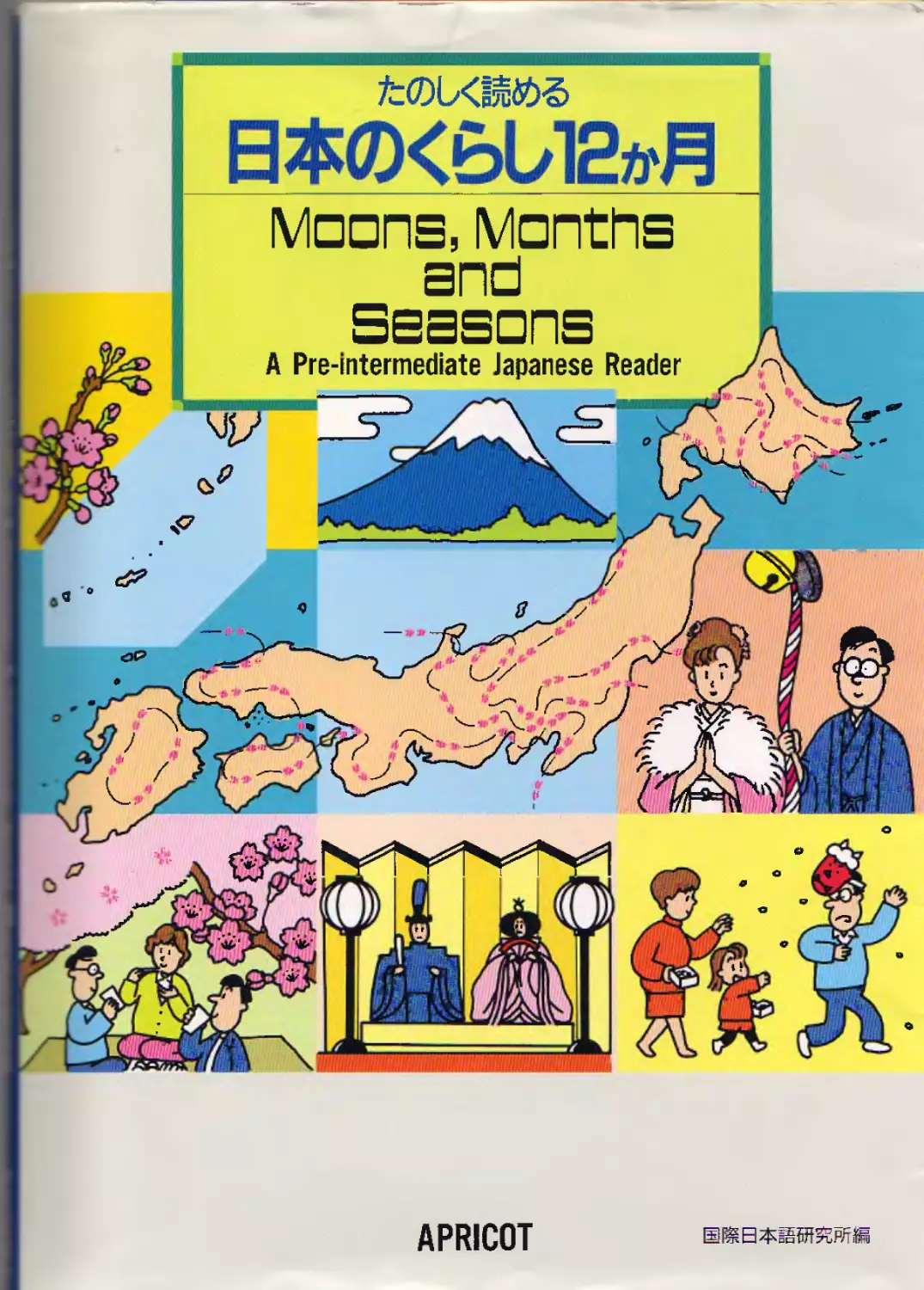
                    Moans, Months snd Sessans
A Pre-intermediate Japanese Reader
APRICOT

APRICOT
Preface
1'H JANUARY	Ш6
' j Г.-Л:	=:' J ' - ..’• . “-- - - V .-. - =
Osechi Ryori
O-toso A t
O-zoni	{2
Kadomatsu ГЖ
Sh i mekazari L Л
Otoshidama
Ilatsuinode Mir
Harn no Nanakusa
Scijinshiki $AA
Sumo
Winter Weather Chart
Snowfall in Tokyo =t
Snow Shoveling off Roof W Ъ L
Kamakura A>
Snow Festival #	9
Mamemaki <!?
The 60-year Cycle A t
Coll ege Entrance Examinations АФ A1A
Haiku
H inamatsuri C' A	*)
Hinaningy о A
N agashibina iilt L
Tachibina
Omizutori А'ЖЖи
Puns with Numerals
Visiting the Family Graves V*
Sotsugyoshiki
Tenkin IsWj
т	• •	- n 	.	-	c .	•_•▼-	:' '
sr MiBfe AWO
Nyushashiki А^ЬЛ
School System in Japan □
O-hanami # f L Jnl
Sakura Zensen
Professional Baseball Games □ A*Z)7cn3!pj^
f, L	4’j
Spring Food, Flora and Fauna
?
5в eh
Gogatsuningyo КЯ
Koinobori -li ><7);f9
Shobuyu L J; 5 A 4# Warriors Helmet
£ 9 Ж
Clam Gathering at Low Tide Amusement Parks 1Й1ШШ Chatsumi A
Exodus
Overseas Travel
бя jui® ;	©Ш,
Koromogae
Teru teru Bozu t 6	f
Baiu Zensen
Ra inf a 11 in Japan H A	RH IT ?Tt
The Bonus System d<"^Z
Rice Planting EH MA
The Japanese and Rice □ АЛ РЖ
Brands of Rice
7«JULY	44
‘-Зб < . - • ? --L-“	:„Л . -	' —-- .< •:•••
Tanabata СУ
The Milky Way & t L> 9 M
O-chugen Jj ф jl
Cshi no Hi j L*D □
Shochu Mimai
Extra Summer School ЖКЕШел
Special Summer Classes £l.r _ й ?t
Summer Food, Flora and Fauna	di
вя Aueupr/•.•"y > =Y-.г • so, • 't ₽*	 л	.	-Ч-
Toro Nagashi H о
0-bon A
Bon Odori ±£ A £ 9
Daimonji AAA
Homecoming 'Жй
О-bort Holidays
Anniversaries of the Atomic Bombings
Peace Marches ТФ1ИТЖ
The All-Japan High School Baseball Tournament
Disaster Prevention Day Й & <D H
Emergency Bag #А*> Ж LA
T yphoon LJ Ж
Respect for the Aged Day П
Celebration of Longevity
Aging Society
Moon Viewing JsHJi
ййШЙайИй  - ' W
. W •••	-с:	C--ho,:-.-.	= _	:••-* •	--	_		x-; \v:v
Wedding Ceremonies and Receptions jt
Forms of Wedding
Average Wedding Expenses W1 W Ж
Rokuyo Calendar
Red Feathers
The Red Feather Community Chest Campaign
Field Day
Horse Racing
ЛИ . NOVEMBER	70
The Order of Culture
Tori no Ichi Й ^0 ffi‘
Culture Fairs
Shichi-go-san
Chitoseame F.^ifr
OnSeil
Autumn Food, Flora and Fauna
Winter Food, Flora and Fauna
Shiwasu
Year-end Sales	9 Л‘ L
Bonenkai
Nengahagaki
Rice Cake Pounding ti Э
Okazariuri L' 9 yfi 9
Omisoka
Toshikoshi Soba	if
Joy a no Kane
иар|й|^	:^§p
ЙНЯ ‘
з
li L' Л (-
гВф₽И LLI2GH— Moons, Months and Seasonsj li 400^Й®
ЙЙЙР	-z>tz В	L G £ШКТ.
ЙЛ. a T'TTi’T^ ^U-t t о -G * £ 5 £	J
ф>!1£ < i:W7 U^k«^&=g7j\ MSIG ШМ£Ь
C£T"CJ, 0$А?ШЬЫВАгТМ rs£At)iGj
£ L Go £лtzлагтая>л4йШл t j:ufti c t: ьтмtl, g £ о t &&LGv'^-£Gt+^Z£ £ч KXfcJMuH.
гЖ^-йсЛЯтЧХ b К L <TliG < , BHi
1Ш81:, 0$Afl£S£M£*W rHA.t<Oj £ LT^-G'GG’J G ~to
**!U(Dj;i GTW/fc 9 JT
I . ВЖАЛ I ТлТ.7££12АЯ1Ж>!А &Я Г £ G#W<’ В	<
ЯИ5Т& b Ь"?тШ 4 S.|fT<'£To
2 . £ Я л Ж A !± 800 яШ. i:i £ Л <LK ШйЖ;Т &
5£G < §ЬЛ<ЛЪ J: -j GoHo GG'L , 0 ФАЙ-i ( i C 8li'№B^A«g®|:-9oT3a.W 3.t T X, «Жлг Kiir L T в^л	'5-t„
3 .	5 L ') X'C®Z>'HX i '5 tG\ IfcAV’t &^Z6 L T,
t Z t	t Л^ЬЛЖг^^р^Жгл^А^АЕиО'С-^Г-АО
ji-Gbl К tcMffe 9 ±-+„
4 . ^'СЖО .WG b h“-y 7^Й#ЛфТА < t: афЛ^Ьд’®^. Bli
GGGfco-O'S	< 7Л	^ТЪ/гО
\ЭТ < 1йнЯ L X h 0 3 To
5 . 5G> t €G4
ФЗвТл с ^Ч'^зЛТШи?-?
ГЦТТЙЬ'^ЪИЗ .^АЛЙЖ'ЬХ b C^iR^iEL Xk 0
6. * hr^^cOW^GfltSG^H, «-Я CXG^AWltGfc') i-7
iGhiOj; ?	^i>z -CL J: т o I Я/Тъ
ЙА4ёЛ^ 12Я £ O/vG4 -о X l ЙЛ ' 'CT L, ё ЪчЛ<я AG i > Я Л-ъ &t t? 2
4
го
ш
’$

Preface
“Nihon no Kurashi Junikagetsu — Moons, Months and Seasons' is reading material for students studying the Japanese language. It is written mainly for the pre-intermediate students who have finished a beginner’s course of about 400 hours.
Since the number of those who study the Japanese language has increased, there is need for a greater variety of study materials today. This book is meant for pre-intermediate students to enjoy reading without much difficulty, learning, at the same time, about everyday life in Japan, It is designed to be used both as a textbook in the classroom under a teacher's guidance and as reading material to be enjoyed by students on their own. We recommend it be used not as a text to study sentence structures but as reading material to come to know Japanese customs —the background of the language.
This book has the following features:
1.	Japanese everyday life is depicted month by month in 12 chapters, and each chapter deals with the subjects and vocabulary that are often encountered in the mass media and daily life.
2.	A text of approximately 800 characters for each month is written mostly in simple sentences for. pre-intermediate students to understand easily with their knowledge of basic grammar. Yet, the vocabulary, intentionally drawn from words in use among average Japanese adults today, might help the students to follow7 everyday conversations in town.
3.	This book is written in kanji and kana, and for easier reading all kanji except the most fundamental ones are listed, with their readings, on the 4 How to Read Kanji” pages.
4.	Illustrations and photographs with English captions are provided for better understanding of subjects and vocabulary that have deep roots in Japanese culture, customs or history.
5.	At the end of this book, there is a list of vocabulary and phrases difficult for pre-intermediate students. They are accompanied by English equivalents and explanations.
6.	For reference, at the end of each chapter an English version of the main text is available.
With the features above, this book can be used in various ways. You may start reading from January through December, or just pick any month you like. You might perhaps read just the English text and the captions
6
of the illustrations and photographs to find out about Japanese life in months and seasons. Needless to say, you may also read the text to study kanji and learn the meaning and usage of each word.
This book will surely be useful for teachers who teach the Japanese language in English. Japanese cultural and seasonal events and activities explained in English with illustrations and photographs might show Japanese people, also, ways to introduce Japanese culture to foreigners. It could be highly recommended for students and families planning to live overseas.
We hope “Nihon no Kurashi Jumkagetsu—Movns, Months and Seasons" will help diligent students of the Japanese language all over the world gain greater understanding of the language and culture of Japan.
February, 1992
KIRJSL
7

OQ
co
Osechi Ryori
fctfSMS
Osechi ryori originally meant dishes served an seasonal festive occasions as an offering to the gods.
New Year’s Day has been considered as one of the most important festive events. A variety of ingredients is prepared and arranged artistically in a set of layered lacquer-boxes; such as seasoned herring roe, sweet black beans, seaweed-rolls, sliced strings of carrot-radish salad, cooked rootvegetables and so on. Nowadays Chinese and Western dishes are added, and ready-made oseefa'-sets are available at any department store. Osechi dishes are made ahead as preserved food and served through the first three days of the year, so women of the family can take a break from daily cooking during the New Year holiday period.
O-zoni
Kadomatsii


О toso is spiced sake with medicinal herbs and served in a decorative lacquered sake pot and cups to celebrate New Year's Day. Il aids digestion and is effective for a stomach heavy with New Year’s dishes. О toso spices are sold in Lea-bag style to be steeped in sake. It is said to drive away evil and preserve health.
Shimekazari

O-zoni is a special dish for the New Year. It contains rice cakes {mochi) in plain broth with little fish, or chicken and vegetables such as trefoil leaves, mushrooms and bamboo shoots.
In the Kanto district, plain soup is served with square rice cakes. In the Kansai district, miso soup is served with round rice cakes.
The way of cooking o-zoni varies among regions or families, and each district boasts its own specialty.
A New Year’s decoration is for inviting the god of the year and for welcoming ancestral spirits. It is set up with the hope for longevity, prosperity and constancy, on either or both sides of the front entrance of the house. It. is composed of pine boughs, bamboo stalks and plum-tree sprigs, and it is regarded as the residence of the god of the year. There are also simple ones that are made of pine branches wrapped with Japanese paper.
Shimekazari is a decorative, sacred straw rope festooned with strips of white paper. It is decorated with a piece of bitter orange, a lobster, and green fern leaves. It is hung above the entrance of a house to purify the
home for the New Year. Bitter orange is symbolic of continued good health in the family, and lobster is a symbol of longevity.
A house with shimekazari is believed to be pure, with no devils able to enter.
Otoshidama

Hatsumode
is
Otoshidama is a monetary gift prelected to children at. the New Year.
The amount of money varies with the •ge of children and family circumstances, •.erage total amount of monetary gifts for elementary and secondary school - dren is about 30,000 yen. (1991, Nihon Si mei).
Formerly, otoshidama was a custom - exchanging gifts for the New Year enong nobles and warriors in the late .Tomachi Era (1336 —1573).
Monetary gifts to children became r 'e prevalent in the Meiji Era tury ago.
over
a
Many people make their first visit to a shrine or a temple soon after the temple bells have pealed out the old year, or during the first week of the New Year. They throw money into an offertory box and pray for good fortune. After worshipping, they buy a good luck talisman or a sacred arrow with white feathers. It is fun to draw lots for a written fortune bearing a Chinese character meaning either good or bad luck. After reading the fortune, people tie the slip of paper to a branch of a tree in the shrine precincts for better luck.
The seven spring herbs are Japanese parsley, shepherd's purse, cutweed, chick-weed, turnip, henbit, and garden radish. It is customary to cat rice gruel made with these seven herbs of spring on the seventh day of the New Year's holiday.
It. is believed to prevent colds and other diseases.
This custom dates back to the Ilcian Period. Today a package containing all seven herbs is readily available in supermarkets.
11
Seijinshiki
Д') /
pJtlx Pff'x я/fi
Coming-of-Agc Day was established after World War II to honor young people who have reached the age of 20 during the past year as new members of society. They get all the rights of citizenship, including the right to vote, and should be ready to make their own way with responsibility in society.
Congratulatory ceremonies are held throughout the country. Many young women attend in kimono and photographs arc
taken to remember this spe-
Sumo
Sumo is Japan's national sport and has existed since ancient times. Professional sumo appeared in the Edo Period.
In sumo. two wrestlers face off in the middle of a dohyo ring measuring 4.55 meters in diameter. Every action, such as scattering purifying salt on the ring, is part of sumo s ancient tradition.
There are 70 different ways to win. such as oshidashi (push out), uwaLenage (over-arm throw), yoritaoshi (frontal crush-out J or yorikiri (frontal force-out). Sumo wrestlers are ranked according to their results. Yokozuna (grand champion). Ozeki (champion), and Sekiwake (junior champion) arc the top three ranks. They wrestle with several ranked competitors during the 15 day tournament, and a winner is decided.
Sumo wrestling tournaments have been held six times a year since 1958.
The achievements of a few foreign wrestlers have gradually internationalized the appeal of	The number of
«t/no fans is increasing, not only among Japanese, but also non-Japanese.
12
JANUARY
Mtttsuki means "Family Gathering Month.”
This is month for families and kinfolk to get together and enjoy each other's company.
We call the 1st of January Ganjitsw, to the Japanese people, this is the most important day of the . ar’s beginning.
People decorate their entranceways and gates for the New Year. In the past, the decorations were tadomatsu or shimekazan, but today's decorations are simpler, like a wreath on the door.
The morning of Ganjitsu is called Gantan. At Cantan families drink o-toso together and eat o-zoni «nd osechi in celebration of the New Year. Children receive otoshidama from their parents. It is customary to make the year’s first visit, to a temple or a shrine to pray for happiness in the hew Year. Although these are the main customs of the .Now Year, nowadays increasing numbers of people spend ’.he New Year at hotels, in spas, at ski resorts or in foreign countries.
On New Year’s Day. New Year’s greeting cards are delivered all at once. Many of them have a picture of the eto of the year or a family photograph printed along with New Year's greetings. Looking it these cards is one of the pleasures of the New Year.
During Shogatsu sangamchi, which is January 1st, 2nd and 3d. banks, government offices, and nearly all companies and stores are closed. On these days, we go around on New Year’s visits to the homes of our friends, relatives and our superiors at the office or company.
The 4th of January is the first day of work for government and municipal offices. Companies also eopen for business on this day after New Year’s vacation.
On the 7th, it is traditional to cal nanakusagayu. Nanakusagayu is rice porridge with seven spring herbs in it. It is said that by eating nanakusagayu, one can stay healthy for the whole year.
The second Monday of January is "Coming-of-Age Day,” This is a day to congratulate people who have turned 20 years old, and to hold special Coming of-Age ceremonies.
Tn the middle of the month, the year's first sumo wrestling tournament is held at Ryogoku National Sport Indoor Arena in Tokyo, and a winner is decided after 15 days of tough competition.
Around the 21st is Daikan, the coldest day of the year according to the lunar calendar. The merry mood of Matsu no uchi is over, and the weather turns bitter cold.
13
2 Л (4 I 4'С-е^'Я
'«ОТч &Й1Т r€4<>9j ^'If^Hito
<?У$£ ъ 9 ItfKt&t &Х- b >V t fc	t> It' ') it,
colo1)	<, ЧЕЛ-ъ 11 £t'H4to
» йЖЖЬ&оД^Ж^*&ФШ'ь14ч ЖЖ^Чв^'ЧЗ г 0 4 to
'ГГСк'П^ч'АЖШч ot S
zb'AZrWz 9 L 4 to
XJi-l±^tl:AMi;jj5*fOXt:-7«—?Tto
СОЛА—Wi: УМ ч 9 7b < Ч;4а >W"CJ 41=
:,	2 Я <i^®t-7—X> Tto	^iLV’HiiOt^l-UX
^s^;t>i4to снь<?)яаи^нь^^ч^'И'^Тч r^«j
3 014 rB^_ Tto г4А»4Тда^^*^1:Ы'П^0ГЧ 5Л;ЛГч ВР5НШ ГК4 * j £ L i to itfK’k
ь tt'li rt^j rt£j /-'Я4	г5Ы4?Ьч 7114
f*jj n'-siio jh.	t. itmatfc
2> £<L" bHti'it
4 all 1 ±<J r;	') £StL4to 5tiSI41§.< t
AЭ	'51V' $fin t	фh) z?<t Л: 41'41о
23	t^>4^U!4 r<— >j /i'j.JJit4to 3fti4^£-s>lf45£i^ja.'Cto
~ ч L -t-t—
i'*brlX.
Ш-tfe	ktztzA'i
14

	3tt Ml ' w	в-з^игч it&jg.	t£ г»АЛ>1.’ >//Ъ а ^жга	s'
frbfL^ -j"	ё -j н г Шй	t< #i<	1Ф-5	j" ?	b 7>	<"5
Л?ТЬй	IV) i -r	*‘Лг-> •>< ftit#	>7>TH S	i?	l-i. ^/±06	t,	1ЧА Ф^?
	MIl L tz 9	-» *719		КЛ « /^4		ti t
5s? W Я-В	L-H A	Siih-J 7T?'J	Ui^itA 10 >	L IJ'O < у fcji		; < fj-s Sai
с»;й'< L 1/Л АЗ*Ш£	W	OtfA IT Г<	7/'j 3 E	if^^A jrV-??- b\ bp 77		* it-J ф-tp
	fe Й A	f?/i>	J & St Э	L A.- V #*t	lb	г e Ж
>L£t: 4^	t L i'A-t 4^	fj-v \		й?< TV «-ЖМ		i?jc <- к AlJ^b
A< -5t> 7Sl.il*]	TIA^ILI Ф >	Jb-fr	A-V5	LA < LV 	к <	t? 4 В
ty 'j LU4	i2L XV 9	Л L ± -f	S #A '© Л Vitn.	T>< 1£< X	t	ft
THitA	S liV	ой	< 3 Л	йг4о >9	?o	1? Cf i-y^
15<iVi oii A <-<			if Hr? }f	< Ж 6		rp J
А	W
Л™	ЖЭ"
15
Winter Weather Chart
~ZT• I I
Snowfall in Tokyo
Typical winter weather chart shows high pressure over the Asian continent to the west, and lowr pressure east of Japan at sea. This pressure pattern causes heavy snow on the Japan Sea coastal areas and sunny dry weather on the Pacific coastal areas.
Sncw Shoveling off Roof
Kamakura
It snows heavily on the Japan Sea coastal areas and Hokkaido,
Kamakura is one of children's winter pleasures, in snow country. The most famous kama-kura festival is held in Yokote, Akita Prefecture, on February 15th and 16th. Kamakura, igloolike snow houses, are built or. roadsides, with an altar for the water god inside. On the evening of the 15th. children gather inside, light candles and have rice cakes and amazake.
Snow Festival
where snow stays for months. Roofs are pitched to get rid of piled-up snow, but still it is necessary to shovel the snow off the roof so its weight will not crush the house.
Tokyo people arc not prepared for snow. Children and adults have difficulty commuting fl-snowy mornings. Because of the snow on the ground, people slip and get hurt, and ambulances are busy all day.
The Sapporo Snow Festival is held for one week in earlj February. In the center of the city over 200 big snow statues are lined up, some of them as tall as 15 meters.
There are two other sites, one at Susukino for ice statues and the other at Makomanai for bigger statues. Snow statues and replicas at Odori Park in Sapporo are lit up at night.
16
Mamcmaki
On February 3rd huge crowds are attracted to watch celebrities who happen to be toshiotoko or toshion na -  born under the same zodiac animal as the current year — throw beans at big temples and shrines. At home parents and children throw beans in the living -oom, out from entranceway, etc., saying uOni wa soto, fuku wa uchi."

The concept of jikkan and jumshi (also called kan shi) was derived from China m the 6th Century, and has been used to denote the year of the Japanese calendar- For example. 1992 is the Year of the Monkey.
Jikkan (pairs of 5 elements) and jumshi (the 12 anima] zodiac signs) are combined to make the 60 year cycle. People often say, "I was born in the year of satи (monkey), or t (boar)/’ or one of the other zodiac animals. Every 12 years your eto year turns around, and you will be toshiotoko or toshion na, After you go through the 60 year cycle, you will have a big celebration on your 60th birthday. This is called kanreki. (See "Celebration of Longevity” on p.61)
17
College Entrance Examinations
Why are entrance exams so competitive? Because people think a diploma from a top university means a passport to good lifetime employment. So young children start studying at after regular school hours, their ultimate goal to go good university.
Usually examinees for
juku with
to a
schools apply to a few schools but ones for college apply to ten on average.
Every year over one million
trance examinations to 4-year colleges or 2 year junior collcgcs. In 1991, 64% passed; those who fail study at “yobiko" or "juku" schools one more
year and try
high
in
Haiku is perhaps the shortest poetic form the world, consisting of three lines of 5, 7 and 5 syllables. The rhythm of 5, 7 and 5 syllables has a pleasant sound in the Japanese language.
Haiku originated from the literary form called haikai renga of the 14th to 16th Centuries. Haikai lenga consists of 5, 7. 5, 7 and 7 syllables. The first three lines developed as haikai, later becoming haiku
again the next year.
called “ronin,” and years there arc around them annually.
Eventually 37.7%
graduates go on to c (Source : The As ah:
They a-in rcce 390,000 .
of hi
school leges, 1991)
Ume ichi-rin*
(6 syllables)
Ichirin hodo no Atatakasa
(7 syllables)
(5 syllables)
One twig of plum blossoms, One twigful of Warmth.
by Hattori Ransetsu has been Japanese since the Edo Era.
This haiku loved by the When the first sign of spring is noticed, people often quote it. Haiku like this one convey rich imagery in very few words,. The secret is the use of kigo, words typical of the season. Each haiku has to have one and one only kigo. These seasonal words arc collected in a book called Satjiki. and poets refer to this book to use kigo appropriately.
Haiku is still popular, and 10 million people write them in Japan. Newspapers have haiku columns, and poets form groups, each publishing their own other countries write language.
periodicals. People in haiku in their own
5 syllables, but 6 is
* Here it should be allowed as exception.
("N” forms 1 syllable in Japanese language)
18
FEBRUARY
г я
ton
1--.
IP
Kisaragi means to wear layers of clothing, one over another. The name of the month is homonymous to1*# -ftf —# ; ki-sara-ki]” meaning “ wear-over-wear.**
February is the coldest month of the year.
Snowfall is heavy in Hokkaido and the Japan Sea coastal areas, arid snow festivals are held there during this month. The Sapporo Snow Festival in Hokkaido is especially famous lor its snow statues fcany meters high, and its huge ice and snow replicas of famous buildings. People come to see them •c: only from Japan's mainland, but from all over the world.
The atmospheric pressure pattern of “high in the west, low in the east” prevails through most of the Winter, but this changes after the middle of the month when it may snow even in Tokyo. Tokyo people »- not accustomed to snow, and sometimes traffic is paralyzed or people slip on the ice and get hurt.
Skiing is a popular winter sport among young people. Ski areas are crowded on weekends and - days, and lines are long at the chairlifts.
February is also trie time for tests. In Japan there are entrance examinations for high schools, I versifies and colleges, and also for some private and national junior high schools. These tests arc so fficult to pass that the experience is called "examination hell."
February the 3rd is Setsubim. On the lunar calendar, this is the turning point from winter to spring, o celebrate the coming of spring and drive away evil spirits, a bean-throwing is held. At Shinto shrines arc Buddhist temples, toshiotoko and toshianna* throw’ beans; at home in the evening, families throw beans and shout, Evil spirits outside, good luck within! If you eat the same number of beans as your •ge, it is believed, you will stay healthy throughout the year.
The next day, February the 4th, is Risshun. which means the first day of spring. Although the - rcury stays low, plum blossoms and daffodils begin to bud and their fragrance floats in the chilly air.
After midmonth, haruichiban rages through the country. This is the first southern storm of the v ar.
People long for the coming of spring.
One twig of plum blossoms,
One twigful of
Wa r mtn.	— Ranset su
• Men and women born under the same zodiac sign as the current year
19
3Wr5t£j	r<=kl-'j
3 Я 3 Sli rfM' + -of) j Tt»	t
tiijL#s], lit <’9	4^, U'&h ьЛ№й
=	X,	& ± <.лчТ, IZ5.'±or) 2 L i"t«
±/c, 3 Bii	T’to 7-7t7M«c £ i\
З^ШСЯН, ; г«0Ьй'О i Lbc ^ЖЖ2-<£ ?> В'Clo 0^«^^4ЯГЛё^-?ХЗЯ1-^Ъ5«-С; с^яигзжж^
>с UElT 2 t ЁЛ 'ii% ^^ЯЯч	2<L
t, жа^'Ш^ЗТо	г £ t* 1 i-to
а s	I - п i т=
-£4Ь\’ЖПt) 3 Я^;^<М?ЬЬЛ 5 К z 7,/j^ ( fc b "BtWW£*^j
<9KU *) £1~o	i-3 HU I ЖОВ.^1')ofliol; 1Ж
14 5)й^‘?1'	Жо
120О-Й-<41ЬЦ^Й.б7)ЖЛ<^.Я1‘Т ГЬ’’КЖ*Ь ^ЧтЬЬ-i+o -4г!1
W* £ -s> If 5 Л-W Cf	r> - T t о
210 2'^11 r^fc<)Bj T’to <£<<^-Jfci'b’|5]ljr&-?> 0 I'i'o C<7)tr< laM^- rb^»j ^^-31, Ж3££	£ I i"to
^•зХ^гй1),	#?Ь'^-Ь-?'СШ;Ссг)ЗТо
2C
€

•- i’-rl	L.	L	I 1	i> 3 в	К A, 2^5	itii T
Г L	Т ъщ	Ь^ЙЧ?		i -5	tt	b AJz £
Ъ Ь L Ж		6;§	ь ж> l
г у с	1*Г *				l;L^
		1Л"^ i *5		<iS
£	T'J?rjL3	ft/L £	JJZt	Jz^ t>	sva^aiA,
- > j^-f /д	ЖЖЖ;	i		frb hit	iwa	W¥4
-7.* i	L-5		t	it Й7	£p Zj L- Л-*
-£Л^	ЖЖ®Е> э;			^-Шгй1	гаж
• t	£бп	Ъ*>4эЛйч-1		СЛи	A. tX	$ A.
ЖЙ	<L 'C	’	atM^	BSMit	x<-
*-,£/.. £	L J t <	< <Lo L AJ1	<	< S'	TA,^A.	X^Z. -5
	f?tmW£4’£		E^r)	feli
	5 Й-’Э	i J;	«: 6	t-S^Vi C	<c //0^5 -Я t
	фйр	КФ
£*Ж с	MjU *> g 5	?		L?	t>h	Ls.^A, У
&х№')	HW«7	A^O?		4Т^	—	Й
? о			if А. Г
		W| |j	Й^Д
	35^	г		ЙК	z 4
^Ж# 0	>Cj Jg- Л	^4			'o1
21-
Hinamstsuri

The original festival, men-  tinned in The Tale of Genji, written in the beginning of the Uth Century, was to protect people from evil. Everyone made his own statue or doll, wrote his name on it, and floated it down a stream hoping evil fortune would float away with the statue.
Hinaningyo

Traditional display for hinamatsuri. (Above)
In the middle of the Edo Period (1603-1867), people made elaborate dolls that they displayed only on red-felt-carpeted special steps inside the house, as you see today.
The set is made up of fifteen dolls in formal classical court costumes — Emperor ф and Empress ф on the top shelf in front of a golden folding screen (3), three ladies-in waiting Ф. five musicians ©, two retainers ® and three guards (7). Two bonbori lanterns (§), a miniature cherry blossom tree and an orange tree @ lend a festive air on the steps. Special hinamatsuri goodies such as colorful hishimochi (diamondshaped rice cakes) O.t1, shirozake © and hina arare are offered. Miniature furniture, lacquered tableware and vehicles on the lower shelves symbolize a bridal dowry.
Nagashibina
Now the original custom of a thousand years ago remains only in limited parts of Japan as
A pair of paper dolls are laid in a small straw boat with peach blossoms and rice cakes and set afloat -on the river, to carry away evil with them.
22
Tachibina
|W original form of the Ш - ie paper figures in stand-X* ion remains today. The i .pie is called “tachi
Because of limited space ru-• houses today, some .-r display just tachibina l : glass case, or simply a 4 * • , a tachibina pattern.
Ж

Omizuturi
fczldfe У
* izutori, the spectacular water and fire, takes - March the 12th. It has e bra ted since the middle Ь "th Century. At midnight • \ai reaches its climax. Bfr veranda of the temple,
young monks wave huge torches, showering sparks down onto the worshipers below. At two o'clock in the morning, one of the torch bearers proceeds to the holy well, Wakasai Well*, inside Nigatsudo Hall. There the secret water drawing ceremony is performed by chosen priests. Л bucket of holy water is carried back to the main hall to be of
fered to the Great Buddha. It is believed that those worshipers who catch a “flake” of fire from the torches are free from evil spirits and disease for a whole year.
* This water comes underground direct from Wakasa Province, Fukui Prefecture, so they say, and the well was named "Wa kasai.”
p ns with Numerals
Since we can read each numeral in several ways in Japanese, we enjoy puns with numerals.
Multiple ways of reading numerals help us to remember big figures such as telephone numbers or historic years. They also give meanings to dates such as:
зл	3	H	3 -	3		W Ears Day
6 л	4	□	6 *	4	ty ’ L	Prevent Tooth Decay Day
8Л	7		8 ’	7	* T&	Nose Day
	23 R		2 	3		О Fl
Letter-Writing Day
3.3 *.# •
Some hospitals and hotels avoid numbering rooms with "4” or “42,” which can be read “shi" and “shi-niT meaning “death.”
23
Visiting the Family Graves

The old Japanese folklore belief of worshiping the souls of ancestors was combined with the Buddhist belief that Heaven lies due west. People started to visit their family graves, so they say, on the Equinox, when the sun sets due west. This custom exists neither in China nor India.
At the graveyard, people sweep around the gravestones and wash them. After the cleaning, they offer flowers, incense sticks and food and drinks which their ancestors loved. Each person pours water over the stone, and prays. They say the dead are always feeling thirsty, so the water soothes them.
Sotsugyoshiki

The highlight of a graduation ceremony held at a kodo, an auditorium, is “the presentation of certificates.” At elementary schools and middle schools, the class teacher calls the names of the graduating students one by one, and each student is handed a diploma on the platform by a headmaster with a brief personal comment. Some big schools and universities rent a public hall. In such a huge ceremony a repre sentative receives all the certifi cates on behalf of his or her classmates. Caps and gowns like those seen in the West are rare in Japan. College graduates wear suits, though many gins still wear	and solid colored
hakama, which makes the outfit formal.	_
Tenkin
Transfer season causes a fuss amori some families. Because of several reason! such as their children’s educational sit иг tion or care of elderly parents, sotnJ fathers today are forced to do funin’ — to go to a new post alonJ apart from the family.
House-moving is a big business il Japan today, and companies offer . variety of services io answer many differ! ent needs of such customers. The "rent all system" — renting furniture, elect rical goods and daily essentials in a pack ago deal is one service offered for these "bachelor fathers,”
24
MARCH
Yayoi means "to grow more and more.” Japanese “Groundhog Day,” Keichitsu, is around March the 6th. On this day, the creatures come out of the ground, birds begin to sing, and flowers and trees start to bloom.
T ~e month of March is also called Yayoi. Yayoi means to grow more and more.
March 3rd is the Hina Doll Festival. Families who have daughters display a set of hina dolls and cements of peach-blossoms and rape-blossoms. Special foods such as chirashizushi, clear soup with . hina arare and white, sweet sake are prepared, and friends and relatives are invited to celebrate Hina Doll Festival.
The 3rd is also “Ears Day.” The shape of the Arabic numeral 3 resembles that, of an ear. and the 3 can be read in Japanese as mi, so March 3rd [3/3] sounds like mi mH and the day is called I tof — no Hi — '‘Ears Day.” This is the day to think about the care of the ears.
The school year in Japan begins in April and ends in March, so this is the month that .enecment and school closing ceremonies are held. At commencement ceremonies, graduating from kindergarten through university receive certificates. After the ceremony, the students give L aj nkat party in honor of their teachers, to show appreciation for their guidance. Parents sometimes Э» . pate as well. When the graduation and school closing ceremonies arc over, spring holidays begin.
Many companies and banks have designated March as the month for settling the year’s accounts, J ’ is also the month for filing income tax returns. As March is the end of the fiscal year, it.is the • season for transfers — jobs, schools, and moving to new houses.
Late in the night of March the 12th, Omizutori, the Water-Drawing Ceremony, is held at Nigatsudo Ы of Todaiji Temple in Nara. In the Kansai area of Japan, this is an important event to herald the toning of spring.
The Spring Equinox comes around the 21st. This is the day when daylight and nighttime become euedy equal. The week around this day is called O-higan, and families go together to visit the graves to • ~eir ancestors.
An old proverb says, "Neither heat nor cold lasts ever the Equinox.” By the time of the Spring L; -inox. the winter cold is over and spring is here; by the time of the Autumn Equinox, the summer Ln: is over and autumn has arrived.
• The Japanese word for “ear”
25

я * я *
26
	Я?	«-	. Ж! М? »•	ц:	•г
шй	ЛК	Ж {WU 7Т	FUK #“ у»-'	•»;	Ж. и 7
—^ч ПО	48^			<m'*
Ш J	й>				<^5
Г-J
o’ tr	^»St /$|-’т	-тА- '•"	г^£ 4$^	S-fe го;; Э,£ gg	£ -	j-r &
А^-	if- В?Й		№ t*1 da c-4t	% ' X $ в < L 'У *-.		гз-
ЙЧ	Kj	й?		4.AJ -<_ ?-	О-Цн m ~		<г
				Ш .TV	Г v&L-		И
Ч- & Л & X? А*> т-^Ы	ад?	Н"5*7	Q-0"		*41 г<	00^  jjS?	jin ><>	41 1£Л pv 5		vt ?i s? fts
		4>S				.3
	^'V m3	ж Arit-ffi	.,Ч-№ я	Й1? П1- А	>ь?		м	у-' * 4П	>Й^ xV 5+ tit- С7	\rllA уь i# <^5
41.^ 7ТГ?ъ	jgb	4^ IM	ft tfc L	-^4\"4 413. л1|11|Г||1|*1;— 1]Гцр - >	35-ж &	SUV	гШ C Avr r+- 'fr 'm^.	a* 411;	Xir fr4-tt- CT 94V 94V ^4	^S
^’т	,3151 <> гг??	J4"	^1' rt о a	4nl &*	>c	хД				$йп
	3	n?	S'		94V	a	§!?		MS	г
з^Л				<r-“	„ 7т			м>Л ГГ?-	VL^ ✓'T'W
	-_^							IH

Most companies hold an entrance ceremony for their freshman employees. After, or sometimes before the entrance ceremony, these new employees are required to go through a series of training sessions that often run for more than a month. During the training sessions, such information as general operations of the company, personal health management, and etiquette in the business world is given to the young men and women, who have just graduated from school.
School System in Japan
In Japan, education is
highly valued. Although nine years’ school education is required for all Japanese children, more than 95 of 100 students go on to the high school level. Many parents want their children to get a university or college diploma, so university entrance examinations are very competitive. There arc 576 four-year universities and colleges and 598 two-year junior colleges; about 247 of those are public schools. Colleges and universities are concentrated in the Tokyo area, 109 of 576 four-year colleges and universities and 79 of 598 two-year junior colleges were in the Tokyo
age
area in 1996.
28
Source : Ministry of Education, Science and Culture
V
nanami

Sakura Zensen
the “national flower” of Japan, flower in Japan has been the many literary works, and the
5. го
5.20
4.30
"4.30
— 4.10
talk about cherry blossoms in their daily conversation at this time of year, and they go out to view and enjoy the cherry flowers.
releases a
The cherry blossom is designated Since ancient times, the most loved cherry blossom. It has appeared in cherry blossom design has been extremely popular for almost anything in Japanese life.
As the proverb says, "Hana yori danga" (Better to eat sweet dumplings than to view the flowers), people enjoy eating and drinking under cherry trees and have fun at o-hanami.
the trees at 120 designated locations all over Japan, the Meteorological Agency forecast and makes an official
announcement when the cherry trees bloom. The line connecting points where cherry trees are forecast to bloom on the same day is called “Sakura zensen," the cherry blossom front. Even in
4.20
4. ID —
Source : Mcleorogical Agency
29
л.--..

Professional Baseball Games
0^®7°пте
Baseball is widely played and very popular in Japan. The game was first introduced to the Japanese in 1873; it was enjoyed as a students’ sport until 1937, when the first professional baseball teams were formed. The professional baseball games became especially popular after World War 11, the period when the influence of American culture has been strong in many phases of Japanese life. Today, there are two leagues in professional baseball, the Central League and the Pacific League, each having six teams. The Japan Series is held at the end of each year s baseball season with the winners of each league competing. Each year, more than 20,000,000 go to baseball stadiums to watch pro games.
_ Ж-	©
 е©йч ш©^ш
 Spring Food, Flora and Fauna

't.
ft £ < h


Edible wild plants, especially young shoots that come out in spring -Bamboo shoots	/
Sugar coated rice crispies for Hina Doll Festival	\
Sweet, white rice wine brewed from and rice malt Sweet, pink colored rice cake wrapped with a cherry leaf Sweetened rice dumpling coated with sweet bean paste
Small sweet, rice-flour dumplings mixed with sweet bean paste Dumpling of sweet rice wrapped in bamboo leaves
Sweet rice cake wrapped in an oak leaf
Clams	*
Halfbeak, a spring fish Camellia
Daphne	/7
Rape blossoms	If	1]
Dandelion	v.	Ё
Clover-like grass with pink flowers	к
Azalea
Wisteria
Cabbage white, a kind of butterfly
Skylark
APRIL
4 Я
Uzuki is month in which imohana, small white (towers, are in full bloom on the hedges.
V April comes, the mercury rises and there are more and more warm days. Although snow may *r found in Hokkaido and Tohoku, in places south of the Kanto area cherry trees, yamabuki, and p >-*ng flowers are blossoming.
rr Japan schools and corporations begin their year in April. Each school greets the new term with wiing ceremony. For students beginning their first year at a now school, there is an entrance cr* in which the school principal gives a speech and teachers are introduced. First, graders in Kary school, starting school for the first time in their lives, gel a new randoseru* and a new desk I - - parents or grandparents.
Businesses hold entrance ceremonies as well. The company president makes a speech offering В of encouragement to the entering employees, all dressed in their new business suits. Around the I of the entrance ceremony, the new employees begin a period of training that lasts from two or r (hys to three months.
T“jt opening of the professional baseball season is also in April. In Japan, both adults and children | baseball, and fans throng to the season opener in April.
I • April is the season for flower viewing. O-hanami is a traditional spring event of enjoying r> blossoms. Cherry trees begin blooming first in warm Okinawa, then the blooms come out in >• . Shikoku and Honshu. In Hokkaido, sakura season is early May. Around this time on the вюп weather reports, you can watch the progress of the "cherry blossom front,” which tells the r Ibe cherry trees will bloom. When the sakura are in bloom, people take o-bento lunches and sake Bne spot famous for the beauty of its cherry blossoms, and they walk and have a picnic or a party under the cherry trees. Yozakura, white cherry blossoms outlined against, the night sky, r a special beauty. People stay out until late evening singing and dancing gaily. The cherry err.s. last about a week, and then young leaves grow quickly to cover the tree with green.
Tbe 39th of April is Greenery Day, a national holiday. In the week from the end of April to the c.- -g of May, there are four national holidays; sometimes a designated holiday is added, so it a "big scale holiday week.”
A : ickpack-type book bag
31
ВТО 5 Л (i$ЪТХС
Z<7)^ ^гТ>в#А^ АЯ=?
я £ 1 очт то ? < «^т<т^лта®^ттьн ± to
5 Я I а (J/-т--СТо В ФТ1± 2 В (Ш <	£ L 'С -g-Й'С® L
ШЧтЫг J То
3sii rft:;iie^aj, 4 a id Шт.,, 5 Bid r-T^Bj т; =£
Т £ £ 9
С-
ГЛ Г 9 (?) 0 ।
г-ТК«ов_1 + T'id z os £ гз"— /vr'y^-f — 7 л z
1Ч\
К tZ Т Т т L Zz 9,
w^TxT-ye^LATTo

V ^AZ»''r Ж:А^’И i ^'С\ лТкЖ=:®£Ш £* ’ TtA;WT"Ta
a iETk 1/TA£ у t id'— 7кТ>Т -( — 7Г-Ь, Л<?Л/ОАЛ^>^'^Ьда?
ei^T, 'TW0TW;WWf<ld-^r^lOOO^A (IWOWSt) f гхТ1' ±To
г^ТсойТи г^ТЯг, O-f	т В Т L То U
Й1А	В Cfr-^Ti'jtTo
'= 'CQZI 9 S-T-TZi 9 , ЛЯА®Т^',Т£ 9 5То IZz. L J; 9 А' ^UX<>Zi9s Zb J: 5Т4Т Ъ t £> £,1fc''<-5 Wti'ZTi) 9 а То
^2 0^011 r-eoBj тТс г«ас.(Л^<е-Аи^и*-т->зх
Тк -Ь > b & < 9 ,	L 4 То
5 Я id^f&so^WTTo	Z А?Ж#ТТ₽-?/с Т'^!411-9 Z>'J;G
п 9 4 A/z‘T> Ъ Т\ Wt--fridZi-4 То
32
33
Gogatsuningyo

Toward Boy’s Day gngatsu-ningyo, warrior dolls, and kabuto, warriors’ helmets, are displayed at home, in the hope that the boys will grow as strong and healthy as warriors. But recently only kabuto are displayed because city houses and apartments have limited space.
Kuinjbon
at'®®’у
Even now families with boys hoist koinobori, carp streamers. This originated from the Chinese legend oi strung carp that could fight their way up the Yellow River to become dragons.
The largest kennobori measure 5 to G meters, but 1-to 2-meter koinobori sell best because many people put them up on the balconies of their apartment houses.
On Tango no Sekku (Boy’s Day) iris and yomogi leaves decor
the eaves of houses, and an iris leaf bath is prepared because rt
believed to drive away evil spirits. On this dav sento. public b houses, prepare iris baths, and children are admitted free.
34
1.	Make a triangle.
2.	Fold again to make another triangle, and open,
3.	With folded edge, fold again to make two triangles along center line,
4.	Take top layer and make a triangle, one on each side.
5.	Take inner edge and fold down equally on both sides away from you,
6.	Take lop layer. Fold upward so point is halfway from top (not all the way to top).
7.	With the same piece, fold low er layer up again.
8.	To finish, luck bottom flap inside.
sprmg tide occurs a-
Iden Week, and the
came each day on peak days.
Amusement Parks
Chatsumi
Young tea leaves are picked around S' h day after Risshun. These •: ichiban cha, first tea leaves, have a wonderful flavor and
Tea leaves traditionally
are and fra-were
: by hand, but because of the labor ge, the work is now done by ne.
am Gathering at Low Tide
-. So people like to be on te.h. and clam gathering at is one of the typical ns of this season.

Amusement parks are the most popular destinations for both young and old. People rush to Tokyo Disneyland especially. In 1991 more than half a million people had fun there during Golden Week. 100,900

35
Exodus
Overseas Г ravel
were lifted, the million Japanese
16 г million
Travellers In and Out
15.30 •

Narita Airport is crow  during Golden Week with J* nese tourists who travel to vd ous parts of the world. Hav._ Guam and Southeast Asia « their favorite destinations, *л some also visit faraway phd like South America, Africa i even the
Antarctic.
In 1964 when restrictions on overseas travel number of travellers was 130,000. Now about 10 travel abroad annually for pleasure or on business. The strong yen encourages them to travel to foreign countries, because overseas travel is often less expensive than domestic travel.
The busiest Limes for travelling abroad are New Year’s vacation. Golden Week, and summer.
Japanese travelling abroad Foreigners visiting Japan
>3
(Second Oil Crisis) l979Year
4.04
4 -
3.91
!	(First Oil Crisis)
1973Year
Source: Ministry of Justice I
£.29
(Osaka Expo)
(Tokyo Olympics) iSTOYear f964Year г, cr /
0J5
2 -
0.03
'i960	1965 qj6 i97U
36
HAY
5 Я
Satsuki is the contraction of Sanaezuki. Sanae means "rice sprouts.” It also is "'Azalea Month” the month in which satsuki, azaleas, are in full bloom.
in Japan is a month of splendid weather and fresh, green foliage. As there are few rainy days, | Werber of this month is called safute&are*. Many schools have excursions and athletic meetings.
YLi^ the 1st is May Day. On this day in many parts of Japan workers hold meetings and festivals. May the 3rd is Constitution Day. the 4th is a nationwide vacation day, and May the Sth is Children's k which makes three consecutive holidays.
S.-.e national holidays arc strung together from Greenery Day through Children’s Day, this period is ►c ‘Golden Week/’ and people enjoy the holidays taking trips together with friends or families, going li gathering at low tide or participating in sports. So many people stream out of the city that resorts I fOfcxCS are packed-
Golden Week, along with the New Year holiday and summer vacation, is a time when people travel bmgn countries. Nowadays, the number of Japanese traveling overseas annually exceeds 10 million r=r : ng to a survey in 1990).
Children’s Day was formerly called Tango no Sekku, a day to celebrate the growth of boys. Today, fctren’s Day is a day to celebrate the growth of both boy and girl children. Even now, though, hur? with boys hoist komobon**, and display samurai dolls and helmets. Also, some people still me the customs of taking a bath with iris leaves or eating chimaki and kashiwamochi.
Tте second Sunday of May is Mother’s Day. People give their mothers red carnations and presents 0press their gratitude.
May is the season for newly harvested tea. People especially prize green tea made from now tea r»* picked around Hachijuhachiya*** because of its flavor and fragrance.
Meaning, "Sunny days of May” irp streamers
’The eighty eighth day after the beginning of Spring
37
6 Я (1Й«Я 'СТо L i 'j -А £ 1'М'й‘
L v'фвр 'С-to fiiM L ЛУг ч ж L	'ММ £ &') i То
6 Я I 0 !i ’Wx-j «OH'C'h ЖШ AGGIH '-ЯИТДт ') Л'Ш. TtKMGMSZ'1'* <	5 ЯТ19ГЛЛ'А>ХЖ£#5 с Я I ? (
* % 1 ;£ L Ло
r->n>j	с^<огйй'<от ГЙ^
£ti'i'lT3 ^ПГЖп-J r-s>f$j £®с£№ *,£> 9 ii'o TWTT“'7 7 jOifUE^	L	, M^eiir ЙЙЛ1
'£t’j £ L iTc	'Вф-^И-С-Г^'ъ ‘fi^ATj
" i:J:o-cr»^4xi-to	*) i-ti-^
-t^\	I -G Й^о®!1нфл;:|1й САсойгсТо
ПгШ^Оташ^х £' L i -to	'C’l&lS*fto/; 9 s
ЙТ L 4:-9l№ H5«94 C«2?> TT^
I 4ФГ- #-&ПП«<^0 & rR5j	-^421 0 С А^’"Д£'С
•s To	We135^£>f), 12ЯСО r^S-j
T -ft. ( <A П .t Mo
3. tz ’ я !iSiTv^+T[.±M—Г x«otfa Ь Я ”CT„	2 Э, 6
Я И2Я Gtb -5 £ С ' J; i I'T» M—+Х^Я
< i'*) i I. Go
38
68
Koromogae
Summer is hot and hum: so all who wear uniforms chan, their clothes to summer-weig. uniforms. Many students we white shirts with short sleev-Today some of the uniforms office workers or schools аЯ designed by famous fashione de signers, so they are more refir.- : and tasteful than before.
At home, when the weathei is sunny and dry, winter cloth are put out to air. and suiro-d clothes replace them in T-
Teru teru Bozu

Tern teru bozu is a very simple white doll, made of white tissue paper or white cloth. It consists of just a small head and body without hair, nose, mouth, eyes, ears or limbs, and it is hung outside window’s or from the eaves to vffsh for sunny days. Children often hang one when they are hoping for fine weather the next day, and they sing a song of teru teru bozu. This custom was brought to Japan from China many years ago.
Raiu Zensen

Вши zensen (the seasonal rain front) is a stationary front whx occurs between the Okhotsk air mass and the Ogasaw’ara air m_ Generally, the rainy season moves up Japan from the west to t! northeast. There arc two characteristic types of rainy season besid the normal rainy season. One is a “dry” rainy season called kara-tsuyu. This happens when the seasonal rain front brings ha г any rain. The kara-tsuyu causes bad crops, poor harvest and shortage of water. The other is a long rainy season called naga t yu. It is a long lasting rainy season, which is highly unpleasant.
40
Rainfall in Japan

Kirnamfito
Tokyo
Source; Nihon no Sugata 1989 Kokuscislia
Kiinfai
TIT
6 DO
‘ average annual rainfall in Japan reaches 1600mm, I he t' of rain increases in June and September- The ramy season nr brings a lot of rain, but less than during the typhoon season z mber.
в eastern Japan, where the capital city Tokyo is situated, a r_ wind blows from south to east in summer, and the weather rv-' sultry and rainfall is frequent. In winter a seasonal wind from the northwest, and the weather is dry and fine with
’’he Bonus System
A bonus was originally a kind of supplementary profit-sharing, but today a bonus is an integral part of a Japanese salaried worker's earnings. Two bonuses are paid, one in summer and one at year’s end. The amount of bonus depends on the company and on the length of employment.
Government official’s bonuses arc paid in June and December. People receive a total bonus of about 5 months’ salary every year and they often use it to make a big purchase, or for travelling and so on.

Rice Planting
ЕЕЗШХ-
The Japanese and Rice

Rice is closely tied to the Japanese diet and culture. It was once used for payment of taxes and salaries. Therefore landlords wore responsible for making offerings to the gods to ensure an ample rice harvest, and great ritualistic rice festivals were hold as official ceremonies in Japan. The importance of rice is decreasing little by little, because Japanese dietary life is changing toward a Western style, which means that people eat more bread, cereal or noodles than they used to. But rice is still Japan’s main agricultural product, and rice is still the staple food of the Japanese people.
Today mechanical planter' and planting tractors are use during rice planting season.
Rice amounts to about 39 of the planted acreage of Japan-agriculture products. In 1990 th rice crop reached about 1 millicr tons, about 30% of Japan's toL agricultural output, down frorr 52% in 1955. But it isn’t that tU
miHirn I
5
Demand for rice A mourn produced
rice crop has decreased, it’s th Japan's output of vegetable fruits and livestock products hai increased.
A kind of rice-planting cer
io
Amount stored in government facilities
I SEO 81 SZ 83 Э5	54
--------------Source: Nihon no Scigata 199(1 Kokuscisha
ernony to pray for a bounti.fi harvest of rice is still hel today.
Brands of Rice
Г- It A
и


Consumers are eager to buy gourmet rice.
Eacn prefecture competes to produce rice with attractive brand names.
Here are the names of Japanese brands of rice and their main producing districts.


1ГА.

42
UNE
6 Я
The characters in Minazuki literally mean “no rater-month,” but the sound is the old way of -ending the characters FtKJJj - mi na-zuki—mean mg "‘Water Month”. Around this time of year, rmers hope for abundant rain for the rice paddies.
is the month for rain. It is the season when flowers such as irises and hydranges are with their young, green leaves glistening in the rain. The temperature is rising, and the air is r- humid.
1st is "change of dress day." On this day all who wear uniforms change до summer styles, c the past few years many people have begun wearing their summer uniforms at the end of May, weather is getting hot.
|le .all the rain of this month tsuyu, and because it comes at the same time when plums are . we also call this rain baiu and read the Chinese characters as tsuyu.*. When the high pressure M over the Okhotsk Sea to the north collides with the high pressure of the Pacific Ocean to the form a seasonal rain front, the Meteorological Agency announces the official beginning of the I son. Japan is a country covering a long distance from north to south, so the opening of the • season varies from location to location. However, there is no rainy season in Hokkaido.
Л'hough this long lasting rain is unpleasant, rain is important as water for agriculture and daily life, in of tsuyu is a rain of blessing for the Japanese people. By this time, farmers have done rice . Families use the ripened plums to make plum brandy or pickled plums.
day of the year when daylight is longest is called Geshi, and every year the Summer Solstice is d • ie 21st. In Tokyo this day is 14 hours and 35 minutes long, five hours longer than the Winter brr in December,
ine is the month when public officials and company employees get bonuses. Bonuses are given out year, usually in June and December. Nowadays many companies and government offices pay Bhlv salaries and bonuses by bank account transfer.
иуи and baiu are two readings for the combination of two kanji which mean
. um" and ‘‘ram
43
ТтШМГ	tbfSOj dWA	XutgMA
х> А'*ё i 7 ± to
7Я 7 Sidt r’-t> j TtD	i.ittOW) "МНгХ
tiejl'O tftSLj /< I tl-t 0Z2— ЙХОЛ| Ttt S t'H V ttlt l ' ,£ tc
5 2O0KliW;WX,* <	£«4't, J	L ito
Шт< $ fJvWIUtAZt'0 ± to
ttJC^ 54^Wjit^A3tJtt AtZ 7. t>tA 'WWl’tj £ tbLSto WW3v'J-i' J: 4^673: X MM 7 'Ctо ЖДЛйАЗО t ir Z £ 5 Л£и [Л < , АЛйжМЛЛМНЛьЛ
i»Mt c«9Z 7^«i^iO*Z)0	£- L^V'J: т (2, tCJsOjW^
J ftAtCX 7, 1 4'5«ttC'-:.x 'И'СГ,
I аг>'ь150^гаС0ьЯ^®М1-й--?ЛЛ^1:^ < 7W£t?>^W<Mi
to cne rt't7Cj Ж'-эТ. x><-b№йт£йт(1 ’ФтсА-Й/) t±s L j t't:
Q
,it, tWG S	fc-ifeLT, тсДс#.
/rSZit^t to
203 С'79ф«-ш I	L i to 4 Я i:t<¥t£f:A-=t
•ffftttli. (1 lm<te<£ I bi'^to L t^4O0bBl«XtAZ>-^iJ 7 ito	tt; tftt
» -3 L J; (S^b'^J/X’^So JSftl-thZ’-lti to
Д^О'Й.^Г S-9-Ш, WAiiAt L t	i 15 BtTto
x'^ <	is
u

•г-м
MW
• '.'А.
I ФЯ1И'
ЖВ3 5
£t& &
7 a
?L j!p
^1Й и
®|И Г £
й< Ui7
it±t Ъ
й
04 It 5
n A
>xt
Aj Ls?
64 7 if A
f ФтС
e tflsfr'jPi
;*;ja ' a tii
^£Z7 6 AF^f	if-1 «гтЬ^г	fti^'ti-j Л < Ж?Х?£	4-э№* t SA XJj&lL
*t		и-л (±A^ 1 Ф	3 i < 13 j. IM »-irl
IfA dK'iiM*	ti-fe Z —Jt	£ £ АОЛ]
A it ? n	&& f' *)	-Э <.	9K»7 1>A
Ж z §	£ Lrj 6i? ЛЖ-'т	'J Я) й	frAifA ЖТ
ЙАЛ>< T Ф fS-#7 1	it £>A	£	(f	#	i'fc
to-? A a		if Л-5 ic iffl	-SL V AOH
Jpfr ^6	t> гг a1?.	-tr to JfO	feCJ Ф'< w
LBTA**^	tu-j l-f АШэ 5	Л: +л Ата *) jB L	‘i		l/i‘) м’ф/’и At!
20 0	i--, *’-5« 1	ta ^Ъ-эХ
¥» < <t//J italic A A mo ви	L-fri
►J J: -3. 3	ЛАНЗ t	umtA+j’^ 	ЗФ-; ДФ L X
tVi	Zp c £ -5 >1 ДЖ»®	ИАП	dj$ Lit"
45
Originally part of the preparation for the Ran Festival, Tanabata combines many fork-loric traditions, Л hata (or bat a} is a loom, on which chosen young girls used to weave cloth for the gods; setting looms on platforms or shelves {tana in Japanese) at the river side. Later, the star festival of Chinese origin was combined with these traditions
in today's Tanabata Festival. Children write wishes on tanza ku (strips of paper) in five colors, mainly praying for success in their studies.
Kindergarteners and primary schoolchildren decorate bamboo branches and celebrate the festival in the classroom with drinks and sweets. Some kindergartens have a dance and song festival.
branches
Children bring home their ch rations of bamboo eat special food.
In some areas bata has become
tourist attraction. Gigantic b^ boo poles, decorated with c 4
today, T an elabo
ornaments — balls, strips clusters — are set up on streets in shopping areas.
'Го make a traditional origami Milky Way:
Fold origami paper following the directions. (1—3)
Cut parallel to Side “a” alternately from right and left, 5—7mm apart, leaving 1cm space uncut at the end. (4)
Open it carefully to the No.l position. (5)
Put a string with a needle through the very center of the paper, and pull the four corners down gently. (6)
Using origami techniques, experienced chefs use rolls of thinly peeled garden radish to make a fishing net. The fishing net is used to cover sashimi or a whole grilled fish to decorate them as “catch of the day."
46
1Ф L_LH £ Shochu omimai moshiagemasu arc you gelling along in this heat?” is a set formula for
rnmer greeting cards sent out before ДгТзли, around the 6th of just, which the lunar calendar marks the beginning ol autumn, iding cards after Risshu. Г Ж IK Zansho meaning "the lingering er heat” is used instead of F^1 [Jj .
Al tnc beginning of June, the post office starts to sell special < cards for midsummer greetings. Summer greeting cards wThich e з nickname of “Kamo Mail” a compound noun of “kamome’ I gull) and "mail/’ and a pun on the English phrase, "Come on, — have lot numbers and a special summer design for the d stamp on tnc front.
O-chugen
&Ф7Е
Twice a year, at the beginning of July and December, come the big seasons for gift-exchanging in Japan. In summer it is called o-chugen. This originated in the custom that relatives got together in their hometown, bringing food to honor their ancestors. Later, instead of gathering, they started just sending gifts to each other. Just as in earlier times, food items such as drinks, fruits, summer cakes and sweets, dried noodles and canned food are popular o-chugcn gifts. Tickets for beer and ice cream arc also sold as summer gifts.
Ushi no Hi
5 L<DS
Eating eel for vigor during doyo, the hottest summer days, is a custom handed down from the Edo Period (1603-1867). On Lishi no Hi (the Day of the Cow) eels are believed to taste especially appetizing, and the aroma of broiled eel, dipped in special soy-minfl sauce, wafts out from restaurants and roadside stands.
1 oday most eels are raised commercially in Japan or imported from Taiwan and other countries.
47
Extn Summer Schcul
special wintertime prior to the exanv
piece of cloth aroun a firm resolution
in
go
sb Ф
ж
Special Summer Classes
During summer vacation, schoolchildren enjoy special classes, staying for several days at mountain or beach cottages owned by the school or local government. The program is called “ido kyoshilsu" (moved-afar classroom). Children share group-life experiences together — studying, playing, singing, cooking, and so on.
Some attend specialized training camps sponsored by school clubs. Some choose from a variety of programs offered by private organizations. Now it is fashion for high school students to overseas to stay with local families.

I Summer Food, Flora and Fauna
Ground cherry
Hydrangea

Morning-glory Sunflower Balsam
Sweet oleander Crape myrtle
Beetle
Goldfish
Examination candidates study at crar schools — called “juku” for younger pupils, and “yobiko” for high sc he. students — to memorize important pointi of subjects and learn techniques to withe hectic competition of entrance exams In spite of the summer heat, they study hard now and at courses immediately Some students tie a their head to show challenge and win.

The first bonito on the market Sweet fish
Siliago, a Japanese silver whiting Eel
The first-picked tea of the season Cherries
Loquat, a Japanese medlar
Watermelon
Corn
Green soybeans
Thin noodles, a kind of Japanese vermicelli served with cold dip sauce with soy flavor. Toasted barley tea Chilled bean curd, tofut cut in cubes served with soy sauce.
ULY
July is called Fumizuki, written with the characters for r'literature” or "book” and "month."
The origin of the name goes back to several sources. At the end of the Heian Era, for example, July was the month to fashion letters in formal language or write poems in Chinese for the Tanabata Festival, opening books to refer.
A • en July comes, the swimming and summer mountaineering seasons begin, and ceremonies are held ptrxius places to mark “the opening of the sea to swimmers" and "the opening of the mountains to kers.”
7th is Tanabata* According to legend, this is the one day in the year when two lovers, the rer star Vega and the shepherd star Altair, meet in the Milky Way. On this day children write ks and hang them on bamboo branches, and decorate the branches with paper chains and a Milky r r ade of origami.
Vter midmonth, when the seasonal rain front heads north or disappears, the Meteorological Agency fealty announces the end of the rainy season. When the rainy season is over, the real summer finally
There arc many "high summer days” when the highest temperature reaches 30 degrees, and Кweal nights continue with early-morning low temperatures never dipping below 25. To counteract • energy-draining effect of the summer heat, even today there is a custom of eating broiled eel on the fc* of Tie Cow" during the hottest period, and on that day the demand for eel increases sharply at and restaurants.
From the 1st to the 15th, people customarily send gifts to those who have been especially kind to This is called o-chugen. and department stores and shopping centers are thronged with shoppers ipecial о chugen sales.
Prom mid month through the first part of August, people send "midsummer greeting cards” to . *e after each other's health during the hot summer days.
Around the 20th, the first school term ends with a term closing ceremony. Children who started -  ntary school in April receive their first report cards. And a 40 day summer vacation begins, ugh students bring home summer assignments from school, still there is time for outdoor activities, ro camp and trips with their friends and family.
For those who will soon take university and high school entrance examinations, summer vacation is I time to study intensively. Cram schools and juku provide summer courses, and many students attend early in the morning until late at night.
Star Festival; Festival of the Weaver
49
OS
° 4- 5 G
“4-
•: 1^5i$ 7-^G>W<4r=^FFG3-e-?Tl^Y >M'U~WYWiH
k^HS^B ^nr-m'P ’’WW^liSgS^j Со^ТГШЗ
’_f- F G ? > T 4 л 7 ? \- ’
7f40¥<on47W)-)WW °7F 1W¥.-?MW¥W^W^
Ч^^В? VY¥o#Yv > 734!<4-*fW-f&5<44S</*VW* :4-П G?-Zc--tK!.^B:-!fT=-»’ 'GV'lfcii 'X 1 ЕШ'М В? Co и cj •> В oiв7a s 'z “4- F''> i -;vWH ?z z cozri w^t^go.2 72и
“4- F G ? 4	SHf X
"13 rq^c^f'Sj -JB«r '-4F ’4-.X^^:iOTY GWo r£YYj Co
°4-F GK‘1^®w^X'’'V? r¥G£?i FH?B9I
£ .7 7 Bi Г С? <f 4 ^¥Y3ic> G SS^ °4- F 1 ? W*O^!4 7 ? G ?4 7 Ъ i 5 ^<:1W7.7'7J- 'G V'^Y^EM-WOEhJ a4B0	$СоЮ
рс-Л/)^ BX^WWWBfGasr?YB£I °4-J-UC0 r^Bfj n^g s °.4 4 V^4^<'4>-4#W 4	'-i
a^atWj pssi '7F °4-7 ra^asti.'^j coWfibg 'W^+)a9
°4- 4 G r4.7^ ? 2 4-Was-3Wn£W
S4Wf 4 W¥#nT?Ga|S^ G4C0' i'4£.7' i^«W^.-4r¥Fi У 8

	1: d	г:-j •* s>'^ ft ?u±	A	ZJj: ЙН "	If A i < T ^a#7
T 1 -w. A		=< ».	£ &Л		ijl-i Л'
= к	Й: 5	§№	<ЖМ^т	iEMt г	6 a
*>L £	ZZ5J й>	tuft »	£ feA fX	L-j^A, £ faA Т/	4 j
	9 0		tJttU ?> Ш
	Lit 5 M*	ГН C'	4)Zt
i	j^L	4f#	4f Ь 4г i i"	5	1Ш
'	X?	£t Li	1&Й'	<Ь*г rf	_£* --j	4?j 5 V>
МД	0ft ДЬ-	s£P /С	^£P	1ДАА	ffM
*	tfAibT	lit 1Л Л\'Лчх	t/	7> £J<	£u^A U
’-Й	ЙЯ 9	^t-	i* 9 Л	ЯЖ 9 £ t
— \	Kt' -5 11		t iS-5	'-HTA	if AA*^
?H-		t: t ъ т ift i	jc^b
*A4.zt>	t A> X“	»? <£:;		s*	s ? ; -5
2.30	IOS	LX	1t< L A: 0	Же/'
. *> 0hob?	th C-j $	C-5z?-5 £ A'/.	/г',о i A,£ Xj	^Л-еАКЧ 5	t'5 t-7>
_®^ЯЛ	ЯУтЙ		АЖМ L £ t WitSS-		Й+^Г
Г, "J	if A’ < ’ -5.	’ -5 Vj J « -j +t f-v V Ф A t L;i i' '-	th A	tz йА^лг <	t. < Jt ^A
«]	ic' ^SS?:	&n<iS+^A^	Ж-П.З: T	0 ^^3	ЙЕ-fS
Si	PH - i+A	- L Л A- c s -j 1-17	<&'J	Я SA0t.	£ ?
T£fb	M		'*1^	E' A- -	1йл 3c i-
t- < I4 Л-ScU C‘: ';	Ltr; ГН	D -SA	.ir^LAiiA.	U 4jL	£>5 X.A
	i-Jj p	't	Й	*>Й		sS« Lit
	%/j'	•e
4ъ	iio'5	tbblt I
51
Того Nawashi
Bon odori. folk dancing, is held in many communities all over the country during O-bon season. Men and women, young and old, arc clad in yukata. (summer cotton kimono), and dance to the music in a circle around the yagtira (a standing stage). Each locale has its own traditional style of bon odori.
Another form of okuribi is tor о nagashi, floating paper lanterns. These paper lanterns have lighted candles inside, and people float them on a river to guide their ancestors’ souls down the river and off to the sea. There are different ways to practice toro nagashi, according to each locale.
Most Japanese celebrate O-bon, from August 13th to lad According to Buddhist tradition, the souls of one's ancestors return 1 this world during this Lime of year. To guide the souls to H home, a “horse" is made of summer vegetables, and a fire ca a mukaebi is lit and placed in front of the gate at each househi я During O-bon a Buddhist monk pays a visit to each temple memt-'i house to chant a sutra, which is a part of the Buddhist rejig  service. Okuribi is a fire lit on August 16th to send the souls off 1 the world of the dead.

52
Daimonji
Homecoming
People light huge send off fires on five mountains surrounding the city of Kyoto. Among these the one called “Daimonji” which has the shape of the Chinese character A (pronounced as “dai" and meaning "large.”), is the most famous. At eight o' clock in the evening of August 16th, fires arc set or. Mt. Nyoi gatake, and a huge Chinese char acter “dai’’ appears on the dark slope of the mountain. Five other send off fires on four mountains are lit one by one to form different patterns.
Many people who work in large cities such as Tokyo and Osaka pre from hometowns in other parts of Japan. New Years (O sho Еде) and O-bon have been two important occasions for Japanese Hpiies to get together; thus, long lines of cars, sometimes up to ' - kilometers, are formed on major freeways and highways. A_-"rts and train stations arc equally crowded.
O-bon Holidays
Many shops and restaurants В well as offices are closed tv* ng О bon. Office districts in b- or usually cssmen in eerted during K* -. ne return
crowded with a hurry, become this time. Many to their home
»ns; others go to resort areas  ravel oversea s.
Anniversaries of the Atomic Bombinp
Atomic Bomb Me in Hiroshima and
j
777	-T-1 -
. a
nt
At the end of World War U, two atomic bombs were dropped over the cities of Hiroshima and Nagasaki by the American rnili tary forces. These wore the first and only cases in the history of mankind that atomic bombs were used, ft is established that 90,000 — 120,000 people died in or within four months of the explosion at Hiroshima; at Nagasaki, it was 60.000 — 70.000. Thousands more who survived the blasts have died from its effects, or are still suffering today from radiation poisoning and other injuries.
Determined that such tragedy will never be repeated, many people gather on August 6th, 9th and 15th at morial Parks Nagasaki.
Peace Marches
Rallies and demonstration marches for world peace are held on the anniversary of the end of the World War Л.


The All-Japan High School
The All-Japan High School Baseball Tournament was first held in 1915 in Osaka. Except during the war years from 1942 to 1946, the tournament has been held every year and attracts many baseball fans throughout the country. In 1915, only 73 high schools (then 5 year middle schools) participated. The number of participating schools has steadily increased and in 1991, 4,046 schools competed in the tournament.
54
AUGUST
Hazuki means ''Loaf Month."
An old legend tells that the leaves of the great laurel tree in the moon turn bright yellow around this time of ч year, and this makes the moonlight brighter.
Since the Pacific Ocean high pressure system is very strong in the beginning of August, there are I sunny days with record-high temperatures throughout the country.
The 6th and the 9th are the anniversaries of the atomic bombings of Hiroshima and Nagasaki. B). the 15th is the anniversary of the end of World War IL and all over Japan rallies and events are Id to pray for peace.
August is the month for О-bon. The 13th to the 15th is the Buddhist "Festival of the Dead," and are the days to welcome home the souls of departed ancestors. Families prepare for О bon by Г’ ng a welcome fire outside the gate and making decorations out ot vegetables. О han dances and pworks displays arc held in many places. Ou the 16th, people light send-off fires and see the souls
In Kyoto, the huge send-off fire called Daimonji is especially famous. Also, there arc localities here the spirits are sent off with floating paper lanterns.
Most companies and stores take О han holidays at this time of year. Making use of O-bon holidays Be of two or three or even ten days, people travel to their hometowns or go to the beach or the kintanis. At train stations and airports you can sec many people toting souvenir gifts, and ^distance trains and airplanes are packed. On the highways, often cars are backed up for a few to • kilometers.
The summer All Japan High School Baseball Tournament is held in August. From all over Japan, • district champions gather at Koshien Stadium in Hyogo Prefecture and compete to be No.l in Japan. • e each prefecture is represented in the tournament, people cheer their local team or the team from ЙГ old hometown.
When the high school baseball tournament is over, the summer too is ov<5r, and so is the season for -ntain and beach-going.
55
1Й ±
LV
Ь'А

Г/Ш' 1/6 7
\' J; AV i -j
4^+u^ i/io
JbJiAUA. £/' < l4 t>
^‘i । /1 s
гл <0 A№U«-
R
Jj J?
5*'
4**
Japanese Festivals
fev
ЕЯ
i
4H
5/18
IM 7
4/b
£2
'vf6
6/1 30
Л'Ф
t-o tb
6 -t L'A ?Jv f> .5;
НШШ'ЛЙЙгё'э*)
2ю?Н2
ф £* Lk-v С £ A. sS ъ
йй ff Л47£'->«)
.y<


Ibi
tUK^D 2/1-5
4'1 !-	i
&HIWJ-&
*>T i‘ fci’-L'i’SA 11 i
V- Id.'-'.!
rt'A 'гРЙ^1)
QDCCOJ»
2/3 8/15

2‘
4ЛФ
3 Яф-ек ТШ«В
Л' frA,
4 I нщ^игсз ЭВД
ZMfclA.


5/3 5
sauv	/=	гл'Мгэ	i-р^'й'А,
ь (шз ащв£ш®-а tr-ь 4


^1(11111111111111

6Я
2

Vb
6/12
6/15
L s
9
5 Н14Е  15Е
№13^9
7 Н16Е  17Е
£ о 9
7Л24П  25П
Ji Ь’ 4> Э
tj U
10/14
Э*7
£
10/15
10/1516
Л*
Ж
&*?
tf
fr‘ tf z/А
Л1'I. jfrj
J5 t jfrL
Ate
^i$TDijA
ЮЯФ'а]
8/6-8
Hi№‘; 8/12-15 8/26
10/15-17
12/2-3
fmh’M qj ШШ!’
ла^ст(1*Е)

ШШИ)


•7Я
Ъ Л1
WE
fa


10Я
Иру й'Ъ


»11Я a *{

iw- !- i'
7/13-15
7/14
9/1-3 9/22 24
Йй^<4*> 10/7-9
10 9 II
if
10ЯВ^± •
11/2-
n/3
57
fci	') > ti £ 4	9 я Л' ь 2 OfcH&i r.l i To
2тздлттлдлт«ш^л'),	*л'?a '^ят^-л
*ЯТГСТ
9 я I Ш1 rR^cOBj ТТо 192349Я I Вя!ЖЖЖ'Т< 9 А'
= Zi--i‘V'T<^i:, ^Еет^’Кс, R»r, ^±„ ЛУДй*C'TS^I^TfMLiТо
£Лл 9 Л	'Я ТТ»	Т
#ХН*Л:') ,	'J л') I 3 То	М-
EvT ТТТЧХЖ < ± -Сёйсозе^ жж №Т#С: £'ёXi’WiL sT,
9 Я O^li± /£Я«	. Ж^' i i/ L O -CTZT T'Bj i
TT i 3 bh'	t, T>> L < 1-oT J i To в TT(±aw
i лгос^со^я?-	^'.'<\ to-bB^AIi I ^TT—f-
Ml>'fl£L-C г&ЯЯи &^LAT51LZio k3 1ШЯ ЯЛХЗ\ TTJ. >o J;T-)№< 9 й^й(	£ШТТ5ПЖ'СТо ЙЙТЙ
it^h'n^-vy-zs >^'5 < й'-э/гО'СЛ £ЯЛг^;'СТТ-< ^’-зЛ'к Я
' -t Л; L ( i о X s jo Я Я. S' Т -5 AliTl С ^'9 S L /i0
^ЗЯЧВИ r^«s9Sj ТТо	t2g»TS В Г То
23В-Т>(1 r$t^«Bj тТ= a I
» и !: 9	9 £ L 3 То с «с ^Л-ъ L тТ -к < й‘ *) 1 То
58
59
Disaster Prevention Day
O©B
On September 1, 192.3, a big earthquake with magnitud 7.9.^8.2 hit the Kanto area. According to the record, 99.331 wei killed, 43,476 missing, 103,733 injured. 128,266 houses were ruined 126,233 half ruined, 447,128 burnt.
To prevent such tragedy, September 1st was designated to I Disaster Prevention Day. On this day, earthquake and fire drills _• held all over the country. Children and adults alike put on helrr and drill under the direction of firelighters.
Now many people live and work in the congested cities drills arc held at highrise buildings using helicopters.
canned foods
Emergency Bag

Now each home is advised to have an emergency bag, which you can buy at supermarkets or department stores.
The emergency bag is marked "To Be Taken Out Tn Case Of Emergency/’ Il includes: r-;
towels
can opener
a flashlight
drinking water t>- candles
Typhoon
matches or a lighter
first-aid kit
blanki
crackers
a radio
Typical weather chart when a typhoon is approaching ;
A typhoon is a kind of low pressure system that forms develops in the southern seas, and attacks the Philippines, C Japan, etc. About 28 typhoons form annually, but only a few them, perhaps T land at Japan. The earliest typhoon to attack Ja was in May, and the latest one recorded was in December, of them come in August and September.
The recent Tyhoon 319 of 1991 caused heavy agriculture, forestry and fishery. Apples and oranges were
hard hit, the worst in history. Total damage was estimated at billion yen.
When a typhoon is coming near the Japanese Archipelago, p-watch the TV weather forecast carefully, and prepare to a I damage.
but
losses especi
60
Respect for the Aged Day
Respect for the Aged Day was instituted in 1966 as a national holiday because it was recognized that the number of the aged would increase rapidly in the future and the whole nation should have a clear awareness of it. On September 15th, people visit their parents, grandparents and/or aged acquaintances to show respect (or the aged.
юесмяи
Celebration of Longevity
In Japan, as in China, people traditionally celebrate their longevity as well as their health c~ their 60th and 70th birthdays. And the Japanese have even more celebrations (or ages K. 88 and 99, because double numbers arc tifcored, with a saying that luck also doubles in
ise years.
•>. Kanreki
h Birthday : Ж ’ return, 1 calendar Returning to the same eta year of one’s birth aftrer living through the 60-year cycle.
Kaki
ith Birthday : yty ! the olden times, I rare
Man rarely lived until the age of 70 in the olden times.
* Kiju
77th Birthday :	Д. -ts I'-L*
The character	when written in cursive
style, resembles the characters for seventy-seven. So the celebration of the 77th birthday is called Kiju, Joyful Celebration.
Жа? Sanju
80th Birthday : &	/\+
The characters “eighty,” when written in cursive style, resembles the character "umbrella (Ф).” So the celebration of the 80th birthday is called Sanju, Umbrella Celebration.
Ж 7? Beiju
88th Birthday : Ж Л+А
The characters “eighty-eight,” when put together resembles the characer "rice (Ж)-” So the celebration of the 88th birthday is called Beiju, Rice Celebration.
ЖЛ? Sot Sliju
90th Birthday : Ж	Л-+
Thc character "finishЖ). when written in simplified form, resembles the characters "ninety”. So the celebration of the 90th birthday is called Sotsuju. Finishing Celebration.
A A Hakuju
99th Birthday : iJj — — = A
When one stroke is taken away from the character "one hundred (n)," it becomes "white (A)." So the celebration of the 99th birthday is called Hakuju, White Celebration.
Aging Society

The Ratio of the Aged (65 and up) to the Entire Population
Recently the life expectancy of the Japanese people h -extended, and the population of the aged has increased. In 19 the ratio of the aged to the entire population was 4.7%, becomir. 5.3% in 1955. By 1996 it. more lhan tripled to 15,2%,
And it will continue to rise as the birth rate is decresing. Al the end of the 20th Century it will be 15.6%, and 20% in the fir>? half of the next century.
he Average Life Expectancy of the Japanese
90
80
70
60
50
40
30
20
Ю
Age
7. , 76 9 78.8 80.5
70 j 72,9 74 -7	i
63.0	7«—-
*^65 3 67-7jl69,3 ?'-7
59.6	‘ I
73.3 74.S 75.8676.36
Ferrule
950 60	65	70	75	80	85 SO S5year
ITT]
Source : Statistic Bureau of the Management and Coordination Agency
The full moon in the clear It was held on the night of
autumn sky is beautiful, cspecial-
the full moon in the middle of
ly after the long summer heat.
In the ancient Chinese court, moon viewing was one of the
autumn. This custom was introduced to Japan in the beginning of the 10th Century, and the first
major celebrations.
official moon viewing (o tsukimi)
was held on August 15th, 909. i the lunar calendar. Since thf not only the court but ord. I people have enjoyed moon vi- • ing.
For moon viewing, mi lings, made round in the sh of the moon, are offered to 1 moon. Also people would о * flowers like obana (susukt ominaeshi or hagi together v. fruits of the season.
Looking at the patted made by craters on the surf A of the muon, the Japanese bel ed they could see the form rabbit making rice cakes.
62
SEPTEMBER
Nagatsuki means a "Long Month” or Long Moon.” Many poets appreciated the beautiful moon in the sky
-j during the long autumn night.
ч
Ha.
The long summer vacation is over, and at most schools the second term begins in September.
Second term is the middle period of the school year, so it is the time fur many events such as l‘ die meeting and campus festivals.
The 1st is Disaster Prevention Day, In the hope that a disaster like the Great. Kanto Earthquake of |rpi. 1st. 1923. will not be repeated, earthquake and fire drills are held in schools, municipal offices, mpanies and communities al] over the country.
September is also the month for typhoons. In a typhoon trees crash to the ground, crops are ruined, r - floodwaters rise. When a big typhoon is coming close to Japan, the television and radio broadcast r rmation about, its course, wind velocity and rainfall until late at night.
During the first half of September, when the Pacific Ocean high pressure system prevails, the late mer heat is strong.: but after mid-rnonth. the temperature drops mornings and evenings, and autumn • rhe air. Tn Japan people enjoy the music of crickets and other insects singing through the long ». mn nights.
The full moon at this time of year is called Chushu no Meigetsu*, and since olden times the nese people have enjoyed о tsukimi, viewing the most beautiful moon of the year. For о tsukimi pie would offer tsukimi dumplings, Japanese pampas grass, grapes, chestnuts and other fruits of the - on in appreciation of the moon. Now that there are more highrise office and apartment buildings, pic cannot see the moon, and lifestyles have become busy, so very few people practice moon-viewing.
The third Monday of September is Kespect for the Aged Day. This is a day to express gratitude elderly people.
September 23rd is the Autumnal Equinox. During the week around the Equinox Day, the same as - the spring, people visit the graves of their ancestors. With this day as the dividing point, the nights are getting longer.
* Beautiful moon of mid-autumn
63

ЮЯ I B(d Wxj	it
IBi'b	Z-^iOito УтША',
ШК^ЛНЗ £, Wut'-W J'JlH ( Hi to
5 ^2ЯЧа(Л r$Wj tt 1964-ЗНОЯ1ОЗН ГЖЖА 9 > tT 7j «0
01 L to t'itt.'UH	L.to C<0
0£tt'tTtZlTJi>lt7tt-nnMtc ЖЗШ^-fr* it»
Тё];:ИйД?)&ЯХ1и 1---7лъ7пВД/Л В ф-> 'J — лч tTjjR.Tt
"	') 1 To
10Я<Ш^5^;'^'Я Т-То ^$4:^01:.
K4^WJ> 0 H±/U	?Е1ЛЛ’НТС: < ,
ftt-г t^a<L
15 10Я< L£ < Ж< U <.
ito	о11„ ж^агдйля
i2*/rit4 &L t Ktt/vZ'WO &^L-Aito
0.-0 it	< 0 у-'t‘T'.'WOlithtltlto ^Pt«T
i'L, < 0,
-'- Mt-t to ?ii\ bbl, 5fc'.'Lv'etJWTto
64
		Att' Ф8?	м	«	flt?	Й?	3§*		at'*
<’3’ э	№*	Ж ~		шз	^fffl?k	gJS ^y?	M>? ML^ ZT'W	g?2
о м	»	я* Ж -/>*>		8?? WX XT, gw	/П^ №2	4Л *2 ШБ J> 9-H-	ru1*	я ШИ(ч
		^7		fe		w L	<A
K*^ xS f? О G И*	g>	M- Э s>	>$№ =^Гч	$s »?	41^ -B-> 7^-C	4 a У.тТ1, ”T0 At 4r^ U4 <*		jt® L t'	T7 04	йв
	IT	H?'4	X'	4^	4^-	507		4£	£=J# <r^
		4^У-	□3 „	?r	Ф-?			6?		3S
		=»TT—				f”	lifts;
				№		33^1
^7
I


u-,. i
Wedding Ceremonies and Receptions
!
Я
A wedding in Japan today is a combination of customs long established since the Muromachi Period (1336 —1573). and modern habits influenced by the West. People in the old days placed greater importance on the recep tion. which continued 3 days and 3 nights, rather than a religious ceremony to announce the mar
riage and introduce the bride to the community.
The modern reception is performed in a showy way. full of flowers and music. After the introduction of the newlywed couple by the matchmaker, a wedding cake-cutting or “a can dle-service” in which the couple go around the guests' tables
lighting candles, is the high point of the receptitJ Then the bride retires for o-ird naoshi to change once or tw 4 into a different outfit. Not stried following the original custom just as a part of the pages me even bridegrooms charge t as if at a show.
Forms of Wedding
33.2%
Christian Ritual Wedding
Shinto Ritual Wedding Чйййй:
Customarily only a limited number of relatives attend the ceremony in the Shinto half. A priesi recites Shinto prayers. The couple perform the ceremony of the “Three-tirnes-three Exchange of Nuptial Cups" called "Sansan ku-do," and each one offers a spring branch of a sacred tree to a god. All the attendants follow, sipping sake together to tighten the kinship of the two families.
Even if a couple are not baptized Christians, the number of people who choose a Christian wedding is increasing today. The change in meaning of a wedding, from a family event to a per sonal one, encourages young people to choose a chapel where anyone may attend to celebrate
61.7%
Buddist Ritual Wedding
A Buddhist monk reJ^ sutra and gives the coupa censed rosaries, a white Ш the bridegroom and a red v the bride The couple offer cense to Buddha. The drinks sake to pledge twice groom, once, and the rt follow to toast.
66
Average Wedding Expenses


Engagement 77.27? H
354.37? F4 ЖЖт Honeymoon 78.577H
Wedding Ceremoney and Reception
Sourse: Sanwa Bank 1998
on
very end of the Edo background, yet people as in choosing a lucky
Preparation for the New Life 227.27113
¥737.275□ Total
Rokuyo Calendar
One month is divided into 5 Rokuyo weeks, each with 6 days. Each day the lunar calendar is named according to the traditional system, and the corresponding days on the solar calendar are noted.
The Rokuyo calendar became popular at the Period, It is used only m Japan and has no scientific tend to stick to it in everyday life even today, such
day (Taian) to open a new shop or to start to build a new house.
7cW......(Sengachi, Sensho)
Lucky in the morning. You may do anything, even in haste. Unlucky in the afternoon.
S AT i......(7 о mobiki)
Lucky the whole day except at noon. Since Lomobiki means "to pull friends.” no funerals are held this day so the deceased will not pull his friends along into the next world. Public crematories arc closed.
Осс
ОАФ-
{Senmake, Senpu)
You should not do anything official or in haste.
Very lucky in the afternoon.

(Butsumetsu)
The most unlucky day. You should not. do anything special or important, except attend a funeral.
(Taian, Daian)
The most lucky day. You may do anything. Many weddings are held this day.
Оу. 1J......{Jctkko, Jakku, Shakku}
The 7A£#o-god torments people this day. Unlucky the whole day except at noon.
67
Red Feathers
Field Day
*
Horse Racing
% *.. z
The Red Feather Community Chest Campaign
In 1921. the first Community Chest Campaign in Japan was carried out. It is a voluntary fund raising movement of three months duration beginning in October, and it is conducted under a provision of the Social Welfare Service Law enacted in 1951.
Campaigning in public places docs not contribute significantly to the total amount raised, but as it creates public awareness and understanding, celebrities volunteer to stand as collectors on October 1st. Every year 2 million people, that is 1 in 60 Japanese, are involved
Field days arc usually held on a Sunday so that fathers can attend. It is a family event for those who have elementary schoolchildren. Not only parents but grandparents, brothers and sisters enjoy watching races and games and participating in special programs for the guests. Sunday photographers are busy here and there on the field.
Io Europe, a red feather been the symbol of righteous: and courage since the time Robin Hood. In 1928 Arneric in New Orleans began using feathers for the Commui Chest. Japan followed in 1 offering 10 million red chid feathers to donors, and 50 mi each year today.
"Akai hane" of the autumnal ognized seasonal

has become symbols, a word for h:
These past several years the (Japan Racing Association) tried to the image of racing, placing comrt messages in the mass media.
Horse racing such as the Em? Cup Horse Race in the spring in Ky.< in the autumn in Tokyo as well «
Japan Derby are most popular ones than 100,000 people enjoy the autuma wagering over Y30 billion, incre yea rly.
Even young women enjoy race-arid the tracks have become popular I spots.
68
OCTOBER
In October on the lunar calendar, they say, gods all over Japan got together at Izumo in Shimanc Prefecture to decide who’s going to marry whom. Since no gods stayed in local shrines, people called October "Godless Month” Kan 'nazuki. But in Izumo, people called the month, Kamiarizuki, "Month with the Gods."
October 1st Is "change of dress day.” This is the day we change from summer to winter uniforms.
The Red Feather Community Chest Campaign also starts on the 1st. Volunteers and students . 1 donations at public places such as train stations. When a person puts some money into the lection box, the volunteers pin a red feather to the donor's lapel.
The second Monday of October is Health Sports Day. On October 10th, 1964, the opening ceremony ’.he Tokyo Olympics was held. In commemoration, this became a day to enjoy sports. Around s day, kindergartens and schools, communities and companies organize field days. Family members - their o-bento lunches and join in the programs.
hater in the month, there arc more sports events such as the Fall Emperor's Cup Horse Race, the Series of professional baseball, and the fall nationwide sports events.
October is a popular month for weddings, A lucky day such as Taian* is chosen, and weddings are ebrated one after another at hotels, wedding halls, shrines and churches. The style of the wedding lemony has almost nothing to do with religion. A wedding reception is held right after the ceremony, d nowadays, not only brides but bridegrooms change costumes during the reception, as wedding parties ’ more elaborate year after year.
In October, it is neither too hot. nor too cold: the weather is calm and comfortable. With fine and sh autumn days one after the other, this is the season for outings. Families venture out to orchards enjoy pear-picking or apple-picking. On the hills and in the fields, fruits are ripening. Kindergarteners schoolchildren go out for chestnut gathering and sweet potato digging expeditions. At the urban rrngrocers’, fall fruits and vegetables such as malsutake mushrooms, pears, chestnuts and persimmons 1 displayed in abundance. Newly-harvested rice appears at the store around this time of year. Autumn ‘•_-s such as mackerel, sardines and saury pike are also in season.
An auspicious day (Sec Rokuyo Calendar p.67)
69
• д-4	'ЪХЗ^О’^ШИ
J 3&34ФГ1£Ж|Н£	<(/?!fr£>^$!WF' vM-fT-IX Г GJ7i
*- °4-? G	\>5?’-l G Q-йИФ1 7 4
xx (j&t	31
'У-п> r-X? >J ’Х-ПИПЬ? г4х<. -Х1я±«^л-)ЙОГ7Г °4-? G-; ВT&- \X rBG>W4£<aj TIS£Z
°4- F' m3 W<W ' X 1 G 7 =- iXs t i ..г> G -/
i< 4 4 z п X i'1 U °Ф ₽ G 3 3 Ж±^-а? 'x I
4 rWfj F’^VwH- ’4-f £iK! G^??:1W 4X#?#W?li-wg ’
Ф5	£ 3X/,riXiW > i °4-..XBW rHV^-j f/BSI
°-/ -) f 4 X c- !y-<?	'-Z' хч 'X
£ Х.^-1/ -Ф^ЗХО^Л^Ь > 4Г1МГ1^1Й °Ф?г-Г|хь^1^
-^g^nX^	'4^> 4^MW ‘ХГ-Г/r^aGiW
"X-¥V4 > f-4^ fj£WWj X-^1 3
Х1У^4Э*#-Угл>4..хХЙ-*=>ХЙ® °Ф-ХВ^ 'X rS(XWj 440£ o4-.Xc—Ci>y’"|^o^<G?-rj GJhMV'f °4-¥'-0
.--Fpx-^^fXXr^W^^TIA-Y ч2	4 c4' Y
: %F^4'I^WT|.xWG’^li’*0 'X<^ >^4774/2^:! Ю I
4^'*	Ут * > yV к	'V- чУ1	-Н'- <£• > Й{Ф Щ- ®	m- 4?; w	tJll 1 гЦ,™	> > Ал с w?-	v4 1 -_Е J. У	*	ЛЛь	1-;> 0.
			шз		—			,_, ।
	U- mi	1^5			□d „_	и?	Ч$5		1 £	У^ К dt“ о.	Ш л
	&Г?	V.	m’J	^5	^ч-	V			О	5“	-*>?
	Й2				пЭДм	*-. £!- ЖЗ	н>?			чУч	1=L J
											>£
я*	Ж	м			rVS	И?	и?	W?	&£г$ Е^г?
\ги.^	К	3	£Й№ 4—k’i’	#?	|И ri		(7V 1-->		ДГ §La’
		$$5			in?		ь1вЛ11 Zi
							ж.
	V< ?и.		I0fS	^4	^l7	[5^	-v- tft 4U-;	>S!?	>4?	Et*	уц si»
		ж	Ji		#L'	^5	vT	M?	I^_ '.7	C5- >*	Ж
	рГ		at 5	r^	—T’		r^~	>^?		'—llj
	^s			^3			9+v		TH
							^'r			wlU
	 М.Ей ТТ ?-	^Zs	Й?	&?	Ц4г<	^5?	rr		Й'т.	(J4*	'ilc^
SK		i^7	?>s		zpt	•4^	T4-f I		m с
$в»	<4Г Сиг				ГУ			{>S		CT
)|Ш1->	J-7				J+					^Т^ын
Ш^ед ГТ?	В >	-^-±			№? 4>*	*»
Г“	-Ji t 9-W	ЧИЙ-^	\ t in	je' ™ ^Т 5	(“^	$f?	'; Ш* fV "ОТ J.	С® 5

The Order of Culture

Since 1937, the Order of Culture has been presented to those who have made distinguished contributions in the areas of scientific discoveries and inventions, scholastic studies, literature, and the arts such as painting, sculpture, architecture and music. The recipients arc selected by the Minister of Education. At the presentation ceremony, held at the Imperial Palace, the recipients and their spouses are requested to wear formal Japanese costume with family crests, or the most formal Western clothes.
Tori no Ichi Festivals are held some shrines in and around the Tok): area. Originally an autumn harvest fesci val among farmers who made an offering of ton (chicken) to a nearby shrine, l became popular among the townsfolk Edo during the 17th and 18th Centuries In return for their offerings, the farmer» got a rake from the shrine. People related a rake to the idea of gathering money or wealth, and the festival gradually chang- • its meaning. Today, it is thought to be a festival for merchants who wish for go c business throughout year, and ornament-rakes decorated with many things sym bolic of money are sold in the precinct» of the shrine on the day of the festival.
Culture Fairs
CREPES
Art festivals and culture festivals pin a big part in school life from elementan school up to university. At the festivals students’ art works are displayed; music dances and dramas are performed; and scientific and scholastic studies are exh ited. Also, food stalls and game shows are very popular
72
Shichi-Ko-san
On the 15th of November, seven year old girls, five-year old boys l: three-year-old girls (and boys in some areas) and their parents go  shrine to give thanks and pray for the children’s happy and ta.thy growth. The custom originated in the households of the tocratic and warrior classes, where three-year old girls had a Йегпопу to mark beginning to grow their hair long; five year-olds a lemony of wearing hakama (skirt-like pants worn by adult males),  seven-year olds a ceremony of wearing kimono and obi (a sash).  custom gradually spread to the townspeople of Edo. the former i-e of Tokyo, and in the Meiji Period (1868 to 1912), the present of skichi-go-san became popular.

Chitoseame
Ckitoseame, meaning thousand-year candies, are sold at stores to celebrate childrens growth and to pray for their longevity. Those are red or white stick candies made of sweetened rice flour and maltose and sold in a paper bag with designs symbolizing luck and longevity.
Onscn
More than 70 percent of the in Japan is mountainous, there arc many volcanoes hout the country. Thus, springs arc numerous and £ to hot spring bath resorts popular. Many famous and .ar hot spring resorts have rrn. high-rise hotels: in other rs, people can enjoy the : rt of traditional Japanese Even in remote areas, deep mountains, there are one • o small, rustic bath houses free hot spring visitors.
73
Saury
Mu ah roam
Bell-ring” cricket
Persimmon
Chestnut
Pear
Matsum ushi (a kind of cricket)
Food, Flora and Fauna
Cosmos

“Matsutake” mushroom у Ginkgo nut
Newly harvested nee
Chinese bellflower
Bush clover
Japanese pampas grass
Chrysanthemum
Cockscomb
Sasanqua Ginkgo Maple
J Winter Food, Flora and Fauna
*£> < С 5Ф 5
Meat, seafood and vegetables cooked in earthen pot
Dishes served in the pot
Ф	Boiled Tofu served in earthen pot
'У ^7 > У 'У
Cyclamen
Poinsettia
Ornamental cabbage
Adonis
^A i) i 5 Senryo (a kind of evergreen bush)
7Kfill	Narcissus / Daffodil
Japanese pl urn blossom
Apple
Tangerine
74
NOVEMBER
11 Я
The Japanese almanac says winter begins on the 8th of November, called Ritto {Beginning of Winter) and о the first snow falls around the 22nd. Shvaetsu (Little Snowj.
Tn the Tohoku area, frost starts to form on the ground this month. The name of the month, "Frost Month?
Shimolsuki gives warning to farmers to prepare for the coming harsh winter.
As November comes, the weather turns gradually colder, and throughout Japan red and yellow leaves ear on trees. When leaves turn red and yellow, people go out to autumn foliage viewing spots, wing the autumn leaves is one of the favorite pastimes of the season.
The 3rd is Culture Day, a national holiday. Those who have made outstanding contributions-in the • and scholarship are presented with the Order of Culture in a ceremony at the Imperial Palace.
Around the time of Culture Day, art exhibitions, concerts and art festivals are held, and schools have ‘orming arts and culture fairs. Especially now. many cultural activities have become popular since rd new museums and concert halls have been built in many parts of the country.
The 15th is the day for Shichi-go-san. In many areas of the country, seven anil three year old girls : five-year-old boys put on formal clothes and make a visit to a shrine. A commemorative photograph ken of the children holding a bag of special red and white stick candies. Then, families gather to rbrate the children's growth with a special dinner at a restaurant or at home.
The 23rd is Labor Thanksgiving Day, a national holiday.
Ai the end of the month. The Tori no I chi Festival is held in downtown Tokyo. People wishing for d luck in business buy a decorated ’Take” at the festival. With the Tori no [chi Festival over and end of the year coming soon, the busy season is approaching. Every year about this time the cold *h wind begins to blow, and the Hokkaido, Tohoku, and Hokuriku areas are bracing for a full scale w season. And even in households in the Kanto area, people are pulling out the heaters and the they had stored in closets during the summer, and getting ready for winter.
75
12Я;л I < ')оял r^’Mj
Жо^тс^ИlrJ: ? к, айЖ£й№<
A/j%C I 4М«О!§ЙГ£СЛУ	£rfS< r)3-tD	AM?
МЯй’^ОЙьМТт -’<— Ь\ЧШШММ'И<,
s £/a r^>WJWWjzJWfe?H5To ^Ш.01ЛШ£4 W:*!)^ 7c < ?W/H4
22BZ611 'ATj 'C'To COBKIt	ФТ^СЛ'
A4l±To	r-y-^	J-t0
%й-ь^йлсс*9 £TO
ic i L У23 В (i г AAM A S J УЯЯ. В 'СУ o
2513 <07 У х-мййв y;i* ч £ -ума; а у И'ТТлаГЖС < 7 'M-? HJl2ti7 У Xv7.’Z У—й’ТУьК 2>7Ф'</К,)Уп7
-f -Z^xny, fcZz^4427,p-te> b £-X^L/i 4, 7 У У?ХУ— У g-fc'x
Л-Ч L У1; Уд^чг-т ±~Л £ /;	e^'/LUBflZrh.i
15 £»
28В СГе	а у-£о с fD В А Ё>?ДЗг<’^±<0 ? <
'О'ЬЬЧКУА О £ То
Ж№^^-1£|ЗТЯ	? И 'СТЗ’ТЛ. Ж^ЬЖгСХУ—^ГЛАН^-А
-ССАйи£То ЙтЕГСШЕЯ^УУ	Йзй^Ч*ШДЯМ
» 3££Я-? A-Ci'-^iVlsfrO £То ШСИЛШ L У, ,£ЯАУЧ£А
У У, $г L v 'Т ?•	£ L £ То
3IB11 rAE<Bj УТ= ЛуТРЬ"У37'7ТУ +ffi?Г|^<<?)ЙЕ гн^а-лч, W£-^X.£Тс.
76
	1'15 Скл	-n> i i 1	^Ч’ТЁ	ij /5 c	<> ^6 0<
it ъ	йаА L	iH> *£	A' t^3*=:	L:?^A^u	JaA й?
"Ht	Sfif	ЖЖ	Ж	Й/SW	fs-
• <	г/ а.	21 9 S'^iAV1	*>U L		tfACp	fcA. Cj5
4$ Wit	ЖМ	И*ё 5	Ai T	7L 0	4Ж^<
ill *£''•>	IJ<tA. IF	t-5 I?		t.il-	=t
К4Т5	Ж1ЯL i t		Ф'Т	Ao A 9	~WL
Гай>-)*Л Jr) 1/	l<: (?->	L»sj	^A'?V>	F-tfJ
*Ж1££В	<0		МШ	L Л*-	ЖН’t
Z -5 ё1 A	e «	ГГ5^АЙЧ-л	u-s	A'A -5	CT A A>
x-A L A rJ	*ед	’j" Jx	WZrh.	^/T	ЙЯ
*• < L j	& ’HaA I.	^9'- i'	i.tl^	< -5 -j	19П >йЧл g c -j
•m		fralx
			Lt<GVv -5	t.f	L;-9*?”j5;5 n	£’ > A* T i-1
J^_	jjg.	&Z-W		it? dp тс: W	ЛЯ w	л §ЖЙ
: f= 5 D	L'i>	l;»/. rf	xfi	±s	tt
AW	6	i^ljl	a		4M L i ii‘
*•: Ifn	+f'A ’ <		L- ’^Л	t' .t V»	4гй»
А-Б	^IU	<-«	iWj		^£E £ i “t-
77
Shiwasu
пи
Ycar-end Sales

Special year-end sales are organized everywhere, in shopping quarters, department stores or supermarkets. A lottery sale attracts many shoppers who collect tickets and draw lots. Prizes may be an airline ticket to Hawaii deluxe
or Hong Kong, a now-car, a fur coat and so on.
The word	made from
kanji for "priest" and for “run,” derivt meaning from the tradition that in the
of year, so they were busy running : place to place to finish up their duties Nowadays, the word "Shiwasu
been replaced by the word "Decernbe*
Bonenkai
Bonenkai, literally means • party to help forget the passim year, made from the kanji "forget”, “year” and “meeting Those who are present at thfl party forget unpleasant mem or -* connected with rhe passing ye.’ so they can fee] relaxed. The* spend a few hours drinking enjoying other entertain me: such as karaoke, which has l-come very popular in recent years. Karaoke revelers enj< < singing songs to the accompai meiit of video discs. This helps to enliven the party atmospher
NenRahanaki

Exchanging New Year's greeting cards is a very impor tant custom in Japan. People start preparing for this in the middle of November. The Post, office sells Tew Years Greeting Cards with Prize” (otoshidama-tsuki-nengahagakiY
There are two kinds: cards with three yen per card donation and cards with no donation. The donated money goes to different charities. Each card has a lottery number printed on the bottom.
On January 15th of the new year, the winning numbers arc drawn and announced on TV, radio and newspapers. People take cards with winning numbers to a nearby post office and exchange them for prizes.
New Year's Greeting Cards with Prize have been issued since 1949.
Mnchitsuki
Rice cake pounding wTas a custom at the end of the year. All households used to do mochilsuki, but modern Japanese now buy ready-made rice cakes in a package or use electric moc/u-makers.
Л/ocAi-pounding gatherings to enjoy this old custom are still held in kindergar tens. Mochi is made from steamed, hot glutinous rice, and is pounded many times in a wrnoden tub with a wooden pestle.
Okazariuri

Many kinds of articles connected New Year’s decorations of various rs. shapes and prices are sold at air stalls set up in shrine precincts a street corners.
All New Year's decorations are hung tween the 26th and the 30th. On the sr decorations should not be set up. ft .‘led L‘ichiya kazari” (decorations set i overnight) and is not favored.
79
and
days
when people
with new
Omisoka
people are spiritually,
used their
important as the Year’s food
At the end of the year, people begin welcome the New Year, is as New
H
out.
Toshikoshi Soba
Joya no Kane
who evil, bed
preparations to Ilousccleaning preparation of decorations. In the old
charcoal fires or firewood to heat homes, they dumped all the soot at the end of the year. This tradition remains today as the year-end big cleaning.
In households, people clean the whole house by sweeping out dust and doing small repairs, including replacing the old, ripped paper of shoji screens sheets of paper.
After cleaning the house, considered fit, physically and
to welcome the god of the incoming year.
Soba (buckwheat noodles) symb л long life because of their long shape, -soba is eaten on New Year’s Eve шц the hope for a life as long as a nood le | the coming years.
New Year’s Eve is the busiest at soba restaurants and soba shops, custom of eating toshikoshi soba st a the Edo Period.

The custom of ringing out the old year with temple bells on New Year's Eve has been observed since the Nara Period. Traditionally, priests took turns striking the temple bells 108 times in succession, but nowadays many temples afford an opportunity to anybody wants to strike the bcllr which has the power to drive away According to Buddhist belief, the 108 peals of the temple represent the 108 evil passions that besot mankind. When the peal sounds, these earthly desires of human beings are cast Thus, people greet the New Year in a pure state of mind.
8C
DECEMBER
1г я
The characters that form this word. Shiwasu, mean, “Priests are running” That shows how busy people arc at the end of the year.
December is the month for final settlements, and is also called Shiwasu.
Bonuses are given out at the beginning of December. The same as o-chugen in summer, people red o-seibo gifts to express grateful feelings to people who have been kind to them throughout the I • O-seibo, Christmas and New Year’s shoppers throng department stores and shopping streets.
On the 15th, the post office begins accepting New Year's cards for delivery on Now Year's Day. - offices employ extra staff to be able to deliver all the cards on the 1st of January.
Around the 22nd is the Winter Solstice. On this day people eat pumpkin and take a hot bath with .zu orange steeped in it. It is said to prevent colds and get one through the w’inter in good health Schools let out around this day for winter vacation.
T he 23rd is the birthday of the Emperor, and is a national holiday.
Christmas on the 25th is not a national holiday, but people enjoy Christmas no matter what their • pon. Towns are decorated with Christmas trees, the melody of Jingle Bells floats on the air, and  ,4e spend the day merrily giving each other presents and eating Christmas cakes.
Y'ear-end parties are held at this time.
The 28th is the last work day of the year for government and municipal offices. On this day most ' the public offices and private companies begin vacations that last through the New Year.
At train stations and airports, people who will spend the Now Y’ear in their hometowns arc crowded aether with those setting out to foreign countries or to ski areas. On shopping streets, shops for New r’s decorations arc set up, and food counters are packed witn people buying New Year’s special - s. In every household, people are cleaning house, making New Year’s decorations and preparing to • --t the New Year.
The 31st is New Year’s Eve. That night people eat toshikoshi soba, listen for Joy a no Kane* dcast at midnight on TV and radio from famous temples all over the country, and welcome the New rir.
New Y’ear’s Eve Bells
81
О 'V
W
i±< ъ
------“— ------— ---—'
<Lunar Calendar)
-+МЙ 24 Sckki of Japanese Life
and it did not track seasonal changes. To make up the different’ between the lunar and the solar calendars, a system was devised dividing the year into 24 sekki. Six sekki are allotted to eacl season, and 2 to each month. Each sekki has its own name, and suggests the movement of the sun, which in the olden Limes ind*
							f . 	  •. 	4 > чта’.1.А;. *4	vT.^ Risshun On the lunar calendar, this is the turning point from old year to new year, and spring starts t this day. iTUK Usui	Around this time rain water becomes less cold and vegetation starts to bud.
)	IS Г г- "j yT:	- 1. 3 jjj 	Г"" f г Й f  1 3 « 1 i - Ц W'"' Flo • ' %- j№-pge?. И LЙ; в L -	Keichitsi Sh unbun шОД Seimei ttl’hf Kokuu AX Rikka <Мй Shoman L __ '  x,	e.. .	-• 4 ЙГ	д Worms awake from hibernation around th> time, and creep out of their holes under the ground. On this day, daylight and nighttime ar exactly equal. Then the day grad u alb becomes longer, and the night shorter. Spring has arrived, and trees and plants begin to bloom. The spirit of spring is everywhere. It drizzles a lot at this time of year. This rail walers the fields, and it is the Lime for sewing crops. Summer starts on this day. Fresh greenery » seen in the mountains and the fields, and the breeze is pleasant. The flower season is over, and plants be fruit. Farmers prepare for planting rice. 12 1
					ЛЙ
Autumn
£ L 1ФХ> Л.
U
Ш
П о L$"5 лЖ
Soring


’Й	Boshu	The rice paddies are ready for planting		r
к	Geshi	In the Northern Hemisphere, daylight is the longest and nighttime the shortest on this day.		'$йЗ
1‘И	Shosho	Although daylight becomes shorter after the Summer Solstice, summer heat increases.
	Taisho	This is the hottest time of summer.
? * v	Risshu	On the calendar this is the beginning of autumn, but actually it is still very warm.		1
J^-	Shosho	Summer heat calms down at this time, and a cool autumn breeze begins to blow.		x-
пж	Hakuro	Autumn has arrived, and white dew is beautiful on the leaves of wild plants.		c
►. ?	Shubun	On this day daylight and nighttime become exactly equal again. Then the day becomes shorter, the night longer.		% M
<ж	Kanro	Dew is often seen on the wild vegetation from late autumn to early winter.
	Soko	There is sometimes frost on late autumn mornings.
i. is	Ritto	This is the beginning of winter on the calendar.
	Shosetsu	In the cities it hasn’t yet snowed, but the mountains are sometimes snowcapped at this time.
1	Taiset.su	Mountaintops arc covered with snow, and the north winds blow even in the plains.
	Toji	Daylight is the shortest in the year, and nighttime longest on this day.
л €	Shokan	Now it is winter, and people shiver in the cold wind and the snow.
А£	Daikan	This is the coldest time of winter.
	'p	'	fit ’ " : ....... .. •• : •- • •  '	BufMSSS	.^... .....
ж	..:::::::г:у.	J?	::	<•*•>	  .....
•	'" л,-	--. . '	' •	, ’			> -X zo С Л--c;:%XL>_r -.tl-

л+л®_ йФф!Й^

9 L Ф
йн ж U X b
Ф* Ф Ofg	Т# i• 1 IЛЖ L V' £ &bn 3 ?£(1, 1«ФХФ12Л ъ ЪИ 3 Л|дI-’J X И 17, IR
£t L, зик f? i+ лй о J£:@r £- й 'j, st £ « i & Я г £ i; о -? л й з л .
й,± I. 1 ф'ЛЯ^£ J И	-С ОSrj№ £ льX3vltbz □ Zz Н L .Ш?ТT'iiHli2 (&ЪПТ
i' 3 ь W {sorolle, wurttmwUi} V f- Я£"Сff>^'7 С	ъ А Т * 3 ь X (hanayaida, SMgMreta) 'i Ф £* i?f IE L й' \ i ' —
<c—зо
о—i - ГЯ l. < и.	-^'i r i о л о
i -Sp^f
I .	+ t	! J; t? £	HJ tT ? s
iufai^tt&ft, kazariniasu
2.	~C ftHzо 3, ( 3 & ^Zz t tsutaerarele. i-masu. chika^uite kimasu
3	. ?Mi£ + -r 3 (d-t 3 17 i ’- А 'Ч- Л £ ХП Ъ й skusseki skirnasit, haiiatsu. shirt^isu
4.	^ё'^^ЛНЛЯХ'Ч-хеХ^гЗо saki hajimsm£isit, ttkabi agfirimasu
1	.	-t 3O
Kcnpo Kinenbi, Ucjsai no Hi
2	.	У ><\
o-toso, Hyogo-ken, shi-gatsu ЛЛ<и.	r- L	t
jukensei. tnayowdia, otoshidatTia
3	.	И	?&T7J9
nenmalsu nenshi, па^иуата toza?ir arabia, siiji
7z t~: L „	£o^rr) 12 L Л	'М^фi 4 & 12 (1, X<- X & A/lC.-i\
sofubo, bokinbaku, tmgakukai
ni.^-^r
ke^isha, Tyaskin
t- HI. \(i£l, -Л ^J-^- [+£2 £ -Г 3 ft sukiija, seijinshiki.
M'jfcsgt/) xi	j? tz .k -j “Г ъ Ъ'1“о
meds
IV (JlO-g-
ii '7# (и) Ф {a, 2, Mj e, q} . у t-;	ifl-  Z 5	(- г w - 1 -Q-^ - Й	Z К Tn L.,
< у i Zz Л1: 7 -fx v u у — £ -у i i 3 „
toshion'na, shin^um, Hih^n’icki
84
Vocabulary List
All words that may be difficult for рге-iri ter mediate-level students are listed in the vocabulary list as they appear in the main text of each month’s story. The corresponding dictionary forms are also listed for verbs. Howcvcr. the dictionary forms are not listed for the Те-form of a verb which is used as an adverb (eg. sorolle, matomete) or for the Та-form of a verb which is used as an adjective (e.g. kanayaida, sugureta). I —adjectives and Na adjectives are giver, in the forms which appear in the text.
The Romanization of the words follows the following rules.
I . Verbs
1.	A verb in itsmasu- form is written as one word.
i w a i-masu, ka zarimasu
2.	Te-forni of a verb plus iru, kuru, etc., is written with a space between V —to and iru, kuru, etc. tsutaerarete imasu, chikazuiie kirnasu
3,	A verb consisting of a Chinese compound and sitru is written with a space between the Chinese compound and suru.
shusseki skimastt, haitatsu shimasu
4.	A compound verb is writ ten with a space between the first element and the second element. saki hajimemasu, ukabi agarimasu
11. Nouns
1.	The words designating national holidays, special memorial days and other special event days are listed with a capita] letter at the beginning of the w’ord.
Kempo Kinenbi. Bosai no Hi
2.	\ word with a prefix or a suffix is written with a hyphen between the prefix or the suffix and the word, о ioso,	H yogo-ken,	ski-gatsu
However, a hyphen is omitted if its absence facilitates understanding of the word as in the case of jakensei and mayonaka. Also, for words that are always used with the honorifics о or go are written without a hyphen, for example, otoshidama.
3.	Compound words such as words made from four Chinese characters are written with a space between each word.
nenmatsu nenshi, natsuyatna tozan, arabia suji
However, compounds which are easier io understand if they are written as one word arc written accordingly.
sofubo. bokinbako, ongakukai
Ш. Long Vowels
Lung vowels are indicated by putting a line over Lhe vowel, except fur lung i which is written as ii, and e which is written as ei.
kenshu, ryoshin, but sukiijo, seijinshiki
For loanwords, a long e is indicated by a line over the e, me.de
IV. Syllabic n
When a syllabic n appears just before a, i u, e, о, у or n, an apostrophe is put after the syllabic n to facilitate trie reading of the word.
toshionna, shin nen, Nihon ichi
85
1 я ..	-Я.	 Г 1Z7>  S^-ijj - •ih^5=®’	 f ‘ i („ '. ' “ !>  •r,’,: Л-  : f 1 • •.	-1 У';	;;w	' 7^ 	'?r--	--и-.’-тги ._ - ..- -1	- -.
р. г । ха		ga njitsu	the first day of the year, New Year’s Day
ЛТ		arawasu	to signify
		shogatsu	The New Year holiday period
£		gen к an	entranceway
Н		mon	gate
Д Л £'	N ')	shogatsu kazari	New Year’s decorations
tt		mukashi	ancient times, long time ago
14 &		kadomatsu	a kind of New Years decoration	 4*. >)
1_. № Я 	< f)	shimekazari	a kind of New Year’s decoration	^P. in
f т —	9 J 1|г' h' f?	b doayo no wakazari	wreath on the door
5 Х_В		gantan	morning of New Yrear’s Day
&&		kazokti	family
х Л	-гУ L	sorotte	together
	%	o-toso	spiced sake with medical herbs	(^P. 1)
N - Y	n !-	o-zoni	New Year’s special dish	i.^P 10
^4±Ъ		osechi ryori	New Y’car’s special dishes	^P. Id
^т4		shinnen	New Year
	i"	iwaimasu	? to celebrate
й<		ryoshin	parents
-^“ 3\		otosliidania	New Y’ear’s monetary gift to children fron
			parents and visitors	f^P. 1]
А>7		hi to bi to	people
		shiawase	happiness
-J '"С		negatte	to wish
		j inj a	shrine
		jiin	temple
?>4в		hatsnmode	the year’s first visit to a temple or	a shrine
*z;W^	o?	dentoteki na	traditional	;-p. и
		gynji	event
fci		saikin	nowadays
Т т >^		hoteru	hotel
		onsenchi	spa resort
у...	—		sukiijo	ski resort
^Vb		kaigai	overseas
У - Т		sugosu	to spend
ю		ncngajd	New Year’s greeting card
86
13 i £ Л <	matomete	all at once
е Н * 4	haitatsu sarcmasu	to deliver
м -	aisatsu	greeting
4	toshi	year
£ К	etc.)	each year in a cycle of 12 years that bears the name of a zodiac animal (-*t< n;
аж	shashin	photograph
WJ L г-	insatsu shita	-P-ip'JT Ф to print
L. л	tanoshimi	pleasure
ЛЯ_^ай	shogatsu sangani chi	the first three days of the New Year
т.Ш	yakusho	government and municipal offices
1§Р£	sho ten	store
ЗОЙ	shinrui	relative
£с А	chi] in	acquaintance
±^1	joshi	superior at the office or company
4 & is '1	nenshimawari	to go around on New Year's visits
15 гв А г-у	kankocho	government and municipal offices (approximately same as yukusho}
	goyohajime	the first day of work for government and municipal offices
4А4-&	nenmatsu nenshi	44 year-end 4^ New Year 44-4-йи year-end and New Year
	kyuka	holiday
<±Ж^	shigotohajimc	date to begin work
Л-.^^Оф	nanakusagayu	rice porridge with seven spring herbs
W	shukan	custom
-# < А Ф	furuku kara	since olden times
Ф-А <гЖ	haru. nd nanakusa	seven spring herbs	I фи
/тф	o-kayu	rice porridge, rice gruel
К Ж	kenko	health
if; Л ь П ф t ’ * 4	tsulaeraretc imasu	fhx. Z to pass on
20 ДА (7)0	Seijin no Hi	Coming - of - Age Day
г_-Н&	hatachi	20 years old
„А А А	Seiji nshiki	Coming-of-Age Ceremony	t-*P-12)
4	окопа imasu	<f ч to hold
ФвЗ	chujun	the middle ten days of the month, midmonth
лда?ж	ozumo hatsub ash о	the year's, first, sumo wrestling tournament 12)
87
		Ryogoku Kokugikan nessen yushosha kimarimasu dai кап matsu no uchi ha nayaida kibun sarani kibishiku		National Sports Indoor Arena at Ryogokn in Tokyo tough competition winner Ъ to he decided the coldest day of the year according to the lunar cal end sir	(^k- during the first, seven days of the New Year merry mood further bitter
	1^' W Т М 4 Ч ± Т *1 ! d £ У’ <' tz ? ъ IZ t- If L (
Ft	JtcSe-." _^Эс1 2 Я £.	Jce^C”'	.		Тил акгейс-тс?. aiSL -tr-	rXK.-s>i?fi^K •	-r^£k. :
14	1 G TiW1! Л ^2 i г) -5т Ь И ,i Т }L< — HV ш t It Б 4- ?Ш1 И >: TH 1 4’	Hokkaido Nihonkaigawa kakuchi yukirnatsuri ok ona war emasu Sapporo su-metom zo tatcmono mokci kankokyaku Nihon kakuchi gaikoku otozuremasu		Hokkaido the Japan Sea costal areas many places, all parts snow festival	1* 4т to hold Sapporo many meters statue building replica tourists all parts of Japan foreign countries Я TH to visit
5 88	®ГЙ4Ш М£Ж1 кФ <5 L1 й'НСк'’.' 1 %	seiko totei kiatsu haichi yurumu chujun narenai tsumoru		high (pressure) in the west, low (pressure) in the east Й.ФЕ atomospheric pressure,	patte- atomospheric pressure pattern (-^р. to weaken, to get loose the middle ten days of the month, midmonth T И Ъ to be accustomed to pile on
X?M	kotsu	tr aHic
L Л 9	konran shitari	to be disrupted, to be in a mess
Z Ь t-_	kootta	Z t-t to be frozen
3 ’	7	subette	f<> to slip
(1ZA	keganin	the wounded
yr	wakamono	young people
К h %	ninki ga aru	to be popular
A d-- - 7	supotsu	sport
A A —	sukiijo	ski area
i - 2>	1	nigiwai	i t v	to be crowded
U 7 b	rifuto	chairlift
if	gyoretsu	line
	j uken shiizim	taking an entrance examination v —	(season in English) time “”X> time for taking entrance
		examinations
7^7	daigaku	university, college
i^tx.	koko	high school
	shiritsu	private
g| A	kokuritsu	national
Ф^’	chtigaku	junior high school
	nyugaku shiken	A.^ entrance into school.	examination
		entrance examination
	kyoso	competition
5 A L \.'	kibishii	hard, difficult
	juken jigoku	examination hell
If A	setsub un	the turning point from winter to spring
		on the lunar calendar
z J: A	koyomi	calendar	^2.
^Mp	kisctsu	season
ААЛ %	wakarcru	to turn to
.<	oni	evil spirits
i|A	-j '<	oiharatte	4^ n to drive away
	mukaeru	to celebrate
A f	mamemaki	bean-throwing rite	( *Т’ n)
41	jinja	shrine
J-> “'f	o-tera	temple
	toshiotoko	man born under the same zodiac sign as the current year	i-*FJ. 17)
89
toshion’na
woman born under the same zodiac sign
		as the current year	c^p. :
	kaku katei	each home
	oni wa soto, fuku wa uchi	“Evil spirits outside, good luck within"
4 4	nenrei	age
L	onaji	same
&	kazu	number
	kenko	health
t: ь л 4' i4	shinjirarete imasu	Id о to believe
	risshun	the first day of spring
5S L ,£ i'	imi shimasu	Ъ to mean
	к ion	temperature
4$	ume	plum blossom
4-ib	suisen	daffodil
h	saki hajime	5	to begin to bud
'4/i *	tsumetai	chilly
>r *4	kiiki	air
&')	kauri	fragrance
^Л:±^'Г	ladayoimasu	ЛЛ’.Ь о to float
2C	igo	after
4 -fir	haruichiban	the first southern storm of the year
5 b>d 4	fukiaremasu	j  Ь л tfr <5 to rage
о 43	tsugeru	to tell
*	tsuyoi	strong
<ИД	minainikaze	the south wind
-4-tk	ip-po ip-po	step by stop, gradually
А-У	hitobito	people
A t: L 5 4	kokoromachi ni shimasu	'c74	:	to long for
— 4Й	ichi-rin	one twig
	Ransctsu	Ilaitori Ransctsu (1654 — 1707) haiku poet in the Edo Period
P. £, 20 i	Yayoi	tmother old name for March
.i 11’t	masumasu	more and more
	seiche suru	to grow
90
	imi	meaning
f 0	Hinamatsuri	Hina Doll Festival	22)
	hinaningyo	special dolls for Hina Doll Festival HP- 22)
/г 5 Ч	kazari	S to display
t t	momo no hana	peach blossoms
	nanohana	rape blossoms
fiU i’	ikcmasu	to arrange (floweres)
t> 4 I. ^1	chirashizushi	vineg^ired rice mixed with various vegetables
		and fishes	^P- 2211
if i с 9	hamaguri	clam
<.	suimono	clear soup
V' & £> 4 Л	hina ararc	popped, sugar coated rice and rice cake cubes for Hina Doll Festival
Й/0	shirozake	almost non-alcoholic white sw’eet
		for children
rfirt L f	yoi shite	to prepare
3«	shinseki	relative
f fl *> ' 'C	manci tc	1 H < to invite
<?) 0	Mimi no Hi	Ears Day	HP- 23:
4 Ж "J 4^	arabia sriji	Arabic numerals
	katachi	shape
M	'J	nite in.i	M § to resemble
М-Ж	ken ко	health
	sotsugyoshiki	commencement	'^P 241
^ЖЛ	shiigyoshiki	school term closing ceremony
MH ft f -f	okonawaremasu	If b to hold
fc?WJ	yochicn	kindergarten
л¥	daigaku	university
ftf-^Ж	saishu gakunen	the last,	grade the last, grade, graduating grade
	sei to	student
Мй4	sotsugyo shosho	-^Ж graduation.	at It? certificate certificate, diploma
ю D-tkt^l-йнЛ	o-sewa ni natta	to be taken care of,
		to be shown kindness
	kansha	appreciation
Ж A	kimochi	feeling
ft I. 'C	arawashite	'f to show
91
io *,g4-	shaonkai	graduation party, a party given by
		graduates in honor of their teachers
	hirakaremasu	И < to give, to hold
	fubo	father and mother, parents
	sanka sum	to participate
	haruyasumi	spring holidays, spring recess
	kessanki	fiscal term
		In Japan one fiscal year is from April to
		March the next year.
tbt-Ъ	ataru	to fall on
	shotokuzei kakutei shinkoku income Lax fiscal declaration
IK-tJJ 0	kugiri	the end
	ten kin	job transfer within the same company
		but to different location	( « --
	tenko	transfer to another school
15	1Д	hikkoshi	moving to new house
Ф&р	kisetsu	season
lUt Ф	mayonaka	midnight
	Nara	Nara City
ФЛА	Todaiji	a Kcgon sect temple in Nara City, built in
		the 8th Century by Emperor Sheinas order
~Я£’	Nigatsudo	one of the temple buldings fit Todaiji Tempi»
Н 0	Omizutori	Water “drawing Ceremony, a part of the morj
		training program at Todaiji Temple (-»P.
fib ft £ Т	ok onawa remasu	<7 J to hold
	Kansai chiho	Kansai area
^(f S	tsugcru	to tell
пж	gyoji	event
^>{7)Н	Shunbun no Hi	the Spring Equinox
яч’Ш	zengo	around
J-? ~ fj£	o-higan	a week around the Equinox
	kazoku	family
е ?> -> х	sorotte	together
N ” Ж 9	o-hakamairi	visiting the graves of one’s ancestors i-*P- --
2С тг	mu к ash i	in the old days, ancient times
92
4Я
R £.
5 1	kion	temperature
	Hokkaido	Hokkaido
	Tohoku chiho	Tohoku area
	Kanto chiho	Kanto area
	man	to the south of
ж	s<.ik ura	cherry trees/ blossoms
	yamabuki	a rose-like shrub that has yellow flowers
		in spring
i i'	saki hajimemasu	5 <!6 Z to begin to bud
	shigyoshiki	school term opening ceremony
#г«Ч	shingakki	new term
5 EfA±	shin’nyiisei	freshman, new student.
А.	У \	nyugakushiki	school entrance ceremony
ГН' £ Т'	okonaimasu	ft т to hold
	kochosensei	school principal
-еп	sorez ore	each
	shokai	introduction
iw	ryoshin	parents
жх^-	sofubo	grandparents
7 > Е -Н X	randcseru	backpack-type book bag
Ал±^	nyushashiki	company’s entrance ceremony for new
		recruits	28
А —7	sutsu	business suit
$тлнж	shin’nyCi shaiii	new recruit
Мй7?	gekirei	encouragement
мж	zengo	around the time of
Ю ВД|-	kenshti	training (sessions)
ToW	puro yakyO	professional baseball	( ktJ-
ГяШ	kaimaku	opening
GAW	kaimaku sen	opening game
7 т >	fuan	fan
Н - ft Я	o-hanami	flower viewing	E ’1J
^Мг?	kisetsu	season
£ 1. £?	tanoshi mu	to enjoy
	dentoteki na	traditional
пЖ	gyoji	event
93
	Okinawa	Okinaw a
Л?1‘|	Kyushu	Kyushu
из®	Shikoku	Shikoku
AHI	Honshu	Honshu, the Main Island of Japan
5 th L.	saki dashi	A 5 th A to come into bloom
is	kaika jiki	№l blooming, е^-Ж time, time of blooming
frA	shimesu	to show, to indicate
	sakura zensen	cherry blossom front
$4 5	ugok i	progress, movement
J: 7 A	yosu	manner
ХНШ	tenki у oho	weather report
A <7	hitobito	people
	о-bento	lunch box
	meisho	spot, famous for
H £ T A.	otozure	to visit
	vozora r'	night sky
	ukabiagaru	to be outlined, to be lit up
1Z h£	yozakura	cherry blossoms in the evening
/ДНт	fuzei	taste
Г- 5 AAA	nigiyaka ni	merrily
T A A	sugosu	to pass time
20	-Д'	wakaba	young leaves
A t' 9 A В	.Midori no Hi	Greenery Day
$L В	shukujit.su	national holiday7
4 M O7<	shi-galsu no sue	the end of April
4тША В	furikae kyujitsu	designated h ol i day
	kuwawaru	to be added
ХШёИА	ogata renkyu	big scale holiday week
в J. 32 i	sawayaka de	splendid, refreshing
	shinryoku	fresh, green foliage
	kisetsu	season
	sei ten	sunny weather
	satsuki bare	sunny days of May
94
гЛ Ж	ensoku	excursion
	undokai	athletic meeting	i^i’-бв
Л — т —	Mede	May Day
	saiten	festival
	kakuchi	all parts, many places
L.	moyooshimono	event
СП № ЭД' ш	Kenpo Kinenbi	Constitution,	Memorial Day 0 Constituti on Day
EQ sy. /HF Э	kokumin no kyujitsu	nationwide vacation day
-Г1НЛ) Б	Kodomo no Hi	Children's Day
^<кЬ	san-renkyu	three consecutive holidays
Ла Г г ! со □	Midori no Hi	Greenery Day
-J'— Л- г-">	< — 7	Goruden Uiiku	Golden Week
	kazoku	familj^
ЗШ L. А 9	ryoko shit an	to travel
9	shiohigari	clam gathering at low tide	( ’k. 35
Х#-7	supoLsu	sports
Я 4	kogai	outdoor
Ж L Ла 4. d	tanoshimimasvi	Ж L D to enjoy
Гм ;?' 11 3	dekakeru	to go out
-п’^Нё	korakuchi	resorts
	doro	road
	dai-konzatsu	to be packed
Ю 1£ Я	shogatsu	New Years holiday period
Ж 4 Ла	natsuyasumi	summer vacation
;<?[ЖК1т	kaigai ryoko	overseas, ‘йНт travel	^P- 36 overseas travel
iwitf	kaigai ryokosha	overseas,	traveller people traveling overseas i 37
4ВЗ	nenkan	annually
19904 %1 4	sen kyuhyaku kyuju-nen genzai	the latest, data of 1990 Ж 4 at present
- X Л> ' i у	koete imasu	л Л Z to exceed
4	mukashi	ancient times
^4Ое5 5;	Tango no Sekku	Boy’s Festival, Boy’s Day
	sei oho	growth
< 4	genzai	nowadays, at present
Ж. 5	iwau	to celebrate
95
is	koinobori gogatsuningyo	carp streamer samurai or warrior doll	3-1 34
tr-^Z	kabuto	warrior’s helmet	3- 1
< 4 i -Г	kazarimasu	£>1 ?' ’$ to display
l. u: П Joi	shobuyu	bath with iris leaves	(.^P. 34 i
Ы 5	chimaki	dumpling of sweet rice wrapped in bamboo leaves
ib' L 4:? Ь *5	kashiwamochi	rice powder cake with sweet bean paste filling wrapped in an oak leaf
ю]	fushu	custom
-&?) в	Haha no Hi	Mother’s Day
4? —	-- > 4 >	kaneshon	carnation
~7 lx 'b > f	purezento	present, gift
4э < 0	okuri	D (	to give
S Ж	kansha	gratitude
	kimochi	feeling
a l t	arawashimasu	to express
	shincha	newly harvested tea	I >P. 35
	hachijuhachiya	the eighty-eighth day after the beginning of spring (Risshunt
Фг^	shin me	new, young leaves
<9	kaori	fragrance
20 т M	umami	flavor
wit* -t	у or ok obaremasu	-i-J" to prize
P. £. 3S I L. t ? o;	shobu
h L ?	ajisai
	ame ni ar a ware ta
	aoba
	kisetsu
	kion
& L . 4 '	mushiatsui
Mii^	kiko
	koromogac
	seifuku
iris
hydrangea
& to glisten in the rain
green leaves
season
temperature
humid
climate
change of dress	( *>’-
uniform
96
i' -c	' i -	isseini	all at once, all together
	natsufuku	summer uniform, summer clothes
£ '1 й-zh	torikaemasu	£ 4  Л & to change
Tkj	gejun	the last ten days of the month the latter part of the month
5 Ф	tsuyu	rainy season
	time no mi	plum
МФ	jukusu	to ripen
t Ф —	Oholsukukai kokiatsu	high pressure system over the Okhotsk Sea
	Taiheiyo kokiatsu	high pressure system over the Pacific Ocean
L’t	shototsu shite	to collide
и-Г^	baiu zensen	rainy season,	front,	>Р 40 seasonal rain front
ДЖЖ	Kishocho	the Meteorological Agency
A 9	tsuyuiri scngen	9 beginning of rainy season, JM‘T announcement, 9	announcement of the official beginning of rainy season
	jiki	time
	chiho	location, area
10	Hokkaido	Hokkaido
	fukai	unpleasant
ЖЖй^К	nogyo yosui	ДЖ agriculture,	Ж water for ЖЖЯ/К water for agriculture
	seikalsu yosui	living, life	Ж water for water for daily life
< A	megumi	blessing
	inasaku пока	=fiH$ rice growing, Ж Ж farmer ЖЖ rice growing farmer
ffifit X.	taue	rice planting	-i?)
	umeshu	plum brandy
L	umeboshi	pickled plums
•W 9	teuketari	to pickle
1 ФФТ	ichincnju de	in a year
M	hiruma	daytime
Ж s.	Geshi	Summer Solstice
^5t	Toji	Winter Solstice
R’^r	yakusho	goverment and municipal offices
97


p, J.
44 i

bonus
bonasu
salary
transfer,
kyuryo
kyuyo furikomi
season
Star Festival
legend
weaver
cowherd
Altair
wish
small bamboo tree
seasonal rain front
square colored paper for folding chain made with connected paper strips
sea bathing
mountaineering in summer
the Milky Way
narrow paper strip for writing a poem
Vega sweetheart
h' ¥ Ъ to decorate
the middle ten days of the month, mid month
bank account transfer of salary
	какие hi
*	umibiraki
A	yamabiraki
л	okonaware
а а?	kaisuiyoku
X ьЬ lL	natsuyama tozan
> — X >	shiizun
F7	Tanabata
ЬНй.	densetsu
(iA^ W	hataorihime
	Shokujosei
j# у.^	koibito
	ushikai
	Kengyusei
А А	tatta
	Amanogawa
А А - <	tanzaku
	negaigoto
а ап	sasatake
о £ L £ X	tsurushimasu
Ш	origami
< А Ч	kusari
А А Ч i t	kazarimasu
	chujun
	baiu zensen
atAt %	hokujo suru
А Ъ	kieru
	Kishocho
	tsuyuake sengen
opening of the ocean beach to swimmers opening of the mountain to climbers

to go (up) north
to disappear
the Meteorological Agency
t the end of the rainy season, it T a nnouncement,	f T offic
announcement for the end of the rainy seas
Ж
	akeru	to be over
	iyoiyo	finally
4^'7 &	honkakuteki na	real
Ж гЙ1 ЗЦ, 7m	saiko kion	the highest,	temperature the highest temperature
30®	sanju-do	30 degrees
г Л £	koeru	to exceed
,Ш	manatsubi	high summer day
	akegata	dawn
Ж^Д;£	saitei kion	the lowest,	temperature the lowest temperature
>XT	ika	below
	nettaiya	tropical night
Mt	tsuzukimasu	Ш < to continue
10	doyo	the holiest period of summer
^os	Ushi no Hi	Day of the Cow	HP. 47)
Ж>p T"	natsubatc	energy-draining effect of the summer heat
d &	unagi no kabayaki	broiled eel	HP. 47)
	fushu	custom
гЛт’ тгй Рр-ЗГ	juyo	demand
,i> Л	fueru	to increase
s<	higoro	usually
&-8Н£^£оГг	o-sewa ni natta	-h? 6 to be taken care of
		to be shown kindness
A?	hit obi to	people
D < W	okurimono	gift
Ш1	shukan	custom
Н-фтЁ	o- chugen	midsummer gift.	HP. 47)
T7<— b	depato	department store
	shotengai	shopping area
ФтЁА-ju Ч Ж L	chugen o-uridashi	special midsummer gift sale
1 - 5 Ъ t M ~t	nigiwaimasu	I - 5 Ъ 5 to be crowded
is A £7	jojun	the first ten days of the month the first part of the month
f*OH	shochu mimai	midsummer greeting	HP. 47)
	hagaki	post card
L. ® о £	kurashite iru	Ж® to spend
/zf f	tazunemasu	ZtTb 6 to inquire after
99
1	ichi-gakki	the first school term
	shugyoshiki	term closing ceremony’
	shogakko	elementary school
	tsuchihyo	report card
	yaku	about
	natsuyasunii	summer vacation
	shukudai	homework, assignment
	kazoku	family
20	yagai katsudo	outdoor,	activity,
f^is	gasshuku	outdoor activity training camp
#Ш	ryoko	travel
tb ZH i jt Т	dekakcmasu	to go out
	daigaku	university
	koko	high school
£J&±	jukensei	examinee
L 'C	shuchu shite	intensively
	juken benkyo	studying in preparation for the entrance
1Ч?И£	yobiko	examination cram school
jt-l	juku	private tutoring school
МШ’	kaki koshti	summer course for preparation for the enti
й -'S L i Г	shusseki shimasu	examination	i-*F • th T S to attend
8Я	’ -	-y -- ^~ e--^--^—!L-JU -«- -«У^дЖта^Г  "r-
P, t. 50 1	Pf-o?/t/i	Taiheiyb kokiatsu	the Pacific Ocean, i$?M£E high
	ikioi	pressure,	high pressure syste of the Pacific Ocean power
	zeiikokutcki ni	nation-wide
В#Л	seiten	fine weather, sunny weather
	kakuchi	many places, all parts
Дт^^,;^	saiko kion	M the highest,	temperature
6	kiroku sum	the highchcst temperature to record
100
&Д AW	Hiroshima Nagasaki Genbaku Kinenbi
	Shusen Kinenbi
	heiwa
#f 3	inoru
MA	shukai
	gyoji
ItD A i A	ok onawaremasu
	O-bon
	Bukkyo
£ ( £ -o A	nakunatta
	senzo
ж	rei
A	mukaebi
A ' A 9	taitari
1ДАА	butsudan
? A r)	sonactari
	junbi
	bon odori
1 L A A A	han a bi taikai
A D С D	achira kochira de
AKA	sakan ni
i* 9 A	okuribi
ILiM 0 a A	miokurimasu
	Kyoto
AAAaA 0 A	Daimonji no okuribi
t: V? i Ж I.	Loro nagashi
io йА	chiho
	shoten
D-^AA	O-bon yasumi
*4 I. A	riyo shite
W-'< L A 0	kisei shitari
Ж	kuko
D-A№(f	o-miyage
	chokyori ressha
Hiroshima City
Nagasaki City
Anniversaries of the Atomic Bombings of Hiroshima and Nagasaki	(-Ф. 54)
the Anniversary of the End of World War II 51;
peace
to pray gathering, rally event
ff to hold
the Buddhist Festival of the Dead t-*P. 52i the Buddhism
t: < A' 3 to pass away ancestors soul welcome fire A < to light
Buddhist’s alter kept at each household
Dix 5 to offer, to place as an offering preparation bon dance	i-*P. 52)
fireworks display here and there, in many places extensively send-off fire	£-*P. 53)
to see off
Kyoto City
huge Daimonji send-off fire in Kyoto ( И’ 53) floating paper lantern	( Ф.52)
region, area store
O-bon holidays	(-*P. 53)
A’31 A to make use of
‘Kfr^'A % to travel to one’s hometown HP. 53) airport souvenir
long distance, ЯЛ train long distance train
101
хЖ1	kotsu kikan	x^S transportation,	system
ЛЯШ Lit	dai-konzatsu shimasu	x О; M tra nsportati on system 3 to be very congested
WW	kanscn doro	major, ijOo road, high way
А о	sujikkiro	major high way tens of kilometers
	retsu	line
15 ^ВЙ^Я^Ж	Zenkoku Kokoyaky	ti Senshuken Taikai
н t	Nihon zenkoku	ЗМЭ all-japan, ifeti high school, baseball,	tournament The All-Japan High School Baseball Tournament	54 all over Japan
	chi к и yosen	region, ТЖ tournament,
"А	kachi unit a	regional tournament W	to win
t—д	chiimu	team
jv«	Hyogo-ken	TTyogo Prefecture
	Koshien Kyujo	Koshien Baseball Stadium
0 t-	N ihon’ichi	No, 1 in Japan
' i t	kisoimasu	т to compete
&^ги<	kakuken daihyo	&Д each prefecture, Кй representative
tHlwa	shutsujo shite iru	representative of each prefecture £ to be in the tournament
А <7	hitobito	people
ё /А	jibun	self
±w	shusshinken	home/native prefecture
	j imoto	home, locality where one lives
lit	oen shimasu	to cheer
20	koko yakyu	The All-Japan High School Baseball
5	chikazuki	Tournament	(-*P. 54 < to get close
102
: ....	^'• -с'г>.	... . - -<ч.._.	.-.'J.::’ -л-_-	и*, "xn	'J5	-i ’ 	.. ь-	. --iA. <№*—	-J? "	..
IlftA	natsuyasumi	summer vacation
li ST/vif	hotondo	m ost
	ni-gakki	second term
	gakunen	school year
	man’пака	middle
	gakki	term
Ь Л- '1	atari	Jb / 2 to fall on
	undokai	athletic meeting, field day	l-’p.
^Ml^	gakuensai	campus festival	(^P. 72)
	gyoji	event
ад	jiki	time
r^oa	Bosai no Hi	Disaster Prevention Day	i->P. 60)
mo	Kan to Daishinsai	the Great Kant о Earthquake	60)
w	sanji	disaster
< о ,h $	kurikaesanai	< 0 ' л T to repeat
1^1	zenkoku	all over the country
r ’^f	yakusho	public and municipal offices
:hi?3^t	chiiki	community
MWt	hinan kunren	earthquake and fire drills	( 4’. 60)
frbft i t	ukonawaremasu	to hold
о Д	taifu	typhoon	( m. 60 '
да< ST' #> -fT	eikyo	influence
л n t- 0	taoretari	Л ft Ъ to crash
Ж1Ш	nosakubutsu	crop
f;	higai ga detari	>5 to be ruined
о	kozui ga okottari	to be flooded
A^i^M	ogata taifti	Лк big,	ъ'Д typhoon
		big typhoon
М"^	( ъ	chikazuitc kuru	< to get close to
т b Е"	terebi	television
V zz	raj io	radio
ад	shinro	course
ж^	fusoku	wind velocity
F^XS	kosuiryo	amount of rainfall
$жтж	taiiu j oho	typhoon information
L i t	hoso shimasu	ъ to broadcast
103
9 Л rи 7	ku-gatsu по zenhan	the first half of September
	Taiheiyo kokiatsu	the Pacific Ocean.	high pressure,	5t£E high pressure system of the Pacific Ocean
% %	zansho	late summer heat
	kibishii	strong
Ф frj	diujun	the middle ten days of the month, midmonth
1 7>П. да	kion	temperature
ьL < Ъ^Х5 £ Т	akirashiku nattc kimasu	ё> L < Z> Autumn is in the air.
	Уonaga	long night
- J-.j <? 5	korogi	cricket
X 1} X' П -f	kirigirisu	grasshopper
и	koe	chirp
	mushi no nc	music of insects
Я' l Л. ч i ' T	tanoshindc imasu	Ж L t.' to enjoy
#0 Я	mangctsu	the full moon
ф&^ЗЯ	Chushu no Meigetsu	beautiful moon of mid-autumn	( u>. 6?
з‘	mukashi	olden times, ancient time
1	ichinenju de	all the year around
^-яя	o-tsukimi	moon viewing	i >1*. 61
Я ЯАЯ Г	tsukimi dango	dumplings offered to the moon
tTd	susuki	Japanese pampas grass
5 J; £" 0	budo	grapes
< 0	kuri	chestnut
^вр	kisetsu	season
< Z* 1 о	kudamono	fruit
* % z X	sonaetc	XQ	to offer
жжг S	kansho suru	to appreciate
® 1 tA	koso biru	highrise building
7 7 у з /	manshon	apartment (building)
в	nichijo scikatsu	13 everyday, daily,	life, daily life
а	Keiro no ITi	Respect for the Aged Day	i^P- 61
кН 0	o-toshiyori	elderly people
'О-Гк %	kansha suru	to express gratitude
а	Shubun no Hi	the Autumnnal Equinox
ф'С L '	chushin to shite	around
< □ - к£	o-higan	a week around the Equinox	HP. 2^
104
20
I. Ачч:
o-hakamairi shidaini
visiting the graves of one’s ancestors <->P. 21
gradually
10Я
p. 64	f, 1	koromogae	change of dress	:^P. n.})
		seifuku	uniform
		fuyufuku	winter uniforms / clothes
	4 ,i d-	kawarimasu	to change
		Akai Hane Kyodo Bo kin	the Red Feathers Community Chest	Campaign ?'-*!’ tiK'i
		yushi	volunteer
		bo kin katsudo	fund-raising,	activity fund-raising activity
		bokinbako	collection box
		типе	breast
5	0 a	Taiiku no Hi	Health-Sports Day
	ЖЖ t ’) > H'7 7	Tokyo Orinpikku	the Tokyo Olympics
		kaikaishiki	opening ceremony
	z	kinen shite	T to commemorate
	J?,	’— T/^	supotsu	sport
	& 1.1’	ran oshi mu	to enjoy
	.2 0 3 ^<'1-	к one hi 0 chtishin ni	around this day
		yochien	kindergarten
		chonaikai	community association
	it Z	undokai	athletic meeting, field day	{^P. GS)
	* i T	hirakimasu	Fp! < to have
	Ж $2	kazoku	family
		o-bento	lunch box
	l И	sanka shimasu	to join
		gejun	the latter part of the month the last ten days of the month
		keiba	horse racing	l-P. 68)
	P-X	Ten’nosho Resu	the Emperor’s Cup Horse Race
	"Zu? *№	puro yakyu	professional baseball	l^P. 30)
	a 4; > - x	Nihon Shiriizu	the Japan Series
		Kokumin Taiiku Taikai	Nationwide Sports Events
105
fo	kckkonshiki	wedding ceremony	(^R 66)
	Tai an	the most lucky day (on the Rokuyo calendar )
	kichijitsu	1 i д	(~*P- 67) lucky day
ff jf	hoteru	hotel
	kekkon shikijo	wedding,	hall, wedding hall
	jinja	shrine
	kyokai	church
oV'jyr	tsugitsugini	one after another
л if ьЯ £ -f	ageraremasu	to celebrate
X 7 У ГУ	sutairu	style
	shukyo	religion
ms> о f -£ /v	kankei arimasen	6 to have something to do with
	shiki no ato	after the ceremony
	hiroen	wedding reception
ff h Я £ T	okonawaremasu	If о to hold
ft ± *b	hana у о me	bride
ftt’C	hanamuko	bridegroom
	ci-ironaoshi	changing costumes during a wedding reception
Ж<	neifnen	year after year
	hanayaka ni	elaborately
15	odayaka na	calm and comfortable
	kiko	weather
^Я№лТ&	sawayaka na	fresh
w^n	akibare	fine autumn dav
M £ T	tsuzukimasu	< to continue
W®	jiki	time
n^	koraku	outing
У-ХУ	shiizun	season
	kazokuzure	with family
T rh 31	kajuen	orchard
Ж L t *'	nashimogi	pear-picking
4 /v	0	ringogari	apple-picking
&L A£ t	tanoshimimasu	^:L t1 to enjoy
WT	noyama	hill and field
Ж (f)	konomi	nuts
S»«g]5t	ydchienji	kindergartener
106
	shogakusei	schoolchildren
< ') У- Хл'	kurihiroi	ch estn u t -ga ther ing
I'tli П	imohori	sweet potato-digging
J: T	dekakemasu	to go out
Й"	tokai	city
\= £ <’	yaoya	greengrocer
	miscsaki	the store front
de '> t- и	matsutake	matsutake mushroom
£L	nashi	pear
< 4	kuri	chestnut
Z/' 5	kaki	persimmon
£ tA'	narabi	A' t J- to be displayed
20 #Ж	shinmai	newly-harvested rice
J f	de hajimemasu	to appear
? !X	saba	mackerel
i'bt	iwashi	sardine
es/vi	sanma	saury pike
R. i. 70 1 t/vAA	dandan	gradually
В^'1Д	Nihon retto	Japanese Archipelago
	kakuchi	many places, all parts
it Ж	koyd	autumn foliage
t A L	momiji	maple
J: т	icho	ginkgo tree
£ ’O' Mn £	irozuki hajimeru	to begin to change colors
/<	hitobito	people
	meisho	famous spot, noted place
	dekakemasu	to go out
	momijigari	autumn foliage viewing
-Г- jM*-фнр	kisetsu	season
£L A	tanoshimi	pleasure
Xft.0 0	Bunka no Hi	Culture Day
	shukujitsu	national holiday
	geijutsu	art
	gakujutsu	scholarship
107
T <’ПЛ	sugureta	outstanding
5 Я#	kokyo	the Imperial Palace
	Bunka Kunsho	the Order of Culture	F. 7?)
< Ь П .£ t	okuraremasu	& (	to give, to award, to present
	tenrankai	exhibition
	ongakukai	concert
giffS	geijutsusai	art festival
ВтИ'Л	hirakare	Hfl < io have
TH	gakugeikai	performing arts festival
Xft^	bunkasai	culture fair	( >1*. 72)
4i ь я i t	окопа w arem a su	4f n to hold
0 IT £	rippa na	grand
OiW	bijutsukan	art museum
Ф-т	horn	(concert) hall
	bunka katsudo	^fL culture,	activity
		culture activity
^vCr^T^L,	sakan ni natte kimashita	.	b1 zh 11 %? -b to become popular
~тг Vi	Shichi-go-san	Shichi-go-san Celebration	( -F. 73)
	chiho	locality
io 0tM<	haregi	formal clothes
rPH	jinja	shrine
f>#9	omairi	to pay a visit to a temple or a shrine
ТЖ1й	chitoseame	special candy for Shkhi-g^-saT-i Celebration
		(-ЧЛ 73)
imfZT Д	kinen shashin	commemoration,	photograph
		Id Ж commemorative photograph
ЖЗк	kazoku	family
-£ Z> ~э *C	sorotte	together
1/ X b 7 >	resutoran	restaurant
Z' £j X 7	gochiso	special feast
	seicho	growth
' * i-	iwaimasu	7 to celebrate
	Kinro Kansha no Hi	Labor Thanksgiving Day
T®T	shitamachi	downtown
	Tori no Ichi	Tori no Ichi Festival	HP. 72)
( 5 V	kumade	rake
15	shobai banjo	business,	thriving
		thriving business
108
йй')	ncgau	to wish for
	matsuri	festival
	chikazuki	ill <7 ( to get close to
4*0^	toshi no kure	the end of the year
	kitakaze	north wind
	fuki hajime	rX	£ to begin to blow
ЗИМ	Hokkaido	Hokkaido
ДЗЬ	Tohoku	Tohoku area
	Hokuriku chiho	Hokuriku area
4^69 £	honkakuteki na	full-scale
z i t	mttkaemasu	H Z % Lo brace for
	Kanto chiho	Kanto area
	katei	household
///zfH< М 'Л	katazukcte oita	to store
х ; — у	sutobu	heater
v ^ "“ "'^	kotatsu	traditional Japanese heating equipment
ВЙ^Д	danbo kigu	<# heating,	equipment
		heating equipment
11- С	shitaku	preparation
12Я
76 ? L < (9	shimckukuri	final settlement
	Shiwasu	another old name for December	M’. 78)
_hkj	jojun	the first ten days of the month the first part of the month
T — T z	bonasu	bonus	(^P. 41)
К " T 7C	o-chugen	midsummer gift	'-^p- 17
ЕЭ	higoro	usually
	o-sewa ni natta	3k|:й’5 to be taken care of, to be shown kindness
	kansha о komcte	ГвЖ C	to express grateful feelings
	o-seibo	year-end present
7 9^^^	Kurisumasu	Christmas
Н-1ЕЯ	o-shogatsu	the New Year holiday period
	kaimonokyaku	shopper
h	depato	department store
109
	shotengai	shopping street/area
u 5 Ъ 5 X~	nigiwaimasu	! i Ъ 7 to be crowded
5	nenga tokubetsu	special acceptance of New Year’s cards
	yubin toriatsukai	in advance for deliveries on New Year’s Day
F« 5 ft <£ t	kaishi saremasu	to begin
£1M^	yubinkyoku	post office
?t Й	ganjitsu	New Year’s Day
4жа	nenga jo	New Year's greeting card	HF. "9^
1&Ш	haitat.su suru	to deliver
7’/L/<4 b	arubaito	part timer, extra staff
	yatotte	№ if 4 to employ, to hire
Lit	junbi shimasu	to prepare
,jx. ^5	Toji	Winter Solstice
~h' i I 7j	kabocha	pumpkin
	yuzuyu	bath with угш/ (a kind of Japanese variety of citrus fruit)
	kaze	cold, influenza
tl^L	yobo shi	Tl^d" to prevent
4 Z4h ъ	sugoscru	1 Zf to pass
<4^A	fuyuyasumi	winter vacation
io xma	Ten’no Tanjobi	the Birthday of Emperor Akihito
#tS	shukujitsu	national holiday
a^?	hitobito	people
	shiikyo	religion
<	kankei naku	regardless of
Ж L A i 4	tanoshimimasu	Ж L t? to enjoy
	machi	town
7 1X77 7 ]J -	Kurisumasu tsurii	Christmas tree
tr Ь ti	kazarare	Z? ’ N to decorate
i/ > AK/t	Jinguni Beru	Jingle Bells
/ о T> —	merodii	melody
;ДМ X	nagarete	to float
J- A b' \-x (-	otagaini	each other
71? 7 7 F	purczento	present
L Л 0	kokan shitari	Ж £ to exchange
7 7	Kurisumasu keki	Christmas cake
iz y<tiz	nigiyaka ni	merrily
0НЯ	jiki	time
110
£4^	bonenkai	year-end party	HP. 78)
	sakan ni	frequently
-Г	hirakaremasu	or] < to have, to hold
15	kankocho	goverment and municipal offices
	goyo osame	the last work day for goverment and municipal offices
	yakusho	goverment and municipal offices (approximately same as k/iKkocho)
	nenmatsu nenshi	year-end 4-^ё New Year year-end and New Year
iWx	kvuka 4*	holidays
	к икс	airport
A£ * t	furusato	home town
<*bWT	kaigai ryoko	overseas,	travel overseas travel	i >P. 36)
у		^L1	sukiijo	ski area
2Лл'И. t	komiaimasu	C A J> a to be crowded
jbtfzrN 9	shogatsu kazari	New Y’car’s decorations	HP. 79)
<£>tu 9 *>	shokuhin uriba	food, тс 9 section. 9 food section
1ЕЯ*Ш	shogatsu ryori	New Year's special food	(->P 10)
20 i^(i'ui:^,r)H	ippai ni narimasu	t(ik 4 c £ £ to be packed
	как и katei	each household
AW	o-soji	general house cleaning	HP. 80}
Ay_	mukaeru	i£[ Л to greet
3M*R	junbi	preparation
Ab£S	omisoka	New Year’s Eve	(- ’P. 80)
4<< L £ ii’	toshikoshi soba	buckwheat noodles eaten on New Yi	ear’s Eve HP. 80}
r U tf	terebi	television
^7	raj io	radio
ФЖ A	chtikei sareru	о to broadcast.
	zenkoku	wKole country
	jiin	temple
	Joya no Kane	New Year’s Eve Bells	HP fiO)
Ill

*я » t
В ffl & ;5-
14® йзе^
(IJSUDA, Atsuko)
(L’SAML Ayako)
(SATO, Yukiko)
g (HANAUA, Masako)
fix 1S (MATANO, Keiko)


(Mary
GANZ)
^Ж^
РЕП ЙЛ
^511 г if <t
0 v'.^'.Iк.
112
Moons, Months and Seasons
1992<Г-ЗИ31П ЗЯ®5^т
2(Wi0tfitl iSeWISfr

a h -ft it Ki *
% h яЛ йяййРТ^иЗ'уН
TlStl-0023 ЖяШгГЙКИ»гЙ6-7-12 ^SS 03-5323-8850
©1992 FrinLtid in Japan
TO  ^4 : -^И7.те.‘Г-.ШХЙТ± rSRN4-905737-12-5 CW81
ISBN4-905737-1 2-5 С3081 ¥1 796Е ЙЯ 3&Ф 1 796^+^4