/
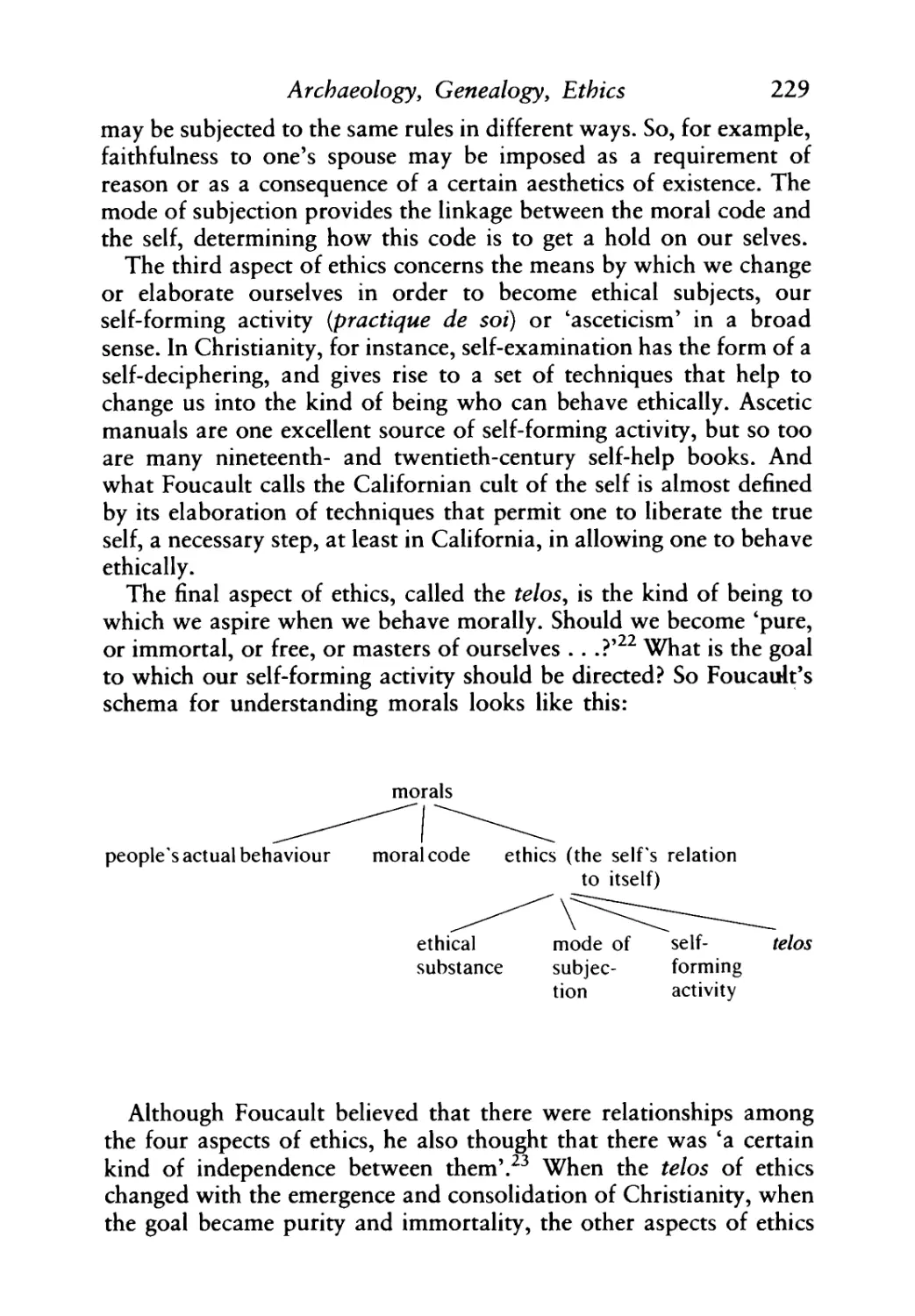


Text
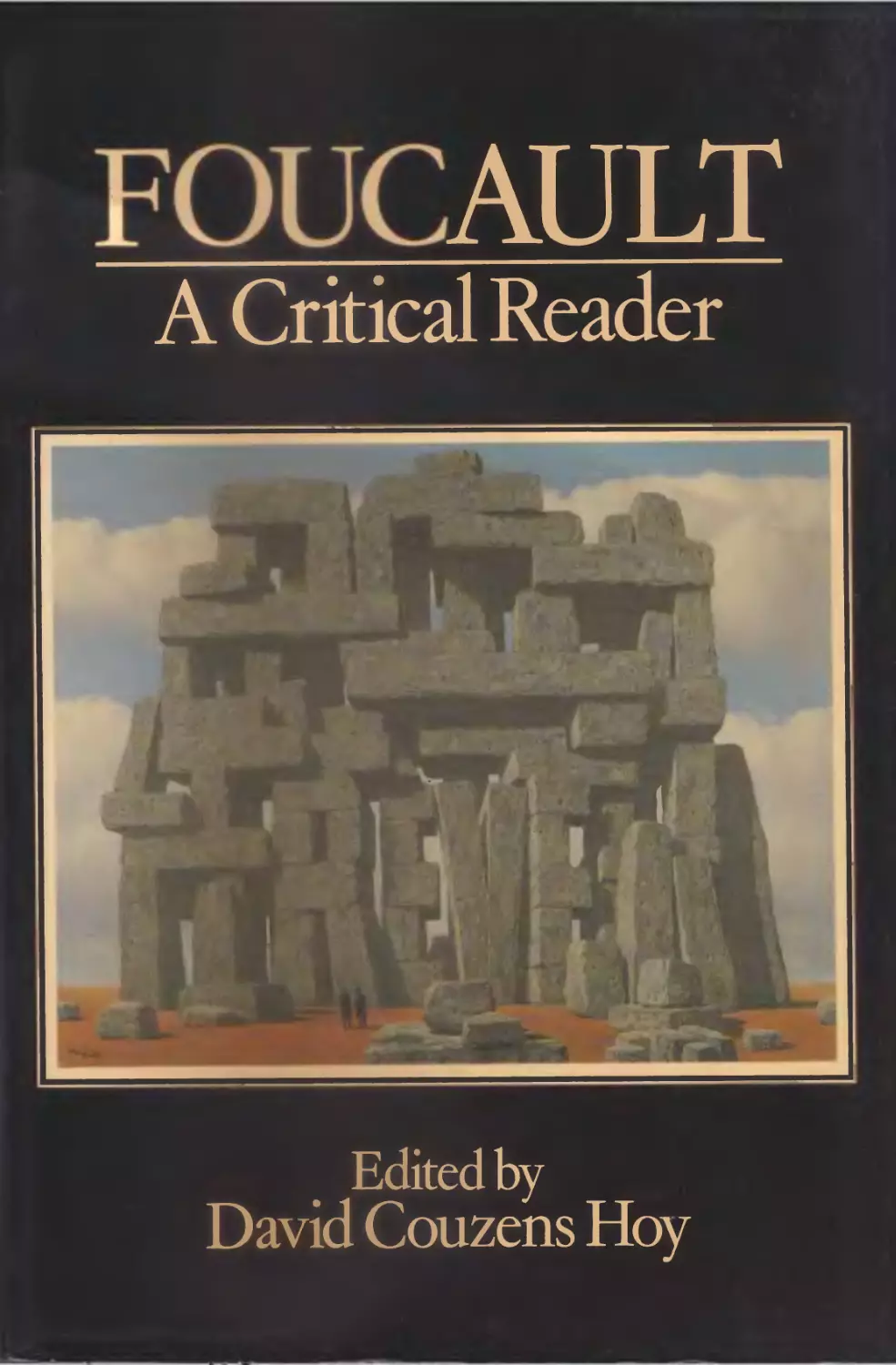
                    FOUCAULT
A Critical Reader
Edited by
David Couzens Hoy
Foucault: A Critical Reader
Edited by
David Couzens Hoy
Basil Blackwell
© Basil Blackwell Ltd 1986
First published 1986
Basil Blackwell Ltd
108 Cowley Road, Oxford 0X4 1JF, UK
Basil Blackwell Inc.
432 Park Avenue South, Suite 1503,
New York, NY 10016, USA
All rights reserved. Except for the quotation of short passages for the purposes of
criticism and review, no part of this publication may be reproduced, stored in a
retrieval system, or transmitted, in any form or by any means, electronic,
mechanical, photocopying, recording or otherwise, without the prior permission
of the publisher.
Except in the United States of America, this book is sold subject to the condition
that it shall not, by way of trade or otherwise, be lent, re-sold, hired out or
otherwise circulated without the publisher’s prior consent in any form of binding
or cover other than that in which it is published and without a similar condition
including this condition being imposed on the subsequent purchaser.
British Library Cataloguing in Publication Data
Foucault: a critical reader.
1. Foucault, Michel
1. Hoy, David Couzens
194 B2430.F724
ISBN 0-631-14042-5
ISBN 0-631-1403-3 Pbk
Library of Congress Cataloging in Publication Data
Foucault : a critical reader.
Includes index.
1. Foucault, Michel. I. Hoy, David Couzens.
B2430.F724F68 1986	194	86-6786
ISBN 0-631-14042-5
ISBN 0-631-14043-3 (pbk.)
Typeset by Alan Sutton Publishing, Gloucester
Printed in Great Britain by Butler & Tanner Ltd, Frome and London
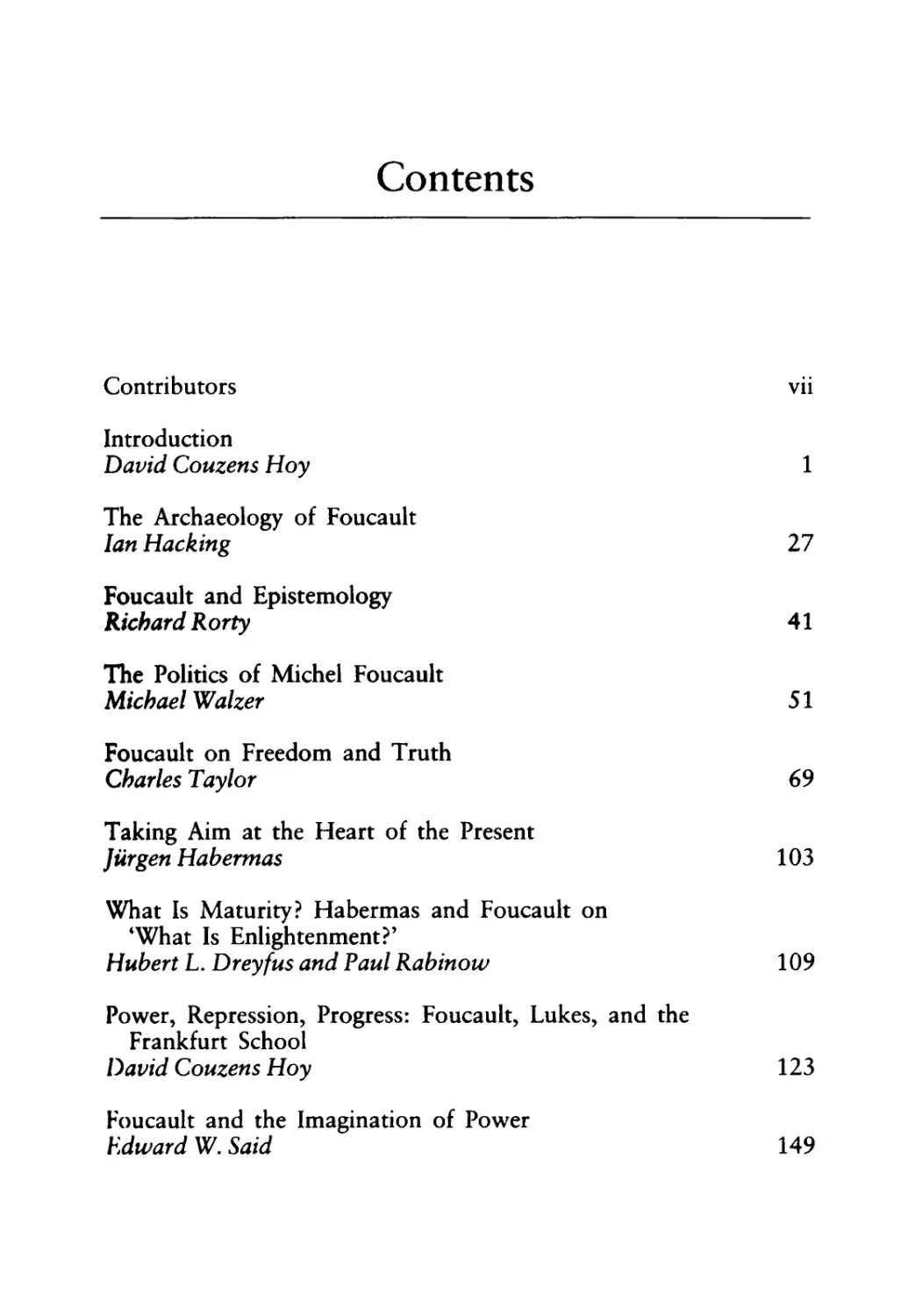
Contents
Contributors	vii
Introduction
David Couzens Hoy	1
The Archaeology of Foucault
Ian Hacking	27
Foucault and Epistemology
Richard Rorty	41
The Politics of Michel Foucault
Michael Walzer	51
Foucault on Freedom and Truth
Charles Taylor	69
Taking Aim at the Heart of the Present
Jurgen Habermas	103
What Is Maturity? Habermas and Foucault on
‘What Is Enlightenment?’
Hubert L. Dreyfus and Paul Rabinoiv	109
Power, Repression, Progress: Foucault, Lukes, and the
Frankfurt School
David Couzens Hoy	123
Foucault and the Imagination of Power
Edward W. Said	149
vi
Contents
The Politics of Truth and the Problem of Hegemony
Barry Smart	157
In the Empire of the Gaze: Foucault and the Denigration
of Vision in Twentieth-century French Thought
Martin Jay	175
Foucault and the Tyranny of Greece Mark Poster	205
Archaeology, Genealogy, Ethics Arnold I. Davidson	221
Self-Improvement Ian Hacking	235
Index	241
Contributors
Arnold L Davidson, Professor, Committee on the Conceptual Foun-
dations of Science and Department of Philosophy, University of
Chicago
Hubert L. Dreyfus, Professor, Department of Philosophy, University
of California, Berkeley
Jurgen Habermas, Professor, Department of Philosophy, Johann
Wolfgang Goethe University, Frankfurt-on-Main
Ian Hacking, Professor, Institute for the History and Philosophy of
Science and Technology, Victoria College, University of Toronto
David Couzens Hoy, Professor, Board of Studies in Philosophy,
University of California, Santa Cruz
Martin Jay, Professor, Department of History, University of
California, Irvine
Mark Poster, Professor, Department of History, University of
California, Berkeley
Paul Rabinow, Professor, Department of Anthropology, University of
California, Berkeley
Richard Rorty, University Professor of Humanities, University of
Virginia
Edward W. Said, Parr professor of English and Comparative Litera-
ture, Columbia University
Barry Smart, Department of Sociological Studies, University of
Sheffield
Charles Taylor, Professor, Departments of Philosophy and Political
Science, McGill University
Michael Walzer, Professor, School of Social Science, Institute for
Advanced Study, Princeton, New Jersey
Introduction
DAVID COUZENS HOY
The life of the mind requires controversy, and the essays in this book
confront the issues provoked by the work of Michel Foucault. Early
plans for this collection called for critical essays ranging from
quarrels over particular claims to attacks on his entire position. Many
books on Foucault were appearing, but they were often interpretative
in character. Combating misunderstandings of Foucault’s sometimes
difficult texts and accounting for his apparent changes are, of course,
necessary first steps in interpreting him fairly. Beyond questions in
interpretation, however, are questions about the validity of his ideas
and the coherence of his position. The idea for this reader was to
gather essays representing careful counterarguments to Foucault’s
own theses, or assessments of his thought by other contemporary
thinkers with their own visions. The essays by Michael Walzer and
Charles Taylor are paradigms that gave shape to the initial project.
When Foucault was still alive such an anthology could have
included a response by Foucault to his critics. Excellent examples of
how productive this kind of exchange can be are the rejoinders by
Jurgen Habermas to his critics in Habermas: Critical Essays and
Habermas and Modernity.1 With Foucault’s death, however, plans
for this book had to be changed. Since he could no longer respond for
himself, the collection was broadened to include some more
sympathetic readings of his works as well. For the sake of fairness the
book now includes essays that are useful in rebutting some common
criticisms by showing that his ideas are not what the standard
objections assume them to be. In soliciting new pieces for this reader,
I asked for critical discussions of Foucault, but left decisions about
the tone, content, and stance of the essays to the discretion of the
contributors. In this introduction I shall review some of the main
criticisms of Foucault’s method and sketch a potential line of rebuttal.
2	David Couzens Hoy
My remarks do not substitute for a close reading of these rich essays,
but they may convey the problems confronting critical readers of
Foucault now that he is unable to provide his own rejoinders.
Self-criticisms
The task of giving critical assessments of Foucault is particularly
difficult in that his career as an author shows him covering an
astonishing range of topics. As he moves from one topic to another,
however, his methods and purposes seem to change. So there may not
be a single ‘Foucault’. Critics must first be interpreters, and criticisms
of a particular aspect of his thought may not count against, or may
even be obviated by, other aspects.
Some commentators deal with these changes of direction by
identifying various periods in Foucault’s development. Foucault
himself continually reflects on his own development and offers his
own interpretations of it, often with honest self-criticisms. Not all
these self-interpretations seem readily compatible, however. For
instance, in 1961 Foucault described his project in Madness and
Civilization as an analysis of experience: ‘We must try to return, in
history, to that zero point in the course of madness at which madness
is an undifferentiated experience, a not yet divided experience of
division itelf.’2 By the end of the 1960s Foucault was decrying any
such attempt to recapture a ‘zero point’ of human experience.3 A
search for origins smacks of anthropologism, the empirical belief in a
conceptual abstraction called ‘man’. He sees linguistics as one human
science that detaches itself from the assumption that it is uncovering
the essence of ‘man’ by studying language. Structuralist linguistics
manages instead to perceive that ‘things attain to existence only in so
far as they are able to form the elements of a signifying system’.4
Foucault then seems to build this linguistic nominalism into his own
conception of archaeological method, creating difficulties I shall
describe shortly.
By the middle of the 1970s, however, Foucault no longer
understands himself as theorizing about discourse exclusively. He
focuses instead on practices, both discursive and nondiscursive. His
central topic becomes what he calls power/knowlege. Reflecting on
his earlier works in an interview from 1977, he remarks, ‘When 1
think back now, I ask myself what else it was that I was talking about,
in Madness and Civilization or The Birth of the Clinic but power?’5
Introduction
3
In 1981, however, the notion of power is displaced. ‘The goal of
my work during the last twenty years,’ he says, ‘has not been to
analyse the phenomena of power, nor to elaborate the foundations of
such an analysis.’6 What replaces it? In the preface to one of his last
publications, the second volume of his History of Sexuality, Foucault
maintains that what he has always been interested in after all is
experience. Admitting that his earlier conception of experience in
Madness was ‘floating’, he now defines it by specifying three levels
that he thinks any historian could study, although the levels
correspond to what others might consider three distinct periods of his
own development.7 The three levels making up historically concrete
human experience are first, a field of knowledge with concepts,
theories, and diverse disciplines; second, a normative collection of
rules (for instance, those operant in distinguishing the permitted and
the forbidden, the normal and the pathological, or the decent and the
indecent); and third, a mode of relation to oneself (for instance, by
which one recognizes oneself as a sexual subject among others). These
three levels can be found together in any of his works, but the study of
the asylum focuses on the first, the study of the prison on the second,
and the later volumes of the history of sexuality on the third.
The Limitations of Archaeological Epistemology
Arnold Davidson provides us here with a reading of how Foucault’s
three levels of analysis, archaeology, genealogy, and ethics, fit
together in a complementary way. Davidson argues for the
Compatibility of the two methods of archaeology and genealogy,
Citing Ian Hacking’s description of Foucault’s method in the first
eiiay of this collection. Hacking was instrumental in bringing
Foucault to the attention of other North American philosophers.
Foucault according to Hacking is not defending some irrationalist
theory of truth, but is more usefully studying the empirical conditions
under which scientific statements come to be counted as potentially
true or false.8
While Richard Rorty agrees with Hacking that Foucault can avoid
Ntandard epistemological pitfalls, Rorty prefers to see Foucault as
avoiding epistemology altogether.9 Rorty thinks that Foucault’s
Archaeology of Knowledge is a mistaken attempt to make archae-
ology the successor subject to epistemology. Describing without
Commending the Nietzschean turn of the later Foucault away from
4	David Couzens Hoy
the search for a theory of knowledge, Rorty suggests that the maxims
of genealogy are negative rather than positive. The maxims are simply
injunctions to the critical historian not to believe that history as a
whole is inherently characterized by progress, or rationality, or
teleology, or freedom, or necessity. Rorty undercuts standard worries
about the epistemological implications of Foucault’s theory and
method by suggesting that since these maxims are purely negative,
they do not constitute either a theory or a method.
Davidson’s reading contrasts to that of Hubert Dreyfus and Paul
Rabinow in their comprehensive and indispensable book on
Foucault.10 Like Rorty, Dreyfus and Rabinow see The Archaeology
of Knowledge as an aberration and they stress its philosophical
difficulties. Their confrontation with these problems leads their
reading to bring out the discontinuities between Foucault’s various
turns, although in the end they think that he is successful in
formulating a coherent method for cultural analysis that they call
interpretive analytics.
Whereas those who are more critical of Foucault might take the
shifts in Foucault’s self-understanding as vacillations, the book by
Dreyfus and Rabinow shows Foucault learning from his mistakes as
he follows a central theme. Throughout his career he continually
investigates both how human beings constitute themselves as subjects
and how they treat one another as objects. Citing Foucault’s own
description of his project as a slalom, Dreyfus and Rabinow
emphasize in particular the difference between his quasi-structuralist
insistence during the late 1960s on the autonomy of discourse in The
Order of Things or The Archaeology of Knowledge and his
poststructuralist focus in the 1970s in Discipline and Punish on how
social practices condition cognitive discourse. They see the mistake of
the Archaeology, on Foucault’s own admission, to be the tendency to
treat language as autonomous and as constitutive of reality.
Vestiges of idealism lurk in the structuralist suggestion that
discourse organizes not only itself but also social practices and
historical epochs. While critics of Foucault were attacking his alleged
linguistic idealism, Foucault continued to work on his real concern,
which was not to prove the autonomy of language. Since he never
thought of language as a subjective or mental phenomenon, both
structuralism and philosophical idealism, with thoir postulation of
universally constitutive categories, were foreign to his central
purpose. For Dreyfus and Rabinow, Foucault’s intention was to show
instead that the human subject is not given with permanent structures
Introduction	5
that constitute or condition reality, but is produced historically from
its social world.
Discipline and Punish surprised many because it seemed to be
admitting that discourse did not constitute social reality. Instead,
discursive knowledge is shown to be produced in the service of an
expanding social power that increasingly penetrates modern insti-
tutions like prisons, armies, schools, and factories. Discourse is now
recognized to be a social practice itself, and Dreyfus and Rabinow
believe that Foucault correctly comes to see that the background of
social practices can never be completely articulated. Foucault thus
rejects the holism essential to idealism, and opposes the traditional
philosophical goal of constructing a total theory that can explain the
entire social reality.
Dreyfus and Rabinow argue that Foucault’s later studies of social
power represent the development of a method that avoids idealism
and holism more successfully. On their account, genealogy or ‘inter-
pretive analytics’ meets the difficulties that plague Foucault’s archae-
ological suspension of disbelief while investigating the history of the
human sciences. The weakness of Foucault’s structuralist period is
that his insistence on the radical discontinuities between autonomous,
•elf-referential discourses makes it impossible for him to say how
social change, including social improvement, could come about, or
why anyone should care. Archaeology seems to some critics to
relativize knowledge to whatever discourse happens to be spoken at a
particular time, and to deny that there is anything like serious truth.
The problem persists. Whereas Hacking and Rorty offer accounts
of how Foucault can avoid the charge of epistemological relativism,
Charles Taylor argues that Foucault never succeeds in thinking
through his paradoxical stance on truth. The difficulty is, as presented
by Dreyfus and Rabinow in their book, that the archaeologist seems
to be trying to believe that those who entertain serious beliefs or
engage in serious argument never do so except under illusion.11
Foucault’s archaeological method gives the impression of nihilistic
non-seriousness insofar as it makes truth relative to an archive or
episteme^ that is, to what in the Anglo-American philosophical
vocabulary could be called a scientific paradigm or conceptual
framework. Since these are subject to abrupt, unexplainable changes,
discourses and truth seem historically relative, and perhaps even
arbitrary.
As supposedly true descriptions of past discourses, the archae-
ologist’s own utterances have to except themselves from this
6	David Couzens Hoy
relativity, producing Foucault’s contradictory attitude as he shifts
from the stance of the disinterested, objective historian to that of the
partisan, engaged social critic. The archaeologist cannot criticize either
past or present discourses by appealing to truth and falsity. Archae-
ology is designed to avoid the Whiggish assumption of the necessary
superiority of later theories (for instance, our own) over earlier ones.
A historian’s method, archaeology shuns the scientific-realist view
that this superiority results from the deliberate replacement of the
earlier, false theory by a later, true one in a cumulative progression
toward a clearer picture of things as they really are.
Foucault also wishes to use archaeology to show that humanistic
sciences of ‘man’ are warped and twisted forms of reflection.
Commentators have been struck by the extent to which his method is
equivalent to the procedure whereby certain historians of science
identify a research programme as reaching a point of stagnation or
even degeneration when the programme declines into repetitive
reassertion of its own earlier discoveries or mere redescription of
competitors’ discoveries. This approach invites objection, however,
when used as a tool not only for historiographical research but also
for contemporary social criticism. The social critic who treats the
present as already past must pretend either to transcend any given
historical standpoint or to speak from a fictitious future. The
historian can show a research programme to be degenerative when no
one, or only a few, still pursue it earnestly. Yet if almost everyone is
still talking in the vocabulary of modern enlightenment humanism,
and arguably ought to continue to do so, then the identification of
that discourse as degenerating can result only by projecting backward
from an as yet fictitious future standpoint. The archaeologist may be
correct in believing that people will not always talk as we now do, but
in the absence of any analysis of how they will talk (and of how we
could understand them), the critique of current ^humanistic discourse
is empty.
Power Struggles
As an antidote to these epistemological problems Foucault develops
and applies his method of genealogy by writing what Nietzsche calls
critical history and Foucault labels ‘history of the present’. Genealogi-
cal historiography generates its own problems, however, when the
polemic turns political. Unlike the neutral, disinterested, archae-
Introduction
7
□logical historian, the Nietzschean genealogist admits the polemical
interests motivating the investigation and critique of the emergence of
modern social power. No longer claiming to be archaeologically
outside the social practices being analysed, genealogy takes the
practices seriously and does not deny the need to rectify the
malignancies it diagnoses. Physician rather than philosopher,
Foucault as genealogist lets his histories tell their own story.
More problematically, however, he also lets the patients themselves
decide both the veracity of his diagnosis and the cure. Foucault’s
continued refusal to specify either a prescription or a prognosis for
the social illness he diagnoses suggests to some readers that genealogy
is as unserious and irresponsible as archaeology. Genealogy may be a
better model of social analysis, since it permits social change to be at
least contemplated. Nevertheless, whether genealogy can go beyond
mere contemplation to active advocacy of social change is not clear.
Unlike archaeology, which avoids causal explanation of social change
by restricting itself instead to the identification of self-contained
discourses demarcated by abrupt discontinuities, genealogy can pay
attention to gradual, continuous processes of social change. Gen-
ealogy charts the emergence and growth of social institutions as well
as the social-scientific techniques and disciplines that reinforce spe-
cific social practices. Although his genealogical histories thus have the
advantage of being less static by focusing more on continuous
emergence than on discontinuous ruptures, Foucault still wishes to
avoid the use of certain causal explanations in historiography. His
history of the prison is thus a reworking of an earlier one by two
members of the Frankfurt School, Rusche and Kirchheimer, whom
Foucault criticizes for relying on quasi-materialist explanations of the
emergence of the prison as a causal result of underlying economic
forces. For Foucault such explanations are inadequate because they
do not explain in a sufficiently detailed way the techniques and
changes that occur without being directly correlative to other social
and economic changes. He therefore thinks his model is a better
analytic tool, but can he wield it critically?
The use of functional rather than causal explanation standardly
leads to consequences Foucault himself would not accept. Foucault’s
model for analysing ‘systems’ of thought seems to borrow from
sociological functionalism, which sees social life as systematically
interconnected, such that change in any part affects every other part
and reconfigures the whole. Since each part of the social system thus
appears indispensable, functionalism can lead to political
8	David Couzens Hoy
conservatism. Functionalist explanations may imply either that the
whole is so powerful that attempts to bring about social
improvements by particular reforms will inevitably fail, or that the
existent social institutions must be preserved since they are at least
better than the social chaos that might result from efforts at social
transformation.
Among the prominent critics who think Foucault gets trapped in
his methodological strategy are Jurgen Habermas, Michael Walzer,
Steven Lukes, Charles Taylor, Fredric Jameson, and Clifford Geertz.
Habermas’s philosophy is the most serious challenge to Foucault’s
enterprise in Europe today. The short article published here is an
encapsulated statement of Habermas’s interpretation and critique of
Foucault, which is argued more extensively in chapters 9 and 10 of
Der philosophische Diskurs der Moderne. Habermas contends that
Foucault’s critique of modernity fails because Foucault loses his sense
of direction. This loss occurs because Foucault is both a ‘crypto-
normativist’ and an ‘irrationalist’. The former label applies because
Foucault cannot explain the standards Habermas thinks must be
presupposed in any condemnation of the present. Habermas cites
Nancy Fraser’s pointed questions, ‘Why is struggle preferable to
submission? Why ought domination to be resisted? Only with the
introduction of normative notions of some kind could Foucault begin
to answer this question. Only with the introduction of normative
notions could he begin to tell us what is wrong with the modern
power/knowledge regime and why we ought to oppose it.’12 Foucault
inherits the appellation of ‘irrationalist’ because of Nietzsche’s influ-
ence. Whereas the early Foucault echoes Nietzsche’s critique of the
will-to-knowledge, Habermas thinks the later Foucault is forced by
the resultant epistemological paradox to avow the will-to-knowledge
after all.
The dispute between Habermas and Foucault turns on whether
Foucault is understood to be criticizing modernity from a postmodern
or a premodern perspective.13 Habermas is willing to defend his own
reconstruction of the progressive presuppositions of the modern
enlightenment tradition against those critics of modernity whom he
considers to be anti-modern because of the reactionary implications
of their views, however radical they may seem. In an earlier essay he
associates Foucault with such a group:
The Young Conservatives recapitulate the basic experience of aesthetic
modernity. They claim as their own the revelations of a decentered
Introduction
9
subjectivity, emancipated from the imperatives of work and usefulness,
and with this experience they step outside the modern world. On the
basis of modernistic attitudes, they justify an irreconcilable anti-
modernism. They remove into the sphere of the far away and the
archaic the spontaneous powers of imagination, of self-experience and
of emotionality. To instrumental reason, they juxtapose in manichean
fashion a principle only accessible through evocation, be it the will to
power or sovereignty, Being or the dionysiac force of the poetical. In
France this line leads from Bataille via Foucault to Derrida.14
From Habermas’s perspective Foucault’s belittling of the progressive
character of modern enlightenment and rationality is mistaken. He
thinks Foucault’s generalization of panoptical or conformist forces to
the entire process of the modernization of society is false.15 Also, by
ignoring the progress achieved through the modern guarantees of
liberty and legality, Habermas thinks that Foucault fails to see clearly
that the real problem is that the legal means for securing freedom also
endanger it. Finally, Foucault’s attacks on the human sciences for
being unconsciously manipulative and thus uncritically co-opted are
out-of-date since for Habermas these fields are genuinely her-
meneutical and critical by the 1970s.17
In their response to Habermas here, Dreyfus and Rabinow, whose
interpretation Habermas cites in presenting his account of Foucault’s
development, argue that Habermas nevertheless misrepresents
Foucault. They object to classifying Foucault with those whom they
call anti-thinkers, and thus to representing Foucault as someone who
is necessarily opposed to all features of the enlightenment tradition.
Richard Rorty’s piece also takes issue with Habermas’s critique of
Foucault. He sees Foucault’s critical histories as correctly subverting
the quasi-metaphysical comfort implied by Habermas’s argument for
the necessity of presupposing convergence in the long run on the
rational standards of an ‘ideal speech community’.
In contrast to Rorty, Dreyfus, and Rabinow, Martin Jay’s subtle
analysis of Foucault suggests a different way of pursuing lines of
criticism motivated by Habermas’s philosophy. Our foremost histo-
rian of the Frankfurt School, Jay offers a detailed critique of Foucault
in the epilogue to his impressive recent book, Marxism and Totality:
The Adventures of a Concept from Lukdcs to Habermas (Berkeley:
University of California Press, 1984). The present article is a gen-
ealogy of Foucault’s own genealogy, studying how Foucault’s corpus
fits into and continues twentieth-century French philosophy’s
troubled and sometimes unconscious denigration of the privilege given
10	David Couzens Hoy
by the philosophical tradition to vision. The essay represents
independent evidence for Habermas’s suspicion that such an
investigation would show how Foucault fails, in Jay’s words, ‘to see’
beyond the horizon of his own episteme and question the premises
and implications of the ‘anti-ocular counter-enlightenment’.18
Michael Walzer’s article is a good place to start for the reader who
wants a clear and incisive representation of the social and political
issues more from an Anglo-American perspective. Walzer begins by
accusing Foucault’s account of being inadequate on empirical
grounds. Foucault is said to underestimate the difference between
being in prison and being out of it in a carceral society, or between
being in a carceral yet social democratic society and being in a Gulag.
But finally Walzer maintains that the problem is more serious, and
that Foucault’s political epistemology is simply incoherent. Foucault
calls for resistance but offers no account of what would constitute
good reasons both for criticizing that which is to be resisted and for
explaining how it should be resisted: ‘Foucault believes that truth is
relative to its sanctions and knowledge to the constraints that
produce.it. There would appear to be no independent standpoint, no
possibility for the development of critical principles.’19
This last sentence illustrates the belief of many of Foucault’s critics
that critical principles can be developed only from a standpoint
independent of the social one being criticized. By denying the possibil-
ity of an independent standpoint, Foucault appears to such critics to
be not simply a functionalist, but a nihilistic, fatalistic one. Thus
Walzer interprets Foucault as a functionalist who presupposes that
society is a whole governed by an invisible hand rather than by an
accountable, legitimate state power and a rational rule of law. As an
anarchist, Foucault is said to disavow any political structure but also
any human nature that could persist without social systems. So
Foucault seems to believe that social improvement is impossible short
of abolishing modern society altogether. But Walzer thinks that this
radical abolitionism is nihilistic because ‘either there will be nothing
left at all, nothing visibly human; or new codes and disciplines will be
produced, and Foucault gives us no reason to expect that these will be
any better than the ones we now live with. Nor, for that matter, does
he give us any way of knowing what “better” might mean.’20
Other critics stress particular aspects of this line of criticism.
Steven Lukes thinks that Foucault treats power exclusively as an
impersonal, deterministic structure and thereby fails to explain how
power is exercised by individuals who bear the responsibility for their
Introduction
11
actions.21 Although Charles Taylor does not share Lukes’s
conception of power as ‘power-over’, he too objects to Foucault’s
conception of power. For Foucault social power is intentionality
without a subject, a phrase that sounds as if he were talking about
purposefulness without purpose, or action without agency. Taylor
agrees that the patterns of human action do not have to be explained
as the direct, intended results of conscious willing, but he argues that
the patterns nevertheless have to be intelligibly related to conscious
action, even if only indirectly. He maintains that Foucault’s
explanations fail to satisfy the latter condition.22
Foucault’s deliberate attempt to avoid writing teleological histories
of human purpose may backfire in rhetorical as well as conceptual
ways. Genealogy is supposed to be an antidote to the histori-
ographical method of writing about history as if it were a Kantian or
Hegelian story about the progress of freedom in the world. Yet
Clifford Geertz believes that in reading Discipline and Punish ‘we
seemed to be faced with a kind of Whig history in reverse — a history,
in spite of itelf, of the Rise of Unfreedom’.23 If Foucault’s project is to
do social criticism without appealing to a utopian, teleological
philosophy of history, his use of the rhetoric of negative or dystopian
functionalism is paradoxical. While dystopian stories can be told to
counter the belief in utopias, they are equally as mistaken as the
Utopian stories if the goal is to avoid all stories about where history as
a whole is going. Furthermore, the reverse Whiggish narrative has a
decided moral or practical disadvantage when contrasted to the
progressive narrative. The story of the inevitable slide into catas-
trophe evokes attitudes of fatalism and quietism, which make social
criticism pointless since individual agents are helpless to rectify the
resented social practices and institutions.
Other critics have noted that Foucault’s rhetoric often conflicts
with his more considered articulation of his method. Fredric Jameson
argues that Foucault is trapped in a rhetorical strategy that Jameson
identifies as a ‘“winner loses” logic’:
What happens is that the more powerful the vision of some increasingly
total system or logic — the Foucault of the prisons book is the obvious
example - the more powerless the reader comes to feel. Insofar as the
theorist wins, therefore, by constructing an increasingly closed and
terrifying machine, to that very degree he loses, since the critical
capacity of his work is thereby paralyzed, and the impulses of negation
and revolt, not to speak of those of social transformation, are
increasingly perceived as vain and trivial in the face of the model itself.24
12	David Couzens Hoy
Foucault’s texts often call for resistance to the exercise of power, and
genealogy as a method should be used to disrupt the complacent
tendency to assume that the generally progressive character of present
society justified its shortcomings, or at least makes its dangers less
urgent. Yet his rhetoric suggests to some that he is only displacing one
form of invisible hand explanation with another, when his intention is
to avoid any explanations that are incompatible with the form of
resistance represented by the critical use of genealogy in writing
histories of the present.
Political Differences
As archaeology gives up the contrast between true and false, genealogy
remains peculiarly silent about the distinctions between liberty and
power or the just and the unjust. Political theorists like Walzer and
Taylor think that Foucault’s social criticism tacitly presupposes the
ideals of freedom, truth, justice, and progress that he discounts.
Foucault’s line of response has been the indirect one of denying that he
either is or needs to be a political theorist. Not a political theorist but
instead a critical historian, his interests are different, and require no
political self-justification.
As a historian he has been trying to locate cases where these
traditional ideals have served only as empty notions blinding humani-
tarian theorists to the historical reality of the spread of oppressive and
conformist tendencies in modern societies. He discounts these values
because he is looking at another level than that usually addressed by
political theorists, who are concerned more with principles that
individual and collective agents can explicitly espouse and deliberately
pursue. Broad, impersonal social and historical developments may
have little direct connection with what agents choose to do or what
they think they are doing. As a historian of movements of longer
duration, Foucault’s scope of analysis may not seem to include factors
that individuals could normally take into account in formulating their
own plans of action.
Thus his history of the birth of modern prisons and the extension of
the ‘carceral’ system to other institutions suggests that the spread of
this system throughout the social fabric is accompanied by a
corresponding moulding of people into ‘normal’ as opposed to
‘abnormal’, ‘delinquent’, or ‘deviant’ individuals. He calls this process
‘normalization’, and means by it the imposition of a model of well-
Introduction
13
ordered human activity on all aspects of social life. Foucault plays on
two different but related senses of ‘discipline’ to suggest that the social
process of inculcating discipline into individuals through the homo-
genizing techniques used in prisons, armies, and schools develops
hand in hand with the scientific disciplines required to acquire knowl-
edge about human social life.
He is clearly critical of the progress of this social cancer, and calls his
book a ‘history of the present’ to admit frankly that the account is not
a neutral, objective description, but is intended to subvert and disrupt
the growth of this malignancy. Yet his critics believe that he fails
insofar as he has no social alternatives to offer, and no moral or
political standards on which to base his angry charge that modern
society is becoming more and more like a prison, however progressive
and benevolent it appears to those who have let themselves be
successfully normalized. Given his injunction that genealogy can work
only within a given social context, how can he regret the increasing
normalization of society? Does his genealogical method prevent him
from arguing either that the past was any better, or that the future
should be different?
Respondents for Foucault think that such charges may be off-target.
Barry Smart gives a broad, social scientific context for understanding
Foucault on power in his lucid book, Foucault, Marxism and Critique
(London: Routledge & Kegan Paul, 1983). In his article written for the
present volume Smart extends his project to consider similar points of
comparison between Foucault and Gramsci. Gramsci also figures in
Edward Said’s article, which adds a crucial supplement to Said’s
influential earlier analysis of the divergent implications for literary
theory of the approaches of Foucault and Derrida.25 Both Said and
Smart wrestle with the difficulty that Foucault describes power as so
pervasive and irresistible as to make resistance seem futile.
Foucault’s critics have grounds for their readings and are right to
attack his often incautious statements in interviews. Even his more
considered methodological self-justifications may not be the best
interpretation of his enterprise. So interpreters who think that
criticisms, however justified by Foucault’s own remarks, do not
capture what is most interesting about Foucault’s approach to social
criticism have to propose their own readings of his method and results.
One line of defence I can suggest is to argue for genealogy as a
plausible method of immanent social criticism, one that can work
without presupposing an independent, utopian standpoint. As a
genealogist Foucault is able to diagnose the organizing trends of our
14	David Couzens Hoy
culture only because he, too, is subjected to them. If he is, then so are
others. Borrowing from Nietzsche, his method is not to construct an
alternative model, but to get us to recognize his frustration and
resentment, and thereby the motivation for criticism of the present, in
ourselves as well. Foucault paints the picture of a totally normalized
society, not because he believes our present society is one, but because
he hopes we will find the picture threatening. He could hope for this
effect on us only if we have not been completely normalized.
As someone who rejects holism and the ideal of totalization,
Foucault probably also believes that it does not even make sense to
speak of society as entirely normalized, since there is no theoretical
standpoint from which this claim could be defensibly asserted. He
knows full well that his dissenting voice is a counterexample to his own
suggestion that the entire social body has become subjected to carceral
techniques and normalizing tendencies. He believes that the resistance
to social developments can come only from within the society and from
those places that have not been fully co-opted. His point is therefore
that if, counterfactually, it could be said that the social normalization
were total, then there would be no grounds for social criticism. There
would be no way that the members of such a society could see
themselves any differently from the way they were. Their perspective
might seem disturbingly indistinguishable from that of real historical
groups who show no understanding for and toleration of social
differences. The ideal of the normalized society thus seems inhuman to
us now. This recognition would justify Foucault’s genealogical method
of searching for normalization’s insidious workings, however one
might feel about the plausibility of his empirical analysis of them.
From Power to Ethics
Even if the interpretations more sympathetic to Foucault clarify his
analysis of social power, his later work on the history of sexuality and
the formation of the self adds further complexity, but also £ further line
of self-defence. Should we think that as a result of criticism Foucault
learned that his approach to studying power was a blind alley, as
Habermas thinks? Is his interest in human subjectivity and selfhood,
traditional concerns of French philosophy before the linguistic turn of
structuralism and poststructuralism, inconsistent with the methods of
archaeology and genealogy? Is his return to the theme of the self a
welcome advance or a defensive retreat?
Introduction
15
However one interprets the last turn in Foucault’s career,
independent assessments can be given of his unfinished studies of a
level of ethics below that usually studied by moral philosophers.
Professors Hacking and Davidson argue for the value of this move
beyond the study of power to the history of ethical self-
understandings, and they do not see it as inconsistent with the best
aspects of his earlier work. A dissenting voice providing a different
assessment of the studies in volumes 2 and 3 comes from the historian
Mark Poster, whose book Foucault, Marxism and History interprets
Foucault as Marx without metaphysics.26 With Foucault’s shift from
modern power to ancient and medieval ethics, he moves away from the
preoccupations of social theorists to what may seem like arcane
philological studies. Without the volumes that would tie the studies to
the present, the effort might be said to fall short of being another
genealogical ‘history of the present’ that effectively disrupts current
beliefs and practices.
The posthumous publication of remaining materials in another
volume of the History of Sexuality could still affect these assessments.
The available writings can serve, however, as a sketch of an argument
that Foucault’s genealogical method is not inherently functionalistic,
nihilistic, fatalistic, or relativistic. The topics of some of his appli-
cations of the method may suggest these labels, but his later work
deflects them by studying a different level of human activity.
Genealogy studies how we constitute ourselves as human subjects.
For the most part this self-constitution is not the result of active,
conscious decisions, but of subliminal socialization. Like Nietzsche
who attacks the idea of a fixed human nature or essence, Foucault is
studying features of human beings that individuals generally take to be
fixed but that historical study shows to be malleable. Even the human
body (as experienced), which seems to be the lowest common denomi-
nator throughout history, is transformed over time by technologies
such as the prison system or confession or sexual mores. Incarceration
is more impersonal than confession or sexuality, since we do not do it
to ourselves voluntarily. But there is also much in our sexual self-
understanding that is not voluntary, even though to call it involuntary
would miss the extent to which we form our identities by conforming
ourselves over time to tacitly understood norms and generally
accepted practices.
By applying genealogy to the study of how sexual ethics has been
understood in different historical periods, then, Foucault no longer
sounds as if he is offering impersonal, functionalist explanations for
16	David Couzens Hoy
why people act as they do. He pays attention to the practices by which
individuals train themselves to become a certain sort of person.
Confession is one such practice that emerged from Christianity, for
instance, but Foucault also notes the less institutionalized practices
such as a husband might exercise on himself to keep himself faithful to
his wife. Unlike the prison book, then, which studies how people
constrain others, the history of sexuality studies how people constrain
themselves.
If Foucault is writing a history of ethics, however, he is not writing a
history of moral codes. Although the phenomena he is investigating
are more conscious than those studied in his prison book, they are not
fully self-conscious events such as reflections on principles for
conduct. Unlike traditional moral philosophy, Foucault’s study of
ethics is not of sets of principles that people explicitly espouse
however much they may live up to them. Unlike Kant he does not try to
ground the moral code containing explicit prescriptions or
commandments, since he thinks these do not have an interesting
history and are generally stable throughout the different historical
periods. His project owes an acknowledgement to Hegel, who criticizes
Kant for looking only at the explicit moral rules instead of at the
underlying ‘ethical substance’ that allows the moral code to function.
For Hegel and Foucault the ethical substance includes -the
background of shared understanding of what it is to belong to a
particular community and to aspire in practice to being a good person
there.
So Foucault investigates how the conception of the self changes
from the Graeco-Roman idea of taking care of the self to the
Christian goal of self-renunciation. He traces how sexual subjectivity
alters as the Greek interest in apbrodisia changes into the Christian
desire of the flesh. Both the Greeks and the Christians valued the
ascetic restraint of sexual desires, but they interpreted this asceticism
differently. For the Greeks asceticism does not mean a renunciation of
the self but instead involves de souci de soi\ the care for the self
described in volume 3. Foucault argues that Greek asceticism entails
making the self aesthetically pleasing, and his central theme in volume
3 is asceticism in the larger sense of techniques that agents practise on
themselves to make themselves into the persons they want to be. In
U Usage des plaisirs he offers evidence that sexuality is a specific
historical concept, and in particular a product of the nineteenth
century. He insists that the Greeks found sexual conduct as prob-
lematic as moderns do, but in different ways. For them it was not how
Introduction
17
or with whom one had sex that was crucial, as it supposedly is now,
but whether one was master or slave of one’s passions. So the Greeks
could not have been opposed to what came to be called perversion or
deviancy, but only to the aesthetic ugliness of any degree of physical
excess.
As I understand Foucault’s volumes on the history of sexuality, he is
presenting evidence for the plausible belief that physical events such as
bodily couplings are always understood under a particular mode of
description, however tacitly. Furthermore, this mode of description or
self-understanding will condition those physical events, such that
human action properly understood must involve the former as well as
the latter. Thus, in The History of Sexuality volume 1, Foucault
suggests that sex is not a biological given onto which types of sexuality
are somehow grafted as the result either of how the individual
personality is formed or of what is permitted culturally. Foucault
wants to get us to start thinking differently about sexuality by
suggesting that only recently has it seemed necessary to think of
human beings as if their possession of certain organs determined their
gender and behaviour, or as if sexuality and personality were totally
conditioned by particular orientations toward how these organs are
used.
In volumes 2 and 3 of the History of Sexuality, Foucault goes
beyond this critique of the modern idea of sexuality to study how
Sexual self-understanding has been different in the past. As a historian
he wants to point to a level below the explicit moral precepts or other
factors that are for the most part reflectively available to individual
agents. His investigation of the underlying background of self-
understanding is an exercise in the history of thought, but ‘thought’
for Foucault means more than what the agents might have said
explicitly about themselves.
What I am calling self-understanding for Foucault is thus not the
Name as self-consciousness. Genealogy is not a vestige of the Cartesian
philosophy of consciousness, but a historian’s tool for studying
observable manifestations of historically variable experiences of the
self. A possible source of influence on Foucault here is Heidegger, for
whom self-understanding is not revealed introspectively through
access to a private, internal domain. Instead, self-understanding is
shown in actions, and especially through patterns of action. I take
Foucault to believe that although these patterns of action may appear
to the practitioners to be coherent, intelligible, and tolerable, a critical
history shows the practices to be not as rational, inevitable, or
18	David Couzens Hoy
invariable as they are thought to be. Self-understanding is not a matter
either of biological programming or of explicit, autonomous decision
procedures. But self-understanding can be studied objectively through
a matrix of social and discursive practices. To the extent that these
practices turn out to vary historically, self-understanding will vary as
well.
Someone with more Cartesian assumptions may object that the way
individuals experience sexuality may be historically invariable, or at
least different from the way historically variable public statements and
institutions interpret it. This view presupposes, however, that there is
no connection between the true experience of the individual self and
the historian’s investigation of public, cognitive discourse about sex as
well as of social ways of recognizing its practice. The objection ignores
the argument that if experience is not a given that is then interpreted,
but is itself already interpreted, observable changes in patterns of
interpretation and action will be the same as changes in subjective
experience.
Since Foucault is focusing on processes that can be objectively
discerned even though they may never be articulated self-consciously,
he is studying a larger background that could be called the ‘system of
thought’ since it is never fully explicit. But if ‘system’ connotes a static
set of interconnected, articulatable elements and rules, this word fails
to do justice to Foucault’s historicist sense that there is change going
on all the time, and at different rates at different levels. So while the
moral precepts change slowly, the background understanding of these
rules can alter at a different pace. From the historian’s perspective
agents will understand only incompletely why they act as they do.
How individuals in one historical period understand themselves and
therefore, given Foucault’s premises, what they are doing will not be
generalizable for other times. Over time these modes of self-
understanding, and thus the experience people have, will change.
Since Foucault is now dealing with ethical issues about the
formation of values, he cannot be accused of ignoring values and being
nihilistic. Nevertheless, he still avoids constructing an independent
standpoint from which to assess the present as well as the earlier value
configurations. Since the historian is investigating different self-
understandings to which individuals have adapted themselves with
reasonable success, there is no standpoint from which to say that one
self-understanding is better or worse than another. Foucault is of
course critical of the present, and the contrast between the present and
the past serves in part to underline this criticism. Yet Foucault insists
Introduction
19
that we cannot go back to these earlier modes of understanding.
Hence, he avoids asserting that they are better or worse than our
own, since such an assertion is not really intelligible.
His implicit reasoning is, I believe, that we can genuinely evaluate
only those alternatives or options that are real or live for us. On his
analysis the ancient Greek configuration is now recognizably foreign
and remote. Contemplating its differences may help us to think
differently about elements of our own self-understanding, but we
cannot simply choose to understand ourselves and act now as the
Greeks once did. As for Christianity Foucault pointedly does not
imitate Nietzsche’s tirades, probably because Christian worries
about the flesh are no longer live options and thus do not warrant
shrill polemics. Of course, part of Foucault’s point is that the
modern understanding of sexuality (as manifested, for instance, in
psychiatry or sexual liberation movements) is suspect insofar as it
derives from Christian views about the soul and the practice of
self-confession. But Foucault also believes that the Christian and
the modern formulations for sexual comportment are incommensur-
able. The Christian formula, for example, would eradicate desire,
whereas according to the modern formula desire should be lib-
erated.
Does Foucault’s refusal to explain how to improve on the present
Suggest again the fatalistic conclusion that we cannot do anything at
all to change ourselves now? To give a history of sexuality is for him
to describe how different ages have always found sexual relations
problematic although in intriguingly different ways. So he is not
saying that we must simply reconcile ourselves to our present
conceptualization of sexuality. Resignation to the sexual status quo
would be inconsistent with his depiction of modern sexuality as being
deeply problematic for us.
Of course, seeing that sexuality was problematic for the Greeks as
well does not make our own problems go away. Since the radical
differences in the backgrounds of beliefs and practices prevent us
from adopting previous sexual self-understandings, Foucault’s
analysis of the different sexual problematics does not supply a
corrective for our own. But from that it does not follow that his
analysis has no practical, critical value for us. Although he does not
construct a totally different ideal to which we could aspire, his
history does make us more aware of the shortcomings in our own
self-understanding and practices. The imperative to change must
come from within ourselves if it comes at all. Foucault can only
20	David Couzens Hoy
hope that his historiography will help to subvert what he thinks are
our self-deceptive tendencies to deny any such imperative.
If we deceive ourselves, there must be a truth about ourselves that
we falsify. Is Foucault covertly bringing back appeals to truth
values? Whatever one thinks about Foucault’s archaeological method
for studying knowledge, the epistemological questions raised there do
not obviously trouble his analyses of ethics. That he rejects
epistemological relativism is especially apparent from his attack on
Derrida’s reading of Plato.27 Foucault believes that the method of
textual deconstruction tries incorrectly and unsuccessfully to bracket
all questions about the truth claims of texts. He does not hesitate to
claim that there are truths about how people do understand them-
selves and what sort of life they esteem. He does not address the
further question whether there are lives to which everyone
everywhere ought to aspire. As a historian he is not required to do so.
As a philosopher he could give arguments that the question is
misguided because it presupposes both an inflated conception of what
a philosophical theory of morality can establish and an inadequate
moral psychology that ignores the social and historical background
supporting the moral code.
Foucault’s efforts in working on the genealogy of ethics are thus
intended to correct what some might consider his own earlier
mistakes or what others will think to be mistaken understandings of
what he was up to all along. If his study of the emergence of
conditions for taking different factors as potentially true or false
about how human beings understand themselves is not
paradoxically relativistic, his serious interest in the cultural basis of
morality deflects as well the accusation of nihilism. Also, instead of
being a functionalist who believes that all aspects of society and
culture are tied together so tightly that no part can change or be
improved independently of all the other parts, he insists that some
aspects of the ethical substance change while others persist. Foucault
gives up the tool of hypothesizing total historical discontinuities
when it no longer has any heuristic value. As a result his account of
sexual ethics does not seem fatalistic, since individuals at this level
do have some practical capacity to influence their own self-
formation. They can try to correct and improve factors they discover
to be problematic since they can change some features of themselves
without simultaneously changing all other social and political
practices.
Introduction
21
Beyond Enlightenment?
However Foucault’s trajectory is described, and whether his genealogi-
cal method is practicable, he arrives finally at a clear philosophical
assessment of his own efforts. Oddly enough, his last formulation of
his relation to the philosophical tradition is worked out through an
interpretation of the philosopher who all along appeared to be his
antithesis. Any comparison with the unhistorical, transcendental
philosopher Kant, the defender of enlightenment belief in the
necessary progress of rationality, presumably would serve only to
highlight Foucault as an extreme representative of the anti-rationalist
counter-enlightenment.
Hilary Putnam, for instance, identifies Foucault as a relativist, and
then uses an argument from Kant to show that relativism is logically
unintelligible.28 Putnam says, for instance, that ‘Foucault is not
arguing that past practices were more rational than they look to be,
but that all practices are less rational, are, in fact, mainly determined
by unreason and selfish power.’29 So described, Foucault’s position is
self-refuting, for if every cultural standpoint, including Foucault’s, is
irrational, then there is no standpoint from which Foucault could
aaeert that every cultural standpoint is irrational. On such a view
asserting or denying anything becomes nothing more than ‘crazy
behaviour’.30
If Foucault treads dangerously close to this paradox during his
archaeological phase, he does not claim that genealogy establishes
any conclusions about the irrationality of all our beliefs and practices.
He settles for the more modest, less totalizing claim that successful
genealogies would show the irrationality only of some specific beliefs
and practices.
This clarification suggests that he does not consider himself an
enemy of enlightenment. He might not even take exception to
Putnam’s thesis, advocated also by Kant and Habermas, that we must
(for logical reasons) believe in the regulative ideal of reason or of ‘a
just, attentive, balanced intellect’.31 There may be affinities between
Kant and Foucault that are distorted by Foucault’s attack on Kantian
humanism in The Order of Things. In the last essay of this collection
Ian Hacking points out that Foucault was a ‘remarkably able
Kantian’, and that The Order of Things itself grew out of Foucault’s
plans for an introduction to his translation into French of Kant’s
Anthropologic. Hacking argues that Foucault’s notion of freedom
22	David Couzens Hoy
resembles Kant’s to such an extent that ‘those who criticize Foucault
for not giving us a place to stand might start their critique with
Kant’.32
In his last years Foucault was fascinated by Kant’s little essay,
‘What is Enlightenment?’ Instead of attacking Kant’s efforts there,
Foucault identifies that essay as giving birth to the critical tradition
that forms his own heritage. This tradition asks about the specific
features of the present that make us distinctively who we are.
Admittedly this is a different critical tradition from the principal one
of analysing the transcendental conditions for all possible experience,
as undertaken in the Critique of Pure Reason. Foucault concludes a
lecture on Kant’s enlightenment essay by remarking:
It seems to me that the philosophical choice with which we find
ourselves confronted at present is this one: we can opt either for a
critical philosophy presenting itself as an analytic philosophy of truth
in general, or for a critical thinking that takes the form of an ontology
of ourselves or an ontology of the present. The latter form of
philosophy, from Hegel to the Frankfurt School passing through
Nietzsche and Max Weber, has founded a form of reflection in which I
have tried to work.33
After having criticized Kant in The Order of Things for starting the
tradition of philosophical anthropology and thereby sanctioning the
sciences of man, Foucault returns to Kant as the originator of a
different role for philosophy. Foucault was working toward the end
of his life on an essay also called ‘What is Enlightenment?’34 Here he
insists that he is not a ‘counter-enlightenment’ thinker, if by that is
meant someone who denies that ‘we still depend in large part’ on the
enlightenment.35 Foucault recognizes that his efforts to show the
extent to which the present is historically conditioned by the
enlightenment are guided by the enlightenment’s own ‘principle of a
critique and a permanent creation of ourselves in our autonomy’.36
So while he still wishes to criticize humanism for borrowing a specific
theological and metaphysical conception of human nature, he admits
that he cannot claim to stand outside the enlightenment tradition
itself.
If he prefers to be agnostic about the possibility of the success of the
drive for enlightenment, that is because faith in enlightenment is
paradoxical for reasons he surely learned from the Dialectic of
Enlightenment by Adorno and Horkheimer. The pious belief in the
unqualified value of enlightenment contradicts the enlightenment’s
Introduction	23
own aspiration for rational autonomy. Rational autonomy is itself an
empty ideal, however, unless it is exercised critically through the
genealogical study of specific, limited historical features of ourselves.
Remaining within the enlightenment tradition does not mean that the
purpose of these specific historical inquiries should be exclusively to
preserve the ‘“essential kernel of rationality’” especially since,
Foucault now insists, this kernel ‘would have to be preserved in any
event’.37
He is thus implying that a strictly retrospective use of critical
history to justify the enlightenment would show the enlightenment to
be stagnant or even degenerating. So Foucault is not claiming that the
enlightenment tradition is dead, but only that it would die if we
stopped doing genealogical investigations that explore the
“‘contemporary limits of the necessary’”.38 To ensure the vigour of
enlightenment we should continue to question our limits, experimen-
tally pushing ourselves to think about ‘what is not or is no longer
indispensable for the constitution of ourselves as autonomous
subjects’.39
Some of his critics may think that this minimal concession to
reason does not salvage his enterprise so much as vindicate their
Objections. Others may find the call for ‘permanent critique’ either
too subversive or too empty. Foucault may be right, however, in his
Miessment of the predicament confronting any philosopher and
tocial critic today. By exemplifying that predicament and confronting
it with honest and difficult work, Foucault deserves our attention.
Given his own insistence on the continuous need for criticism, he
would not object if that attention were critical. All he would ask is
that it represent productive ‘work on our limits, that is, a patient
labor giving form to our impatience for liberty’.40
Notes
I Habermas: Critical Essays, ed. John B. Thompson and David Held
(Cambridge, Mass.: MIT Press, 1982). Habermas and Modernity, ed.
Richard J. Bernstein (Cambridge, Mass.: MIT Press, 1985).
2	Michel Foucault, ‘Preface’, Madness and Civilization: A History of
Insanity in the Age of Reason, trans. Richard Howard (New York:
Random House, 1965), p. ix.
3	See Foucault, The Order of Things: An Archaeology of the Human
Sciences (New York: Random House, 1970), p. 332.
4	Ibid., p. 382.
24
5
6
7
8
9
10
11
12
13
14
15
16
17
18
19
David Couzens Hoy
Michel Foucault, ‘Truth and Power’, in Power/Knowledge: Selected
Interviews and Other Writings 1972-1977, ed. Colin Gordon (New
York: Pantheon, 1980), p. 115.
Michel Foucault, ‘Why Study Power: The Question of the Subject’, an
afterword to Michel Foucault: Beyond Structuralism and Hermeneutics
by Hubert L. Dreyfus and Paul Rabinow (University of Chicago Press,
first edition, 1982; second edition, 1983), p. 208.
See Paul Rabinow (ed.), The Foucault Reader (New York: Pantheon,
1984), p. 336; this version of the preface to volume 2 is a different one
than was finally published in the book itself.
See Ian Hacking, The Emergence of Probability: A Philosophical Study
of Early Ideas About Probability, Induction and Statistical Inference
(Cambridge University Press, 1975), and in 1983 from the same
publisher, Representing and Intervening: Introductory Topics in the
Philosophy of Natural Science, for examples of his own approach to
the history of science.
For Rorty’s own critique of epistemology see in particular Part 3 of
Philosophy and the Mirror of Nature (Princeton University Press, 1979)
and the introduction to his Consequences of Pragmatism (Essays:
1972-1980) (Minneapolis: University of Minnesota Press, 1982).
Hubert L. Dreyfus and Paul Rabinow, Michel Foucault: Beyond
Structuralism and Hermeneutics (University of Chicago Press, 1982,
1983). I review both the first edition of this book in ‘Foucault’s slalom’,
London Review of Books, vol. 4,4-17 November 1982, pp. 18—20, and
the supplemented second edition in a survey entitled ‘After Foucault’,
London Review of Books, vol. 6,1—14 November 1984, pp. 7-9. Some
of the following remarks are anticipated in those reviews.
See Dreyfus and Rabinow, Michel Foucault (second edition), pp.
85-103.
Nancy Fraser, ‘Foucault on modern power: empirical insights and
normative confusions’, Praxis International, vol. 1 (1981), p. 238; cited
by Habermas, Der philosophische Diskurs der Moderne: Zwolf Vor-
lesungen (Frankfurt: Suhrkamp, 1985), p. 333. See her critique of my
own and other defences of Foucault in ‘Michel Foucault: a “Young
Conservative”?’ in Ethics, vol. 96 (October 1985), pp. 165-184.
See my discussion of this issue in ‘Foucault: Modern or Postmodern?’
(forthcoming in Jonathan Arae (ed.), After Foucault: Humanistic
Knowledges, Postmodern Challenges). I treat Habermas’s critique of
Foucault at greater length in my forthcoming book from Basil Blackwell,
Critical Theory, For and Against, co-authored with Thomas McCarthy.
Habermas, ‘Modernity versus Postmodernity,’ New German Critique,
no. 22 (Winter 1981), p. 13.
Habermas, Der philosophische Diskurs der Moderne, p. 338.
Ibid., p. 340.
Ibid., p. 321.
See below, p. 196.
'See below, p. 64.
Introduction
25
20
21
22
23
24
25
26
27
28
29
30
31
32
33
34
15
36
17
38
19
40
See below, p. 61.
See my discussion of Lukes and Foucault in Tower, Repression,
Progress’ (below, pp. 123 ff.) Professor Lukes plans to include this
account and a further response to Foucault’s work in his forthcoming
anthology from Polity Press entitled The Dimensions of Power.
See William E. Connolly’s rebuttal to Taylor’s critique of Foucault, and
Taylor’s rejoinder, in their exchange in Political Theory, vol. 13
(August 1985), pp. 265-85.
Clifford Geertz, ‘Stir crazy’, The New York Review of Books, 26
January 1978, p. 6, where Geertz concludes that Foucault ‘has not
escaped so completely from the vulnerable episteme of historicism as
he might like or imagine . . . But perhaps like half-revolutions, half-
escapes are enough, and will suffice. It is just such a half-escape,
whatever he intended, that makes Discipline and Punish so fascinating
. . . As with so many prisoners, of so many kinds, it is not getting out but
wanting out that generates in Foucault a strange and special vision.’
Fredric Jameson, ‘Postmodernism, or, the cultural logic of late capi-
talism’, New Left Review, vol. 147 (September 1984), p. 57.
In addition to Beginnings (New York: Basic Books, 1975), see Edward
Said, ‘Criticism between Culture and System’ in The World, the Text
and the Critic (Cambridge, Mass.: Harvard University Press, 1983).
Mark Poster, Foucault, Marxism and History: Mode of Production
versus Mode of Information (Cambridge: Polity Press, 1984), p. 159.
In addition to volume 2 of the History of Sexuality, see the interview
‘On the Genealogy of Ethics’, appended to the second edition of the
book by Dreyfus and Rabinow (pp. 245f.) and published as well in
Rabinow’s Foucault Reader (pp. 363f.).
Hilary Putnam, Reason, Truth and History (Cambridge University Press,
1981); see pp. 121, 155-62.
Ibid., p. 162.
Ibid., p. 162.
Ibid., p. 163.
See below, p. 239.
Translated from ‘Un cours inedit de Michel Foucault’, a reworked
transcription from 1983 published in Magazine litteraire, no. 207 (May
1984), p. 39.
Published posthumously in Paul Rabinow (ed.), Foucault Reader, pp.
32-50.
Foucault, ‘What is Enlightenment?’, p. 42.
Ibid., p. 44.
Ibid., p. 43.
Ibid., p. 43.
Ibid., p. 43.
Ibid., p. 50.
The Archaeology of Foucault
IAN HACKING
Power/Knowledge is a collection of nine interviews, an essay, and a
pair of lectures in which Michel Foucault tries to work out new ways
to talk about power.1 This is one more stage in a remarkable
adventure of ideas that began in the late fifties. ‘Key words’ in
Foucault’s work would be, for example: Labour, Language, Life,
Madness, Masturbation, Medicine, Military, Nietzsche, Prison,
Psychiatry, Quixote, Sade, and Sex. Be neither attracted nor repelled
by this adolescent list of topics. Foucault has an original analytical
mind with a fascination for facts. He is adept at reorganizing past
events in order to rethink the present. He engagingly turns familiar
ttuisms into doubt or chaos. Even though his present thoughts about
power and knowledge have not yet matured, they are plainly part of a
fermentation worth learning about.
What are the relationships between power and knowlege? There
are two bad short answers: (1) knowledge provides an instrument
that those in power can wield for their own ends; (2) a new body of
knowledge brings into being a new class of people or institutions that
can exercise a new kind of power. These two assertions parallel two
opposed theses about ideology: (1) a ruling class generates an
ideology that suits its own interests; and (2) a new ideology, with new
values, creates a niche for a new ruling class. Virtually nobody likes
cither side of these simple dichotomies. Foucault is one of many who
want a new conception of how power and knowledge interact. But he
is not looking for a relation between two givens, ‘power’ and
‘knowledge’. As always he is trying to rethink the entire subject
matter, and his ‘knowledge’ and ‘power’ are to be something else.
Krpnntcd with permission from The New York Review of Books. Copyright ©
I. Nyrev, Inc.
28	lan Hacking
Nobody knows this knowledge; no one wields this power. Yes, there
are people who know this and that. Yes, there are individuals and
organizations that rule other people. Yes, there are suppressions and
repressions that come from authority. Yes, the forms of knowledge
and of power since the nineteenth century have served the bourgeoisie
above all others, and now also serve a comparable class in Eastern
Europe. But those ruling classes don’t know how they do it, nor could
they do it without the other terms in the power relation - the
functionaries, the governed, the repressed, the exiled — each willingly
or unwillingly doing their bit. One ought to begin an analysis of
power from the ground up, at the level of tiny local events where
battles are unwittingly enacted by players who don’t know what they
are doing.
Now this sort of project is not novel. Foucault’s genius is to go
down to the little dramas, dress them in facts hardly anyone else had
noticed, and turn these stage settings into clues to a hitherto
unthought series of confrontations out of which, he contends, the
orderly structure of society is composed. For all the abstract schemes
for which Foucault has become famous, he is also the most concrete
of writers. He is a fact-lover. One of the interviews ends on a typical
note. He’s asked when bottle-feeding of infants was invented or at
least introduced into France. He does not know and is delighted when
his interlocutors can tell him, and at the same time curses himself for
being so dumb not to have asked the question himself.
Foucault is, then, no spinner of verbal fantasies. I enjoy his long
books rather than these short interviews just because the books are
denser with facts. The editor of Power!Knowledge is right, however,
when he says that the interviews can help us to understand the books.
The interview is a French art form used to present work in progress
which is destined, at first, for limited circulation, and which is couched
in terms suitable for discussion among one specific audience. Hence
there is a directness here that is often missing from the long and
elaborately constructed books. But Foucault’s notions of power and
knowledge are so divorced from common speech that I need to recall
how he arrived at them. His sequence of books is, despite its ups and
downs, an intellectual progress, and I shall try to describe it by way of
explaining the interviews.
Madness and Civilization was a somewhat romantic work.2 It seems
to have started with the hesitant belief, never stated, that there is a
pure thing, madness, perhaps a good in itself, which is not something
The Archaeology of Foucault	29
that we can capture in concepts. It is certainly not what the sciences of
the insane call madness. We classify and treat and put away the mad
by systems of our own creation. Our institutions create the
phenomena in terms of which we see insanity. This first major book
by Foucault hints at an almost Kantian story in which our experience
of the mad is a mere phenomenon conditioned by our thought and
our history, but there is also a thing-in-itself which can be called
madness and which is uncorruptible. Moreover reason is also only a
phenomenon whose very existence requires its opposite to define itself
against. In English the book is ironically subtitled, ‘A History of
Madness in the Age of Reason’.
By the time that the book had been written it was clear that this
romantic conception of a pure and prior madness was a mistake.
There could be no such thing as this preconceptual way of being. The
book had become a book about something else. What? That was not
so clear, at first. ‘When I think back now,’ Foucault said in a 1977
interview, T ask myself what else it was that I was talking about, in
Madness and Civilization or The Birth of the Clinic, but power?’3
The plot of the madness book, which is repeated in several of its
successors, is plain enough. There are two notable events. First comes
‘the great exclusion’ in mid-seventeenth century: a frantic locking up
of deviants and a building of lunatic asylums. Much later, at the time
of the French Revolution, there was a spurious liberation, when a
new body of psychiatric knowledge invented new ways to deal with
the insane. At least in the old asylums, Foucault suggests, the mad
were left to themselves in all the horror that implied. Yet the horror
was not worse than the solemn destruction of the mad by committees
of experts with their constantly changing manuals of nostrums.
Foucault’s stories are dramatic. He presents a reordering of events
that we had not perceived before. The effect is heightened by brilliant
before-and-after snapshots taken on either side of the great divide
during which one tradition is transformed into another. We are given
one snippet of description of a brain around 1780 and another
twenty-five years later. The very ‘same’ organ on the marble slab
plays a role in the later physiology that corresponds to nothing in
1780.
Scholars remind us that the facts are vastly more complex than what
Foucault describes. His predilection for French examples projected
onto European history leads to mistakes.4 There are two extremes of
French historiography. The Annales school goes in for long-term
30	Ian Hacking
continuities or slow transitions - ‘the great silent motionless bases
that traditional history has covered with a thick layer of events’
(to quote from the first page of Foucault’s Archaeology of Know-
ledge).5 Foucault takes the opposite tack, inherited from Gaston
Bachelard, Georges Canguilhem, and Louis Althusser. He posits
sharp discontinuities in the history of knowledge. In one interview he
grants that this obsession with breaks creates an account of knowl-
edge that fits some facts, but is not a general model. Now not only do
we find that the facts are sometimes not quite right, that they are
overgeneralized, and that they are squeezed into a model of brusque
transformations; we also find that many of Foucault’s dramas have
already been told in calmer terms, by other people.
No matter. His histories stick in the mind. We can add our own
corrective footnotes at leisure. These histories matter because they are
in part political statements. They are also what I call philosophy: a
way of analysing and coming to understand the conditions of
possibility for ideas — not only ideas of disease or insanity or
imprisonment but also the traditional concept of epistemology,
namely knowledge, and of ethics, namely power.
An exclusion is an exercise of power. It is a putting away. Despite
all the fireworks, Madness and Civilization follows the romantic
convention that sees the exercise of power as repression, which is
wicked. The dramatic and fundamental feature of Foucault’s recent
work is the rejection of this idea. But do not turn at once to his
writings on power, for it is in his reflections on knowledge that this
conversion occurs.
The psychiatrists, hygienists, forensic scientists, theorists of the
prison, of education or population that emerge in the nineteenth
century form a new band of experts. They had lots of hypotheses and
prejudices and tidy theories that were constantly being revised, but
which were embedded in an underlying conception of disease or
crime or whatnot. Foucault used the French word connaissance to
stand for such items of surface knowledge, while savoir meant more
than science; it was a frame, postulated by Foucault, within which
surface hypotheses got their sense. Savoir is not knowledge in the
sense of a bunch of solid propositions. This ‘depth’ knowledge is
more like a postulated set of rules that determine what kinds of
sentences are going to count as true or false in some domain. The
kinds of things to be said about the brain in 1780 are not the kinds of
things to be said a quarter-century later. That is not because we have
different beliefs about brains, but because ‘brain’ denotes a new kind
The Archaeology of Foucault	31
of object in the later discourse, and occurs in different sorts of
sentences.
The knowledge of Power/Knowledge is the savoir I’m calling
‘depth’ knowledge. Maybe no one is conscious of this knowledge. We
should expect that Foucault’s ‘power’ will turn out to be some sort of
‘depth’ power that no one wittingly exercises. Foucault’s worries
about knowledge and power will not, then, be the important but trite
questions about how geneticists or nuclear physicists are to use their
new-won surface knowledge for the good or ill of our species.
A new knowledge is involved in the liberation of the insane as they
are brought under the care of the medical man. New things are to be
said and thought about the mad. Foucault’s book on medicine has a
connected story. La clinique denotes both an institution, the teaching
hospital, and the clinical lecture, a way of talking. The Birth of the
Clinic (1963) is another book about exclusion and about new
candidates for truth-or-falsehood. It is also about the creation of a
self-constituting class of experts located within a new knowledge.
What makes this development possible? A familiar history of science
would tell us a tale of heroes. We would learn of their problems, their
goals, their luck, their experiments, their mistakes, their visible and
Invisible colleges, and their funding. Foucault does not aim at such a
hhtory of who said what and why, but a story about the web of
ipecific sentences that were uttered, and a theory, called archaeology,
(rf what made it possible for those sentences to be uttered (largely
regardless of who uttered them). This impossible task will produce a
bizarre account of what we might call pure knowledge. The first and
probably last masterpiece in this genre is The Order of Things.6
The Order of Things tells of four epochs. The periodization is already
familiar. There is the age of reason, from Descartes to the Revolution.
There is a historicist nineteenth century that leads on to the present.
There is the predecessor era that we call the renaissance. Finally there
is a future, starting now.
‘Life, labour and language’ are concepts formed in the nineteenth
century as the material of biology, economics, and linguistics. These
sciences have objects that don’t correspond with or ‘map onto’ their
pre-Revolutionary predecessors of natural history, the theory of
wealth, or general grammar. Those fields of inquiry have, in turn, no
parallel in the Renaissance, says Foucault. Such non-mappings result
not so much from new discoveries as from the coming into being of
new objects of thought for which new truth and falsehoods are to be
32	Ian Hacking
uttered. The Order of Things is about how one ‘depth’ knowledge
can mutate into another, and with what consequences.
The book is not only a new sort of historical performance. It is also
a tract against the human sciences. The American reader should not
identify these with the social sciences, for the French classification
will include some admixture of psychoanalysis and ethnography,
certain kinds of literary analysis and various reflections of a Marxist
origin. Foucault’s book is about Man, a figure of less interest for our
anglophone culture. ‘Man’ is two-faced, knower and object of
knowledge. He was formally announced when Kant one year put a
new question into his annual Logic lectures: ‘What is Man?’
The ensuing philosophical anthropology - it was Foucault, who
edited a French edition of Kant’s Anthropologic (1964) - generates an
illicit way to talk that pretends to look like biology or linguistics. This
is not the familiar criticism that says the method of the social sciences
is inept. The method is all too well modelled on legitimate science.
Foucault is denying that the human sciences have a genuine object to
talk about. Luckily, he informs us, Man is on the way out. Discourse
is coming in, pure discourse without the knowing subject who utters
the words.
Some of this antagonism to the knowing subject is merely typical
of Parisian discussions of the day. Phenomenology was detested and
despised by figures such as Levi-Strauss. Foucault’s own literary
criticism - some of which can be read in a collection of his essays
translated as Language, Counter-Memory, Practice7 — argues that the
concepts of ‘author’ and ‘oeuvre9 must be exchanged for less personal
ways of grouping sentences. He also urges that literature is extinct.
My very phrase ‘literary criticism’ is a solecism in describing
Foucault. So much was the high fashion of the day. But in addition
Foucault had, if not a theory, at least a body of speculations that give
sense to it. He held that the class of sentences that can be uttered in a
specified time and place is not determined by the conscious wishes of
the speakers. The possibility of being true-or-false does not reside in a
person’s desire to communicate. Hence the author himself is irre-
levant to the analysis of such ‘conditions of possibility’.
Discourse is, then, to be analysed not in terms of who says what but
in terms of the conditions under which those sentences will have a
definite truth value, and hence are capable of being uttered. Such
conditions will lie in the ‘depth’ knowledge of the time. This vision
leads us far from material conditions of the production of sentences.
Inevitably The Order of Things looks like an idealist book,
The Archaeology of Foucault	33
reminiscent once again of Kant. Perhaps in self-mockery Foucault
briefly accepted the label of ‘the historical a priori". Where Kant had
found the conditions of possible experience in the structure of the
human mind, Foucault does it with historical, and hence transient,
conditions for possible discourse.
This obsession with words was too fragile to stand. Foucault had to
return to the material conditions under which the words were spoken.
Not wanting to go back to individual speakers or authors, he at least
had to consider the interests which spoken and written words would
serve. The illegitimate sciences of Man were not just a lot of talk.
They included the legal medicine which in the nineteenth century was
busy reclassifying deviants (inventing even the concepts of norm and
of pathology), and then allotting them to treatment. This legal
reformism devised new architectures of prisons, schools, and hos-
pitals, which are described in Discipline and Punish: The Birth of the
Prison.8 There are overt forms of power such as the judicial
machinery with its new crowd of experts to testify on the mental
health of the prisoner. Everywhere discipline is to the fore. It is
revealed in the factory as well as in buildings avowedly erected for
disciplining. Even the working man’s cottage shall have its rooms
divided and allotted to ensure the strictest morality.
Knowledge became power, all right. A new conception of human
beings as disciplinary objects means one is to do something new with
people. Not that anyone ‘knew’ much that we would now call sound
belief. If you read through the volumes of the Annales d"hygiene
publique et de nwdecine legale, which commence in 1829, you will
give credence to very little except the statistics, but you will be able to
dine out for a year on horror stories, especially if you Xerox some of
the engravings.
Foucault lifted from these Annales an event of 1835 now published
as /, Pierre Riviere, having slaughtered my mother, my sister and my
brother. . . (1973).9 For almost the first time a horde of experts stood
about in court theorizing about the supposedly crazed killer. The
categories into which they slot him will determine what is to be done
with him. That is one small way in which knowledge is power. It is
less the facts about Pierre than the possibility of thinking of him in
these ways that fixes his fate.
In his interviews Foucault subscribes to the common wisdom that the
failed Parisian revolts of May 1968 jolted him out of a one-sided
fascination with discourse and also created a new audience that could
34	lan Hacking
discuss knowledge and power. There are also good internal reasons
for at the very least expanding the project undertaken in The Order of
Things. If you hold that a discourse consists in the totality of what is
said in some domain, then you go beyond reading the intellectual
highs of the heroes of science and you sample what is being said
everywhere - including not only the annals of public hygiene but also
the broadsheets of the day. You inevitably have to consider who is
doing what to whom.
At that point Foucault makes his fundamental break with tradition.
Out with the who and the whom. He is primed by the denial of the
knowing subject that I have just described. The old model of
repression says there is a who: some identifiable party is organizing
the lives of other people; or, as a result, we are not allowed to do
certain things. Volume 1 of The History of Sexuality (1976) is a
polemic against that model.10
This book is, as Foucault remarks in one interview, not about sex.
‘Sexuality’ denotes (in one dictionary definition) recognition of, or
preoccupation with, sex. The book is partly about this preoccupation.
The French title of volume 1 is La Volonte de savoir, the will to
knowledge, ‘depth’ knowledge. The will in question is nobody in
particular’s will; indeed the title is also an allusion to Schopenhauer.
There is a will to create the possibility of saying truths and falsehoods
about sex. Unlike the other figures of Foucault’s histories, this will to
knowledge turns out to have been around for a long time.
Like the prison, sexuality has its own immediate interest, but
Foucault’s abiding concerns also call his attention to a certain positive
knowledge of populations and what he calls biopolitics. Great webs
of bureaucracy evolve endless ways to count and classify people.
Birth, death, sickness, suicide, fertility: these inaugurate the modern
era, the era of statistical data. There is an avalanche of numbers early
in the nineteenth century. It occurs not because people can count
better but because new kinds of facts about populations are taken to
be the things to find out.
Sexuality for Foucault is not only a preoccupation with sex. It
intersects with a larger circle of ideas, of consciousness of the body, of
bodies. It has to do with ‘political technologies of life’. Two axes of
sexuality are offered: ‘disciplines of the body, of harnessing,
intensification and distribution of force, the adjustment and economy
of energies. On the other hand [“sexuality”] was applied to the
regulation of populations.’ Both ‘an entire micro-power concerned
with the body’, and ‘comprehensive measures, statistical assessments
The Archaeology of Foucault	35
and interventions’ aimed at the entire social body: ‘Sex was a means
of access both to the life of the body and the life of the species.’
We once had a sovereign who exercised power upon subjects. Around
the beginning of the nineteenth century there arises what Foucault
describes in an interview as ‘a new type of power, which can no
longer be formulated in terms of sovereignty’. It is one of the great
inventions of bourgeois society. In one dimension this power is to be
called ‘disciplinary’, but discipline is only one aspect of it. New kinds
of truth and falsehood are another. ‘“Truth”, Foucault tell us, ‘is to
be understood as a system of ordered procedures for the production,
regulation, distribution and operation of statements. “Truth” is linked
in a circular relation with systems of power which produce and
sustain it.’ This ‘truth’ is at one step removed from what we normally
understand. It is an abstract underlying element that takes its place
with the ‘depth’ knowledge and power. We are specifically enjoined
not to think of all this in terms of ideology and Marxian super-
structure, i.e., self-conceptions used after the fact to legitimate an
economic arrangement. The truth, knowledge, and power are on the
contrary the conditions of possibility for the bourgeois mode.
Most readers have already had a hard time making sense of
Foucault’s anonymous knowledge, discourse with a life of its own.
Unowned power is even more mysterious. ‘All the same’, one
Interviewer begins with a touch of exasperation, ‘does someone
initiate the whole business or not?’ Prisons were under discussion.
Foucault’s answer goes like this. The new technology of power does
not originate with any identifiable person or group. We do indeed get
individual tactics invented for particular needs. Prison architecture is
modified to make it harder for prisoners to hang themselves - but
always with a certain model of how a prison is to be built. The tactics
take shape in piecemeal fashion without anyone’s wittingly knowing
what they add up to. If we turn to the practice of collecting
information about populations, each new classification, and each new
counting within that classification, is devised by a person or a
committee with a straightforward, limited goal in mind. Then the
population itself is increasingly classified, rearranged, and
administered by principles each one of which is innocently put
forward by this or that technocrat. We obtain ‘a complex play of
supports in mutual engagement, different mechanisms of power’.
Let us not, therefore, ask why certain people want to dominate, what
they seek, what is their overall strategy. Let us ask, instead, how things
36	Ian Hacking
work at the level of on-going subjugation, at the level of those
continuous and uninterrupted processes which subject our bodies,
govern our gestures, dictate our behaviours etc. In other words, rather
than ask ourselves how the sovereign appears to us in his lofty
isolation, we should try to discover how it is that subjects are
gradually, progressively, really and materially constituted through a
multiplicity of organisms, forces, energies, materials, desires, thoughts
etc. We should try to grasp subjection in its material instance as a
constitution of subjects. This would be an exact opposite of Hobbes’
project in Leviathan . . .n
The exact opposite: Foucault is not concerned with how the subjects
shall form a constitution determining who or what is sovereign. He
wants to know how the subjects themselves are constituted. Just as
there was no pure madness, no thing-in-itself, so there is no pure
subject, no T or ‘me’ prior to the forms of description and action
appropriate to a person. Literary historians have long noted that a
person did not conceive of himself as a poet - as that kind of person -
before the Romantic era. One just wrote poems. Liberationists urge
that the category of ‘homosexual’ (and hence ‘heterosexual’) did not
exist until the doctors of deviancy invented it. There were acts, but not
a homosexual kind of person. It is a Foucaultian thesis that every way
in which I can think of myself as a person and an agent is something
that has been constituted within a web of historical events. Here is one
more step in the destruction of Kant: the noumenal self is nothing.
I have just quoted Foucault saying, ‘Let us not, therefore, ask why
certain people want to dominate . . .’ Out of context you might
wonder if he is telling us never to ask why Roosevelt, Stalin, or de
Gaulle wanted to dominate. Are we not to ask why these very persons
had vices and virtues, and how they left their marks upon hundreds of
millions of subjects? Foucault implies no such thing. Compare his
earlier work. At the height of his enthusiasm for abrupt changes in
knowledge, he never denied the importance of the Annales meth-
odology with its search for underlying stability. When he lashed out
at the concept of ‘author’ as critical tool, he never lost his affection
for his favourite authors and their best books. In short, his own
investigations do not preclude others. In context his quotation says,
for my purposes, don’t ask why certain people want to dominate.
There are two distinct points here. One is that he is embarking on
new inquiries about the constitution of the subject. The other is that
the old inquiries, about the power of a particular despot, say, are
The Archaeology of Foucault	37
distorted by the blind conception of the power always stemming from
above. We may indeed, in a particular story, have a complete causal
chain from a directive signed ‘Stalin’ down to a particular victim in a
Gulag. But that there should have been a Gulag-type institution is not,
according to Foucault, personal or historical caprice. It looks as if this
type of evil is inextricably connected with Eastern European socialist
states, and its explanation will require an archaeology of communism.
I have no idea how Foucault would write one, but there are hints in
these interviews. Moreover, to give an archaeological account is in no
way to excuse or to fail to make distinctions. Don’t, he urges, fall prey
to the rhetoric that says we all have our own Gulags here at our own
door, in our cities. That is false, but it is not power exercised from the
top that has made it false.
Foucault propounds an extreme nominalism: nothing, not even
the ways I can describe myself, is either this or that but history made
it so. We may have been led along this route by reflections on
knowledge and language, but we should drop the metaphors that
they suggest. Instead turn to power, ‘war and battle. The history
which bears and determines us has the form of a war rather than that
of a language: relations of power, not relations of meaning.’ Every
||ew way in which to think of a person — and hence a way in which
people can think of themselves, find their roles, and choose their
actions - ‘is the pursuit of war by other means’.
The Order of Things ends by prophesying a new era in which
eelf-conscious discourse is not about Man or the thinking subject but
about discourse alone. A good deal of this project remains in what
Foucault now calls genealogy: ‘a form of history which can account
for the constitution of knowledges, discourses, domains of objects,
etc., without having to make reference to a subject which is either
transcendental in relation to the field of events or runs in its empty
sameness throughout the course of history’. But The Order of Things
spoke as if there would be no reflective talk except talk about talk.
Perhaps we should not see this book as bringing in a new era of such
pure talk, but rather as the final instalment in a century or so of
philosophical writing obsessed with language. Foucault’s new
concern with relations of power, rather than relations of meaning,
should lead us away from the escapist metaphors about conversation
that flow from a fixation on language.
It is not that language shall be deemed unimportant. Foucault’s
forthcoming history of the confessional must among other things be
38	Ian Hacking
the history of a certain kind of talk. He is likewise still concerned with
the project of understanding how certain classes of sentences come up
for grabs as true or false, at definite locations in history. Such
investigations are now, however, to be embedded in an account of the
possibilities of action and the springs of power. The murmuring at
the confessional is an ‘irrigation’ (his word) of power. The word
‘irrigation’ bears not only the familiar agricultural sense but also refers
to medical hygiene. Perhaps both senses are intended here. Confessions
keep the power relation hygienic, and also run channels of water from
one area to another so the whole can flourish. Without the
performance of the individual acts of irrigation, the power would rot
or dry up.
Even such events of pure philosophical inquiry as the introduction of
the Cartesian ego into discourse may be seen in this light. The ego
collects together a lot of fairly unrelated activities: hoping and hurting
and proving theorems and seeing trees. Why should there be one thing
— a substance, as Descartes had it - that is the subject of all these
predicates? Suppose we guess that the confessional for novitiate
monks is the place where people were first made to talk not only about
what they have done, but also about what they have felt and thought
and seen and above all dreamed. The Rules of Descartes for the
direction of the mind, seemingly so purely concerned with the search
for, and foundations of knowledge, may then appear to be one more
item in a sequence of monastic regulae, rules in which a very specific
type of talking integrates a system of bodily discipline.
Let power and knowledge be something like what Foucault has
glimpsed. What then shall we do? We seem led to an immensely
pessimistic body of doctrine. The politics of the left is usually founded
upon a Romantic conception of getting back to the origin, as in
Rousseau, or on to the end, as with Marx. Foucault makes plain that he
has been discussing (and detesting) not only the discipline of bourgeois
society. There will be an archaeology of Gulags too. In any particular
context we can go some way without the Romantic illusions of the left,
for there remains praxis, Marxist and somewhat Spinozan. We can
distinguish the Gulag institution, which like the prison is to be studied
and understood by a Foucault-like history, from the Gulag question,
i.e., what is to be done about these monsters, at this very moment? The
Gulag, as well as being a historical object, is also ‘a positive present’.
So are French prisons. One may well understand that prison
reform is almost coeval with the penitentiary, as if it were an auxiliary
The Archaeology of Foucault	39
to the institution, and still try to make prisons less intolerable, right
now. But although prison reform might be a popular front on which
many of us can agree, Foucault clearly finds more radical transfor-
mations attractive. But if the Romantic revolutionary illusion of
liberation is in principle abandoned, how is it to be replaced? ‘It’s not
a matter of emancipating truth from every system of power . . . but of
detaching the power of truth from the forms of hegemony, social,
economic and cultural, within which it operates at the present time.’
Liberation is the wrong concept for Foucault, but ‘detachment’ might
be possible. Now what is to ‘detach’ truth from present hegemony?
There is published elsewhere a joint interview with Foucault and
Noam Chomsky.12 The linguist comes across as a marvellously sane
reformist liberal: let’s get justice working right. Foucault sounds more
like an anarchist: destroy the judicial system. Is that a way to ‘detach’
a power of truth from forms of hegemony? Maybe. Power!
Knowledge begins with a 1972 interview with French Maoists. At the
start of a revolution don’t create people’s courts, he urges. Don’t
reinstitute precisely the institutions of hegemony used to separate and
control the masses. In 1980 the courtroom ironically reopens for the
Gang of Four, television rights for $40,000. Foucault is no anarchist,
partly because anarchy is impossible. To have a regime for saying true
and false things about ourselves is to enter a regime of power and it is
unclear that any detaching from that power can succeed.
We might have been content with the thought of replacing our
‘forms of hegemony’ by others so long as we had the Romantic
illusion of a true humankind, a true me, or even a true madness. But
whatever Foucault means by detaching truth from forms of
hegemony, he does not want the comfort of the romantic illusions.
Minute radical acts of protest and reform are not to make sense
against a backdrop of progress toward the hopes of the traditional
left. That way leads to desolation. Foucault, let’s say, has been
completing a dialogue with Kant. Each question of Kant’s is delib-
erately inverted or destroyed. ‘What is man?’ asked Kant. Nothing,
says Foucault. ‘For what then may we hope?’ asked Kant. Does
Foucault give the same nothing in reply?
To think so is to misunderstand Foucault’s reply to the question
about Man. Foucault said that the concept Man is a fraud, not that
you and I are as nothing. Likewise the concept Hope is all wrong. The
hopes attributed to Marx or Rousseau are perhaps part of that very
concept Man, and they are a sorry basis for optimism. Optimism,
pessimism, nihilism, and the like are all concepts that make sense only
40	lan Hacking
within the idea of a transcendental or enduring subject. Foucault is
not in the least incoherent about all this. If we’re not satisfied, it
should not be because he is pessimistic. It is because he has given no
surrogate for whatever it is that springs eternal in the human breast.
Notes
1	M. Foucault, Power/Knowledge: Selected Interviews and Other
Writings 1972—1977, ed. Colin Gordon, trans. Colin Gordon et al.
(New York: Pantheon, 1980).
2	Folie et deraison. Histoire de la folie a Page classique (Paris: Libraire
Pion, 1961). An abridged version is translated as Madness and
Civilization (New York: Random House, 1965). During the rest of this
review, dates of publication of other works refer to the French originals.
The translations of these are not abridgements.
3	M. Foucault, The Birth of the Clinic: An Archaeology of Medical
Perception (London, Tavistock, 1973). Translated from Naissance de la
Clinique (Paris: Presses Universitaire de France, 1963).
4	See for example H. C. Erik Midelfort, ‘Madness and Civilization in
Early Modern Europe: A Reappraisal of Michel Foucault’ in Barbara C.
Malament (ed.), After the Reformation, Essays in Honor of J. H. Hexter
(Philadelphia: University of Pennsylvania Press, 1980).
5	M. Foucault, The Archaeology of Knowledge (New York: Pantheon,
1972). Translated from L’Archeologie du savoir (Paris: Gallimard, 1969).
6	M. Foucault, The Order of Things: An Archaeology of the Human
Sciences (New York: Random House, 1970). Translated from Les Mots
et les choses (Paris: Gallimard, 1966).
7	M. Foucault, Language, Counter-Memory, Practice (Ithaca, N.Y.:
Cornell University Press, 1977).
8	M. Foucault, Discipline and Punish: The Birth of the Prison (New
York: Vintage, 1979). Translated by Alan Sheridan from Surveiller et
punir (Paris: Gallimard, 1975).
9	M. Foucault, in collaboration with Blandine Barret-Kriegel et aL, I,
Pierre Riviere, having slaughtered my mother, my sister and my brother
...: A Case of Parricide in the 19th Century (New York: Pantheon,
1975). Translated by F. Jellinek from Moi, Pierre Riviere, ayant
egorge ma mere, ma soeur et топ {гёге ... Un cas de parricide au
XIXe siecle (Paris: Gallimard, 1973).
10	M. Foucault, The History of Sexuality, Volume 1: An Introduction,
trans. Robert Hurley (New York: Pantheon, 1978).
11	M. Foucault, Power/Knowledge, p. 97.
12	N. Chomsky and M. Foucault, ‘Human Nature: Justice versus Power’ in
Fons Elders (ed.), Reflexive Water (London: Souvenir Press, 1974), pp.
133-99.
Foucault and Epistemology
RICHARD RORTY
Does Foucault give us a sketch of, or a basis for, something like a new
theory of knowledge? Or should we perhaps conceive of his ‘archae-
ology’ as a sort of successor discipline to the theory of knowledge, or
perhaps a supplement to it? It seems to me that Foucault says a lot of
things which suggest that he wants such a theory, and a lot of other
things which suggest that he doesn’t. My own hunch is that, whatever
he may want, he has set things up so that he cannot have such a theory.
Ian Hacking says in his ‘Michel Foucault: Immature Science’ that
The Order of Things exemplifies a theory of knowledge? However,
the six hypotheses that he goes on to list are hard to hook up either
with Erkenntnistheorie or with Wissenschaftslehre, Rather, they look
like warnings to the young historian who might be tempted to imitate
Macaulay or Hegel or Engels or Acton. To put it another way, they
are suggestions to the historian who would like to take Foucault
himself as a paradigm. But if one wants to work these concrete
suggestions up into a theory of knowledge, or ground them upon a
theory of knowledge, it is hard to know where to start. One might try,
however, by looking for a theory of ‘how objects constitute them-
selves in discourse’. When Foucault uses such phrases as this, I think
he is offering the following account of his relation to the
epistemological tradition:
‘Whereas Descartes and Locke and Kant and the positivists and the
phenomenologists have assumed that the job of signs was to represent
This essay is a slightly revised version of a response to Ian Hacking, read at the
Western Division meetings of the American Philosophical Association in 1979. I have
not attempted to update it by taking account either of Foucault’s later work or of the
changes in my own view of him which that later work induced. (Footnote added in
1985.)
42	Richard Rorty
pre-existent reality (even if only phenomenal reality, constituted by
consciousness), I will show you a new way to look at what people say.
From this new perspective, you will not see words as linked to things
by relations like “impression” or “symbolization” or “synthesis” or
“reference” or “truth”. Instead you will see them as nodes in a
network of texts, and this network as making up “practices that
systematically form the objects of which they speak”.2 As a new sort
of theory of knowledge I shall give you a theory of such practices, one
which has nothing to do with the traditional epistemological question
of the accuracy of representation.’
Some such prospectus as this is common to Foucault, Derrida,
Barthes, Hayden White, and many others who, as Hacking says, think
that ideological purity requires us to speak of texts rather than facts. But
it is not clear that they have a constructive theory to offer, as opposed to
simple polemic against traditional notions. Further, it is tempting to
give a deflationary interpretation of this insistence on texts. One might
simply take Foucault to be saying, in the manner of Wittgenstein, that
we should remind ourselves of something we already know quite well:
namely, that the way people talk can ‘create objects’, in the sense that
there are lots of things which wouldn’t exist unless people had come to
talk in certain ways. Examples of such things are universities,
contracts, governments, international monetary exchange mechan-
isms, traditions of historiography, revolutions in philosophy, and so
on. When we want to know how we know about such objects as these,
we do and should turn not to the epistemologist but to the intellectual
historian. Our curiosity about such matters is not about how to answer
the epistemological sceptic, but about how practices of talking in
certain ways came into being. On this deflationary interpretation,
however, ‘attempting to understand how objects constitute themselves
in discourse’ is not, pace Hacking, a ‘central topic of the theory of
knowledge’. For we already know quite well, without benefit of theory,
how this trick is turned. We have examples of such constitution around
us all the time, ranging from the way in which faculty gossip constitutes
a new pecking order among the deans, to the way in which the
discourse of Hacking himself, his critics and his admirers, has
constituted an event called ‘the emergence of probability’, to the way in
which the talk of our students in the sixties constituted objects called
‘the environment’ and ‘life-styles’. We not only know how the trick is
turned, we are engaged in performing it ourselves a good deal of the
time. It seems doubtful that anything remotely like a theory of knowl-
edge could help us understand better how we manage it.
Foucault and Epistemology	43
Foucault would not accept this deflationary interpretation of the
notion of ‘constitution’. He appears to think there is something
philosophical and theoretical to be done with the notion of ‘discursive
practices’ which will be more useful than what Hegel or Husserl did
with the notion of ‘consciousness’. The Archaeology of Knowledge,
which strikes me as his least successful book, does seem to be trying
to sketch a ‘successor subject’ to epistemology. As far as I can see,
however, Foucault never quite decides what that subject is. Thus he
says he wants a ‘general theory of discontinuity’,3 yet that very
phrasing is prima facie self-contradictory. He sounds much like
Husserl when he talks about a ‘project of a pure description of
discursive events as the horizon for the search for the unities that
form within it’.4 Yet he mocks Husserl’s enterprise of ‘pure
description’ in terms which would apply equally to his own. He seems
to be unconsciously imitating Descartes, another of his betes noires,
when he describes his own methodological scrupulousness and rigour
as follows: ‘I have undertaken, then, to describe the relations between
statements. I have been careful to accept as valid none of the unities
that would normally present themselves to anyone embarking on
such a task. I have decided to ignore no form of discontinuity, break,
threshold, or limit’.5
In such passages, Foucault writes like a contented inhabitant of the
‘system of possibilities’ offered by French academic philosophy, a
system which forbids you just to settle for being clever enough to have
found interesting new descriptions to replace boring old ones. Instead,
it commands you to exhibit your discovery of such unities as the
application of a rigorous method, an illustration of a general theory,
the result of having adopted the right starting-point. Nevertheless,
notions of ‘method’, ‘starting-point’ and ‘theory’ are, officially,
anathema to Foucault. He insists that he wants to ‘question our will
to truth, to restore to discourse its character as an event, and to
abolish the sovereignty of the signified.6 So he seems caught in the
following dilemma. On the one hand, he wants to give up all the
traditional notions which made up the ‘system of possibilities’ of a
theory of knowledge. On the other hand, he is not content simply to
give a genealogy of epistemology, to show us how this genre came
into being (something he does very well). Rather, he wants to do
something like epistemology. In what follows, I want to spell out this
dilemma more fully.
Let me begin by dividing the possible attitudes towards the idea of
a ‘theory of knowledge’ into three clumps: the Cartesian, the
44	Richard Rorty
Hegelian and the Nietzschean. The Cartesian attitude is the source of
the traditional academic preoccupation with epistemology. It says
that we can divide up culture into the areas in which we have
‘objectivity’ and ‘rationality’ — the hard or mature sciences — and
softer areas such as religion and morals and art in which we have
discourse which may not count as ‘knowledge’. We then study the
general sorts of relations between statements and objects found in the
hard sciences, isolate thereby the secret of the success of such sciences
in corresponding to reality and thereby isolate ‘the nature of knowl-
edge’. With this in hand, we divide up soft areas into immature
sciences which want objectivity but haven’t yet got it, and non-
cognitive, non-scientific areas which will never have it. Whenever
anyone suggests that rationality is not the same thing in all ages, the
Cartesian replies that this historicist suggestion throws doubt on the
independence of thought from its object, and thus is ‘idealistic’ and
‘relativistic’. Rational inquiry, the Cartesian says, is the process of
insuring that representations correspond to reality — so a fixed reality
means a fixed method.
The Hegelian attitude, on the other hand, takes for granted that
rationality is to be viewed sociologically and historically. From this
angle, the phrase ‘objective reality’ is no more than an automatic and
empty compliment that any discipline will pay the objects it has just
finished constituting. For the Hegelian, the satisfaction the Cartesian
takes in correspondence and accurate representation is replaced by
the thrill of being up-to-date, of being in touch with the latest
developments of the Spirit in its march towards larger syntheses and
more inclusive discourses. The Hegelian praises our culture for its
superiority over the past, rather than for its tighter fit to an ahistorical
reality. He does not see the hard sciences as more objective than
the soft, or as having a methodological secret of success which
Wissensehaftslehre may reveal. He pooh-poohs the idea that knowl-
edge has a ‘nature’ to be studied by a philosophical discipline called
Erkenntnistheorie. When the Cartesian charges him with relativism,
he replies that the progress of thought, its convergence to the end of
inquiry, should take the place of the dubious Cartesian notion of
‘correspondence’ in underwriting our struggle for ‘objectivity’ and
our intuition that Truth is One. He sees scientific progress as of a
piece with social and moral progress - all of these exhibiting the same
dialectical character and the same achievement of even larger, more
fruitful syntheses. He sees history as doing what the Cartesian
thought epistemology should do — exhibiting the superiority of the
Foucault and Epistemology	45
present to the past, and giving helpful hints to backward areas of
culture as to how they might catch up with the more progressive
areas.
Given this rough distinction, we can put Carnap, Hempel,
Chisholm and the like on the Cartesian side, and Dewey,
Wittgenstein, Kuhn, Sellars, Harre, Hesse and the like on the
Hegelian side. Foucault too might seem to be on the Hegelian side. He
spends a great deal of his time making anti-Cartesian historicist
points. His attack on the ‘sovereignty of the signifier’ can easily look
like a Wittgensteinian attack on the notion of language-as-picture. His
attention to discontinuities between discourses looks Kuhnian,
allowing for the difference Hacking notes between concentrating on
paradigmatic achievements and concentrating on anonymous ban-
alities. His refusal to see any neat distinctions between the hard
sciences, the soft sciences and the arts sounds Deweyan. A lot of what
he says can be read as an extension of Sellars in the direction of
Goodman and Cassirer. So one is tempted to think of him as a
somewhat twitchy and overwrought member of the Hegelian team.
Doing so, however, is a mistake - one produced by an illusion of
distance and a narrow education. It is a mistake I made when I first
read Foucault. Most of us are products of postwar Anglo-Saxon
training in philosophy, and so Hegelian historicism looks to us about
as far out as one can go. It takes us a while to grasp a point that
Hacking has patiently tried to teach us - that historicism is as old hat
on the Continent as positivism is over here. For philosophers brought
up (as most of us were) to smile condescendingly at the mention of
Collingwood and Croce, the suggestion that there is no such thing as
an ahistorical nature of knowledge or of rationality to be discovered
by philosophical analysis is so titillating that we assume that Foucault
must be getting the same kick out of it that we are. But in fact
Foucault thinks of historicism as just a variation of Cartesianism. He
sees the mighty opposites in contemporary Wissenschaftslehre as both
so completely subservient to the ‘will-to-truth’ that their differences
count for nothing. Whereas we think it daring to suggest that
Hegelian history of ideas might replace Cartesian epistemology,
Foucault thinks that Hegelian ‘progressive’ histories are just a
self-deceptive continuation of the original Cartesian project. What
binds the Cartesians and the Hegelians together — Chisholm with
Dewey, Hempel with Kuhn — is the conviction that there is a way of
rising above the present and viewing it in relation to inquiry in
general. The Cartesian does this by discovering the ahistorical nature
46	Richard Rorty
of rational inquiry. The Hegelian does it historically by contrasting
the present state of inquiry with the Peircian convergence towards
the true and the real which we would expect given both the ‘ideal
speech situation’ and unlimited grant money. The Cartesian
purports to have views about representation or reference or corre-
spondence. The Hegelian purports to have views about progress and
synthesis and the self-correcting character of the scientific enterprise.
Both, however, say something general and optimistic about the way
things have been going for the last few centuries. Foucault’s
Nietzschean attitude towards the idea of epistemology is that there is
nothing optimistic to say. To question, with Nietzsche, the ‘will-to-
truth’ is to reject the common motive of Cartesian epistemology and
Hegelian eschatological historiography. The Nietzschean wants to
abandon the striving for objectivity and the intuition that Truth is
One, not to redescribe it or to ground it.
To see Foucault as a Nietszchean enemy of historicism rather than
as one more historicist enemy of Cartesianism, we need to see him
as trying to write history in a way which will destroy the notion of
historical progress. His aim, he says, is to ‘introduce into the very
roots of thought’ the notions of ‘chance, discontinuity and
materiality’,7 and thereby to help us drop the notion that later and
more inclusive thought is automatically closer to the real. This aim
comes out most clearly, perhaps, in an essay called ‘Nietzsche,
Genealogy, History’.8 There he describes genealogy (Nietzsche’s
term for non-eschatological, non-edifying historiography) as
follows:
Genealogy must record the singularity of events outside of any
monotonous finality; it must seek them in the most unpromising
places, in what we tend to feel is without history - in sentiments, love,
conscience, instincts; it must be sensitive to their recurrence, not in
order to isolate the gradual curve of their evolution, but to isolate the
different scenes where they engaged in different roles.9
Foucault says he is interested in ‘the historical sense’ only insofar as it
can evade metaphysics and become a privileged instrument of gen-
ealogy . . . Given this, it corresponds to the acuity of a glance that
distinguishes, separates and disperses - the kind of disassociating view
that is capable of decomposing itself, capable of shattering the unity of
men’s being through which it was thought that he could extend his
sovereignty to the events of the past.10
Foucault and Epistemology	47
For Foucault, as for Heidegger and Derrida, Cartesianism and
Hegelianism are simply varieties of ‘metaphysics’, of the desire to rise
above human activities and to see them as instances of a type, or as
approximations to an ideal. Or, equivalently, they are varieties of
‘humanism’, a term that Foucault defines as ‘everything in Western
civilization that restricts the desire for power He sees the desire for
power as contrasting with the will-to-truth. He sees the whole
Western project of philosophical reflection on the nature and pros-
pects of human activity as part of a vast organization of repression
and injustice.12 He sees his own historical work as of a piece with his
anarchist politics - as exposing the subtlety of the repressive mechan-
isms which the ruling classes have installed.13
In presenting Foucault’s Nietzschean attitude I am not com-
mending it. I have no wish to do so, especially since much of
Foucault’s so-called ‘anarchism’ seems to me self-indulgent radical
chic. Rather, I am contrasting his Nietzschean attitude with the
Cartesian and Hegelian attitudes towards ‘theory of knowledge’ in
order to emphasize the difficulty Foucault must face in attempting to
offer a ‘theory of discursive practices’ or, indeed, a theory of
anything. Whereas the Hegelian wants history to substitute for
theory of knowledge and for philosophical theories generally, a
Nietzschean must not want any substitute for theories. He views the
Very idea of ‘theory’ as tainted with the notion that there is
something there to be contemplated, to be accurately represented in
thought. So, once again, I would question Hacking’s suggestion that
Foucault has something analogous to a theory of knowledge to
offer. As far as I can see, all he has to offer are brilliant
redescriptions of the past, supplemented by helpful hints on how to
avoid being trapped by old historiographical assumptions. These
hints consist largely in saying: do not look for progress or meaning
in history; do not see the history of a given activity, of any segment
of culture, as the development of rationality or of freedom; do not
use any philosophical vocabulary to characterize the essence of such
activity or the goal it serves; do not assume that the way this activity
is presently conducted gives any clue to the goals it served in the
past. Such purely negative maxims neither spring from a theory nor
constitute a method.
Setting aside all the anarchist claptrap about repression and all the
Nietzschean bravura about the will-to-power, isn’t there something
worth preserving in Foucault’s claim that the Hegelian reaction
against the Cartesian idea of epistemology still doesn’t go far enough?
48	Richard Rorty
It seems to me there is, and that it lies in his claim that we ought to
write history, and do philosophy, in the light of the possibility that
the Peircian idea of convergence or the Habermasian idea of an ‘ideal
speech community’ may be a fake. It may be a fake because the
vocabulary any community — even an ideal one — uses is just one more
vocabulary, and may be as incommensurable with its predecessors as
ours with Paracelsus’s. Hegelian, Peircian and Habermasian es-
chatology may be a fake because the movement of thought may be
just too jerky, the distance between successive human self-
descriptions too wide. Maybe we cannot put together a history of
thought which is both honest and continuous. Foucault might just
possibly be right in saying that the stories we tell about how our
ancestors gradually matured into ourselves are so ‘Whiggish’, so
anachronistic, as to be worthless.
One can develop this unpleasant possibility in another way. The
urge to tell stories of progress, maturation and synthesis might be
overcome if we once took seriously the notion that we only know the
world and ourselves under a description. For doing so would mean
taking seriously the possibility that we just happened on that
description - that it was not the description which nature evolved us
to apply, or that which best unified the manifold of previous
descriptions, but just the one which we have now chanced to latch
onto. If we once could feel the full force of the claim that our present
discursive practices were given neither by God, nor by intuition of
essence nor by the cunning of reason, but only by chance, then we
would have a culture which lacked not only a theory of knowledge,
not only a sense of progress, but any source of what Nietzsche called
‘metaphysical comfort’. I do not know what such a culture would be
like, and I am uncertain about both its possibility and its desirability.
But I sometimes think that Foucault has caught a glimpse of it. A
culture that had genealogies but no eschatology, that actually did
‘accept the introduction of chance as a category in the production of
events’,14 would be so utterly unlike ours that the very notions of ‘the
constitution of objects’ or of ‘discursive practice’ would hardly make
sense. So we should not expect Foucault to give us a philosophical
theory that deploys these notions. Still, philosophy is more than
theories. We can be grateful to Foucault for doing another of the
things that philosophers are supposed to do — reaching for speculative
possibilities that exceed our present grasp, but may nevertheless be
our future.
Foucault and Epistemology
49
I
2
3
4
5
6
7
8
9
К)
II
12
13
14
Notes
Published in Nous, vol. 13, 1979.
Cf. Michel Foucault, The Archaeology of Knowledge (New York:
Pantheon, 1972), p. 49.
Ibid., p. 12.
Ibid., p. 27.
Ibid., p. 31.
Ibid., p. 229.
Ibid., p. 231.
Published in Michel Foucault, Language, Counter-Memory, Practice:
Selected Essays and Interviews, ed. Donald F. Bouchard (Ithaca, N.Y.:
Cornell University Press, 1977).
Ibid., pp. 139-40.
Ibid., p. 153.
Ibid., p. 221.
Cf. ibid., p. 164.
Cf. ibid., pp. 205-34.
Foucault, Archaeology of Knowledge, p. 231.
The Politics of Michel Foucault
MICHAEL WALZER
I
My concern here is not primarily with Michel Foucault’s political
positions, the statements he has made, the articles he has written, his
response to ‘events’ — May ’68, the prison revolts of the early
seventies, the Iranian revolution, and so on. Though he insists that he
doesn’t have a political position and doesn’t want to be situated on
the chessboard of available positions (he doesn’t play chess, or any
Other game whose rules the rest of us might know), he does indeed
respond to events, and his statements and articles have a fairly
Consistent character. They are of the sort I was taught to call, in the
political world where I grew up and learned to talk, ‘infantile leftism’,
that is, less an endorsement than an outrunning of the most radical
argument in any political struggle. But Foucault’s infantile leftism is
not my main concern.
I want to deal instead with his political theory - though he also
insists that he doesn’t have a political theory. His purpose, he says, is
‘not to formulate the global systematic theory which holds everything
in place, but to analyse the specificity of mechanisms of power ... to
build little by little a strategic knowledge’.1 But stategic knowledge
implies to my mind a coherent view of reality and a sense of purpose,
and it is on these two things that 1 will focus: first, on Foucault’s
account of contemporary power relationships and their history or
‘genealogy’, and second, on his attitude toward these relationships
and his purpose in writing about them.
I make a number of assumptions. I take Foucault to be an author in
the conventional sense of that term, responsible for the books he
This discussion of the political views of Michel Foucault was first presented as a
lecture at Princeton University in February 1982. Reprinted from Dissent, vol. 30 (Fall
1983), pp. 481-90.
52	Michael Walzer
writes, the interviews he gives, the lectures published under his
name. I believe that he makes arguments (even, in some large sense,
an argument) and that he has a purpose. This is to make Foucault into
a subject, an academic subject, perhaps to impose upon him struc-
tures of knowledge that he wants to shatter. He is an anti-
disciplinarian (his own word), at war with the established intellectual
disciplines. That might be a just war; at any rate, it is an exciting one,
and I don’t mean to quarrel with it so long as Foucault takes on the
disciplines one by one, medicine, psychiatry, criminology, political
science, and so on. But each of these campaigns must still take place
within the overall discipline of language and the rules of plausibility
(if not of Truth).
Foucault’s books are fictions, he says, but only because the power
relations and the disciplinary establishments within which they
could be validated don’t yet exist.2 At the same time, he has many
readers who seem to inhabit such establishments, for they take his
genealogies to be accurate and even indisputable; and he has students
and followers who pursue the research lines he has laid out. His
books are full of statements that lay claim to plausibility here and
now. He writes in declarative sentences, at least sometimes, though he
is fonder of conditional and interrogative forms, so that his
arguments often have the character of insinuations. They are
bolstered in any case by extensive footnotes and a rather erratic but
(he assures us) painstaking documentation. So I take him to be saying
something we are invited to believe — and then to disbelieve its
opposite, that is, ‘to detach the power of truth from the forms of
hegemony . . . within which it operates at the present time’.3 I take
him to be making an argument that is right or wrong or partly right
and partly wrong.
Toward this argument, I shall adopt a ‘constructionist’ position.
Since Foucault never presents it in anything like a systematic fashion,
I shall put it together out of his more recent (and more political)
books and interviews, ignoring passages that 1 don’t understand,
ignoring too his denials and evasions, and refusing to live at the
heights of his flamboyance. I will do what I always do with any book I
read: try to puzzle out what the author is saying. So great minds are
subdued . . . Reading Borges’s Chinese encyclopedia I would sit
struggling to design a proper index.
One last assumption, which I had best make explicit since Parisian
reputations are not hard currency in the United States today: I
assume that my effort is worthwhile, not only because Foucault is
The Polities of Michel Foucault	53
influential but also because his account of our everyday politics,
though often annoyingly presented and never wholly accurate or
sufficiently nuanced, is right enough to be disturbing — and also
because it is importantly wrong. I might sum up the argument to
come by comparing Foucault to his great antagonist in the world of
political theory, Thomas Hobbes. (‘We must eschew the model of
Leviathan,’ Foucault says, ‘in the study of power.’)4 The comparison
won’t stand up with regard to insight or lucidity, only with regard to
the general views of the two writers. Hobbes gives us an importantly
wrong account of political sovereignty; rhetorically inflated and
drained of moral distinctions, it nevertheless captures something of
the reality of the modern state. Foucault gives us an importantly
wrong account of local discipline; rhetorically inflated and drained of
moral distinctions, it nevertheless captures something of the reality of
contemporary society.
11
Foucault’s political argument starts with the following two-part
proposition, the second part largely unstated because it is so entirely
accepted on the French intellectual left: (1) the king is the actual ruler,
the visible, effective, necessary agent, the concrete embodiment of
political power in the monarchic state; but (2) the people are not the
rulers and not the embodiments of power in the democratic state; nor
are their representatives. Elections, parties, and assemblies are entirely
absent in Foucault’s ‘discourse of power’, and the absence is eloquent.
It requires only the briefest of explanations. ‘Power is not built up out
of “wills” (individual or collective), nor is it derivable from inter-
ests.’5 There is no general will and no effective coalition of interest
groups; sovereignty works only when there is a physical sovereign. In
contemporary Western societies, power is dispersed, but not as
democrats hoped to disperse it, not to citizens who argue and vote,
and so determine the politics of the central government. Citizenship and
government alike have been superseded. And yet the whole point of
modern political theory, since the absolutist state provided the
ground on which it was constructed, has been to account for these
two things.
Theorists still try to answer the Hobbist questions, which Foucault
puts this way: ‘What is the sovereign? How is he constituted as
sovereign? What bond of obedience ties individuals to the
54	Michael Walzer
sovereign?’6 So they reveal the genealogical constraints of their
enterprise, first worked out to account for a set of power relations
that have now collapsed. This is another reason, perhaps, why
Foucault does not want to call himself a political theorist. When the
king’s head was cut off, the theory of the state died too; it was
replaced by sociology, psychology, criminology, and so on.
The king is headless, the political world has no practical centre.
Foucault nicely finesses the ‘legitimation crisis’ so hotly debated on
the other side of the Rhine: the state has not been legitimate for a long
time. The exercise of power, and the acceptance or endurance of
power, now occurs somewhere else. The argument of Hobbes and his
theoretical heirs was that subjects created and legitimized their own
subjection by ceding (some of) their rights to the state; hence the state
was rightful and a defender of rights. This state still exists, more or
less, but it merely ‘conceals’ the ‘actual procedures of power’, ‘the
mechanisms of disciplinary coercion’, which operate beyond the
effective reach of the law. Now there is a new subjection, which
creates and legitimizes new subjects - not the carriers of rights but of
norms, the agents and also the products of moral, medical, sexual,
psychological (rather than legal) regulation. Our interest shifts,
because the action shifts, from the singular state to a pluralist society.
Many years ago, in a graduate seminar with Barrington Moore, I
studied a group of American political scientists and sociologists,
called ‘pluralists’, who argued that power was radically dispersed in
American society. There was no sovereign, no political elite, no ruling
class, but a pluralism of groups and even of individuals. Everybody or
almost everybody had a little power; nobody had so much as to be
sure of getting his own way all the time. I was taught that this was a
conservative doctrine. By denying the existence of a directing centre,
it robbed radical politics of its object. And yet, of course, there was
such a centre, if not always visible or self-conscious or highly
organized: law and policy had a shape, corresponded to a set of
interests; and the interests imposed the shape, dominating if they did
not absolutely control the making of law and policy.
Foucault can be read, and not inaccurately, as a pluralist; he too
denies the existence of a centre. ‘Power comes from below . . . there is
no binary and all-encompassing opposition between rulers and ruled
at the root of power relations . . . Power is not something that is
acquired, seized, or shared . . . power is exercised from innumerable
points . . .’7 Again: ‘At every moment, power is in play in small
individual parts.’8 And again: ‘Power is employed and exercised
The Politics of Michel Foucault	55
through a netlike organization . . . individuals circulate between its
threads; they are always in a position of simultaneously undergoing
and exercising power. They are not only its inert or consenting
targets; they are always also the elements of its articulation/9
This is not, of course, the same argument that the American
pluralists made. Foucault is concerned not with the dispersion of
power to the extremities of the political system, but with its exercise
at the extremities. For the Americans, power was dispersed to
individuals and groups and then recentralized, that is, brought to bear
again at the focal point of sovereignty. For Foucault there is no focal
point, but rather an endless network of power relations. Still, his
account does appear to have conservative implications; at least (and
this is not the same thing), it has anti-Leninist implications. There
can’t be a seizure of power if there is nothing at the centre to seize. If
power is exercised at innumerable points, then it has to be challenged
point by point. ‘The overthrow of these micro-powers does not obey
the law of all or nothing.’10 ‘There is a plurality of resistances, each of
them a special case.’11 This begins to sound like a reformist politics,
And Foucault indeed has been accused of reformism. Challenged from
the left, he occasionally stands firm, if uneasy: ‘It is necessary,’ he told
the editorial collective of a radical magazine, ‘to make a distinction
between [the] critique of reformism as a political practice and the
Critique of a political practice on the grounds that it might give rise to
A reform. This latter . . . critique is frequent in left-wing groups and
its employment is part of the mechanism of micro-terrorism by which
they have often operated.’12
This is certainly right and conceivably, in a certain context, brave,
but it avoids conceding the truth for which the collective was reaching:
that Foucault is not a good revolutionary. He isn’t a good revolu-
tionary because he doesn’t believe in the sovereign state or the ruling
class, and therefore he doesn’t believe in the take-over of the state or
the replacement of the class. He doesn’t believe in a democratic revolu-
tion, for the demos doesn’t exist in his political world. And he certainly
doesn’t believe in a vanguard revolution: the vanguard is nothing more
than the monarch тапциё, one more pretender to royal power.
Ill
Foucault’s political theory is a ‘tool kit’ not for revolution but for
local resistance. In order to understand what that might mean and
56	Michael Walzer
whether it is possible, we must consider more carefully the forms of
social discipline that replace royal power. Every human society has its
own discipline, and in every society above a certain size this discipline
is exercised at micro- as well as macro-levels.
On Foucault’s understanding, as I understand it, the old regime
required only a rather loose discipline at the micro-level; or perhaps,
and this is after all a traditional view of traditional societies, habitual
routines and customary rules worked with little more than
intermittent coercion. Political interventions were dramatic but occa-
sional - like those horrifying punishments Foucault describes in the
opening section of Discipline and Punish, which made royal power
visible and were entirely consistent with a generally ineffective system
of law enforcement. But we live in a different age, where economy and
society alike require (and get) a far more detailed control of
individual behaviour. This is a control that no single person or
political elite or ruling party or class can establish and sustain from a
single point: hence Foucault’s ‘innumerable points’ and his endless
networks in which, he says, we are all enmeshed.
Many writers before Foucault have suggested that we live in a more
disciplined society than has ever existed before. This doesn’t mean
that behaviour is more routinized or predictable (it isn’t), but that it is
more intimately subjected to rules, standards, schedules, and
authoritative inspections. Some fifteen years ago in an article on the
welfare state, I argued that
the most impressive feature of modern welfare administration is the
sheer variety of its coercive and deterrent instruments. Every newly
recognized need, every service received, creates a new dependency and
a new social bond . . . even [the] recognition of individuals — our
hardwon visibility - becomes a source of intensified control. Never
have ordinary citizens been so well-known to the public authorities as
in the welfare state. We are all counted, numbered, classified,
catalogued, polled, interviewed, watched, and filed away . . .
And so on: lots of people wrote that way. But Foucault has succeeded
in extending and dramatizing this view with a series of books that
are rather like the king’s punishments: rhetorical statements of great
power, though often ineffective in what we might think of as
scholarly law enforcement - the presentation of evidence, detailed
argument, the consideration of alternative views. The books focus on
three or four institutional networks of social discipline, asylums,
hospitals, prisons, with side glances at armies, schools, and factories,
The Politics of Michel Foucault	57
and it is impossible to read them, whatever disagreements one has,
without a sense of recognition.
1 will come back to this sense of recognition, and so to the actual
experience of living within the network of disciplines. But first I need
to say a word about the general character of the network. For it does
have a general character, even if it isn’t governed by a single will.
Foucault is not the Kafka of the prison or the asylum; his account is
neither surreal nor mysterious. The disciplinary society is a society, a
social whole, and in his account of the parts of this whole, Foucault is
a functionalist. No one designed the whole, and no one controls it;
but as if by an invisible hand, all its parts are somehow fitted together.
Sometimes Foucault marvels at the fit: ‘This is an extremely complex
system of relations, which leads one finally to wonder how, given that
no one person can have conceived it in its entirety, it can be so subtle
in its distribution, its mechanisms, reciprocal controls and
adjustments.’13 Sometimes he is quite matter of fact: ‘If the prison
institution has survived for so long, with such immobility, if the
principle of penal detention has never seriously been questioned, it is
no doubt because this carceral system . . . carried out certain very
precise functions.’14
The complex system within which these functions are carried out is
presumably modern industrial society, but Foucault sometimes pre-
fers a more precise name. In his account of how sexuality was
‘constituted’ in the nineteenth century, he writes: ‘this bio-power was
without question an indispensable element in the development of
capitalism; the latter would not have been possible without the
controlled insertion of bodies into the machinery of production and
the adjustment of the phenomenon of population to economic
processes. But this was not all capitalism required; it also needed . . .’
etc.15 Capitalism gets what it needs, though how the process works
Foucault doesn’t reveal, and his account of the local uses of power
would appear to make the revelation less likely than it might be
within a more conventional Marxist theory.
Some kind of functionalist Marxism, nonetheless, provides the
distant underpinning of Foucault’s account of power. In one of those
dancelike interviews in which he both takes and doesn’t take political
positions, Foucault is led to say that the class struggle stands to the
local power struggles as their ‘guarantee of intelligibility’.16 What this
intelligibility might mean in his thought is a question that I am not
going to reach here. But I do want to notice that the guarantee exists,
like Bishop Berkeley’s God, and that Foucault’s stress on the
58
Michael Walzer
particularist character of power relations is not an argument for
disconnection or radical autonomy. He is, after all, in search of
strategic, not merely tactical, knowledge. He argues from the bottom
up, but this is a mode of analysis that suggests, at least by its
direction, that the world is not all bottom. If he cannot find a state to
seize, he still hopes to locate somehow, somewhere, in the complex
system of modern society or of the capitalist economy, a com-
prehensible antagonist.
Foucault begins, however, with tactics, with local power relations,
with the men and women at the lowest levels of the social hierarchy
or, as he would say, caught in the fine meshes of the power networks,
with you and me. We can’t understand contemporary society or our
own lives, he argues, unless we look hard and close at this kind of
power and at these people: not state or class or corporate power, not
the proletariat or the people or the toiling masses, but hospitals,
asylums, prisons, armies, schools, factories; and patients, madmen,
criminals, conscripts, children, factory hands. We must study the sites
where power is physically administered and physically endured or
resisted.
In fact, this is not quite what Foucault does: he is more a theorist
than a historian, and the materials out of which he constructs his
books consist mostly of the written projects and proposals for these
sites, the architectural plans, the handbooks of rules and regulations,
rarely of actual accounts of practices and experiences. Still, it is
exciting to see how the projects proliferate, how similar designs are
repeated for different institutions, how the rules and regulations,
though they often have the perfectionist character of an anti-utopia, as
if in anticipation of 1984 or Brave New World, begin nevertheless to
suggest the outlines of our everyday lives. This is the area of
Foucault’s strongest work, and it is strong even though, or perhaps
because, it offers us no ‘guarantee of intelligibility’. It does point,
though, to a certain sort of coherence.
For it is Foucault’s claim, and I think he is partly right, that the
discipline of a prison, say, represents a continuation and
intensification of what goes on in more ordinary places - and
wouldn’t be possible if it didn’t. So we all live to a time schedule, get
up to an alarm, work to a rigid routine, live in the eye of authority,
are periodically subject to examination and inspection. No one is
entirely free from these new forms of social control. It has to be
added, however, that subjection to these new forms is not the same
thing as being in prison: Foucault tends systematically to
The Politics of Michel Foucault	59
underestimate the difference, and this criticism, which I shall want to
develop, goes to the heart of his politics.
IV
I have suggested that all micro-forms of discipline are functional to a
larger system. Foucault sometimes calls this system capitalism, but he
also gives it a number of more dramatic names: the disciplinary
society, the carceral city, the panoptic regime and, most frightening
(and misleading) of all, the carceral archipelago. But whatever this
larger system is, it isn’t the political system, the regime or
constitution. It isn’t determined by a Hobbist sovereign shaped by a
legislator or a founding convention, controlled through a judicial
process.
The crucial point of Foucault’s political theory is that discipline
escapes the world of law and right - and then begins to ‘colonize’ that
world, replacing legal principles with principles of physical,
psychological, and moral normality. Thus in his book on prisons:
‘Although the universal juridicism of modern society seems to fix
limits on the exercise of power, its universally widespread
panopticism enables it to operate, on the underside of the law, a
machinery both immense and minute . . ,’17 And the code by which
this machinery operates is a scientific, not a legal code. The function
of discipline is to create useful subjects, men and women who
conform to a standard, who are certifiably sane or healthy or docile
or competent, not free agents who invent their own standards, who,
in the language of rights, ‘give the law to themselves’.
The triumph of professional or scientific norms over legal rights and
of local discipline over constitutional law is a fairly common theme of
contemporary social criticism. It has given rise to a series of cam-
paigns in defence of the rights of the mentally ill, of prisoners, hospital
patients, children (in schools and also in families). Foucault himself
has been deeply involved in prison reform or — I had better be careful -
in a political practice with regard to prisons that might give rise to
reforms. And indeed there have been reforms (in the USA at least, but I
suspect in Europe too): new laws about consent, confidentiality, access
to records; judicial interventions in the administration of prisons and
schools. Foucault has little to say about this sort of thing and is
obviously sceptical about its effectiveness. Despite his emphasis on
local struggles, he is largely uninterested in local victories.
60	Michael Walzer
But what other victories can he think possible, given his strategic
knowledge? Consider:
(1)	that discipline-in-detail, the precise control of behaviour, is
necessary to the (unspecified) large-scale features of contemporary
social and economic life;
(2)	that this kind of control requires the micro-setting, the finely
meshed network, the local power relation, represented in ideal-
typical fashion by the cellular structure of the prison, the daily
timetable of prison events, the extra-legal penalties inflicted by
prison authorities, the face-to-face encounters of guard and
prisoner;
(3)	that the prison is only one small part of a highly articulated,
mutually reinforcing carceral continuum extending across society,
in which all of us are implicated, and not only as captives or
victims;
(4)	and finally, that the complex of disciplinary mechanisms and
institutions constitutes and is constituted by the contemporary
human sciences - an argument that runs through all of Foucault’s
work, to which I will return. Physical disciplines and intellectual
disciplines are radically entangled; the carceral continuum is
validated by the knowledge of human subjects that it makes
possible.
Given all this - leave aside for the moment whether it adds up to a
fully satisfactory account of our social life — how can Foucault expect
anything more than a small reform here or there, an easing of
disciplinary rigour, the introduction of more humane, if no less
effective, methods? What else is possible? And yet sometimes, not in
his books but in the interviews - and especially in a series of
interviews of the early 1970s, which still reflect the impact of May ’68
- Foucault seems to see a grand alternative: the dismantling of the
whole thing, the fall of the carceral city, not revolution but abolition.
It’s for this reason that Foucault’s politics are commonly called
anarchist, and anarchism certainly has its moments in his thought.
Not that he imagines a social system different from our own, beyond
discipline and sovereignty alike: ‘I think that to imagine another
system is to extend our participation in the present system.’18
The Politics of Michel Foucault	61
It is precisely the idea of society as a system, a set of institutions,
that must give way to something else — what else, we can’t imagine.
Perhaps human freedom requires a nonfunctionalist society whose
arrangements, whatever they are, serve no larger purpose and have no
redeeming social value. The nearest thing to an account of such
arrangements comes in an interview first published in November
1971. ‘It is possible,’ says Foucault, ‘that the rough outline of a future
society is supplied by the recent experiences with drugs, sex,
communes, other forms of consciousness, and other forms of
individuality.’19 In that same interview, with some such vision in
mind, he repudiates the likely reformist results of his own prison
work: ‘The ultimate goal of [our] interventions was not to extend the
visiting rights of prisoners to 30 minutes or to procure flush toilets for
the cells, but to question the social and moral distinction between the
innocent and the guilty.’20
As this last passage suggests, when Foucault is an anarchist, he is a
moral as well as a political anarchist. For him morality and politics go
together. Guilt and innocence are the products of law just as
normality and abnormality are the products of discipline. To abolish
power systems is to abolish both moral and scientific categories: away
with them all! But what will be left? Foucault does not believe, as
earlier anarchists did, that the free human subject is a subject of a
certain sort, naturally good, warmly sociable, kind and loving.
Rather, there is for him no such thing as a free human subject, no
natural man or woman. Men and women are always social creations,
the products of codes and disciplines. And so Foucault’s radical
abolitionism, if it is serious, is not anarchist so much as nihilist. For
on his own arguments, either there will be nothing left at all, nothing
visibly human; or new codes and disciplines will be produced, and
Foucault gives us no reason to expect that these will be any better
than the ones we now live with. Nor, for that matter, does he give us
any way of knowing what ‘better’ might mean.
V
Is Foucault then committed to his anarchism/nihilism? He has a way
of turning on anyone who imitates it or tries to act it out politically,
and I am inclined to think it is intended to have descriptive, not
normative, force. In a 1977 interview he is savagely critical of some of
his comrades in ‘the struggle around the penal system’ who have
62	Michael Walzer
fallen for ‘a whole naive, archaic ideology which makes the criminal
. . . into an innocent victim and a pure rebel. . . The result has been a
deep split between this campaign with its monotonous, lyrical little
chant, heard only among a few small groups, and the masses who
have good reason not to accept it as valid political currency.’21
For Foucault, obviously, the prisoner cannot be an innocent victim,
for he has denied the distinction between guilt and innocence. But his
argument does seem to suggest that every act of resistance at every
micro-setting of the carceral continuum, whatever its motives, is a
‘pure rebellion’ against the continuum as a whole — and one with
which he is always ready to sympathize. What ‘good reasons’ do
ordinary men and women have for discriminating among these acts?
The same problem of discrimination arises when Foucault
confronts young leftists who confuse the carceral archipelago with
the Gulag archipelago, a confusion to which Foucault’s terminology
in this instance and, more generally, the language of all his books, are
a perpetual incitement. He himself resists the incitement and is
severely critical of those who succumb. ‘I am indeed worried,’ he says,
‘by a certain use that is made of the Gulag—Internment parallel . . .
which consists in saying, “Everyone has their own Gulag, the Gulag is
here at our door, in our cities, our hospitals, our prisons, it’s here in
our headsl” And he goes on, forcefully, to reject the ‘universalizing
dissolution of the [Gulag] problem into the denunciation of every
possible form of internment’.22 But he provides no principled
distinction, so far as I can see, between the Gulag and the carceral
archipelagos. I don’t believe that he can do that, not so long as he is
also committed to rejecting any sort of liberalism that ‘sanctifies basic
rights’ and to blurring the line between guilt and innocence. Nor does
he provide a genealogy of the Gulag and, what is probably more
important, his account of the carceral archipelago contains no hint of
how or why our own society stops short of the Gulag. For such an
account would require what Foucault always resists: some positive
evaluation of the liberal state.
Here again a comparison with Hobbes is illuminating. Hobbes
thought that political sovereignty was a literal necessity - else life was
nasty, brutish, and short. He supported every sort of sovereignty, and
so for him tyranny was nothing more than ‘monarchy misliked’.
Foucault believes that discipline is necessary for this particular
society - capitalist, modern, or whatever; he abhors all its forms,
every sort of confinement and control, and so for him liberalism is
nothing more than discipline concealed. For neither Hobbes nor
The Politics of Michel Foucault	63
Foucault does the constitution or the law or even the actual workings
of the political system make any difference.
In fact, I think, these things make all the difference. One of
Foucault’s followers, the author of a very intelligent essay on
Discipline and Punish, draws from that book and the related
interviews the extraordinary conclusion that the Russian Revolution
failed because it ‘left intact the social hierarchies and in no way
inhibited the functioning of the disciplinary techniques’.23 Exactly
wrong: the Bolsheviks created a new regime that overwhelmed the
old hierarchies and enormously expanded and intensified the use of
disciplinary techniques. And they did this from the heart of the social
system and not from what Foucault likes to call the capillaries, from
the centre and not the extremities. Foucault desensitizes his readers to
the importance of politics; but politics matters.
Power relations, he says ‘are both intentional and nonsubjective’.24
I don’t know what that sentence means, but I think that the
contradictory words are intended (nonsubjectively?) to apply to
different levels of power. Every disciplinary act is planned and
calculated; power is intentional at the tactical level where guard
confronts prisoner; doctor, patient; lecturer, audience. But the set of
power relations, the strategic connections, the deep functionalism of
power has no subject and is the product of no one’s plan. Foucault
seems to disbelieve in principle in the existence of a dictator or a party
or a state that shapes the character of disciplinary institutions. He is
focused instead on what he thinks of as the ‘micro-fascism’ of
everyday life and has little to say about authoritarian or totalitarian
politics - that is, about the forms of discipline that are most specific to
his own lifetime.
VI
But these are not the forms most specific to his own country, and
Foucault does believe in sticking close to the local exercise of power.
Nor does he often use terms like ‘micro-fascism’. He is not a ‘general
intellectual’ of the old sort - so he tells us - who provides an account
and critique of society as a whole.25 The general intellectual belongs
to the age of the state and the party, when it still seemed possible to
seize power and reconstruct society. He is, in the world of political
knowledge, what the king is in the world of political power. Once we
have cut off the king’s head, power and knowledge alike take
64
Michael Walzer
different forms. Foucault’s more recent work is an effort to explain
these forms, to work out what can be called a political epistemology. I
now want to examine this epistemology, for it is the ultimate source
of his anarchism/nihilism.
Sometimes Foucault seems to be committed to nothing more than
an elaborate pun on the word ‘discipline’ — which means, on the one
hand, a branch of knowledge and on the other, a system of correction
and control. This is his argument: social life is discipline squared.
Discipline makes discipline possible (the order of the two nouns can
be reversed). Knowledge derives from and provides the grounds for
social control: every particular form of social control rests on and
makes possible a particular form of knowledge. It follows that power
isn’t merely repressive but also creative (even if all it creates is, say, the
science of penology); and similarly, knowledge isn’t merely
ideological but also true. But this doesn’t make either power or
knowledge terribly attractive. Penology is ‘constituted’ by the prison
system in the obvious sense that there could not be a study of
prisoners or of the effects of imprisonment if there were no prisons.
One form of discipline generates the data that makes the other
possible. At the same time, penology provides both the rationale and
the intellectual structure of the prison system. There could be no
exercise of discipline, at least no sustained and organized exercise,
without disciplinary knowledge.
It is a nice model, though perhaps a little too easy. In any case,
Foucault proceeds to generalize it. ‘Truth is a thing of this world: it is
produced only by virtue of multiple forms of constraint. And it
induces regular effects of power.’26 So for every society, for every
historical age, there is a regime of truth, unplanned but functional,
generated somehow out of the network of power relations, out of the
multiple forms of constraint, and enforced along with them. There are
certain types of discourse that the society accepts ‘and makes . . .
true’, and there are mechanisms that enable us to distinguish true and
false statements - and sanctions, so that we won’t make mistakes.
Foucault believes that truth is relative to its sanctions and knowledge
to the constraints that produce it.
There would appear to be no independent standpoint, no possibil-
ity for the development of critical principles. Of course, one can ask
the obvious questions: what is Foucault’s standpoint? To what set of
power relations is the genealogical antidiscipline connected? Foucault
is far too intelligent not to have worried about these questions. They
are standard for any relativism. He responds in two ways: first he says,
The Politics of Michel Foucault	65
as I have already noted, that his genealogies are fictions waiting for the
‘political realities’ that will make them true. Each present invents its
own past, but Foucault has invented a past for some future present. At
other times, Foucault says more simply that his work is made possible
by the events of ’68 and by subsequent local revolts here and there
along the disciplinary continuum.
As the conventional disciplines are generated and validated by the
conventional uses of power, so Foucault’s antidiscipline is generated
by the resistance to those uses. But I don’t see, on Foucault’s terms,
how it can be validated by resistance until the resistance is successful
(and it’s not clear what success would mean). But perhaps, after all,
the demand that Foucault show us the ground on which he stands,
display his philosophical warrants, is beside the point. For he makes
no demands on us that we adopt this or that critical principle or
replace these disciplinary norms with some other set of norms. He is
not an advocate. We are to withdraw our belief in, say, the truth of
penology and then support . . . what? Not every prison revolt, for
there may be some that we have ‘good reason’ not to support. At this
point, it seems to me, Foucault’s position is simply incoherent. The
powerful evocation of the disciplinary system gives way to an
antidisciplinarian politics that is mostly rhetoric and posturing.
But there is more that has to be said. In those prison revolts with
which we might rightly sympathize, the prisoners don’t in fact call
into question the line between guilt and innocence or the truth value
of jurisprudence or penology. Their ‘discourse’ takes a very different
form: they describe the brutality of the prison authorities or the
inhumanity of prison conditions, and they complain of punishments
that go far beyond those to which they were legally condemned. They
denounce official arbitrariness, harassment, favouritism, and so on.
They demand the introduction and enforcement of what we might
best call the rule of law. And these descriptions, complaints, denun-
ciations, and demands make an important point.
Foucault is certainly right to say that the conventional truths of
morality, law, medicine and psychiatry are implicated in the exercise
of power; that is a fact too easily forgotten by conventionally
detached scientists, social scientists, and even philosophers. But those
same truths also regulate the exercise of power. They set limits on
what can rightly be done, and they give shape and conviction to the
arguments the prisoners make. The limits are important even if they
are in some sense arbitrary. They aren’t entirely arbitrary, however,
insofar as they are intrinsic to the particular disciplines (in both senses
66	Michael Walzer
of the word). The truths of jurisprudence and penology, for example,
distinguish punishment from preventive detention. And the truths of
psychiatry distinguish the internment of madmen from the intern-
ment of political dissidents.
A liberal state is one that maintains the limits of its constituent
disciplines and disciplinary institutions and that enforces their
intrinsic principles. Authoritarian and totalitarian states, by contrast,
override those limits, turning education into indoctrination,
punishment into repression, asylums into prisons, and prisons into
concentration camps. These are crude definitions; I won’t insist upon
them; amend them as you will. I only want to suggest the enormous
importance of the political regime, the sovereign state. For it is the
state that establishes the general framework within which all other
disciplinary institutions operate. It is the state that holds open or
radically shuts down the possibility of local resistance. The agents of
every disciplinary institution strive, of course, to extend their reach
and augment their discretionary power. Ultimately, it is only state
power that can stop them. Every act of local resistance is an appeal
for political or legal intervention from the centre.
Consider, for example, the factory revolts of the 1930s that led (in
the USA) to the establishment of collective bargaining and grievance
procedures, critical restraints on scientific management, whiclris one
of Foucault’s disciplines, though one that he alludes to only occa-
sionally. Success required not only the solidarity of the workers but
also at least some support from the liberal and democratic state. And
success was functional not to any state but to a state of that sort; we
can easily imagine other ‘social wholes’ that would require other
kinds of factory discipline. A genealogical account of this discipline
would be fascinating and valuable, and it would undoubtedly overlap
with Foucault’s accounts of prisons and hospitals. But if it were
complete, it would have to include a genealogy of grievance
procedures too, and this would overlap with an account, which
Foucault doesn’t provide, of the liberal state and the rule of law. Here
is a kind of knowledge — political philosophy and philosophical
jurisprudence - that regulates disciplinary arrangements across our
society. It arises within one set of power relations and extends
towards the others; it offers a critical perspective on all the networks
of constraint.
This suggests that whatever the value of detailed analyses and
critiques of local discipline we still require - I don’t mean that society
requires, or capitalism or even socialism requires, but you and I
The Politics of Michel Foucault	67
require - what Foucault calls ‘general intellectuals’. We need men and
women who tell us when state power is corrupted or systematically
misused, who cry out that something is rotten, and who reiterate the
regulative principles with which we might set things right.
But I don’t want to end on this last note. I don’t want to ask
Foucault to be uplifting. That is not the task he has set himself. The
point is rather that one can’t even be downcast, angry, grim,
indignant, sullen, or embittered with reason unless one inhabits some
social setting and adopts, however tentatively and critically, its codes
and categories. Or unless, and this is much harder, one constructs a
new setting and proposes new codes and categories. Foucault refuses
to do either of these things, and that refusal, which makes his
genealogies so powerful and so relentless, is also the catastrophic
weakness of his political theory.
Notes
All the books cited are by Michel Foucault.
1 Power!Knowledge: Selected Interviews and Other Writings, 1972—1977,
ed. Colin Gordon (New York: Pantheon, 1980), p. 145.
2	Ibid., p. 193.
3	Ibid., p. 133.
4	Ibid., p. 102.
5	Ibid., p. 188.
6	Ibid., p. 187.
7	The History of Sexuality, Vol. 1: An Introduction, trans. Robert Hurley
(New York: Vintage, 1980), p. 94.
8	Power, Truth, Strategy, ed. Meaghan Morris and Paul Patton (Sydney:
Feral, 1979), p. 60.
9	Power!Knowledge, p. 98.
10	Power, Truth, Strategy, p. 126.
11	Sexuality, p. 96.
12	Power!Knowledge, p. 143.
13	Ibid., p. 62.
14	Discipline and Punish: the Birth of the Prison, trans. Alan Sheridan
(New York: Vintage, 1979), p. 271.
15	Sexuality, pp. 140-1.
16	Power!Knowledge, p. 142.
17	Discipline and Punish, p. 223.
18	Language, Counter‘Memory, Practice: Selected Essays and Interviews,
ed. Donald F. Bouchard (Ithaca, N.Y.: Cornell University Press, 1977),
p. 230.
19	Ibid., p. 231.
68	Michael Walzer
20 21 22 23 24 25 26	Ibid., p. 227. Power/Knowledge, p. 130. Ibid., pp. 134, 136-7. Paul Patton, in Power, Truth, Strategy, p. 126. Sexuality, p. 94. Power/Knowledge, pp. 126ff. Ibid., p. 131.
Foucault on Freedom and Truth
CHARLES TAYLOR
Foucault disconcerts. In a number of ways, perhaps. But the way I
want to examine is this: certain of Foucault’s most interesting
historical analyses, while they are highly original, seem to lie along
already familiar lines of critical thought. That is, they seem to offer an
insight into what has happened, and into what we have become,
which at the same time offers a critique, and hence some notion of a
good unrealized or repressed in history, which we therefore
understand better how to rescue.
But Foucault himself repudiates this suggestion. He dashes the
hope, if we had one, that there is some good we can affirm, as a result
of the understanding these analyses give us. And by the same token,
he seems to raise a question whether there is such a thing as a way
out. This is rather paradoxical, because Foucault’s analyses seem to
bring evils to light; and yet he wants to distance himself from the
suggestion which would seem inescapably to follow, that the negation
or overcoming of these evils promotes a good.
More specifically, Foucault’s analyses, as we shall see in greater
detail, turn a great deal on power/domination, and on disguise/
illusion. He lays bare a modern system of power, which is both more
all-penetrating and much more insidious than previous forms. Its
strength lies partly in the fact that it is not seen as power, but as
science, or fulfilment, even ‘liberation’. Foucault’s work is thus partly
an unmasking.
You would think that implicit in all this was the notion of two
goods which need rescuing, and which the analyses help to rescue:
Copyright @ 1984 by Sage Publications, Inc. Reprinted by permission of Sage
Publications, Inc. from Political Theory, Vol. 12 (May 1984), pp. 152-83.
70	Charles Taylor
freedom and truth; two goods which would be deeply linked granted
the fact that the negation of one (domination) makes essential use of
the negation of the other (disguise). We would be back on familiar
terrain, with an old enlightenment-inspired combination. But
Foucault seems to repudiate both. The idea of liberating truth is a
profound illusion. There is no truth which can be espoused, defended,
rescued against systems of power. On the contrary, each such system
defines its own variant of truth. And there is no escape from power
into freedom, for such systems of power are со-extensive with human
society. We can only step from one to another.
Or at least this is what Foucault seems to be saying in passages like
the following:
contrary to a myth whose history and functions would repay further
study, truth isn’t the reward of free spirits . . . nor the privilege of those
who have succeeded in liberating themselves. Truth is a thing of this
world: it is produced only by virtue of multiple forms of constraint.
And it induces regular effects of power. Each society has its own
regime of truth, its ‘general politics’ of truth: that is, the type of
discourse which it accepts and makes function as true . . ?
Is there confusion/contradiction here, or a genuinely original posi-
tion? The answer I want to offer cannot be put in a single phrase, but
roughly, I think that there is some of both. However, the nature of the
combination is not easy to understand.
I
I would like to examine this issue in connection with some of the
analyses of Foucault’s recent historical works, Surveiller et punir and
Histoire de la sexualite.2 For the sake of my discussion, I want to
isolate three lines of analysis, each of which suggests, or is historically
connected with, a certain line of critique, but where in each case
Foucault repudiates the latter. But I have ordered these analyses so
that the argument arising from them moves towards more radical
repudiations. That is, at first sight, the second analysis will seem to
offer a reason for repudiating the good suggested by the first; and the
third analysis will seem to offer a reason for rejecting the good
implicit in the second; only to be in turn rejected. Or so it would
seem.
Foucault on Freedom and Truth
71
1
The first that I want to take up is the contrast drawn in Surveiller et
punir between modes of punishment in the classical age and today.
The book opens with a riveting description of the execution of a
parricide in seventeenth-century France. The modern is appalled,
horrified. We seem to be more in the world of our contemporary
fanatical perpetrators of massacre, the Pol Pots, the Idi Amins, rather
than in that of the orderly process of law in a civilized, well-
established regime. Obviously something very big has changed in our
whole understanding of ourselves, of crime and punishment.
Bringing us up against this evidence of radical historical dis-
continuity is what Foucault does superlatively well. For our eyes, the
details of the execution of Damiens bespeak gratuitous cruelty,
sadism. Foucault shows that they had another reason then. The
punishment can be seen as a kind of ‘liturgy’ (‘la liturgie des
supplices’).3 Human beings are seen as set in a cosmic order,
constituted by a hierarchy of beings which is also a hierarchy of
goods. They stand also in a political order, which is related to and in a
sense endorsed by the cosmic one. This kind of order is hard to
explain in modern terms, because it is not simply an order of things,
but an order of meanings. Or to put it in other terms, the order of
things which we see around us is thought to reflect or embody an
order of Ideas. You can explain the coherence things have in terms of
a certain kind of making sense.
Certain kinds of crime - parricide is a good example — are offences
against this order, as well as against the political order. They do not
just represent damage done to the interests of certain other
individuals, or even of the ensemble of individuals making up the
society. They represent a violation of the order, tearing things out of
their place, as it were. And so punishment is not just a matter of
making reparation for damage inflicted, or of removing a dangerous
criminal, or of deterring others. The order must be set right. In the
language of the time, the criminal must make amende honorable.
So the punishments have a meaning. I find Foucault convincing on
this. The violence done to the order is restored by being visited on the
wrong-doer. Moreover this restoral is made the more effective by his
participation in the (to us) grisly scenario, in particular his avowal. As
Foucault puts it, one of the goals was to ‘instaurer le supplice comme
moment de verite’.4 Moreover, since the order violated includes the
political order - royal power in this case - and this order is public,
72	Charles Taylor
not in the modern Benthamian sense of touching the general interest,
but in the older sense of a power which essentially manifests itself in
public space, the restoral has to be enacted in public space. What to us
is the additional barbarity of making a spectacle of all these gruesome
goings-on was an essential part of what was being effected in the
punishments of that age. ‘L’atrocite qui hante le supplice joue done un
double role: principe de la communication du crime avec la peine, elle
est d’autre part Г exasperation du chatiment par rapport au crime.
Elle assure d’un meme coup I’eclat de la verite et celui du pouvoir;
elle est le rituel de 1’enquete qui s’acheve en la ceremonie ou
triomphe le souverain.’5
It is clear that one of the things which makes us so different from the
people of that epoch is that the whole background notion of order has
disappeared for us. This has been connected to, is in a sense the obverse
side of, the development of the modern identity, the sense we have of
ourselves as free, self-defining subjects, whose understanding of our
own essence or of our paradigm purposes is drawn from 'within’, and
no longer from a supposed cosmic order in which we are set. But this is
not the whole story; it is not just that we have lost their background
rationale. It is also that a new notion of the good has arisen. This is
defined by what has often been called modern 'humanitarianism’. We
have acquired, since the eighteenth century, a concern for the pre-
servation of life, for the fulfilling of human need, and above all for
the relief of suffering, which gives us an utterly different set of priorities
from our forebears’. It is this, and not just our loss of their back-
ground, which makes them seem to us to barbaric.
What lies behind this modern humanitarianism? This is a big and
deep story. No one can claim to understand it fully. But I have to go
into it a little, because his interpretation of it is central to Foucault’s
position. I think one of the important factors which underlies it is the
modern sense of the significance of what I want to call ‘ordinary life’. I
use this as a term of art for that ensemble of activities which are
concerned with the sustaining of life, with its continuation and repro-
duction: the activities of producing and consuming, or marriage, love
and the family. While in the traditional ethics which came to us from
the ancients, this had merely infrastructural significance (it was the first
term in Aristotle’s duo of ends: ‘life and the good life’, zen kai euzen; a
career, bios, concerned with it alone puts us on a level with animals and
slaves) in modern times, it becomes the prime locus of significance.
In traditional ethics, ordinary life is overshadowed by what are
identified as higher activities — contemplation, for some, the citizen life,
Foucault on Freedom and Truth
73
for others. And in medieval Catholicism something like this
overshadowing of ordinary lay life occurs relative to the dedicated life
of priestly or monastic celibacy. It was particularly the Protestant
Reformation, with its demand for personal commitment, its refusal of
the notion of first- and second-class Christians (unless it be the
distinction between saved and damned), its refusal of any location of
the sacred in human space, time or rite, and its insistence on the
Biblical notion that life was hallowed, which brought about the
reversal. This reversal continues through the various secularized
philosophies. It underlies the Baconian insistence on utility, and
partly in this way feeds into the mainstream humanism of the
enlightenment. It has obviously levelling, anti-aristocratic potential.
But more than this, it has come, I would claim, to inform the
entirety of modern culture. Think for instance of the growth of the
new understanding of the companionate marriage in the seventeenth
and eighteenth centuries, the growing sense of the importance of
emotional fulfilment in marriage - indeed, the whole modern sense
that one’s feelings are a key to the good life. This is now defined as
involving certain emotional experiences. If I can use the term ‘the
good life’ as an absolutely general, ethic-neutral term for whatever is
considered good/holy/of ultimate value on any given view, then I
would want to say that the Reformation theologies, with their new
stress on the calling, made ordinary life the significant locus of the
issues which distinguish the good life. Euzen now occurs within zen.
And modern culture has continued this.
This I believe, is an important part of the background to modern
humanitarianism. Because with the ethics of ordinary life arises the
notion that serving life (and with later, more subjectivist variants,
avoiding suffering) is a paradigm goal in itself, while at the same time
the supposed higher ends which previously trumped life - aristocratic
honour, the sustaining of cosmic order, eventually even religious
orthodoxy itself - are progressively discredited.
The perspective would make one envisage the change in philos-
ophies of punishment since the seventeenth century as a gain; perhaps
in other respects also a loss, but at least in this one respect as a gain.
In other words, it seems to contain a critique of the older view as
based on a mystification, in the name of which human beings were
sacrificed, and terrible suffering was inflicted. At least that has been
the enlightenment-inspired reaction.
But Foucault doesn’t take that stance at all. Ultimately, as is well
known, he wants to take a stance of neutrality. Here are just two
74	Charles Taylor
systems of power, classical and modern. But at first blush, there seems
to be a value reason for refusing the enlightenment valuation. This
lies in a reading of modern humanitarianism as the reflection of a new
system of domination, directed towards the maintenance and increase
of ‘biomass’. This is the second analysis, which I would like to look at
briefly.
2
The picture is drawn, in both Surveiller et punir and volume 1 of
Histoire de la sexualite, of a constellation combining modern
humanitarianism, the new social sciences, and the new disciplines
which develop in armies, schools and hospitals in the eighteenth
century, all seen as the formation of new modes of domination. In an
immensely rich series of analyses, Foucault draws the portrait of a
new form of power coming to be. Where the old power depended on
the idea of public space, and of a public authority which essentially
manifested itself in this space, which overawed us with its majesty,
and relegated the subjects to a less visible status, the new power
operates by universal surveillance. It does away with the notion of
public space; power no longer appears, it is hidden, but the lives of all
the subjects are now under scrutiny. This is the beginning of a work
we are familiar with, in which computerized data banks are at the
disposal of authorities, whose key agencies are not clearly identi-
fiable, and whose modus operandi is often partly secret.6
The image or emblem of this new society for Foucault is Bentham’s
Panopticon, where a single central vantage point permits the
surveillance of a host of prisoners, each of whom is isolated from all
the rest, and incapable of seeing his watcher. In a striking image, he
contrasts ancient to modern society through the emblem structure of
temple and panopticon. The ancients strove to make a few things
visible to the many; we try to make many things visible to the few.
‘Nous sommes bien moins grecs que nous ne le croyons.’7
The new philosophy of punishment is thus seen as inspired not by
humanitarianism but by the need to control. Or rather, humanitar-
ianism itself seems to be understood as a kind of stratagem of the new
growing mode of control.8 The new forms of knowledge serve this
end. People are measured, classed, examined in various ways, and
thus made the better subject to a control which tends to nor-
malization. In particular, Foucault speaks of the medical exam-
ination, and the various kinds of inspection which arose on its model,
Foucault on Freedom and Truth	75
as a key instrument in this. The examination he says, is at once ‘le
deploiement de la force et I’etablissement de la verite’.
Far from explaining the rise of this technology of control in terms
of the modern identity of man as an individual, Foucault wants to
explain the modern notion of individuality as one of its products.
This new technology brings about the modern individual as an
objective of control. The being who is thus examined, measured,
categorized, made the target of policies of normalization, is the one
whom we have come to define as the modern individual.9
There is another way of contrasting modern power with the
classical. Foucault touches on it in Surveiller et punir but sets it out
more explicitly in later work.10 The classical understanding of power
turned on the notions of sovereignty and law. Much of early modern
thought was taken up with definitions of sovereignty and legitimacy.
In part these intellectual efforts were deployed in the service of the
new centralized royal governments, which built up towards their
apogee in the ‘absolute’ monarchies of the seventeenth century. In
part they were concerned with the opposite movements, a definition
of the limits of rightful sovereignty, and hence the rights of resistance
of the subject. At the limit, this line of thought issues in the
post-Rousseauian definitions of legitimate sovereignty as essentially
founded on self-rule.
But in either case, these theories present an image of power as
turning on the fact that some give commands and others obey. They
address this question in terms of law or right. Foucault’s thesis is that,
while we have not ceased talking and thinking in terms of this model,
we actually live in relations of power which are quite different, and
which cannot be properly described in its terms. What is wielded
through the modern technologies of control is something quite
different, in that it is not concerned with law but with normalization.
That is, it is above all concerned with bringing about a certain result,
defined as health or good function, whereas, relative to any such goal,
law is always concerned with what Nozick calls ‘side constraints’. In
fact, what has happened is a kind of infiltration of the process of law
itself by this quite alien species of control. Criminals are more and
more treated as ‘cases’ to be ‘rehabilitated’ and brought back to
normal.
This change goes along with two others. First, where the old
law/power was concerned with prohibitions, with instructions
requiring that we in some way restrict our behaviour to conform to
them, the new kind of power is productive. It brings about a new kind
76	Charles Taylor
of subject and new kinds of desire and behaviour which belong to
him. It is concerned to form us as modern individuals.12 Second, this
power is not wielded by a subject. It is essential to the old model that
power presupposes a location of the source of command. Even if no
longer in the hands of the king, it will now be located in a sovereign
assembly, or perhaps in the people who have the right to elect it. In
any case, the orders start from somewhere. But the new kind of power
is not wielded by specific people against others, at least not in this
way. It is rather a complex form of organization in which we are all
involved.13
We still live in the theory of the old power, understood in terms of
sovereignty/obedience. But the reality we have is the new one, which
must be understood in terms of domination/subjugation.14 In
political theory, we still ‘need to cut off the king’s head’.15
Now this second analysis may remind us of another important
theme of critical political theory, indeed, a central theme of Critical
Theory (in capitals), that of the link between the domination of
nature and the domination of man. This is set out in perhaps its
clearest form, and in one of its most influential formulations, in
Schiller’s Letters on the Aesthetic Education of Man (1795).16 But it
was taken up and continued in a variety of ways, and emerges as an
explicit theme in the writings of the Frankfurt School.
The basic notion is a critique of mainstream enlightenment
humanism with its exaltation of instrumental reason and an instru-
mental stance towards nature, both within and without us. To
objectify our own nature and to try to bring it under the control of
reason is to divide what should be a living unity. It introduces a
master within, in Schiller’s language, a relation of domination
internal to the person. The proper stance of reason to nature is that of
articulator. In expression - in Schiller’s formulation, in beauty -
nature and reason come to reconciliation.
The relation of domination within man, which is part of a stance of
domination towards nature in general, cannot help engendering a
domination of man by man. What goes on within must also end up
happening between men. Schiller’s account of this connection is via
the breakdown of a true consensual community among atomic
individuals which necessitates a regime of enforced conformity to
law. But Foucault seems to offer to the Schillerian perspective
another connection (supplementing, not replacing the first). The
objectifying and domination of inner nature comes about in fact not
just through a change of attitude but through training in an
Foucault on Freedom and Truth	77
interiorization of certain disciplines. The disciplines of organized
bodily movement, of the employment of time, of ordered dispositions
of living/working space - these are the paths by which objectification
really takes place, becomes more than a philosopher’s dream, or the
achievement of a small elite of spiritual explorers, and takes on the
dimensions of a mass phenomenon.
But the disciplines which build this new way of being are social;
they are the disciplines of the barracks, the hospital, the school, the
factory. By their very nature they lend themselves to the control of
some by others. In these contexts, the inculcation of habits of
self-discipline is often the imposition of discipline by some on others.
These are the loci where forms of domination become entrenched
through being interiorized.
Seen in this way, Foucault offers the Frankfurt School an account
of the inner connection between the domination of nature and the
domination of man which is rather more detailed and more
convincing than what they came up with themselves. It is the measure
of the great richness of his work that this ‘gift’ is not at all part of his
intentions. On the contrary, Foucault will have nothing to do with
this Romantic-derived view of the oppression of nature and our
‘liberation’ from it.
Once again this seems ultimately to be a matter of his Nietzschean
refusal of the notion of truth as having any meaning outside a given
order of power. But once again, there looks to be a more immediate,
value-related reason. This comes out in the third analysis, which is the
subject of the Histoire de la sexualite.
3
Central to the Romantic notion of liberation is the notion that the
nature within us must come to expression. The wrong stance of
reason is that of objectification, and the application of instrumental
reason; the right stance is that which brings to authentic expression
what we have within us. In accordance with the whole modern
rehabilitation of ordinary life, of which the Romantic movement is
heir, one of the crucial aspects of this inner nature which must be
articulated is our nature as sexual beings. There is a truth of this: an
authentic way for each of us to love. This is distorted by custom, or
the demands of power external to us; in more modern variants, it is
distorted by the demands of the capitalist work-ethic, or the
disciplines of a bureaucratic society. In any case, whatever the
78	Charles Taylor
distorting agent, it needs to be liberated, and coming to true
expression is both a means and a fruit of this liberation.
Foucault aims to dismantle this whole conception, and show it to
be thorough-going illusion. The idea that we have a sexual nature,
and that we can get at it by speech, by avowal - perhaps with the help
of experts - Foucault sees as an idea with deep roots in Christian
civilization. It links together earlier practices of confession, through
counter-reformation practices of self-scrutiny (and also reformed
ones, naturally; but Foucault tends to be more familiar with French
Catholic sources) to Freudian psychoanalysis, the ‘talking cure’. We
live in ‘une societe singulierement avouante’.17 But this idea is not
the statement of a deep, culture-independent truth about us. It is
rather one of these ‘truths’ which are produced by a certain regime of
power. And in fact, it is a product of the same regime of power
through the technology of control that we have just been examining.
Foucault’s idea seems to be that the notion that we have a sexual
nature is itself a product of those modes of knowledge designed to
make us objects of control. Our acceptance that we have such a
nature makes us an object of such control. For now we have to find it,
and set our lives to rights by it. And finding it requires the ‘help’ of
experts, requires that we put ourselves in their care, be they the priests
of old or the psychoanalysts or social workers of today. And part of
putting ourselves in their hands is our avowal, the requirement that
we go on trying to say what we are like, what our experience is, how
things are with us.
This whole idea turns out to be a stratagem of power. It helps the
cause of control partly in that it presents us as enigmas who need
external help to resolve ourselves; and partly in that it has created the
very idea of sex. Not, of course, the desire, the instinct, but the
understanding of sexuality as the locus of a crucial fulfilment for
ourselves as human beings. This self-understanding in terms of an
enigmatic nature requiring expression has made us into modern
sexual beings, where a key element of the good life is some kind of
sexual fulfilment. The question of the meaning of our life is bound up
with the authentic nature of our sexual longing. ‘La question de ce
que nous sommes, une certaine pente nous a conduits, en quelques
siecles, a la poser au sexe. Et, non pas tellement au sexe-nature
(element du systeme du vivant, objet pour une bioloeie), mais au
sexe-histoire, au sexe-signification, au sexe-discours.’18
And this makes us objects of control in all sort of ways which we
barely understand. The important thing to grasp is that we are not
Foucault on Freedom and Truth	79
controlled on the old model, through certain prohibitions being laid
on us. We may think we are gaining some freedom when we throw off
sexual prohibitions, but in fact we are dominated by certain images of
what it is to be a full, healthy, fulfilled sexual being. And these images
are in fact very powerful instruments of control. We may think of the
contemporary wave of sexual permissiveness as a kind of ‘revolt of
the sexual body’. But
What is the response on the side of power? An economic (and perhaps
also ideological) exploitation of eroticisation, from sun-tan products to
pornographic films. Responding precisely to the revolt of the body, we
find a new mode of investment which presents itself no longer in the
form of control by repression but that of control by stimulation. ‘Get
undressed - but be slim, be good-looking, tanned!’19
The ruse is diabolic. The whole idea that we are generally too sexually
repressed, and need above all liberation; that we need to be able to
talk more freely; that we need to throw off taboos and enjoy our
sexual nature - this is not just another of those illusions which makes
us see power always in terms of prohibitions. In fact the self-
experience whereby we have a sexual nature which is held down or
confined by rules and taboos is itself a creation of the new kind of
power/control. In going for liberation, we see ourselves as escaping a
power understood on the old model. But in fact we live under a power
of the new kind, and this we are not escaping; far from it, we are
playing its game, we are assuming the shape it has moulded for us. It
keeps us tied to the whole ‘dispositif de sexualite’.20
The very idea of modern sexuality thus develops as part of technol-
ogies of control. It is at the hinge where two axes of such development
join.21 On one hand, it is related to the disciplines of the body; on the
other, to the regulation of populations. It serves the preservation and
extension of life as the ‘bio-mass’, which is the over-riding direction of
much modern policy.
II
Let me try to sum up the discussion of the three analyses of Foucault.
I have been trying through them to get to the point where we can see
the break in Foucault’s thought, the point which disconcerts, where
he adopts a Nietzschean-derived stance of neutrality between the
different historical systems of power, and thus seems to neutralize the
80	Charles Taylor
evaluations which arise out of his analyses. In the first analysis, he
opposes the classical liturgical idea of punishment to the modern
‘humanitarian’ one; and refuses to value the second over the first. But
this refusal is over-determined, in a sense. It doesn’t seem to depend
only on the bottom-line Nietzschean stance of neutrality, but also on
his concrete reading of this ‘humanitarianism’, which is seen as a
growing system of control.
And so we have the second analysis, which seems to give us an
evaluational reason for refusing the evaluation which issues from the
first analysis. But the evaluation on which this depends would be
something akin to the Schillerian/Critical Theory notion that modern
discipline has repressed our own natures and constituted systems of
domination of man by man, and this evaluation is also repudiated.
Once again, though, we seem to have an over-determined judgement.
It is not a pure case of Nietzschean neutrality. For there is another
reason to refuse this whole Romantic-inspired notion of liberation
from the domination of nature within and without. And that is that
the ideology of expressive liberation, particularly in connection with
sexual life, is itself just a strategy of power. This is the third analysis.
And so we come to the bottom line. What about the evaluation
which seems to flow from the third analysis? This would offer us
some idea of a liberation, but not via the correct or authentic
expression of our natures. It would be a liberation from the whole
ideology of such expression, and hence from the mechanisms of
control which use this ideology. It would be a liberation which was
helped by our unmasking falsehood; a liberation aided by the truth.
In short, it would be something which had certain parallels to the
Romantic-originating notion. We would achieve a liberation from a
system of control which operates in us largely through masks,
disguises and false pretences. It operates by inducing in us a certain
self-understanding, an identity. We can help to throw it off partly by
unmasking this identity and the manner of its implantation, and thus
cease to be accomplices in its control and shaping of ourselves.
This would be a notion of liberation through the truth, parallel to
the Romantic-derived one, but different in that it would see the very
notion of ourselves as having a true identity to express as part of the
dispositif of control, rather than as what defines our liberation.
Now the official Nietzschean stance of Foucault would refuse this
value-position as well. And here, at last, we would be at the pure case,
where the refusal was not over-determined, but depended purely on
the Nietzschean stance. But can he do it? Does he really do it? What
Foucault on Freedom and Truth
81
does it mean to do it? These are the central questions which arise
about Foucault’s repudiation of the goods which seem implicit in his
analyses. And this is the right place to pose these questions, where no
extraneous considerations, no other possible value-positions muddy
the waters.
Does he really do it? Even this is not so clear. There are moments
where some notion of liberation seems to peek through. It is true (?)
that he repudiates the notion of liberation through the truth: ‘La
verite n’est pas libre, ni 1’erreur serve.’22 But later there is the hint of
a possible point d’appui for at least a relative freeing: ‘Contre le
dispositif de la sexualite, le point d’appui de la contre-attaque ne doit
pas etre le sexe-desir, mais les corps et les plaisirs.’23 What exactly
this could mean I want to discuss later. But here, I just want to point
to the implication that once one has rejected the false idea of a
liberation through the truth of one’s natural sexual desires (le
sexe-desir), there remains something else it can be founded on. In this
connection, we might also mention the passages where Foucault talks
about the need for a kind of revolutionary practice which did not just
reproduce the forms of control which exist in the structures against
which they are rebelling.24
But the question I would like to explore here is: can he do it? By
that I mean: what can be coherently said in this domain? Just how
much sense does a Nietzschean position make?
Before I do this, I want just to mention another line of critique that
one could take up against Foucault, but that I do not want to pursue
here. Foucault’s analyses are terribly one-sided. Their strength is their
insightfulness and originality, in bringing usually neglected aspects to
light. The weakness is that the other aspects seem denied altogether.
We can see this with the three analyses above.
I already mentioned with the first analysis how Foucault reads the
rise of humanitarianism exclusively in terms of the new technologies
of control. The development of the new ethics of life is given no
independent significance. This seems to me quite absurdly one-sided.
In the second analysis, the rise of new forms of discipline is seen
exclusively in its relation to domination. Once again, I think there is a
mine of valuable historical insights here. Foucault has filled in, as I
mentioned above, some of the background which Critical Theory
always supposed, but did not adequately work out. But Foucault has
missed the ambivalence of these new disciplines. The point is, they
have not only served to feed a system of control; they have also taken
the form of genuine self-disciplines which have made possible new
82	Charles Taylor
kinds of collective action characterized by more egalitarian forms of
participation. This is not a new discovery. It is a truism of the civic
humanist tradition of political theory that free participatory insti-
tutions require some commonly accepted self-disciplines. The free
citizen has the vertu to give willingly the contribution which other-
wise the despot would coerce from him, perhaps in some other
form. Without this, free institutions cannot exist. There is a tre-
mendous difference between societies which find their cohesion
through such common disciplines grounded on a public identity, and
which thus permit of and call for the participatory action of equals, on
one hand, and the multiplicity of kinds of society which require
chains of command based on unquestionable authority on the other.
Aside from the moral differences, there are also differences in
efficacy, particularly military, which Machiavelli examined. Modern
history has been shaped by striking examples of the citizen military,
from the New Model Army to the Israeli Defence Forces. This is
really too big a phenomenon to ignore.
The point is that collective disciplines can function in both ways, as
structures of domination, and as bases for equal collective action.
And they can also slide over time from one to the other. It can be
argued that some of the disciplines which helped to found the
societies based on contract and responsible government in earlier
times, which represented a great leap forward in egalitarian politics,
are now serving bureaucratic modes of irresponsible power which are
sapping our democracy. I think that there is a lot in this. And
undoubtedly the feeling that something like this is happening adds
plausibility to Foucault’s analysis, at first blush. But on reflection, we
can see that Foucault’s notion of modern power incapacitates us from
understanding this process.
That is because we cannot understand modern bureaucratization
unless we see how collective disciplines can function both for and
against despotic control. The threatened degeneracy of modern mass
democracies is a slide from one of these directions to the other. We
will never see what is going on if we think of the disciplines as having
their exclusive historical and social significance in forms of
domination.
Foucault’s attraction is partly that of a terrible simplificateur. His
espousal of the reversal of Clausewitz’s aphorism, which makes us see
politics as war carried on by other means,25 can open insights in
certain situations. But to make this one’s basic axiom for the
examination of modern power as such leaves out too much.
Foucault on Freedom and Truth	83
Foucault’s opposition between the old model of power, based on
sovereignty/obedience, and the new one based on domination/
subjugation leaves out everything in Western history which has been
animated by civic humanism or analogous movements.26 And that
means a massive amount of what is specific to our civilization.
Without this in one’s conceptual armoury Western history and
societies become incomprehensible, as they are for that reason to so
many Russians (like Solzhenitsyn).
In the third analysis, Foucault is certainly on to something in the
claim that sexual desire has been given exceptional importance in
Western civilization, and that in the very attempts to control it,
neutralize it and go beyond it. He is certainly right to point to the
Christian roots of this. Again, we can appreciate the force of the point
that we have somehow been led to place a tremendous weight of
significance on our sexual lives and fulfilment in this culture, more
than these can bear. But then to understand this simply in terms of
technologies of control leaves out its roots in the theologies/ethics of
ordinary life, in the Christian concern for the quality of the will,
which Foucault himself rightly sees as basic to this.27 And to reduce
the whole Western, post-Romantic business of trying to save oneself
to an artefact of such a technology of control approaches absurdity.
That the aspiration to express one’s true nature can become a
mechanism of control is indeed true, and Foucault can offer insights
on this. But just as in the case of bureaucratization above, you
incapacitate yourself to understand this becoming if you conceive
it from the beginning as essentially being control.
Ill
But I am less interested in hammering this line of critique than in
seeing what can be coherently said in this area. I think Foucault’s
position is ultimately incoherent, but that this escapes detection
because the points where it falls into contradiction are misidentified
as new and deeper formulations of what many would recognize as
valuable insights. I would like to explore this under three heads.
1
First, the idea of power without a subject. There are a number of
interesting ideas here, of which two are especially important for this
84	Charles Taylor
discussion. First, Foucault is setting aside the old model, where power
is a matter of one person (group) exercising sovereign control over
another; where some give orders and others obey, where some impose
their wills on the others. This is usually conceived as a relation alongside
the others - social, economic, familial, sexual, etc. - that people stand
in with each other, conditioned by and conditioning the others, but
distinct from them. On the contrary, the power Foucault is interested
in is internal to, intrinsic to, these other relations. One could say that it
is constitutive of them, that built in to the very understanding of the
common activity, or goods sought, or whatever forms the substance of
the micro-relation, are forms of domination.28 Thus the doctor—patient
relation is defined by a supposed common goal, constituted by a stance
of helper on the part of the professional and a recognition of need on
the part of the patient. But this coming together in a common goal is
inseparable from a relation of power, founded on the presumption that
one knows and that the other has an overwhelming interest in taking
advice. The relation of force is integral to the common goal as defined.
This is a relation of power, but it cannot be conceived on the
Hobbesian model. It is rare that a doctor can/wants to wreak his
arbitrary and unrestrained will on his patient. Both parties are
constrained in a sense by the common understanding, the common
activity. But within this, there is a domination on the part of the doctor.
This helps us to understand another difference from the Hobbesian
model: frequently, in this kind of situation, the dominated cooperate in
their subordination. They often come to interiorize the norms of the
common activity; they go willingly. They are utterly unaware of a
relation of domination. Foucault’s example is the ideology of sexual
liberation, where we play along unwittingly with a technology of
control, even as we are ‘letting it all hang out’.
And we can see from this, also, how this kind of relationship can
permit reversals. There is not necessarily a continuing identity of
dominators and dominated over time. There was for instance an
ensemble of father, mother, educator and doctor constituted in the
nineteenth century around the control of the child’s sexuality. The
original relation puts the doctor on top, offering ‘advice’ to parents,
who are in turn controlling their children. But later, the relation of
psychiatrist to child is the basis on which the adult’s sexuality is called
29
into question.
But Foucault is also putting forward a second thesis under the head
of power without a subject, one about the relations of micro- to
macro-contexts of power. It is not entirely clear what this thesis is,
Foucault on Freedom and Truth	85
because it is stated somewhat differently in different places. But the
baldest statement is perhaps this: ‘que le pouvoir vient d’en bas’.30
This seems to mean that we cannot hope to explain the local ‘rapports
de forces’ in terms of some global relation of dominators and
dominated. This is not to say that there may not be identifiable classes
or groups of those who are ‘on top’, or ‘on the bottom’ at any given
time. But we have to explain this division in terms of the
combinations, alignments, mutual effects, oppositions, side-effects,
etc, which the micro-contexts of domination produce on each other
and with each other. Or, perhaps better, we have to allow for a
circular relation, in which the grand alignments, which become
concretized in, say, political or military institutions, both result from
and have repercussions on the micro-‘rapports de forces’.31
The grand strategies of the macro-contexts — state, ruling class, or
whatever - form the context in which the micro-relations come to be,
modify or reproduce themselves, while reciprocally these provide the
soil and point of anchorage for the grand strategies. Thus, more than
saying that power comes from the bottom, we should say that there is
endless relation of reciprocal conditioning between global and micro-
contexts.
Foucault’s target in this thesis is plainly Marxism, even as he rejects
the Hobbesian model with the other. It is a mistake to take the
relations of opposition at one level as explanatorily basic. That is
what Marxism does. It is the global class struggle and its exigencies
which are used to explain the way people square off in the micro-
contexts, of family, factory, professional association and so on. There
is a widely accepted view that we ought to explain, for example, the
incarceration of the mad in the sixteenth century, or the repressive
interest in infantile sexuality in the nineteenth century, in terms of the
requirements of the rising bourgeois economy. Foucault rejects this.
Rather the relation was that these contexts of domination developed
in their own fashion, and were then taken up and used by the
macro-context of domination. They ‘came to be colonized and
maintained by the global mechanisms and the entire state system’, in
which the bourgeoisie was hegemonic.32
So far, so clear. Indeed, we might be tempted to say: so far, so true.
But now there is a third thesis under this head which Foucault also
seems to be propounding. Perhaps this is a good statement of it: ‘que
les relations de pouvoir sont a la fois intentionnelles et non
subjectives’.33 Wh^t Foucault seems to be affirming here is that, aside
from the particular conscious purpose which agents pursue in their
86	Charles Taylor
given context, there is discernible a strategic logic of the context itself,
but this cannot be attributed to anyone as their plan, as their
conscious purpose. As he puts it in Power!Knowledge, talking of the
kind of history he writes, ‘the coherence of such a history does not
derive from the revelation of a project, but from the logic of opposing
strategies’.34
Strategies without projects; this would be a good formula to de-
scribe Foucault’s historiography. Besides the strategies of individuals,
which are their projects, there is a strategy of the context. The whole
constitution and maintenance of the modern system of control and
domination is an example. Foucault speaks of its growth and self-
maintenance in strategic terms. He speaks of power using certain
stratagems, or certain points of purchase. Thus in describing the
reversals which occur as power and the resistance to it each take up
each other’s instruments, he gives this example:
Power, after investing itself in the body, finds itself exposed to a
counter-attack in that same body. Do you recall the panic of the
institutions of the social body, the doctors and politicians, at the idea
of non-legalized cohabitation [I’union libre] or free abortion? But the
impression that power weakens and vacillates here is in fact mistaken;
power can retreat here, re-organize its forces, invest itself elsewhere . .
and so the battle continues.35
This notion of global strategies is essential to Foucault’s reverse
Clausewitzian thesis that we are engaged in perpetual war. This is not
just the banality that there is much strife and rivalry among
individuals. It is the thesis that there is a continuing struggle
traversing the context in which we are all caught up. The use of the
term ‘strategy’ in Foucault recovers its full original etymological
force.
It is this third thesis which makes no sense, in Foucault’s version. I
stress this last phrase, because it would be quite wrong to say that no
thesis of this kind makes sense. On the contrary, we can think of good
examples where it makes sense to attribute a ‘purposefulness without
purpose’ to history, or at least a logic to events without design. Let us
look at some models, in order to see what is required by this kind of
explanation.
(a)	We can recognize a certain purposefulness in people’s action
where their motivation and goals are unacknowledged or perhaps
unacknowledgeable. An example would be the (1 think profound)
Foucault on Freedom and Truth
87
Dostoyevskian analysis of modern political terrorism in terms of
projected self-hatred and the response to a sense of emptiness. These
purposes are not only unacknowledged, they could not be acknowl-
edged without undermining the whole enterprise, which depends
crucially on the notion that one is acting out of purely political-
strategic considerations. But they might explain certain systematic
features of terrorism better than the overtly avowed goals.
(b)	Then there are theories of unintended but systematic conse-
quences, such as ‘invisible hand’ theories, that is, theories where the
situation is so constituted that individual decisions are bound to
concatenate in a certain systematic way. The best-known example is
the (malign) invisible hand account of capitalism by Marx. The
structure of a capitalist economy is that individual decisions have to
concatenate towards an ever-greater polarization, immiseration of
the masses, concentration of capital, falling rate of profit and so on.
(c) There are unintended consequences theories which touch on
the results of collective action, and not just the combination of
individual actions. As an example, we can perhaps see a certain
pattern in Leninist politics whereby the possibilities of devolution
and a move towards participation are more and more restricted.
This is a consequence unintended by Leninist parties at the outset,
but it could perhaps be shown that it follows ineluctably from their
model of mass mobilization, which systematically ends up
destroying the bases for devolved power. The tragedy would be that
a movement aimed at liberation and radical democratization should
end up destroying these more effectively than predecessor regimes.
I am citing these types and examples to illustrate my main point,
which is that purposefulness without purpose requires a certain kind
of explanation to be intelligible. The undesigned systematicity has to
be related to the purposeful action of agents in a way that we can
understand. This is a requirement which the above kinds of
explanation try to fulfil. The reason for this requirement is that the text
of history, which we are trying to explain, is made up of purposeful
human action. Where there are patterns in this action which are not on
purpose, we have to explain why action done under one description on
purpose also bears this other, undesigned description. We have to
show how the two descriptions relate. A strategic pattern cannot just
be left hanging, unrelated to our conscious ends and projects.
It is a mistake to think that the only intelligible relation between a
pattern and our conscious purposes is the direct one where the pattern
88	Charles Taylor
is consciously willed. This is a hang-up which did come down to us
from classical Cartesian-empiricist views of the mind. Foucault is
right to ridicule it: ‘ne cherchons pas I’etat-major qui preside a sa
rationalite’ (sc. du pouvoir).36 But this must not be confused with the
explanatory requirement outlined above. It is certainly not the case
that all patterns issue from conscious action, but all patterns have to
be made intelligible in relation to conscious action.
Now Foucault not only does not meet this requirement; it is
difficult to see how he could without abandoning some or other part
of his declared position. We could explain the constitution of the
growing system of technologies of control, if we could understand it
(on model (a)) as meeting the (largely unacknowledged) purposes of
some group. But this Foucault could not do without going back on his
second thesis, that there is no priority here of explanation in terms of
the interest of some dominant class. The system has to arise out of the
micro-contexts in which people act and react. It would be even worse
for his case if the ‘group’ whose interest or purposes was the motor of
change was co-terminous with society at large, or at least widely
distributed within it; for then the changes would be thought of as
largely self-wrought, and a problem might arise about interpreting
these as relations of domination. The same difficulty with Foucault’s
second thesis rules out explanations on model (c), in terms of the
unintended consequences of collective action (which might itelf be
motivated by partly unacknowledged purposes).
In order to stick by the second thesis in this case, we would need
some account on model (b), where micro-reactions concatenate in
this systematic way. I don’t say something like this cannot be found,
but I am at a loss to say even where one should start looking for it.
And Foucault doesn’t even feel the need to start looking.
This is not to say that there is a difficulty with Foucault’s second
thesis in principle. On the contrary, there are obviously lots of aspects
of social life in which this reciprocal play of micro-practice and global
structures, each producing (largely unintended) consequences for the
other, is the right explanatory model. The problem arises only when
one combines this with Foucault’s very strong claims to systematicity,
in the idea that there are pervasive strategies afoot which condition
the battle in each micro-context, that ‘power’ can ‘retreat’ or
‘re-organize its forces’. These can only be combined via some account
of how actions concatenate systematically some model of type (b).
But Foucault doesn’t even try. He leaves us with a strange kind of
Schopenhauerian will, ungrounded in human action.37
Foucault on Freedom and Truth	89
One of the most important reasons why Foucault doesn’t feel a
need to offer an account here is the confusion which has afflicted the
republic of letters during these last decades about the supposed ‘death
of subjectivity’. This had its epicentre in Paris. Foucault took part in
it.38 Hacking praises Foucault for having stepped beyond the old
conception of subjectivity, which required all purposefulness in
history to have a purposer.39
The confusion lies in not seeing that there not only can be but must
be something between total subjectivism, on the one hand, holding
that there are no undesigned patterns in history, and the strange
Schopenhauerianism-without-the-will in which Foucault leaves us.
Much play is made of the discovery (which structuralists did a lot to
put in vogue) that any act requires a background language of
practices and institutions to make sense; and that while there will be a
particular goal sought in the act, those features of it which pertain to
the structural background will not be objects of individual purpose.
That my declarations in this paper are all made with uninflected
words has nothing to do with what I have decided, and everything to
do with the fact that the medium of my thought is English (and I
didn’t really choose that either).
No one can deny that this is an invaluable point to have in mind in
studies of power. The utter sterility of the view popular a while ago in
American political science, that one could analyse power in terms of
A’s ability to make В do something he otherwise would not, or some
such thing, illustrates this. The approach is sterile, just because acts of
power are so heterogeneous; they absolutely do not admit of being
described in such a homogeneous medium of culturally neutral
makings and doings. The power of the audience over the star craving
approval is utterly incommensurable with the power of the general,
which is incommensurable with the power of the elected minister, and
that in turn with the power of the guru, and so on. Power can only be
understood within a context; and this is the obverse of the point that
the contexts can only in turn be understood in relation to the kind of
power which constitutes them (Foucault’s thesis).
But all this does not mean that there is no such thing as explaining
the rise and fall of these contexts in history. On the contrary, this is
one of the major tasks of historiography. And that is the issue we were
talking about in connection with Foucault’s system of modern
technologies of control. How does it arise? Of course, you don’t
explain it by some big bad man/class designing it (who ever suggested
anything so absurd?), but you do need to explain it nevertheless, that
90	Charles Taylor
is relate this systematicity to the purposeful human action in which it
arose and which it has come to shape. You cannot evade this question
by talking of the priority of structure over element, of language over
speech act. What we want to know is why a language arises.
Indeed, for purposes of such diachronic explanation, we can
question whether we ought to speak of a priority of language over
act. There is a circular relation. Structures of action or languages are
only maintained by being renewed constantly in action/speech. And it
is in action/speech that they also fail to be maintained, that they are
altered. This is a crashing truism, but the fog emanating from Paris in
recent decades makes it necessary to clutch it as a beacon in the
darkness. To give an absolute priority to the structure makes exactly
as little sense as the equal and opposite error of subjectivism, which
gave absolute priority to the action, as a kind of total beginning.
This helps explain why Foucault feels he can be evasive on this
issue; but not why he feels the need to be. Here we touch the question
of his motivations, which I would like to adjourn till later (if I dare
take it up at all). Meanwhile, I turn to the second head under which
there is incoherence.
2
‘Power’ without ‘freedom’ or ‘truth’: can there really be an analysis
which uses the notion of power, and which leaves no place for
freedom, or truth? I have already raised the question whether
Foucault really does away with freedom (section II above). But this
uncertainty of utterance is just the symptom, I believe, of a deeper
problem. The Nietzschean programme on this level does not make
sense.
This is because of the very nature of a notion like ‘power’, or
‘domination’. True, they do not require that we have one agent who is
imposing his will on another. There are all sorts of ways in which
power can be inscribed in a situation in which both dominators and
dominated are caught up. The first may see himself largely as the
agent of the demands of the larger context; the second may see the
demands on him as emanating from the nature of things. Neverthe-
less, the notion of power or domination requires some notion of
constraint imposed on someone by a process in some way related to
human agency. Otherwise the term loses all meaning.
‘Power’ in the way Foucault sees it, closely linked to ‘domination’,
does not require a clearly demarcated perpetrator, but it requires a
Foucault on Freedom and Truth
91
victim. It cannot be a ‘victimless crime’, so to speak. Perhaps the
victims also exercise it, also victimize others. But power needs
targets.40 Something must be being imposed on someone, if there is
to be domination. Perhaps that person is also helping to impose it on
himself, but then there must be an element of fraud, illusion, false
pretences involved in this. Otherwise, it is not clear that the
imposition is in any sense an exercise of domination*1
But now something is only an imposition on me against a
background of desires, interests, purposes, that I have. It is only an
imposition if it makes some dent in these, if it frustrates them,
prevents them from fulfilment, or perhaps even from formulation. If
some external situation or agency wreaks some change in me which in
no way lies athwart some such desire/purpose/aspiration/interest,
then there is no call to speak of an exercise of power/domination.
Take the phenomenon of imprinting. In human life, it also exists after
a fashion. We generally come to like the foods which have assuaged
our hunger, those we are fed as children in our culture. Is this an
index of the ‘domination’ of our culture over us? The word would
lose all useful profile, would have no more distinctiveness, if we let it
roam this wide.
Moreover, the desire/purposes, etc., have to be of some signifi-
cance. The trivial is not relevant here. If something makes it impos-
sible for me to act on the slight preference that I have for striped over
unstriped toothpaste, this is not a serious exercise of power. Shaping
my life by ‘imposition’ in this respect would not figure in an analysis
of power.
This is recognized by Foucault in his thesis that there is no power
without ‘resistances’.42 Indeed, Foucault is sometimes dramatically
aware of the force and savagery of the imposition. Take this passage,
about knowledge, but illustrating its close connection to power:
‘.. . its development [sc. of knowledge] is not tied to the constitution
and affirmation of a free subject: rather it creates a progressive
enslavement to its instinctive violence. Where religions once
demanded the sacrifice of bodies, knowledge now calls for experi-
mentation on ourselves, calls us to the sacrifice of the subject of
knowledge.’43
But this means that ‘power’ belongs in a semantic field from which
‘truth’ and ‘freedom’ cannot be excluded. Because it is linked with the
notion of the imposition on our significant desires/purposes, it cannot
be separated from the notion of some relative lifting of this restraint,
from an unimpeded fulfilment of these desires/purposes. But this is
92	Charles Taylor
just what is involved in a notion of freedom. There may, indeed, be all
sorts of reasons why in certain situations certain impositions just
cannot be lifted. There are empirical obstacles, and some very
deep-lying ones in man’s historical situation. But that is not
Foucault’s point. He wants to discredit as somehow based on a
misunderstanding the very idea of liberation from power. But I am
arguing that power, in his sense, does not make sense without at least
the idea of liberation. It may then be shown that the specific
liberation, defined in a given context as the negation of the power
wielded therein, is not realizable for this or that reason. But that is
another, quite different issue, into which Foucault doesn’t even enter.
The Foucaultian thesis involves combining the fact that any set of
institutions and practices form the background to our action within
them, and are in that sense unremovable while we engage in that kind
of action, with the point that different forms of power are indeed
constituted by different complexes of practice, to form the illegitimate
conclusion that there can be no question of liberation from the power
implicit in a given set of practices. Not only is there the possibility of
frequently moving from one set of practices to another; but even
within a given set, the level and kind of imposition can vary. Foucault
implicitly discounts both these possibilities, the first because of the
fundamentally Nietzschean thesis which is basic to his work: the
move from one context to another cannot be seen as a liberation
because there is no common measure between the impositions of the
one and those of the other. I want to address this in the next
discussion (section 3 below). And he discounts the second, because of
his over-simple and global notion of the modern system of control
and domination, which I have already touched on above.
So ‘power’ requires ‘liberty’. But it also requires ‘truth’ - if we
want to allow, as Foucault does, that we can collaborate in our own
subjugation. Indeed, that is a crucial feature of the modern system of
control, that it gets us to agree and concur in the name of truth, or
liberation of our own nature. If we want to allow this, then ‘truth’ is
an essential notion, because the imposition proceeds here by foisting
illusion on us; it proceeds by disguises and masks; it proceeds thus by
falsehood. ‘C’est a la condition de masquer une part importante de
lui-meme que le pouvoir est tolerable. Sa reussite est en proportion
de ce qu’il parvient a cacher de ses mecanismes. Le pouvoir serait-il
accepte s’il etait entierement cynique? Le secret n’est pas pour lui
de 1’ordre de 1’abus: il est indispensable a son fonctionnement.’44
Mask, falsehood makes no sense without a corresponding notion of
Foucault on Freedom and Truth
93
truth. The truth here is subversive of power: it is on the side of the
lifting of impositions, of what we have just called liberation. The
Foucaultian notion of power not only requires for its sense the
correlative notions of truth and liberation, but even the standard link
between them, which makes truth the condition of liberation. To
speak of power, and to want to deny a place to ‘liberation’ and
‘truth’, as well as the link between them, is to speak incoherently.
That is, indeed, the reason why Foucault seems to be contradicting
himself in the passages I quoted above (section II). He doesn’t just slip
into these formulations, which seem to allow for the possibility of a
liberation and, indeed, one founded on a puncturing of illusions, a
defence founded on ‘les corps, les plaisirs, les savoirs, dans ieur
multipiicite et leur possibilite de resistance’.45 He is driven into
them by the contradictory position he has adopted.46
3
In the end, the final basis of Foucault’s refusal of ‘truth’ and
‘liberation’ seems to be a Nietzschean one. This is not all of
Nietzsche; there is more, and not all of it compatible with this part.
But at least in the Frohliche Wissenschaft we have a doctrine which
Foucault seems to have made his own; there is no order of human life,
or way we are, or human nature, that one can appeal to in order to
judge or evaluate between ways of life. There are only different orders
imposed by men on primal chaos, following their will-to-power.
Foucault espouses both the relativistic thesis from this view, that one
cannot judge between forms of life/thought/valuation, and also the
notion that these different forms involve the imposition of power.
The idea of ‘regimes of truth’,47 and of their close intrication with
systems of dominance, is profoundly Nietzschean. In this relationship
Foucault sees truth as subordinated to power. Let me quote that
passage again more fully:
Each society has its regime of truth, its ‘general politics’ of truth; that
is, the types of discourse which it accepts and makes function as true;
the mechanisms and instances which enable one to distinguish true and
false statements, the means by which each is sanctioned; the techniques
and procedures accorded value in the acquisition of truth; the status of
those who are charged with saying what counts as true.48
If this is so (true?) in general, it is even more emphatically so in our
society:
94	Charles Taylor
There can be no possible exercise of power without a certain economy
of discourses of truth which operates through and on the basis of this
association. We are subjected to the production of truth through power
and we cannot exercise power except through the production of truth.
This is the case for every society, but I believe that in ours the
relationship between power, right and truth is organized in a highly
specific fashion ... I would say that we are forced to produce the truth
of power that our society demands, of which it has need, in order to
function: we must speak the truth; we are constrained or condemned
to confess to or discover the truth. Power never ceases its interrogation,
its inquisition, its registration of truth; it institutionalizes,
professionalizes and rewards its pursuit. In the last analysis, we must
produce truth as we must produce wealth . . ,49
This regime-relativity of truth means that we cannot raise the
banner of truth against our own regime. There can be no such thing as
a truth independent of its regime, unless it be that of another. So that
liberation in the name of ‘truth’ could only be the substitution of
another system of power for this one, as indeed the modern course of
history has substituted the techniques of control for the royal
sovereignty which dominated the seventeenth century.
This position is easy enough to state baldly, but difficult - or
impossible — actually to integrate into the logic of one’s analytical
discourse, as I have just been trying to show in section 2 above. The
‘truth’ manufactured by power also turns out to be its ‘masks’ or
disguises and hence untruth. The idea of a manufactured or imposed
‘truth’ inescapably slips the word into inverted commas, and opens
the space of a truth-outside-quotes, the kind of truth, for instance,
which the sentences unmasking power manifest, or which the
sentences expounding the general theory of regime-relativity them-
selves manifest (a paradox).
There has to be a place for revolt/resistance aided by unmasking in
a position like Foucault’s, and he allows for it. But the general
relativity thesis will not allow for liberation through a transformation
of power relations. Because of relativity, transformation from one
regime to another cannot be a gain in truth or freedom, because each
is redefined in the new context. They are incomparable. And because
of the Nietzschean notion of truth imposed by a regime of power,
Foucault cannot envisage liberating transformations within a regime.
The regime is entirely identified with its imposed truth. Unmasking
can only destabilize it; we cannot bring about a new, stable, freer, less
mendacious form of it by this route. Foucault’s Nietzschean theory
can only be the basis of utterly monolithic analyses; which is what we
Foucault on Freedom and Truth
95
saw above in his failure to recognize the ambivalence of modern
disciplines, which are the bases both of domination and self-rule.
And so, for him, unmasking can only be the basis for a kind of local
resistance within the regime. In chapter 5 of Power/Knowledge, he
speaks of rehabilitating subjugated and local knowledges against the
established dominant truth. He uses the expression ‘insurrection of
subjugated knowledges’.50 The term bespeaks his basic idea: there is
no question of a new form, just a kind of resistance movement, a set
of destabilizing actions, always local-specific, within the dominant
form. One of Foucault’s historical paradigms seems to be the popular
riots and uprisings which occurred in the former regimes at some of
the execution scenes. Plebeian resistance is a kind of model.
No doubt it would be mistaken to conceive the plebs as the permanent
ground of history, the final objective of all subjections, the ever
smouldering centre of all revolts. The plebs is no doubt not a real
sociological entity. But there is indeed always something in the social
body, in classes, groups and individuals themselves which in some
sense escapes relations of power, something which is by no means a
more or less docile or reactive primal matter, but rather a centrifugal
movement, an inverse energy, a discharge. There is certainly no such
thing as ‘the’ plebs; rather there is, as it were, a certain plebeian quality
or aspect. There is plebs in bodies, in souls, in individuals, in the
proletariat, in the bourgeoisie, but everywhere in a diversity of forms
and extensions, of energies and irreducibilities. This measure of plebs is
not so much what stands outside relations of power as their limit, their
underside, their counter-stroke, that which responds to every advance
of power by a movement of disengagement?1
We can see at least some of the motivation for this espousal of local
insurrections. Foucault is deeply suspicious of ‘global, totalitarian
theories’52 which claim to offer the overall solution to our ills. The
target, as it must be in the world Foucault inhabits, is of course
principally Marxism. And one can have a great deal of sympathy for
this reaction, in face of the destruction wrought by such global
revolutionary schemes. There is a great deal to be said on the Left for
a politics which stays close to the local, to lived experience, to the
aspirations which groups spontaneously adopt. But this by itself does
not determine one to adopt the Nietzschean model of truth, with its
relativism and its monolithic analyses. Just because some claims to
truth are unacceptable, we do not need to blow the whole conception
to pieces.
96	Charles Taylor
Something else drives Foucault to Nietzscheanism. I think it will
come out if I try to grapple with the central issue around this position.
What does this combination of relativism between forms and
monolithism of forms leave out? It leaves out - or better, it blocks out
- the possibility of a change of life-form which can be understood as a
move towards a greater acceptance of truth — and hence also, in
certain conditions, a move towards greater freedom. But in order to
conceive a change in these terms we have to see the two forms as
commensurable; the form before and the form after the change
cannot be seen as incommensurable universes. How can this come
about?
Biographically, we see examples all the time. After a long period of
stress and confusion, I come to see that I really love A, or I really
don’t want to take that job. I now see retrospectively that the image
of myself as quite free and uncommitted had a merely superficial hold
on me. It did not correspond to a profound aspiration. It just stood in
the way of my recognizing the depths of my commitment to A. Or,
the picture of a career which that job instantiated, which seemed
before so powerful, so non-gainsayable, turns out to be a model
which my entourage was pressing on me, but which I cannot really
endorse.
What makes these biographical changes of outlookAife possible,
which seem to be steps towards the truth? Our sense of ourselves, of
our identity, of what we are. I see this change as a discovery of what I
am, of what really matters to me. And that is why I do not see this as a
kind of character change, what a lobotomy might produce, for
instance. Rather I see it as a step towards truth (or perhaps better put,
it is a step out of error), and even in certain conditions as a kind of
liberation.
Is there nothing comparable in politics/history? There is. There are
changes which turn on, which are justified by, what we have become
as a society, a civilization. The American revolutionaries called on
their compatriots to rise in the name of the liberties which defined
their way of life (ironically as Englishmen). This kind of claim is
always contested (there were Tories, there were Loyalists, as is well
known where I come from). But is it by its nature unacceptable? Is it
always sham? Foucault would have us believe so.
But it seems clear to me that there is a reality here. We have become
certain things in Western civilization. Our humanitarianism, our
notions of freedom — both personal independence and collective
self-rule - have helped to define a political identity we share; and one
Foucault on Freedom and Truth
97
which is deeply rooted in our more basic, seemingly infra-political
understandings: of what it is to be an individual, of the person as a
being with ‘inner’ depths - all the features which seem to us to be
rock-bottom, almost biological properties of human beings, so long
as we refrain from looking outside and experiencing the shock of
encountering other cultures. Of course, these elements of identity are
contested; they are not neatly and definitely articulated once and for
all, but the subject of perpetual revisionist strife. And worse, they are
not all easily compatible - the freedom of independence is hard to
combine with that of self-rule, as we constantly experience - and so
we fight among ourselves in the name of incompatible weightings. But
they all count for us. None of them can be simply repudiated in the
political struggle. We struggle over interpretation and weightings, but
we cannot shrug them off. They define humanity, politics, for us.
This means that we can look at the kind of change Foucault
described, from seventeenth-century punishments to our own, in a
way which renders them partly commensurable. It is not for nothing
that we are the descendants and heirs of the people who so tortured
Damiens. The makings of our present stress on the significance of life
were already there, in that Christian civilization. One of the
important features of their world, which made them act so differ-
ently, was their sense of belonging to a cosmic order in which the
polity was set. But this difference cannot be seen purely in a relativist
light. One of the reasons why we can no longer believe in this kind of
order is the advance in our civilization of a scientific understanding
of the natural world, which we have every reason to believe repre-
sents a significant gain of truth. Some dimensions at least of the
‘disenchantment’ which helps shape modern culture represent an
advance in the truth. To the extent that this change is operative, we
can understand our difference from them as a change that denizens of
Western Christendom have undergone under the impact of a stronger
dose of truth.
Of course, this is not all. We can also discern losses. Indeed,
Foucault ought perhaps best to be interpreted as having documented
some of these losses. The growth of modern control has involved in
some respects a dehumanization, an inability to understand and
respond to some key features of the human context, those which are
suppressed in a stance of thorough-going instrumental reason. That is
why there is such a malaise in our civilization: so much groaning and
travailling to recover what is lost, all the way from the Romantic
period down to the most recent battles over ecology. But the point is
98	Charles Taylor
that the sense both of gain and of loss depends on comparability, on
our understanding of our identity, of what we now realize more fully,
or are betraying and mutilating.
Gains and losses do not tell the whole story. There are also elements
of incomparability. The reality of history is mixed and messy. The
problem is that Foucault tidies it up too much, makes it into a series of
hermetically sealed, monolithic truth-regimes, a picture which is as far
from reality as the blandest Whig perspective of smoothly broadening
freedom. Monolithism and relativism are two sides of the same coin.
One is as necessary as the other to create this total incomparability
across the changes of history.
Foucault’s monolithic relativism only seems plausible if one takes
the outsider’s perspective, the view from Sirius; or perhaps imagines
oneself a soul in Plato’s myth of Er. Do I want to be born a Sung
dynasty Chinese, or a subject of Hammurabi of Babylon, or a
twentieth-century American? Without a prior identity, I couldn’t
begin to choose. They incarnate incommensurable goods (at least
prior to some deep comparative study, and conceivably even after
this). But this is not my/our situation. We have already become
something. Questions of truth and freedom can arise for us in the
transformations we undergo or project. In short, we have a history.
We live in time not just self-enclosed in the present, but essentially
related to a past which has helped define our identity, and a future
which puts it again in question.
And indeed in his major works, like The Order of Things and
Discipline and Punish, Foucault sounds as though he believed that, as
an historian, he could stand nowhere, identifying with none of the
epistemai or structures of power whose coming and going he
impartially surveys. But there were signs that this was not to be his last
word. It would appear that Foucault was going to elaborate in
forthcoming publications his own conception of a good life.
From certain indications,53 this would seem to be based, as one
would expect, on a rejection of the whole idea that we have a deep self
or nature which we have to decipher. Foucault thinks that Christianity
introduced this false turn into Western culture. Where the ancient
‘care of the self’ was concerned with self-making and self-mastery,
Christian spirituality was preoccupied rather with purity and self-
renunciation. ‘From that moment on the self was no longer something
to be made but something to be renounced and deciphered.’54
Foucault’s project seems to be to return to these ancient sources, not
in order to revive them — even if this were possible, he believes there is
Foucault on Freedom and Truth	99
lots to criticize in ancient culture on other grounds — but as the point
of departure for a different line of development. This would bring us
to a conception of the good life as a kind of self-making, related in
this way to the ancient ‘aesthetic of existence’55 that one would make
one’s own life a work of art. ‘. . . the principal work of art one has to
take care of, the main area to which one has to apply aesthetic values
is oneself, one’s life, one’s existence.’56
It is understandable how Foucault, from the standpoint of an ethic
of this kind, should want to distance himself from the banners of
‘freedom’ and ‘truth’, since these have been the key terms in the view
he is repudiating, that we ought to bring to light our true nature or
deep self. And the affinity with Nietzsche in the stress on self-making
is very understandable also. But this in no way lessens the paradox
involved in the attempt to avoid these terms altogether. Indeed, in
offering us a new way of re-appropriating our history, and in rescuing
us from the supposed illusion that the issues of the deep self are
somehow inescapable, what is Foucault laying open for us, if not a
truth which frees us for self-making?
Perhaps Foucault was moving, before his sudden and premature
death, to free his position from this paradox, seemingly linked with
the impossible attempt to stand nowhere. Perhaps we can see the last
work as a step towards and acknowledgement of his own sources, an
identification of the moments when these sources were lost or
obscured (the rise of Christian spirituality), and a definition of what
we have to undo to rescue what needs saving.57 At that point, the
really interesting debate can begin, on the issues which count, which
Foucault’s mode of expression up to now has obscured.
There are two such issues, which it is worth tabling for future
discussions.
(1) Can we really step outside the identity we have developed in
Western civilization to such a degree that we can repudiate all that
comes to us from the Christian understanding of the will? Can we
toss aside the whole tradition of Augustinian inwardness?
(2) Granted we really can set this aside, is the resulting ‘aesthetic
of existence’ all that admirable?
These questions are hard to separate, and even harder to answer. But
they are among the most fundamental raised by the admirable work
of Michel Foucault.
100
Charles Taylor
1
2
3
4
5
6
7
8
9
10
И
12
13
14
15
16
17
18
19
20
21
Notes
Foucault, Power/Knowledge (New York: Pantheon, 1980), p. 131.
Foucault, Surveiller et punir (Paris: Gallimard, 1975); Histoire de la
sexualite, vol. 1 (Paris: Gallimard, 1976).
Foucault, Surveiller et punir, p. 53.
Ibid., p. 47.
Ibid., pp. 59-60.
Cf. the ancient idea of tyranny as power hiding itself, as in the myth of
Gyges.
Foucault, Surveiller et punir, p. 219.
Thus in explaining the unplanned rise of this new form, Foucault says:
‘Take the example of philanthropy in the early nineteenth century:
people appear who make it their business to involve themselves in other
people’s lives, health, nutrition, housing; then, out of this confused set
of functions there emerge certain personages, institutions, forms of
knowledge: public hygiene, inspectors, social workers, psychologists’
(Power/Knowledge, p. 62). Foucault is precisely not claiming that there
was a plot laid by anyone. The explanatory model of history here seems
to be that certain things arise for a whole host of possible reasons, and
then get taken up and used by the emerging constellation. But what is
clear is that the dominating thrust of the constellation which uses them
is not humanitarian beneficence but control. I will discuss this
understanding of historical change below.
Cf. Foucault, Power/Knowledge, p. 98.
E.g. in ibid., chap. 5.
Foucault, Surveiller et punir, p. 224. Cf. ‘society of normalization’,
Foucault, Power/Knowledge, p. 107.
Cf. the referencees to Marcuse in Power/Knowledge, pp. 59, 120.
In Power/Knowledge, p. 140, Foucault points out the close link between
these two changes.
Ibid., p. 96.
Ibid., p. 121.
Esp. letter 6.
Foucault, Sexualite, p. 79.
Ibid., p. 102.
Foucault, Power/Knowledge, p. 57.
Cf. the reference to Wilhelm Reich in Foucault, Sexual^, p. 173. This
analysis obviously has parallels to Marcuse’s about ‘repressive de-
sublimation*, and this just underlines the point above about the possible
utility of Foucault’s analysis for critical theory. But the crucial difference
remains, that Critical Theory stays within the notion of liberation
through true expression, while Foucault denounces this. Hence his
critique of Marcuse (Power/Knowledge, p. 59) for thinking of power
still purely in terms of repression.
Foucault, Sexualite, p. 191.
Foucault on Freedom and Truth
101
22
23
24
25
26
27
28
29
30
31
32
33
34
35
36
37
38
39
40
41
42
43
44
45
46
Ibid., p. 81.
Ibid., p. 208.
Foucault, Power/Knowledge, pp. 60, 61.
Ibid., p. 90; see also Foucault, Sexualite, p. 123.
The sovereignty model is meant to cope with the rebellion against
despotic power and the rise of representative institutions. But in fact it
can only illuminate its Lockean aspect. The civic humanist aspect
precisely cannot be put in terms of who is giving orders to whom. The
concept of sovereignty cannot be integrated without strain in this form
of thought.
London Review of Books (21 May-3 June 1981), p. 5.
Foucault, Sexualite, pp. 123-4.
Ibid., p. 131.
Ibid., p. 124.
Ibid., pp. 131-2.
Foucault, Power/Knowledge, pp. 99—101.
Foucault, Sexualite, p. 124.
Foucault, Power/Knowledge, p. 61.
Ibid., p. 56.
Foucault, Sexualite, p. 125.
Hacking, New York Review of Books (14 May 1981), has already
pointed out the Schopenhauerian overtones of the title of volume 1 of
Histoire de la sexualite, La Volonte de savoir (see above, p. 34). But
even Schopenhauer would not do as a theoretical background for
Foucault, for that would give an account in our ‘nature’. He has to be
more evasive than this.
This set of doctrines is sometimes called ‘structuralist’, or ‘post-
structuralist’, but the aspiration to overcome subjectivity goes well
beyond people who hold some structuralist model or other. Foucault is
a case in point.
New York Review of Books, p. 35.
Foucault, Power/Knowledge, p. 98: ‘[Individuals] are not only its [sc.
power’s] inept or consenting target: they are also the elements of its
articulation.’ But this means that they are targets.
I indicated above how heedless Foucault is of this boundary, in which
the self-disciplines of freedom are distinguished from the disciplines of
domination. This all turns on whether and how they are imposed.
Foucault, Sexualite, pp. 125—7; Power/Knowledge, p. 142.
Foucault, Language, Counter-Memory, Practice (Oxford, 1977), p.
163; quoted in an unpublished paper by Mark Philp.
Foucault, Sexualite, p. 113.
Ibid., p. 208.
Of course, there is a question whether Foucault isn’t trying to have it
both ways with his notion of a resistance founded on ‘les corps et les
plaisirs’, on something quite inarticulate, not on an understanding of
ourselves, or an articulation of our desires/purposes. But does this make
sense? Can we ‘faire valoir contre les prises du pouvoir les corps et les
102
Charles Taylor
47
48
49
50
51
52
53
54
55
56
57
plaisirs. . .’ (ibid.) without articulating them for ourselves, and
affirming the truth of that articulation against the specious claims of the
system of control? I don’t see how. Foucault seems to be talking here out
of both sides of his mouth.
Foucault, Power!Knowledge, p. 131.
Ibid.
Ibid., p. 93.
Ibid., p. 81.
Ibid., pp. 137-8. This idea of political resistance without a positive new
vision is parallel to the notion of resistance to the dominant sexuality
based on the essentially unarticulated ‘bodies and pleasures’. In both
cases, the question very much arises whether Foucault can have it both
ways. Is there a plebeian resistance which does not at least point to an
alternative model, even if it may for some reasons be unrealizable in
practice? Or if there is, if we can find really mindless insurrections in
history, do they really offer us models for our political action?
Ibid., p. 80.
See the new chapters in the second edition of Hubert Dreyfus and Paul
Rabinow, Michel Foucault: Beyond Structuralism and Hermeneutics
(University of Chicago Press, 1983).
Ibid., p. 248.
Ibid., p. 251.
Ibid., p. 245.
Foucault, Histoire de la sexualite (Paris: Gallimard, 1984): vol. 2,
L’Usage des plaisirs, and vol. 3, Le Souci de soi.
Taking Aim at the
Heart of the Present
JURGEN HABERMAS
Foucault’s death came so unexpectedly and suddenly that one can
scarcely resist thinking that its circumstantiality and brutal
contingency document the life and teachings of the philosopher. Even
from a distance, the death of the 57-year-old man seems an untimely
event affirming the merciless power of time — the power of facticity,
which, without sense or triumph, prevails over the painstakingly
constructed meaning of each human life. For Foucault, the experience
of finiteness became a philosophical incitement. He viewed the power
of contingency, which he ultimately identified with power per se9
more from a stoical perspective than from the Christian frame of
reference. And yet in Foucault the stoic attitude of the observer who
keeps his precise distance, obsessed with objectivity, was combined
with the opposite element of passionate self-consuming participation
in the reality of the historical moment.
I met Foucault only in 1983, and perhaps I did not understand him
well. I can only relate what impressed me: the tension, which resists
easy categorization, between the almost serene scientific reserve of the
scholar striving for objectivity on the one hand, and, on the other, the
political vitality of the vulnerable, subjectively excitable, morally
sensitive intellectual. I imagine that Foucault dug through archives
with the dogged energy of a detective in hot pursuit of evidence. In
March 1983, Foucault suggested that we meet with some American
Translated by Sigrid Brauner and Robert Brown, assisted by David Levin. © 1984
by the Regents of the University of California. Reprinted from University Publishing,
No. 13, Summer 1984, pp. 5—6, by permission of the Regents.
104	Jurgen Habermas
colleagues for a private conference in 1984 to discuss Kant’s
200-year-old essay, ‘Answering the Question: What Is Enlighten-
ment?’ At the time I knew nothing of a lecture Foucault was
preparing on this very subject. Naturally, I understood his invitation
as a call for a discussion (together with Hubert Dreyfus, Paul
Rabinow, Richard Rorty, and Charles Taylor) of various inter-
pretations of modernity - based on a text which, in a sense, initiated
modern philosophical discourse. However, this was not exactly
Foucault’s intention in this proposal, as I only realized in May 1984,
when an excerpt from his lecture was published.
Here we do not encounter the Kant familiar from Foucault’s The
Order of Things, the epistemologist whose analysis of finiteness
forced open the gateway to the age of anthropological thought and
human sciences (Humanwissenschaften). In this lecture one meets a
different Kant — Kant as the predecessor of the Young Hegelians, as
the first to break seriously with the metaphysical heritage,
withdrawing philosophy from the True and Eternal and instead
concentrating on what philosophy until then had considered the
meaningless and non-existent, the merely accidental and transitory.
Foucault discovers in Kant the contemporary who transforms esoteric
philosophy into a critique of the present to answer the challenge of
the historical moment. Foucault sees in Kant’s answer to the question
‘What is enlightenment?’ the origin of an ‘ontology of actuality’
leading through Hegel, Nietzsche, and Max Weber to Horkheimer
and Adorno. Surprisingly, in the last sentence of his lecture, Foucault
adds himself to this tradition.
Foucault relates the text of 1784 to ‘The Dispute of the Faculties’
(published fourteen years later), where Kant reflects on the events of
the French Revolution. The dispute between the Faculty of Phil-
osophy and the Faculty of Law deals, of course, with the question of
whether the human race is steadily progressing. In his Philosophy of
Ethics (Rechtsphilosophie), Kant clarified the endpoint in relation to
which such progress could be measured. A republican constitution
would guarantee the rule of law (Rechtzustand) internally as well as
externally, the autonomy of citizens under self-made laws as well as
the elimination of war from the arena of international relations. Kant
searches for an empirical foothold to ground these postulates of ‘pure
practical reason’, to show that they are actually supported by an
historically observable ‘moral tendency’ of the human race. He seeks
an ‘event of our time’ indicating a disposition of human nature
toward moral improvement; and, as is well known, he finds this
Taking Aim at the Heart of the Present	105
‘historical indicator’ not in the French Revolution itself but, rather, in
the openly expressed enthusiasm with which a broad public had
fearlessly greeted these events as an attempt at a realization of
principles of natural law. Such a phenomenon, Kant believes, cannot
be forgotten, ‘for this event is too great, too interwoven with the
interests of mankind not to be remembered by the peoples of the
world and not to stimulate renewed attempts of this kind whenever
conditions are propitious’.
Foucault cites the famous sentences not entirely without, on his
own part, ‘desire for doing moral good’. In the earlier text on the
enlightenment, Kant emphasized that revolution can never produce
that ‘true reform in thinking’ which, as he asserts in ‘The Dispute of
the Faculties’, emerges precisely in the enthusiasm for the revolution
that had since taken place. Foucault relates the two texts in such a
way that a synopsis emerges. From this perspective, the question
‘What is enlightenment?’ merges with the question ‘What does this
revolution mean for us?’ Philosophy is successfully merged with
thinking stimulated by contemporary historical actuality. The
outlook schooled in eternal truths submerges in the detail of the given
moment, which is pregnant with decision and bursting under the
pressure of anticipated possibilities.
Thus, Foucault discovers Kant as the first philosopher, an archer
who aims his arrow at the heart of the most actual features of the
present and so opens the discourse of modernity. Kant leaves behind
the classical dispute over the exemplary pre-eminence of the ancients
and the comparable stature of the moderns. Instead he involves
diagnostic thought — which acquires for him a new function - in that
turbulent process of self-assurance that forms the horizon of a new
historical consciousness which has kept modernity in constant
motion until the present. A philosophy now engaged with actuality is
concerned with the ‘rapport “sagittal a propre actualite’”, with the
relationship of modernity to itself. Holderlin and the young Hegel,
Marx and the Young Hegelians, Baudelaire and Nietzsche, Bataille
and the Surrealists, Lukacs, Merleau-Ponty, the precursors of
Western Marxism in general, and, not least of all, Foucault himself all
contribute to the honing of that modern consciousness of
contemporaneity which made its appearance in philosophy with the
question ‘What is enlightenment?’ The philosopher turns con-
temporary; he emerges out of the anonymity of an impersonal
endeavour and reveals himself as a flesh-and-blood human being
toward whom every clinical investigation of each individual
106	Jurgen Habermas
contemporary period that confronts him must be directed. Even in
retrospect, the period of enlightenment is still presented by the
description it gave itself: it designates the entry into a kind of
modernity which sees itself condemned to creating its self-awareness
and its norms out of itself.
If this is even a paraphrase of Foucault’s own train of thought, the
question arises: how does such a singularly affirmative under-
standing of modern philosophizing, always directed to our own
actuality and imprinted in the here-and-now, fit with Foucault’s
unyielding criticism of modernity? How can Foucault’s self-
understanding as a thinker in the tradition of the enlightenment be
compatible with his unmistakable criticism of this very form of knowl-
edge of modernity?
Kant’s philosophy of history, the speculation about a state of
freedom, about world-citizenship and eternal peace, the inter-
pretation of revolutionary enthusiasm as a sign of historical ‘progress
toward betterment’ - must not each line provoke the scorn of
Foucault, the theoretician of power? Hasn’t history, under the stoic
gaze of the archaeologist Foucault, frozen into an iceberg covered
with the crystals of arbitrary formations of discourse? (This, at least,
is the view of his friend Paul Veyne.) Doesn’t this iceberg, under what
appears as the cynical gaze of the genealogist Foucault, have a much
different dynamic than the actualizing thinking of modernity cares to
acknowledge — namely, a senseless back-and-forth of anonymous
processes of subjugation in which power and nothing but power
appears in ever-changing guises? Using Kant as an example, didn’t
Foucault reveal in The Order of Things the peculiar dynamic of that
will-to-truth which is stimulated anew by each frustration to an
increased and in turn failed production of knowledge? The form of
knowledge of modernity is characterized by the following aporia: the
cognitive subject, having become self-referential, rises out of the ruins
of metaphysics in order to take on, in full awareness of its finite
powers, a project that would demand unlimited power. As Foucault
demonstrates, Kant transforms this aporia into the structural
principle of his epistemology; he reinterprets the limits of our finite
apparatus of cognition into the transcendental conditions for
infinitely progressing knowledge. A subject, thus structurally strained
to the limits, is enmeshed in an anthropocentric mode of knowledge.
And this whole field is now occupied by the ‘sciences of man’, which
Foucault perceives as an insidiously operating disciplinary power. In
any case, what it has achieved with its pretentious, in no way
Taking Aim at the Heart of the Present	107
resolved, claims is a dangerous facade of universally valid knowledge
behind which in reality is hidden the facticity of domination of
knowledge rooted in the will-to-power. Only in the wake of this
boundless will-to-knowledge arise the subjectivity and self-
consciousness with which Kant begins.
If we return to the text of Foucault’s lecture with these
considerations in mind, we note certain precautionary measures
against all-too-striking contradictions. To be sure, the enlighten-
ment, which inaugurates modernity, does not imply for us just
an arbitrary period in the history of ideas. However, Foucault
explicitly warns against the pious attitude of those who are out
merely to preserve the remains of the enlightenment. Foucault
explicitly (if only parenthetically) establishes the connection to earlier
analyses. Today, he notes, it can no longer be our task to maintain
enlightenment and revolution as ideal models. Much more important
is an investigation into the particular historical motivating forces
which have simultaneously prevailed and concealed themselves in
universalistic thought since the late eighteenth century. Foucault
rejects those thinkers who, in pursuit of an abstract order, proceed
from Kant’s epistemological question; still in search of the universal
conditions by which propositions can be really true or false, they are
captives of an ‘analysis (Analytik) of truth’. Despite these pre-
cautions, one is surprised that Foucault presents those subversive
thinkers who try to interpret their own contemporaneity as the
legitimate heirs of Kantian critique. They repeat that fundamental
diagnostic question, first posed by Kant, of a modernity in search of
self-assurance, under the altered conditions of their own time.
Foucault sees himself as carrying on this tradition. For Foucault, the
challenge of the Kant texts he has chosen is to decode that will once
contained in the enthusiasm for the French Revolution, namely, the
will-to-knowledge, which the ‘analysis of truth’ was unwilling to
concede. Up to now, Foucault traced this will-to-knowledge in
modern power-formations only to denounce it. Now, however, he
presents it in a completely different light, as the critical impulse
worthy of preservation and in need of renewal. This connects his own
thinking to the beginnings of modernity.
Within the circle of the philosophers of my generation who
diagnose our times, Foucault has most lastingly influenced the
Zeitgeist., not least of all because of the seriousness with which he
perseveres under productive contradictions. Only a complex thinking
produces instructive contradictions. Kant entangled himself in an
108	Jurgen Habermas
instructive contradiction when he declared revolutionary enthusiasm
to be an historical indicator that reveals an intelligible arrangement of
mankind in the world of phenomena. Equally instructive is another
contradiction in which Foucault becomes enmeshed. He contrasts his
critique of power with the ‘analysis of truth’ in such a fashion that the
former becomes deprived of the normative yardsticks that it would
have to borrow from the latter. Perhaps the force of this contradiction
caught up with Foucault in this last of his texts, drawing him again
into the circle of the philosophical discourse of modernity which he
thought he could explode.
What Is Maturity?
Habermas and Foucault on
‘What Is Enlightenment?’
HUBERT L. DREYFUS AND PAUL RABINOW
Two hundred years ago, in 1784, Kant responded to the question
posed by a Berlin newspaper: ‘What is enlightenment?’, by equating
enlightenment with the attainment of maturity through the use of
reason. Since then the meaning of this claim has been debated
periodically. Today the question has again been raised in the public
arena by the two thinkers who could legitimately be called the heirs to
this debate, because they embody two opposed but equally serious
and persuasive ways of reinterpreting the philosophic life through
understanding the relation between reason and the historical
moment. The question also lies behind the writing of those anti-
thinkers who, in the name of post-enlightenment and postmodern
discourse, question seriousness in general.
The bulk of this paper will be concerned with the confrontation
about ‘seriousness’ which has opposed Michel Foucault and Jurgen
Habermas on the legacy of the enlightenment. Foucault’s untimely
death cut short this important emerging debate cast in terms of the
relation between society, critical reason and modernity. But even had
Foucault lived, this debate was unlikely to have become a true
dialogue because each of these thinkers understands these terms and
their relationship in incompatible ways. Both see society as in some way
primary but they differ profoundly as to what a modern society is and
could be. They both acknowledge that an understanding of critical
reason is an essential task of contemporary philosophy but they
understand critique and reason in radically different ways. And
finally both agree with Kant that maturity is the task of the modern
110	Hubert L. Dreyfus and Paul Rabinow
age, but Habermas’s and Foucault’s concepts of modernity and
maturity stand in clear opposition. And both stand in opposition to
the anti-thinkers.
Foucault and Habermas agree with Kant that critical reason begins
with the rejection of the Western project of developing a theory which
mirrors substantive universal truths about human nature. Foucault
and Habermas also agree with Kant that the problem of moral action
and social bonds must be faced anew once revealed religion and
metaphysics have lost their authority. Both accept that maturity
consists in man’s taking over responsibility for using his critical
rationality, and that critical rationality consists in the unflinching
examination of our most cherished and comforting assumptions.
Thus Kant was able to articulate a fundamental change taking place
in Western understanding which still gives his philosophy
contemporary relevance.
From here on Foucault’s and Habermas’s interpretation of the
significance of critical reason, society and modernity and their
relation diverge dramatically. For Habermas, Kant’s modernity
consists in his recognition of the limits of reason, i.e., in his rejecting
reason’s dogmatic claim to provide truths about transcendent reality.
Kant’s maturity consists in showing us how to save the critical and
transcendental power of reason and thus the triumph of reason over
superstition, custom, and despotism - the great achievement of the
enlightenment.
Habermas’s updated version of Kant’s philosophy claims that a
pre-critical attempt to offer a metaphysical grounding can be replaced
with an analysis of the conditions in which the ideal speech
community presupposed in all uses of language can be realized.
Habermas argues that this analysis of the conditions for validating
truth is the way to unify critical reason and social concerns, and
thereby answer Kant’s challenge. This account of the communicative
use of language is essentially intellectualist. One must be able to reach
agreement about valid claims on the basis of the reasons offered in the
justification of the propositional content, the truthfulness or sincerity
of the intentional expression and rightness or appropriateness of the
speech act. The analysis of these universal social conditions
necessary for the undistorted use of language provides the procedural
normative criteria by which one can evaluate social organizations.
Immaturity for Habermas is the failure to recognize and advance the
increasing explicitness of the ‘assumptions’ underlying com-
municative practice. It leaves us open to the dangerous seductions
What Is Maturity?	Ill
of phronesis, art and rhetoric — ways of communicating and reaching
agreement which, according to Habermas, our culture has outgrown.
Maturity consists in clarifying the form social organizations take in a
given epoch, judging their adequacy for promoting human
community, and assuming responsibility both for the way they are
and for making them more adequate.
For Habermas, then, the problem of modernity, a unique historical
problem, consists in preserving the primacy of reason articulated
most recently and fully in Kant’s enlightenment critique while facing
up to the loss of metaphysical ground of our substantive beliefs.
Maturity is the discovery of the quasi-transcendental basis of
community as all we have and all we need, for philosophy, and
human dignity.
Foucault like Habermas holds that our modernity begins with
Kant’s attempt to make reason critical, i.e., to establish the limits and
legitimate use of reason. But Kant’s attempt to show that this critical
use of reason is its true universal nature is not what is original and
important for Foucault. Foucault does not deny that Kant is
attempting to preserve the normative role of reason in the face of the
collapse of metaphysics. But rather than seeing Kant as announcing a
universal solution, Foucault uses Kant’s essay as a diagnostic of a
particular historical conjuncture. What Foucault finds distinctive and
insightful in Kant’s essay is a philosopher qua philosopher realizing
for the first time that his thinking arises out of and is an attempt to
respond to his historical situation. In Kant’s terms one assumes one’s
place as a ‘cog in the machine’ and one’s responsibility for thinking
about current social and political issues, only one thinks of these
issues not in terms of their content, but by determining to what ex-
tent current proposals promote universal procedural or critical
rationality. Thanks to this transcendental turn one could heroically
give up dependence on religion and/or metaphysics as a basis for
justifying and criticizing the practices of the epoch, thus maintaining
the possibility of universal, ahistorical, normative judgements
concerning the form of one’s society while appreciating Frederick’s
well-disciplined armies.
Foucault reinterprets Kant’s linking of the historical moment,
critical reason and society as a challenge to develop a radically new
version of what it means to lead a philosophical life.
The critical ontology of ourselves has to be considered not, certainly,
as a theory, a doctrine, nor even as a permanent body of knowledge
112	Hubert L. Dreyfus and Paul Rabinow
that is accumulating; it has to be conceived as an attitude, an ethos, a
philosophical life in which the critique of what we are is at one and the
same time the historical analysis of the limits that are imposed on us
and an experiment with the possibility of going beyond them.1
This critical ontology has two separate but related components: work
on oneself and responding to one’s time.
As a modern example of work on oneself, Foucault points to
Baudelaire’s advocacy of ‘the asceticism of the dandy who makes of
his body, his behaviour, his feelings and passions, his very existence, a
work of art’. Foucault writes: ‘Modern man, for Baudelaire, is not the
man who goes off to discover himself, his secrets and his hidden
truth; he is the man who tries to invent himself. This modernity does
not “liberate man in his own being”; it compels him to face the
task of producing himself’.2 Like the dandy and the existentialist,
Foucault proceeds from an ethos which renounces the guidance of
religion and law and science, while renouncing as well the dedication
to realizing the deep truth of the self which these, each in their own
way, foster.
For Foucault an ethics does not seek to save the whole culture or,
like existentialism, to save the individual from what Kierkegaard
thought of as the irreversible levelling of the present age. Nor like
early Heidegger does Foucault think that the deep truth about human
existence is that there is no deep truth, so that maturity consists in
facing up to the groundlessness of our being-in-the-world. And,
despite overtones of the Sartrean ideal of the meaning-giving subject
authentically facing up to its own nothingness, Foucault never read
our current situation into the human condition and then tried to base
an ethics on authentically living in terms of presumed universal
human reality. This project, shared by early Heidegger, Sartre and
Habermas, identifies maturity with the acceptance of universal struc-
tures of human existence revealed by Western philosophy and so rules
out dialogue on equal terms with other ways of being human until
they reach maturity by acknowledging that these conditions are
universal. This is obviously not a position Foucault shares.
For Baudelaire and early Sartre inventing one’s self doesn’t change
society but at most affronts it. Foucault, however, is not seeking to
make his life an outrage, nor is he seeking to provide an example for
direct imitation; rather he seeks to be responsive to what is
intolerable in his current situation so as to frame both a general
problem and to embody a style of action which allows us to see,
What Is Maturity?	113
through a test of limits, that there are meaningful differences in the
kinds of society we can have and there are ways of being human
worth opposing and others worth strengthening.
But, Habermas asks, how can Foucault legitimately make such
normative judgements once he has defined maturity as the
relinquishing of dependence on the authority of law, religion and
science as well as formal universal claims put forward by phil-
osophers? From Habermas’s point of view, Foucault’s propounding a
political theory without justification must be pure decisionism.
Habermas highlights this seemingly arbitrary position in his lec-
tures on Foucault.3 He points out what he takes to be an unresolved
tension between Foucault’s intense ethical and political com-
mitments, on the one hand, and his ability, qua archaeologist, to
view the most meaningful concerns of our society with bemused
indifference, on the other. Foucault’s subtle, sophisticated, but not
well-conceptualized ironic stance towards the present is bound to
look paradoxical to anyone who agrees with Kant in identifying
maturity with the acceptance of limits on reason in order to preserve
traditional philosophical seriousness. This is an issue we discussed
with Foucault on a number of occasions, and it is one which is so
close to the centre of his work and life that he was not often clear
about it. However, as we will seek to show, the interpretation of
Foucault as making normative but unjustified theoretical claims, as
well as taking unargued-for political positions, although plausible
(and sometimes echoed in Foucault’s interviews and conversations) is
not consistent with Foucault’s general approach.
While the heirs of German philosophy attack Foucault for being
arbitrary and ungrounded, the French post-philosophers (and their
American literary critical followers) attack him for not being arbi-
trary enough. From this perspective, Foucault once understood the
subversive role of language and desire, but when he turned to the
investigation of non-discursive practices and the productive role of
power relations, both the form and the content of his work seem to
come dangerously close to accepting traditional norms of clarity and
analysis. Habermas is right, however, Foucault is not following in the
philosophical tradition of using language to represent reality, nor is
he using language as a vehicle for undistorted communication. But,
pace Habermas, neither is Foucault prepared to abandon himself to
the free play of self-referential signifiers. To those who believe that
language speaks only to itself and only about itself through us, it is
bound to seem, as Leo Bersani put it recently in language typical of
114	Hubert L. Dreyfus and Paul Rabinow
this tendency, ‘as if he were seeking a new, desexualized austerity in
the very act of writing, to elude the exuberant despair of being had, of
being penetrated, and possessed, by a language at once inescapably
intimate and inescapably alien’.4 True, rather than deconstructing
texts to reveal their attempt to conceal their self-reference to their
own textuality, Foucault uses texts as clues to other social practices.
Indeed, like the pre-Platonic rhetoricians, Foucault uses language to
articulate an understanding of our situation which moves us to
action.
Already in The Order of Things, in analysing the cogito and the
unthought, Foucault showed how a philosophical belief in an
autonomous, meaning-giving subject finds itself necessarily involved
in the infinite task of making sense of its own unthinkable foun-
dations. He was clear that this infinite task called into question the
cogito. But at the time of The Order of Things Foucault suggested
that what resists representation offers hope of a way out of the
analytic of finitude. He shared the Lacanian interpretation of
Freudian psychotherapy as the discovery of ‘. . . the region where
representation stands in suspense . . and where ‘conflicts and rules
[find] their foundation in the naked opening of Desire’.5 But he
devoted the last decade of his life to rethinking this position.
Once Foucault turned his attention to the productive dimension of
power relations and formulated the repressive hypothesis as part of
the problem, he reinterpreted the analytic of finitude genealogically,
not merely as an epistemic structure, but also as a stage in the
constitution of Western man as subject/object. Thus Foucault sought
to ‘free himself from a schema of thought which was quite current
then’.6 He began to construct an interpretation in which the opposi-
tion of law and meaningless desire was understood as an historical
phenomenon that had shaped him and everyone else. This is what
made the Lacanian view that there was a structure of the human
subject seem plausible, even true. Which for Foucault ‘.. . revient a
mettre hors champ historique le desir et le sujet du desir . . .’7
Inverting the relation of question and answer, Foucault began to
investigate how it came to be taken for granted that subjects, desires
and interdictions were given as concepts for explaining history and
society. The central interpretative problem for Foucault became
the constitution of ourselves as men of desire from Christian con-
fessional practices through the Freudian hermeneutic of sexuality.
Foucault is not trying to construct a general theory, nor decon-
struct the possibility of any metanarrative; rather, he is offering
What Is Maturity?	115
us an interpretive analytic of our current situation. It is Foucault’s
unique combination of genealogy and archaeology that enables him
to go beyond theory and hermeneutics and yet to take problems
seriously. The practitioner of interpretive analytics realizes that he
himself is produced by what he is studying; consequently he can never
stand outside it. The genealogist sees that cultural practices are more
basic than any theory and that the seriousness of theory can only be
understood as part of a society’s on-going history. The archaeological
step back that Foucault takes in order to see the strangeness of our
society’s practices does not mean that he considers these practices
meaningless. Since we share cultural practices with others, and since
these practices have made us what we are, we have, perforce, some
common footing from which to proceed, to understand, to act. But
that foothold is no longer one which is universal, guaranteed, verified,
or grounded.
Foucault does not propound a normative theory, yet as Habermas
points out, Foucault’s work certainly has a normative thrust. Quite
consistent with his interpretive stance, Foucault has, like Richard
Rorty and Robert Bellah, abandoned the attempt to legitimate social
organization by means of philosophical grounding. Foucault goes
even further and refuses to articulate normative principles. Building
on Heidegger and Wittgenstein, he uses language to shift what we see
as our social environment. And he positively embraces what Austin
would call the perlocutionary effect of language as a means for
moving us to concerted action. What makes one interpretive theory
better than another on this view has yet to be worked out, but it has
to do with articulating common concerns and finding a language
which becomes accepted as a way of talking about social situations,
while leaving open the possibility of ‘dialogue’, or better, a conflict of
interpretations, with other shared discursive practices used to articu-
late different concerns.
Foucault’s interpretive approach consists in identifying what he
takes to be our current problem, describing with detachment how this
situation arose and, at the same time, using his rhetorical skills to
reflect and increase shared uneasiness in the face of the ubiquitous
danger as he extrapolated it. Thus the tension between Foucault’s
preferences and his insight into the impossibility and undesirability of
offering a theory justifying his action only seems a contradiction; this
very tension provides the elements for a coherent method.
As we attempted to show in our book, Foucault’s approach is not
as subjective nor as objective as it might seem. Already in his book on
116	Hubert L. Dreyfus and Paul Rabinow
madness he was engaged in a project which started from the
observation of social practices which he took to be a source of
personal distress and social danger. After the book on madness he
consistently repudiated hermeneutics as the revealing of nonrational
forces making possible and thereby undermining rationality. He
nonetheless, not unlike Nietzsche and Heidegger on some readings,
was offering an interpretation. The shifting boundary between reason
and unreason, health and disease, science and pleasure, while
presented with detached objectivity (Foucault’s happy positivism),
could not be singled out as the basic issue of our time by any objective
method, but neither could Foucault’s interest in writing history from
the perspective of these concerns be taken to express merely his
personal situation.
Seen in this light Foucault as genealogist is anything but cynical.
He would, indeed, be cynical if his aim were to attack every form of
power and undermine every truth claim. He has, however, been at
pains to criticize and distance himself from those who speak the truth
against power as if truth and power were self-evidently external to
each other, and from those who think that society has a single telos
which has finally been exposed by the increasing rationalization of
the life-world. Foucault has never taken this position. He sees the job
of the intellectual as one of identifying the specific forms and specific
interrelationships which truth and power have taken in our history.
His aim has never been to denounce power per se nor to propound
truth but to use his analysis to shed light on the specific dangers that
each specific type of power/knowledge produces.
In his analysis of modern society Foucault has diagnosed ‘bio-
power’ as the form of power/knowledge specific to our time. Bio-
power can be defined as the way our current practices work so as to
bring about an order in which Western men will be healthy, secure
and productive. When one sees how bio-power works, one has a grid
of intelligibility for understanding the sort of human beings we are
today. Foucault does not claim that bio-power is the only thing going
on with us. Rather he makes the interpretive claim that if you look at
things this way a lot will fall into place.
Foucault has singled out the practices that produce modern objects
and described them in Discipline and Punish. The History of
Sexuality was to have traced the development of those practices of
confession and self-mastery which have made us into self-
interpreting, autonomous, meaning-giving subjects. These disciplin-
ary and confessional practices, in Foucault’s view, converged after
What Is Maturity?	117
the enlightenment to form a coherent form of life which we call
modernity.
Modernity is not a specific historical event, but a historical
conjuncture which has happened several times in our history, albeit
with different form and content: for example, the breakdown of
the traditional virtues in Athens at the time of Socrates and
Aristophanes, the decline of the Hellenistic world, the end of
metaphysics at the time of Kant. This breakdown results in a specific
attitude toward reality which, to differentiate it from a subjective
state, Foucault calls an ethos. In a modernity-crisis, a taken-for-
granted understanding of reality ceases to function as a shared
background in terms of which people can orient and justify their
activity and the modernist response is heroically and lucidly to face
up to the collapse of the old order. Such was the attitude of
Thucydides and the Sophists in Greece, the Gnostics and Stoics in
Alexandria and, of course, Kant.
This modern ethos, the lucid and heroic ability to face up to these
crises, is not yet what Foucault calls maturity. Maturity consists in
not only a heroic but what Foucault calls an ironic stance toward
one’s present situation.
What Foucault means by ironic is not simple, but understanding it
will help us differentiate his view of maturity from those other
contemporary candidates. It is an abandonment of traditional seri-
ousness while preserving active engagement in the concerns of the
present. It seeks to avoid preserving some special status for truth
which grounds serious involvement, and also to avoid the frivolity
which arises when one abandons all seriousness to dance on the grave
of god, or logos, or phallo-centrism, etc.
The ironic stance results in seeking in the present those practices
which offer the possibility of a new way of acting. For Baudelaire the
modern attitude meant looking for moments of ‘poetry within
history’, poetry within the ugly modern world just as it is and has to
be: ‘wherever the sun lights up the swift joys of the depraved animal’.
Holderlin, the poet Heidegger admires, knew like Baudelaire that the
tradition was finished, and sought to preserve hints of other possible
ways of being which might come together one day in a new cultural
paradigm, which Heidegger, echoing Holderlin, calls a new god.8
Foucault thinks that what he is doing is not poetry if poetry is what
Baudelaire thought it was - an aesthetic transformation of our
perceptions of our present world with an acceptance of its monotony
and homogeneity. Like Heidegger, Foucault wants to change our
118	Hubert L. Dreyfus and Paul Rabinow
world. But whereas Heidegger considered his effort a failure because
it did not help bring about a new god, Foucault never lamented the
default of god nor himself looked for a new one. Nor did he consider
it his main task to offer alternative possibilities for acting. He was
simply trying to diagnose the contemporary danger, and in his last
works, providing the elements of a modern ethics.
On Foucault’s reading Kant was modern but not mature. He
heroically faced the loss of the grounding of human action in a
metaphysical reality, but he sought to reground it in epistemology. He
saw that a philosopher must bring his philosophy to bear on his
present situation, but sought a way to reconcile human dignity with
the current social arrangements rather than face their dangers. Not
that it was too early for anyone to have the ironic maturity of a
Baudelaire. Thucydides had faced the collapse of Athenian democ-
racy, without denying his Athenian loyalty and without accepting the
superiority of Spartan discipline. While not embracing any normative
account of what would constitute an ideal society, he preserved a
critical stance towards the present. While realizing that forms of the
Athenian disaster would be endlessly repeated, he did not give up
hope, and even noticed hints in the practices of the Athenians that
their new constitutional democracy would preserve some of the best
features of the Athenian and Spartan societies.9
The thesis of this paper is that maturity would consist in at least
being willing to face the possibility that action cannot be grounded in
universal, ahistorical theories of the individual subject and of writing,
or in the conditions of community and speaking, and that, in fact,
such attempts promote what all parties agree is most troubling in our
current situation. On this interpretation our modernity begins with
Kant’s attempt to ground moral norms and theoretical truth claims in
the empty formal structure of human finitude. But Kant’s heroic
break with natural law and the cosmic order, far from opening up the
possibility for diversity, shifted the debate to the search for the
structure of human finitude which would provide universal norms for
human action. The latest versions of this attempt, now turned
linguistic, continue to be universal and prescriptive. On the one hand,
the anti-thinkers, on the basis of an ahistorical theory of the human
subject as empty desire constituted by the arbitrary play of signifiers,
condemn seriousness and insist that everyone be relentlessly ironic.
On the other hand, the heroic defenders of seriousness, on the basis of
a theory of communication, condemn what they consider irrespon-
sible irony, and, in an exasperated tone, seek to remind everyone of
What Is Maturity?	119
his or her duty to conform to the universal imperative implicit in all
speech acts. Foucault resisted both these philosophical universalizing
positions. In his last interview he straightforwardly asserted: ‘The
search for a form of morality acceptable by everyone in the sense that
everyone would have to submit to it, seems catastrophic to me.’10
Foucault has noted the tendency of the anti-thinkers to appeal to
theory to defend their attack on seriousness:
The whole relentless theorisation of writing which we saw in the 1960s
was doubtless only a swansong. ... it was precisely a matter of theory
.. . that [the writer] needed scientific credentials, founded in linguistics,
semiology, psychoanalysis. . . .n
Likewise, from this interpretive perspective, the defenders of
philosophy look more sober than mature. If, for example, one looks
back at the arguments by which Habermas arrives at his universal
norms, we find him making two crucial interpretive moves disguised
by the fact that they constitute the heart of our philosophical
tradition. First he claims that ‘understanding is the inner telos of
language’,12 thereby privileging the communicative use of language
without taking into consideration that other philosophers of language
such as Heidegger and Charles Taylor have interpreted language as
that which first opens up an arena for action and communication by
letting things appear as something. A second more tenuous and
consequential move occurs when, after equating the use of language
with performing speech acts, he proceeds to exclude the
perlocutionary effect of what is said and assert that ideally only the
illocutionary content should play a role in reaching agreement. This
move excludes rhetoric as well as authority based on accumulated
experience, and thus further reduces language from its communi-
cative to only its intellectualist function. Because they presuppose
these two important interpretive reductions, Habermas’s universal
objective communicative norms turn out to be quite modern in their
ungroundedness.
A further intellectualist implication of the claim that only illocu-
tionary content should play a role in reaching agreement is that it
leaves out of account the shared cultural meanings in the context of
which agreement is reached. Habermas would surely agree with the
observation that rational discussion takes place on the background of
a shared understanding of what is important, what makes sense, what
is in the true/false language game, what counts as a reason, etc. But in
120	Hubert L. Dreyfus and Paul Rabinow
order to support his contention that no factors outside the explicit
intentional content should be allowed to affect and perhaps distort
communication, he needs to hold that our shared background
understanding is in fact being made more and more explicit in late
Western capitalistic culture, and that, wherever there is a problem,
the background can be made sufficiently explicit so as to allow
rational evaluation.
The difficulties this position encounters can be seen most clearly in
the enlightenment’s favourite case of rational activity, natural science.
One of the current conflicts of interpretation concerning how sci-
entific disciplines work is whether paradigms play an essential role in
their practices. If Thomas Kuhn and his followers are right, normal
science is a practice in which scientists argue by reference to shared
exemplars. Moreover, agreement is possible precisely because no
attempt is made to rationalize these paradigms as a set of shared
assumptions, i.e., to make the paradigm part of the intentional
content of the assertions being assessed. In such cases lack of concern
with rational procedure makes possible rational communication
about content.
While their insistence on frivolity makes the anti-thinkers
immature, Habermas’s refusal to admit his indebtedness to inter-
pretation makes his position professorial. Neither position is mature
and both, in the name of modernity, foreclose any possibility of
dialogue with other acknowledged interpretive positions such as
Foucault’s. Taking up Kant’s task two centuries later seems to require
giving up any attempt to identify critical reason with universal
objective grounding, and current social conditions as a step ahead of
all other societies on the way to social maturity.
It would be more in keeping with Kant’s task of using critical
reason maturely and with Foucault’s idea of an interpretive analytics:
(1) to describe and interpret our current practices so as to understand
what aspects of our modernity we have to accept as inescapable; (2)
to characterize the sense, diffusely manifest in the practices of some
epochs that in some pervasive way things have gone awry
(Heidegger’s ‘distress’ and Foucault’s ‘dangers’ seem either too
subjective or objective to capture this crucial dimension of inter-
pretation); (3) to articulate further a widely shared sense that the
promise of the enlightenment has yet to be fulfilled; (4) to go beyond
thinkers and anti-thinkers in taking a stand toward the present that
does not legislate empty universal norms but encourages conflicts of
interpretation; (5) and to go beyond Foucault in rhetorically
What Is Maturity?	121
strengthening the post-enlightenment practices that are positive, such
as many of our technological, legal and medical advantages, and in
identifying and preserving pre-enlightenment practices which have so
far escaped rationalization and normalization.
As Foucault showed us in his last books and in his life, there is a
kind of ethical and intellectual integrity which, while vigorously
opposing justifications of one’s actions in terms of religion, law,
science or philosophical grounding, nonetheless seeks to produce a
new ethical form of life which foregrounds imagination, lucidity,
humour, disciplined thought and practical wisdom.
Notes
1	Michel Foucault, ‘What Is Enlightenment?’, in Paul Rabinow (ed.), The
Foucault Reader (New York: Pantheon, 1984), p. 50.
2	Ibid., pp. 41-2.
3	Jurgen Habermas, Des philosophische Diskurs der Moderne
(Frankfurt: Suhrkamp, 1985).
4	Leo Bersani, ‘Pedagogy and pederasty’, Raritan, Summer 1985, p. 21.
5	M. Foucault, The Order of Things (New York: Random House, 1970),
p. 374.
6	M. Foucault, Histoire de la sexualite: vol. 2, L’Usage des Plaisirs (Paris:
Gallimard, 1984), p. 10.
7	Ibid.
8	Martin Heidegger, ‘What Are Poets For?’, in Poetry, Language,
Thought (New York: Harper & Row, 1971), pp. 94—5.
9	Peloponnesian War, book 8, section 97.
10	M. Foucault, interview in ‘Le Retour de la morale’, Les Nouvelles (28
June 1984); p. 37.
11	Michel Foucault in Power/Knowledge: Selected Interviews and Other
Writings 1972—1977, ed. Colin Gordon (New York: Pantheon), p. 127.
12	Jurgen Habermas, Theorie des kommunikativen Handelns, vol. 1
(Frankfurt: Suhrkamp, 1981). ‘Verstandigung wohnt als Telos der
menschlichen Sprache inne’, p. 387.
Power, Repression, Progress:
Foucault, Lukes,
and the Frankfurt School
DAVID COUZENS HOY
Power always has been and probably always will be contested. But it
is less certain that the concept of power will always be contested by
social scientists and philosophers. Although social philosophers may
be fated to perpetual quarrelling, social scientists should be able
either to define univocally central theoretical concepts like power or
dismiss such concepts if they continue to elude quantifiable
refinement.1 Power appears to be a concept that, if not understood,
would also make it impossible to understand what a society is.
Conflicting political views of what society is and ought to be could
not even be compared and disputed if they involved different and
incommensurable understandings of the meaning of central terms like
society and power.
However, debates in current social theory about what social forms
of power are legitimate appear to involve different conceptions of
what legitimation and power mean. The problematic character of
these concepts has been increased by Michel Foucault’s efforts to
rethink the concept of power, especially in terms of its connection
with the social forms that knowledge takes. In this paper I situate
Foucault’s conception of ‘power/knowledge’ (pouvoirlsavoir) in rela-
tion to other attempts to clarify the nature of power, particularly by
comparing it with the procedure of ‘ideology criticism’ as developed
by the Frankfurt School and more recently by the Oxford social
theorist Steven Lukes. I will show that although Foucault’s notion of
power is nontraditional, it is not incommensurable with more
©1981 by David Couzens Hoy. Reprinted from Tri Quarterly, vol. 52, Fall 1981,
pp. 43-63.
124	David Couzens Hoy
traditional social theory (of both the Marxian and liberal types).
Seeing power from another perspective and modifying the concept
accordingly allows Foucault to reassess our understanding of power,
repression, and progress in modern society.
Power
If social scientific models use different conceptions of power, their
findings are likely to diverge and there may be no neutral way to
assess which model is correct. In Power: A Radical View Steven
Lukes attempts to show that the social sciences are in fact relativistic
in this respect, and to identify the conflicting models of power
currently in use. He assumes that Talcott Parsons was justified in
lamenting that ‘unfortunately the concept of power is not a settled
one in the social sciences’.2 In order to evaluate the debate between
Parsons and C. Wright Mills, the elite theorist, about the question,
‘which kind of conception of power offers a superior basis for
theorizing about American society?’3 Lukes argues that power is a
concept that is ‘ineradicably value-dependent’ and ‘essentially
contested’.4 To say that basic scientific concepts are essentially
contested is to say, with the philosopher W. B. Gallie, that they
‘inevitably involve endless disputes about their proper uses on the
part of their users’.5 As Lukes states (more strongly), their very
definition and any given use are ‘inextricably tied to a given set of
(probably unacknowledged) value-assumptions which predetermine
the range of [their] empirical application’.6
If Lukes were right about the use of the concept of power in the
social sciences, his point would illustrate the general thesis of other
philosophers of science who believe the sciences do not conform to
the traditional empiricist conception of scientific method. Mary Hesse
is one of these, and she maintains that theory choice in the social
sciences is even more relativistic than in the natural sciences, since the
principles used to select social theories would be guided by a variety
of values. Unlike a natural scientist’s explanation, which relies on the
pragmatic criterion of predictive success, a social scientist’s evalu-
ation of the data in terms of a commitment to a social theory would
be more like taking a political stand.7
Lukes similarly holds that to engage in disputes about social
scientific concepts like power ‘is itself to engage in politics’.8 It is not
surprising, then, that he labels his own model for the study of power
Power, Repression, Progress	125
‘a radical view’. Lukes does not mention the perhaps too obvious fact
that his model differs from the other two models he identifies by
incorporating what the Frankfurt School came to call ‘ideology
criticism’. The distinguishing feature of the radical view of power is
that it insists on a distinction between subjective and real interests, as
well as a related difference between observable (whether overt or
covert) and latent conflicts of interests. Observable conflicts would be
acknowledged by those involved in the conflict, but latent ones would
not be readily admitted due to ideological distortion of the agents’
perception of their real self-interest.
To explain how this difference arises in the study of power, we
must begin with a definition of power. To Lukes, power is essentially
‘power over’, which is to say that power is exercised by A over В
when A affects В in a manner contrary to B’s interests. The social
scientific question is, then, how to study the exercise of power-over
when so defined. The first model Lukes identifies relies on an obvious
answer: identify a conflict of interest between A and B, and study the
decision-making process involved in A’s success in getting В to do
something В would not do otherwise. However, a second model
recognizes that power is exercised, not only in making a decision that
goes against B, but in the ‘nondecision’ or ‘nonevent’ that keeps the
questions that are in B’s interests, but not in A’s, from even arising.
So conflicts of interest can be not only overt but covert, and both can
be studied.
These two models are overly ‘behaviourist’ from Lukes’s point of
view insofar as they restrict their observations to actual behaviour
and conscious decisions. More significantly, they assume that B’s
interests are what В takes them to be. Lukes believes the behaviourist
models are inevitably inadequate because, although ‘A may exercise
power over В by getting him to do what he does not want to do, .. .
he also exercises power over him by influencing, shaping or
determining his very wants’.9
Lukes’s view is thus similar to the Frankfurt School’s notion of
domination, since Critical Theory also assumes that what B’s interests
really are may be different from what В consciously takes them to be,
whether В is an individual or a social group. The concept of ideology
relies on the assumption that if socially oppressive conditions had not
forced a social group, B, to have certain interests, В would see that its
real interests were different from the interests it appears to have as a
result of oppression. The effects of power are often repressed: both
the dominating group and the dominated may be unconscious of the
126	David Couzens Hoy
exercise of power. Therefore, the study of power must also identify
what Lukes calls latent conflicts of interest, which are presumably the
result of ideological distortion of real interests.
Lukes and the Critical Theorists are fully aware of the central
difficulty with the radical model. What the model postulates as the
real interests are not readily identifiable or justifiable as such,
especially since В is not likely to assent to them. Lukes follows
Antonio Gramsci in thinking that some evidence can be obtained
through the contrast between what an oppressed social group does in
normal times, when it is submissive, and what it does in abnormal
times of social unrest and upheaval. Lukes goes further, though, and
maintains that evidence can be found even in normal times:
We are concerned to find out what the exercise of power prevents
people from doing, and sometimes even thinking. Hence we should
examine how people react to opportunities — or, more precisely,
perceived opportunities — when these occur, to escape from
subordinate positions in hierarchical systems. In this connection data
about rates of social mobility can acquire a new and striking theoreti-
cal significance.10
The neo-Marxian justification of the counterfactually postulated
‘real’ interests tends to be a priori, or at least not simply an
empirically verifiable matter from within a given ideology. In
contrast, Lukes suggests that such justification can appeal to evi-
dence, and is an empirical as well as a philosophical matter. Given
this insistence on verifiability, however, his central thesis that power
is an essentially contested concept, and his related contention that the
social sciences are relativistic, can be misleading. His presentation
indicates that the third model is not a more encompassing model that
could incorporate the other models as special cases. The models are
incompatible. Given this incompatibility and the relativistic appeal to
the inability to resolve the contest between the various conceptions,
one might assume that Lukes believes there are no grounds for
deciding between the apparently incommensurable theories. Lukes
himself would then appear to be making his own radical model an
exception. He would be committing what Maurice Mandelbaum
aptly dubs the self-excepting fallacy,11 since Lukes could not believe
both in the truth of the results of his model and in relativism.
Lukes clearly believes, however, in the inadequacy of the
behaviourist models and the superiority of the radical model. Reasons
can be given, he thinks,
Power, Repression, Progress	127
for one view rather than another, and in particular, for the claim that
one view enables one to see further and deeper than another. Such a
claim can only be made out by bringing out both the implications of
alternative views and their unacceptability. That they are unacceptable
can always be denied: hence essential contestability. But the
contending positions are not incommensurable: the contests are real
ones.12
So the radical theorist can argue that limiting the conception of
power as the behaviourist theorists do is unacceptable, and that the
radical view is in fact acceptable, at least in part because it is not
empirically vacuous. Thus, the radical theorist can claim to be
discovering truths missed by the other theorists while recognizing that
they will read the data differently, perhaps even ‘misconstruing’ it
altogether. He is thus not claiming the essential incontestability of
theories in the manner that Paul Feyerabend does in Against Method
or that Foucault seems to in his earlier works.13
Whether Lukes’s response is satisfactory, however, depends on
another feature of the problem and of his theory. When Bertrand
Russell defines power as ‘the production of intended effects’, he fails
to capture Marx’s thought that power is not reducible to individuals’
intentions.14 The familiar point is that although history happens as a
result of individuals’ wills, it does not happen as they will it. The
debate in the social sciences is thus between those who see power as
exercised by (individual or institutional) agents and those who see it
as a result of structural factors within systems. This debate is not
between methodological individualists and methodological holists,
but between voluntarist and structuralist theories. For Marx the
economic structure of society is independent of and not reducible to
agents’ willed intentions. Subsequent theorists, from Weber to
Parsons and from Levi-Strauss to Althusser, stress structure rather
than agency. Lukes includes Foucault with the structuralists in
contrast to Lukes’s own emphasis on agency,15 and we shall see
shortly whether that assessment is correct.
The larger question is, then, whether the historical, human subject
still has an explanatory role — ‘an issue,’ says Lukes, ‘very much alive
within contemporary Marxism, dividing so-called Hegelian “histori-
cists” and “humanists” from their structuralist adversaries’.16 Lukes
sides with those who link power to human agency. His reason is that
to talk about an exercise of power is necessarily ‘to assume that it is in
the exerciser's or exercisers' power to act differently’.17 Struc-
turalists, he thinks, are necessarily determinists and could not allow
128	David Couzens Hoy
this counterfactual. They would thereby lose the ability to attribute
responsibility for certain consequences to identifiable agents. Since in
Lukes’s view an attribution of power is at the same time an
attribution of (partial or total) responsibility for certain conse-
quences, he believes the emphasis on structure to the exclusion of
subjects and agents fails to capture the meaning of ‘power’, or at least
of the locution ‘power over’ (as opposed to ‘power to’).
The question he does not address is why a theory rejecting the
concept of the subject and the voluntarist view Lukes prefers must be
so strictly deterministic. While, in fact, the structuralists Lukes is
opposing (Althusser, Balibar, and Poulantzas) do seem to be
determinists, the controversy about free will and determinism is
different from the question whether structural systems or human
agents are to be used as the basic explanatory units in the social
sciences. The claim that a structural system restricts what an agent
can do does not entail the claim that such a system determines what
an agent will do. Correlatively, the system itself need not remain
unaffected by what agents in fact do. Furthermore, the sense of
‘power over’ is not stretched by attributing responsibility to a system
(and to the individuals who perform strategic functions within it).
The social scientist or historian could still ask, what if the system
were different in this or that respect? This counterfactual would
appear to satisfy Lukes’s requirements.
In fact, whatever the merits of the historiographical studies them-
selves, Michel Foucault’s books on power are interesting precisely for
the reason that he appears to be working out a method for the
historical study of power (what he calls an ‘analytics of power’)
without relying either on the concept of the subject or on the
assumption that the structural relations he is identifying are not
subject to change. Foucault thinks of power as intentionality without
a subject, such that power relations are intentional and can be
described without being attributed to particular subjects as their
conscious intentions. Power is for him an explanatory concept, but
not all explanations are causal. So without attributing power either
to conscious agency or to underlying forces like the modes of
production, Foucault thinks he can explain contemporary society by
mapping the network of power relations that have evolved histori-
cally. Before evaluating Foucault’s projected model in contrast to the
other models, we must ask whether his view can be stated without
paradox and with sufficient detail to satisfy Lukes’s demands on a
model of power.
Power, Repression, Progress
129
Repression
‘Nietzsche, Freud, Marx’ is not only the title of an essay by Foucault,
but also an indication of the intersection at which his own conception
of power can be located. Nietzsche is particularly important, for
the uniqueness of Foucault’s work is that it develops and applies
Nietzsche’s method of genealogy. A central hypothesis of the genea-
logical explanation of phenomena in terms of will-to-power is that
‘knowledge is power’. Of course, Bacon had asserted this before
Nietzsche, but he meant something different. For Nietzsche and
Foucault the ‘is’ connecting knowledge and power does not indicate
that the relation of knowledge and power is one of predication such
that knowledge leads to power. Rather, the relation is such that
knowledge is not gained prior to and independently of the use to which
it will be put in order to achieve power (whether over nature or over
other people), but is already a function of human interests and power
relations.
Nietzsche indicates this stronger claim by identifying the will-to-
knowledge with the will-to-power, and Foucault accordingly labels
what he is studying ‘power/knowledge’. The slash suggests that for his
purposes power and knowledge are not to be studied separately. From
his perspective there is little point in speaking even about the relation
between knowledge and power, since these are not so readily
distinguishable.
A certain caution is in order here, however. Just as Nietzsche claims
that the will-to-power is only a hypothesis or an interpretation and not
a fact, Foucault’s power/knowledge should be regarded as a heuristic
device, a pragmatic construction to be tested in terms of its value in
reconstructing the history of the sciences of man and of society.
Foucault’s enterprise is neither epistemological nor ontological, for he
is not making claims about what knowledge and power are ultimately.
Rather, his project is historical, and his construction of the concept of
power/knowledge is a device for studying the social and scientific
practices that underlie and condition the formation of beliefs. He is
offering an interpretation of how what counts as knowledge and
power has historically come to be so counted. His question is not the
epistemological one: whether given pieces of what is taken as knowl-
edge are, in fact, true. If his historical account is illuminating, however,
it would indicate that there would be no context-free, unhistorical way
to decide that epistemological question.
130	David Couzens Hoy
The hint of relativism in this last point indicates a certain affinity
with Lukes’s position. Foucault’s history of the prison, translated as
Discipline and Punish, illustrates Lukes’s point that historians and
social scientists using similar data but relying on different conceptions
of power will arrive at different and perhaps even competing
understandings and explanations. In fact, Foucault himself suggests
in Discipline and Punish that his major competitor is Kirchheimer and
Rusche’s Punishment and Social Structure, published in 1939 through
the exiled Frankfurt School.18 His attitude toward that book is echoed
in his attempt, during an interview, to distance his own thinking from
that of another member of the Frankfurt School, Herbert Marcuse:
I would also distinguish myself from para-Marxists like Marcuse who
give the notion of repression an exaggerated role - because power
would be a fragile thing if its only function were to repress, if it
worked only through the mode of censorship, exclusion, blockage and
repression, in the manner of a great Superego, exercising itself only in a
negative way . . . Far from preventing knowledge, power produces
it. . . The fact that power is so deeply rooted and the difficulty of
eluding its embrace are effects of all these connections. That is why the
notion of repression which mechanisms of power are generally reduced
to strikes me as very inadequate and possibly dangerous.19
Whereas Marxians think of power negatively — as domination, co-
ercion, manipulation, authority, or, in short, repression - Nietzscheans
think of power as producing positive as well as negative effects.
Nietzsche does not completely condemn the ascetic will-to-truth-and-
knowledge that is the other side of the will-to-power, for instance, but
on the contrary commends the self-discipline that leads to the great
variety of its achievements. Foucault’s need to rewrite Kirchheimer
and Rusche’s book is prompted, then, by the inadequacy of their
conception of power and their one-sided focus on repression.
Foucault objects to those who use the infrastructure-superstructure
model of materialist explanations, and who would see the change
from one system of punishment to another as being correlated with
and required by the change from one system of production to
another. Foucault challenges their historiography by suggesting, first,
that they achieve these correlations only by failing to explain the
persistence of an extreme degree of torture and thus of the earlier
style of punishment, and, second, that they omit altogether an
account of how it is possible for the human body even to be con-
stituted as labour power.20
Power, Repression, Progress	131
Concerning the first point, Foucault thinks that accounts like
Kirchheimer’s and Rusche’s are correct to see torture as an effect of a
system of production in which labour power has a low utility and
commercial value. He also thinks that torture is more likely in a
society with a more casual attitude toward death than in subsequent
times as a result of superstructural factors like Christian values, but
also of factors like frequent plagues, famines, and high child mortality
rates. The inadequacy of base-superstructure explanations is that they
explain neither how the older forms of punishment can persist so long
after the older order is gone nor why there is such a variety of
practices of punishment.
This criticism leads Foucault to the second point: explanations
based on the merely negative conception of power as repression will
fail to see that what also needs to be explained is how the kinds of
knowledge necessary for controlling the human body and labour
power have emerged. His history is intended to show that the human
body could have been constituted as labour power only if there were a
technology or a ‘knowledge’ of the body that made it possible to
organize and subjugate bodies into docile, useful roles. Furthermore,
this subjugation is not something imposed on one class (the oppressed
workers) by another (the dominant class); it increasingly permeates
and characterizes all aspects of society. Foucault is concerned to chart
what he calls the process of ‘normalization’ - the increasing
rationalization, organization, and homogenization of society in
modern times.
Foucault’s own conception of the importance of his studies of
power configurations is, then, that they show the inadequacy of and
provide an alternative to the Frankfurt School’s still too traditional
conception of the relation of power and knowledge. The very ideas of
false consciousness and of the critique of ideology imply the possibil-
ity of nonideological thinking or of true consciousness. Ideology is the
result of distortion introduced by the oppressive exercise of power by
the dominant class. Only if such distortions were seen through and
the repression dispelled would true consciousness be possible.
The concept of ideology, Foucault thinks, thus implies the tradi-
tional view that knowledge must be disinterested, that truth can be
ascertained only in the absence of distorting power relations. Of
course, he may be wrong in ascribing this view of the independence of
power and knowledge to all Critical Theorists. Adorno calls his
project negative dialectics, and refrains from making positive claims
about what ought to be. More recently, Jurgen Habermas began a
132	David Couzens Hoy
defence of the procedure of ideology criticism with an explicit
rejection of the traditional view that ‘the only knowledge that can
truly orient action is knowledge that frees itself from mere human
interests’.21 Habermas goes on to develop an account of knowledge
not as disinterested, but as always conditioned by human interests. A
closer inspection of Habermas’s conclusions, however, may well
vindicate Foucault’s thesis, for finally Habermas thinks that emanci-
pation from power is a fundamental interest of knowledge-
acquisition.22 This freedom would be gained when knowledge reflects
back on itself and sees through false authority to the true consensus
that could be achieved only in a totally emancipated society of
autonomous, responsible persons.23 Foucault may also be right, to
some extent, even about the earlier Critical Theorists. Adorno and
Horkheimer do say in their introduction to the Dialectic of
Enlightenment that their ‘critique of enlightenment is intended to
prepare the way for a positive notion of enlightenment which will
release it from entanglement in blind domination’.24 They thereby
hold out the traditional hope for progress away from coercive social
power by freeing knowledge and reason from ideologically coerced
distortion.
The notion of real interests Lukes and other social scientists appeal
to is different from what Habermas has constructed. For Lukes, as for
the early Frankfurt School, the question is, how to determine that A is
affecting В contrary to B’s real interests if, as a result of ideological
coercion, В is not actually aware of these interests. Furthermore,
except when there is a conspiracy, the critique of ideology could show
that if В is affected contrary to B’s real interests, then it is also
contrary to A’s real interests for A to coerce B. So A acts against both
A’s and B’s real interests when exercising power over B. Given
knowledge of the real interests, the exercise of coercion would be
counterproductive, and perhaps even self-contradictory, so power
ought to disappear.
Lukes does not explicitly link his model to this conception of
Ideologiekritik. Nevertheless, his model requires that the investigator
be able to reason counterfactually that, being rational agents, the
exercisers of power would have acted differently knowing the real
interests of all concerned.
While structuralist determinists are committed to the assumption
that agents are not true causes of events, and therefore cannot say the
agent could have acted differently, Foucault is not similarly restricted.
The technology of power does not causally determine particular actions;
Power, Repression, Progress	133
only makes them probable. So A could have options open, and,
similarly, both A and В would have different interests if they were not
caught up in this net of ideological coercion. As Foucault says,
‘Another power, another knowledge’.25
This close a connection between power and knowledge challenges,
however, the appeal to real interests - if by real interests one means a
set of interests existing independently of some social organization or
set of purposes. Like Nietzsche, Foucault does not think there are any
givens that remain constant. Even the human body, the lowest
common denominator throughout all historical change, is trans-
formed over time by various technologies of power. In volume 1 of The
History of Sexuality, for instance, Foucault suggests that sex is not a
biological given, but a complex construct resulting from a certain way
of conceiving human beings, namely, as personalities totally
permeated by one of several modes of sexuality.26 His playful
suggestion that there has been ‘sex’ only since the nineteenth century
(and that we would be better off not wanting to ‘have sex’) probably
comes down to the claim that physical acts are always construed
under a particular mode of description, and over a period of time
these modes of description (or forms of knowledge) come into and go
out of cultural and even scientific fashion.
For Foucault, then, the project of Ideologiekritik deludes itself if it
posits the possibility of knowledge emancipated from power rela-
tions, or if it thinks that it could decide what our interests would
necessarily be in the absence of any social coercion. Consider the only
case Lukes supplies of what he calls a ‘clear-cut’ instance where real
interests can be specified using the counterfactual reasoning his
radical model requires. He cites Matthew Crenson’s study of the
factory town of Gary, Indiana, whose citizens did not lobby against
severe air pollution until 1962.27 Their sociologically similar neigh-
bours in East Chicago had taken action against comparable air
pollution in 1949. Lukes comments, ‘The empirical hypothesis that
those citizens, if they had the choice and fuller information, would
prefer not to be poisoned is more than plausible (on the assumption
that such an alternative did not entail increased unemployment).’28
While of course it seems to be in everyone’s real interest not to be
poisoned, assumptions like that in parentheses work toward vitiating
the empirical character of the hypothesis. Adding ceteris paribus
clauses empties the counterfactual hypothesis about the real interests
people would have had. Many workers would probably choose to
risk an unhealthy environment (which is not exactly equivalent to
134	David Couzens Hoy
being poisoned) if the rewards were sufficient. Furthermore, Gary was
a one-company town, so any individual who actively worked against
pollution was working against the company, and would have risked
being fired (although unemployment might not have increased, since
someone could have been hired to replace him).
Foucault’s approach has an advantage if, in making knowledge
relative to interests or power configurations, it also can criticize
without assuming an external standpoint outside the power con-
figuration in order to specify the real interests of the parties involved.
In order to accomplish this, Foucault must revise the concept of
power. He takes an initial step by revaluing power, insisting that
power is positive and productive, not simply repressive; it is, he
reminds us, not always suffered but sometimes enjoyed. We cannot
understand this revaluation, however, without recognizing the other
conceptual revisions he introduces. Like Lukes, Foucault wants to
describe how power is exercised, and he sees that there would be no
power if it were not exercised by agents. Foucault even uses the phrase
‘exercise of power’ frequently, as in the title of his essay, ‘How is Power
Exercised?’29 There he says explicitly that power is exercised by
individuals or groups of individuals. This statement should show that
he is neither arguing against methodological individualism nor
attributing ontological status and causal efficacy to historical forces or
to institutions or ideologies as opposed to individuals. He denies that
power is a mysterious substance with a nature, essence, and origin. By
his own admission Foucault is nominalistic about power, even willing
to say that ‘power’ does not exist (only local exercises of power are
real) — thereby affirming that he is not offering a metaphysics of power.
Unlike Lukes and the Frankfurt School, however, Foucault does not
think of power as something possessed by those who exercise it. In
Discipline and Punish he remarks that he wants to describe how
‘power is exercised rather than possessed’.30 This implies that power is
not a property, possession, or privilege. Power is not simply what the
dominant class has and the oppressed lack. Power, Foucault prefers to
say, is a strategy, and the dominated are as much a part of the network
of power relations and the particular social matrix as the dominating.
As a complex strategy spread throughout the social system in a
capillary fashion, power is never manifested globally, but only at local
points as ‘micro-powers’. Power is not something located in and
symbolized by the sovereign, but permeates society in such a way that
taking over the state apparatus (through a political revolution or coup)
does not in itself change the power network.31
Power, Repression, Progress	135
Including the background network of social practices in the
definition of power in this way may appear to be simply stipulative.
Lukes, for instance, wants to locate power more specifically so that
empirical inquiry can determine the answer to the question, who
exercises power over whom? Foucault, given his pragmatic nom-
inalism, could admit that his definition is stipulative, but he would
also have to show that it is informative. His analytics of power is not
intended to tell us what power really is, but only where to look. He is
interested in a slightly different question from Lukes’s. He wants to
explain how it is possible for A to affect В when who A happens to be
is arbitrary (the ‘subject’ being itself an effect of the historical
transformations of power/knowledge).32
Foucault hears the question about how power is exercised (in his
essay with that title) as what he calls the ‘flat and empirical’ question,
‘how does it occur?’ This asks both where power actually has been
exercised (an empirical question for historians and social scientists)
and how individuals can have power over others. This latter question
does involve matters of social theory that are not strictly empirical,
and it also points to a further difference between Foucault and Lukes.
Whereas for Lukes power is exercised by one agent over another,
Foucault, who wishes to avoid suggesting that power is possessed by
subjects, sees power exercised in the effect of one action on another
action. As the effect of ‘une action sur des actions’, power can be
explained only by understanding the ‘field of possible actions’ in
which the action occurs. The description of this field would
presumably include an account, not only of the way that action
inhibits some other possible actions, but also of the manner in which
that action increases the probability of other actions. Power is not,
Foucault says, like two adversaries confronting each other; it is
comparable to ‘government’ in a broad sense, where to govern means
‘to structure the field of the eventual actions of others’.
To offer an analogy, to which Foucault does not appeal explicitly
(although his explanation of what strategy means in ‘How is Power
Exercised?’ approaches it), consider a game of chess. Power in a game
of chess is paradigmatically exercised, according to Lukes’s model, by
one piece over another at the moment of capture. On Foucault’s
model, the capture is indeed a ‘micro-power’, but it is also the effect of
the overall arrangement of the pieces at the time as well as of the
strategy leading up to and including the capture.
Two of Foucault’s points are illustrated here. First, power is not a
function only of the capturing set of pieces, but is a result also of the
136	David Couzens Hoy
possible resistance by the opposed set. To program a computer for
chess, presumably one must include some considerations about counter-
attacks. Second, notice that the strategy explains why the one piece
can or ought to capture the other, but it does not determine that the
piece must capture the other (unless the game is at a point where no
other move is possible without, for instance, checkmate). Oppor-
tunities are sometimes deliberately delayed for larger future gains, as
well as simply overlooked. In fact, the notion of a real interest could
be introduced here as an interest relative to a strategy: В might believe
it is in B’s interest to sacrifice a piece but, given B’s strategy, the sacri-
fice would be a mistake.
There is nothing a priori, metaphysical, or reductive about ‘real’ as
opposed to ‘apparent’ interest here, but the distinction can still be used
to point out the difference between what people think about what they
are doing and what might actually be occurring. Thus, just as the
Frankfurt School criticizes the belief in enlightenment — that is, the
belief in the possibility of the acquisition of knowledge and self-
understanding undistorted by coercion — and argues that the desire for
enlightenment conceals a desire for control, Foucault maintains that
modern ‘humane’ punishment is not what it seems. The shift from
‘atrocious’ torture to humane ‘correction’ may look like increased
humanitarianism and progressive recognition of the autonomy of the
individual. However, Foucault argues that what looks like a new
respect for humanity is, rather, a more finely tuned mechanism of
control of the social body, a more effective spinning of the web of
power over everyday life. Whereas reformists thought the objective of
the juridical and penal systems was to punish less atrociously,
Foucault thinks that the real point of the penal system is ‘not to punish
less, but to punish better; to punish with an attenuated severity
perhaps, but in order to punish with more universality and necessity;
to insert the power to punish more deeply into the social body’.33
While Foucault might think that models based on a conception of
power as repression do not explain enough about power, by expand-
ing his own notion of power to include the background network
of social practices he opens himself up to the charge that his notion of
power is so broad as to be indeterminate and empty. This charge
against Foucault is frequently heard, but it is often advanced for two
quite different reasons. Some readers think Foucault’s approach to
power is too philosophical, or even metaphysical, and not empirical
enough. Others find Foucault’s studies too empirical and histori-
ographical, and not sufficiently theoretical.
Power, Repression, Progress	137
These stylistic objections are connected with two conceptual
problems. First, one might think that since Foucault does not view
power as something that some possess and others lack, there is no
contrast class for his concept of power - a concept without a contrast
class being vacuous. However, Foucault could reply to this charge
through his pragmatic nominalism. He could maintain he is not
claiming that power is everything, as Nietzsche, for instance,
sometimes implies that everything, including the material universe, is
will-to-power. Foucault’s indication that his concept of power is not
metaphysical suggests that he is looking at social relations with the
purpose of studying power/knowledge configurations, without
claiming that social relations could not be studied under different
descriptions for different purposes (although his position would
imply that there is no such thing as a purposeless social description).
Furthermore, the concept of power as he uses it is necessarily
differential. Just as for Nietzsche there is no one thing that will-to-
power is, and thus different will formations require different genea-
logical analyses, for Foucault the contrast class for one power/
knowledge configuration is another such configuration (for instance,
an earlier one, like the model of punishment before the French
Revolution in comparison with the one after it).
A second problem about the potential vacuity of power concerns
Foucault’s apparent inability to think beyond the present and to
speculate about whether future power configurations might be better
or worse than the present one. Foucault holds the quite plausible view
that to live socially is to be involved in power relations, and that the
notion of society without power relations is only an abstraction.
Beyond power there is only more power, so one could easily slip into
fatalism and accept the injustices of the present in favour of possibly
greater injustice in an unknown, future power configuration.
Foucault can argue against this fatalism, but his view does risk
being interpreted that way, just as Nietzsche’s attempt to overcome
nihilism is often interpreted as another version of nihilism. Because he
combines power and knowledge, Foucault also must abstain from the
traditional tendency to think of the overcoming of repression as
progress. The antithesis to power is usually thought to be freedom.
Progress thus occurs when power gives way to freedom, with
uncoerced knowledge being a crucial instrument in this transition.
Recognizing Foucault’s reasons for breaking with the traditional
identification of power and repression, we must now examine the
consequences of also abandoning the notion of progress.
138
David Couzens Hoy
Progress
Foucault’s histories are not only histories of the past, but also critical
analyses of power configurations persisting in the present. He is
writing, he says in Discipline and Punish, a ‘history of the present’.34
The historiographical knowledge presented in his studies is not
assumed to be untouched by power relations. He does not exempt his
own knowledge from the claim that knowledge is always produced by
power configurations and is tied to interests and purposes (and not
necessarily those one explicitly acknowledges). Yet Foucault criticizes
the present without suggesting how the future could be better. He
maintains, for instance, that the technology of power used in prisons
has spread to all aspects of society. The problem is not the prison per
se, but the increasing normalization of modern culture. The whole
society has become ‘carceral’, and there is no outside.35 Are we then
irrevocably trapped in the prison of the present? Can we even dream
of escape if there is no outside?
The language of liberation usually implies that criticism of a society
involving repression is possible only from the envisioned liberated
standpoint transcending that society. According to the traditional
liberal theory, criticism would have no point unless progress were
possible, and progress means liberation. Marxian theories speak
similarly. Ideology, for instance, is frequently construed as thought
distorted by oppressive power relations, such that genuine,
nonideological knowledge could be attained only in a nonoppressive
society. Thus, the early Lukacs infers that in a society characterized
by the class struggle, all thinking would be ideological. Even the
proletariat could not claim to have ‘true consciousness’, since its
outlook would be coerced by the circumstances.36 Power thus
produces false consciousness — what Foucault would call a ‘regime of
falsity’ - and true consciousness would occur only in a classless
society, liberated from repressive power.
For Foucault, the repressive hypothesis overlooks the Nietzschean
hypothesis that power makes possible not only falsity but also truth.
Since there is no knowledge that is not also describable as part of a
power network, the concept of ideology is misleading in
hypothesizing progress toward a nonideological knowledge freed
from power struggles.
Foucault’s critique of the identification of power and repression
may be put as the inverse of the charge that his conception of power is
Potver, Repression, Progress	139
vacuous because it lacks a contrast. Foucault could counter that both
liberal and Marxian theories tend to use an empty and abstract
notion of freedom. From his claim that a society without power
relations would be an abstraction, it follows that freedom in the
absence of power would be equally abstract. Construing progress as
liberation from repression and positing a completely liberated, unre-
pressed society leaves freedom without a genuine contrast.
Whether or not this countercharge is, in fact, valid, there is no
doubt that it is mistaken to think Foucault’s notion of power is
idiosyncratic because it is not contrasted in the traditional way with
liberty. Foucault makes clear in ‘How Is Power Exercised?’ that he
does continue to think of liberty as the opposite of power. Rather
than think of the logical, conceptual opposition between power and
freedom when concretely instantiated in social relations as an antag-
onism, however, Foucault prefers to think of it as an ‘agonism’ - a
reciprocal contest, where each incites and struggles with the other in a
‘permanent provocation’.
Freedom is both the condition and the effect of power. It is a
condition because power is only exercised on free beings, and it is an
effect since the exercise of power will invariably meet with resistance,
which is the manifestation of freedom. Foucault illustrates this point
by suggesting, contrary to ordinary parlance perhaps, that because a
slave in chains has no real options of alternative action or escape,
such a degree of slavery could not be called a power relation,
especially since it would not make sense to think of anyone desiring to
be a slave in this sense. While this claim about slavery is not
convincing, it does emphasize that power for Foucault requires the
deployment of a field of possible actions, such that why one particular
action occurs rather than another becomes the focus of empirical
investigation.
This last point brings out again that Foucault’s interest in power is
really not that of a metaphysician who wants to believe freedom is
progressively replacing power. Rather, his perspective is that of the
historian or social scientist who wants to understand why one action
rather than others occurred, so that a series or set of actions can be
described without imposing on it a teleological evaluation about
whether or not it was essentially for the better. Foucault’s abjuration
of the rhetoric of progress must be understood, then, as a meth-
odological consequence of his pragmatic nominalism. If power is to
be taken nominalistically - not as a real substance or as a property,
but simply as a name for a complex strategy or grid of intelligibility -
140	David Couzens Hoy
then, admittedly, this grid could be mapped in different ways, and
there is no final, privileged, or foundational mapping. Foucault’s own
work takes place in the indeterminate boundary between general
history and the history of science, and his theory is sketched only
insofar as it provides a useful recommendation to historians about
how to write histories, and how to look at both the past and the
present. Thus, when Foucault was asked in an interview about his
claim in an earlier book that we must ‘free historical chronologies and
successive orderings from all forms of progressivist perspective’, he
responded,
This is something I owe to the historians of science. I adopt the
methodical precaution and the radical but unaggressive scepticism
which makes it a principle not to regard the point in time where we are
now standing as the outcome of a teleological progression which it
would be one’s business to reconstruct historically: that scepticism
regarding ourselves and what we are, our here and now, which
prevents one from assuming that what we have is better than — or more
than - in the past.37
When the interviewer then suggested to him that science has always
postulated that man progresses, Foucault insisted,
It isn’t science that says that, but rather the history of science. And I
don’t say that humanity doesn’t progress. I say that it is a bad method
to pose the problem as: ‘How is it that we have progressed?’ The
problem is: how do things happen? And what happens now is not
necessarily better or more advanced, or better understood, than what
happened in the past.38
This exchange shows that Foucault is not giving up all hope for
emancipation, but only the belief that emancipation necessarily
results from the growth of knowledge. His philosophical stance is not
that of the epistemologist who, like Kant, models progress on the
development of modern science. Even if science is still our best
example of knowledge, scientific knowledge also has a history.
Whereas the Kantian epistemologist assumes that the growth of
knowledge is progress toward the goal of unified science, the histo-
rian has another option. Rather than simply assuming we now
understand better what our predecessors were trying to do (as Kant
claims about his relation to Plato),39 the historian may have to
hypothesize that we do not understand better, only differently.
Another historian of science, Thomas Kuhn, also operates on the
Power, Repression, Progress	141
principle that ‘there are many ways to read a text, and the ones most
accessible to a modern are often inappropriate when applied to the
past’; he therefore offers his students the following hermeneutical
maxim: ‘When reading the works of an important thinker, look first
for the apparent absurdities in the text and ask yourself how a
sensible person could have written them. When you find an answer, I
continue, when those passages make sense, then you may find that
more central passages, ones you previously thought you understood,
have changed their meaning.’40 French historians such as Canguilhem
made similar points, and thus Foucault is not being original when he
tries to write history without imposing a ‘progressivist perspective’.
Rather, he is following a sensible procedure in demurring from the
‘Whiggish’ assumption that we know better now, for otherwise we
could not have reached as far as we have.
Where Foucault’s histories get their radical effect is precisely
through their ironic reversal of the common Whiggish outlook. In
Discipline and Punish, for instance, we read a story of progress, but
it is the progress of the spread of the discipline of the prison
throughout the whole society. Reading such a history of supposed
progress is not, then, as the Whig would expect, reassuring and
edifying, but frightening and disturbing. Progress is not necessarily
for the better, Foucault intends us to realize, and, indeed, no one
welcomes news about the progress of a cancer.
Thus, Foucault’s writings do not eliminate the use of teleological
narrative in historiography, but, like Nietzsche’s genealogies, his
histories question the tendency of the present to evaluate its own
progressiveness positively. In contrast to standard Marxian
Ideologiekritik, Foucault can challenge the supposed superiority of
the present without postulating an ideology-free understanding that
transcends current power relations. While believing in the
inevitability of free resistance to the imposition of power, and thus
while not despairing about the possibility of some successful emanci-
pation, Foucault can avoid the illusion that his own thinking is itself
necessarily progressive and free of desires constituted by power
relations.
While Foucault’s view may be free of paradox, it is still subject to
other objections. Social criticism is also empty if it is not efficacious.
A post-Marxian conception of power must nevertheless remember
that the goal is not only to comprehend the world, but to change it. In
the absence of some standard (such as universal freedom) by which to
measure social progress, is Foucault’s shrill attack on the increasingly
142	David Couzens Hoy
carceral society only ressentiment^ a bitter but ineffectual rage?
Nietzsche’s analyses of other cultural forms of ressentiment, such as
the priestly or the scholarly asceticism, show that ressentiment quickly
leads to resignation, fatalism, and nihilism. In fact, Nietzsche’s lack of
a plausible social theory is often taken as a sign that his own thinking
is bourgeois, and that theoretical denunciation lacking practical goals
is ineffectual.
Foucault’s probable response to this objection must be constructed
without obscuring the difference between his notion of power and the
‘para-Marxist’ notion of domination he rejects. He accepts the
Marxian critique of the theory that power is held by the sovereign, or
a political elite, and then forced on the rest of society from above. He
agrees that power does not spread from the top down, but rather rises
from the bottom. Thus, the study of the modes of production will be
more revealing than a history that is merely political. His critique of
Kirchheimer and Rusche shows, however, that the modes of
production constitute only one factor, and that there are others that
are consubstantiaL41 In fact, the top-bottom metaphor is unusable,
for there is no absolute top or bottom, but rather a grid or network. A
linguistic model comes closer to capturing Foucault’s conception than
a causal, materialist model. Foucault tends to think of the network as
being like a grammar, which conditions what can be uttered in a
language but does not determine which actual utterances emerge (and
when).
Both the sovereignty and the materialist conceptions of power are
akin in thinking of change and progress as taking place totally.
Foucault resists this totalizing or, as he sometimes says, ‘totalitarian’
thinking, maintaining that there is no such thing as power as a whole,
and no standpoint from which the totality can be viewed or evalu-
ated. In ‘How Is Power Exercised?’ he asserts that ‘there is no first and
fundamental principle of Power which dominates society down to the
least detail’. We experience power only in diverse and multiple ways
at the ‘micro-level’ when we find ourselves subjected to particular
exercises of power (or more rarely, and perhaps without
understanding our own facility or authority, when we exercise power
over others).
For Foucault, then, neither comprehending the world nor changing
it depends on grasping (in either the theoretical or the practical sense)
the totality, since the concept of totality is not applicable to his
understanding of power as an open-ended network or grid. Rather,
his ‘micro-physics’ of power depends on comprehending power by
Power, Repression, Progress	143
first studying the everyday practices where individuals continually
experience micro-powers, the particular confrontations with and
resistances to impositions of power. Charting these micro-powers will
then reveal the more general terrain of the larger social battles taking
place. Change does not occur, however, by transforming the whole at
once but only by resisting injustices at the particular points where
they manifest themselves. To continue the military metaphor, which
Foucault uses frequently, the battle can be won only by the continued
efforts of the individual combatants.
This response is consistent with Foucault’s desire to develop a
notion of power that avoids political theory, but it is not sufficient to
rebut the charge of vacuity entirely. Calling for change for its own
sake, without specifying the appeal of one direction of change over
others, is not genuinely efficacious. This point has been made before,
but its importance is far from clear. As a criticism of Foucault it may
well be off-target. Foucault may be able to write his histories in such a
way that the question of determining the ultimate basis of social
progress does not even arise. A historian who is interested only in
showing that change occurs and what the changes involved actually
are (how, for instance, a discipline spread itself throughout society so
quickly) need not invoke the progressivist perspective. The problem
of explaining progress may also drop away for a historian who does
not think the question why change occurred could ever be answered
sufficiently.
It may not be Foucault but his readers who are inconsistent when
they want him to avoid causal and teleological explanations of
historical changes and then expect him to appeal to causal or
teleological principles for progressive social change. His project is
probably too limited to justify the strident polemical tone of his
criticism of the carceral society. His polemics have led perceptive
reviewers like Clifford Geertz to speculate that in Discipline and
Punish Foucault has abandoned the Whiggish or progressivist
perspective only to take up a reverse Whiggism: ‘We seemed to be
faced,’ says Geertz, ‘with a kind of Whig history in reverse - a history,
in spite of itself, of The Rise of Unfreedom.’42
There is no doubt that Foucault’s negative assessment of nor-
malization and his hasty elevation of Bentham’s Panopticon to the
predominant social paradigm of our society warrant this reading. His
conception of power, however, is as incompatible with the reversed
Whiggish stance as with the traditional Whiggish one. Foucault’s
voice may sound like that of the prisoner who wants out and cannot
144	David Couzens Hoy
get out, but since Foucault is talking about our inability to get out of
our own place in history, he is surely correct in this regard. Although
his history may sound like a Rousseauean story of the rise of
unfreedom, it could not be, for there is in Foucault no hint of an age
of innocence. The contrast between earlier and later ages can only
show them to be different in detailed respects, not better or worse on
the whole. We can also certainly regret what is bad for us now
without knowing either that things were better before or that
proposed ways to mend things will not actually produce other
injustices.
Foucault’s notion of power does not necessarily entail the fatalism
that his critics perceive. The historical subjugations that Foucault
portrays are real enough, and will be resisted even as they are
experienced. Foucault’s genuine contributions to social praxis, like
anyone else’s, can therefore only be at the micro-level. But he can also
make a contribution at the philosophical level by calling into question
the belief in progress and the complacent Whiggish insistence on the
necessary superiority of the present.
Foucault’s own denial in ‘How is Power Exercised?’ that his
conception entails fatalism emphasizes the ‘agonism’ between free-
dom and power, the contest between them being an ‘incessant
political task’ that is ‘inherent in all social existence’. In other words,
he, like Lukes, is probably suggesting that it is part of the power
struggle in society to decide how power itself should be conceived (in
order to achieve the best outcome in this struggle). Power will thus be
an essentially contested concept because it will rely on political
judgements; but this fact should not obscure the agonistic contest that
makes it important to challenge alternative models of power.
Fatalism will result only if one believes dogmatically that one’s
knowledge of the nature of social power is itself not conditioned by
power relations.
Both Lukes’s and Foucault’s models of power have an advantage
over their rivals in being self-reflective and thus capable of not
exempting themselves from their own claims. But Foucault’s model
differs from neo-Marxian models in his insistence that the network of
practices makes particular actions possible and significant, but not
dialectically necessary. Rejecting the dialectic of contradiction,
Foucault insists that saying there is no social existence without power
relations does not entail that particular, oppressive power relations
are necessary. The field of possibilities that gave rise to such current
injustices as Foucault perceives in the carceral society also contained,
Power, Repression, Progress	145
historical analysis brings out, alternatives that were not acted upon.
Whether these alternatives, if pursued, would have been better or
worse, the historian cannot say. All the historian can point out is that
the landscape of action is littered with many events that do not fit into
the materialistic account of the necessary progression of history.
Foucault’s critique of progress cuts against liberal notions as
well as dialectical ones. The Whiggish or even Pragmatist belief that
things are, on the whole, getting better all the time is also too general
to be confirmed empirically, and is therefore not part of Foucault’s
concern. Although he gives up the notion of universal progress, his
programme need not abandon the hope for emancipation, if by that one
means the resistance at particular points to local exercises of power.
This reply will not satisfy those who want global solutions to
injustice, but it still represents a plausible critique of the rhetoric of
progress, and of the traditional intellectual’s desire to have a total
understanding before engaging in concrete action. Foucault’s theory,
then, is a form of critical theory, since it does not construct a new,
systematic set of principles, including a ‘primary and fundamental
principle of Power’, but settles for counterattacking the remnants of
holistic, metaphysical assumptions in other social theories. Foucault’s
praxis is essentially that of the historian, but not the disengaged
historian. Showing historically that the belief in progress has actually
had the effect of increasing repression would itself be a concrete and
productive achievement. Whether Foucault has, in fact, succeeded in
either of these respects is still an open question, but we can at least
avoid confusing his social vision with those it contests.
Notes
1	Rom Harre, for instance, argues that what sociologists call power is
reducible to other factors and is thus simply a dramatic fiction. See
Social Being: A Theory for Social Psychology (Totowa, N.J.: Littlefield,
Adams, 1980), pp. 233-5.
2	Steven Lukes, Power: A Radical View (London: Macmillan, 1974).
3	Steven Lukes, ‘On the Relativity of Power’, in S. C. Brown (ed.),
Philosophical Disputes in the Social Sciences (Atlantic Highlands, N.J.:
Humanities Press, 1979), p. 272.
4	Lukes, Power, p. 26.
5	W. B. Gallie; cited by Lukes, Power, p. 26.
6	Lukes, Power, p. 26.
7	Mary Hesse, ‘Theory and Value in the Social Sciences’, in Christopher
Hookway and Philip Pettit (eds), Action and Interpretation: Studies in
146
David Couzens Hoy
8
9
10
11
12
13
14
15
16
17
18
19
20
21
22
23
24
25
26
27
28
29
30
31
32
33
the Philosophy of the Social Sciences (Cambridge University Press,
1978), pp. 1-16. Further, see D. C. Hoy, ‘Hermeneutics’, Social
Research, vol. 47 (Winter 1980), pp. 649-71.
Lukes Power, p. 26.
Ibid., p. 23.
Ibid., p. 48.
Maurice Mandelbaum, ‘Subjective, objective, and conceptual
relativisms’, Monist, vol. 62 (October 1979), p. 405; see his earlier
essay, ‘Some instances of the self-excepting fallacy’, Psychologische
Beitrage, vol. 6 (1962), pp. 383-6.
Lukes, in Brown (ed.), Philosophical Disputes, p. 272.
Paul Feyerabend, Against Method (London: New Left Books, 1975).
See Lukes, Power, p. 22.
Lukes, ‘Power and Structure’, in his Essays in Social Theory (New
York: Columbia University Press, 1977), pp. 8 and 199, n. 30.
Ibid., p. 3. I would argue that Hegel himself is not a ‘Hegelian’ in this
controversy if Geist can be interpreted as the name for a structural
system and not a particular subject.
Lukes, Power, p. 55 (italics added).
Michel Foucault, Discipline and Punish: The Birth of the Prison, trans.
Alan Sheridan (New York: Vintage 1979), p. 24. See Colin Gordon’s
‘Afterword’ in Michel Foucault, P owed Knowledge: Selected Interviews
and Other Writings, 1972—1977 (New York: Pantheon, 1980), pp.
234ff.
Foucault, Power/Knowledge, p. 59.
See Foucault, Discipline and Punish, pp. 24-30 and 54f.
Jurgen Habermas, Knowledge and Human Interests, trans. Jeremy J.
Shapiro (Boston: Beacon Press, 1971), p. 301.
Ibid., p. 287.
Ibid., p. 314.
Adorno and Horkheimer, Dialectic of Enlightenment (New York:
Seabury Press, 1972), p. xvi.
See Foucault, Discipline and Punish, pp. 27-30.
Michel Foucault, The History of Sexuality, vol. 1: An Introduction,
trans. Robert Hurley (New York: Pantheon, 1978).
Matthew A. Crenson, The Un-Politics of Air Pollution: A Study of
Non-Decisionmaking in the Cities (Baltimore: Johns Hopkins Press,
1971). Cited by Lukes, Power, pp. 42-6.
Lukes, Power, p. 46.
Unpublished at the time of the writing of the present essay, Foucault’s
‘How Is Power Exercised?’ appeared in translation as an ‘Afterword’ to
Michel Foucault: Beyond Structuralism and Hermeneutics, Hubert
Dreyfus and Paul Rabinow (University of Chicago Press, 1982).
Foucault, Discipline and Punish, p. 26.
Ibid., p. 27.
Ibid., p. 28.
Ibid., p. 82.
Power, Repression, Progress
147
34 Ibid., p. 31.
35 Ibid., pp. 228, 301.
36	Georg Lukacs, History and Class Consciousness, trans. R. Livingstone
(Cambridge, Mass.: MIT Press, 1968), p. 228.
37	Foucault, Power!Knowledge, p. 49.
38	Ibid., p. 50.
39	Immanuel Kant, Critique of Pure Reason, A314/B370.
40	Thomas S. Kuhn, The Essential Tension: Selected Studies in Scientific
Tradition and Change (University of Chicago Press, 1977), p. xii.
41	See Foucault, Power!Knowledge, pp. 159-60.
42	Clifford Geertz, review of Discipline and Punish, New York Review of
Books (26 January 1978), p. 6. Compare Richard Rorty, ‘Beyond
Nietzsche and Marx’, London Review of Books, vol. 3; and Ian
Hacking, ‘The Archaeology of Foucault’, New York Review of Books
(14 May 1981), reprinted here.
Foucault and the Imagination
of Power
EDWARD W. SAID
By the time power had become an explicit and central theme in his
work in the early seventies, Foucault had already spelled out his
theory of discourse and discourse analysis in L’Ordre du discours and
L’Archeologie du savoir. While they looked forward to what he
would later write, both of these works built and elaborated upon still
earlier work, his archaeological studies in Histoire de la folie, Les
Mots et les choses, and Naissance de la clinique. What is, I think,
deeply compelling about the continuity of Foucault’s early with his
middle works is his highly wrought presentation of the order,
stability, authority, and regulatory power of knowledge. For him les
choses dites are objects placed on the registers of knowledge much as
formations of soldiers are located tactically and strategically on fields
of battle. When Borges says, ‘I used to marvel that the letters in a
closed book did not get mixed up and lost in the course of a night’, it
is as if he were providing Foucault with the start of a historical quest,
to understand how statements acquired not only their social and
epistemological status, but their specific density as accomplished
work, as disciplinary convention, as dated orthodoxy.
Thus Foucault’s view of things was, as he implied to the journal
Herodote in 1976,1 spatial, which makes it somewhat easier to
understand his predilection for the analysis of discontinuous, but
actual spaces, territories, domains, and sites - libraries, schools,
hospitals, prisons - rather than, as one would expect in a historian, a
tendency to talk principally about continuities, temporalities, and
absences. It is probable that Foucault’s admirably un-nostalgic view
of history and the almost total lack in it of metaphysical yearning,
such as one finds in heirs to the Hegelian tradition, are both
150
Edward W. Said
ascribable to his geographic bent. So marked is this in Foucault, and
so deeply linked to his vision of statements as carefully fashioned
extensions of institutions and instruments of governance, that it is
usefully elucidated by someone who, although in a different and
much earlier tradition than Foucault, resembles him in many ways,
Ibn Khaldun, the great fourteenth-century Arab historiographer and
philosopher. In the Muqadimah Ibn Khaldun says that the science of
history is unique because while related to rhetoric and civil politics it
is different from both. He thus sees the historian’s task as work taking
place between rhetoric, on the one hand, and civil politics, on the
other. This, it seems to me, describes Foucault’s analytical attitude
uncannily well: statements for him carry more weight than ways
merely of speaking either convincingly or not, and these statements
are also somewhat less in authority than the direct pronouncements
of someone in governmental power.
The difference between Ibn Khaldun and Foucault is no less
instructive. Both men — Ibn Khaldun more — are worldly historians
who understand, and perhaps even appreciate, the dynamics of
secular events, their relentless pressure, their ceaseless movement,
their elusive complexity which does not permit the luxury of easy
moral classification. And both are unlike Hobbes in that they respect
and suspiciously admire the drive towards coherent order which
characterizes human discourse as well as the historian’s craft. Ibn
Khaldun’s vision of social order is what he calls ‘asabiyah (usually
translated as ‘group solidarity’); Foucault’s is ‘the order of discourse’,
I’ordre du discours. Yet Ibn Khaldun’s perspective is such that history
for him is composed of social life cycles describing movements from
origin, to ascendancy, to decline, and rise again that occur within
various polities, each of which is organized around the greater or
lesser degree of ‘asabiyah within it. Foucault’s perspective, however,
is that in the modern period to which he belongs there is an
unremitting and unstoppable expansion of power favouring the
administrators, managers, and technocrats of what he calls
disciplinary society. Power, he writes in his last phase, is everywhere.
It is overcoming, co-opting, infinitely detailed, and ineluctable in the
growth of its domination. The historical tendency that seems to me to
have held Foucault in its grip intellectually and politically in his last
years was one he perceived - incompletely, I think — as growing ever
more coherent and unidirectional, and it is this tendency that carried
him over from the differentiations and subtleties within power in
L’Ordre du discours and L’Archeologie du savoir to the hyper-
Foucault and the Imagination of Power	151
trophied vision of power in later works like Surveiller et punir and
volume 1 of L’Histoire de la sexualite.
Many of the people who admire and have learned from Foucault,
including myself, have commented on the undifferentiated power he
seemed to ascribe to modern society. With this profoundly pessimistic
view went also a singular lack of interest in the force of effective
resistance to it, in choosing particular sites of intensity, choices
which, we see from the evidence on all sides, always exist and are
often successful in impeding, if not actually stopping, the progress of
tyrannical power. Moreover Foucault seemed to have been confused
between the power of institutions to subjugate individuals, and the
fact that individual behaviour in society is frequently a matter of
following rules and conventions. As Peter Dews puts it: ‘[Foucault]
perceives clearly that institutions are not merely imposed constructs,
yet has no apparatus for dealing with this fact, which entails that
following a convention is not always equivalent to submitting to a
power . . . But without this distinction every delimitation becomes an
exclusion, and every exclusion becomes equated with an exercise of
power.’2
Although we shouldn’t indulge ourselves in the practice of saving
Foucault from himself in order to make self-interested use of him,
there is some value in trying to understand why he went as far as he
did in imagining power to be so irresistible and unopposable. I shall
suggest that there are other images of power, contemporary with
Foucault’s, that do much to modulate and complement his. But it is
sensible to begin by asking the beginning questions, why imagine
power in the first place, and what is the relationship between one’s
motive for imagining power and the image one ends up with.
Consider these four possibilities. You think about power (1) to
imagine what you could do if you had power; (2) to speculate about
what you would imagine if you had power; (3) to arrive at some
assessment of what power you would need in order to vanquish
present power, and instate a new order or power; (4) to postulate a
range of things that cannot be imagined or commanded by any form
of power that exists at present.
It seems to me that Foucault was mainly attracted to the first and
second possibilities, that is, to thinking about power from the
standpoint of its actual realization, not of opposition to it. The third
and fourth possibilities are insurgent and utopian. Foucault’s
emphasis, for example, upon the productivity of power, its
provocative inventiveness and generative ingenuity, invigorated his
152
Edward W. Said
analyses of how disciplines and discourses get things done, accom-
plish real tasks, gather authority. Similarly, his descriptions of lonely
prophetic figures like de Sade and Nietzsche are interesting because
of the way their outrageous and even preposterous pressures on
rationality are absorbed and institutionalized almost routinely by the
very structure one might have thought they had permanently
disabled.
In short Foucault’s imagination of power is largely with rather than
against it, which is why the third and fourth possibilities do not
seriously interest him as matters either of moral choice or rationalized
political preferences. I wouldn’t go as far as saying that Foucault
rationalized power, or that he legitimized its dominion and its ravages
by declaring them inevitable, but I would say that his interest in
domination was critical but not finally as contestatory, or as opposi-
tional as on the surface it seems to be. This translates into the
paradox that Foucault’s imagination of power was by his analysis of
power to reveal its injustice and cruelty, but by his theorization to let
it go on more or less unchecked. Perhaps this paradox is rooted in the
extreme isolation one senses in Foucault’s efforts, the discomfort both
with his own genius and with an anonymity that does not suit him, as
he gives voice to both in the effacements of self that accompany the
brilliant rhetorical display occasioned by his self-presentation (an
inaugural le^on at the College de France) that opens UOrdre du
discours.
Still there is no doubt at all that Foucault is nevertheless
extraordinarily brilliant as a visionary of power who calls forth in his
reader a whole gamut of responses testifying not so much to the
rightness of Foucault’s reports but to alternative visions of power not
entirely suppressed or obliterated by his work, but stimulated and
enlivened by it. Against the heedless impersonal efficiency of power
there is, first of all, the inflection introduced by C. Wright Mills
whose attack on the banality and irresponsibility of corporate
managers will not be silenced by the notion that a micro-physics of
power has eliminated classical ideas about ruling classes and
dominant interests:
In so far as there is now a great scatter of relatively equal balancing
units, it is on the middle levels of power, seated in the sovereign
localities and intermittent pressure groups, and coming to its high
point within the Congress. We must thus revise and relocate the
received conception of an enormous scatter of varied interests, for,
when we look closer and for longer periods of time, we find that most
Foucault and the Imagination of Power	153
of these middle-level interests are concerned merely with their
particular cut, with their particular area of vested interest, and often
these are of no decisive political importance, although many are of
enormous detrimental value to welfare. Above this plurality of inter-
ests, the units of power — economic, political, and military — that count
in any balance are few in number and weighty beyond comparison
with the dispersed groups on the middle and lower levels of the power
structure . . .
. . . Those having real power in the American state today are not
merely brokers of power, resolvers of conflict, or compromisers of
varied and clashing interest — they represent and indeed embody quite
specific national interests and policies.3
Secondly, to the extent that modern history in the West exemplifies
for Foucault the confinement and elision of marginal, oppositional
and eccentric groups, there is, I believe, a salutary virtue in
testimonials by members of those groups asserting their right of
self-representation within the total economy of discourse. Foucault is
certainly right — and even prescient — in showing how discourse is not
only that which translates struggle or systems of domination, but that
for which struggles are conducted, ‘le pouvoir dont on cherche a
s’emparer.’4 What he seemed not quite as willing to grant is, in fact,
the relative success of these counter-discursive attempts first to show
the misrepresentations of discursive power, to show, in Fanon’s
words, the violence done to psychically and politically repressed
inferiors in the name of an advanced culture, and then afterwards to
begin the difficult, if not always tragically flawed, project of
formulating the discourse of liberation.
We may finally believe with Foucault and Lyotard that the great
narratives of emancipation and enlightenment are over, but I think
we must remember more seriously what Foucault himself teaches,
that in this case, as in many others, it is sometimes of paramount
importance not so much what is said, but who speaks. So that it can
hardly pass muster that having once declared the ‘assujettissement du
discours’, the same source that does so erases any opportunity for
adversarial responses to this process of subjugation, declaring it
accomplished and done with at the start. The work of Fanon himself,
Syed Alatas, Abdallah Laroui, Panikkar, Shariati, Mazrui, novelists
like Ngugi and Rushdie — all these as well as the enormously powerful
adversarial work of feminists and minority cultures in the West and in
the Third World, amply record the continuing attraction to
libertarian struggle, for which I have gathered Foucault and others in
154
Edward W. Said
his camp felt either resignation or spectatorial indifference after the
Iranian revolution. I must also mention that to describe these
counter-discursive efforts simply as non-systemic in Wallerstein’s
phrase is, I think, to negate precisely the force in them that I am
certain Foucault would have understood, the organized and
rationalized basis of their protest. So that while granting their
non-systemic force on one level, we would have to grant on another
level the limits of our imagination of their power and organizing
principles, and thus that they imagine things that we have no easy
way of grasping.
Finally — to return to more familiar arenas of struggle — Foucault’s
unmodulated minimization of resistance provokes allusion to the
formation in writers like Gramsci and Raymond Williams of an
emergent or alternative consciousness allied to emergent and alterna-
tive subaltern groups within the dominant discursive society. I
mention them because their work and the work of the Frankfurt
School theorists, like Foucault’s, accords a paramount place to
ideology and culture critique, although they place a quite different,
altogether more positive emphasis upon the vulnerability of the
present organization of culture. For Gramsci and Williams, the
analysis of discursive power is made coeval with an image of what we
could describe as contingent power, the principle of whose
constitution is that, since it is constructed by humans, it is therefore
not invincible, not impervious to dismantling, not unidirectional.
Even if we leave aside the complexities of Gramsci’s philosophy and
the political organization it entails, as well as what he calls ‘the
conquest of civil society’, there is the theoretical insistence, against
Foucault, of a guaranteed insufficiency in the dominant culture
towards which it is possible to mount an attack. Williams says that
‘however dominant a social system may be, the very meaning of its
domination involves a limitation or selection of the activities it
covers, so that by definition it cannot exhaust all social experience,
which therefore always potentially contains space for alternative acts
and alternative intentions which are not yet articulated as a social
institution or even project.’5
I wouldn’t want to conclude simply by appearing to turn these
comments and others against Foucault’s notions of power. For in fact
the great invigoration of his work, in its extremism and its constant
savaging of limits and reifications, is its disquieting recollection of
what, sometimes explicitly but often implicitly, it leaves out, neglects,
circumvents, or displaces. The problematic of the relationship
Foucault and the Imagination of Power	155
between subjectivity and ideas of justice, for example, or the category
of the aesthetic as a negation of power, or of genealogical and critical
history as interventionary activities within the network of discourses
of knowledge - all these are suggested through a kind of antithetical
engagement, by Foucault’s imagination of power. But nowhere is this
engagement more gripping than in the conflict between Foucault’s
archaeologies and social change itself, which it must remain for his
students, like ourselves on such occasions, to expose and if possible to
resolve.
Notes
1	‘Question a Michel Foucault sur la geographic’, Herodote, no. 1,
Jan.-March 1976.
2	Peter Dews, ‘The Nouvelle Philosophie and Foucault’, Economy and
Society, vol. 8, p. 147.
3	C. Wright Mills, The Power Elite (Oxford University Press, 1956),
pp. 266—7.
4	L’Ordre du discours (Paris: Gallimard, 1971), p. 12.
5	Raymond Williams, Politics and Letters: Interview with New Left
Review (London: New Left Books, 1979), p. 252.
The Politics of Truth and the
Problem of Hegemony
BARRY SMART
The works of Michel Foucault have been interpreted in a number of
different ways. Readings of the major texts and studies have identified
parallels with ‘field-theory’ physics, the presence of structuralist
conceptions and assumptions, residues of phenomenological phil-
osophy, a hermeneutic interest, as well as evidence of the influence of
a number of classic intellectual forebears, the most prominent of
which are probably Nietzsche, Marx, and Freud.1
The intellectual and socio-political milieu of postwar France in
which Foucault’s analytic approach formed and developed, the
centrality in the ‘post-’68’ writings of questions of power/knowledge
and objectification/subjectification, and the controversy aroused by
the forms of political analysis and action associated with the author’s
work have provided a compelling context for a number of
comparisons and contrasts with other forms of analysis, but above all
with the established radical theory and politics of Marxism. Although
no sustained discussion of Marxist theory and politics is to be found
in Foucault’s corpus, the analytic focus, methodological orientation,
and political thrust of the work may as a number of key references
and observations in the texts imply, be read as a response to, or in
effect as a critique of fundamental elements of both Marxist analysis
and socialist political strategy.
The question of the character of Foucault’s work and its relation to
Marxist theory and politics has generally been addressed in one of the
following three ways. From within the analytic and political
parameters of the Marxist tradition there have been two responses.
One, relatively predictable, has been to dismiss the work because of
its transgression of the central tenets of a Marxist problematic that is
158	Barry Smart
deemed to be beyond question; such a reading neither requires nor
allows serious consideration of the ‘truths’ on which it is founded.2
An alternative has been to consider Foucault’s work as offering both
a clarification and a development of understanding of a region within
the field of Marxist analysis, to be more precise as providing
necessary insights into the process of individualization and the
operation of particular forms of power relation in modern capitalist
societies.3 Thus Foucault’s work, or at best certain parts of it, is
deemed to make sense and be of value when read in terms of the
general parameters of Marxism. In contrast to both of the above
readings, the work has been interpreted as a radical departure from or
even as a critique of many of the methodological and political
assumptions and substantive preoccupations and findings of Marx-
ism - quite literally as ‘beyond Marxism’. In such readings Foucault
has been credited with the formation of a new mode of critical
analysis.4
A related address of Foucault’s work in relation to issues central to
Marxist theory and political practice is to be found in the readings of
theorists concerned with the construction, extension, or development
of a ‘non-reductionist’ analysis of politics and power from the
writings of Gramsci. Such readings tend to present Foucault’s
analyses of the politics of truth or the relations of power and
knowledge articulated in discourse as substantially in accord with
and necessarily subordinate to Gramsci’s attempted reformulation or
reconstruction of Marxist analysis through a theorization of the
problem of hegemony. For example, Foucault’s analyses of relations
of power and knowledge have been described as both similar to
Gramsci’s observations on the relations central to the estab-
lishment of hegemony and as ‘anticipated on several points’ by the
latter.5 Once again it has been assumed that the general parameters
and founding assumptions of an existing Marxist problematic are not
in question, and that an alternative form of analysis may simply be
subsumed or incorporated. However, it may be argued that such an
assumption is unwarranted, for the appropriation and attempted
absorption of elements of Foucault’s work within a Gramscian
problematic has not so much re-affirmed the continuing influence and
topicality of the latter but has instead effectively underlined the
necessity of reconceptualizing a set of analytic issues at the very heart
of Gramsci’s work, notably those concerning the constitution of
hegemony. In short Foucault’s work may be read as providing a
radically different approach and a new set of concepts through which
The Politics of Truth	159
to develop analysis and understanding of the exercise of power and
the associated effects of hegemony in modern societies.
The Problem of Hegemony
The principal reference for the concept of hegemony in Gramsci’s
work is the nature and mechanisms of bourgeois class rule in stable
capitalist societies.6 The concept of hegemony serves for Gramsci as
the appropriate term for describing one form of relationship between
a leading group or social class and subordinate groups or classes, a
relationship structured in terms of consent rather than force or
domination. However, Gramsci is far from consistent in his
employment of the term hegemony or for that matter the related
concepts of the state and civil society. In some passages in The Prison
Notebooks hegemony (viz. direction/leading) refers to a relationship
of consent in civil society achieved through ‘so-called private
organizations, like the Church, the trade unions, the schools etc.’7, in
contrast to a relationship of domination achieved through the
‘State-as-force’. Elsewhere in the notebooks both civil society and the
state are conceived to exercise hegemony, which by implication
appears therefore to be an effect of relations of force and consent.
Subsequently the state is presented as encompassing not only ‘the
apparatus of government, but also the “private” apparatus of
“hegemony” or civil society.’8 The texts clearly confirm Anderson’s
view that the interrelated concepts of ‘“state”, “civil society”,
“political society”, “hegemony”, “domination” and “direction” all
undergo a persistent slippage" in Gramsci’s work.9
It is evident that the concept of hegemony requires clarification
and reformulation, a task which in my view takes us beyond the basic
conceptual categories of Marxism to be found in Gramsci’s work to a
consideration of events, phenomena, and techniques embodied in the
figure of ‘the social’ and effectively outlined in Foucault’s studies of
objectivizing and subjectifying practices. The concept of ‘the social’
refers not to that global abstraction ‘society’ but to a series of
methods, techniques, and practices which have effected a particular
form of social cohesion.10 It is in the analysis of such methods,
techniques, and practices through which power has been exercised in
modern Western societies that the complex constitution of hegemony
has begun to be effectively addressed. As Donzelot has commented, if
we are to achieve an understanding of the basis of ‘social cohesion’ it
160	Barry Smart
is necessary to move beyond conceptions and strategies derived from
the nineteenth century to an analysis of the various measures,
which allow social life to escape material pressures and politico-moral
uncertainties; the entire range of methods which make the members of
a society relatively safe from the effects of economic fluctuations by
providing a certain security - which give their existence possibilities of
relations that are flexible enough, and internal stakes that are
convincing enough, to avert the dislocation that divergences of inter-
ests and beliefs would entail.11
It is in the work of Foucault that an analysis of the various complex social
techniques and methods fundamental to the achievement of a rela-
tionship of direction, guidance, leadership, or hegemony is to be found.
Hegemony contributes to or constitutes a form of social cohesion
not through force or coercion, nor necessarily through consent, but
most effectively by way of practices, techniques, and methods which
infiltrate minds and bodies, cultural practices which cultivate
behaviours and beliefs, tastes, desires, and needs as seemingly natu-
rally occurring qualities and properties embodied in the psychic and
physical reality (or ‘truth’) of the human subject. It is by virtue of a
dual analytic focus upon forms of knowledge and relations of power
through which the human subject has been objectivized and upon
techniques of the self and related discourses in terms of which human
beings ‘have learned to recognize themselves as subjects’ respectively
that Foucault’s work has revealed the complex multiple processes
from which the strategic constitution of forms of hegemony may
emerge. The corollary of the expressed objective of Foucault’s various
analyses, namely to ‘create a history of the different modes by which
in our culture human beings are made subjects’,12 is a revelation of
the forms of government and self-government to which human beings
have been subject, where the concept of government refers to ‘the way
in which the conduct of individuals or groups might be directed’,13
that is an action or practice synonymous with the achievement or
exercise of hegemony.
The Politics of Truth
The principal analytic reference for Gramsci’s work is the discourse
of Marxism, one consequence of which is that discussion of
hegemony is necessarily situated in relation to the problem of
The Politics of Truth	161
economism and the theorization of ideology. Although it may be
argued that Gramsci was sensitive to the limits and limitations of
Marxist analysis arising from the cornerstone principle of economic-
determination-in-the-final-instance and sought through the con-
ception of hegemony to develop a new approach to the problem of
politics and power, ultimately the analysis remains at best ambigu-
ous on the problem of economism and virtually silent on the complex
matter of the establishment of forms of hegemony.14 In contrast,
Foucault by virtue of his critical distance from the limits and
limitations of the Marxist problematic has been able to transform the
terms of debate from a preoccupation with the ambiguous concept of
‘ideology’ and its effects to a consideraton of the relations of ‘truth’
and ‘power’ which are constitutive of hegemony.
There are three interrelated elements or dimensions in Foucault’s
work which effectively transform the terms of reference through
which the complex question of the constitution of forms of hegemony
may be addressed. These may be differentiated as follows: (i)
historical; (ii) analytical; (iii) political.
In Foucault’s work on relations of power and knowledge a
significant historical transition contemporaneous with the emergence
of industrial capitalism is identified in which a shift of emphasis
occurs from the primacy of sovereignty, law, and coercion or force;
that is from the deployment of juridical forms of power literally ‘to
take life’, to the emergence of new, more effective and complex
technologies of power which are positive or productive and seeking to
foster life. The emergence of forms of power exercised over life,
notably the development of an anatomo-politics of the human body
(‘discipline’) and a bio-politics of the population (‘bio-power’)
constitutes a distinctive feature of modern societies. These two forms
of power are directed respectively to the cultivation of more ‘useful’
and ‘docile’ individuals and to the administration or management of
population(s), ultimately through ‘measures described as social
which since the end of the nineteenth century have centred on the
issues of industrial accidents, unemployment, sickness and old age, on
questions of assistance and prevention, on questions of workers’
demands, of promotion (school) and leisure’.15 The historical transi-
tion documented is conceived by Foucault not in terms of a reduction
in the use of ‘violence’ in the exercise of power and a concomitant
increase in ‘consent’, but in terms of a complex process of
‘governmentalization’ which has involved the emergence and devel-
opment of new technologies of power targeted on individuals and
162	Barry Smart
populations, and the articulation of new forms of political
rationality. This transition does not represent a shift from ‘state’ to
‘civil society’ but rather a progressive governmentalization of power
relations in which ‘apparatuses of security’ and ‘insurantial
technologies’ have predominated and become ‘rationalized and
centralized in the form of, or under the auspices of, state insti-
tutions’.16 The implication of the above is not that power relations
derive from the state form but rather that such relations have become
more and more under state control and influence in modern societies.
The modern state does not constitute a monolith confronting
individuals from above, but a ‘matrix of individualization’ which
forms, shapes and governs individuality through the exercise of a new
form of ‘pastoral power’ over the social, that is to say the deployment
of various measures directed to the health, well-being, security,
protection, and development of both the individual and the
population by public institutions and ‘private ventures, welfare
societies, (and) benefactors’.17 In short the ‘State’/4civil society’
dichotomy is displaced by an analytic focus upon the ‘gov-
ernmentalization’ of power relations, that is the development of
individualizing techniques and practices which are reducible neither
to force nor to consent, techniques and practices which have trans-
formed political conflict and struggle through the constitution of new
forms of social cohesion.
Analytically Foucault’s work pries open the problem of hegemony
in so far as it de-centres the question of the state, introduces a
non-reductionist conception of power, and displaces the concept of
ideology, through which Gramsci sought to theorize questions of
‘intellectual and moral leadership’ central to the achievement of
hegemony, with analyses of the relations of ‘truth’ and ‘power’
through which ‘men govern (themselves and others)’. Furthermore,
although the historical conjuncture at the centre of Foucault’s
discussion of relations of power and knowledge encompasses the
emergence of industrial capitalism and the rise of the bourgeoisie, the
technologies of power analysed (e.g. discipline, bio-power, pastoral
power, etc.) are not conceived to originate in or with either the
interests of capital or the intentions of the bourgeoisie. Foucault’s
genealogical approach is antithetical to both forms of global or
totalizing theory and conceptions of power as a product or possession
of a class subject, as is implied in the above. Instead, analysis is
directed towards the multiple processes through which events are
constituted, in particular to the study of technologies of power, their
The Polities of Truth	163
strategic deployment, and effect(s) respectively. For example, in
Foucault’s exploration of the history of sexuality the analytic focus
falls upon the formation in modern Western societies of an ‘experi-
ence’ of sexuality, literally upon ‘the methods by which individuals
are led to recognize themselves as sexual subjects’.18 The analysis
offers a critique of essentialist conceptions of sexuality and the related
hypothesis of sexual repression. Sex is conceived to have achieved
importance as a political issue because it offered access to ‘the life of
the body and the life of the species’.19 Furthermore, it is argued that
in the first instance it was the bourgeois body and the bourgeois class
that was subjected to the deployment of sexuality and that such a
deployment served to constitute the distinctiveness or identity of the
bourgeoisie by providing it with a ‘body to be cared for, protected,
and preserved’. It is in this context that Foucault explicitly addresses
the matter of hegemony, arguing that emphasis on the sexual body
should undoubtedly be linked to the process of growth and estab-
lishment of bourgeois hegemony: not, however, because of the market
value assumed by labor capacity but because of what the ‘cultivation’
of its own body could represent politically, economically, and histori-
cally for the present and the future of the bourgeoisie. Its dominance
was in part dependent on that cultivation; but it was not simply a
matter of economy or ideology, it was a ‘physical’ matter as well. The
works, published in great numbers at the end of the eighteenth century,
on body hygiene, the art of longevity, ways of having healthy children
and of keeping them alive as long as possible, and methods for
improving the human lineage, bear witness to the fact.20
And in a series of more general comments on the development of
industrial capitalism, Foucault notes that techniques of power,
‘present at every level of the social body and utilized by very diverse
institutions (the family and the army, school and the police,
individual medicine and the administration of college bodies) . . .
acted as factors of segregation and social hierarchization . . . guaran-
teeing relations of domination and effects of hegemony.’21
However, notwithstanding such explicit references to bourgeois
hegemony in the study of sexuality it is in the analyses of relations of
truth and power in general (‘regimes of truth’) and to a lesser extent
in comments on the role of intellectuals that Foucault’s work offers
an analytical and political purchase on the problem of hegemony.
Foucault’s studies of various ‘experiences’ (e.g. confinement, medi-
cine, punishment, sexuality) have been concerned with the inter-
164	Barry Smart
relationship between objectifying and subjectifying practices and
‘true discourses’ which rationalize and legitimate particular courses
of action upon the actions of self and others. To the extent that the
focus of study may be reformulated as analysis of the ‘regimes of
truth’ through which people govern themselves and others, then
Foucault’s work can be considered to provide a reconceptualization
of the problem of hegemony, shifting it away from the essentially
humanist philosophy of action to be found in Gramsci’s work to an
examination of the production, transformation, and effects of the
true/false distinction which has been at the centre of processes of
government in modern Western societies. Central to Foucault’s
analyses of the political problem(s) of truth have been both a
recognition of the importance of a scientific hierarchization of
knowledges through which ‘true’ and ‘false’ have increasingly been
distinguished in modern Western societies, an important consequence
of which has been the disqualification of low-ranking, local, and
popular forms of knowledge (‘le savoir des gens’), and an
appreciation of the politics of intellectual activity.
Intellectuals and Politics
Foucault presents a distinction between two types of intellectual, the
‘universal’ who speaks for and is the conscience of the collectivity and
the ‘specific’ who has a particular expertise in a specialized field of
knowledge. The distinction might seem to resemble that drawn by
Gramsci between the ‘traditional’ and the ‘organic’ intellectual, the
former term being used to describe established intellectual form-
ations, for example the ‘category of ecclesiastics’, scholars, theorists,
and philosophers, who put themselves forward as ‘independent or
autonomous of the dominant social group’, the latter to refer to the
intellectuals created ‘organically’ along with every new class or social
group.22 For Gramsci the principal concern was to theorize the role of
intellectuals in relation to both dominant and subordinate groups and
classes in order to develop the philosophy of praxis (Marxism) and
thereby advance to construction of ‘an intellectual—moral bloc which
can make politically possible the intellectual progress of the mass’.23
Implicit in this formulation is a conception of the necessity of an
intellectual vanguard or elite ‘“specialised” in conceptual and philo-
sophical elaboration of ideas’ and able to organize or lead, the
ultimate embodiment of which is the revolutionary party.
The Politics of Truth	165
Although some of Foucault’s ideas on intellectuals may initially
seem to resemble those of Gramsci, there are important conceptual
and political differences. To begin with, no ‘leading role’ is attributed
to intellectuals by Foucault; on the contrary, it is argued that events
have shown that the masses do not lack for knowledge, the problem is
that their local and popular forms of knowledge have been steadily
discredited, disqualified, or rendered illegitimate by the very insti-
tutions and effects of power associated with the prevailing ‘regime of
truth’ within which the modern intellectual operates. Implicit here is
the idea of a transformation in the intellectual function, in short an
historical displacement of the ‘universal’ intellectual, the master of
truth and justice upholding reason and revealing the truth to those
unable to see or speak it, by the ‘specific’ intellectual. The argument is
that the intellectual may no longer assume the traditional role of
representing the universal or the ‘just-and-true-for-all’. With the
development of a series of offices, occupations, and subjects (e.g.
school teachers, magistrates, probation officers, social workers,
technicians, etc.) bearing forms of knowledge and techniques invested
with scientific reason, modern intellectuals function or work ‘within
specific sectors at the precise points where their own conditions of life
or work situate them’ — hence the appellation ‘specific’.24 The change
described by Foucault arising from an extension of ‘technico-scientific
structures in the economic and strategic domain’, a growth and
diffusion of forms of scientific rationality, and the associated
emergence of new forms of intellectual activity and office constitutes
nothing less than a ‘global process of politicization of intellectuals’.
However, the figure of the intellectual, whether ‘universal’ or
‘specific’, effectively occupies a secondary place in Foucault’s analy-
sis, for the key issue is that of the relation of truth and power, the
general politics or ‘ “political economy” of truth’ characteristic of
Western societies. In such societies truth is associated with the
institutions and discursive form of science; subject to economic and
political demand; produced and transmitted under the control of and
diffused and consumed through particular apparatuses (e.g. ‘uni-
versity, army, writing, media’ and ‘education and information’
respectively); and last but by no means least, it is the subject of
political contest, confrontation, and debate. It is in this context that
Foucault has suggested that the modern intellectual has a ‘three-fold
specificity’, namely of class position, of conditions of life and work
associated with intellectual activity, and of ‘the politics of truth in our
societies’; and it is in relation to the latter, that is, struggles and
166	Barry Smart
conflicts around the question of truth, that a politicization of
intellectuals has become most apparent. In short, Foucault’s position
is that intellectuals are inextricably involved in a struggle over ‘the
status of truth and the economic and political role it plays’ and that
the option before radical intellectuals is not that of ‘emancipating
truth from every system of power (which would be a chimera, for
truth is already power) but of detaching the power of truth from the
forms of hegemony, social, economic and cultural, within which it
operates at the present time.’25 Thus the political thrust of Foucault’s
work has not been towards the clarification of a distinction between
different types of intellectual activity, nor the delineation of an
appropriate representative role or ‘organic’ class reference for the
modern intellectual, but rather with the development of analyses
which offer a critique of the politics of truth at the heart of the
constitution of forms of hegemony in the present.
The Politics of Genealogy
Foucault’s work has been subjected to criticism in relation to ques-
tions of historical accuracy, methodological rigour, and political
effect or consequence, and it is to the latter that I should like to turn in
conclusion.
The most common political criticism of Foucault’s work has been
that it removes ‘all basis for a progressive political intervention’ or,
what amounts to much the same end, that it has a sterilizing or
anaesthetizing effect and leaves ‘no possible room for initiative’.26 In
short, what is considered to be missing from the work is a recom-
mendation or direction for action, an answer to the question ‘What is
to be done?’ The omission is a logical consequence of Foucault’s
method and associated analytic focus rather than a sign of political
obduracy, both archaeology and genealogy standing in opposition to
unitary bodies of theory or globalizing discourses which seek to
integrate diverse ‘local’ events within a totalizing frame in order to
prescribe particular practices and thereby realize specified effects.
Indeed, it is the problematic or uneven character of the relations
between such rational schemas or programmes, associated social and
institutional practices and their ‘unintended’ or ‘unprojected’ effects
that has constituted the focus of much of Foucault’s work.
At the centre of Foucault’s investigations there is an analysis of the
social and human sciences, broadly conceived and including by
The Politics of Truth	167
implication their critical corollaries (e.g. Marxism). In Western
culture the social and human sciences have increasingly constituted
the ‘true’ discourses which have provided reasons, principles, and
justifications for objectifying and subjectifying practices through
which people have been classified, examined, trained, ‘divided from
others’, and formed as subjects (e.g. class and political subjects) with a
‘self’ respectively. It is on the assumed scientificity of such discourses
and the effects of power ‘linked to the institution and functioning of
an organized scientific discourse within a society such as ours’27 that
both ‘conservative’ and ‘progressive’ prescriptions and programmings
of behaviour have been predicated. One of the principal objectives of
Foucault’s analysis is to contest ‘the scientific hierarchisation of
knowledges and the effects intrinsic to their power’ implied in the
above - not by constructing a higher, more general and more
powerful theory, but by developing critiques of both objectifying and
subjectifying forms of knowledge, action, and their respective effects,
in order to reveal and thereby help reactivate the various forms of
subjugated knowledge and local criticism of ‘an autonomous, non-
centralised kind . . . whose validity is not dependent on the approval
of the established regimes of thought’.28
Aside from brief and enigmatic references to the possibility of a
‘different economy of bodies and pleasures’ and the prospect of
‘constituting a new politics of truth’, Foucault consistently refrained
from the articulation of policy alternatives to the programmes and
practices which were the object of critique in the respective genealogi-
cal analyses of the present. The objective of the latter was to identify
strengths and weaknesses in the networks of power, to provide in
short, tools or ‘instruments for analysis’ and to leave the question of
tactics, strategies, and goals to those directly involved in struggle and
resistance. A central political objective of the work has therefore been
to assist in the creation of conditions in which particular subject
groups, for example patients or prisoners, can express themselves and
act, rather than to provide a theory about ‘madness’ or ‘delinquency’
from which specialized social agents or functionaries (‘social’ work-
ers) may derive guidance for their acts of intervention. Indeed, in
respect of the latter Foucault has argued that in effect his project has
been to ‘bring it about that they “no longer know what to do”, so
that the acts, gestures, discourses which up until then had seemed to
go without saying became problematic’.29
The absence in Foucault’s work of prescriptions for the guidance or
direction of conduct derives not only from an opposition to global or
168	Barry Smart
totalizing forms of discourse and their effects but in addition from a
radically different conception of the relationship between discourses,
practices, and effects. The ‘orthodox’ or ‘conservative’ and ‘radical’
or ‘critical’ discourses of the social and human sciences have tended
to contrast theory or discourse on the one hand with social practice or
the ‘real’ on the other and to assume that a particular rational
ordering of social life may be engineered through a realization in one
form or the other of discourse (programmes or policies) in practice
(action or conduct). Foucault, by contrast, acknowledging the play of
dispersion, deviation, and contingency in history, has argued that
discourses, programmes, or rational schemas are themselves frag-
ments of reality in complex relations with other social and insti-
tutional practices and that the effects or ends which emerge generally
fail to correspond with those programmed. Foucault’s analyses
document the complex interplay between the various elements
referred to in the above, and in addition indicate the way in which
‘failed’ programmes (e.g. of penal incarceration) may be preserved,
developed, and redeployed for strategic ends other than those initially
proposed and promoted. However, although the issue of strategy is
addressed in the context of analyses of relations of power, no
consideration is given to the question of the formulation of
conventional political strategy in general or those ‘alternative’
socialist forms which the analysis indirectly undermines. What the
work achieves in relation to established forms of radical or critical
analysis is a problematization of concepts and assumptions which
have constituted an insecure foundation for both analysis and the
formulation of political strategy. For example, the articulation of ‘the
social’ as a series of measures, techniques, and practices through
which a particular form of social cohesion has been achieved calls
into question the assumed progressiveness of a socialist conception
and strategy of ‘social’-ization. Further, insofar as relations between
programmes, practices and their respective effects are revealed to be
both highly complex and unpredictable, conceptions of centralized
social planning and policy formation intrinsic to socialist political
strategy are open to question. Finally, not only does a criticism of
‘representation’ and ‘universality’ effectively undermine the idea of a
leading role for a vanguard political party, but in addition a
de-centring of class subjects and class struggle in the analysis of
relations of power draws attention to the fact that with the emergence
of ‘the social’ political subject groups may and do assume a different
form to that implied in the conception of an historic binary division, a
The Politics of Truth	169
corollary of which is a questioning of the desirability of ‘revolution’
and a marginalization of related conceptions of political strategy.30 In
short, the classic discourse of socialism, including associated forms of
political strategy, is rendered problematic.
Concluding Remarks
It does not follow from the above that Foucault is merely a
‘dispassionate observer’ rather than a ‘concerned critic’ of the existing
order, that the work is ‘neo-conservative’ because it fails to provide
either a political rationale or a direction for action, or that resistance
is rendered impossible if we follow the terms of the analysis.31 The
various studies and texts together constitute a genealogical history of
the present, the future form of which will be a complex consequence of
the actions of subjects ‘through which the real is transformed’ rather
than the outcome of any ‘plan of reform’. In short, what is presented
by Foucault is a critical analysis of the prevailing regime of truth and
its effects of power, criticism which translates into political activity of
a specifically delimited kind, namely assisting in the creation of
conditions necessary to allow those directly involved in a struggle to
speak out and act on their own behalf. To proceed in this manner does
not signify ‘indifference’ or a lack of critical concern but rather that a
political discourse promising ‘emancipation’ constitutes at best a form
of rhetoric. In the final instance as Foucault notes,
a society without power relations can only be an abstraction . . .
[However,] to say that there cannot be a society without power relations
is not to say either that those which are established are necessary, or, in
any case, that power constitutes a fatality at the heart of societies, such
that it cannot be undermined. Instead I would say that the analysis,
elaboration, and bringing into question of power relations and the
‘agonism’ between power relations and the intransitivity of freedom is a
permanent political task inherent in all social existence.32
Hence the concentration in the work upon particular instances and
effects of the deployment of technologies of power and their associ-
ated rationalities.
It is clear therefore that in Foucault’s terms there can be no
power-free or power-less society, no millennial end of history towards
which oppressed, exploited or dominated subjects may be led or
guided, for relations of power, that is, ways of acting upon the actions
170	Barry Smart
of (other) acting subjects, are endemic in society. In consequence the
objective of the work becomes not the development from on high of
confrontation strategies through which relations of power might
finally be undermined, but rather a critical analysis of how power is
exercised. The emphasis placed upon the exercise of power and
associated rationalities has led critics to argue that an important
implication of Foucault’s work is that forms of resistance are
inevitably eroded or encompassed within relations of power.
However, such criticism is misplaced, for whilst it might be argued
that there is a relative neglect of resistance as an issue in the analysis,
there is no sense in which it is presented as inevitably eroded or
encompassed within relations of power; to the contrary, power is
defined in such a way that resistance or ‘freedom’s refusal to submit’
constitutes a condition of its very existence.
Far from reducing the analytical and political significance of forms
of resistance and struggle, Foucault ultimately argued that they might
well constitute the starting point of an analysis of power. Although
the proposal for an investigation of resistances provoked by power
receives only a brief address, it is clear that the struggles in question
are those which have formed and developed in relation to the
emergence of what Foucault has described as the ‘government of
individualization’, that is, individualizing techniques of power
deployed in everyday life and directed at individuals. It is through the
exercise and effects of such techniques that forms of hegemony have
been constituted and it is around the selfsame techniques that have
emerged forms of struggle and resistance which may in turn become
the basis of counter-hegemonic strategies.
Foucault’s work has opened up the question of hegemony with
analyses of the operation and effects of techniques of power and the
associated rationales or regimes of truth through which forms of
social cohesion are constituted, and to a lesser extent by belatedly
placing on the agenda the question of an investigation of the forms of
resistance provoked by relations of power, the very existence of
which signify the presence of a potential for instability or
confrontation in any situation of hegemony. Although the latter
inquiry represents work to be done, at least the necessary conceptual
and analytic means have been provided for an interrogation of the
present that supersedes the limitations of analyses of social relations
and practices in terms of an evaluative model of emancipation —
repression in which an unrealistic promise of an end to power
constitutes the focal point for both theorizing and political practice.
The Politics of Truth	171
To be critical of the idea of an end to power does not mean that
revolt, struggle, and protest is pointless. On the contrary, Foucault’s
position is that it is through such manifestations of resistance that
subjectivity . . . introduces itself into history and gives it the breath of
life. A delinquent puts his life into the balance against absurd
punishments; a madman can no longer accept confinement and the
forfeiture of his rights; a people refuses the regime which oppresses it.
This does not make the rebel in the first case innocent, nor does it cure
in the second, and it does not assure the third rebel of the promised
tomorrow. One does not have to be in solidarity with them. One does
not have to maintain that these confused voices sound better than the
others and express the ultimate truth. For there to be a sense in
listening to them and in searching for what they want to say, it is
sufficient that they exist and that they have against them so much
which is set up to silence them ... it is due to such voices that the time
of men does not have the form of an evolution, but precisely that of a
history.33
The aim of the work is neither an endorsement nor a neutralization
of domination or resistance, but rather an examination of their
respectively complex forms and effects and of the ways in which
historically constituted distinctions and divisions between ‘true’ and
‘false’ have rationalized or validated the implementation of particular
courses of action upon the actions of others. The principal objective is
not the preparation or formulation of strategy, the articulation of the
views of a subordinate class, or a judgement of the competing claims
to validity of different modes of programming behaviour, but a
critical examination of the various ways in which we have come to
govern ourselves and others through the articulation of a distinction
between truth and falsity - in other words, the central issue is that of
the complex constitution of forms of social hegemony.
Foucault’s critical genealogical analyses of human experience,
relations of power, and forms of knowledge effectively reveal that
forms of social cohesion and hegemony have a precarious and
complex history in human practice. The analyses not only disclose the
fragile and complex character of the processes through which ‘events’
and ‘experiences’ have been formed and rationalized, but as a
corollary signify that social phenomena may be transformed. In sum,
the work constitutes a major contribution to the development of both
a critical understanding of and a challenge to prevailing social,
economic, and cultural forms of hegemony.
172
Barry Smart
1
2
3
4
5
6
7
8
9
10
11
12
13
Notes
See for example the discussion of Foucault’s work by P. Major-Poetzl,
Michel Foucault’s Archaeology of Western Culture; Toward a New
Science of History (Brighton: Harvester Press, 1983); H. L. Dreyfus and
P. Rabinow, Michel Foucault: Beyond Structuralism and Hermeneutics
(Brighton: Harvester Press, 1982); M. Poster, Foucault, Marxism and
History (Oxford: Polity Press, 1984); B. Smart, Foucault, Marxism and
Critique (London: Routledge & Kegan Paul, 1983).
See for example the reading of Foucault’s work in A. Callinicos, Is
There a Future for Marxism? (London: Macmillan, 1982); B. Fine,
‘Struggles against discipline: the theory and politics of Michel
Foucault’, Capital and Class, no. 9 (1979); J. Lea, ‘Discipline and
Capitalist Development’ in B. Fine et al. (eds), Capitalism and the Rule
of Law: From Deuiancy Theory to Marxism (London: Hutchinson,
1979).
See for example N. Poulantzas, State, Power, Socialism (London: New
Left Books, 1978).
See P. Patton and J. Allen (eds), Beyond Marxism? Interventions After
Marx (Sydney: Intervention Publications, 1983); also Smart, Foucault,
Marxism and Critique and Poster, Foucault, Marxism and History.
See respectively C. Mercer, ‘Revolutions, Reforms or Reformulations?
Marxist Discourse on Democracy’ in A. Hunt (ed.), Marxism and
Democracy (London: Lawrence & Wishart, 1980); C. Mouffe,
‘Hegemony and Ideology in Gramsci’ in C. Mouffe (ed.), Gramsci and
Marxist Theory (London: Routledge & Kegan Paul, 1979).
For a discussion of the development of the concept of hegemony in the
work of the Marxist tradition in general and Gramsci in particular see
C. Mouffe and E. Laclau, Hegemony and Socialist Strategy: Towards a
Radical Democratic Politics (London: Verso, 1985); P. Anderson, ‘The
Antinomies of Antonio Gramsci’, New Left Review, no. 100 (1976/77).
See Q. Hoare and G. Nowell (eds), Selections from the Prison
Notebooks of Antonio Gramsci (London: Lawrence & Wishart, 1976),
p. 56, n.5.
Ibid., p. 261.
See Anderson, ‘The Antinomies of Antonio Gramsci’, p. 25.
Although Foucault and to a lesser extent Deleuze may be credited with
outlining the figure of ‘the social’, the concept receives its most succinct
and explicit address in the work of J. Donzelot in The Policing of
Families: Welfare Versus the State (London: Hutchinson, 1980) and
‘The poverty of political culture’, Ideology and Consciousness, no. 5
(1979).
Donzelot, The Policing of Families, p. xxvi.
M. Foucault, ‘The Subject and Power’ in Dreyfus and Rabinow,
Foucault: Beyond Structuralism, p. 208.
Ibid., p. 221.
14
15
16
17
18
19
20
21
22
23
24
25
26
27
28
29
30
31
32
33
The Politics of Truth	173
The question of the relationship between Gramsci’s conception of
hegemony and the problem of economism and theory of ideology is a
complex and controversial one. See for example papers by Bobbio,
Texier and Mouffe in Mouffe, Gramsci and Marxist Theory.
Donzelot, The Policing of Families, p. 80.
Foucault ‘The Subject and Power’, p. 224.
Ibid., p. 215.
M. Foucault, Histoire de la sexualite, vol. 2, L’Usage des plaisirs (Paris:
Gallimard, 1984), p. 11.
M. Foucault, The History of Sexuality, vol. 1, An Introduction
(London: Allen Lane, 1979), p. 146.
Ibid., p. 125.
Ibid., p. 141.
See Hoare and Nowell (eds), Prison Notebooks, pp. 5-23.
Ibid., pp. 322-3.
M. Foucault, ‘Truth and Power’ in Power/Knowledge: Selected
Interview and Other Writings 1972-1977, ed. C. Gordon (Brighton:
Harvester Press, 1980), p. 126.
Ibid., p. 133.
See M. Foucault, ‘Politics and the study of discourse’, Ideology and
Consciousness, no. 3 (1978), p. 8. and ‘Questions of method’, I & C,
no. 8 (1981), pp. 11—13 respectively.
M. Foucault ‘Two Lectures’ in Power!Knowledge, p. 84.
Ibid., p. 81.
See ‘Questions of method’, p. 12.
The relevance of Foucault’s work for socialist political stragegy is
addressed in J. Minson, ‘Strategies for socialists? Foucault’s conception
of power’, Economy and Society, vol. 9, no. 1 (1980).
These views are expressed respectively by R. Rorty, ‘Habermas and
Lyotard on post-modernity’, Praxis, vol. 4 (1984), p. 40; J. Habermas,
‘Modernity versus postmodernity’ and ‘The entwinement of myth and
enlightenment: re-reading Dialectic of Enlightenment', New German
Critique, no. 22 (1981) and no. 26 (1982) respectively; and N.
Poulantzas, State, Power, Socialism.
M. Foucault, ‘The Subject and Power’, pp. 222-3.
M. Foucault, ‘Is it useless to revolt?’, Philosophy and Social Criticism,
vol. 8 (1981), p. 8.
In the Empire of the Gaze:
Foucault and the Denigration of Vision
in Twentieth-century French Thought
MARTIN JAY
If, as Michel Foucault has taught us, authorial originality pales before
the constraints of epistemic or discursive determination, then the
proper contextualizing of his own seemingly idiosyncratic work
becomes a particularly intriguing task. Unfortunately, it has proved
to be a no less troublesome one. For when the initial efforts to
categorize Foucault as a structuralist or semiotician foundered,
alternatives quickly proliferated. As a result, he has been variously
described as a latter-day Nietzschean, a heterodox Heideggerian, a
wayward Western Marxist, a postmodernist and, most frequently, a
poststructuralist. With all the difficulties attending each and any of
these categorizations, it may seem most prudent to accept the advice
of two of his recent commentators and conclude that ‘whoever wants
to understand Foucault should not make him something he is not.
Take him on his own, difficult terms.’1
And yet, to do so risks ignoring Foucault’s own lesson of the power
of discursive formations to undermine the alleged sovereignty of the
creator subject. For his ‘own terms’ ironically imply that the terms
can never be ‘his own’. Foucault, to be sure, never argued that
individuals could be reduced to mere instances of a larger unified
field. Tn the proposed analysis,’ he wrote in The Archaeology of
Knowledge, ‘instead of referring back to the synthesis of the unifying
function of a subject, the various enunciative modalities manifest his
dispersion. To the various statuses, the various sites, the various
positions that he can occupy or be given when making a discourse. To
the discontinuity of the planes from which he speaks.’2 The partial
176	Martin Jay
truth of each of the rubrics under which he has been subsumed may
thus be admitted without necessarily trying to force a reconciliation
among them. Foucault should instead be seen as occupying the
dynamic nodal point of a force-field of discursive impulses, which
resist totalization into a coherent whole.3
It is therefore with no intention of providing a master key to unlock
the mysteries of his heterogeneous oeuvre that I offer the following
analysis. Rather, 1 hope to draw attention to only one of the
intersecting planes, hitherto unexamined,4 which can help us make
sense of his remarkable work, in particular the source of its puzzling
critical impulse. The plane in question can be called the anti-visual
discourse of twentieth-century French thought or, more modestly, the
interrogation of sight carried out by a wide and otherwise disparate
number of French intellectuals beginning perhaps with Bergson.
Although I hope to explore its full ramifications at a later date, a
few schematic remarks are necessary now to make clear the
importance of the anti-ocular discourse in which Foucault can be
situated. Long accounted the ‘noblest’ of the senses,5 sight tradi-
tionally enjoyed a privileged role as the most discriminating and
trustworthy of the sensual mediators between man and world.6
Whether in terms of actual observation with the two eyes (often
understood monocularly rather than in their true stereoscopic
operations) or in those of internal mental speculation, vision has been
accorded a special role in Western epistemology since the Greeks.
Although at times more metaphorical than literal, the visual
contribution to knowledge has been credited with far more
importance than that of any other sense. A cursory and impres-
sionistic ‘glance’ at such common English words and phrases as
insight, perspective, overview, far-sighted, survey, point of view,
demonstration, and synopsis reveal that there is more than an
arbitrary choice of images in the question, do you see what I mean?
As Richard Rorty has recently emphasized, modern thought at least
since Descartes has generally privileged mental representations in ‘the
mind’s eye’ as mirror reflections of an external reality.7
The role of vision in the imaginative history of Western man is no
less important, as students of religious and mythical symbols have
convincingly demonstrated.8 The visionary search for illumination,
whether through mystical or mundane means, has generated a rich
tradition of what Carlyle called ‘spiritual optics’.9 Here the resonance
of related clusters of images surrounding the sun, the moon, the stars,
fire, mirrors, and day and night show how basic visual experience has
In the Empire of the Gaze	177
been in structuring our attempts to make sense of the sacred as well as
the profane. In negative terms, the fear of being watched by an
omniscient God or followed by the evil eye shows how highly ambigu-
ous the role of sight has been, especially when it includes the experience
of being the object instead of the subject of the look.10 The complicated
scopophilic-scopophobic dialectic of exhibitionism and paranoia that
is evident in such figures as Rousseau shows the intimate linkages
between vision and psychological phenomena.11 Indeed, thinkers from
the time of Augustine have recognized a fundamental relationship
between ocular experience and desire, especially in its unfulfilled
form.12
To detail the history of attitudes towards vision, including such
anti-ocular moments as the Jewish prohibition of graven images, the
iconoclastic controversy of the eighth century or the Protestant Refor-
mation, is impossible here. Suffice it to say that with the rise of modern
science, the Gutenberg revolution in printing and the Albertian
emphasis on perspective in painting, vision was given an especially
powerful role in the modern era.13 In France in particular, the
domination of visual experience and the discourse of sight seems to
have been especially strong. Whether in the theatrical spectacle of
Louis XIV’s court, the emphasis on clear and distinct ideas in Cartesian
philosophy, the enlightening project of the philosophes, or the visual
phantasmagoria of the ‘city of light’, the ocularcentric character of
French culture has been vividly apparent. So too has the French
fascination with technical improvements in the capacity to see, evident
from the time of Descartes’ paean to the telescope in La Dioptrique,
through Baudelaire’s critique of photography, all the way to Barthes’s
ruminations on the camera and Deleuze’s recent writings on the
cinema.14 Not surprisingly, one of the most striking aspects of
twentieth-century French thought is the almost obligatory
consideration of painting on the part of a wide variety of thinkers, such
as Merleau-Ponty, Sartre, Derrida, Lyotard, Kofman, Lefort, Marin,
Deleuze, Starobinski and, of course, Foucault himself.15 And as a
recent commentator on the poet Jean Tardieu’s visual preoccupations
remarks, ‘a list of poet-art critics of the late nineteenth and twentieth
centuries would be almost identical to a list of great poets of the era:
Baudelaire, Valery, Apollinaire, Reverdy, all the Surrealists, Ponge
and Bonnefoy’.16 One might add novelists like Robbe-Grillet,
Tournier and Simon to hammer the point home even more firmly.
If the French obsession with vision has continued unabated to our
own day, it has, however, taken a very different turn from its earlier
178	Martin Jay
direction. Beginning with Bergson’s critique of the spatialization of
time/7 the French interrogation of sight has tended increasingly to
emphasize its more problematic implications. The link between
privileging vision and the traditional humanist subject, capable of
rational enlightenment, has been opened to widespread attack. The
illusions of imagistic representation and the allegedly disinterested
scientific gaze have been subjected to hostile scrutiny. The
mystifications of the social imagery and the spectacle of late
capitalist culture have been the target of fierce criticism. And the
psychological dependence of the ideological T on the totalizing gaze
of the ‘eye’ has been ruthlessly exposed.
Thinkers as different as Bataille and Sartre, Metz and Irigaray,
Althusser and Levinas have all called into question the time-honoured
nobility of sight. Even Merleau-Ponty, whose phenomenological
exploration of perception can be seen in part as a celebration of
embodied vision, was deeply suspicious of what he called pensee au
survol, the high-altitude thinking which maintained the Cartesian
split between a distant, spectatorial subject and the object of his sight.
In short, although the reasons are still uncertain,18 it is legitimate to
talk of a discursive or paradigm shift in twentieth-century French
thought in which the denigration of vision supplanted its previous
celebration.
The degree of hostility has varied from thinker to thinker, as has
the precise dimension of vision under attack; indeed, in certain cases,
what is disliked by one critic is defended by another, and on occasion
ambiguities arise within an author’s oeuvre. How complicated the
story actually is can, in fact, be discerned if we now turn to the special
role played by Foucault in the anti-visual discourse. For although it is
immediately evident that Foucault recognized important links
between voir and both savoir and pouvoir, the nature of his fasci-
nation with the ocular is uncertain. One recent commentator, Allan
Megill, has contended that in his earlier, more structuralist moments,
Foucault was himself intent on portraying ‘a lucent, Apollonian
world’19 within which ocularcentrism was neutrally accepted,
although he abandoned this attempt in his later writings. Another,
Michel de Certeau, has argued that throughout Foucault’s work a
tension can be discerned between his substantive critiques of the
power of the gaze and his own ‘optical style’, which drew on visual
astonishment to subvert that power.20 There may, in fact, be
justification for both these analyses in the labyrinthine, often highly
ambiguous corpus of Foucault’s writings. But the story is more
In the Empire of the Gaze	179
complicated still, as a systematic consideration of his many references
to aspects of vision will help us to understand.
That Foucault was fascinated with vision from the beginning of his
career is not surprising in view of his early interest in Merleau-Ponty’s
phenomenology of perception, Ludwig Binswanger’s existential
psychoanalysis and Heidegger’s phenomenological ontology. For in
these thinkers the traditional Cartesian privileging of a detached,
contemplative subject was decisively repudiated, as was Husserl’s
notion of an eidetic consciousness capable of intuiting essences
through a Wesensschau. The humanist notion of a centred, rational
subject, so Heidegger insisted in his influential essay, ‘The Age of the
World View’, was rooted in scientific, pictorial subjectivism;21
indeed, the very notion of theoria introduced by the Greeks was
grounded in a technological appropriation of the world dependent on
the same spectatorial split between subject and object. For Merleau-
Ponty and Binswanger, the problematic distinction between
consciousness and body was closely linked to the elevation of
perspectival vision with its single point of view. More unmediated
senses like touch were thus necessary to remedy the hypertrophied
role of vision in Western experience.
In all of these cases, however, another, more attractive visual mode
was also possible. Heidegger spoke of a type of circumscribed vision
(Umsicht) in which the mediated distance of representation was
abandoned in favour of a more primordial encounter with
ontological reality. His celebrated, if somewhat fuzzy, evocation of a
‘clearing’ (Lichtung) in which Being might manifest itself expressed
this hope for a more revelatory visual experience. For Binswanger and
especially Merleau-Ponty, embodied vision, the reversible, chiasmic
intertwining of the visible and invisible, the viewer and the viewed, in
the ‘flesh’ of the world, could be the locus of positive meaning.
From the beginning, Foucault seems to have been less confident of
the viability of their alternatives, even as he absorbed the
phenomenological critique of Cartesian ocularcentrism. Although it
may appear in hindsight that he overemphasized his own distance
from phenomenology,22 it is nonetheless striking that he would
condemn the phenomenology of perception as a final variant of the
very ‘transcendental narcissism’ that it claimed to overcome.23 Unlike
Merleau-Ponty, he never placed his faith in an ontology of vision that
would replace the discredited epistemology derived from Descartes.
Instead, he drew on earlier manifestations of the anti-visual discourse,
most notably those evident in Bataille and Sartre, and combined them
180	Martin Jay
with others coming apparently from Nietzsche,24 to probe far more
thoroughly than the phenomenologists the dark side of the primacy of
sight. Even in his most ‘structuralist’ moments, Foucault never
endorsed the possibility of a transparent, fully visible and meaningful
reality. Well before his celebrated and influential critique of
panopticism in Discipline and Punish^ he was aware of the costs of
visual primacy. The writings of the early 1960s - Madness and
Civilization (1961), The Birth of the Clinic (1963), Raymond Roussel
(1963), and ‘A Preface to Transgression’ (1963) — demonstrate this
awareness in numerous ways.25
Foucault’s emphasis on the sinister implications of ocularcentrism
is strikingly apparent in his analysis of the history of madness in ‘the
age of reason’ or what he called ‘the classical age’ (roughly 1650 to
1800). The modern category of insanity, he contends, was predicated
on the dissolution of the medieval and Renaissance unity of word and
image, which liberated a multitude of images of madness deprived of
any eschatological significance. As a result, madness became a pure
spectacle, a theatre of unreason: ‘During the classical period, madness
was shown, but on the other side of bars; if present, it was at a
distance, under the eyes of reason that no longer felt any relation to it
and that would not compromise itself by too close a resemblance.
Madness had become a thing to look at.’26 For the ‘classical’ mind,
the essence of madness was either blindness, a term which ‘refers to
the night of quasi-sleep which surrounds the images of madness,
giving them, in their solitude, an invisible sovereignty’,27 or
dazzlement, which means that ‘the madman sees the daylight, the
same daylight as the man of reason (both live in the same brightness);
but seeing this same daylight, and nothing but this daylight, he sees it
as void, as night, as nothing’.28 For Foucault, the Cartesian distrust of
the actual senses nonetheless betrayed an ocular bias that worked to
exclude the insane:
Descartes closes his eyes and plugs up his ears the better to see the true
brightness of essential daylight; thus he is secured against the
dazzlement of the madman who, opening his eyes, sees only the night,
and not seeing at all, believes he sees when he imagines .. . Unreason is
in the same relation to reason as dazzlement to the brightness of
daylight itself. And this is not a metaphor. We are at the center of the
great cosmology which animates all classical culture.29
There was, as well, an institutional expression of the visual
definition of insanity in the birth of the asylum, where ‘madness no
In the Empire of the Gaze	181
longer exists except as seen . . . The science of mental disease, as it
would develop in the asylum, would always be only of the order of
observation and classification. It would not be a dialogue.’30 For the
main psychiatrist of the postclassical era, Pinel, the patient was not
merely the object of another’s scrutiny; he was turned instead into a
self-reflective mirror so that ‘madness would see itself, would be seen
by itself - pure spectacle and absolute subject’.31 And even though
Freud introduced a linguistic moment into his psychoanalytic
practice, he never abandoned entirely the specular bias of the
psychiatric tradition. ‘It would be fairer to say,’ Foucault contended,
‘that psychoanalysis doubled the absolute observation of the watcher
with the endless monologue of the person watched - thus preserving
the old asylum structure of non-reciprocal observation but balancing
it, in a non-symmetrical reprocity, by the new structure of language
without response.’32 In fact, only in the non-psychiatric discourse of
artists like Goya and de Sade were the marginalized claims of
darkness and the night allowed to reassert themselves in the modern
world, thus providing a prototype for the recovery of ‘unreason’ in
art, the reverse side of madness.33
The Birth of the Clinic has been called an ‘extended postscript’34 to
Madness and Civilization, which is an especially apt description if its
concentration on the complicity of visual domination with the rise of
modern medicine is acknowledged. In this work, Foucault more
explicitly underlines the disciplinary power of le regard (the gaze or
the look), a word with powerfully negative connotations in French
thought since the celebrated chapter devoted to it in Sartre’s Being
and Nothingness.35 Here as elsewhere, a subterranean affinity between
two thinkers normally understood as opposed can be discerned,
insofar as both express variations of the anti-visual paradigm of
recent French thought.36
Sartre, to be sure, is never mentioned in the work, but it is difficult
to avoid hearing echoes of his chilling description of the alienating
and objectifying power of the Other’s gaze in Foucault’s historical
account of the rise of a specific medical practice in the classical age.
Less conjectural is the role of another student of the power of sight in
Western theory and practice, the distinguished historian of science
Georges Canguilhem, who commissioned The Birth of the Clinic for a
series of studies he edited in the history and philosophy of biology
and medicine. Canguilhem, who had also been the official supervisor
of Madness and Civilization for Foucault’s doctorat d’etat, had given
a course at the Sorbonne in 1957 on the role of vision as the model of
182	Martin Jay
cognition in Western thought.37 Although Foucault, who was still
teaching in Uppsala, Sweden at the time, could not have attended the
lectures, it is highly probable that he learned something of their
content when he returned to Paris. Later, he would acknowledge
Canguilhem’s influence as a methodological model, but it is no less
likely that Foucault also became sensitized to the importance of sight
in constituting medical ‘knowledge’ in the eighteenth century through
the example of his mentor.
The Birth of the Clinic^ in fact, describes the medical innovation of
the classical age in terms of an intensified faith in visual evidence.
‘The breadth of the experiment,’ he argues, ‘seems to be identified
with the domain of the careful gaze, and of an empirical vigilance
receptive only to the evidence of visible contents. The eye becomes the
depository and source of clarity.’38 The new medical gaze differs,
however, from the Cartesian privileging of internal vision at the cost
of the actual senses. Instead, it emphasizes ‘the sovereign power of the
empirical gaze’,39 which plays over the solid and opaque surfaces of
the body. ‘No light could now dissolve them in ideal truths; but the
gaze directed upon them would, in turn, awaken them and make
them stand out against a background of objectivity. The gaze is no
longer reductive, it is, rather, that which establishes the individual in
his irreducible quality.’40 But what is in fact ‘seen’ is not a given,
objective reality open to an innocent eye. Rather, it is an epistemic
field, constructed as much linguistically as visually, which is no more
or less close to the ‘truth’ than what it replaced. ‘In its sovereign
exercise, the gaze took up once again the structures of visibility that it
had itself deposited in its field of perception.’41
Although the initial focus on visible surfaces and symptoms gave
way in ‘the age of Bichat’ to a more penetrating gaze into the internal
organic landscape, the search was still for an ‘invisible visibility’.42
The unexpected result of the ever more curious visual penetration of
the body, Foucault suggests, is a focus not on the vitality of the
patient, but rather his morality:
That which hides and envelops, the curtain of night over truth, is,
paradoxically, life; and death, on the contrary, opens up to the light of
day the black coffer of the body: obscure life, limpid death, the oldest
imaginary values of the Western world are crossed here in a strange
misconstruction that is the very meaning of pathological anatomy . . .
Nineteenth-century medicine was haunted by that absolute eye that
cadaverizes life and rediscovers in the corpse the frail, broken nervure
of life.43
In the Empire of the Gaze	183
What makes this development in the seemingly limited field of
medicine so fateful for Foucault was its function as a model for future
investigations in all of the ‘sciences of man’. ‘It will no doubt remain a
decisive fact about our culture/ he concludes, ‘that its first scientific
discourse concerning the individual had to pass through this stage of
death.’44 And because the importance of perception, sight in
particular, in this cadaverization of life was so great, it is impossible,
Foucault suggests, to turn to it for an antidote to positivist reification,
as the phenomenologists had hoped. In a passage covertly directed
against Merleau-Ponty, he wrote,
when one carries out a vertical investigation of this positivism, one sees
the emergence of a whole series of figures — hidden by it, but also
indispensable to its birth — that will be released later, and,
paradoxically, used against it. In particular, that with which
phenomenology was to oppose it so tenaciously was already present in
its underlying structures: the original powers of the perceived and its
correlation with language in the original form of experience . . ,45
The surprising convergence of positivism and phenomenology on
the level of their common privileging of ocular perception, with its
penchant for death over life, did not, however, exhaust the
importance of vision in the modern experience, as Foucault inter-
preted it. The complicated interlacing of language and vision was
also apparent in the literary experiments of the writer to whom he
devoted a very different kind of study at the same time as he was
writing the history of the clinical gaze, Raymond Roussel.46 Often
neglected because of its seeming irrelevance to Foucault’s more
central concerns, the book demonstrates the complexity of his
fascination with vision. That he thought it fundamental to Roussel’s
work is witnessed by his publishing a short piece specifically on
saying and seeing in Roussel a year before its publication.47 In the
longer book, he expanded his analysis to cover the entire oeuvre of a
writer whose experimental prose intrigued French intellectuals from
the Surrealists to Robbe-Grillet.48 Roussel is perhaps best known for
his game of beginning a novel with a sentence which was
phonetically repeated at its end, with only one element changed to
make the meaning of the two sentences utterly different. Roussel’s
blithe disdain for the representative or referential function of
language made him an obvious candidate for praise on the part of
those who wanted to privilege the complete self-referentiality of
language.
184	Martin Jay
But significantly, in developing his unique style, Roussel revealed as
well a preoccupation with vision, expressed even in the titles of
certain of his works, such as La Vue and La Poussiere de Soleils.
According to Robbe-Grillett, ‘sights the privileged sense in Roussel,
rapidly achieves an obsessive acuity, tending to infinity’.49 Foucault,
whose interest in the catachrestic dimensions of Roussel’s language
had been remarked,50 was also very sensitive to the role of vision in
his work. Like Robbe-Grillet, he emphasized its function as an
impediment to meaningfulness in the novels. Contrary to the
Surrealists, who were bent on seeking a hidden significance beneath
the surface of Roussel’s mysterious prose, Foucault insisted that his
work ‘systematically imposes an unformed, divergent, centrifugal
uneasiness, oriented not towards the most reticent of secrets, but
towards the redoubling and the transmutation of the most visible
forms’.51 Roussel’s repetitive linguistic play was ‘like the redoubling
of the mask above the face; it would open on the same eclipse of
being’,52 thus revealing in infinite reflection of mirrors without a
privileged point of origin.
In places, Foucault seemed to appropriate Merleau-Ponty’s terms
in describing the ‘interlacing’ of the visible and the invisible in
‘exactly the same tissue, the same indissoluble substance’,53 or in
claiming La Vue presented a universe without perspective or, more
precisely, ‘combining the vertical point of view (which permits
everything to be embraced as in a circle) and the horizontal point of
view (which places the eye at ground level and gives to sight only the
first dimension) so well that everything is seen in perspective and yet
each thing is envisaged in its complete context’.5"* But rejecting
Merleau-Ponty’s optimism, Foucault emphasized the meaninglessness
of Roussel’s visual universe, where light was cast on a world which
only reabsorbed it in the ‘mutism of objects’.55 Roussel’s writing, he
argued, invoked ‘images visibly invisible, perceptible but not
decipherable, given in a lightning flash and without possible reading,
present in a radiance that repelled the gaze’.56 Although Foucault
noted a shift between the early and late Roussel - the works up to La
Vue were illuminated by a dazzling, homogeneous light, the light of a
sun too bright to permit any nuanced shadows, whereas everything
written after, most notably the Nouvelles Impressions de I’Afrique,
was cloaked in the darkness of a ‘closed-in sun’ (so lei I enferme) - the
implication was the same: the visual in Roussel provided only ‘an
empty lens’ (lentille vide) incapable of focusing on a clear and distinct
world.57 Genuine transparency, in the sense of a medium which
In the Empire of the Gaze	185
completely dissolved to reveal an unequivocal truth or unambivalent
meaning, was thus denied to both language and perception.
It was, in fact, Foucault’s awareness of the visually opaque
dimension within language itself, which he called its perpetually
rebus-like character,58 that makes it problematic to characterize him
primarily as a structuralist, even of a heterodox kind.59 There is no
enigma to be decoded, no spatial coherence to be mapped out in
two-dimensional terms. Roussel was not the only figure to whom
Foucault was drawn because of his debunking of this hope; the
Belgian Surrealist painter Rene Magritte, was another. In an essay
written in 1968 and then expanded into a little book five years later,
Foucault explored a more explicitly visual version of the
phenomenon he had discerned in Roussel.60 Describing Magritte’s
canvases as the opposite of trompe I’oeil because of their
undermining of the mimetic conventions of realistic painting, he also
referred to them as ‘unraveled calligrams’ because they refused to
close the gap between image and word. In the terms he had
introduced in The Order of Things, written between the Roussel and
Magritte studies, the Surrealist had discarded art’s claim to provide
representative ‘resemblances’ of the external world in favour of
repetitive ‘similitudes’, which circulate a series of visual and
linguistic signs without an external referent.61 Whereas
resemblances always affirmatively assert the irreducible sameness of
image and object, similitude, Foucault argued, ‘multiplies different
affirmations, which dance together, tilting and tumbling over one
another’.62
Foucault’s celebration of difference, heterogeneity and the dance
of otherness in This is Not a Pipe clearly demonstrates his affinity
with one of the most seductive voices in the anti-visual discourse of
twentieth-century French thought, that of Georges Bataille. His
contribution to Critique's 1963 homage to Bataille shows how
drawn Foucault was to Bataille’s attempt to valorize a transgressive
experience, ‘where the subject who speaks has just vanished, where
the spectacle topples over before an upturned eye’.63 The upturned,
unseeing eye referred to Bataille’s celebrated pornographic novel
The Story of the Eye, with its metaphoric exchange of ocular
symbols — eggs, testicles, the sun, etc. - all pierced, bleeding,
enucleated, overflowing and blind. Foucault recognized Bataille’s
fundamental challenge to the hierarchical privileging of vision in the
Western tradition, its fateful linkage, as Freud pointed out,64 with
man’s vertical posture, the repression of his sexual and anal erotic
186	Martin Jay
urges and the rise of ‘civilization’. He also noted its challenge to the
visually derived constitution of the reflective, Cartesian subject:
Bataille reverses this entire direction: sight, crossing the globular limit
of the eye, constitutes the eye in its instantaneous being, sight carries it
away in this luminous stream (an outpouring fountain, streaming tears
and, shortly, blood), hurls the eye outside of itself, conducts it to the
limit where it bursts out in the immediately extinguished flash of its
being. Only a small white ball, veined with blood, is left behind, only
an exorbitated eye to which all sight is now denied ... In the distance
created by this violence and uprooting, the eye is seen absolutely, but
denied the possibility of sight: the philosophizing subject has been
dispossessed and pursued to its limit.65
As in Roussel, the ultimate blindness of sight, the opacity of the
seemingly transparent, also suggested the limits of linguistic
meaningfulness. For ‘the upturned eye has no meaning in Bataille’s
language, can have no meaning since it marks its limit’.66 Instead, it
signals the point at which language explodes ‘in laughter, tears, the
overturned eyes of ecstasy, the mute and exorbitated horror of
sacrifice’.67 As such it shows the link between language, human
finitude and the death of God, ‘a sun that rotates and the great eyelid
that closes upon the world’.68
The eclipse of the solar divinity was linked for Foucault with the
decline of his secular analogue, the humanist concept of Man.
Hostility to visual primacy and the critique of humanism were
intricately linked in the work which most vividly established
Foucault’s credentials as an anti-humanist, The Order of Things.69
Significantly, the work begins with a now celebrated description of a
visual scene, Velazquez’s Las Meninas, and ends with a no less
frequently cited visual metaphor of Man’s face etched in the sand
being erased by the waves at the edge of the sea.
Rather than focusing on these now widely discussed framing
moments in the text,70 I want to explore instead the arguments in
between insofar as they bear on the question of vision. Whether or
not the spatial preoccupations of the book betokened an affinity for
Apollonian structuralism, as Megill, following Derrida, has claimed,
or merely reflected Foucault’s subject matter, as he himself later
argued,71 The Order of Things does not seem quite as obsessively
fixed on le regard as does his earlier work. Or rather it seems to be so
only in Foucault’s account of the classical age. As in Madness and
Civilization, he describes the onset of that period in terms of the
In the Empire of the Gaze	187
breakdown of an assumed unity of word and image before the end of
the sixteenth century. In a culture based on semantic resemblances,
images were understood to be decipherable hieroglyphs of meaning.
The result was ‘a non-distinction between what is seen and what is
read, between observation and relation, which results in the
constitution of a single, unbroken surface in which observation and
language intersect to infinity’.72
For reasons that are not clear and which Foucault unfortunately
never deemed worthy of explication, the classical age emerges when
this unity is undone and images no longer resemble readable texts.
Both Bacon and Descartes, if for different reasons, denounce thinking
through resemblances or similitudes and warn against the illusions to
which it is prone. One implication of the breakdown of this unity,
first evident in Cervantes, is the growing awareness of the binary and
representative nature of the sign, which frees it from the assumption
that it bears an intrinsic figural resemblance to what it signifies. As an
arbitrary human tool, language is understood as a neutral medium of
communication. Inclined towards nominalism, language in the
classical age also privileged the most neutral verb possible: the verb
‘to be’.
Another implication of the breakdown is the compensatory
unleashing of perception in general, and vision in particular, as the
sole means of ascertaining reliable knowledge about the external
world. According to Foucault, ‘the manifestations and sign of truth
are to be found in evident and distinct perception. It is the task of
words to translate the truth if they can; but they no longer have the
right to be considered a mark of it. Language has withdrawn from the
midst of beings themselves and has entered a period of transparency
and neutrality.’73 The classical age is thus dominated by a new faith
in the power of direct and technologically improved observation and
by a concomitant taxonomic ordering of its findings in the visible
space of the table. Although such tables are necessarily linguistic, the
names they arrange in spatial relations are assumed to be utterly
without density of their own. The triumph of natural history is thus
the triumph of the visual:
One has the impression that with Tournefort, with Linnaeus or Buffon,
someone has at last taken on the task of stating something that had
been visible from the beginning of time, but had remained mute before
a sort of invincible distraction of men’s eyes. In fact, it was not an
age-old inattentiveness being suddenly dissipated, but a new field of
visibility being constituted in all its density.74
188	Martin Jay
Other senses like touch or hearing are denigrated, as scientific
language struggles to turn itself as much as possible into a transparent
record of the observing gaze.
Moreover, to the extent that visual knowledge is dominant in the
classical age, there is assumed an observing eye capable of seeing the
visible tables, but from a position outside of them. It is in this sense
that Las Meninas, as Foucault interprets it, is itself a representation of
classical representation. For it is the absent sovereigns, there only in
their reflections in the small mirror on the back wall of the painter’s
studio, who ‘see’ the picture in front of us. We are thus not yet in a
fully humanist age characterized by the positive appearance of Man:
In Classical thought, the personage for whom the representation exists,
and who represents himself within it, recognizing himself therein as an
image or reflection, he who ties together all the interlacing threads of
the ‘representation in the form of a picture or a table’ — he is never to be
found in that table himself. Before the end of the eighteenth century,
man does not exist .. ,75
If then, it is only with the end of the visual primacy of the classical
age that full-fledged humanism emerges, what is the connection
between ocularcentrism and the rise of man? At first, there does not
seem to be any, which would call into question the importance of the
anti-visual discourse in Foucault’s work, at least at this stage of it. For
when he comes to describe the end of natural history and its
replacement by biology at the time of Cuvier, he explicitly stresses the
new emphasis on invisible, anatomic and organic structures which
supplant the empirical classifications of the classical table. ‘The
visible order, with its permanent grid of distinctions,’ he writes, ‘is
now only a superficial glitter above an abyss.’76 With the concomitant
emergence of historical consciousness, functional analogy and
succession - temporal rather than spatial values - replace the static
order of the classical age. Life, labour and language all break free
from the domination of the taxonomic gaze. The putative transpar-
ency of language gives way to a growing opacity which culminates in
the appearance of pure ‘literature’ in Mallarme.
And yet, in a subtle way, the postclassical, humanist episteme, as
Foucault describes it, is still hostage to the primacy of sight. We can
become sensitive to this continuity across the seemingly abrupt
rupture in discursive formations if we remember Foucault’s argument
about Bichat, Pinel and Freud in Madness and Civilization and his
highly speculative claim about the link between the later sciences of
In the Empire of the Gaze	189
man and the medical gaze in The Birth of the Clinic. In those works,
he insisted that even as the surface of the body was penetrated to let
the hitherto invisible become the object of inquiry, even as language
was introduced to supplement the psychiatric gaze, vision did not
falter as the dominant cognitive sense. It is for this reason that at the
same time modern biology was positing ‘life’ as its object, it
paradoxically discovered ‘death’ at its heart.77
But in an even more fundamental sense, the primacy of the visual
was preserved in Foucault’s account of the rise of the human sciences.
For with the eclipse of the classical age,
man appears in his ambiguous position as an object of knowledge and
as subject that knows; enslaved sovereign, observed spectator, he
appears in the place belonging to the king, which was assigned to him
in advance by Las Meninas, but from which his real presence has for so
long been excluded. As if, in that vacant space towards which
Velazquez’s whole painting was directed, but which it was neverthe-
less reflecting only in the chance presence of a mirror, and as though by
stealth, all the figures whose alternation, reciprocal exclusion,
interweaving, and fluttering one imagined (the model, the painter, the
king, the spectator) suddenly stopped their imperceptible dance,
immobilized into one substantial figure, and demanded that the entire
space of the representation should at last be related to one corporeal
gaze.78
In this extremely important paragraph, Foucault reveals the extent
to which humanism is based in his view on the replacement of the
absent spectator, the king, by the ‘observed spectator’, man in a still
visually constituted epistemological field. Thus, the arrival of this
‘strange empirico-transcendental doublet’79 means that ‘man’ func-
tions both as an allegedly neutral metasubject of knowledge and as
its proper object, viewed from afar. Even phenomenology, Foucault
insists once again, falls prey to this way of perceiving the world,
showing its ‘insidious kinship, its simultaneously promising and
threatening proximity, to empirical analyses of man’.80
Only with the triumph of an opaque and self-referential concept of
language does the visually determined humanist episteme begin to be
effaced enough for Foucault to claim that ‘man had been a figure
occurring between two modes of language’.81 Perhaps with writers
like Roussel and Bataille - as well as others Foucault mentions, like
Artaud and Blanchot - the crisis of the primacy of sight has reached a
point at which an epistemic shift is on the horizon. Now those
hitherto forbidden elements that had been consigned to the realm of
190	Martin Jay
darkness ever since the onset of the classical age, such as madness,
difference and transgressive eroticism, can be rescued from the
domination of light, transparency and the Same. For with the
weakening of ocular primacy goes a concomitant questioning of the
translucency of language, which had been its handmaiden ever since
the breakdown of the preclassical unity of word and image. But
rather than a return to that prelapsarian state in which latent meaning
was available to be deciphered, the posthumanist condition will be
characterized more by the mutual opacity we have seen Foucault
celebrate in his study of Roussel.
The Order of Things marked the last great instance of what has
become known as Foucault’s archaeological period, which was
brought to a close by his summary, if somewhat cryptic, meth-
odological statement, The Archaeology of Knowledge. In a footnote in
that work, he noted that ‘the term “regard medical” used in my
Naissance de la clinique was not a very happy one’,82 which may
suggest a certain weakening of his earlier visual preoccupations; but in
fact, all it implied was a more heightened awareness of the
anthropocentric fallacies involved in positing a synthetic, unified
subject doing the looking. For it was precisely this apparently
transcendental subject that The Order of Things claimed was a func-
tion of ocularcentrism rather than a precondition for it. Vision, he
now seemed to suggest, could help constitute an episteme without the
implied presence of an absent sovereign or his humanist surrogate,
whose gaze totalized the discursive field. Here, interestingly, he
showed a continued filiation to Sartre, whose paranoid ontology of le
regard in Being and Nothingness did not require an actual subject
looking at an objectified other. According to Sartre, ‘the look will be
given just as well on occasion when there is a rustling of branches, or
the sound of a footstep followed by silence, or the slight opening of a
shutter, or a light movement of a curtain’.83 This generalizable experi-
ence of being observed by an unknown and omnipresent ‘eye’ is, of
course, precisely what Foucault described in his powerful investigation
of panopticism in his next major work, Discipline and Punish?*
Foucault had been sensitive to the relations between social and
political constraint and the objectifying power of the gaze as early as
The Birth of the Clinic, where he linked the rise of modern medicine
to the reforms of the French Revolution:
This medical field, restored to its pristine truth, pervaded wholly by the
gaze, without obstacle and without alteration, is strangely similar, in
In the Empire of the Gaze	191
its implicit geometry, to the social space dreamt of by the Revolution
. . . The ideological theme that guides all structural reforms from 1789
to Thermidor Year II is that of the sovereign liberty of truth: the
majestic violence of light, which is in itself supreme, brings to an end
the bounded, dark kingdom of privileged knowledge and establishes
the unimpeded empire of the gaze.85
But it was only in Discipline and Punish, the first major fruit of his
so-called genealogical method, that he discovered the more subtle
social mechanism which allowed ocular domination to extend
beyond the boundaries of an all-seeing sovereign or a despotic
revolutionary state.
Foucault’s analysis, to be sure, begins with an evocation of the
spectacle of sovereign power in the classical age. With characteristic
visual eclat, he describes the torture and execution of the failed
regicide Damiens in 1757 as a ‘theatrical representation of pain’86 in
which the power of the monarch was literally inscribed in the visible
flesh of the condemned man. As in his earlier accounts of the
constitution of madness, the medical gaze in the clinic and the
taxonomic system of natural history, the privileging of vision is
evident. Not only does it appear in the ‘spectacle of the scaffold’ of
the ancien regime, it continues as well through the ‘great theatrical
ritual’87 of the Revolutionary guillotine.
But as in his earlier analysis, Foucault notes the decay of the
classical mode in favour of a more complicated, but still visually
determined alternative in the nineteenth century. Although he
acknowledges its prototype in the military schools, military camps
and clinics of the eighteenth century — and he might have added the
court society at the end of Louis XIV’s reign88 - he chooses
Bentham’s model prison as the most explicit version of the new ocular
technology of power. For it was here that the disciplining and
normalizing function of the gaze was at its most blatant. Reversing
the principle of the dungeon, the Panopticon, with its hidden
supervisor watching from a central tower like an omniscient but
invisible God, is an architectural embodiment of the most paranoid of
Sartrean fantasies about the ‘absolute look’.89 The object of power is
everywhere penetrated by the benevolently sadistic gaze of a diffuse
and anonymous power, whose actual existence soon becomes su-
perfluous to the process of discipline. The Panopticon is a ‘machinery
that assures dissymmetry, disequilibrium, difference. Consequently, it
does not matter who exercises power. Any individual, taken almost at
random, can operate the machine.’90
192	Martin Jay
Complementing the role of the gaze - or rather the sensation of
always being its target - in the control and rehabilitation of criminals
is the prophylactic power of surveillance, which is designed to prevent
potential transgressions of the law. Here the external look becomes
an internalized and self-regulating mechanism, which extends the old
religious preoccupation with the smallest detail, whose importance
‘in the sight of God’91 was immense. The normalizing function of the
institutions and practices of surveillance was successful enough,
according to Foucault, to dispense with the more heavy-handed
displays of sovereign power needed earlier to render the population
docile. Napoleon was the transitional moment, as he ‘combined in a
single symbolic, ultimate figure the whole of the long process by
which the pomp of sovereignty, the necessarily spectacular mani-
festations of power, were extinguished one by one on the daily
exercise of surveillance, in a panopticism in which the vigilance of
intersecting gazes was soon to render useless both the eagle and the
sun.’92 Thus, implicitly taking issue with Marxists like Guy Debord,
who castigated the consumer-oriented ‘society of the spectacle’,93
Foucault concluded that ‘our society is one not of spectacle, but of
surveillance . .. We are neither in the amphitheatre, nor on the stage,
but in the panoptic machine’.94
That our imprisonment in this machine owed much to the well-
intentioned goals of the enlightenment and the Revolution it helped
spawn Foucault diet not doubt. ‘The “Enlightenment”, which dis-
covered the liberties,’ he contended, ‘also invented the disciplines.’95
Unlike more sympathetic defenders of the siecle des lumieres, like
Jurgen Habermas,96 who emphasized its contribution to a public
sphere centred on talking and listening, Foucault tended to privilege
its visual dimension instead. And although he protested near the end
of his life against ‘the intellectual blackmail of “being for or against
the Enlightenment” ’,97 it is difficult to miss a certain hostility in such
observations as the following remarks in an interview called ‘The Eye
of Power’:
I would say Bentham was the complement to Rousseau. What in fact
was the Rousseauist dream that motivated many of the revolu-
tionaries? It was the dream of a transparent society, visible and legible
in each of its parts, the dream of there no longer existing any zones of
darkness . . . Bentham is both that and the opposite. He poses the
problem of visibility, but thinks of a visibility organized entirely
around a dominating, overseeing gaze. He effects the project of a
universal visibility which exists to serve a rigorous, meticulous power.
In the Empire of the Gaze	193
Thus Bentham’s obsession, the technical idea of the exercise of an
‘all-seeing’ power, is grafted on to the great Rousseauist theme which is
in some sense the lyrical note of the Revolution.98
Here, significantly, Foucault explicitly drew on the important analyses
of Jean Starobinski, which were influential on other exemplars of the
anti-visual discourse, such as Jacques Derrida and Sarah Kofman."
Rousseau’s vain search for perfect transparency, both personal and
political, could easily be turned into a target of reproach for those who
detected in it a nostalgia for unmediated presence or a licence for
coerced unanimity. Relying on a penetrating gaze which would pierce
the surface of reality, it was no less illusory than the theatrical perusal
of ‘mere’ appearances in the spectacles of the classical age.
Although Foucault took pain to avoid the implication that all
modern technologies of power derived from the Rousseauist-Ben-
thamite principle of perfect visibility.100 He nonetheless acknowl-
edged its importance in constituting and then controlling the next
phenomenon he investigated, that of sexuality. ‘With these themes of
surveillance, and especially in the schools,’ he claimed, ‘it seems that
control over sexuality becomes inscribed in architecture. In the
Military Schools, the very walls speak the struggle against homo-
sexuality and masturbation.’101 The sciences of man, intended to help
in the macro-logical control of populations as well as the micro-logical
normalizing of individuals, drew on the mixture of the gaze and
discourse which Foucault had identified with psychoanalysis as early
as The Birth of the Clinic. Although he now stressed the power of dis-
course, such as that of the confession, in creating the very notion of sex-
uality, he insisted on the importance of spatial, visual controls in policing
it. Nowhere was this function as evident as in the ostracism of the
sexual ‘pervert’ whose very deviance was ‘written immodestly on his
face and body because it was a secret that always gave itself away’.102
In so arguing, Foucault demonstrated his implicit debt to yet
another central text in the anti-visual discourse of twentieth-century
French thought, Sartre’s Saint Genet. For according to that work, not
only was Genet compelled to label himself a ‘thief’ because he was
observed by the ‘other’ in the act of stealing, he was also forced into
assuming the character of the homosexual by the same gaze. As
Sartre put it,
Sexually, Genet is first of all a raped child. This first rape was the gaze
of the other, who took him by surprise, penetrated him, transformed
him forever into an object. . . Undressed by the eyes of decent folk as
194	Martin Jay
women are by those of males, he carries his fault as they do their
breasts and behind . . . Having been caught stealing from behind, his
back opens when he steals; it is with his back that he awaits human
gazes and catastrophe.103
Although Foucault never wrote about Genet and would have likely
rejected Sartre’s existentialist insistence on the victim heroically
choosing to identify with his labels, his more general account of the
ocular objectification of the deviant fits well with the analysis of le
regard in Saint Genet.
To mention Genet is to reopen the question of possible resistance to
the process of visual objectification. For certain of his works, such as
the film he made with Jean Cocteau, Un Chant d’Amour, have been
interpreted as visual challenges to the voyeuristic sadism of modern
culture.104 Can Foucault himself be said to have offered a visual
antidote to the disciplinary power of the gaze? How strong a weapon
was that ‘optic of astonishment’ noted by de Certeau in Foucault’s
struggle against the policing of space? Or perhaps did he implicitly
draw on other senses in his evocation of ‘bodies and pleasures’ as a
counterweight to the domination of sexuality and desire?
At times, Foucault did explicitly call on the disruptive power of
images, especially against the claims of language to represent a
perfectly self-contained and self-sufficient system. Thus, for example,
in his introduction to Binswanger, he criticized psychoanalysis in
general and Lacan in particular for failing to credit the visual
dimension of dreams, which they reduced instead to merely linguistic
phenomena.105 And, as we have seen, his analyses of Roussel and
Magritte emphasized the power of sight to subvert the homogenizing
drive towards the ‘same’ implicit in naive linguistic versions of
representation. What in The Order of Things he called ‘hetero-
topias’106 were disturbingly inconsistent spatial configurations which
undermined the alleged coherence of linguistic systems. Indeed, one
might say that against both linguistic and visual trompe I’oeil, he
preferred a kind of catachresis, which preserved ambiguity, otherness
and chiasmic intersection.
And yet, in all of these cases, the role of vision remained essentially
negative. Like Jean-Francois Lyotard in Discours, figure,107 he pitted
vision against language, especially in its structuralist incarnations, but
did so only in order to emphasize its viewing a world of opaque
meaninglessness. As we have seen in his frequent criticisms of
Merleau-Ponty, Foucault never felt attracted towards an ontology of
In the Empire of the Gaze	195
embodied vision in which a different kind of perception might
provide answers to the unresolved problems raised in philosophies of
consciousness. Unlike many non-French commentators on the
implications of vision,108 he resisted exploring its reciprocal, inter-
subjective, communicative function, that of the mutual glance. Le
regard never assumed its alternative meaning in English of caring
or esteeming. As de Certeau has pointed out,109 Foucault focused so
insistently on the dangers of panopticism that he remained blind to
other micro-practices of everyday life that subvert its power. In short,
despite his obvious delight in visual phenomena, he remained very
much in thrall to the anti-visual discourse so pervasive in French
thought in this century. For Foucault, the upturned eye was always
preferable to the empire of the gaze.
Nor is it likely that he held out much hope for another sense as the
antidote to ocularcentrism, as is the case with other critics of visual
primacy such as Luce Irigaray.110 Feminists may choose to turn to
touch or smell as more consonant with female than male sexuality,
but Foucault was always too sceptical of any search for essentializing
immediacy — and also, too unconcerned with female sexual experi-
ence - to feel that this choice provided an answer. Indeed, as he
emphasized in one of his last interviews, ‘I am not looking for an
alternative . . . What I want to do is not the history of solutions, and
that’s the reason why I don’t accept the word alternative, I would like
to do the genealogy of problems, of problematiques. My point is not
that everything is bad, but that everything is dangerous.’111
Which dangers one chooses to stress are, of course, more than an
arbitrary decision. It has been the purpose of this paper to demonstrate
that Foucault was particularly sensitive to the putative dangers of
ocularcentrism because of his embeddedness in a larger discourse,
which he never himself problematized. It is only by understanding his
debt to that discourse, I would argue in conclusion, that we can make
sense of one of the most perplexing dimensions of his work: the source
of its undefended but deeply felt critical impulse. Foucault’s failure or
unwillingness to probe the normative basis for his ‘history of the
present’ has frequently troubled commentators eager to uncover the
roots of his outrage.112 When pressed, as he often was, to defend
himself, Foucault would fall back at times on a weak separation of
facts and values that echoed Weber at his most neo-Kantian. But his
practice was very different from Weber’s because of the current of
ethical commitment that ran throughout virtually all of his writings.
Although in his last years Foucault began to reflect on the ethical
196	Martin Jay
impulse of his work,113 he never developed a fully satisfactory account
of it. Perhaps the explanation can be found in his unavoidable inability
to ‘see’ beyond the horizon of his own episteme and question the
premises and implications of the anti-visual discourse itself.
The generative power of that discourse in revealing hitherto
unproblematized dimensions of our culture cannot be denied;
Foucault’s own work shows how fecund its influence can be. And yet
for those not completely caught in its gravitational field, it may be
time to begin probing the costs as well as benefits of the anti-ocular
counter-enlightenment. Its own genealogy needs to be demystified,
not in order to restore a naive faith in the nobility of sight, but rather
to cast a little light on the manifold implications of its new ignobility.
Notes
1	Charles C. Lemert and Garth Gillan, Michel Foucault: Social Theory
and Transgression (New York: Columbia University Press, 1982), p. 2.
2	Michel Foucault, The Archaeology of Knowledge and the Discourse
on Language, trans. A. M. Sheridan Smith (New York: Pantheon,
1972), p. 54.
3	I have attempted to apply similar analysis to another figure who defies
simple categorization in Adorno (London: Fontana, 1984).
4	Some attention to the visual implications of Foucault’s work has
recently been paid by Allan Megill in his Prophets of Extremity:
Nietzsche, Heidegger, Foucault and Derrida (Berkeley: University of
California Press, 1985) and Scott Lash, ‘Postmodernity and desire’,
Theory and Society, vol. 14 (January 1985), pp. 1-33. Although the
title is promising, ‘Der bose Blick des Michel Foucault’, Neue
Rundschau, vol. 82 (1972) by Martin Puder does not really investigate
the problematic of vision in his work.
5	Hans Jonas, ‘The Nobility of Sight’ in The Phenomenon of Life:
Toward a Philosophical Biology (University of Chicago Press, 1966);
for an argument that restricts its period of ascendency to the bourgeois
era, see Donald M. Lowe, History of Bourgeois Perception (University
of Chicago Press, 1982).
6	The gender choice here is not accidental, as many feminists now claim
ocularcentrism and phallocentrism go together. For a somewhat
critical analysis of this claim, see Evelyn Fox Keller and Christine R.
Grontowski, ‘The Mind’s Eye’, in Sandra Harding and Merrill B.
Hintikka (eds), Discovering Reality: Feminist Perspectives on
Epistemology, Metaphysics, Methodology, and Philosophy of Science
(Boston: D. Reidel, 1983).
7	Richard Rorty, Philosophy and the Mirror of Nature (Princeton
University Press, 1979).
In the Empire of the Gaze	197
8	See, for example, Gustav Mensching, ‘Die Lichtsymbolik in der
Religionsgeschichte’ and Hans Blumenberg, ‘Licht als Metapher der
Wahrheit: In Vorfeld der philosophischen Begriffsbildung’, both in
Studium Generale, vol. 10 (1957).
9	Quoted in M. H. Abrams, Natural Supernaturalism: Tradition and
Revolution in Romantic Literature (New York: Norton, 1973),
p. 377. Abrams cites many other examples of the romantic visionary
tradition.
10	For a discussion of the evil eye, see Tobin Siebers, The Mirror of
Medusa (Berkeley: University of California Press, 1983).
11	The classic account of Rousseau’s visual preoccupations is Jean
Sta robinski, Jean-Jacques Rousseau: La transparence et Г obstacle
(Paris: Gallimard, 1971); see also his L’Oeil vivant (Paris: Gallimard,
1961). For a general discussion of psychoanalysis and vision, see David
W. Allen, The Fear of Looking or Scopophilic—exhibitionistic Conflicts
(Charlottesville, Va.: University Press of Virginia, 1974).
12	Augustine discusses ocular desire in chapter 35 of his Confessions,
which ties it to the temptations of unchecked curiosity. Other
psychological implications of vision have been explored by later
thinkers, like Freud, who linked fears of blindness with castration
anxiety and emphasized the relations between voyeurism and sadism.
13	For two accounts that stress the link between the privileging of vision
and the rise of the modern age, see Lucien Febvre, The Problem of
Unbelief in the Sixteenth Century: The Religion of Rabelais, trans.
Beatrice Gottlieb (Cambridge, Mass.: Harvard University Press, 1982)
and Robert Mandrou, Introduction to Modern France, 1500—1640:
An Essay in Historical Psychology, trans. R. B. Hallmark (New York:
Holmes and Meier, 1976).
14	Rene Descartes, Discourse on Method, Optics, Geometry, and
Meteorology, trans. Paul J. Olscamp (Indianapolis: Bobbs-Merrill,
1965); Charles Baudelaire, ‘The Modern Public and Photography’, in
Art in Paris, 1845—1862, trans, and ed. Jonathan Mayne (London:
Phaidon, 1965); Roland Barthes, Camera Lucida: Reflections on
Photography, trans. Richard Howard (New York: Hill and Wang,
1981); Gilles Deleuze, L’lmage-mouvement (Paris: Minuit, 1983).
15	A representative sample of their work on painting would include the
following texts: Maurice Merleau-Ponty, ‘Cezanne’s Doubt’, in Sense
and Non-sense, trans. Hubert L. Dreyfus and Patricia A. Dreyfus
(Evanston: Northwestern University Press, 1964); Jean-Paul Sartre,
‘Tintoretto: St George and the Dragon" in Between Existentialism and
Marxism, trans. John Matthews (New York: William Morrow, 1974);
Jacques Derrida, La veritd en peinture (Paris: Flammarion, 1978);
Jean-Francois Lyotard, ‘La peinture comme dispositif libidinal’, in
Des dispositifs pulsionnels (Paris: Christian Bourgois, 1973); Sarah
Kofman, ‘Balthus ou la pause’, in Melancholic de Part (Paris: Galilee,
1985); Claude Lefort, ‘Bitran ou la question de I’oeil’, in Sur une
colonne absente: Ecrits autour de Merleau-Ponty (Paris: Gallimard,
198	Martin Jay
1978); Louis Marin, Detruire la peinture (Paris: Galilee, 1977);
Gilles Deleuze, Francis Bacon: Logique de la sensation, 2 vols (Paris:
Editions de la Differance, 1981); Jean Starobinski, 1789: The
Emblems of Reason, trans. Barbara Bray (Charlottesville, Va.: Uni-
versity Press of Virginia, 1982); and Michel Foucault, This is Not a
Pipe, trans, and ed. James Harkness (Berkeley: University of California
Press, 1982).
Although I have not done a systematic comparison, it is likely
that German thought during this same period would show a far less
central preoccupation with visual phenomena. From the time of
Schopenhauer and Nietzsche up to that of Adorno, music rather than
painting has been the primary aesthetic model for many German
philosophers. And the hermeneutic tradition dating back to the
Reformation, with its stress on the word of God, has always privileged
hearing and speech over sight, a bias still evident in contemporary
thinkers like Gadamer and Habermas. Perhaps the only visually
oriented text that immediately leaps to mind as a counterexample is
Heidegger’s famous discussion of Van Gogh’s peasant shoes in ‘The
origin of the work of art’, which Derrida discussed in La verite en
peinture.
16	Adelaide M. Russo, ‘From visual to verbal in Jean Tardieu’s Les Portes
de Toile’, Substance, vol. 14 (1985), p. 76.
17	According to Hannah Arendt, The Life of the Mind (New York:
Harcourt Brace, Jovanovich, 1978), p. 122, ‘Since Bergson, the use
of the sight metaphor in philosophy has kept dwindling, not un-
surprisingly, as emphasis and interest have shifted entirely from
contemplation to speech, from nous to logos.’ Anticipations of the
shift, however, can be found somewhat earlier in, for example, the
Decadents’ interest in synaesthesia. Huysman’s Against the Grain is an
excellent instance of the search for other sensual experience beyond the
visual.
18	Any explanation would have to include discussions of technological
changes in the capacity to see in the nineteenth and early twentieth
centuries, the impact of World War I, and the general crisis of
representation that appeared at that time in many areas. For a useful
commentary on some of these changes, see Stephen Kern, The Culture
of Time and Space, 1880-1918 (Cambridge, Mass.: Harvard Uni-
versity Press, 1983).
19	Megill, Prophets, p. 218. The inspiration for Megill’s characterization
comes from Derrida’s critique of Foucault in Writing and Difference,
trans. Alan Bass (University of Chicago Press, 1978).
20	Michel de Certeau, ‘Le rire de Michel Foucault’, Revue de la Biblio-
theque Nationale, vol. 14 (Winter 1984), p. 15. Elsewhere, de Certeau
invokes Foucault’s narrative rhetoric as his antidote to panopticism.
See his ‘Micro-techniques and panoptic discourse: a quid pro quo’,
Humanities in Review, vol. 5 (Summer and Fall 1982), p. 264.
21	Martin Heidegger, ‘The Age of the World View’, in The Question
22
23
24
25
26
27
28
29
30
31
32
33
34
35
36
In the Empire of the Gaze	199
Concerning Technology and Other Essays, trans. William Lovitt (New
York: Harper and Row, 1977). A more literal translation of Weltbild
would be ‘world picture’.
For an argument claiming Foucault misread Merleau-Ponty and
overemphasized their differences, see Richard A. Cohen, ‘Merleau-
Ponty, the Flesh and Foucault’, Philosophy Today, vol. 28 (Winter
1984). For another consideration of the Merleau-Ponty-Foucault
relationship, see Hubert L. Dreyfus and Paul Rabinow, Michel
Foucault: Beyond Structuralism and Hermeneutics (University of
Chicago Press, 1982).
Foucault, The Archaeology of Knowledge, p. 203. In The Visible and
the Invisible, ed. Claude Lefort, trans. Alphonso Lingis (Evanston:
Northwestern University Press, 1968), p. 139, Merleau-Ponty did, in
fact, claim that ‘there is a fundamental narcissism of all vision’.
For a discussion of Nietzsche on vision, see Sarah Kofman, Nietzsche
et la m&aphore (Paris: Galilee, 1983), pp. 149f.
Foucault, Madness and Civilization: A History of Insanity in the Age
of Reason, trans. Richard Howard (New York: Random House,
1965); The Birth of the Clinic: An Archaeology of Medical Perception,
trans. A. M. Sheridan (London: Tavistock, 1973); Raymond Roussel
(Paris: Gallimard, 1963); ‘A Preface to Transgression’, in Language,
Counter-Memory, Practice: Selected Essays and Interviews, ed.
Donald F. Bouchard, trans. Donald F. Bouchard and Sherry Simon
(Ithaca, N.Y.: Cornell University Press, 1977).
Foucault, Madness and Civilizatidh, p. 70.
Ibid., p. 106.
Ibid., p. 108.
Ibid., pp. 108-9.
Ibid., p. 250.
Ibid., p. 262.
Ibid., pp. 250-1.
Goya was also the figure Starobinski chose to represent the move
away from the Enlightenment in 1789: The Emblems of Reason. De
Sade, of course, was heroized by a wide variety of twentieth-century
thinkers, including Bataille and others important in the anti-visual
discourse we are discussing in this paper.
Alan Sheridan, Michel Foucault: The Will to Truth (London:
Tavistock, 1980), p. 37.
Jean-Paul Sartre, Being and Nothingness: An Essay on Phenomenological
Ontology, trans. Hazel E. Barnes (New York: Washington Square Press,
1966), pp. 310f. On Sartre’s critique of le regard, see Francois George,
Sur Sartre (Paris: Christian Bourgois, 1976), pp. 303f; and Deena
Weinstein and Michael Weinstein, ‘On the visual constitution of society:
the contributions of Georg Simmel and Jean-Paul Sartre to a sociology of
the senses’, History of European Ideas, vol. 5 (1984), pp. 349-62.
For other links between Sartre and Foucault, see Mark Poster,
Foucault, Marxism and History (London: Blackwell, 1984).
200
37
38
39
40
41
42
43
44
45
46
47
48
49
50
51
52
53
54
55
56
57
58
59
Martin Jay
Sarah Kofman mentions this course in Camera obscura: De V id-
eologic (Paris: Galilee, 1937), p. 17. Foucault’s general debt to the
heterodox philosophy of science tradition in France, which would
include Bachelard as well as Canguilhem, is a topic still to be explored
fully. For a useful introduction, see Lemert and Gillan, Foucault:
Social Theory and Transgression. They emphasize the importance of
discontinuity and rupture in their respective epistemologies. Equally
important is their common hostility to phenomenalism, which may
have turned Foucault away from perception. I am indebted to Robert
d’Amico for this suggestion.
Foucault, The Birth of the Clinic, p. xiii.
Ibid.
Ibid., p. xiv.
Ibid., p. 117.
Ibid., p. 165.
Ibid., p. 166.
Ibid., p. 197.
Ibid., p. 199.
Foucault, Raymond Roussel.
Foucault, ‘Dire et voir chez Raymond Roussel’, Lettre ouverte, no. 4
(Summer 1962), pp. 38—51.
For Robbe-Grillet’s appreciation, see his ‘Enigmas and Transparency
in Raymond Roussel’, in For a New Novel: Essays on Fiction, trans.
Richard Howard (New York: Grove Press, 1965). Although this essay
was actually a review of ft>ucault’s book, which first appeared in
Critique, vol. 199 (December 1963), Robbe-Grillet oddly never
mentions Foucault’s book.
Ibid., p. 86.
See for example Hayden White, ‘Michel Foucault’, in John Sturrock
(ed.), Structuralism and Since: From Levi-Strauss to Derrida
(Oxford University Press, 1979), pp. 87f.
Foucault, Raymond Roussel, pp. 19-20.
Ibid., p. 28.
Ibid., p. 132.
Ibid., p. 138.
Ibid., p. 134.
Ibid., p. 75.
‘Le soleil enferme’ is the title of chapter 8 of the book; ‘La lentille vide’
is that of chapter 7.
Ibid., p. 154. For another discussion of the rebus as a model of
language, which also turns it against a purely linguistic structuralism
purged of all visual elements, see Jean-Frangois Lyotard, Discours,
figure (Paris: Klincksieck, 1971), pp. 295f.
Perhaps because he doesn’t treat Raymond Roussel, Allan Megill is able
to claim that the spatial preoccupations of the early Foucault, most
obvious in The Order of Things, allow him to be justly called a
structuralist malgre lui in the special sense of the term Megill derives
60
61
62
63
64
65
66
67
68
69
70
In the Empire of the Gaze	201
from Derrida. He cites, for example, Foucault’s statement about ‘the
table upon which . .. language has intersected space’ in the preface to
the book (p. xviii), but he neglects to note that Foucault begins his
sentence with a reference to Roussel and his catechrestic use of the
‘table’ as an imaginary place where Lautreamont’s famous sewing
machine and umbrella meet. It is not so much, in other words, a
question of the homology between spatial form and linguistic structure
as the tension between them. As Foucault says in Raymond Roussel
(p. 148) ‘This discourse forms a tissue where the texture of the verbal
is already crossed with the chain of the visible.’
Foucault, This is Not a Pipe. For a useful discussion of the book, see
Guido Almansi, ‘Foucault and Magritte’, History of European Ideas,
vol. 3 (1982), pp. 305-9.
It should be noted that although the terms are the same in The Order
of Things and This is Not a Pipe, the meaning has shifted somewhat.
In the former, ‘resemblances’ and ‘similitudes’ are used as virtual
synonyms, denoting the allegedly inherent relationship between a
signifier and a signified. As such, they are contrasted with ‘repre-
sentation’ in which the arbitrary nature of that link is stressed. In the
book on Magritte, however, Foucault writes (p. 44), ‘Resemblance
serves representation, which rules over it; similitude serves repetition,
which ranges across it. Resemblance predicates itself upon a model it
must return to and reveal; similitude circulates the simulacrum as an
indefinite and reversible relation of the similar to the similar.’
Ironically, in a letter reprinted at the end of the work (p. 57), Magritte
himself chastises Foucault for distinguishing between resemblances
and similitudes.
Foucault, This is Not a Pipe, p. 46.
Foucault, ‘A Preface to Transgression’, p. 40. In addition to The
Story of the Eye, Bataille revealed his ocular obsessions in many
other works, several of which have recently been translated in Visions
of Excess: Selected Writings, 1927-1939, ed. with intro. Allan
Stoekl, trans. Allan Stoekl et al. (Minneapolis: University of Min-
nesota Press, 1985). In many cases, Bataille indicates a linkage between
the anus and the eye, which Foucault did not explicitly discuss in his
essay.
Sigmund Freud, Civilization and its Discontents, trans. James
Strachey (New York: Norton, 1961), p. 46.
Foucault, ‘A Preface to Transgression’, pp. 45-6.
Ibid., p. 48.
Ibid., p. 48.
Ibid., pp. 48-9.
Foucault, The Order of Things: An Archaeology of the Human
Sciences (New York: Random House, 1970).
Foucault’s discussion of Las Mentnas has stimulated an intense interest
in the work. See for example John R. Searle, 'Las Meninas and the
paradoxes of pictorial representation’, Critical Inquiry, vol. 6 (Spring
202
71
72
73
74
75
76
77
78
79
80
81
82
83
84
85
86
87
88
Martin jay
1980), pp. 477-88; Joel Snyder and Ted Cohen, ‘Reflections on Las
Meninas: Paradox Lost’, Critical Inquiry, vol. 7 (1981), pp. 429-47;
Svetlana Alpers, ‘Interpretation without representation, or, the
viewing of Las Meninas’, Representations, no. 1 (February 1983), pp.
31-42. The famous parting image of The Order of Things is evoked
whenever his anti-humanism is discussed. For a recent example, see
Richard Wolin, ‘Modernism vs. Postmodernism’, Telos, vol. 62 (Win-
ter 1984-5), p. 25.
Foucault, ‘Space, Knowledge, Power’, in Paul Rabinow (ed.), The
Foucault Reader (New York: Pantheon, 1984), p. 254.
Foucault, The Order of Things, p. 39.
Ibid., p. 54. Foucault’s analysis of the eclipse of language in the
classical age has been disputed by implication in John W. Yolton,
Perceptual Acquaintance from Descartes to Reid (Oxford University
Press, 1984) which argues for the semantic dimension in the account of
perception in Descartes and his followers.
Foucault, The Order of Things, p. 132.
Ibid., p. 308.
Ibid., p. 251.
Ibid., p. 232.
Ibid., p. 312 (italics added).
Ibid., p. 318.
Ibid., p. 326.
Ibid., p. 386. In French, of course, figure also means face, which
suggests the final metaphor of the book.
Foucault, The Archaeology of Knowledge, p. 54.
Sartre, Being and Nothingness, p. 316.
Foucault, Discipline and Punish: The Birth of the Prison, trans. Alan
Sheridan (New York: Vintage, 1979).
Foucault, The Birth of the Clinic, pp. 38-9.
Foucault, Discipline and Punish, p. 14. De Certeau, ‘Micro-techniques
and panoptic discourse: a quid pro quo’, p. 264, notes that Discipline
and Punish combines such representational tableaux with other optical
figures, ‘analytic tableaux (lists of ideological “rules” or “principles”
relating to a single phenomenon) and figurative tableaux (seventeenth-
nineteenth century engravings and photographs).’
Foucault, Discipline and Punish, p. 15. In an unpublished story
entitled ‘W.C’., Bataille included a drawing of the scaffold’s eye, which
he later described: ‘solitary, solar’ bristling with lashes, it gazed from
the lunette of a guillotine’ (‘W.C.’ Preface to Story of the Eye, trans.
Joachim Neugroschel (New York: Berkley Books 1982), p. 120.
For an analysis of the shift from spectacle to surveillance at the court of
Louis XIV, which places it around 1674, see Jean-Marie Apostolides,
Le roi-machine: Spectacle et politique au temps de Louis XIV (Paris:
Minuit, 1981). Apostolides argues that by the end of his reign, the Sun
King had absented himself from the spectacle and become an empty
place in the power structure of the monarchy, which gave the
89
90
91
92
93
94
95
96
97
98
99
100
101
102
103
104
105
106
In the Empire of the Gaze	203
impression of being able to see without being seen.
'Le regard absolu9 is the title of Francois George’s chapter on Sartre’s
critique of vision. See note 35.
Foucault, Discipline and Punish, p. 202.
Ibid., p. 140.
Ibid., p. 217.
Guy Debord, Society of the Spectacle (Detroit, Black and Red, 1983).
This work provides another variant of the anti-visual discourse,
Debord claiming that ‘the spectacle is the heir of all the weaknesses of
the Western philosophical project, which was to understand activity
dominated by the categories of seeing9 (p. 18, italics in original).
Foucault, Discipline and Punish, p. 217.
Ibid., p. 222.
Jurgen Habermas, Strukturwandel der Offentlichkeit. Unter-
suchungen au einer Kategorie der burgerlichen Gesellschaft (Berlin:
Luchterhand, 1962). For Habermas’s critique of Foucault’s reduction
of the human sciences to the disciplining gaze, see his Der philoso-
phische Diskurs der Moderne (Frankfurt: Suhrkamp, 1985), p. 289.
Another defender of the enlightenment, who emphasizes its aural
rather than visual moment, is Agnes Heller. See her ‘Enlightenment
against fundamentalism: the example of Lessing’, New German
Critique, no. 23 (Spring/Summer 1981), pp. 13—26.
Foucault, ‘What is Enlightenment?’, The Foucault Reader, p. 45.
Foucault, ‘The Eye of Power’, in Power!Knowledge: Selected
Interviews and Other Writings, 1972-1977, ed. Colin Gordon, trans.
Colin Gordon et al. (New York: Pantheon, 1980), p. 152. There is, to
be sure, a certain slippage here in Foucault’s argument from the
emphasis in Discipline and Punish on the theatrical spectacle of the
revolutionary guillotine — a residue of the classical age’s visual style —
to the anti-theatrical surveillance of the nineteenth-century,
anticipated by Rousseau.
See for example Jacques Derrida, ‘Genesis and Structure of the Essay
on the Origin of Languages9, in Of Grammatology, trans. Gayatri
Chakravorty Spivak (Baltimore: The Johns Hopkins University Press,
1976); and Sarah Kofman, Camera obscura, p. 58.
See his disclaimer in ‘The Eye of Power’, p. 148.
Ibid., p. 150.
Foucault, The History of Sexuality, vol. 1, An Introduction, trans.
Robert Hurley (New York: Vintage, 1980), p. 43.
Sartre, Saint Genet: Actor and Martyr, trans. Bernard Frechtman
(New York: G. Braziller, 1963), pp. 79-80.
See Laura Oswald, ‘The Perversion of I/Eye in Un Chant d’Amour9,
Enclitic, vol. 7 (Fall 1983).
Foucault, ‘Introduction’ to Ludwig Binswanger, Le Reve et Гех-
istence, trans. Jacqueline Verdeaux (Paris: Desclee de Brouwer, 1954),
p. 19.
Foucault, The Order of Things, p. xviii.
204	Martin Jay
107 Lyotard, Discours, figure, p. 13.
108 See for example the stress on the mutual glance in the work of
Simmel, discussed in the essay by Weinstein and Weinstein cited in
note 35. See also the essay by Keller and Fox cited in note 6; John
Berger, Ways of Seeing (London: Penguin, 1983), p. 9; and Hartmut
Bohme, ‘Sinne und Blick. Variationen zur mythopoetischen Ge-
schichte des Subjects’, in Konkursbuch, no. 13 (1984).
109 de Certeau, ‘Micro-techniques and panoptic discourse: a quid pro
quo’, p. 259.
110 Luce Irigaray, Speculum de Vautre femme (Paris: Minuit, 1974).
Ill Foucault, ‘On the Genealogy of Ethics: An Overview of Work in
Progress’, in Rabinow (ed.), The Foucault Reader, p. 343.
112 See for example Nancy Fraser, ‘Foucault on modern power: empirical
insights and normative confusions’, Praxis International, vol. 1
(October 1981).
113 Foucault, ‘Politics and Ethics: An Interview’, in Rabinow (ed.), The
Foucault Reader.
I would like to thank the following readers for their helpful critiques of
earlier drafts of this paper: Alan Megill, Robert D’Amico and Catherine
Gallagher.
Foucault and the Tyranny of Greece
MARK POSTER
In Foucault, Marxism and History,1 I argue that Foucault’s writings,
especially those of the 1970s, offer the most advanced positions
available for the reconstitution of critical theory and history. In
Discipline and Punish and The History of Sexuality, volume 1, he
presents an effective critique of totalizing positions and traditional
epistemological strategies. In addition he proposes a new kind of
history based on the key concepts of discourse-practice and
technologies of power which go a long way in overcoming the
limitations of critical theory and historical writing. His texts treat the
question of language in a manner that bypasses the theoretical
obstacles inherent in dualist assumptions about idealism and materi-
alism, thought and action, reason and nature, effectively opening new
paths for analysis and critique. These texts also develop a position
that reorients Critical Theory to the particular social context of what
I call ‘the mode of information’. More than anyone else, Foucault
aligns his discursive strategy to the new constraints and systems of
domination that are unique to the late twentieth century. In the
present conjuncture a new social formation is emerging in which
science is implicated in power, in which the process of production is
dependent as never before on discourse and knowledge, in which
organized systems of power (bureaucracies) rely upon information
gathering, storing and retrieval, in which communication patterns
increasingly consist of electronically mediated interactions. These
new features of the social landscape, taken together, are what I call
‘the mode of information’. And Foucault’s later works, with all of
their innovations, enable Critical Theory to analyse its important
characteristics and explore the new multiple mechanisms of
domination emerging within it. The question I address in this essay is
206
Mark Poster
whether and how volumes 2 and 3 of The History of Sexuality further
the advances contained in the texts of the 1970s.
Sex is among the most difficult topics in the human sciences. Sex
appears to be primordial, natural, a biological given that resists
historical analysis and a critical theoretical perspective. Even diet,
which is similar to sex in having a strong biological ground, is more
amenable to analysis in terms of class differences, cultural patterning
and elaborate social rituals. But sex seems either always to be the
same thing or subject to variations that are of limited hermeneutic
interest. Demographic studies treat variations in sex activity but do so
in an objectified analysis that reduces sexual practice to reproduc-
tion,.2 Intellectual historians deal only with attitudes toward sex,
suggestively relating them to other conceptual patterns but failing to
embody the analysis in the important context of social practice.3 Sex
remains for historians of ideas a curious and marginal sector of the
mansions of the mind. Freudians do a little better. They interpret sex
in relation to personality formation and its vicissitudes in the adult
psyche. Yet they are saddled with a notion of a fixed core of desire, an
unchanging sediment of unconscious libido, an ontology of sex as a
residue of nature in an evolving process of civilization.4 To appreciate
the significance of Foucault’s recent and sadly final volumes in his
project on the history of sexuality it is necessary to remind oneself of
the limited success this topic has had in the field of the human
sciences.
Many readers will be disappointed by the recently published
volumes. They might argue that the new books do not sustain the
powerful problematic developed in Discipline and Punish and The
History of Sexuality, volume 1, a problematic that seemed to be the
culmination of Foucault’s work since Madness and Civilization. The
analytics of discourse-practice and technologies of power that were
the theoretical centrepieces of the previous two works are almost
completely gone. His splendid manoeuvre that bypassed the theory of
repression in The History of Sexuality, volume 1, in favour of an
analysis of discourses on sex is now abandoned. So too is the delicate,
complex hermeneutic that displaced standard forms of intellectual
history in favour of an analysis that successfully revealed the
imbrication of discourse in power. Volumes 2-4 of The History of
Sexuality, on the contrary, might appear to some to be an exercise in
paraphraxis, a string of banal summaries of well-known texts, a
succession of unimaginative readings of the classics by someone who
is hardly versed in the field. Moreover the magnificent writing of the
Foucault and the Tyranny of Greece	207
earlier books, it might be argued, writing that continually surprised
and delighted the reader with rhetorical devices and conceptual
twists, becomes in the new books flat, straightforward, even unim-
aginative.
Shortly before he died Foucault gave an interview, subsequently
published in the journal Les Nouvelles,5 in which he responded to
some of these objections. On the question of style, for example, he
retorted that he self-consciously adopted a new voice back in the
mid-1970s as a result of adding a new dimension to his problematic
of truth and power, that of the individual. Not every critic will be
convinced by this response. Indeed many will attribute what they
regard as a decline in the new books to an exhaustion of his creative
powers. Alternatively they may complain that the books appeared
prematurely and Foucault unwisely rushed to publication only
because he knew he had little time left. Other even less kind critics
will attribute the failings of the books to Foucault’s inability to
maintain a distance from a topic that was close to his own homo-
sexuality. These criticisms, while partially valid, fail to address the
main issue in LTJsage des plaisirs, Le Souci de soi and Les Aveux de la
chair, which is the constitution of the self through discourses on sex, a
problematic that would have yielded its full potential, I am
convinced, only with the completion of the project in volumes
devoted to the modern period.
In the later volumes of The History of Sexuality there are only
fleeting references to Foucault’s interpretive strategy of genealogy.6
This does not mean that these books reject the older method. On the
contrary, Foucault introduces L’Usage des plaisirs with a meth-
odological discussion that adheres to the tenets of genealogical
analysis. He dismisses attempts to write a history of sex as a history of
regulative codes or a history of ideas. To the surprise of the reader, he
shows that at the level of codes things have not changed all that
much. The Greeks and Romans were often like the Christians and the
moderns in preferring monogamous, heterosexual, procreative sex.
To obtain an adequate grasp of sexual phenomena it is necessary,
Foucault contends, to leave the terrain of desire and its repressions
and move to a problematic in which sex is understood in relation to
the moral level of self-constitution. The important question for him -
and it is a brilliant manoeuvre - is to reverse the normal expectation
and ask why and in what ways is sex a problem for the individual in
his or her effort to lead a moral life. ‘In brief, in this genealogy the
idea was to investigate how individuals have been led to exercise on
208
Mark Poster
themselves, and on others, a hermeneutic of desire in which their
sexual behavior has no doubt been the focus but certainly not the
exclusive one.’7 Today we assume that sex is central to our identity;
Foucault asks why is it, why has it been and how have its forms of
being so changed.
The History of Sexuality is genealogical in that it opens up for
questioning in an historical manner that which we assume to have
always been the case. It is also genealogical in the sense that this
opening displaces earlier methods of analysing the problem and
attempts to sustain the method of discourse-practice employed in
earlier studies. Instead of placing the analysis of texts in sex on the
couplet science—ideology, he attempts to look at the way discourses
and practices generate an experience of sex. In this regard, Foucault is
unable to sustain the level of analysis of his earlier works. There is
simply too much discourse and not enough practice. His chapters
read too much like intellectual histories of different writings on sex,
with few references to social practice. In this sense these volumes are
uncharacteristic of Foucault, a shortcoming that might be due to the
paucity of evidence from Greek, Hellenistic, Roman and early
Christian periods. That question will be decided by those more expert
than I in the fields. The result is that the fine balance so evident in
previous works between the analysis of discourse and the play of
practices is too often lost in the later volumes. In the History of
Sexuality discourse is the only practice.
There is another aspect of genealogical analysis on which
Foucault’s later books are more successful but which is easily
overlooked. The question may be raised, Why go back to the Greeks?
In his earlier works Foucault never crossed the line that divides the
modern world from its antecedents and in the 1970s his custom was
to begin with the eighteenth century. Besides he is surely taking a risk
by going back so far in time to a period with which he cannot be very
familiar. Although he does make reference to many important
primary and secondary works on the ancient periods, it is unlikely
that he had the mastery of the materials of these epochs that he
displayed in works on modernity. There is every reason to look
carefully at the cause for his departure from his habitual terrain. The
answer lies in the requirements of the method of genealogy.
One of the salient features of Foucault’s work has been that he
begins at a point of difference. In Madness and Civilization it was the
ship of fools; in The Order of Things it was the episteme of
correspondences; in Discipline and Punish it was the torture system
Foucault and the Tyranny of Greece	209
of punishment. In each case a phenomenon was addressed and
analysed which appears strange, discomforting, unfamiliar, vaguely
threatening to the modern sensibility. The same procedure is followed
in The History of Sexuality. The Greeks are the starting point for
Foucault because in their sexual practice the love between free, adult
males and boys was the central question. What is more, love for boys
is not merely a point of difference with regard to sexual desire. It is
also different in that sexual desire was not the problem for the
Greeks, rather it was that of individual freedom or ethics.
Foucault begins his History of Sexuality with the Greeks because
only by going back that far in time does he locate a point where the
question of sex is posed in terms of a different relationship (adult
males to boys) than that of the present and where sex is placed in a
different register from that of the present (freedom rather than
desire). The result of this genealogical strategy is to let us see with
fresh eyes our own sexuality in comparison with the point of
difference. What must be avoided at all costs is reversing poles of the
values at stake. Thus Foucault does all he can to undermine a
nostalgic presentation of Greek sexuality, a problem he finds in the
work of others, who have trodden a similar path to pre-Christian
sexual codes.8 The critical intention of genealogical analysis is to
reveal a difference in a phenomenon in such a way that it undermines
the self-certainty of the present without presenting the past as an
alternative. An underlying drama in the text of I/ Usage des plaisirs is
that Foucault wants to present the Greek practice of the love of boys
as a point of difference without adding any positive valuation to it,
even though he was himself a homosexual, and was associated with
the gay rights movement (although he expressed reservations about
various tendencies within that movement, especially those concerning
the ideology of Tights’ and ‘liberation’). To be sure contemporary
homosexuality bears little resemblance to Greek practices - a point
underscored by Foucault. Nonetheless there are enough superficial
similarities to cause concern. Perhaps Foucault overcompensates for
the likeness by denying all similarities.
The great achievement of the genealogical analysis of sex rests with
its ability to present a critical history, history that undermines the
unquestioned legitimacy of the present by offering a re-creation of a
different past. The rupture between the past and the present generates
the space for critique. This history avoids both teleology or
progressivism and nostalgia. Foucault’s history is a form of rationalist
asceticism, rigorously denying to the historian all utopian impulses.
210
Mark Poster
In The History of Sexuality there are no Golden Ages and no
inevitable evolutions toward perfection in the future. Nonetheless by
undermining the implicit universality of the pattern of sexuality in the
present, Foucault’s genealogy opens up the question of the limitations
of sex in the present, implicitly inviting those disadvantaged by it to
develop strategies to change it. In this sense Foucault is a historical
materialist in the best Marxist sense of the term.
Even more than to Marx, Foucault demonstrates his debt to
Nietzsche, especially in The History of Sexuality, in this case on
terrain that is close to the anchorite of the nineteenth century. In The
Genealogy of Morals? Nietzsche contrasted the good—bad morality
of the master class with the good—evil morality of the slaves. The
Greek ruling class was one of the chief examples of the master
morality for Nietzsche, who was trained in the classics and in
methods of philology. The social position of the master led directly,
acccording to him, to a spontaneous valuation of what was
considered good along with a corresponding distaste for or negative
valuation of what was considered bad. Like Nietzsche, Foucault
attributes to this master class a morality of freedom, a sense of
unrestrictedness, so foreign to the present morality with its
compulsions and its guilt. Even when the Greek masters introduced
themes of austerity into their morality, these must be understood,
Foucault insists, as an ‘elaboration and stylization of an activity in the
exercise of power and the practice of freedom’.10 In the context of a
luxurious, open life situation, the Greek masters, in Foucault’s text,
determine their individual constraints or, in his terms, constitute their
own selves. Neither Nietzsche nor Foucault idealize the master
morality: Nietzsche saw in the masters uninteresting stupidity;
Foucault finds the Greek rulers mired in ‘a profound error’.11
Nietzsche and Foucault differ in the accents they give to the Greek
master morality. Nietzsche emphasizes the great healthiness (die
grosse Gesundheit) of the Greeks, the exuberance and power of their
morality; Foucault stresses the constraints that, although self-
imposed, they wrestled with. The love of boys was the central,
nagging moral issue for the Greeks because that practice, Foucault
argues, brought into question their style of life. For most writers in
the fourth to the second centuries BC, there were no constraints on
sexual passion. Anyone could become a love object for a Greek
master: wife, mistress, slave, boy. To lead a moral life a Greek master
need only actively decide on a course of action. This ruling class
valued the active posture because it alone was commensurate with
Foucault and the Tyranny of Greece	211
their freedom, and their freedom alone insured the health of the polis.
With regard to sexual practice, they associated activity with
penetration. The moral issue for them concerned the question of
placing boys from the ruling class in a passive position during sexual
relations with free adult males.12 An elaborate etiquette and numer-
ous discourses were developed by the masters of this period because
they feared that the practice of the love of boys might inure the
boys to patterns of passivity, hence undermining their freedom and
the freedom of the polis. In this way sex became a moral problem
in a culture where desire itself was not a moral issue. The love of boys
was the leading preoccupation in the elaboration of techniques of the
self by which the masters constituted themselves in their freedom.
Foucault outlines several features of these techniques of the self
which underscore the difference between Greek and modern forms of
sexuality. The codes and restrictions that governed sex were minimal,
a sharp contrast with the Christian period where regulations over sex
were detailed and comprehensive. Then too, for the Greeks sex was
good, for the Christians it was bad or evil. Also the Greeks did not
place sexual practice in a universalist context; individuals had to
determine the pattern of their own sexual objects and practices. Again
the opposite of the Christians. Marriage for the Greeks was more a
social and political arrangement than a joining of two souls in a
sacred relationship as it would later become. Thus for the Greeks
there was no preoccupation with the self as a desiring subject, no
careful scrutiny over the validity of one’s sexual impulses. It followed
that the Greeks did not characterize individuals by their sexual
practices or desires and the distinction between heterosexual and
homosexual did not exist. Since desire was not a moral object, the
liberation of desire, a salient theme in the West since the 1920s, was
not a political issue. The Greeks were different because the question
of sexuality was placed in the register of the free activity of the
individual to constitute himself. In short, sex was an aesthetic
question, a matter of life-style.
If Foucault’s depiction of Greek sexuality is convincing, one can see
how sharp is the break between it and modern sexuality. His personal
and political interest in gay liberation, even granting his reservations
about the movement, is strongly supported by his argument, even
though he places no special value on the Greek love of boys, or better,
precisely because he does not do so. The power of his analysis derives
from its ability to constitute the past as different, not as an alternative
to the present, an option for current political strategy. That could
212
Mark Poster
only be accomplished by presenting the past in its specificity,
ascetically reducing its ideological function to the minimum of
difference itself. To raise Greek sexuality to the status of a standard
for the present, to advocate the Greeks’ love of boys as a political
focus today, would destroy the critical value of the work. That is
precisely what Marxist historians do when they glorify the heroic
struggles of the proletariat of previous times, or present the trials of
the working class in tones of unrelenting horror. The value of
Foucault’s History of Sexuality for critical theory lies precisely in its
ascetic denial of teleology, its sharp constraint on rationalist uni-
versalism and its genealogical presentation of difference.
The precise object constituted by Foucault as his historical field is
‘. . . the forms and modalities of the relation to self by which the
individual is constituted and recognizes himself as subject.’13 Charac-
teristically Foucault does not spend much time defining his
categories of analysis, in this case those of ‘self’ and ‘subject’. It
appears from the text that ‘self’ is a neutral, ahistorical term, almost a
synonym for ‘individual’. ‘Subject’ is an active, historical term that
refers to a process of interiorization. Foucault, of course, continues
to reject philosophies of consciousness by which the individual
ontologically constitutes himself or herself through mental activ-
ities.14 Still, there is some ambiguity in Foucault’s use of the term
‘subject’. It is not always clear that he consistently avoids a
‘subjectivist’ use of the term. This is especially so in The History of
Sexuality, volumes 2 and 3, where the text often reads like a
traditional intellectual history. The paraphrase of one Greek thinker’s
ideas follows that of another. The verification of this complaint may
safely be left to the reader, since it is a judgement based on the
characterization of long sections of the texts and cannot be demon-
strated by a selection of quotations or citations.
Foucault’s intention, if I may use that term, apparently is to define
the subject experientially and historically. The key to understanding
this use of the term subject is his Nietzschean concept of truth. Since
Foucault rejects the notion of absolute truth he also rejects the
concept of the subject as source or foundation of truth. His notion of
the subject is both de-centred and relativist. The subject takes shape
through historically experienced discourses-practices. In this way the
role of sex in the constitution of the self as subject becomes clear. It
appears that the overall project of The History of Sexuality is to trace
the path, by no means a straight one, through which individuals
become, in the modern period, subjects whose truth is their sexuality.
Foucault and the Tyranny of Greece	213
If that is the case the place of the Greeks in the historical trajectory
takes on new meaning.
From the perspective of the history of the subject the Greeks are not
so much a point of difference as a point of origin. The rudiments of
the modern subject can be traced to the Greek problematization of
the self in the practice of the love of boys. Sex becomes a moral
problem for the Greeks of the fourth to the second centuries BC
because the passive positioning of free males contradicts the ethics of
freedom. The Greek masters caught themselves in a conundrum
which was creative. In wrestling with their dilemma of the love of
boys, they gave birth to the subject. Only in this sense does sex play a
role in Foucault’s history of the Greeks.
It must be admitted that Foucault is not entirely convincing on this
issue. Everything seems to hinge on the identification of sexual
penetration with ‘activity’ and activity with freedom; also on the
identification of being sexually penetrated with passivity and
passivity with slavery. Foucault writes that the young man’s honour
‘depends in part on the use he makes of his body . . . which will also
to some extent determine his reputation and his future role’.16 As a
free citizen he will be judged by his ability to lead a dignified and
beautiful life. If the boy allows himself to be the passive object of
another’s pleasure he will not be able to command the respect that it
is necessary for a master to have. And yet it is not at all clear that in
the sexual relation the boy is any more an object of another’s pleasure
than is the adult. Foucault relies on the work of historians of Greece
to determine that such was indeed the case for the ancients.17 But the
determination of the fact of the passivity of Greek boys in sexual
relations with adult males does not resolve the interpretive question
of why that was so. It appears that Foucault assumes that a sexual
relation in which one partner is required exclusively to play an active
role and the other partner exclusively to play a passive role is
possible, as if the fact of ‘activity’ and ‘passivity’ were not ambiguous
from the start, as if the Greek interpretation of the sexual relation of
man and boy as one of ‘activity’ and ‘passivity’ can be noted as an
observation by the historian and left at that.
Foucault never asks, although it seems necessary to do so, why the
Greeks attributed a passive role to the boys in the sexual relation but
never doubted the active role of the adult males. In the absence of
such an interrogation, the locus of the problematization of sex in the
love of boys is thrown into doubt. From Foucault’s description of the
detailed elaboration of the practice of the love of boys there is little
214
Mark Poster
reason to question his argument that the relation was indeed a
problematic one for the Greeks. What is in question, however, is why
that was so. It is possible that the man-boy sexual relationship was
problematic to the man not simply because the boys’ ‘passive’ role
contradicted their later position of dominance (an issue that Foucault
notes), but also because in that relationship a reversal of roles was
always possible. The man might at some moment be in a ‘passive’
position physically or emotionally and the boy might be in the ‘active’
position. Sexual relations are certainly volatile and ambiguous,
especially if their emotional side is taken into account. That indeed
might be the great lacuna of Foucault’s history of sexuality: a relative
and remarkable absence of discussion about the affective nuances of
sexual relations.
Foucault’s reticence about the emotional side of sex is difficult to
comprehend. Certainly he is interested in the constitution of the self,
not in sex per se. Even if that is granted, one can still question his
repression of the question of the complex emotionality inherent in the
issue of the constitution of the self. Perhaps the reason for the
omission lies in Foucault’s aversion to Freudian discourse, laden as it
is with the question of conscious and unconscious feelings. Indeed
one could imagine a Freudian interpretation of the Greek love of boys
that would differ considerably from Foucault’s, throwing into ques-
tion the larger framework of his work. A Freudian might see in the
Greek love of boys an ambiguous sexual identity on the part of the
adult males, an interpretation that presupposes a fixed libido and
therefore precludes the kind of historical interpretation of sex that
Foucault is after. Foucault, of course, rejects a Freudian inter-
pretation of the history of sexuality; that much is clear from volume
1. So it is perhaps unfair to raise this objection. In any case this
unresolved difficulty casts a shadow of doubt over volume 2 of The
History of Sexuality.
During the first two centuries AD important changes occur in the
place of sex in the constitution of the self. In Le Souci de soi Foucault
discusses these changes by analysing certain texts of the period,
especially those of the stoic Epictetus. Volume 3 is much drier than
volume 2, with much more paraphrase and less analysis than the
latter. Also the significance of the changes that occurred during the
period is presented somewhat ambiguously. Some of the texts reveal
little change, others more. Foucault seems to pick his way carefully -
some would say, arbitrarily - through them, cautiously outlining the
new configuration. The result is that the outlines of the new shape of
Foucault and the Tyranny of Greece	215
sex are drawn lightly, easily receding into a shapeless chaos.18 Yet in
Foucault’s opinion the most important single change in the entire
history of sex in the West occurred during this period: an emerging
prohibition against the love of boys along with a rising valuation of
heterosexual love.19
In the passage from Ancient Greece to Hellenistic Rome the major
change concerning sexuality was a shift of emphasis from the love of
boys to the marriage tie. In order to comprehend this change properly
Foucault describes a more general transformation that affected the
masters. In the Greek period the free individual was preoccupied with
controlling or managing his desires. He sought an idea of moderation,
an ideal that was thought to enhance his freedom. In the first two
centuries AD the emphasis was rather on what Foucault calls ‘the
culture of self’, and intensification of concern with ‘the relation to self’.
Foucault speaks of the change as the attaining of the ‘apex of a curve’
rather than a rupture.20 He relates the new preoccupation with self to
the altered political circumstances. No longer directly in command of
society, the elite under the Roman Empire was rather an administrative
class. In the new political system, Foucault surmises, the rules of the
game made it more difficult for the individual to attain a stable
identity or to define the relations through which the subject was
constituted. Political activity was more problematic, and this threw the
individual into a certain doubt about himself. One’s position depended
on signs that were more difficult to grasp than under the smaller city
states of earlier times. Hence the individual needed to scrutinize his
actions much more carefully.
The emphasis on marriage developed in the Imperial context. As the
political institution became more ‘public’, more complex, marriage
became more ‘private’ and in turn more ‘important, intense, difficult
and problematic’.21 Men sought a new kind of relationship with their
wives, one that was more equal and more personal than in the Greek
period. Marriage became a ‘symmetrical bond’, rendering problematic
and intense the sexual relations of husband and wife. ‘The woman-wife
was valorized as the other par excellence; but the husband had also to
recognize her as forming a unity with self. In comparison to traditional
forms of matrimonial relations, the change was considerable’.22
In place of the elaborate subculture surrounding the love of boys, the
wife became the centre of the man’s sexuality and accordingly the locus
in which he constituted his subjectivity.
In the new situation an effort was made for the first time to develop a
universal ideal of the subject. Nature and reason became standards by
216
Mark Poster
which to judge and evaluate the individual’s realization of the culture
of self. Implicit in the universalization of the sexual subject was an
intensification of the forms of prohibition. Foucault emphasizes that
we are still not at the level of constraint that obtained in the Christian
period with its elaborate codes and punishments. Still, a kind of
threshold had been crossed during the early Empire. Sex, while not
intrinsically evil or even bad, was seen as the source of many serious
dangers for the self. The focus on the marital tie implied that
intercourse with boys or servants was increasingly avoided. While
extramarital relations were not strictly speaking prohibited, they
became an area of question for the culture of the self. In sum, the
Hellenistic period witnessed a shift in sexual objects, an intensification
of prohibitions concerning sexuality and a deepening subjectification
of the self.
Le Souci de soi manifests a loosening of the grip Foucault has on
his theoretical strategy. His presentation of the constitution of the self
in the Hellenistic period fails to display convincingly the level of
analysis that characterized his earlier work. The problem can clearly
be seen if the text is evaluated as an example of archaeology.23
Foucault mentions the term ‘archaeology’ only once in volumes 2 and
3 of The History of Sexuality. He explains the purpose of the volumes
in terms of archaeology and genealogy and in relation to the corpus of
his work:
The archaeological dimension of the analysis permits the analysis of the
forms themselves of problematization; its genealogical dimension
permits the analysis of their formation starting from practices and their
modifications. The problematization of madness and illness starting
from social and medical practices defines a certain profile of ‘nor-
malization’. The problematization of life, language and work in
discursive practices follows certain ‘epistemic’ rules. The
problematization of crime and criminal behaviour starting from certain
punitive practices follows a ‘disciplinary’ model. And now I would like
to show how in Antiquity sexual activity and pleasures were prob-
lematized through practices of self, setting into play criteria of an
‘aesthetic of existence’.24
In Madness and Civilization, The Birth of the Clinic, The Order of
Things and Discipline and Punish - the works referred to above, all
but one of which were written before the elaboration of the methods
of archaeology and genealogy - Foucault achieved considerable
success in accomplishing his goals. Can the same be said of The
History of Sexuality?
Foucault and the Tyranny of Greece	217
In The Archaeology Foucault outlines a method of analysing texts
which set aside the intentions of the authorial subject. He asks how
the ‘statements’ in a given discourse are possible. His theoretical
strategy is, by working within the texts themselves, to develop an
analysis of the text as discourse, as an objective field of positions or
statements. This analysis proceeds a level beneath that of the
consciousness of the author, hence the term ‘archaeology’. Discipline
and Punish locates the disciplinary statements in discourses on
punishment even though the writers, like Bentham, were motivated to
establish methods for the rehabilitation of criminals, not the insti-
tution of systems of discipline. In this method, everything hinges on
the ability of the critic to go beyond the intentional level of the
discourse to locate a system of problematics that are at once outside
the text and within it, and once elaborated reveal a new level of
significance in the text.
Foucault’s method works pretty well in L’Usage des plaisirs; the
problematization of sex, specifically the love of boys, in relation to
the constitution of the self captures the texts of the ancients at a new
level and displaces their intentional meaning. But in Le Souci de soi
things do not turn out as well for Foucault. The difference is a subtle
one, perhaps remaining an ambiguous question of interpretation. At
issue is not the changes outlined by Foucault in the history of sex and
in the shape of the constitution of the self. The question is whether
these changes are presented through archaeological and genealogical
analyses. I think not, and 1 think not because Le Souci de soi reads
like a traditional study in the history of ideas, relying too heavily on
the intentional level of meaning, direct arguments and explicit
phrases of the author. Le souci de soi does not seem to get beyond a
standard Aristotelian reading; it simply rearranges these sorts of
readings to construct the analysis that Foucault desires to make. And
if that is so, Foucault leaves himself open to traditional methods of
critique: does he force the text to yield the meaning he wants?; does
he select texts only because they display positions that conform to his
‘bias’ and interpretation?; and so forth. These are questions for
empiricist historians to ask. From the perspective I am pursuing - the
adequacy of Foucault’s position for a reconstituted critical theory -
the problem is different. For me, the inadequacy of the archaeological
level of interpretation explains, I think, the failure of the text to
further the development of critical theory.
One example will suffice to make my case. Foucault argues, as we
have seen, that there is a shift in the locus of problematization of sex
218
Mark Poster
from the love of boys to the marriage tie. He finds traces of the change
in the writings of Musonius. ‘It is in Musonius that one finds
articulated in the greatest detail the principle of symmetrical, conjugal
fidelity.’25 And further on, ‘This integral conjugalization of sexual
practice that one finds in Musonius, and the principle of a strict
monopoly of aphrodisia reserved for marriage, are no doubt excep-
tional . . ,’26 The reader finds a detailed description of Musonius’s
position, presented at the level of what he says in the text; the
meaning of the text conforms to the change argued for by Foucault;
the unrepresentative status of the text is announced by Foucault. The
genealogical level of ‘practices and their modifications’ is not a
problem. Foucault does little with the level of practices in this text,
yet what he writes about the emergence of a ‘culture of self’ appears
to be sound. The archaeological level, on the contrary, never seems to
be reached. The objectivist level of reading statements in texts is
forgotten in favour of a recitation of what the author says.
Nonetheless the change outlined by Foucault from the Greek
constitution of the self through discourses on the sexual practice of
the love of boys to the Christian constitution of the self through
elaborate restrictive codes against the pleasures of the flesh is a
dramatic and fascinating story.27 Foucault again has presented a fresh
and vigorous interpretation of an obscure topic. The completion of
his project with volumes carrying the history forward to modern
times would certainly have resulted in a most important statement and
remains a task for others. Based on what has been done in volumes 1
through 4, it is possible to draw the main lines of such a history, or at
least suggest one direction the story might take.
Like Nietzsche, Foucault sees the main historic rupture occurring
with Christianity. For Nietzsche all morality since the Christian
epoch has been a set of variations on that slave morality. For Foucault
the basic technique of the self of the last 1,800 years was developed
by the Christians. They instituted an elaborate code, universally
applicable, to regulate sexual conduct and thoughts. They based the
code on a principle of the sinful nature of the flesh. They established a
practice of confession through which their discourse on sex governed
social action and thought. And above all they established sex as the
truth about the self. The coupling of truth and sex was an innovation
that would endure through all the profound changes that discourse
would undergo in the modern period. Starting in the eighteenth
century, when discourses on sex began to appear in a rationalist and
then scientific register, the same coupling of truth and sex would
Foucault and the Tyranny of Greece	219
persist. As Foucault argued in La Volonte de savoir, the past two
centuries have witnessed an increasing proliferation of discourses on
sex - the writings of medical men in the eighteenth and nineteenth
centuries, the formation of psychoanalysis in the late nineteenth
century, the multiplication of sex therapies and research in the late
twentieth century - all sharing the premise that some deep truth
about individuals was bound up with their sexuality.
If that serves as an admittedly crude outline of how the history of
sex might proceed along lines traced by Foucault, certain limitations
of the project need briefly to be mentioned. These concern two areas
especially in which contemporary sex is implicated but which do not
appear neatly to fit into Foucault’s scheme. The first is the increasing
diminution of social networks in the context of postindustrial society,
or what I prefer to call the mode of information. As electronic systems
are substituted, at all points of the social field, for face-to-face
communication situations, individuals experience and are subject to
new linguistic experiences. The relation of discourse to practice is
profoundly changed. One example of this phenomenon is TV
advertising, which in many cases attempts to co-ordinate the
consumption of commodities with sexual fantasies. It is not clear that
Foucault’s theoretical strategy is adequate for an analysis of this
phenomenon. Some type of semiological theory appears to be more
appropriate, a theory that can unpack the linguistic mechanisms at
play in the linguistic communication of TV advertising.
The other area in which Foucault’s method seems inappropriate but
which is crucial to the constitution of the self in sex is the family. When
Foucault treats the family he does so through systems of discourse
which are external to it but act upon it, most notably that of the
medical profession. However, the family is also constituted internally
through the constellation of interactions, especially at the emotional
level, between its members. Only a psychological theory can
adequately grasp these phenomena, a level of theory that Foucault
ignores or is critical of. In sum, The History of Sexuality opens up a
new level of understanding but it is unclear if its completion would
have fully satisfied the requirements of a critical theory of sex.
Notes
1	(Oxford: Blackwell, 1984).
2	See for example E. Shorter’s piece on illegitimacy and the debate
surrounding it, ‘Illegitimacy, Sexual Revolution, and Social Change in
Modern Europe’, in T. Rabb and R. Rotberg (eds), The Family in
220
Mark Poster
3
4
5
6
7
8
9
10
11
12
13
14
15
16
17
18
19
20
21
22
23
24
25
26
27
History (New York: Harper & Row, 1971), pp. 48-84.
See for example Paul Robinson, The Modernization of Sex (New York:
Harper & Row, 1976).
See for example Herbert Marcuse, Eros and Civilization (Boston:
Beacon, 1955).
(28 June-5 July 1984), pp. 37-41.
To be exact in Foucault, The History of Sexuality, vol. 3, Le Souci de
Soi, p. 11.
Ibid., p. 11.
See his discussion of this problem in Les Nouvelles (28 June-5 July
1984), pp. 39-40.
Trans. W. Kaufman (New York: Random House, 1967).
Foucault, Histoire de la sexualite, vol. 2, L’Usage des plaisirs (Paris:
Gallimard, 1984), p. 30.
Les Nouvelles, p. 38.
Foucault, L’Usage des plaisirs, p. Til.
Ibid., p. 12.
Foucault discusses this question briefly in the interview in Les
Nouvelles, p. 41.
Foucault does not mention penetration as a factor until volume 3, p. 43,
which is most peculiar since it is implied throughout volume 2.
Foucault, L’Usage des plaisirs, p. 235.
Foucault, in a review of the French translation of Greek Homosexuality
by J. Dover, notes with praise the author’s discussion of the question of
activity and passivity in Greek social and sexual relations. Ibis review
appeared in Liberation (1 June 1982), p. 27.
For two eloquent statements of opposing views see Michael Ignatieffs
review of the two recent books in TLS (28 September 1984), pp. 1071-2
and David Hoy’s review of recent Foucault literature in London Review
of Books (1-14 November 1984), pp. 7-9.
Foucault does not stress this point in the text. However he told it to me
in a conversation we had in July 1981.
Foucault, Histoire de la sexualite, vol. 3, Le Souci de soi (Paris:
Gallimard, 1984), p. 59.
Ibid., p. 96.
Ibid., p. 192.
It has been argued that Foucault gave up the strategy of archaeology in
the early 1970s. This is the position of Dreyfus and Rabinow in Michel
Foucault (University of Chicago Press, 1984). But I do not think that is
the case in light of his use of the term as cited below.
Foucault, L’Usage des plaisirs, p. 18.
Foucault, Le Souci de soi, p. 201.
Ibid., p. 202.
The promised volume 4 of Foucault’s History of Sexuality, Les Aveux
de la chair, which deals with the early Christian era, has not appeared
on schedule and may be delayed for some time.
Archaeology, Genealogy, Ethics
ARNOLD I. DAVIDSON
Three main domains of analysis can be found in Michel Foucault’s
work as a whole: an analysis of systems of knowledge, of modalities
of power, and of the self’s relationship to itself. In each of these
domains Foucault employed very specific forms of analysis, which he
called, respectively, archaeology, genealogy, and ethics. Archaeology
and genealogy are the two best-known key words of Foucault’s
so-called methodology. To get an initial approximation to how he
understood these two terms one can do no better than to recall a pair
of suggestions he advanced at the end of ‘Truth and Power’, an
interview given in the late seventies: ‘ “Truth” is to be understood as
a system of ordered procedures for the production, regulation,
distribution, circulation and operation of statements. . . . “Truth” is
linked in a circular relation with systems of power which produce and
sustain it, and to effects of power which it induces and which extend
it. A “regime” of truth.’1 Since Foucault is usually his own best
interpreter, I like to think of the first suggestion here as his own
succinct retrospective interpretation of his archaeological method,
while the second suggestion is his equally succinct interpretation of
his genealogical method. Let me turn first to the method of
archaeology.
If the working hypothesis of archaeology was that truth is to be
understood as a system of ordered procedures for the production,
regulation, distribution, circulation, and operation of statements,
then it should not be surprising that Foucault undertook to write a
history of statements that claim the status of truth, a history of these
ordered procedures. To attempt to write such a history one must
isolate certain kinds of discursive practices - practices for the
production of statements - which will be ‘characterized by the
222	Arnold I. Davidson
delimitation of a field of objects, the definition of a legitimate
perspective for the agent of knowledge, and the fixing of norms for
the elaboration of concepts and theories. Thus, each discursive
practice implies a play of prescriptions that designates its exclusions
and choices.’2
Foucault’s project, announced in the foreword to the English
edition of The Order of Things, was to write the history of what Ian
Hacking has called the immature sciences - those sciences that, in
Foucault’s words, are ‘considered too tinged with empirical thought,
too exposed to the vagaries of chance or imagery, to age-old
traditions and external events, for it to be supposed that their history
could be anything other than irregular’3 - from the standpoint of an
archaeology of discursive practices.4 Foucault made the assumption,
perhaps commonplace now, but bold and even radical when he first
wrote, that this kind of empirical knowledge possesses a well-defined
regularity, that the history of this knowledge exhibits systems of rules,
and their transformations, which make different kinds of statements
possible. These rules are, however, never formulated by the
participants in the discursive practices; they are not available to their
consciousness, but constitute what Foucault once called the ‘positive
unconscious of knowledge’.5 If these rules are both relatively
autonomous and anonymous, if they are rules which make it possible
for individuals to make the claims they do when they do, then a
history of such rules and such knowledge will not look like the kind
of history with which one is most familiar. It will not, for example,
group sets of regularities around individual works or authors; nor
will it rest content with the ordinary boundaries of what we think of
as a science or a discipline. It will rather force regroupings of
statements and practices into ‘a new and occasionally unexpected
unity’.6 Thus in The Order of Things, Foucault wanted to show that
there were rules of formation common to the apparently unrelated
sciences of natural history, economics, and grammar, as well as that
these rules of formation, sometimes called the episteme of the
classical period, were totally unlike what preceded and came after
them.
With this conception of archaeology, the object of historical
analysis could no longer remain theoretically unproblematic.
Foucault’s work placed itself in tension with the kind of history that
was concerned with the already given, commonly recognized ‘facts’
or dated events, and whose task was to define the relations, of
causality, antagonism, or expression, between these facts or events.
The series of events to be explained or understood could no longer
Archaeology, Genealogy, Ethics	223
be taken as given, and so Foucault’s aim could no longer be simply
to understand where each given element of the series fitted vis-
a-vis the other elements. As he wrote in The Archaeology of
Knowledge, ‘the problem now is to constitute series’7 — to define the
elements that belong to a series, to show where a series begins and
ends, to formulate the laws of a series, and to describe the relations
between different series. Foucault’s work shares this aim with the
Annales historians, but his perspective on the constitution of the
series, in terms of the rules of formation and production of
statements, gives his kind of analysis its own distinctive features.
Foucault’s aim, in those of his books that worked out his archae-
ological method, was a thoroughly descriptive one. His task was not
to provide explanations of the changes he described, nor to offer any
kind of general theory of epistemic change, but to allow one to see the
history of the immature sciences from a point of view that shifted
what would count as a plausible or relevant explanation. Foucault’s
descriptive enterprise is a precondition of the explanatory task, since
what needs to be explained will decisively depend on the details of
one’s descriptions. Someone who accepts Foucault’s descriptions of
the different epistemes in The Order of Things will look for
explanations of a very different kind from those required by other
descriptions of the very ‘objects’ that stand in need of explanation.
The often repeated objection that Foucault’s books are of no help, or
even an obstacle, in understanding what causes specific changes in the
sciences is so completely beside the point that it is no wonder
Foucault gave it only a cursory response.
It is because Foucault wanted to describe discursive practices from
the standpoint of archaeology that the theme of discontinuity was
prominent in some of his major books. The unearthing of dis-
continuities between systems of knowledge is not an assumption of
his method, but a consequence of it. If one sets out to describe the
historical trajectories of the sciences in terms of anonymous rules for
the formation and production of statements, then what looked
continuous from some other perspective may very well appear
radically discontinuous from this perspective. Problems of peri-
odization and of the unity of a domain will be almost entirely
transformed by the archaeological method. One will find, for exam-
ple, that new kinds of statements which seem to be mere incremental
additions to scientific knowledge are in fact only made possible
because underlying rules for the production of discourse have
significantly altered. However, the method of archaeology also makes
224
Arnold I. Davidson
possible the discovery of new continuities, overlooked because of a
surface appearance of discontinuity. Archaeology makes no
presumption about the predominance of discontinuity over
continuity in the history of knowledge; but it does make it
extremely likely that what one took to be natural groupings actually
turn out, from this new level of analysis, to be quite unnatural indeed.
Genealogy, that aspect of Foucault’s methodology most clearly
employed in his later works, has a wider scope than archaeology. Its
central area of focus is the mutual relations between systems of truth
and modalities of power, the way in which there is a ‘political regime’
of the production of truth. Following Nietzsche, Foucault’s pursuit of
genealogy led him to be concerned with the origin of specific claims to
truth, especially the claims, concepts, and truths of the human
sciences. Yet what is distinctive about genealogy is not its interest in
origins, but the form its interest takes, and the kind of origins it
isolates for analysis. Genealogy does not look to origins to capture
the essence of things, or to search for some ‘immobile form’ that has
developed throughout history; the secret disclosed by genealogy is
that there is no essence or original unity to be discovered. When
genealogy looks to beginnings, it looks for accidents, chance, passion,
petty malice, surprises, feverish agitation, unsteady victories, and
power. As Foucault says in his essay on Nietzsche, a crucial essay in
understanding his own thought, ‘historical beginnings are lowly: not
in the sense of modest or discreet like the steps of a dove, but derisive
and ironic, capable of undoing every infatuation.’8 One thinks
immediately of a passage in Discipline and Punish^ extraordinary in
its implications, that appears in the midst of Foucault’s discussion of
the new means of ‘correct training’ that produce docile and
disciplined bodies:
.. . small techniques of notation, of registration, of constituting files, of
arranging facts in columns and tables that are so familiar to us now,
were of decisive importance in the epistemological ‘thaw’ of the
sciences of the individual. One is no doubt right to pose the
Aristotelian problem: is a science of the individual possible and
legitimate? A great problem needs great solutions perhaps. But there is
the small historical problem of the emergence, towards the end of the
eighteenth century, of what might generally be termed the ‘clinical’
sciences, the problem of the entry of the individual (and no longer the
species) into the field of knowledge; the problem of the entry of the
individual description, of the cross-examination, of anamnesis, of the
‘file’ into the general functioning of scientific discourse. To this simple
question of fact, one must no doubt give an answer lacking in
Archaeology, Genealogy, Ethics	225
‘nobility’: one should look into these procedures of writing and
registration, one should look into the mechanisms of examination, into
the formation of the mechanisms of discipline, and of a new type of
power over bodies. Is this the birth of the sciences of man? It is
probably to be found in these ‘ignoble’ archives, where the modern
play of coercion over bodies, gestures and behavior has its beginnings.9
This passage is a fine example of Foucault’s astonishing ability to take
a standard philosophical problem - how is a science of the individual
possible? — to look to its lowly, genealogical beginnings — procedures
of writing and registration, mechanisms of examination, techniques
of discipline applied to gestures and behaviour — and, as a result,
totally to transfigure how one might approach the problem in the first
place. It is the kind of ignobility Nietzsche would have loved.
Genealogy does not try to erect shining epistemological foundations.
As any reader of Foucault learns, it shows rather that the origin of
what we take to be rational, the bearer of truth, is rooted in
domination, subjugation, the relationship of forces - in a word,
power.
Genealogy converges with archaeology in placing ‘everything
considered immortal in man’ within a process of development.10 It
disturbs what is considered immobile, fragments what is thought to
be unified, and shows the heterogeneity of what is taken to be
homogeneous: ‘We believe that feelings are immutable, but every
sentiment, particularly the noblest and most disinterested, has a
history . . . “Effective” history differs from traditional history in
being without constants. Nothing in man - not even his body - is
sufficiently stable to serve as the basis of self-recognition or for
understanding other men.’11 New configurations of power linked to
new rules of formation exclude a quest for the ‘rediscovery of
ourselves’.12 It is procedures such as these that helped to produce the
special kind of history of madness, life, the body, and sexuality that
Foucault practised. One only has to compare other attempts to write
a history of the body with Foucault’s histories of the body in order to
see how particularly profitable his methodological background
turned out to be.
Perhaps the most important effect of Foucault’s preoccupation
with genealogy was to force him to articulate some general rules for
the study of power, providing not so much a new theory of power as a
new approach to the problems of power in modern societies. Some of
the most significant of these rules, elaborated in Discipline and
Punish and in two lectures given in 1976, are the following: first, do
226
Arnold I. Davidson
not study power merely as a form of repression or prohibition, but
look at its positive effects, at what it produces; analyse power and its
techniques in terms of their own specificity, and do not reduce it to a
consequence of legislation and social structure; along with this
second suggestion, Foucault advocates that one conduct an ascending
analysis of power, ‘starting, that is, from its infinitesimal mechanisms,
which each have their own history, their own trajectory, their own
techniques and tactics, and then see how these mechanisms of power
have been - and continue to be - invested, colonised, utilised,
involuted, transformed, displaced, extended, etc., by ever more
general mechanisms . . ,’13 — that is, write a micro-physics of power;
this will lead one to view power not as the homogeneous domination
of one group or class over another, but as a net-like, circulating
organization; finally, one should not analyse power at the level of
‘conscious intention or decision’, should not ask what certain people
want and why they want to dominate others, but should ask, instead,
‘how things work at the level of on-going subjugation, at the level of
those continuous and uninterrupted processes, which subject our
bodies, govern our gestures, dictate our behaviours, etc.’,14 those
processes which constitute us as subjects. These kinds of rules for
directing the study of power are Foucault’s implicit critique of both
juridical and Marxist conceptions of power. Neither the juridical
model of the sovereign and his subjects, the model of the individual
who by exercising his rights imposes limitations on sovereign power,
nor the Marxist model of base and superstructure and its resulting
primacy of the economic, are adequate conceptualizations, according
to Foucault, of how power operates in modern societies. Both of these
models embed directives for studying power that miss or mask the
operation of power at the level of on-going subjection. Genealogy not
only links systems of truth and modalities of power, but also shows
how to conceptualize the very notion of a modality of power in a way
that adds a new dimension to the investigation of social relations.
In undertaking an analysis of ‘sexuality’, for example, archaeology
would attempt to show how, in the mid-nineteenth century, a
mutation in the rules for the production of discourse first made it
possible to speak about sexuality, and not merely about sex. These
same rules permitted new talk about diseases of sexuality, allowing
doctors to isolate these diseases as distinct morbid entities and
bringing about an unprecedented discourse on perversion. Genealogy
would follow Foucault’s lead that ‘“sexuality” was far more a
positive product of power than power was ever repression of
Archaeology, Genealogy, Ethics	227
sexuality’.15 It would insist, for instance, that infantile sexuality was
not a natural phenomenon waiting to be repressed, but was rather
incited by techniques of surveillance and examination, such as the
helpful hints in medical manuals for parents on how they might
examine their children’s bedsheets for evidence of their solitary
nocturnal activity.16
Archaeology attempts to isolate the level of discursive practices and
formulate the rules of production and transformation for these
practices. Genealogy, on the other hand, concentrates on the forces
and relations of power connected to discursive practices; it does not
insist on a separation of rules for production of discourse and
relations of power. But genealogy does not so much displace archae-
ology as widen the kind of analysis to be pursued. It is a question, as
Foucault put it in his last writings, of different axes whose ‘relative
importance ... is not always the same for all forms of experience.’17
These axes of analysis are complementary rather than contradictory.
No analysis of modalities of power, however detailed, will be able to
account, for instance, for the rules of production of discourse in
eighteenth- or nineteenth-century medicine. Many of these rules, as
well as their transformations, will only be intelligible when one takes
a standpoint internal to the development of medical knowledge. The
level of discursive practices must maintain its theoretical
independence, even though it must also be shown to enter into
convoluted relations with the techniques and forces of power.
Foucault never denied, to quote a remark from the preface to the
second volume of The History of Sexuality, that scientific knowledge
is ‘endowed with its own rules for which external determinations
could not account - its own structure as discursive practice’.18 Archae-
ology does not suffer from some intrinsic methodological failure, as
some commentators have argued, but rather gets placed in a wider
framework in which, naturally enough, its significance seems
somewhat transformed. However, it would be a mistake to think that
Foucault ever abandoned his archaeological method; and from an
epistemological point of view, it is a good thing indeed that he did not
surrender it, for the archaeological level is an indispensable and
distinct level of analysis whose abandonment would inevitably result
in distortion.
Foucault called the third axis of his analyses ‘ethics’ (developed in
the second and third volumes of The History of Sexuality, the fourth
volume, left unpublished at his death, and in ‘On the Genealogy of
Ethics’, published in The Foucault Reader). In Foucault’s writings,
228
Arnold I. Davidson
ethics is a study of the self’s relationship to itself, rapport a soi, an
understanding of ethics that many Anglo-American philosophers will
find extremely idiosyncratic. But Foucault was, I believe, aware of
how different his conceptualization of ethics was from that of other
philosophers, and his purpose, already attempted in his previous
works, was to isolate a distinctive stratum of analysis, typically
overlooked by others. Foucault took ethics to be one part of the study
of morals. In addition to ethics, morals consists of people’s actual
behaviour, that is, their morally relevant actions, and of the moral
code which is imposed on them. By the moral code Foucault
understood, for example, the rules that determine which actions are
forbidden, permitted, or required, as well as that aspect of the code
that assigns different positive and negative values to different possible
behaviours. The study of people’s actual moral behaviour is the usual
domain of a sociology of morals, while moral philosophers stand-
ardly concern themselves with elaborating a justifiable moral code
and defending its structure. Foucault wanted to shift the emphasis to
‘how the individual is supposed to constitute himself as a moral
subject of his own actions’,19 without, however, denying the
importance of either the moral code or the actual behaviour of
people.
The relationship to oneself which Foucault called ethics has four
major aspects. The first aspect, the ethical substance, is that part of
ourselves or our behaviour which is taken to be the relevant domain
for ethical judgement. Are ethical judgements to be applied to
feelings, intentions, or desire? What part of ourselves is to be the
substance or matter of ethics? Foucault believed that the ethical
substance of Graeco-Roman ethics was quite different from both the
Christian and modern categories of ethical substance, and these
differences were one major theme of the second volume of The
History of Sexuality. Our ethical substance will determine what part
of ourselves needs to be taken into account in the formulation of the
moral code.
The mode of subjection is the second major aspect of ethics. This
aspect concerns ‘the way in which people are invited or incited to
recognize their moral obligations’?0 We might recognize moral
obligations as being revealed by divine law; or as imposed by the
demands of reason; or as resting on convention; or, to use one of
Foucault’s most interesting examples, as deriving from ‘the attempt to
give your existence the most beautiful form possible’.21 Foucault
wanted to show that different people and distinct historical periods
Archaeology, Genealogy, Ethics	229
may be subjected to the same rules in different ways. So, for example,
faithfulness to one’s spouse may be imposed as a requirement of
reason or as a consequence of a certain aesthetics of existence. The
mode of subjection provides the linkage between the moral code and
the self, determining how this code is to get a hold on our selves.
The third aspect of ethics concerns the means by which we change
or elaborate ourselves in order to become ethical subjects, our
self-forming activity (practique de soi) or ‘asceticism’ in a broad
sense. In Christianity, for instance, self-examination has the form of a
self-deciphering, and gives rise to a set of techniques that help to
change us into the kind of being who can behave ethically. Ascetic
manuals are one excellent source of self-forming activity, but so too
are many nineteenth- and twentieth-century self-help books. And
what Foucault calls the Californian cult of the self is almost defined
by its elaboration of techniques that permit one to liberate the true
self, a necessary step, at least in California, in allowing one to behave
ethically.
The final aspect of ethics, called the telos, is the kind of being to
which we aspire when we behave morally. Should we become ‘pure,
or immortal, or free, or masters of ourselves . . .?’22 What is the goal
to which our self-forming activity should be directed? So Foucault’s
schema for understanding morals looks like this:
morals
people's actual behaviour moral code ethics (the self 's relation
to itself)
ethical	mode of	self-	telos
substance	subjec-	forming
tion	activity
Although Foucault believed that there were relationships among
the four aspects of ethics, he also thought that there was ‘a certain
kind of independence between them’.23 When the telos of ethics
changed with the emergence and consolidation of Christianity, when
the goal became purity and immortality, the other aspects of ethics
230
Arnold L Davidson
also underwent transformation. But it was possible, for example in
Greek culture, for the ethical substance to remain the same, even
while the mode of subjection gradually altered. The second and third
volumes of Foucault’s history of sexuality can be read as a study of
the relations, the kinds of dependence and independence, among
these four aspects of ethics in Greek and Roman society.
Foucault’s originally announced project was a six-volume study on
the history of sexuality, concentrating on the eighteenth and
nineteenth centuries, and including volumes on women, children, and
perverts. His published volumes, and the forthcoming fourth volume,
markedly diverge from that announced project, the most obvious
divergence being the immense chronological displacement to the
ancient world. One reason for this displacement on Foucault’s part
was that the experience of sexuality in the eighteenth and nineteenth
centuries was decisively informed by systems of knowledge arising
from biology, medicine, and psychiatry, and by the imposition on
sexual behaviour of normative systems of power coming from
education and the law, among other places. This conjunction of
circumstances
made it hard to distinguish the form and effects of the relation to the
self as particular elements in the constitution of this experience ... I
found myself spanning eras in a way that took me farther and farther
from the chronological outline I had first decided on, both in order to
address myself to periods when the effect of scientific knowledge and
the complexity of normative systems were less, and in order eventually
to make out forms of relation to the self different from those
characterizing the experience of sexuality. And that is how, little by
little, I ended up placing the work’s emphasis on what was to have been
simply the point of departure or historical background . . ,24
This is another example of the gradually widening focus of Foucault’s
work. Ethics neither displaces genealogy and archaeology nor makes
them irrelevant, but it does alter the final methodological implications
of both. In order to show how the study of ethics could be carried out,
in order to distinguish it as sharply as possible from the genealogical
study of power and the archaeological study of knowledge, Foucault
shifted his attention backwards about two thousand years. An
attempt to study modern sexuality would have to combine all three
axes of analysis, the self, power, and knowledge, and would take
many more volumes than even Foucault’s originally projected six.
An exceptionally important lesson to draw from Foucault’s last
Archaeology, Genealogy, Ethics	231
work is that the study of ethics can be fruitful even when there is little
or no change in the moral codes examined. Foucault believed, and
many other more traditional historians have defended the same view,
that there was no great moral rupture between the Greek and
Christian moral codes. Many of the more significant prohibitions
remain the same, and even where there are important changes, the
themes remain quite similar. I remember a lecture by a prominent
British professor of divinity who, having argued that the Christian
moral code was not a great innovation from previous pagan codes,
behaved as if there was nothing else to say about the history of early
Christian ethics. Foucault’s conceptualization of ethics shows us
where to locate the transvaluations consequent upon the emergence
of Christian ethics. And, moreover, by isolating the relation to oneself
as a separate component of ethics, he opened up a domain of analysis
that can be profitably investigated both when moral codes are
relatively static and when they undergo great upheaval.
His focus allows him to make wonderful suggestions, worthy of
entire books. Thus, taking the three poles of sexual behaviour to be
acts, pleasure and desire, he proposes the following scheme. First we
have the Greek ‘formula’ in which ‘what is underscored is “acts”,
with pleasure and desire as subsidiary’; in the Chinese formula, ‘acts
are put aside because you have to restrain acts in order to get the
maximum duration and intensity of pleasure’; the Christian formula
‘puts an accent on desire and tries to eradicate it. Acts have to become
something neutral; you have to act only to produce children, or to
fulfil your conjugal duty. And pleasure is both practically and
theoretically excluded .. . Desire is practically excluded - you have to
eradicate your desire - but theoretically very important’; and as for
the modern formula, Foucault thinks it is desire ‘which is theoreti-
cally underlined and practically accepted, since you have to liberate
your own desire. Acts are not very important and pleasure - nobody
knows what it is!’25 What we have here is nothing less than a
prolegomena to any future study of the comparative history of ethical
substance, whose articulation is made possible by conceiving of ethics
in a decisively new way.
Most contemporary Anglo-American moral philosophy is exclus-
ively focused on the level of the moral code. Virtually nothing about
one’s relation to oneself is thought to be relevant to ethics, and when
one’s relation to oneself does surface in these discussions, it is always
with respect to the question of whether or not there are duties to
oneself. Since ethics is conceived of as the elaboration and justifica-
232	Arnold I. Davidson
tion of a moral code, the only place one’s relation to oneself can
occupy is fixed by the wish to make the code complete, by the wish
to know what specific duties, if any, one has to oneself. From
Foucault’s perspective, there is little philosophical difference between
those writers who believe that there are duties to ourselves, the heirs to
Kant, and those writers who believe there are no such duties, the
successors to Schopenhauer. Both kinds of philosophers ignore the
domain of ethics proper, the self’s relation to itself conceived
independently of the structure of the moral code. Furthermore,
discussions by philosophers who do believe that we have some duties
to ourselves typically take no more than a few pages in moral treatises,
since it is agreed by all that our duties to others are far greater in
number, complexity, and even interest than our duties to ourselves.
Alan Donagan’s The Theory of Morality, an important con-
temporary work that does discuss duties to oneself, contains a
very traditional list of prohibitions against suicide, self-mutilation,
and impairment of one’s health, as well as a duty to adopt a coherent
plan of life by which one can develop one’s mental and physical
powers. Donagan tries to determine how rigorous these duties are,
when exceptions are permissible, and what form these exceptions
may take — that is, he tries to determine the structure of the moral
code with respect to duties to oneself. But he begins his discussion
with the following claim: ‘As we shall see, the relations which human
beings can have to one another are more complex than those they can
have to themselves.’26 After Foucault, this claim is quite unbelievable.
Even if our duties to others are more complex than our duties to
ourselves, our relations to ourselves have all the complexity one could
ever hope for, or fear. By showing how to embed our relations to
ourselves in a grid of ethical intelligibility, Foucault has helped to
articulate the kind of complexity these relations actually embody.
Unless moral philosophers supplement their discussions of moral
codes with ethics a la Foucault, we will have no excuse against the
charge that our treatises suffer from an unnecessary but debilitating
poverty.
Notes
1	Paul Rabinow (ed.), The Foucault Reader (New York: Pantheon, 1984),
p. 74.
2	M. Foucault, ‘History of Systems of Thought’ in Language, Counter-
Memory, Practice (Ithaca: Cornell University Press, 1977), p. 199.
3
4
5
6
7
8
9
10
11
12
13
14
15
16
17
18
19
20
21
22
23
24
25
26
Archaeology, Genealogy, Ethics	233
Foucault, The Order of Things (New York: Random House, 1970),
p. ix.
‘Michel Foucault’s Immature Science’, Nous, vol. 13 (1979). Also see
Hacking’s ‘The Archaeology of Foucault’ in this collection.
The Order of Things, p. xi.
‘History of Systems of Thought,’ p. 200.
Foucault, The Archaeology of Knowledge (New York: Pantheon,
1972), p. 7.
P.	Rabinow (ed.), The Foucault Reader, p. 79.
Ibid., pp. 202-3.
Ibid., p. 87.
Ibid., pp. 87—8.
Ibid., p. 88.
Foucault, ‘Two lectures’ in Power!Knowledge (New York: Pantheon,
1980), p. 99.
Ibid., p. 97.
P.	Rabinow (ed.), The Foucault Reader, p. 62.
I discuss some of the issues raised by the project of an archaeology of
sexuality in ‘Sex and the emergence of sexuality’, forthcoming in
Raritan.
P.	Rabinow (ed.), The Foucault Reader, p. 337.
Ibid., p. 337.
Ibid., p. 352.
Ibid., p. 353.
Ibid., p. 353.
Ibid., p. 355.
Ibid., p. 355.
Ibid., p. 339.
Ibid., p. 359.
Alan Donagan, The Theory of Morality (University of Chicago Press,
1977), p. 76.
Self-Improvement
IAN HACKING
In an exhilarating 1983 interview, Michel Foucault described some of
his work in progress. Foucault agreed to the interview title ‘On the
Genealogy of Ethics’;1 indeed, many of his new ideas were captured
in an only slightly unusual sense of the word ‘ethics'. Perhaps
Foucault had written enough about what we say and do to other
people. He had now become preoccupied with what we say and do to
ourselves. Official or prevalent or private moral codes would be part
of that story, but there is
another side to the moral prescriptions, which most of the time is not
isolated as such but is, I think, very important: the kind of relationship
you ought to have with yourself, rapport a soi, which I call ethics, and
which determines how the individual is supposed to constitute himself
as a moral subject of his own action.2
Where previous nominalists thought of the self as making up its
own categories, Foucault did not imagine that there is any self, any
ego, any I, waiting to do that. Each human subject — you, me — is an
artifact. Because of Foucault’s almost doctrinaire loathing of most
forms of repression, and his radical shake-up of standard accounts of
it, many readers would still think of him as believing that the human
subject is created by forces of repression. That is too limited an
outlook. In this interview, he says ‘we constitute ourselves as subjects
acting on others’ - as agents, that is, not as victims.
One domain of his projected genealogy of ethics was certainly the
® 1984 by the Regents of the University of California. Reprinted from Univeristy
Publishing, no. 13, Summer 1984, pp. 5-6, by permission of the Regents.
236	Ian Hacking
‘power’ we exercise. Another was an account ‘of ourselves in relation
to truth through which we constitute ourselves as subjects of knowl-
edge’. Again, it is we who are doing it, not having it done to us. The
knowledge/power story has been elaborately illustrated in Foucault’s
books, but those are outer-directed narratives - what we say about
others, say to others, have said to ourselves by others, do to others, or
have done to ourselves. They leave out the inner monologue, what I
say to myself. They leave out self-discipline, what I do to myself. Thus
they omit the permanent heartland of subjectivity. It is seldom force
that keeps us on the straight and narrow; it is conscience. It is less
knowledge produced in the human sciences that we use as our guide
in life than self-knowledge. To say this is not to return to subjectivity.
There is nothing private about this use of acquired words and
practical techniques. The cunning of conscience and self-knowledge is
to make it feel private.
We have long been barraged by manuals giving techniques for
self-improvement. A genealogy of ethics would be a study of what
these techniques really are and how we use them upon ourselves. In
the most superficial respect such work would be radically different
from Foucault’s other endeavours, for it would not involve abrupt
transformations. According to Foucault, knowledge commonly
undergoes sharp breaks, as do the forms of power, and much of his
writing is about discontinuities, which for Foucault usually coincide
with the arrival of Descartes and the bourgeois economy or with the
French Revolution and Kant.
But moral codes change very slowly. It is not just that we swear on,
and often swear by, books written millennia ago. By ‘codes’, Foucault
means quite specific general instructions. The Ten Commandments
form a model code. They are brief and quite easy to obey. In America
today some version of most of them is still inculcated into infants, and
the rules are honoured about as well as they were in the time of
Isaiah, say. Christ’s injunctions are something else. To live by them is
to aspire to sanctity. They do not form a code but one way of working
upon ourselves, of setting impossible ideals or creating guilt. It is
worth recalling that most techniques of the self — meditation,
confession, exercise, diet, exemplary role models — are as old as the
old codes, but the ways they are employed may differ from generation
to generation.
Foucault had been writing a good deal about early Christian,
patristic practices, and those of the Greeks. He claimed that classical
Greek texts are first of all concerned with health, and then with food.
Self-Improvement	237
At a famous banquet described by Plato - an occasion of much eating
and drinking — abstinence was commended as the healthiest regime in
both food and sex. There is a specific problem in such texts having to
do with boys. It is not the case, claimed Foucault, that Greeks were
untroubled by love for boys. On the contrary, that they write about it
so much betrays malaise. The difficulty was that the boy was
supposed to be passive, pleasureless, and this was inconsistent with
the fact that the same boy was supposed to grow up to be an active
citizen. But Greek sex, at any rate, had to do with the active pleasures
of adults, pleasures that supposedly interfered with health. The early
Christian evolution, which often adapted pagan practices and
conceptions, made pleasure passive. Foucault had a complex story to
tell here: of dreams, retreats, confessions, penance, and disciplines to
control both mind and its physical outlets in the body.
Foucault was gifted at imposing new organization on old material.
What I’ve just been mentioning he called ‘ethical substance’, the sheer
stuff that you worry about if you are a moral agent. It is the part of
ourselves and of our behaviour that is relevant for ethical judgement.
The definition of this can differ substantially. For us, said Foucault, it
is feelings. For Kant it was intentions. Foucault’s own example in the
interview is a contrast between an Athenian philosopher and Saint
Augustine. The Athenian in love with a boy worries whether he
should touch him or not. Not touching is valued; the emphasis is on
the act linking pleasure and desire. Augustine, recalling a relationship
with a young friend when he was eighteen, is worried about the
nature of the desire itself. ‘So you see that the ethical substance has
changed.’
A second element in ethics is the ‘mode of subjection’: whatever it
is that you use to internalize these concerns, and what you take as
being the relevant Truth about them — Holy Writ, the voice of a drug,
the sanction of reason, political conviction, personal obsession,
anything from outside that we take as authority.
A third element of ethics is how we get it to work. ‘What are we to
do, either to moderate our acts, or to decipher what we are, or to
eradicate our desires, or to use our sexual desire in order to obtain
certain aims like having children, and so on?’ Foucault calls that
"asceticism in a very broad sense’. He also calls it ‘the self-forming
activity’: ‘in order to be faithful to your wife you can do different
things to the self’.3 This is asceticism because it is cutting off some
possible ways to be or to behave, in order to serve some immediate
end. Behind such an end we may present to ourselves the fourth
238	Ian Hacking
element of ethics, a teleology, ‘the kind of being to which we aspire
when we behave in a moral way. For instance, whether we shall
become pure, or immortal, or free, or masters of ourselves, and so
on.’
What we more commonly call ethics has, in its nobler forms,
tended to address the questions, What shall we do? What is of value?
Foucault was in the terrible predicament of being rich in values and
able in action, yet at the same time asking what makes the ethical
question possible at all. It is common for intellectuals, be they
self-styled pragmatists or Critical Theorists or academic social demo-
crats, to harass Foucault about this supposed predicament:
‘And what, then, shall we do?’
‘Well, if you want to do something, why don’t you start trying to
make San Quentin less horrendous?’
‘No, that doesn’t answer the question. If you’re in the tradition of
unmasking the origins of moral codes and our ethical practices, then
where do you stand? How can you have any values at all? How can
you have any grounds for action, even for joining a league for prison
reform?’
Even his generous interviewers, Dreyfus and Rabinow, have a sense
that Foucault ‘owes us a criterion of what makes one kind of danger
more dangerous than another’.4
I am a little reminded of the tale told of David Hume’s death. It is
said that the rabble of Edinburgh congregated around his house
demanding to know when the atheist would recant. I suspect it won’t
be long before the solemn clamour of the intellectuals about Foucault
sounds as quaint as the baying of the Edinburgh mob. That expecta-
tion does not, however, help remove the present tension. For that
purpose, it may be more useful to think of Kant than of Hume.
Foucault was a remarkably able Kantian. It is seldom remembered
that his longest and perhaps most important book, The Order of
Things,5 arose from an attempt to write an introduction to a book
Foucault had translated into French, Kant’s Anthropologic. Kant had
been the first to ask, as a professorial question, What is Man?
Foucault’s book is a prehistory of that question, ending with a
probably misguided prediction that the question in its present forms
will soon be erased. His actual and projected work on ethics could
also use some Kantian spectacles, for a moment. I don’t know what
weight to put on the interview title ‘Genealogy of Ethics’. There are
overtones of Nietzsche’s Toward a Genealogy of Morals, of course.
Should we take the morals/ethics contrast seriously? Nietzsche used
Self-Improvement	239
the German word Moral. Kant’s titles use the word Sitte, which we
translate as ‘ethics’. The contrast does fit Foucault’s concerns. He was
writing about Sitten, not Moral. The German word Sitte refers to
customs and practices, not exclusively moral. They were precisely
what preoccupied Foucault.
But let us go further. What did Kant do? One thing was to make
something quite new out of ethics. In ancient Greece the topic of
ethics had been the good life. Values were out there in the world, and
the good life could be perceived and, with diligence, lived. After that,
after divine ethics, after Humean naturalized ethics, and after much
else, Kant made ethics utterly internal, the private duty of reason. In
that respect Foucault explicitly reverses Kant. ‘Couldn’t everyone’s life
become a work of art?’ This was not some vapid plea for aesthet-
icism, but a suggestion for separating our ethics, our lives, from our
science, our knowledge. At present rhetoric about the good life is
almost always based on some claim to know the truth about desire,
about vitamins, about humanity or society. But there are no such
truths to know.
That takes me to the Kantian side of Foucault’s ethics. Among the
radical novelties of Kant was the notion that we construct our ethical
position. Kant said we do this by recourse to reason, but the
innovation is not reason but construction. Kant taught that the only
way the moral law can be moral is if we make it. Foucault’s
historicism combined with that notion of constructing morality leads
one away from the letter and the law of Kant, but curiously preserves
Kant’s spirit. Kant founded his metaphysics of ethics on the idea of
freedom. That was another radical departure: what on earth do ethics
and freedom have to do with each other? Foucault was always
sceptical of liberation movements, be they political or sexual, except
as means, for they always assumed a knowledge of how the liberation
would create the true and objectively desirable natural state of
people. Kant made freedom something that is necessarily outside the
province of knowledge. Only in the inherently unknowable could
there be a Kantian Foundations for a Metaphysics of Ethics.
‘Unknowable’ is meant literally; it pertains not just to the knowledge
of the physicist or the gnosis of the hermit, the mysticism of the
visionary or the high of the jogger. It means that there is nothing to be
said about freedom, except that within its space we construct our
ethics and our lives. Those who criticize Foucault for not giving us a
place to stand might start their critique with Kant.
240
Ian Hacking
Notes
1	Hubert L. Dreyfus and Paul Rabinow, Michel Foucault: Beyond Struc-
turalism and Hermeneutics (University of Chicago Press, second edition,
1983), pp. 229-52.
2	Ibid., pp. 237-8.
3	Ibid., p. 239.
4	Ibid., p. 264.
5	Michel Foucault, The Order of Things: An Archaeology of the Human
Sciences (New York: Pantheon, 1971).
Index
Abrams, M. H., 197 n. 9
Acton, Lord, 41
Adorno, T., 22, 104, 131-2, 146 n.
24, 198 n. 15
aesthetics, 8, 76, 99, 117, 155, 211,
229
Alatas, Syed, 153
Albertian, 177
Almansi, Guido, 201 n. 60
Alpers, Svetlana, 303 n. 70
Althusser, L., 30, 127-8, 178
d’Amico, R., 200 n. 37
anarchism, anarchist, 10, 39, 47,
60-1, 64
Anderson, P., 159, 172 n. 6, n. 9
anthropocentrism, 106, 190
anthropologism, 2
anthropology, 32, 104
aphrodisia, 16, 218
Apollinaire, G., 177
Apostolides, J.-M., 202 n. 88
Arae, J., 24 n. 13
archive, 5
Arendt, H., 198 n. 17
Aristophanes, 117
Aristotelian, 217, 224
AYtaud, A., 189
asceticism, 16, 112, 142, 209, 212,
229, 237
asylum, 3, 29, 56-8, 66, 180-1
Augustine, 99, 177, 197 n. 12, 237
Austin, J., 115
authority, 28, 82, 110, 119, 130,
132, 142, 149-50, 237
Bachelard, G., 30, 200 n. 37
Bacon, F., 73, 187
Balibar, E., 128
Barthes, R., 42, 197 n. 14
Bataille, G., 9, 105, 178-9, 185-6,
189, 199 n. 33, 201 n. 63,202 n.
87
Baudelaire, C., 105, 112, 117-8,
177, 197 n. 14
Being, 9, 179
Bellah, R., 115
Bentham, J., 72,74,143,191-3,217
Berger, J., 204 n. 108
Bergson, H., 176, 178, 198 n. 17
Berkeley, G., 57
Bernstein, R., 23 n. 1
Bersani, L., 113, 121 n. 4
Bichat, M. F. X., 182, 188
Binswanger, L., 179,194,203 n. 105
bio-mass, 74-9
bio-power, 57, 116, 161
Blanchot, M., 189
Blumenberg, H., 197 n. 8
Bohme, H., 204 n. 108
Bonnefoy, Y., 177
Borges, J., 52, 149
bourgeois, 35, 38, 142, 159, 163
bourgeoisie, 28, 95, 162-3
Buffon, 187
Index
242
Callinicos, A., 172 n. 2
Canguilhem, G., 30, 141, 181-2,
200 n. 37
Carlyle, T„ 176
Carnap, H., 45
Cassirer, E., 45
centre, 54, 63, 66, 95, 162, 180
Certeau, M. de, 178, 194-5, 198 n.
20, 202 n. 86, 204 n. 109
Cervantes, M. de, 187
Chisholm, R., 45
Chomsky, N., 39, 40 n. 12
Cocteau, J., 194
Cohen, R., 199 n. 22
Collingwood, R., 45
confession, 15-16, 19, 38, 78, 114,
116, 218, 237
Connolly, W., 25 n. 22
consciousness, 17,34,42—3,61,105,
107, 131, 138, 179, 188, 195,
212, 217
Crenson, M., 133, 146 n. 27
Critical Theorists, 126, 131—2, 205,
238
Critical Theory, 24 n. 13, 76, 80-1,
100 n. 20, 125
Croce, B., 45
Cuvier, G., 188
Damiens, R. F„ 71, 97, 191
Davidson, A., 3, 15
Debord, G., 192, 203 n. 93
decentre, 8, 162, 168, 212
deconstruction, 20, 114
Deleuze, G., 172 n. 10, 177, 197 n.
14, 198 n. 15
Derrida, J., 9, 13, 20, 42, 47, 186,
193, 197 n 15, 198 n. 19, 201 n.
59, 203 n. 99
Descartes, R., 31,41,43,187,197 n.
14, 202 n. 73, 236
Cartesian, 17-18, 38, 44-7, 88,
177-80, 182, 186
desire, 16,19,47,76,78,81,91,101
n. 46, 113-14, 118, 143, 160,
194, 196 n. 4, 206, 208-9, 211,
215, 228, 231, 237
Dewey, J., 45
Dews, P., 155 n. 2
discontinuity, 43, 45, 71, 149, 175,
200 n. 37, 223, 236
domination, 8, 35-6, 69-70, 74,
76-7, 81-6, 88, 90-2, 95, 107,
130, 132, 134, 142, 150, 152-4,
159, 163, 171, 181, 188, 190-2,
194, 205, 225-6
Donagan, A., 232, 233 n. 26
Donzelot, J., 159, 172 n. 10, n. 11,
173 n. 15
Dover, J., 220 n. 17
Dreyfus, H., 4, 9, 24 n. 6, 25 n. 27,
104, 172 n. 1
Engels, R., 41
Enlightenment, enlightenment, 6, 9,
21-3, 70, 73, 76, 104-10, 117,
120-1,132,136,173 n. 31,192,
196, 199 n. 33, 203 n. 96
Epictetus, 214
episteme, 5, 10, 25 n. 23, 98, 114,
175,182,188-90,196,208,216,
222-3
epistemology, 3, 10, 20, 24 n. 9, 30,
41,49,64,106-7,118,129,140,
149, 176, 179, 189, 200 n. 37,
205
essence, 2, 15, 48, 72, 134, 224
essentialist, 163
essentializing, 195
ethics, 3, 14-6, 20, 30, 72, 83, 104,
112,117-18,121,195,209,221,
227-33, 235-40
experience, 2-3, 18, 29, 33, 78, 97,
103, 113, 142-4, 163, 171, 176,
183, 208, 230
Feyerabend, P., 127, 146 n. 13
Fine, B., 172 n. 1
Frankfurt School, 7, 9, 22, 76—7,
123, 125, 130-1, 134, 136,154
Fraser, N., 8, 24 n. 12, 204 n. 112
freedom, 11, 20, 61, 69-102, 106,
137, 139, 144, 169-70, 209-15,
239
Index
243
Freud, S., 114, 129, 181, 185, 188,
197 n. 12, 201 n. 64, 206, 214
functionalism, 7—8, 10-11, 20, 57,
63
Gadamer, H.-G., 198 n. 15
Gallie, W., 124, 145 n. 5
de Gaulle, C., 36
Geertz, C., 8,11, 25 n. 23, 143,147
n. 42
Genet, J., 193-4
George, F., 199 n. 35, 203 n. 89
God, god, 48,57,117-18,177,186,
191-2, 198 n. 15
Goodman, P., 45
Goya, 181, 199 n. 33
Gramsci, A., 13, 126, 154, 158-73,
164-6
Gutenberg, J., 177
Habermas, J., 1, 8-10, 14, 21, 23 n.
1,24 n. 12, 48, 110-13,119-20,
121 n. 3,131-2,146 n. 21,173 n.
31, 192, 198 n. 15, 203 n. 96
Hacking, L, 3,15, 21, 26 n. 8,41-2,
45, 47, 89, 222
Harre, Rom, 45, 145 n. 1
health, 75, 100, 116, 162-3, 210,
232 236—7
Hegel, 16, 22, 41, 43, 105, 146
Hegelian, 11, 44-8, 127, 149
Young Hegelians, 104
hegemony, 39, 157-71
Heidegger, 17,47,112,115-20,121
n. 8, 175, 179, 198 n. 15, 198 n.
21
Held, D., 23 n. 1
Heller, A., 203 n. 96
Hempel, C., 45
hermeneutics, 9, 24 n. 6, 114, 116,
141,146 n. 7,198 n. 15,206,208
Hesse, M., 45, 124, 145 n. 7
Hobbes, T., 53-4, 59, 62, 84, 150
Holderlin, J., 105, 117
holism, 5, 14, 127, 145
Horkheimer, M., 22, 104, 132, 146
n. 24
Hoy, D., 24 n. 13,146 n. 7,220 n. 18
humanism, humanist, 21—2, 47, 83,
101 n. 26, 127, 186-90
humanitarian, 6,12,72—4, 80—1, 96,
100, 136
human sciences, 9, 32, 60, 104,
166-8,189, 203 n. 96,206, 222,
236
Hume, D., 238-9
Husserl, E., 43, 179
Huysmans, J.—K., 198 n. 17
ideology, 27,35,62, 64, 80, 84,123,
125, 131-2, 134, 138, 141, 154,
161-2, 209
Ignatieff, M., 220 n. 18
imagination, 9, 121, 149—55
imaginary, 178, 182
institution(s), 12, 18, 27, 29, 31,
37-9, 56, 58, 60-1, 63, 66, 82,
85-6, 89, 100 n. 8, 101 n. 26,
127, 134, 150-2, 162-8, 215
invisible hand, 10, 12, 57, 87
Irigaray, L., 178, 195, 204 n. 110
Jameson, F., 8, 11, 25 n. 24
Jay, M., 9
Jonas, H., 196 n. 5
Kafka, F., 57
Kant, E., 16,21-2, 32-3,36, 39,41,
104-7, 109-11, 113, 117-18,
120, 140, 232, 236-9
Kantian, 11, 29
neo-Kantian, 195
Keller, E., 196 n. 6
Kern, S., 198 n. 18
Khaldun, I., 150
Kierkegaard, S., 112
Kirchheimer, O., 7, 130-1, 142
Kofman, S„ 177,193,197 n. 15,199
n. 24, 200 n. 37, 203 n. 99
Kuhn, T., 45, 120, 140, 147 n. 40
labour, 23, 27, 31, 130-1, 163, 188
Lacan, J., 114, 194
Laclau, E., 172 n. 6
244
Index
language, 2,4,27,31,37,52,59,62,
76,81,89,90,110,113-14,119,
138, 183, 185-90, 194, 201 n.
59, 202 n. 73, 205, 216
Laroui, A., 153
Lash, S., 196 n. 4
Lautreamont, 200 n. 59
Lea, J., 172 n. 1
Lefort, C., 177,197 n. 15,199 n. 23
Lemert, C., 196 n. 1, 200 n. 37
Lenin, V. L, 55, 87
Levinas, E., 178
Levi-Strauss, C., 32, 127
liberation, 19, 29, 31, 36, 39, 69,
77-81,84,87,92-6,138-9,153,
209, 211, 239
linguistics, 2, 31—2, 119
linguistic, 4, 118, 142, 181,
184-5, 194, 219
Linnaeus, 187
literary analysis, 13, 32
Locke, J., 41, 101 n. 26
Louis XIV, 177, 191, 202 n. 88
Lowe, D., 196 n. 5
Lukacs, G., 105, 138, 147 n. 36
Lukes, S., 8, 10, 11, 25 n. 21,
123-35, 144, 145 n. 2
Lyotard, J.-F., 153, 173 n. 31, 177,
194,197 n. 15,200 n. 58,204 n.
107
Macaulay, T., 41
Machiavelli, N., 82
Magritte, R., 185, 194, 201 n. 60, n.
61
Major-Poetzl, P., 172 n. 1
Mallarme, S., 188
Mandelbaum, M., 126, 146 n. 11
Mandrou, R., 197 n. 13
Marcuse, H., 100 n. 12,130,220 n. 4
Marin, L., 177, 198 n. 15
Marx, K., 15, 38-9, 87, 105, 127,
129, 147 n. 42, 210
Marxism, Marxist, Marxian, 9,
13, 32, 35, 57, 85, 95, 124, 130,
138-9, 141, 157-61, 164, 167,
175, 192, 210, 212, 226
neo-Marxian, 126, 144
para-Marxist, 130, 142
Mazrui, A., 153
Megill, A., 178,186,196 n. 4,198 n.
19, 200 n. 59
Mensching, G., 197 n. 8
Mercer, C., 172 n. 5
Merleau-Ponty, 105, 177-9, 183M,
194, 197 n. 15, 199 n. 22, n. 23
metaphysics, 15, 22, 46, 48, 106,
110-11,118,136,139,145,149
Metz, 178
micro-power, 34, 55, 134-5, 143
Midelfort, H., 40 n. 4
Mills, C., 124, 152, 155 n. 3
modern, modernity, 1, 8, 24 n. 13,
62, 74-7, 82, 97, 105-12,
117-20, 131, 173 n. 31, 202 n.
70, 208, 225
Moore, B., 54
Mouffe, C., 172 n. 5, n. 6,173 n. 14
Musonius, 218
Napoleon, 192
Ngugi, 153
Nietzsche, 8, 14-15, 19, 22, 27, 46,
99, 104-5, 116, 129, 133, 137,
141-2, 147 n. 42, 152, 180, 198
n. 15, 199 n. 24, 210, 212, 218,
224-5, 238
Neitzschean, 3, 44, 46—7, 79—81,
92-6, 130, 138, 175
nihilism, 10,18, 20,39, 61, 64,137,
142
nominalism, 2, 37, 135, 137, 139,
187, 235
norm(s), 15, 33, 65
normal, 3, 12, 14-15, 33, 61
normalization, 12, 74—5, 121, 131,
138, 193
normative, 8, 113, 115, 118, 195,
204 n. 112, 230
Nozick, R., 75
objectification, 77, 157
objectifying, 159, 163, 167, 181,
190
Index
objectivized, 160
objectivity, 44, 103, 115—16, 120
ontology, 22, 104, 111-12, 129,
134, 179, 194, 206, 212
origin(s), 2, 38, 134, 184, 213,
224-5
Oswald, L., 203 n. 104
Panikkar, 153
panoptic, 9,59,74,143,180,190-2,
198 n. 20, 204 n. 109
Paracelsus, 48
Parsons, T., 124, 127
Peirce, C., 46, 48
phenomenology, 32, 157, 179—80,
183, 189
Philp, M., 101 n. 43
Pinel, P., 181, 188
Plato, 20, 98, 140, 237
Ponge, F., 177
post-modernity, 8,24 n. 14,25 n. 24,
173 n. 31, 175, 196 n. 4, 202 n.
70
post-structuralism, 14, 101 n. 38,
175
Poster, M., 15, 25 n. 26,172 n. 1, n.
4, 199 n. 36
Poulantzas, N., 128,172 n. 3,173 n.
31
praxis, 38, 164
prison, 3, 5, 10, 12-13, 15, 27, 30,
33, 35, 38, 51, 56-60, 62, 64-6,
138, 141, 149
progress, 12, 39, 48, 104, 106, 123,
137, 138—45
psychiatry, 29, 52, 65, 84,181,189,
230
psychoanalysis, 32, 78, 119, 181,
193-4, 219
Puder, M., 196 n.4
Putnam, H., 21, 25 n. 28
Rabinow, P., 4, 9, 24 n. 6, 25 n. 27,
104, 172 n. 1
rationality, 9, 21, 23, 44-5, 116,
162, 165
Reich, W., 100 n. 20
245
relativism, 5, 20—1, 44, 64, 93—8,
124, 126, 130, 212
representation, 42, 114, 153, 168,
176, 178, 187-9, 191, 194, 201
n. 61, 201 n. 70, 202 n. 70
repression, 28,34,47,66, 80,100 n.
20, 123, 125, 129-39, 145, 170,
185, 206, 214, 226-7, 235
resistance, 10, 12, 13, 17, 55, 65—6,
75, 93-5, 101 n. 46, 102 n. 51,
136, 139, 141, 143-5, 151, 167,
170-1
Reverdy, P., 177
revolution, 25 n. 23,42,55, 60,134,
169, 177
revolutionary, 39, 81, 95—6, 106,
164, 191, 203 n. 98
French Revolution, 31, 104—5,
107, 137, 190, 192-3, 236
Iranian Revolution, 51, 154
Russian Revolution, 63
Robbe-Grillet, A., 177, 183-4, 200
n. 48
Roosevelt, F., 36
Rorty, R., 3,9,24 n. 9,104,115,147
n. 42, 176, 196 n. 7
Rousseau, J.-J., 38-9, 75, 144, 177,
192-3, 197 n. 11, 203 n. 98
Roussel, R., 180, 183-6, 189-90,
201 n. 59
rule(s), 3, 10,18, 28, 38, 52, 56, 58,
65-6,75,104, 202 n. 86, 222-3,
225, 227, 229
ruling class, 27,47,54-6,85,152,
210
Rushdie, S., 153
Russell, B., 127
Rusche, G., 7, 130, 142
Russo, A., 198 n. 16
Sade, Marquis de, 27, 152,181,199
n. 33
Said, E., 13, 25 n. 25
Sartre, J.-P., 112, 177-9, 181,
190-4, 197 n. 15, 203 n. 89
Schiller, F. von, 76, 80
Index
246
Schopenhauer, A., 34, 88—9, 101 n.
37, 198 n. 15, 232
Searle, J., 201 n. 70
self, 2, 14, 16-18, 72, 78, 86-7,
95-9, 104, 107, 112, 125, 130,
136, 144, 142-3, 164, 167, 181,
207,209,212,215-18,228,233,
235-40
Sellars, W., 45
sex, 3,18,27,34,78-81, 83-1,133,
163,205-20,233 n. 16,237,239
sexuality, 3,14-17,19,34,57,85,
114, 133, 163, 193-5, 205-20,
233 n. 16, 225-7, 230
Shariati, 153
Sheridan, A., 199 n. 34
Shorter, E., 219 n. 2
Siebers, T., 197 n. 10
Simmel, G., 199 n. 35
Simon, C., 177
Smart, B., 13, 172 n. 1, n. 4
Snyder, J., 202 n. 70
Socrates, 117
social sciences, 74, 126-7, 166—8
sociology, 54, 199 n. 35
Solzhenitsyn, A., 83
space(s), 72-4, 77, 149, 189, 194,
201 n. 59, 239
speech, 28, 78, 90, 110, 119, 198
n.17
Spinoza, B. de, 38
Stalin, J., 36-7
Starobinski, J., 177, 193, 197 n. 11,
198 n. 15, 199 n. 33
structuralism, structuralist, 2, 4, 14,
24 n. 6, 101 n. 38, 127-8, 132,
175, 180, 185-6,194, 200 n. 59
subjectification, 157
subjectifying, 159, 163, 167
subjectivity, 9,14,16, 89—90,101 n.
38,107,115,120,115,171,236
subjugation, 36, 76, 83, 106, 131,
144, 151, 153, 225-6
Surrealists, 105, 177, 183-1
Tardieu, J., 177, 198 n. 16
Taylor, С., 1, 8, 11-12, 25 n. 22,
104, 119
teleology, 4,139-41,143, 209, 212,
238
telos, 116, 119, 229
Thompson, J., 23 n. 1
Thucydides, 117—18
totalitarian, 63, 66, 95, 142
totalization, 5, 9, 14,166, 168, 176,
178, 190, 205
Tournefort, J., 187
Tournier, 177
Valery, P., 177
Velazquez, 186, 189
Veyne, P., 106
vision, 10, 175—204
Walzer, M., 1, 8, 10, 12
war, 37, 52, 86
Weber, M., 22, 104, 195
Weinstein D., 199 n. 35, 204 n. 108
Whig, 6, 11, 98, 141, 143-5
White, H., 42, 200 n. 50
Williams, R., 154, 155 n. 5
will-to-knowledge, 8, 107, 129
will-to-power, 9, 47, 107, 129—30,
137
will-to-truth, 43, 46—7, 106
Wittgenstein, L., 42, 45, 115
Wolin, R., 202 n. 70
Yolton, J., 202 n. 73
Zeitgeist, 107
Foucault: A Critical Reader
Edited by David Couzens Hoy
Michel Foucault’s intellectual journeys carried him across many different
disciplines and often into uncharted lands. His astonishing discoveries and
claims have been received with both unbridled enthusiasm and vehement
dissent. This collection of essays is the first to bring together major criticisms
of Foucault by other writers with their own visions. From the perspective of
philosophy, the history of science, intellectual history, sociology, political
science, and literary criticism, the distinguished contributors to this book
discuss forthrightly and fairly the difficulties and dangers of Foucault’s
explorations. Whether they attack or defend him, his texts are closely
examined and carefully interpreted. To prevent distortions caused by the
controversies Foucault intended to provoke, the writers explain his
arguments and method clearly, without diminishing the risks Foucault was
willing to take. Their assessments take them in directions that Foucault may
have foreseen, but that go beyond his own work. The collection ^ives a
complete picture of Foucault’s importance as a thinker and social critic who
transcended academic boundaries to challenge entrenched, institutionalized
models of theoretical rationality and practical normalcy.
David Couzens Hoy is Professor of Philosophy at the University of
California, Santa Cruz. He is the author of The Critical Circle: Literature,
History and Philosophical Hermeneutics (1978)
Cover illustration: L’Art de la conversation, 1950, by Rene Magritte	AD AGP 1986
(photograph Edimedia) is reproduced by kind permission.
. . . behind the alert but immediately lost chatter of men, things could in their silence and sleep
compose a word [reve] - a permanent word no-one could efface, yet this word now designates
the most fleeting of images. L’Art de la conversation marks the anonymous attraction of things
that form their own words in the face of men’s indifference, insinuating themselves without men
even being aware of it into their daily chatter.’ Michel Foucault, from This is Not j P'p>
Cover design by Miller, Craig & Cocking Design Partnership
Basil Blackwell
Oxford and New York
ISBN 0 631 14043 3