/
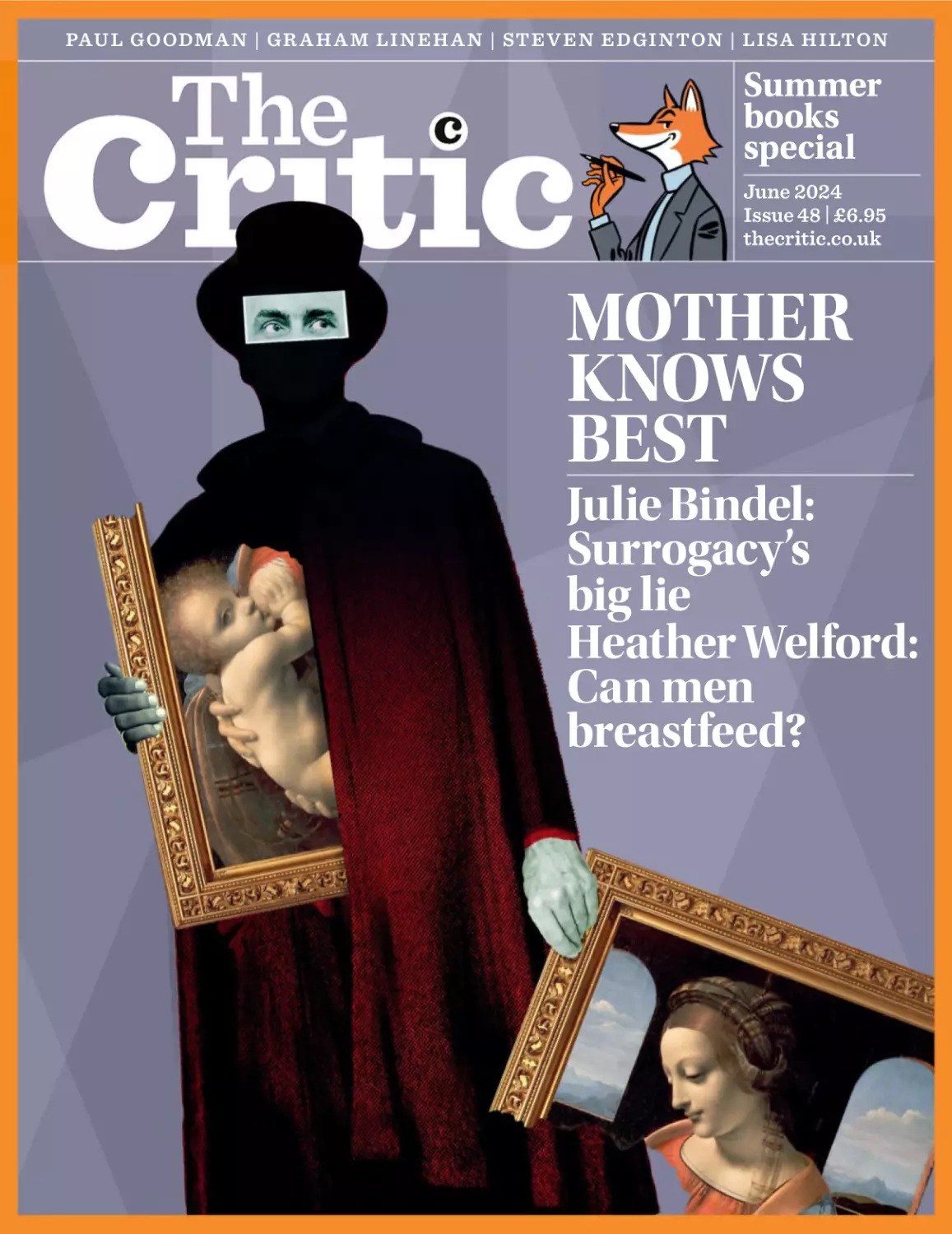


Tags: magazine magazine the critic
Year: 2024




Text
PAU L G OODM A N | GR A H A M LIN EH A N | STEV EN EDGINTON | LIS A HILTON
Summer
books
special
June 2024
Issue 48 | £6.95
thecritic.co.uk
MOTHER
KNOWS
BEST
Julie Bindel:
Surrogacy’s
big lie
Heather Welford:
Can men
breastfeed?
WHAT LAW? WHAT ORDER?
A minute’s walk from our front door takes
you to the front entrance of the Home
Office. Who or what can you see between
us and them? Junkies.
At any time of day or night, here is a
Britain that ought to shame politicians
into silence. Yet this isn’t a problem that
stems from a want of compassion: there is
no shortage of that offered up. The
disgrace here is the criminally negligent
lack of order our rulers inflict upon the
governed. And nowhere is this failure of
the state starker than here at its heart.
What does this public squalor mean?
Shit, piss and the ever-present threat of
chaotic violence. Foul, unfree streets,
dominated by those with the will to do so,
while the weak, mild and law-abiding
hang back, making their prudent and
cowardly compromises with life in the city.
They’d be fools not to. Why end up
dead, stabbed in the gut with a foot-long
machete as a reward for trying to prevent a
weed-smoking teen from loitering around
your children’s playground?
Goodness knows, had the victim of this
crime lived, he might easily have been
guilty of racism for approaching his
murderer in the first place. Certainly it’s a
mistake fewer and fewer police seem to
want to make, even when they feel legally
entitled to.
In the last month alone, the Met
has abandoned working with Transport
for London to prevent fare evasion for fear
that literally, physically, doing so is itself
unlawful. A ruling handed down by a
judge appointed by this government to the
Judicial Appointments Commission has
been the formal cause of this latest retreat
by the police, but the problems are so
much graver than even the unchecked
march through the institutions.
From our office, 60 seconds can take
you to crackheads practising their art in
public with no fear of being caught. A
minute in the other direction will take you
to paranoia, stench, disease, unwarranted
euphoria and justified despair, little or
none of it fuelled by the crack needed
outside of the parliamentary estate.
As this wretched government dwindles
towards its end, it’s useful to remember
what formed so many of its leading
lights these last 14 years: Tory student
politics. Inevitably a generation of men in
their fifties first came to know themselves
as tyro hacks at the end of Mrs Thatcher’s
reign.
Then these pustules addressed each
other with labels such as “libertarians”
and “authoritarians” (the latter being
abuse thrown by the former which its
charges then co-opted).
But where are these supposed
“authoritarians” — in truth the “Wets” Mrs
Thatcher despised — now? Coming to the
end of their worthless parliamentary
careers, sneering and self-congratulating
as they go.
Take this magazine’s local MP,
Nickie Aiken. A disastrously poor leader of
Westminster City Council, she became MP
for what had been the safest Tory seat after
her predecessor fell by the wayside in an
absurd moral panic (in his case, too
vigorously dragging a lout from a room she
was protesting in: making the unusual
mistake for a Tory MP of actually taking
personal responsibility).
Aiken announced that she would be
standing down after one term because
she’s going to lose the once impregnable
seat. Now ordinarily she might be seen
merely as being yet another victim of the
hapless Tory leader. Aiken, however,
stands out for her fecklessness.
Almost her last act in Westminster will
be what the One Nation Tories gloatingly
tweeted about her having done — her lead
role in defeating the feeble whips of Rishi
Sunak (and the lethargy of his invisible
Home Secretary, James Cleverly), and
wrecking the vagrancy bill Cleverly’s
predecessor Suella Braverman had
introduced while still at the Home Office.
ƭơƞƜƫƢƭƢƜ
2
ƣƮƧƞƁſƁƃ
6WUHHWOLIH
'DYLG&DPHURQWDNHV
DVWUROOLQ0DQFKHVWHU
What does this
public squalor
mean? Shit, piss
and the everpresent threat of
violence, as the
meek and lawabiding hold back
And why not? Aiken won’t be around to
experience the consequences of her
self-indulgent folly.
Another London Tory MP standing
down at the next election — when the
party seems set to lose every seat it has in
the capital — is Bob Neill. He platitudinously warned against the Great Chimera,
the party’s supposed drift to the right. “We
CH RI STO PHER FUR LON G/G ETTY I MAGES
The Critic is based in Westminster.
managed to toxify ourselves” burbled
Neill, tellingly neglecting to say who or
how. “It took a long time to detoxify
ourselves. Common sense would say,
don’t do that again.”
No doubt it would, but what common
sense tells Sir Bob about what the party’s
detoxified, progressively-led poll ratings
mean — the Tories have less than half the
support of Labour — is a mystery.
The idea that there has been an
endless right-wing Tory “culture war” is
not one shared by many contributors to
this issue, whether they come from the
Brexit Right or the feminist Left or any
point inbetween. Instead read about the
country Julie Bindel or Graham Linehan
or Steven Edginton plainly see.
Bindel, and fellow feminist writer
Heather Welford, expose a nation where
mothers are pretended out of existence,
for no reason other than to gratify the
whims of male perverts.
Half of humanity obliterated in speech
and law, just because the worst men
imaginable wanted it done. And all of this,
of course, upheld and extended by a
Conservative government.
The lack of probing from much of the
media, which is best equipped to expose
this assault on women’s identity, is
painfully illustrated by Private Eye
— which, as Graham Linehan shows,
chose very deliberately to ignore the
transgender scandal as fully as it could.
That a cause so bad that it rested on the
manipulation and mutilation of children
in order to give sexual pleasure and
affirmation to transparently risible frauds
and yet be solemnly ignored by a
country’s satirists and investigative
journalist is material for a dystopian novel.
But this is Britain. The Tories did not
make the professional, licensed smirkers
of Have I Got News For You ignore what
was in front of their faces. They did that
themselves. And to cover up their
cowardice and collaboration they
engaged in cosplay Soviet denunciations
of “madness” for people like Linehan who
had the courage and vulgarity to say the
simple truth — people cannot change sex.
It is not an accident that the
Tories are the most successful political
organisation in history, but what has their
response to their record been? As Steven
Edginton mercilessly shows, it has been to
boast: to pretend away reality as fervently
as any breastfeeding man, and to produce
something as gross and as fake, and to be
equally self-satisfied about that.
The 2004 Gender Recognition Act still
stands serene, regardless of the feeble
damage done to it by what are ultimately
conditional and piecemeal free speech
victories. Nothing has been lopped off this
dreadful legislation in the 20 years since it
came into law.
This magazine is merely five years old:
as far back as 2019 we said, of the various
oppressions and lies this Tory government was then presiding over:
The very imprecision of the transsexual
cause is what affords them this opportunity: clarity as to its supposed central
act — transition — would end it in an
instant. Common sense says that if a
thing can’t say when and how it happens, it hasn’t happened (“Lost in transition”, December 2019).
No one can doubt, whatever ridiculous
claptrap they now pretend about rainbow
lanyards, that the Tories presided over this
monstrous state of affairs, and are about
to hand it over to Labour and their
looming, implacable majority.
Ever more laws are announced,
even less law is upheld: hate marches
uninterrupted in the capital while the
silent are arrested simply for being near
such sacred sites as abortion clinics: this
has been what Cameron, May, Johnson
and Sunak have given us.
What Sir Keir will give us will be worse
as, unlike the chancers, frauds, bluffers
and dilettantes who preceded him, he has
a theory of the state. He knows what he
wants to do with power — which is to
keep it safe for the settlement we’ve had
for at least a quarter of a century.
As Evelyn Waugh said, the clock was
not turned back even a minute by the
Tories. Well, their time is up and it cannot
come soon enough. O
ƭơƞƜƫƢƭƢƜ
3
ƣƮƧƞƁſƁƃ
thecritic.co.uk
11 Tufton Street, Westminster, SW1P 3QB
editorial@thecritic.co.uk
The Critic is published by
Locomotive 6960 Ltd
© LOCOMOTIVE 6960 LIMITED 2020
Editorial
Editor: Christopher Montgomery
Deputy Editor: Graham Stewart
Art Director: Martin Colyer
'HVLJQHUV
'DYLG5LFHDQG6RƓD$]FRQD
Production Editor: Nick Pryer
Deputy Production Editor: Neil Armstrong
/LWHUDU\(GLWRU
'DYLG%XWWHUƓHOG
Executive Editor: Sebastian Milbank
Online Editor: Ben Sixsmith
Managing Editor: Yen Leung
Assistant Editors: Kittie Helmick, Jo Bartosch
Contributing Editors: Daniel Johnson, Roger
Kimball, Toby Young, Alexander Larman,
David Scullion
Artist in Residence: Adam Dant
Subscriptions
Annual Subscription rates:
UK: £46, Europe: £52, Rest of World: £55
Subscription and delivery queries:
The Critic Subscriptions,
Intermedia Brand Marketing Ltd,
Unit 6, The Enterprise Centre, Kelvin Lane,
Crawley, West Sussex, RH10 9PE
Telephone: 01293 312250
Email: thecritic@subscriptionhelpline.co.uk
Web: thecritic.imbmsubscriptions.com
Publishing
Publisher: Yvonne Dwerryhouse
marketing@thecritic.co.uk
Printing: Cliffe Enterprise,
Unit 6f Southbourne Business Park,
Courtlands Rd, Eastbourne BN22 8UY
Distribution: Intermedia Brand Marketing
Ltd, Unit 6, The Enterprise Centre, Kelvin
Lane, Crawley, West Sussex, RH10 9PE
7KH&ULWLFLVUHJLVWHUHGDVDWUDGHPDUN1R
8. RZQHGE\/RFRPRWLYH
/WG
Contents
Letters
Helen Joyce
Sorry is the hardest word
Law
Yuan Yi Zhu: What price justice?
Woman about Town
Sarah Ditum: Toxic relationship
Nova’s diary
The name game
Everyday Lies
Theodore Dalrymple: Prophetic
warnings
Serious business
Ned: Was Liz Truss on to something?
Sounding Board
Marcus Walker: Please remember:
terrorism is evil
My Woke World
Titania McGrath: Medical science is
oppressive
Christopher Montgomery
Liz Truss: a study in conceit
Arty Types
D.J. Taylor on Harriet Pester
Economics
Tim Congdon: Was QE a mistake?
Romeo Coates
Lone danger
Adam Dant on …
A lineage of the monarchy
BOOKS
Act your age
Calvin Po despairs at the National Trust’s
efforts to be down with the kids
44
Paul Goodman: No Way Out: Brexit: From
the Backstop to Boris by Tim Shipman 54
Fred Skulthorp: England: Seven Myths That
Changed a Country — and How to Set Them
Straight by Tom Baldwin and Marc Stears;
Another England: How to Reclaim Our
National Story by Caroline Lucas
56
Mark Mason: Drink Maps In Victorian
Britain by Kris Butler
58
Mark Glanville: A Devlish Kind of Courage:
Anarchists, Aliens and the Siege of Sidney
Street by Andrew Whitehead
59
Sophie Nicholls: Libertine London: Sex in
the Eighteenth-Century Metropolis by Julie
60
Peakman
Graham Stewart: Maymyo Days:
Forgotten Lives of a Burma Hill Station
by Stephen Simmons; Burma Sahib
by Paul Theroux; On the Shadow Tracks:
A Journey Through Occupied Myanmar
62
by Clare Hammond
Jo Bartosch: Gay Shame: The Rise of
Gender Ideology and the New Homophobia
64
by Gareth Roberts
Adrian Weale: The Illusionist: The True
Story of the Man Who Fooled Hitler by
Robert Hutton
65
Robert Hutton: Four Shots in the
Night: A True Story of Espionage,
Murder and Justice in Northern Ireland
by Henry Hemming
66
Daniel Johnson: The Muse of History:
The Ancient Greeks From the Enlightment to
the Present by Oswyn Murray
67
Alexander Lee: Lucas Cranach:
From German Myth to Reformation
by Jennifer Nelson
68
Graham Elliott: The Language Puzzle:
How We Talked Ourselves Out of the
Stone Age by Steven Mithen; Language
City: The Fight to Preserve Endangered
Mother Tongues by Ross Perlin
69
Matthew Reisz: Wisecracks: Humor
and Morality in Everyday Life by
David Shoemaker
71
Richard Hopton: Echoing Greens:
How Cricket Shaped the English
Imagination by Brendan Cooper
72
John Self: You Are Here by David Nicholls;
James by Percival Everett; Butterfly of
Dinard by Eugenio Montale
73
STUDIO
THE SECRET AUTHOR
8
6
9
10
11
14
15
25
33
37
40
41
76
7KLVPRQWKōVFRYHULV
LOOXVWUDWHGE\$QG\0DUWLQ
charity at war with its trustees over its
insistence that men should be able to
breastfeed
20
Why the Eye looked away
Graham Linehan asks why Ian Hislop
and Private Eye have been so quiet
on the trans issue
22
Iain Banks: a double life
John Self appraises the brilliant but
wayward talent of a literary novelist
swayed by science fiction
26
The odd couple
Jeffrey Meyers on the unlikely fourdecade friendship between Evelyn
Waugh and Graham Greene
28
FEATURES
Profile: Rosemary Sutcliff
Sebastian Milbank on a writer of genius
who was capable of conveying the lives
of those who lived in the distant past 34
Chasing rainbows
Steven Edginton says civil service
dissidents are fighting a losing battle
against Whitehall wokery
12
The first futurist
Jeremy Black says Daniel Defoe was a
prescient thinker consumed by individual
redemption and socal improvement
38
The end of high quality homes
Henry Hill takes issue with Michael
Gove’s proposed leasehold reforms 16
The best we can hope for ...
Alasdair Palmer says Daniel Kahneman,
who died this year, was a brilliant
psychologist of human irrationality 42
52
The love that can’t be erased
Julie Bindel on a court case exposing the
surrogacy industry’s big lie: that mothers
don’t have feelings for their children 18
When breast isn’t best
Heather Welford on a maternity
Lisa Hilton: The Venice Art Biennale
ƭơƞƜƫƢƭƢƜ
4
ƣƮƧƞƁſƁƃ
48
Just show me the money
75
COV ER ILLUST R ATIO N B Y A N DY MA RTI N; TH E M A DON N A LI TTA B Y L E ON AR DO DA V IN C I FR OM VC G WI L S ON / COR B I S VI A G ET TY I M AG ES
COLUMNS
June 2024 | Issue 48
SAVE
83%
SUMMER
SALE
3 ISSUES
FOR £3!
His Headmaster’s Voice
THE CRITICS
Eating In
Felipe Fernández-Armesto gorges on
Iberian delicacies in Salamanca
91
MUSIC Norman Lebrecht
The Finnish on a high note
78
OPERA Robert Thicknesse
Loony tunes and operatic madness
79
POP Sarah Ditum
Courting publicity Courtney-style
80
ART Michael Prodger
The artistic tailor of Frant
81
CA RTO O N BY W ILB UR DAW B A R N; C RI TI C FOX BY JAS O N FORD / H EA RT
THEATRE Anne McElvoy
Shakespeare in Germany
82
CINEMA Robert Hutton
Franchise films
83
TELEVISION Adam LeBor
From a Red Queen to Blue Lights
85
RADIO Michael Henderson
This was a bad start to the week
86
94
Deluxe
Christopher Pincher on how to walk tall
in top-quality brogues
94
Country Notes
Patrick Galbraith suggests a simple way
to foster biodiversity
96
Turf Account
Stephen Pollard argues that the Golden
Age of jockeys is now
96
87
88
Hot House
Claudia Savage-Gore is reminded of her
old school nickname: “Nympho”
99
ARCHITECTURE
Charles Saumarez Smith
Why there has been no Street life
Art House
Rufus Bird asks if the digital age can
demystify the art world
Style
Hannah Betts jazzes up her wardrobe
with a hat
98
PODCASTS Ben Sixsmith
I love a “dream home” nightmare
Drink
Henry Jeffreys prefers his upscale rosés
sans biodynamic woo-woo
92
TABLE TALK
Eating Out
Lisa Hilton is dazzled by a truly worldclass dining experience in Venice
90
THIS SPORTING LIFE
Patrick Kidd: The final Test
100
Nick Timothy: Back in the big time
101
Boris Starling: Not only a game
102
ƭơƞƜƫƢƭƢƜ
5
ƣƮƧƞƁſƁƃ
Take advantage of our Super
Summer Sale, saving a huge
83%. For just £3 you will
receive a 3-month subscription
to The Critic (3 magazines
delivered to your door).
Already a subscriber? Then
why not give a gift subscription
to someone special! Subscribe
today and you will get:
3 issues of The Critic
magazine
Access to
digital editions
An 83 per cent saving
on the shop price
Rigorous content
Free delivery
to your door
To subscribe, simply visit:
thecritic.imbmsubscriptions.
com/sum24
OR CALL:
01293 312250 quoting SUM24
T & C S: CLOS I N G DAT E FOR O RD E RS I S
3 0 TH SE PTE M B ER 2 0 2 4 . T H E P R IC E SH O WN IS A
U K D IR ECT D E BI T O FF ER. 3 IS SU E S AT £3 BY
D IR ECT DE BI T, FO L LOW E D B Y £1 0 .0 0 EV ERY 3
I S S UE S . SAV I N G IS 8 3% ON THE SH OP PR I CE. IF
YOU DO N OT CAN C EL AT TH E E N D OF T H E
S U BS C R IPTI ON P E RI O D, T H E SUB SCR I PTIO N
W IL L AU TO- R EN E W B Y D I RECT D EB I T AT £20
E V E RY 6 M O N TH S. A LL SU BS C RIPT I ON S A R E
N ON - R E FU N DA BL E . TH IS I S A L I M IT ED OFFER
A N D M AY BE WI T HD RAW N AT AN Y T IM E.
P L E A SE N OT E : BY S U B S CR I B I NG W E WILL
CO N TACT YOU A B OU T YO UR S UB SC R I PTI O N
F ROM TI ME TO TI ME . TH E C R IT I C IS P U B LI SHE D
1 0 TI M E S A YEA R , WI T H 2 D OU BL E I SS UE S
Sorry is the hardest word
Helen
Joyce
Chinese military strategist Sun Tzu none is more
famous than that you should build a golden bridge
over which your enemies can retreat. If they are
backed into a corner, the idea goes, their only way
out will be through you. But if running away is easy
and tempting, winning may not require wading
through rivers of blood.
For some who profess the trans neo-religion,
the Cass Report, published in April, looks like a
golden bridge. Distinguished paediatrician Dr Hilary Cass said nothing in it that critics of gender
clinics’ reckless experimentation haven’t been
saying for years. But she said it in a government-commissioned report and demonstrated
the near-total lack of an evidence base.
Just two of 103 academic papers that fit the criteria for inclusion in the literature review were
judged to be high quality, and the rest were either
worthless or inconclusive. An awful lot of people
who spent years insisting not just that gender-confused kids should be chemically castrated with puberty blockers and speedily prescribed cross-sex
hormones, but also that women can have penises
and all the other trans articles of faith, are now
looking for a face-saving way to recant.
◉◉◉
Among them is Keir Starmer. In 2021 the
Ruth Hunt
laughably
describes
herself now
as “someone
who has
always been
working in
the middle
ground,
trying
to build
consensus”
Labour leader said backbencher Rosie Duffield
was wrong to say that only women have a cervix;
post-Cass he admits that “biologically, she of
course is right”. Wes Streeting, the shadow health
secretary, who used to say “trans women are women, get over it”, now says the next Labour government will “work to implement the expert recommendations of the Cass review”.
Why did two clever men ever believe that men
could become women? Or that little children
could discern their innate gender identities before
they could tie their shoelaces?
Streeting, like so many gay men, was presumably misled by some gay campaign groups’ adoption of trans ideology despite its incompatibility
with gay people’s rights. As for Sir Keir, he’s a lawyer, and lawyers are prone to believing that laws
can overwrite reality.
His insistence pre-Cass that “99.9 percent” of
women don’t have penises makes sense if you
think a government-issued piece of paper determines your sex (the 0.1 percent are men with gen-
ƭơƞƜƫƢƭƢƜ
6
ƣƮƧƞƁſƁƃ
der recognition certificates stating their “acquired
gender” as female).
Funny how many people fell for this when they
have no trouble understanding the concept of a
“legal fiction” when the government declares
Rwanda safe.
Streeting (below) surely understands that the
more that is done to end the scandal of sterilising
gender-confused children before he picks up the
health portfolio, the better
for him. Sir Keir no doubt
wants to avoid questions
about women’s penises at
every press conference he
gives as prime minister. As
John Maynard Keynes nearly said, when the incentives
change, I change my mind.
The hope now is that
many of the cowards who remained professionally
deaf and blind to the downsides of pretending sex
can change join the rush for the exit. The self-proclaimed sceptics who used to be so scathing about
homeopathy but swallowed the ludicrous claim
that it was possible to be “born in the wrong body”.
The New Atheists who genuflected to a godless
neo-religion. The civil servants supposed to uphold
impartiality in public life who put their pronouns in
their email signatures.
◉◉◉
I don’t know how Sun Tzu imagined the
retreating hordes comporting themselves. I like to
think he pictured them sidling across the golden
bridge while pretending to be somewhere else. I’m
sure he’d have understood the concept of the “reverse ferret”, as Kelvin MacKenzie, then editor of the
Sun, called his occasional change of heart after having set his journalists on some celebrity with the
order to “stick a ferret up their trousers” — a reference to men competing to see who can cope longest
with ferrets trapped near their nether regions.
The essence of the reverse ferret is brazenness:
barefaced denial that you ever held a different position. Should retreating enemies be allowed to get
away with it?
Sun Tzu would presumably say that what matters is that they leave the battlefield, and that continuing to harry them makes the prospect of following them less attractive to others. But for
people who spoke out before Cass made it less
PO RTR A IT B Y VA N ESSA D ELL; CH RI S MCAN DRE W/ UK PAR LI AM E NT
Of the aphorisms attributed to the
risky, clemency can stick in the craw.
Take Duffield, ignored by Sir Keir
while his party’s trans extremists tried to
destroy her career. Is it realistic to expect her to be gracious about him
changing his tune?
Or take journalist Julie Bindel,
blacklisted by the Guardian 20 years
ago for writing sympathetically about a
Canadian rape crisis centre that refused to appoint a trans-identifying
man as a rape crisis counsellor for
women. In 2008 Streeting, then president of the National Union of Students, refused to support Bindel after
she was no-platformed for “transphobia”. She has publicly invited him to
apologise, so far without response.
◉◉◉
guaranteed harm.
But that is little comfort for the
children already treated and the parents who supported them. Rather
than accept that they have been subjected to an irreversible wrong, some
will deny the evidence, fight for more
children to be damaged and continue
to cheerlead for the people and organisations that led them astray.
◉◉◉
Which brings me to Ruth Hunt,
Former Stonewall chief
executive Ruth Hunt
R O GER HA R R IS/ UK PA RL IA MEN T
The premise of the golden bridge is
predicated on most of your enemies being cowards, keen to leave the battlefield when the tides of
war change. But what if some are fanatics who
burnt their homes before taking up arms and have
nowhere to retreat to? What about the cunning,
who will retreat only to lick their wounds and wait
for the right moment to pick up arms again?
Trans activists have barracked conferences on
evidence-based gender medicine and waved placards proclaiming that “Cass is social murder”. Cass
has received death threats, and police have warned
her to avoid public transport. That’s not because
she’s at risk from middle-aged women campaigning
to safeguard children. It’s because the trans rights
brigade has a bovver wing that’s in it for the fight. No
bridge, no matter how golden, will lure them away.
Established trans activist groups like Stonewall
and Mermaids couched their criticisms of Cass in
less heated terms, focusing on long waits at gender
clinics and her report’s supposed lack of clarity.
But if they are retreating, it is merely tactical. Their
income depends on schools and employers paying for their advice to write trans ideology into
their policies. For them, the only possibilities are
victory or death.
The most tragic combatants are the children
and parents who bought what the trans lobby sold.
Post-Cass, the NHS is clamping down on hormonal interventions for young people — the right
call, since they come with uncertain benefit and
ƭơƞƜƫƢƭƢƜ
7
ƣƮƧƞƁſƁƃ
Stonewall’s former chief executive, who
destroyed the charity by adding the T to
the LGB and got a peerage from Theresa
May for her efforts.
In a recent interview with The Times
Hunt attempted a reverse ferret for the
ages. Her only mistake, she said, had been to trust
the experts who misrepresented what was happening in child gender clinics. Stonewall hadn’t
had a policy of “no debate”, she insisted, and certainly hadn’t sought to harm its critics.
Unfortunately for Hunt, Stonewall’s victims can
cite chapter and verse. Barrister Allison Bailey is
challenging Stonewall at the employment appeal
tribunal for demanding she be sacked for saying
transwomen weren’t literally women.
The charity has tried several times to persuade
the international body that accredits national human-rights watchdogs to downgrade the Equality
and Human Rights Commission in retaliation for
its refusal to slavishly obey the trans lobby’s diktats. Journalists who sought in good faith to question Stonewall’s change of direction under Hunt
were refused briefings and blocked on social media — I know; I was one of them.
Hunt now laughably describes herself as
“someone who has always been working in the
middle ground, trying to build consensus”. What
needs to happen next, she says, is “lots of listening
and some forgiveness and some understanding in
order to help us move on”.
When it stopped looking obvious that her
principles put her on the winning side, she chose
others. Letting her get off scot-free would be foolish: what’s to say she won’t switch back if the
tides of war turn again? As for the sanctimony!
For that alone she deserves to be made an
example of. O
REAL REALPOLITIK
Sam Bidwell would like Britain to adopt an
“unsentimental” foreign policy in the
Middle East, exclusively focused on
pursuing its own national interests. (TIME
FOR REALPOLITIK IN ISRAEL, MAY).
He goes on to identify these interests: to
promote stability in the Middle East, to
make sure the oil continues to flow, and to
prevent large waves of immigration into
Europe, especially from communities
difficult to integrate because of what he
describes as the “poisonous ideology” of
radical Islam, which “we should be
uncompromising in our efforts to tackle”.
We may not wish to quarrel with this
basic statement of foreign policy aims, but
it does not follow that Britain should
therefore be pursuing a more anti-Israel
line, as Bidwell recommends. Indeed, a
sober evaluation of the geopolitical
realities in the Middle East rather suggests
the contrary.
Bidwell does not seem to have noticed
the political realignments taking place in
the Middle East. As the Abraham Accords
have demonstrated, a new alliance of
Israel with moderate Arab countries, once
implacably hostile to the Jewish state, is
beginning to emerge.
There are several reasons for this change
of attitude from the Arab side: a belated
recognition of the threat posed by
politicised Islam to the survival of their
own regimes; a wish to modernise their
economies and reduce dependency on oil;
but above all, the need to counter Iran,
which is the uncompromising agent of
subversion and the fomenter of violent
extremism in the region — a strategy
fuelled by its revolutionary theocratic
ideology that hates America and the West,
and wishes to see Israel destroyed.
In all these respects, the new realism of
the moderate Arab states recognises that
normalising relations with Israel better
serves their interests than riding the tiger
of anti-Israel demonisation as in the past.
But it needs the West, including Britain, to
do everything in its power to reinforce this
new alliance, and not provide more
ammunition to the Israel-haters.
Ultimately, the two-state solution, which
Write to The Critic by email at letters@thecritic.co.uk
including your address and telephone number
“I know! You just can’t say
anything these days.”
is the long-standing aim of British policy,
will only come about when the Palestinians are convinced by the strength of this
new moderate coalition and find leaders
prepared to abandon the campaign to
delegitimise Israel, renounce violence and
become genuine partners for peace.
It also follows that whatever progress
can be made in eliminating the threat of
Islamist violence globally, will help
deradicalise our own homegrown
ideologists.
Unfortunately, Bidwell’s analysis fails to
take account of these new realities. Indeed,
Iran goes unmentioned. He continues to
apply the outdated assumptions of the old
Arabist Foreign Office.
Our own Foreign Office was blindsided
by the developments leading to the
Abraham Accords, which it did nothing to
anticipate, and which was entirely an
American initiative. Hard power is the only
currency that is truly respected.
So when Bidwell tells us that the Gulf
States are more likely to defer to Britain
than to United States, all he does is alert us
to his own “sentimentality” and lack of
realism.
Alan Bekhor
london
ƭơƞƜƫƢƭƢƜ
8
ƣƮƧƞƁſƁƃ
LESSONS OF HISTORY
I am not disputing Sam Bidwell’s theory
that Britain should act in its own interests
in foreign policy, or that certain Israeli
politicians deserve criticism, or that “as
Britain tried to broker a solution in the
wake of the Second World War, right-wing
Zionist groups conducted a campaign of
terrorism against British authorities”.
But in passing from 1930 directly to 1946
his analysis leaves out the critical period of
the Second World War and the Holocaust.
You cannot disregard the total insensibility
of British authorities in Palestine towards
Jews fleeing the Nazi gas chambers.
There were many terrible episodes, so I
shall mention only one: the tragic case of
the ship Struma, which was sunk by
mistake by the Russians in the Black Sea.
All but one on the ship died, 780 of them.
Why did Britain reject them? This attitude
embittered the feeling of the Jews of
Palestine towards the British. This is not an
excuse for terrorism; I just try to explain.
Meanwhile, Haj Amin al-Husseini was
the Grand Mufti of Jerusalem and an ally of
Hitler. The legacy he left behind still
plagues the region. Britain, to avoid
complications, did not arrest him, just let
him go free.
Josef Oskar
milan, italy
FORCED MARCH
Theodore Dalrymple (EVERYDAY LIES —
MAY) complains about the BBC describing
walkers as “forced” to trespass across
private property in order to reach open
countryside.
As a regular walker and occasional
trespasser, the sight of a farmer’s freshly
erected fence fills me with an irresistible
compulsion: I am forced to trespass.
Conscience, habit and an innate desire to
go where I damn well please as a free-born
Englishman intervene.
To the foes of rambling, I can only repeat
the words of the old song: Success to every
poacher that wants to sell a hare / Bad luck
to every gamekeeper that will not sell his
deer.
Anna Miller
sheffield
CA RTO ON B Y LEN HAWK INS
Letters
YUAN YI ZHU ON LAW
What price justice?
Small disputes involving
ordinary people are not a
waste of the courts’ time
N
icholas and Rosemary
Sherman booked a cruise
to the Northwest Passage
in 2018; but because of
adverse ice conditions had
to settle for floating off the coast of
Greenland for two weeks.
They took the cruise operator to court.
After losing in the County Court (with
£60,000 in costs to boot), they prevailed in
the High Court and, in April, in the Court
of Appeal.
What distinguished the Shermans from
most successful litigants there is that they
were self-represented, while the cruise
company had instructed leading and
junior counsel. Some might well think it
heartening that ordinary people can still
obtain justice in this manner (Mr Sherman
does have a law degree, which he has not
used professionally). The judges took a
dimmer view.
All three urged the two parties to “reach
a pragmatic settlement”; but Underhill LJ
added rather sniffily that the Shermans
“may feel that the time has come when
they would benefit from professional legal
advice”, the clear implication being that
the case would have been settled far
sooner if they had hired a lawyer, who
would no doubt have advised them better.
P O R T R A I T B Y VA N E S S A D E L L
Understandably, the judges felt
that this was one of those cases where the
resources expended (11 days in three
courts, with more to come) were
disproportionate to the £20,000 at
stake.
But as the late Lord Rodger of
Earlsferry said in a Scottish case
where his colleagues similarly
bemoaned the fact that they had
to hear the case at all, “the parties
[are] adults and the dispute
between them is genuine
… courts exist and
judges are paid to
resolve such disputes,
be quashed due to basic
which are indeed the
errors of law which neither
lifeblood of the common law”. Lawyers used
the magistrate nor the
Increasingly, English
to say even
courts seem to be taking the
the humblest prosecutor picked up on. The
Ministry of Justice euphemisview that to dispense justice
subject could tically refers to such
in small disputes involving
miscarriages of justice as the
ordinary people is a waste of
seek redress
SJP’s “error rate”.
their time.
in court.
Equally alarmingly, Kirk
In 2022, Sir Geoffrey Vos
found out that defendants’
MR provoked an uproar when The cost of
litigation has mitigation pleas were not
he appeared to suggest that
seen by the prosecution,
parties involved in small
done much
leading to prosecutions that
claims (which can be worth
to destroy
were obviously not in the
£10,000 in the County Court)
that principle public interest.
“want a swift cost-free
In an illustrative case, an
resolution, without much
82-year-old woman with Alzheimer’s was
caring whether the outcome is robust and
convicted for not having proper car
dependable”.
insurance for a car that was not being
Sir Geoffrey later backtracked, saying
driven. In another, a partially blind woman
that he meant smaller disputes, of the sort
who’d had a recent brain haemorrhage
between eBay buyers and sellers. But the
which affected her memory was convicted
same year, a pilot scheme was introduced
for failing to pay for a TV licence.
whereby certain County Court claims
worth up to £1,000 could be decided on
paper without a hearing, even if the parties
Beyond the access of justice
wish to be heard.
issues, the exclusion of “insignificant”
Again, few can quibble with the stated
cases from full court hearings also has
rationale of the pilot, the reduction of
implications for the development of the
arrears caused by Covid-19. But although
common law. In another speech, Vos
£1,000 must seem like a trivial amount of
declared that other legal systems were
money to some lawyers, to many ordinary
absurd for allowing a parking ticket to be
litigants it is a sum which is much more
contested all the way to the Supreme
“real” than the far larger ones regularly
Court.
encountered at the higher levels of
But as the legal academic Kate Leader
commercial litigation.
pointed out, this is exactly what happened
in ParkingEye v Beavis, in which the
Supreme Court clarified the legality of
The same tendency can be discerned
parking charges. This could not have
in the criminal justice system as well. Over
happened if the ticket had been dealt with
the past years, Tristan Kirk of the Evening
under a summary procedure.
Standard has been running a heroic
English lawyers used to price in the fact
campaign to expose the failings of the
that even the humblest of the King’s
Single Justice Procedure, under which
subjects could seek redress in his courts.
a single magistrate can convict
The exorbitant cost of litigation has done
someone of a criminal offence
much to destroy this principle in practice.
without a court hearing.
As a response, the government and
Although all defendants have the
senior judges have determined that the
option to opt for a normal trial, Kirk
best thing to do is to stop ordinary litigants
discovered that many were not
from having their time in court at all. All of
properly notified of the proceedthese developments make sense if
ings and were therefore
considered in isolation. But the risk is that
convicted without their
England’s “world-leading” courts lose
knowledge.
sight of their principal mission. O
Other convictions had to
ƭơƞƜƫƢƭƢƜ
9
ƣƮƧƞƁſƁƃ
Woman About Town
Toxic relationship
O
SARAH DITUM
ne of the greatest scenes in cinema is the
Farewell to a festival
moment in Annie Hall when Woody Allen, irritated
by a stranger’s pompous lecturing about media
theorist Marshall McLuhan, summons the actual Marshall
McLuhan to issue a correction in the flesh. “You know nothing
of my work! You mean my
whole fallacy is wrong,”
chides McLuhan. “Boy, if life
were only like this!” says
Allen’s character, happily.
Well, sometimes it is.
Shortly before Christmas last
year, I was approached by
11:11, the production
company of Paris Hilton, one
of the subjects of my book
Toxic. Not only had she read
the book: she liked it enough
to want to turn it into a
docuseries. Eat your heart
out, Woody.
Then, the wait for the
official announcement, which finally came a few weeks ago
— and led to the extremely weird experience of being written
about not only in entertainment trade paper Variety, but also
in the gossip rag to end all gossip rags (and one of the main
sources for my research), TMZ. Some people dream of seeing
their name in lights. I, apparently, dream of seeing my name
next to posts like “justin bieber’s mom ‘embracing
gramma status’” and updates on the latest rapper beef.
A trip to Bristol to say a sad goodbye to the
Ideas Festival. After more than 30 years of making the city
a more interesting place with its programme of events,
books and screenings under the leadership of my friend
Andrew Kelly, the festival lost its funding last year. Two
strands will continue (Festival of the Future City and
Festival of Economics), but it’s still a sad loss.
The mix of academics, intellectuals and business
grandees mingling over lunch were a tribute to Andrew’s
talent for bringing people together. Running a public
events series is hardly relaxing at any time, but the last
decade or so has been particularly bruising for anyone
committed to freedom of speech. No-platforming went
mainstream, and for a long time it has seemed that you’re
nobody until somebody’s tried to get you cancelled.
Obviously, it’s quite stressful to put together a schedule
knowing some people are only waiting to pick it apart. So I’ve
always felt a lot of admiration for Andrew’s approach. He’s
never been tempted to cast himself as some kind of free
speech hero — in fact, he’s never made it about him. He’s
simply done his job, excellently, refusing to bow to pressure.
I understand the appeal of self-mythologising. But it’s
tedious: I now dread the inevitable moment in a stand-up set
when the performer turns to the subject of their own
cancellation, whether real or anticipated, because I know that
there will be no jokes forthcoming while the comic basks in
their own bravery. The best way to protect free speech is to
treat it as so unexceptional, anyone could defend it — a stance
that is all the more damning of those who opt out.
***
Breakfast bacchanals
The gossip press isn’t what it used to be — but
then, celebrities are much less wild than they used to be. If
the hacks are in need of a new source of stories, can I suggest
they look to current affairs journalists?
At a recent party, it wasn’t the
fashion writers or the music critics
who kept going till dawn: it was
the breakfast presenters, tearing
up the dancefloor into the
smallest of small hours. As for
me, I was out there throwing
moves, but I definitely don’t
have the stamina for an
all-nighter anymore. Leave it
ƭơƞƜƫƢƭƢƜ
to the people who are already
intimately acquainted with 4am.
Hot tub politics
It’s not all doom, though. Or at least, it isn’t
if you sit on the left of British politics like I do. After over a
10
ƣƮƧƞƁſƁƃ
NOVA’S DIARY
“Have you seen my tie?” asks Rishi. “The thin one.”
Akshata is helping Rishi pack for his trip to Italy.
There’s a meeting of some of the world’s most important
leaders, and he has been invited along too.
“Darling,” says Akshata, “I don’t understand why you’re
so bothered. You hate all foreign events.”
“I do,” says Rishi, “but it’s a dangerous world out there,
and I’ve realised that only I can
keep the nation safe.”
“That’s right!” says Rishi’s
new friend Ric, who is sitting in
WKHFRUQHUƓGGOLQJZLWKKLV
phone. “Not like Sir Fears
Harmer.”
Akshata makes a face. Last
night she asked Rishi why Ric
has to come round so much, but
Rishi said he liked having him
here “because he explains how
I’m going to win. No one else
tells me that.”
I don’t know exactly what
Ric’s job is. It’s something to do with party chairs, which I
think is one of the games the girls play. Mainly he comes up
with rude nicknames for people Rishi doesn’t like. That and
put on funny voices when he makes phone calls, like he’s
doing now: “Is that Islington Police? I’d like to report my
neighbour, a Sir K Starmer, for putting out paper recycling
on a plastics day. My name? It’s … um …” Ric looks around
wildly. “Mr Bed Carpet.” He hangs up.
Akshata rolls her eyes and changes the subject. “Who
else is going to be there?”
“Justin Trudeau.”
“Smoothy-chops who thinks he’s God’s gift,” Ric mutters
under his breath, without looking up from his phone.
“Joe Biden.”
“I’m boring, vote for me,” Ric whispers.
“Macron.”
“Tiny technocrat.”
“Giorgia Meloni is the host, of course.”
“Keeps talking about immigration, can’t control it.”
“Ric, would you stop this,” Rishi says. “You can’t just sit
there attacking our allies.”
5LFORRNVKRUULƓHGŏ2K,ZDVQōWWDONLQJDERXWWKHPŐKH
says. “I was just reading something.” Rishi grabs Ric’s
phone and looks at it. “This is one of Isaac’s focus group
reports,” he says. “Why wasn’t I shown this?”
“Well, we didn’t want to …”
“All these terrible things people are saying,” Rishi says.
“Everyone really does hate Starmer.”
“Oh … yes! It’s about Starmer. Yes.”
Akshata hands Ric back his phone and smiles at Rishi.
“Enjoy Italy, darling.” O
O
decade of defeat after defeat — including the low point of
having a Labour leader so bad, Boris Johnson really was the
lesser evil — my team is set to win and win big at the next
election.
Have you ever seen footage of rains hitting the desert?
That’s a little bit like how this moment feels, only instead of
cactuses bursting into bloom, all my friends seem to be
bursting into political life. Everyone I know is suddenly writing
white papers or advising members of the shadow cabinet. On a
weekend away with girlfriends, I looked around the hot tub
and realised everyone there would be somewhere near the
levers of power in the next 12 months. Although probably not
while wearing their bikinis.
The bleak years, finally, feel like something I can laugh at. (A
particular low point for me: getting screamed at by Corbyn
supporters while phonebanking for Owen Smith during his
leadership challenge, and if you can’t remember who Owen
Smith was, same. I left Labour shortly after.) Obviously, most
readers of The Critic won’t share my party politics, so I offer
this in a spirit of encouragement for the right’s doldrums to
come. Things can only get better.
Sick note
•••
That kind of smugness deserves karmic punishment,
IL LUST RAT IO NS BY JOHN MONTGOMERY
and lo, it has arrived in the form of whooping cough. After the
shape-shifting of Covid strains, there’s something reassuring
about a disease that does exactly what it says on its NHS page.
Cold symptoms? Check. Wracking cough? Check. Intermittent
weird monkey sound as my lungs try to reclaim some oxygen?
Sadly, check.
So I have spent the last few days in bed, mostly sleeping,
emerging only to do some Eurovision coverage from the sofa.
The life of your woman about town isn’t all celeb deals and
swank parties and hobnobbing in swimwear, you know.
Sometimes it’s desperately swallowing cocodamol and hoping
you’ll think of something funny to say about a Swiss man in a
peach miniskirt before your midnight deadline comes up. O
ƭơƞƜƫƢƭƢƜ
As told to Robert Hutton
11
ƣƮƧƞƁſƁƃ
Dissident civil servants have been risking their careers to
fight a losing battle against burgeoning Whitehall wokery and
the situation will only worsen under a Labour government
Chasing rainbows
ast week Britain’s “Minister for ommon
Sense” proudly announced banning civil servants from wearing rainbow lanyards. Esther
McVey’s latest offensive in her party’s war on
Whitehall wokery was dead within 24 hours.
The day following McVey’s Colonel Blimp
speech, the Cabinet Office refused to issue specific guidance on
lanyards, and distanced itself from McVey’s announcement in
briefings to newspapers.
The episode perfectly encompasses the Conservative Party’s
reaction to the total capture of the administrative state by their
ideological enemies. First McVey’s target was ridiculous. LGBT
lanyards are political; one conservative-minded civil servant I
know wore a non-binary lanyard because he believed it would
help his promotion prospects to show off how “diverse” he is to
his colleagues. Most civil servants who wear these symbols do so
as a virtue signal for their cause;
it is a wink to their fellow LGBT
activists that they are “allies”.
However, these pieces of fabric
are hardly the most pressing of
issues when it comes to Whitehall’s politicisation.
Trans activists’ language on
gender is embedded into official government guidance,
(VWKHU0F9H\
training, and signage. Critical
GHIHDWHGE\
Race Theory is taught by civil
ODQ\DUGV
servants in diversity meetings;
after the George Floyd riots BLM was endorsed by senior and junior mandarins alike in official communications. Anti-white rhetoric is rife in diversity, equity and inclusion (DEI) modules and
meetings, and gender-critical civil servants are hounded and
bullied for expressing their beliefs. Unscientific and toxic training
around unconscious bias is still being delivered (despite another
ministerial “ban”). To focus on lanyards shows the Conservatives
are not serious about reforming the state to remove woke ideas.
Secretary. Sunak had to throw some “red meat” to those on the
right of the party, so why not Brexit-supporting McVey who can
work on implementing “common sense” into government?
McVey’s ministerial position is essentially akin to a glorified government communications officer: she has almost no power and
exists to generate headlines in the Daily Express.
The Conservative Party has enabled the creation of an administrative state that persecutes internal dissidents if they fail
to comply with woke views on gender and race.
When Liz Truss encouraged government departments to cut
ties to the controversial LGBT campaign group Stonewall, one
civil servant was put in a tricky situation. Seeing the news posted
in a departmental online forum they responded with a thumbs
up emoji. This heinous act prompted a co-worker to lodge a
complaint over this implicit support of Truss (who was then the
Equalities Minister). An official investigation was launched.
Two Whitehall henchmen hauled the poor emoji offender
into a room and presented their case: not only had the civil servant liked this news link, they said, but they had also commented
on another blog post some months ago raising questions about
Black Lives Matter. The civil servant was issued an official warning for inappropriate behaviour, and was told — unless they
reined in their behaviour — more severe action would follow.
The civil servant is not alone in being punished for committing a thought crime. In January I reported on the case of a Department of Work and Pensions official who had the temerity to
say there are two sides to the trans debate. A subsequent departmental investigation cited the comment as evidence of harassment and the civil servant was given an official warning.
When civil servants complain of a “culture of fear”
in Whitehall around speaking their mind on controversial topics, I take them at their word.
These ideas are enforced by a massive ideological bureaucracy. Whitehall’s DEI industrial complex takes its form in part via
diversity networks, in which groups of civil servants meet, teach
and lecture about their chosen identity, such as sex, religion or
mental health (the Ministry of Defence has 93 such networks,
including 14 groups focused on race alone). Then there are Diversity Champions, Advocates, Allies, Associates and Practitioners; all voluntary roles civil servants can sign up to on top of their
McVey’s immediate defeat by the Cabinet Office is not
surprising. Her role was invented purely as a PR exercise by
Downing Street when Suella Braverman was sacked as Home
ƭơƞƜƫƢƭƢƜ
12
ƣƮƧƞƁſƁƃ
LEO N NEA L/GET TY I MAG ES; DAN K ITWO O D/GETTY I MAG ES
Steven Edginton
day jobs to promote DEI. It’s likely their numbers are in the thousands and include some of
Britain’s most senior mandarins.
Take Matthew Rycroft, the permanent secretary in the Home Office. As well as being responsible for the department overseeing Britain’s borders and police, he acts as a “Diversity
Champion” for Race, Faith, and Belief. Rycroft
has helped to plan internal Home Office DEI
policies on race, and recently met a group of
civil servants to discuss trans issues. Similarly,
Antonia Romeo, chief official at the Ministry of
Justice who is charged with dealing with our
overcrowded prisons and buckling legal system, is a “Gender
Champion”.
And so if civil servants cannot rely on their bosses or ministers to protect them, they must protect themselves.
A quiet resistance against the race and gender ideologies is
being fought across Whitehall by civil servants of all ranks. Some
civil servants have taken it upon themselves to stand up to senior mandarins, in some cases risking their careers, to fight for
what they believe is right.
As we have seen, acts of resistance can lead to serious consequences for your career. At the very least, questioning DEI will
do little for your promotion prospects. By contrast the opposite
is true: some civil servants’ work performance is judged based
on their contribution to diversity (for example one was told to
attend an LGBT book club by his boss to help his career progression). At worst resistance can lead to serious bullying (for example one gender critical official was compared to the Nazis in a
meeting while senior civil servants refused to defend her), and
even legal action.
The Network, run by gender-critical civil
servants who are fed up with what they see as a
coordinated attack on women’s rights by trans
colleagues, is the first of its kind in Whitehall.
Following Maya Forstater’s successful legal
case, gender-critical beliefs are now protected
against discrimination by law, enabling SEEN’s
creation. In less than two years over 700 civil
servants have signed up to the group. In October 2023 SEEN wrote to the Cabinet Secretary
with a massive dossier of bullying and harassment against gender-critical officials.
The letter, which is more than 30 pages long,
cited cases of pro-trans civil servants boasting about “frustrating
ministers’ intentions”, engaging in “active obfuscation of facts to
prevent ministers seeing the impact of trans-inclusive policies”,
leaking internal policy to partisan groups and providing advice
to external organisations on how to get around ministerial
guidance.
SEEN has also run surveys of their members showing widespread experiences of harassment for holding gender critical
views, and the group’s senior representatives met with Matthew
Rycroft earlier this year to discuss their complaints. Perhaps the
greatest impact of SEEN, however, is that there is now finally a
place where gender-critical civil servants can talk, advise, and
support each other.
And they need support. A recent email to its members revealed that two senior SEEN representatives are now defendants
(along with DEFRA) in an employment tribunal in relation to
gender-critical comments they made in the workplace, which a
civil servant colleague claims amounted to harassment.
n the Trans frontline fighting has
series of pro-trans networks (there are six in the Ministry of Justice alone) which run training, events and produce guidance on
pronouns and gender-neutral language. The main trans group
in the civil service is A:Gender, which was criticised in SEEN’s
letter to Simon Case for pushing gender ideology. An A:Gender
training resource — the modern sequel to Mao’s Little Red Book
— compared gender-critical people to the Ku Klux Klan and racist nationalists.
A quiet
resistance
against race
and gender
ideologies
is being
fought across
Whitehall
by civil servants
of all ranks
On the other side of the Whitehall gender wars are a
been ferocious. The compulsion of language
around pronouns, the official promotion of
trans activist charities Stonewall and Mermaids and the adoption of gender-neutral
toilets across many departments led to the
formation of the Sex Equality and Equity Network (SEEN) in
October 2022.
ƭơƞƜƫƢƭƢƜ
13
ƣƮƧƞƁſƁƃ
EVERYDAY LIES WITH THEODORE DALRYMPLE
Is it pedantic to remark on minor errors in the use of
On race, George Floyd’s death in 2020 led to a sea
language? I think the answer is that it depends. Error, after all, is the
change in Whitehall. Anti-white propaganda was
joy
of
pedants, whether the error be serious or trivial.
pushed by senior mandarins through open and explic5HFHQWO\,QRWLFHGDVWDQGƓUVWLQWKHEconomist: “The French
it support of BLM, a radical movement that sparked ripresident issues a dark and prophetic warning”. What the
ots, lootings and even murders across America, and
Economist meant was that the French president prophesied something
the adoption of their language around white privilege
dark. A warning cannot be known as prophetic until the future it
and systemic racism. Civil servants were told to read
prophesied has come to pass. Whether a warning was prophetic can only
BLM’s foundational texts, including White Fragility
be known in retrospect.
and Why I’m No Longer Talking To White People About
Is this a small distinction without a difference? In this case, I think not:
Race. In July 2022 Home Office Director Nurjuhan
for the word “prophetic” here implies truth. A warning cannot be called
Khutan gave an interview telling civil servants to “levprophetic unless what it warns of has come to pass. A man may prophesy
erage” the death of George Floyd.
and be mistaken, indeed most of my own efforts at apodictic prediction
While there are plenty of civil service networks prohave been mistaken; but a warning may not be both prophetic and
moting Critical Race Theory, there are none promotmistaken. President Macron’s prophecy might very well turn out to be
correct — he did not give a date limit to it, so that it could never be proved
ing the opposite view or standing up for white people
incorrect — but it cannot yet be known to have been prophetic.
against attacks on their identity. Perhaps their lack of
Does this matter? The problem with the term “prophetic warning” is
organisation is due to their conservative nature, as opthat
the content of the warning is thereby taken as established fact. And if
posed to their gender-critical counterparts who are
it
is
established
fact, then one must act upon it as if it were such fact. This
generally old-school feminists, notorious for their pomight
have
dangerous
consequences.
litical organisational skills; or it may be that there is
This
is
not
to
say
that
what President Macron said was wrong: perhaps
not yet a similar protection in law for anti-CRT beliefs
his direst apprehensions will come true. But still, his warning cannot yet be
as there is for those resisting the Trans movement,
called prophetic: it is a prediction that, like any other, might prove
making it harder to set up a former network under
mistaken. That, of course, is devoutly to be wished; let us hope that his
Cabinet Office rules.
prediction does not prove prophetic, or that his prophecy did not help it
Instead, the press has become the weapon of
to become prophetic. O
choice for conservative civil servants, plenty of whom
have made the brave decision to become whistleblowers against their anti-white colleagues. Some of these civil
training materials in relation to race issues. Others just want to
servants know each other, though most of them act indetalk to someone, anyone, about how demoralising it is to be told
pendently , willing to put their careers on the line to expose the
they hold inherent advantages because of their race, or that only
adoption of the BLM ideology in Whitehall.
white people hold original sin and they must be ashamed of
Britain’s evil past.
The fightback from SEEN and the independent conservatives
I have sat in cafes in central London listening to dozhas had some effect. It has caused mandarins to stop and think
ens of civil servants over the years, some of whom are too terribefore discussing issues around race and gender. Recently my
fied to put anything on the record, though many more go on to
reporting on wokeness in the armed forces, which wouldn’t have
send me internal communications, Zoom calls, resources and
been possible without the help of nearly a dozen sources from
across the MoD, forced Grant Shapps to launch a review into defence diversity initiatives. However, most ministers seem to be
more interested in generating headlines than actually dealing
with the politicisation of the civil service.
The main justifications for DEI initiatives are found in the law
via the Equality Act and its Public Sector Equality Duty. This legislation obliges public bodies to foster good relations between people with different innate characteristics and protects people
against discrimination based on nine categories. Until the Conservatives repeal or replace the act, all of their “anti-woke” plans
will fail and should be regarded as noise, not signal.
In the absence of any such bravery from this Government, it
is to the continuing courage of individuals in the civil service
that we must look. For if they feel they are fighting a losing battle
under the Conservative government, a Labour one will range
even greater forces against them. O
First, log on.”
Steven Edginton is US correspondent for GB News
ƭơƞƜƫƢƭƢƜ
14
ƣƮƧƞƁſƁƃ
CA RTO O N BY MAT T PER CIVA L
O
SERIOUS BUSINESS
Was she more than pie in the sky?
We all laughed at the former
PM but her radical message
might have been right
I
am sleeping even more
poorly than usual, and in those
fitful hours between my second
visit to the bathroom and the buzz
of the alarm clock I am haunted
by a recurring thought. What if I was wrong
about Liz Truss?
Like everyone else, I winced at the
blinky interviews and chuckled at the
wilting lettuce. On reflection, perhaps we
should have all shown her more respect
when we had a chance.
The thing about prophets is that they
can’t all be square-jawed smoothies like
Mark Carney. Socrates had foul body
odour and aggravated the Athenians so
much they made him drink hemlock. Isaac
Newton was a borderline incel prone to
violent rages.
So it goes with Truss. She may have had
terrible style, but it is hard to argue with
the substance. Fundamentally, she is right
to regard the British state as a sick business
in need of a corporate doctor.
Pedants and grammarians teased her
for her repeated use of the phrase “growing
the pie”. However, no one can argue with
the underlying message that radical
change is needed if we are to deliver the
sustainable economic growth which is the
sine qua non of improving public services.
K AY R OX B Y / A L A M Y S TO C K P H OTO
as any management consultant
would concur, our public sector has
become a bloated conglomerate with
too many sub-scale ventures in unfamiliar
markets. It needs to spin off non-core
divisions and focus on fewer core
competencies.
And, like so many businesses, the
barrier to change is a permafrost layer of
management, who shrug as they see the
CEOs of our nation come and go. But
where Truss and, for that matter, most
other reforming political leaders fail is in
their analysis of how to overcome this
resistance.
Policymaking is trapped in an abusive
cycle. First, a minister announces
a new initiative. Next, that initiative
is criticised by a public sector
organisation. Then, the same
minister impotently rails about “the
blob” or “wokery” in a sympathetic
newspaper. And finally, some time
later, the policy is quietly shelved.
I have been involved in a few
company turnarounds over the
years — not all of them successful
— and I can sympathise with the
predicament of policymakers.
There have certainly been times
when I ended the day in a wine bar
Truss had terrible style,
ordering a third bottle of Chablis
but it is hard to argue with
after incumbent middle managers
had thwarted a restructuring plan
the substance. She is right
or a badly needed asset sale.
to regard the British state
“Don’t worry. We’ll see them
as a sick business
out,” is the muttered mantra of the
long-servers when faced with any
All those smiling selfies and interested
hyperactive new management team.
questions paid off handsomely. When we
It is easy for impatient CEOs to respond
eventually had to tell this workforce they
to stalling behaviour with bossy memos,
were going to be contracted out to an
mass sackings or paranoid requests to
Indian-owned outsourcer they responded
Group Security to spy on colleagues’
almost with enthusiasm.
communications.
But in the end, changing any organisaby contrast, visits to equivalent
tion requires not just bloody-mindedness
public sector facilities by politicians are
but also empathy and ability to build
pieces of performance art rather than
relationships.
genuine attempts to win hearts and minds.
Social security administrators and
the original trouble-shooter,
Department of Justice bureaucrats are
Sir John Harvey-Jones, found TV fame
rarely more than room meat for a picture
with his gruff demeanour, but he knew
caption in the following day’s newspapers.
that turning around businesses also
Politicians like to sneer that — with
needed soft skills. “Organisations only
very rare exceptions like John Lewis's
change when the people in them change,”
he remarked. “And people will only
Andy Street — business leaders who try
change when they accept in their hearts
their hands at government fail to prosper
that change must occur.”
because they lack the “common touch”
In my experience, what distinguishes
of elected Members of Parliament.
the great CEOs is their natural affinity for
But the truth is that while MPs may
people. I remember one leader who was
be passionate about “The People” as an
always happiest when visiting our
abstract idea, they are often uncomfortaM4-corridor call centre. While I would
ble with the real-life flesh-and-blood
people they lead.
be stifling yawns and pondering the
provincialism of it all, he knew the
The only way this country can achieve
the turnaround we need is if our socionames of every head-set-wearing worker,
and was genuinely passionate about the
pathic politicians take the time to learn the
dull micro-processes for which each
lessons in human nature that business
person was responsible.
leaders can teach them. O— ned
ƭơƞƜƫƢƭƢƜ
15
ƣƮƧƞƁſƁƃ
Michael Gove’s new leasehold reforms risk
derailing the economic engine that helped
finance some of Britain’s finest suburbs
attempt a huge, uncompensated expropriation of property and
wealth from some of the institutions we have most to thank for
the most beautiful parts of our historic cities.
THE END
OF HIGH
QUALITY
HOMES
Leasehold 101
Today, the general impression of leasehold is as an
arcane and unjust perversion of freehold, whereby someone
buys a house or flat but someone else is still their landlord. But
as originally envisioned, it was actually a straightforward
middle ground between renting and outright ownership
whereby the tenant, instead of renting on a monthly basis,
instead bought a time-limited right of occupation to a property.
Such arrangements conferred several advantages. The
leaseholder simultaneously enjoyed more long-term security
than a conventional tenant and more flexibility; if they needed
to move, their right of occupation could be sold on the open
market. (The value of leases did depreciate as the time on them
ran down, but such is the case with the value of most physical
assets in non-shortage conditions.)
Freeholders, meanwhile, secured a revenue from rents but,
more importantly, also the prospect of what is called
“reversionary” value: when the lease expired, the whole
property reverted fully to their ownership. They were also able
to impose covenants regarding the upkeep and outward
appearance of the building and restrictions on use — not
unreasonable, given that they owned it.
Larger freeholders (Kroencke’s “great estates”)
were able to exploit this to great effect by
designing, building, and maintaining attractive
neighbourhoods. And where a conventional
landlord might see a housing crisis merely as a
chance to raise rents, these can and did demolish
and rebuild whole areas at higher density as “our
great cities expanded”.
Imagine that you were able to pay up front for a
five-year rental on a property, and instead of a
fixed contract were free to sell that rental
agreement to someone else if your circumstances
changed. That, at base, is all leasehold was.
Henry Hill
ast December, Michael Gove delivered
what might be the most puzzling speech of any
senior politician in recent times. Entitled
“Falling back in love with the Future”, it opened
with an extended paean to the extraordinary
legacy of Britain’s Victorian housebuilders:
They looked to the future with hope. It was in the
nineteenth century that our great cities expanded to
become the workshops of the world, the forcing
houses of invention and the homes to swelling millions.
London spread east as the docklands became a window to the world, west to graceful suburbs such as
Holland Park and Notting Hill, north to embrace villages such as Highgate within its ambit, and south
from Clapham to Crystal Palace. It became the greatest city on the globe.
Stirring stuff. What the great sphinx failed to
mention is that not only is he not dismantling the
twentieth-century policies which have for decades stalled that
great engine of progress (the Green Belt is entirely about
stopping London and other “great cities” spreading), but he’s
trying to kill off what little of that engine remains.
Because as John Kroencke explains in his excellent recent
monograph, Private Planning and the Great Estates, many of
those “graceful suburbs”, beloved by residents, were in large
part built through leasehold — the very ogre the Housing
Secretary’s proposed legislation purports to slay.
This argument must strike many of those familiar only with
the modern debate on leasehold as unreal. But one cannot
grasp how extraordinarily bad are some of the proposals in the
Leasehold and Freehold Reform Bill without understanding it,
because Gove (and canny leasehold reform campaigners) are
using real but remediable abuses by one class of freeholder to
ƭơƞƜƫƢƭƢƜ
Right to Extend
is as a result of historic Conservative policy. Following Margaret
Thatcher’s success in creating a new class of homeowners out
of state-controlled housing stock via Right to Buy, the Major
government — which supposedly cherished private property
— tried to do the same thing with privately-held stock.
Leaseholder enfranchisement, created by Thatcher for
exceptional circumstances, was vastly expanded into the right
for leaseholders either to significantly extend their lease or, in
certain circumstances, compulsory-purchase the freehold
outright. At a stroke, a discrete form of property deal was
transformed into what it appears to many today: an inferior
form of freehold. A leasehold flat or house normally sells for
16
ƣƮƧƞƁſƁƃ
IA N FO R SYT H/G ET TY IM AGES
To the extent the modern impression is true however, it
perspective, that have been exercised about marriage value; the
new freeholders, some of whose conduct is why the Bill exists at
all, have focused campaigning almost entirely on ground rents.
Second, both would effect massive transfers of wealth from
freeholders to leaseholders without compensation: “abolition”
of marriage value to the tune of around £7bn, by one expert
estimate given to me, and the retrospective capping of ground
rents of around £30bn. It says much about the Bill’s supporters,
both within government and without, that they have prioritised
this over actually dealing with bad management.
less than a freehold
equivalent (this is important)
but not that much less; a
small discount in exchange
for seemingly-arcane
restrictions.
This hugely undermines, if
not quite breaks entirely, the
original dynamic of leasehold.
Existing freeholders, now
much less certain of ever
realising the reversionary value of (what remains) their
property, have a clear incentive to focus on revenue from
ground rents.
Meanwhile large landowners, not least the State itself, can
no longer trust the government to honour what was previously
an excellent mechanism for making the best use of their assets.
As the Iron Lady herself might have put it: one problem with
leasehold reform is that eventually you run out of other
people’s property.
There’s a real
risk the taxpayer
will end up
on the hook.
If freeholders go
insolvent, their
liabilities fall
to the Crown
Consequences
We do not, at the time of writing, know the final
form of this shabby bargain between those who covet other
people’s stuff and those with the power to confiscate it. But, like
every other attempt to look busy on the housing crisis without
actually building lots of homes, we do know that these
proposals would create plenty of problems.
First, it will screw over many leaseholders who have already
bought their freehold. As it only takes 50 per cent of
leaseholders to buy a freehold in a shared building, those who
have often had to buy out neighbours who chose not to
participate; some took out loans to do so. Those neighbours will
now be able to cash in, inflicting steep losses on those who
enfranchised in the first place.
Second, many leaseholders will discover that their eyewatering service charges are not the result of profiteering
managing agents, but simply reflect the fact that the UK has
Europe’s oldest housing stock and much of it (mostly the
post-war stuff) should have been demolished long ago. It isn’t
iniquity that people in fabulously valuable nineteenth-century
houses pay less in service charges than people in twentiethcentury tower blocks — their homes are simply better built.
Finally, there’s a real risk the taxpayer will end up on the
hook for Gove’s largesse. Deprived of any hope of reverted
ownership or income from rents, many freeholds will be
worthless. Many leaseholders might not even bother to buy
them, leaving the freeholder holding all the liabilities and
responsibilities with no compensation.
If freeholders start going insolvent after the Bill becomes
law, as some experts have warned, these worthless freeholds
will pass to the Crown — and their costly (and politicallysensitive) liabilities and obligations will fall on the taxpayer.
There is still time to abandon this Bill. If Gove really believes
what he said in December, he should deliver the leasehold
reform Britain really needs: that which would allow the great
estates to return to their rightful place in the vanguard of
housebuilding and deliver the next generation of “graceful
suburbs” and “great cities”.
Instead, his speech looks like an attempt to tell historians he
knew what the solution was — while practising the very opposite
of what he preached. O
The Bill
Enfranchisement was always a weaselly way of
trying to buy votes with other people’s assets while paying lip
service to the ideal of property rights and the rule of law. Gove’s
proposed legislation — and, in his defence, much of the
campaigning by leasehold reformers that induced him to table
it — is in the same spirit. You can tell by its choice of targets.
Many leaseholders, especially on new-build estates where
the freehold is held by property developers, have genuine
grievances about predatory ground rents and maintenance
charges. The obvious solution would be regulating ground rent
and expanding Right to Manage (RTM), which empowers
leaseholders to oust poor management and take over
themselves or choose their own external support.
Gove instead proposes to retroactively cap all ground rents
at zero whilst saying precious little about RTM (of the Law
Commission’s hundred-odd proposals for the latter, only a
handful made it into the Bill), preferring instead to focus on
“abolishing” marriage value. (“Marriage value” refers simply to
the increase in value when a leasehold and freehold are
brought together — married — on the basis that an outright
freehold is worth more than the combined value of a leasehold
and underlying freehold separately.)
Of course, the Government can’t actually abolish the price
mechanism, nor does Gove propose to. What he actually wants
to do is abolish the mechanism by which marriage value is
shared equally between leaseholder and freeholder when the
former buys the latter out, arbitrarily assigning the entire
windfall to the leaseholder.
These proposals have two things in common. First, they
don’t address the genuine bad actors and poor behaviour that
lends the cause of leasehold reform its moral patina. It’s only
the old estates, with their centuries-long track record and
ƭơƞƜƫƢƭƢƜ
Henry Hill is deputy editor of ConservativeHome
17
ƣƮƧƞƁſƁƃ
A recent court case exposed the surrogacy
industry’s big lie: that mothers don’t have
feelings for the children they gave birth to
unlike the men — G was pressured by the judge to agree to the
parental order along with a contact agreement called a child
arrangements order.
After obtaining parental responsibility, the men quickly
reneged on the agreement. When G turned up at their house for
a pre-arranged visit they threatened to call the police. She
recorded the meeting. The Family Court judge later declared of
the recording “what was said has rightly been described as
‘horrendous’”. The men told G she was “harbouring a desire to
have an inappropriate relationship” by wanting the boy to
recognise her as his mother and accused her of having
“rejected the role of surrogate”.
In January 2022, the men refused to allow G to visit her son
and applied for the contact agreement to be changed. G then
made her own application for the parental order to be
overturned. She won her case in November the same year. This
restored her parental responsibility for the child and removed it
from the man who was not the child’s biological father.
The men redoubled their efforts to remove G as a parent, this
time applying for an adoption order. During court proceedings,
they claimed their son’s identity was that of a child of same-sex
parents being raised within the LGBT community and that he
belonged to a “motherless family”.
They accused G of homophobia, telling her: “There is no
vacancy to fill just because [the baby] has same-sex parents.”
Any maternal role for G would send a message that the gay
family was incomplete or inadequate, they argued. The
court-appointed Children’s Guardian also said the child would
face stigma and prejudice for having same-sex parents and “it is
important the right message is provided to him”.
The love
that can’t
be erased
Julie Bindel
here is a contradiction at the heart
of the international surrogacy industry. Its
participants pretend that surrogates’ feelings
for the children in their wombs do not exist,
while simultaneously trying to prevent them
acting on those feelings. Many commissioning
parents broker the babies in jurisdictions that allow restrictions
on surrogates’ rights.
In the UK, this contradiction was recently laid bare in a
Family Court case (citation number: [2024] EWFC 20). A gay
male couple were engaged in a long-running legal battle with
their son’s surrogate. Rather than vanish after handing over the
child, she wanted a role in the boy’s life. The men’s response was
to insist that their son had no mother — only a surrogate — and
that the child’s identity was as part of a motherless family. There
was “no vacancy” for her to occupy in his life, they claimed, and
it was prejudicial to gay families to suggest otherwise.
At the start of this story G, the surrogate in
question, was a 36-year-old single mother of a teenager and
naive about what surrogacy entailed. The commissioning
parents were friends of her sister but not people she knew.
Aged 43 and 36 and married, they were members of an agency,
Surrogacy UK, and very familiar with its protocols — which
included a “getting to know you” period — and support.
However rather than go through the agency, the men chose to
fast-track the process with an independent arrangement with G.
Following a failed transfer of a donor egg, the trio decided to
use G’s own egg. The men agreed that G would have contact
with the child, but none of the parties properly considered the
implications. The relationship between the three deteriorated
during G’s pregnancy. G gave birth to a boy in September 2020.
After the birth, G would not initially consent to the parental
order, under which she would lose parental responsibility as
she feared being cut out of the child’s life. But during a lengthy
online hearing in which she was alone and unrepresented —
ƭơƞƜƫƢƭƢƜ
18
ƣƮƧƞƁſƁƃ
IM AGES FR O M LI B S OF T IKTOK O N X (NOT G ’S CA SE)
As a lesbian who came out in the 1970s, I’m only too
aware of the history of demonisation of lesbian and gay
couples. Parents who conceived children in heterosexual
relationships were often denied custody and contact if they
came out as gay after separation. Foster and adoption agencies
were openly prejudiced. But
times have changed, and
same-sex parents are now a
common sight at the school gates
in some parts of the UK.
Claims that the children of
same-sex parents are
disadvantaged in some way have
largely been defeated with an
expanding body of evidence (e.g.
The fathers
Zhang Y, Huang H, Wang M, et
insisted their
al., BMJ Global Health, 2023)
son had no
showing their outcomes are
similar to those of heterosexual
mother and
families. Gay rights are robustly
there was no
supported in most public
“vacancy” for
institutions and private
organisations. For a gay couple to
her in his life
call on historic prejudice to justify
excluding a mother from a child’s life is unforgivable.
In any case, the men’s argument was fatally — and obviously
— undermined by its own logic. If the boy did not have a
mother, there would be no need for the court case.
As the jointly-instructed clinical psychologist in the case
recognised, the driver of the men’s case was the “elephant in
the room” — G’s existence as the child’s legal and biological
mother — and the men’s fear of her maternal bond with her
son. The men had difficulties “accepting the reality” of the
child’s conception, the psychologist found, and considering
what sense the boy might make of the situation as he grew up.
“They have strongly held to the surrogacy agreement and the
narrative of [G] being a ‘surrogate’ because in that narrative
there are no, or hardly any feelings from the surrogate for the
baby,” the psychologist wrote. He described the men as
attempting an “erasure of the mother” which he said was not in
the child’s best interest as it did not reflect reality.
Refusing an adoption order that would likely have resulted
in cutting G from her son’s life, the court ruled that G should
have direct and unsupervised contact with him. The judge
criticised the men for blaming G for everything that went
wrong. The judgment also raised questions about how an
adoption order would be explained to the boy, given it would
have been made without his mother’s consent.
mentioned. The new babies are
“welcomed” as if they have been
sent by special delivery. That is in
line with the attitude of the
international surrogacy industry,
which reduces the role of the
birth mother to that of a “carrier”
or rented womb.
For commissioning parents, it
What’s
must be very easy to regard the
concerning
woman who bore their child for
nine months as a mere service
in this case is
provider, someone to be gratefully
the language
forgotten as soon as the final
used — the
instalment is paid and the
product handed over.
“erasure” of
Meanwhile, parts of the NHS
the mother
are determined to de-gender
childbirth, routinely referring to
“birthing parents” rather than mothers. As an example (there
are multiple) the Royal United Hospital Bath’s “information for
families” on labour induction refers to dads but there is no
mention of mothers, only birthing parents.
Feminists have long campaigned for gender-neutral
language to reflect roles that are indeed, or can be, genderneutral. But the uncoupling of sex from the necessarily female
processes of pregnancy and childbirth is a step towards a
dystopian future. In 2015 Victoria Smith wrote, “Gender-neutral
language around reproduction creates the illusion of
dismantling a hierarchy — when what you really end up doing is
ignoring it.” I would go further. Gender-neutral language around
reproduction — just like any language that obscures reality —
reinforces and helps establish hierarchies of oppression.
To some extent, history repeated itself in this case.
There are multiple examples of legal battles involving lesbian
couples who created a child with the help of a sperm donor
who later inconveniently insisted on contact or on playing the
role of father.
As the Court of Appeal ruled in one such case in 2012: “What
the adults look forward to before undertaking the hazards of
conception, birth and the first experience of parenting may
prove to be illusion or fantasy. [The couple] may have had the
desire to create a two-parent lesbian nuclear family completely
intact and free from fracture resulting from contact with the
third parent. But such desires may be essentially selfish and
may later insufficiently weigh the welfare and developing rights
of the child that they have created.”
Contested surrogacy cases are little different from these
wrangles and indeed, from any other contact disputes. What’s
concerning about G’s case, and what makes it different from the
case of the lesbian parents above, is the language used. The
psychologist explicitly referred to the men’s attempted
“erasure” of the mother. They simply refused to acknowledge
G’s existence in any of the forms in which she fulfilled a
maternal capacity: legal, genetic and as the person who gave
birth. They were supported in this illusion by the professionals
who weighed in on their behalf.
In the space of a few years the term “motherless” has moved
from an emotive description of absence to a positive identity
argued for in court. This shift is entirely consistent with the
narrative that surrogacy participants feed to the public.
When celebrity couples introduce their surrogate children
on social media, the women who gave birth to them are rarely
ƭơƞƜƫƢƭƢƜ
To the men, G was simply a surrogate womb to a
motherless child. But to G and to Z, she was his mother. As the
psychologist said, “‘Motherlessness’ does not exist. The child
was born from two people, biologically, and from three people,
psychologically ... The mother certainly played a part,
biologically and psychologically, in the conception of the child.”
The case — unremarked and unnoticed by the media — will
do nothing to change popular opinion of surrogacy. It is likely
to encourage intending parents to explore dubious overseas
jurisdictions, where surrogates have fewer rights. The surrogacy
profiteers will continue to cheerlead wealthy couples in their
exploitation of impoverished and naive women.
And the word “motherless”? In time it may lose its negative
connotations and become solidified as an identity. Will it
become a badge that straight children can use to signal their
connection to LGBTQ+ community? Or an oppression card that
can be deployed by the children of wealthy men to explain bad
behaviour towards women? Either way, Disney and Dickens are
going to need a lot of rewriting. O
Julie Bindel is a journalist, author and feminist campaigner
19
ƣƮƧƞƁſƁƃ
A major maternity support group is at
war with its trustees over its insistence that
men should be enabled to breastfeed
I’ve seen this move towards denying the importance
When
breast
isn’t best
Heather Welford
ere is the latest update from a
previously unshelled trench in the sex
and gender war: the British branch of
the oldest international breastfeeding
support organisation is fighting the
majority of its volunteer trustees on its
Council of Directors.
This is the battleground that impacts maternity and
breastfeeding — the very territory where you might think
gender identity ran a justifiable second place to the biological
reality of pregnancy, birth and early nurturing.
But to comply with the policies of La Leche League
International, its larger US-dominated overseer, La Leche
League Great Britain has decided that — contrary to what its
dissenting trustees say its charitable aims and governing
documents attest — it is not and cannot be a single-sex network
of mothers, helping other mothers. In fact, the very word
“mother” is caveated.
Why? Because of “inclusion”. Now, men who either claim to
be women or who just feel impelled to breastfeed can ask for
help, information and support to do so. And the LLL directors
who have objected have been told by their US bosses and their
UK director colleagues here, to get with the programme you
bigots, or get out.
Of course, they don’t say “bigots”. Instead, they remind the
objectors that LLL is concerned to be available to “all”, without
“roadblocks”. These roadblocks include the word “mother”; if
it’s used, it must be combined with a clear statement that this
doesn’t mean LLL is restricted to “one population of people”.
Perish the thought. Instead, they’re told to ensure their
public-facing comms use words like “lactating parent”.
LLL-GB is fighting back though. A majority of their Council
of Trustees has reported their organisation to the UK Charity
Commissioners, as any change to LLL’s stated aims and
objectives cannot be decided unilaterally. An email explaining
why has circulated to all members.
ƭơƞƜƫƢƭƢƜ
As trained breastfeeding supporters, La Leche League
know full well that happy, effective breastfeeding begins with
mothers staying close to their
babies in the early weeks and
feeding responsively both day and
night. This allows the body to
“calibrate” a sufficient milk supply
to meet the baby’s needs.
Interference with this can come in
many forms: an idea that
breastfeeding should only be done
at home, or the baby should have a
A male body
strict routine, or go through the
can only ever
night — they’re all the real
produce tiny
roadblocks to getting breastfeeding
going, not the word “mother”.
amounts of
We already know a male body,
milk, even
even one with breasts, can only
with hormone
ever produce tiny amounts of milk
through being induced with
treatment
hormones, plus hours and hours
20
ƣƮƧƞƁſƁƃ
MAY TE TO RR ES/G ETTY I M AGES
of sex in the breastfeeding support world over the last six or
seven years. I first felt it personally, on an international (read
American-dominated) email group for supporters. I was
rounded upon by a handful of members for giving my opinion
about a recent case study on a trans woman breastfeeding that
had been published in New Scientist.
When I said the subject of the study was male, and that the
findings were not credible (the data and observations
presented in it were bizarre to anyone who understands the
physiology of breastfeeding), I was told that “any human milk
feeding” should be celebrated — and what good news it was
that this person had found help to do so. Not one member
posted in my support. I’m told by remaining participants in the
email group that the subject doesn’t come up any more.
I’ve seen online breastfeeding support groups close down
because they wanted to ensure only women join, and either
faced objections or failed to filter out the men. Others decide
they now welcome anyone who wants to “chest feed”, “body
feed”, “give human milk”. Of course, the result is they get men in.
I was chucked out of a discussion group after an online
pile-on in which I was called the usual names when I
wondered, politely, what happens to mothers’ breastfeeding
groups if men join them. Might it put some women off joining?
Those who “liked” my post were also summarily booted.
Anyone with a strong stomach can google the story of
“Gabrielle”, who called himself the “princess mom”. He joined a
group for breastfeeding mothers who needed help to make
sufficient milk, and solicited advice on production, simulating
pregnancy and birth, and discussed how he might “borrow” a
baby to breastfeed (apparently his “dream scenario”). Those
who raised objections to this doolally fantasy being played out
were reprimanded and banned from the group.
(literally) of breast pump use in an attempt to stimulate
production and many tries at direct breastfeeding. The cases in
the literature show there have never been any quantities close
to the daily litre or so a successfully breastfeeding mother
produces beyond the newborn period.
But when the baby’s got their mouth round the nipple of
someone who’s not their mother, even small quantities
transferred risk undermining the establishment of the mother’s
own supply. The man’s desire for a simulated experience is
made the all-encompassing priority, not the baby’s needs, as it
struggles to get tiny amounts of milk at a vital time in its
development.
All breastfeeding supporters, including the ones in LLL,
know about the importance of babies getting sufficient milk, as
they’re trained in how the whole thing actually works. Yet, it
appears some of them have come to accept the idea that gender
identity — the subjective feeling of being a woman or a man, or
neither or even both — is more important than biological sex.
In fact, their idea is that sex should be ignored in favour of
someone’s gender identity and that we should have a shiny new
ontology where “sex” doesn’t appear at all, except as another
“social construct” that’s fluid, malleable, unstable.
Breastfeeding, valued both as a means of nurturing an infant
and also as a bonding experience between a mother and her
baby, now becomes something anybody, and indeed any body,
should do if they want to. Asking questions about the wisdom
of it is to undermine the whole genderist show.
grandfathers who knocked at their
door — resulted in the subject
breastfeeding “multiple times”
over a period of two weeks.
One astonishing aspect of the
idea that men like this should be
enabled to breastfeed is that it’s so
often women in the vanguard of
its promotion and defence.
The push to
The Duke research team
make support
working for the grandfather were
mainly women. It’s mothers who
inclusive has
are behind the current La Leche
been used by
League purge. It was women who
men who want called me a hateful transphobe. It
was almost all women who
their identity
welcomed “Gabrielle” onto their
affirmed
Facebook page. It’s mainly women
leading the other UK
breastfeeding organisations (there are a few) who are changing
their communications to avoid any sexed terminology, and
shutting down all discussion about it.
Is it all that odd, though? In western countries, professional
and volunteer breastfeeding supporters have long recognised
the socioeconomic gulf between the mothers who breastfeed
and those who don’t, or who don’t for long. And they have
worked hard, with some success, at closing that gap. Now, most
women of all backgrounds at least start breastfeeding. Access to
help has grown with the internet, dedicated telephone lines,
specialist breastfeeding midwives, plus growing numbers of
locally-trained volunteer peer counsellors.
FAT HER ’ S N UR SI NG A SS ISTA NT/ DEN TS U I NC .
he drive for trans inclusivity in
breastfeeding began about 14 years ago, when
a Canadian trans man (a female, that is) who’d
had a “gender-affirming” double mastectomy,
sought LLL help to breastfeed “as a guy”. That
was Trevor MacDonald, who became the
“poster dad” for trans breastfeeding, a well-known speaker and
author and, by 2016, a trained La Leche League leader.
Trevor’s children were, in fact, partially breastfed despite the
minimal breast tissue, and this experience evolved into
something of a template for all trans-identified people —
including the ones “assigned male at birth” who had (obviously,
and unlike Trevor) not ever been pregnant. This all happened
against a social backdrop which regards trans identified people
as a unique and needy, even oppressed, group, and where
medical and pharmaceutical interventions have increased.
Last year Duke University in North Carolina published the
case of a 50-year-old trans-identified male who sought help to
breastfeed his own grandchild. Instead of saying “No. Really,
no. Go away. This is not appropriate, not healthy, and what on
earth does the baby’s mother say about it?” researchers devised
an individualised drug programme that modified the existing
hormone therapy their patient was already using.
They wanted to address the patient’s wish to “create a bond
from breastfeeding” that had not been possible with the five
children he had fathered. The drugs protocol — published in
the study so medics elsewhere could use it for other weirdo
ƭơƞƜƫƢƭƢƜ
It is as if that perfectly reasonable push to make
support inclusive has been harnessed by men who want their
special identity affirmed, and women have kindly gone along
with it. Yet I know many more women who are utterly dismayed
by men breastfeeding. They don’t buy the idea that the reason
for “gender neutral” services, communications and support is
solely to include the tiny number of women, like Canadian
Trevor, who say they’re now men or non-binary. They strongly
suspect the motives of the men who breastfeed; they’re
concerned about possible harms to the baby’s health; they
know none of the exercise can be for the baby’s benefit.
Breastfeeding supporters value being mothers, being
mother-centred in their work, and want to express it clearly and
to help other mothers. But they’re equally dismayed at the idea
they might lose their role in mother support if they voice their
objections, or even question the wisdom or appropriateness of
male breastfeeding. The stooshie at La Leche League — which
has done more than 50 years of dedicated, valuable, heartfelt
work — shows they’re right to be worried. O
Heather Welford spent years as a breastfeeding counsellor
and tutor, and is also a journalist, author and spokesperson
for the collective With Woman
21
ƣƮƧƞƁſƁƃ
WHY DID THE EYE
LOOK AWAY?
Graham Linehan thought a title known
for investigative journalism would be
concerned by a series of trans scandals
to come across his path. I have a ton of information about him and
you’re one of the (maybe two?) editors who would consider publishing it. He’s … a vicious misogynist who hounds both women
and transwomen and it’s so frustrating because this is someone
who would wither and die at the slightest touch of sunlight.
He is also the reason a young woman approached me after “Noises Off” and calmly called me a bigot. I told her I probably had
more trans friends than she did, as the ironic aspect to being the
biggest transphobe in the UK is that this fight has brought me into
contact with gender critical transwomen, all of whom see through
Hayden better than anyone and all of whom will be left carrying
the can when there’s a public backlash against trans people, and
Hayden wipes off his lipstick and legs it to South Africa.
ere’s a funny story. A few years back,
I wrote to Ian Hislop, the editor of Private
Eye, and told him about a trans rights activist
who was using the courts to harass and intimidate women. The man, who had been
known under various identities — none of
them associated with good deeds — before settling on a female
one, targeted his victims by using the police and the courts,
opening a legal case and reporting a hate crime on the same day,
so as to apply maximum stress and pressure to his targets. He
released my home address online, terrifying my wife, and sued
me twice.
The second case he dropped when someone sent me a message in which he had said “Graham has a simple way to end it all.
He [can] STFU [shut the fuck up] and reciprocate ... Think you
know me well enough by now to understand how I work.” He
dropped the action soon after we entered that message into our
evidence bundle. Recently the website Reduxx revealed that the
same man was previously convicted of indecent assault on a
14-year-old boy, and was a registered sex offender.
All this, I felt, would intrigue Hislop, and perhaps find easy
placement in the “In The Back” section of Private Eye, which
had a reputation for investigative journalism — uncovering
scandals, unethical practices, and various wrongdoings by companies, organisations or individuals.
I realise there might not be space to deal with such a story when
Brexit is providing so much material, but I genuinely believe, Ian,
that this is a hinge moment in the history of women’s rights. This is
an assault on women’s privacy, their boundaries, their resources
and even their sports. I thought the sports thing might be gender
ideology’s fatal overreach, but no, it’s left to Samoa to protest at the
unfairness and as someone who has been ranting about this for a
year now, I can tell you, they might still be ignored.
This thing is a juggernaut and LGBT leaders like Linda Riley are
refusing to listen to what lesbians are telling her — that gender
ideology is causing them real problems on the ground. To do otherwise would have her condemned alongside the women she’s
been smearing for years, and cut off an admittedly tiny part of her
cash flow (the only “lesbians” still reading Diva are the fully-intact
males who identify as such).
Please have a look at Hayden. I’m not the only person suffering
because of him and you could cut short a nightmare situation for
another of his victims.
No pressure though!
Graham
Perhaps my tone was too easy-going, because Ian responded
as if I’d asked for Twitter networking advice.
I wrote the following to Ian. Please do note my tone
and see if you can spot anything that could have been phrased
more politely. Also, I should say the reference to “Yaniv” is to
“Jessica” Yaniv, whom too many of you will remember as the Canadian man who sued a group of beauticians because they refused to wax his “female” testicles.
Dear Graham,
Hello. Thanks for the messages and for alerting me to the activities
of Hayden ... Despite my well known belief that Twitter drives
everyone bonkers and my suspicion that the Trans/TERF debate
is not quite as important as those involved in it believe, I do have
people looking at the issues, the areas of impact in the real world,
and I will pass on your information to them. “The oxygen of publicity” is always a possible side-effect of the “letting in of sunlight”
but as I say I am grateful to you for the guidance. Hope that you are
ok somewhere in the social media swamp.
Dear Ian,
Sorry to contact you out of the blue, but I heard you recently met a
few “gender critical” feminists who were telling you just how insane the whole situation has become. I just wanted to confirm and
amplify what you’ve been told by them. There are several, let’s call
them “characters”, who are using trans rights to harass and troll
women, and Jessica Yaniv is just the first one to break out.
Best,
Ian Hislop
I replied, already feeling slightly deranged at the lack of interest:
I’ve been targeted by the UK’s version of Yaniv, Stephanie Hayden,
who sued me just as he sues everyone who is unfortunate enough
ƭơƞƜƫƢƭƢƜ
It’s Internet madness leaking into the real world. I wouldn’t be so
22
ƣƮƧƞƁſƁƃ
A few weeks ago, the magazine
finally decided to devote
some column inches to the
results of the Cass Review
V ERS IO N O F PR IVAT E E YE ’S C RUS ADER , W IT H ACK N OWL ED GE M E N TS
Anything I should have phrased differently, more
politely? Because while there’s plenty in here that should have
attracted Hislop’s attention, Private Eye would proceed to barely
touch the issue until it finally became impossible for them to
continue ignoring it. A few weeks ago, the magazine finally devoted some column inches to the results of the Cass Review, the
review which resulted in puberty blockers being banned for under 16s in the NHS.
On one level alone, Hislop’s reluctance to look into the matter
makes sense. After all, it would have meant he’d be in the very
lonely position of giving me a platform when everyone else was
kicking them away from under me.
Despite a few appearances on Have I Got News For You, I
couldn’t consider him a friend, but I thought at least his instincts
as a journalist might kick in.
This was an issue for which the stakes could not have been
higher — for women, for children, for gay people, for freedom of
speech, and for me — yet those instincts didn’t so much as
twitch when presented with the idea that giving cross-sex hormones to troubled people might not be in their best interests.
Additionally, there are few aspects of the trans movement that
don’t lend themselves to satire. Women’s sports teams who field
at least one player who looks like The Hound in Game of Thrones
are currently doing very well indeed. In fact, the Flying Bats, an
Australian women’s football team, recently enjoyed a phenomenal winning streak which perhaps had something to do with the
fact that five members of the team are male.
One of the members of the team is named Riley Dennis, who I
first came across when the late feminist YouTuber Magdalen
Berns shared one of his videos (“Are Genital Preferences Transphobic?”) in which he argued that lesbians might be showing
bigotry by refusing to sleep with trans-identified, fully intact men.
This kind of rape culture by stealth was abroad also in Stonewall — ex-CEO Nancy Kelly accused lesbians of being possibly
guilty of “sexual racism” for refusing to consider male partners,
and a man named Morgan Page remains on the Stonewall website. Page ran the infamous “Overcoming the Cotton Ceiling”
workshop in Canada, which promised its male students the opportunity to “identify (sexual) barriers and strategise ways to
overcome them”. In other words, a workshop on working around
the word “no” in the sentence “no means no”.
concerned if it was just online nonsense.
And it’s important to the kids being rendered impotent by puberty
blockers (see Newsnight last night? The blockers also INCREASE
suicidal ideation), and the many women losing work because of
coordinated harassment campaigns.
I’m in touch with a woman who runs a Facebook group containing
50 women who have suffered sexual assault by “transwomen”
(I don’t believe these men are trans, i.e. have gender dysphoria —
I think they’re opportunists).
One young detransitioner told me that the “transmen” (actually
girls in their late teens and early twenties) in her support group
would be encouraged to enter into what she felt were deeply questionable relationships with “transwomen” (men in their midtwenties to mid-thirties).
Another hilarious upside-down fact: these “transmen” would often be told to speak less because, as “men”, they had male privilege, and should pipe down to let the transwomen speak!
here then are half a dozen scandals in just a few
lines, and Private Eye journalists reported on none of them. Given Hislop’s 2019 reply to me, one can only assume that the fish
has been rotting from the head. His behaviour puts me in mind
It’s mental, and a generation is being lost to it. Private Eye coming
out on the side of reason and fairness would be a huge help.
Anyway, thanks for listening.
ƭơƞƜƫƢƭƢƜ
23
ƣƮƧƞƁſƁƃ
Yes, on Twitter I tend to be angry, but it’s
not just at the incels who stalk my account;
it’s at Hislop and journalists like him
of the famous shot from Police Squad movies, with Leslie Nielsen flashing his badge, saying “Nothing to see here, folks. Move
along” in front of a scene of ongoing, spiralling mayhem.
I say I received no reply, but there was one of a sort in the
form of an Eye piece years later which mentioned me and my
“unhinged Twitter presence, where he frequently accuses
transgender activists of being nonces and groomers”. I think I
used the word “nonce” once, in which I said most of the central
trans figures were members of that category. As a statement it
has that unfortunate quality of being true, which is something
that keeps biting me in the arse.
John Money was the inventor of “gender identity” and sexually abused twin boys by transitioning one and then forcing
them to perform sex acts. The creator of the trans flag, a man
named “Monica” Helms, wrote a short story in which a man
finds himself being stalked by a young girl who looks “no more
than 16 years old” and whom he initially mistakes for a Girl
Scout. Now, the flag he designed flies outside schools and government buildings.
The entire field of Queer Theory would not exist if it weren’t
for the writings of Michel Foucault, Gayle Rubin and Pat Califia,
all of whom have written defences of paedophilia. Even our own
professional “trans ally” Peter Tatchell has a copy-and-pasted
statement ready to go for when people bring up his infamous
1997 letter to the Guardian, in which he talked of “the positive
nature of some child-adult sexual relationships”.
“Nothing to see here, folks. Move along.” Ignore the unhinged
comedy writer who lost his family and his musical trying to draw
attention to not just one scandal, but a never-ending cascade of
them. Yes, on Twitter I tend to be angry, but it’s not just at the in-
cels, predators, bullies and sadists who stalk my account, mocking me for what I’ve lost; it’s at Hislop, and other “satirists” and
“journalists” like him, who knew what was happening, and took
the decision to look the other way.
Recently, Charlie Hebdo — the French magazine that suffered
a terrorist attack which left many cartoonists dead — published a
front cover in which crossdressers, Islamists and other misogynists were all
standing on a woman’s back. I remain astonished at the bravery of a title that, unlike Private Eye, is unafraid to tell the truth
despite knowing first-hand the cost.
One last missive. A few years ago, I
wrote a letter in defence of J.K. Rowling
and managed to get some big names to
sign it: John Cleese, Tom Stoppard, Lionel Shriver, and, most thrillingly for me, Barry Humphries. This
was what Humphries wrote to me.
Dear Graham,
You have my signature.
Thanks for your letter. I’ve been banned by the Melbourne Comedy Festival which Peter Cook and I launched! I’ve been attacked
and branded fascist and “transphobic” (sic) by the “they” brigade,
and accused of racism by people who have never met an
aborigine.
That actors who have become rich and famous by performing in
JKR’s plays and films then vindictively excoriated her, seems to me
a cowardly betrayal.
Thanks for writing to me and good luck against a powerful and
malign foe.
Sincerely
Barry Humphries
Private Eye, but I’m left wondering if the whole sordid affair was
even mentioned in the magazine he created.
Why did Ian Hislop run away from doing the right thing? Was
he appeasing young staff? Is the magazine being held hostage by
a staffer with that most fashionable of middle-class accessories,
a “trans child”? Was he protecting his team leader gig on Have I
Got News For You, which has also been busy looking the other
way for the last half-decade?
Whatever the reason, it’s some sort of tribute to the Eye that
when it looks the other way, a scandal can fester for years. Ian
Hislop’s only achievement during this time was ignoring the elephant in the room, even as it trampled every value the Eye was
meant to uphold. O
“Now remember — keep your opinions to the internet.”
ƭơƞƜƫƢƭƢƜ
Graham Linehan is a comedy writer and journalist
24
ƣƮƧƞƁſƁƃ
CA RTO O N BY MA R K WO OD; CH A R LIE H EB DO
peter cook was, of course, the founding editor of
SOUNDING BOARD MARCUS WALKER
Please remember: terrorism is evil
Worrying numbers of people
romanticise the brutality of
those perceived as “oppressed”
P O R T R A I T B Y VA N E S S A D E L L
V
iolence is bad. Violence
deliberately targeted
against civilians is evil. It
seems rather odd to have to
say this. For most of my life
this would have been axiomatic but since
the pogrom unleashed upon the Jews of
Southern Israel on 7 October this seems to
have become a heavily contested claim.
This became clear within hours, as the
sheer scale of the slaughter started to filter
out. While most people might think that
stories of hundreds upon hundreds of
civilians murdered, of women raped and
mutilated, of children beheaded and
burnt alive would cause even strong
supporters of the Palestinians to stop short
and condemn the brutality, this was not
the case for all.
A worrying number were willing to say,
even as the horror leaked out, that this
should be supported: “What did y’all think
decolonisation meant? Vibes? Papers?
Essays? Losers.” Najma Sharif was first out
of the traps — a writer for a number of
titles including, inevitably, Teen Vogue.
She was by no means the last. Attendees at the now institutionalised Saturday
marches found themselves in court for
wearing images of paragliders — delighting in the way by which the pop concert
massacre was orchestrated.
The Green Party’s victorious candidate
in Leeds proudly declared Hamas’s attack
as a “fight back” against “European
settler colonialists”. The young
leader of the Liberal Democrats
in Liverpool was shouted down
at a pro-Palestine rally because,
as well as condemning the
Netanyahu government, he
condemned Hamas.
The slogan used to shout him
down was “Resistance is justified”. The overt support of
Hamas in American
universities has led even
the liberal media in the
States to take a step back.
attempting to deal with that
If your
It is important to repeat:
particular emergency.
“no peace”
violence is bad. Violence
Only utterly fringe figures
deliberately targeted against
such as Jeremy Corbyn gave
means the
civilians is evil.
use of murder, public support to terrorThe horrors of 7 October
parties such as
rape or terror, ist-adjacent
and the nightmare that has
Sinn Féin. Pro-nationalist
you have
followed for the civilian
sentiment was generally
population of Gaza has raised forfeited the
directed towards the SDLP
this question to public
and their constitutionalist
moral high
prominence, but it has
approach to change.
ground: you
actually been lurking below
When protesters chant
are what
the waterline for years now.
“No justice; no peace”, they
Take, for example, Sadiq
mean it — and we all find
you despise
Khan’s decision to put a
ourselves living in Corbyn’s
statue of John Chilembwe in Trafalgar
world. Note, however, that the only
Square. He was a Baptist minister who
“justice” that they recognise is their justice,
fired up a mob in Nyasaland in 1915 which
and all alternative understandings merit
led to the slaughter of white farmers, one
the promise of “no peace”. A “no peace”
of whom, William Jervis Livingstone, was
that is inevitably aimed at innocents.
beheaded in front of his little daughter.
Chilembwe then led a service and
Violence can, of course, be used
preached beside Livingstone’s severed
by the state, especially in war. This isn’t a
head. This is nothing to be lauded. This is
contradiction, as violence is always a
murder; no cause justifies it.
tragedy, but it can be justifiable because a
state carries with it official processes for
deciding on its actions, national and
Romanticising murder has become
international codes of behaviour for how to
commonplace in the West, especially if
conduct a war, and line of authority to
that murder is anti-British or -American.
pursue those who break those codes.
Another example is the resurgence among
That some states behave appallingly
the Irish of affectionate songs about the
(Russia as a current example) does not
IRA — a terrorist gang which blew up
change the fact that neither individuals nor
shops and pubs and people standing in
mobs have any legitimacy to authorise
memory of the war dead.
violence in the event that it is needed.
The Irish women’s football team singing
But this itself raises the question of
“Oooh, ahhh, up the Ra” is not a humorous
what to do in the face of a state that is
affectation of youth to be indulged, it
genuinely appalling, violent, and with
reflects a shift in public morality where
whom you stand no chance of conducting
murder is praiseworthy if it is on behalf of
a reasonable negotiation. Different
an “oppressed” group, even if that
philosophies take you to different places
violence is against civilians.
— the Gandhi/Martin Luther King
This is new, and it is worrying.
non-violent approach (although both were
Looking back across recent
dealing with states that you definitely
history, mainstream politicians
could negotiate with) or otherwise.
would have no truck with
But, if your reaction leads you to
terrorist groups — including, for
violence and your “no peace” means the
example, the Mau Mau (whose
use of murder, rape or terror, then you have
slaughter of their fellow
forfeited the moral high ground: you are
Kenyans was unspeakawhat you despise. O
ble) — even if they
condemned the
actions of whichever
Marcus Walker is Rector of St
authority was
Bartholomew the Great in London
ƭơƞƜƫƢƭƢƜ
25
ƣƮƧƞƁſƁƃ
John Self recalls the brilliant but wayward talent of a novelist who wrote both literary and
science fiction and whose disturbing debut, The Wasp Factory, is being reissued this year
Iain Banks: a double life
orty years ago, a debut novel turned
How did this immeasurably talented writer squander such a
bright start? The answer lies in his dual identity as two novelists
in one. There was Iain Banks, author of 15 mainstream (if that is
the word for the likes of The Wasp Factory) novels; and there
was Iain M. Banks, the name under which he published 13
works of science fiction. At some point, he seemed to lose interest in the former.
the stomachs of the genteel reviewers of the
press. “A work of unparalleled depravity,” said
the Irish Times. “Perhaps it is all a joke,” offered The Times, “meant to fool literary London into respect for rubbish.”
Not everyone hated it: this “outstandingly
good” (Financial Times) “truly remarkable novel” (Daily Telegraph) about, er, “a family of Scots lunatics” (Sunday Express)
sold more than a million copies, and launched one of the most
impressive — and frustrating — literary careers of our time.
Iain Banks had been writing novels without success in his
twenties (“a million words of crap”, said his friend Ken MacLeod), and decided to give up if he hadn’t been published by the
time he turned 30. That notorious debut, The Wasp Factory, was
in the end accepted and published on 16 February 1984, Banks’s
30th birthday.
The Wasp Factory was a striking launchpad. From the opening
line — “I had been making the rounds of the Sacrifice Poles the
day we heard my brother had escaped” — it was clear we were in
the grip of a writer The Times (later, when their reviewer had recovered) called “the most imaginative novelist of his generation”.
The Wasp Factory is the story of 16-year-old Frank Cauldhame, who lives on a Scottish island with his father. He tortures
wasps in his makeshift “Factory” to predict the future — oh, and
he killed three children when he was younger. “That’s my score
to date. Three. I haven’t killed anybody for years, and I don’t intend to ever again. It was just a stage I was going through.”
As that quote makes clear, and as readers spotted even if critics didn’t, this was all what Banks called “a hoot and a giggle”
— a black comedy. (After all, one of the children was killed by being carried away on a
gigantic kite.) And part of the book’s memorability — its stickiness — lies in its baroque
twist ending that, if the book was published
for the first time in today’s more triggerable climate, would probably be more
controversial than the child-killings.
The Wasp Factory became such a
modern touchstone that this summer a
fortieth anniversary edition will be published. Banks, alas, will not see it — he died
in 2013 at the age of 59. By then he had been
acclaimed in two genres and become a perennial bestseller, but it is the contention of
this reader that Banks’s mid- and late-period work was far below his considerable
abilities.
ƭơƞƜƫƢƭƢƜ
N
agination and energy into the early mainstream books: these
were complex, surprising and genre-bending novels. In his
mainstream work, the first run, published at a rate of one per
year, was the best. After The Wasp Factory came Walking on
Glass (1985), a story spanning three worlds, from contemporary
Britain to a mysterious castle where an elderly couple were
trapped until they could answer the riddle, “What happens
when an unstoppable force meets an immovable object?”
It was followed by The Bridge (1986), a polyphonic masterpiece about a man in a coma, blending his past, present, unconscious and half-heard surroundings into a concentrated miniature epic. What set these books apart, and earned Banks a place
on the 1993 Granta Best of Young British Novelists list was their
smart collision of literary fiction forms and genre elements: horror, science fiction, fantasy, as well as authorial winks and jokes.
But the year after The Bridge, Banks split himself in two. In
1987 he published one novel as Iain Banks — Espedair Street, a
straight rock and roll novel — and, as Iain M. Banks, the first Culture novel, Consider Phlebas (title by T.S. Eliot). As with the nonSF works, the first Culture books were the best. Consider Phlebas
was followed by The Player of Games (1988) and
Use of Weapons (1990), the last an extraordinary achievement with a dual time scheme
and a dark secret at its heart that made The
Wasp Factory look like Teletubbies.
Most of the science fiction novels were
about an advanced civilisation called the Culture, an anarcho-communist post-scarcity society where humanoid aliens and hyper-intelligent machines live — mostly — in
harmony. “The Culture is socialist/communist/whateverist,” said Banks in one interview. “There’s no money, private property
is synonymous with sentimental value,
nothing and nobody is exploited and the opportunities for fun are pretty much unrestricted.” The key issue in these books — leavened
by the comic touch of spaceship names includ-
26
ƣƮƧƞƁſƁƃ
MA LCO LM PA R K/A LA MY STO CK PH OTO; JA SON FO RD/HE A RT
banks was ambitious and put his vast reserves of im-
When he took a break at the turn of the millennium, there was hope that Banks might spend time
and effort bringing the next book back to the level
he was capable of. But his next mainstream novel,
Dead Air (2002), took only six weeks to write, and it
showed. The central character, shock-jock broadcaster Ken Nott, was not much more than a puppet
for Banks to sound off at length on Euroscepticism,
the surveillance state and of course American imperialism. “It’s a rant-based book,” he later conceded. “Mea culpa.”
Which brings us to the other problem: politics.
Banks had always had strong political views: he
was an Old Labour-flavoured leftie who voted for
the Scottish Socialist Party. This is unsurprising
given the structure of the Culture, but in the science fiction novels the politics was settled within
the story; in the later mainstream books it too often
sat on top, muffling what lay beneath. (Still, Banks
practised what he so loudly preached. In 2003, in
protest at the Iraq war, he tore up his passport and
sent it to Tony Blair — and then realised he needed
it for a tour of Australia. He applied for a new one in
2007, when Gordon Brown took over.)
PA KO M ERA /A LA MY STO CK PH OTO
ing Congenital Optimist, Serious Callers Only and Attitude Adjuster — was how far an ultra-liberal society would go to protect
its liberties.
But when Banks began putting his wilder imaginative energies into the science fiction books, the divide between Banks
and M. Banks became a rift — in his mainstream fiction he next
tackled a terrorism thriller (Canal Dreams), a family saga (The
Crow Road) and a crime novel (Complicity). These had some of
the appeal of his earlier work and a relentless audience-pleasing
approach (opening line of The Crow Road: “It was the day my
grandmother exploded”), but their grounded nature left them
feeling thin next to his genre-blending fiction of the 1980s.
Banks was never literature’s greatest stylist, or thinker, or psychologist, so when his greatest facility — an imagination that
could travel between universes in successive pages — was hobbled because he was deploying it elsewhere, he ended up with
diminishing returns. Subsequent mainstream books like Whit
and The Business (“an excruciating mess” — the Guardian) relied on conspiracy theories, eccentric families and other things
he’d dealt with much better in earlier work.
N
and there would be no return to form: of his 2007
novel The Steep Approach to Garbadale — which another reviewer dubbed The Steep Decline To Garbage — Stuart Jeffries
offered the faint praise of “a professionally well-plotted and
warm-hearted novel” while noting that “it’s hard not to feel that
[science fiction] is increasingly where Banks gets his kicks”.
Banks knew that he was not delivering as he used to. In 2009
he published Transition, a book that harked back to his genre-bending 1980s days, whose unusual structure and form — a
story of parallel Earths — was evidenced by its being published
in the UK as an Iain Banks novel and in the US as an Iain M.
Banks book. “I wanted to prove I could do something like The
Bridge again, because until now that has been my favourite.” (He
wasn’t alone.) Most critics weren’t sure he had succeeded.
Despite the decline, Banks nonetheless retained a huge readership so readers took it personally, and painfully, when in April
2013 Banks announced that he had advanced cancer, and wasn’t
expected to live more than a year. “I’ve asked my partner Adèle if
she will do me the honour of becoming my widow,” he wrote on
his blog with impressive gallows humour.
But the prognosis was optimistic: Banks died less than two
months later, too soon even to meet the rushed publication of
his final novel The Quarry. That book was received, inevitably,
with a sort of gentle respect, the reviews focusing as much on the
man and his gifts rather than the novel itself — reflecting that,
however disappointed we had been over the years by this extraordinary talent, we had never quite given up hope. O
N
there was a sense that banks was running on fumes,
using his great imagination to coast without trying. “I’m a lazy
person,” he told one interviewer, “but it’s well disguised, because
I do write quickly once I get going.” Indeed, if his schedule of a
novel a year would seem punishing to any other novelist, he
wasn’t even trying that hard — he spent three months on each
book and then took the rest of the year off, presumably (based
on his surrogate characters’ usual pastimes) driving round Scotland listening to Crowded House and touring whisky distilleries.
ƭơƞƜƫƢƭƢƜ
John Self is the fiction reviewer of The Critic
27
ƣƮƧƞƁſƁƃ
Jeffrey Meyers says the novelists Evelyn Waugh and Graham Greene may have been unlike
in politics, religion and personality, but they remained the closest of friends for four decades
The odd couple
velyn Waugh and Graham Greene had
native plans for joint adventures that rarely came to fruition. In
July 1936 Greene, always restless, suggested he and Waugh
should imitate Jules Verne’s Around the World in Eighty Days
and “do a race around the world”. Waugh refined the plan by
adding: “I think that it should be a race not in time but economy.
Each to start with no luggage and a
limited sum — say £100 — and the
one who arrives with the most cash
in hand to get a prize.”
In October 1948 Waugh was
frightened when Greene had a sudden dramatic illness, yet amused
by the diagnosis. Greene “was sitting in a New York hotel feeling
quite well when he felt very wet &
sticky in the lap & hurried to the
lavatory & found that his penis was
pouring with blood. So he fainted &
:DXJKUHFUXLWHG*UHHQH was taken to a hospital and the
doctors said ‘It may be caused by
WRZULWHIRUNight & Day
five diseases two of which are not
immediately fatal, the others are.’” Waugh, as usual, exaggerated.
one of the great modern literary friendships
— comparable to Conrad and Ford, Eliot and
Pound, Owen and Sassoon. Strikingly similar
in many ways, they were close contemporaries and came from professional middle-class
families. Waugh’s father was a publisher,
Greene’s father a headmaster.
Both had successful brothers: the older Alec Waugh was a
popular novelist, the younger Sir Hugh Greene was Director-General of the BBC. Waugh and Greene went from minor
public schools, Lancing and Berkhamsted, to Oxford — Greene
to Balliol, Waugh to the less distinguished Hertford College —
where they were acquainted but not close since (as Waugh
claimed) Greene “looked down on us as childish and ostentatious. He certainly shared in none of our revelry.”
Both men had an unhappy marriage. Greene left his wife and
children in 1939 but remained married, which allowed him the
freedom to have many affairs without the risk of a permanent
connection. (His long-time lovers, Catherine Walston and
Yvonne Cloetta, were also married.) Betrayed by his first wife
whom he divorced, Waugh had seven children with his second
wife, and was a severe and distant père de famille. Both men ravelled widely and were temperamentally pugnacious.
Both men were Catholic converts in the late 1920s, but for different reasons. Greene converted in order to marry a devout
Catholic. Waugh sought solace in the Church after being deeply
wounded by his first wife’s adultery. A religious conservative
and political reactionary, Waugh supported the Italian invasion
of Ethiopia and Franco’s fascists in the Spanish Civil War. Greene,
resolutely left-wing, befriended the revolutionary dictators Fidel
Castro and Omar Torrijos of Panama.
There were other differences, too. Waugh was social, humorous, snobbish, arrogant and difficult to like; Greene was solitary,
gloomy, kind, generous and likeable. Waugh lived in the country, courted aristocrats and loved luxury; Greene preferred cities, low life and opium dens. Waugh craved self-indulgent comfort, Greene thrived on self-punishing hardship.
Yet, as Greene’s biographer Norman Sherry concluded,
Waugh “must be accounted Greene’s best male friend … equal
in fame, equal in intellect, unequal in nature and personality”.
Waugh’s father) at Eyre & Spottiswoode, he commissioned his
friend to write an introduction to Saki’s The Unbearable Bassington. In 1950 Greene tentatively agreed to write the screenplay of
Brideshead Revisited and tried to co-opt Waugh: “We might
have a certain amount of fun if you would collaborate with me.”
Well aware of his unpleasant reputation, Waugh tried to reassure him: “Don’t think I shall be cantankerous. I am cantankerous but not about that sort of thing — about cooking and theology and clothes and grammar and dogs.” The promising project
collapsed when Waugh refused to surrender artistic control to
the producer and Greene absolutely loathed David Selznick.
Their most ambitious plan involved Waugh’s second journey
to South America, where they could collaborate instead of competing as they had done with their two books about Mexico in
1939. In October 1961 Greene wrote: “I wish I could come with
you to British Guiana — it would really be a most rewarding experience. Would we remain friends at the end of it? It would be
worth the risk if I were free to go.” He loved risk but had to remain
in Europe and avoided a potentially fatal rupture. The tough explorer Wilfred Thesiger, who detested Waugh, said that if they
had travelled together in Ethiopia in 1935 only one of them
would have returned alive.
More realistically, they always kept in touch and met when-
N
Their friendship began in 1936, and the next year
Greene recruited Waugh to write book reviews for the shortlived highbrow magazine Night and Day. But Waugh lived in the
country, Greene was often abroad and they often made imagiƭơƞƜƫƢƭƢƜ
28
ƣƮƧƞƁſƁƃ
MO NDA DOR I V I A G ETTY I MAG ES; B ETT MA N N/GE TTY IM AGE S ; JAS ON F OR D /H EA RT
In 1946, when Greene worked as a publisher (like
Waugh was social,
humorous, snobbish
and difficult; Greene
was gloomy, kind,
generous and likeable
*UHHQHDQG:DXJK
SKRWRJUDSKHGLQWKH
V
ever possible. Waugh attended the first nights of Greene’s plays
and saw his films. He thought The Fallen Idol, with a script by
Greene, “was clever and funny and original”. But he disliked The
End of the Affair, with its famous bargain with God, which
seemed to “miss the entire point of the story”.
control Waugh, and after they left he asked:
Their most significant and well-recorded meeting
Greene wondered if “fornication were more serious than adultery”. In fact, Waugh had an old financial dispute with Korda and
took this opportunity to attack him.
Waugh famously told Nancy Mitford that he would have been
even worse without the constraints of religion: “You have no idea
of how much nastier I would be if I was not a Catholic. Without
supernatural aid I would hardly be
a human being.” Both disgusted
and intrigued by Waugh’s fury,
Greene told a mutual friend, “I’d
love to have dinner with Evelyn.
I’m devoted to him & long to see
the ear trumpet.” To suppress this
offensive apparatus, which he
used to intimidate unpleasant
guests, Ann Fleming banged it
with a serving spoon and made the
sound reverberate for several days
in his head.
“What on earth induced you to behave like that?”
“Korda had no business to bring his mistress to Carol’s house.”
“But I was there with my mistress.”
“That’s quite different, she’s married.”
You would be most welcome. But I must warn you of certain
discomforts. Drink will be abundant, but food not so good. My
cook goes on holiday and a village woman takes her place. If
you can live on scrambled eggs you will not starve but I fear you
will pine for cosmopolitan dishes ... This is said to suggest that
the visit may be uncomfortable for you. To me it would be pure
delight as I have to endure these sufferings in any case & your
presence will mitigate them.
Used to roughing it in foreign parts, Greene said he’d be willing
to endure anything: “Your account doesn’t in the least deter me.
I like boiled or scrambled eggs and can do without hot water indefinitely. We’re both drinkers rather than eaters.”
Waugh gave his guests gardening tasks, took them to the cinema and arranged a dinner at the home of congenial neighbours. Waugh was dazzled by the wealthy, beautiful and
free-spirited Catherine Walston, an American Catholic convert.
She had five children and was married to the complaisant Henry, an inveterate loser of by-elections for the Liberals and then
the Labour Party until Hugh Gaitskell offered him a peerage and
a route to becoming a junior minister. Waugh concluded, “G.
Greene behaved well & dressed for dinner every night. Mrs. Walston had never seen him in a dinner jacket and will now make
him wear one always.”
Though Greene had been gloomy and depressed, and his relations with Catherine were turbulent, she felt the visit had been a
great success: “In spite of our private problems, I was very happy
staying with you for you cheer Graham enormously and I like being with you.” Greene agreed, “I enjoyed myself with you so much
& you eased what would have been a very bad period for me.”
But Waugh told Ann Fleming that he still found “Greene’s life
as mysterious to me as to you … Catherine found him very lonely and morose & thought it her duty to enliven him with new
acquaintances. Indeed it is thanks to her that I have seen so
much more of him during the last three years.”
Waugh had already warned Greene that he couldn’t control
his angry and embarrassing outbursts. He suggested they meet
for lunch, “but not in a restaurant. I fall into ungovernable rages
with waiters and am sorry afterwards, too late. So let it be your
flat or my club whatever suits you best.”
Even so, Greene was shocked by Waugh’s outrageous behaviour at the home of Greene’s close friend, the film director Carol
Reed in 1952. Waugh suddenly launched into an anti-Semitic
attack on another close friend, the director Alexander Korda and
his lover, a singer who became his third wife. Greene could not
ƭơƞƜƫƢƭƢƜ
*UHHQHZLWKKLVPDUULHG
ORYHU&DWKHULQH:DOVWRQ
In 1954 Waugh successfully
sponsored his friend for White’s
club so he could see Greene more
often on his own turf. Always keen to meet and dispute in person, Waugh wrote to Greene in the late 1950s, saying: “I don’t
think the English countryside attracts you much. If for any reason you feel like coming here for a night or two you would be
welcomed with open arms & bottles ... On the rare occasions I go
to London I always ask for you and am always told you are far
away. I am always here and it would be a great treat to see you if
you ever felt the need to hide.”
Waugh liked to dramatise the gossip about Greene in order to
amuse his friends. In July 1955 Waugh said “he told me he has
the beginning of cirrhosis of the liver and is on a strict regime.
Also that he has broken with Korda who guillotined the Monte
Carlo film just as it was ready for shooting … Also that Mrs. T. S.
Eliot’s insanity sprang from her seduction and desertion by Bertrand Russell.” Greene said Waugh had exaggerated his liver
trouble and his spat with Korda, who made Loser Takes All.
Waugh was closer to the mark about Vivien Eliot and Russell,
whose cruelty had indeed exacerbated her mental instability.
N
The two men maintained a professional as well as a
personal friendship. They often reviewed each other’s work and
their favorable opinions were especially valuable when other
critics were harsh. Both made a point of remaining silent (with
one exception) if they could not praise.
Even before they became close, Waugh saw merit in Greene’s
30
ƣƮƧƞƁſƁƃ
IS LAY LYO NS/N O R MA N DO UGLA S COL LECTI ON
took place in September 1951 when Greene and his lover Catherine Walston visited Waugh on his own at Piers Court in Gloucestershire. At first he tried to discourage Greene, or at least alert
him to the drawbacks:
second novel The Name of Action (1930). Nine years’ later,
pity, hate, comradeship, jealousy and contempt is superbly deWaugh had published his book on Mexico, Robbery Under Law,
scribed … Greene’s characteristic achievement has been to take
and noted that Greene’s Mexican book The Lawless Roads,
the contemporary form of melodrama and to transfuse it with
which also appeared in 1939, was a formidable rival. Greene’s
spiritual life.”
Mexico is “a country where the most buoyant feel crushed by the
weight of sheer, hopeless wickedness … and his account at mowhen In 1954 the Catholic Holy Office belatedly supments becomes savage … [This book] is written with great punpressed Greene’s 1940 novel The Power and the Glory, Waugh
gency and a kind of grim humour.” Greene was more personal,
eagerly sprang to his friend’s defence and offered to help oppose
emotional and furious than Waugh about the corruption of the
the censorship that might also damage his own work: “Since you
country and persecution of the Church.
showed me the Grand Inquisitor’s letter my indignation has
Waugh’s longest and most important review was of Greene’s
waxed. It was as fatuous as unjust — a vile misreading of a noble
major novel The Heart of the Matter (1948): “His technical masbook … They have taken 14 years to write their first letter. You
tery has never been better … He is a story-teller of genius …
should take 14 years to answer it.”
There are incidents of the highest imaginative power.” He noted
Greene told the Inquisitor the book was controlled by his
how easily Greene’s novels could be made into movies: “The afpublisher and the affair was quietly dropped. When, during his
finity to the film is everywhere apparent. It is the camera’s eye
July 1965 interview with Pope Paul VI, the pontiff mentioned he’d
which moves about the room recording significant detail. It is
read The Power and the Glory, Greene mentioned “it had been
the modern way of telling a story.” Turning to the religious
condemned by the Holy Office”. “Who condemned it?” “Cardinal
theme, he observed: “the reader is haunted by the question: Is
Pizzardo.” “Some parts of your books are certain to offend some
Scobie damned? … I believe that Mr. Greene thinks him a saint.”
Catholics, but you should pay no attention to that,” the Pope reWhen Greene objected, Waugh softened a reprinted version
plied — and he didn’t.
to “several critics have taken Scobie to be a saint”. But there was
Christopher Sykes recalled that Greene, planning The Quiet
a sting in the tail when the defensor fidei concluded, “the idea of
American (1955), said, “It will be a great relief not to write about
willing my own damnation for the love of God is either a very
God for a change!” Waugh cleverly replied, “I wouldn’t drop God,
loose poetical expression or a mad blasphemy”.
if I were you. Not at this stage anyway. It would be like P. G. WodeGreene, modestly explaining his intentions and deflecting
house dropping Jeeves halfway through the Wooster series.”
the attack, told Waugh: “There’s no other living writer whom I
In January 1966, the year he died, Waugh enthusiastically
would rather receive praise (& criticism) from. A small point — I
wrote: “I greatly admire The Comedians. What staying power
did not regard Scobie as a saint, & his offering his damnation up
you have. It might have been written 30 years ago and could be
was intended to show how muddled a mind full of good will
by no one but you.” He’d just opened the newspaper to see “the
could become once ‘off the rails.’” Waugh replied: “I am delightexhilarating news of your having been made a Companion of
ed that you did not take the review amiss. My admiration for the
Honour”. Greene replied, “Thank you so much for your letter
book was great — as I hope I made plain.”
which encouraged me, not only about The
When The Heart of the Matter was choComedians, but about the C.H. which I felt
When in 1954 the
sen by the lucrative Book-of-the-Month
snobbish in accepting. You should have had
Catholic Holy Office
Club, Waugh told Greene that high British
it first & then I could have happily followed
belatedly suppressed
taxes made it “impossible now to be rich but
in your footsteps.”
Greene’s 1940 novel
it is possible to be idle, and this American
But the same month Waugh took a crack
coup relieves you of work for about 15 years”.
at
Greene,
who’d moved to France to avoid
The Power and the
But he also vented about Greene’s wealth
crippling British taxes and was on his way to
Glory, Waugh opposed
and meanness in letters to his confidante
interview Fidel Castro: “Graham Greene has
the censorship as
Nancy Mitford: “I am obsessed by poverty at
fled the country with the Companion of
“fatuous and unjust”
the moment. But not so much as multi-milHonour and a work of Communist
lionaire Graham Greene, the socialist, who I
propaganda.”
gather has been sniffing round Chantilly,” the posh town near
Paris where the British ambassador Duff Cooper lived. “G.G.
Greene kept up the friendship, though less frequentthinks of nothing but nothing but money, in very small sums. It
ly, by eagerly responding to Waugh’s books. He thought Bridesis odd. He must be about the richest man we know. I don’t mean
head Revisited (1945), roughed up by the critics, was Waugh’s
he is ambitious for more, just that it frets him to spend it.”
best novel. Five years later he lauded Waugh’s historical novel,
Two months later he flattered Greene: “I find I love re-readHelena (1950), about the saint’s quest to find relics of the Holy
ing now — particularly your books. I am so proud of my line of
Cross: “I write to say how much I like Helena … It is a magnifisigned copies of your work.” He greatly admired The End of the
cent book. I think particularly fine & moving was Helena’s invoAffair (1951), based on Greene’s liaison with Catherine. Waugh
cation of the three wise men. How it applies to people of our
praised the story as “a singularly beautiful and moving one ...
kind — ‘of all who stand in danger by reason of their talents.’”
The relationship of lover to husband with its crazy mutations of
Waugh, who treasured Greene’s commendation, replied:
ƭơƞƜƫƢƭƢƜ
31
ƣƮƧƞƁſƁƃ
“Most of the reviews have been peculiarly offensive. I don’t bescription of the leper-village and for the brilliance with which
lieve this modern kind of chastisement is really salutary” — esyou handle the problems of dialogue in four languages. I parpecially when the salvos were directed against himself.
ticularly admired the sermon of the Father Superior. But I am
In 1955 Greene again complimented Waugh. The unread Ofnot reviewing it … To my mind the expression ‘settled and easy
ficers and Gentlemen is “waiting to give pleasure — like a love
atheism’ is meaningless, for an atheist denies his whole purpose
affair when one was young which hasn’t yet begun”. He asked
as a man — to love & serve God,” which was very far from
why the dust wrapper hadn’t mentioned that the novel was the
Waugh’s egoistic, self-indulgent and brutal behaviour. “God forsecond volume of his military trilogy Sword of Honour. Waugh,
bid I should pry into the secrets of your soul. It is simply your
who’d had a mental breakdown the previous year (described in
public performance which grieves me.” He was upset by a book
The Ordeal of Gilbert Pinfold), replied, “I don’t know if I shall
that suggested his friend was finished as a Catholic.
ever write the third book. I may go off my head again.” But he did
Greene mildly replied that he could take this misguided but
complete the trilogy with Unconditional Surrender in 1961.
well-intentioned criticism from Waugh: “I have always found
Greene reviewed two of Waugh’s Catholic biographies, igour points of disagreement — as in the case of The Heart of the
nored by most critics. In 1935 he wrote of Edmund Campion,
Matter — refreshing or enlightening and miles away from the
“Mr. Waugh’s study is a model of what a short biography should
suburbia of the Catholic Herald or The Universe.” He graciously
be. Sensitive and vivid, it catches the curious note of gaiety and
called Waugh “a writer of genius and insight,” and defended his
gallantry.” Waugh rightly thought his life of Ronald Knox would
novel by rhetorically asking, “Must a Catholic be forbidden to
not appeal to Greene, who disliked the priest and felt he had expaint the portrait of a lapsed Catholic?” He concluded: “It’s alploited Waugh. But Greene’s review politely admired the skilful
ways my hope & my trust that we are not very far apart” —
portrayal of an unpleasant man: “Waugh has a sense of style
though they actually were.
which would have delighted his
subject and an exquisite tact which
Father Knox had obviously foreseen
In Ways of Escape Greene dein asking him to be his biographer
fined their essential differences:
… It is Mr. Waugh’s very great
“Waugh and I inhabited different
achievement that he holds the inwastelands. I find nothing unsymterest even of the unsympathetic”
pathetic in atheism, even in Marxist
aspects of Knox’s character.
atheism … Our politics were a hunIn James Salter’s interview, redred miles apart and he regarded
printed in Don’t Save Anything,
my Catholicism as heretical.” He
Greene echoed Ford Madox Ford’s
later added, “It didn’t worry me in
praise of Hemingway’s style in A
the least to be non-communicant
Farewell to Arms, “In the Mediterbecause I was always a doubter. It is
ranean you can see a pebble 15 feet
those who have a real and dogmatic
down. Waugh’s style was like that.”
belief who suffer from a crisis.”
And in a subtle exchange of tribHis biographer noted “Greene
utes, Greene mentioned Waugh’s
was in favour of the reforms of the
Paul Pennyfeather (from Decline *UHHQHDQG:DXJKōVPXWXDODIIHFWLRQVXUYLYHGZLWKRXW Second Vatican Council and his
and Fall) in Our Man in Havana, VHULRXVTXDUUHOWRWKHYHU\HQG
own opinions on birth control, ecuand Waugh mentioned Henry Scomenism, social justice and papal
bie (from The Heart of the Matter) in Men at Arms.
infallibility” went far beyond what the bishops espoused. By
Waugh privately thought Greene’s play The Potting Shed
contrast, Greene thought Waugh “needed to cling to something
(1957) was “great nonsense theologically”. Deeply distressed by
solid and strong and unchanging”, and in the early 1960s he “was
A Burnt-Out Case (1961), he refused an offer to review the novel,
devastated by the changes ... in particular the demise of the Latbut criticised it in his diaries, in letters to friends and to Greene
in liturgy”.
himself. He privately noted the distressing loss of Greene’s faith,
Waugh hated confrontations with the Church; Greene relthe decline of his powers, the defects of the book and his personished them. Their differences surfaced dramatically in August
al faults. He told friends, “M. Grisjambon Vert has written a very
1954 when Greene publicly criticised the Church in Figaro Litsorrowful novel.” The main character is a “distinguished Papist
téraire for refusing to give the twice-divorced French writer Cowho has lost his Faith and is disgusted with those who still look
lette a religious burial. Waugh, who’d also been divorced and
to him as a leader”.
had his first marriage annulled, violently disagreed with Greene
Waugh saved most of his sneers for friends, but also attacked
and told Nancy Mitford: “Graham Greene’s letter was fatuous
the novel in a dangerously frank letter to Greene. He softened
and impertinent. He was tipsy when he wrote it at luncheon with
the blow with some praise before getting to the heart of the matsome frogs & left it to them to translate & dispatch. He is dead to
ter: “I could write much of my admiration for your superb deshame in these matters.” Greene corrected him, replying: “I was
ƭơƞƜƫƢƭƢƜ
32
ƣƮƧƞƁſƁƃ
SYLVI A S ALM I/B ETT MA NN V IA GET TY IMAGES; LIB R A RY O F CON G RE SS / CO R BIS / VC G V I A GE TTY IM AG ES
N
TITANIA McGR ATH’S
WOKE WORLD
not tipsy with alcohol when I wrote the letter but tipsy with rage.”
An accidental meeting in January 1948 revealed their contrasting characters. Improperly dressed for Mass, Greene looked
like a bum who needed a handout. Waugh rescued him, writing
in his diary: “Mass at 12 at Farm Street where I met the shambling, unshaven and as it happened quite penniless figure of
Graham Greene. Took him to the Ritz for a cocktail and gave him
6d to check his hat. He had suddenly been moved by love of Africa and emptied his pockets into the box for African missions.”
In a significant entry, Waugh noted that Greene had confirmed his worst fears when he declared “he was ‘no longer a
practising Catholic.’ He asked for a biscuit before Mass as though
to provide (like his hero in The Heart of the Matter) a reason for
not taking communion … But very sweet and modest. Always
judging people by kindness.”
Greene, for example, quietly supported the novelist Muriel
Spark, a Catholic convert, while she recovered from a mental
breakdown. By contrast, the abrasive, needy Waugh was rarely
kind. He was keen to maintain the friendship. Greene was more
distant, independent and self-assured.
Yet, in touching letters Waugh expressed his love for Greene:
“I wish we met more often. I am deeply fond of you.” He treasured Greene’s comradeship but knew it was precarious: “Our
friendship started rather late. Pray God it lasts.” Despite Waugh’s
large family, Greene “realised what a lonely man he had been”.
Greene could live with his doubts and the concept of hell, but
said “there’s no doubt that Waugh was a very troubled man.
Troubled by guilt and immensely frightened by death.”
Medical science
is oppressive
O“ƢƥƥƧƞƬƬŐƢƬƚƬƨƜƢƚƥƜƨƧƬƭƫƮƜƭ
GHƓQHG
VROHO\ DQGLQQHJDWLYHWHUPV DJDLQVWLWVDQWLWKHVLV
ŏZHOOQHVVŐ6RFLHW\LQRWKHUZRUGVKDVFUHDWHGWKH
FDWHJRU\RIŏLOOQHVVŐDVDPHDQVWRLPSRVHSRZHURQ
WKRVHZKRGRQRWFRQIRUPWRFXOWXUDOQRUPVRIZKDWLW
PHDQVWREHŏZHOOŐ
$SHUVRQFDQRQO\EHVDLGWREHŏLOOŐLIRQHDFFHSWV
VRFLHWDOH[SHFWDWLRQVWKDWŏZHOOQHVVŐLVWKHQRUPDQGWKDW
LWLVLQKHUHQWO\DSRVLWLYHH[SHULHQFH,OOQHVVDQGZHOOQHVV
DUHPHUHWD[RQRPLHVRISRZHULQFXOFDWHGE\WKH
KHJHPRQLFDQGRSSUHVVLYHGLVFRXUVHVRIŏPHGLFDO
VFLHQFHŐ5HIHUULQJWRVRPHRQHDVŏLOOŐRUŏXQZHOOŐLV
VLPSO\WKHPHGLFDOLVDWLRQRIKXPDQGLYHUVLW\
7KHQRWLRQRIDŏWUHDWPHQWŐRUDŏFXUHŐLVWKHUHIRUHD
IRUPRIHUDVXUHWKURXJKZKLFKLOOQHVVLVRWKHUHGDQG
GHKXPDQLVHG7KHKLHUDUFKLFDOGLFKRWRP\RIŏZHOOŐDQG
ŏLOOŐDUHFRFRQVWLWXWLQJHDFKRQHFUHDWLQJWKHRWKHU
WKURXJKDSURFHVVRISHUIRUPDWLYLW\
-XVWDVKHWHURVH[LVPSRVLWVWKHVXSUHPDF\RI
KHWHURVH[XDOLW\WRTXHHUQHVVKHDOWKLVPVLWXDWHVZHOOQHVV
DVWKHGHIDXOWH[SHULHQFHRIKXPDQLW\LQRUGHUWR
VWLJPDWLVHLOOQHVVDVLQKHUHQWO\GHYLDQW7KHVH
DVVXPSWLRQVGHQ\WKHSHUIRUPDWLYHQDWXUHRILOOQHVVDQG
ZHOOQHVVWRZDUGVDQHROLEHUDOJRDO
LQGLYLGXDODXWRQRP\
DVDPHDQVWRVHFXUHODERXUIRUWKHFDSLWDOLVWV\VWHP
)RUWKHEHQHƓWRIVRFLHW\ZHPXVWGRWKHIROORZLQJ
y&ORVHDOOKRVSLWDOVDQGDQ\RWKHULQVWLWXWLRQVWKDW
SHUSHWXDWHKHDOWKLVP
y5HMHFWDOOIRUPVRIELRORJLFDOVFLHQFHDVZKLWH
KHWHURVH[LVWSDWULDUFKDOFRQVWUXFWVDQGEDQWKHVWXG\RI
DOOEUDQFKHVRIPHGLFLQHLQFOXGLQJDQDWRP\
ELRFKHPLVWU\HQGRFULQRORJ\JHQHWLFVLPPXQRORJ\
QHXURVFLHQFHDQGSKDUPDFRORJ\
y5HHGXFDWHFKLOGUHQWRHPEUDFHDQGFHOHEUDWH
LOOQHVVUDWKHUWKDQVHHNLQJDŏFXUHŐ,IDFKLOGLV
ŏGLDJQRVHGŐZLWKDŏGLVHDVHŐWKLVQDUUDWLYHPXVWEH
FRXQWHUHGE\KHOSLQJWKHPWRXQGHUVWDQGWKDWLOOQHVV
VKRXOGQRWEHVXERUGLQDWHGWRWKHSHUIRUPDQFHRI
ŏZHOOEHLQJŐDQGWKDWWKH\VKRXOGEHDFWLYHO\HQJDJHGLQ
GLVUXSWLQJWKHFXOWXUDOQRUPVRIKHDOWKLVP
y5HEXNHWKRVHZKRFODLPWREHŏLQQHHGRIPHGLFDO
DWWHQWLRQŐDVLGHQWLW\WUDLWRUV6XFKLQWHUQDOLVHGKHDOWKLVP
LVDIRUPRIFRPSOLFLW\ZLWKV\VWHPLFPHGLFDOLVDWLRQ
y5HVLVWWKHRSSUHVVLRQRIKHDOWKQRUPDWLYLW\LQ
HYHU\GD\ODQJXDJH&ULPLQDOLVHSOHDVDQWULHVVXFKDV
ŏ+RZDUH\RX"ŐDQGŏ$UH\RXZHOO"Ő
y6WRSWDNLQJDVSLULQO
Waugh called Greene “the greatest novelist of the
century”. When Waugh died in April 1966, Greene told his widow, “As a writer I admired him more than any other living novelist, & as a man I loved him. He was a very loyal & patient friend
to me.” In Ways of Escape he mourned “the death not only of a
writer whom I had admired ever since the twenties, but of a
friend”, and noted his literary and religious qualities: “There was
always in Evelyn a conflict between the satirist and the romantic
… He had too great expectations even of his Church.” Despite
Waugh’s reputation for rudeness and cruelty, Greene thought he
was privately generous and physically courageous in war.
Waugh envied his friend’s good looks, glamorous lover, considerable wealth, freedom from domestic ties and connection to
powerful leaders; Greene tolerated Waugh’s doctrinaire criticism and bad behaviour. Their friendship was sustained by their
deep emotional affinity; worldly experience, common interests
and stimulating talks; respect for each other’s intelligence, perception and judgment; understanding of their struggles and admiration for their books. Their bond was strong enough to survive their political and religious crevasse, and their extraordinary
friendship survived without a serious quarrel to the very end. O
Jeffrey Meyers is the author of James Salter: Pilot,
Screenwriter, Novelist. His Parallel Lives: From Freud and
Mann to Arbus and Plath will be published in July, both by
Louisiana State University Press
ƭơƞƜƫƢƭƢƜ
Titania can be found @TitaniaMcGrath
33
ƣƮƧƞƁſƁƃ
The Critic
Profile
Rosemary
Sutcliff
A writer of genius capable of
conveying the feelings and lives of
those who lived in the distant past
By Sebastian Milbank
nce a ubiquitous feature of
childhood bookshelves, who now
remembers The Eagle of the Ninth,
published 70 years ago this year? Its
author was Rosemary Sutcliff (1920-1992),
the prolific historical novelist who wrote over 60 books
for children and adults. The Eagle of the Ninth saw a brief
revival in interest following a 2011 film adaptation; but
alas that American production entirely missed the
tonality of the novels and was swiftly forgotten.
On paper, Sutcliff — a disabled female novelist — is
prime fodder for a literary rediscovery. Her 1978 novel,
Song for a Dark Queen, about the life of Queen
Boudica, even won a feminist book prize. But in other
respects, her work is profoundly unfashionable, and
only getting more so. Not for Sutcliff the prurient
explorations of trauma, or snide, subversive spins on
the recent past that so entrance contemporary critics.
Instead, her books are firmly in the tradition of an even
more unfashionable author: Rudyard Kipling.
The Eagle itself is postcolonial literature all right, but
of the sort that unambiguously identifies Empire with
the light of civilisation. The protagonist is a Roman
officer, forced out of the legion by a leg wound, who
ventures north of Hadrian’s wall to recover a legionary
eagle lost by his father. It’s an adventure story that could
easily be transposed onto the North-West Frontier.
But if Sutcliff doesn’t fit the mould of
contemporary progressive fashion, nor is she simply a
purveyor of hearty historical adventure stories. She was
a writer of genius, capable of conveying, believably and
movingly, a sense of the feelings and lives of those who
lived in the far distant past. This sense of empathy she
credits, in fact, to Kipling himself:
“When I was eight or nine, I tried to explain to my
ƭơƞƜƫƢƭƢƜ
mother what I felt most strongly about the stories of
Rudyard Kipling: ‘Well you see, other people write
about things from the outside in, but Kipling writes
about them from the inside out.’”
Kipling is famous both for writing children’s books
beloved by adults, and adult fiction beloved by
children, and the same thing is true of Sutcliff. I
remember first reading The Eagle of the Ninth as a child,
and feeling myself so deeply drawn into these alien
experiences of people distant in time, but so close to us
in space. Like most of her novels, it is rooted in Britain’s
34
ƣƮƧƞƁſƁƃ
history, geography and myths — it’s literature that roots
and grounds you.
From where did this extraordinary fount
of creativity come? Like many novelists, from Kipling
to Alan Garner, its origin was childhood suffering.
Rosemary Sutcliff had Still’s disease, which caused her
great pain throughout her childhood and left her
wheelchair-bound all her life.
Kept from school, unable to read until the age of
nine, often in hospital and isolated from others her
age, the world of the imagination became her chief
consolation and refuge, as it does for so many unhappy
children. Authors such as Kipling and Geoffrey Trease,
read aloud by her mother, were her escape.
The course of her life was permanently distorted by
her condition — a career painting miniatures proved
too cramped. It was writing with a specially-adjusted
pen that offered an adult outlet. She produced 1800
neatly-written words a day. Love, not easy for a woman
in a wheelchair in the 1940s, briefly blossomed, with
RAF pilot Rupert King. But the attitudes of the time
intervened — and King married another woman.
But the shape this tragedy took in Sutcliff’s life and
writing is not a pathetic one. Far from introspection and
self-pity, her work explodes with vigour. Characters
march, run, ride, hunt, explore and fight, all recounted
with a sharp eye for the limits of bodies, animal and
human, and variation of landscape and climate.
What lifts this above adventure is a delicacy of
feeling, the telling of a story “from the inside out”. Some
parts are virtually autobiography, as with Marcus in The
Eagle of the Ninth awaiting a surgeon: “He was horrified
to find that he was shivering — shivering at the smell of
pain as a horse shivers at the smell of fire. Lying with his
forearm pressed across his eyes, he lashed himself with
his own contempt, but found no help in it. He felt cold
in his stomach and very alone.”
PA I NTI NG B Y WEN DY BRYA NT, B A SED
ON A N O W LOST PHOTO GR A PH OF
R O SEMA RY SUTCLI FF, A ND USED O N
TH E NEW HA NDH ELDPR ESS EDITI ON O F
BLUE REM EMB ER ED HILLS
Yet the greatness of her stories lies in the
details and the sensations that seem far removed from
all of us, still more so from a woman disabled by illness.
Sword at Sunset tells the story of King Arthur; not the
legend we have from Thomas Malory, but the Romano-British captain whose story has been lost.
But not lost after all — Sutcliff’s Artos lives and
breathes, he is what Arthur must have been, a man
living in two worlds, a Brythonic warlord holding onto
the fast-fading shadow of Rome.
He is a warrior, in love with hawk, horse and hound,
who is most at home sleeping under the stars with his
companions and thinks “there is no pillow in the world
so good as a hound’s flank”.
These “two worlds” are a persistent trope
ƭơƞƜƫƢƭƢƜ
35
On paper, Sutcliff, a
disabled female novelist, is
ripe for rediscovery. But
her work is unfashionable,
and only getting more so
in her work, embodied by imperial Rome and native
Britain, but reflecting a universal tension between
aspects of human nature. On the one hand, as explored
in a conversation in The Eagle of the Ninth, Rome offers
“justice, and order, and good roads”, Marcus suggests.
But his Celtic friend Esca argues the price is too
high: “Look now at this shield-boss. See the bulging
curves that flow from each other as water flows from
water and wind from wind, as the stars turn in the
heaven and blown sand drifts into dunes. These are the
curves of life; and the man who traced them had in him
knowledge of things that your people have lost the key
to — if they ever had it.”
These two modes of thinking are never
straightforwardly resolved, but in the end it is the
preciousness and intermarriage of both that are
defended. Like Tolkien, Sutcliff is a writer whose work
gains its power from tragedy — the fading of beauty
from the world and the eternal struggle to hold onto
hope amid decay.
In the later sequel The Lantern Bearers, both Roman
and Brythonic Britain are facing extinction in the face
of the Anglo-Saxon invasion. At the end of the novel,
with the fate of Britain still in question, one of the
characters says: “I sometimes think that we stand at
sunset … It may be that the night will close over us in
the end, but I believe that morning will come again.
Morning always grows again out of the darkness,
though maybe not for the people who saw the sun go
down. We are the Lantern Bearers, my friend; for us to
keep something burning, to carry what light we can
forward into the darkness and the wind.”
Though armed invasion has happily faded as a
concern since Sutcliff’s lifetime, the possibility of losing
things — ideas, institutions, sentiments — that are
infinitely precious has rarely seemed so close, much of
this through the simple indifference and triviality of
contemporary thought and culture. Keeping such loves
alive is the most urgent and important task we have
— and Rosemary Sutcliff’s work is without doubt one of
those things worth hanging on to. O
Sebastian Milbank is executive editor of The Critic
ƣƮƧƞƁſƁƃ
Space to
Space to
Space for
Leading the movement in workspaces for those who lead the change,
with spaces currently available to rent
Visit www.ethicalproperty.co.uk
Email sales@ethicalproperty.co.uk
or call 01865 207 810 ĴďťĊÌďķĴĉďīÐ
CHRISTOPHER MONTGOMERY
Lettuce be, Liz
Liz Truss’s account of her
woeful reign is packed with
disingenuity and conceit
S
he could have done it.
Doing it would have required a
96-year-old not dying, and
going on not dying for at least a
bit longer. But there was
definitely a road to Liz Truss still being
prime minister. And it’s hard to see how
she could be doing worse, or polling less,
than Rishi Sunak.
The Queen had to live. Had that
happened, the momentum would have
been with Team Truss. They could have
sacked more people (as they meant to, in
their summer of planning at Chevening).
The focus would have been on what she
did, rather than the fantasies cooked up by
Simon Case and Andrew Bailey — well
documented in this magazine by Jon
Moynihan — and the odds are she’d have
made it to 2023. Then all the inertia that
has kept an even worse, now even more
unpopular, prime minister in place would
have kept her there too.
Would that have been a good thing? On
the basis of her record as a minister, no.
Her book, Ten Years to Save the West, could
have been written by her worst enemy. For
all I know it was. But the Truss before
Number 10 always fails.
She fails, she says, to notice things. Such
as the growth of Brexit feelings in the party
after 2010 (which “blindsided” her). She
realises the Blair settlement judiciary has
become a self-regarding, “self-perpetuating
oligarchy”. As Justice Secretary she fails to do
anything about them — nor who they are,
what they can do or how they’re formed.
CARL COURT/GETTY IMAGES
Come Brexit, the sometime remainer joins Andrea Leadsom’s “Pizza Club” of
ministers who are really, really, pro-Brexit.
But who all, every one of them, fail inside
government to do anything to make it
happen. Truss backs No Deal in private —
“to my mind, the issue was black or white”
— but fails to resign and backs every
iteration of May’s “deals”.
As Trade Secretary she knows the EU
and US trade deals should be
conducted in parallel in order
to gain leverage over both.
But she fails to convince Boris
Johnson to do so. “I advocated a list of ‘pain’ that we could
inflict on them if we didn’t get
what we wanted. Sadly, it was
not used.”
For those of us who
wished her well as leader, all
this is terribly sad as she was
right on so much. She got
been leaked. But her record
that an independent judiciary Truss’s
is abysmally gaslit.
didn’t mean their immunity
conceit that
Truss as PM refused to
from public criticism.
she was all
lower immigration numbers.
The true stuff of life — not
about the
As Equalities Minister, she
banning plastic straws or
woodburning stoves — saw
ideas, but was tried to stop the then
Attorney General, Suella
her reliably on the right side.
hopeless at
Braverman, from making a
Even being PM taught her the
managing is
speech calling for the
right lessons: of course there
Equalities Act to go (and
should be things like proper
ludicrous
saying trans women were of
household support in
course men). All of which Truss now tries
Number 10, and planes for them to go
to kid herself she consistently backed.
abroad in. It is such infantile nonsense that
we don’t do this.
Truss knew Sunak was spending far too
Truss’s conceit that she was all
much for such a poor unproductive
about the ideas, but was just hopeless or
country in the pandemic. And when she
uninterested in the managing of affairs, is
fell, it’s no bitterness for her to note that the
ludicrous.
LDI scandal deserves vastly more attenShe genuinely appears not to understand market-sceptical Toryism, sneering
tion, and consequences, than it has got.
at it throughout this book. Yet for her
ambition to fight China she requires that
But the disingenuous Liz of her
Britain joins “an economic NATO”, to
own book speaks to so many problems.
reduce trade with the enemies of freedom.
One straight away is that this “modernised
She disapproves of private advertisers’
Thatcherite”, as she calls herself, has no
boycotts of GB News while bemoaning any
scheme of criticism for the Cameron
restrictions on freedom of choice (admirmodernisers who made her. They put her
in the cabinet after four years in the
ing even Putin’s foreign minister for at
Commons and are responsible for the
least smoking). And she can’t explain how
legacy she bewails when she claims to have
private ESG is bad, but banning it is good
been “the only Conservative in the room”.
and compatible with liberty.
The Instagram queen’s disavowal of
Her publicity campaign was shredded
image-led politics is risible (“our political
by GBN’s Steven Edginton, who as many
discourse is fundamentally unserious,
noted, justified the station’s existence by
obsessing over trivialities”, she writes, a
asking her questions from the right which
year after her car circled Westminster in
stale, established broadcasters never
the rain so she could achieve a dry entry).
would. As ever, she froze. If you want to see
She feigns outrage to Boris that stories
what Cameron, Osborne and Gove did to
(of, you’ve guessed it, failed desire) which
the Tory Right, look at who they left them
made her look good to the Tory right have
with as their champion. O
ƭơƞƜƫƢƭƢƜ
37
ƣƮƧƞƁſƁƃ
Jeremy Black argues there is more to Daniel Defoe than Moll Flanders and Robinson Crusoe.
He was a prescient thinker consumed by individual redemption and social improvement
The first futurist
sembles in New England and New York a cargo of British cloth
and linen that he sells to Spanish merchants in Cuba. This leads
him to dream of profit: “I that had a door open, as I thought to
immense treasure, that had found the way to have a stream of the
golden rivers of Mexico flow into my plantation of Virginia … I
dreamed of nothing but millions and hundreds of thousands.”
Whatever the setting, there was a major role for contingency
in Defoe’s novels. The rapid shifts in fate for Defoe’s characters
and the immediacy of the prose matched at an exaggerated rate
the tumult that affected his own life and that of the country. Moll
Flanders discusses with her arrested highwayman husband his
willingness to be hanged rather than submit to transportation:
He told us, that he had given Mrs [Elizabeth] Montagu a catalogue of all Daniel Defoe’s works of imagination; most, if not all
of which, as well as of his other works, he now enumerated, allowing a considerable share of merit to a man, who, bred a
tradesman, had written so variously and so well. Indeed, his
Robinson Crusoe is enough of itself to establish his reputation.
— Samuel Johnson, 10 April 1778
unifying theme in the life of Daniel
Defoe (1660-1731) was the pursuit of the
future — a future of individual redemption and social improvement. This pursuit
was partly inspired by Defoe’s position as
an outsider to the present. A Protestant
Dissenter from the Church of England
whose joining the unsuccessful 1685 Monmouth rebellion
against King James II was an act of treason, Defoe was by his
background and fortunes a man who had only an episodic and
precarious stance in the Establishment. He was well aware of his
outsider status and dependence on the vagaries of political fortune, polemical and literary success and business and legal
chance. It gave his career its edge.
Defoe was a traveller, both literally so, and in his interests and
imagination. These travels took
him from the English town of Colchester where his fictional Moll
Flanders grows up, to the tropical
Atlantic island where his fictional
Robinson Crusoe (title page of the
first edition, right) is shipwrecked.
There are also the travels of
challenge and redemption that
Defoe pursues himself and
through his characters, taking forward the approach of John Bunyan in The Pilgrim’s Progress (1678), but giving it novelistic particularity that Bunyan rather lacked in his writing. The journey of
the evil to an earthly perdition and a hellish end was extensively
rehearsed both by religious and more secular commentators. In
his range of interests, vigorous engagement with life and issues,
often polemical content and style and willingness to engage
with low life, Defoe prefigures Tobias Smollett.
For all categories of Defoe’s writing, there was a sense of events
being not merely a matter of
chance and occasion of drama,
but also reflecting the moral
economy of a divinely-ordained
world. This was an existence in
which all were tested and their responses in terms of acceptance,
fortitude and redemption played
a key role. Pressing against constraints involved not only Defoe
as writer but some of his characters in very different ways facing
the contradiction between the
should be, the am, and the (self-)
delusion. There was, however, no
formulaic approach to what were
often improvised responses, as
self-interest in the form of grasping opportunities was pursued.
Contingency due to divine purpose was played out in a context of a true fixedness and fairness framed by Providence, as
was to be enacted in Handel’s oratorios as he compared England
with Old Testament Israel. Indeed, nationalism was the product,
history and record of collective and individual struggle, as well
as its defence. Defoe wrote about it, both in foreign seas and
lands and at home.
Defoe’s major characters all strive for betterment.
This struggle had a moral character that is difficult
Thus, Robinson Crusoe creates a fertile and orderly new world
which he has to defend against hostile intruders, while Colonel
Jack also seeks advantage from the trans-oceanic world. He asƭơƞƜƫƢƭƢƜ
to capture today. It was a battle against vice, international and
domestic, political and religious. This theme linked moralists
38
ƣƮƧƞƁſƁƃ
J T HO MS ON /HULTO N A R CH IV E/GET TY IM AG ES ; HULTON A RC HI VE / G ET TY I M AG E S ; JAS ON F O RD / HE ART
I blamed him on two accounts; first, because if he was transported, there might be an hundred ways for him that was a gentleman, and a bold enterprising man, to find his way back again
… he had a kind of horror upon his mind at his being sent over
to the plantations, as Romans sent condemned slaves to work
in the mines.
1HZFDVWOHE\1DWKDQLHO%XFNF
who had very different political prospectuses and also captured
the moral obligations of statehood. In his preface to Moll Flanders, Defoe outlines an exemplary purpose:
Throughout the infinite variety of this book, this fundamental is
most strictly adhered to; there is not a wicked action in any part
of it, but is first and last rendered unhappy and unfortunate,
there is not a superlative villain brought upon the stage, but either he is brought to an unhappy end, or brought to be a penitent; there is not an ill thing mentioned but it is condemned,
even in the relation, nor a virtuous, just thing, but it carries its
praise along with it.
Liberty and religion seemed to be dependent upon
the moral calibre of the people, and this calibre was
threatened by subversion encouraged by poor governance. Each achievement was no more than a
stage upon the road as nationhood had to be defended, not least if the country wished to be ensured
the support of Providence. This defensiveness accorded with the belief that Anglo-Saxon liberties
had been overthrown by the Norman Conquest.
In Defoe’s A Tour Thro’ the Whole Island of Great
Britain (1724-27) there is an account of Tring, where
Henry Guy, the Secretary of the Treasury, had been
interested in enclosure, although for aesthetic rather than economic reasons. Defoe is even-handed, or
if anything, sympathetic towards the poor, as he would not have
been to the same extent had agricultural improvement been the
leading goal of the enclosure:
antiquities of towns, corporation buildings, charters
etc., but to give you a view of the whole in its present
state, as also of the commerce, curiosities and customs, according to my title.
The emphasis is very much on towns; and if there
are none of note then an area is of scant interest.
Defoe deliberately avoids visiting Hadrian’s Wall,
as “antiquity” is not his “business” in the Tour.
One of Defoe’s strengths is his ability to reflect on
what he is doing, which helps provide the authorial voice that
links Defoe as writer of fact to the more generally developing
style of the novelist. As an instance of an inherently contrarian
character that extends to the many voices of the author as describer, letter nine of the Tour, on the North-East of England,
closes with a rejection of the content and tone set hitherto, admitting “I cannot but say, that since I entered upon the view of
these northern counties, I have many times repented that I so
early resolved to decline the delightful view of antiquity, here
being so great and so surprising a variety”. For:
J IM DY SO N/G ETTY IM AGES
There was an eminent contest here between Mr Guy, and the
poor of the parish, about his enclosing part of the common to
make him a park; Mr Guy presuming upon his power, set up his
pales [fences], and took in a large parcel of open land, called
Wigginton-Common; the cottagers and farmers opposed it, by
their complaints a great while; but finding he went on with his
work, and resolved to do it, they rose upon him, pulled down
his banks, and forced up his pales, and carried away the wood,
or set it on a heap and burnt it; and this they did several times,
till he was obliged to desist. After some time, he began again,
offering to treat with the people, and to give them any equivalent for it. But that not being satisfactory, they mobbed him
again. How they accommodated it at last, I know not: I mention
this as an instance of the popular claim in England; which we
call right of commonage, which the poor take to be as much
their property, as a rich man’s land is his own.
as the trophies, the buildings, the religious as well as military
remains, as well of the Britains [sic], as of the Romans, Saxons,
and Normans, are but, as we may say, like wounds hastily
healed up, the callus spread over them being removed, they appear presently; and though the earth, which naturally eats into
the strongest stones, metals, or whatever substance, simple or
compound, is or can be by art or nature prepared to endure it,
has defaced the surface, the figures and inscriptions upon most
of these things, yet … the venerable face of antiquity has some
thing so pleasing, so surprising, so satisfactory in it, especially
to those who have with any attention read the histories of
passed ages, that I know nothing renders travelling more pleasant and more agreeable. But I have condemned myself (unhappily) to silence upon this head.
Defoe was keen in this and other instances on the idea of liberty
as a particularly British, more specifically English, characteristic:
“a nation who have the greatest privileges, and enjoy the most
liberty of any people in the world”. This claim — which ignored
slaves — also reflected the aftermath of the Glorious Revolution
which permitted a new context and perspective for the judgement of events, trends and risks.
By contrast, Defoe was not particularly interested in medieval
struggles against royal authority. There was a clear parallel with
the focus in the Tour, in which he wrote:
Defoe said he would remedy this on a future tour, and while he
certainly had time to produce another fictional one, he was not
to do so and no later writer offered his combination of energy
and vision.
Alongside Defoe’s account of change in the present came a
sense of transformation from the Romans and the significant
My business is not the situation or a mere geographical description of it; I have nothing to do with the longitude of places, the
ƭơƞƜƫƢƭƢƜ
39
ƣƮƧƞƁſƁƃ
“noble undertakings” they had made. His
reflection was one in which living standards were part of the proposition, more especially with the social background to the
liberal capitalism and parliamentary sanction, represented by turnpikes.
This was a contrast not only with the Romans, but also with authoritarian empires
of his day: “But now the case is altered, labour is dear, wages high, no man works for bread and water now;
our labourers do not work in the road, and drink in the brook; so
that as rich as we are; it would exhaust the whole nation to build
the edifices, the causeways … which the Romans built with very
little expense.”
As a result, Defoe argued, Britain needed new responses
which he sought to offer in a corpus of writings full of proposing
the future, notably in histories of the recently-achieved, such as
The History of the Union of Great Britain (1709), in his extensive
journalism and in his novels with their accounts of the individual struggle to overcome change.
His characters overcome a malign range
of challenges from diabolical elements to
the sin of despair, stockjobbing to the vagaries of the legal system. The common
theme in the alleged autobiographies of
Defoe’s fictional characters was authenticity. In that, they had affinities with criminal biographies. His energetic writing had an explicit directness. Defoe offered the future, deliberately writing clearly as well as vigorously and
successfully embracing and advancing new literary forms from
the newspaper to the novel. O
Jeremy Black’s recent works include Defoe’s Britain,
Smollett’s Britain, In Fielding’s Wake, Paris: A Short History
and The Age of Nightmare
D.J. TAYLOR’S ARTY TYPES
Harriet Pester
Bookworld PR
ILLUST R ATI ON B Y B EN KIR CHN ER/ HEA RT
O
contract work for publishing houses anxious
to make a splash but without the internal
resources to match. It was Harriet, for
example, who took over Just Desserts, Minty
Maltravers’s catering trade romcom, when
everyone else in the business despaired of it.
She got her onto Loose Women and fixed her
up with a cookery column.
“Actually,” Harriet brightly
intones into her mobile, sharp grey
eyes trawling the Islington skyline, “I think I
can offer you something rather exciting. You
know Abigail Rothesay’s new memoir’s due
in a couple of months? Orgasm Addict?
Naturally everyone’s very interested, but I’m
told she’s only doing one interview and I
know she’d love it if it could be you.”
At the other end of the phone the literary
editor of the Daily Telegraph stifles a yawn
and murmurs something about space being
a bit limited in July. “Well then,” Harriet goes
on, a little less brightly, “why don’t I send
you Araminta Bogle’s new collection? You
remember how much Amanda liked Women
and Children Last.”
The Telegraph’s literary editor says that,
yes, he would quite like to see Araminta
Bogle’s new collection and Harriet puts the
phone down, if not quite triumphantly then
with the sense of a job reasonably well done.
From their various vantage points
around the Hoxton Square attic from which
Pester & Associates Public Relations
conducts its business, Harriet’s employees
nod their approval. Since Harriet began her
conversation, a motorbike messenger has
clumped up three flights of stairs to deliver
the proofs of what an admiring press release
Not, alas, that everything is plain
will shortly describe as a “long-awaited and
exquisitely-written” biography of Zelda
Fitzgerald and two overdue utility bills have
arrived in the post. It is clearly going to be a
busy day.
Pester & Associates has been going for ten
years now, first from Harriet’s dining-room
table then from a cubicle on a West London
trading estate. Before that Harriet worked in
the HarperCollins publicity department.
She is a brisk, capable woman in her
middle forties, esteemed by professional
colleagues for her willingness to read the
books she is commissioned to promote and
talk them up with a fair degree of sincerity.
Under her aegis, P&A, as the firm is
known, has come to specialise in single-item
ƭơƞƜƫƢƭƢƜ
40
ƣƮƧƞƁſƁƃ
sailing in the world of book-trade PR.
Newspaper arts coverage is in sharp retreat
and an author who five years ago could
expect to be interviewed by the Guardian
can consider herself fortunate to make it into
the Bedfordshire Gazette.
The promo party circuit isn’t what it was,
either, and there was a dreadful occasion in
which the launch of Straight Outta Deptford,
a searing first novel by an author known only
as “ZZ”, had to be transferred at the last
minute from the Chelsea Arts Club to a pub
in Harlesden.
Just now, with the proofs of the Zelda
biography on her desk and the utility bills
settled, Harriet can apply herself to the
morning’s principal task, an email updating
Abigail Rothesay’s publishers, messrs Boggis
& Stone, on her progress.
Everything going extremely well, she
types. Daily Telegraph keen to interview.
Lovely Sam at the Spectator completely on
board … In her defence, worse lies have been
told in publishing than these. O
TIM CONGDON ON ECONOMICS
Did QE cost taxpayers?
Claims that the Bank of
England’s programme cost
billions are a red herring
S
o many monetary policy
decisions have been wrong in
the last few years that it is not
surprising that politicians and
journalists spend time looking
out for yet another cock-up.
According to numerous media reports,
the Bank of England’s programmes of
“quantitative easing” are “costing the state”
— and hence “the taxpayer” — many tens
of billions of pounds. An apparently
well-informed demand is then made for a
major rethinking, or even the permanent
abandonment, of QE-type activities.
This is a herring of the deepest
vermilion.
The essence of QE operations was that
the Bank of England borrowed money from
the commercial banking system (by adding
to its cash reserves) and used the proceeds
to purchase government securities
(sometimes known as “gilt-edged securities”, or “gilts”) from non-banks.
The effects were to add to both the stock
of gilts on the Bank’s balance sheet and the
bank deposits held by the non-banks. As
people make payments from their bank
deposits, the deposits are part of the
quantity of money. So the quantity of
money increased, with positive effects on
economic activity.
P O R T R A I T B Y VA N E S S A D E L L
it follows that qe can be a sensible and legitimate method of preventing a
deep recession. The potential virtues of QE
were recognised by John Maynard Keynes
when in 1930 in his Treatise on Money
he advocated (what he called)
“monetary policy à outrance”. He
wanted to fend off the then
looming American Great Depression. Keynes’s “monetary policy à
outrance” was much the same
thing as QE.
But what about the gilts kept by the
Bank of England in its “Asset
Purchase Facility”? As the
securities are traded every
thanked when they bring
day, they have a market value.
The current
attention to of misdirected
Britain has had two phases of
public expenditure.
QE, one for a few years from
vintage of
But resource costs and
March 2009 during and after
financial
accounting entries are
the Great Recession, and the
officialdom
different things. An accountother from March 2020 in
response to the supposed
(Hunt et al. ) ing entry may be enormous,
into the tens of billions of
depression risks posed by the
is not of the
pounds, but have no
Covid-19 medical emergency.
same calibre significance in resource
In the early quarters of
as previous
terms. As is the case here, it
both episodes the market
does not signal that someone
value of the Bank’s gilts
vintages
— anyone — is worse or
increased. But, with the
(say, Lamont better off. The £38 billion was
inflation flare-up of late 2021
or Clarke)
an accounting entry, not a
and 2022, gilt yields have
measure of resource cost.
soared and the securities have
fallen heavily in value.
The media allegation is that the losses
despite the obvious cogency of
— now much larger than the earlier profits
the point being made, the Treasury
— are “a cost to the taxpayer”. For this
Committee of the House of Commons has
reason alone, it is implied that the Bank of
asked about the “value for money” of the
England’s asset purchases were a mistake.
Bank’s QE operations, while the House of
Not so. True enough, the accounts
Lords’ Economic Affairs Committee has
prepared for the Asset Purchase Facility
suggested that the letters about the Bank’s
may show the sequence of profits and
indemnity should be made public.
losses just discussed, and profits and losses
The official response has needlessly
have therefore been recorded as entries on
kept the subject alive. The Chancellor,
a balance sheet. It is also correct that —
Jeremy Hunt, turned down the idea of
under the terms of correspondence
publishing the correspondence about the
between the Bank and the Treasury — the
indemnity. The Bank of England’s response
Bank has an indemnity requiring the
was even more dismissive, that enquiries
Treasury to make good any such losses,
about the topic were “uninteresting”.
which led to a “payment” last year of £38
Bluntly, the tendency of the current
billion.
vintage of financial officialdom (Hunt,
But let us be clear. The Asset Purchase
Andrew Bailey et al.) to clam up when
Facility belongs to the Bank of England,
asked controversial questions is further
which in turn belongs to the state. His
evidence that they are not of the same
Majesty’s Treasury is also an agent of the
calibre as previous vintages (say, Norman
state. So the £38 billion payment is from
Lamont or Kenneth Clarke,and Eddie
one agent of the state (HMT) to another
George in the 1990s). The easiest way of
agent of the state (the Bank of England),
ending the nonsense about taxpayer losses
and no one — certainly not the
on QE is to publish everything about these
taxpayer — is worse off.
matters and invite public discussion.
When Keynes wrote about the subject in
1930, the Bank of England was privately
the notion of economic
owned and the Bank was understandably
detriment is meaningful only if
reluctant to embark on the operations he
resources — raw materials and
favoured, because any losses would be to
components, person years of
its shareholders. But the Bank is now state
labour input, and the depreciaowned, and the losses and profits which
tion of capital — have been
arise from its holdings of government
misused or wasted.
securities cancel out as far as the state is
Politicians and
concerned. O
journalists are to be
ƭơƞƜƫƢƭƢƜ
41
ƣƮƧƞƁſƁƃ
Daniel Kahneman, who died this year, was a brilliant
psychologist who argued that being irrational was ...
The best we can
hope for
aniel Kahneman died on 27 March at
the age of 90. He was one of the most perceptive and accurate psychologists of the last
100 years, and his analysis of the sorts of mistake we are liable to make when trying to decide what to do is permanently valuable.
Kahneman’s death was the cue for reverential obituaries outlining his conclusions: we’re very bad at estimating probabilities accurately; we are reluctant to believe
things which do not fit in with our existing convictions and with
our interests; our decisions are frequently determined by factors
that should be irrelevant, such as feeling hungry, or experiencing a cool breeze on a hot day; and we ignore relevant statistics
because we’re convinced that we’re exceptional: the statistics
might apply to others — they don’t apply to us.
One feature of Kahneman’s achievement that the obituaries
did not mention is the profoundly pessimistic view of the social
world that it reflects. “Our comforting conviction that the world
makes sense,” he wrote in Thinking, Fast and Slow, “rests on a
very secure foundation: our almost unlimited ability to ignore
our own ignorance” — a sentiment he shared with that great
pessimist, Arthur Schopenhauer.
We think we know what we’re doing. But mostly, we don’t.
The difference between success and failure in almost every aspect of life is primarily due to luck, and only marginally down to
our own skill or merit. An individual’s intentions have very little
to do with how his or her life works out. The social world is dominated by accidents and chance. “The good end happily, the bad
unluckily. That is what fiction means,” as Miss Prism says in Oscar Wilde’s The Importance of Being Ernest. Kahneman agreed.
He said that his two favourite equations from social science were
first: success = talent +luck. And second: great success
= a little more talent and a lot of luck.
Kahneman thought that one basic error is responsible for most of the mistakes we characteristically make when
deciding what to do: optimism. We constantly think that the
world is a more benign place than it actually is — and that we
understand more about the way it works that we do. He thought
most experts were absurdly optimistic about their abilities to
ƭơƞƜƫƢƭƢƜ
42
predict accurately what would happen when presented with a
case in their own area of expertise.
He was particularly struck by the statistics showing that experienced professional judgement is significantly less reliable than
algorithms based on very simple rules. Marriage guidance
counsellors, for example, who interview married couples and
assess the strengths and weaknesses of their relationship, are
less reliable at predicting the survival of a marriage than the simple algorithm: the stability of a marriage is proportional to the
frequency of lovemaking minus the frequency of arguments. If
the result of that calculation produces a negative number, the
marriage is unlikely to last — whatever the experts predict.
It is optimism about their own powers, as well as a reluctance
to admit their limitations, that leads experts in every field to deny
that their judgement is as unreliable as the statistics show it is.
Optimism is what leads politicians to
embark on grand infrastructural projects — such as new high-speed railway lines or new government buildings — when a cursory look at the
relevant statistics would tell them
that these usually end up costing five
or ten times the projected budget,
while delivering significantly fewer
benefits than claimed. An accurate
cost-benefit analysis, as opposed to
one based on an optimistic fantasy,
would reveal that the benefits will not
come close to outweighing the costs.
Optimism makes people ignore known risks on the basis that
those risks won’t materialise in their case. It makes them keep
on spending money and time on trying to realise dreams even
when there is clear evidence that the effort will be wasted: the
strong likelihood is that the project will not succeed. Optimism
is what prevents us from being able to assess accurately our
chances of being able to realise our hopes.
Kahneman endorses Schopenhauer’s claim that “Hope is the
confusion of the desire for something with its probability” —
and it is optimism that is the source of hope. It makes us think
our achievements are only the result of our own skill, when they
ƣƮƧƞƁſƁƃ
SEA N GA LLUP /GETTY I MAG ES F OR BUR DA M EDI A
Alasdair Palmer
rately. Because it has so many helpful effects, Kahneman
thought optimism was perhaps the most valuable quality an individual could have.
J ON AS EK STR OM ER /POO L/A FP V IA G ETTY I MAGE S
This generates the paradox of rationality: it can
be rational to be irrational. You are likely to be better off if you do
not live your life according to an accurate assessment of probabilities. Of course, the rationality of unreasonable optimism is a
question of degree: the wildly over-optimistic individual whose
outlook has no connection to reality is not going to do well.
Even when they fail to realise their chosen projects, optimists
who are less deluded than that will still do better than those who
have a more rigorously accurate assessment of what is likely to
happen. The reason? Optimists deal with failure better. They find
it easier to embark on new ventures, and are less likely to be deare usually the consequence of a large dose of luck. It lands us in
pressed by not achieving what they set out to do.
a make-believe world, where we stay until reality comes crashBut just as Kahneman thought most of us were incapable of
ing back in, frequently in the form of insolvency.
adjusting our beliefs so as to free them of the errors which often
characterise them, so he also thought that most of us aren’t able
to change ourselves into optimists if we don’t alKahneman had all those reservations
ready have a basically optimistic temperament.
about optimism, and many others. But he also The failure of
If we’re rational enough to be free of the
thought that optimism is essential to human life:
economists to
life-enhancing delusions of optimism, we are not
if it didn’t exist, we would all be worse off, possigoing to be able consciously to make ourselves
bly to the extent that our lives would be unbeara- take on board
subject to them. That most of us are incorrigibly
bly bad. He believed that to achieve almost any- Kahneman’s
irrational turns out to be a blessing rather than a
thing of significance, an individual has to ignore
curse. It is another aspect of the paradox of “rathe statistics that accurately reflect the high insights is just
tional irrationality” that hovers over Kahneman’s
chance of failure. This is true whether an individ- another example
discoveries about how to identify irrationality in
ual is aiming at achieving a scientific breakof a variety of
decision-making. Our failures of rationality are
through or something valuable in the arts.
Two-thirds of small businesses in the United irrationality that frequently what give us hope. Hope is a very precious commodity. A life without it is not an atStates fail after five years. People who start small
he studied
tractive prospect — and may not be a viable one.
businesses in America either don’t believe those
statistics, or think the statistics don’t apply to
them. When asked, 80 per cent of entrepreneurs in the US put
Kahneman won the Nobel Prize for economics
their personal chances of failure at 3 out of 10 — that is, they
(above), but stressed he was “not an economist. I study the way
thought their chances of success were twice as high as the true
our minds work, not the way the economy does.” Nevertheless,
figure. Another survey put Americans’ confidence in their own
his work has major implications for economics. Almost all of the
abilities even higher. It recorded that 33 per cent of Americans
models economists use to predict what will happen to the econstarting a new business believe their chances of failure are zero.
omy, and what should be done to ensure that outcomes are betMost attempts at achieving anything significant end in failter rather than worse, use and depend on the assumption that
ure. But if everyone adjusted what they tried to do to the realistic
humans are rational. Kahneman showed that that assumption is
chances of success, almost no-one would attempt to achieve ana fundamental mistake. People are not rational: we allow unreaything remarkable — and that would leave us all much worse off.
sonable considerations to determine how we make decisions.
It is difficult to see how a capitalist economy could work if everyBut Kahneman’s insights have had almost no effect on the
one was completely rational, in the sense of only investing time
way economists operate. By far the majority of academic econoand money in projects which either had a better than even
mists continue to construct their models in the same way they
chance of coming to fruition, or were assessed to have a potenalways did. But then their failure to take Kahneman’s insights on
tial pay-off so large as to make it worthwhile to take the high risk
board is actually just another example of a variety of irrationality
of losing the investment completely.
that Kahneman studied: the almost universal tendency to disOptimism isn’t only beneficial because it provides the engine
count anything that damages our pride and doesn’t suit our infor economic growth and the impetus behind most scientific
terests. It is not the least of Kahneman’s achievements to have
discoveries. Optimism also has many benefits to optimists. Opfound a new way to make us aware of that ancient truth. O
timists are happier, healthier and more resilient than people
who evaluate the probabilities of success for their ventures accuAlasdair Palmer was a leader writer at the Sunday Telegraph
ƭơƞƜƫƢƭƢƜ
43
ƣƮƧƞƁſƁƃ
Calvin Po visits the “Children’s Country House
at Sudbury” and despairs at our main heritage
conservation charity’s efforts to be down with the kids
The National
Trust should
act its age
’ve got a soft spot for fine plasterwork. In the century since
Adolf Loos’s modernist rallying cry, “ornament is crime”, it has served as a
convenient figleaf for naked walls and ceilings, and a lack of imagination in
our buildings. Thankfully, the decorative arts still survive in Britain’s historic homes. For a particularly sumptuous example, an acquaintance suggested a visit to the National Trust’s Sudbury Hall, in Derbyshire.
The first challenge was finding the place. Searching information on the
National Trust website, I could only find “The Children’s Country House at Sudbury”. I
had to double-check it was the same property. The rebrand turned out to be part of the
Trust’s “renovation” initiated during lockdown. The target market is now the littlest
demographic and, as a new slogan proclaims, it’s all about “having fun with history”.
I decided to bring my two-year-old godson to Sudbury to put this to the test. We
drove through the charming red-brick village, which was moved its current location
by George Vernon who inherited the estate in 1660 and designed and built Sudbury
Hall shortly after. As we parked our car, we caught a glimpse of the Hall itself, a handsome Restoration-era structure with striking diapered brickwork (perhaps a nod to
the Vernon family arms).
E
the early 1970s inside the Victorian servant’s wing. Inside, playthings from Betty Cadbury’s collection, dating from the Victorian era to modern day, fill rooms of glass
cases. A model train set runs between the ceiling timbers. It really makes you feel old,
when toys you once owned have become museum exhibits.
My godso let off steam after the long car journey by racing around, coveting the
toys and playing with the interactive displays. Filled by a throng of other families, this
space is a child-friendly complement to an otherwise historic destination, but under
this child-friendliness has now colonised even the most stately rooms in the house.
Instead of being able to roam around freely, we were ushered into what was once the
Great Hall, now reappropriated as the “Portal” to the “Hall of Wonder”. Within, a cerulean seating island projected a special effects-filled film onto the ceiling, with nary
a mention of the house’s history, in an attempt to latch onto the children’s fleeting
attention spans. The collection of paintings, including portraits of generations of Vernons and a mural by Louis Laguerre, was relegated to a mere backdrop.
The children seemed uninterested in the film and instead clambered on the antique furniture. Replacing the National Trust’s infamous “keep off” teasels, barely
visible signs with a scrawled drawing of a hedgehog were placed on the fragile items.
ƭơƞƜƫƢƭƢƜ
44
ƣƮƧƞƁſƁƃ
7RS6XGEXU\+DOO
7RSULJKWWKH
'UDZLQJ5RRP
CA LVI N PO ( 2)
We started with the National Trust’s Museum of Childhood, created in
NATI ON AL TR UST IM AG ES/ RO B ERT MOR R I S; N ATIO N AL TR U ST I M AGES / AN N AP U RN A ME L LOR
The children didn’t understand them: I watched the comic
spectacle of parents struggling to keep one eye on the film and
another on their child, bobbing up and down to keep them from
damaging the antiques.
E
“The children’s country house” offers many such perverse moments. A view of the Great Staircase, with its exquisite
carved balustrades by Edward Pierce, one of Christopher Wren’s
coterie of craftsmen, is spoiled by a swivelling, flower-shaped
mirror that seems to have no discernible purpose, neither educational nor entertaining.
Perhaps it is intended to distract the children from one of the
paintings, The Rape of the Sabines by Johan Danckerts or from
looking up at Laguerre’s ceiling painting which depicts the lascivious mythological scene of Oreithyia being sexually assaulted
by Boreas, the North Wind. Did the fact that these stately homes
were designed for worldly adult tastes with plenty of 18-rated
content, never cross the minds of the National Trust chiefs? Replacing the original furniture in both the Library and the Dante
Room with jarring child-sized armchairs and dangling origami
cranes is not going to make the idea of a “Children’s Country
House” any less absurd.
In the Drawing Room, children are armed with colouring pencils, which made me anxious about the longevity of the wallpaper. This is also the room that contains the crown jewel of Sudbury’s collection, an overmantel piece from Grinling Gibbons’s
early career. Making sure my godson doodled only on paper, I
was able to admire its stunningly lifelike depiction of game birds
ƭơƞƜƫƢƭƢƜ
45
and fish, interspersed with intricate foliage, fruit and flowers, all
masterfully carved in wood. Yet it is obscured behind a crude sign
centring attention on the black child in a painting of Lady Yonge,
dated 1737. The sign speculates on his enslaved status and
whether he even existed at all. Rather than waxing hypothetical,
perhaps insights about children’s social conditions based on actual historical research would be more enlightening.
For those with a real interest in the history of the rooms and
their objects, flimsy laminated A4 sheets of notes are strewn
carelessly around, while more permanent, chunky backlit signs
obtrude into the spaces to force the “Hall of Wonder’’ concept
down your throat. The inane text is content-free, containing
pearls of enlightenment such as, “we welcome you to discuss
thoughts and ideas, and to chat with friends”.
E
the final straw for me was the thoughtless treatment
of the Long Gallery. Undoubtedly the pinnacle of the house’s
architectural drama, it spans the entire 138-foot length of both
of Sudbury’s wings. Yet it was interrupted by a “selfie booth” for
children to dress up as figures in the family portraits that punctuate the gallery.
The Vernon portraits have not been spared humiliation either: under each one, the poet-playwright Toby Campion has
added speech bubbles with quips such as: “Looks like they’ve
got me dressed in silk sheets. At least it makes me look classy”.
The captions are banal and unfunny. Worse, this infantile guff
was paid for with public money from the Arts Council. The children paid little of it any intention.
ƣƮƧƞƁſƁƃ
$ERYHDFRVWXPHGER\
GDQFHVLQWKHŏFDQGOHOLWŐ
6DORRQDW7KH&KLOGUHQōV
&RXQWU\+RXVH
$ERYH
ULJKWDSRLQWOHVVPLUURU
WKDWVSRLOVDYLHZRIWKH
*UHDW6WDLUFDVH
IDUULJKW
WKH/RQJ*DOOHU\
that they were visible, as the blinds were drawn. String quartet
renditions of pop hits played in the background while an imbecilic neon sign reading, “Dance like it’s 1699” sat atop the grand
piano. Two disco balls illuminated the room. “It’s just like that
scene from Saltburn,” a passer-by remarked. With its plot revolving around the cynical takeover of a family’s stately home,
the irony was not lost on us.
Before the drive back, I had a chance to meet Wendy Sevier,
whose grandfather and great-grandfather were head gardeners
at Sudbury. As a fourth-generation Sudburian, she was born
and raised in the village and remains deeply involved as a member of the local history group. She is one of the few who remember Sudbury as the Vernon family home and the village as the
extended family. She filled our conversation with a fount of rich
oral history that is at risk of being ignored in the National Trust’s
crusade for visitor numbers. When I asked her how she felt
about what they’ve done, she said: “I think it’s totally immoral.
It’s very abusive to the family, to the property, and to the village.”
E
A National Trust source subsequently told me the renovation plan for Sudbury specifically proposed turning the house
into a “playground” with “outrageous” presentation. On both
ŏ1RQR\RXPLVUHDGP\SURƓOH,VDLG,ZDVD
KRPHOHVVURPDQWLF$KRPHOHVVURPDQWLFŐ
ƭơƞƜƫƢƭƢƜ
46
ƣƮƧƞƁſƁƃ
CA RTO O N BY IA N B A KER; N AT ION A L T R UST IM AGES /A NN AP U RN A ME LLOR ; CA LV I N P O
The Long Gallery’s engrossing ceilings are adorned with the
immaculate plasterwork of Bradbury and Pettifer. But instead of
admiring the decorative details of grasshoppers and acanthus
seedpods, I joined other exasperated parents in trying to stop
children crashing into the furniture. A bronze depicting a family-unfriendly scene of the centaur Nessus man-handling Deianira, looked a nudge away from being knocked over. It’s no wonder there have been sotto voce mutterings among the Trust’s
staff over damage to the house.
We left through the saloon, the most architecturally elaborate and quintessentially Baroque of all the rooms, with more
carvings by Edward Pierce that frame the family portraits. Not
counts it has unfortunately succeeded. The Trust’s heritage protection duties, on the other hand, have been neglected, with allegedly no conservation input into the process.
The experts consulted instead were 100 child ambassadors
aged two to 12, with not one from the local village. Their juvenile whims were indulged by adults who should have known
better. It’s a far cry from the days when the Trust’s curators
would write doctoral theses, such as Cherry Ann Knott’s tome
on Vernon and Sudbury. The Trust’s decision to purge specialist
curators for short-term savings is now showing its devastating
long-term effects.
Weeks later, I met my godson for another day out: this time to
Big Penny Social, a warehouse in Walthamstow that has been
turned into a cavernous play area with toys and bouncy castle.
His mother and I didn’t have to worry about him scuffing the
concrete floors or knocking over irreplaceable objects. He
seemed to have more fun than in Sudbury and no historic
homes were harmed in the process. O
Calvin Po is a critic and lecturer at the Architectural
Association School of Architecture
ƭơƞƜƫƢƭƢƜ
47
ƣƮƧƞƁſƁƃ
STUDIO
The Venice Art Biennale
by Lisa Hilton
K
ind, polite art for a cruel, anxious world:
Adriano Pedrosa’s curatorial theme for the 60th Venice Art
Biennale, Foreigners Everywhere, unites the city’s largestever number of exhibiting artists to remarkably small collective
effect. Hesitant, gentle, mindful of its own relative triviality in the
face of global horrors, the show is an assault on a long-abandoned
fortress. Art that trumpeted transgression and confrontation was
long due a sabbatical but replacing it with a dour ideological
conformity which sternly polices the margins it claims to have
centralised has produced a show whose earnestness frequently
veers into arrogance.
Take Jeffrey Gibson’s garish, glossy production for the USA at
Giardini, the space in which to place me, which emphatically
lumps together Queer and Indigenous experience with little
consideration as to how the former label patronises (or, arguably,
linguistically colonises) the latter. Visually, it’s a context-dependent, heavily-beaded dud [1] , with the exception of She Never
Dances Alone, a video installation featuring Sarah Ortegon
HighWalking in an intricate performance to electronic dance
group The Halluci Nation. Valorising the history and long-stifled
traditions of Indigenous women feels at once righteous and
1
4
reductive here; ultimately we are still looking at something which
has been lazily exoticised rather than rigorously investigated.
Considerably more engaging is Czech artist EVA
Kotatkova’s intriguing interpretation of this year’s theme [2] in a
pavilion devoted to Lenka, the first giraffe brought to the country
in 1954. Lenka’s journey from Kenya and her short life as a captive
exhibit become eerily vivid as visitors crawl through tunnels cast
from her body, while latex casts of her skin and organs flap like the
laundry lines of the streets of Castello just outside Giardini.
Memorable and disquieting, Kotatkova’s apparently naïve work
is subtly confrontational, prodding at questions of the categorisa-
3
2
ƭơƞƜƫƢƭƢƜ
48
ƣƮƧƞƁſƁƃ
5
OSCAR BLUSTIN(4); GEORGE DARRELL VIA ART ASIA PACIFIC
tion of living creatures, animal or human. Drama 1882 [3] by Wael
Shawky for Egypt investigates the brief nationalist revolution led
by Ahmed Urabi and its collapse under the British bombardment
of Alexandria. A monumental production written, composed and
directed by the artist, an eight-part opera focalises vitrines and
works on paper in a captivatingly holistic work which deserves a
day’s visit in its own right.
populated, if only occasionally vivacious. Louis Fratino’s Wine 2024
makes a cute locational nod to Veronese, whilst Kissing My Foot [4]
can involve viewers in a fun game of Art Twister if you feel like
working out who has got what where. Haitian brothers Seneque
and Philome Obin are shown together in a powerful room whose
teeming figures are at once riotously colourful and sinister.
Bypassing Venice’s dismal effort, Romania’s show of painting
by Serban Savu brims with sprezzatura. Dense with references
which are nevertheless lightly worn, Savu riffs fluidly on the
tradition of socialist realism, producing one truly exceptional
picture, the portrait of a dozing docent beneath a very nervous-looking Virgin. From the deliberately crude rendering of the
Madonna’s peasant companions to the bacterial staining of the
shadows, leading the eye with wit and bravura, Savu’s piece might
be compared to the subversive sanctity of Caravaggio, were there
not another contender for the legacy of Venice’s greatest gift to the
world, oil painting, in town.
for denmark, inuuteq storch has taken over the
pavilion on behalf of the Kalaallit, Greenlanders, in an intimate
show all the more evocative for its restraint. Photographs and
archive slides reveal the poignant dignity of Inuit culture across
generations. Storch defines the mood as suggestive of qilaat, other
worlds, and the relative simplicity of the presentation does
contribute to an eeriness which floats to the top of the memory
and lingers there.
In contrast, the mood at Belgium is riotous: Petticoat Government follows the carnivalesque journey, convergence and arrival
in Venice of a troupe of delightfully gaudy giants, who will proceed
onwards to Dunkirk in 2025. The film of spectators dancing and
interacting with the figures provides a much needed reminder that
sometimes art can just be joyful.
Figurative work has made a tremendous comeback in recent
years (quite possibly because human bodies do better on Instagram), and the main Biennale pavilion is certainly heavily
ƭơƞƜƫƢƭƢƜ
yu hong: another one bites the dust [5] at Chiesetta
della Misericordia is simply a triumph, a luminous revel in the
possibilities of paint. A ten-panel polyptych spans the breadth of
the space, facing a huge canvas, The Ship of Fools. Aureate on their
Byzantine gold backgrounds, the pictures hover with mystical
allure. In many ways, this is the most radical show at Biennale this
year: no screens, no portentous sound installation; figurative
49
ƣƮƧƞƁſƁƃ
STUDIO
7
works by an artist whose tender yet starkly arresting vision is
matched in its depth by her mastery of her medium. Whilst the
artist emphasises that the works are not religious, she locates
them specifically within the discipline of the baroque, which in
terms of her own practice stretches through an education based
on the Soviet academies, and thence via eighteenth-century
France to Italy. It’s a worthy, luscious, unmissable homecoming.
If Yu Hong is unapologetically confident in tracing her
influences to Renaissance Europe, the shows as a whole feel
haunted, if not embarrassed by the reach of the past. Aside from
the incessant beading, the recurrent tropes across the city are
crucifixions and feet. From the Cubist domesticity of Tesfaye
Urgessa at Ethiopia to Kateryna Lysovenko’s Rewriting the Bible at
Ukraine or The Seven Deadly Sins at Armenia, references to
Christianity abound.
Read one way, this preoccupation suggests an allusive, possibly
subconscious humility in the face of a collapsing world order, read
another it could feel fearful and furious. Occasionally, the vaunted
independence from Western tradition seems meretricious: at
Arsenale Santiago Yahuarcani [6] is done a grave disservice by his
labels, which assert unequivocally that his painting (detail below)
has absolutely nothing to do with European legacies. Maybe the
6
ƭơƞƜƫƢƭƢƜ
50
ƣƮƧƞƁſƁƃ
8
9
OSCAR BLUSTIN (4)
Giotto devil from the Scrovegni Chapel devouring a limb at the
centre of El mundo del Agua, surrounded by Hieronymus Bosch
bird-people is merely coincidence.
if the overall tone is rather bloodless, smug and
muted where one might hope for exhilaration, Foreigners
Everywhere at least avoids the egregious inadequacies of past
years. There are plenty of discrete thrills at Arsenale, including
Matthew Attard’s innovative I Will Follow the Ship [7] for Malta,
which uses eye-tracking technology to create original collaborative works from data points. Musical instruments embedded in
fibreglass rocks [8] create a whistling, chirping, panting soundscape at the Philippines, whilst Chloe Quenum at Benin also uses
blown-glass wind instruments around a bay window in “verre
colonial” to investigate possession and fragility.
Beyond the two main sites, the Nigerian Pavilion is a standout
for the breadth and variety of the works by its eight contributing
artists, particularly Yinka Shonibare’s punchy terracotta pyramid
of reproductions of looted Benin statues, which emerge both
assertive and vulnerable from the wall of Palazzo Canal.
Shahzia Sikander’s Collective Behaviour [9] at the gloriously gothic
Palazzo Van Axel is also varied and astonishingly accomplished.
Incorporating exquisite Persian manuscript technique with
collage, glass mosaic and flowing silhouettes in gouache,
Sikander’s pieces effortlessly expose the shallow dichotomies
ƭơƞƜƫƢƭƢƜ
imposed by Foreigners Everywhere.
Room-temperature political activism by way of mediocre
art does nothing to address real world injustice and inequality,
an inadequacy signalled by the timidity of much of this Biennale.
It may boast of its geographical expansiveness, but it remains
philosophically provincial, hemmed in by a pattern of thought
which artists like Shahzia Sikander and Yu Hong have long since
transcended. O
Lisa Hilton is an historian and columnist for The Critic. Her
latest book is The Scandal of the Century (Michael Joseph)
51
ƣƮƧƞƁſƁƃ
ƭơƞƜƫƢƭƢƜ
52
ƣƮƧƞƁſƁƃ
I MAGE COURTE SY O F ADAM DA NT/ TAG F I N E A RT S
L IM ITED ED ITI ONS AVAI LA B L E WW W.TAG F I NE A RT S. CO M
Adam Dant on …
ƭơƞƜƫƢƭƢƜ
53
ƣƮƧƞƁſƁƃ
Independent Group for Change — and the meaning of
“forthwith”, which John Bercow rules to be other than it
is. Those who paid no attention, or couldn’t care less,
may view the May years with indifference, boredom or
contempt. Those who did, or do care, will feel the claustrophobia: that there seems, truly, to be No Way Out.
They will also feel the shame. If one is a democrat,
one
must believe that Britain has the right to leave the
Paul Goodman
European Union (whether one thinks it is right to do so
or not). And if one is a patriot, one must also believe,
o Way Out is the third book in surely, that the capacity exists for Britain to do so competently. But Theresa May’s government evidently
Tim
Shipman’s
Westminstercouldn’t. Why?
focused account of Brexit and its
Shipman’s accounts to date, and the wider story, ofconsequences. All Out War covered
fer a number of reasons. The British people voted to
the referendum itself. Fall Out dealt
leave. Parliament wanted to stay. The referendum
with the rise of Theresa May. Out, the
didn’t put a post-Leave plan to the people. And David
fourth and final volume, due in July, will turn to the rise
Cameron’s government refused to prepare for one.
and fall of Boris Johnson — and that of Liz Truss and
Vote Leave wasn’t a government, and so couldn’t overRishi Sunak. Which leaves only the fall of Theresa May,
see the Brexit it campaigned for. May was in charge —
the subject of this third volume and the most shaming
and there was no consensus on what type of Brexit her
book I have ever read.
government should pursue.
This may not seem immediately
Above all, some Brexiteers and our
apparent from its detail. The tale
European neighbours talked past
Shipman tells is not, as the cliché has
each other. The former, in their Anit, the first draft of history. As he
glo-Saxon way, believed that trade
points out in his acknowledgements,
would trump politics — that German
Anthony Seldon and Raymond
car manufacturers would insist on
Newell got there earlier, as have othfree trade because Europe’s self-interers — but not so painstakingly.
est demands it. But our neighbours,
Shipman’s books are a kind of
with borders less secure over time
pointillism, in which dots of incident
than ours and a history of recent war
are clustered together to form a whole
fought on their own soil, put politics
— as though Georges Seurat had been
first, in the form of ever-closer union.
let loose, paint and brushes to hand,
So the most fascinating nugget of
in Number 10 or Central Lobby.
Shipman’s account should perhaps
be the least surprising: that EU memSo we learn that among the
ber states were, by and large, not inideas floated for David Davis’s proclined to help May’s government
posed highly streamlined customs 1R:D\2XW
%UH[LW
)URPWKH
(France especially), but that the Euroarrangement was “facial recognition %DFNVWRSWR%RULV
pean Commission was more flexible
for pigs”. Dominic Raab “is staggered 7LP6KLSPDQ
:LOOLDP&ROOLQVe
— especially when Martin Selmayr,
to find that there were no formal minits secretary-general at the time,
utes of [chief Brexit negotiator Olly]
came to see her as a useful foil against Donald Trump.
Robbins’s talks with Barnier’s Article 50 Task Force”. JerAt one point in the negotiations, David Lidington,
emy Corbyn interrupts a shadow cabinet briefing to
then deputy prime minister in effect, believed that
ask: “What is this backstop?”
Selmayr was offering Britain a role in the EU’s inner
A security guard refuses to let Penny Mordaunt leave
counsels, especially over defence, relations with the
a cabinet meeting. Conservative and Labour collaborarest of the world, and security — or so Shipman says. As
tors set up a WhatsApp group called “Mating PorcuRussia pushes again in Ukraine today, and isolationism
pines”. Steve Barclay votes against a motion which he
gathers momentum once again in America, this elehimself has proposed. Michael Gove says “I think we are
ment of his book may spin off into the future.
filt”. This turns out to be an acronym, originally deployed
by Nicholas Soames, for “Fouquet in Le Touquet”.
So was there truly No Way Out? Dominic CumWere Shipman looking for another title, here it is, as
mings wanted to blast a hole in the wall. His argument
the dots pile up on the canvas: meaningful votes, the
seems to have been that Article 50 was a trap, that BritCooper-Boles amendment, the Benn Act, the
ain’s terms of leaving and a free trade deal should have
Malthouse compromise, Change UK — or rather the
Brexit: a portrait of
political paralysis
The Critic Books
3DXO*RRGPDQ
LVD7RU\SHHU
DQGDIRUPHU
HGLWRURI
Conservative
Home
ƭơƞƜƫƢƭƢƜ
54
ƣƮƧƞƁſƁƃ
Was there truly no way out? Shipman concludes that when push came to shove
there was an exit door, but one which May, the Remainer, was never willing to take
been negotiated together — and the problem of the
Northern Ireland border thereby dissolved. But this
would have demanded more bloody-mindedness and
willingness to risk No Deal, if necessary, than voters
may have been willing to accept.
Yet Shipman concludes that, when push came to
shove, there was an exit door — but one that May, the
Remainer, was never willing to take:
“In a perverse way, her premiership, in trying many options — hard Brexit, soft Brexit, cross-party working and
even, in the end, flirting with another referendum — left
each tributary dry. What remained untried … was the
only course of action left … [She] not only made possible
the premiership of Boris Johnson — a Brexiteer optimist
and gambler, a big-picture improviser and an arresting
speaker — she made it inevitable.”
The detail is compelling; the judgement magisterial. No Way Out is a formidable book, painstaking in
every way other than providing an index. This third
part of Shipman’s quartet was originally planned to be
a single volume into which Out would have been compressed. But the author found himself with so much
I L L U S T R AT I O N B Y J O H N S P R I N G S
ƭơƞƜƫƢƭƢƜ
55
material as to make a fourth book necessary.
It will go on to chronicle how Johnson and Cummings together made Brexit happen after the European
Research Group, Dominic Grieve and company, Labour (in the end) and Parliament itself had collectively
sunk May’s deal. Her deal might, from a certain unionist perspective, have been better for the United Kingdom; it would certainly, for most Brexiteers, have been
worse for Great Britain — since it wouldn’t have taken
back control of money, borders and laws.
At any rate, Johnson and Cummings then fell out
spectacularly — and so on we go to Liz Truss, Rishi Sunak and today.
Irony is king: for, as I write, Brexit Britain is set to
slide further towards social democracy at the very
moment that Europe itself, that safe home of “grownup countries”, is moving erratically but persistently
towards the populist right and perhaps further out
still. Could it ever have been otherwise? Perhaps we
will find out, if Shipman ever girds himself to write volume five. O
ƣƮƧƞƁſƁƃ
Fred Skulthorp
hould Keir Starmer find himself
(QJODQG
6HYHQ
0\WKV7KDW
&KDQJHGD
&RXQWU\ŋDQG
+RZWR6HW
7KHP6WUDLJKW
7RP%DOGZLQ
DQG0DUF
6WHDUV
%ORRPVEXU\
£22)
$QRWKHU
(QJODQG
+RZ
WR5HFODLP2XU
1DWLRQDO6WRU\
&DUROLQH/XFDV
3HQJXLQ
£16.99)
in Downing Street after the next election,
he will have little to play with in terms of
zeitgeist. Unlike Blair, there is no Cool Britannia to tap into. There are few unifying
cultural figures and despair seems the only
discernible national mood. Starmer has only the recent
success of the Lionesses and an oft-quoted anecdote
about his dad being a toolmaker to inspire the nation.
But there is one nation-renewing narrative on the
centre-left that has emerged since 2016. England, unlike the rest of Europe, is a parochial country doomed
to nostalgia and irrelevance by its unwavering belief in
a series of grandiose historical myths. The real twenty-first century England is being held back by people
singing “Rule Britannia” at the Last Night of the Proms
and the fantasies of Daniel Hannan.
In England: Seven Myths That Changed a Country,
Starmer’s biographer Tom Baldwin and former Labour
Party speechwriter Mike Stears embark on a journey to
set us free from such falsehoods. In Hull we find
that William Wilberforce has given the nation an unqualified moral superiority. In
Plymouth we discover that Sir Francis
Drake is the inspiration for “the aggressively macho nationalist idea”
that Brexit can “restore the country’s
global reach”. In Runnymede we find
that Magna Carta has given rise to the
idea of an “Anglo-Saxon birthright
sealed with the blood of dead kings”.
Whether anyone actually believes these
things is beside the point. These national myths,
the authors insist, can account for everything from the
popularity of Michael Portillo’s railway documentaries
to the 2016 vote to leave the European Union.
Journeys in search of England tend to lend
themselves more to projection than discovery. This
book presents the worst of that sin. Reading Seven Myths
is a bit like being stuck on a very long car journey and
regretting having asked the driver: “Whatever happened to the legacy of the London 2012 Olympics?”
Unsurprisingly, much of what follows spouts repackaged Blairite clichés about football, curry and the
NHS. Lingering behind their polemic is the tedious
psychodrama of the Corbyn years and Labour infighting about how the party should allow itself to feel patriotic. This book is as much about two middle-aged StarƭơƞƜƫƢƭƢƜ
56
merites trying to work out what it is acceptable to like
between their party, the electorate, and the limited
scope of their inquiry into the England of the 2020s.
And the scope is indeed limited. Reportage and interview, where the book is allowed to breathe away
from the grating polemic, is cramped, incomplete and
tokenistic. The most memorable soundbite is from Nigel Farage, who tells them — perhaps half-mockingly
— that his favourite place in England is London: “It
gets faster and more trendy every year that comes.”
Interactions with the public are even more painful.
“What do you think of Enoch Powell?” one “brownskinned man” is asked in Wolverhampton. A refugee
from Hong Kong is asked “Does Magna Carta mean
anything to you?” Unsurprisingly these conversations
don’t return much, but they pave the way for the
eye-rollingly mundane conclusion that when it comes
to English identity there is “complexity everywhere” (as
if anyone’s sense of national identity were ever simple).
For a book that spends nearly 400 pages debunking
myths and trying to correct the course of English history, their sources require a lot of reading between the
lines. Many can be narrowed down to soundbites from
a few politicians and forgotten op-eds in the Telegraph
(one quoted is dated as far back as 2004).
All this generates endless false dichotomies,
strawmen and reductive statements to account for a
grander myth loosely referred to as “English exceptionalism”. At times, attempts to source these
myths in the body politic come across as
comically desperate. Zulu (1964, left)
becomes a film which kept alive the
“British Empire myth”, and which “the
current generation of politicians
would have watched growing up”.
Ironically, the writing itself is laced
with the sins of myth-making: boring,
trite, incoherent, lazy and unfunny. At
times it veers into self-parody. In Runnymede, the “high iron gates” of a housing development near the Magna Carta memorial serve to remind
us that national identity myths can “make others feel
excluded”. In Plymouth, Greta Thunberg is placed in a
pantheon alongside Darwin and Drake who both set
sail from the Devon port: “None of these dead Englishmen have as much relevance right now as [the voyage]
undertaken from the same city by a Swedish Girl.”
But such polemical licence runs into trouble when
the authors feel free to use it to speak for others. Refugees from Hong Kong, the authors insist, have chosen
to live outside cities in part to avoid “the dead eyes of
white racists with twisted notions of what it is to be
English”. But the note provided links to an Economist
article in which no such sentiment is expressed. The
only reference to a big English city is Birmingham,
which is described as “crime-ridden”.
ƣƮƧƞƁſƁƃ
S I LV E R S C R E E N C O L L E C T I O N / G E T T Y I M A G E S
Making a miserable
meal of mythbusting
The writing veers into self-parody. In Runnymede, the “high iron gates” of a housing
development serve to remind us that national myths can “make others feel excluded”
taught in schools long before she became an MP. Since
the death of George Floyd in 2020, nearly every public
institution has assiduously worked at what she terms
the need to “finally address the legacies of Empire”.
There is a nice, if somewhat vague idea about the
country’s “diverse literary heritage” becoming a standin for our national story. Donne, Blake and others are
woven into a defence of English localism and stewardship of the environment that seems to place her closer
to Roger Scruton than Roger Hallam. But much of this
writing seems to serve the goal of warding off the bogeyman of unchecked English nationalism. This gives
Lucas’s historical and literary analysis the plodding
moralism of a well-meaning but slightly dull primary
school teacher.
When reading both books it is impossible to
0\WKPDNLQJ
SRVWHUIRUDQ
SOD\WKDW
FRPELQHV
0DJQD&DUWD
DQGWKH5RELQ
+RRGVWRU\
At times this brash myth-busting narrative runs the
risk of untethering itself entirely from the reality of Britain in 2024. In Plymouth (again) the authors tie themselves up in knots by trying to suggest that a Drake-inspired fantasy about ruling the waves is putting Britain
at odds with its new relationship with wind and sea.
But Britain, as they acknowledge, is one of the
world’s biggest investors in offshore wind energy while
the Conservatives have once again fallen below their
2.5 per cent target for defence spending. At the start of
January, the Royal Navy was unable to deploy any of its
carriers to the Red Sea because of an ongoing recruitment crisis.
Throughout the book there is almost no interest in
the widening gap between what Tory politicians say
and what they actually do. In fact, Baldwin and Stears
might be the last people in Britain who still take the
rhetoric of the Conservative Party seriously.
C H R O N I C L E / A L A M Y S TO C K P H OTO
In Another England, Caroline Lucas, the former leader of the Green Party, is also on a mission to save
)UHG6NXOWKRUS
LVDZULWHUDQG
FRPPHQWDWRU
the English from their myths. Brexit, she insists, played
on ideas of the Spanish Armada and Dunkirk. But unlike
Stears and Baldwin, she goes a step further and argues
that our past holds a sort of atavistic aura over the English
that can be utilised. “If progressives can get over their
squeamishness, they may find another, more inclusive
Englishness there for the taking,” she writes.
Yet the “pushed aside” events and voices she demands to be celebrated are largely already embedded
in our culture, politics and institutions. The Peasants’
Revolt, Chartists, Peterloo and the suffragettes were
ƭơƞƜƫƢƭƢƜ
57
escape the idea that they are continually experimenting with their own long-running myth — one that has
been in existence since 2000, when in The Day Britain
Died Andrew Marr hinted at an England teetering on
an existential crisis and in need of an alternative story.
The two threats that provoked this search still preoccupy Lucas, Baldwin and Steers: the break-up of the
United Kingdom and the subsequent danger of an undefined English nationalism. As Aris Roussinos has
pointed out, the latter is something that largely only
obsesses the paranoid fever dreams of Westminster’s
centre-left think tanks and panels.
This search is now in its second decade and is evidently an exhausted, hackneyed genre. The perverse
irony is that in trying to replicate the overstated power
of a myth-driven English nationalism in their own political projects, the authors of these books resort to clichéd and artificial touchpoints that only evoke the flattened boredom of England in the twenty-first century.
After all, a country is surely more than football
teams, corporate language about inclusiveness and diversity, and the everyday ordinariness of people living
their day-to-day lives. In loosening the hold of such
myths, Baldwin and Stears hope to break through what
they call “ordinary hope” — something that sounds
more like a charity for terminally-ill children rather
than a national story.
As the Conservatives have learnt after 14 years, politics is more than just stories and speeches. It’s also
about governing.
For those who really believe in the power of such
myths, the maelstrom of actual political office will
serve to break the illusion of their dominance and reveal their true nostalgic appeal. Soon the convenience
of pretending the country is dictated by such outlandish stories will be over. O
ƣƮƧƞƁſƁƃ
Mark Mason
'ULQN0DSVLQ
9LFWRULDQ%ULWDLQ
.ULV%XWOHU
%RGOHLDQ
/LEUDU\e
The Critic Books
0DUN0DVRQ
ZULWHVOHDGV
ZDONLQJWRXUV
DQGUXQV
WHDPEXLOGLQJ
VHVVLRQV
UHYROYLQJ
DURXQG
PDJLFWULFNV
‘‘A
n infernal constellation.” That
powered through his gout”.
Others, however, went all the way. And their language reflected it. “How many wife-beatings,” asked
Joseph Livesey, publisher of the Staunch Teetotaller,
“may proceed from a single field of barley?” The text on
a drink map of Manchester claimed that “publicans
flourish where wives and children starve and pine”.
A Sheffield map argued that, with fewer pubs,
“hearts that are now drooping with drink-caused sorrow and despair would be made to leap and bound
with joy and gladness”. Good of them to stick to hearts
when it came to the drooping.
The magistrate Sir Wilfrid Lawson was on record as
saying that “there is a law against selling drink to anybody under 16 — I would just increase that figure and
say 85 years of age”. His stated intention to refuse every
licence application put before him, no matter the merits of the case, led Punch magazine to christen him Sir
Wilfrid Lawless.
was how the health campaigner Dr
Thomas Nichols described the pubs,
breweries and distilleries marked on the
eight-foot-square map he displayed at
his public talks. As it only covered a half-mile area of
London, and contained 276 black dots, you can see
how visually striking it must have been. But did it, and
the other “drink maps” of late Victorian Britain, actually have any effect on the country’s boozing?
This is the question Kris Butler has set out to answer.
His book will certainly appeal to cartophiles, illustrated
as it is with the maps of British towns and cities used by
temperance campaigners. Indeed their beauty was
did the drink maps achieve their aim? One
part of the strategy: inspired by John Snow’s famous
notable case arose in 1882, in the Lancashire town of
“cholera” map of Soho (which plotted cases of the disease, centred around a lethal water
Over Darwen. Magistrates examined
pump), the campaigners realised
the document, noting that there
that a picture can achieve more than
were 72 off-licences, and refused to
a thousand words of argument.
renew 34 of them. But those deciAn 1884 meeting, shown maps
sions were reversed the following
where licensed premises appeared
year. Over the next five years, despite
as red dots, heard that Oxford looked
dozens of maps being produced
like a city with measles, while Liveracross England and Wales, only 46
pool was “a place where fever was
out of 67,000 public-house licence
prevalent”.
applications were refused.
You can see why people were
As the nineteenth century gave
worried. One man became a temway to the twentieth, alcohol conperance supporter after stepping
sumption fell of its own accord, owover a drunk child when entering a
ing to improved living conditions
pub, while Frederick Charrington 9LFWRULDQSXEPDSRI(XVWRQ
and, as Butler puts it, “entertaining
sold his shares in the family brewing
distractions such as cycling, gardenbusiness after witnessing a woman ask her husband for
ing, museums, libraries, easier travel and even homing-pigeon societies”. The anti-poverty campaigner
money to buy bread for their hungry children — the
Charles Booth noted that people were drinking less
husband knocked her into the gutter and re-entered
partly because women had brought their more rethe pub. Britain’s love affair with the bottle was symbolised by the fact that the country’s first ever trademark
strained behaviour to pubs and thereby influenced the
was Bass’s red triangle. A third of the government’s tomen. The younger ones, at least — “it is not until they
tal tax revenue came from alcohol; these days it’s about
get older,” wrote Booth, “that women become regular
four per cent.
soakers”.
Butler contrasts the situation in this country with
how extreme would the response be? Some, that over the Atlantic: “In true British fashion, a steady
including Queen Victoria herself, believed that total
stoicism prevailed, and prevented an extremist solution such as the full prohibition of alcohol that Ameriabstinence from alcohol was unrealistic. She was echocans suffered from 1920 to 1933.” The US state of Maine
ing Benjamin Franklin, who had noted that at the Philhad banned alcohol even earlier, back in 1851; Manadelphia printing press where he worked, the men who
chester, a hotbed of British temperance campaigning,
drank beer with their breakfast could only carry one
honoured the state by naming a road after it — which,
heavy printing plate upstairs at a time, while those who
decades later, would play host to Manchester City FC.
laid off the sauce could manage two.
British stoicism prevailing over American extremEven Franklin didn’t abstain completely — he mainism? I’ll drink to that. O
tained his love of French wine, “to the point that he
ƭơƞƜƫƢƭƢƜ
58
ƣƮƧƞƁſƁƃ
B O S TO N M A P S O C I E T Y
Here be flagons
Anarchy in the UK
Mark Glanville
T
he Siege of Sidney Street was the
$'HYLOLVK.LQG
RI&RXUDJH
$QDUFKLVWV
$OLHQVDQGWKH
6LHJHRI6LGQH\
6WUHHW
$QGUHZ
:KLWHKHDG
5HDNWLRQ
£15.99)
finale of a three-act, real-life London drama. It began on 23 January 1909 with the
Tottenham Outrage, the payroll robbery of
a rubber factory during which its two perpetrators were killed alongside a policeman and a child.
Act Two, on 16 December 1910, involved the failed
robbery of a Jewish-owned jeweller’s in Houndsditch
that led to the killing, by gunshot, of three police officers and the serious wounding of two others. This was
“the most grievous single incident in the history of
London’s police”, according to this book,
unmatched until Harry Roberts’s murder
of three policemen in 1966.
100 Sidney Street, where two of the
Houndsditch robbers were holed up, was
the scene of the drama’s dénouement, on
3 January 1911. By its end the army had
been called in with heavy artillery and the
two robbers, reported to have “fought
with a ferocity unequalled in the history
of crime ... not without a devilish kind of
courage”, were dead, one from a gunshot,
one from suffocation, after the house in
which they were besieged caught fire.
Behind these events was a group of
Latvian anarchists, lodging with Jewish
landlords and families who had arrived in the wake of
Tsarist persecutions in the late nineteenth century. A
Home Office note announced that the culprits “are certainly anarchists and are almost certainly not Jews” —
maybe, as Andrew Whitehead suggests, out of “sensitivity to an upsurge in antisemitic sentiment”.
ULLSTEIN BILD/ULLSTEIN BILD VIA GETTY IMAGES
Latvian anarchism, forged in the extreme
0DUN*ODQYLOOH
LVDQDXWKRU
DQGVLQJHU
violence of the 1905 Russian Revolution, was of a particularly vicious hue, an alien cuckoo in the nest of the
creed’s London disciples who were unhappy about the
attention their confrères drew to them. Until now, anarchism had been tolerated in England, not least because it posed no clear threat to the status quo.
When German-born “anarchist rabbi” Rudolf Rocker, editor of the Yiddish weekly Arbeter Fraint (The
Worker’s Friend), had been informed of a Russian
comrade’s plot to throw a bomb at the Lord Mayor’s
show in 1909, he warned, “What a terrible blow it would
be to all the people who had been able to find refuge in
London.” But as Whitehead points out, the Latvian anarchists were insurgents rather than terrorists. Their
intention was not to hurt innocent civilians but rather
to pursue a policy of “revolutionary expropriation” that
ƭơƞƜƫƢƭƢƜ
59
had been developed in their country of origin, robbing
businesses to finance anarchist activities in Latvia.
Foremost among the Latvian anarchists was a man
who has gone down in history as Peter the Painter. It is
one of the story’s ironies that the man whose name was
most closely associated with the Siege of Sidney Street
was absent from the three shootouts, and that his name
was not Peter. Like other anarchists, he used a variety of
aliases but was born Janis Zhaklis.
He was, none the less, a prominent leader in the Latvian revolutionary uprising of 1905 and probably masterminded the East London robberies. His sobriquet
was derived as much from sign-painting as any serious
painterly activity: as Yourka Dubof, a member of the
gang, told police: “I sit in one chair, Peter sit in other. He
say nice, I say all right. He ask me what I work. I say,
painter. He say I am a painter also.”
After police informed reporters on the rapidly rising
popular newspapers — another of the book’s themes
— that they were seeking a man with this “alliterative
nom de guerre”, the name captured popular imagination. Here was another London anti-hero, a successor
to Jack the Ripper. Wanted posters carrying photographs of a dapper young man with curling moustache
cemented his fame.
Winston Churchill, the 35-year-old home
secretary in the Asquith Liberal government, photographed at the siege in an overcoat and silk top hat
(above), was another whose legend was burnished by
his connection with the Siege of Sydney Street.
As Whitehead points out, he would have been one
of the few there familiar with the Mauser carried by the
Latvians, having killed with one in the Sudan. Following the Houndsditch shootout, Churchill legislated to
ensure that police would, in future, be properly armed.
With its themes of immigration, xenophobia, antisemitism and foreign atrocities on English soil, Whitehead’s book is contemporary and relevant. His meticulous research is lightly worn in a book that propels the
reader forward in lively, elegant prose. O
ƣƮƧƞƁſƁƃ
The whores and mores
of Hanoverian London
Sophie Nicholls
The Critic Books
6RSKLH1LFKROOV
LVDQKLVWRULDQ
RIWKH(DUO\
0RGHUQHUD
DQGFROOHJH
OHFWXUHUDW
/DG\0DUJDUHW
+DOO2[IRUG
A
much of the colour in her early chapters. Ward’s satirical tour of notorious London clubs and brothels took
no prisoners. He evidently relished sending up the
“snuffling Stallions”, the “no-nosers” whose noses were
lost to syphilis, and the “unfortunate whoremasters” at
their dancing clubs — or “Buttock balls”.
Nor did he restrict himself to the heterosexual community. Indeed, Ward went out of his way to condemn
the participants of “mollie clubs”, as male gay gathering
spots were then known. His description of the mock
birthing ceremonies that purportedly took place there,
with men dressed in cushion-stuffed nighties gurning
and groaning until eventually issuing a wooden baby
ready for baptism is arresting, not least because these
performances were said to be followed by a lavish feast,
after which the attendees would proceed to “take infamous Liberties with each other”.
Peakman lays out the vices of the age in vivid detail,
supplemented with illustrations that leave little to the
imagination. Contemporary cartoons show gruesome
old men pursuing buxom women into bedrooms while
shoving coins into their hands or eagerly having their
bare bottoms spanked with a birch by muscular,
half-naked Aphrodites. Flagellation, we learn, was a
common remedy for flaccidity — the eighteenthcentury version of Viagra.
naturally, the reader is encouraged to dis-
peakman’s subject matter ranges from street-
approve of these priapic purchasers of sex and the
plight of these objectified women: “men were to blame
— male authors, doctors, legal representatives, judges
and vicars, all those who made up the legal, medical,
economic and social systems,” Peakman writes. Some
women, specifically the “chaste single or faithfully
married”, come under fire for “slutshaming” and their
“lack of empathy for those who more freely engaged in
sexual activities”.
Peakman’s tone is sententious, but the subject of
sexual mores has always been catnip to satirists. Ned
Ward, author of the scandal sheets that made up the
London Spy, who made a living from keeping his ear to
the ground in the grubbier parts of the city, provides
walkers to royal mistresses; rape trials to adultery; contemporary fashions to venereal disease via a colourful
cast of priests, hacks, prostitutes, mistresses, adulterers, pimps, bawds, johns, quacks, murderers and
thieves. Conjuring up a caricature of the rakish gentleman, Peakman uses the idea of the libertine to reign
over this motley rogues’ gallery and point to the sexual
double-standard where women were widely condemned for freely having (but not necessarily enjoying) sex, but men weren’t. Plus ça change.
She encourages readers to deplore the dominant
climate of misogyny in her choice of subject matter. But
this is about as productive as Hogarth’s Rake’s Progress:
it describes and shocks, but does not give us any an-
ƭơƞƜƫƢƭƢƜ
60
ƣƮƧƞƁſƁƃ
C L A S S I C I M A G E / A L A M Y S TO C K P H OTO
/LEHUWLQH
/RQGRQ
6H[LQWKH
(LJKWHHQWK
&HQWXU\
Metropolis
-XOLH3HDNPDQ
5HDNWLRQe
character in François Rabelais’s
Pantagruel, when discussing the expense of rebuilding the city walls of sixteenth-century Paris, suggests a novel
solution: why not take a cheap and
widely available material, namely pudenda, “arranged
in good architectural symmetry”, and construct the city
boundaries from that? Judging by Julie Peakman’s book,
much the same view prevailed in eighteenth-century
London.
If Renaissance Paris can provide enough material to
satisfy the most prurient of readers, then Peakman’s account of Hanoverian London takes the Ann Summers,
bunny-eared, crown. Sandwiched between the Glorious and French Revolutions, hers is a forensic tale of
the sexual activities of Londoners as they enjoyed flagellation, mutual masturbation, “eyelid licking” (sic),
full sex (as Alan Partridge would put it) and the pox
with a coterie of handmaidens from lowly street-walkers to the most powdered and perfumed of courtesans.
The (not so) gentlemen of eighteenth-century London were a libidinous lot, portrayed by Peakman gossiping about the best conquests in town and merrily
leafing through catalogues of local whores. These catalogues were detailed, as the singling out of 19-year-old
Nancy Carter’s bosom in the Covent Garden Magazine
of 1773 demonstrates: “The two hemispheres of delight,
which incessantly pout to be pressed, are white, firm
and plump.” The young prostitute is described as if a
sound horse: “rather short, but with a most agreeable
countenance, a fine pair of amorous eyes, which express the strongest passion, a pretty mouth, and a very
good set of teeth”.
Flagellation, we learn, was a
common remedy for flaccidity —
the eighteenth-century Viagra
swers. As Paul Langford put it so eloquently, “Hogarth
had no desire to spoil his market by making his satire
too pointed. Nor did he have any very constructive
view to offer. The public were left to deplore, and to
buy.” Sex, in print form, sells.
the obsession with female sexual morality
'HWDLOIURP
:LOOLDP
+RJDUWKōV
HWFKLQJ
Before
in this era had everything to do with the rising middle
class and the inheritance of property. Yet an exclusive
focus on misogyny as the root of all evil, and as a purported tool of historical analysis, will not reveal this.
Peakman emphasises the sexual double standards
of the age, but does not explore them. One area that
would have rewarded investigation is the evident contrast between the middle-class women groomed for
the marriage market and trained in the arts of coquetry
and the prostitutes teaching each other how to catch
their game. Indeed, one of the paradoxes of the era is
how fine the line was between perceptions of the successful husband-hunter and the slut.
“She was simply another poor woman who had
been thrown like garbage into London’s cesspool by an
ƭơƞƜƫƢƭƢƜ
61
uncaring society,” intones Peakman on the plight of
one hapless figure. This focus on victimhood and misogyny is very twenty-first-century, and readers have
come to expect it to loom large in contemporary gender history. But we also come to expect an insistence
on the power of female agency against all the odds.
Double standards abound.
When Peakman gets to the inevitable stage in her
book where she celebrates her champions, there is a
moment of deep irony. In describing how some women were able to game the system, she observes that
“women had their own ruses”: they “fought back using
their wit, guile, cleverness, brashness or whatever they
had within themselves that taught them how to survive
in a man’s world”. This observation is extraordinarily
similar to what Jean-Jacques Rousseau wrote about the
specific talents of women in his 1762 book on children’s education, Emile:
“Nature wants [women] to think, to judge, to love, to
know, to cultivate their minds as well as their looks.
These are the weapons nature gives them to take the
place of the strength they lack and to direct ours …
Presence of mind, incisiveness and subtle observations
are the science of women; cleverness at taking advantage of them is their talent.”
Perhaps Peakman is more aligned with eighteenth-century values than she thinks. O
ƣƮƧƞƁſƁƃ
Burmese days: for
good and ill
%XUPD6DKLE
3DXO7KHURX[
+DPLVK
+DPLOWRQe
2Q7KH6KDGRZ
7UDFNV
$
-RXUQH\
WKURXJK
2FFXSLHG
0\DQPDU
&ODUH
+DPPRQG
$OOHQ/DQH
e
Graham Stewart
ravelling through newly independent Burma in 1952, Norman Lewis
concluded that the country:
has freed itself from Western domination
almost with the ease of removing an unwanted garment. As a result, no trace of
bitterness remains, and a Westerner can travel with at
least as much safety as a Burmese from one end of the
country to the other, meeting, as I did, with nothing but
the most genial and touching hospitality.
7KHJRYHUQRUōVKRXVHDW0D\P\R QRZ3\LQ2R/ZLQ
The great travel writer was beguiled by the charm of the
Burmese. He believed they had a promising future so
long as they stayed true to their strengths and traditions and didn’t try to replicate Western consumerism.
These hopes were half-realised, albeit not as Lewis
envisaged. In the ensuing decades of ethnic revolts,
communist insurgencies, brutal military dictatorship
and grotesque human rights abuse, the Burmese Road
to Socialism indeed isolated its people from Western influence, causing unimaginable suffering in the process.
It was a response to the pre-independence introduction of modern infrastructure, finance, commerce,
mass Indian immigration and the industrialised exploration of natural resources which had collided with the
country’s pious, highly localised and disparate agrarian
societies. Colonial Burma’s more thoughtful Britons
struggled to reconcile self-justification for being there
— bringing modernity to an ostensibly medieval land
— with an appreciation that there was nevertheless
something mystical and admirable in what they took to
be the stasis of Burmese civilisation.
Even George Orwell, recalling his brief posting there,
praised Maymyo’s “cool sweet air that might be that of
England, and all round you are green grass, bracken, firtrees, and hill-women with pink cheeks selling baskets
of strawberries”. This Weybridge Shangri-La was, as another of its dwellers assured, “conspicuously un-oriental, more like a corner of Surrey than Burma”. Simmons
largely ignores the comings and goings of the governors
to their summer capital. His focus is on the artists, photographers, writers, map-makers and foresters who
spent time in the hill station. He assembles a beguiling
cast, most (but not all) British.
Among them are Charlotte Wheeler-Cuffe, who
helped establish the impressive, still blooming, botanic
gardens, and her horticultural collaborator, Rodway
Swinhoe, an energetic lawyer, watercolourist and innovator in what would now be called microfinance lending. It was Swinhoe who organised the Burma Pavilion
at the 1924 Empire Exhibition bringing the country’s
traditional arts, crafts, goods and dance routines to 27
million visitors during an 18-month run at Wembley.
this contradiction runs through Stephen
but not all was rosy. There were jealousies,
Simmons’s Maymyo Days, a richly illustrated and rewarding collection of vignettes of colonial-era characters who lived in or passed through the hill station of
Maymyo. Between 1900 and 1948 this town was the
Anglo-Burmese version of Simla, serving as the summer capital in the months when the heat of Rangoon
(modern-day Yangon) became too enervating.
Named after a siege of Lucknow veteran, Colonel
James May, Maymyo (literally May Town, now Pyin Oo
Lwin) is perched above 3,000 feet in the Shan highlands,
40 miles east of Mandalay. Occupying bungalows and
Stockbroker Tudor villas with names such as Camberley, Lovedale and Candacraig (now in varying degrees of
upkeep), its residents enjoyed cooling elevation above
the dacoity, humidity and hardships that enveloped the
forests and paddy fields below.
suicide and the seemingly motiveless and unsolved
murder in 1931 of the surveyor Henry Morshead, who
had accompanied George Mallory on the 1921 and 1922
Everest expeditions. There was also considerable scope
for boredom. The romantic novelist, Beth Ellis, described the social scene in the first years of Maymyo’s
development:
ƭơƞƜƫƢƭƢƜ
62
At the foot of the club house stands a tiny, one-roomed
mat hut, the most unpretentious building I ever beheld,
universally known by the imposing title of ‘The Ladies’
Club’. Here, two or more ladies of the station nightly assemble for an hour before dinner to read the two-monthold-magazines, to search vainly through the shelves of
the ‘library’ for a book they have not read more than
three times, and discuss the iniquities of the native cook
and to pass votes of censure on the male sex for condemning them to such an insignificant building.
ƣƮƧƞƁſƁƃ
T H E G O V E R N O R ’ S H O U S E AT P Y I N O O LW I N ( P R E V I O U S LY K N O W N A S M AY M YO )
0D\P\R'D\V
)RUJRWWHQ/LYHV
RID%XUPD+LOO
6WDWLRQ
6WHSKHQ
6LPPRQV
5LYHU%RRNV
e
General Than Shwe prioritised driving railway tracks into difficult terrain
primarily as a means of bringing Myanmar’s ethnic regions under his jackboot
Ellis’s guileless account, An English Girl’s First Impressions of Burmah (1899), depicted a contented, carefree
Burmese culture coexisting with the pompous yet wellintentioned British settlers. There was much naivety in
depicting the Anglo-Burmese engagement as one of
mutual enlightenment, but many Britons who gave
their lives in the development of “the golden land” imagined it to be so and, as Simmons shows, were keenly
interested in the culture into which they intruded.
this is a useful corrective, given that the
popular perception of British rule in the land of pagodas has been so firmly shaped by George Orwell’s Burmese Days. Orwell maintained the drunk racists and
club bores of his 1934 novel were drawn from the parasites of the Imperial mission he came to despise.
Readers seeking to weigh the fragmentary evidence
from Orwell’s five years as a colonial policeman
in 1920s Burma need look no further than
D.J. Taylor’s outstanding biography, Orwell, The New Life. But for those seeking a plausible reimagining of how
Burma turned Eric Blair into George
Orwell there is Paul Theroux’s latest
novel, Burma Sahib.
Burma offered the 19-year-old
Etonian the freedom to become
whoever he wanted to be, which he
came to realise was certainly not an enforcer of colonial order. In one telling scene,
Theroux has an exasperated major lecturing the
hapless young police officer because he has not only
failed to apprehend a local madman from fouling a pagoda but, worse, has done so in front of an unimpressed crowd of villagers:
J O R G E N U D VA N G / A L A M Y S TO C K P H OTO
What is the greatest threat to order in Burma? It is the natives seeing us as ineffectual, a British policeman looking
a fool. And why? Because they will take advantage.
Whether Orwell’s 1936 essay “Shooting an Elephant” was an entirely faithful account is unclear, but
his admission that “I often wondered whether any of
the others grasped that I had done it solely to avoid
looking a fool” finds echoes in Theroux’s imaginative
explanation of how Burma shaped Orwell’s subsequent antipathy to the exercise of authoritarian power.
theroux witnessed the remnants of Burma’s
*UDKDP
6WHZDUWLV
GHSXW\HGLWRU
RIThe Critic
colonial legacy and the grim regime that replaced it in
his celebrated 1975 book The Great Railway Bazaar.
Certainly, there is an expectation that travel writers find
romance in the railways, particularly older ones. On the
Shadow Tracks is therefore something new: a book
about railways that evinces no love for trains.
ƭơƞƜƫƢƭƢƜ
63
Its author, Clare Hammond, formerly a journalist
based in Myanmar (as Burma was renamed by its military junta in 1989) has explored as deeply into the
country as it is safe to go. She interprets the expansion
of its rail network under the dictatorship of General
Than Shwe (1992–2011) as the government’s preferred
method of crushing regional identities and rights.
Those of us who lived in Myanmar and boarded
trains (Yangon Central station, below) to get around
should check the impulse to believe the locals were
happier when their horizons were limited to an oxcart’s plod. It is like Norman Lewis’s aspirations that
the Burmese might better enjoy their past as he packed
his bags to leave for the aerodrome. Yet this is an important book. Hammond has uncovered horrifying evidence of how Myanmar’s military junta has systematically used railway construction as a tool of oppression.
rather than desperately-needed
investment in health and education,
Than Shwe prioritised driving railway
tracks into difficult terrain primarily
as a means of bringing Myanmar’s
ethnic regions under his jackboot.
The regions derived no economic
benefit: their stolen resources funded the generals’ lifestyles. Indeed,
Hammond is told that “Myanma Railways is a retirement home for veterans”.
In some cases, line operation is leased to
armed drug racketeers. Elsewhere, lines appear to
have no economic rationale beyond appropriating
land along the route and getting soldiers to the frontline. Remarkably, international aid money, including
the UN Development Programme, helped fund these
ventures in theft and brutality. As Hammond points
out, “UN officials were so accustomed to seeing development as a solution to conflict, rather than its cause,
that they failed to interrogate who exactly the beneficiaries would be, or the harms it might cause.”
Hammond travelled south into Tanintharyi where
in the 1990s the line was constructed with forced labour. Rounded up at gunpoint, the villagers had to
bring their own tools, were not paid (Hammond avoids
the emotive word “slaves” but effectively that’s what
they were) and thousands died or were never seen
again — a “Second Death Railway” to succeed the one
the Imperial Japanese Army infamously drove through
the same region 50 years earlier.
At least that wartime atrocity is now remembered.
Hammond’s book provides harrowing testimony that,
hidden from our attention, Myanmar’s junta continues
to leave its peoples’ blood on the tracks. O
ƣƮƧƞƁſƁƃ
Jo Bartosch
H
ave you ever seen footage of a
*D\6KDPH
7KH5LVHRI
*HQGHU
,GHRORJ\DQG
WKH1HZ
+RPRSKRELD
*DUHWK5REHUWV
)RUXP
£16.99)
The Critic Books
-R%DUWRVFK
LVDZULWHUDQG
FDPSDLJQHU
IRUWKHULJKWV
RIZRPHQ
DQGJLUOV
beetle moving under the control of a
parasite? Hollowed out, the horrifying,
brainless critter stumbles forward as a
hostile entity compels its legs to take
stilted steps. This is the grisly picture that comes to
mind reading Gareth Roberts’s Gay Shame: The Rise of
Gender Ideology and the New Homophobia.
In his riotously funny yet gravely depressing polemic, Roberts charts how trans activists took over the once
worthy gay rights struggle, devouring the hosts
from the inside out and setting the animated
corpse on a path to oblivion.
Roberts is ruthless in his appraisal of gay male
culture, dissecting it with the withering accuracy
of a queen critiquing the sartorial choices of passers-by from a Soho café. And he displays basalt
balls when taking on his brethren by facing up to
gay male misogyny and tweaking the plastic nipples of drag queens.
He is explicit about the “percolating resentment and sexual jealousy of women” of many
homosexual men. He traces these sentiments from the
closed male communities of his youth where “open
disgust for women’s bodies and anatomy” was the
norm, through to Ru Paul’s Drag Race (above, right),
where gay men make jokes about women’s sexual organs for a mass television audience.
This deep-rooted, unspoken envy of womanhood that many gay men harbour is why, Roberts says,
so many cheer on the young women chopping off their
breasts to become simulacra of men. It is also, he argues,
behind the attitudes of men such as Owen Jones, who
profess to believe that “trans women are women” until
they decide to find a surrogate to start a family.
He pithily notes that to such gay male trans activists
“a man becomes a woman with a click of his fingers; and
a womb is a free-floating commercial service that some
people just happen to possess”.
The book follows the illogical logic of transgenderism to its end point: the “elimination of homosexuality
— as taken to the extreme in the ideology of the Iranian
state”. Using their own words, he powerfully demonstrates the internalised homophobia and externalised
sexism of the minority of gay men who identify as
women. He also rails against heterosexual women
“gaycrashing” gay male dating apps such as Grindr,
persuasively arguing that lesbians and gay men ought
not to be “reduced to the playthings of paraphilic
straight people”.
ƭơƞƜƫƢƭƢƜ
64
Roberts has lived through the state-sponsored homophobia of the AIDS crisis into a time where being gay
is essentially unremarkable. And yet, for all the progress made, he acknowledges that being same-sex-attracted will always be disconcerting to some of those
coming to terms with their sexual orientation. Once
organisations like Stonewall would reconcile people to
this, but today such LGBTQ charities are actively undermining gay rights.
Roberts points out that Stonewall’s outgoing chief
executive Nancy Kelley compared lesbians not wanting
relationships with “transbians” (i.e. straight men who
identify as lesbian women) to “sexual racism”.
Meanwhile, dumbly unaware of this ideological
shift, human resources departments across the UK
have invited “equality experts” to train staff and advise
on policies, baking the nonsense of genderism into
British institutions.
Tellingly, while Roberts’s message is ultimately unifying, he does point to a much larger social
fault line between men and women. When he opens
the doors to the seedy gay saunas and switches on the
lights in dark rooms, he is not making a moral judgement based on sexual orientation, but observing how
any man might behave in the absence of women.
He wryly notes that “straight men’s eyes often pop
out on envious stalks when you tell them of the accessibility and variety of sex on easy offer in the gay world”.
The blindness of most women to men’s proclivities is
an understandable lacuna in the book.
Gay Shame has hit the shelves in the same month as
the Cass Review, whose findings have vindicated Roberts and the many others who warned about the unfolding medical scandal of trans medicine. But this book
does not stand out because of the urgency of its arguments, nor even their moral worth. It is worth reading
because it is a tonic. Roberts holds up a mirrorball to gay
male culture steeped in trans activism and the sycophantic, straight rainbow flag-wavers. And he doesn’t
merely give them a tentative prod, he rips in with a satisfying bloodlust. To use a phrase favoured by drag queens,
Roberts “slays” in Gay Shame.
As I closed the cover I was left thinking that I’m just
bloody glad we’re on the same side. O
ƣƮƧƞƁſƁƃ
BBC
Slaying gay culture
The secret war of a
wolf in chic clothing
Adrian Weale
I
f you’ve ever read anything much
PUBLIC DOMAIN/WIKIMEDIA COMMONS
7KH,OOXVLRQLVW
7KH7UXH
6WRU\RIWKH
0DQ:KR
)RROHG+LWOHU
5REHUW+XWWRQ
:HLGHQIHOG
1LFROVRQe
$GULDQ:HDOH
LVDZULWHUDQG
DUP\RIƓFHU
feat of the British Expeditionary Force in France in May
1940, Clarke mused on how the army could regain its “offensive spirit”: his solution was to form units to conduct
quick “butcher and bolt” raids. Dill agreed, as did Winston Churchill, newly installed as Prime Minister. Using
a term from his South African childhood, Clarke christened these new units “Commandos”.
He accompanied the first commando operation, a
raid on the French coast near Boulogne, during which
Clarke managed to be the only participant to be
wounded — a stray German bullet to the ear — but his
active involvement was brief. He soon took on the role
for which he is celebrated: head of deception operations in the Middle East, first for Wavell, then Auchinleck, and finally Montgomery.
Hutton’s description of how Clarke approached this
task is masterly. Clarke was a highly competent staff officer, but his approach to deception was ahead of his
time. First he worked out what he wanted the Germans
to do, then constructed a story from snippets of information and short narratives, delivered through a multiplicity of
different channels; once German
intelligence pieced it all together,
it would, brilliantly, persuade
them to do it.
about British intelligence and special operations
in the Second World War, the name Dudley
Clarke will have popped up. He was one of the
earliest protagonists of “Commando” units and
was then involved in deception operations in the Middle East. But the thing everyone remembers about him
is that, on 17 October 1941, he was arrested by General
Franco’s police in Madrid dressed in women’s clothing,
“brassière and all”.
This rather undersells the man because, as Robert
Hutton’s excellent and entertaining new book makes
clear, Clarke had his fingers in
many of the most interesting pies
of covert operations in World War
II, and was also one of the progenitors of the “information war”
which has been swirling around
us ever since.
To achieve his objectives,
Clarke was born in Johannesburg, South Africa, in 1899, the
Clarke assembled a collection of
son of a successful English busidisparate characters, including
nessman. After being trapped at
an Oscar-winning film director
the Siege of Ladysmith, the family
and Jasper Maskelyne, a magician
returned to England. When the
who specialised in camouflage
First World War broke out, Clarke
and concealment (and whose
was attending Charterhouse’s casubsequent tall tales about these
0DVWHURIGHFHSWLRQ
'XGOH\ZDV
det corps summer camp. Desper- DUUHVWHGLQ0DGULGGUHVVHGDVDZRPDQ operations Hutton dismisses).
ate for action, but still too young,
But his work was taken seriously
he struggled to join the military until the weight of lossand quickly integrated into the planning of operations.
es persuaded the army that it needed to expand its inIn the autumn of 1941, Clarke was indoctrinated
take of young officers.
into the “Double Cross” system, with the intention that
Commissioned in the Royal Artillery, then trained as
the German spy network in Britain, entirely controlled
a Royal Flying Corps pilot, Clarke never reached the
by MI5, could conduct deception at the strategic level.
Front, but opted to stay in the army after the Armistice.
Then the Madrid arrest took place. Had Clarke faced a
In the 1920s and 30s he followed a moderately successhostile interrogation, it is quite possible that he could
ful path of appointments at home and in the Empire,
have blown the secret of Double Cross: fortunately he
earning himself a reputation as an intelligent, creative,
didn’t, and strategic deception — conducted according
likeable and reliable staff officer with an adventurous,
to Clarke’s principles and often under his supervision
even rebellious streak. In the late thirties, he served in
— went on to fight another day.
Palestine as a staff officer alongside Orde Wingate,
The Illusionist really is popular history at its best.
where his unconventional thinking attracted the attenHutton writes with a light and humorous touch but the
tion, first of Sir John Dill, and then Archibald Wavell.
book is well researched and tells a fascinating story
about an intriguing man. Too much Second World War
When the Second World War broke out, history claims that this or that operation was the “most
Clarke undertook sensitive missions to Ireland and Norimportant” or “most successful” of the war. Hutton
way, but it was his appointment as military assistant to
avoids this by placing Clarke and deception properly in
Dill, Chief of the Imperial General Staff, which led him to
context, and in a way that is eminently readable. I
make his first significant impact. Contemplating the decouldn’t recommend the book more highly. O
ƭơƞƜƫƢƭƢƜ
65
ƣƮƧƞƁſƁƃ
Robert Hutton
The Critic Books
)RXU6KRWVLQ
WKH1LJKW
$7UXH6WRU\
RI(VSLRQDJH
0XUGHUDQG
-XVWLFHLQ
1RUWKHUQ
,UHODQG
+HQU\
+HPPLQJ
4XHUFXVe
I
those responsible for identifying traitors within. That
made him, of course, a very useful traitor himself.
As the 1980s went on, the IRA was more and more
deeply penetrated, and Hemming makes a convincing
case that the men of violence were persuaded to put
their guns away partly because they knew they were
losing, utterly compromised by spies. But the compromising turns out to have gone both ways: determined
to protect their man Scappaticci, intelligence officers
appear to have sabotaged police efforts to investigate
murders he was involved in.
Scappaticci was present when Hegarty was killed
and probably pulled the trigger, but the responsibility
for the death goes far wider. Hegarty was pushed by his
handlers to go deeper into the IRA and was then endangered by politicians who used intelligence he had
supplied to deliver a quick result. Finally he was lured
home by a man he trusted: Martin McGuinness.
magine you are an intelligence officer,
trying to penetrate a terrorist group. The good
news is that you have managed to recruit someone on the inside, persuading them to work for
you with a mix of blackmail and bribes. But now
they’ve told you they’re under orders to commit a
crime. Do you pull them out or turn a blind eye? How
bad a crime is too bad?
That is the dilemma explored in this gripping and
beautifully written book: what if one of the most useful
British agents inside the IRA was also a mass murderer? What if one of the people he killed as he tried to protect his own secret was another British agent?
The story of the British agent Stakeknife isn’t new.
it’s long been believed that there was colluIndeed, it’s the subject of a long-running police insion between the security services and loyalist paraquiry. But one of the problems with writing about the
militaries. What has come to light more recently is that
Troubles is that the threads are so tangled that less dethe British were also protecting Republicans, including
termined readers may easily give up.
McGuinness and Gerry Adams, whom they’d identiMany of those who understand this history best
fied as the best chances of ultimately getting to the nehave lost all track of how it
gotiating table. The picture we
feels to be an outsider, not
get here of McGuinness is of a
knowing which outfit was reman capable of delivering
sponsible for which horror,
peace, but also capable of
and when it split from some
kneeling before Hegarty’s
other almost identical group.
mother Rose to guarantee her
So Hemmings’s considerable
son’s safety, then ordering his
achievement is to lay out the
murder once he’d returned.
situation clearly for an outsidIt was a sin that would find
er: his skill is revealed as much
him out. When, in 2011,
in what he has chosen to leave
McGuinness ran for the Irish
out as in what he’s included.
presidency, the Hegarty family denounced him for his part
Freddie Scappaticci, generally believed to have been
in Frank’s death. Other families followed, and McGuinStakeknife, is implicated in
ness’s campaign was derailed.
more than a dozen murders,
Hemming has previously
but here we focus on just one,
3URWHFWHGE\%ULWLVKLQWHOOLJHQFH
,5$OHDGHU
written about Second World
the 1986 killing of Frank He- 0DUWLQ0F*XLQQHVV
garty, a Londonderry man who
War intelligence, where the
was an IRA “volunteer” and also, as it turned out, a Britmoral lines are clearer. Here there is only confusion:
ish volunteer.
junior intelligence officers try to navigate without map
or compass while their superiors offer little more adin a narrative that weaves together four vice than “don’t get caught”.
Hemmings’s sympathetic attitude to all his subjects
time periods decades apart without ever leaving the
may not be to everyone’s taste. His approach is to unreader lost, Hemming tells how Hegarty, who’d had Rederstand, explain and describe rather than judge. But
publican sympathies as a young man, was persuaded by
the vicious behaviour of the IRA even towards the peoArmy intelligence officers to go back into the organisaple whose side it was supposed to be on is clearly set
tion on their behalf. His motive was partly financial but
out. The result is a moving story of people caught up in
largely, it seems, noble: he wanted to stop the killing.
events they thought they could control. Some became
He was just one of hundreds of sources within the
murderers, some victims, and some were left wonderRepublican movement. Another was Scappaticci, who
ing about their own complicity in it all. O
had risen further through its ranks to become one of
ƭơƞƜƫƢƭƢƜ
66
ƣƮƧƞƁſƁƃ
L E I F S KO O G F O R S / C O R B I S / C O R B I S V I A G E T T Y I M A G E S
Ulster’s deadly web
A labour of love
Daniel Johnson
T
he history of history is often de-
7KH0XVHRI
+LVWRU\
7KH
$QFLHQW*UHHNV
)URPWKH
(QOLJKWHQPHQW
WRWKH3UHVHQW
2VZ\Q0XUUD\
$OOHQ/DQH
£30)
rided, even by historians, as mere prolegomenon to the study of the past. And yet
it supplies the key to unlock the mystery
of why where we come from matters to us
at all. Superficially, Oswyn Murray is the archetypal
Oxford don, with the progressive baggage that being a
Fellow of Balliol implies. When Boris Johnson became
prime minister, his old Classics tutor Murray told the
Guardian that he was “probably the worst scholar Eton
ever sent us — a buffoon and an idler”.
If Murray had really despised Boris as an undergraduate, why would he have renounced their friendship by
sending his former pupil a formal renuntiatio amicitiae — “an invitation to exile or suicide”? One cannot renounce a non-existent friendship, unless one’s rage
about Brexit demands a pointless gesture, the kind that
gave Oxford its name as the home of lost causes.
Yet I forgive Murray everything for the sake of The
Muse of History. It is rare that one wants to ascribe
beauty to a book by an academic, but this is no academic book (despite being a product of deep scholarship). It is the work of a true lover of his subject, an
uomo universale who deserves to speak on behalf of a
great cause that is constantly endangered but must
never be lost: the cosmopolitan Republic of Letters.
P H OTO G R A P H I C C O L L E C T I O N S N S
Murray begins in that Republic’s golden age,
'DQLHO
-RKQVRQLV
WKHIRXQGLQJ
HGLWRURI
TheArticle
the Englightenment, charting the historiography of
Greece (and to a lesser extent Rome). He shows how
the age of French philosophes and érudits, dominated
by the debate between Athens and Sparta, was eventually supplanted: first came romantics
and Philhellenes, then the era of “radical history”.
Murray ignores familiar figures
such as Winckelmann and Gibbon
in favour of forgotten virtuosi, such
as the Irishman John Gast (left). To
this descendant of Huguenots belongs the honour of writing the first
critical History of Greece, which Murray
has resurrected from obscurity.
More enduring in its impact was a
similarly titled book by the Benthamite banker George Grote (left).
Murray shows that its idealisation of
Athenian democracy had been anticipated by the literary dandy Henry
Bulwer-Lytton — a better historian
than he was a novelist.
ƭơƞƜƫƢƭƢƜ
67
Like his Radical friend John Stuart Mill, Grote was a
fierce campaigner for parliamentary reform — but his
History only appeared in 1846-56 after much of the battle for democracy had been won.
Then came the “triumph” of German classical
scholarship. Murray explains the key role of the pioneer B.G. Niebuhr in creating a paradigm for historical
scholarship, the emergence of mythology as a serious
subject, and the impact of David Friedrich Strauss and
Heinrich Graetz, who broke down barriers between
Classics and the history of Christianity and the Jews.
Two of the richest chapters in what is necessarily a tour d’horizon are devoted to the Swiss sage
Jacob Burckhardt. In my first term at Oxford I was examined on his famous Die Kultur der Renaissance in
Italien, the book that inaugurated cultural history.
Murray shows how his Griechische Kulturgeschichte,
posthumously published against his will and excoriated by the academy, remains unsurpassed to this day.
The epoch of world wars shattered the Republic of
Letters, as scholars mirrored its nationalist imperatives.
The most popular classicist of the day, Gilbert Murray,
rallied the intellectual elite to denounce German “frightfulness” in a letter to The
Times, pitting him against
the author’s great grandfather, James Murray, who
founded the Oxford English
Dictionary. Gilbert Murray’s
lifelong repentance for his
chauvinism ought to give
pause to academics who
sign open letters on Gaza.
The climax of the story
comes in 1940, when an unknown Italian Jewish refugee from fascism, Arnaldo
Momigliano, delivers a series of lectures on “Peace and Liberty in the Ancient
World” to a tiny Cambridge audience. This marks the
opening up of the Continental history of ideas in England, a process that still had far to go 45 years later
when I arrived in Oxford, where I glimpsed the great
man once.
Murray quotes an after-dinner speech by Momigliano (above), who became his teacher and hero, at the
end of his life: “The historian can explain everything,
but he cannot explain why it is that he has become a
historian.” Momigliano was right and Murray, in this
enthralling investigation into the modern historiography of the classical world, shows and tells us why.
The past is an inescapable dimension of the present;
hence we are all historians of our own here and now.
As the ancients understood, history in this universal
sense is integral to our humanity; it confers meaning
upon life. O
ƣƮƧƞƁſƁƃ
Godfather of the
Reformation
Alexander Lee
n 7 June 1526, Lucas Cranach stood
trasts. Take his portraits of Heinrich the Pious and
Katharina von Mecklenberg (1514, below). Standing
on a barren “moonscape”, and set against featureless
backgrounds, the figures are eerily isolated. Their faces
are vivid, while their clothes seem almost flat by comparison. But the effect is strangely to make them “all
the more lifelike and alive”.
At the same time, Cranach also began building a
“brand”. In 1508, Friedrich the Wise granted him the use
of an emblem — a “winged snake with a ring in its nose”.
The meaning of this is debated. Some think it may have
Not until 1502, when Cranach was pushing
30, does he come into focus. Then living in Vienna, he
joined a circle of humanist intellectuals and initially
set himself up as a woodcut designer. He soon turned
to portraiture, however. His earliest works were elaborate affairs, laced with delicate allusions to classical
literature — impressive, perhaps, but remarkable more
for their collaborative nature than anything else.
Yet when he was offered a post at the court of the
Saxon electors a few years later, his style changed radically. He simplified his compositions, stripped back
the symbolism, and began using stark graphic conƭơƞƜƫƢƭƢƜ
68
ƣƮƧƞƁſƁƃ
WIKEMEDIA COMMONS; DEAGOSTINI/GETTY IMAGES
The Critic Books
/XFDV&UDQDFK
)URP*HUPDQ
0\WKWR
5HIRUPDWLRQ
-HQQLIHU1HOVRQ
5HDNWLRQ
£17.95)
beside Martin Luther and a crying baby
in Wittenberg City Church. The child, Luther’s first son— known as “Little Hans”
— had been born earlier that day and
Cranach had been asked to be the godfather. Cranach
was a natural choice. Then well into his fifties, he was
one of the family’s dearest friends. He had even introduced Luther to his wife.
But Luther’s request also had a deeper symbolism.
More than any other artist,
Cranach had shaped the Reformation’s “look”. His panel
paintings and printed images had forged the visual imagination of the new movement and crafted its identity.
If Luther was the Reformation’s father, then — in a very
real sense — Cranach was its
godfather.
So how did he do it? Why
did he, rather than, say, Albrecht Dürer, become the
quintessential Reformation artist? In this thrilling new
biography, Jennifer Nelson argues that the answer
may lie where we least expect it. Deftly tracing his artistic development through a series of key themes, she
argues that Cranach’s impact on the Reformation
would have been impossible without his earlier success as a secular — even “erotic” — artist.
There was nothing in Cranach’s youth to suggest he
was marked for greatness. In fact, reading Nelson’s account, one is struck by how little we know about it.
Other than the fact that he was born in Kronach (from
which he took his name) some time in 1472, his formative years and artistic training are lost to obscurity.
Cranach accentuated
eroticism and tied it to
German folk identity
The beginning and
end of conversation
been an obscure pun on Cranach’s
name. Whatever it meant, it served
to authenticate Cranach’s works —
like a trademark.
Less well known — but equally
significant — was Cranach’s preoccupation with naked women. Some
182 female nudes have been attributed to him and his workshop,
more than any other artist of the period. As a rule, these were intended
to caution against female sexuality.
But what made them unusual was
the extent to which Cranach accentuated the eroticism and tied the
moral message to German folk
identity by situating his scenes in a
“primeval” Teutonic forest.
Graham Elliott
all these elements contributed to his
ART IMAGES VIA GETTY IMAGES
)DUOHIW
&UDQDFKōV
SRUWUDLWRI
0DUWLQ/XWKHU
7RSThe
Nymph of the
SpringDIWHU
$ERYH
&UDQDFKōV
HPEOHPVHHQ
KHUHRQD''5
PDUNFRLQ
LVVXHGLQ
$OH[DQGHU/HH
LVWKHDXWKRURI
Machiavelli: His
Life and Times
emergence as the Reformation artist par excellence. They allowed him not only to create powerful portraits of Luther and his fellow reformers,
but also to give visual expression to the ideals of
the new faith. Complex themes such as “Law and
Grace” — which presented the choice between
being condemned to Hell according to Christian
law and attaining grace through Christ’s sacrifice —
were approached in opposition to Catholic traditions.
Rather than welding everything into a single composition, Cranach divided the space into isolated regions, bounded by German woodland and united by
Scripture alone. He then used his brand to authorise
the innovation — and by reproducing his images incessantly, succeeded in establishing them as the new
Lutheran tradition. And that wasn’t all. Since his images were displayed in homes throughout the German-speaking world, they arguably helped to foster a
sense of common identity amongst believers, securing
the fledging faith for future.
It is difficult to overstate Cranach’s importance. As
Nelson notes, however, nothing captures it better than
the Weimar Altarpiece (1555). Though originally designed by Cranach, this imposing triptych was completed after his death by his son. In the central panel,
Cranach is shown standing between Luther and John
the Baptist at the foot of the cross. From the wound in
Christ’s side, a stream of blood spurts out onto
Cranach’s head, a clear sign of grace — or perhaps inspiration. And all the while, he stares out at us, as if
daring us to look at the brave new world he had helped
to create. O
ƭơƞƜƫƢƭƢƜ
69
I
n the beginning was a
word. What was it and what
others followed? Steven
Mithen’s Language Puzzle
seeks to solve this conundrum by rolling out the long-range
guns: pre-historic archaeology, anthropology, primatology, and human evolution. The search for his
linguistic quarry proves to be a
catholic sift through humankind’s
7KH/DQJXDJH
advent and our eventual, formative
3X]]OH
+RZ
babbling and beyond.
:H7DONHG2XU
From the outset, “taxonomic
:D\2XWRIWKH
uncertainty” clouds the emer6WRQH$JH
gence and extinction of early hom6WHYHQ0LWKHQ
3URƓOH%RRNV
inin species. Some things we know:
£25)
humans and chimpanzees last
shared an ancestor 6 million years
ago; in common with us, they use
tools (e.g. sticks to bring termites
out of mounds), walk on two legs,
and have strong social ties, as
shown in co-operating, playing,
making friends and foes. Like other
apes and monkeys, they grunt,
bark and screech, but lack a syntax
beyond “imperative” alarm calls.
Because the spoken word leaves
/DQJXDJH&LW\
no physical traces, archaeologists
7KH)LJKWWR
examine proxy indicators — Stone
3UHVHUYH
Age tools, carvings and cave paint(QGDQJHUHG
0RWKHU7RQJXHV ings — to consider whether language played a part in their creaLQ1HZ<RUN
tion. The earliest artefacts and
5RVV3HUOLQ
debitage date from 2.8 million
*URYH3UHVV
£12.99)
years ago: these hand-axes, stones
and flakes were fashioned by the
earliest human species, Homo habilis.
Such tools made the killing and quick butchery of
an antelope possible, with the lucky hunter feeding on
still-warm meat and marrow. In the fullness of time, a
protein-rich and varied diet would advance an expansion in human brain size.
How did our early ancestors steal a march on the anthropoids around them? To begin with, by coming down
from the trees and venturing onto the savannah. In doing so, they freed their arms, which made them shorter,
the pelvis narrowed and childbirth became more diffi-
ƣƮƧƞƁſƁƃ
The Critic Books
*UDKDP(OOLRWW
ZULWHVRQ
ODQJXDJHDQG
OLQJXLVWLFV
cult. Nevertheless, bipedalism smoothed the path for
Homo erectus. An evolutionary footnote: with noses no
longer close to the ground, they knew fewer odours.
There is no consensus about when language
began. Estimates vary from two million to less than a
hundred thousand years ago. Mithen plants his flag on
the axis at the more recent end, around 150 millennia
ago, while being more agnostic about the origins of
“iconic” words. More advanced than grunts, these are
onomatopoeic or sense-influenced utterances for objects and phenomena: man, woman, bird, food, sleep.
Co-operation between two hungry hunters, and
their likelihood of success, could be enhanced by language. Knowledge of a prey’s iconic name was quite
likely to be known to both; but what if a number of species gathered at the waterhole (deer, giraffe, warthog)?
How about communicating the idea of stealth? Praxis
took place at the limits of language. That night, near a
fire, the human hunters, fed and satiated, talk of the
quick and the dead; later, a story may ensue.
Homo sapiens were preceded by Homo heidelbergensis and Homo neanderthalensis, both of whom
used language at a level where the link between objectin-the-world and word (i.e. referent and symbol) is arbitrary: a word’s sound is simply a brute fact. Its origin
lies beyond the etymologist’s reach. Once a word is
coined, used and established, it will give rise to semantically and phonologically-related coinages: flicker→
flame, flash, flare. Words of a feather …
We also inherited the beginnings of grammaticalisation, the process by which a word of one category is co-opted to do a job for another. An example
from Old English: lic, meaning shape or body, fell out
of use but re-emerged in a new role as a suffix to create
adverbs from adjectives, as in “boldly”.
With a legacy of onomatopoeia, icons, arbitrary
words and the tool-kit syntax, to which abstract ideas
and metaphor were added, our upright, by now largebrained cereal-cultivators became speakers of developing languages that are the foundations of what we
speak (and write) today.
Mithen writes knowledgeably, drawing on an array
of classical, modern and contemporary viewpoints
and field research (ranging from Scotland to Jordan).
All in all, The Language Puzzle is a notable piece of
ƭơƞƜƫƢƭƢƜ
70
scholarship that deserves to take a prominent place in
the literature of the origins and evolution of language.
Returning to the ur-word, in humankind’s “blooming,
buzzing confusion”, it is “ma” or “mama”. Naturally.
For a pastoral, nomadic tribe in Siberia the word
dongur means “a domestic, male reindeer in its third
year and first mating season, but not ready to mate”.
But Tofa, a moribund Turkic language, is spoken by
fewer than 100 people: when its remaining, elderly
speakers die, so will the language. The spoken repository of knowledge yoked to the herders’ way of life,
their culture and nomenclature will be lost.
In Nepal, a Tibeto-Burman language called Seke is
spoken. There glaciers are melting, landslides are frequent and farmers are looking to distant horizons. The
Seke people are leaving their high-altitude villages for
New York City. Of its total 700 speakers, 50 live in a single housing block in Brooklyn. Before migration, the
nearest village took two days to reach by horse; now it
is two stops on the subway.
The Himalayan diaspora watches Bollywood films
and ends up speaking a Tibetan-Nepali-Hindi-English
pidgin, nicknamed Ramaluk, “half goat, half sheep”.
Ross Perlin, the author of Language City, works as
co-director of the Endangered Language Alliance to
compile dictionaries, analyse grammar and transcribe
recorded conversations. Will Seke survive as a living
language? If its young speakers remain in Nepal, perhaps. Those in the USA may move on and, without a
diasporic critical mass, it will perish within a lifetime.
Yiddish is quietly bullish by comparison. At its peak
in 1920s America, a million-plus immigrants spoke the
fusion of Hebrew, German and Slavic languages, but in
Europe the number of speakers plummeted following
pogroms and the Holocaust. Boris came to Manhattan
via Bessarabia, Moscow and Israel. He revived Forverts,
a newspaper with a loyal readership, akin to a fanzine
in which Yiddish is the subject of adoration. Enthusiasts attend its social events. Supporters it has, but practitioners are really what it needs.
This account, filled with “shlepped”, “hustler” and
“badasses”, made me feel as if I had been force-migrated into an episode of Seinfeld. Perlin can do the native
New Yorker routine as well as the serious stuff but,
strangely, there is not a single Jewish joke. That warm,
wise humour would have been a shot of arak to this
reader. O
ƣƮƧƞƁſƁƃ
F I N E A R T I M A G E S / H E R I TA G E I M A G E S / G E T T Y I M A G E S
3DQHORIWKH
8QLFRUQ
3DQHORIWKH
%ODFN%HDU
DW/DVFDX[
FUHDWHG
\HDUVDJR
Can jokes in terrible
taste ever be funny?
Matthew Reisz
I
t might sound depressing to write “a
:LVHFUDFNV
+XPRUDQG
0RUDOLW\LQ
(YHU\GD\/LIH
'DYLG
6KRHPDNHU
8QLYHUVLW\
RI&KLFDJR
3UHVVe
book about humor while living through a cancer diagnosis, major surgery, and a global pandemic”. Yet David Shoemaker calls it “the most
joyful experience of my academic life”. Wisecracks is clearly the work of an academic philosopher
adept at teasing out fine distinctions between “offenses” and “harms”, or between “radical subjectivist, intersubjectivist, and objectivist theories of the funny”.
Fortunately, it is also lively, provocative, and often very
amusing in its determination to challenge many contemporary pieties.
Shoemaker focuses not on jokes but on “the banter,
teasing, mockery, prankery, taking the piss, leg-pulling, joshing, and quippery” which enliven so many
families and friendship groups. Since pranks, for
example, involve deliberate deception,
such humour undoubtedly raises moral
issues, so he describes the book as an
unusual “kind of anger management training course”, which
“counsel[s] people ... to see some
moral violations as worthy of more
amusement than they are ordinarily disposed to feel. In particular,
people should be less angered and
more amused than they may otherwise be by funny wisecracks involving
... deception, mockery, and stereotyping.”
JASON KEMPIN/GETTY IMAGES
While mockery can be culpably cruel and
0DWWKHZ
5HLV]LVD
IRUPHUHGLWRU
RIWKHJewish
Quarterly
often deserves to be condemned, Shoemaker notes, it
can also “serve to bond those who engage in it”, work as
“a kind of initiation rite”, and act as “a genuine expression of affection among people who otherwise have
trouble expressing affection”. This leads him to some
uncomfortable questions about whether declaring a
group such as the disabled “beyond mockery” can’t itself act as a form of exclusion.
He also wrestles with the fact that “many psychologists have suggested that [Donald] Trump himself
might have a psychological disorder, malignant narcissism, which they consider to be a disability”. Surely we
should still be allowed to laugh at him?
The book mounts a similar argument about humour
drawing on racial and sexual stereotypes. This always
runs the risk of confirming bigots in their prejudices,
Shoemaker admits, but it can also remind the rest of us
about “the idiocy of racism and sexism — by exposing
ƭơƞƜƫƢƭƢƜ
71
and caricaturing what dumb or bad people occasionally believe about their fellows — and so keep us vigilant
ourselves in not buying into those stereotypes”.
More generally, he contests the now common but
“priggish” (or “politically correct”) notion that humour
which raises moral concerns is, by definition, not funny. After all, he points out, the obvious corollary that
“praiseworthy morality always enhances the funniness
of a joke” is certainly not true: “Adding a denunciation
of climate change to a joke about cow farts won’t make
it any funnier (just odder).”
Arguments against forms of humour which “punch
down”, Shoemaker claims, are fundamentally incoherent, since “there’s just no clear ideology-free way of determining who’s ‘up’ and who’s ‘down’”. Evangelical
Christians have a pretty low status within many universities; does this mean that an academic making fun of
them is offensively “punching down”? Does the fact
that Neo-Nazis are widely “despised and marginalized” mean they should be spared our mockery?
In humour, nothing should be off limits.
Responding to the “oft-heard saying” that there is
“nothing funny about rape”, Shoemaker cites Sarah Silverman’s joke “I was raped by a doctor, which is so bittersweet for a Jewish
girl”, Joan Rivers’s story about the
“would-be rapist” who “asked her if
they could just be friends” — and
even a comedy musical revue
6DUDK
called Rape Victims Are Horny
6LOYHUPDQ
Too,
devised by rape survivors as a
MRNHG
DERXWUDSH
salutary reminder that they were
not just “wilted flowers” or “sad, suffering, victims all the time”.
It is crucial to his case that Shoemaker himself should practise what he
preaches. When he was “diagnosed with aggressive prostate cancer”, he recalls, he found he could
cope with “a wee bit of sympathetic concern”, but what
he really wanted were “emotionally detached wisecracks” from close friends on the lines of “C’mon out
for a drink, you’re not dead yet.”
When he chose to treat his suffering as a joke, the
last thing he needed were “empathetic” friends saying
“Oh, you poor thing, that’s horrible! How can you laugh
at that?” Genuine “emotional empathy in such circumstances requires, ironically, that I emotionally detach
from your pain or trauma along with you”.
Indeed, although we rightly condemn people who
lack all empathy for the suffering of others, Shoemaker
is convinced that there is “significant underappreciated value in our sometimes empathising less with, and
being more amused by, pain, suffering, and misfortune. It is a powerfully effective way to cope with life’s
curveballs, and it’s often the most appropriate way of
responding to life’s ultimate absurdity.” O
ƣƮƧƞƁſƁƃ
Richard Hopton
T
he phrase “It’s not cricket” encap-
(FKRLQJ
*UHHQV
+RZ
&ULFNHW6KDSHG
WKH(QJLVK
,PDJLQDWLRQ
%UHQGDQ
&RRSHU
&RQVWDEOH
£25)
The Critic Books
5LFKDUG
+RSWRQLV
DQDXWKRU
KLVWRULDQDQG
MRXUQDOLVW
sulates the notion that something is not
fair or is in some way underhand. It reflects, supposedly, a uniquely English
sense of fair play, an understanding that
life should be conducted according to the gentlemanly conventions of the cricket field. Winning is, of course, important, but not at any
cost; it is equally important that the spirit of the
game be upheld at all times. “As an expression
of noble conduct,” writes Brendan Cooper, “ …
cricket is also an expression of England.”
In Echoing Greens, Cooper investigates the
extent to which cricket has shaped the English
imagination, harvesting his evidence from literary and artistic sources: novels, poems, plays,
pictures, films, and television. If art holds up a
mirror to nature then, surely, it can reflect a nation’s spirit through its depictions of one of its
favourite games?
Indeed, no less an authority than the former
prime minister Sir John Major endorses this idea. Early
in his 2007 book on the history of cricket, More Than a
Game, Sir John wrote that “from its earliest days … the
game has held up a mirror to the temper of the nation”.
Cricket has spawned a famously large literature and in his quest Cooper throws his net far and
wide. He examines the work of poets — Wordsworth,
Keats, Bryon (who played in the 1805 Eton vs Harrow
match), Newbolt, Housman and others — and novelists
ranging from Jane Austen to George MacDonald Fraser
via Dickens, H.G. Wells, Woolf, Conan Doyle, and P.G.
Wodehouse.
He includes playwrights Pinter and Beckett, the only
Nobel Laureate to have played first-class cricket, and
filmmakers such as Hitchcock. The better-known artists include Francises Hayman and Bacon.
Such a selection is inevitably a matter of personal
taste but, to my mind, the omission of A.G. Macdonell’s
1933 satire England, Their England is strange, as it contains a celebrated comic description of a cricket match.
Moreover, as the novel’s premise is a young Scottish
journalist’s investigation of the English character, it
should be grist to Cooper’s mill.
The origins of cricket are mired in obscurity. “The
search for the birth of cricket has been as fruitless as the
hunt for the Holy Grail: neither can be found,” is Major’s verdict. Nonetheless, Cooper ventures into the
medieval past in search of references to games that
may have resembled cricket. His eye alights on what
ƭơƞƜƫƢƭƢƜ
72
“just might be the earliest recorded representation of a
group of cricketers, in the acts of batting, bowling and
fielding” in a twelfth-century illuminated manuscript.
Likening this figure to David Gower, however, is stretching the fanciful to the point of fantasy. He admits that
Shakespeare had “little to say” about cricket, despite
the fact that his plays are replete with references to all
manner of other games and sports. The author’s attempts to unearth convincing literary or artistic proof
of an English cricketing culture in the sixteenth, seventeenth and earlier centuries are inconclusive.
Once he reaches the eighteenth century,
Cooper is on a much sounder wicket. 1706 sees the
publication of a poem in Latin by William Goldwin,
which Cooper describes as “literature’s opening cricketing opus”. 1744 is an important date in cricket’s history both as the year the first ever Laws of Cricket were
drafted — lesser games have rules, cricket has laws —
and James Love’s epic work Cricket: An Heroic Poem
was published: a versified report of a cricket match
played on the Artillery ground at Finsbury, it represents
“the dawn of cricket literature in English”.
It is the Victorians and the emerging public school
system we have to thank for cricket’s lofty moral toneand the idea that something “is not cricket”. “A child,”
Cooper writes, “who learned the ways of cricket could,
in doing so, become a better citizen — a wiser and
more noble human being.” In fact, cricket in the Victorian age became riven by class distinction between
Gentleman and Player, amateur and professional.
Nowhere were Victorian cricket’s contradictions
more evident than in W.G. Grace, its greatest player.
Grace was a supreme batsman and bowler who stood
head and shoulders above his contemporaries, but was
also a ruthless and sometimes unscrupulous competitor. He was an amateur, yet routinely accepted large
sums of money for playing in matches.
Although this entertaining, informative book is a
delight for any culturally-minded cricket buff, Cooper,
ultimately, doubts whether the game does indeed offer
some notion of the “meaning of England”. O
ƣƮƧƞƁſƁƃ
ULLSTEIN BILD/ULLSTEIN BILD VIA GETTY IMAGES
Beyond the boundary
Diversion, disruption
and distinction
John Self
-DPHV
3HUFLYDO(YHUHWW
0DQWOHe
W
nence? By that I don’t mean distinction, as the two are different
qualities. The Swiss writer Robert
Walser summed up the difference in his story “The Walk”, when the narrator entered
a bookshop and, contemplating a particular volume,
had the following exchange with the assistant.
“Could you swear that this is the most widely distributed book of the year?” “Without a doubt!” “Could
you insist that this is the book which one has to have
read?” “Unconditionally.” “Is this
book also definitely good?” “What
an utterly superfluous and inadmissible question.”
Two of this month’s books are
among the most prominent releases of the year — prominent because
their authors have established a
reputation over decades-long careers. Happily (to give satisfaction
to Robert Walser’s narrator) they
are also good, and unusually — in
the sometimes self-important and
sombre world of contemporary
English literature — they are good
in part because they are funny.
'DYLG1LFKROOV
<RX$UH+HUH
'DYLG1LFKROOV
6FHSWUHe
hat gives a novel promi-
David Nicholls is a writer so successful that
CREDITS
%XWWHUŴ\RI
'LQDUG
(XJHQLR
0RQWDOH
WUDQVODWHGE\
0DUOD0RIID
DQG2RQDJK
6WUDQVN\
1<5%&ODVVLFV
e
-RKQ6HOILV
The CriticōVOHDG
ƓFWLRQFULWLF+H
OLYHVLQ%HOIDVW
each new book becomes an event. He is both popular
and acclaimed — longlisted for the Booker Prize, winner of a National Book Award — and hungrily adapted:
his best-known book One Day (2009) has been filmed
not once but twice.
His new novel You Are Here exhibits from the start a
Nichollsian quality of a peculiarly English high concept: where One Day was structured so that each chapter took place on St Swithin’s Day in consecutive years,
so You Are Here follows the line of Alfred Wainwright’s
coast-to-coast walk across northern England.
The central characters are two middle-aged people
taking up the walk, one willingly, one kicking and
screaming. Michael is a geography teacher trying (a little) to slough off the dullness that job implies, while
Marnie is a copy editor who thinks she likes her solitary
life and is “addicted to the buzz of the cancelled plan”.
She has been set up, as part of a walking group, with a
humourless pharmacist named Conrad, a man with a
watch “the size of a pub ashtray”.
ƭơƞƜƫƢƭƢƜ
73
But as other members of the group drift away for
narrative-forming reasons, Michael and Marnie are left
together. They spark off one another pretty well — she
is witty, he is, well, receptive — and we get stretches of
dialogue which attest to Nicholls’s experience as a
screenwriter. And the prose, too, is meticulously crafted, with a sentence-by-sentence care that matches any
prose stylist you could name.
With Nicholls the work is done often with an eye to
absurdity, whether in descriptions — Marnie’s modest
swimsuit is “a swimming costume you could wear to a
funeral” — or characterisation: Marnie’s view that “the
sooner we start, the sooner we finish” is, thinks Michael, “not the point of walking at all”.
This is both a love story and a book sold as a love
story; the way it manages those expectations is akin to
how M.R. James managed his ghost stories. There must
be recognition of the form — there a solitary house,
here a mismatched couple — but also disruption of the
reader’s expectations. There is genuine antipathy in Marnie’s view of
Michael during their unknowing
courtship, and surprises that run
right to the end of the book.
As the story continues, we learn
about the characters’ pasts — Michael and his “bit of a breakdown”,
Marnie’s ex who was, bathetically,
“the first man I ever saw eat sushi”
— and see them undertake the
hard work of replacing inertia with
momentum. There is emotional directness that’s often absent from
literary fiction, and a skill in showing the knots our minds tie us in
when we try to resist wanting what we really do. And all
is delivered with a lightness of touch that is as hard to
achieve as it is easy to read. You Are Here is where it’s at.
Percival Everett’s breakthrough (in the UK)
novel The Trees was covered in this column when it was
shortlisted for the Booker Prize in 2022. It was a very
good book that made comedy from the darkest material — racist lynching — and took the view that satire and
nonsense will bring the reader along for the ride more
effectively than finger-wagging. Unfortunately Everett
followed this with Dr No, a novel whose tincture of serious purpose was scarcely visible under its featherweight silliness.
With Everett it doesn’t matter if you don’t like one
book, because there’ll be another one along in a minute. His new novel James is his fourth in five years and
his 24th overall; it is one of his best. It takes up the
well-established trope of telling an existing story from a
different viewpoint. Everett’s conceit is to have the
character of Jim, the slave in Mark Twain’s Adventures
of Huckleberry Finn, tell the story his own way.
ƣƮƧƞƁſƁƃ
The Critic Books
Huck, although James’s friend, is as ignorant
as the others about his abilities. He steals a pencil so
James can write — “You can write? What else can you
do? Can you fly?” — though the consequences of that
theft ring through the book with a tragic end that emphasises this comic story’s serious underpinnings. The
slaves, notes James, can be angry with one another,
“but the real source of our rage had to go unaddressed,
swallowed, repressed”.
Like the original book, James is part-picaresque,
part-quest. As is typical for Everett, it deals with race
playfully as well as seriously, toying with tropes of racism (people want to touch James’s hair) and building to
a long sequence where, in a group of minstrels, it’s not
even clear to James exactly who is white in blackface
and who is light-skinned black passing for white.
“Never had a situation felt so absurd, surreal and ridiculous,” concludes James. “And I had spent my life as a
slave.” The entertainment makes this a more effective
slave narrative than more solemn stories like Jesmyn
Ward’s recent Let Us Descend. And Everett has plenty of
traditional novelistic skills when it comes to driving a
plot, facing the major characters off against one another,
and explosive conclusions, so the pages turn with ease.
What really frightens the worst of the white masters
in James is not that the slaves might turn on them, but
ƭơƞƜƫƢƭƢƜ
74
that they can speak as they themselves do — and might
therefore be equal in other respects too. “With my pencil,” says James, “I wrote myself into being” — via the
good offices of Percival Everett. James may derive from
another book, but it stands on its own merits. It is
memorable. It is sticky. And that in itself guarantees it a
long and healthy life.
Much less prominent than these two novels
but at least as good — and as funny — is Eugenio Montale’s Butterfly of Dinard, the first complete English
translation of the great Italian poet’s sketches and stories. Set mostly in the 1930s and 40s, they work as a fictional autobiography in scattered scenes, full of the
charm of pre-war Liguria and Florence, and the dark
shadow of Fascism.
Each story is set up with impressive efficiency, establishing a contained world, such as the opener, “A
Stranger’s Story”, where the narrator and his father
bond over their amusement at seeing the same priest’s
name (“Buganza!”) among the list of puzzle winners in
the local newspaper each week. Yet this trivia provides
not just a bond, but a tie
that prevents change as
the boy grows up. And the
story, which can be read in
ten minutes, is capped
with a pleasing twist.
Elsewhere on “our infelicitous peninsula” we
meet people obsessed
with the busacca, a possibly imaginary bird of prey,
an “uncatchable devil”
which inspires a Wile E.
Coyote-style plan; a magazine editor looking for a
“quintessentially
feminine” short story (“We’re
in Italy. The more quarrels
the better”); and the narrator’s neighbour Mr Fuchs, a
man who seems to acquire a new enemy every day.
The eccentrics, charmers and ne’er-do-wells that
populate its pages are portrayed in consistently delightful, funny amuse-bouches which recall that other
great Italian voice, Italo Calvino — the easy-going
Calvino, that is, of Marcovaldo rather than the knottier
later work. And they contrast too with Montale’s own
poetry, which is beautiful but often bordering on obscure. Butterfly of Dinard has empathy (“What makes
you think I’m a poor devil?” “We all are,” ends one story), irony and joy amid the darkness of its time. It is a
perfect early-summer diversion. O
ƣƮƧƞƁſƁƃ
G L A S K E W I I F O R T H E W A S H I N GTO N P O S T V I A G E T T Y I M A G E S ; N Y R B C L A S S I C S
From the title down, this is an
immensely clever book: the title
itself in one word establishes the
dignity and ownership of himself
that Jim — that is, James — demands. And the reviewer is freed
from the necessity of plot summary because, for much of its
length, James follows the story
and characters of Huckleberry
Finn: it’s just that we’re left with
different characters on the page
when others go offstage.
Or rather it’s not “just” anything. The premise — Huck and
James escaping their respective
predicaments by running off together down the Mississippi river
— is supplemented by a different way of seeing and
speaking. One running joke shows how the slaves speak
in patois — “Why fo you be askin’ me dat?” — only in the
presence of their white masters, to simulate ignorance,
because “the better they feel the safer we are”. The adult
slaves teach their children “the correct incorrect grammar” while among themselves they discuss the finer
details of proleptic irony versus dramatic irony.
(XJHQLR0RQWDOH
3HUFLYDO(YHUHWW
What really frightens the white masters in James is that the slaves can
speak as they do and might therefore be equal in other respects, too
THE SECRET AUTHOR’S GUIDE TO LITERARY LIFE
Just show me the money
A body that collects authors’
revenues is going off-book and
asking about their gender
Q
What does the
average freelance writer
like most, apart from
large advances, titanic
sales, appreciative
reviews and peer esteem?
The answer is “free money”, here
defined as sources of income that are all
the more gratifying for being unexpected.
Those Bulgarian translation rights? Your
annual PLR statement? The US digital
deal your agent fixed for some old,
out-of-print novels back in 2015 that you
forgot about? The amount may be trifling
— nobody ever made very much out of
East European translation rights — but
the pleasure rests in the fact that you
didn’t have to lift a finger to earn it.
one’s voice is being heard,
the aim of better underprovision for the disabled
standing “the demographics The survey
and a demand to know
and perspectives of our
begins with
whether, if you raised a point
members”.
some bland
about diversity, you thought
It is always a bad sign
and entirely
ALCS would listen to what
when venerable institutions
you had to say.
start sending out surveys to
reasonable
After which, of course,
the membership, for what
enquries,
the really modish stuff kicks
lies behind them is generally
after which,
in. What gender are you (six
a desire — disguised by a lot
of fine talk about “participaof course, the possible options, including
out)? Are you trans?
tion” and “consultation”
really modish opting
What is your sexual
— to impose a particular
stuff kicks in
orientation (another six
worldview, or play a
possible options)? Then
particular mental confidence
there are questions about socioeconomic
trick on the people they serve.
placement. When you were 14, what
Here Ms Baxter assures her constituoccupation did the head of your houseency that their feedback will “help to
hold pursue? If you were educated in the
shape our future policies and memberperiod after 1980, were you eligible for
ship initiatives”. We are also informed that
free school meals? At which point, the
while “change doesn’t happen overnight”,
Secret Author gave up even attempting to
ALCS is “committed to ensuring that we
supply reasoned answers and logged off.
continue to serve our evolving membership as best we can”.
A LC S
Here in the Valley of the Shadow
of Books, one of the most reliable sources
of free money is an organisation called
the Authors’ Licensing and Collecting
Society (ALCS). These wonderful people
specialise in what might be called
secondary sources of literary revenue.
Has a short story you wrote for the BBC
in 2009 been re-broadcast on Dutch radio?
Has some university
English department
been mass-photocopying the book you wrote
in the last century? Well, ALCS will be on
the case, and sooner or later the recyclers
of your work will have to settle up.
There is, God knows, little enough
money available to the twenty-first
century scrivener — the median income
is now put at around £7,000 — and ALCS’s
efforts to redistribute some of it deserve
nothing but praise.
Just lately, though, a shiny black corvid
has poked its beak through the roof of this
seemly dovecote and started croaking
loudly. I refer to a survey, despatched by
Alison Baxter, the organisation’s Head of
Communications, the other month with
It is not that these questions
All this encouraged the Secret
Author to formulate a few first principles.
After all, the “demographic” which makes
up the ALCS membership surely consists
of published authors? Their “perspective”
is that they would like to make as much
money from their work as possible. And
so the best way in which
the organisation can
continue to serve its
evolving membership is
to hone its collecting
and redistributive
techniques to their highest point.
But of course, the survey — which
turns out to be conducted by a body
called Impact Culture, described as “a
social justice-led EDI consultancy”
— isn’t like that at all. In fact, none of the
questions have anything to do with
money; you could read them without
gaining the slightest sense of any
organisational remit.
The survey begins with some bland
and entirely reasonable enquiries. How
did you become a member? Would you
recommend it to others? There are
questions about whether or not one feels
ƭơƞƜƫƢƭƢƜ
75
ƣƮƧƞƁſƁƃ
aren’t worth pursuing, or that the
socioeconomic basis of the nation’s
literary community isn’t due serious
study. It is merely that all this has nothing
to do with ALCS, which exists to collect
money and divide it up among its
members, and has now spent a fair
amount of this year’s proceeds enabling
the directors of Impact Culture to
subsidise their summer holidays. The
survey may well be anonymised, but what
the Secret Author’s father did for a living
is not the ALCS’s business.
Once he had calmed down, the Secret
Author conceded that this waste of
valuable funds was not really ALCS’s fault.
Fashionable activism is everywhere, and
the Royal Society of Literature, the Society
of Authors and half-a-dozen of our
leading publishing houses are always
sending out this kind of thing. As for
ALCS’s “future policies”, there should be
only one: license, collect and make sure
your members get the results. O
The Secret Author is a former Professor
of English and Creative Writing at a
leading British university
Romeo Coates
Lone danger
As the media folk swoon over
celebrity thespians’ one-man/one-woman West End shows, trouble surely brews
for the rest of us.
With the supporting character actor
long content to enhance the more starry
endeavours of leading men and ladies of
the day, this alarming trend leaving my
own profession surplus to requirements
promises only to worsen now such solo
offerings are deemed “award-winning”.
Despite decades of selfless service for
the glory of others, one certainly wouldn’t
expect anything resembling loyalty from
the wolves running “Theatreland”!
Trigger unhappy
hough initially dispirited
T
+
with dementia these days
deemed a tried and tested cash
cow in the TV/film trade, one’s been
obliged to audition for three such dreary
roles in the space of two months. On all
said occasions, I was required to babble
in suitably incoherent fashion while
annoyingly observed by young casting
execs feigning their idea of sympathy.
Well aware a player of my vintage tempts
real fate when pretending to lose the
marbles in this manner, the indignity
proves complete when they then fail to
offer you the part!
almost a decade since a particularly vindictive third wife
coerced him into casting us adrift, an old pal (and one-time TV actor of
note) proves anxious to “reconnect” following merciful news of their
separation. While it may still take time to fully recover from the character
assassination this young woman inflicted at our expense — outrageously
calling us “freeloaders” in the August of 2015 — one’s now among a select
group of veteran troupers cautiously consenting to once again reside
at his seventeenth-century French farmhouse for five weeks over the
summer. Having myself considered this charming residence “home from
home” in the past, I sense this will be a time for us all to treasure — not
least as the fool’s then expected to lose the place in the divorce.
Rada yada yada
No fan of so-called authentic
casting (gay must play gay/common folk
must play common folk, etc) newly-appointed RADA president Mr Harewood
courageously announced: “The name of
the game is acting.”
Matters took a surprising turn when
the celebrated black actor enthused to
ƭơƞƜƫƢƭƢƜ
76
ƣƮƧƞƁſƁƃ
the Guardian (!) that this could even
theoretically extend to modern-day
performances of “Othello in blackface”,
cheerfully adding: “It’d better be fucking
good or else you’re gonna get laughed off
the stage. But knock yourself out! Anybody should be able to do anything.”
As storm clouds gathered — not least
above that most enlightened of institu-
ILLUST RAT ION BY PAUL COX
by news the “trigger warners” had
Mary Poppins and June Whitfield
in their clutches, it’s high time I accepted
the way of things.
Shortly after finally acknowledging
that wicked old yesteryear, complete with
“language of the period”, must prove
harrowing to younger ears, this septuagenarian felt himself similarly stricken —
albeit by the less fashionable strain
caused by “language of the present”.
Ever since this condition took hold,
one’s craved for kinder days when said
trigger warnings are also responsibly
applied to the Reverend Richard Coles,
Lorraine Kelly and BBC sports pundits.
“Between you and me …”
+
unable to trust anything
coming from the agent’s office of
late, one sensibly took with a pinch of
salt enquiries regarding my “availability
for the part of Friar Tuck” at this year’s
London Palladium pantomime.
Though I was duty-bound to tentatively reply in the affirmative (admittedly
these days being suitably well-nourished
for said supporting role) matters took a
predictable turn less than 48 hours later
when it emerged Havers had chosen to
grab the part after all!
Suffice to say, one’s name had quite
evidently been used as a pawn in
negotiations, designed to knock down
Nigel’s already fast diminishing market
value. He’s hopelessly miscast, of course.
◆ delightfully statuesque at
tions Harewood now represents — Mr
President helpfully clarified in a separate
statement that he of course categorically
disagreed with everything he’d just said.
revelling in late fame,
Dundonian braggart Mr Cox delights
in publicly lambasting the Hollywood
oddball playing Napoleon. Though
presently given endless leeway by
uncritical commentators, confusing him
with the formidable fellow he recently
portrayed on the television, more
seasoned followers of Brian’s histrionics
fear an all too familiar pattern.
Much like our beloved lion who
accompanied Dorothy and pals on the
yellow brick road all those years ago,
Coxy’s trademark roars at the expense
of fellow stars regrettably tend to
follow with something closer to a
whimper the moment he senses danger
on the horizon.
50, Miss Waddingham is cheered to
the rafters by media admirers for
berating a grubby male photographer
who requested she “show some leg”
outside an awards ceremony.
Thankfully, we live in a land where
such objectifying of celebrities is now
largely deemed beyond the pale —
barring, of course, when middle-aged
female presenters/columnists feel
the need to publicly lust over young
heart-throbs of the day.
+
reflecting on the “difficult
ten years” that accompanied a
ludicrous refusal to accept his leadingman days were at an end, Jeremy Irons
acknowledges: “When you start getting
bored with your work, you start behaving
badly.” Those fortunate enough to have
witnessed Jeremy’s extraordinary range
of meltdowns during this regrettable
period can confirm this most precious of
peacocks didn’t disappoint!
Will Sheen shine?
with Emily Maitlis struggling
to see off pushy former Newsnight
colleague Sam McAlister (her Prince
Andrew drama coming out before
ƭơƞƜƫƢƭƢƜ
77
ƣƮƧƞƁſƁƃ
normally uninterested
in any words of wisdom from
yours truly regarding his own
“acting career”, the nephew
suddenly proved unusually
eager to pick one’s brains about
the Edinburgh Festival, having
apparently been cast in “two
plays” this summer. With the
lad continuing to appear oddly
receptive to my wide-ranging views
on the pros and cons of the Scottish
capital in August, it eventually
emerged he was expecting me to
fork out for his exorbitantly priced
accommodation!
Emily’s), the onus now falls to Michael
Sheen to spare the poor girl’s blushes.
Cast as Andrew in Maitlis’s upcoming
and officially beleaguered Amazon
version of the sorry tale, Michael truly
needs to have brought his A-game,
should there be any chance of rescuing
matters. This naturally requires the
tip-top chameleon Sheen of old, rather
than the less intriguing version of late,
banging on about Welsh socialism.
◆ reduced to making bogus
claims he’s “responsible” for the
deaths of Rod Hull and Harry
Secombe, Brandreth’s insatiable
need for public attention descends to
tragic levels. With Gyles no longer so
adept at covering his tracks, we must
brace ourselves for this once remarkable chancer resorting to increasingly
wild fabrications as dotage sets in.
OFFERING a rare olive branch to
heterosexuals “making a fuss” about the
modern-day direction of Doctor Who,
showrunner Russell T Davies reassuringly announces: “Even if you’re straight
as a nail, come and watch because
there’s lots in this for you.” Such
open-mindedness towards this difficult
minority can only be applauded.O
THE CRITICS Music |Opera |Pop |Art
-RUPD3DQXOD
VHDUFKLQJIRU
OHDGHUVKLSTXDOLWLHV
Norman
Lebrecht
on Music
Finnish on a
high note
O the biggest noise to be heard
his decca recordings of Sibelius and
Stravinsky are unconvincing — ceviche in
patches, if not totally raw. His live concerts
are perhaps more exciting but the potential
is priced above the tangible product. How
four fine orchestras put their future in such
soft hands is a mystery, unless they all
bought into the same brand. The brand in
batons these days flies a blue-cross Finnish
flag.
I won’t bore you with a catalogue aria: a
dozen names will suffice. Esa-Pekka
Salonen, 65, is at the San Francisco
Symphony. Sakari Oramo, 58, heads a pack
of Finns at the BBC, along with Dalia
Stasevska, Anna-Maria Helsing at the BBC
Concert Orchestra and John Storgårds at
the BBC Philharmonic in Manchester.
Mikko Franck, 45, has presided at Radio
France for ten years.
Osmo Vänskä, 71, transformed the
Minnesota Orchestra. Hannu Lintu, 56,
head of Finnish National Opera, also leads
orchestras in Lisbon and Lahti. Susannah
Mälkki, 55, is in line for a big US band.
Pietari Inkinen, 44, conducted Bayreuth’s
Ring last summer.
Jukka-Pekka Saraste, 68, is chief of the
Helsinki Philharmonic. Eva Ollikainen, 42,
directs orchestras in Iceland and Italy.
Santtu-Matias Rouvali is music director of
the Philharmonia Orchestra in London.
And more. All this from a country with a
population the size of Scotland’s (go on,
ƭơƞƜƫƢƭƢƜ
78
ƣƮƧƞƁſƁƃ
name two Scottish conductors).
Finns come in many forms. Salonen is
the acme of jet-set sophistication. Vänskä
goes biking with Hell’s Angels. Rouvali, 38,
told a Radio 3 presenter who asked what
his day was like that he had just killed a
boar in the forest and was preparing it for
dinner with pesto sauce. Stasevska, who
married a jazz musician, runs mercy
missions into Ukraine.
what the finns have in common is a
teacher, a culture and an agent. Their
professor of conducting was Jorma
Panula, who scrutinised teens in the
A LOVE AFFAIR WITH THE
PIANIST YUJA WANG WAS
LIVED OUT IN PHONE IMAGES
ON HER SOCIAL MEDIA
Sibelius Academy orchestra less for
musical ability than for leadership
qualities.
A violist would get a nod and a baton:
beat or drop out. Use your hands, yelled
Panula, not words. Panula, now 93, has
modified monosyllabic truculence with an
occasional grunt of approval.
His method chimed well with Finns,
who are phlegmatic at the best of times.
Finns invented mobile phones and hardly
use them. Wars with Russia and a language
that has no close relations except Estonian
have bred a hardy isolationism. Remote-
J É R Ô M E B O N N E T / O R C H E S T R E D E PA R I S
in orchestral music is not the click
and whirr of audience smartphones
shooting TikTok clips in the slow movement. Nor is it the straining of CEOs
shoving diversity, inclusion and equity
monitors onto the payroll.
No, folks, the really big noise in symphony halls is a beanpole Finn who finds
himself, aged 28, at the head of four major
orchestras, two of them world-beaters.
Now how the Helsinki did that happen?
Klaus Mäkelä (below) is a conductor
and a cellist. Six years ago, he was hired as
music director by the Oslo Philharmonic,
two years later he added the Orchestre de
Paris and in 2022
the Royal
Concertgebouw of
Amsterdam.
Last month,
the Chicago
Symphony
Orchestra inked
his name on a
million-plus
dollar contract.
Even if he could
walk on water,
lanky Klaus would
have trouble
remembering the
names of the 500
musicians at his
command let alone the plethora of
symphonies he must learn to keep them all
in work, on tour and keen to play. This Finn
has more titles than anyone since Herbert
von Karajan and he has yet to put a
significant personal score on the board.
J A R O S L AV OZ A N A / C T K P H OTO / A L A M Y S TO C K P H OTO S
|Theatre |Cinema |TV |Podcasts |Radio |Architecture
ness and self-sufficiency are key components in a conductor. More than half of
Panula’s graduates share the same
management at HarrisonParrott.
Mäkelä, though, is the tallest shoot in
the pack. The agency’s founder Jasper
Parrott speaks of him with tears in his eyes
as the one the world has waited for. Mäkelä
has social graces, an eye for the camera
and an appetite for personal risk.
A love affair with the flamboyant
Chinese-US pianist Yuja Wang, eight years
his senior, was lived out in phone images
on her social media. Then, after 14 months,
their breakup had orchestras frantically
unscrambling four years of joint dates. As
Yuja sulked, Mäkelä wore a feline smile. He
jumped three rungs on the celebrity scale.
Mäkelä’s plan is to wind down Oslo and
Paris over the next couple of years while
gearing up for Chicago. There is, of course,
a calculated risk that the gloss will wear off
by 2027; all the hype in the world will not
help a maestro who short-changes the
windy city. He’s good, say some, but
not that good. Rouvali, in
rehearsal and concert, is
more penetrative. Rouvali’s
trajectory, via Copenhagen and Gothenburg,
has been discreet. He is
next in line for one of
the world summits.
DEUTSCHE GRAMMOPHON
even more promising
is Tarmo Peltokoski, born at
the turn of the century and the
youngest baton ever to be signed
by the elite Deutsche Grammophon label.
A private student of Panula’s, Peltokoski
conducted a full Ring cycle at 22 and went
on to head orchestras in Vilnius, Bremen
and Toulouse. His debut DG recording of
the last three Mozart symphonies, released
this month, explodes with vitality.
Peltokoski has the power to turn old
music into new. He also plays four-hand
piano for fun with Yuja Wang. The future of
conducting is looking brighter. The future
is looking Finnish. O
there was a bit more to it, and those 30-odd
years produced an amusingly seamy
Silver Age, histrionic attempts to respond
to (or, to be accurate, ignore) the issues
raised by Wagner and the collapse of the
old musical language.
Languishing in Puccini’s Neronian
shadow, his contemporaries fought like cats
to produce something sensational enough
among the various horrors
to get noticed, and their forgotten names
of the recent Carmen at Covent
occasionally still flare through this vivid
Garden, one of the more commonplace
crepuscolo degli Dei to divert us once again.
was observing the alphabetti spaghetti of
They are always grouped under the
international singers (Bashkir, Polish,
wildly inappropriate label “verismo”, though
Russian, Congolese …) bellowing out
they took considerable pains to outrage
approximate French phonemes at the
even sketchy operatic standards of realism.
blank-faced English audience.
While Puccini’s atrocities
This baffling set-up is
— jumping off buildings,
considered quite the thing
torture, ritual suicide and
in opera; and there was
the rest — might seem
even more fun to be had
pretty operatic to any
back in the nineteenth
normal person, these lads
century, when they
insisted they were
translated everything,
nowhere near operatic
including Wagner, into la
enough, hence our great
bella lingua di Dante for
luck in getting the actress
performance in London
expiring after sniffing
and elsewhere. That’s
“poisoned violets” sent by
right! L’anello del
a love rival (Adriana
Nibelungo, Sigfrido,
3LRWU%HF]DWDDQG$LJXO
Lecouvreur, 1902), the
horrid gnomi, you name
$NKPHWVKLQDLQCarmen
risible “stage poison” of
it, with extra mozzarella.
DW&RYHQW*DUGHQ
Andrea Chénier (on now
Actually by the 1870s
at Covent Garden) and the garish semi-porItalian opera itself was looking like a busted
nographic melodramas that finally brought
flush, consisting only of Verdi — who dried
the flaming curtain down, like the frenzied
up for 16 years after Aida of 1871. Other
perving over the trinkets on a statue of the
places had their own models: in France,
Virgin Mary in I gioielli della Madonna
the decorated brothel music of Auber,
(Ermanno Wolf-Ferrari, 1911).
Meyerbeer and Gounod was giving way to
something a bit less meretricious with
Massenet and Bizet, the Germans had
this is quite a step even from the
uncle Richard, while the poor idiot English
vajazzled “realism” of La bohème and Cav
had humbugged themselves into a ghastly
and Pag from the early Nineties; and
corner where they furiously pretended to
actually this gaudy kitsch stemmed less from
believe music was morally elevating, and
Émile Zola than the “decadent” writings of
knelt around listening to pious oratorios all
Octave Mirbeau and Joris-Karl Huysmans
the time.
(and Oscar Wilde in Salomé mode).
Sex, death, sado-masochism and
blasphemy in a heady cocktail produced
as the story goes, Puccini popped up
works begging for operatic treatment,
in the 1890s to rescue Italian opera, which
notably after Puccini had kicked that
then conked out with him in 1924. Actually
Robert
Thicknesse
on Opera
Bedlam bingo
O
ƭơƞƜƫƢƭƢƜ
79
ƣƮƧƞƁſƁƃ
ŏ$SRHPRIEORRGDQGOXVWŐ
The Death of Francesca
da Rimini and Paolo Malatesta E\$OH[DQGUH&DEDQHO
THERE MUST HAVE BEEN A
BINGO CARD OF GROTESQUE
HAPPENINGS DOLED OUT TO
ITALIAN COMPOSERS
French poet who rubs Robespierre up the
wrong way and ends up trundling off to the
guillotine — being sung by a proper heroic
tenor (the great Jonas Kaufmann here).
the final conflagration of Italian
opera owed plenty to the colourful Gabriele
d’Annunzio, luridly good writer, proto-fascist voluptuary and daredevil fighter pilot,
who gleefully imported the perversions of
Sarah
Ditum
on Pop
Whole lotta Love
O The label “difficult” gets overused for women, but in Courtney
Love’s case, you can say she earned it. At
59, she’s lived every cliché of sex, drugs and
rock ’n’ roll, and racked up a list of beefs
that makes your average rapper look like a
Quaker. In her own words: “I always
wanted to be known as a bitch.”
That makes her perhaps a surprising
choice to front a flagship radio series
celebrating female musicians (Courtney
Love’s Women, on BBC Sounds). But
don’t worry: she quickly brought
things back on brand with a
Standard interview in which
she shellacked probably
the four biggest female
musicians in the world.
Taylor Swift? “A safe
space for girls” but “not
ƭơƞƜƫƢƭƢƜ
80
ƣƮƧƞƁſƁƃ
interesting as an artist.”
Beyoncé? “I just don’t like
her music.” Madonna? “I
don’t like her and she
doesn’t like me.” And Lana
Del Rey (who, a few years
ago, was letting Love stay in
her beach house, according
to Love)? “I haven’t liked
Lana since she covered a
John Denver song, and I
think she should really take
seven years off.”
such quotable stuff didn’t just pit
Love against her peers. It also irked some of
the most aggressive fandoms on social
media, so ensuring another full cycle of
news coverage for her show. Love gives the
impression of being a rackety old survivor,
but her chaotic methods get results.
Her image has wobbled between
“cynical attention-seeker” and “punk
provocateur” since the early 1990s, when
she gained fame as lead singer of Hole.
Shortly after that, she became extremely
famous as the wife of Nivana’s Kurt Cobain,
who turned the nihilistic sound of grunge
into a chart behemoth (they wed in 1992).
Then in 1994, Cobain shot himself, and
Love was forced into a terrible level of fame
as his widow. It’s traumatic enough to lose
your husband in such a violent way,
especially when you have a young child
(their daughter Frances Bean Cobain is
now 31). It’s even more so when you have
to do it in the full glare of celebrity.
Nine months after Cobain’s death, Love
told Rolling Stone: “from now on, people
will refer to rock couplehood not just in
terms of Sid and Nancy and John and Yoko
but Kurt and Courtney. We’re in the
pantheon.” But while Yoko Ono was
unfairly blamed for breaking up The
Beatles, at least no one insinuated that she
had murdered her husband.
There were wild conspiracy
theories about Love orchestrating Cobain’s death — though
his working title for the last
Nirvana album had been
the explicitly suicidal I
Hate Myself and I Want to
Die (it was released as In
Utero). Some people
MICK HUTSON/REDFERNS/GETTY IMAGES
particular door down in his Tosca of 1900.
There must have been a secret bingosheet of grotesque, improbable happenings
doled out to Italian opera composers at the
start of their careers, the challenge being to
include as many as possible.
The grandaddy was probably Amilcare
Ponchielli’s La Gioconda, from 1876, which
obliterates every box: Venice, a rapist secret
policeman, an old blind mother (plus her
attempted lynching when accused of
witchcraft), roistering minstrels, mistaken
identity, a hot political exile skulking in
disguise, adultery, poison, suicide ...
Andrea Chénier is from the same mould.
At first sight it looks like a misery of clichés:
no one can mention God without a choir of
woodwind, poems (of which there are
many) awaken harp and flutes, the
showtunes have voices yelling in octaves
doubled by the entire orchestra, shimmery
strings presage the paradise towards which
our crazed heroes are hastening, and so on.
And yet, done right, it is some kind of
miracle. Umberto Giordano’s catchy
pre-film music gels into an impassioned,
even transcendent experience. This
depends a good deal on the hero — the
decadent literature to Italy.
Gabriele’s exalted opinion of himself
was matched for a while across a Europe
which saw in him the reincarnated spirit of
pre-Renaissance Italy. It was his deathand-sex mediaeval fantasies that inspired
the most characteristic of these end-time
works — Francesca da Rimini (Francesco
Zandonai, 1914), “a poem of blood and
lust”, and the mayhem of L’amore dei tre re
(Italo Montemezzi, 1913), by d’Annunzio’s
disciple Sem Benelli.
Watching this stuff, you might wonder
what became of the glorious 600-year
Italian humanist tradition. How did a
beautiful, idealistic art turn into this
revelling in diseased imagination and
spiritual sickness, which holds titillation
among its very highest aims?
But I guess someone had to prepare our
souls for the edifying marvels of cinema
and the American century ... O
6PDUWōVOld Bright,
the Postman
&RXUWQH\/RYHIURQWLQJ+ROH
DW
ōV5HDGLQJ)HVWLYDO
seemed to resent her simply for refusing
to spend her life wearing widow’s weeds
and tending the flame of his reputation.
Instead, she was honest about the
problems of living with a depressed and
self-destructive drug addict (both were
using heroin, although Love has always
denied the allegations in a 1992 Vanity
Fair profile that she injected while pregnant). She dated, very publicly,
generating a string of exes that range
from the quite unlikely (Edward Norton) to
the deeply improbable (Steve Coogan).
And she pursued her own work — first
with Hole’s scathing 1994 album Live
Through This (recorded before, but
released after, Cobain’s death), and then
the dreamy FM rock of 1998’s Celebrity Skin
(my favourite). Stopping would have been
unthinkable for someone who demonstrated ferocious drive from the very start.
DAV E B E N E T T / G E T T Y I M A G E S F O R N AT I O N A L P O R T R A I T G A L L E R Y
Her early childhood in sixties San
Francisco exposed her to the worst of the
hippy dream (her father allegedly gave her
LSD as a toddler). In 1976, she auditioned
for the Mickey Mouse Club: by her own
account, she read Sylvia Plath’s poem
Daddy and was not asked back.
As a young adult, Love worked as a
stripper to support herself and drifted
through various bands. At 19, she moved to
Liverpool and attached herself to the music
scene. Julian Cope, of The Teardrop
Explodes, was close to her, but after she
and Cobain were anointed the first couple
of grunge, Cope placed an ad in the NME
reading: “Free us from Nancy Spungen-fixated heroin A-holes who cling to our
greatest groups and suck out their brains.”
There was obviously misogyny at work,
but Love generated hostility from all
comers. People hated Love, Love hated
back. When Hole were lumped together
with the feminist punk Riot grrrl scene,
Love mocked the bands on the song
“Olympia”. In 1995, she allegedly struck
Bikini Kill’s Kathleen Hanna backstage at
Lollapalooza, although recollections vary.
She’s mellowed a little — in 2019, she
moved to London, and has taken up
gardening and afternoon tea. But even at
nearly 60, Love doesn’t feel like the
finished article. She’s both vulnerable and
confrontational; a feminist avatar who
doesn’t want to be anyone’s sister; a rock
’n’ roll casualty who is also a survivor.
Love was never interested in “safe
spaces for girls” (and the reaction to Swift’s
latest album suggests diminishing returns
on that project). Instead, Love has always
been drawn to danger and excess: she’s a
lot, and that’s as much of a good thing in
2024 as it was in the nineties. O
Michael
Prodger
on Art
Remnant Rubens
Othis year sees some big anniversaries, and some small. Among the
big: Giorgio Vasari, the father of art history,
who died in 1574; the great German
Romantic painter Caspar David Friedrich
who was born in 1774; and the National
Gallery, which was founded in 1824. The
small slip more easily beneath notice but it
would be remiss not to give a nod to a
figure on the very fringes of the British art
world, George Smart (1774-1846).
Smart, in a modest and parochial way,
offers an alternative view of Georgian
society to the grand narrative of Reynolds
and Lawrence or the rural imaginings of
Turner and Constable. He has more in
common with the satirist Thomas
SMART STYLED HIMSELF
“ARTIST IN CLOTH AND
VELVET FIGURES TO ... THE
DUKE OF SUSSEX”
Rowlandson but without the throng or the
bawdiness: Smart was a quieter humorist.
His medium was neither paint nor
pencil but offcuts of fabric left over from his
trade as a tailor in the small village of Frant,
two miles south of Tunbridge Wells on the
road to the watering holes and resorts of
the south coast. These snippets he turned
into collages of local figures and picaresque
scenes and sold them to passers-by.
He had very few subjects, perhaps just
six, but made multiple versions of each. In
ƭơƞƜƫƢƭƢƜ
81
ƣƮƧƞƁſƁƃ
2014, at Tate Britain’s “British Folk Art”,
21 of his pictures were brought together
and because he attached labels to the
back of them we know who made them.
Smart is therefore one of the few folk artists
whose name survives.
Like so many of his class and station, very
little is known about his life and what there is
has been pieced together by two scholars,
Jonathan Christie and Hector Medora.
Smart was not a man of the Weald but
was probably born in Shoreditch and it is
unlikely he had any formal artistic training,
although the watercolour backgrounds of
some of his pictures show real skill. He was,
however, a man of ingenuity who was
certainly not lacking in self-confidence.
smart styled himself “Artist in cloth
and velvet figures to his Royal Highness the
Duke of Sussex”. There is no evidence that
the Duke, Augustus Frederick, George III’s
ninth child, was aware of this lofty
designation but Smart was in the habit of
stopping carriages as they passed his shop,
conveniently located on a kink in the road,
to press his pictures on the passengers and
it is likely that the Duke was one of those
who paid this local toll charge. Images of
Frant in contemporary guidebooks show
the royal coat of arms proudly displayed
above the door to the tailor’s shop.
Smart’s cloth pictures of Old Bright, a
Tunbridge Wells streetsweeper turned Frant
postman, and the Goosewoman — an old
woman, possibly Bright’s wife, of a hussar
and a maid, and an earthstopper frightened
by an apparition of the Devil, brought him a
degree of renown. A newspaper in 1830
referred to “this eccentric and well-known
6PDUWōV
Goosewoman
as well as cloth pictures, Smart
made felt-covered dummy boards — sometimes known as mantel or chimney boards
— showing animals and birds, that were
used to decorative inactive fireplaces in the
summer months.
One visitor in 1820 likened Smart’s
productions to “the contents of Noah’s Ark”
where cloth animals “succeed each other in
multitudinous succession”. Indeed, on one
of his labels, Smart, referring to his boards,
called himself a “cat manufacturer”.
In the self-penned verse of his labels
Smart also likened himself to both Rubens
and in his close observation of nature, to
Aristotle. He declared himself “Professor of
peculiar art” and issued a challenge to “ye
quizzers, who laugh at Tailors and their
Scissors”.
But there was more too to his droll
vanity. “The Tailor of Frant” was also a
natural scientist with a camera obscura and
telescope in his garden and an inventor
too. He dreamed up both a chimney
sweeping machine to be operated by small
children and, after enrolling in the
Volunteer Infantry during the Napoleonic
wars, an “infernal machine”.
This, recorded a New York journal, was
“capable of destroying a thousand men a
minute” and the operator “can remain in
perfect safety in the centre, while he deals
with death and destruction to all around
him ... and it can be moved with one horse,
a concentration camp commandant in
Jonathan Glazer’s chilling dissection of
deathly fanaticism, The Zone of Interest or
as the ambiguous suspect in the spine-tingling French legal drama, Anatomy of a
Fall. In her home country, however, Hüller
fortune never did find Smart and he
HÜLLER’S HAMLET IS
GAUCHE, CYNICAL AND LOST
IN A WORLD OF DECEIT FROM
THE OPENING OF THE PLAY
died in a workhouse in Ticehurst in 1846
and was given a pauper’s burial. The charm
of his pictures, however, has not faded.
Their inventiveness, the freshness of the
unschooled observation, the effectiveness
of his silhouettes, the mixture of naivety
and skill give them the tang of authentic
life. Old Bright and the Goosewoman are
every bit as real as the grandee portraits by
Royal Academicians.
For many years three of Smart’s pictures
hung in the village hall in Frant. In 2015,
however, in the wake of the Tate exhibition,
they were stolen and have not been
recovered. Smart, “singular, eccentric, but
good-humoured”, according to a contemporary, might well have been tickled by the
escapade and added another subject to his
roster, The Thief in the Night. O
Michael Prodger is associate editor of the
New Statesman
Anne
McElvoy
on Theatre
Sein oder
Nichtsein
O It’s unusual for actors to vault
Europe’s many language barriers —
and end up with a lead in an Oscarwinning film. But Sandra Hüller is a
breakout German talent, an actress from
the post-Wall era who exudes a mix of
modernity in her uncluttered style and
androgynous cool.
British audiences will most likely have
seen her as the emotionally stunted wife of
ƭơƞƜƫƢƭƢƜ
82
ƣƮƧƞƁſƁƃ
is as well known for her stage acting as for
award-winning cinema.
And kudos to a talent who could now
have her pick of any number of lucrative
roles, given her multilingual flair (as well as
her native tongue, she has English and
French), but remains one of the company
at the Bochum theatre in the Ruhr.
Theatre nights out in translation is a bit
of an ask of Anglophone audiences, but
stay with me. The best German playhouses,
from Bochum, whose theatre and university are renowned centres of Shakespeare
study, to the classy Deutsches Theater in
Berlin, have added surtitles in English to
widen audiences.
Seeing Hüller act in the too-solid flesh
was also a draw to get my non-German-speaking other half to spend a
weekend in the Ruhr (which is more fun
than it sounds, being an interconnected
centre of music, theatre and the arts and
easy get to). Plus, even small-state devotees
might thrill to the lure of subsidised theatre
tickets after the galloping inflation of the
West End, where tickets for shows with
glitzy leads can be £400-plus a pop.
This Hamlet is in part a truncated
version of the original, with smatterings of
Heiner Mueller’s artful 1970s deconstruction, Die Hamletmaschine, interwoven.
Johan Simons directs and this Elsinore is a
featureless white box of a stage with a
slowly revolving sculptural feature and a
white moon above it — the way an
expressionist painter might have set the
scene of isolation that pervades the play’s
forlorn world.
Hüller’s Hamlet is gauche, cynical and
lost in a world of deceit from the moment
the play opens. It’s court intrigue for
hipsters, with some cheeky unstitchings of
the text to reveal or reinvent or highlight
TUNBRIDGE WELLS MUSEUM
character” who “cuts a very conspicuous
figure, being dressed in an enormous
broad-brimmed hat”.
with the greatest facility, at the rate of eight
miles an hour”. A model was shown to the
Duke of Richmond but, alas, it was never
put into production, so the fight against
Bonaparte dragged on.
6DQGUD+¾OOHUDV+DPOHW
EHORZ5DIH)LHQQHVDQG
,QGLUD9DUPD
CREDITS
aspects for modern psychology: Hamlet’s
love affair with Ophelia is really over by the
time we meet them, two victims, attracted
in despair, rather than by romance.
Laertes canters around in ADHD
intensity, mistaking action for impact, and
the comings and goings of servants and
messengers are reduced to a single
dancer-actor who canters on and off stage.
Paring down the action to the clash of
Hamlet and his stepfather however means
that some emotional layers are cut back.
Even a cynical Rosencrantz and
Guildenstern bear their parts
with the shrug of extras who
didn’t ask to be involved
in this murderous mess,
but knew better than to
say no.
One of the very few
weaknesses of the original
is a helter-skelter final
scene of poisonings, swordslayings and fateful misunderstandings. Simons dispatches with this
mortal pile-up and simply has the
messenger read out the death toll and who
dispatched whom. At that point, the cast
emerge wordlessly and arrange themselves
as corpses around the stage parameter.
Without Hüller’s luminosity, it might
just have been another vaguely puzzling
radical overhaul of an old favourite. With
her, it’s a star event and one that showcased the versatility of an artist who may
well end up as the best-known polyglot
German actor since Bruno Ganz.
At home, one of the weaknesses
of “A-list vehicle” theatre is that many
devotees cannot fork out the ticket
premium this commands. Happily,
there is an economy-class solution
via film screenings. One of the few
pluses of the post-pandemic era is
the marked improvement in the
quality of these.
Simon Godwin’s Macbeth, with
a script tightened in Emily Burns’s
adaptation, has Ralph Fiennes as
the martial self-delusionist. We
gather here with shifting camera
angles amid the detritus of war —
burned out vehicles, abandoned
tanks and makeshift camps.
The three witches who deliver punning
prophecies to Macbeth are dirt-streaked
refugees and the premonitions of toil and
trouble neatly segue from odd incantations
to a pretty reasonable sense, given the
corpses, crows and never-ending wars of
Holinshed’s Chronicles, that disaster is
imminent.
Fiennes is a consummate Shakespearean and his Macbeth delivers the soliloquies in an off-hand manner, teased and
teasing with the witches and greeting
the manifestation of the curse as
Birnam wood marches
towards Dunsinane with
the semi-amused shrug
of a man who might as
well have (literally) the
last laugh.
Indira Varma’s Lady
Macbeth is an icy
opportunist and the
Macbeths’ home — “What, in
our house?” — morphs into a chic
brutalist residence, where servants glide in
and out, disassociated from their masters.
As the killing increases, blood starts to drip
and then course down the walls: a visual
flourish which fits the way Shakespeare’s
text brims with similar allusions.
The point of tragedy is that there is no
viable option for return — neither from
Elsinore nor from the witches’ blasted
heath. But what a pairing Hüller and
Fiennes would make — intelligent stars,
twinkling in the vast dome of entertainment dross. It’s only a matter of time. O
Anne McElvoy hosts the Free Thinking
culture show on BBC Radio 4
ƭơƞƜƫƢƭƢƜ
83
ƣƮƧƞƁſƁƃ
Robert
Hutton
on Cinema
Reboot camp
Oto sit through the trailer reel
in the cinema this summer is to be
offered a series of films that look in some
way familiar. Here’s Furiosa, described as
“A Mad Max Saga” — a spin-off of a reboot
of a film franchise. Here’s Borderlands,
based on a computer game. Here’s Bad
Boys: Ride Or Die, in which Will Smith
plays, for the fourth time, a character he
first portrayed in 1995.
Hollywood, desperate for stories, has
always mined existing content: could that
book or toy be filmed? Could that film be
filmed again? Good ideas are hard to come
by, so if someone else has managed to
make one work, you’d be a fool to ignore it.
And in the fierce competition for eyeballs,
something that comes with a built-in
audience has a head start.
But adaptations are now all-dominant.
Of the top 20 films of 2023, only two aren’t
based on existing intellectual properties,
and those are both cartoons. The highest-grossing movie, Barbie, owed part of its
success to its enjoyable execution, but a
great deal to the fact that an awful lot of
people have owned pink plastic dolls.
That film’s co-star, Ryan Gosling, gets
other: if we’re supposed to care about this
person, then hiding their corpse isn’t
funny. The Fall Guy knows it’s a comedy,
and gives not a moment’s thought to the
actual victim of the crime that Gosling is
supposed to be investigating.
A rebooted movie franchise can be an
opportunity to do something completely
new. Of all of them, perhaps the Planet of
the Apes series stands up best. The original
1968 film gave us one of cinema’s great
twist endings, but its apes were, very
clearly, actors in rubber masks. Fifty years
of special effects development means the
simians are now utterly convincing as they
swing through the treetops.
The Fall Guy
his own franchise this year in the shape of
The Fall Guy, a reboot of an 80s TV series.
It’s hard to believe that there was a
fanbase out there desperately demanding
that this was brought back, but you can see
that the idea of a Hollywood stuntman who
uses his skills to solve crimes would be
appealing, especially to a producer who
knew absolutely nothing about stunts or
crime-solving.
This is a popcorn movie where the hero
— who rejoices in the amazing name of
“Colt Seavers” — punches, rolls and
THE IDEA OF A STUNTMAN
SOLVING CRIMES WOULD
APPEAL TO A PRODUCER WHO
KNOWS NOTHING OF EITHER
crashes his way through a series of action
sequences and then the villain confesses.
It’s carried along by the considerable
charm of Gosling and his love interest,
Emily Blunt.
Neither has their acting skills stretched.
The stunts are fun and the script has some
laughs, even if it makes less and less sense
as the film goes on. My teenager had as
much fun as I did.
But I couldn’t help thinking about one
of the films that made Gosling a star, Drive.
In that, his character is a stuntman who
uses his skills to commit crimes, specifically as a getaway driver. Both his performance and the film are the opposite of The
Fall Guy: restrained and haunting. Still, this
one probably paid better.
one thing that watching The Fall
Guy did do is crystalise my thoughts about
a small British film, The Trouble with
Jessica, that’s still in a few cinemas and will
doubtless be streaming soon. It has a great
cast and a solid premise: a couple are
finally about to sell their house and get out
of a deep financial hole when a friend kills
herself in their back garden. Should they
cover this up to ensure the sale goes
through?
The problem with the delivery is that the
film can’t decide if it’s a drama or a
comedy, and each side undermines the
Kingdom of
the Planet
of the Apes
ƭơƞƜƫƢƭƢƜ
84
ƣƮƧƞƁſƁƃ
was Dawn of the Planet of the Apes, where
humans clinging on to civilisation in the face
of a killer virus try to find a way to live with
apes who have been made more intelligent
by the infection. Leaders on both sides are
undermined by rivals who want war. It’s
thrilling and intelligent at the same time.
In the latest instalment, Kingdom of the
Planet of the Apes, many years have passed,
and human intelligence has regressed,
leaving our species mute and feral but still,
fortunately, able to fashion bikini two-pieces out of fur.
Our hero Noa is an ape whose peaceful
tribe is abducted by more aggressive rivals,
led by the enjoyably bombastic Proximus.
Searching for them, Noa meets Mae, a
human with secrets.
There’s a decent quest tale here, but it
doesn’t reach the level of the earlier films.
Each of those worked on their own terms.
This time the most interesting questions of
trust between Mae and Noa are left
unexplored. It feels, ultimately, too much
like the film is simply a set-up for the next
episode. Adaptations are eating themselves.
One completely original film hitting
screens this month is The Dead Don’t Hurt,
written and directed by Viggo Mortensen,
familiar as Aragorn in The Lord of the Rings.
He acts in it too, but the star is Vicky Krieps,
as a frontierswoman in the 1860s. It’s an
engaging mix of Western, character study
and doomed love story. But perhaps its
strongest recommendation is that it won’t
have a sequel, and it’s quite unlike anything
else out there. O
CREDITS
for my money the best of the series
Adam
LeBor on
Television
The slain in Spain,
and Belfast again
BBC/TWO CITIES TELEVISION
OBack in my teenage days I did an
IQ test for MENSA, the international
association for people with high IQs. The
results were respectable enough, although
I was disappointed that I was not, apparently, a genius — at least at doing IQ tests.
Antonia Scott, the heroine of Red
Queen, has an IQ of 242, somewhat more
elevated than mine, which makes her the
smartest person in the world. Scott is a
super-solver and the lynchpin of the
super-secretive Red Queen project, a
Europe-wide agency charged with catching
the continent’s nastiest criminals, terrorists
and serial killers.
Red Queen, now showing on Amazon
Prime, is a television adaptation of a
best-selling Spanish thriller series by
Juan Gómez-Jurado. The first eponymous
volume sold more than 2 million copies.
The book crackled with energy as the
story roamed across the Spanish capital,
and the fast pace carries over into the
television adaptation.
Like many of the best crime shows, Red
Queen has a sidekick double-act. Scott is
partnered with Jon Gutiérrez, a large gay
Basque cop, who still lives with his mother.
Gutiérrez is in trouble with his bosses and
Mentor, his mysterious new overlord,
makes it clear that he has no choice but to
sign up for the programme.
Naturally Gutiérrez and Scott do not get
on. He is an amiable bon viveur and a
gourmand. She is ascetic, withdrawn and
haunted. Their foe is a psychopath called
Ezequiel, who is murdering and kidnapping the children of Spain’s richest and
most influential families.
There are obvious echoes of the Jason
Bourne novels and The Girl with the
Dragon Tattoo. Bourne was programmed
to become an assassin. Scott too was
9LFN\/XHQJRDQG
+RYLN.HXFKNHULDQ
LQRed Queen
remade as a super-solver. Bourne has
flashbacks to his previous existence. Scott
cracks under extreme pressure, seeing
non-existent rampaging monkeys.
Like Lisbeth Salander, she has poor
social skills. That said, I’m several episodes
in, and it’s a thumbs-up. Scott and Gutiérrez
slowly grow to understand each other and
develop a trusting relationship. The
storyline twists back and forth as it takes us
inside the glamorous world of Spain’s
super-rich, steadily ramping up the danger.
Vicky Luengo is convincing and
Hovik Keuchkerian delivers a wry and
engaging performance as Jon Gutiérrez.
All this combines with an intriguing
original concept and evocative cinematography to lift Red Queen above generic
police procedurals.
BBC’s gritty, authentic cop series set in
Northern Ireland after the Troubles, and so
was really looking forward to season two.
Blue Lights is frequently compared to The
Wire, the genre-changing crime series set
in Baltimore. It once again delivers an intelligent, enthralling slice-of-life drama.
The show is an ensemble series, with
multiple leading characters and several
concurrent storylines, mostly based in a
single Belfast police station, all skilfully
woven into a dramatic, engrossing tapestry.
There are plenty of familiar faces from
season one, including Siân Brooke as Grace
Ellis, the single mother building a new life,
Katherine Devlin as the brave but
hot-headed Annie Conlon, Martin McCann
as the protective Stevie Neil and Andi Osho
as Sandra Cliff, still in mourning for her
husband, shot on duty.
Continuing the crime theme, I had
high praise last summer for Blue Lights, the
on a Republican crime dynasty that was
connected to the British security service.
This time round they are less naïve and more
battle-hardened. The story goes deep into
Loyalist territory, where Lee Thompson, a
new crime kingpin, menacingly played by
Seamus O’Hara, is marking out his domain.
The Troubles are now mostly over, but
their legacy remains. Once again the higher
reaches of the British state are shown as
ethically and morally compromised, if not
corrupt. A super-cynical outside senior
officer drafted in wants nothing more than
peace and quiet, if that means allowing
Thompson to run his criminal empire.
Meanwhile the honest cops have to pick up
the pieces of a broken society.
0DUWLQ0F&DQQ
DQG6LDQ%URRNH
LQBlue Lights
ƭơƞƜƫƢƭƢƜ
Season one saw the rookie cops take
85
ƣƮƧƞƁſƁƃ
A rough sleeper is found dead after
overdosing on heroin while drug dealers
openly ply their wares in the city’s
nightclubs. Even in Loyalist parts of town
there is no love lost between the locals and
the police.
The simmering anger frequently erupts
into violence as teenagers pelt the patrol
cars with stones and bottles. Such anger
can be easily manipulated. Thompson
deftly uses social media to incite a near-riot
on demand — with tragic consequences.
The scenes of organised mob violence
as the crowd attacks the line of scared, but
determined and courageous young police
officers, are brilliantly choreographed.
Deeper and more understated currents of
THE FINALE TIES UP LOOSE
ENDS JUST ENOUGH TO
SATISFY BUT STILL LEAVES
VIEWERS WANTING MORE
menace, reaching back through the
decades to the bad old days, also flow.
Jen Robinson, a former police officer,
convincingly played by Hannah McClean,
is now a solicitor, investigating apparent
police collusion in a pub bombing in the
Troubles. Her enquiries into some of the
darkest episodes of modern British history
are not welcomed. The deep state quickly
mobilises against her and her allies.
Action, conspiracies, intrigue and crime,
plus a couple of on-off love affairs — it’s a
heady mix. One romance seems to be
mainly lust-based, but the other, deeper,
connection is sweetly touching.
The real skill of the series’ creators is to
deploy an engaging cast in just complex
enough storylines across stark, authentic
settings — and top it all off with a finely
orchestrated finale. One which tidies up
loose ends just enough to be satisfying, but
still leaves the viewers wanting more.
Seasons three and four have been
commissioned. I will be watching. O
Michael
Henderson
on Radio
This was a bad
start to the week
Otheir notion of balance Rod
was as grim as one would expect from a
writer whose instinct is less poetic than
political. Her adoptive parents, lifelong
firebrands, were, she assured us, “properly
switched on”. No sooner had she toddled
out of her pram than they whisked her off
on marches.
Read us the poem about Peggy Seeger,
prompted Rutherford. So she did, and it
turned out to be the kind of doggerel that
might scrape into a school magazine in a
thin term, when the teacher’s back was
turned. “Beautiful,” he said.
When Simon Heffer, brought on to
supply a broader view, reminded listeners
that Emmeline Pankhurst became a
Conservative, Kay muttered “strange”, as
though the suffragette had committed an
offence against nature. In Kay’s world of
posture and permanent outrage, she
undoubtedly had.
Was protest, Rutherford wondered,
fundamentally British? It was Scottish,
countered Kay. Actually, protest belongs to
no land, though the nature of each
gathering will assume different characteristics depending on the cause, and the
people taking to the streets.
,
Liddle has said of the BBC, where he
once held a senior editorial role, is simple.
You pair a soft leftie, an intellectual kormamuncher, with an ideologue who
prefers to fork down a vindaloo.
heffer touched on this
Start the Week, on Radio
while discussing his own
4, does its best to underline
book, Sing As We Go,
his point about approved
which covers life in this
lists. Invited to discuss
land between the two
“protest and patriotism”,
world wars. We are not,
the call went out to
he reminded listeners, a
Jackie Kay, the Scottish
people given to
versifier, and Caroline
extremes. Kay and Lucas,
Lucas, the Green MP.
you felt, were not so sure.
What could possibly have
Perhaps they were thinking
gone wrong?
of how the Sturgeon Terror has
Lucas has written Another
damaged Scotland.
England, a book about
The programme would
English identity, rooted
have benefitted with
in myth and literature.
more of Professor Heffer.
With some judicious
As an historian he was
prodding she might
better equipped than
have said something
the other guests to
valuable. Alas, Adam
supply a sense of
Rutherford, the locum
perspective about the
host, bowled too many balls
nature of English identity,
wide of the off stump, which
which was the subject of
she let through to the
Lucas’s book. Instead, he
Start the WeekIHDWXUHG
wicketkeeper.
was joshed by Rutherford
-DFNLH.D\ top
Kay, author of May Day,
for wearing a pair of St
DQG&DUROLQH/XFDV
ƭơƞƜƫƢƭƢƜ
86
ƣƮƧƞƁſƁƃ
B B C / T W O C I T I E S T E L E V I S I O N ; I A I N M A S T E R TO N / A L A M Y S TO C K P H OTO ; DA N K I T W O O D / G E T T Y I M A G E S
.DWKHULQH'HYOLQIDUOHIW
DV$QQLHDQG6HDPXV2ō+DUD
DV/HH7KRPSVRQLQBlue Lights
JONES IS ONE OF THOSE PRESENTERS WHO DELIGHT IN
SLOPPY SPEECH. “ILLEGAL” COMES OUT AS “LEGAL”
MOVIE POSTER IMAGE ART/GETTY IMAGES; SCREEN ARCHIVES/GETTY IMAGES
Polanski. Can a man who drugged and
raped a 13-year-old girl make a masterpiece? The proof is buried in the pudding,
however indigestible that sixpence was for
Ellen E. Jones, one of two critics on hand to
guide us through these murky waters.
Jones is one of those presenters who
delights in sloppy speech. “Illegal” comes
out as “legal”, and “sparkling” is given an
additional syllable for being a good little
adjective. She also referred to one of
Hollywood’s most enduring stars as
“Jimmy Stewer”, which an alert producer
would have spotted.
The real problem was her inability to
argue clearly. “I love this movie,” she said,
before adding it was “difficult to watch in
the same way”. The same way as what?
Polanski
'LUHFWRU
committed a
5RPDQ
crime in
3RODQVNL
SOD\LQJD
America, and
KRRGOXPLQ
scarpered to
KLVƓOP
France. He also
Chinatown
left behind a
great film, which
cast a jaundiced
eye on the City of
Angels from
which he fled.
George cufflinks.
Lucas, brushing up her
internationalist credentials,
told us we were not exceptional; that thousands of
airmen from overseas had
enlisted with the RAF in
1940 to overcome the threat
from Nazi Germany. Of
course they did. Is there
anybody over the age of 18
who does not know of their
sacrifice? Or that Blucher
rode to Wellington’s aid at
Waterloo? Or, as Heffer pointed out, that
the much-derided British Empire was
shaped by Scots?
“The kind of person who describes
accidents to witnesses,” Mort Sahl, the
satirist, said of Oliver Stone. Lucas and Kay
played that role with gusto and the
possibility of having a sensible conversation about “protest” went up in smoke.
As for “patriotism”, it should surprise
nobody that Rutherford pronounced it the
American way. More work for the BBC
pronunciation unit.
balance was a problem on another
Radio 4 programme, Screenshot, which
investigated Roman Polanski’s 1974 film,
Chinatown. Or, to be precise, it investigated
there is a moral
argument to be
had, just as there is
about Caravaggio,
who killed a man in
a brawl, and
Wagner, whose
antisemitism was grotesque. But you can’t
hear prejudice in Tristan und Isolde, any
more than you can spot an assassin’s sword
in The Vocation of St Matthew.
“There’s a lot kinda evasions,”
pronounced Miss Jones of the golden
tongue. Indeed, there is (there are?). To
prove she could shift with the best she then
damned the “privilege” some men felt they
had to “ignore the context” of the film.
Whoooa, hold those horses! Since
Polanski did a bunk in 1977 some men
have spoken of little else when the
discussion has turned towards Chinatown.
Mark Kermode, her partner at the helm,
held the advantage. After all, Kermode
knows his subject. O
ƭơƞƜƫƢƭƢƜ
87
ƣƮƧƞƁſƁƃ
Ben Sixsmith
on Podcasts
I love a “dream
home” nightmare
Othere are few things i like
more than getting home after a long,
hard day at work, kicking off my shoes,
cracking open a beer and listening to
someone talk about their dreadful life.
“Have you ever wanted to start again?”
Alice Levine, of My Dad Wrote A Porno
fame, says at the beginning of The Price of
Paradise. Of course! But I don’t. Because of
“responsibilities” and “emotional attachments”. God, I hate them.
And if I’m listening to a podcast about
someone “starting again”, they’d better have
regretted it. I want to hear about disasters. I
want to mainline disillusionment. “There
will be moments in this story when you
want to pull off your headphones and
stamp on them,” claims Alice Levine, “And
maybe cry out on the bus or in the car: no!”
Are you kidding me? Yes. Yes! Tell me about
the terrible mistakes they have made.
the price of paradise gleefully
prepares you for its subjects’ errors. Former
Playboy Bunny Jayne Gaskin and her family
bought a private island near Nicaragua in
2000, and took a Channel 4 documentary
team with them when they moved. It was a
dream home, and if you guessed that it
would turn into a nightmare then you’re
goddamn right.
Family drama! Drug gangs! nimbys!
Levine is a clear, witty and professional
host. It is funny that she doesn’t even try to
make you believe that it is possible that
things could work out for Gaskin and her
family. The point is not narrative tension as
much as it is pure farce. What disasters will
strike the family next? You almost expect a
tsunami to arrive.
There are grains of thematic value here
beyond sheer morbid wallowing in other
people’s misery. There’s a kind of post-co-
THE MOST SURPRISING THING ABOUT GREEN WING RESUSCITATED IS THAT
IT DOES NOT DESCEND INTO SENTIMENTALITY ABOUT THE NHS
but the big selling
point of The Price of
Paradise is voyeuristic
glee — and here the
podcast becomes as
much about the listener
as it does about the
subject. At which point
does the guilt kick in?
It has to kick in sometime. The poor kids
didn’t ask to be there. Gaskin’s partner,
Phil, is a pompous naïf but he busts a gut to
make Jayne’s dreams come true. And
Jayne? Well, it wasn’t for nothing that a
contemporaneous commentator observed
“several hundred years ago, women like
Jayne Gaskin would have been burnt at the
stake”. But even her quixotic stubbornness
has a tragic quality.
After watching Alan Clarke’s Elephant, a
1989 short film which shows a grim series
of murders in Northern Ireland, the film
director David Leland said that the
cumulative effect of the killings was to
make one think, “It’s got to stop …
Instinctively, without an intellectual
process, it becomes a gut reaction.”
For all its early bitter-sweetness, The
Price of Paradise inspires the same
response. Needless to say, if your erratic
girlfriend proposes moving to a desert
island, cry “No”.
some less guilty pleasures were on
the menu. I had completely missed the
news that Green Wing, the much-loved
sitcom about the anarchic East Hampton
Hospital, which ran for two series in the
early noughties, was set to return as the
podcast series Green Wing Resuscitated.
The series isn’t perfect. The writers
seem to think that if they
don’t hit the audience in
the face with their
humour hammer every
five seconds, listeners
will fall asleep. This
makes for a lot of
clunkers. “At least I don’t
stink of entitlement.” “It’s
the new flavour from
Hugo Boss.”
Such bad jokes make the good ones less
effective. It’s like drinking milk between
sips of single malt whisky. But there are a
lot of good ones. The insufferable Guy
Secretan’s conversations with a psychotherapist are brilliant. “There is no right
and wrong in here.” “What? This is
pointless then. How do I win?”
the acting talent is top notch. It’s
strange to remember that a short-lived
sitcom could feature Tamsin Greig,
Stephen Mangan, Olivia Colman and Mark
Heap on the same show.
Heap, without whose manic intensity
such series as Brass Eye, Spaced, Big Train
and Jam would not have been nearly as
good, is a highlight. One of the great comic
actors of the last 25 years, he could be far
more highly rated and he’d still be
underrated. Give this man a big role now.
Yet the most surprising thing about
Green Wing Resuscitated is that it does not
descend into humourless sentimentality about the NHS. I’m almost
afraid to finish the series in case it
ends with five minutes of clapping
for our carers. But I don’t think it
will.
I’m not glad that it is fairly
apolitical because I’m a right-winger but because I’m a comedy fan. If
there is one thing I know about
doctors it is that they sometimes
need pure absurd humour — the
darker the better. O
ƭơƞƜƫƢƭƢƜ
88
ƣƮƧƞƁſƁƃ
Charles
Saumarez
Smith on
Architecture
Why there has
been no Street life
Othe bicentenary of G.E. Street’s
birth is on 20 June 2024, although
you can be forgiven for not having noticed.
Only the Victorian Society is celebrating
with a special issue of their in-house
magazine, The Victorian, a new monograph
written by the late Geoff Brandwood, and a
big dinner in St. James-the-Less, Pimlico,
Street’s intensely atmospheric church
south of Victoria Station.
Street owed his success as an architect
to his great skill at drawing, evident at an
early age, his training alongside William
Butterfield as an architect in Sir George
Gilbert Scott’s office, where he helped
with the drawings which enabled Scott to
win the competition for the new Nikolaikirche in Hamburg, and his involvement
with the Cambridge Camden Society,
including friendship with its secretary,
Benjamin Webb.
It was Webb who introduced Street to
the Rev. George Rundle Prynne, a Tractarian clergyman who commissioned him to
design a small church at Biscovry in
Cornwall. By the time Street was 30, he had
designed more churches in Cornwall, a
vicarage in Wantage, been taken on as
architect for Oxford diocese, made friends
with its bishop, Samuel Wilberforce, and
designed the theological college in
Cuddesdon which opened in June 1854 on
a hill outside Oxford for the training of a
new generation of high church priests. He
moved from Wantage to Beaumont Street,
Oxford, married, and had taken on Philip
Webb as an assistant the previous month.
he had also discovered the glories
of medieval architecture in northern Italy,
travelling from Milan to Venice, Verona,
Padua and Bologna in 1853, information
from which filled Brick and Marble
AUDIBLE; WONDERY
lonial undercurrent to the tension between
the European interlopers and the unwelcoming locals.
Human rights lawyer Maria Acosta is on
hand to put forward the at least somewhat
sympathetic perspective of the indigenous
people. (They might not have articulated it
effectively themselves, given the whole
machete thing).
7KH5R\DO&RXUWVRI-XVWLFHLQ
/RQGRQGHVLJQHGE\*(6WUHHW
DAV I D B A N K V I A G E T T Y I M A G E S ; S E P I A T I M E S V I A G E T T Y I M A G E S
3HUVSHFWLYHGUDZLQJRIDFKXUFKLQWHULRU
Architecture in the Middle Ages: Notes on
Tours in the North of Italy.
There is something heroic about the
way, throughout his life, Street was able to
travel round England designing vicarages
and parish churches and then take off for
short trips on what he called “the railroad”
round France, Germany, Italy and, in the
early 1860s, Spain, visiting several
cathedrals a day, climbing an occasional
mountain, filling his mind with ideas for
buildings and his sketchbooks with
Ruskinian detail. In those days, travel was
cheap and the trains ran on time.
In 1856, the year that Street briefly took
on William Morris as a pupil (Morris
couldn’t stand office life), he moved to
Montagu Place in Bloomsbury. By now, his
style was fortified by his knowledge of
European architecture, his commitment to
the use of decorated brickwork, and his
devotion to other crafts, all of which is
evident in St. James-the-Less which,
amongst its many beauties, has wonderful
ornamental metalwork by James Leaver
and Clayton & Bell stained glass.
I am not convinced that Street was
always able to keep up the quality and
originality of his early work during the
1860s and 1870s when he was in demand
all over the country not just for new
churches, but church restoration. He built
or restored 113 churches for the Oxford
diocese alone.
1970s, compiled a card index of 150 new
churches and chapels, including work in
Genoa, two particularly fine churches in
Rome, and the Crimea Memorial Church in
Istanbul. Then there were 50 parsonages
and 300 works of church restoration.
This volume of work and the amount
of time and energy he had to put into
wrangling over the new Law Courts after he
won the competition to design them in 1868
inevitably led to some level of standardisation. Yet, he was still capable of original and
interesting work and promised the Fellows
of Magdalen College, Oxford, in 1879 that
he would be responsible for “every detail,
even the smallest, would, as his custom is,
be drawn by him”.
In 1863, he was commissioned to design
a subsidiary church for All Saints, Margaret
Street in the slums of Paddington for a high
he was diocesan architect to Ripon,
York and Winchester. Paul Joyce, the great
scholar of Street’s work in the 1960s and
ƭơƞƜƫƢƭƢƜ
89
ƣƮƧƞƁſƁƃ
church, Eton-educated vicar, Father
Richard Temple West, and produced a
beautifully slender, tall church with a
steeple now visible from Westway.
in 1872, the streets, by now affluent
and wanting a retreat from London, bought
a plot of land in the Surrey Hills at
Holmbury St. Mary south of Dorking and
Street set about designing a medievalised
house, matched by a small parish church
which he designed as a memorial to his
second wife, Jessie, who died in 1876 on
her return from their honeymoon in Rome.
It is worth considering in the year of his
bicentenary why it is that Street is less well
regarded than other Victorian architects,
including Pugin, Butterfield and Norman
Shaw, and only now the subject of a
comprehensive monograph.
Part of the problem is that he was not an
obvious pioneer. He was on the wrong side
of the debate with William Morris about
church restoration. In spite of his admiration for William Gladstone, he was a High
Church Tory.
He also led a blameless life. Any private
papers that he left were destroyed when the
house of a descendant was bombed in the
Second World War. Hard-working,
high-minded and industrious makes him
too good to be true, without the peccadilloes which might have attracted a biographer. It’s not good for one’s future reputation to have been keen on tennis and
walking one’s dogs, to have retired to a big
house in Surrey and then to have died of
overwork. O
LISA HILTON
enjoys the Palais Royal in Venice
PATRICK GALBRAITH
suggests a practical way
to bring nature back to
the countryside
ƭơƢƬƩƚƠƞ
FELIPE FERNÁNDEZARMESTO on a gluttonous
return to Spain
ƩƚƠƞƈƅ
STEPHEN POLLARD
offers some early tips
for Cheltenam after his
success last year
ƩƚƠƞƈƀ
HENRY JEFFREYS
is all for posh rosés, but spare
him the biodymanic woo-woo
ƩƚƠƞƈƆ
HANNAH BETTS
jazzes up her wardrobe
with the perfect hat
ƩƚƠƞƈƁ
RUFUS BIRD
asks whether digital
databases can demystify the
secretive art market
ƩƚƠƞƈƇ
CLAUDIA SAVAGE-GORE
is reminded of her old
school nickname:
“Nympho”
ƩƚƠƞƈƃ
CHRISTOPHER PINCHER
walks tall in handmade
brogues
ƩƚƠƞƈƈ
L
Dazzled to death in Venice
Lisa Hilton adores a truly world-class experience
ike nearly everything else
in Venice, Charles Baudelaire’s
apartment is available for rent
on Airbnb. A lady named Valeria lets it
for around £400 per night and though
apparently it’s rather poky, it is very
handy for the Peggy Guggenheim
museum — whose permanent
collection features Jackson Pollock’s
The Moon Woman, inspired by
Baudelaire’s poem, which describes
“the fearful goddess, the fateful
godmother, the poisonous nurse of all
the moonstruck of the world”.
Pollock was never quite as polite as
he might have been to poor old Peggy.
His picture popped into my head as I
was trying to decide between tasting
menus at the Nolinski Hotel’s newlyopened restaurant the Palais Royal. Six
or nine courses?
In the end I opted for restraint,
meaning I didn’t get to try the
palate-cleanser on the “Athens to
Venice” menu, a combination of lemon,
grapefruit and marigold, whose
explosive colours had reminded me of
the ingrate artist.
unlike nearly every other
restaurant in Venice, the Palais Royal is
the real thing. I’ve been a huge fan of
the chef, Philip Chronopoulos, since he
took over at one of my all-time favourite
places, Paris’s Palais Royal, in 2015.
Chronopoulos’s two-star pedigree is
rigorous old-school, Paul Bocuse-viaJoël Robuchon, but his personal take
on haute cuisine is galvanized by
Panna cotta à l’amande
ƭơƞƜƫƢƭƢƜ
90
ƣƮƧƞƁſƁƃ
references to his Greek heritage,
incorporating the humble ingredients
of yiayia’s home cooking — chickpeas,
feta cheese — to sincere and surprising
effect. So I knew the food was going to
be gorgeous; what I hadn’t expected
was such a theatrically stunning room.
The Nolinski opened in 2023 on the
former site of the Venetian stock
exchange. There’s a relaxed garden
bistro on the ground floor, but to reach
the restaurant one ascends along
twisting corridors and marble staircases
before emerging through velvet
curtains into the top-floor amphitheatre. Secret, sexy, glamorous.
The space is as harmoniously
eclectic as the city itself: Byzantine
loggias concealing plushy banquettes,
antique statues mixed with contemporary art, Murano glassware custom
made by Berengo, a fabulous goldbalustraded mezzanine, the kind of
room that makes you feel famous.
Chronopoulos’s cooking proves
equally dazzling. The prices are very
TA B L E TA L K H E A D I N G B Y J O N N Y H A N N A H ; W R I T E R S ’ P O R T R A I T S B Y VA N E S S A D E L L ; N O L I N S K I V E N E Z I A
EATING
OUT
ƩƚƠƞƈƃ
/HIWvitello tonnato%HORZ/H3DODLV5R\DO
steep (€265 for the six-courser,
€295 for the nine), but still less
than a box at the Fenice and
with a considerably better set.
we began with an inspired
NOLINSKI VENEZIA
Chronopoulos is concerned
with flavour, not satiety, he cooks for
the imagination as much as the palate,
in an alchemical investigation of the
possibilities of what Baudelaire called
“nature’s pharmacy”. Having said
which, I do want to go back for the full
monty, which features John Dory with
saffron and kefir, lamb with artichoke
and oregano and the aforementioned
marigold twist on modernism.
In Palais Royal, Venice has been
finally gifted a truly world-class
restaurant, and it would be refreshing if
the competition woke up to the fact that
slopping out woolly fish and sickly
Bellinis has been underwhelming their
frustrated customers for years (I’m
looking at you, Harry’s Bar).
Palais Royal’s wines are a similar
reminder of the overpriced mediocrity
of many Venetian offerings. Instead of
the standard greasy Ribolla Gialla, I
tried a glass of Pouilly-Fuissé, all
heartbreaking freshly-mown grass, and
a stupendous claret which put the tinny
pinot noirs one usually encounters this
side of the Alps to shame.
It’s not that Italian wine is bad, it’s
just that French is so very much better.
Again, the list here is not for the
faint-hearted, but given their quality,
the suggestions by the glass are more
than reasonable.
Seeking a phrase to encapsulate the
restaurant’s atmosphere, Baudelaire
turned up again. The author of the
decadents’ handbook Les Fleurs du Mal
is not renowned as a food writer, but in
his third preface to the volume,
EATING
IN
reinterpretation of a classic Greek
mezze plate, including tarama, feta, egg
and herbs, the latter a startling chlorophyll-rich take on horta, the wild greens
gathered everywhere in Greece.
Broccoli with citron and lemon balm
then came accompanied by a caviar
tartlet as rich and unctuous as the
velvet draperies, followed by lobster
with peas and lemongrass.
While executed with thoroughly
French aplomb, this felt a very Venetian
dish, like tasting the salt breeze in the
orchards of Sant’Erasmo on a spring
evening. Veal with rhubarb, onion and
mustard was a fascinatingly successful
combination, the sharp fruit elevating
the delicate meat to a long finish
boosted by the allium undertone.
Two pudding courses (hurrah!), a
baba of coffee with a quivering Doge’s
cap of fragrant mascarpone and yoghurt
with Peloponnese honey and cinnamon
formed a polished finale, but curiously,
this is not food for greedy people.
Baudelaire drew the analogy between
poetry, painting and cuisine since each
is capable of expressing the full range of
human feeling, from beatitude to
bitterness.
Wine, he claims, can be eaten as
much as drunk, a truffle is as thrilling
for its provenance in time and space as
its taste. The art is not entirely the
object, but its synaesthetic qualities.
Hence Matisse choosing the title for his
radical 1904 canvas Luxe, Calme et
Volupté from Baudelaire:
“Here, there is nothing but order
and beauty,
Luxury, peace and pleasure.” O
When in Spain ...
Felipe Fernández-Armesto
gorges on Iberian delicacies
“Y
ou can’t be trusted,”
my wife said, with solemnity
she reserves for moments of
menace, “to go to Salamanca on your
own.” The implied aspersion was not
on my morals, which are too strongly
fortified to topple in a city of such
antiquity and respectability, or on my
routine incompetence, which all who
know me have learned to live with.
What my wife feared was that I
ƭơƞƜƫƢƭƢƜ
91
ƣƮƧƞƁſƁƃ
would overeat. I always do when I go
to Spain.
The inevitability of overindulgence is
due partly to the fact that Spanish
meals are, by most standards, big. At
the banquets that mark major conferences and congresses, six courses are
normal, eight unexceptional.
On the occasion in question, I was
bound for the Duero Wine Festival to
give a lecture on the history of wine; so
Table Talk
northern plateau of Castile, testing the
vintner’s arts with a climate of fierce
extremes, defiantly high altitudes, early
harvests and astonishingly varied soils.
All winemakers are obsessive, but on
the banks of this river the chemistry of
challenge and response elicits unique
intensity of passion and startling,
unpredictable wines. Everyone has
heard of Vega Sicilia, though few can
afford to taste it, but there are 3,000
other wineries, run for love, not money.
To absorb a lot of wine you must eat
a lot of food. The banquet began with
spoonfuls of sobrasada — a sausage
livid with red pepper and so soft you
can spread it like butter — squashed
between circlets of hard rusk.
Vast platters of local charcuterie
followed: chorizos, slices of smoked
chef’s. The effect, however, was a
reminder of what makes meat excellent: grazing in free pastures, rich
marbling with fat, and dry hanging
perfectly adjusted to the cuisson.
butchers in britain and the
pork loin, fat-rich salamis. What
Spaniards call Russian salad, creamy
mayonnaise studded with potatoes and
speckled with colourful vegetables,
came next, under slices of jamón
ibérico. Salamanca is far from the sea
and a mound of chopped and marinated sea bass under strips of anchovy was
the only fish course.
Pudding — baked custard full of
candied fruits — was still a long way off.
Meanwhile, mercifully light ham
croquetas preceded a feature I have
never experienced before: two meat
courses, both in the form of bloody
beefsteaks: first, fried entrecôte with the
scorched, salty green peppers that grow
in Galicia; then long, seared fillets in
the manner of Italian tagliata.
No one at the table could explain
what seemed a mere caprice of the
United States seem to have lost
confidence in their own products.
Inhibited by daft dietitians, who
demonise fat and misrepresent meat as
an offence against the ozone layer, they
sell timidly hung cuts from breeders
who strive to eliminate marbling.
Where ribbons of fat remain they
slice them off with the fastidiousness of
a Japanese fishmonger gutting the
poison out of a fugu. Hence the mad
paradox of a meat-averse marketplace,
where tofu-vendors struggle to make
their muck resemble meat while meat
gets ever more like tofu — tasteless,
textureless and utterly unrewarding.
Though most of the ingredients of
my Duero valley banquet travel poorly
or are almost unavailable in Britain,
good British butchers stock Ibérico
pork and Galician beef at an inflated
price. It’s worth paying for a reminder
of what real meat should be. O
Posh pinks
Henry Jeffreys prefers his upscale
rosés sans biodynamic woo-woo
he inside of Clos du Temple
T
winery in the Languedoc looks
like a set from the original Star
Trek. The wine is housed in a series of
10-foot black bauxite pyramids each
topped with gold, or “gold pyramidion
overcoming the vats” as the publicity
material describes it.
One can imagine Captain Kirk
stepping out from behind one of them
in pursuit of a comely green alien. The
whole winery, set on a hillside at
ƭơƞƜƫƢƭƢƜ
92
ƣƮƧƞƁſƁƃ
Cabrières not far from Beziers, has a
1960s science-fiction feel.
The pyramids aren’t just there to
look pretty. According to winemaker
Benjamin Gadois they “channel the
forces of the cosmos into the wine”.
Well, I couldn’t let that one lie, could I?
I asked him whether they had done
trials where you could taste the
difference between pyramid and
non-pyramid wine.
He looked utterly dumbfounded:
GABRIEL BOUYS/AFP VIA GETTY IMAGES
The Duero cleaves the harsh
Jamón ibérico
DRINK
the hospitality was likely to be lavish.
In any case, because I return to
Spain infrequently, I don’t like to leave
until I have eaten all the delicacies I
don’t get elsewhere. The items of which
I feel habitually deprived include pigs’
ears, sweetbreads (lambs’ from the grill,
with olive oil and garlic, or calves’,
braised in sherry) and the distinctive
blood sausages of Galicia, which are
sweet, with pine nuts and onions, or of
Burgos, where they stiffen the mixture
with rice and flavour it with cumin.
I don’t care to miss out on any of
four or five kinds of croquetas — the
crisp confections of fried béchamel
described in a previous column.
I feel cheated if I sample no broad,
flat empanadas that squash savoury
fillings, preferably of tuna or mixed
seafoods, between expanses of tawny,
slightly yeasty crust.
I love the romantic roasts that
emerge from the ferociously hot ovens
of Castile, smelling and tasting of the
Middle Ages: crackly suckling pig or
meltingly tender lamb or kid, slaughtered when tragically young and
immolated after rubbing with salt and
olive oil. Outside Spain, squeamishness
or skinflintery forbids these luxuries.
Table Talk
“You don’t understand, they channel
the forces of the cosmos into the
wine,” all the time making hand
gestures as if to demonstrate how these
cosmic forces got into the wine.
I had clearly committed a terrible
faux pas. The pr lady took me aside and
explained that the estate’s owner
Gérard Bertrand, a former French
rugby player who is now biggest name
in the Languedoc, takes biodynamics
very seriously. It looked for a moment
as if I might be kicked off the press trip.
I dropped the matter and tried hard not
to laugh for the rest of the tour.
Later that day at lunch I sat next to
M. Bertrand himself, a tall, craggily
handsome man in his late 50s, but after
my experience at the winery didn’t
bring up the subject of the pyramids.
Bertrand is a believer and there’s really
no point arguing Richard Dawkins-style
with men of faith.
*ROGS\UDPLGVŏFKDQQHO
WKHIRUFHVRIWKHFRVPRVŐ
from cinsault, syrah, grenache and
other grapes, which is part-fermented
in the finest oak available with lots of
lees contact.
The colour is deceptive because the
taste isn’t the usual yacht rosé barely-there, instead it’s intense, creamy
and oaky. In short it tastes extremely
expensive. Which is handy because it
is, at around £200 a bottle.
S O U F I A N E Z A I D I / C LO S D U T E M P L E
biodynamics is a bizarre system
of agriculture devised before the
Second World War by an Austrian crank
called Rudolph Steiner who had, it has
to be emphasised, no experience
whatsoever of growing grapes.
It involves things like burning the
skin of mice and spreading the
resulting powder in homoeopathic
quantities around the vineyard.
Caroline Gilby, a master of wine,
describes it as “mysticism, moonshine,
and marketing hype”.And yet some of
the greatest estates in the world follow
Steiner’s methods, including Domaine
de la Romané-Conti in Burgundy and
Zind-Humbrecht in Alsace.
So rather than being a joke, all the
new age woo-woo is a marker of how
deadly serious Clos du Temple is. The
aim is nothing less than to create a rosé
grand cru, the Montrachet of pink, if
you will.
The rocky parched earth of the
vineyard in a baking hot part of the
Languedoc looks like it should produce
something like Châteauneuf-du-Pape
or Port, but instead the winemaker
extracts an ethereally pale pink juice
clos du temple isn’t the only
French rosé aiming for the Burgundy
market. Over in Provence, Whispering
Angel has been producing Garrus,
an oak-aged wine for a number of years
now. It’ll cost you around £130 a
bottle so it’s a bit of a bargain in
comparison.
There is no particular reason why
a rosé shouldn’t cost as much as a
high quality white or red, beyond
the fact that they were traditionally
made from grapes that weren’t
considered of high enough
standard to go into reds.
Then there’s the way they are
usually drunk, ice cold by the
pool or on your yacht, assuming
you have one. It doesn’t do a lot
for wine appreciation. Indeed it
was hard to fully enjoy the 14.5
per cent alcohol Clos de
Temple sitting out in the 35
degree heat of a Languedoc
June.
Posh pinks are highly
fashionable but there are
estates that have been making
ƭơƞƜƫƢƭƢƜ
93
ƣƮƧƞƁſƁƃ
such wines for decades. The most
famous name here is Domaine Tempier
in Bandol which puts as much care into
its rosé as its red. It used to be scandalously expensive but alongside all the
young pretenders now looks rather
reasonable at £40.
sticking with provence, ChÂteau
Simone produces an unfashionably
deep-coloured rosé which blurs the line
between pink and red. As do the wines
of Tavel in the Rhone.
Outside France, López de Heredia in
Rioja and Château Musar in Lebanon
both make wildly idiosyncratic pinks
that are sold after long ageing in
barrels. The current vintage of the
former is 2011. Both are well worth a
try if you can find them — just as
long as you’re not expecting
anything remotely like yacht rosé.
Though not as expensive as Clos
du Temple, they’re still out of my
budget, but I did try a posh pink
last year I could just about
afford. It’s from Lyme Bay, a
Devon winery, using Essexgrown pinot noir, briefly aged in
oak and costs about £25 — I
think they’re only going to make
it in warm summers like 2022.
I loved its blend of crunchy
red fruit and wood spices such
as cinnamon and camphor.
While it’s a serious wine, it’s
also a lot of fun, and I’m pretty
sure no pyramids were
involved in its production. O
Table Talk
S
Rufus Bird asks if the digital age
can demystify the art world
ince the 1990s almost every
consumer market has been
transformed by the internet. The
art market has tried hard to embrace
technology, which has certainly
boosted the lower end, but much
business continues as it has done for
centuries: in person.
At the beginning of this century,
Sotheby’s conceived a way to disrupt
the traditional model by selling online
at the lower end in partnership with
Amazon. Jeff Bezos explained the
intent: “We’re trying to create a whole
new auction site, one that makes sense
for valuable objects. The point is to
break new ground selling fully-authenticated, fully-guaranteed objects online
using Sotheby’s experts around the
world and its network of more than
2,800 dealers.’’
It was a good idea that came too early.
It never took off, and Amazon stuck to its
volume and logistics business.
Today every auction house sells
online and the market is truly global,
perhaps too global. Dealers also
advertise their stock online in the hope
that someone will see it and buy, not
unlike a mail order catalogue. There are
also armies of sellers on Instagram,
peddling their own unique style.
yet, other than offering global
access, how business is conducted has
changed relatively little since the 1990s.
Technology has certainly enabled a
wider, more international, consumption. But it has also enabled the
removal of the buyer from the gallery or
auction house — bidding online or by
telephone — removing something
which continues to be the key component of conducting business in this
highly interpersonal market.
The art market lives on personal
contact and thrives on exclusivity, priva-
cy and vanity: many buy art (mostly
contemporary art) to gain access to
what some consider to be a thrilling
group of people creating an “art scene”,
attending parties at various biennales or
at large commercial gallery exhibition
openings. There are also those who buy
to demonstrate their wealth.
Others, bravely, buy for investment
— either buying widely or buying a
fraction of a single artwork, not unlike
buying a share in a listed company or
racehorse. Most of these transactional
systems existed before the birth of the
internet. It seems the technology boom
of the past quarter-century has
somehow bypassed the art market.
Yes, online auction price databases
such as Artnet are convenient,
user-friendly and a big improvement
over the printed equivalent of the 1990s
— the Art Sales Index. But these indices
remain incomplete, especially for works
offered (i.e. unsold) at auction. Access
to historic auction sale information
remains difficult.
devin wenig, art collector
and former ceo of eBay said recently in
an interview with art advisor Josh Baer:
“I can say unequivocally that I have
never seen a more opaque, skewed or
artificially-maintained marketplace
than the global art market.
“As I began to collect, it took time to
understand how prices are determined,
how buyers gain trust, and how artists
come to market. Much of it exists only
CHRISTOPHER PINCHER | DELUXE
Walk tall in these shoes
ƭơƞƥƚƭƞƟƚƭơƞƫƨƟƦƲƝƞƚƫƟƫƢƞƧƝƚƧƝƟƞƥƥƨưƜƨƥƮƦƧƢƬƭ
O
Johnny Leavesley was a most astute man of business. Trusted by all who
had dealings with him, Jim Leavesley possessed a wealth of wisdom, tailored in
memorable terms, which he gave freely to his friends. I was privileged to know
KLPDQGWREHDEHQHƓFLDU\RIVRPHRIKLVDGYLFHWKHEHVWEHLQJŏDOZD\VEX\
quality, buy quantity, buy cheap”.
The message is as simple as it is sensible: if you buy the best kit, it will last
PXFKORQJHUWKDQLQIHULRUEUDQGV$QGLI\RXEX\WKDWNLWLQEXON\RXZLOOEHQHƓW
from economies of scale. And if you buy bulk in the sales, your normally
expensive goods will be a lot less expensive, yet with no diminution in quality.
For 30 years I have done my best to act on Jim’s axiom, particularly when
buying from the bootmaker. Footwear, good leather footwear, is not
cheap, so to be well heeled one needs to be, well, well-heeled. Of
course, you can shop with any of the many internet-only purveyRUVRIŏTXDOLW\ŐVKRHVZKRXVHDULVWRFUDWLFQDPHVWROHQGNXGRV
and credibility to their plebeian products. But that, to my
mind, is only to waste money; their soles will likely be only a
little less thin than the proverbial pencil.
Better, far better, to visit a bootmaker whose shoes
are made in Britain, and who has a proper shop where
ƓWWLQJVFDQEHGRQHDQGDGYLFHRQPDNHXSDQG
PDLQWHQDQFHEHIRXQG,VWLOOUHPHPEHUP\ƓUVWYLVLW
to the Church’s shop in New Bond Street. A polite and
sure-handed gentleman gently talked me through the
ƭơƞƜƫƢƭƢƜ
94
ƣƮƧƞƁſƁƃ
E B AY
ART
HOUSE
Bits and pieces
A R T N E T W O R L D W I D E C O R P O R AT I O N
Table Talk
in this small community that we love.”
The only system which may prove to
be transformative is the blockchain
technology associated with nfts. The
recent, rather strange boom in nft
digital art which, with a few exceptions,
had little to do with art, introduced the
traditional art market to blockchain
tokenisation, which according to Nanne
Dekking, founder of the Artory digital
database, secures “transaction data and
exceptional domain expertise in a
single source of truth”.
Christie’s embraced this technology
at several sales in 2022, attaching a qr
code to each item and generating a
digital certificate. It is not clear if the
identity of the owner was also to be
included in the digital certification.
there are two problems with
this: first, the sticker could be easily
$UWQHW SURYLGHVDQ
RQOLQHUHFRUGRIDUWVDOHV
DQGDXFWLRQSULFHV
removed from the physical object and
second, the (Artory) online digital
database where these records are held
may not endure.
Nor is it at all clear where this
information can be found or if it is
accessible.
7KH6WDQOH\
shape of my foot, explained that I have a wide sole but
QDUURZLQVWHSWKDW,ZRXOGEHQHƓWIURPDEURDGŏ*ŐƓWWLQJ
and that most of the footwear maxims attributed to Lord
Curzon are cobblers. After nearly an hour’s instruction, I left
the shop £240 lighter but with the comfort of feeling that I
had fallen on my feet.
CHURCHES; GRENSON
ƜơƮƫƜơōƬƭƨƛƨƫƫƨưƟƫƨƦƦƫƤƢƩƥƢƧƠƦƚƤƞ
exceedingly good shoes. Whether you prefer the informality of the loafer or the more conservative Oxford, Church’s
(now owned by Prada) have a shoe for you. I have only ever
bought their Consul range (left) with its elegant simplicity
set off with a double stitched toe cap; indeed I still have
WKDWƓUVWSDLU,ERXJKWLQ1HZ%RQG6WUHHWŋEURZQGHVSLWH
EHLQJŏLQWRZQŐŋDQGWKH\DUHZHDULQJZHOO
2IFRXUVHZLWKSULFHVQRZIHDWKHULQJIRXUƓJXUHVQRW
everyone will feel that their pockets are deep enough for a
ƭơƞƜƫƢƭƢƜ
95
The structures of the art market,
where profit margins are often built on
resale, depend on degrees of obfuscation and information scarcity.
The contemporary and modern art
market is moving ever closer to a
separate, fully financialised market,
with many financial instruments
facilitating the sale of or investment in
artworks.
However, to complete the financialisation of this area of the art market,
there are two key missing pieces — first
is reliable, complete and accessible
data, and the second a widely-used,
reliable and transparent exchange
system which gives confidence to
inexperienced buyers when entering
the waters of the art market.
And how will those exciting parties
at Gagosian feel if the mystery around
price and ownership is opened up? O
trip to Church’s. But there are other shoemakers who,
though not cheap, still allow several grains saving from a
ŏEDJRIVDQGŐ
Cheaney shoes, for 130 years a master maker of Goodyear welted footwear, are available at several stores in our
capital as well as in Edinburgh, Leeds and Cambridge. And
DVWKH\WRRDUHRZQHGE\3UDGDWKH\DUH&KXUFKōVƓUVWFRXV
LQV&KHDQH\ōVHPSOR\DWKLFNHUZHOWŋWKHOHDWKHUVWULS
EHWZHHQWKHXSSHUDQGWKHVROHŋPHDQLQJWKHLUVKRHVFDQ
be repaired again and again and again, so you need never
have a hole in either your sole or your wallet.
But, if you are more inclined to favour footwear made by
DQLQGHSHQGHQWƓUPZLWKDVPDOOHUIRRWSULQW\RXVKRXOG
try on a pair of Grenson shoes. My father has always sworn
by Grenson as worn by the smart young men of the 1960s.
Fast forward several decades and Grenson’s current
owner, Tim Little, has halted a sad decline and turned the
company on its heel to reintroduce sharp and iconic British
footgear such as the nubuck and canvas-constructed
Stanley. Built with thick Commando tread and a welt that is
more like a wedge, these comfy cleats will help the shortest
customer walk tall around town. Even I can see over other
people’s heads.
So, take a tip from old Jim Leavesley and buy the best
shoes you can, buy the best in bulk and buy in the sales.
You will save in long run. Even if such shoes were not
made with your own last, they will undoubtedly be made
to last. O
ƣƮƧƞƁſƁƃ
COUNTRY
NOTES
Table Talk
Real pond life
Patrick Galbraith suggests a
simple way to foster biodiversity
A
little over a fortnight
ago, I stood down on the sand
by the Thames, around a small
bonfire. A poet read some of his work
and then a lady who had come all the
way from Scotland sang a song that she
explained was music from the “traveller
folk”. It was cold and the rising river
shone purple and green beneath the
lights of Hungerford Bridge.
We were the dregs of a launch party
for a new book titled Wild Service,
which is a collection of essays written
by various people affiliated with the
Right to Roam campaign. Guy Shrubsole, the land access campaigner, has a
piece in there; Nick Hayes who wrote
the Book of Trespass contributed an
essay that touches on paganism, and
Jon Moses wrote on the Gwent Levels
and “Stone-Age schools”.
The hope is that the book inspires a
mass movement of people who head
out into the countryside every weekend
in order to restore ecologically damaged
places. The contributors, the publisher
reckons, “are guerrilla guardians”, those
who “don’t own the places they protect”,
and who “don’t have the permission to
restore them”, but who will create idylls
and oases where there is currently no
space for nature.
The idea, in theory, is lovely.
There’s no doubt that vast swathes of
the countryside have been neglected
and that lots of landowners don’t really
know, in any sort of intimate way, what
it is they own and which endangered
species actually rely on bits of habitat
across their many acres.
A couple of days after the launch,
with my clothes still smelling of
woodsmoke, I emailed a land agent to
firm up some details about a pond I want
to rent from their employer. Or at least it
would have been a pond at one point but
it’s now just a scrubby forgotten square
in the middle of a big field.
I’ve still not quite got there but I
proposed a small rent on the basis that
I’ll need to get a report done to make
sure there are no turtle doves or
nightingales nesting there, I’ll need to
get somebody in with a flail mower, and
I’ll hopefully be able to do a bit of
chainsawing myself. Not to mention a
Norfolk Ponds Trust two-day pond
restoration course I’m going on.
It struck me on Saturday while
looking at the possible pond that, with
the best will in the world, a bunch of
guerrilla guardians would be pretty
useless. They would of course have to
make sure they had somebody there
who was qualified to do the necessary
survey and then throughout the whole
process, they’d be committing a
number of not-inconsiderable offences.
Driving onto somebody’s land
(whether you agree with the notion of
private property or otherwise) with a
tractor and a mower, as well as bringing
your chainsaws along, would be foolish.
I noted, while signing up for the
pond restoration course, that there will
be a whole section on approaching
farmers and landowners in the hope
that attendees will be able to apply their
skills — I will of course ask about the
guerrilla approach. Has anybody ever
restored a wetland meadow successfully in the dead of the night?
Yesterday morning, I went to visit
STEPHEN POLLARD | TURF ACCOUNT
The Golden Age of jockeys
ƢưƚƬƭƚƥƤƢƧƠƭƨƚƟƫƢƞƧƝƭơƞƨƭơƞƫƝƚƲƚƛƨƮƭƜƚƛƢƧƞƭ
O
ministers, as one does. I was arguing the entirely unoriginal point that
WKLQJVZHUHGHƓQLWHO\EHWWHULQ7KH2OGHQ'D\V:KHUHDUHWKH+HDOH\VWKH
Lawsons, the Clarkes today? We have a load of pygmies in comparison.
However, my friend was adamant that this was a nonsense point and that
in 20 years people would be looking back to today and saying the same
thing in making the comparison.
,UHPDLQXQFRQYLQFHG%XW,ōYHEHHQWKLQNLQJDERXWMRFNH\VŋDQG,GRQRZ
wonder if he’s got a point. I grew up in the era of Lester Piggott, Pat Eddery, Joe
Mercer et al. Even just saying their names brings back the warm glow of a
Golden Age. Willie Carson, Greville Starkey, Steve Cauthen. What a roll call!
But while I am predisposed to wallow in nostalgia, the idea that there was
indeed a Golden Age of jockeys which, by pure coincidence, happens to have
coincided with my formative years is the same failing that every sports fan
suffers from. It was always better back in the day.
ƭơƞƭơƢƧƠƢƬƭơƢƬƢƬƚƬƠƨƥƝƞƧƚƧƚƠƞƚƬƭơƞƫƞơƚƬƞƯƞƫƛƞƞƧƫƲƚƧ
Moore is most racing professionals’ idea of the best jockey in the world at the
moment. Please don’t try to tell me that he’s not as good as the 1970s maestros.
Like all masters of their craft, he is so outstanding that you rarely even notice it.
Everything he does is just as it should be, with no fuss and no drama: perfect
SODFHPHQWSHUIHFWMXGJHPHQWRISDFHSHUIHFWULGLQJVW\OHSHUIHFWSRZHUƓQLVK
But just sometimes you do get to notice it, and when you do it really is a
thing of wonder.
ƭơƞƜƫƢƭƢƜ
96
ƣƮƧƞƁſƁƃ
H A R R Y H O W; A L A N C R O W H U R S T / B OT H G E T T Y I M A G E S
F L AV I A N O B I E R O /
COUNTRY SQUIRE MAG
Table Talk
Flavian Obiero (above), a tenant farmer
in Hampshire, who has goats, pigs, and
sheep. He took me for a wander in his
woods where there are some coppiced
hazel stools not so long out of rotation.
What he really wants to do, he
explained, is get the local college along
to coppice them, which he thinks
would also leave him knowing more
about woodland management. Then
after that, he told me enthusiastically,
he could maybe get some nursery
groups to come and learn.
It might sound radical to jump
Moore is at his best when the stakes are
highest. You will never see a better ride than
his Breeders’ Cup Turf victory last year on Derby
winner Auguste Rodin (above). Google the race
and watch as Moore almost impossibly steers
Auguste Rodin through a gap on the rail to land the one
mile four furlong prize by three quarters of a length. As
trainer Aidan O’Brien described it:
After three furlongs, the race turned into havoc. Everyone
wanted to be on the rail and off the rail and it didn’t work
out as everyone thought. Ryan found himself back but, the
total brilliant professional he was, he didn’t panic, he let
him relax. At the top of the bend he had nowhere to go. He
didn’t have any option but to go down the inside. It was an
incredible ride.
)HOORZMRFNH\1HLO&DOODQZDVLQDZH
ŏ:HOOE\*RGWKDW
was the best ride I’ve seen any jockey give a horse. Ryan
ƭơƞƜƫƢƭƢƜ
people’s fences and start
doing a bit of 2am hedgelaying or wholly illegal pond
restoration but it’s impractical. It is quite unlikely that
you’re going to persuade local
nurseries to send their
toddlers out on forest
trespasses, for example.
Yet, with the support of the
person who actually manages
the land — somebody like
Flavian — you could make
something special happen.
There are, as lots of people
like to remind us, landowners who are
very much asleep at the wheel. But
perhaps tediously, even if it might seem
demeaning to ask, a tactful approach
rather than kicking farmers’ barn doors
down, might just be of greater benefit to
“the wilds.” O
Moore take a bow. Pure class.” It used to be said that if you
had to have a putt holed to save your life, the man to ask
was Ken Brown (well, it was said when I was growing up …
there’s a theme to this column). If I had to have a jockey
ride for my life, Moore would be the man.
Idiotically, some oafs moan that he doesn’t give good
interviews. Well no, he’s never going to rival Frankie Dettori
in that department (although Dettori is, for all his
VKRZPDQVKLSHYHU\ELWDVSURIHVVLRQDOŋDQG
EULOOLDQWŋDV0RRUH 0RRUHōVLQWHUYLHZWHFKnique is much like his riding: to the point and
without anything unnecessary.
ƛƮƭươƢƥƞƦƨƨƫƞƦƚƲƛƞƭơƞƩƫƢƦƮƬ
ƢƧƭƞƫƩƚƫƞƬ, the pares are pretty good, too.
Oisin Murphy has wonderful hands and as natural
a talent as we’ve seen for many years. William Buick
has become a master tactician and now has the same big
race nous as Moore. And Hollie Doyle has lost the curiosity
value of being a successful female jockey and is now
simply an exceptionally successful jockey.
But the one other jockey I’d have riding for my life
would be Tom Marquand (aka Mr Hollie Doyle). He has a
Moore-like ability to be in the right place at the right time,
DQGLVVLPLODUO\XQŴDVK\0RRUHLVVRKHKDVVRPH\HDUV
ahead. But Marquand is only 26, and given how good he
already is, I think we may be hailing him before too long as
one of the all-time greats. O
97
ƣƮƧƞƁſƁƃ
Table Talk
Hannah Betts jazzes up her
wardrobe with perfect headwear
id humans begin sporting
D
hats 35,000 years ago? The
Last Ice Age certainly provided
the perfect storm: our brains expanded,
we evolved social strategies such as
bonding over fab threads, and it was
seriously bloody cold.
Our hankering after headwear is
certainly ancient. The 30,000-year-ish
Venus of Willendorf may be sporting
a woven headpiece. Bronze Age “Ötzi,”
who froze in the Alps around 3250BC,
is clad in a bearskin cap; Tollund Man,
offed circa 400BC, a pointy sheepskin
number.
It was only in the twentieth century
that humanity discarded its millennia
of lid love. One minute, titfers were
donned not merely by anybody who
was anybody, but one and all. Then,
overnight, it appeared — to those who
blamed a bare-headed JFK — hats went
the way of the Ark.
Blame the shedding of formality,
a shift away from class signifiers, death
of religion, tanning, war trauma,
antibiotics, youth quake, short hair
for wimmin, long locks for chaps, car
ownership, central heating, and/or the
demise of practical jobs, but headgear
was deemed old hat.
Still, the ubiquity of the
baseball cap suggests a hungering
after the headpiece. Of late, there’s
also been evidence of
the so-called “personality
hat” (as opposed to the
practical variety).
Jacquemus’s gargantuan sun hat won Instagram
in 2018. Next, came Prada’s
crystal bucket (£1,335,
mytheresa.com). More
recently, cool cats The Row
have given us a supple
pillbox, beanie-cum-head
turd (£920, net-a-porter), balaclava
(£920) and cloche (£290).
The theory runs that, now we’re
buying less, but better, with
an emphasis on well-made,
somewhat dullsville clothes,
interest lies in styling to jazz
matters up.
And there is no jazzier a
styling piece than the personality hat, just as no hats boast
quite as much personality as
Victoria Grant’s (from £420,
victoriagrant.com).
year), and will be rocking it for Ladies’
Day with a spangled jumpsuit. However, hers aren’t your conformist summer
stalwarts, but fabulous, feathered
fetishes, bejewelled female toppers,
and glittering berets bearing the
legends: “Disco”, “Peep Show” and
“Girls, Girls, Girls”.
Our heroine’s penchant is for party
Grant’s wares sell at
Harrods. However, 99 per
cent of her work is
bespoke, conjured after
fizz-fuelled consultations
at her ravishing Notting Hill
atelier. Victoria is beguilingly
modest, so much so that one has to
extract her achievements like so many
pulled teeth.
Suffice to say, fashion types such as
Jean-Paul Gaultier, Karl Lagerfeld, Isabel
Marant, Clements Ribeiro and Alice
Temperley have showcased her artistry.
While coruscating starriness abounds.
Beyoncé’s poster for her 2014 world tour
saw Queen B sporting Grant’s “Dark
Horse” (£2,579, below), a veiled topper.
Madonna summoned Grant and her
Blinkie (£1,569) on her 65th birthday.
Kylie, Gaga, Rihanna,
Lauryn Hill, Dita von
Teese plus sundry starlets
and supers swoon over
VG’s confections, which
featured in fash faves Ugly
Betty and the Ab Fab flick.
Grant was responsible
for the turquoise cowboy
hat that stars in this year’s
Ascot ad (above, and
inset, Grant at Ascot last
ƭơƞƜƫƢƭƢƜ
98
ƣƮƧƞƁſƁƃ
pieces, “excuses to trip
off into fantasy”. Think
Beaton’s Ascot on acid.
Grant started as a stylist
with a side hustle, teaching herself
to mould and machine sew, before
finding her home at Sam Roddick’s
Coco de Mer erotic emporium. It
proved a match made in nipple-tasselled heaven, Grant’s work flourishing
into gimp masks bedecked with chains,
piercings, studs and lavish ornament.
Her father’s background as a
pikeman means that she lives for
military regalia, in addition to the top
hat, tails and fishnets in which she
posed for photographer Zoë Law for her
“Legends” exhibition at the National
Portrait Gallery.
Grant is less a milliner than a social
sculptress, an installation artist whose
hats morph their wearers into performance art. Jay Joplin, Sam Taylor-Wood
and Yoko Ono are fans.
This is not to imply that Grant’s
concoctions are anything less than a
cinch to wear: “perchers”, they sit
jauntily angled, feathers resplendent in
a two-fingered salute. Place one aloft
M A R C P I A S E C K I / W I R E I M A G E / G E T T Y I M A G E S ; E VA N A G O S T I N I / L I A I S O N / G E T T Y I M A G E S
STYLE
Pop on a party hat
Table Talk
HOT HOUSE
your head and you are
immediately outfitted,
best-dressed, introverts
supplied with an
ice-breaker, slatterns
redeemed. Her “girls” are
head jewels, the wearer’s
signature, their thing.
Picking from the
atelier’s hat wall is to
discover one’s party
persona, the colour of one’s carousal,
who one is in festive form. Round faces
“Nympho”
rides again
Claudia Savage-Gore
is reminded of her old
school nickname
C A R TO O N B Y R OY S TO N R O B E R T S O N
W
hy do i periodically
do this to myself? My
four-yearly pilgrimage to
the Hurlingham Club for the dreaded
ISS — not a terrorist organisation, but
the Independent Schools Show.
Actually, in many ways it does feel
like some kind of indoctrination camp,
not that any of us needed any persuasion beyond “to board or not to board”.
Speaking of which, last week my
friend Saskia announced that she was
going to go state for secondary, halfway
through dinner at Lemonia. Everyone
kind of froze, and then said politely how
great it was and how emphatically they
don’t want their kids to grow up “in a
bubble”, and this was why they did
forest school and girls’ football and
sometimes travelled by Tube.
Obviously, we’re all used to Saskia’s
need to be provocative (frustrated
actress), but this interest in the local
academy was bold even by her
standards. They live in Hackney, FFS!
And her father would clearly happily
pay for his grandchildren not to go
there. Actually, she’s probably just
trying to annoy them. Though she
claims to have been inspired by some
benefit from height, sharp
lines; long ones are set off
by something less elevated
and asymmetric in cut.
Witchily, it transpires
that I am the Grant I have
always craved: the Sir Duke
(POA), an emerald,
gold-trimmed shako, set off
by a single pearl. This,
readers, is who I am in hat
guise; in every guise, now and forever
more. Go, find yourself. O
actor she knows, possibly a Doctor
Who, whose offspring attend said
academy and are apparently “really
politically engaged”.
anyway, saskia notwithstanding,
off I went to the weird Fulham trade fair
of mental housemistresses and banners
displaying children in boaters. The last
time I went was in 2021, when Lyra was
nine and the great “Where next”?
question loomed.
And now, here we are, wondering the
same about Hector. Saskia’s take on this
dilemma was “Would you not just send
them all to the same school?” provoking
almost as much horror as the performa-
“Are you gaslighting me?”
ƭơƞƜƫƢƭƢƜ
99
ƣƮƧƞƁſƁƃ
tive state school announcement.
Of course the minute I walked in I
saw Kate Hexington, my nemesis from
St Paul’s. There she was with a giant
chunk of a husband who I recognised
as Rory Webster-Rickett.
Background: Rory and I “pulled”
— to use the historically accurate term
— at the Feathers Ball, aged 13. Quite
a shock to find the blonde mini-Adonis
of my memory had done a full Prince
Will hair-wise, and quadrupled in girth.
Literally unrecognisable. Except that
I knew him immediately.
so there i was, trying to hide
behind a prospectus, until Kate began
neighing (only way to describe the
voice accurately) “Claudia!” and then,
in case everyone hadn’t heard, moved
on to my school nicknames “Earwig!”
and “Nympho!” Exactly what I needed
while trying to impress the headmaster
of a Radley-Lite school, which we think
might suit Hector.
When I turned round, as if I’d only just
heard the bellowing, she was chortling
into Rory’s ear. No doubt explaining the
origins of both nicknames. We then
endured 15 minutes of Kate talking at
me: “Couldn’t your husband make it?
I’m so lucky this one’s his own boss. And
so committed! Genuinely, he’s more
obsessed with the girls than I am!” Rory
went for mute grinning.
I said, pointedly, “I guess he
remembers what teenage boys are like!”
expecting a rueful nod of recognition.
But they just both looked at me with
mild distaste — Rory clearly having no
recollection of ever having met me
before. Alarmed, I began showing off
photos of Minnie (who, luckily for her,
looks like me at that age and not her
father). Still nothing.
Seriously, it was like having my
entire worldview upended. I had
assumed that he, like me, had committed the whole formative experience to
memory. But no. Clearly not.
I left feeling both very old and 12
again, and no closer to finding a school
for Hector. O
patrıck
KıDD
The
fInal
Test
Anderson has trotted
up to the wIcket 39,877
tImes In a Test match
There have been longer Test careers
than JIMMY ANDERSON’s but not many, not
recently and not among pace bowlers. The
Lancashire seamer has trotted up to the wicket
39,877 times in a Test match (only two nonspinners have even bowled 30,000 times) and when he takes
the new ball for the last time in July he will be into his 22nd year
as an England cricketer.
Exactly 100 teammates have made their Test debut since
Anderson became England cap No 613 in 2003 and two were
not even born when he first bowled for his country. No 612, Rob
Key, is now managing director of the England team and has
decided, with Brendon McCullum, the head coach, that now is
the time to draw stumps. Anderson, who had been hoping for a
last Ashes series in 2025-26 at the age of 43, felt he had more to
give but will instead go out at Lord’s, where it all began.
What a debut that was against Zimbabwe: five wickets in his
first innings, four of them bowled, and a place on the bowlers’
honours board. He now appears there seven times, topped by
his career-best seven for 42 against West Indies in 2017. What
chance of an eighth five-wicket haul, to equal Ian Botham’s
record, against the same opponents in his farewell Test, which
starts on 10 July?
Anderson will be hoping for a last script like those enjoyed
by two of his closest friends. Sir Alastair Cook was a mere 33
when he decided to retire from internationals in 2018, burnt out
after a record 159 consecutive Tests without a break, but he left
on a high at the Oval, making 147 in a win over India. Last
summer, at the same ground, Stuart Broad, Anderson’s longest
new-ball partner, hit the last ball he faced for six, then took the
final two wickets in an Ashes win.
ƭơƞƜƫƢƭƢƜ
Similarly, SYDNEY BARNES may not have realised that
England’s fourth Test in South Africa in 1914, in which he took
14 wickets, would be his last. He refused to play in the fifth
because of an argument with the management and events in
Sarajevo that summer meant he did not get another chance.
Others find their planned departure misfires. MEGAN
RAPINOE, twice winner of the women’s football World Cup,
said she would retire after last year’s Women’s Soccer League
final, a title she had never won. The American limped off after
three minutes with a torn Achilles. USAIN BOLT’s final World
Athletics Championships in 2017 ended with a bronze in the
100 metres before he pulled up with a hamstring injury in the
sprint relay. ZINEDINE ZIDANE could only blame himself for
100
ƣƮƧƞƁſƁƃ
V ISI ON H AUS /CO R B IS V IA GET TY IM AGES
A few sportsmen get gloriously unexpected golden
goodbyes. SAM WALEY-COHEN, for instance, announced that
the 2022 Grand National would be his last as a jockey and then
won it for the first time on the 50-1 Noble Yeats. Some went out
on a high but didn’t realise it was their last hurrah at the time,
such as when PETE SAMPRAS won a fourteenth grand slam
title in tennis, beating his great rival Andre Agassi to claim the
US Open in 2002. Sampras then spent a year away from the
circuit before he realised he could never top that as a finale and
retired.
ANDY SANDHAM made 325 in his final Test innings for
England in Kingston in 1930, shattering the world record of 287
in a pair of ill-fitting boots he had borrowed from Patsy
Hendren. Though pushing 40, Sandham intended to play
another series until he broke his ankle in a car accident and his
career was over.
back In
the bIg
tIme
the way his last football match ended: sent off in the 2006 World
Cup final for headbutting. We trust Anderson will avoid that.
The best example of a great player who flopped on his
farewell is, of course, Don Bradman. The Australian’s 20-year
dominance ended with him being cheered to the wicket at the
Oval in 1948, seeing the England team all doff their caps to him
and then misreading Eric Hollies’s googly to be out for a duck.
Bradman needed only four runs to end with a career average of
100: in hindsight, that blemish, like a pimple on a starlet’s face,
only emphasises how close he came to perfection.
Five years ago, ASTON VILLA were stuck
in the Championship. Next season they will be
playing in the Champions League, the premier
club tournament in world football.
It is tempting to explain the turnaround in
two words: "Unai" and "Emery". The reality is a little more
complicated. It is a club rich in history, the biggest in the
Midlands, and its billionaire owners are savvy operators. Dean
Smith, the boyhood fan who took the team back into the
Premier League in 2019, can also share credit. The spine of
today’s team — Emi Martinez, Ezri Konsa, Douglas Luiz, John
McGinn and Ollie Watkins — are Smith signings.
But then there is UNAI EMERY. He became Villa’s head
coach 13 games into the 22/23 Premier League season. Steven
Gerrard, a big name out of his depth in top-level management,
had left the team just above the relegation zone. During his last
game in charge — a 3-0 defeat away to Fulham — Villa were
ollIe watkIns scores agaInst olympIakos
A MA /COR B IS V I A G ETTY IM AGES ; A LEX LI VES EY/ DA NE HO US E / G ET TY I MAG E S
There are, however, greater glories than mere
statistics. Perhaps Anderson should prepare for his last hurrah
by watching the 1953 film The Final Test. Written by Terence
Rattigan, it features Jack Warner, then aged 57 and looking it, as
an England batsman and widower who is making his last
appearance.
He hopes it might impress his teenaged son, who is more
interested in poetry and finds cricket frightfully dull. This, the
lad is scornfully told, is the whole point: “The measure of the
vast superiority of cricket over any other game is that it
steadfastly refuses to cater to this boorish craving for
excitement.”
With a supporting cast including Len Hutton, Denis
Compton, Alec Bedser and Godfrey Evans, all greats of the
time, Warner comes out to bat on the final day and is dismissed
leg-before to his fourth ball, but the son sees the enthusiastic
and respectful ovation he is given by his opponents and the
whole crowd and suddenly realises what true greatness is. Lola
and Ruby Anderson will discover their Dad gets the same
reception, even if he doesn’t take a single wicket. O
Patrick Kidd writes the Diary and Tailender in The Times
ƭơƞƜƫƢƭƢƜ
101
tactically lost and utterly demoralised.
In Emery’s first match, the same group of players defeated
Manchester United 3-1. By the end of the season, they finished
seventh, qualifying for the Europa Conference League.
Emery has instilled a no-excuses culture at Villa
Park. While some managers complain about referees and use
grievance to foster a team mentality, the Villa coach refuses.
Villa lost Emi Buendia and Tyrone Mings to season-long knee
injuries and have played without key players Pau Torres, Alex
Moreno, Boubacar Kamara, Jacob Ramsey and Youri Tielemans
for significant spells.
“When we can use or find an excuse, it is a mistake,” he says.
“Every team will have injuries … we believe in every player.”
Sure enough, when fringe players had to step up, as Calum
Chambers and Jhon Duran did in the 3-3 comeback against
ƣƮƧƞƁſƁƃ
Now Villa face the opportunity and challenge of
the Champions League. They are guaranteed £50 million from
qualification alone, and participation means the club can
attract better players. Already they are linked with summer
transfer moves for the Spanish stars Mario Hermoso, Carlos
Soler and Alex Baena.
But the financial side is perhaps more important.
Champions League revenue creates an enormous structural
divide between the haves and have-nots of the Premier League.
The top four have vastly higher incomes than the others, and
financial fair play rules cap spending as a percentage of income.
In practice, these rules are a means of protectionism. The
clubs that benefited from years of extravagant spending by
wealthy owners now prevent others from doing the same. This
is why breaking the oligopoly is such a big deal. Last year,
Newcastle; this year, Villa. The so-called “Big Six” — so beloved
by the pundits at Sky Sports — is no more.
ƭơƞƜƫƢƭƢƜ
And yet ... During a domestic season in which Everton and
Nottingham Forest have been deducted points for spending too
much, fans have seen Chelsea continue to spend hundreds of
millions. Manchester City, who last year were charged with 115
breaches of the rules, remain unprosecuted and unpunished.
Now the Premier League may relax its rules, but English clubs
playing in Europe will still need to meet UEFA’s limits.
In other words, clubs new to the Champions League face a
squeeze greater than those not in Europe and those who have
enjoyed the big European revenues for years. It feels like the
goalposts are moving, but as Emery might say, to make an
excuse is to make a mistake. Villa are back in the big time, and
he intends to stay there. O
Nick Timothy is the author of Remaking One Nation: The
Future of Conservatism and a Daily Telegraph columnist
not
only a
game
Sport can amplify and accentuate
emotions like little else. Hope and despair, agony
and ecstasy, triumph and disaster, the best and
worst of times: how the pendulum can swing
— and how it can take us with it when it does. But
the switch from one to the other has rarely been as dramatic as it
was on a warm Barcelona night 25 years ago this May.
Eighty-nine minutes gone in the CHAMPIONS LEAGUE
FINAL: Manchester United 1-0 down to Bayern Munich. The
last leg of an unprecedented treble, and all match it’s looked a
step too far. Missing their two best players, Roy Keane and Paul
Scholes, the team has been off the pace, outfought and
outplayed.
All those pivotal moments of the season — winning the
Premiership on the final day, Ryan Giggs’s FA Cup semi-final
solo slalom, Keane’s one-man swarm against Juventus to get
them here — are about to be lost like replicant tears in Blade
Runner rain. This is how Alex Ferguson’s magnificent obsession
with winning the grandest club trophy of all ends: not with a
bang, but with a whimper.
In the VIP boxes high in the
stands, UEFA president Lennart
Johansson starts to make his
way down to the pitch for the
victory presentation. The fourth
official holds up a board as the
clock ticks over to 90. Three
minutes of added time. United
run, scurry, harry, Ferguson’s
mindset hammered into every
Ferguson: never stop fIghtIng
last fibre of their beings: never
102
ƣƮƧƞƁſƁƃ
DA R R EN STAPLES /A FP VI A G ETTY IM AGES ; KO LVE NB AC H/A L AM Y STOC K P H OTO
Liverpool, they repaid Emery’s faith.
But his success is down to more than man-management. He
has a clear belief about how the game should be played. He
demands control and wants his players to dominate
possession. He is happy for them to slow play down: to pass
across the back to draw the press from opposing teams.
In possession, he wants ball-playing defenders capable of
passing “through the lines” to wide players coming in-field and
forwards who sometimes play deep. Out of possession, he
wants defenders to play a high line to compress space.
The approach carries a risk
that can be mitigated. The high
line invites counter-attacks
from pacey forwards, but the
well-marshalled defence catches
opponents offside more than
any other, and Martinez — the
world’s number one goalkeeper
(left) — has become an effective
sweeper.
Equally, wide players coming inside can leave fullbacks
exposed when the opposing team attack down the flanks: when
Villa look frail at the back, it has often been when they face long
diagonal balls or play switching from one side to the other.
This is what happened during the heavy 5-1 defeat at
Newcastle on the opening day of the season. Few predicted
Champions League football that day, but Sir Alex Ferguson,
that wily old dog, was undeterred. Asked which team had
impressed him during the opening round of league fixtures, he
picked out Villa. “It’s a surprising game, football,” he said. “You
can play teams off the pitch and not score — that’s what Aston
Villa did.” Ferguson was widely derided at the time but nine
months later he is vindicated.
In the Bedlam afterwards, Ferguson smiles, shakes his head, offers
up three words of love, wonder, disbelief. “Football. Bloody hell.”
PA IM AGES /A LAM Y STOC K PHOTO ; A M A/ CO R BI S V IA GETTY I MAGE S
Solskjaer's Injury tIme wInner
give up, never stop fighting till the fight is done. “This is the
reason why we’re in football,” he told them earlier. “You have
the chance to fly to the moon, to land on the moon tonight.”
United have a corner. David Beckham runs over to take it.
“Can Manchester United score?” says Clive Tyldesley on
commentary. “They always score.”
Peter Schmeichel sprints into the Bayern area like some
demented pagan Norse god crying havoc. Beckham whips the
ball towards the far post. Thorsten Fink, hurried and worried,
slices the clearance. It falls to Giggs, who scuffs it to Teddy
Sheringham. Sheringham swings, shins it. Shins it all the way
into the goal.
Ole Gunnar Solskjaer goes up the left for
United. Samuel Kuffour tracks him.
Solskjaer shuffles the ball from foot to foot,
makes space, tries to cross. Kuffour is with
him all the way. Corner. Again Beckham.
Hard and fast and to the near post.
Sheringham rises, flicks the header on.
Solskjaer sticks out a leg, more reflex than
anything else, angling his foot at the last
moment so the ball flies into the top corner.
Madness. Sheer, total, unadulterated
madness. Macari yells a guttural, primal
“YESSSSS!!!” Kuffour lies on the grass,
punching the ground over and again as
though trying to dig a hole in which to hide.
Referee Pierluigi Collina pulls him up, not
without sympathy: come on, come on,
there are still a few seconds left. But
Kuffour’s gone. All the Bayern players are
gone: slumped against posts, cradling their
knees, blanking out the world with
thousand-yard stares. Johansson steps out
of the tunnel and stares in disbelief. The
winners are crying, the losers are dancing. It makes no sense.
This is how it ends: not with a whimper, but with a bang.
In the bedlam afterwards, Ferguson smiles, shakes
his head, offers up three words of love, wonder, disbelief,
kismet. “FOOTBALL. BLOODY HELL.”
Jim Ratcliffe, now Britain’s second-richest man and partowner of the club he’s supported all his life, is in the stands,
hugging and everyone in sight. “Three minutes you never
forget: taken from this miserable place to this high that you
can’t describe.” But to really know what sport means to people,
does to people, look no further than Macari. A month before
the match, his youngest son Jonathan killed himself aged 19:
the kind of tragedy that scours a parent’s soul.
Sheringham screaming as he sprints for
“Only when you go through something like that
the corner, a comet’s head with a tail of red shirts
do you understand the hell of it,” Macari says.
streaming out behind him. The noise of the fans
He didn’t want to go to Barcelona, but his
like a chemical blast. High in the stands, flares
other sons Michael and Paul persuaded him
trail smoke as they burn demonic scarlet.
otherwise: he had to keep living, keep working,
Play the last few seconds out and take the half
keep backing his team. And then the comeback
hour of extra time? No way. Bayern’s players, in
— the proof that the sun still rises, the mass
control all night, are suddenly nervous. United’s
delirium of yearning answered, the light in the
men are rampant, savannah lions hunting down
darkness — and a moment so euphoric it takes
gazelles. Go for the jugular. Tear them to shreds.
him out of himself. “For 30 seconds,” Macari says,
In the gantry for Talk Radio, Lou Macari, one of
magIc moment: lou macarI
“I forgot about my son.” O
United’s favourite sons, who played more than
400 games for the club, shouts to make himself heard. “They’re
Boris Starling is an award-winning writer. He has written
going to win it now. They are going to win this cup final, I’m
Open Side with Sam Warburton and Rise with Siya Kolisi
certain of that.”
ƭơƞƜƫƢƭƢƜ
103
ƣƮƧƞƁſƁƃ