/












Author: Beatrice H.
Tags: philosophy history politics history of philosophy stanford university press politics theory
ISBN: 0-8047-3708-8
Year: 2002


Text
                    Foucault’s
Critical Project
BETWEEN THE TRANSCENDENTAL
AND THE HISTORICAL
Beatrice Han
TRANSLATED BY EDWARD PILE
Foucault’s Critical Project
BETWEEN THE TRANSCENDENTAL
AND THE HISTORICAL
BEATRICE HAN
Translated by Edward Pile
STANFORD UNIVERSITY PRESS
STANFORD, CALIFORNIA 2002
Foucault’s Critical Project: Between the Transcendental
and the Historical was originally published in French in
1998 under the title L’Ontologie manqute de Michel
Foucault, © 1998, Editions Jerome Millon.
Stanford University Press
Stanford, California
English translation © 2002 by the Board of Trustees
of the Leland Stanford Junior University. All rights reserved.
Assistance for this translation was provided by the
French Ministry of Culture.
Printed in the United States of America on acid-free,
archival-quality paper
Library of Congress Cataloging-m-Publication Dau
Han, Beatrice.
[Ontologie manqu£e de Michel Foucault. English]
Foucault’s critical project: between the
transcendental and the historical I Bdatrice Han ; translated
by Edward Pile.
p. cm.—(Atopia)
Includes bibliographical references and index.
isbn 0-8047-3708-8 (alk. paper)—
isbn 0-8047-3709-6 (pbk.: alk. paper)
i. Foucault, Michel—Contributions in concept of truth.
2. Truth—History—20th century. I. Title. II. Atopia
(Stanford, Calif.)
B2430.F724 H3613 2002
194—dc2i	2002003858
Original Printing 2002
Last figure below indicates year of this printing:
11 10 09 08 07 06 05 04 03 02
Typeset by BookMatters in 10.5/13 Adobe Garamond.
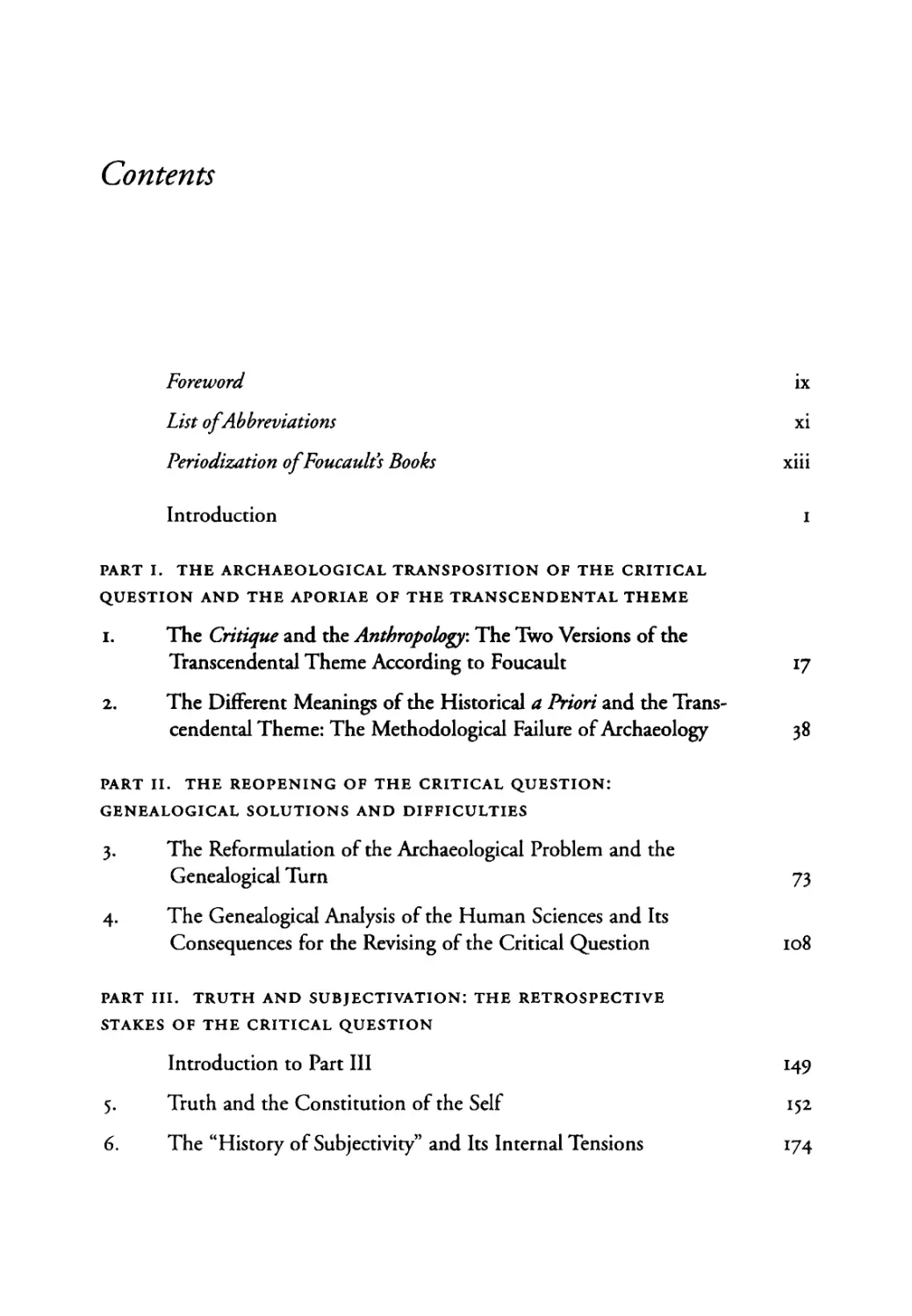
Contents
Foreword	ix
List of Abbreviations	xi
Periodization of Foucault's Books	xiii
Introduction	i
PART I. THE ARCHAEOLOGICAL TRANSPOSITION OF THE CRITICAL
QUESTION AND THE APORIAE OF THE TRANSCENDENTAL THEME
i. The Critique and the Anthropology*, The Two Versions of the
Transcendental Theme According to Foucault	17
2.	The Different Meanings of the Historical a Priori and the Trans-
cendental Theme: The Methodological Failure of Archaeology	38
PART II. THE REOPENING OF THE CRITICAL QUESTION:
GENEALOGICAL SOLUTIONS AND DIFFICULTIES
3.	The Reformulation of the Archaeological Problem and the
Genealogical Turn	73
4.	The Genealogical Analysis of the Human Sciences and Its
Consequences for the Revising of the Critical Question	108
PART III. TRUTH AND SUBJECTIVATION: THE RETROSPECTIVE
STAKES OF THE CRITICAL QUESTION
Introduction to Part III	149
5.	Truth and the Constitution of the Self	152
6.	The “History of Subjectivity” and Its Internal Tensions
174
viii
Contents
Conclusion
Notes
Index
188
199
235
Foreword
As this book was written in 1995 and came out in French for the first time in the
spring of 1998,1 have had a few years to reflect more on the issues covered in the
original, and to explore them further, or differently, in various papers. Living in
Britain and teaching in the friendly and stimulating environment of the philos-
ophy department at Essex for the past four years has also broadened my horizon
and introduced me to new ways of thinking. Consequently, I have made minor
modifications in the text to incorporate the changes in perspective brought by
the passing of time. A few pages have been rewritten, and examples and some
references to more recent work of mine have been added—all of which, I hope,
will clarify the original text without changing its overall dynamics or claims.
During the six years of research that led to the books elaboration, I worked
mostly alone. I am deeply indebted, however, to a few people whose care and
influence were essential to me. Although they rarely expressed it, my parents never
doubted me or my ability to write a thesis, and knowing this helped me to over-
come the doubts that seem to accompany any long-term research project. From
a more scholarly point of view, I benefited considerably from attending Francis
Wolffs seminars on ancient philosophy at the Ecole Normale Sup^rieure d’Ulm,
in Paris. I also was very lucky to be supervised by both Hubert L. Dreyfus and
Michel Haar, who during all these years never failed to give me attention, con-
structive criticism, and encouragement. Without the care and knowledge of these
two mentors, who became (with Francis) my closest friends, I would not have
been able to carry out this project. As Michel Haar has, very sadly, prematurely
suffered from a stroke and is now retired from the philosophical scene, I would
like to dedicate this book to him with affection and gratitude.
Finally, I am very grateful to Edward Pile for translating this book and giv-
ing it new life.
Abbreviations
Certain works by or about Foucault are cited with the abbreviations listed below.
All sources are by Foucault unless otherwise noted.
AK	The Archaeology of Knowledge, trans. A. M. Sheridan Smith (London:
Routledge, 1997).
BC	The Birth of the Clinic: An Archaeology of Medical Perception, trans. A. M.
Sheridan Smith (London: Routledge, 1986).
C Commentary, When he defended his doctoral dissertation, Histoire de la
folie a Tdge classique (partially translated as Madness and Civilization),
Foucault also submitted a translation of Kants Anthropology from a
Pragmatic Point of View, accompanied by a commentary 128 pages long.
The translation was later published by Vrin but the commentary remained
unknown. To my knowledge, there are only two places where it can be
accessed: the Biblioth£que de la Sorbonne (Paris-IV) and the Centre
Michel Foucault, rue du Saulchoir, in Paris. Because of the texts relative
inaccessibility, all of the longer passages quoted in this book are also given
in French in the notes.
DE Dits et ecrits: 1954—1988, vols. 1-4 (Paris: Gallimard, 1994). Collected
shorter writings and interviews.
DP Discipline and Punish: The Birth of the Prison, trans. Alan Sheridan
(London: Penguin, 1991).
F The Foucault Reader, ed. Paul Rabinow (New York: Pantheon, 1984).
FF The Final Foucault, ed. James Bernauer and David Rasmussen
(Cambridge, Mass.: MIT Press, 1988).
FL Foucault Live: Interviews, 1966-84, trans. John Johnston, ed. Sylvere
Lotringer (New York: Semiotext[e], 1989).
HS	The History of Sexuality, vol. 1, trans. Robert Hurley (New York: Vintage,
1990).
xii Abbreviations
LCP Language, Counter-Memory, Practice: Selected Essays and Interviews, ed.
Donald E Bouchard (Ithaca: N.Y.: Cornell University Press, 1986).
MF Hubert L. Dreyfus and Paul Rabinow, Michel Foucault, Beyond
Structuralism and Hermeneutics, 2nd ed. (Chicago: University of Chicago
Press, 1983).
OD The Order of Discourse (Paris: Gallimard, 1970). This has been published in
English as an appendix to The Archaeology of Knowledge.
ОТ The Order of Things: An Archaeology of the Human Sciences, trans, from the
French (New York: Vintage, 1994).
PK Power/Knowledge: Selected Interviews and Other Writings, ed. and trans.
Colin Gordon (New York: Pantheon, 1980).
PPC Politics Philosophy Culture: Interviews and Other Writings, 1977-84, trans.
Alan Sheridan et al., ed. Lawrence D. Kritzman (New York: Routledge,
1990).
UP	The Use of Pleasure, vol. 2 of The History of Sexuality, trans. Robert Hurley
(London: Penguin, 1992).
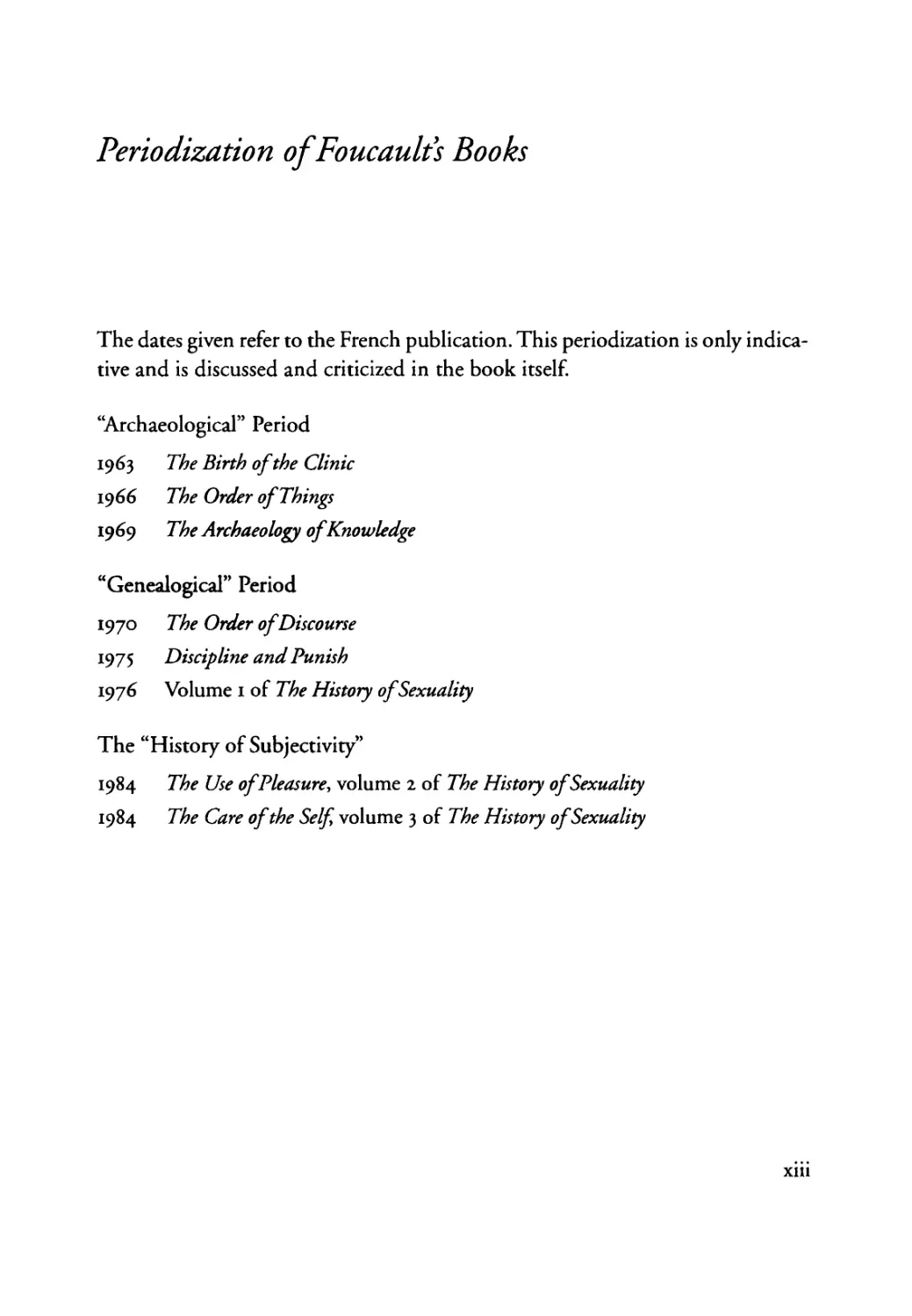
Periodization of Foucault’s Books
The dates given refer to the French publication. This periodization is only indica-
tive and is discussed and criticized in the book itself.
“Archaeological” Period
1963	The Birth of the Clinic
1966	The Order of Things
1969 The Archaeology of Knowledge
“Genealogical” Period
1970	The Order of Discourse
1975	Discipline and Punish
1976 Volume 1 of The History of Sexuality
The “History of Subjectivity”
1984	The Use of Pleasure, volume 2 of The History of Sexuality
1984	The Care of the Self volume 3 of The History ofSexuality
xiii
Introduction
The chronology of Foucaults major works is interrupted by two silences of five
and eight years, at the end of each of which Foucault seems to have abandoned,
or reexamined and reformed, his previous methods. Thus, archaeology is followed
by genealogy, and that in its turn by the study of the “techniques of the self.” To
each of these investigative methods corresponds an apparently different object—
episternes, “regimes of truth,” or “problematizations.” Moreover, while the first
two inquiries study similar periods (approximately from the Middle Ages to the
nineteenth century), the last one opens onto a time so remote (Greek and Roman
antiquity and the beginnings of Christianity) that it appears to have little con-
nection with the previous two. Given these apparent discontinuities, is it possi-
ble to restore to Foucaults corpus the coherence of a single project? Many of his
texts, starting with ones published after each of the silences, attempt to establish
this unity; thus the lecture series given at the College de France in January 1976
explicitly joins archaeology and genealogy by an indissoluble complementarity
(PK, 78-108). Similarly, the introduction of The Use of Pleasure reestablishes a
continuity between the five studies (that were planned at the end of the first vol-
ume of The History of Sexuality but were never carried out) of the different forms
1
2
Introduction
taken by subjectivation in the nineteenth century and the examination of “the
care of the self” in Greek antiquity (UP, 7). Foucault himself summed up his
explorations as follows: “One might have changed point of view, one has gone
round and round the problem, which is still the same, namely, the relations between
the subject, truth and the constitution of experience” (PPC, 48; modified, my italics).
But how can Foucault say that he was always concerned with “the same prob-
lem”? Especially since he employed himself with such energy in the 1960s in chas-
ing all figures of subjectivity from the philosophical stage, starting with that of
the “author.”1 What justifies Foucaults redefinition of his project as having always
been the study of “the relations between the subject, truth and the constitution
of experience”? Given these conditions, is it possible to attribute to his enterprise
any unity other than purely formal, a continuity that wouldn’t appear to be merely
a fiction arising from retrospective illusions and a belated concern for coherence?
If the Foucauldian project is coherent, then it should be possible to organize
it around a central theme to which the others could be subordinated. The pres-
ent books hypothesis will be that this central theme is situated at the conver-
gence of an initial question with an object that appears later, a convergence that
occurs only retrospectively to Foucault himself, by means of a reflection on his
own course and strategies. The question itself appears quite early in the
Foucauldian corpus, in The Birth of the Clinic, where it is prevalent:
The research that I am undertaking here therefore involves a project that is
deliberately both historical and critical, in that it is concerned . . . with deter-
mining the conditions of possibility of medical experience in Modern times. . . .
Here as well as elsewhere, it is a study that sets out to uncover, from within the
density of discourse, the conditions of its history. (BC, xix; modified, my italics)
In the same spirit, three years later, The Order of Things defines the “archaeolog-
ical level” as that which “makes knowledge [savoir] possible” (ОТ, 31)2 and assigns
to the Foucauldian enterprise the project of “reconstituting the general system
of thought whose network, in its positivity, renders an interplay of simultaneous
and apparently contradictory opinions possible. It is this network that defines the
conditions of possibility of a controversy or of a problem, and that bears the his-
toricity of knowledge” (ОТ, 7 5; my italics).3 Similarly, The Archaeology of Knowl-
edge indicates that it is “not a question of rediscovering what can legitimize an
assertion, but of freeing the conditions of emergence of statements” (AK, 127).
Another text from the same period focuses on the “general theme of the condi-
tions of possibility of a science,” identifying “two heteromorphic systems,” one of
which concerns “the conditions of science as science,” while the other has to do
with “the possibility of a science in its historical existence” (DE, 1: 724).
Introduction
3
Thus, during the archaeological period Foucault s guiding concern is the ques-
tion of the conditions of the possibility of knowledge. By doing this, he inscribes
his enterprise within the lineage of Kant,4 who was the first to question the con-
ditions of possibility of representation and consequently of all knowledge,
thereby opening the space of modern thought:
Kant seems to me to have founded the two great critical traditions between
which Modern philosophy is divided. Let us say that in his great critical work
Kant posed and laid the foundations for that tradition of philosophy that
poses the question of the conditions in which true knowledge is possible and,
on that basis, it may be said that a whole stretch of Modern philosophy from
the nineteenth century has been presented, developed as the analytics of truth.
(PPC, 95)
Insofar as he constitutes the cornerstone and horizon of modern philosophy, Kant
thus established the space in which Foucault s work is inscribed and must be sit-
uated: "We are all Neo-Kantians,” he added in 1966, evoking “the ceaselessly
repeated injunction to return to the break established by Kant—both to redis-
cover its necessity and to understand its consequences more fully” (DE, 1: 546).
However, the critical question of the possibility of true knowledge was, for
Kant, intrinsically connected to the introduction of the distinction between the
empirical and the transcendental—a distinction which allowed him to provide
the famous answer given in The Critique of Pure Reason. But Foucault denies the
relevance of this answer, for two reasons. Firstly, by retracing in his commentary
the genesis of the transcendental theme in the Anthropologyfrom a Pragmatic Point
of View, he shows that there are within Kant s own work two ambivalently related
versions of this theme. The initial critical formulation, which distinguished care-
fully between the empirical field and its a priori conditions, undergoes in the
Anthropology an inflection symbolized by the recentering of Kants triple inter-
rogation onto the question “What is man?” and philosophically materialized by
the transposition of the a priori into the “originary.” But such a displacement is
highly problematic, as it tends to make the contents of empirical experience work
as their own conditions of possibility; moreover, it seeks within human finitude
the elements of a transcendental determination henceforth made impossible in
principle by the anthropological confusion between the empirical and the a pri-
ori. Foucault s second rejection of the Kantian solution comes out of his critique
of post-Kantian theories, denounced in The Order of Things as being imprisoned
by the “Analytic of finitude,” itself a result of the monopolization of the field of
possible knowledge by “man” and his doubles.
Because of this fundamental ambivalence, it appears that Kant, although he
4
Introduction
certainly was the “initiator”5 of the discursive space in which modernity deployed
itself, was also its insurmountable limit. Consequently, Foucault’s relation to the
critical project reveals itself to be much less clear than it initially appeared. Indeed,
Foucault signals a fidelity to Kant by taking up the critical question himself; but
in the same movement, he shows the impossibility of answering it on Kantian
grounds and with Kantian concepts. His thought at this time seems animated
by two contradictory demands: to repeat Kants critical questioning, while
attempting to escape the anthropological configuration to which the latter
involuntarily gave birth. But how should we understand this reopening of the
critical question? What are its proper objects of inquiry? How can it be analyzed?
It is probably in order to address these issues that Foucault introduces the “star-
tling” (AK, 127) and somewhat paradoxical concept of the “historical a priori”
as well as a new method, archaeology, an innovation that results in doubly dis-
tinguishing his position from its Kantian background. The first displacement is
Foucaults adoption of a resolutely antihumanist problematic in his systematic
refusal to take the subject, be it empirical or transcendental, as a starting point
for his analyses: although he still deems it appropriate to define an a priori for
knowledge, this wont be done anymore through an analysis of human faculties.
The second reversal is connected to the specifically historical character claimed
by Foucault for his a prim. The notion of an “historical a priori” was first artic-
ulated in The Origin of Geometry, however, the underlying debate with Husserl
established by The Archaeology of Knowledge is concerned precisely with the way
in which this historicality should be defined. For Husserl, the historical a priori
turns out to be “suprahistorical,” in the sense that it exists essentially to guaran-
tee the possibility of recovering, beyond the sedimentations of history and tra-
dition, the primary evidences originally thematized by the “protofounder” of
geometry. But against the ahistorical character of the Kantian a priori and the
transhistoricality of its Husserlian equivalent, Foucault proposes the paradoxi-
cal hypothesis of an a priori fully given in history, which transforms itself with
it, and which nevertheless somehow lies beyond it in defining the conditions of
possibility, themselves variable, from which the knowledge of an epoch can and
must form itself.
In this sense, archaeology appears as a gamble, the interest of which lies pre-
cisely in the paradoxical form of the venture: to find a historical transposition of
the transcendental, or again to define in concrete terms the “historical tran-
scendental” studied long ago by Foucault in reference to Hegel and distantly
echoed by his own historical a priori? Perhaps even more than his debates with
structuralism or the indirect homage that he paid to French epistemology and
the Ecole des Annales,7 the identification of the Kantian aporia provided Foucault
Introduction
5
with a guideline with which he was able to build a contrario an original method
and conceptual apparatus and which allowed him to reopen the critical question
of the conditions of possibility of knowledge while attempting “to throw off the
last anthropological constraints” (AKy 15).8 It also permits us to identify the
specifically philosophical ambition of Foucaults project, which is all too com-
monly masked by the reception and use of his writings by the social sciences.
Foucaults main question is not only that of the genesis of the human sciences
and of contemporary forms of subjectivity, but above all of the possibility of
defining a new way of connecting history to philosophy, a middle path between
an idealism he judged excessive—that of Kant and the post-Kantians—and the
too reductive materialism of the thinkers lumped together by Foucault under the
rubric “Marxists.”9
Thus the critique of the transcendental in Foucault s early writings reveals itself
to be essential, since it governs both the denunciation of the “anthropological
illusions,” which according to Foucault have ensnared modernity, and the proj-
ect of finding a valid response to the question of the conditions of the possibil-
ity of knowledge in the renewal of the transcendental theme through the his-
torical a priori. Correspondingly, this critique serves to highlight the very
ambivalent relationship between archaeology and phenomenology, which as
Foucault subsequently affirmed was “the horizon of departure” from which he
“would try once again to detach himself.”10 Indeed, if phenomenology can appear
to be for him both interlocutor and favored target, it is precisely because it also
attempts—like Husserl in the Cartesian Meditations—to overcome the obstacle
of pure transcendentalism. Such is the function of such notions as the a priori
of existence and above all the “originary”: to express within the paradoxical form
of retrospection the movement by which the transcendental can appear within
the empirical as an “already there,” always present but perpetually elusive in its
foundation. Despite appearances, archaeology is profoundly connected to phe-
nomenology in that it attempts to find a solution to the same problem (provid-
ing a new version of the transcendental) and adopts a method that is often sim-
ilar—in its descriptive rather than explicative outlook, for example.11 Nonetheless
archaeology distinguishes itself from phenomenology by exposing the impossi-
bility of the phenomenological “solution,” that is, by criticizing the notions of
the “originary” and the “origin” as further instances of the confusion between
the empirical and the transcendental. Consequently, Foucault deems contem-
porary thought to be enclosed within a vicious circle (the “Analytic of finitude”),
in which the conditions of possibility are assimilated within that which they were
meant to found—an unfortunate move that destroys the very possibility of any
foundation. The violence of Foucaults attacks against the idea of the subject can
6
Introduction
be understood in terms of his renunciation of the Husserlian starting point (the
transcendental ego) in order to cast a nonoriginary version of the historical a pri-
ori—that is, to look for a transcendental without a subject. It is on archaeology,
sister and rival of phenomenology, that Foucault will henceforth confer the task
of finding this nonanthropological version of the fundamental.
From this perspective we shall see that it is possible to distinguish three phases12
within the archaeological period in which the historical a priori implicitly
receives different definitions. But correspondingly, new questions appear. How
can the various concepts progressively introduced by the author be differentiated?
How can the succession of texts in which they appear be understood? If the con-
cept of the historical a priori^ does not have the same content in The Birth of
the Clinic as in The Order of Things—to say nothing of The Archaeology of
Knowledge—how can we distinguish and connect these different meanings, and
what philosophical presuppositions do they assume? If one agrees with Foucault
that The Archaeology ofKnow ledge was the result of the desire to establish the legal-
ity of the method and concepts he had previously employed, is this attempt suc-
cessful? How can we understand the new definitions of the historical a priori and
of the tyistfmt given there?14 Are they consistent with their precedents and
between themselves? And why does Foucault feel it necessary to introduce two
supplementary terms: “discursive formations”15 and the “archive” {AK, 128-31)?
Is there complementarity, redundancy, or contradiction between these four con-
cepts? Finally can one really grant to the discursive and its “laws” the autonomy
that archaeology postulates? In other words, is the positivism that turns the his-
torical a priori into a “purely empirical figure” (AKy 128) as “happy” as its author
suggests? Although it was conceived as a sort of “counterphenomenology”—shar-
ing phenomenology’s project but following the opposite path—doesn’t archae-
ology itself risk falling into the “anthropological sleep”?
Notwithstanding reasons that we will come to later, Foucault’s own aban-
donment of the concept of the historical a priori seems to constitute an answer
to this question. To Julio Preti, who interviewed him in 1972, Foucault declared,
that the “ epistfmthas nothing to do with Kantian categories” (DE, 2: 371),16 before
more generally reproaching his interlocutor for being “Kantian or Husserlian.”
He himself was struggling to “escape any reference to this transcendental, which
would be a condition of possibility of any knowledge [connaissance].... I try to
historicise as much as possible in order to leave the least possible space for the
transcendental.”17 Against his first excess of transcendentalism, Foucault now
steers his course toward the historical and the dialogue with phenomenology takes
second place. But while he renounces the type of answer previously constituted
by his archaeological transposition of the transcendental, Foucault clearly stays
Introduction
7
with what he calls the “critical question,”18 as can be seen from the manner in
which the idea of “discipline” is introduced in The Order of Discourse of 1970:
“A discipline is not the sum of all that can be truthfully said about something.. . .
a proposition must fulfil complex and heavy requirements to be able to belong
to the grouping of a discipline; before it can be called true or false, it must be ‘in
the true,’ as Canguilhem would say” (OD, 60). Thus The Order of Discourse gives
a new expression to the critical question by reinterpreting it through the dis-
tinction (borrowed from Georges Canguilhem) between the actual predication
of truth and the possibility for a statement to be “in the truth”—its “acceptabil-
ity.”19 As we shall see, rather than responding to the same criteria as predication,
acceptability is the backdrop from which these criteria can be derived. By show-
ing that acceptability logically and chronologically precedes the predication of
truth, Foucault will thus open the way to a fourth interpretation of the histori-
cal a priori, one that therefore could be defined, through a retrospective reading
of previous texts, as the set of conditions that determine, independently of its
truth-value, the “acceptability” of a discourse. Like archaeology itself, genealogy
will henceforth seek to “grasp [discourse] in its power ... to constitute domains
of objects [acceptability], in relation to which one can affirm or deny true or false
propositions [predication]” (OD, yy, my italics).
But while giving the keys to such a rereading, The Order of Discourse lays the
ground for the new impossibility of thinking these conditions of acceptability
from the neutral and purely epistemological perspective of archaeology. Thus,
the questioning of the acceptability of discourse opens directly onto an interro-
gation of truth itself, its status and the “effects of power” that are specific to it.
Foucault’s central hypothesis is that these arise from a “will to truth,” specific to
the West, which first appeared with Platonism; the archaeological inquiry will
henceforth be doubled with a genealogical one. As it does not examine a purely
discursive level but rather the collection of practices in which truth is produced,
genealogy is the only approach that can make this will to truth appear, complete
with all its history and ramifications. Discipline and Punish and the first volume
of The History of Sexuality, therefore, through their analyses of disciplinary prac-
tices continue to explore the theme of the formation of the human sciences, and
to demonstrate the impossibility of dissociating their apparition from that of
modernity’s own form of power, “power-knowledge” [pouvoir-savoir].
Correspondingly, Foucault gives the old historical a priori a new identity in the
form of the “regime” that “governs statements, and the way in which they gov-
ern each other so as to constitute a set of propositions which are scientifically accept-
able, and hence capable of being verified orfalsified by scientific procedures. In short,
there is a problem of the regime, the politics of the scientific statement” (PK,
8
Introduction
112). Inasmuch as it “governs” the field of acceptability of propositions, the regime
establishes a second transposition of the transcendental, more “political” than
the first, which understood the critical question in a purely epistemological reg-
ister. While responding once more to the question of the apparition and trans-
formation of truth, the regime constitutes a new interpretation of the nature of
the veridictional field, one that subordinates the discursive and its laws to the
play of forces and processes of subjectivation.
Several questions arise: firstly, if truth is the central object of Foucault s inquiry,
how should it be defined? It is clear that Nietzsche s influence prevents Foucault
from adopting the traditional response, which understood truth as a purely intel-
lectual object by identifying it with an adequatio rei et intellectus\ Foucauldian
nominalism would anyway refuse any relevance. Like Nietzsche himself, Foucault
shows himself to be antimetaphysical in the sense that truth is not for him ^tem-
poral, lacking any historicity or a birth within history. On the contrary, he
attempts to refer truth to the practices, discursive or not, from which it origi-
nates, and reconnects its genesis and effects to the networks of power from which
it is indissociable. But does this understanding of truth belong to Nietzschean
perspectivalism only? To what extent does it integrate the consequences of the
new distinction between the acceptability and the predication of truth? If it is
clear that “ truth’ is linked in a circular relation with systems of power which pro-
duce and sustain it, and to effects of power which it induces and which extend
it” (Р/Г, 133), how can the relationship between truth and power itself be under-
stood? What contents can be given to this “circularity”? Finally, Foucault—unlike
Nietzsche—only rarely evokes the most “incontestable” truths, the truths of math-
ematics or physics given by the fundamental sciences. Why is this?
Secondly, what form should be given to the questioning of truth? If truth must
be reconnected with the networks of institutions and practices where it is
formed, this questioning clearly should not be understood as a purely logical or
formal study of what constitutes a propositions truth. But it should be equally
distinguished from a purely materialist approach, which, far from questioning
the field of acceptability itself, would only attempt to give an account of the his-
torical forms taken by truth and falsehood, thereby disregarding the critical ques-
tion of the conditions of the possibility of knowledge. Foucault attempts to escape
from this dilemma between formalism and materialism by opting for a “geneal-
ogy”; but how exactly is this “genealogy of the modern subject” indebted to its
Nietzschean model, and how can it be related to that older form of inquiry,
archaeology?
Finally, what are the consequences for the critical question of this refocusing
on the problem of truth? What content can be given to the new “answers,” the
Introduction
9
“regime of truth” or the “discursive regime”? Foucault presents the regime as a
genealogical avatar of the episteme by attributing to it the function of identify-
ing “what effects of power circulate among scientific statements, what constitutes,
as it were, their internal regime of power, and how and why at certain moments
that regime undergoes a global modification. It was these different regimes that
I tried to identify and describe in The Order of Things' {PK, 112; my italics). But
precisely insofar as it inherits the archaeological problematization, will the
regime be able to escape the obstacles that archaeology itself stumbled on? If the
problem is to preserve the critical question, while renouncing the transposition
of the transcendental given by the historical a priori, doesn’t genealogy risk a
recurrence (perhaps generated by the question itself) of a “wild” transcenden-
talism? More specifically, how can the status of the power-knowledge “nexus” be
thought about, since the conditions of the possibility of veridiction must ulti-
mately be referred to it? The problem is that the idea of a “perpetual articulation
of power on knowledge [savoir] and of knowledge on power” {DE, 2: 753),20 men-
tioned several times in Discipline and Punish, might turn the power-knowledge
network into an independent quasi-metaphysical reality, which would succes-
sively transform itself through history. “I cannot rule out the possibility that one
day I will find myself faced with a not negligible residue which will be the tran-
scendental” {DE, 3: 373), declared Foucault to Julio Preti, even while repudiat-
ing the transcendental theme. Could it be that, despite Foucault s lively denials,
there is a “metaphysics of power” secretly at work here?21
As we shall see, in the progression from archaeology to genealogy the tension
swings between the transcendental and the historical and back again. The ini-
tial insistence on the transcendental, after having given way to a historicism of
Nietzschean inspiration, reappears as an unrecognized shadow at the end of the
genealogical research. It is perhaps the search for a solution to these difficulties
that drives the later Foucault to once again shift the question of the conditions
of the possibility of truth by reformulating it in the following fashion: “After first
studying the games of truth \jeux de verite\ in their interplay with one another . . .
then studying their interaction with power relations . . . , I felt obliged to study
the games of truth in the relationship of self with self and the forming of one-
self as a subject” {UP, 6). This reelaboration of the critical question as the “study
of games of truth” leads Foucault to “reintroducfe] the problem of the subject”
{FL, 329)22 by recentering his approach on the essential notion of “subjectiva-
tion.” The strategical move that had led The Order of Discourse to question the
effects of truth rather than its conditions of possibility reaches its culmination
in the analysis of the constitutive role played by truth in subjectivation. The intro-
duction, in The Use of Pleasure, of the theme of the “history of truth” therefore
IO
Introduction
aims at synthesizing the Foucauldian itinerary by drawing together the previously
studied themes around the problem of the constitution of the self. Thus,
Foucault’s interest in the human sciences receives a retrospective illumination by
the idea that the truths they generate are precisely those which, transmitted by
the power-knowledge nexus, preside over the contemporary forms of the con-
stitution of the self. Correspondingly, it appears that the common genesis of these
forms of knowledge, as well as of institutional forms of bio-power, is the under-
lying reason for the transformation of the processes of subjectivation into tech-
niques of subjection. The Greek model, therefore, plays the role of a simpler first
matrix from which to evaluate a contrario modernity. Following this retrospec-
tive logic, the Foucauldian journey as a whole could therefore be described as
the passage from an archaeological interrogation of the conditions under which
a subject can speak the truth, to the genealogical claim that truth is per se the
major condition of possibility for the construction of the self as subject.
This last displacement immediately demands a particularly close questioning.
Firstly, how can the “return to the subject” be reconciled with the archaeologi-
cal/genealogical enterprise as a whole? Foucault innocently notes that “it was a
matter therefore of reintroducing the problem of the subject that I had more or
less left aside in my first studies” (FL, 329). This is a curious understatement, con-
sidering that archaeology's exact aim was the elimination of any avatars of the
subject, whether transcendental or empirical, and that genealogy was always most
careful to guard itself against talcing as point of departure the consciousness—
the “soul” (Z>P, 23)—of the individual, privileging instead the study of discipli-
nary practices directed at the body. “If there is one approach that I do reject,”
declared Foucault in 1970, “it is that (one might call it, broadly speaking, the
phenomenological approach) which gives absolute priority to the observing sub-
ject, which attributes a constituent role to an act, which places its own point of
view at the origin of all historicity” (ОТ, xiv).23 In such a context, how could this
“reintroduction” not transform itself into a regression, be it toward the tran-
scendental humanism formerly rejected by archaeology or toward the intellec-
tualizing idealism criticized by genealogy?
Clearly, everything hangs on what Foucault understands by the “subject,”
which, he declares, “is not a substance, it is a form and this form is not above all
or always identical to itself” (FF, 10). Therefore, it is not an immutable and inert
given (a “substance” definable ahistorically and a priori), but must understand
itself, rather, within the dynamic perspective of a nonidentity with itself (“is not
above all or always identical to itself”) and therefore of a self-becoming—hence
the possibility and necessity of a genealogy. Corresponding to this idea, for
Foucault, is the establishment of the essential theme of “subjectivation,” under-
Introduction
и
stood as a “recognition” (UP, 4)24 through which the individual “constitutes itself
as subject.” Thus it is “the process through which results the constitution of a
subject, or more exactly, of a subjectivity which is obviously only one of the given
possibilities of organizing a consciousness of the self” (FL, 330). Subjectivation
thus appears as the reflective operation (hence the theme of “self-consciousness”)
by which the subject “constitutes” itself by recognizing itself in “such and such
a determined form” (FF, 10). But the problem is that this definition of the sub-
ject and of subjectivation seems to implicitly revive the transcendental under-
standing that archaeology had always sought to banish, which sees subjectiva-
tion through the model of a reflective appropriation of the self doubled by the
simultaneous positioning of a collection of exterior objects. How is it possible
to return to the idea of a constitutive subjectivity without reopening the apor-
iae of transcendentalism?
Correspondingly, how can this intellectualist theme of a consciousness, lord
and master of the forms of subjectivity that it imposes on itself, be reconciled
with the genealogical perspective that focused on the body and the disciplines
of which it is the object and that understood self-consciousness as merely
derived? This problem crystallizes itself around the question of the status that
should be accorded to subjectivizing practices: for the later Foucault, the role
of such practices would only be to give to the constitution of the self a concrete
dimension by offering the subject the possibility of modifying itself conform-
ing to the model provided by the knowledge that it has of itself—hence, the
recurrent theme in The Use of Pleasure of “intentional and voluntary actions”
through which men “seek to transform themselves” by reference to “certain sty-
listic criteria” (UP, io-п). But isn’t the idea of subjectivation as a reflective con-
stitution of the self—in which practices would play only an instrumental role—
antigenealogical? Don’t the Foucauldian analyses of subjection clearly show the
impossibility of understanding subjectivation exclusively by reference to the
activity of a subject, and don’t they render moribund the idea of a “constitu-
tion of the self as an autonomous subject” (F, 42), by virtue of the genealogi-
cal thesis that “the subject is constitute*^/... in real practices—historically ana-
lyzable practices” (MF, 250)?
Thirdly, how can these last interpretations of the historical a priori, the “prob-
lematizations” or the “games of truth,” be understood? Indeed, the manner in
which Foucault defines them clearly indicates that these two notions are meant
to be a final answer to the critical question. Thus the games of truth are charac-
terized as the “rules according to which what a subject can say about certain things
involves the question of truth or falsehood" (DE, 4: 632; my italics), while prob-
lematizations are identified with the set of conditions that “makes something enter
12
Introduction
into the play of the true and false, and constitutes it as an object for thought” (FL,
296; my italics). Games of truth and problematizations are both therefore char-
acterized by the fact that they govern the field of acceptability of each epoch.
According to the genealogical method they are to be found at the confluence of
“a certain institutional practice and a certain apparatus of knowledge” (FL, 295),
and should thus be analyzed through the practices, discursive or nondiscursive,
that are at work in any given epoch. But the problem is that other passages give
a totally different version of these concepts; how can we correlate the games of
truth simultaneously with the “practices” and “institutions of power” (FF, 10)
that are exercised on the individual, on the one hand, and the “relationship of
self with self and the constitution of the self as a subject” (UP, 6; modified) on
the other? Similarly, Foucault invokes the notion of an “effective problematisa-
tion by thought” (F, 388), thought itself being understood as “the act which posits,
in their different possible relations, a subject and an object” (DE, 4: 632). But
how can this problematization be understood at the same time as the epistemic
“field” (UP, 37) that “makes possible” the knowledge of an epoch, and as the indi-
vidual operation by which the subject, by “constituting itself as an object,” forms
a reflective interpretation of its own nature? In other words, how can these last
avatars of the historical a priori simultaneously define the voluntary, constituent
activity of the subject, while supposedly conditioning from the outside the forms
taken by subjectivarioft by governing the impersonal models of knowledge used
in the constitution of the self?
Notwithstanding this, one of the most important points remains the com-
plex relationship maintained by Foucault s work with phenomenology. As sug-
gested above, this relationship was from the beginning susceptible to two read-
ings: the first, superficial, insists on the antihumanism of archaeology, while the
second, more profound, shows the continuity of the two projects as well as their
common Kantian roots. At the end of this analysis, the common parentage of
archaeology and phenomenology paradoxically seems even more thoroughly
affirmed, since there is good evidence that Foucault ends up repeating the same
error that he initially attributed to Husserl, namely, seeking to “to give empiri-
cal contents transcendental value” by “displacing them in the direction of a con-
stituent subjectivity” (ОТ, 248). However, the Husserlian research is not the only
possible model for thinking phenomenology, and certain clues indicate that
Foucault was perfectly conscious of this. Among these is the well-known text
where he affirms that all his “philosophical development was determined by (his)
reading of Heidegger,” who had always been for him “the essential philosopher”
(FL, 326),25 even though he never dedicated any specific study to him. By
Foucault s own admission the reason for this absence is not contingent but struc-
Introduction
13
rural, being tied to the breadth of the subterraneous “work” effected on him by
Heideggerian ideas. Given this admission, perhaps the Heideggerian ontology
could be read as the unthought of Foucault s oeuvre—not that which it did not
think, or had forgotten, but that which worked within it without being able to
be clearly formulated, thereby needing external elaboration.
Is it possible, on the evidence of these elements and the several texts in which
Foucault reasserts his admiration for Heidegger, to look within hermeneutic
ontology for a more coherent foundation for the analysis of problematization and
subjectivation, and more generally, for the “historical ontology of ourselves” (MF,
237)26 planned by Foucault? Indeed, if the relation to truth is effectively the “struc-
tural, instrumental, and ontological condition for establishing the individual as
a subject” (UP, 89), and if it is truly an “ontology” of the “ethical subject” (UP,
37) that is at stake in the later writings of Foucault, what would this ontology be?
Could it avoid the obstacles that the preceding attempts of Foucault encoun-
tered, and outmaneuver the recurrent forms of the transcendental?
PART I
The Archaeological Transposition of the
Critical Question and the Aporiae of the
Transcendental Theme
ONE
The Critique and the Anthropology.
The Two Versions of the Transcendental
Theme According to Foucault
The Ambivalence of Kants Position in The Order of Things
In chapters 7 and 8 of The Order of Things, Foucault traces back to Kant the
caesura that marks the end of the age of representation. According to him, crit-
icism marked a shift from the horizontal interrogation of representation to the
vertical questioning of its conditions of possibility, which were henceforth situ-
ated outside of representation and consequently escaped the epistemic horizon
that the latter had previously assigned to thought.
The Kantian critique . . . marks the threshold of our Modernity; it questions
representation ... on the basis of its rightful limits. Thus it sanctions for the
first time that event in European culture which coincides with the end of the
XVIIIth century: the withdrawal of knowledge [savoir] and thought outside the
space of representation. That space is brought into question in its foundation,
its origin, and its limits: and by this very fact, the unlimited field of representa-
tion, which Classical thought had established . . . now appears as metaphysics.
(ОТ, 242-43)
17
l8	ARCHAEOLOGICAL TRANSPOSITION
The importance of the critical caesura lies in its paradoxical movement, which
makes the creation of the new epistemic space the very solution of the questions
that can be asked within it. Kant’s introduction of the “transcendental theme”
(ОТ, 244) thus was meant to renew and solve an older question, that of the con-
ditions of possibility of knowledge. This question had already been addressed,
but in a metaphysical way (ОТ, 160 f£, 236 ff.) by natural history, and, for exam-
ple, by Etienne Bonnot de Condillacs ideology. According to Foucault, Kant
renews this question by looking beyond the space of representation for what
thereafter could no longer be found within it—the “conditions of the constitu-
tion and legitimacy of all possible knowledge.”1 He resolves it, following the now
well-known movement of the “Copernican” revolution, by referring these con-
ditions to the transcendental subject in its capacity as “the foundation of a pos-
sible synthesis of all representations” (ОТ, 244; modified)—a prodigious tour de
force, in which the questioning subject ends up defining by its very interrogation
the field in which its answer will be given, thus revealing itself to be the “condi-
tion of possibility of experience itself” (ОТ, 244; modified).
In chapter 7 of The Order of Things, the specificity of criticism is, therefore,
that by the simple fact of its apparition it determines the general configuration
in which all possible reflection must take place. But chapter 9 disturbs this pic-
ture, for two main reasons. Firstly, it is now the “Analytic of finitude,” and no
longer the transcendental theme, which defines the “threshold of our Modernity”:
“Our culture crossed the threshold beyond which we recognise our Modernity
when finitude was conceived in an interminable cross-reference with itself” (ОТ,
318; modified). So now, far from being architectonic, the transcendental theme
constitutes the first of the “doubles” produced by the specific structure of
finitude and therefore seems to become identified with the contents of knowl-
edge rather than with the space that determines it. Secondly, the status of
Kantianism itself becomes very ambiguous. Kant, Foucault tells us, is the first
to have emphasized human finitude and dethroned the sovereignty of “I think”:
“When to his traditional trilogy of questions he added an ultimate one: the three
critical questions (What can I know? What must I do? What am I permitted to
hope for?)2 then found themselves referred to a fourth, and inscribed, as it were,
‘to its account’: Was is der Mensch!” (ОТ, 341). Foucault continues, without tran-
sition, in the following way: “This question, as we have seen, runs through
thought from the early nineteenth century: this is because it produces, surrepti-
tiously and in advance, the confusion between the empirical and the transcen-
dental, even though Kant had demonstrated the divide between them” (ОТ, 341;
modified). But these two statements hardly complement each other. It would
mean that the same Kant had, on the one hand, “demonstrated the divide” of
The Critique and the Anthropology
19
the empirical and the transcendental, and on the other, blurred the frontiers of
this same division by recentering the three critical questions around that of man!
Is it therefore the “divide,” as analyzed by chapter 7, or is it indeed the focusing
on man in which this division found itself undone—the thesis of chapter 9—
that actually marks the break with the classical age? Does this mean that there
would be in Kant a “good” and a “bad” version of the transcendental theme? A
“critical” version that would initially separate the constituting from the consti-
tuted, and an “anthropological” version that would then superimpose the two
elements? Should we see the recentering of Kantian thought on the question of
man as a decentering of the transcendental theme and therefore of the critical
project itself? And if it should appear necessary to pluralize the transcendental
theme, how could we articulate its different formulations with the Analytic of
finitude, an articulation that is veiled by the linear succession of chapters 7 to 9
as well as by the passage quoted above? Is the transcendental theme, therefore,
just one of the many forms of this Analytic, or is it really the primary element
from which the Analytic itself must be diachronically understood as a deviation
resulting from the recentering of Kantian thought on man?
The “threshold of our Modernity,” declares Foucault, attempting to synthe-
size his two preceding statements, “is situated ... by the constitution of an
empirico-transcendental doublet that was called man” (ОТ, 19). It is therefore
in the latter that the transcendental theme—clearly presupposed by the definition
of man as a “double”—merges with the Analytic of finitude. But where and how
was the conjunction of the transcendental theme and “man” effected? For the
Foucault of chapter 7, the point of emergence of this theme is The Critique of
Pure Reason. But if man is really a “strange ^/>m?tf-transcendental double,” then
he cannot be the object of Kant’s argument there, since the Critique
questions the conditions of a relation between representations from the point
of view of what in general makes them possible: it thus uncovers a transcen-
dental field in which the subject, which is never given to experience (since it is
not empirical) but which is finite (since there is no intellectual intuition)
determines in its relation to an object = Xall the formal conditions of experi-
ence in general. (ОТ, 243)
Neither can it be “man” that the Critique of Practical Reason is concerned with,
since, a few years after the first Critique, it extended the project of the a priori
study of the subject, this time by examining the latter from the perspective of its
practical powers and its status as a noumenally free will. Whether envisaged in
its power of knowing or of acting, the subject is studied from the point of view
of an a priori determination, either of the conditions of possibility of knowledge
20
ARCHAEOLOGICAL TRANSPOSITION
or of free action, from which it always appears in its constitutive power and never
as a constituted subject. But if the critical perspective is not grounded in “man,”
then why tie the transcendental theme to anthropology?
The stakes of these questions are doubly important. Firstly, the coherence and
pertinence of the theses put forward by Foucault in the last chapters of The Order
of Things, which refer to the transcendental theme in a global and, as we saw,
quite indecisive manner, depend on the possibility of answering them. Secondly,
and most importantly, it is essential for the continuation of Foucault s project
that he should be able to determine the exact point where the connection between
the transcendental theme and anthropology was made. Indeed, the fact that this
theme was negatively interpreted by the post-Kantians does not necessarily mean
that it was already irredeemable at its Kantian origin. If the possibility remained
of isolating a nonanthropological form of the transcendental theme, while ana-
lyzing in detail the way in which this theme has been perverted, then nothing
would prevent Foucault from searching elsewhere, notably in what he called the
“historical a priori” a revised and nonsubjective version of the transcendental.
It is therefore crucial for him to know whether the anthropological usurpation
of the transcendental theme was already effective within Kants work, in which
the later confusions would then originate, or whether the critical question was
untainted at its origin by the anthropological tendency, although it opened the
way for it in the post-Kantian thinkers.
At this point, the reading of one particular text becomes essential to answer-
ing these questions: Foucaults complementary doctoral thesis,3 which pursues
the examination begun by the translation of the Anthropology from a Pragmatic
Point of View of the role played by “man” in Kant’s oeuvre. Foucault emphasizes
from the first pages of his Commentary that the anthropological “self-observa-
tion” has the specific characteristic of reaching “neither the subject in itself, nor
the pure I of synthesis, but a self which is object and present only its phenome-
nal truth. Yet this object I, which is given to the sense in the form of time, is
nevertheless not alien to the determining subject, since in the end it is nothing
but the subject as it is affected by itself” (C, 23).4 The object of the Anthropology
would therefore be neither the “subject in itself” of the Second Critique, nor the
“pure I” as studied in the first,5 but an “object-Г—also “subject”—in other words,
man in his paradoxical identity as determined and determining subject. Thus
the great interest of the Anthropology is that, contrary to the two Critiques, which
are only concerned with the transcendental, it takes account of man in his
ambivalence as an	transcendental double. For this reason, it constitutes
a privileged site—indeed the only possible one—from which to reply to the ques-
tions discussed above, which are naturally reformulated into the interrogation
The Critique and the Anthropology
21
that marks the Commentary like a Leit-motiv: what has the transcendental theme
become in the Kantian corpus, and what is the relationship between the Critique
and the Anthropology!
But Foucault’s response is itself ambivalent. On one hand, he seems to read
the Anthropology as a simple “repetition” of the Critique, in which case there
would be only one version of the transcendental theme. It would therefore be
possible, through an “archaeology of the text,” to reveal the constitutive role of
the Critique in “the birth and the evolution of human forms” (C, 14) :6 the explicit
foundation of the Anthropology would then be the transcendental conditions of
possibility defined by the Critique some twenty-five years earlier. There would
be “a certain critical truth of man, born from the critique of the conditions of
truth” (C, 14) ? As we shall see, Foucault gives a privileged expression to this first
interpretation through the concept of the “fundamental,” which allows us to
think the relation of the empirical and the a priori from a perspective that,
although symmetrical to that of the Critique, nonetheless remains in conform-
ity with it.
But this hypothesis of the subordination of the Anthropology to the Critique,
which would preserve the univocity of the transcendental theme, is not the only
possibility, as Foucault indicates from the beginning of his Commentary*. “Was
there, as early as 1773, a certain concrete image of man that no philosophical elab-
oration has essentially altered, which perhaps subsists in the very heart of the
Critique and is formulated, without any major modifications, in the last of Kant s
published texts?” (C, 14).8 The same logic that would cause Kant to move from
the question of the limits of knowledge to that of the nature of man, would there-
fore have shaped the critical enterprise from the beginning,9 assigning to this “con-
crete image of man” the task, if not of “organizing and ordering,” at least of
secretly “guiding” and “orientating” Kantian thought (C, 4). Far from being
founded by the Critique, the Anthropology would be its mute presupposition.
There would therefore be an “inner fault \faille] affecting the transcendental rev-
olution of criticism” (C, 67), a fault that generated a new version—anthropo-
logical, this time—of a theme originally believed to be pure.
These two interpretations—the repetition or the decentering of criticism—
appear incompatible, and it is therefore curious that they should be featured with-
out further justification in the same text. However, for Foucault it is not merely
a exegetic problem: thinking the relation of the Critique to the Anthropology is
in reality to understand the development of the transcendental theme, its artic-
ulation with the birth of man, and the apparition of the Analytic of finitude.
Should the Commentary establish that the internal evolution of the Kantian cor-
pus prefigures in miniature that of modernity, it would be possible to isolate even
22
ARCHAEOLOGICAL TRANSPOSITION
within the Kantian oeuvre itself the paradigm of the first empirico-transcenden-
tal “divide,” as well as what Roland Barthes might have called the “degree zero”
of the “confusions” (ОТ, 341) that enmeshed the post-Kantians. Thus the
Commentary is crucial as it alone allows us to identify the most simple—since
the most original—forms of the various stages of this development, and thus to
uncover the foundational configuration of the three events, however dissimilar,
that Foucault indifferently identifies as modernity’s moment of birth, namely:
the transcendental theme, the appearance of man, and the Analytic of finitude.
The Critical Version of the Transcendental Theme:
The “Fundamental”
The theme of anthropological repetition recurs very frequently in the
Commentary™ The following passage is one of its clearest expressions: “The
anthropological question asks, by taking them up, the questions that pertain to
them. We are at the level of the structural fact of the anthropologico-critical rep-
etition: the Anthropology does not say anything else than the Critique” (C, 76).11
It is possible to give four meanings to this “anthropologico-critical repetition.”
Firstly, the Anthropology could be the merely formal repetition of the arguments
of the Critique—an obvious mirroring form of repetition. Secondly, it could
repeat the Critique by presupposing it in its totality, that is, by grounding itself
implicitly in it, in a massive, silent, but structurally necessary repetition. Thirdly,
it could from this base shed a new light on some major critical concepts, a more
modest kind of repetition whose explicit task would be to bring the critical proj-
ect to completion without transforming it too greatly. Finally, repetition itself,
or retelling, could move the Critique toward a more finished form, of which
anthropology itself was the hidden presupposition, provided that repetition is
given its greatest range and the dialectical and dynamic sense of an Aufhebung.
To these four forms of repetition correspond four possible relations between the
Anthropology and the Critique: mirroring, foundation, complementarity, or
mediation, all of which are entertained by the Commentary.
From a formal point of view, Foucault declares, one can interpret the table of
contents of the Anthropology as the retracing of that of the Critique: to the
“Transcendental Theory of Elements” would correspond the “Anthropological
Didactic,” while the “Anthropological Methodology” would double the
“Transcendental Theory of Method.” Beyond this formal likeness, the totality
of the text follows in the wake of criticism, in the sense that it directly pursues
its questioning: “The internal structure of the Anthropology and the question that
The Critique and the Anthropology
4
animates it have the same form as the critical interrogation itself” (C, H9).12 So
the Anthropology renews the question of the conditions of the possibility of knowl-
edge by embedding itself within the general economy of a repetition of the crit-
ical problems: for example, paragraphs 7 to n redefine the question of the rela-
tion between sensibility and understanding, seen in accordance with the Critique
as “passivity” or “receptivity,” on the one hand,13 and as the “faculty to represent
something through concepts” or the “power of rules,” on the other.14 This exam-
ination operates through the reactivation of some fundamental themes of criti-
cism—notably the analysis of time and space, or the distinction between pas-
sivity and spontaneity. Similarly, paragraphs 41 onward take up the critical
definition of reason as “the ability to represent to itself what is general accord-
ing to principles and inasmuch as it is necessary,”15 again, while reformulating
the study of its speculative power and limits. There is, therefore, in the
Anthropology “a claim to know the possibilities and the limits of knowledge: it
mimics, from the outside and with the gestures of empiricity, the movement of
a Critique" (С, и?).16
However, the reason why the relation between the two texts can only be one
of “mimicry” is that the anthropological project is not autonomous; it requires
as its hidden foundation the critical edifice in its entirety. In fact, the relation
between the Anthropology and the Critique is not merely mimetic—in which case
there would be a simple parallelism between the two texts—but foundational:
“The empiricity of the Anthropology cannot ground itself in itself. It cannot
encompass the Critique, but must refer to it: and the reason it looks like its empir-
ical and external analogon is because it rests upon some already named and uncov-
ered structures of the a priori"" (C, 120).17 These “structures of the a priori,""
described notably in the preface of the second edition of The Critique of Pure
Reason,™ can be understood by means of a passage from the “Analytic of
Principles” that establishes a distinction between two sorts of determinations.
There, Kant describes the two ways in which a representation and its object can
agree. In the first, the existence of the object makes representation possible by
generating the various impressions collected by our sensibility, in which case the
determination is causal. But the second type of determination given by Kant “in
itself does not produce its object inasfar as existence is concerned,. . . [but]
nonetheless the representation is a priori determinant of the object, if it be the
case that only through the representation is it possible to know anything as an
object""™
This determination is not relative to the material reality of an object (the con-
crete characteristics of which can only be given a posteriori to intuition), but to
the formal possibility of knowing it. To the extent to which it is a priori, that is,
24
ARCHAEOLOGICAL TRANSPOSITION
that it “must in . . . [itself], independently of experience, be clear and certain,”20
transcendental determination is “universal” and “necessary,”21 and therefore con-
stitutes the foundation of a knowledge that is certainly limited, but absolutely
certain, thereby giving an apparently definitive solution to the Kantian project
of “knowing knowledge.”22 The Anthropology cannot therefore “fail to refer” to
the Critique, to the extent that it is only from the transcendental perspective, and
not from the agreement or contradiction of empirical evidence, that the field of
experience (and the anthropological domain itself) can be understood in its
entirety. While reproducing the subordination of “applied” philosophy to pure
philosophy (C, 45 ff.), this relation of the Anthropology to the Critique repeats
the Copernican inversion that some fifteen years earlier had made experience
revolve around conditions of possibility a priori defined by reason. The formal
repetition noted above, therefore, only has significance insofar as the Critique
implicitly constitutes the place from which to think an Anthropology that hence-
forth refers constitutively, in its nature even more than in its object, to the achieve-
ments of transcendental idealism.
The third form of repetition elaborates on the second to establish a relation
of complementarity between The Critique of Pure Reason and an Anthropology,
which therefore appears, within the terms of a “particular reversed analogy,” as
its “negative” (C, 56). If the first was the “investigation of the conditioning in its
foundational activity,” the second is only the “inventory of what is unfounded
in the conditioned” (C, 61).23 This in itself attests to the Anthropology s depend-
ence on criticism—indeed, one passes from an “investigation,” that is, a reflexive
analysis, which justifies its conclusions by its methodical progression, to an
“inventory,” that is, to a catalogue, which finds its principle of organization by
arbitrary means and outside of itself. However, if the theme of the “condition-
ing” does not require supplementary clarification, that of the “unfounded” is more
obscure, as it can hardly refer to the empirical itself, since as we just saw this finds
its foundation precisely in transcendental determination. Thus, the “unfounded”
for Foucault designates a certain use of our faculties, which is neither a priori
nor constitutive, but which is empirically submitted to the risk of illusion and
error. The third figure of the anthropologico-critical repetition is therefore tied
to an inversion of the perspective from which human faculties are analyzed: “The
Anthropology follows the division of faculties of the Critique*, but its privileged
domain is not that of their positive power, but that where they risk losing them-
selves” (C, 60).24
Therefore the text of 1797 does continue the study of the faculties analyzed
by the Critique, but by enumerating the eventual “abuses” (C, 63) revealed by
their empirical use. Thus, “self-consciousness” is no longer defined as the “form
The Critique and the Anthropology
25
of experience and condition of a knowledge, that is, limited but founded,” but
as the “temptation of a polymorphic egoism” (C, 60).25 Henceforth, “possible
experience defines, in its limited circle, the field of truth just as well as the field
of the loss of truth” (C, 61).26 So the Anthropology completes the Critique by reveal-
ing the ambivalence of experience. It is the “field of truth” in the sense that truth
itself refers to the “constitution of the necessary within the field of experience”
(C, 103),27 and because experience is transcendentally determined by the demands
of the a priori—necessity and universality. But the Anthropology also indicates the
site of a possible disorientation for the empirical, rather than transcendental, use
of the faculties—hence the Foucauldian thematic of perdition or of “adventure”
(C, 63). The Anthropology thus repeats the opposition between Schein and
Erscheinung by insisting on the seduction of appearances, rather than on the
founded character of phenomena; where the Critique only gave the “possibili-
ties in the order of conditions” (C, 63),28 the Anthropology examines the risks
inherent in the empirical engagement of the human faculties.
Finally, the last form of repetition is the most essential: arguing from the fact
that, paradoxically, the question of man is not posed in the Anthropology itself
but in later works,29 Foucault insists on the necessity of interpreting the text of
1797 in the light of all the later writings of Kant, gathered in the Opus posthu-
mum. Anthropological repetition is then defined as the mediation through which
“transcendental philosophy,” as a yet unrealizable project introduced by The
Critique of Pure Reason, would be realized. The A nthropology is therefore doubly
tied to the critical perspective: firstly, and retrospectively, in that it presupposes
it; secondly, and prospectively, as it precipitates its achievement. It is thus, par-
adoxically, “marginal for the Critique, and decisive for the forms of reflection that
would claim as their task its achievement” (C, 83).30 Its mediating character can,
at a first level, be interpreted from the character of its object. In the sections of
the Opus posthumum that concern transcendental philosophy,31 Kant returns to
the question of the relationship between God, the world, and man; but whereas
the first two were given identical status in the “Transcendental Dialectic” as
“ideas” of pure reason, the third now reveals itself as the mediation through which
the two ideas can be united. Man is the “medium terminus' (C, 65) between the
world and God, the “concrete and active unity by which God and the world find
their unity” (C, 69).32 However, if man can achieve this synthesis between the
world and God, it is only in his double nature as empirically limited being and
transcendentally determining subject, in other words in his properly anthropo-
logical dimension. He is indeed the “ real unity in which God’s personality and
the objectivity of the world are joined,” but also that only from which “the
absolute can be thought" (C, 71).33
16 ARCHAEOLOGICAL TRANSPOSITION
For Foucault, this constitutive ambivalence of man is developed by the Opus
posthumum in the following way. On the one hand, man’s synthetic ability stems
from his status as thinking subject,34 and therefore from the faculties defined in
the Critique. Thus, man “affects himself in the movement by which he becomes
an object for himself. . . . The world is uncovered ... as the figure of the move-
ment by means of which the ego, becoming an object, inscribes itself within the
field of experience and finds a concrete system of belonging” (C, 72).35 But on
the other hand, and conversely, man should equally be understood “from the
start” as a “denizen of the world” (C, 72) :36 “As for man, he is their synthesis—
that in which God and the world are actually unified—and yet in regard to the
world he is merely one of its inhabitants, and in regard to God merely a limited
being” (С, 104).37
At this point, the anthropological repetition reveals its most profound
significance as the attempt to avoid two disturbing dangers. Firstly, the analysis
could appear enclosed within a vicious circle, which, via human ambivalence,
would refer “any reflection on man to a reflection on the world” (C, 72),38 and
vice versa. Secondly, and most importantly, this circularity itself could generate
the possibility that man, far from being a constituting entity, would now appear
only as a being totally determined by his belonging to the world. The transcen-
dental perspective would therefore be forgotten to the benefit of a sort of return
to a precritical empiricism, which would only allow between man and the world
“empirical and circular relationships of immanence, at the level of a necessary
natural knowledge” (C, 81).39 But the anthropological repetition prevents such
an error by reminding us each time, and in accordance with the second of the
forms of repetition studied above, of the need for a foundation for empirical con-
tents, thus distinguishing carefully between transcendental determination and
positive limitations. Taking up again the tripartite structure that according to him
characterizes the Opusposthumum, Foucault reminds us that although the world
is the “source” of knowledge (which therefore is denied any pretension to the
absolute), it can only be so on the basis of a “transcendental correlation between
passivity and spontaneity,” that is, for the transcendental subject, in that it a pri-
ori unites sensibility and understanding. Equally, the world can be only the
“domain” of an action (the possible range of which it therefore limits from the
start) “against the background of a transcendental correlation between necessity
and freedom,” that is, in reference to a noumenally free subject. Finally, the world
can only be the “limit” of possible experience (which excludes any constitutive
use of the idea) because reason has “anticipated the totality and has prethought
it precisely as a limit” (C, 79).40 In other words, the empirical limitation effected
by the world can only appear as such because it has already been thought, at the
The Critique and the Anthropology
*7
transcendental level, by a reason that has nonetheless been shown its finite char-
acter by its lack of intellectual intuition.
The fourth form of anthropological repetition, therefore, has the function of
helping critical thought to reach “through its very repetition, the level of the fun-
damental, and to substitute for systematic divisions the organization of tran-
scendental correlates” (C, 8o).41 Thus anthropology is essential because it “car-
ries the a priori toward the fundamental” (С, 108),42 a concept that will remain
quite vague in The Order of Things (where it nonetheless appears several times),
but which can be clarified with the help of the Commentary A Its etymology
clearly refers to the theme of the transcendental foundation; but while it pre-
supposes the critical perspective, the fundamental differs from it, in the sense
that rather than allowing us to think the empirical from the transcendental stand-
point, according to the top-down logic of foundation described in the Critique,
it opens up the opposite direction by showing that empirical limitations can only
make sense in reference to the transcendental determination that they unknow-
ingly presuppose. While the transcendental allows the a priori determination of
the form that experience must take, the fundamental, on the contrary, takes
empirical contents as its point of departure and shows that they are marked by
“irreducible transcendences” (C, 8i),44 which should not be understood dog-
matically but which reveal the impossibility of the empirical being its own foun-
dation. Thus the theme of the fundamental is structurally tied to the retrospec-
tion through which empirical finitude always appears as already transcendentally
founded.
If the Anthropology is important, therefore, it is so because it defines the place
from which it is simultaneously possible to think the empirical under its con-
crete forms and to return to that which founds them. By doing so, it follows a
circle which, far from being vicious, turns out to be quasi-dialectical, in that it
achieves the “passage from the a priori to the fundamental, from critical thought
to transcendental philosophy,” described by the Commentary (C, 123).45 Its medi-
ating character does not only come from its object, but from the terrain that it
defines: insofar as it opens onto the thinking of the “fundamental,” the Anthro-
pology offers the only version of the transcendental theme that, far from perverting
criticism, completes it by reversing its first perspective, while insisting on the
necessity of referring the limitations brought by empirical contents (the general
model of which is the “world,” as understood in the Opus posthumuni) to their
transcendental conditions of possibility. By contrast, the mistake of “philosoph-
ical anthropologies,” according to Foucault, will be to believe that there could
be a “natural access” (С, 123)46 to the fundamental, that is, that the empirical could
“free itself from a preliminary critique of knowledge and from a primary ques-
28
ARCHAEOLOGICAL TRANSPOSITION
tion about the relationship to the object” (C, 123).47 Consequently, these anthro-
pologies will attempt to make the empirical work as its own foundation by con-
stituting it as the “field of a positivity from which all the human sciences would
derive their foundation and their possibility” (C, 123).48 But the most refined form
of the anthropological repetition reinscribes the Anthropology “within the wake
of the Critique9 (C, 123),49 reaffirms the primacy of the a priori over the empiri-
cal, and thus produces, by means of the concept of the “fundamental,” the model
of the only relation that can be established legitimately from the empirical toward
the transcendental—and the paradigm from which Foucault will find it easiest
to think through the post-Kantian deviations.
The Anthropological Decentering of the Transcendental Theme:
The “Originary”
We have just seen how the definition of the “fundamental” at once conserves and
confirms the “divide” formerly established in the Critique. However, the funda-
mental is not the only type of relation that the Anthropology establishes between
the transcendental and the empirical. Another model, much more polemical, is
given by Foucaults study of Geist and its relation to reason. It is probably not by
chance that Geist should serve as the pivot of the analysis, since its function in the
Commentary was to secure the binding of the Anthropology to the Critique. Thus
it is in what should be both the thesis of repetitions peak and most stable foun-
dation that it gives way to that of decentering. Indeed, if Geist can serve, like free-
dom in the second Critique, as the “keystone” of the Anthropology, it is because,
contrary to Gemiit, which is identified with an “empirical and passive nature,” the
study of which would belong to psychology, it permits the legitimization—not
merely the acknowledgement—of the nonidentity of the subject with its empiric-
ity. According to Foucault’s reading, Geist effectively provides a ground for the
possibility of spontaneous action through which Gemiit is “not only what it is,
but also what it does with itself” (C, 52).50 Because it includes a reference to noume-
nal causality, it accounts for the “pragmatic” (C, 33 ff)51 dimension of the 1797
text, and therefore for the specificity of the anthropological terrain. Thus, “because
it opens to a dimension of freedom and totality, in which each fact is taken up
within the complex network of sollen and konnen, the Anthropology can be noth-
ing but pragmatic” (C, 54).52 Geist is more precisely defined by a passage of the
Co mmentary which is, in fact, a free translation of an extract of the Anthropology^
“the principle that animates the spirit by means of the ideas, this is called the Geist
[Man nennt das durch Ideen behbende Prinzip des Gemiits Geist}” (C, 50).54
The Critique and the Anthropology
29
To clarify this “animating” function of the Geist., the Commentary refers
obliquely to the “Appendix to the Transcendental Dialectics,” a passage from
which is paraphrased in the following way: “ [The idea] anticipates a schema that
is not constituting but that opens up the possibility of objects. It does not reveal
the nature of things through an ostensive move, but indicates how this nature
can be sought” (C, 51).55 The idea is therefore initially described as a “regulative,”56
rather than constitutive principle that does not determine any object within the
order of knowledge. However, Foucault minimizes this first aspect by stating twice
that Geist is “not regulative” (C, 49, 50), stressing instead the dynamic character
of ideas, which allow reason to satisfy its natural desire for the absolute by out-
lining for it the horizon of a totality, and therefore by giving its sense, as orien-
tation and meaning, to the movement of the spirit. The Commentary thus estab-
lishes a functional parallelism between the dynamic that pushes reason to exceed
the limits of experience at the theoretical level, and the concrete movement
through which Geist “causes the empirical and concrete life of Gemiit to continue
on” (C, 52).57 Because it accounts for the constitutive separation of the subject
from all nature, including its own, the dynamic of ideas should therefore permit
the Commentary to give the anthropological repetition its real center.
And yet, just having concluded, in agreement with his preceding analyses, that
Geist “tears the Gemiit away from its determinations” (C, 53),58 Foucault claims
without transition that there is a mysterious connection between Geist 2s defined
and the “enigmatic nature of our reason” (C, 54),59 which was described in the
“Methodology” in the following way: “Reason is impelled by a natural drive to
go out beyond the field of its empirical employment, and to venture in a pure
enjoyment, by means of ideas alone, to the utmost limits of all knowledge, and
not to be satisfied save through the completion of its course in [the apprehen-
sion of] a self-subsis tent systematic whole.”60 Thus, Foucault is enabled by the
lack of precision regarding this “natural drive” to operate the qualitative and dar-
ing leap that permits the Commentary to identify this “enigmatic nature” of rea-
son with Geist itself, henceforth defined as “something that would be the kernel
of pure reason, the un-uprootable origin of its transcendental illusions . . . , the
principle of its movement within the empirical field where the faces of truth cease-
lessly appear” (C, 55).61 Geist does not, therefore, “animate” only Gemiit, but rea-
son itself, which finds itself suddenly deposed from its sovereign position and
returned to that which, from the shadows, would have already determined its
speculative movement, and which, as its “nature,” would be constitutively des-
tined to escape it.
Thus occurs an inversion of the previously studied relationship of subordi-
nation of the Anthropology to the Critique, which “seems to refer the Critique,
30
ARCHAEOLOGICAL TRANSPOSITION
from its apex, to an empirical region, to a domain of facts where man would be
condemned to a most originary passivity” (C, 54; my italics).62 Playing on the
ambiguity of the concept of “nature,” which can refer both to the essence of a
thing and to the synthetic connection of “natural” (and therefore empirical) phe-
nomena, Foucault assimilates Geist to an “originary fact,” in which reason would
find both its truth and the source of the empirical determinations that bear upon
it. Henceforth, it is within this secret nature of Geist that the impossibility of
reason mastering or escaping its own essence will be determined, along with the
empirical limitations that it is bound to encounter under various forms—for
example, in its constitutive aspiration to the unconditioned, in the impossibil-
ity of intellectual intuition, or in the absence of the necessary obedience to the
moral law that would define sanctity. If the Critique is “referred to an empirical
reason,” it is because this definition of Geist reveals a previously excluded possi-
bility: that the transcendental power of reason should be dependent on empiri-
cal determinations. The consequence of this for “man” is the uncovering of a
“most originary passivity,” which precedes any constitutive activity, a passivity
that The Order of Things will refer to the exterior empiricities of life, labor, and
language, the primary form of which can be internally identified through the
redefinition of Geist in the Commentary.
Foucault expresses this major inflection of the transcendental theme through
the concept of the “originary”:
Therefore, the relationship between the given and the a priori takes in the
Anthropology a structure that is the reverse of that which was uncovered by the
Critique. What was a priori in the order of knowledge becomes in the order of
concrete existence an originary that is not chronologically first, but which, as
soon as it has appeared . . . reveals itself as already there. (С, 60)63
The originary thus marks the impossibility, as soon as the level of transcenden-
tal determination (“the order of knowledge”) has been abandoned for that of real
and empirical determinations (“the order of concrete existence”), of accepting
the foundational logic originally established by the Critique and later reaffirmed
by the fundamental through anthropological repetition. To this impossibility cor-
responds the movement of retrospection that characterizes the originary: “What
is, from the point of view of the Critique, an a priori of knowledge, does not trans-
pose itself immediately, through anthropological reflection, as an a priori of exis-
tence, but appears within the density of a becoming where a sudden apparition
necessarily takes in retrospection the meaning of an already-there” (C, 5y).64This
“transposition” has as its consequence the paradoxical inscription of the tran-
scendental within experience. For the a priori of knowledge to always appear as
The Critique and the Anthropology
31
“already there,” it must in some way preexist its own empirical “emergence”; but
conversely, if it is only “retrospection” that allows us to make sense of it, then it
can no longer have the radical independence it enjoyed in the Critique. The the-
matic of the “already there” specific to the originary consequently establishes a
new relationship between the two terms, a relationship of retrospective presup-
position. In accordance with the dual nature of man, both empirical and tran-
scendental, the a priori must appear within experience; but it can only do so inso-
far as it is presupposed by experience as that of which it is the condition of
constitution, the fact that it can never be simultaneous with itself and must
remain inscribed within a logic of recurrence signaling its heterogeneity from the
empirical.
Thus appears the impossibility of establishing the relation of foundation
between the empirical and the a priori previously expressed by the “fundamen-
tal,” a relation that underlined the absolute necessity of referring empirical con-
tents to their a priori conditions and therefore gave the transcendental the logi-
cal priority that separated the constitutive from the constituted. On the contrary,
the mutation of the transcendental theme into the “originary” has the conse-
quence of ruining the critical project by devoting the Anthropology to the search
for a foundation that is by definition denied to it by its theoretical presupposi-
tions and the ambivalence of its object. Thus the Anthropology is finally defined
as a “knowledge of man, by a movement that objectifies the latter at the level
and in the content of its animal determinations; but it is also the knowledge of
the knowledge of man, in a movement that questions the subject itself about its
own limits and what it makes possible in the knowledge that it takes of itself”
(С, 118).65 Insofar as it is concerned with a content that is objectified “at the level
of its animal determinations,” the “knowledge of man” first mentioned above is
clearly empirical, and should be subordinated to the transcendental perspective.
Indeed, the Critique gave in the “Transcendental Analytic”66 the model of such
a subordination by carefully distinguishing between two forms of intuition of
the self (pure apperception and empirical apperception), precisely so as to avoid
any confusion between the “pure I” of synthesis and the empirical self,67 the first
being the transcendental condition of possibility for the second. But the
Anthropology emblematically introduces a third term between these two elements,
in the form of a “spoken I” claimed to be the “empirical and manifest form in
which the synthetic activity of the I appears as an already synthetizedform, as an
indissociably primary and secondary structure” (C, 57).68 Following the retrospec-
tive movement specific to the originary, the empirical nature of man becomes
the “a priori limit of his knowledge” (С, 118),69 so that the empirical understanding
that the subject forms of itself now supposedly generates a knowledge of what
32
ARCHAEOLOGICAL TRANSPOSITION
the subject is in its constitutive power. Thus transcendental determination is
reversed, while the “[empirical] knowledge of man” becomes “a [pseudo-tran-
scendental] knowledge of the knowledge of man.”
Thus Foucault denounces the apparition of a level of reflection that he cate-
gorizes in the Commentary as “mixed” and “impure,” and which is described in
an interview with Paul Ricoeur in the following way: “As soon as one tries to
define an essence of man which could articulate itself from itself and which at
the same time would be the foundation of all possible knowledge and of any pos-
sible limit to knowledge, one swims in total parallogism” (DT, i: 452).70 Following
the pernicious logic that seeks to “make the man of nature, exchange, or discourse
[i.e., man as empirically finite] serve as the [transcendental] foundation of his
own [empirical] finitude” (ОТ, 341), the Anthropology superimposes the tran-
scendental and empirical dimensions of man as a “double,” by introducing the
new necessity of referring the a priori back to the positivities that determine man
in his empirical being.7’ “The insidious values of the question ‘Was is der
Mensch?’ are responsible for this homogeneous, destructured, and indefinitely
reversible field in which man presents his truth as the soul of truth” (C, 126),72
adds the Commentary in the same spirit. The Order of Things echoes this descrip-
tion, defining anthropology as “the fundamental disposition which has governed
and controlled the path of philosophical thought from Kant until our own day”
(ОТ, 342; modified), insofar as there man reveals himself as “such a being that
knowledge will be attained in him of what renders all knowledge possible” (ОТ,
318).73 So the “Analytic of finitude” unknowingly anchors its truth in this
“Analytic of man” (ОТ, 341), which the Commentary reveals as logically and
chronologically coextensive with the anthropological version of the transcen-
dental theme.
The Strategic Importance of the Commentary for Archaeology
It seems clear that the main interest of this Foucauldian reading of the
Anthropology does not lie in its potential contribution to Kantian studies—which
is probably why it has not been published along with Foucault s translation of
Kants text. Indeed, one could object that it considerably distorts the theses
developed in The Critique of Pure Reason, and that the anthropological slippage,
if that is what it is, needs not necessarily have the unfortunate significance it is
given here. For example, the idea of an “a priori of existence,” although familiar
to the author of the Cartesian Meditations,™ does not, as such, make much sense
for Kant himself. The very question of the Critique—how there could be an
The Critique and the Anthropology
33
“agreement” between experience and the conditions defined a priori by the tran-
scendental subject—excluded from the start the hypothesis of an inscription of
the transcendental within the empirical. Equally, the theme of a “density of
becoming” seems foreign to the definitions of time given in the Critique (either
as the a priori form of sensibility through which experience is constituted, or as
the constituted and objective time that one can measure from the observation
of the regular course of phenomena).75 The idea of an “emergence” of the tran-
scendental within becoming requires a different conception of temporality. This
is indirectly confirmed by the rest of the Commentary, which indicates that in
the Anthropology time is revealed as that which “undermines synthetic activity
itself” (C, 85),76 and that to which the subject is linked by “already effected syn-
theses” (С, 43)77 which, in a certain sense, always precede the active transcendental
syntheses. But these assertions, although they could easily have figured in
Experience andJudgments they look like barely veiled allusions to the Husserlian
theme of “passive syntheses,” hardly seem to belong in The Critique of Pure
Reason,
But perhaps this debate is not essential; the overall importance of Foucault s
interpretation of Kant is strategic rather than theoretical, and is played out within
the Foucauldian corpus. Indeed, the Commentary can be read as a tentative
attempt to show that as soon as Kant left the terrain of the Critique for that of
the Anthropology, the “Fold” (ОТ, 341)78 of the transcendental onto the empiri-
cal and the “network of radical misunderstandings and illusions” (С, 123)79 that
it engendered were irrevocably generated by man’s duality as the empirico-tran-
scendental double. From this perspective, the chronology of the Kantian itiner-
ary gives, despite itself, in the relationship of the Critique to the Anthropology, a
miniature image of the divisions that will fracture modernity, while allowing us
to identify the successive stages of the evolution of the transcendental theme
implicitly presupposed by The Order of Things.
This idea is corroborated by the fact—itself highly symbolical—that the
Commentary permits us to pinpoint, within the Anthropology itself (and there-
fore in a manner internal to Kant’s thought), the prefiguration of each of the three
“doubles”80 through which Foucault will study the details of the anthropologi-
cal confusions in The Order of Things. Thus, because of the description of Geist
as the “nature” of reason, reason encounters in the very exercise of its constitu-
tive power its first experience of a limit that it cannot reduce through thought.
In this confrontation with the ineluctability of its empirical determinations,
which teaches it that it is neither unconditioned nor divine, reason painfully
comes for the first time to understand its own finitude: “Geistwould be this orig-
inary fact, which, in its transcendental version, implies that the infinite is never
34
ARCHAEOLOGICAL TRANSPOSITION
there” (C, 55).81 The relationship of Geist to reason thus anticipates the circular-
ity between the empirical and the transcendental specific to the Anthropology,
Although it is transcendentally determining, reason reveals itself as empirically
determined by this “nature,” which appears as a sort of ungraspable anteriority.
Conditioned in the order of being, reason seeks to release itself from this origi-
nal passivity by taking it up in the order of knowledge, where, on the contrary,
it can appear as conditioning. But the Anthropology, by uncovering that which
the Critique had hidden—the presence and nature of Geist— invalidates this
emancipating attempt exactly in the way described by section 9 of The Order of
Things, that is, by folding back “the specific dimension of the critique on the
contents of an empirical knowledge” (ОТ, 319; modified), thus anticipating the
“empirico-transcendental redoubling” later described by Foucault.
Secondly, because of its definition as limit—that is, as that which is necessary,
not from external and contingent requirements, but from the internal
configuration of the limited object— Geist entails a paradoxical decentering of
thought to itself. It is that part of itself which reason attempts to recover by the
movement of reflection, but which, as it is presupposed in the attempt itself, is
destined to escape from reason. Thus, “Geist is the root of the possibility of knowl-
edge. And because of this, it is indissociably present to and absent from the figures
of knowledge” (C, 5 5). *2 Although not heterogeneous to it, Geist never gives itself
to reason as the reassuring object whose possession would comfort it with the
knowledge that it could form both of itself and of experience, thus allowing rea-
son its liberation from the constraints of its own nature. On the contrary, Geist
appears as that which leads reason always to lose itself in the opacity of a nature
that from the beginning functions as a given, “present” indeed because it deter-
mines the originary rational impulse, but “absent” from the field of knowledge
because of its constitutive indeterminacy. Henceforth, the relation of reason to
Geist anticipates the movement that defines in The Order of Things the relation
of the cogito to the unthought, by which man is ineluctably referred “from a part
of himself not reflected in a cogito to the act of thought by which he apprehends
that part” (ОТ, 322), and which “exposes his thought to the risk of being swamped
by his own being, and also enables him to gather himself on the basis of what
eludes him” (ОТ, 323; modified).
Finally, the Commentary clearly indicates that Geist is never given to reason
as actual and present, as it is: “This withdrawal, this invisible and visible reserve
in the inaccessibility of which knowledge takes place and acquires its positivity.
Its being is not being there, sketching by this the locus of freedom” (C, 56).83 Being
there without being there, Geist is therefore a “never-there”: like the originary,
whose paradoxes it takes up, Geist is never simultaneous with reason because it
The Critique and the Anthropology
35
cannot inscribe itself homogeneously in the temporality that it defines, and as
“nature,” preexists all constitution. Being at once “invisible” and “visible,” it can
only appear retrospectively as this “primitivity”84 which precedes the critical foun-
dation and yet can only be thought through it. But the way in which The Order
of Things exposes the “withdrawal” of the origin—a thematic which is not with-
out connection to that of the “retreat” specific to Geist— seems exactly to take
up this paradoxical structure again, by transposing it to the exteriority that unites
man no longer with his own nature, but with things: as Foucault indicates,
although, in the empirical order, things are always withdrawn from him, so that
they are inapprehendable at their zero point, nevertheless man finds himself fun-
damentally withdrawn in relation to that withdrawal of things, and it is by this
means that they are able to weigh down upon the immediacy of original expe-
rience with their solid anteriority” (ОТ, 332; modified).
Given this triple relationship of prefiguration, the Commentary functions as
a matrix from which to interpret the Foucauldian critique of anthropology, in a
way constituting the philosophical “prehistory” of the archaeological texts. In the
light of this understanding, it becomes possible to redefine the relationship
between the transcendental theme, man and the Analytic of finitude, and by
doing this, to resolve the tension, identified above, between chapters 7 and 9 of
The Order of Things, As we have seen, the Commentary permits us to establish
that it is not the “Kantian critique” in its totality that marks the “threshold of
our modernity,” but that the line of division passes within Kants work itself, sep-
arating the original formulation of the transcendental theme from its later ver-
sions. In chapter 7, this latter appears in its critical version; however, it is not this
that truly marks the break with the classical age; the Commentary shows that it
is only from the Anthropology onward that the dual structure that defines man
becomes clearly visible. It is this inflection of the transcendental theme that chap-
ter 9 takes into account, defining it as the real epistemic revolution that gave birth
to the “anthropological sleep” (ОТ, 340) characteristic of modernity.
One could certainly object that the constitution of the empirico-transcen-
dental doublet was presupposed by the Critique itself, since the inversion that
gave finitude the power of self-foundation rested on the doubling of the subject
itself. But for Foucault, the specificity of finitude in its critical version is that it
could only become the ratio cognoscendi of experience on condition that man was
erased, as the founding transcendental subject, from a field in which he can hence-
forth only appear as an empirical subject. Thus the subject, in the Critique, is “never
given to experience” (ОТ, 243), declares Foucault: a curious statement, which
only makes sense if one adds “as transcendental subject.” But this partial erasure
is very close to that of man from the space of representation, which Foucault ana-
36	ARCHAEOLOGICAL TRANSPOSITION
lyzed in chapter i of The Order of Things through the painting by Velazquez !
Because he withdraws in his transcendental dimension from the empirical field,
which this retreat itself permits him to constitute, man as the empirico-tran-
scendental doublet is by definition just as absent from Kantian criticism as he is
from LasMeninas, being in both cases a “blind spot”—a paradoxical point, struc-
turally incapable of inscribing itself in the visible field, but which, however, guar-
antees the very possibility of vision.
So the ambivalent status of Kant in The Order of Things derives from this
impossibility of man appearing in the Critique in his full ambiguity “as an object
of knowledge and as a subject that knows” (ОГ, 312), even though he is presup-
posed by this same text in his empirico-transcendental duality—whereby he con-
stitutes, stricto sensu, the unthought of criticism. In this sense, the deepest stake
of the Commentary is precisely to bring this unthought to light through an explicit
reflection on the relation between the Critique and the Anthropology, and to out-
line the resulting consequences. The conclusion that Foucault comes to, there-
fore, is that the inflection of the transcendental theme could only drive con-
temporary thought into a series of impasses, themselves thrice prefigured in the
relation of reason to Geist, These aporiae concern the ambition of the Anthropology
to “count as a Critique that would be freed from the assumptions and the inert
weight of the a priori9 (C, 123),85 the problem thus being that the end sought
and the means used are contradictory. How could the a priori conserve any sort
of founding power if empirical knowledge is sufficient to determine it in its turn?
The Anthropology is misled in searching within the empirical for a knowledge
that could have transcendental value, as the “turn towards the empirical”
attempted is sufficient in itself to empty of all meaning the concept of a tran-
scendental foundation.
Henceforth, Foucault s question will be whether it is possible to give the ques-
tion of the conditions of possibility of knowledge a nonanthropological trans-
position. The evidence and instruments of this attempt to “deanthropologize”
the a priori while keeping open the need for a foundation are the concepts of the
“historical a priori,” then the episteme, and finally the “archive.” However, one
can immediately underline a serious problem: given the extreme ambivalence of
the Kantian heritage and the shadow that it throws over modernity, why borrow
from Kant the problematization as well as the necessary concepts to formulate
the archaeological analyses? The conceptual framework provided by Kantian ter-
minology is clearly the grounding for passages in which the “anthropological
sleep” (ОТ, 340) echoes the “dogmatic sleep” from which Hume, the good “geog-
rapher of human reason,”86 rescued Kant, or indeed the extracts in which
Foucault interprets the modern configuration of knowledge as a dialogue of a
The Critique and the Anthropology yj
“quasi-Aesthetics” and a “quasi-Dialectics,” whose foundation would be given
by an “Analytic” (ОГ, 320). Foucault himself recognized having borrowed the
term “archaeology” from Kant, who according to him “used it to refer to the his-
tory of what makes a certain form of thought necessary" (DE, 2: 221).87
One might suggest that by virtue of Foucaults very inscription within the
modernity that he historically criticizes, he must be defined as a post-Kantian,
and that it is therefore coherent that he should use the vocabulary of the epis-
temic configuration to which he belongs, so revealing himself against his wishes—
and as prophesied by Hegel long before him in the Lessons on the History of
Philosophy—as the “son of his time.” Nonetheless, the hypothesis of the histor-
ical necessity of the Kantian inheritance seems insufficient to explain the fact that
Foucault recasts the critical question in the very terms that according to him
doomed it to fail. It is well known that he claimed to be the herald of a new
tpisteml, in which language, previously relegated to the margins of literary pro-
duction by the eruption of man onto the scene of knowledge, would once again
reign. But one may wonder whether in this attempt to push the Kantian her-
itage to its limits by reformulating it, archaeology has not from the start ruined
its very foundation, condemning itself to repeat the same contradictions for
which its author criticized the Anthropology. If at the very heart of the archaeo-
logical project, a final redoubling of the empirico-transcendental circle specific
to modernity should be uncovered, then perhaps one will have to conclude, in
ironic and anticipatory reference to Nietzsche, that the early Foucault, by reac-
tivating the Kantian theme . . . has defeated himself from the very beginning?
TWO
The Different Meanings of the Historical
a Priori and the Transcendental Theme:
The Methodological Failure of Archaeology
Strange though it may appear, Foucault hardly ever troubles himself to give the
historical a priori clear theoretical definition.1 Only a few texts—the preface to
The Order of Things', chapter 3, section 5, of The Archaeology of Knowledge', and
a few scant articles—provide more precise descriptions, to which, however, the
rest of the texts concerned barely refer.2 There is a strong contrast between the
detailed character of Foucault’s empirical analyses and the general imprecision
of the theoretical armature on which these are supposed to rest. It is almost as if
the author were actually maintaining two parallel discourses: a background inter-
rogation of the nature of history as historia, to which he responds implicitly by
introducing the notion of an historical a priori, and a collection of sharp analy-
ses of the rerum gestarum, which presupposes the first questioning and its answer
without articulating them precisely. Focusing mainly on this last aspect, numer-
ous commentators have reproached Foucault for the vagueness, even the false-
hood, of his conclusions.3 Rather than entering into this debate, I shall attempt
a vertical critique of these empirical arguments by interrogating the philosoph-
ical presuppositions on which Foucault s examination of the historical a priori
rests.
38
The Methodological Failure of Archaeology
39
Such an attempt immediately encounters a major difficulty: although the con-
cept figures in all the works from the so-called archaeological period, it does not
seem to have a univocal meaning for Foucault. The historical a priori first appears
in The Birth of the Clinic, where it is defined as the “originary distribution of the
visible and the invisible insofar as it is linked with the division between what can
be stated and what remains unsaid” (BC, xi), that is as a kind of preconceptual
articulation between seeing and saying. The Order of Things proposes a much
more general definition, as “the experience of order” by which “knowledge [savoir\
was constituted” (ОТ, xxii). Finally, The Archaeology of Knowledge sees it more
formally as “that which must account for statements in their dispersion” (AK,
127; modified). But how can these definitions, which one feels intuitively are not
identical and cannot rely on the same philosophical underpinnings, be articu-
lated and related? And why does Foucault feel the need to vary the concept?
Should we see in these different approaches three isolated attempts to define the
object of archaeological research? Or should we see in their succession an indi-
cation of a continuous reformulation by Foucault, each new understanding being
aimed at answering the problems linked to the preceding one? Does the concept
of the historical a priori maintain a specific unity in the course of these succes-
sive reworkings? Above all, does archaeology really succeed in providing the his-
torical a priori with a coherent definition, freed from the anthropological ver-
sion of the transcendental theme?
The Foucauldian Transposition of the Critical Question
When he places the preface of The Order of Things under the patronage of Borges,
Foucault seems far from Kant, separated from the seriousness of criticism by the
distance of irony and the apparent incongruity of the themes evoked—the revolt-
ing animals teaming under Eusthenes’ tongue or the dislocated rubrics of the lost
“Chinese encyclopedia.” From this text, which gives the greater share to litera-
ture and metaphor, philosophical questioning in general and Kantian questions
in particular appear singularly absent. What relation can there be, at first sight,
between the exquisite corpses, the surrealists’ encounter of the umbrella and the
sewing machine, and the critical interrogation of the conditions of the possibil-
ity of knowledge? But as one leaves the exoticism of form to one side and
approaches the underlying content, the possibility of a rapprochement appears.
After all, the sewing machine and the umbrella could never have met, as Foucault
says, if it wasn’t for the “table” on which the juxtaposition took place, and which
is the real object of the inquiry: “On what table,’ according to what grid of iden-
40
ARCHAEOLOGICAL TRANSPOSITION
tities, similarities, analogies, have we become accustomed to sort out so many
different and similar things?” (ОТ, xix). Indeed, what is this “table,” this “cer-
tain mute order” (ОТ, xxi; modified) in which beings are juxtaposed, this “site”
where things can “neighbor” or not, if not the historical a priori that allows them
to be ordered and thought? What is described by means of these spatial metaphors
is in reality “that from which forms of knowledge \connaissances\ and theories
became possible” (ОТ, xx; modified); and the “history” that The Order of Things
intends to construct is that of the “ conditions of possibility,” the “ configurations
which have given rise to the diverse forms of empirical knowledge [connaissance} ”
(ОТ, xxi; modified), or the “network which defines the conditions of possibility
of a debate or a problem” (ОТ, xxi; modified, my italics).
However, an attentive reading of the rest of the preface shows that Foucault
is not content with a general reactivation of the question of the conditions of
the possibility of knowledge. Indeed, he implicitly takes as his point of depar-
ture the Aristotelian claim that empirical knowledge rests on the establishment
of specific and hierarchical relations between its objects, that is, on their order-
ing. The presupposition of The Order of Things is, therefore, that to define the
conditions of possibility of knowledge is to understand the nature of that order.
Foucault immediately excludes two hypotheses. Order is neither “determined by
an a priori and necessary concatenation” nor “imposed on us by immediately per-
ceptible contents” (ОТ, xix). The first definition would leave aside the domain
of empirical knowledge for that of mathematics or logic. It would be concerned
with the hypothetical-deductive order that permits us to “link consequences
together,” whose objects and laws are certainly definable a priori but purely for-
mal. The second hypothesis does concern itself with experience, but understands
order from the perspective of an immanence which turns knowledge into the sim-
ple deciphering of a state of affairs, whether organized by the prescience of a great
Architect (as in Leibniz), or more realistically by a set of natural determinations.
For idealism or realism, order would be, respectively, “that which only exists
through the grid generated by our gaze,” or “what gives itself through things as
their internal law” (ОТ, xx; modified). One might note in passing that the
ambivalence of the “table”—at once “operating-table,” “nickel-plated” and “rub-
bery,” therefore the objective place of the encounter—and “table, tabula, that
enables thought to order the entities of the world” (ОТ, xvii; modified), that is,
the subjective principle of organization from which the meeting itself can be con-
ceived, prefigures the ambivalence of that of which it is the metaphor: order itself.
But don’t the very terms of this alternative echo an older, and indeed very
Kantian, problem? One knows that The Critique of Pure Reason opposed, to bet-
ter refute them, “transcendental realism,” which “considers time and space as
The Methodological Failure of Archaeology
4i
something that is given in itself (independently of our sensibility),” to “mate-
rial” idealism, which “states that the existence of things in space and outside of
ourselves is simply dubious ... or false.”4 If one agrees that the establishment of
the differences necessary to any order relies on the possibility of defining rela-
tions of spatial coexistence and temporal succession between objects, as Foucault
himself invites his reader to do two pages later (by affirming that the “modali-
ties of order” are always “tied to space and time” [ОТ, xix; modified]), then one
can identify here the same givens as in the problem of the preface. “There is noth-
ing more empirical (superficially, at least) than the process of establishing an order
among things” (ОТ, xix; modified), declares the author, thus rejecting the
hypothesis of a natural order, without, however, subscribing to the idea that this
structure could be purely arbitrary, as it requires “the application of a prelimi-
nary criterion.” This problem was resolved for Kant by denouncing the paralo-
gism that consists in attributing to “exterior objects” the quality of “things in
themselves,” a solution which allowed him to assert the knowability of exterior
objects but only as phenomena, that is, as “mere kinds of representation.”5
Foucault distinguishes himself from Kant by stating that order is “simultaneously”
the “secret network” of things and the “grid” imposed by the gaze that is turned
upon them—Kant s thesis, rather, would be that order is only “in things” because
it is in the gaze, or, more exactly, because “things” themselves are constituted as
objects of knowledge by the gaze. Neither really objective nor truly subjective,
order is present in the preface as a mixed reality that cannot be analyzed by reusing
the terms of the Kantian solution. Therefore, probably to hold himself equidis-
tant from a precritical realism and an excessively idealistic transcendentalism,
Foucault introduces, in the form of the concept of the “historical a priori” his
own solution for accounting for the temporal variations in the “experience of
order.”
This has the effect of situating him both close to and far from Kantianism.
Close, because the manner in which the historical a priori is defined largely takes
up The Critique of Pure Reasons demands for necessity and systematicity. This is
a controversial point, as it is well known that Foucault vigorously denied,
notably in The Archaeology of Knowledge, having used the concept to operate
“totalitarian periodisations” (AK, 150; modified). It remains true nonetheless that
one can find in both The Birth of the Clinic and The Order of Things passages
which are unequivocal. In the first, the historical a priori is defined as “that which
systematizes [mens thoughts] from the outset” (BC, xix), and in the second as the
“fundamental network which defines the implicit but unavoidable unity of knowl-
edge [savoir]” (ОТ, 74; modified). The systematic and necessary character of the
Kantian a priori is taken up further by the Foucauldian definition of the histor-
42
ARCHAEOLOGICAL TRANSPOSITION
ical a priori as a “single, necessary arrangement” (ОТ, 74) ,6 a “rigorous and gen-
eral epistemological arrangement” (ОТ, 168) to be interrogated, or “the archae-
ological network that provides . . . thought its laws” (ОТ, 71). In another pas-
sage, Foucault goes so far as to assert that it is the historical a priori that “provides
a foundation for, and makes possible, all the empirical sciences of order” (ОТ,
71), and even that “in any given culture and at any given moment, there is always
only one eptsteme that defines the conditions of possibility of all knowledge
[savoir], whether expressed in a theory or silently invested in a practice” (ОТ,
168).
Correspondingly, Foucault rejects, as did Kant, the idea that the question of
the conditions of possibility of knowledge could find a purely empirical answer.
This is one of the principal reasons why he distinguishes archaeology from the
history of sciences or ideas. As he indicates, although archaeology is really con-
cerned with “that on the basis of which various forms of knowledge [connais-
sances] and theories became possible,” it “does not belong to the history of ideas
or of science” (ОТ, xxi). Despite their differences,7 these disciplines share a hor-
izontal perspective for understanding the conditions of possibility of the “forms
of knowledge and theories” by studying them through “the persons involved and
their history” (ОТ, 200) seeking to discover influences and establish relationships
between authors, concepts, or currents of thought.8 By contrast, the specificity
of archaeology is that it revives the critical question through a vertical displace-
ment that “questions thou^it at the level of what made it archeologically possi-
ble the opposition between the “surface,” where continuities and discontinu-
ities are inscribed, and the “depth” analogically taking up the distinction set up
by the Critique between the founded and the founding. However, this “depth”
should not be taken in a Marxist sense, as the set of the relations of production
that determine the organization of the social body. “I have never been a Marxist”
(PPC, 22), declared Foucault, describing in another passage “the empirical and
soft-bellied Marxists which [he is] very willing to have a go at” (Z>£, 2: 408). In
a less polemical manner, The Archaeology of Knowledge explicitly rejects the per-
tinence of “causal”9 analyses for the understanding of the conditions of possi-
bility of knowledge. By affirming that the historical a priori is not identical to
“determinations which, formed at the level of institutions, of social or economic
relations, would transcribe themselves by force on the surface of discourses”
(AK, 74; modified). Foucault clearly rejects any materialist explanation that
would make economics the dominant authority and the historical a priori a mere
superstructure.10
However, it is immediately necessary to nuance this analogy between Foucault
and Kant, for two reasons. The first is that the object of the archaeological inquiry
The Methodological Failure of Archaeology
43
is specifically “that on the basis of which various forim of knowledge [connais-
sances] and theories were made possible” (ОГ, xxi; my italics). Note the use of
the plural and the past perfect—not knowledge, but the “various forms of knowl-
edge”: against the universalism of the Kantian project, Foucault plays on the spa-
tially and temporally localized character of the objects of archaeology.11 The his-
torical a priori, he adds slightly further on, insisting on the local character of his
analyses, is that which “at a given period, delimits in our experience a field of
possible knowledge [savoir]” {ОТ, 158; modified). However, the idea that expe-
rience can be “delimited” into different “fields of knowledge” would have no
meaning for Kant, as for him experience is itself a form of knowledge, not a merely
empirical content. According to his well-known phrase, the “conditions of the
possibility of experience in general” are the “conditions of the possibility of the
objects of experience,”12 and thus the latter is not a medium in which empirical
objects could be isolated; on the contrary, it is only through experience that they
are constituted. On these points, Foucault thus reverses both the direction of the
critical process and the significance of experience: where Kant sought to antici-
pate the possibility of all knowledge by prescribing to it in advance its own laws,
Foucault instead intends to begin from already constituted forms of knowledge
to define retrospectively that which rendered them possible. Thus experience is,
for Foucault, who here intends it in a precritical sense, a given whose conditions
of possibility must be searched for elsewhere—in the historical a priori.
The second limit of the analogy is concerned with the invalidation of any nor-
mative perspective. Although the historical a priori does determine the field of
knowledge, it cannot, unlike its purely transcendental counterpart, legitimate a
priori the possibility of certain knowledge. What Foucault takes from criticism,
therefore, is not the demand for an absolute foundation for knowledge, but the
idealist thesis that the conditions of possibility of knowledge are not homoge-
neous with the objects that they determine. In this regard, it is significant that
the reproach of excessive normativity directed by Foucault at the history of ideas
and that of the sciences could easily be applied to Kant himself.13 What could
be more normative, by definition, than the critical enterprise, as it attempts to
determine not merely the truth of this or that theory, but the very possibility of
truth as an “agreement”14 of knowledge with its object? However, although
Foucault takes the question of truth itself, its nature and the way in which it is
produced, very seriously from The Order of Things on, he is not concerned with
the truth-value of individual statements. On the contrary, one of the functions
of archaeology is to bracket the legitimacy of normative judgments by referring
each formation of knowledge to the episteme from which it arises, and from which
alone it can be judged.15
44
ARCHAEOLOGICAL TRANSPOSITION
Notwithstanding these important restrictions, it remains the case that the
Foucauldian historical a priori has the function, like its Kantian counterpart, of
accounting for the possibility of the constitution of knowledge. Thus, in the only
elaborated definition that he gives, Foucault distinguishes his a priori from “a
certain state of acquired forms of knowledge [connaissances] laid down in the
course of the preceding ages,” as well as from the “mentality or "framework of
thought’ of any given period” (ОТ, 158), as these would merely be empirical con-
tents seen alternatively from an objective or subjective perspective. On the con-
trary, the historical a priori is the condition of the possibility of knowledge, being
“what makes it possible and necessary” (ОТ, 168)—the problem being to know
how it does so. The preface of The Order of Things formulates the question in
the following manner:
On what conditions was Classical thought able to reflect relations of similarity
or equivalence between things, relations that would provide a foundation and
a justification for their words, their classifications, their systems of exchange?
What historical a priori provided the starting point from which it was possible
to define the great checkerboard of distinct identities established against
the . . . indifferent background of differences? (ОТ, xxiv)
By means of the parallel between the two phrases, the historical a priori can be
identified here with the “conditions” of classical thought. In the same manner,
The Birth of the Clinic identified the most recent fyist&ne as “what made possible
contemporary thought” (BC, 199; my italics). But how can such “conditions” be
understood?
As shown by Foucault s critique of the history of ideas, these conditions can-
not be a collection of psychological characteristics, which would be susceptible
to variation from one individual to another, and which thus could not determine
necessarily the way in which the knowledge of a given epoch must be formed.
Correspondingly, it is clear that, contrary to Kant, Foucault cannot refer these
conditions to an immutable organization of the subjects faculties, definable a
priori. Beyond the fact that this would not allow him to account for the relativ-
ity of truth, this “solution” would have the major disadvantage of giving the his-
torical a priori an openly anthropological nature, very likely to condemn archae-
ology in advance to the anthropological aporia identified by the Commentary.
But, as we have seen, these conditions are not of a material nature either, and
should be understood as neither infra- nor super-structural. Moreover, and in
spite of the spatializing metaphors used by Foucault (he occasionally talks of the
“space” or the “arrangement” of knowledge \savoir\ that would be the “ground”
or “soil” of the positivities), these conditions cannot be identified with “knowl-
The Methodological Failure of Archaeology
45
edge” (savoir) itself, as the historical a priori is by contrast ‘what defines the con-
ditions of possibility of all knowledge [savoir]” (ОТ, 168), which clearly indicates
that the above mentioned “configurations” of knowledge are only derivative.
Taking into account these multiple restrictions, the most reasonable hypoth-
esis is probably that before The Archaeology of Knowledge the historical a priori
should be understood as a structure endowed with a limited range and with his-
torically variable forms—Foucaults two successive versions of which will be ana-
lyzed a little further on. To the extent that it conditions the “forms of visibility”
(BC, 196) or the “experience of order” specific to a given epoch, this structure
determines a field of possible objects of knowledge, following modalities that
change according to the domain and that are examined in detail by The Order
of Things. In this sense, the concept of the historical a priori has the function of
introducing into the field of knowledge a principle of nonsubjective determina-
tion, which defines for a given period and geographical area the historical form
taken by the constitution of various forms of knowledge. For example, although
men could always see and say things, the medical doctor of the classical age could
only see and identify as a symptom that which appeared to him as immediately
sayable. However, two centuries later the anatomo-pathologist will no longer
establish a diagnosis from such a presumption of transparency between language
and reality, but from the opposite assumption, that the body has a fundamental
opacity that resists immediate linguistic representation and must be opened by
the knife of the surgeon in order to become knowable.
One might immediately object that this definition of the historical a priori
seems to assimilate Foucault to structuralism, a claim that he always denied (see
chapters 1 and 5 of The Archaeology of Knowledge and numerous other texts),16
mainly by pointing out that, far from examining the virtual sets of possibilities
offered by formal systems, he was only preoccupied by the real and its condi-
tions of possibility. But this objection does not really seem to apply here. Firstly,
Foucault himself uses the term in defining the historical a priori as the “the com-
mon structure that delineates and articulates what is seen and what is said' (BC,
xix; modified). Secondly, the fact that the historical a priori is defined as a struc-
ture does not prevent it from being solely identifiable from the study of actual
phenomena and not from the possibilities of a “virtual system” such as a “lan-
guage.” Finally, as we shall see shortly, the Foucauldian understanding is distin-
guished from the structuralist model in that the historical a priori is understood
neither as universal nor as invariant; rather, it undergoes the historical transfor-
mations that archaeology is intended to identify.
In fact, the historical and therefore relative aspect of the a priori should be
understood in a strong sense: although it is a structure, it is not a universal struc-
4б
ARCHAEOLOGICAL TRANSPOSITION
ture. Despite occasionally haphazard statements concerning the extension of the
concept (which, as seen above, can alternatively refer to this or that positivity,
or to the thought of an epoch in general), it is likely that Foucault never under-
stands the a priori as a principle of the constitution of objects in general, but sees
it as a variable historical structure that only intervenes in the production of local
knowledge, when it is a matter of articulating truth in a particular domain. Hence
the historical a priori can be understood as that which “provides mans everyday
gaze with theoretical powers and defines the conditions in which one can sus-
tain a discourse on things that is recognised as true” (07", 158).17 According to
the different historical modalities of this structure (understood as the connec-
tion of seeing and saying or of words and things) and what they do or do not
allow in each case, certain elements of knowledge (savoir) can be constituted as
objects of possible knowledge (connaissance) and regrouped in more or less for-
malized theoretical works. From this perspective, the historical a priori indicates
the (historically variable) conditions through which “the mode of being of the
objects which appear in the field [of experience]” (07", 158) can be defined. So,
for example, it is only through the functioning of the historical a priori of the
nineteenth century that, while previously there were only “living beings,” now
life could be constituted as a possible object for a biology itself in the process of
its elaboration (cf. ОТ, 161).
Thus it is only through returning to the historical a priori that the common
constitution of different epistemic figures can be understood, and the isomor-
phic relations between them within given epochs (such as the links between nat-
ural history, general grammar, and the theory of wealth during the classical age)
accounted for, as archaeology was intended to do for each of the “ages” that it
identified. Henceforth, the problem becomes whether or not, in this renewal of
the critical question and in this historicizing reformulation of the transcenden-
tal theme, Foucault really succeeds in escaping the “anthropological illusions”
denounced by the Commentary. To answer this we must look more closely at the
definitions of the historical a priori proposed in the archaeological texts.
The First Two Understandings of the Historical a Priori:
The Birth of the Clinic and The Order of Things
Although The Birth of the Clinic focuses on a more limited topic (the develop-
ment of modern medicine from the previous “medicine of types”) and on a much
less expansive period than The Order ofThings™ the two texts have in common
a concept, the historical a priori T as well as a method employed for the first time,
The Methodological Failure of Archaeology
47
“archaeology.”20 The preface to The Birth of the Clinic postulates that to grasp
the “mutation of medical discourse” it is necessary to question, not its “thematic
contents” or its “logical modalities”—anticipating the formulation of the prob-
lem of order in The Order of Things—the “common structure that delineates
and articulates what is seen and what is said” (BC, xix; modified). Insomuch as
it is “necessary to all concrete knowledge [savoir]” (BC, xii), which it “makespos-
sible T this “relationship between the visible and the invisible” possesses the three
characteristics specific to the a priori examined above. The “concrete and historical
a priori ” sought by Foucault is therefore defined in The Birth of the Clinic as a
specific distribution of the visible and the sayable, a “new alliance between words
and things, enabling one to see and to say” (BC, xii), which determines the
different stages of the constitution of medical knowledge. The fate of the clinic
is thus referred not to a “reorganization of medical knowledge,” which could be
studied horizontally by the history of the sciences, but vertically, to the funda-
mental “spatialization” and “verbalisation” of pathology that are the “conditions
of possibility of a discourse on disease” (BC, xi).
On these premises, The Birth of the Clinic proposes to write a history of this
configuration, in which three principal stages can be very schematically identified,
each creating a different relationship between the sayable and the visible. Firstly,
the “medicine of types,” defined by a prevalence of the sayable over the visible:
in this mode, it is possible to define diseases as a priori as types, that the order
of the visible masks as much as it reveals, since within the Aristotelian tradition
no science of the individual is possible and so no ideal type could be incarnated
as such in a sick body. The task of the “medical gaze” is to rediscover in the vis-
ible the already-said of the disease, despite the double blurring performed by the
corporeality of the patient and the potential failures of the doctor himself (BC,
9-9). The second mode of articulation of seeing and saying is given at the end
of the classical age by the clinic, through which
medical perception is freed from the play of essence and symptoms, and from
the no less ambiguous play of species and individuals: the figure disappears by
which the visible and the invisible were pivoted in accordance with the prin-
ciple that the patient both conceals and reveals the specificity of his disease.
A domain of clear visibility was opened up to the gaze. (BC, 105)
The historical a priori of clinical experience is, therefore, the “formidable pos-
tulate” that “all that is visible is expressible and that it is wholly visible because it
is wholly expressible” (ВС, 115).21 For Foucault, this “residueless transferability of
the visible into the sayable” is shown by the ambivalent status of the symptom
as the natural and immediate manifestation of the disease in the order of the vis-
48
ARCHAEOLOGICAL TRANSPOSITION
ible, and the sign that allows it to be identified and thus spoken of. Finally, the
third form of the historical a priori, which enabled the formation of anatomical
pathology as a discipline at the beginning of the nineteenth century,22 is charac-
terized by the dissolution of the alliance of seeing and saying: the latter is replaced
by the primacy of the invisible over the sayable, which reflects the discovery of
the opacity of the sick body—this “tangible space” and “opaque mass” (BC, 121)
rebellious to the gaze. It is henceforth necessary to “bend back language entirely
towards that region in which the perceived, in its singularity, runs the risk of elud-
ing the form of the word and of becoming finally imperceptible because no longer
capable of being said . . ., to introduce language into that penumbra where the
gaze is bereft of words” (BC, 169).
These different figures of the historical a priori are what give archaeology its
specificity, by allowing it to write the history, not of “the accumulated forms of
knowledge \connaissances\,” but of that which “determines the reciprocal posi-
tions and the mutual play of the knowing subject and that which is to be known”
(BC, 121). Certain clues could suggest that Foucault is here implicitly referring
to the analyses of Merleau-Ponty: for example, the problematic of “seeing” and
“saying” is exactly that which opens The Visible and the Invisible. Having defined
“perceptive faith” as the belief according to which “we see the things themselves,
the world is what we see,” the first chapter questions “what is this we, what see-
ing is, and what thing or world is,”23 which is exactly the thematic of the preface
of The Birth of the Clinic. Furthermore, the Foucauldian idea that the articula-
tion of seeing and saying, inasmuch as it preexists all formulated knowledge, is
preconceptual and refers to the “spoken structure of the perceived” as the “full
space in the hollow of which language assumes volume and size” (BC, xi), seems
to echo the well-known statements of Merleau-Ponty that the lived experience
(vtcu) is a “spoken lived experience” and that vision itself is “structured as a lan-
guage.”24 Thus, the articulated discourse is only second as it presupposes the
“speaking word” (paroleparlante) in which is played out the “the folding over . . .
of the visible and the lived experience upon language, and of language upon the
visible and the lived experience.”25 Equally, the articulation of seeing and saying
is no more conscious or intellectual for Foucault than it is for Merleau-Ponty,
since, on the contrary, it constitutes for both the condition of possibility of any
theoretical discourse.
However, if the “distribution of the visible and the invisible” is, for Foucault,
“originary” (BC, xi; modified), and refers to a “region where, at the most fun-
damental level of language, ‘things’ and ‘words,’ ways of seeing and of saying still
belong to each other,” then perhaps this “belonging” should be understood
through the concept of “perception.”26 In The Birth of the Clinic,27 the notion is
The Methodological Failure of Archaeology
49
strongly connoted by all the recurrent metaphors of the “gaze” and repeatedly
recurs as such in the text. Foucault evokes the “world of perception” involved in
the “gaze that a doctor turns to a patient” (Z?C, 154) his “perceptive attention”
(BC, 4), the “concrete perceptions” of the “medical gaze” (BC, 16), its “funda-
mental perceptual codes” (BC, 54) and, again, its “perceptual field” (BC, 102).28
Archaeology could therefore be interpreted, from the foundations laid out by The
Phenomenology of Perception, as an attempt to identify historical variations of the
structures of perception in a given domain. In this sense, Foucaults definition
of the articulation of seeing and saying as “a general organization of knowledge
[savoir]” would be a specific case of Merleau-Ponty’s statement that “all knowl-
edge takes its place within the horizons opened up by perception,”29 turning The
Birth of the Clinic into a sort of applied phenomenology of perception.
Unfortunately, this comparison is immediately limited by the fact that
Foucault does not suggest any analysis of what Merleau-Ponty called le corps pro-
pre, and which was the starting point for his own study of perception. However,
the manner in which The Birth of the Clinic is described in The Archaeology of
Knowledge would leave open the possibility of such an analysis.30 Indeed, Foucault
affirms that he “did not wish to reduce to a single founding act, or to a found-
ing consciousness, the general horizon of rationality against which the progress
of medicine gradually emerged,” nor did he try to “describe the empirical gen-
esis, nor the various component elements of the medical mentality” (ЛА?, 54).
Similarly, the Merleau-Pontian understanding of perception requires neither of
these approaches, since it refers neither to a founding consciousness (as the critique
of Husserlian idealism by Merleau-Ponty shows), nor to an empirical subjectiv-
ity, but to one’s own body (le corps propre) and the corporeal schemas through
which the synthesis of the sensorial given is effected. In this sense, Foucault s ret-
rospective reconstruction of his work would allow archaeology the possibility of
such a phenomenological rooting of the medical gaze. The only reproach that
one could make to this development would be that it neither defined nor even
identified its own theoretical foundation.
But in reality, this possibility is ruled out by The Birth of the Clinic itself, which
defines the historical a priori as a “deep space, anterior to all perceptions and gov-
erning them from afar' (BC, 5). Such an anteriority would be inconceivable for
Merleau-Ponty, either logically or chronologically. Moreover, the very idea of an
“apriori" is contrary to his thinking and is explicitly refuted, most notably in
The Phenomenology ofPerception and in The Visible and the Invisible?' If Foucault
were to take up Merleau-Ponty’s conceptual framework, he would therefore find
himself confronted by an uncomfortable choice. He could maintain his own con-
ception of the historical a priori, in which case he would expose himself to a con-
5°
ARCHAEOLOGICAL TRANSPOSITION
tradiction between the form and the content of his analyses, since the very prin-
ciple of his explanation (the historical a priori} would be refuted in advance by
the presuppositions of the content. Alternatively, he could take the concept of
the historical a priori in a Merleau-Pontian direction by referring it to the struc-
ture of perception, and therefore to one’s own body, which would immediately
inscribe archaeology within the contradictory space of the “originary,” identified
by the Commentary as being caused by the anthropological confusions between
the empirical and the transcendental.
Due to this impasse, The Birth of the Clinic finds itself without any real the-
oretical support, as it implicitly refers to a phenomenological theory of percep-
tion that it does not possess and to which it could not subscribe anyway.
Henceforth, the idea that the historical a priori could be defined as an articula-
tion of the “seeable and the sayable” (BC, xix) appears as difficult to understand
as it is to demonstrate, and remains very abstract. Most paradoxically, although
it rejects any thought of “man,”32 for the reasons established in the Commentary,
the archaeology of the medical gaze seems, after all, to require a phenomenol-
ogy that it is incapable of formulating. In this sense, the early Foucault seems
caught within a contradiction that opposes his antihumanism to the presuppo-
sitions of his own approach—an implicit conception, if not of subjectivity33 at
least of the opening of Ле world and Ae constitution of meaning. Foucault later
will admit as much, by reproaching himself for having accorded “far too great a
share, and a very enigmatic too, to what I call an ‘experience,’ Aus showing how
close one still was to admitting an anonymous and general subject of history”
(AK, 16; modified). But Ae problem is perhaps not so much that of having given
too “great” a share to this “experience,” but Aat of not having known how to
Aink it—a lacuna Aat Foucault will try to remedy later, not by renouncing every
reference to the subject, as in The Archaeology of Knowledge, but by rethinking
the constitution of subjectivity itself.
In The Order of Things, by contrast, any reference to perception is abandoned.
Although Foucault does not explicitly define it, the historical a priori can be tex-
tually reconstructed as an implicit relationship between “words” and “things,”34
or, as Foucault says, between “language” and “being” (ОТ, 207). What now
defines the conditions of possibility of knowledge and serves as point of depar-
ture for the archaeology of the human sciences is the relation between the being
of signs and being in general. The breaks in the history of the successive a pri-
ori identified by The Order of Things are well known: the Renaissance is charac-
terized by the fact that words “inhere in things” (ОТ, 129; modified), and that
language is not an arbitrary system, being “set down in the world” equally with
The Methodological Failure of Archaeology
5i
natural objects (ОТ, 35). The reason why the mode of being of words is thought
of as “raw,” or “primitive,” is probably that since words themselves are things,
they somehow remain prior to all the significations that they can serve to elab-
orate,35 and therefore only give themselves to reflection paradoxically, both as
commentary and as the text to be commented on.36 The passage to the classical
age is characterized by a double movement. Firstly, the mode of being of lan-
guage is distinguished from that of things; secondly and conversely, the new
understanding of the sign as a “doubled representation” immediately allows this
distance to be overcome (ОТ, 63 f£; modified). If the Renaissance is character-
ized by the “opacity” of both words and things, the classical age is one of “trans-
parence,” representation having the function of “interweaving words and things”
(ОТ, 160), and of restoring, through the quasi-immediate mediation of language,
their original immanence. Thus the “ordering of empiricities”37 has as its condi-
tion of possibility an “ontology,” the postulate of which is that “being is given
to representation without any breaks” (ОТ, 206; modified).38 Finally, the passage
to the modern age is marked by the establishment of the empirico-transcendental
redoubling—with Kant occupying, as we saw, an ambiguous position—and there-
fore by the new impossibility of understanding being within the space of repre-
sentation. Thus, “representation is in the process of losing its power to define
the mode of being common to things and to knowledge [connaissance]. The very
being of what is represented is now going to fall outside representation itself”
(ОТ, 240).39
It should be noted that the chronology of the different forms of the histori-
cal a priori given in The Birth of the Clinic can entirely be inscribed within that
of The Order of Things. Indeed, it is likely that the reversibility of the visible in
the expressible as a “generalised form of transparence” (BC, 117) rests precisely
on the reversibility of representation, and, conversely, that the discovery at the
beginning of the nineteenth century of “obscure masses,” “impenetrable shapes,”
and “the black stone of the body” (BC, 117) corresponds as much to the impos-
sibility of representing “being” as to the emergence of the new empiricity, “life.”40
This hypothesis is confirmed by the fact that both texts refer to Condillac’s
“Ideology.” In The Order of Things, the latter constitutes the apex of the classi-
cal episteme as it forms the project, at once critical and precritical, of defining the
conditions of possibility of representation by analyzing, within the epistemic
space that it defines, all the forms that it can take. But the reason why clinical
experience is “isomorphic with Ideology,” is that “in the clinic, as in Analysis,
the armature of the real is designed on the model of language” (ВС, 96).41 Even
more explicitly, Foucault affirms that
52	ARCHAEOLOGICAL TRANSPOSITION
the clinicians gaze and the philosopher s reflection have similar powers because
they both presuppose a structure of identical objectivity in which the totality of
being is exhausted in manifestations that are its signifier-signified, in which the
visible and the manifest come together in a least a virtual identity, in which the
perceived and the perceptible may be wholly restored in a language. (BC, 96)
However, in this chiasmatic identity of the “visible” and the “manifest,” of the
“perceived” and the “perceptible,” and in the idea that the visible is, so to speak,
structured by the language of representation, it is not difficult to identify a clear
anticipation of the definition of the classical tyistem^1 One might add that the
preface of The Birth of the Clinic from the beginning provided the means of a
rapprochement between the two understandings of the historical a priori (as the
interweaving of the visible and the expressible, or as a variable relation between
words and things), by explicitly referring the “visible” to things, and the “express-
ible” to words: moreover, its project was to interrogate this “region where ‘things’
and ‘words’ have not yet separated and where, at the most fundamental level of
language, seeing and saying are still one” (BC, xi), and refer the “alliance” between
“seeing and saying” to a relationship established between “words and things” (BC,
xi). Similarly, The Order of Things attempts to comprehend the end of the
Renaissance tyistfmi through a description of how this “uniform layer, in which
the seen and the read, the visible and the expressible, were endlessly interwoven,
vanished too” (ОТ, 43).43
One should note, however, that this possible connection between the two
definitions of the historical a priori is immediately limited by the quasi-total
absence from The Order of Things of the concept of perception (which, as we
have seen was extensively used in The Birth of the Clinic) and by the disappear-
ance of the twinned themes of the “visible” and the “expressible” (with the excep-
tion of the passage quoted above). Notwithstanding this change of perspective,
the principal problem of the “archaeology of the human sciences” is that it too
rests upon a theoretical foundation that, however different it may be from that
of The Birth of the Clinic, is hardly ever made explicit and is difficult to support.
Indeed, and even though Foucault denied it soon afterward, the analysis of the
different forms of the historical a priori reveals that he still presupposes an ontol-
ogy in which “words” and “things” would be separate entities, endowed with
autonomous modes of existence and capable of engaging in the relations
described by the succession of different tyist^mes (identity, then separation and
immediate superposition through the power of representation, and finally dis-
persion). One can find confirmation of this hypothesis in a text contemporary
with The Birth of the Clinic and The Order of Things, where the author analyzes
The Methodological Failure of Archaeology
53
the “void” from which language speaks. This void, explains Foucault in Raymond
Roussel, is not the “psychological condition” of the work: it is not subjective, and
“must not be understood metaphorically” (ОТ, 43; modified). On the contrary,
it possesses an ontological dimension through which it refers to “the deficiency
of words which are less numerous than the things they describe, and owe to this
economy the desire to say something. If language was as rich as being, it would
be the useless and mute double of things; it would not exist. And yet, without
names with which to name them, things would remain in darkness.”44 Words
and things, therefore, do possess independent existences (as the first are “less
numerous” than the second), language having the role of establishing between
these two orders of reality correspondences that can only be partial or fallible
(the idea of a fundamental “deficiency”). As The Order of Things shows, the con-
dition of possibility of this paradoxical relation is tied to the passage from the
classical age to the contemporary historical a priori, defined by the new impos-
sibility of representation giving being to thought without residue. This “dark-
ness” in which innumerable things would remain unnamed is not therefore that
of nonbeing, but simply that of the unspoken. But even without names, things
remain, and the infinite effort of contemporary language is precisely to give them
names that the new epistemic configuration condemns in advance to be inade-
quate.
In The Archaeology of Knowledge, Foucault will deny these claims by affirming
that the title given to his preceding work was “ironical” (AK, 48) and by assign-
ing himself the task of henceforth “not—or no longer— treating discourses as groups
of signs (signifying elements referring to contents or representations)” (AK, 49).
The notion of the “object” (insofar as it is constituted by discourse) thus comes
to supplant that of the “thing” (as already possessing existence and natural qual-
ities that language would seek to capture). Archaeology should therefore
substitute for the enigmatic treasure of “things” anterior to discourse the
regular formation of objects that emerge only in discourse. To define these
objects without reference to the ground, the foundation of things, but by relating
them to the body of rules that enable to form them as objects of a discourse
and thus constitute the conditions of their historical appearance. (AK, 47-48;
modified)
Such a refutation seems to have the implicit role of avoiding the difficulties
encountered in The Order of Things, through the use of a newly introduced “nom-
inalism”45 that Foucault will henceforth never cease to claim for his own. Thus,
The Archaeology of Knowledge proposes to study discourse at the level of the purely
discursive, without any referent, to analyze the “discursive practices from which
54
ARCHAEOLOGICAL TRANSPOSITION
one can define what things are and identify the use of words” {DE, i: 776).46 The
archaeological reduction of the traditional metaphysics formerly presupposed by
The Order of Things therefore rests on a double postulate. Firstly, the nominal-
ist thesis that it is not through reference to “things” that one defines “words,”
but through “words” that one can conceive of “objects” produced by discourse.
Secondly, the quasi-structuralist claim that since the identification of these
“objects” can no longer be achieved through their hypothetical “correspondence”
with “things,” the only way of understanding their identity is to start from the
“set of rules” that allows their formation—that is, by adopting a holistic per-
spective. These theses will be confirmed in subsequent passages of The Archaeology
of Knowledge, notably by the idea that the enunciative function puts into play
not even “objects,” but “a ‘referential’ that is not made up of‘things,’ ‘facts,’ ‘real-
ities’ or ‘beings,’ but laws of possibility, rules of existence for the objects that are
named, designated or described within it” {AK, 91).
The Preface to The Order of Things*. An Impossible Third Way
It is therefore probable that this twofold revision of the archaeological method
(firstly, to erase “things,” then to refer the “objects” themselves to the systems of
dispersion to which they belong) is implicitly designed to neutralize the over-
bearing ontological presuppositions of The Order of Things.47 We shall see later
whether The Archaeology of Knowledge successfully suggests a more satisfactory
version of the historical a priori. Before that, I would like to show that the pref-
ace to The Order of Things itself might have held the possibility of a solution to
this problem. Indeed, having stated the problem of order in the Kantian terms
examined above, the preface continues without transition with a quite different
theme: it is necessary to distinguish, declares Foucault, between the “fundamental
codes” of a culture—those which, by governing “its language, its schemas of per-
ception, its exchanges, its techniques, its values, the hierarchy of its practices,”
establish “from the start” the “empirical orders with which any man will be deal-
ing and within which he will be at home”—and the “scientific theories” or the
“philosophical interpretations,” which explain “why there is order in general”
{ОТ, xx; modified). It is very difficult to know what these “fundamental codes”
are, since they are not further clarified. Although the fact that they are given “from
the start” suggest that they should be assimilated to the historical a priori, the
text later clearly indicates that they should be distinguished from it, as the his-
torical a priori reappears as a third element in the general configuration they
belong to. One could be tempted to read the opposition between these “funda-
The Methodological Failure of Archaeology
55
mental codes” and the “scientific theories” as a reactivation of the Husserlian prob-
lematic of the Krisis, which sought to show how the alleged “objectivity” of the
sciences is rooted in the Lebenswelt. But the very concept of “code,” with its sug-
gested formalism, already seems to reject such an interpretation. It would seem
more reasonable to understand these “fundamental codes,” these “linguistic, per-
ceptual, practical grids” (ОГ, xx; modified), through the model used by Levi-
Strauss in The Structural Anthropology. This model was an attempt to unify the
“different features of social life” by reaching “a deep enough level to make it pos-
sible to cross from one to the other; or to express the specific structure of each
in terms of a sort of universal code [code universel\, valid for each system sepa-
rately and for all of them taken together.”48 According to this hypothesis—which
cannot be further supported due to a lack of sufficient information in the pref-
ace—the difference between the different historical a priori and these “funda-
mental codes” would be due to the historicity of the first as opposed to the
unvarying character of the second.
However, what really matters here is that Foucault is postulating the existence
of an “intermediary” but “fundamental” domain that, by allowing a “discrepancy”
with the “primary” codes, allows a culture to extricate itself from them, that is,
not only to discover that other (empirical) orders are possible, but above all to
“find itself faced with the stark fact that there are, below the level of its sponta-
neous orders, things that are in themselves capable of being ordered, that belong
to a certain mute order: the fact, in short, that there is order” (ОТ, xx; modified).
Bearing in mind the homage rendered to Heidegger in Foucault s last interview,49
it is not absurd to see in these italics, the author’s own, an implicit reference to
Heideggers famous esgibt (explored notably in the paper On Time and Being),50
through which Being lets itself be thought, beyond any metaphysics, as “pres-
ence” and “giving.”51 This allusion is reinforced by the Foucauldian idea of a
return to the “mute order” of things, beneath all conscious organizing activity,
a return that could analogically evoke the “letting be” through which alone Being
can deploy itself within presence.
The following text appears to confirm this interpretation by asserting that this
“middle region” is “the most fundamental of all: anterior to words, perceptions
and gestures which are taken to express it in more or less happy ways. . . . Thus,
in any culture, between the use of what might be called the ordering codes and
reflections upon order itself, there is the naked experience oforder and of its modes
of being (ОТ, xxi; modified, my italics). It appears possible to identify within
this dual conception of order an analogue to the ontological difference. For
Heidegger, indeed, if one must say that “there is” Being, it is because Being “is”
not in the same way as beings. The use of the “there is” shows the nonmeta-
56
ARCHAEOLOGICAL TRANSPOSITION
physical character of the Heideggerian project,52 and his refusal to understand
Being as “only grounded and interpreted in terms of beings and for beings as
their ground.”53 Equally, for Foucault, the possibility of returning to the “brute
fact” that “there is” order prior to any empirical experience of it clearly indicates
that order should not be confounded with its various modalities, but is in fact
presupposed by them. To say that “there is” order is, therefore, to evoke an orig-
inal ordering from which “empirical”—or “ontic,” as Heidegger would say-
orders become thinkable.
Moreover, the preface adds that this “experience of order” is “more solid, more
archaic, less dubious, always 'truer than the theories that attempt to give those
expressions explicit form, exhaustive application or philosophical foundation”
(ОТ, xxi; modified, my italics). This “truth” of order can hardly be understood
as adequation (for which the conditions would surely be given by the “modes of
being” of order). On the contrary, the idea that it is more “archaic” reminds one
of what Heidegger calls in his paper “that ancient something which conceals itself
in a-letheia,”* the ontological definition of truth as the unveiling from which
alone the ontic conceptions of truth can appear.55 This interpretation finds fur-
ther confirmation in a later passage of The Order of Things, where Foucault states
that “what we must grasp and attempt to reconstitute arc the modifications that
affected knowledge [лгсшг] itself, at that archaic level which makes possible both
knowledges [connaissances] and the mode of being of what there is to know” (ОТ,
54; modified). To distinguish order from its “modes of beings,” and to say that
the “naked experience” of order is “always truer” than all others, could therefore
be interpreted as an oblique reference to the theme of the ontological difference,
itself expressed both by the distinction between being and beings and by that of
truth as aletheia and homoiosis.
Finally, Foucault s project of retracing the history of “the ways our culture has
manifested that there is order” (ОТ, xx; modified), of the “modalities of order,”
seems close enough to what was previously formulated by Heidegger in “The Age
of the World Picture.”56 Some clear parallels can be found between the two texts:
the initiatory role accorded to Descartes; the equal importance and critique of the
theme of representation;57 the idea that the characteristic trait of modernity is con-
nected to the fact that “man becomes that being upon which all that is, is grounded
as regards the manner of its Being and its truth”58 (and so the primacy of anthro-
pology, as a “theory of man,”59 over all other forms of reflection); or the insistence
on the theme of finitude itself. This latter point was developed by Heidegger at
the end of Kant and the Problem of Metaphysics, where he declares, apropos the
four Kantian questions, that “human reason does not disclose finitude, in these
questions; rather its innermost interest is with finitude itself. ... it is precisely a
The Methodological Failure of Archaeology
57
question of becoming certain of this finitude in order to hold oneself in it.”60 One
also notes, which is perhaps not so anodyne, that this understanding is singularly
close to those developed in The Order of Things-, for example:
At the foundation of all. . . that can indicate itself as a concrete limitation of
mans existence, we discover a finitude . . . : the limitation is expressed not as a
determination imposed upon man from outside (because he has a nature or
history), but as a fundamental finitude which rests on nothing but its own
existence as fact, and opens upon the possibility of all concrete limitation.
{ОТ 315)
But, most important, neither Heidegger nor Foucault is concerned to pro-
pose a history of representations of the world simply as chronologically variable
contents, a point that The Archaeology of Knowledge will indirectly confirm by
its forceful rejection of the Hegelian Weltanschauung.^ For Heidegger, the age
of representation is only one of the “epochs” in the history of the West, that which
began with the Cartesian understanding of truth as certitude and of man as sub-
jectum.62 What must be questioned is the “basis [that] holds complete domina-
tion over all the phenomena that distinguish that age,”63 that is, the implicit com-
prehension of Being and truth through which each historical epoch opens up
the possibility of beings appearing as this or that, or in Foucault s own words,
that from which their “mode of being” is determined. From this perspective, the
very notion of a “conception” or an “image” {Bild), to the extent that it presup-
poses the possibility of holding the world in front of oneself and making it the
object of a representation, shows its historical character and reveals itself as char-
acteristic of modern times. Similarly, although Foucault begins by stating that
he is above all seeking that which, within the epistemological order, “makes pos-
sible” representations and forms of knowledge {connaissances), the preface clearly
suggests that this perspective should in fact be subordinated to a more “archaic”
research, which alone would make it possible to discover what determines the
“mode of being” of the knowable {ОТ, 54). In this sense, the epistemic question
of the conditions of possibility of knowledge is subordinated by Foucault to the
ontological problem of the way in which things are given, the “there is” of order.
Taking up these Heideggerian themes could have offered Foucault a third path
to resolve the dilemma discussed above, according to which order should reside
either “in the gaze” of the beholder or “in things.” Foucault could have escaped
the dilemma of opposing the precritical perspective to a transcendentalism accept-
able to Kant but not to him, by displacing the terms of the problem. He could
have defined the different orders established by the “gaze” as the ontic forms of
order, which would then only make sense on the basis of the ontological under-
58
ARCHAEOLOGICAL TRANSPOSITION
standing of order as the “there is.” Using the ontological difference in this way
would thus have allowed him to understand the status of the historical a priori
more coherently, as an “epoch” of Being, that is, not as a “span of time in occur-
rence,”64 but as the historically variable conditions of possibility of a particular
understanding of Being. In this way, Heidegger’s fundamental ontology could have
provided Foucault with the theoretical foundation that was lacking as much from
The Birth of the Clinic as from The Order of Things, without the risk of falling
back into the anthropological versions of the transcendental denounced by the
Commentary. Indeed, Foucaults antihumanism being close to Heidegger’s,65 the
latter’s claim66 that the question of Being must be asked from Being itself, bypass-
ing even the existential analytic of Dasein established by Being and Time, could
perhaps have served as a nonsubjective ground for the Foucauldian notion of a
“history of order and its modes of being” (in the sense that the question of the
“there is” of order clearly is not asked from the subjective point of view of the
knowers—this would be dealt with by the history of ideas—but by trying to iden-
tify the episteme underlying the empirical configurations of knowledge themselves).
Unfortunately, this attempt at identifying Heideggerian strands in the pref-
ace—which would provide Foucault with the ontology he is both presupposing
and lacking—falls short for two reasons. The first is that the possibility of iden-
tifying order with Being» even analogically, is doubtful: order has a more
restricted extension and seems to already presuppose per $e a certain under-
standing of Being—that nothing can be unless it is ordered, that is, that “being”
means “being ordered.” According to Heidegger, this would probably be true
from the Roman period on, and especially true at the age of representation; how-
ever, it would not pertain to the Greek understanding of being as physis, and per-
haps not to ours either—since everything for us tends to become standing
resource (Bestand), entities do not retain enough singularity in the technologi-
cal age to be orderable qua entities. Therefore, the assimilation of Being to order
would at worst be ontic (order would be identified with its various empirical
forms, the charting of similarities and analogies specific to the Renaissance, the
classifications and tables of the classical age, etc.). At best, it would work at the
ontological level, but with the experience of things as orderable only pertaining
to certain epochs of the history of Being—therefore, it could not possess the
“naked,” a priori status that Foucault claims for it in the preface.
The second failure of the parallel is that the preface itself presents numerous
contradictions. To begin with, it hesitates between two incompatible conceptions
of order: the first, objective and spatializing, sees order as a “middle region,” a
“domain,” a “ground,” while the second, more subjective, understands it in ref-
The Methodological Failure of Archaeology
59
erence to a hypothetical “experience.” But how can order be defined simultane-
ously as a nonsubjective, self-subsistent configuration and as the experience of a
subject whose status is left dubious? Thus we encounter again the problems of
The Birth of the Clinic. Notwithstanding this internal tension, each of these two
conceptions (objective and subjective) is itself irreducible to the Heideggerian
perspective. On the one hand, the idea of a “ middle region,” beyond the fact that
it seems to give order a substantiality impossible to understand within the frame
of fundamental ontology, suffices to prevent any eventual identification of order
with Heideggerian Being. For the ontological difference to be respected, such a
region could not be intermediary: on the contrary, it would have to be prior even
to the “fundamental codes” mentioned above, whose ontological condition of
possibility it would be. On the other hand, the hypothesis of a subjective order
leads Foucault to detect in the coming to light of this problematic “middle region”
the result of a “liberation” by which culture “breaks away from the immediate
and invisible powers of codes.” However, this movement would hinge on a sud-
den coming to consciousness the logic of which revives precisely the humanist
tradition (notably Hegelian), refuted equally by archaeology and by Heidegger,
which would then suggest a contradiction between Foucaults claims and his
methodological principles.
Secondly, the preface affirms that this “brute” order is the “positive ground”
of the “general theories of the ordering of things” (ОТ, xxi; modified), which
would once more amount to denying the very possibility of the ontological
difference. Following the same logic (or the same absence of it), Foucault assim-
ilates the “naked experience of order” to the historical a priori itself. Having
announced that his study would be devoted to the first (ОТ, xxi), he continues
a few lines later, declaring that it concerns “that on the basis of which various
forms of knowledge [connaissances] and theories were made possible . . ., the his-
torical a priori on the background of which ideas could appear,” which consti-
tutes a supplementary negation of the ontological difference (as the different his-
torical a priori would have to correspond to the “modes of being” of order and
not to the “naked” experience that one can have of them). Finally, the rest of The
Order of Things contradicts the idea, central to the preface, that archaeology
should have order as its sole object: indeed the beginning of chapter 7, “The Age
of History,” describes a “mutation from Order into History” (ОТ, 220) through
which it is History, and no longer Order, which becomes the “fundamental mode
of being of empiricities.” This in itself suffices to equally invalidate as a global
principle of interpretation the idea of a “history of order” and any general assim-
ilation of order to Heideggerian Being:
6о
ARCHAEOLOGICAL TRANSPOSITION
Just as Order in Classical thought was not the visible harmony of things, or
their observed arrangement, regularity or symmetry, but the particular space of
their being, that which, prior to all effective knowledge, established them in
the field of knowledge [savoir], so History, from the XIXth century, defines the
birthplace of the empirical, that from which, prior to all established chronol-
ogy, it derives its own being. {ОТ, 219)
Unfortunately, all these internal tensions rule out the possible solution that
the “Heideggerian path” could have offered Foucault. It remains to be seen if he
succeeds on his own terms, and whether The Archaeology of Knowledge, by refer-
ring the historical a priori to the level of discourse alone, succeeds in giving it
coherence, while avoiding the aporiae specific to the anthropological version of
the transcendental theme, now symbolized by man’s doubles.
£pistemis and the Historical a Priori in The Archaeology
of Knowledge'. A “Happy Positivism”?
By Foucaults own admittance, The Archaeology of Knowledge is the only text in
which he forces himself to formulate and give a foundation to the method used
“blindly” in the preceding works.67 One might, therefore, justifiably expect this
archaeological “discourse of method” to coherendy define the concepts of the
episteme and the historical a priori. But curiously, these themes, which lay at the
very center of The Birth of the Clinic and The Order of Things, are introduced
very late in the 1969 text,68 which begins with a new term, the “discursive for-
mation.” Moreover, while Foucault employed them in an interchangeable man-
ner in The Order of Things, the historical a priori and the tpisttmes are defined
separately in The Archaeology of Knowledge, but without the relationship between
the two being clearly articulated. Equally, although the notion of the “statement”
{enonce), Foucaults principal innovation in this text, intervenes in the redefinition
of the historical a priori, it is totally absent from the description of the episteme.
Finally, the author adds a new one to his two old concepts—the “archive,” which
he does connect to the historical a priori, but not to the episteme. Should we still
understand these last two notions as being identical? If not, what are their mean-
ings, are they complementary or redundant? And what is the benefit of the intro-
duction of the two new terms—the “discursive formation” and the “archive”?
The well-known definition of the episteme given by The Archaeology of Knowledge
barely seems to relate to the versions previously given in The Birth of the Clinic and
The Order of Things, since it introduces new concepts (discursive “practices” and
“formations,” “thresholds”) and appears to be much more technical:
The Methodological Failure of Archaeology
61
By tpisttmt we mean, in fact, the total set of relations that can unite, at a given
period, the discursive practices that give rise to epistemological figures, sciences
and possibly to formalized systems: the mode in which, in each of these dis-
cursive formations, the transitions to epistemologization, scientificity, and
formalization are situated and operate; the distributions of these thresholds . . .
in time; the lateral relations that may exist between epistemological figures
or sciences in so far as they belong to neighbouring but distinct discursive
practices. (AKf 191; modified, my italics)
This definition is both more precise and more restrictive than those of The Order
of Things. The episteme no longer has the function of accounting for the “thought”
of an epoch in general, but is inscribed within a rigid network of concepts that
aim at distinguishing archaeology from the history of the sciences. To the extent
that it unites “practices” which themselves “give rise” to “epistemological figures,”
the episteme seems to occupy the superior position in a two-tiered system hav-
ing the function of thinking the status and transformations of “knowledge”
(savoir)® The inferior level of this system is constituted by the analyses of “dis-
cursive formations,” the empirical units that can be isolated by identifying the
systems by which their “objects”—“enunciative modalities,” “concepts,” and
“strategies”—are formed.70
The aim of such a mapping is to establish the unity of archaeological objects
without having to take as points of departure the “wild” units analyzed in the
preceding works,71 while maintaining the project of vertically referring empiri-
cal positivities to their conditions of possibility. Indeed, the movement of analy-
sis is the same in each of the four cases considered: Foucault begins by wonder-
ing whether the constituted contents (the “invariants” allegedly identified by
discourse, the “author,” specific “concepts,” or “themes”) are what one could use
to ground the unity of a discipline; and he concludes by emphasizing the neces-
sity of returning to the “interplay of the rules that make possible the appearance
of objects during a given period of time” (AK, 33).72 He thus defines the discur-
sive formation as that which one “deals with” each time that one can identify
“rules of formation,” which are the “conditions to which the elements of this dis-
tribution (objects, modes of statement, concepts, thematic choices) are subjected”
(AK, 38). It is logical, therefore, to conclude that the episteme is meant to allow
us to understand, at a higher level, the relations between the different “discur-
sive practices” themselves, since they are the starting point from which the “epis-
temological figures, sciences and possibly formalized systems” (AK, 191) are
formed—all of the latter being (of same order as the “thresholds”)73 the different
forms taken by discursive formations in the course of their transformations.
But the second characteristic of the episteme disturbs this picture by present-
61
ARCHAEOLOGICAL TRANSPOSITION
ing the epistem^ in reference to the theory of thresholds, as the “mode in which,
in each of these discursive formations, the transitions to epistemologization . . .
operate” (AK, 191; modified, my italics). But this contradicts the previous
definition in two ways. Firstly, the episteme no longer appears as the space whose
relative exteriority allowed discursive practices to be discretely interconnected.74
It is now understood “in each of the discursive formations” as a “mode of trans-
formation” (ЛАГ, 191; modified). But how can the episteme be at once exterior to
several discursive formations (as the “field” in which they can be articulated), and
interior to only one of these formations? Moreover, how can it be both a (syn-
chronic) space of relations and a (diachronic) mode of transformation? In the first
case, it appears as a principle of order that would allow us to understand the dis-
tribution of different discursive formations, and therefore to somehow organize
the epistemological profile of a given period (as Foucault did for the classical age
in The Order of Things by connecting the analysis of wealth, natural history, and
general grammar). In the second, the episteme is incompatibly presented as a prin-
ciple of evolution that would account, by means of the theory of thresholds, for
the internal future specific to each of these discursive formations. The third of
the characteristics of the tyistfmt does not clarify much, as it defines it as the
“distribution of these thresholds ... in time,” alluding to the possibility that a
discursive formation may reach the four thresholds, either successively or simul-
taneously (as was the case, for example, in mathematics). The tyistfmt now
receives the task of accounting for Ле fate of discursive formations, which is con-
sistent with Ле idea Лаг it is a “mode of transformation” but not with its
definition as a “space.” Far from moving beyond the structuralist perspective,
therefore, Foucault seems to have internalized Ле tensions specific to the oppo-
sition between structure and history without resolving them successfully.
Moreover, the second characteristic of Ле episteme no longer refers to Ле prac-
tices (see AK, 191; modified) but to the discursive formations themselves, which
blurs the distinction between the two levels mentioned above (Ле discursive prac-
tices from which the “epistemological figures” stem, and the relationships
between them that defined the episteme), as we just saw that discursive forma-
tions are not themselves rules, but, rather, the units that can be defined from Ле
rules as “systems of formation.” This confusion is repeated in relation to the
fourth characteristic of the episteme, now seen as the “lateral relations” that can
exist between “epistemological figures or sciences,” which refer to “distinct dis-
cursive practices”; that is, as relations between elements formed by the practices
and no longer in play between the practices themselves. This unhappy ambiva-
lence can be found again in a more generalized form in the global definition of
the discursive formation as “what one deals with” when one can isolate “a sys-
The Methodological Failure of Archaeology
63
tem of formation.”75 But in other places the discursive formation is itself assim-
ilated to this system; for example, when Foucault states that “systems of forma-
tions are no strangers to time” and analyzes the diverse “systems of rules”76 of
which they are composed, concluding without transition that a “discursive for-
mation, then, does not play the role of a figure that arrests time . . . but deter-
mines a regularity proper to temporal processes” (AK, 74). So the discursive for-
mation is identified both with the system and the empirical figures that are
supposedly “ruled” by it, while the episteme is defined as the bringing together
of either the rules of formation or the contents formed from these rules. Because
the different Foucauldian definitions of the episttmb repeatedly confuse the
different levels of the archaeological system in the very attempt to distinguish
between them, they appear to analogically reproduce the structure of confusion
between the conditioning and the conditioned that was identified by the
Commentary as lying within the empirico-transcendental double.
Given these first aporiae, we must turn to the new version of the historical a
priori in order to understand the conditions of the possibility of knowledge.
Foucault proposes the following definition:
What I mean by the term is an a priori that is not a condition of validity for
judgments,77 but a condition of reality for statements. It is not a question of
rediscovering what might legitimize an assertion, but of identifying the con-
ditions of emergence of statements, the law of their coexistence with others, the
specific form of their mode of being, the principles according to which they
survive, are transformed, and disappear. (AK, 127; modified, my italics)78
To know the nature of the historical a priori, it is therefore necessary to begin
with a new concept—the statement (enonce). This, declares Foucault, can be
understood from the “enunciative function,” which defines the general condi-
tions that a group of signs must satisfy in order to be considered as a statement.
There are four of these conditions. Firstly, the group of signs should involve a
“correlate,” which is neither a “referent” nor an “object” constituted by the dis-
course, but the law that allows the thinking of the distribution of possible objects.
Secondly, it should define a certain number of possible positions for the subject
in which the statement originates. Thirdly, it should refer to an “associated field”
constituted by other statements that coexist with, and are taken up by or made
possible by, the statement under consideration. Finally, the statement should be
endowed with a certain “materiality” that permits it to be inserted within an insti-
tutional framework and to be made the object of strategies of appropriation.79
Thus only a group of signs that puts into play a “correlate,” an “author func-
tion,” an “associated field,” and a “materiality” can be a statement.
64
ARCHAEOLOGICAL TRANSPOSITION
One could object that Foucault alternatively defines the statement either as
the function itself80 or as the element that it allows us to identify,81 succumbing
again to the confusion specific to the empirico-transcendental double. But even
if we were to accept his claim at face value, Foucault would still remain confronted
with a major difficulty, in that the concept of the enunciative function, taken
per se, does not permit him to differentiate between statements or to say which
will be recognized historically as candidates to truthfulness. Although, as an
instrument of analysis, it allows Foucault to define the structure common to all
statements, the enunciative function is not in itself the criterion by which the
selection that presides over the production, and therefore the “rarity” (AK, 118)
of statements could be explained. This is why Foucault needs the historical a pri-
ori and introduces it, very coherently, not as the enunciative function itself, but
as its “ conditions of exercise” or as the “condition of reality of statements” (both
AK, 127; my italics)—which amounts to the same thing. Among the vast collec-
tion of possibilities offered by logic and grammar, the historical a priori has the
function of circumscribing a more restricted domain by defining the conditions
of possibility of statements in their character as “things actually said' (AK, 127;
my italics).82 It is defined, therefore, as a principle of selection at work in the dis-
cursive field (a first hint of the theme of exclusion that will be developed a slightly
later in The Order of Discourse}, a principle which, “[by grasping] discourses in
the law of their effective realisation, must be able to account for the fact that a
discourse, at a given moment, may accept... or on the contrary exclude ... this
or that formal structure” (ЛЛ7,128; modified).
Although this programmatic reference to the function of the a priori is hardly
explicit, one can nonetheless define a contrario its nature from the way in which
Foucault contrasts it with another a priori, the “formal a priori whose jurisdic-
tion extends without contingence” (AK, 128), and in which we can recognize,
although it is not explicitly mentioned,83 the “universal historical a priori of his-
tory” established by Husserl in The Origin of Geometry.M This text attempts to
demonstrate how it is possible, despite the sedimentations of language s historicity
and tradition, to recover, by means of an “activity of free variation,”85 the “pri-
mal self-evidences” intuited by the “proto-founder” of geometry. The concept of
the historical a priori allows Husserl to thematize both the suprahistorical per-
manence of these “self-evidences” and the possibility of their recovery. However,
in his thinking the idea has a meaning radically opposed to that which Foucault
gives it.
Firstly, the Husserlian a priori has the status of a “strictly unconditioned and
truly apodictic self-evidence extending beyond all historical facticities,”86 and is
therefore defined in the Kantian tradition as “universal.” Secondly, being “uni-
The Methodological Failure of Archaeology
65
versal and also fixed,” it is “always originally genuine,”87 and therefore presup-
poses for its recovery exactly the “sort of historical phenomenology” that “treats
archaeology as a search for the origin \arche}, for formal a priori, for founding
acts” (AK, 203), which Foucault vigorously rejects. Further, for the reasons which
have just been mentioned, the Husserlian a priori is not truly historical: on the
contrary, Husserls idea is that it is universal historicity itself which possesses an
“essential structure”88 that the phenomenological method will bring to light.89
Finally, the most profound justification for the Foucauldian critique stems from
the fact that the Husserlian a priori is, as its name indicates, “formal,” and for
Foucault, the real historical a priori should not be understood as an “^temporal
structure,” on the contrary, it is a “purely empirical figure” (AK, 128), not
“imposed from the outside” on the elements that it relates together, but “caught
up in the very things it connects,” as a “transformable group [of rules]” (AK, 127).
In the preceding passage, Foucault referred it to the “positivities” that “play the
role of a historical a priori” (AK, 128; modified). Since one of the essential pos-
tulates of The Archaeology of Knowledge is that it is possible to analyze statements
at their own level, without involving any other relations than the “discursive,”90
it is most probable that, contrary to Husserl, Foucault is not committing him-
self to any transcendentalist claims and simply intends his “historical a priori”
to indicate and underline the possibility of studying discourses in an autonomous
way, through their “own type of historicity” (AK, 165).
One might think, therefore, that as a reaction against the confused phenom-
enology of The Birth of the Clinic and the hidden metaphysics of The Order of
Things, Foucault has deliberately taken the side of the “happy positivism” of
which he twice boasted, and now understands the historical a priori as a purely
empirical figure. However, a more profound examination makes one wonder
whether this positivism is really as “happy” as its author hoped. Indeed, although
it is now understood as “positive” and its “apriori” aspect only serves to mark
the autonomy of the discursive, the historical a priori, as the “rule” and “princi-
ple” that allows us to account for the “reality” of statements, must nonetheless
involve a specific kind of determination, which must be distinct from causal
determination—as otherwise the very possibility of archaeology as the study of
statements at their own level would vanish. But what could be the nature of such
a determination? This problem has already been broached by Hubert Dreyfus
and Paul Rabinow in relation to the status of the “rules” specific to the discur-
sive. As they clearly showed, the question is whether the rules analyzed by
Foucault are “descriptive, so that we should say merely that people act according
to them, or [whether] they are meant to be efficacious, so that we can say that
people actually follow them” (MF, 81). In order to be coherent, the archaeolog-
66
ARCHAEOLOGICAL TRANSPOSITION
ical perspective should only require the rules to be descriptive, as they are never
directly accessible to the consciousness of the subjects who supposedly model
their discourse on them.91 However, the analysis reveals that they are prescrip-
tive, and “operate on the phenomena” (MF, 81). In seeking to give the rules a
causal power, Foucault widely exceeds the limits of the “modest empiricism” (MF,
84), which he claims for himself. Because archaeology “identifies the rules at the
same time with discursive regularities and prescriptive workingprinciples” (MF, 84;
modified, italics), it once again repeats the empirico-transcendental confusion
that assimilated empirical contents to their own conditions of possibility. This
circularity is clearly identified in Dreyfus and Rabinow s conclusion, which shows
that Foucault “must locate the productive power revealed by discursive practices
in the regularity of the same practices. The result is the strange notion of regu-
larities which regulate themselves” (MF, 84).
One finds another version of the anthropological doubles in the Foucauldian
definition of the historical a priori as the “set of rules that characterise a discur-
sive formation.” Indeed, the only definition of the “discursive practice” which is
given in The Archaeology of Knowledge is the following: “the set of anonymous,
historical rules, always determined in the time and space, that define at a given
period, and for a given social, economic, geographical, or linguistic area, the con-
ditions of operation of the enunciative function” (AK, 117; modified). However,
if one recalls that Foucault has equally defined the historical a priori as the “con-
ditions of reality for statements,” one obtains, by a simple game of substitution,
the thesis according to which the “conditions of reality for statements” are “a set
of anonymous, historical rules that define . . . the conditions of operation of the
enunciative function.” But this is a no-win situation: either the definition is tau-
tological, and takes a rather convoluted path only to end up by characterizing—
if not, as Moliere said, opium by its dormitive virtues—at least the conditions for
the exercise of the enunciative function by themselves (since they are precisely, as
the historical a priori, the conditions for the reality of statements); or the definition
is not tautological, but then generates a regression in the order of conditions of
possibility, since one could only account for the conditions for the exercise of the
enunciative function by means of an “set of rules” which itself would require
another “set of rules” identical to the first,92 in which case archaeology would never
have the possibility of ever encountering its object. From this perspective, and
although—despite its etymology—it absolutely denies being a quest for origins,
archaeology seems well set on the path that consists in trying to account for the
conditions of possibility of knowledge by means of other conditions of possibil-
ity—which would analogically repeat the movement of the “retreat” of the origin
identified in The Order of Things in relation to the third of man’s doubles.
The Methodological Failure of Archaeology
67
One might have hoped to find a solution to these difficulties in the
Foucauldian definition of the archive. Unfortunately, a quick analysis shows that
it only amplifies them. Indeed, the archive is neither a particular set of contents
nor an institution, but “the law of what can be said, the system that governs the
appearance of statements as singular events. ... It reveals the rules of a practice
that enables statements both to survive and to undergo regular modifications. It
is the general system of the formation and transformation of statements” (AK, 129-
30; modified). This definition strikingly resembles that of the historical a priori'.
the archive is described in the same terms93 and seems to serve the same func-
tion (to define the conditions for the exercise of the enunciative function, i.e.,
the “general system of the formation and the transformation of statements”). One
might therefore think that it would have been more coherent for Foucault to
assimilate the historical a priori and the archive. But this is not the solution that
he chooses, stating that the archive refers to the “domain of statements thus artic-
ulated in accordance with historical a priori” (AK, 128). But nothing in the
definition of the historical a priori suggested that there could be, for the same
epoch and for the same domain, several a priori! On the contrary, Foucault always
mentioned it in the singular and gave it an architectonic function. Moreover, even
if one were to grant this revision (although it is not argued for) by accepting the
archive as a sort of historical meta-л priori, one would have to conclude that
The Archaeology of Knowledge operates a system of three (no longer two) levels:
at the lowest, the discursive formations and the tyistfmts (which, as we saw, are
impossible to articulate coherently), defining the conditions of the possibility of
knowledge; then, the historical a priori, which would allow the more general
understanding of the conditions of the enunciative function; and at the highest
level, the archive, which would articulate the historical a priori within a still more
general “system.” But it is clear that beyond the internal contradictions analyzed
above, this progression complicates the archaeological structure even more by
making the conditions of possibility of knowledge retreat another step, and there-
fore seems to repeat in an even stronger form the “retreat of the origin” that was
just mentioned.94
Although the so-called archaeological period is generally governed by the ques-
tion of the conditions of the possibility of knowledge, it is thus possible to dis-
tinguish two distinct moments within it. In The Birth of the Clinic and The Order
of Things, Foucault offers a first answer to the critical question by means of the
concept of the historical a priori, which he assimilates in the second of these texts
to that of the episteme. He then gives the notion a strong definition, conceiving
it as a variable structure from which the objects of knowledge are epistemolog-
68
ARCHAEOLOGICAL TRANSPOSITION
ically determined and organized into more or less formal theoretical bodies. As
this approach reveals itself to be incapable of justifying the various philosophi-
cal presuppositions on which it rests, The Archaeology of Knowledge attempts to
give archaeology a new and autonomous theoretical foundation by understand-
ing it as a pure description of statements. Foucault is thus led to considerably
weaken the meaning of a historical a priori, which is thereafter distinguished from
the epistemes and assimilated to a purely empirical figure. However, despite
Foucault s methodological efforts, neither does The Archaeology of Knowledge suc-
ceed in giving a coherent response to the question of the conditions of the pos-
sibility of knowledge. The new concepts that it introduces (the “discursive for-
mation” and the “archive”), besides being often incoherently defined, shed no
light on their predecessors. In fact, one occasionally feels that archaeology would
have gained in coherence if Foucault had been able to dispense with any refer-
ence to the historical a priori and the epistime^—thus avoiding the regression of
the conditions of possibility mentioned above—and wonders if he only took up
his former concepts because he was concerned to give his work an internal coher-
ence, which, bearing in mind the variations in definition studied above, still
remains largely formal.
It is plausible that these are the reasons that implicitly motivated Foucault s
abandon of the historical a priori.36 Significantly, one of the few mentions of
the episttmP7 that can be found during 1970-76 has the explicit aim of reject-
ing any obedience to Kant, and clearly describes the tpistfmt as an empirical
figure:
When I speak of an tyist&ne, I mean all the relationships that have existed at a
given time between the different domains of science. ... It is all these phenom-
ena of relations between the sciences or the different discourses within the
different scientific discourses which constitute what I call the tpistfmt of an
age. Therefore, for me the episteme has nothing to do with the Kantian
categories. (DE, 2: 371)
Foucault will henceforth give himself the clear task of disentangling his thought
from the transcendental theme, with an insistence in which one might read the
implicit denial of his preceding positions:
In all my work, on the contrary, I have been fighting to avoid any reference to
this transcendental as a condition of possibility of whatever knowledge [savoir]
there is. . . . My way of proceeding now is more regressive: I try to assume a
growing detachment so that I can define the historical conditions and the
transformations of our knowledge [savoir]. (DE, 2: 371)
The Methodological Failure of Archaeology	69
The initial question of the conditions of the possibility of knowledge is there-
fore at once reaffirmed and reformulated in empirical terms (“historical condi-
tions and transformations”). Similarly, the writing of Discipline and Punish, the
first “postarchaeological” work,98 seems animated by an identical desire to ground
the study of prisons on a purely empirical base, and thus to give a “happier” ver-
sion of the impossible positivism of The Archaeology of Knowledge. It is this new
response to the critical question, as well as the genealogical turn on which it rests,
that I shall examine next.
PART II
The Reopening of the Critical Question:
Genealogical Solutions and Difficulties
THREE
The Reformulation of the Archaeological
Problem and the Genealogical Turn
Although it produces—through horror—an effect of estrangement similar to that
of the Chinese encyclopedia of Borges which The Order of Things opened with,
the description of the execution of Damiens in the Place de Greve in chapter i
of Discipline and Punish hardly seems to respond to the same theoretical preoc-
cupations. Where previously the focus was on knowledge and its conditions of
possibility, now the body and the material transformations of which it has his-
torically been the object is the issue. The concept of the historical a priori is totally
eclipsed, that of the episteme is only mentioned once (DP, 305), while a whole
set of new ideas comes to the front—those of “discipline,” “strategy,” “technol-
ogy,” not to mention “power”—the most obvious of Foucault’s additions to his
previous work. The only “archaeological” concept that remains central is that of
“knowledge” (savoir), but without the clear certainty that it keeps its previous
meaning, as it is not further defined in Discipline and Punish, As for archaeol-
ogy itself, whose procedures and aims Foucault had taken such care to define, it
is mentioned neither in Discipline and Punish nor even in The Order of Discourse,
a text published only one year after The Archaeology of Knowledge, in which
Foucault prefers to speak of a “critical’ set” (OD, 70; modified) (this Kantian
73
74
THE REOPENING OF THE CRITICAL QUESTION
formulation clearly not being accidental) to define the previously employed
method.
These substitutions within the conceptual order correspond to a global
modification of the theoretical horizon within which Foucaults analyses are
inscribed. The epistemological configuration formed by the history of the sci-
ences, the history of ideas, and the structural or linguistic studies in relation to
which The Archaeology of Knowledge had sought to locate itself, tends to disap-
pear. Foucaults new interlocutors are legal theorists,1 Marxists in general (and
in particular Althusser),2 and even “para-Marxists” (PK, 58) like Marcuse and
Reich,3 all of whom, although they make an eclectic collection, share a ques-
tioning of politics rather than of the nature or the conditions of the possibility
of knowledge. Although archaeology was overtly placed under the auspices of
Kant, it is toward Nietzsche that Foucault now polemically turns, by asking how
one can “take Nietzsche seriously,” and again, “what serious use” (PPC, 31) one
can make of him—not to mention that “genealogy of Modern morality,”4
Discipline and Punish. Foucault does not forget Kant, but, symbolically enough,
after 1970 it is no longer the author of The Critique of Pure Reason that interests
him, but that of “What Is Enlightenment?”5 If the latter appears worthy of inter-
est, it is because he was the first philosopher to “problematise his own discursive
contemporaneity [actuality (PPC, 88)6 by asking the question of the meaning
and the political implications of the then present Aufklarung. The first critical
question, that of the conditions of possibility of knowledge, is therefore doubled
by “another critical question,” which polemically displaces the epistemological
interrogation of the conditions of possibility of true knowledge toward a
reflection on the coextensive relationship between truth and power:
Criticism is the movement by which the subject gives itself the right to
question truth about its effects of power and power about its discourses of
truth. . . . Criticism essentially has the function of freeing the subject in the
context of what one could call, in a word, the politics of truth. This defini-
tion, ... I have the presumption to think, is not very different from that
which Kant gave: not of criticism but of the Aufklarung.7
Foucault still agrees that the “prolegomenon of any Aufklarung present or future”
is to “know knowledge,”8 and therefore reasserts the Kantian primacy of the first
critical question over this “critical attitude” that allegedly marked the threshold
of modernity by inaugurating the philosophical questioning of actuality, which
Foucault’s famous “history of the present” echoes (DP, 31).9 However, the direc-
tion of this shift is clear: an authentically critical thought cannot be satisfied with
the interrogation of truth’s a priori conditions of possibility. It can only grasp the
The Reformulation of the Archaeological Problem
75
real nature of truth through a historical questioning of the relations between truth
and power, as well as of the real effects that it produces on those that say it or
are forced to say it. A questioning which, to the extent to which it has a “de-sub-
jugating” direction, reveals a new ethical and political dimension.
Such a revision raises many questions. To begin with, how can we justify the
central place newly attributed to the concept of truth in his work by Foucault
himself, as he affirms that his “problem has always been the question of truth,
of telling the truth, the wahr-sagen—what it is to tell the truth” (PPC, 33)? He
adds in another passage, “I would say that this has always been my problem: the
effects of power and the production of‘truth’ ” (PPC, 118). But beyond the fact
that there is little concern with power in archaeology, the notion of truth hardly
plays a notable role in it, being only rarely mentioned and never defined. The
first text to give the concept a place of importance is The Order of Discourse, where
the new theme of the “will to truth” nonetheless only figures as one of the “pro-
cedures of exclusion” at work in discourse (the third). Given this, is it possible
to confer anything other than a “lightly fictitious” (PPG, 118) coherence on the
Foucauldian project? Unless truth can be shown to be effectively central from
the texts of the archaeological period onward, the later idea of a “history of truth”
(C7P, 6) will be threatened, and with it the thematic unity of Foucaults work
Such a demonstration, if it is possible, must answer the following questions: If
truth really was, implicitly, a fundamental concept of archaeology, what, given
Foucault’s bracketing of any normative perspective, was its meaning and func-
tion? What is its connection to the openly central notions of the historical a pri-
ori and the	And what was Foucault s understanding of truth at that time,
since he never clearly defined it?
From being the focus of these questions, the idea of an “archaeological” pres-
ence of truth also leads to others. From the 1970s onward Foucauldian thought
experiences considerable modifications that affect its operative concepts as much
as its theoretical horizon. If our uncovering of the underlying theme of truth
suggests that there is no real break within it, it also makes it more imperative
for us to identify the precise points on which the transformations are carried
out, and to wonder whether the initial project—the questioning of the condi-
tions of possibility of knowledge—is really maintained. Two answers could
immediately appear plausible: either Foucault had implicitly admitted the
methodological impasse of The Archaeology of Knowledge, and consequently
turned his attention away from the discursive and its autonomous rules to inter-
rogate nondiscursive practices; or the reference to Nietzsche is sufficient in itself
to mark the difference between archaeology and genealogy. But these two expla-
nations, for all their simplicity, are controversial. Firstly, the concept of “prac-
76
THE REOPENING OF THE CRITICAL QUESTION
tice” was meant, as early as The Birth of the Clinic,™ precisely to overcome the
opposition between the discursive and the nondiscursive. Rather than strictly
distinguishing between the two levels, it is more important for Foucault to define
the manner in which the practices, discursive or not, crystallize the relations of
power, and involve truth effects. As the following text explains—in which the
“institutional” refers to “all the non discursive social,” that is, precisely, to a set
of practices:
It doesn’t much matter for my notion of the apparatus to be able to say that
this is discursive and that isn’t. If you take Gabriel’s architectural plan for the
Military School together with the actual construction of the school, how is one
to say what is discursive and what institutional? That would only interest me if
the building didn’t conform with the plan. But I don’t think it’s very important
to be able to make that distinction, given that my problem isn’t a linguistic
one. (PK, 198)
Secondly, it is in no way evident that the reference to Nietzschean thought alone
accounts for the transformations of the Foucauldian project. Indeed, Nietzsche
plays a privileged role and enjoys a double status in the whole of Foucault s work:
as a model or emblem, he was present from the Commentary, which ended with
a reflection on the overman. Equally, The Order of Things gave him an impor-
tant position, notably by seeing in the announcement by the madman of the
death of God the anticipation of that of “man.” But Nietzsche is more than a
privileged example, and the archaeology is not content merely to pay him hom-
age. It is worked through with Nietzschean themes: “My archaeology owes more
to Nietzschean genealogy than to structuralism,”11 Foucault laconically declared
to Raymond Bellour in 1967. The archaeological “debt” is essentially concentrated
in two points: firstly, as he stated repeatedly (DE, 1: 675),12 it is under Nietzsches
aegis that Foucault placed the critique of founding subjectivity and the themes
affiliated to it (such as that of the author or of the phenomenological subject).
Secondly, archaeology sometimes adopted a strategy which is analogically rem-
iniscent of the Nietzschean critique of logical categories,13 notably when it sought
to “remove the privilege indefinitely reconnected to the cause” (DE, 1: 684), while
replacing it with a multiple and variable “play of dependencies,” or again when
it proposed to “replace the great mythology of change and evolution with a seri-
ous description of types of events . . . and of the establishment of series.”14
Foucault’s critique is certainly less radical and perhaps less profound than that
of Nietzsche, in the sense that it is more restricted: but if it contests these “grand
categories,” it is in a similar way, notably by rejecting the idea of an explicative
synthetic principle, unifying and totalizing through its very indetermination.
The Reformulation of the Archaeological Problem
77
Other traces could doubtless be found—for example by comparing the nomi-
nalism of The Archaeology of Knowledge with the Nietzschean critique of lan-
guage.15 However, this already suffices to show that the reference to Nietzsche
alone cannot work as a differentiating principle between the early and the later
periods of Foucaults work.
How, then, can the transition from archaeology to genealogy be understood?
The Order of Discourse shows that this Foucauldian “turn” is due to the impor-
tation of a specific Nietzschean concept, the “will to truth,” which forms the back-
ground to Discipline and Punish and reveals itself as central to The History of
Sexuality. This import is essential for two reasons. Firstly, it gives the critical ques-
tion a new dimension by showing the impossibility of defining the conditions
of possibility of knowledge on a purely epistemological level. If all knowledge
arises constitutively from a will to truth, which therefore shapes it from the begin-
ning, it becomes impossible to account for it by means of the historical a priori
or by epistemts, since all these previously examined concepts presupposed the pos-
sibility of studying knowledge in relative autonomy, and at its own level. On the
contrary, the only legitimate option will now be to genealogically question the
type of will to truth that animates it. Secondly, the idea of a will to truth leads
Foucault to develop the question of the conditions of possibility of truth from
the viewpoint of a new reflection on the relationship between knowledge and
power. Far from putting them in a relationship of exteriority (the search for
knowledge being independent of power, and therefore able to exercise a critical
function),16 or of instrumentality (following the adage of Bacon, for whom
“human knowledge and human power meet in one”),17 Foucault seeks to show
that knowledge and power have a common genesis, which ties one to the other
structurally and co-originally determines the forms that knowledge can take: “In
short, it is not the activity of the subject of knowledge that produces a corpus of
knowledge, useful or resistant to power, but power-knowledge, the processes and
struggles that traverse it and of which it is made up, that determines the forms
and possible domains of knowledge” (DP, 28).
Henceforth, to respond to the question of the conditions of possibility of
knowledge will involve, not only an archaeology of knowledge, but also the
genealogy of this “power-knowledge nexus,”18 which remains to be defined. But
what will the consequences for the critical question be? Is it necessary to totally
renounce the archaeological perspective and affirm that the conditions of pos-
sibility of knowledge are identical with those of its empirical genesis? Or should
one take up the idea that the epistemes define a set of relatively autonomous
rules for knowledge, while bearing in mind, however, the necessity (born of
genealogy’s discoveries) of questioning the relationship of these rules to power-
78 THE REOPENING OF THE CRITICAL QUESTION
knowledge? Or should we, more radically, reexamine the concept of the
episteme itself, in order to structurally account for the mutual engendering of
knowledge and power? But if this last hypothesis is right, how can the con-
tradiction be avoided that would make power-knowledge the condition of pos-
sibility of knowledge, so providing, by superimposing the conditioning and
the conditioned, a new version of the anthropological form of the transcen-
dental theme?
More generally, the extent and nature of Foucault s borrowing from Nietzsche
needs to be questioned. What is meant by this “will to truth”? Should the con-
cept be understood in a strictly Nietzschean sense—an approach that would
appear disqualified from the start by the absence of any reference to the will to
power in The Order of Discourse7. And if not, in what way(s) does Foucault make
the “serious use” of Nietzsche that he recommends? Correlatively, what under-
standings of knowledge and truth does the hypothesis of the will to truth involve?
And how does it differ from that previously given or presupposed by archaeol-
ogy? Indeed, if Foucault now and then analyzes the function of truth, he defines
it per se only very rarely.19 The fact that he has a hermeneutic conception of it is
implied by the very concept of genealogy, but if truth is an interpretation, should
we understand it, in a Nietzschean sense, as a vital error? And, if not, how? Finally,
how precisely should the articulation of knowledge and power be defined? Should
we give it a purely local and empirical extension? Or should we see it as an arche-
typal model—in which the “return of the transcendental” so feared by Foucault
would loom dangerously?
However, before trying to respond to these questions, it is necessary to raise
a preliminary objection. Is it so certain that the critical question conserves the
preeminence during the genealogical period that it is granted here? Wouldn’t it
be more correct to say that Foucault leaves it aside in order to develop an
autonomous reflection on power, its “technologies,” the manner in which it sub-
jugates “souls” (DP, 23) by controlling bodies? This is a hypothesis that could
find partial confirmation in the central place given by Discipline and Punish to
the notion of “discipline,” as well as in the multiplicity of texts devoted by
Foucault to defining his notion of power by opposing it to the so-called “juridico-
repressive”20 conceptions. Foucault himself said,
Thus, I am far from being a theoretician of power. That the limit, I would
say that power, as an autonomous question, does not interest me. In many
instances, I have been led to address the question of power only to the extent
that the political analyses of power which was offered did not seem to me to
account for the finer, more detailed phenomena I wish to evoke when I pose
the question of telling the truth about oneself. (PPCy 39)21
The Reformulation of the Archaeological Problem
79
In other words, it is only because he discovered that the question of truth led per
se to a reflection on power that Foucault sought to give this concept an adequate
definition. This assertion finds confirmation elsewhere in the way in which
Foucault presents his affiliation to Nietzsche, whom he declares he read from the
perspective of an “inquiry into the history of knowledge—the history of reason.”22
If Nietzsche is important, it is because he is the first to have posed “the prob-
lem” of “the value given to truth, which placed us under its absolute control” (PPC,
106—7; modified, my italics). More generally and finally, a reference to truth is
what allows the author to justify the philosophical character of his project: “If
someone wanted to be a philosopher but didn’t ask himself the question, what
is knowledge?’, or, what is truth?’, in what sense could one say he was a philoso-
pher? A ndfor all that I may like to say Гт not a philosopher, nonetheless if my con-
cern is with truth then lam still a philosopher' (PK, 66; my italics).
“Being in the Truth” and “Speaking the Truth”: “Acceptability”23
and Predication of Truth in The Order of Discourse
The first text written by Foucault after The Archaeology of Knowledge, The Order
of Discourse, marks both a rupture and a transition in relation to the preceding
works. A rupture, because symbolically the very word archaeology does not appear
in it, and because Foucault s angle of approach becomes more incisive and polem-
ical—the neutral analysis of the “rules” supposed to govern the discursive gives
way to an interrogation of the forms of “control” to which discourses are sub-
mitted. A transition, because among the “internal procedures” through which
“discourses themselves exercise their own control” (OD, 56), the new notion of
“discipline,” in reference to which Foucault introduces the theme of truth, implic-
itly returns to the old archaeological definition of the discursive formation:24 “A
discipline is defined by a domain of objects, a set of methods, a corpus of propo-
sitions considered to be true, a set of rules and definitions, of techniques and of
instruments: all this constitutes a sort of anonymous system' (OD, 59; modified,
my italics). Whatever the understanding of truth proposed by Foucault is, its
extension will therefore be limited to a certain type of proposition: those which
obey the criteria by which disciplines are defined. It does not follow, however,
that belonging to a discipline will itself be a sufficient guarantee of truth:
Foucault’s presupposition here is that one can only predicate truth from inside
a discipline. For the time being, Foucault does not propose a general reflection
on truth, but only a restricted paradigm applying to propositions that aim at
scientificity and can be defined and ordered using the theory of “thresholds” laid
out in The Archaeology of Knowledge.
8о
THE REOPENING OF THE CRITICAL QUESTION
It is in relation to the “discipline” that Foucault, in a well-known passage,
exposes his conception of truth for the first time:
A discipline is not the sum of all that can be truthfully said about something;
it is not even the sum of all that can be accepted about the same data in virtue
of some principle of coherence or systematicity. . . . For a proposition to belong
to botany or pathology, it has to fulfil certain conditions, in a sense stricter and
more complex than pure and simple truth; but in any case, other conditions.
(OD, 59; my italics)
A discipline, therefore, is not an accumulation of contents, a “sum”—a now famil-
iar theme. One should note immediately, however, that Foucault implicitly
invokes an “objective” conception of truth (“that which can be said truthfully,”
“simple truth”), which supposes the possibility of an absolutely normative judg-
ment that would establish the scientific validity of the proposition considered.
This conception is also presupposed by the following interrogation: “People have
often wondered how the botanists or biologists of the nineteenth century man-
aged not to see that what Mendel was saying was true. . . . Mendel spoke the
truth” (OD, 60). Foucault does not ask z/'Mendel was right or if he will always
be right. He begins with the principle that Mendel said the truth (objectively),
and then inquires about the historical conditions that meant that this truth could
not be “seen.” Moreover, by suggesting a little further on that one can always
“speak the truth in the space of a wild exteriority” (OD, 61)—that is, whatever
the conditions in which one speaks it and whatever the identity or status of the
speaker—Foucault himself implicitly acknowledges that one can define truth
objectively, at least in the scientific domain. This possibility will be indirectly
confirmed two years later by means of the distinction between “two histories of
the truth,” of which the first is “a sort of internal history of the truth, of a truth
which corrects itself through its own regulative principles: this is the history of
truth such as it makes itself through the history of the sciences” {DE, 1: 541).25
Even if the nature of this truth is not defined, one can infer some of its charac-
teristics from The Order of Discourse. It does not change (Foucault never doubts
that what Mendel said still is and will always be true), and it can become the
object of a sufficiently large consensus within the scientific community so that
it can be said that Mendel objectively “spoke the truth.”
Unexpectedly, one reencounters here the essential characteristics of the meta-
physical conception of truth: permanence, objectivity, universality. Foucault
nowhere clarifies the nature of the criteria that would allow one to judge such a
truth: chapter 3 of The Archaeology of Knowledge suggests that, for him, simple
logical coherence is not enough, except perhaps in the case of a discipline as for-
The Reformulation of the Archaeological Problem 81
malized as mathematics. As for the traditional conception of truth, as adequatio
rei et intellectus, Foucault does not discuss it and appears to consider it unde-
cidable. Even while stating that a discourse constitutes its objects, he nonethe-
less leaves open the possibility of a “history of the referent” (AK, 47), and there-
fore of the existence of a referent to which propositions could refer. It is rather
surprising to find in an apparent relativist like Foucault the underlying idea that
such an “objective” truth exists; but in fact, this conception was already partially
presupposed by the archaeological method. Indeed, Foucault never denied that
the claims he examined had different truth-values; his point was that these truth-
values were not relevant to archaeological analysis. The bracketing of all nor-
mative judgments, which is the initiatory act of archaeology, is not in itself a
denial of the possibility of a norm. On the contrary, it only makes sense as a brack-
eting by assuming that that there is indeed a norm, but that, methodologically
speaking, it should not be taken into account.
Nonetheless, it is not this idea of truth, which appears here rather as an implicit
counterpoint, that the above text stresses. If the discipline does not refer to “all
that can truthfully be said about something” (objectively) or to “the sum of all
that can be accepted about the same data in virtue of some principle of coherence
or systematicity,” it is because it refers to some specific “conditions,” defined more
precisely in one of the most famous passages from The Order of Discourse. “Before
it can be called true or false, [a proposition] must be ‘in the truth’ [dans le vrai\.>
as Canguilhem would say” (OZ>, 60; modified). The thrust of this passage is that
the effective predication of truth depends at least partially on specific conditions
that precede it both logically and chronologically. The Foucauldian answer is thus
particularly interesting, because, instead of thinking the conditions of possibility
of truth univocally, it creates a dissociation between the criteria of the active pred-
ication of truth, by virtue of which a proposition can be judged true or false, and
what Foucault calls its “acceptability ”1G—the conditions of possibility of predica-
tion itself. To take an example from the Archaeology of Knowledge, the truth-value
of a statement such as “Green thoughts sleep furiously” cannot be predicated
within the scientific community because the sentence, although grammatically
correct, is not acceptable. If the conditions of acceptability were to shift—for exam-
ple, if the statement were a coded message and one knew the code—then predi-
cation could occur. So for a statement to be “in the truth” means that it is “accept-
able,” prior to its truth-value being established or negated (thus, a new scientific
hypothesis can be acceptable and yet temporarily undecided for lack of proper
experimentation); to be said “true,” the statement must have been the object of
an actual predication that constitutes a superior stage in the determination of its
truth-value. Thus, the theses of the German botanist Schleiden, even though
82
THE REOPENING OF THE CRITICAL QUESTION
objectively false (according to the first conception of truth analyzed above), were
deemed acceptable and therefore could be (although wrongly) judged true in their
time. Conversely, those of Mendel—however (objectively) true—could not be
judged as such because they were unacceptable.
On the basis of this distinction, we can understand better why Foucault, par-
adoxically, gives the possibility of being “in the truth” exactly the opposite mean-
ing to Canguilhem’s.27 The latter introduced the expression apropos the opposi-
tion between Galileo and the ecclesiastical hierarchy of his own time in the
following way: “And yet... it is Galileo who is in the truth. To be in the truth
does not mean to always say the truth.”28 But when Canguilhem says that Galileo
is “in the truth,” he does not mean that his discourse belonged homogeneously
to the discursive space of his epoch, thereby satisfying the conditions of accept-
ability currently valid. On the contrary, he means that Galileo was per se right
to sustain the Copernican thesis, even if he was wrong on other points—for exam-
ple, in refusing to admit Kepler s explanation of the orbit of planets using ellipses
rather than circles. “To be in the truth,” for Canguilhem, is therefore to discover
a universal and objective truth,29 whose proofs will only become acceptable later:
one is “in the truth” in an absolute fashion.30 The difference between “being in
the truth” and “saying the truth” is justified, therefore, not by the opposition
between the acceptability and predication of truth, but only by the necessarily
nebulous character of anticipation, due to which one can neither exhaust nor
exactly set in advance all that could be truthfully said on a given subject. For
Canguilhem, if one is in the truth, one necessarily speaks truly about that which
one talks (the Copernican hypothesis), even if one does not “always” and in every-
thing say the truth (Galileos refusal of Keplers explanation). Correspondingly,
one can only speak the truth if one is in the truth. For Foucault, however, one
can be “in the truth” without speaking the truth, and one can speak the truth
without “being in the truth”—paradoxes that I shall examine shortly. Foucault
opposes Canguilhem precisely insofar as he uses the expression “being in the
truth” to establish the distinction between the acceptability and predication of
truth, and to affirm their mutual independence. This fundamental disagreement
between the two authors is symbolized by the fact that Mendel, who speaks the
truth without “being in the truth,” clearly occupies a position in The Order of
Discourse similar to that occupied in the Etudes dhistoire et de philosophic des sci-
ences by Galileo, who could speak the truth only because he was “in the truth.”
After having distinguished the acceptability from the prediction of truth, it
is essential for Foucault to demonstrate that, contrary to appearances, these two
elements do not determine each other in a reciprocal relationship. This is the
aim of his well-known analysis of Mendel and Schleiden:
The Reformulation of the Archaeological Problem
83
Mendel spoke the truth, but he was not “within the truth” of the biological
discourse of the time: it was not according to such rules that biological objects
and concepts were formed. . . . Mendel was a true monster, which meant that
science could not speak of him; whereas thirty years earlier, at the height of the
nineteenth century, Schleiden, for example, who denied plant sexuality, but in
accordance with the rules of biological discourse, was merely formulating a
disciplined error. (OD, 61; modified)
Schleiden’s case is the easiest, and allows Foucault to establish two complemen-
tary points. Firstly, a thesis can be “in the truth” (“following the rules of biolog-
ical discourse”) and recognized in the same epoch as false (“a disciplined error”),
which proves that its being “in the truth” does not itself indicate that a propo-
sition is “true,” and therefore that the criteria for the predication of truth are
different from those of acceptability. Secondly and inversely, although the first
criteria are not conditioned in a relation of cause and effect by the second, nei-
ther are they separated: indeed, it is only because a proposition is “in the truth”
that it can be judged false, which is confirmed by the idea that “error can only
arise and be decided inside a definite practice” (O£>, 60).
So the predication of truth or falsehood, although not determined by the
acceptability of the corresponding statement, is nonetheless dependent on it. In
any given epoch and domain, acceptability partially conditions the predication
of truth, in the sense that it predetermines (in accordance with the modalities
that the historical a priori and the archaeological tyistfmts were intended to
describe) the objects and the form of the propositions considered. Although
acceptability is not the criterion for predication, it is nonetheless its historically
variable condition, as it opens a space for predication that predefines its exercise
and outside of which truth is unidentifiable. This space is characteristically dis-
tinguished from the predication of truth or falsehood, which it conditions, by
the fact that it itself escapes the criteria whose application it makes possible. Indeed,
while one can say something false (predication) while being in the truth (accept-
ability), it is impossible to be “in the false”—except metaphorically and in a sec-
ondary sense, that is, by being the victim of an error that one cannot precisely
identify. To take up, while inverting it, one of Foucault’s favorite themes, the space
in which one is in the truth has no “outside,” which shows its heterogeneity from
its eventual contents. “Outside of the truth” there is neither truth nor falsity: there
is only a “teratology of knowledge,” where “there are monsters on the prowl whose
form changes with the history of knowledge [savoir}” (OD, 66), This is where
Mendel’s status is located.
Contrary to Schleiden, Mendel does not say something false while being in
the truth. He says the truth without being in the truth, which would seem to
84
THE REOPENING OF THE CRITICAL QUESTION
radically contradict the thesis developed above. Corresponding to this apparent
contradiction is the theme of monstrosity: Mendel is a “true monster,” that is,
by analogy, a being that according to natural rules should not exist, a being out-
side of norms, a “living being of negative value.”31 Not that Mendel is a freak of
nature, obviously; his monstrosity is that he attempts to speak the truth with-
out his discourse conforming itself to the demands of his epoch’s standards of
acceptability. The monstrosity of a proposition thus has nothing to do with its
apparent strangeness: the idea of a time machine, as bizarre as it could seem in
the nineteenth century, had nothing “monstrous” about it, since the text of H.
G. Wells had no scientific pretensions and obeyed other norms—those of liter-
ary practice. But the monstrous proposition is that which pretends to truth,
should never have been identified as true or false (not being acceptable), and is
true all the same. It is in this sense that it is “wild” (OD, 61), falls into the ineffable
and is only capable of being made to the object of a “monstration”32—the ety-
mological root of “monster.” Monstrosity is therefore the symbolic translation
of the logical paradox by which truth is actually predicated of a proposition while
never having been legitimately predicable.
But, in reality, this monstrosity rests on an effect of retrospection that allows
one to explain its paradoxical character while avoiding the above contradiction,
as the following passage suggests: “It needed a complete change of scale, the
deployment of a whole rang? of objects in biology for Mendel to enter into the
truth and for his propositions to appear (in large measure) correct" (OD, 61; my
italics). Mendel did not voluntarily “enter into the truth”: rather it is the space
of truth itself that eventually caught up with him, making acceptable after the
fact his previously unacceptable theses. Mendel’s theses can “appear correct” only
retrospectively, by virtue of the archaeologist belonging to a different epistemic
configuration. The “monstrosity” of Mendel is thus relative, and only apparently
contradicts the principle that acceptability is a necessary condition for predica-
tion in any given epoch. Foucault’s statement that the science of Mendel’s time
“could not speak” about him reinforces a contrario the idea that, by definition,
each epoch can only give a truth-value to that which appears to it as acceptable.
It is only from another space of truth, from another manner of being “in the
truth,” that archaeology can show that truth is not necessarily acceptable (the
theses of Mendel), and that what was predicated as true at a given epoch may
not be true (those of Schleiden). In this sense, the paradoxical possibility of speak-
ing the truth without being “in the truth” is revealed as a retrospective illusion
induced by archaeology itself for the sake of its own demonstrations.
It is on this fundamental distinction between the acceptability and the pred-
ication of truth that the meaning of the archaeological epoche is founded and
The Reformulation of the Archaeological Problem
85
becomes clear. Far from being an arbitrary decision, it finds its profound
justification in the priority of the first over the second. In this context, indeed,
it is of little importance to the archaeologist whether the criteria of truth should
be objective or relative, as the object of his study, acceptability, is anterior to and
independent of them. Correspondingly, he can legitimately state that he is con-
cerned with truth—in the sense that he studies its conditions of possibility—even
though he does not question the truth-value of the propositions examined.33 This
is confirmed in a later text, which retrospectively defines the archaeological enter-
prise as a study that starts from the empirical observation of the de facto accept-
ance of a set of propositions and then refers them vertically to the analysis of their
conditions of acceptability. This mirrors the process that chapter 2 of The
Archaeology of Knowledge described as the necessity of searching, starting from
the empirically constituted unities (the “disciplines”), for the discursive forma-
tions on which the propositions depend.
In short, it seems to me, that from the empirical observability for us of a set
[of propositions] to its historical acceptability, at the very epoch where it is
clearly identifiable, the road passes through an analysis of the power-knowledge
nexus that underlies it,34 takes this set up from the fact that it is accepted, in
the direction of what makes it acceptable, certainly not in general, but only
where it is accepted: this is what one could characterize as re-seizing it in its
positivity. . . . Let us say that that is the level, approximately, of archaeology?5
One may well wonder whether this “redefinition” isn’t rather a new definition,
as there is no notion of the “power-knowledge nexus” in the texts of the archae-
ological period—a problem that will be discussed later. But regardless of whether
the conditions by which a system can be “in the truth” should be referred to a
historical a priori or to power-knowledge itself, the essential idea for the moment
is that archaeology is concerned with acceptability itself, some of the character-
istics of which can be perceived from this passage: it is relative—a system is accept-
able “certainly not in general,” but “only where it is accepted,” historically con-
stituted—the system is “observable” only at a precise “epoch” and is therefore
changing. Relativity, historicity, mutability: the attributes of acceptability are
exactly contrary to those of objective truth, a problem to which I shall return.
However, if the interrogation of the conditions of acceptability really is what
has guided Foucault s whole development—as he himself said—it should be pos-
sible to rediscover its trace throughout the works of the archaeological period.
By rereading these texts in the order reverse to their production, I would like to
show that such really is the case and that the main concepts established by archae-
ology are each, in their different ways, various attempts to solve this problem.
86
THE REOPENING OF THE CRITICAL QUESTION
The Retrospective Identification of the Historical a Priori
with the Conditions of the Acceptability of Truth
In The Order of Discourse itself, this theme is evident; indeed, this is the text in
which the problem is stated. There Foucault shows, as we just saw, that the accept-
ability of a proposition is tied neither to the demands of logic for noncontra-
diction nor to its belonging to a formal system—ideas that echo one of the favorite
themes of The Archaeology of Knowledge, that is, the impossibility of the archae-
ologist identifying his approach with that of the logician or the linguist. On the
contrary, acceptability is defined by its conformity to the norms that are estab-
lished by a discipline. In order to be able to be “recognized as true” a statement
must, therefore, involve “a determinate plane of objects” (OD, 60), using “con-
ceptual instruments or techniques of a well-defined type,” and belong to a par-
ticular “theoretical horizon”—in short, it must satisfy the “rules of a discursive
policing’” (OD, 61) that governs (organizes and commands) the production of
discourse of any given epoch and domain. Once more, Foucault opposes com-
mon sense by stating that it is not the intrinsic truth of a proposition that allows
its scientificity to be determined, but, on the contrary, its disciplined character
that enables it to be predicated as true or false.
However, the very terms of this response singularly remind one of the way in
which Foucault had defined “knowledge” two years earlier:
Knowledge [savoir] is not a collection of knowledges [connaissances] —as one
should always be able to say if these are true or false, exact or not, approximate
or definite, contradictory or coherent; none of these distinctions is pertinent to
describe knowledge [savoir].... It is within the element of knowledge [savoir] that
the conditions for the apparition of a science are determined, or at least of a
collection of discourses which welcome or reject scientific models. (DE, i: 723;
my italics)
This passage exhibits again the move that distinguished empirical contents from
their conditions of possibility—the distinction through which Foucault intro-
duced the idea of discipline. But the interesting point here is that knowledge
(savoir) is metaphorically defined as a space, a field (“in the element of knowl-
edge”), in which alone a discourse with scientific pretensions could find its “con-
ditions of appearance.” From the analyses of the preceding chapters, neither the
conditions nor the field can be understood through economic or social deter-
minations: it appears more reasonable to compare the “element of knowledge”
to this other field, which in The Order of Discourse defined the possibility of
“being in the truth”; this approach is confirmed by the idea that knowledge
The Reformulation of the Archaeological Problem
87
{savoir) forms the “precondition of what is later revealed and which later func-
tions as an item of knowledge [connaissance} or an illusion, an accepted truth or
an exposed error” {AK, 182). To the extent that knowledge {savoir) is not a “pre-
knowledge” {AK, 182) (a still unformed content), its anteriority (as a “precondi-
tion”) cannot be understood as homogeneous with the development of science,
and suggests, rather, the “before” of the subordination of the predication of truth
to “being in the truth”—the logical anteriority of the condition of possibility to
that which it allows. Correspondingly, the idea of an a posteriori “revelation” of
truth echoes the theme of “apparition” already encountered in The Order of
Discourse (where the thesis of Mendel “appeared” as “correct”).
The difference between knowledge {savoir) and knowledges {connaissances) is
therefore not quantitative but qualitative. Foucault declared above that none of
the “distinctions” that opposed true to false, correct to incorrect, contradictory
to coherent, were “pertinent to describe knowledge [savoir} T However, it seems
that this curious thesis, running counter to common sense, for which knowl-
edge is precisely defined by the possibility of being true or false, can only be
explained if one admits that knowledge {savoir) itself defines, in an ante-pred-
icative manner, the conditions of the acceptability of truth in a given domain.
Thus, knowledge withdraws from the very criteria that it puts in place, just as
the space to which the possibility of being “in the truth” referred was perse nei-
ther true nor false, being that from which one can judge truth or falsehood.
Another passage confirms this hypothesis by describing the conditions of accept-
ability in a manner closely similar to The Order of Discourse'. “Knowledge [savoir}
is profoundly different from the knowledges [connaissances} which one can find
in scientific books, philosophical theories, religious justifications: it is that which
makes possible, at a given movement, the apparition of a theory, of an opinion,
of a practice” {DE, 1: 498).36 Knowledge {savoir) is therefore the condition of pos-
sibility of knowledge {connaissance), not in the sense that it provides a reservoir
of contents and preformed statements, but because it presides over the forma-
tion of particular objects or statements about which truth or falsehood will con-
sequently be predicated. The Archaeology of Knowledge specifies the nature of these
conditions of acceptability similarly to The Order of Discourse, and with the same
insistence on spatial metaphors, by referring them to the rules by which knowl-
edge {savoir) defines a “domain” constituted by “different objects,” a “space” of
possible positions for the subject, a “field of co-ordination and subordination of
statements” and of “possibilities of use” {AK, 182-83).
Explicit references to truth are rare in The Order of Things, and so it is even
more significant that the only elaborated definition of the historical a priori that
it gives says that
88
THE REOPENING OF THE CRITICAL QUESTION
this a priori... [is not] made up of a certain state of acquired knowledges
[connaissances] laid down in the course of the preceding ages and providing
a ground for the more or less irregular, more or less rapid, progress of rational-
ity. .. . This a priori is what, in a given period, delimits in the totality of
experience a field of knowledge [savoir], defines the mode of being of the
objects that appear in that field, provides mans everyday gaze with theoretical
powers, and defines the conditions in which he can sustain a discourse about things
that is recognized to be true. {ОТ, 157-58; modified, my italics)
Like knowledge {savoir) itself, the historical a priori is distinguished qualitatively
and not quantitatively from cognitive contents and their future development (as
it is not a “state of sedimented knowledge”). Correspondingly, the theme of the
conditions of possibility of the predication of truth is explicitly enough drawn
out: the historical a priori is not a criterion that allows a discourse to be “recog-
nized as true,” but “defines the conditions” under which a discourse so recog-
nized can take place. The historical a priori is, therefore, a condition of possi-
bility in the sense that it determines the “field of knowledge” {savoir should be
understood here in its usual sense of a more or less well established form of knowl-
edge), the “objects” that appear there, as well as the “theoretical powers” of the
gaze. These themes can likewise retrospectively compare with the “planes of
objects” and the “theoretical horizon” mentioned above {OD, 61), the idea of the
“horizon” echoing the theme of the “gaze.” This hypothesis finds confirmation
in a later text, where Foucault redefines the tyistfmt precisely in reference to the
opposition between conditions of acceptability and predication of truth:
The episteme I would define, in return, as the stategic apparatus [dispositif]
which allows to discriminate, among all possible statements, those which will
be acceptable within, I would not say a scientific theory, but a field ofscientificity,
and which it is possible to say are true or false. The tpisttme is the “apparatus”
which makes possible the separation, not of the true from the false, but of what
is from what is not scientifically determinable. {PK, 197; modified, my italics)
Finally, at first sight the theme of truth is hardly more present in The Birth of the
Clinic than in The Order of Things. But, significantly, it is similarly in (indirect)
reference to the historical a priori that it is mentioned in the preface: “The breadth
of experience seems to be identified with the domain of the careful gaze. . . . The
eye becomes the depository and source of clarity; it has the power to bring to
light a truth that it receives only to the extent that it has bought it to light; as it
opens itself, the eye opens up a first opening for truth” {BC, xii; modified, my ital-
ics). Since the historical a priori is defined in The Birth of the Clinic as the artic-
ulation of the visible and the sayable, it does not appear exaggerated to think
The Reformulation of the Archaeological Problem
89
that the theme of the “gaze” could and should be referred to it. This extract seems
analogous to that of The Order of Things, to the extent that it does make the his-
torical a priori the ante-predicative condition of possibility of truth, as it is only
the opening of the eye that “opens up a first opening for truth.” For each epoch
and in any given domain, the possibility of truth thus depends on the modality
of the articulation of the visible and the sayable that determines the “space of
experience” in which the objects of a possible knowledge can appear, and in ref-
erence to which propositions can be formulated. For example, for the practitioner
of the medicine of types, to be “in the truth” meant to be able to see and iden-
tify in the teeming of symptoms the obscuration of an ideal type of illness, and
to seek to distinguish this latter from the confusion of the visible. But in the clas-
sical age, to be in the truth involved an attempt to directly decipher within these
visible symptoms the disease that reveals itself in them to those who both know
how to see and how to say what they see. It should be noted, however, that the
apparent circularity of the process—the eye “receives” a truth that it has “brought
to light” and so appears as both passive and active, while truth seems to preex-
ist itself—revives the logic of the originary of the anthropological version of the
transcendental theme. Thus, truth “received” or “brought to light” in the time
of experience does actually preexist itself, but only “primitively” and not empir-
ically, as the opening that experience, by constituting itself as such, retrospec-
tively reveals as an already present origin.
So Foucault appears able to state legitimately that his “problem has always been
the question of truth.” The introduction in The Order of Discourse of the dis-
tinction between “being in the truth” (acceptability) and “saying the truth” (pred-
ication) allows the meaning of the critical question to be sharpened and the task
of archaeology to be specified: to uncover the conditions of the acceptability, not
the predication, of truth. But a new problem arises, connected to the difficulty
of reconciling the objective and universalizing understanding of truth both pre-
supposed and bracketed by The Order of Discourse, with the idea that truth has
variable conditions of acceptability to which the predication of truth is relative.
If a proposition must be “in the truth” to be judged true, and if the conditions
that permit it to be there change with the epoch, how could it ever be said to be
“objectively” true? The double system of acceptability and predication of truth
itself appears to render meaningless the possibility of an objective truth, which,
however, is suggested, as we have seen, by the idea of a “simple truth” and the
absolute categorical manner in which The Order of Discourse twice states that
Mendel “spoke the truth.” It is also clear that in Foucault’s eyes it would have
been better (notwithstanding the irrefutable chronological impossibility) to be
treated by Bichat than by Dr. Pomme, the unfortunate consequences of whose
90
THE REOPENING OF THE CRITICAL QUESTION
methods are described in the first pages of The Birth of the Clinic {BC, ix fE).
Although he hardly concerns himself with it, Foucault does not deny the idea
of scientific progress—what he does question is the idea that only “true” theo-
ries are worthy of analysis.
To the extent that the conditions of acceptability do not determine the cri-
teria of truth (being a necessary but insufficient precondition for its attribution),
as the example of Schleiden has shown, one might be tempted to give this ten-
sion a Hegelian resolution by seeing the different historical predications of truth
as the various forms taken by truth during the dialectical movement leading to
its ultimate recognition. We would have to distinguish, as in The Phenomenology
of Spirit, between the perspective of the “for us” that would reveal truth in its
objective and universal progression, and each epochal point of view for which
truth would only be relative and could not appear in its dependence on succes-
sive Aufhebungen until each stage was completed. Thus, no theoretical discourse
was acceptable during the Renaissance unless it obeyed its epistemic requirements
for acceptability—identifying the resemblances between things (according to its
four cardinal forms, aemulatio, convenientia, analogy and sympathy) and provid-
ing a hierarchical description whose infinite and repetitive nature was com-
manded by the background assumption that things and words, being signs, were
homogeneous. Provided that they conformed to this implicit model, the claims
put forward by the various scholars could be predicated as true or false (depend-
ing on whether there could be agreement on the actual existence of these resem-
blances in the prose of the world).
From the Hegelian perspective suggested above, during the seventeenth cen-
tury the identification and ordering of differences would have superseded the
Renaissance form of acceptability and generated a new type of discourse,
intended this time to discriminate between objects by analyzing their differences
in terms of elementary elements (as described by Descartes in the Regulae, for
example), rather than link things together in their holistic belonging to the cos-
mos. Cor relatively, the underlying principle of the methodic decomposition into
simple elements was the implicit belief in the transparency of being to repre-
sentation, which laid the ground for the new possibility of finite and exhaustive
descriptions. Although from the medieval scholars’ perspective, their under-
standing of acceptability was just as valid as that of the classical age was to the
grammaticians, natural historians, or economists of that time, for us this second
form of acceptability would be a higher one, in the sense that it paved the way
toward our current model—scientificity. However, it is clear that such an inter-
pretation has to be rejected because it would perse contradict many of Foucault s
statements, as he was in principle opposed to any totalization of this sort.57
The Reformulation of the Archaeological Problem
9i
It might be preferable, therefore, to focus on the analysis of Mendels case and
ask whether the idea of a universal truth is not also an effect of retrospection pro-
duced by archaeology. From this perspective, Foucault’s actual position would
be that it is only because we are no longer “in the truth” of the nineteenth cen-
tury sciences that we can affirm that Mendel spoke the truth, and that the truth
of what Mendel said only appears universal because our own space of truth makes
it acceptable to us. The advantage of such a hypothesis is that it escapes the ten-
sion described above by establishing that, in fact, Foucault has only a relativist
understanding of the criteria of truth. It appears to be reinforced by other texts
from the archaeological period, for example, the following extract that concerns
the sixteenth-century naturalist Belon’s comparison of the human skeleton to that
of birds: “In fact, Belon’s description has no connection with anything but the
positivity in which, in his day, made it possible. It is neither more rational nor
more scientific than an observation such as Aldrovandi’s comparison of man’s
baser parts to the fouler parts of the world” (ОТ, 22). Foucault expresses the same
relativism when he describes the eighteenth-century naturalist Buffon’s reading
of his Renaissance predecessor Aldrovandi:
Later, Buffon was to express astonishment at finding in the work of a naturalist
like Aldrovandi such an inextricable mixture of exact descriptions, reported
quotations, fables without commentary. . . . Whereupon Buffon comments:
“Let it be judged after that what proportion of natural history is to be found in
such a hotch-potch of writing. There is no description here, only legend.” And
indeed, for Aldrovandi and his contemporaries, it was all legenda—things to be
read. . . . Aldrovandi was neither a better nor a worse observer than Buffons he
was neither more credulous than he, nor less attached to the faithfulness of the
observing eye or to the rationality of things. His observation was simply not
linked to things in accordance with the same system or by the same arrangement of
the “tpisttmt. ” For Aldrovandi was meticulously contemplating a nature that
was, from top to bottom, written. (ОТ, 39)
However, these texts do not refer to truth itself, but only to the scientific charac-
ter of the observations of Belon or Aldrovandi (“neither more rational nor more
scientific than such an observation as Aldrovandi . . .”). According to the terms
of The Order of Discourse, what gives a proposition its scientific character is pre-
cisely not its truth content but the fact that it is or is not “in the truth.” The rel-
ativism suggested by these passages, therefore, does not apply to truth, but to
the conditions of acceptability themselves—which is implicitly confirmed by the
reference to the “same system” and the “same disposition of the episteme,”
which, as we saw, concerns the acceptability rather than the predication of truth.
92 THE REOPENING OF THE CRITICAL QUESTION
Consequently, it is difficult to say, from the archaeological period alone, what
the real extent of Foucault’s relativism is, whether it bears on the conditions of
acceptability of truth alone or on truth itself.38
Foucaults Reappropriation of the “Will to Truth”
The Order of Discourse follows in the wake of archaeology by taking up and
refining the analysis of the “internal procedures of exclusion”—the rules that state-
ments must conform with to be “in the truth.” However, this text is distinguished
from its predecessors in that it asserts the existence of “external procedures of
exclusion” that also govern discourses, with which he begins his analysis. Thus
Foucault implicitly renounces The Archaeology of Knowledges postulation of the
possibility of studying the discursive in an autonomous manner. This renunci-
ation could have been accompanied by a return to the previous form of archae-
ology modeled in The Birth of the Clinic, which was already preoccupied by the
relationship of discursive practices to their nondiscursive counterparts. But this
is not the case, and Foucault gives his approach a new inflection by formulating
the following hypothesis: “In every society the production of discourse is at once
controlled, selected, organised and redistributed by a certain number of proce-
dures whose role is to ward off its powers and dangers” {OD, 52). This passage
introduces two new themes; firstly, that a “control” is exercised on discourses from
the outside, of which exclusion is the necessary complement; secondly, the cor-
responding, but still very vague idea, that certain discourses possess particular
“powers,” and therefore also “dangers,” which motivate the need for control. But
who, or what, exercises this control and exclusion, and to what ends? Over what
or whom are these powers exercised? More problematically, why do certain dis-
courses possess “powers”? Are these powers connected to the identity of the
speaker, or to his function? Or should we attribute a specific form of power to
the discursive, different from the performative element revealed by Austins and
Searle s analyses of language acts?
Archaeology cannot reply to these questions. Insofar as it treats the discursive
from the epistemic point of view alone, and limits itself to asking the question
of the conditions of possibility and the rules of formation of discourses that
attempt to attain scientific status, it can only establish that which concerns the
possibility of a statement being “in the truth.” Thus, the denunciation of the
human sciences in chapter 10 of The Order of Things profoundly differs from that
of Discipline and Punish, as it is not concerned with their social role, nor the con-
sequences of their appearance on individual lives, but only with their lack of real
The Reformulation of the Archaeological Problem
93
scientificity and their corresponding attempts to mime fundamental science. But
while genealogy begins, as did archaeology, from the empirical observation of
existing discourses, it does not attempt to return from the post hoc to the a pri-
ori by questioning their conditions of possibility at a merely epistemic level, but
sets them in a wider sociopolitical context and links them to their source(s), func-
tion^), and aim(s). Thus to the hypothesis of exclusion and control corresponds
a change of perspective that no longer gives Foucault’s project a solely episte-
mological dimension, but a polemical one—literally, as he is concerned to show
how discourses are the products and vectors of more or less identifiable strug-
gles (polemoi). Thus Foucault places his interrogations within Nietzsche’s direct
lineage:39
Why, in fact, are we attached to the truth? Why the truth rather than lies? Why
the truth rather than myth? Why the truth rather than illusion? And I think
that, instead of trying to find out what truth, as opposed to error, is, it might
be more interesting to take up the problem posed by Nietzsche: how is it that,
in our societies, “the truth” has been given this value, thus placing us absolutely
under its thrall? (PPC, 107)
This is the position from which Foucault defines the three principles of exter-
nal exclusion (OZ>, 52), which are “prohibition,” the “opposition between rea-
son and madness,” and the “will to truth,” itself explicitly referred to Nietzsche.
Of these three “great systems of exclusion,” the importance of the last is such
that the two others become negligible—in fact, the theme of prohibition will be
explicitly refuted by Foucault through the later critique of the “repressive hypoth-
esis,” while the division of reason and madness will only appear as an example.
From the beginning of The Order of Discourse, Foucault clearly establishes the
predominance of the will to truth over the other systems of exclusion, justifying
it, in a very Nietzschean manner, through an allusion to its ever growing
influence of human destiny: “The first two [systems] are constantly becoming
more fragile and more uncertain, to the extent that they are now invaded by the
will to truth, which for its part constantly grows stronger, deeper, and more
implacable” (OD, 56). Similarly, the survey of the principles of exclusion made
by Foucault in the Annuaire du College de France, in 1971, gives preeminence to
the idea of a “will to knowledge” that appears as a historical avatar of the will to
truth: “These principles of exclusion and choice ... do not refer to a knowing
subject (historical or transcendental) who would successively invent or found
them at an originary level; rather they indicate a will to knowledge, anonymous
and polymorphous, capable of regular transformation and held within a play of
identifiable dependencies.”40 Just as for Nietzsche himself,41 the concept of will
94
THE REOPENING OF THE CRITICAL QUESTION
now allows Foucault to criticize the idea of a unified subjectivity, foundational
and a historical42—characteristics to which those of the will to knowledge pres-
ent an exact counterpoint, being “anonymous and polymorphous” and “suscep-
tible to regular transformations.” But how can we understand this “will” of
Foucault s? What will be the consequences of the introduction of this new theme
for the relationship between archaeology and genealogy, and for the critical ques-
tion itself?
Two essential characteristics of the will to truth stand out from The Order of
Discourse. Firstly, it is historical (it has “crossed so many centuries of our history”
[OZ), 54]); secondly, and correspondingly, it exerts a “power of constraint” over
discourses (OZ), 55). Faithful to the Nietzschean project of a “morphology,”
Foucault analyzes this history and constraining power through the notion of a
“historical division” that would originally have given this will its “general form”
and then experienced two “variations” (OZ), 54). These are mentioned twice, but
only schematically: the first describes the apparition, “particularly in England,”
of “schemas of possible, observable, measurable, classifiable objects” (OZ), 55),
or of a “science of the gaze, of observation, of the established fact” (OZ), 70),
probably an allusion to the changes of which Bacon’s Novum organum was the
foremost expression. The second refers to the “great foundational acts of Modern
science”; it takes place at the beginning of the nineteenth century, obviously being
the industrial revolution and its consequences. Although Foucault speaks no more
about it, the common ground of these two variations is clearly that they both
share an obsession with scientificity that never ceases to grow: the first identifies
the birth of the experimental sciences and the second marks both a major leap
in their theoretical development and the growth of their socioeconomic influence
due to the diffusion of new techniques.
It is with reference to this first division that the apparition and nature of this
obsession with scientificity can be understood. Although Foucault does not date
it exactly, an allusion to the expulsion of the Sophist from the city (“the Sophist
is banished”) suggests that it is simultaneous with the apparition of Platonism.
The Birth of Tragedy had already identified with Socrates’ invention of reason that
“countertyrant” against the unruliness of his instincts, the birth of the theoreti-
cal man, and thus the appearance of the nihilistic form of the will to power, the
will to truth—a point to which I shall return shortly. But beyond Nietzsche,
Foucault is very likely thinking of Marcel Detienne’s The Masters of Truth in
Archaic Greece, when, in order to understand the division on which the Western
will to truth depends, he contrasts the discourse of the “Greek poet of the 6th
century”43 to that of the philosopher. Indeed, the three characteristics he assigns
to the poet’s use of language (to be “poetic,” “to dispense justice,” “to prophesy
The Reformulation of the Archaeological Problem
95
the future” [OD, 54]) exactly correspond to the three “social functions” of archaic
discourse identified by Detienne (“poetry, prophecy and justice”).44 Equally, the
Foucauldian thesis according to which the “true” discourse was “the one pro-
nounced by men who spoke as of right and according to the required ritual” (OD,
54) faithfully echoes Detienne’s conclusion that in ancient Greece “‘truth’ was
established by the correct application of a procedure duly carried out according
to ritual.”45 The idea that “the highest truth . . . resided in what discourse was or
did” (OD, 54) clearly takes up the statement that “speech charged with efficacy
is not separated from its realisation; it is immediately a reality, a realisation, an
action.”46 Finally, Foucault’s thesis that “a day came when truth was displaced
from the ritualised, efficacious and just act of enunciation, towards the utterance
itself, its meaning, its form, its object” (OD, 54) reflects the statement of
Detienne, for whom this event was connected with the thought of Parmenides,
in which the “first version of objective truth” was formed.47
Following in Detienne’s wake, Foucault rests the “division” on which the
Western will to truth depends on two main innovations. The first of these is the
appearance of a new understanding of truth, in which the latter is no longer
derived from the identity or status of the speaker, but from the content of a state-
ment. Spoken truth ceases to need the sanction of the “Masters of truth”—poets,
judges, or prophets—to be true. It can be so objectively, according to codifiable
criteria. Thus appears the idea of a rational truth, preexisting discourse and
achievable only by submitting to certain rules. Henceforth, that which will
determine truth is the adequation of the discourse to that which it names, not
the authority of the speaker—an idea of which the Aristotelean logos apoph anti-
cos will become the ultimate expression.48 Secondly, true discourse changes its
status: the judge, poet, and prophet were effectively gifted with a power that one
could describe as “veridictional,” as their discourse was the very realization of
the truth that it pronounced. By “prophesying the future,” discourse “not only
announced what was going to happen but helped to make it happen” (OD, 54),49
declares Foucault. The true discourse was “performative,” in the sense that truth
was indissociable from the spoken word that expressed it. On the contrary, the
new objective nature of truth corresponds with the apparition of a different type
of discourse, meant to describe states of affairs: “A day came when truth was dis-
placed from the ritualised, efficacious and just act of enunciation, towards the
utterance itself, its meaning, its form, its object, its relation to its reference” (OD,
54). Discourse itself does not effect the truth of what it says, but must limit itself
to expressing a truth that is independent of it and can be discovered simply by
following some specific rules and methods (such as Socratic dialectics).
Correspondingly, far from being reserved to a few initiates, this truth becomes
96 THE REOPENING OF THE CRITICAL QUESTION
by nature accessible to all and capable of being taught and diffused on a greater
scale.
To these two modifications, which mirror the ones identified by Detienne, a
third, of more Nietzschean inspiration, is added. For Foucault, the annexation
of any conception of truth to the supposedly neutral and objective model of sci-
enticity should also be referred to the Platonic division. The significance of this
triple displacement becomes clearer. The “general form” received by the will to
truth from this “historical division” is a rationalizing and logical inflection that
will find in the two stages that follow the Platonic division mentioned above (i.e.,
the birth of empirical sciences and the industrial revolution) the possibility of a
more technical development than that of the Greeks. Similarly, Foucault will
affirm several years later, in terms very close to those of The Order of Things, that
the will to truth has “sustained the establishment of scientific discourse in the
West” (HS, 55). Thus, one will find in Foucault a Nietzschean theme much com-
mented on by Heidegger, the idea that the destiny of the Western world is gov-
erned by “this great power-knowledge which traverses humanity” {LCP, 163;
modified) and reveals a growing, ever more dangerous and more nihilist obses-
sion for rationalization. This theme is explicitly expressed from 1971 onward.
Even in the greatly expanded form it assumes today, the will to knowledge
does not come close to a universal truth; man is not given an exact and serene
mastery of nature. On die contrary, it ceaselessly multiplies the risks, every-
where it creates dangers. ... Knowledge does not slowly detach itself from its
empirical roots, the initial needs from which it arose, to become pure specu-
lation subject only to the demands of reason; its development is not tied to
the constitution and affirmation of a free subject; rather, it brings with itself
an ever-growing obsession: its instinctive violence accelerates and grows.
(LCP, 163; modified)
Thus The Order of Discourse gives a central importance to the theme of the
will to truth, an importance that will be ultimately confirmed by the “rather
extravagant homage” {PPC, 31) of the French title of the first volume of The
History of Sexuality, as well as by the very project of writing “a history of the will
to truth” (HS, 79). Foucault analyzes this latter theme principally in two places
(in an article entitled “Nietzsche, Genealogy, History” and in his 1971 course at
the College de France). But while these texts express a reflection on the nature
of the will to truth for Nietzsche, Foucault remains singularly mute on the mean-
ing that he himself gives the concept in the context of his own analyses. Although,
in compliance with his own indications, The History of Sexuality can be conceived
as the analysis of one of the various forms of the will to truth programmatically
The Reformulation of the Archaeological Problem
97
described in 1970, the text contains no indication about the nature of this will.
Some of Foucault’s claims certainly refer to famous Nietzschean themes, begin-
ning with the above examined idea that knowledge, far from being neutral, rests
on a division between truth and falsity the criteria for which have nothing
scientific about them.50 Equally, the hypothesis according to which it is from this
will and its forms that we must interpret our history evokes the Nietzschean analy-
ses of the different stages of nihilism.51 Or again, the central statement—which
I shall examine in the next chapter—that “truth” has no particular essence and
is only the “effect”52 of this division evidently recalls Nietzsche’s thesis that truth
is the product of an original falsification by a reactive will to power, which, inca-
pable of bearing the mobile and contradictory reality of becoming, invented log-
ical categories (identity, noncontradiction, causality, finality, and the principle
of sufficient reason) to stabilize and fix itself—and so acquire the mastery of what
it henceforth sees as “real.”53 The fact that, for Foucault, the will does not require
intentionality or a subject as it involves a multiplicity of local strategies is remi-
niscent of the Nietzschean critique of the psychologizing conceptions that saw
the will as a unifying principle and the decision-making power of a sovereign
consciousness.
But despite these parallels, it is impossible, for two reasons, to understand the
will to truth in Foucault’s work from this Nietzschean perspective. Firstly, the
theme is introduced by Foucault in an autonomous fashion, without reference
to what was for Nietzsche its necessary correlate, the will to power. Indeed, for
the latter, the will to truth is a weak will, which, because it lacks the power to
affirm life and to will it despite the contradictions and suffering that it entails,
prefers to deny them by creating the “true world” described in Twilight of the
Idols. Ascetic ideals and the secret tendency to self-destruction that moves the
search for knowledge are the symptoms of this negation, which can only be
revealed by a genealogy. For Nietzsche, the will to truth is not, therefore, per se
the most fundamental concept: it is a derived notion that describes the negative
inflection of the will to power and does not take up all the options open to this
latter. On the contrary, Foucault presents the will to truth as a self-referring
absolute, therefore implicitly giving it the place held by the will to power for
Nietzsche.54
Consequently, the second divergence between Foucault and Nietzsche is due
to the total absence of any Foucauldian equivalent to the Dionysian. As is well
known, for Nietzsche the latter offers a counterpoint to the nihilism specific to
the will to truth, because it opens up for the will to power the possibility of an
ecstatic transformation (in the literal sense of a leaving of the self) through art.
The logical schematization/ossification of the real performed by sciences can be
98
THE REOPENING OF THE CRITICAL QUESTION
counterbalanced by the artistic schematization of the self, from which a renewed
understanding of reality (as in flux) and truth (as originating in the transformed
subject) can be generated.55 It is only by virtue of this opposition that the appre-
ciation and ordering of values becomes possible, as the Dionysian offers a coun-
terperspective to the negativity of the rationalist will to truth and therefore dis-
closes the possibility of a different evaluation: values can be reassessed according
to the fundamental orientation of the will that they express (assertive for art, neg-
ative for logical schematicism). Thus Nietzsches genealogical reinterpretation of
values rests on this opposition between the two forms of the will to power, log-
ical and artistic, which allows the quality of the forces present in the will to power
to be seen and judged accordingly. On the contrary, the “monism” with which
Foucault envisions the will to truth has the paradoxical consequence of destroy-
ing the possibility of this reassessment by depriving him of any criterion on which
to ground value. This theoretical problem finds a more concrete expression in
the reproach often addressed to Foucault by his commentators, namely, that he
can justify neither his critique nor the necessity of resisting the ever growing
influence of the will to truth (the “normalization” and “disciplinarization” of
Western societies described at the end of Discipline and Punish, for example), a
point to which I shall return at the conclusion of Chapter 4.
Foucaults position thus seems very ambiguous, insofar as his notion of the
will to truth derives its meaning and importance from an implicit Nietzschean
foundation, from which he takes up certain themes but to which he is unfaith-
ful on fundamental points. Moreover, his use of the concept in his own work is
changeable: sometimes the expression clearly has an ontological dimension, for
example, when Foucault speaks generally of the “specific history” of the will to
truth and describes the imperious necessity with which it “grows stronger,
deeper and more implacable” {OD, 56). But at other moments, it can be under-
stood in a psychologizing sense, as a simple desire to know, which would be one
of the structural characteristics of the Western mentality, the “never-ending
demand for truth” {HS, 77У' or this “petition to know” {HS, 78) mentioned in
The History of Sexuality, which, however, also reinforces the ambiguity by
describing in a single stroke the “willthat sustains them [the discourses] and the
strategic intention that supports them” {HS, 8; my italics). But these two
definitions, ontological and psychologizing, are clearly incompatible (the first
having precisely the function of combating the second) and, moreover, are never
discussed by Foucault.
Given these multiple uncertainties and the impossibility of using as such the
Nietzschean model to which Foucault refers, it seems clear that the interest of
the notion of will to truth does not reside in its possible definition. Its existence
The Reformulation of the Archaeological Problem
99
remains a postulate that no element of the archaeological period gave us to antic-
ipate, and it is neither justified nor explained. There therefore remains the
hypothesis—theoretically lighter and doubtless more productive—that its impor-
tance is strategic rather than theoretical, and is due to the role played by the idea
at a crucial moment of the evolution of Foucault’s work. The introduction of
the will to truth has a double benefit for Foucault. Firstly, adopting the notion
allows him to also import the method elaborated for its study, that is, genealogy,
and therefore to escape the impasses of archaeology by shifting from the study
of the discursive to a contextual analysis of all practices. Secondly, the concept
provides him with a new angle of approach from which to analyze truth and
answer the question mentioned above: why certain discourses have specific “pow-
ers” while others do not. In order to test the fecundity of this hypothesis, I shall
now explore these two points.
Foucauldian Genealogy and Its Aims
Foucault s characterization of Nietzschean genealogy is well known and has been
studied many times.57 Rather than proposing yet another general description, in
order to clarify its differences as a method from archaeology I shall analyze the
concrete manner in which Foucault puts it into practice in The Order of Discourse.
From this perspective, the way in which the theme of the will to truth is intro-
duced is emblematic:
Certainly, when viewed at the level of a proposition, on the inside of a discourse,
the division of true and false is neither arbitrary nor modifiable nor institu-
tional nor violent. But when we view things on a different scale, when we ask
the question of what this will to truth has been and constantly is, across our
discourses, this will to truth which has crossed so many centuries of our
history; what it is, in its general form, the type of division which governs our
will to know \notre volonte de savoir], then what we see taking shape is perhaps
something like a system of exclusion, a historical, modifiable, and institution-
ally constraining system. {OD, 54; my italics)
The distinction between the two levels (“at the level of a proposition” and “at
another scale”) reveals Foucaults methodological turn: the first of the two lev-
els, “on the inside” of discourse, clearly refers to archaeology itself, and describes
an internal “division” whose nature remains imprecise, but which is clearly con-
nected to the predication of truth seen as a procedure of exclusion (of “false” dis-
courses). Significantly, this division is spelled out in the above passage by means
of a series of negations that evoke the metaphysical conception of truth analyzed
IOO
THE REOPENING OF THE CRITICAL QUESTION
above, defining it as immutable (“neither modifiable”), nonconventional (“nei-
ther arbitrary . . . nor institutional”) and neutral, or objective (“nor violent”). But
the possibility of placing oneself “at another level” and of using a historicizing
lens immediately throws doubt on the status and pertinence of such an under-
standing. Indeed, despite the notion of scale connoting quantity rather than qual-
ity, the change in question is not of a quantitative order. It does not try to enlarge
the perspective, to study more discourses and practices, but rather, to bring to
the fore the perspectival nature of the object under consideration: the division
of the true and the false that archaeology describes is neither primary nor
immutable nor objective, but must be referred to a center of interpretation (the
“will to truth”), which, not being of a discursive order, cannot be examined by
archaeology. Thus the stake of such an analysis is to show that the division of
true and false, previously seen as the principle of an “internal” and supposedly
atemporal exclusion, in reality responds to the “external” demands of the “his-
torical division” studied above, and to its requirements for truth understood as
objective and rational.
This approach clearly displays some of the characteristics of Nietzschean
genealogy: it places itself at the level of practices (the internal division of the true
and the false), interrogating not only the forms of their realization but also the
values (truth) and the interests (those of the “will”) that they put into play. It
therefore adopts the principle that each practice must be historically analyzed58
and referred back to the type of interpretation that it secretly expresses (here, the
Platonic division), while insisting, however, that this historical analysis does not
take the metaphysical form of a teleology or, conversely, the search for a found-
ing origin (the division is “historical” and “modifiable,” as already suggested by
the variations studied above [LCP, 154]).59 Thus Foucault’s genealogy questions
the allegedly neutral and disinterested character of the practices under study (the
division is not “arbitrary”), by showing that they obey imperatives that have noth-
ing to do with theory (LCP, 154),60 as the following passage indicates:
“True” discourse, freed from desire and power by the necessity of its form,
cannot recognise the will to truth which pervades it; and the will to truth,
having imposed itself on us for a very long time, is such that the truth it wants
cannot fail to mask it. Thus all that appears to our eyes is a truth conceived as a
richness, a fecundity, a gentle and insidiously universal force, and in contrast
we are unaware of the will to truth, that prodigious machinery designed to
exclude. (OD, 56)
Therefore, genealogical analysis radically questions the notion of truth itself,61
which appears as the “mask” secreted by the will to truth to disguise its natural
The Reformulation of the Archaeological Problem ioi
voracity with an apparent impassibility. Directly echoing Nietzsche’s analyses,62
Foucault suggests that all truth arises from a first appropriation and violence (car-
ried out by the philosopher at the expense of the Sophist) hidden by the appar-
ently positive character of the object that it produces (the “richness,” “fecundity,”
and “gentleness” of truth).63 Against the “insidious universality” of truth, geneal-
ogy reveals its constituted character—and that it is only, as Foucault says else-
where, an “invention of the ruling classes” (LCP, 142).
The consequence of this, as one might have expected, is the bringing to the
fore of the concept of interpretation, central both to the analyzed object and to
the genealogical method itself. The object, because there is no more for Foucault
than for Nietzsche an “original signified,” “nothing absolutely primary to inter-
pret, because at bottom everything is already interpretation” (DE, 1: 572). The
method, as the only possibility remaining open to the genealogist, is to combat
the carefully sedimented interpretations with a new interpretation, whose only
merit is that it knows and does not try to disguise its own interpretative nature:
If interpretation were the slow exposure of the meaning hidden in an origin,
then only Metaphysics could interpret the development of humanity. But if
interpretation is the violence or surreptitious appropriation of a system of rules,
which in itself has no essential meaning, in order to impose a direction . . .
then the development of humanity is a series of interpretations. The role of
genealogy is to record its history: the history of morals, ideals, and metaphysi-
cal concepts, the history of the concept of liberty or of the aesthetic life; as they
stand for the emergence of different interpretations. (LCP, 151-52)64
The point of interpretation, therefore, is not to reveal an original given, but to
retrace the appearance and absorption of previous interpretations (in The Order
of Discourse, the different forms taken by the division of the true and the false),
that is, to reveal the perspectival characteristic of all truth by returning it to the
interpretation from which it springs and to those that it has the function of mask-
ing. Thus it is “destined to interpret itself, and cannot escape returning on itself”
(DE, 1: 573).
As shown by Hubert Dreyfus and Paul Rabinow, this understanding of inter-
pretation returns neither to traditional exegesis (the “commentary” that the
archaeologist despised so much) nor to a hermeneutics of suspicion such as
Ricoeur s, which presupposes the existence of a profound meaning deformed by
everyday comprehension and practices of subjects, recoverable through an analy-
sis of these distortions. Instead, it leads Foucault to the elaboration of an “inter-
pretative analytic” (MF, 120 ff.) with which to “interrogate the sources and uses
of [anterior] concepts,” without, however, giving them a “universal grounding
102
THE REOPENING OF THE CRITICAL QUESTION
in either thought or Being” (MF, 122). Because it adopts a concrete and empir-
ical approach, the Foucauldian hermeneutic is distinguished, at least in appear-
ance, from that of Heidegger and places itself resolutely under the aegis of
Nietzsche, as the following passage says explicitly:
Husserl and Heidegger bring up for discussion again all our knowledge and its
foundations, but they do this by beginning from that which is original. This
analysis takes place, however, at the expense of any articulated historical
content. Instead, what I liked in Nietzsche is the attempt to bring up for
discussion again the fundamental concepts of knowledge, of morals, and
of metaphysics by appealing to a historical analysis of the positivistic type,
without going back to origins. (FL, 77)
One also notes that this revival of the theme of interpretation presents
Foucault with a supplementary advantage, in that it allows him to “justify”
archaeology by genealogy: “Empirical studies . . . allowed the identification of
the level of discursive practices. The general character of these practices and the
correct methods for their analysis were catalogued under the name of archae-
ology. The research undertaken in relation to the will to knowledge must now
give this collection a theoretical justification.”65 What could this “justification”
be? It is probably connected to the honesty with which genealogy reflexively
interrogates the perspective presupposed by its own questioning, following the
paradox according to which the only possibility for an interpretation to be
authentic lies in the explicit illumination of its own interpretative character. It
is probably from this standpoint that this curious statement of Foucaults can
be understood: “I am very well aware that I have only ever written fictions.
However I do not wish to say by that that they are outside of truth. It seems to
me that there is a possibility of making fiction work in truth, of generating effects
of truth with a fictional discourse.”66 Genealogically speaking, it is indeed strictly
impossible to contrast fiction and truth, as both are interpretations (and the very
idea of such an opposition would be metaphysical, if only because of the strict
dualism it presupposes). Therefore, the only possible truth for the genealogist
consists in not disguising the “fictive” or “fictionalizing” nature of his enterprise,
as the text goes on to say, and in struggling against the dominant interpretation
(which valorizes scientific “truth”) by seeking to produce precisely the effects of
truth that this interpretation values in order to turn them against it. In short,
it consists in apparently playing the game of scientificity in order to better put
it in question, without, however, pretending to articulate an absolutely “true”
interpretation—which would amount to taking up, despite himself, the ideal
he is fighting against.
The Reformulation of the Archaeological Problem 103
In fact, what I want to do, . . . consists in elaborating an interpretation, a
reading of a particular reality which would be such that, on one the hand,
this interpretation could produce effects of truth, and that, on the other, these
effects of truth could become the instruments at the heart of possible struggles.
To say the truth to make it attackable. (Z)£, 3: 633)
More generally, for Foucault the use of genealogy results in the need to redefine
the relationship between archaeology and genealogy, both of which respond to
the same need: to delineate the possibility for discourses of being “in the truth”:
The genealogical portion, on the other hand, applies to the series where
discourse is effectively formed: it tries to grasp it in its power of affirmation,
by which I mean not so much a power which would be opposed to that of
denying, but rather the power to constitute domains of objects, in respect of which
one can affirm or deny true or false propositions. (OD, yy, my italics)67
Like archaeology, genealogy therefore seeks to determine the conditions of
acceptability of truth, as Foucault will later confirm:
By speaking of archaeology, strategy and genealogy, I don’t think that it is a
matter of distinguishing three successive levels which would have developed
one from the other, but rather of characterizing three necessarily simultaneous
dimensions of the same analysis, three dimensions which should allow in their
very simultaneity the recovery . . . of the conditions which make a singularity
acceptable.^
Yet although it could never have been a question for Foucault of abandoning the
archaeological problem of the conditions of possibility of knowledge,69 it now
becomes necessary to place these conditions within a larger context by polemi-
cally referring them to the will to truth that works through them: “The great
mutations in scientific thought can perhaps be read as the consequences of a dis-
covery, but they can also be read as the appearance of new forms in the will to
truth” (OD, 54). This passage revives the archaeological theme par excellence of
the mutations of knowledge, as well as the opposition between surface (the “dis-
coveries”) and depth. However, these mutations do not refer to an epistemic
change anymore, but to a break in the history of the will to truth. The same shift
is expressed in another text, which implicitly takes up the theme of the histori-
cal a priori by describing the apparition of a “will to know which imposed on
the knowing subject, and in some sense prior to all experience, a certain position,
a certain gaze and a certain function (to see rather than to read, to verify rather
than make commentaries on)” (OD, 55).
Thus the introduction of the concept of the will to truth grounds the
104
THE REOPENING OF THE CRITICAL QUESTION
difference of ‘point of entry” and “perspective” between the two methods
described by The Order of Discourse. As we have seen, the idea was introduced
by Foucault to discover why certain discourses have specific “powers” that neces-
sitate the “constraint” exercised on them by the will to truth, a problem that could
only plunge the archaeologist into perplexity because it was incapable of resolu-
tion at the discursive level alone. Now the genealogist is able to reply that these
powers are explained by the value given since the Platonic division to truth is
conceived as “objective,” which prefigures the “scientific” type developed by the
two later divisions. These “powers” are therefore connected to the fact that truth
is fundamentally willed in the West, and show themselves as proportional to the
coefficient of truth/scientificity attributed to each discourse. This is the reason
for the powerlessness of discourses that have no pretension to this sort of truth
(children’s tales for example, although they have specific structures and obey pre-
cise rules,70 or more simply, the non-“serious” everyday statements with which
archaeology was not concerned).71
Through this analysis of the power of true discourses and, more generally, of
the relationship between truth and power, the genealogist is led to redefine the
conditions of acceptability of truth. As the following chapter will establish, the
major contribution of genealogy is the idea that truth, when actually predicated,
influences in return the conditions of its own acceptability. In other words, it is
not only as a function of epistemic rules, but also in reference to what is effectively
recognized as true, that the field of acceptability of propositions is constituted
and transformed. Thus the analyses of the relationship of power and knowledge
in the case of the human sciences will show that the rules of acceptability them-
selves are shaped internally by the nonepistemic demands that control the effective
predication of the truth—for Foucault, for example, the “truth” of psychoana-
lytic discourses is shaped by the social and political requirement that psycho-
analysis should “heal” (i.e., normalize) its patients. If it is still necessary to be “in
the truth” in order to say the truth, the demands to which one must conform to
be there can no longer be considered as purely theoretical: in fact, they depend
on the power relations specific to each epoch; the problem then becomes to
determine whether the field defined by the acceptability and predication of truth
should be considered as transcendental or not.
Genealogy thus profoundly transforms the critical question by taking the
opposite path to the old archaeological epochs whose principle was the possi-
bility of dissociating the conditions of acceptability from the criteria for the pred-
ication of truth, and therefore to treat acceptability neutrally. To be interrogated
now is the way in which the effective predication of truth rebounds on its con-
ditions of acceptability: Foucault now has to focus his analysis on the “effects of
The Reformulation of the Archaeological Problem 105
power” of discourses considered as “true,” and therefore, given the history of the
will to truth sketched by The Order Of Discourse, as “scientific.” Such a refocus-
ing is for the most part the aim of the following passage, where the displacement
described above can easily be observed:
It is really against the effects of the power of a discourse that is considered to be
scientific that the genealogy must wage its struggle. ... It is surely necessary to
question ourselves about our aspirations to the kind of power that is presumed
to accompany such a science. It is surely the following kinds of question that
would need to be posed: what types of knowledge do you want to disqualify in
the very instance of your demand: “Is it a science?” Which speaking subject. . .
do you then want to “diminish” when you say: “I who conduct this discourse
am conducting a scientific discourse, and I am a scientist”? (PK, 84; my italics)
One can recognize a theme dear to archaeology (to study the discourses aiming
at scientificity) and some of the characteristics of the genealogical interrogation
(its polemical character, the establishment of “types,” the suspicion cast over the
secret interests and motivations of the speaker). But rather than analyzing the
conditions under which a proposition can be said to be scientific, Foucault now
questions the status of science itself and the effects that are attached to it, assign-
ing himself the task of reexamining the “inscription of knowledges [savoirs] in
the hierarchy of power belonging to science” (PA", 85; modified). In all likelihood,
this new type of interrogation motivates his growing interest in the human sci-
ences, as they are the discourses in which the effects of the power of truth are
most material and most clearly identifiable. Consequently, Discipline and Punish
and the first volume of The History of Sexuality, which analyze respectively the
births of criminology and psychoanalysis, respond to the project of “making a
free use,” through a “series of examples,”72 of the Nietzschean model put in place
by The Order of Discourse.
However, if the aim of genealogy is indeed, as the passage indicates, to ques-
tion the model of scienticity itself, Foucault could logically be expected to choose
as his targets the discourses that present the highest truth-values, for example the
fundamental sciences such as mathematics or physics.73 But, strangely enough,
these are almost absent from his analyses.74 Is this due to Foucault s implicit belief
in objective truth whose traces can be found in The Order of Discourse, as ana-
lyzed above? Or should one conclude that the truth-value accorded to the dis-
courses studied is not the only criterion of interest for Foucault? I shall show that
this paradox can only be explained by the more refined model of truth estab-
lished by the later Foucault, which allows the distinction between the “subjec-
tivizing” truths and those that are less directly so (a category to which mathe-
io6 THE REOPENING OF THE CRITICAL QUESTION
matics and physics belong) to be established and historically founded. But at the
present stage the question can only remain unanswered.75
Notwithstanding this particular point, this interrogation of the power of dis-
courses of truth leads Foucault to examine the relationship between power and
truth itself:
Science, the constraint of truth, the obligation to truth and the ritualized
procedures for its production have traversed absolutely the whole of Western
society for millennia and are now so universalized as to become the general law
for all civilizations. What is the history of this “will to truth”? What are its
effects? How is all this interwoven with relations of power? (PK, 66; modified)
Such a shift was predictable from The Order of Discourses insistence that the will
to truth, far from being an abstraction or a fiction, is historically invested in the
practices and material institutions through which knowledge is constituted and
defined:
This will to truth, like the other systems of exclusion, rests on an institutional
support: it is both reinforced and renewed by a whole strata of practices, such
as pedagogy, of course; and the system of books, publishing, libraries; learned
societies in the past and laboratories now. But it is also renewed, no doubt
more profoundly, by the way in which knowledge is put to work, valorised,
distributed, and in a sense attributed, in a society. Let us recall at this point,
and only symbolically, the old Greek principle: though arithmetic may well
be the concern of democratic cities, because it teaches about the relations of
equality, geometry alone must be taught in oligarchies, since it demonstrates
the proportions within inequality. (OD, 55)
This allusion to the “old Greek principle” beautifully illustrates the claims stud-
ied above, as it suggests by implicit reference to Plato and Aristotle that to each
political regime corresponds a specific knowledge (arithmetical equality for
democracy, geometrical “equality” for oligarchy), and that each regime tends to
propagate only that particular one. “Another power, another knowledge” (DP,
226), as Foucault will say later about prisons. Equally, this passage demonstrates
in advance the impossibility of separating the study of the will to truth from that
of the institutions (the “systems of publishing,” “libraries,” societes savantes) and
from the practices (“pedagogy”) that convey it. What is immediately apparent
here is the fundamental impossibility of thinking power in an asymmetrical per-
spective, as the source or the cause of truth; correspondingly, truth cannot be
considered as the prerogative of a single person or structure (for example, the
king or the state) that would unilaterally determine the appearance of truth dis-
The Reformulation of the Archaeological Problem 107
courses. Truth can no longer be explained by reference to a power that would
have precedence over it as the principle of its genesis. On the contrary, the task
of the genealogist is to show how the functioning of power generates effects of
truth that reinforce it in a circular dynamic. Between truth and power there is
no simple relationship of determination, but a structural enmeshing: “There can
be no possible exercise of power without a certain economy of discourses of truth
which operates through and on the basis of this association. We are subjected to
the production of truth through power and we cannot exercise power except
through the production of truth” (PK, 93).
Two paths are therefore opened to enquiry, which will be successively explored
in the following chapter: firstly, the study of the concrete developments of the
“initial model of analysis”76 established by The Order of Discourse, and the
identification of the understanding of truth that they presuppose; secondly, the
examination in turn of the consequences of this new orientation for the origi-
nal critical question. The general horizon for such a questioning is to determine
if this transformation of the problem of the conditions of the possibility of truth
escapes the return of the transcendental to which archaeology fell prey.
FOUR
The Genealogical Analysis of the Human
Sciences and Its Consequences for the
Revising of the Critical Question
An examination of Foucaults texts that appeared between 1975 and 1978 reveals
at first sight a considerable contrast between the empirical approach of Discipline
and Punish and volume 1 of The History of Sexuality— both focus on a specific
problem (the birth of the modern penal system and the nineteenth-century for-
mation of a scientia sexualis), and the articles and interviews where the claims
expressed are more general and often more ambitious. More subtly, this method-
ological dichotomy is displayed by the very fabric of both these works, which
alternate the examination of precise examples (this house of correction, that use
of time, such and such a disciplinary procedure) with passages that are concerned
with the nature of power and the appropriate means to analyze it.1 This pecu-
liar structure presents two difficulties. Firstly, it makes the reader wonder about
the possibility of reconciling the detailed analyses of concrete techniques where
a specific power and a specific knowledge are articulated,2 with Foucault s gen-
eral declarations about “power,” “knowledge,” and “truth.”3 While bearing in
mind his rejection of any “metaphysics of power with a capital P' (DE, 3: 630),
we shall have to see whether these two approaches, empirical and theoretical, give
their objects identical definitions, and whether the generalizations proposed are
108
The Genealogical Analysis of the Human Sciences 109
legitimate or not. Secondly, this dual approach suggests two divergent paths for
reading Foucault: either to follow his progress step by step and to repeat the
enmeshing of the general and the particular, at the risk of losing the distance nec-
essary to assess Foucaults wider theoretical claims; or to start with the relation-
ship of power and knowledge itself, and analyze it in a precise example, thus giv-
ing a detailed illustration of the results of the genealogical approach before
considering the extension of the model—a solution that has the disadvantage of
presupposing the knowledge of the more general definitions with which Foucault
dots his empirical analyses. As it appears to be clearer and more fertile, and
because it reflects the movement of generalization that animates Foucault s own
progress, I have chosen the second approach and taken as point of departure the
genealogical analyses of the human sciences.
Three Countermodels to Understand the Relationship of Power
and Knowledge
Although the domains concerned are different, Discipline and Punish and vol-
ume 1 of The History of Sexuality have almost the same angle of approach, as is
shown by the similarity of the two following passages:
Thus by an analysis of penal leniency as a technique of power, one might
understand ... in what way a specific mode of subjection was able to give
birth to man as an object of knowledge for a discourse with a “scientific” status.
(DP. 24)
[It is necessary] to locate the procedures by which that will to knowledge
regarding sex, which characterizes the Modern Occident, caused the rituals of
confession to function within the norms of scientific regularity: how did this
immense and traditional extortion of the sexual confession come to be
constituted in scientific terms? (HS. 65)
In both cases, Foucault attempts to apply to the human sciences the program
established by The Order of Discourse, that is, to examine genealogically the empir-
ical conditions of their birth (“a specific mode of subjection,” the new “scientific
regularity” of the “rituals of confession”); and, on the basis of this examination,
to resume the archaeological interrogation of the conditions of possibility of
knowledge that are formulated in them (“to give birth to man as an object of
knowledge,” which, as we recall, was exactly the problematic of archaeology in
the last two chapters of The Order of Things).
From this perspective, one of the major contributions of Discipline and Punish
no
THE REOPENING OF THE CRITICAL QUESTION
is the discovery of the impossibility of understanding the birth of the human sci-
ences without taking into account the development of new forms of power:4
“What struck me, in observing the human sciences, was that the development
of all these branches of knowledge can be in no way be dissociated from the exer-
cise of power. . . . The birth of the human sciences goes hand in hand with the
installation of new mechanisms of power” (PPC, 106; my italics). It is in order
to ground this claim and define these “new mechanisms of power” that Foucault
is progressively led to formulate a conception of power distinct from that which
he labels “juridico-repressive,”5 as well as to thinking about the articulation of
knowledge and power according to a model focused around the notion of “dis-
cipline.”6 The importance of this model is considerable, as beyond its inherent
interest it constitutes the theoretical foundation for the revision of the critical
question, giving this its specifically genealogical dimension through the analy-
ses of subjection and objectification, and of their implied understanding of truth.
The examination of the model of “power-knowledge” is, therefore, the necessary
prelude to any analysis of the critical question itself. In order to analyze it and
demonstrate a contrario its originality, I shall contrast it with three other para-
digms that constitute its more or less explicit counterpoints in Foucault’s
thought.
The idea that there is, or should be, an articulation between knowledge and
power at the political level is not new per se. In the Republic, Plato had already
developed the thesis that only those should govern who are made worthy by
nature, education, and the superior knowledge that they command (the
Guardians).7 Conversely, the denunciation of the abusive exercise of power
expressed in the Gorgias rests on the idea that the tyrant, not being enlightened
by knowledge, is incapable of identifying and obtaining the real object of his striv-
ing (i.e., what is truly good for him) and therefore, contrary to appearances, can-
not attain happiness: he has most of what he desires but nothing he really wants.8
According to this model, knowledge is capable of exercising two inverse and com-
plementary functions in relation to power: firstly, a regulative and foundational
role, symbolized in Plato’s work by the figure of the philosopher-king who is illu-
minated by a knowledge that legitimates the power that he exercises, guiding its
application and keeping it within the limits of right; secondly and conversely, a
critical function, whose most illustrious paradigm is given by the death of
Socrates, the ambiguous symbol of knowledge questioning the abuse of a blindly
exercised power through its very submission to it.9
Clearly, Foucault does not understand the relationship between power and
knowledge in this perspective, for two reasons. The first is that both of the above
hypotheses presuppose an anteriority and exteriority of knowledge in relation to
The Genealogical Analysis of the Human Sciences
Ш
power. Whether its role is normative or critical, knowledge is held to enjoy an
independence from power that would serve as a guarantee at a moral level. It is
precisely this independence that Foucault seeks to question: “Perhaps, too, we
should abandon a whole tradition that allows us to imagine that knowledge can
exist only where the power relations are suspended and that knowledge can
develop only outside its injunctions, its demands and its interests” (DP, гу).
Foucault s position is thus the opposite to Plato’s, as he sees an interdependence
of power and knowledge, even a subordination of knowledge to power, which
would per se deprive the former of its critical vocation.10 This is why Foucault
will question the neutrality of the various sciences of man (such as criminology,
psychiatry, etc.), by showing that they are the correlates of new power practices,
that they respond to social, political, and economic aims (which have no hint of
disinterestedness in them), and therefore that they obey necessities other than
the purely epistemic requirements formerly described by the archaeology.
In this sense, he comes close to some of the analyses of the Frankfurt School,
even while differing on essential questions.11 For example, he shares the suspi-
cion cast by Theodor Adorno and Max Horkheimer on objectivity and scientific
neutrality, the uncovering of the instrumental character of Western rationality
and its forms of domination, the denunciation of the encroaching standardiza-
tion of individuals, even the chronological divisions that identify the end of the
eighteenth century as the beginning of modernity. This comparison should be
strongly qualified, however, as Foucault felt it necessary to distinguish his proj-
ect from that of the Frankfurt School, for example by clearly stating that he was
“not a Weberian”12 and by criticizing the (Habermasian) idea of a single ration-
ality and historical division.13 More generally, his opposition to these thinkers is
centered around three essential points: firstly, his insistence on the multiplicity
of the rationalities and strategies of power, as opposed to the model of a single
rationality; secondly, his emphasis on the productive, not repressive, character
of power; and finally, the fact that Foucault never believed in the possibility of
escaping the dominant instrumental logic through a different, liberated, use of
reason—this fundamental distrust of the Enlightenment project setting him in
explicit opposition to Jiirgen Habermas.14
The second shortcoming of the Platonic model is due to the representation
of power involved, which strongly resembles that which Foucault criticizes in
denouncing the “theory of sovereignty” (PKy 105). Whether partisans of the divine
right or contractual models, these theories share the idea that power is the pre-
rogative of a monarch, entitled, within rightful limits, to use it as he sees fit.15
But whether this use should be enlightened or not by knowledge (following the
Platonic opposition) is not the real problem for Foucault, as the understanding
112
THE REOPENING OF THE CRITICAL QUESTION
of power on which this hypothesis rests does not correspond to the reality of its
functioning. Power, he indicates, must not be referred to the single source of the
person of the sovereign, nor even thought in an “economic” manner, that is, as
a good capable of being gained or lost. Moreover, if power does involve knowl-
edge, it is neither in the form of a reflective and conscious decision taken by an
elite in (or against) the interests of those whom it governs,16 nor, conversely, in
the form of a resistance whose voice would be independent of that which it
denounces (HS, 95 ff.). Foucault explicitly and totally opposes the tradition of
the philosophy of rights that understands the connection of knowledge and power
either as a relationship of tutelage or as a critical relation, and which seeks in both
cases to normalize power through knowledge. For Foucault, knowledge is nei-
ther the guide nor the conscience of power, and contrary to what Pascal thought,
ideal power, if it exists, is not that which is accompanied by science.
It may therefore be more tempting to compare the position taken by Foucault
to that of Francis Bacon, which is apparently closer since it renounces any nor-
mative perspective in order to subordinate knowledge to power. When he states,
following the now famous adage (Foucaldian avant la lettre) that “human knowl-
edge and human power meet in one,”17 Bacon implicitly contradicts the Platonic
paradigm by defining the power-knowledge relationship as doubly instrumen-
tal. On the one hand, he is clearly musing over the uses that could be made of
knowledge to better the human condition through technical innovation. Thus,
by providing the knowledge of the “secret movements of things,” natural phi-
losophy could produce inventions useful to the State and the people.18 This is
not merely an additional consideration, but the motor of the search for knowl-
edge itself: “It is not the pleasure of curiosity, nor the quiet of resolution, nor the
raising of the spirit. . . that are the true ends of knowledge. ... It is a restitu-
tion and reinvesting (in great part) of man to the sovereignty and power . . . which
he had in his first state of creation.”19 Consequently, the foundation of the “House
of Solomon” in the New Atlantis has two main aims: the “knowledge of causes”
and the “enlargement of the frontiers of the human empire,” the first being des-
tined to make the second possible. On the other hand, Bacon explicitly places
knowledge under the tutelage of power, as he judges it preferable that in
Solomon s court only a few devoted servants of the state, “apt and chosen,” should
be authorized to practice natural philosophy. Equally, only those discoveries
judged “profitable” for society and the state should be made public. The
“Brothers” of the House of Solomon are tasked with elaborating, by means of a
highly complex and institutionalized organization, a knowledge that a special
council alone then decides whether it is desirable to render public.20 It is there-
fore clear that, for the author of the New Atlantis, the perfecting of the exercise
The Genealogical Analysis of the Human Sciences 113
of power and the interests of the state depend on the development and mastery
of an adequate knowledge.
Foucault seems to borrow two major points from Bacon: the idea of the func-
tional usefulness of knowledge for power, and the necessity of establishing insti-
tutions and a procedure of control for its production and diffusion. However,
the following statement implicitly contests this comparison: “We should rather
admit that power produces knowledge {and not by simply encouraging it because
it serves power or by applying it because it is useful)” {DP, 27; my italics). For
Foucault, the problem is not that Bacon (whose position is summarized under
its two aspects within the parentheses) was wrong, but that he didn’t go far
enough. He understood the relationship of knowledge and power as unilateral,
making the first dependent on the second, but without considering that the exer-
cise of power could be constitutively modified by the discoveries of natural phi-
losophy. Knowledge remains an auxiliary whose presence is certainly desirable
but which does not fundamentally transform the functioning of the power that
controls it. Conversely, Bacon does not doubt the possibility of objective knowl-
edge; on the contrary, it is the objectivity of natural philosophy that gives it its
value in the eyes of the statesman. Although Bacon admits the possibility and
even the necessity of the use of knowledge by power, he does not consider that
the norms of knowledge could be modified, even created, by the control that is
exercised on its production. Hence the relation between the two terms remains,
despite appearances, a relation of exteriority and relative contingence.
Finally, there is a third model which can be compared with the Foucaldian
approach: the Marxist analysis of ideology, to which Foucault seems to come close
on at least two points. Exactly as Marx did before him, he takes the opposite direc-
tion to the tradition of philosophical idealism—that of the meditation in the study,
the “retreat” dear to Descartes or Malebranche, and desacralizes knowledge by
affirming that it is not “the child of protracted solitude” {PK, 131), insisting on
the contrary that it is embedded in circuits of production where it is elaborated
and diffused just as economic commodities are. Correspondingly, the discourses
of the human sciences could be interpreted as “ideological,” as they reinforce in
the ideal order of representations the material domination guaranteed for the bour-
geoisie by the development of disciplinary processes, by hiding it beneath the mask
of universality and objectivity. Thus one could say that the pretension to
scientificity that characterizes the human sciences in reality disguises the “corpus
of methods and knowledge,” the “trifles” where the “man of Modern Humanism”
was born {DP, 141). Foucault would thus echo Marx, for whom ideology is char-
acterized by its effects of legitimization, w hich seek to establish the ascendancy of
the dominant class by giving the point of view of that part as that of the whole:
114 THE REOPENING OF THE CRITICAL QUESTION
“Each new class which takes the place of that which dominated before is obliged,
if only to arrive at its ends, ... to give its thoughts the form of universality, to
represent them as the only reasonable ones, the only universally valid.”21
However, three factors prevent the adoption of the Marxist paradigm. Firstly,
Foucault rejects the idea that the deformed knowledge of the human sciences
could be opposed with a truer knowledge, freed from ideological distortions.
Further still, the very pretension to scientific status displayed by certain Marxists22
appears eminently suspect to him: “I shall seem reactionary: why should Marxist
practice be called scientific?” (DE, 2:168).23 He thus turns the Marxist denunci-
ation of ideology against itself by showing that it is haunted precisely by the ideal
of the free knowledge whose existence it denies:
I have always felt uncomfortable with this notion of ideology which has been
used in recent years. It has been used to explain errors or illusions, or to analyze
presentations—in short, everything that impedes the formation of true dis-
course. It has also being used to show the relation between what goes on in
people’s heads and their place in the conditions of production. (PPC, 118)
On the contrary, the critique of the “repressive hypothesis” established in chapter
1 of The History of Sexuality, volume 1, is meant to refute the idea that power would
have the function of “preventing” the formation of such a “true” knowledge.
Secondly, Foucault rejects the hypothesis that only an increase in awareness
could liberate the oppressed class from ideological fictions. He does not deem
it relevant to analyze the relationship of power and knowledge by reference to
representations that would be more or less falsified by power, as the following
passage indicates: “What is said about sex must not be analyzed as the simple
surface of projection of these power mechanisms. Indeed, it is really in discourse
that power and knowledge are joined together” (HS, 100; modified). Foucault
thus rejects the idea that knowledge could be merely an ideological “projec-
tion” of relations of material domination, an idea that Marx himself illustrated
by the famous metaphor of the camera obscura. Foucault does not believe that
one could analyze “power-knowledge” by distinguishing two levels, that of rep-
resentations, which would have the task of hiding the second, that of brute
reality. Neither does he believe that it would be profitable to focus the analy-
sis on the opposition, as developed by Lukacs for example, between con-
sciousness and false consciousness, as expressed by the following passage: “The
more I go, the more it seems to me that the formation of discourses and the
genealogy of knowledge need to be analyzed, not in terms of types of con-
sciousness, modes of perception and forms of ideology, but in terms of tactics
and strategies of power” (PK, 77).24
The Genealogical Analysis of the Human Sciences 115
The final reason for rejecting the Marxist model, beyond that it presupposes
the possibility of an intrinsically true but repressed discourse and gives too much
importance to representations, is that it rests on a dualistic opposition between
infra- and super-structures, which causes it to miss the specificity of disciplinary
mechanisms.25 Foucault rejects both the reductionism of the functionalist the-
sis, which defines power through an analysis of the economic processes at work
in the social body,26 and the idea that knowledge could be explained by a uni-
lateral determination by them. According to him, the Marxist representation of
ideology makes the mistake of always placing knowledge “in second position in
relation to something which, at the end of the day, must function for it as an
infra-structure or as economic, material, etc., determinant” (DE, 2: 148).
However, as the study of the Platonic and Baconian models has shown, so long
as one understands the relationship between knowledge and power through a
logic of linear anteriority, one cannot but miss the circular dynamic of their com-
mon genesis, whichever the direction chosen.
The Power-Knowledge “Nexus” as the Matrix of Truth:
Subjection and Objectification
“Between techniques of knowledge and strategies of power, there is no exterior-
ity’ (HS, 98), declares the first volume of The History of Sexuality, while in the
same spirit Discipline and Punish describes “the machinery by which the power
relations give rise to a possible corpus of knowledge, and knowledge extends and
reinforces the effects of this power” (DP, 29). The central idea of these two works,
therefore, is that the various types of knowledge of man and the historical forms
of power entertain a necessary connection in which the two terms are indisso-
ciable, neither of them having precedence over the other—whence the metaphor
of the “enmeshing” or the “circularity” dear to Foucault. The particularity of this
relationship is that it is neither normative nor instrumental, but makes each the
condition of possibility for the development of its counterpart. Thus Foucault
adopts the genetic perspective that alone will allow him to establish the coex-
tensive nature of knowledge and power within the human sciences by genealog-
ically returning them to their common birth: “A corpus of knowledge [savoir],
techniques, scientific’ discourses is formed and becomes entangled with the prac-
tice of the power to punish. This book is intended as a . . . genealogy of the pres-
ent scientifico-legal complex from which the power to punish derives its basis”
(DP, 23).
But given the impossibility of having recourse to the preceding models, how
Il6 THE REOPENING OF THE CRITICAL QUESTION
can this “scientifico-judicial complex” be understood? Which “knowledge” and
which “power” does it involve? An answer to these questions can be found in
Foucaults concept of “discipline,” which is given a double function. Firstly, fol-
lowing the terminology established in “Nietzsche, Genealogy, History,” the dis-
ciplines are both the Entstehung (provenance) and the Herkunft (emergence) of
modern power and knowledge. Thus Foucault identifies the “provenance” of the
reform of the prisons by showing how it takes up and amplifies the disciplinary
techniques established more than a century before in specialized establish-
ments.27 Correspondingly, he identifies its conditions of “emergence” by con-
necting them to the modifications in the balance of political forces introduced
in response to the growing need for the large-scale control and management of
populations (HS, 139 ff.).28The analysis of disciplines thus plays an essential role
for genealogy, as it allows the identification of the type of power that still rules
us, bio-power (HS, 142), and of its historical conditions of birth. Secondly, this
study permits Foucault to kill two birds with one stone, by defining both the
nature of the “new mechanisms of power,” mentioned above, and these “igno-
ble archives” (DP, 191)—an implicit reference to the pudenda origo described by
Nietzsche—which were constituted simultaneously with the mechanisms of
power and gave birth to the human sciences.29 The disciplines therefore consti-
tute for Foucault an original theoretical paradigm from which to understand,
within a genetic and genealogical perspective, the imbrication of power and
knowledge, a paradigm I shall now analyze in itself before examining its conse-
quences for Foucaults understanding of truth and the critical question.
Disciplines, declares Foucault, are techniques that were developed in well-cir-
cumscribed loci (prisons, barracks, hospitals, schools, regiments, etc.), and
which sought to increase the productivity of the individual while reducing his
potential for insubordination—in other words, to place in an inversely propor-
tional relationship the individual’s economic profitability and his political auton-
omy. Thus they mark the birth of a new form of power,30 a capillary and indi-
vidualizing form, on all accounts opposed to the old monarchical version
described in relation to the Platonic paradigm. Their principal theoretical inter-
est is that they establish the conceptual armature needed to understand power-
knowledge by introducing the two essential notions of “subjection” (assujettisse-
meni} and “objectification” (objectivatiori). The first of these notions is involved
in Foucault s very definition of the disciplines: “These methods, which made pos-
sible the meticulous control of the operations of the body, which assured the con-
stant subjection of its forces and imposed upon them a relation of docility-use-
fulness, might be called ‘disciplines’” (DP, 137). In Discipline and Punish,
objectification is the almost obligatory correlate of subjection: the first pages of
The Genealogical Analysis of the Human Sciences 117
chapter 1 immediately emphasize this complementarity by describing the “rela-
tions that invest human bodies and subjugate them by turning them into objects
of knowledge” (DP, 28; my italics).31 In the rest of the book the two terms are
generally mentioned together, as in the following phrase: “the subjection of those
who are perceived as objects and the objectification of those who are subjected”
(DP, 185).
Nevertheless, despite their initial reciprocity the two terms increasingly gain
an unequal importance for Foucault, who will progressively stress subjection to
the detriment of objectification, and give it a more accomplished theoretical elab-
oration. Thus, volume 1 of The History of Sexuality complicates the notion of sub-
jection by understanding it as “men’s subjection: their constitution as subjects
in both senses of the word” (HS, 60), “senses” that are clarified in a later text as
follows: “There are two meanings of the word subject: subject to someone else
by control and dependence, and subject tied to his own identity by a conscience
or self-knowledge. Both meanings suggest a form of power which subjugates and
makes subject to [assujettiff (MF, 212). To these two meanings correspond,
respectively, the approaches of Discipline and Punish and The History of Sexuality,
volume 1. For the moment I shall only examine the first, keeping the examina-
tion of the second for Part III of this book.
In Discipline and Punish, subjection is presented as one of the two operations
specific to disciplines. It is defined both by its object (the human body, and not
the “soul” [DP, 138,155]),32 its scale (far from being exercised massively, from top
down, it controls the smallest “details” [DP, 139]), its methods (an ever finer “par-
tition” [DP, 137] of time, space, and the movements of the subject concerned),
and its ends (the increase of productivity by a continual encouragement [DP,
219]). It describes the material investment of the body, through which—by exer-
cising themselves on the apparently insignificant aspects of everyday life, by “gov-
erning our gestures” and “dictating our behaviour”—disciplines assure the mass
production of docile individuals. If there is indeed a production of “subjects,” it
is therefore not in the traditional sense, such as used by a legal theoretician like
Hobbes to describe the subjects of Leviathan. Subjection does not aim at gen-
erating subjects of law, but “obedient subjects”33 whose principal characteristic
is their malleability and permeability for disciplinary mechanisms—an idea that
will be taken up in volume 1 of The History of Sexuality.34 Once again, it is an
idea that opposes any juridico-political conception of the exercise of power. On
the contrary, the definition of subjection appears to have as its theoretical foun-
dation the second dissertation of The Genealogy of Morals, which Foucault does
not quote but to which he alludes transparently enough: “Rather than worry
about the problem of the central soul, I believe that we must try—as I have tried—
Il8 THE REOPENING OF THE CRITICAL QUESTION
to study the peripheral and multiple bodies, these bodies constituted as subjects
by effects of power” (PK, 98; modified). Beyond the unifying role it plays by link-
ing the texts of the mid-1970s to the Order of Discourse, where the notion of
genealogy was originally put into practice, this Nietzschean affiliation is impor-
tant as it allows Foucault to reverse the direction of analyses centered on con-
sciousness and representation by showing that the modern “soul” is nothing but
an effect of the training of bodies—just as the capacity to promise, particular to
civilized man, was for Nietzsche (DP, 24).35 This anticipates the second dimen-
sion of subjection, the internalization of specific types of subjectivity by indi-
viduals, an idea to which I shall soon return.
For the moment, the essential point is that this material and corporeal invest-
ment of individuals by power is accompanied in the theoretical order by a specific
process, objectification, following a movement that Foucault describes, apropos
prisons, as follows:
The power relation that underlies the exercise of punishment begins to be
duplicated by an object relation in which are caught up not only the crime as
a fact to be established according to common norms, but the criminal as an
individual to be known according to specific criteria. .. . The processes of
objectification originate in the very tactics of power and of the arrangement of
its exercise. (DP, 101; my italics)
Foucault s central idea is thus that any technique of subjection simultaneously
gives rise to procedures of objectification through which the newly born human
sciences can develop—which is why, a little later, he refers the birth of the homo
criminalis and of criminology itself to the modifications of punitive techniques
(DP, 101-2). Objectification describes the process by which new objects are con-
stituted within the ideal order of knowledge, the specific nature of this consti-
tution being that it operates from techniques of subjection (for example, exam-
ination or surveillance) that turn each subjected individual into an object of
observation for the human sciences. Thus, the “criminal” mentioned above
appears as an “individual to be known according to specific criteria.” As this
process of constitution by definition excludes the possibility that its objects might
be natural phenomena to which the human sciences could refer objectively,
objectification has as double theoretical foundation the initial nominalism
deployed by Foucault in The Archaeology of Knowledge,36 and the Nietzschean
principle evoked in the previous chapter that things only have the essence that
the dominant interpretation gives them. Disciplinary power is an
epistemological power, the power to extract from the individuals a knowledge
[savoir] and to extract a knowledge from these individuals submitted to the
The Genealogical Analysis of the Human Sciences 119
gaze and already controlled by different powers. . . . One can see ... a knowl-
edge of observation being born, a knowledge of a clinical kind, like that of
psychiatry, of psychology, of psycho-sociology, of criminology. (DE, 2: 619-20;
my italics)
Conceptual objects are therefore the discursive correlates of the material points
of application of disciplinary power: contrary to common sense, “man” is not a
“real man, object of knowledge, of philosophical reflection, or of technical inter-
vention,” but an invention of the human sciences, or more exactly “the effect of
a subjection much more profound than himself” (DP, 30). Equally, “sex” is not
an “anchorage point” (HS, 152) existing “in reality” for scientia sexualis (i.e., in
the terminology of The Archaeology of Knowledge, a “referent”), but on the con-
trary “an ideal point made necessary by the deployment of the apparatus of sex-
uality and its operation” (HS, 155; modified, my italics). Without a doubt, the
most paradigmatic example of this connection between material subjection and
ideal objectification is that of the body. According to Foucault, only the invest-
ment of the body by disciplines (notably military) enabled the constitution of a
new object on a theoretical level, the “exercising body,” which is different from
the machine-body analyzed by Descartes and which became the object, not of a
medicine, nor even of a physiology, but of the procedural knowledge of military
manuals:37
Through this technique of subjection a new body was being formed; slowly, it
superseded the mechanical body—the body composed of solids and assigned
movements. ... In becoming the target for new mechanisms of power, the body is
offered up to new forms of knowledge. It is the body of exercise, rather than that
of speculative physics; a body manipulated by authority, rather than imbued
with animal spirits; a body of useful training and not of traditional mechanics.
(DP, 155; modified, my italics)
So it is not surprising that Foucault should insist on the mutual dependence
of subjection and objectification, and show that they are actually conditions of
possibility for each other, following the expansive circular dynamic that charac-
terizes “power-knowledge” (DP, 17) and that gives the proposed paradigm its
originality. On the one hand, only the controlled gathering of men in a single
place (prison, hospital, etc.), and the controlled management of their behavior
allowed the observation and comparison of cases, their recording through the
creation of archives, the communication of the results obtained, and therefore
the gradual constitution of a scientific community.38 In this sense, the disciplines
as “specific forms of subjection” constitute the empirical condition of possibil-
ity of the processes of objectification:
120
THE REOPENING OF THE CRITICAL QUESTION
The modelling of the body produces a knowledge of the individual, the
apprenticeship of the techniques induces modes of behaviour and the
acquisition of skills is inextricably linked with the establishment of power
relations. . . . Submissive subjects are produced and a dependable body of
knowledge built up around them. This disciplinary technique has a double
effect: a “soul” to be known and a subjection to be maintained. (DP, 294)
But this relationship of dependence is not unilateral, since, on the other hand,
objectification tends to reinforce subjection itself. If the human sciences truly
find their “conditions of emergence” in the great nineteenth-century effort to
discipline and normalize, the perfecting of disciplinary power depends in turn
on the sciences’ own development, as the latter enable the steadily increasing
rationalization and profitability of techniques that aim at a subjection that “has
never reached its limit” (DP, 162).
One can identify several examples within Foucault’s work of the circular
dynamic through which the subjection and objectification of individuals mutu-
ally reinforce themselves. I shall only survey these rapidly, as they have already
been often discussed. The most well-known are doubtless those of the panopti-
con (DP, 206),39 that “Columbus’s egg of the political domain,”40 and the exam-
ination, “this tiny operational schema” (DP, 185) that can be deemed paradig-
matic to the extent that it is common to all the human sciences (whether in the
form of the hospital “visit,” military inspection, or the educational evaluation of
knowledge). Moreover, far from being restricted to the “sciences,” it is diffused
throughout the institutions of the social body (from the health examination to
the job interview). In all cases the examination has a double function: to disci-
pline the individual by normalizing his behavior—to subject him—and to
extract from him a knowledge that allows this control to be strengthened, to
objectivize him:
The formation of knowledge and the increase in power regularly reinforce one
another in a circular process. ... It was this link, proper to the technological
systems, that made possible within the disciplinary element the formation of
clinical medicine, psychiatry, child psychology, educational psychology, the
rationalisation of labour. It is a double, then: an epistemological “thaw”
through a refinement of power relations; a multiplication of the effects of
power through the formation and accumulation of new forms of knowledge.
(DP, 224)
Thus the characteristic of objectification is that it gives rise to a specific knowl-
edge of the individual through which a paradoxical relationship between the uni-
versal and the particular is instituted, following a dynamic that reinforces sub-
The Genealogical Analysis of the Human Sciences
121
jection itself. Indeed, objectification allows the human being to be turned into
the concrete starting point for the material investment and increase of knowl-
edge, the ideal being that “any mechanism of objectification could be used in
them as an instrument of subjection, and any growth of power could give rise
in them to possible branches of knowledge” (DP, 224). Objectification turns each
individual into a particular case; but a “case” describes an individual only to the
extent that he can be referred to the general, whether interpreted from it or,
inversely, used as an example to aid the development of the theoretical model.
The individual can therefore become a “case” on sole condition that he retains
only the qualities that remain pertinent at the greater scale of a theory—in other
words, if his particularity is measured from the depersonalizing standard of the
general.41 Thus the connection between political subjection and theoretical
observation is very deep. While the first paradoxically deprives the individual of
his identity as legal subject by constituting him as “subject of obedience,” the
second, by extracting knowledge from him, strips him of his dignity as a moral
subject. The two terms are connected by a subtle dialectic that attempts to induce
in the individuals concerned a physical and mental passivity as well as the belief
in the impossibility of resistance. Nothing, therefore, remains of the individual
but a malleable material (the “docile body”), the result of a double process: the
political reduction of subjects as entities with rights (subjection) and their trans-
formation on an epistemic level into individualized but identity-less cases,
entirely available to the examining knowledge of the human sciences (objectifica-
tion). Thus, “the individuals on which power is exercised are either that from
which will be extracted the knowledge that they have formed themselves and which
will be re-transcribed and translated according to new norms, or the objects of a
knowledge [savoir] which will also make possible new forms of control” (DE, 2: 62;
my italics).42
The Foucauldian analyses of the relationship between subjection and
objectification have a double interest. On the one hand, they give substance to
the idea of a constitutive imbrication of power and knowledge by showing, in a
series of precise examples, the inseparability of the births of disciplinary power
and the human sciences. On the other hand, these analyses make possible the
establishment of a theme, that of normalization, whose importance will be
emphasized by the analysis of truth and which identifies the disciplines’ real aim:
“In short, the art of punishing, in the regime of disciplinary power, is aimed nei-
ther at expiation, nor even precisely at repression. . . . The perpetual penalty that
traverses all points and supervises every instant in the disciplinary institutions
compares, differentiates, hierarchises, excludes. In short, it normalizes” (DP, 182).
Indeed, the concept of the norm grounds the reciprocity of subjection and
122
THE REOPENING OF THE CRITICAL QUESTION
objectification while allowing us to understand the convergence of their effects.
The norm, declares Foucault, is opposed to the law because it tends to displace
it in both the evaluation and the punishment of crimes. Under the cover of assur-
ing the application of the law, disciplinary mechanisms have engendered a “penal-
ity of the norm,” which is “irreducible in its principles and functioning to the
traditional penality of the law” (DP, 183),43 and whose figures (the psychiatric
doctor or criminologist) progressively displace that of the judge as a deciding
authority. Correlatively, the depersonalization that results from objectification is
doubly coextensive with the norm, since it is both the very process through which
the norm is constituted, following the above-examined transformation of indi-
viduals into “cases,” and the aim of any norm as principle of coercion, as Foucault
explains by declaring that “the power of normalisation imposes homogeneity”
(DP, 184). The paradox of the norm, therefore, is that it plays individuation
against individuality, as the measurement of the individual that it presupposes
is effected to the detriment of the respect for the individuals themselves.
From this, the substitution by subjection of “subjects of law” by subjects of
obedience appears as the reflection of a more general process, in which the norm
grows parasitically from the law, a process of which modern society is the direct
product: “Today, control is less severe and more refined, but it is no less terrify-
ing for that. For the whole course of our life, we are totally held within different
authoritarian systems; first at school, then in our work and even in our pastimes.
Each individual, considered separately, is normalized and transformed in a file con-
trolled by an IBM" (DE, 3: 670; my italics). Normalization is thus revealed as the
general horizon of Foucaults analysis of subjection and objectification.44 The last
pages of Discipline and Punish draw the conclusions of this dynamic of mutual
reinforcement by showing the way in which the “carceral archipelago” had trans-
ported “this technique from the penal institution to the entire social body” (DP,
299), while vigorously denouncing “the steep rise in the use of these mechanisms
of normalisation and the wide-ranging powers which, through the proliferation
of new disciplines, they bring with them” (DP, 306).
The “Regime of Truth” and Foucaults Definition of Truth
It therefore remains for Foucault to draw the consequences of this genealogy of
the human sciences by casting suspicion on the nature of the truths involved. From
the imbrication of knowledge and power studied above, it is clear that, by
definition, these will not be independent of relations of power, as the following
extract shows, in which Foucault proposes to “revive the will to know the source
The Genealogical Analysis of the Human Sciences
123
of the power exerted upon sex. My aim is not to write the social history of a pro-
hibition but the political history of the production of‘truth’” (PPC, 112; my italics).
Equally, one can infer a contrario from the analyses of objectification and sub-
jection that truth will be defined neither by logical coherence, as the human sci-
ences are not formalized sciences,45 nor by adequation, as their objects are con-
stituted simultaneously to them. But how can a positive determination of truth
be made? The following passage, in its very generality, gives some clues as to its
nature:
Each society has its regime of truth . . . i.e., types of discourse which it accepts
and makes function as true\ the mechanisms and instances which enable one to
distinguish true and false statements, the means by which each is sanctioned;
the techniques and procedures which are valorised in the acquisition of truth;
the status of those who are charged with saying what functions as true. (PK, 131;
modified, my italics)
To conform with the teaching of genealogy, truth should therefore be understood
in the sense of a ‘general politics” (PK, 131) whose specificity is that it rests on a
functional definition of truth, as emblematically demonstrated by the recurrence
of the notion of “functioning” in Foucault s work at the time (twice in the extract
quoted). Foucault carefully refrains from any assertion about the possibility of a
statement being truthful due to its own properties; on the contrary, he exclu-
sively refers the truth of discourses to the regime that “welcomes” them by gov-
erning their formation and distribution. Thus, rather than an essentialist deter-
mination of truth, he prefers to establish an analogy (“function as true”) that
annuls or at least suspends the possibility of an objective characterization of truth.
In a very polemical manner, everything looks at first sight “as if” the only truth
imaginable related, not to the nature of the discourse considered, but to the func-
tion that it plays in it.
Significantly, one of the few passages of Discipline and Punish that deals with
the problem of truth introduces it again through its function, which it clarifies
in the following way: “In fabricating delinquency, it gave to criminal justice a
unitary field of objects, authenticated by the ‘sciences, and thus enabled it to
function on a general horizon of‘truth’” (DP, 256; my italics). The repeated use
of quotation marks (which as for Nietzsche signal both distancing from and dis-
trust of the concept considered) suggests a highly controversial hypothesis: it may
be the case that truth can be understood as “true,” not by virtue of its possible
intrinsic characteristics (such as correspondence with reality), but rather because
it forms the “general horizon” of reference from which criminology or psychia-
try “authenticates” the functioning of justice, that is, gives it a guarantee which,
124
THE REOPENING OF THE CRITICAL QUESTION
however dubious on a theoretical level, is very effective on a practical one.
Similarly, the idea expressed a little further on, according to which the controls
used in prisons were “firmly encased in a medicine or psychiatry that provided
them with a form of ‘scientificity ” (DP, 296; modified, my italics), strongly
emphasizes the subjecting function of these sciences and thus of the truth they
formulate, since, as another passage explains, “in societies like ours . . . truth’ is
centred on the form of scientific discourse and the institutions which produce
it” (PK, 131).
So Foucault seems to measure the truth of discourses not by their objective
content, but by their function. Moreover, he brings this already polemical the-
sis to its full stature by suggesting that the human sciences, far from owing their
“scientific nature” to the quality of their methods and experimental protocols,
have on the contrary derived their scientific status from the disciplinary frame-
work that they supported. This inversion is marked by the very form of Foucault’s
questioning, which genealogically refers truth not to metaphysical characteris-
tics, but to the actual locus of its production: “How did the power exerted on
insanity produce the ‘true’ discourse of psychiatry?” (PPC, in; modified). The
answer is found in the first volume of The History of Sexuality*. “Spoken in time,
to the proper party, and by the person who is both the bearer of it and the one
responsible for it, truth heals* (HS, 67; modified). In fact, this apparently objec-
tive statement (truth heals) covers over a very different mechanism. If truth heals,
it may not be because it is true, and it is certainly not due to any essential qual-
ities: the multiplication of conditional propositions (“if it could be said,” etc.)
clearly indicates that the action of truth requires a particular kairos. On the con-
trary, Foucault seems to think that the discourse of medicine owes its “truth” at
least as much to its therapeutic properties as to its inscription within the theo-
retical forms of scientificity that were recognized at the time, and therefore, that
its acceptability depends in fact on practical rather than theoretical imperatives.
If medical discourse is true, it is mainly because it cures and, more generally,
because the “cure” is desirable as part of a general process that allows individu-
als to be controlled by encouraging them to talk about their sex and their pleas-
ures, and would ultimately make possible the mastery and treatment of any
“deviancies.” Another passage is clearer still: “It was indeed through a certain
mode of domination exercised by certain people upon certain other people, that
the subject could undertake to tell the truth about its madness' (PPC, 38; my ital-
ics).46 Equally, the prison is defined in reference to its function, as the place where
“punishment will be able to function openly as treatment and the sentence will
be inscribed among the discourses of knowledge’ (DP, 256; my italics). This state-
ment clearly implies that if the sentence is able to take the place of knowledge,
The Genealogical Analysis of the Human Sciences
125
this is so precisely relative to the “therapeutic” virtues—the subjecting effects, that
is—of the punishment that it displays. Contrary to any metaphysical concep-
tion, the “essence” of truth lies in its normalizing character: “If I tell the truth
about myself, as I am now doing, it is in part that I constitute myself as a sub-
ject across a number of power relations which are exerted over me and which I
exert over others” (PPC, 39; modified).
This idea finds additional confirmation in a course given by Foucault in 1974
at the College de France, which analyzes the effects of truth specific to medical
discourse:
The great doctor is he who can both speak the truth of the illness by using the
knowledge [savoir] that he has of it, and produce the illness in its truth and
master it in its reality through the power that his will exercises over the sick
person herself. . . . The doctor’s power allows him to produce the reality of
a mental illness whose characteristic is to reproduce phenomena entirely
accessible to knowledge [connaissance]. The hysteric was the perfect patient, as
she generated knowledge: she herself transcribed the effects of medical power
in forms which the doctor could describe in accordance with a scientifically
acceptable discourse.47
Thus medical discourse elaborates a theoretical object (by “speaking the truth of
the illness”), following a process made possible by the hospital structure and there-
fore by the techniques of subjection practiced on the patient. But by the same
token, this discourse generates a real object corresponding to its knowledge (it
“produces the illness in its truth”). The conceptual objectification of the illness
therefore is doubled by a second material form of objectification, in which the
hysterical woman “reproduces” in her very person the “entirely accessible to
knowledge” phenomena. The objectification process is thus transposed from the
theoretical level to that of reality, where in turn it produces concrete effects, since
real “forms” of illness end up corresponding to the newly constituted concept of
the patient’s sickness. In an ironical inversion of the problematic of The Order
of Things, language, far from “corresponding” with the real, thus creates its own
“referent.”
This radicalization of archaeological nominalism is accompanied by a radical
critique of the truth of medical discourse. According to Foucault, “to speak the
truth of the illness” has the single and unique aim of “mastering it in its reality,”
an operation made possible via objectification in its material sense, that is,
through the bodily “transcription” by the hysteric of the symptoms described.
This perfect reversibility of the discursive object and the real object can certainly
give the illusion of compliance with the traditional conception of truth as ade-
126
THE REOPENING OF THE CRITICAL QUESTION
quatio by guaranteeing that the scientific description will leave no unexplained
residue. But in reality, it polemically inverses the traditional definition, as it is
not the discourse that is adequate to reality but “reality” that is adequate to the
discourse—the “scientifically acceptable discourse” being in fact the mere descrip-
tion of the symptoms that it itself has induced. By revealing in such a shocking
manner the perverse effects of objectification and the absence of any objective
referent for medical truth, Foucault attacks any metaphysical conception of truth
by showing that, at least in this specific example, it is only defined by its thera-
peutic and subjecting function.48 This claim is taken up and widened by volume
i of The History of Sexuality, in relation to the scientia sexualis-.
It was by the same token a science mainly subordinated to the imperatives of
a morality whose divisions it reiterated under the guise of the medical norm.
Under the pretext ofspeaking the truth, it stirred up people's fears. ... It assumed
other powers; it set itself up as the supreme authority in matters of hygienic
necessity . . .; it claimed to ensure the physical vigour and the moral cleanli-
ness of the social body; it promised to eliminate defective individuals, degener-
ate and bastardised populations. In the name of a biological and historical
urgency, it justified the impending racism of the State. It grounded it in “truth.”
(HS, 53, 54; my italics)
Such a reinterpretation of the nature and function of truth has major conse-
quences for the critical question, as it affirms that the conditions of the accept-
ability of truth cannot be understood on a purely epistemic level. Indeed, what
the genealogy of the human sciences shows is that these conditions do not sim-
ply depend on epistemic parameters (scientific criteria, for example). On the con-
trary, the discourse accepted as true is the one that doubly responds to the
demands of the disciplines; on a practical level by allowing them to perform bet-
ter, and on a political level by giving them an apparent legitimacy. This point is
emphasized by the very way in which Foucault formulates his problematic:
In a specific sort of discourse on sex, in a specific form of extortion of truth,
appearing historically and in specific places . . . , what were the most immedi-
ate, the most local power arrangements at work? How did they make possible
these kinds of discourses, and conversely, how were these discourses used to support
power relations'* How was the action of these power relations modified by their
exercise ... so that there has never existed one type of stable subjugation once
and for all? (HS, 97; modified, my italics)
The “forms of the extortion of truth” and “types of subjection” are thus connected
by a circular logic and relationship of mutual creation. In this sense, the fact that
The Genealogical Analysis of the Human Sciences
127
relationships of power “make possible” discourses of truth, and that these “serve
to support” the former, is ultimately founded in the empirical imbrication of
knowledge and power, which makes the truth thus produced directly depend-
ent on the mechanisms of subjection and objectification.
Thus Foucault draws the general conclusions to his analysis of the genesis of
the human sciences in the following way. As their objects are only the transpo-
sition into theory of the points of application of power, and as objectification
itself rests on and seeks the subjection of the individuals concerned, it is logical
to define the truths stemming from the various forms of the knowledge of man
as the norms by which disciplinary power can support and extend its action. It
is from this highly critical perspective that Foucault’s introduction of the famous
notion of the “regime of truth” can be understood: “ ‘Truth’ is linked in a circu-
lar relation with systems of power which produce and sustain it, and to effects of power
which it induces and which extend it. К ‘regime’ of truth. This regime is not merely
ideological or superstructural” {PK, 133; my italics).49 Thus understood, the
“regime” describes the circular dynamic through which the subjection of indi-
viduals and the production of subjecting truths mutually reinforce each other.
The semantic ambivalence of the term, which evokes both the establishment of
norms (as in a dietary regime) and a particular type of political system (democ-
racy, oligarchy, etc.), allows Foucault implicitly to take up again—at a more con-
ceptual level this time—the theme of the inseparability of knowledge and power.
These two aspects of the regime, economic and political, are the reasons why
Foucault can speak interchangeably of a “political economy” or a “general poli-
tics” of truth, whose principal characteristics he describes as follows:
[Truth] is subject to constant economic and political incitement (the demand
for truth, as much as for economic production as for political power); it is the
object, under the diverse forms, of immense diffusion and consumption (circulat-
ing through apparatuses of education and information whose extent is rela-
tively broad in the social body, notwithstanding certain strict limitations); it
is produced and transmitted under the control, dominant if not exclusive, of a
few great political and economic apparatuses (university, army, writing, media).
{PK, 131; my italics)
Once again, Foucault takes the opposing position to metaphysics by defining
truth in a materialist way,50 as an empirical content (which can both be “pro-
duced” and “transmitted” as a good), submitted to economic and political rules
dictated by the regime (“stimulation,” “consumption,” “diffusion”), and whose
production is controlled by specific authorities that are themselves endowed with
an economico-political role. The regime can therefore be understood as the col-
128
THE REOPENING OF THE CRITICAL QUESTION
lection of empirical and historically variable conditions where truth is produced
and diffused—after the first extract quoted, the text continues to say that the
regime has been a “condition of the formation and development of capitalism”
(PK, 133). If the West really needs truth, such a “need”51 has nothing metaphys-
ical about it: it simply signals that, far from being independent, truth obeys the
same imperatives of profitability and control as subjection itself.
Hence the idea of a “regime of truth” has the principal function of generaliz-
ing Foucault’s theses about the birth of the human sciences by showing in a crit-
ical way that, in any society, the production of truth responds to a certain num-
ber of imperatives that are not purely theoretical, but practical, even utilitarian.
One might consider that the instrumental character of this definition, notably
in its opposition to the metaphysical idea of an objective truth and because it
makes truth subordinate to interest, is of Nietzschean inspiration. However,
although this seems broadly true, Foucault differs from Nietzsche on two points:
firstly, the Nietzschean critique of metaphysics does not operate from the polit-
ical point of view, which is so strongly presented in Discipline and Punish and
the first volume of The History of Sexuality. Secondly, although he does have an
interpretative understanding of truth, Nietzsche is not a relativist, in that he main-
tains a criterion that allows him to create a hierarchy of perspectives (the
affirmative or negative character of the form of will to power they stem from).
Thus, the very fact that scientific truth can be described as a “vital error” pre-
supposes the possibility of adopting another, supposedly superior, point of
view—that of an affirmative will to power, for which “truth” is identified with
the “appearances” denounced by metaphysics. The problem is that Foucault does
not appear to have at his disposal a similar means of ordering the different con-
ceptions of truth.52 He is no more an absolute relativist than Nietzsche—remem-
ber that The Order of Discourse suggested, at least in the domain of the funda-
mental sciences, the existence of an objective truth that he implicitly endorsed.
But because he did not take up or reformulate the theoretical foundation of
Nietzsches thought (as we saw, he particularly lacks a deeper analysis of the con-
cept of the “will to truth” or an equivalent of the Dionysian), Foucault finds it
impossible to identify criteria that would allow him to ground his critique of the
political forms of truth, a point to which I shall shortly return.
In this context, the question is whether the Nietzschean influence on
Foucaldian genealogy is really so determining, and whether Foucault could not
find elsewhere than in this unsuccessful parallelism with Nietzsche a way to legit-
imate his claims about the value of truth. Surprisingly, many aspects of his think-
ing about truth seem remarkably close to William James in this respect.53 Indeed,
neither James nor Foucault himself have an ante rem, absolute and objective, con-
The Genealogical Analysis of the Human Sciences
129
ception of truth: for James, an idea can only be “instrumentally true,”54 that is,
true in proportion to its efficacy. Correspondingly, truth is not a quality that
belongs to ideas, a “stagnant property inherent in it. Truth happens to an idea. It
becomes true, it is made true by events.”55 It is thus equally impossible to con-
sider an idea metaphysically, as an abstract and purely theoretical representation,
and to understand truth as adequation. As James shows, the hypothesis of a cor-
respondence between a proposition and an independent reality is always an effect
of retrospection, “reality” itself being no more than a mental construction whose
interpretative nature has been progressively forgotten.56 On the contrary, a true
idea is above all defined by the dynamic that it creates in the domain of action,
to the extent that one cannot separate it from its practical consequences, which,
far from being exterior to it, constitute the criteria that allow its truth to be meas-
ured. For James, as for Foucault, that which is useful and effective becomes true:
“Let me begin by reminding you of the fact that the possession of true thoughts
means everywhere the possession of invaluable instrument of action; and that
our duty to gain truth, so far from being a blank command from out of the
blue .. . can account for itself by excellent practical reasons.”57 Most interestingly,
one can also find in Foucaults work the echo of one of James’s most famous pas-
sages, as a glance at the two following texts, the first by Foucault and the second
by James, will show:
Power never ceases its interrogation, its inquisition, its registration of truth: it
institutionalizes, professionalizes and rewards its pursuit. In the last analysis, we
must produce truth as we must produce wealth, indeed we must produce truth in
order to produce wealth in the first place. (PK, 93; my italics)
Our account of truth is an account of truths in the plural, of processes of
leading . . . having only this quality in common, that they pay. . . . Truth is
made, just as health, wealth and strength, are made, in the course of experienced
Beyond the fact that both passages are centered on the analogy between truth
and wealth, which is sufficiently unusual to be significant, James goes on (like
Foucault himself) in an overtly nominalist sense and denounces what he calls
the “rationalist trick” by showing that truth, wealth, and health are only retro-
spectively produced effects of language—which is exactly Foucaults thesis.59
Whether this shows a simple convergence of views or an influence by James,
the Foucauldian definition of truth, such as is identifiable within the analysis
of the human sciences, seems at least as close to pragmatism as to Nietzschean
thought, for three reasons. Firstly, it shows truth as relative, historical, produced
according to criteria that are neither intellectual nor objective. Secondly, truth
is judged by its practical effects and draws its value from its efficiency. Finally,
130
THE REOPENING OF THE CRITICAL QUESTION
one already finds with James the very Foucauldian idea according to which truth
is the object of a collective aspiration that energizes the social body: thus there
corresponds to the “will to know” the theme of a “belief in truth itself, that there
is a truth, and that our minds and it are made for each other—what is that but
a passionate affirmation of desire [of truth], in which our social system backs
us up.”60
It is necessary nonetheless to note two important restrictions to this com-
parison. Firstly, the analyses of Foucault and James do not have the same theo-
retical range. For the latter, all truth is defined by its efficacy, whatever the sub-
ject concerned and without any distinction being made between, for example,
the fundamental sciences, philosophy, or literature. James even uses the general
character of his definition as an argument for treating all these domains as equiv-
alent. On the contrary, Foucault concentrates his approach on the specific case
of the human sciences, which gives his analyses a more limited scope. The sec-
ond restriction concerns the status of usefiilness itself: James understands and
measures it in an objective way, as the heuristic power of a proposition (the more
“economical,” in the sense of Ockhams razor, and the more effective in resolv-
ing a problem, the truer). Correspondingly, usefulness has as practical criterion,
the possibility of a “satisfying relationship” with experience.61 However, accord-
ing to James, such a “satisfaction” is neither arbitrary nor subjective: it depends
on the set of beliefs and mental habits on the background of which the true idea
is formed and with which it must harmonize itself.62 Therefore, James can define
objectively the conception of usefulness on which he grounds his definition of
truth.63 But Foucault understands usefulness relatively, by referring it to the
specific “regime” through which truth is necessarily connected to power.
Therefore, he fundamentally distinguishes himself from the author of Pragmatism
by contesting the possibility of a nonpolitical definition of usefulness. This has
the major consequence of making impossible the consideration of usefulness as
an absolute criterion for defining truth, as it is only from power-knowledge that
either can be thought.
This relativity of usefulness and truth has the greatest importance for
Foucault’s thinking, as it plays a very rich and ambiguous role. Positively, it con-
stitutes the theoretical basis upon which Foucault establishes the possibility of a
critique. As the later analyses of the Greek paradigm and its historical develop-
ment will show, although truth always had to be useful, it was not always sub-
jecting, but has become so only due to the development of a new power (bio-
power), which has progressively identified the political and social usefulness of
individuals with the possibility of their being subjected. Thus, Foucault’s subse-
quent history of subjectivity will reveal that truth was not necessarily or prima-
The Genealogical Analysis of the Human Sciences 131
rily connected to subjection, and that the emergence of this connection itself can
be traced through the analysis of the historical understanding of usefulness gen-
erated by disciplinary power. In this sense, Foucault’s deepest insight is not that
truth is perse subjecting, but rather, more subtly, that subjection is the most recent
form of the relationship between truth and power established by the regime. This
discloses the possibility of other definitions (such as the Greek aesthetics of the
self, in which truth operated as a subjectivizing, not subjecting, element) and
opens the way for a critique. Thus, Foucault can use the relative character of use-
fulness to denounce the normalizing power of the human sciences, a denuncia-
tion whose aim is precisely to question the historical identification of usefulness
and subjection that the analysis of power-knowledge had allowed him to reveal:
“It’s not a matter of a emancipating truth from every system of power (which
would be a chimera, for truth itself is power) but of detaching the power of truth
from the forms of hegemony, social, economic and cultural, within which it oper-
ates at the present time” (PK, 133; modified).
However, the hidden cost of this historicization of usefulness is the revival of
a considerable problem. As already shown by our study of Foucault s borrowings
from Nietzsche, Foucault again seems to fall prey to his own relativism. Indeed,
although it allows him to recontextualize and critique the contemporary under-
standing of usefulness, this relativism also simultaneously closes off from Foucault
any possible recourse to the universal and ahistorical perspective required from
a foundational standpoint, and prevents him from convincingly justifying his
preference for other modes of the functioning of truth. Foucault s relativism turns
out to be the best and the worst of things: by historicizing the relationship of
truth and power, it opens the possibility of a critique; but in doing so, it con-
demns the critique in advance to remain deprived of any objective foundation.
Although Foucault’s preference for specific values (those of the Greek “aesthetic
of existence,” for example, in which subjectivization was understood as a free and
individual way of life) clearly indicates that his skepticism has limits, his own
understanding of truth denies him any possibility of legitimizing incontestably
the reversal of values that he seems to advocate, and exposes him to the accusa-
tions of “nihilism” often formulated against him.64
Nonetheless, it seems fair to say that Foucault’s genealogy of the human sci-
ences largely fulfills the requirements of the program originally established by
The Order of Discourse. The elaboration of the power-knowledge paradigm, as
well as the newly introduced notion of the “regime of truth,” allow Foucault to
form a quasi-pragmatic understanding of truth, which archaeology, concentrated
on the discursive alone, was unable to see. But what are the consequences of these
analyses for the archeo-genealogical question of the conditions of acceptability
132
THE REOPENING OF THE CRITICAL QUESTION
of truth? If the production of truth itself responds to the politico-economic
imperatives specific to subjection, under what conditions will a discourse be “in
the truth”? And how will these conditions, the latest avatar of the historical a
priori, be distinguishable from those which define the regime of truth?
The Renewal of the Critical Question and Its Difficulties:
The “Discursive Regime”
Foucault returns to the critical question in reference to the notion of the
“regime,” following a retrospective logic that explicitly refers to the archaeolog-
ical problematic by underlining the existence of radical “ruptures” in the evolu-
tion of certain sciences, as for example in medicine:
These are not simply new discoveries, there is a whole new “regime” in discourse
and forms of knowledge. . . . But the important thing here is not that such
changes can be rapid and extensive, or rather it is that this extent and activity
are only the sign of something else: a modification in the rules offormation of
statements which are accepted as scientifically true. (PK, 112; my italics)
According to this passage, the “regime” appears to be merely an avatar of the
episteme, being defined in the same terms and according to the same criteria
(through reference to the “rules of formation of statements accepted as
scientifically true”), as Foucault himself confirms by stating that “it was these
different regimes that [he] tried to identify and describe in The Order of Things'
(PK, 113). But the text continues by abruptly introducing an important
modification:
There is a problem of the regime, the politics of the scientific statement. At this
level it s not so much a matter of knowing what external power imposes itself on
science, as of what effects of power circulate among scientific statements, what
constitutes, as it were, their internal regime of power, and how and why at certain
moments that regime undergoes a global modification. (PK, 112; my italics)
We have thus moved from an epistemological definition, which up till now
only referred to the “scientific procedures” involved in the evaluation of the truth
content of discourses, to a political conception which coextensively connects the
regime and power. However, following the genealogical logic already encountered
in The Order of Discourse, Foucault does not give up the critical question; on the
contrary, he presents the introduction of the concept of the “discursive regime”
as a way of redeeming the “lacks” of archaeology:
The Genealogical Analysis of the Human Sciences
133
But what was lacking (from my work) was this problem of the “discursive
regime,” of the effects of power peculiar to the play of statements. I confused
this too much with systemacity, theoretical form. . . . This central problem of
power, which at the time I had not yet properly isolated, emerges in two very
different aspects at the point of junction of Madness and Civilization and The
Order of Things. {PK, 113)
In accordance with the archaeological thematic, the regime thus concerns nei-
ther the “contents” of propositions (otherwise one could not distinguish the
regime from that which it governs), nor their “theoretical form” (as it is not
defined by a set of formal laws). On the contrary, the text indicates the neces-
sity of attributing a specific level of existence to the regime by implicitly taking
up the distinction, previously established by The Order of Discourse, between the
acceptability and the predication of truth: “It is a question of what governs state-
ments, and the way in which they govern each other so as to constitute a set of
propositions which are scientifically acceptable, and hence capable of being verified
or falsified by scientific procedures” {PK, 112; my italics). This point also resur-
faces in the only passage of Discipline and Punish where Foucault refers to the
tpisttme. He begins by asserting the material dependence of the human sciences
on the power-knowledge that “made them historically possible,” as the analysis
of disciplinary mechanisms allowed him to establish, and continues as follows:
“If [the human sciences] have been able to be formed and to produce so many
profound changes in the episteme, it is because they have been conveyed by a
specific and new modality of power” {DP, 305). Foucault implicitly maintains
the necessity of distinguishing between the two different levels—the empirical
level of the formation of the human sciences, on the one hand; and on the other
hand, the epistemic level, where the “profound changes” {bouleversements) of the
birth of a new power are indirectly felt. Like the tpistemes themselves, the “regime”
possesses a specific mode of existence, which volume 1 of The History of Sexuality
will have the task of identifying.
It should be noted that the idea that the analysis of the discursive regime must
take into account the “central problem of power” is not radically new per se. It
was already expressed in The Archaeology of Knowledge, as well as in “Reponse a
une question” {DE, 1: 690 f£), although it played a minor enough role in both
texts. Foucault had already asked the question of the relationship between med-
icine and what he then called “political practice,” giving himself the task of dis-
covering “how medical discourse as a practice concerned with a particular field
of objects, being in the hands of a certain number of statutorily designated indi-
viduals, and having certain functions to exercise in society, is articulated on prac-
134
THE REOPENING OF THE CRITICAL QUESTION
rices that are external to it, and which are not themselves of a discursive order" (AK,
164). Thus, if the discursive regime can be distinguished from its archaeological
counterpart, the episteme, it is not only because it refers to power, as this was
already implied in 1969 by the necessity of relating medical discourse to nondis-
cursive practices; the difference between archaeology and genealogy is due, rather,
to the problem of the modality of this articulation. Contrary to what The
Archaeology of Knowledge suggested in mentioning “external practices,” the con-
nection of the discursive regime to power cannot be described as a relation of
exteriority. On the contrary, the profound reciprocity between techniques of
power and scientific discourses revealed by the analyses of the concepts of sub-
jection and objectification allows Foucault to conclude that the regime that the
subjecting discourses obey is itself formed from within by the demands of nor-
malization, thus realizing the project of “replacing the regime of the production
of the true and the false at the heart of historical analysis and political criticism.”65
Contrary to what the archaeologist thought, the predication and acceptability
of truth are not independent, as far as the human sciences are concerned: to be
acceptable, before even being declared true or false, a discourse must possess a
normalizing potential, a fact that is revealed by the impossibility of understanding
the formation of objects and discursive domains independently of techniques of
subjection.
Foucault draws out the methodological consequences of this discovery in the
long passage of The History of Sexuality, volume 1, where the four “rules of analy-
sis” of discourses are stated. Although he is careful to mention that they are not
“methodological imperatives,” but “prudent prescriptions,” some clues (like their
number, which corresponds to the four archaeological domains) suggest that they
more modestly echo the attempt in The Archaeology of Knowledge to erect the
principles of analysis of statements.66 Thus, the first two rules repeat in the same
order the first two criteria for the analysis of the episteme given by archaeology
(the formation of the objects of discourses and the status of their sources), while
the last two return to the question of the strategies specific to the discursive, which
was the fourth angle under which the enunciative function was analyzed. It thus
does not seem unreasonable to analogically attribute to the study of the forms
of the constitution of discursive objects the same role for the definition of the
regime as that which it played in the case of the episteme, and to think that the
functioning of the regime itself must be in part be understood from the forma-
tion of the objects of discourse. This is confirmed by a passage in Discipline and
Punish, which reveals a tight correlation between the “new field of objects” and
the appearance of a “new regime”: “Beneath the increasing leniency of punish-
ment, then, one may map a displacement of its point of application; and
The Genealogical Analysis of the Human Sciences
135
through this displacement a whole field of recent objects, a whole new system of
truth” (DP, 22; my italics).
The first of the rules analyzed by volume 1 of The History of Sexuality allows
the connection between the regime and the constitution of discursive objects to
be developed through the example of sexuality: “If sexuality was constituted as
an area of investigation, it was possible only because relations of power had estab-
lished it as a possible object; and conversely, if power was able to take it as a tar-
get, this was because techniques of knowledge and procedures of discourse were
capable of investing it” (HS, 98). Sexuality is not, therefore, a natural object, but
the result of a process of constitution circularly involved with power relations,
being supported by them (by being “instituted as a possible object”) and rein-
forcing them (by permitting them to “take it as target”). As might be expected,
one finds again in these themes a definition of objectification, as well as a descrip-
tion of the reciprocal relationship that it entertains with the techniques of sub-
jection. Since both concepts only make sense in reference to their normalizing
function, we can see better why the relationship of the discursive regime with
power must necessarily be understood as internal. Indeed, if objectification is
really one of the fundamental structures of the discursive regime (as it defines
the forms of constitution of the objects of discourse), by definition the latter
should take at least some of the characteristics of the former. Without identify-
ing itself with either the discourses themselves or the techniques of subjection
that make them possible, the regime thus relies on the structural internalization
of the disciplinary techniques and imperatives specific to objectification itself
This internalization is the deep reason for Foucault s rejection of the Platonic,
Baconian, and Marxist models, as it renders doubly obsolete the idea of a rela-
tionship of opposition or of use between power and knowledge: firstly, by show-
ing that the very structures that constitute knowledge have power relations as
their conditions of possibility—those that aim at subjection; and secondly, by
making it clear that they share the same normalizing ambition. This essential idea
is confirmed in the following passage:
“Sexuality”: the correlative of that slowly developed discursive practice which
constitutes the scientia sexualis. The essential features of this sexuality are not
the expression of a representation that is more or less distorted by ideology, or
of a misunderstanding caused by prohibitions; they correspond to the functional
requirements of a discourse that must produce its truth. (HS, 68; modified)
One can measure here both the proximity of genealogy and archaeology (sug-
gested by the return to the familiar theme of the “discursive practice”), and the
distance separating them, as the “functional requirements” (which the text later
I?6
THE REOPENING OF THE CRITICAL QUESTION
numbers at four [HS, 68]) cannot be understood independently of the relations
of power. This is particularly clear in the case of the first two functional require-
ments, which concern the formation of a theoretical object (sex) and of a corre-
sponding domain (sexuality), and therefore directly refer to the movement of
internalization described above. The last two stipulate respectively that any dis-
course on sex must firstly be able to serve as the foundation for an eventual resist-
ance to power (the connection being then established a contrarid), and secondly,
be a determining factor in the constitution of the self as a subject, a ‘constitu-
tion” that was shown by the analysis of the two senses of subjection to possess,
by definition, a political dimension. The “functional requirements” are not, there-
fore, internal theoretical necessities tied to the “form of systematicity” previously
mentioned: the discursive regime of statements about sex is intrinsically governed
by the normalizing strategies of bio-power.
The three other rules for the analysis of discourses laid down by the first vol-
ume of The History of Sexuality no longer define the study of the regime through
reference to the formation of discursive objects, but by showing that it is the
internal principle of distribution of the effects of the power specific to the state-
ments considered. Thus, the second rule, that of “continual variation,” analog-
ically repeats the second criterion of analysis established by The Archaeology of
Knowledge, that is, the study of “enunciative modalities”: just as we should not
start from the notion of the author in order to analyze discourses, but infer from
the discursive itself a number of possible positions and functions for enuncia-
tion, likewise we should not ask “who has the power in the order of sexuality”
(HS, 99), but analyze the effective “distributions of power” to which discourses
give rise from their internal economy, their “interior regime of power” (PK, 112).
In the same way, the last two rules, that is, the “double conditioning” and “tac-
tical polyvalence of discourses,”67 show that the study of the “world of discourse”
(HS, 100) cannot be conducted in a purely theoretical manner, but must neces-
sarily take into account the strategies of power that penetrate it. The same dis-
cursive elements can have opposing functions according to the type of distribu-
tion that governs them and the effects of power sought (for example, when in
the nineteenth century homosexuals began to assert the legitimacy, even the “nat-
uralness,” of homosexuality, they did so precisely “in the same vocabulary, using
the same categories by which were used to medically disqualify it” [7YS, 101]).
The idea of the regime thus seems to play a double role: it allows the think-
ing of the mode of formation of discursive objects, and it defines the specific inter-
nal economy of a discursive practice, by which discourse “transmits and produces
power” (HS, 101). From this perspective, the notion of the regime possesses two
advantages over that of the episteme. Firstly, it seems clearer and more coherent
The Genealogical Analysis of the Human Sciences
137
since it is elaborated from a smaller number of concepts. Foucault has learned
from the mistakes of The Archaeology of Knowledge, which the multiplication of
explicatory entities had entangled in the internal contradictions examined above.
He shows himself now more faithful to Ockhams razor by only using a mini-
mal number of new notions—in particular, in defining the discursive regime, he
makes no further reference to the concept of the statement (using it only in its
ordinary sense). Secondly, the concept of the discursive regime allows Foucault
to ground the intuition expressed in The Order of Discourse in a still general form,
according to which certain discourses possess in themselves “intrinsic” effects of
power. Thus, in order to “appear as an element of knowledge,” a discourse will
now have to meet two conditions. Firstly, it must “conform to a set of charac-
teristic rules and constraints, for example to this or that type of scientific dis-
course in a given epoch.”68 To this condition, archaeological in nature, a second
requirement is added; it must be capable of “possessing effects of coercion or sim-
ply of encouragement specific to what is validated as scientific or simply
rational.”69
The interest of this analysis of the discursive regime is that it shows that these
“effects” are generated by the structural necessities of the constitution and regu-
lation of discourses within a specific discursive practice, and also by the subjecting
purposes that determine the latter. “‘Truth’—the specific power of discourses
accepted as ‘true’” (PPC, 112; modified), as Foucault can laconically declare.
Although it defines truth from the “true,” this definition is not tautological: there
would only be a tautology if truth was understood purely epistemologically, as
the formal property of true discourses. But by understanding truth as the power
specific to these discourses, Foucault indicates the impossibility of considering
the criteria of “scientific” discourses (which allow them to “accepted as true”)
independently of their political function. Thus, the apparent tautology in real-
ity rests on an ellipse, itself justified by the analytic, rather than synthetic, rela-
tion that the definition of the discursive regime allows between the “true” state-
ment and its effects of power.
Within this configuration it becomes crucial to determine the relationship of
the discursive regime to what Foucault calls the “regime of truth.” As we have
seen, the latter must be understood in an empirical sense, as referring to mate-
rial loci of production and diffusion (university, media, etc.), which presupposes
that truth is assimilated to a commodity. By contrast, the discursive regime is
understood both as the set of theoretical procedures (at whose center is
objectification), through which a “discursive practice” can be constituted, and
as the internal economy of the discourses that are so formed. It thus seems rea-
sonable to think that the enunciative regime constitutes the specifically discur-
138
THE REOPENING OF THE CRITICAL QUESTION
sive element of the regime of truth, by comparison with the empirical conditions
of the production of truth. This hypothesis is indirectly confirmed by the
Foucaults analyses of the “apparatus” (dispositifi, whose definition is nearly iden-
tical to that of the regime of truth:
What I’m a trying to pick out with this term is, firstly, a wholly heterogeneous
ensemble consisting of discourses, institutions, architectural forms, regulatory
decisions, laws, administrative measures, scientific statements, philosophical,
moral and philanthropic propositions—in short, the said as much as the unsaid,
such are the elements of the apparatus. {PK, 196)
The text continues by explicitly using the notion of the “regime of discourses”
and attributes it the function previously given to the episteme'.
In The Order of Things my problem was to ascertain the sets of transformations
internal to the regime of discourses necessary and sufficient for people to use
these words rather than those, a particular type of discourse rather than some
other type, for people to be able to look at things from such and such an angle
and not some other one. (PK, 211; modified)
Another passage in the same text directly assimilates the tyisttmb and the dis-
cursive regime by showing that both constitute the specifically discursive element
of the “apparatus,” itself understood as “much more general case of the tpistfmt.”
Thus, “the epist&ni is a specifically discursive apparatus, whereas the apparatus
in its general form is both discursive and non-discursive, its elements being much
more heterogeneous” (PK, 197). Henceforth, the originality of genealogy com-
pared to archaeology would be to show the impossibility of understanding the
discursive regime independently of a more general set of conditions concerned
with the production of truth, without, however, identifying it with them or think-
ing about it as determined by them—which is why the discursive regime is one
of the “elements” of the regime of truth and not its logical consequence or mate-
rial product.
One can find an example of this complex relationship in the analysis of the
“ritual of producing penal truth” (DP, 38) proposed by Discipline and Punish.
Foucault shows that “certain rules had to be obeyed in establishing the truth”
(DP, 36), and specifically defines the “rigorous model of penal demonstration”
that governed the establishment of proof: the distinction between “true, direct
or legitimate proofs,” “indirect, conjectural, artificial proof,” or again “imper-
fect or slight” (DP, 38), and so on.70 That this “system of legal proofs” could be
assimilated with the regime that characterized the judicial discursive practice of
the time is suggested by several elements in the text; for example, the idea that
The Genealogical Analysis of the Human Sciences
139
the system constitutes a “mode of regulation internal to the absolute and exclu-
sive power of knowledge” {DP, yp, modified) that has the production of truth
as its aim. Although it can be defined on a purely discursive level, by reference
to “formal constraints to legal proof” {DP, 37), this regime can only really be
understood from what Foucault calls its “operative function”—the proportion-
ing of the criminal’s punishment according to the degree of perfection of the
proofs provided. Thus a “semi-full” proof, as against a “full” proof, can entail
severe punishment but not death. The regime is thus neither independent of
power relations nor determined by them: it is, rather, a constitutive element of
their functioning, as it allows, on the practical level, the forms of their applica-
tion to be specified, and on the theoretical level, the exercise of power to be
founded, by giving it the form of a meticulously defined and legal “arithmetic”
{DP, 37). In this way it ensures perse the production and regulation of the effects
of power coextensive with the discourse that it governs. However, this regime is
not the only means of the production of truth, which also involves material tech-
niques, the most spectacular of which is torture, this “discloser of truth” {DP,
55)/’ which accompany it in the material order and can even replace it. The tor-
tured man who confesses his crimes supersedes all the other proofs as a “living
truth” {DP, 38). In this sense, the discursive regime is only one element of a greater
regime, itself centered on the production of truth in the judicial domain, a “gen-
eral regime” whose close connection with the monarchic form of power is shown
in chapter 2 of Discipline and Punish. Correspondingly, one might think that a
given regime of truth would include several discursive regimes, differing accord-
ing to the domains concerned. Thus, the scientia sexualis and criminology clearly
have different objects and theoretical requirements but are both the products of
the regime of truth specific to bio-power.
The principal advantage of such an approach is that it removes one of the
major problems left open by archaeology: the connection of the epistemes to the
material instances of the production of discourses. As we saw, this problem arose
from the very approach of archaeology, which above all questioned the nature
of the epistemes and was little concerned to connect them with “nondiscursive”
practices. Genealogical reinterpretation escapes this difficulty to the extent that
the discursive regime, although capable of being defined at its own level, inter-
nalizes both the aims and the techniques of subjection, which is why the dis-
courses that it governs intrinsically possess the “effects of power” so often men-
tioned by Foucault. The discursive regime is one of the constitutive elements of
the regime of truth (in the sense that it is an integral part of its functioning): it
is determined by it (as it has as condition of possibility the techniques of sub-
jection specific to bio-power), and reinforces it (as the various forms of knowl-
140
THE REOPENING OF THE CRITICAL QUESTION
edge that it controls induce the perfecting of these techniques). The relationship
between the discursive regime and the regime of truth reproduces the circular-
ity of power-knowledge itself, while being founded by it.
One might therefore conclude that Foucault’s examination of the human
sciences and the imbrication of the knowledge and power that gave birth to
them, as well as the elaboration of the notions of “discursive regime” and
“regime of truth,” allow him to replace archaeology with a more accurate and
coherent analytic model. However, at least three problems remain; the first and
perhaps the least difficult is concerned with the extension that should be
accorded to Foucault’s claims. Indeed, we have seen that his analyses of truth
and power only make sense in reference to the human sciences, and should
therefore, stricto sensu, concern only them. However, the passages quoted above
do not distinguish between the different domains where the predication of
truth is considered pertinent; they assert in a global manner the necessity of
understanding truth from its relationship with power. But it is clear that all
types of truth do not conform with this model: mathematical propositions, for
example, which are probably among the least subjecting and most lacking in
direct effects of power (especially in the case of fundamental research), are
nonetheless recognized as truths by Foucault, and even provide the strongest
model for scientificity, as shown by The Archaeology of Knowledge. Insofar as
they can be understood and demonstrated in themselves, they seem to con-
tradict de facto Foucaults thesis that it is impossible to define truth inde-
pendently of power relations. For the same reason, the case of mathematics
indirectly questions the notion of a “regime of truth” by suggesting a nonpo-
litical paradigm for understanding the establishment of truth.72 One can cer-
tainly understand why Foucault does not talk about it, but the existence of this
counterexample perhaps shows the necessity of rethinking truth, of multiply-
ing its definitions, and mostly of grounding the distinction between those that
call for an overtly “political” approach and those that don’t. Moreover, there
is a similar problem in relation to power. As we have seen, the study of the dis-
ciplines in Discipline and Punish leads Foucault to criticize theories of sover-
eignty and to propose his own model, whose theoretical foundations are estab-
lished in volume i of The History of Sexuality.75 However it appears that the
characteristics laid out in this text would be more pertinent to the description
of the functioning of contemporary power than to understand power in gen-
eral. For example, it is not certain that, in the case of the monarchic exercise
of power in France during the seventeenth and eighteenth centuries, power did
“come from below,” or that the relations of power were “at once intentional
and non-subjective” (HS, 94).74 In this sense, the Foucauldian conception of
The Genealogical Analysis of the Human Sciences	141
power, like that of truth, seem to show a tendency to turn a particular case into
a generality without much justification.
The second and perhaps more serious difficulty is related to the definition of
the regime of truth itself. Foucault understands truth from a positivist perspec-
tive, as a content elaborated within the framework of “forms of hegemony, social,
economic and cultural” {PK, 133),75 according to the internal demands (them-
selves internally shaped by power) that are specific to each of the discursive
regimes concerned. From this perspective, truth ends up being identified by
metonymy with the “true” statements themselves (the reason why Foucault can
adopt the materialist lexicon of “consumption” and “distribution” and speak of
“truths” in the plural). The genitive (“regime 0/truth”) thus receives an objec-
tive meaning, which understands truth as that which the regime governs and
allows us to think. But in the same text Foucault also defines truth very differently,
as “the set of rules according to which the true and the false are separated and
specific effects of power attached to the true” {PK, 132; modified). Here, truth
seems identified, not with any particular content, but with what allows the truth-
value of the contents to be decided (the “rules”). It would then be necessary to
give the genitive a subjective sense and, rather than defining truth from the
regime, to understand the regime from truth as a “set of rules.” For example, we
could construe the regime as the way in which the rules are articulated among
themselves in order to allow for the predication of truth.
Taken in itself, this idea would be quite sensible; but added to the preceding
theses it generates two problems. Firstly, it is difficult to see how truth can be
defined both as a content, as suggested by the definitions of the regime of truth
examined above, and as the set of rules which allows the true to be defined. We
are thus faced again with one of the major difficulties generated in relation to
the notion of the “discursive practice” by the anthropological version of the tran-
scendental theme, that is, the confusion between the constituting (truth as a set
of rules) and the constituted (truth as a commodity). On top of this internal ten-
sion, the second problem is that this definition of truth as a “set of rules” appears
very similar, if not identical, to that of the discursive regime itself. Indeed, the
idea that truth permits the “separation of the true from the false” and the “attach-
ment to truth of specific effects of power” takes up exactly the two criteria of
acceptability described above (to obey the rules of scientificity valid at a given
epoch, on the one hand, and to be endowed with the “coercive effects” that stem
from it, on the other). Here Foucault seems to fall prey to another of the dou-
bles of man, the regression in the order of the conditions of possibility exhibited
by the concept of the originary. Indeed, it is difficult to see how accounting for
a “set of rules” (truth) by other rules (the discursive regime) themselves defined
142
THE REOPENING OF THE CRITICAL QUESTION
in the same way as the first, could be enlightening. On the contrary, the enter-
prise seems doomed to the “homunculus” sophism, as it seeks to explain one ele-
ment by others that in fact merely repeat its problematic characteristics.
This already delicate configuration is still further complicated by the fact that
the same text adds another supplementary definition of truth: “ ‘Truth’ is to be
understood as a system of ordered procedures for the production, regulation, dis-
tribution, circulation, and operation of statements” (PK, 133).76 This conception
is related to the preceding one, as it defines truth not as a content (which would
be the true statement), but as that which allows it to be produced. Nonetheless,
it differs from it to the extent that the notion of “procedure” appears more con-
crete than that of “rules” and therefore seems to refer to a set of material processes
rather than to the theoretical operation of separating the true from the false—as
suggested by the economic vocabulary of “production” and the “putting into cir-
culation” of statements. Far from avoiding the two difficulties described above,
this definition in fact generates a third one, in that it seems to identify truth (as
a “system of procedures”), not with the discursive regime, but with the regime
of truth itself. Beyond the fact that it makes it very difficult to know what
Foucault’s concept of truth is, this second assimilation has the unfortunate con-
sequence of indirectly identifying the discursive regime with the regime of truth,77
and thus of destroying the hypothesis of a regime of power internal to the field
of statements—an idea that is nonetheless presented in the same text.
To these already considerable difficulties is added a third: that the idea of
“power-knowledge” itself appears very problematic.78 This concept too was
established, by the Foucauldian analysis of the human sciences, to characterize
the functioning of disciplinary power. However, Foucault once again generalizes
his claims by stating that the existence of a coextensive relationship between
knowledge and power is not simply a historical given, but a structural invariant,
“We should rather admit. . . that power and knowledge directly imply one
another; that there is no power relation without the correlative constitution of a field
ofknowledge, nor any knowledge that does not presuppose and constitute at the same
time power relations' (DP, my italics). This idea appears still more clearly in
the following passage:
However, I have the impression that there exists, I have tried to make appear, a
perpetual articulation of power on knowledge [savoir] and of knowledge on power.
It is not sufficient to say that power needs this discovery or that form of
knowledge; the exercise of power creates objects of knowledge, makes them
emerge, accumulates information, uses it. . . . The exercise of power perpetually
creates knowledge, and inversely, knowledge entails effects of power. . . . Modern
humanism is therefore wrong to separate knowledge and power. Knowledge and
The Genealogical Analysis of the Human Sciences
43
power are internal to each other, and it is pointless to dream of a day where
knowledge would cease to depend on power. It is not possible that power can
be exercised without knowledge, it is not possible that knowledge can be created
without power, (DE, 2: 753)
Even if one were to allow this generalization in the faith of analyses yet to
come, this “perpetual articulation of power on knowledge” nonetheless would
remain problematic because its status appears unresolved. Indeed, in certain texts
Foucault defines it in a quasi-essentialist manner:
The subject that knows, the objects to be known and the modalities of
knowledge must be regarded as so many effects of these fundamental implica-
tions of power-knowledge and their historical transformations. In short, it is not
the activity of the subject of knowledge that produces a corpus of knowledge,
useful or resistant to power, but power-knowledge, the processes and struggles
that traverse it and of which it is made up, that determines the forms and
possible domains of knowledge. (DP, zy, my italics)
Power-knowledge, far from being a contingent and historically given configura-
tion, appears here as a metaphysical entity,79 endowed with a quasi-transcendental
function (“to determine the possible forms and domains of knowledge”).
Admittedly, such a definition presents the advantage of allowing the relationship
of the regime of truth to power-knowledge to be described in an apparently sat-
isfactory manner: the former would have the function of defining the different
“transformations” of the latter, so permitting the identification of its historical
forms of functioning, a perspective in which the diverse Western regimes of truth
would feature as particular historical variations of power-knowledge itself. But
this definition of power-knowledge is problematic for two reasons. Firstly,
although it does not necessarily imply a totalization or even progress, it nonethe-
less seems to reactivate the type of Hegelian schema so disliked by Foucault, in
which power-knowledge would take the different historical forms that the analy-
sis of truth regimes would allow to be identified. Secondly, and most importantly,
it radically contradicts the genealogical approach adopted by The Order of
Discourse by reintroducing the same essentialist perspective that it had attempted
to render untenable, since the idea that power-knowledge could be a sort of
essence definable in itself appears to return to exactly the sort of metaphysics that
genealogy sought to combat by giving primacy to perspective and interpretation,
against any essentialist ontology.
It is probably his own implicit recognition of these difficulties that leads
Foucault himself to redefine the concept of power-knowledge in a radically
different direction, adopting the overtly nominalist position that considers
144
THE REOPENING OF THE CRITICAL QUESTION
power-knowledge as an “analytic grid,”80 a mere theoretical tool designed to clar-
ify, within the problematic established by The Order of Discourse, the conditions
of “acceptability” of a set of propositions: “It is a matter of describing a power-
knowledge nexus which allows that which makes the acceptability of a system
to be identified, whether it is the system of mental illness, of penalism, of delin-
quency, of sexuality, etc.”81 The idea of a “nexus” (i.e., etymologically speaking,
of a “knot,” an indissociable connection between two elements), symbolically
illustrates the structural indissolubility of knowledge and power described
above. The clear benefit of such an approach is that it avoids any metaphysics
of power by rejecting in advance the idea that knowledge and power could be
“entities” or “powers,”82 or even “lunar, extra-terrestrial elements” {DE, 631). But
the problem then is that Foucault appears to be passing from Charybdis to
Scylla, as the “nexus” seems identical to the regime of truth itself: it “allows that
which makes the acceptability of a system to be identified” and fulfils exactly
the same function: to define the conditions under which “true” statements can
be produced and considered as such. However, the concept of the regime of truth
was only meaningful to the extent that it rested on the idea of an empirical artic-
ulation between knowledge and power (highlighted by the study of the human
sciences and disciplines), whose functioning it made visible. If it turns out that
this articulation itself is merely an “analytic grid,” the notion of a regime itself
becomes deprived of any foundation. Finally, establishing such a complex struc-
ture just to explain a mere “grid,” beyond that it might appear to be rather ster-
ile, would expose Foucault to another of the doubles of the transcendental
theme, the regression in explanation that stems from the multiplication of iden-
tical explicative entities. As a result, the definition of power-knowledge remains
caught between these two contradictory positions, excessive essentialism or nom-
inalism,83 which is perhaps the reason why later Foucault will progressively cease
using the concept.
Despite these difficulties, the preceding analyses taken altogether suggest that the
genealogical reinterpretation of the historical a priori is one of the most fertile
elements in Foucaults work. As we saw, its greatest significance lies in the idea
that the conditions of acceptability themselves cannot be defined from a epis-
temic standpoint alone, but are always already preshaped by the norms of power-
knowledge, whose diffusion they in turn encourage. From this perspective, the
attention given to practices in general (whether discursive or not) gives Foucault
a rather effective way of escaping the archaeological blocks, and allows him to
reinterpret his work around a single theme (the questioning of truth) while recast-
ing his answer to the critical question in a much more elaborate manner.
The Genealogical Analysis of the Human Sciences
45
Genealogy itself turns out to be a powerful methodological tool, in which three
principal elements can be distinguished: firstly, a new paradigm to understand
the relationship of knowledge and power from the coextensive connection
between subjection and objectification; secondly, a more precise conception of
truth, which understands it from a quasi-pragmatic perspective, through the func-
tional demands specific to power-knowledge; and finally, the establishment of
new concepts (such as “subjection”) that will prove essential for Foucault’s later
work.
However, this somewhat optimistic picture must be qualified, as a critical
examination of the genealogical texts shows many failures in Foucault’s argument.
The references to Nietzsche, although omnipresent, suffer from a lack of theo-
retical elaboration, which as a consequence deprives Foucault’s genealogy, if not
of its effectiveness, at least of the theoretical foundation which it needs philo-
sophically. Correspondingly, Foucault occasionally succumbs to the (highly
metaphysical) temptation of totalization, and unduly generalizes his analyses of
truth and power-knowledge by giving them a reach that largely exceeds that
which the examination of the problem of the human sciences can establish.
Finally, most of the genealogical concepts (notably those of the discursive
regime, the regime of truth, and even “power-knowledge” itself) display the same
lack of coherence as their archaeological counterparts, and stand as new trans-
positions of the confusion between the transcendental and the empirical
denounced with reference to the originary. For all these reasons, genealogy is par-
tially marked by a return of transcendentalism, which is revealed in the reoc-
currence of the aporia formerly identified by Foucault himself in reference to the
doubles of man.
Nonetheless, it may be the case that all these criticisms are not (or are not any
more) central. Indeed, from the course of genealogical studies it appears that
Foucaults questioning of the relationship of truth and power progressively
replaces the study of the conditions of the possibility of truth (its “acceptability”)
with the study of its consequences (its “effects of power”). Thus, although it is the
genealogical avatar of the episteme in the first volume of The History of Sexuality,
the notion of the “discursive regime” is meant to study the action of discourses
on the subject itself at least as much as to describe the rules of their formation. In
this way, the archaeological theme of the conditions of possibility of truth
becomes surreptitiously tied to that of the constitution of subjectivity, which, as
the following section will show, will turn out to be the principal focus of the later
Foucault’s concerns. Henceforth he will fasten the critical question on the vari-
ous historical forms taken by the knowledge of man, and analyze the effects on
the subject of the truths whose historical conditions of possibility are defined by
I46 THE REOPENING OF THE CRITICAL QUESTION
the various discursive regimes. From this perspective, the introduction of the
architectonic concept of “problematisation”84 will allow the author to retrospec-
tively uncover the deeper aims of archaeology by connecting the historical forms
taken by acceptability to the different modes of subjection. In a massive read-
justment, the critical question thus will find itself set within a larger horizon,
that of the “historical ontology of ourselves” (MF, 237), the subject to which I
shall now turn.
PART III
Truth and Subjectivation: The Retrospective
Stakes of the Critical Question
Introduction to Part III
Reading The Use of Pleasure reserves a considerable surprise for anyone who
expects the program announced at the end of the French edition of the first vol-
ume of The History of Sexuality to be fulfilled,1 a surprise perhaps as large as the
long silence of eight years that separates the publication of the two volumes. A
surprise in the style—the purified, measured introduction barely resembles the
flamboyant descriptions of Borges s “Chinese” encyclopedia or the punishment
of Damiens on the place de Greve. A surprise in the period studied—Greek and
Roman antiquity, which Foucault had hardly touched on before. Finally, a sur-
prise because of the almost total absence of any of the now familiar concepts of
power, disciplines, or regimes of truth. While the theme of genealogy remains,2
a set of new concepts appears: “problematizations,” “ethical substance,” “the tele-
ology of the moral subject,” and so on, all of which are aimed at allowing the
analysis of what Foucault now identifies as the essential question—the “study (of)
the modes according to which individuals are led to recognize themselves as sex-
ual subjects” (t7P, 5; modified). His analyses will therefore have a dual aim: firstly,
to establish the theoretical foundations for such research, as attempted by the
introduction to The Use of Pleasure through an examination of the subject cen-
49
150
TRUTH AND SUBJECTIVATION
tered on the opposition between the Greek ethics of self-constitution and the
Christian forms of morality that demand submission to the law from the sub-
ject; secondly, to give the project a specific content by identifying the historical
forms taken by this problematization of the self while analyzing the different prac-
tices through which it was effected—a preoccupation with practices that defines,
as before, the specifically genealogical nature of this approach.3 Foucaults cen-
tral thesis is thus that since the subordination by Socrates of the epimeleia heautou
(care of the self) to the Delphic imperative ofgnothi seauton (know thy self), the
constitution of the self has had to occur through the establishment of a relation
to truth, which induces a transformation of the ethos of the subject concerned
through the use of specific techniques.
Surprising as it might appear, this recentering on the relationship between
truth and the subject could be anticipated from the genealogical analysis of sub-
jection: its second definition, as given by volume i of The History of Sexuality,
involved per se the idea of a constitutive connection between truth and subjec-
tion, which retrospectively appears as a more restricted form of subjectivation.
As we have seen, subjection was not only understood as the disciplinary sub-
mission of “subjects of obedience,” but also as the production of a subject “tied
to its own identity by its conscience or self-knowledge” (MF, 212; modified, my ital-
ics). In this second sense, subjection referred to the demand imposed on indi-
viduals to construct themselves through preestablished norms, and therefore to
become “subjects” not only politically, but also by recognizing themselves within
socially constructed forms of subjectivity, Foucaults fundamental idea already
being that subjection can only “transform individuals into subjects” through
“constraining them to produce the truth.” Thus, “we must speak that truth; we
are constrained or condemned to confess or to discover the truth . . . truth is the
law” (PK, 93-94; modified). The relationship with truth was thus understood
since the first volume of The History of Sexuality as a major principle of the con-
struction of subjectivity, through a process exemplified in detail by Foucaults
analyses of confession.4 As Foucault himself explains very clearly in the intro-
duction to The Use of Pleasure (UP, 5-11), the study of the “slow formation, dur-
ing Antiquity, of a hermeneutic of the self” can effectively be understood as the
retrospective elucidation of the major presuppositions of The History of Sexuality,
volume 1, and as the opening of the negative model of subjection onto the wider
horizon of subjectivation.
Although they adopt a different perspective by proposing a positive counter-
point to the analyses of subjection (in the form of a study of the practices and dis-
courses of truth voluntarily put into play by the self-constituting subjects), the
last two volumes of The History of Sexuality fully belong in the lineage of the first.
Introduction to Part III
151
Careful to maintain the continuity of his work,5 Foucault reconstructs his progress
in the following way: “I have tried to analyze how areas such as madness, sexual-
ity, and delinquency could enter into a certain game of truth, and also how,
through this insertion of human practice, of behavior, in the game of truth, the
subject himself is affected” (PPC, 48). The first part of this program (“to analyze
how areas . . . ,” etc.) corresponds to the archeo-genealogical enterprise, which,
by revealing the conditions of possibility of “scientific” discourses and the way in
which they are informed by power relations, was meant to give a retrospective
account of the functioning of the “games of truth.” The “genealogy of the sub-
ject”6 no longer aims to examine the production of “true” discourses, but rather
their effects on the subject (“how . . . the subject himself is affected”).
Thus, the general task that the later Foucault sets himself is to discover “the rela-
tionships that can exist between the constitution of the subject or of the different
forms of the subject and games of truth, practices of power, and so forth” (FF, 10;
modified), and this, within the framework of a “history of subjectivity” (DE, 4:
213-14). Several questions therefore arise. Firstly, what precise role should be attrib-
uted to truth in the formation of subjectivity? Why should the relationship to the
self necessarily pass through a relation to truth, as Foucault claims, and how should
the different historical forms taken by this truth be analyzed? Correspondingly, how
should the “games of truth” that produce and propagate it be understood? If they
really define the conditions by which a truth can be accepted as such and have some
effects on the subject, what can their relationship be with the old concepts of the
historical a priori, the tyisteme, or the discursive regime? How is the analysis of the
acceptability of “true” discourses and their relationship with power taken up by
the study of the problematizations of the self? In other words, what is the connec-
tion between the history of subjectivity and the project of a “history of truth" (UP,
3)? And if the “games of truth” are Foucaults last answer to the critical question,
do they allow this last reworking of the archeo-genealogical perspective to escape
the “return of the transcendental” so feared by the author?
To these general questions a more immediate one must be added. As we have
seen, the real object of Foucault’s analysis is not only the constitution of the self
as a “subject of desire” (UP, 6), but the “historical constitution of the different
forms of subject” in general (FF, 10), its modalities as well as its relationship with
the games of truth. But if the “desiring subject” is only one of these “forms of
the subject,” is it legitimate to identify the analysis of sexuality with a history of
subjectivity in general It is likely that Foucault’s inclusion of sexuality itself within
the general category of “experience” is an attempt to neutralize this objection:
but how then can this “experience” be understood, and how can it be the ground
for such a shift?
FIVE
Truth and the Constitution of the Self
The Two Definitions of Experience
At first sight, the beginning of the introduction of The Use of Pleasure seems to
pick up where volume i of The History of Sexuality left ofF, taking the question
of “sexuality” as its point of departure and analyzing it in similar terms.
Underlining, as he had eight years before, the recent appearance of the term at
the beginning of the nineteenth century, Foucault returns to the archaeological
idea that the study of sexuality must work at a specific level and cannot be
identified with the level of “behaviors” or of “ideas.” Thus, “the use of the word
was established in connection with other phenomena” {UP, 3), of which the first
two—“the development of diverse fields of knowledge” and the “establishment
of a set of rules and norms . . . which found support in religious, judicial, ped-
agogical, and medical institutions”—indicate the domains studied by archaeol-
ogy and genealogy, respectively. This is confirmed later in the text, where
Foucault states that “as to the first two points, the work I had undertaken pre-
viously . . . provided me with the tools I needed” {UP, 4).1 The third “phenom-
enon” concerns the “changes in the way individuals were led to assign meaning
152
Truth and the Constitution of the Self
153
and value to their conduct, their duties, their pleasures, their feelings and sen-
sations, their dreams” (UP, 4-5). Foucault concludes innocently:
It was a matter of seeing how an “experience” came to be constituted in modern
Western societies, an experience that caused individuals to recognize themselves
as subjects of a “sexuality, ” which opened onto very diverse forms of knowledge
and was linked to a system of rules and constraints. What I planned, therefore,
was a history of sexuality as an experience, where experience is understood as the
correlation, in a culture, between fields of knowledge, types of normativity, and
forms of subjectivity. (UP, 4—5; modified, my italics)
But while it is presented as self-evident, the idea of such an “experience” is rad-
ically new! Nothing in the “previously undertaken work” allowed us to predict
such an addition. As we have seen, The Archaeology of Knowledge had rejected
the idea of an “experience of madness” by referring it back to a “vast subject of
history” itself denounced as an avatar of the transcendental subject. The History
of Sexuality, volume 1, meanwhile, had no need of any such “experience” to
account for sexuality as the “correlate of that slowly evolved discursive practice
which constitutes the scientia sexualis” (HS, 68; modified), since the genealogi-
cal analysis of disciplines was enough to establish that the norms established by
the latter were internally shaped by the slow formation of bio-power. Despite
the serene and smooth tone adopted by Foucault, the addition of this third “phe-
nomenon,” defined by the way in which the individual “lends meaning” to his
conduct, as well as the introduction of the notion of experience itself, constitute
real and unexpected innovations.
But what is this “experience”? The way in which Foucault presents it is highly
ambiguous. He describes the constitution of such an “experience” as when indi-
viduals had to “recognize themselves as subjects of a ‘sexuality,’ ” which presup-
poses that this “experience” and “sexuality” itself are two different things (unless
the sentence is to be tautological), and that the appearance of the second is one
of the elements that allows the formation of the first to be understood. The only
thing that can be said about this experience for the moment is that it concerns
a necessary relationship between individuals and their sexuality (they were
“caused... to recognize themselves as subjects of a sexuality’ ”) and that there-
fore it should be analyzable in an archeo-genealogical way, that is, by reference
to knowledge and power, as this experience involves “fields of knowledge” and
a “system of rules and constraints.”2 But the next phrase, although apparently
connected with the first by a relationship of consequence (“therefore”), actually
makes the logical leap which consists in understanding sexuality, not as one of
the elements which allow us to think this still undefined “experience,” but as expe-
154
TRUTH AND SUBJECTIVATION
rience itself. Experience is then defined in a second sense as an objective (a “cor-
relation”), anonymous and general structure (“in a culture”), which links together
not two but three elements: the “fields of knowledge,” the “types of normativ-
ity” (which echo the archeo-genealogical “fields of knowledge” and “system [s]
of rules and constraints”), and the new and mysterious idea of “forms of sub-
jectivity.” This definition, far from being isolated, is used in numerous other
passages, as for example the following, which describes experience as “under-
standings of a certain type, . . . rules of a certain form, . . . certain modes of con-
sciousness of oneself and of others” (F, 335).
This “objective” definition of experience immediately raises two problems.
Firstly, Foucault implicitly takes up again the problematic of The History of
Sexuality, volume 1, and seeks to add a third dimension of analysis to the two
elements in reference to which he had previously defined sexuality (the discur-
sive regime and the power practices that inform it), which is confirmed by the
emphasis on continuity in his presentation. But although genealogy was able to
show—at least as concerned the human sciences—the coextensive articulation
of knowledge and power, it is difficult to understand the “correlation” meant to
unite the two first axes with the third. The latter seems different from the other
two, if only because it does not refer to objective conditions, but introduces the
reflective dimension of subjectivity—which is doubly confirmed by the strong
presence, in the definition given by The Use of Pleasure, of the theme of “recog-
nition” and the “certain forms of self-consciousness,” mentioned above.3
This difficulty is accentuated a contrario by another passage, where Foucault
indicates that his “problem” concerns
the relations between experiences (like madness, illness, transgression of laws,
sexuality, self-identity), forms of knowledge [savoirs} (like psychiatry, medicine,
criminology, sexology, psychology), and power (such as the power which is
exercised in psychiatric and penal institutions, and in all other situations which
deal with individual control). Our civilization has developed the most complex
system of knowledge, the most sophisticated structures of power: what have this
kind of knowledge, this type of power made of us\ (PPC, 71; modified)
Although two of the three “axes” of experience as a tripartite structure (“forms
of knowledge” and “power”) can be identified here, two major modifications are
revealed: firstly, the theme of a “correlation” reappears indirectly (as “relations”),
but is not itself understood as experience. On the contrary, the idea of an “expe-
rience” as a tripartite structure shines by its absence, as the “experiences” (among
which, significantly, is sexuality, which The Use of Pleasure also referred to as expe-
rience, but as a name for the tripartition itself) are clearly identified as the ele-
Truth and the Constitution of the Self
155
ments to be related, not as the structure itself. Moreover, the three terms (“expe-
riences,” “knowledge” and “power”) cannot have an equal status, as the first must
clearly be considered the result of the two others, which form its conditions of
possibility (“what have . . . made of us”). Experience is thus defined at the same
time as an overall structure and as one of the elements supposedly united by this
structure, which brings back the unwelcome memory of the regressions charac-
teristic of the empirico-transcendental doubles.
Secondly, the definition of experience as a “correlation within a culture,”
empirically observable and independent of any particular subject, excludes the
possibility of understanding experience phenomenologically—be it, schematically
speaking, as the “experience of consciousness”4 through which the latter dialec-
tically progresses toward absolute knowledge, or as the ante-predicative evidence
which, for Husserl, constitutes the condition of possibility of all judgment.
Foucault s definition clearly seeks to break with the philosophical tradition that
subordinates experience (be it as ErfarhungQt Erlebnis) to subjectivity in order
to give it an objective definition. However, the problem is that, while he rejects
of idealist approach to experience, Foucault equally excludes the materialist
hypothesis that would assimilate experience to the “concrete determinations of
social existence” (A 335) and define it as a set of objective conditions function-
ing according to a causal logic (“determinations”). One thus finds again, and
surely not by chance, within the concept of experience the same ambivalence as
that which governed the elaboration of the concepts of the historical a priori and
the tyistemt during the archeological period: the notion of experience can des-
ignate neither a set of material conditions serving as infrastructure nor a subjec-
tive process. But if this “correlation” must unite both objective (knowledge and
power) and subjective elements (“forms of self-consciousness”), while being itself
neither objective nor subjective, how can it be understood?
The beginning of The Use of Pleasure is therefore very problematic, sexuality
appearing sometimes as an element of a still ill-defined “experience,” and some-
times as this experience itself, understood as an objective tripartite structure com-
posed of three “axes” (“forms of knowledge [savoirs]” “systems of power,” and
“forms within which individuals are able and forced to recognize themselves as
subjects of this sexuality” [UP, 4]), a structure whose theoretical status therefore
remains delicate. A way out of this impasse may consist in noting that the third
of the above axes, the “forms of subjectivity,” presupposes, in fact, another under-
standing of experience from which the structure itself could in turn be reinter-
preted. Indeed, the preface to the English edition of the second volume of The
History of Sexuality clarifies the nature of these “forms of subjectivity” by defining
experience as the “correlation of a domain of knowledge, a type of normativity
156
TRUTH AND SUBJECTIVATION
and a mode of relation to the self (F, 333; my italics). The forms of subjectivity,
therefore, refer to a certain type of relationship of the subject with himself, as
The Use of Pleasure confirms by describing from the same perspective the “forms
within which individuals can and must recognize themselves as subjects of this sex-
uality” or the “modes according to which individuals are given to recognize them-
selves as sexual subjects” (UP, 4, 5; modified). Moreover, Foucault’s definition of
“subjectivity” itself as “the way in which the subject forms the experience of him-
self” (DE, 4: 633; my italics) is enough to identify the relation to oneself as an
“experience.” The idea of “forms of subjectivity” thus presupposes per se that
another meaning of experience is used, defining it through the quasi-Hegelian
idea of a “recognition” through which individuals reflectively constitute them-
selves as subjects—a point to which I shall shortly return. This second definition
is indirectly reinforced by numerous passages, such as Foucault’s reference to “the
experience ^/sexuality” as a “singular historical figure,” or to “the experience of
the ‘flesh’ ” (UP, 5), since it is clear that the experience that has as its objects “sex-
uality” or the “flesh” cannot itself be understood as a tripartite objective struc-
ture (which would be redundant and senseless), but must rather be referred to
the way in which the individual “could experience himself as a subject of a ‘sex-
uality’ ” (UP, 5, 6)—that is, to experience as the reflective process of the consti-
tution of the self.
Most importantly, one can show that this relationship of presupposition was
present, however implicitly, in the main passage analyzed above. In it, Foucault
described the constitution of an “experience” that, as noted above, could not be
identified with sexuality, a fact that rendered the meaning of the rest of the text-
in which sexuality was understood precisely as an experience (in the objective
sense)—obscure. But the passage becomes clearer if one considers the “constitu-
tion” of this mysterious “experience” as the appearance of a particular historical
form of experience as self-constitution. What Foucault means, then, is that a set
of objective conditions (“sexuality”), definable by reference to the formation of
“fields of knowledge” and a “new system of rules and constraints,” progressively
shaped from the inside the relationship of individuals to themselves in a partic-
ular domain, and thus necessarily determined experience as self-constitution?
This interpretation is confirmed by another assertion in the same sentence, which
describes the said “experience” as being such that it “caused individuals to rec-
ognize themselves as subjects of a ‘sexuality,’ ” and thus explicitly connects this
“experience” to the theme of recognition. This is equally corroborated by the idea
expressed elsewhere, according to which nothing can “allow for experiences (that
is, for understandings of a certain type, for rules of a certain form, for certain
modes of consciousness of oneself and of others) except through thought”
Truth and the Constitution of the Self
157
(P, 335)- Significantly, even while experience is characterized as an objective tri-
partite structure (“understandings,” “rules,” “modes of consciousness of oneself”),
“thought” is named as its subjective condition of possibility. “There is no expe-
rience that is not a way of thinking,” as the text clarifies a little later on. Thus
sexuality as an “experience” (in the objective sense) would describe the specific
conditions from which was effected this historical determination of the self-con-
stitutive relationship. It is in this sense that sexuality could represent, like other
“experiences,” like “madness,” “sickness,” or “delinquency,” a “matrix” or “locus
of experience” (P, 336). All of these expression equally presuppose the distinc-
tion between the two definitions of experience, since the experience of which
madness is the “focus” or “matrix” can hardly be assimilated to madness itself as
experience.
Thus the addition of this third element, the “forms of relationship to the self,”
considerably changes the perspective of The History of Sexuality. Indeed, expe-
rience as a relationship of “subjectivation” (t/P, 29) will now constitute the back-
drop against which sexuality as an (objective) “experience” can make sense. This
“shift” {UP, 6), described at length in the introduction to The Use of Pleasure,
is confirmed in other extracts by the general notion of a “history of subjectiv-
ity” {DE, 4: 633), or of a “genealogy of the subject,”6 of which the “genealogy
of the subject as subject of ethical actions” {MF, 240) is not the main theme,
but, rather, one of its elements—an ordering that Foucault will elsewhere take
up by stating that the “history of the care of the self” was “a way of doing the
history of subjectivity” {DE, 4: 213). What must now be studied is the “consti-
tution of the subject as object for himself” {DE, 4: 633), a constitution that the
preceding studies gave other examples of, such as the “mad” or the “delinquent”
subject.
Thus, by a curious movement of inversion, “sexuality,” the former main object
of an analysis in which the forms of relationship to the self were merely one ele-
ment, now itself appears as only one of the possible forms of self-constitution—
“a historically unique form of experience” {DE, 4: 636), as Foucault says. The
History of Sexuality therefore must be seen as one of the “elements that might be
useful for a history of truth” {UP, 6), a history centered on the notion of the
“games of truth,” of which the study of the “sexual subject” is merely one pos-
sible dimension:
What are the games of truth by which man proposes to think his own nature
when he perceives himself to be mad; when he considers himself to be ill; when
he conceives of himself as a living, speaking, laboring being; when he judges
and punishes himself as a criminal? What were the games of truth by which
human beings came to see themselves as desiring individuals? {UP, 7)
i58
TRUTH AND SUBJECTIVATION
As we have seen, the connection between this “history of truth” and the “his-
tory of subjectivity,” mentioned above, rests on the definition of subjectivity itself
as “the way in which the subject forms the experience of himself in a game of
truth in which he relates to himself” {DE, 4: 633), a theme that in the intro-
duction to The Use of Pleasure takes on the form of a study of “the games of truth
in the relationship of the self to itself and in the forming of oneself as a subject”
{UP, 6; modified). It is, therefore, the fundamental idea of a connection between
subjectivation and truth, not the analysis of sexuality per se, which constitutes,
in Kantian terms, the “keystone” of Foucault s work, as it alone allows a bridg-
ing of the gap between the archeo-genealogical study of the conditions of truth
and the role that truth plays in the constitution of the self But how can such a
constitution be understood? And above all, what are its theoretical foundations?
Foucault turns to this problem in the introduction of The Use of Pleasure, by
attempting to refute transcendentalism one last time and to show the necessity,
in order to understand the subject, of involving the model of a temporal and his-
torical constitution, the nature and forms of which I shall now examine.
“Subjectivation” as the Constitution of the Self
In an often quoted passage from the introduction of The Use of Pleasure, Foucault
carefully establishes an initial distinction between the first two levels of analysis,
the “moral code” and the “morality of behaviours” {UP, 25, 26). The first is com-
posed of “interdictions and codes” that can be analyzed formally and independ-
ently of any effective action; the second refers to the “actual behavior” of indi-
viduals, and only can be evaluated, a posteriori, by reference to the “prescriptive
set” circumscribed by the moral code. Although Kant is never mentioned by
name, this is clearly a transposition of the distinction established by the
Groundwork of the Metaphysic of Morals between the moral law and actions that
may or may not conform to it.7 Just as Kant did before him, Foucault denies that
morality could be understood solely by reference to the actions carried out, and
therefore rejects “actual behavior” as being inframoral.8 Morality must be defined,
not through the conformity of the action with the codes, but in reference to the
intention and the freedom of the subject, and thus, ultimately, to the way in
which the will determines itself “For what is morality, if not the practice of lib-
erty, the deliberate practice of liberty?” Foucault asks, before adding elsewhere
that “ethics is the reflective form assumed by liberty” {FF, 4; modified).9 However,
the difference between Foucault and Kant lies in the way in which this “practice
of freedom” is conceived. For Kant, it is respect for the law alone that allows us
Truth and the Constitution of the Self
159
to decide the morality of an action,10 but as Foucault reminds us, the Greeks had
very few codes and prohibitions. What mattered to them was not the relation-
ship with the law, but the necessity of the subject determining and expressing,
not only his will, but also his way of being through action. Thus to the Judeo-
Christian understanding of morality, based on the relation of the subject to the
law, Foucault opposes an ethics that can be defined from the “conduct” of the
individual, so implicitly taking up the traditional opposition between act-cen-
tered morality and agent centered ethics.11
So a third level between codes and actions appears, allowing the Kantian oppo-
sition between action and the law to be superseded, a level concerned with the
“manner in which one ought to constitute oneself as an ethical subject acting in
reference to the prescriptive elements that make up the code” (C7P, 26; modified).
For Kant, it is the possibility of defining a priori both the moral law and the good
will that allows the foundation of a universal and necessary moral law.
Furthermore, the idea (expressed in Religion Within the Limits of Reason Alone)
that it would be just as impossible for the will to systematically go against the
law (which would be the maxim of a diabolic will) as it is for reason itself to
become irrational, is enough to rule out the hypothesis that the “moral subject,”
in his a priori power of self-determination, could be the result of a “constitution.”
Being naturally endowed with reason is a sufficient condition for being able to
be moral. As could be expected, the transcendental approach is enough, when
defining morality, to exclude the necessity and even the possibility of taking into
account the agents mode of being, which can only be defined empirically and a
posteriori. Thus Foucault doubly takes the opposing perspective to Kant by
affirming the impossibility that the Greeks would have understood morality inde-
pendently of the quality of the moral subject and have defined this quality inde-
pendently of his actions. It is not intention alone that decides the moral value
of an action, or more exactly, intention cannot be examined on its own—the
mode of being of the agent must be taken into account. This is not definable a
priori^ but is the result of the constitution of the subject by itself. The real object
of Greek ethics is thus the “kind of relationship you ought to have with your-
self . . . which determines how the individual is supposed to constitute himself
as a moral subject of his own actions” (MF, 238), a relationship that demands
continual elaboration and experiences temporal variation.
So a subtle dialectic is established between the action and the determination
of the self. On the one hand, the individual constitutes himself as a moral sub-
ject by means of the accomplishment of specific actions: “A moral action tends
toward its own accomplishment; but it also aims beyond the latter, to the estab-
lishing of a moral conduct that commits an individual, not only to other actions
160 TRUTH AND SUBJECTIVATION
always in conformity with values and rules, but to a certain mood of being, a
mood of being characteristic of the ethical subject” (t/P, 28). It is likely that
Foucault is here implicitly referring to the Aristotelian thesis that virtue is per-
fected by its own use, demanding from the agent a permanent actualization that
ultimately will make it habitual. Indeed, the idea that action determines a “mode
of being characteristic of the moral subject” clearly evokes Aristotle’s definition
of hexis as a “permanent disposition” progressively acquired through the repeti-
tion of specific actions, as the Nicomachean Ethics says: “The virtues are induced
and fostered as a result, and by the agency of the same sort of actions as cause
their destruction, the activities that flow from them will also consist in the same
sort of actions.”12 Thus one becomes more moderate the more consistently one
abstains from excess, the braver the more one faces danger. The act does not com-
pletely disappear in its being effected but subsists by leaving its trace in the sub-
ject’s potentiality as an hexis V In this way, the modification of being that
Foucault speaks about can only occur through the deliberate and reflective rep-
etition of certain actions judged to be virtuous,14 which in a passage from the
quantitative to the qualitative slowly transforms the ethos of the individual.
On the other hand, action itself can only make sense within the global per-
spective of the ethical determination of the self in which it is inscribed and which
it helps to form. As Foucault indicates it is an “element and an aspect of [the sub-
ject s] conduct, and it marks a stage in its becoming, a possible advance in its con-
tinuity” (UP, 28; modified). If the act is the ratio essendi of morality, morality is
the ratio cognoscendi of the act, following the circular movement that, when one
recalls that the “constitution of the self as moral subject” can only occur through
moral actions, clearly appears in the following passage: “There is no specific moral
action that does not refer to a unified moral conduct; no moral conduct that does
not call for the forming of oneself as an ethical subject” (UP, 28).
Foucault s analyses of the constitution of the self therefore take place against
the double background of an implicit argument with Kant and an indirect ref-
erence to Aristotelian thought. Nonetheless, the general aim of his strategy is cer-
tainly not a return to Aristotelianism, nor is it only the analysis of Greek ethics,
but rather (as testified by the inclusion of the history of sexuality within that of
subjectivity examined in the previous chapter) to establish the general possibil-
ity and necessity of work by the self on the self for its constitution as subject.
This is clearly stated at the end of the introduction, where the author takes care
to underline that “every morality, in the broad sense, comprises the two elements
just mentioned: codes of behaviour and forms of subjectivation” (UP, 29),
although the second is weaker in the case of “Christian morals.” This idea is
equally presupposed by the very form of the questioning that consists in asking
Truth and the Constitution of the Self
161
“how, given the continuity, transfer, or modification of codes, the forms of self-
relationship (and the practices of the self that were associated with them) were
defined, modified, recast, and diversified” (UP, 31, 32; my italics).
Foucault’s refutation of Kant therefore goes beyond a simple return to pre—
“codified moralities,” and shows that even these presuppose a self-constitution by
the subject. Rather than a Foucauldian critique of Kant, this is, rather, a reread-
ing or reinterpretation of what it means to be moral, which reveals, even at the
heart of the moralities of the law, the need for an ethical problematization. Thus,
the only passage that Foucault explicitly devotes to Kantian morality stresses not
the a priori character of the moral subject, but rather the allegedly internal need
for Kantianism of a “constitution of the self as ethical subject”: “Kant says, ‘I
must recognize myself as universal subject, that is, I must constitute myself in
each of my actions as a universal subject by conforming to universal rules.’ The
old questions were re-interpreted: ‘How can I constitute myself as a subject of
ethics? Recognize myself as such? Are ascetic exercises needed?’ ” (MF, 252). The
inflection of Foucault s reading of Kant is particularly clear in the last of the ques-
tions mentioned above, as it is doubtful that the question of the “ascetic exer-
cises” essential to antiquity was central to Kant himself.
Following the subordination of the analysis of sexuality to the history of sub-
jectivity, the analysis of the constitution of the ethical subject serves as the depar-
ture point for a more universal reflection on subjectivation in general. Foucault
indicates that “what I really wanted to do was to show how the problem of the
subject did not cease to exist throughout this question of sexuality, which in its
diversity does not cease to encounter and multiply it” (PPC, 253). The following
extract is still more explicit: “My problem was to define . . . the set of processes
by which the subject exists with its different problems and obstacles and through
forms which are far from being completed” (PPC, 252; modified). But if the rela-
tionship of the subject to itself must be understood as a necessary “constitution”
(FF, 10), the main question is clearly how to understand this “set of processes,”
and therefore to define the famous “problems” of the subject. “Indeed it was nec-
essary that I rejected a certain a priori theory of the subject” (FF, 10), declares
Foucault, explaining this as follows: “What I refused was precisely that you first
of all set up a theory of the subject—as could be done in phenomenology and in
existentialism—and that, beginning from the theory of the subject, you come to
pose the question of knowing, for example, how such and such a form of knowl-
edge was possible” (FF, 10). Because it mostly rejects the idea of a “subject which,
in its transcendental functions, would found experience and its significations,”
Foucault’s critique seems to have in mind not so much phenomenology in gen-
eral as Husserlian thought in particular,15 as was already the case during the arche-
16г
TRUTH AND SUBJECTIVATION
ological period. The significance of Foucaults position is clear: against any tran-
scendental temptation that would approach the question of the possible “forms
of knowledge” from a theory of subjectivity, it is necessary to reverse the move-
ment by questioning the role of knowledge in the formation of subjectivity.
However, insofar as the conditions of possibility of knowledge are no longer
examined in themselves, one can notice here an important difference from archae-
ology and even genealogy. The meaning of the critical question is now tied to
the fact that it allows the genesis of subjectivity to be understood by showing
that truth plays a constitutive and positive role in it. Rather than the notion of
a “foundational act,” Foucault therefore prefers that of a temporal constitution
in which any foundation can only appear as a historical beginning and not as an
origin (“different foundations, different creations, different modifications” [PPC,
28-29]), as the following extract describes more clearly: “Men have never ceased
to construct themselves, i.e. to continually displace their subjectivity, to consti-
tute themselves in a multiple and infinite series of different subjectivities, which
will have no end, and will never place us in front of something which would be
man” (DE, 4: 75). This very dense passage rests on the implicit distinction
between a self-constituting activity (“constituting oneself,” “to constitute one-
self”) and the historical forms taken by this constitution (“to continually displace
their subjectivity” or “a multiple and infinite series of different subjectivities”),
a distinction whose main presupposition is the impossibility of assigning man a
fixed essence (“something which would be man”). From this perspective, Foucault
implicitly takes up the method of hyperbolic doubt, described at the beginning
of the first Meditation, to express a “systematic skepticism in regard to all uni-
versal anthropologies” (DE, 4: 634), correspondingly describing the need to “test”
“all that is proposed to us in our knowledge as having universal validity, about
human nature, or categories which one could apply to the subject” (DE, 4: 634).
The first rule of method in this type of work is therefore this: to dispense with
universals as much as possible in order to interrogate their historical constitu-
tion (and especially also those of the humanism which would valorise the
rights, privileges and nature of a human being as the immediate ^temporal
truth of the subject). (DE, 4: 634)
One finds again here the nominalist and historicizing reduction that led The
Archaeology of Knowledge to critique the ontological realism of The Order of Things,
now applied to the idea of human nature and founding the opposition between
an essentialist definition of the “human being” (what Sartre qualifies as “classi-
cal” humanism)16 and the notion of a subject stripped of any “^temporal truth.”
But if man must constitute himself, how can this constitution be understood?
Truth and the Constitution of the Self
163
The passage quoted shortly above (“Men have never ceased . . .,” etc.) identifies
it as a “continual displacement of subjectivity” into an “infinite and multiple series
of different subjectivities.” To constitute oneself is therefore “to establish different
forms of relationships with oneself” {FF, 10; modified), “to recognize oneself” in
certain “forms” {UP, 4; my italics). Another passage states that “to analyze what
is termed ‘the subject,’ it seemed appropriate to look for the forms and modali-
ties of the relation to self by which the individual constitutes and recognizes him-
selfas subject” {UP, 6). The constitution of the self is presented here, therefore,
as a reflective experience through which the subject seeks to stabilize his autoin-
terpretative activity by giving himself an interpretation of what he is, an inter-
pretation in which he can recognize himself and through which one of the pos-
sible historical “forms” of subjectivity specifies itself. Hence Foucault can define
the subject, not as a “substance,” which would both presuppose a static nature
and deny the necessity of the movement of reflection by seeing the subject as an
in-itself, but as a “form” {FF, 10), that is, as a set of characteristics that the indi-
vidual, by constituting himself as subject, recognizes as his own.
Foucaults central idea is therefore that there is no natural subjecthood, but
only a becoming-subject that constitutes itself through the mediation of forms
in which the individual must recognize itself. Such a thematic clearly has
Hegelian connotations, and reminds us of the Erfahrung through which con-
sciousness determines itself in a series of apparently objective figures which it is
each time led to recognize as its own, in the movement of the Aufhebung. Thus
the preface to The Phenomenology of Spirit reminds us, while referring to the
dialectic process, that the “pure self recognition in absolute otherness . . ., is the
ground and soil for Science or knowledge in general.”17 Nonetheless there are at
least two differences between Foucault and Hegel: firstly, as Christian Jambet has
remarked,18 recognition does not take place between two consciousnesses for
Foucault, but from self to self. Secondly, and most importantly, the^self-consti-
tution is neither understood by Foucault as a teleological dialectic, which would
order the “forms of subjectivity” from a general perspective culminating in their
unification/totalization, nor as the anticipation of the progressive realization of
some essence of man. On the contrary, Foucault seems to adopt the Nietzschean
perspective of the creation/destruction of the self by defining the creation of the
“forms” as “the destruction of what we are, and the creation of something totally
other, a total innovation” {DE, 4: 74-75). This insistence on an alterity that
refuses any mediation (“totally other”), and on a novelty (“a total innovation”)
that would work like a new beginning, is sufficient to refute the perspective of
an Aufhebung, according to which, following the expression of Solomon so dear
to Hegel,19 nothing would ever truly be “new under the sun.”
164
TRUTH AND SUBJECTIVATION
Recognition appears, therefore, as a nondialectical movement through which
the subject freely adopts an interpretation of what he is by identifying himself
with a “form,” the identification of the origin and nature of which is Foucault’s
main problem. From this perspective, one can understand the introduction in
The Use of Pleasure of the notion of “problematization,” the task of a “history of
thought” being “as against a history of behaviours or representations: to define
the conditions in which human beings problematize’ what they are, what they
do, and the world in which they live” (UP, 10). Problematization, judged by
Foucault to be inseparable from the practices of the subject (“what he does”) and
from the “world in which he lives,” thus describes the self-interpretative move-
ment through which the subject understands his own nature (“what he is”).
Following the Greek etymology (problemd), it forms the theoretical “shield” that
allows the subject to define himself through his actions in and relationships with
the world.
By virtue of its interpretative dimension, and because it presupposes the
impossibility of dissociating the subject from its activity and the worldly con-
text to which it belongs, problematization could be taken to follow, if not the
letter, at least the spirit of Heidegger s definition of Dasein as self-interpretative
being,20 which would implicitly be confirmed by the opposition (in the previ-
ous passage) between “problematization” and “representation.” Nonetheless, this
hypothesis is contradicted by another passage, which defines “thought” and
“problematization” as follows:
It seemed to me that there was one element that was capable of characterising
thought: this was what one could call problems or, more exactly, problematiza-
tions. . . . Thought is not what inhabits a certain conduct and gives it its
meaning; rather, it is what allows one to step back from this way of acting or
reacting, to present it to oneself as an object of thought and question it as to its
meaning, its conditions, and its goals. (F, 388; modified)
Thus, to the Heideggerian idea of a prereflective understanding immanent to
everyday practices, Foucault prefers the notion of a reflective “problematization”
(“standing back”), which demands an active elaboration of the self from the sub-
ject (“give oneself [ones conduct] as object of thought,” etc.). There are numer-
ous passages in The Use of Pleasure that stress both the active and the reflective
aspects of problematization—for example, an “effective problematization by
thought” (F, 388), or again an “active and intense problematization” (UP, 195; my
italics).21 The very manner in which Foucault formulates the project of The History
of Sexuality is very explicit on this point, since it is aimed at discovering “the forms
in which sexual behavior was problematized, becoming an object of concern, an
Truth and the Constitution of the Self
165
element for reflection, and a material for stylization” (UP, 23), all operations that
presuppose both an activity and a reflective elaboration of the self by the self.
Another passage is just as clear, specifying once more that it is not a matter of cre-
ating a history of behaviors, but “a history of the way in which pleasures, desires,
and sexual behavior were problematised, reflected upon, and conceived in antiquity”
(PPC, 256), thought itself being significantly defined as “freedom in relation to
what one does, the motion by which one detaches oneself from it, establishes it as
an object, and reflects on it as a problem” (F, 388; my italics). In all these cases, the
emphasis is placed on the intellectual and reflective aspect of problematizations,
which appear as indissolvably tied to the theme of self-consciousness.
However, problematization is not sufficient per se to define the constitution
of the self. It must be accompanied by a set of practices through which the sub-
ject can modify himself in order to adhere to the “form of subjectivity” that was
uncovered by and stimulated his problematizing activity, and in which he wishes
to recognize himself. Thus the movement of self-constitution, of which prob-
lematization is a necessary but insufficient condition, should not be understood
as a simple theoretical self-positioning in which the subject would seize itself
reflectively through confrontation with a set of exterior objects: it entails a prac-
tical transformation of the being of the subject concerned. Experience as the con-
stitution of the self is not only an intellectual process, but always induces an “alter-
ation, a transformation of the relationship that we have with ourselves and the
world, and in which so far we recognized ourselves without difficulty” (DE, 4:
46);22 it is a “transformation of what we are” (DE, 4: 46). Notwithstanding the
absence of any dialectic in Foucault’s thought, this thesis once again appears close
to the Hegelian paradigm, since for Hegel, too, experience cannot be understood
purely theoretically, being defined as the dynamic process (the “path,” as Hegel
says) through which consciousness transforms itself by appropriating its own
essence. However, although Foucault indicates the impossibility of understand-
ing the constitution of the self independently of the modifications that the sub-
ject must perform on itself, his definition of the constitution of the self overall
remains quite intellectualizing, in that it implicitly focuses on a conception of
subjectivity as a free-determining will. His insistence on the importance of prob-
lematization and recognition as voluntary and reflective activities leads him to
envisage the relationship to the body in a purely unilateral manner, as an action
of the self on the self, where the body only appears as material for transforma-
tion while consciousness seems to be paradoxically reinstalled in the sovereign
position that genealogy had criticized. This is a point that I shall come back to,
since it generates major difficulties for the relationship between the history of
subjectivation and genealogy.
166
TRUTH AND SUBJECTIVATION
The Presuppositions of the Foucauldian Conception
of the Subject: Genealogical Difficulties
From these analyses, subjectivation can be defined as the result of two elements:
firstly, the reflective process through which the subject forms an interpretation
of what he is and recognizes himself in it; and secondly, the action through which
he seeks to transform himself to conform with this interpretation, by means of
the “reflective practices” described by The Use of Pleasure. However, two sets of
difficulties arise from this, the first pertaining to the relationship between the
subject and the individual, and to the definition of the subject itself. From the
above, Foucault understands the notion of the “subject” either, in a nominalist
way, as a “model of humanity”23—that is, as the means for the constitution of
the self—or as the individual himself—the product of the reflective process of
self-constitution of which he is the actor. The subject is thus understood in an
ideal manner, as a “form,” and in a substantialist sense, as the individual, once
he has been “tied to his own identity by his consciousness or self-knowledge” {MF,
212; modified). Consequently, in order for the idea of a “genealogy of the sub-
ject” to be coherent, an analysis is needed of what the individual (as not yet
formed subject) is as point of departure for subjectivation. However, such an
analysis cannot be found in Foucault s work The texts of the genealogical period,
which are the first to treat the “problem of the subject,” avoided this difficulty
by putting the emphasis, not on subjectivation as the willful constitution of the
self, but on subjection and therefore on techniques that bypassed reflectivity by
manipulating bodies and not “souls.” The individual appeared there as a sort of
raw material, a “docile body,” or even as the statistical “unit” upon which power
relations fasten themselves. But as soon as the individual is considered within
the framework of an analysis of problematizations, that is, inasmuch as he “con-
stitutes himself,” he must be capable of the voluntary and reflective activity
required by the perspective of a self-recognition, which prevents him from being
understood simply as a docile body. However, for Foucault, the reflexivity
specific to self-consciousness seems to be the privilege of the subject and not the
individual, as it is “being tied to his identity” through his “self-consciousness”
or “knowledge” that characterizes the subject. But if it is neither the relationship
to the body, nor self-consciousness, nor even the notion of “identity” or personal
difference, what defines the individual? How can we understand it?
It is also clear that the individual, as the agent of the reflective constitution
of the self by the self, cannot be identified with a “substance” or a neutral mate-
rial, or even envisaged as a yet not fully formed subject (since the constitution
of the self is not a dialectical process). One of the few passages where Foucault
Truth and the Constitution of the Self
167
defines the individual distinguishes it from a “sort of elementary nucleus ... on
which power comes to fasten” {PK, 98), which is equally consistent with the idea
that the individual is not a “substance.” But the problem is that the passage goes
on and reduces the individual to a simple “effect of power,” a “relay” of power
that “moves through the individual which it has constituted,” power itself being
“that which makes a body, gestures, discourses, and desires be identified and con-
stituted as individuals” {PK, 98; modified). But how is it possible to understand,
within this nominalist regression, the initial unity of this “body” and of these
“gestures,” as one can hardly believe that they should be understood purely atom-
ically as radically dispersed elements? This hyperbolic application of Foucault’s
nominalism seems to end up in the dissolution of its very object. Thus, the indi-
vidual features as the blind spot of the process of subjectivation, that which makes
it understandable but which cannot be thought—perhaps significantly, occupy-
ing a position similar to that which Foucault formerly attributed to “man” in the
contemporary episteme.
Notwithstanding this difficulty in understanding the individual, the second
problem, mentioned above, is that the considerable attention given by Foucault
to processes of subjectivation presupposes a definition of the subject that is never
explicitly formulated. One of the texts that comes closest is the extract quoted
above, according to which “men have never ceased to construct themselves, that
is to continually displace their subjectivity, to constitute themselves in an mul-
tiple and in a series of different subjectivities which will have no end” {DE, 4:
75). Paradoxically enough, Foucault proposes a definition of the essence of man
as the only being without essence (in the metaphysical sense of the word), which
is why it is constitutively impossible to find oneself “in front of something which
would be man” {DE, 4: 75). Although Foucault insists on the interpretative and
historical character of the definitions of man by invoking the multiplicity of forms
taken by subjectivity (“infinite series . . .”), he does not contest the idea that this
self-interpretative activity is itself specific to man, nor that it should be under-
stood as the reflective constitution of the self by the self (“to constitute oneself”).
To this extent, although he always criticized existentialism, he comes very close
to Sartrian humanism by accepting three of its presuppositions: the absence of
a fixed and determined essence for man, the rejection of the idea that the “self”
could be “something which is given to us” {MF, 237), and the corresponding need
for a reflective elaboration of oneself (which was already predictable from the
theme of the “possibilities of organization of a self-consciousness” [PPC, 253],
mentioned above).
Several elements corroborate this hypothesis. Another passage indicates that
“what must be produced, is not man as nature would have produced it, or as its
i68
TRUTH AND SUBJECTIVATION
essence prescribed*, we must produce something which does not yet exist and which
we cannot yet know” (DE, 4: 75; my italics). But the very terms of this opposi-
tion strongly call to mind the beginning of Existentialism and Humanism, in
which Sartre opposed so-called classical humanism, defined by the idea that “the
essence of man precedes that historical existence which we confront in experi-
ence,”24 with an existentialism for which “man is not definable [because] he is
above all nothing, and will be that which he makes of himself.”25 Although he
is careful himself not to pronounce on the relationship between existence and
essence, and even avoids mentioning the question, Foucault implicitly aligns him-
self with the existentialist position according to which there is no “imprisoned
nature” or “fundamental truth” of man (DE, 4: 75), and claims the necessity of
the constitution of the self by the self. For an additional proof, there is the curi-
ous reworking of the archeological theme of the “death of man,” now reinter-
preted through the idea that by “transforming his own subjectivity, man has never
found the limit of the destinies of man” (DE, 4: 75). Thus the “death of man”
comes to describe, not the actual disappearance of “man” from the language-cen-
tered episteme, but the theoretical impossibility of giving the subject a predeter-
mined essence and of understanding subjectivation according to the pseudo-
Hegelian teleological model: “When I speak of the death of man, I wish to put
a stop to all those who would establish a rule of production, an essential aim in
this production of man by man. In The Order of Things, I was mistaken to have
presented this death as something which was taking place in our epoch” (DE, 4:
75). Finally and perhaps above all, Foucaults critique of authenticity itself
confirms a contrario the idea of a reworking of the central theses of existential-
ism. This critique is formulated thus:
In Sartre s work there is a tension between a particular understanding of the
subject and an ethics of authenticity. . . . the notion of authenticity refers,
explicitly or not, to a mode of being of the subject defined by his adequation
to himself. However it appears to me that the relationship to the self should
be able to be described according to the multiplicity of forms among which
“authenticity” is only one of the possible modalities.26
Although he condemns its actual modalities, Foucault thus implicitly subscribes
to the Sartrian idea of a “relationship to the self” processing a “multiplicity of
[possible] forms.” His problem, as indicated by a variant of the same text, is not
to refute Sartrian existentialism, but to determine the “practical and acceptable
consequences of what Sartre said,” or again to find a “practical consequence (of
this) idea that the self is not pre-given to us” (MF, 237; modified). Although he
opposes the moral understanding of authenticity with an aesthetic one, in which
Truth and the Constitution of the Self
169
the subject is required, following Oscar Wilde’s famous formula, “to create him-
self as a work of art” (MF, 237), Foucault accepts the ethical principle of a “self-
creation” (DE, 4: 75), itself understood in reference to freedom—which is
confirmed by the title of one of his last interviews, “The Ethic of Care for the
Self as a Practice of Freedom.”27 However, the idea of self-creation as both a moral
and aesthetic project is in itself a Sartrian theme; as Sartre had already claimed
in 1947, “There is this in common between art and morality, that in both we
have to do with creation and invention. We cannot decide a priori what it is that
should be done”; and in response to a painting by Picasso, he said, “We under-
stand very well that the composition became what it is at the time he was paint-
ing it and that his works are part and parcel of his entire life.”28 The individual
projects himself into his work and in this very movement creates what he is. To
be an artist is both to create a work and to be one’s own work.29 In the same way,
this reversibility between the apparent exteriority of the work and the interior-
ity of what Foucault calls the subject’s “ethical substance” is, according to
Foucault, precisely the major characteristic of the Greek “aesthetic of existence.”
However (and beyond its highly paradoxically presupposing the very con-
ception of the subject that archaeology had always violently criticized),30 this
return to Sartrian humanism is dangerous; because of the extent to which it gives
the central place to human freedom and autonomy in the constitution of the
self, it risks causing a regression beyond the results established by genealogy.
Indeed, from a genealogical point of view the subject is the point of application
(and not the creator) of the techniques of subjection that Discipline and Punish
and The History of Sexuality, volume 1, sought to reveal. In this sense, the idea
of a sovereign “self-consciousness” seems to contradict that of the genesis of forms
of subjectivity within power-knowledge, a tension that generates an internal con-
tradiction focused on “subjectivation” and its relationship to truth. Indeed, the
previously cited texts refer the notion of subjectivation to the reflective activity
(problematization), as well as to the practices through which the individual inte-
grates a “model of humanity” that he recognizes as his own. Foucault’s central
idea is thus that the constitution of the self can only occur through a specific
relationship to truth, as shown by the generic definition of “subjectivity” as “the
way in which the subject forms the experience of himself in a game of truth where
he has a relationship with himself” (DE, 4: 633; my italics). But the idea of a “game
of truth” is highly ambiguous. It can be understood in a pseudo-Hegelian sense,
as, on the one hand, the identification/recognition by the subject of what he really
is, and, on the other, the transformations that follow. Following the movement
which I shall examine in relation to the Greek paradigm, truth would be a self-
induced ontological determination of the being of the subject, concerning only
i7o
TRUTH AND SUBJECTIVATION
the relation of the self with itself Foucault is probably thinking of such a hypoth-
esis when, in the introduction of The Use of Pleasure, he suggests that subjects
“recognize and confess themselves” as subjects of desire, “bringing into play
between themselves and themselves a certain relationship that allows them to dis-
cover, in desire, the truth of their being (UP, 5; my italics).
However, the more usual definition of the “game” of truth is quite different:
“When I say game’ I mean a set of rules for the production of truth. It is not a game
in the sense of imitating or entertaining. ... It is an ensemble of procedures which
lead to a certain result, which can be considered in function of its principles and
its rules of procedure, as valid or not” (FF, 16). But this definition cannot be
understood from the individual perspective of the self to self-relation! On the
contrary, it appears to echo, by taking them beyond the domain of propositions
with scientific pretensions, the genealogical notions of “discipline” (as an “anony-
mous system” which includes a “play of rules and definitions” [OD, 59])31 or of
the “discursive regime” (insomuch as it concerns the “ rules of formation of state-
ments which are accepted as scientifically true” [PK, 112]). Another passage clearly
takes up the archaeological problem of acceptability by defining games of truth,
not as “the discovery of true things, but (as) the rules according to which, in rela-
tion to certain things, what a subject can say is implicated [relive de] with the ques-
tion of truth orfalsehood* (DE, 4: 633; my italics)?2 From this perspective, games
of truth must be understood in a nonsubjective and anonymous manner, as
defining the conditions of possibility of “true” discourses, thereby taking up the
function previously given to tyistfmts. Significantly, Foucault elsewhere sum-
marizes his work by stating that The Order of Things had the task of “discover-
ing how the human subject entered into games of truth . . . which take the form
of a science or which refer to a scientific model” (FF, i).33 He explains in another
passage that he was concerned to analyze “these so-called sciences [the human
sciences] as very specific games connected to the specific techniques which men
use in order to understand who they are.”34
More generally, the games of truth constitute the element from which to
understand problematizations themselves.
Problematization doesn’t mean representation of a pre-existing object, nor the
creation by discourse of an object that doesn’t exist. It’s the totality of discursive
or поп-discursive practices that introduce something into the game of the true and
the false and constitute it as an object for thought (whether in the form of moral
reflection, scientific knowledge, political analyses, etc.). (PPC, 257; my italics)
But within this context, problematizations have nothing to do with the intel-
lectual activity of a self-constituting subject (they are not “representations”). Their
Truth and the Constitution of the Self
171
definition as “discursive or non-discursive practices” clearly indicates that they
should be analyzed in an archeo-genealogical manner—that is, without taking
self-consciousness as point of departure. Just like the games of truth themselves,
problematizations seem to provide a final answer to the critical question, as
Foucault himself suggests, by taking up one last time the main problematic of
The Order of Things. They allow superficial conflicts between different theories
to be bypassed, “to rediscover at the root of these diverse solutions the general
form of problematization that has them possible—even in their very opposition”
(Z7, 389). Equally, another passage defines as an “effective problematization by
thought” (Z7, 388) that by which archaeology had previously characterized the his-
torical a priori, that is, “what makes [differing responses to the same difficulty]
simultaneously possible: the point in which their simultaneity is rooted; the soil
that can nourish them all in their diversity and sometimes in spite of their con-
tradictions” (Z7, 389). In this context, problematizations should thus be under-
stood as a “field” (a recurring metaphor in the archaeology) inside which accept-
able propositions can be formed, as the following extract indicates: “What I
would like to define in the next pages [is] not the ‘doctrinal context’ that might
give each one [of the texts considered] its peculiar meaning and its differential
value, but rather the ‘field of problematization that they had in common and
that made each of them possible” (t/P, 36,37). But, once more, this “field of prob-
lematization” clearly cannot be understood from mans activity as a “thinking
being,”35 but only genealogically, that is, by reference to the practices that are its
conditions of possibility. As Foucault himself says:
The notion common to all the work that I have done since Madness and
Civilisation is that of problematization, though it must be said that I never
isolated this notion sufficiently. ... In Madness and Civilisation the question
was how and why, at a given moment, madness was problematised through a
certain institutional practice and a certain apparatus of knowledge. Similarly, in
Discipline and Punish, I was trying to analyze the changes in the problematiza-
tion of the relations between crime and punishment through penal practices and
penitentiary institutions in the late eighteenth and early nineteenth centuries.
(PPC, 257; my italics)36
However, if games of truth and problematizations must be understood from
an archeo-genealogical perspective, that is, from the power relations which give
birth to them (thus, the truth games find themselves “in the institutions of power”
[FF, 16]), then the theme of subjectivation is bound to take a quite different
meaning from that of self-constitution, raising grave difficulties. Indeed, if the
idea of an essential connection between “the constitution of the subject or the
172
TRUTH AND SUBJECTIVATION
different forms of subject and the games of truth, power practices” (FF, 16) is
wholly genealogical, it radically contradicts the notion of a reflective self-con-
stitution in which the subject would stand as master of itself and author of the
problematizations in which it recognizes itself. On the contrary, it gives the theme
of constitution a passive dimension that prevents subjectivation from being
understood solely as an active recognition, and therefore opens it to the unmas-
terable “outside” constituted by the power relations in which the individual always
finds himself already enmeshed. This tension clearly appears in the following
extract: “What I wished to show, is how the subject constituted himself, in this or
that determined form, as a mad or healthy subject, as a delinquent or non delin-
quent subject, through a certain number of practices which were games of truth,
practices of power, etc.” (FF, 16). A similar form of this tension between activity
and passivity underlies the idea that it is necessary to “wonder about the condi-
tions which make it possible, according to the rules ofspeaking truly or falsely, . . .
for a subject to recognize the most essential part ofhimselfin the modality of his
sexual desire” (DE, 4: 634; my italics). But the archeological analyses have shown
that the subject does not know these rules, as it is constitutively impossible for
him to thematize the tpistfmt to which he belongs. The Foucauldian analysis of
subjectivity therefore appears to oscillate in a contradictory manner, between a
definition of subjectivity as “self-creation,” on the one hand, and on the other
hand, the need, in order to understand the games of truth through which recog-
nition itself operates, to go back to the practices of power of which subjects are
not masters and are usually not even aware.
Foucault’s new insistence on the idea of a reflective problematization and an
active constitution of the self by the self, therefore, introduces into his work a
very strong tension between two interpretations of subjectivation that are inher-
ently conflictual. On the one hand, the subject appears as autonomous, as the
source of the problematizations of what he is and as a free actor in the practices
through which he transforms himself. On the other, he is shown by the genealog-
ical analyses to be inserted into a set of relations of power and practices that are
subjecting to various degrees, and that define the very conditions of possibility
for the constitution of the self. Foucault’s analysis of the subject is affected by
this fundamental ambivalence insofar as it is very difficult to say if, for him, the
subject is constituting or constituted—an ambivalence perhaps symbolized by
the lack of any Foucaldian analysis of the difference between subjectivation and
subjection. Because problematizations are internally shaped by the power rela-
tion that determines their acceptability, the central paradigm of a free self-con-
stitution needs to be replaced within the framework of a wider conception that
considers subjectivation genealogically,37 through reference to anonymous prac-
Truth and the Constitution of the Self 173
tices of the power and truth games that defined the conditions of possibility for
any subjective “problematization.”38 On the basis of these analyses, it becomes
essential to determine whether Foucault s more detailed study of the Greek par-
adigm, in particular, and of the history of subjectivity, in general, will allow the
tensions inherent to subjectivation to be resolved by clarifying the nature and
genesis of the “forms” of the subject, or whether it will accentuate them.
SIX
The “History of Subjectivity”
and Its Internal Tensions
As we have seen, The Use of Pleasure and The Care of the Self both seek to under-
stand the starting point of the history of subjectivity by analyzing the forms taken
by the constitution of the self in Greek and Roman antiquity. From this per-
spective, the Platonic paradigm appears to fulfill a double function: firstly, it
identifies the structure of the recognition of truth by revealing its historical
moment of birth, thereby also establishing that this recognition is pivotal to the
constitution of the self by the self; secondly, the Platonic paradigm shows that,
due to the weak institutionalization of power relations, antiquity is the only
period of Western history in which subjectivation can be assimilated to a
reflective constitution of the self by the self—which also might explain Foucault s
metonymic insistence on this theme in his analyses of the subject. In this sense,
the principal interest of the Greek model is that it allows us a contrario to “return
through time further and further from the chronological framework” initially set,
in order to “address periods when the effect of scientific knowledge and the com-
plexity of normative systems were less” (F, 339). To the extent that exterior ele-
ments influencing the constitution of the self are found at their lowest level of
development (the modern form of the State analyzed in Discipline and Punish
174
The “History of Subjectivity’
175
hadn’t yet developed), it is possible to isolate the relation of subjectivation in its
first and purest form. However, as we shall see, the paradigm of self-constitution
remains very ambivalent, an ambivalence which is worsened by the need to rein-
scribe it within the framework of the history of power. Unfortunately, this will
confirm the necessity of giving the concept of subjectivation a wider definition
than that involved in the constitution of the self, and this will thereby revive the
tensions that were revealed in the previous chapter.
The Role of Truth in the Constitution of the Self:
The Ambivalence of the Platonic Paradigm
As he examines the forms taken by the constitution of subjectivity for the Greeks
through the idea of the “care of the self,” Foucault’s essential question is to deter-
mine how the epimeleia heautou causes the subject to enter into relation with
truth: “Why do we care for ourselves only through the care for truth? I think
that we are touching on a question which is very fundamental and which is, I
would say, the question of the Western world. What caused Western culture to
begin to turn around this obligation of truth, which has taken on a variety of
different forms?” (FF, 15). The questioning bears both on the way in which the
care of the self was annexed by the care for truth ( . . only through the care for
truth”), and on the moment and causes of such an annexation (“What caused
Western culture to . . . ,” etc.). Foucault responds to this double interrogation
with the theory that Platonism marks a major change in the history of subjec-
tivity, as it indicates the moment where the care of the self became indissociable
from the quest for truth. Platonic thought constitutes the turning point from
which the epimeleia heautou was subordinated to the Socratic principle vtgnothi
seauton (know thy self): “This concern for a beautiful existence was linked to
the concern for truth-telling by means of care of the self in the work of Socrates
at the dawn of Western philosophy” (FF, 109).
Foucault thus takes up and renews one of the central themes of The Order of
Discourse— the Nietzschean idea that the first episode of the history of truth
begins with Platonism. From this epoch onward, the care of the self becomes
“the figure of thought which in Western antiquity united the subject and truth”
by fusing the necessity for self-transformation and the search for truth, and
thereby “linking ethics to the game of truth” (FF, 5; modified). But how can the
“Socrato-Platonic” idea that “one can not care for oneself without knowing one-
self” (FF, 5) be understood? And if it involves not only self-knowledge, but also
the “need to know” (UP, 73) in general—“to know the things one does not know,
176
TRUTH AND SUBJECTIVATION
to know that one is ignorant, to know one’s own nature” {UP, 73)—what sense
can be given to the notion of truth? What role can it play in the constitution of
the self? How can the status and function of the practices of the self be under-
stood from this point of view? Finally, how can all these elements clarify the mean-
ing of subjectivation itself?
The last chapter of The Use of Pleasure shows how Plato inseparably con-
nected “the use of pleasures and access to truth . . . , in the form of an inquiry
into the nature of true love” {UP, 229). Foucault argues that the Platonic analy-
sis of eros took the opposite form to the traditional problematization of love
through a double displacement. Firstly, this problematization came to bear, not
on the immediate object of love (the boy), but on the nature of love itself; sec-
ondly, this interrogation of the being of love led the subject to name its real
object, truth itself. Thus what now characterizes true love is that it is “beyond
the appearances of the object, a relationship to truth” {UP, 239; modified). Plato
breaks with the tradition that opposed the activity of the lover to the passiv-
ity of the loved as an object of desire, by showing that, for both of the lovers,
love is the “motion that carries them toward truth” {UP, 240). The real ques-
tion is thus “to determine by what actual movement, by what kind of effort
and work upon himself will the Eros of the lover be able to free itself and estab-
lish for ever his relation to true being” {UP, 243; modified). This new con-
nection of epimeleia to truth leads the subject to seek to discover the truth of
his own being, understood as a “ontological recognition of the self by the self”
{UP, 88). Thus the Phaedrus tells us how the soul is led by love to contemplate
the “realities which are outside the heavens,” and so to the discovery of its own
intelligible nature {UP, 88). Provided that it is true—that is, philosophical-
love reveals to the subject his own essence and what he must consider as the
real object of his concern—not his body but his soul, inasmuch as it partakes
in the intelligible. In the same way, Foucault reminds us of the way in which
the Alcibiades shows how a soul which contemplates itself in another soul (or
in the divine element of another soul) will recognize their shared intelligible
component in the “element of the divine,”1 and thus reach an “ontological
knowledge of the self” {MF, 248).
For the first time, the theme appears of a recognition understood as the
identification by the subject of his own essence (his “divine component”) and as
the conversion through which his ethos will come to conform with that which
he now knows to be his truth. This recognition is ambiguous insofar as, for Plato,
it is the general form of knowledge (as anamnesis) and therefore does not merely
describe the reflective operation by which the subject appropriates his own
essence. Nonetheless, this is probably one of the sources for Foucault’s previously
The "‘History of Subjectivity’
177
analyzed claim that the constitution of the self can only occur through a specific
recognition that in turn conditions the form taken by the constitution of the self.
Thus, the double question ofAlcibiades (“What is this ‘self’ which one must care
for, and what does caring for oneself mean?”)2 receives a new answer in the idea
that the care of the self is not care of the body, but of the soul, as the truest part
of the individual. Henceforth, whoever desired to recognize their own nature as
intelligible soul would be led to neglect their bodily requirements, and to adopt
an ascetic lifestyle that would allow them to use the “eyes of the soul” more eas-
ily, thus closing the circle of the knowledge and transformation of the self.
Recognition is therefore both what structures the relationship of subjectivation
itself and the condition of possibility of a transformation of the being of the sub-
ject. It allows the constitution of the self to be understood both theoretically (as
the intellectual recognition of the truth) and practically (as the “transfiguration”
of the subject, a point to which I shall return shortly), which is why Foucault
defines it as a “structural, instrumental, and ontological condition for establish-
ing the individual as a subject” (tZP, 89).
Two important points should be noted. Firstly, that the truth of the subject
cannot be established in isolation. For Plato, the recognition of the soul by itself
derives its meaning and importance from a more general knowledge of essences.
The knowledge that the subject achieves of its own essence (as an intelligible soul)
must be subordinated to a more general understanding of truth (which reveals,
for example, the distinction between the sensible and the intelligible). As
Foucault reminds us apropos the Phaedrus, where “the relation to truth plays a
fundamental role,” the subject can only understand “what the nature of the
human soul in its truth is” (UP, 88) on condition of knowing about the “divine
soul,” and about the relationship between souls and bodies in general. The truth
of the subject only makes sense, therefore, against the background of a wider
understanding of truth itself, to which it is necessary to have access to be able to
constitute oneself. Secondly, and reciprocally, the truth that the subject must rec-
ognize as its own is not a knowledge of the individual: the “self” concerned is
not the individual in its particularity, but, on the contrary, the soul as the most
excellent part of man. As Foucault notes, self-knowledge is “ontological,” and
not “psychological” (MF, 248):
This idea that one must know oneself, i.e. gain ontological knowledge of the souTs
mode of being, is independent of what one could call an exercise of the self upon the
self When grasping the mode of being of your soul, there is no need to ask
yourself what you have done, what you are thinking, what the movements of
your ideas or your representations are, to what you are attached. (MF, 249;
my italics)
i78
TRUTH AND SUBJECTIVATION
Therefore, it is structurally impossible for the individual to constitute himself as
a subject “without constituting himself at the same time as a subject of knowl-
edge” (UP, 86; modified), taking himself as an “object and domain of knowl-
edge.”3 Equally, the Platonic subordination of the epimeleia heautou to the
Delphic imperative of the gnothi seauton, far from introducing a refocusing on
the individual in its particularity, demands, on the contrary, that the subject
should relate the truth of what he is to a metaphysics that teaches him about truth
in general. The subject can “only be what he must be through the knowledge of
the truth itself.”4 Only then will he be able to recognize adequately the object of
his care and to transform himself through the knowledge acquired, following a
complex movement, which Foucault summarizes as follows: “The movement of
self-knowledge leads to wisdom. From this moment, the soul will be wise, capa-
ble of distinguishing true from false: it will know how to behave acceptably.”5
The great novelty introduced by Platonism, therefore, is the idea that the con-
stitution of the self entails a recognition which, by denying individual differences,
makes the truth of the subject inseparable from knowledge of the general. Such
a recognition introduces a transformation of the very being of the subject (hence
its “ontological” quality) by means of specific practices—the “techniques of the
self.” Indeed, the answer to the question “What is the work which I must effect
upon myself so as to be capable and worthy of acceding to the truth?” (MF, 251).
is provided by the instrumental definition of the techniques of the self as
“ethopoetic,” that is, endowed with the “quality of transforming the mode of
being of an individual, of transforming his ethos. ”6 Following the movement
examined above, the ambition of these techniques is not to generate a knowl-
edge of the self as an individual, but to incite the subject to deny his particular-
ities in order to become “capable of truth,”7 and make him conform to that which
he must recognize as being his own essence. Thus, the techniques of the self are
a “set of practices by which one can acquire, assimilate, and transform truth into
a permanent principle of action”* This “transformation “ is referred by Foucault
to a gnosis itself defined as that which “always tends to transfer ... to the act of
knowledge [connaissance] itself the conditions, the forms and the effects of spir-
itual experience.”9 The specificity of the gnostic structure of knowledge is there-
fore that it attributes to truth an intrinsic power in the constitution of the self:
“There is, in the access to truth, something which leads the subject to his own
fulfilment, something which leads his being to completion, something which
transfigures him.”10 To recognize the truth of what one is (for example an intel-
ligible soul) does not only mean to know the truth theoretically: it means
equally—and quasi-performatively—to become a true subject, that is to make
truth the principle of the ontological “transfiguration” of the self by the self.
The “History of Subjectivity’
179
The traditional definition of truth as cognitive content is thus doubled, fol-
lowing the dual theoretical and practical process of the constitution of the self,
by an ontological determination that turns truth into the result of the work on
the self and understands it, in an almost Hegelian sense, as an achieved adequa-
tion between the being of the subject and the knowledge that he has acquired
of himself—an adequation whose movement defines that of subjectivation itself.
At the end of this movement, truth no longer refers to theoretical content alone,
but to the very person of the subject, following “a process of becoming more sub-
jective.”11 Truth is therefore not only what the subject must seek to know, but
that which he must be\ “The being of the subject is at stake: the price of truth
is the conversion of the subject.”12 However, such a conversion (metanoui) must
not be understood in the Judeo-Christian sense, and does not involve any tran-
scendent God. It is the immanent conversion of the subject to himself, which
allows him to harmonize his bios with his logos (FF, 108). Through the play of
gnosis, truth finally becomes incarnated in the very being of the knowing sub-
ject, producing a perfect match between what the subject knows to be true and
the truth of what he is. The true and truthful subject has thus become a
Parrhesiast: “The ground ofparrhesia, is this adequation between the subject of
the statement and the subject of the action. . . . The subject which speaks is
engaged, in the very moment in which he speaks the truth, to do what he says,
and to be the subject of a conduct unifying point by point the subject to the
truth that he formulates.”13 The Parrhesiast is he whose theoretical comprehen-
sion of truth is integrated with his behavior to the point of their no longer being
separable. His very mode of being has become the living proof of his mastery of
truth: the truth of what he knows has become the truth of what he is—“Aletheia
becomes ethos”'A so realizing the “ontological constitution of the self by the self”
initially evoked by The Use of Pleasure,
The Genealogy of Power and the Accentuation
of the Initial Tension
Foucaults study of Platonism presents him with a double advantage: on the one
hand, it allows the identification of the historical moment at which the rela-
tionship to the self became mediated by a relationship to truth, and on the other
hand, it reveals the structure of the relationship of recognition as itself a funda-
mental element of subjectivation. However, the Platonic paradigm is very
ambivalent, as far from confirming the general thesis that self-constitution is an
autonomous and reflective activity, it reveals the impossibility of understanding
i8o
TRUTH AND SUBJECTIVATION
subjectivation exclusively through the solipsistic model of the constitution of the
subject by itself Moreover, it shows that this impossibility was already present at
the beginning of Western history and therefore is coextensive with subjectiva-
tion itself, ruling out any possibility of solving the previously mentioned tension
between the history of subjectivity and genealogy by distinguishing between two
successive models for the constitution of the self—an early, positive form of sub-
jectivation (the Greek model) and a later, negative model (subjection). As we have
seen, the agent finds himself ab initio confronted with the necessity of finding
outside of himself both the universal truth in which he recognizes himself and
the techniques that allow him to interiorize it. Foucault himself admits the exis-
tence of this originary passivity:
If now I am interested, in fact, in the way in which the subject constitutes
himself in an active fashion, by the practices of self, these practice are neverthe-
less not something that the individual invents himself. They are patterns that he
finds in his culture and which are proposed, suggested and imposed on him by
his culture, his society and his social group. (FF, n; my italics)
Another text elaborates on the same idea, clarifying that “the experience that one
can have of the self and the self-knowledge that one develops have been organ-
ised by means of specific schemes [which] were defined, valued, suggested, impose#
(DE, 4: 213; my italics) differently according to the societies and epochs consid-
ered. This is why the history of subjectivity has to be that of the “models pro-
posed for the setting up and developing relationships with the self, for self-
reflection, self-knowledge, self-examination, for the decipherment of the self by
oneself, for the transformations that one seeks to accomplish with oneself as
object” (UP, 29; my italics).
The hidden paradox of the Platonic paradigm, therefore, is that although it
is apparently centered around the reflective and controlled activity of an “obvi-
ously free” subject (UP, 22), in fact it works 4g#mttthis understanding as it struc-
turally involves a set of truths and practices that are not produced by the subject
himself, but through which the subject must nonetheless transform himself. The
constitution of the self cannot be understood anymore through the sole lens of
the “creation of the self,” described above: on the contrary, it is necessary to open
the history of subjectivity onto the outside constituted by the genealogy of forms
of power. As Foucault himself said, the “history of the different modes by
which . . . human beings are made subjects” (MF, 208) is therefore inseparable
from that of a “continuous statification of the relations of power ... in the ped-
agogical, judicial, economical, and familial order” (MF, 224; modified), which
produced a progressive “integration” of the practices of the self “into the exer-
The “History of Subjectivity”
181
cise of pastoral power in early Christianity, and later, into educative, medical,
and psychological types of practices” (t/P, n; modified).
If the genealogy of power is able to "create a history of the different modes
by which, in our culture, human beings are made subjects” (MF 208), it is pre-
cisely because it alone is capable of accounting for the transformations of these
two external elements of the constitution of the self—the truths in which the sub-
ject recognizes himself and the techniques which are brought to bear on him.
This is indirectly confirmed by Foucault s understanding that to carry out “the
genealogy of the subject within Western civilization,” it is necessary to study not
only the techniques of the self, but also what he calls (implicitly referring to
Habermas) “techniques of domination,” whose specificity is that they are applied
to the subject from the outside (the clearest example being disciplinary meth-
ods). But if it is necessary to “take into account the points where the techniques
of the soul are integrated into the structures of coercion or domination,”15 then
it is clearly impossible to understand subjectivation from the subject himself, as
the constitution of the self has to be totally reset within the framework of a his-
tory of techniques that were little by little “elaborated, rationalized, and cen-
tralized in the form of, or under the auspices of, State institutions” (MF, 224).
Because of this, the history of subjectivity turns out to be affected by the same—
if not worse—ambivalence as the Platonic paradigm. At first sight, it provides
Foucault with the means of deepening and replacing his analyses of the human
sciences within the wider context of subjectivation, and seems to confer a greater
coherence on his work as a whole; but, in reality, it reproduces and accentuates
the first tension between the idealist notion of a fully free constitution of the self
by the self, on the one hand, and its genealogical deconstruction, on the other.
Apparently oblivious of this tension, Foucault states that the constitution of
the self always had as its condition of possibility the constitution of a “field of
true knowledges [connaissances}” Among these, in those used for subjectivation
“the existence of man was in question,” which made them especially “pertinent
for the transformation and improvement of the subject.”16 According to Foucault,
four main divisions in the history of the forms of subjectivation can be schemat-
ically identified: the Platonic turn studied above, the imperial period, the birth
of Christianity, and the birth of disciplinary technologies and modern power.
While a metaphysic of essences is what revealed to the Platonic subject his nature
as an intelligible soul, and thus allowed him to properly identify the object of
his concern, the truth used by the Stoic constitution of the self appears within
“a theoretical framework as science, as, for example, in Lucretius’ De Natura
RerumJ^ Taking up some of Pierre Hadot’s theses,18 Foucault establishes that
the truth in which the subject must recognize himself becomes grounded in a
182
TRUTH AND SUBJECTIVATION
cosmology that reveals to him the nature of the universe as logos, allowing him
to recognize himself as a fragment of the “great Reason of the world”: “It is not
a matter of discovering a truth within the subject or of making the soul the place
where truth . . . resides in. On the contrary it is a matter of turning the learned,
memorised truth . . . into a quasi-subject which reigns sovereignly within us”
(DE, 4: 362).19 The fundamental structure of subjectivation remains unchanged
during the Hellenistic and Roman periods, as the recognition of a universal truth
remains the means and end of the constitution of the self. As for Christianity,
while its development produced a profound transformation of the contents of the
truths to be used for subjective self-constitution, it did not actually modify the
structure itself: “The duty to accept a set of obligations, to hold certain books as
permanent truth, to accept authoritarian decisions in matters of truth, not only
to believe certain things but to show that one believes, and to accept institutional
authority are all characteristic of Christianity.”20 In the same way: “To make truth
of oneself, and to get access to the light of God, and so on, these two processes
are strongly connected to the Christian experience. . . . those two relationships
to truth were connected in such a way that they were almost identified.”21
Finally, the key to the last stage of the history of subjectivity lies in the growth
of the modern state, which for Foucault was accompanied by that of an admin-
istrative and institutional network that tended to both institutionalize the prac-
tices of the self and to produce new models of knowledge: “However great the
isolation of a certain number of religious institutions might have been . . . there
was an implantation, multiplication even and diffusion of pastoral techniques
within the secular framework of State apparatus” (DE, 3: 551).22 As we have seen
in Discipline and Punish and the first volume of The History of Sexuality, in the
case of the human sciences the “field of true knowledges” can only be analyzed
by replacing truth within the epistemic and political framework defining the con-
ditions of acceptability for each epoch. From this viewpoint, the principle les-
son of the history of subjectivity is that it would become more and more difficult
to separate the history of subjectivity from that of the progressive “epistemolo-
gization” of the knowledges used by individuals for their own constitution: “The
truth obligation for individuals and a scientific organisation of knowledge; those
are the two reasons why the history of knowledge constitutes a privileged point
of view for the genealogy of the subject.”23
It is from this retrospective standpoint that the analyses of The Order of Things
attain their real polemical significance, as Foucault can retrospectively show that
the new knowledges of man, whose epistemic conditions of possibility he had
already analyzed, must now be identified with those that are used for the con-
stitution of the self. Thus, “through these different practices—psychological, med-
The “History of Subjectivity”
183
ical, penitential, educational—a certain idea or model of humanity was devel-
oped, and now this idea of man has become normative, self-evident, and is supposed
to be universal What is now demanded from the subject is no longer that he
should recognize himself as an intelligible soul, as a part of the great Logos of
the world, or as a sinning creature; but that he should define himself as a living,
speaking, and working individual, conforming to the norms imposed on him by
medicine, pedagogy, or criminology. It is no longer in “transcendental rules, a
cosmological model, or in a philosophico-moral ideal” {DE, 3: 648) that the gov-
ernment of the self will find its foundations, declares Foucault, retracing the
chronology in reverse, but in the “specific forms of rationality” {DE, 3: 648)
defined by the social sciences. Henceforth, the subject “is led to perceive him-
self as mad, to see himself as ill, to reflect upon himself as a living, speaking, and
labouring being” {UP, 7; modified).
Foucaults analysis of the confession is perhaps the best example of this imbri-
cation of the birth of the various knowledges of man and the new forms taken
by the constitution of the self. To the apparition of the “power mechanisms that
functioned in such a way that discourse on sex .. . became essential” corresponds
a new demand to “pronounce a discourse on sex that would not derive from
morality alone but from rationality as well” {HS, 23-24). The decline of the
Christian model, which connected the problem of sex to the thematic of sin and
lust, was accompanied by the “objectification of sex in rational discourses” {HS,
33) which encouraged the individual to constitute himself as a subject, not
through theological guidelines anymore, but in reference to the principles of the
scientia sexualis newly constituted within the framework of medicine, pedagogy,
and psychiatry. Thus individuals “were called upon to pronounce a discourse of
truth concerning themselves, a discourse which had to model itself after that
which spoke, not of sin and salvation, but of bodies and life processes—the dis-
course of science” {HS, 64). Although the constitution of the self must still oper-
ate through the mediation of a relationship to a general truth, this truth is now
delivered by a science that “caused the rules of confession to function within the
norms of scientific regularity” {HS, 65).
Following the logic examined in the Part II, confession reveals itself both as
the method which allows the constitution of science, and as the privileged form
of the transformation of the subject: “From the eighteenth century to the pres-
ent, the techniques of verbalisation have been reinserted into a different context
by the so-called human sciences in order to use them without renunciation of
the self but to constitute, positively, a new self.”25 Thus a subtle dialectic between
individual and general truth was initiated: the collection of individual truths con-
fessed by subjects provided scientia sexualis with the material from which it could
184
TRUTH AND SUBJECTIVATION
develop itself as a “science.” Conversely, this science constituted the general
framework from which alone could be generated the theory that prescribed what
the individual must be in his particularity, and from which the model of nor-
mativity was derived, to which the subject—through the performative dynamic
of confession—had to make the truth of what he is conform. The truth of the
individual thus became the point of departure for the constitution of the science
which alone could specify, from the perspective of a general theory, the ideal
truth that would define the subject as “normal” while negating him in his very
individuality.
According to Foucault, the rise of the human sciences resulted in the “con-
stitution of a new subjectivity by means of reducing the human subject to an
object of knowledge” (DE, 4: 74-75). As a result, far from confirming the hypoth-
esis of an autonomous constitution of the self by the self, archeo-genealogy estab-
lishes the impossibility of understanding subjectivation as a free and reflective
activity, since it makes clear that the initial ambivalence of the Platonic model
was only reinforced through history, mainly because of the importance gained
by the exterior elements within the structure of recognition. Thus the activity
deployed by the subject to constitute himself has been progressively doubled by
the appearance of disciplinary mechanisms that characteristically allow direct
action on the body and not the “soul” of individuals, thereby eliding the very
moment of recognition. Following the circular dynamic of power-knowledge,
“socialpractices can come to create domains of knowledge [savoir] which not only
give birth to new objects, new concepts, and new techniques, but also give birth
to totally new forms of subjects . . .” (DE, 2: 539).26 It is thus in this disquieting
vision of a more and more normalized formation of subjectivity that the two
definitions of subjectivation described in Chapter 5 (as the production of “sub-
jects of obedience” and of subjects “tied to their own identity by consciousness
or self-knowledge” [ME, 212]) converge. But as we saw, this strong thesis unfor-
tunately contradicts Foucaults equally vigorous definition of subjectivation as
the free constitution of the self by the self.
Although “it is not power, but the subject, which is the general theme of
[Foucaults] research” (ME, 209), at the end of the day it is the history of power
that holds the key to those of truth and subjectivity. Experience, whether it is
identified as the relation of subjectivation itself or, on the contrary, as the set of
elements that condition it in any given domain and time, can only be analyzed
through a reflection on power, as this constitutes the domain in which the rela-
tion to the self must be reinserted since it externally determines its internal param-
eters. But by a strange irony, this history by its very breadth only accentuates the
The “History of Subjectivity” 185
tensions inherent in the relation of subjectivation, which seems more and more
torn between two irreconcilable extremes. On the one hand, it appears in
Foucault s most theoretical texts as the active and reflective movement by which
the subject “constitutes himself” by freely problematizing what he is. On the
other hand, the history of subjectivity shows that this movement is only one ele-
ment of a larger process that reinscribes subjectivation in a set of practices act-
ing from outside the subject to constitute him in a passive and unreflective way.
The apparition of the disciplines attests to the necessity of referring subjectiva-
tion to elements that are external to the recognition itself. Further still, the his-
tory of power reveals that this tension is internal to the very constitution of the
self: the analysis of the Greek paradigm shows that, from the outset, this con-
stitution took the form of a process of recognition in which the subject appro-
priates a truth which he must make his own by transforming himself but which
he discovers outside of himself, and which archeo-genealogy discloses to be
dependent on conditions of possibility other than himself. The apparent sim-
plicity of the model of subjectivation as the production/appropriation by the sub-
ject of an interpretation of what he is, upon which many of Foucaults most the-
oretical passages insist, is thus contradicted by the conclusions of genealogy,
which, by analyzing power practices, establish the impossibility of understand-
ing subjectivation from the subject himself. Admittedly, this tension can prob-
ably be partially ascribed to the underlying influence of the Greek paradigm,
which stressed freedom and mastery by referring the constitution of the self to
the reflective activity of “obviously free men” (UP, 22). But it nonetheless
remains true that the idea that subjectivation operates, by means of a recogni-
tion followed by a voluntary action of the self by the self, is afflicted ab initio by
an intellectualizing character that contradicts the letter as much as the spirit of
the genealogical method and that seems to revive at the heart of Foucaults analy-
ses the idealism from which he had always wished to escape.
As we have seen, this danger crystallizes around the two key elements that are
the question of experience, and the Foucauldian definition of the subject. As for
the first, it has become clear that Foucaults definition of experience as a static
and objective structure (“correlation”) implicitly presupposes a dynamic con-
ception of experience as a process of self-constitution centered on the idea of a
founding recognition. But the passages quoted in the preceding chapters show
that Foucault does not hesitate to juxtapose these two definitions. Thus sexual-
ity, delinquency, or madness, are simultaneously understood as subjective “expe-
riences” and as the tripartite objective “correlations” held to be the historical con-
ditions of possibility for the experience of the self.27 One could argue that this is
terminological drift, not a fundamental problem, which a more rigorous use of
i86
TRUTH AND SUBJECTIVATION
the concepts could easily have avoided. However, the definition of experience as
“correlation” presents per se two major difficulties. Firstly, it can only be under-
stood in reference to the third of its “axes” (UP, 3-4)—the “forms of subjectiv-
ity” (another text mentions the “mode of relation between the individual and
himself” [F, 334]). This gives rise to the problem that these “forms” internally
reintroduce the subjective dimension which the idea of experience as empirical
correlation was precisely meant to eliminate, resulting in the invalidation of the
very possibility of an objective definition. Correlatively, this definition is char-
acterized by a structure of inclusion that makes appear within it what is in fact
its condition of intelligibility. Indeed, experience as “correlation” is characterized
by the relationship that it establishes between “a domain of knowledge, a type
of normativity, and a mode of relation to the self” (F, 333); but as shown in
Chapter 1, the relationship to the self is exactly what the objective definition of
experience derives its meaning from.28 The self-relationship, therefore, occupies
an untenable position, being both an internal content (as an “axis”) and the exter-
nal condition of possibility for the definition of experience as “correlation” (as
the perspective which gives it sense). In this ambiguous structure, which con-
fuses the constituted with the constituting, one can identify a new transposition
of the first figure of the transcendental theme in its anthropological version, that
is, the empirico-transcendental doublet.
Secondly, Foucault returns, even while repeating his implicit critique of
Husserlian thought, to a pseudo-phenomenological conception of the subject as
a being with a fundamental plasticity, bound to elaborate diverse problematiza-
tions that are historical interpretations of what he is. However, although he adopts
the phenomenological idea that the subject is lacking any essence, Foucault exam-
ines neither the concepts nor the problems studied by phenomenology itself; on
the contrary, he seems to wish to appropriate its conclusions without discussing
its methods or difficulties. In particular, he never enquires about the relation-
ship of recognition itself, whose existence and necessity he simply presupposes.
But surprisingly, the implicit lesson of the history of subjectivity ends up being
that this relationship itself should be considered as an invariant.13 Indeed,
Foucaults constant insistence on the historicity and plurality of the different
understandings of truth, as well as the attention he gives the study of the his-
torical development of their relations with power, have as paradoxical counter-
part an ahistorical and monolithic conception of recognition as the agent of the
constitution of the self. Moreover, in spite of the very detailed analyses of the
historical “forms” of subjectivation suggested by Foucault, the subject of recog-
nition itself remains enigmatic and turns out to be—just as “man” is in Kant’s
thought or the “individual” is for genealogy—the blind spot of Foucault’s work.
The “History of Subjectivity” 187
Because Foucault reactivates the perspective of a constitutive subjectivity and
understands the constitution of the self by means of the atemporal structure of
recognition, strangely enough he seems to regress to a prephenomenological per-
spective, as most phenomenologists (such as Heidegger or Merleau-Ponty) made
considerable attempts to bypass the notion of a transcendentally constituting sub-
jectivity Despite his efforts, his last work remains haunted by a pseudo-tran-
scendental understanding of the subject, in which the structure of recognition,
although experiencing different historical contents, nonetheless appears to func-
tion in itself as an unthematized a priori.
Conclusion
Whereas the critical question pointed, metaphorically speaking, upstream to the
analysis of truth, the study of its role in the constitution of the self explores down-
stream to the “history of truth” planned by Foucault. In this sense, his work ret-
rospectively appears as a diptych hinging on the central question of truth—as
the author says, “My own problem has always been the question of truth, of
telling the truth, the wahr-sagen—what it is to tell the truth” (PPC, 33), depend-
ing on whether truth is described according to its conditions of possibility or to
its consequences. But unfortunately, if archaeology turned out to be incapable
of providing an adequate answer to the problem of the conditions of possibility
of knowledge, it seems that the history of truth itself is also fraught with struc-
tural tensions that its development, although retrospectively giving the archeo-
genealogical enterprise its real object in the conditions of acceptability and pred-
ication, only exacerbates further.
It is worth pointing out, however, that the problems encountered by the late
Foucault seem to stem from his understanding of the subject, rather than from
the application of the genealogical method or even from the “reintroduction of
the problem of the subject” perse. Indeed, the tension that animates his late texts
188
Conclusion 189
principally arises from the idea that problematization would above all be an
autonomous and reflective activity (since, although it is intrinsically “tied to a set
of practices,” these practices are understood as the “reflective and voluntary prac-
tices through which men not only seek to establish rules of conduct but also to
transform themselves” [DE, 4: 545]). As we saw, a problematization is therefore a
conscious interpretation by the subject of his own being, to which he seeks to con-
form by “modifying himself in his singular being” (DE, 4: 545). This has the unfor-
tunate consequence of making the reflective activity of the subject the starting
point for the constitution of the self and of defining practices in an antigenealogical
way, as the simple application of an already formed and explicit understanding.
The deep contradiction which drives the Foucauldian understanding of the sub-
ject does not result from the idea that the subject is deprived of any specific essence,
nor from the use of the genealogical method, but from the definition of subjec-
tivation as the reflective constitution of the self through thought.
But Foucault s work also presents a quite different definition of thought, which
could at least partially resolve these contradictions: thought, Foucault says, is not
“to be sought for only in theoretical formulations such as those of philosophy or
science; it can and must be analyzed in every manner of speaking, doing, or behav-
ing (F, 334; my italics). In this second sense, thought does not refer to an intel-
lectualized activity (“theoretical formulations”), but is on the contrary revealed
as its implicit presupposition, which another passage indirectly confirms by men-
tioning the “systems of thought that have now become familiar to us, that appear
evident to us and that have become part of our perceptions, attitudes and behavior”
(FL, 282; my italics). Thought thus appears to designate an interpretation of the
self and the world which is carried by the mode of being of the subject (“ways
of saying, doing, behaving”), which preexists any conscious elaboration of what
it is. It should not be understood in reference to the theoretical order of knowl-
edge, but from habitual and nonreflective human practices. Foucault implicitly
confirms this by describing his “attachment” to the principle that “man is a think-
ing being exactly in his most mute practices, and thought is not that which makes
us believe in what we think nor admit what we do, but that which makes usprob-
lematize even what we are ourselves” (DE, 4: 612; my italics).1 Thus, thought is
immanent to our practices themselves, and these, far from being neutral or from
making sense only from the reflective and voluntary activity of the subject (which
would make us “believe in what we think” or “admit what we do”), intrinsically
involve an understanding of what man and his relationship to the world are. From
this perspective, any conscious interpretation by the subject of his essence (“to
problematize even what we are ourselves”) should thus be referred to “thought,”
which conditions it from the horizon of the practices it belongs to, a conclusion
190
Conclusion
that is also drawn in another passage: “The study of forms of experience can thus
proceed from an analysis of practices’—discursive or not—as long as one qualifies
that word to mean the different systems of action in so far as they are inhabited
by thought as I have characterized it here” (F, 334).
Given the homage paid by Foucault to Heidegger, quoted in the notes section
of the Introduction to this book, one might speculate that these passages, as well
as the theoretical framework that they bring with them, are of Heideggerian inspi-
ration and that they establish an implicit dialogue with the first division of Being
and Time. There are at least three reasons for such speculation. Firstly, thought is
understood in a nonmetaphysical way; it is referred to everyday practices that are
not necessarily objects of representation or conscious intentions (for example one
of the “mutest” practices in a Christian society could be making the sign of the
cross when entering a church). Foucault appears to implicidy take up Heideggers
critique of Husserl’s claim that signification is primarily linked to the subject’s inten-
tional attitude;2 he understands the formation of meaning by reference to the prac-
tices themselves.3 Similarly, the allusion to “belief” (thought is not “that which
makes us believe in what we think”) could perhaps be understood as an argument
against the Husserlian thesis that our understanding of the world works on the basis
of a subjective set of beliefs. Secondly, to the extent that thought “inhabits” prac-
tices and preexists any conscious elaboration, it appears very to be close to the
Heidegger’s notion of Ле preontological understanding4 Лаг is implicitly involved
by Dasein s mode of being.5 The definition of Ле subject as Лаг which “prob-
lematizes’ what it is, what it does and Ле world in which it lives” (UP, 10; modified)
seems to echo the well-known passage of Being and Time Лаг states Лаг Dasein is
that which “understands itself in its being and Лаг to some degree it does so explic-
itly.”6 Moreover, if Dasein really is for Heidegger Ле being which “in its being, has
a relationship to that being,” and is ЛегеГоге an entity for which an “understand-
ing of Being is itself a definite characteristic of Dasein’s being,”7 Foucault’s claim
is that the problematizations operated by the subject are that “through which being
offers itself as what can and must be Aought” (UP, 11; modified).8 Foucault seems
to regard thought as an analogue to the “understanding of Being”9 immanent to
human practices, which constitutes the ante-predicative horizon of intelligibility
from which alone Dasein can reflectively thematize its own behavior and define
what it is. Finally, the third common point with Heidegger is doubtlessly Ле idea
Лаг man is defined both by his self-interpretative mode of being10 and by the
absence of any fixed nature—provided, however, Лаг one leaves aside the fact Лаг
Ле introduction of the concept of Dasein by Heidegger in Being and Time was pre-
cisely aimed at avoiding Ле use of the terms “subject” or “man,”” and corre-
spondingly brackets the founding role attributed by Foucault to subjectivity.12
Conclusion
191
This idea that problematizations are immanent to practices seems to indirectly
confirm Hubert Dreyfuss thesis, according to which “power” would be the
Foucauldian equivalent of Being for Heidegger. This claim is founded on the
observation that the two concepts have the same characteristic of opening a “lim-
ited field of possibilities.” For Dreyfus, power establishes a “social Lichtung,”
which would be a more limited equivalent to Heideggers Lichtungas the “clear-
ing” from which objects and actions become available.13 From this functional
analogy, it would therefore be possible to establish a parallel between the
Heideggerian history of Being and the Foucauldian genealogy of power, and the
latter could therefore appear as a way of approaching the history of problemati-
zations without reactivating the transcendental perspective of the constitution
of the self. Indeed, the idea that human practices themselves support a non-
reflective comprehension of the self and the world, on the basis of which all
reflective interpretations are elaborated, would allow Foucault to understand
problematizations independently of the intellectual activity of the constituting
subject, and thus, by definition, to analyze subjectivation through the practices
themselves—“techniques of the self” and “techniques of domination”—indiffer-
ently. It is perhaps in this sense that one can read the passage from the intro-
duction of The Use of Pleasures, already partially quoted, which appears to echo
these occupations by assigning to the “history of truth” the task of analyzing,
“not the behaviours nor the ideas,” but “the problematizations through which
being offers itself as that which can and must be thought— and the practices on the
basis of which these problematizations are formed” (UP, n; modified, my ital-
ics). Clearly, “being” cannot be understood here from its metaphysical charac-
teristics, as one can hardly see how otherwise it could “give itself” through prob-
lematizations (in the nonreflective sense defined above).14 Correspondingly, the
idea that being “gives itself” appears to echo later Heideggerian texts,15 which
understand the relationship of Being to man precisely in the form of a “gift.” In
any case, Foucault seems to distance himself from any traditional ontology (see
Introduction) in order to adopt here a hermeneutic approach which seeks to
“make Being speak”16 inasmuch as it “can and must be thought,” implicitly
defining it, as we have seen, as the preontological understanding indissociable
from all human practices and paradoxically presupposed by their analysis.17
The task of genealogy would then be to start from the practices themselves
in order to articulate the different historical meanings taken by Being, thus con-
sidered as the understanding which “gives itself” in them and which they pre-
suppose in their activity. Between the stages of the history of Being18 and those
of the Foucauldian history of truth, certain chronological markers are indeed
quite close (the Greek world and the medieval, modern, and technological epochs
192
Conclusion
for Heidegger; Greek and Roman antiquity, Christianity, modernity, and bio-
power for Foucault).19 Equally, the Foucauldian idea that to each of these stages
of history corresponds a particular determination of the essence of man (as soul,
as a part of the great Logos of the world, as a creature, as a docile body) appears,
at least in its form, rather Heideggerian. Moreover, both authors have quite sim-
ilar definitions of truth—for example, Foucault s analyses of dogma and the role
played by theology in the constitution of the self at the beginning of Christianity
are rather close to Heideggers idea that in the medieval epoch the “real locus of
truth has been transferred by Christendom to faith—to the infallibility of the
written word and to the doctrine of the Church.”20 Finally, as Dreyfus points out,
Foucault’s denunciation of the “normalization” processes that are specific to the
contemporary epoch calls to mind the Heideggerian analyses of Gestellf espe-
cially as thematized in “The Question Concerning Technology.”
Nonetheless, however interesting the comparison between Foucault and
Heidegger, the assimilation by Dreyfus of “power” and Being appears problem-
atic at least for three reasons. Firstly, Foucault s definition of power as what “struc-
tures the possible field of action of others” (MF, 221) refers this “structuration”
to the idea of a “governmentality” itself understood not as “power” in general,
nor as a quasi-epochal determination, but in reference to individuals themselves.
It is free individuals who try to control, to determine, to delimit the freedom
of others and, in the order to do that, they dispose of certain instruments to
govern others. That rests indeed on freedom, on the relationship of self to self
and the relationship to the other. . . . The notion of governmentality allows one, I
believe, to set off the freedom of the subject and the relationship to others, i.e., that
which constitutes the very matter of ethics. (FF, 19-20; my italics)
In the same spirit, the last texts devoted by Foucault to the question of govern-
ment insist increasingly on the necessity of thinking power from individual
action—which is the meaning of its generic redefinition as an “action upon
actions” (MF, 222). Consequently, any “political” definition of power (for exam-
ple, as “power over others”) must be set within the context of an ethical under-
standing, as “power over oneself” (FF, 20). As Foucault says again: “If one
addresses the question of political power by placing it in the larger field of gov-
ernmentality . . . , the analysis of power must be referred to an ethics of the subject
defined by the relation to the self”12 The idea that power and government should
always be fundamentally understood through the individual itself, and moreover
in reference to human action and freedom,23 is hardly compatible with the anal-
ogy between Being and power, since, for Heidegger, Being should not be thought
from man, and even less from the “relation to the self.”
Conclusion
193
Secondly, even if one leaves aside these later texts and keeps to the “political”
definition of power, the “structuration” effected by power nevertheless remains dis-
tinct from the opening of a Lichtung. Indeed, Foucault seems to understand power
from the Nietzschean idea of a play of forces, in which the political, although
defined as a “field,” is nonetheless understood as immanent to the relations of power
themselves. Thus, Foucault asserts that “every power relation refers, as its effect but
also as its condition of possibility, to a politicalfield of which itforms a part' (PK, 189;
my italics). The theme of the conditions of possibility (“that which makes it pos-
sible”) can be interpreted, as Dreyfus does, in an “existential” sense, that is, in ref-
erence to the idea of a determination that would not be causal and would not affect
actions themselves, but rather the possibilities implicitly open to action, within
whose framework alone a decision could be made and an action taken. However,
the “field” in question is doubly referred by Foucault to the very element which it
is supposed to determine, both through a logical relationship of consequence (“as
its effect”) and by virtue of a relationship of belonging (“of which it forms a part”).
One can certainly question the pertinence of such a definition, which once again
seems to activate the structure of regressive inclusion already analyzed in relation
to the notion of experience. But the point is that, whatever its validity, this con-
ception of power results in the negation of the Heideggerian theme of the ontological
difference, which by definition presupposes a division between the “clearing” and
that which is revealed within it. Moreover, even if this passage were to be consid-
ered an exception, it still would remain that Foucault understands “government”
polemically—in the etymological sense ofpolemos (combat)—as an unstable and
violent field where the relationships of force permanendy form and dissolve, which
once again appears much closer to Nietzsche than to Heidegger.
Finally, the last reason why it is impossible to assimilate the Foucauldian “his-
tory of truth” to Heideggers history of Being is that Foucault never questions the
nature of the understanding of truth belonging to each epoch. He refers the consti-
tution of the self to the different interpretations of what man is, which are each
time inscribed within the frame of a more general theory—Platonic metaphysics,
Stoic physics, Christian theology, the human sciences. But the truth through which
recognition is held to work only appears in his analyses as a set of theses whose
ontological presuppositions are never challenged. Although he is not a relativist,24
Foucault does not wonder about the “essence of truth,” and never considers the
possibility of a first opening from which different historical understandings of
truth could be defined. Consequently, the difference between truth as aletheia and
the ontic understandings of truth25 remains absent from Foucault s analyses, where,
finally, truth appears only as a content. Correspondingly, the Heideggerian idea
according to which each epoch of the history of Being continues a “destining”
194
Conclusion
(Geschictyf3 a form of disclosure which for each epoch determines the mode of
apparition of beings, does not have a Foucauldian equivalent.
More generally, it seems impossible to justify the comparison I suggested
myself between Foucault’s “problematization” and Heideggers preontological
understanding. Firstly, as already seen, there are other Foucauldian definitions
of thought (notably as “the act which posits a subject and an object”), including
some—such as the idea that “thought is not that which inhabits a certain behav-
iour and gives it its meaning” (F, 388)—which directly contradict the statement
analyzed above.27 In the same way, the assertion that thought would be present
in “the ways of saying, doing or behaving” of the individual, understands the lat-
ter as a “subject of learning, an ethical or juridical subject, a subject conscious of
himself and others' (F, 335; my italics). At the end of the day, Foucault’s idea is
not that thought is a preontological understanding immanent to all human prac-
tices, but rather that it depends on the reflective activity through which the sub-
ject constitutes itself—by which we return to the difficulties examined in Part
III. This fundamental ambivalence can be found again in the notion of “prob-
lematization,” which is alternatively referred to a conscious act, to the practices
themselves, or to what is formed “out of the practices.” In this light, the con-
tinuation from the above passage is particularly significant: although Foucault
has just stated that problematizations are that through which “being offers itself
as what can and must be thought” (IZP, 11; modified), he goes on to declare that
“the archeological dimension of the analysis made it possible to examine the very
forms of problematization; its genealogical dimension enabled me to analyze their
formation out of the practices and of the modifications undergone by the lat-
ter” (UP, ii, 12; modified). However, if archaeology is what must analyze the
“forms” of problematization, then, by definition, the latter must belong to the
order of the discursive. This is confirmed at the end of the passage, which evokes
the “problematization of life, language, and labour in discursive practices that
conformed to certain epistemic’ rules” (UP, 12). Henceforth, the possibility of
interpreting problematization as a prereflective understanding immanent to prac-
tices, however seductive it might be, is in fact rather compromised.
Finally, when Foucault mentions the necessity of a “historical ontology” (F,
49),28 he is always referring to an “historical ontology of ourselves,” an ontology
understood from the perspective of a self-constitution of the subject. The fol-
lowing extract is very clear on this point:
In other terms, the historical ontology of ourselves has to answer an open series
of questions; it has to make an indefinite number of inquiries . . . : How are we
constituted as subjects of our own knowledge? How are we constituted as sub-
Conclusion
195
jects who exercise or submit to power relations? How are we constituted as
moral subjects of our own actions? (F, 48-49; my italics)
In another passage, Foucault again takes up exactly the same idea by invoking
the possibility of three ontologies:
first, an historical ontology of ourselves in relation to truth through which we
constitute ourselves as subjects of knowledge; second, an historical ontology of
ourselves in relation to a field of power through which we constitute ourselves as
subjects acting on others; third, an historical ontology in relation to ethics
through which we constitute ourselves as moral agents. {MF, 237; my italics)
But the theme of an “historical ontology of ourselves” seems rather problematic.
The idea of an “historical ontology” is not contradictory perse, on the contrary, it
seems to fit well enough within the hermeneutic perspective described above—
which is the only one possible anyway, given Foucault s rejection of any essential-
ist metaphysics. This “historical ontology” could be read as reflecting on the ways
in which the being of man has been interpreted historically, and would thus rest
upon a genealogical analysis of the different problematizations carried by the prac-
tices themselves, depending on the epoch, insofar as the practices constitute the
backdrop of any action and conceptual elaboration, and are endowed with a his-
toricity relative to that of the practices themselves. However, this hypothesis is once
again contradicted by Foucaults marked insistence on the theme of the self-con-
stitution of the subject (the expression “we constitute ourselves” returns six times!).
Because of this, problematization can no longer be understood as a preontologi-
cal understanding and it returns to its more restrictive definition as a reflective and
intellectual activity, which presents the double disadvantage of reestablishing the
perspective of constitution and of invalidating the idea of a hermeneutic ontology
itself. Once more, Foucault appears to be the victim of his own quasi-Sartrian insis-
tence on subjectivity and consciousness. This sliding is particularly clear in the fol-
lowing passage, where Foucault describes the “games of truth and falsehood”
through which being constitutes itself historically as experience; that is, as
something that can and must be thought. What are the games of truth by
which man proposes to think his own being when he perceives himself to be mad,
when he considers himself to be ill; when he conceives of himself as a living,
speaking, laboring being; when he judges and punishes himself as a criminal?
What were the games of truth though which man came to recognize himself as
a desiring individual? {UP, 6, 7; modified, my italics)
Here again, the idea of a “historical constitution of being” could possibly have
been interpreted in the hermeneutic sense examined above. But such a hypoth-
196
Conclusion
esis is immediately contradicted by at least two elements. Firstly, the definition
of being as “experience” has the implicit consequence (following the movement
analyzed in the first chapter of the third section) of surreptitiously reintroduc-
ing a subject of this experience and therefore of thinking being, not through prac-
tices, but in reference to subjectivity. This is confirmed by the continuing text,
which indicates that such a “constitution” should be referred to the reflective
activity of the human subject itself (“when he perceives himself. . . when he
judges . . . himself. . . came to recognise himself as a desiring individual”).
Moreover, the reference to “games of truth”—which, as we recall, were themselves
defined as “an ensemble of rules for the production of truth” (T7,16)—combined
with the absence of any definition of truth as aletheia, prevents us conceiving
“being” in reference to a preontological understanding, which, because it is by
definition infraconceptual, could not be analyzed through “rules” or, even less,
result from their application.
Despite the many attempts constituted by the ideas of the “episteme” the
“archive,” the “discursive regime,” the “games of truth,” and “problematizations,”
Foucault was unable to give the old Husserlian historical a priori a new satisfac-
tory version. On the contrary, he repeatedly struggled with the different figures
of the anthropological doubles originally analyzed by the Commentary. Each time
revived by these successive attempts, the tension between the historical and the a
priori repeatedly eroded the courageous project of “historicizing” the transcen-
dental (DE, 2: 371), as, ironically enough, the archaeologist rediscovered at the
end of his itinerary the problem which initially served as his foil: the problem of
the subject. Although he always desired to break away from it, and multiplied his-
toricizing statements, Foucault was finally confronted again with the transcen-
dental perspective, in the form of the idea of a free and autonomous self-consti-
tution of the subject. Two possible courses were still open to him to escape the
impasses of his theory of subjectivation: either to take his version of Nietzschean
genealogy to its limit and renounce the idea of a conscious and voluntary consti-
tution of the self by the self; or to establish the hermeneutic ontology which might
have permitted him, by privileging his own interpretation of thought as that which
“inhabits” (F, 335) action and the “most mute practices” (DE, 4: 612), to bypass
the aporia tied to his intellectualizing conception of the subject. But, for lack of
having taken either of these routes, the late Foucault was condemned to unwit-
tingly obey the law he had stated long before in The Order of Things, which made
each episteme the insurpassable limit of those it rules, even—and perhaps neces-
sarily most strongly—when they seek to break free from it.
Reference Matter
Notes
All sources are by Michel Foucault unless otherwise stated.
Introduction
i.	See “The Unities of Discourse,” in AK, §2, draft 1, and, above all, “What Is an
Author?” in LCP, 113—38.
2.	See also 54, where Foucault states that “what we must grasp and attempt to recon-
stitute are the modifications that affected knowledge [savoir] itself, at that archaic level
which makes possible both the different forms of knowledge [connaissances] and the mode
of being of what there is to know” (modified; my italics). See also 63, which is concerned
with “questioning Classical thought at the level of what, archaeologically, made it possi-
ble” (my italics). See also 72-73,132,166, 205, where the historical a priori is each time
defined, with regard to different domains, as the “ conditions of possibility” of discourse.
See also DE, 1: 498, where Foucault says that he is looking for “what makes possible, at a
given time, the apparition of a theory” (my trans., but also in FL). See also FL, 58: “My
problem could be stated as follows: How does it happen that at a given period one could
say this and that something else has never been said? It is . . . the analysis of the histori-
cal conditions that account for what one says or for what one rejects.” See also AK, 79:
“We seek the rules of its formation in discourse itself”; and also chapter 5 of part 3 in AK.
Finally (for the texts of the same period), see OD, 55, where there is mention of “exter-
nal conditions of possibility” of discourses (all my italics).
3.	This point was already made in DE, 1: 708: “What I want to make visible is the
set of conditions which govern, at a given time and in a specific society, the apparition of
statements” (my italics).
4.	DE, 4: 631: Foucault specifies that “if he does belong to the philosophical tradi-
tion, it is to the critical tradition which is that of Kant,” and continues by indicating that
“one might call his project a Critical History of Thought.” This paper was written by Fou-
cault under the pseudonym of Maurice Florence.
5.	LCP, 134; notably, the following passage: “The work of these initiators is not situ-
ated ... in the space it defines; rather, it is . .. discursive practice that relates to their works
as the primary points of reference.”
199
200
Notes to Pages 4-11
6.	“La Constitution dun transcendental historique dans La Phenomena logic de IE-
spritde Hegel,” cited in Didier Eribon, Michel Foucault (Paris: Flammarion, 1991), 47.
7.	See, for example, DE, 3: 580.
8.	A little lower in this source Foucault states his desire to “define a method of analy-
sis purged of all anthropologism.”
9.	Notably—besides Marx himself—Althusser, Marcuse, Reich, and Fromm.
10.	On this point, see, for example, DE, 2: 276. See also, PPC, 17-46.
11.	On this point, see MF.
12.	The three phases are represented by the three “archaeological” texts, that is, The
Birth of the Clinic, The Order of Things, and The Archaeology of Knowledge.
13.	The Birth of the Clinic mentions twice a “concrete a priori” (preface, xv, and 192
[“the historical and concrete a priori of the Modern medical gaze was finally constituted”]).
Page 113 mentions an “essential a priori” that governs the repartition of the visible and
the sayable. The notion recurs many times in The Order of Things, for example, xxii, xxiv,
157, 158, as well as in The Archaeology of Knowledge, which devotes section 3, chapter 5,
to it.
14.	The first appearance of the term epistemt is in the preface of The Order of Things
(xxii), which then mentions it often. By contrast, it reappears only once in The Archae-
ology of Knowledge.
15.	The Archaeology of Knowledge dedicates almost a whole section to this concept.
16.	A little later in this work, Foucault insists that there is “no relationship, for me,
with Kantian categories.”
17.	See also, on the same question, “Critique et Aufkldrung,” Bulletin de la SocM
fran^aise de philosophic 84, no. 2 (April-June): 35-63, 50 (does not appear in DE). All
citations from this source are my translation.
18.	“Critique et Aufklarung,” 38.
19.	Ibid., 49.
20.	The same idea is taken up in DP, 27: “We should admit rather . . . that power
and knowledge directly imply one another; that there is no power relation without the col-
lective constitution of a field of knowledge, nor any knowledge that does not presume and con-
stitute at the same time power relations” (my italics).
21.	The denials are notable in an interview by Pasquale Pasquino, entitled “Precisions
sur le pouvoir: Reponses certaines critiques,” DE, 3: 625-35. This is a point made by
Jurgen Habermas.
22.	Motivated by the desire for continuity, Foucault continues by declaring that
although he had “more or less left side (the problem) in my first studies,” he was none-
theless concerned to try “to follow the progress and the difficulties through its whole
history.”
23.	The text continues by affirming the necessity of rejecting any “transcendental
consciousness.”
24.	The theme comes up six times in two pages!
Notes to Pages 12—21
201
25.	This passage is so well known and controversial that it might seem foolhardy to
repeat it:
Heidegger has always been for me the essential philosopher. . . . My whole
philosophical development was determined by my reading of Heidegger. ... I
probably wouldn’t have read Nietzsche if I hadn’t read Heidegger. I tried to read
Nietzsche in the ’50s, but Nietzsche by himself said nothing to me. Whereas
Nietzsche and Heidegger—that was the philosophical shock! But I’ve never written
anything on Heidegger and only a very short article on Nietzsche. Yet these are the
two authors who I’ve read the most. I think it’s important to have a small number
of authors with whom one thinks, with whom one works, but on whom one
doesn’t write. Perhaps someday I’ll write about them, but at that point they will
no longer be instruments of thought for me.
Heidegger is also mentioned in the same spirit in the following extract: “I was surprised
when two of my friends in Berkeley wrote something about me and said that Heidegger
was influential. Of course it was quite true. But no one in France has ever perceived it.. . .
Paradoxically enough, Heidegger is not very difficult for a Frenchman to understand”
(“Truth, Power, Self: An Interview with Michel Foucault,” in H. Martin, H. Grotman,
and P. H. Hutton, Technologies of the Self A Seminar with M. Foucault [Amherst: Uni-
versity of Massachusetts Press, 1988], 12).
26.	The expression is used three times on the same page. See equally F, 45—47.
Chapter 1:	The Critique and the Anthropology
1.	“Critique et Aufklarung? Bulletin de la SocM fran^aise de philosophic 84, no. 2
(April-June): 47. All citations from this source are my translation.
2.	Immanuel Kant, The Critique of Pure Reason, trans. N. Kemp Smith (London:
Macmillan, 1929), “Canon of Pure Reason,” 635.
3.	As far as I can tell, the only paper published on this topic is S. Watson, “Kant and
Foucault on the Ends of Man,” Tijdschrift voor Filosofie 47, no. 1 (March 1985). In “What
Is Enlightenment? Kant and Foucault” (in The Cambridge Companion to Foucault, ed.
Gary Gutting [Cambridge, Eng.: Cambridge University Press, 1994], 159-96), Christo-
pher Norris focuses on the relationship between Kant and Foucault from the perspective
of texts that appeared much later, mainly, “What Is Enlightenment?” (Magazine Litteraire,
no. 207 [May 1984]: 35—39). A longer version has been printed in F.
4.	“Ni a un sujet en soi, ni au Je pur de la synthese, mais a un moi qui est objet, et
present dans la seule vёritё phenomenale. Mais ce moi objet, offert au sens dans la forme
du temps, n’est pourtant pas etranger au sujet determinant, puisqu’il n’est pas autre chose
en fin de compte que le sujet tel qu’il est affecte par lui-meme.”
5.	Kant, Critique of Pure Reason, “Transcendental Analytics,” 1, 2, “Deduction of the
Pure Concepts of the Understanding,” 120.
6.	“La naissance et le devenir des formes humaines.”
202
Notes to Pages 21-25
7.	“Une certain уёгкё critique de I’homme, fille de la critique des conditions de la
уёгкё.”
8.	“Y avait-il des 1773, et subsistant peut-etre tout au fond de la Critique, une cer-
taine image concrete de I’homme qu’aucune ё1аЬогапоп philosophique n a pour 1’essen-
tiel акёгёе, et qui se formule enfin, sans modification majeure, dans le dernier des textes
pub№s par Kant?”
9.	Therefore the contemporaneousness of the Anthropology with the whole of Kant’s
corpus is a clue to this. Foucault similarly reminds us (15) that the “moment of birth” of
anthropological research—the beginning of the writing of the Anthropology—was about
1772, at the end of the precritical period, it would remain unfinished at Kant’s death.
10.	See 56, 80, 83, 89, 103,108,120, and 123.
11.	“La question anthropologique pose en les reprenant les questions qui se rapportent
a elles. Nous sommes au niveau du fait structural de la repetition anthropologico-critique.
VAnthropologie ne dit rien d’autre que ce que dit la Critique”
12.	“La structure interne de ГAnthropologic et la question qui 1’anime ont la meme
forme que 1’interrogation critique elle-meme.”
13.	Anthropology from a Pragmatic Point of View, trans. Mary J. Gregor (The Hague:
Martinus Nijhoff, 1974), 21.
14.	Ibid., §§7, 21, and §§43, 71.
15.	Ibid., 72.
16.	“Une pretention i connaitre les possibles et les limites de la connaissance: elle
mime dans Гехгёпеиг et dans les gestes de I’empiricitd le mouvement d’une Critique”
17.	“L’empiricit£ de YAnthropologic ne peut se fonder sur elle-meme . . .; elle ne peut
done envelopper la Critique, mais elle ne saurait manquer de s’y ^ёгег; et si elle en figure
comme Yanalogon empirique et ехгёпеиг, c’est dans la mesure oil elle repose sur des struc-
tures de Ya priori поттёе$ et mises jour.”
18.	Especially in the following passage: “We must therefore make trial whether we
may not have more success in the tasks of metaphysics, if we suppose that objects must
conform to our knowledge. This would agree better with what is desired, namely, that it
should be possible to have knowledge of objects a priori, determining something in regard
to them prior to their being given.” Critique of Pure Reason, 22.
19.	Ibid., “Transcendental Analytic,” 2, “Deduction of Pure Concepts of the Under-
standing,” 125.
20.	Ibid., 42.
21.	Ibid., 44.
22.	“Critique et Aufkldrung,” 41.
23.	Respectively, “F investigation du conditionnant dans I’activite fondatrice”; and
“1’inventaire du non бм^ё dans le condition^.”
24.	“VAnthropologie suit le partage des facultes de la Critique, mais le domaine priv-
n’est plus celui de leur pouvoir positif, mais celui ou elles risquent de se perdre.”
25.	“Forme de Гехрёпепсе et condition d’une connaissance limitee mais к^ёе”; “ten-
tation d’un ёgolsme polymorphe.” There are other examples on the same page.
Notes to Pages 25-26
203
26.	“Eexperience possible definit aussi bien, dans son cercle limite, le champ de la
verite et le champ de la perte de la уёгкё.”
27.	“La constitution du пёсе5$аке dans le champ de Гехрёпепсе.”
28.	“Les possibil^ dans 1’order des conditions.”
29.	The Logik and the Opusposthumum.
30.	“Marginale pour la Critique, et dёcisive pour les formes de гёйехюп qui se don-
neraient pour tache de 1’achever.”
31.	Cf. Opusposthumum, trans. Eckart Forster and Michael Rosen (Cambridge, Eng.:
Cambridge University Press, 1993), esp. 218-56.
32.	“Еипйё concrete et active par laquelle Dieu et le monde trouvent leur ипйё.”
33.	“Еипйё reelle dans laquelle la personals de Dieu et I’objectiv^ du monde se
rejoignent”; and “mais aussi cela seulement a partir de quoi 1’absolu peut etre реп$ё.”
34.	Foucault is most probably alluding to the following passage of the Opus posthu-
mum'. “God, the world and that which thinks both in real relation to each other: the sub-
ject as rational world-being. The medius terminus (copula) in judgment is here the judg-
ing subject (the thinking, world-being, man in the world” (231).
35.	“S’affecte dans le mouvement par lequel il devient objet pour lui-meme. . . . Le
monde est d6couvert. . . comme figure de ce mouvement par lequel le moi, en devenant
objet, prend place dans le champ de Гехрёпепсе et у trouve un systdme concret d’ap-
partenance.” This self-modification must be thought of apriori', cf. Opus posthumum, esp.
104,106-7, IO9> n7> 121-22, 126-27, 129-31, 134-36,142,149, 167, 191. It is the solu-
tion to the main problem of the Opus posthumum, that of bridging the “gulf” that lies
between, on the one hand, the system of the metaphysical principles of the science of
nature, which is determined by a priori principles, and, on the other hand, an empirical
physics conceived of as a scientia naturalis. Kant is concerned with “bridging the
unbridgeable gulf” (82) between the two “domains” and uniting in the single element of
philosophia naturalis. Since physics itself cannot produce the means for such a passage,
which then would be merely a posteriori, Kant’s solution consists in finding a subjective
principle that is “placed a priori at the foundation of physical investigations.” This sub-
jective principle is the subject as it affects itself a priori, since
what is subjective in the determination of myself is equally objective by the rule of
identity, according to a principle of a priori knowledge. There is only one space and
one time, each of which is represented in intuition as an inconditional intuitive
whole, i.e., as infinite. My synthetic a priori knowledge as transcendental philoso-
phy is a transition from the metaphysical foundations of natural science to physics,
i.e., to the possibility of experience. The first synthetic act of consciousness is that
through which the subject makes itself an object of intuition: not logically
(analytically), . . . but metaphysically (synthetically).
Kant can then define transcendental philosophy as “the system of pure idealism of the
self-determination of the thinking subject through synthetic a priori principles from con-
cepts; the subject constitutes itself through these principles into an object. . . . Tran-
204
Notes to Pages 26-29
scendental philosophy is thus the . . . formal element of the theoretically-speculatively
and morally-practically self-determining subject” (252). Cf. also: “I, the subject, am an
object to myself, i.e. the object of my self.”
36.	“Un habitant du monde.” The same expression recurs on 104, with the same
meaning.
37.	“Quant a 1’homme, il est leur synth£se—ce en quoi Dieu et le monde reellement
s’unifient—et pourtant il n’est par rapport au monde qu’un de ses habitants, et par rap-
port a Dieu qu’un etre limite.”
38.	“Toute reflexion sur 1’homme & une reflexion sur le monde.”
39.	“Les rapports empiriques et circulaires des immanences, au niveau d’une con-
naissance naturelie necessaire.”
40.	“Anticipe sur la totalite et Га prepensee ргёс15ётепг comme limite.”
41.	“Par sa гёрёпйоп тёте, le niveau du fondamental, et de substituer a des divi-
sions systematiques 1’organisation des correlate transcendentaux.”
42.	“D’acheminer Xapriori vers le fondamental.”
43.	To my knowledge, Hubert Dreyfus and Paul Rabinow are the only ones who have
defined it, but they did so by identifying it with the “conditions that allow knowledge.”
Cf. MF. Gary Gutting {Michel Foucault} Archaeology of Scientific Reason [Cambridge,
Eng.: Cambridge University Press, 1989], 200) has a similar approach: “Finitude as found-
ing is the ‘fundamental’; finitude as founded is the ‘positive.’”
44.	“О’твёрагаЫев transcendances.”
45.	“Le passage de Га priori au fondamental, de la pens6e critique & la philosophie
transcendantale.”
46.	“Un acc£s naturel.”
47.	“S’affranchir d’une critique ргёакЫе de la connaissance et d’une question pre-
miere sur le rapport & 1’objet.”
48.	“Le champ d’une розкмгё d’oii routes les sciences humaines tireraient leur
fondement et leur possibil^.”
49.	“Dans Гobёdience de la Critique.”
50.	“Non seulement ce qu’il est, mais ce qu’il fait de lui-meme.”
51.	Foucault defines the “pragmatic” as a kind of intermediary between the a priori
moral imperative and a purely empirical means/ends calculus that would only be gov-
erned by the principles of efficiency and maximalization. The specificity of the pragmatic
is that it “connects homo natura to the definition of man as a subject of freedom [artic-
ule Vhomo natura sur une dёfinition de 1’homme comme sujet de la НЬеггё]” (34).
52.	“La dimension de НЬеггё et de гогаПгё qu’il ouvre fait qu’il n’y a A Anthropologic
que pragmatique, oil chaque fait est repris dans le гёееаи ouvert du sollen et du konnen.”
53.	See the “Anthropological Didactic,” 1, 113: “The principle of the mind that ani-
mates it by ideas is called spirit
54.	“Le principe qui anime 1’esprit par les idёes, c’est le principe spirituel.”
55.	“Elie anticipe sur un sclrema qui n’est pas constituant, mais qui ouvre sur la pos-
51ЬШгё des objets. Elie ne dёvoile pas en un mouvement ‘ostensif’ la nature des choses,
Notes to Pages 29—32
205
mais elle indique comment rechercher cette nature.” The passage thus paraphrased is
located on 550 of the “Appendix to the Transcendental Dialectic,” “Of the Aim of Nat-
ural Dialectic.”
56.	Kant, Critique of Pure Reason, “Appendix to the Transcendental Dialectic,” “Of
the Aim of Natural Dialectic,” 550.
57.	“Fait se poursuivre la vie empirique et concrete du Gemiit”
58.	“Arrache le Gemiit a ses determinations.”
59.	“L’enigmatique nature de notre raison” (my italics).
60.	Kant, Critique of Pure Reason, “Canon of Pure Reason,” 1, “Final Purpose of the
Pure Use of Our Reason,” 630 (my italics).
61.	“Quelque chose qui serait le noyau de la raison pure, I’inddracinable origine de
ses illusions transcendantales . . ., le principe de son mouvement dans le champ empirique
ou surgissent inlassablement les visages de la verite.”
62.	“Semble renvoyer la Critique, parvenue a son sommet, vers une region empirique,
vers un domaine des faits oil I’homme serait voue a une tres originaire passivite.”
63.	“Ainsi, le rapport du donne et de Га priori prend dans Г Anthropologic une struc-
ture inverse de celle quietait degagee dans la Critique. Ca priori, dans 1’ordre de la con-
naissance, devient dans 1’ordre de 1’existence concrete un originaire qui n’est pas
chronologiquement premier, mais qui, des qu’il est apparu . . . se r£vfcle comme IL”
64.	“Ce qui est a priori de la connaissance, du point de vue de la Critique, ne se trans-
pose pas immediatement, dans la reflexion anthropologique, en a priori de I existence, mais
apparait dans l’£paisseur d’un devenir oil une soudaine Emergence prend infailliblement
dans la retrospection le sens du dej& la.”
65.	“Une connaissance de I’homme, dans un mouvement qui objective celui-ci, au
niveau et dans le contenu de ses determinations animales; mais elle est connaissance de
la connaissance de I’homme, dans un mouvement qui interroge le sujet lui-meme sur ses
limites, et sur ce qu’il autorise dans le savoir qu’il prend de lui-meme.”
66.	Kant, Critique of Pure Reason, “Transcendental Analytic,” 1, 2, “Deduction of the
Pure Concepts of Understanding,” 120.
67.	Ibid., 2, 1, “Of the Paralogisms of Pure Reason,” 328.
68.	“La forme empirique et manifeste dans laquelle I’activite synthetique du Je appa-
rait comme forme dfja synth&iste, comme structure indissociablementpremiere et seconde”
(my italics).
69.	“Limite a priori de ses connaissances.”
70.	Foucault had previously noted that “even the anthropological upon which we too
often reflect, is alas actually a transcendental which pretends to be true at a natural level.”
71.	This inversion had already been described by The Birth of the Clinic. “The pos-
sibility for the individual being both subject and object of his own thought implies an
inversion in the structure of finitude. . . . The anthropological structure that then
appeared played both the critical role of limit and the founding role of origin” (197).
72.	“Les valeurs insidieuses de la question “ Was is der Mensch? sont responsables de
206
Notes to Pages 32—35
ce champ homog£ne, destructure, indefiniment reversible, oil 1’homme donne sa уёгйё
comme ame de la уёпгё.”
73.	Cf. C, 105: “One will lend to anthropology both the privileges of the a priori and
the meaning of the fundamental, the preliminary character of the Critique and the com-
pleted form of transcendental philosophy; it will unfold without distinction from the
problematic of the necessary to that of existence; it will merge the analysis of conditions
and the questioning of finitude [On pretera (a 1’anthropologie) & la fois les privileges de
Yapriori et le sens du fundamental, le caractere prealable de la Critique et la forme ас!^ёе
de la philosophic transcendantale; (elle) se dёploiera sans difference de la probkmatique
du пёсе$$айе a celle de Г existence; (elle) confondra 1’analyse des conditions et 1’interro-
gation sur la finitude].” Cf. also 123: “One has tried to turn [the Anthropology] (which is
nothing but another way of forgetting the Critique) into the field of a positivity from
which all the human sciences would derive their foundation and their possibility, whereas
in fact it can only speak the language of limit and negativity [On a voulu faire (de YAn-
thropologie) (ce qui n’est qu’une autre modalite de 1’oubli de la Critique) le champ d’une
positivh^ d’oii routes les sciences humaines tirent leur fondement et leur ро551ЬШгё, alors
qu’en fait, elle ne peut parler que le langage de la limite et de la ^gath^].”
74.	When he speaks about passive genesis—that is, the associative operation that gives
us “the ‘ready-made’ object that confronts us in life as an existant mere physical thing”
(par. 38, 78)—the “realm of the ‘innate’ a priori? or the “concrete a priori? which alone
makes possible the analysis of the creation of the ego: “Only through the phenomenol-
ogy of genesis does the ego become understandable” (Cartesian Meditations, trans. Doris
Cairns [The Hague: Martinus Nijhoff, 1969], par. 39, 81).
75.	Respectively: “Transcendental Aesthetics” and “Analogies of Experience.”
76.	“Ce qui ronge I’activitl synth6tique elle-тёте.”
77.	“Des syntheses effectt^es.”
78.	“In this Fold, the transcendental function is doubled over so that it covers with
its dominating network the inert, grey space of empiricity; inversely, empirical contents
are given life . . . and are immediately subsumed in a discourse which carries their tran-
scendental presumption into the distance.”
79.	“Le reseau de contresens et d’illusions.”
80.	Respectively, “The Empirical and the Transcendental,” “The Cogito and the
Unthought,” “The Return of the Origin.”
81.	“Le Geist, ce serait ce fait originaire qui, dans sa version transcendantale, implique
que 1’infini n’est jamais la.”
82.	“Le Geist est la racine de la ро5$1ЬШгё du savoir. Et pour cette raison, il est indis-
sociablement present et absent des figures de la connaissance.”
83.	“Ce retrait, cette invisible et visible reserve dans 1’inaccessibilite de laquelle la con-
naissance prend place et positive. Son etre est de n’etre pas la, dessinant en ceci meme
le lieu de la vёritё.”
84.	The expression is borrowed from Jacques Derrida, Le prob feme de la geritse dans
Notes to Pages 35-42
207
la philosophic de Husserl (Paris: PUF, 1990), 12. The notion of “primitivity” evokes the ret-
rospective play by which mundane temporality can preexist its own constitution.
85.	“Valoir comme une Critique liberee des prejuges et du poids inerte de Xapriori.”
86.	Critique of Pure Reason, 606.
87.	The term appears in Les progfos de la m&aphysique en Allemagne depuis le temps
de Leibniz et de Wolf trans. Louis Guillermit (Paris: Vrin, 1973), 107-8. The passage that
Foucault refers is the following: “A philosophical history of philosophy is itself possible
not historically or empirically, but rationally, i.e. a priori. Because, while it establishes the
facts of reason, it does not lend them to the telling of a historical story, but draws them
from the nature of human reason as a philosophical archaeology” (my italics).
Chapter 2:	The Methodological Failure of Archaeology
1.	Except in one instance, which I shall return to later, ОТ mentions the concepts of
historical a priori and tpisteme as if they had already been defined (see, for example, 168,
172, 206-9, 245, 257, 3°9> 3IO> З1^, 344, 349, 364-66, 374, 378). The same phenomenon
had already occurred in The Birth of the Clinic (192), where the concept of a historical a
priori is evoked without any specific definition. As for The Archaeology of Knowledge, the
chapter that is devoted to the a priori bears not only on this topic, but also on the “archive.”
2.	See especially “Sur I’archeologie des sciences: r6ponse au cercle d’6pist6mologie,”
in DE, 1: 696-731.
3.	For example, Georges S. Rousseau: “Whose Enlightenment? Not Man’s: The Case
of Michel Foucault,” Eighteenth Century Studies, no» 6 (1972-73): 283-86; Georges Hup-
pert: “Divinatio and Erudition Thoughts on Foucault,” History and Theory, no. 3 (1974)
(a critique of chapter 2 of the order of things); Michel Pelorson, “Michel Foucault et 1’Es-
pagne,” La Pens&, no. 152 (July-August 1970): 93-97,131—38 (which argues against Fou-
cault’s interpretation of Cervantes’ Don Quixote); and John Greene, “Les mots et les
choses,” Social Science Information, no. 6 (1967) (an attack on the role attributed to Buffon
and Lamarck). Foucault responded to some of these criticisms in “Les monstruosites de
la critique,” DE, 2: 214.
4.	Depending on whether one is dealing with a “problematic” idealism (such as
Descartes’) or an “idealist” one (such as Berkeleys). Cf. Immanuel Kant, The Critique of
Pure Reason, trans. N. Kemp Smith (London: Macmillan, 1929), “Transcendental Ana-
lytic,” 2, “Refutation of Idealism,” 244; or “Transcendental Dialectic,” 2, “Of the Dialec-
tical Inferences of Pure Reason,” 1, 4, “Fourth Paralogism: Of Ideality,” 344).
5.	Kant, Critique of Pure Reason, 348.
6.	On 168, Foucault also mentions the “fundamental necessities of knowledge [savoir]
that must be interrogated” (modified).
7.	These differences are laid out in chapter 4 of The Archaeology of Knowledge, where
Foucault is much more severe about the history of ideas than about that of the sciences.
8.	This may be done, as in the history of ideas, from the perspective of a continuity
208
Notes to Pages 42-46
established by those “magical” notions, “influence” and “change,” or from the perspec-
tive of the discontinuity described by Bachelard’s “epistemic ruptures.”
9.	AK, 163: Foucault rejects the possibility of “a causal analysis [which] would try to
discover to what extent political changes, or economic processes could determine the con-
sciousness of scientists—the horizon and direction of their interest, their system of val-
ues, their way of perceiving things, the style of their rationality.”
10.	I am fully aware of the lack of precision in talking about “Marxism” (even though
Foucault himself does so often, notably in “Critical Theory/Intellectual History,” which
repeatedly evokes “Marxism” in general), and I am conscious of the many readings of the
Contribution to the Critique of Political Economy, in which Marx raised the problem of
determination by stating that “the mode of production of material life conditions the
process of social, political and intellectual life in general.” But however different they may
be, the “scientific” interpretation of these texts, which maximizes the role of economics
by understanding determination in the form of a physical causality, and the so-called
humanist reading, of Lukacs, for example, which gives increasing attention to the feed-
back effects of the superstructure on the infrastructure, both agree in giving economics
a decisive importance. Even Althusser, whose concept of “overdetermination” allows the
massive model of economic determination to be replaced by a differential analysis of the
specific contradictions of each social formation, and therefore allows superstructures a
relative autonomy, recognizes that “in the last instance” it is the economic determination
by the mode of production which is primary (Pour Marx [Paris: Мазрёго, 1974], ш).
11.	Although this is a somewhat dubious assertion, given the systematic character of
archaeology described above.
12.	Kant, Critique of Pure Reason, 194.
13.	ОТ, xxii: “I am not concerned, therefore, to describe the progress of various forms
of knowledge towards an objectivity in which todays science could finally recognise itself”
(modified). This is obviously one of Foucaults attacks against the history of ideas; how-
ever, it also applies, although in a more nuanced way, to Bachelard (a good illustration
of this normative side would be the distinction between histoire perimee [obsolete] and
histoire santionnte [approved], in Lactivitf rationaliste de la physique contemporaine [Paris:
PUF, 1951]).
14.	Kant, Critique of Pure Reason, 194.
15.	Hence the famous pages devoted to Buffon and Aldrovandi; cf. ОТ, 22-23 and
39-40.
16.	Cf., for example, “Structuralism and Post-Structuralism,” DE4: 431-37.
17.	The metaphor of the gaze is reminiscent of the preface, one of the only other texts
in which Foucault expands on the nature of the historical a priori.
18.	The investigation starts with the classical age and stops around 1832, when the
“crisis of fevers” was solved.
19.	The notion is suggested for the first time in The Birth of the Clinic (as a “concrete
a priori, ” probably reminiscent of Husserl), on xv.
Notes to Pages 47-49
209
20.	The subtitle of the book is “An Archaeology of Medical Perception” whereas that
of The Order of Things is “An Archaeology of the Human Sciences.”
21.	There are identical definitions in many places, such as 90 or 96: “In the clinic, as
in analysis, the armature of the real is designed on the model of language. The clinician’s
gaze and the philosopher’s reflection have similar powers because they both presuppose
a structure ... in which the totality of being is exhausted in manifestations that are its
signifier/signified, ... in which the perceived and the perceptible may be wholly restored
in a language whose rigorous form declares its origin. . . . The world is for them the ana-
logue of language” (my italics).
22.	Foucault then notes that “knowledge [connaissances] in the order of anatomo-clin-
ical medicine is not formed in the same way and according to the same rules as in the
mere clinic” (5C, 137).
23.	Maurice Merleau-Ponty, The Visible and the Invisible, trans. Alphonso Lingis
(Evanston, Ill.: Northwestern University Press, 1968), 3. One may object to this parallel,
since the publication of the Visible and the Invisible (1964) was after that of The Birth of
the Clinic (1963). However, numerous interviews testify that Foucault attended most of
Merleau-Ponty’s courses at the Sorbonne, and especially the ones bearing on the prob-
lem of language, to which he attached a special importance. See, for example, “Struc-
turalism and Post-Structuralism,” PPC, 21: “That, I think was a fairly critical point: Mer-
leau-Ponty’s encounter with language. And as you know, Merleau-Ponty’s later efforts
addressed that question. I remember clearly some lectures in which Merleau-Ponty began
speaking of Saussure who, even if he had been dead for fifty years, was quite unknown,
not so much to French linguists and philologists, but to the cultured public. So the prob-
lem of language appeared.”
24.	Merleau-Ponty, Visible and the Invisible, 126 (in reference to Lacan).
25.	Ibid. The distinction between “speaking word” {parole parlante) and “spoken
word” {parole parlee) {The Phenomenology of Perception, trans. Colin Smith [London:
Routledge and Kegan Paul, 1962], 197) was Merleau-Ponty’s response to the primacy given
by Saussure to langue (language) over parole (speech), and therefore (indirectly) to struc-
turalism. Against the idea that language could be studied as a purely formal system—like,
for example, the concept of “value” in The Course of General Linguistics—Merleau-Ponty
affirms the necessity of understanding the speaking word as an expressive act and “lin-
guistic gesture,” which transcends the order of constituted significations. The distinction
between the two types of word is continued in the text, in which Merleau-Ponty
describes the opposition between “secondary word” and “originary word.”
26.	Foucault evokes “clinical perception” or “medical perception.”
27.	An “archaeology of the medical gaze.”
28.	See also xi, xii, 29, 51, 52, 97, 105, 115, 118-20, 129, 135, 163, 166, 168, 170.
29.	Merleau-Ponty, Phenomenology of Perception, 207.
30.	The same observation applies to The Order of Things, which insists on the “ambigu-
ous” character of Merleau-Pontian phenomenology without condemning it (321)—an
ambiguity which, as is well known, was openly endorsed by Merleau-Ponty himself.
210
Notes to Pages 49—52
31.	In The Phenomenology of Perception, Merleau-Ponty shows that perception can be
thought only “once distinctions between the a priori and the empirical, between form
and content, have been done away with” (222). The Visible and the Invisible refutes the
notion of “a transcendental, intemporal order, as a system of a priori conditions,” in order
to think the “openness upon a natural and historical world” (85).
32.	This is particularly clear at the end of the text, where Foucault anticipates The
Order of Things by criticizing the apparition of the theme of “finitude.”
33.	Since, as shown by fundamental ontology, phenomenology need not be a phi-
losophy of the subject.
34.	This is indicated by the title of the work. Foucault states in The Archaeology of
Knowledge that the title was ironical, a point to which I shall come back shortly.
35.	Perhaps it is in this sense that one can understand the “raw” (brut) character of
words mentioned several times in the text, and which seems curiously reminiscent of
Merleau-Ponty.
36.	Hence Foucault’s analyses of the endless replication (moutonnement) of com-
mentaries in chapter 2, section 4.
37.	The “ordering of empiricities” by general grammar, the analysis of wealth and nat-
ural history.
38.	Cf. ОТ, 311 (modified): “Language has lost that secret consistency which, in the
XVlth Century . . . interwove it with all the things in the world; yet it has not acquired
the multiple existence which we wonder about today; in the Classical age, discourse is
that translucent necessity through which representation and beings must pass—when
beings are represented to the mind s eye, and when representation renders beings visible
in their truth. The possibility of knowing things and their order passes, in the Classical
experience, through the sovereignty of words . . . which form a colorless network on the
basis of which beings manifest themselves and representations are ordered.”
39.	Foucault summarizes this process in the following way: “The threshold between
Classicism and Modernity . . . was definitely crossed when words ceased to be interwoven
with representations and to spontaneously grid the knowledge [connaissance] of things.
At the beginning of the XIXth century, they rediscovered their ancient, enigmatic den-
sity: though not in order to restore the curve of the world which had harboured them
during the Renaissance, nor to mingle with things in a circular system of signs. . . . Since
then, language only existed and still exists nowadays in a dispersed mode” (ОТ, 304,
modified). Cf. also ОТ, 295-300.
40.	Thus, Foucault claims that “from Bichat onwards, the pathological phenomenon
was perceived against the background of life, thus finding itself linked to the concrete,
obligatory forms that it assumed in an organic individuality” (BC, 153).
41.	The comparison with Condillac is also expanded by means of an analogy between
clinical symptoms and the action language (BC, 93 fF.).
42.	One can find in The Birth of the Clinic many other passages that go in the same
direction, for example the following: “One now sees the visible only because one knows
the language: things are offered to him who has penetrated the closed world of words;
Notes to Pages 52-56
211
and if these words communicate with things, it is because they obey a rule that is intrin-
sic to their grammar” (BC, 115).
43.	Cf. ОТ, 46: “The (legible) signs do not resemble (visible) entities anymore” (modi-
fied).
44.	Raymond Roussel (Paris: Gallimard, 1963), 207-8.
45.	A few years later, Foucault himself will claim—giving explicit credit to a paper
written by Paul Veyne (“Foucault revolutionne 1’histoire,” in Comment on tcrit I'histoire
[Paris: Seuil, 1971], 203-42)—that he is trying to detect “the effects on historical knowl-
edge [savoir] of a nominalist critique which is itself formulated by means of a historical
analysis,” a definition to which I shall come back (“Table ronde du 20 Mai 1978,” in L’im-
possible prison: recherches rtunies par M. Perrot, ed. Michelle Perrot [Paris: Seuil, 1980],
56).
46.	The same theme appears in the “Reponse au Cercle d’epistemologie,” DE, 1:
720-22.
47.	See also, “Nietzsche, Genealogy, History,” LCP, 142: “There is ‘something alto-
gether different’ behind things: not a timeless and essential secret, but the secret that they
have no essence or that their essence was fabricated in a piecemeal fashion from alien
forms.”
48.	Structural Anthropology (London: Penguin, 1968), 62 (modified). Significandy, the
opening pages of The Savage Mind (London: Weidenfield and Nicholson, 1966) state that
“the thought we called primitive is founded on this demand for order. This is equally
true of all thought” (10).
49.	Cf. the Introduction to this book.
50.	Martin Heidegger, On Time and Being, trans. Joan Stambaugh (New York:
Harper Torchbooks, 1972). The expression is already present in Heidegger’s early writ-
ings (cf. Jean Greisch, Ontologie et temporality esquisse dune interpretation integrate de “Sein
undZeit” [Paris: PUF, 1994], 27-29).
51.	Heidegger, On Time and Being, 5-6.
52.	I am aware that Heidegger’s position toward metaphysics changed throughout his
work. I am referring here to the conception of it he had during his middle period, that
is, at the time of the Nietzsche lectures. On this point, see Michel Haar, La fracture de
I’histoire (Grenoble: Jerome Millon, 1995), esp. chap. 4 (“La metaphysique dans Sein und
Zeit”); chap. 10 (“Le tournant de la detresse ou: comment 1’epoque de la technique peut-
elle finir?”), and chap. 11 (“Ach^vement de la metaphysique et nouveau commencement”).
53.	Heidegger, On Time and Being, 6.
54.	Ibid., 24.
55.	Analyzed, for example, in “On the Essence of Truth,” trans. John Sallis, in Path-
marks, ed. Will McNeil (Cambridge, Eng.: Cambridge University Press, 1998), 114-54.
56.	This text dates from 1938 (Martin Heidegger, “The Age of the World Picture,”
in The Question Concerning Technology and Other Essays, trans. William Lovitt [New York:
Harper and Row, 1977]).
57.	This point is expanded on by Hubert Dreyfus in “On the Ordering of Things:
212
Notes to Pages 56-61
Being and Power in Heidegger and Foucault,” where he gives a more general analysis of
the possibility of a correspondence between “Age of the World Picture” and Foucault’s
historical divisions (Michel Foucault, Philosopher, ed. Thomas G. Armstrong [Hemel
Hampstead, Eng.: Harvester Wheatsheaf, 1992]). Equally, see Gary Gutting, Foucault and
Literature: Towards a Genealogy of Writing (London: Routledge, 1992), 102-6.
58.	Heidegger, “Age of the World Picture,” 128. See also, 132: “Man sets himself as
the setting in which whatever is must henceforth set itself forth, must present itself [sich
prdsentieren], i.e., be picture. Man becomes the representative [der Reprdsentant] of that
which is, in the sense of that which has the character of object.”
59.	Ibid., 133.
60.	Martin Heidegger, Kant and the Problem of Metaphysics, trans. Robert Taft
(Bloomington: Indiana University Press, 1997), 152.
61.	ОТ, x: “[The archaeology] was not meant to be a search for a Weltanschauungkut
strictly a “regional” study.”
62.	Cf. Heidegger, “The Age of the World Picture,” 139: “Descartes’s interpretation
of what it is to be and of truth first creates the presupposition underlying the possibility
of a theory of knowledge or a metaphysics of knowledge.” This theme is taken in up in
several other places, for example, in What Is Philosophy? trans. William Kluback and Jean
T. Wilde (New Haven, Conn.: New College and University Press, 1956): “Certitude
becomes the fixing of the ens qua ens which results from the unquestionability of the cog-
ito (ergo) sum for mans ego. Thereby, the ego becomes the distinctive sub-jectum* (87).
63.	Heidegger, “Age of the World Picture,” 115.
64.	Heidegger, On Time and Being,
65.	This point is analyzed by Aaron Kelkel, “La fin de 1’homme et le destin de la pen-
see,” Man and World, no. 18 (1985): 3-37. However, Kelkel s approach is mostly focused
on Heidegger’s thought.
66.	Especially in the Letter on Humanism.
67.	Foucault denies having “developed a theory” or inferring the analysis of discur-
sive formations from a definition of statements that would serve as a foundation” (AK,
114 [modified]). However, in the same passage he confesses to “regretting not having
achieved it yet,” which is quite explicit about his intentions. Alan Megill notes in “Fou-
cault, Structuralism, and the End of History” (Journal of Modern Philosophy, no. 51, fasc.
no. 3 [September 1979]: 451-503) that The Archaeology of Knowledge is very close to a “dis-
course on method” in that it starts with doubting the empirical units and then tries to
give them a foundation in chapter 3.
68.	The historical a priori is defined in the last section of chapter 3 (§6), and the
episttmi in the last section of chapter 4.
69.	There are many complex definitions of knowledge [savoir] in The Archaeology of
Knowledge. Perhaps the clearest and most concise can be found in Foucault’s preface to
the American edition of the text: “By connaissance I mean the relation of the subject to
the object and the formal rules that govern it. Savoir refers to the conditions that are nec-
Notes to Pages 61—64
213
essary in a particular period for this or that particular type of object to be given to con-
naissance and for this or that enunciation to be formulated” (AK, 15).
70.	These four aspects are studied in sections 2-6 of chapter 2.
71.	Foucault insists that discursive formations won’t necessarily coincide with the “old
units,” which is likely in the case of the analysis of wealth, for example.
72.	See section 2 first, where the same movement is mentioned at a smaller scale.
73.	Foucault introduced the theory of “thresholds” so as to be able to think diachron-
ically, instead of synchronically, the becoming of each discursive formation, and to spec-
ify the level that is specific to the archaeology (the threshold of epistemologization). The
four thresholds defined by The Archaeology of Knowledge are (from the lowest to the high-
est) the thresholds of “positivity,” “epistemologization,” “scientificity,” and “formalisa-
tion” (seeA/f, 186-87).
74.	See the definition of the episteme as a “space of dispersion, an open and proba-
bly indefinitely describable field of relations” (DE, 1: 676). Remarkably, the epistemic
space is not, stricto sensu, “discontinuous” but only discrete, since it leaves open and even
requires the possibility of ordered relationships between the elements that belong to it.
This is paradoxically attested to by Foucault’s definition of “discontinuity,” which sees it
“not as a monotonous and unthinkable void . . . but as a play of specified transforma-
tions that differ from each other (each with its conditions, rules, level) and are linked
together by schemas of dependence” (DE, 1: 680).
75.	There is a similar definition in the “R6ponse au Cercle d’6pist6mologie” (DE, 1:
719), which evokes the “regulated system of differences and dispersions, a four-tiered sys-
tem which rules a discursive formation.”
76.	These “systems of rules” concern the formation of objects, enunciative modali-
ties, concepts, and strategies.
77.	As has been already shown in relation to The Order of Things, this negative defi-
nition of the a priori (as a “condition of validity for judgements”) is clearly aimed at the
Kantian conception of the a priori and at the normativity that is specific to it.
78.	This definition repeats the tension that we already noted about the epistfmt,
between the diachronical (the “conditions of emergence,” “principles” of transformation)
and the synchronical (“law of coexistence,” “form of the mode of being”).
79.	These definitions are located in section 2 of chapter 3, 92-103.
80.	Foucault defines the statement as the function itself, for example, at 86—89,107.
81.	Foucault defines the statement as the element that the function allows us to iden-
tify, at 90, 98-100, 116-17.
82.	Foucault does not deal with virtual systems, which is the reason why he is not a
linguist, a logician, or a structuralist.
83.	Nevertheless, Foucault alludes to the Husserlian conception of the a priori in many
places. On top of the above mentioned extract, see, for example, DE, 1: 772: “I am not
trying to study the beginning in the sense of a primary origin, a foundation from which
everything else would be possible. I am not searching for that solemn first moment from
which, for example, the whole ofWestern mathematics was possible. I am not going back
214
Notes to Pages 64-66
to Euclid or Pythagoras” (my trans., my italics). Moreover, The Archaeology of Knowledge
itself rejects an a priori that would be
a horizon of ideality, placed, discovered or established by a founding gesture—and
one that is so original that it eludes all chronological insertion. [The “preconceptual
level” which is specific to the archaeology] is not an inexhaustible a priori at the
confines of history, set back both because it eludes all beginning, all genetic restitu-
tion, and because it could never be contemporary with itself in an explicit totality.
(AK, 62)
Finally, Foucault devotes two pages to problems that are similar to those of The Origin
of Geometry, in an interview by Jose G. Merquior (DE, 2: 165-66): “The problem [for
Husserl] was to know . . . how geometry, for example, could follow for centuries this race
for pure formalisation and be, at the same time, a science that could be thought in each
of its points by an individual who could have an apodictic intuition of this very same sci-
ence.”
84.	Published as an appendix in The Crisis of European Sciences (trans. David Carr
[Evanston, Ill.: Northwestern University Press, 1970]), 353. The notion of a historical a
priori recurs on 372-74, 377-78. About the relationship between Foucault and Husserl
during the archaeological period, see Gerard Lebrun, “Note sur la ph6nom6nologie dans
Les mots et les choses,” in Michel Foucault, philosophe (Paris: Seuil, 1989), 33-53. Lebrun
notes (48) that “the historical a priori is a notion of Husserlian origin,” but without any
further clarification.
85.	As opposed to “passive comprehension,” which is mere repetition.
86.	Edmund Husserl, The Origin of Geometry, in The Crisis of European Sciences, trans.
David Carr (Evanston, Ill.: Northwestern University Press, 1970), 373.
87.	Ibid., 374.
88.	Ibid., 378. The passage continues as follows: “If the usual factual study of history
in general... is to have any meaning at all, such a meaning can only be grounded upon
what we can call here internal history, and as such upon the foundations of the univer-
sal historical a priori” (378). Hence the possibility of a “universal-historical” understanding
connected to the “a priori of historicity in general” (372).
89.	Thus, Husserl takes up the theme of the “variations” set in place by Experience
and Judgment: Investigations in a Genealogy of Logic (ed. Ludwig Landgrebe, trans. James
S. Churchill and Karl Amoriks [London: Routledge and Kegan Paul, 1973]), §87, by assert-
ing that it would uncover a “component of universality,” that is, the historical a priori.
90.	As opposed to the so-called primary relations, which pertain to the nondiscur-
sive (for example, institutional relations), and “secondary” ones, which refer to the ways—
faithful or not—in which the former are reflected at the level of discourse. Discursive rela-
tions are specific in that they “treat discourse as a practice” (AK, 45) and can, in princi-
ple, be studied independently from the two other types of relations.
91.	Cf. the preface to the English edition of The Order of Things'. “What I would like
to do, however, is to reveal a positive unconscious of knowledge: a level that eludes the
Notes to Pages 66-74
215
consciousness of the scientist and yet is part of scientific discourse, instead of disputing
its validity and seeking to diminish its scientific nature [which is an implicit attack against
Bachelard]. What was common to the natural history, the economics and the grammar
of the Classical period was certainly not present in the consciousness of the scientist” (last
italics mine).
92.	This is a version of the “humunculus problem,” which occurs when entities intro-
duced to elucidate a concept reproduce its structure at a smaller scale, thus generating
an endless regression.
93.	This is “why so many things, said by so many men, for so long, have not emerged
in accordance with the laws of thought or with a set of circumstances only . . . but by
virtue of a whole set of relations that are peculiar to the discursive level; in short, why, if
there are things said—and those only—one should see the immediate reason for them in
the things that were said, not in them, nor in the men who said them, but in the system
of discursivity, in the enunciative possibilities and impossibilities that it lays down” (AK,
129).
94.	Moreover, as shown by Dreyfus and Rabinow (MF, 95-97), the archive gener-
ates the reactivation of another of man’s doubles, the “Cogito and the Unthought,” since
Foucault claims the impossibility of the archaeologist “describing his own archive, since
it is from these rules that we speak, since it is that which gives to what we can say—and
to itself, the object of our discourse—its modes of appearance, its forms of existence and
coexistence, its systems of accumulation, historicity and disappearance. The archive can-
not be described in its totality” (AK, 130).
95.	Significantly, these concepts disappear completely from the conclusion of the sec-
tion, even though it is dedicated to the historical a priori and the archive, which evokes
“the general theme of a description that questions the already said at the level of its exis-
tence: of the enunciative function that operates within it, of the discursive formation,
and the general archive system to which it belongs” (AK, 131).
96.	However, the term recurs a few times in Foucaults last writings, in passages that
will be examined in the third section of this book.
97.	The concept is mentioned three times elsewhere. It occurs in DP (305) and in PK
(196-97).
98.	If one excludes the Order of Discourse, which works as a transition, and to which
I shall turn in the next section.
Chapter 3:	The Reformulation of the Archaeological Problem
1.	See, for example, “Two Lectures,” PK, especially the second, 102 ff. See also the
Annuaire du College de France (1976), where one finds a critique of Hobbes.
2.	Foucault only very rarely mentions his old master; but the frequency with which
he discusses the concepts of “ideology” and of “State apparatus” suggests that he is attempt-
ing to distinguish his approach from that of Althusser. See, for example, “Body/Power”
or “Questions on Geography,” in PK
2i6	Notes to Pages 74-77
3.	“The Repressive Hypothesis,” in HS, pt. 2. See also “Two Lectures,” in PK, lec-
ture 1.
4.	Surveiller etpunir (Paris: Gallimard, 1979), back cover.
5.	See “Critique et Aufklarung” Bulletin de la Societyfran$aise dephilosophic 84, no.
2 (April-June): 35-36 (all citations from this source are my translation); or “The Art of
Telling the Truth,” in PPC.
6.	Actuality also means “relevance.”
7.	“Critique et Aufklarung” 39.
8.	Ibid.
9.	Foucault concludes “Critique et Aufklarung by proposing to “take the path in the
opposite direction now,” and therefore to “carry the critical question towards that of the
Aufklarung (53).
10.	This theme is equally taken up in 1968 in “Reponse & une question,” and then in
1969 in The Archaeology of Knowledge itself, to which I shall return.
11.	“Sur les fa^ons d’ecrire 1’histore,” interview by Raymond Bellour, Les Lettres
frangaises, no. 1187 (15-21 June 1967).
12.	Foucault criticizes what he calls the “historico-transcendental recourse: trying to
seek, beyond all historical manifestation and point of birth, a project which would be
withdrawn from any event,” as well as the “empirical or psychological recourse: seeking
the founder, interpreting what he wanted to say, detecting implicit meanings which
silently slept within his discourse.” Sec, equally, PPC, 23:
For me, the problem was framed in terms not unlike those we mentioned earlier:
is the phenomenological, transhistorical subject able to provide an account of the
historicity of reason? Here, reading Nietzsche was the point of rupture for me.
There is a history of the subject just as there is a history of reason; but we can never
demand that the history of reason unfold at a first and founding act of the rational-
ist subject.
13.	Friedrich Nietzsche, The Will to Power, trans. Walter Kaufmann and R. J. Holling-
dale, ed. Walter Kaufmann (New York: Vintage, 1968), §§152-54.
14.	“The Birth of a World,” in Philosophy and Truth: Selections from Nietzsches Note-
books of the Early 1870 s, trans, and ed. by Daniel Breazeale (London: Humanities Press,
1979)-
15.	Thus, in DE, 4: 572, Foucault states that “words themselves are nothing else but
interpretations,” which clearly evokes the analyses of “On Lies and Truth in an Extra-
Moral Sense” (DE, 1: 787) or the Genealogy of Morals.
16.	This hypothesis is criticized by Foucault in PPC, 106: “Philosophers or even, more
generally, intellectuals justify and mark out their identity by trying to establish an almost
uncrossable line between the domain of knowledge, seen as that of truth and freedom,
and the domain of the exercise of power. What struck me, in observing the human sci-
ences, was that the development of all these branches of knowledge can in no way be dis-
sociated from the exercise of power.”
Notes to Pages 77-84
217
17.	Francis Bacon, Novum organum, bk. 1, aphorism 3, in Works, ed. John Spedding
(London: Longman, 1859), 4: 222.
18.	“Critique et Aufklarung,” 48-49.
19.	To the best of my knowledge, one can find developed definitions of truth in only
two particular texts in the period concerned: “Two Lectures” and “Truth and Power,”
both in PK.
20.	See, for example, DE, 3: 184 ff.
21.	See also, for example, MF, 208: “I would like to say, first of all, what has being
the goal of my work during the last twenty years. It has not been to analyze the phenomena
of power, nor to elaborate the foundations of such an analysis.”
22.	PPC, 23.
23.	“Critique et Aufklarung,” 49. The term is also used in The Order of Discourse.
24.	On the contrary, The Archaeology of Knowledge was careful to distinguish between
discursive formations and disciplines, defined there as empirical units; but here Foucault
seems to abandon the distinction, conferring on disciplines the regulatory role previously
accorded to discursive formations, as they are now held to operate “a permanent reactu-
alisation of the rules” (ibid., 61).
25.	The second form of the history of truth anticipates the thematic of Discipline and
Punish and concerns “juridical forms and their evolution in penal law as a determined
number of forms of truth” (see chapter 2 for the analysis of this form of truth).
26.	“Critique et Aufkldrung,” 49.
27.	As Etienne Balibar notes rapidly in “Science et v6rit£ dans la philosophy de G.
Canguilhem,” in Georges Canguilhem, philosophe, historien des sciences, acts of the sym-
posium of 6-8 December 1990, Paris (Paris: Albin Michel, 1993), 64.
28.	Georges Canguilhem, “Galilee: La signification de 1’oeuvre et la le^on de
l’homme,” in Etudes d’histoire et de philosophic des sciences (Paris: Vrin, 1983), 46.
29.	This calls to mind Canguilhem’s ferocious critique of the notion of “precursor,”
he “whom one knows after that he came before.” But the idea described here is of a diff-
erent order: it is not a matter of retrospectively reconstructing a fictive continuity
between ideas or authors, but of showing that Galileo had actually anticipated a system
whose proofs would only come later.
30.	This idea is confirmed by the interview with A. Badiou, quoted by E. Balibar,
where the philosopher affirms “that true knowledge’ is a pleonasm; as is ‘scientific knowl-
edge,’ and ‘science and truth’ also.”
31.	In introducing the theme of monstrosity, Foucault probably had in mind the
numerous analyses consecrated to this subject by Canguilhem himself—for example, The
Normal and the Pathological (New York: Zone Books, 1989), as well as “La monstruosit6
et les monstrueux” (published in La connaissance de la vie [Paris: Vrin, 1980], 171—84),
from which the expression is drawn (172). The first line of this text reads as follows: “The
existence of monsters puts into question the power of life to teach us order.”
32.	Translator’s note: This is the author’s pun; as it cannot be demonstrated it can
only be shown or displayed—monstration, in medieval French.
218
Notes to Pages 85-95
33.	Interestingly, these two statements themselves presuppose two others, the first of
which is not discussed by Foucault; firstly, that the conditions from which one can judge
the truth of a proposition are not dependent on its value as effective truth—that is, that
truth, contrary to the Cartesian hypothesis, for example, has no particular evidence; sec-
ondly, that it must be possible to isolate a specific level at which to study these condi-
tions—exactly the task that archaeology is assigned.
34.	This suggests, of course, that ultimately acceptability should be understood in a
political, and not purely epistemic, way. This is the core of the genealogical move—see
the next chapter.
35.	“Critique et Aufkldrung,” 49.
36.	See equally the preface to the English edition of The Order of Things (xi), which
defines knowledge (savoir) as the “rules of formation, which were never formulated in
their own right,” which are used to “define objects, form concepts, build theories.”
37.	This clearly indicates the opposition, within The Archaeology of Knowledge,
between “global” and “general” history, as well as the points against Hegel scattered in
this text and in The Order of Things.
38.	Foucault’s subsequent analyses of power will answer this point indirectly, as one
of their aims is to show that predication reflects back on acceptability; therefore, what-
ever affects one will affect the other.
39.	Foucault defined more precisely his debt to Nietzsche in PPC, 32: “My relation
to Nietzsche, or what I owe Nietzsche, derives mosdy from the texts of around 1880, where
the question of truth, the history of truth and the will to truth were central to his work.”
40.	Annuaire du Colbge de France (1971): 246.
41.	See, for example, The Will to Power, §§87-91,136-37,146-50,159; and The Gay
Science, trans. Walter Kaufmann (New York: Vintage, 1974), §354.
42.	It is likewise in this sense that he interprets the reasons that he read Nietzsche:
“Now, as it happened, I had read Nietzsche in ‘53 and, curious as it may seem, from a
perspective of inquiry into the history of knowledge—the history of reason: how does
one elaborate a history of rationality? This was the problem of the 19th century” (PPC,
23) ‘
43.	Marcel D£tienne, The Masters of Truth in Archaic Greece, trans. Janet Lloyd (New
York: Zone Books, 1996). After a general introductory chapter, chapter 2 of Detienne’s
book begins exactly by examining the modes of discourse for Greek poets of this period.
44.	Ibid., 67 (it is, of course, necessary to reverse the order of the last two functions
to make the order match).
45.	Ibid. The text continues: “Like the poet and the diviner, the King was also a mas-
ter of truth. In such thought, truth is thus always linked with certain social functions. It
cannot be separated from specific types of individuals and their qualities, or from a real-
ity defined by their particular function in archaic Greek society.”
46.	Ibid., 74 (modified).
47.	Ibid., 134. This theme is anticipated as follows: “This type of speech is an instru-
ment of dialogue. It no longer depends on the interplay of transcendence religious forces
Notes to Pages 95-100
219
for its efficacy. It is founded in essence on social agreement manifested in either approval
or disapproval” (99).
48.	I am very grateful to Francis Wolff, whose seminar at the Ecole Normale
Superieure d’Ulm directed my attention to the forms of truth-saying in the Greek epoch.
49.	It is interesting to compare this passage with the following extract in which D£ti-
enne discusses prophetic speech: “The speech of the divine and of oracular powers, like
a poetic announcement, defines a particular level of reality: when Apollo prophesies, he
‘realizes’ (krainei)” (Вёиеппе, Masters of Truth, 73).
50.	See, for example, The Will to Power, §§1, 50 and 52,106-10.
51.	See Michel Haar, Nietzsche et la metaphysique (Paris: Gallimard, 1993); notably,
the chapter, “La Subversion des categories et des identites.”
52.	Annuaire du College de France (1971): 248.
53.	Notably, see The Will to Power, §§112-13; Twilight of the Idols, “How at Last the
‘Real World’ Became a Myth.”
54.	Furthermore, even if one allowed without further discussion this quite consider-
able change, it would still remain true that there is no equivalent within Foucault s work
to the many analyses (notably of the relationship of the will to power to the body, of the
quality and orientation of forces and the establishment of perspectives) that in Nietzsche’s
thought establish the use of the concept and give it meaning. It could be objected that
these themes will be later developed by Foucault, which is indisputable—as concerns the
body and the notion of force at least. But they are then referred to power, not to the will
to truth.
55.	See Beatrice Han, “Nietzsche and the Masters of Truth: The Pre-Socratics and
Christ,” in Heidegger, Authenticity, and Modernity: Essays in Honor of Hubert L. Dreyfus
(Cambridge, Mass.: MIT Press, 1999), 1: 23.
56.	One can find a very short history of the development of the concept of the will
in the West, which is referred to Schopenhauer’s thought and its reworking by Nietzsche,
in DE, 3: 604.
57.	See, for example, MF, 104-17; Jeffrey Minson, Genealogies of Morals: Nietzsche,
Foucault, Donzelot, and the Eccentricity of Ethics (London: Macmillan, 1985), 40-78; Gary
Gutting, Foucault and Literature: Towards a Genealogy of Writing (London: Routledge,
1992), 119-46.
58.	In “Nietzsche, Genealogy, History,” Foucault shows that “truth, and its original
reign, has had a history within the history” (LCP, 144), while insisting on the necessity
of an “effective history” (LCP, 154).
59.	See Foucault s critique of the “chimeras of the origin” and of “indefinite teleolo-
gies” (LCP, 144).
60.	Foucault develops the idea that the “devotion to truth and the precision of sci-
entific methods arose from the passion of scholars, their fanatical and unending discus-
sions, and their spirit of competition” (LCP, 142).
61.	Thus Foucault shows that “behind the always recent, avaricious, and measured
truth, it posits the ancient proliferation of errors” (LCP, 143). See also Annuaire du Col-
220
Notes to Pages 100-107
lege de France (1971): 247, which develops the idea that “knowledge is an ‘invention behind
which there is ... a will to appropriate.”
62.	For example, The Gay Science, §§no, 123, 344, 347-49, 355; Daybreak, trans. R.
J. Hollingdale (Cambridge, Eng.: Cambridge University Press, 1982), §§26, 327, 539.
63.	One reencounters here the latent character of Socrato-Platonic nihilism as ana-
lyzed by Michel Haar {Nietzsche et la m&aphysique, 10-14), more disguised and danger-
ous because truth is given in an apparently purely affirmative form.
64.	See also DE, 1:572: “This is why the interpreter is for Nietzsche the ‘truthful’: he
is ‘true,’ not because he grabs a slumbering truth and articulates it, but because he states
the interpretation that any truth aims at covering up” (my trans.).
65.	Annuaire du College de France (1971): 247.
66.	“Power-Relations Pass to the Interior of the Body,” interview by Lucette Finas,
Quinzaine litteraire, no. 247 (1-15 January 1977). The theme of fiction would be taken
up again by Foucault, in 1978, in an interview with Daniel Trombadori: “People who read
my work, particularly those to appreciate what I do, often tell me laughingly: ‘Deep down,
you know well that what you say is only fiction.’ And I always reply: ‘Of course, there is
no question that it could be anything else but fictions’ ” {DE, 4: 44).
67.	This definition will be repeated in almost identical terms in PK, 117: “And this is
what I would call genealogy, that is, aform of history which can account for the constitu-
tion of knowledges, discourses, domains of objects, etc., without having to make reference to
a subject which is either transcendental in relation to the field of events or runs in its
empty sameness throughout the course of history” (my italics).
68.	“Critique et AuftdHrungT 52 (my italics). Despite the parallelism suggested by Fou-
cault’s text, the notion of “strategy” operates in his work rather as a tool for analysis than
as a complete and distinct method.
69.	This is also confirmed by Foucault’s insistence on the necessity of connecting
archaeology and genealogy (see, for example, in PK). The Order of Discourse had already
specified that: “The difference between the critical and the genealogical enterprise is not
so much a difference of object or domain, but of point of attack, perspective, and delim-
itation” {OD, у г).
70.	For example, see Vladimir Propp, Morphology of the Folktale, 2nd ed., trans. Lau-
rence Scott, intro. Svatava Pirkova-Jakobson (Austin: University of Texas Press, 1968).
71.	Such as, “It is raining,” “I am tired,” and so on.
72.	Annuaire du College de France (1971): 248.
73.	It is exactly this type of discourse, however, that Nietzsche attacks; his critique,
therefore, is more radical than Foucault’s. See, for example, The Gay Science, §§123, 344,
347-49-
74.	One finds a mention of the case of mathematics in FF, 16.
75.	This is also one of the questions addressed by Dreyfus and Rabinow to Foucault
at the end of their work {MF, 294-95), where, however, it remains unanswered.
76.	Annuaire du College de France (1971): 245.
Notes to Pages 108-111
221
Chapter 4:	The Genealogical Analysis of the Human Sciences
1.	See, for example, DP, 26 ff, and HS, 92 ff., as well as the last chapter of this book,
which is totally devoted to bio-power.
2.	See, for example, the deployments specific to disciplines, the most emblematic of
which is the panopticon (DP, 195-228), or the technique of confession discussed in HS,
67.
3.	Such as one can find, for example, in “Critique et Aufkldrung {Bulletin de la Societe
frangaise de philosophic 84, no. 2 [April-June]), where Foucault describes the existence in
all societies and all epochs of a “power-knowledge nexus.” All citations from this source
are my translation.
4.	This point is developed by Michael Donnelly in “Michel Foucault’s Genealogy of
the Human Sciences,” Towards a Critique of Foucault, ed. Mike Gane (London: Rout-
ledge and Kegan Paul, 1986), 15-32.
5.	See, for example, HS, chap. 2, and PK, 92 ff.
6.	This concept has been the object of many studies, notably: And^ Bov£, “The End
of Humanism: Michel Foucault and the Power of Disciplines,” Humanities in Society,
no. 3 (Winter 1980): 23-40; S. Breuer, “Foucault and Beyond: Towards a Theory of the
Disciplinary Society,” International Science Journal, no. 41 (1989): 235—47; William E.
Connolly, “Discipline, Politics, and Ambiguities,” Political Theory, no. 11 (1983): 29-52;
Jeff Goldstein, “Foucault Among the Sociologists: The ‘Disciplines’ and the History of
Professions,” History and Theory, no. 23 (1984): 170-90.
7.	Plato, Republic 374 ff.
8.	Plato, Gorgias 493a ff.
9.	An indirect confirmation of this point can be found in a paper first given in Japan-
ese in 1978, which was not available when this hypothesis was formulated (DE, 3: 537),
where Foucault distinguishes three possible meanings for the idea that the philosopher
during antiquity was an “anti-despot”: firsdy, as a “philosopher legislator,” like Solon, who
“defined the system or rules according to which, in a city, power must be exercised”; sec-
ondly, as a “philosopher pedagogue,” an “adviser to the prince who teaches him wisdom,
this virtue, that truth which will be able, when he has to govern, to restrain the abuse of
his power”; and thirdly, as a cynic, “who says that after all, whatever the abuses that power
could heap on him or others, he, the philosopher . . . will remain independent of power:
he will laugh at power.”
10.	See also: “I wonder whether the opposition between philosophical reflection and
the exercise of power does not better characterize philosophy than its relationship to sci-
ence, since after all, it’s been a long time that philosophy can’t play the role of a founda-
tion for science anymore” (DE, 3: 537).
11.	One can find very interesting analyses of Foucault s relation to the Frankfurt School
by Axel Honneth, “Foucault et Adorno,” Critique, no. 471—72 (August—September 1986):
801-15; David Couzens Hoy, “Power, Repression, Progress: Foucault, Lukes, and the
Frankfurt School,” in Foucault: A Critical Reader, ed. D. Couzens Hoy (Oxford: Basil
222
Notes to Pages ш-115
Blackwell, 1986), 69—106; and B. Smart, Foucault, Marxism, and Critique (London: Rout-
ledge and Kegan Paul, 1984), esp. 122-36.
12.	“Table ronde du 20 mai 1978,” in ^Impossibleprison: Recherches reuniesparM. Per-
rot, ed. Michelle Perrot (Paris: Seuil, 1980), 47.
13.	PPC, 28: “True, I would not speak about one bifurcation of reason but more about
an endless, multiple bifurcation—a kind of abundant ramification/’
14.	On Foucaults differences from Habermas, see, for example, his declarations in
“The Ethic of Care for the Self as a Practice of Freedom,” an interview by H. Becker, R.
Fornet-Betancourt, and A. Gomez-Muller, in FF.
15.	See especially page 104 and following of the same conference, where Foucault shows
how the political theories of law were constituted in reference to the model of royal power,
the question being both to legitimize it and to give it limits. One can also find in Disci-
pline and Punish an analysis of the monarchical representation of power, notably from
47 to 129, where a synthesis is proposed.
16.	PK, 97: “A second methodological precaution urged that the analysis should not
concern itself with power at the level of conscious intention or decision; that it should
not attempt to consider power from its internal point of view and that it should refrain
from posing the labyrinthine and unanswerable question: ‘Who then has power and what
has he in mind?’ ”
17.	Francis Bacon, Novum organum, bk. 1, aphorism 3, in Works, ed. John Spedding
(London: Longman, 1859), 4: 47.
18.	Francis Bacon, In Praise of Knowledge (1592), in Letters, vol. 1.
19.	Francis Bacon, “Valerius Terminus: Of the Interpretation of Nature,” in Works,
3: 222.
20.	It consists of thirty-six Brothers, the first twenty-one of whom are divided into
five groups charged with collecting information, which is then transmitted to the “Com-
pilers,” then to the “Lamps,” to the “Innoculators,” and to the “Interpreters of Nature,”
before arriving at the “Dowry Men,” who decide if the knowledge thus formed should
be used and for what ends.
21.	Karl Marx, Ideologic allemande (Paris: Editions Sociales, 1968), 79.
22.	Marxists such as Althusser, whom Foucault was close to at the beginning of his
career, in opposition to the so-called humanist trend, illustrated by Lukacs.
23.	See also “Two Lectures,” in PK, in the second lecture there Foucault implicitly
criticizes Althusser’s “scientific” Marxism.
24.	See also PK, 58: “What troubles me with these analyses which prioritize ideology
is that there is always presupposed a human subject on the lines of the model provided
by classical philosophy, endowed with a consciousness which power is then thought to
seize on.”
25.	See, for example, PK, 122: “The State can only operate on the basis of other, already
existing power relations. The State is superstructural in relation to a whole series of power
networks that invest the body, sexuality, the family, kinship, knowledge, technology and
so forth. True, these networks stand in a conditioning-condition relationship to a kind
Notes to Pages 115—118
223
of “meta-power” which is structured essentially round a certain number of great prohi-
bition functions; but this meta-power with its prohibitions can only take hold and secure
its footing where it is rooted in a whole series of multiple and indefinite power relations
that supply the necessary basis for the great negative forms of power.”
26.	PPC, 118: “Since the 19th century, the critique of society has essentially started
with the nature of the economy, which is effectively determining. A valid reduction of
politics,’ certainly, but a tendency also to neglect the relations of elementary power that
could be constitutive of economic relations.”
See also PK, 88, where Foucault criticizes the Marxist conception as redisguising an
“economic functionality of power. ‘Economic functionality,’ to the extent that power has
essentially the role both of maintaining the relations of production, and of redirecting a
class domination that the development and modalities specific to the appropriation of
the forces of production had made possible; political power, from this point of view, finds
in economics its historical reason for existence.” On the contrary, “the inseparability of
economics and politics is not due to a relation of functional subordination, nor to a for-
mal identity, but to another level which it is clearly necessary to uncover” (modified).
27.	See notably the analyses of the Rasphuis of Amsterdam in DP, 121 ff.
28.	See also, “La Politique de la $атё dans les etablissements du XVIIIe 51ёс1е,” in
Les machines a gutrir: aux origines de I’hdpital moderne; dossiers et documents (Paris: Insti-
tut de 1’Environment, 1976); DE, 3:13-27.
29.	Friedrich Nietzsche, “The Oldest Moral Judgements,” in Daybreak, trans. R. J.
Hollingdale (Cambridge, Eng.: Cambridge University Press, 1982), bk. 2, §§102, 59.
30.	See also DP, ny. “‘Discipline’ cannot be identified with a single institution or
apparatus, it is a type of power, a way of exercising it, involving a whole assemblage of
instruments, techniques, procedures, levels of application and targets. It is a “‘physics’ or
an ‘anatomy’ of power, a technology.”
31.	One can find other examples of this complementarity on pages 162,186, and 296.
32.	See also HS (107), where Foucault states that the establishment of scientia sexu-
alis is connected with “an intensification of the body—with its exploitation as an object
of knowledge and an element in relations of power.”
33.	DP, 128: “What one is trying to restore in this technique of correction ... is the
obedient subject, the individual subjected to habits, rules, orders, an authority that is exer-
cised continually around him and upon him, and which he must allow to function auto-
matically in him.”
34.	HS, 85: “Confronted by a power, i.e., law, the subject who is constituted as sub-
ject—who is ‘subjected’—is he who obeys.”
35.	Thus: “The entry of the soul onto the scene of penal justice, and with it the inser-
tion in legal practice of a whole corpus of ‘scientific’ knowledge [would be] the effect of
a transformation of the way in which the body is invested by power relations.”
36.	This is the idea defended by Paul Veyne in an article entitled “Foucault revolu-
tionne 1’histoire,” (Comment on ecrit I’histoire [Paris: Seuil, 1978], 203-42). Foucault him-
self takes it up on his own account by affirming his desire to travel the “circle of‘objec-
224
Notes to Pages 118-123
tivation’ of those elements that historians consider as given objectively (the objectivation
of objectivities, so to speak)” (“Table ronde du 20 mai 1978,” in Eimpossibleprison, 55-
56). Explicitly referring to Veyne, Foucault would redefine his research as an attempt to
reveal the “effects on historical knowledge of a nominalist critique which is itself formu-
lated through an historical analysis.”
37.	See on this point PK, $9: “If it has been possible to constitute a knowledge of the
body, this has been by way of an assembly of military and educational disciplines. It was
on the basis of power over the body that a physiological, organic knowledge of it became
possible.” See also DE, 3: 587-88.
38.	Thus, “the acceleration of the productivity of the body has been, I believe, the
historical condition for the development of the human sciences, sociology, psychiatry”
(DE, 3: 587-88).
39.	The panopticon is described in detail in the chapter of Discipline and Punish
devoted to it, as well as in “L’Oeil du pouvoir,” the preface to the edition of Jeremy Ben-
thams work. See, for example, the following extract: “The panopticon functions as a kind
of laboratory of power. Thanks to its mechanisms of observation, it gains in efficiency
and in the ability to penetrate into men’s behaviour, knowledge follows the advances of
power, discovering new objects of knowledge over all the surfaces on which power is exer-
cised” (DP, 204). One can find analyses of the panopticon in, for example, Jeffrey Min-
son, Genealogies of Morals: Nietzsche, Foucault, Donzelot, and the Eccentricity of Ethics
(London: Macmillan, 1985), 55-57, 97-100 and 106-10.
40.	Columbus challenged his advisors to make an egg stand unsupported. When they
failed he broke the bottom to make it stand.
41.	On this point, see DE, 3: 521: “With the appearance of the discipline in the space
of the hospital and because it is possible to isolate each individual. .. , the individual
emerges as the object of medical knowledge and practice.”
42.	See also DE, 3: 551: “All the great disciplinary machines (barracks, schools, work-
shops and prisons) are machines that allow the individual to be circumscribed, to know
what he is, what he does, what can be done with him. . . . The human sciences are forms
of knowledge which make it possible to know what the individuals are, what is normal
and what is not. [Disciplinary mechanisms] turn the individual, his existence and his
behavior . . . into an element which is relevant, necessary even, needed for the exercise
of power in Modern societies. The individual has become an essential object for power.
Power is all the more individualising because, paradoxically, it is more bureaucratic and
has been annexed by the State.”
43.	This paradox is analyzed by Francois Ewald in “Michel Foucault et la norme,” in
Michel Foucault: lire Poeuvre (Grenoble: Jerome Millon, 1992), 201-22.
44.	This concept would be developed through the analyses of bio-power, to which
the last chapter of The History of Sexuality, volume 1, is consecrated. I’ll return to this
point later.
45.	Remember that The Archaeology of Knowledge stated that they have not reached
the fourth threshold of epistemologization.
Notes to Pages 124-129
225
46.	See also the following passage, just as explicit: “The psychiatric apparatus was not
made to cure, but to exercise a pre-determined power over a certain category of individ-
uals” {DE, 2: 772). On the connection between the development of medicine and disci-
plinary techniques, see DE, 3: 735, notably the following passage: “Medicine as the gen-
eral technique of health, even more than as the care of the sick and the art of curing,
occupies a more and more important place in administrative structures and in this
machinery of power which never ceases, in the course of the 18th century, to spread and
affirm itself. The doctor roots himself in the various loci of power.”
47.	Annuaire du College de France (1974): 295-96 (my italics).
48.	If further confirmation is needed, see HS, 112, which states that the families’ con-
cern about Charcot’s intervention was unwarranted, as the therapist only intervened “in
order to return them to individuals who were sexually compatible with the family
system.”
49.	One finds a very similar definition in the following extract, originally published
in Japanese: “The productions of truth cannot be dissociated from power mechanisms,
both because these mechanisms of power make them possible and encourages them and
because these productions of truth have effects which tie us, which attach us” {DE, 3:
404).
50.	The idea of a “political economy” clearly refers to the preface of A Contribution
to the Critique of Political Economy (Moscow: Progress Publishers, 1970), 19. See also the
following extract: “There are effects of truth which a society like the Western society—
now one can say world society—produces at every moment” {DE, 3: 404).
51.	This expression is probably an ironical allusion to Schopenhauer, who in “The
Supplements to the First Book” of The World as Will and Representation (New York: Dover,
1966), 2: 160, describes “man’s need for metaphysics.”
52.	This lack is coherent, given the absence in Foucault’s thought of the concepts of
the will to power and the Dionysian.
53.	The idea that Foucault had a pragmatic understanding of truth is briefly explored
by Richard Rorty (in reference to Dewey) in an article entitled “Method, Social Science,
and Social Hope,” in Consequences of Pragmatism (Minneapolis: University of Minnesota
Press, 1982), esp. “Ungrounded Hope: Dewey Versus Foucault,” §§4, 203-8.
54.	William James, Pragmatism (New York: Longman Green, 1928), 58.
55.	Ibid., 201 (my italics).
56.	For his thesis, extremely close to Foucault’s, see The Meaning of Truth (Cambridge,
Mass.: Harvard University Press, 1975), esp. 222-23.
57.	James, Pragmatism, 202.
58.	Ibid., 218 (my italics).
59.	Ibid., 220-21: “It is a case of the stock rationalist trick of treating the name of a
concrete phenomenal reality as an independent prior entity, and placing it behind the
reality as its explanation. ... In the case of‘wealth’ we all see the fallacy. We know that
wealth is but a name for concrete processes that certain men’s lives play a part in, and not
a natural excellence found in Rockefeller and Carnegie, but not in the rest of us.”
226
Notes to Pages 130-142
60.	William James, The Will to Believe (New York: Dover, 1956), 9.
61.	James, Pragmatism, 58: “Ideas . . . become true just in so far as they help us to get
into satisfactory relation with other parts of our experience. . . . Any an idea upon which
we can ride, so to speak; any an idea that will carry us prosperously from any one part,
linking things satisfactorily, working securely, simplifying, saving labour; is true for just
so much, true in so far forth, true instrumentally.”
62.	Ibid., 216: “Our theory must mediate between all previous truth is and certain
new experiences.” On the same question, see, David Lapoujade, William James: empiri-
sisme etpragmatisme (Paris: PUF, 1997), esp. 50 ff.
63.	Although it might be argued, of course, that the criteria for such an objective defi-
nition, such as “a satisfying relationship,” are themselves dubious.
64.	Accusations of nihilism have been made, notably, by Jose G. Merquior, Michel
Foucault, le nihilisme de la chaire (Paris: PUF, 1986). This is equally (in part) the critique
formulated by Charles Taylor, in “Foucault on Freedom and Truth,” in Foucault: A Crit-
ical Reader, 69—102. For a defense of Foucault’s conception of value, see Beatrice Han,
“Nietzsche and Foucault on Style: The Limits of the Aesthetic Paradigm,” in Nietzsche,
Postmodernismus, und was nach ihhen kommt, ed. Endre Kiss and Uschi Nussbaumer-Benz
(Cuxhaven, Ger.: Dartford-Junghans, 2000).
65.	“Table ronde de 20 mai 1978,” in ^impossibleprison, 47-48.
66.	The four archaeological domains are the formation of objects, the enunciative
function, the formation of concepts, and the formation of strategies. See AK, pt. 2, §§2-6.
67.	The first indicates the necessity of taking into account within the analysis of the
formation of discourses a play between two different scales, that of local “tactics” and that
of “collective strategies.” The second insists on the necessity of understanding the signi-
fication of discourses not as fixed and autonomous, but through their function and their
own particular effects of power.
68.	“Critique et Aufklarung,” 48.
69.	Ibid.
70.	The text gives further examples.
71.	See equally page 35, which states that the “tortured body is first inscribed in the
legal ceremonial that must produce, open for all to see, the truth of the crime.”
72.	Or, if not nonpolitical, at least less political.
73.	Essentially in chapter 2 of HS, “Method.” One can find similar analyses in “Two
Lectures,” PK, lecture 2, 92 ff, and (to mention two others) in “Power and Strategies,”
in PK, and DE, 3: 423 ff.
74.	This is a point that Charles Taylor criticizes in “Foucault on Freedom and Truth,”
in Foucault: A Critical Reader.
75.	The examples given are, as we have seen, the university, the army, and the media.
One can find an analysis of the functioning of the university in “A Conversation with
MF,” interview by J. K. Simon, Partisan Review 38, no. 2 (April-June 1971): 192-201;
and also in “Rituals of Exclusion,” in FL.
76.	See also DE, 3: 407: “By truth, I do not mean a sort of general norm, a series of
Notes to Pages 142-151
227
propositions. I mean by truth the collection ofprocedures which allows in every moment and
every individual to make statements which will be considered true” (my italics).
77.	This confusion could be connected to the fact that the discursive regime and the
regime of truth have both, in different places, been identified with the episteme.
79.	Several commentators have noted this point, mostly by insisting on the difficul-
ties created by Foucault’s understanding at the political level. See, for example, Nancy
Fraser, “Foucault on Modern Power: Empirical Insights and Normative Confusions,”
Praxis International (1981—82): 272-87; Mark Philp, “Foucault on Power: A Problem in
Radical Translation,” Political Theory, no. 11 (1983): 29-52; Jeffrey Minson, “Strategies
for Socialists? Foucault’s Conception of Power,” in Towards a Critique of Foucault, 106-
48; Paul Patton, “Taylor and Foucault on Power and Freedom,” Political Studies, no. 37
(1989): 260-76.
79.	This is one of the criticisms that Jurgen Habermas addresses to Foucault, how-
ever briefly, in The Philosophical Discourse of Modernity (Cambridge, Eng.: Polity, 1987),
chap. 9, “The Critique of Reason as an Unmasking of the Human Sciences: Michel
Foucault.”
80.	“Critique et Aufkldrung,” 48.
81.	Ibid.
82.	Ibid.
83.	The question of essentialism is discussed in an article by Gary Wickham, “Power
and Power Analysis: Beyond Foucault?” in Towards a Critique of Foucault, 150-79.
84.	Thus Foucault states that “what serves as a form common to the work I’ve done
since Madness and Civilization is the notion of problematization, though I had not yet
sufficiently isolated this notion” {FL, 295).
Introduction to Part III
1.	A total of five volumes are projected there: The Flesh and the Body, The Childrens
Crusade, The Wife, the Mother, and the Hysteric, The Perverse, and Populations and Races.
2.	Genealogy is mentioned from the beginning of the introduction of The Use of
Pleasure.
3.	Cf. UP, 5: genealogy is meant to “analyze the practices by which individuals were
led to focus their attention on themselves.”
4.	See, for example, page 60: “The obligation to confess ... is so deeply ingrained
in us, that we no longer perceive it as the effect of a power that constrains us; on the
contrary, it seems to us that truth, lodged in our most secret nature, ‘demands’ only to
surface.”
5.	This is a constant preoccupation for Foucault. See, for example, “Politics and Rea-
son,” in PPG, the interview by Daniel Trombadori in DE, vol. 4; “Subjective et verite,”
in DE, 4: 213; the introduction to The Use of Pleasure*, the preface to the History of Sexu-
ality, in F; “Foucault,” in DE, 4: 632-36; “The Return of Morality,” in PPC.
6.	Darmouth lectures (Autumn 1980), Political Theory (May 1993): 223.
228 Notes to Pages 152-159
Chapter 5:	Truth and the Constitution of the Self
1.	The passage is the following: “The analysis of discursive practices made it possible
to trace the formation of disciplines \savoirs\ while escaping the dilemma of science ver-
sus ideology. And the analysis of power relations and their technologies made it possible
to view them as open strategies, while escaping the alternative of a power conceived of
as domination or exposed as a simulacrum” (UP, 4-5).
2.	The position of the two commas—“an ‘experience’ came to be constituted in mod-
ern Western societies, an experience that caused individuals to recognize themselves as
subjects of a ‘sexuality,’ which was accessible”—indicates that the antecedent of the rel-
ative pronoun is experience itself, not sexuality.
3.	The theme of “self-consciousness” had already been introduced by the idea that
subjectivity rests on the “organization of a self-consciousness” (PPC, 253).
4.	The preface to The Phenomenology of Spirit (trans. A. V. Millar [Oxford: Oxford
University Press, 1977]) carries the subtitle “On Scientific Cognition.” Hegel gives a first
analysis of the idea of experience in the introduction, notably in the well-known passage
of paragraph 86: “This dialectical movement which consciousness exercises on itself and
which affects both its knowledge and its object, is precisely what is called experience
(ErfahrungV (55).
5.	Thus, Foucault always insists on the idea that individuals “were led to,” or “are given
to,” or “had been brought to” recognize themselves as “sexual subjects.”
6.	Darmouth lectures (Autumn 1980), Political Theory (May 1993): 22.
7.	Immanuel Kant, Groundwork of the Metaphysics of Morals, trans. Henry J. Paton
(London: Routledge, 1991), 63—65.
8.	Thus, having “set aside” actions “contrary to duty” and those which “accord with
duty, yet for which men have no immediate inclination” (ibid., 63), Kant concludes his
analysis of those for whom there exists an “immediate inclination”: “Such an action of
this kind, however right and however amiable it may be, has still no genuinely moral
worth ... for its maxim lacks moral content, namely, the performance of such actions,
not from inclination, but from duty” (64).
9.	Foucault also shares with Kant the idea that moral behavior presupposes a rational
conception of action (the “reflective form,” the “reflective practice”), which excludes from
the moral field any determination by sensible inclinations.
10.	“An action done from duty has its moral worth, not in the purpose to be attained
by it, but in the maxim according which it is decided upon. . . . Duty is the necessity to
act out of reverence for the law” (Kant, Groundwork of the Metaphysics of Morals, 65-66).
11.	As is pointed out by Julia Annas (An Introduction to Plato's Republic [Oxford:
Oxford University Press, 1981], chap. 3), those who emphasize the act understand the vir-
tuous action by referring it to a set of preestablished prescriptions, while those who empha-
size the agent, on the contrary, attach little importance to “duty” and define virtue itself
from the conduct that a virtuous man adopts.
Notes to Pages 160—169
229
12.	Aristotle, Nicomachean Ethics, trans. J. A. K. Thomson (Harmondsworth, Eng.:
Penguin, 1976), 94 (2.2.1104a ff.).
13.	See also Nicomachean Ethics 5.9.1134a; 6.13.1144a.
14.	In the sense that to be virtuous an action cannot be unreflective, and needs a
“deliberation.” Onproairesis, see Nicomachean Ethics 1112 ff.
15.	Husserlian thought, at least as it was understood by Foucault. See “Critical The-
ory/Intellectual History,” in PPC.
16.	Jean-Paul Sartre, “The Humanism of Existentialism,” in Essays in Existentialism,
ed. Wade Baskin (New York: Citadel Press, 1993).
17.	Hegel, preface to Phenomenology of Spirit, 14 (my italics).
18.	Christian Jambet, “The Constitution of the Subject and Spiritual Practice,” in
Michel Foucault, Philosopher, ed. Thomas G. Armstrong (Hemel Hampstead, Eng.: Har-
vester Wheatsheaf, 1992).
19.	Georg Wilhelm Friedrich Hegel, Reason in History, trans. H. B. Nisbet (Cam-
bridge, Eng.: Cambridge University Press, 1975), 45. It could be objected that Hegel quotes
Solomon’s saying precisely to indicate that the movement of the Spirit is not a “self-rep-
etition”; but it remains, nonetheless, that the different stages of the process of the deter-
mination of the Spirit only derive their meaning from their to inscription in the dialec-
tical movement inside which they can never, by definition, constitute a radical beginning.
20.	Martin Heidegger, Being and Time, trans. John Macquarrie and Edward Robin-
son (Oxford: Basil Blackwell, 1995), 32, §4.
21.	There are many other similar passages; for example, the following at the begin-
ning of the conclusion of The Use of Pleasure: “Thus, in the field of practices that they
singled out for special attention (regimen, household management, the courting’ of young
men) and in the context of the discourses that tended to elaborate these practices, the
Greeks questioned themselves about sexual behavior as an ethical problem. . . . Restrict-
ing oneself, as I have tried to do here, to the prescriptive discourses by which they attempted
to reflect on and regulate their sexual conduct, these three focuses of problematization appear
to have been the most important ones by far” (UP, 249 [my italics]).
22.	One notes the presence of the theme of recognition.
23.	“Truth, Power, Self: An Interview with Michel Foucault,” in H. Martin, H. Grot-
man, and P. H. Hutton, Technologies of the Self: A Seminar with M. Foucault (Amherst:
University of Massachusetts Press, 1988), 15.
24.	Sartre, “The Humanism of Existentialism,” 27.
25.	Ibid., 28 (modified).
26.	Translator’s note: This is my translation of Foucault’s revised answer in the French
edition (MichelFoucault, unparcoursphilosophique [Paris: Gallimard, 1984], 331). For the
original reply, see MF, 237.
27.	Foucault’s criticism of authenticity seems rather feeble, for two reasons. Firstly,
Sartre completely admits the possibility of a multiplicity of forms to understand the rela-
tionship to the self—as the analyses of bad faith attest a contrario (Being and Nothingness:
A Phenomenological Essay on Ontology, trans. Hazel Barnes [London: Routledge, 1989],
230
Notes to Pages 169-173
chap. 2.1-3). Secondly, what distinguishes authentic behavior from other forms of
behavior is precisely the fact that it refuses that forms of self-relation should be prescribed
by pregiven social roles. Thus there is no contradiction between authenticity and self cre-
ation. The “adequation to oneself,” insofar as it is authentic, should not be understood
as the integration of a fixed mode of being which would stop the dynamic of self-cre-
ation, but, on the contrary, as the very movement by which the self freely projects itself
toward itself, while refusing any conformism and resolutely accepting the fact that it has
no essence.
28.	Sartre, “The Humanism of Existentialism,” 49.
29.	On this point, see Beatrice Han, “Nietzsche and the Masters of Truth: The Pre-
Socratics and Christ,” in Heidegger» Authenticity» and Modernity: Essays in Honor of Hubert
L. Dreyfus (Cambridge, Mass.: MIT Press, 1999), vol. 1; and Han, “Nietzsche and Fou-
cault on Style: The Limits of the Aesthetic Paradigm,” in Nietzsche, Postmodernismus, und
was nach Men kommt, ed. Endre Kiss and Uschi Nussbaumer-Benz (Cuxhaven, Ger.:
Dartford-Junghans, 2000).
30.	On this point see Gary Silverman, “Jean-Paul Sartre vs. Michel Foucault on Civ-
ilizational Study,” Philosophy and Social Criticism, no. 5 (1978): 161-71.
31.	The French word for “game” and “play” is the same: jeu.
32.	One can find a rapid analysis of this notion in V. Gracev, “Foucault et les jeux de
verite,” in Michel Foucault: les jeux de v/ritf et du pouvoir (Nancy: Presses Universitaire
de Nancy, 1994), 41-50.
33.	The passage goes on to suggest that there are other games of truth, “like those
that can be found in institutions or practices of control.”
34.	“Technologies of the Self,” in Technologies of the Self 18 (modified).
35.	“Truth, Power, Self,” 10.
36.	The use of the passive mode (“was problematized”) reinforces both the anonymity
of problematizations and suggests that they have been imposed on subjects rather than
invented by them.
37.	Although Foucault’s last interviews point in the direction of such wider concep-
tions, he died before he could address these issues.
38.	This ambivalence was implicitly presupposed by Foucault’s definition of subjec-
tivation, given above, which understood it as “the process which results in the constitu-
tion of a subject, or more exactly of a subjectivity” {PPC, [modified]). However, this
affirmation, just like the old Pythian formula, is actually highly ambiguous, as this
“process” could just as well refer to the active problematization/recognition of the sub-
ject by himself as to the history of the objective conditions, which can either define inter-
nally the circumstances in which recognition occurs by influencing the understanding
of truth itself, or exert an external influence on the subject, for example by taking his
body as point of application, as in the case of disciplinary practices.
Notes to Pages 176-184
231
Chapter 6:	The “History of Subjectivity”
1.	“L’hermeneutique du sujet,” Concordia: Revue internationale de philosophic, no. 12
(1980): 50.
2.	Ibid., 48.
3.	Ibid., 64.
4.	Ibid., 65.
5.	Ibid., 50.
6.	Ibid., 59.
7.	Ibid., 46.
8.	“Technologies of the Self,” in H. Martin, H. Grotman, and P. H. Hutton, Tech'
nologies of the Self A Seminar with M. Foucault (Amherst: University of Massachusetts
Press, 1988), 35 (my italics).
9.	“L’hermeneutique du sujet,” 46.
10.	Ibid.
11.	“Technologies of the Self,” 35.
12.	“L’hermeneutique du sujet,” 46.
13.	Ibid., 67.
14.	“Technologies of the Self,” 35.
15.	Darmouth lectures (Autumn 1980), Political Theory (May 1993): 203.
16.	“L’herm6neutique du sujet,” 60.
17.	“Technologies of the Self,” 35.
18.	Pierre Hadot, “Reflections sur la notion de culture de soi,” in Michel Foucault,
philosophe (Paris: Seuil, 1989), 267.
19.	In an article entitled “Ethics as Aesthetics: Foucault, the History of Ethics, and
Ancient Thought” (in The Cambridge Companion to Foucault, ed. Gary Gutting [Cam-
bridge, Eng.: Cambridge University Press, 1994], 115-40), Arnold Davidson compares
in a similar fashion the position of Foucault to that of Pierre Hadot and Jean-Pierre Ver-
nant.
20.	“Technologies of the Self,” 40.
21.	Darmouth lectures, 211.
22.	See also, DE, 3: 656; and “S6curite, territoire, et population,” Annuaire du Col-
lege de France. In these, Foucault retraces the genesis of the “great economies of power”
in the West. Also see DP, 126 ff., and DE, 2: 742.
23.	Darmouth lectures, 223. One notes once again that it is the “history of knowl-
edge” in general here that plays the role of the “privileged point of view.” It is clearly impos-
sible to understand the constitution of the self from a theory of the subject.
24.	“Truth, Power, Self: An Interview with Michel Foucault,” in H. Martin, H. Grot-
man, and P. H. Hutton, Technologies of the Self A Seminar with M. Foucault (Amherst:
University of Massachusetts Press, 1988), 15 (my italics).
25.	“Technologies of the Self,” 49.
26.	The text continues as follows: “. . . in the 19th century, a certain knowledge
232
Notes to Pages 184-190
[savoir] of man, of individuality, of the normal or abnormal individual, within or out-
side the rule, a knowledge which, in truth, was born from the social practices of control
and surveillance. . . . This knowledge was not imposed on a subject of knowledge [con-
naissance], was not proposed to him, neither was it impressed on him, but it has given
birth to an absolutely new type of subject” (my italics).
27.	See pp. 133-138.
28.	This structure of inclusion is particularly clear in the following extract: “Not that
sexuality cannot and should not—like madness, sickness, or criminality—be envisaged
as a locus of experience, one which includes a domain of knowledge, a system of rules,
a model for relations to the self. Indeed, the relative importance of the last element rec-
ommends it as a diving thread for the very history of this experience and its formation”
(ibid., 338).
29.	A very interesting article by Rainer Schumann (“Se constituer soi-meme comme
sujet anarchique,” Les Etudesphilosophiques [October—December 1986]: 451-72) notes that
“the concept of subjective self-constitution ... is an invariant” (461). Nonetheless,
Schumann assimilates “subjectivation” and self-constitution (466), which does not
appear to be justified, without articulating and analyzing the problem.
Conclusion
1.	This is a reworked version of “On the Genealogy of Ethics.”
2.	A criticism that is not without problems, since, strictly speaking, it would only
apply to pure logic.
3.	This theme is developed by Hubert Dreyfus in Being-in-the-World: A Commentary
on Heideggers “Sein undZeit,"Division 1 (Cambridge, Mass., MIT Press), 2 ff. One can
also find an analysis of Heidegger’s critique of Husserl in a book by J. Greisch, Ontolo-
gie et temporalitie: esquisse dune interpretation inttgrale de “Sein undZeit” (Paris: PUF,
1994), 44-61.
4.	This theme is introduced in section 5 of Being and Time', “The understanding of
Being belonging to Dasein develops or decays along with whatever kind of being Dasein
may possess at the time” (Martin Heidegger, Being and Time, trans. John Macquarrie and
Edward Robinson [Oxford: Basil Blackwell, 1995], 37); also in Kant and the Problem of
Metaphysics'. “We understand Being yet we lack the concept,” which insists on the ante-
predicative nature of the preontological: “The being of Being, which is understood pre-
conceptually in its full breadth, constancy and indeterminacy is given as something com-
pletely beyond question” (Heidegger, Kant and the Problem of Metaphysics, trans. R. Taft
[Bloomington: Indiana University Press, 1997], 155). The same idea is taken up in “On
the Essence of Ground,” where Heidegger states that any questioning already presupposes
an “understanding of Being that guides and illuminates in advance all comportment
towards beings,” a nonthematized comprehension that “has not yet been brought to a
concept” and which one can name “pre-ontological understanding or ontological in the
Notes to Pages 190-191
233
broadest sense” (in Pathmarks, ed. Will McNeil [Cambridge, Eng.: Cambridge Univer-
sity Press, 1998], 104).
5.	See, for example, section 31 of Being and Time, where “understanding” (Versteheri)
is defined in nonepistemologically and defined not as a form of knowledge, but as the
second existential structure (along with mood and “discourse” [jRede]): “The disclosed-
ness of understanding, as the disclosedness of the for-the-sake-of-which and of signifi-
cance equiprimordially, pertains to the entirety of Being-in-the-World” (182). The fol-
lowing paragraph shows, in the same spirit, how any behavior presupposes a nonreflective
and antipredicative interpretation (Auslegung), itself rooted within comprehension. How-
ever, most importantly, the fundamentally projective dimension attributed by Heideg-
ger to preontological comprehension has no equivalent in Foucault.
6.	Ibid., 32.
7.	Ibid.
8.	Page 7 had already expressed the very similar idea that “being is historically con-
stituted ... as something that can and must be thought.”
9.	Martin Heidegger, Nietzsche, trans. David F. Kreil (San Francisco: Harper and Row,
1987), 4: 218; quoted by Michel Haar in Heidegger et I’essence de 1’homme (Paris: Jerome
Millon, 1990), 121.
10.	See, for example, Being and Time, §5: “To be sure, its ownmost being is such that
it has an understanding of that being, and already maintains itself in each case as if its
being has been interpreted in some manner.” Nonetheless, this understanding cannot be
assimilated to a reflective elaboration. See also Kant and the Problem of Metaphysics (159):
“Man is a being in the midst of beings in such a way that for man that being which he
is himself and that being which he is not are always already manifest.”
11.	This point is analyzed by Michel Haar in “La pens£e de I’etre et l’£dipse du moi,”
in La fracture de I’histoire (Grenoble: Jerome Millon, 1994), notably 50 ff.
12.	This major restriction is probably one of the strongest reasons to reject the anal-
ogy. Foucault’s early antihumanism is, as we saw, quite close to Heidegger’s, but his final
insistence on the subject seems difficult to conciliate with the later Heidegger’s shift from
Dasein to Being.
13.	Hubert L. Dreyfus, “On the Ordering ofThings,” in Michel Foucault, Philosopher,
ed. Thomas G. Armstrong (Hemel Hampstead, Eng.: Harvester Wheatsheaf, 1992), 81 ff.
14.	From this perspective, one may think of the Heideggerian critique of the “Four
Theses on Being,” formulated in section 4 of the Basic Problems of Phenomenology, trans.
A. Hofstadter (Bloomington: Indiana University Press, 1982).
15.	See, for example, Heidegger’s introduction to “What Is Metaphysics?” trans. Wal-
ter Kaufmann, in Pathmarks, 284; or his “Letter on Humanism,” trans. F. A. Capuzzi, in
Pathmarks, 239-76.
16.	Ibid., 311. Obviously, the idea of an hermeneutic can only make sense provided
that the latter is understood independently of its original historical signification as an
exegesis searching for the hidden or vanished meaning of a specific corpus of texts—a
234 Notes to Pages 191-194
conception of hermeneutics that Foucault himself rejected from the start by criticizing
the “monotonous repetition [moutonnement\ of commentaries.”
17.	This thematic of the “hermeneutic Circle” is laid out in section 32 of Being and
Time. But the theme appears from the third part of section 7, where Heidegger, while
distinguishing the three principal meanings of the word, is careful to move away from
the “derivative” epistemological definition that understands it as a “methodology of those
human sciences which are historiological in character,” an allusion to Dilthey.
18.	Traced, for example, in Martin Heidegger, “The Age of the World Picture,” in
The Question Concerning Technology and Other Essays, trans. William Lovitt (New York:
Harper and Row, 1977); but above all in “Nihilism as Determined by the History of
Being,” in Nietzsche, 4:197-252.
19.	The idea of the closeness of the two chronologies has been examined principally
by Samuel Ijsseling, in “Foucault with Heidegger,” Man and World, no. 19: 413-24. The
relationship between Foucault and Heidegger has equally been examined by Aaron Kelkel:
“La fin de I’homme et le destin de la pens^e,” Man and World, no. 18 (1985): 3-37.
Nonetheless, this second article takes as point of departure essentially the question of
anthropology and humanism, and is above all centered on Heidegger.
20.	Heidegger, “Age of the World Picture,” 123. The rest of the text is just as explicit,
and indirectly insists on the institutionalization of truth: “The highest knowledge and
teaching is theology as the interpretation of the divine word of revelation, which is set
down in scripture and proclaimed by the Church. Here, to know is not to seek out; rather
it is to understand rightly the authoritative word and the authorities proclaiming it” (my
italics).
21.	This is a theme that has particularly been analyzed by Hubert Dreyfus, in “On
the Ordering of Things: Being and Power in Heidegger and Foucault,” in Michel Fou-
cault, Philosopher.
22.	“L’hermeneutique du sujet,” Concordia: Revue Internationale de philosophic, no.
12 (1980): 64 (my italics).
23.	Thus, Foucault indicates that power cannot be defined merely from its “institu-
tionalized forms,” and most notably not from an analysis of the State: “It is certain that
in contemporary societies the State is not simply one of the forms or specific situations
of the exercise of power—even if it is the most important—but that in a certain way all
other forms of power relation must refer to it. But this is not because they are derivedfrom
it; it is rather because power relations have come more and more under State control”
(MF, 224 [my italics]).
24.	See Chapter 3.
25.	One can find an analysis of these two understandings of truth in, for example,
“The Essence of Truth,” in Pathmarks; or in What Is a Thing? trans. W. B. Barton, Jr.,
and Vera Deutsch (Chicago: Henry Regnary, 1967).
26.	Martin Heidegger, “The Turning,” in Question Concerning Technology, yj.
гу. See p. 189.
28. See also MF, ryj.
Index
In this index an “f” after a number indicates a separate reference on the next page,
and an “ff” indicates separate references on the next two pages. A continuous dis-
cussion over two or more pages in indicated by a span of page numbers, e.g., “57-59.”
Passim is used for a cluster of references in close but not consecutive sequence.
Acceptability, yf, 12, 79-91, iojf, 124,131,133-
35,141,144-46,151,170-72,182,188, 218.
See also Truth
Adequation, 8, 81,123,125-26,129. See also
Truth
Adorno, in
Aesthetics of existence, 131,169
Aleibiades, 176,177
Aldrovandi (Renaissance naturalist), 91, 208
Aletheia, 56,179,196. See also Truth
Althusser, 74, 200, 208, 215, 222
Analytic of finitude, 3, 5,18-23, 32, 35
Anamnesis, 176
Annas, J., 228
Annuaire du College de France, 93, 215, 2i8ff,
225, 231
Anthropology, 20-22, 32, 35, 44-46, 58-60,
78, 89,141,186,196, 200, 2O5f, 234;
anthropological repetition, 4, 22, 26-28,
205f, 234
Anthropology From a Pragmatic Point of View,
3,17, 20-25, 27-29, 31-37, 2oif, 204, 206
Antihumanism, 4,12, 50, 58, 233
Apparatus, 12, 88,119,127,138,182, 215, 225
A priori, 3f, 10,19-21, 23-33, 36, 4of, 44, 58,
64-66, 74, 93, 159-61,196, 200-207
passim, 210, 2i3f. See also Historical a priori',
Transcendental
A priori of existence, 5, 30, 32
Archaeology of Knowledge, 2, 4, 6, 38, 31, 35,
38-45, 49-50, 53-54, 57, 60, 65-68, 75-81,
87, 92,118,133-37, 4°, *53»*62, 200, 207,
2I2ff, 2l6ff, 224
Archaeology: in relation to Kant, if, 4-5, 7-
12, 21, 32, 37-39, 42f, 45-50, 53, 59f, 65-68;
and genealogy, 73, 75-78, 81, 84-86, 89-94
passim, 99-105,107-9passim, 125,131-40,
144-46; and the history of subjectivity, I5if,
154-55,162,168-72,184-85,188,199, 207,
209, 210, 213, 220
Archive, 6, 36, 60, 67-68,196, 215
Aristotle, 40, 47, 94,106,160, 229
Aufhebung, 22, 90,163
Aufklarung, 76, 2OOff, 2l6ff, 220, 226f
Auslegung, 233
Austin, 92
Authenticity, 168, 229f
Autonomy, 11, 77,184,189
Bachelard, G. (French historian of sciences),
207, 215
Bacon, E, 77, 94,112-15,135, 217, 222
Badiou, A., 217
Balibar, E., 217
Barthes, R., 22
Basic Problems of Phenomenology, 233
Being, 55-58, 190-91, 212, 232ff
Being and Nothingness: A Phenomenological
Essay on Ontology, 229
Being-in-the-World: A Commentary to
Heideggers “Sein undZeit,” Division 1, 232
Bellour, R., 76
235
236
Index
Belon (French naturalist), 91
Bentham, 224
Berkeley, 207
Bestand, 58
Bichat (French medical doctor), 89, 210
Bild, 57
Bio-power, 10,116, 130,136,139,153,192, 221,
224
Birth of the Clinic, The, 2, 6, 38, 41, 44-52, 58-
60, 65-67, 76, 88-92, 200, 205, 2O7f, 210
Birth of Tragedy, The, 94
Body, 11, 45, 48-51, 73, 78,116-22,130,165-
67, 176-77, 183G 192, 2i9f, 222ff, 226, 230
Borges, 39, 73,149
Bove, A., 221
Breuer, S., 221
Buffon, 91, 2O7f
Bulletin de la Soci^te Fran^aise de Philosophic,
84, 216
Cambridge Companion to Foucault, The, 201,
231
Canguilhem, G. (French historian of
sciences), 7, 81-82, 217
Care of the self, 150,157,175,177. See also
Epimeleia heautou
Care of the Self (The History ofSexuality, vol.
3), 174
Cartesian Meditations, 5, 22, 206
Charcot (French medical doctor), 225
Childrens Crusade, The, 227
Classical (age or thought), 17,19, 35, 44-47,
50-52, 58-62, 88, 199, 210, 215
Cogito, and the unthought, 34. See also Man,
doubles of
Columbus, 120, 224
Commentary, 3, 20-22, 27-36, 46, 50, 58, 63,
76,196
Comment on farit I’histoire, 211, 223
Concordia, 231, 234
Condillac, 18, 51, 210
Confession, 109, 150,183-84, 221, 227
Connolly, W. E., 221
Consequences of Pragmatism, 225
Constitution of the self, 9-12,117,136,145,
152, 156-58,161-67, 171-7^ 174-75,177-
83, 189-96, 230, 232
Contribution to the Critique of Political
Economy, 208, 225
Copernican, 18, 51, 210
Course of General Linguistics, 209
Couzens-Hoy, D., 221
Crisis of European Sciences, The, 55, 214
Critical question, 4-11,151,162,188, 216;
and archaeology, 18, 37-39, 42, 69-71;
and genealogy, 74, 77-78, 89, 94,107-10,
116,126,132,144-47
Criticism, 21, 23, 36, 39, 43, 74,134
Critique, 221
Critique of Practical Reason, 19-20, 28
Critique of Pure Reason, 3, 17-19, 21-36, 40-
42, 74, 201-8 passim
Damiens, 73, 149
Dasein, 58,164, 190, 232f
Davidson, A., 231
Daybreak, 220, 223
De Natura Rerum, 181
Derrida, 206
Descartes, 56, 90,119, 207, 212, 218
D6tienne, M., 94-96, 2i8f
Dewey, 225
Dialectics, 25, 95,121,159,163,165-66,183,
228
Dilthey, 234
Dionysian, 97-98,128, 225
Discipline (as a set of texts), 7, 61, 79-81, 85-
86 ; as a practice of power, lof, 73, 78, 98,
110-13,115-17,119-26,131-35,140-44,
149-50,153,170,181,184-85, 217, 221, 223f,
230
Discipline and Punish, 7, 9, 69, 73-74, 77-78,
92,105,108-9, ii5f, 123,128, i33f, 138-40,
169,171,174,182, 2i6f, 222-24 passim
Discursive formation, 6, 42, 48, 60-63, 68,
79, 212f, 215, 217
Discursive regime, 9,132-42,145-46,151,154,
170,196, 227
Dispositif, see Apparatus
Domination, in, 113-14, 124,181, 228
Donnelly, M., 221
Dreyfus, H. L., 65-66,101,191-93, 204, 211,
215, 220, 232ff
Ecole des Annales (French School of historio-
graphy), 4
Eighteenth Century Studies, 207
Ёпопсё, see Statement
Entstehung, 116
Epimeleia heautou, 150, 175-78
Index
237
Ёр is terne, i, 6, 9; and archaeology, 36-37, 42-
43, 51-52, 58-62, 67-68; and genealogy,
73-78, 83, 88-91, 132-39, 145; and subject-
ivation, 151-52, 155, i6yf, 170-72,196, 200,
207, 212f, 227
ЁросЬё, 84, 114
Erfahrung, 155, 163, 228
Eribon, D., 200
Erlebnis, 155
Erscheinung, 25
Essentialism, 227, 229-30
Ethics, 158-59, 168, 175, 192, 231
Ethos, 150,160,176, 178
ЁтиДе! d’histoire et de philosophic des sciences,
82, 217
Euclid, 214
Eusthenes, 39
Existentialism, 161,167-68
Existentialism and Humanism, 168
Experience (as a tripartite correlation), 1, 50,
151-57,165,169, 184-86,190,193-96, 228
Experience and Judgment: Investigations in a
Genealogy of Logic, 33, 214
Finas, L., 220
Finitude, 3,18, 27, 32-33, 56-57, 205^ 210
Flesh and the Body, The, zzy
Foucault: A Critical Reader, 221, 226
Foucault and Literature: Towards a Genealogy of
Writing, 212, 219
Foucault, Marxism and Critique, 222
Frankfurt School, in, 221
Fraser, N., 227
Freedom (or liberty), 26, 34,158,165, 169,172,
180,184-85,192,196, 226
Fromm, E., 158
Fundamental, 21, 27-31, 204, 206
Gabriel (French architect), 76
Galileo, 82, 217
Games of truth, 9-12, 151, 157-58, 169-75,
195-96, 230
Gay Science, 218, 220
Geist, 28-30, 33-36, 206
Gemiit, 28-29, 205
Genealogies of Morals: Nietzsche, Foucault,
Donzelot and the Eccentricity of Ethics, 217
Genealogy, 1, 7-10, 74-78, 93-94, 98-110,
114-18, i22f, 126-28, 131-35, I38f, 143-45 J
and subjectivation, 149-54, *57> 162, 165ft,
169-72,179-85, 188,191, 194-96, 218-21,
227
Genealogy of Morals, 117, 216
Georges Canguilhem, philosophe, historien des
sciences, 217
Geschick, 194
Gestell, 192
Gnothi seauton, 150, 175, 178
Goldstein, J., 221
Gorgias, no, 221
Governmentality, 192-93
Gracev, V., 230
Greek, if, 10, 58, 94-96, 106, i3of, 149-50,
159, 164, 169,173-75,180,185,191-92, 218,
229
Greene, J., 207
Greisch, J., 211, 232
Groundwork of the Metaphysics of Morals, 158,
228
Gutting, G., 204, 212, 219
Haar, M., 211, 2i9f, 233
Habermas, in, 181, 200, 222, 227
Hadot, P., 181, 231
Han, B., 219, 226, 230
Hegel, 4, 37, 57-59, 90,143,156,163-65,168-
69, I79, 200, 2l8, 228f
Heidegger, 12-13, 55-59,102,164,187-94,
200, 21 if, 229, 232f
Heidegger, Authenticity and Modernity: Essays
in Honor of Hubert L. Dreyfus, 219, 230
Heidegger et Tessence de I’homme, 233
Herkunfi, 116
Hermeneutics, 101-2,191,195, 233f
Hexis, 160
Histoire p&imte, 208
Histoire sanctionn^e, 208
Historical a priori, 4-7, 9-12, 36, 38-46, 48-
55, 59-6o, 63-64, 66-67, 75-77, 83—89,
103, 132, 144, 151,155, 171,196, i99f, 207, 212,
2I4f
History and Theory, zoy, 221
History of Being, 191-93
History of ideas, 42-44, 58, 74, 2O7f
History of sciences, 42-43, 47, 74, 80, 207
History of Sexuality, 1, 7, 77, 96, 98,105, 108-
9,114-17, 124-28, 133-36, 140, i49f, 152-
57, 160, 164, 169, 224
History of subjectivity, 130, 151, 157-58,173-
75,180-82,186, 231
238
Index
History of truth, 9, 75, 80,158,191, 193, 217,
218. See also Truth
Hobbes, 117, 215
Homonculus sophism, 142, 215
Honneth, A., 221
Horkheimer, in
Humanism, 10, 59,113,162,167-69, 229f, 234
Humanism of Existentialism, The, 229
Humanities in Society, 221
Human sciences: and archaeology, 5, 7, 28,
50-52; and genealogy, 92,105, 108-10, 113-
18,120,122-33,140-44; and the history of
subjectivity, 154,170,184,193, 206, 209, 216,
221, 224, 234
Hume, 36
Husserl, 4fF, 12, 33, 49, 55, 65-66,102, 155,161,
186,190,196, 207, 214, 229
Idealism, 10, 24, 40,19, 113,155,185, 203, 207
Ideologic a Hernande, 222
Ideology, 18, 51, 113-15, 215, 222
Ijsseling, S., 234
Impossible prison, 211, 222, 226
Individual, 118-21,150,153,156-59,163,167,
177-78, 182-84,192
In Praise of Knowledge, ill
International Science Journal, 41, 221
“In the truth,” 81-84, 86-89, 91-92. See also
Truth
Introduction to Plato's Republic, 228
Jambet, C., 163, 229
James, W., 128-30, 225f
Journal of Modem Philosophy, 212
Juridico-repressive hypothesis, 78, 100
Kairos, 124
Kant, 12, 17-20, 25, 32-39, 41-44, 51, 56-58,
64, 74; and moral philosophy, 158-61, 186,
199, 200-207passim, 213, 228
Kant and the Problem of Metaphysics, 56, 212,
23 if
Kantianism, 18, 41
Kelkel, A., 212, 234
Kepler, 82
Knowledge (as connaissance), 40, 42-48, 51, 56-
59, 86-88,125,178,181,199, 2O9f, 212, 232
Knowledge (as savoir), 2, 9, 17, 39, 42-49, 56,
60-61, 68, 73, 86-88,105,115,118-20, 142-
43, 154-55, 184, I99> 2O7> 2II£ 2IS, 228
La connaissance de la vie, 217
L’activite rationnaliste de la philosophic
contemporaine, 208
La fracture de Phistoire, 211, 233
La Penste, 207
Lamarck, 207
Lapoujade, D., 226
Las Meninas, 36
Le probleme de la geritse dans la philosophie de
Husserl, 206
Le bens we It, 55
Lebrun, G., 213
Leibniz, 40
Les Etudes philosophiques, 232
Les machines a. guerir: aux origines de I’hopital
modeme, 223
Les progrbs de la mttaphysique en Allemagne
depuis le temps de Leibniz et de Wolf, 207
Letter on Humanism, 212
Leviathan, 117
L6vi-Strauss, 55
Lichtung, 191,193
Life, labour, language, 30,194
Logik, 203
Logos, 179,181,183,192
Logos apophanticos, 95
Lucretius, 181
Lukacs, 114, 208, 222
Madness and Civilization, 133,171, 227
Magazine Littfraire, 201
Malebranche, 113
Man, 3, 19-22, 25-26, 30-37, 50, 56, 76,109,
113, 119,162-63,167-71,183,186, i89f, 193—
95, 2O4f, 207, 212, 225; doubles of, 3, 18-20,
32-36, 60, 63-66, 141,144f, 155,186, 196,
206, 215
Man and World, 212, 234
Marcuse, 74, 200
Marx, 113, 200, 222f
Marxists, 5, 42, 74,114-15, 135, 208, 222
Masters of Truth in Archaic Greece, The, 94,
2l8f
Materialism, 5, 8, 42,127, 141,155
Mathematics, 8, 40, 62, 80, 105-6,140, 213,
220
Meaning of Truth, The, 225
Meditations, 162
Medius terminus, 25
Index
239
Megill, A., 212
Mendel (biologist), 80-87, 89-91
Merleau-Ponty, 48-50, 187, 2©9f
Merquior, J. G., 213, 226
Metanoia, 179
Metaphysics, 9, 17, 54, 99, 101-2,108,124,
126-29, 143-45,167, 178, 181, 191, 2O2f, 225
Michel Foucault, 200
Michel Foucault, le nihilisme de la chaire, 226
Michel Foucault: les jeux de la verite et du
pouvoir, 230
Michel Foucault: lire I’oeuvre, 224
Michel Foucault, Philosopher, 2i2f, 229, 231, 233f
Michel Foucault's Archaeology of Scientific
Reason, 204
Michel Foucault, un parcours philosophique, 229
Minson, J., 219, 224, 227
Modernity, 10, 17-19, 22-25, 74, ni, I92» 210,
227
Molidre, 66
Morality, 158-60, 169
Morphology of the Folk Tale, 220
New Atlantis, 112
Nicomachean Ethics, 160, 229.
Nietzsche 8, 37,116,118,123,128-31,145,163,
174,193, 196, 200, 211, 216, 2i8ff, 223 ; and
the will to truth, 74-79, 93, 96-97,100-
102
Nietzsche, 233г
Nietzsche et la mttaphysique, 2i$f
Nietzsche, Post-Modemismus, und was nach
ihnen kommt, 226, 230
Nihilism, 94, 96-97, 131, 226, 234
Nominalism, 8, 53, 77, 118, 125,129, 143-44,
162, 166-67, 211, 224
Normal and the Pathological, The, 217
Normalisation, 98, 104, 120-22, 125, 121, 134-
36, 184, 192
Novum organum, 94, 217, 222
Objectification, 115-23, 125-27, 134-35, 145,
183
Ockham, 130, 137
On Time and Being, 55, 2iif
Ontic, 56-60, 193
Ontological difference, 55-57, 59, 193
Ontologie et temporalite: esquisse d’une
interpretation integral de “Sein und ZeitT 211,
232
Ontology, 12-13, 5I-53, 56_59, 98,143,146,
169, 176-78,191-96, 210, 229
Opus posthumum, 25-27, 203
Order, 40-41, 45, 54-60
Order of Discourse, The, 7, 9, 64, 73-79, 80-
82, 86-89, 91-96, 99-101, 104-9, IJ8, 128,
131-ЗЗ, 137, 143-44, 2.15, 220
Order of Things, The, 2, 3, 6, 9, 17-20, 27,
30-41, 43-47, 50-54, 56-62, 15-67, 73, 77,
87-89, 92, 96, 109, 125, 132, 138,162, 168-
71,175,182,196, 200,109^ 213C 218
Origin, 5,10,17, 35, 65-67, 89,100, 102, 205,
213, 219
Originary, 3, 5, 28-31, 34, 39, 48-50, 93, 141,
45, 205
Origin of Geometry, The, 4, 65, 214
Panopticon, 220
Parmenides, 95
Parrhesia, 179
Partisan Review, 226
Pascal, 112
Pasquino, P., 200
Passivity, 30, 33-34,180, 206
Pathmarks, 211, 233f
Patton, P„ 227
Pdorson, M., 207
Perception, 48-52,114, 209
Perrot, M., 211, 222
Perverse, The, 227
Phaedrus, \76-77
Phenomenology, 5-6, 10-12, 49-50, 65, 76,
155, 161, 186-87, 206, 209C 216, 229, 233
Phenomenology of Perception, 49, 209?
Phenomenology of Spirit, 90, 163, 200, 228f
Philosophical Discourse of Modernity, The, 227
Philosophy and Social Criticism, 230
Philosophy and Truth: Selections from Nietzsche's
Notebooks of the Early 1870 s, 216
Philp, M., 227
Physis, 58
Picasso, 169
Plato, 7, 96, 100, 104-6, no-16,135,174-77,
179-81, 184, 221, 228
Platonism, 94,175, 178-79
Polemos, 193
Political Theory, 227^
Pomme (French medical doctor), 89
Populations and Races, 227
240
Index
Positivism, 6, 60, 65, 69
Post-Kantians, 5, 20, 22, 27
Pour Marx, 208
Power, 9,12, 73-79,103-21,124,127-33, 135—
44; and disciplines, 149-55,167; and sub-
jectivation, 171-75,179-86,191-95, 200,
212, 216, 219, 221-25 passim, 227f, 234
Power-knowledge, 7, 9-10, 77, 85, 96, 110,
114-19,130-33, 140-45, 169,193, 221
Pragmatism, 129-31,145, 225
Pragmatism, 130, 225f
Praxis International, тту
Preti, J., 6, 9
Prison, 106,116, 118-19,124
Problema, 164
Problematization, 1, 9,11-13, 146,149-51, 161,
164-66, 169-73,176,185,189-91,194-96,
227, 229f
Propp, V., 220
Pythagoras, 214
Question Concerning Technology, The, 211, 234
Rabinow, P, 65-66, ioi, 204, 215, 220
Rationality, 49,183, 218
Raymond Roussel, 53, 211
Realism, 4of
Reason in History, 229
Recognition, n, 154-56,163-64,172-74,177,
179, 184-87
Rede, 233
Referent, 53, 81,119
Regime of truth, 1, 7, 8,122-23,127-32,137-
45, 49,
Regulae, 90
Reich, 74, 200
Relativism, 92,128, 131,193
Religion Within the Limits of Reason Alone, 159
Renaissance, 50-52, 58, 90-91, 210
Representation, 17E 23, 35, 41, 45, 50, 52f, 57E
90,11, 114-15,118,129, 135,164,170, 210
Repressive hypothesis, 93,114
Republic, no, 221
Ricoeur, 32,101
Roman, 1, 58,149,174, 182, 192
Rorty, R., 225
Rousseau, G. S., 207
Sartre, 162,167-69,195, 229f
Savage Mind, The, 211
Saussure, de, 209
Schein, 25
Schleiden (German biologist), 81-83, 90
Schopenhauer, 219, 225
Schiirmann, R., 232
Science, 2, 7, 8, 42, 54, 61, 94,120,170,183
Scientia sexualis, 108,199, 126,135, 153,183,
223
Scientificity, 79, 86, 94,109,124
Searle, J., 92
Sexuality, 108,135-36, 139,151-58, i6of, 222,
228, 232
Silverman, G., 230
Simon, J. K, 226
Smart, B., 222
Social Science Information, 207
Socrates, 94-95, no, 150,175
Solomon, 112, 163, 229
Solon, 221
Sophists, 94,101
State, 112,126,181-82, 222, 224, 234
Statement, 2, 7, 39, 43, 6of, 63, 65-68, 81, 86f,
92, 95,104,1236 132-34,142,144,199, 2I2f,
227. See also Ёпопсё
Stoics, 181,193
Structural Anthropology, 55, 211
Structuralism, 4, 45, 54, 62, 74, 76, zo8f, 213
Subject: Foucaldian definition of, 117,150,
166,184
Subjection, 11,109,115-23,125-28,130-32,
134-39, j45£ !50>166
Subjectivation, 8-12,147,150, 157-61,165-
69,171-81,184-85,189,196, 232
Subjectivity, 1, n, 50, 76, 94,118,150-57,160-
63,165-69,184,187,190,195-96, 230
Substance, 10,166-67
Taylor, C., 226
Techniques of the self, 1,178, 181,191
Technologies of the Self A Seminar with Michel
Foucault, 201, 229 f
Thought: Foucauldian definition of, 12, 164-
65,190,193,196
Tijdschrifi for Filosofie, 47, 201
Towards a. Critique of Foucault, 221, 227
Transcendental, as opposed to empirical, 3,5,
18-22, 28, 31, 33-36, 51, 58-59, 93,104,107,
151-55 passim, 159-61,183, i86f, 191, 196,
200, 203-6 passim, 210, 216, 220; determi-
nation, 23-24, 26-27, 30; philosophy, 25,
Index 241
Transcendental (continued)
203; subject, 18, 35; theme, 3, 5, 9, 18-22,
27-39, 60, 68, 78, 89,141,145,186
Truth, 2f, 7-10 passim, 21, 25, 30-32, 43-46,
56f, 74-82, 85, 88-98, 100-108, 116, 122-
47, 150-52 passim, 162, 168-72, 175-86, 188,
191-96, 217-21 passim, 225-27passim, 23of,
234. See also Acceptability; Adequation;
Aletheia
Twilight of the Idols, yy, 219
Use of Pleasure, The, if, 9, n, 149-54, 156-58,
164-66,170, 174-76, 179, 191, 227, 229
Velasquez, 12
Vernant, J. P., 231
Verstehen, 233
Veyne, P., 211, 223
Visible and the Invisible, The, 48-49, 2©9f
Weber, in
Wells, H. G., 84
Weltanschauung, $y, 212
What Is a Thing, 234
What Is Philosophy, 212
Wickham, G., 227
Wife, the Mother and the Hysteric, The, 227
Wilde, O., 169
Will to Believe, The, 226
Will to Power, The, 216, 219
Will to truth, 7, 75-78, 92-100,103-6,128,
219
World as Will and Representation, The, 225
P 11 II О J О P H
“This is a brilliant book that shows an admirable mastery of all the
relevant texts—including the interviews—and proceeds to problematize
Foucaults work at its deepest level, that is, its ontology of the order of
the world and of the constitution of the subject.”
Hubei t Dre* fus,
Pr f л l.w> mi i у oj California, Berkeley
“This book is much superior to the usual production on Foucault and
well worth to be read with close attention.”
Paul V ‘ync.
itf (	 1 '	В
“In this masterpiece of a philosophical interpretation, Beatrice Han
deciphers Foucault s unthought’ by means of an attentive confrontation
of his work with Kant, Nietzsche, and Heidegger.”
Dominique Janicaud,
Pof PC )p ' 2.” t ty oj NlCt
This book uncovers and explores the constant tension between the historical and the transcenden-
tal that lies at the heart of Michel Foucault s work. In the process, it also assesses the philosophical
foundations of his thought by examining his theoretical borrowings from Kant, Nietzsche, and
Heidegger, who each provided him with tools to critically rethink the status of the transcendental.
Given Foucault’s constant focus on the (Kantian) question of the possibility for knowledge,
the author argues that his philosophical itinerary can be understood as a series of attempts to his-
toricize the transcendental. In so doing, he seeks to uncover a specific level that would identify
these conditions without falling either into an excess of idealism (a de-historicized, subject-
centered perspective exemplified for Foucault by Husserlian phenomenology) or of materialism
(which would amount to interpreting these conditions as ideological and thus as the effect of
economic determination by the infrastructure)
The author concludes that, although this problem does unify Foucault s work and gives it its
specifically philosophical dimension, none of the concepts successively provided (such as the
episteme, the historical a priori, the regimes of truth, the games of truth, and problematizations)
manages to name these conditions without falling into the pitfalls that Foucault originally de-
nounced as characteristic of the “anthropological sleep”—various forms of confusion between the
historical and the transcendental. Although Foucault’s work provides us with a highly illuminat-
ing analysis of the major problems of post-Kantian philosophies, ultimately it remains aporetic
in that it also fails to overcome them
гори. Pb lasopby, Pobiita! T t. A esthetic
Beatrice Han is Lecturer in Philosophy at the University of Essex.
Stanford University Press
WWW.SUP.ORG
ISBN O-8O47-37O9-6
90000
llllllllllllllll
91178080411737098