/





















































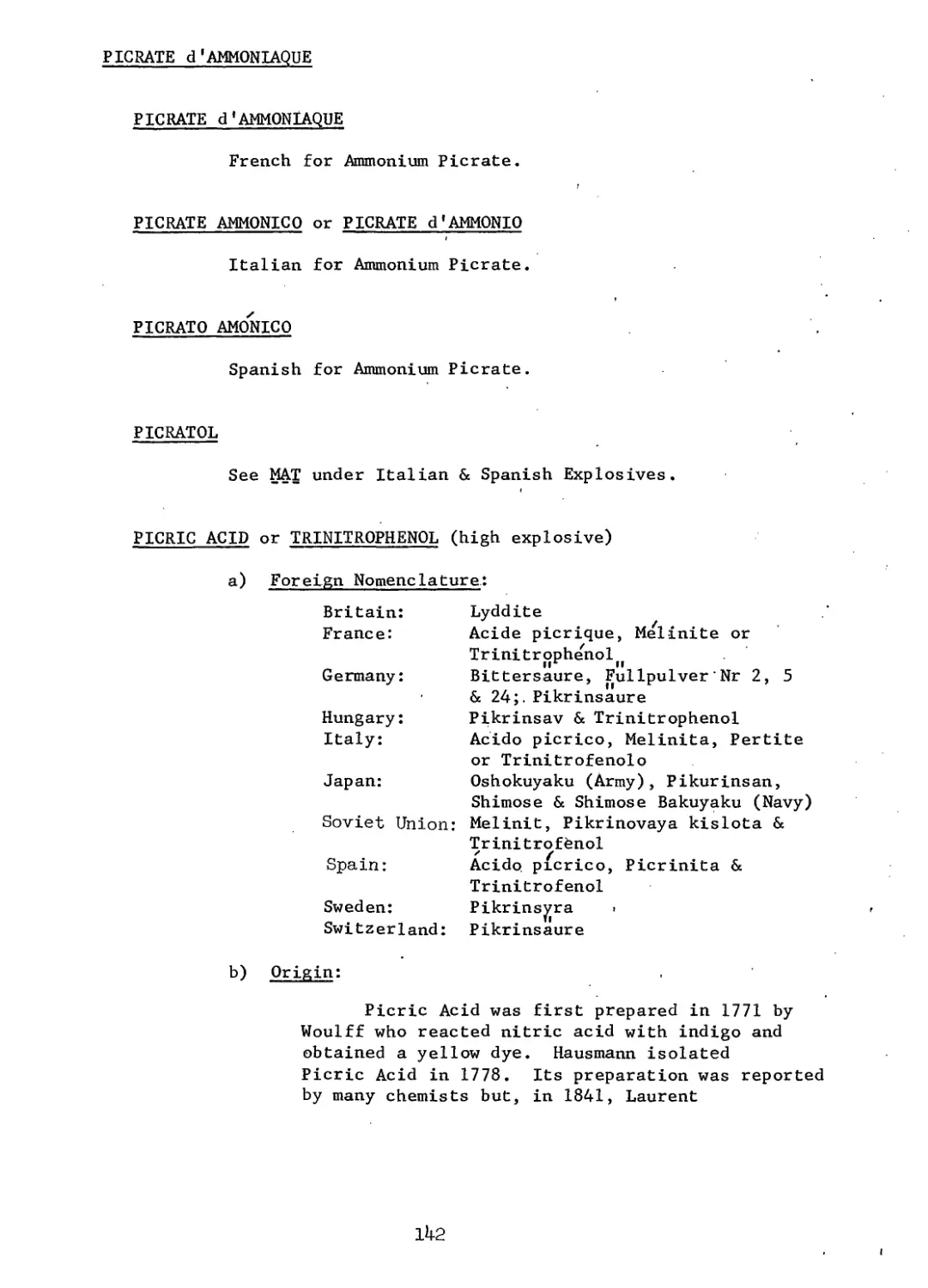

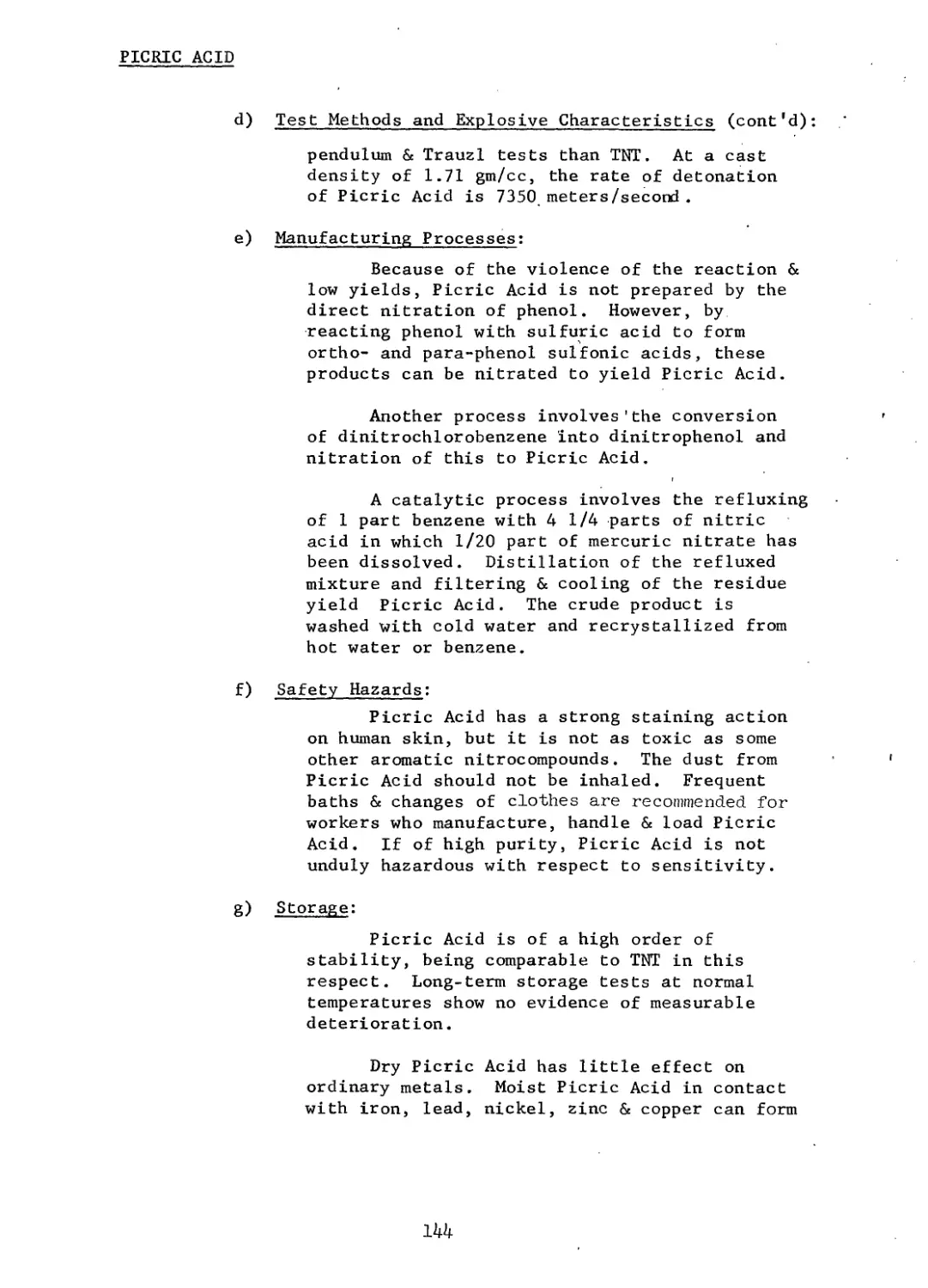


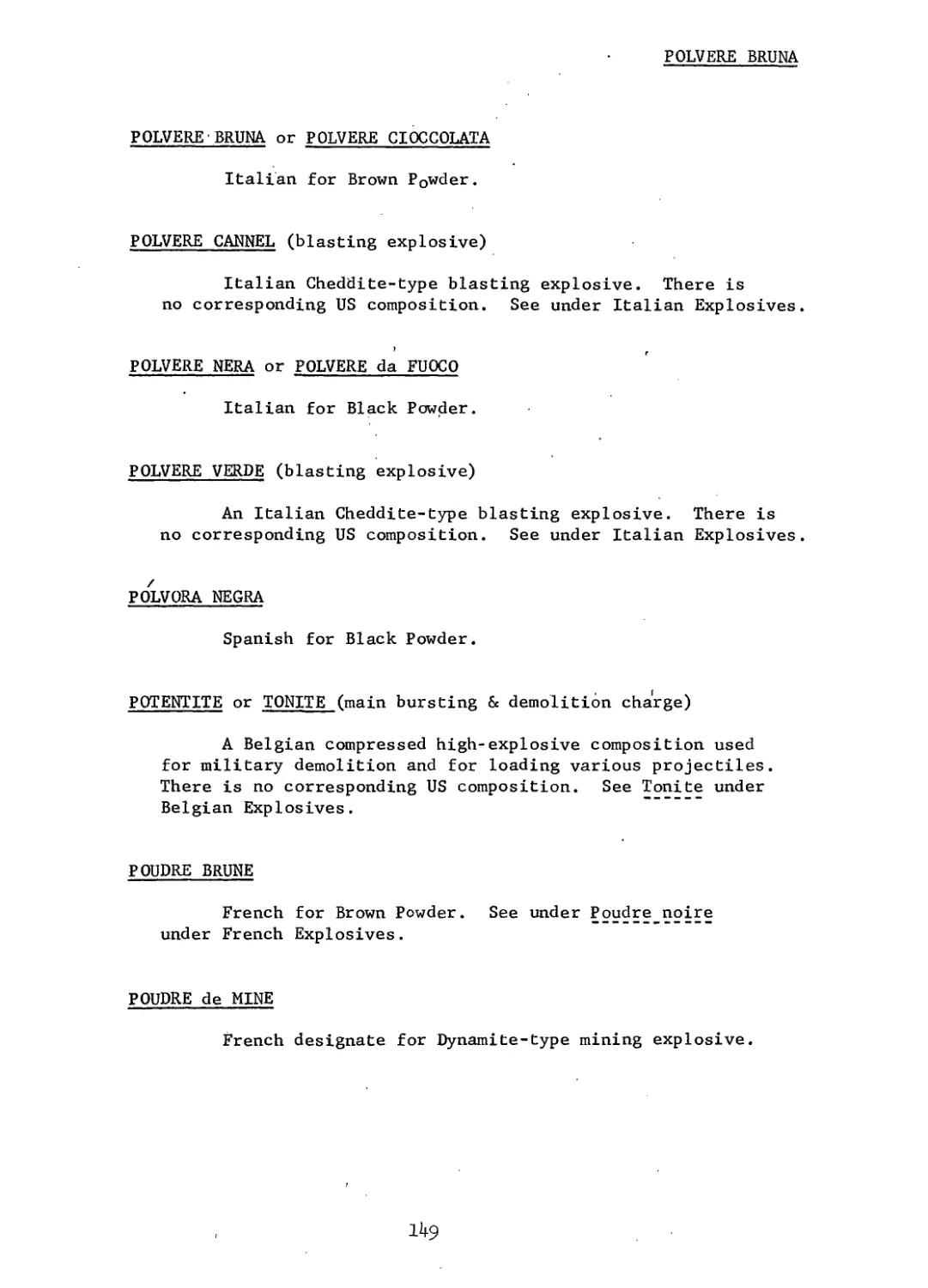
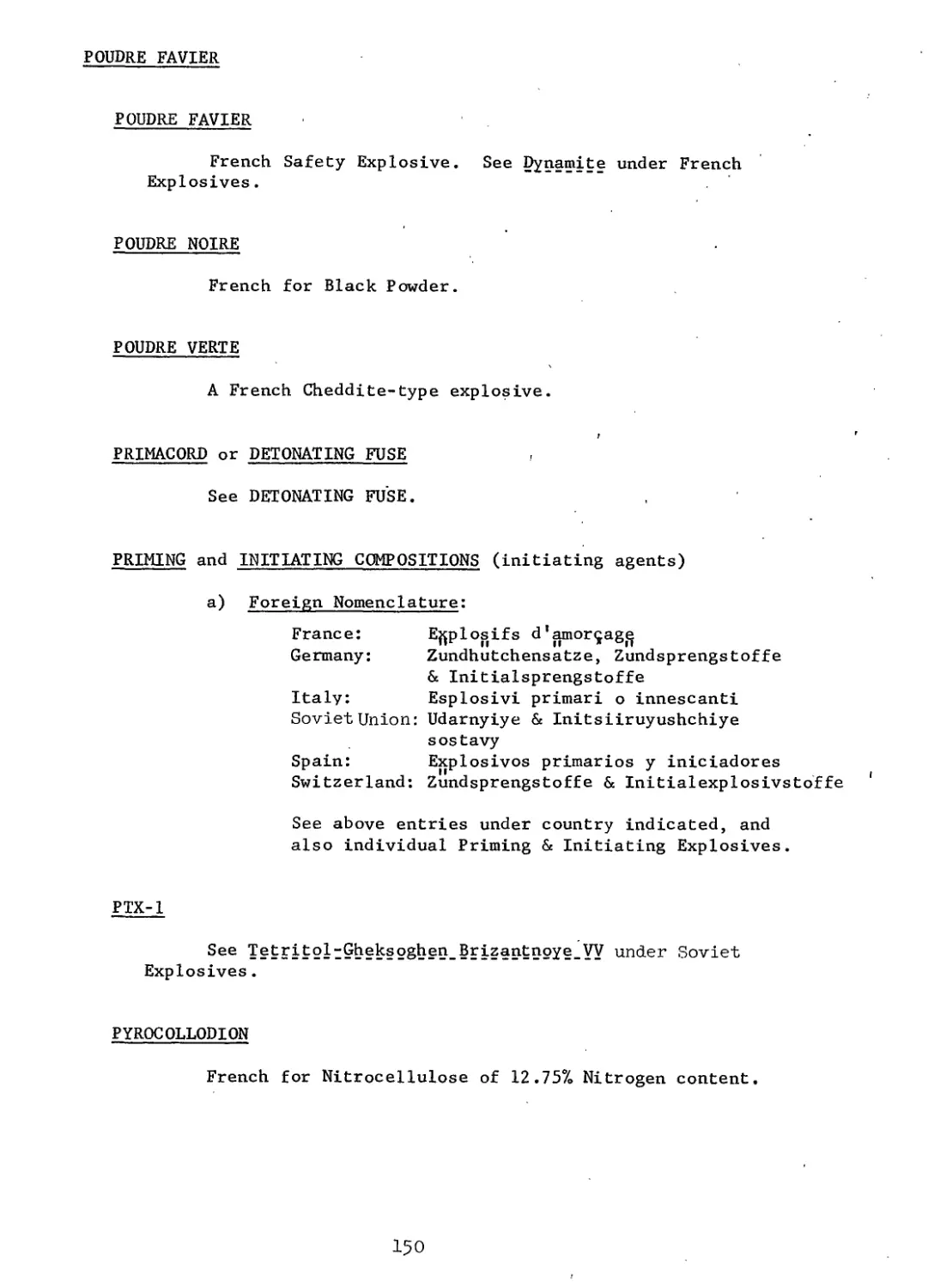




























































































































Tags: military explosives
Year: 1965
Text
                    HANDBOOK OF FOREIGN EXPLOSIVES
1?®в1Еа©и §©ass3©is
IND
©l&wbsi
October 1965
U.S. Army Foreign Science and Technology Center
Munitions Building, Washington, D.C. 20315
FSTC 381-50^2 is published for the information and guidance of all
concerned.
Comments, and requests for additional copies, should be sent to the
Commanding Officer, at the above address.
A Category I Intelligence Document. This document was compiled and pro-
ducted by the U.S. Army Foreign Science and Technology Center and is
intended for use within the U.S. Army Materiel Command. This document
has not been approved by the Office of the Assistant Chief of Staff for
Intelligence and therefore does not necessarily represent agreed Depart-
ment of the Army intelligence.
DESCRIPTORS
Explosives: manufacturing, testing, use, characteristics, loading, com-
parison, strength power, brisance, composition; pyrotechnics; bursting
charge; propelling charge; high-explosive ammunition.
Project Eld 596
FSTC 381-5042
HANDBOOK OF FOREIGN EXPLOSIVES
October 1965
(Based on information available as of June 1964)
Prepared by
Picatinny Arsenal
Dover, New Jersey 07801
for
U.S. Army Foreign Science and Technology Center
Munitions Building
Washington, D. C. 20315
ABSTRACT
(U) This Handbook of Foreign Explosives contains technical
information and reference data on the chemical and physical character-
istics. known variations in nomenclature, and the application of explosive
compounds to the various types of ammunition in use by selected countries.
FSTC 381-5042
TABLE OF CONTENT;
Page
Section I.	INTRODUCTION
Purpose
Scope
Summary
Section II.	GENERAL INDEX
Section III.	COUNTRY INDEX
Belgium
France
Germany
Italy
Japan
Soviet Union
Spain
Sweden
Switzerland
189
203
243
3-17
ЗбО
388
4 29
449
466
1,1ST OF TABLES
Table
1.	Explosive Properties of Amatols	14
2.	Commercial Blasting Ammonals	20
3-	Military Ammonals of WW II	22
4.	German Ammonites Used During W II	27
5-	European Ammonium Nitrate Dynamite	 35
6.	Ammonium Nitrate Gelatins	36
7-	US Ammonium Nitrate Dynamites	37
8.	German Astralites	46
9-	Chloi-ate Cheddites	'	62
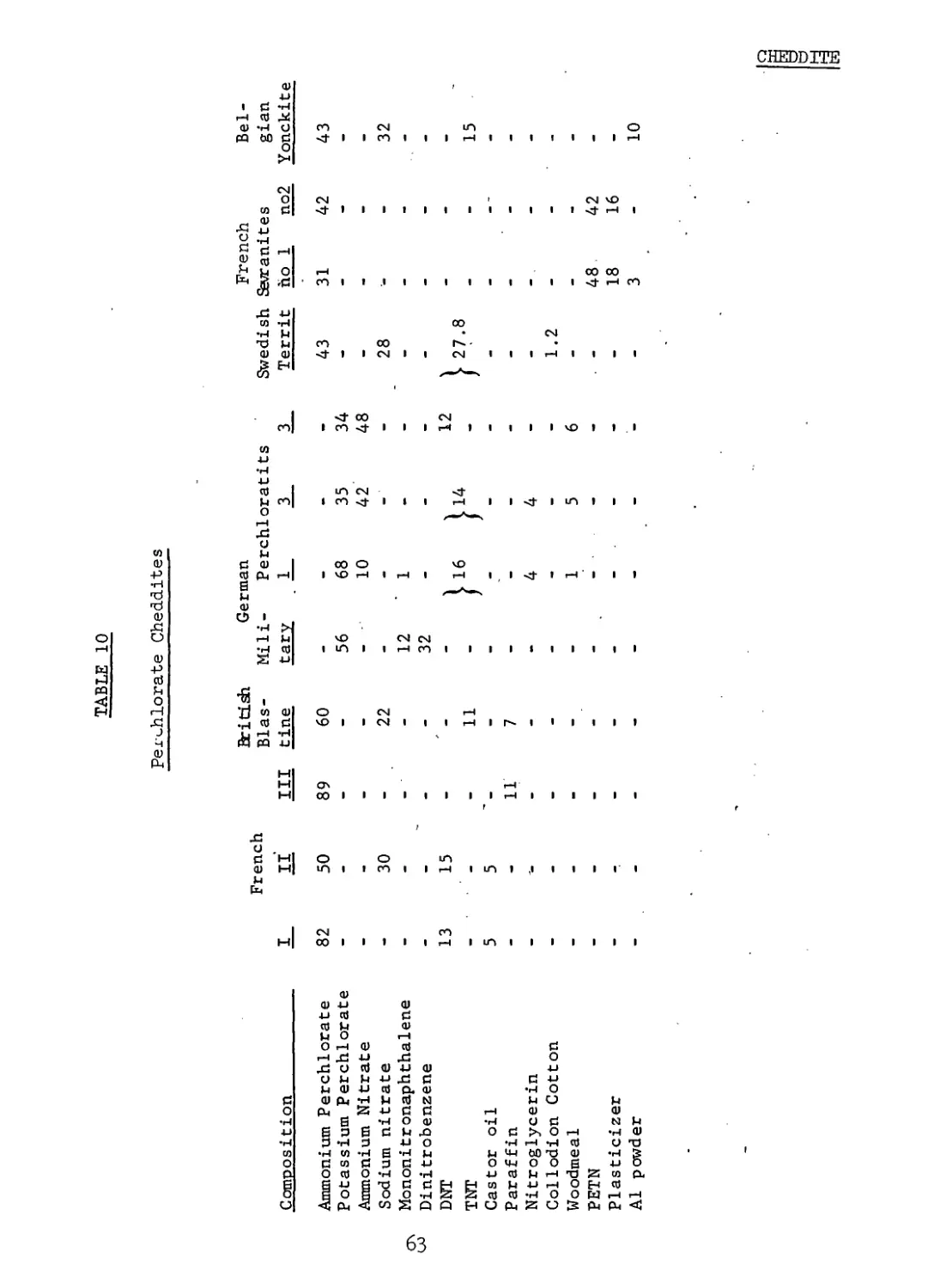
10.	Perchlorate Cheddites	63
3
FSTC 381-5042
HANDBOOK OF FOREIGN EXPLOSIVES
Section I. INTRODUCTION
1.	PURPOSE
The purpose of this handbook is to provide research and development
personnel, explosive ordnance disposal specialists, military personnel,
and members of the intelligence community with a single source of
technical information and data on explosives of selected foreign
countries.
SCOPE
a.	Priority of coverage has been given to explosives of the U.S.S.R.
and Western countries with the potential to develop and produce explosives.
The handbook identifies explosives which were standard in World War II as
well as those which may be in current use. The information in the handbook
is intended solely for use as a reference and an identification guide and
not as an assessment of the quality of the material or as a comparison with
similar compositions of U.S. origin.
b.	This handbook is divided into a General Index and a Country Index.
The General Index lists explosives in alphabetical order; it defines each
explosive briefly and discusses at some length those common to several
countries. In detailing characteristics, explosive power and other test
results are expressed in relation to the power of an equal weight of TNT:
thus, "Explosive E power equals 1-35'' means that Explosive E is 1.35 times
as powerful as TNT. When pertinent, the General Index gives the foreign
nomenclature for explosives and makes specific reference to the Country
Index for additional information on particular explosive compounds.
c.	The Country Index is arranged alphabetically by country. Under
each country are the following:
(1)	Introductory remarks about the explosives industry.
(2)	An alphabetical list of explosives, with information on
manufacture, composistion, and use.
(3)	Resumes of unusual research'and developmentin explosives.
(4)	A list of pertinent references.
5
FSTC 381-5042
3.	SUMMARY
a.	The explosives in general use by the Soviet Union and thefree
world are of either similar or well-known composition.
b.	Although a wide variety of explosive compositions is employed by
different countries, essentially all utilize standard basic ingredients,
such as ammonium nitrate, nitroglycerin, TNT, and tetryl. The nature and
composition of the material are largely determined by its intended appli-
cation. The combination of ingredients, percent composition, and widely
diversified nomenclature are found to be the main variants from country
to country. The explosives vary from highly complex and efficient compounds
to crude and relatively ineffective mixtures used in guerrilla and partisan
operations.	. '	'
c.	Major foreign research and development efforts in the field of
explosives are directed toward understanding the basic mechanism and theory
of combustion and detonation, and the moreefficient combination and utili-
zation of known compounds. A breakthrough in understanding these fundamental
processes would result in rapid advances in explosive technology.
6
A or AT
Section II. GENERAL ЖЖ
A or AT
Soviet abbreviation for Amatol.
A-IX-2 (bursting charge)
A Soviet high-explosive bursting charge for Projectiles. There is
no corresponding US composition. See under Soviet Explosives.
ABEL POWDER or PICRIC POWDER (booster charge)
A British booster explosive charge. There is no corresponding US
composition. The French used a similar composition called BrugerePpudre.
See under French Explosives.
ABONACHIT 2 or FULLPULVER Nr 57 (bursting charge)
A German Ammonium Nitrate Explosive used as a bursting charge in Hand
Grenades. There is no corresponding US composition. See Fullpulver Nr 57
under German. Explosives.
ACEITE EXPLOSIVO
Spanish for Nitroglycerin. See Nitroglicerina under Spanish
Explosives.
ACIDA de PLOMO
Spanish for Lead Azide.
ACIDE PICRIQ.UE
French for Picric Acid. .
ACIDO d'ARGENTO
Italian for Silver Azide. ’	'
ACIDO di PIOMBO •	’
Italian for Lead Azide.
7
.CJDO PICRICO
ACIDO PICRICO
Italian for Picric Acid.	'
ACIDO PICRICO.
Spanish for Picric Acid. See Picrinita under Spanish Explosives.
ACIDO STIFNICO or TRINITRORESORCINA
Italian for Styphnic Acid.
AFOCITE (blasting explosive)
An Italian Ammonium Nitrate blasting explosive. There is no
corresponding US composition. See under Italian Explosives. • .	,
A(KO), Type A Explosive or OTSU-B (bursting charge)
A Japanese burster charge. There is no corresponding US composition.
This explosive is the same as that called Schiesswolle_18 or Code Names
NTD2 <Sc TSMV 1-101 by the Germans. See under German Explosives and under
Japanese Explosives.
ALBIT (blasting explosive)
A German blasting explosive. There is no corresponding US composition.
See under German Explosives.
ALBITE (bursting charge)
An Italian explosive filler for projectiles. There is no correspond-
ing US composition. See under Italian Explosives.
ALDORFIT (permissible blasting explosive)
A commercial explosive developed and manufactured in Switzerland but
used extensively in Germany. .The composition is similar to AMMONITE (qv).
See Aldorfit under German Explosives & under Swiss Explosives.
8
ALGODON FULMINANTE
/	Z /
ALGODON FULMINANTE or ALGODON POLVORA
Spanish for Guncotton.
ALKALITE (permissible mining explosive)
A commercial explosive developed and manufactured in Belgium. There
is no corresponding US composition. See under Belgian Explosives.
ALKALSIT (blasting explosive)
A German Cheddite-type explosive developed before WW II. There is
no corresponding US composition. See under German Explosives.
ALMATRIT (blasting explosive)
Commercial explosives developed in the USSR. There are no corresponding
US explosives. See under Soviet Explosives.
ALSILITE (mining explosive)
A Belgian commercial explosive developed and manufactured in Belgium.
This composition contains the same ingredients as Ammonal. See under
Belgian Explosives.
ALUMATOL (military & blasting explosive)
A British explosive of the Ammonal type. There is no corresponding
US explosive^but Ammonals contain the same ingredients.
ALUMIT (military & blasting explosive)
A Soviet explosive of the’Ammonal type. There is no corresponding
US explosive but Ammonals contain the same ingredients. See under Soviet
Explosives.
AMATEX (bomb filler)
A British high-explosive bomb filler. There are no corresponding US
explosives. A different composition by the same name is described under
Spanish Explosives. See Amatex under Spanish Explosives.
9
AMATOL
AMATOL (bursting charge)
a)	Foreign Nomenclature:
	Britain: France:	Amatol Amatol &	Explosif du	type N n° 0
	Germany:	Amatol &	Fullpulver	(Fp)
	Italy: Japan: Soviet Union: Spain:	Amatolo Shotoyaku Ama 101 & A Amatolo &	or AT Nitramita Espan'ola
b)	Origin:
Invented in 1915 by the British as mixtures of
Ammonium Nitrate and TNT. in order t'o extend the available
supply of TNT which was very scarce at that time.
c)	Identifying Features:
Color is white to light buff. But due to the
presence of impurities or exposure to light and moisture,
it darkens to a dark brown color. It can be distinguished
by its grainy, brown sugar appearance.
d)	Chemical Composition:
Amatols are mechanical mixtures of Ammonium Nitrate
80 to 40% & TNT 20 to 607o. The most common composition
contains these ingredients in 50/50 proportions. Other
compositions contain Ammonium Nitrate and TNT in 80/20,
60/40, 45/55 and 40/60 ratios. The first figure repre-
sents the Ammonium Nitrate content in all compositions.
e)	Physical Properties:
Amatols, except 80/20 mixtures, can be heated up to
95 C and cast loaded at densities of 1.54-1.61 gm/cc
directly into ammunition end items. Because of their
plasticity, mixtures containing 807» Ammonium Nitrate must
be press loaded or extruded, at density 1.46 gm/cc, into
items.
All Amatols are hygroscopic, mixtures having the
higher Ammonium Nitrate content being the more hygroscopic.
These mixtures in the presence of moisture attack such
metals as copper, brass, bronze & lead; they can form
dangerous compounds with copper and its alloys.
f)	Test Methods and Explosive Characteristics:
Amatols are subjected to the standard tests used to
determine the sensitivity, stability, power & other
explosive characteristics of high explosives. See Table 1.
10
AMATOL
g)	Manufacturing Processes:
In preparing Amatols.;the Ammonium Nitrate, previously
screened to the desired particle size and dried to a
moisture content of not more than 0.257», is heated to 90°C
in a steam-jacketed mixing kettle provided with a mechanical
agitator. It is gradually added to the calculated amount of
molten TNT in another steam-jacketed kettle equipped with
mechanical agitation. Heating at 90°C and mixing are con-
tinued until thorough blending & uniform fluidity are
achieved. The 50/50, 60/40 and 40/60 Amatols can be cast
loaded at 85°C. For 80/20 Amatols, addition of the molten
TNT to the Ammonium Nitrate, and heating & blending of the
ingredients aL 95°C are preferred, until the mixture is ready
for loading by extrusion.
h)	Safety Hazards:
The sensitivity of Amatols to initiation by impact
or friction is about the same order as that of TNT.
Ordinarily, Amatols will not detonate from the impact of a
.30 cal rifle bullet at 90 feet. The spontaneous ignition
(detonation) temperature of 50/50 Amatol is about 260°^
compared with 'about 460°C for TNT. Amatols are Class 9,
Group I explosives from the standpoint of their class
quantity-distance storage, and group according to compat-
ibility in mixed storage.
i)	Inspection Procedures:
Determination of the composition of Amatols can be
made by extracting a weighed sample with benzene, drying
the residue, and weighing. The weight of the residue is
calculated as percentage Ammonium Nitrate and the difference
from 100 as percentage TNT.
Loaded items of ammunition, stored at elevated
temperatures, should be inspected periodically to determine
if exudation has occurred. See under Storage below.
j)	Preservation and Special Handling Requirements:
To prevent corrosion caused by contact of Amatols with
metals, a common practice is to coat the inside walls of the
ammunition with acid-proof black paint prior to loading.
Another practice to prevent moisture from entering loaded
items is to form a, seal by pouring molten TNT on top of the
Amatol.
11
AMATOL
к)	Storage:
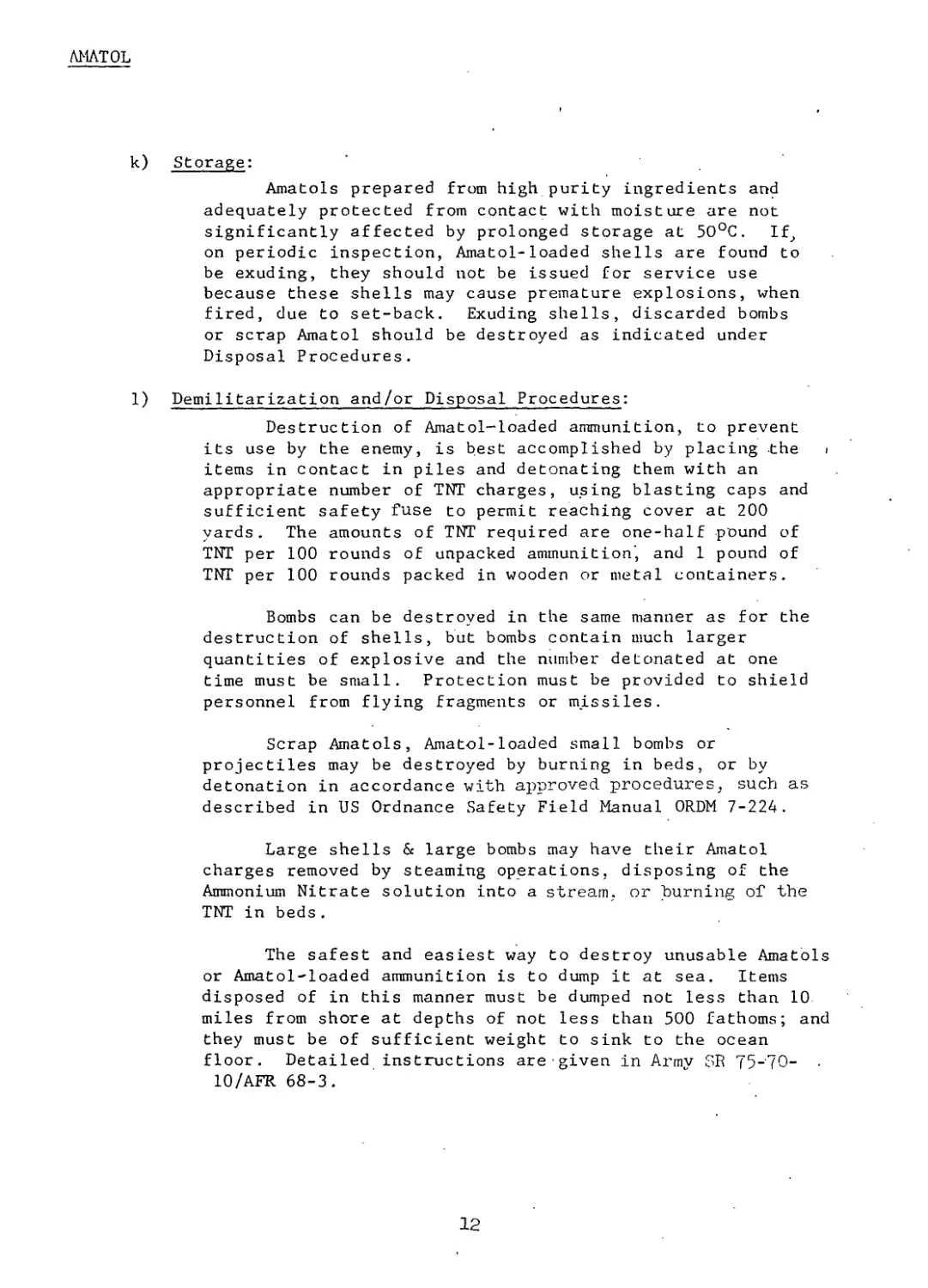
Amatols prepared from high purity ingredients and
adequately protected from contact with moisture are not
significantly affected by prolonged storage at 50°C. If?
on periodic inspection, Amatol-loaded shells are found to
be exuding, they should not be issued for service use
because these shells may cause premature explosions, when
fired, due to set-back. Exuding shells, discarded bombs
or scrap Amatol should be destroyed as indicated under
Disposal Procedures.
1)	Demilitarization and/or Disposal Procedures:
Destruction of Amatol-loaded ammunition, to prevent
its use by the enemy, is best accomplished by placing the ।
items in contact in piles and detonating them with an
appropriate number of TNT charges, using blasting caps and
sufficient safety fuse to permit reaching cover at 200
yards. The amounts of TNT required are one-half pound of
TNT per 100 rounds of unpacked ammunition', and 1 pound of
TNT per 100 rounds packed in wooden or metal containers.
Bombs can be destroyed in the same manner as for the
destruction of shells, but bombs contain much larger
quantities of explosive and the number detonated at one
time must be small. Protection must be provided to shield
personnel from flying fragments or missiles.
Scrap Amatols, Amatol-loaded small bombs or
projectiles may be destroyed by burning in beds, or by
detonation in accordance with approved, procedures, such as
described in US Ordnance Safety Field Manual ORDM 7-224.
Large shells & large bombs may have their Amatol
charges removed by steaming operations, disposing of the
Ammonium Nitrate solution into a stream, or burning of the
TNT in beds.
The safest and easiest way to destroy unusable Amatols
or Amatol-loaded ammunition is to dump it at sea. Items
disposed of in this manner must be dumped not less than 10
miles from shore at depths of not less than 500 fathoms; and
they must be of sufficient weight to sink to the ocean
floor. Detailed instructions are given in Army SR 75-70-
10/AFR 68-3.
12
AMATOL
m)
Uses:
Amatols have been universally used, by all nations,
in all types of ammunition as a substitute'for TNT. The
lower Ammonium Nitrate content Amatols are generally used
in smaller ammunition. In larger' ammunition the Ammonium
Nitrate content can be increased and still maintain a high
order detonation mixture. However, the development of
more powerful binary mixtures. such as Composition В and
Pentolite, and of aluminised mixtures, such as Torpex and
HBX, have lessened the need for Amatols.'
Amatols are known to be used in Britain, Germany,
Italy, Japan, U3SR, dpa ii) & (ТГ-Д, For detailed uses of
specific compositions by various countries, see under the
individual country.
In the United States 50/50 Amatol has been used in
Light Case, General Purpose and Semi-Armor-Piercing Bombs;
and in some Shells.
60/40 and 80/20 Amatols were used in various kinds of
Shells.
65/35 Amatol was used in some Shells & Bombs during
the early part of WW II.
The rapid production during WW II of a huge supply of
TNT removed the necessity of using Ammonium Nitrate as a
substitute for TNT. Another factor contributing to the
disuse of Amatols as military explosives was the appearance
' during WW II of other explosives, such as PETN & RDX and .
their binary & ternary mixtures, which are more powerful
than TNT.
13
AMATOL
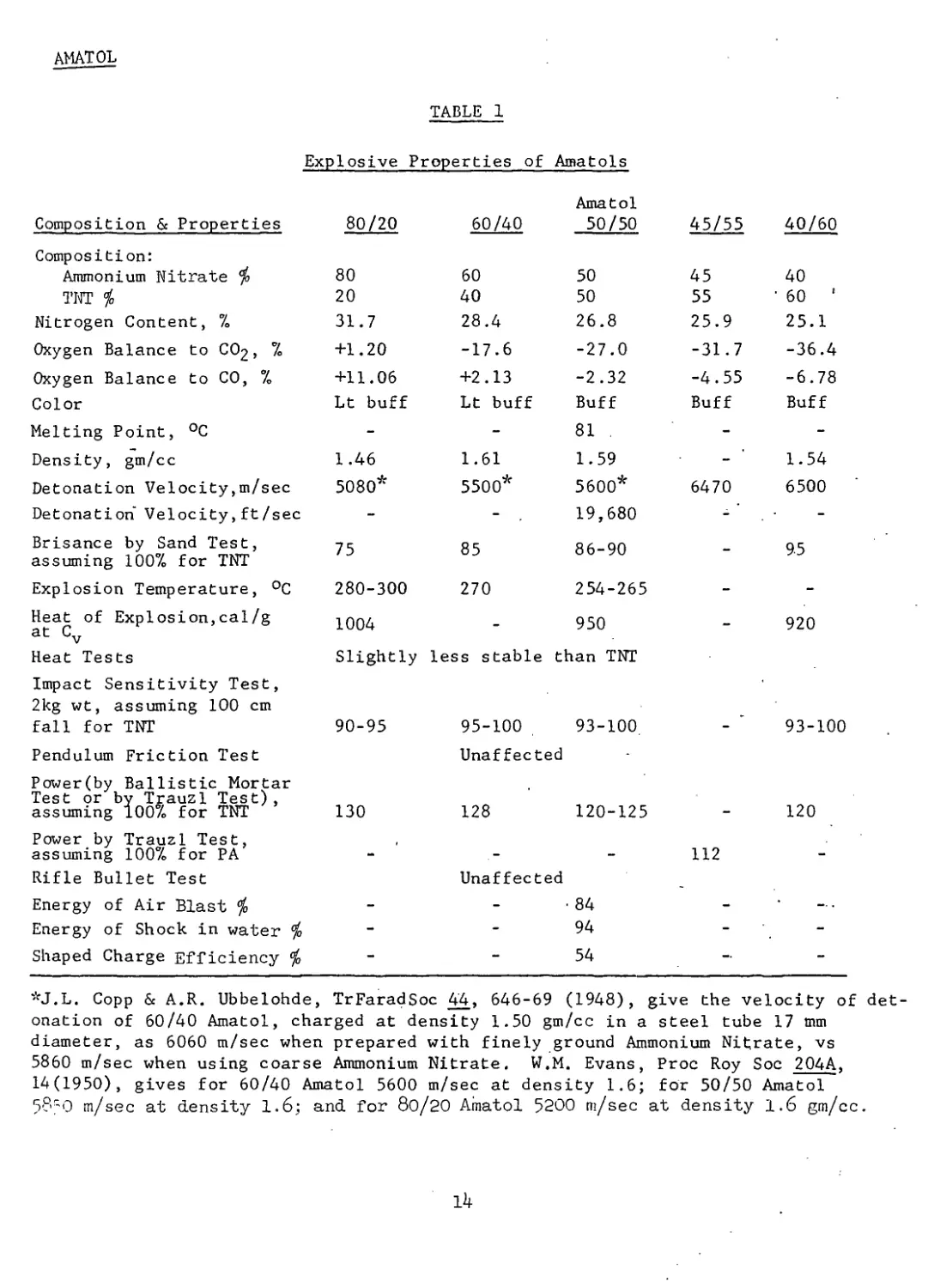
TAELE 1
Explosive Properties of Amatols
Composition & Properties	80/20	60/40	Amatol 50/50	45/55	40/60
Composition:
Ammonium Nitrate $	80	60	50	45	40
TNT %	20	40	50	55	' 60	1
Nitrogen Content, 7»	31.7	28.4	26.8	25.9	25.1
Oxygen Balance to CO2, %	+1.20	-17.6	-27.0	-31.7	-36.4
Oxygen Balance to CO, %	+11.06	+2.13	-2.32	-4.55	-6.78
Color	Lt buff	Lt buff	Buff	Buff	Buff
Melting Point, °C	-	-	81 .	-	-
Density, gm/cc	1.46	1.61	1.59	-	1.54
Detonation Velocity,m/sec	5080*	5500*	5600*	6470	6500
Detonation Velocity,ft/sec	-	-	19,680	-	-
Brisance by Sand Test, assuming 100% for TNT	75	85	86-90	-	9.5
Explosion Temperature, °C	280-300	270	254-265	-	-
Heat of Explosion,cal/g at Cv	1004	-	950	-	920
Heat Tests	Slightly	less stable than TNT
Impact Sensitivity Test, 2kg wt, assuming 100 cm
fall for TNT	90-95	95-100	93-100	-	93-100
Pendulum Friction Test Power(by Ballistic Mortar Test or by Trauzl Test), assuming 100%. for TNT		Unaffected
	130	128	120-125	-	120
Power by Trauzl Test, assuming 100%. for PA	-	-	-	112	-
Rifle Bullet Test		Unaffected
Energy of Air Blast $	-	-	84	-	•
Energy of Shock in water $	-	-	94	-	-
Shaped Charge Efficiency $	-	-	54	-	-
*J.L. Copp & A.R. Ubbelohde, TrFaradSoc 44, 646-69 (1948), give the velocity of det-
onation of 60/40 Amatol, charged at density 1.50 gm/cc in a steel tube 17 mm
diameter, as 6060 m/sec when prepared with finely ground Ammonium Nitrate, vs
5860 m/sec when using coarse Ammonium Nitrate. W.M. Evans, Proc Roy Soc 204A,
14(1950), gives for 60/40 Amatol 5600 m/sec at density 1.6; for 50/50 Amatol
5'8'0 m/sec at density 1.6; and for 80/20 Amatol 5200 m/sec at density 1.6 gm/cc.
14
AMATOLO
AMATOLO
Italian & Spanish for Amatol.
AMIDOGENE
Swiss Black Powder-type explosive.
AMMIACHNAYA SELITRA
Russian for Ammonium Nitrate.
AMMOKSIL or AMMONXYL (mining explosive)
A 'Soviet mining explosive. There is no corresponding US
or foreign composition. See under Soviet Explosives and compare
with Soviet Ammonites.
AMMONAL and AMMONAL-TYPE EXPLOSIVES (bursting charge)
a)	Foreign Nomenclature:
Austria:	Ammona1
Britain:	Ammonal, Alumatol, Burrowite, Minol &
	Nobel's 704
France:	Ammonal
.Germany:	Ammonal, Ammonpulver
Hungary:	Ammonias robbano-anyag
Italy:	Ammonal, Nitramite or Avigliana .3 &
-	Toluol-Ammonal
Japan:	Ammonaru
Soviet Union:	Ammona1
Spain:	Amona1
b)	Origin:
Invented prior to WW I in Germany, as mixtures of
Ammonium Nitrate, aluminum & charcoal. Later TNT was
added to make the composition easier to detonate and to
increase its power and brisance. Between WW I and WW II,
several countries omitted charcoal altogether in military"
Amatols which became simply mixtures of Amatols with
' aluminum. Sometimes other ingredients were also added.
c)	Identifying Features:
Usually gray in color 'due to the presence of aluminum
in the mixture.
15
AMMONAL
d)
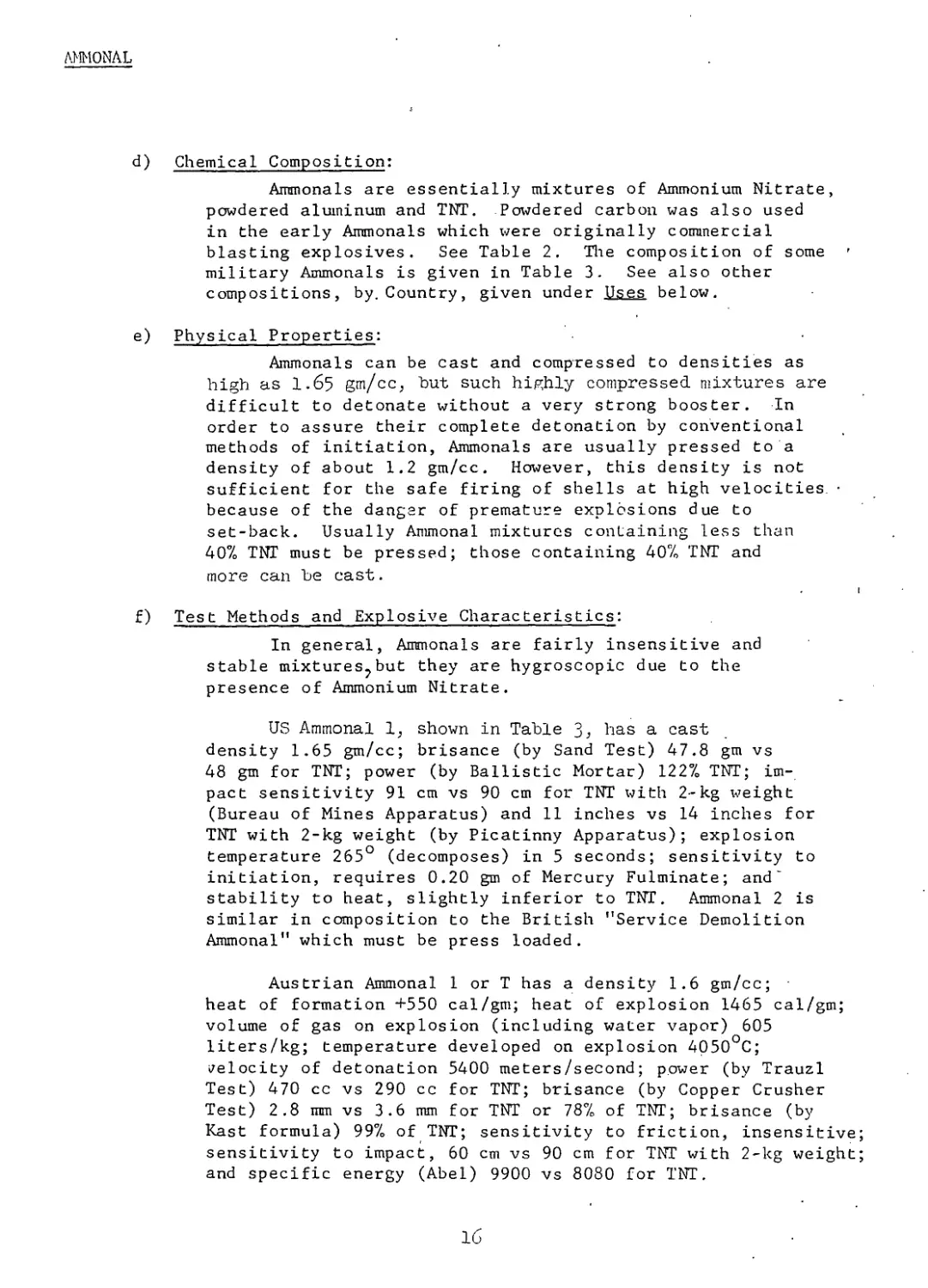
Chemical Composition:
Ammonals are essentially mixtures of Ammonium Nitrate,
powdered aluminum and TNT. Powdered carbon was also used
in the early Ammonals which were originally commercial
blasting explosives. See Table 2. The composition of some
military Ammonals is given in Table 3. See also other
compositions, by. Country, given under Uses below.
e) Physical Properties:
Ammonals can be cast and compressed to densities as
high as 1.65 gm/cc, but such highly compressed mixtures are
difficult to detonate without a very strong booster. In
order to assure their complete detonation by conventional
methods of initiation, Ammonals are usually pressed to a
density of about 1.2 gm/cc. However, this density is not
sufficient for the safe firing of shells at high velocities •
because of the danger of premature explosions due to
set-back. Usually Ammonal mixtures containing less than
407» TNT must be pressed; those containing 40% TNT and
more can be cast.
f) Test Methods and Explosive Characteristics:
In general, Ammonals are fairly insensitive and
stable mixtures^but they are hygroscopic due to the
presence of Ammonium Nitrate.
US Ammonal 1, shown in Table 3, has a cast
density 1.65 gm/cc; brisance (by Sand Test) 47.8 gm vs
48 gm for TNT; power (by Ballistic Mortar) 1227» TNT; im-
pact sensitivity 91 cm vs 90 cm for TNT with 2-kg weight
(Bureau of Mines Apparatus) and 11 inches vs 14 inches for
TNT with 2-kg weight (by Picatinny Apparatus); explosion
temperature 265° (decomposes) in 5 seconds; sensitivity to
initiation, requires 0.20 gm of Mercury Fulminate; and'
stability to heat, slightly inferior to TNT. Ammonal 2 is
similar in composition to the British "Service Demolition
Ammonal" which must be press loaded.
Austrian Ammonal 1 or T has a density 1.6 gm/cc;
heat of formation +550 cal/gm; heat of explosion 1465 cal/gm;
volume of gas on explosion (including water vapor) 605
liters/kg; temperature developed on explosi on 4050°C;
velocity of detonation 5400 meters/second; power (by Trauzl
Test) 470 cc vs 290 cc for TNT; brisance (by Copper Crusher
Test) 2.8 mm vs 3.6 mm for TNT or 787O of TNT; brisance (by
Kast formula) 997o of TNT; sensitivity to friction, insensitive;
sensitivity to impact, 60 cm vs 90 cm for TNT with 2-kg weight;
and specific energy (Abel) 9900 vs 8080 for TNT.
16
AMMONAL
f)
g)
Test Methods and Explosive Characteristics (cont'd)'
German Ammonals have velocity of detonation as high
as 5650 m/sec at a density of 1.62 gm/cc; total volume of
gas on explosion 740 liters/kg; maximum pressure (calculated)
2693 kg/sq cm; temperature developed on detonation 3720°C;
and specific energy (Abel) 10820 vs 8080 for TNT.
Manufacturing Processes:
In the USA,Ammonals- are prepared by methods similar
to those used for preparing Amatols. The calculated amount
of TNT is heated between 85° and 100 C in a steam-jacketed
kettle equipped with a mechanical agitator. To this is
added gradually, with stirring, powdered Ammonium Nitrate
previously preheated to the same temperature as the TNT.
Finally the aluminum powder is added and the mass is some-
what cooled while the agitation is continued. If the
Ammonal contains less than 407» TNT it must be press loaded ,
but with 40% TNT or more such a mixture can be cast loaded
directly into the ammunition components. In preparing
castable mixtures of Ammonals, a dry blend of the powdered
aluminum and Ammonium Nitrate can be added, with stirring,
to the molten TNT heated in a steam-jacketed kettle.
Ammonals were prepared in France by a method similar
to that used to prepare Black Powder. The calculated -
amounts of the ingredients were wetted with water to a 47»
moisture content and then worked for about 1 hour on a
wheel similar to that used for.milling Black Powder.
h) Safety Hazards:
Due to the presence of aluminum, Ammonals are more
sensitive to initiation by impact than TNT. The general
effect of incorporating aluminum in Ammonium Nitrate/TNT
mixtures is to 1) increase sensitivity to impact, friction,
and rifle bullet impact., 2) increase the temperature; and
total volume of gas developed on detonation^ 3) increase
the strength or powerjapd 4) decrease the velocity of
detonation. Ammonals are Class 9, Group I explosives from
the stand point of their class quantity-distance storage,
and group according to compatibility in mixed storage.
i) Inspection Procedures:.
Determination of the composition of Ammonals can be
made by extracting the TNT component with anhydrous methylene
chloride and, from the residue, extracting the Ammonium
Nitrate with water, or identifying it by color reactions.
The aluminum, extracted with concentrated hydrochloric acid,
can be determined as aluminum-8-hydroxyquinolinate or by
other procedures. Any remaining residue, if black, is carbon
andjif yellow or brown^the presence of wood meal is indicated.
17
AMMONAL
i)	Inspection Procedures (cont'd)
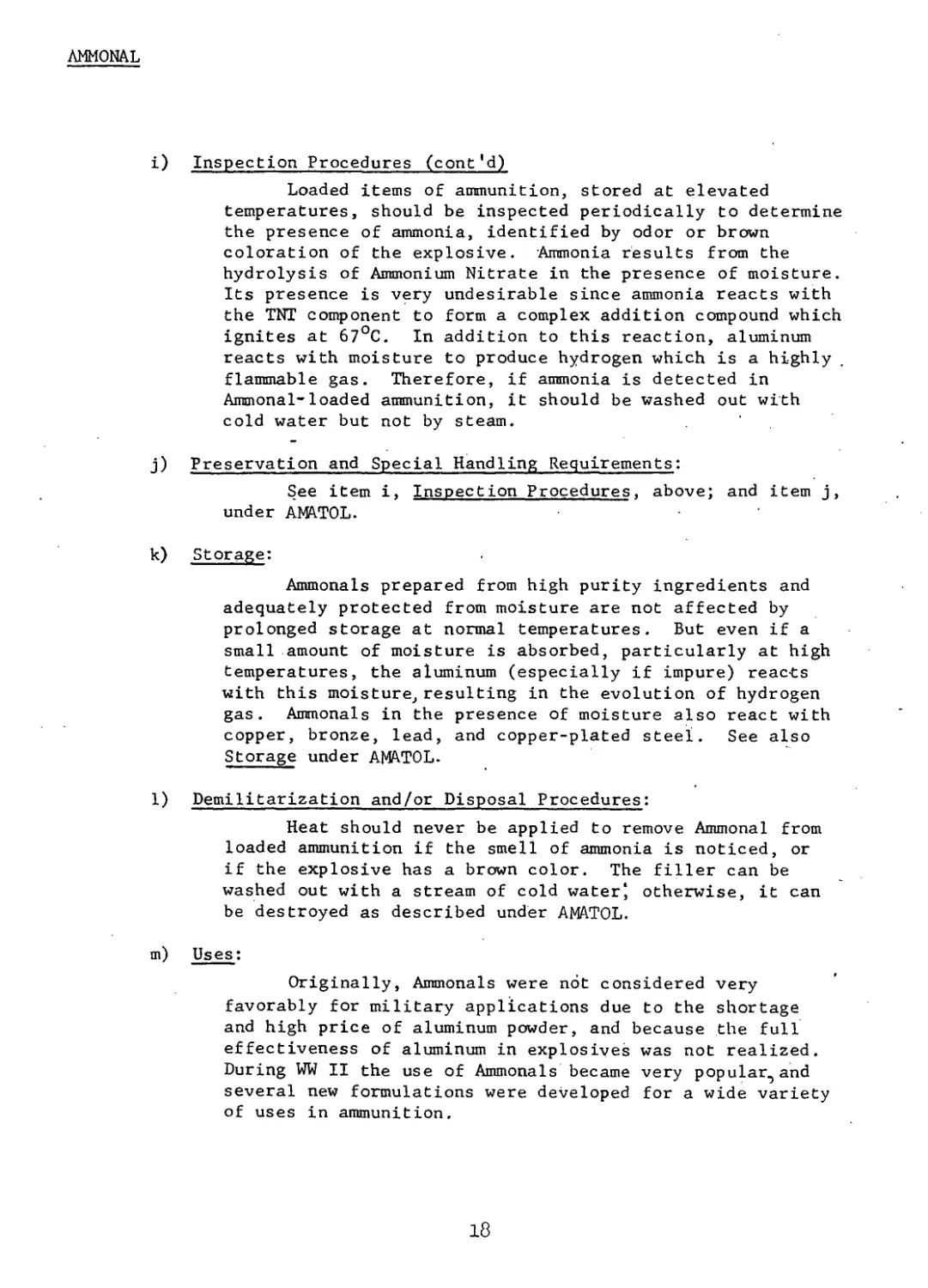
Loaded items of ammunition, stored at elevated
temperatures, should be inspected periodically to determine
the presence of ammonia, identified by odor or brown
coloration of the explosive. Ammonia results from the
hydrolysis of Ammonium Nitrate in the presence of moisture.
Its presence is very undesirable since ammonia reacts with
the TNT component to form a complex addition compound which
ignites at 67°C. In addition to this reaction, aluminum
reacts with moisture to produce hydrogen which is a highly
flammable gas. Therefore, if ammonia is detected in
Ammonal-loaded ammunition, it should be washed out with
cold water but not by steam.
j)	Preservation and Special Handling Requirements:
See item i, Inspection Procedures, above; and item j,
under AMATOL.
k)	Storage:
Ammonals prepared from high purity ingredients and
adequately protected from moisture are not affected by
prolonged storage at normal temperatures. But even if a
small amount of moisture is absorbed, particularly at high
temperatures, the aluminum (especially if impure) reacts
with this moisture, resulting in the evolution of hydrogen
gas. Ammonals in the presence of moisture also react with
copper, bronze, lead, and copper-plated steel. See also
Storage under AMATOL.
1)	Demilitarization and/or Disposal Procedures:
Heat should never be applied to remove Ammonal from
loaded ammunition if the smell of ammonia is noticed, or
if the explosive has a brown color. The filler can be
washed out with a stream of cold water* otherwise, it can
be destroyed as described under AMATOL.
m)	Uses:
Originally, Ammonals were not considered very
favorably for military applications due to the shortage
and high price of aluminum powder, and because the full
effectiveness of aluminum in explosives was not realized.
During WW II the use of Ammonals became very popular., and
several new formulations were developed for a wide variety
of uses in ammunition.
18
Al-.iONAL
tn) Uses (cont'd)
Ammonals are known to be used in Britain, France,
Germany, Italy, Russia, Spain & USA. For further infor-
mation on specific compositions and uses, see Tables 2 & 3
and under individual country country in Country Index.
In the United States,
for testing purposes due to
on explosion of the charge.
Table 3.
Ammonals are used in Shells
the brilliant flash produced
See compositions given in
19
AMMONAL
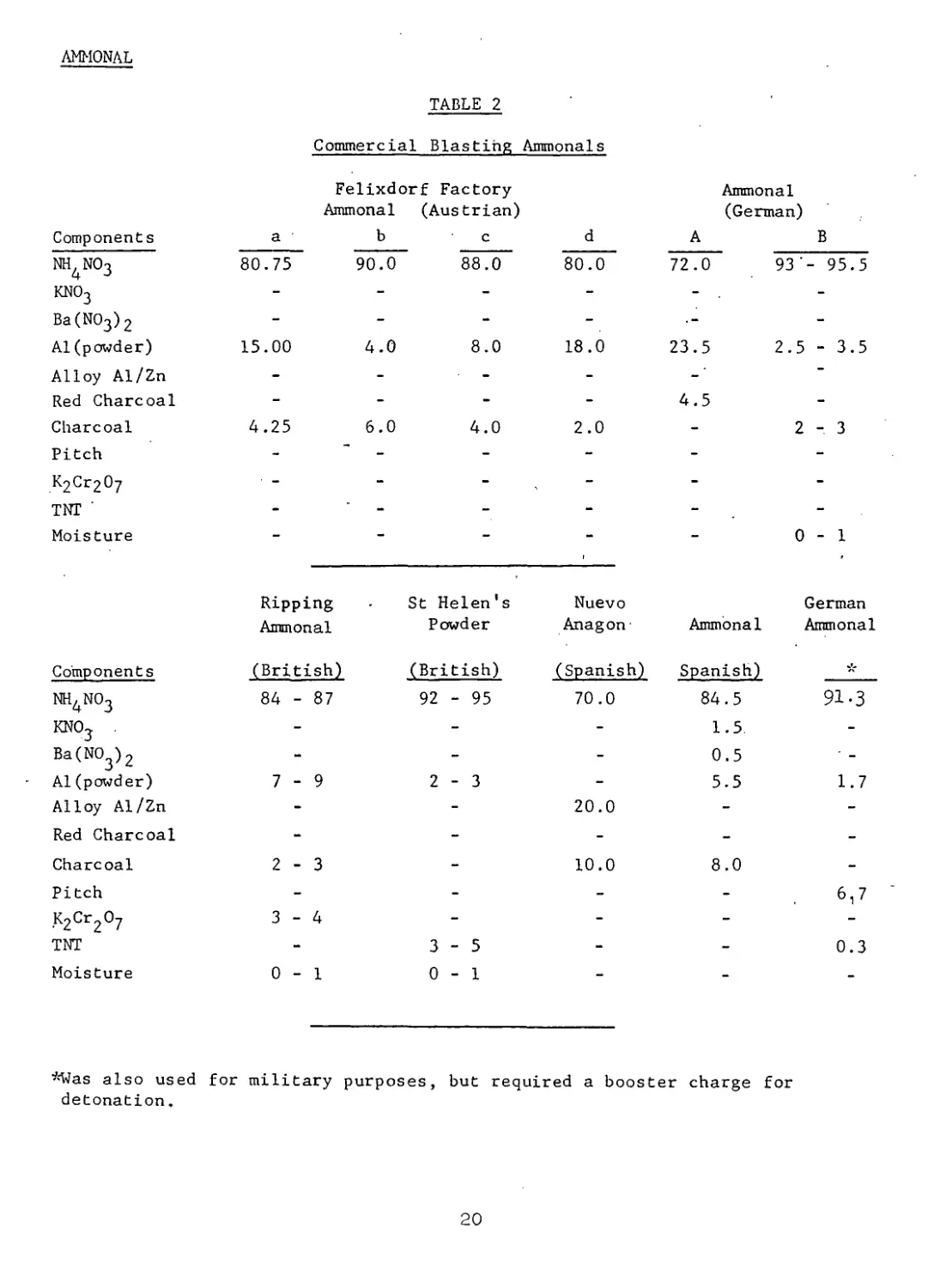
TAELE 2
Commercial Blasting Ammonals
Components	a	Felixdorf Factory			Ammonal (German)
		Ammonal b	(Austrian) c	d
					A	в
NH. NOq	80.75	90.0	88.0	80.0	72.0	93’- 95.5
KNO3	-	-	-	-	-	-
Ba(NO3)2	-	-	-	-		-
Al (powder)	15.00	4.0	8.0	18.0	23.5	2.5 - 3.5
Alloy Al/Zn	-	-	-	-	-	-
Red Charcoal	-	-	-	-	4.5	-
Charcoal	4.25	6.0	4.0	2.0	-	2-3
Pitch	-	-	-	-	-	-
К2Сг20?	 -	-	-	-	-	-
TNT '	-	-	-		-	-
Moisture	-	-	-	-	-	0-1
	Ripping Ammonal	St Helen's Powder	Nuevo Anagon	Ammonal	German Ammonal
Components	(British)	(British)	(Spanish)	Spanish)	*
nh4no3	84 - 87	92 - 95	70.0	84.5	91.3
KNO3 .	-	-	-	1.5	-
Ba(NO3)2	-	-	-	0.5	 -
Al(powder)	7 - 9	2-3	-	5.5	1.7
Alloy Al/Zn	-	-	20.0	-	-
Red Charcoal	-	-	-	-	-
Charcoal	2 - 3	-	10.0	8.0	-
Pitch	-	-	-	-	6,7
	3-4	-	-	-	-
TNT	-	3-5	-	-	0.3
Moisture	0 - 1	0-1	—
*Was also used for military purposes, but required a booster charge for
detonation.
20
AMMONAL
Table 2 (Cont'd)
Marshall cites the properties obtained by Bichel for Ammonal A in
comparison with those for Dynammon containing Ammonium Nitrate 95.5%
& red charcoal 4.5%:
Explosive	Density d	Vel of Deton m/sec	Heat of Expln cal/g		Total Vol of Gases 1/kg
Dynammon	865	3380	727.0	976
Ammonal A	900	3450	1600.5	594
Explosive	Vol of Gases at NTP (minus H2O vapor) 1 /kg	Expln Press (Calcd) kg/cm^	Power by Trauzl Test, cc
Dynammon	360	3668	250
Ammonal A	418	9425	329
21
AMMONAL
TABLE 3
Components	Military Ammonals of WW II					British
	US			Aus trian
				1 or T	2	Service Demolition	Roth 1904
	1	2**	3
nh4no3	22.0	72.0	65.0	46.0	58.6	64.0	47.0
Al (powder)	11.0	16.0	32.0***	22.0	21.0	18.0	22.0
TNT	67.0	12.0	15.0 (added)	30.0	18.0	15.0 (<	30.0 or DNTi)
Charcoal	-	-	3.0	-	2.4	3.0	1.0
Red Charcoal	-	-	-	2.0	-	-	-
	French		German
Components	S	c	1	2
nh4no3	86.0	76.0	54.0	44.9
Al (powder)	8.0	13.0	16.0	24.1
TNT	-	-	30.0	31.0
Stearine	6.0	-	-	-
nh4scn*	-	11.0	-	-
*According to T.L. Davis, the incorporation of ammonium thiocyanate
(NH^SCN) into Ammonals produces mixtures which are unstable to heat..
**It was also used in Germany.
***Aluminum was 167> coarse and 16% fine powder.
22
AMMONALMATRIT No 98
AMMONALMATRIT No 98 (blasting explosive)
A Soviet commercial blasting explosive. There is no
corresponding US explosive. See Almatrit under Soviet Explosives.
AMMONALSALPETER SPRENGSTOFF
German Ammonium Nitrate Dynamite.
AMMONARU
Japanese for Ammonal.	>
AMMONCARBONIT (blasting explosive)
A German Ammonium Nitrate permissible explosive. Several
countries use somewhat similar compositions. See under German
Explosives.
AMMON DINAMITE
Italian Ammonium Nitrate Dynamite.
AMMONDYNAMIT
German Ammonium Nitrate Dynamite.
AMMON GELATINA
Italian Ammonium Nitrate Gelatin Dynamite.
AMMONGELATIN DYNAMIT
Swedish Ammonium Nitrate Gelatin Dynamite.
AMMONGEIATINE
German Ammonium Nitrate Gelatin Dynamite.
23
AMMON-GELATINE DYNAMITE
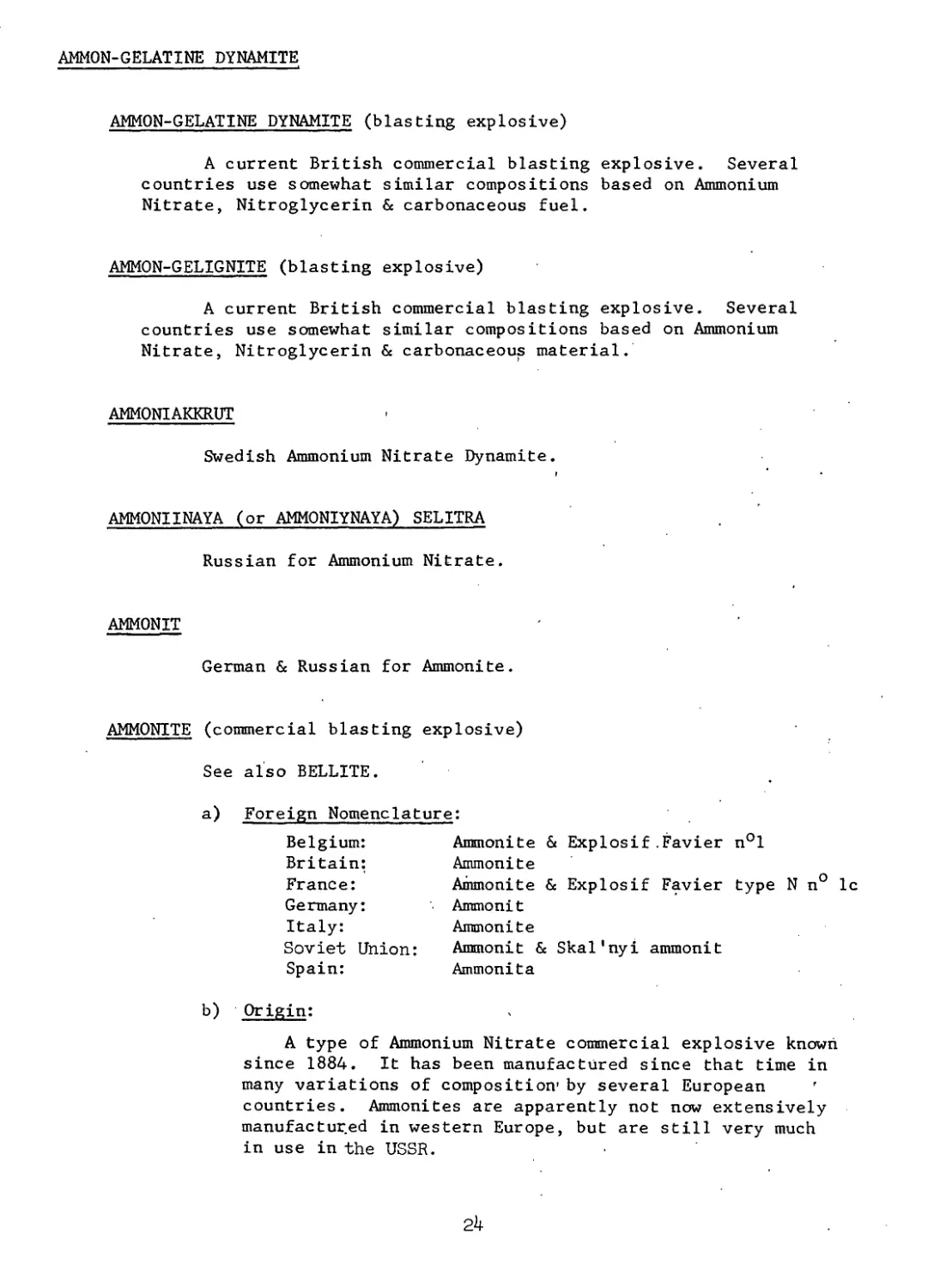
AMMON-GELATINE DYNAMITE (blasting explosive)
A current British commercial blasting explosive. Several
countries use somewhat similar compositions based on Ammonium
Nitrate, Nitroglycerin & carbonaceous fuel.
AMMON-GELIGNITE (blasting explosive)
A current British commercial blasting explosive. Several
countries use somewhat similar compositions based on Ammonium
Nitrate, Nitroglycerin & carbonaceous material.
AMMONIAKKRUT
Swedish Ammonium Nitrate Dynamite.
AMMONIINAYA (or AMMONIYNAYA) SELITRA
Russian for Ammonium Nitrate.
AMMONIT
German & Russian for Ammonite.
AMMONITE (commercial blasting explosive)
See also BELLITE.
Belgium:
Britain:
France:
Germany:
Italy:
Soviet Union:
Spain:
a)	Foreign Nomenclature:
Ammonite & Explosif .Favier n°l
Ammonite
Ammonite & Explosif Favier type N n° 1c
Ammonit
Ammonite
Ammonit & Skal'nyi ammonit
Ammonita
b)	Origin:
A type of Ammonium Nitrate commercial explosive known
since 1884. It has been manufactured since that time in
many variations of composition' by several European '
countries. Ammonites are apparently not now extensively
manufactured in western Europe, but are still very much
in use in the USSR.
24
AMMONITE
Identifying Features:
Color may be white, but is usually brown. It
may be either a powder or plastic putty-like material.
Chemical Composition:
Ammonites are mechanical mixtures of Ammonium
Nitrate plus a variety of aromatic nitro compounds and
other ingredients. See Table U, below under Uses and
by country.
Physical Properties:
All Ammonites must be compressed^usually in
cylindrical paper cartridges which are then wrapped
in paper and waterproofed. The high Ammonium Nitrate
content renders all Ammonites extremely hygroscopic,
and they will deteriorate during prolonged storage.
See also Table 4.
Test Methods and Explosive Characteristics:
Ammonites are subjected to the standard tests
which all commercial mining or blasting explosives
must pass to be safe or to be placed on a "Permitted
List". In general, they have low sensitivity to both
friction and shock.
Manufacturing Processes:
The thoroughly pulverized ingredients are blended
and then heated, by indirect Steam or hot water, above
the melting point of the nitrocompound. The mixture is
cooled without stirring. This treatment results in the
Ammonium Nitrate grains being coated with the non-hygro-
scopic nitrocarbon. The Ammonite is then press loaded
into an appropriate cartridge in the same manner as
most dynamites.
Safety Hazards:
See under AMMONIUM NITRATE. Ammonites are Class
12, Group D explosives for quantity-distance and
compatibility storage classifications.
Inspection Procedures;
See under AMMONIUM NITRATE'.
Preservation and Special Handling Requirements:
See under AMMONIUM NITRATE.
25
AMMONITE
к)	Storage:
See under AMMONIUM NITRATE.
1)	Demilitarization and/or Disposal Procedures:
See under AMATOL and .under AMMONIUM NITRATE.
m)	Uses:
Some Ammonites are used as commercial blasting ex-
plosives in the mining of coal, especially where the
accumulation of methane-air mixtures ("firedamp") and
coal dust-air mixtures may be ignited by the high
detonation temperatures of other explosives not hav-
ing the characteristics of Ammonites. Their detonation
temperatures are comparatively lowj moreover, the
detonation products cool rapidly and will not ignite
the atmosphere surrounding them. Some Ammonites have
been used in military applications, particularly as
substitute fillers for high explosives based on TNT
or Nitroglycerin.
Ammonites are known to be used in Britain, France,
Germany, Italy, USSR, Spain & USA. For specific
compositions of some mixtures and their uses, see
under individual country.
In the United States, commercial explosives
intended for use in mining and blasting operations are
called "Permissible or Safety Explosives". These
explosives, after extensive tests to determine their
suitability, must be approved by the Bureau of Mines,
US Department of Interior. An extensive list of
such approved explosives is available from the Bureau
of Mines.
26
AMMONITE
TABLE 4
German Ammonites Used During WW II
Components and some Properties	No ?	43A	43B *	43C **	No ?	Hl	H5	No ?	No ?	No ?
Amm nitrate	42.0	46.0	56.0	45.0	46.0	50.0	50.0	55.0	52.0	50.0
Na nitrate	9.8,	-	8.0	-	-	-	5.0	5.0	8.0
Ca nitrate, 41^0	-	8.0	6.0	10.0	8.0	15.0	15.0	10.0	7.0	15.0
Mg nitrate, 6^0	8.4	-		-	-			-
Guanidine nitrate	-	8.0	10.0	15.0	-		-	-	-	10.0
PETN	9.8	-	. 2.0	-	-	io.d	-	-	-	-
PH-Saiz	-	-	5.0	-	46.0	-	10.0	10.0
RDX	30.0	8.0	7.0	-	-	25.0	20.0	20.0	25.0	25.0
Tetra-Salz	-	-	-	-				-	8.0	-
TNT	-	30.0	10.0	30.0	-	-		-
"Vultamol" (emulsifier)	-	o.3	0.3	0.5	-	-	-	-	-
(added)
Density (cast) gm/cc	—	1.58	1.61		—	—		1.53	1.50
Casting Temperature, °C	-	104	105	-	-	-	-	108	112	-
Density of Fragmentation	41	-	38	-	39	-	-	40	41
*The composition given by G. Romer "Report on Explosives" (1945), PB Rpt No. 85-
totals 104.
**Ammonit 43C exploded in 1944 on a loading line and its manufacture was discontinued.
It is reported that mixtures of TNT with guanidine nitrate are unstable.
Most of these mixtures are suitable for loading bombs', grenades and shells.
27
AMMONIT-GOUDRONIT
AMMONIT-GOUDRONIT (mining explosive)
A Soviet commercial blasting explosive. There is no
.-.orresponding US composition. See under Soviet Explosives and
compare with Ammonpek.
AMMONIT, PREDOKHRANITEL *NYI (Permissible coal mining explosive)
A current Soviet commercial blasting explosive. There is
no corresponding US composition. See under Soviet Explosives and
compare with Ammonit.
AMMONIUMNITRAT
Swedish for Ammonium Nitrate.
AMMONIUMNITRAT or AMMONIUMSALPETER
German for Ammonium Nitrate.
AMMONIUM NITRATE (explosive ingredient of dynamites & ammunition fillers)
a) Foreign Nomenclature:
Belgium:	Nitrate d'ammoniaque
China: France: Germany: Hungry: Italy: Japan: Poland: Soviet Union:	Hsiao Hsuan An Nitrate d'ammoniaque Ammoniumnitrat, Ammonnitrat & Ammonsalpeter Ammoniumnitrat - & Ammonsaletrom Nitrato ammonico & Nitrato d'ammonio Ammonum Shosanen Saletra amonowa Ammiachnaya selitra, Ammoniynaya (Ammoniinaya) selitra & Azotnokislyi atnmonii
Spain:	Nitrato amcSnico
Sweden:	Ammoniumnitrat
Switzerland:	Ammonnitrat
28
AMMONIUM NITRATE
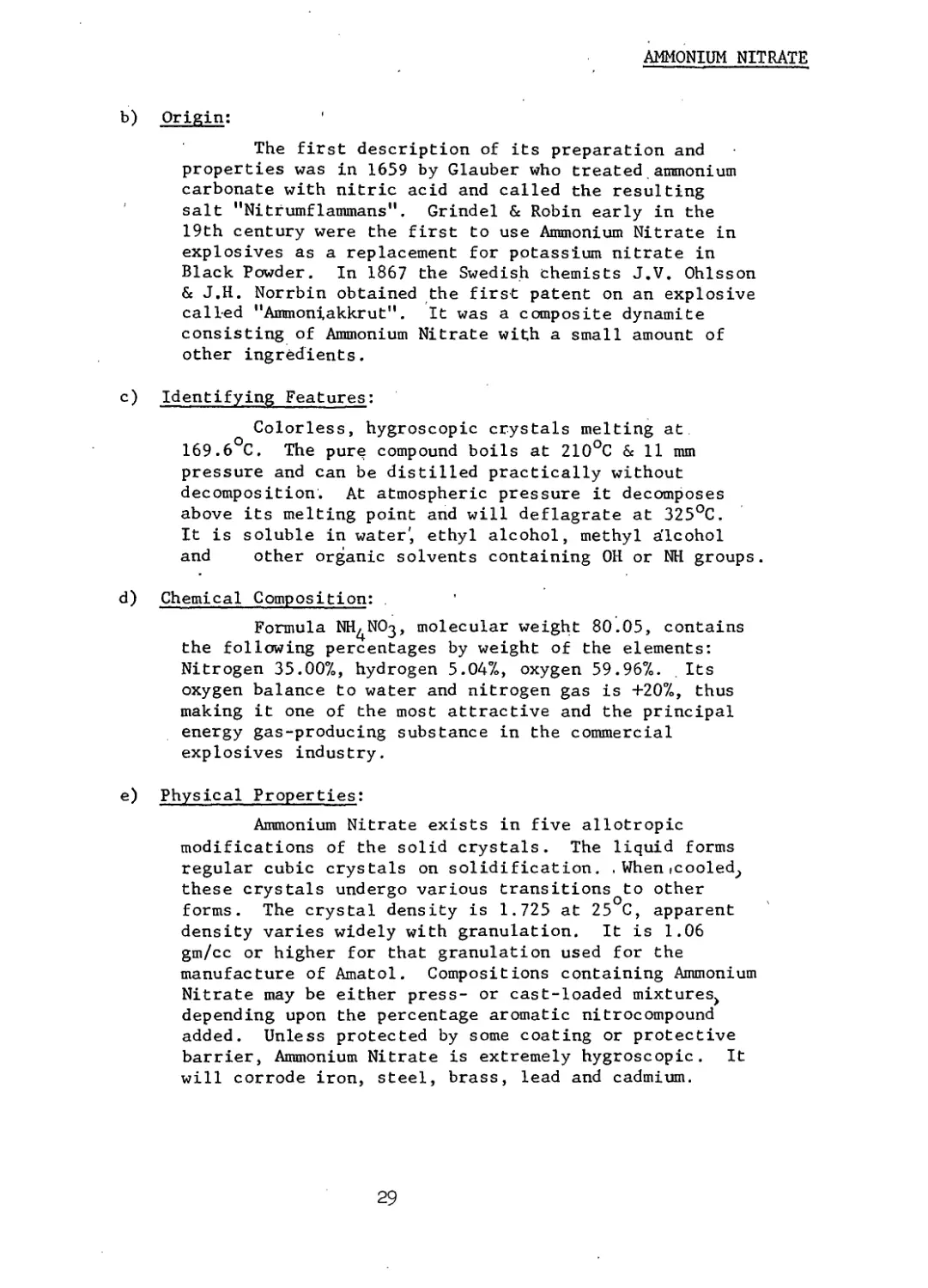
b)	Origin;	1
The first description of its preparation and
properties was in 1659 by Glauber who treated ammonium
carbonate with nitric acid and called the resulting
salt "Nitrumflammans". Grindel & Robin early in the
19th century were the first to use Ammonium Nitrate in
explosives as a replacement for potassium nitrate in
Black Powder. In 1867 the Swedish chemists J.V. Ohlsson
& J.H. Norrbin obtained the first patent on an explosive
called "Ammoniakkrut". It was a composite dynamite
consisting of Ammonium Nitrate with a small amount of
other ingredients.
c)	Identifying Features:
Colorless, hygroscopic crystals melting at
169.6°C. The pure compound boils at 210°C & 11 mm
pressure and can be distilled practically without
decomposition. At atmospheric pressure it decomposes
above its melting point and will deflagrate at 325°C.
It is soluble in water', ethyl alcohol, methyl a’lcohol
and other organic solvents containing OH or NH groups.
d)	Chemical Composition: .
Formula NH^NO^, molecular weight 80.05, contains
the following percentages by weight of the elements:
Nitrogen 35.00%, hydrogen 5.04%, oxygen 59.96%. . Its
oxygen balance to water and nitrogen gas is +20%, thus
making it one of the most attractive and the principal
energy gas-producing substance in the commercial
explosives industry.
e)	Physical Properties:
Ammonium Nitrate exists in five allotropic
modifications of the solid crystals. The liquid forms
regular cubic crystals on solidification. , When icooled?
these crystals undergo various transitions to other
forms. The crystal density is 1.725 at 25 C, apparent
density varies widely with granulation. It is 1.06
gm/cc or higher for that granulation used for the
manufacture of Amatol. Compositions containing Ammonium
Nitrate may be either press- or cast-loaded mixtures>
depending upon the percentage aromatic nitrocompound
added. Unless protected by some coating or protective
barrier, Ammonium Nitrate is extremely hygroscopic. It
will corrode iron, steel, brass, lead and cadmium.
29
ammonium nitrate
f)	Test Methods and Explosive Characteristics;
Ammonium Nitrate is the least sensitive to impact
of any of the military explosives. It has a low ability
to propagate a detonation wave and if a charge is long
and of small diameter or unconfined, the detonation
wave may die out before it reaches the opposite end of
the charge. Some other explosive properties include:
Brisance (by Lead Cylinder Compression Test) 547» of TNT;
detonation rate varies from 1000 to 3000 meters/sec
depending on conditions and methods of testing; flash
point 500°C; friction sensitivity cannot be detonated
by a steel shoe; gas evolved on detonation 980 liters
/kg; heat of combustion 628 cal/gm; heat of decomposition
323 cal/gm; heat of explosion 346 cal/gm; heat of for-
mation 87 kcal/mole at constant pressure; power (by
Trauzl test) 557» pf TNT; rifle bullet impact test
-unaffected; sensitivity to initiation by detonators &
boosters-more difficult to detonate or explode than
any of the standard military explosives, sensitivity is
increased by confinement, temperature, lower density
and the presence of organic materials; sensitivity to
initiation by heat-ignition temperature 465°C for
unconfined sample, 260 to 36O°C when under confinement;
and stability in storage-despite its hygroscopicity, r
very stable in storage'at temperatures up to 150 C>
although.slight decomposition may occur under certain
conditions.
g)	Manufacturing Processes:
Until WW I, Ammonium Nitrate was manufactured
chiefly by neutralizing, with weak nitric acid, the
ammonia present in aqueous by-products of the
artificial gas & coking industries. As the nitric acid
was then manufactured from Chile saltpeter, it contained,
hydrochloric acid, nitrous acid and boric acid as
impurities, while the gas liquor ammonia used contained
pyridine and thiocyanates. Consequently, the Ammonium
Nitrate also contained these same impurities. This
Ammonium Nitrate was suitable for use in blasting
explosives and in mixed fertilizers. When the	'
manufacture of nitric acid was begun from ammonia
produced from atmospheric nitrogen, this acid was of
a higher degree of purity. It was neutralized with
synthetic ammonia^and the Ammonium Nitrate thus pro-
duced was much purer than that obtained by the earlier
process.
30
AMMONIUM NITRATE
g)	Manufacturing Processes (cont'd)J
Other processes for manufacturing Ammonium Nitrate
include:
1)	Double decomposition of calcium nitrate and ammonium
carbonate (or sulfate)^
2)	Double decomposition of ammonium sulfate and sodium
nitrate in solution^
3)	Using sodium nitrate instead of common salt in the
ammonia-soda process^
4)	Mixing the gases (nitrogen dioxide, oxygen & steam)
obtained as by-products of ammonia oxidation plants
with ammonia gas and extra air in order to produce
the desired reaction’
5)	“ a method originated in Italy and
has assumed considerable importance in Europe. r It
is based on the .neutralization of aqueous nitric
acid by gaseous ammonia under conditions which
completely use the heat of neutralization under
pressurej
6)	Bamag-Meguin A.-G. Process - introduces nitric acid
solution and ammonia gas into the lower part of a
mass of fused Ammonium Nitrate at about 150°C at
atmospheric pressure^
7)	Caro_and_Frank_Process - a batch or continuous
process in which solid, dry Ammonium Nitrate is first
introduced' then ammonia gas and 95% nitric acid in
equivalent amounts are added to the reaction vessel^
8)	Toniolo_Process - Yields a dry product by pouring or
spraying molten Ammonium Nitrate of 10% water content
over dry material or by melting the dry salt with
the molten wet saltj	'	'
9)	Stengel Process - neutralization of ammonia with pre-
heated nitric acid takes place in a reactor at 204°C^
10)	Tenn©§§©©_yQll©Y_AutboritY_PrPCes§ and recent patents
assigned to the duPont Company.
Some later achievements and methods of
evaporating & crystallizing aqueous Ammonium Nitrate
solutions include continuous vacuum crystallization
and continuous graining or prilling processes.
h)	Safety Hazards:
Ammonium Nitrate is classified as an "explosive
ingredient" and oxidizing material. Some disastrous
explosions have occurred in the past usually because
of unduly high temperatures, confinement, or the
presence of organic materials. Its manufacture, use,
31
AMMONIUM NITRATE
h)	Safety Hazards (cont'd):
storage distribution and possession (in the USA) are
regulated by the Federal Explosives Act, administered
by the US Bureau of Mines. A yellow label, the same
as for ammonium perchlorate, is required on all rail-
road shipments. For purposes of quantity-distance
storage and compatibility group storage, Ammonium r
Nitrate is a Class 12, Group D explosive.
i)	Inspection Procedure:
A fairly pure sample should be white and entirely
soluble in water, giving a solution neutral to litmus.
A few drops of Nessler's reagent added to 2 to 3 ml of
the solution will turn the liquid dark yellow to red-
dish-brown (for smaill percent) or form a brown
precipitate (for large percent). If it is desired to
detect Ammonium Nitrate in the absence of other inorganic
or organic nitrates, pour 2 ml of DPhA reagent (1 gm
diphenylamine in 100 ml concentrated sulfuric acid) down
the wall of a test tube containing 5 ml of the solution.
A blue ring at the interface indicates a nitrate.
The sample may be tested for residue by heating
a small quantity in a crucible. A pure sample should
be completely volatile and practically free from residue.
The presence of a residue may indicate other nitrates,
sulfates or chlorides. Sodium nitrate is indicated if
a yellow color is produced in a flame by a platinum wire
dipped into a hot saturated test solution. Chlorides
are present if a few drops of silver nitrate produce a
white precipitate. Sulfates are tested for with barium
chloride, calcium with ammonium oxalate^and magnesium
with ammonium phosphate after removing any calcium
found.
See also under AMMATOL and AMMONAL.
j)	Preservation and Special Handling Requirements:
Ammonium nitrate is extremely hygroscopic. In
the presence of moisture, it reacts with copper to form
a compound (tetraminocupric nitrate), which is as sen-
sitive to impact and as brisant as Lead Azide. For this
reason, tools of copper, brass or bronze should not be
used in handling Ammonium Nitrate or explosive mixtures
containing it. It also reacts with and corrodes iron,
steel, lead, cadmium and zinc. The only materials known
to be definitely suitable as protective coatings, over
32
AMMONIUM NITRATE
j)	Preservation and Special Handling Requirements (cont1 d),*
long periods of time, for containers or ammunition loaded
with Ammonium Nitrate compositions are polyvinyl chloride
and epoxy resins. Other materials such as acid-proof
black paint, shellac, baked oil & rubber paints have not
proved successful.
In order to prevent the adsorption of moisture and
subsequent caking of Ammonium Nitrate in storage,
numerous coatings & water-repellent agents are used.
Materials such as diatomaceous earth or kaolin clay are
applied as coatings (0.5 to 1.07>) to the dried particles
called "prills". . Other materials such as coatings of
methyl cellulose, chalk, silica, alumina, "acid magenta",
and sodium polymetaphosphates are also suitable. ,
k)	Storage:.
Despite its hygroscopicity, Ammonium Nitrate is
very stable in storage at ambient temperatures for
prolonged periods of time. It can be subjected to
temperatures as high as 100°C for 100 days without
appreciable decomposition. Decomposition does not
appear to begin until the compound is heated to tem-
peratures near its melting point (170°C). Admixtures
of Ammonium Nitrate with TNT or other aromatic nitro-
compounds are stable at temperatures less than 120°C.
However, the sensitivity of Ammonium Nitrate to heat
is increased by the presence of organic materials such
as cellulose, paper, carbon, waxes, sawdust, oil or
paraffin. Therefore, these or other flammable
materials should not be stored with or adjacent to <
Ammonium Nitrate containers or ammunition loaded with
its admixtures.
1)	Demilitarization and/or Disposal Procedures:
Due to its high solubility in water, Ammonium
Nitrate can be rendered useless by flooding it with
large volumes of water. Steam can be used to destroy
or to remove some Ammonium Nitrate compositions from
loaded ammunition components. It is also moderately
soluble in ethyl alcohol and methyl alcohol at normal
temperatures.
It is decomposed by strong alkalies with the
liberation of ammonia, and by sulfuric acid with the
formation of ammonium sulfate and nitric acid.
See also under AMATOL and AMMONAL.
33
AMMONIUM NITRATE
m)
Uses:
Ammonium Nitrate is one of the most widely used
components of explosives, both in commercial and mili-
tary types. It is also used, universally as a nitrog-
enous fertilizer. When used, as a fertilizer, it does
not have to meet the standard of purity (99%) required
by its use as an explosive. Manufacturing facilities
used to produce fertilizer grade Ammonium Nitrate can
also produce the purer grade without any additional
conversion equipment.
Because of its insensitivity, Ammonium Nitrate
is seldom used alone. It is commonly used as an ex*
plosive extender in such mixtures as AMATOL (qv) and
AMMONAL (qv); in blasting, cratering & demolition
explosives such as AMMONITE (qv); and in some solid
"composite propellants".
Ammonium Nitrate is known to be used in Belgium,
Britain, France, Germany, Italy, Japan, USSR, Spain,
& USA. For further information on specific compositions
and uses, see Tables 5, 6 & 7 and under individual
country in the Country Index.
See also AMMONIUM NITRATE DYNAMITE & GELATIN
DYNAMITE.
In the United States, Ammonium Nitrate Dynamites
are a type of "straight" dynamite in which up to 507» ।of
the liquid nitric esters (Nitroglycerin + antifreeze
additives) is replaced by Ammonium Nitrate. These
explosives originated in the USA about 50 years ago.
They are noted for their heaving rather than shattering
effects, and their strength is lower than that of
straight dynamites. Some are used for military purposes
such as demolition, excavation and cratering operations.
These explosives are not suitable for use in coal mines
except for "strip mining" work, called "open-cast
mining" by the British. Some typical US compo-
sitions and their properties are given in Table 7.
3^
AMMONIUM NITRATE
TABLE 5
European Ammonium Nitrate Dynamite
Composition, %	British	French 1	French 2	French 3
Ammonium Nitrate	, 80	45	75	75
Nitroglycerin	10	40	20	22
Sodium nitrate	-	5	-	-
Wood or Cereal meal	10	10	5	-
Charcoal	-	-	-	3
Oxygen Balance to C02, % Density, gm/cc	1.0	+0.75 1.38	+9.7 1.20	+7.8 1.33
Lead Block Expansion, cc/10 gm sample	-	400	335	330
Lead Block Crushing, mm		22.0	15.5	16.0
Power, % Blasting Gelatin	78	1	-	r
35
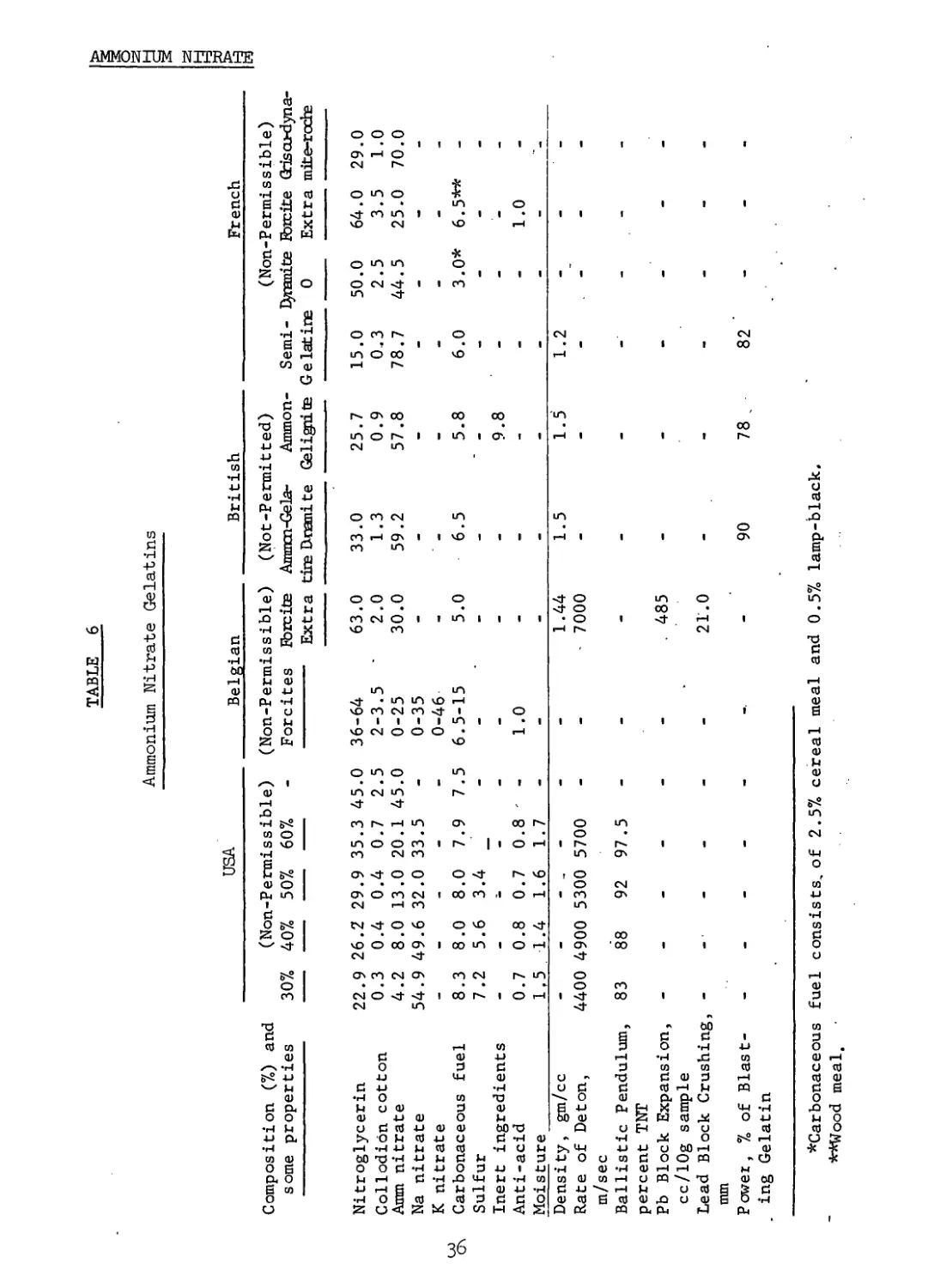
TABLE 6
Ammonium Nitrate Gelatins
AMMONIUM NITRATE
Belgian British French
Composition (%) and	(Non-Permissible) (Non-Permissible) (Not-Permitted)	(Non-Permissible)
	some properties	307,	407,	507,	607,	-		Forcites	Fbrcite Extra	Amnm-Ge la- tine Dnami te	Ammon- Geligpite	Semi- Ge latine	limnite 0	Ibrcite Extra	Gnscudyna- mite-roche

	Nitroglycerin	22.9	26.2	29.9	35.3	45.0	36-64	63.0	33.0	25.7	15.0	50.0	64.0	29.0
	Collodion cotton	0.3	0.4	0.4	0.7	2.5	2-3.5 '	2.0	1.3	0.9	0.3	2.5	3.5	1.0
	Amm nitrate	4.2	8.0	13.0	20.1	45.0	0-25	30.0	59.2	57.8	78.7	44.5	25.0	70.0
	Na nitrate	54.9	49.6	32.0	33.5	-	0-35	-	-	-	-	-	-	-
	К nitrate	-	-	-	-	-	0-46	-	-	-	-	-	-	-
La) CT\	Carbonaceous fuel	8.3	8.0	8.0	7.9	7.5	6.5-15	5.0	6.5	5.8	6.0	3.0* **	6.5*1
	Sulfur	7.2	5.6	3.4		-	-	-	-	-	-	-	-	-
	Inert ingredients	-	-	-	-	-	-	-	-	9.8	-	-	-	-
	Anti-acid	0.7	0.8	0.7	0.8		1.0	-	-	-	-	-	1.0	-
	Moisture	1,5	1.4	1.6	1.7	-	-	-	-	-	-	-	-	-
Density, gm/cc	-	-	- _	-	-	-	1.44	1.5	1.5	1.2	-	-	-
Rate of Deton,	4400	4900	5300	5700	-	-	 7000	-	-	-	-	-	-
m/sec Ballistic Pendulum, percent TNT	83	88	92	97.5	-	-	-	-	-	-	-	-	-
Pb Block Expansion,	-	-	-	-	-	-	. 485	-	-	-	-	-	-
cc/lOg sample Lead Block Crushing,	-	- -	-	-	-	-	21.0	-	-	-	-	-	-
mm
Power, 7, of Blast-	-	-	-	-	-		-	90	78 ,	82	-	-	-
ing Gelatin
*Carbonaceous fuel consists, of 2.57» cereal meal and 0.57» lamp-black.
**Wood meal.
TABLE 7
US Ammonium Nitrate Dynamites
Designation and Strength
Composition (%) and some		USA		USA		"Ordinary"			USA Low-Freezing				Monobe1 (permissi-
	properties	-	-	20%	30%	40%	50%	60%	30%	40%	50%	60%	ble USA)
	Nitroglycerin	9.50	9.50	12.0	12.6	16.5	16.7	22.5	13	17	21	27	10
	Nitroglycol	-	-	-	-	-	-	-	3	4	5	6	-
	Amm nitrate	79.45	69.25	11.8	25.1	31.4	43.1	50.3	15	20	25	30	80
	Na nitrate	-	10.20	57.3	46.2	37.5	25.1	15.2	53	45	36	27	-
	Carbonaceous fuel	9.75(a)	9.65(a)	10.2	8.8	9.2	10.0	8.6	15(b)	13(b)	12(b)	9(b)	10 -
	Sulfur	-	-	6.7	5.4	3.6	3.4	1.6	-		-	-	-
t 11	Anti-acid	0.40	0.50	1.2	1.1	1.1	0.8	1.1	1	1	1 '	1	-
	Moisture	0.90	0.90	0.8	0.8	0.7	0.9	0.7	- .	-	-	-	-
-	Density, gm/cc	-	-	1.30	1.31	1.28	1.26	1.28	-	-	-	-	-
	Rate of Deton,	-	-	2700	-	3300	3900	4600	-	-	-	-	-
	m/sec Ballistic Pendulum,	-	-	89	-	91	99	109	-	-	-	-	-
	% TNT
	Lead Block Ex-	-	-	19.9	-	27.5	-	34.7	-	-	-	-	-
	pansion, cc/g sample
(a? The jgrbonaceous combustible material (such as wood pulp
oil which/*.added to AN to counteract its hygroscopicity.
(b^The carbonaceous combustible material of these US dynamites is mixed with some sulfur.
AMMONIUM NITRATE
and flour) contains 0.40% of grease or
AMMONIUM NITRATE DYNAMITE
AMMONIUM NITRATE DYNAMITE (blasting explosive)
a)	Foreign Nomenclature:
Belgium:	Alkalite, Alsilite, Bellite, Centralite RII
& TA, Explosifs brisants, Explosifs de
Favier, Explosifs SGP, Flammivore, Fractorite
CA, Matagnite, Minolite antigrisouteuse,
Nitroboncellite, Nitrocooppalite V & VIII,
Permite, Permonite SGP, Ruptol В & Sabulite
France:	Explosif antigrisouteu, Explosif de Favier
& Forcite extra '	'
Germany: • Aldorfit, Ammoncarbonit, Ammondynamit,
Ammongelatine, Ammonsalpeter Sprengstoff,
Donarit, Fulmenit, Romperit 1
Italy:	Afocite, Astralite, Dinamon, Esplosivo da
mina polverulento con nitroglicerina, &
Imperialite
Japan:	Ammonyaku, Ko-Shoan Bakuyaku, L-Shoan,
Shin-Toku-Shoan, Shoan Bakuyaku, Shoanyaku
Soviet	Ammoksil or Ammonxyl, Ammonit, Ammonit-
Union:	Goudronit; Ammonit, Predokhranitel'nyi;
Ammonpek, Ammonsol, Belit, Dinamon, Igdanit
& Pobedit	'
Spain:	Dinamon, Donarita & Explosive de seguridad
Sweden:	Ammoniakkrut & Seranin
Switzerland: Aldorfit & Ammondynamit
b)	Origin:
Nobel gave the name Dynamite to mixtures of
Nitroglycerin & kieselguhr. Later it was found that
stronger Dynamites could be made by substituting
sodium nitrate & a combustible absorbent for the
kieselguhr. Subsequently, the replacement of part of
the Nitroglycerin & sodium nitrate by Ammonium Nitrate
brought into existence the less costly "Ammonia Dynamite"
(Ammonium Nitrate Dynamite).
c)	Characteristics:
For the composition & some characteristics of
Ammonium Nitrate Dynamites, see the above entries under
the country indicated.
38
AMMONIUM NITRATE DYNAMITE
d)	Uses:	1
Ammonium Nitrate Dynamites are used universally
for blasting operations. Because of their great
heaving force and relatively low rate of detonation,
they are used primarily for blasting soft rock &
earth.
See also AMMONIUM NITRATE and DYNAMITES.
AMMONIUM NITRATE EXPLOSIVES
See Explosif_nitrate or Explpsif_du_Type_N under French
Explosives, and Explpsiyps_de_seguridad under Spanish Explosives.
AMMONIUM PICRATE or EXPLOSIVE D (bursting charge)
a)	Foreign Nomenclature:
Britain:	Explosive "D" (Dunnite), Ammonium
Trinitrophenolate
France:	picrate d'ammoniaque
Germany:	Ammoniumpikrat
Hungary:	Dunnit robbanoanyag
Italy:	Picrato ammonico & Picrato d'ammonio
Japan:	Pikurinsan Ammonia
Soviet Union: Pikrat ammonia, Pikrinovokislyi
ammdni i
Spanish:	Picrato amonico
b)	Origin:
It was first prepared in 1841 by Marchand and used
in explosive compositions, in 1869, called Abel Powder
or Picric Powder (	British Explosive ) and
Brugere Poudre (See under French Explosives). Since
1906 it has been used as an ingredient of military
propellent & high explosive compositions. The terms
Explosive D or Dunnite were code names originally
applied to keep the composition secret. These names
stand for Dunn (Beverly W.), an American officer and
ordnance expert, who introduced the use of Ammonium
Picrate as a filler for armor-piercing projectiles.
c)	Identifying Features:
Yellow to orange crystalline compound melting
with decomposition at 2б5-27О°С. It is very soluble in
hot water; slightly soluble in hot acetone or hot ethyl
alcohol; and practically insoluble in ether, ethyl
acetate & octyl alcohol.
39
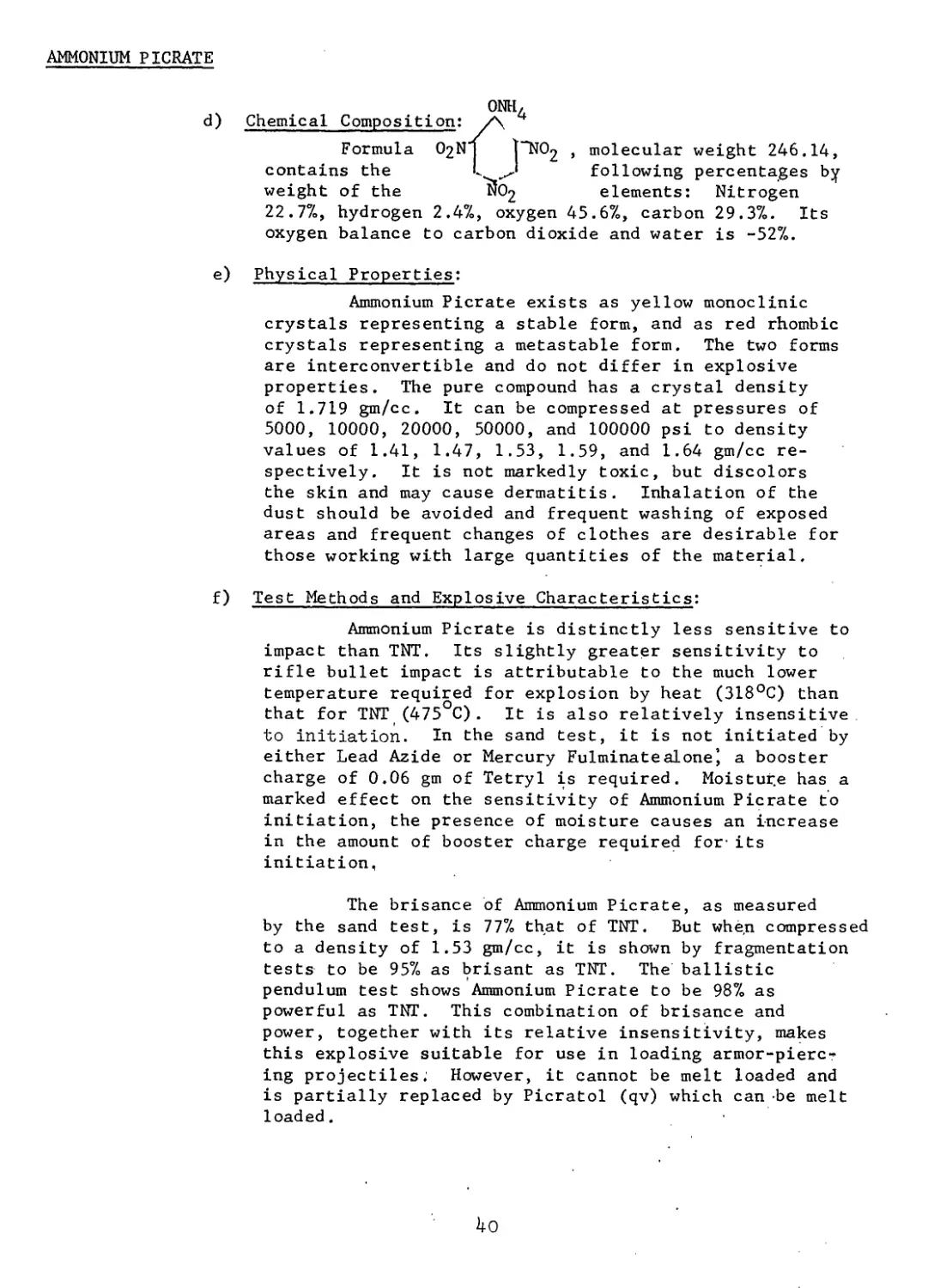
AMMONIUM PICRATE
ONH,
d) Chemical Composition: /\ 4
Formula O2N']	» molecular weight 246.14,
contains the	L	following percentages by
weight of the	NO2	elements: Nitrogen
22.77», hydrogen 2.47», oxygen 45.67», carbon 29.37». Its
oxygen balance to carbon dioxide and water is -527».
e)	Physical Properties:
Ammonium Picrate exists as yellow monoclinic
crystals representing a stable form, and as red rhombic
crystals representing a metastable form. The two forms
are interconvertible and do not differ in explosive
properties. The pure compound has a crystal density
of 1.719 gm/cc. It can be compressed at pressures of
5000, 10000, 20000, 50000, and 100000 psi to density
values of 1.41, 1.47, 1.53, 1.59, and 1.64 gm/cc re-
spectively. It is not markedly toxic, but discolors
the skin and may cause dermatitis. Inhalation of the
dust should be avoided and frequent washing of exposed
areas and frequent changes of clothes are desirable for
those working with large quantities of the material.
f)	Test Methods and Explosive Characteristics:
Ammonium Picrate is distinctly less sensitive to
impact than TNT. Its slightly greater sensitivity to
rifle bullet impact is attributable to the much lower
temperature required for explosion by heat (318°C) than
that for TNT (475 C). It is also relatively insensitive
to initiation. In the sand test, it is not initiated by
either Lead Azide or Mercury Fulminatealone’, a booster
charge of 0.06 gm of Tetryl is required. Moistur.e has a
marked effect on the sensitivity of Ammonium Picrate to
initiation, the presence of moisture causes an increase
in the amount of booster charge required for- its
initiation,
The brisance of Ammonium Picrate, as measured
by the sand test, is 77% that of TNT. But when compressed
to a density of 1.53 gm/cc, it is shown by fragmentation
tests to be 957» as brisant as TNT. The ballistic
pendulum test shows Ammonium Picrate to be 98% as
powerful as TNT. This combination of brisance and
power, together with its relative insensitivity, makes
this explosive suitable for use in loading armor-pierc-
ing projectiles; However, it cannot be melt loaded and
is partially replaced by Picratol (qv) which can be melt
loaded.
4o
AMMONIUMPICRATE
g)	Manufacturing Processes:	•	1
Picric Acid (trinitrophenol) is suspended in
hot water, in which it is partially soluble, and
neutralized by either gaseous or aqueous ammonia.
The reaction is slightly exothermic. On cooling
the solution, the picrate separates as yellow
crystals which are washed with cold water and dried.
An excess of ammonia leads to formation of the red
form. This should be avoided.
h)	Safety Hazards:
Dry Ammonium Picrate is chemically not very
reactive. In the presence of moisture, it reacts
with metals, but less readily than Picric Acid, to
form sensitive & dangerous picrates. The presence
of traces of these picrates will increase the sen-
setivity and lower the detonation temperature of
Ammonium Picrate. For purposes of quantity-dis-
tance storage and compatibility group storage,
Ammonium Picrate is a Class 9, Group I explosive.
i)	Inspection Procedure:
The color requirement, yellow to orange, is
intended to eliminate the presence of even a small
amount of the red form. Strong alkalies decompose
Ammonium Picrate into Picric Acid & ammonia. This
reaction is the basis of one method for determining
purity of the material.
j)	Preservation and Special Handling Requirements:
Ammonium Picrate is not hygroscopic when ex-
posed to humid air but its direct contact with
moisture should be avoided. It is extremely stable
under normal conditions of storage (qv).
k)	Storage:
Tests of Ammonium Picrate during magazine
storage over a period of 20 years show it to undergo
no change in stability. Storage of either the yellow
or red form at 50°C for 3 years causes such.an
increase in sensitivity to initiation that it can be
initiated by Mercury Fulminate alone. Subsequent
storage at magazine temperature (2 to 6 years) causes
the explosive to return to its original condition of
sensitivity. Storage at 65°C for 1 year causes no
apparent deterioration of Ammonium Picrate. While
storage at elevated temperatures for prolonged periods
of time causes some increase in sensitivity to initiation,
41
AMMONIUM PICRATE
к)	Storage (cont'd)’
such storage does not change its color, brisance or '
stability. Therefore, Ammonium Picrate is considered
an extremely stable explosive.
1)	Demilitarization and/or Disposal Procedures:
Ammonium Picrate is decomposed by dissolving it
in 30 times its weight of a solution prepared by
dissolving 1 part of hydrated sodium sulfide
(Na2S*9H2O) in 6 parts of water.
Steam can be used to remove Ammonium Picrate or
Picratol from loaded ammunition components.
Destruction of scrap Ammonium Picrate or loaded
ammunition is best accomplished by detonating it in
appropriate piles or dumping the larger items at sea.
m)	Uses:
The insensitivity of Ammonium Picrate to shock
makes it a suitable bursting charge for armor-piercing
projectiles. It is also an ingredient of Picratol
which can be cast loaded, and is used in some pro-
pellent compositions.
Ammonium Picrate is known to be used in Britain,
Germany, Japan & USA.
For further information on uses, see under
individual country in the Country Index.
AMMONIUM TRINITROCRESYLATE
See Ecrasite under Italian Explosives, Ekrasit under Soviet
Explosives, and Ecrasita under Spanish Explosives.
AMMONIYNAYA (or AMMONIINAYA) SELITRA
Russian for Ammonium Nitrate.
AMMONPEK (mining explosive)
A Soviet coal mining explosive. There is no corresponding
US composition. See under Soviet Explosives.
42
AMMONPENTRINIT
AMM.ONPENTRINIT (blasting explosive)
A series of Swiss blasting explosives containing PETN/Nitro-
glycerin/Ammonium Nitrate. There,are no corresponding US compo-
sitions. See under Swiss Explosives.
AMMONPULVER
German name for Ammonal.
AMMONTOL (bursting charge)
A Soviet castable high explosive. There is no corresponding
US composition. See under Soviet Explosives and compare with
Ammoksil.
AMMONUM SHOSANEN
1"	~	f
Japanese for Ammonium Nitrate.
AMMONXYL
See Affmpkgjl under Soviet Explosives.
AMMONYAKU
Japanese Ammonium Nitrate Dynamite.
AMMOSOL'
Soviet permissible Ammonium Nitrate Dynamite.
AMONITA
Spanish for Ammonite.
ANBENYAKU or SHOBENYAKU (bursting charge)
A Japanese high-explosive charge. Also a Japanese blasting
explosive by the same name. There are no corresponding US com-
positions. See under Japanese Explosives.
43
ANGAYAKU (bursting charge)
Ai’GAYAKU (bursting charge)
Japanese high explosive compositions. One such composition
consisting of RDX and wax can be considered similar to Composition
A used by the British & USA* otherwise there are no similar US
compositions. See under Japanese Explosives.
ANS or ANTISANZIONITE (bursting charge)
Italian Ammonium Nitrate, castable explosive composition.
There is no corresponding US composition. See under. Italian
Explosives.
ARIONITE (permissible mining explosive)
A current Belgian mining explosive developed and manufactured
in Belgium. There is no corresponding US composition. See under
Belgian Explosives.
ARTIFICES or PYROTECHNIE
French for Pyrotechnic Compositions. See Pyrotechnie under
French Explosives.
ARTIFIZI da GUERRA or PIROTECNIA
Italian for Pyrotechnics. See Pirotecnia under Italian
Explosives.
AS-3 (priming & igniting composition)
A German, electric fusehead Priming & Igniting Composition.
See under German Explosives.
ASN ESPLOSIVO (or ASN MISCELA) (bursting charge)
A current Italian main high-explosive charge. There is no
corresponding US composition. See under Italian Explosives.
ASTRALIT
German for Astralite.
ASTRALITA
Spanish for Astralite.
2Й
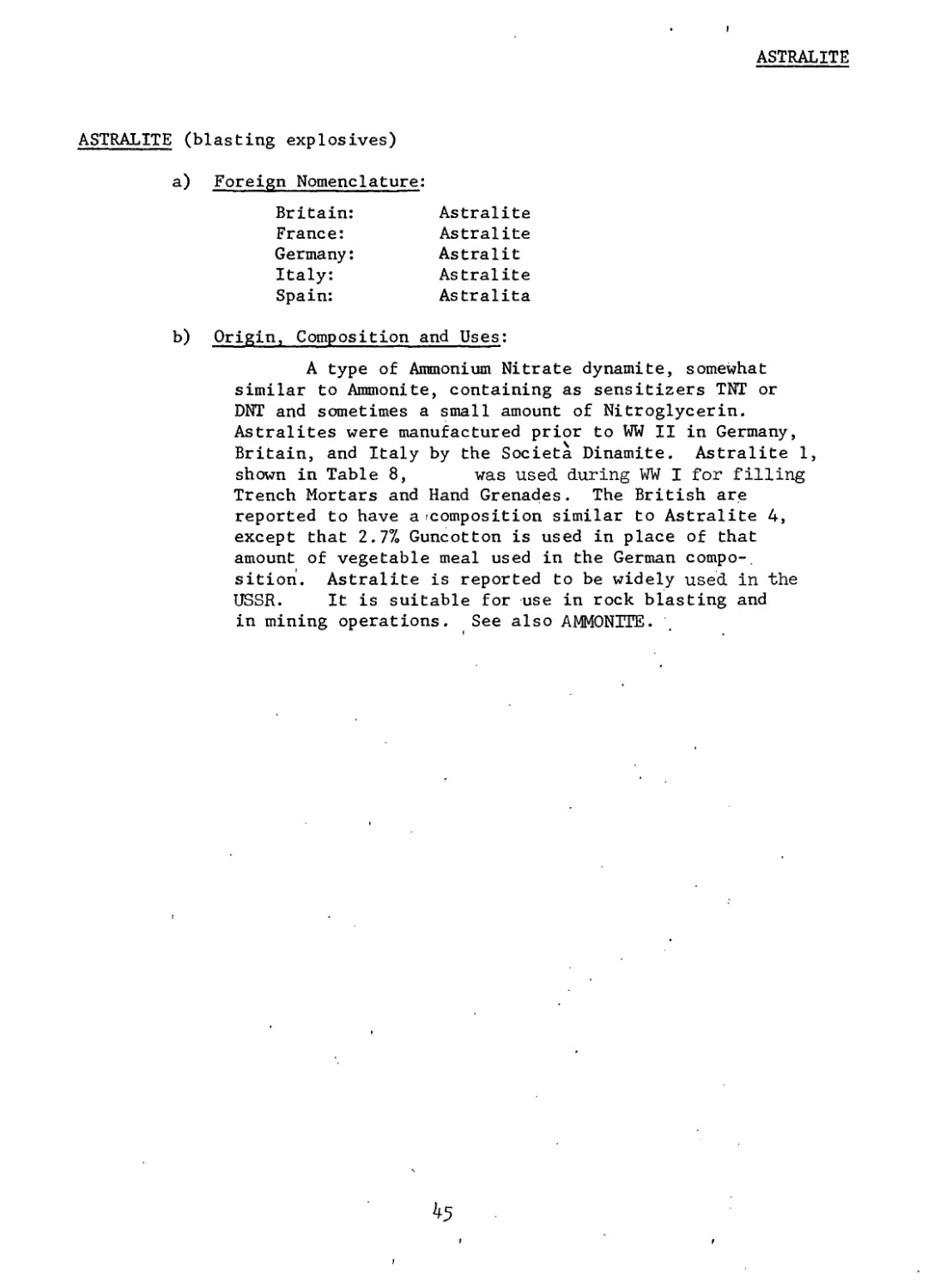
ASTRALITE
ASTRALITE (blasting explosives)
a)	Foreign Nomenclature:
Britain:	Astralite
France:	Astralite
Germany:	Astralit
Italy:	Astralite
Spain:	Astralita
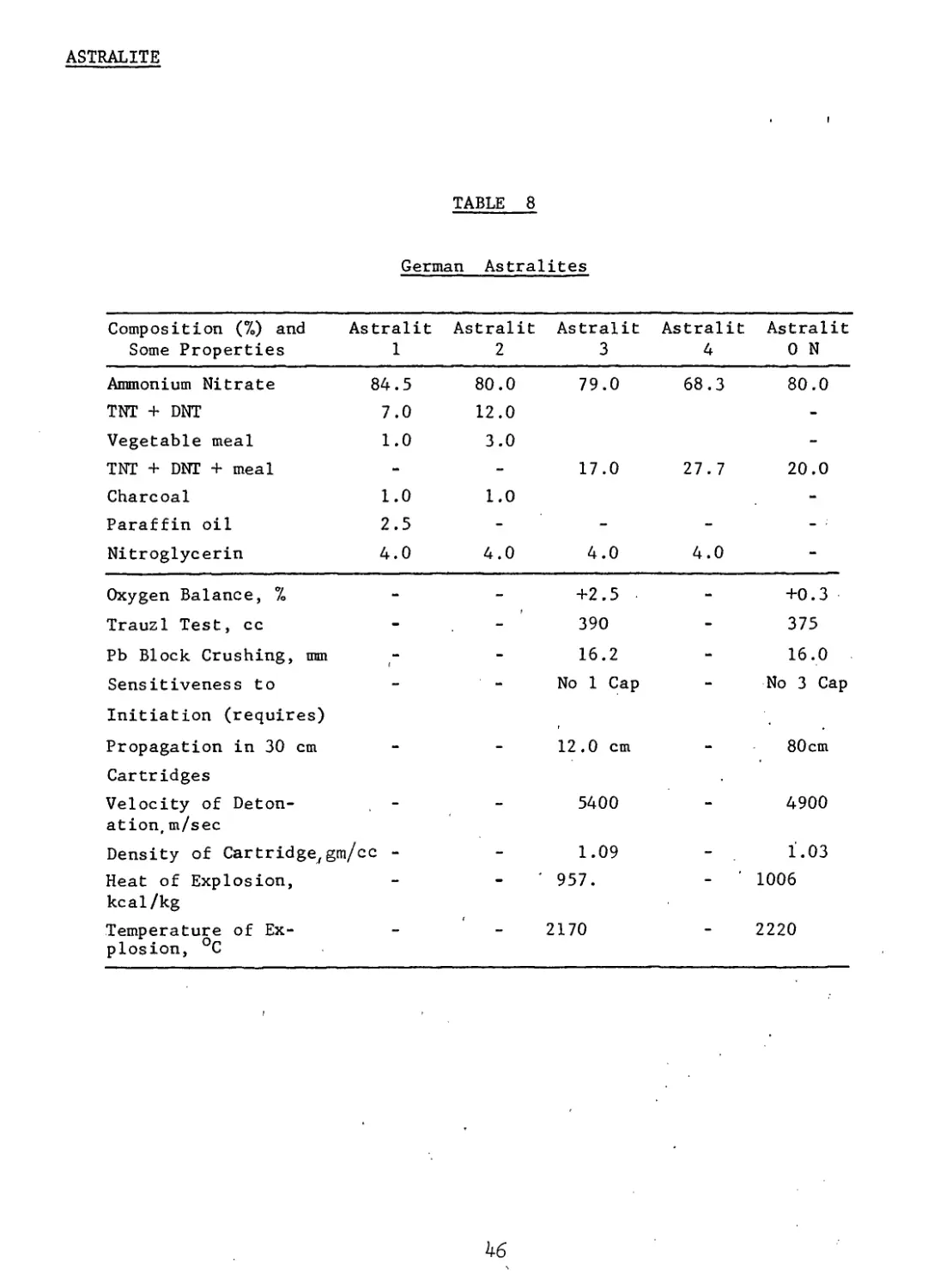
b)	Origin, Composition and Uses:
A type of Ammonium Nitrate dynamite, somewhat
similar to Ammonite, containing as sensitizers TNT or
DNT and sometimes a small amount of Nitroglycerin.
Astralites were manufactured prior to WW II in Germany,
Britain, and Italy by the Societa Dinamite. Astralite 1,
shown in Table 8, was used, during WW I for filling
Trench Mortars and Hand Grenades. The British are
reported to have a composition similar to Astralite 4,
except that 2.TL Guncotton is used in place of that
amount of vegetable meal used in the German compo-.
sition. Astralite is reported to be widely used in the
USSR. It is suitable for use in rock blasting and
in mining operations. See also AMMONITE.
ASTRALITE
I
TABLE 8
German Astralites
Composition (%) and	Astralit		Astralit	Astralit	Astralit	Astralit
Some Properties	1	2	3	4	0 N
Ammonium Nitrate	84.5	80.0	79.0	68.3	80.0
TNT + DNT	7.0	12.0			-
Vegetable meal	1.0	3.0			-
TNT + DNT + meal	-	-	17.0	27.7	20.0
Charcoal	1.0	1.0			-
Paraffin oil	2.5	-	-	-	- •
Nitroglycerin	4.0	4.0	4.0	4.0	-
Oxygen Balance, %	-	-	+2.5	-	+0.3
Trauzl Test, cc	-	-	390	-	375
Pb Block Crushing, mm	1	-	16.2	-	16.0
Sensitiveness to	-	 -	No 1 Cap	-	No 3 Cap
Initiation (requires)
Propagation in 30 cm		-	12.0 cm	-	80cm
Cartridges
Velocity of Deton-	-	-	5400	-	4900
ation,m/sec
Density of Cartridge, gm/	cc -	-	1.09	-	1.03
Heat of Explosion,	-	-	957.	-	1006
kcal/kg
Temperature of Ex-	-	-	2170	-	2220
plosion, °C
46
AT
AT or A
Russian abbreviation for Amatol.
AVIGLIANA 3 or NITAMITE'
Italian Ammonal. See Nitramite under Italian Explosives.
AZIDA de PLOMO
Spanish for Lead Azide.
AZIDE de PLOMB or AZOTURE de PLOMB
French for Lead Azide.
AZIDO-TENEROSSOVAYA (detonator cap composition)
A Soviet multilayer initiating composition used in detonator
caps. There is no corresponding US mixture currently used. See
under Soviet Explosives.
AZID SVINTSA
Russian for Lead Azide.
AZOTIDRATO d'ARGENTO or
AZOTIDRURO d'ARGENTO
Italian for Silver Azide.
AZOTIDRATO di PIOMBO or
AZOTIDRURO di PIOMBO
Italian for Lead Azide.
AZOTNOKISLYI AMMONIT
Russian for Ammonium Nitrate.
4?
AZOTURE de PLOMB
AZOTURE de PLOMB
Belgian for Lead.'Azide.
B4 (INCENDIARY or TYPE 2 (EXPLOSIVE) (incendiary charge)
A Japanese castable incendiary filler. There is.no
corresponding US composition. See under Japanese Explosives.
BAKUFUN (priming composition)
A Japanese Mercury Fulminate composition also called
"Exploding Powder". It is similar to some mixtures used by the
Germans & Italians. Priming compositions containing Mercury
Fulminate are used by the US only to a limited extent because of
their relative poor stability. See under Japanese Explosives.
BAKUHATSU-SEI ZERATIN (or ZERACHIN)
Japanese Blasting Gelatin.
BALISTITE
Italian Propellant used during WW II as a bursting charge in
some shells. See Balistite under Italian Explosives.
BARATOL (bursting charge)
a)	Foreign Nomenclature:	’	'
Britain:	Baratol
France:	Baratol
Spain:	Baratol
b)	Origin:
Baratol was developed during WW I by the British.
c)	Identifying Features, Chemical Composition & Properties:
Baratol is a light-yellow mixture of barium
nitrate & TNT, in proportions which may be varied to
meet the required purpose. The usual compositions are
73/27 & 67/33 barium nitrate/TNT. This explosive can
be cast loaded. Its explosion temperature is 385°C,
it is less sensitive to impact than TNT, about 56% as
brisant as TNT, and is nonhygroscopic.
48
BARATOL
d)	Manufacturing Process:
Barium nitrate, heated to about 90°C, is
added to molten TNT in a melting kettle equipped with
an agitator. The mixture is agitated until uniform
and then cast at the lowest practical temperature.
e) Uses:
Baratol is used as a bursting charge in Bombs,
and has been used as'a burster in some Pyrotechnics.
BELAYA SMES’
A Soviet percussion-type initiating mixture. This name
is translated as "White Composition". There is no corresponding
IE composition. See under Soviet Explosives.
BE LIT
Russian for Bellite.
BELLITE (mining explosive)
Bellites are commercial high explosives based on Ammonium
Nitrate. They are used primarily for coal mining in Europe & in
the Soviet Union. See Bellite under French Explosives, and Belit
under Soviet Explosives.
BERCLAVIT В (bursting explosive)
A German aluminized Ammonium Nitrate bursting charge. There
is no corresponding US composition. See under German Explosives.
BICARBITE (mining explosive)
A current Belgian mining explosive developed and manufactured
in Belgium. There is no corresponding US composition. See under
Belgian Explosives.
BIKARBIT (blasting & coal mining explosive)
A German permissible explosive. There is no corresponding US
composition. See under German Explosives.
BITTERSAURE
German for Picric Acid.

BLACK POWDER
В ACK POWDER (priming, igniting & blasting explosive)
a) Foreign Nomenclature;
Belgium: France: Germany: Hungary: Italy: Japan:	Poudre noire Poudre noire Schwarzpulver Fekete lopor Polvere nera & Polvere da fuoco Kokoshokuyaku & Yuenyaku
Soviet Union:	Chornyi porokh & Dymnyi porokh
Spain: Sweden:	P<&vora negra Svartkrut
Switzerland:	Amidogene & Schwarzpulver
b)
Origin:
The exact date of the discovery of Black Powder
is unknown. It is the oldest explosive & propellant
known. Historians attribute its discovery to the
Chinese, Hindus & Arabs. The Greeks used it during
the 7th century. Marcus Graecus, in the 9th century,
and Roger Bacon, in the 13th century, described
compositions similar to the present Black Powder.
For over 400 years the composition of Black Powder
has remained unchanged with respect to the proportion-
ality of its ingredients.
c)	Identifying Features:
In appearance^Black Powder varies from a blaclf;,
very fine powder to dense pellets which may be black
or grayish-black because of a graphite-glazed surface.
d)	Chemical Composition:
The composition of current military Black
Powders is between the following limits: Potassium
nitrate 74-787», charcoal 12-167» & sulfur 10-12.57».
When sodium nitrate is used}the proportions of the
ingredients are changed somewhat as follows: Sodium
nitrate 72 + 27», charcoal 16 + 27» & sulfur 12 + 27».
e)	Physical Properties:
Military Black Powder is manufactured in a
wide range of grain sizes, each of which is designated
by a grade, symbol or name. That used in the loading
of time-train Fuses may be of such a granulation that
977» passes thru a No 140 sieve. The particle-density
of Black Powder pressed at 25,000 Ibs/sq in is 1.72
-1.77 gm/cc. At pressures up to 75,000 Ibs/sq in, this
value is increased to 1.88 gm/cc.
50
BLACK POWDER
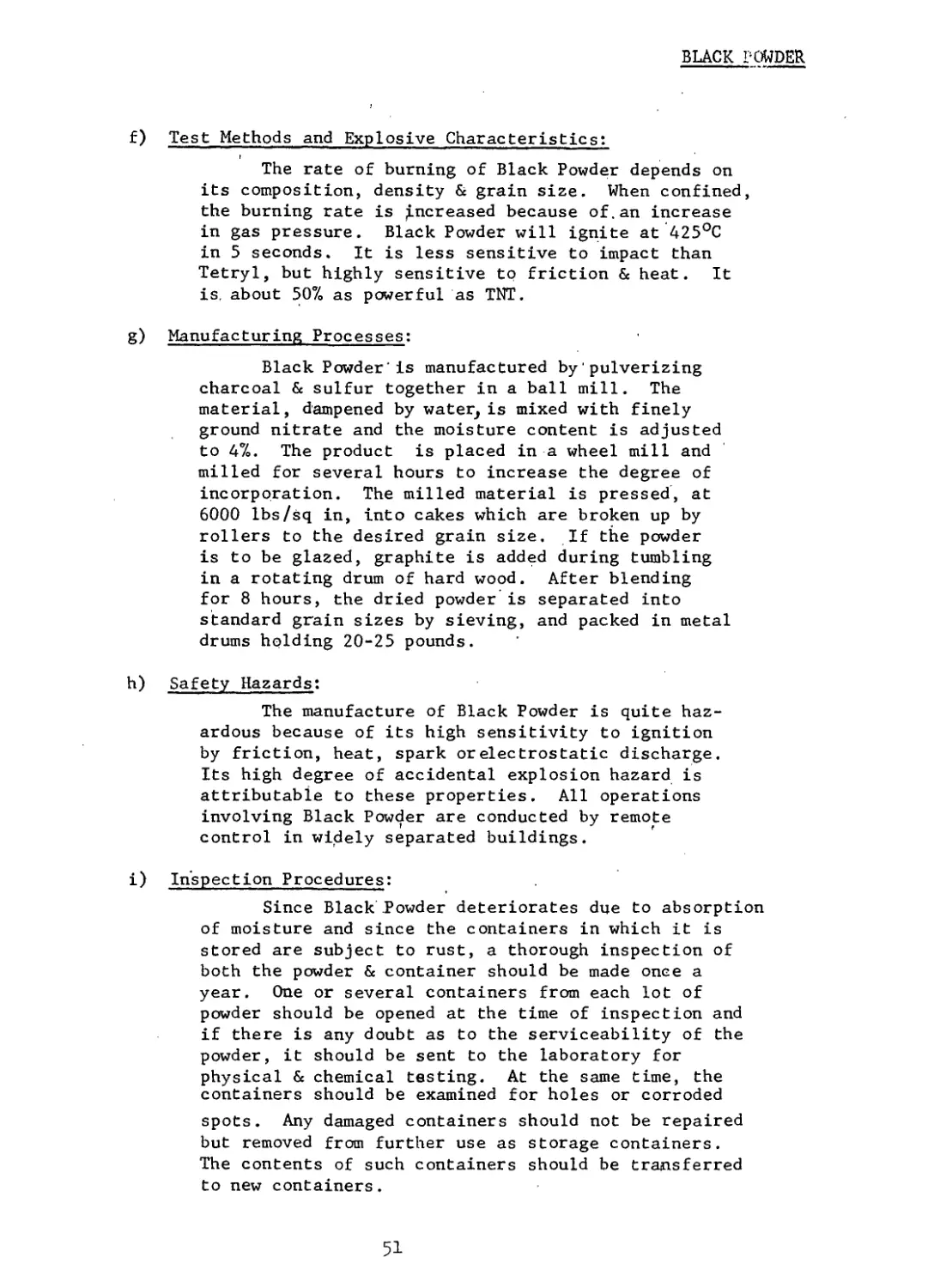
f)	Test Methods and Explosive Characteristics;
The rate of burning of Black Powder depends on
its composition, density & grain size. When confined,
the burning rate is increased because of.an increase
in gas pressure. Black Powder will ignite at 425°C
in 5 seconds. It is less sensitive to impact than
Tetryl, but highly sensitive to friction & heat. It
is, about 50% as powerful as TNT.
g)
Manufacturing Processes:
Black Powder'is manufactured by'pulverizing
charcoal & sulfur together in a ball mill. The
material, dampened by water^ is mixed with finely
ground nitrate and the moisture content is adjusted
to 4%. The product is placed in a wheel mill and
milled for several hours to increase the degree of
incorporation. The milled material is pressed, at
6000 Ibs/sq in, into cakes which are broken up by
rollers to the desired grain size. If the powder
is to be glazed, graphite is added during tumbling
in a rotating drum of hard wood. After blending
for 8 hours, the dried powder is separated into
standard grain sizes by sieving, and packed in metal
drums holding 20-25 pounds.
h)
Safety Hazards;
The manufacture of Black Powder is quite haz-
ardous because of its high sensitivity to ignition
by friction, heat, spark or electrostatic discharge.
Its high degree of accidental explosion hazard is
attributable to these properties. All operations
involving Black Powder are conducted by remote
control in widely separated buildings.
i)
Inspection Procedures:
Since Black Powder deteriorates due to absorption
of moisture and since the containers in which it is
stored are subject to rust, a thorough inspection of
both the powder & container should be made once a
year. One or several containers from each lot of
powder should be opened at the time of inspection and
if there is any doubt as to the serviceability of the
powder, it should be sent to the laboratory for
physical & chemical testing. At the same time, the
containers should be examined for holes or corroded
spots. Any damaged containers should not be repaired
but removed from further use as storage containers.
The contents of such containers should be transferred
to new containers.
51
BLACK POWDER
j)	Preservation and Special Handling Requirements:
Black Powder is undesirably hygroscopic,
this being due even more to the charcoal than
to the nitrate. While the presence of moisture
does not cause Black Powder to become unstable,
the presence of moisture does cause it to react
with and corrode metals such as steel, brass &
copper. When used for military purposes, Black
Powder is required to contain not more than 0.7%
moisture, and generally it is dried to contain
only 0.2-0.3% moisture. Because of its extreme
sensitivity to initiation by spark and its great
hygroscopicity, Black Powder should be packed in
airtight steel drums containing not more than
25 pounds.
k)	Storage:
In the absence of moisture, Black Powder
is of a high order of stability, its ingredients
being nonreactive even at 120°C. Black Powder
containers must not be opened or stored in any
magazine in which high explosives or loaded
ammunition are stored. The containers should be
stored in bullet-proof magazines but never in
barracks, general supply rooms, inhabited
buildings, or in any building heated by stoves
or open fires. For purposes of quantity-distance
storage and compatibility group storage, Black
Powder is a Class 9, Group 0 explosive.
1)	Demilitarization and/or Disposal Procedures:
If the Black Powder to be destroyed is in
containers, they should be opened with wooden or
non-sparking metal tools. If a stream or large
body of water is at hand, the powder can be
dumped into it. If this method cannot be used or
anti-pollution laws prevent its use, the powder
must be sent to the burning ground to be destroyed.
At the burning ground the powder is spread in 2"
wide strips, not over 2" deep, and in a trail no
part of which parallels another part within a
distance of 10 feet. Then lay a train of com-
bustible material (such as paper or excelsior),
prefirably on the down-wind side of the trail, of
such a length that the operator can reach a safe
place after igniting the paper. If sufficient
space permits, use a new area of ground for each
container of Black Powder. Never burn more than
one container of Black Powder (50-lb maximum) at
a time.
52
BLACK POWDER
m)	Uses:
Black Powder is used as a Sporting Pro-
pellant, blasting explosive, in Time Fuzes,
Primers, Igniters, Delay & Relay elements,
Pyrotechnics, the base charge for Shrapnel
Shells, bursting charge for Blank, Saluting &
Practice Shells, in chemical ammunition, and as
an igniter in some Rockets and. missiles.
BLACK POWDER FUSE
See Qgneprovodnyi_shnur under Soviet Explosives.
BLASTIN
Swedish Cheddite-type blasting explosive.
BLASTING CAP CHARGES
See Detonatoren- und Sprengkapseln-Ladungen under
German Explosives.	'	1
BLASTING GELATIN (dynamite)
a)	Foreign Nomenclature:
France:	Dynamite gomme
Germany:	Sprenggelatine
Hungary:	Robbanc^-zselatin
Italy:	Gelatina esplodente	& Gelatina
gomma
Japan:	Bakuhatsu-Sei Zeratin,	Matsu	&
Sakura Nos 1 & 2
Soviet Union: Gremuchii studen1
Spain:	Din^mita goma, Goma,
Sweden:	Spranggelatin
Switzerland: Spezialsprenggelatine
b)	Origin:
Blasting Gelatin was invented by Nobel in
1875. He found that 7-8% of Collodion Cotton
dissolved in Nitroglycerin converted it into a
stiff jelly which was a powerful explosive.
53 -
BLASTING GELATIN
c)
Characteristics;
Blasting Gelatin is a yellow, translucent,
soft, elastic explosive. It is less sensitive to
shock, friction & impact than either Nitroglycerin
or Guhr Dynamite. It is completely insensitive to
water and far more difficult to freeze than Guhr
Dynamite. However, when frozen, Blasting Gelatin
increases markedly in its sensitivity. At
ordinary temperatures, it is completely stable
but rapid temperature changes cause the Nitro-
glycerin to exude, resulting in increased sen-
sitivity. Blasting Gelatin is difficult to deton-
ate at normal temperatures, the higher Nitrocell-
ulose content being more difficult to initiate.
d)
Manufacturing Processes:
Blasting Gelatin is prepared by gelatinizing
92-93% Nitroglycerin with 8-77» Collodion Cotton
(11.1-12.5% Nitrogen), either by warming the
ingredients to 60-70°C in a water-jacketed vessel,
or by adding solvents such as acetone or ether-
alcohol to facilitate the gelatinization process.
About 0.27» calcium carbonate is usually added as
an antiacid agent. The finished product may con-
tain up to 0.3% moisture. It is then placed into
cartridges by means of a screw machine.
e)
Storage:
Blasting Gelatin, in storage, progressively
hardens with age and this is accompanied by a
dimunition in sensitivity to initiation and by a
considerable decrease in power. If stored for a
long time, this explosive may even misfire. Such
a material can be "revived" by heating it on a
water bath to 60-70°C and cooling. Another method
consists of prolonged rolling of the cartridges on
a flat surface. The phenomenon of the stiffening
of Blasting Gelatin during prolonged storage is
not yet fully understood^but some theories have
been advanced.
f)
Uses:
Blasting Gelatin is one of the most powerful
commercial explosives ever invented. Because of
its high brisance, Blasting Gelatin is particularly
suitable for blasting hard rock. It is also
excellent for use in underwater blasting operations
due to its waterproof nature.
54
BLASTING GELATIN
F) Uses (cont'd):		'
See the above entries under the countries
indicated for additional information, and also
GELATINE DYNAMITE & DYNAMITE.
BIEIAZID
German and Swiss for Lead Azide.
BIEIPIKRAT
German for Lead Picrate.
BLEISTYPNAT or BLEITRINITRORESORCINAT
German or Swiss for Lead Styphnate.
BLYAZID (BLYACID)
Swedish for Lead Azide.
BLYSTYFNAT or BLYTRINITRORESORCINAT
Swedish for Lead Styphnate.
BM (Esplosivo)
Italian mining explosive.
BONIT
Swedish trade name applied to RDX/TNT mixtures which
correspond to US Cyclotols.
BONOCORD
Swedish trade name for Detonating Fuse or Primacord.
BOOSTER
See Relais (Explosif pour) under French Explosives.
BRANDBOMBEN & BRANSATZE or BRANDSTOFFE
Names used in Germany and in Switzerland for Incendiary
Compositions.
55
BROWN POWDER
BROWN POWDER (delay composition & substitute Black Powder)
a)	Foreign Nomenclature;
France:	Poudre brune
Germany:	Braunpulver
Italy:	Polvere bruna & Polvere
cioccolata
Japan:	Kasshokuyaku
Soviet Union: Buryi porokh & Shokoladnyi
porokh
b)	Origin:
The introduction of a slow-burning powder,
known as Brown? Cocoa? or Chocolate Powder and
representing a modification of Black Powder, was
invented in Germany about 1882. It contained
potassium nitrate 797», brown charcoal (containing
27» water) 187» & sulfur The brown charcoal
was prepared by incompletely charring a light
wood or straw. This charcoal contains more
volatiles than black charcoal. The composition
of Brown Powder was kept secret until the Russians
published, in 1866, the formula of their own
powder manufactured at the Ochta plant near
St Petersburg. Russian Brown Powder consisted
of potassium nitrate 78.47», brown charcoal (from
incompletely charred rye straw) 19.67» & sulfur
2.07».
c)	Manufacturing Processes:
Brown Powder is manufactured in the same
manner as Black Powder. The use of partially
charred wood or straw, which possesses some
collodial properties, enables the composition to-
flow under pressure, thus cementing the grains
together as does the sulfur. This property of
brown charcoal makes possible a reduction in the
amount of sulfur required in the composition, thus
making the powder slow burning.
d)	Uses:
Brown Powder was formerly used as a Pro-
pellant in big guns. It greatly improved,
their ballistics and made possible the use of
larger caliber guns than could be used with
Black Powder. For equal muzzle velocities,
Brown Powder produces less pressure in the gun
than Black Powder.
56
BROWN POWDER
d) Uses:	‘	'
At present Brown Powder is used in some
countries as a Delay Composition, and as a sub-
stitute for Black Powder where slow-burning
powder is suitable.
See also the above entries under the country
indicated.
BRUGERE POUDRE (explosive mixture)
An explosive mixture used by the French as a substitute
for Black Powder. See under French Explosives. There is no
corresponding US composition. The British use a similar
mixture called Abel Powder or Picric Powder.
BURYI POROKH or SHOKOLADNYI POROKH
Soviet Brown Powder similar in composition to Soviet
Black Powder, except that partially burned wood or straw is
used instead of black charcoal. See under Soviet Explosives.
C6 (bursting charge)
A German castable bursting,charge used as a substitute
for TNT. There is no corresponding US composition. See under
German Explosives.
CADINITE (mining explosive)
An Italian industrial mining explosive. This composition
is similar to US 307» Gelatin Dynamite. See under Italian
Explosives.
II
CAHUCIT (blasting explosive)
A German safety blasting explosive. Similar Dynamites
are used in England & France. See under German Explosives.
CALCINIT (mining explosive)
A German mining explosive based on calcium nitrate.
There is no corresponding US composition. See under German
Explosives.
57
CAI.ORITE FRANgAlSE
CALORITE FRANgAISE (pyrotechnic)
A French Incendiary Pyrotechnic mixture ignited by a
fuse. There is no corresponding US composition. See under
French Explosives.
CARBONIT (blasting & mining explosive)
A class of German permissible explosives. They are
also used in England & France. See under German Explosives.
CELLAMITE (dynamite)
A French Ammonium Nitrate Dynamite. There is no
corresponding US composition. See under French Explosives.
CELLULOSENITRAT, NITROCELLULOSE or
NITROZELLULOSE
Names used in Switzerland for Nitrocellulose
CENTRALITE RII & TA (permissible mining explosives)
Belgian permissible mining explosives. There are no
corresponding US compositions. See under Belgian Explosives.
CHAKATSUYAKU, SANSHOKI TORUORU or TYPE 92 (Navy)
Japanese for TNT.
CHANAYAKU (main high explosive charge)
A Japanese castable main charge for projectiles. There
is no corresponding US composition. See under Japanese
Explosives.
CHADYAKU (bursting charge)
A Japanese cast- or press-loaded charge for bombs. There
is no corresponding US composition since Picric Acid has been
replaced by Ammonium Picrate. See under Japanese Explosives.
58
CHARBRITE
CHARBRITE (mining explosive)
A current Belgian dynamite developed and manufactured
in Belgium. There is no corresponding US composition. See
under Belgian Explosives.
CHAUYAKU
Japanese for Cyclotol.
CHEDDIT
German for Cheddite.
CHEDDITE & CHEDDITE-TYPE EXPLOSIVES
a) Foreign Nomenclature:
Belgium:
France:
Germany:
(blasting & demolition explosives)
Italy:
Japan:
Soviet Union:
Spain:
Sweden:
Switzerland:
Cheddite & Yonckite
Cheddite, Explosif 0,
Explosif du Type 0C, Explosif
P, Explosif Street, Kaipinite &
Poudre Verte .	।
Cheddit, Alkalsit, Chloratit,
Chloratsprengstoffe, Leonit,
Miedziankit, Perchloratit &
Perchloratsprengstoffe
Cheddite, Cremonite, Explosive P,
Esplosivo S, Esplosivo speciale,
Polvere "Cannel", Polvere verde
& Romite
Entoyaku
Shedit
Chedita, Cheddita & Explosive
cloratado
Cheddite, Blastin & Territ,
Cheddit & Pierrit
Explosives known as Cheddites were invented
in France in 1897 by E. Street who patented
several varieties of the original composition. At
about the same time the Chemische Fabrik Griesheim
in Germany patented a similar type explosive. The
manufacture of these explosives under the name of
59
CHEDDITE
b)	Origin (cont'd)’.,
"Explosifs Street" began in 1898 by the SocieteZ
Berges, Corbin et Cie at Chedde, Haute Savoie,
France. Certain varieties of these explosives
were admitted to Belgium. They were also ex-
ported to England where they have been produced
since 1900 under the name of "Cheddites", so
called because they were manufactured at Chedde.
f	F
c)	Characteristics:
Cheddites are special types of Chlorate or
Perchlorate Explosives in which the grains are
coated with liquid or plastic materials in. order
to render them less hygroscopic & less sensitive
to initiation by mechanical action. Cheddites
may be subdivided into nongelatin & gelatin types.
The nongelatin-type Cheddites are in the form of
soft grains, white or yellow in color unless they
have been artificially colored in order to dis-
tinguish one type from another. They are
readily compressible but their density must be
carefully controlled (1.3-1.4 gm/cc). These
Cheddites are relatively insensitive to shock &
friction at normal temperatures. They burn
rapidly, when unconfined, without any tendency
to explode.
Gelatin-type Cheddites are plastic ex-
plosives which do not harden in storage. They
were developed in 1911 by C. Rubins and manu-
factured by the Cheddit & Dynamit AG, Liestal,
Switzerland, and then in other countries. These
explosives have a higher brisance than Ammonium
Nitrate explosives.
See also Tables 9 & 10.
d)	Manufacturing Processes:
In preparing non-gelatinized Cheddites, one
or more of the explosive compounds used in the
composition are dissolved in a heavy oily sub-
stance by heating the mixture in a steam-jacketed,
enamelled iron pan at 65-80°C. When the mass
becomes homogeneous, it is cooled to 55°C, and the
preheated, finely pulverized chlorate or perchlorate
is gradually introduced while stirring the mixture.
60
, CHEDPITE
d) Manufacturing Processes (cont'd):
As soon as the particles are uniformly coated,
the slurry is poured onto a flat wooden surface
and rolled into a thin layer. The solid mass
is then broken by means of a wooden roller into
small grains which are pressed into paper car-
tridges. Cartridges containing Sodium Chlorate
in the composition should be dipped into molten
paraffin or wax in order to render them
nonhygroscopic.
For gelatinized-type Cheddites, the nitro-
compounds are mixed witn gitrocellulose & nitro-
glycerin and heated to 40 C until the mass is
uniform. Then the finely powdered chlorate or
perchlorate is added and coating of the grains
is conducted by stirring, but without raising
the temperature above 40°C.
e) Uses:
Cheddites were'originally developed for
use as industrial blasting & demolition
explosives. Gelatin-type Cheddites are very
effective for work in galleries, especially with
humid rocks that are not too hard. Some
Cheddites were used during WW I for military-
purposes such as in demolition work and as a
bursting charge in Bombs, Grenades, Mortar
Shells & Mines. Cheddites were also used
during WW II for some military purposes. They
are very much in use today in European countries
for industrial purposes.
61
TABLE 9
CHEDDITE
Chlorate Cheddites
French	Italian Cheddites
Composition and	55	58	 OS	0	0	Swiss &	Ital	French	Italian
Some Properties	-CSE -1%8	-CSE -19Й	Extra	Extra'	Extra В	Gelatin Cheddites Older Newer		Gelatin Cheddite n°18	Plastigels I	II
Sodium Chlorate	74	74	90	79.0	82.6	75	70	74.0	72.0	72.0
DNT (liquid) ro	23	23	-	16.0 (iiq)	-	23.8	23.5	19.0	19.7	19.7
Sawdust	-	3	-	-	-	-	-	-
Cork flour	3	-	-	-	-	-	-	-	— —
Nitroglycerin	-	-	-	-	-	-	5.0	5.5	— —
Collodion Cotton	-	-	-	-	-	1.2	1.5	1.5	1.8	1.8
Castor oil	-	-	-	5.0	-	-	-	-	— *
Paraffin	-	-	7	-	5.0	-	-	-
Vaseline	-	-	3	-	2.4	-	-	-	— —
PETN	-	-	-	-	-	-	-	-	6.5
TNT Oxygen balance % Density, g/cc		-	+6.08 ca .1	+3.90 ca 1	10.0 +4.32 ca 1	1.9	-	2.0	6.5 +4.4 ca2
Detonation rate, m/s	-		3000	3200	3200	-	-	-	3600
Power (PA 1007o)	93	89	80	 94	85	83	83	83	108
Impact test, cm, 2 kg	-	-	<18	28	<16	-	-	-	24
TABLE 10
Perchlorate Cheddites
Composition	French			British Bias- tine	Mili tary	German Perchloratits		3	Swedish Territ	French Ssvranites		Bel- gian Yonckite
	I	II	Ill			1	3			ho 1	no2
Ammonium Perchlorate	82	50	89	60	—	—	«.	*	43	31	42	43
Potassium Perchlorate	-	-	-	-	56	68	35	34	-	-	-	-
Ammonium Nitrate	-	-	-	-	-	10	42	48	-	-	-	-
Sodium nitrate	-	30	-	22	-	-	- 	-	28	-	-	32
Mononitronaphthalene	-	-	- 	-	12	 1	-	-	-	-	-	-
Dinitrobenzene	-	-	-	-	32	-	-	-	-	-	-	-
DNT	13	15	-	11	-	}16	}14	12	| 27.8	-	-	-
TNT	—	—	—		—			—		-	-	15
Castor oil	5	5	-	-	-	-	-	-	-	-	- ’	-
Paraffin	-	-	11	7	-	-	-	-	-	-	-	-
Nitroglycerin	-	-	-	-	-	4	4	-	-	- .	-	-
Collodion Cotton	-	-	-	-	-	-	-	-	1.2	-	-	-
Woodmeal	-	-	-	-	-	1	5	6	-	-	-	-
PETN	-	-	-	-	-	- •	-	-	-	48.	42	-
Plasticizer	-	-	-	-	-	-	-	-	-	18	16	-
Al powder	-	-	-	-	-	-	-	-	-	3	-	10
CHEDDITE
CHEDITA
CHEDITA or CHEDDITA
Spanish for Cheddite. See Gheditg under Spanish
Explosives.
CHIKKAEN (Navy) or CHIKKA NAMARI (Army)
Japanese for Lead Azide.
CHLORATIT (blasting & demolition explosive)
A German Cheddite-type explosive. See under German
Explosives.
CHLORATSPRENGSTOFFE
German Chlorate Explosives.
CHORNYI POROKH
Russian for Black Powder.
CICLONITA, EXOGENO or T4
Spanish for RDX. See Exogeno under Spanish Explosives;
CLORAMITE (mining explosive)
An Italian mining explosive utilizing discarded military
propellants. There is no corresponding US composition. See
under Italian Explosives.	(
COLLODION or PYROXYLINE
French military grade Nitrocellulose.
COLODIO or PIROXILINA
Spanish for Nitrocellulose.
64
COMPOSITION A
COMPOSITION A (booster & bursting charge)
a)	Foreign Nomenclature:
Britain:	Composition A
France:'	H^xogene/cire d'abeille
Germany:	Fullpulver Nrs 91-H5, H-10,
H-10.3 & Nr (?) H-3
Japan:	- Angayaku
Soviet Union: Flegmatizirovannyi gheksoghen
b)	Origin:
The British introduced, during WW II, an
explosive composition consisting of RDX 91% &
,	beeswax ,97o. This is a highly brisant explosive
and suitable for press loading. Subsequent
changes in the US replaced beeswax with synthetic
waxes, & changed, the granulation of RDX and. the
method of manufacture. The US designation be-
came Composition A-3. The explosive made by
coating or desensitizing RDX with wax or other
substances has been adopted by several foreign
countries.
c)	Characteristics:
Composition A is white to buff in color,
the color depending upon the particular wax used*
although the German composition was dyed blue &
the Italian composition red. This explosive is
completely stable anfl nonhygroscopic. It will
explode when subjected to a temperature of 250 C
for 5 seconds. It is shown by various tests to
be considerably more powerful than TNT. Composition
A should not be stored at temperatures above
75°C because of the possibility of softening the
wax coating at this temperature.
d)	Uses:
Composition A is suitable for use as a
booster when small amounts of wax are used as a
coating, and as a bursting charge if larger
amounts of wax are used to coat the RDX crystals.
COMPOSITION В
COMPOSITION В or CYCLOTOL, (bursting charge)
a)	Foreign Nomenclature:
Belgium:	Hexolite
France:	Hexolite or HT
Germany:	Fullpulver No 18	& Fullpulver
	No 95
Italy:	Tritolite
Japan:	Chauyaku & Nigotanoyaku Mk 2
Spain:	Tritolita
Sweden:	Bonit & Hexotol
b)	Origin:
Composition В was developed by the British
between WW I & WW II when RDX became available in
sufficient quantity for military use. Compositions
consisting, of mixtures of RDX & TNT in various pro-
portions are called Cyclotols. When a desen-
sitizing wax is added, the explosive is designated
Composition B. Both explosives were adopted by
the USA early in WW II. Many foreign countries
have adopted similar mixtures as military explosives.
c)	Characteristics:
Composition В is a yellow to brownish-
yellow explosive which can be cast loaded to a
density of 1.65 gm/cc. The explosion temperature
value of Composition В is 275°C in 5 seconds. The
solid explosive is slightly more sensitive than
TNT but much less sensitive than RDX. It is 130%
more brisant & powerful than TNT. Composition В
is of satisfactory stability in storage, but
after prolonged storage at elevated temperatures
it undergoes slight exudation. At ordinary
temperature, it causes slight corrosion of copper
& brass, but does not affect aluminum, mild steel,
stainless steel, nickel, cadmium or zinc. In the
presence of moisture, Composition В causes some
corrosion of cadmium & zinc.
d)	Manufacturing Processes:
Composition В is manufactured from TNT &
water-wet RDX. The TNT is melted in. a steam-
jacketed melting kettle equipped with a stirrer.
The wet RDX is added slowly with stirring to the
molten TNT at 100°C. Heating & stirring are
continued until all moisture is evaporated.
66
COMPOSITION В
d) Manufacturing Processes (cont1d):
Wax is then added. The nature of the wax is
important since only certain waxes do not tend
to segregate on cooling. When the composition
is thoroughly mixed, it is cooled to a satis-
factory pouring temperature. Composition В
is cast directly into ammunition components, or
so as to form chips which can be stored or
shipped for use elsewhere.
e) Uses:
Composition В is used by all countries as
a bursting charge in ammunition. Cyclotols also
find application in ammunition but^being dis-
tinctly more sensitive than Composition B, it
is not used in Bombs or other ammunition which
must first penetrate a target before detonation.
COMPOSITION C & COMPOSITION C-TYPE PLASTIC EXPLOSIVES (demolition
explosives):
a)	Foreign Nomenclature:
Britain:	PE (Plastic Explosive) 1,
2, 3 & ЗА
France:	Explosifs plastiques PE 1
& PE ЗА
Germany:	Hexoplast 75 & Plastit
Italy:	T4 (plastico)
Japan:	Koshitsu, Oshitsuyaku &
Shouyaku Koshitsu
Spain:	Exogeno plastico, PE &
Plastex
b)	Origin:
Composition C-type plastic explosives were
originally developed in Britain during WW II to
provide a demolition charge which could be shaped
by hand. The mixtures are based on RDX with
either nonexplosive or explosive plasticizers
added to make a stable moldable charge.
Explosives of this type were standardized in the
US during WW II, and further improvements in
plastic explosives of this type have been made
since WW II.
c)	Chemical Composition:
The standard US composition, designated
Composition C consists of RDX 88.37», nonexplosive
67
COMPOSITION С
с) Chemical Composition (cont'd)'
oily plasticizer 11.17» & lecithin 0.67».
Lecithin was added to help prevent the formation
of large crystals of RDX which would increase
the sensitivity of the composition.
This was replaced by Composition C-2 which
consists of RDX 807. & explosive plasticizer 207.
The explosive plasticizer was composed of a
liquid mixture of mononitrotoluene, Dinitro-
toluene, TNT, Nitrocellulose & dimethyl formamide.
A further replacement, designated Com- .
position C-3, consists of RDX 777 & explosive
plasticizer 237. This plasticizer contains
mononitrotoluene, Dinitrotoluene, TNT, Tetryl &
Nitrocellulose.
The improved plastic explosive is
designated Composition C-4 or Harrisite. It
contains RDX 91.07, polyisobutylene 2.17,
motor oil 1.67. & di-(2-ethylhexyl) sebacate 5.37.
d) Characteristics:
Composition C is a white to brown explosive
which, while plastic from 0° to ^0°C, becomes
brittle & less sensitive below 0 C, and tends to
become gummy & exude oil at temperatures above
40°C. This explosive is less effective than
Composition В but more efficient than TNT as a
bursting charge.
Composition C-2 is white to yellow-brown.
It is plastic from -30°C to 52°C but becomes
less plastic in storage at higher temperatures
due to evaporation of the volatile components.
This explosive is slightly more sensitive &
effective than Composition C.
Composition C-3 is a yellowish putty-like
solid that has a density of 1.60 gm/cc. It is
more brisant than TNT, but less brisant than
Tetryl. Its sensitivity to impact is similar to
that of TNT, but much less than that of RDX.
Composition C-3 is pliable at normal temperature
and can be easily molded, but at -29°C it becomes
hard & brittle, and undergoes considerable exudation
when stored at 77°C.
68
COMPOSITION С
d)	Characteristics (cont'd)'
Composition-C-4 is white to light brown in
color. Its explosion temperature is 290°C in
5 seconds. > It is less sensitive to impact & more
brisant than Composition C-3. Composition C-4
is stable & essentially nonhygroscopic. It $H1
not harden at -57°C and will not exude at 77 C.
e)	Manufacturing Processes:
In the manufacture of Composition C-3, the
plasticizing agents are mixed together in a
steam-jacketed melting kettle, equipped with a
stirrer, and heated to near 100 C. Water-wet
RDX is added slowly, and heating & stirring are
continued until the mixture is uniform & all the
water has been removed.
In the manufacture of Composition C-4, the
polyisobutylene-plasticizer, previously made up in
ether, is mixed'with 44-micron size RDX either by
hand kneading & rolling, or in a Schrader Bowl,
mixer. The thoroughly blended explosive is dried
in air at 60°C and l,oosely packed by hand tamping,
to its maximum density, into Demolition Blocks
or in special ammunition items.
f)	Uses:
Composition C-type plastic explosives are
used primarily as Demolition Blocks by several
countries. Some of these explosives are particu-
larly suitable for underwater demolition purposes
if they are properly packaged or formulated so
that their efficiency is not impaired by immersion
in water. Composition C-4 is ideally suited for
cutting thru steel because of its ability to be
hand molded because of its high rate of detonation.
COMPOSITION d'AMORCAGE
French Priming or Initiating Composition. See
Explosif d'amorcage under French Explosives.
COMPOSITIONS INCENDIARIES
French incendiary compositions.
COMPOSIZIQNE INNESCANTE or COMPOSIZIONE PRIMARIA
Italian Initiating & Priming Composition.
69
COMPOSIZIONE TRACCIANTE
COMPOSIZIONE TRACCIANTE
Italian Tracer Composition.
COOPPALITE (permissible coal mining explosive)
A current Belgian dynamite developed and manufactured
in Belgium. There is no corresponding US composition. See
under Belgian Explosives.
CORDEAU DETONANT
French Detonating Cord or Primacord.
COTONE FULMINANTE. or FULMICOTONE
Italian for Guncotton.
COTON-POUDRE
French for military grade Nitrocellulose. Also Belgian.
CREMONITE (mining explosive)
An Italian Cheddite-ty^e explosive. There is no
corresponding US composition. See under Italian Explosives.
CRESILITE
Italian for Cresylite or 2,4,6-Trinitro-m-cresol.
CRESYLITE
French for Cresylite or 2,4,6-Trinitro-m-cresol.
CSE (Explosif)
.	I
French high-explosive composition developed or approved
by the Commission des Substances Explosives.
CYANURIC TRIAZIDE
See Cyanurtriazid under Swiss Explosives.
70
CYCLONITE
CYCLONITE
See RDX.
CYCLOTETRAMETHYLENETETRANITRAMINE or OCTOGENE
French for HMX.
CYCLOTOL
See COMPOSITION B.
V	\
CYCLOTRIMETHYLENETRINITRAMINE or HEXOGENE
French for RDX. See Hexogene under French Explosives.
CYCLOTRIMETHYLENETRINITROSAMINE
French for R-Salt.
DAINAMAITO
Japanese for Dynamite.
DBX
Code name for Depth Bomb Explosive. See Minplex under
Spanish Explosives.
DP (Explosif)
The name applied to a series of French high explosives.
See under French Explosives. These compositions are similar
to British Shellite, Italian МВТ & Tridite.
DEMOLITION EXPLOSIVES
II
See Sprangamnen med Minverkan under Swedish Explosives.
DETONATEUR ELECTRIQUE
French for Electric Detonator.
71
DETONATING FUSE
DETONATING FUSE or PRIMACORD
See Petpniruyoushchii_§hnuf under Soviet Explosives,
Bonocord under Swedish Explosives, and Detonierende Zundschnur
or KnalIzundschnur under Swiss Explosives.
DETONATOR CAPS
See Kapsiuli_detonatory under Soviet Explosives.
DETONATOREN- und SPRENGKAPSELN-LADUNGEN
German Detonator & Blasting Cap Charges .
DETONIERENDE ZUNDSCHNUR or KNALLZfaDSCHNUR
Name used in Switzerland fdr Detonating Fuse or
Primacord.
DETONIRUYOUSHCHII SHNUR
Russian for Detonating Fuse or Primacord.
DIAMIN or PH-SALZ
German for Ethylenediamine Dinitrate.
DIETHYLENEGLYCOL DINITRATE
See Nitrodiglicple or Nitrpeterplp under Italian Explosives.
DIMETHYLAMMONIUM NITRATE
See Dl-Salz under German Explosives.
DINAFTALIT, ZERNENYI
Russian for Schneiderite.
DINAMIT
Russian for Dynamite.
DINA MITA
Spanish for Dynamite.
72
DINAMITE
DINAMITE
Italian for Dynamite.
DINAMON
Italian, Soviet & Spanish Ammonium Nitrate Dynamite.
DINITRATE de DIOXYETHYLDINITROOXAMIDE
French for a high-explosive compound abbreviated NENO
for Nitrated JSthyl Nitro Oxamide. See under French Explosives.
•	I
DINITROXYDIETHYLNITRAMINE
French for a high explosive compound abbreviated DINA
for Diethanolnitramine Dinitrate. See under French Explosives.
p-DIPICRILAMMINA
Italian for Hexanitrodiphenylamine. See Esanitro;
difenilammina under Italian Explosives.
DI-SALZ
German for Dimethylammonium Nitrate.
DONARIT (dynamite)
A German Ammonium Nitrate Dynamite. See under German
Explosives.
DONARITA (dynamite)
Spanish Ammonium Nitrate Dynamite. See under Spanish
Explosives.
DRIP OIL
See Olio d.i sgocciolamento under Italian Explosives.
73
DYNAMIT
DYNAMIT
German & Swedish for Dynamite. This name is also used,
in Switzerland for Dynamite.
DYNAMITE & DYNAMITE-TYPE EXPLOSIVES (blasting explosives)
a)	Foreign Nomenclature:
	Belgium:	Arionite, Bicarbite, Charbrite, Cooppalite, Dynamite III & Securite
	France:	Cellamite, Dynamite, Dynamite 0, Dynamite pulverulente, Explosif de mine, Grisoudynamite, Grisounaphthalite, Grisout^trylite, Poudre de mine & Poudre Favier i
	Germany:	Albit, Astralit, Bikarbit, Calcinit, Carbonit, Dynamit^ Guhrdynamit, Extracarbonit, Gesteinssprengstoffe, Kohlen- sprengstoffe, Nitrobaronit, Romperit 1, Sicherheitsdynamit, Westfalit & Wettersprengstoff
	Hungary:	Dinamit
	Italy:	BM (Esplosivo), Cadinite, Cloramite, Dinamite, Esplosivo da mina & Tipo I & II dinamite.
	Soviet	Dainamaito & Sakuma Dainamaito
	Union:	Dinamit, Grisutin, Plasticheskii dinamit, Pobedit
	Spain:	Dinamita
	Sweden:	Dynamit
	Switzerland:	Dynamit, Plastolit, Sicherheits- sprengstoffe, Simplonit & Verge” Explos ivstoffe
b) Origin:
Alfred Nobel, Swedish chemist, gave the name
Dynamite (1867) to his invention of the explosive
obtained by mixing Nitroglycerin with kieselguhr.
The strength of the Dynamite was indicated by the
percentage of Nitroglycerin in the mixture. Later
it was found by Nobel (1869) that, even stronger
Dynamites could be made by substituting sodium
nitrate (or other nitrate) and a combustible
absorbent, such as woodpulp, for the kieselguhr.
7^
DYNAMITE
b)	Origin (cont'd);
The resulting composition was called "Dynamite
with an active base".
The term "Dynamite" has both a general and
a specific meaning today. As a general- term, it
is used to refer to all mixtures given above, as
examples of compositions (ornames) used by various
countries. As a specific term, it is used as an
alternate reference to "straight Dynamite" which
includes "Dynamites with inactive base" and
Dynamites with active base".
c)	Composition & Characteristics:
All Dynamites, except, some military
Dynamites, contain Nitroglycerin plus varying
combinations of absorbents, oxidizers, antacids
& freezing-point depressants. Today Dynamites
are grouped into the following basic types:
Blasting Gelatin See entry in this section.
Gelatin Dynamite See entry in this section.
Low-Freezing & Non-Freezing Dynamite
Military Dynamite
Permissible Dynamite
Straight Dynamite
Low-Freezing & Non-Freezing Dynamites are
similar in composition to Gelatin Dynamite (qv)
but include an ingredient which will lower the
tendency of the Nitroglycerin explosive to freeze.
As in the case of other Dynamites, some Low-
Freezing & Non-Freezing Dynamites may contain
Ammonium Nitrate. Liquid Dinitrotoluene is often
used in Low-Freezing Dynamite. Several ingredients
may be used to render compositions non-freezing.
These include dinitrochlorohydrin, nitrated
products of glycerin & nitrates of glycol.
Low-Freezing Dynamites usually freeze near D°C and
thus are suitable for exposure only in moderate
winter weather. Non-Freezing Dynamites can be
subjected to temperatures to -30°C without freezing.
Military Dynamites may be of the same
compositions as Dynamites used in industrial &
commercial operations. However, some Military
75
DYNAMITE
Composition & Characteristics (c on t1d):
Dynamites are designed for specific blasting &
demolition work. Unlike commercial Dynamite,
some Military Dynamites contain no Nitroglycerin.
These compositions will not freeze in cold
storage and will not exude in hot storage. They
are less sensitive to friction & impact than are
commercial Dynamites, and can be handled,
transported & stored with relative safety.
Permissible Dynamites or Safety Explosives
usually contain Ammonium Nitrate which is
sensitized with Nitrocellulose or gelatinized
Nitroglycerin. Small amounts of "cooling"
material, such as sodium nitrate or sodium
chloride may be added. In some countries,
ingredients such as Ammonium Nitrate & Nitro-
glycerin have been replaced by other explosives
with satisfactory results. See also Ammonium
Nitrate Dynamite.
Straight Dynamites with inactive base are
reddish yellow to brownish yellow. They are
almost whiteQwhen frozen. Normally they will
freeze at 10 C. At normal temperatures, these
Dynamites resemble fresh earth in that they are
a crumbly plastic mass-. Their sensitivity to
shock & friction is less than that of Nitroglycerin,
and they are less brisant. However, Straight
Dynamites are more sensitive than other types of
Dynamites, and they will detonate when hit by
a rifle bullet. Straight Dynamites with active
base are greasy powders which are loose & moist.
The Ammonia (Ammonium Nitrate) Dynamites are
especially strong but are hygroscopic, as are the
sodium nitrate types. Otherwise, these Dynamites
are similar in characteristics to those with
inactive base.
d)	Uses:
.	I
Low-Freezing & Non-Freezing Dynamites are
used for all types of blasting & mining operations
where low temperatures are likely to freeze
ordinary Dynamites.
Military Dynamites are used for blasting &
demolition work.
76
tiYNAMITE
d) Uses (cont'd)'.
Permissible Dynamites are used universally
for the mining of coal where the accumulation of
"fire damp" (methane gas-air mixtures) & coal dust-
air mixtures may be ignited by high-detonation
temperature explosives. Nongelatinous Permissible
Dynamites are used in mines that are relatively
dry; gelatinous Permissible Dynamites are better
adapted for use in wet mines. Both types are
designed especially for blasting rock in coal
mines.
Straight Dynamites are fast & shattering
when they are detonated. They are used, therefore,
where a "quick" explosive is desired. Such uses
include underwater blasting, steel demolition &
the priming of Blasting Gelatin.
Dynamites with inactive base are practically
non-existent in the USA. They have been replaced
by active-base types and are used only as a basis
of comparison for other types of Dynamites.
"E" (EXPLOSIVE) (bursting charge)
A Japanese castable explosive charge. There is no
corresponding US composition. See under Japanese Explosives.
ECHOS or ESCHO (bursting charge)
An Italian & French military explosive charge. This
composition is reported to be used also in France. There is
no corresponding US composition. See under Italian Explosives
& under French Explosives.
ECRASITA
Spanish name for Ammonium Trinitrocresylate.
ECRASITE
Italian name for Ammonium Trinitrocresylate.
EDNA
An abbreviation for Ethylenedinitramine. See
Ethylenedinitramine under French Explosives.
77
EKRASIT
EKRASIT
Soviet name for Ammonium Trinitrocresylate.
ELEKTROZAPAL
Soviet Electric Primer.
ENERGIT
A German mining explosive.	,
ENNAYAKU (demolition charge)
A Japanese substitute demolition charge & substitute main
charge. There is no corresponding US composition. See under
Japanese Explosives.
ENTOYAKU (demolition charge)
A Japanese substitute demolition charge & substitute main
charge. This is a Cheddite-type explosive mixture. See under
Japanese Explosives.
ERSATZSPRENGSTOFFE
German substitute explosives.
E-SALZ
One of several German names for RDX. See Hexogen under
German Explosives.
ESANITRODIFENILAMMINA or EXIL
Italian for Hexanitrodiphenylamine.
ESANITROSORBITE
Italian for Hexanitrosorbitol.
78
ESCHO
ESCHO or ECHOS (bursting charge)
Italian & French military explosive. See Echos under
Italian Explosives & under French Explosives.
EXPLOSIVI PIASTICHI
Italian plastic explosives.
esplosivo 6o/4o
Italian Amatol.
ESPLOSIVO 86/14
Italian Cheddite-type explosive.
ESPLOSIVO AMMISSIBILE, ESPLOSIVO,ANTIGRISOUTOSI or ESPLOSIVO di
SICUREZZA
Italian Permissible Explosive.
ESPLOSIVO ASH
See ASN Esplosivo unde.r Italian Explosives.
ESPLOSIVO da GUERRA
Italian military explosive.
ESPLOSIVO da MINA
Italian mining explosive or Dynamite.
ESPLOSIVO di SICUREZZA
Italian Safety Explosive.
ESPLOSIVO FNP
See FNP Esplosivo under Italian Explosives.
ESPLOSIVO P (blasting explosive)
An Italian Cheddite-type blasting explosive. There is
no corresponding US composition. See under Italian Explosives.
79
ESPLOSIVO PLASTICO
ESPLOSIVO PLASTICO (Demolition explosive)
An Italian plastic demolition explosive. There is no
corresponding US composition. See under Italian Explosives.
ESPLOSIVO S (blasting explosive)
An Italian Cheddite-type blasting explosive. There
is no corresponding US composition. See under Italian
Explosives.
ESPLOSIVO S20 (blasting explosive)
An Italian Amatol-type main explosive charge. The
composition is similar to the French Explosif_du_type_N_N3Q.
See under Italian Explosives.
ESPLOSIVO SPECIALE
See Esplosivo_P under Italian Explosives.
ETHLENEDIAMINE DINITRATE
See PH-Salz or Diamin under German Explosives,
z \
ETHYLENEDINITRAMINE
French for a high explosive compound abbreviated EDNA.
See under French Explosives.
EXIL, ESANITRODIFENILAMMINA or p-DIPICRILAMMINA
Italian for Hexanitrodiphenilamine. See Esanitro-
difenilammina under Italian Explosives.
EXOGENE, T4 or TRIMETILENTRINITROAMMINA
Italian for RDX. See T4 under Italian Explosives.
EXOGENO, CICLONITA or T4
Spanish for RDX. See Exogeno under Spanish Explosives.
80
EXOGENO PLASTICO
EXOGENO PLASTICO. PIASTIX or PE
Spanish for Composition C. See Exogeno plastico under
Spanish Explosives.
EXPLOSIF ANTIGRISOUTEUXor EXPLOSIF de FAVIER
French Ammonium Nitrate Safety Explosive. See under
French Explosives.
EXPLOSIF d'AMOR^AGE
French Priming & Initialing Compositions. See under
French Explosives.
EXPLOSIF DP
French high explosive composition similar to British
Shellite and Italian МВТ & fridite. See DD (Explosif) under
French Explosives.
EXPLOSIF de MINE
French Mining Explosive.
EXPLOSIF de SURETE**
French Safety Explosive. See Explosif antigrisouteux
under French Explosives.
EXPLOSIF du TYPE N or EXPLOSIF NITRATE
French Nitrate Explosive. See CSE (Explosif) under
French Explosives.
EXPLOSIF du TYPE 0 ou PC
French Chlorate Explosive. See Cheddite & CSE (Explosif)
under French Explosives.
EXPLOSIF MDN or MDn
French castable Picric Acid composition. See MDN
(Explosif) under French Explosives.
81
EXPLOSIF MDPC
EXPLOSIF MDPC
French castable Picric Acid composition. See MDPC
(Explosif) under French Explosives.
EXPLOSIF MMn
French castable Picric Acid composition. See MMn
(Explosif) under French Explosives.
z
EXPLOSIF NITRATE or EXPLOSIF du TYPE N
French Ammonium Nitrate Safety Explosives. See under
French Explosives.
EXPLOSIF NTMX
A French Ammonium Nitrate composition. See NTUX
(Explosif) under French Explosives.
EXPLOSIF NX
A French Ammonium Nitrate composition. See NX (Explosif)
under French Explosives.
EXPLOSIF P,(mining explosive)
A French Cheddite-type mining explosive. There is no
corresponding US composition. See under French Explosives.
f,
EXPLOSIF PERCHLORATE
French Cheddite-type burster charge for ammunition.
There is no corresponding US composition. See under French
Explosives.
EXPLOSIF PLASTIQUE
A series of French Plastic Explosives developed since
WW II. There are no corresponding US compositions. See
under French Explosives.
82
EXPLOSIF'(ou POUDRE)
EXPLOSIF (ou POUDRE) de 1'ETAT FRANCAIS
A French high-temperature Explosive or Propellant
composition. There is no corresponding US composition. See
under French Explosives.
EXPLOSIF S
French Schneiderite. See under French Explosives. 1
EXPLOSIF STREET
French Cheddite. See under French Explosives.
EXPLOSIFS BRISANT3 (blasting explosives)
A series of current industrial blasting explosives de-
veloped and manufactured in Belgium. See under Belgian Explosives.
EXPLOSIFS de FAVIER (permissible mining explosive)
Permissible Ammonium Nitrate explosives introduced in
the 188o's but modified and improved since that time. These
are commercial explosives used by several countries. See
under Belgian Explosives & under French Explosives.
EXPLOSIFS SGP (mining explosives)
A class of Belgian blasting explosives permitted for use
in coal mines. These commercial explosives are used by several
countries. See under Belgian Explosives.
EXPLOSIVE D
See AMMONIUM PICRATE.
EXPLOSIVO CLORATADO
A Spanish Cheddite-type explosive.
EXPLOSTVOS PLASTICOS
Spanish for plastic explosives.
EXPLOSTVOS PRIMARIOS Y INICIADORES
Spanish Priming & Initiating Explosives.
EXTRACARBONIT (dynamite)
A German permissible Dynamite composition. See under
German Explosives.
83
FACKELN
FACKELN or IEUCHTKUGELN
German for pyrotechnic flares. See Feuerwerkerei under
German Explosives.
FEUERWERKEREI
German for Pyrotechnics.
FLAMMBOMBEN
German for Incendiary Bombs. See Brandstoffe or
Brandsatze & Brandbomben under German Explosives for Incendiary
Bomb Compositions.
FLAMMIVORE (blasting explosive)
A Current Belgian mining explosive developed and
manufactured in Belgium. There is no corresponding US
composition. See under Belgian Explosives.
FLEGMATISERAT SPRENGAMNE
Swedish for Phlegmatized Explosives.
FLEGMATIZIROVANNYI GHEKSOGHEN
Russian for Phlegmatized or Desensitized RDX (Composition A).
FLEGMATIZIROVANNYI TEN
Russian for Phlegmatized or Desensitized PETN.
FLEGMATIZIROVANNYI TROTIL
Russian for Phlegmatized or Desensitized TNT.
FNP ESPLOSIVO (bursting charge)
An Italian high-explosive main charge for Shells. There
is no corresponding US composition. See under Italian
Explosives.
FORDIT
п
FORDIT (blasting explosive)
A class of German permissible Gelatin Dynamites. See
under German Explosives.
FORCITE (blasting explosive)
A Belgian Gelatin Dynamite used in blasting & mining .
operations except in gaseous coal mines. The French used the
same composition. See under Belgian Explosives and French
Explosives.
FORCITE EXTRA (blasting explosive)
A French Ammonium Nitrate Safety Explosive. There is
no corresponding US composition. See Explosif.antigrisoutey
under French Explosives.
FORMIT (bursting charge)
A German substitute explosive. There is no corresponding
US composition. See under German explosives.
FORMULA 226 (blasting explosive)
A French Ammonium Nitrate blasting explosive. There
is no corresponding US composition. See under French
Explosives.
FORTEX (bursting charge & mining explosive)
A French Ammonium Nitrate military bursting charge, or
mining explosive. There is no corresponding US composition.
See under French Explosives.
FRACTORITE CA (mining explosive)
A current Belgian mining explQsive developed, and
manufactured in Belgium. See.under Belgian Explosives.
85
FRANTSUZSKAYA SMES'
FRANTSUZSKAYA SMES' (bursting charge)
Soviet name for a so-called "French Mixture" of Picric
Acid & Dinitronaphthalene. There is no corresponding US
composition. See under Soviet Explosives.
FULLPULVER
German name for Amatol.
FULLPULVER or FULLUNG
German name for Explosive Filler.
FULMENIT (dynamite)
A German Favier-type Dynamite. See under German
Explosives.
FULMICOTON
French for Guncotton.
/
FULMICOTON
Spanish for Guncotton.
FULMICOTONE or COTONE FULMINANTE
Italian for Guncotton.
FULMINATE de MERCURE
French for Mercury Fulminate. Also Belgian,
FULMINATO d'ARGENTO
Italian for Silver Fulminate.
FULMINATO de MERCURIO
Spanish for Mercury Fulminate.
86
FULMINATO di MERCURIO
FULMINATO di MERCURIO
,	Italian for Mercury Fulminate.
FUL'MINAT RTUTI or GREMUCHAYA RTUT1
Russian for Mercury Fulminate. See Gremuchaya_rtut1
under Soviet Explosives.
GAMSIT or GELATINE-GAMSIT
Names used in Switzerland for a class of Gelatin
Dynamites.
GELATINA 40%
»	f
Italian Gelatin Dynamite. See Dinamite under Italian
Explosives.
GELATINA DINAMITA
Spanish Gelatin Dynamite. See Dinamita under Spanish
Explosives.
GELATINA DINAMITE
Italian Gelatin Dynamite. See Dinamite under Italian
Explosives.
GELATINA DINAMITE INCONGELABILE (or ANTIGELO)
Italian Gelatin Dynamite. See Dinamite under Italian
Explosives.
GELATINA ESPLODENTE or GELATINA GOMMA
Italian Gelatin Dynamite. See Dinamite under Italian
Explosives.
GELATINA ESPLOSIVA da GUERRA
Italian Gelatin Dynamite. See Dinamite under Italian
Explosives.
87
GELATINA COMMA
GELATINA GOMMA or GELATINA ESPLODENTE
Italian Gelatin Dynamite. See Dinamite under Italian
Explosives.
GELATINA VENDER
Italian Gelatin Dynamite. See Dinamite under Italian
Explosives.
GELATIN DYNAMITE & GELATIN DYNAMITE-TYPE EXPLOSIVES (blasting
explosive)
a) Foreign Nomenclature:
Britain:
Belgium:
France:
Germany:
Hungary:
Italy:
Japan
Soviet Union:
Spain:
Sweden:
Switzerland:
Gelignite & Gelatine Dynamite
Forcite & Forcite Extra
Dynamite gelatine, Gelatine,
Gelignite, Gomme & Nobelite
Ammongelatine, Fordit, Gelatine
dynamit, & Nobelit.
Dinamit, Dinamitgel, Gelignit &
Nitrozselatinos
Ammon dinimite (Gelatina), Amon
gelatina, Esplosivo da miha
gelatinoso, Gelatina 40%,
Gelatina dinamite, Gelatina
esplosiva, Gelatina Vender,
Gelignite, Gomma A & B, Gomma
incongelabile & Nitrogelatina
Bakuhatsu-Sei Zeratin, Keyaki;
Kiri Nos 1,2 & 3; Shin-Kiri,
Shinkyoryoku, Shiraume; Take Nos
1,2 & 3; and Toku-Shiraume Nos
1,2 & 3;
Studenistyi dinamit & Zhelatin
dynamit	'	1
Gelatina dinamita & Nitrogelatina
Ammongelatin Dynamit, Gelatinerad
Dynamit & Nobelit
Gamsit or Gelatine-Gamsit,
Gelatine-Aldorfit, Gelatine
Cheddit, Gelatine-Dynamit,
Gelatin-Pentrinit, Gelatine-
Telsit, Nitrogelatinedynamit
& Telsit.
88
GELATIN DYNAMITE
b) Origin:
Gelatin Dynamite was invented by A. Nobel in
1875. His invention of Blasting Gelatin is covered
by the same patent. Nobel found that by incorpor-
ating an oxidizing agent & a combustible material
into gelatinized Nitroglycerin, a cheaper & less
powerful explosive could be formulated. Thus,
Gelatin Dynamites can be considered as Blasting
Gelatin.to which woodmeal & sodium or potassium
nitrates have been added. They may also contain
Ammonium Nitrate ("Ammonia Gelatin Dynamite") &
aromatic nitrocompounds as additives. However,
Gelatin Dynamites have a lower Nitrocellulose con-
tent than Blasting Gelatin and are therefore softer
gelatins.
c) Composition & Characteristics:
Some examples of typical US Gelatin
Dynamite compositions are as follows: '
	Strengt	h of Dynamite, 7>
Composition	•20	40	60
Nitroglycerin	20.2	32.0	49.6
Nitrocellulose	0.4	0.7	1.2
Sodium nitrate	60.3	51.8	38.9
Combustible material	16.7	13.4	8.3
Antiacid	1.5	1.2	1.1
Moisture	0.9	0.9	0.9
Rate of Detonation^ meters/second	4000	5200	6200
Ballistic Pendulum test, % TNT	74	85 ’	1 99
The composition & some characteristics of foreign
Gelatin Dynamites are given under the individual
entries & countries indicated above by Foreign
Nomenclature.
In general, Gelatin Dynamites are plastic
& cohesive explosives. They may be shaped &
molded as desired. Their hygroscopicity depends
upon the types and quantities of oxidizer & com-
bustible ingredients. Gelatin Dynamites are about
as sensitive to shock as Blasting Gelatin. The
moist Gelatin Dynamite is less sensitive than the
dry material. Sensitivity to initiation varies
89
GELATIN DYNAMITE
c) Composition & Characteristics (cont'd):
with the Nitrocellulose content, those with high
Nitrocellulose content require a stronger blasting
cap. ’ Long periods of storage may cause Gelatin
Dynamites to decrease in their sensitivity to
initiation.
d) Uses:
Gelatin Dynamites are used for blasting rock
& for underwater blasting operations. Ammonium
Nitrate Gelatins, despite their higher strength,
are not suitable for hard ore or rock blasting
because of their lower velocity of detonation.
GELATINE
French Gelatin Dynamite,
GELATINE-ALDORFIT
Swiss Gelatin Dynamite.
GELATINE-CHEDDIT
Swiss Gelatin Cheddite.
GELATINE DYNAMIT
German Gelatin Dynamite.
GELATINE-DYNAMIT
Swiss Gelatin Dynamite.
GELATINE-GAMSIT
See Gamsit under Swiss Explosives.
GELATINE-PENTRINIT
Swiss Plastic Explosives.
90
GELATINERAD DYNAMIT
GELATINERAD DYNAMIT
Swedish Gelatin bynamite.
GELBMEHL
German for Tetranitrocarbazole.
GELIGNITE
Italian Gelatin Dynamite.
GELIGNITE
French Gelatin Dynamite.
GESTEINSSPRENGSTOFFE
German Rockblasting Explosives»
GHEKSOGHEN
Russian for RDX.
GOMA
Spanish Blasting Gelatin. See Dinamita under Spanish
Explosives.
GOMMA A & В
Italian Gelatin Dynamite. See Esplosivo da mina ge'latinoso
£9D_Ditrpglicerina under Italian Explosives.
GOMMA INCOGELABILE
Italian Gelatin Dynamite.
GOMME
French Dynamite.
91
GRANATFULLUNG 88
и
GRANATFULLUNG 88
и
German for Picric Acid. See Fullpulver Nr 2 under
German Explosives.
GREMUCHAYA RTUT1 or FUL'MINAT RTUTI
Russian for Mercury Fulminate.
GREMUCHE-RTUTNAYA
See iuli_detopatory under Soviet Explosives.
GREMUCHII STUDEN1
Soviet Blasting Gelatin.
GRISOUDYNAMITE
French Permissible Dynamite.
GRISOUNAPHTALITE
French Permissible Dynamite.
GRISOUTETRYLITE
French Permissible Dynamite.
GRISUTIN
Soviet Dynamite.
GROMOBOY (bursting charge)	,
A Soviet high explosive bursting charge for Shells &
Mines. There is no corresponding US composition. See under
Soviet Explosives.
92
G-SALZ
G-SALZ
German name for Nitroguanidine.
GUHRDYNAMIT
German Dynamite.
GUNCOTTON
a)	Foreign Nomenclature:
Belgium:	Coton-poudre
Bulgaria:	Trioksilin
France:	Coton-collodion, coton-nitre, coton- poudre, fulmicoton
Germany:	Kollodiumwolle, nitrozellulosepulver schiessbaumwolle, schieswolle
Italy:	Fulmicotone, cotone fulminante
Japan:	Menyaku
Soviet Union:	Piroksilin, khlopchatobumazhnyy porokh
Spain:	Algodon polvora, fulmicoton
Sweden:	Bomukhskrut
b)	Composition:
Uncolloided Nitrocellulose----------------8?$
Moisture----------------------------------13$
c)	Characteristics:
Guncotton is a white explosive material. It
will ignite when subjected to a temperature of from
' 195° to 200°C for 5 seconds. It is nonreactive with
metals. It is about 98$ as strong as TNT'. When dry,
it is 19$ stronger than TNT. Like other single-base
propellants, it is hygroscopic and unstable. 30$
moisture will prevent ignition. It is about as sensitive
as TNT. Dry, it is about as sensitive as PETN.
d)	Uses:
1 Guncotton is commonly used as a propellant,
occasionally as a demolition agent.
e)	Comments:	,	•	.
The term "guncotton" is commonly applied to forms
of nitrocellulose containing 13$ .or more nitrogen.
H2 KONGO or TYPE 98 (Explosive) (main bursting charge)
A Japanese castable main explosive filler used in place of
Picric Acid. There is no corresponding US composition. See
under Japanese Explosives.
’ 93
HAENSOSAN BAKUYAKU
HAENSOSAN BAKUYAKU or TYPE 88 (Ko) (main bursting charge)
A Japanese explosive filler for Sea Mines. There is no '
corresponding US composition. See under Japanese Explosives.
HAISHOKUYAKU (demolition & mining explosive)
A Japanese military demolition'& commercial mining
explosive. There is no corresponding US composition. ’ See
under Japanese Explosives.
HELLHOFFIT
A German Sprengel-type explosive.
HEXA, HEXAMIN, HEXANITRODIPHENYLAMIN or HEXYL
German names for Hexanitrodiphenylamine.
HEXAL (bursting charge)
A German press-loaded mixture of aluminized RDX. There '
is no corresponding US composition. See under German Explosives.
HEXALITA, HEXAMINA or HEXIL
Spanish names for Hexanitrodiphenylamine. See Hexalita
under Spanish Explosives.
HEXAMIN
One of several German names for Hexanitrodiphenylamine.
HEXAMINA
One of several Spanish names for Hexanitrodiphenylamine.
See Hexalita under Spanish Explosives.
HEXAMINE, HEXANITRODIPHENYLAMINE or HEXYL
French for Hexanitrodiphenylamine.
HEXAMIT or HEXANIT (bursting charge)
A German castable underwater bursting charge. Similar
mixtures were used by the Japanese under the names Seigata
(Army) & 1Ype_2ZS (Navy), and by Sweden under the name Novit.
See Hexamit under German Explosives.
HEXANITRODIFENYLAMIN
Swedish for Hexanitrodiphenylamine.
HEXANITRODIPHENYLAMIN
One of several German names for Hexanitrodiphenylamine.
HEXANITRODIPHENYLAMINE .
French for Hexanitrodiphenylamine. See Hexamine under •
French Explosives.
HEXAHITRODIHffiNYLAjMINE
HEXANITRODIPHENYIAMINE (high explosive)
a) Foreign Nomenclature:
France:	Hexamine, Hexanitrodiphenylamine & Hexyl
Germany:	Hexa, Hexamin, Hexanitrodiphenylamin & Hexyl
Italy:	p-Dipicrilammina, Esanitrodifenil- ammina & Exil
Spain:	Hexalita, Hexamina, Hexanitro- difenilamina, Hexil & Hexita
Sweden:	Hexanitrodifenylamin
Switzerland:	Hexanitrodiphenylamin & Hexyl
b)	Origin:
It was first prepared in 187^-, independently,
by P.T. Austen who reported its formation by the
nitration of picryl-p-nitroaniline, and by R. Gnehm
by the nitration of methyldiphenylamirie. К. H.
Mertens prepared this compound in 1878 by the
nitration of diphenylamine. The large-scale prep-
aration of Hexanitrodiphenyla.mine 'by direct nitra-
tion of diphenylamine was reported in 1910, although
a patent for its manufacture from Dinitrochlorbenzene
& aniline was granted in Germany in 1891-' The
chemical & explosive properties of the compound had
been studied by several investigators prior to its
large-scale production.
c)	Characteristics:
Hexanitrodiphenylamine, (OaN)3 С6НзННС6Н2 (N02 )3 ,
molecular weight U39-22, Nitrogen content 22-33$? is
'	a high-explosive compound which forms yellow prisms
from acetic acid or 93$ nitric acid. It melts with
decomposition at 2^3_^5°C. It is nearly insoluble
in water or chloroform, slightly soluble in ether or
cold acetic acid, moderately soluble in alcohol,
•and readily soluble in acetone, warm acetic acid or
alkalies, except potassium hydroxide.
Reports on toxicity of the compound are
conflicting, but it seems to cause dermatitis.
Like diphenylamine, it attacks the skin, producing
blisters similar to those produced by burns. -Its
dust is very injurious to the mucous membranes
of the mouth, nose & lungs.
Hexanitrodiphenylamine as an explosive is
slightly more powerful & brisant than TNT, 'and its
sensitivity 'to impact is about the same as that of
. Tetryl. At a density of I.58 gm/cc, its rate of
detonation is 6995 meters/second, and 71^5 meters/
second at density I.67 gm/cc. The compound is
stable in storage at elevated temperatures.
95
HEXANITRODIPHENYLAMINE
d)	Uses:
Due to its high melting point, Hexanitro-
diphenylamine is usually blended with other high
explosives in order to make a castable bursting
charge. It has been suggested that a mixture with
1% stearic acid would permit the pressing of
pellets which could be used as a booster instead
of Tetryl. The use of Hexanitrodiphenylamine in
admixtures with Potassium Chlorate, antimony
trisulfide & Lead Thiocyanate has been patented
as a priming charge for small arms ammunition.
HEXANITROSORBITOL
See Esanitrosorbite under,Italian Explosives.
HEXA SPRENGSTOFFE (bursting charges)
A name applied to a group of German Substitute Explosives
based on Ammonium Nitrate. There ate no corresponding US
compositions. See under German Explosives.
HEXIL
One of several Spanish names for Hexanitrodiphenylamine.
See Hexalita under Spanish Explosives.
HEXOGEN
Name used in Germany, Sweden & Switzerland for RDX.
HEXOGENE
French for RDX.
HEXOGENE/CIRE d'ABEILLE
French for Composition A.
HEXOLIT
German High Explosive or Propellant.
96
HEXOLITE
HEXOLITE or HT
French for Composition B. Also Belgian.
HEXONIT
Swiss Plastic Explosive.
HEXONITA (bursting charge)
A Spanish explosive consisting of RDX & Nitroglycerin
which may be gelatinized by the addition of Collodion Cotton.
There is no corresponding US composition. See under Spanish
Explosives.
HEXOPLAST 75
German plastic explosive.
HEXOTOL
Swedish name for 60/40 Cyclotol.
HEX0T0NAL
Swedish name for Torpex.
HEXYL
French & German tame for Hexanitrodiphenylamine. See
Uesswioe under French Explosives and tjgsa under German Explosives.
НИХ or CYCLOTETRAMETHYLENETETRANITRAMINE (high explosive)
a)	Foreign Nomenclature:
Britain:	HMX (High Melting Explosive or His
Majesty's Explosive)
France:	Cyclotetramethylenetetranitramine or
Octogene
Germany:	Octogen
Soviet Union: Oktoghen
97
них
b)	Origin:
HMX is formed, under some conditions, in
the nitration of hexamethyleneteramine. It is
present in Type В RDX. HMX exists in at least 4
polymorphic forms. Ordinarily the least sensitive
beta form is produced.
c)	Characteristics:
HMX is a high-explosive compound having
the structure
h2c  ch2
It is similar in structure to RDX and is its
next higher homolog. HMX has a molecular weight
of 296.17 & Nitrogen content 37.87». It forms
white crystals that melt at 276-280°C and have a
density of 1.87 gm/cc. It is practically insol-
uble in water and is nonhygroscopic, but soluble
in other solvents which dissolve RDX. HMX is of
the same order of sensitivity to impact & friction
as RDX. It is less sensitive to initiation and
has a higher explosion temperature (327°C) than
RDX (260°C). HMX is about as powerful as RDX, but
is indicated by tests to be even more stable than
RDX.
d)	Uses:
HMX is used,alone & phlegmatized as a
booster explosive, and in admixtures with other
explosives to form composite bursting charges or
special charges in some ammunition components.
HMX is used in the US in some PBX (Plastic Bonded
Explosive)-Type Explosives.
HOLTEX
Swiss (& German) High Explosive.
98
нт
НТ or HEXOLITE
French for Composition, B. See Hexolite under french
Explosives.
IDROLITA (bursting charge)
An Italian high explosive composition. There is no
corresponding US mixture. See under Italian Explosives.
IGDANIT (blasting explosive)
A Soviet Ammonium Nitrate/fuel oil explosive. Similar
mixtures are used in the USA for blasting purposes. See
under Soviet Explosives.
IMPERIALITE (blasting explosive)	'
An Italian Ammonium Nitrate blasting explosive. There
is no corresponding US composition. See under Italian Ex-
plosives .
INCENDIARIE (Miscele) (incendiary mixtures)
Some post-WW II Italian incendiary mixtures. There
are no corresponding US compositions. See under Italian
Explosives.
INCENDIARY BOMBS & COMPOSITIONS
See Brandbomben & Brandstoffe under German & Swiss Explosives.
INCENDIARY COMPOSITIONS
a)	Foreign Nomenclature:
France:	Compositions Incendiaries
Germany:	’	Brandbomben, Brandsatze &	Brandstoffe
Italy:	Incendiarie (Miscele)
, Japan:	B4 (Incendiary) or Type 2	(Explosive)
Soviet Union:	Zazhigatel'nyiye Sostavy
Switzerland:	Brandbomben & Brandstoffe
99
INCENDIARY COMPOSITIONS
b)	Characteristics;
Incendiary Compositions are pyrotechnic
mixtures of fuel, oxidizing agent & binder. Ex-
amples of two US compositions used in Projectiles
are as follows:
50/50 Magnesium-aluminum alloy	48.0	48.0
Barium nitrate	50.5	50.5
Linseed oil	1.5,
Asphaltum	'	-	1.5
Most Incendiary Compositions, as those above, are
not stoichiometrically oxygen balanced, since the
oxygen of the air plays a part in the burning of
the mixture. This marked deficiency of oxygen,
with respect to that required to cause complete
oxidation of elements to their oxides, permits
the use of an excess of fuel and consequently a
more effective Incendiary. Essentially, the
only gas produced in the above compositions is
nitrogen. The chief products are the oxides of
magnesium, aluminum & barium. These oxides
become incandescent and have high incendiary
value.
Incendiary Compositions should be sensitive
to initiation by heat & impact, and should undergo
steady burning rather than explosion.
c)	Uses:
Most Incendiary Compositions are used in
Small Arms Bullets, Artillery Projectiles & Bombs.
Thermite-type mixtures are not sufficiently
sensitive to be used in Projectiles. Thermites
are used in Incendiary Bombs which are provided
with an instantaneous Fuze & Burster (of Tetryl)
to cause the Bomb to rupture above ground &
scatter the filler.
INICIADORES EXPLOSTVOS
Spanish Initiating Explosives. See Explosives primaries
X_iDi£iadores under Spanish Explosives?
100
INITIALEXPLOSIVSTOFFE
INITIALEXPLOSIVSTOFFE & ZUNDSPRENGSTOFFE.
Swiss Initiating and Priming Explosives.
" ii	"
INITIALSPRENGSTOFFE & ZUNDHUTCHENSATZE
German Priming & Initiating Compositions.
INITIATING & PRIMING CIMPOSITIONS:
a)	Foreign Nomenclature:
France:	Explosifs d'amorqage	((
Germany:	Initialsprengstoffe & Zundhutchensatze
Italy:	Esplosivo innescanti о primari
Japan:	Kibakuzai
Soviet'Uniorl: Initsiiruyushchiye sostavy
Spain:	Explosives iniciadores у primaries
r Switzerland: Initialexplosivstoffe & Zundsprengstoffe
b)	Characteristics:
Initiating Agents used in military. ammunition
include Inital Detonating Agents & Priming
Compositions.
Initial Detonating Agents are high explosives
that are so sensitive to heat, impact & friction
that they undergo detonation when subjected to a
flame or physical influences. Most such explosives
have distinctly lower rates of detonation & lower
brisance values than the explosives they are used
to initiate. Many compounds that have satisfactory
initiating characteristics are either too unstable
or too sensitive for use in military ammunition.
Consequently, those actually in use are limited
in number. The types of some compounds used
include Azides, Fulminates, Diazocoinpounds, Nitro-
compounds & Nitrosocompounds.
Priming Compositions are physical mixtures of
materials that are very sensitive to impact or
percussion and, when so exploded, undergo very
rapid autocombustion. The products of such an
explosion are hot gases & incandescent solid
particles. Most military Priming Compositions consist
101
INITIATING & PRIMING COMPOSITIONS
b) Characteristics (cont'd):
of mixtures of one or more Initial Detonating
Agents, oxidizers, fuels, sensitizers & binding
agents.
The sensitivity of Priming Compositions
varies widely, and careful control of the
granulation of each ingredient is important.
Nonuniformity of the composition due to segre-
gation of the ingredients can cause great
variations in sensitivity, and even failure to
function. The rate of burning of a Priming
Composition, the volume of gases, and the weight
of solid particles produced also determine the
effectiveness of the composition as an Initiating
Agent. Military Priming Compositions are of good
stability, except those containing Mercury
Fulminate. Compositions containing Mercury
Fulminate undergo deterioration & desensitization
if stored at slightly elevated temperatures.
Compositions containing only nonexplosive
ingredients, or those containing Lead Azide,
Lead Styphnate, TNT or PETN are of a high order
of stability.
c) Manufacturing Processes:
Because individual charges of Priming,
compositions are very small (0.05-0.2 gram) and
because of their extreme sensitivity to friction,
they afe usually manufactured in small lots of 5
pounds or less. The ingredients are carefully
weighed and placed on a triangular sheet of rubber,
if a dry mixture is being prepared. A cord is
attached to each corner of the sheet, which is
placed behind a barricade, so that by raising the
corners alternately, the ingredients can be mixed
thoroughly. A final lifting operation discharges
the mixture thru a screen into a rubber container.
If the Composition is to be prepared wet
with a binding agent, the ingredients are mixed
in a doughmixer placed behind a barricade. The
pasty product, so obtained, is loaded directly
into Primers. Any volatile solvent remaining
after the loading operations is removed by
evaporation from the loaded Primers.’
102
INITIATING & PRIMING COMPOSITIONS
d) Uses:
Initial Detonating Agents are used to
initiate detonation of the less sensitive high
explosives which are employed as bursting charges,
demolition charges & Dynamites.
Priming Compositions are used for the
ignition of Initial Detonating Agents, Black Powder
igniter charges & small arms Propellants.
INITSIIRUYUSHCHIYE SOSTAVY
Soviet Initiating Compositions. See Udarnyiye_i_
Initsiiruyushchiye under Soviet Explosives.
ITALIAN UNKNOWN NAME EXPLOSIVES
Several military explosive compositions of undesignated
names are described under Unknown_Name_Explosives in Italian
Explosives.
JAPANESE "TYPE" EXPLOSIVES
A series of military explosives used by the Japanese
Navy. See Type Explosives under Japanese Explosives.
J	f
JAPANESE UNKNOWN NAME EXPLOSIVES
A list of explosives designated X;l_tp_X-g, for
convenience, is described under ynkngwn_Name_Explosive§ in
Japanese Explosives.
K-l SPLAV (bursting charge)
A Soviet castable high-explosive filler for Land
Mines. There is no corresponding US composition. See under
Soviet Exp1os ives.
K-2 SPLAV (bursting charge)	।
A Soviet castable high explosive filler for Land Mines
& small caliber Shells. There is no corresponding US composition.
See under Soviet Explosives.
103
KAIPINITE
KAIPINITE (demolition & mining explosive)
A French Cheddite-type demolition & mining explosive.’
French composition is based on Belgian Yonckite. See under
French Explosives.
KALIIALMATRIT No. 55 (blasting explosive)
A Soviet commercial blasting explosive. There is no
corresponding US composition. See 41m&trit under Soviet
Explosives.
KAPSIULI DETONATORY
Soviet Detonator Caps.
KARITTO (Army) or TYPE 88 (Navy) (bursting charge & blasting explosive)
A Japanese granular explosive mixture used in Sea Mines
& as a substitute Demolition charge. There is no Corresponding
US composition. See under Japanese Explosives.
KA-SALZ
One of several German names for RDX. See Hexogen
under German Explosives.
KASSHOKUYAKU
Japanese Brown Powder.
KEINEYAKU (main bursting charge)
Japanese for Trinitrophenetole. Used cast loaded as a
main charge in Projectiles. See under Japanese Explosives.
KEYAKI
Japanese Ammonium Nitrate Gelatin.
104
KH-LADUNG
KH-LADUNG
German designation for a compressed TNT charge.
KHLOPCHATOBUMAZHNYI POROKH-
Soviet Guncotton.
KIBAKUYAKI
Japanese for Initiating Explosive. See Bakufun &
Raibun under Japanese Explosives.
KIBAKUZAI
Japanese for Primer Charge. See Cbikkaeo (Navy) or
Chikka_Namari (Army) & Ralko or Raisan_Suigir) under Japanese
Explosives.
KIRI Nos 1, 2 & 3
Japanese Ammonium Nitrate Gelatin.
I	r
KMA LADUNG (bursting charge)
A German castable substitute explosive. There is no
corresponding US composition. See under German Explosives.
KNALLKVICKSILVER
Swedish for Mercury Fulminate.
KNALLQUECKSILBER
German for Mercury Fulminate.
KNALLZUNDSCHNUR
Name used in Switzerland for Detonating Fuse or
Primacord.
105
Ko (Explosive)
Ко (Explosive), HAENSOSAN BAKUYAKU or TYPE 88 (Ko)
See under Japanese Explosives.
KOHLENSPRENGSTOFFE
German coal mining explosives.
KOKOSHOKUYAKU or YUENYAKU
Japanese Black Powder.
KOLLODIUMWOLLE
Name used in Switzerland for Collodion Cotton grade
Nitrocellulose.
KOLLOKSILIN
Soviet Collodion Cotton.
KOMBINIROVANNAYA AZIDO-TETRILOVAYA
See Kapsiuli_detpnatory undef Soviet Explosives.
KOMBINIROVANNAYA GREMUCHERTUTNO-TETRILOVAYA
See Kgpsiuli_detonatory under Soviet Explosives.
KOSHITSU, OSHITSUYAKU or SHOUYAKU KOSHITSU (main demolition cb
A Japanese, plastic explosive mixture similar to US
experimental RIPE. See under Japanese Explosives.
KO-SHOAN BAKUYAKU
Japanese Ammonium Nitrate Dynamite.
K-SALZ
One of several German names for RDX. See Hexogen und
German Explosives.
106
KSILIL
KSILIL or XYLYL
Russian for Trinitroxylene.
LEAD AZIDE (priming & initiating explosive)
a) Foreign Nomenclature:
Belgium:	Azoture de plomb or Nitrure de
	plomb
France:	Azide de plomb or Nitrure de
	plomb
Germany:	Bleiazid
Italy:	Acido di piombo, Azotidrato di
.	piombo or Azotidruro di piombo
Japan:	Chikkaen (Navy) & Chikka Namari
	(Army)
	Soviet Union:	Azid svintsa
Spain:	Azida de plomo, Nitruro de plomo
	& Plumbazida
Sweden: '	Blyazid (Blyacid)
Switzerland:	Bleiazid
b) Origin:
Lead Azide was first prepared in 1891 by
T. Curtius by adding lead acetate to a solution
of sodium or Ammonium Azide. T. Curtius & J. Rissom
(1898) also prepared Lead Azide by the action of
Hydrazoic Acid (aqueous Hydrogen Azide) on a lead
salt. Many investigators later prepared Lead
Azides and studied its explosive properties. The
hazards involved in the manufacture of pure
crystalline Lead Azide delayed its practical use
for many years. Many foreign countries have
manufactured & used pure Lead Azide since 1920.
Its military & commercial uses in the USA, since
1931, have been restricted to crystalline Lead
Azide which is desensitized with dextrin. A
colloidal form of Lead Azide which is not dex-
trinated has been manufactured in the USA on a
small scale since 1957.
c) Chemical Composition and Physical Properties:
Lead Azide, NsN=N-Pb-N-N=N, molecular
weight 291-96, Nitrogen content 28.86$, is a
compound of colorless crystals. Does not melt
but decomposes at 2^0-250°C when pure. It ex-
ists in two modifications: orthorhomi,c (alpha
form) of density h.?l gm/cc; and monoclinic-
(beta 'form) of density U.93 gm/cc.
10?
LEAD AZIDE
c)
d)
e)
Chemical Composition and Physical Properties (cont’d):
The monoclinic form of Lead Azide is the
much more sensitive form. Lead Azide is very
soluble in acetic acid, very slightly soluble in
water, and almost insoluble in ether, acetone,
alcohol, ammonia & common organic solvents.
Lead Azide can be dissolved in monoethanolamine
or in a 50/50 mixture of monoethanolamine/ammonia,
from which it may be precipitated by adding
dilute acetic acid. The resulting product,
however, is reported to be impure.
Test Methods and Explosive Characteristics:
Lead Azide is exploded, by heating at 315°C
to 360°C, in 5 seconds. It is less brisant &
less powerful than Mercury Fulminate. The rate of
detonation is 4500 metets/second at a pressed
density of 3.8 gm/cc, 5300 meters/second at density
4.6 gm/cc, ,and 5400 meters/second at its maximum
pressed density. Lead Azide is more sensitive to
initiation by friction than Mercury Fulminate, but
less sensitive to impact th^n Mercury Fulminate^
Lead Styphnate, Diazodinitrophenol & Tetracene.
Lead Azide is an excellent initiating agent for
high explosives, and markedly superior as an
initiator, for the more sensitive explosives such
as Tetryl, RDX & PETN.
Manufacturing Processes:
In the manufacture of Lead Azide, the size
& shape of the crystals are most important. Lead
Azide for military use by most countries is
required to be white to buff in color, spherical
in shapej& free from needle-shaped crystals.
Because of its sensitivity, Lead Azide is
usually manufactured in small quantities both in
the laboratory and in the plant-scale processes.
Formation of the extremely sensitive orthorhombic
form is prevented by the very slow mixing of very
dilute solutions of lead nitrate & sodium azide
from which Lead Azide is prepared. If is also
produced in the form of finely divided amorphous
aggregates by the rapid mixing of relatively
concentrated solutions of lead nitrate & sodium
azide. Dextrin is sometimes added to prevent the
formation of large, sensitive crystals of Lead
Azide.
108
LEAD AZIDE
e)	Manufacturing Processes (cont'd):
Argentina, Germany, some other European
countries & the USA have adopted dextrinated
Lead Azide as their military type, while Great
Britain prefers crystalline Lead Azide built
around a nucleus of lead carbonate. This
British "service" Lead Azide is superior in
functioning characteristics to dextrinated Lead
Azide. The British also manufacture an experimental
Lead Azide, considered to be an, improvement of the
service type.
f)	Safety Hazards:
Lead Azide is not considered to be partic-
ularly toxic; but inhalation of the dust should be
avoided, as this causes a headache & distention of
the blood vessels. It is recommended that the
Lead Azide content of air be prevented from
exceeding 0.2 milligram per cubic meter of air in
order to avoid undue toxicity.
In the presence of moisture, Lead Azide
corrodes copper,to form the extremely sensitive
& dangerous Cupric Azide. For this reason, Lead
Azide is not loaded so as to be in direct contact
with uncoated copper or its alloys.
When wet with water or alcohol, Lead Azide
is still sensitive to detonation by impact. It
is reported that Lead Azide can be made safe for
handling by wetting it with a nonflammable liquid
such as dichloroethyl ether. This liquid is a
non-solvent for Lead Azide; it is less volatile
than either alcohol or water, and is capable of
complete removal by drying.
g)	Storage:
The thermal stability of both dextrinated &
pure Lead Azide is exceptional. Lead Azi'de has
been found unchanged with respect to purity &
brisance after storage for 25 months at 50°C,
and after prolonged storage under an alcohol-water
mixture at room temperature. Storage at 80°C for
15 months caused no decrease in the brisance of
Lead Azide. Similar storage of a Priming Composition
containing Lead Azide showed no decrease in its
sensitivity to stab action.
109
LEAD AZIDE
g) Storage (cont’d):
Because of the sensitivity to shock &
friction of Lead Azide and other Initiating
Explosives, they are required to be packed & ,
stored in a wet condition. Water can be used for
this purpose, but, under low temperature conditions,
a mixture of equal ' weights of water & ethyl
alcohol is recommended. About 25 pounds of Lead
Azide, wet with not less than 20% of liquid, is
stored in a duck or rubberized cloth bag securely
tied. Not more than six such bags should be
stored together in a larger bag of the same material.
The larger bag is stored in the center of a water-
tight metal or wooden drum containing sawdust,
saturated with water, as a surround for the bag.
The maximum weight of Lead Azide (dry weight),
stored in a single container, should be not more
than 150 pounds.,
For purposes of quantity-distance storage
and compatibility grouping for mixed storage,
Lead Azide is a Class 9, Group M (wet) explosive.
h) Demilitarization and/or Disposal Procedures:
Lead Azide cannot be destroyed by burning.
Hence relatively large quantities are destroyed '
by detonating them; small quantities are
decomposed by chemical means.
The destruction by detonation should be
carried out in a pit not less than 4 feet deep,
and the explosive should be covered with at least
2 feet of earth. If space permits, the explosive
can be detonated in the open. The maximum quantity
to be detonated at one time is determined by
the nearest structure which might be affected by
blast or missiles resulting from the explosion.
Detonation of Lead Azide is accomplished by the
use of Demolition Blocks which can be initiated
by electric Blasting Caps.
Lead Azide can be destroyed chemically by
any one of the following methods:
1)	Mix with at least 5 times its weight of a
10% sodium hydroxide solution and allow the
mixture to stand for 16 hours with occasional
stirring. The resulting supernatant solution
of sodium azide (nonexplosive) is decanted
and disposed of by drainage into the ground.
110
LEAD AZIDE
h) Demilitarization and/or Disposal Procedures (Cont'd):
2)	Dissolve in a 10% ammonium acetate
solution and add a 10% sodium or
potassium bichromate solution until
no more yellow lead chromate is
precipitated.
3)	Wet with 500 times its weight of water,
slowly add 12 times its weight of a
25% sodium nitrite solution, agitate,
and then slowly add 14 times its
weight of a 36% nitric acid or glacial
acetic acid solution. A red color
produced on adding ferric chloride
solution indicates that Lead Azide is
still present. Toxic fumes of nitrogen
oxides are liberated in this process.
4)	Dissolve in 50 times its weight of a
15% cerric ammonium nitrate solution.
Lead Azide is decomposed with the
evolution of nitrogen gas.
i) Uses:
Lead Azide is used in Detonators & Primers
to replace either wholly or in part Mercury
Fulminate. Lead Azide is also used as an Initiating
Agent in military ammunition, and as an ingredient
of Priming Compositions which are physical mixtures
of materials that are very sensitive to impact or
percussion, and when exploded undergo very rapid
autocombustion.
LEAD PICRATE
See Bleipikrat under German Explosives.
Ill
LEAD STYPHNATE
LEAD STYPHNATE or LEAD TRINITRORESORCINATE (initiating explosive)
a) Foreign Nomenclature:	>
Belgium:	Trihitroresorcinate de plomb
France:	Styphnate de plomb & Trinitro- resorcinate de' plomb
Germany:	Bleistyphnat & Bleitrinitro- resorcinat
Italy:	Stifnato di piombo & Trinitro- resorcinato di piombo
Soviet Union:	Stifnat svintsa & Trinitro- resorsinat svintsa (TNRS)
Spain:	Tricinato (Triginato) & Trinitro- resorcinato de plomo
Sweden:	Blystyfnat & Blytrinitroresorcinat
Switzerland:	Bleistyphnat & Bleitrinitro- resorcinat
b)	Origin;
Lead Styphnate was first described in Germany
in 1914 by E. von Herz, and found by R. Wallbaum to
be a relatively poor initiator in comparison with
other primary explosives. I.E. Moisak of the USSR
showed that Lead Styphnate could be used as a cover
charge for Lead Azide and provided protection from
mechanical & chemical influences. At the same time
Lead Styphnate increased the impulse & detonating
ability of the total charge.
c)	Chemical Composition and Physical Properties:
Lead Styphnate is an explosive compound
having the structure:
o—
no2
It has a molecular weight of 450.30 and a Nitrogen
content of ,9.33%. It forms light orange or
reddish brown crystals, containing one mole of water
of crystallization. The crystal density of the
monohydrate is 3.02 gm/cc and of the anhydrous salt
2.90 gm/cc. The compound melts with explosive
112
LEAD STYPHNATE
c)
Chemical Composition and Physical Properties (cont'd):
violence at 260-310°C. It is practically insoluble
in water, acetone, ethanol, ether, chloroform, carbon
tetrachloride, carbon bisulfide, benzene, toluene,
hydrochloric acid & glacial acetic acid. It is
somewhat soluble in a 10% aqueous solution of
ammonium acetate.
d)	Characteristics:
Lead Styphnate is slightly less sensitive to
impact than either Mercury Fulminate or Diazo-
dinitrophenol, but is more sensitive than Lead
Azide. It is less sensitive to friction than
Mercury Fulminate & Lead Azide, but is more easily
ignited by an electrical spark than is Mercury
Fulminate, Lead Azide or Diazodinitrophenol. Lead
Styphnate pressed to a density of 2.9 gm/cc has a
rate of detonation of 5200 meters/second. Other
tests indicate it to be equally as powerful as
Mercury Fulminate and more powerful than Lead Azide.
In spite of its favorable rate of detonation
& power characteristics, Lead Styphnate is a
relatively poor initiator of detonation. It is
incapable of initiating the detonation of any
military high explosive except PETN.
Lead Styphnate is of a high order of
stability. Storage at 80 C does not impair its
stability, which is considered to approach that
of Lead Azide and to be better than Mercury
Fulminate & Diazodinitrophenol.
e)	Manufacturing Processes:
Lead Styphnate is prepared by the reaction
of lead nitrate or lead acetate with either
sodium or magnesium styphnate in the presence of
an acid. In commercial production, the magnesium
salt is used. The insoluble product is filtered
off and washed with water until free of acid.
Like other initial'detonating compounds, Lead
Styphnate is kept wet until ready for use.
113
LEAD STYPHNATE
f)	Demilitarization and/or,Disposal Procedures:
Lead Styphnate is decomposed by dissolving
it in at least 40 times its weight of 207, sodium
hydroxide solution, or 100 times its weight of a
20% solution of ammonium acetate. Then add a
solution of sodium dichromate, equal to half the
weight of styphnate, prepared in 10 times its
weight of water. Allow the solutions to mix &
settle. Discard the mixture by draining it into a
disposal pit and cover with earth.
g)	Uses:
The ease of ignition of Lead Styphnate
renders its suitable for use as an igniting charge
for Lead Azide, and as an ingredient of Priming
Compositions.
LEONIT
A German permissible Cheddite.
LEUCHTSATZE & LEUCHTBOMBEN
German Illuminating Compositions & Bombs. See
Feuerwerkerei under German Explosives.
IEUCHTKUGELN or FACKELN
German Flares. See Feuerwerkerei under German Explosives.
L-SHOAN
Japanese Ammonium Nitrate Dynamite.
L-SPLAV (bursting charge)
A Soviet castable explosive mixture used as a bursting
charge for Antitank Mines and in Demolition Blocks. There is
no corresponding US composition. See under Soviet Explosives.
MABT (bursting charge)
An Italian castable explosive composition. There is no
corresponding US composition. See under Italian Explosives.
114
MACARITA
MACARITA
Spanish name for an explosive known in the US & Britain
as Plumbatol. See Macarite under Belgian Explosives.
MACARITE (main bursting charge)
Belgian designation for a castable high-explosive charge
known in the US & Britain as Plumbatol. See under Belgian
Explosives.
MANLIANITE (blasting explosive)
An Italian Cheddite-type blasting explosive. There is
no corresponding US composition. See under Italian Explosives.
MANSIT (bursting charge)
A Soviet press-loaded explosive charge. There is no
corresponding US composition. See under Soviet Explosives.
MAT (bursting charge)
An Italian & Spanish castable Picratol. See under
Italian Explosives.
MATAGNITE (blasting explosive)
A current Belgian mining explosive developed and
manufactured in Belgium. See under Belgian Explosives.
MATSU
Japanese Blasting Gelatin.
МВТ (main bursting charge)
An Italian & Spanish castable explosive mixture. There
is no corresponding US composition. See under Italian Explosives.
115
MDN or MDn
MDN or MDn (bursting charg )
A French & Spanish castable Picric Acid composition.
There is no corresponding US composition. See under French
Explc sives.
MDPC (bursting charge)
A French & Spanish castable Picric Acid composition. There
is no corresponding US composition. See under French Explosives.
MEIAYAKU or SANSHOKI MECHIRU NITOROAMIN
Japanese for Tetryl.
✓
MELANGE MASSENET (incendiary pyrotechnic)
A French Incendiary Pyrotechnic mixture. There is no
corresponding US composition. See under French Explosives.
/
MELANGE NPMn (booster charge)
A French PETN booster explosive mixturei There is no
corresponding US composition. See Relais (Explosif pour) under
French Explosives.
MELINIT
Russian for Picric Acid.
MELINITA, PERTITE, TRINITROFENOLO or ACIDO PICRICO
Italian for Picric Acid.
MELINITE, TRINITROPHENOL or ACIDE PICRIQUE
French for Picric Acid.
MENKAYAKU
Japanese for Nitrocellulose.
MENYAKU
Japanese for Guncotton,
116
MERCURY FULM lATE
MERCURY FULMINATE (priming & initiating explosive)
a)	Foreign Nomenclature:
Belgium:	Fulminate de mercure
France:	Fulminate de mercure
Germany:	Knallquecksilber
Hungary:	Higanyfulminat, durranohigany
Italy:	Fulminato di mercurio
Japan:	Raiko & Raisan Suigin
Soviet Union: Ful'minat rtuti & Gremuchaya rtut'
Spain:	Fulminato de mercurio
Sweden:	Knallkvicksilver
Switzerland:	Knallquecksilber	'
b)	Origin;
I(Mercury Fulminate was first prepared by
J.K. Lowenstern (1630-1703) but it was in 1800
that its preparation & properties were first
described in detail by E. Howard in a paper
presented to the Royal Society of London. It was
1867 before this compound was used as an Initiating
Agent, when A. Nobel invented the Blasting Cap and
used Mercury Fulminate to detonate Nitroglycerin.
c)	Chemical Composition and Physical Properties:
Mercury Fulminate, CN-O-Hg-O-NC, molecular
weight 284.65, Nitrogen content 9.807», is a salt
that is white when pure, but, as manufactured
(98-997» pure), it is grayish in color. It forms
octahedral crystals which are usually truncated.
Mercury Fulminate has a crystal density of 4.42
gm/cc. Pressures above 25000 psi cause the
desensitization of Mercury Fulminate to such an
extent that the "dead pressed" material merely
ignites & burns. It is soluble in aqueous ammonium
hydroxide, potassium cyanide & pyridine, and can
be recovered from such solutions by treating the
ammonium or potassium solution with acid, or by
adding water to the pyridine solution.
d)	Test Methods and Explosive Characteristics:
Mercury Fulminate is more sensitive to
impact than Lead Azide or Lead Styphnate. It is
of the same order of sensitivity as Diazodinitro-
phenol & Tetracene. These three compounds are the
117
MERCURY FULMINATE
d) Test Methods and Explosive Characteristics (cont'd):
most sensitive initiating explosives used in
military ammunition. Mercury Fulminate is more
sensitive to heat & friction than Lead Azide &
Lead styphnate, and has a higher explosion
temperature (210 C) than Diazodinitrophenol &
Tetracene. It is distinctly more powerful than
Lead Azide. The rate of detonation of Mercury
Fulminate at a pressed density of 4.0 gm/cc is
5000 meters/second.
e)
Manufacturing Processes:
Mercury Fulminate is manufactured in rel-
atively small quantities. A solution of 1 pound
of redistilled mercury ^n 8-10 pounds of nitric
acid is heated at 55-60 C and poured into a large
flask containing 8-10 pounds of ethanol. After
1 1/2 hours the reaction is complete and the
separated Fulminate is caught on a screen and
washed with water until free of acid. The product
is not more than 99% pure. It can be purified to
99.75% or higher by dissolving in ammonium
hydroxide, filtering, and reprecipitating slowly,
by adding concentrated nitric acid, with rapid
agitation, at a temperature below 35°C.
f)
Safety Hazards:
Mercury Fulminate & other mercury compounds
are of recognized toxicity. Its dust should not
be inhaled. It is recommended that, in order to
avoid undue exposure, the air in loading
buildings should contain not more than 0.1
milligram of Mercury Fulminate per cubic meter of
air.
g)
Inspection Procedures:
Mercury Fulminate reacts with concentrated
sulfuric acid to form hydroxylamine (H2N.OH) &
formic acid (HCOOH). This reaction can be used
to determine the purity of Mercury Fulminate. The
pure compound does not react with ordinary metals.
However, the standard grade may contain as much as
1% of free mercury which can cause slight corrosion-
of copper & its alloys.
118
MERCURY FULMINATE
Storage:
Mercury Fulminate is stored wet with water
in cloth bags until ready for use. When there is
danger of freezing, a mixture of equal volumes of
water & ethanol or methanol is used.
The relatively poor stability of Mercury
Fulminate is one of its most disadvantageous
characteristic and the main reason why efforts are
made to replace it with a superior initiator.
Mercury Fulminate of 99.75% purity after only 8
months storage at 50°C is deteriorated to 957»,
and in 11 months is deteriorated to 927» purity.
When Mercury Fulminate deteriorates, it is
chiefly with the production of a nonexplosive solid
rather than gaseous products of decomposition. It
has been found that with a reduction in purity to
927», the initiating efficiency of Mercury Fulminate
is practically destroyed, although it will explode
when ignited.
Demilitarization and/or Disposal Procedures:
Mercury Fulminate is decomposed by adding
it, while stirring, to 10 times its weight of a
207o sodium thiosulfate solution in a wooden or
earthenware container. Avoid inhaling the fumes
produced, as some poisonous cyanogen gas is
produced by this procedure. Discard the mixture
by draining it into a disposal pit, and cover with
earth.
Uses:
Because of its sensitivity to flame &
percussion, Mercury Fulminate was for many years
the most important explosive used in Detonators &
in Priming Compositions. It is still universally
used for these purposes, but efforts have been made
by many countries to replace Mercury Fulminate with
Lead Azide. Mercury Fulminate may be found in
some commercial Blasting Caps & military ammunition
in use today.
119
METHYLAMINE NITRATE
METHYLAMINE NITRATE
See Man^Salz under German Explosives.
METRIOL TRINITRATE
See Metriolo under Italian Explosives.
METRIOLO, NITROMETRIOLO or NITROPENTAGLICE RINA
Italian for Metriol Trinitrate. See Metriolo under
Italian Explosives.
MIEDZIANKIT
A German Chedditertype explosive. See Chloratit under
German Explosives.
MINOLEX
A Spanish castable explosive similar to British & US
DBX composition. See under Spanish Explosives.
MINOLITE ANTIGRISOUTEUSE (blasting explosive)
A Belgian permissible mining explosive. There is no
corresponding US composition. See under Belgian Explosives.
MMN
Spanish abbreviation for same explosive having French '
designation MMn.
MMn (Explosif) (bursting charge)
A French castable Picric Acid burster charge composition.
There is no corresponding US composition. See under French
Explosives.
MNDT or SIPERITE
See Siperite under Italian Explosives.
120
MONACHIT
MONACHIT
ii
A German high explosive composition. See Fullpulver Nr 57
under German Explosives.
MST or NOUGAT
See Nougat under Italian Explosives.
МГТС (bursting charge)
A French & Spanish castable Picric Acid composition.
There is no corresponding US composition. See under French
Explosives.
MTX (Explosif) (bursting charge)
A French castable Picric Acid bursting charge. There is
no corresponding US composition. See under French Explosives.
MUENKAYAKU
Japanese for Smokeless Powder.
MYROL
German name for explosives based on Methyl Nitrate.
N (Explosif)
French designation for Ammonium Nitrate Explosives. See
CSE (Explosif) & Explosif nitrate under French Explosives.
NAKOL'NAYA SMES1 (priming composition)
A Soviet needle-action priming composition. There is no
corresponding US composition. See under Soviet Explosives.
NATRIIALMATRIT No. 19 (blasting explosive)
A ‘Soviet commercial blasting explosive. There is no
corresponding US composition. See Aluiatrit under Soviet
Explosives.
121
NE0R0D1T
NEORODIT
A German commercial explosive. See under German Explosives.
NIGOTANOYAKU, Mk 2
Japanese for Composition B,
NIPOLIT
A German High Explosive or Propellant composition.
NITOROGURISERIN
Japanese for Nitroglycerin.
NITRAMITE or AVIGLIANA 3
Italian Ammonal-type explosive. See Nitramite under
Italian Explosives.
NITRATE d'AMMONIAQUE
French for Ammonium Nitrate. Also Belgian.
NITRATE de GUANIDINE
French for Nitroguanidine.
NITRATE de TRINITROPHENYLNIRAMINOETHANOL
French for Pentryl.
/
NITRATE d'UREE
French for Urea Nitrate.
NITRATO AMMONICO or NITRATO d'AMMONIO
Italian for Ammonium Nitrate.
122
NITRATO AMOJNIUU
NITRATO AMONICO
Spanish for Ammonium Nitrate.
NITROBARONIT
i
A German aluminized Ammonium Nitrate explosive.
NITROBONCELLITE (mining explosive)
A current Belgian mining explosive of the same composition
as Nitrocooppalite_V. See under Belgian Explosives.
NITROCELLULOSA
Swedish for Nitrocellulose.
NITROCELLULOSA or NITROCOTONE
Italian for Nitrocellulose.
NITROCELLULOSE
French & German for Nitrocellulose. This name is also
used in Switzerland.
NITROCELULOSA or PIROXILINA
Spanish for Nitrocellulose.
NITROCHLORIN
See under German Explosives.
NITROCOOPPALITE V & VIII (mining explosives)
Current Belgian dynamites developed and manufactured in
Belgium. See under Belgium Explosives.
NITROCOTONE or NITROCELLULOSA
Italian for Nitrocellulose.
123
NITRODIGLICOLE
NITRODIGLICOLE or NITROETEROLO
Italian for Diethyleneglycoldinitrate.
NITROFORM or TRINITROMETHAN
See under German Explosives.
NITROGELATINA
Italian & Spanish Gelatin Dynamite.
NITROGELATINEDYNAMIT
Swiss Gelatin Dynamite.
NITROGLICERINA or ACEITO EXPLOSIVO
Spanish for Nitroglycerin. See Nitroglicerina under
Spanish Explosives.
NITROGLICERINA, OLIO ESPLOSIVO or TRINITROGLICERINA
Italian for Nitroglycerin. See Nitroglicerina under
Italian Explosives.
NlTROGLITSERIN
Russian for Nitroglycerin.
124
NITROGLYCERIN
NITROGLYCERIN (explosive ingredient of Dynamites & Propellants)
a)	Foreign Nomenclature:
Belgium:	Nitroglycerine
France:	Nitroglycerine
Germany:	Nitroglycerin,	Nitroglyzerin &
Sprengol
Hungary:	Nitroglicerin & Robban6-olaj
Italy:	Nitroglicerina, Olio esplosivo
& Trinitroglieerina
 Japan:.	Nitoroguriserin
Soviet Union: Nitroglitserin
Spain:	Aceite explosive & Nitroglicerina
Sweden:	Nitroglycerin
Switzerland: Nitroglycerin & Nitroglyzerin
b)	Origin:
Nitroglycerin was first prepared in 1846-47
by an Italian chemist, A. Sobrero. For several
years after this discovery, Nitroglycerin attracted
little interest as an explosive until A. Nobel in
1864 patented improvements in its manufacture &
method of initiation. Nobel used. Nitroglycerin in
Dynamites in 1867 and in Propellants called
Ballistite & Cordite in 1888-89.
c)	Identifying Features:
Nitroglycerin is an oily, colorless liquid
when pure. The commercial product is yellowish
to pale brown.
d)	Chemical Composition and Physical Properties:
Nitroglycerin has the structure
j:H2.ONO2 -
CH.0N09
I 2
CH2.0N02
and a molecular weight of 227.09. It contains the
following percentages by weight of the elements:
Carbon 15.9%, hydrogen 2.2%, Nitrogen 18.5% &
oxygen 63.4%. The pure compound freezes to form
rhombic crystals, which represent a stable form
melting at 13.2 C. Under some conditions, triclinic
crystals melting at 2.2°C, which represent a labile
form, are formed. The labile form gradually changes
into the stable form within 2 weeks.
125
nitroglycerin
d)	Chemical Composition and Physical Properties (cpnt'd):
Nitroglycerin decomposes at 145°C with
the ebullition of gaseous products, so that it appears
to boil. True boiling occurs at 125°C under 2 mm
of pressure, and at 180°C under 50 mm of mercury.
Its density is 1.596 at 20°C, refractive index
1.^732 at 20°C, and viscosity is 0.36 poise at
20 C. Nitroglycerin is practically insoluble in
cold water, soluble in ethanol, and miscible in
all proportions with many organic solvents & nitric
esters. Nitroglycerin has ,some solvent action on
aromatic nitrocompounds, and is a gelatinizing
agent for Nitrocellulose.
e)	Test Methods and Explosive Characteristics;
Nitroglycerin is more sensitive to impact
than Mercury Fulminate. It is extremely sensitive
to friction. An increase in temperature increases
its sensitivity markedly. At low temperatures,
solid Nitroglycerin is much less sensitive than
the liquid at normal temperature, but many
accidents have occurred when frozen Dynamite was
jarred while being thawed. Unconfined Nitro-
glycerin in a very small quantity burns without
explosion. Very slight confinement causes the .
same quantity of material exposed to a flame to
detonate with a loud report.
On the basis of sand test results, Nitro-
glycerin is shown to be as brisant as RDX and
is surpassed in this respect only by P'ETN.
Nitroglycerin, when properly initiated, under-
goes its normal rate of detonation of 7700 meters/-
second. Tests, which measure explosive power,
indicate Nitroglycerin to be more powerful than
most standard military explosives.
f)	Manufacturing Processes;
Nitroglycerin is manufactured by the
nitration of glycerin with mixed acid containing
407» nitric acid, 59.5% sulfuric acid & 0.57» water.
One part of glycerin is added to 4.3 parts of
mixed acid at a temperature below 25°C.
Agitation of the reaction mixture is accomplished
by the use of compressed air. A rapid rise in
temperature, or the appearance of red fumes,
automatically requires dumping of the charge
126
NITROGLYCERIN
f) Manufacturing Processes (cont'd):
immediately into a drowning vessel filled with
water. When nitration is complete, the charge
is run into a separator where the Nitroglycerin
rises to the top. This is separated and
neutralized by washing first, with water, then
with a 2% sodium carbonate solution, and further
with water. The resulting Nitroglycerin should
produce washings which do not color phenol-
phthalein indicator and, itself, is neutral to
litmus paper. This product may have a milky
appearance because of its moisture content, but,
on storage at normal temperature, the material
becomes clear.
g)	Safety Hazards:
Nitroglycerin is readily absorbed thru the
skin and into the circulatory system. Inhaled
vapors are absorbed by the blood. Thp effect is
a severe & persistent headache. Some relief can
be obtained by removing an affected person to
fresh air, or by administering black coffee,
phenacetin, asprin, caffein citrate or morphine
acetate. Workers in constant contact with Nitro-
glycerin usually develop an immunity to its
effects. The toxicity of Nitroglycerin does
not appear to cause organic deterioration in
workers exposed over long periods of time.
Nitroglycerin is the most hazardous explosive
manufactured in relatively large quantities.
Extreme precautions should be taken at all times
to insure safety during its manufacture & use.
Nitroglycerin, as such, is not transported by
common carrier because of its extreme sensitivity
to shock. A mixture of 70 parts Nitroglycerin
& 30 parts acetone by weight is relatively
insensitive and is sometimes transported by
truck. The Nitroglycerin in such a mixture can
be separated by adding water, or by evaporating
the acetone with a current of air. An emulsion
of 87% Nitroglycerin & 13% water that has been
stabilized with methyl cellulose also has been
found to be sufficiently insensitive to permit
safe handling.
12?
NITROGLYCERIN
h)	Storage:
Nitroglycerin is quite stable at temper-
atures below 50°C as shown by storage tests &
surveillance over a period of years. At higher
temperatures., the rate of decomposition is rapid.
Because of its stability, very low solubility in
water & neutrality of the pure material, Nitro-
glycerin does not cause significant corrosion of
metals. The presence of more than a .trace of
free acid renders Nitroglycerin quite unstable,
decomposition taking place within a few days.
For purposes of quantity-distance storage,
Nitroglycerin is a Class 9 explosive.
i)	Demilitarization and/or Disposal Procedures:
Nitroglycerin is decomposed by adding it
slowly to 10 times its weight of an 18% solution
of sodium sulfide. Heat is liberated by this
reaction, but this is not hazardous if stirring
of the mixture is continued until solution is
complete. Discard the mixture by draining it
into a disposal pit and cover with earth.
m) Uses:
Nitroglycerin is used extensively in
Propellants, Dynamites, some composite military
high explosives, and in admixtures with non-
explosive materials to form Blasting Explosives.
NITROGLYCERINE
French for Nitroglycerin.
NITROGLYZERIN
Name used in Germany & Switzerland for Nitroglycerin.
NITROGUANIDIN
German for Nitroguanidine.
NITROGUANIDINA
Italian for Nitroguanidine.
128
NITROKLETCHATKA
NITROKLETCHATKA or NITROTSELULOSA
Russian for Nitrocellulose.
NITROLIT (bursting charge)
A German cast-loaded explosive mixture. There is no
corresponding US composition. See under German Explosives.
NITROMETRIOLO, NITROPENTAG^ICERINA or METRIOLO
Italian for Metriol Trinitrate. See Metriolo under
Italian Explosives.	”
NITRONAFTITA (bursting charge)
Italian press-loaded explosive mixture. There is no
corresponding US composition. See under Italian Explosives.
NITROPENTA, NITROPENTAERITRITA or PENTRITA
Spanish for PETN. See Pentrita under Spanish Explosives.
NITROPENTA or NITROPENTAERYTHRIT	(
German for PETN. See Pentrit under German Explosives.
NITROPENTAGLICERINA
Italian for Metriol Trinitrate. See Metriolo under
Italian Explosives.
NITROTSELULOSA or NITROKLETCHATKA
Russian for Nitrocellulose.
NITROZELLULOSE or NITROCELLULOSE
Names used in Germany and in Switzerland for Nitro-
cellulose.
NITRURE de PLOMB
French for Lead Azide. Also Belgian.
129
NITRURO de PLOMO
NITRURO de PLOMO
Spanish for Lead Azide.
NIZOL
Swiss high-explosive bursting charge.
NOBELIT
A German & Swedish permissible Ammonium Nitrate Gelatin
Dynamite.
/ ’
NOBELITE (plastic dynamite)
A French Plastic Explosive composition suitable for
blasting & demolition purposes. There is no corresponding
US composition. See under French Explosives.
NOUGAT or MST (bursting charge)
Italian Amatol-type explosive mixture. There is no
corresponding US composition. See Nougat under Italian
Explosives.
NOVIT
Swedish underwater explosive. A similar mixture was
used by the Germans under the name Schiesswolle 18 or
TSMV1-101, and by the Japanese under the name A(ko), Type_A
or Otsu-B.
NPMn (Explosif) (booster explosive)
A French PETN booster explosive mixture. There is no
corresponding US composition. See Relais (Explosif pour)
under French Explosives.
NT (Explosif)
A French designation for Amatol. See under French
Explosives.
130
NTMX
NTMX (Explosif) (bursting charge)
A French Ammonium Nitrate bursting charge mixture.
There is no corresponding US composition. See under French
Explosives.'
NX (Explosif) (bursting charge)
A French Ammonium Nitrate composition similar to NTMX
(Explosif). See under French Explosives.
0 or ОС (Explosif)
French designation for Chlorate or Cheddite-type
explosives. See C'SE (Explosif) under French Explosives.
OCTOGEN
German for HMX.
OCTOGENE
French for HMX.
OGNEPROVODNYI SHNUR
Soviet Black Powder Fuse.
OKTOGHEN
Russian for HMX.
OLIO di SGOCCIOLAMENTO
Italian Drip Oil.
OLIO ESPLOSIVO, NITROGLICERINA or TRINITROGLICERINA
Italian for Nitroglycerin. See Nitroglicerina under
Italian Explosives.
131
ONAYAKU
ONAYAKU (bursting charge)
A Japanese castable main filler for projectiles. The
composition is similar to the Soviet mixture Ruskii_splav.
See also under Japanese Explosives.
OSHITSUYAKU
See Koshitsu under Japanese Explosives.
OSHIYAKU (bursting charge)
A Japanese press-loaded main filler for armor-piercing
projectiles. There is no corresponding US composition. See
under Japanese Explosives.
SSHOKUYAKU (Army), SHIMOSE, SHIMOSE BAKUYAKU (Navy) or PIKURINSAN
Japanese for Picric Acid.
OSSONITE (mining explosive)
Italian liquid mining explosive. There is no
corresponding US composition. See under Italian Explosives.
OSVETITEL 'NYIYE SOSTAVY
Soviet Illuminating Compositions. See Pirotekhnicheskiye
sostavy under Soviet Explosives.
OTSU-B
See A£k<?) under Japanese Explosives.
OXYPIKRINSAURE or TRINITRORESORZIN
Swiss names for Styphnic Acid. See Trinitroresorzin under
Swiss Explosives.	----------------
P (Explosif)
French designation for a Cheddite-type explosive. See
Explosif_P under French Explosives.
132
PA
PA (bursting charge)
An Italian castable PETN explosive mixture. There is
no corresponding US composition. See under Italian Explosives.
PAM (bursting explosive)
Italian high-explosive bursting charge. The, composition
is not reported. See under Italian Explosives.
PAN (bursting charge)
Italian high-explosive bursting charge. There is no
corresponding US composition. See under Italian Explosives.
PANA (bursting explosive)
Italian high-explosive bursting charge. The composition
is not reported. See under Italian Explosives.
PARAMMON (bursting charge)	r
A German Cheddite-type explosive developed for military
purposes. There is no corresponding US composition. See
under German Explosives.
PE
✓
Spanish abbreviation for Composition C. See Exogeno
plastico under Spanish Explosives.
PENTAERYTHRIT-TETRANITRAT or NITROPENTAERYTHRIT
Names used in Switzerland for PETN.
PENTAGLYCERINE TRINITRATE
French for Pentaglycerin Trinitrate. See Trinitrate
de pentaglycerine under French Explosives.
133
PENTASTIT
PENTASTIT (bursting charge)
Swiss trade name for military high explosives prepared
by phlegmatizing PETN with pentaerythritol tetrastearate.
Aluminum may also be incorporated into the composition. There
are no corresponding US compositions. See under Swiss Explo-
sives .
PENTHRITE
French for PETN
PENTOL
II
German name for Pentolite. See Fullpulver Nr 42 under
German Explosives.
PENTOLITA or PENTRITOL
Spanish for PETN.
PENTOLITE (bursting charge)
a) Foreign Nomenclature:
Britain:
France:
Germany:
Italy:
Japan:
Spain:
Switzerland:
Pentolite
Pentolite
Fullpulver Nr 42, Pentol & Pentritol
Pentritolo & Pentrol
Pentoriru
Pentolita & Pentritol
Pentro & Pentryl
134
PENTOLITE
Origin:
Pentolite came into use by several
countries during WW II, primarily as a bursting
charge & as a booster-surround charge.
Chemical Composition:
Pentolite is a mixture of PETN & TNT in
various proportions. The mixture in 50/50
proportions is the one most commonly used.
Other mixtures contain a higher percentage of
TNT. Wax is sometimes added as a desensitizer.
Characteristics:
Pentolite 50/50 is a yellow-white to light
buff explosive which melts at 76 C. It has a
cast density of 1.65 gm/cc. Pentolite will
detonate when subjected to a temperature of 220°C
for 5 seconds. Pentolite is intermediate between
PETN & TNT in its sensitivity to impact. It is
as brisant as Tetryl and 125% as powerful as TNT.
The rate of detonation of Pentolite is 7450
meters/second at density 1.65 gm/cc.
Manufacturing Processes:
Pentolite is manufactured by two methods.
In the slurry method, PETN is suspended by
agitating it in water heated to 80 C. TNT is
then added 'to the slurry. The TNT melts & coats
the PETN particles. Upon cooling the slurry,
the TNT solidifies. The coated granules are
collected on a filter and dried. In the
coprecipitation method, PETN & TNT are dissolved
separately in acetone solutions. These solutions
are mixed, and the two explosives are precipitated
simultaneously by pouring thfe mixed solutions into
water. The precipitated solid is separated and
dried.
135
PENTOLITE
f) Storage:
50/50 Pentolite is slightly less stable
than PETN, but it is of satisfactory stability
and has been found to contain no excess acidity
after storage at 65°C for 2 years. However,
Pentolite may undergo some exudation if stored
for long periods of time above 50 C. Dry
Pentolite has no corrosive action on common
metals, but in the presence of 0.57, moisture,
it has very slight action on copper, brass &
zinc.
For purposes of storage compatibility
grouping and quantity-distance class, Pentolite
is a Group I, Class 9 explosive.
g) Uses:
Because Pentolite is readily initiated,
brisant & castable, it is used as a bursting
charge, shaped charge, rocket warhead charge,
and as a demolition charge. During WW II Japan
used Pentolite as a bursting charge for machine-
gun bullets as small as 7.7 mm in caliber.
PENTORIRU
Japanese for 50/50 Pentolite.
PENTRINITA (bursting charge)
A Spanish explosive consisting of PETN & Nitroglycerin
which may be gelatinized by adding Collodion Cotton. There
is no corresponding US composition. See under Spanish
Explosives.
PENTRINITE (bursting explosive)
An Italian & Swiss explosive bursting charge. There
is no corresponding US composition. See under Italian
Explosives, and under Swiss Explosives.
PENTRIT, NITROPENTA or NITROPENTAERYTHRIT
German for PETN. See Pentrit under German Explosives
and under Swiss Explosives.
136
PENTRITA
PENTRITA, NITROPENTA or, NITROPENTAERITRITA
Spanish for PETN. See Pentrita under Spanish Explosives.
PENTRITE, TETRANITRATO di PENTAERITRITE or TETRANITROPENTAERITRITE
Italian for PETN. See Pentrite under Italian Explosives.
PENTRITOL
fl
German & Spanish name for Pentolite. See Fullpulver
Nr 42 under German Explosives, and Pentolita under Spanish
Explosives.
PENTRITOLO
Italian for Pentolite.
PENTRO or PENTRYL
. Swiss names for Pentolite.
PENTROL
Italian for 50/50 Pentolite.
PENTRYL or NITRATE de TRINITROPHENYLNITRAMINOETHANOL .
French high-explosive compound.
PENTYL
Swedish name for PETN.
PERCHLORATIT (demolition explosive)
A German military & industrial Cheddite-type explosive.
See Cbeddit under German Explosives.
137
PERCHLORATSPRENGSTOFFE
PERCHLORATSPRENGSTOFFE
German Perchlorate Explosives of the Cheddite type.
PERMISSIBLE EXPLOSIVES (blasting explosives safe against firedamp
& coal dust)
a) Foreign Nomenclature:
Belgium:	Explosifs	SGP & Explosifs	anti-
grisouteux
Britain:	Permitted	Explosives
France:	Explosifs	antigrisouteux,
Explosifs de Favier & Explosifs
de Surete^ (Safety Explosives)
Germany:	Schlagwettersichere Sprengstoffe,
Sicherheits-dynamit (Safety Dynamites)
Sicherheitssprengstoffe (Safety
Explosives), Wettersichere
Sprengstoffe & Wettersprengstoffe
Hungary:	Biztonsagi, Enged^lyezett,
Kezel^sbiztos, Kez^lesbiztos dinamt
& Sujtolegbiztos lozzer
Italy:	Esplosivi ammissibili, Esplosivi
antigrisoutosi & Esplosivi di
sicurezza (Safety Explosives)
Soviet Union: Antigrisutnyiye VV (Vzryvchatyiye
Veshchestva), Bezopasnyiye W
• (Safety Explosives) & Predok-
hranitel1nyiye W
Spain:	Explosives antigrisu, Explosivos
aprobados & Explosivos de seguridad
(Safety Explosives)
Switzerland: Same as Germany
See also AMMONIUM NITRATE DYNAMITE & DYNAMITE.
PERMITE (demolition explosive)
A Belgian Ammonium Nitrate military demolition explosive.
There is no corresponding US composition. See under Belgian
Explosives.
PERMONITE SGP (mining explosive)
A Belgian permissible mining explosive. There is no
corresponding US composition. See under Belgian Explosives.
138
PERTITE
PERTITE, MELINITA, TRINITROFENOLO or ACIDO PICRICO
Italian for Picric Acid. See Acido picrico under
Italian Explosives.
PETN or PENTAERYTHRITOL TETRANITRATE (high explosive)
a)	Foreign Nomenclature:
Belgium:	Penthrite & Tetranitro- pentaerythrite
France:	Penthrite & Tetranitro- pent aery thr it e
Germany:	Nitropenta, Nitropentaerythrit & Pentrit
Italy:	Pentrite, Tetranitrato di Pentaeritrite & Tetranitro-
	pentaeritrite
Japan:	Shoeiyaku
Soviet Union:	TEN (Tetraeritrit nitrat)
Spain:	Nitropenta, Nitropentaeritrita & Pentrita
Sweden:	Pentyl
Switzerland:	Nitropentaerythrit, Pentaery- thrit-tetranitrat & Pentrit
b)	Origin:
PETN was known as an explosive in 1894 when
it was proposed as an addition to Propellants to
raise their flammability & ease of combustion.
Methods of preparing PETN w re described by
L. Vignon & F. Gerin (1901), Claessen (German
Patent 265025 of 1912), and A. Itettbacher (1916 &
1929). PETN was not used on a practical basis until
after WW I.
c)	Chemical Composition and Physical Properties:
PETN is an aliphatic nitrate having the
structure
ch2.ono2
o2no.h2c-c-ch2.ono2
ch2.ono2
Its molecular weight is 316.145 and Nitrogen content
17.72%. The compound appears as white prismatic
needles which melt at 141.3°C. The crystal density
139
PETN
с) Chemical Composition and Physical Properties (cont'd):
is 1.765 gm/cc and pressed density is 1.74 gm/cc
at 40,000 psi. PETN is practically insoluble in
water; very slightly soluble in methanol,
ethanol, ether, carbon tetrachloride & cyclo-
hexanol; slightly soluble in hot ethanol, hot
toluene & hot benzene; and very soluble in
acetone & methyl acetate.
d)	Test Methods and Explosive Characteristics;
PETN is not as sensitive to impact as
Nitroglycerin or Nitrocellulose, but is slightly
more sensitive than RDX & Tetryl. It is less
sensitive to friction than RDX. Its explosion
temperature test value is 225°C (with decomposition)
in 5 seconds. Various tests indicate PETN to be
a highly brisant & powerful explosive. Its rate
of detonation is 7300 meters/second at a pressed
density of 1.70 gm/cc. In general PETN, RDX &
Nitroglycerin are considered to be the mos t
potent of the standard military explosives.
e)
Manufacturing Processes;
PETN is manufactured by treating pentaery-
thritol with either nitric acid alone, or nitric
acid followed by addition of concentrated
sulfuric acid. The preferred method in the USA
is with nitric acid alone'. This method is
accomplished by adding pentaerythritol to 967»
nitric acid, with stirring, and maintaining a
temperature below 25°C. After 20 minutes, this
solution is added to cold water in a drowning
tank. The precipitated PETN ,is removed by
filtering and washed with water. The neutral
PETN is dissolved in acetone and precipitated
by adding cold water to the acetone solution^
The water-wet PETN is generally not dried
before use.
f)
Storage;
Various tests show PETN to be more stable
than Nitrocellulose or Nitroglycerin at
elevated temperatures, but less stable than RDX,
Tetryl or TNT. Storage at 65°C for 20 months
does not cause instability or undue acidity. At
ordinary temperatures or at elevated temperatures,
14-0
PETN
f)	Storage (cont'd):
dry PETN does not corrode common metals. In
the presence of moisture, slight corrosion of
brass, cadmium & zinc occurs.
For purposes of storage compatibility
grouping and quantity-distance class, PETN (wet)
is a Group M, Class 9 explosive.
g)	Demilitarization and/or Disposal Procedures:
PETN is decomposed by dissolving it in 8
times its weight of technical grade acetone.
This solution may be burned in a large, shallow
container. Another method of disposing of the
PETN-acetone solution is to add 7 parts by
weight of a sodium sulfide solution (1 part
sodium sulfide in 2 parts water) heated to 80°C
to the acetone solution warmed to 40 C. Mix the
two solutions at such a rate that the acetone
solution does not boil. After mixing is complete,
continue to stir for 1/2 hour. Discharge the
mixture into a disposal pit.
h)	Uses:
PETN is used in boosters & in Detonating
Fuse (Primacord). It is also used as an
ingredient of Priming Compositions. PETN is
used in the manufacture of Pentolite & other
composite bursting charges. PETN meeting certain
granulation requirements is used in Detonators &
Blasting Caps.
PETN phlegmatized with wax is used as a
bursting charge in small caliber Italian &
Soviet Shells.
PFEIFPATRONEN
German Whistling Cartridges. See Feurwerkerei under
German Explosives.
PH-SALZ or DIAMN
German for Ethylenediamine Dinitrate.
141
PICRATE d'AMMONIAQUE
PICRATE d'AMMONIAQUE
French for Ammonium Picrate.
PICRATE AMMONICO or PICRATE d'AMMONIO
Italian for Ammonium Picrate.
PICRATO AMONICO
Spanish for Ammonium Picrate.
PICRATOL
See MAT under Italian & Spanish Explosives.
PICRIC ACID or TRINITROPHENOL (high explosive)
a)	Foreign Nomenclature:
Britain: France:	Lyddite Acide picrique, Melinite or
Germany:	Trinitrophenol 1Г	II Bittersaure, Fullpulver'Nr 2, 5
Hungary:	& 24;.Pikrinsaure Pikrinsav & Trinitrophenol
Italy:	Acido picrico, Melinita, Pertite
Japan:	or Trinitrofenolo Oshokuyaku (Army), Pikurinsan,
Soviet Union:	Shimose & Shimose Bakuyaku (Navy) Melinit, Pikrinovaya kislota &
Spain:	Trinitroffenol ' ( Acido picrico, Picrinita &
Sweden:	Trinitrofenol Pikrinsjrra	।
Switzerland:	Pikrinsaure
b)	Origin:
Picric Acid was first prepared in 1771 by
Woulff who reacted nitric acid with indigo and
obtained a yellow dye. Hausmann isolated
Picric Acid in 1778. Its preparation was reported
by many chemists but, in 1841, Laurent
142
PICRIC ACID
b)	Origin (cont'd):
established its identity. Picric Acid was used
as a yellow dye until Turpin (1885) proposed its
use as a bursting charge for high-explosive shells.
The British adopted Picric Acid as a military
explosive in 1888 under the name Lyddite. Other
nations soop began to use it as the ,first melt-
loaded military high explosive. Many mixtures
of other explosives & Picric Acid were developed.
Picric Acid & its composite explosives are still
used in some foreign countries. In the USA,
Picric Acid is used for the manufacture of
Ammonium Picrate (Explosive D).
c)	Chemical Composition and Physical Properties:
Picric Acid is an aromatic nitrocompound
having the following structure:
no2
Its molecular weight is 229.11 and Nitrogen
content 18.347». When crystallized from ethanol,
it is obtained as yellow orthorhombic crystals
melting at 122.5°C without decomposition. Picric
Acid has a crystal density of 1.763 gm/cc, a
pressed density of 1.64 gm/cc at 20000 psi, and
a density of 1.71 when cast. It is slightly
soluble in water at normal temperature and
moderately soluble in hot water; slightly soluble
in ether, carbontetrachloride & carbon disulfide;
and readily soluble in hot ethanol, benzene,
toluene, acetone, methanol & other solvents.
d)	Test Methods and Explosive Characteristics:
Picric Acid is only slightly more sensitive
to impact than TNT. The explosion temperature
tdst value of Picric Acid (320°C) is lower than
that of TNT (475°C) but higher than Tetryl (257°C).
Picric Acid is equal to or superior to TNT in
brisance, and it is more powerful in ballistic
143
PICRIC ACID
d)	Test Methods and Explosive Characteristics (cont'd):
pendulum & Trauzl tests than TNT. At a cast
density of 1.71 gm/cc, the rate of detonation
of Picric Acid is 7350 meters/second .
e)	Manufacturing Processes:
Because of the violence of the reaction &
low yields, Picric Acid is not prepared by the
direct nitration of phenol. However, by
reacting phenol with sulfuric acid to form
ortho- and para-phenol sulfonic acids, these
products can be nitrated to yield Picric Acid.
Another process involves'the conversion
of dinitrochlorobenzene into dinitrophenol and
nitration of this to Picric Acid.
A catalytic process involves the refluxing
of 1 part benzene with 4 1/4 parts of nitric
acid in which 1/20 part of mercuric nitrate has
been dissolved. Distillation of the refluxed
mixture and filtering & cooling of the residue
yield Picric Acid. The crude product is
washed with cold water and recrystallized from
hot water or benzene.
f)	Safety Hazards:
Picric Acid has a strong staining action
on human skin, but it is not as toxic as some
other aromatic nitrocompounds. The dust from
Picric Acid should not be inhaled. Frequent
baths & changes of clothes are recommended for
workers who manufacture, handle & load Picric
Acid. If of high purity, Picric Acid is not
unduly hazardous with respect to sensitivity.
g)	Storage:
Picric Acid is of a high order of
stability, being comparable to TNT in this
respect. Long-term storage tests at normal
temperatures show no evidence of measurable
deterioration.
Dry Picric Acid has little effect on
ordinary metals. Moist Picric Acid in contact
with iron, lead, nickel, zinc & copper can form
144
PICRIC ACID
g) Storage (cont'd):
extremely dangerous Picrates. The Picrates of
lead & zinc can also be formed by contact of
molten Picric Acid with the metals. These are
extremely sensitive Picrates and their presence
can initiate detonation of Picric Acid.
For purposes of storage compatibility
grouping and quantity-distance class, Picric Acid
is a Group I, Class 9 explosive.
 h) Demilitarization and/or Disposal Procedures:
Picric Acid is decomposed by dissolving it
in 25 times its weight of a solution made from
1 part sodium hydroxide, 21 parts sodium sulfide
& 200 parts of water. During this reaction some
hydrogen sulfide & ammonia are evolved. Discharge
the reaction mixture into a disposal pit.
i) Uses:
Picric Acid is used as a main bursting
charge & booster by the Japanese; as a bocs ter
by the Germans; and as a component of'Composite
bursting charges by the French. In the USA,
Picric Acid is used chiefly in the manufacture
of Ammonium Picrate (Explosive D).
PICRIC POWDER or ABEL POWDER
A British booster explosive charge. The French
use a similar composition called Brugere Poudre.
PICRINITA
Spanish for Picric Acid.
PIERRIT
Swiss Cheddite-type explosive.
PIKRAT AMMONIYA or PIKRINOVOKISLYI AMMONI1
Russian for Ammonium Picrate.
145
PIKRINOVAYA KISLOTA
PIKRINOVAYA KISLOTA, MELINIT or TRINITROFENOL
Russian for Picric Acid.
PIKRINOVOKISLYI AMMONII orPIKRAT, AMMONIYA
Russian for Ammonium Picrate. See Pikrat_ammoniy§
under Soviet Explosives.
PIKRINSAURE
German for Picric Acid. Also Swiss.
PIKRINSYRA
Swedish for Picric Acid.
PIKURINSAN
Japanese for Picric Acid.
PIKURINSAN AMMONIA
Japanese for Ammonium Picrate.
PIOMBITE (bursting charge & mining explosive)
Italian high-explosive composition. There is no
corresponding US mixture. See under Italian Explosives.
PIROKSILIN
Russian for Nitrocellulose having Nitrogen content of
127„ and above.
PIROTECNIA andARTIFIZI da GUERRA
Italian for Pyrotechnics. See Pirotecnia under
Italian Explosives.
PIROTECNIAS and ARTIFICIOS
Spanish for Pyrotechnics.
1U6
PIROTEKHNICHESKIYE SIGNALY
PIROTEKHNICHESKIYE SIGNALY
Soviet Pyrotechnic Signals. See Pirotekhnicheskiye
sostavy under Soviet Explosives.
PIROTEKHNICHESKIYE SOSTAVY, PIROTEKHNIKA and FEIVERKI
Soviet Pyrotechnic Compositions & Pyrotechnics.
PIROXILINA, NITROCELULOSA or COLODIO
Spanish for Nitrocellulose.
PLASTEX, PE or EXOGENO PLASTICO
Spanish names for Composition C. See Exggeng_pla.stico.
PLASTIC EXPLOSIVES (bursting charges & demolition explosives)
Foreign Nomenclature:
France:	Explosifs	plastiques,	Sevranite,
Sofranex A & Tolamite.
Germany:	Hexoplast	&. Plastit
Italy:	Esplosivi	plastichi
SovietUnion: Plasticheskiye W &	Plasticheskii dinamit
Spain:	Explosives plasticos, Plastrita,
Plomoplastrita & Ploplastrita
Sweden:	Sprangdeg
Switzerland: Gelatine-Pentrinit, Hexonit, Holtex,
Pentrinit, Plastit & Plastolit
See above entries under country indicated, and
also Composition C-£ype explosives in this
section.
PLASTICHESKII DINAMIT
Soviet Plastic Dynamite. See Dinamit under Soviet
Explosives.
PLASTIT
A German plastic explosive based on RDX.
I
147
PLASTIT
PLASTIT
Swiss trade name for plastic military explosives based
on PETN.
PLASTOLIT
Swiss safety Dynamite used for general blasting.
PLASTRITA
A Spanish experimental TNT paste explosive. There is
no corresponding US composition. See under Spanish
Explosives.
PLOPLASTRITA or PLOMOPLASTRITA (bursting charge)
A Spanish plastic explosive consisting of TNT, Collodion
Cotton & lead nitrate. It was used as a bursting charge in
ammunition. There is no corresponding US composition. See
under Spanish Explosives.
PLUMBATOL
See Macarite under Belgian Explosives.
PLUMBAZIDA
Spanish for Lead Azide. See Nitruro de plomo under
Spanish Explosives.
PNP ESPLOSIVO (bursting charge)
Italian press-loaded bursting,explosive. There is no
corresponding US composition. See under Italian Explosives.
POBEDIT (mining explosive)
A series of Soviet coal mining explosives which are
essentially Ammonites containing 8-10% of Nitroglycerin.
There are no corresponding US compositions. See under
Soviet Explosives.
1U8
POLVERE BRUNA
POLVERE'BRUNA or POLVERE CIOCCOLATA
Italian for Brown Powder.
POLVERE CANNEL (blasting explosive)
Italian Cheddite-type blasting explosive. There is
no corresponding US composition. See under Italian Explosives.
POLVERE NERA or POLVERE da FUOCO
Italian for Black Powder.
POLVERE VERDE (blasting explosive)
An Italian Cheddite-type blasting explosive. There is
no corresponding US composition. See under Italian Explosives.
POLVORA NEGRA
Spanish for Black Powder.
POTENTITE or TONITE (main bursting & demolition charge)
A Belgian compressed high-explosive composition used
for military demolition and for loading various projectiles.
There is no corresponding US composition. See Tonite under
Belgian Explosives.
POUDRE BRUNE
French for Brown Powder. See under Poudre noire
under French Explosives.
POUDRE de MINE
French designate for Dynamite-type mining explosive.
149
POUDRE FAVIER
POUDRE FAVIER
French Safety Explosive. See Dynamite under French
Explosives.
POUDRE NOIRE
French for Black Powder.
POUDRE VERTE
A French Cheddite-type explosive.
PRIMACORD or DETONATING FUSE
See DETONATING FUSE.
PRIMING and INITIATING COMPOSITIONS (initiating agents)
a) Foreign Nomenclature:
France:	Explosifs d’amorcjag^
Germany:	Zundhutchensatze, Zundsprengstoffe
& Initialsprengstoffe
Italy:	Esplosivi primari о innescanti
SovietUnion: Udarnyiye & Initsiiruyushchiye
sostavy
Spain:	Explosives primaries у iniciadores
Switzerland: Zundsprengstoffe & Initialexplosivstoffe
See above entries under country indicated, and
also individual Priming & Initiating Explosives.
PTX-1
See Tetritol-Gheksoghen_Brizantnoye_Vy under Soviet
Explosives.
PYROCOLLODION
French for Nitrocellulose of 12.75% Nitrogen content.
150
PYROTECHNICS
PYROTECHNICS and (MILITARY) FIREWORKS (low explosives)
a)	Foreign Nomenclature:
France:	Pyrotechnie & Artifices
Germany:	Pyrotechnik & Feuerwerkerei
Italy:	Pirotecnia & Artifizi da guerra
Soviet Union: Pirotekhnika & Feiverki and
Pirotekhnicheskiye sostavy (Pyrotechnic Compositions)
Spain:	Pirotecnia & Artificios
Sweden:	Pyroteknik
Switzerland: Pyrotechnik & Feuerwerkerei
See above entries under country indicated.
PYROTECHNIE and ARTIFICES
French Pyrotechnics.
PYROTECHNIC and FEUERWERKEREI
German Pyrotechnics.
PYROTEKNIK
Swedish fdr Pyrotechnics.
PYROXYLE
French for Guncotton.
PYROXYLINE or COLLODION
French for military grade Nitrocellulose.
RAIBUN (ENKA) (primer charge)
A Japanese primer mixture also called "thunder powder".
There is no corresponding US composition. See under
Japanese Explosives,
RAIKO or RAISAN SUIGIN
Japanese for Mercury Fulminate.
151
RAUCHSATZE
RAUCHSATZE
German Smoke Compositions. See Feuerwerkerei &
Pyrptechnik under German Explosives.
RDX, CYCLONITE or CYCLOTRIMETHYLENETRINITRAMINE (high explosive)
a) Foreign Nomenclature:
Belgium:	Hexogene or Trimethylenetrinitramine
Britain:	RDX (Research Department JExplosive)
France:	Hexogene, T4 or Cyclotrimethylene- trinitramine
Germany:	E-Salz, Hexogen, K-Salz, KA-Salz, SH-Salz & W-Salz
Italy:	Exogene, T4 & Trimetilenetrinitro- ammina
Japan:	Shouyaku & Tanayaku
Soviet Union: Gheksoghen
Spain:	Ciclonita, Exogeno & T4
Sweden:	Hexogen
Switzerland: Hexogen
NOTE: The term RDX, although of British origin, is
used interchangeably with Cyclonite in the USA.
b)	Origin:
RDX was first prepared in Germany in 1899
by Henning (German Patent 104280), but it was
not until 1920 that E. von Herz recognized its
value as an explosive (US Patent 1402693) . RDX
was not used on a large scale in military
ammunition until WW II.
c)	Chemical Composition and Physical Properties;
RDX has the following structure:
’	J H„C'^/ 2I o2n.n	NU, N. \ch2 n.no2 CHO
152
RDX
с)	Chemical Composition and Physical Properties (cont'd)J
Its molecular-weight is 222.13 and Nitrogen
content 37.84%. It is obtained in the form of
colorless orthorhombic crystals which melt at
204 C. The crystal density is 1.816 gm/cc and
at 30,000 psi is compressed to a density of 1.70
gm/cc. RDX is practically insoluble in water,
methanol, ethanol, ether, benzene, toluene, carbon
tetrachloride & chloroform. It is readily soluble
in acetone, ethyl acetate, cyclohexanone, methyl
ethyl ketone, aniline & phenol. The pure compound
is nonhygroscopic.
d)	' Test Methods and Explosive Characteristics:
Impact tests show RDX to be of the same
order of sensitivity as Tetryl, but friction &
rifle bullet impact tests indicate that RDX is
more sensitive than Tetryl. The explosion
temperature test value of RDX (260°C with
decomposition) is about the same as that of
Tetryl (257°C with ignition). Various brisance
& power tests show that RDX & PETN are about the
same in explosive power (130-160% of TNT).
RDX is much less sensitive to initiation by an
electric spark than Tetryl, PETN or TNT.
e)	Manufacturing Processes:
RDX is. manufactured by the nitration of
hexamethylenetetramine, which is obtained by
the reaction of formaldehyde & ammonia. . By
this procedure, there are formed numerous
aliphatic & cyclic nitrocompounds that are
present in crude RDX. The most important of
these is HMX.
Nitration of hexamethylenetetramine in the
presence of acetic anhydride & Ammonium Nitrate
produces a product containing about 10% of HMX.
Nitration with nitric acid alone produces a
relatively small amount of HMX. The reaction is
carried out at a temperature of 30°C or less.
On cooling to 0°C, the mixture is drowned in ice
water. The crude RDX is collected on a filter
and washed with water. Purification of RDX is
accomplished by recrystallizing it from acetone or
cyclohexanone.
153
RDX
f)	Safety Hazards:
RDX is not markedly toxic. Dry RDX
causes no corrosion of metals, and; in the presence
of moisture, only slight corrosion of metals occurs.
g)	Storage:
At elevated temperatures, RDX is as stable
as TNT. Storage for 10 months at 85°C cause'no
impairment in its stability or explosive
properties. RDX is considered to be highly
stable in long term storage at ambient temperatures.
For purposes of storage compatibility
grouping and quantity-distance class, RDX (dry)
is a Group L, Class 9 explosive; and RDX (wet)
is a Group M, Class 9 explosive.
h)	Demilitarization and/or Disposal Procedures:
RDX is decomposed by adding it slowly to
25 times its weight of a boiling 5% sodium
hydroxide solution. Continue boiling for one-half
hour. After cooling, dispose of the mixture by
draining it into a disposal pit.
i)	Uses:
RDX is used alone as a base charge in
detonators, and when desensitized as a subbooster,
bocster & bursting charge. The principal use of
RDX is in composite explosives such as
Composition A, Composition В & Composition C-type
explosives.
RELAIS (Explosif pour) (booster explosive)
A French PETN booster explosive composition. There is
no corresponding US composition. See under French Explosives.
ROMITE (bursting explosive)
An Italian Cheddite-type bursting explosive. There is
no corresponding US composition. See under Italian Explosives.
i
15U
ROMPERIT 1
ROMPERIT 1 (mining explosive)
A German Ammonium Nitrate Dynamite used in mining. See
under German Explosives.
R-SALT
See Cyclotriu.^thylenetrinitrosamine under French
Explosives, and R;Salz under German Explosives.
R-SALZ
German name for R-Salt or Cyclotrimethylenetrinitrosamine.
RUPTOL В (mining explosive)
A current Belgian mining explosive developed and
manufactured in Belgium. Similar compositions are used by
several countries. See under Belgian Explosives.
RUSSKAYA SMES' (bursting charge)
A Soviet castable explosive bursting charge used as
a main filler in Mines, Bombs & Shells. This mixture is
also called Ruskii splav. The Japanese use a similar
composition called Dpayaky. There is no corresponding US
mixture. See under Soviet Explosives.
RUSKII KOKTEL* (incendiary liquid)
A Soviet incendiary liquid or "Russian Cocktail"
used against tanks. There is no corresponding US composition.
See under Soviet Explosives.
RUSKII SPLAV (bursting charge)
See Ruskaya_sme§2 under Soviet Explosives.
SABULITA (military & industrial explosive)
A Spanish Ammonium Nitrate explosive used for both
military & industrial applications. There is no corresponding
US composition. See under Spanish Explosives.
155
SABULITE
SABULITE (coal mining explosive)
A class of Belgian permissible coal-mining explosives.
These compositions are also suitable for military demolition
purposes. There are no corresponding US compositions. See
under Belgian Explosives.
The Italians modified these compositions and used them
as bursting charges. See under Italian Explosives.
SAKUMA DAINAMAITO
Japanese Dynamite.
SAKURA Nos. 1 & 2
Japanese Blasting Gelatin.
SANSHOKI MECHIRU NITOROAMIN
Japanese for Tetryl.
SANSHOKI TORUORU
Japanese for TNT.
SCHIESSBAUMWOLLE or SCHIESSWOLLE
German for Guncotton.
SCHIESSWOLLE 18 or TSMV1-101 (bursting charge)
A German castable bursting charge of aluminized
Besainit. There is no corresponding US composition. See
under German Explosives.
SCHNEIDERITE (bursting & demolition explosive)
A bursting explosive composition and demolition charge
used by several countries. There is no corresponding US
composition. See under French & Italian Explosives, and
Shneiderit under Soviet Explosives.
156
SCHWARZPULVER
SCHWARZPULVER
German for Black Powder.
SECURITE (mining explosive )
A series of Belgian permissible explosives. Similar
compositions are used by several countries. See under
Belgian Explosives.
SEIGATA (Army) or TYPE 97H (Navy) (bursting charge)
A Japanese castable explosive charge used in Depth
Charges, Torpedoes & Rockets. There is no corresponding
US composition. See under Japanese Explosives.
SENGITE
See Tonite under Belgian Explosives.
SERANIN
Swedish Ammonium Nitrate Dynamite.
SEVRANITE (plastic explosive)
A French plastic high explosive composition. There
is no corresponding US composition. See under French
Explosives.
SGP
Abbreviation for Securite'-Grisou-Poussiere which in
French means "safe against firedamp & coal dust". See
Explosifs SGP under Belgian Explosives.
SHAKUNETSUZAI
Japanese for Thermite.
157
SHEDIT
SHEDIT
Russian for Cheddite
SHIMOSE
Japanese for Picric Acid.
SHIMOSE BAKUYAKU (Navy) or DSHOKUYAKU (Army)
Japanese for Picric Acid.
SHIN-KIRI
Japanese Ammonium Nitrate Gelatin Dynamite.
SHINKYORYOKU
Japanese Ammonium Nitrate Dynamite.
SHIN-TOKU-SHOAN
Japanese Ammonium Nitrate Dynamite.
I
SHIRAUME
Japanese Ammonium Nitrate Dynamite,
SHNEIDERIT
Russian for Schneiderite.
SHOAN BAKUYAKU
Japanese Ammonium Nitrate Dynamite.
SHOANYAKU (mining explosive & demolition charge)
A series of Japanese coal-mining explosives based on
Ammonium Nitrate. There are no corresponding US compositions.
See under Japanese Explosives.
158
SHOBENYAKU
SHOBENYAKU
See Anbenyaku under Japanese Explosives.
SHOEIYAKU
Japanese for PETN.
SHOKOLADNYI POROKH or BURYI POROKH
Soviet Brown Powder.
SHONAYAKU (SHON-O-YAKU) (bursting charge & demolition explosive)
A Japanese high-explosive mixture used as a main charge
in Shells & Mines, and in military Demolition Charges. There
is no corresponding US composition. See under Japanese Explosives.
SHOTOYAKU
Japanese for Amatol.
SHOUYAKU or TANAYAKU
Japanese for RDX.
SHOUYAKU KOSHITSU
See Koshitsu under Japanese Explosives.
SH-SALZ
One of several German names for RDX. See Hexogen under
German Explosives.
SICHERHEIT SDYNAMIT
German safety Dynamite.
SICHERHEITSSPRENGSTOFFE
Swiss safety explosives.
159
SIGNALMITTELN
SIGNALMITTELN
German Signal Devices. See Feuerwerkerei under German
Explosives.
SILVER AZIDE
See Acido.cPargentp under Italian Explosives.
SILVER FULMINATE
See Fulminato d’argento under Italian Explosives.
SIMPLONIT
Swiss Dynamite which is an aluminized Gamsit.
SINOXYDSATZ or SINOXYD
A Primary Explosive mixture developed in Germany. See
under Tetracene under Swiss Explosives.
SIPERITE or MNDT (bursting explosive)
An Italian castable Ammonium Nitrate bursting explosive.
There is no corresponding US composition. See under Italian
Explosives.
SKAL'NYI AMMONIT
Soviet Ammonite used for blasting rock.
SOFRANEX A (plastic mining explosive)
A French Ammonium Nitrate plastic mining explosive. There
is no corresponding US composition. See under French Explosives.
160
SOLFITE
SOLFITE
Italian Ammonium Nitrate explosive mixture. There
is no corresponding US composition. See under Italian
Explosives.
SOSTAVY ZAMEDLENNAGO DEYSTVIYA
Soviet Black Powder Delay Compositions.
SPEZIALSPRENGGELATINE
Swiss Blasting Gelatin.
SPRANGAMNEN med MINVERKAN
Swedish for Demolition Explosives.
SPRANGDEG
Swedish Plastic Explosive.
SPRANGGELATIN
Swedish for Blasting Gelatin.
SPRENGGELATIN
German Blasting Gelatine.
SPRENGKAPSEL
German Blasting Cap., See Detonatoren- ynd Spreng-
kapselOrLadungen under German Explosives.
SPRENGKORPER 28
German name applied to pressed charges of either TNT
or Picric Acid. See under German Explosives.
SPRENGNIET
.	I
A German explosive rivet using a Priming Composition
sensitive to flame, impact & friction.
161
SPRENGOL
SPRENGOL
German name, meaning "Explosive Oil", for Nitroglycerin.
See Nitroglycerin under German Explosives.
STIFNATO di PIOMBO or TRINITRORESORCINATO di PIOMBO
Italian for Lead Styphnate. ' See Trinitroresorcinato '
di_piombo.
STIFNAT SVINTSA or TRINITRORESORSINAT SVINTSA
Russian for Lead Styphnate.
STUDENISTYI DINAMIT
Soviet Gelatin Dynamite.
STYPHNATE de PLOMB or TRINITRORESORCINATE de PLOMB
French for Lead Styphnate.
STYPHNIC ACID
See Acidc.StifQicQ or IrioitrpEgsQrcina under Italian
Explosives, and Trinitroresorzin under Swiss Explosives.
STYPHNINSAURE
One of the Swiss names for Styphnic Acid.
t	f
SUBSTITUTE EXPLOSIVES
See Ersatzsprengstoffe under German Explosives.
SVARTKRUT
Swedish for Black Powder.
162
I
SWISS UNKNOWN NAME EXPLOSIVES
SWISS UNKNOWN NAME EXPLOSIVES
A series of Swiss patented explosives including an
Ammonium Nitrate Explosive, Matter's Explosive & Tetranitro-
methane-Hydrocarbon Explosives.
T4, CICLONITA or EXOJENO
Spanish for RDX. See Exogeno.
T4, T RIMETILE NT RINITROAMMINA or EXOGENE
Italian for RDX. See T4.
T4 (plastico)
Italian Composition C-type explosive mixture. See
under Italian Explosives.
TAKE NOS 1, 2 & 3,
Japanese Ammonium Nitrate Gelatins.
TANAYAKU or SHOYAKU
Japanese for RDX.
TANOYAKU (bursting charge)
Japanese cast-loaded high-explosive charges for
projectiles. These compositions are similar to some US
experimental mixtures. See under Japanese Explosives.
TELSIT
Swiss name applied to a series of Gelatin Dynamites.
TEN
Soviet designation for PETN. See Jetraerifrit nitESt
under Soviet Explosives.
163
TERRIT
TERRIT
Swedish plastic Cheddite-type blasting explosive.
TETAN, TETRANITROMETHAN or X-STOFF
German names for Tetranitromethane. See Tetan under
German Explosives.
TETRACENE (initiating explosive)
a)
Foreign Nomenclature;
_ / \
Tetrazene
Tetrazen
GuanyIn i tro s oamm i na
France:
Germany
Italy:
Soviet Union: Tetrazen
Spain:
Sweden:
Switzerland: Tetrazen
Tetraceno
Tetrazen
& Tetrazene
b)	Origin;
Tetracene was first prepared in 1892 by
J. Thiele in Germany. K.A. Hofmann & R. Roth,
in 1910, studied its chemical reactions and.
determined its structure. W.H. Rinkenbach &
0. Burton made an extensive study of Tetracene
and described its manufacture & explosive
properties '""Army Ordnance 12, 120- 123 (1931)__ .
c)	Chemical Composition and Physical Properties:
Tetracene is art abbreviated name for the
compound called 4-Guanyl-l-(nitrosoaminoguanyl)"
1-tetrazene having the following structure:
NH
C-NH-NH-N=N-C
NH.NH.NO
It has a molecular weight of 188.16 and a Nitrogen
content of 74.447». It is obtained as colorless or
pale yellow fluffy crystals which melt with explo-
sive violence at 140-160°C. Tetracene is practic-
ally insoluble in water, ethanol, benzene, ether &
carbon tetrachloride.
164
TETRACENE
d)	Test Methods and Explosive Characteristics:
Tetracene is as sensitive to impact as
Mercury Fulminate & Diazodinitrophenol. Its
explosion temperature (150°C) is lower than
that of other initiating explosives. In con-
tact with a flame, Tetracene undergoes mild
explosion, producing a lot of black smoke. When
properly initiated, Tetracene is as brisant as
Mercury Fulminate. Tetracene is extremely
sensitive to "dead pressing". The unpressed
material, when ignited by a flame, .can detonate
PETN and cause low-order detonation of Tetryl.
Pressed Tetracene does not detonate PETN.
e)	. Manufacturing Processes:
Tetracene is prepared by reacting amino-
guanidine dinitrate in water at 0°C with an
aqueous sodium nitrite solution. The temperature
is maintained at 10 C and acetic acid is added.
The Tetracene separates, on allowing the mixture
to stand. It is collected on a filter, washed
with watef, alcohol & ether, and dried.
Tetracene is also prepared by reacting
aminoguanidine>sulfate or carbonate with sodium
nitrite in the presence of acetic acid.
f)	Storage:
Tetracene is relatively stable at temperatures
below 75 C. Sufficient data are not available to
definitely evaluate its stability in long-term
storage, but it is judged to be of the order of
Mercury Fulminate.
Tetracene should be stared wet with water
or a mixture of water & ethanol.
Tetracene is not a standard US military
explosive and, therefore, is not listed among
US explosives for compatibility grouping.
However, the properties of Tetracene suggest that
it should be similarly classed as Lead Azide,
Lead Styphnate & Mercury Fulminate; that is.,a
Group M, Class 9 explosive.
165
TETRACENE
g)	Demilitarization and/or Disposal Procedures: •
Tetracene is decomposed by adding it to
boiling water» Nitrogen is evolved in this
decomposition. The boiling of the solution
should be continued for some time to insure
complete decomposition. Discharge the cooled
mixture into a disposal pit.
h)	Uses:
Tetracene is used as an ingredient of
Primer & Detonator Compositions.
TETRACENO
Spanish for Tetracene.
TETRAERITRIT NITRAT (TEN)
Russian for PETN.
TETRALITA, TETRANITROMETILANILINA or TETRILO
Spanish names for Tetryl. See Tetralita under Spanish
Explosives.	,
TETRALITE, TETRILE; TETRANITROMETILANILINA, or TRINITROFENILMETIL-
NITROAMMINA
Italian for Tetryl. See Tetralite under Italian
Explosives.
TETRANITRATO di PENTAERITRITE
Italian for PETN. See Pentrite under Italian Explosives.
TETRANITROCARBAZOL or GELBMEHL
German for Tetranitrocarbazole.
TETRANITROCARBAZOLE
See Tetranitrocarbazol under German Explosives.
166
TETRANITROMETHAN
TETRANITROMETHAN, TETAN or X-STOFF
German names for Tetranitromethane. See Tetan under
German Explosives.
TETRANITROM^THYLAMINE
French for Tetryl. See Tetryl under French Explosives.
TETRANITROMETHYLANILIN or TETRYL
Swiss names for Tetryl
TETRANITROMETILANILINA
Spanish for Tetryl. See Tetralita under Spanish
Explosives.
TETRANITROMETIIANILINA
Italian for Tetryl. See Tetralite under Italian
Explosives.
TETRANITROPENTAERITRITE
Italian for PETN. See Eentrite under Italian Explosives.
/
TETRANITROPENTAERYTHRITE
French for PETN.
TETRA-SALZ
German designation for Tetramethylammonium Nitrate.
TETRAZEN
German, Soviet, Swedish & Swiss name for Tetracene.
167,
TETRAZENE
TETRAZENE
French for Tetracene.
TETRIL
Russian for Tetryl.
TETRILE
Italian for Tetryl. See Tetralite under Italian
Explosives.
TETRILO
Spanish for Tetryl. See Tetralita under Spanish Explosives.
TETRITOL
Russian & Spanish for Tetrytol.
TETRITOL-GHEKSOGHEN BRIZANTNOYE W
Soviet PTX-1 Composition.
TETRYL (booster explosive)
a)	Foreign Nomenclature:
Britain:	CE (Composition Exploding)
France:	Tetryl or Tetranitromethylamine
Germany:	Tetryl
Italy:	Tetralite, Tetranitrometilanilina, Tetrile & Trinitrofenilmetil- nitroammina
Japan:	Meiyaku & Sanshoki Mechiru Nitoroamin
Soviet Union:	Tetril
Spain:	Tetralita, Tetranitrometilanilina & Tetrilo
Sweden:	Tetryl
Switzerland:	Tetranitromethylanilin & Tetryl
168
TETRYL
b)	Origin:
The preparation of Tetryl was first
described by W. Michler & K. Meyer in 1879. Soon
thereafter P. van Romburgh and K.H. Mertens
reported their studies. The structure of Tetryl
was proved by van Romburgh by synthesizing it
from Picryl Chloride & potassium methylnitramine.
Tetryl was not used as a military explosive until
WW I.
c)	Chemical Composition and Physical Properties:
Tetryl is a nitroaryl nitrocompound having
the structure:
.	i
Its molecular weight is 287.15 and Nitrogen
content 24.397». Highly purified Tetryl is
colorless, but it rapidly becomes light yellow-
buff when exposed to light. The monoclinic
crystals melt at 129.5°C with partial decom-
position. Tetryl has a crystal density of 1.73
gm/cc and a pressed density of 1.67 gm/cc at 20JD00
psi. Tetryl is practically insoluble in water,
carbon tetrachloride, ether, carbon disulfide &
trichloroethylene. It is slightly soluble in
hot alcohol & chloroform, and readily soluble
in acetone, ethyl acetate, benzene, toluene,
xylene &. ethylene dichloride.
d)	Test Methods and Explosive Characteristics:
Tetryl is more sensitive than TNT as
shown by the results of impact & rifle bullet
tests. However, Tetryl does not explode in the
friction pendulum test. In the sand test, Tetryl
is readily initiated by 0.10 gram of Lead Azide
or 0.20 gram of Mercury Fulminate. Tetryl is
about 1257» as brisant as TNT and about. 857» as
brisant as PETN or RDX. The rate of detonation
of Tetryl pressed at 30000 psi to a density of
1.71 gm/cc is 7850 meters/second.
169
TETRYL
e)	Manufacturing Processes:
Two methods are used for the production of
Tetryl. They involve the nitration of the raw
materials dimethylaniline or dinitrophenyl- '
methylamine. >
In the manufacture of Tetryl from dimethyl-
aniline, one part of this is dissolved in 14
parts of sulfuric acid at 25°C. The dimethyl-
aniline sulfate formed is added to 9 parts of
mixed acid at 70°C. The crude Tetryl which
precipitates must be carefully purified.
Treatment with boiling water removes any
tetranitrocompound present in the product.
Either benzene or acetone may be used as the
solvent for final purification of the crude
Tetryl.
Dinitrophenylmethylamine, obtained from
dinitrochlorobenzene by reaction with aqueous ।
monomethylamine & sodium hydroxide, is nitrated
by dissolving it in sulfuric acid at 25°C,
followed by adding nitric acid. The crude
product is dumped into water, collected on a
filter and washed with water until the washings
are neutral. The Tetryl is finally recrystallized
from a solvent to remove any occluded acid, other
impurities, and to control its granulation.
f)	Safety Hazards:
Tetryl has a strong coloring action on
human skin and can cause dermatitis. A cold
cream containing 10% sodium perborate has been
found to minimize these effects. Inhalation of
Tetryl dust should be avoided. The maximum
allowable concentration of Tetryl dust in air
is 1.5 milligrams per cubic meter.
g)	Storage:
Tetryl has been found to withstand storage
at 100°C for 100 hours, at 75°C for 6 months,
at 65°C for 12 months, and at magazine temperature
for 20 years without any significant impairment
of its stability. Thus, the physical deterior-
ation of Tetryl in storage is not a problem.
170
TETRYL
g)	Storage (cont'd):
In the presence of 0.57» moisture, Tetryl has
some corrosive effect on steel & zinc but
little or no effect on other metals. It does
not affect metals when they are coated with
acidproof black paint, baked oil, NRC com-
pound or shellac, even at 50°C.
For purposes of storage compatibility
grouping and quantity-distance classification,
Tetryl is a Group L, Class 9 explosive.
h)	Demilitarization and/or Disposal Procedures:
Tetryl is decomposed by dissolving it in
12 times its weight of a solution prepared from
1 part by weight of sodium sulfite & 4 parts of
water. The decomposition of Tetryl is increased
if the sulfite solution is heated to 80 C.
Allow the mixture to cool and discard it into a
disposal pit.
i)	Uses:
Tetryl is universally used as a booster
explosive. It is used in some composite’
bursting charges, and as the base charge in
some Detonators & Blasting Caps.
TETRYTOL (bursting charge)
See Tetritol under Soviet Explosives and under
Spanish Explosives.
THERMITE.
See Skakunetsuzai under Japanese Explosives, and
Thermitzundung under Swiss Explosives.
II
THERMITZUNDUNG
Swiss Thermite Priming & Igniting Composition.
TIPO I & II DINAMITE
Italian names for two types of Dynamite. See Dinamite
under Italian Explosives.
171
TNRS
TNRS
Russian abbreviation for.Trinitroresprsinat_syintsa
(Lead Styphnate). See Stifnatsvintsa under Soviet
Explosives„
TNT or TRINITROTOLUENE (high explosive)
a)	Foreign Nomenclature:
	Britain:	Trotyl
	, Belgium:	. Trinitrotoluene & Trotyl
	France:	Trinitrotoluene, Trotyl & Tolite-
	Germany:	Trinitrotoluol & Trotyl
	Hungary:	Trilit, Trinitrotoluol, Tritolo & Trotil
	Italy:	Tolite, Trilite, Trinitrotolueno, Trihitrotoluolo, Trinolo, Tritolo & Trotyl
	Japan:	Chakatsuyaku, Sanshoki Toruoru & Type 92 (Navy)
	Soviet Union:	Tol & Trotil
	Spain:	Trilita, Trinitrotolueno, Trinitro- toluol & Trotilo
	Sweden:	Trotyl
	Switzerland:	Trinitrotoluol & Trotyl
b)	Origin:
TNT was first prepared in 1863 by J. Wilbrand,
later by FX Beilstein & A. Kuhlberg and also
F. Tiemann, each using different methods or
starting jnaterials. It was.nearly 30 years later
that C. Hausserman undertook its manufacture on
an industrial scale. After 1901 TNT was used
extensively as a military explosive. Germany
became the first nation to adopt it as a standard
shell filler. During WW I all the major powers
of the world were using TNT, with the quantity
used limited only by the available supply of
toluene. Because of the general suitability of
TNT for melt-loading applications and its exten-
sive use in composite explosive mixtures, TNT is
considered to be the most important military
explosive known today.
172
TNT
c)	Chemical Composition and Physical Properties:
TNT is an aryl nitrocompound having the
following structure for the 2,4,6- or alpha
isomer:
CH.
\
0oN-C XC-NO,
z n I
II I 2
HC CH
no2
Its molecular weight is 227.13 and Nitrogen
content 18.507». It is obtained as colorless or
light yellow rhombohedral crystals, melting at
80.75°C. Unlike some other high explosives, TNT
does not undergo partial decomposition when
melted. It can be melted & solidified 60 times
without significant change in its freezing
point. The crystal density of TNT is 1.654
gm/cc, cast density 1.56 gm/cc, and pressed
density is 1.55 gm/cc at 20000 psi. The viscosity
of liquid TNT is 0.139 poise at 85°C. TNT is
practically insoluble in water; slightly
soluble in ether, carbon tetrachloride, carbon
disulfide & alcohol; and readily soluble in
acetone, chloroform, ethylene chloride, benzene,
toluene, aniline & other solvents.
d)	Test Methods and Explosive Characteristics:
TNT is one of the least sensitive military
high explosives J only Ammonium Nitrate, Ammonium
Picrate & Nitroguanidine are less sensitive. Its
sensitivity to impact test value is 14 inches.
It is unaffected in friction pendulum tests, and
explodes in only 27» of trials when subjected to
the rifle bullet impact test. The explosion
temperature test value of TNT is 475°C in 5
seconds.
TNT has the same brisance as Picric Acid
& Guncotton and is superior, in this respect, to
Ammonium Picrate & Nitroguanidine. The rate of
173
TNT
d) Test Methods and Explosive Characteristics (cont’d):
detonation of TNT is relatively low, 6900
meters/second at density 1.56 gm/cc, in
comparison with other standard high explosives.
As judged by power tests, TNT is more powerful
than Ammonium Picrate but less so than Picric
Acid & other standard explosives. TNT can be
detonated by a No 6 Electric Blasting Cap. The
fine dust of TNT is sensitive to initiation by
electric sparks. When ignited in open air, TNT
burns completely without detonation.
e)	Manufacturing Processes:
TNT can be manufactured by one-, two-,
or three-stage nitration processes. Toluene
and mixed acids are the raw materials in all
processes. All three processes have been used,
on a production basis. The continuous process,
as employed by the Bofors Company of Sweden,
is coming into wide usage.
In the one-stage process, a large excess of
strong mixed acid is used and the temperature
is gradually raised. TNT is produced in this
process without transfer or separation of spent
acid from the intermediate products. In the
two-stage process, either mononitrotoluene or
Dinitrotoluene is produced in the first stage,
and TNTin the second stage. In the three-stage
process, by the use of three different acid
mixtures & different temperatures, there are
successively produced mononitrotoluene,
Dinitrotoluene & Trinitrotoluene. The three-
stage process has the advantages of maximum
yield, greater purity of product and greater
control of acid concentration & temperature
conditions. The continuous process employs the
same raw materials, but operates on a "con-
tinuous" basis rather than on a "batch" basis.
The TNT resulting from any of the above
processes must be purified, granulated, screened
& dried. In the past, solvents such as ethanol,
carbon tetrachloride & sulfuric acid were used
to purify crude TNT by recrystallization.
17U
TNT
e)	Manufacturing Processes (cont'd):
Today, chemical purification by means of the
"sellite" process (an aqueous solution of
sulfite containing a small amount of sodium
hydrogen sulfite) is replacing the
crystallization process from solvents.
f)	Safety Hazards:
TNT is highly toxic if absorbed into the
body thru the skin or if dust & fumes are
inhaled over long periods of time. In most
cases of severe poisoning, there is liver
damage, and jaundice may result if exposure to
TNT is not detected & properly treated. A
' concentration of 0.5 milligram per cubic meter
of air is the maximum allowable if undue exposure
is to be avoided.
Alkalies, alkoxides & ammonia react with
TNT to form dangerously sensitive compounds. A
mixture of TNT & solid potassium hydroxide bursts
into a flame when heated to 80°C. Potassium
methylate & TNT react to yield a dark red
powder?which has been reported to explode
spontaneously on standing at room temperature.
Exposure of TNT to sunlight or ultraviolet
light, causes progressive discoloration &
decomposition with an increase in sensitivity to
impact.
Liquid TNT is much more sensitive to
impact than solid TNT, and under certain
conditions molten TNT may be an extremely
hazardous material.
g)	Inspection Procedures:
TNT, as well as other bulk high explosives
& Black Powder, should be examined annually to
see that the containers are in good condition,
that no containers are open, and that the
explosive is not sifting from the container.
175
TNT
g)	Inspection Procedures (cont'd):
TNT-loaded shell should be examined for
any evidence of exudation. The exudate is a
brown oily liquid that oozes out around the
threads at the nose of shells. It is flammable
and represents a fire hazard. Exudation of
TNT-loaded shell also causes cavitation in the
charge and in some cases desensitization of the
booster charge.
h)	Storage:
TNT can withstand storage at magazine
temperature for 20 years without any measurable
deterioration. TNT must have a minimum
freezing point of 80.2°C if exudation of shell,
in storage at 50°C, is to be avoided. The
freezing point of TNT must be greater than
80.4 C if exudation at 65°C is to be prevented.
Moisture has no effect on the stability of
TNT. It can be immersed in sea water without
being significantly affected in any way. . TNT
may cause slight corrosion of lead, but it has •
no corrosive effect on other metals or on
coatings of shellac, acidproof black paint or
bakelite.
For purposes of storage compatibility
grouping & quantity-distance classification,
TNT is a Group I, Class 9 explosive.
i)	Demilitarization and/or Disposal Procedures:
TNT is decomposed by adding it slowly,
while stirring, to 30 times its weight of a
solution of 1 part sodium sulfide in 6 parts of
water. Discharge the mixture into a disposal
pit.
Large quantities of TNT should be
destroyed by burning. The explosive should be
spread in a layer not more than 3 inches thick.
A train of flammable material should be used to
ignite the explosive. No attempt should be made
to burn TNT or any other high explosive in
lumps or piles.
1?6,
TNT
j)	Uses:
TNT is universally used as a bursting
charge in Shells, Mines, Bombs & Grenades. It
is used to a limited extent in industrial &
military Blasting & Demolition Explosives. TNT
is used in a large number of composite explosives,
either to render them castable mixtures or to
extend the supply of more expensive explosives.
Some use of TNT in Detonating Fuses has been
reported.
TOKU-SHIRAUME Nos 1 & 2
Japanese Ammonium Nitrate Gelatin.
TOL or TROTIL
Russian for TNT.
TOLAMITE (plastic mining explosive)
A French Ammonium Nitrate plastic mining explosive.
There is no corresponding US composition. S,ee under French
Explosives.
TOLITE
Italian & French for TNT. See Tritolo under Italian
Explosives & tolite under French Explosives.
TOLUOL-AMMONAL
Italian name for Ammonal. See Ammonal under Italian
Explosives.
TONITA (bursting charge)
A Spanish high explosive burstingcharge. There is no
corresponding US composition. See under Spanish Explosives.
TONITE or POTENTITE
 See Tonite under Belgian Explosives.
177
TORPEX
TOREEX (bursting charge)
Foreign Nomenclature:
Britain:	Torpex
Germany:	Tritolital
Italy:	Tritolital
Spain:	Torpex & Tritolital
Sweden:	Hexotonal
See above entries under the country indicated.
TOTALIT (bursting charge)
Swiss Ammonium Nitrate bursting charge. There is no
corresponding US composition. See under Swiss Explosives.
TRACER COMPOSITION
See Composizione tracciante under Italian Explosives.
TRASSIRUYUSCHIYE SOSTAVY
Russian fot Tracer Compositions. See under
Pirotekhnicheskiye sostavy.
TRIALEN
German designation for Torpex-type explosive mixtures.
See under German Explosives.
TRIALEN 105 (bursting explosive)
Italian castable explosive mixture. This, mixture,
similar in composition to Torpex, is used by several
countries. See under Italian Explosives and Trialen under
German Explosives.
TRICINATO or TRIGINATO
Spanish for Lead Styphnate. See Trinitroresorcinato
de plomo under Spanish Explosives.
178
TRIDITA
TRIDITA (bursting charge)
Spanish name for a castable mixture of Picric Acid &
Dinitrophenol. The British use a similar mixture called
Nellite, the French mixture is called DD (Explosif), and
the Italian МВТ.
TRIDITE (bursting charge)
See DD (Explosif) under French Explosives, МВТ under
Italian Explosives and Chaoyaku under Japanese Explosives.
TRILITA
One of several Spanish names for TNT.
TRILITE
Italian for TNT. See Tritolo under Italian Explosives.
TRIMETHYLENETRINITRAMINE or HEXOGENE
French for RDX.
TRIMETHILENTRINITROAMMINA, T4 or EXOGENE
Italian for RDX. See T4 under Italian Explosives,
TRIMETHYLENETRINITROSAMINE
French for R-Salt.
TRINITRATE de PENTAGLYCERINE
French for Pentaglycerin Trinitrate.
I
TRINITROANISOL or TRISOL
Names used in Switzerland for Anisole.
179
TRINITROANISOLE
TRINITROANISOLE
See lEinitroanisolg under Italian Explosives, and
Trinitroanisol or Trisol under Swiss Explosives.
TRINITROANISOLO
Italian for Trinitroanisole.
TRINITROBENZOL
German for Trinitrobenzene.
TRINITROCHLORBENZOL
German for Trinitrochlorobenzene.
TRINITROFENILMETILNITROAMMINA
Italian for Tetryl. See Tetralite under Italian
Explosives.
TRINITROFENOL
Russian & Spanish for Picric Acid. See Pikrinovaya
kislota under Soviet Explosives, and Pi^rinita under
Spanish Explosives.
TRINITROFENOLO
Italian for Picric Acid. See Acido picrico under
Italian Explosives.
TRINITROGLICERINA
Italian for Nitroglycerin. See Nitroglicerina under
Italian Explosives.
TRINITRO-meta-CRESOLO
Italian name for Cresylite. See Cresilite under
Italian Explosives.
180
TRINITRO-meta-XYLENE
TRINITRO-meta-XYLENE
See Xylite under French Explosives, and Ksilil
(or Xylyl) under Soviet Explosives.
TRINITRO-meta-XYLENE
French for Trinitro-meta-xylene. See Xylite under
French Explosives.
TRINITROMETHAN or NITROFORM
German for Trinitromethane or Nitroform. See Nitroform
under German Explosives.
TRINITROMETHANE
See Uitrofor® under German Explosives.
TRINITROPHENETOLE
See Keineyaku under Japanese Explosives.
TRINITROPHENOL, MELINITE or ACIDE PICRIQUE
!
French for Picric Acid. See Melinite under French
Explosives.
TRINITRORESORCINA or ACIDO STIFNICO
Italian for Styphnic Acid. See'Acido_stifnico under
Italian Explosives.
TRINITRORESORCINATE de PLOMB
French for Lead Styphnate.
TRINITRORESORCINATO de PLOMO '
Spanish for Lead Styphnate.
181
TRINITRORESORCINATO di PIOMBO
TRINITRORESORCINATO di PIOMBO
Italian for Lead Styphnate.
TRINITRORESORSINAT SVINTSA
Russian for Lead Styphnate. See Stifnat svintsa
under Soviet Explosives.
TRINITROTOLUENE, TROTYL or TOLITE
French and Belgian for TNT. See Tolite under French Explosives.
TRINITROTOLUENO. TRINITROTOLUOL, TROTILO or TRILITA
Spanish names for TNT. See Trilita under Spanish
Explosives.
TRINITROTOLUENO, TRINITROTOLUOLO or TRINOLO
Italian names for TNT. See Tritolo under Italian
Explosives.
TRINITROTOLUOL
One of several Spanish names for TNT. See Trilita
under Spanish Explosives.
TRINITROTOLUOL or TROTYL
German & Swiss names for TNT.
TRINITROXYLENE
See Xylite under French Explosives and Ksilil under
Soviet Explosives.
TRINOLO
Italian name for TNT. See Tritolo under Italian
Explosives.	1
182
TRISOL
TRISOL or TRINITROANISOL
Swiss names for Anisole.
TRITOLITA
Spanish name for an explosive which corresponds to
US 50/50 Cyclotol.
TRITOLITAL
German name for a Torpex-type explosive.
TRITOLITAL
Italian & Spanish name for Torpex.
TRITOLITE
Italian name for Composition B.
>	t
r
TRITOLO •
Italian for TNT.
TRIWESTFALIT SN or ENERGIT
German industrial mining explosive. See Energit under
German Explosives.
TROTIL or TOL
Russian for TNT. See Tol under Soviet Explosives.
-------------------------	.1
TROTILO
One of several Spanish names for TNT. See Trilita
under Spanish Explosives.
TROTYL
Italian, French, German & Swedish for TNT. See
Tlltolp_ under Italian Explosives; Tonite under French
183
TROTYL (cont'd)
Explosives; Trinitrotoluol under German Explosives; and
Trotyl under Swedish Explosives.
TSMV 1-101 or SCHIESSWOLLE 18
German castable bursting charge. See Schiesswolle_18
under German Explosives.
TYPE A (EXPLOSIVE)
See A^Jcp) under Japanese Explosives. This same
composition is used by the Germans under the names
Schiesswolle.18, NTD2 & TSMV_lr101.
TYPE К (EXPLOSIVE)
See under Japanese Explosives.
TYPE 1(EXPLOSIVE)(main high explosive charge)
A Japanese explosive filler for Depth Bombs. There
is no corresponding US composition. See under Japanese
Explosives.	’
TYPE 1 MK5, P5 (bursting charge)
A Japanese press-loaded filler for Depth Charges.
There is no corresponding US composition. See aider Japanese
Explosives.
TYPE 1 MK6, P6 (bursting charge)
A Japanese press-loaded filler for Depth Charges.
There is no corresponding US composition. See under
Japanese Explosives.
TYPE 2 EXPLOSIVE (incendiary shell filler)
See B4_Incendiary or Type_2_(Explosive) under Japanese
Explosives.
18U
TYPE 4 (Navy)
TYPE 4 (Navy) (bursting charge)
A Japanese press-loaded filler for Depth Charges.
There is no corresponding US composition. See under
Japanese Explosives.
TYPE 4 Mk 1 to Mk 7 (bursting charge)
A series of Japanese Navy press-loaded fillers used
in Mines & Depth Charges. There are no corresponding US
compositions. See under Japanese Explosives.
TYPE 88 (Navy) or KARITTO (Army)
See under Japanese Explosives.
TYPE 88 (KO) or HAENSOSAN BAKUYAKU
See under Japanese Explosives.
TYPE 91 (Navy)
Japanese designation for Trinitroanisole. See
under Japanese Explosives.
TYPE 92 (Navy)
Japanese designation for TNT. The name is also
applied to a Tritonal-type mixture used in projectiles.
See under Japanese Explosives.
TYPE 94M (Navy) (main filler & booster charge)	,
A Japanese castable filler used in shaped charge
Grenades and as a Booster surround. There is no corresponding
US composition. See under Japanese Explosives.
TYPE 97H (Navy)
See Seigata under Japanese Explosives.
TYPE 98 (Army & Navy)
See Kongo under Japanese Explosives.
185
UDARNYIYE
UDARNYIYE or INITSIIRUYUSHCHIYE SOSTAVY
Soviet Primer & Initiating Compositions.
UMBRITE (bursting explosive)
An Italian high-explosive mixture. There is no
corresponding US composition. See under Italian Explosives.
UNDERWATER EXPLOSIVES
See Unterwasserspreijgs tof fe under German Explosives.
UNKNOWN NAME EXPLOSIVES
See under Japanese Explosives. See under Italian
Explosives. See under Swiss Explosives.
UNTERWASSERSPRENGSTOFFE
German Underwater Explosives.
UREA NITRATE
See Nitrate_d]uree under French Explosives.
VERGE EXPLOSIVSTOFFE
Swiss-patented Dynamites. See under Swiss Explosives.
VIBRITE (blasting explosive)
Italian Ammonium Nitrate blasting explosives. There ,
is no corresponding US composition. See under Italian
Explosives.
VICTORITE (blasting explosive)
Italian Cheddite-type blasting explosive. There is no
corresponding US composition. See under Italian Explosives.
186
VIRITE
VIRITE (blasting explosive)
Italian Black Powder-type explosive mixture. There
is no corresponding US canposition. See under Italian
Explosives.
WESTFALIT
German Dynamite.
WETTER-DYNAMIT
One of 'several German Permissible Dynamites. See
Wettersprengstoff under German Explosives for other
Dynamites which belong to this class. See also Wetter
dinamite under Italian Explosives.
WETTERSPRENGSTOFF
German coal mining explosive corresponding approx-
imately in composition to US "Permissible Explosives" &
French "Explosifs Antigrisouteux."
X-STOFF
German name for Tetranitromethane. See Tetan under
German Explosives.
XYLYL or KSILIL
Russian for Trinitroxylehe. See Ksilil under Soviet
Explosives.
XYLITE or TRINITRO-meta-XYLENE
French for Trinitro-meta-xylene. See Xylite under
French Explosives.
YPNCKITE (blasting & demolition explosive)
A series of Belgian high-explosive compositions based
on Ammonium Perchlorate. These explosives, of the Gbedditg
type have been used for military demolition purposes and as
main burster charge in some ammunition. See under Belgian
Explosives.
18?
YUENYAKU
YUENYAKU or KOKOSHOKUYAKU
Japanese names for Black Powder.
ZAZHIGAIEL 'NYTYE SOSTAVY
Soviet Incendiary Compositions. See under
Pirotekhnicheskiye_sostayy•
ZHELATIN DINAMIT or STUDENISTYI DINAMIT
Russian for Gelatin Dynamite.
ZHIROVA VZRYVCHATYIYE, VESHCHESTVA
Soviet HE mixtures called Zhirov's Explosives.
ZHIROV'S EXPLOSIVES
See Zhirova VV under Soviet Explosives.
ZUNDHUTCHENSATZE & INITIALSPRENGSTOFFE
German Priming & Initiating Compositions.
ZUNDSPRENGSTOFFE & INITIALEXPLOSIVSTOFFE
Swiss Priming and Initiating Explosives.
188
Section III. COUNTRY INDEX
BELGIUM
Belgian Explosives
Although Belgium is a small country, its explosive and ammunition industry
is quite large. Belgian small arms are famous throughout the world. Due to an
extensive mining industry, this country has developed, since 1870, a large
number of excellent mining explosives.
Little information is available concerning current military explosives.
It appears that TNT is the principal explosive used for loading various kinds
of ammunition. There is little information in regard to the extensive use of
either PETN or RDX in explosive compositions.
The principal explosives known to be used are listed alphabetically in
the following pages.
189
Reference in
General Index
Belgian Explosives
Alkalite
ALKALITE ; ' AMMONIUM NITRATE DYNAMITE
One of the current industrial explosives consisting of Ammonium
Nitrate 59.0%, TNT 12.5%, potassium nitrate 2.0%, aluminum 0.5% &
sodium chloride (salt) 26.0%. If a sheath (gaine in French) is used,
it consists of 140 gm of sodium bicarbonate per 100 gm of Alkalite.
It is manufactured by the SA Fabrique Nationale de Produits Chimiques
et d'Explosifs (Boncelies).
Alsilite	ALSILITE; AMMONIUM NITRATE DYNAMITE
One of the current mining explosives of the "explosifs brisants"
type consisting of Ammonium Nitrate 80%, TNT 18% & aluminum 2%.
Arionite	ARIONITE j DYNAMITE
One of the current "explosifs de sedurite renforcee" (type 4)
consisting of sodium nitrate 55.6%, ammonium chloride 34.4%, Nitro-
glycerin 9% & Nitrocellulose 1%. This commercial mining explosive
is manufactured by SA d’Arendonk (Arendonk). ,
Azoture_de_plomb or	LEAD AZIDE
Nitrure de plomb
Used as a primary charge in the base detonator of Rocket Warheads
Bellite
AMMONIUM NITRATE DYNAMITE ; BELLITE
A series of mining explosives originally invented in Sweden but
used in several other countries. Two compositions also suitable for
military purposes are: Np_1 - Ammonium Nitrate 80% & m-Dinitrobenzene
20%; and - Ammonium Nitrate 93% & mononitrobenzene 7%.
Bicarbite
BICARBITE j DYNAMITE
A current "explosifs de securite renforcee"(Type 4) consisting of
sodium bicarbonate 85%, Nitroglycerin 14.9% & Nitrocellulose 0.1%. It
is a commercial mining explosive manufactured by SA d’Arendonk (Arendonk).
190
Reference in
General Index
Belgian Explosives
AMMONIUM NITRATE DYNAMITE
CENTRALITE RII & TA
One of the permissible explosives consisting of Ammonium Nitrate
62% (or Ammonium Nitrate 42% & Potassium Perchlorate 20%), TNT 14%,
sodium chloride (salt) 18% & sodium oxalate 6%. This composition was
used prior to WW II. A current "explosif brisant" consists of Ammonium
Nitrate 79.5%, TNT 14.5%, RDX 2.0%, Dinitrotoluene 1.0% & aluminum 3.0%
(Centralite TA).
Charbrite	CHARBRIT'e ; DYNAMITE
One of the current "explosifs de securite" renforcee" (type 4)
consisting of sodium nitrate 54.5%, ammonium chloride 34.0%, Nitroglycerin
10%, woodpulp 1% & soap(containing copper sulfate)0.5%. An alternate
charge consists of sodium nitrate 5^-7$, ammonium chloride 33.3%, Nitro-
glycerin 10%, kieselguhr 1.5% & soap(containing copper sulfate) 0.5%.
This commercial mining explosive is manufactured by the SA Poudreries
Reunies de Belgique (Matagne-la-Grande, Ben-Ahin, Clermont-sous-Huy,
Engis & Balen).
Cooppalite
COOPPALITE ; DYNAMITE
One of the current "explosifs SGP" consisting of sodium chloride
42%, Ammonium Nitrate 21.5%, Nitroglycerin/Nitroglycol 35$ & Nitrocellulose
1.5%. This commercial mining explosive is manufactured by the SA de
la Poudrerie Royale de Wetteren Cooppal & Cie (Caulille & Wetteren).
?°bon;ppudre_No_1
GUNCOTTON
Dynamite III	DYNAMITE
A current industrial explosive consisting of Ammonium Nitrate
62.0%, Nitroglycerin 26.0%, Dinitrotoluene 9.5%, woodflour 1-3$ &
Nitrocellulose 1.2%. See also Cooppalite and Securite.
AMMONIUM NITRATE DYNAMITE
Explosifs brisants	EXPLOSIFS BRISANTS
Current industrial explosives based on Ammonium Nitrate as the
principal ingredient. Some specific compositions are given under the
names Alsilite, Centralite RII. Centralite TA, Cooppalite, Fractorite,
Ruptol В & Sabulite 003.
191
Reference in
Belgian Explosives	General Index
AMMONIUM NITRATE DYNAMITE
Explosifs_de_Favier	, EXPLOSIFS de FAVIER
Permissible Ammonium Nitrate explosives were introduced in the
1880's but have been modified and improved since that time. Some
recent & current compositions are as follows:
Favier 2: Ammonium Nitrate 81%, dinitronaphthalene 12% &
ammonium chloride 7%.
Favier 2 bis Vilvorde: Ammonium Nitrate 77.6%, dinitronaph-
thalene 2.4% & ammonium chloride 20.0%.
Favier 3 bis: Ammonium Nitrate 60.0%, potassium nitrate 11.0%,
ammonium chloride 4.0%, TNT 8.5%, flour 6.0%, alum 5.0%, barium
carbonate 5.0% & potassium permanganate 0.5%.
Favier 4: Ammonium Nitrate 95.5% & dinitronaphthalene 4.5%.	(
Favier Antigrisouteux: Ammonium Nitrate 81%, dinitronaphthalene
6% & ammonium chloride 13%.
AMMONIUM NITRATE DYNAMITE
Explosifs SGP (Securite-Grisou-Poussiere)	EXPLOSIFS SGP
A class of blasting explosives permitted for use in coal mines.
They are usually based on Ammonium Nitrate as the principal ingredient
and are somewhat similar to Ammonite. See Alkalite, Alsilite, Bellite,
Qentralite_RlI_&_TA, Cooppalite, Explosifs_de_Favier, Flammivore,
Fractorite CA, Matagnite, Nitrocooppalite, Permite, Permonite SGP,
Sabulite, Tonite, Ruptol.
Flammivore	AMMONIUM NITRATE DYNAMITE
FLAMMIVORE
A current industrial safety explosive consisting of Ammonium
Nitrate 59.45%, Nitroglycerin 10.00%, woodflour 6.50%, Dinitrotoluene
1.00%, Nitrocellulose 0.05% & sodium chloride (salt) 23.00%. This
explosive is packed into a cartridge and sheathed with a mixture of
sodium bicarbonate 90% & cement 10% per 100 gm of Flammivore.
AMMONIUM NITRATE DYNAMITE
Flammivore (Arendonk)	r	FLAMMIVORE
One of the current "explosifs SGP" consisting of Ammonium
Nitrate 58%, Nitroglycerin/glycol 10%, woodflour 7% & sodium chloride
(salt) 25%. This commercial mining explosive is manufactured by the
SA d'Arendonk (Arendonk).
192
Reference in
General Index
Belgian Explosives
Forcite & Forcite Extra
FORCITE
GELATIN DYNAMITE
An Ammonium Nitrate Gelatin explosive used in underground
quarrying; mining & tunneling operations; but not permitted in gaseous
coal mines. See Table 6 under AMMONIUM NITRATE.
Fractorite CA	AMMONIUM NITRATE DYNAMITE
FRACTORITE CA
One of the current "explosifs brisants" consisting'of Ammonium
Nitrate 77%, TNT 10%, Nitroglycerin 10%, kieselguhr 1.5%, woodflour
1.0% & soap(containing copper sulfate) 0.5%. This commercial mining
explosive is manufactured by the SA Poudreries Reunies de Belgique
(Matagne-la-Grande, Ben-Ahin, Clermont-sous-Huy, Engis & Balen).
Fulminate de mercure
MERCURY FULMINATE
Used in primer charge mixtures,
Chlorate 57%, Mercury Fulminate 11% &
for example: Potassium
antimony sulfide 32%.
\	Z 4
Hexogene or Trimethylene-	RDX
trinitramine
Macarite
MACARITE
A castable, main high-explosive charge consisting of lead
nitrate 707» & TNT 30%. This mixture has a density of 2.89 gm/cc;
brisance 687> of TNT; explosion temperature 238 C (decomposing in 5
seconds); and rate of detonation 4850 meters/sec. This same
composition is known in Britain & USA as Plumbatol.
Matagnite
AMMONIUM NITRATE DYNAMITE
MATAGNITE
A current industrial explosive of the "explosif SGP" type. It
consists of Ammonium Nitrate 60%, Nitroglycerin/glycol 10%, woodflour
77o & sodium chloride (salt) 23%. It is packed in a cartridge and
sheathed with 140 gm of sodium bicarbonate per 100 gm of Matagnite.
This commercial mining explosive is manufactured by the SA Poudreries
Reunies de Belgique (Matagne-la-Grande, Ben-Ahin, Clermont-sous Huy,
Engis & Balen).
193
Reference in
General Index
Belgian Explosives
AMMONIUM NITRATE DYNAMITE
Minolite antigrisouteuse	MINOLITE ANTIGRISOUTEUSE
A current permissible explosive consisting of Ammonium Nitrate
72%, sodium nitrate 23%>, TNT 3% & Trinitronaphthalene 2%.
Nitrate d'ammoniaque	AMMONIUM NITRATE
Used in a wide variety of commercial explosives and military
Demolition Charges. See AMMONIUM NITRATE DYNAMITE and also
Dynamite & Explosifs SGP.
AMMONIUM NITRATE DYNAMITE
Nitrobpncellite	NITROBONCELLITE 1
One of the current "explosifs SGP" consisting of the same composition
as Nitrocooppalite V. This commercial mining explosive is manufactured by
the SA Fabrique Nationale de Produits Chimiques et d'Explosifs (Boncelies).
AMMONIUM NITRATE DYNAMITE
Nitrocooppalite.V	NITROCOOPPALITE V
One of the current industrial "explosifs SGP" consisting of
Ammonium Nitrate 60%, Nitroglycerin 10%, woodflour 7%, & sodium chloride
23%. The sheath consists of 140 gm sodium bicarbonate per 100 gm of
explosive. This mixture is similar in composition to Flammivore
(Arendonk). This commercial mining explosive is manufactured by the
SA de la Poudrerie Royale de Wetteren Cooppal & Cie (Caulille &
Wetteren). See also Nitrocppppalite_VIII.
DYNAMITE
Nitrpcooppalite_VIII	NITROCOOPPALITE VIII
One of the current "explosifs de securite renforcee" (type 4)
consisting of sodium nitrate 55.50%, Nitroglycerin 10.11%, ammonium
chloride 34.30%, & Nitrocellulose 0.09%. This commercial mining explosive
is manufactured by the same company that m^kes Nitrocooppalite V.
Nitroglycerine	.	NITROGLYCERIN
Used in a wide variety of commercial explosives & military
Demolition Charges. See AMMONIUM NITRATE DYNAMITE, AMMONIUM NITRATE
GELATIN DYNAMITE and DYNAMITE.	’
Nitrure de plomb or
Azoture de plomb
LEAD AZIDE
See Lead Azide.
194
Reference in
General Index
Belgian Explosives
genthrite or Tetranitropenta^
Erythrite
PETN
A mixture of 92.5% PETN & 7.5% wax (unidentified) compressed in
pellets to a density of 1.60 gm/cc is used as the main charge in Rocket
Warheads. The same mixture compressed in pellets is also used as a
Booster Charge.
Permite
AMMONIUM NITRATE DYNAMITE
PERMITE
A dark-gray blasting explosive consisting of Ammonium Nitrate
78%, TNT 8% & calcium silicide 14%. This composition can be readily
initiated by standard service Detonators. It has been used for military
demolition purposes.
Permonite SGP
AMMONIUM NITRATE DYNAMITE
, PERMONITE SGP
One.of the permissible explosives consisting of Ammonium Nitrate
29.0%, Potassium Perchlorate 24.5%, Nitroglycerin 6.0%, TNT 7.0%,
sodium chloride (salt) 24.5%, flour 5.0%, woodflour 3.0% & jelly 1.0%.
This mixture has a gap test value of 100 mm; power by Trauzl test 205cc;
rate of detonation 2326 meters/sec; and sensitivity to impact 80 cm
with a 2 kg weight (comparable to TNT).
Potentite or Tonite	TONITE
See Tonite.
Poudre brune
BROWN POWDER
This composition consists of potassium nitrate 80%, reddish-
brown charcoal 1.7% & sulfur 3%. It is presumably used as a substitute
for Black Powder.
Poudre noire
BLACK POWDER
Standard compositions are as follows: Blasting Powder (made at
Wetteren Factory) potassium nitrate 70%, carbon 14% & sulfur 16%.
^lasting Powder (made at Ombret Factory) potassium nitrate 73.5%,
carbon 12.5% & sulfur 14%.
Service.Powder (military grade) potassium nitrate 80%, carbon 17% &
sulfur 3%.
Sporting Powder potassium nitrate 78%, carbon 14$ & sulfur 8%.
195
Reference in
Belgian Explosives	General Index
' AMMONIUM NITRATE DYNAMITE
Ruptol В	RUPTOL В
One of the current "explosifs brisants" consisting of Ammonium
Nitrate 74.57», Nitroglycerin 107», Dinitrotoluene 47», woodflour 6.57»
& sodium chloride (salt) 57». This commercial mining explosive is
manufactured by the SA d'Arendonk (Arendonk).
AMMONIUM NITRATE DYNAMITE
Sabulite	SABULITE
A permissible coal njining explosive consisting of Ammonium
Nitrate 517», Ammonium Perchlorate 10%, TNT 157» & sodium chloride (salt)
24%. The limiting charge, in use, is 850 gm (equivalent to 531 gm of
Dynamite No 1 which is Nitroglycerin 75% & kieselguhr 25%).
Other compositions, by the same name, consist of a) Ammonium
Nitrate 52%, Trinitronaphthalene 9%, Potassium Perchlorate 9%, TNT
4% & sodium chloride (salt) 26%. This explosive may be used with a
sheath (110 gm ) of sodium bicarbonate 95% & cement 5% per 100 gm of
Sabulite. b) Ammonium Nitrate 58.5%, TNT 14%, Potassium Perchlorate
5%, Trinitronaphthalene 1%, woodflour 1.57» sodium chloride (salt) t
207, ("explosif SGP") . c) Sabulite 003 - Ammonium Nitrate 80%, TNT
14.2%, woodflour 1.8% & calcium silicide 47, ("explosif brisant").
These commercial mining explosives are manufactured by the SA
La Sabulite Beige (Moustier-sur-Sambre).
See also under Italian Explosives.
z	DYNAMITE
Securite	SECURITE
current mining dynamites of the "explosifs SGP" type include:
Securite В - Ammonium Nitrate 23.5%, Nitroglycerin/glycol 35%,
Nitrocellulose 1.5%, & sodium chloride (salt) 40%. This composition is
manufactured by the SA d'Arendonk (Arendonk) and by the SA Poudreries
Reunies de Belgique (Matagne-la-Grande, Ben-Ahin, Clermont-sous-Huy,
En^is 6; Balen) .	’	1
Securite C - Ammonium Nitrate 26.5%, Nitroglycerin 29.0%, Dinitro-
toluene J.0%, Nitrocellulose 1.0%, woodflour 0.5% & sodium chloride
(salt) tyQ.0%.
Security G - Ammonium Nitrate 18.75%,Nitroglycerin 30.00%, Dinitro-
toluene 5.00%, Nitrocellulose 1.257, & sodium chloride 45.00%.
See also Dynamite,IIJ.
196
Reference in
Belgian Explosives	General Index
Sengite	TONITE
See Tonite.
SGP (Securite-Grisou-Poussiere)	EXPLOSIFS SGP
See Explosifs SGP.
Means safe against firedamp & coal dust. This designation is used
for permissible explosives.
.	i
Tetranitropentaerythrite or	PETN
Penthrite
Tonite, Potentate or Sengite	TONITE
A high-explosive composition consisting of Guncotton (pulped)
53.07», barium nitrate 37.67, & sodium nitrate 9.47». This mixture was
compressed into blocks & cylinders and used either for military
Demolition Charges or for loading various projectiles.
A Tsuitg in which sodium nitrate is used in lieu of barium
nitrate is called Sengite.
Trimethylenetrinitramine or	RDX
Hexogene
Trinitroresorcinate de plomb	LEAD STYPHNATE
Used as one of charges in Che base detonator of a Rocket
Warhead.
Trinitrotoluene or Trotyl
TNT
Used straight as a main qharge in various items of ammunition,
and as an ingredient of commercial & military Demolition Charges.
Ypnckite	CHEDDITE ; YONCKITE
This name is applied to a series of high-explosive mixtures based
on Ammonium Perchlorate. One current composition consists of Ammonium
Perchlorate 43%, sodium nitrate 32%, TNT 15% & aluminum powder 10%.
Although originally invented for industrial use, many explosives of
this type have been used for military purposes, such as in Demolition
Charges, and as the main filler for Bombs, Grenades, Mortar Shells,
and Land & Sea Mines. See also Table 10 under CHEDDITE.
197
BELGIUM
Unusual Research & Development in the Field
of Explosives
"Specific Heats of the Organic Constituents of Propulsive Agents and
Explosive Mixtures"
An interpretive survey is made of the scanty literature available
on the specific heats of simple explosive substances and explosive
mixtures. Applications of the Joule-Kopp law of additive atomic heats,
where the direct determination of a specific heat is impossible, lead
to an interesting table for a number of groups containing С, H, 0 & N.
[Ref: P. Tavernier, Compte Rendu Congres International de Chimie
Industrielle, 31е Congres, Liege 1958 (Published as Industrie Chimique
Beige, Supplement) 2, 296-302 (1959)(in French) & Chemical Abstracts
54, 8086 (1960)J.
"The Thermal Decomposition of Explosives"
The behavior of industrial explosive mixtures containing
Nitroglycerin, TNT, Ammonium Nitrate, inert matter, and other constituents
was observed under conditions of slow heating, maintaining a constant
temperature for a known time. The most effective method was to immerse
the exglosive in an oil or paraffin bath with a temperature of the order
of 200 C. Tables and graphs show the influences of time and temperature
on the various mixtures tested and the temperatures at which deflagration
occurred.
[Ref: J. Boucart, Compte Rendu Congres Internation:! de Chimie
Industrielle^31е Congres, Liege 1958 (Published as Industrie Chimique
Beige, Supplement) 2, 267-70 (1959)(in French) & Chemical Abstracts 54,
8086 (I960)).
198
BELGIUM
Unusual Research & Development in the Field
of Explosives (cont'd)
"Measurement of the Shock of Detonation by Means of Mechanical Impulse
Devices"
Previously known impulse methods give only a relative value of
the brisance effect of the detonation of an explosive charge. It is
possible to obtain an exact method with absolute results in terms of
the physical system ,of measurement. Such results are better suited
for theoretical evaluation and technical calculations. For these
reasons the mechanical impulse measurement methods using the weight and
pendulum systems for the measurement, of the shock of detonation are
brought together. These methods of measurement, their various
applications, and the significance of the results are discussed. The
dependence between the measured amount of impulse arid the properties of
the detonating system and of the solidity of the object struck by the
shock is also discussed.
^Ref: J.F. Roth, Compte Rendu Congres International de Chimie
Industrielle, 31е Congres, Liege 1958 (Published as Industrie Chimique
Beige, Supplement) 2, 187-91 (1959) & Chemical Abstracts 54, 6129 (I960)}.
"New Test Methods for Explosive Materials"
The known methods for determining the sensitivity of materials
capable of explosion have not proved adequate for reliable determination
of the dangers which appear in the preparation, manufacture, and use of
these materials. Hence, new methods have been developed for determining
their sensitivity upon heating in an enclosure, and for determining their
sensitivity to friction & impact. The new methods make it possible to
obtain independent numerical results of the individual influences, and
to increase the number of materials susceptible to being tested.
[Ref: H. Koenen & K.H. Ide, Compte Rendu Congres International de
Chimie Industrielle 31е Congres, Liege 1958 (Published as Industrie
Chimique Beige, Supplement) 2, 181-86 (1959) (in German)'& Chemical
Abstracts 54, 6129 (I960)} .
199
BELGIUM
Unusual Research & Development in the Field
of Explosives (cont'd)
"Influence of Damming of Explosives on the Characteristic Data of the
Detonation Zone"
The effect of damming is investigated, by means of a 5-mm.-thick
mantle of pressed NaCl, on the detonation of explosives consisting
essentially of nitroglycerin, nitroglycol, trinitrotoluene, NH^NOa,
NaCl, and wood dust. As compared to undammed charges of 26-mm. diameter
(in a paper jacket), the detonation rate of the various explosives
(2000-3000 m./sec.) is increased by 170-980 m./sec. by the pressed NaCl
jacket. Further experiments witt) tubes 5-mm. thick made of polyethylene as a
dam with a charging of 20- and 26-mm. and undammed charges (20-, ?6-, 36-
mm. diameter) show that the length of the reaction zone is shortened with
increasing charge diameter, thus increasing detonption rate. At the same
diameter of 26 mm., the length of the reaction zone increases from 3.7 to
U and U.6 mm. with increasing detonation rates of 1965, 2170, and 2305
m./sec. (undammed, polyethylene, NaCl). In the case of a thin casing,
i.e. below the thickness of the, reaction zone of about 3-^ mm., the diameter
and inertia are of decisive effect; however, in the case of a thick casing
(4 mm.) especially, the coinpressibility is important. The experimental-
results for the maxium detonation rate agree well with those calculated
according to the formulas of Jones, and of Copp and Ubbelohde, in which,
in addition to the diameter of the charge and the detonation rate for a
certain diameter, the angle formed by the casing during expansion of the
detonation gases and by the charge axis, which can be determinated by
x-ray flash pictures, is used. The bend of the detonation front becomes
smaller with increasing diameter, and it considerably decreases with the
same diameter, if the following progression is used in the casing: undammed,
5-mm. polyethylene, and 5“mm. NaCl. Since in the same progression the re-
action time becomes longer, which results in a more complete chemical
reaction, the improvements brought about by the stiff mantle,- such as an
increase in detonation rate, broadening the reaction zone,.and lengthening
the reaction time, lead to an increase in safety of the explosives with a
stiff mantle as against those with a powdered casing.
ERef: L. Deffet, Explosifs 10, 7_H (195?) & Chemical Abstracts 55,
991 (1961)].
200
References for Belgian Explosives:
J. Pepin Lehalleur, "Traite des Poudres, Explosifs et Artifices",
Balliere et Fils, Paris (1935).
"Thorpe's Dictionary of Applied Chemistry", Longmans & Green, London,
Volume 4, "Explosives" (1940).
L. Deffet, "Les Essais de Controle des Explosifs", Chimie et Industrie
Special Number 63, Part 3, 445-49 (1950).
G.F. Elliot, "The Energa Antitank Grenade", Ordnance 36, 91-93 (July-
August 1951).
Dr. L. Deffet, Ditecteur du Centre de Recherches Scientifiques et
Techniques pour 1'lndustrie des Produits Explosifs, Bruxelles, Belgium,
Private Communication to Dr. В. T. Fedoroff of Picatinny Arsenal
(10 March 1954) .	'	•	.
"Powder and Explosive Production Facilities, Belgium"’, US Military-
Intelligence Division Report R51-5^ (April 1954•'
T. Fru;htman, "Analysis of Rocket, Heat, 83-mm, Energa, Blindicide
(Belgian)", Picatinny Arsenal Technical Report 2097 (November 1954).
S.	H. Liff, "Fuze, PI, BD for Rocket, 83-mm HEAT, Mod (?) Energa
Blindicide, Belgian, Picatinny Arsenal Memorandum Report 83 (May 1955).
"Belgian AP and AT Mines”, US Military Intelligence Division Report
R368-55 (November 1955)-
T.	Fruchtman & V.T. Riedinger, "Examination of Rocket HEAT, 83 mm
Energa, Blindicide, Later Model (Belgian)", Picatinny Arsenal
Memorandum Report 86 (May 1955) with Amendment No. 1 (September
1955).
V.	T. Riedinger, "Examination of Rocket, 83-mm HEAT, Mod (?) Energa
Blindicide, Later Model with Fuze, PI, BD, Belgian", Picatinny Arsenal
Memorandum Report 80 (July 1955)-
E. A. Skettini, "Preliminary Evaluation of Belgian Molded TNT",
Picatinny Arsenal Technical Report 2216 (July 1955)-
A.	B. Schilling, "Examination and Evaluation of Mine, Antitank,Heavy,
Type PRB-ND (Belgian)", Picatinny Arsenal Technical Report 2276
(December 1955)-	'	'
}
"Germany/Fed. Rep/Belgium-Fuze for Rifle Grenades", Office of Naval
Intelligence Serial No. 80U-57 (June 1957)-
201
References for Belgian Explosives'.
L. Deffet, "Les Nouveaux Laboratoires du Centre de Recherches pour
I'Industrie des Produits Explosifs", Explosifs 12, 152-62 (1959).
R.C. Schofield, "Examination and Evaluation of: Mine, AT, Caseless,
Model PRB, with Fuze, Belgian", Picatinny Arsenal Memorandum Report 161
(August 1959).
Poudreries Reunies de Belgique, Belgian Patent 528984 (April 1957);
"Detonator and Process for its Manufacture", English Translation by
S. L. Gerhard, Picatinny Arsenal FREL Translation No. 90 (June 1960).
В.	T. Fedoroff et al, "Encyclopedia of Explosives and Related Items",
Picatinny Arsenal Technical Report 2700, Volume 1 (1960), Volume 2
(1962).
B.	T. Fedoroff et al, "Belgian Ammunition, Explosives and Related Items"
Picatinny Arsenal Manuscript, Unpublished (I960).
W. H. B. Smith & J. E. Smith, "Small Arms of the World", Stackpole,
Harrisburg, Pa (1960), 236-63.
P.B. Tweed, "Report on Trip to Europe during May 1960", Picatinny
Arsenal Technical Memorandum Report 0RDBB-TE9-28 (June 1960)
Belgian Journal, Explosifs, Special Number 4 (October-December 1958).
202
FRANCE
French Explosives
Until WW II, France was one of Europe^ leading nations in military
developments. Her explosives & artillery weapons were of very high
quality. Due to the fact that France ceased fighting in the early part
of WW II, there has been comparatively little time for the development of
new explosives or ammunition. During the German occupation, 1940-45, all
French military installations were controlled by the invaders. The
manufacture of explosives & ammunition by the French, as well as research
& development, were at a standstill during this period. There is, there-
fore, little information regarding the use of French explosives during the
WW II period.
Beginning in 1945-46, research activities were resumed and the
opening of some munitions plants followed. At the same time, the world-
famous military journals) Memorial de I'Artillerie Fran^aise & Memorial des
PoudreSj resumed publication.
The principal explosives known to be used & studied before and after
WW II are listed alphabetically in the following pages.
203
Reference in
General Index
PICRIC ACID
French Explosives
Acide picrique, Melinite or
Trinitrgph^npl
See Melinite.
Amatol
AMATOL
There is some information reported which indicates that Amatjols
were used in France. Two references in the French literature deal
with the analysis of Amatols: P. Miaud, Memorial des Poudres (Paris)
32, 225-29 & 231-38 (1950).
See also Explosif.nitrate &.NT (Explosif).
Ammonal	AMMONAL
Some WW II compositions used as military explosives are given
in Table 3 under AMMONAL.
See also Explosifs nitrate a 1'aluminum under Explosif.nitrate.
Ammonite
AMMONITE
A commercial blasting explosive consisting of Ammonium Nitrate
91.57» & Dinitronaphthalene 8.57» (called Grisounaphtalite.Rpche) or
Ammonium Nitrate 95.57» & Trinitronaphthalene 4.57». The granular
mixture is compressed into cartridges similar to those used in
Britain. The original explosives invented by Favier consisted of
Ammonium Nitrate, mononitronaphthalene, paraffin & resin.
Artifices (Pyrotechnic Compositions)	PYROTECHNICS
See Pyrotechnic.
Astralite	ASTRALITE
Azide de plomb or
Azoture de plomb	LEAD AZIDE
The preparation of Lead Azide is given by L. Vennin, E. Burlot
& H. Lecorche, "Les Poudres et Explosifs", C. Beranger, Paris (1932),
204
Reference in
General Index
French Explosives
Azide de plomb or
Azoture de plomb ,	.
-----------£---- (cont'd)
151-2 & 293-95. Some properties are reported by P. Pascal, "Explosifs,
Poudres, Gaz de Combat", Hermann, Paris (1930), 245; J. Pepin
Lehalleur, "Trai'te des Poudres, Explosifs et Artifices", Balliere et
Fils, Paris (1935), 150-52 & 367; and A. Le Roux, Memorial des
Poudres (Paris) 32, 207 (1950).
Baratol	BARATOL
A high-explosive mixture consisting of barium nitrate & TNT.
The 10/90 barium nitrate/TNT and the 20/80 mixture are used as
castable bursting charges.
'	BRUGERE POUDRE
A composition prepared by grinding together, pressing and
granulating as in the manufacture of Black Powder, a mixture of
Ammonium Picrate 547, and potassium nitrate 467». This composition is
more powerful and gives less smoke than Black Powder.- It was used
as a propellant for the Chassepot Rifle.
A similar composition, called Abel Powder or Picric Powder, was
used as a booster charge in Britain.
Calorite fran^aise
PYROTECHNICS
An Incendiary Pyrotechnic composition prepared by grinding
together a mixture of powdered aluminum & powdered iron oxide with
sodium silicate. This composition is compressed into a block which
is ignited by means of a fuse combined with a primer mixture
consisting of powdered magnesium & barium peroxide.
Cellamite
DYNAMITE
An explosive mixture studied in 1925 by the Commission des
Substances Explosives. It consists of Ammonium Nitrate 867o, Nitro-
glycerin 127o, Nitrocellulose (of 127oN) 0.57» & cellulose 1.57a. This
composition has a positive oxygen balance, CUP (modified Trauzl test)
value 837o (Picric Acid = 1007,) & velocity of detonation 2980 meters/
second. [jRef: L. MAdard, Memorial de I'Artillerie Fran^aise (Paris)
22, 596-97 (1948j .
205
Reference in
General Index
French Explosives
£hedditg or Explosif.Street
CHEDDITE
Cheddites are special types of chlorate or perchlorate explosives.
The grains of chlorates are coated with liquid (or plastic) materials
in order to render the grains less hygroscopic and less sensitive to
mechanical action, such as impact or friction. These explosives were
invented & patented in France in 1897.
Some Cheddites used by several countries prior to WII and some
newer type Cheddite explosives are given in Tables 9 & 10 under
CHEDDITE.
Collodion or P^roxyline	NITROCELLULOSE
A military grade Nitrocellulose, called, in USA, Collodion
Cotton, containing 11 to 12% Nitrogen.
Composition d'amorqage (Priming or
Initiating Composition)
See Explosif d'ar'morgage
& Fulminate.de.mercure
Cordeau detonant (Detonating Cord)	PRIMACORD
The Cordeau used for many years and standard in the French Army
consisted of a tin tube filled with Picric Acid. Its velocity of
detonation was 6900 meters/second. Commercial Cordeau, invented by
Lheure, consisted of a lead tube filled with TNT. Its velocity of
detonation was 5100 meters/second. Later Tetryl was also used. A
Nitromannite Cordeau, proposed by Sebert & Fritsch to the Poudrerie
a Sevran-Livry, was considered too-expensive & too sensitive to
impact.
More recently the Societe Anonyme d'Explosifs et de Produits
Chimiques has begun to manufacture a Cordeau consisting of flat lead
bands filled with Tetryl. It is claimed that flat Cordeau is easier
to introduce into a bore hole than round Cordeau.
The velocities of detonation of various Cordeaux, recently
determined in France, are reported [by M. Dutoiir, Memorial de
I'Artillerie Franqaise (Paris) 24, 577-84 (1950)) as follows:	'
206
Reference in
General Index
French Explosives
GQ^deau.detpnant (Detonating Cord)
(Cont'd)
Cordeau	Core	Cover	Origin	Exterior Diameter mm	Gm Expl/ meter	Velocity of Detonation meter /sec.
Model 1902	Picric Acid	Tin	France	5.4	17	6690-6745
Mining (Harle)	TNT.	Lead	11	5.9	21	5055-5165
Cortex	PETN	Fabric	11	4.8	8	5990-6410
Eclair	PETN	Fabric	11	5.5	11	6355-6745
Primacord	PETN	Fabric	USA	5.2	10	6290-6450
Cordtex	PETN	Fabric	Britain	5.0	10	6715-6825
estsnrpoudre (CP)	NITROCELLULOSE
A military grade Nitrocellulose consisting of two 'kinds: Coton-
poudre No. 1 or CP^ (having 13% Nitrogen content) & Coton-poudre No.2
or C?2 (having 127» Nitrogen content) . The designation CPj sometimes
found in French literature means Nitrocellulose having a Nitrogen
content about 11.5%.
A mixture of CP^ & CP2, colloided with ether-alcohol? is used to
make Poudre В (smokeless propellant). Either CP| or CP2 with
Nitroglycerin is used to make Balistite (double-base propellant).
Both CP| & CP2 with Nitroglycerin and non-volatile solvents are used
to make Balistite attenu^e (Attenuated Ballistite).
The mixture of CP^ & CP2 is equivalent to US Pyrocotton or
Pyrocellulose. Coton-poudre No. 1 nitrated to a higher than 137»
Nitrogen content is equivalent to Guncotton.
1 1 /
Cresylite	CRESYLITE
A French designation for Trinitro-meta-cresol and also for its
mixtures with Picric Acid. The mixture of Trinitrocresol 60%, &
Picric Acid 40%, is called Cresylite No. 2. It becomes plastic at
65-70°C and melts at 85°C. On being remelted^it first assumes a pasty
consistency, after which (in about 6 hours) it solidifies to an ex-
tremely compact substance.
It has been used as an HE bursting charge cast loaded into some
Projectiles. This mixture was adopted in Italy under the name
Cresilite.
207
,	Reference in
French Explosives	General Index
CSE (Explosif)	CSE (EXPLOSIF)
Several high-explosive compositions were developed after •
WW II by CSE (Commission des Substances Explosives). They are report-
ed by L. Medard, Memorial des Poudres (Paris) 32, 211, 215 & 222 (1950):
55-CSE-1948. Consists of Ammonium Chlorate 74%, Dinitrotoluene 237»
& cork flour 3%. Its CUP (Coefficient d'utilisation pratique; a
French modified Trauzl test) value is 937» (Picric Acid = 100%).
58-CSE-1948. Consists of Sodium Chlorate 747», Dinitrotoluene 237» &
sawdust 3%. Its CUP value is 89%.
Both of these explosives belong to the "Explosifs du type ОС"
(Chlorate Explosives also known as Cheddites or Streetites). They
are used in mining & blasting operations.
63-CSE-1949. Consists of Ammonium Nitrate 67%, 20/80 Pentolite 127»
& aluminum powder 21%. Its CUP value is 147%.
This explosive belongs to the "Explosifs du type N" (Nitrate
Explosives).
68~CSE~1949. Consists of Ammonium Nitrate 20%, PETN 20%, Dinitror
naphthalene 1.57. & sodium chloride 58.5%. Its CUP value is 43%.
123-CSE-1948. Consists of Ammonium Nitrate 17%, PETN 237» & sodium
chloride 60%. Its CUP value is 43%.
133-CSE-1948. Consists of Ammonium Nitrate 22%, PETN 20%, TNT 3%
& sodium chloride 55%. Its CUP value is 46%.
The last three explosives also belong to the "Explosifs du
type N". They are safe to use in any fiery coal mine. The
123-CSE-1948 was authorized for use in 1950 under the official name
"Explosif du type N n° 63", and the 133-CSE-1948 as "Explosif du
type N n° 64".
See also Explosif_nitrat6 & Explgsif_platique.
Cyclotetramethylenetetranitramine or	HMX
Octogdne
See under "Unusual Research & Development in Explosives"
(French Explosives).
208
Reference in
General Index
French Explosives
Cyclotrimethylenetrinitramine	RDX
Hexogene
See Hexogene.
Cyclotrimethylenetrinitrosamine	R-SALT
This compound was prepared and investigated as an explosive in
France as early as 1934, by Professor M. Delepine of the Poudreeie du
Bouchet. The compound was assumed to be unstable, but a sample
prepared by Delepine and left in storage was found four years later to
be well preserved. Work on this compound was then resumed at the
Laboratoire Central des Poudres,& at the Centre d'Etudes du Bouchet
but was interrupted by WW, II.
The results of these studies with respect to preparation,
properties, stabilization & semi-industrial manufacture of R-Salt are
reported, by P. Aubertein, Memorial des Poudres (Paris) 33, 227-39
(1951) (^Laboratory preparation of cyclotrimethylenetrinitrosamine
(R-Salt) & determination of some of its properties; and H. Ficheroulle
& A. Kovache, Memorial des Poudres (Paris) 33, 241-53 (1951) (Semi-plant
scale preparation & stabilization of R-Salt)) .
DD (Explosif)	DD (EXPLOSIF)
This name is applied to a series of explosive mixtures consisting
of Picric Acid & Dinitrophenol in various proportions, such as 60/40,
63/37, 71/29 & 75/25. The first of these compositions known as DD
60/40, Melange DN 60/40 or MDn (Explosif) melts at 85°C. 1 It was used
to a great extent prior to WW II as a castable bursting charge for
various Projectiles. The 60/40 mixture corresponds to the British
Shellite & Italian MBJ and the 71/29 mixture is similar to US Tridite.
These mixtures can be prepared either by fusing Dinitrophenol
with Picric Acid, or by direct nitration of phenol previously dissolved
in carbon tetrachloride, in order to obtain the desired proportions of
Dinitrophenol & Trinitrophenol (Picric Acid) in the composition.
See also MDPC (Explosif).
ELECTRIC DETONATOR
The Electric Detonators described prior to WW II are reported to
contain an Igniter Powder (fuse head powder) for Spark Detonators
(Amorces a I'etincelle) consisting of antimony trisulfide 447., Potassium
209
French Explosives	Reference in.
General Index
Detgnateur_elect.rigue (cont'd):
Chlorate 44$ & graphite 12$. This mixture is electroconductive. The
composition of Bridge-Wire Detonators (Amorces a incandescence du fil)
is non-conductive and consists of a dry Nitrocellulose powder, or a
mixture of Potassium Chlorate 56$, cuprous sulfide 15$ & cuprous
phosphide 29$.
Dinitrate de dioxyethyldinitro-	,	DINITRATE DE DIOXYETHYL-
oxamide [Dinitro-di {0-nitroxyethyl)-oxamide] DINITROOXAMIDE
This HE compound is known by its code name NENO, from Nitrated
Ethyl Nitro Oxamide. It is more correctly called N, N1-Dinitro-N,
N1- bis (2-nitrooxyethyl)-oxamide [c^NOC^Clk^NC^) C0]2 • It was
prepared in France by G. Desseigne [Memorial des Poudres 30, 101-10
(1948}] who also determined its properties: Melting point 95°C
(crystals from acetone); soluble in acetone & ethyl acetate; slightly
soluble in benzene; practically insoluble in chloroform, ethyl alcohol
& carbon tetrachloride. The material before kecrystallation had an
Abel Heat test value at 80 0 of 45-50 seconds; the recrystallized
material gave a test value of 6 minutes, 13 seconds.
NENO has been studied in binary mixtures with TNT in Canada'
luSee: A.N. Campbell & H.A. Kushnarov, Canadian Journal of Research
25B, 216-27 (1947>J .
PinitroxY^iethylnitramine	DINITROXYDIETHYLNITRAMINE
(Diethanolnitramine Dinitrate)
This compound, also called DINA in USA, (02N0CH2CH2)9N.N02, was
prepared & examined in France after WW II by G. Desseigne fMemorial des
Poudres 32, 117-20 (1950^] . It is obtained in 907., yield by nitration
of diethanolamine with 977» nitric acid in the presence of acetic
anhydride & a small amount of a cl ion serving as a catalyst. The	>
product gives a value of 13 minutes in the Abel Heat test at 60°C; its
power & velocity of detonation are higher than similar values for Nitro-
glycerin; and it is much less sensitive to initiation by shock than
Nitroglycerin.
DINA is a good gelatinizer for Nitrocellulose. It is recommended
as a replacement for Nitroglycerin in explosive mixtures containing
Nitroglycerin.
210
Reference in
General Index
French Explosives
Dynamite	DYNAMITE
French Dynamites are divided into three classes:
I.	Dynamites a base inerte (Dynamites with inert base). To this class
belongs Dynamite_guhr consisting of Nitroglycerin 757» & kieselguhr 257».
This type of Dynamite is much more sensitive to initiation than Dynamite
gomme (Blasting Gelatin). It was used as a booster charge in some
blasting & demolition operations so that failures in functioning would
not occur. It was also used as a means of safely transporting Nitro-
glycerin which could be recovered by heating the guhr sticks with hot
water.	,
II.	Dynamites a base active (Dynamites with active base)
a)	Dynamite gomme (Blasting Gelatin). The usual composition is
Nitroglycerin 92-37» & Collodion Cotton (Nitrogen content 11.27») 8-77».
It is also called Gomme A and corresponds to the German Sprenggelatine.
See also Gomme,
b)	Dynamite gela,tine (Gelatin Dynamite) . A typical composition
consists of Nitroglycerin 577», Collodion Cotton 3%, potassium or sodium
nitrate 347», sawdust 47», cereal flour 1.87» & ochre (colorant) 0.27».
It seems that in France there is no sharp distinction between
"Gomme" & "Gelatine" as shown by the following examples, from the same
source, called "Dynamite gelatine":
1)	Dynamite gomme extra forte - Nitroglycerin 92-37» &
C.ollodion Cotton" 8-7%"(Tfi£s” is” the” same-composition as Dynamite gomme
above).
2)	Dynamite gomme potasse - Nitroglycerin 82-37», Collodion
Cotton 6-57», potassium nitrate 9-107» & woodmeal 2-37».
3)	Dynamite gomme soude - Nitroglycerin 82-37», Collodion Cotton
6-57», sodium nitrate 9-107» & woodmeal 2-37».
4)	Gelatine . A - Nitroglycerin 64%, Collodion Cotton 37», sodium
nitrate 24%, woodmeal 8% & magnesium carbonate 1%.
5} Qelatine_B_potasse - Nitroglycerin 57.5%, Collodion Cotton
2.5%, pot.assium nitrate 32% & woodmeal 8%.
6) Gelatine_B_spudg - Nitroglycerin 57%,.Collodion Cotton 3%,
sodium nitrate 347» & woodmenl 6%.
7) Gelignite - Nitroglycerin 58$, Collodion Cotton 2%, potassium
nitrate 287», woodmeal 97» & flour 37». See also under Dynamites attenuees
below.
211
Reference in
General Index,
French Explosives
Dynamite (cor.;:'d)
cl Dynamite gomme incongelable (Non-freezing Gelatin Dynamite).
Among these compositions may be mentioned those of:
1)	Societe_Nobel_Frangaisg - Nitroglycerin 757», Collodion
Cotton 15$ & Dinitrotoluene 10$.
2)	Societe_djExplgsj.f s_gt_dg§_Produi,ts_Chimigue§ - Nitro-
glycerin 66.4%, Nitroglycol 16.67», Collodion Cotton 57», potassium or
sodium nitrate 107» & sawdust, 27».
d) Dynamite pulverulente (Pulverulent Dynamite)
The following are among some compositions reported:
1)	Dynamite_de_Cugny_No_l - Nitroglycerin 407», Ammonium
Nitrate 457», sodium nitrate 57» & wood cellulose 107».
2)	Pyriamite_de_Cugny_No_2 - Nitroglycerin 207», Ammonium
Nitrate 75% & wood cellulose 5%.
3j Dynamite_de_Cugny_No_3 - Nitroglycerin 22%, Ammonium
Nitrate 757» & charcoal 3%,
4)	L§_Nobelite de la Societe Nobel Franyaise - Nitroglycerin
20%, Collodion Cotton 1.6%, sodium nitrate 60%, Dinitrotoluene 14%,.
sawdust 4.37» & sodium bicarbonate 0.1%.
III. Dynamites attenuezes (Attenuated Dynamites).
Examples of this class of Dynamite are:
Gelignite - Nitroglycerin 62.5%, Nitrocellulose 2.5%, sodium nitrate
26.25%, wood flour 8.47» & sodium carbonate 0.357» and
Grigouting or Gcigoutitg (Safety or Permissible Dynamite).
See Explosif antigrisouteux.
See also Explosif_de_mipe.
Dynamite gelatine
See under Dynamite.
Dynamite gomme
See under Dynamite.
GELATIN DYNAMITE
BLASTING GELATIN
212
Reference in
General Index
French Explosives
Dynamite 0
See under Explosifs antigrisouteux.
DYNAMITE
Dynamite gulverulente (Powdery Dynamite)
See under Dynamite.
DYNAMITE
Echos or Escho (Explosif)
ECHOS
A military explosive consisting of Ammonium Nitrate 75-80%,
aluminum powder 2-3%, ferrosilicon 14-167» & "ipposino" (dried,
pulverized horse dung) 5-7%. This is the same composition as used
by the Italians under the same'name.	'
Ethylenedinitramine
EDNA
This compound called Ethylenedinitramine (abbreviated EDNA) or
N,N'-Dinitroethylenediamine was prepared & its properties described
in the French literature by H. Ficheroulle, Memorial des Poudres
(Paris) 30, 89-100 (1948).
Explosif antigrisouteux (Permissible
Explosive)
AMMONIUM NITRATE DYNAMITE
To this group of Dynamites belong "Explosifs de Favier",
"Grisou dynamites" &'Grisoutines". These are blasting explosives
permitted for use in coal mines. Some specific compositions manufactured
in 1935 by Poudrerie de I'Etat (Government Powder Factory) and supplied
to industry in cartridges include:
Grisounaphtalite couche (Ammonium Nitrate 95% & Trinitronaphthalene
5%)
Grisounaphtalite roche (See under Ammonite)
Grisounaphtalite salpetree (Ammonium Nitrate 90%, potassium
nitrate 57» & Trinitronaphthalene 57»)
Grisounaphtalite roche salpetree (Ammonium Nitrate 86.5%,
potassium nitrate 5% & Dinitronaphthalene 8.5%>)
Poudre Favier pour mines nongrisouteuses (Ammonium Nitrate 87.57»
& Dinitronaphthaiene 1Z.57»)
213
French Explosives	Reference in
General Index
Explosif_antigrisouteux (cont'd):
Grisout^trylite couche (Ammonium Nitrate 887», potassium nitrate
5% & Tetryl 7%) .
Poudre de mine 0 lb (Ammonium Nitrate 787, & Ammonium Trinltro-
cresylate 227.) .
Some current Explosifs antigrisouteux compositions include:
N n°7 (Ammonium Nitrate 767», Dinitronaphthalene 77», wood flour 27
& sodium chloride 157.) .
N n°9 (Ammonium Nitrate 48.27., TNT 9.5%, wood flour 1.65% &
sodium chloride 417») .
N n°32 (Ammonium Nitrate 78%, Dinitrodichlorobenzene 12% &
aluminum powder 107.) .
N n°62 (Ammonium Nitrate 12%, PETN 23% & sodium chloride 657») . '
Some Ammonium Nitrate Dynamites suitable for general
blasting operations include:
Dynamite 0 (See Table 6 under AMMONIUM NITRATE).
Forcite extra (See Table 6 under AMMONIUM NITRATE),
Grisoudynamite roche (See Table 6 under AMMONIUM NITRATE),
Grisoudynamite couche (Ammonium Nitrate 87.5%, Nitroglycerin 127.
& Collodion Cotton 0.57.).
See also Dynamite & Explosif nitrate.
Explosif d'amorcjage	PRIMING AND INITIATING COMPOSITION
Priming & Initiating Compositions used in France prior to WW II
are described by P. Pascal , "Explosifs, Poudres, Gaz de Combat",
Hermann, Paris (1930), page 239; by L. Vennin, E. Burlot & H. L^corche,
"Les Poudres et Explosifs", C. Beranger, Paris (1932), pages 567-72; and.
by J. Pepin Lehalleur, "Traite des Poudres, Explosifs et Artifices",
Balliere et Files, Paris (1935), page 365.
Compounds prepared & studied since WW II and proposed as Priming
Initiating compounds [by H. Ficheroulle & A. Kovache, Memorial des
214
Reference in
General Index
French Explosives
Explosif.dfamprgage (cont'd)
Poudres 31, 7-27 (1942) & Chemical Abstracts 46, 11686 (1952)J ,
include:
Trinitroresorcinate de plomb (Lead Styphnate)	f
Trinitrometaoxybenzoate de plomb (Lead Trinitro-m-hydroxybenzoate)
Trinitrophloroglucinate de plomb (Lead Trinitrophloroglucinol)
Tetrazene (Tetracene)
Nitrate de diaminotetrazene (Diaminotetrazene Nitrate or 3, 6-Diamino-
3, 6-dihydro-s-tetrazene Dinitrate)
Trinitrotriazidobenzene (2,4,6-Trinitro-l,3-5-triazidobenzene)
Hexamethylenetriperoxydiamine (Hexamethylenetriperoxydiamine)
Diazodinitrophenol (Diazodinitrophenol)
Tricyclo acetone peroxyde (Tricycloacetone Peroxide)
Only Lead Styphnate & Tetracene were considered useful as
Explosive Primers. This conclusion is based on the determination of a
number of properties of the above compounds.
See also Fulminate de mercure.
Explosif_DD	,	DD (EXPLOSIF)
See DD (Explosif).
AMMONIUM NITRATE DYNAMITE
See under Ammonite and under
Explosif antigrisouteux.
Explosif de mine (Mining Explosives)	DYNAMITE
Some mining explosives have been prepared from surplus or dis-
carded propellant powders. One such composition consisted of "Poudre
B" 30-50% & Ammonium Nitrate 70-50%. This mixture is prepared by
pulverizing Poudre B, under water, removing the bulk of water and
215
Reference in
General Index
French Explosives
Explosif de mine (cont'd)
mixing the moist propellant with powdered Ammonium Nitrate at a
temperature below 100° C. The composition is dried by spreading the
hot paste on a cold surface, pulverizing the solified material, and
drying at 60-70 C.
The properties of Uo/бО Poudre В/Ammonium Nitrate mixture are as
follows: Density 1.65 gm/cc (compressed to maximum density), bulk ।
density 0.60 gm/cc, CUP value 122% (Picric Acid = 1007»), and velocity
of detonation 4500 meters/second.
Recent progress & trends in French Mining Explosives are describ-
ed by L. Medard, Memorial des Poudres 32, 209-24 (1950). Some types
developed & manufactured after WW II include: Explosifsantigrisouteux
?xplosifs_nitrates_a_la_pentolite, Explosifs_nitrat£s a l 'aluminium
Explosifs nitrates resistant a I'eau, Explosifs plastiques, Grisou ’
dynamites, Nobelite, Sevranite, SofranexA, Tolamite & others.
See also under Dynamite..
Explosif_de_surete (Safety Explosive)	EXPLOSIF ANTIGRISOUTEUX
See Explosif Antigrisouteux. Explosif du_type_N (Nitrate	AMMONIUM NITRATE EXPLOSIVES
Explosive) Explosif_du_type_0C (Chlorate	& CSE (EXPLOSIF) CSE (EXPLOSIF)
Explosive) See CSE (Explosif). Explosif_lfl)N or MDq	MDN (EXPLOSIF)
See MDN (Explosif).
Explosif _MDPC	MDPC (EXPLOSIF)
See MDPC (Explosif). Explosif.UMn See MMn (Explosif).	MMn (EXPLOSIF)
216
Reference in
General Index
French Explosives
Explosif.nitrate (Nitrate	AMMONIUM NITRATE EXPLOSIVES
Explosive) or Explosif du Type N
Before 1940 there were manufactured in France the following
explosives:	,	।
N n° 0 (Amatol) - Ammonium Nitrate 78.7% & TNT 21.3%. Its CUP value
is 120%.
N n° lb - Ammonium Nitrate 91.5% & Dinitronaphthalene 8.5%. Its CUP
value is 103%.
N n° 1c - Ammonium Nitrate 87.47» & Dinitronaphthalene 12.6%. Its CUP
value is 111%.
All of these compositions met the requirements of the so-called
"Explosifs de surete (Safety Explosives). After WW II compositions
N n° lb & N np 1c were replaced by:
N n° Id - Ammonium Nitrate 89%, Dinitronaphthalene 97» & wood flour 2%.
I.	Explosifs nitrates a 1'aluminium (Nitrate Explosives with aluminum)
These blasting explosives were developed in France beginning in
1935 and later after WW II. Some current compositions are:
N n° 30 (Ammonal) - Ammonium Nitrate 80.2%, TNT 10.67» & aluminum 9.27».
Its CUP value is 1327».
N n° 31 - Ammonium Nitrate 78.5%, Pentolite (20/80) 12.37» & aluminum
9.27». Its CUP .value is 1387».
N n° 32 - See under Explpsifs.antigrisputeuxt
N n° 33 (Ammonal) - Ammonium Nitrate 69%, TNT 10% & aluminum 21%. Its
CUP value is 146%.
63-CSE-1949 See under CSE (Explosifs).
II.	Explosifs nitratds a la pentolite (Nitrate Explosives with Pentolite)
These explosives were developed during WW II and manufactured
after WW II.
N n° 20 - Ammonium Nitrate 78.27», Pentolite (20/80) 18.87» & wood flour
3.0%. Its CUP value is 1207».
21?
French Explosives	Reference in
General Index
Explosif nitrate (cont'd):
N n° 21 - Ammonium Nitrate 75.47» & Pentolite (20/80) 24.67». Its CUP
value is 1247».
N n°, 31 - See above under _Ex^losifs_nitra^es a j^'^Jijminium.
63-CSE-1949 - See under CSE (Explosif ),
III.	Explosifs nitrates resistant a 1'eau (Nitrate Explosives Resistant
to Water)	’	1
In order to render Ammonium Nitrate explosives resistant to water,
L. Mddard [^Memorial des Poudres 32, 216-17 (1950)J proposed to in-
corporate 0.5-17» of calcium stearate into the mixture. The Commission
des Substances Explosives (CSE) studied not only the use of the stearates,
but also of abietates, naphthenates, resinates & alginates. It was
concluded that calcium stearate is the most efficient water-proofing
agent studied. It should be noted that calcium stearate also decreases
the sensitivity of these explosives to shock, friction & initiation.
For those explosives containing aluminum, the incorporation of a
small amount of calcium stearate proved to be ineffective.
See L. Le Roux, Memorial des poudres 33, 265-82 (1951)^ for a list
of compositions studied.
See also (Explosif) .
Explosif_NTMX	NTMX (EXPLOSIF)
See NTMX (Explosif).
Explosif NX	NX (EXPLOSIF)
See NX (Explosif).
Explosif P	CHEDDITE
This is a mining explosive consisting of Potassium Chlorate 907»
& paraffin 107». At a density of 1.45 gm/cc, its velocity of detonation
is 3565 meters/second.
This name is also applied to an explosive consisting of Ammonium
Perchlorate 61.57», sodium nitrate 30.07» & paraffin 8.57».
218
Reference in
General Index
French Explosives
Explosif_P (cont'd)
It is reported that these explosives undergo considerable
deterioration during prolonged storage in a humid atmosphere, re-
sulting in loss of explosive power.
See also Cheddites above and Esplosivo_P under Iballian
Explosives.
Explosif.perchlorate (Perchlorate Explosive)	CHEDDITE
Perchlorate as well as Chlorate Explosives, desensitized with
paraffin, were used as bursting charges in some Bombs & Hand Grenades.
Examples of some other mixtures are:
No. 1 - Ammonium Perchlorate 827», Dinitrotoluene 137» & castor oil 57».
No. 2 - Ammonium Perchlorate 507>, potassium nitrate 307», Dinitrotoluene
157» & castor oil 57o.
A mixture of Ammonium Perchlorate 86% & paraffin 147» was used
prior to WW II, and in the development of the above compositions.
See also Cheddite,
Explosif.plastique	PLASTIC EXPLOSIVE
Since WW II a number of plastic explosives have been developed
and/or patented in France. Some examples of these are as follows:
L. Medard et Etat Franyais, French Patent 947052 (1949) ^Memorial des
Poudres 31, 443 (1949) & Chemical Abstracts 45, 3599 (1951)] . A
plastic explosive containing no Nitroglycerin is prepared by mixing
PETN (or RDX) 457,, Sodium Chlorate 317« & a plasticizer (prepared by
dissolving 0.5-1 kg of polyvinyl acetate, of a’ low degree of polymerization
in 1 liter of liquid DNT) 247». This composition is fairly water resistant
and suitable for use in mines. The inventors claim that no noxious gases
such as hydrogen chloride are produced when Ammonium' Perchlorate is used
as the oxidizer and some powdered aluminum (about 87« of the amount of
Ammonium Perchlorate) is incorporated in the composition.
219
Reference in
General- Index
French Explosives
Explosif_plastigue (cont'd)
z
"Sevranite n° 1" of L. Medard et Etat Frangais, French Patent 947053
(1949) (Memorial des Poudres 31, 445 (1949) & 32, 219 (1950)] . A
plastic explosive containing no Nitroglycerin is prepared by mixing
PETN (or RDX) 48%, Ammonium Perchlorate 31%, powdered aluminum 3%,
and a plasticizer (prepared by dissolving 1 part of polyvinyl chloride
in 17 parts of liquid Dinitrotoluene) 18%. This composition at a
pressed density of 1.70 gm/cc has a velocity of detonation of 7000
meters/second. It can be kept under water for several weeks without ।
any effect on explosive power. Its CUP value is 142%, (Picric Acid
= 100%).
Explosifs du type PC (Chlorate Explosives). A number of these explosives
used prior to WW II are described by L. Medard [Memorial des Poudres
32, 210-12 & 218 (1950^. One later composition, PC n° 18, consists of
Sodium Chlorate 74%, liquid DNT 19%, Nitroglycerin 5.5% & Collodion
Cotton 1.5%. This composition may be considered as "Gelatine Cheddite"
and appears to be a modification of an explosive used in Switzerland.
See also under CSE (Explosif).
Explosif plastique PE 1. Consists of RDX/mineral jelly/liquid
paraffin/rubber. This composition is similar to US Composition C-4.
Explosif plastique PE ЗА. Consists of RDX/Shell Mex oil/liquid paraffin/
lecithin/carbon black.
Explosif plastique a la penthrite. Consists of PETN/mineral oil.
Explosif plastique TG. Consists of RDX 78.5%, Collodion Cotton 17.5%
& agglomerant 4%.
Explosif plastique TN. Consists of RDX 88%, plasticizer 11.9% &
lampblack 0.1%.
The specific uses of French Plastic Explosives in ammunition is.
not reported.
Other Plastic Explosives are called Nobelite, Sevranite, Sofranqx A
& Tolamite.
Explosif_(ou_Poudre)_de_ l!_Etat_Francois	EXPLOSIF (ou POUDRE)
(Explosive or Propellant of the French Government)
Explosive mixtures, having a high temperature of deflagration',
consist of Ammonium Perchlorate or the Nitrate, Chlorate or Perchlorate
of Sodium or Potassium, and supporters of combustion such as Nitro-
guanidine, Hexanitrodiphenylamine, or 9-Oxo-2,4,5,7-tetranitrodiphenyl-
amine.
220
Reference in
General Index
French Explosives
Explosif-Poudre (cont'd)
It is claimed that these mixtures are suitable for use as
Propellants in weapons operating at high temperatures., or as explosives
for oil-sounding at great depth underwater. TRef: Etat Francjais,
French Patent 971644 (1951) & Chemical Abstracts 46, 9311 (1952 2.1 .
Explosif S	'	SCHNEIDERITE
See Schneiderite.
Explosif Street or Cheddite		CHEDDITE
See Cheddite.
Forcite extra	AMMONIUM NITRATE DYNAMITE
See under Explosif antigrisouteux.
Еогщу1е_22б	FORMULE 226
An aluminized explosive, tested before WW II by.the Commission
des Substances Explosives (CSE), consisting of Ammonium Nitrate 74.57»,
Nitroglycerin 127», Dinitronaphthalene 67», cellulose 27», Nitrocellulose
(127» Nitrogen) 0.57» & aluminum 57». This composition has a CUP value of
1307» and velocity of detonation of 3^-00 meters/second.
Fortex
FORTEX
A military bursting charge consisting of Ammonium Nitrate 707» &
Tetryl 307». A composition called "Fortex antigrisouteux" (safety
Fortex) consisted of Ammonium Nitrate 78.57» & Tetryl 21.57».
These explosives
Anonyme d'Explosifs et
were manufactured during WW I by
de Produits Chimiques.
Fulmicoton
the Societe
GUNCOTTON
One ’of the names for Guncotton. See also Pyroxyle.
221
Reference in
General Index
French Explosives
Fulminate de mercure	MERCURY FULMINATE
Mercury Fulminate is manufactured in France from the usual
starting materials^mercury, concentrated nitric acid & ethyl alcohol.,
by the method of Chandelon which is a modification of the method of
Liebig.
It is used alone in commercial detonators, and in some "Com-
positions d'amorcage" (Priming & Initiating Compositions) such as:
1)	Mercury Fulminate 80% & Potassium Chlorate 207».
2)	Mercury Fulminate 13.77», Potassium Chlorate 41.57», antimony
trisulfide 33.47», powdered glass 10.77» & glue 0.77».
З)	Mercury Fulminate 37.57», Potassium Chlorate 5.47» & Tetryl. 57.17».
4)	Mercury Fulminate 27.257», Potassium Chlorate 27.257» & antimony
trisulfide 45.507» (Primers for Rifle Cartridges).
5)	Mercury Fulminate 507», Potassium Chlorate 257» & antimony sulfide
257» (Primers for Cannon Cartridges) .
The trend is to gradually replace Mercury Fulminate as an
initiating agent with Lead Azide (Agide_de_plomb or Azpture_de_plomb)
Gelatine
See under Dynamite.
Gelignite
See under Dynamite.
Gomme
See under Dynamite.
Grisoudynamite
See under Explosif antigrisouteux.
Grisounaphtalite
See under Explosif antigrisouteux.
Grisoutetrylite
See under Explosif antigrisouteux.
GELATIN DYNAMITE
GELATIN DYNAMITE
GELATIN DYNAMITE
DYNAMITE
DYNAMITE
DYNAMITE
222
Reference in
General Index
French Explosives
Hexamine, Hexanitrodiphenylamine or	HEXANITRODIPHENYLAMINE
Hexyl
This high-explosive compound, also called Dipicrylamine, has a
velocity of detonation of 7000 meters/second at a density of 1.60
gm/cc. Because of its high melting point (ca 240°C), Hexyl is usually
mixed with other1 explosives such as TNT or Dipicrylsulfide (Hexanitro-
diphenylsulfide).
There is no information to' indicate that Hexyl’or its admixtures
were used in ammunition. Such mixtures are known to have been used
in Germany as a bursting charge for Aerial Bombs.
A. Le Roux i_Memorial des Poudres (Paris) 32, 200 (1950)j
examined this compound from the point of view of its resistance to
heat in order to determine its suitability for use in blasting operations
in the search for petroleum. Heating of Hexyl at'140, 160 & 180°C for
three hours did not cause any decomposition^ all samples were detonated
without any difficulty 'by using detonators containing Mercury Fulminate,
or its equivalent.
Hexogene, TU or Cyclotrime’thylene’trini’tramine	RDX
Information is not available as to the commercial manufacture
of RDX in France before WW II. However, the laboratory preparation and
the knowledge of its explosive properties were known at least as early
as 1931. Several references to such studies appear in the French
literature.
The study of RDX in France was interrupted by the German
occupation of France in 1940. These studies were resumed after WW II
as indicated by the appeajance of post-WW II publications in France.
For example, A. Le Roux [Memorial des Poudres (Paris) 32, 199-200 (1950)].
in order to ascertain whether some mixtures of RDX with other substances
would withstand the temperatures encountered in blasting operations in
the search for petroleum, prepared and studied the following mixtures:
1)	99.5/0.5% RDX/graphite
2)	9-5/5% RDX/paraffin
З)	95/5%. RDX/mononitronaphthalene
These mixtures were heated at 140,160 & 180°C for three hours. The first
mixture did not decompose at all; the second mixture gave no evidence of
223
Reference in
General Index
French Explosives
Hexogene, TH or Cyclotrirne-thylene-trini-tramine
(cont'd)
decomposition, except the paraffin melted which caused occasional
failures in detonation; and the third mixture suffered appreciable
decomposition at 180°C.
See also F. Tabouis, M. Ortigues & P. Aubertin, Memorial des
Poudres (Paris) 33, 59-93 (1951)^fdr additional studies involving RDX.
A. Le Roux ^Memorial des Poudres (Paris) 33, 95-111 (1951)J
continued the study of phlegmatized RDX and developed in 1949, at the
Laboratoire de la Commission des Substances Explosives, the following
mixture: RDX 80%, aluminum powder 15% & mononitronaphthalene 5%. It
has a bulk density of 1.05 gm/cc and a .compressed density of 1.70
gm/cc at a pressure of 2100 kgm /sq cm. Its CUP (coefficient
d'utilisation pratique or modified Trauzl test) value is 1567» (Picric
Acid = 100%), sensitivity to shock with a 2 kg weight 200 cm (44%.
explosions); and velocity of detonation 7990 meters/second.
See also Explosif plastique.
Hexogene/cire d'abeille (RDX/Beeswax)	COMPOSITION A
A pressed explosive composition consisting of RDX/beeswax/0.5-2%
graphite. Paraffin wax may be substituted for beeswax. This explosive
is similar to US Composition A.
Hexolite or HT (Hexogene-Tolite)
COMPOSITION В
A castable explosive composition consisting of RDX 59.5%, TNT
39.57» & beeswax 1%. This explosive is similar to US Composition B.
>	I
HEXYL
HEXANITRODIPHENYLAMINE
See Hexamine.
HT or Hexolite
See Hexolite.
COMPOSITION В
22b
Reference in
General Index
French Explosives
Kaipinite
CHEDDITE;
KAIPINITE
These compositions, resembling Cheddites, were developed in
France based on the study of Belgian Ypnckites. Their compositions
are as follows:
Kaipinite 0 n° 12 - Ammonium Perchlorate 387», sodium nitrate 28% &
TNT 34%.
Kaipinite 0 n° 13 - Ammonium Perchlorate 41%, sodium nitrate 31% &
Trinitronaphthalene 28%.
These mixtures are used for demolition & mining purposes.
MDN or 5JDq (Explosif) (Melinite-Dinitro-	MDN (EXPLOSIF)
naphtaline)
A castable explosive mixture consisting of Picric Acid 80% &
Dinitronaphthalene 20%. This composition melts near 105°C. It is
used as the bursting charge for various Projectiles & Bombs.
MDPC (Explosif) (Melinite-Dinitro-	MDPC (EXPLOSIF)
pheno1-Cresylite)
A castable explosive mixture consisting of Picric Acid 55%,
Dinitrophenol 35%, & Trinitro-meta-cresol 10%. This mixture melts
below 100°C. It is used as a burster charge in some Projectiles.
See also DD (Explosif).
Melange Massenet (Massenet Mixture )
INCENDIARY
An Incendiary Pyrotechnic mixture intended to ignite on contact
with water is prepared by fusing naphthalene with metallic sodium and
then cooling the mixture while agitating it rapidly. The resulting
cast consists of small globules of sodium dispersed in the mass of
solid naphthalene. Up to 507» of sodium may be incorporated in this
manner, and as little as 77O of sodium is capable of inflaming the
mixture when it is brought in contact with water.
Melange_NPMn
BOOSTER
See Relais (Explosif pour).
225
Reference in
-General Index
French Explosives
Melinite, Acide picriqueor Trinitrophe'nol	PICRIC ACID
Picric Acid was prepared in France before WW II by treatment of
phenol with sulfuric acid, followed by mixed nitric-sulfuric acid.
Straight Picric Acid has been used in Cordeau_detpnant and for
loading some Projectiles, Bombs, Boosters, Detonators, Mines &
Demolition Charges. Despite its high melting.point (122°C) and the
danger of casting at high'temperatures, many Projectiles were cast
loaded. It was considered safer, however, to lower its-melting point
by incorporating other substances such as nitronaphthalene, Dinitro-
phenol & paraffin. Such mixtures are known as DD (Explosif), MDN
(Explosif), MDPC (Explosif), MMn (Explosif), МГТС (Explosif) &”ЙГХ
(Explosif).
The name Melinite has also been used in France not only to
designate pure Picric Acid, but also some of its mixtures.
The name Melinite P is applied to a mixture of Picric Acid 887»
paraffin 127». This explosive, melting at 80 C. is used for cast loading
some Projectiles.
See also Cresylite, Poudre_verte & Relais (Explosif),
MMn (Explosif) (Melinite-Mononitro-	MMn (EXPLOSIF)
nitronaphtaline)
This explosive mixture consists of Picric Acid 707» & mononitro-
naphthalene 3O7>. It melts at 80°C. It is used as a castable bursting
charge in some Projectiles of hardened steel, and in Bombs of the
antipersonnel & general-purpose types.
/ 1
МГТС (Explosif) (Melinite-Tolite-	МГТС (EXPLOSIF)
Trinitrocresol)
This explosive mixture consists of Picric Acid 557», TNT 357» &
Trinitrometa-cresol 107o. It melts below 100°C and is used as a castable
bursting charge in some Projectiles.
MTX (Explosif) (Melinite-Tolite-	MTX (EXPLOSIF)
Xylite)
This explosive mixture consists of Picric acid 557o, TNT 357» &
Trinitro-meta-xylene 10%; or of Picric Acid 3O7>, TNT 25% & Trinitro-
meta-xylene 457>. It melts at 80°C and is used as a castable bursting
charge in some Projectiles.
226
Reference in
General Index
French Explosives
N (Explosif)
See also Explosif nitrate.
CSE (EXPLOSIF)
N n° 0, lb, 1c & Id
AMMONIUM NITRATE EXPLOSIVES
See Explosif nitrate.
N n° 7, 9, 32 & 62
AMMONIUM NITRATE DYNAMITE
See Explosif antigrisouteux.
И_п°_2Од_21д_ЗОд_31 & 33
See Explosif nitrate.
AMMONIUM NITRATE EXPLOSIVES
Nitrate_d'ammpniague
AMMONIUM NITRATE
Ammonium Nitrate is used extensively in France in commercial
explosives and in composite military explosives.
See Amatol, Ammonal, Ammonite, Cellamite, CSE (Explosif),
Dynamite, Echos, Explosif antigrisouteux, Explosif_de_mine,“Explosif
nitrate, Formule 22o, Fortex, NT {Explosif}, NX {Explosif}, Schneiderite
Sofranex A, Tolamite and others.
Nitrate de guanidine	NITROGUANIDINE
Although Nftroguanidine has been known in France for many years,
it does not seem that it was used in explosive & propellant compositions
prior to WW II. There are many post-WW II references in the French
literature describing the preparation, manufacture, properties & uses
of Nitroguanidine in explosive mixtures.
Nitrate de trinitrophenylnitramino-	PENTRYL
ethanol or Pentryl
See Pentryl.
Nitrate d'ur^e
UREA NITRATE
Urea Nitrate, a_powerful explosive, was prepared & examined in
France by L. Medard [Memorial des Poudres (Paris) 33, 113-15 (1951)) .
It was prepared by the method of G. Darzens & L. Levy by treating an
aqueous solution of urea with nitric acid at a low temperature.
227
Reference in
General Index
French Explosives
Nitrate d'uree (cont'd)
It was obtained as colorless crystals in 907» yield as the technical
product. Its melting point is 155°C ^zith decomposition); loss in
weight after 100 hours at 85°C, about 1%; Trauzl test value 80%
(Picric Acid = 1007»); and velocity of detonation 4700 meters/second
at density 1.20 gm/cc.
Nitrocellulose	NITROCELLULOSE
See also Coton-poudre.
Nitroglycerine	NITROGLYCERIN
Nitroglycerin is manufactured in France by the batch process of
Nathan. The apparatus used before WW II by the Societe Nobel Francaise
and the properties of Nitroglycerin are described by:
P. Pascal, "Explosifs, Poudres, Gaz de Combat", Hermann, Paris (1930),
pages 90-98^
L. Vennin, E. Burlot et H. Lecorche, "Les Poudres et Explosifs",
Beranger, Paris (1932), pages 315-29
J. Pepin Lehalleur, "Traite des Poudres, Explosifs et Artifices",
Balliere et Fils, Paris (1935), pages 204-5.
Nitroglycerin is used as an ingredient of Propellants, and in
a number of commercial & military explosives. See Cellamite, Dynamite,
Formule_226, Nobelite 8о£гапех_Ад Tolamite and others'.
- - - - - - * - - - -
NOBELITE
Nobelite	GELATIN DYNAMITE
A plastic explosive manufactured before & after WW II by the.
Societe Nobel Francaise contains Nitroglycerin 207<>, Collodion Cotton
1.67», sodium nitrate 607», liquid Dinitr^otoluene 147», woodflour 4.37» &
sodium bicarbonate 0.17<>. Its CUP (Coefficient d 1 utilisation pratique)
value is 787» (Picric Acid = 1007»), but it is difficult to initiate.
See also Tolamite.
228
Reference in
General Index
French Explosives
NPMn (Explosif)
See Relais (Explosif pour).
NT (Explosif) (Nitrate d'ammoniaque-
Tolite)
BOOSTER
AMATOL
A military explosive consisting of Ammonium Nitrate 707» & TNT
307o. This castable composition corresponds to US 70/30 Amatol.
NTMX (Explosif) (Nitrate d'ammoniaque-
Trinitrometaxylene)
NTMX (EXPLOSIF)
An explosive composition consisting of Ammonium Nitrate 787» &
Trinitroxylene 227». It is used as a bursting charge in Projectiles.
NX (Explosif) (Nitrate d'ammoniaque-
’Xylite)
NX (EXPLOSIF)
An explosive composition consisting of Ammonium Nitrate 707» &
Trinitroxylene 307o. It is used as a bursting charge in Projectiles.
ОС (Explosif)	CSE (EXPLOSIF)
See CSE (Explosif).
P (Explosif)	CHEDDITE
See Explosif P.
r	I
Pentaglycerine trinitrate	PENTAGLYCERIN TRINITRATE
See Trinitrate de pentaglycerine.
Penthrite or Tetranitro-	PETN
pentaerythrite
PETN has been known in France for many years and has been studied
by many investigators in France since WW II.
It is used straight in Cordeau.detonant (Primacord), and in some
composite explosive such as QgE (Explosif), Explosif_antigrisQuteux
Explpsif.nitrgte, Explpgif_pla§tigue, Pgntplite, Relais (Explosif pour)
Sevranite and others.
229
Reference in
French Explosives	General Index
Pentolite	PENTOLITE
Mixtures of PETN & TNT.such as 50/50 and 67/33 proportions are
used as castable bursting charges in Projectiles. The 20/80 P.ETN/TNT
mixture is used in some composite explosives, such as CgE (Explosif) &
Explosif nitrate.
The thermal stabilities of Pentolites were studied after WW II
by G. Desseigne, Memorial des Poudres (Paris) 32, 137-44 (1950). It
was found that these mixtures have lower thermal stabilities than
either of the components, PETN or TNT. There was reported perceptable
decomposition of Pentolite even at 90°C.
See also Explosif nitrate.
Pentryl or Nitrate_de_trinitro-
ph£ny Ini £ raminge thangl
PENTRYL
The preparation of Pentryl was accomplished by condensation of
l-chloro-2, 4-dinitrobenzene with ethanolamine, and nitrating the
productj 2,4-dinitrophenylethanolamine^with mixed nitric-sulfuric acid.
The properties of Pentryl were determined and compared with
Picric Acid & Tetryl as follows:
	Picric Acid	Tetryl	Pentryl
Maximum Pressed Density, gm/cc	1.63	1.68	1.72
Velocity of Detonation, meters/second (density 1.60 gm/cc)	7100	7300	7300
Power or CUP value, 7>	100	114	. 126,
Impact Sensitivity, kilogram meters	5.0	2.10	1.50
The purified Pentryl recrystallized from alcohol melts at 127°C.
_Ref: L. Medard, Memorial des Poudres (Paris) 33, 47 & 51 (1951) and
G. Desseigne, "Procede de Preparation du Pentryl", Memorial des Poudres
(Paris) 33, 255-64 (1951)] .
230
Reference in
General Index
French Explosives
Pierate_d^ammoniague
AMMONIUM PICRATE
There is no information to indicate that Ammonium Picrate is
used straight as a military explosive in France. It is known to have
been used in a composite explosive called Brugere_Poudre.
Poudre brune
BROWN POWDER
See under Poudre noire.
Poudre de mine
See Dynamite.
Poudre Favier
See Dynamite.
Poudre noire
DYNAMITE
DYNAMITE
BLACK POWDER
The French method of manufacturing Black Powder is essentially
the same as that used in other countries.
The compositions & types of Black Powders manufactured in France
prior to WW II are as follows:
	Name	Type	]	Nitrate	Sulfur	Charcoal
Poudre	de guerre	Military Powder	75	12.5	12.5
Poudre	de mine forte	Strong Blasting Powder	75	10	15
Poudre	de mine ordinaire	Ordinary Blasting Powder	62	20	18
Poudre	de mine lente	Slow, Blasting Powder	40 •	30 .	30
Poudre	de chasse	Sporting Powder	78 '	10	12
Poudre	brune	Brown Powder	78	3	19
A Black Powder composition used in mining operations
sodium nitrate 757», sulfur 10% & lignite (brown coal) 15$.
consisted of
231
Reference in
General Index
French Explosives
Poudre verte (Green Powder)	CHEDDITE
A French Green Powder is composed of Picric Acid 19%, Potassium
Chlorate 66.57» & potassium ferrocyanide 14.5%. This composition
rapidly aquires a yellow color when exposed to a humid atmosphere.
Pyrocollodion
NITROCELLULOSE
A name for Nitrocellulose of 12.75% Nitrogen content.
Pyrotechnie or Artifices	PYROTECHNICS
French Pyrotechnic Compositions, called Artifices, may be
divided into the following four classes:
1)	Artifices lumineux (Iluminating Pyrotechnics) - used for night
signals.
2)	Artifices fumigenes (Smoke-Producing Pyrotechnics) - used for day
signals.
3)	Artifices incendiaires (Incendiary Pyrotechnics). Examples are
Calorite fran^aise & Melange Massenet.
4)	Artifices de signalisation sonore (Pyrotechnic sound-producing
devices).
Some examples of French Pyrotechnic compositions used are the
following:
Ignition composition for tracer bullets - barium peroxide 71.5%,
magnesium powder 15%, gumlac 8.5% & pulverized walnut shells 5%.
Composition for Very pistol,cartridges - barium nitrate 57%, aluminum
powder 30%, antimony trisulfide 6%, cryolite (sodium—aluminum fluoride)
67» & castor oil (or vaseline) 1%.
White star compositions a. barium nitrate 70.5%, aluminum powder 19%,
aluminum grains 9.5% & castor oil (or vaseline)1%^ b. barium nitrate
35%, aluminum powder 43%, cryolite 10%, antimony trisulfide’ 10% &
vaseline 2%.
Red star compositions a. Potassium Chlorate 67 parts, strontium oxalate
13.5 parts, strontium carbonate 13.5 parts & shellac 6 parts:,
232
Reference in
French Explosives	.General Index
Red star compositions (cont'd)
b. Potassium Chlorate 767», strontium oxalate 11%, strontium carbonate
6.57» & shellac 6.57»Jc. Potassium Chlorate 64.57», strontium oxalate
10.77», strontium carbonate 10.77», shellac 13.47» & castor oil (or
vaseline) 0.77».
Red smoke composition - Potassium Chlorate 297>, Rhodamine 397» & lactose
327».
Green star compositions a. Barium Chlorate 857», shellac 127» & carbon
black 37»,' b. Barium Chlorate 907», shellac 87» & castor oil (or vaseline)
27».
Pyroxyle	GUNCOTTON
One of the names for Guncotton. See also Fulmicoton
Pyroxyline or Collodion
NITROCELLULOSE
See Collodion.
Relais (Explosif pour)	BOOSTER
A Booster explosive mixture of 95/5 PETN/mononitronaphthalene,
compressed to a density of 1.6 gm/cc, was used to determine the velocity
of detonation of Ethylenediaminedinitrate. This work is described by
A. Le Roux, Memorial des Poudres (Paris) 32, 123 (1950).
The above Booster explosive mixture is called MelaQge.NPMQ. 95/5
by L. Medard [Memorial des Poudres (Paris) 33, 339 (1951)J who used it
compressed to 1.6 gm/cc density in 30 mm diameter cartridges having
charge weights from 10 to 50 grams. It is claimed that this mixture
possesses the same initiating efficiency as straight PETN, but is
easier to compress and does not break on handling as does straight PETN.
Another Booster explosive, called "Relais d'acide picrique
cristallise" by Medard consists of crystalline Picric Acid packed to a
density of 1.10 gm/cc in kraft paper cylinders 30 mm. in diameter
containing charge weight from 10 to 50 grams.
233
Reference in
General Index
French Explosives
Schneiderite or Explosif S	SCHNEIDERITE
A military explosive composition consisting of a mixture of
Ammonium Nitrate & Dinitronaphthalene in various proportions, such as
7/1, 87/13 or 88/12. This explosive has been used since WW I as a
bursting charge in medium size Shells. Schneiderite has been used
also in Italy and in Russian under the name Shneiderit (qv).
More recent explosives such as Ammonite, MDN (Explosif),
N n° lb, N n° 1c, N n° Id, N n° 7, Nx’(Explosif)"& NTMX (Explosif) may
be considered as modifications of Schneiderite.
Sevranite
PLASTIC EXPLOSIVE
Some plastic explosives developed since WW II, and containing no
Nitroglycerin, are called Sevranite.
Sevranite n0 1. Described under Explosif plastique.
Sevranite n0 2. This composition consists of Ammonium Perchlorate
427», PETN 427> and plasticizer (prepared by dissolving 1 part of
polyvinyl chloride in 15 parts of liquid Dinitrotoluene) 167». This
explosive compressed to a density of 1.55 gm/cc has a velocity of
detonation of 7000 meters/second. It may be considered a modification
of Sevranite No. 1 which contains 37o aluminum.
Sofranex A_	PLASTIC EXPLOSIVE
A plastic mining explosive, placed on the market in 1948 by the
Societd Francaise des Explosifs, consists of Ammonium Nitrate 487»,
Nitroglycerin 407», Collodion Cotton 27», aluminum powder 87» & liquid
Dinitrotoluene 27». This composition shows good resistance to water, and
it has a CUP value of 1447> (Picric Acid = 1007o) .
[Ref: L. Medard, "Progres Recents et Tendances Actuelles dans les
Explosifs de Mine en France", Memorial des Poudres (Paris) 32,
217-18 (1950)] .
Styphnate de plomb or Trinitrorescorcinate de plomb . LEAD STYPHNATE
It is used in Primer Compositions for the initiation of
secondary explosives.
T4
See Hexogene.
234
RDX
Reference in
French Explosives	General Index
Tetranitromethylamine or	TETRYL
Tetryl
See Tetryl.
Tgtrazeng	TETRACENE
It is used as an ingredient of Primer Compositions for the
initiation of secondary explosives.
/ t
Tetryl or Tetranitromethylamine	TETRYL
Tetryl is manufactured in France by the method of L. Desvergnes:
Monomethylaniline is nitrated in two stages - 1) By treating it with
sulfuric acid to form the sulfate, and than with mixed nitric-sul-
furic acid at 20-25°C.	2) By nitrating the resulting yellow Dinitro-
methylaniline (yield 857»)' with mixed nitric-sulfuric acid, first at
50-70°C and then at 95°C for one hour. The resulting product is
Tetryl in 957» yield.
It is claimed that the Desvergnes method is more economical^ from
the point of view of acids used, than the one-stage nitration of
methylaniline.
Tetryl is seldom used alone as a booster explosive charge, but
sometimes in composite explosives such as Fortex & Tetrytol, and in
some Priming & Initiating Compositions (See under Fulminate_de_mercure).
Tolamite
PLASTIC EXPLOSIVE
A plastic mining explosive, placed on the market in 1948 by the
Societez Francaise des Explosifs, consists of Ammonium Nitrate 617»,
Nitroglycerin 277O Collodion Cotton 17», liquid Dinitrotoluene 9.57o &
woodflour l.,57o. ^his composition has a CUP value of 1317o (Picric Acid
= 1007o) . |Ref: L. Medard, "Progres Recents et Tendances Actuelles
dans les Explosifs de Mine en France", Memorial des Poudres (Paris)
32, 217 (1950)] .
Tolite, Trotyl or Trinitrotoluene	TNT
Several grades of TNT were used in France prior to WW II:
Tolite D. TNT of high purity (setting point 80.6°C) was prepared by
washing Tolite T with a 2-37» cold solution of sodium sulfite.
235
Reference in
General Index
French Explosives
Tolite, Trotyl or Trinitrotoluene (cont'd)
Tolite M. Crude TNT of setting point 78-79°C.
Tolite 0. Crude TNT of setting point 79-80.1°C.
Tolite T. TNT of setting point 80.1-80o6°C obtained by purification
of crude TNT with sulfuric acid.
TNT is sometimes used straight as a bursting charge in ammunition
but extensively in composite explosives such as Amatol, Baratol, CSE
(Explosif), Explosif antigrisouteux Explosif_nitrate, Hexolite,
Kaipinite, MTTC (Explosif), MTX (Explosif), NT (Explosif), Pentolite
and others •
Trimethylknetrinitramine	RDX
A misnomer, for Cyclotrimethylenetrinibrame, often appearing in-
the French literature. This compound is also called in French T4 or
Hexogene. See Hexogene.-
Trinitrate de pentaglycerine	PENTAGLYCERIN TRINITRATE
A systematic study of the nitration of pentaglycerin has led to
the development of a continuous process for the industrial preparation
of Pentaglycerin Trinitrate,
zch2ono2
h3c--c--ch2ono2.
4ch2ono2
The most economical process involves the following proportions
& conditions: One hundred grams of pentaglycerin in 470 gm of 1007» 1
sulfuric acid, 400 gm of 97% nitric acid, and 100 gm of oleum (207o
S03) at 70°C in a nitrator for 15 minutes are sufficient for complete
reaction. Following nitration, the mixture is received in a decanter
for the separation of supernatant Pentaglycerin Trinitrate, which is
washed in a baffle column with air injection. The yield is 97-987o.
Pentaglycerin Trinitrate is colorless, odorless oil with a flat
taste. It turns yellow on standing. Other properties determined are
as follows: Density 1.4685 at 20°C, freezing point -60°C, refractive
236
Reference in
General Index
French Explosives
Trinitrate de pentaglycerine (cont'd)
index 1.4760 at 17.5°C, viscosity (discharge of a 10-ml pipet at 20°C)
148 seconds, solubility in water 0.516 gm /liter at 19°C, impact
sensitivity (for 50% detonations} 0.59 kg, and gelatinizes Nitrocellulose
(11.77» Nitrogen) only slightly.
This compound is proposed as a substitute & eventual replacement
for Nitroglycerin. [Ref: R. Colson, Memorial des Poudres (Paris 30,
43-58 (1948) & Chemical Abstracts 45, 8249-50 (1951Т/ .
Trinitrometaxylene or	XYLITE
Xylite
See Xylite.
Trinitrophenol, Melinite or	PICRIC ACID
Acide picrique
See Melinite.
Trinitroresorcinate_de_plomb or	LEAD STYPHNATE
Styphnate de plomb
See Styphnate de plomb.
Trinitrotoluene, Trotyl:» or	TNT
Tolite
See Tolite.
Xylite or Trinitrometaxylene	XYLITE
Trinitrometaxylene is obtained by either one-, two-, or three-
stage methods for the nitration of meta-xylene. This compound, in the
form of golden-yellow needles, is a comparatively weak explosive and
therefore is not used alone. It is very cheap and is used extensively
in admixtures with Picric Acid, TNT & Ammonium Nitrate.
One mixture designated Xylite_P consists of Picric Acid 50%, TNT
40%. & Xylite 10%. This composition, melting at 85°C, has been used as
a bursting charge in some Projectiles.
See also the composite explosives MTX (Explosif), NX (Explosif)
& NTMX (Explosif).
237
FRANCE
Unusual Research & Development in the Field
of Explosives
The batch process for the manufacture of HMX is being studied at
Poudrerie Nationale de Sorgues, France. Nitration is identical to that of
the US process. The use of paraformaldehyde does not affect the yield and
the French do not intend to use it. In other instances the French depart
radically from the US process. Instead of diluting the nitration mix with
water and heating for one hour, they filter & separate the product from the
spent acid after cooling it to 20°C. The filter cake is washed with cold
water and then with hot water. The HMX is then "stabilized" by heating it
at 95°C for five hours in 0.5% nitric acid. The product is claimed to be
100% HMX, melting at 275°C. Yields in the laboratory are 60% of theoretical
based on hexamine & 507» in the semi-works plant.
A continuous process for the manufacture of HMX is being studied both
in the laboratory & in semi-plant operations. This is a conventional over-
flow system consisting of five stainless steel beakers, of one liter
capacity, in a series. All the first stage raw materials are added in the
first beaker; the first aging takes place in the second beaker; the second
stage ingredients (a 15/8 ratio of HNC^/NH^NO^ is used instead of 15/14)
are added in the third & fourth beakers; and final aging takes place in
the last beaker. The capacity of the process is 700 grams of HMX per hour.
Research in Primary Explosives
Electric Detonators having a circular gap, with a gap width of 50 + 2
microns, are being studied in France. The plugs are either sprayed with a
graphite suspension or coated with a metal film by means of vacuum evaporation.
One feature of these studies is the effect of sulfur on silver films. The
plugs are used for multilayer Detonators containing'PETN surrounded by a
primary explosive. The delay times of the Detonators are determined by means
of an electronic timer having a resolving time of 1/40 microsecond..
Research is in progress to Substitute Silver Azide for Lead Azide or
Lead Styphnate. The reason for this study is that Silver Azide has a
higher electrical sensitivity and a smaller particle size which should make
it more suitable for small gap Detonators. There is also interest in silver
coating Lead Azide.
238
References for French Explosives:
P. Pascal, "Explosifs, Poudres, Gaz de Combat", Hermann, Paris (1930).
0. Turek, Chimie et Industrie 26, 781-94 (1931) [^2,4,6-Trinitro-l,
3,5-triazidobenzene; A New Priming Explosive", Picatinny Arsenal
Translation 70 (February 1960),by US Joint Publications Research Service!
G.M. Taliaferro, "Examination of and Preparation of Drawings for Stable
Projectile, Tl, T2 and T3 for 81-mm Mortar, T4 (Stokes Brandt)",
Picatinny Arsenal Technical Report 206 (May 1932) .
A.F. Teitscheid, "Examination of Fuzes for Stokes^Brandt Trench Mortar
Shell (RYG)", Picatinny Arsenal Technical Report 213 (May 1932) .
L. Vennin, E. Burlot & H. Lecorche, "Les Poudres et Explosifs", Beranger,
Paris (1932) .	'
V.R. Reed, "Examination and Test of Brandt Fuze, V-18 IR for 81-mm
Ammunition", Picatinny Arsenal Technical Report 515 (May 1932).
J. Peppin Lehalleur, "Traite des Poudres, Explosifs et Artifices",
Bailliere et Fils, Paris (1935).
E.J. Hottinger, "Examination of 25-mm Hotchkiss Ammunition for Automatic
Hotchkiss Gun", Picatinny Arsenal Technical Report 633 (January 1936).
J,A. Solomon, "Investigation of Ammunition for 120-mm Brandt Mortar",
Picatinny Arsenal Technical Report 742 (September 1936) .
G.E. Seavey, "Examination of Brandt Fuze for Ammunition for 47 mm Brandt
Mortar", Picatinny Arsenal Technical Report 753 (August 1936).
f	f
A.F. Teitscheid, "Examination of 25-mm Hotchkiss Ammunition", Picatinny
Arsenal Technical Report 772 (December 1936) .
M.E. Melroy, "Examination of 47-mm and 60-mm Brandt Mortar Ammunition1,1
Picatinny Arsenal Technical Report 892 (April 1938) .
239
References for French Explosives;
C.G. Scheibner, "Investigation of 25-mm Brandt Armor-Piercing Projectile",
Picatinny Arsenal Technical Report 900 (June 1938).
J.A. Solomon, "Examination of Ammunition for the 20-mm Hispano-Suiza Gun
France", Picatinny Arsenal Technical Report 949 (January 1939).
V.R. Reed, "Examination of 60-mm Brandt Mortar Ammunition (Second Lot) HE
and Practice Rounds", Picatinny Arsenal Technical Report 967 (May 1939).
M.L. Mathsen, "Examination of Ammunition for the 20-mm Hispano-Suiza Gun
(France)", Picatinny Arsenal Technical Report 994 (November 1939).
A.B. Schilling, "37-mm Armor-Piercing Projectile (Brandt)1, Picatinny Arsenal
Technical Report 1003 (February 1940).
M.L. Mathsen, "Examination of 20-mm Hispano-Suiza (Birkigt) HE Shell
Ammunition", Picatinny Arsenal Technical Report 1025 (January 1940).
"French Military Dictionary", US War Department Technical Manual
TM 30-502, Washington DC (August 1944).
A.B. Schilling, "ExAmination of French Land Mine", Picatinny Arsenal Technical
Report 1347 (January 1944) .
"Allied and Enemy Explosives", Aberdeen Proving Ground, Maryland
(1946).
"Italian and French Explosive Ordnance", US Navy Department,
Bureau of Ordnance OP 1668 (1946) .
H. Muraour, "Poudres et Explosifs", Presses Universitaires, Paris (1947).
G. Champetier, Derives Cellulosiques", Dunod, Peiris (1947).
A.B. Schilling, "Examination of Two Unfired 120-mm HE Shell Complete Round
of Brandt Mortar Ammunition (French)", Picatinny Arsenal Technical Report
1823 (August 1951).
2U0
References for French Explosives ;
"Italian and French Explosive Ordnance", US Departments of the
Army and the Air Force Technical Manual & Technical Order TM 9-1985-(/
TO39B-1A-8 US Government Printing Office, Washington DC (March 1953).
A.B. Schilling, "Examination of Three Unfired 100-mm Fixed Rounds of French
Gun Ammunition Comprising: One AP-T Round, One APC-T Round and One TP-T
Round", Picatinny Arsenal Technical Report 1912 (April 1953).
T. Fruchtman, "Analysis of Warhead and Fuze Used in the Anti-tank.Guided
Missile SS-1O (French)',1 Picatinny Arsenal Technical Report 1982 (December 1953).
F.M. Lang, Memorial des Poudres (Paris) 35, 213-22 (1953) (/'Solubility of
Explosives in Several Solvents", Picatinny Arsenal Translation 52 (September
1959) by N. Gelber].
M. Bernard, French Patent 1063438 (December 1953) P'Charges Producing Gases
by Combustion", Frankford Arsenal Translation 1580 (December 1958) by
G»S„ DeVega-Gomez~7.
A.M. Patterson, "A French-English Dictionary for Chemists", Wiley & Sons,
New York (1954).
A.B. Schilling, "Examination of Unfired 105-mm Round, Semi-Fixed, Shell, TP
for Howitzer French", Picatinny Arsenal Technical Report 1889 (September 1954).
B.T. Fedoroff et al, "French Explosives, Ammunition, Ordnance & Tests",
Picatinny Arsenal Manuscript, Unpublished (1955)..
L, Medard & M. Thomas, Memorial des Poudres (Paris) 37, 129-38 (1955)
("Heats of Combustion of Seven Explosives or Related Substances", Picatinny
Arsenal Translation 23 (March 1959) by G.R. LoehrJ.
T. Fruchtman, "Analysis of Foreign Rockets; Rocket, HEAT, 73-mm French",
Picatinny Arsenal Technical Report 2185 (October 1955) .	,
A.B. Schilling, "Examination of Projectile 155-mm,- HE, Mod (?) Long Range
W/Windshield OTIS Control No. T5-125 (French)", Picatinny Arsenal Memorandum
Report 69 (May 1955).
241
References for French Explosives :
R.C. Schofield, "Examination and Evaluation of Projectile, 155-mm, HE Mod
(?) High Capacity, French, OTIS Control No. T5-126", Picatinny Arsenal
Memorandum Report 76 (July 1955) .
P. Aubertein, Memorial des Poudres (Paris) 37, 139-48 (1955) I"The Granulometry
of Explosives", Picatinny Arsenal Translation 21 (March 1958) "by G.R. Loehr].
L. Medard & M. Dutour, Memorial des Poudres (Paris) 37, 19-24 (1955) ["Pro-
perties of Cyclotrimethylene Trinitrosamine", Picatinny Arsenal Translation
14 (August 1957) by G.R. Loehrj .
M. Taillandier & G. Thouzeau, "The Ability to Transmit Detonation", The
Ninth International Conference of Directors of Safety in Mine Research, Paper
No. 36, at Brussels-Heerlen (1956).
H.W. Koch & H. Freiwald, Laboratoire de Recherches Techniques de- Saint-Louis
Rapport 6/58 (1958) (in German) the Properties of Hexogen Suspensions
in Molten Trinitrotoluene", Picatinny Arsenal Technical Note FRL-TN-57
(March 1962), Translation by US Joint Publication Service).
W.H.B. Smith & J.E. Smith, "Small Arms of the World", Stackpole, Harrisburg,
Pa. (1960), pgs 373-94.
R.P. Antonelli, "Encyclopedia of Explosives", Ordnance Technical Intelligence
Agency, Ordnance Liaison Group, Durham, North Carolina (May i960).
P.B. Tweed, "Report on Trip to Europe During May 1960", Picatinny Arsenal
Memorandum Report ORDBB-TE9-28 (June 1960).
J. Berger & J. Viard, "Physique des Explosifs Solides" (Physical Properties
of Solid Explosives), Dunod, Paris (1962).
21+2
German Explosives
GERMANY
Beginning in the middle 1930's, the Germans foresaw the possibility
of a war and began the development of explosives which could be used to
replace those prepared by the nitration of aromatic hydrocarbons, derived
from coal tar. The most important of these "new" explosives were Hexogen
(RDX) & Pentrit (PETN). Both are derived from aliphatic compounds of which
no shortage was expected in the event of war. In addition, these explosives
are more powerful than TNT, Picric Acid, or Tetryl but they are too sensitive
to be used alone as bursting charges in shells. This difficulty was overcome
by coating RDX & PETN with 107» of wax applied in a molten condition. Such
explosive mixtures could be safely press loaded into projectiles", however,
they could not be cast loaded because of their high melting points. When
it was desired to cast load shells, the Germans mixed RDX or PETN with
about equal parts of low-melting explosives, such as Dinitrobenzene or TNT.
In addition to these superior explosives, the Germans began the
development before WW II of some rather inferior explosives which were
called Ersatzsprengstoffe (Substitute explosives).
At the beginning of WW II, the Germans did not have a shortage of
aromatic hydrocarbons and were able to use, as bursting charges in shells,
such explosives as TNT, Dinitrobenzene, Picric Acid, Tetryl & Hexanitro-
diphenylamine. For underwater charges the Germans incorporated about 157»
aluminum into their high explosives, as they had done during WW I. The
enormous demand for explosives and the shortage of raw materials created
a situation during WW II which made it necessary to use•substitutes inferior
to TNT, thus lowering the efficiency of the ammunition.
The principal explosives known to have been used or studied during &
after WW II are listed alphabetically in the following pages.
2М
Reference in
General Index
German Explosives
Abonachit_2	ABONACHIT 2
See Fullpulver Nr 57 under Fulpulver.
ALBIT
Albit	DYNAMITE
A blasting explosive consisting of Sodium Perchlorate 807»,
Dinitronaphthalene 12%, wood meal 3%, phenanthrene 37» & Nitroglycerin
2%. This explosive, also called Gesteins-Albit (Rock-blasting Albit),
is suitable for blasting rocks, ores, construction etc, but not suit-
able for use in gaseous coal mines.
Aldorfit	ALDORFIT
AMMONIUM NITRATE DYNAMITE
A Favier-type blasting explosive developed and manufactured in
Switzerland but used extensively in Germany. Several formulations
are know^of which Aldorfit-pulverformig is the oldest. It consists
of Ammonium Nitrate 81%, TNT 17% & wood meal 2%. Its properties are:
Density 0.9 to 1.05 gm/cc; mp deflagrates above 360°C; heat of explo-
sion 1025 kcal/mole (water vapor); volume of gas developed on explo-
sion 890 liters/kg; temperature developed on explosion 2900°C;
velocity of detonation 4500 meters/sec; impact sensitivity 100 cm
with 2 kg weight; Trauzl test value 369 cc vs 311 cc for TNT; and
brisance by copper cylinder compression test 1.89 mm vs 2.86 mm for
TNT.
Some later formulations contain 217» TNT;	Aldorfit LLW
aluminiumhaltig contains aluminum but its composition is not reported.
Its Trauzl test value is 432 cc vs 311 cc for TNT.
ALKALSIT
Alkalsit	CHEDDITE
A pre-WW II Cheddite-type blasting explosive consisting of
Potassium Chlorate 28%, Ammonium Nitrate 25%, potassium or sodium
nitrate 30%, a nitrocompound (such as TNT) 11.5%, wood or cereal meal
2.5%, resin (such as colophony) 2.57» & hydrocarbon 0.5%.
Awatol or Ей11ру1¥ег_(Ев1
AMATOL
40/60 Amatol (called Fullpulver Nr 13 or Fp 60/40) was used in
General Purpose, Semi-Armor-Piercing and Antipersonnel Bombs & Shells.
2U4
Reference in
General Index
German Explosives
Amatol or Fiillpulver (Fp) (cont'd)
50/50 Amatol (called Fiilpulver Nr 13 a or Fp 50/50) was used in
General-Purpose Bombs, Shells and Land Mines, such as the Tellermine
Disk-Type Antitank Mine.
60/40 Amatol (called Rullpulver Nr 88 or Fp 40/60) was in Shells,
Grenades and Radio-Guided Bombs.
70/30 Amatol (called Fp 30/70) was used in Antipersonnel Bombs.
95/5 Amatol (called Fp 5/95) use is unknown.
German case markings, indicating Amatols, are pink with a blue
diagnal stripe.
There are also German "Amatols" which contained no TNT but some
other explosive. These are as follows:
Amatol 39a - A mixture developed by G. Romer as a bursting charge for
the V-l Rocket or, according to another source, a mixture developed in
1939 at the Krummel Fabrik of Dynamit Aktiengesellschaft. This explo-
sive consists of Dinitrobenzene 50%, Ammonium. Nitrate 35% & RDX 15%.
It is claimed to be as powerful as 40/60 Amatol (Fp 60/40). As it is
difficult to cast load Amatol 39 uniformly in large-caliber Projectiles,
the so-called "biscuit" method of loading was used. In this method a
Projectile is alternately filled with pellets of "biscuit mixture A"
(Ammonium Nitrate 50%, technical grade calcium nitrate 25%, PETN 10%
& RDX 15%), and molten Amatol 39 cast at a temperature of 80°C. The
resulting charge forms no cavities on cooling. Its density is 1.58
gm/cc; Trauzl test value 350 cc & lead block compression (Stauchprobe
nach Hess) test value 17.5 mm.
The original Amatol 39 consisted of Ammonium Nitrate 35-W,
TNT 50% & RDX 5-15%.
Amatol 40 - This explosive consists of Dinitroanisole 50%, Ammonium
Nitrate 35% & RDX 15%. It was cast loaded in the war head of V-l
Rockets.
A different composition also known as "Amatol 40" ^consists of
Dinitrobenzene 50%>, Ammonium Nitrate 35% & RDX 15%. This latter
explosive was one of the German Ersatzsprengstoffe (substitute
explosives) .
24-5
Reference in
General Index
German Explosives
Amatol 41 - This "Ammonite-type" explosive consists of Ammonium
Nitrate 52%, technical grade calcium nitrate 67», Ethylenediamine
Dinitrate (called PH-Salz in German) 307», RDX 107» & montan wax 27».
It was used as a bursting charge in Bombs.
See also Amatol-type fillers listed under Fullpulver.
Ammonal or	AMMONAL
Ammonpulver
In addition to the compositions listed in Tables 2 & 3, General
Index, some other military compositions include:
Fullpulver Nr 19 (abbreviated as Fp Nr 19): Ammonium Nitrate 357», TNT
557o & aluminum 107. used in some Artillery Shells.
Fullpulver Nr 13-113 (abbreviated as Fp Nr 13-113): Ammonium Nitrate
707., TNT 207. & aluminum 107, used in General-Purpose Bombs.
Fullpulver Nr 110 (abbreviated as Fp Nr 110): Ammonium Nitrate 907>,
aluminum 2.57., naphthalene 57, & wood meal 2.57. used press loaded in
some Bombs.
Ammoncarbonit	AMM0NGARB0NIT
AMMONIUM NITRATE DYNAMITE
A type of permissible explosive which may be considered as.
intermediate between Carbonit & Ammonium Nitrate Explosives. Some
compositions and their properties are as follows:
Ammoncarbonit - Ammonium Nitrate 80.37.., potassium nitrate 57.,
Nitroglycerin 47., Collodion Cotton 0.27., carbohydrate 4.57. & coal
dust 67.. Density 1.06 gm/cc & velocity of. detonation 3380 meters/sec.
Ammoncarbonit I - Ammonium Nitrate 827., potassium nitrate 107»,
Nitroglycerin 3.87», Collodion Cotton 0.27, & wood meal 47.. Density
1.11 gm/cc; Trauzl test value 355 cc; and velocity of detonation 3195
meters/second.
Ammoncarbonit II - Ammonium Nitrate 56.47,, sodium nitrate 77., Nitro-
glycerin 57,, glycerin 57,, carbohydrate 47, & alkali chloride 22.67,.
Oxygen balance +107. & Trauzl test value 210 cc.
See also Carbonit & Extracarbonit. ’	>
246
Reference in
General Index
German Explosives
Ammondynamit
AMMONDYNAMIT
AMMONIUM NITRATE DYNAMITE
A type of straight Dynamite consisting of Ammonium Nitrate 307»,
Nitroglycerin 637», Collodion Cotton 2% & wood meal 57>. Its oxygen
balance is +1.57; density 1.44 gm/cc; Trauzl test value 485 cc; lead
block crushing value 21 mm; velocity of detonation 7000 meters/sec;
heat of explosion (water vapor) 1300 kcal/kg; and temperature
developed on explosion 2770°C.
This type of explosive was not very popular in Germany but was
used in France & in the USA.
See Dynamit.
Ammongelatine	,	AMMONGELATINE
AMMONIUM NITRATE DYNAMITE
A permissible type of mining explosive used in Germany since
WW I. Some typical compositions are as follows:
Ammongelatine - Dinitrochlorohydrin (of which up to 57» of total
explosive may be replaced by Nitroglycerin) 28-33$, Collodion Cotton
l-37>, Ammonium Nitrate 45-507», alkali nitrate 10-157», a nitrocompound
(such as nitrotoluene, nitronaphthalene or nitrodiphenylamine) 6-127»
& vegetable meal 0-27».
Ammongelatine 2 - Dinitrochlorohydrin 21-247», Collodion Cotton 0.5-
0.77», Ammonium Nitrate 61-657», Dinitrotoluene 7-87», carbohydrate
(maximum) 1.57» & aluminum 1.5-2.57».
Deutsche Ammongelatine - Dinitrochlorohydrin (containing 15-207» of
Nitroglycerin) 307», Collodion Cotton 37», Ammonium Nitrate 457»,
sodium nitrate 107., a mixture of DNT/TNT 107 & wood meal 27. Its
properties are: Density 1.45; Trauzl test value 400 cc; volume of
gases at NTP 771 liters/kg; heat of explosion 1101 kcal/kg; temperature
developed on explosion 257O°C; specific pressure 8195 atmospheres;
brisance by Kast formula 82,000; and velocity of detonation 6900
meters/second.
See also Dynamit & Gelatinedynamit.
2b7
Reference. in
General Index
German Explosives
Ammonit	'	AMMONITE
Many types of Ammonites are used in Germany. Their general
compositions are; Ammonium Nitrate 70 to 887» (of which 107» can be
replaced by potassium nitrate), aromatic nitrocarbons 7 to 207» &
vegetable meal (with or without a solid hydrocarbon) 1 to 67>. .Other
Ammonites contained up to 47, Nitroglycerin, 3 to 107, Potassium
Perchlorate, or 2 to 12% aluminum. Some compositions are known as
Astralit (qv), Donarit (qv) and Aldorfit (qv).
Some Ammonites developed during WW II for military purposes are
given in Table U, under AMMONITE.
Ammoniumnitrat , Ammonnitrat	AMMONIUM NITRATE
orAmmonsalpeter	AMMONIUM NITRATE DYNAMITE
It is used in a number of blasting explosives, permitted for use
in coal mines, which are called Schlagwettersichere_Sprengstoffe,
SichefheitS-Sprengstpffe_and Ammpnalsalpetgr_Sprengstoffe. They
contain Ammonium Nitrate as the principal ingredient and not more than
47, Nitroglycerin if it is present in the mixture.
Ammonium Nitrate is also used in composite military explosives
such as Abonachit_2 or Fullpulyer_Nr_52, Berclavit_B, Amatol or
Fullpulver, Ammonal or Ammpnpulver, Donarit or Fullpulver_Nr_5§,
Formit; Fullpulver Nrs: 13, 13a, 13-113, 17a, 19, 20, 21, (?), 52, .
52a” I?)7~i4,"S4j"102" 1107 1117 1127"Вёха7SprengstoEf§7"Nitrpbarpnit,
Nitrolit, and others.
Ammpniumpikrat
AMMONIUM PICRATE
No information available as to its uses in Germany.
Ammoniumsalpeter or
Ammonsalpeter
See Ammoniumniirai.
Ammonpulver or Ammonal
See Ammonal.
4™ponsalpeter_Sprengs toff
AMMONIUM NITRATE
AMMONAL
AMMONIUM NITRATE DYNAMITE
2U8
Reference in
General Index
German Explosives
AS-3	AS-3
One of the German Priming or Igniting Compositions consisting
of red lead (lead oxide, PbjO^) 77%, silicon- 19% & Nitrocellulose
(suspended in acetone) 4%. It was used during WW II in the electric
fuseheads of some Electric Detonators.
See also fuseheads under Bleipikraj: and Initialsprengstoffe
(Initiating Explosives) & ZUndhUtchensatze (Priming Compositions).
Astralit	ASTRALITE
DYNAMITE
It is an Ammonium Nitrate Dynamite now used in general blasting
operations. It was used during,WW I as a main filler for Trench
Mortars & Hand Grenades. , See Table 8 under ASTRALITE.
Berclavit В	BERCLAVIT В
This is an early German, aluminized Ammonium Nitrate explosive.
It was examined after WW II by L. Md’dard ^Memorial de I'Artillerie
Franfaise (Paris) 22, 569 (1948)i . It consists of Ammonium Nitrate
79.5%, Dinitrotoluene 5%, Nitroglycerin 5%, Collodion Cotton 0.5%,
cellulose 5%. & aluminum 5%. Its CUP (French lead block expansion test)
value is 125% (Picric Acid = 100).
Bikarbit	BIKARBIT
DYNAMITE
This is a type of permissible explosive containing large amounts
of sodium bicarbonate & small amounts of Nitroglycerin. These
explosives were patented by Westfalisch-Anhaltische Sprengstoff
Aktiengesellschaft, Germany before WW II. Mixtures containing as much
as 95% sodium bicarbonate & as little as 5% Nitroglycerin can still be
initiated by ordinary blasting caps.
The following composition is an example of one Bikarbit: Sodium
bicarbonate 50%, sodium chloride 35%. & Nitroglycerin 15%. Its pro-
perties are: Temperature developed on explosion 400°C; velocity of
detonation 2500 meters/second; heat of explosion 162 kcal/kg; density
1.35 gm/cc; Trauzl test value 30 cm; specific pressure 610 atmospheres;
brisance by Kast formula 2.06; gap test value 40 cm; volume of gases
evolved on explosion of 1 kg is 258 liters (water vapor) at STP; and
required for initiation, at least a No. 2 blasting cap.
2k9
Reference in
General Index
German Explosives
Bikarbit (cont'd)
When a more brisant explosive is desired the composition is
modified as follows: Sodium bicarbonate 407», sodium chloride 12.57»,
sodium nitrate 137», Nitroglycerin (slightly gelatinized) 307» & wood
meal 4.57». Its properties are: Temperature developed on explosion
1400°C; velocity of detonation 4000 meters/second; density 1.4 gm/cc;
Trauzl test value 124 cc; gap test value 30 cm; and required for
initiation, a No. 2 blasting cap.
The Bikarbits proved to be very safe for use in gaseous or dusty
coal mines.
Bittersaure (Bitter Acid)	PICRIC ACID
See Pikrinsaure.
Bleiazid	,	LEAD AZIDtE
It was used in Priming & Initiating Compositions. Lead Azide
was prepared in Germany during WW II, at the Wolfratshausen Plant of
Dynamit A-G, from sodium azide & lead nitrate in the presence of
dextrin. In order to destroy any Lead Azide remaining in the mother
liquor, about 5 liters of nitric acid & about 1/2 liter of concen-
trated sodium nitrite solution were added per batch of Lead Azide.
The technical grade Lead Azide (purity 92-947») used in German
Sprengkapsel A & Sprengkapsel В (commercial Detonators) becomes dead
pressed when the loading pressure exceeds 900 kg/sq cm (12,800 psi).
Perfectly dry Lead Azide can withstand higher pressures, but the
technical grade contains up to 0.357» moisture.
See also Dgtonatorenz_uad_Sprengkapselnz Ladungen (Detonator &
Blasting Cap Charges) and Initialsprengstoffe (Initiating Explosives),
& Zundhutchensatze (Priming Compositions).
Bleipikrat
LEAD PRICRATE
It was used as one ingredient in the preparation of ignition mix-
tures f-r fuseheads of Electrical Detonators. It was prepared by the
action of lead nitrate on Picric Acid. Some manufacturers preferred
the Lead Picrate/nitrated organic compound mixture to the Potassium
Chlorate/Lead Sulfocyanate or Mercury Fulminate/Potassium Chlorate
mixtures also used.
250
Reference in
German Explosives	, General Index
Bleipikrat (cont'd)
A low-tension fusehead (designated"A6") introduced during WW II,
as a substitute for fusehead "G3", was prepared at Troisdorf Fabrik
by dipping the tip of a bride wire: a. First into Lead Picrate (90 gm )
& silicon (10 gm )?all suspended in 75 cc of a 2% solution of Nitro-
cellulose in either amyl or butyl acetate. b. After drying of the
first dip, a second dip was made into Lead Picrate (50 gms), lead
chromate (35 gm ) & silicon (15 gm )^ all suspended in 75 cc of 37»
Nitrocellulose amyl or butyl acetate solution, c. Third dip was a
lacquer consisting of 15% Nitrocellulose in 75/25 butyl acetate/
ethanol solution, to which was added Sipalin AOM (207> dry weight of
Nitrocellulose), the methylcyclohexyl ester of adipic acid. d. The
fourth dip was the same as the third, except it contained 0.8 gm of
Sudan. Brown per each 10 liters of lacquer.
Before.it became difficult to obtain cerium-magnesium metals
necessary for the preparation of "Mischmetall" (mixed-metal), the
Germans used a "fusehead G3" composition of Lead Picrate, Mischmetall
& alder wood charcoal, and a dipping process as above to prepare
low-tension fuseheads for Electric Primers & Detonators.
See also AS-3.
Bleistyphnat or Bleitrinitroresorcinat	LEAD STYPHNATE
Lead Styphnate was prepared during WW II, at ’the Wolfratshausen
Plant of Dynamit A-G & at the Troisdorf Plant, by two methods, all
vessels used being the same as those used for the manufacture of Lead
Azide:
1) Trinitroresorcinol (called "Trizin") was stirred in water con-
taining magnesium oxide to obtain magnesium Trinitroresorcinate in
solution. To this solution preheated to 60°C, aqueous lead nitrate
was gradually added to the stirred solution. After cooling to 20°C,
the mother liquor was decanted,leaving the precipitated Lead Styphnate.
Any Lead Styphnate remaining in the mother liquor was destroyed by
adding sodium carbonate, which produced sodium styphnate & precipitated
lead carbonate. The remaining liquid was acidified with waste acid &
reduced to a non-explosive triamine by iron filings.
’	f
2) By mixing boiling solutions of Trinitroresorcinol (Styphnic Acid),
previously neutralized with sodium carbonate, & lead nitrate.
251
German Explosives	Reference in
General Index
Ble istyphnat (cont'd)
Lead Styphnate has been used as an Initiating Explosive in
Germany since 1920 when the so-called "Trizinatkapseln" (Lead
Styphnate Caps) were put on the market by the Rheinisch-Westfalische
Sprengstoffe A-G. See also Detonatoren- und Sprengkapseln;
Ladungen (Detonator & Blasting Cap Charges) and Initialsprengstoffe
(Initiating Explosives) & ?yD^hutchensatze (Priming Compositions)
Brandstoffe or Brands'atze &	INCENDIARY COMPOSITIONS
Brandbomben
Some German Incendiary Bombs contained white phosphorus either
alone or in mixtures with highly combustible materials. Examples of
such compositions are the.following:
Brand C50A - Contained approximately 30 pounds of a mixture of
phosphorus 4%, gasoline 86% & pure rubber '10%.
Brand C50B - Contained white phosphorus alone.
Brand 250A - Types I & II contained petroleum 87.8%, polystyrene
11.77, & phosphorus 0.5%.
Other Incendiary Bombs, called Flammbombe, contained An oil
mixture & a HE bursting charge:
Flam C250A (B or C)-Contained 50 kg of an oil incendiary mixture & a
TNT bursting charge.
Flam KC250 - Contained the same filling as above.
Flam C500 - Contained an incendiary oil of 707, petroleum & 307, TNT,
with a TNT bursting charge.
A combination Demolition-Incendiary Bomb, called Sprengbrand
CB Bombe, was the same shape as conventional HE Bombs but its filling
was different. The nose section contained 20 lbs of TNT and behind
the charge was placed the fuze pocket. In the fuze pocket was
located a bakelite gaine containing a Black Powder biscuit, and a
steel encased gaine containing a delay pellet & detonator. A diaphram
divided the Bomb in two sections, one containing a silk bay of Black
Powder which served both as igniting & expelling charge for the
middle section containing incendiaries. The explosion of the Black
Powder charge also sheared the screws securing the base plate and
ejected the incendiary elements over a radius of 100 yards. About
one second later, the delay element in the’booster reached the '
detonator^which fired the TNT charge in the nose of the Bomb.
252
Reference in
General Index
German Explosives
Brands toffe or Brandsatze &
Brandbomben (cont'd)
Most German Incendiary Projectiles consisted of an "Elektron"
(such as tnagnesium-aluminum alloys) casing filled with Thermite (such
as iron oxide 70-76% & aluminum 30-24%). • One type of Projectile was
filled with pea-size lumps of dried paper pulp, followed by
evacuation of air and running in of molten .white phosphorus. Another
type consisted of a steel outer case into which two tubes were
inserted, the outer of celluloid & the inner of paper. The inner
tube was filled with Thermite & the space between the two tubes was
filled with naphthalene.
C6	C6
A mixture developed during WW II as one of the substitutes for
TNT. It consists of Man-Saiz (Methylamine Nitrate) 50%, sodium
nitrate 35%>. & RDX 15%. Its density of fragment test value (Splitter-
dichteprobe) is 39 meters (TNT - 40).. This mixture was used as a
castable bursting charge for Shells & ^ombs.
See also Formit.
Cahucit	CAHUCIT
DYNAMITE
A safety blasting explosive consisting of potassium nitrate
(or sodium nitrate) 70%, sulfur 12%, charcoal 8% & wood meal 10%.
This and other Dynamites were manufactured by the Deutsche Cahiisit
Werke AG, Gnaschwitz. See also Wettersprengstpffe. Similar Dynamites
are used in England & in France.	,	,
Calcinit	CALCINIT
DYNAMITE
A mining explosive containing large amounts of technical grade
calcium nitrate fCa (NOj^'A^O . Several modifications of composition
are reported:
Calcinit 1 - a. calcium nitrate 32-36%, Ammonium Nitrate 32-34%,
Nitroglycerin 15-20%, wood meal 13-17% & liquid hydrocarbon (flash
point 30°C or above) 0-2%‘ b. calcium nitrate 38%, Ammonium Nitrate
35.5%, Nitroglycol 6%, TNT 7.2%, Dinitrotoluene 4.8%, wood meal 8% &
caput mortum dye (Fe20^) 0.5%. This latter Dynamite was manufactured
at the Krumel Fabrik of Dynamit Aktiengesellschaft, Germany.
253
Reference in
General Index
German Explosives
Calcinit (cont'd)
Calcinit 2 - a. calcium nitrate 60-70%, Ammonium Nitrate 0-15%,
Nitroglycerin 15-20%, charcoal and/or vegetable meal 6-15%. &
liquid hydrocarbon 0-8%.^ b. calcium nitrate 66%, Nitroglycerin 20% &
charcoal 14%.
Carbonit	CARBONIT
DYNAMITE
A class of permissible explosives which may be considered as
straight Dynamite with the temperature of explosion lowered by an
excess of carbon in the composition. As a class, Carbonits merge
thru the Ammoncarbonits with the Ammonium Nitrate Explosives. Three
compositions used in Germany are as follows:
Carbonit - Nitroglycerin 25%, potassium nitrate 30.5%, spent tan bark
40%, barium nitrate 4%. & sodium carbonate 0.5%. Its heat of explosion
is 576 kcal/kg; temperature developed on explosion 1874°C; Trauzl test
value 235 cc; and velocity of detonation 2443 meters/second.
Carbonit 1 - Nitroglycerin 25%, sodium nitrate 30.5%, meal 39.5% &
potassium dichromate 5%. Its heat of explosion is 536 kcal/kg;
temperature developed on explosion 1666°C; Trauzl test value 240 cc;
and velocity of detonation 3042 meters/second.
Carbonit II - Nitroglycerin 30%, sodium nitrate 24.5%, meal 40.5% &
potassium dichromate 5%. Its density is 1.10 gm/cc; heat of explosion
602 kcal/kg; temperature developed on explosion 1640°C; Trauzl test
value 258 cc; and velocity of detonation 3850 meters/second.
The Carbonits are considered to be quite safe for use in mines
containing "fire damp", but their degree of safety in coal dust is
questionable under certain conditions due to the combustibility of
their gaseous products, particularly with a type containing potassium
nitrate.	।
Carbonits are also used in England and in France with modified
formulations.
See also Extracarbonit.
25U
Reference in
General Index
German Explosives
Cheddit	CHEDDITE
Two German Chlorate compositions consist of a. Potassium
Chlorate 807», liquid Dinitrotoluene 107», TNT 57, castor oil 47, &
sawdust 17, and b. Potassium Chlorate 907. & heavy petroleum oil 107,.
German military Perchlorate Cheddites include the following
compositions:	’	'
c.	Potassium Perchlorate 567, mononitronaphthalene 127» & Dinitro-
benzene 327,.
d.	Potassium Perchlorate 687, Ammonium Nitrate 107, Dinitrotoluene
167, Nitroglycerin 47, mononitronaphthalene 17 & wood meal 17.
e.	Potassium Perchlorate 357, Ammonium Nitrate 427, TNT/DNT 147,
Nitroglycerin 47, & wood meal 57.
f.	Potassium Perchlorate 347, Ammonium Nitrate 487, Dinitrotoluene
127, & wood meal 67.
The above compositions d., e., & f. are also called Perchloratits.
They are used in military & industrial demolition work.
See also Chloratit.
Chloratit	CHEDDITE
CHLORATIT
A Cheddite-type blasting explosive suitable for rocks, ores &
general demolition, but not suitable for gaseous coal mines.
Examples of some compositions are the following:
Chloratit 1 or Gesteins-Koronit T1 - Sodium Chlorate 727, DNT/TNT 207,
Nitroglycerin 3-47» & paraffin 3-47» & vegetable meal 1-27. Its oxygen
balance is +3.07; density in cartridge 1.57 gm/cc; heat of explosion
1250 cal/gm; temperature developed on explosion 3645°C; Trauzl test
value 290 cc; lead block crushing value 20 mm; gap test value 8 cm;
sensitivity to initiation, requires No. 3 Cap; and velocity of
detonation 5000 meters/second.
Chloratit 2 or Gesteins-Koronit T2 - Sodium Chlorate 757, DNT/TNT 207,
paraffin 3-47, & vegetable meal 1-27. Its oxygen .balance is +1.97;
density in cartridge 1.46 gm/cc; heat of explosion 1280 cal/gm;
temperature developed on explosion 3700°C; Trauzl test value 280 cc;
255
Reference in
General Index
German Explosives
Chloratit (cont'd)
lead block crushing value 19.5 mm; gap test value 8 cm; sensitivity
to initiation, requires No. 1 Cap; and velocity of detonation 4300
meters/second.
Chloratit 3 or Miedziankit - Sodium Chlorate 83-917», liquid hydro-
carbons (flash point 30°C or above) 5-127» & vegetable meal 0-47».
See also Cheddit.
Chloratsprengstoffe (Chlorate Explosives)	CHEDDITE
See Alkalsit, Cheddit, Chloratit, Gelatins-Cheddit under
Gelatinedynamit, Gesteins-Persalit 2_ under Gesteinsspregngstoffe, and
others.
Detonatoren- und Sprengkapseln-	DETONATOR AND
iLadungen’’	””	BLASTING CAP CHARGES
Detonators are reinforced Blasting Caps which are designed to
initiate explosives that are difficult to detonate by means of
ordinary Blasting Caps. Some military Detonators examined at
Picatinny Arsenal during WW II showed the following explosive charges:
Detonator R - Contained 4 grains of a mixture of Lead Azide 757» &
Lead Styphnate 257», over 6.9 grains of PETN.
Jletonator T - Contained 3.9 grains of Lead Azide 427» & Lead Styphnate
587», over 10.8 grains of Tetryl in an aluminum cap. Both of the above
Detonators were used in HE Hand Grenades.
Some German Detonators used in Fuzes (sometimes called Gaines)
include:
Gaine A -	Consists of an upper	charge	of	Lead	Azide	597» &	Lead
Styphnate	417»; an intermediate	charge	of	RDX;	and a	lower	base	charge
of RDX 927» & wax 87».
Gaine В -	Consists of an upper	charge	of	Lead	Azide	697» &	Lead
Styphnate	317»; an intermediate	charge	of	RDX;	and a	base charge	of
92/8 RDX/wax.
Gaine Model 40 - Consists of an upper charge of Lead Azide & Lead
Styphnate; and a base charge of PETN 877» •& wax 137».
256
Reference in
General Index
German Explosives
Detonatoren- und Sprengkapseln-
Ladungen
Detonator - Consists of an upper charge of Mercury Fulminate; and a
base charge of Tetryl 497» & TNT 51%. It was used in Land Mines.
Gaine - Consists of an upper charge of Lead Azide 827>, antimony
trisulfide 77» & abrasive 117>; and a base charge of PETN. It was
used in 37 mm & 50 mm High Explosive Shells.
Gaine - Consists of an upper charge of Lead Azide with a cover charge
of Black Powder; and a base charge of PETN/TNT. It was used in 47 mm
Armor-Piercing Round Nose Shells.
Gaine - Consists of an upper charge of Lead Azide 14.47» & Lead
Styphnate 85.6%; and a base charge of PETN. It was used in 47 mm
Armor-Piercing Shells.
Gaine - Consists of an upper charge of Lead Azide 557» & Lead Styph-
nate 45%; and a base charge of PETN. It was used in 50 mm, 75 mm,
80 mm, 88 mm & 105 mm Shells.
The principal current commercial Detonators & Blasting Caps
include the following:
Sprengkapsel A - Consists of an'aluminum shell, 11 riim long & 4.36
mm diameter, filled with a 6 mm layer of PETN weighing 0.11 gm
(base charge); and a 3 mm layer, weighing 0.16 gm of 80/20 Lead
Azide/Lead Styphnate mixture, called "Michsatz" (prim mixture).
Both charges are press loaded at 860 kg/sq cm.
Sprengkapsel В - Consists of an aluminum shell, 17 mm long & 7.98
mm in diameter, filled with a'6 mm layer of PETN weighing 0.40 gm
(base charge); and a 4 mm layer of "Mischsatz" weighing 0.40 gm
(primary charge). In both of these Caps the Lead Azide is technical
grade, containing 92-94%. PbN^ and not more than 0.357» moisture.
Kupfer-Normalsprengkapsel Nr 8 (Normal Copper Cap No. 8) - Consists
of a copper shell, 6.8 mm in diameter, with a 0.7 gm TNT base charge
placed in two layers^ each weighing 0.35 gm.^and a 0.55 gm charge of
Mercury Fulminate as the primary charge. All increments are press
loaded at 480 kg/sq cm.
Detonator Briska Nr 8 - Consists of a shell, 40 mm long & 6.85 mm
in diameter, filled with 0.8 gm of Tetryl (base charge) pressed at
2000 kg/sq cm, and 0.3 gm of a Lead Azide/Lead Styphnate mixture
(primary charge) .
257
Reference in
German Explosives	General Index
Detonatoren- und Sprengkapseln-
Ladungen (cont'd)
Detonator Nr 10 - This Detonator manufactured by Dynamit Aktiengesell-
schaft, Troisdorf Fabrik contained 1.25 gm of Tetryl as a base charge;
and 0.3 gm of a Lead Azide/Lead Styphnate mixture as upper or primary
charge.
See also Initialsprengstpffe (Initiating Explosives) &
Zundhiitchensatze (Priming Compositions) .
Diarnin	ETHYLENEDIAMINE
DINITRATE
See PH-Saiz.
DIrSalz	DIMETHYLAMMONIUM
NITRATE
A German abbreviation for Dimethylammonium Nitrate, one of the
Ersatzsprengstoffe (substitute explosives) prepared during WW II
because of the shortage of TNT & other high explosives.
It was prepared by the reaction of dimethylamine with nitric
acid (density 1.42 gm/cc). After vacuum distillation, a crystalline
product was obtained which decomposed explosively above 120°C. This
salt was found to be very unstable at temperatures above 100°C._ In the
decomposition of Dl-Salz, it was observed that free dimethylamine &
nitric acid were first produced. This was followed by oxidation of
the dimethylamine, which resulted in the progressive formation of
nitric oxides as well as carbon oxides. This reaction accelerated
autocatalytically in an explosion. When the salt was dissolved in
water & heated, strong hydrolysis took place.
No military application of Dl-Salz was reported.
Donarit	DONARIT
AMMONIUM NITRATE DYNAMITE
A type of Ammonium Nitrate Dynamite manufactured & used in
Germany for many years. It is known that at least one Donarit,•under
the name Fullpulver Nr 56, was used for military purposes.
258
Reference in
German Explosives	General Index
Donarit (cont'd)
Examples of some mining Donarits are as follows:
Donarit 1 (Gelatin type) - Ammonium Nitrate 557», Nitroglycol 227»,
Collodion Cotton 0.87», sodium nitrate 107», Dinitrotoluene (liquid) 6%,
TNT 5%, wood meal 17» & caput mortum dye 0.2%.
Donarit 1 (Powdery type) - Ammonium Nitrate 81.57», TNT 147», Dinitro-
toluene (liquid) 27», wood meal 27» & caput mortum dye 0.57».
Donarit 2 (Powdery type) - Ammonium Nitrate 847», Nitroglycerin 47»,
aromatic nitrocompounds 37» & wood meal 97».
Another source reports that the three Donarits have the
approximate composition: Ammonium Nitrate 86%, Nitroglycerin/Nitro-
glycol 4-6%, and TNT & aluminum 8-10%.
Both types of Donarit 1 were manufactured during WW II at the
Kriimmel Fabrik of DAG. The properties of Donarits have the following
range in values: Density in cartridge 0.87-0.98; impact sensitivity
with 2 kg weight 60-70 cm; Trauzl test value 355-435 cc; (temperature
developed on explosion 2580-3345°C; volume of gases, on explosion,
at NTP 832-924 liters/kg; specific pressure 9900-10270 kg/sq cm; and
velocity of detonation 3800-4850 meters/second.
See also Fullpulver Nr 56 under Fullpulver.
Dynamit	DYNAMITE
German Dynamites are usually divided into four groups:
a) Guhrdynamit (Guhr Dynamite)’ b) Sprenggelatine (Blasting Gelatin);,
c) Gelatinedynamit (Gelatin Dynamite)’ and d) Sicherheitsdynamit
(Safety Dynamite).
Between WW I & WW II the following Dynamites were used in coal
mining:
Dynamit 1. Nitroglycerin 62.5%, Collodion Cotton 2.57», Ammonium
Nitrate (or sodium or potassium nitrate) 27% & vegetable meal 8%.
Its properties are: Density in cartridge 1.45 gm/cc; temperature
developed on explosion 3600°C; volume of gases at NTP 603 liters/kg;
specific pressure 9600 kg/sq cm; velocity of detonation 6350 meters/
second; Trauzl test value 385 cc; and impact sensitivity with a 2-kg
weight 10 cm.
259
•Reference in
German Explosives	General Index
Dynamit (cont'd)
Dynamit 3. Nitroglycerin 34-397», Collodion Cotton 0.5-37», Ammonium
Nitrate (or sodium or potassium nitrate) 45-547», Nitrocompounds
6-107» & vegetable meal 1-67».
Dynamit 5. Nitroglycerin 16-227., Collodion Cotton 0.5-27., Ammonium
Nitrate 50-747», Nitrocompounds 2-127», vegetable meal 1-67» & sodium
chloride (salt) 0-127».	'
A current Dynamite, called Dynamit N, suitable for use in the
demolition of reinforced concrete & steel construction, consists of
RDX 707» & Nitroglycol (gelatinized) 307.. Its properties are reported
as follows: Density in cartridge 1.54 gm/cc; temperature developed
on explosion 4170°C; volume of gases, on explosion, at NTP 746 liters/
kg; specific pressure 12538 kg/sq cm; and velocity of detonation
8200 meters/second.
See also Albit, Aldorfit, Alkalsit, Anmoncarbonit, Ammondynamit,
Ammongelatine, Ammonit, Astralit, Berclavit_B, Bikarbit, Qahucit,
Calcinit, Carbpnit, Cheddit, Chlpratit;, Donarit, Extracarbpnit, Fprdit;.
Fulmenit, Gesteinsprengstpffe, Nitrpbarpnit, Npbelit, Rpmperit_l, and
others.
Energit or Triwestfalit SN	ENERGIT
This was originally a class of commercial explosives, prepared
by wet grinding various kinds of surplus double-base Propellants to a
particle size of 0.5-2.0 mm, followed by drying & packing into
cartridges 25-30 mm in diameter. This explosive was used to a great
extent in potash mining. It was manufactured after WW I by Nobel
Dynamit AG.
Later industrial explosives, called Triwestfalit, were prepared
by blending surplus WW II single-base Propellants, previously wetted
with a solvent (such as furfurol or acetone), with liquid aromatic
nitrocompounds & oxidizing agents (such as alkali nitrates or
chlorates). The strength of this class of explosives as determined
by the Trauzl test was 330-350 cc, and the velocity of detonation
was between 3000-5000 meters/second.
260
Reference in
General Index
German Explosives
substitute explosives
Due to the acute shortage in Germany of TNT & other aromatic
nitrocompounds, a number of substitute explosive mixtures were
developed & used during WW II. Many of these substitute explosives
were developed & manufactured at the Krummel Fabrik of Dynamit A-G
or its Christianstadt subsidiary.
From mid-1944, the following trends in the preparation of melt-
loaded military explosives were noted:
a)	substitution of RDX for part TNT in Amatol!,
b)	substitution of Dinitrobenzene for TNTin Amatol')
c)	substitution of other nitroaromatic compounds such as Dinitro-
diphenylamine, Hexanitrodiphenylamine, Trinitroxylene & Dinitronaphth-
alene for TNT in various compositions*
d)	use of low-melting hydrpus inorganic nitrates, such as calcium,
potassium & sodium nitrates, to reduce or replace TNT,
e)	use of aluiriinum powder in explosivesj
f)	use of miscellaneous organic ingredients such as urea, pentaery-
thritol, Guanidine Nitrate, Ethyienediamine Dinitrate & methylamine
nitrate.’,
g)	use of sodium chloride (up to 60%) or of so-called Scheidetnehl
(a mixture of calcium & magnesium silicates) in order to reduce the
amount of TNT required. Most of the explosive compositions containing
these substitute materials were less powerful & less brisant than TNT
alone, thus lowering the efficiency of the* ammunition.
As examples of Ersatzsprengstoffe or German substitute explosives,
the following which are described separately may be listed: Amatol,
Ammonal, Ammonit, C6, Cheddit, Dl-Salz, Formit; Fiillpulver Nrs: 13, 13a,
13=1’13, 19, 20, $2, 56, 5? (or Abonachit 2), 60, 61, 64, 7Q, 84 & 88;
Hexamit, Hexa_Sprengstoffe, KMA_Ladung, Man^Salz, Myrol, Nitrolit,
PH-Salz, R-Salz, Schiesswolle 18 or TSMV1-101, Tetan, Trialen, and
others.
E-Salz	RDX
One of several German names for RDX depending upon its method of
manufacture. E-Salz is prepared from formaldehyde, Ammonium Nitrate
& acetic anhydride. See Hexogen.
261
Reference in
German Explosives	General Index
Extracarbonit	CARBONI^
DYNAMITE
A permissible Dynamite used after WW I consists of Nitroglycerin
35%, Collodion Cotton 0.3%, potassium nitrate 25.5%, barium nitrate 4%,
tan meal 34.77> & sodium carbonate 0.5%. Its density is 1.20 gm/cc and
velocity of detonation 4070 meters/second.
See also Carbonit.
Feuerwerkerei & Pyrotechnik	PYROTECHNICS
Prior to & during WW II, the Germans developed & used a wide
variety of Pyrotechnic Devices & Pyrotechnic Compositions. Their
history, development & uses are found in many sources, but the most
comprehensive coverage of this subject is reported by B.T. Fedoroff
et al "German Explosives, Propellants, Ammunition and Related Items",
Picatinny Arsenal Technical Report 2510 (1958)J .
Some of the numerous compositions & devices used include:
Brandstoffe or Brandsatze & Brandbomben (Incendiary Compositions &
Incendiary Bombs). See Brandstoffe.
Leuchtkugeln or Fackeln (Flares). They consisted of the conventional
cylindrical container housing the illuminating charge in single or
multiple candle units. Flares were ignited by a pull-friction igniter
or a time fuze; they burned vigorously to produce light which varied
in intensity & color; they were made with & without parachutes; and
were designed to be either dropped from planes or fired as projectiles
from guns. Some of the different colored light compositions used are
reported as follows:
Red Light - strontium nitrate 56%, magnesium 16%, Iglit
(polyvinyl plastic binder) 21 & IG Farben wax (synthetic) 7%;
Green Light - barium nitrate 56%, magnesium 16%, Igelit 21% &
IG Farben wax 7%.
Yellow Light - barium nitrate 61.5%, magnesium 15%, cryolite
(mineral of sodium-aluminum fluoride) 8.5%, Igelit 6%, calcium
oxalate 5% & IG Farben wax 4%.
White Light - barium nitrate 59%, potassium nitrate 21%,
magnesium 11%, Igelit 3% & IG Farben wax 6%.
262
Reference in
General Index
German Explosives
Feuerwerkerei (cont'd)
These compositions were used in the Mk 50 Kaskade Bombe.
A flare composition used in the ground glare, "Bodenleuchte",
consisted of sodium nitrate 11.37», gypsum (hydrated calcium
sulfate) 45.57», magnesium 34.67» & water 8.67».
11
Leuchtsatze & Leuchtbomben (Illuminating Compositions & Illuminating
Bombs). In addition to the compositions used above, the Germans
employed rocket & bomb, compositions in Antipathfinder Pyrotechnic
Devices. These devices were intended to confuse the raiders by false
signals which closely resembled those used by the Pathfinders. The
compositions used produced red, green, yellow & white lights; or were
employed in stars of various colors which were ejected by flares. The
compositions of stars were somewhat different from those of flares.
Some cartridges also contained smoke compositions (Rauchsatze) de-
scribed separately.
Pfeifpatronen (Whistling Cartridges). This device contained two
compositions:
a)	Barium nitrate 55.57», aluminum powder 35.57» & sulfur 97», intended
to produce light.
b)	Potassium Chlorate 66.57» & gallic acid 33.57»; intended to produce
a whistling sound. The cartridge was designed to be used as a
signalling device or warning of enemy attack.
Rauchsatze (Smoke Compositions). These compositions may be sub-
divided into two types:	>
a)	Those which on heating developed a dense white or black smoke to
serve for screening purposes (Neblstoffe) and
b)	those which on heating developed various colored smokes
(Buntrauche).
Some examples of the smoke compositions are the following:
Black Smoke - hexachloroethane 61.57», magnesium 18.57», anthracene
87» & naphthalene 127». The igniter train consisted of Black
Powder and an Ignition Composition of potassium nitrate 24.07»,
hexachloroethane 24.67», Tetranitrocarbazole 187», anthracene 5.67»,
naphthalene 2.47», aluminum 18% & magnesium 7.4%.
263
Reference in
General Index
German Explosives
Feuerwerkerei (cont'd)
White Smoke - a. hexachloroethane 40%, zinc dust 507« & barium
nitrate 107»; b. oleum (fuming sulfuric acid) 807» & pumice 20%
c. titanium tetrachloride & water in which calcium chloride
was dissolved to prevent freezing.
Red Smoke - Potassium Chlorate 17%, lactose 247O & o-methoxy-
phenylazo-beta-naphthol 59%.
Blue Smoke - Potassium Chlorate 30%, lactose 207o & 1-jnethyla-
mino-4-p-toluidinoanthraquinone 50%.
Green Smoke - Potassium Chlorate 30%, lactose 24%, 9, 10-di-
anilinoanthracene 30% & l-methylamino-4-p-toluidinoanthra-
quinone 16%4
Yellow-Orange Smoke - hexachloroethane 48%, iron oxide (Ре£Оз)
367o & magnesium 16%.
Violet Smoke - Potassium Chlorate 25%, lactose 50%, 1-methyla-
mino-4-p-toluidinoanthraquinone 157» & Rhodamine В 10%.
Signalmitteln (Signal Devices). These devices include a variety of
Pyrotechnic items: Hand Smoke Signal (Handrauchzeichen), Signal
Cartridge (Signalpatrone), Signal Flare (Signalbombe), Signal Hand
Grenade (Signalhandgranate), Signal Pistol (Leuchtpistole or Kampf-
pistole) , Signal Projector (Signalwerfer), Signal Rocket (Signal-
rakete) & Signal Torch (Signalfakel). The compositions employed in
these devices, their igniters or intermediate compositions may be
those described above or modifications thereof.
Fackeln or Leuchtkugeln (Flares)	PYROTECHNICS
See Feuerwerkefei.
Flammbomben (incendiary Bombs)	INCENDIARY COMPOSITIONS
See under Brandstoffe or Brands’a'tze & Brandbomben for Incen-
diary Bomb compositions.
Fordit	FORDIT
GELATIN DYNAMITE
Fordits are permissible Gelatin Dynamites manufactured & used
between WW I & WW II. Their compositions are as follows:
264
Refei’ence in
General Index
German Explosives
Fordit (cont'd)
Fordit - Ammonium Nitrate 41%, Nitroglycerin 23%, Collodion Cotton
1%, glycerin 8.7%, mononitrotoluene 3.5%, potassium chloride 22%,
China clay 0.1% & dextrin 0.7%.
Fordit 1 - Ammonium Nitrate 37%, Nitroglycerin 25.5%, Collodion
Cotton 1.5%, glycerin 3%, mononitrotoluene 5%, potassium chloride
24% & dextrin 4%.
Fordit 4 - Ammonium Nitrate 38%, Nitroglycerin 21%, Collodion
Cotton 1%, glycerin 3%, mononitrotoluene 5%, flour 12%, potassium
chloride 1974 & ammonium oxalate 1%. Its oxygen balance is -19.5%,
& Trauzl test value 220 cc.
Formit	FORMIT
One of the German substitute explosives developed during WW II
by Dr. Hans Walter et al. It is obtained by heating a mixture of 3%
commercial formaldehyde & Ammonium Nitrate’(ratio 6/8) under reflux
for one hour, followed by vacuum distillation to remove water & un-
reacted formaldehyde. The product, a faintly yellow composition,
consists of Man-Saiz (Methylamine Nitrate) 25%, Tri-Salz (Trimethyl-
ammonium Nitrate) 1-3% & Ammonium Nitrate 67-74%.
Its calorific value is 900 cal/gm & volume of gases produced
on explosion 1050 liters/kg (calculated at 0°C & 760 mm pressure).
Wien 1574 of RDX or PETN is incorporated with Formit, the velocity of
detonation is significantly increased and the brisance is increased
to that of TNT, while the volume of gases are higher than for TNT.
Formit can’be cast loaded (setting point 90°C) into projectiles but
it exudes at 6O-7O°C. It is fairly'stable to heat provided no iron
impurities are present.
See also C6.
Fullpulver (Fp) or Fiillung	EXPLOSIVE FILLER
German explosive fillers or bursting charges are often de-
signated Fullpulver or Fp with a number suffixed to indicate a
specific explosive or explosive mixture. The principal fillers
known by designation are as follows:
Fullpulver Nr 1 (Fp 02). TNT, pressed in carboard'or metal
tubes, was used in Shells, Depth Charges, Land Mines &
Demolition Charges.
265
Reference in
General Index
German Explosives
и	и
Fullpulver (Fp) or Fullung (cont'd)	. EXPLOSIVE FILLER
FUllpulver Nr 2 or Granatflillung 88. Picric Acid, pressed in
cardboard or metal containers, was used in Shells, Land Mines,
Depth Charges & Demolition Charges.
Fullpulver Nr 3 or Nitropenta (Np). PETN, pressed, was used
as the Detonator and as a filler for Grenades & small caliber
Shells .
Fullpulver Nr 4 (Fp 02). TNT, loose in paper containers, was
used in Grenades .
,	r
Fullpulver Nr 5. Picric Acid, granular, was used as a bursting
charge in Hand -Grenades.
Fullpulver Nr 6.	95/5 TNT/wax, in blocks, was used in card-
board containers.
Fullpulver Nr 7 (Fp 02). TNT, pressed, was used for loading
Shells, auxiliary Boosters, Bombs (over 50-pounds) & chemical
ammunition.
Fullpulver Nr 8 (Fp 02). TNT, cast, was used as bursting
charge in high-explosive Shells.
Fullpulver Nr 10. Consists of TNT, TNT + 5% wax & TNT + 107»
wax, pressed. It was used in Armor-Piercing Shells.
,	I
Fullpulver Nr 11. Consists of TNT, TNT + 107» wax, TNT + 157»
wax & TNT + 20% wax, pressed. It was used in Armor-Piercing
Shells.
Fullpulver Nr 12. Consists of TNT, TNT + 57» wax & RDX + 10%
wax, pressed in cardboard containers. It was used in Armor*
Piercing Shells.
Fullpulver Nr 13 (Fp 60/40). Consists of TNT 60% & Ammonium
Nitrate 40%. It corresponds to US 40/60 Amatol. See under
Amatol.
Fullpulver Nr 13a (Fp 50/50). Consists of TNT 50% & Ammonium
Nitrate 50%. It corresponds to US 50/50 Amatol. See under
Amatol.
266
Reference in
German Explosives	General Index
II	II
Fullpulver (Fp) or Fullung (cont'd)
Fullpulver Nr 13-113. Consists of Ammonium Nitrate 70%, TNT
20% & aluminum 10%. It corresponds to US Ammonal. See under
Ammonal.
Fullpulver Nr 14 (Fp 02). TNT, cast, was. used as filler in
General-Purpose , Semi-Armor-Piercing , Armor-Piercing &
Antipersonnel Bombs.
Fullpulver Nr 15. TNT 907, & aluminum 10%, cast, was used as
bursting charge in mountain artillery Shells.
Fullpulver Nr 16'. TNT, cast in aluminum container, plus PETN
& 107» wax as an exploder, was used as bursting charge in
Shells, and as a core charge in submarine Mines.
Fullpulver Nr 17. Consists of TNT 907» & aluminum 10%, cast,
plus PETN + 10% wax as an exploder. Its uses were not specified.
11
Fullpulver Nr 17a. Consists of a matrix of 54/32/14 Dinitro-
anisole/Ammonium Nitrate/RDX and a biscuit of 46/21/20/9/4
Ammonium Nitrate/calcium nitrate/RDX/PETN/hydrated water.
Fullpulver Nr 18. Consists of TNT 80%, RDX 19% & Montan wax
1%. It was used as a cast bursting charge in Shells.
Fullpulver Nr 19. Consists of TNT 55%, Ammonium Nitrate 35%,
& aluminum 10%. See under Ammonal;
Fullpulver Nr 20. Consists of Ammonium Nitrate 53.5%,
Ethylenediamine Dinitrate 45%. & aluminum 1.5%. Its use in
ammunition is not reported.
I	t
Fullpulver Nr 21. Ammonium Nitrate 607» & TNT 40% with a core
of pressed TNT pellets.
Fullpulver Nr ?. Ammonium Nitrate 50%, TNT 35% & Dinitro-
naphthalene 15%. This mixture was used as an extender for TNT
in ammunition.
Fullpulver Nr 24. Cast Picric Acid. It was used as a bursting
charge in Shells, as a standard burster, and as a Sub-Booster
in gaines when Mercury Fulminate was the initiator.
26?
Refei’ence in
General Index
German Explosives
и	<<
Fullpulver (Fp) or Fullung (cont'd)
Fullpulver Nr 27. Consists of TNT & TNT + 10% wax, pressed.
It was used in Armor-Piercing Shells & Semi-Armor-Piercing Bombs.
Fullpulver Nr 28. Consists of 90/10 TNT/wax + 90/10 PETN/wax,
pressed in blocks & in aluminum containers. It was used- in
High-Explosive & Armor-Piercing Shells.
II
Fullpulver Nr 29. Consists of the following charges, each
individually pressed as layers in Shells:
a.	TNT + 10% wax
b.	TNT (crystalline)
c.	70/30 (TNT + 10%, wax)/potassium chloride
d.	50/50 (TNT + 10% wax)/potassium chloride
Another source reports this composition as theabove charges
pressed in blocks & in cardboard containers.
Fullpulver Nr 30. Consists of TNT & TNT + 5% wax, pressed
in Shells.
Fullpulver Nr 32.	90/10 PETN/wax, pressed in wax paper. It
was used in Antitank Mines, and as a standard Sub-Booster in
all types of ammunition.
Fullpulver Nr 33.	85/15 PETN/wax, pressed in wax paper. It
was used in Antitank Mines, and as a standard Sub-Booster in
all types of ammunition.
Fullpulver Nr 34.	70/30 PETN/wax, pressed, was used as a
bursting charge in special Shells.
Fullpulver Nr 36.	60/40 PETN/wax, pressed, was used as a
bursting charge in special Shells. ,
Fullpulver Nr 37. 50/50 PETN/wax, pressed, was used as above.
Fullpulver Nr 38. 35/65 PETN/wax, . pressed, was used as above..
Fullpulver Nr ? .	91.5/8.5 PETN/wax, pressed, was used as a
Sub-Booster in Bomb gaines, in 80 mm Chemical Mortar Shells, and
in 37 mm & 50 mm Shells.
II
Fullpulver Nr ?.	82/18 PETN/wax, pressed, was used in 37 mm
Armor-Piercing Round Nose Shell, and Armor-Piercing Monoblock
Shells .
268
Reference in
General Index
German Explosives
" . 11
Fullpulver (Fp) or Fullung
Fullpulver Nr ?.	87/13 PETN/wax, pressed, was used in 88 mm
High-Explosive Shells.
Fullpulver Nr ?.. 92/8 PETN/wax, pressed, was used in Antitank
Mk 1 50 mm Trench Mortar Shells, in 105 mm HE Howitzer, as a
detonator surround in 50 mm & 75 mm HE Shells, and. in some 75
mm & 88 mm Armor-Piercing Shells.
Fullpulver Nr 42. Consists of 50/50 PETN/TNT (called Pentol in
Germany) + 10% wax, pressed. It was used in High-Explosive
Shells,
u
Fullpulver Nr 43. A plastic explosive, consisting of PETN &
mineral oil, was used in some High-Explosive Shells.
Fullpulver Nr 45. Consists of 50/50 PETN/RDX)(+ 307» wax. It
is similar in properties to 70/30 PETN/wax (Fullpulver Nr 34)
and was used as a bursting charge in special Projectiles.
Another mixture by the same name consisted of RDX 507», PETN
357» & wax 157».
fl
Fullpulver Nr 52. A castable yellow composition cqnsisting
of Dinitrobenzene 507», Ammonium Nitrate 357» & RDX 157». Its
properties are similar to those of 50/50 Amatol, except this
mixture is toxic due to the presence of Dinitrobenzene. It
was used in 50 kg General Purpose & Semi-Armor-Piercing Bombs.
The composition of this filler is also reported as a matrix of
47/38/15 Dinitrobenzene/Ammonium Nitrate/RDX with a biscuit of
46/21/20/9/4 Ammonium Nitrate/calcium nitrate/RDX/PETN/hydrated
water.
fl
Fullpulver Nr 52a. A pressed explosive composition consisting
of Ammonium Nitrate 557», calcium nitrate 307» & RDX 157». It is
less powerful & brisant but about the same sensitivity as 50/50
Amatol (Fullpulver Nr 13a). It was used as a biscuit filling
in the nose of parachute & robot Bombs, with a surround of
Fullpulver Nr 52. The composition of this filler is also
reported as a matrix of either 50/35/15 or 53/30/17 of
Dinitrobenzene/Ammonium Nitrate/RDX with a biscuit filling of
46/21/20/9/4 Ammonium Nitrate/calcium nitrate/RDX/PETN/hydrated
water.
269
Reference in
German Explosives	General'Index
Fullpulver (Fp) or Fullung (cont'd)
II
Fullpulver Nr 56. A Donarit explosive consisting of Ammonium
Nitrate 67-807», TNT 12-25%, Nitroglycerin 3.87», Collodion
Cotton 0.2% & vegetable meal 4%. It is a yellow, semi-plastic
mixture possessing nearly the same explosive properties of
80/20 Amatol, except that it is slightly more sensitive as
shown by impact & rifle bullet tests. It was used as a filler
for Hand Grenades. The composition of this filling is also
reported as Ammonium Nitrate 80%, TNT 12%, Nitroglycerin 4% &
rye flour 4%.
Fullpulver Nr 57 or Abonachit .2. This mixture consisted of
Ammonium Nitrate 64%, potassium or sodium nitrate 3%, Trinitrox-
ylene 13%, Collodion Cotton 1% & Sodium Chlorate 19%. It was
used as a bursting charge in some Grenades. Another source
reports this composition as Ammonium Nitrate 64$, potassium or
sodium nitrate 3%, Trinitroxylene 14%, Collodion Cotton 1%,
charcoal 17» & sodium chloride 17%. This latter composition is
known as Monachit 2.
II
Fullpulver Nr ?. A castable composition consisting of Ammonium
Nitrate 55%, Ethylenediamine Dinitrate 30%, technical grade
calcium nitrate 5%, RDX 8% & w^x 2%. Its explosive properties
are similar to 50/50 Amatol (Fullpulver Nr 13a) . It was used
as a bursting charge in some ammunition.
II
Fullpulver Nr 60. Pressed Trinitrochlorobenzene used as a (
bursting charge in Shells.
II
Fullpulver Nr 61. Cast Trinitrochlorobenzene used as above.
к
Fullpulver Nr 64. A castable white to brownish mixture of
Trinitrochlorobenzene 607» & Ammonium Nitrate 40%. „Its explosive
properties are similar to those of 40/60 Amatol (Fullpulver Nr
13), except that it is hygroscopic, unstable & very toxic. It
was used as a bursting charge in Shells.
II
Fullpulver Nr 66. A pressed 50/50 PETN/wax mixture.
и
Fullpulver Nr 70. Pressed Trinitrobenzene. It was used in
some Primers.
II
Fullpulver Nr 83. A mixture of Ethylenediamine Dinitrate with
some other high explosive to permit cast loading.
270 •
Reference in
General Index
German Explosives
11	II	!
Fullpulver (Fp) or Fullung (cont d)
и
Fullpulver Nr 84. A mixture of Ethylenediamine Dinitrate 55%
& Ammonium Nitrate 45%.. It was used as a bursting charge in
Shells.
и
Fullpulver Nr 86. A mixture of Ethylenediamine Dinitrate 46%,
RDX 18% & wax 367. pressed in blocks, wrapped in wax paper and
placed in aluminum containers.
Fullpulver Nr ? (Fp 30/70). See under Amatol.
11
Fullpulver Nr ? (Fp 5/95). See under Amatol.
II
Fullpulver Nr 88 (Fp 40/60). See under Amatol.
II
Fullpulver Nr 89. A general name for castable mixtures based
on RDX.
If
Fullpulver Nr 90. A general name for pressed mixtures based
on RDX.
Fullpulver Nr 91-H5. A mixture of RDX 95%. & Montan wax 5%,
pressed, was used in Sub-Boosters & Boosters.
Fullpulver Nr 92-H10. A mixture of RDX 90% & Montan wax 10%,
pressed, was used in Boosters.
Fullpulver Nr 7-H1O.3. A mixture of RDX 89.77. & Montan wax
10.3%, pressed, was used as a bursting charge in 75 mm Armor-
Piercing Shells.
Fullpulver Nr ?-H3. A mixture of RDX 97%. & Montan wax 3%,
pressed, was used in Booster for tropical countries, to replace
PETN/wax mixtures.
Fullpulver Nr 95 (H/Fp 02). A mixture of RDX 60% & TNT 40%,
pressed, was used as a bursting charge in some Shells. This
composition is the same as US 60/40 Cyclotol which is cast.
Fullpulver Nr 101 (Fp 15). A composition of TNT 85% & wax
15%, pressed, was used as a bursting charge in Armop-Piercing
Bombs. This filler is reported also as TNT 92% & wax 8%.
Fullpulver Nr 102. A composition consisting of Ammonium
Nitrate 60%, TNT 407. & wax (amount not specified). Its uses
are not given.
271
Reference -jn
General Index
German Explosives
Fullpulver (Fp) or Fullung (cont'd)
и		।
Fullpulver Nr 104. RDX. Its uses are not specified.
II
Fullpulver Nr 105 (Trialen 105) . A composition consisting of
TNT 707., RDX 157, & aluminum 157,. It was cast loaded into
General-Purpose Bombs & Torpedoes. Another mixture by the same
name consisted of TNT 74%, naphthalene 147, & aluminum 127,.
II
Fullpulver Nr 106 (Trialen 106) . A mixture consisting of TNT
507,, RDX 257, & aluminum 257o, cast, was used as a bursting charge
in Bombs.
11
Fullpulver Nr 107 (Trialen 107). A castable composition
consisting of TNT 507,, RDX 207, & aluminum 307,. It was used
as the filler for underwater ammunition.
II
Fullpulver Nr 108 (?) (Tritolital). A castable composition
consisting of TNT 607,, RDX 207, & aluminum 207». It was used as
the bursting charge for underwater ammunition.
Fullpulver Nr 109 (Trialen 109) . A pressed mixture of RDX 707,,
aluminum 257, & Montan wax 57, was used as a biscuit filling, with
a Nitroguanidine nose charge, and with a surround of Fullpulver
Nr 106 (Trialen 106) in the 500-kg General-Purpose & 1800-kg
Armor-Piercing Bombs. This combination charge was also used in
Pilotless Aircraft Missiles. This filler is more, sensitive than
РЛХ alone, and cannot be used without the protective nose
charge of Nitroguanidine.
II
Fullpulver Nr 110. A press-loaded composition consisting of
Ammonium Nitrate 907,, naphthalene 57o, wood meal 2.57, &
aluminum 2.57,. It requires a secondary HE booster to detonate
the charge. It was used in Anticoncrete & Anti-Personnel Bombs.
See also under Ammonal.
11
Fullpulver Nr 111. A mixture of Ammonium Nitrate 907,, carbon
67, & mineral matter 47,. It was used as a press-loaded, bursting
charge in some Bombs. The composition is also reported as
Ammonium Nitrate 967, & carbon 47,.
Fullpulver Nr 112. A mixture of Ammonium Nitrate 807, & TNT 2O7>,
pressed or cast, was used as the bursting charge in some Bombs.
This composition corresponds to US 80/20 Amatol.
272
Reference in
General Index
German Explosives
Fulmenit
FULMENIT
AMMONIUM NITRATE DYNAMITE
A Favier-type Dynamite consisting of a) Ammonium Nitrate 86.57o,
TNT 5.5%, Guncotton 4%, paraffin oil 2.5% & charcoal 1.5% and
by Ammonium Nitrate 82.5%, TNT 11%, Guncotton 4%, paraffin oil 1% &
charcoal 1.5%.
Gelatinedynamit
GELATIN DYNAMITE
This class of commercial & industrial Dynamites includes such
types as "Ordinary & Low-Freezing", "Safe to Transport" & "Permissible"
Dynamites. Due to the shortage of aromatic nitrocompounds during
WW II, the Germans used some Dynamites as Demolition Charges & as
bursting charges in Hand Grenades.
The following list illustrates the variety of Gelatin Dynamites
used:
Gelatine-Astralit. A plastic low-freezing composition
consisting of Nitroglycerin 30%, Dinitrotoluene/TNT 10% &
Ammonium Nitrate/sodium nitrate/wood meal 60%. Its velocity of
detonation is 7300 meters/second.
Gelatine-Carbonit D. A permissible Dynamite consisting of
Ammonium Nitrate 31.5%, potassium nitrate 5.1%, Nitroglycerin
(+ Collodion Cotton) 30%,' glycerin (+ gelatin) 2.5% & sodium
chloride (salt) 30.9%. Its oxygen balance is +5.3%, & Trauzl
test value 225 cc.
Gelatine-Cheddit. A gelatinous chlorate explosive such as
Sodium Chlorate 70%, & Collodion Cotton (gelatinized with liquid
TNT) 30%.
Gelatine-Donarit. A gelatinous industrial explosive consisting
of Ammonium Nitrate 50%, Dinitrochlorohydrin/Nitroglycol 30%,
& combustible fuels 20%. At a cartridge density of 1.45 gm/cc,
its velocity of detonation is 6250 meters/second.
Gelatine-Prosperit. A low-freezing gelatinous explosive
consisting of Ammonium Nitrate 36%, sodium nitrate 4%,, Dinitro-
chlorohydrin 20%, Nitroglycerin 5%, Nitrocellulose 0.5%, Dinitro-
toluene 5%, cereal meal 2.5%, potassium oxalate 6% & sodium
chloride (salt) 21%. Its oxygen balance is + 0.4% & Trauzl test
value 225 cc.
273
Reference in
General Index
German Explosives
Gelatinedynamit (cont'd)
Gelatin-RompQrit. Same as Gelatine-Donarit.
GelatinQ-Tremonit. Low-freezing gelatinous explosives consisting
of: a. Ammonium Nitrate 22.57», sodium nitrate 20%, gelatinized
Di- & Tri-nitroglycerin 47.5%, Dinitrotoluene 5% & wood meal 5%.
Its Trauzl test value is 400 cc., and b. Ammonium Nitrate 40%,
sodium nitrate 18%, gelatinized Di- & Trinitroglycerin 30%,
Dinitrotoluene 107» & wood meal 2%. Its Trauzl test value is 375 cc.
Gelatine-Wetter-Nobelit. A permissible explosive suitable for
use in gaseous coal mines. Its composition is: Gelatinized
Nitroglycerin 30%, Ammonium Nitrate 26.5%, wood meal 0.5%,
sodium chloride (salt) 40% & calcium nitrate (50% aqueous
solution) 3%.
Gelbmehl (Yellow Flour)
See Tetranitrocarbazol.
Gesteinssprengstoffe (Rockblasting Explosives)
TETRANITROCARBAZOLE
BLASTING EXPLOSIVES
DYNAMITE
These are Blasting Explosives suitable for blasting rocks, ores,
construction etc, but not for use in gaseous coal mines. The
following are the more important types used:
Gesteins-Albit. See under Albit.
Gesteins-Dorfit. Ammonium Nitrate 65%, TNT 15%, potassium .
nitrate 5%, rye flour 5% & sodium chloride (salt) 10%. • At a
density of 1.17 gm/cc, its velocity of detonation is 4605
meters/second in a 50-mm-diameter confined charge.
Gesteins-Koronit. See under Chlorafit.
Gesteins-Persalit 2. Ammonium Nitrate 48%, Potassium Perchlorate
34%, Dinitrotoluene 10%, carboh 27» & wood meal 6%. Its oxygen
balance is +1.77» & Trauzl test value 325 cc.
Gesteins-Westfalit. Ammonium Nitrate 84.5%, Dinitrotoluene 12.0%
& aluminum 3.5%.
27k
Reference in
General Index
German Explosives
Granatfullung 88
PICRIC ACID
See Fullpulver Nr 2 under Fullpulver.
G-Salz
NITROGUANIDINE
Guhrdynamit
DYNAMITE
Hellhoffit	HELLHOFFIT
|( A Sprengel-type explosive invented about 1870 by Hellhof &
Gruson. It consisted of Nitrobenzene 287, & fuming nitric acid 727,.
It was sometimes used absorbed on kieselguhr. At one time it was
tried in Shells, the two ingredients being mixed during flight and
exploded on impact.
It was found during WW II that Hellhoffit & its modifications
in glass-lined Depth Charges are more effective than Picric Acid.
The mixture consisting of Nitrobenzene 25.87>, fuming nitric acid
(density 1.52 gm/cc) 64.57., carbon disulfide 6.57, & aluminum bronze
3.27, was found most effective.
Hexa, Hexamin, Hexanitro-
dipheniyamin’or’Hexyl	HEXANITRODIPHENYLAMINE
Hexanitrodiphenylamine has been used in German underwater ex-
plosive charges since WW I. The original explosive of TNT 607, &
Hexanitrodiphenylamine 407, was replaced, during WW II, with one con-
sisting of TNT 607,, Hexanitrodiphenyfamine 247, & aluminum 167,. This
mixture is known as Schiesswolle_18_or TSMVI^lQl.
See also Hexa S-22, S-26, E-4; Hexamit, KMA Ladung & Neorodit.
Hexal HEXAL
An explosive mixture consisting of RDX (coated with 5% wax) 757,
& aluminum 257o. This composition was used press loaded in underwater
ammunition.
275
Reference ,in
General Index
German Explosives
Hexamin
HEXANITRODIPHENYLAMINE
See Hexa.
Hexamit or Hexanit
HEXAMIT
This name is applied to explosive mixtures consisting of
TNT/Hexanitrodiphenylamine in various proportions 60/40, 50/50 &
40/60. It was used during WW I & WW II as a castable bursting charge
in underwater ammunition.
The proportions were modified during WW II, to include aluminum,
in a composition known as Schiesswolle_18 or TSMVl^lOl. Surplus t
Hexamit was also used in a commercial explosive called Neorodit.
Hexamit was also used by the Japanese under the names Seigata
(Army) & Type 97H (Navy), and by Sweden under the name Novit.
Hexanitrodiphenylamin	HEXANITRODIPHENYLAMINE
See Hexa.
Hexa Sprengstoffe
HEXA SPRENGSTOFFE
Some German Substitute Explosives (Ersatzsprengstoffe) contain-
ing Hexanitrodiphenylamine were designated during WW II as follows:
Hexa S-22. Ammonium Nitrate 45%, sodium nitrate 9%, potassium
nitrate 3%, Ethylenediamine Dinitrate 14%, aluminum powder 15% &
Hexanitrodiphenylamine 14%. This mixture sometimes exploded
during the loading of Projectiles.
Hexa S-26. Ammonium Nitrate 55%, sodium nitrate 9%, potassium
nitrate 4.2%, urea 1.8%, aluminum 15% & Hexanitrodiphenylamine
15%.
Hexa E-4. Ammonium Nitrate 44%, sodium nitrate 10%, urea 2%,
aluminum 30% & Hexanitrodiphenylamine 14%.
All of the above compositions were used in military applications.
See also Unterwassersprengstoffe.
2?6
Reference in
General Index
German Explosives
Hexogen	RDX
This compound is also called E-Salz, K-Salz, KA-Saiz, SH-Salz &
W-Salz, depending upon its method of manufacture. Although RDX was
known in Germany since 1899 (Henning, German Patent 104280), it was
not used in Germany until 1935 when its manufacture was started using
the W-Verfahren (W-Process) listed below. Four other methods of
manufacturing RDX were later introduced. Production reached its peak
in June 19^4 when almost 8 million pounds were manufactured during
the month. The KA-Verfahren proved to be the best process because it
was most economical, required less space & equipment, and used readily
available materials.
The German WW II methods of manufacturing RDX, in approximate
chronological order, are as follows:
W-Verfahren (W-Process). Developed in 1935 by Dr. Wolfram of
IG Farbenindustrie, this process is based upon the following
reactions:
a)	Sulfur trioxide & ammonia to yield ammonium amino-
sulfonate & ammonium iminosulfonate.
b)	Product from a) is treated with a solution of calcium
hydroxide to give soluble calcium aminosulfonate & a
precipitate of calcium sulfate.
c)	Liberated ammonia from b) is used in reaction a; calcium
sulfate is removed by filtration; and the calcium amino-
sulfonate is treated with potassium sulfate.
dj The resulting potassium aminosulfonate is separated &
treated with formaldehyde at 30°C.
e) The condensation product, potassium methyleneamino-
sulfonate, is nitrated with mixed nitric-sulfuric acid at
30°C.
This process gave yields up to 80% based on the formaldehyde
used.
E-Verfahren (E-Process). This process, developed during 1935-38
by Drs. Eberle & Fischer, is based on the reaction of paraformal-
dehyde with Ammonium Nitrate, dissolved in acetic anhydride. The
resulting RDX is separated, washed with water, stabilized & dried.
The product has a melting point of only 190-195’C, and. is obtained
277
Reference in
General Index
German Explosives
in yields of 60-757, based on paraformaldehyde. It contains the
same impurities, but in larger amounts, as found in the KA-Verfahren.
SH-Verfahren (SH-Process) . Dr. Schnurr developed this process, in
1937-38, based on the original method of Henning of 1899. It
involves direct nitration(at -5°C) of hexamethylenetetramine (also1
called hexamine & urotropine) with absolute nitric acid (99%).
The improvement introduced by Dr. Schnurr consists of the contents
of the nitrator after reaction is completed. The unstable pro-
ducts formed during the reaction are thereby partly decomposed &
partly nitrated to RDX. The purified product (yield 727,) has a
melting point of 2OO-2O2°C. This process is considered to be
more economical then the W-, E-, & К-Processes, but inferior to
the KA-Process.
K-Verfahren (К-Process). This process was developed by Dr.
Kndffler of Westfalisch-Anhaltische Sprengstoff Aktiengesellschaft,
somewhat later than the E-Verfahren (after 1938). It is based
on the fact that the deficiency of two NA2 groups in the hexamine
molecule (CgH-^N^) which are required for the production of each
two moles of RDX can be remedied by introducing into the reaction
two moles of Ammonium Nitrate. The reactants are therefore 1 mole
of hexamethylenetetramine, 4 moles of 997, nitric acid & 2 moles of
Ammonium Nitrate to produce 2 moles of RDX.
KA-Verfahren (KA-Process). This process also developed by
Dr. Kndffler is actually a combination of parts of the K- &
E-Processes. It involves treating hexamethylenetetramine dinitrate
with acid Ammonium Nitrate in acetic anhydride. The resulting
product is separated from acetic acid, washed with water & dried.
It contains as impurities 1-27, of HMX & a small amount of a
cyclotrimethylene derivative. The RDX obtained by this method
(yield 80-827.) is called KA-Salz.
Straight RDX was used as a booster,' sub-booster, and as ’a
bursting charge in rifle Grenades & small-caliber Shells. It was
also used with a small amount of wax (37,) to replace PETN-wax as
a sub-booster. With larger amounts of wax (107»), RDX was used as
a bursting charge in 75‘-mm Shells. It was also used with other
proportions of wax, with TNT, with aluminum, and with other
ingredients as main charges in various military ammunition.
Some composite military explosives using RDX as an ingredient
include: 06, Formic; Fullpulver;. Nrg: 1/a, 18, 45, 52, 52a, (?),
86, 89, 90, 91ZH5? 92zH10~ ?zHi(k3? ?ZH3? §5? 104, 105, 106, 102,
108_(П, 1Q2; Hexpplast_75, Plastic, RzSalz_Sprengstpffe, Tpialen,
and others.
278
Reference in.
General Index
German Explosives
Hexolit	HEXOLIT
A Nipolit-type explosive consisting of Nitrocellulose-Diethylene-
glycol Dinitrate-RDX, instead of the PETN used in Nipolit. It was
developed during WW II to be used either as a Propellant or High
Explosive. See Nipolit,
Hexoplast 75	HEXOPLAST
II
A plastic explosive developed during WW II at the Krummel Fabrik
of Dynamit A-G. It consists of RDX 75%, Nitrocellulose 1.3%, liquid
Dinitrotoluene 20% & TNT 3.7%. This explosive is manufactured by
heating the RDX in a mixer and blending it with the Nitrocellulose.
This is followed by the addition of the DNT/TNT mixture and further
blending. This order of addition of the ingredients prevents any
lumping of the mixture.
This explosive was press loaded into cylinders 28 mm in diameter
& 220 mm long. Due to difficulty with direct cap initiation, a booster
consisting of phlegmatized PETN pellets is required. Hexoplast was
developed to replace the RDX/US vaseline plastic mixture because US
vaseline was no longer available in Germany.
See also Plastit.
Hexyl	'	HEXANITRODIPHENYLAMINE
See Hexa.
f	t
Holtex	'	HOLTEX
See under Swiss Explosives.
Joitialsprengstoffe &
Zundhutchgnsatzg
INITIATING EXPLOSIVES
and PRIMING COMPOSITIONS
Some German Priming & Initiating compositions used during WW II
in Fuzes, Detonators & Primers are as follows:
a)	Potassium Chlorate 43%, Mercury Fulminate 23.5%, antimony trisulfide
23.57» & ground glass 10%.
b)	Lead Styphnate 94% & Nitrocellulose (paste using amyl acetate) 6%.
279
Reference in
German Explosives	General.Index
If	И	fl	'
Initialsprengstoffe 6c Zunclhutchensatze (cont d)
c)	Lead Styphnate 88.77» & Nitrocellulose (paste using amyl acetate)
11.37»
d)	Lead Styphnate 37.57», barium nitrate 38.5%, calcium silicide 12.47»,
antimony trisulfide 7.47» & Tetracene 4.27»
e)	Lead Styphnate 49.1%, barium nitrate 35.5% & calcium silicide 15.4%
f)	Lead Styphnate 52.17» & barium nitrate 47.9%
g)	Lead Azide 82%, antimony trisulfide 77» & ground glass 11%
h)	Lead Azide 607» & Lead Styphnate 40%
i)	.Lead Azide 557» & Lead Styphnate 457»
j)	Lead Styphnate 85.67» & Lead Azide 14.47».
Some additional WW II cartridge-case Primer Compositions include:
a)	Potassium Chlorate 35%, antimony trisulfide 37%, Mercury Fulminate
21.57» & abrasive 6.57»
b)	Potassium Chlorate 28.2%, antimony trisulfide 31.17», Mercury
Fulminate 25.7% & abrasive 157»
c)	Potassium Chlorate 29.1%, antimony trisulfide 43.4%, Mercury
Fulminate 16.7% & abrasive 10.8%
d)	Lead Nitrate 53.67», Lead Styphnate 19.27», antimony trisulfide 6.17»
& abrasive 21.17»
e)	Lead Nitrate 50.17», Lead Styphnate 26.47», antimony trisulfide 18.2%
& abrasive 5.3%.
Some additional WW II Primer Compositions used only in Fuzes
include:
a)	Potassium Chlorate 61%, antimony trisulfide 33% & abrasive 67»
b)	Potassium Chlorate 58.57», antimony trisulfide 27.5%, carbon 9.57»
& abrasive 4.57»
280
Reference in
General Index
German Explosives
Initialsprengstoffe & Zundhutchensatze (cont'd)
c)	Potassium Chlorate 40%, Mercury Fulminate 29%. & antimony trisulfide
31%
d.J Potassium Chlorate 45%, Mercury Fulminate 12%, antimony trisulfide
347» & abrasive 97»
e)	Potassium Chlorate 29.5%, antimony trisulfide 54.6%, carbon 10.7% &
abrasive 5.27»
f)	Lead Azide 657> & calcium silicide 35%, used over a charge of PETN
g)	Potassium Chlorate 37%, Mercury Fulminate 26%, antimony trisulfide
30% & glass 7%
h)	Potassium Chlorate 51%, antimony sulfide 247» & abrasive 257»
i)	Potassium Chlorate 38%, Mercury Fulminate 14%, antimony.trisulfide
42% & glass 6%
j; Lead Styphnate 41%, barium nitrate 41%, calcium.silicide 15%. &
antimony trisulfide 3%.
See also AS-3 & Detonatoren- und Sprengkapseln-Ladungen.
KA-Saiz	RDX
See Hexogen.
One of several German names for RDX depending upon its method of
preparation. KA-Salz is prepared by the interaction of hexamine,
Ammonium Nitrate, nitric acid & acetic anhydride.
KH Ladung	TNT
The designation for a compressed charge consisting of 4-8 pellets
of TNT wrapped in paper & dipped in paraffin. These blocks were used
as the bursting charge in Naval mines.
KMA_Ladung
KMA LADUNG
One of the substitute explosives consisting of TNT 40%,
diphenylamine 30%, Dinitronaphthalene 20% & aluminum 10%.
Hexanitro-
381
Reference in
General Index
German Explosives
Knallquecksilber	MERCURY FULMINATE
Mercury Fulminate- was used .to a limited extent in Detonators &
in some Priming Compositions.
See Detonatoren- und Sprengkapseln- Ladungen and Jnitialspreng-
gtoffe & Zyndhutchensatze.
Kohlensgrengstoffe (Coal Explosives)
DYNAMITE
A group of explosives permitted for use in coal mines.
See Ammoncarbonit, Carbonit & Extracarbonit.
K:Salz	RDX
See Hexogen.
One of the German names for RDX depending upon its method of
manufacture. K-Salz is prepared from hexamine, Ammonium Nitrate &
nitric acid.
Leonit
LEONIT
CHEDDITE
A permissible explosive consisting of Potassium Perchlorate 357»
Ammonium Nitrate 107», sodium nitrate 37», Nitroglycerin 47», crude TN1J
117o, wood flour 77, & alkali chloride (salt) 307».
Lguchtkugeln or Fackeln (Flares)
See Feuerwerkerei.
PYROTECHNICS
Leuchtsabze & Leuchbbomben
(Illuminating Compositions &
Illuminating Bombs)
See Feuerwerkerei.
PYROTECHNICS
Man-Saiz
METHYLAMINE NITRATE
The German technical grade salt, made by nitrating methylamine
with weak technical grade nitric acid (45-667,) at 70°C, has a melting
point of 103°C; the purified material melts at 109-110°C.
282
Reference in
German Explosives	General Index
Man-Saiz (cont'd)
Its properties are reported as follows: Heat of explosion 1200
cal/gm (TNT value = 1000); volume of gases produced on explosion at
NTP 834 liters/kg (TNT value = 780); and velocity of detonation 6600
meters/second (TNT value = 6200) at a density not indicated. This
salt is practically insensitive,to shock, and stable up to 150°C.
Man-Saiz is hygroscopic but this can be reduced by. mixing it with
other materials.
Due to the high melting point of Methylamine Nitrate, it is
considered unsafe to cast load it into Shells & Bombs. This
difficulty was overcome by incorporating some alkali nitrate. One
such mixture developed during .WW II is called Formit. A more
satisfactory mixture consists of Methylamine Nitrate 507», sodium
nitrate 35^ & RDX 157,., This mixture is called C6.
Methyl Nitrate was also used in mining explosives where it
was usually mixed with sodium nitrate, with which it forms a
eutectic melting below 50°C, and a small amount of hydrated starch
to render the mixture plastic.
Miedziankit	CHEDDITE
MIEDZIANKIT
See Chloratit 3 under Chloratit.
Monachit	MONACHIT
See Fullpulver Nr 57 under Fullpulver.
Myrol	MYROL
Myrol is a liquid explosive consisting of a solution of
Methyl Nitrate in methanol or other solvent. This term is also
used to designate straight Methyl Nitrate. During WW II Dr. H.
Walter et al developed a continuousmethod of manufacturing Methyl
Nitrate from methanol and dilute nitric acid. This-method gave a
purer & much more stable product than that prepared previously.
This compound is a more powerful explosive than Nitroglycerin,
with a brisance exceeding that of any other high explosive known.
283
Reference in
General Index
German Explosives
Myrol (cont'd)
Its sensitivity to shock is the same as that of PETN. Pure Methyl
Nitrate is a clear, mobile liquid with a boiling point of 63°C.
It is insoluble in water.
The most suitable solution of Myrol is the azeotropic mixture
consisting of Methyl Nitrate 75%, & methanol 25%. It has a boiling
point of 57.5°C. Some other properties are: Velocity of detonation
7500-8200 meters/second; volume of gases'873 liters/kg; heat of
explosion 1640-1700 cal/gm; power & brisance, similar to Nitro-
glycerin; sensitivity to shock, similar to Dinitrobenzene; and
toxicity, similar to Nitroglycerin & PETN.
Liquid Myrol mixtures were used for military & commercial-
blasting operations, as a bursting charge in Bangalore Torpedoes,
in mine field clearance, and as a Rocket fuel. A mixture of Methyl
Nitrate 88% & mononitrobenzene 12% was used as the bursting charge
in large Mines consisting of rectangular sheet-iron boxes. A
90/10 mixture was also used to increase the penetrating effect of
shaped charges. This was accomplished by placing a glass ampoule,
filled with the mixture, in the air space between the concave
surface of the shaped charge and the shell nose. For maximum
effect the initiator (fuze) was placed at the tail end of the
charge, such as 60/40 Cyclotol.
Other Myrol explosive mixtures include:
a)	Soft jellied mixtures obtained by incorporating 3-5% of Nitro-
cellulose, and adding pulverized solids. Such a solid filler was
used as the bursting charge of Projector Mines.
b)	Hard jellied Propellants obtained by incorporating 25-30% of
Nitrocellulose into "Ibll'S Myrol. Such mixtures formed uniformly
hard colloids suitable as Rocket Propellants.
c)	A hard jellied explosive prepared by gelatinizing Nitrocellulose
with a mixture of Methyl Nitrate 91-95% & mononitrobenzene 5-9%. It
was used as a booster charge.
d)	A solid, highly brisant explosive consisting of 30-40%, of 75/25
Myrol with such amounts of hydrated calcium nitrate & lignin as to
give a zero oxygen balance. This mixture was used as a bursting
charge for Bombs & Land Mines.
284
Reference in
General Index
German Explosives
Myrol (cont'd)
e)	A solid explosive consisting of Methyl Nitrate/benzene (90/10)
307», hydrated calcium nitrate 557», fine aluminum powder 107<> &
pulverized peat 57». This is a highly brisant & powerful explosive
having a zero oxygen balance. It was proposed as the filler for
warheads of V-l & V-2 Rockets.
f)	A solid explosive consisting of 85/15 Methyl Nitrate/mononitro-
benzene gelatinized with Nitrocellulose, and mixed with .sawdust &
hydrated calcium nitrate; This mixture was used in Hand Grenades
and in mining operations.
g)	A solid brisant explosive consisting of Myrol, potassium nitrate,
aluminum & peat. Such a mixture was used as the bursting charge in
Hand Grenades & Land Mines, and in rock blasting.
Neorodit	HEXAMIT
NEORODIT
This is a commercial explosive consisting of Hexanitro-
diphenylamine 60-707» & TNT 40-307». It was used for rock blasting,
uprooting stumps & general demolition.
See also Hexamit.
Nipolit
NIPOLIT
A Propellant or Explosive composition, developed during WW II
at the Kraiburg plant of the Deutsche Sprengchemie Gesellschaft mit
beschrankter Haftung. Two compositions are reported:
Nipolit (tubes). PETN 357», Nitrocellulose (12.67» Nitrogen)
34.17	», Diethyleneglycol Dinitrate 30%, stabilizer 0.757»,
magnesium oxide 0.057» & graphite 0.17».
Nipolit (sticks). PETN 507», Nitrocellulose (12.67» Nitrogen)
29.17	», Diethyleneglycol Dinitrate 207», stabilizer 0.757»,
magnesium oxide 0.057, & graphite 0.17,.
Nipolit is prepared by air-agitating a water slurry of Nitro-
cellulose & Diethyleneglycol Dinitrate in a lead-lined, vessel.
After 15-20 minutes stirring, the mass is centrifuged to remove all
285
Reference in
General Index
German Explosives
Nipolit (cont'd)
but 257. of water. The resulting cake is kneaded at 50°C in a Werner-
Pfleiderer machine with the calculated amount of PETN, some water,
magnesium oxide & graphite. After 15 minutes of kneading, the
paste is transferred to rubber-lined bags where it is allowed to age
for 48-72 hours. The aged paste is passed 15-20 times thru a pair
of vertical rolls maintained at 75°C (or 90-100°C) to produce a
sheet which is later extruded at a pressure of 200 kg/sq cm &
temperature of 80°C. The resulting tubes or sticks are cut into
the desired lengths.
In using Nipolit the "stick" is wetted with acetone &
pushed into the "tube", of such a length that one end is flush,
leaving a cavity in the other end to accdmodate a Detonator. This
assembly was used as a booster chatge in ammunition.
See also Hexolit; as well as Holtex under Swiss
Explosives.
Nitrobaronit	DYNAMITE
NITROBARONIT
This is an early German, aluminized Ammonium Nitrate
explosive. Two compositions were examined after WW II by _L. Mezdard
[Memorial de 1'Artillerie Francaise (Paris) 22, 569 (1948)J
Nitrobaronit A. Ammonium Nitrate 827, Nitroglycerin 57»,
liquid Dinitrotoluene 57, petroleum tar 1.57», wood meal 1.57,
& aluminum 57°. Its CUP value is 1247, (Picric Acid = 100).
I
Nitrobaronit B. Ammonium Nitrate 697», Nitroglycerin 227o,
Collodion Cotton 0.757», liquid Dinitrotoluene 37», tar 27»,
wood meal 1.257, & aluminum 27». Its CUP value is 1267».
See also Berclavit_B.
Nitrocellulose (Nitrozellulose)	NITROCELLULOSE
Bltrochlorin	NITROCHWBIN
A low-freezing explosive oil consisting of Dinitrochlorohydrin
8o$ & Nitroglycerin 20$. It is prepared by nitrating commercial
monochlorohydrin containing glycerin. It was used in the manufacture
of military explosives & some commercial Dynamites.
286
Reference in
German Explosives	General Index
NITROFORM
Nitroform or Trinitromethan	TRINITROMETHANE
This colorless crystalline compound, 0H(NO2)3J, was prepared
& examined during WW II by Dr. Schimmelschmidt who recommended its
preparation from Tetranitromethane, potassium hydroxide & hydrogen
peroxide. His preference for this method is based on the claim
that the previous method of reacting Tetranitromethane, potassium
hydroxide & hydrazine is hazardous since Hydrazoic Acid (Hydrogen
Azide) is also formed in the reaction. Nitroform is liberated
from its potassium salt by distillation at reduced pressure in the
presence of sulfuric acid. The product has a melting point of
26.4°C vs 22°C obtained by previous investigators.
In the course of investigating the reactions between Nitro-
form & organic compounds, Dr. Schimmelschmidt obtained several
highly explosive substances:
a)	On treating Nitroform with vinyl-methyl ketone, Trinitropropyl-
methyl Ketone, (02^3 C-CH2 'C^ ' COCH3, was obtained. This compound
is similar to RDX in explosive power.
b)	When acetylene was bubbled thru Nitroform containing a little
mercuric nitrate and the product, C^:CH-C(NO2)3, again reacted
with Nitroform, an extremely powerful explosive was obtained.
This product is believed to be a mixture of 1,4-Ditrinitrobutane,
(О2ЮзСфСН2 "CH2 *С(НО2)з & Hexanitroisobutane, CH3 ’ CH jC(NO2) 3^2 •
c)	Reaction of Nitroform with formaldehyde gave Trinitroethanol,
CH2OH'C(NO2)3.
The possible military application of these explosives is not
reported.
Nitroglycerin or Nitroglyzerin	NITROGLYCERIN
This explosive was manufactured in Germany by the nitration of
glycerin either by a batch process or by a continuous method, such
as that of Schmid, Meissner or Biazzi.
It was used primarily in the manufacture of Double-Base
Propellants, and in mixtures with Nitroglycol for some composite
military explosives & commercial Dynamites.
287
Reference in
General Index
German Explosives
Nitroguanidin	NITROGUANIDINE
This explosive was prepared in Germany by treating Guanidine
Nitrate with concentrated sulfuric acid at 45°C. It was used
during WW II for the manufacture of Triple-Base Propellants, called,
Gudolpulver, and in a number of composite explosives. Nitroguani-
dine was also used alone in the nose of the 1800 kilogram Armor-
Piercing Bomb as a protection ^bumper) for the more sensitive main
bursting charge consisting of Fullpulver Nr 109.
Nitrolit	NITROLIT
An Amatol-type explosive in which Trinitroanisole is used to
replace TNT. The mixture^ consisting of Trinitroanisole 60% &
Ammonium Nitrate AO'Z.jis light yellow in color, with a melting point
of 7-5°C which permits it to be cast loaded. Its explosive pro-
perties are similar to those of US 60/40 Amatol (German Fullpulver
Nr 88 or Fp 40/60), but it is hygroscopic.
Nitrolit was used as the bursting charge in Sea Mines & in
Torpedoes.
Nitropenta or Nitro-	PETN
pentaerythrit
See Pentrit.
Nitrpzellulose (Nitrocellulose)	NITROCELLULOSE
GELATIN DYNAMITE
Nobelit	NOBELIT
A permissible Ammonium Nitrate Gelatin Dynamite used, between
WW I & WW II.
See Nobelit under,Swedish Explosives.
Octogen	HMX
This compound is present as an impurity in RDX manufactured
either by the E-Verfahren (E-Process) or by the KA-Verfahren (KA-
Process) . The German found Octogen to be more sensitive to friction
and more stable to heat than RDX.
See also Hexogen.
288
Reference in
General Index
German Explosives
Parammon	PARAMMON
f
This explosive is a mixture of Ammonium Perchlorate 90% &
paraffin 10%. A mixture of Ammonium Perchlorate & TNT gives a more
brisant explosive, and a mixture with Dinitrobenzene gives a less
sensitive explosive. These mixtures were developed for military
purposes.
Pentol	PENTOLITE
"	n
See Fullpulver Nr 42 under Fullpulver.
Pentrit, Nitropenta or	PETN
Nitropentaerythrit
PETN was manufactured in Germany by batch, continuous & semi-
continuous methods. The batch method was essentially the same as
that used in the USA. The continuous method was conducted at the
Troisdorf Fabrik and the semi-continuous method at the Krummel
Fabrik of Dynamit Aktiengesellschaft. PETN was usually phlegmatized
(desensitized) with 10%, of either Montan wax or a synthetic IG
Farben wax 41a.
Straight PETN was used under the name Fullpulver Nr 3 or Np
(Nitropenta) as a Detonator, and as the bursting charge in Grenades
& small-calibet Shells. Straight PETN was also used in a composite
Propellant/Explosive called Nipplit.
The use of PETN-wax mixtures was much more common:- As
fillers for Shells, Bombs, Grenades & Sea Mines; as bursting charges
for some shaped-charge ammunition; as standard. Boosters in chemical
& incendiary ammunition; as the standard Sub-Boosters in all types
of ammunition; and as the core of Detonating Fuzes.
See also Fullpulver Nrs 16, 1Z> iZSi 28, 32, 33, 34, 36, 3Z,
38, (/!)_, (?), (?}, (), ^2, 4'3j 45, 52, 52a, Nipolit,
Pentritol .	PENTOLITE
Same as Pentpl. See Fullpulver Nr 42 under Fullpulver.
Perchloratit	CHEDDITE
This is a military & industrial demolition explosive. See
under Cheddit .
289
Reference in
General Index
German Explosives
Perchloratsprengstoffe (Perchlorate
Explosives)
CHEDDITE
See Albit, Cheddit, Gesteinssprengstoffe, Leonit, Parammon. ।
Pfeifpatronen (Whistling Cartridges)	PYROTECHNICS
See Feuerwerkerei.
PH-Saiz or Diamin	ETHYLENEDIAMINE DINITRATE
PH-Salz was prepared in Germany by treating ethylenedichloride
with ammonia & sodium hydroxide, followed by nitrating with nitric
acid (50% of less in strength). Although PH-Salz has a high melting
point (185°C), it has the property of depressing the melting point
of other high melting compounds. For this reason, PH-Salz is used
in admixtures with Ammonium Nitrate with which it forms a eutectic.
A mixture of PH-Salz 45% & Ammonium Nitrate 55% melts at 105°C and
can be cast loaded. Such a mixture has explosive properties equal
to TNT or Amatol (80/20), but it has the disadvantage of shrinking
considerably on cooling. Addition of aqueous calcium nitrate to
this mixture practically eliminates shrinkage and produces a very
good cast.
The following mixtures containing PH-Salz were used during
WW II as substitute bursting chargesFfor filling some Shells:
II	II
a)	Fullpulver	Nr	20.	See	under	Fullpulver.
b)	Fullpulver	Nr	83 	See	under	Fjjllpylygr.
c)	Fullpulver	Nr	84.	See	under	Fullpulver.
d)	Fullpulver	Nr	86.	See	under	Fullpulver.
e)	Ammonit 43B. See Table 4 unde'r AMMONITE.
f)	Ammonit Nr (?). See Table 4.
g)	Ammonit H-5. See Table 4.
h)	Ammonit Nr (?). See Table 4,
i)	Hexo S-22. See under Unterwassersprengstoffe.
j)	Hexa S-22. See under Hexa_Sprengstoffe.
k)	S-16 . See under Unterwassersprengstoffe.
1)	Amatol 41 . See under Amatol'.
This compound was also used straight or slightly phlegmatized.
When phlegmatized, it was particularly suitable as a bursting charge
for use in Anticoncrete Shells, called Be-Granate (Beton = concrete)
in German.
290
Reference in
General Index
German Explosives
Pikrinsaure
PICRIC ACID
During WW II Picric Acid was manufactured for use as a com-
pressed booster charge; as a filler for Shells, Land Mines & Depth
Charges (Fullpulver Nr 2); and as a bursting charge in stick Hand
Grenades (Fullpulver Nr 5), Cast Picric Acid was used under the name
FyllpylY§E_Nr_24.
Plastit
PLASTIT
A German plastic explosive developed during WW II.’ It con-
sisted of RDX 647., Collodion Cotton 3.57» & liquid or semi-liquid
nitrohydrocarbons 32.57.. This explosive is less efficient than US
Composition C2 because it contains less RDX.
See also Hexoplast 75.
Rauchsatze (Smoke Compositions)
PYROTECHNICS
See Feuerwerkerei.
Romperit 1
DYNAMITE
ROMPERIT 1
This is a WW II mining explosive consisting of Ammonium
Nitrate 867O, Nitroglycerin/Nitroglycol 107. and TNT, aluminum &
other ingredients 47°.
See also Donarit & Gelatinedynamit.
R-Saiz
R- Salt
This compound, known in USA as Cyclotrimethylenetrinitrosamine
& as R-Salt, was prepared in Germany by G. Romer et al, by treating
Hexamethylenetetramine with sodium nitrate in acid solution. The
freezing point of R-Salt alone is 104-106°C. It forms a eutectic
with 287. Dimethylenedinitramine (freezing point 137°C) freezing at
74°C.
R-Salt was used in a number of composite explosive compositions,
developed as main fillers for ammunition:
291
Reference in
General Index
German Explosives
R^Salz (cont'd)
a)	R-Salt 96.5%, phenantrene 2.5% & diphenylamine 1%. Its
casting temperature is 92°C, density 1.55 gm/cc, velocity of
detonation 7600 meters/second and fragment density 44 meters (TNT = 40).
b)	R-Salt 96.5%, Dimethylenedinitramine 2.57» & diphenylamine
1%. Its casting temperature is 92°C, density 1.55 gm/cc, and velocity
of detonation 7850 meters/second.
c)	R-Salt 46.5%, RDX 50%, phenanthrene 2.5% & diphenylamine
1%. Its casting temperature is 92°C; density 1.65 gm/cc; lead plate
test value, more effective than 50/50 Cyclotol; and fragment density
47 meters .	,
d)	R-Salt 46.5%, potassium nitrate 50%, phenanthrene 2.5%.&
diphenylamine 1%. Its casting temperature is 94°C; density 1.77
gm/cc; velocity of detonation 6100 meters/second; lead plate test
value, more effective than 60/40 Amatol; and fragment density 47
meters .
e)	R-Salt 40%, RDX (phegmatized with 5% Montan wax) 407» &
aluminum 20%.
f)	R-Salt 36.5%, RDX 50%, aluminum 10%, phenanthrene 2.5% &
diphenylamine 1%. Its casting temperature is 95°C; density 1.64
gm/cc; lead plate test value, more effective than 60/40 Amatol; and
fragment density 47 meters.
g)	R-Salt 36.5%, RDX 40%, aluminum 20%, phenanthrene 2.5% &	।
diphenylamine 1%. Its casting temperature is 95°C; cast density
1.74 gm/cc; velocity of detonation 7750 meters/second; and lead
plate test value, more than 60/40 Amatol.
h)	R-Salt 36%, RDX 50%, Dimethylenedinitramine 12%,
diphenylamine 1% & unaccounted 1%. Its casting temperature is 84°C.
All of the above compositions are reported to be of satisfactory
stability at 100°C, and to show no evidence of exudation at 70°C.
Schiessbaumwolle or	GUNCOTTON
This Nitrocellulose of 13.257» Nitrogen content corresponds
approximately to US Guncotton.
292
Reference in
General Index
German Explosives
Schiesswolle 18 or TSMV1-101	SCHIESSWOLLE 18
This explosive is an aluminized Hexami£. It consists of TNT
607o, Hexanitrodiphenylamine 247, & aluminum 16%. It was used during
WW II as a castable bursting charge in Sea Mines, Torpedoes, Depth
Bombs & in underwater Demolition Charges.
See also Hexa & Hexamit.
Schwarzpulver	BLACK POWDER
German Black Powder compositions are as follows:
n
Militarpulver (Military Powder) . Potassium nitrate 757»,
charcoal 157» & sulfur 107,
и
Marine Geschutzpulver (Navy Gunpowder). Potassium nitrate 757>,
beech charcoal 167, & sulfur 97,.
Jagdpulver (Hunting or Sporting Powder). Potassium nitrate
78.57., charcoal 11.57, & sulfur 107,.
Sprengpulver (Blasting Powder), a. Potassium nitrate 657,,
charcoal 207, & sulfur 157>i, b. Potassium nitrate 667., char-
coal 21.57, & sulfur 12.57,j c. Potassium nitrate 707», char-
coal 167, & sulfur 147>‘ d. Potassium nitrate 747., charcoal
167, & sulfur 107,. These powders were manufactured. by the
Pulverfabrik Spandan near Berlin.
Sprengpulver. Sodium nitrate 657,, charcoal 187, & s.ulfur 177,.
Sprengpulver B. Potassium hitrate 767,, charcoal 147, & sulfur
107,.
SH-Salz
RDX
One of several German names for RDX depending upon its
method of manufacture.' SH-Salz is manufactured by the direct
nitration of hexamethylenetetramine as described under Hexogen.
293
Reference in
German Explosives	General Index
Sicherheitsdynamit (Safety Dynamite)	DYNAMITE
This class of Dynamites contain 20-25$ of Nitroglycerin (or a
mixture of Nitroglycerin/Nitroglycol (4/1), Dinitrochlorohydrin
(which serves as a phlegmatizer) & a "dope" (such as Ammonium
Nitrate or wood meal). These explosives are safe to use, handle
& transport.
f
See also Dynamit.
Signalmitteln (Signal Devices)	PYROTECHNICS
See Feuerwerkerei.
Sinoxydsatz or Sinoxyd	SINOXYDSATZ
See Tetrazen under Swiss Explosives.
Sprenggelatine (Blasting Gelatin)	BLASTING GELATIN
German Blasting Gelatin contains Nitroglycerin 91-93$ &
Collodion Cotton (Nitrogen content 11.8-12.4$) 7~9$- The 93/7
mixture has the following properties: Density of loading 1-55
gm/cc; impact sensitivity with 2 kg weight 12 cm; velocity of
detonation 7^00 meters/second; Trauzl test value 520 cc; temper-
ature of explosion 4210°C; volume of gases at NTP 712 liters/kg;
and specific pressure 1200 kg/sq cm.
See also Dynamit & Gelatinedynamit.
Sprengkapsel (Blasting Cap)	DETONATOR AND
BLASTING CAP CHARGES
See under Detonatoren- und Sprengkapseln-Ladungen.
Sprengkorper 28	SPRENGKORPER 28
This name, meaning "explosive pattern 1928", is applied to
charges of either TNT or Picric Acid pressed into blocks 2" X 1 5/8"
X 2 3/4" wrapped in waxed paper, or placed in bakelite containers.
These blocks were used during WW II as Demolition Charges 'in Land
Mines, such as the Glasmine 43(f)-
Sprengniet (Explosive Rivet)	SPRENGNIET
The explosive composition consists of Mannitol Hexanitrate
25$, Tetracene 10$ & aluminum powder 65$- It is a priming
294
Reference in
German Explosives	General Index
Sprengniet (Explosive Rivet) (cont'd)
composition sensitive to flame, impact & friction. Its properties
& use in explosive rivets are reported by E.R. von Herz et al
'(German Patent 708238 (June 1941) & Chemical Abstracts 37-, 2938
(1943)* and by E.R. von Herz fExplosivstoffe 1954, 29-38 (1954)^.
Sprengol (Explosive Oil)	NITROGLYCERIN
See Nitroglycerin.
Tetan, Tetranitromethan or	TETRANITROMETHANE
X:Stoff
As the classical method of preparing "Tetan" from acetic
anhydride & nitric acid was considered very expensive, a new method
was, developed in Germany, during WW II, by Dr. Schimmelschmidt.
The procedure developed is essentially the reaction between acety-
lene & nitric acid to give Nitroform (Trinitromethane), and the
heating of a mixture of Nitroform & nitric acid with sulfuric acid
to yield Tetranitromethane. This colorless liquid, C(N02)^, has a
freezing point of -14°C.
The first "Tetan" explosive mixture used consisted of very
finely pulverized aluminum powder (called Pyroschliff), "Tetan", a
hydrocarbon rich in hydrogen & a highly dispersed silica (called
K^-Stoff) as a consolidating agent. This solid composition possesses
a very high blast effect and a comparatively low velocity of
detonation. It was used as a bursting charge in underwater ammunit-
ion. Other composite explosives consisted of "Tetan" with liquid
or pulverized carbon containing substances such as hydrocarbons,
coal, charcoal & nitrocompounds. Some of these mixtures are more
powerful & brisant than TNT, Picric Acid, PETN or RDX. 'One of the
most powerful & brisant explosives known is a mixture of "Tetan" &
toluene, which has a velocity of detonation about 9300 meters/second.
See also Nitroform.
Tetranitrocarbazol or	TETRANITROCARBAZOLE
Gelbmehl (Yellow Flour)
This yellow-colored explosive compound, because of its non-
hygroscopic & non-corrosive nature, was proposed during WW II as a
295
Reference in
General Index
German Explosives
Tetranitrocarbazol (cont'd)
substitute for Black Powder in rocket-type illuminating flare &
igniter compositions. Prior to 1945 the Germans used Black Powder
as the "intermediate" igniter composition which, in contact with
magnesium-containing flare compositions, was found to cause
deterioration of the pyrotechnic device. In order to avoid
destruction of any pyrotechnic devices in storage, and to prevent
any future devices from becoming unserviceable, the following
composition was developed to replace Black Powder: Tetranitro-
carbazole 30%, potassium nitrate 40% & aluminum powder 30%.
Теtranitromethan
T ETRANIT ROMETHANE
See Tetan.
Tetra-Salz
TETRA-SAIZ
This compound was prepared in Germany in the pure state by
the interaction of Methyl Nitrate with trimethylamine. It is not,
itself, an explosive, but it forms powerful explosive compositions
when mixed with oxidizing agents, such as nitrates. Mixtures of
Tetra-Salz with nitrates were found to be suitable bursting .charges
in Projectiles, and for the preparation of Propellants for cannons
& rockets.
See Ammonit_Nr_^?) in Table 4 under AMMONITE
Tetrazen
TETRACENE
This compound was prepared in Germany using the same equip-
ment as used in the preparation of .Lead Azide & Lead Styphnate.
Tetracene was used as an ingredient of some initiating and priming
compositions. See Teti-azen under Swiss Explosives.
See also Initialsprengstoffe & Zundhutchensatze.
296
Reference in
General Index
German Explosives
Tetryl
TETRYL
The Germans used a semi-continuous method for the manufacture
of Tetryl at the Troisdorf Fabrik DAG. The moist Tetryl was
recrystallized from acetone by a special process (vaguely described)
and then dried & screened.
Tetryl was used during WW II as a sub-booster in some
Projectiles, in gasless electric delay Detonators,' and as a bursting
charge in some Land Mines.
Trialen
TRIAIEN
This is a group of explosives consisting of mixtures of RDX,
TNT & aluminum. They are similar to US Torpex compositions.
Trialens were used during WW II as bursting charges in underwater
ammunition.
See Fullpulver_Nrs_105, 106, 1QZ & 109.
Trinitrobenzol	TRINITROBENZOL
This explosive compound was used during WW II as a military
explosive, in Primers', under the name Fullpulver Nr 70.
Trinitrochlorbenzol	TRINITROCHLOROBENZOL
This explosive compound was used during WW II, compressed,
under the name Fullpulver Nr 60; cast, under the name Fullpulyer_Nr
--’ and., in admixture with Ammonium Nitrate ..under the name
II	J	J
Trinitromethan	TRINITROMETHANE
See Nitroform.
Trinitrotoluol or Trotyl	TNT
This explosive is also known as Fullpulver 02 or Fp 02
because it was officially adopted in Germany in 1902 as a military
explosive. Its actual use by the Army began in 1904 and its
297
Reference in
General Index
German Explosives
Trinitrotoluol or Trotyl (cont'd)
industrial production started in 1906 at the Schlebusch Fabrik, DAG.
During WW II TNT was manufactured by the following methods:
a)	"batch" method of three-stage nitration of toluene, at
the Schlebusch & Krummel Fabriken of DAG.
b)	"semi-continuous" method, by continuous mononitratio'n of •
toluene, and batch processes of di- & trinitration, at the Allendorf
Fabrik of DAG.
c)	"continuous" Vapor phase nitration of mononitrotoluene
at Allendorf Fabrik of DAG.
d)	"continuous" nitration of mononitrotoluene by the' method
of J. Meissner & by the method of Dr. Demoeff et al at the
Schlebusch Fabrik of DAG.
The crude TNT was purified by: 1. washing with hot water,
crystallizing & treating with Sellite (sodium sulfite solution);
2. continuous method of washing with hot water, with sodium
bicarbonate solution & with 57. Sellite solutionjand 3. crystallizing
from 60% nitric acid solution & washing with hot water.
Straight-cast TNT was used as a bursting charge in a. HE
Shells, such as 37 mm, 47 mm, 50 mm (Trench Mortar), 75 mm, 75 mm
(Smoke) & 105 mm (Howitzer)^ b. Armor-Piercing Shells such as 75 mm,
75 mm (Capped) & 47 mm (Round Nose)j c. Land Mines such as
T^llermine & Antipersonnel Mine (Schi-Mi DM31) Model 1960. See
Fyllpylver_Nrs_8, 14 & 16.
Pressed TNT was used in some Detonators & Boosters. For
example the 47-mm HE Shells contained 3 pressed pellets of TNT
coated with wax (density of pellets 1.49 gm/cc). See Fullpulver
Nrs 1 & 7.
TNT desensitized with 3-20% of Montdn wax was used in some
Armor-Piercing & Semi-Armor-Piercing Shells. The higher wax con-
tent mixture was used-in the nose where the shock of impact is
greatest. Some of these TNT/wax mixtures are known as Fullpulver
Nrs_6,lQ, 11, 12, 22, 28, 22, 2Q & 101.
298
Reference 'in
General Index
German Explosives
Trinitrotoluol or Trotyl (cont'd)
TNT was also used in admixtures with other explosive & non-
explosive ingredients to make composite cast-loaded & press-loaded
bursting charges. See Fullpulver_Nrs_13, 13a, 13;113, 15, 1Z, 18,
19, 21, (?), 42, 56, 95~~1O2,~105,"106~ 107, 108 &"112. ’
Tritolital	TRITOLITAL
See Fullpulver Nr 108 (?) under Fullpulver.
Triwestfalit SN
ENERGIT
See Energit.
TSMV 1-101
SCHIESSWOLLE 18
See Schiesswolle 18.
Unterwassersprengstpffe
UNDERWATER EXPLOSIVES
Extensive studies of underwater explosives were conducted in
Germany prior to and since WW I. In addition to such composite
explosives as Amatol, Ammonit, Hexa Sprengstoffe, KMA-Ladung and
others used in underwater ammunition, the following were developed
& used during WW II:
S-6. TNT 40%, Hexanitrodiphenylamine 307», Dinitrodiphenylamine
207> & aluminum 107,.*
S-6 Modifiziert. TNT 30%, Hexanitrodiphenylamine 35-307»,
Dinitrodiphenylamine 15-207» & aluminum 15-257».
S-16. Ammonium Nitrate 327», sodium nitrate 87», RDX 107»,
Ethylenediamine Dinitrate 107» & aluminum 407».
S-19. Ammonium Nitrate 73.37», sodium nitrate 17.47» & urea 9.3%.
Hexo S-19. Ammonium Nitrate 557», sodium nitrate 9%, potassium
nitrate 4.2%, RDX 157», urea 1.87» & aluminum 157».
Hexo S-22. Ammonium Nitrate 55$, sodium nitrate 9%, potassium
nitrate RDX 147» & Ethylenediamine Dinitrate 14%.
299
Reference in
General Index
German Explosives
Unterwassersprengstoffe_(cont'd)
The following two experimental compositions proved to be very
promising as underwater explosives:
a)	Ammonium Perchlorate 507», RDX 10% & aluminum 40%. This mixture
is about 2 1/2 times as effective as TNT.
b)	TNT 57%, Ammonium Nitrate 297, & aluminum 14%. This mixture- can
be cast loaded, and it can be press loaded to a density of 1.84
gm/cc^making it a very efficient explosive composition.
Westfalit
DYNAMITE
WESTFALIT
This is a series of blasting explosives used in Germany since
1893. The original composition contained Ammonium Nitrate 957, &
resin 5%. It was later modified to Ammonium Nitrate 917,, potassium
nitrate 47, & resin 5%. This latter composition has a velocity of
detonation of 4350 pjeters/second at a density of 1.01 gm/cc. It is
called "Westfalit fur Kohle" (Coal Westfalit).
Although Westfalit is fairly safe to use in gaseous coal mines,
the Westfalisch-Anhaltische Sprengstoff A-G proposed to add to them
3-57, of chromium salts which act as cooling agents. Dynamites of
this type are also manufactured in England under the name "Westphalite".
See also Gesteins-Westfalit under Gesteinssprengstoffe.
Wettersprengstoff
DYNAMITE
WETTERSPRENGSTOFF
This is a class of coal mining explosives corresponding
approximately in composition to US "Permissible Explosives" & French
"Explosifs Antigrisouteux".
Some Dynamites which belong to this class of explosives include:
Bikarbit, Chaucit, Carbonit, Donarit, Nobelit and others which are
tabulated in detail in Picatinny Arsenal Technical Report 2510 (1958),
pages 260-61.
Zundhutchensatze, Zundsprengstoffe &
Initialsprengstoffe
INITIATING EXPLOSIVES
& PRIMING COMPOSITIONS
See Initialsprengstoffe.
300
GERMANY
Unusual Research & Development in the
Field of Explosives
"Explosive Aerosol Clouds"
In his book "Vom Krieg zur Staatsnotwehr" (From War to National
Defense), Colonel Alfred Troeller describes aerosol cloud space explosions
initiated by contact with oil, fat, grease & even human flesh. His
conclusion that "space explosions are a reality" is based on.'
a) an experiment with a box of powdered coal blown up to form a coal dust
which was subsequently detonated with a special fuze manufactured by
Rheinmetall, Troisdorf;
b)	the Ludwigshafen accidental explosion of 1947'and
c)	some experimental work done at J. Schaberger & Co, GMBH, Gau-Algeshein/
Rhein.
This firm has applied for a patent since developing a procedure, based on
the idea of Troeller, for combating vehicles, vessels & aircraft operated
by Otto or Diesel fuels.	(
The invention describes a Projectile for the generation of gas
clouds which have a detrimental effect on internal-combustion engines in
operation. Chemicals are separately placed in the Projectile and generate
Chlorine Azide or Chloroazide when the Projectile is set off. Particularly
suitable for this purpose is a mixture of sodium azide (nonexplosive) &
sodium chlorate acted on by acetic acid, which is separated from the
solids by a membrane later ruptured by a detonator. The components react
to form Chlorine Azide.
When a vehicle moves or flies into this cloud, the aerosol is
sucked in simultaneously with the air needed for combustion. On mixing
with the fuel vapor, the aerosol ignites spontaneously,causing serious
damage or destruction of the engine. It is not necessary that the
percentage of aerosol be high, as the effect may cause preignition of the
fuel-air mixture, or intensification of the explosion pressure. It is
assumed that turbine aircraft, which require a high rate of air flow and.
have elements extremely sensitive to explosion thrusts, will be damaged or
destroyed at a lower aerosol concentration than is required for Diesel
engines.
301
References for German Explosives*
A. Stettbacher, "Die Schiess- und Sprengstoffe", Barth, Leipzig (1933).
J.M. King, "Test of German Colored Smoke Signals", Picatinny Arsenal
Technical Report 338 (March 1933) .
G.M. Taliaferro, "Examination of 20 mm Solothurn Ammunition", Picatinny
Arsenal Technical Report 527 (June 1934).
J.M. King, "Investigation of Lebensart L34 Hand Grenade", Picatinny
Arsenal Technical Report 577 (February 1935).
t	f
J.A. Solomon, "Examination of 20 mm Solothurn Ammunition", Picatinny
Arsenal Technical Report 752 (August 1936).
C. Beyling & K. Drekopf, "Sprengstoffe und Zundmittel", Springer, Berlin
(1936) .
F. Schultze, "Examination of 37-mm Ammunition Manufactured by Rheinmetall-
Borsig Corporation", Picatinny Arsenal Technical Report 825 (June 1937).
G.M. Taliaferro, "Examination of 20-mm Rheinmetall Ammunition", Picatinny
Arsenal Technical Report 982 (August 1939).
I
A. Stettbacher, "Zundsprengstoffe", Nitrocellulose 12, 227-29 (1940)
["Initiating Explosives", Picatinny Arsenal Translation 43 (July 1959) by
US Joint Publications Research Service,].
W.H. Ewart, "Examination of 20-mm Solothurn Ammunition" (Germany), Picatinny
Arsenal Technical Report 1053 (December 1940).
W.H. Ewart, "105-mm Howitzer Ammunition (Germany)", Picatinny Arsenal
Fragmentation Report 67 (January 1942).
A.B. Schilling, "Examination of 105-mm Howitzer Ammunition" (German),
Picatinny Arsenal Technical Report 1168 (June 1942)
302
References for German Explosives
H.P. George, "Investigation of German 7.92-mm Cartridges Recovered in the
Middle East", Frankford Arsenal Technical Report T-648 (April 1942).
A.B. Schilling, "Examination of Unfired 8.8-cm (88-mm) APC HE Complete
Round of German Ammunition", Picatinny Arsenal Technical Report 1228
(March 1943) .
A.B. Schilling, "Examination of Unfired 5-cm (50-mm) APC HE Complete Round
of German Ammunition (Short Case), FMAM-68", Picatinny Arsenal Technical
Report 1238 (July 1943) .
A.B. Schilling, "Examination of Unfired ’5-cm (50-mm) AP Mk III High
Velocity Complete Round of German Ammunition (Long Case)", Picatinny
Arsenal Technical Report 1240 (March 1943).
R.M. Dennis, "Examination of Unfired 20-mm AP High Velocity Complete Round
of German Ammunition", Picatinny Arsenal Technical Report 1242 (March 1943).
R.M. Dennis, "Examination of Unfired 47-mm APC Complete Round of German
Ammunition", Picatinny Arsenal Technical Report 1243 (April 1943).
A.B. Schilling, "Examination of Unfired 47-cm (47-mm) AP Highi Velocity
Complete Round of German Ammunition", Picatinny Arsenal Technical Report
1245 (May 1943) .
A.B. Schilling, "Examination of Unfired Land Mines of the German 'Teller1
Type. Types 1, 2 & 3.	FMAM-88-332 & 333", Picatinny Arsenal Technical
Report 1246 (December 1943).
A.B. Schilling, "Examination of Unfired 75-mm APC HE Loaded Complete
Round of German Ammunition", Picatinny Arsenal Technical Report 1247
(May 1943) .
R.M. Dennis, "Examination of Unfired 20-mm AP Incendiary Complete Round
of German Ammunition", Picatinny Arsenal Technical Report 1248 (April 1943).
303
References for German Explosives
R.M. Dennis, "Examination of Unfired 37-mm AP HE (Round Nose) Complete
Round of German Ammunition", Picatinny Arsenal Technical Report 1253
(June 1943) .
:	I
A.B. Schilling, "Examination of Unfired 20-mm HE, Shell'Destroying Tracer
Type Complete Round of German Ammunition", Picatinny Arsenal Technical
Report 1256 (May 1943).
A.B. Schilling, "Examination of Unfired 4,7-cm (47-mm) HE Complete Round of
German Ammunition FMAM-18", Picatinny Arsenal Technical Report 1259
(November 1943) .
A.B. Schilling, "Examination of Unfired 8-cm (80-mm) Smoke Complete Round
of Mortar Ammunition, German FMAM-26", Picatinny Arsenal Technical Report
1263 (September 1943) .
A.B. Schilling, "Examination of Unfired 5-cm (50-mm) AP High Velocity
Complete Round of German Ammunition (Short Case) FMAM-20", Picatinny
Arsenal Technical Report 1267 (September 1943).
R.M. Dennis, "Examination of Unfired 37-mm AP High Velocity Complete Round
of German Ammunition", Picatinny Arsenal Technical Report 1271 (June 1943).
R.M. Dennis, "Examination of Unfired 47-mm AP (Monobloc) Complete Round of
German Ammunition", Picatinny Arsenal Technical Report 1272 (June 1943).,
R.M. Dennis, "Examination of Unfired 50-mm AP ЦЕ Complete Round of German
Ammunition (Monobloc) FMAM-21", Picatinny Arsenal Technical Report 1273
(July 1943) .
R.M. Dennis, "Examination of Unfired 50-mm APC HE Complete Round of German
Ammunition (Long Case) FMAM-19", Picatinny Arsenal Technical Report 1274
(August 1943) .
A.B. Schilling, "Examination of Unfired 20-mm AP (Inert Loaded) Complete
Round of German Ammunition FMAM-10", Picatinny Arsenal Technical Report 1275
(May 1943) .
ЗЛ
References for German Explosives
R„M. Dennis, "Examination of Unfired 75-mm HE Complete Round of German
Ammunition", Picatinny Arsenal Technical Report 1276 (May 1943).
A.B. Schilling, "Examination of Unfired 8.8-cm (88-mm) HE Complete Round
of German Ammunition FMAM-209", Picatinny Arsenal Technical Report 1300
(November 1943) .
R.M. Dennis, "Examination of Unfired 50-mm HE (Short Case) Complete Round
of Ammunition FMAM-22", Picatinny Arsenal Technical Report 1305 (November
1943) .
R.M. Dennis, "Examination of Unfired 37-mm HE Complete Round of German
Ammunition FMAM-15", Picatinny Arsenal Technical Report 1314 (June 1943).
R.M. Dennis, "Examination of Unfired 37-mm AP HE (Monobloc) Complete
Round of German Ammunition", Picatinny Arsenal Technical Report 1320
(November 1943).
A.B. Schilling, "Examination of Unfired 75-mm Chemical (Smoke) Shell,
German FMAM-118", Picatinny Arsenal Technical Report 1334 (November 1943).
A.B. Schilling, Picatinny Arsenal Fragmentation Reports 100, 101, 135-146,
148, 151, 152, 164, & 172 (1943).
H. Kast & L. Metz, "Chemische Untersuchung der Spreng- und Zundststoffe",
Vieweg, Braunschweig (1944).
"Data on Foreign Explosives", US Chemical Warfare Service Field
Lab Memo 4-6-2, US Office of Technical Services PB Report 11544 (1944).
A.B. Schilling, "Examination of Unfired 5-cm (50-mm) HE Shell Complete
Round of German Ammunition FMAM-23", Picatinny Arsenal Technical Report
1270 (March 1944).
R.M. Dennis, "Examination of Unfired 50-mm HE Shell Complete Round of German
Ammunition (Long Case) FMAM-69", Picatinny Arsenal Technical Report 1318
(April 1944) .
305
References for German Explosives
R.M. Dennis, "Examination of Unfired 42/28-mm AP High Velocity Complete
Round of German Ammunition FMAM-248", Picatinny Arsenal Technical Report
1326 (May 1944) .
i
A.B. Schilling, "Examination of Unfired 28/20-mm High Velocity AP Shot
Complete Round of German Ammunition of Two Designs, Single Piece Body and
Two Piece Body FMAM-12", Picatinny Arsenal Technical Report 1329
(September 1944).
R.M. Dennis, "Examination of Unfired 8-cm (80-mm) HE Shell Complete Round
of Mortar Ammunition, German FMAM-103", Picatinny Arsenal Technical Report
1340 (March 1944) .
A.B. Schilling, "Examination of Unfired AP Mauser Rifle Grenades, German
FMAM-249-507-508", Picatinny Arsenal Technical Report 1342 (September 1944) .
R.M. Dennis, "Examination of Unfired 75-mm HE Shell Complete Round of
German PAK 40 Ammunition FMAM-328", Picatinny Arsenal Technical Report
1343 (June 1944) .
A.B. Schilling, "Examination of (Tellermine) Land Mines Type 4, German
FMAM-442", Picatinny Arsenal Technical Report 1377 (February 1944).
J.P. Wardlow, "Examination of Unfired German Antipersonnel Mines S-25 and
S-41 FMAM-87", Picatinny Arsenhl Technical Report 1387 (March 1944).
A.B. Schilling, "Examination of Unfired 28/20-mm High Velocity HE Shell
Complete Round of German Ammunition FMAM-67", Picatinny Arsenal Technical
Report 1390 (August 1944) .
A.B. Schilling, "Examination of Unfired 8.8-cm (88-mm) HE Shell Complete
Round of German Flak 41 (Long Case) Ammunition FMAM-369", Picatinny
Arsenal Technical Report 1391 (September 1944) .
A.B. Schilling, "Examination of Unfired 8.8-cm (88-mm) APC Projectile
Complete Round of German Flak 41 (Long Case) Ammunition FMAM-370, Picatinny
Arsenal Technical Report 1392(September 1944).
306
References for German Explosives
A.B. Schilling, "Examination of Unfired 37-mm HE Hollow Charge Grenade,
German FMAM-266", Picatinny Arsenal Technical Report 1398 (May 1944) .
A.B. Schilling, "Examination of Unfired 75-mm APC HE Projectile Complete
Round of German Ammunition FMAM-289", Picatinny Arsenal Technical Report
1421 (June 1944).
J.P. Wardlaw, "Examination of Unfired Complete Round of 8-cm (80-mm)
Mortar HE Shell (Bounding Type), German FMAM-571", Picatinny Arsenal
Technical Report 1422 (June 1944) .
A.B. Schilling, "Examination of Unfired 90-mm German Rocket, 'Bazooka1
Type FMAM-661", Picatinny Arsenal Technical Report 1427 (September 1944).
F.G. Haverlak, "Examination of Unfired HE Tracer Shell Complete Round
of 20-mm Mauser Ammunition FMAM-420", Picatinny Arsenal Technical
Report 1430 (July 1944).
F.G. Haverlak, "Examination of German Tank Smoke Candles (Nb К 39B)
FMAM-436", Picatinny Arsenal Technical Report 1440 (September 1944).
F.G. Haverlak, "Examination of 20-mm HEX Complete Round of German Mauser
FMAM-539", Picatinny Arsenal Technical Report 1449 (October 1944).
A.B. Schilling, "Examination of Unfired 75-mm Hollow Charge HE Shell
Complete Round of German Howitzer Ammunition FMAM-330", Picatinny
Arsenal Technical Report 1454 (November 1944) .
A.B. Schilling, "Examination of Unfired 75-mm HE Shell Complete Round
of German Howitzer Ammunition FMAM-60", Picatinny Arsenal Technical
Report 1455 (October 1944) .
A.B. Schilling, "Examination of Unfired German Offensive Hand Grenade
'Egg Type' FMAM-259", Picatinny Arsenal Technical Report 1460
(November 1944).
30?
References for German Explosives
F.G. Haverlak, "Examination of Unfired Explosive-Incendiary Shell
Complete Rounds of German 2.0-mm Solothurn Ammunition FMAM-518",
Picatinny Arsenal Technical Report 1478 (December 1944) .
A.A. Swanson, "Manufacture of Phlegmatized PETN", US Office of Tech-
nical Services PB Report 320 (1945) .
O.W. Stickland et al, "General Summary of Explosive Plants" (Germany),
US Office of Technical Services PB Report 925 (1945) .
O.W. Stickland et al, "A Survey of German Practice and Experience in
Filling High Explosives",' US Office of Technical Services PB Report
1820 (1945) .
C.H. Brooks et al, "Hexanitrodiphenylamine Manufacture in Germany",
Naval Technical Mission in Europe Technical Report 513-45, US Office of
Technical Services PB Report 38154 (1945).
C.H. Brooks et al, "Schmid-Meissner Continuous Nitrators for Liquid
Explosive Manufacture", Naval Technical Mission in Europe Technical
Report 516-45, US Office of Technical Services Report PB 39480 (1945) .
D.D. Sager & A.A. Swanson, "Hexogen Manufacture at Fabrik Bobingen",
US Office of Technical Services PB Report 4272 (1945) .
U. Gallwitz, "Die Geschutzladung" (Propelling Charge for Guns), Berlin
(1944) ^Translation as "German Powder Development from 1918-1942",
NAVORD Report 43-45, US Office of Technical Services PB Report 47059
(1945)).
W. Schnurr, "High Explosives: Manufacture of Nitroguanidine", CIOS
Progress Report _3_8, US Office of Technical Services PB Report 16665
(1945) .
L. Nutting, "High Explosives: The Development and Manufacture of Hexogen
in Germany", CIOS Progress Report 24, US Office of Technical Services
PB Report 16669 (1945) .
308
References for German Explosives
H.J. Eppig, "The Chemical Composition of German Pyrotechnic Smoke
Signals", US Office of Technical Services PB Report 16728 (1945).
A.B. Schilling, "Examination of Unfired Stick Type Hand Grenade, German
FMAM-85", Picatinny Arsenal Technical Report 1467 (January 1945).
A.B. Schilling, "Examination of Unfired 50-mm AP HE Projectile Complete
Round of German Ammunition (Long Case) FMAM-99", Picatinny Arsenal
Technical Report 1468 (January 1945).
F.G. Haverlak, "Examination of Unfired (10.5-cm) Hollow Charge HE
Shell, Short Ogive, German FMAM-467", Picatinny Arsenal Technical
Report 1481 (January 1945) .
F.G. Haverlak, "Examination of Unfired 75-mm Hollow Charge HE Shell
Complete Round for German LG 40 (Recoiless) Gun FMAM-411", Picatinny
Arsenal Technical Report 1487 (January 1945).
A.B. Schilling, "Examination of Unfired 15-cm (150-mm) Hollow Charge
HE Shell, German FMAM-514", Picatinny Arsenal Technical Report 1488
(January 1945) .
J.P. Wardlaw, "Examination of Unfired 75-mm Hollow Charge HE Shell
Complete Rounds for German PAK 40 Gun FMAM-327 & 458",• Picatinny
Arsenal Technical Report 1490 (January 1945).
A.B. Schilling, "Examination of Unfired German Combination Hand and
Rifle Grenade, for Use in the Mauser Rifle Grenade Discharger FMAM-509",
Picatinny Arsenal Technical Report 1494 (January 1945).
F.G. Haverlak, "Examination of 10.5-cm (105 mm) Hollow Charge HE Shell
Type C (Long Ogive) German FMAM-447", Picatinny Arsenal Technical
Report 1498 (February 1945) .
F.G. Haverlak, "Examination of 75-mm Hollow Charge HE Shell Complete
Round for German KWK 40 Gun FMAM-455", Picatinny Arsenal Technical Report
1503 (March 1945) .
309
References for German Explosives
F.G. Haverlak, "Examination of German Aircraft Colored Smoke Signals
FMAM-437", Picatinny Arsenal Technical Report 1505 (April 1945).
F.G. Haverlak, "Examination of 61 -nun Rifle Grenades, German FMAM-993",
Picatinny Arsenal Technical Report 1507 (March 1945).
F.G. Haverlak, "Examination of 10 cm (100 mm) APC HE Projectiles,
German FMAM-101", Picatinny Arsenal Technical Report 1508 (March 1945).
F.G. Haverlak, "Examination of 46' mm AP Rifle Grenades German FMAM-992",
Picatinny Arsenal Technical Report 1509 (March 1945) .
F.G. Haverlak, "Examination of 8.8-cm (83-mm) APC HE Projectile Complete
Round for German KWK 43 and PAK 43 Guns FMAM-1060", Picatinny Arsenal
Technical Report 1516 (April 1945).
F.G. Haverlak, "Examination of German Colored Smoke Signal for Hand
Use FMAM-435", Picatinny Arsenal Technical Report 1519 (April 1945).
A.B. Schilling, "Examination of 105mm Separate Loading, Extreme Range
HE Shell Complete Round for German Light Field Howitzer FMAM-438", Picatinny
Arsenal Technical Report 1522 (May 1945).
A.B. Schilling, "Examination of 15- cm (150-nun) HE Shell, Base Fused
(Anticoncrete), German FMAM-114", Picatinny Arsenal Technical Report
1529 (May 1945) .
F.G. Haverlak, "Examination of 75-mm Hollow Charge HE Shell Complete
Round for German Short Barrel Tank Gun, KWK 38 FMAM-260", Picatinny
Arsenal Technical Report 1540 (July 1945).
F.G. Haverlak, "Examination of 15-cm (105-mm) Howitzer Shell, German
FMAM-95", Picatinny Arsenal Technical Report 1551 (August 1945).
F.G. Haverlak, "Examination of 21-cm (210-mm) HE Shell, German FMAM-116",
Picatinny Arsenal Technical Report 1552 (August 1945).
310
References for German Explosives
W.R. Tomlinson,"Chemical Composition of Material Used in German
Ammunition", Picatinny Arsenal Technical Report 1555 (August 1945) .
A.B. Schilling, "Examination of Unfired Complete Round .8.8-cm (88-mm)
HE Shell Serrated for Flak 18 Gun, German FMAM-1331", Picatinny Arsenal
Technical Report 1559 (August 1945).
A.B. Schilling, "Examination of Rocket; German A-4 (V-2) Warhead and
Fuzes", Picatinny Arsenal Technical Report 1568 (October 1945).
A.B. Schilling, "Examination of German, Chemical Long Delay, Bomb Fuze,
E1AZ (57)", Picatinny Arsenal Technical Report 1572 (October 1945).
A.B. Schilling, "Examination of German, Mechanical Time Long.Delay,
Bomb Fuze, LZTZ (17) B'f, Picatinny Arsenal Technical Report 1574
(November 1945) .
F.G. Haverlak, "Examination of German 15.2-cm (152-mm) Complete Round,
Concrete Piercing Projectile FMAM-1216 and Cartridge Case with Propelling
Charge FMAM-217, Russian", Picatinny Arsenal Technical Report 1575
(November 1945) .
A.B. Schilling, "Examination of 24-cm (240 mm) Complete Round, HE
Shell with Nose and Base Fuze FMAM-1207, Cartridge Case FMAM-1208 and
Propelling Charge FMAM-1209 for Gun Th Br К (E), German Ammunition",
Picatinny Arsenal Technical Report 1577 (November 1945) .
A.B. Schilling, "Examination of 75/55-mm Complete Round, HE Shell for
Tapered bore Gun, PAK 41, German", Picatinny Arsenal Technical Report
1578 (November 1945) .
A.B. Schilling, "Examination of 75/55 mm Complete Round, AP Projectile
for Tapered Bore Gun PAK 41, German", Picatinny Arsenal Technical Report
1579 (November 1945) .
4.B. Schilling, "Examination of German, Instantaneous and Long Delay,
Bomb Fuze, ELE AZ 55A", Picatinny Arsenal Technical Report 1581
(November 1945) .
311
References for German Explosives
A.B. Schilling, "Examination of 10-cm (100 -mm) Complete Round, HE Shell
for Mortar (WGR 40 LE HI SPR), German FMAM-1183", Picatinny Arsenal
Technical Report 1582 (December 1945).
A.B. Schilling, "88-mm Serrated Type, HE Shell, German for Flak 18 Gun
FMAM-1331", Picatinny Arsenal Fragmentation Report 230 (May 1945).
A.B. Schilling, "75/55-mm HE Shell, Shell for Tapered Bore Gun', German
FMAM-1368", Picatinny Arsenal Fragmentation Report 235 (November 1945).
R. Ashcroft et al, "Investigation of German Commercial Explosives'
Industry", BIOS Final Report 833, US Office of Technical Services PB
Report 63877 (1946) .
G. Romer, "Report on Explosives" (Germany), BIOS Report 27, US Office
of Technical Services PB Report 85160 (1946) .
"Allied and Enemy Explosives", Aberdeen Proving Ground,
Maryland (1946) .
G.C. Hale, "German Explosives in Two Wars", Army Ordnance 30, 218-19
(1946) .
R.A. Cooley, "Axis Manufacture of Explosives", Chemical Industries 58,
645-49 (1946) .
A.B. Schilling, "Examination of 10.5-cm (105mm) Rocket Assisted, HE
Projectile, German FMAM-1417", Picatinny Arsenal Technical Report
1604 (June 1946) .
A.B. Schilling, "Examination of 10.5-cm (105-mm) Rocket'Assisted, HE
Projectile, German FMAM-1418", Picatinny Arsenal Technical Report 1605
(June 1946) .
A.B. Schilling, "Examination of 12.8-cm (128-mm) Rocket Assisted, HE
Projectile, German FMAM-1419", Picatinny Arsenal Technical Report 1606
(June 1946) .
312
References for German Explosives
A.B. Schilling, "Examination of 15-cm (150-mm) Rocket Assisted, HE
Projectile, German FMAM-1421, 1422 & 1423", Picatinny Arsenal Technical
Reports 1608, 1609 & 1610 (June 1946).
Colonel L. E. Simon, "German Research in World War II", Wiley, New York
(1947) .
H. Walter et al, "German Developments in High Explosives", FIAT Final
Report 1035, US Office of Technical Services PB Report. 78271 (1947).
"Manufacture of German Detonators and Detonating Compositions','
Landsdowne House, Berkley Square, London; US Office of Technical Services
PB Report 95613 (1947) .
A. Ducrocq, "Les Armes Secretes Allemandes", Berger-Levrault, Paris (1947).
A. Stettbacher, "Spreng- und Schiesstoffe", Rascher, Zurich (1948).
H. Weidle, "Handhabung und Behandlung von Sprengkapseln und Zundsatze"
^Explosives: Handling and Operation of Initiator Explosives and
Compositions, Unterluss Report 363T, British Ministry of Supply (1948)J .
A.M. Patterson, "A German-English Dictionary for Chemists", Wiley,
New York (1950).
F. Weichelt, "Handbuch der Gewerblichen Sprengtechnik", Marhold,
Halle/Saale (1953).
"German Explosive Ordnance",. US Department of the Army
Technical Manuals TM9-1985-2 & TM9-1985-3 and US Department of the Air
Force Technical Orders TO 39B-1A-9 & TO 39B-1A-10, Government Printing
Office, Washington, DC (1953).
A.B. Schilling, "Examination of Three Types Unfired Rounds of German 30
mm High Explosive and Incendiary Shell for Anticoncrete Mk 108 Cannon
FMAM-998-1941 and 2035", Picatinny Arsenal Technical Report 1903
(March 1954).
O’l •?
J
References for German Explosives
G. Schaffer, "Evaluation of German Glide Bomb Flare", Picatinny Arsenal
Memorandum Report 63 (October 1954).
V.T. Riedinger, "Evaluation of German 55-mm A/C Rocket OTIS Control
No. T5-96", Picatinny Arsenal Memorandum Report 71 (February 1955) .
"Use and Installation of Boobytraps", US Department of the
Army Field Manual FM5-31, United States Government Printing Office,
Washington, DC (1956), pages 145-50 (German).
A.J. Marhefka, "Examination and Evaluation of Cartridge, Signal, 27-mm,
3 1/4-Inch, Type (?), (W/Green Closing Disc), East German", Picatinny1
Arsenal Memorandum Report 123 (August 1956).
A.J. Marhefka, "Examination and Evaluation of Cartridge, Signal, 27-mm,
3 1/4-Inch, Type (?), (W/Green Case and Brass Head), East German",
Picatinny Arsenal Memorandum Report 125 (August 1956) .
" и
H. Koenen & K.H. Ide, 'Jjber die Prufung Explosiver Stoffe", Explosiv-
stoffe 4, 1-10 (1956) ("Determining the Sensitivity to Friction of
Primers and Other Very Sensitivity Explosives", Picatinny Arsenal
Translation (January 1956) by G.R. Loehr',.
W. Noddack & E. Grosch, "Messungen von Explosionsdrucken an Initial-
sprengstoffen", Explosivstoffe 4, 69-78 (1956) :"Measurement of the
Detonation Pressures of Initiator-Type Explosives", Picatinny Arsenal
Translation 9. (February 1957) by G.R. Loehr!.
H. Koenen & K.H. Ide, "Uber die Prufung Explosiver Stoffe", Explosiv-
stoffe 4, 119-25 & 143-48 (1956) ^"Steel-Container Method for Testing
Explosive Materials", Picatinny Arsenal .Translation 26 (January 1959)
by G.R. Loehr & H. VoosJ .
H.A. Aaronson, "Propellant and Explosive Ingredients of Foreign
Ammunition Examined at Picatinny Arsenal During 1956", Picatinny
Arsenal Technical Report 2468 (December 195/), East German, pages 22’&
24.
3^
References for German Explosives
J.F. Roth, "Ballistische Messverfahren zur Bestimmung der Sprengkraft
(Energie) und des Detonationsstosses (Brisanz)", Explosivstoffe _5,
161-176 (1957) f"Ballistic Methods for Measuring Explosive Power and
Detonation_ Shock", Picatinny Arsenal Translation 30 (July 1959) by
G.R. Loehr/.
R. Lusar, "Die Deutschen Waffen und Geheimwaffen des 2. Weltkrieges
und ihre Weiterentwicklung", Lehmann, Munchen (1958).
B.T. Fedoroff et al, "Dictionary of Explosives, Ammunition and Weapons
(German Section)", Picatinny Arsenal Technical Report 2510 (1958).
H. Koehen, K.H. Ide & W. Haupt, Uber die Prufung Explosiver Stoffe",
Explosivstoffe 6, 178-89 (1958) * On the Testing of Explosive Substances
IV. Determining the Sensitivity to Impact of Explosive Materials of
Solid, Fluid & Gelatinous Nature", British Ministry of Aviation
Translation TIL/T.4981 (December 1959)’ .
Major W.H. Gross, "Kritische Studie uber die Vorherbestimmung der
Lebensdauer von Pulvern und Sprengs toffen", Explosivstoffe 2? 45-50
(1959) f"A Critical Study of the' Predetermination of the Life of
Powders and Explosives", British Ministry of Aviation Translation
TIL/T.5136 (August 1960)j .
Anonymous, "Sprengstoffe auf der D^ehbank. . Neue Wege im Waffen-Bau
und in der Entwicklung von Sprengkorpern" /"Explosives on the Lathe.
New Methods of Weapon Construction and in the Development of Explosive
Substances", JPRS Translation R-935-D of German Journal Article
(December 1959) US Army Intelligence Translation N-6697 /.
P.B. Tweed, "Report on Trip to Europe during May i960", Picatinny
Arsenal Technical Memoraiiduin Report ORDBB-TE'?-28 (June i960).
W.H.B. Smith & J.E. Smith, "Small Arms of the World”, Stackpole,
Harrisburg, Pa (i960), 395-^65.
R.p. Antonelli, "Encyclopedia of Explosives", Ordnance Technical
Intelligence Agency, Ordnance Liaison Group, Durham. North Carolina
(May I960).
A. Bertlimann, "Explosivstoffc". Carl Hanner, Munchen (i960).
ЗЪ
References for German Explosives
B.T. Fedoroff et al, "Encyclopedia of Explosives and Related Items",
Picatinny Arsenal Technical Report 2700, Volume _1_ (1960), Volume _2 (1962).
11
V.J„ Clanc^y & H.A. Mayes, Report on Visit to Bundesanstalt fur
Materialprufung, Berlin-Dahlen, 29 May - 1 June, 1961", British
Armament Research and Development Establishment Memorandum Report
(MX) 64/61 (December 1961) .
Capt. I.H. Cordy, Jr., "Ammunition Production in West Germany", US
Ordnance Technical Intelligence Report OTIA 18776 (January 1962).
316
ITALY
Italian Explosives
During WW II, the Italians had several large explosive & ammunition
plants that produced materials of good quality and in a quantity nearly
sufficient for their needs. Italian explosives & artillery have always
been considered of very good quality. With the exception of 14 (Cyclonite)
and Tritolita (Cyclotol), which the Italians used before both Britain &
the USA, there are no high explosives of unusual interest or originality.
However, there are several explosives, similar to the German Crsatzsprengstoffe
(substitute explosives), which were developed in Italy due to tpe shortage of
aromatic compounds.
The principal explosives known to be used are listed alphabetically in
the following pages.
317
Reference in
General Index
Italian Explosives
argento, Azotidratp_d]argento or
Azptidrurp_djargentp
It is used in some priming compositions.
SILVER AZIDE
Azptidrato_di_piombp or	LEAD AZIDE
4?°tidruro_di piombo
It has almost entirely replaced Mercury Fulminate as an initial
detonating agent & ingredient of priming compositions. It is used
alone and in admixture with Lead Styphnate because the latter is more
sensitive to flame initiation. This explosive was manufactured by
the Societa Anonyma Nobel SGEM at Tiano near Torino, and by the Societa
Anonyma Bombrini Parodi-Delfino at Colloferro-Roma.
4£i^o_picricp, Melinita,	PICRIC ACID
Pertite or Trinitrpfenplp_
It has a cast density of 1.64 gm/cc; compressed density 1.74
gm/cc; and Trauzl test value of 295 cc. It is used straight for cast
loading 100-mm, 120-mm & 149-mm Shells, and in several composite
explosive mixtures such as MABT, MAT, МВТ, Polvere_yerde & Victprite.
Acido stifnico or
STYPHNIC ACID
Trinitrores orcina
It is used in the form of its lead salt (Lead Styphnate) as an
igniting charge for Lead Azide and as an ingredient of Priming
Compositions. See Trinitpresprcinatp_di_pipmbp.
Afocite
AFOCITE ; AMMONIUM NITRATE DYNAMITE
A blasting explosive composition for which two mixtures are
reported: a) Ammonium Nitrate 58-62%, potassium nitrate 28-31%,
carbon 7-9% & sulfur 2-3%^ b) Ammonium Nitrate 58-62%, potassium nitrate
31-38%, charcoal 3.5-4.5%, sulfur 2-37. & moisture 1.5%.
Albite	ALBITE
A high explosive composition invented by Bernadini & Manu.elli.
It consists of Ammonium Nitrate 58.6%, Nitroguanidine 19.1%-and
Guanidine Nitrate 22.3%. It was used during WW II as a bursting charge
in some Projectiles.
318
Reference in
General Index
Italian Explosives
Amatolo	AMATOL
80/20, 70/30 and 60/40 (called Esplpyiyo_60/40) Amatols are used
in filling various kinds of Shells, Bombs and Grenades.
90/10 Amatol is used in mining operations. Its properties are
gap test value 2.0 cm; detonation velocity 2500 meters/second; and
Trauzl test value 365 cc.
See also MST or Nougat.
Ammonal	AMMONAL
Some pre-WW II Ammonals included: a) Ammonium Nitrate 547»,
mononitrobenzene 207», aluminum 247» & carbon 27», b) Ammonium Nitrate
65%, TNT 15%, aluminum 177» (of which 167» was coarse and 17» fine powder)
& carbon 3%.
Some WW II Ammonals included: c) Ammonium Nitrate 84.57»,
potassium nitrate 1.57», barium nitrate 0.57», aluminum 5.57» & Black
Powder 8.0%. It required a booster for detonation; d) Ammonium
Nitrate 72 to 95%, aluminum 2 to 25% & carbon 0.8 to 3%i e) Ammonium
Nitrate 46 to 64%, TNT 15 to 30%, aluminum 17 to 22% & carbon 3%.
This latter composition is also called Toluol-ammonal. Tn
compositions Trinitronaphthalene is used in lieu of TNT.
See also Nitramit or Avigliana_3 & Sabulite.
Ammon dinamite (Gelatina 657»)
See Dinamite.
Ammpn_gelatina
See Dinamite.
Ammonite No. 1
GELATIN DYNAMITE
GELATIN DYNAMITE
AMMONITE
A commercial blasting explosive consisting of Ammonium Nitrate
88%, Dinitrotoluene 3%, vegetable flour 57» & Nitroglycerin 3%, plus
traces of diphenylamine.
319
RePerencc in
General. Index
Italian Explosives
ANS or	ANS
Antisanzionite
A castable explosive composition proposed by M. Tonegutti,
consisting of Ammonium Nitrate 607», PETN 207», guanidine nitrate 107. &
dicyanodiamide 107». It has a low melting point (104°C) due to the
presence of the last two ingredients. It was used during WW II as a
bursting charge for Navy Projectiles. When used in underwater
ammunition such as Torpedoes, Depth Charges & Sea Mines, its efficiency
is increased by incorporating some aluminum powder in the mixture.
Compare with ASN.
Artifizi_da_gyerra or Pirotecnia	PYROTECHNICS
See Pirotecnia.
ASN Esplosivo (or ASN Miscela)	ASN ESPLOSIVO
An explosive composition consisting of Ammonium Nitrate 707»,
PETN 207» & dicyanodiamide 107». Its properties are: Density 1.55
gm/cc; rate of detonation 5500 meters/second; equation of decomposition:
14 NH4N03 + 2(CN.NH2)2 + C(CH20N02)4------------?
9 C02 + 36 H20 + 20 N2
volume of gases evolved according to this reaction 972 liters/kg at
NTP; and heat evolved 938 kcal with H20 considered vapor. Its uses
are not reported.
Astralite	AMMONIUM NITRATE DYNAMITE
ASTRALITE
An Ammonium Nitrate dynamite, somewhat similar to Ammonite. It
was manufactured prior tc> WW II by -the Societa Dinamite and used as a
main filler in Trench Mortars & Hand Grenades. It is now used in
blasting of rock and in mining operations.
Avigliana 3 or Nitramite
See Nitramite.
Azotidrato d'argento,
4?9£idruro_djargentp or
Acido d'argento
AMMONAL
SILVER AZIDE
320
Reference in
General Index
Italian Explosives
4zotidrato_di_pigmbo,
Azotidruro di piombo or
Acido di piombo
LEAD AZIDE
Balistite
BALLISTITE
A Nitrocellulose/Nitroglycerin Propellant used during WW II as a
bursting charge in some smal1-caliber Projectiles, such as 37/40 mm HE
& 37/40-mm HE Armor-Piercing Shells.
BM (Esplosivo)
DYNAMITE
A series of mining explosives manufactured by Espjosivi
Mangiarotti, Codroipo (Udine), Italia. Many of these Dynamites are
based on Ammonium Nitrate with other explosive & rion-explosive
ingredients added. Their exact compositions are not reported but
their properties and methods of testing are given in detail in company
Catalogue.
Cadinite	CADINITJ'.; DY NA MITE
An industrial mining explosive consisting of Nitroglycerin 26%,
sodium nitrate 56%, sulfur 10% & carbon or cellulosic substance 8%.
Cheddite
CHEDDITE
These explosive compositions, known since 1897 and used during
WW II, are brown to gray plastic substances based on chlorates or
perchlorates of animoniuin, potassium & sodium. Other ingredients are
combustible materials' &. binders. Ouch mixtures are inferior to Dyna-
mites in explosive properties and some are of unsatisfactory stability.
Due to their high sensitivity to mechanical action, they are not suit-
able as bursting charges for Projectiles. They are used, as the explosive
charge for Land Mines. See also Cremonite, Esplosivo 86/1U. Esplosivo P,
Esplosivo S, Manlianite, Polvere cannel & Romite.
Cloramite	CLORAMITE; DYNAMITE
A mining explosive, utilizing scrap military propellants, consists
of Ballistite or Cordite 64%, Ammonium Perchlorate 20%, sodium nitrate
15% & potassium dichromate 1%.
321
Reference in
General Index
Italian Explosives
Composizione primaria &	PRIMING & INITIATING COMPOSITION
Composizione innescante
The following Priming & Initiating compositions were found in
Italian ammunition captured during WW II:
a)	Potassium Chlorate 43 + 2%, antimony trisulfide 23.5 + 3%, Mercury
Fulminate 23 + 3% & abrasive 9 + 3% - used as a Primer in some
cartridge cases, such as the 47-mm APRN (Armor-Piercing, Round Nose)
Shell.
b)	Potassium Chlorate 44%, antimony trisulfide 48%,, Mercury Fulminate
67, & abrasive 2% - used as a Primer in Fuzes of some Shells, such as
the 47-mm APRN & in Fuzes of some Bombs.
c)	Lead Azide 55 + 7%, Lead Styphnate 44 + 77» & binder 17» - used as the
upper charge in Detonators of some Shells. The base charge consists of
compressed RDX.
Composizione_ traceiante
TRACER COMPOSITION
A typical composition examined at Picatinny Arsenal during WW II
contained barium nitrate 63.07>, magnesium powder 34.3%, & binder-fuel
2.7%. This tracer was used in 47-mm Armor-piercing ammunition.
Colonel A. Izzo, "Pirotecnia e Fuochi Artificiali", Hoepli, Milano
(1950), pages 210, 213 & 235, reports the following compositions:
Red (rosso) colored tracer - strontium peroxide 40%, magnesium powder
407o & strontium oxalate 207> (this composition may also contain as much
as 40%, strontium oxalate) .
Green (verde) colored tracer - barium peroxide 72.5%, barium oxalate 5%,
magnesium powder 15%, & shellac 7.5%.
Yellow (giallo) colored tracer - potassium nitrate 50%, red arsenic 30%,
& sulfur 20%.
Cotone fulminante or
GUNCOTTON
Fulmic ot one
322
Reference in
General Index
Italian Explosives
Cremonite
CHEDDITE
An older Cheddite type of explosive, proposed by U. Alvisi,
consisting of Ammonium Nitrate 48.8% & Ammonium Picrate 51.2%.
Cresilite or Trinitro^meta^cresolo	CRESILITE
A golden yellow crystalline compound CHj. C^^NC^)3OH, called
2,4,6-Trinitro-m-cresol. It melts at 107 and explodes at 150° C. It
is prepared from m-cresol by methods similar to the preparation of
Picric Acid from phenol. This compound is a powerful explosive used
alone at one time as a bursting charge.
The mixture of 60% Trinitro-m-cresol & 407» Picric Acid, originally
developed in France and called "Cresylite No. 2", was used in Italy as a
bursting charge for large-caliber shells. This mixture has a melting
point of 85 C & density 1.77 gm/cc (cast); is less sensitive to shock. &
impact and slightly less powerful than Picric Acid alone.
The name Cresilite has been applied sometimes to Trinitro-m-cresol
alone, and to its mixtures with Picric Acid. See also Ecrasite in this
section and Cresylite & Ecrasite under French Explosives.
Dinamite	DYNAMITE
Dynamites are divided into two classes:
I.	Dinamite a base inerte (Dynamites with inert base)
a)	Tipo_I - Nitroglycerin 70-757» & kieselguhr 30-257»
b)	Ti₽P_II - Nitroglycerin 50% & kieselguhr 50%
c)	PiL1§mi£e_al_coke_g_pinamite_nera (Black Dynamite) - Nitro-
glycerin h-5-55% & coke 55-^5$’
d)	Dinamite al carbone di legno (Charcoal Dynamite) - Nitroglycerin
907» & charcoal 10%
e)	Dinamite rossa (Red Dynamite) - Nitroglycerin 687» & tripoli
(kieselguhr) 327»
f)	Wetter dinamite (Permissible Dynamite) - Nitroglycerin 35-40%,
kieselguhr 14-10% & magnesium sulfate 32-507»
II.	Dinamiti a base attiva (Dynamites with active base)-
g)	Gel&tina_gpmma_p_Gelatina_esplgdente (Blasting Gelatin)
Nitroglycerin 92-937» & Collodion Cotton 8-7% .
h)	Gelatina_esplosiva_da_guerra (Military Blasting Gelatin) -
Nitroglycerin 86.47», Collodion Cotton 9.67» & camphor 4.07»
i)	Gelatina dinamite - Nitroglycerin 67-867», Collodion Cotton
3-5.5%, potassium nitrate 5-257» & woodflour 2-107»
323
It'ilian Explosives	Reference in
1	General Index
Din-ii.'iite (cont'd):
j)	Ammon_dinainite_(Gelatina_65%) - Nitroglycerin 63%, Collodion
Cotton 2%, Ammonium Nitrate 30% & woodflour- 5%
k)	Ggl&ti>ja_dinamite_incongelabile_g_antigelo (Non-freezing
Gelatin Dynamite) - Nitroglycerin 20-55%, Collodion Cotton 1-2%,
nitrotoluenes 8-21%, sodium nitrate & Ammonium Nitrate 25-60%, &
cereal flour 1-8%
1)	Gelatina_40%_- Nitroglycerin 40%, drip oil (liquid Dinitro-
toluene) 10%, sodium nitrate 44%, & cereal flour 6%,
m)	Ammon_gelatina_I - Nitroglycerin 40% (gelatinized with Collodion
Cotton) , Ammonium Nitrate 45%, sodium nitrate 5%, & woodflour 10%,
n) Ammongelatina II - Nitroglycerin 20%(gelatinized with
Collodion Cotton), Ammonium Nitrate 75%, & woodflour 5%,
°) Gelatina Vender o_Dinamite_incongelabile Vender (Gelatin of
Vender or Non-freezing Dynamite of Vender) - A series of explosives ।
invented by Venzio Vender and manufactured before WW II at the
Dinamitificio di Cengio. They are based on Nitroglycerin mixed with 10-
30% of dinitromonoformin or dinitromonoacetin and the other usual
ingredients of Dynamites. It is claimed that these explosives remain
plastic at temperatures as low as -20°C.
p) Dinamite No 1 (Non-gelatinizzate) - Nitroglycerin 70-74% &
woodflour 30-26%
Я) Dinamite_No_2 (Non-gelatinizzate) - Nitroglycerin 35-48%,
charcoal or cereal flour 12-17% & sodium nitrate and/or potassium
nitrate 52-39%
r) Unknown Naine Dinamite - Nitroglycerin 20-25%, Ammonium Nitrate
20-25%, sodium nitrate 30-35 & charcoal 20%.
Dynamites or other explosives safe to use in gaseous coal mines
are called "Esplosivi antigrisoutosi", "Esplosivi di sicurezza" or
"Esplosivi ammissibili". Dynamites were used by the Army during WW II
in some Demolition Charges & as bursting charge in some Hand Grenades.
AMMONIUM NITRATE DYNAMITE
Dinamon	DINAMON
A mining explosive consisting of Ammonium Nitrate 69%, Potassium
Chlorate 8%, TNT 20%, & aluminum 3%. This explosive, at a density of
1.10 gm/cc, has a gap test value of 4.5 cm.
Echos or Eschо	ECHOS
A military explosive consisting of Ammonium Nitrate 75-80%,
aluminum powder 2-3%, ferrosilicon or silicon 14-16%, & dried pulverized
horse dung (called "ipposino") 5-7%. This explosive is reported to be
used also in France.
Reference in
General Index
Italian Explosives
Ecrasite
AMMONIUM TRINITROCRESYLATE
The ammonium salt of Trinitrocresol was used by the Austrians
during WW I under the name EETSSlt for filling some shells-, and by the
Italians during WW II as a bursting charge in large shells. The 60/40
mixture of Picric Acid & Trinitro-m-cresol is also called Ecrasite by
R. Molina, "Esplodenti e Modo di Fabbricarli", Hpepli, Milano (1930),
page 391. See Cresilite.
Esanitrodifenilammina, Exil or	HEXANITRODIPHENYLAMINE
p-Dipicrilammina
Yellow crystals melting at 240°C, explosion temperature 250-60°C,
velocity of detonation 7150 meters/sec at density 1.67 gm/cc & Trauzl
test value 320 cc. In general, its explosive properties are inter-
mediate between those of TNT & Tetryl. This compound has been used,
alone and in mixtures with TNT(such as German Hexamite), as a base
charge in Detonators, and in some mning explosives consisting of TNT,
Ammonium Nitrate & Hexanitrodiphenylamine;
Esanitrosorbite
HEXANITROS ORBIT 0L
An explosive compound first prepared & examined during WW II by
A. Tettamanzi & N. Arnaldi, as reported in Atti della Accademia delle
Scienze di Torino, Classe di Scienze Fisiche, Matematiche e Natural!
77, 278-81 (1942) & Chemical Abstracts 38, 3841 (1944). This compound,
O2N.O.CH2[CH(O.NO^)3 CH2O.NO2, was obtained from sorbitol of high
purity by nitration with fuming nitric acid below O°C and gradual
addition of sulfuric acid at below -15°C. The product obtained as
platelets from alcohol (97% yield) has a melting point of 55.5°C and
density 1.58 gm/cc.
Properties of the compound are reported as follows: Heat of
combustion 1U65 kcal/kg; heat of formation 135.kcal/mole; heat of
explosion 1500, kcal/kg; and rate of detonation 7230 meters/sec. Its
sensitiveness to impact &'stability are similar to Nitroglycerin.
Although it is reported to be a brisant explosive, Hexanitrosorbitol
is not considered a satisfactory substitute for Nitroglycerin as a
gelatinizing agent for Nitrocellulose because of physical changes which
occur in the mixture.
The use of this compound in military explosives is not reported.
Escho or Echos
ECHOS
See Echos.
325
Reference in
Italian Explosives	General Index
E5?Pl°siyp_6O/4Q	AMATOL
See Amatolo.
Esplosivo 86/14	CHEDDITE
A Cheddite-type explosive consisting of Ammonium Perchlorate
86% & paraffin 147».
Egriosivo_antigrisoutpso or
Esplpsivo_di_sicurezza (Safety Explosive)
PERMISSIBLE EXPLOSIVE
Esplosivo_ASN
See ASN Esplosivo.
ASN ESPLOSIVO
Esplosivo_da_guerra
ESPLOSIVO da GUERRA
Among the recently proposed military explosives mixtures, the
following should be mentioned:
Bursting Explosive - RDX (or PETN) 757» is incorporated with 257» of
nitroisobutylglycerol triacetate at 80°C. [Ref: "Montecatini"
Societa Generale per 1’industria mineraria e chimica, Italian Patent
433633 (13 April 1948) & Chemical Abstracts 44, 1709 (195оЯ-
Bursting Explosive - TNT 30-907»,, RDX (or PETN) 5-657», & powdered metal
(such as silicon, boron, magnesium, copper, iron, aluminum or zinc)
5-307». The TNT can be partially substituted by dinitronaphthalene
15-457». [Ref: Polverifici Giovanni Stacchini SA, Italian Patent
433636 (13 April 1948), 445206 (10 February 1949); 445601, 445602 &
445603 (22 February 1949) and Chemical Abstracts 44 1709 (1950); 45
1770 & 3160 (1951)7 .
Bursting Explosive - RDX 86-927» mixed with castor oil 8-147» and
processed in the form of beads. [Ref: Direzione Superiore del
Servizio Tecnico di Artiglieria a Roma, Italian Patent 450103
(8 July 1949) & Chemical Abstracts 44, 11098 (1950)j.
Esplosivo da mina or
Polvere da mina
DYNAMITE
326
Reference in
General Index
Italian Explosives
Esplosivo da niina_gelatinoso_con	GELATIN DYNAMITE
Gelatinous mining explosives with Nitroglycerin are listed by
C.Belgrano, "Gli Esplosivi", Hoepli, Milano (1952), pages 280-81.
Some examples of the 29 such explosives are given here:
Composition (%) and Some Properties	I GDII	2 GD2	3	4 GDI	5 GDIM	6 GEOM	7	' 8	9 GEO	Gomma
										В	A
Nitroglycerin	43.2	48.3	7.0	60.0	38.0	57.0	71.0	40.75	77.5	82.5	92
Collod. cotton	2.3	2.7	0:8	3.5	2.3	3.5	5.0	1.5	5.0	5.5	8
Am nitrate	-	-	-	-	50.9	29.0	• -	17.0	-	-	*•
Am perchlorate	-	-	,44.0	-	-	-	-	-	-	-	•
Woodflour	7.0	5.8	1.0	5.2	-	3.5	5.0	-	5.0	3.0	-
Dinitrotoluene	-	-	10.0	-	-	-	-	-	-	-
Trinitrotoluene	-	-	5.0	-	-	-	-	-	-	-	-
Na nitrate	45.5	42.7	32.2	30.5	6.0	7.0	-	-	12.0	8.5	-
К nitrate	-	-	-	-	-	-	18.5	-	-	-
Oa silicide	-	-	-	-	-	-	-	-	-	-	-
Oil	-	-	-	-	2.0	-	-	-	-	-	-
PETN	-	-	-	-	-	-	-	40.75	-	-	-
Ocher, red (hematite) Ocher, yellow (limo-	-	-	-	0.3	>0.5	-	0.5	-	“ f	-
nite)	1.0	-	-	-	-	-	-	-	-	-	-
Na carbonate	1.0	0.5	-	0.5	-	-	-	-	0.5	0.5	-
Oa carbibate	-	-	-	- .	0.3	-	added 0.3	-	-	-	-
Trauzl test, cc	340	355	430	440'	475	500	505	525	540	560	630
Gap test, cm ’‘“'Veloc. of deton.,	14	15	6	20	21	23	26	25	29	30	35
m/sec.	5000	5200	4700	6000	5900	5400	5900	7000	6700	6900	7200
Щурь/
.327
Reference in
General Index
Italian Explosives
Esplosivo da mina polverulento con
AMMONIUM NITRATE DYNAMITE
nitroglicerina
A series of pulverulent mining explosives with Nitroglycerin &
Ammonium Nitrate as the principal ingredients. C. Belgrano, "Gli
Esplosivi", Hoepli, Milano (1952), pages 282-83?lists 30 such composi-
tionSjof which selected examples are given here:
Composition (%) and Some Properties	1	2	3	4	5	6	7	8	9	10	’ll	12
Nitroglycerin	14.0	11.0	10.0	4.0	4.0	8.0	12.U	12.76	4.0 '	12.0	11.7	9.0
Dinitrotoluene	-	-	-	1.5	-	0.5	0.3	-	-	-	-	-
Trinitrotoluene	-	-	-	-	-	-	-	-	10.0	0.3	-	20.0
Collodion cotton	0.3	-	0.25	1.5	0.1	0.5	0.3	0.24	-	-	0.3	0.3
Woodflour	-	6.0	-	-	-	-	-	-	-	-	-	-
Cereal flour	-	-	-	-	-	5.0	-	-	-	3.0	-	-
Am nitrate	65.7	51.0	89.75	82.0	89.4	81.0	79.0	83.0	76.0	77.7	76.0	70.7
Ma nitrate	-	-	-	-	-	-	-	-	-	-	-	-
К nitrate	-	-	-	-	-	-	-	-	-	-	-	-
Dinitronaphthalene	-	10.0	-	-	-	-	8.0	4.0	10.0	-	10.0	- •
К perchlorate	-	-	-	-	-	-	-	-	-	-	-	-
Ma chloride	20.0	22.0	-	11.0	-	-	-	-	-	-	-	-
T4 (RDX)	-	-	-	-	6.5	-	-	-	-	-	-	-•
Oil	-	-	-	-	-	-	-	-	-	2.0	2.0	-
Ca silicide	-	-	-	-	-	5.0		-	-	5.0	-	t
Trauzl test, cc	270	265	300	305	320	’ 375	390	390	400.	420	430	450.
Gap test, cm	2	5	20	3	12	6	3	4	11	1	. 1	6
Velocity of deton. tn/sec.	2120	2300	2038	1710	2500	3200	2715	3200	2348	2960	2350	2912
Uses	C&SM	C&SM	C&SM	CM	G&OM	C&SM	C&SM	C&SM	OM	OM	OM	G&OM
Abbreviations: CM - Coal C&SM - Coal Note: Composition		Mines & Sulfur Mines 1 No. 3 is called Grisoutina						G&OM - CM -	Galliers & Open Mines Open Mines Only
328
Reference in
General Index
Italian Explosives
l?splosiyo_da_mina_con	DYNAMITE
residuati_di_pplveri_di_lancio
After WW II considerable amounts of left-over propellants (both
of American & Italian origin) were left unused in Italy. Some of
these propellants were used to prepare mining explosives. The usual
procedure is to grind a propellant to pass a sieve with 16 openings
per sq cm (US Std Sieve No. 12) and to mix it with an oxidizer and
other ingredients ground to pass a sieve with 20 openings per sq cm
(US Std Sieve No. 14). C. Belgrano, "Gli'Esplosivi",
Composition (%) and Some Properties	1	2	3	4	5	6	7	8	9	10	11	12
Ballistite	45	12		60	10	10	10		50		—
Polvere В	-	-	-		-		-			15
Polvere C	-	-	54 ..	-	-	-	-	50	-		54	50
Polvere Dupont	-	-	-	-	-	-	-	-	-	10	20	40
TNT	-	10	-	-	10	-	4	10	10	10		10
Am nitrate	55	64	-	-	70	80	55	-	-	60	-
К nitrate	-	-	-	4G	-	-	5	40	40
Na nitrate	-	9	26	-	-		20	-			26
Am chlorate	-	-	20	-	-	-		-
К perchlorate	-	-	-	-	5.5	10	5		-
Woodflour	-	-	-	. -	4'. 5	-	1			—
Ca silicide	-	5	-	-	-	-	-	-•	-	5	-	-
Trauzl test	430	425	445	315	320	330	350	350	375	410	435	435
Gap test, Cm	-	1	7	-	4	4	1	1	1	1	3	4
Veloc. of deton.
m/sec	-	*	-	-	3300	3200	1350	1500	1320	2500	2328	2900
329
Reference in
General Index
Italian Explosives
?splgsiyg_da_mina_pglverulentg_seuza 1	DYNAMITE
nitroglicerina
Pulverulent mining explosives without Nitroglycerin are
listed by C. Belgrano, "Gli Esplosivi", Hoepli, Milano (1952). Some
examples of the 80 such compositions are given here:
Composition(%) and Some Properties	1	2	3	4	5	6	7	8	9	10	11	12	• 13	14
Am nitrate	85.5	77.0	40.0	78.0	82.0	80.0	79.5	70.0	84.5	90.0	 —	79.0	70.0 63.0
Dinitronaphthalene	-	-	-	-	-		-	5.0	10.0	-	-	-	-
Dinitrotoluene	-	-	-	-	1.0	-	-	-	-	-	-	-	— • —
Trinitrotoluene	4.5	15.0	-	16.0	14.0	20.0	10.0	10.0	-	8.0	90.0	-	— —
Am perchlorate	-	-	25.0	-	-	-	-	-	-	-	. -	-	-
К perchlorate	-		-	-	-	-	-	-	-	-	-	-	-
К nitrate	-	-	29.0	-	-	-	-	-	-	-	-	-	— —
Woodflour	10.0	6.5	4.0	-	3.0	-	2.5	-	-	2.0	-	1.0	3.0
Oil	-	-	2.0	-	-	-	-	-	-	-	-	-	— —
Paraffin	-	-	-	-	-	-	-	-	-	- 	-	-	-
Na nitrate	-	-	-	4.5	-	-	8.0	15.0	-	-	-	-	13.0
К bichromate	-	-	-	-	-	-	-	-	4.5	-	-	-	— _
Carbon (pulverized)	-	1.5	-	-	-	-	-	-	1.0	-	-	-
Charcoal (pulverized)	-	-	-	-	-	-	-	-		-	-	-	-
PETN or RDX	-	-	-	-	-	-	-	-	-	-	10.0	20.0	30.0 ,21.0
Ca carbonate	-	-	-	1.0	-	-	-	-	-	-	-	-	-
Ocher (hematite)	-	-	-	0.5		-	-	-	-	-	-	-	-
Trauzl test, cc	330	330	350	400	420	430	450	360	395	375	400	425	450 480
Gap test, cm Veloc. of deton.	1	2	3	6	6	7	7	2	3	1	4	5	3	6
m/sec.	1900	2300	2400	3600	3700	4300	3500	1600	3100	2300	7000	2850	2100 3000
330
Re I’с ус псе i: i
Italian Explosives	General Index
Esplosivo FNP	FNP ESPLOSIVO
See Pj san it rod if eni.la mini na
Esplosivo P	CHEDDITE
A blasting explosive consisting of Ammonium Perchlorate 61.5%,
sodium nitrate 30% & paraffin 8.5%.
A similar composition called Esplosivpspeciale consists of
Ammonium perchlorate 53%, sodium nitrate 35% & paraffin 12%.
See Explpsiye_P. under French Explosives.
Esplosivo plastico	ESPLOSIVO PLASTICO
A plastic explosive suitable for military use consists of:
RDX 85-89%, petrolatum 12-10%, plastic binder (Tioplasto molle) 2-0.5%
& glycerophthalic resin 1-0.5%. This explosive can be modified by
incorporating aluminum powder into the mixture to give the following
composition: RDX 64-75%, petrolatum 10-12%, plastic binder 0.5-2%,
glycerophthalic resin 0.5-1% & aluminum powder 25-10%. (2Ref; Dinamite
Nobel Societa Anonima at Milano, Italian Patent 427535 (24 November
1947) & 439931 (4 October 1948) and Chemical Abstracts 43, 7688 (1949)
& 44, 6130 (1950X7•
See also T4 (plastico).
Esplosivo S	CHEDDITE
A Cheddite-type blasting explosive consisting of Sodium
Chlorate 90%, paraffin 7%, & vaseline 3%.
Esplosivo_S20	ESPLOSIVO S20
A main explosive charge consisting of Ammonium Nitrate 79%,
TNT 20% & woodflour 1%. 'It is manufactured by the Societa
Stacchini. L. Medard.& A. LeRoux {^Memorial des Poudres 34, 201 (1952)
report that the composition and properties of this explosive are
similar to those of the French Explosif du type N_n°_Q which consists
of Ammonium Nitrate 78.7% & TNT 21.3%. The properties of these two
explosives are reported as follows:
331
Reference in
General Index
Italian Explosives
Esplosivo S20 (cont'd)
Esplosivo S20	Explosif N ii° 0
Trauzl test (French Modification)	118-119	119-120
Picric Acid = 100
Sensitivity to initiation (gms of	0.20	0.30
Mercury Fulminate required to
initiate material at density 1.05 gm/cc)
Gap test (French Modification)	'6.5	7.0
(distance in cm between cartridges
at a density of 1.05 gm/cc)
Velocity of detonation, meters/sec 4100	5000
(cartridges loaded at a density of	.
1.10 gm/cc)
Esplosivo speciale
CHEDDITE
See Esplosivo P.
Exil, Esanitrodifenilammina or
p-Dipicrilammina
See Esanitrodlfenilammina .
HEXANITRODIPHENYLAMINE
Exogene, T4 or
Trimetilentrinitroammina
See TH .
FNP Esplosivo
RDX
FNP ESPLOSIVO
A high explosive composition' consisting of Ammonium Nitrate 757»,
PETN 207o & wax 57°. This mixture was used during WW II press loaded
into some projectiles.
Fulmicotone or
GUNCOTTON
Cotone Fulminante
Fulminato d'argento
SILVER FULMINATE
It is used in small quantities by the Italian Navy.
332
Reference in
General Index
Italian Explosives
Fulminato di mercuric	MERCURY FULMINATE
It was manufactured during WW II by the Nobel Societa Generale
di Esplosivi e Munizioni at Tiana and by the Societa Anonima Bombrini
Parodi-Delfino at Colloferro-Roma. The usual form consists of small
diamond-shaped crystals of 0.2-mm maximum length. It is used in ad-
mixture with antimony sulfide & Potassium Chlorate in Primers. Some
mixtures also contain powdered glass. Another variety of Mercury
Fulminate used for special purposes (unspecified) is prepared by
finely grinding it under water with porcelain balls in a porcelain
ball mill.
Gelatina 407,
See Dinamite.
Gelatina_657o_(Ammon_dinamite) >
See Dinamite.
Gelatina dinamite
See Dinamite.
Gelatina dinamite incongelabile (or
intiggie)
See Dinamite.
Gelatina esplodente or Gelatina gomma
See Dinamite.
GELATIN DYNAMITE
AMMONIUM,NITRATE GELATIN
GELATIN DYNAMITE
GELATIN DYNAMITE
BLASTING GELATIN
Gelatina esplosiva da guerra
See Dinamite.
Gelatina gomma or Gelatina esplodente
See Dinamite.
Gelatina Vender
See Dinamite.
GELATIN DYNAMITE
BLASTING GELATIN
GELATIN DYNAMITE
333
Reference int
General Index.
Italian Explosives
Gelignite
GELATIN DYNAMITE
A blasting explosive consisting of Nitroglycerin 59%, Collodion
Cotton 4%, potassium nitrate 29% & woodflour 8%. Another mixture
called Gelignite_alVammonip consists of Ammonium Nitrate 70%,
Collodion Cotton 0.707, & Nitroglycerin 29.30%. Gelignite was used
during WW II as a bursting charge in Land Mines, such as railroad
mines & wooden box anti-tank mines.
Comma A & В
GELATIN DYNAMITE
See Esplosivo_da_mina
gelatinoso con nitroglicerina.
Comma incongelabile
GELATIN DYNAMITE
A non-freezing Gelatin Dynamite consisting of Nitroglycerin
65-72%, liquid TNT 7-8%, Collodion Cotton 5-67, & Ammonium Nitrate
15-22%, and manufactured by the Nobel Societa Generale di Esplosivi e
Munizioni, Dinamitificio at Orbetello.
Idrolita
IDROLITA
A high explosive composition consisting of Ammonium Nitrate 70%,
RDX 20%, paraffin 3% & water 7%. This explosive is claimed to be
stable & insensitive to shock. It was manufactured by the Societa
Dinamite Nobel at Avigliana.
Imperialite
AMMONIUM NITRATE DYNAMITE
IMPERIALITE
A blasting explosive composition consisting of Ammonium Nitrate
85-90% & aluminum scales 15-10%. The inventor of this mixture was
killed in a violent explosion of the composition.	,
Incendiarie (Miscele)
INCENDIARY COMPOSITIONS
Some Incendiary mixtures used in Bombs and patented after WW II
include:
a)	TNT (PETN or RDX) 15-60%, oxidizers (such as chlorates, nitrates,
oxides, perchlorates & peroxides) 20-40% & finely pulverized metals
(such as aluminum, magnesium, zinc or iron) 20-40% [Ref: Bombrini
Parodi-Delfino, Italian Patent 43093 (23 Feb 1948) & Chemical Abstracts
43, 8682 (19495) .
33^
Reference in
General Index
Italian Explosives
Incendiarie (cont'd)
b)	Potassium Chlorate 50%, Ammonium Nitrate 20%, magnesium 20% &
anhydrous copper sulfate 10%. The magnesium powder may be replaced in
part by aluminum powder. This mixture is ignited by a few drops of
water, but in the presence of moist air it weathers slowly without
heating. It can be compressed. [Ref: Ministero della difesa marina
& M. Tonegutti, Italian Patent 446010 (8 March 1949) & Chemical Abstracts
LX 11 •	1 vLLCgUL L X X
45, 1770 (1951)] .
c)	Ferric oxide 43/°, barium peroxide 11.5%, celluloid 20%, aluminum 17%,
sodium silicate 6.5% & bitumen (rosin, tar or other'substance to
regulate combustion) 2%. This mixture can be heated at 100 C and
compressed at 5,000-6,000 atmospheres without danger. [Ref: Ministero
della difesa aeronautica, Italian Patent 448101 (10 May 1949) &
Chemical Abstracts 45, 1770 (1951}} .
MABT	MABT
A high-explosive composition consisting of Picric Acid, TNT &
dinitrophenol. It is prepared by mixing MAT & МВТ. This mixture
melts at 65-70 C. It is used as a bursting charge in ordnance ammu-
nition.
Manlianite	MANLIANITE
A Cheddite-type explosive consisting of Ammonium Perchlorate 72%,
carbon 14.7%> & sulfur 13.3%. It is one of several explosives proposed
by U. Alvisi.
MAT	MAT : PICRATOL
_ _ _ *»
A castable high-explosive mixture of Picric Acid 60% & TNT 40%.
It is a yellowJbuff solid which on heating becomes plastic at 55°C and
melts at 85°C. Its properties are reported as follows: Ballistic
strength 103% (TNT = 100%); brisance by sand test - 44 gm sand crushed
vs 43 gm for TNT; explosion temperature 2^0-280°C/impact sensitivity
with 2 kg weight 13 inches vs 14 inches for TNT; rifle bullet
sensitivity - 10% detonations from impact of a. .30-caliber bullet
fired at a distance of 90 feet; stability - stable in storage; toxicity-
less toxic than straight TNT; and velocity of detonation 7100 meters/sec
vs 6900 meters/sec for TNT.
This explosive is used -for cast loading medium-caliber shells.
335
Reference in
General IncLey
Italian Explosives
МВТ	МВТ
A castable mixture of Picric Acid 6OX & Dinitrophenol 407«. It
is a yellow solid which, when heated, becomes plastic at 68°C and
melts at 77°C. Its cast density is 1.65 gm/cc; less powerful & less
brisant than TNT; and requires a strong initiator for detonation. It
is used to load medium-caliber Projectiles. See also TRIDITE.
Chaoyaky under Japanese Explosives & DD (Expl os if )
under French Explosives.
Melinita	PICRIC ACID
See Acido picrico.
“““ (
Metriolo, Nitrometriolo or	METRIOL TRINITRATE
Ni tropentaglicerina
A slightly turbid, oily liquid explosive invented by the Societa
Anonyma Bombrini Parodi-Delfino and manufactured at the Colloferro-Roma
plant. It is obtained in 927» yield by nitrating trimethylolmethylmethane
in a batch process using mixed nitric-sulfuric acid of zero water
content. The process is similar to that used for the preparation of
Nitroglycerin, except that higher ratios of acid are used in order to
obtain more stable spent acid. The trimethylolmethylmethane is obtained
by interaction of propylaldehyde & formaldehyde in water at ordinary
temperature in the presence of lime, in the same manner as in the
preparation of pentaerythritol.
Metriolo is used as an ingredient of smokeless powders. It is a
good phlegmatizer for Nitrocellulose, but by itself it does not
gelatinize Nitrocellulose except at temperatures. of at least 110°C.
However, when about 87» of "acetometriol" (metriol triacetate) is added,
gelatinization takes place at 80°C. Advantages of Metriolo are low
volatility, low calorific value (which means low erosion of gun
barrels), and a good degree of flashlessness. The Italian Navy is
greatly impressed by the considerably reduced flash of Metriolo
Propellants.
MNDT or Siperite	SIPERITE
See Siperite.
MST or Nougat	NOUGAT
See Nougat.
Reference in
Italian Explosives	General Index
Nitramite or Avigliana_3	AMMONAL
An Ammonal-type explosive consisting of Ammonium Nitrate 727»,
aluminum 227<> & bitumen pitch (or paraffin) 67». It is used as a burst-
ing charge in all types of ammunition.
Nitrato ammonico or	AMMONIUM NITRATE
Nitrato d'ammonio
I
Used in a wide variety of military & commercial explosives. See
Afocite, Albite, Amatolo, Ammpngl, Ammonite_Np,._l, ANS or Antisanzipnite,
A§N_E§plpsiyp, Astralite, Cremonite, Dinamite, Dinamon, Echos or Egcho,
E5Blosiyp_da_mina, Esplpsivo_S20, ENP_Esplosivo, Gelignite, Comma
iDcongglabile, Idpplita, Jmperj.alite, Incendiare, Mining_Explpsiveg^
under Nitrodiglicole, under Nitroguanidina, MST or Noyg^t, Nitro-
diglicole_esplpsiyp, PAN, PANA, PNP_Esplpsiypj Polyere_"Cannel",
Romite, Sabulite, Schneiderite, Siperite, Solfite, Umbrite, Unknown
Name Explosives, Vibrite, Virite, and others.
Nitrocellulose or
Nitrocotone
NITROCELLULOSE
Nit.rodiglicole or	DIETHYLENEGLYCOL DINITRATE
Nj.t-r oeterplp
A colorless liquid explosive used as a component of propellants
& composite explosives. The Italian Army Specification requirements
listed in the pamphlet, "Capitolato Tecnico Generale per la Fornitura
di Esplosivi Propellent!", MD Esercito (1951), CTF 28, are as follows:
Nitrogen content 14.107»; alkalinity - expressed as 7» Na2C0o, 0.0023;
and stability by 120°C German test (Stability al saggio Tedesco a
120 C) - red coloration of indicator paper, 30 minutes.
Two composite explosives employing Nitrodiglicole are known.
Mining Explosive: Nitrodiglicol 36.57», Ammonium Nitrate 28.07»,
sodium nitrate 24.07», PETN 10.07» & Nitrocellulose 1.57».
Plastic Explosive: Nitrodiglicol 327» & RDX 687..
Nitrogelatina
GELATIN DYNAMITE
337
Reference .in
General Index
Italian Explosives
UjtroglicerjnQ, 01ip_esplpsivp or
NITROGLYCERIN
Trinitroglicerina
An oily liquid explosive first prepared in a pure state in 1846-.
47 by Ascanio Sobrero, University of Torino, Italy. Although Sobrero
recognized Nitroglycerin as a highly explosive substance, the first
practical application of it was made not in Italy but in Sweden by
A. Nobel who invented Dynamite & Ballistite.
The Italian Army Specification requirements are as follows:
Nitrogen content (Titolo d’azoto) 18.36%; reaction (Reazione) - neutral
to litmus; neutral to phenolphthalein; and stability by Abel test
at 80°C (Stabilita al saggio Abel a 80°C) lk minutes.	,
It is used in a number of military & commercial explosives such
as Dinamite, Esplpsivp_da_minQ, Gelignite, Gemma_incpngelabile,
Pentrinite, and others.
Nitroguanidina	NITROGUANIDINE
Its reported properties are: Heat of explosion 625 kcal/kg;
temperature of explosion 900°C; volume of gas at standard temperature &
pressure 1073 liters/kg; and specific pressure (forza) 7600 kg/sq meter.
It was used during WW II as a component of Propellants, and in composite
explosive main fillers called Albite & Umbrite. The following explosive
compositions were proposed in 1939:
a)	Nitroguanidine 28%, Ammonium Nitrate 70% & calcium silicide 2% -
Trauzl test value 350 cc.
b)	Nitroguanidine 28%, Ammonium Nitrate 68%, & oil 4%> - Trauzl test value
325 cc.
c)	Nitroguanidine 19%, Ammonium Nitrate 76%, calcium silicide 5% -
Trauzl test value 325 cc.
d)	Nitroguanidine 15%, Ammonium Nitrate 50%, lead nitrate 30% & calcium
silicide 5% - Trauzl test value 360 cc.
Nitrometriolo, Nitropentaglicerina	METRIOL TRINITRATE
or Metriolo
See Metriolo.
338
Reference in
General Index
Italian Explosives
Nitronaftita	NITRONAFTITA
According to F. Piantanida, Memorial de 1'Artill'erie Frangaise
(Paris) 14, 459 (1935), it is a mixture of RDX 75-80% inononitronaphth-
alene 25-207», manufactured by the Societa Anonima Dir ite Nobel at
Avigliana. This mixture softens at 70-80°C but does not melt. It must
be press loaded into ammunition components..
C. Belgrano, "Gli Esplosivi", Hoepli, Milano (1952), page 138?
reports that "le nitronaftiti" are mixtures of RDX (or PETN) &
dinitronaphthalene.
All of these mixtures are sufficiently
loaded into ammunition components. They are
insensitive to be press
more powerful than TNT.
Nitropentaglicerina	METRIOL TRINITRATE
See Metriolo.
’	f
Nougat or MST	NOUGAT
An Amatol-type explosive consisting of Ammonium Nitrate 507», TNT
437» & dinitronaphthalene 77». It is used cast loaded in the following
projectiles: 120/21 mm HE; 120/21 mm HE (cast steel); 149/35 mm HE,
M32/38; 149/13-35 mm HE (one piece); 149/35 mm HE (British); 210 mm HE
(bomba); 305/17 mm HE (cast steel); and 305/1? mm HE (one piece).
Olio di sgocciolamento	DRIP OIL
A crude, commercial; oily substance resulting from the two-stage
nitration of toluene in the manufacture of TNT. Its main constituents
are isomers of DNT with small quantities of various isomers of TNT &
other nitro compounds. This substance is similar to American "drip
oil", German "Tropfol" & French "huille".	'
It is used as an ingredient of non-freezing Dynamites (Dinamti
incongelabili), of some Ammonium Nitrate explosives, and as a gelatinizer
of Nitrocellulose for Propellants. Due to the fact that its composition
is variable and it contains some sulfuric acid derivatives, its use in
military explosives is not recommended. Another method of utilizing drip
oil is to nitrate it, separately from purified DNT, to the tri-stage.
This gives a product nearly as powerful as TNT but of inferior stability.
339
. Reference in
General Index
Italian Explosives
Olio di sgocciolamento (cont'd)
A typical commercial explosive consists of Olio di sgocciolamento
16%, TNT 7%, Ammonium Nitrate 45%, sodium nitrate 157», potassium per-
chlorate 16.57» & Collodion Cotton 0.5%.
Olio esplosivo, Nitroglicerina or	NITROGLYCERIN
Trinitroglicerina
See Nitroglicerina.
Ossonite	OSSONITE
A liquid mining explosive consisting of Picric Acid, concentrated
nitric acid & liquid nitrogen peroxide. The components of this explosive
are mixed in situ just before use.
PA (Pentrite - Acetato di pentaeritrate)	PA
An explosive mixture of PETN & pentaerythritol tetra acetate
(PETA) developed by Bombrini Parodi Delfino (BPD)f Colleferro near Rome.
Two compositions PETN/PETA 65/35 & 75/25, melting at 84-88°C, were '
developed and proposed as bursting charges. These mixtures are fairly
insensitive to shock. They have the same power as TNT, but are reported
to be seldom used as they are more expensive than TNT.
PAN (PA-Nitrato d’ammonio)
PAN
An explosive mixture of РД & Ammonium Nitrate developed by BPD
(see above). It is reported to have the same power as 80/20 Amatol
but more expensive.
PANA (PAN-A1luminio)
PANA
A high explosive mixture of J*AN & aluminum developed by BPD (see
above). This mixture is more powerful than Ammonal (Ammonium Nitrate/
TNT/aluminum) but, being more expensive, is seldom used.
Pentrinite
PENTRINITE
Mixtures of PETN 80-85% & Nitroglycerin 20-15%, invented by
A. Stettbacher, Swiss scientist. Such mixtures are very powerful
explosives. [Ref: E. Piantanida, Memorial de 1'Artillerie Fran^aise
(Paris) 14, 458 (19353). See also under Swiss Explosives.
'З^О
Reference in
General Index
Italian Explosives
Eentrite, Tetranitrato_di
PETN
Pentaeritrite or Tetranitropentaeritrite
The PETN used in Italian explosives is subjected to the following
tests:
Acidity (Acidita) - determined by titrating an acetonic solution with
0.01N sodium hydroxide solution in the presence of methyl red indicator.
Ash (Ceneri) - determined by weighing the residue of a sample heated in
a muffle furnace at 600-700 C.	'
Bulk Density (Densita apparenta) - determined by weighing the contents
of a cylinder of known volume, about 0.840 gm/cc.
Insoluble Matter (Materia insolubile) - determined by treating a 50-gm
sample with 300-400 ml of acetone, 0.7% (maximum).
Moisture (Umidita) - determined by drying a 10-gm sample at 90°C.
Abel Test (Saggio Abel) at 80°C - 60 minutes (minimum).
German Test (Saggio Tedesco) at 120°C - 180 minutes (minimum).
Sieving Test (Setacciatura) - PETN for use in Detonators must pass thru
a fine silk sieve.
Straight PETN was used during WW II as a burster charge in small-
caliber shells (such as 20 mm) and as upper detonator & booster in small
shells. When desensitized with 8-107> wax, it was dyed blue and used as
a booster & bursting charge in Shells, and also pressed into blocks for
use in Demolition Charges.
Some composite explosives containing PETN include ANS or
Antisanzionite, ASN Esplosivo, Esplosivo da_guerra, Esplosivo_da_mina,
ENP-Esplpsivo, Idrplita, Jncendiare, Nitronaftita, PA, PAN» PANA,
Pentrinite, Pentritolo, Pentrol, PNP Esplosivo, Unknown_Name_Explosives,
and others.
Pentritolo	PENTOLITE
Mixtures of PETN 50-80% & TNT 50-20% were used by the Italians as
early as 1934, as bursting charges in Land Mines, Demolition Charges,
341
Reference in
General Index
Italian Explosives
Pentritolo (cont'd)
and in some underwater Depth Charges. Pentritols are usually dyed red.
Some of them are further phlegmatized by immersing in molten paraffin or
by incorporating some mononitrotoluene in the mixture.
Pentrol
PENTOLITE
The 50/50 mixture of PETN & TNT reported to be used by both the
Army & Navy as a castable bursting charge for military weapons.
Pertite
PICRIC ACIIj
See Acido picrico
Picrato ammonico or
AMMONIUM PICRATE
Picrato_cPammpnio
There is no information on the use of Ammonium Picrate alone in
Italian ammunition. Its use in a composite explosive called Cremonite
(qv) is reported.
Piombite
PIOMBITE
An explosive composition consisting of lead nitrate 75%, calcium
silicide 167», lead carbonate (basic) 6.5%, trinitronaphthalene 1.5% &
vaseline 1.0%. It is reported used during WW I as a bursting charge
for cast-iron Grenades. A source published after WW II lists a
composition by the same name as consisting of lead nitrate 76%, calcium
silicide 5%, Trinitronaphthalene 167, & vaseline 3%. It is reported to
be used as a mining explosive.
Pirotecnia or Artifizi da guerra	PYROTECHNICS
The following Italian military Pyrotechnic smoke compositions are
given by J. Goldenson & C.E.' Danner, Chemical & Engineering News 26.
1976-78 (1948):
Red - Potassium Chlorate 26%, lactose 27%, Sudan IV 27%, Rhodamine В 14%
Auromine 5% & sucrose 1%.
Yellow - Potassium Chlorate 30%, "Auromine 0" 65%, & kieselguhr 5%.
З’+г
Reference in
. General Index
Italian Explosives
Pirotecnia or Artifizi da guerra (cont'd)
Green - Potassium Chlorate 27%, lactose 257», dimethylaminoazobenzene
217» & 1, 4-di-p-toluidinoanthraquinone 27%.
Black - Potassium Chlorate 60%, naphthalene 207> & alpha-mononitronaphth-
alene 20%.
These compositions are used in colored smoke signal devices for air-to-
air liaison.
Colonel Attillio Izzo, "Pirotecnia e Fuochi Artificiali", Hoepli,
Milano (1950), describes various Italian military pyrotechnic devices
used, lists various smoke-producing compositions, and gives the following
pyrotechnic signal & star compositions:
Red light star - a) Potassium Chlorate 607°, strontium nitrate 257» &
shellac 15%^ b) Potassium Chlorate 40%, strontium nitrate 40%, charcoal
6%, lampblack 67» & tar 8%.
Red light signal - a) Potassium Chlorate 70%, strontium carbonate 157» &
shellac 15%b) Potassium Chlorate 30%, strontium nitrate 44%, sulfur
18%, charcoal 2% & antimony sulfide 6%,
Yellow light star - a) sodium nitrate 74%, aluminum 18% & sulfur 87»
b) Potassium Chlorate 40%, barium nitrate 23.5%, potassium nitrate
10.5%, shellac 12%, sodium bicarbonate 4.5%, charcoal 3.5% & dextrin
(or gum arabic) 6%.
Yellow light signal - potassium nitrate 62.5%, sulfur 23%, sodium
oxalate (or sodium nitrate) 10.5% & charcoal 4%;
Orange light star - Potassium Chlorate 70%, sodium bicarbonate 15%
shellac 1.5%, & sulfur 13-5%.	J
Green light star - a) barium nitrate 50%, Potassium Chlorate 35% &
shellac 15% * b) Barium Chlorate 70%, lactose 137» & shellac 17% c)
barium nitrate 537», Potassium Chlorate 30%, shellac 157» & lampblack
2%.
Green light signal - barium nitrate 53%, Potassium chlorate 31%,
sulfur 10% & shellac 6%,
»	f
Blue light star - a) Potassium Chlorate 70%, ammoniacal copper sulfate
15% & shellac 15%1 b) Potassium Chlorate 59%, Schweinfurth green 31%,
anthracene 6.5%, lactose 2% & methylcellulose 1.5%^ c) Potassium
Chlorate 6?%, Paris green 20%, shellac 10%, dextrin (or gum arabic) 3%.
3^3
Reference in
General Index
Italian Explosives
Pirotecnia or Artifizi_da_guerra (cont'd)
Blue light signal - a) Potassium Chlorate 54.5%, ammoniacal copper
sulfate 27.57o & charcoal 18%j b) Potassium Chlorate 53%, ammoniacal
copper nitrate 26%, charcoal 16% & sulfur 5%.
Pink light star - Potassium Chlorate 58%, strontium carbonate 22% &
shellac 20^-
Violet light star - Potassium Chlorate 58.5%, Strontium Chlorate 14.5%,
copper carbonate 10%, sulfur 107» & shellac 7%.
White light star - a) potassium nitrate 65%, sulfur 197O & antimony
sulfide 167<>9 Ю potassium nitrate 60%, iron filings (paraffined) 16%,
charcoal 8%, Black Powder (meal) 87« & dextrin (or gum arabic) 8%^
c) potassium nitrate 50%, Black Powder (meal) 317o & zinc filings 19%
d) potassium nitrate 80%, sulfur 10% & red arsenic 10%*, e) potassium
nitrate 49%, Black Powder (meal) 18%, antimony powder 187> & sulfur 15% •>
f) Potassium Perchlorate 61%, aluminum powder 317« & lycopodium powder 87o
White light signal - a) potassium nitrate 52%, sulfur 22%, Black Powder
(meal) 227» & antimony trisulf ide .4% b) potassium nitrate 75%, sulfur
237« & charcoal 2% j c) potassium nitrate 61%, sulfur 19%, Black Powder
(meal) 57» & antimony trisulfide 15% j d) potassium nitrate 33%, barium
nitrate 45%, sulfur 117> & shellac 11%.
Whistling mixtures (miscele sibilanti)' are listed by Izzo as
follows: a) Potassium Picrate 707» & potassium nitrate 30%’;, b) Potassium
Chlorate 75%> & gallic acid 25%‘, c) Potassium Chlorate 50% & gallic acid
50%.
A number of Smoke Producing compositions (composizioni per miscele
fumogene) are also listed by Izzo.
The principal factories manufacturing Italian Pyrotechnics are:
Polverifici Stacchini di Roma, Polverifici di Como, la Mugnaioni & la
Societa ACNA di Cengio.
PNP Esplosivo
A press-loaded explosive
75%, PETN 20% & wax 5%. It is
Projectiles.
PNP ESPLOSIVO
mixture consisting of Ammonium Nitrate
used as. a bursting charge in various
344
Reference in
Italian Explosives	General Index
Polvere bruna or Polvere	BROWN POWDER
cioccolata
A Brown Powder or Chocolate Powder consisting of potassium nitrate
79%, incompletely carbonized wood 18% & sulfur 3%, It is used as a
substitute for Black Powder.
Eolyere_,_,Cannel\l	CHEDDITE
A Cheddite-type explosive consisting of Ammonium Nitrate 80%, &
Cannel coal from Scotland 20%. It was proposed by Ugo Alvisi for use
as a blasting explosive.
Polvere da mina or Esplosivo da mina
DYNAMITE
Polvere nera or	BLACK POWDER
Polvere da fuoco (Fire Powder)
The types & compositions used in Italy are as follows:
Tipo da guerra (Military type) - potassium nitrate 75%, carbon 12.5%. &
sulfur 12.5%>.
Tipo da caccia (Hunting or Sporting type) - potassium nitrate 75-78%,
carbon 15-12%, & sulfur 10%,
Tipo da mina (Mining or Blasting type) - potassium nitrate 62-70%,
carbon 20-12% & sulfur 18%.
The properties of the Military-type powder are reported as
follows: Density 1.7 gm/cc (maximum); explosion temperature 300°C;
force 3250 kg/sq meter; impact sensitivity with 2 kg weight - 70 cm;
temperature developed on explosion 2700°C.; Trauzl test 180 cc;
velocity of detonation 1400 m/sec; and volume of gases, at standard
temperature & pressure, developed on explosion 325 liters/kg.
IL is used as the Igniter in percussion-type primers. For
example, the Igniter of the 105/28 mm cartridge case contains 25-30
gm of Black Powder & about 5 gm of lead foil (a decoppering agent).
3^5
Reference in
General Index
Italian Explosives
Polvere verde
CHEDDITE
A green, Cheddite-type explosive consisting of Potassium
Chlorate 66.77», Picric Acid 19.07» & potassium ferrocyanide 14.3%. It
is used in blasting operations.
Romite
CHEDDITE
A Cheddite-type explosive consisting of Ammonium Nitrate 497»,
Potassium Chlorate 397» & naphthalene (or paraffin) 12%. It was used
during WW II as a bursting charge in Land Mines.
Sabulite
SABULITE
A permissible Ammonium Nitrate Dynamite originally developed in
Belgium. Its typical composition is Ammonium Nitrate 54%, potassium
nitrate 22%, ammonium chloride 13%, TNT 6%.& calcium silicide 5%. The
Italians modified the composition to an Ammonal-type explosive in
which TNT is replaced by Trinitronaphthalene.
Some compositions used as a bursting charge are as follows:
Sabulite of WW I - Ammonium Nitrate 78%, calcium silicide 147» & TNT 8%,
Sabulite ordinary - Ammonium Nitrate 60%, sodium nitrate 18%, calcium
silicide 147» & Trinitronaphthalene 8%.
Sabulite special - Ammonium Nitrate 65%, calcium silicide 257» &
Trinitronaphthalene 10%,
Sabulite 18 - Ammonium Nitrate 42%, sodium nitrate 407» & Trinitronaphth-
alene 18%.
See also under Belgian Explosives.
Schneiderite	SCHNEIDERITE
An explosive similar to French Schneiderite & Russian Shneiderit.
Its composition is Ammonium Nitrate 87.4% &~dlnitronaphthalene"l2~6%7"
It is used for cast loading some Shells and as a Demolition Charge.
(qv).
Some sources do not distinguish between Schneiderite & Siperite
3^6
Reference in
General Index
Italian Explosives
Siperite or MNDT
SIPERITE
An explosive composition consisting of Ammonium Nitrate 82-87% &
dinitronaphthalene 18-13% to which 20% TNT is added. Some sources
report its composition as Ammonium Nitrate 72.8%, dinitronaphthalene
10.57o & TNT 16.7%. It is cast loaded as a bursting charge for some
Projectiles.
Solfite
SOLFITE
An inexpensive explosive, proposed in 1930 by Dr. Pannoncini,
consisting of Ammonium Nitrate 83-88% & sulfur 17-12%. Its intended
uses are not reported.
Stifnato_di_piombo or Trinitro	LEAD STYPHNATE
regorcinatp_di_piombo
See Trinitroresorcinato di piombo
T4, Trimetilentrinitroammina or	RDX
Exogene
The properties of straight T4 are as follows: explosion
temperature 230 C; heat of explosion 1390 kcal/kg; temperature developed
on explosion 3380°C; volume of gases, at normal temperature & pressure,
•developed on explosion 890 liters/kg; and specific pressure (forza)
10,600 kg/sq meter. C. Belgrano, "Gli Esplosivi", Hoepli, Milano (1952),
page 135, also compares the properties of straight T4 with those of T4
desensitized by paraffin. The properties of Tritolo (TNT) are given
as a standard.
Straight T4 Phlegmatized with Paraffin
	TNT	T4	5%	10%	18%	20%
Velocity of detonation,	6879	8330	8550	8300	8235 .	8020
meters/sec
Density at maximum	1.59	1.68	1.64	1.62	1.56	1.51
Velocity of detonation,	6380 ,	7740	7680	7725.	-	-
meters/sec
Density (small)	1.45	1.50	1.50	1.49	-	-
Impact sensitivity	110	30	150	• 190	190	190
with 2 kg weightj	cm
Trauzl test value, cc	372	480	425	400	355	212
3^7
Reference in
Italian Explosives	General Index
T4, Trimetilentrinitrpammina or	'
Exogene (cont’d)
T4, by itself, is too sensitive to be used' as a burster charge
in ammunition, but it is suitable for use in Detonators & Exploders.
When so used, T4 is dissolved in cold acetone and precipitated by
adding cold water to the solution. After filtering, the T4 is dried
in an aluminum-jacketed rotating drum thru which air, heated to 125 C,
is driven. The crystallized T4 is graphited (1%) to facilitate its
press loading into Detonators.
In a slightly desensitized form, as for example 95/5 - T4/wax
or paraffin, it is used as a Booster charge in ammunition.
As a bursting charge, mixtures of T4 & TNT, called Tritolite
(qv), and mixtures of T4/TNT/Aluminum, called Tritolital (qv), are
used. Another mixture consisting of Ammonium Nitrate 73.4%, T4 227<> 1
& wax 4.67o was used during WW II as a bursting charge for some
armor-piercing, long-nose Shells.
See also Esplosivo_da_guerra, Esplosivo_da_mina, Esplosivo
plastico, Idrolita, T4 (plastico) and under Unknown Name Explosives.
T4 (plastico)	COMPOSITION C
Wet purified T4 is aspirated on a filter and charged into a
stainless steel jacketed vessel. Then 4% of petrolatum, calculated on
the dry weight of T4, is added and the mixture stirred for 3 hours at
95 C. This operation reduces the moisture content to below 0.57o. The
contents are transferred to a planetary mixer jacket cooled to about
20°C. The resulting fine powder is incorporated for 4-5 hours with
other ingredients in a Werner-Pfleiderer mixer to form a plastic
explosive.
One such mixture contains T4 78.5%, Diethyleneglycoldinitrate
(0.3 - 0.47o Collodion Cotton) 17.5% & vaseline 4%. This mixture is
called "Italian " and supersedes the so-called "American " mixture
consisting of T4 84%, petrolatum 15% & carbon black (added) 1$.
This latter mixture was found to harden in storage. Another mixture
consists of T4 897« & petrolatum 11%. Its properties are density 1.58
gm/cc and velocity of detonation 8000 meters/sec. It is used in Land
Mines & in antitank Bombs. One mixture is reported to consist of T4,
Tetryl, Nitrocellulose & a plasticizer. It is water resistant and can
be used as a bursting charge in underwater ordnance.
See also Esplosivo_da_guerra &_Esplosivo plastico.
3^8
Reference in
General Index
Italian Explosives
Tetralite, Tetrile, Tetranitro-	TETRYL
metilanilina or Trinitrofenilmetilnitroammina
Its properties are reported as follows: mp 129°C; density 1.725
gm/cc; impact sensitivity with 2-kg weight - 30 cm; Trauzl test value
340 cc; and velocity of detonation 7250 meters/sec.
It is used as a component of some explosive mixtures, such as
with TNT, but there is no information that it was used as a booster
charge.
Tetranitropentaeritrite	PETN
See Pentrite•
Tipo I & II dinamite	DYNAMITE
See Dinamite.
Tolite	TNT
See Tritolo.
Toluol-ammonal	.	AMMONAL
See Ammonal.
Trialen 105	TRIALEN
A castable high explosive composition consisting of TNT 50%,
RDX 25% & aluminum 25%. This mixture is used in Torpedoes & other
underwater ordnance.
See Xritplit§l^ ' and also Trialen under German
Explosives.
Trilite	TNT
See TritolQ.
Trimetilentrinitroanunina	RDX
See TU.	,	'
3^9
Reference in
Italian Explosives	General Index
Trinitroanisolo	TRINITROANISOLE
In Italy studies were made of this compound in regard to its use
in mining explosives. One such mixture consists of Ammonium Nitrate
80% & Trinitroanisole 20%. Its Trauzl test value is 420 cc and gap
test 2 cm. Incorporation of some TNT in this mixture increases its
brisance.
It was used in France, Germany & Japan for military purposes.
Trinitrofenilmetilnitroammina	TETRYL
See Tetralite.
Trinitrofenolo	•	PICRIC ACID
See Acido picrico.
Trinitroglicerina	NITROGLYCERIN
See Nitroglicerina.
Trinitro-meta-cresolo	CRESYLITE
See Cresilite.
Trinitroresorcina	STYPHNIC ACID
See Acido stifnico.
Trinitroresorcinato di piombo	LEAD STYPHNATE
The Societa Nobel at their T ana plant near Torino manufactured
this compound in the same apparatus they used for the preparation of
Lead Azide (Acido di piombo) . An 87» solution of Styphnic Acid
(Trinitroresorcina) is treated with 0.2% magnesium oxide and a 25-30%
solution of lead nitrate' at a temperature of 60°C. The resulting
precipitate is filtered, washed & dried in the same manner as Lead
Azide, except no phlegmatizer is used. The Lead Styphnate is stored
in containers made of electrolytically oxidized aluminum, because
metallic aluminum is attacked by Lead Styphnate. The purified
product consists of single prismatic crystals of the same dimensions
(0.2-mm diameter) as Lead Azide.
It is used as an igniting charge for Lead Azide and as an
ingredient of Priming Compositions.
350
Reference in
General Index
Italian Explosives
Trinitrotoluene, Trinitrotoluolo
or Trinolo
See Tritolo
Tritolital
TNT
TORPEX
A military explosive composition consisting of TNT 60%, RDX 207=
& aluminum 20%. Its brisance by Italian steel plate test (prova della
piastra di acciaio) is -21 mm, Trauzl test value 425 cc and velocity of
detonation 7400 meters/sec. This composition was used during WW II as
a castable bursting charge in underwater weapons, such as Torpedoes,
Sea Mines & Depth Charges.
See also Trialen 105
Tritolite
COMPOSITION В
Mixtures of T4 (RDX) & TNT (Tritolo) were proposed in 1930 by
M. Tonegutti for use in underwater weapons, such as Torpedoes, Sea
Mines & Depth Charges. The original mixture contained 50% RDX & 507>
TNT. Its properties are: Cast density 1.64 gm/cc; Trauzl test value
440 cc; brisance by Italian steel plate test 23 mm;•and velocity of
detonation 6500 meters/sec. The 40/60 RDX/TNT mixture has the following
properties: Cast density 1.62 gm /cc; Trauzl test value 450 cc;
brisance by Italian steel plate test 21 mm; and velocity of detonation
6600 meters/sec. Some RDX/TNT mixtures contain wax (see under TU)
while others contain aluminum (see Tritolital).
These mixtures were used extensively during WW II in shaped-charge
Projectiles and in Land Mines:
a)	50/50 RDX/TNT (Cyclotol)
b)	60/38/2 RDX/TNT/wax (dyed red) (Composition B)
c) 25/50/25 RDX/TNT/aluminum (Trialen 105)	1
d) 20/60/20 RDX/TNT/aluminum (Torpexj
The following method of manufacturing Tritolite was used at the
Avigliana plant of the Societa Dinamite Nobel. Wet purified T4 (RDX)
after being aspirated on a filter is charged into a stainless steel
jacketed vessel and 57o paraffin (calculated on the dry weight of RDX)
is added. The mixture is stirred for 3 hours at 90-95°C in order to
reduce the moisture content below 0.5%. The contents are transferred
to a planetary mixture, water cooled to 20 C. This phlegmatized product
351
Reference in
General Index
Italian Explosives
lEitolite (cont'd)
(in the form of a fine powder) is added gradually to the desired
amount of molten TNT at about 90°C; After thoroughly mixing the
ingredients, the paraffin, which floats to the surface, is skimmed
off. Another method of preparing Tritolite is to dissolve RDX & TNT
in acetone and then precipitate the mixed crystals by adding cold water.
Tritolo, Trilite, Trotyl, Tolite, Trinolo,	TNT
Trinitrotoluene or Trinitrotoluolo
There is nothing original or unusual about the current method of
manufacturing TNT. It is prepared in two grades:
a)	AP (alto punto) - with mp 80-80.5°C.
b)	BP (basso punto) - with mp 78-79°C.
The properties of both grades are as follows: Impact sensitivity with
a 2-kg weight - 110 cm; Trauzl test value 372 cc; and velocity of
detonation 6879 meters/sec at density 1.59 gm/cc.
Straight TNT is used by the Italians to a much lesser extent
than by the Americans or British. This is probably due to the shortage
of toluene, the starting material for its preparation. Pressed TNT is
used as a booster in some Bombs and as a main filler for some Demolition
Charges. Granular TNT is used as the bursting charge in Hand Grenades,
Mortar Grenades & Land Mines. Cast TNT is used as the bursting charge
for some Bombs, 2 kg - 1000 kg in weight, and for Shells, 57 mm to 420
mm.
TNT is also used extensively in composite explosives, such as
Amatol, Ammonal, Dinamon, Esplosivo da guerra, Esplosivo da mina,
Esplosivo S20, Gomma incongelabile, MABT, MAT, Nougat or MST, Pentritolo
Pentrol, Siperite or MNDT, Trialen 105, Tritolital, Tritolite, and
others.
Umbrite	UMBRI^E
A main high-explosive composition consisting of Nitroguanidine
48.4 - 45.1%, Ammonium Nitrate 37.3 - 41.47» & ferrosilicon 14.3 - 13.57».
It is used as a bursting charge in some Projectiles.
352
t Reference in
General Index
Italian Explosives
Unknown Name Explosives:
ITALIAN UNKNOWN NAME EXPLOSIVES
a) A castable, burster-type explosive, patented by
1938, consisting of Ammonium Nitrate 707», PETN 207.
[Ref: M. Tonegutti, French Patent 833729 (1938) &
33, 3590 (1939jj .
M. Tonegutti in
& cyanoguanidine 107..
Chemical Abstracts
b)	A press-loaded explosive consisting of Ammonium Nitrate 73.47., RDX
227. & wax 4.67.. This composition was used during WW II as a bursting
charge for 47-mm Armor-Piercing Shells. It is similar in properties
to 80/20 Amatol, except it is more sensitive to impact.
c)	A press-loaded explosive consisting of RDX 957. & wax (dyed red) 57,.
It is used as a booster charge in ammunition.
d)	A cast-loaded explosive filler consisting of PETN 657o & pentaery-
thritol tetraacetate 357o. It is a substitute bursting charge used
during WW II as a filler for 500-kg Time Bombs. This mixture is as
insensitive to mechanical shock as TNT but about 257. less brisant.
vibrite	VIBRITE
An explosive composition consisting of Ammonium Nitrate 787.,
calcium silicide 147. & Trinitronaphthalene 87>. It is used in blasting
operations.
See also Sabulite.
Victorite	CHEDDITE
A Cheddite-type explosive consisting of Potassium Chlorate 40.07o,
Picric Acid 53.27., potassium (sodium or barium) nitrate 4.87. & carbon
2.07o.
yjrite	BLACK POWDER
A Black Powder-type explosive consisting of.potassium nitrate
33-387., Ammonium Nitrate 35-407, ammonium oxalate 9-127, carbon 10-127.
& sulfur 4-57..
Wetter dinamite
See under Dinamite.
333
DYNAMITE
ITALY
Unusual Research & Development in the
Field of Explosives
"Behavior of Explosives Under the Action of Gamma Rays'
In addition to previous studies when Propellants, used for
ballistic & missile launchings, were exposed to Gamma Rays, this study
now has been extended to include bursting-type (high) explosives.
Explosives from three different categories of chemical compounds:
aromatic nitroderivatives, nitric esters & nitramines, were exposed to
the radiation from a cobalt 60 source. Specifically, these explosives
are:
a)	2, 4, 6- Trinitrophenol (Picric Acid).
b)	2, 4, 6- Trinitrotoluene (TNT).
c)	Pentaerythritol Tetranitrate (PETN),
d)	Phlegmatized PETNs
e)	Cyclotrimethylenetrinitramine (RDX)t
The effects induced by Gamma Rhys are deduced from variations in the
chemical stabilities & in the fusion points of the explosives.
Samples of the five explosives were exposed to irradiation of an
intensity of 3 X 10^ roentgens per hour, administering doses between
0-5 - 20 megaroentgens, and with total exposure times from 15-.660 hours.
From the experimental results obtained^it was concluded that:
1.	The aromatic nitroderavitive explosives (Picric Acid & TNT) show no
drop in chemical stability, even after the highest dose (20 megaroentgens)
and from their behavior, it is inferred that they should be resistant to
considerably higher doses.
2.	The nitric ester explosive (PETN) shows a notable lowering of chemical
stability with relatively small doses of Gamma radiation, doses of the
order of 3 megaroentgens being sufficient to reduce its stability to zero.
PETN phlegmatized with paraffin shows a distinctly higher resistance; in
fact there is evidence of definite stability even with doses of 20
megaroentgens.
3.	The nitramine explosive .(RDX), while not showing the extremely high
resistance of Picric Acid & TNT, resists quite well even doses of 20
megaroentgens. Below doses of 5 megaroentgens, the chemical stability of
RDX is quite high.
35U
Unusual Research <1. Development in the
Field of Explosions (con't)
ITALY
The difference in resistance of the explosives to irradiation
agrees with the different nature of their chemical bonds: between the
nitric nitrogen & carbon in the benzene ring (aromatic nitroderivative);
between the nitric nitrogen-oxygen & primary carbon (nitric ester); and
between nitric nitrogen & nitrogen of the heterocyclic ring (nitramine).
The high resistance of phlegmatized PETN, as compared with straight PETN,
is evidence of the screening action of aliphatic hydrocarbons against
Gamma radiation. This may indicate a way for protecting those explosives
which, like Propellants, are especially sensitive to decreases in
stability by aging after irradiation. It would thus be possible to
assure a comparatively long shelf life for such explosives.
| Ref: E. Piantanida & M. Piazzi, Chimica e I1 Industrie (Milano) 42,
1238-42 (1960) & Chemical Abstracts 55, 20434 (1961) (Propellants); 43,
1389-93 (1961) & Chemical Abstracts J56, 10437 (1962) (High Explosives);
latter paper Translated by US Joint Publication Research Service
Technical Memorandum 1040 (September 1962И .
355
References for Italian Explosives:
M. Giua, "Chimica della Sostanze Esplosive", Hoepli, Milano (1919).
R. Molina, "Esplodenti e Mode di Fabricarli", Hoepli, Milano (1930).
A. Izzo, Rivista di Artiglieria e Genio, April-May 1932, 373-401 & Chemical
Abstracts 26, 4473 (1932) (Preparation & properties of Italian Cyclonite
(RDX), Tetranitroisobutylglycerin and other explosives).
M. Giua, "Lezioni di Esplosivi", 2 Vols, Rattero, Torina (1932-33).
General Carlo Montu, "Storia dell'Artiglieria Italiana", Vol 2., (1935)
[Reviewed in Memorial de I'Artillerie Fran<jaise (Paris) 14, 557 (1935)].
E. Piantanida, Memorial de I'Artillerie Fran^aise 14, 459 (1935) ^Translated
from Rivista Marittima (May 1934)] »
C.G. Scheibner, "Investigation of Italian Caliber .50 Explosive Shell",
Picatinny Arsenal Technical Report 903 (June 1938) .
A. Izzo, "Manuale del Minatore", Tipografia Ticinese, Pavia (1939).
E. Piantanida, "Chimica degli Esplosivi e dei Gas di Guerra", Regia
Accademia Navale, Livorno (1940).
t	f
Scuola Artificieri del Laboratorio Caric'amento Proiettili,"L1Artificiere
D'Artiglieria", Societa Tipografica Editoriale Porta, Piacenza (1941).
"Italian Military Dictionary", US War Department Technical Manual •
TM30-2569 (19^3)-
A.B. Schilling, "Examination of Unfired I+T-mm AP, HE (Long Nose) Complete
Round of Italian Ammunition", Picatinny Arsenal Technical Report 1241
(March 194з)-
A.B. Schilling, "Examination of Unfired 47-mm AP, HE (Monobloc) Complete
Round of Italian Ammunition", Picatinny Arsenal Report 1258 (June 1943)•
R.M. Dennis, "Examination of Unfired 47-mm HE (Tritole) Complete Round of
Italian Ammunition. FMAM-94", Picatinny Arsenal Technical Report 1315
(November 1943 ) •
A.B. Schilling, "Examination of Italian Stick-Type Land Mine", Picatinny
Arsenal Technical Report 1327 (December 1943) •
R.M. Dennis, "Examination of Unfired 37_mm LE Shell Complete Round of
Italian Ammunition (FMAM-92)", Picatinny Arsenal Technical Report 1332
(May 1944).
"Data on Foreign Explosives", US Chemical Warfare Service Field Lab Memo
4-6-2 (1944) (US Office of Technical Services PB Report 11^44).
356
References for Italian Explosives
R.M. Dennis, "Examination of Unfired 81-nun HE Shell Complete Round of
Mortar Ammunition, Italian FMAM-66", Picatinny Arsenal Technical Report
1344 (July 1944).
A.B. Schilling, "Examination of Variable Pressure Land Mine, Italian",
Picatinny Arsenal Technical Report 1348 (January 1944) .
A.B. Schilling, "Examination of Unfired 20-mm AP HE Projectile Complete
Round of Italian Ammunition (FMAM-90)," Picatinny Arsenal Technical
Report 1349 (May 1944) .
A.B. Schilling, "Examination of Unfired 81-nun High-Capacity ,HE Shell
Complete Round of Mortar Ammunition, Italian (FMAM-63)", Picatinny
Arsenal Technical Report 1362 (October 1944).
A.B. Schilling, " Examination of Unfired Italian Pressure Igniter and
Demolition Block", Picatinny Arsenal Technical Report 1381 (January 1944).
J.D. Parsons, "Visit to Italian Explosives Factories", (1945) (US Office
of Technical Services PB Report 12663).
"Explosives and Demolitions", US War Department Technical
Manual FM 5-25, United States Government Printing Office, Washington, DC
(1945), pages 136ff (Italian Explosives).
F.G. Haverlak, "Examination of 120/45-mm HE Shell, Italian (FMAM-464)",
Picatinny Arsenal Technical Report 1515 (April 1945) .
A.B. Schilling, "Examination of Italian Offensive Hand Grenade (FMAM-338)",
Picatinny Arsenal Technical Report 1539 (June 1945) & Fragmentation Report
147 (September 1943).
F.G. Haverlak, "Examination of 149/13-nun HE Shell, Italian (FMAM-515)",
Picatinny Arsenal Technical Report 1549 (July 1945) .
"Italian and French Explosives", US Navy Department Bureau
of Ordnance OP No. 1668 (1946) .
M. Vivas, R. Feigenspan & F. Ladreda, "Polvoras у Explosivos", Morata,
Madrid, Volume jZ (1946).
"Allied and Enemy Explosives", Aberdeen Proving Ground,
Maryland (1946) .
H. Strom, "Dictionary of Ordnance Terms1,1 Ungar, N.Y. (1947).
A. Mangini, "Quaderni di Chimica Industriale 14, Esplosivi", Patron,
Bologna (1947), pages 147-235.
357
References for Italian Explosives
Col. A.Do Merriman, "Italian Bombs & Fuzes", British Ministry of Supply
Monograph 17-805 (June 1948).
C. Caprio, "Corso di Esplosivi", Scuola Salesiana Libro, Roma (1948).
A. Izzo, "Pirotecnia e Fuochi Artificiali", Hoepli, Milano (1950).
C. Belgrano, "Gli Esplosivi", Hoepli, Milano (1952).
Ministero de la Difesa Marina, Editor, "Guida por I'Esecuzione delle
Prove Pratiche о della Analisi sugli Esplosivi", Roma (1952).
A. Izzo, "Manuale del Minatore Esplosivista" (Fochino), Hoepli,
Milano (1953) •
.	f
"Italian and French Explosive Ordnance", US Departments of the Army and
the Air Force Technical Manual and Technical Order TM9-I985~6 and
TO39-IA-8 (1953), pages 1-176.
B.T. Fedoroff et al, "Italian Explosives and Ammunition", Picatinny
Arsenal Manuscript, Unpublished (1955).
A.B. Schilling, "Examination and Evaluation of: Grenade, Hand, Smoke
(?) W/Igniter, Friction Type, Mod (?) Italian FMAM-2424", Pfcatinny
Arsenal Memorandum Report 105 (February 1956) .
R. Denti, "Dictionario Tecnico. Italiano-Inglese, Inglese-Italiano",
Hoepli, Milano (1958).
Anonymous, "Esplosivi Mangiarotti", Codroipo (July 1959) Describes the
testing & properties of commercial mining explosives designated BM. 1,
BM.as, BM.ac, BM.57, Super BM, BM, a2, Super BM.Cara & BM. 2. The
compositions of these explosives are not reported. This Catalogue was
furnished thru the courtesy of Dr. Oinero Vettori, Torino, Italia.
M. Giua & M.L. Marchino, "Trattato di Chimica Industriale", UTET,
Torino, Volume 6 (1959), pages 1-497 (Esplosivi).
Major Т.Н. Reynolds, "The Munitions Industry, Bombrini Parodi-Delfino",
US Military Intelligence Report R-720-59 (July 1959) .
P.B. Tweed, "Report on Trip to Europe during May 1960", Picatinny Arsenal
Technical Memorandum Report ORDBB-TE9-28 (June 1960) .
R.P. Antonelli, "Encyclopedia of Explosives", Ordnance Technical'
Intelligence Agency, Ordnance Liason Group, Durham, North Carolina
(May 1960).
358
References for Italian Explosives
W.HoB. Smith & J.E. Smith, "Small Arms of the.World", Stackpole,
Harrisburg, Pa (1960), 476-97 (Italy).
Lt. Col. H.E. Ammerman, "Initiator Research & Development'and Production",
US Military Intelligence Report R^-170-61 (November 1961) .
B.T. Fedoroff et al, "Encyclopedia of Explosives and Related Items",
Picatinny Arsenal Technical Report 2700, Volume 1 (1960), Volume 2 (1962).
359
JAPAN
Japanese Explosives
During WW II, the Japanese used a greater variety of high explosives
and ammunition than other nations at the time. This was due to a shortage
of raw materials necessary for the manufacture of the best explosives.
Although they used many standard explosives (such as TNT, Picric Acid,
PETN, RDX & Tetryl), every other available explosive substance was also
used as an ingredient of explosive compositions. Among these substances
may be mentioned the following: Trinitroanisole, Trinitrophenetole,
Hexanitrodiphenylamine, Guanidine Nitrate, Dinitronaphthalene, Dinitro-
benzene, Ammonium Picrate, as well as a number of commercial explosives,
particularly Dynamites. As nonexplosive ingredients, the materials used
included: inorganic nitrates, chlorates & perchlorates; aluminum,
ferrosilicon, silicon carbide, petroleum, woodpulp (sawdust), powdered
coal & charcoal, tars, waxes, oils and their combinations.
The Japanese initiating agents were similar to those used by the
Germans, except that Tetracene was not used and fewer mixtures were em-
ployed in ammunition. Mercury Fulminate & Lead Azide were used in a few
cases. While PETN was used extensively as a base charge for detonators,
Tetryl was also used for this purpose. For priming compositions, the
Japanese, like the Germans & Italians, used chiefly Mercury Fulminate.
They did not appear to have used compositions based on Lead Styphnate and
nonexplosive ingredient compositions.
As to Japanese ammunition itself, one can point out the great
variety of improvised devices, such as Mines & Depth Charges made from
wooden boxes, burlap bags with rubber lining & oil drums; Grenades made of
pottery, glass & gas pipes; Booby Traps made of tin cans; and Bangalore
Torpedoes made of bamboo tubes.
The principal explosives known to be used are listed alphabetically
in the following pages.
Reference in
Japanese Explosives	General Index
A(ko)A_Type_A(Explosive) or	A(KO)
Otsu-B
A castable bursting charge consisting of TNT (or Trinitroanisole)
60%, Hexanitrodiphenylamine 24% & aluminum 16%. It is used as a
replacement for the Tyge_94M and Type_2ZS Explosives (qv) in Mines,
Torpedo Warheads & Depth Charges. This same composition is used by
the Germans under the names Schiesswolle_18, NTDi_&_TSMV 1-101.
Ammonaru	AMMONAL
Specific uses are not known.
Ammonum_Shosanen	AMMONIUM NITRATE
Used in a number of commercial & military explosives such as
Ammonyaku, Ammonaru, Anbenyaku, Angayaku, 2^2 (Explosive), Keyaki,
Kif1_Моз_1д_2_&_3, Ko;Shpan_Bakuyaku, Shin-Kiri, Shinkyoryoku,
Shin-Toku-Shoanд Shoan Bakuyaku, Shoan Bakuyaku Nos 104 & 201,
Shoanyaku, Shobenyaku, Shonayaku, Shotoyaku, Tyge ’ 4 Mk 2, and
others.
There is also being conducted research on the use of Ammonium
Nitrate in composition Propellants for Rocket Engines.
AMMONIUM-NITRATE DYNAMITE
Ammonyaku
An explosive composition consisting of Ammonium Nitrate &
charcoal. It is listed as a "substitute powder". Its uses are not
known.
Anbenyaku or Shobenyaku	ANBENYAKU
Main high-explosive burster charge consisting of Ammonium
Nitrate 55% and Dinitrobenzene 45%. It was manufactured at Nanman
Arsenal, Manchuria, under the name of Shobenyaku.’ It was used during
WW II in projectiles. An experimental mixture by the same names
consisted of Trinitrobenzene, Ammonium Nitrate & Tetryl. No pro-
portions or properties are given.
A blasting explosive, also called Anbenyaku, consisting of
Ammonium Nitrate 71.7%, Nitroglycerin 8%, collodion cotton 0.3%, and
powdered seaweed 20%?was patented in 1948 by T. Watanabe•[Reference,
Japanese Patent 176113 (1948) & Chemical Abstracts 45, 4930 (1951)J .
Angayaku	ANGAYAKU
Several high-explosive compositions are known by this name.
These consist of:
a) Ammonium Nitrate 75% and RDX 25%.
361
Reference in
Japanese Explosives	General Index
Angayaku (cont1d)
b')	Ammonium	Nitrate	78% and RDX 22%.
c)	Ammonium	Nitrate	84%, and RDX 16%.
d)	Ammonium	Nitrate	51%, RDX 15% and	Guanidine	Nitrate	34%.
e)	Ammonium	Nitrate	48%, RDX 20% and	Guanidine	Nitrate	32%.
f)	RDX 85% and wax 15%.
g)	RDX 42%, PETN 50% and wax 8%.
All of the above compositions are white, nontoxic mixtures.
They are comparable in performance to Amatols. Compositions
a, b, and c are press-loaded fillers for Bombs; d and e are cast-
loaded fillers for shells and Bombs. It is claimed that Compositions
d and e have low coefficients of shrinkage and therefore can be
poured in large casts in a single pour; whereas with similar
explosives based on TNT, it is necessary to use several increments
in pouring large casts. Composition f is Used as a burster chairge
for Armor-Piercing Shells, and Composition g. is used in machinegun
Bullets. All of the above compositions were used during W II.
Another composition, considered similar to US & British Torpex-
type explosives, consists of Ammonium Nitrate 43.2%, Guanidine
Nitrate 28.8%, RDX 8.0% & aluminum powder 20%. This explosive was
manufactured at the Sankanoichi Factory of the Tokyo Army Arsenal
No 2. There are conflicting reports as to cavitation in cast-
loaded charges & other loading characteristics of this mixture.
Its properties are not given. It was used to a limited extent in
various types of underwater ammunition.
B4_(Incendiary)	B4 (INCENDIARY)
or Type 2(Explosive)
A light-gray castable mixture of Trinitroanisole 60 to 70% &
aluminum 40 to 30%. The.properties of the 60/40 mixture are: cast
density 1.90 gm/cc; brisance by copper cylinder crusher test 82%
(Picric Acid = 100%.); explosion temperature 300 to 500°C; impact
sensitivity 17 cm with 5 kg weight (maximum cm for no explosions);
friction sensitivity with 60 kg weight (maximum pressure for no
explosions); and power by ballistic mortar 647» (Picric Acid = 1007»).
This explosive is used in Submarine-Gun Incendiary Shells.
Bakufun (Exploding Powder)	BAKUFUN
A light-gray to tan powder consisting’of Mercury Fulminate 28.(3%,
Potassium Chlorate 37.7%, antimony sulfide 31.57o & abrasive 2%.
362
’	Reference in
Japanese Explosives	'	General Index
Bakufun (cont'd)
It is used, in Primer Caps & Fuzes for 20-mm Ammunition. See also
Raibun.
£akuba±su=Sgi_Z,gra±iQ (or Zerachin)
Chakat suyakux _ Sanshoki _ Toruoru
or TYEg_22 (Navy)
BLASTING GELATIN
TNT
A light-yellow to tea-brown explosive used straight, to a limited
extent, in 25’& 40-mm Shells (Navy), in Grenades, Land Mines,
Demolition Charges & in a few Bombs (Army).
t
It is also used in the following composite explosives: A(ko^,
TlI?e_A_or_0tsu2B; Chanayaku, Chaoyaku, Chauyaku^ Nigotanoyaku_Mk_2,
Pentoriru, Seigata (Army) or Tyge 97H (Navy), Shoanyaku, Shotoyaku,
Tanoyaku, Type 92, Type 97H, and others.
Reference in
General Index
Japanese Explosives
Chanayaku
CHANAYAKU
A yellow castable mixture consisting of TNT 70% & dinitro-
naphthalene 30%.. It is used for loading various Army Artillery
Projectiles.
ChaOyaku
CHAOYAKU
A cast- or press-loaded explosive mixture consisting of Picric
Acid 75% & TNT 25%. Its melting point is below 120°C.; explosion
temperature about 350°C.; relative brisance, power & rate of
detonation are slightly lower than Picric Acid; and it is slightly
less sensitive to friction than Picric Acid. It is used as a main
filler in Navy Bombs.	।
Chauyaku	COMPOSITION В
A castable mixture of RDX 50% & TNT 50%. This composition is
called Cyclotol in the US. It is used in various artillery pro-
jectiles. See also other mixtures of RDX & TNT called Nigotanoyaku,
Mk_2.
Chikkaen (Navy) or	LEAD AZIDE
Chikka Namari (Army)
It is used in various Detonators and Initiators for both Army
& Navy ammunition.
Dainamaito	DYNAMITE
"E" (Explosive)
"E" (EXPLOSIVE)
A light-yellow castable filler consisting of Trinitroanisole
60$ & Ammonium Nitrate UO$. Its cast density is 1.60 gm/cc; relative
power as determined by ballistic mortar 108$ (Picric Acid = 100$);
impact sensitivity 1 g/cm (maximum cm for no explosions with 5 kg for
no explosions). Its specific uses in ammunition are not known.
Ennayaku	CHEDDITE
A light-yellow explosive charge consisting of Potassium Chlorate
80$, mononitrotoluene 15$ & castor oil 5$. This is a very sensitive
за
Reference in
General Index
Japanese Explosives
Ennayaku ( c ont1 d.)
mixture. It is used as a substitute Demolition Charge by the Army
and as a substitute main charge for Hand Grenades & Mortars.
H2 Kongo (H2 Mixture)	H2 KONGO
or Type_28_(ExpIosiygl
A lemon-yellow to greenish-yellow explosive composition con-
sisting of Trinitroanisole 60 to 707» & Hexanitrodiphenylamine 40 to
30%. The 60/40 mixture is cast loaded to a density of 1.65 gm/cc;
melting point 65 to 70°C; explosion temperature 264 to 490°C; bri-
sance as determined by copper cylinder crusher method 100% (Picric
Acid = 1007»); relative power by ballistic mortar 967» (Picric Acid =
100%); rate of detonation by Dantriche method 7050 meters/sec;
impact sensitivity 14 cm (maximum cm for no explosions with a 15 kg
weight); and friction sensitivity 60 kg (maximum pressure in kg
between two rubbing surfaces for no explosions).
Properties of the 70/30 mixture are: Explosion temperature
237 to 246°C; brisance by sand test 44 gm vs 43 gm for TNT; power
by ballistic mortar 109% TNT; rifle bullet test 207<> detonations;
and impact sensitivity 12.5 inches vs 14 inches’for TNT. This
mixture is reported to be toxic, not very stable, and reactive
with metals in the presence of moisture.
The 60/40 mixture is used in Navy Bombs, Depth Charges,
Torpedoes & other ammunition in place of Picric Acid. The 70/30
mixture is used by Army & Navy as an Auxiliary Booster in some
bombs & in some artillery projectiles.
Haensosan Bakuyaku
JAPANESE TYPE EXPLOSIVES
or Type 88 (Ko)
See Type 88 Ko.
Haishokuyaku
HAISHOKUYAKU
A dark-gray pressed explosive composition. The No 1 mixture
consists of Ammonium Perchlorate 77%, RDX 17%, silicon carbide 1.5%
365
Reference in
General Index
Japanese Explosives
Ha i shokuyaku (cont'd)
& paraffin 4.5%. Its relative brisance & power are greater than
Picric Acid; and its sensitivities to impact & friction indicate
a mixture less sensitive than Picric Acid. The No 2 mixture consists
of Ammonium Perchlorate 48%, Guanidine Nitrate 20%, RDX 25%, graphite
2% & paraffin 5%.
The No_l mixture is used in Army standard Demolition Blocks.
The No_2 mixture is a commercial mining explosive and also used in
military Demolition Blocks.
Karit-to (Army) or	JAPANESE TYPE EXPLOSIVES
Type 88 (Navy)
See Type 88 (Navy).
Kasshokuyaku	BROWN POWDER
Its uses are not known. Presumably it is used as a substitute
for Black Powder.
Keineyaku	TRINITROPHENETOLE
A yellow crystalline explosive compound melting at 78-80°C. It
is less powerful than either Trinitroanisole or TNT and has a rate of
detonation of 6900 meters/sec. It is used cast loaded as a main
burster charge in Projectiles. It can also be used alone as a Booster,
and in mixtures with Picric Acid & Ammonium Nitrate as a main burster
charge for Shells.
Keyaki	GELATIN DYNAMITE
Kibakuyaki (Initiating Explosive)
See Bakufun & Raibun (enka).
Kibakuzai (Primer Charge)
See Chikkaen (Navy)'or Ckikka Namari (Army) & Raiko or ^isan_Suigin.
Kiri_Uoa_l*_2_&_3
GELATIN DYNAMITE
K.2 (Explosive) or
(Ko)
See Type 88 (Ko).
JAPANESE TYPE EXPLOSIVES
366
Reference in
General Index
Japanese Explosives
Kokoshokuyaku or
Yuenyaku
BLACK POWDER
Used by the Army as a main charge in 20-mm Machine Gun Ammunition;
as an ejector charge for 70-mm Mortar Shells, pyrotechnics & Shrapnel
Shells; as Delays, Relays & Igniters in Bombs, Projectile Fuzes and
pyrotechnics; and as a "substitute charge" for some Bombs & Projectiles.
Used by the Navy for the same purposes as the Army.
Koshitsu, Oshitsuyaku	KOSHITSU
or Shouyaku Koshitsu
COMPOSITION C
A brown, putty-like plastic explosive composition consisting of
RDX 80 to 85% & oil 20 to 15%. Its brisance by sand test is 46.5 gm
sand crushed vs 43 gm for TNT; relative power by ballistic mortar
125% TNT; rate of detonation 7400 meters/sec. vs 6900 for TNT' and
impact & friction sensitivity are of the same order as TNT. This
composition retains its plasticity between 0°C (32°F) ancj 37.8°C
(100°F). Below 0°C it becomes brittle, and above 37.8°C it becomes
gummy and slowly exudes oil. It is used in Demolition Cartridges 4"
long and 1 1/2" in diameter, and in Shaped Demolition Charges is
reported to be 21% more effective than TNT shaped charges.
Ko-§h2aQ_Bakyyaku	AMMONIUM NITRATE DYNAMITE
LzShoan	AMMONIUM NITRATE DYNAMITE
Matsu	BLASTING GELATIN
Meiaxaku or_sanahski	। tetryl
Mechiru_Nitoroamin
Used as a standard Sub-Booster in Army & Navy artillery shells
and occasionally as the sole Booster in Navy 25-mm Shells, and as
burster in some Shells.
It is also used in a composite explosive called Tanoyaku.
Menkgyaky
NITROCELLULOSE
36?
Reference in
General Index
Japanese Explosives
Mguxaku
GUNCOTTON
MueQkgyaku or Muenygky
SMOKELESS POWDER
Uigotaucxaku, Uk_2
COMPOSITION В
Pale yellow mixtures of RDX & TNT (60/40, 47/53, 40/60 & 30/70),
also called Cyclotols in the US, are used cast loaded in Bombs,
Projectiles, Land Mines, Bangalore Torpedoes and in Demolition Blocks
(47/53 RDX/TNT). The 50/50 RDX/TNT mixture is called Chauyaku (qv).

NITROGLYCERIN
Used in some Dynamites such as Sakura_Nog2 (trade names of
the Nippon Oils and Fats Co., Ltd.) and in double-base Propellants.
Onaxaku
ONAYAKU
Yellow, castable explosive compositions consisting of Picric
Acid 50 to 80%> & dinitronaphthalene 50 to 20%. It melts below 120°C;
its power, brisance & rate of detonation are lower than similar
values for Picric Acid alone. It is also less sensitive to impact &
friction than Picric Acid. This mixture is used as a main bursting
charge in Artillery Projectiles. The 80/20 mixture is similar to the
Soviet mixture Frantgyzg_kgyy_gmeg’ and the 50/50 mixture is similar
to the Soviet mixture Rugkii,_§play (see under Soviet Explosives) .
Oshitsuxaku
See Koshitsu.
KOSHITSU
Oshiyaku
OSHIYAKU
A yellow, press-loaded explosive composition consisting of Picric
Acid 90% & wax 10%. Its power, brisance & rate of detonation are
lower than similar values for Picric Acid alone. It is much less
sensitive to impact & friction than Picric Acid. It is used as a main
filler for some Armor-Piercing Projectiles.
368
Reference in
General Index
Japanese Explosives
Oshokuyaku (Army), Shimose,
Sbimo§e_Bakuyaky (Navy) or Pjkuringan
PICRIC ACID
Used by the Army as a main press-loaded booster charge in Bombs,
Projectiles & Mines, and in standard Demolition Blocks. Used cast
loaded in Bombs, Projectiles, Land Mines & Bangalore Torpedoes. It
is also used in several explosive compositions such as Chaoyaku (qv),
Onayaku (qv) & Oshiyaku (qv).
Otsu-B, Type_A_£Explpsive)
ar A£ko)
See A (ко).
A(KO)
Pentoriru	PENTOLITE
The 50/50 PETN/TNT mixture is used cast loaded in Navy 20-mm
& 30-mm Projectiles and in some Shaped Charges.
Pikurinsan	PICRIC ACID
See Oshokuyaku.
Pikurinsan Ammonia	AMMONIUM PICRATE
Used in composite explosives Type I; Type I Mk5, P5; Type I Mk6;
and others.
RaibunJenka)	 RAIBUN(ENKA)
A light gray to tan mixture consisting of Potassium Chlorate 60%
& antimony sulfide 40%,. This mixture is called "thunder powder" or
"smoke & fire". It is used as a primer in pyrotechnics and as a fuze
primer. See also Bakufun.
Raiko or Raisan Suigin	MERCURY FULMINATE
Used in instantaneous Fuzes & in Blasting Caps. In some
instantaneous Gaines, the striker fires the initiator directly. This
compound,, known as "thunder mercury"^ is also used in a mixture called
Bakufun (qv).	.
Sakuma Dainamaito	'	DYNAMITE
369
Reference in
General Index
Japanese Explosives
Sakura Nos. 1 & 2
Sanshoki_Mechiru_Nitoroamin
or Meiayaku
See Meiayaku.
Sanshoki Toruoru2 Type 92 (Navy)
or Chakatsuyaku
See Chakatsuyaku.
Seigata (Army) or Туре_9/Н (Navy)
BLASTING GELATIN
TETRYL
TNT
SEIGATA
A light yellow to orange castable explosive charge consisting
of TNT 60% & Hexanitrodiphenylamine 40%. Its cast density is 1.65
gm/cc; explosion temperature 302° to 480°C; relative brisance by
copper cylinder crusher method 96% (Picric Acid = 100%); relative
power by ballistic mortar 92%; rate of detonation 7100 meters/sec;
impact sensitivity 14 cm (maximum cm for no explosions with a 5 kg
weight); and friction sensitivity 60 kg (maximum pressure between
two rubbing surfaces for no explosions).
It was used at the beginning of WW II in some Torpedo Warheads
(precast into blocks and then loaded), but was later replaced by
A(ko)_or Type_A_(Explosiye). It was also used in Depth Charges &
in Navy Rocket Warheads.
Shakunetguzai	THERMITE
Used in admixture with Black Powder or high explosive as a
main filler for Army Chemical Bombs. It is also used as the filler
for some Hand Grenades called Shakunetsu Tekidan.
Shimose	PICRIC ACID
See Oshokuyaku.
§himgse_Bakuyaku (Nav$ or •
Oshokuyaku (Army)
PICRIC ACID
See Oshokuyaku.
Shin-Kiri
Shinkyoryoku
gelatin dynamite
GELATIN DYNAMITE
370
Reference in
General Index
Japanese Explosives
Shin-Toku-Shoan
AMMONIUM NITRATE DYNAMITE
GEIATIN DYNAMITE
Shoan_Bakuyaku	AMMONIUM NITRATE DYNAMITE
An explosive composition consisting of Ammonium Nitrate 79%,
dinitronaphthalene 10%, sodium chloride (salt) 10% & sawdust 1%.
This composition is used in Demolition Charges.
Shoan Bakuyaku Nos. 104 & 201
Shoanyaku
AMMONIUM NITRATE DYNAMITE
f
AMMONIUM NITRATE DYNAMITE
A series of coal-mining explosives manufactured at the Uji
Factory, Kyoto Prefecture, Japan. Some specific compositions are
as follows:
a)	No I: Ammonium Nitrate 70%, dinitronaphthalene 9%, sodium
chloride (salt) 20% & woodmeal 1%.
b)	No 2: Shoan Bakuyaku (composition is given above).
c)	No 5: Ammonium Nitrate 64%, TNT 12%, sodium chloride (salt)
20%, woodmeal 3% & wheat starch 1%.
d)	No 6: Ammonium Nitrate 71%, TNT 12%, sodium chloride 13%,
woodmeal 3% & wheat starch 1%.
e)	No 7: Ammonium Nitrate 75%, dinitronaphthalene 9%, TNT
1.5%, sodium chloride (salt) 13% & woodmeal 1.5%.
f)	Special: Ammonium Nitrate 64%, dinitronaphthalene 3%,
TNT 7%, sodium chloride (salt) 20%, woodmeal 2%,
Guanidine Nitrate 2% & sodium nitrate 2%.
These explosives have impact test values of about 80
cm with a 2-kg weight, and gap test values of 100 to
150 mm. Some of the mixtures are used aS. military
Demolition Charges.
Shobenyaku or Anbenyaku
See Anbenyaku.
ANBENYAKU
371
Reference in
General Index
Japanese Explosives
Shoeiyaku
PETN
White crystalline compound melting at 140°C. It is compressed
to a density of 1.60. gm/cc; relative brisance as determined by
copper cylinder crusher method 128% (Picric Acid = 100%); relative
power by ballistic mortar 108% (Picric Acid = 100%); explosion
temperature 205°C; rate of detonation by Dautriche method 8400
meters/sec; impact sensitivity 13 cm (maximum cm for no explosions
with a 5-kg weight); and friction sensitivity 60 kg (maximum
pressure in kg for no explosions between two rubbing surfaces).
It is used press loaded in Army 7.7-mm & Navy 12.7-mm
Fuzeless Projectiles, and in 20-mm Machine Gun Projectiles. It
is also used as a Booster and in upper & lower detonators in small
Shells. In addition to being used alone, it is used in some
composite explosives such as Eentpriru (qv) and in "unknown name
explosives": PETN & wax, as burster charge in 13—cm & 15-mm
Incendiary Shells; PETN 91.57» & wax 8.5%, as burster charge in 20-mm
Self-Destroying Shells; PETN 587» & RDX 42%, as burster charge in '
7.7-mm & 12.7*-mm Projectiles; and PETN 177» & RDX 83%, in Army 7.7 mm
Projectiles.
It is also used in composite explosives called Angayaku_&
Pentoriu, and in some Unlmown._Name_Explosive§ (qv):
Shonayaku_£Shon.2O-yaku)i	SHONAYAKU
A yellow-brown explosive consisting of Ammonium Nitrate 907» &
dinitronaphthalene 10%. It is used as a main charge in Army semi-
steel Shells, in Land Mines, and as a Demolition Charge.
Shotoyaku	AMATOL
A 50/50 Ammonium .Nitrate/TNT mixture is used as a castable
main charge in some Bombs & Projectiles, especially in semi-steel
shells. It is reported to be found in some Navy Mines. Because of
a shortage of TNT, very little Amatol is used in military explosives.
Shouyaku or Tanayaku	RDX
White crystalline compound compressed to a density of 1.60
gm/cc. It melts at 200 C; explosion temperature 240°C; has relative
brisance as determined by copper cylinder crusher method 115%
(Picric Acid = 1007»); rate of detonation by Dautriche method
372
Reference in
General Index
Japanese Explosives
Shouyaku (c ont1d)
8380 meters/sec; and impadt sensitivity 13 cm (maximum cm for no
explosions with a 5-kg weight).
Straight RDX is used as a burster charge in 20-mm & 37-mm
Shells, in Caliber .50 & 7.7-mm Bullets, and in some Land Mines.
It is also used as a Booster and as Sub-Booster in Bomb Fuzes.
In addition to being used alone, RDX is used in the following
composite explosives: ^ngayaky, Chguy^ky, Haighokuygku, KeghitSU,
Nigotanoyaku_Mk_2, Shoeiyaku_Compogitg_Explogiyeg, TgQoygky,
Iype_24U_Explosive, and in several ltakuQwu-Uau?e-EsBlQsivea (qv)
as main filler for various kinds of projectiles.
Shouyaku Koshitsu	KOSHITSU
See Koshitsu.

GELATIN DYNAMITE
Tanayaku or Shouyaku
See Shouyaku.
Tanoyaku
RDX
TANOYAKU
Two composite mixtures are reported:
Tanoyaku No 1; RDX 60%, TNT 30% & Tetryl 10%.
Tanoyaku No 2: RDX 55%, TNT 38% & Tetryl 7%.
No properties of these mixtures are given. They are used as cast-
loaded carton charges for various projectiles.
Toku;Shiraume_NoSa_l_&_2	GEIATIN DYNAMITE
"Type" Explosives:	JAPANESE "TYPE" EXPLOSIVES
Aseries of explosives used by the Japanese Navy. See below.
Type A (Explosive), Otsu-B
or A(ko)
A(KO)
See A(ко).
373
Reference in
General Index
Japanese Explosives
Type К (Explosive)	JAPANESE "TYPE" EXPLOSIVES
A series of explosives based on mixtures of inorganic salts &
fuels were developed during WW II. They are probably similar to
German "Substitute Explosives" (Ersatzsprengstoffe). Their
compositions & uses are not known.
Explosive}
JAPANESE "TYPE" EXPLOSIVES
A dark-gray, press-loaded explosive consisting of Ammonium
Picrate 817., aluminum 167«, sawdust 27« & crude petroleum 17». It
is about equal to TNT in sensitivity, 367. greater in strength than
TNT, but less brisant than TNT as measured by the sand test. The
rate of detonation is 4300 meters/sec. This explosive is used very
effectively as a main charge for Depth Bombs or other underwater
ordnance.
Type 1 Mk5, P5		JAPANESE "TYPE" EXPLOSIVES
A dark-green explosive composition consisting of Ammonium
Picrate 817O, ferrosilicon 167«, woodpulp 2% & heavy oil 17>. This
mixture has an apparent density 1.16 gm/cc; relative brisance as
determined by copper cylinder crusher method 997. (Picric Acid =
1007,); relative power by ballistic mortar 727. (Picric Acid = 1007.);
explosion temperature 450 C; rate of detonation 4100 meters/sec;
impact sensitivity 15 cm (maximum cm for no explosions with 5 kg
weight); and friction sensitivity 60 kg (maximum pressure .in kg
between two rubbing surfaces for no explosions).
This mixture is used press loaded in some Depth Charges.
Туре_1_Мк6д
JAPANESE "TYPE" EXPLOSIVES
A dark-green explosive composition consisting of Ammonium
Picrate 867>, ferrosilicon 117°, woodpulp 2% & heavy oil 17>. This
mixture has an apparent density 1.13 gm/cc; relative brisance as
determined by copper cylinder crusher method 957» (Picric Acid =
1007o) ;	explosion temperature
450°C; rate of detonation by Dautriche method 4620 meters/sec;
impact sensitivity 13 cm; and friction sensitivity 60 kg.
This mixture is used press loaded in Depth Charges.
37^
Reference in
Japanese Explosives	General Index
Explosive) or	.	В 4(INCENDIARY)
В 4 (Incendiary)
See В U (Incendiary).
Type_4 (Navy)	JAPANESE "TYPE" EXPLOSIVES
A gray, non-toxic explosive composition consisting of Ammonium
Perchlorate 79.27», ferrosilicon 16.47», aluminum & iron powder 1.0%,
heavy oil 2.5% & unaccounted 0.9%. This mixture has properties
similar to Type 88 Explosive (qv) but does not burn as easily. It is
used in Depth Charges.
Туре_4_Мк_1х_К1	JAPANESE "TYPE" EXPLOSIVES
A grayish-white, non-toxic explosive composition consisting of
Ammonium Perchlorate 807», talc 107», ferrosilicon 87» & chloronaphthalene
2%. This mixture has an apparent density 1.24 gm/cc; brisance as
measure by copper cylinder4crusher method 89% (Picric Acid = 100%);
relative power by ballistic mortar 847» (Picric Acid = 100%); rate of
detonation by Dautriche method 3600 meters/sec; explosion temperature
455°C; impact sensitivity 18 cm (maximum cm for no explosions with a 5~
kg weight); and friction sensitivity 60 kg (maximum pressure in kg
between two rubbing surfaces for no explosions).
This mixture is used press loaded in Sea Mines & Depth Charges.
Type 4 Mk 2, K2
JAPANESE "TYPE" EXPLOSIVES
A grayish-black, non-toxic explosive composition consisting of
Ammonium Nitrate 89%, woodpulp 5% & coal tar 6%. This mixture has an
apparent density 1.00 gm/cc; brisance as measured by copper cylinder
crusher method 70% (Picric Acid = 100%); relative power by ballistic
mortar 82% (Picric Acid = 100%); rate of detonation by Dautriche method
3900 meters/sec; explosion temperature 470°C; impact sensitivity 34 cm;
and friction sensitivity 60 kg.
t
This mixture is used press loaded in Sea Mines & Depth Charges.
Туве_4_Мк_Зд_K3
JAPANESE "TYPE" EXPLOSIVES
A grayish-white, non-toxic explosive composition consisting of
Ammonium Perchlorate 47%, ammonium sulfate 32%, ferrosilicon 207» &
chloronaphthalene 1%. This mixture has an apparent density 1.20 gm/cc;
relative brisance 83% (Picric Acid = 100%); relative power 817» (Picric
375
Reference in
General Index
Japanese Explosives
Type U Mk 53 (cont'd)
Acid = 100%); rate of detonation 2900 meters/sec;. explosion temperature
470°C; impact sensitivity 20 cm; and friction sensitivity 60 kg.
It is used press loaded in Sea Mines & Depth Charges.

JAPANESE "TYPE" EXPLOSIVES
A white, non-toxic explosive composition consisting of Sodium
Chlorate or Potassium Chlorate 88% & petroleum 12%. This mixture has an
apparent density 1.05 gm/cc; relative brisance 77%; relative power 59%;
explosion temperature 580°C‘ impact sensitivity 14 cm; and friction
sensitivity 60 kg.
It is used press loaded in Sea Mines & Depth Charges.

JAPANESE "TYPE" EXPLOSIVES
A gray,non-toxic explosive composition consisting of Ammonium
Perchlorate 55%, Ammonium Nitrate 29%, ferrosilicon 10%, woodpulp 5%>
& heavy oil 1%. This mixture has an apparent density 1.05 gm/cc;
relative brisance 92%; relative power 81%; explosion temperature 450°C;
impact sensitivity 28 cm; and friction sensitivity 60 kg.
It is used press loaded in Sea Mines 6? Depth Charges.
Type 4 Мк_6д_К6
JAPANESE "TYPE" EXPLOSIVES
A yellow-brown, non-toxic explosive composition consisting of
Sodium Chlorate 84%, woodpulp 6% & petroleum 10%. This mixture has an
apparent density 1.35 gm/cc; relative brisance 78%; relative power 67%,
impact sensitivity 17 cm; and friction sensitivity 60 kg.
It is used press loaded in Sea Mines & Depth Charges.
Type 4 Mk 7, K7
JAPANESE "TYPE" EXPLOSIVES
A grayish-black, non-toxic explosive composition consisting of
Sodium Chlorate 84%, woodpulp 5%, wood charcoal 8% & coal tar 3%. This
mixture has an apparent density 1.2 gm/cc; relative brisance as determined
by copper cylinder crusher method 82%; relative power by ballistic mortar
63%; explosion temperature 385°C; impact sensitivity 25 cm (maximum cm for
no explosions with a 5 kg weight); and friction sensitivity 30 kg
(maximum pressure in kg between two rubbing surfaces for no explosions).
376
Reference in
Japanese Explosives	General Index
Type 4 Mk 7, K7 (COnt'd)
This mixture is used in Sea'Mines & Depth Charges.
Type 88 (Navy) or	JAPANESE "TYPE" EXPLOSIVES
Karitto (Army)
A gray, non-toxic explosive composition consisting of Ammonium
Perchlorate 66%, silicon carbide 16%, woodpulp 12% & petroleum 6%.
This mixture has properties similar to those of the Type 4 Explosives.
It is nonhygroscopic, stable in storage and safe to handle but very
sensitive to friction. On burning, very poisonous fumes are produced.
The Navy uses this explosive loosely packed in Mines & Depth
Charges. The Army uses it in the same manner as a substitute Demolition
Charge. It is reported to be used extensively for industrial purposes,
and is being utilized in experimental solid Rocket Propellants. Since
the development of this composition, several modifications have
appeared. See other Type 88 Explosives below.
Туре_88_(Ко) or
Haensosan Bakuyaku
JAPANESE "TYPE" EXPLOSIVES
A gray, non-toxic explosive composition consisting of Ammonium
Perchlorate 7’5%, ferrosilicon 16%, woodpulp 6%. & crude petroleum 3%.
It has an apparent density 1.05 gm/cc; more powerful but less brisant
than TNT; rate of detonation 4000 meters/sec; explosion temperature 430°C;
impact sensitivity 17 cm (maximum cm for no explosions with a 5-kg
weight); and friction sensitivity 30 to 40 kg (maximum pressure in Kg
between two rubbing surfaces for no explosions).
This mixture is used by the Navy
is considered to be too sensitive for
press loaded into Sea Mines. It
use as a main filler in Shells.
Type 91 (Navy)
JAPANESE "TYPE" EXPLOSIVES
A yellow powder melting at 64 to 68 C and having an explosion
temperature of 279°C. Its cast density is 1.60 gm/cc; brisance by
copper cylinder crusher method 92% (Picric Acid = 1007»); relative
power by ballistic mortar 101% (Picric Acid = 100%); rate of detonation
6600 meters/sec; impact sensitivity 19 cm; and friction sensitivity 60 kg.
This explosive is used straight for cast loading Armor-Piercing
Projectiles. It is also used in composite explosives such as A_(ko),
lYBe_A_(Explosiyg)_gr_Otsu-Bi B_4_(Incendiary_Qr_Type_2_(Explosive);
"E" (Explosive); Kongo or Type 98 (Explosive); Type 94M (Navy); and
others .
377
Reference in
General Index
Japanese Explosives
Type_92 (Navy)
TNT
A term applied by the Navy to straight TNT.
This name is also applied to a composite mixture consisting of
TNT 66% & aluminum powder 34% which is cast loaded into Navy 25-mm
Projectiles. This explosive may be considered as a modified German
Tritonal. See Chakatsuyaku.
(Navy)	JAPANESE "TYPE" EXPLOSIVES
A cream-yellow explosive composition consisting of Trinitroanisole
607, & RDX 40%. It has a cast density of 1.64 gm/cc; relative brisance
as determined by copper cylinder crusher method 107% (Picric Acid = 100%);
relative power by ballistic mortar 112% (Picric Acid = 1007») ; rate of
detonation by Dautriche method 7700 meters/sec; explosion temperature
216°C; impact sensitivity 13 cm (maximum cm for no explosions with a
5 kg weight); and friction sensitivity 40 to 50 kg (maximum pressure in
kg between two rubbing surfaces for no explosions).
This is considered to be one of the most powerful underwater
explosives, but it is toxic, unstable and sensitive to sympathetic
detonation. It is reported to attack some metals.
It is used in shaped-charge Grenades and as a Booster surround.
Its former use in Torpedo Warheads was discontinued due to its sen-
sitivity to sympathetic detonation.
Type 97H (Navy)
See Seigata.
ТУВё_98 (Army & Navy)
See Hg Kongo.
SEIGATA
H2KONGO
Unknpwn_Name_Explosives:
JAPANESE UNKNOWN NAME EXPLOSIVES
(Designations are given only for convenience)
X-l
A mixture of potassium chlorate & antimony sulfide. No
proportions or properties are reported. It is used in Primer Caps
& Fuze Primers.
378
Reference in
General Index
Japanese Explosives
Unknown Name Explosives (cont'd.)
X-2
A pressed mixture of PETN 587» & RDX 42%. It is used as a main
filler for Army 7.92 mm & 12.7 mm Projectiles.
X-3
A pressed mixture of RDX 83% & PETN 17%. It is used as a main
filler in 7o7-mm Projectiles.
X-4
A pressed mixture of RDX 92-95% & wax 8-5%. It is used as a
main charge in 20-mm Antiaircraft Shells. See Shouyaku,
X-5
A pressed mixture of RDX 85% & wax 15%. It is used as a main
filler in 75 mm Armor-Piercing Projectiles and also other ammunition.
X-6
A pressed mixture of RDX & aluminum powder. Aluminum is
reported to be added for its incendiary effect. The specific use
of this explosive is not known.
X-7
A pressed mixture of PETN & wax. It is less powerful, less
brisant & less sensitive than straight PETN. It is reported to be
used as a main burster charge in Incendiary Shells, and as a
booster in 13-mm & 15-mm Projectiles.
X-8
A brown explosive composition consisting of Ammonium Chlorate
51.5%, barium nitrate 34.5%, Trinitronaphthalene + oil 8.27»
379
Reference in
Japanese Explosives	General Index
X-8 (cont'd)
woodpulp 5.07b & other ingredients 0.8/L This mixture burns
with a green color and is reported to be dangerous to burn in quantity.
It is used as a booster in some Demolition Charges»
Yuenyaku or
KoRoshokuyaku
See Kokoshokuyaku.
BLACK POWDER
38О
JAPAN
Unusual Research & Development in the Field of Explosives
"Thermal Decomposition of Some Explosive Compounds"
l
An apparatus for measuring the ignition temperature ’of explosive
samples is described. Pressure curves recording the ignition process
are also given. The effects of vessel volume, mixed substances, metal
surfaces, and an atmosphere of air and other gases on the thermal de-
composition process were studied. The limiting quantity of charge necessary
for ignition at various temperatures and under reduced pressure was
determined for 15 of the more common explosives.
[kef: T. Hikita, Japan Science Review, Engineering Sciences _1, No 2,
23-28 (1950) & Chemical Abstracts 45, 2669 (1951)J .
"Progress in the Theory of Detonation"
A review, including the theories of mechanism, the equation of state,
the internal energy, and the composition of detonation products. Twenty-
one references are cited.
(jlef: T. Hikita, Journal of the Industrial Explosives Society Japan 13,
3-8 & 77-85 (1952) & Chemical Abstracts 49 2736 (1955^). 	'
381
JAPAN
Unusual Research & Development in the Field, of Explosives (con't)
"Molecular Theory of Detonation"
The equation of state of gas at high temperature is derived as
к Т/(pv) = (1 - Of x) (1 + ax + bx^ + cx^)
!
where p, v, к and T are of conventional meaning and x = (X /pv) ,n/v. The
intermolecular potential of the form
U = X r“n ( X> o, n > 3)
is assumed. The constants a, b, c and O'- are given for n = 9 and for
n = 12. This equation is applied to the detonation of PETN, TNT & Tetryl;
and the case of n = 9 fits the experimental results.
[Ref: T. Kihara & T. Hikita, Journal Industrial Explosives Society Japan
13, 106-13 (1952) & Chemical Abstracts 49, 5841 (1955)^.
"Study of the Muzzle Flashes of Explosives by Means of High-Speed Cinemato-
graphic Camera"
The muzzle flashes of TNT, Black Powder, Gelatin Dynamites & Ammonium
Nitrate Dynamites expelled from the muzzle of a mortar were photographed by
a 16-mm camera at the rate of 4500-5000 frames per second. The jetting
velocities of exploded gases of the above explosives are between 1300-2300
meters/second and decrease rapidly (within 1 millisecond) to 300-500 meters/
second. These velocities are almost in parallel relation to the detonatioQ
velocities of the corresponding samples. The maximum propagation velocity
of the second flame of TNT is 560 meters/sec.
(_Ref: T. Okawa, Journal Industrial Explosives Society Japan 13, 247-54
(1952) & Chemical Abstracts 49 5841 (1955)J.
382
JAPAN
Unusual Research & Development in the Field of Explosives ( c 6 n' t)
"A Method of Measuring Detonation Velocity of Short Charges"
A simple and convenient method is described that uses an electron-ray
tube with connected condensers which form 2 arms of a bridge; the other 2
arms are a twin triode. When 2 lead wires are cut by a detonation at a
certain time interval, the grid potentials are applied to suppress the plate
current, the difference in time resulting in an oscillogram superposed with
463 kc or 1023 kc.
j^Ref: T. Hikita & K. Yoneda, Journal Industrial Explosives Society Japan 14
30-33 (1953) & Chemical Abstracts 49, 5841 (1955)}.
383
References for Japanese Explosives ;
H.T. Creswell, J. Hiraoka & R. Namba, "A Dictionary of Military Terms,
English-Japanese. Japanese-English", University of Chicago Press, ,
Chicago (1942)e
A.B. Schilling, "Grenade, Non-Serrated, Cast Iron (with PD Fuze for
Japanese Type 89 Grenade Discharger), FMAM-226", Picatinny Arsenal
Fragmentation Report 149 (September 1943),
A.B. Schilling, "Grenade, Serrated, Cast Iron (Hand Use or with
Japanese Type 10 Grenade Discharger), FMAM-336", Picatinny Arsenal
Fragmentation Report 150 (September 1943).,
A.B. Schilling, "Examination of Unfired 20-mm HE Round of Japanese
Ammunition", Picatinny Arsenal Technical Report 1236 (January 1943),
R.M. Dennis, "Examination of An Expended Japanese Drift Signal",
Picatinny Arsenal Technical Report 1203 (February 1943),
W.R. Tomlinson, "Compilation of Data on the Composition of Foreign
Boosters and High Explosives", Picatinny Arsenal Technical Report
1311 (July 1943).
M. Wiater, "Examination of Japanese 7.7-mm Ball Ammunition (Model 99)",
Frankford Arsenal Report R-395 (December 1943),
A.B. Schilling, "Grenade, Hand, Stick type, Japanese FMAM-301Picatinny
Arsenal Fragmentation Report 193 (April 1944),
A. Suzuki, "Crystalline Structure and Explosibility of Fulminate of
Mercury", US Air Technical Branch Report 0418 (April 1944),
"Soldier's Guide to the Japanese Army", Military Intelligence
Service, War Department, Washington, DC (November 1944),
"Data on Foreign Explosives", US Chemical Warfare Service
Field Lab Memo 4-6-2 (1944?) (US Office of Technical Services PB
Report 11544).
384
Hefeiепсеs for Ja.-pa.nese Explosives
J.O. Clements et al, "Japanese Methyl Formate Munition", US Chemical
Warfare Service 43rd Chemical Lab Co. Captured Materiel Technical
Report 2. (January 1944) (US Office of Technical Services PB Report
50950),
A.B. Schilling, "Examination of Japanese Land Mine (FMAM-376) and
Type 93 Detonator (FMAM-383)", Picatinny Arsenal Technical Report
1383 (February 1944),
L.H. Eriksen, "Compilation of Data on the Composition of Fpreign
Boosters and High Explosives", Picatinny Arsenal Technical Report
1446 (September 1944).
R.M. Dennis, "Examination of Unfired 25-mm HE Shell Complete Round of
Japanese Ammunition (Maroon Shell) (FMAM-140)", Picatinny Arsenal
Technical Report 1350 (October 1944),
R.M. Dennis, "Examination of Unfired 25-mm HE Shell Complete Round of
Japanese Ammunition (Orange Shell, Green Band) (FMAM-263)", Picatinny
Arsenal Technical Report 1351 (October 1944).
A.B. Schilling, "Examination of Unfired AP Rifle Grenade, Japanese
(FMAM-304)", Picatinny Arsenal Technical Report 1461 (January 1945).
A.B. Schilling, "Examination of Unfired Japanese Serrated Grenade,
For Hand Use or With Japanese Type 10 Discharger (FMAM-336)",
Picatinny Arsenal Technical Report 1491 (January 1945),
A.B. Schilling, "Examination of Japanese AP (Shaped Charge) Rifle
Grenade with Special Fin Assembly (FMAM-552", Picatinny Arsenal Tech-
nical Report 1511 (March 1945).
A.B. Schilling, "Examination of'75-mm Hollow Charge HE Shell Complete
Round for Japanese Type 41 Mountain Gun (FMAM-665)", Picatinny Arsenal
Technical Report 1521 (April 1945).
A.B. Schilling, "Examination of 50-mm Japanese Non-Ser.rated Grenade
for Japanese Type 89 Grenade Discharger (FMAM-226)", Picatinny
Arsenal Technical Report 1544 (July 1945),
385
H^ferences fox* Japanese Exp3.osj.ygs
A.B. Schilling, "Examination of Unfired 8,8-cm’ (88-mm) Complete Round,-
HE Shell Less Fuze, Japanese (FMAM-1205)", Picatinny Arsenal Technical
Report 1557 (August 1945)J
"Japanese Military Dictionary", US War Department Technical
Manual TM 30-541, United States Government Printing Office, Washington,
D C (1945).
W.G. Eppler, "Fragmentation of Japanese 81-mm, HE Mortar Shell,
Equipped with PD Fuze", Picatinny Arsenal Fragmentation Report 214
(January 1945),
"Explosives and Demolitions", US War Department Technical
Manual FM 5-25, United States Government Printing Office, Washington, ।
DC (1945), pages 133-34 (Japanese Explosives).
R.A. Cooley, H.L. Blackwell & H.L. Horton,"Japanese Explosives"^
US Naval Technical Mission to Japan (December 1945) (US Office of
Technical Services PB Report 53045).
"Handbook of Japanese Explosive Ordnance", Op Nav 30-3M,
United States Government Printing Office, Washington, DC (1945),
"Allied and Enemy Explosives", Aberdeen Proving Ground,
Maryland (1946).
G.C. Tibbitts, H.D. Reynolds & A.A. Swanson, "Japanese Powder and
Explosives", Ordnance Technical Intelligence Report _6, (March 1946)
(US Office of Technical Services PB Report 50394).
A.B. Schilling, "Round, Complete, Shell, HE 70-mm (Japanese)
FMAM-412", Picatinny Arsenal Memorandum Report _5 (March 1952),
A.B. Schilling, "Examination of Unfired 70-mm HE Complete Round of
Ammunition Model 92. (Japanese Design, Chinese Manufacture) Semi-
Fixed FMAM-412", Picatinny Arsenal Technical Report 1845 (Nov 1952),
"Japanese Explosive Ordnance (Bombs, Bomb Fuzes, Land Mines,
Grenades, Firing Devices and Sabotage Devices)", Department of the Army
Technical Manual TM9-1985-4 and Department of the Air Force Technical
^Order TO 39B-1A-11, United States Government Printing Office
Washington, DC (1953),	’
386
References for Japanese Explosives
"Japanese Explosive Ordnance Army Ammunition, Navy Ammunition", Depart-
ment of the Army Technical Manual TM 9-1985-5 and Department of the Air
Force Technical Order TO 39B-1A-12, United States Government Printing
Office, Washington, DC (1953)•
Capt J.N. Fusco, "Powder and Explosive Production Facilities", US
Military Intelligence Division Report R-119-54 (May 1954).
"Powder and Explosive Production Facilities", US .Department of the Army
Intelligence Report R-148-54 (June 1954).
"Military Explosives", Department of the Army Technical Manual TM 9-1910
and Department of the Air Force Technical Order TO IIA-I-3U, (1955),
pages 208-12 (Foreign High Explosives).
B.T. Fedoroff et al, "Japanese Ammunition, Explosives, Ordnance &
Weapons", Picatinny Arsenal Manuscript, Unpublished (1955)*
S. Nakahara & T. Hikita, "Studies on Delay Powders", Industrial
Explosives Society of Japan, Journal 20 275-79 (1958) EUS Department of
the Army Translation 1-1955 , Ю $2203235 -(October  1962), Report $1,
"Measurement of Combustion Temperature of Delay Powders";.Translation
1-1957, ID $2203237 (October I962), Report $3, "On Mechanism of Com-
bustion of Delay Powders"; Translation 1-1958, ID $2203238 (October 1962),
Report $6, "Theory of Burning Rate of Delay Powders"].
"Manufacturing and Construction (Vehicles, Explosives, Arms and
Ammunition)", Ordnance Technical Intelligence Report OTIA-580I,
Chapter VI, Section 64, page 64F-lff (March i960).
R_P. Antonelli, "Encyclopedia of Explosives", Ordnance Technical
Intelligence Agency, Ordnance Liaison Group, Durham, North Carolina
(May i960).
W.H.B. Smith & J.E. Smith, "Small Arms of the World", Stackpole,
Harrisburg, Pa (i960), 498-518.
B.T. Fedoroff et al, "Encyclopedia of Explosives and Related Items",
Picatinny Arsenal Technical Report 2700, Volume 1 (i960), Volume 2
(19б2).
"Tests of M53 Fuze", Technical Research and Development Institute,
Japan Defense Agency (September i960) (English Translation, US
Department of Defense Intelligence Report 2220044563, June I963) •
387
SOVIET UNION
Soviet Explosives
A good description of the Soviet explosives used during WW II is given'
by A. E. Pereverzev, fTrudy Leningradskago Tekhnologicheskago Instituta im
Leningrad Soveta 1946, No. 12, 46-68 & Chemical Abstracts 44, 6626-27 (1950)J ,
who reports that no essentially new high explosives were used as bursting
charges in shells or other ammunition. Most improvements came from compounding
previously known explosives in various mixtures, and in improved techniques for
loading such charges.
The principal aromatic explosives used are TNT, Picric Acid,
Hexanitrodiphenylamine, Dinitrophenol, Tetryl, Dinitronaphthalene &
Trinitro-m-xylene (alone or in mixtures with Ammonium Nitrate and/or other
substances). The principal aliphatic explosives used are PETN, RDX &
Nitroguanidine, Since PETN & RDX are too sensitive to be used alone as a
bursting charge, they are phlegmatized (desensitized) with wax, TNT or other
coating to render them less sensitive to mechanical shock. Aluminum powder
is also added to some explosive mixtures or nitrocompounds to give added
explosive force in the bursting charge.	’	'
Some captured Soviet, ammunition, examined at Picatinny Arsenal,
revealed a two-layer, separate loaded type of bursting charge, novel from
the American point of view. For example, the 76.2-mm Armor-Piercing HE
Shell contained a less sensitive Nose Charge of "Baronal" (barium nitrate 39%,
TNT 15% & aluminum 46%); and a more sensitive Base Charge of "PTX-l" (RDX 72%,
TNT 16% & Tetryl 12%). The effectiveness of these combined charges is not
reported.
The principal explosives known & used in the USSR, as learned from
various sources, are listed alphabetically in the following pages.
388
Reference in
 General Index
AMATOL
SovietExplosives
A, AT or Amatol
See Amatol.
A-IX-2	A-IX-2
An explosive mixture consisting of RDX 73%, aluminum powder 23%
& wax 4%. It is used as a bursting charge in some Projectiles.
AlS^trit
ALMATRIT
Almatrits are commercial explosives developed in the USSR in 1925-
They contain chlorates or perchlorates, together with combustible
organic materials. They are claimed to be as stable but less sensitive
than Cheddites. The following are compositions and some properties of
Almatrites:
a)
Potassium Chlorate	88%
paraffin	30%Э
rosin	65% Г	12%
petrolatum 5% J
Density	1.15 gm/cc
Brisance (by compression	of 10.2 mm '
lead cylinder) vs TNT	value 18.0 mm
Natriialmatrit No. 19
b)
Sodium Chlorate
paraffin	92.5%'I
rosin	2.5% r
petrolatum 5.0%J
Density
Brisance (by compression of
lead cylinder)vs TNT value
90%
10%
1.40 gm/cc
14.0 mm
18.0 mm •
Ammonium Chlorate	89%
paraffin	27%
rosin	657» r	11%
petrolatum 8%, J
Density	1.17 gm/cc
Brisance (by compression of	16.2 mm
lead cylinder) vs TNT value	18.0 mm
389
Reference in
General Index
Soviet Explosives
Alumit_No2_1	ALUMIT NO. 1
A current commercial explosive consisting of Ammonium Nitrate
80%, TNT 127<> & aluminum 87». Its properties are: density 0.95-1.05
gm/cc, Trauzl test 400 cc vs 285 cc for TNT, and brisance by lead
block compression test 16 mm vs 16-17 mm for TNT at density 1.59
gm/cc. It is reported to have been used during WW II as a bursting
charge for medium-caliber Shells.
See also Ammonal.
Amatol	AMATOL
50/50 Amatol is used in some ammunition but to a lesser extent
than 80/20 Amatol.
80/20 Amatol is used in many types of ammunition, such as 76.2"
& 107-mm HE Shells; 82, 107 & 120-mm Mortar Shells; and 122-mm HE
Howitzer Shells.
Ammiachnaya selitra
AMMONIUM NITRATE
See Ammoniina,ya selitra.
Ammpksi1_ or _Ammpnxy1
AMMOKSIL • AMMONIUM NITRATE DYNAMITE
Ammoksils are commercial mining explosives consisting of:
Ammonium Nitrate 827» and Trinitroxylene (called "ksilil" or "xylyl"
in Russian) 18%, and Ammonium Nitrate 827», Trinitroxylene 12% &
aluminum powder 6%. Properties of the latter composition are: rate
of detonation 5300 meters/sec; temperature developed on explosion
3380 C; h^at of explosion 1180 cal/gm; and volume of gas evolved on
explosion 836 liters/kg at STP.
Compare with Ammonit.
Ammonal	AMMONAL
Ammonals used for commercial and military purposes include:
a) Ammonium Nitrate 82%, TNT 12% & aluminum 6%’ b) Ammonium' Nitrate
807» & aluminum 207« (coarse grained powder) . This latter mixture has
the following properties: Trauzl test value 520 cc; brisance (by Hess
Lead Crusher Test) 15.5 mm at density 1.0 gm/cc and 22 mm at density
1.3 gm/cc vs 13.0 mm for loose uncompressed TNT; total volume of gas
390
Reference in
General Index
Soviet Explosives
Ammonal (cont'd)
evolved on detonation 700 liters/kg at NTP; heat of explosion 1680
cal/gm (with AI2O3 as solid) and 1270 cal/gm (with A^O^ as gas).
See also Alumit No. 1.
£mmgnalmatrit_Np_. _§8	ALMATRIT
See Almatrit.
An®oniinaya_(Ammgniynaya)_gelitra	AMMONIUM NITRATE
Used in a number of composite explosives such as Awatol» й®ток§Ц
or Ammgnxyl* Ammonal" Ammonit* Ammonit^Goudronit; -Ammonit,
PredgkhranitePnyi; Аттрпрекд Ammgntgi; Belit' Dinaftalit, Zgrn’enyi;
Dinamit" Dinamgn' Grpmgbpy* Mansit', Shneiderit * SkaPn.yi_ammgn.it” and
others.
According to investigations conducted in the USSR, the use of
straight Ammonium Nitrate is not justified, but some investigators
claim it is advantageous to use the straight compound in open mining
operations.
AMMONIT
Ammonit	AMMONIUM NITRATE DYNAMITE
Ammonits are very much in use today. One report states that
these explosives are the main types used in the USSR for industrial
purposes. Some typical compositions are as follow’s:
a)	Ammonit No. 2 * Ammonium Nitrate 88% & TNT 12%.
b)	Ammonium Nitrate 73%, potassium nitrate 15% & TNT 12%.
c)	Ammonium Nitrate 77.6%, TNT 18.4% & woodmeal 4%.
d)	Ammonium Nitrate 54.5 to 57.5%-, TNT 8.5 to 9.5%, pine bark
(finely ground) 2.5 to 3.5% & sodium chloride 31 to 33%.
e)	Ammonium Nitrate 59.5 to 62.5%, Trinitroxylene 9.5 to 10.5%
pine bark 2.5% to 3.5% & sodium chloride 25 to 27%.
f)	Ammonit No. 6' A granular mixture of Ammonium Nitrate 79% &
TNT 21%. Its density is 1.0-1.15 gm/cc; Trauzl test value 360 cc vs
285 cc for TNT; and brisance by lead block compression test 14 mm vs
16-17 mm for TNT.
The same composition pr’essed to a density of 1.25-1.35 gm/cc
gives a Trauzl test value of 360 cc; brisance by lead block compression
test 20 mm; and velocity of detonation 3800 meters/sec. Ammonit No. 6
is a commercial explosive used for'blasting purposes.
391
Reference in
Soviet Explosives	General Index
Ammonit (cont'd)
g)	Ammonit No. 7.*Commercial blasting explosive consisting of
Ammonium Nitrate 817>, TNT 147» & powdered pine bark 57». Its density is
1.0-1.1 gm/cc; Trauzl test value 320 cc; lead block compression test
13 mm; and velocity of detonation 4070 meters/sec.
Ammonits safe for use in sulfur mines are prepared by combining
(no composition is given in Chemical Abstracts) with
flame attenuators, such as ammonium chloride, sodium chloride, aqeous
agar-agar jelly or sodium sulfate dekahydrate. Sodium chloride proved
to be ineffective for this purpose. fkef: V.A. Assonov, Cornyi Zhur
(Mining Journal, Russia) 126, No 7, 25-28 (1952) & Chemical Abstracts
47, 319-20 (1953p.
See also Ammgnit5G0udrgn.it‘ Acmpnit, EiedgkhranitePnyi and
Skal'nyi ammonit.
AMMONIT GOUDRONIT
Ammonit-Goudronit	AMMONIUM NITRATE' DYNAMITE
A coal mining explosive consisting of Ammonium Nitrate & tar
(goudron). Its exact composition is not revealed, but its properties
are reported as follows: oxygen balance to CO2 4%; heat of combustion
at constant volume 813 cal/gm; specific volume 963 liters/kg; temperature
developed on explosion 2400 °K; velocity of detonation 4000 meters/sec;
Trauzl test value 320 cc; and brisance by lead cylinder compression test
(Hess Method) 13 mm.
See also Ammonpek and under AMMONITE.
Ammonit, PredpkhranitePnyi (Safety
Ammonite)
AMMONITE
AMMONIUM NITRATE DYNAMITE
This current commercial safety explosive consists of Ammonium
Nitrate 687», TNT 107», powdered pine bark (or oil cake) 27« & sodium
chloride 207». It has a density of 1.0-1.5 gm/cc; Trauzl test value
240 cc (TNT = 285 cc); brisance by lead block compression test 11 mm
(TNT = 16-17 mm); and velocity of detonation 2870 meters/sec (TNT =
6900 meters/sec at density 1.59 gm/cc).
Ammgniynaya (Ammoniinaya)	AMMONIUM NITRATE
selitra or Ammiachnaya
selitra
See Ammoniinaya selitra.
392
Soviet Explosives	Keterence in
General Index
Ammonpek	AMMONPEK
------t—	AMMONIUM NITRATE DYNAMITE
Commercial coal mining explosive consisting of Ammonium Nitrate
95$ and coal tar pitch (рек) 5$- This ..composition has the advantage of
low sensitivity to initiation by shock- It has been used as a substitute
for TNT. See also AuJBJQQit=GQUiEQUii •
Ammontol (formerly also called Russkaya smes1 )	AMMONTOL
A castable high-explosive mixture consisting of Ammonium Nitrate
50$, TNT 38$ & Trinitroxylene 12$. It is used as a filler for Projectiles.
See also Busskaya_smes1 for a different composition by this name.
Animonxyl	'	’ AMMOKSIL
See Ammoksil.
Ammosol1	AMMOSOL'
AMMONIUM NITRATE DYNAMITE
A permissible explosive;, proposed in 1937 by’C.I. Rudakovskii,
consists of Ammonium Nitrate 56$, TNT 12$ & sodium chloride 32$. Its
oxygen balance is reported as +2-3$5 heat of explosion 625 cal/gm' and
temperature developed on explosion 2180°C. [Ref: M.K. Bandurin &
L.G. Rifkin, "Sbornik Zadach po Teorii Vzryvchatykh Veshchestv" (Collection
of Problems Related to Theory of Explosives), Gos Izdat Oboron Prom,
Moskva, (1959), 113.]
AT or A	AMATOL
See Amatol.
Azido-tenerossovaya (of Lead.Azide and	AZIDO-TENEROSSOVAYA
Lead Styphnate)
A current detonator cap multilayer composition consisting of a
0.20- to 0.25-gm layer of Lead Azide covered with a O.06- to 0.05-gm
layer of Lead Styphnate. The bottom layer is usually Tetryl. This
combination is loaded in a copper or German silver shell enclosed in an
aluminum cup. It is used in various Caps and Detonating Fuzes for
military ammunition.
See Kapsiuli_detonatory.
LEAD AZIDE
It is used alone as the intermediate layer'(0.I3-O.21 gm) of all
types of Russian multilayer Detonator Caps (Kapsiuli detonatory). The
top layer consists of Lead Styphnate or Mercury Fulminate and the bottom
layer of Tetryl, and occasionally RDX or PETN. A detonator top layer of
Lead Azide 96$ & Tetracene k$ (0.23 gm), and bottom layer of 0Л8 gm
PETN are used in the 30-mm Incendiary Shell.
393
Reference in
General Index
Soviet Explosives
4sid_svinsta (cont'd)
It is also used in the phlegmatized state (1-27O paraffin) in
conjunction with Lead Styphnate placed in two distinct layers in many
of the present Detonator Caps.
See Azidprtenerspsspyaya & Kapsiuli-dgtpoatpry•

AMMONIUM NITRATE
See Ammoniinaya selitra.
Belaya smes' (White composition)
BELAYA SMES'
A percussion-type explosive mixture consisting of Mercury’
Fulminate 80-85% & Potassium Perchlorate 20-15%.
Belit
AMMONIUM NITRATE DYNAMITE
BELLITE
Bellites are commercial blasting & mining explosives. The
original mixture contained Ammonium Nitrate & mononitrobenzene. The
latter compound was replaced by Dinitrobenzene. Some current mixtures
consist of: a) Ammonium Nitrate 357» & Dinitrobenzene 65%j b) Ammonium
Nitrate 87% & Dinitrobenzene 13%J c) Ammonium Nitrate 80%, Dinitro-
benzene 87» & Trinitroxylene 12%.
Bellites are used extensively in the USSR, primarily for coal mining.
Bg3ppasnoye_yzryvchatpye
yeshchestvo (Safety Explosive)
ByiYi-BPIokb or Shokpladnyi_pgrgkh
AMMONIUM NITRATE DYNAMITE
BROWN POWDER
Russian Brown Powder is similar in composition to Black Powder
(Chornyi porokh), except that the charcoal used is brown (carbon content
70-75%) (Buryi porokh) or chocolate (carbon content 52-54%) (Shokoladnyi
porokh). These powders are slower burning than Black Powder.
One source reports that some Soviet Delay Compositions
(Sostavy zamedlennago deystviya), for'time rings of Fuzes, consist of:
a) potassium nitrate 59%, sulfur 37% & brown coal 4% - velocity of
combustion 3 nnn/secj b) potassium nitrate 67%, sulfur 27% & brown coal
6% - velocity of combustion 3.8 ппп/sec) c) potassium nitrate 76%,
sulfur 17% & brown coal 7% - velocity of combustion 3.4 mm/sec.
391*
Reference in
General Index
Soviet Explosives
Chprnyi_pprpkh & Dymnyi_porokh	BLACK POWDER
Two principal kinds of Black Powder were used during WW II:
"melkozernistyi" (grains of 1 mm) {/'krupnozernistyi” or "artilleriiskii"
(grains of 5-10 mm). They were used in some Igniter & Delay Compositions,
and as a bursting charge in some projectiles, such as Incendiary,
Illuminating, Propaganda (agnitatsionnyi snariad) & Shrapnel Shells.
I
Following are the compositions of Soviet Black Powders:
Military - potassium nitrate 75%, sulfur 10% & charcoal 15%.
Fuse Powder - potassium nitrate 78%, sulfur 12% & charcoal 10%.
Blasting - a) potassium nitrate 75-84%, sulfur 8-10% & charcoal 8-15%.
b) potassium nitrate 66.6%, sulfur 16.7% & carbon 16.7%.
Tubular - potassium nitrate 60-75%, sulfur 13-377» & charcoal 4-7%.
Sulfurless - potassium nitrate 80% & charcoal 20%.
Sporting - a) potassium nitrate 74-78%, sulfur 8-10% & charcoal 14-16%^
b) potassium nitrate 80%, sulfur 8% & carbon 12%.
See also uses in Delay Compositions (Зо§ЕЭУУ gamedlennagg
deystviya) and in Fuses (Qgneprpypdn.yi._shn.yr) .
Detoniruyoushchii shnur	DETONATING FUSE
or pRlMAC0RD
The compositions of these cords are reported as follows:
Cord used in blasting operations a) Mercury Fulminate 75-80%.& paraffin
25-20%j b) Mercury Fulminate 28%, Tetryl 71.57» & gelatin (binder and
phlegmatizer) 0.5%. These cords have a detonation velocity of 5000
meters/sec at diameter of 5.5 mm. They are covered with 3 layers of
fabricj c) Mercury Fulminate 73 + 2%, Tetryl 27 + 27» & gelatin 1.5
+ 0.5%. This composition is absorbed by 2 cotton threads. The fuse
does not require a Blasting Cap. Ref: B.B. Rimkevich, Chemisches
Zentralblatt (Berlin) 1942 II, 2760 & Chemical Abstracts 38, 2821
(1944) .
Detonating Fuse a) RDX having a velocity of 7600 meters/secJ b) a
mixture of RDX & Tetryl having a velocity of detonation of 6500 meters/sec^
c) grained PETN core enclosed in a cotton cloth tubing’, d) also a
mixture of PETN 90-97% & lead nitrate L0-3% to which 0.1-012% of red lead
oxide (РЬзО^) is added.
395
Reference in
General Index
Soviet Explosives
Dinaftalit» Zernenyi (Granular	SCHNEIDERITE
Dinaphthalite)
A granular explosive mixture consisting of Ammonium Nitrate 887»
& dinitronaphthalene 127». It is prepared by a special process which is
not reported. It is used as a bursting charge in various Shells, and
as a commercial blasting explosive. Its properties are: density 1.0-
1.25 gm/cc, Trauzl test value 320 cc vs 285 cc for TNT, and brisance by
lead cylinder compression test 15 mm vs 16-17 mm for TNT at density
1.59 gm/cc.
See also Shneiderit.
Dinamit	DYNAMITE
The principal types of Dynamites used in the USSR are as follows:
Gremuchii studen1 (Blasting Gelatin) - Nitroglycerin 87-937, & Collodion
Cotton 13-77».
Plasticheskii dinamit (Plastic Dynamite) - Nitroglycerin 62-837»,
Collodion Cotton 3-67», potassium (or sodium) nitrate 27-297» & wood
meal 8-27».
Grisutin (Grisoutine) - Nitroglycerin (gelatinized by Collodion Cotton)
12-307» & Ammonium Nitrate (with absorbent such as limestone or sawdust)
88-707». Some Grisoutine cartridges, 6" long & 1-1 1/2" in diameter,
were thought to be used for military purposes. They were very sensitive
to mechanical action and unstable when exposed to sun rays, heat or cold.
Dinamon	AMMONIUM NITRATE DYNAMITE
DINAMON.
Dinamons are blasting explosives based on mixtures of Ammonium
Nitrate & combustible material:
a)	Ammonium Nitrate (paraffined) 897» & peat (or pine bark dust) 117».
The composition is prepared by heating crystals of Ammonium Nitrate to
55-65 C, stirring with 1.5-2.07» of paraffin, .and adding the dry peat.
After thououghly blending, the composition is pressed into cartridges.
Ordinary paper is used for wrapping because this mixture does not
absorb moisture. Its Trauzl test value is 330 cc, brisance by lead
cylinder compression test 1.1 mm, and velocity of detonation 2500
meters/sec. Corresponding values for TNT are 285 cc, 16-17 mm and 6900
meters/sec at density 1.59 gm/cc.
396
Reference in
General Index
Soviet Explosives
Dinamon (cont'd)
b)	Dinamon K* Ammonium Nitrate 90% & vegetable meal (such as sawdust,
resin meal or pitch) 10%. Its Trauzl test value is 300 cc (vs 225 for
straight Ammonium Nitrate). It is stable in storage and easily
exploded even if the mixture contains 2.5%, of moisture.
Dinamons are used for blasting hard ores on lower mine levels,
for excavating,, and for demolition work on wood or concrete. They are
unsuitable for use on steel armor work.
Ekrasit	AMMONIUM TRINITROCRESYLATE
It is used as a bursting charge in some’ ammunition.
Elektrpzapal	EIEKTROZAPAL
The so-called "Elektrozapal Inzhenernago Vedomstva" (Electric
Primer of Corps of Engineers) is used almost exclusively for military
purposes. It contains a platinum bridge wire surrounded by a small
amount of unpulped Nitrocellulose which is in direct contact with the
following mixture: Potassium Chlorate 40%, lead ferrocyanide 40% &
graphite powder 20%. This mixture can be replaced by one consisting of
Guncotton (gelatinized by ether/alcohol), lead ferrocyanide & Potassium
Chlorate.
Flegmatiziroyannyi_gheksoghen
or’ Desensitized RDX)
COMPOSITION A
RDX is mixed with a small
and pressed to a density of 1.65
bursting charge for some Shells.
quantity of wax, paraffin or ceresin
gm/cc. This filler is used as a
See also Gheksoghen.
Flegmatizirovannyi TEN	PETN
(Phlegmatized or Desensitized PETN)
A mixture of PETN with up to 5% wax or paraffin is used in
Detonators, and as the bursting charge in Shaped-Charge Shell A. other
Projectiles.
See also Tetraeritrit nitrat (TEN).
397
Reference in
General Index
Soviet Explosives
Flegmatizirovannyi trotil	TNT
(Phlegmatized or Desensitized TNT)
A desensitized TNT mixture consisting of TNT 94%, naphthalene 4%
& Dinitrobenzene 2%. It was used during WW II as a bursting charge
for Armor-Piercing Shells (Broneboynykh snairiadov).
See also Trotil.
Frantsuzskaya stties 1	FRANTSUZSKAYA SMES1
This so-called French Mixture consists of Picric Acid 80%, &
dinitronaphthalene 20%. It is used as a bursting charge for Shells,
Aerial Bombs & Antitank Mines, and also Demolition Charges (podrivnyye
shashki) of the same sizes as those filled with TNI’. One source .
reports this mixture was used during WW II for loading Antitank Mines
made of wood.
See also Qpayaku_under Japanese Explosives.
Fyl2minat_rtuti or Gremuchaya_rtuV	MERCURY FULMINATE
See Gremuchaya rtut1,
Gheksoghen	RDX
Straight RDX is used in some Detonators, Detonating Fuses &
Boosters. RDX phlegmatized with wax is used for filling some small-
caliber Projectiles. A more extensive use of RDX is made in admixtures
with other explosives. A mixture of RDX/TNT/Tetryl - 71.9/16.4/11.7%
is used for filling 76.2-mm Armor-Piercing HE Shells. A mixture of
RDX/TNT (50/50, 40/60 & 20/80%) is used in Shaped Charges. A mixture
of RDX 75%, aluminum 21%, & binder 4% is used as a bursting charge in
25-mm HE Shells, in 45-mm Armor-Piercing HE Tracer Shells, and in
85-mm Antiaircraft Shells. RDX is also used in admixtures with TNT
as castable fillers for Shells and other items of ammunition.
See also A;IX=2,	Azid_svintsa,	P?toniruyoushchii
shnur, Flegmatizirovannyi_gheksoghen, and Tetritol-Gheksoghen Brizantnoye
УУ, and Skal^ nyi _ammon.it.	"
Gremuchaya rtut1 or Ful'minat rtuti	MERCURY FULMINATE
It has been used extensively in Priming & Initiating compositions.
It is still used in some Detonating Fuse & Cap Compositions. There is
398
Reference in
Soviet Explosives
Gremuchaya_rtut1 (cont'd)
General Index
the tendency to replace Mercury Fulminate by combinations of Lead Azide
& Lead Styphnate.
See also Agido^tgngrossoyaya, Bglaya_smgsl, Detoniruyoughchii
shnur, Kapsiuli_d.etona.tory., and ydarnyiye_i_initsiiruyushchiye_sostavy.
Gremuchii_studen''		BLASTING GELATIN
Grisutin (Grisoutine Dynamite)	DYNAMITE
Gromoboy	GROMOBOY
A high-explosive mixture consisting of Ammonium Nitrate 72 >5$ &
Ammonium Picrate 27*5^- Although proposed in 1886 by I.M. Tsel'tsov,
this mixture undoubtedly was recently used for loading Shells & Mines.
See also Mansit.	'
Igdanit •	AMMONIUM NITRATE DYNAMITE
IGDANIT
A blasting explosive consisting of a mixture of Ammonium Nitrate
95-97$ & Diesel fuel oil 5_3$? combined Just before use. It is reported
that this explosive has better characteristics than Ammonit. [Ref: W.S.
Khablov, Prom Stroit (industrial Construction) 39> No ^,55_5б (1961);
Chemical Abstracts 55 > 2ЛЗЗ (1961); and Explosivstoffe 196U, 4-7J •
l5ii§iiLUYy-shchiye_sostayy	INITIATING COMPOSITIONS
See Udarnyiye i Initsiiruyushchiye.
K21_splav (К-l Fusion or K-l Mixture)	K-l SPLAV
	I
A castable high-explosive mixture consisting of TNT &
Dinitrobenzene 39$ • It was used during WW II as a bursting charge for
some Land Mines made of cast iron. Although this mixture is less
brisant than TNT, it is too brisant for use in cast iron Projectiles as
this material sometimes fragments into pieces too small to be effective.
To reduce the brisance of this mixture, long blocks of a less brisant
explosive such as Shneidgrit were inserted into the charge• Although
this modified filler gives satisfactory results, it is being replaced
by the K>2_splav.
(K-2 Fusion or K-2 Mixture)	K-2 SPLAV
A castable high-explosive composition consisting of TNT 80$ &
dinitronaphthalene 20$. It was used as a bursting charge in 82-mm
Land Mines made from cast iron, and in small-caliber, shaped-charge
projectiles. This mixture is less toxic than K-l splav.
Kaliia.lmatrit_Noj._55	ALMATRTT
See Almatrit.	399
Reference in
General Index
Soviet Explosives
Kapsiuli detonatory	DETONATOR CAPS
Current Russian Detonator Caps are divided into four types:
Gremuche-rtutnaya (of Mercury Fulminate) - a charge of 0.2 gm Mercury
Fulminate.
Azido-tenerossovaya (of Lead Azide and Lead Styphnate),
Kombinirovannaya-gremuchertutno-tetrilovaya (combined Mercury Fulminate
and Tetryl) - a charge consists of. 0.5'gm Mercury Fulminate as top layer,
and up to 1.0-gm Tetryl as bottom layer. Sometimes Tetryl is replaced
by PETN (-tenovaya) or RDX (-gheksoghenovaya).
Kombinirovannaya azido-tetrilovaya (combined Lead Azide and Tetryl) ~
the charge consists of 0.15-0.20 gm Lead Azide as top layer, and up
to 1.0 gm Tetryl (PETN or RDX) as bottom layer.
See also Azido-tenerossovaya, Azid_svintsa & Gremuchaya_rtut2•
Khlopchatobumazhnyi porokh
GUNCOTTON
Kolloksilin
COLLODION COTTON
A Nitrocellulose of 11.5-12.07» Nitrogen content. It
corresponds to US Collodion Cotton and is completely soluble in
ether-alcohol & methanol. It is used in commercial & military dynamites.
Ksilil (or Xylyl)	TRINITROXYLENE
A Soviet term given to commercial Trinitroxylene which consists t
chiefly of the trinitroderivatives of meta-, ortho- & para-xylenes.
It is a grayish-yellow substance obtained by the nitration of commercial
xylene by means of mixed nitric-sulfuric acid. It is insoluble in water,
slightly more sensitive to initiation than TNT, and about as sensitive
to impact as TNT.
Ksilil is used as a partial substitute for TNT in composite
explosives such as Ammoksil or Ammonxyl, Ammontol, Belit, L-splav, and
others.
Such mixtures are used as bursting charges in Shells, Antitank
Mines, and some Demolition Charges. A small amount of Ksilil,
added to TNT, is claimed to make the explosive considerably more
sensitive to initiation.
4 00
Reference in
General Index
Soviet Explosives
L-sglav (L-Mixture)	L-SPLAV
An explosive mixture, invented by Ya. I. Leitman of the USSR,
consisting of TNT 95% & Trinitroxylene	5$- It melts at 7^°C and
has a cast density of 1.55 gm/cc. This mixture is not more sensitive to
impact & rifle bullets than TNT, but is easier to initiate by other
means. It requires a much smaller booster charge (Tetryl) for
initiation than does TNT and with a strong detonator, no booster is
required.
This explosive was used during WW II as a cast-loaded bursting
charge for Antitank Mines, and in Demolition Blocks.
Mansit'	,	-	MANSIT
A pres-s-loaded explosive mixture consisting of Ammonium Nitrate
72%, Ammonium Picrate 23% & petroleum asphalt 5%. Its specific uses
in ammunition are not reported;
See also Gromoboy.
Nakol’naya smes’ (Needle-action	NAKOL’NAYA SMES
or Pricking-action composition)
A non-corrosive, stab-action type composition consisting of Lead
Styphnate 45%, Tetracene 5%, barium nitrate 30% & Antimony trisulfide
20%. It is used in various types of Igniter Caps initiated by a
needle-type percussion striker.
.	I
See also Udarnyi_sostav.
Natr iialmatr it _Ь1ол _19	ALMATRIT
See Almatrit.
Nitroglitserin	NITROGLYCERIN
It is used primarily in the preparation of Dynamites such as
Gremuchiistuden^, Grisutin_& others, and in the preparation of
Double-Base Propellants. Nitroglycerin is not suitable for use in
composite explosives intended as bursting charges of Shells.
See also Pobedit.
401
Reference in
General Index
Soviet Explosives
Nitrokletchatka or
Nitrotselulosa
Ogneprovodn^i shnur (Flame
Conducting Cord or Safety Fuse)
NITROCELLULOSE
BLACK POWDER FUSE
A Safety Fuse made of compressed grains of Black Powder enclosed
in a cloth tubing which is waterproofed.
Oktoghen	HMX
In addition to normal use as a component of powerful higtr-
explosive mixtures, it is reported that HMX qr other high-energy
explosive and an explosive plasticizep instead of Nitroglycerin are
incorporated in the casting solvent of Propellants and other Fuels for
Rockets. A wide variety of formulations exhibiting better properties
and performance characteristics are possible. Also HMX, RDX & PETN are
being added to upgrade the performance of Double-Base Propellant systems.
9svetitel]nyiye_sostavy	PYROTECHNICS
(Illuminating Compositions)
See under Pirotekhnicheskiye sostavy.
?iisrat__ammoniya or	AMMONIUM PICRATE
Pikrinovpkislyi_ammonii
It is used in some composite explosives, such as firpmpbpy &
Mansit probably intended as bursting charges for Bombs, Shells &. other
ordnance. Straight Ammonium Picrate is not used in Russia.
Pikrinovaya kislota, Trinitrofenol, or Melinit	PICRIC ACID
The manufacture of Picric Acid began in Russia about 1896 for the
purpose of replacing pressed Gun Cotton, used at that time, as a burst-
ing charge. The replacement was not yet completed when the manufacture
of TNT was started in 1907. During WW I the Russians used three types
of bursting charges: compressed Nitrocellulose, compressed Picric Acid,
and TNT.
U02
Reference in
General Index
Soviet Explosives
Pikrinovaya_kislota or Trinitrofenol (cont'd)
Two methods of manufacturing Picric Acid are used in the USSR:
a)	sulfonation & nitration of phenol.
b)	nitration of chlorobenzene to dinitrochlorobenzene, hydrolysis
to dinitrophenol, and subsequent nitration to Trinitrophenol
(Picric Acid) using nitric-sulfuric acid.
Straight Picric Acid was used during WW II, to a limited extent,
as a compressed bursting charge for some Shells & Bombs, in older types
of Boosters, and as a base charge in some Detonators. It is also used
in the form of its salts (Ammonium & Potassium Picrate), and in composite
explosives, such as Frantguzskaya_smes2 & Russkaya_gmes, which are
loaded into Antitank Mines made of wood.
Pikrinovokislyi ammonii or
Pikrat ammoniya
See Pikrat ammoniya.
AMMONIUM PICRATE
Piroksilin
NITROCELLULOSE
Russian Nitrocelluloses, having Nitrogen content of 12% and above,
are called Piroksilin (Pyroxylin). Nitrocellulose of lower Nitrogen
content (11.5-12.0%) is called Kolloksilin. Russian Piroksilin is
subdivided into Piroksilin No. 1 having Nitrogen content of 13.0-13.5%
and practically insoluble in ether-alcohol; and Piroksilin No. 2 of
Nitrogen content 12.05-12.4% which is 90% soluble in ether-alcohol.
Piroksilins are now used for the preparation of smokeless
Propellants. They were formerly used in compressed form (density 1.6
gm/cc), containing about 18% moisture, as bursting charges for Shells,
Mines & Torpedoes, and in small Demolition Charges.
Pirotekhnicheskiye sostavy (Pyrotechnic Compositions)	PYROTECHNICS
Russian PyrotechnicCompositions may be divided into four groups:
I. Pirotekhnicheskiye signaly (lyrotechnic Signals) •
II. Osvetitel'nyiye sostavy (illuminating Compositions)
III. Trassiruyuschiye sostavy (Tracer Compositions)
IV. Zazhigatel'nyiye sostavy (incendiary Compositions)
U03
Reference in
General Index
Soviet Explosives
Pirotekhnicheskiye sostavy (cont'd)
I.	Pyrotechnic Signals are divided into night signals (Signaly
nochnogo deystviya) and day signals (Signaly dnevnogo deystviya).
Examples of some night signal (flare) compositions are as follows:
Red light (Krasnyi ogon') - Potassium Chlorate 60%, strontium oxalate
25%, "Iditol" (synthetic resin binder similar to "Bakelite") 15% &
ethyl alcohol -(added) 3.5%.
Green light (Zele'nyi ogon') - a) Barium- Chlorate 87%, "Iditol" 10%,
paraffin 3% & ethyl alcohol (added) 2.5% & benzene (added) 3.0%.
b)	Potassium Chlorate 63%, barium nitrate 25% & "Iditol" 12%.
c)	Barium Chlorate 89-857» & "Iditol" (or shellac) 11-15%.
Yellow light (Zholtyi ogon') - Potassium Chlorate 40%, barium nitrate
20%, sodium oxalate 25%, "Iditol" 157» & ethyl alcohol (added) 2.5%.
Examples of some day signals or smoke signals (Dymovyye signaly)
of various colors are as follows:
Red smoke (Krasnyi dym) - Potassium Chlorate 35%, rhodamine 20%, '
methyl orange 20%, sugar 177» & starch 8%.,
Green smoke (Zelenyi dym) - Potassium Chlorate U1.2$>, methylene blue
37.5%, sugar 15.1% & "iditol" 6.2%.
Yellow smoke (Zholtyi dym) - Potassium Chlorate 39.5%, auramine 26%,
chrysoidine 14%, starch 14.57» & "Iditol" 6.0%.
Blue smoke (Scinii dym) - a) Potassium Chlorate 41.2%, methylene blue
37.57», sugar 15.17» & "Iditol" 6.2%^ b) Potassium Chlorate 35%, indigo
40% & lactose 25%.
II.	Illuminating Compositions used in Grenades, Mortars or Shells
are illustrated by the following:
a) barium nitrate 66%, magnesium powder 30% & "Iditol" or shellac 4%.
b) barium nitrate 68%, aluminum powder 287» & "Iditol" or shellac 4%.
c) barium nitrate 75%, aluminum powder 18%, magnesium powder 4% &
boiled linseed oil 3%.
d)	barium nitrate 80%, aluminum powder 15%, Black’Powder 57» & boiled
linseed oil (added) 6%.
These compositions are ignited by a "first fire" of: potassium
nitrate 75-82%, magnesium 10-3% & "Iditol1' 157» or potassium nitrate 75%,
charcoal 157» & "Iditol" 10%.
III.	Examples of Tracer Compositions are as follows:
a)	Bright red (Krasnyi ogon') - strontium nitrate 60%, magnesium powder

Reference in
Soviet Explosives _	General Index
(cont'd)
30% & boiled linseed oil (or tar) 10%. Its burning rate is 3.1 шт/sec
and candle power 2000.
b)	White light (Belyi ogon') - barium nitrate 55%, magnesium powder 35%
& shellac (rosin, or tar) 10%. Its burning rate is 3.0-4.7 mm/sec and
candle power 2800-3800 (depending upon the binder used).
A typical igniting composition is illustrated by a composition
consisting of: barium nitrate 48%, barium peroxide 30%, magnesium
powder 13% & "Iditol" 97» or barium peroxide 80%, magnesium 187» & bindt
2%.
These tracer & igniter compositions are used in all types of
ammunition from 23-mm HE Shell to 120-nnn HE Shell.
IV.	Incendiary Compositions are of two types:
Class A or'Thermite-type explosive - a) Potassium Perchlorate 55%> &
magnesium/aluminum alloy 45%* b) ferric oxide 50%, red phosphorus 30%.
& aluminum 20%’ c) barium nitrate 50%, & magnesium/aluminum alloy 50%,’
d) barium nitrate 44%, potassium nitrate 6%, ferric oxide (Fe20,) 21%,
aluminum 13%, magnesium 12%, & binder 4%^and e) barium nitrate 26%,
ferriferrous oxide (Fe^O^) 50% & aluminum 24%. Compositions a), b) &
c) are used in rifle bullets and small-caliber shells designed mainly
for igniting fuels. Composition d) is used in 76-nnn Shells and
Composition e) is used as a filler for Aerial Bombs.
Class В incendiary, not containing oxidizers, and/or of self-igniting
type - a) "Electron Bomb", invented by the Germans, consists of a thick-
walled Mg/Al shell filled with a special priming composition &
aluminum/iron oxide mixture’ b) organic combustible substances
(gasoline, kerosene, tar and other hardened or thickened fuels)’ c)
spontaneously igniting substances such as white phosphorus, hydrogen
phosphide, hydrogen silicide & some organo-metal compounds.
An incendiary Hand Grenade contained a self-igniting mixture of
yellow phosphorus dissolved in carbon disulfide. As soon as the carbon
disulfide evaporated, the phosphorus ignited. The addition of oil or
petroleum prolonged the time of burning. Thermite mixtures were also
added sometimes to assure a higher temperature. Incendiary Shells used
by the Soviets during WW II included 7.62-mm, 20-mm & 23-mm Small Arms;
and 45-mm, 57-nnn, 76.2-mm, 85-mm, 107-mm & 122-mm caliber Rounds.
See also Ruskii koktel’.
Plasticheskii_dinamit	DYNAMITE
(Plastic Dynamite)
See under Dinamit.
1105
Reference in
General Index
Soviet Explosives
Pobedit
AMMONIUM NITRATE DYNAMIT
POBEDIT
A coal mining explosive which is essentially an Ammonit (qv) to
which 8-107o of Nitroglitserin (qv) is added. Several compositions are
known. They are more sensitive to initiation and are more resistant to
moisture than Ammonites. They are also not affected by low temperature
as are Gelatin Dynamites (see Studentstyi_dinamit or Zhelatin_dinamit).
Russkaya smes1 (Russian Mixture)	RUSSKAYA SMES'
This name was originally applied to a castable explosive composition
also called Ammontol.
A. G. Gorst, "Porokha i Vzryvchatyiye Veshchestva" (Powders and
Explosive Substances), Gos Izdat Oboron Prom, Moskva (1957), page 99
lists the current composition of Russkaya smes' as Picric Acid 51.5% &
dinitronaphthalene 48.57o (also called Ruskii gplav) . It was used during
WW II as a bursting charge in Antitank Land Mines, Bombs & Shells.
The Japanese used a similar composition, called Qnayaku, as a
bursting charge in Shells.
Russkii koktel’ (Russian Cocktail)
RUSSKII KOKTEL'
An incendiary liquid consisting of Potassium Chlorate 80% &
nitrobenzene (nitrololuene or nitroxylene) 20%. This mixture ignites
when touched with a drop of concentrated nitric acid. It was used
during WW II against tanks.
Ruskii splav (Russian Alloy
or Fusion)
RUSSKAYA SMES'
Same composition as current Rusgkaya_ggigs2 .
Shedit
CHEDDITE
This explosive is not used in the USSR since Almatrit, which
is stable and less sensitive than Cheddite, can be used for the same
purposes.
Uo6
-Reference in
Soviet Explosives	General Index
Shneiderit	SCHNEIDERITE
This explosive was adopted by the Soviets from the French and
has the approximate composition: Ammonium Nitrate 88% & dinitronaphth-
alene 12%. Its properties are reported as follows: Heat of explosion
921 kcal/kgm; temperature developed on explosion 2870°C;< volume of
gases evolved on explosion 918 liters/kg; and velocity of detonation
5100 meters/sec.
Examination, at Picatinny Arsenal during WW II, of a Soviet
76.2-шш HE Shell showed that it contained a bursting charge of
Schneiderit, a booster of Tetryl and a booster surround of TNT.
See also Diji_af_t_a_l_i.t.Z_ej:n_ejiy_ij and _S5diji_eXd_ej:_ite_ under Japanese,
Italian & French Explosives.
Shokoladnyi porokh or Buryi porokh	BROWN POWDER
See Buryi porokh.
Skal'nyi ammonit	AMMONITE
A press-loaded industrial explosive used for rock blasting.
Skal'nyi ammonit No. 1 consists of a mixture of RDX, aluminum powder &
calcium stearate. Skal'nyi ammonit No. 2 consists of RDX coated with
Ammonium Nitrate.
See also Ammonit.
Sostavy zamedlennago	BLACK POWDER
deystviya (Delay Compositions)
Delay compositions found in Soviet time-train fuze rings,
examined at Picatinny Arsenal, were of Military-type Black Powder.
Such a composition was used in the Fuze of 45-mm & 76.2-mm HE Armor-
Piercing Shells, in 85-nnn Incendiary Armor-Piercing Shells, and in
107-mm HE Shells.
See also Chornyi porokh.
Stifnat svintsa or Trinitro-	LEAD STYPHNATE
resorsinat svintsa (TNRS)
It is used in some Soviet Detonators as a separate top layer over
Lead Azide but not mixed with it as in the USA.
Uo?
Reference in
General Index
Soviet Explosives
Stifnat svintsa or Trinitro-
resorsinat svintsa (TNRS)(cont'd)	LEAD STYPHNATE
See also Azido-tenerossovaya, Azid_svintgg, Kapgiuli_detpnatpry
& Nakol'naya smes1.
Studenistyi dinamit (Gelatin Dynamite )
GEIATIN DYNAMITE
See also Tetritol & Tetritol^Gheksoghe^Brizantnoye VV.
Tetraeritrit_nitrat (TEN)	PETN
Straight compressed PETN is used in the manufacture of Detonating
Fuses(Detoniruyoushchii_shnur) and as the base charge in some Detonator
Caps (Kapsiuli_detpnatgry). When desensitized or phlegmatized, it is
used as a bursting charge in Shaped-Charge Projectiles. See Flegmatizi;
rovannyi TEN.
A. G. Gorst, "Porokha i Vzryvchatyiye Veshchestva" (Powders and
Explosive Substances), Gos Izdat Oboron Prom, Maskva (1957), pages 95,
98 & 100, reports that mixtures containing PETN (or RDX) with TNT or
other explosives (or phlegmatizers) are also used in shaped-charged
ammunition.
Tetrazen	TETRACENE
It is used as a substitute for Mercury Fulminate in some Priming
Compositions (chiefly mixed with Lead Styphnate) for percussion caps.
One such mixture is called Nakpl’naya_sme§2 (qv).
One source reports that Tetrazen plays the role of a phelgmatizer
when mixed with Lead Styphnate, and 2-37o in admixture with Lead Azide
increases its sensitivity to stab action.
Tetril	TETRYL
Its manufacture was begun in Russia in 1910. Straight Tetril is
used compressed as a base charge in detonators, as a booster charge, and
in some detonating-fuse compositions. Tetryl is also used phlegmatized,
and in some composite explosives intended as bursting charges for
Projectiles.
See Zhirov's Vzryvchatyye veshchestva.
Uo8
Reference in
General Index
Soviet Explosives
Tetritol	TETRYTOL
Mixtures of .Tetryl & TNT in various proportions similar to US
compositions. They are castable explosives used as bursting charges in
Projectiles and in Demolition Blocks.
.	I
Tetritol-Gheksoghen Brizantnoye	PTX-1
VV (Vzryvchatoye veshchestvo)
A press-loaded (or cast-loaded), ternary explosive mixture consist-
ing of RDX 71.9%, TNT 16.4% & Tetryl 11.7%. It is prepared by melting
Tetrytol and adding the appropriate amount of RDX (Ghek%o£h.Qn) , or by
adding the appropriate amount of Tetryl (Tetril) to RDX/TNT mixtures
(called Composition В or Cyclotol in USA).
This explosive was used in 76.2-mm Armor-Piercing HE Shells, which
contain an Incendiary Charge (of barium nitrate 38.9%, aluminum powder
46.1%, TNT 14.7% & sulfur 0.3%) press loaded into the point (nose).
The knowledge of employing ternary mixtures of explosives to
obtain greater power & higher brisance than available with binary
mixtures was gained by analysis at Picatinny Arsenal of Soviet 76.2-mm
AP HE Shells.
US castable fillers, suggested by the Soviet mixture, are called
PTX-1. They offer considerable advantages for military applications.
TNRS (Trinitroresorsinat svintsa)	LEAD STYPHNATE
See Stifnat svintsa.
Tol or Trotil	TNT
The first TNT plant was built in Russia about 1907. TNT is
manufactured by either the batch method or a semi-continuous method
as described by N. A. Shilling, "Vzryvchatyiye Veshchestva i
Snariazheniye Boyepripassov" (Explosives and Loading of Ammunition),
Oboronghiz, Moskva (1955), page 80.
Straight, cast TNT is used as a bursting charge in Shells (45-mm
HE & 57-mm HE), Hand Grenades & Demolition Charges. Straight, pressed
TNT is sometimes used as a booster surround in instances where the main
bursting charge (such as in Shneiderit) is difficult to detonate by a
booster alone. TNT is used also in a number of composite explosives
such as Alumit 1; Amatol', Ammonal', Ammonit; Ammonit, Predokhranitel'nyi;
4 09
Reference in
General Index
Soviet Explosives
Tol or Trotil (cont'd)	TNT
Ammontol* Flegmatizirovannyi_trotil' K^l-Splav', K-2_splav’ L;splav,’
Tetritol" Tetritol2Gheksoghen_Brizantnpye_Vy, and others.
Trassiruyuschiye sostavy	PYROTECHNICS
(Tracer Compositions)
See under Pirotekhnicheskiye sostavy.
I	I
Trinitrofenol or Melinit	PICRIC ACID
See Pikrinovaya kislota.
Trinitroresorsinat svintsa	LEAD STYPHNATE
See Stifnat svintsa.
Trotil or Tol	TNT
See Tol.
Udarnyiye or Initsiiruyushchiye	PRIMER & INITIATING COMPOSITIONS
sostavy
Most Soviet, percussion priming and igniting compositions used
in cartridge caps & fuzes consist of Mercury Fulminate, Potassium
Chlorate & antimony sulfide with or without an abrasive added..
Some examples of current compositions are as follows:
I.	Kapsiul vosplamenitel1 (Ignitor Cap)’a) for Rifle & Revolver -
Mercury Fulminate 16.7%, Potassium Chlorate 55.5% & antimony trisulfide
27.8%' b) for Pistol (pistoletnyi) - Mercury Fulminate 25%, Potassium
Chlorate 37.5% & antimony trisulfide 37.5%; c) for Minethrowing
(minometnyi) - Mercury Fulminate 35%, Potassium Chlorate 40% & antimony
sulfide 25%' d) for RGM Cap used in Detonating Fuze - Mercury Fulminate
50%, Potassium Chlorate 25%, & antimony trisulfide 25%* e) non-corrosive
percussion mixture (Nekorrodiruyoushchikh udarnykh sostavov) for rifle
(montekristo) - Mercury Fulminate 67.8%, barium nitrate 29.6% &
antimony sulfide 2.6%,' and f) Needle-action or Pricking-action
Composition - See Nakol^naya_smes2•
II.	Soviet pre-WW II Initiating Compositions consisted of a single
charge of Lead Styphnate. Some of the current Detonators contain instead
a top layer of Lead Styphnate (Stifnat_svintsa), an intermediate layer
of Lead Azide (Azid_§vintsa), and a bottom layer of Tetryl (Tetril), PETN
(Tetraeritrit nitrat, abbreviated TEN), or RDX (Gheksoghen).
See also Kapsiuli detonatory.
U10
Reference in
General Index
Soviet Explosives
Zazhigatel2nyiye_sostayy (incendiary	•	PYROTECHNICS
Compositions)
See under Pirotekhnicheskiye sostavy.
Zhelatin dinamit or	GELATIN DYNAMITE
Studenistyi dinamit (Gelatin Dynamite)
Zhirova Vzryvchatyiye veshchestva	ZHIROV'S EXPLOSIVES
High-explosive mixtures based on Tetryl (Tetril) were patented in
the USSR in 1927 as follows:
a)	Tetryl 100 parts & Ammonium Perchlorate 150 parts are moistened with
a mixture of ammonium hydroxide & acetone, ground, mixed & dried.
b)	Tetryl 100 parts & Potassium Perchlorate 120 parts are treated as
above.
[Ref: N. F. Zhirov, Russian Patent 4283 & 4284 (1927) and Chemical
Abstracts 22, 4821 (1928)] .
Ull
SOVIET UNION
Unusual Research & Development in the Field
of Explosives
"The Effect of Physical Structure and State of Aggregation on the Sensitivity
of Explosives"
The question of the influence of physical factors on the detonation of
explosives is of great theoretical interest since such questions and factors
relate to many aspects of the mechansim of propagation of detonation. It is
reported that liquid TNT detonates only if the diameter of the specimen is
above 32 mm. Granular TNT, compressed to the same density as liquid TNT,
detonates at diameters of 2.1 mm and above. The minimum (critical) diameters
for Nitroglycerin are: Liquid NG 2.3 mm & solid NG less than 2.0 mm. Gas
spaces between the explosive particles facilitates detonation, presumably
because.hot gases spread the detonation.
F	f
^Ref: A. Ya. Apin & V. K. Bobolev, Zhurnal Fizicheskoy Khimii (Journal of
Physical Chemistry, Russia) '20, 1367-70 (1946) (in Russian) in Chemical
Abstracts 41, 3297 (1947)1.
U12
SOVIET UNION
Unusual Research & Development in the Field
of Explosives (con't)
"An Electromagnetic Method Designed to Measure the Speed of Explosion
Products"
The direct study of the speed of the explosion products is of great
importance from the viewpoints both of the development of the theory of
detonation and of the practical utilization of explosives.
A new method is described based on measuring the e.m.f. in a conductor
moving in a magnetic field with explosion products. A copper or aluminum
foil 0.3 to 0.5 nnn thick is used as the conductor. The e.m.f. is recorded by
means of a cathode-ray oscillograph, and the speed (U) is calculated from the
equation:	U = (€/Hl) X 108 cm/sec where	€ = e.m.f. H = magnetic field strength 1 = conductor length
The experiments were carried out on samples of TNT and of 50/50
TNT/RDX (Trotil-Gheksoghen, abbreviated TG in Russian). The results obtained
(with an accuracy within 3%) are somewhat lower, as a result of the conden-
sation of ionized explosion products, than those results obtained by other
methods.
Q<ef: V.M. Zaitsev, P.F. Pokhil & K.K. Shvedov, Doklady Akademii Nauk
(Proceedings of Academy of Science, Russia) 132, 1339-40 (I960)} .
413
SOVIET UNION
Unusual Research & Development in the Field
of Explosives (con't)
"Mechanism of the Effect of Liquid Layer During Burning of Mixtures"
The combustion of Ammonium Perchlorate & potassium base mixtures as
fusible and infusible fuels within a 1-350 atmosphere pressure range was
investigated. I.A. Tereshkin had calculated that the temperature of
combustion of Ammonium Perchlorate was 1580 K, that of a stoichiometric ,
mixture of Ammonium Perchlorate with coke 3390° К and with paraffin 3280° K.
The fuel & oxidizer were sifted thru an 025 screen. The particles of the
Ammonium Perchlorate base mixture were less than 250ц.. The paraffin
mixtures were mixed with an oxidizer & paraffin solution in "boot" gasoline
which was afterwards completely removed. When one of the mixture's
components liquifies during combustion, the mixture burns according to the
mechanism of individual explosive materials. A hypothesis is advanced on
the liquid layer mechanism during combustion of mixtures.
|^Ref: A.P. Glazkova, Zhurnal Fizicheskoy Khimii (Journal of Physical
Chemistry, Russia) 37, No. 5, 1119-23 (1963)].
U1U
SOVIET UNION
Unusual Research & Development in the Field
of Explosives (con't)
"Study of the Transition to Detonation in the Combustion of Explosives at
Elevated Pressures"
PETN, RDX, and tetryl explosive charges were used to determine
the effect of grain size and density'on the increase of combustion rate
obtainable at pressures up to 1000 atm. Crystalline explosives of eight
different average particle sizes ranging from 5 to 730p> were compacted into
plexiglass tubes to densities of 0.28—1. The gas permeability of the
specimens was determined and plotted against the density. The combustion
rate was determined in a constant-pressure bomb filled with nitrogen. The
combustion process was studied with a photoregister. Burning-rate-versus-
pressure curves showed that at low pressures the combustion rate of
powdered low-density explosives is the same as that of cast explosives. At
critical pressure, a transition from normal to accelerated combustion occurred.
The critical transition pressure increased with increasing density and
decreased with increasing particle size. In PETN, the transition takes place
at lower pressures than in the faster burning RDX. PETN (200|i. particle size
and 1.117 g/cin in density) burned under 50 atm at the normal rate, but RDX
under the same conditions burned ten times faster than the normal rate. The
average burning rate under the accelerated regime was 10—100 times higher
than the normal rate. The accelerated rate increased with increasing pressure
and was a function of particle size and density. The transition from de-
flagration to detonation was not observed in the pressure range studied. The
relative combustion stability of powdered explosives under elevated pressures
depended primarily on the nitrogen gas concentration in the explosive.
Accelerated combustion is discussed in terms of a mechanism involving the
penetration of.combustion products into the porous explosive.
[Ref: K.K. Andreyev & S.V. Chuyko, Zhurnal Fizicheskoy Khimii (Journal of
Physical Chemistry, Russia) 37, No. 6, 1304-10 (1963)] .
SOVIET UNION
Unusual Research & Development in the Field
of Explosives (con't)
"Combustion Mechanism of Nitroglycerin Powder and of RDX"
The distribution of light absorption and temperature along the axis
of flames of nitroglycerin gowder (Ballistite H) and RDX at pressures of
(220.5—440.1)*104 newton/in were measured in a constant-pressure bomb by an
infrared pyrometer originally developed for temperature measurements at
600—3500°K. Three distinct zones were distinguished on the curves of tempera-
ture and absorption versus distance for the powder. Absorption decreased to a
minimum in the first zone and increased in the second. In the third zone the
temperature reached a maximum. Only two zones were .observed for RDX; absorption
decreased in the first and remained constant in the second. The results
indicate that the condensed phase is dispersed during combustion at elevated
pressures. In the combustion of the powder, the combustion efficiency and
temperature increased continuously with pressure up to a maximum of 2350°K at
(490—539)"10^ newton/m . The length of the combustion zone decreased with
increasing pressure. The temperature profile of the powder flame was S-shaped.
Determination of heat release showed that in the condensed phase it increases
with increasing pressure. Theamount of heat released in the condensed phase
and its role in heating of the charge, compared to the overall heat release,
are greater for nitroglycerin powder than for RDX.
LJlef: P.F. Pokhil & V.M. Mal'tsev, Inzhenerno-Fizicheskii Zhurnal
(Engineering-Physics Journal, Russia) b, 94-99 (1963)J.
U16
References for Soviet, Explosives*
M. Sukharevsky & F. Pershakov, "Kurs Teorii Vzryvchatykh Veshchestv"
(Course in the Theory of Explosives), Goslzdat, Moskva (1932) (in Russian).
S. Roginski, "Low-Temperature Decomposition of Explosives", Physikalische
Zeitschrift der Sowjetunion (Institute for Chemical Physics, Leningrad) _1>
640-99 (1932) ^Translated from German by G.S. deVega-Gomez, Frankford
Arsenal Library Translation No. 43^J .
N.A. Sokolov, "Kurs Teorii Vzryvchatykh Veshchestv" (Course in the Theory
of Explosives), Moskva (1937) (in Russian).
A.W. Mayer,^Chemical-Technical Dictionary" (German-English-French-Russian),
Chemical Publishing Company, Brooklyn, N.Y. (1942).
A.B. Schilling,"Examination of 45-mm AP Antitank Projectile, Soviet Ammunition",
Picatinny Arsenal Technical Report 1229 (March 1943).
A.B. Schilling, "Examination of Unfired 23-mm AP AT Round of Soviet Ammunition",
Picatinny Arsenal Technical Report 1268 (April 1943).
A.B. Schilling, "76.2-mm HE Shell, Russian with Russian PD Fuze", Picatinny
Arsenal Fragmentation Report 108 (January 1943).
A.B. Schilling, "76.2-mm AP Projectile, HE Loaded, Russian with BD Fuze",
Picatinny Arsenal Fragmentation Report 109 (January 1943) .
A.B. Schilling, "Grenade, Hand, Fragmentation, Russian FMAM-219',' Picatinny
Arsenal Fragmentation Report 159 (October 1943).
V.K. Miiller, "Russian-English Dictionary", Dutton & Company, New York (1944).
A.B. Schilling, "Examination of Unfired 76.2-mm HE C/R of Russian Ammunition
FMAM-215", Picatinny Arsenal Technical Report 1304 (Aug 1944).
R.M. Dennis, "Examination of Unfired 76.2-mm AP HE, Projectile C/R of
Russian Ammunition FMAM-213", Picatinny Arsenal Technical Report 1306
(June 1944).
A.B. Schilling, "Examination of Unfired 76.2-mm Shrapnel C/R of Russian
Ammunition FMAM-214", Picatinny Arsenal Technical Report 1309 (April 1944).
P.P. Karpov, "Sredstva Initsiirovaniya" (Initiating Agents), Gozidat Oboronprom,
Moskva (1945) (in Russian).
A.B. Schilling, "Examination of Hand Grenades, Fragmentation Type, Mark F,
Russian FMAM-219 and 220", Picatinny Arsenal Technical Report 1497
(February 1945).
417
References for Soviet Explosives^
"Allied and Enemy Explosives", Aberdeen Proving Ground, Maryland (194-6).
N.A. Shilling, "Vzryvchatyiye Veshchestva i Snariazheniye Boyepripassov"
(Explosives and Loading of Ammunition), Oboronghiz, Moskva (1946) (in Russian).
L.I. Callaham, "Russian-English Technical and Chemical Dictionary", Wiley &
Sons, New York (19^7)•
Ya. B. Zel'dovich et al, "Kors Teorii Goreniya, Detonatsii i Vzryva" ( A Course
in the Theory of Combustion, Detonation and Explosion), Moskovskii Mekhanicheskii
Institut, Moskya (1947); 2 Volumes (in Russian).
A.I. Gol’binder, Doklady Akademii Nauk 59, 261-63 (1947) (in Russian) ["The. Role
of Inert Salts in Safety Explosives", Picatinny Arsenal Translation 47 (July 1959)
by US Joint Publications Research Service].
A.D. Blinov, "Kurs Artillerii" (Artillery Course), Voyennoye Izdate'l1 stvo,
Moskva; Volume _1 (1948) & Volume 2^ (1949) of 12 Volumes deal with explosives
and ammunition (in Russian).
B. Kubalov, "Vzryvnoye Delo, Nauchno-Tekhnicheskoe Gornoe Obshchestvo,
Sbornik" (Explosive Industry, Scientific Research Mining Society, Collection)
1949, No. 43 (280 pages) (Historical description of the development of the
explosives art in the USSR) (in Russian).
M.E. Serebriakov, "Kurs Vnutrenney Ballistiki" (Course in Interior Ballistics),
Oboronghiz, Moskva (1949) (in Russian) (English translation by Dr. V.A.
Nekrassoff, formerly of Aberdeen Proving Ground, Maryland).
D. Kiffer, "Examination of Unfired 23-mm API C/R Russian", Picatinny Arsenal
Technical Report 1776 (July 1950) .
D. Kiffer, "Examination of Unfired Russian 30-mm Incendiary. C/R", Picatinny
Arsenal Technical Report 1777 (July 1950).
D. Kiffer, "Examination of Unfired Russian 23-mm HE, C/R", Picatinny Arsenal
Technical Report 1778 (July 1950).
R. March, "How Good is Soviet Ordnance?", Ordnance 36, 75-81 (1951)
(Discusses Soviet ordnance as judged by weapons captured during the Korean
War of 1950-53).
G.M. Chinn, "The Machine Gun", Bureau of Ordnance, US Navy, Washington, DC;
Volume _1 (1951) & Volume 2 (1952).
A.B. Schilling, "Examination of Unfired 85-mm APHE-T C/R of Soviet Ammunition
Mod UBR-365K FMAM-2175", Picatinny Arsenal Technical Report 1807 (October
1951).
418
References for Soviet Explosives
A.B. Schilling, "Examination of Unfired 85-mm HVAP-T, C/R of Soviet
Ammunition Mod UBR-365K FMAM-2176", Picatinny Arsenal Technical Report
1808 (August 1951).
A.B. Schilling, "Examination of Unfired 45-mm HE C/R of Soviet Ammunition
Mod UO-243 W/Fuze KTM-1 EMAM-1120", Picatinny Arsenal Technical Report
1809 (October 1951).
A.B. Schilling, "Examination of Unfired 45-mm APHE-T C/R of Soviet Ammunition
Mod UBR-243 Z FMAM-1121", Picatinny Arsenal Technical Report 1811
(September 1951).
A.B. Schilling, "Examination of Unfired 57-mm HE C/R of Soviet Ammunition
Mod UO-271 FMAM-2227", Picatinny Arsenal Technical Report 1813 (September
1951).
A.B. Schilling, "Examination of Unfired 57-mm API-T C/R of Soviet Ammunition
Mod UBZR-271 FMAM-1935", Picatinny Arsenal Technical Report 1814
(August 1951).
A.B. Schilling, "Examination of Unfired 76.2-mm HVAP-T C/R of Soviet
Ammunition Mod UBR-354P FMAM-2153", Picatinny Arsenal Technical Report
1825 (October 1951).
A.B. Schilling, "Examination of Unfired 122-mm SF, HE, Round of Soviet
Gun Ammunition Shell Mod OF 471H and Cartridge Case Mod 471 FMAM-2229
and FMAM-2229A", Picatinny Arsenal Technical Report 1843 (November 1951).
A.B. Schilling, "Examination of Unfired 45-mm HVAP-T C/R of Soviet
Ammunition Mod UBP-243P FMAM-2178", Picatinny Arsenal Technical Report
1810 (January 1952) .
A.B. Schilling, "Examination of Unfired 57-mm HVAP-T C/R of Soviet Ammunition
Mod UBR-271P", Picatinny Arsenal Technical Report 1812 (February 1952).
A.B. Schilling, "Examination of Unfired 76.2-mm HEAT-T .C/R of Soviet
Ammunition Mod UBP-353M FMAM-2268", Picatinny Arsenal Technical Report
1824 (January 1952) .
A.B. Schilling, "Examination of Unfired 85-mm HE C/R of Soviet Ammunition
Mod UO-365K FMAM-2174", Picatinny Arsenal Technical Report 1826 (March
1952).
A.B. Schilling, "Examination of Unfired 122-mm HE, Shell, Mod OF-462,
Soviet FMAM-1497 and Cartridge Case, Mod ZH-463 FMAM-1497A for Howitzer
Soviet Mod 1938", Picatinny Arsenal Technical Report 1827 (August 1952)
and Memorandum Report 2 (March 1952).
U19
References for Soviet, Explosives
A.B. Schilling, "Examination of Unfired 76.2-mm HE Round without Fuze of
Soviet Ammunition Mod UO-361-D FMAM-2270", Picatinny Arsenal Technical
Report 1832 (February 1952).
A.B. Schilling, "Examination of Unfired 120-mm HE Shell for Mortar Soviet
Mod OF-843A FMAM-1829", Picatinny Arsenal Technical Report 1833 (March 1952)
and Fragmentation Reports 267 (March 1952), 281 (by Pfc R.L. Werner)
(November 1953), and 283 (June 1954) .
A.B, Schilling, "Grenade, Hand AT Mod (PNR-43) Soviet FMAM-2162", '	1
Picatinny Arsenal Technical Report 1834 (March 1952).
A.B. Schilling, "Examination of Unfired 76.2-mm APHE C/R of Soviet
Ammunition Mod UBR-354B FMAM-2267", Picatinny Arsenal Technical Report
1836 (September 1952) .
A.B. Schilling, "Examination of Two Unfired C/R of 76.2-mm HE Ammunition
Soviet Mod UO-353 FMAM-2265 and Mod UO-354 FMAM-2272", Picatinny Arsenal
Technical Report 1837 (May 1952) .
A.B. Schilling, "Examination of Unfired 76.2-mm HE C/R of Soviet Ammunition
Model Unidentified FMAM-2271", Picatinny Arsenal Technical Report 1842
(April 1952).
A.B. Schilling, "Examination of Unfired 82-mm HE Mortar Shell Mod 0-832-D
FMAM-2171 and Increment Charges for Same Soviet FMAM-2171-A", Picatinny
Arsenal Technical Report 1844 (September 1952) and Fragmentation Reports
266 (March 1952) & 284 (June 1954).
A.B. Schilling, "Examination of Unfired 45-mm APHE C/R of Soviet Ammunition,
Mod UBR-243 FMAM-2274',' Picatinny Arsenal Technical Report 1846 (June 1952).
A.B. Schilling, "Examination of Unfired 85-tnm HE Complete Round of Soviet
Ammunition Mod UO-365 FMAM-2261", Picatinny Arsenal Technical Report
1869 (June 1952) .
A.B. Schilling, "Examination of Unfired 122-mm,HEAT Round of Soviet
Ammunition, Shell Mod BP-460A (FMAM-2158) and Cartridge Case w/Charges
Steel, Wrapped, Mod ZH-463 FMAM-2158A", Picatinny Arsenal Technical
Report 1876 (October 1952).
A.B. Schilling, "Grenade, Hand, HEAT, Mod RPG6 (Soviet) FMAM-2288",
Picatinny Arsenal Memorandum Report 11 (July 1952).
A.B. Schilling, "Soviet and Satellite Fuzing Mechanisms with Ten Items",
Picatinny Arsenal Memorandum Report 23 (October 1952) with Addendum 2
(March 1953), 4 (June 1953), 5 (March 1953) & ]_ (December 1953).
U20
References for Soviet Explosives
A.B. Schilling, "23-tran Shell HEI-T, Type OZT for AC Cannon (Soviet)
FMAM-2263", Picatinny Arsenal Fragmentation Report 269 (October 1952).
A.B. Schilling, "20-mm Shell, HEI-T, Type OZT for AC Cannon (Soviet)
FMAM-2262", Picatinny Arsenal Fragmentation Report 270 (October 1952) .
"Soviet Projectile Identification Guide", US Department of the
Army Technical Manual 30-240 (1953).
"German Explosive Ordnance (Projectiles and Projectile Fuzes)"
US Department of the Army Technical Manual 9-1985-3 (1953), pages 426-31;
482, 510, 511 & 518 (Russian Artillery Ammunition Captured During WW II).
A.B. Schilling,."Examination of Unfired 57-mm HE C/R of Soviet Ammunition
Mod UO-271-U FMAM-2269", Picatinny Arsenal Technical Report 1871 (April
1953).
M.S. Vliet, "Examination of Unfired 76.2-mm C/R HE, Ammunition (Soviet)
Mod UOF-354M FMAM-2273",,Picatinny Arsenal Technical Report 1872
(March 1953).
A.B. Schilling, "Examination of Unfired 76.2-nnn C/R HE, Ammunition (Soviet)
Mod UOF-354M FMAM-2266", Picatinny Arsenal Technical Report 1873 (August
1953).
A.B. Schilling, "Examination of Unfired 122-mm Shrapnel Shell (Soviet)
Mod SH-462 FMAM-2287", Picatinny Arsenal Technical Report 1877 (March
1953) and Memorandum Report ]_ (July 1952). '
J.E. Capell, "Examination of Unfired (Soviet) Grenade, Hand, HEAT,
Mod RPG-6 FMAM-2288", Picatinny Arsenal Technical Report 1879 (February
1953) .
A.B. Schilling, "Examination of Unfired Round of 107-ram HE Shell Ammunition
for Mortar (Soviet) Mod OF-841 FMAM-2293", Picatinny Arsenal Technical
Report 1902 (April 1953).
J.E. Capell, "Examination of Unfired 85-mm HE C/R of Soviet Ammunition
Mod UO-365 with FNH Markings on Cartridge Case", Picatinny Arsenal
Technical Report 1904 (February 1953).
A.B. Schilling, "Examination of Unfired 76-nnn API-T C/R Ammunition (Soviet)
Model UBZR-354-B FMAM-2356", Picatinny Arsenal Technical Report 1905
(August 1953) .
A.B. Schilling, "Examination of Unfired 85-mm, API-T C/R of Soviet
Ammunition Mod UBZR 365-K FMAM-2313", Picatinny Arsenal Technical Report
1910 (March 1953).
U21
References for Soviet Explosives
M.S. Vliet, "Examination of Unfired 85-ппп AP HE-T C/R of Soviet Ammunition
Mod UBR-365 FMAM-2284", Picatinny Arsenal Technical Report 1911 (April
1953).
S.H. Liff, "Evaluation of C/R: 37-mm Fixed Frag-T, Code VOR-167, W/
Projectile OR-167 and Fuze, PD Mod MG-37 (Soviet) FMAM-2282", Picatinny
Arsenal Technical Report 1915 (December 1953) and Fragmentation Report
^274 (by A.B. Schilling) (June 1953).
R.E. Wakeman,"Examination of Soviet Flares, Signal, Ground, 1 Red, 1 Green,
1 3/4 Inches Diameter, 10 3/8 Inches Long", Picatinny Arsenal Memorandum
Report 39 (August 1953).
A.B. Schilling, "Bomb Antitank, 3.3 lb (Soviet) Model PTAB", Picatinny
Arsenal Memorandum Report 42 (September 1953).
A.B. Schilling, "Explosive Charges of Miscellaneous Categories taken from
Soviet Bombs, Mines and Artillery Ammunition Components", Picatinny
Arsenal Memorandum Report 45 (October 1953).
A.B. Schilling, "Shell, 37-mm, HEI-T, Type OZT, W/Fuze PD Model A-37U for
Aircraft Cannon, Model N (Soviet) FMAM-,2362", Picatinny Arsenal
Fragmentation Report 276 (August 1953) and Memorandum Report 54 (by
S.H. Liff) (May 1954).
G. Underhill, "New Soviet Arms?", Ordnance 318, 231-37 (1953).
"Materiel in the Hands of or Possibly Available to the
Commqnist Forces in the Far East", Head quart er s3 US Army Forces Far East,
Military Intelligence Section, 2nd Edition (1953).
"Foreign Military Weapons and Equipment", US Department of the
Army Pamphlet 30-14-1, Volume X, Ammunition (November 1953) .
"Examination of Service Ammunition for Soviet MIG-15. Aircraft
Guns", Air Technical Intelligence Center Report TR-AE-26, Wright-
Patterson Air Force Base, Ohio (September 1953).
A.A. Shidlovskii, "Osnovy Pirotekhniki" (Fundamentals of Pyrotechnics),
Oboronghiz, Moskva (1954) (in Russian).
"Inventory of Russian Items", Aberdeen Proving Ground, Maryland
(July 1954).
"Manual for the Identification of Shells and Shell Fragments",
US Armed Forces, Far East (1954).
U22
References for Soviet Explosives
G.N. Norwitz, "Compilation of Data onkthe Propellant and Explosive Ingredients
of Foreign Ammunition, 7.62 to 37 mm, Examined at Frankford Arsenal During
1952-53", Frankford Arsenal Project TB3-0035 (January 1954).
A.B. Schilling, "Examination of Unfired 122-mm SF Round (Soviet)Shell, HE,
Mod 0-462-A FMAM-2285 and Charge Propelling, Mod ZH 463 FMAM-2158B",
Picatinny Arsenal Technical' Report 1880 (March 1954).
A.B. Schilling, "Examination of C/R 37-mm, Fixed AP-T, Code UBR-167, W/
Projectile, BR-167 Soviet FMAM-1934", Picatinny Arsenal Technical Report
1892 (March 1954).
A.B. Schilling, "C/R 45-mm, Fixed, AP-T, W/Explosives Fillers Code UBR1-243
W/Projectile BR-240 and Fuze BD, Model MD-5 Soviet FMAM-1121. MCN-6436",
Picatinny Arsenal Technical Report 1893. (December 1954), and Memorandum
Report 64 (January 1954).
A.B. Schilling, "Examination of Two Unfired Rounds of 45-mm Soviet Ammunition
C/R Fixed API-T’W/Explosive Filler Code UBZR-243 FMAM-2283 and 2169",
Picatinny Arsenal Technical Report 1962 (May 1954) .
A.B. Schilling, "Examination of Unfired C/R: 45-mm Fixed AP, W/Explosive
Filler, Code UB-243, W/Projectile B-240 and Fuze, BD, Mod MD-2 (Soviet)
FMAM-2082-A", Picatinny Arsenal Technical Report 1963 (May 1954).
A.B. Schilling, "Examination of Unfired Grenade, Hand, Offensive (Soviet),
Model RG-42 FMAM-2173", Picatinny Arsenal Technical Report 1965 (May 1954)
and Memorandum Report 94 (August 1955).
A.B. Schilling, "Examination of Unexploded A/T Mine, Box Type, Mod TMD-B
(Soviet) FMAM-2294", Picatinny Arsenal Technical Report 1998 (June 1954).
S.H. Liff, "Examination and Evaluation of Bomb, Fragmentation 5.5 lb,
Model AO-2.5 Unfuzed (Soviet) FMAM-2249", Picatinny Arsenal Technical Report
2035 (December 1954) and Fragmentation Report 289 (September 1955) .
S.H. Liff, "Examination and Evaluation of Fuze, Bomb, Nose, Model AM-A
(Soviet) FMAM-2232", Picatinny Arsenal Technical Report 2066 (October 1954).
S.H. Liff, "Examination and Evaluation of Fuze, Bomb, Tail, Model AD-A
(Soviet) FMAM-2254", Picatinny Arsenal Technical Report 2084 (December 1954).
A.B. Schilling, "Examination of 122-mm APHEBC-T Projectile (Soviet)
Mod BR-471-B FMAM-2233 and 122 AP-T Projectile (Soviet) Mod BR-471-B",
Picatinny Arsenal Memorandum Report 38 (January 1954) .
A.B. Schilling, "Shell: Mortar, 82<-mm Frag, W/Six Fins, Code 0-832, W/Fuze,
PD, M-5 (Soviet) MCN-6439 FMAM-2280-C", Picatinny Arsenal Memorandum Report 65
(December 1954).
U23
References for Soviet Explosives
M.A. Budnikov et al, "Vzryvchatyiye Veshchestva i Porokha" (Explosives and
Propellants), Oboronghiz, Moskva (1955) (in Russian).
B.T. Fedoroff et al, "Dictionary of Russian Ammunition and Weapons",-
Picatinny Arsenal Technical Report 2145 (February 1955).
"Glossary of Soviet Military Terminology English-Russian
Russian-English",'US Department of the Army Technical Manual TM30-544,
Washington DC (May 1955).
S.H. Liff, "Examination and Evaluation of Bomb: 22 lb Frag, Model (?) Unfuzed,
Soviet FMAM-2248", Picatinny Arsenal Technical Report 1996 (October 1955).
R.C. Schofield, "Examination of Foreign Material, Fuze, PD, Impact, Model M4
for Mortar(Soviet) FMAM-2387", Picatinny Arsenal Memorandum Report 22
(February 1955).
A.B. Schilling, "Examination and Evaluation of: । C/R 45 mm, Fixed AP, ,
W/Explosive Filler Code UBZ-243, W/Projectile (?) and Fuze BD Mod MD-5
(Soviet) FMAM-2367", Picatinny Arsenal Memorandum Report 72 (May 1955).
A.B. Schilling, "Examination of Unfired C/R: 76.2 mm Fixed API-T, W./Expl
Filler, Code UBZR-354, W/Projectile BR-350B and Fuze BD Mod MD-6 (Soviet)
FMAM-2357", Picatinny Arsenal Memorandum Report 75 (May 1955).
S.H. Liff, "Examination and Evaluation of: Fuze, Bomb, Nose/Tail, Mod
APUV (Soviet) and Fuze, Bomb, Nose/Tail, Mod' APUV-1 (Soviet) FMAM-884-2252",
Picatinny Arsenal Memorandum Report 84 (November 1955).
R.C. Schofield, "Examination and Evaluation of C/R: 57-mm, Fixed API-T
W/Explosive Filler, Code UBR-271, W/Projectile BR-271 and Fuze BD Model
MD-7 (Soviet) FMAM-2378-A", Picatinny Arsenal Memorandum Report 85
(May 1955).
A.J. Marhefka, "Examination and Evaluation of: Fuze, Bomb, Nose/Tail,
Mod AV-1, Soviet FMAM-2191", Picatinny Arsenal Memorandum Report 87
(September 1955).
A.B. Schilling, "Examination and Evaluation of: Projectile, 122-mm, Frag,
Code 0-460A, Unfuzed, for Howitzer (Soviet)", Picatinny Arsenal Memorandum
Report 92 (October 1955) .
R.C. Schofield, "Examination and Evaluation of: Cartridge, Signal, 26-mm,
3-Inch, Double Green Star (Green Closing Cup with Two Raised L-Shaped
Marks) Soviet FMAM-2165", Picatinny Arsenal Memorandum Report 97 (September
1955) .
U2U
References for Soviet Explosives
R.C. Schofield, "Examination and Evaluation of: Cartridge, Signal, 26-mm,
3-Inch, Type (?) (Red Closing Cup with Signal Raised Dot) Soviet FMAM-2165-A",
'w Picatinny Arsenal Memorandum Report 98 (September 1955).
R.C. Schofield, "Examination and Evaluation of: Cartridge, Signal, 26-mm,
3-Inch, Type (?) (White Closing- Cup with Three Raised Dots Forming a
Triangle) Soviet FMAM-2165-B", Picatinny Arsenal Memorandum Report 99
(September 1955) .
R.C. Schofield, "Examination and Evaluation of: Cartridge, Signal, 26-mm,
3-Inch, Single Star (Yellow Closing Cup W/Single Raised Bar) Soviet
FMAM-2165-C", Picatinny Arsenal Memorandum Report 100 (December 1955).
R.C. Schofield, "Examination and Evaluation of: Cartridge, Signal, 26-mm,
4-Inch, Red Smoke Cloud (Red Closing Cup W/Red Band on Cart Case) (Soviet)
FMAM-2165-D", Picatinny Arsenal Memorandum Report 101 (December T955) .
A.B. Schilling, "Examination and Evaluation of: C/R, 76-mm, Fixed, Frag/
HE, Code UOF-353M, W/Projectile OF-350, and Fuze, PD, Model KTM-1, Soviet
FMAM-2038", Picatinny Arsenal Memorandum Report 103 (December 1955) .
A.B. Schilling, "Examination and Evaluation of: C/R, 85-mm, Fixed Frag,
Code UO-365K, W/Projectile 0-365K (Two piece Projectile) and Fuze, PD Mod
KTM-1 (Soviet) MCN-6442 FMAM-2174-D", Picatinny Arsenal Memorandum Report
89 (February 1956), 90 (May 1956), and 91 (by R.C. Schofield) (April 1956).
A.J. Marhefka, "Examination and Evaluation of Fuze, Bomb, Nose, Mod AVSH-2,
Soviet", Picatinny Arsenal Memorandum Report 104 (April 1956).
A.B. Schilling, "Examination and Evaluation of: Powder, Blasting, Type
(?) Soviet", Picatinny Arsenal Memorandum Report 116 (June 1956).
r	I
A.B. Schilling, "Examination and Evaluation of: Powder, Blasting, Type (?),
Similar to 'Poller Powder', Soviet", Picatinny Arsenal Memorandum Report 117
(June 1956).
"Use and Installation of Boobytraps", US Department of the Army Field Manual 5~31
(January 1956), page 151-53-
K.K. Andreev."Vzryv i Vzryvchatyiye Veshchestva" (Explosion and Explosives),
Voyen Izdat, Moskva (1956) [Translation OTIS-ЗО-бО by Sp~5 F. Brown, Aberdeen
Proving Ground, Maryland (May i960)].
S.F. Vaskovskii, "Prakticheskoye Rukovodstvo po Cbrashcheniyou s Vzryvchatymi
Materialami" (instructions for Handling Explosive Materials), Gos-Geolog Tekh
Izdat, Moskva (195?) (in Russian).
U25
References for Soviet Explosives
N.E. Yaremenko & B. Ya. Svetlov, "Teoriya i Tekhnologhiya Promyshlennykh
Vzryvchatykh Veshchestv" (Theory and Technology of Industrial Explosives),
Prom Stroi Izdat, Moskva (1957) (in Russian).
A.G. Gorst, "Porokha i Vzryvchatyiye Veshchestva" (Powdets and Explosive
Substances), Goz Izdat Oboron Prom, Moskva (1957) (in Russian).
"Glossary of Soviet Military and Related Abbreviations", US
Department of the Army Technical Manual TM30-546, Washington, DC (February
1957).
"Identification Handbook Soviet Ordnance Equipment", US
Department of the Army, Office of Assistant Chief of Staff G-2 (July 1957).
G. Underhill, "The New Soviet Weapons", Ordnance 42, 57-61 (1957).
I	»
"Soviet Engineer Intelligence Study", EIS 119, US Department of
the Army, Office of Chief o.f Engineers, Washington 25, DC (July 1957).
"Analysis of High Explosive and Propellant Samples Obtained
from Captured Soviet and Communist Chinese Ammunition", Central Intelligence
Agency Report 00-T-3050004 (January 1957).
"Engineer Equipment, Soviet Bloc, Group IX", Great Britain War
Office MI-10 (1957) .
H.A. Aaronson, "Propellant and Explosive Ingredients of Foreign Ammunition
Examined at Picatinny Arsenal During 1956", Picatinny Arsenal Technical
Report 2468 (December 1957) (Covers Picatinny Arsenal Memorandum Reports
106, 111, 112, 113, 114, 120, 126, 127, 128, 129, 130, 131, 132 & others on
Soviet Ammunition).
.	I
A.B. Schilling, "Examination and Evaluation of: Bomb, 200-lb, GP, Mod (?),
Unfuzed, (200-mm Diameter), Soviet", Picatinny Arsenal Memorandum Report
110 (April 1956).
R.C. Schofield, "Examination and Evaluation of: Fuze, PD, Impact, Model
MP-82, Soviet", Picatinny Arsenal Memorandum Report 133 (January 1957).
R.C. Schofield, "Examination and Evaluation of: Fuze, Bomb, Tail, Model
ADP, Soviet", Picatinny Arsenal Memorandum Report 135 (March 1957).
A.B. Schilling, "Examination and Evaluation of: C/R, 122-mm, Separate
(Cartridge Case) Loading, Frag-HE, Code VOF-471N, W/Projectile, Code OF 471N;
W/0 Fuze, W/Charge, Propelling ZHD, 471 Soviet", Picatinny Arsenal Memo-
randum Report 142 (July 1957) .
K.K. Andreev, "Termicheskoye Razlozheniye i Goreniye Vzryvchatykh Veshchestv"
(Thermal Decomposition and Burning of Explosives), Gosud Energ Izdatel,
Moskva (195?)•
И26
References for Soviet Explosives
R.C. Schofield, "Examination and Evaluation of: Fuze, Bomb, Nose, Model
AGP, Soviet", Picatinny Arsenal Memorandum Report 143 (April 1957).
R.C. Schofield, "Examination and Evaluation of: C/R, 100-mm, AP-T, Code
UBR-412B, W/Projectile, Code BR-412B and Fuze BD, MD-8, Soviet", Picatinny
Arsenal Memorandum Report 150 (October 1957).
"Soviet Naval Guns, Ammunition, and Fire Control", Office of
Naval Intelligence ONI-27-1A, US Department of the Navy', Washington, DC
(July 1958).
"Soviet Military Symbols", US Department of the Army Technical
Manual TM30-547, Washington, DC (July 1958).
A.D. Yakhontov et al, "Oksilikvity" (Oxyliquits), Metallurgizdat, Moskva
(1958).
V.M. Buzinov & V.P. SaveloV, "Anglo-Ruskii Artilleriyskii Slovar1"
(English-Russian Artillery Dictionary) Voyenizdat, Moskva (1959).
A.A. Vovk, "improving the Quality of Mining Explosives", Ugol1 Ukrainy
(Ukrainian Coal) No. 12, Kiev (December 1959) [jJS Joint Publications
Research Service Translation JPRS-3264, Office of Technical Services
60-31164 (May I960)}
L.G. Bolkhovitinov, "On the Theory of the Initiation of an Explosion by
the Falling Weight Tests", Dokl AkadNauk 125 (3), 570-72 (1959) (/Technical
Information and Library Services Translation TIL/T.5038, British Ministry
of Aviation, London (December 1959)} .
F.A. Baum, P.P. Stanyukovich & B.I. Shekhter, "Fizika Vzryva" (Physics of
Explosion), Gosud Fiz-Mat Izdatel, Moskva (1959)-
B.S. Ilyukhin et al, "Measurement of the Shock Adiabatic Curves for Cast
TNT, Crystalline RDX and Nitromethane", Dokl Akad Nauk 131 (4), 793-96
(1960) (/Translated by Technical and Information Library Services TIL/T.5186,
British Ministry of Aviation, Londqn (April 1961)} .	t
W.H.B. Smith & J.E. Smith, "Small Arms of the World", Stackpole, Harrisburg,
Pa (1960), 566-601.
B.T. Fedoroff et al, "Encyclopedia of Explosives and Related Items",
Picatinny Arsenal Technical Report 2700, Volume 1 (1960) & Volume 2 (1962) .
R.P. Antonelli, "Encyclopedia of Explosives", Ordnance Technical Intelligence
Agency, Ordnance Liason Group, Durham, North Carolina (May 1960).
G.I. Pokrovskiy, "Vzryv i yego Primeneniye" (The Explosion and Its
Utilization), Moskva (1960) [^Translation JPRS 5946, Office of Technical
Services 60-41692, US Department of Commerce, Washington DC (I960)}.
K.K. Andreev & A.F. Belyaev, "Teoriya Vzryvchatykh Veshchestv" (Theory of
Explosives), Oboronghiz, Moskva (i960).	,	।
U27
References for Soviet Explosives
"Infantry Weapons and Mortars, Soviet Bloc, Group III", Great	4
Britain War Office MI-10, (October 1960).
Ye. Yu. Orlova, "Khimiya i Tekhnologiya Brizantnykh Vzryvchatykh Veshchestv",
Gosudarstvennoye Nauchno-Tekhnicheskoye Izdatel1stvo, Moskva (1960); English
Translation, "The Chemistry and Technology of High Explosives", Technical
Documents Liason Office MCL 844/1 & 2, WP-AFB, Ohio (June 1961).
"Explosives Manufacturing and Storage Facilities Krasnouralsk
USSR", Central Intelligence Agency-Photographic Intelligence Report
CIA/PIR-1002/61, National Photographic Interpretation Center (September •
1961).
"Explosives and Fuses Used in Minine in the USSR", Central
Intelligence Agency Report CSLT3/6993^Q (1961)-
V.V. Adushkin & A.P. Sukhotin, "Disruption of a Solid Medium by an Explosion"
and B.D. Khristoforov, "Parameters of a Shock Wave and Gas Bubble in an
Underwater Explosion of Charges of PETN and Lead Azide of Different Density",
Zhurnal Prikladnoy Mekhaniki i Technicheskoy Fiziki 1961, No. 4, 99-101 &
118-27 Qloint Intelligence Bureau, Division of Scintific Intelligence
Translation No. 791, British Ministry of Defense (August 1962)^}.
"Soviet Russia: Strategic Survey" (A Bibliography), US
Department of the Army Pamphlet 20-64 (December 1963), pages 60-98
(Sources of Military Power) & 98-113 (Military Power).
K.K. Andreev et al, "Teoriya Vzryvchatykh Veshchestv" (Theory of Explosives),
Oboronghiz, Moskva (1963)-
"Sino-Soviet Bloc Explosive and Propellant Research", US Army Foreign Science
and Technology Center Report 381~4ОО2 (September 1963)»
Pvt E-2 M.A. Neiverth, "Soviet Research on Liquid Explosives in the Last Decade",
US Army Foreign Science and Technology Center, Washington, D. C. (March 1964).
4 28
SPAIN
Spanish Explosives
The history of manufacturing explosives in Spain is one of the
oldest in the world. Even after the loss of its colonies and sources
of some raw materials, Spain continued to manufacture high-quality
explosives & propellants. Soon after TNT was introduced in Germany as
a military explosive (1902)^ Spain adopted TNT, almost simultaneously
with Italy & Russia, for use by its Armed Forces. Many other nations
of the world still continued to use Picric Acid at that time.
Today Spain uses a number of standard military & commercial
explosives based on TNT, Picric Acid, Ammonium Nitrate, PE'TN, RDX,
Tetryl & Nitroglycerin. La Sociedad Explosives Alaveses, SA, Victoria
is currently manufacturing Lead Azide, Mercury Fulminate, Tetracene &
Lead Styphnate, and the Primer & Detonators employing these Primary
Explosives.
The principal explosives known to be used are listed alphabetically
in the following pages.
U29
Reference in
General Index
Spanish Explosives
Aceite_explosivo or Nitroglicerina
See Nitroglicerina.
NITROGLYCERIN
/	t
Acido picrico, Picrinita or
Trinitrofenol
PICRIC ACID
See Picrinita.
Algodon fulminante or
Aigodon_pd>lypra
GUNCOTTON
Amatex
AMATEX
See under Amatolo.
Amatolo
AMATOL
Various mixtures such as 90/10, 80/20, 70/30, 60/40, 50/50 &
40/60 Amatol are used. The 50/50 Amatol is used in projectiles
and in mine & depth charges. Nitramita Espanola corresponds to
US 8o/2O Amatol.
Mixtures in which aluminum is added are called Minol (qv).
Amatol sensitized by a small amount of Hexanitrodiphenylamine is
called Amatex.
Amonal 1	AMMONAL ।
A main burster charge developed in 1933 by Prof A. Blanko.
It contains Ammonium Nitrate 92.4%, carbon 6.6% & aluminum 1%.
During the Spanish Civil War (1936-39)^ it was used as a bomb filler
and otherwise as a military explosive. Its properties are similar
to those of 75% Dynamite, that is low brisance but comparatively
high power. See Table 2 under AMMONAL.
Some similar compositions are called Amonal_T, AmpnalP,
Sabulita, Nitramifa_de_guerra, Ecp, and Neanag<3n.
4monita	AMMONITE
Amonitas are mixtures containing from 50 to 1007» Ammonium
Nitrate, other nitrated products and a small proportion of other
^30
Reference in
General Index
Spanish Explosives
Amonita (cont'd)
substances such as Nitroglycerin, sawdust & dichromates. Some
explosives of this type are called Explpsiyps_Favier, Astralita^
Roburitg, Donarit^ & Perdita. Such mixtures are somewhat more
sensitive to shock & friction and have a lower rate of detonation
than other Ammonium Nitrate explosives. Their hygroscopicity and
relative instability in prolonged storage are the principal dis-
advantages . They are used in mining operations and as main charges
in some projectiles.
Astralita	ASTRALITE
See under Amonita.
A§ida_de_plpmQ, Nitruro_de_plomp or	LEAD AZIDE
Elumbazida
See Nitruro de plomo.
Baratol	BARATOL
This high--explosive bursting charge consists of barium
nitrate 10-70% & TNT 90-30%.
This mixture is also used in Great Britain & in the USA.
Chedita or Cheddita	CHEDDITE
One composition reported,consists of Sodium Chlorate 79%,
Dinitrotoluene 167» & castor oil 5%. The properties of a typical
Spanish Cheddite are: Loading density 1.3 gm/cc; velocity of
detonation 3000 meters/second; heat of explosion 1185 cal/gm;
temperature developed on explosion 4500°C; volume of gases at
0°C & 760-mm pressure 335 liters/kg; and brisance value 24
(TNT = 86).
See also Explosivo_chloratadoJ
CicIonita, Exogeno or T4	RDX
See Exogeno.
431
Reference in
General Index
NITROCELLULOSE
DYNAMITE
Spanish Explosives
Colodio or Piroxilina (Collodion Cotton)
Dinamita
This general class of explosives is divided into two groups
with variable compositions:	,	,
I.	Dinamitas a base inerte (Dynamites with inert base). To this
class belong the compositions containing 75, 50 or 30$> Nitrogly-
cerin & kieselguhr. They are called No. 1, 2 & 3 depending upon
the Nitroglycerin content. Dynamite 3 is the most popular type•
II.	Dinamitas a base activa (Dynamites with active base). These
Dynamites contain a combustible material or explosive material as
the active base. The type of base material used further divides
these into classes :
a)	Dinamitas a base de nitrates - Nitrates of Ammonium, sodium or
potassium and a combustible such as carbon, sawdust or flour.
b)	Dinamitas a base de chloratos - Chlorates of Potassium or
Sodium are used in place of Nitrates.
c)	Dinamitas gelatinas - Contain Collodion Cotton in sufficient
proportion to gelatinize the Nitroglycerin. When the composition
contains only Nitroglycerin & Collodion Cotton, it is called Goma.
All others are called Gelatina dinamita, Nitrogelatina or simply
Gelatina. If a Dynamite less sensitive than Gomas is desired,
3-5% of camphor is added. Such compositions are called Gelatinas
explosivas de guerra (Military Gelatins').
All Spanish Dynamites are classed & manufactured as industrial
explosives. The Goma pura (pure Goma) type, the most powerful, is
used in underwater blasting; regular Goma, less powerful, is used in
blasting hard rocks; all other types are used in demolition &
general blasting operations.
Dinamita goma	BLASTING’ GELATIN
This explosive, described under Dinajnita, has the following
typical properties: Loading density I.63 gm/cc; velocity of deton-
ation 7500 meters/second; heat of explosion 1610 cal/gm; temperature
developed on explosion 446O°C; volume of gases at 0°C & 760-ram
pressure 711 liters/kg; and brisance value 1^8 (TNT =86).
^32
Reference in
General Index
Spanish Explosives
Dinamon	AMMONIUM NITRATE DYNAMITE
DINAMON
This is an explosive similar to Amonita, except that it
generally does not contain aluminum or aromatic nitrocompounds in
its composition. They are called Dinamonitas numeros 1, 2 у
2 especial and Explosives de seguridad numeros 2, 5 у 7.
They are brisant Dynamites, low-freezing and equal to or
less in strength than Dinamita_goma.
Denari£a	AMMONIUM NITRATE DYNAMITE
DONARITE
As an example of this type of Dynamite is the composition
consisting of Ammonium Nitrate 80%, TNT 12%, Nitroglycerin
(gelatinized) 47<> & wood meal 4%. Its properties are reported as
follows: Loading density 1.1 gm/cc; velocity of detonation 4000
meters/second; heat of explosion 930 cal/gm; temperature developed
on explosion 2620°C; volume of gases at 0°C & 760-mm pressure 900
liters/kg; and brisance value 51 (TNT = 86).
See also Dpnari£ under German Explosives.
Ecrasita	AMMONIUM TRINITROCRESYLATE
See Ecrasite under Italian Explosives and Ekrasit.under
Soviet Explosives.
Exogeno, Ciclonita or T4	RDX
The properties of the pure RDX are reported as follows:
Loading density 1.7 gm/cc; velocity of detonation 8380 gm/cc; heat
of explosion 1500 cal/gm; temperature developed on explosion 3700 C;
gas volume at 0°C & 760 mm pressure 908 liters/kg; and brisance
value 188 (TNT = 86).
It is employed as a cover charge in Detonators having a base
charge of Lead Azide; and when phlegmatized with paraffin, it is
used in mining explosives & as a bursting charge in special Projec-
tiles.
^33
Reference in
General Index
Spanish Explosives
Expgenp.plasticp, Elagtex or EE	COMPOSITION C
This is prepared by coating granular RDX with 127» of vaseline
& other oily substances. The product is a yellow-colored plastic
material which can be cut, perforated & handled without extra
precaution. It is readily initiated by a Blasting Cap or varioug
Detonators. In extreme climates, this explosive must be stored in
protected areas.
It is used without any casing in some demolition applications.
Explosive cloratado	CHEDDITE
This class of Cheddite-type explosives contains 60-80% of
chlorates or perchlorates (of sodium, potassium or ammonium) with
combustible materials (such as carbon, sulfur or aluminum), or
organic substances such as vaseline, paraffin or oils.
Some examples of these explosives are called Chedita, and
Cloratita, Coronita^ Explosives tipo Oj Minelita & Trinolita (not described).
Their properties are similar to those of Ammonium Nitrate
Explosives, except they have higher densities & are somewhat more
sensitive to impact. It is recommended that a strong Detonator
such as No. 7 or 8 be used for their initiation.
Chlorate explosives such as Cheditas or Cloratitas can be
used to advantage as substitutes for regular Dynamites in mining
operations.
Explosivps_de_seguridad		AMMONIUM NITRATE EXPLOSIVES
PERMISSIBLE EXPLOSIVES
See under Dinamon.
PRIMING AND INITIATING
iniciadores	EXPLOSIVES
Because of the danger of using Mercury Fulminate Blasting
Caps in gaseous mines, the following Priming & Initiating Com-
positions were developed by La Sociedad de Dinamita Nobel:
a)	Picric Acid 857°, Potassium Chlorate 57» & aluminum 107°
b)	Trinitrocresol or Trinitroresorcinol (Styphnic Acid) 657» &
Potassium Chlorate 357»
U3H
Reference in
General Index
Spanish Explosives
E?B12siyos_priniarios_y_iniciadores PRIMING'AND INITIATING EXPLOSIVES
(cont'd)
c)	Trinitronaphthalene 45%, Dinitrophenol 10%., Mercury Thiocyanate
10% & Potassium Chlorate 35%.
d)	Ammonium Nitrate 30%, Potassium Chlorate 42%, sulfur 10% &
aluminum 18%.
The above compositions were used as substitutes for Mercury
Fulminate.
Fulmicoton	GUNCOTTON
Fulminato_de_mercurio	MERCURY FULMINATE
It is used alone and in mixtures with Potassium Chlorate for
charges in Primers & Detonators.
The properties of Mercury Fulminate are reported as follows:
Loading density 4.42 gm/cc; velocity of detonation 5^00 meters/sec.
explosion temperature 180°C; impact sensitivity 2 kg weight 4 cm;
heat of explosion 368 cal/gm; temperature developed on explosion
4450°C; volume of gases at 0°C & 760-mm pressure 315 liters/kg;
and brisance value 128 (TNT = 86).	1
See also Explosivos primariosy iniciadores.
Gelatina dinamita
GELATIN DYNAMITE
The properties of 60% Gelatina dinamita are reported as
follows: Loading density 1.6 gm/cc; velocity of detonation 6100
meters/ second; heat of explosion 1295 cal/gm; temperature
developed on explosion 3700°C; volume of gases at 0°C & 760-mm
630 liters/kg; and brisance value 148 (TNT = 86) . See under Dinamita.
Goma
BLASTING GELATIN
See under Dinamita.
^35
Reference in
General Index
Spanish Explosives
Hexalita, Hexamina or
Hexil
HEXANITRODIPHENYLAMINE
The properties of Hexamina are reported as' follows: Loading
density 1.67 gm/cc; velocity of detonation 7150 meters/second; heat
of explosion 1035 cal/gm; temperature developed on explosion
3450°C; volume of gases at 0°C & 760-mm pressure 675 liters/kg;
and brisance value 111 (TNT = 86).
This high explosive is used in admixtures with TNT to form a
castable bursting charge for Grenades, Mines & Torpedoes.
See also Amatex.
Hexonita
HEXONITA
This is a very powerful explosive composition consisting of
a mixture of RDX 80% & Nitroglycerin 20%. A composition consisting
of RDX, PETN & Nitroglycerin is also reported. The basic
explosive can be gelatinized further & plasticized by the addition
of Collodion Cotton to give a composition consisting of RDX 50%,
Nitroglycerin 46%, & Collodion Cotton 4%. This composition is
called Hexonita gelatinizada.
See also Pentrinita.
Inicia.dores_explosi.yos	INITIATING EXPLOSIVES
See Explosivos primaries у iniciadores.
Macarita
PLUMBATOL
MAT
Same as Belgian Explosive called Macarite.
MAT; PICRATOL
Same as Italian Explosive having this designation.
It was used as a bursting charge in ammunition.
U36
Reference in
General Index
Spanish Explosives
МВТ	МВТ
Same as Italian Explosive having this designation.,
It was used as a bursting charge in ammunition.
MDN	MDN
Same as French Explosive having this designation.
It was used as a bursting charge in ammunition.
MDPC	MDPC
Same as French explosive having this designation.
It was used as a bursting charge in ammunition.
DBX
Minolex	MINOLEX
A castable explosive composition consisting of TNT U0$, RDX
20$, Ammonium Nitrate 20$ & aluminum 20$.
It was used as a bursting charge in ammunition.
MMN	'	MMN
Same as French Explosive,having this designation.
It was used as a bursting charge in ammunition.
MTTG	MTTC
Same as French Explosive having this designation.
It was used as a bursting charge in ammunition.
Nitramita_Espanola	AMATOL
UiiESrtS-SffiQDiSS	AMMONIUM NITRATE
The properties of Ammonium Nitrate are reported as follows:
Loading density 1.1 gm/cc; velocity of detonation 2500 meters/second;
^37
Reference in
General Index
Spanish Explosives
Nitrato amonico (cont'd)
heat of explosion 350 cal/gm; temperature developed on explosion
1230°C; volume of gases at Q°C & 760-mm pressure 980 liters/kg;
and brisance value 13 (TNT = 86).
It is used primarily in composite explosives such as Amatolo,
Ampnal, Amonita & Donarita_.
Nitrocelulosa or Piroxilina
NITROCELLULOSE
Nitrogelatina	GELATIN DYNAMITE
See under Dinamita.
Nitroglicerina or	NITROGLYCERIN
Aceite_explosive
The properties of Nitroglycerin are reported as follows:
Loading density 1.6 gm/cc; velocity of detonation 7400 meters/
second; heat of explosion 1485 cal/gm; temperature developed on
explosion 4250°C; volume of gases at 0°C & 760-mm pressure 716
liters/kg; and brisance value 145 (TNT = 86).
Nitroglycerin is used in a number of composite explosives
such as Dinamita, Hexonita, Pentrinita.
Nitropenta, Nitrppentaeritrita or	PETN
Eentrita
See Pentrita.
Nitruro_de_plomo or	,	LEAD AZIDE
4§ida_de_plomp
The properties of Lead Azide are reported as follows:
Loading density 4.6 gm/cc; velocity of detonation 5300 meters/
second; heat of explosion 260 cal/gm; temperature developed on
explosion 3450°C; volume of gases at 0°C & 760-mm pressure 310
liters/kg; and brisance value 107 (TNT value = 86).
Lead Azide is used alone &, in mixtures with other salts of
lead in the preparation of Initiating Explosives & Detonating
Compositions.
M8
Reference in
General Index
Spanish Explosives
Pentolita or Pentritol
PENTOLITE
A castable composition consisting of PETN 507» & TNT 507».
It corresponds to British & US Pentolite and was used as a
booster & as a bursting charge in ammunition.
Pentrinita
PENTRINITA
This is a very powerful explosive composition consisting of
a mixture of PETN 707» & Nitroglycerin 307». This composition can
also be gelatinized further & plasticized by the addition of
Collodion Cotton to give a composition consisting of PETN 507»,
Nitroglycerin 467» & Collodion Cotton 47». Such a composition is
called Pentrinita gelatinizada.
The properties of 70/30 Pentrinita are reported as follows:
Loading density 1.72 gm/cc; rate of detonation 8400 meters/second;
heat of explosion 1480 cal/gm; temperature developed on explosion
4120 C; volume of gases at 0°C & 760 mm pressure 770 liters/kg;
and brisance value 178 (TNT « 86).
See also Hexonita.
Pentritg, Nitropentg or	PETN
Nitropentaeri.tr ita
The properties of PETN are reported as follows: Loading
density 1.7 gm/cc; velocity of detonation 8600 meters/second; heat
of explosion 1526 cal/gm; temperature developed on explosion
4248°C; volume of gasea at 0°C & 760-mm pressure 780 liters/kg; and
brisance value 193 (TNT = 86).
Straight PETN is used in г several composite explosives such
as Hexonita, Pentolita, Pentrinita_& others. When phlegmatized with
5-107» of paraffin, it is used as a bursting charge in Aircraft
Projectiles, and in Demolition & Mining Charges.
Picrato amonico
AMMONIUM PICRATE
U39
Reference in
General Index
Spanish Explosives
Picrinita, Acidg_picrico or Trinitrofenol	PICRIC ACID
The properties of Picric Acid are reported as follows: Loading
density 1.69 gm/cc; velocity of detonation 7250 meters/second; heat of
explosion 1000 cal/gm; temperature developed on explosion 3230°C; volume
of gases at 0°C & 760-mm pressure 675 liters/kg; and brisance value 107
(TNT = 86) .
It was used pressed as the core of Detonating Cord (Mecha rapida
or Mecha detonante). It was also used in composite military explosives.
Pirptecnias &	PYROTECHNICS
Artificips (Fireworks)
Spanish Pyrotechnic compositions are divided into several
distinct groups as follows:
a)	Production de luz (Light production). These are subdivided into
illuminating, colored, sparking & double compositions.
b)	Produccion de gases (Gas production). These are subdivided into
flying parachute, smoke, disinfecting smokes & extinguishers.
c)	Produccion de una llama viva у a una temperatura elevada (Intense
flame & high-temperature production). These are incendiaries, com-
bustible mixtures with oxidizers & flammable liquids.
Many Pyrotechnic compositions & applications are' listed by both
E.E. Sancho, "Qulmica des Los Explosives", Agudo, Madrid (1941), pages
351-60; and M. Vivas, R. Feigenspan & F. Ladreda, "Polvoras у Explosives
Modernos", Morata, Madrid, volume .2 (1946), pages 357-70sbut these
authors do not specify which are Spanish developments or which are used
in Spain.
Pirpxilina, Nitrpcelulpsa or	NITROCELLULOSE
Colpdip (Collodion Cotton)
t	t
Elastrita	PLASTRITA
This is an experimental explosive consisting of granular TNT &
Collodion Cotton. The composition is a plastic paste which was found
to be inferior to straight TNT.

Reference in
General Index
Spanish Explosives
Ploplastrita or Plomoplastrit a	PLOPLASTRITA
This explosive consists of a mixture of pulverized TNT, Collodion
Cotton & lead nitrate, or Plastrita & lead nitrate. The composition is
less sensitive than TNT & is equal in power to TNT, weight by weight,
but is considerably more powerful on an equal volume basis due to its
high density. Another advantage is that it does not produce any noxious
gases on detonation.
Ploplastrita was developed for use as a bursting charge in
Artillery Shells, Grenades & in mining.
P°iyora_negra	BLACK POWDER
Spanish Black Powders vary in composition & uses as follows:
Polvora de caza (Sporting Powder) - potassium nitrate 80%, charcoal 11%
& sulfur 9%.
Polvora de guerra (Military Powder) - potassium nitrate 75%, charcoal
12.5% & sulfur 12.5%.
Polvora de mina (Blasting Powder) - potassium nitrate 62%, charcoal
18% & sulfur 20%.
In general, Black Powder is ignited by spark or hot iron and,more
difficultly^by flame or percussion. Its temperature of ignition
varies between 270° — 320°C. It is very sensitive to initiation by
friction, and the hygroscopicity of the powder is inversely proportional
to the size of the grains.
The properties of a typical Black Powder composition are as
follows: Loading density 1.2 gm/cc; velocity of detonation 400 meters/
second; heat of explosion 665 cal/gm; temperature developed on
explosion 2380°C; volume of gases at 0°C & 760-mm pressure 280
liters/kg; and brisance value 1.4 (TNT = 86).
Sabulita	SABULITA
This is a military & industrial explosive which consists of
Ammonium Nitrate 78%, TNT 8% & calcium silicide 14%, added to increase
the heat of explosion of the mixture. This mixture is called Sabulita
numero 0 or 1 depending upon the calcium silicide content (14 or 12%).
The name Sabulita is also applied to mixtures containing 8-9.5%
Potassium Perchlorate in place of some of the Ammonium Nitrate.
U1
Reference in
General Index
Spanish Explosives
Tetraceno
TETRACENE
This compound is obtained as a yellow, fluffy solid, insoluble
in water. Its explosion temperature is 137-14O°C.
Tetracene is used as an Initiating- Explosive.
Tetralita, Tetranitrometilanilina or	TETRYL
Tetrilo
The properties of Tetryl are reported as follows: Loading
density 1.65 gm/cc; velocity of detonation 7250 meters/second; -heat of
explosion 1090 cal/gm; temperature developed on explosion 3-370°C;
volume of gases at 0°C & 760-mm pressure 710 liters/kg; and brisance
value 116 (TNT =86).
Tetryl is used as a base charge in Primers & Detonators and as
the core of Detonating Cord (Mecha rapida or Mecha detonante).
Tetritol
TETRYTOL
This composition consists of Tetryl 75% & TNT 25%.
It is a castable bursting charge used in various Projectiles.
Tpnita	TONITA
This explosive consists of a mixture of barium nitrate 68%,
Dinitrobenzene 13% & Gun cotton 19^.
It was used as a bursting charge in ammunition.
Torpex or Tritolital
See Tritolital.
Iricinato or Trinitroresorcinato
• de plomo
See Trinitroresorcinato_de_plomo.
TORPEX
LEAD STYPHNATE
UU2
Reference in
General Index
Spanish Explosives
Tridita	TRIDITE
A castable explosive mixture of Picric Acid 8Q7» & Dj.nitrophenol
207».
It was used as a bursting charge in Shells & Bombs.
The British used a similar mixture called Nel lite., the French
mixture is called £>D (Explosif), and the Italian МВТ-
Trilita, Trinitrotolueno,	TNT
Tr^rotoluol or Trotilo
The properties of Trilita (TNT) are reported as follows:
Loading density 1.59 gm/cc; velocity of detonation 6800 meters/
second; heat of explosion 1000 cal/gm; temperature developed on
explosion 2800°C; volume of gases at 0°C & 760-mm pressure 690 liters/
kg; and brisance value 86.
TNT is a standard explosive in Spain but it is not used as a
mining explosive because on detonation noxious gases are produced. It
is used as a bursting charge in Mines, Projectiles, Bombs & in Demolition
work. It is used as a base charge in Primers & Detonators, Nos. 0-5.
TNT is also employed in a number of composite explosives such as Amatex,
Amatolp, Among1, Baratpl, Donarita, Minplex, Eentolita, Plastrita,
Теtritpl, and others.
Trimonita	TRIMONITE
This castable explosive consists of a mixture’ of Picric Acid 907»
& mononitronaphthalene 107».
Trinitrpfenol, Acidp_pfcricp or	PICRIC ACID
Eircrinita
See Picrinita.
Trinitroresorcinato de plomo	LEAD STYPHNATE
or Tricnato (Triginato)
The properties are reported as follows: Dark yellow crystals;
density 3.1 gm/cc; velocity of detonation 5200 meters/second; explosion
temperature 275-80°C; and impact sensitivity with 2-kg weight 7 cm.
Spanish Explosives
Reference in
General Index
Trinitrpresprcinatp_de_plomo (cont'd)
It is used in admixture with Potassium Chlorate as an Initiating
Explosive in place of Mercury Fulminate. It is also used in mixtures
with Lead Azide in Detonator Caps.	(
Trinitrotoluene, Trinitrotoluol,	TNT
Trotilp or Trilita
See Trilita.
Triplastita	TRIPLASTITA
This is a gelatinized explosive consisting of Dinitrotoluene &
Collodion Cotton. The product is less sensitive than TNT and has the
advantage of a higher density when compressed.
It was used as a bursting charge in ammunition.
Tritplita	CYCLOTOL
This castable explosive corresponds to US 50/50 RDX/TNT, called
Cyclotol.
It was used as a bursting charge in ammunition.
Tritolital or Torpex	TORPEX
This castable explosive consists of TNT 607», RDX 20% & aluminum
20%.
It was used as a bursting charge in ammunition.

SPAIN
Unusual Research & Development in the
Field of Explosives
"New Methods in the Production of Arms and in the Development
of Explosives" (New Launching Devices-)
The leading country, as far as new Mortars are concerned, is Spain
where the firm of Esperanza у Compania in Marquina has introduced three
new Mortars. These Mortars differ from one another only in size, weight &
caliber (60_, 81-& 120-mm) but are absolutely alike in all other respects.
Personnel trained in operating any one of these types can immediately use
or service any of the other types.
One significant feature of these Mortars is their aiming device which
was developed thru Spanish-German cooperation. It is possible to adjust
the Mortars with great speed & accuracy. Their accomplishments are con-
siderable. One can fire as far as 1700 meters with the 60-nnn Mortar; 3150
meters with the 81-nnn Mortar; and 6400 meters with the 120-nnn Mortar. The
81-mm Mortar has been introduced into the Spanish, Portuguese, Turkish &
Egyptian Armies. The 60-nnn Mortar is also used by the police squads of
several European countries.
Of great advantage is the Mortar's wide field of fire which extends
from 45 to 85 degrees in elevation, and which amounts laterally—without
moving the tripod — to 15 degrees on each side at mean quadrant elevation.
By moving the tripod laterally, it is possible to cover a front latitude
of 360 degrees. The ESPERANZA tripod is a construction feature which is
absolutely uncommon for Mortars. Due to this special feature it is not
necessary to install shock absorbers on the legs of the Mortar Carriage.
This influences the price of the weapon favorably, and also eliminates the
requirement to constantly adjust the Mortar.
>	f
The firm of Instalaza in Saragossa has introduced a new Spanish
Bazooka, an 88.9.-nnn Launcher. This weapon is used by the Spanish &
Portuguese Armed Forces, and has recently been demonstrated to NATO forces,
where excellent results were achieved under the most unfavorable conditions.
The weapon fires Armor-Piercing, Hollow-Charge & High-Explosive Shells, and
thus represents a valuable accompanying weapon of the infantry. It can
also use all American grades of ammunition intended for the 3.5-inch Bazooka.
The range of this Launcher, 1000 meters, is considered good in
view of its weight of only 8 kg. The Launcher is serviced by only one man
who can fire it while standing, kneeling, sitting or lying down. The
explosive charge consists of a mix ture of TNT & RDX, but may also be
compressed RDX which further increases the penetrative power.
UU5
SPAIN
Unusual Research & Development in the
Field of Explosives (cont'd)	'
The firm of Hispano-Suiza has developed several New Rocket Launchers.
At the present time a Launcher is being built for 8-cm Rockets. It is
intended, however, that this R-80-T Artillery. Ground Rocket become the
forerunner of an entire family of 12-cm, 15-cm or even 21-cm Caliber
Rockets. The Rockets can be supplied .with various demolition charges of
5-9 kg. Their range is 9.5 kilometers. The cross-shaped propelling
charge, which consists of a new kind of powder and is ignited electrically,
assures an extraordinary degree of steadiness in flight. The Italian Navy,
which assisted the manufacturer during firing tests in the Gulf of Naples,
seemed highly impressed with the performance of both the Launcher & the
Rockets.
]Ref: Anonymous, "Neue Wege im Waffenbau und in der Entwicklung von
Sprengkorpern. Neue Werfer", Wehr und Wirtschaft No 12, Stuttgarter
Verlagskontor GMBH, Stuttgard, Germany (December 1959) (Ordnance Technical
Intelligence Translation H-5716 by E.R. Mullinax, OTIA 5904]) .
f
446
References for Spanish Explosives:
E.F. Reese, "Examination of Bomb Fragment and Residue Received from Spain",
Picatinny Arsenal Technical Report 946 (December 1938).
R. Stickle, "Investigation of Spanish Caliber .50 Incendiary Bullet",
Picatinny Arsenal Technical Report 1059 (December 1940) .
E.E. Sancho, "Quimica de los Explosivos", Aguado, Madrid (1941).
/
M.M. Kostevitch, "Espoletas de Tiempo у Polvora Negra para los Reguladores
Inferior у Superior", Tomas Palumbd, Buenos Aires (1943).
S. de Pablo, Revista de Aeronautica 4, 4-44 (1943) & Chemical Abstracts 39,
3159 (1945) (The explosives introduced during Spanish Civil War).
A. Ernitz, "Manual de Explosivos Industriales", Esmeralda, Buenos Aires
(1944).
A. Perez Ara, "Tratado de Explosivos", Cultural, Habana (1945).
M. Vivas, R. Feigenspan & F. Ladreda, "Polvoras у Explosivos Modernos",
Morata, Madrid, Volume 2 (1946), Altos Explosivos 0 Explosivos Rompedores.
r	I
"Spanish Military Dictionary", US Department of the Army
Technical Manual TM30-500, Washington DC (1950).
J.M. Jimenez (Gimenez), "Explosivos", Ejercito, Madrid (1951).
A. Stettbacher, "Polvoras у Explosivos", Gili, Buenos Aires (1952).
E.E.M. Gonzales, "Explosivos-para los Cursos Regionales de Oficiales у
Suboficiales de Infanteria, Caballer^a у Artilleria", Ejercito, Madrid (1955).
B.T. Fedoroff, "Spanish Explosives and Propellants", Picatinny Arsenal
Manuscript, Unpublished (1956).
UU7
References for Spanish Explosives
Castilla's "Spanish and English Technical Dictionary", Philosophical Library,
New York, Volume 1, English-Spanish & Volume 2, Spanish-English (1958).
R.P. Antonelli, "Encyclopedia of Explosives", Ordnance Technical Intelligence
Agency, Ordnance Liason Group, Durham, North Carolina (May 1960).
B.T. Fedoroff et al, "Encyclopedia of Explosives and Related Items",
Picatinny Arsenal Technical Report 2700, Volume 1 (1960) & Volume 2 (1962).
W.H.B. Smith & J.E. Smith, "Small Arms of the World", Stackpole, Harrisburg,
Pa (1960), 536-42.
448
SWEDEN
Swedish Explosives
The explosives industry of Sweden dates from the year 1540. For
over 300 years, the manufacture of explosives was limited to Black
Powder & similar compositions. The inventions of Alfred Nobel, of
various Dynamites, in the 1860-70's, soon led to the emergence of a
modern explosives industry. By 1900 all of the firms, which are major
producers today, had been established.
The industrial & military explosives industry of today consists of
both private- and government-owned facilities. Together they provide
virtually all of the country's explosives, plus significant amounts for
export. The only items obtained abroad are initiating components such
as Primers & Detonators. Sweden, however, is heavily dependent on im-
ports for certain basic raw materials such as petroleum, coal, coke,
cotton, sulfur, and others.
Commercial explosives are used extensively for mining, excavating
& road building. Also large quantities are used in excavation for under-
ground shelters & other facilities. Dynamites are also used by the
military forces as standard Demolition Charges. A broad range of
military explosives are currently being produced. These include TNT,
RDX, PETN, Composition B, Torpex, Black Powder, Lead Azide, Lead
Styphnate, Mercury Fulminate and Propellants (all types) .
There are seven significant producers of explosives & related
items. Three of these plants are government owned. All are located in
southern Sweden. The largest individual producer of military explosives
is AB Bofors Nobelkrut, a division of AB Bofors of Karlskoga. AB
Nitroglycerin in Gyttorp is the principal producer of commercial
explosives. &cers Krutbruk in Rker is the only government plant which
manufactures bulk explosives.
The principal explosives known to be manufactured & used in Sweden,
according to available native nomenclature, are listed alphabetically in
the following pages.
U9
Reference in
General Index
Swedish Explosives
Ammpngelat in_Dynami t
GELATIN DYNAMITE
This type of explosive was invented in 1879 by A. Nobel.
One formulation contains Nitroglycerin 71%, Collodion Cotton 4%,
Ammonium Nitrate 237» & charcoal 27». Another contains Nitro-
glycerin 25%, Collodion Cotton 1%, Ammonium Nitrate 627» & charcoal
12%. The first composition is gelatinous,,while the second is
crumbly & plastic but not gelatinous.
The basic formulations may be and have been changed by
incorporating other explosives such as liquid Dinitrotoluene, TNT,
Trinitroxylene, Nitrostarch or Nitroglycols. Such additives act
not only as sensitizers for Ammonium Nitrate but some also serve as
antifreeze compounds.
This Dynamite is used for general blasting & demolition
operations.	(
Dynamites similar to Ammpngelatin_dynami£ are manufactured
in the USA by the DuPont Company under the name Extra Dynamite.
Ammoniakkrut	AMMONIAKKRUT
AMMONIUM NITRATE DYNAMITE
This explosive, invented in 1876 by Swedish chemists
CoJ. Ohlsson & J.H. Norrbin, consisted of Ammonium Nitrate 80% &
charcoal 20%. Such a mixture is the first known explosive based
on Ammonium Nitrate. The original mixture was difficult to
initiate and was replaced by Nobel by one consisting of Ammonium
Nitrate 80%, Nitroglycerin 12% & charcoal 8%. This modified
composition is more powerful than Guhrdynamit consisting of the
same amount of Nitroglycerin.
The modified Ammoniakkrut has been used to some extent in
Sweden but was found to be too hygroscopic & exudable. A better
explosive, in which the Anmonium Nitrate is coated with gelatinized
Nitroglycerin, is known as Ammpngelatin Dynamit.
See also Seranin.
Ammoniumnitrat
AMMONIUM NITRATE
It is used in a number of commercial explosives such as
Ammpngelatin_dynamit, Ammoniakkrut, Dynamit, Nobelit, Seranin and
others.
4 50
Reference in
General Index
Swedish Explosives
Blastin
CHEDDITE
This is a safety explosive consisting of Ammonium Perchlorate
63%, sodium nitrate 23%, Dinitrotoluene 87» & paraffin wax 6%. It
is reported to be 507» more powerful than Dynamite. Biastine has been
used extensively as a blasting & demolition explosive.
It is reported that a British explosive, called Biastine,
consists of Ammonium Perchlorate 60%, sodium nitrate 227», TNT 117»
& paraffin 7%. This composition is very similar to the Swedish
Blastin.
Blyazid (Blyacid)	LEAD AZIDE
Lead Azide has replaced' Mercury Fulminate in many Detonators
for military ammunition and in commercial. Blasting Caps. It is
not used in parts of Primers or Fuzes made of copper or brass
because of its tendency to form the highly sensitive Copper Azide.
For purposes where a higher sensitivity is desired. Lead
Azide is covered with a layer of Lead Styphnate or mixed with this
more sensitive initiator. Lead Azide is used both pure & dextrinated.
Slystyfnat or	LEAD STYPHNATE
51Ytrini.trgresgrci.nat
This is a finely divided, rhombic explosive, light orange or
reddish brown in color. It crystallizes with one-half mole of
water of crystallization. When brought in tontact with a flame or
subjected to impact, Lead Styphnate explodes with a loud report.
It is less sensitive to impact & friction than either Mercury
Fulminate or amorphous Lead Azide but is more sensitive to heat
than Lead Azide. The compound is of a high order of stability.
Lead Styphnate has been found incapable of initiating the
detonation of either TNT or Tedryl, but can cause the detonation
of unpressed PETN. It will initiate straight 407> Dynamite but not
non-uniformly Gelatin Dynamite. It is used as a cover charge for
Lead Azide, as a primary initiator in bridge-wire Detonators, and
in various Priming Compositions required to have cdrtain blast
characteristics.
U51
Reference in
General Index
Swedish Explosives
Bonit
BONIT
CYCLOTOL
This name is applied to Swedish military explosives
developed by AB Bofors Nobelkrut. The following mixtures were
used before WW II:
Bonit 1. RDX 507o & TNT 507». Its loading density is 1.68
gm/cc; velocity of detonation 7600 meters/second; and heat of
explosion 1130 cal/gm.
Bonit 2. RDX 707> & TNT 307o. Its loading density is 1.70
gm/cc; velocity of detonation 7800 meters/second; heat of '
explosion 1225 cal/gm (TNT = 850); gas volume at NTP 950
liters/kg (TNT = 630); relative brisance 1367o (TNT = 100);
and Trauzl test value 421 cc (TNT = 290).
Bonit 3. RDX 607» & TNT 407o. This is the usual & most common
mixture used. Its properties are intermediate between those
of Bonit 1 & Bonit 2. See also Hexotol.
Bonit was used as an underwater military bursting
charge. At present it is used as a bursting charge in
Shells. During WW II aluminum powder was incorporated into
Bonit to increase its effectiveness. Such a mixture is
called Hexotonal.
Bonocord	DETONATING FUSE
PRIMACORD
The Swedish Detonating Cord consists of a core of PETN,
covered with braided cotton threads, and protected by an outer
coating of a plastic which is based on polyvinyl chloride or
polythene. The quantity of PETN is 12 grams per meter; the total
weight of Bonocord is 30 gm/meter, and its outer diameter is 5.5
millimeters. Bonocord has a detonation velocity of 6000-7000
meters/second. It is initiated with a No 6 Exploder and is used
for direct detonation of all kinds of explosive charges.
Dvnamit
DYNAMITE
Dynamites with active bases, now called "Straight Dynamites"
and which correspond to present formulations, were first prepared
by A. Nobel in 1869. Nobel coated the particles of a mixture of
U 52
Reference in
Swedish Explosives	General Index
Dynamit (cont'd)
oxidizers (potassium, sodium or.Ammonium Nitrate) & solid combust-
ibles (such as woodmeal, charcoal, rosin, starch or sugar) with
Nitroglycerin. The patent suggested a mixture of barium nitrate
70%, rosin or charcoal 10% & Nitroglycerin 20%. Sulfur could be
either added or omitted.
When sodium or Ammonium Nitrate was used, it was suggested
that the particles be coated with small amounts of paraffin,
ozokerite, stearine, naphthalene or other similar substances, in
order to reduce the hygroscopic nature of the oxidizer. Formu-
lations such as proposed by Nobel are still in use today.
Straight Dynamites are easily detonated by a Mercury Fulminate
Blasting Cap.
A variety of compositions of Dynamites are manufactured in
Sweden by AB Bofors Nobelkrut at Karlskoga, by Nitroglycerin AB at
Gjrttrop, by AB Norma Projektilfabrik at Amotfbrs, by AB Nora
Tandrofsfabrik at Nora, by AB Svenska Krutfaktorierna at Landskrona,
and probably by other plants.
See alsfl Ammongelatin Dynamit, Ammoniakkrut2 Gelatinerad
Dynamit & Spranggelatin.
Flegmatiserat_Sprangamne	PHLEGMATIZED EXPLOSIVES
This name is applied to Swedish explosives which have been
phlegmatized (desensitized) by coating the granules with wax. The
desensitizing wax used is a white, semi-transparent^highly refined
petroleum paraffin.
See uses under Hexogen & Pentyl.
Gelatinerad_Dynamit	GELATIN DYNAMITE
This explosive was invented in 1875 by A. Nobel. He
dissolved small amounts of Collodion Cotton in slightly warmed
Nitroglycerin and incorporated into the resulting soft jelly some
Black Powder, saltpeter (potassium nitrate) or woodmeal. A typ-
ical Dynamite contained Nitroglycerin 62.57», Collodion Cotton 2.57»,
potassium nitrate 27% & woodmeal 8%. Present commercial Gelatin
Dynamites are essentially unchanged in formulation from the original
inventions of Nobel, except that Black Powder as such is not added.
See also Spranggelatin and Ammongelatin Dynamit.
^53
Reference in
General Index
Swedish Explosives
Hexanitrodifenylamin	HEXANITRODIPHENYLAMINE
It was used in some composite high-explosive bursting charges
such as Novit.
Hexogen	RDX
Due to its properties, which have been thoroughly investigated
in Sweden, RDX is used primarily with other explosives to form
mixtures that can be either pressed or cast as safely as TNT. The
principal compositions are Hexptol or Bonif & Hexotonal.
RDX desensitized with a small quantity of wax is used as a
bursting charge in some Shells. It is also transformed into a
Plastic Explosive (SBT&Dgdeg) for various uses by incorporating r
special plasticizers, not further .identified.
Hexotol	CYCLOTOL
HEXOTOL
This name is applied to the usual & most common mixture of
RDX & TNT (60/U0). It is prepared in the form of beads, pellets,
flakes or granules. This explosive is also called Bonit 3.
It is used as a cast bursting charge in Shells, Land Mines,
Demolition Charges, Boosters, and in other military applications.
See also Bexptpnalj
Hexotonal	HEXOTONAL
TORPEX
This name is applied to several castable explosives developed
by AB Bofors Nobelkrut. They are usually prepared by adding small
proportions of wax, carbon black in some formulations, and aluminum
powder to 60/40 or 50/50 Hexptol (Bpnit). Some examples of known
compositions are as follows:
a)	RDX 40%, TNT 44%, aluminum 15% & wax (highly refined petroleum
paraffin) 1%
b)	RDX 40%, TNT 40%, aluminum 157» & wax 5%,
c)	RDX 30%, TNT 507o & aluminum 20% plus 17o wax & 1.57» carbon black.
45^
Reference in
General Index
Swedish Explosives
Hexotonal (cont'd)
Hexotonals were used during WW II as very effective under-
water military explosives. At present these explosives are used
as bursting charges in many types of ammunition such as Uo/yO-mm HE
Shell, 57-mm Shell, 375-mm A/S Rocket and others.
K?allkyicksilver	MERCURY FULMINATE
Mercury Fulminate consists of white to grey octahedral
crystals. It is considered to be one of the most sensitive of the
primary explosives to impact,friction & heat. The disadvantages
of Mercury Fulminate are its high price & unsatisfactory stability.
The standard grade of Mercury Fulminate (98-997° pure)
deteriorates significantly even at 30-35°C, but will remain of
satisfactory purity & initiating value for some years if the storage
temperature is not greater than 20°C. Mercury Fulminate purified
to 99.757° is definitely more stable. When the material is less
than 907° pure, its initiating efficiency is completely lost.
Although Lead Azide is being substituted for Mercury Fulminate
in many applications, it is reported that Mercury Fulminate is still
used in commercial Blasting Caps & in some military ammunition.
Nitrocellulosa
NITROCELLULOSE
Nitroglycerijj	NITROGLYCERIN
This colorless-to-pale-yellow oily liquid is reported to
crystallize in two allotropes: A stable form freezing at +13.0-
13.5°C and an unstable form freezing at' +2.0-2.5°C. Its pro-
perties have been determined and reported in detail. They are
similar to US data.
Nitroglycerin forms with Nitrocellulose the basis for the
manufacture of double-base Propellants. It is also used in a
variety of industrial explosives such as Dynamites. Small quantities
of Nitroglycerin are also used in medicine as a depressor of blood
tension.
^55
Reference in
General Index
Swedish Explosives
Nobelit	GELATIN DYNAMITE
NOBELIT
A permissible Gelatin Dynamite consisting of Nitroglycerin
28%, Collodion Cotton 17,, Ammonium Nitrate 407», combustibles
(flour, woodmeal, dextrin) 13.5%, sodium chloride 17% & vegetable
oil 0.5%.
See also Nobelite under French Explosives and Nobelit under 1
German Explosives.
Novit	NOVIT
This	underwater explosive, invented before WW I,
originally consisted of TNT 50% & Hexanitrodiphenylamine 50%. Its
properties are: Loading density 1.67 gm/cc (TNT = 1.65); velocity
of detonation 7200 meters/second (TNT = 6800); heat of explosion
1000 cal/gm (TNT = 950); relative brisance 1037» (TNT = 100); and
power by Trauzl test 315 cc (TNT = 290).
A similar mixture, in the proportions 60/40, 50/50 or 40/60
TNT/Hexanitrodiphenylamine, was used by the Germans under the name
Hexamit, and by the Japanese under the name Seigata or Type_97H.
During WW II some pulverized aluminum powder was incorporated
into Novit to increase its underwater effectiveness. This explosive
consists of TNT 56%, Hexanitrodiphenylamine 287> & aluminum 16%. It
was used in all types of underwater ammunition.
A similar mixture was used by the Germans under the name
§Sbj-esswolle_ 18 or TSMVl^lOl, and by the Japanese under the name
A (ко), Type_A or Qtsu^B.
Pentyl
PETN
PETN is obtained as non-hygroscopic,' colorless, prismatic
crystals melting at 142°C. The technical grade melts at 140-.141°C.
Besides Nitroglycerin & Nitrocellulose, PETN is considered
the most important of the nitric esters in the field of explosives.
In the pure state^PETN is used to form the core of Detonating cord.
(Bonocord), and is used as a base charge in Blasting Caps. In
admixtures with Nitroglycerin, PETN is used in a variety of
U56
Reference in
General Index
Swedish Explosives
Pentyl (cont'd)
industrial explosives called Pentrinits. PETN desensitised with
wax is used as a bursting charge for Shells, Boosters & Demolition
Blocks. By the addition of special components^PETN forms plastic
explosives called Sprangdeg.
In some applications^both industrial & military, PETN is
considered to have a serious rival in the more stable and less
expensive RDX & RDX compositions.
gikrinsyra	PICRIC ACID
The specific uses of Picric Acid in Swedish explosives are
not known.
Pyroteknik	PYROTECHNICS
A brief description of the historical development of Pyro-
technics in Sweden is given by A. Lotz, "Das Feuerwerk", Hiersemann,
Leipzig (1940), page 106.
Seranin	SERANIN
AMMONIUM NITRATE DYNAMITE
Soon after the invention of the Swedish explosive Ammoniakkrut
(qv), Bjoerkmann patented (June 1867) a blasting explosive consisting
of Ammonium Nitrate 72.5%, Nitroglycerin 18%, sawdust or charcoal
8.7% & benzene or creosote 0.8%. Seranin, like the .modified
AgiHipniaklcrut containing Nitroglycerin, was more powerful than the
Guhrdynamite invented earlier by A. Nobel.
This explosive has been used to some extent in Sweden but is
being replaced, for certain blasting operations, by Ammonium
Nitrate explosives coated with gelatinized Nitroglycerin called
Ammongelatin Dynamite.
n "
Sprangamnen med Minverkan
DEMOLITION EXPLOSIVES
See Arnmpngelatin_dynamit, Blasting, Dynamit, Gelatinerad
dynamit, Nobelit, Seranin, Spranggelatin,. Jerrit, and others.

Reference in
General Index
Swedish Explosives
Sgrangdeg
PLASTIC EXPLOSIVE
This name is applied to Swedish plastic explosives^ usually
of RDX or PETN which has been desensitized by oil & special
plasticizers.
The Bofors Plastic Explosive consists of PETN 847» & mineral '
oil 167» mixed by a special procedure. The product is a yellow
plastic dough having a bulk density of 1.45 gm/cc. It is moldable
even at temperatures below -15°C, and is of the same order of
stability as crystalline PETN.
Plastic Explosives are used for both industrial & military
purposes.
Spranggelatin
BLASTING GELATIN
This explosive was invented in 1875 by A. Nobel. It is
prepared by dissolving 7-87, of Collodion Cotton in slightly warmed
Nitroglycerin. The resulting product on cooling is a stiff jelly.
It is one of the most powerful industrial explosives known, even
today.
See also Gelatinerad_dynamit.
Svartkrut
BLACK POWDER
For most types of Swedish Black'Powder, the composition
comes within the following limits: Potassium nitrate 74-787.,
charcoal 12-157, & sulfur .10-127,. For different grades of Black Powder,
charcoals of different origins & methods of preparation are used.
Powders used in shotgun shells contain charcoal from black alder
carbonized in furnaces; ordinary powders use charcoal made of, birch,
alder, willow or linden; and Blasting Powders use pinewood charred
in kilns or furnaces.
The present use of Black Powder for military purposes is lim-
ited to Ignition Charges, Expelling Charges for shrapnel shells,
Bursting Charges for practice shells, Saluting & Blank-fire Charges,
time-rings in Fuzes, and in the manufacture of Pyrotechnics &
Safety Fuse.
458
Reference in
General Index
Swedish Explosives
Territ
CHEDDITE
TERRIT
This name is applied to a plastic blasting explosive patented
in 1909 by S.A.G. Nauckhoff. It was manufactured since 1910 by
the AB Nitroglycerin in Gyttorp. Territ consists of Ammonium
Perchlorate 43%, sodium nitrate 28%, liquid Dinitrotoluene/TNT
27.8% & Collodion Cotton 1.2%.
Its properties are as follows: Cartridge density 1.67
gm/cc; velocity of detonation 4700 meters/second; and Trauzl test
value 340 cc. Territ is comparable in properties to some low»
freezing Dynamites and is safe to handle. Its brisance is such
that in blasting coal or other mining operations, no small pieces
or dust is formed.
Another formulation consists of Anmonium Perchlorate 43%,
Ammonium Nitrate 26% & gelatinized liquid TNT (96% TNT & 4%
Nitrocellulose) 31%. Because Territ is sometimes difficult to
detonate, present compositions contain Nitroglycerin.
Tetrazen
TETRACENE
Tetracene is a pale-yellow, fluffy, crystalline solid of
apparent density 0.5 gm/cc (Lead Azide = 1.8), impact sensitivity
with a 2-kg weight 10 cm (Lead Azide = 6 cm) and an explpsion
temperature of 140°C (Lead Azide = 170°).
Tetracene is used in priming compositions & cover charges for
Initiating Agents less easy to ignite. A mixture of Lead Azide &
Tetracene is satisfactorily used for charges in explosive rivets.
It is also used together with Lead Styphnate as one of the in-
gredients in the so-called "Sinoxydsatz or Sinoxyd" percussion
composition.
See Tetrazen under Swiss Explosives.
Tetryl
TETRYL
Tetryl is obtained as pale-yellow crystals or as a powder of
fairly uniform size. In the pure state^it has a melting goint of
129.5°C. The technical grade material melts at 128.5-129 C.
Tetryl is considered to be the most powerful explosive among the
aromatic nitrocompounds. It is also the most sensitive of these
compounds J however, it can be pressed into charges without much
greater risk than TNT.
U39
Reference in
General Index
Swedish Explosives
Tetryl (cont'd)
TETRYL
Because of its high sensitivity to initiation Tetryl is used
in Booster Charges. Its high brisance makes it ah excellent
explosive in Primers. ' Tetryl is also used in Detonators. Because
of its sensitiveness to mechanical shock, 40 cm (TNT >150 mm),
Tetryl is not used as a bursting charge in Shells.
Trotyl	TNT
TNT is usually produced in flake form having a solidification
point,of 80.2-80.6°C for the military grade. The industrial grade
TNT melts at 76-78°C and a lower grade called liquid TNT or "Tri
Oil" is abo manufactured in Sweden.
The military g^rade of TNT is widely used as a bursting charge
for high-explosive Shells, Aircraft Bombs, Grenades, Naval Mines,
Torpedoes & other ammunition. It is also used in Boosters, Deton-
ators, Land Mines, Demolition Charges & Blasting Explosives. TNT
is also used in several composite explosives.
The industrial grade of TNT is used as an ingredient of
Dynamites & Mining Explosives.
In conducting the manufacture of TNT by the Bofors-Norel1
continuous process, a mixture of TNT isomers & Dinitrctoluene is
separated as an oily product. This Tri Oil, setting point 35-50°C,
is considered an excellent explosive. It is used chiefly as a
constituent in plastic explosives of the Dynamite type, and in
semi-plastic explosives of the ammonia type. It is also used to some
advantage for military purposes in all kinds of ammunition which
are not subjected, to shock on discharge. By mixing Tri Oil with
RDX & adding a small amount of a gelatinizing agent, a powerful
high explosive is obtained which is used in Antitank Mines, Air-
craft Bombs & some other ammunition.
46o
SWEDEN
Unusual Research and Development in the
Field of Explosives
"Research in the Transmission of Detonation"
Scientists at the facility of AB Nitroglycerin, Stockholm?have
calculated the temperature rise in Nitroglycerin, due to the adiabatic
compression of the liquid. They have studied both the low-order &
high-order detonation of Nitroglycerin, and have postulated a mechanism
of transmission of the detonation wave.
In similar calculations of the adiabatic compression of TNT, the
mechanism of both low- & high-order detonation was postulated to be by
compression of air and by reaction of the heated surfaces.
The underwater photography of the detonation of spherical TNT has
beei successfully accomplished by a technique employing an argon flash
whi;h is preset to occur after initiation of the TNT. A striking dif-
ference in the appearance of low-order & high-order detonation of TNT
has been observed.
A low-freezing Dynamite (Nitroglycerin 35%, Ammonium Nftrate 60% &
TNT 5%) in cartridges has been found to have two detonation velocities
of about 5 & 2 mm/microsecond. If the initiator is a Blasting Cap, the
low velocity will result unless the diameter is large. In an investigation
carried out by placing a long string of cartridges of 25-mm diameter in
polyethylene tubes and initiating them with caps, it was found that low-
order detonation always occurred. If, however, the diameter.were 35-90
mm, the detonation failed after two or three cartridges had detonated.
Swedish scientists have also demonstrated that it is possible to
cause explosives to detonate merely by heating them, provided a certain
minimum rate of heat input is maintained.
[Ref: C.H. Johansson et al, Proceedings of the Royal  Society 246A,
160-67 (1958) & Chemical Abstracts 52, 21105 (1958)J.
461
SWEDEN
Unusual Research and Development in the
Field of Explosives (con't)
"Temperature Rise in Ignition by Hot Wires"
I
The results are given of calculations by a "Besk" computer of the
temperature developed in the explosive medium surrounding a wire, the
temperature of which is suddenly raised by applying energy. Calculations
are made for platinum wires, ranging in diameter from 0.015 to 0.120 mm,
surrounded by a composition having the same decomposing properties as
those of Mercury Fulminate. An expression is derived for the critical
energy per unit length of wire as a function of the square of the wire
radius.
[Ref: H.L. Selberg & C.H. Johansson, Arkiv for Fysik 13, 423-27 (1958) &
Chemical Abstracts 53, 5835 (1959)^.
U62
References for Swedish Explosives:
A.F. Teitscheid, "Examination of Bofors Supersensitive PD 37-mm Fuze",
Picatinny Arsenal Technical Report 290 (October 1932) .
GOM. Taliaferro, "Examination of Bofors 37-mm AA Shell", Picatinny
Arsenal Technical Report 310 (December 1932) .
J.M. King, "Examination of Bofors Tracers for 37-mm Shell", Picatinny
Arsenal Technical Report 395 (August 1933).
A. Lotz, "Das Feuerwerk", Hiersemann, Leipzig (1940), page 106 (Swedish
Pyrotechnic developments).
H. Liber, "Loading of Fu£e and Shell, 40-nnn QF Gun, Bofors Ammunition",
Picatinny Arsenal Technical Report 1157 (March 1942) .
Kungl Armeforvaltningens Tygavdelning, JjAmmunitionsregister for Armen"
(List of Ammunition for the Army), Bestalles frSn Armebokforradet,
Stokholm, Part 1 & Part 2 (1949) ^Office of Information-Navy (US) Report
QIN 7935 (in Swedish)] .
fl	If
E. Engstrom, "Svensk-Engelsk Teknisk Ordbok", AB Svensk Travaru-Tidning
Forlaget, Stockholm (1950).
"Powder and Explosive Production Facilities (Sweden)",
British Military Intelligence Division Report R-138-54 (May 1954)
(ID 1229866) .
"Beskrivning av Handgrenater, Rokfaklor, Sprang-och Tandmedel
samt Minor" (Description of Grenades, Smoke Media, Explosives, Igniters
and Mines), Sweden (195?) (US Army Translation Intelligence Document
ID 1254559-TR).
T. Fruchtman, "Analysis of Rocket, Practice, 8 cm, SK RAKET M49B
(Swedish)", Picatinny Arsenal Technical Report 2109 (January 1955).
T. Fruchtman, "Analysis of Rocket, Practice, 8 cm, SK RAKET M53
(Swedish)", Picatinny Arsenal Technical Report 2110 (January 1955).
4бЗ
References for Swedish Explosives
S.H. Liff, "Examination and Evaluation of Complete Round^8.4 cm,' Fixed,
HEAT, Model SK PTR M48 (Swedish)", Picatinny Arsenal Technical Report
1999 (August 1955).
B.T. Fedoroff et al, "Swedish Explosives and Propellants", Picatinny
Arsenal Manuscript, Unpublished (1956).
R.C. Schofield, "Examination and Evaluation of: a. Grenade, Hand,
Offensive, Type 54S, W/Fuze Type 54S; and b. Detonator for Grenade,
Hand, Offensive, Type 54S (Swedish)", Picatinny Arsenal Memorandum
Report 107 (February 1956) .
V.T. Riedinger, "Examination and Evaluation of Rocket, 8 cm SK, Practice,
Model 53 (Swedish)", Picatinny Arsenal Memorandum Report 119 (August
1956).
"Bofors", AB Bofors, Sweden (1958).
"Analytical Methods for Powders and Explosives", AB Bofors,
Nobelkrut, Sweden (1960).
Eo Engstrom, "Engelsk-Svensk Teknisk Ordbok", AB Svensk Travaru-Tidning
Forlaget, Stockholm (1960).
W.H.B. Smith & J.E. Smith, "Small Arms of the World", Stackpole, Harrisburg,
Pa. (1960), pages 543-48 (Sweden).
B.T. Fedoroff et al, "Encyclopedia of Explosives and Related Items",
Picatinny Arsenal Technical Report 2700, Volume 1 (1960) & Volume 2 (1962).
"Sweden, Chapter VI-Economic, Section 64. Manufacturing and
Construction", US Ordnance Technical Intelligence Document OTIA12916
(June 1961), Supplements 6A, 6B & 6C (Explosives, Ammunition & Weapons).
"Bonocord, Bofors Detonating Cord", Pamphlet, AB Bofors
Nobelkrut, Sweden (1962).

References for Swedish Explosives
"Chemical Products", Brochure, AB Bofors Nobelkrut, Sweden
(1962).
Mr. Claes M. von Arbin, Sales Representative for US, UK & Canada of the
AB Bofors; private communication for names of Swedish Explosives (May 1964).
465
SWITZERLAND
Swiss Explosives
Switzerland is a small country with an area of about 16,000 square
miles and a population of about four and one-half million. Since 1474,
when independence was proclaimed, Switzerland has not been involved in
any wars. However, this country maintains well-trained Armed Forces, and
manufactures its own explosives, weapons & ammunition. Switzerland also
manufactures several types of commercial explosives of excellent quality.
Production of Black Powder & of Propellants is a government monopoly.
There is no commercial production of even sporting powders, with one
exception when the Swiss Government authorized the Oerlikon. Burhle Company
to manufacture double-base Rocket Propellants for the US Army 8-cm Rockets.
The Swiss Government manufactures no military high explosives except small
quantities of primary explosives. Reliance is placed upon commercial
manufacturers to produce whatever quantities are required by the Swiss Army.
However, strict government control is exercised over the production of bulk
military high explosives. The commercial manufacturers must obtain both
general & specific approval for the production of munitions. Normally, the
Swiss Government does not permit the exportation of military high explosives
since this commerce would be at variance with the Swiss neutrality policy.
However, in the past, TNT in particular has been exported in order to keep
certain manufacturing facilities in operation during periods of low Swiss
ammunition production.
One of the most prominent explosives specialists of the present day
was a Swiss Professor, Dr. Alfred Stettbacher of Zurich, who died in 1961.
Some of the information regarding presen.t Swiss explosives was obtained
from Dr. Stettbacher, from the Schweizerische Sprengstoff-Fabrik AG &
from other Swiss plants.
The principal explosives known to be used or manufactured .in
Switzerland are listed alphabetically in the following pages.
466
Reference in
General Ind
Swiss Explosives:
ALDORFIT
AMMONIUM NITRATE DYNAMITE
This safety	explosive was developed, and is
currently manufactured by the Schweizerische Sprengstoff-Fabrik AG,
Dottikon, Switzerland.
See under German Explosives and also Gelatine-Aldordit,
Amidogene
AMIDOGENE
BLACK POWDER
This is a Black Powder-type explosive consisting of potassium
nitrate 73%, charcoal or similar materials 87», bran or starch 87»,
sulfur 10% & magnesium sulfate 17».
Ammonpentrinit	AMMONPENTRINIT
This name is applied to a series of PETN/Nitroglycerin
explosives in which Ammonium Nitrate is incorporated in order to
make them suitable for blasting purposes. Some compositions in-
vented by Dr. A. Stettbacher are as follows:
a)	PETN 40.9%, Nitroglycerin 40.9%, Collodion Cotton 1.6% &
Ammonium Nitrate 16.6%.
b)	PETN 40.6%, Nitroglycerin 7.6%, Nitroglycol 2.6%,
Ammonium Nitrate 47.57» & vaseline 1.7%.
c)	PETN 37%, Nitroglycerin 7.2%, Nitroglycol 2%, Collodion
Cotton 0.8%,. liquid Dinitrotoluene 57» & Ammonium Nitrate 48%. Its
loading density is 1.37 gm/cc (maximum density = 1.45); velocity of
detonation 6600 meters/second; and gas volume 430 liters/kg.
d)	PETN 31%, Nitroglycerin 7.5%, Collodion Cotton 0.5%,
Ammonium Nitrate 59% & vaseline 27».
e)	PETN 33.8%, Nitroglycerin 50.7%, Collodion Cotton 2.57» &
Ammonium Nitrate 13%.
See also Gelatine^Pentrinit and Pentrinit,
46?
Reference in
Swiss Explosives	. General Index
Bleitrinitrpresprcinat	,
or Bleistyphnat	LEAD STYPHNATE
This compound, consisting of deep-orange crystals of density
3.1 gm/cc, was prepared by adding aqueous sodium carbonate to a
boiling aqueous solution of Styphnic Acid, followed by adding lead
nitrate.
It is used as an Initiating Explosive. See under German
Explosives.
Brarjdbomben & Brandstpffe	INCENDIARY BCMBS
& COMPOSITIONS
Considerable work in the development & study of Incendiary
Explosives has been reported in the literature by Dr. A. Stett-
bacher.
The latest improved Napalm Incendiary Bomb was manufactured &
demonstrated by the Holzverzuckerungs Aktiengesellschaft (AG), Domat-
Ems (Graubunden). Napalm consisted of an intimate mixture of
metallic aluminum or sodium with heavy petroleum or ’’Mazut”, which
replaced lignin occurring as the by-product in wood hydrolysis.
Gellulosenitrat, Nitrocellulose or	NITROCELLULOSE
Nitrozellulose
Cyanurtriazid	CYANURIC TRIAZIDE
It was patented in 1921 by the Ghemische Industrie Basel for
use in Detonators.
Detonatoren- und Sprengkapseln-	DETONATOR AND
Ladungen	BLASTING CAP CHARGES
See under German Explosives.
ii
Detonierende Zundschnur or	DETONATING FUSE
KnaIIzundschnur	PRIMACORD
A general description of various Swiss Detonating Fuses is
given by A. Stettbacher, "Schiess- und Sprengstoffe", Leipzig (1933),
U68
Reference in
General Index
Swiss Explosives
Setonierende Zyndschnur (cont'd)
358-59, and "Spreng- und Schiess'tof fe", Zurich (1948), 107
(Fulminatschnur & Pentritschnur)
The Societe* Suisse des Explosifs, Gamsen-Brigue, ^Swiss Patent
230077 (1944) & Chemical Abstracts 43, 2438 (1949^ patented a
Detonating Fuse comprised of a core of PETN or RDX in a gel of
Collodion Cotton & a liquid explosive such as Nitroglycerin, Nitro-
glycol or Tetranitroisobutylglycerin. This composition is coated
on several textile threads and covered with a fabric coating in-
stead of lead. The cofe explosive is insensitive to moisture. The
propagation velocity of this Detonating Fuse with PETN is reported,
in a private communication from Dr. Stettbacher, to be 7000 meters/
second.
Dynamit	DYNAMITE
The compositions of Swiss Dynamites-are, in general, similar
to those manufactured in German. The Swiss plants manufacturing
Dynamites include:
1.	Schweizerische .Sprengstoff-Fabrik; AG Cheddit & Dynamit
at Liestal and Isleten: Blasting Gelatin (Sprenggelatine) with
or without Nitroglycbl, and Safety Explosives such as
Gelatine;Cheddit &Telsit.
2.	Schweizerische Sprengstoff-Fabrik AG at Dottikon (Aargau):
Dynamit F & others of various strengths, and Safety Dynamites
Aldorfi£ & GelatingrAldorfit.
3.	Societe Suisse des Explosifs at Gamsen-Brigue: Blasting
Gelatine and Safety Dynamites such as Gamsit & Gelatine-
Aldorfit.
The Swiss Dynamit F is similar in composition to German
Dynamit 1, except that only Ammonium Nitrate is used as the oxidizer,
and no vegetable meal is used because a better fuel is available.
This fuel is carbene or cuprene, a polymerized acetylene product.
469
Reference in
General Index
Swiss Explosives
Gamsit or Gelatine-Gamsit
GELATIN DYNAMITE
GAMSIT
This is a class of Dynamites successfully used in blasting some
tunnels thru the Alps. Their compositions are reported as: a.
Ammonium Nitrate 60%, Nitroglycerin 21%, Nitroglycol 5%, Collodion
Cotton 1.6%, liquid Dinitrotoluene 12% & wood meal 0.47° and
b. Ammonium Nitrate 63.5%, Nitroglycerin (or its mixture with
Nitroglycol) 22%, Collodion Cotton 1.5% & liquid Dinitrotoluene and
TNT 13%. This latter composition, also called Gamsit A,, appears to
be identical to Gelatine^Aldprfit_A & Telsit. Both of these
explosives have the same Trauzl test value for a 10 gram sample,
433 cc vs 311 cc for TNT at density 1.55.
There are also explosives designated Gamsit В (Trauzl test
value 378 cc) & Gamsit C (Trauzl test value 333 cc), but their
compositions are not reported. '
See also Simplonit & Telsit.
Gelatine-Aidorfit
GELATIN DYNAMITE
This is a class of plastic Dynamites containing Nitroglycerin.
Gelatine-Aldorfit A is identical in composition to Gamsit A. Its
properties are reported as follows: Density in cartridge 1.49
gm/cc; velocity of detonation 6000 meters/second; impact sensitivity
with a 5-kg hammer 35 cm vs 45 cm for TNT; explosion temperature
185°C (rate of heating 20°C/minute); Trauzl test value 400 cc; and
brisance by copper cylinder method 3.25 mm vs 2.86 mm for TNT.
Other plastic Dynamites are designated Gelatine-Aldorfit B,
Gelatine-Aldorfit C & Gelatine-Aldorfit with 20% aluminum, but
their compositions are not reported.
These explosives are used in tunnel blasting & in general
blasting operations.
Gelatine-Cheddit
GELATIN DYNAMITE
This is a plastic chlorate explosive invented in 1911 by
C. Rubin at Lies tai. It is now manufactured by the Schweizerische-
Sprengstoff-Fabrik AG Cheddit & Dynamit. The composition is as
follows: Sodium Chlorate 79%, coated with a liquid mixture of
castor oil 5%, liquid Dinitrotoluene 2% & TNT 14% preheated to 40°C.
Some Collodion Cotton may also be incorporated into the mixture.
U70
Reference in
General Index
Swiss Explosives
Gelatine-Cheddit (cont'd)
The properties of this explosive are: Loading density 1.85
gm/cc (maximum density 1.97); velocity of detonation 3800 meters/
second; impact sensitivity with 2-kg hammer 50 cm (TNT = 90 cm &
Picric Acid = 60 cm); Trauzl test value 257 cc (TNT = 311 cc at
density 1.55); volume of gases at NTP 340 liters/kg; heat of explosion
at constant volume (water vapor 1100 cal/gm or 2035 kcal/liter); and
temperature developed on explosion 3500°C. This explosive is stable
and does not harden in storage. '	'
Gelatine-Dynamit	GELATIN DYNAMITE
The composition & properties of Swiss Gelatin Dynamites.are
essentially the same as those used in Germany.
See Gelatinedynamit under German Explosives.
Gelatine-Gamsit
See Gamsit.
GELATIN DYNAMITE
Gelatine-Pentrinit	GELATINE PENTRINIT
,	I
This name is applied to a series of PETN/Nitroglycerin
explosives in which Collodion Cotton is incorporated in order to make
the mixture more plastic and to prevent exudation. Some compositions
developed by Dr. A. Stettbacher are as follows:
a)	PETN 50%, Nitroglycerin 46% & Collodion Cotton 47». Its loading
density is 1.57 gm/cc (maximum density 1.68); velocity of detonation
8000 meters/second; impact sensitivity with a 2-kg hammer 17 cm; heat
of explosion (water vapor) 1549 cal/gm; volume of gases at NTP 744
liters/kg; and temperature developed on explosion 4750°C.
b)	PETN 59%, Nitroglycerin 24.7%, Collodion Cotton 0.6% & Ammonium
Perchlorate 15.7%.
c)	PETN 15.5%, Nitroglycerin 77.5% & Collodion Cotton 7%.
d)	PETN 38.4%, Nitroglycerin 35.4%, Collodion Cotton 3% & aluminum
23.2%. This composition is prepared by adding 30%'of aluminum to
mixture a. above. Its loading density is 1.85 gm/cc (maximum density
1.96); velocity of detonation 7200 meters/second; heat of explosion
(water vapor) 2278 cal/gm; and volume of gases at NTP 520 liters/kg.
U?1
Reference in
General Index
Swiss Explosives
Gelatine^Pentrinit (cont'd)
Other compositions & uses are given under Ammonpentrinit and
Pentrinit.
Gelatine-Telsit	TELSIT
See Telsif.
Hexogen	'	RDX
This explosive has been prepared & studied in Switzerland only
on a laboratory basis and for research purposes.	'
Hexonit	’	HEXONIT
This is a plastic explosive proposed by Dr. A. Stettbacher. Its
composition consists of: a) RDX 20-50% & Nitroglycerin 80~50%t)
b) RDX 507>, Nitroglycerin 467» & Collodion Cotton 47o.
Comparative brisance tests of 50/50 Hexonit and 50/50 Pentrinit
by the iron plate test show that Hexonit is not as effective as
Pentrinit. Stettbacher claims that RDX does not form as homogeneous
a mass with Nitroglycerin & Nitrocellulose as does PETN.
Holtex	HOLTEX
Holtex is a grey-black, hard rubber-like explosive invented by
the German explosives chemist Dr. Erich von Holt,who unfortunately
lost his life in an accident on 12 July 1962. In general, Holtex is
described as a gelatinized Explosive or Propellant consisting of
Nitroglycerin, Nitrocellulose & PETN to which water-insoluble metal
soaps are added to gelatinize, homogenize & stabilize it.
This explosive was developed by Hispano Suiza SA, Geneve., and
is manufactured in different compositions for use as brisant explo-
sives & as Propellants. German Patent DBP (Deutsches Bundes Patent)
1031700 (August 1962) lists the following examples as brisant
explosives of high performance levels:
Reference in
General Index
Swiss Explosives
Hplfcex (cont'd)
a)	Nitrocellulose 54%, Nitroglycerin 167», TNT 18%, PETN 87» & water
insoluble metal soaps (707,,magnesium oleate, 20% calcium oleate & 107»
calcium stearate) 4% <
b)	Nitrocellulose 40%, Nitroglycerin 36%, PETN 17.57., Nitroguanidine
3.57, & calcium oleate 37»,
c)	Nitrocellulose 457,, Nitroglycerin or Diethyleneglycol Dinitrate 33%,
PETN 97>, Ammonium or Calcium Perchlorate 107, & calcium oleate 37,,
d)	Nitrocellulose 46.57», Nitroglycerin or Diethyleneglycol Dinitrate
33.5%, PETN or RDX 16% & water insoluble metal soaps (88% calcium
oleate, 107» magnesium oleate & 27, aluminum oleate) 4%.
e)	Nitrocellulose 8%, Nitroglycerin 12%, TNT 20%, aluminum & barium
nitrate 487, & water insoluble metal soaps 12%.
n
Capt K. Bohlein in Explosivstoffe 1962, pages 156-585describes
a Holtex explosive (composition not specified) and reports some of
its properties as follows: Density 1.63 gm/cc; velocity of detonation
8000 meters/second; heat of explosion 1230 cal/gm; specific gas volume
860 cc; temperature developed on explosion 3650°K; specific energy 11900
(calculated by formula of Abel); Trauzl test value 450 cc; copper
cylinder compression test 4.9 mm; impact sensitivity with 2-kg hammer
120 cm; insensitive to rifle bullet impact; and of satisfactory
stability as determined by Hansen test at 110°C.
Holtex can be shaped into any desired form by tie usual process
of hot rolling the powder, without any solvent, and molding or ex-
truding in conventional equipment. A flexible form of Holtex which
can be used as circumferential charges in the form of long ropes is
also reported. The finished product in any form requires no packaging
for handling or use. It can also be machined or fabricated on a lathe.
Holtex is initiated by a No. 8 Cap and can be detonated in
layers only 1-mrn thick, It is used as a high brisance explosive, as
a Demolition Charge in Mines, and as a Propellant.
It. is reported that tests on Holtex are being conducted at the
German Schlebusch facility of the Federal Bureau for Material Testing
(Bundesanstalt fur Material Prufnng Berlin Ausstelle Schlebusch).
Sec also Nipolit (invented by Dr. von Holt) under German Explosives.
,i-73
Reference in
General Index
Swiss Explosives
Initialexplosivstoffe &	INITIATING AND
?"''dspiengstoffe	PRIMING EXPLOSIVES
A considerable amount of work on the preparation & deter-
mination of the properties of Initiating & Priming Explosives has
been published by Dr. A. Stettbacher in the literature. These (
studies include such explosives as Bleitrinitroresorcinat (Lead
Styphnate)Bleiazid (Lead Azide), Silberazetyleni3"(Silver
Acetylide), and Silberazid (Silver Azide).
According to Stettbacher, the latest inovation in Initiating
Explosives is the use of colloidal graphite in compositions intended
to be initiated by electrical ignition.
See also under German Explosives.
KnalIzundschnur	PRIMACORD
See Detonierende Zundschnur.
Kollodiumwolle (Collodion Cotton)	NITROCELLULOSE
Swiss Collodion Cotton for use in Sprenggelatinejt& Gelatine-
Dynamit is manufactured at the Swiss plant Die Eidgenossische
(Staatliche) Pulverfabrik at Wimmis (Bern).
UiEpocellulgse, Nitrozellulose or	NITROCELLULOSE
Cellulosenitrat
Nitrogelatinedynamit	GELATIN DYNAMITE
Dynamites by this name are those containing 20-25% Nitro-
glycerin (or its low-freezing mixture of 4/1 with Nitroglycol)
gelatinized with Collodion Cotton, Ammonium Nitrate & a Liquid
aromatic nitrocompound (such as drip oil which is a mixture of
crude Dinitrotoluene & TNT, called "Fliissiges Tri"), serving as
a phlegmatizer.
Some explosives of this type which belong to the class of
Sicherheitsdynamite (safe to handle & transport) include Aldsrfit,
Gamsit & Telsit.
U7U
Reference
General Inde>,
Swiss Explosives
Nitroglycerin or Nitroglyzerin	NITROGLYCERIN
Nitroglycerin is manufactured in Switzerland by the continuous
methods of Schmid-Meissner and of Biazzi, which are preferred to
batch processes . The Schmid-Meissner process is described (in
German & in English) in Explosivstoffe 1957, 65-74. The Biazzi
process is described by H.J. Klassen & J.M. HumphreysChemical
Engineering Progress 49, 641-46 (1953) and by A. Stettbacher,
Explosivstoffe 1959, 187-93 & 206-10.
Nitroglycerin for military uses is manufactured by Biazzi
method at plants located in Isfeleten & Winnnis, and by Schmid-Meissner
method at Gamsen. Othev plants which manufacture Dynamites also
make Nitroglycerin for nonmilitary commercial uses.
Nitropentaerythrit
PETN
See Pentaerythri-t-te-tranitra-t.
Nizol
NIZOL
A high explosive consisting of TNT 50% & Dinitrobenzene 50%
was patented by Schweizerische Sprengstoff-Fabrik AG, Dottikon.
Its properties are not given.
Oxypikrinsaure
See Trinitroresorzin.
STYPHNIC ACID
f
Pentaerythrit-tetranitrat,	PETN
Nitropentaerythrit or Pgntrit
The possibilities of using PETN in both military & civilian
explosives were realized by Dr. A.Stettbacher as early as 1916.
At present, PETN is manufactured at the Schweizerische Sprengstoff-
Fabrik AG, Dottikon^by nitrating with fuming nitric acid (density
1.52 gm/cc) at 25°C technically pure pentaerythritol (called penta
& abbreviated PE in Switzerland). The product is purified by
crystallizing it from acetone. Its melting point is 142°C and
crystal density 1.77 gm/cc.
PETN is phlegmatized (desensitized) when used in military
composite explosives. See Swiss Patent 226852 (1953) & Chemical
Abstracts 43, 2438 (1949).
775
Reference in
General Index
Swiss Explosives
Pentastit	PENTASTIT
This is a trade name for military explosives prepared by
phlegmatizing PETN with pentaerythritol tetrastearate (called
pentaerythrit-tetrastearat in German). These explosives are
manufactured by the Schweizerische Sprengstoff-Fabrik AG at
Dottikon, Switzerland.
The properties & compositions of some Pentastit explosives
with & without aluminum are reported as follows:
	93/7	Pentastit	96.5/3.5	Pentastit
	100%	20% Al	100%	20% Al
Melting point, °C .	137	137	138	138.
Explosion temp (20°C/minute), °C	192	190	198	198
Impact sensitivity, 5 kg hammer, cm	30	29	23	22
Density, gm/cc	1.56	1.68	1.60	1.67
Velocity of detonation, meters/second	8000	7700	8100	7700
Trauzl test value, cc/10 gm sample	408	467	420	512
Copper cylinder	3.50	3.34	3.63	3.36
compression test, min -
n
The above information is reported by Dr. A. Stettbacher, Spreng-
und Schiesstoffe M(1948), page IZZ^and by private communication
(December 1953) .
See also Swiss Patent 220756 (1942) & Chemical Abstracts 42
6538 (1948) .
Pentrinit
PENTRINIT
Pentrinits are plastic, non-exuding explosive mixtures of
PETN & Nitroglycerin. They were invented in 1928-29 by Dr. A.
Stettbacher of Zurich, Switzerland. One of the first mixtures
consisted of PETN 80% & Nitroglycerin 20%. It was considered
suitable as a bursting charge in Shells; and as the base charge,
with Lead Azide as the primary charge, in Detonators. Another
mixture consisting of PETN 85% & Nitroglycerin 15% was tested in
Italy by I. Izzo in 1933 and found to be stable after storage
for 28 months.
U?6
Reference in
Swiss Explosives	General Index
Pentrinit (cont'd)
The above & other Pentrinits developed by Dr. Stettbacher are as
follows:	'
a)	PETN 807o & Nitroglycerin 20%. Loading density 1.49 gm/cc
(maximum density 1.72); velocity of detonation 8600 meters/second;
Trauzl test value 530 cc; impact test value with 2-kg hammer 29 cm;
heat of explosion (water vapor) 1450 cal/gm; and volume of gases at
NTP 762 liters/kg.
b)	PETN 857» & Nitroglycerin 15%. Heat of explosion (water vapor)
1438 cal/gm; and volume of gases at NTP 766 liters/kg.
c)	PETN 707o & Nitroglycerin 30%. Loading density 1.50 gm/cc
(maximum density 1.71); velocity of detonation 8500 meters/second;
Trauzl test value 510 cc; lead block compression test value 29 mm;
and heat of explosion 1473 cal/gm.
d)	PETN 507» & Nitroglycerin 50%. Maximum density 1.68 gm/cc; velocity
of detonation 8400 meters/second; and heat of explosion (water vapor)
1551 cal/gm.
e)	PETN 407» & Nitroglycerin 60%. Maximum density 1.67 gm/cc; velocity
of detonation 8200 meters/second; and heat of explosion (water vapor)
1542 cal/gm.
f)	PETN 80%, Nitroglycerin 157« & Nitroglycol 5%. Maximum density 1.71
gm/cc; velocity of detonation 8600 meters/second; Trauzl test value 528
cc; and heat of explosion (water vapor) 1447 cal/gm.
It should be noted that the amount of Nitroglycerin in Pentrinit
may be as high as 60% of the mixture. However, in order to improve
the plasticity and to prevent exudation in this and other Pentrinits
with lower Nitroglycerin contents, it is recommended to incorporate
some Collodion Cotton (up to 67») in the composition. Such explosives
are called GelatinexPentrinits (qv). If less brisant explosives are
desired, some Ammonium Nitrate (up to 50%) may be incorporated. These
explosives are called Ammonpentrinits (qv) .
Low-freezing Pentrinits were prepared, before WW II, for
research purposes at the Gamsen-Brigue plant by mixing the Nitroglycerin
used with 20-257> of Nitroglycol. Such a composition proved to be a
very effective explosive.
U77
Reference in
General Index
Swiss Explosives
Pentrinit (cont'd)
Pentrinits are reported to be particularly suitable as
bursting charges in underwater ammunition. The addition of up to
15% aluminum increases the efficiency of Pentrinit in this appli-
cation.
Pentrit
See Pentaerythritrtetranitrat•
,	I
PETN
Pentro or Pentryl	PENTOLITE
These are trade names for explosives consisting of mixtures
of PETN & TNT in various proportions. They are prepared by
dissolving PETN & TNT in acetone and precipitating the product by
adding water. Pentro explosives are manufactured by the Schweize-
rische Sprengstoff-Fabrik AG, Dottikon.
The properties & compositions of some Pentro explosives with
& without aluminum are reported as follows:
Melting point, °C	70/30 1007. 70-130	Pentryl 157. Al 70-130	60/40 1007. 70-125	Pentryl 157. Al 70-125	50/50 1007. 70-120	Pentryl 157. Al 70-120
Explosion temp (20°C/minute), °C	202	202	200	200	200	190
Impact sensitivity, 5'kg hammer, cm	23	22	24	22	25	24
Density, gm/cc	1.58	1.65	1.56	1.68	1.55	1.62
Velocity of detonation, meters/second	7800	7400 '	7600	7200	7450	7000
Trauzl test value, сс/10-gm sample	394	498	370	490	362	450
Copper cylinder compression test, mm	3.48	3.49	3.39	3.38	3.24	3.38
Dr. A. Stettbacher reports in a private communicatiori that
50/50 Pentryl was used as the main charge in Oerlikon ZO^-mm Cannon
(Oerlikoner 2-cm Kanone) Shells.
Pierrit	CHEDDITE
This is a blasting explosive consisting of Potassium Chlorate
807., mononitrotoluene 127», Picric Acid 27> & castor oil 67». Large
4?8
Reference in
General Index
Swiss Explosives
Pierrit (cont'd)
quantities of this explosive were manufactured at the Gamsen-Brigue
plant for use during construction of the Simplon & other tunnels in
Switzerland.
Plastit	'	PLASTIT
This is a trade name plastic military explosive based on PETN.
It is manufactured by the Schweizerische Sprengstoff-Fabrik AG,
Dottikon, but its composition is not reported.
Plastolit	PLASTOLIT
DYNAMITE
This is a plastic safety explosive consisting of sodium nitrate
57%, Nitroglycerin 15%, Nitroglycol 4%, Collodion Cotton 1.3%, liquid
Dinitrotoluene 13%, cellulose (wood meal) 9.67» & sodium bicarbonate
0.1%.
It was used for general blasting operations.
Sicherheitssprengstoffe (Safety	DYNAMITE
Explosives)
Many Swiss commercial explosives belong to this class of
Dynamites. See Aldorfit, Gamsit & Tglsit.
See also under German Explosives.
Simplonit	DYNAMITE
SIMPLONIT
This is a Dynamite Compositi on consisting essentially of Gamsit
in which 10-1570 aluminum powder has been added. Its Trauzl test value
is reported as 340 cc for Simplonit A, pulvrig and 299 cc for
Simplonit B, pulvrig (no composition is given). Simplonit is
manufactured by the Societe Suisse des Explosifs, Gamsen-Brigue.
See also Gamsit.
U?9
Reference in
General Index
Swiss Explosives
Spezialsprenggelatine	BLASTING GELATIN
This name was given by Dr. Stettbacher to low-freezing Dynamites
based on Blasting Gelatin, in which part of the Nitroglycerin was
replaced by aromatic nitrocompounds. Such Dynamites were manufactured
at Iseleten and used in the construction of Jungfrau & other tunnels
in Switzerland.
See also Dynamit.
П
Styphninsaure
See Trinitroresorzin.
Telsit
STYPHNIC ACID
GELATIN DYNAMITE
TELSIT
This name is applied to a series of Nitrogelatin Dynamites
manufactured by the Schweizerische Sprengstoff-Fabrik AG Cheddit & Dynamite
at Isleten. The compositions & properties of Telsit Dynamites are as
follows:
Telsit. Composition is the same as Gamsit_A. Its properties
are reported under Gelatine-Aldorfit which has the same
composition.
lets it-Gams it. Same as Gamsit or Gelatine^Gamsit, containing
60% z\mmonium Nitrate.
Gelatine-Telsit. Ammonium Nitrate 55.5%, Nitroglycerin 22%,
Collodion Cotton 1.5% & Dinitrotoluene 21%. Its oxygen balance
is -13%; density 1.46 gm/cc; velocity of detonation 6700 meters/
second; Trauzl test value 380 cc; lead block compression value
1 •/i .6 mm; and require - a do 6 Cap for its detonation.
'L'o.Jsit i_> i.s used erimr .Gy for tunnel blasting in the Alps.
TETRACENE
.'I» :r. <onu>ovnd i« prepared by the
Ъ 5 < avhop-.'fp , The produc1’  ons f. • t ing .
i ub 1  i и any known suit pi. Tetra!.
!' unit''; ; , but •.'□»! to its	-.'U ' I d-r
dm-.' "'я -in jnLtiatin-	. Lt.
dtnzot•< zat i ”1 of iminoguanidioc
p.u I. '	11.pw cryst als is
l.eims no res tdi.'e whan it
n‘. d !’. onati on ; C r
i d to af'-. ’i a.1 . nr e...; with
। i.r-i ; .-i;: t • : mi 11 log age.ui
,e priming c.mpoaition са'!--;,'
Reference in
Swiss Explosives	General Index
Tetrazen (cont'd)
Sinoxydsatz or Stnoxyd was developed in Germany before WW II. It
consisted of Lead Styphnate 25-557», barium nitrate 25-457», lead
peroxide 5-107,, Tetracene 1.2-5%, antimony trisulfide 0-10%, calcium
silicide 3-15% & powdered glass 0-5%.. It is claimed that this
mixture is noncorrosive and does not erode the barrel of weapons.
Tetranitrpmethylanilin or	TETRYL
Tetryl
Tetryl was manufactured as a military explosive by the
Schweizerische Sprengstoff-Fabrik AG, Dottikon. The technically pure
product has a melting point of 127-127.5 C.
f f
Thermitzundung (Thermite,	THERMITE
Priming & Igniting)
Because some insensitive explosives (those containing Ammonium
Nitrate) are difficult to detonate when confined in Bombs or Shells,
Stettbacher & Billwiller conceived the idea of using Thermite as a
priming agent. It was assumed that due to the high temperature
developed by Thermite (2400°C), both the Ammonium Nitrate & the
combustible material would decompose into gases which form an ex-
plosive mixture. Further heating would create sufficient gas
pressure to cause detonation. It was found that Thermite priming
works only when the explosive loading density is 1.25 gm/cc or lower.
When explosives of higher densities (1.50-1.60 gm/cc) are initiated
by Thermite, only decomposition, not detonation, occurs.
Totalit	TOTALIT
This explosive composition, consisting of Ammonium Nitrate 95.5%
& paraffin (melting point 54-56°C) 4.5%, was developed as a military
bursting charge. Its properties are reported as follows: Volume of
gases at NTP 972 liters/kg; heat of explosion at constant volume
(water vapor) 1163 cal/gm; temperature developed oh explosion 3105°C;
specific pressure (force f) 12021; and brisance value by Kast formula
50 X lO^ at density 1.60 gm/cc (TNT = 86 X 10^).
481
Reference in
General Index
Swiss Explosives
Trinitroanisgl or Trisol	TRINITROANISOLE
Trinitroanisole was manufactured as a military explosive by the
Schweizerische Sprengstoff-Fabrik AG, Dottikon.
Trinitroresorzin, Styphninsaure or	STYPHNIC ACID
Oxypikrinsaure
This compound was manufactured during WW II for military
purposes by The Schweizerische Sprengstoff-Fabrik AG, Dottikon.
Trinitrotoluol or Trotyl	TNT
TNT was manufactured during WW II by a two-stage process, first
to mononitrotoluene and then directly to TNT. The crude product is
called "Rohtri", melting point 76-78°C; and the purified TNT is called
"Reintri", melting point 80-81°C. There, are several methods used to
purify TNT, such as by sodium sulfite solution or by recrystallization
from nitric acid. In the opinion of Dr. A. Stettbacher, the best
method (but more expensive) of purifying TNT is to recrystallize it
from hot acetone containing 8% of benzene. This method is used at
the Schweizerische Sprengstoffe-Fabrik AG, Dottikon, and in Holland,
for the purification of TNT used as a bursting charge in HE Projectiles.
The TNT used in commercial explosives, such as Aldorfit,’ does
not need to be of high purity and sometimes it is advantageous to use
the so-called "Flussige Tri" (liquid TNT). The"Dottikoner Flussig
Tri" consists of 607» TNT (called "Tri") & 407» Dinitrotoluene (called
"Di"). Its nitrogen content is 17.247».
Straight TNT is used for cast loading various military Pro-
jectiles. Pressed TNT is used as an insertion charge in Detonators
in order to facilitate the initiation of cast TNT. There are also
several composite explosives using mixtures of TNT & PETN (such as
(EentEQ or Pentryl) and TNT & other high explosives as military
bursting charges.
Unknown_Name_Explosives	SWISS UNKNOWN NAME EXPLOSIVES
(Designations are given only for convenience)
Ammonium Nitrate Explosive;
A fusible explosive consisting of Ammonium Nitrate 70$, PETN 10$, TNT
107» & sodium ammonium phosphate (NaNH^HPO^-4H2O) 107». Even a small
482
Reference in
General Index
Swiss Explosives
Unknown Name Explosives (cont'd)
Ammonium Nitrate Explosive (cont'd):
amount of the phosphate causes the mixture to have a low melting
point and also gives the mixture a high degree of stability. This
particular phosphate tends to decompose slightly at its melting point
(dec 79°C) to form monosodium orthophosphate which neutralizes any
alkalinity in the explosive. [Societe Suisse des Explosifs, Swiss
Patent 228940 (1943) & Chemical Abstracts 43, 2437 (1949].
Matter's Explosives:
a)	A plastic dynamite consists of tar distillates mixed with
inorganic oxidizers such as nitrates, chlorates or perchlorates.
[O. Matter, Swiss Patent'220755 (1942) & Chemical Abstracts 42
6538 (1948)] .
b)	An explosive composition is prepared from mixtures of
inorganic oxidizers (nitrates, chlorates or perchlorates), a
water-insoluble hydrocarbon (chloronaphthalene), and a
resinous thickening agent (rosin or tar-distillation residue).
[O. Matter, Swiss Patent 228653 (19^-3) & Chemical Abstracts 43,
2437 (1949)] .
c)	Black Powder substitute or Priming Composition. A valuable
carbonaceous material, free from inorganic matter and suitable
for use in Black Powder or Priming Compositions, is prepared by
extracting coal with high-boiling organic solvents such as
coal-tar oils, followed by filtration & distillation to remove
the solvent. The quality of the product can be improved by
further extraction with acetone, carbon disulfide,' or chloroform.
[0. Matter. Swiss Patent 244352 (1946) & Chemical Abstracts 43,
4468 (1949)] .
Tetranitromethane-Hydrocarbon Explosives:
Mixtures of Tetranitromethane & hydrocarbons are among the most
brisant & powerful explosives known. The properties of these mixtures
were studied & reported by Dr. A. Stettbacher, Nitrocellulose
13, 14 (1942); Zeitschrift fur das gesamte Schiess- und
^3
Reference in
General Index
Swiss Explosives
Unknown_Name_Explpsiyes (cont'd)
Tetranitromethane-Hydrocarbon Explosives (cont'd)
Sprengstoffwesen 37, 42-45 & 62-64 (1942); and "Spreng- und
Schiesstoffe", Rascher, Zurich (1948), pages 10, 16 & 148.
r	DYNAMITE-
VergedExpIpsivstoffe	VERGE EXPLOSIVSTOFFE
Verge patented, before WW I, low-freezing explosives based on
mixtures of Nitroglycerin, Collodion Cotton, perchlorates (or nitrates)
& liquid aromatic nitrocompounds (mixtures of Dinitrotoluene & crude
TNT). Some examples of these compositions are as follows:
a)	Nitroglycerin 40%, Guncotton 5%, Ammonium Perchlorate 38%, &
liquid nitrocompounds 17%. Its oxygen balance is -5.4%.
I	f
b)	Nitroglycerin 37%, Guncotton 4.5%, Ammonium Perchlorate 25.2%,
sodium nitrate 18.3%, & liquid nitrocompounds 15%. Its oxygen,
balance is +1.1%.
c)	Nitroglycerin 38%, Collodion Cotton 2%, Ammonium Perchlorate 26%,
sodium nitrate 187» & liquid nitrocompounds 16%. Its oxygen balance
is +1.0%; density 1.52 gm/cc; velocity of detonation 6600 meters/
second; Trauzl test value 450 cc; lead block crushing value 20.6
mm; sensitivity to initiation, No 1 Cap required; and propagation in
25-mm Cartridges (open air) 40 mm.
d)	Nitroglycerin 41%, Collodion Cotton 3%, Potassium Perchlorate 387»
& liquid nitrocompounds 18%. Its oxygen balance is -1.1%; density
1.57 gm/cc; velocity of detonation 7300 meters/second; Trauzl test
value 405 cc; lead block crushing value 18.2 mm; sensitivity to
initiation, No. 1 Cap required; and propagation in 25-mm Cartridgest
(open air) 40 mm.
fl
Syndsprengstpffe &
Initialexplosivstoffe
PRIMING AND
INITIATING EXPLOSIVES
See Initialexplosivstoffe.

SWITZERLAND
Unusual Research & Development in the
Field of Explosives
"The Basic Azides of Lead Azide and
the Hydrolysis of Lead Azide"
Professors W. Feitknecht & M. Sahli of the University of Bern,
Switzerlandjclaim to have found nine (9) different forms of basic Lead
Azide by hydrolysis of Lead Azide at low temperature. Work on high-
temperature hydrolysis of Lead Azide accomplished in the USA reveals only
two phases. The preparation & identification of the different phases of
Lead Azide by X-ray diagrams are reported in detail in the published work.
Interest in the hydrolysis of Lead Azide at room temperature is based
on the possibility of accidental explosions of Detonators containing copper,
which reacts with Hydrazoic Acid to form Copper Azide.
("Ref: W. Feitknecht & M. Sahli, Helvetica Chimica Acta 37., 1423-36 (1954)
& Chemical Abstracts 48, 13505-06 (1954)J .
U85
References for Swiss Explosives:
A. Stettbacher, "Schiess- und Sprengstoffe", Barth, Leipzig (1933).
J.A. Solomon, "Examination of 20-mm Oerlikon Ammunition", Picatinny
Arsenal Technical Report 760 (October 1936).
S. Livingston, "Study of 'Explosive E' Received from Buss Ltd,
Switzerland", Picatinny Arsenal Technical Report 907 (June 1938).
I
A.B. Schilling, "Examination of 20-mm Complete Round, HE Shell for
Hispano Gun, Swiss", Picatinny Arsenal Technical Report 1627
(September 1946).
A.B. Schilling, "Examination of 20-mm Complete Round, AP Projectile
for Hispano Gun, Swiss", Picatinny Arsenal Technical Report 1628
(September 1946) .
A. Stettbacher, "Spreng- und Schiesstoffe", Rascher, Zurich (1948).
A. Stettbacher, Private communication to Dr. В. T. Fedoroff of
Picatinny Arsenal (14 December 1953), including a Private communication
from Director^Schweizerische Sprengstoff-Fabrik AG^to Dr. Stettbacher,
Zurich, Switzerland (10 December 1953).
B.T. Fedoroff et al, "Swiss Explosives and Related Items", Picatinny
Arsenal Manuscript, Unpublished (1954).
A. Stettbacher, "Sprengstoffe und ihre Wirkung in Theorie und
Praxis", Explosivstoffe 1954, 39-41, 113-20 & 149-53; 1955, 9-11,
41-45, 94-101, 118-21, 157-60 & 178-82 (Explosives and their Effects
in Theory and Practice).
W.H. Quittman, "Examination of Four Unfired Rounds of 30-mm Practice
Ammunition Made by the Oerlikon Machine Tool Works, Switzerland",
Frankford Arsenal Memorandum Report S-4005 (June 1954).
486
References for Swiss Explosives
Hispano-Suiza, Suisse SA, "Control of Characteristics of Holtex. New
Hispano-Suiza General Purpose Explosives", Brochure (January 1955)
(US Military Intelligence Division Report R-55-55, ID 1271104) .
"The Holtex Explosive", Hispano Suiza, Switzerland,
Brochure (1956) (In English).
S.H. Liff, "Examination and Evaluation of: Fuze, Rocket, PD Mod KVD
Oerlikon, Swiss FMAM-2312", Picatinny Arsenal Memorandum Report 81
(February 1956) .	'
S.H. Liff, "Examination and Evaluation of: Fuze, Rocket, PD Mod 075,
Oerlikon, W/Rocket Safety Element Mod SV307, Oerlikon, Swiss FMAM-2401",
Picatinny Arsenal Memorandum Report 82 (February 1956)..
V.T. Riedinger, "Examination and Evaluation of:. Fuze, Electric, BD,
Model (?), Swiss", Picatinny Arsenal Memorandum Report 144 (May 1957).
V.T. Riedinger, "Examination and Evaluation of: Fuze, PD, Model (?)
W/Detonator, Experimental, Swiss" Picatinny Arsenal Memorandum Report
152 (November 1957) .
tt
"Oerlikon Pocket Book", Zurich-Oerlikon, Clowes & Sons,
London (1958)Propellants & Explosives, pages 36 ff; Explosives (High),
pages 70 ff.
"New Trends in Arms Construction and in the Development of
Explosives" [British Directorate of Military Intelligence-War Office^
Translation 655 of an article published in "Wehr und Wirtschaf t” No 12
19-21 (December 1959), OTIA 12173].
W.H.B. Smith & J.E. Smith, "SmalJ. Arms of the World", Stgckpole,
Harrisburg, Pa (1960), 549,-64 (Switzerland).
B.T. Fedoroff et al, "Encyclopedia of Explosives and Related Items",
Picatinny Arsenal Technical Report 2700, Volume JL (1960), Volume 2
(1962) & Volume 3 (Unpublished).
Hispano Suiza SA, Deutsches Bundes Patent 1031700 ("Preparation of
Brisant Explosives", Holtex) (August 19^2)*
487

FSTC 381-5042
DISTRIBUTION
Copies
Copies
1	AMXST-SD-AF	1	AMXST-AB-BL
2	AMXST-SD-PB	2	AMXST-AB-CL
25	AMXST-SD-TD	5	SMUFA-0610(FI0)
1	AMXST-OC	150	SMUPA-VF
2	AMXST-AB	2	SMUAP-HI
1	AMXST-CE	2	SMUPA-W
15	AMXST-CM	1	AMSSM-SE
1	AMXST-GE	3	AMSTE-ADE
1	AMXST-MS	10	STEAP-FI
1	AMXST-BS	5	STEBD-AD
5	AMXST-WS 	1	STEBE-FI
1	FSTC Ln Ofc, WPAFB	2	STEBB-ST
1	Sig TI Team 2	15	STEBA-AJ
1	Sig Tech Info Team	1	STEBC
1	CmlC Info & Ln Ofc	10	AMSWE-RDF-3
5	AMCRD-I	3	SWERI-FIO
1	AMCRD-RC	3	SWESP-PRD-FIO
3	AMXDO-TI	3	SWEWV-RD-FIO
1	AMXMR-AX	3 .	84th OD (Tl)
1	AMCPM-DECS	5	91st OD (TIC)
1	AMSEL-RD-A	2	AMCIS-D
2	AMSMI-YD	2	Armed Svs Exp Safety Bd.
3	SMOFB-AI	Uo	DIA
5	smota-r(fio)	5	ACSI-FI
1	AMSMU-RE-TT	1	AMSMO-RL