/


Tags: military affairs military weapons
Year: 1964


Text
                    FSTC 381-4012
TYPICAL FOREIGN
UNCONVENTIONAL
WARFARE
WEAPONS
55-GAL. DRUM
Project Elz-580
FSTC 381-5012
TYPICAL FOREIGN UNCONVENTIONAL
WARFARE WEAPONS (U)
September 1964
Prepared by
U.S. Army Foreign Science and Technology Center
Munitions Building
Washington, D.C. 20315
. M. PAYN E &Г
** Colonel, Sig C
Deputy Commander
A Category II Intelligence Document. This document was compiled and
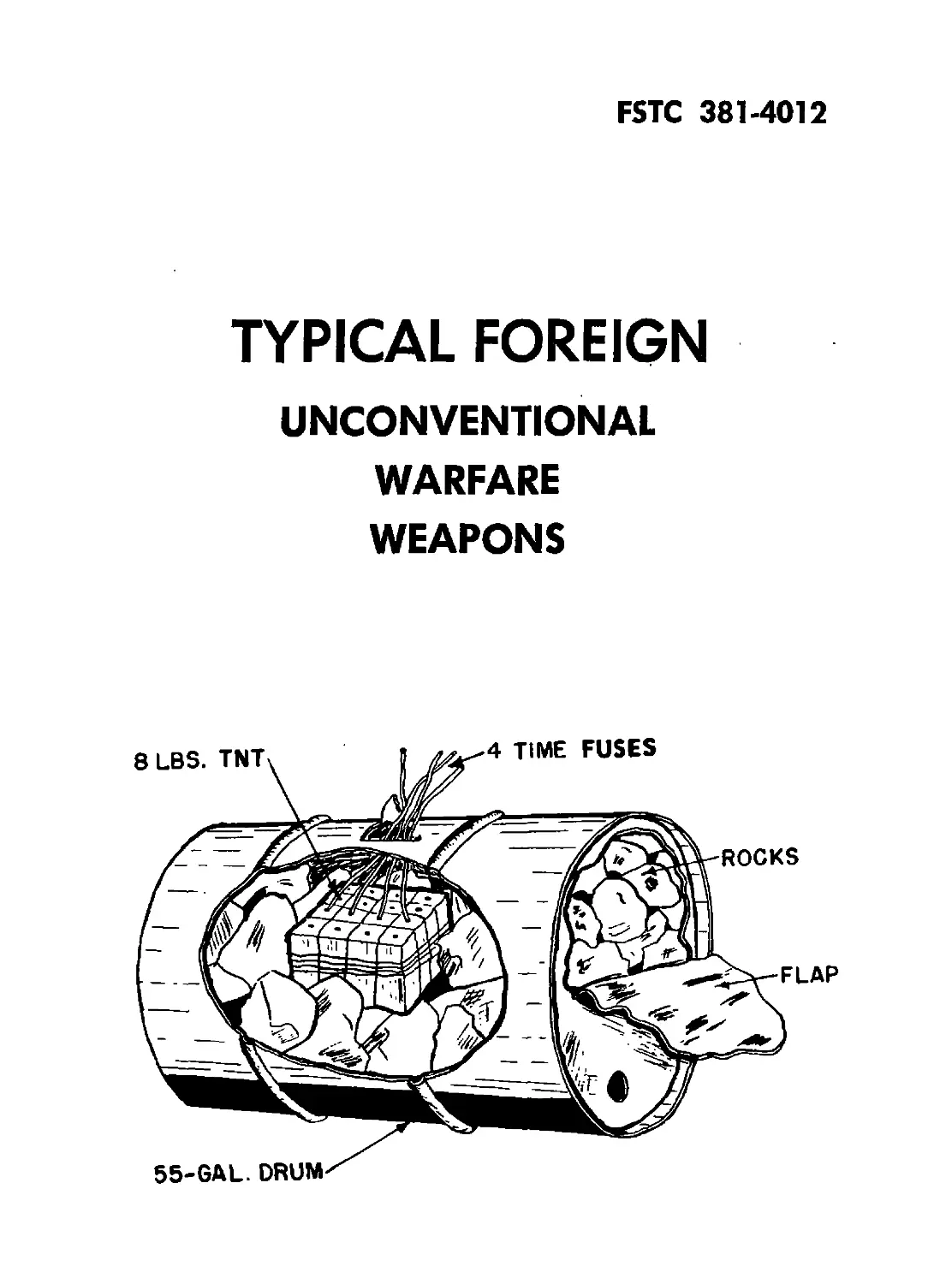
produced by the U.S. Army Foreign Science and Technology Center of
the U. S. Army Materiel Command. It has been apptoved by the
Assistant Chief of Staff for Intelligence, Department of the Army, and
therefore contains agreed Department of the Army intelligence.

FSTC 381-5012
TYPICAL FOREIGN UNCONVENTIONAL
WARFARE WEAPONS (U)
TABLE OF CONTENTS	pag(
SECTION I. PURPOSE AND SCOPE--------------------- 1
II.	CONCLUSION -------------------------- 1
Ш.	SMALL ARMS AMMUNITION----------------- 2
IV.	SMALL ARMS--------------------------- 3
V.	RECOILLESS AND ROCKET WEAPONS -------12
VI.	LAND MINES---------------------------14
VII.	FIRING DEVICES----------------------20
VIII.	CALTROPS AND BOOBYTRAPS----------- 35
IX.	DISGUISED DEVICES--------------------42
APPENDIX -----------------------------------------53
Ш

FSTC 381-5012
TYPICAL FOREIGN UNCONVENTIONAL WARFARE WEAPONS (U)
Section I. (U) PURPOSE AND SCOPE
(U) The purpose of this study is to present a description of typical foreign
weapons which have been, or are being, used by insurgents or guerrillas involved
in unconventional warfare. In this context, the term ’’unconventional warfare"
means revolt or insurrection by predominantly indigenous personnel against a
constituted government.
2.	(U) This study is limited primarily to those weapons which have been impro-
vised from materials at hand, or modified from standard military items. In ad-
dition, even though they do not fall within these limits, certain factory-made items
have been included because their nature makes them especially useful to the in-
surgent. The latter class of equipment includes most of the incendiary devices
and camouflaged explosives, as well as a few firing devices.
3.	(U) The period of time covered by this study is from World War II to the
present. The materiel described is a representative sample, rather than an ex-
haustive listing of such equipment. All of the items shown herein could be useful
to the various guerrilla operations currently under way. Some of the factory-
made pieces are no longer available because stocks are exhausted.
4.	(U) This study is presented for its technical value; it does not analyze any
guerrilla force's operational, tactical, or logistical strengths or weaknesses.
The materiel described in this study represents, to a large extent, expedient so-
lutions. The risks involved in manufacturing, storing, and handling equipment of
the type covered in this study are relatively large, and must be accepted knowingly
by both maker and user. In no case are any inferences warranted concerning its
effectiveness by U. S. standards, or its availability in quantity, or the training
status of the users. FSTC does not recommend any attempt by U. S. personnel to
manufacture or use this materiel.
Section II.	(U) CONCLUSION
5.	' (U) The guerrilla normally arms himself with standard, factory-made, mili-
tary weapons, ammunition, explosives, incendiaries, and firing devices. He manu-
factures this materiel only when he must. When so driven, he often displays a con-
siderable amount of ingenuity in design and in the adaptation of available materials
to serve his purposes.
FSTC 381-5012
6.	(U) The complexity of the weaponry produced by a guerrilla munitions industry
varies considerably. In the field of small arms, for instance, the range of com-
plexity extends from a standard military rifle which has merely been lightened by
shortening the barrel and removing excess wood, to a pistol or rifle made from scratch.
The factors controlling the quality and complexity of an item appear to be the in-
genuity of the people, the materials and tools available, and the presence or ab-
sence ef outside support.
7.	(U) The guerrilla normally obtains his weapons, ammunition, and explosives
either by capturing them from an organized military force which opposes him, or
by receiving them from friendly forces outside his operational area. In either
case, this materiel almost always consists of standard, factory-made military
equipment. A notable exception to this generality occurs when the supplier wishes
to conceal his connection with the guerrilla. In this case, manufacturers’ markings
and serial numbers are often obliterated from weapons, and ammunition is manu-
factured either with nonsensical or with counterfeit headstamps, color codes, and
other markings.
8.	(U) When the total of the supplies captured from the enemy, plus those furn-
ished by friends, is inadequate to satisfy the local need, a guerrilla munitions in-
dustry comes into being. This industry can flourish only when a secure area
exists so that plants can be established on a more or less permanent basis, but,
since the technical skills and facilities for such basic manufacturing techniques
as turning, milling, and heat treating are generally lacking, the materiel produced
is usually small and simple. The vast majority of these munitions exist only be-
cause they are the best available. Bows, arrows, and spears--the tools of life
in a primitive society--are turned to warlike ends, but as soon as better or
more effective weapons become available, the homemade ones either are aban-
doned or are returned to more peaceful uses.
Section III.	(U) SMALL ARMS AMMUNITION
9.	(U) By far the major portion--probably 99+%--of all small arms ammunition
consumed by insurgent or guerrilla forces engaged in unconventional warfare is
factory made, and thus falls outside the scope of this study. However, once in a
great while a need arises for a cartridge which is not available. In this situation,
the guerrilla will hand fabricate them.
10.	(U) All known cases, of field manufacture of small arms cartridges involve
one of two basic processes—reloading a fired cartridge case of the appropriate
caliber, or altering an existing cartridge to fit a weapon for which it was not
originally intended. For instance, during World War II, resistance forces in the
Philippine Islands reloaded fired caliber . 30 cartridge cases, using kitchen match
2
FSTC 381-5012
heads for primers, grated nonsafety photographic film for propellant, and cast
lead bullets. The Chinese Nationalists have converted caliber . 30 carbine cart-
ridges into . 32 automatic pistol rounds on a relatively large scale by cutting the
cartridge case to length, reducing the body diameter and propellant charge,
cutting off the base of the bullet to reduce weight, and assembling these pieces.
11,	(U) The 12-gauge shot shell shown in figure 1 was obtained in Vietnam. Orig-
inally it was a U, S. caliber . 50 machinegun cartridge. The transformation of the
one into the other, which is not too complicated a job, was accomplished by dis-
assembling a loaded round, cutting the cartridge case to length, peening the ex-
tractor flange into a rim, and filing the rim to the correct diameter. The finished
case was then loaded with propellant, wadding, shot (or miscellaneous scrap
metal), more wadding, and lastly the end was sealed with some substance such
as paraffin or candlewax.
Figure 1 (UNCLASSIFIED). VietCong 12-gauge shot shell (U).
Section IV.	(C) SMALL ARMS
12.	(U) GENERAL
While probably over 90% of the small arms used by guerrilla forces are stand-
ard military as-issued items, including a small percentage of unaltered sporting wea
pons, the remaining 10% are of some interest. The latter group includes arms
ranging from those which are completely homemade, with barrels and receivers
made from gas pipe, to those adapted from standard military arms to meet the
guerrilla's idea of a suitable weapon. This last category covers factory-made
3
FSTC 381-5012
barrels and actions fitted with homemade stocks of varying shapes and sizes.
Because these homemade arms normally serve the guerrilla only until he obtains
a better weapon, their short service life is not a great drawback.
13.	(U) PISTOLS
a.	The 9-mm pistol pictured in figure 2 is essentially a blowback-operated
submachinegun minus the magazine. Its receiver, barrel, and chamber-reinforcing
piece are made either of pipe or of thick-walled tubing, and fastened to the wooden
grip assembly by means of two sheet-metal straps. To operate the pistol, retract
the bolt by pulling back on the machine screw until the bolt latches to the rear;
then drop a cartridge through the loading port in the right side of the receiver and
into the chamber. The weapon fires from the open-bolt position. Since it has
neither extractor nor ejector, extraction and ejection must be accomplished by
retracting the bolt, and then shaking or prying the fired cartridge case out of the
chamber and through the loading port.
Figure 2 (UNCLASSIFIED). Viet Cong wooden-stock pistol (U).
b.	The barrel and receiver of the homemade single-shot pistol shown in
figure 3 are made of two pieces of pipe held together by pins, while the grip is
a length of fairly heavy wire bent to shape and either welded or riveted to
the receiver. The service life of this weapon is probably only a few rounds.
4
FSTC 381-5012
c.	To load the pistol, retract the bolt handle and engage it in the small vertical
slot at the right of the long horizontal slot; then drop a cartridge into the chamber
through the loading port located in the right side of the receiver. To fire, point the
weapon with the right hand and, disengaging the bolt handle from the small slot,
allow the compressed driving spring to force the bolt forward until the fixed
firing pin strikes the primer.
Figure 3 (UNCLASSIFIED). Viet Cong metal-stock pistol (U).
d.	The weapons described up to this point display a relatively low level of in-
genuity and effort in their structure and manufacture. The caliber . 32 semiauto-
matic pistol shown in figure 4, however, although its design is conventional in all
respects, exhibits considerable ingenuity on the part of its creator because of the
difficulties overcome in bringing it into existence--it is completely handmade.
e.	If he does not have design talent, the guerrilla artisan does not hesitate to
produce a copy of a proven pattern, especially when a specimen is available.
f.	During the time of the French War in Indochina (1945-1954), a number of
underground factories produced weapons and allied materiel for the various irreg-
ular forces fighting there. The 9-mm Browning Hi-Power pistol illustrated by
figure 5 was, according to the markings on the slide, manufactured at the Allied
National Army Military Manufactory Number 5, which was located near Tay Ninh.
A report states that this plant produced approximately 5, 00G of these pistols. The
workmanship exhibited in this weapon is surprising--the fits are reasonable, and
the finish is quite good.
5
FSTC 381-5012
Figure 5 (UNCLASSIFIED). Vietnamese copy of 9-mm Browning pistol (U).
6
FSTC 381-5012
14.	(U) RIFLES
a.	Homemade rifles run the gamut of design sophistication and manufacturing
complexities, from crude to well done. Oddly enough, the cruder the design, the
more effort is required in manufacture. The reason for this apparent anomaly is
that as the designs become more sophisticated, the likelihood increases that the rifle
will incorporate major parts of a factory-made rifle.
b.	The "rifle" shown in figure 6, actually a smoothbore weapon, has a barrel
made from a piece of pipe. Its breechblock pivots transversely, and is articulated
on a common door hinge. The hammer arrangement strongly suggests that the
gun employs pinfire cartridges, and the absence of a trigger indicates that the user
fires the piece by pressing down on the hammer spur with his thumb to compress
the hammer spring, then releases the hammer spur to allow the hammer to fly
forward to fire the cartridge.
c.	The buttstock apparently has been made of two miscellaneous pieces of wood
mitered together, but the forestock, as evidenced by the metal fitting at its front
end, was salvaged from a factory-made weapon.
Figure 6 (UNCLASSIFIED). Vietnamese pinfire (?) shotgun (U).
d.	The single-shot small arm seen in figure 7, although bearing some resem-
blance to a short-barrelled rifle, is actually a shotgun. Its method of operation
is unknown. Both the barrel and the receiver are made from a piece of pipe, and
are fastened to the stock at the rear by means of a metal strap, and at the front
by a metal block which also serves as a recoil shoulder. The trigger pivots about
a screw which passes transversely through the stock, and in this respect the trigger
mechanism resembles that of the British Lee-Metford and Lee-Enfield rifles. The
vertical finger-grip ribs on the cocking piece emphasize this resemblance.
e.	The remaining small arms in this section illustrate some of the ways in
which the guerrilla will modify standard military weapons, either to return them
to useable condition or to adapt them to his individual ideas of the weapon he wishes
to be armed with. A case in point is the modified French 8-mm Model 1907/15
Mannlicher-Berthier rifle shown in figure 8.
7
FSTC 381-5012
Figure 7 (UNCLASSIFIED). Viet Cong shotgun (U).
Figure 8 (UNCLASSIFIED). Viet Cong modified Mannlicher-Berthier rifle (U).
g.	Another type of conversion has been performed on the weapon shown in
figure 9, formerly a French 11-mm Model 1874 Gras rifle. In this case, since
ammunition for this weapon is almost nonexistent, the barrel was cut off to make
the weapon easier to handle, and the chamber was altered slightly so that 410-
gauge shotgun shells could be fired. A homemade stock completes the picture.
8
FSTC 381-5012
Figure 9 (UNCLASSIFIED). Viet Cong modified Gras rifle (U).
h.	An even simpler modification is shown in figure 10. The barrel and stock
of this U. S. caliber . 30 M1917 Enfield rifle have been cut, and the front sight has
been remounted. The object of such a conversion is to produce a lighter rifle
which can be swung into firing position more rapidly, especially in the presence
of the dense undergrowth found in Vietnam.
Figure 10 (UNCLASSIFIED). Viet Cong modified MI917 Enfield rifle (U).
15.	(C) SUBMACHINEGUNS
a.	(U) The submachinegun, so long as the ammunition supply is adequate, is
a popular guerrilla weapon, probably because of its compactness, light weight,
and short-range effectiveness. Since the Vietnamese terrain lends itself to cover
and concealment, it is not surprising to find the Viet Cong going to considerable
lengths to supply themselves with this class of individual weapon. The four items
shown in this study, all of which were used in Vietnam, illustrate various types
of effort put into the manufacture of submachineguns.
b.	(U) The weapon shown in figure 11, like some of the pistols and rifles dis-
cussed previously, has a barrel-and-receiver assembly made of pipe, with the var-
ious pieces held together by pins. The grip frame has been made from iron strap,
and is welded to the receiver. The trigger-group and magazine-housing assem-
blies, also welded to the receiver, evidently have been salvaged from a standard
submachinegun of unknown origin.
9
FSTC 381-5012
О
Figure 11 (UNCLASSIFIED). Viet Cong submachinegun (U).
c.	(U) Geographically speaking, the United Kingdom's Sten-series submachine-
gun is one of the most widespread weapons of its type in the world, and it has been
copied by a number of countries with varying degrees of fidelity to the original
form. The two weapons shown in figures 12 and 13 were made in Vietnam, and
are based on the Mk.II Sten gun. In fact, the pistol grips of each of them were
probably modified from British-manufactured recoil spring car '.nd buttstock as-
semblies. On the other hand, both receivers are definitely not Sten parts because
the magazine housings are attached to the bottoms of the receivers, whereas this
housing is fastened on the left side of a Sten receiver.
Figure 12 (UNCLASSIFIED). Viet Cong Sten-type submachinegun (variation 1) (U).
10
FSTC 381-5012
Figure 13 (UNCLASSIFIED). Viet Cong Sten-type submachinegun (variation 2) (U).
d.	(C) The last of the submachineguns presented herein illustrates the result
of a failing ammunition supply and outside aid to guerrilla forces. Basically the
weapon, seen in figure 14, is a French 9-mm MAT-49 chambered for the 9-mm
Parahelium cartridge. When the supply of 9-mm ammunition ran low, and pros-
pects of resupply appeared dim, the North Vietnamese Army workshops, rather
than scrap the weapon, rebarrelled it with a Chinese 7. 62-mm submachinegun
barrel and made new magazines so that the gun would fire the Soviet 7. 62-mm Type P
pistol and submachinegun cartridge and the various copies thereof. The only other
modification involved was the salvaging of the MAT-49 original front sights and the
mounting of them on the new barrel.
Figure 14 (UNCLASSIFIED). North Vietnamese modified MAT-49 (U).
11
16.	(U) MACHINEGUNS
Relatively few machineguns have appeared in guerrilla movements, and only
one of them has been so modified as to merit inclusion in this study. The weapon
pictured in figure 15 originally was a French 7. 5-mm Model AV-34 flexible air-
craft machinegun. The guerrilla who reworked the basic gun added a handguard,
a shoulder stock salvaged from a French Chatellerault Model 24/29 automatic
rifle, and a rear sight which appears to be a survivor of the Franco-Prussian War.
Figure 15 (UNCLASSIFIED). Modified AV-34 aircraft machinegun (U).
Section V.	(U) RECOILLESS AND ROCKET WEAPONS
17.	(U) Homemade recoilless and rocket weapons are almost as scarce among
guerrilla forces as are machineguns. The Model S. S. A. recoilless gun shown in
figure 16 was made either in North Vietnam or in a Viet Cong safe area, as it
and its ammunition require fairly extensive shop facilities for manufacture.
Figure 16 (UNCLASSIFIED)-. Model S.S.A. recoilless gun (U).
12
FSTC 381-5012
18.	(U) The tube of the smoothbore Model S. S. A. is a piece of pipe approximately
4 1/2 feet long, having an extra section shrunk around its center for reinforcement.
Two sighting devices are provided. One device consists of a blade front sight and
a V-notch rear sight, both mounted on the reinforcing sleeve; the other consists of
a tube sight containing an aperture and crosshair mounted on the left side of the
tube. The tripod mount is made of pieces of angled metal joined to a hub which
contains a tapered bushing. A circular clamp surrounding the barrel has a tapered
pin pivoted to its bottom for attaching the tube to the tripod. The weapon traverses
freely, but elevation is accomplished by means of a threaded shaft extending from
a clamp around the rear of the tube to an arm attached to the mounting clamp.
19.	(U) The total weight of the weapon is approximately 72 pounds. The specimen
illustrated has a nominal bore diameter of 60 mm; a 66-mm version also exists.
20.	(U) A variant of the last weapon is illustrated in figure 17. The variant differs
in that it is a rocket launcher, and in that its mount embodies a sector plate and a
wingnut to provide elevation adjustment. The latter weapon is breech loaded, where-
as the former is muzzle loaded. Both weapons fire electrically initiated ammunition.
Figure 17 (UNCLASSIFIED). Viet Cong rocket launcher (U).
13
FSTC 381-5012
Section VI.	(U) LAND MINES
21.	(U) The guerrilla operation, being essentially a hit-and-run affair, lends
itself especially well to the imaginative use of land mines as a means of creating
an atmosphere of terror amongst the populace and of harassing opposing military
and security forces. Since factory-made firing devices are often in short supply,
one natural solution is to use an item which contains its own firing device--the
hand grenade.
22.	(U) There are many ways in which a hand grenade can be used as a mine —
it can be tied in a bush and a wire can be led from the safety ring across a trail;
or it can be inserted into a bag containing a charge of explosive, and thus serve
as a fuze. The application shown in figure 18 was devised by the British during
World War II and consists of a hand grenade, a tin can which is just large enough
to fit over the grenade and its safety lever, and two lengths of string or wire.
One length of wire is fastened to the can, and then tied to a stake, bush, or fence-
post. The other length of wire is fastened to the grenade in such a way that it can-
not interfere with the function of the fuze, and is then stretched across a road or
pathway. The grenade is then inserted into the tin can, and the safety ring and
pin are withdrawn. A pull on the wire stretched across the path will separate the
grenade from the can, allowing the grenade fuze to function in the normal manner.
Figure 18 (UNCLASSIFIED). British grenade-in-can mine (U).
14
FSTC 381-5012
23.	(U) During the Korean War, North Korean Forces occasionally made good
use of the oil-drum mine which consists of a 55-gallon drum--a 100-pound wooden
nail keg would serve just as well—filled with rock, a charge of explosive, and a
number of time fuses. The user of this device places it uphill from the anticipated
route of his target. At the appropriate moment he lights the fuses, and then rolls
the drum down the hill where, if the fuses have been cut to the correct length, it
explodes among the enemy. Multiple fuses should always be used with such devices
to insure that at least one of them survives the downhill roll to initiate the explosive
charge.
Figure 19 (UNCLASSIFIED). North Korean oil-drum mine (U).
24.	(U) The advent of World War II found the Soviet Union unprepared to wage
mine warfare on an extensive scale and, as a result, both infantry and engineer
troops were trained to improvise mines in the field from available materials.
Mines improvised by the infantry were generally much simpler than those impro-
vised by the engineers, especially in terms of the facilities used in their fabri-
cation. However, the former were by no means less ingenious in their structure.
25.	(U) Probably the simplest of all these mines consists of a convenient charge
of explosive wired to a stake, a pull-actuated fuze, and a tripwire anchored to a
second stake (top panel of figure 20). When the wire is pulled, the fuze init-
iates the charge. If the terrain is suitable, this installation can be improved by
15
FSTC 381-5012
piling rocks around the charge. Although this device has the advantage of being
made and installed very easily, it can be detected just as easily.
Figure 20 (UNCLASSIFIED). Soviet improvised infantry mines (U).
16
FSTC 381-5012
26.	(U) A somewhat more complex mine, shown in figure 20 (center panel), con-
sists of a charge of explosive, a pull-actuated fuze, and a pivoted pressure board.
A wire connects the fuze's striker retaining pin with one end of the board, a flimsy
support such as a large twig prevents the other end of the board from moving down-
ward while the device is being laid and camouflaged. As with the last mine, rocks
can be piled around the explosive charge to provide some fragmentation effect.
27.	(U) The two mines just described are definitely infantry mines--simple in
concept, manufacture, and installation. The third mine in this series, also pic-
tured in figure 20 (bottom panel), is more complicated in that the ordinarily prudent
person sent to install it would not do so until he had assured himself that the elec-
tric contact was in fact open by checking this point with a circuit tester-- an equip-
ment not normally included in infantry supplies. Except for this point, the mine
is relatively simple in both manufacture and installation, consisting of a charge
of explosive, some stones or miscellaneous metal scraps, a few boards, a battery,
a doorbell-type contact, and an electric detonator. When either man or beast steps
on the pressure board, the circuit is closed and the mine detonates.
28.	(U) The three mines just described, primarily because of their simplicity
of manufacture, have been categorized as infantry items. The next two are not so
easy to make, and therefore are classified as engineer items.
29.	(U) The device known as the lever tread mine, illustrated in figure 21, con-
sists of a wooden box containing a charge of explosive, a pull-actuated fuze, and a
tilting lid which is free to rotate about a fulcrum. A wire is attached to the striker
retaining pin in the fuze, and to a screw or nail in one edge of the lid. This mine
is normally laid below the surface of the ground. When the upper end of the lid
is forced down, the wire attached to the lower end of the lid pulls the striker re-
taining pin out of the fuze to initiate the charge of explosive.
30.	(U) The seesaw mine shown in figure 22 is a more complicated version of
the lever tread mine just discussed. Although their structures are noticeably
different, the principle of operation is the same--a wire attached to a pivoting
board withdraws the striker retaining pin from a pull-actuated fuze. This design
is somewhat wasteful of fuzes, as two are required for each mine, as compared
to one for the lever tread mine. On the other hand, a foot placed on either end
of the tiltboard will actuate the seesaw mine whereas, with the lever tread mine,
the foot must be placed oh the upper end for actuation.
31.	(U) In Algeria, the native Front de Liberation Nationale (National Liberation
Front) (FLN) made their own special contribution to the lore of improvised mines.
However, because the French forces were to a great extent mechanized, the FLN
mines lean more heavily toward being antivehicular rather than antipersonnel items,
32.	(U) A very common FLN antivehicle "mine" is shown in figure 23 in the sec-
tion drawing of a road. The device is actually an uncased charge of explosive
which fills a hole scooped from the center of the roadbed. The road surface is
17
FSTC 381-5012
/
/
Figure 21 (UNCLASSIFIED). Soviet lever tread mine (U).
Figure 22 (UNCLASSIFIED). Soviet seesaw mine (U).
18
FSTC 381-5012
carefully cut, lifted, and then replaced to minimize the signs that it has been dis-
turbed. The explosive is fired when the wheel of a vehicle passes over an electric
firing device or contact placed on the edge of the road or in a wheel track. At
first glance, the flat stones placed on top of the explosive charge might appear to
have been put there to make this mine perform as a plate charge mine. However,
since any reasonable explosive charge will shatter these stones, their true function
more probably is to support the replaced road surface.
Figure 23 (UNCLASSIFIED). FLN antivehicle mine (U).
33.	(U) An antilift mine can be made from an artillery shell, as figure 24 shows.
The upper detonator is connected to a pressure-operated firing device which is
not shown. The lower detonator1 is connected to batteries within the shell body,
and to a contact box also within the shell body. The box consists of a tubular in-
sulator having a metal end plate which is connected to the detonator. A sliding
metal block within the insulator tube is connected to the batteries.
34.	(U) If the external contact is closed, the mine detonates, destroying all pos-
sibility of determining its structure. On the other hand, if the mine is discovered,
the person attempting to neutralize it will cut the external leads in the prescribed
fashion--one at a time--thus disconnecting only the upper detonator. When the
nose of the shell is lifted, the sliding block contacts the metal end plate, completing
‘the circuit through the lower detonator, and the mine explodes.
19
FSTC 381-5012
DETONATORS
Figure 24 (UNCLASSIFIED). FLN anti lift mine (U).
35.	(U) The FLN in Algeria were also partial to the fougasse, an ancient device,
which resembles nothing so much as an overgrown shotgun. The fougasse is most
commonly aimed across a road, and, when properly loaded, will damage thin-
skinned vehicles as well as kill troops. The top panel of figure 25 shows the entire
installation, including the electric contact which is placed across the road from the
exploding part, while the bottom panel shows in detail the structure of the charge
portion of the fougasse, emphasizing its resemblance to a shotgun. The maker of
this device exercised his imagination when he chose to use the filament of a light
bulb to initiate the propellant charge.
Section VII.	(C) FIRING DEVICES
36.	(U) GENERAL
a. A mine or boobytrap is essentially a concealed charge of explosive equipped
with a device to initiate the explosive either at some predetermined time or upon
the occurrence of some specific event. The guerrilla's capability to manufacture
the explosive portion of these devices is generally limited, by the complexity of
the processes involved, to packaging factory-made material. However, the manu-
facture of firing devices and fuzes is not nearly so difficult a task. As a result,
considerable attention has been paid to the subject, resulting in the development
of a variety of devices.
20
FSTC 381-5012
FOUGASSE
SCRAP METAL WADDING
DETAIL OF EMPLACED EXPLOSIVE CHARGE
Figure 25 (UNCLASSIFIED). FLN fougasse (U).
b. The distinction between a firing device and a fuze, although somewhat
academic, is this—a firing device is a fuze without a detonator.
21
FSTC 381-5012
37.	(U) NONDELAY DEVICES
a.	Probably the most widely used type of firing device embodies a spring-
loaded striker which is held in the cocked position by a retaining pin, and actuated
by the pull of a wire attached to this pin. If the pin is formed in the shape of the
letter T, the device also can be arranged to operate by pressure. Almost every
country which manufactures these devices issues them with the T-shaped pins
installed, thus eliminating a separate, pressure-operated device from its logistic
system.
b.	The fuze shown in figure 26 is a nondelay device, and was made in Algeria
by rebel (FLN) personnel, probably in a basement workshop. The housing is a
piece of thin-walled tubing, one end of which has been closed by hammering it over
a mandrel. The striker has been turned from a piece of steel rod, and the spring
was probably procured by midnight requisition from a junkyard. To complete the
picture, the maker has pulled apart a round of small arms ammunition and fastened
the empty cartridge case to the housing so that the striker can fire the primer,
with the resulting flash initiating the detonator.
STRIKER
HOUSING
STRIKER SPRING
p 111 tn i
‘n a s ЛП
Figure 26 (UNCLASSIFIED). FLN improvised fuze (U).
c.	Another variety of firing device operates either by tension (pull) or by
tension release. These devices are, characteristically, installed with a taut trip-
wire, and the release of tension occurs when the wire either is unwittingly broken
or is deliberately cut. In either case the device operates, and the charge of ex-
plosive to which it is connected explodes.
d.	During World War II the British designed several devices of this type, and
trained their troops to make them in the field.
e.	One of the British devices employed a weighted can to keep the tripwire in
tension as shown in figure 27. The frame which houses the can includes two pairs
of electric contacts, one at the top of the frame and the other at the bottom, so
22
FSTC 381-5012
wired that when either pair is touched by the can, a circuit is completed. A bat-
tery then fires an electric detonator and the explosive charge. If the tripwire is
pulled, the can rides up within the frame and closes the top pair of contacts; if the
wire is cut or broken, gravity causes the can to drop and close the bottom pair
of contacts.
Figure 27 (UNCLASSIFIED). British weighted-can firing device (U).
23
FSTC 381-5012
f.	A variation on the weighted-can device can be made with an ordinary knife
arranged as shown in figure 28. Two pairs of nails driven into a board hold the
knife in place by its handle, while a third pair is placed near the point of the knife
and wired together, forming a double-pole electrical contact. The blade of the
knife, lying between the two poles of this contact, is bent and held away from the
far pole by a tripwire in tension. When the wire is pulled, the blade deflects fur-
ther, and contacts the near pole; when the wire is cut or broken, the bent blade
is released, and contacts the far pole. In either case the electric circuit is closed,
and a detonator fires the explosive charge.
TO DETONATOR
BATTERY
TRIPWIRE IN TENSION
FIXED CONTACTS
Figure 28 (UNCLASSIFIED). British knife switch (U).
g.	A common spring-loaded clothespin can be made into a very good electric
firing device by the wrapping of a small piece of sheet metal—that from a tin
can will do—around each jaw. Small nails through each of these bits of metal will
fasten them to the jaws of the clothespin, and will also function as binding posts.
When the jaws of the pin are separated by an insulator such as a wooden wedge,
an electric firing device is obtained.
h.	The device shown in figure 29 was made by members of the the Algerian
FLN rebel forces to be operated by a pull on the tripwire. This pull will dislodge
the insulator from between the jaws of the clothespin, and the spring will bring
the two metal contacts together and close the circuit to fire an electric detonator.
Since the insulator stays in place because the jaws grip it, the trip wire is slack
and can be cut as soon as it is discovered.
24
FSTC 381-5012
Figure 29 (UNCLASSIFIED). FLN clothespin firing device (pul I-opera ted) (U).
i.	If a sufficient number of firing devices are laid with slack tripwires, the
guerrilla can reasonably hope that the persons responsible for clearing them may
relax their vigilance somewhat, become a bit careless in examining individual
installations, and possibly cut every tripwire they find. This provides a good
psychological atmosphere for a change of tactics, which is now clearly indicated.
j.	This change occurs when a clothespin is rigged so that the tripwires hold
the jaws open, as shown in figure 30. The wedge is no longer needed, as the air-
gap insulates the two contacts from each other. When the firing device is installed
in this way, the unwary wirecutter succeeds only in exploding the charge connected
to the device.
k.	In addition to being made by the Algerian FLN, this type of device was
also used by Soviet troops during World War II.
1.	Another variety of British firing device consists of a metal tube and a ball
bearing, arranged as shown in figure 31. So long as the left end of the tube is
lower than the right end, the ball bearing does not contact the nail which passes
through the center of the insulating cork to complete the electric circuit. How-
ever, when the tube is rotated clockwise until its left end is higher than its right,
gravity rolls the bearing into contact with this nail, and the circuit is complete.
Because of its particular adaptability to installation on doorknobs, this device is
commonly known as the "doorknob device. "
25
FSTC 381-5012
Figure 30 (UNCLASSIFIED). FLN clothespin Firing device (tension-release-operated) (U).
Figure 31 (UNCLASSIFIED). British ball bearing switch (doorknob device) (U).
26
FSTC 381-5012
m.	Railroads and rolling stock are a prime target for the guerrilla. This
is especially so if, as was the case in the U. S. S. R. during the Second World War,
he is serving as an "advance guard" for regular troops. Whether he is performing
this particular duty or not, a blow at a railroad is profitable because the rolling
stock and the supplies it carries are often difficult to replace.
n. The Algerian device illustrated in figure 32 consists of a board with two
flexible electric contacts attached to it. It is laid with the contacts on the inside
of a rail so that the flange of a locomotive wheel can bring them together to close
the circuit through an electric detonator. This device is relatively sturdy and re-
sistant to displacement by shock, but, because it is placed above ground, it can
be detected relatively easily, even when camouflaged with a small bush or leaves.
F igure 32 (UNC LAS S IF IE D). F LN wh eel -fI ang e fi ri ng dev i c e (U).
o.	A variation of the Algerian railroad firing device is the item seen in figure
33, made from two lengths of insulated wire and used by the Germans during World
War П. The insulation has been stripped from one end of one wire for a distance
of about 3 inches, and this bare end has been formed into a coil. About 1 inch of
insulation has been stripped from the same end of the other wire, and this bare
•section has been placed inside the coil so that the two bare sections do not touch.
The coil end is then laid on top of a railroad track, and, when crushed by a passing
wheel, completes an electric circuit to fire an electric detonator.
27
FSTC 381-5012
p.	Although the manufacturing of this device is extremely simple, to conceal
the emplaced device is very difficult. Furthermore, it is easily displaced by
natural forces.
Figure 33 (UNCLASSIFIED). German wire-coil firing device (U).
q.	All of the devices described so far act instantaneously; that is, they make
no provision for a delay in time between the application of an actuating force and
the explosion of the charge to which they are connected. Before passing on to the
discussion of devices which do incorporate a time delay, a short backward look
to consider the preponderance of electric firing devices over mechanical ones
seems appropriate. This pattern holds in practically every country in which bat-
teries are readily obtainable. This is a very reasonable trend, because electric
firing devices require a minimum of tools and materials to make them.
r.	Electric firing devices require more than batteries, however. They re-
quire electric detonators which, although quite readily available in mining camps,
are almost invariably kept under lock and key. If the illicit demand for electric
detonators reaches major proportions, the supplying of them can be strictly rationed
or, better yet, blasting at the mining site can be converted to the use of time fuses
and nonelectric detonators. Whatever the situation in Algeria was in actuality, the
rebel FLN forces devised an ingenious means of circumventing the shortage of
electric detonators by converting nonelectric detonators to electrical ones.
28
FSTC 381-5012
s.	The device pictured in figure 34 consists of a small light bulb with two
electric wires soldered to the filament contacts. A small portion of the glass
envelope has been cut away, and the empty envelope has been filled with black
powder. A nonelectric detonator taped to the envelope completes the assembly.
This item is also being used by the Viet Cong.
Figure 34 (UNCLASSIFIED). FLN electric detonator (U)
38.	(C) DELAY DEVICES
a.	(U) From time to time the guerrilla desires to place a charge which will
detonate after a fixed period of time has elapsed. A current example of this type
of activity occurred in February 1964 when a Viet Cong bomb actuated by a delay
firing device exploded in the bleacher section of Pershing Field at Saigon, South
Vietnam, during a softball game. Although most countries include delay firing
devices among their families of standard demolition materiel, these devices are
not normally accessible to guerrillas, and the latters' efforts to imitate their
function lead to some clever contraptions.
b.	(U) A case in point is the German can-and-cork delay shown in figure 35.
This consists of a can having a small hole in its bottom, a cork, and two insulated
wires which lead to a battery and an electric detonator. The insulation has been
stripped from a portion of one wire, and this bared section has been bent into a
loop. Similarly, insulation has been stripped from a portion of the other wire,
but in this case the bared section has been bent into a zigzag shape. The first
wire is passed through two holes in the upper sides of the can, and the lower,
insulated portion of the second wire is passed through the loop. The bottom end
of the second wire is now fixed to the cork. When water is placed into the can,
the cork floats, and only the insulated portion of the second wire is in contact with
the uninsulated portion of the first wire. As the water drips out of the hole in the
29
FSTC 381-5012
bottom of the can, the cork sinks lower and lower, carrying with it the wire with
the zigzag bend. Eventually the uninsulated wire forming this bend contacts the
uninsulated.loop in the other wire, the electric circuit is complete, and the deton-
ator fires a charge of explosive.
Figure 35 (UNCLASSIFIED). German can-and-cork delay (U).
30
FSTC 381-5012
c.	(U) A German variation of the can-and-cork item is the keyring
delay, shown in figure 36. It consists of a spring-type keyring having its adjacent
coils held apart by a small lump of some water-soluble substance such as a lump
of sugar or a salt tablet. Electric leads are connected to these coils. One lead
contacts a coil directly, while the other lead is insulated from the coil. This as-
sembly is then suspended from a hook or a nail, and a glass is placed around it.
When sufficient water is added to the glass to cover the soluble lump but not the
bare ends of the wires, the water begins to dissolve the lump which eventually
loses its ability to hold the two coils apart. At this time the coils resume their
normal or unseparated position, bringing the two bare wires into contact with each
other. The circuit is thus closed, and the detonator is fired.
Figure 36 (UNCLASSIFIED). German keyring delay (U).
31
FSTC 381-5012
d.	(U) Although not so clever or ingenious as the two preceding items, the
most obvious delay-producing mechanism is a common pocket watch arranged as
shown in figure 37. A lead from the battery is connected to the winding stem, and
a lead to an electric detonator is connected to a screw through the glass crystal.
For delays from one to twelve hours, the minute hand is removed. When the hand
contacts the screw, the detonator is fired.
Figure 37 (UNCLASSIFIED). German pocket watch delay (U).
32
FSTC 381-5012
e.	(C) Figure 38 shows a similar device made from a wrist watch. The de-
lay device used in the Pershing Field bomb in South Vietnam, mentioned earlier,
was a watch of this type. Watches so altered were used also by German forces
during World War II.
f.	(U) A survey of standard demolition materiel reveals many delay firing
devices which would or could be useful to a guerrilla. This class includes
mechanical, chemical, and mechanical-electrical items with delay times ranging
from 3 or 4 minutes to approximately 2 months.
g.	(U) The mechanical and the chemical devices are usually simple. Their
function is generally dependent on temperature, and their delay times range up to
approximately 3 weeks.
Figure 38 (UNCLASSIFIED). Viet Cong wrist watch delay (U).
33
FSTC 381-5012
h.	(U) A typical mechanical device is the British No. 9, Mark 1 delay fuze
which contains a spring-loaded striker restrained by a lead rod. When the safety
pin is removed, the rod comes into tension and stretches slowly until it breaks.
The breaking of the rod allows the striker spring to drive the striker into a per-
cussion cap which starts the firing chain.
i.	(U) The British No. 10, Mark 1 delay fuze typifies the chemical devices.
Its operation is quite similar to that of the No. 9, Mark 1, except that the spring-
loaded striker is restrained by a wire which is weakened by a corrosive fluid.
j.	(U) Long-delay devices (over 2 weeks) are generally built around a clock-
work mechanism. Although their function is practically the same as that of the
pocket and the wrist watch devices described previously, their mechanisms are
usually more complicated because they must count days as well as hours.
k.	(U) The Italian 50-day clock shown in figure 39 typifies this class of
device.
Figure 39 (UNCLASSIFIED). Italian 50-day clock delay (U)
34
FSTC 381-5012
Section VIII. (C) CALTROPS AND BOOBYTRAPS
39.	(C) CALTROPS
a.	(U) Webster's International Dictionary (2d edition) defines a caltrop as
"an instrument with four iron points so disposed that any three of them being on
the ground, the other projects upward, used to impede the progress of an enemy's
cavalry, etc. " This definition is outdated now, as caltrops are no longer re-
stricted to having four points, the points are not necessarily made of iron, and
cavalry has become scarce. Nevertheless, the idea of an upward-projecting point
upon which the victim impales himself is still very much alive.
b.	(C) The caltrop collection having the largest number of variations comes
from Vietnam where they are used as antipersonnel weapons. In addition, a con-
ventional four-point item has been received from Brazil where it had been placed
on a street to puncture an automobile tire.
c.	(U) Figure 40 depicts a "new look" caltrop from Vietnam which follows
the spirit, if not the intent, of Webster's definition. The device consists of a
piece of board with two large nails driven through it, and if the number of points
projecting upward have anything to do with it, it should be twice as effective as
its conventional predecessor. To compound the problem of disengaging the victim
from these points, the maker has supplied them with barbs. The Viet Cong, who
operate in South Vietnam, have made these devices with anywhere from one to
seven points, each of which ranges from 2 to 12 inches long. To complicate
matters further, they occasionally smear the points with fecal matter or any other
filth which happens to be at hand.
Figure 40 (UNCLASSIFIED). Viet Cong double-spike caltrop (U).
35
FSTC 381-5012
d.	(U) An improvement on the previous item, shown in figure 41, is the spike
portion of a caltrop minus the support board. The improvement consists of a sec-
ond barb pointed in the opposite direction from that of the first barb, and so located
that both barbs will lodge within the victim's foot. This arrangement increases
the attending doctor's problem in removing the barb by preventing him from cutting
the nonbarbed end and pulling the spike out with a pair of pliers, not to mention
the effect on the patient.
Figure 41 (UNCLASSIFIED). Viet Cong double-barbed spike (U).
40.	(U) BOOBYTRAPS
a.	The boobytrap is another ancient device, the function of which is to lure the
unwary into performing an apparently safe act that injures or destroys him by
means of a concealed explosive charge. In the context of guerrilla use, the booby-
trap is as much an instrument of psychological warfare as anything else. Used
judiciously, it serves to emphasize the idea that the guerrilla is the man who
wields power, and that he will not hesitate to use it. This is especially effective
if an incident is backed up by the suggestion that future incidents can be avoided
by cooperation with guerrilla forces.
b.	At one time or another during World War II, practically everything found
on the battlefield had been boobytrapped, not excluding the dead. The Japanese
radio shown in figure 42 has a charge connected to the off-on switch so that its
curious but incautious captor may destroy himself.
c.	Another Japanese boobytrap uses the ringing handle of a telephone to set
off a charge of explosive. In this installation, seen in figure 43, a pull-operated
filze installed in a demolition block is connected to the handle by a wire so that,
when the handle is turned, the wire is pulled taut to initiate the fuze.
d.	Both of these devices were used by regular troops during overt combat
operations. However, their translation to the guerrilla warfare situation requires
only the smallest stretch of the imagination.
36
FSTC 381-5012
Figure 42 (UNCLASSIFIED). Japanese boobytrapped radio (U).
e.	Although there have been very few true boobytraps found in Vietnam, an
otherwise prolific source of improvised weapons, the same has not been true for
Algeria, a relatively sterile source of improvised weapons. During the Algerian
rebellion, the native FLN forces spent a good deal of time and effort inventing
harmless-looking devices to make life difficult for their French opponents. A
case in point is the relatively straightforward book boobytrap shown in figure 44.
Depending on the circumstances, this book could be lying on the ground, on top
of a specially constructed bookcase, or even on top of other books placed upright
in an ordinary bookcase. When the book is displaced either by lifting or by sliding,
the wire attached to the cover moves, carrying withit one of the battery leads. The
other battery lead is connected to an electric detonator which is in turn attached
to the metal tube housing the first battery lead. When the first lead contacts the
metal tube the circuit is complete, and the detonator initiates an explosive charge.
f.	In the section dealing with firing devices, two variations of the Algerian
clothespin were illustrated. The four parts of figure 45 show four different ways
in which this device is used to boobytrap a bangalore torpedo. Needless to say,
any charge of explosive will serve the purpose as well as will the torpedo.
g.	Parts one and two show two ways of installing the pull-operated version,
and part four shows the tension-release installation. Part three shows a new
variation in which the clothespin has been placed so that the weight of the bangalore
torpedo holds the contacts apart. When the torpedo is lifted, the spring closes the
contacts, and the electric detonator explodes the torpedo.
h.	Flag mines have been used for quite a while; the Soviets occasionally
attached explosive charges to mine field marker flags during World War II.
37
FSTC 381-5012
Figure 43 (UNCLASSIFIED). Japanese boobytrapped telephone (U).
38
FSTC 381-5012
Figure 44 (UNCLASSIFIED). FLN book boobytrap (u).
39
FSTC 381-5012
Figure 45 (UNCLASSIFIED). FLN bangalore torpedo boobytrops (U).
40
FSTC 381-5012
i.	The device shown in figure 46 is a box containing a battery and two contacts
arranged so that the circuit can be closed by raising the flagstaff. This device was
used by members of the FLN in Algeria where it is customary for land owners to
display a flag on their property. The explosive charge can be placed in any con-
venient place within a reasonable distance of the flag, and can be actuated at an
opportune moment.
Figure 46 (UNCLASSIFIED). Flag mine (U)
j.	A second version of the flag mine exists which would be more appropriately
called the flag boobytrap. It differs only in that the explosive charge is placed
inside the box. If the emblem of the flag was that of the FLN, displaying it pub-
licly was akin to waving a red flag in front of a bull, at least until the time the
French withdrew. The gendarme or poilu who attempted to remove the flag suc-
ceeded only in destroying himself.
41
FSTC 381-5012
Section IX- (U) DISGUISED DEVICES
41.	(U) All of the materiel items discussed in the preceding sections of this study,
despite their diversity of form and function, have a common trait; that is, they
are what they seem to be. This section is devoted to another group of devices--
those which are not what they appear to be; they are, in the words of the title of
this section, disguised devices.
42.	(U) Previous sections have laid considerable emphasis on items which were
either made in toto or extensively modified from factory-made materiel by the
guerrilla in the field or in a basement-style workshop. In this context the major
problem in design and fabrication is to obtain a product which will function with
reasonable reliability without regard to its form and appearance. The disguised
device, on the other hand, has as one of its major points its appearance, because
it is intended to look like something which it is not. This requirement almost
precludes the manufacturing of disguised devices in the field where the necessary
equipment and skills are usually lacking.
43.	(U) The first of these devices to be described here is, to all external appear-
ances, a cigarette lighter bearing a modest resemblance to those made by Ronson.
It is shown in figures 47 and 48. In actuality it is a firearm that was probably made
for an assassination mission. The body7 of the lighter houses a tube containing the
functional parts. Reading from left to right in the exploded view these are a bul-
let, a tube containing a charge of propellant and a primer, a firing pin, and a
firing pin spring. A stud which projects through one wall of the lighter body holds
the firing pin against its compressed spring. When this stud is pressed, the wea-
pon fires. It is patently a short-range device—the user could probably not hit a
man-sized target beyond 8 to 10 feet--and it is undoubtedly capable of killing at
close range.
Figure 47 (UNCLASSIFIED). Vietnamese cigarette lighter (external view) (U).
42
FSTC 381-5012

Figure 48 (UNCLASSIFIED). Vietnamese cigarette lighter (exploded view) (U).
44.	(U) The pen-and-pencil set shown in the exploded view seen in figure 49 is
a delay fuze which operates by requiring sulphuric acid to eat its way through a
celluloid disk before coining into contact with a mixture of potassium chlorate and
sugar. The latter action causes a flash which fires a detonator. The flash, in
turn, initiates an explosive charge.
Figure 49 (UNCLASSIFIED). German pen-and-pencil delay fuze (U).
45.	(U) A glass ampoule of acid, the celluloid disk, and a plunger for crushing
the ampoule are housed in the body of the pen. The potassium chlorate and sugar
mixtur i and the detonator are contained in the pencil. The device is readied for
use by removing and discarding the pencil point and the pen cap. The pen body
is then screwed into the pencil body, and the detonator is screwed into the hole
formerly occupied by the pencil point. Twisting the upper end of the pen body for-
ces a plunger to crush the glass ampoule, and the sulphuric acid can then begin
to react with the celluloid disk. When the acid has eaten its way through the disk
it then drips down through the nib of the pen and onto the mixture of potassium
chlorate and sugar.
43
FSTC 381-5012
46.	(U) A variation of the pen-and-pencil delay fuze is the pen which conceals
an incendiary device, shown in figure 50. The pen consists of a magnesium casing
containing a cocked striker, a primer pellet, a delay element, an igniting charge,
and a quantity of thermite. When the barrel of the pen is rotated 180°, the striker
spring drives the striker into the primer, igniting the delay element, the igniting
charge, and finally the thermite.
Figure 50 (UNCLASSIFIED). Germon incendiary pen (U).
47.	(U) The incendiary cigar shown in figure 51 consists of a lead casing con-
taining a glass ampoule of sulphuric acid, a cardboard barrier, and a mixture of
potassium chlorate and sugar. A strong squeeze by the fingers on the blunt end
of the casing breaks the ampoule from which the acid leaks to contact the barrier.
Eventually the acid eats its way through the barrier and, on contacting the potas-
sium chlorate and sugar mixture, causes a chemical reaction accompanied by a
strong flash Which ignites any nearby combustible material.
Figure 51 (UNCLASSIFIED). German incendiary cigar (U).
48.	(U) The range of common containers which can be, or have been, used to
house the larger incendiary devices covers almost every conceivable innocent
item--oil cans, mess tins, paint buckets, and even thermos flasks. As mech-
anisms, they have little or nothing about them of interest because the major part
of each is devoted to housing a quantity of incendiary material, although they
44
FSTC 381-5012
may occasionally contain an amount of explosive which is just large enough to rup-
ture the container and scatter the burning contents.
49.	(U) Although the specific mechanism of the German World War II incendiary
thermos flask pictured in figure 52 is not known, it may be taken aS representative
of its entire class.
IJ
Figure 52 (UNCLASSIFIED). German incendiary thermos flask (U);
45
FSTC 381-5012
50.	(U) All incendiary materials do not come housed in innocent-looking cans.
Both the "brick" and the bar of "soap", respectively shown in figures 53 and 54,
are incendiary mixtures compounded to closely resemble their pseudomorphs.
51.	(U) The "brick" is composed of potassium chlorate, sulphur, ground coal or
sugar, iron filings, wax, and red coloring matter. Its surface has been waxed to
imitate the glaze of a common brick. This item has no hole for the insertion of
an igniter. However, either the fountain pen or the cigar discussed previously
will ignite the brick if placed in contact with it. The absence of an igniter pocket
suggests that this item is intended to be fuel for a blaze established by other means,
rather than as a primary fire-starter.
52,	(U) The "soap" bar is composed of barium nitrate, paraffin, magesium, al-
uminum, rosin, and ferrosoferric oxide. Unlike the incendiary brick, the "soap"
bar has an igniter pocket in one side, and is thus probably intended as a primary
starter of fires.
Figure 53 (UNCLASSIFIED). Japanese incendiary brick (U).
46
FSTC 381-5012
Figure 54 (UNCLASSIFIED). Japanese incendiary soap (U).
53.	(U) The German incendiary capsule shown in figures 55 and 56 is a factory-
made item which, although not a disguised device, has been included here because its
function parallels that of other materiel in this section. The capsule, which is
approximately 5 inches long by 1-1/4 inches in diameter, consists of a flammable
casing filled with a mixture of gasoline and paraffin. The left-hand end of the
casing has been coated with a matchhead composition so that it can be lit on a
safety-match box.
54.	(U) There are numerous varieties of disguised explosives, including those
in toothpaste tubes, paint or oil cans, wooden shoes, and food containers. Any of
the larger disguised incendiaries can be converted by merely substituting an ex-
plosive substance for the incendiary mixture.
55.	* (U) One of the less obvious ways of camouflaging an explosive is to make it
resemble a lump of coal which can be planted at power generating stations, in
railroad coal bins, or in other strategic locations. While the damage-producing
potential of this item is open to some question, its harassment potential is unde-
niable.
47
FSTC 381-5012
Figure 55 (UNCLASSIFIED). German unburned incendiary capsule (U).
Figure 56 (UNCLASSIFIED). German burned incendiary capsule (U).
56.	(U) Two varieties of explosive coal have been found. The first, shown in
figure 57, consists of a lump of RDX containing a detonator, the whole encased
in a thin earthenware shell. The shell has been coated with a bitumen paint to
give it the appearance of a lump of anthracite coal. Although close examination
of one of these lumps will reveal the deception, they are virtually impossible to
detect when mixed with real coal. When such a disguised explosive is exposed to
fire, the heat eventually initiates the detonator which in turn sets off the RDX.
57.	(U) If a more realistic appearance is necessary, such can be obtained, but
at the expense of a reduced amount of explosive per lump. Figure 58 shows a
lump of genuine coal, while figure 59 shows the alterations to it. The holes dril-
led in the lump are filled with explosive and a detonator. The holes are then
sealed with modeling clay or putty that is then blackened with shoe polish.
48
FSTC 381-5012
Figure 57 (UNCLASSIFIED). Japanese explosive coal (U).
Figure 58 (UNCLASSIFIED). German explosive coal (external view) (U).
49
FSTC 381-5012
Figure 59 (UNCLASSIFIED). German explosive caal (section view) (U).
58.	(U) A cake of Japanese "soap, " which is in fact an incendiary, is shown in
figure 54. On the other side of the world, the Germans devised the cake of soap
shown in figure 60, which is actually a block of explosive covered with a thin
layer of real soap.
50
FSTC 381-5012
Figure 60 (UNCLASSIFIED). German explosive soap (U).
51

FSTC 381-5012
APPENDIX
LIST OF ILLUSTRATIONS
Figure	Page
1.	Viet Cong 12-gauge shot shell--------------------------------- 3
2.	Viet Cong wooden-stock pistol--------------------------------- 4
3.	Viet Cong metal-stock pistol --------------------------------- 5
4.	Viel Cong caliber . 32 pistol--------------------------------— 6
5.	Vietnamese copy of 9-mm Browning pistol----------------------- 6
6.	Vietnamese pinfire (?) shotgun-------------------------------- 7
7.	Viet	Cong shotgun-------------------------------------------  8
8.	Viet	Cong modified	Mannlicher-Berthier rifle----------------- 8
9,	Viet	Cong modified	Gras rifle------------------------------   9
10.	Viet	Cong modified	M1917 Enfield	rifle------------------------ 9
11.	Viet Cong submachinegun---------------------------------------10
12.	Viet Cong Sten-type submachinegun	(variation 1) --------------10
13.	Viet Cong Sten-type submachinegun	(variation 2) --------------11
14.	North Vietnamese modified MAT-49------------------------------11
15.	Modified AV-34 aircraft machinegun----------------------------12
16.	Models.S.A. recoilless gun------------------------------------12
17.	Viet Cong rocket launcher-------------------------------------13
18.	British grenade-in-can mine----------------------------------— 14
19.	North Korean oil-drum mine -----------------------------------15
20.	Soviet improvised infantry mines-----------------------------16
21.	Soviet lever tread mine-------------------------------------  18
22.	Soviet seesaw mine--------------------------------------------18
23.	FLN	antivehicle mine ---------------------------------------19
24.	FLN	antilift mine ----------------------------------------  20
25.	FLN	fougasse -----------------------------------------------21
26.	FLN	improvised fuze-----------------------------------------22
27.	British weighted-can firing device--------------------~-------23
28.	British knife switch--------------------------------------    24
29.	FLN clothespin firing device (pull-operated) -----------------25
30.	FLN clothespin firing device (tension-release-operated) ------26
31.	British ball bearing switch (doorknob device) -------------— 26
32.	FLN wheel-flange firing device--------------------------------27
33.	German wire-coil firing device------------------------------  28
34.	FLN electric detonator ---------------------------------------29
35.	German can-and-cork delay-------------------------------------30
3 6.	German keyring delay------------------------------------------31
-37.	German pocket watch delay ----------------------------------  32
38.	Viet Cong wrist watch delay-----------------------------------33
39.	Italian 50-day clock delay -----------------------------------34
53
FSTC 381-5012
LIST OF ILLUSTRATIONS (continued)
Figure,	Page
40.	Viet Cong double-spike caltrop -------------------------------35
41.	Viet Cong double-barbed spike ---------------------------------36
42.	Japanese boobytrapped radio-----------------------------------37
43.	Japanese boobytrapped telephone-------------------------------38
44.	FLN book boobytrap —'-----------------------------------------39
45.	FLN bangalore torpedo boobytraps------------------------------40
46.	Flag mine-----------------------------------------------------41
47.	Vietnamese cigarette lighter (external view) ------------------42
48.	Vietnamese cigarette lighter (exploded view)------------------43
49.	German pen-and-pencil delay fuze ------------------------—----- 43
50.	German incendiary pen-----------------------------------------44
51.	German incendiary cigar-----------------------------------    44
52.	German incendiary thermos flask ------------------------------45
53.	Japanese incendiary brick-------------------------------------— 46
54.	Japanese incendiary soap--------------------------------------47
55.	German unburned incendiary capsule----------------------------48
56.	German burned incendiary capsule------------------------------48
57.	Japanese explosive coal---------------------------------------49
58.	German explosive coal (external view) ------------------------49
59.	German explosive coal (section view) —------------------------50
60.	German explosive soap —-------------------------------------  51
54