/





Text
                    ENCYCLOPEDIA OF EXPLOSIVES
AND
RELATED ITEMS
PATR 2700
VOLUME 1
BY
BASIL T. FEDOROFF
HENRY A. AARONSON EARL F. REESE OLIVER E. SHEFFIELD GEORGE D. CLIFT
ASSISTED BY
CYRUS G. DUNKLE HANS WALTER AND DAN C. McLEAN
U.S. ARMY RESEARCH AND DEVELOPMENT COMMAND
TACOM, ARDEC
WARHEADS, ENERGETICS AND COMBAT SUPPORT CENTER
PICATINNY ARSENAL
NEW JERSEY, USA
1960
Перевел в дижавю
(converted to DJVTJ by)
Copies of the “Encyclopedia of Explosives
And Related Items” can be obtained by requesting CD ROM
from the:
National Technical Information Service
(formerly Clearinghouse)
US Department of Commerce
Springfield. Virginia 22151
1-800-553-6847 USA only
703-605-6000
www mtis.gov FCPC
The contents of these volumes are UNCLASSIFIED
The distribution of these volumes is UNLIMITED
Neither the US Government nor any person acting on behalf of
the US Government assumes any liability resulting from the use or
publication of the information contained in this document or warrants
that such use or publication will be free from privately owned rights.
All rights reserved. This document, or parts thereof, may not be
reproduced in any form without written permission of the
Energetics and Warhead Division. WECAC. TACOM. ARDEC. Picatinny Arsenal
Library of Congress Catalogue Card Number: 61 -61759
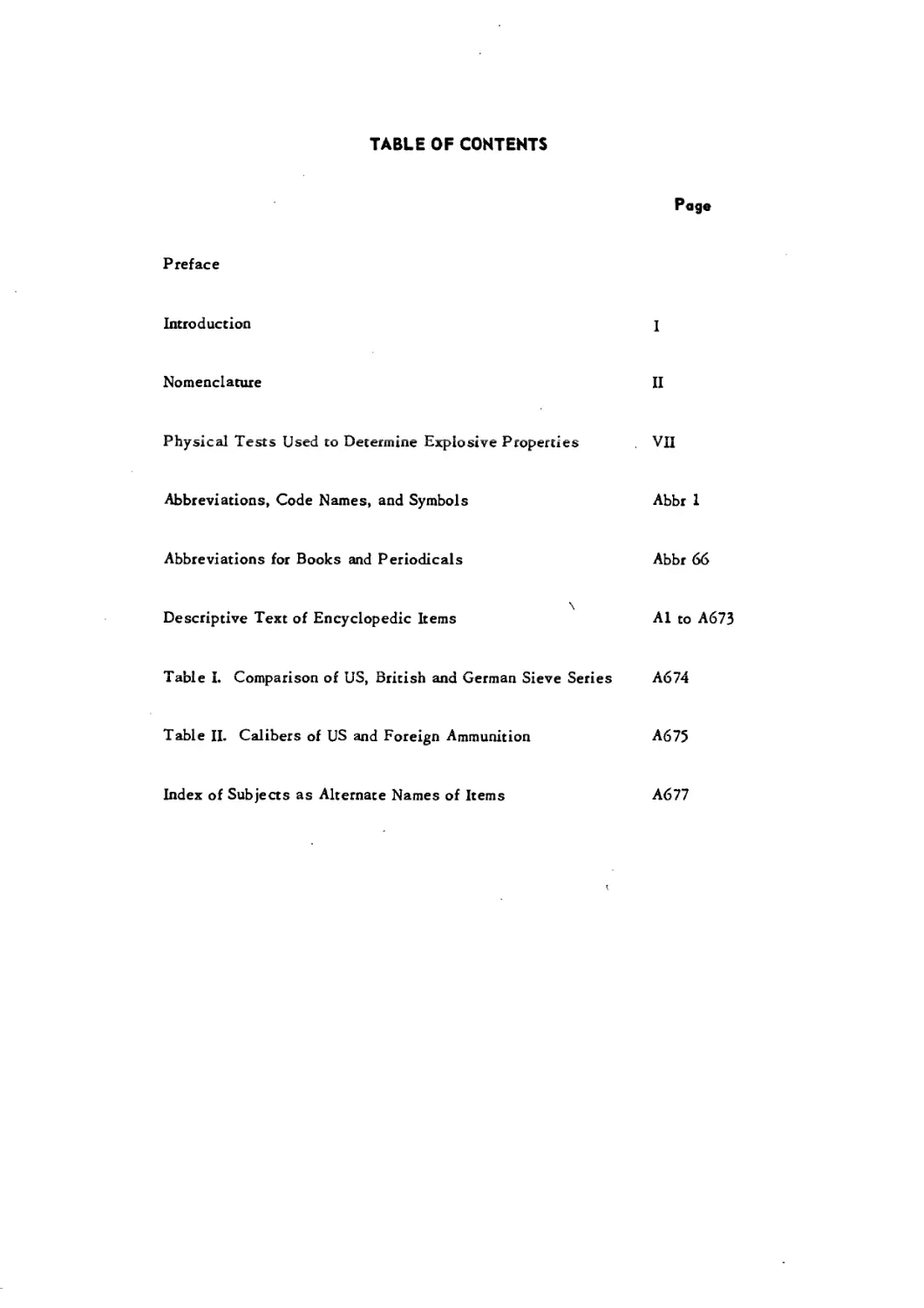
TABLE OF CONTENTS
Preface
Introduction	I
Nomenclature	II
Physical Tests Used to Determine Explosive Properties	Л/ТТ Vll
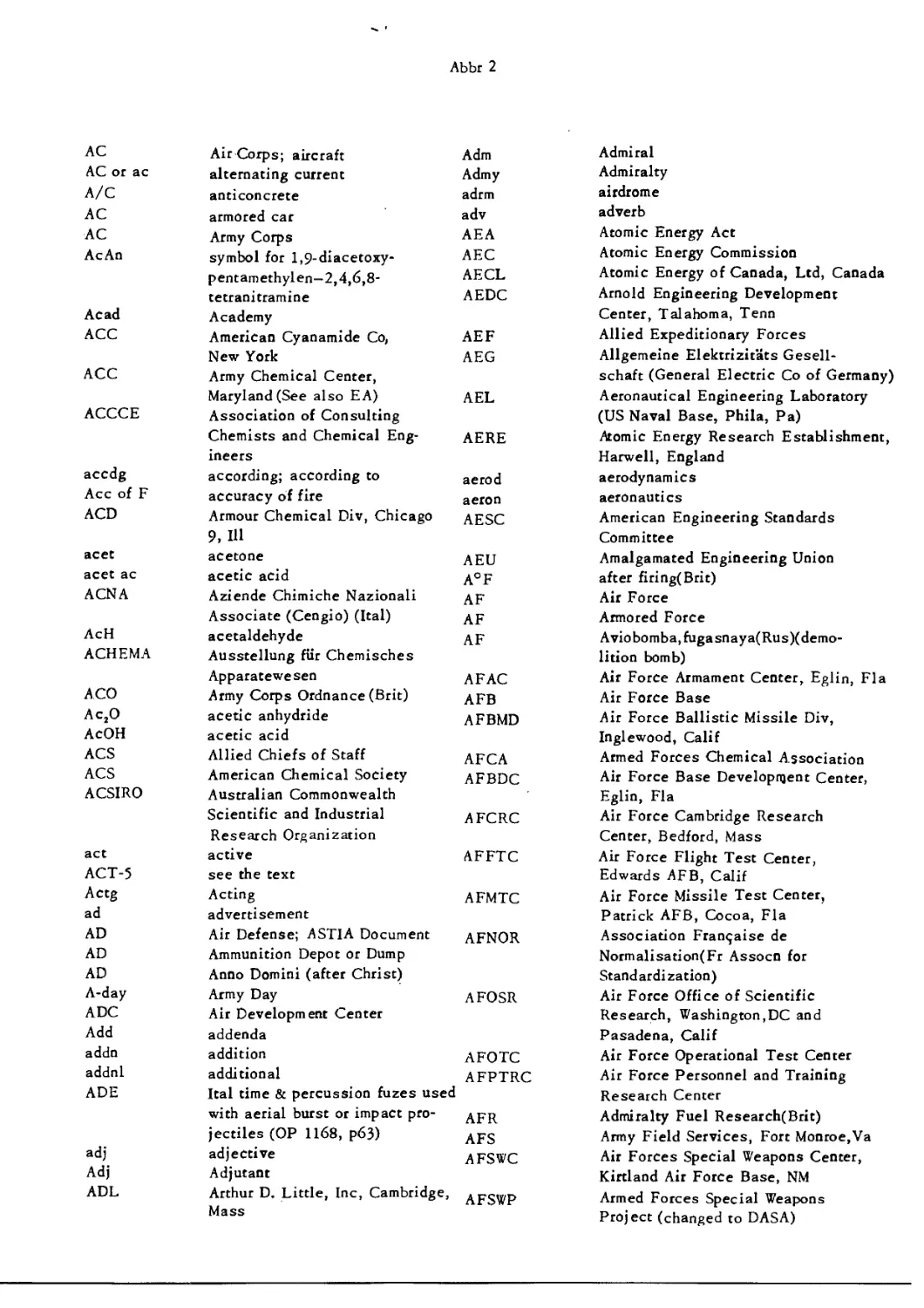
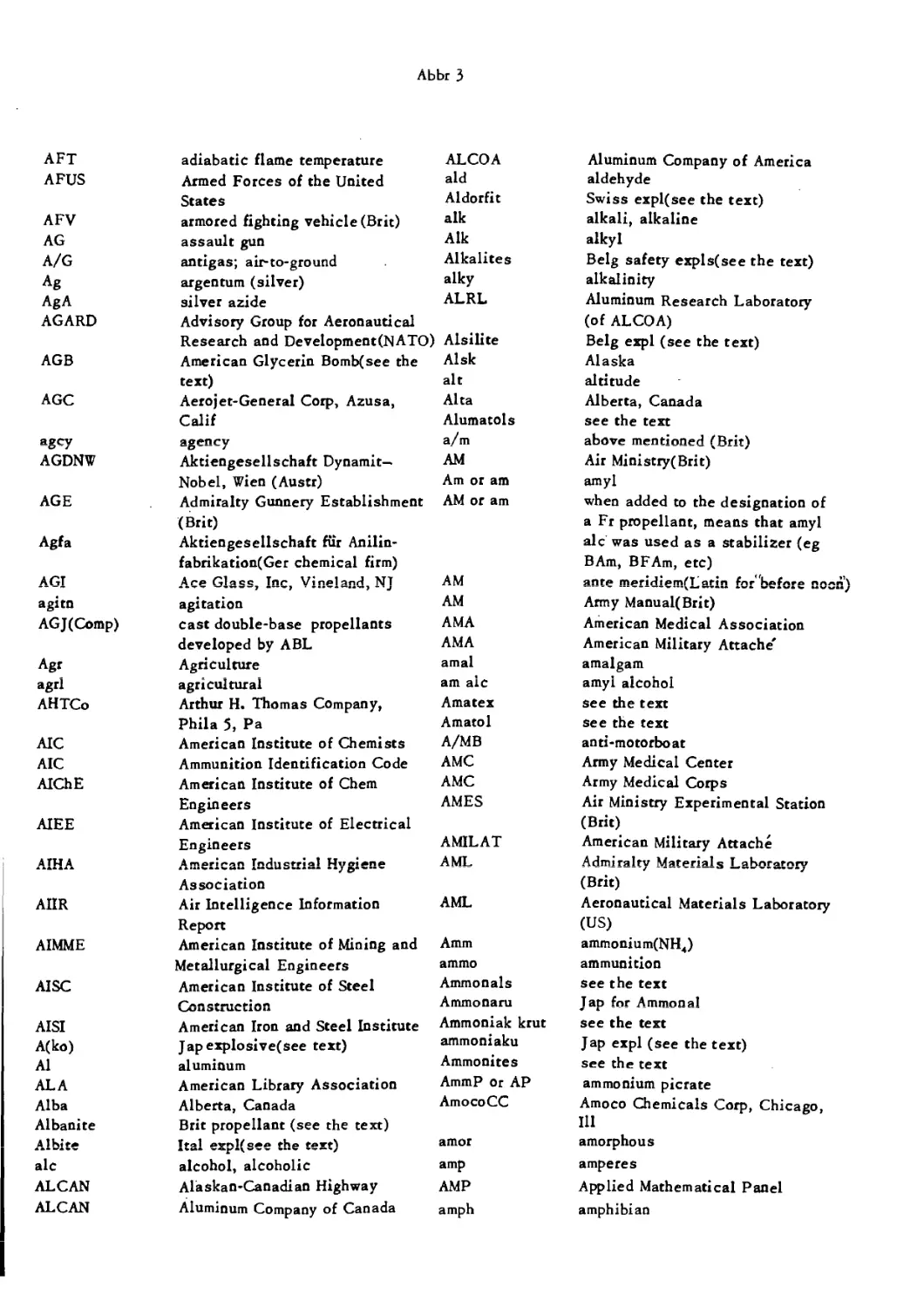
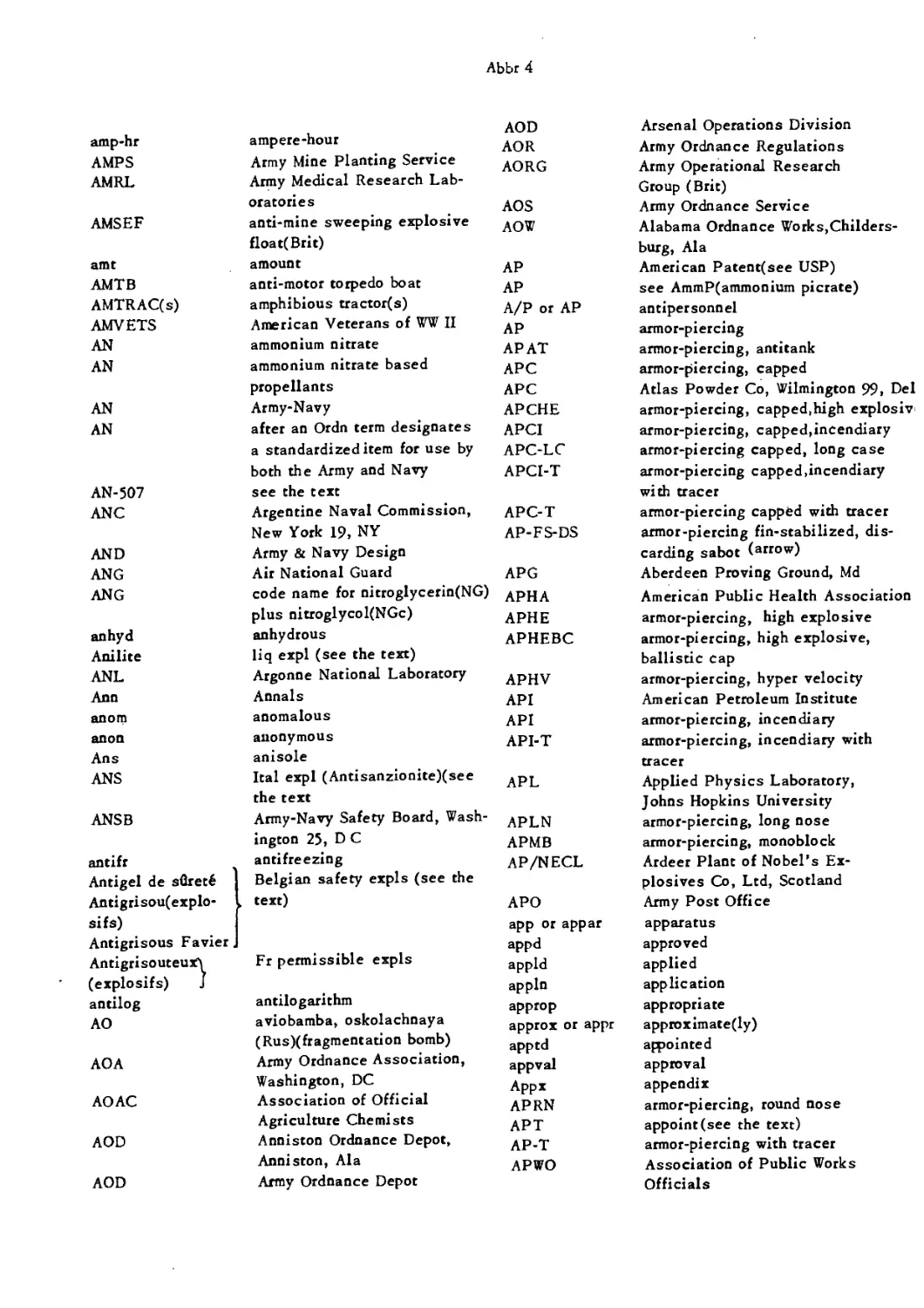
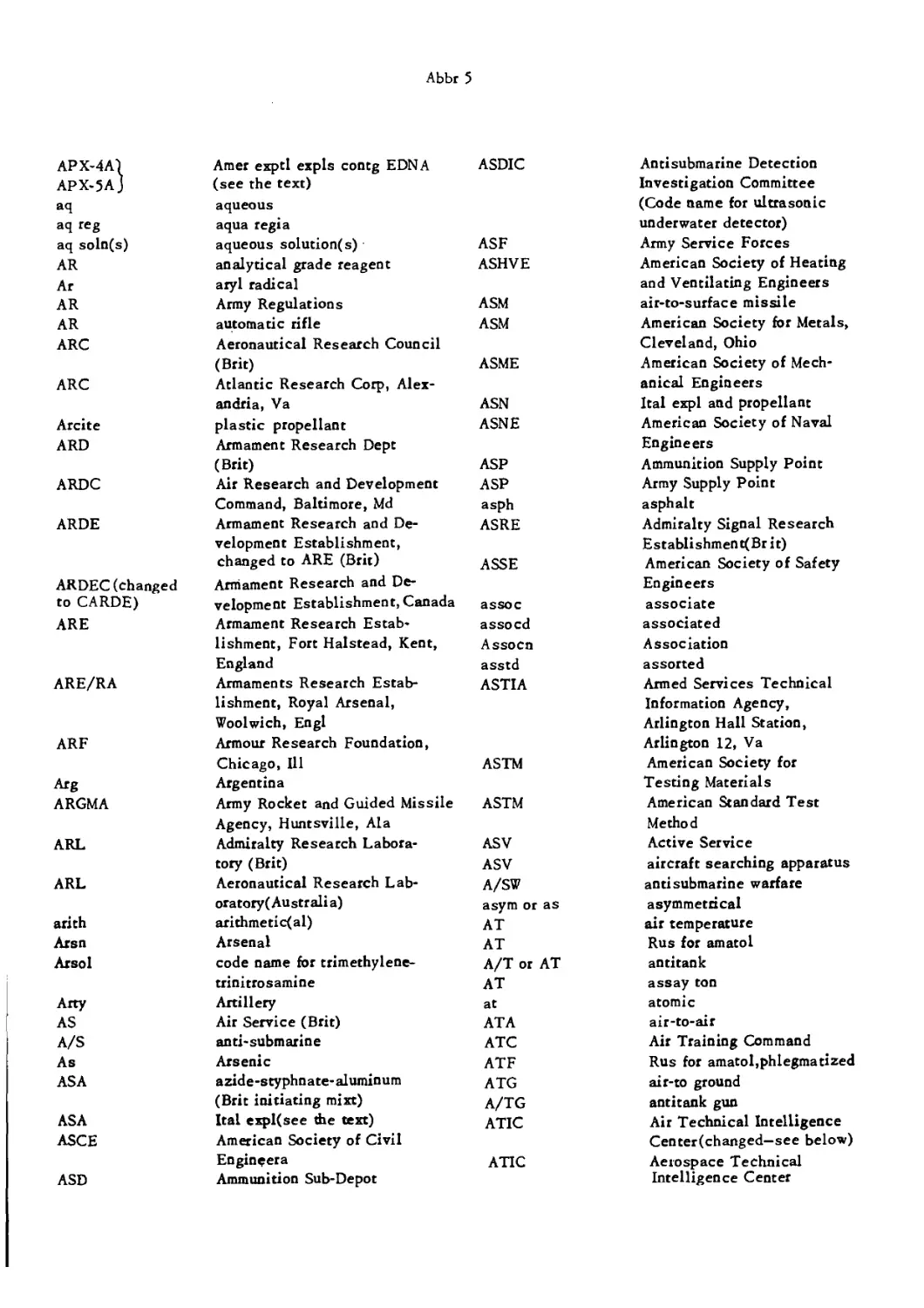
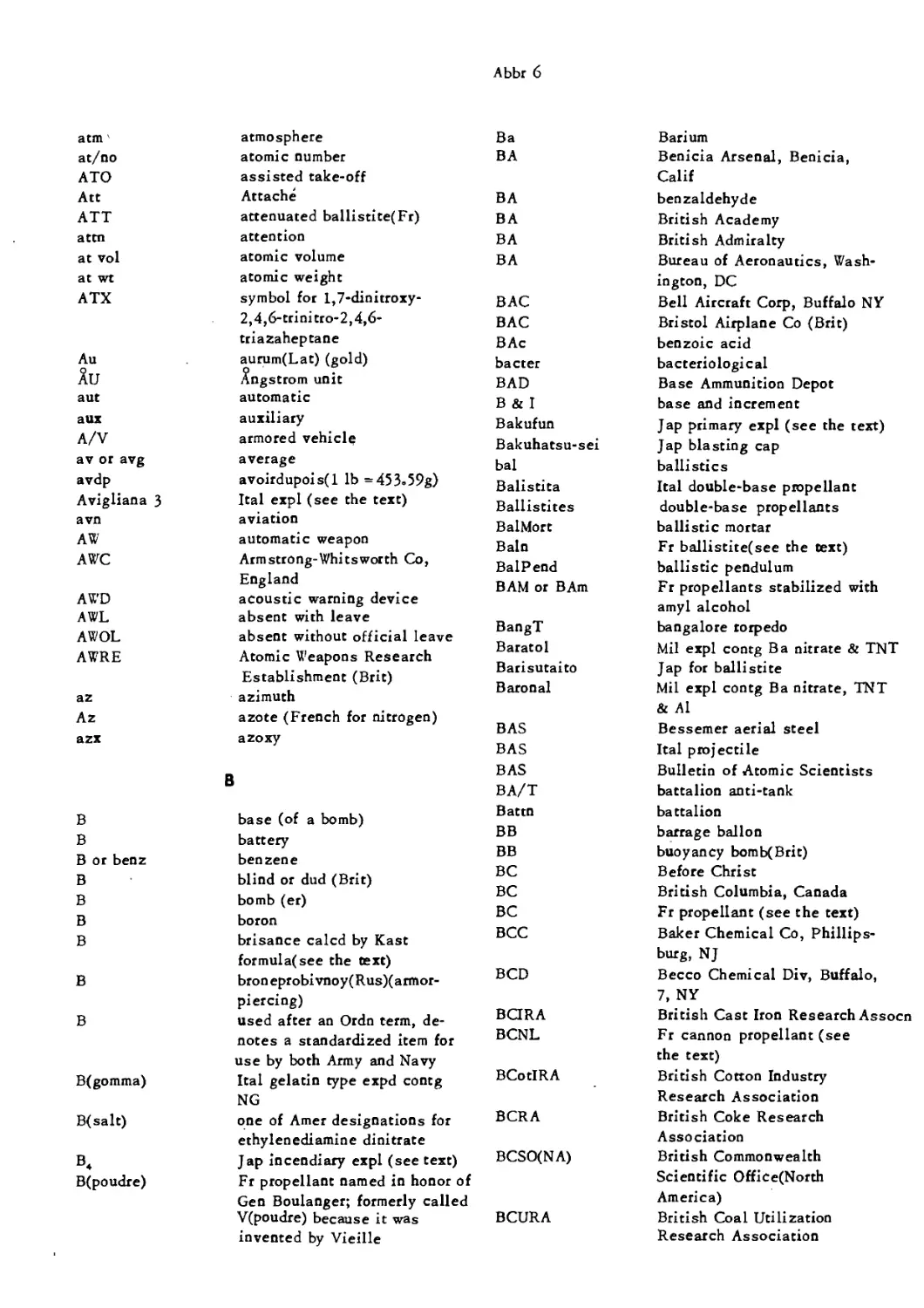
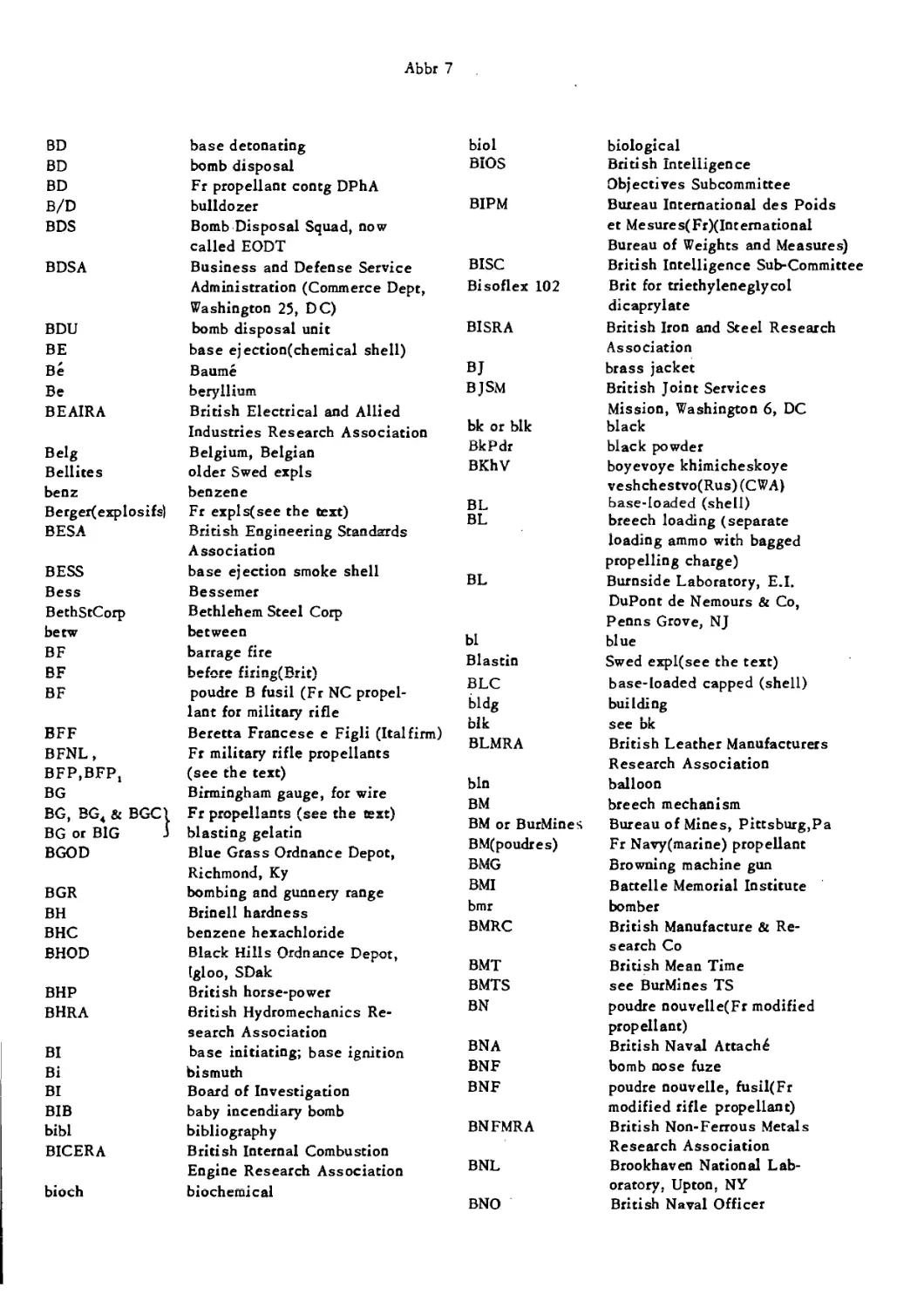
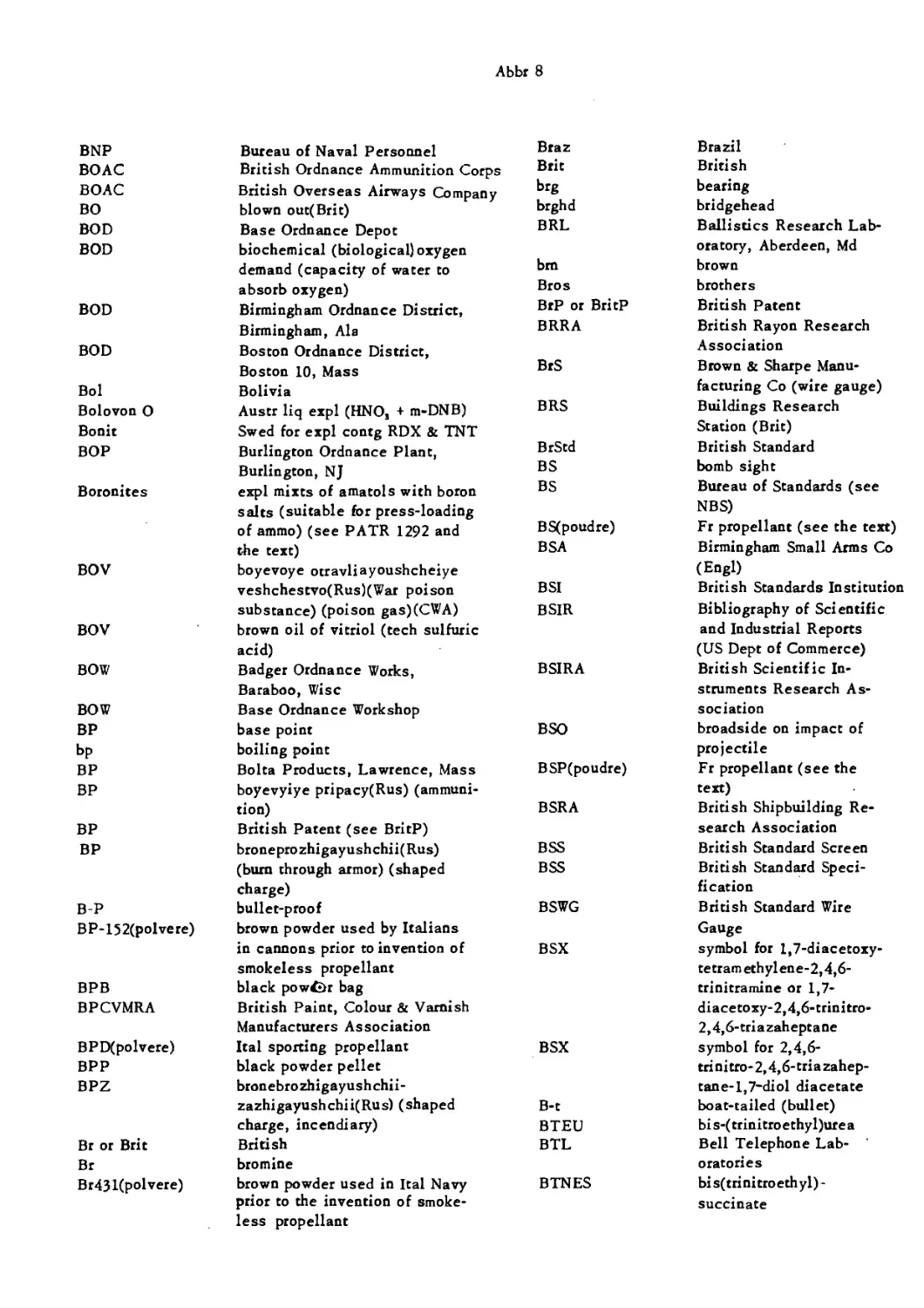
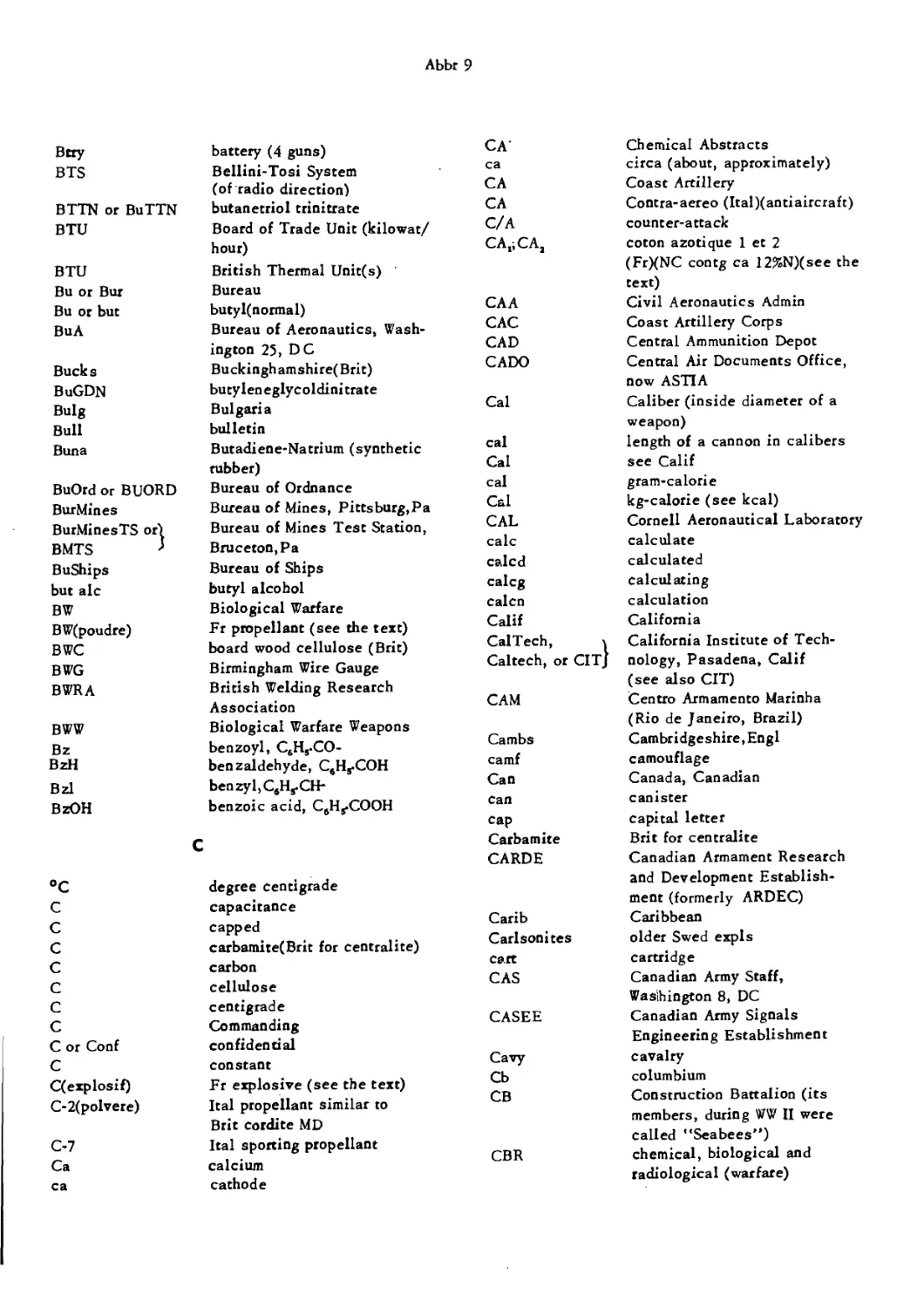
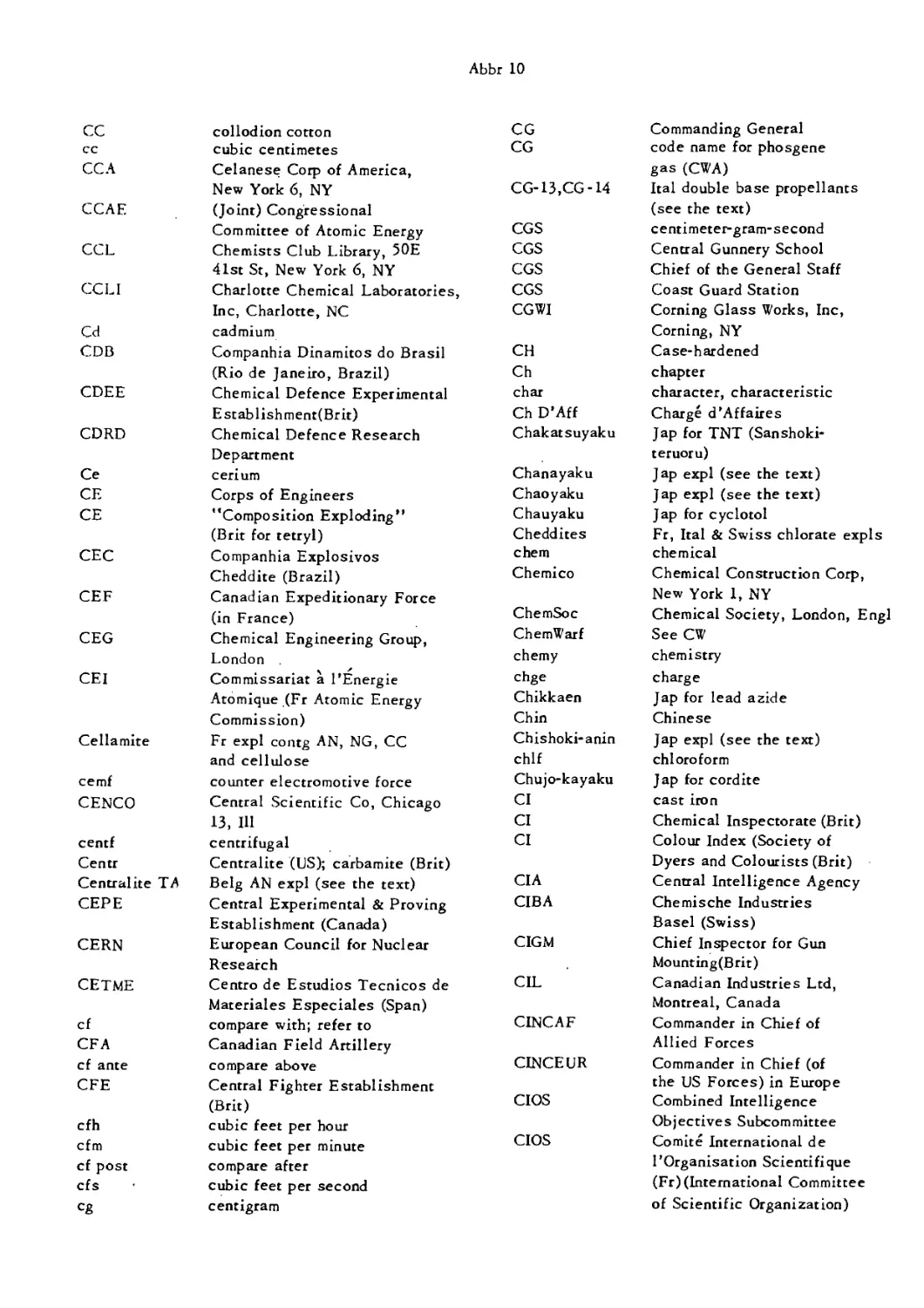
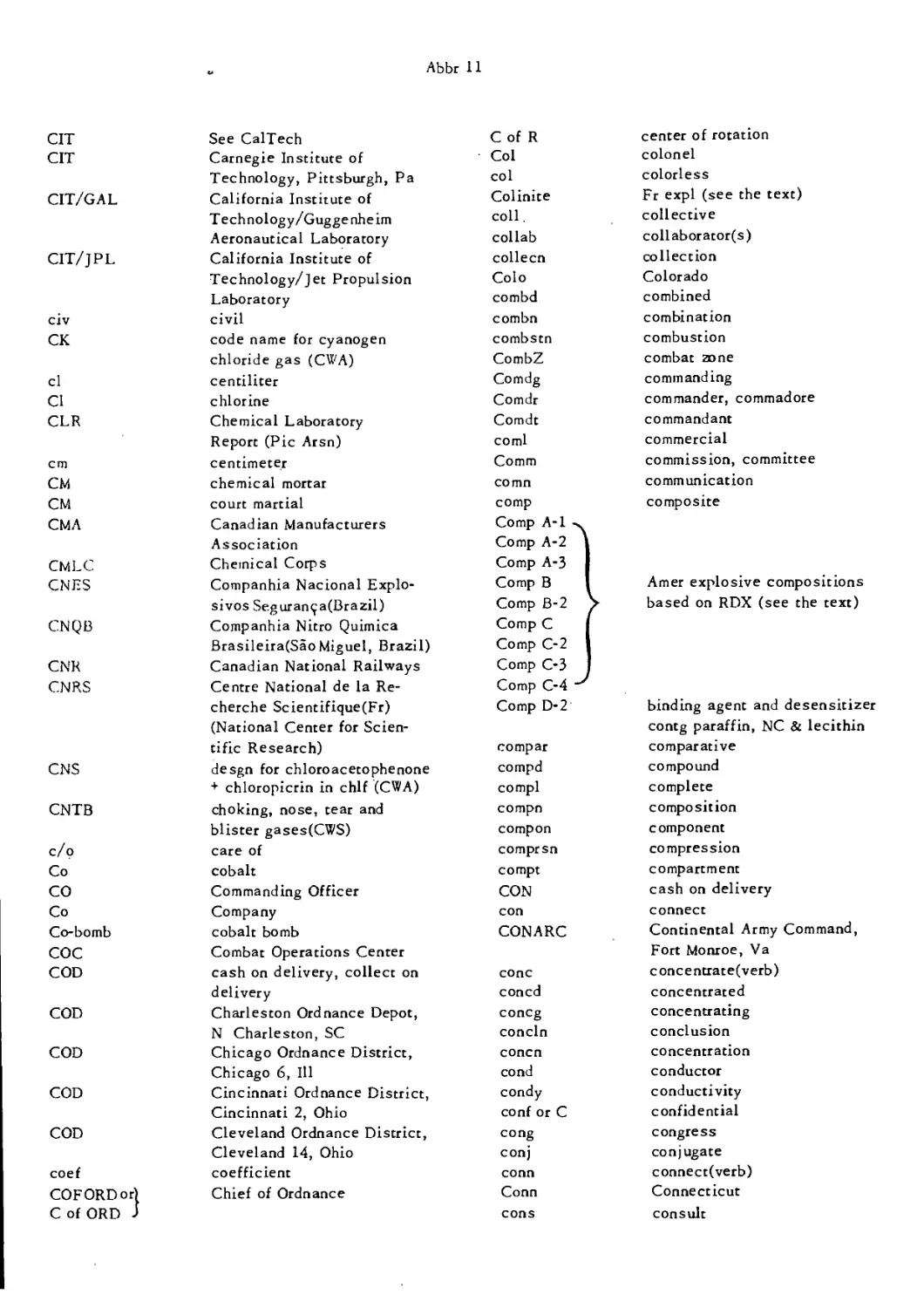
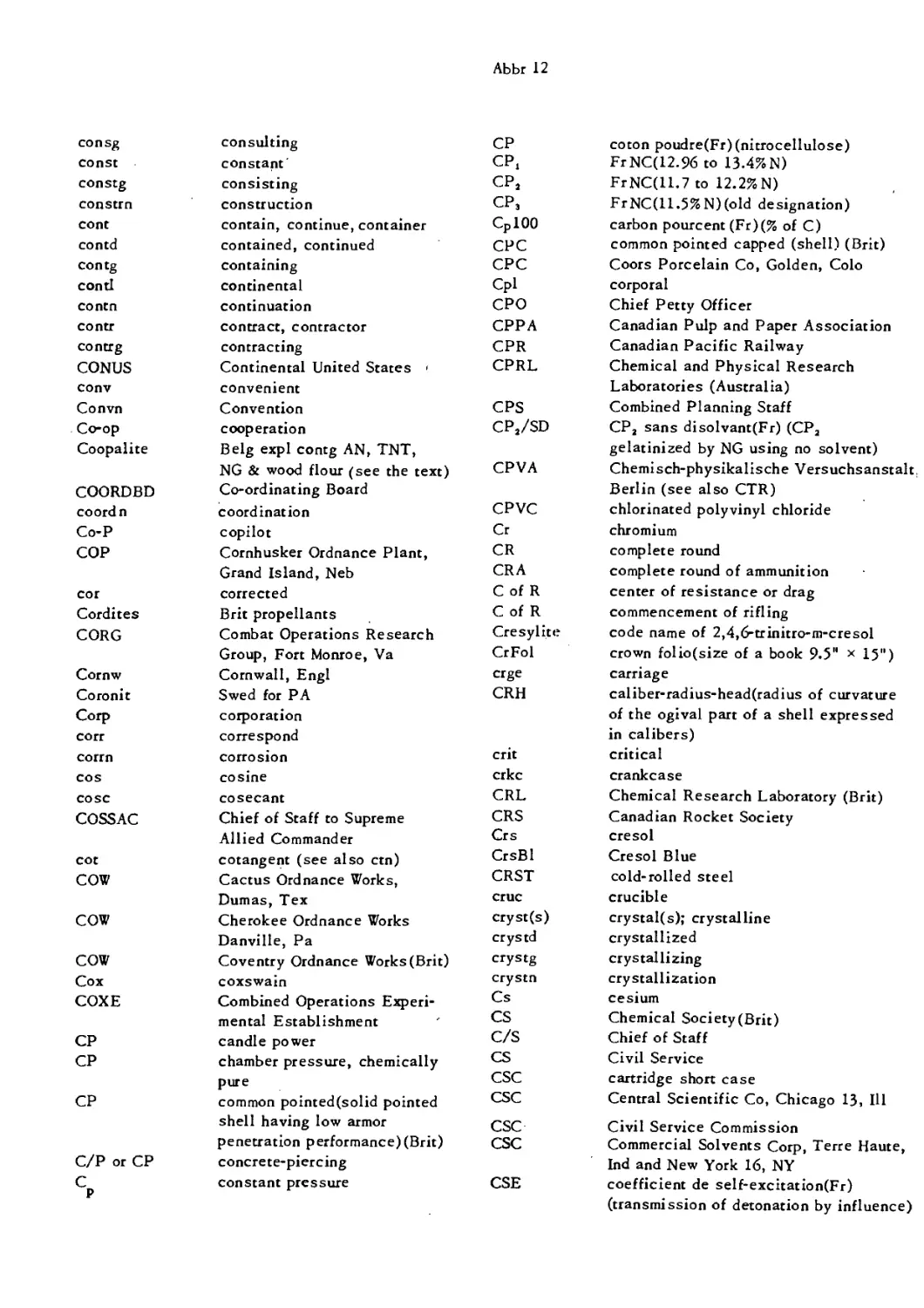
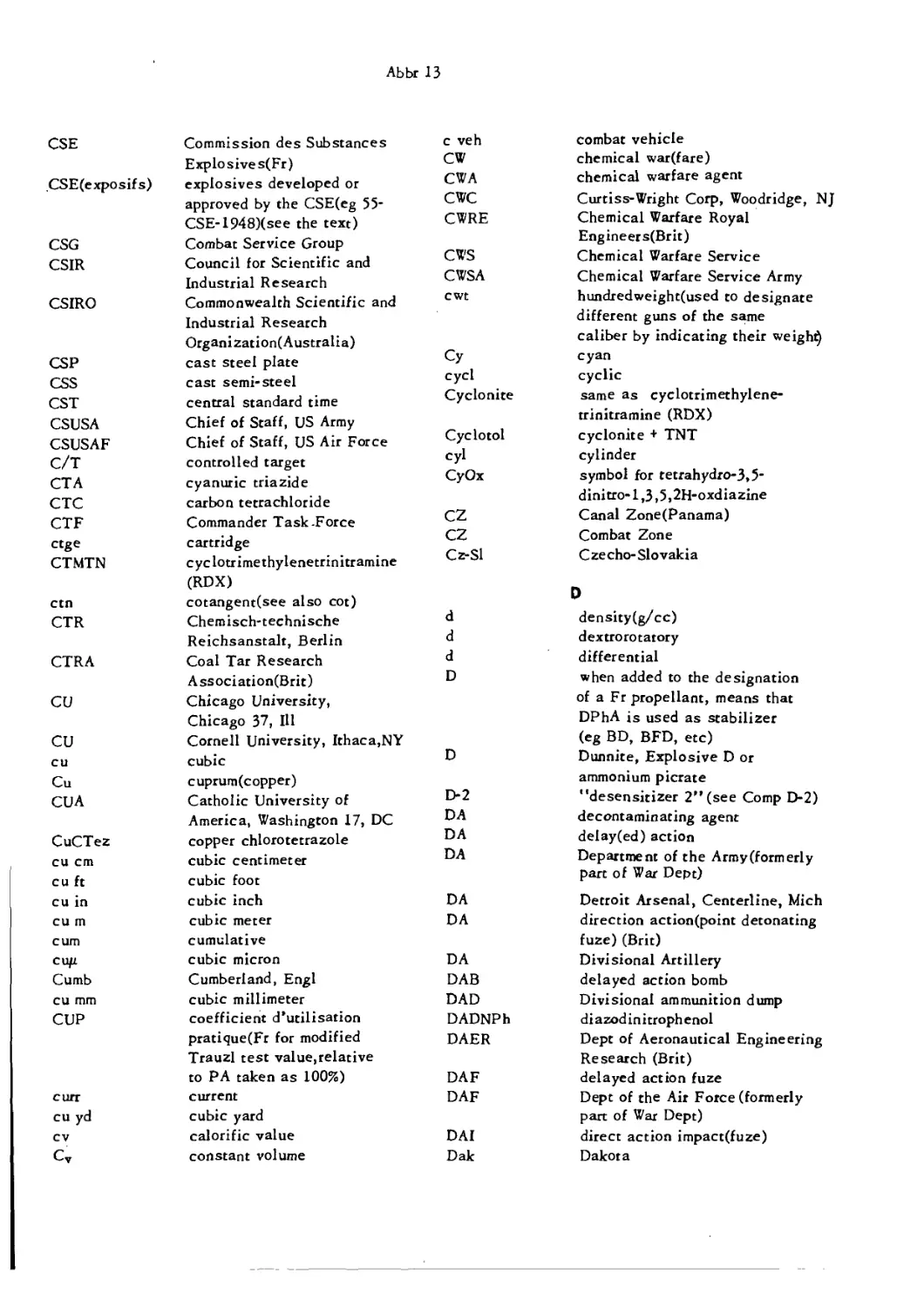
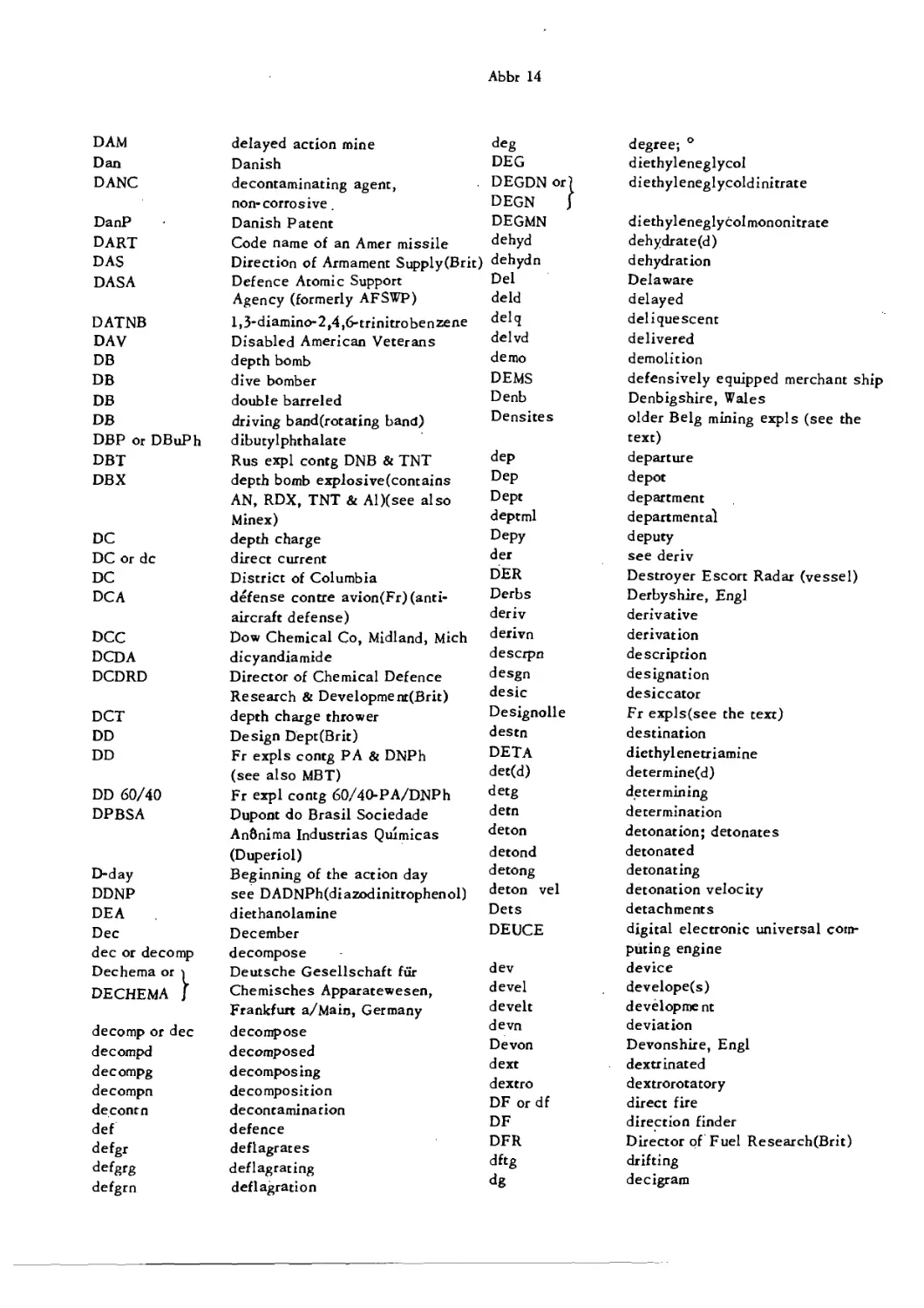
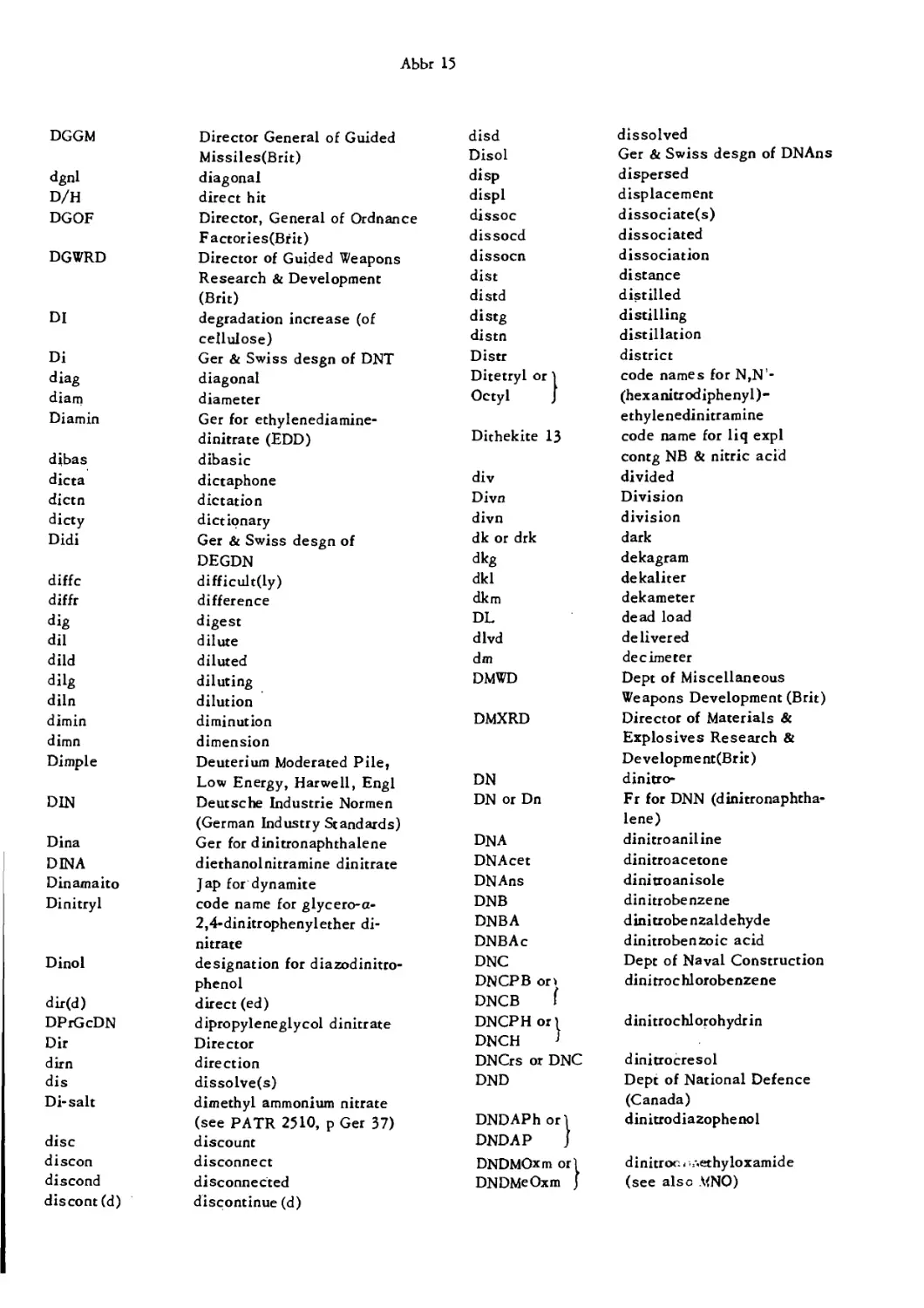
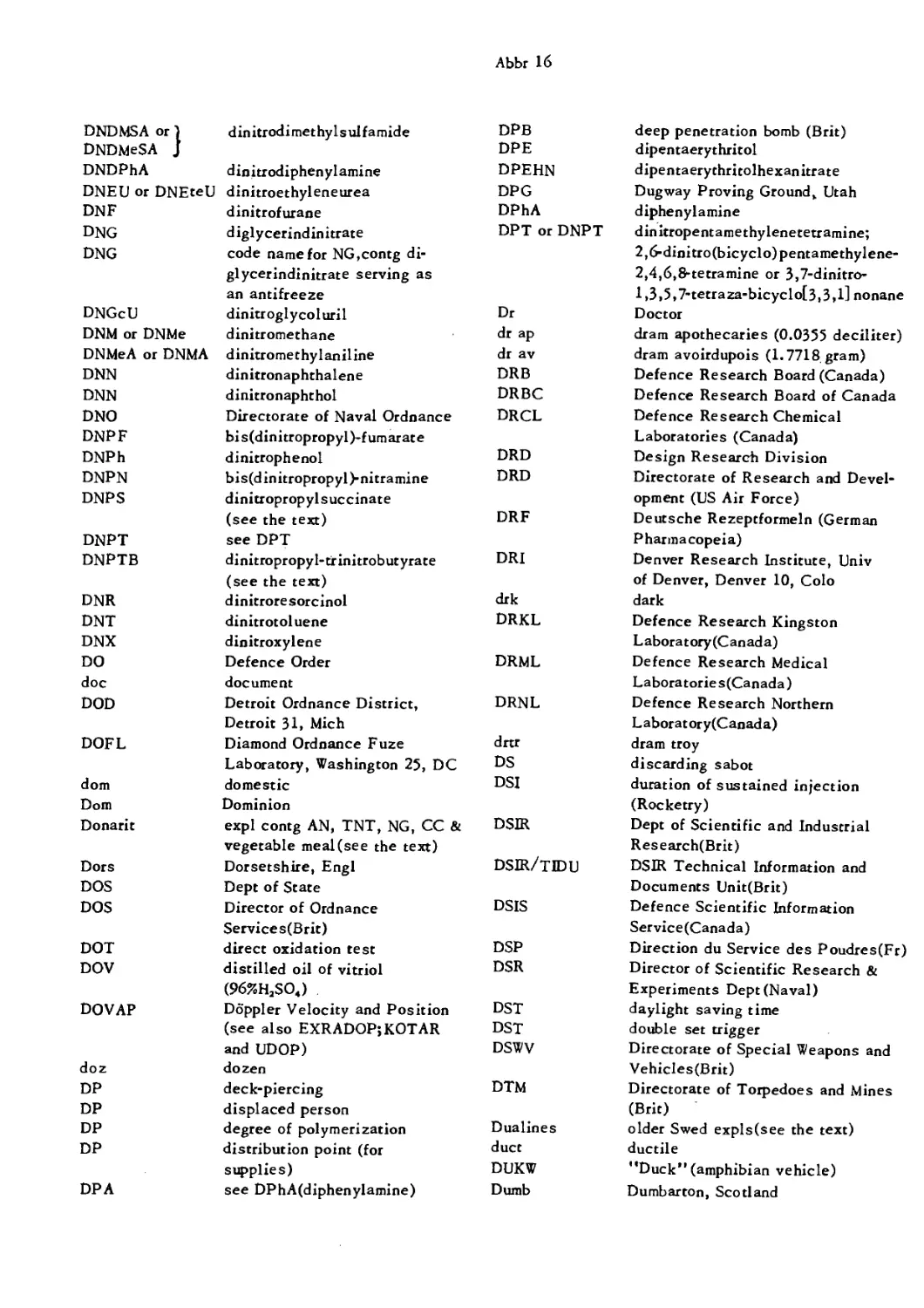
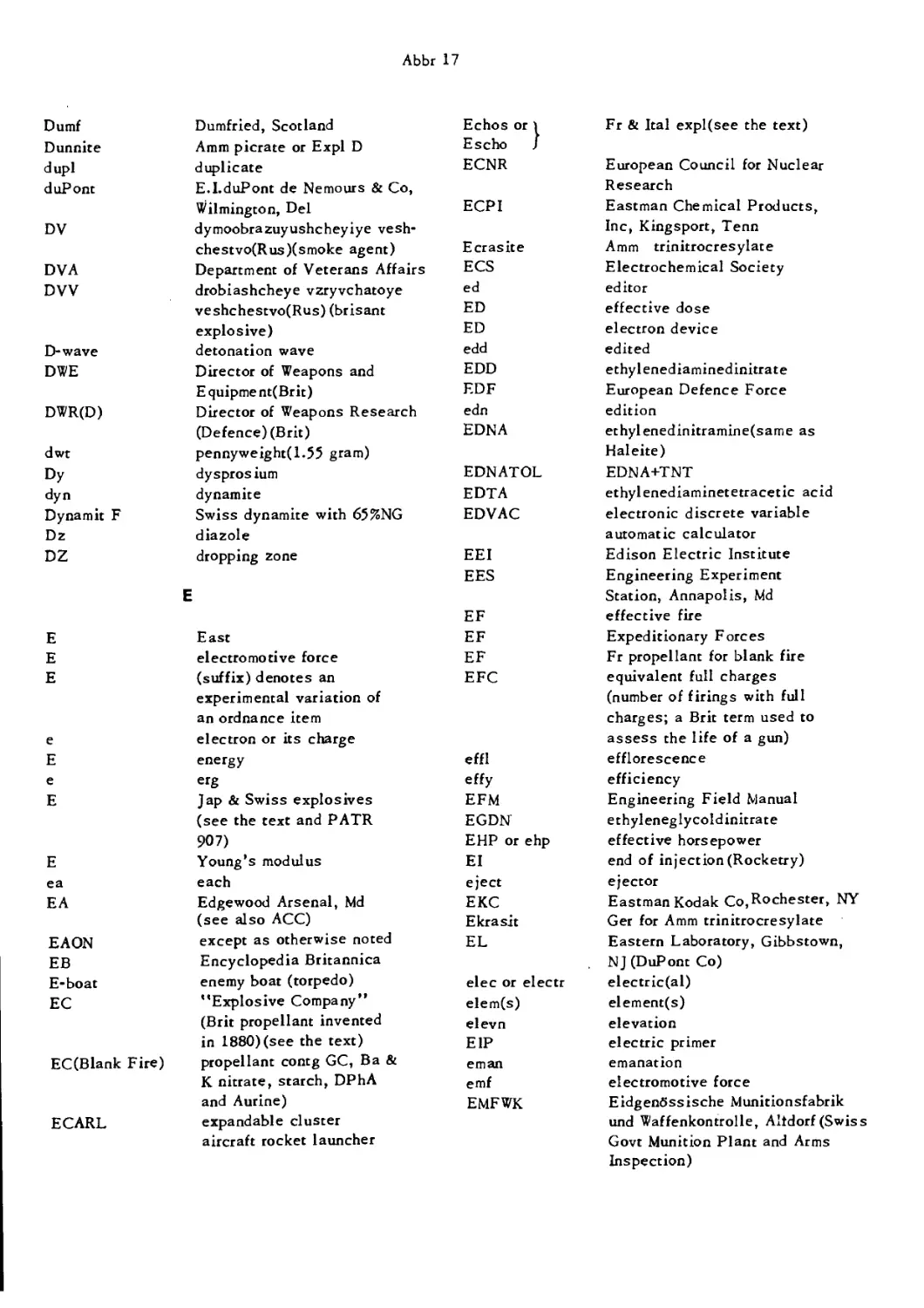
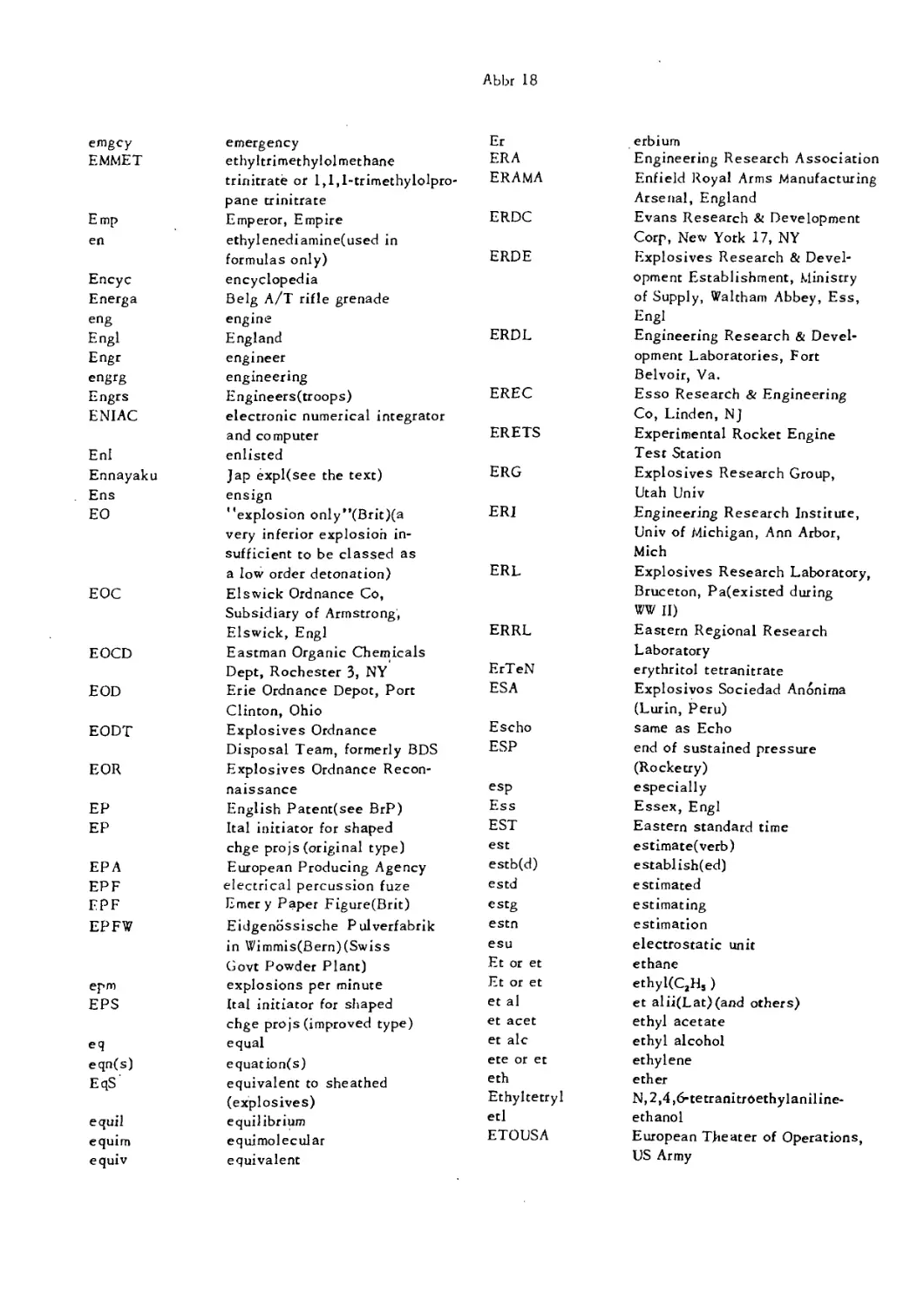
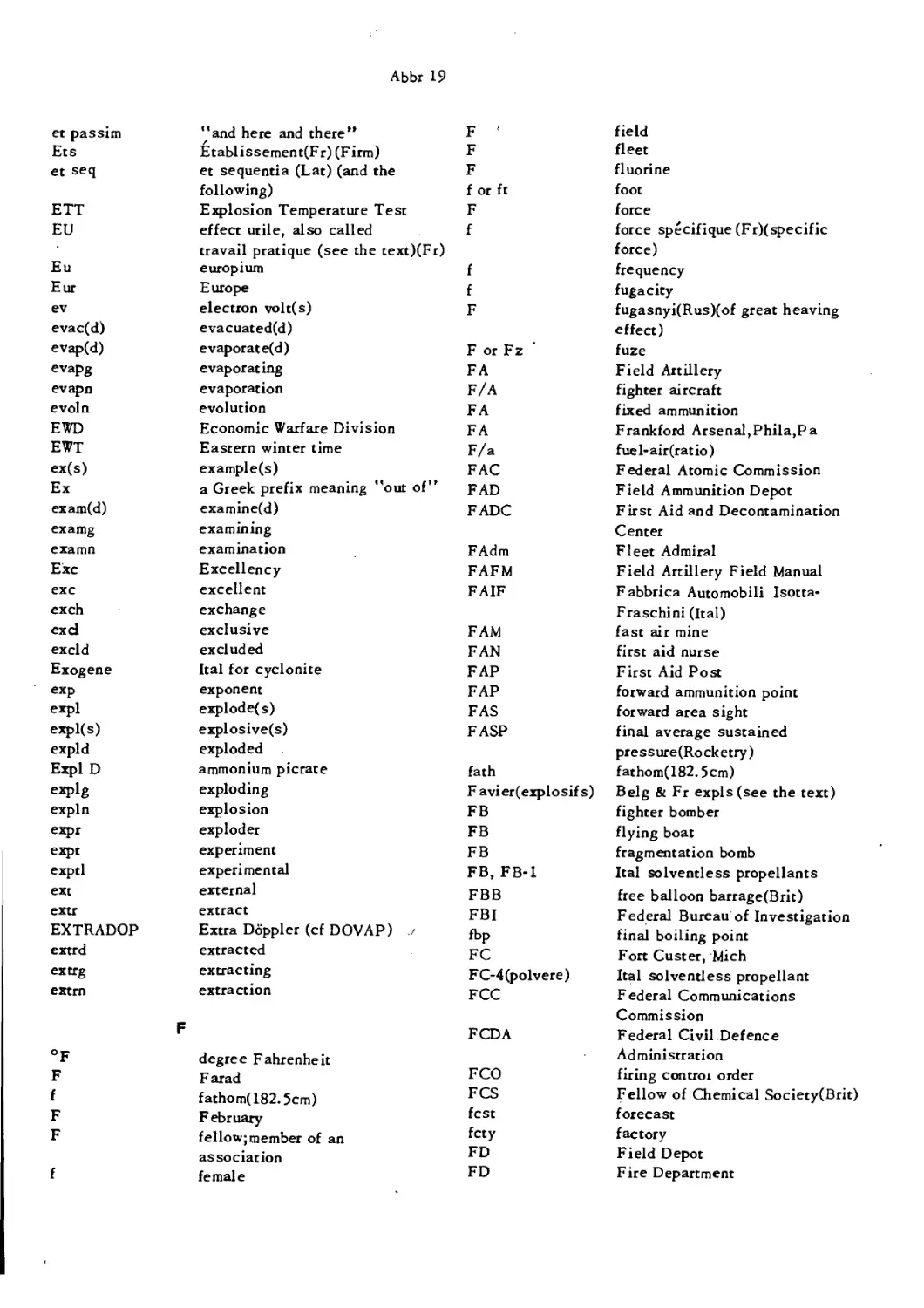
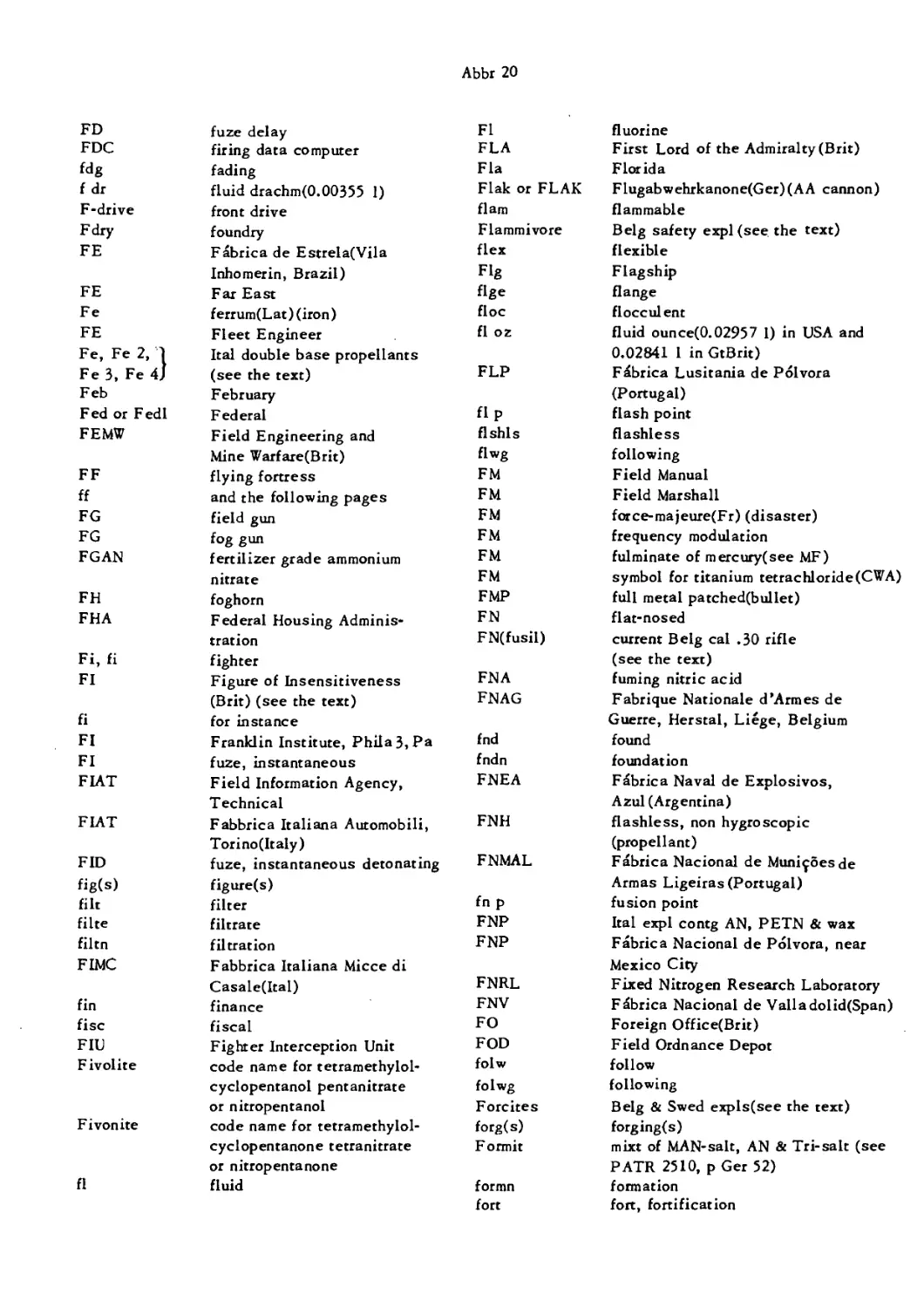
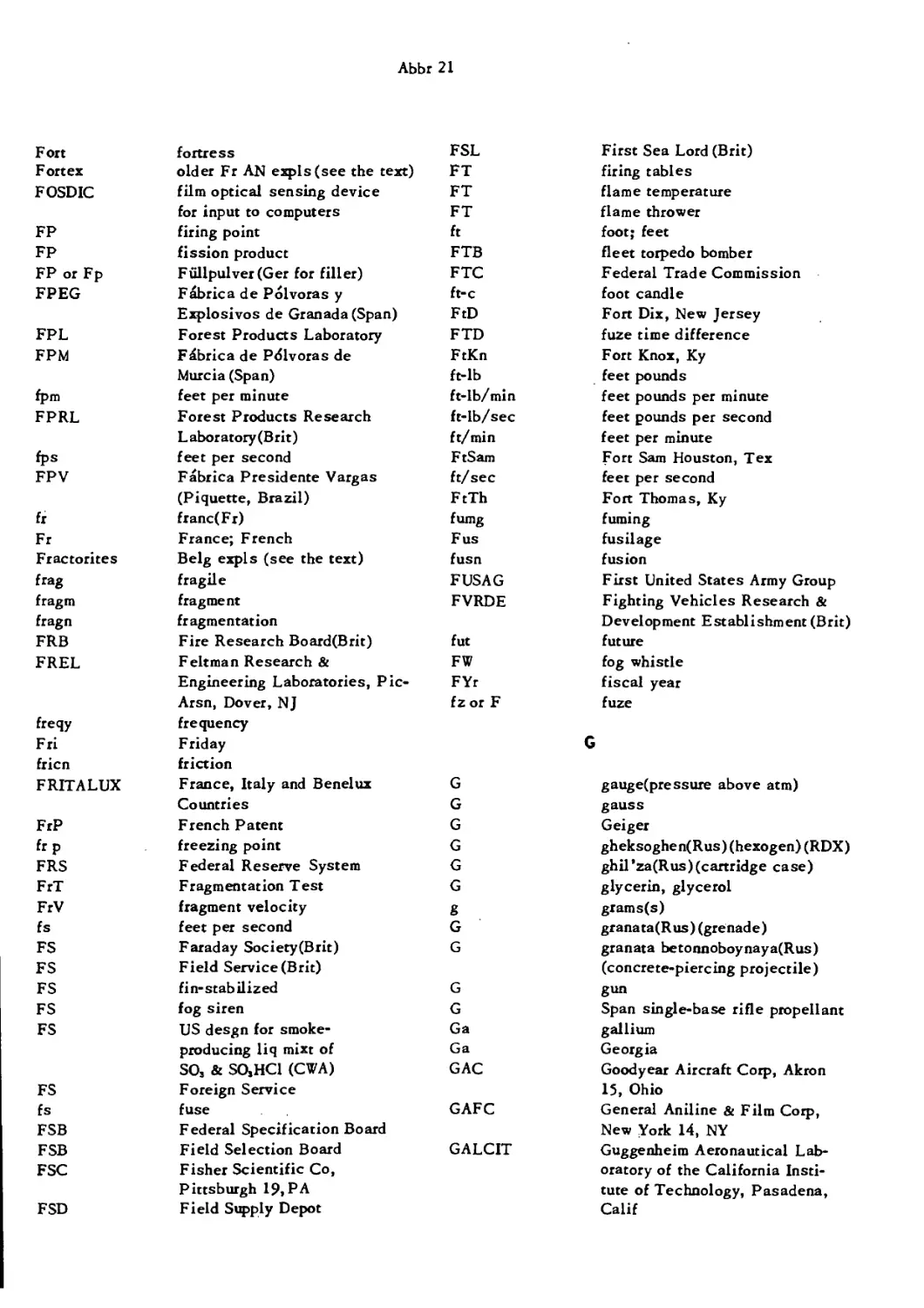
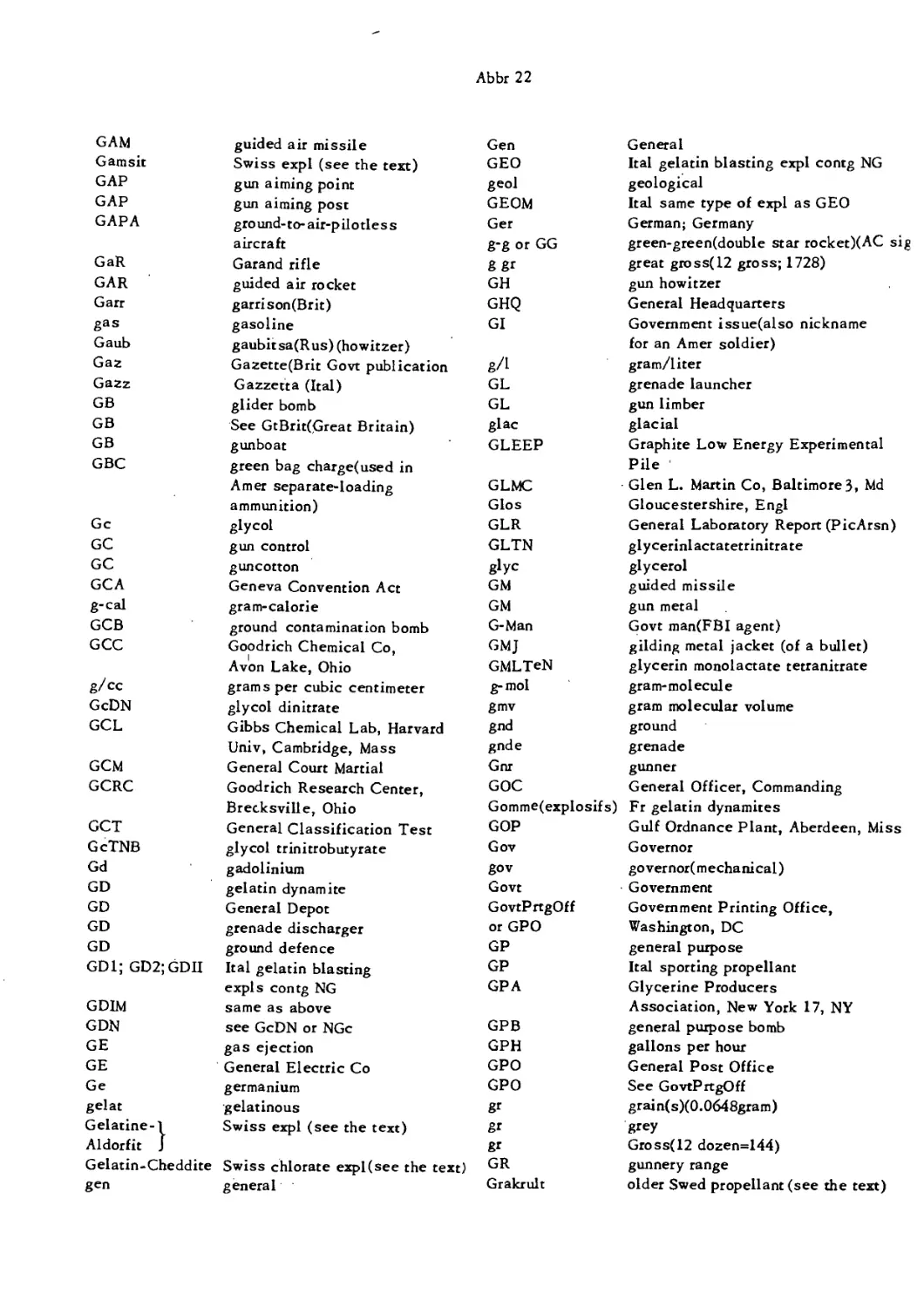
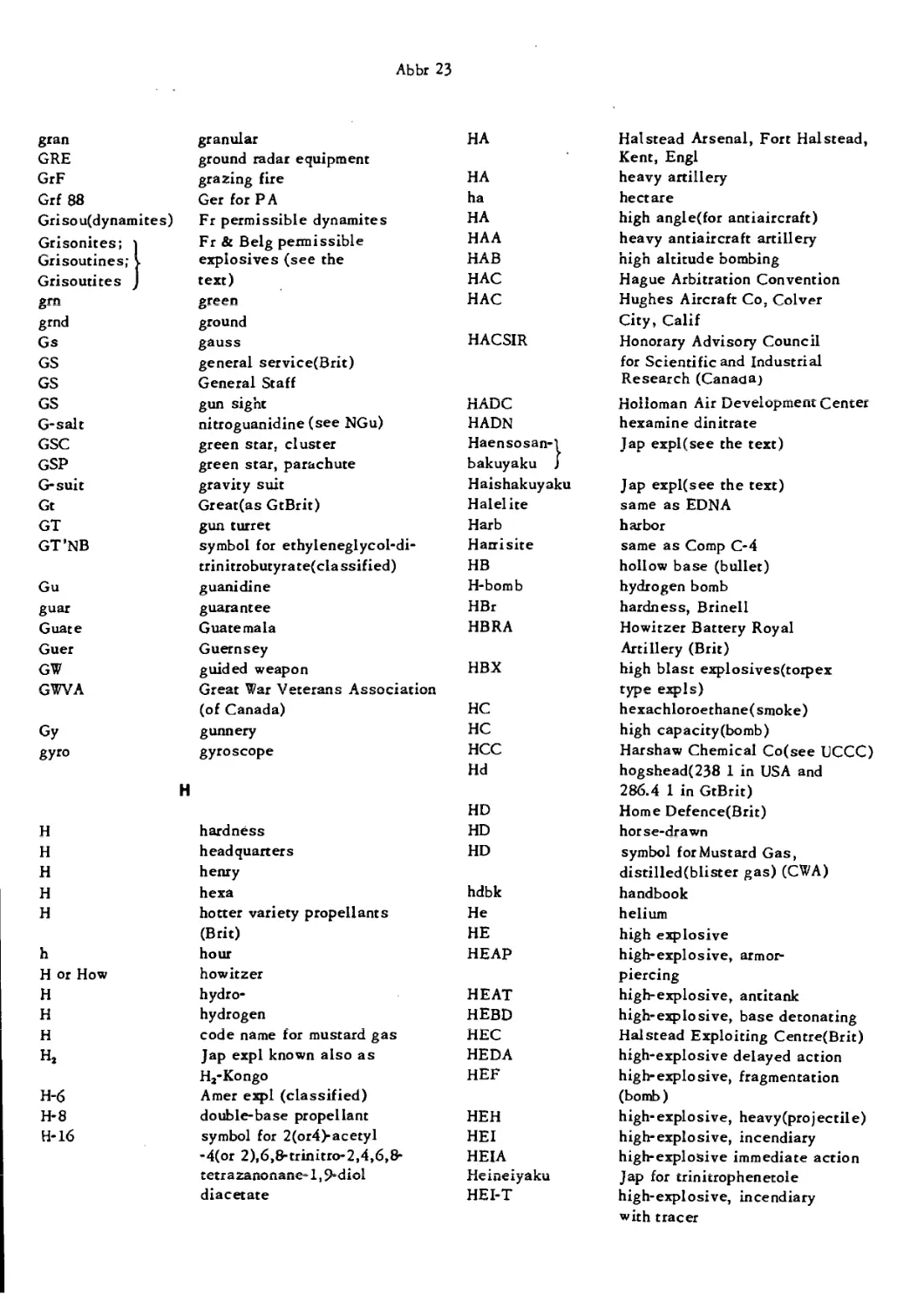
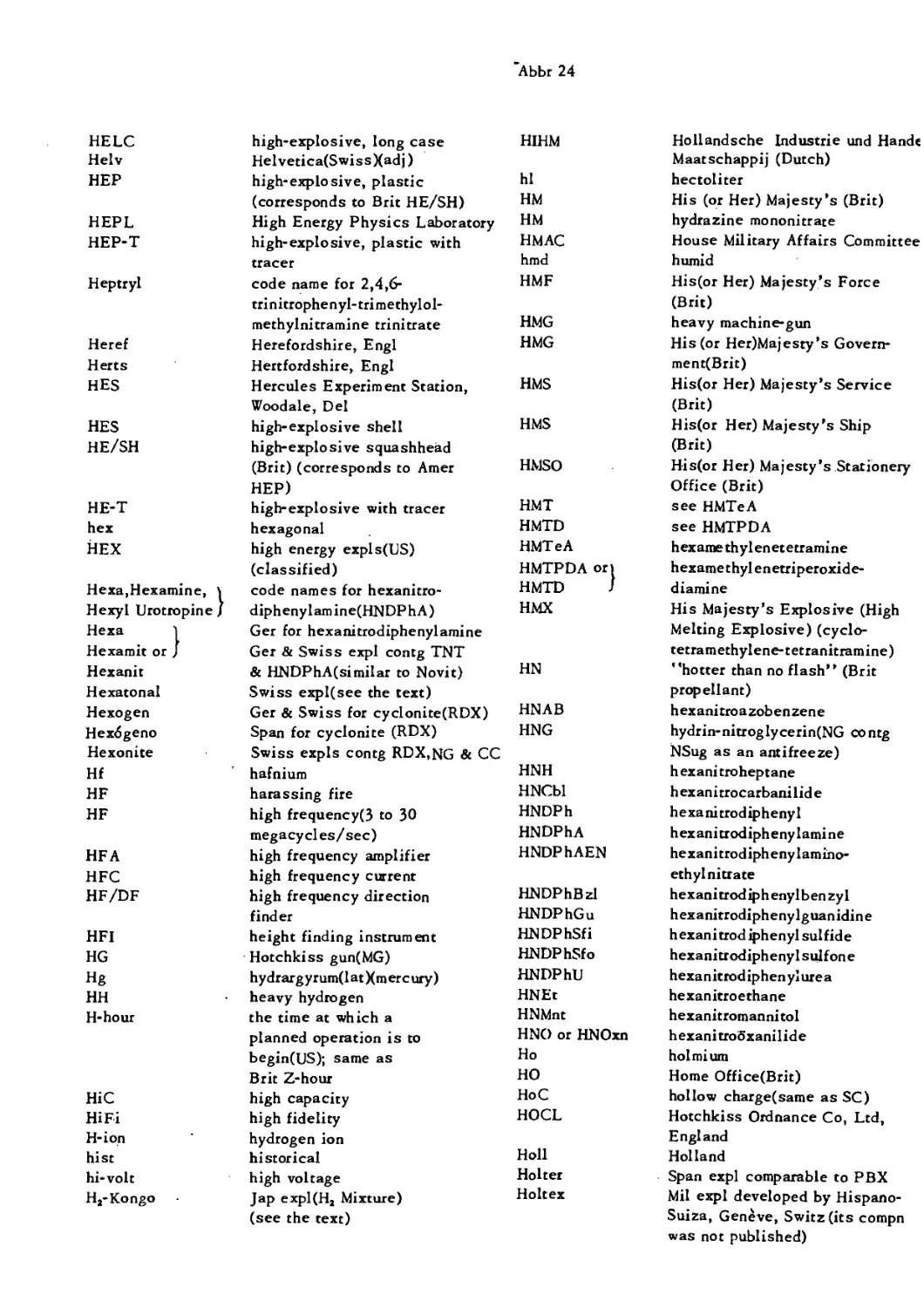
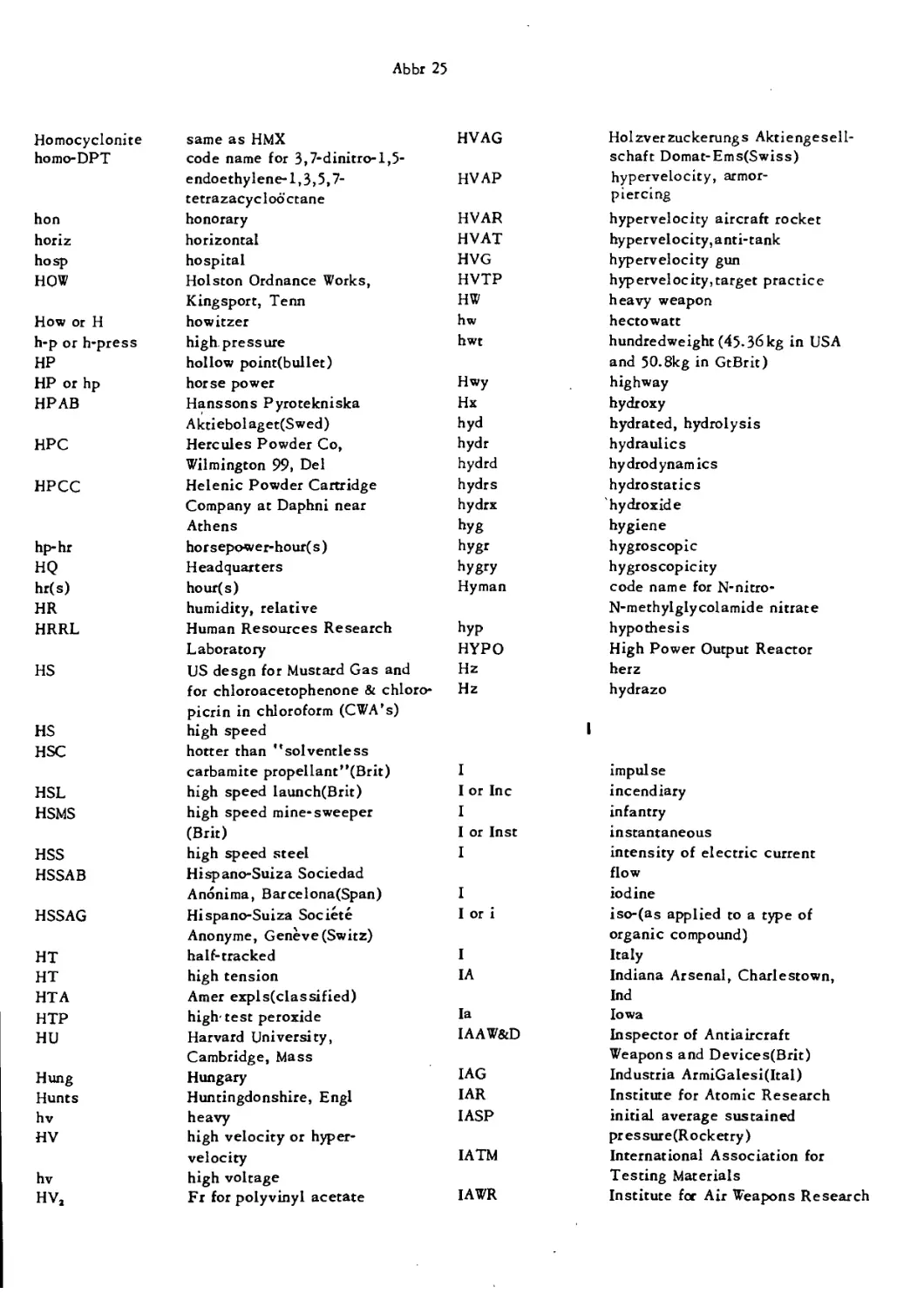
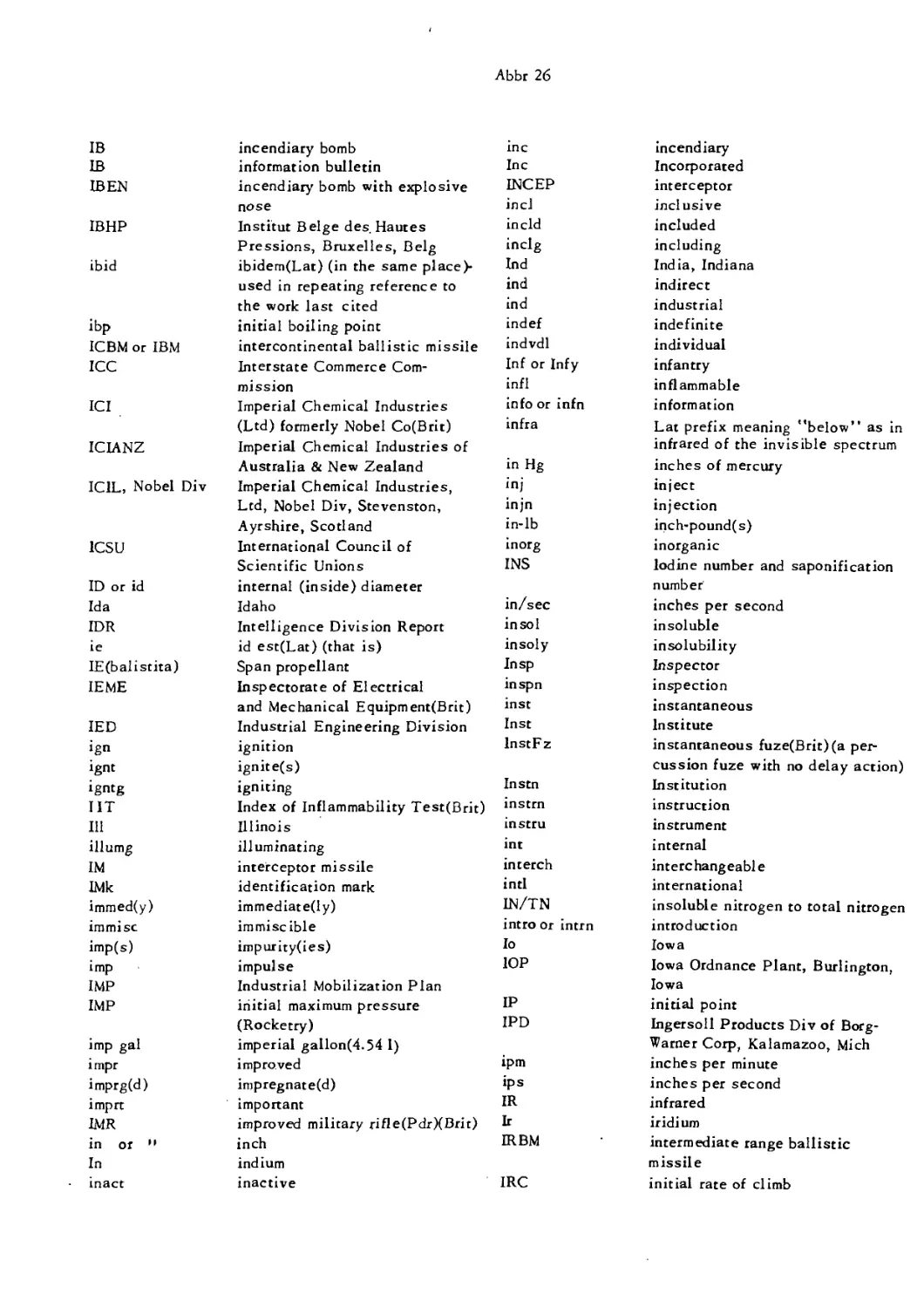
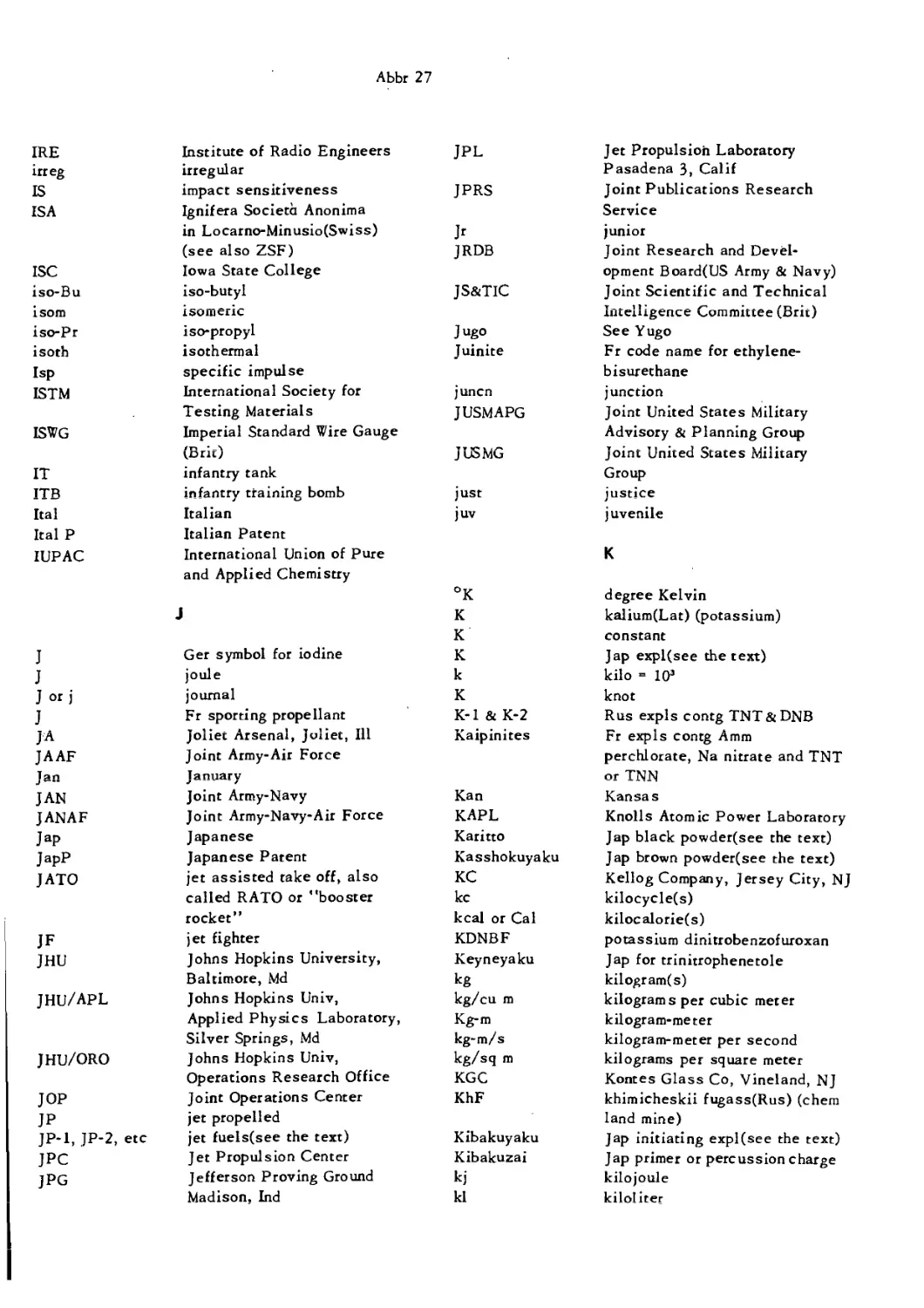
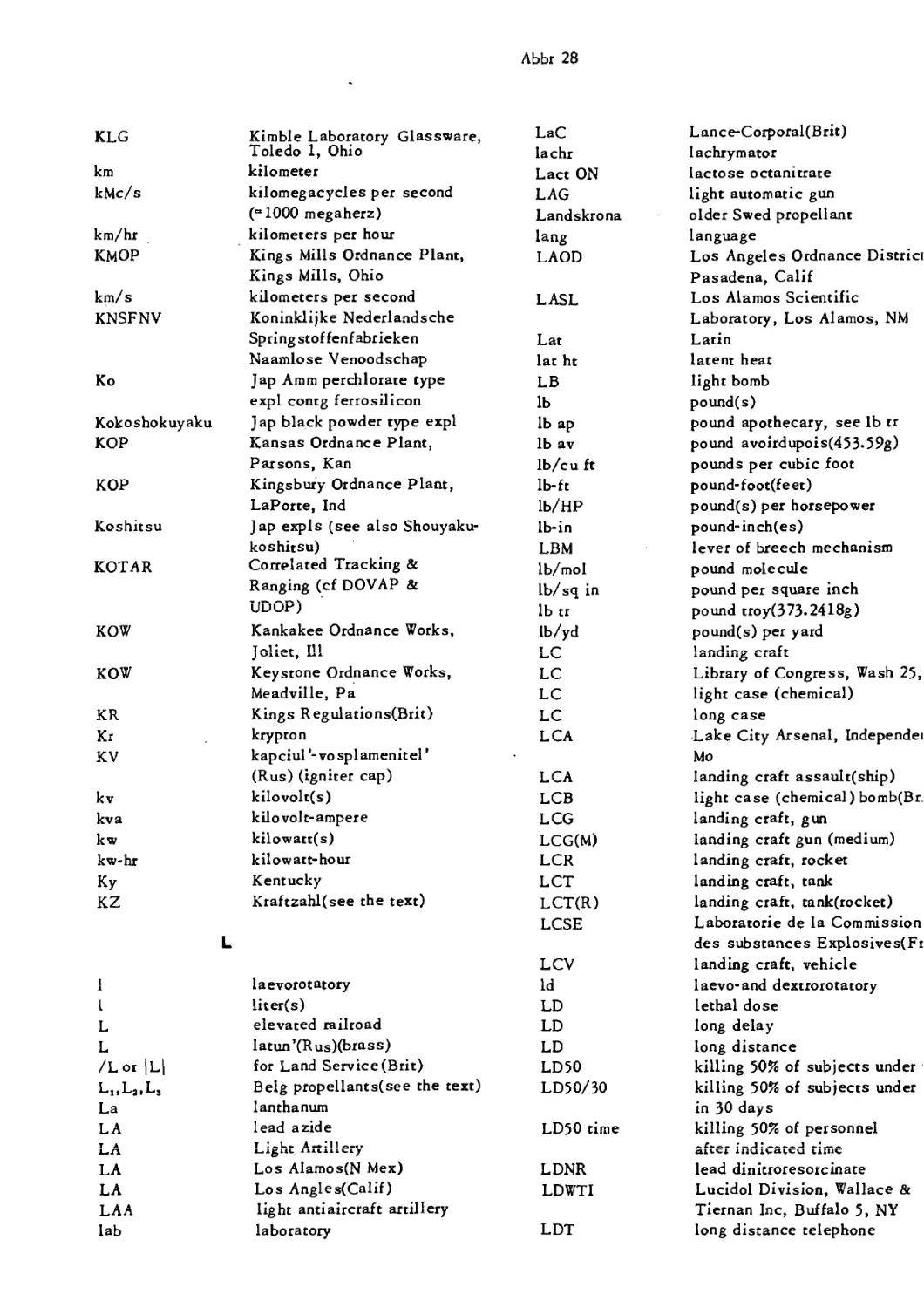
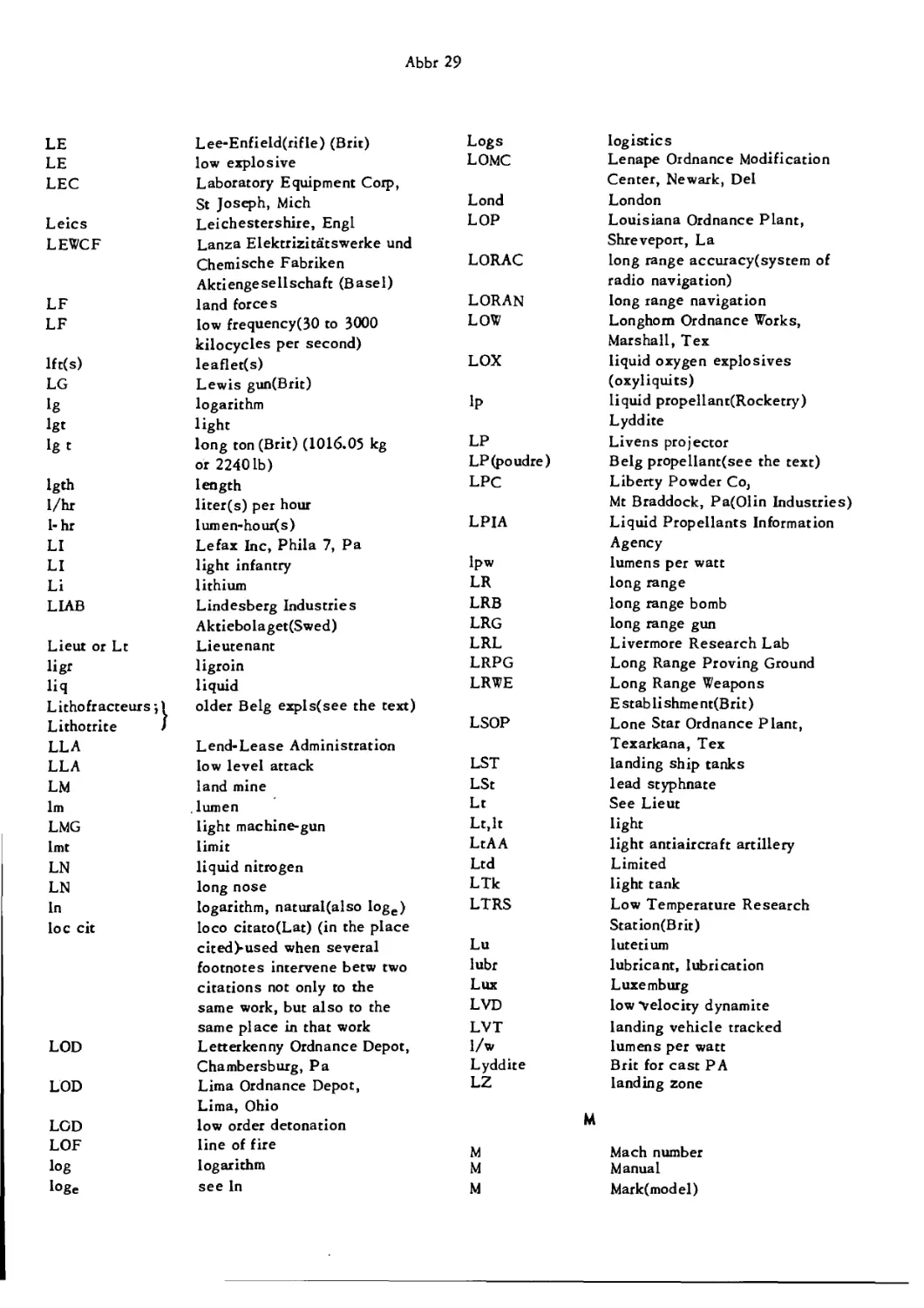
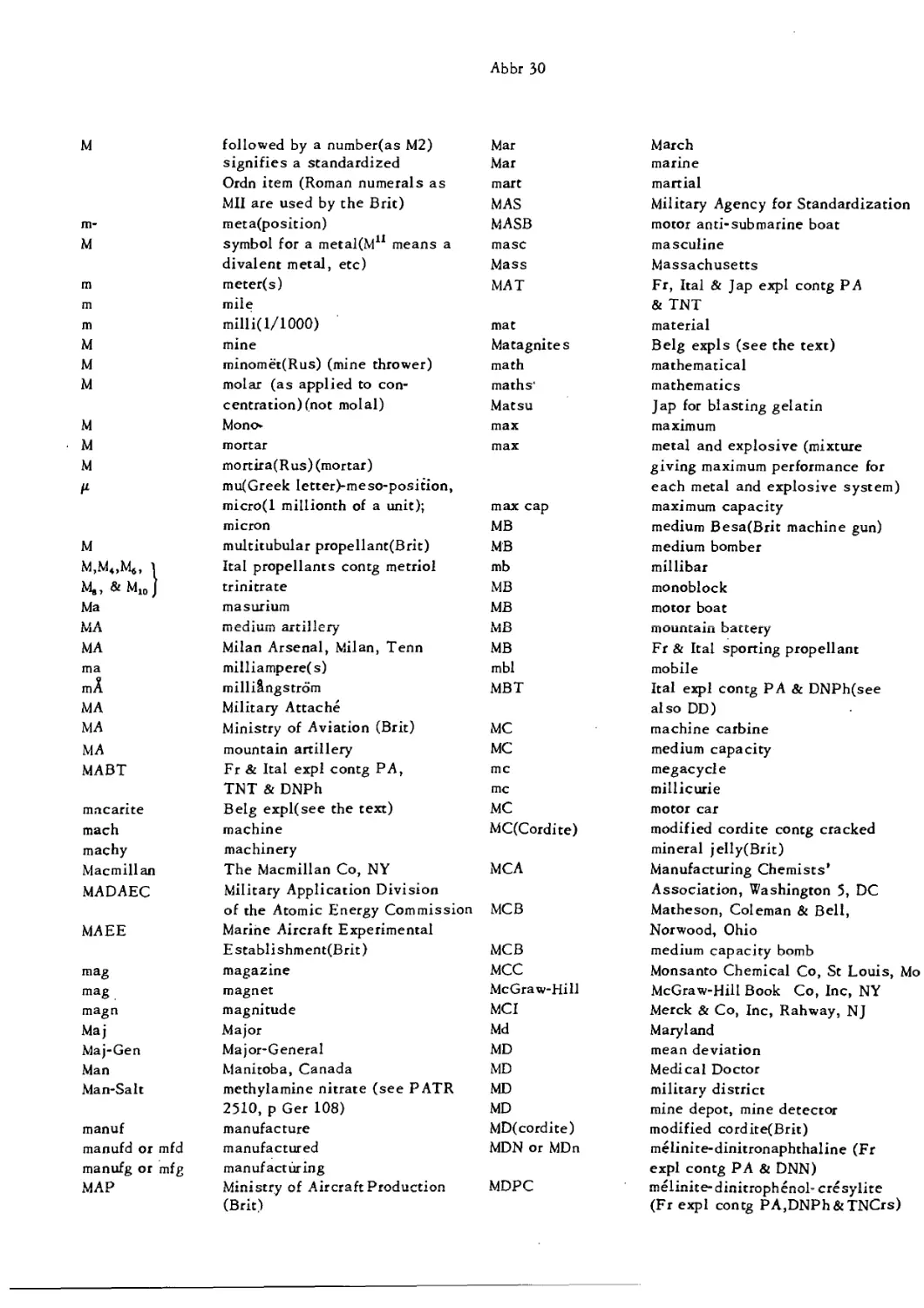
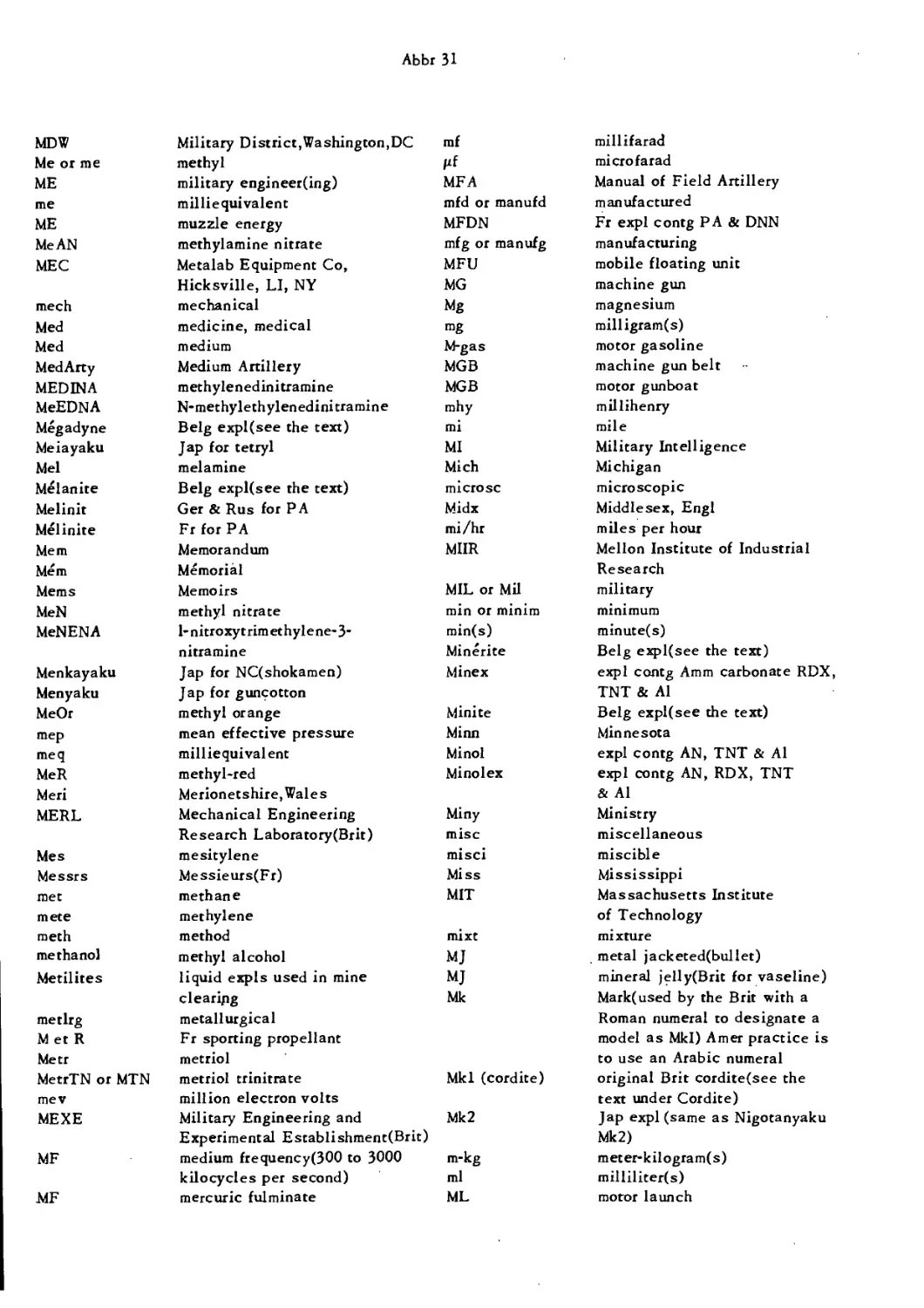
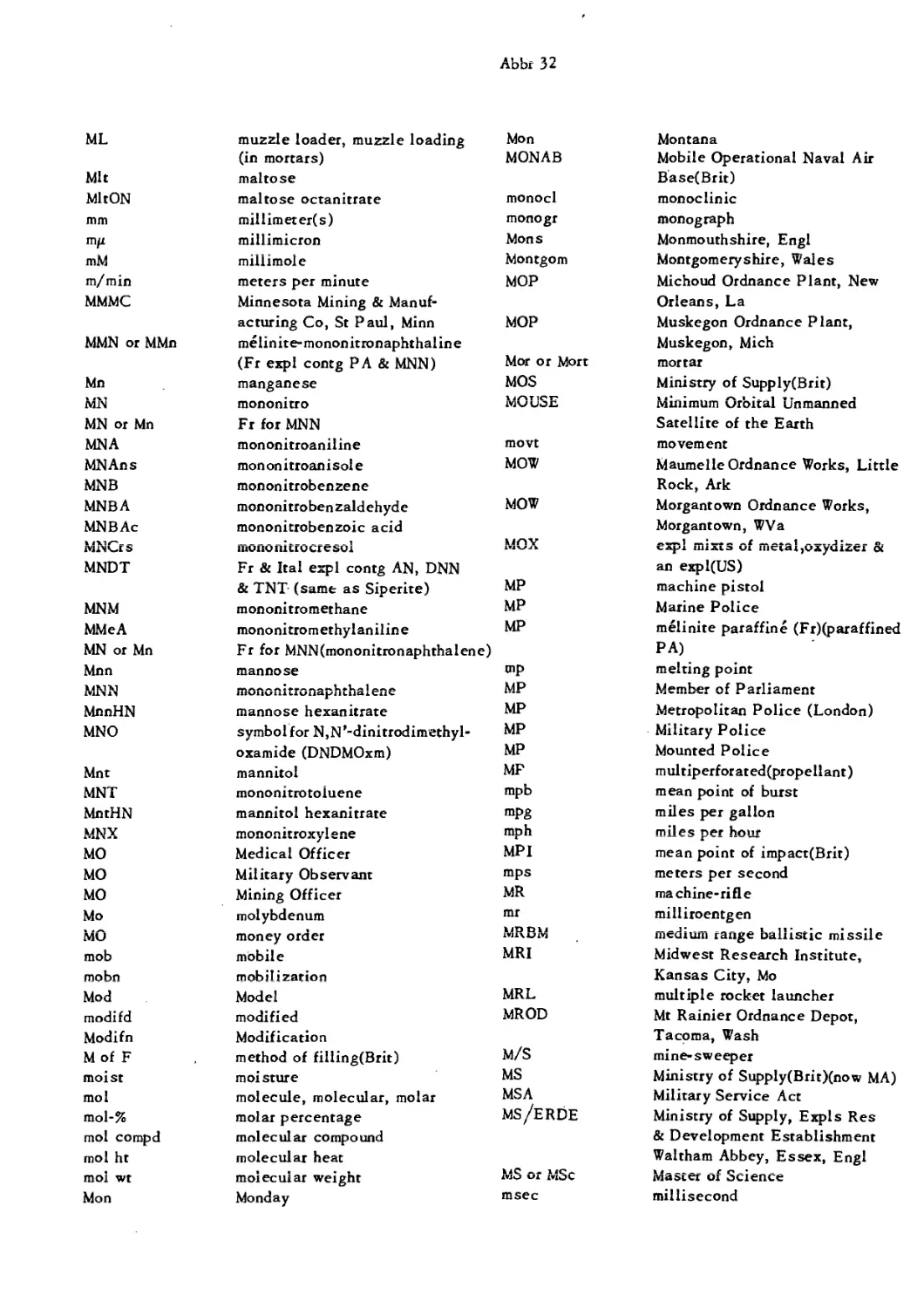
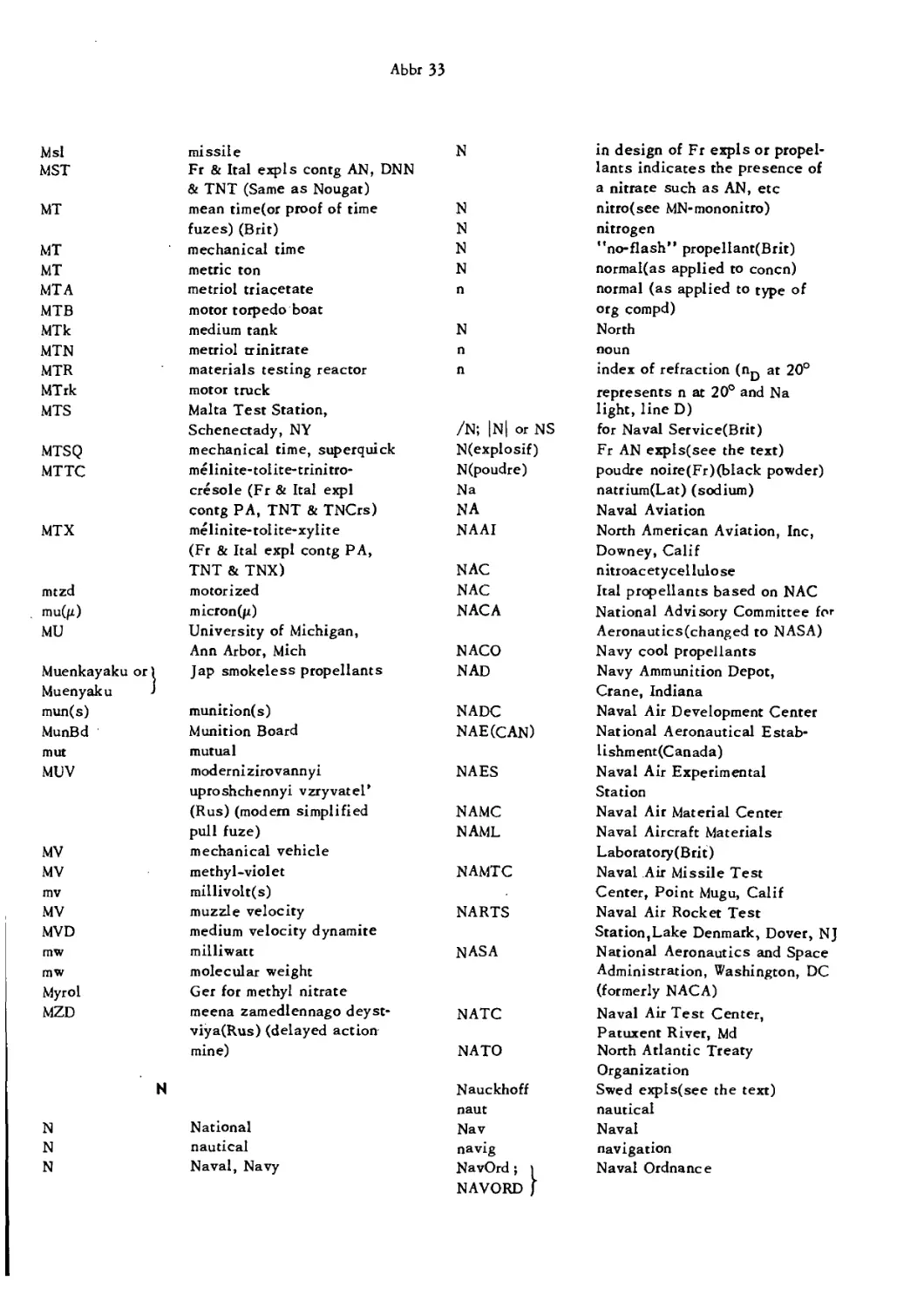
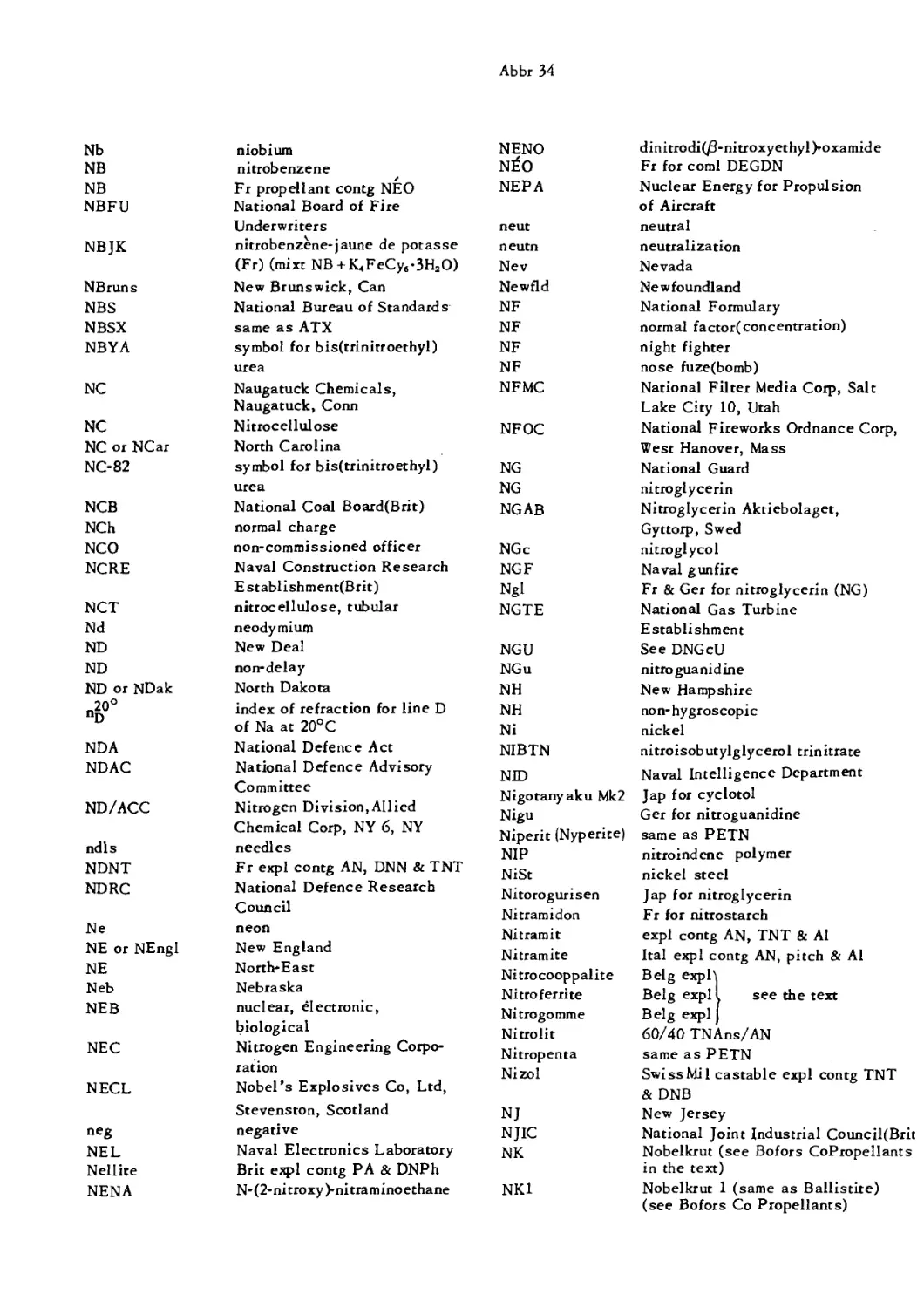
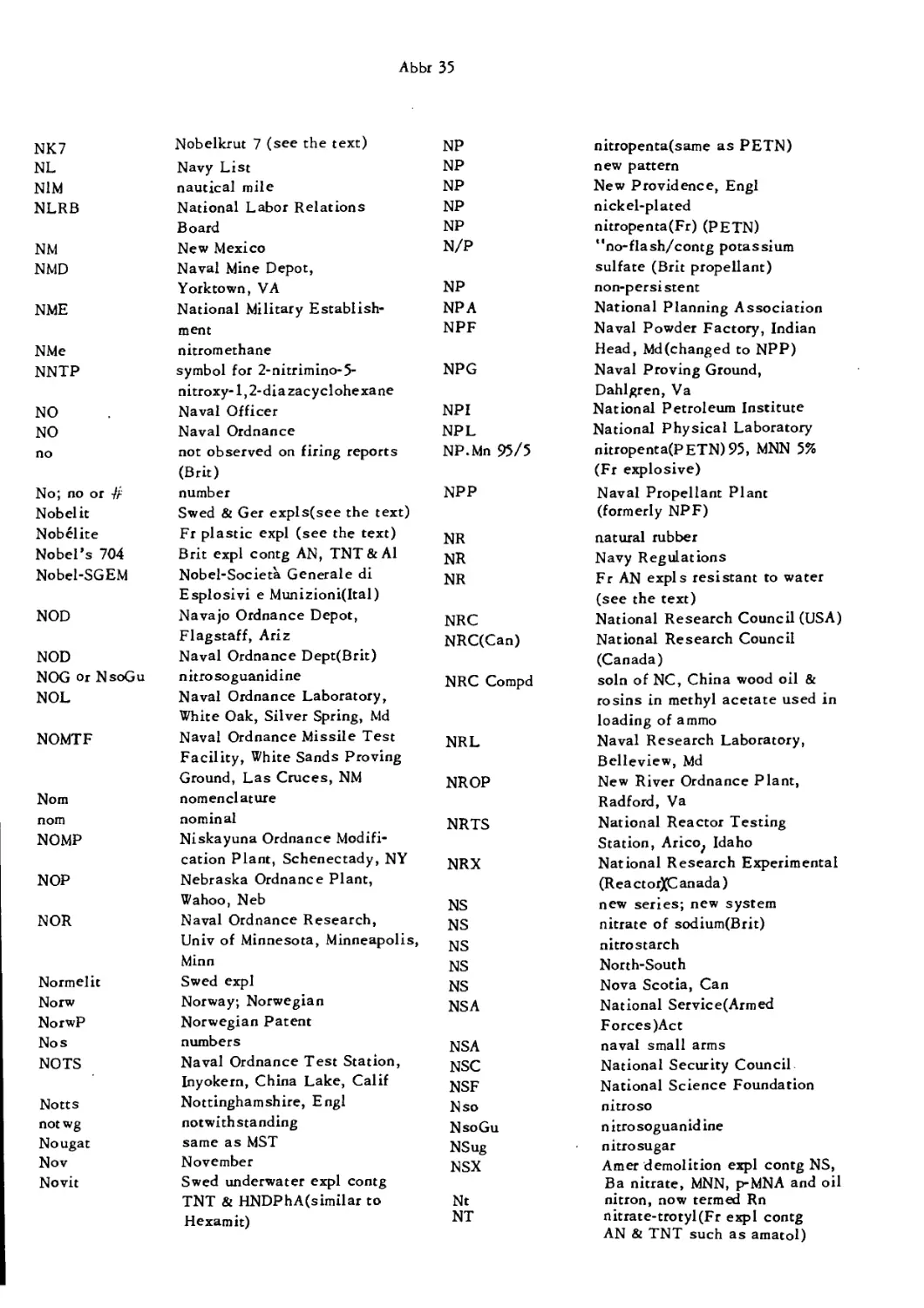
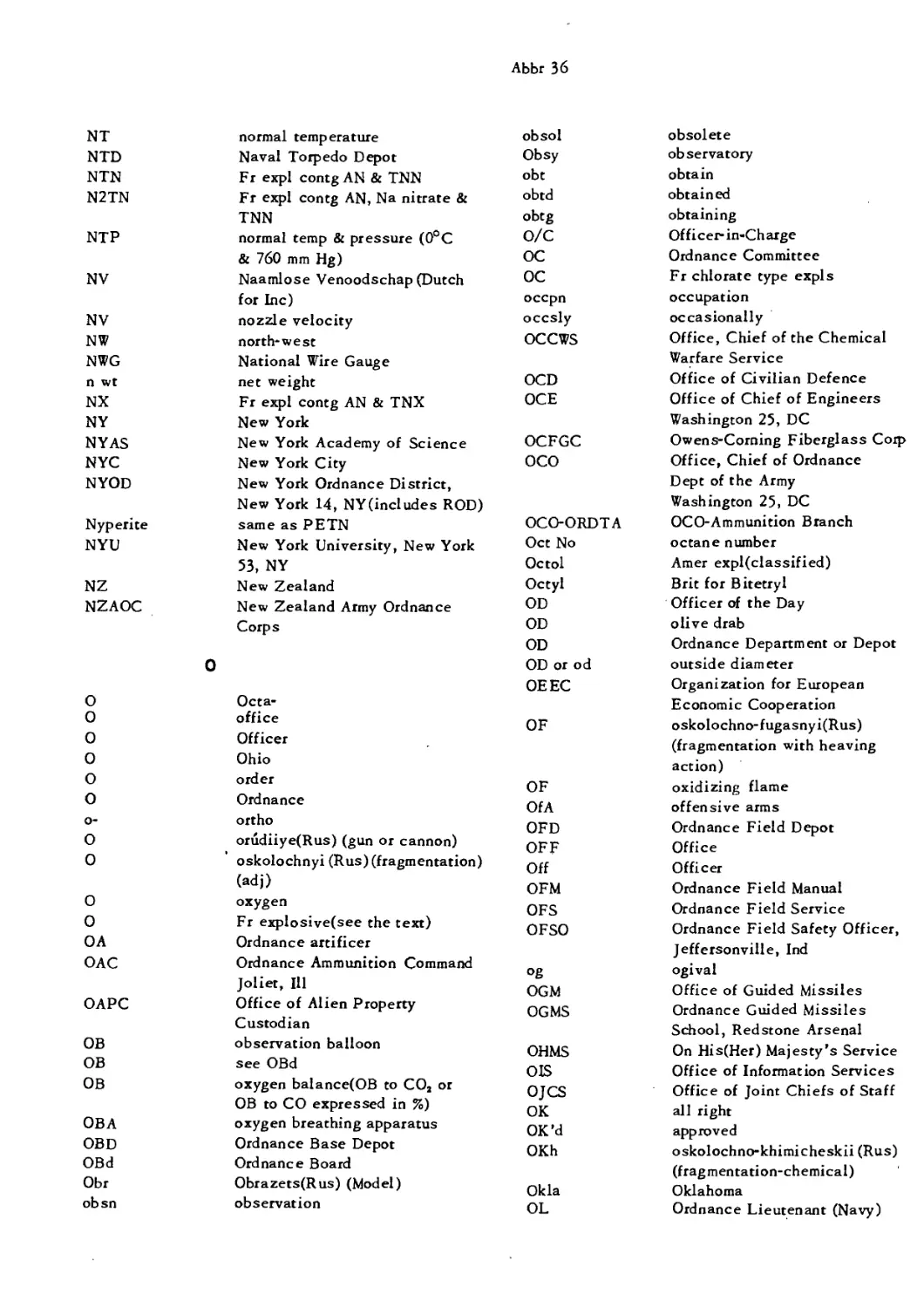
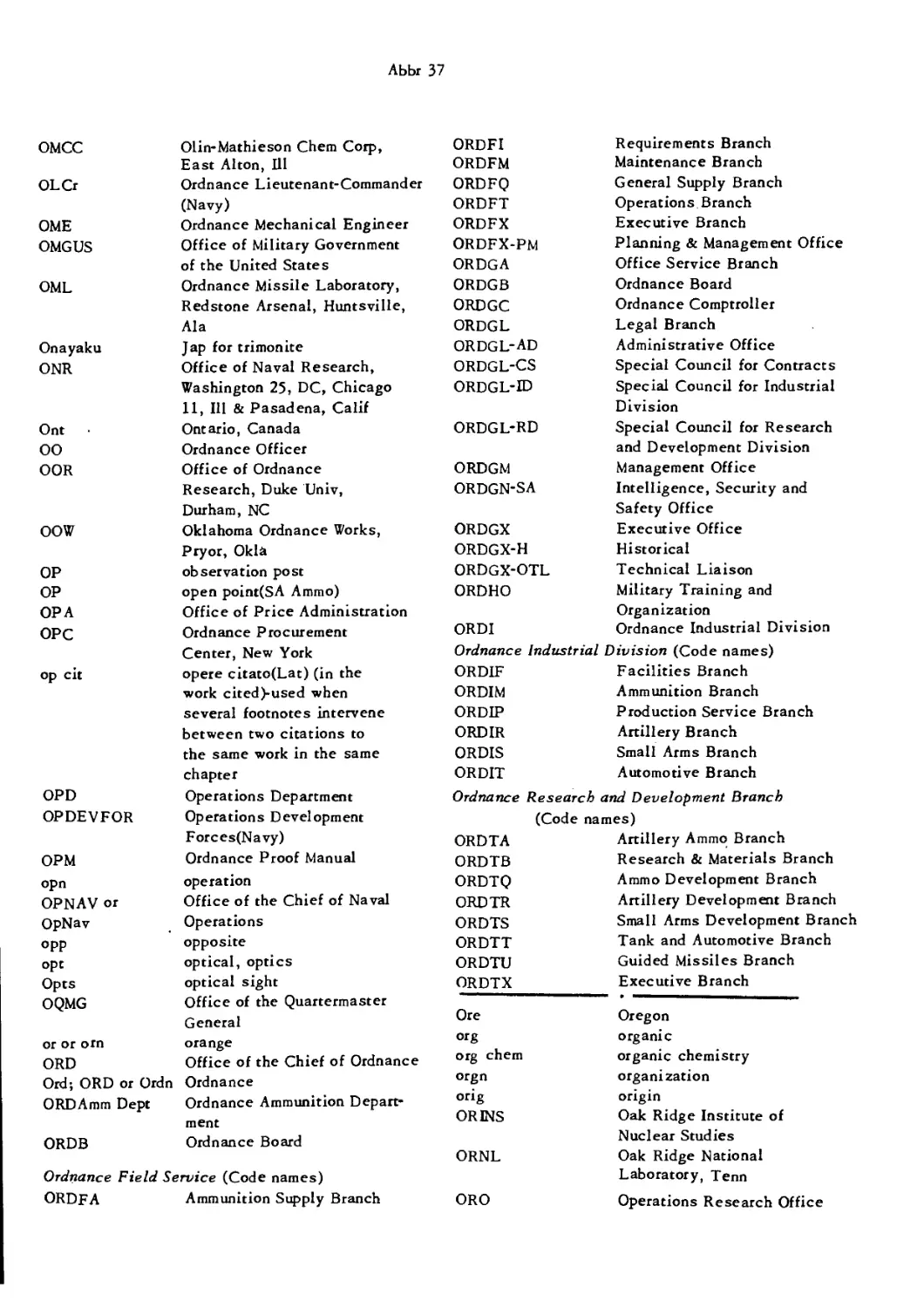
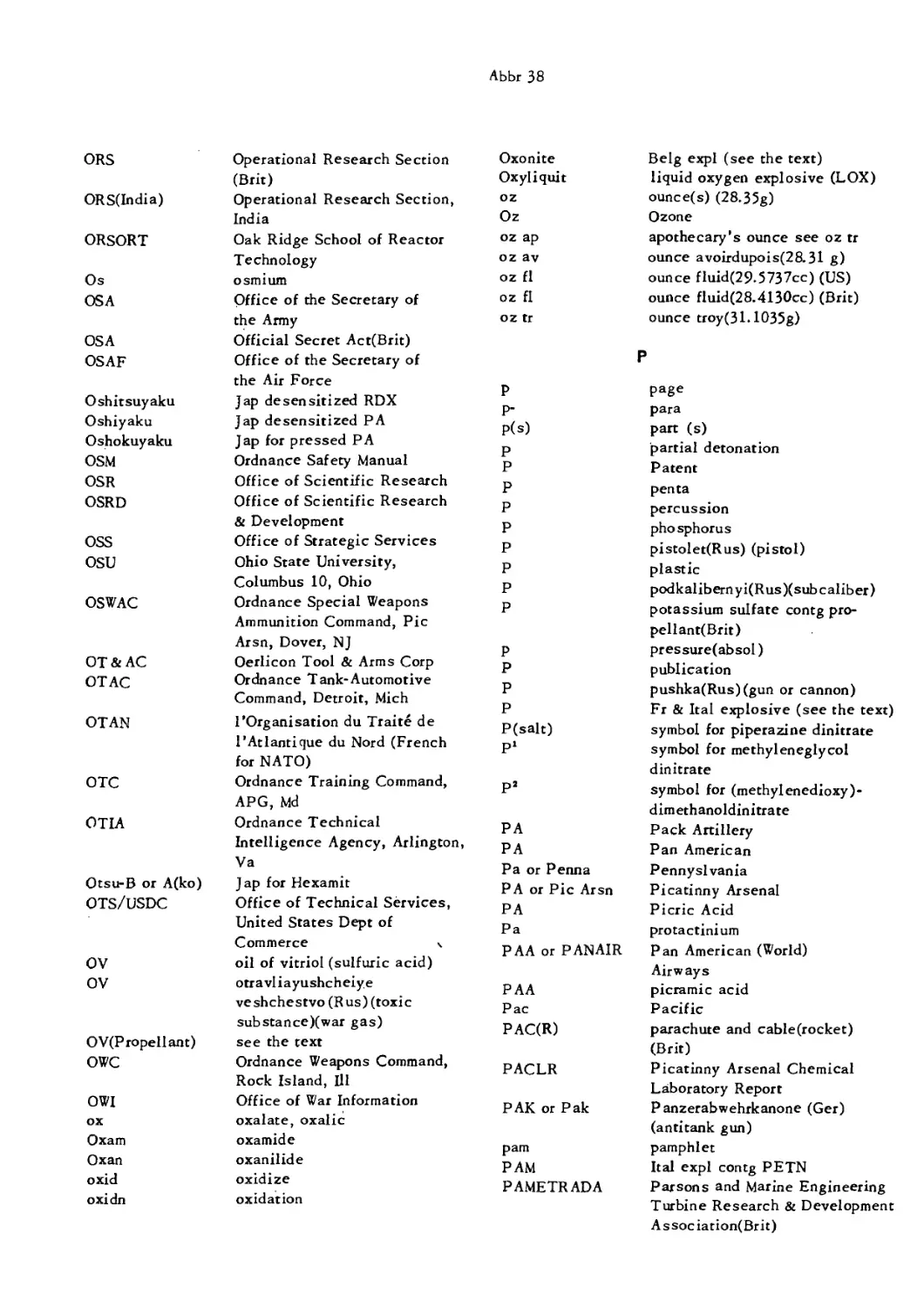
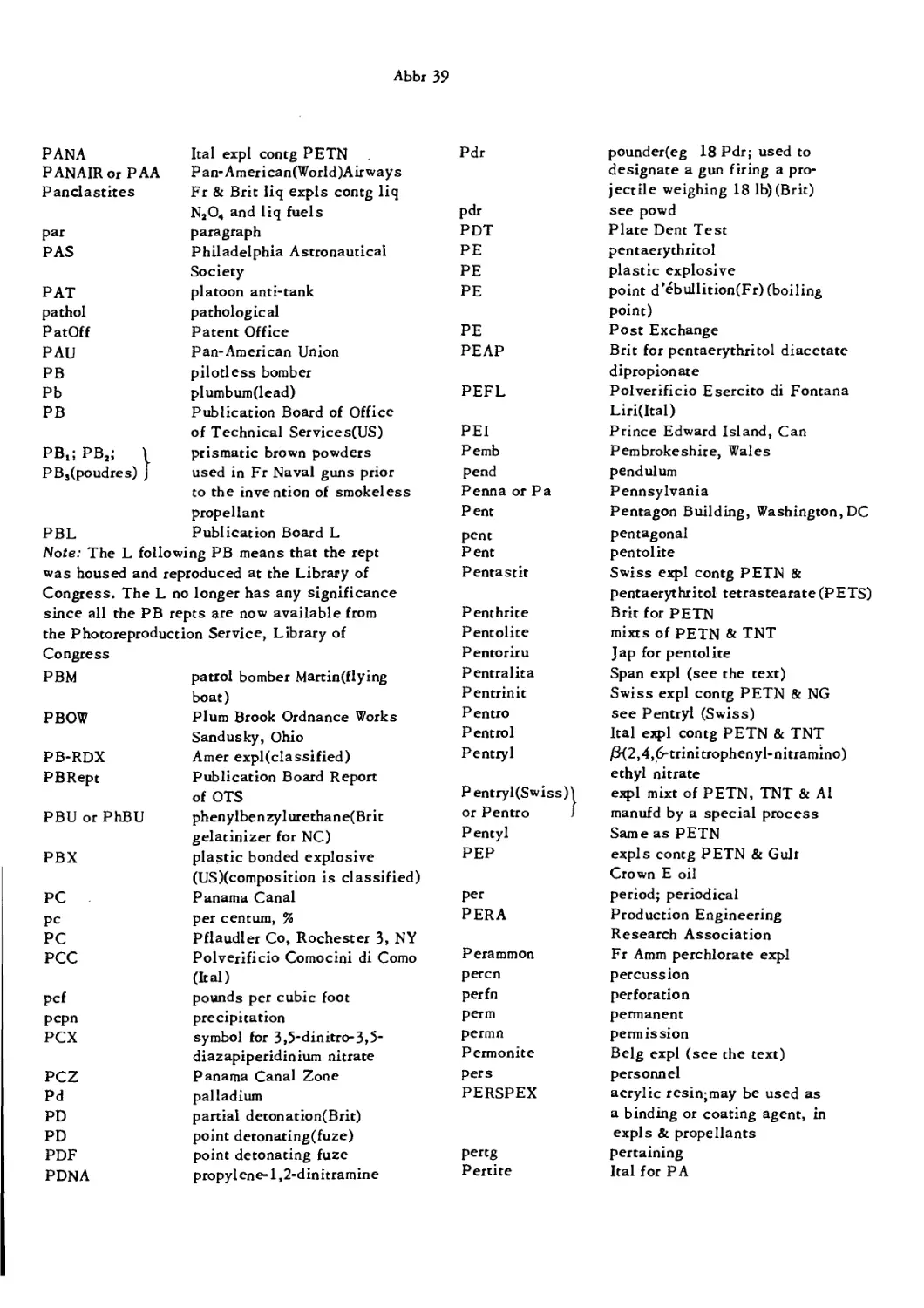
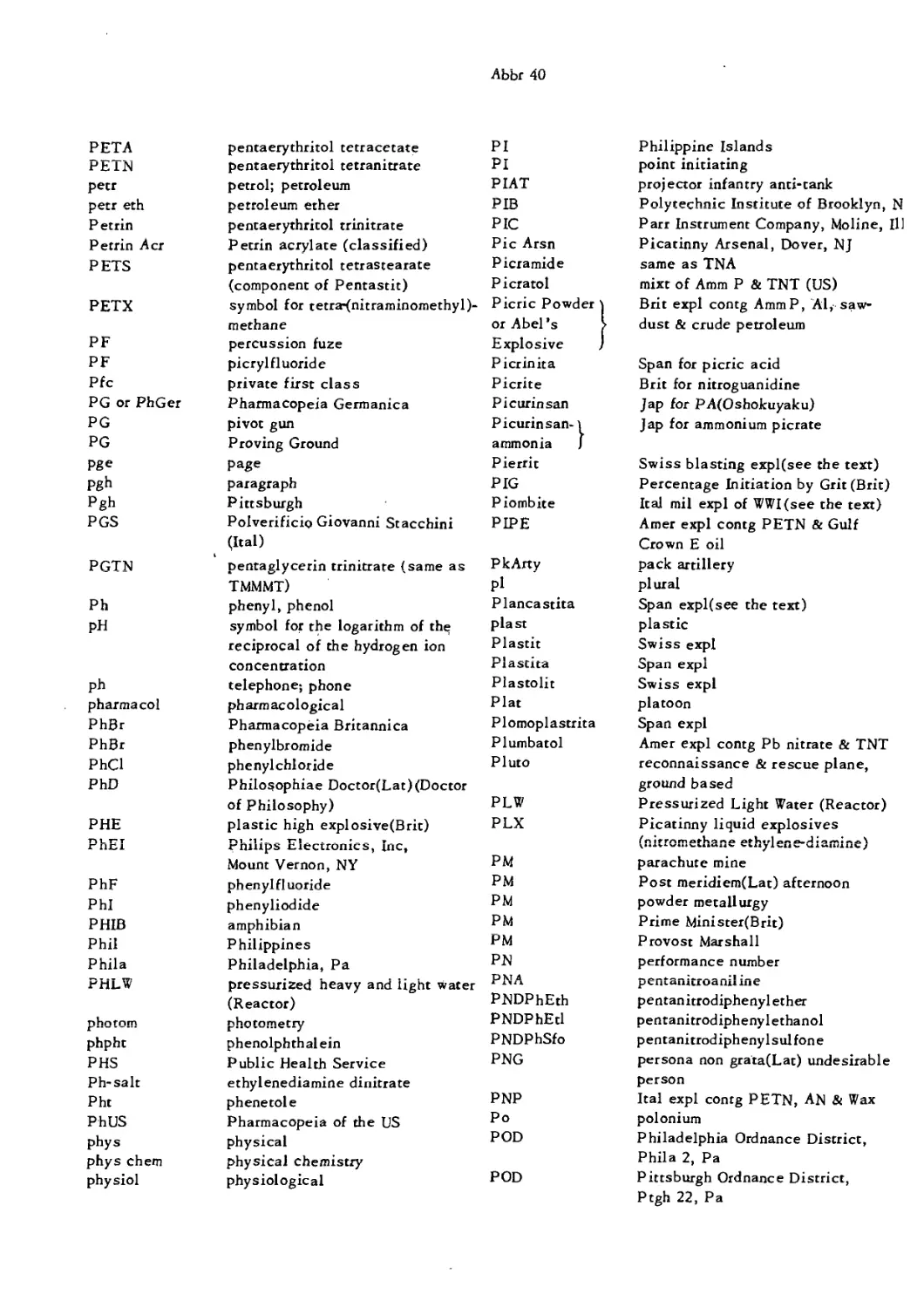
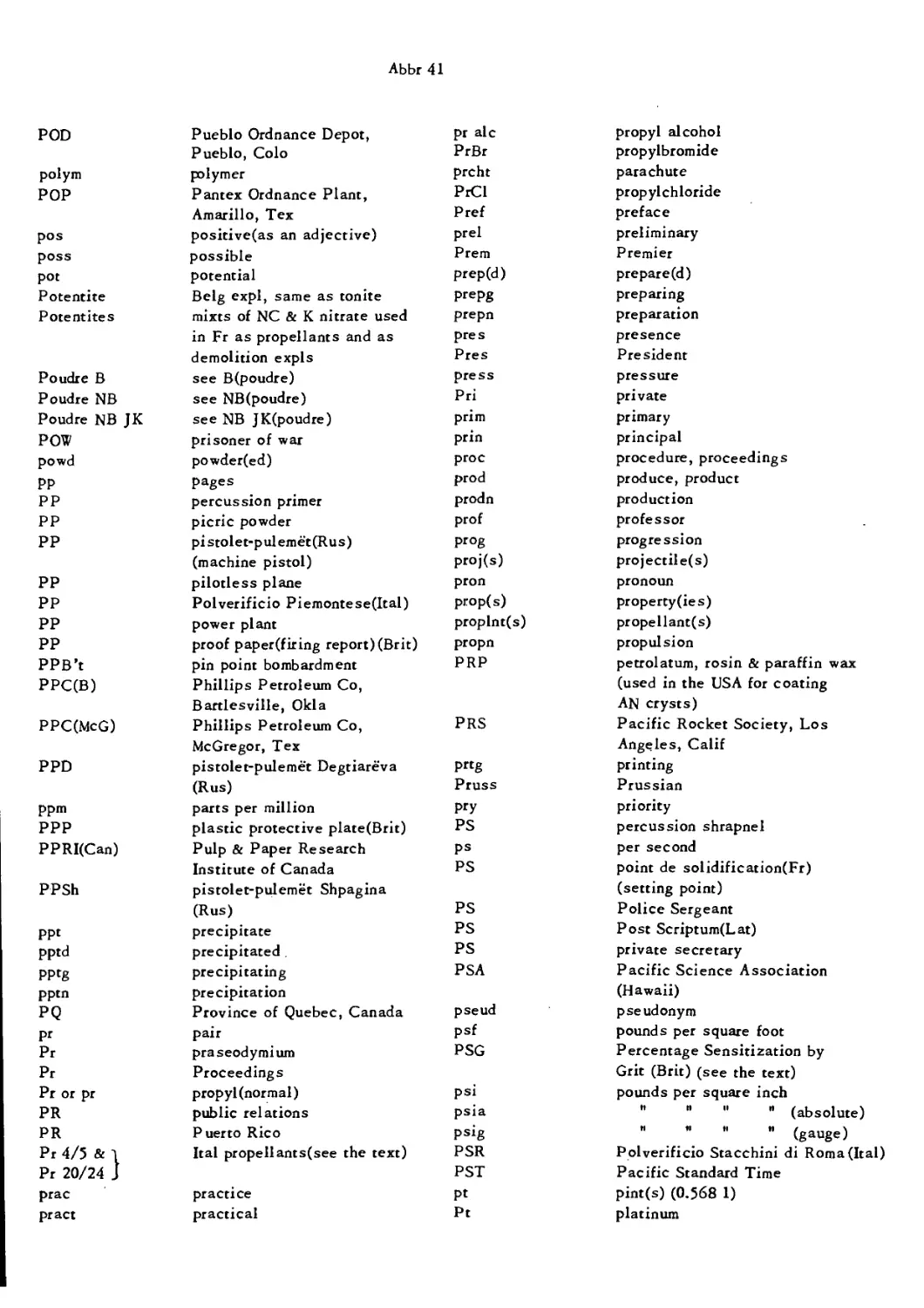
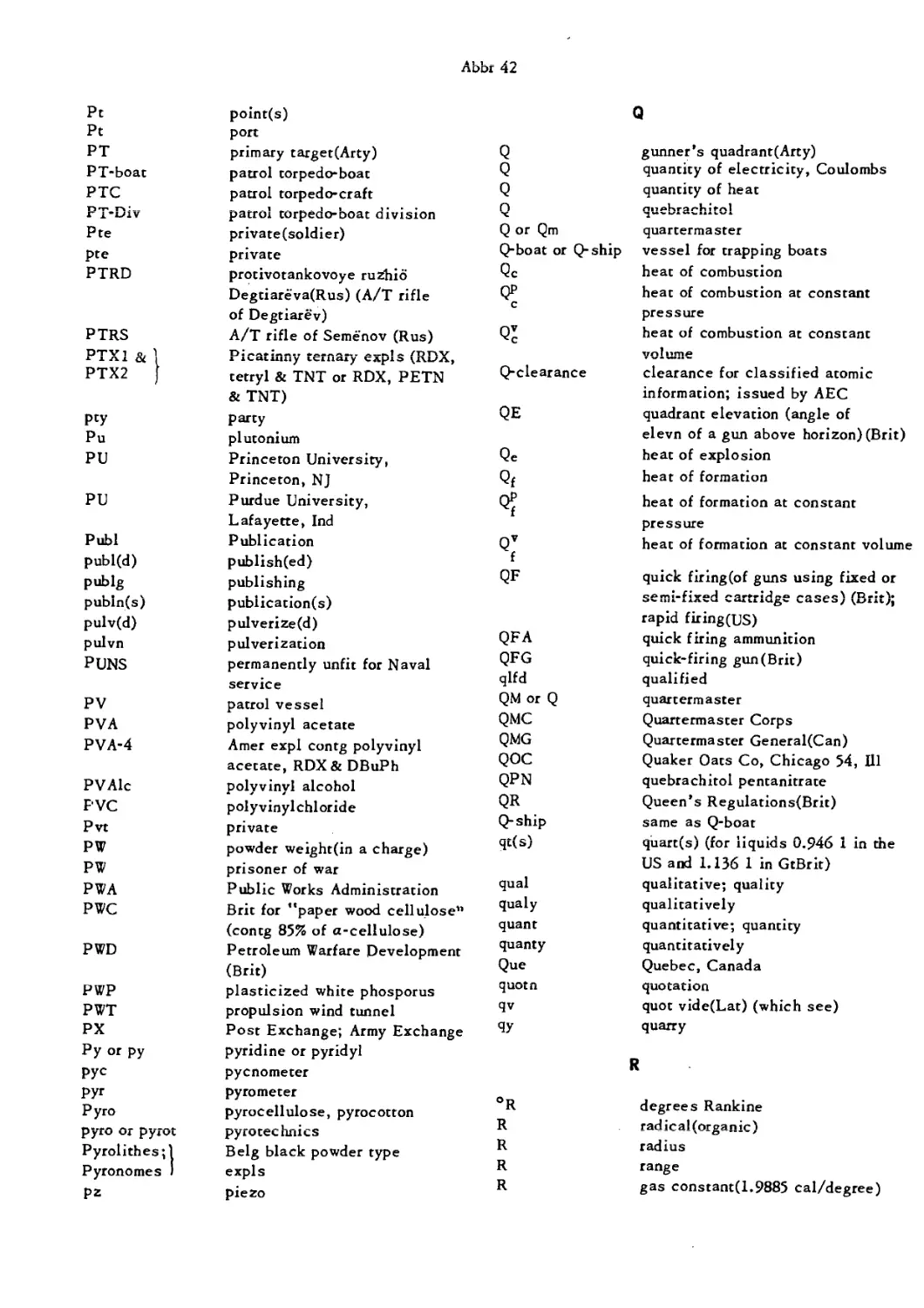
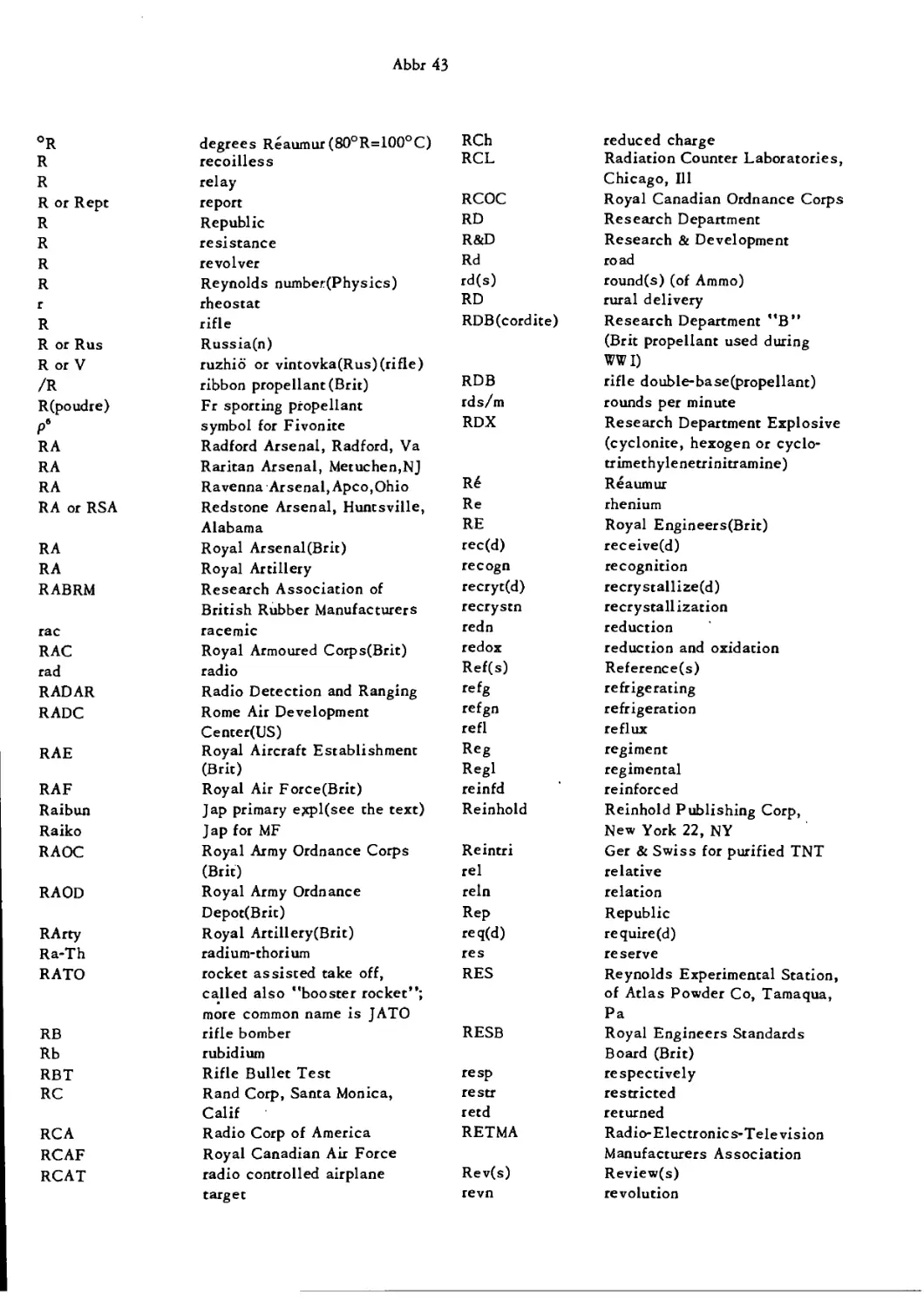
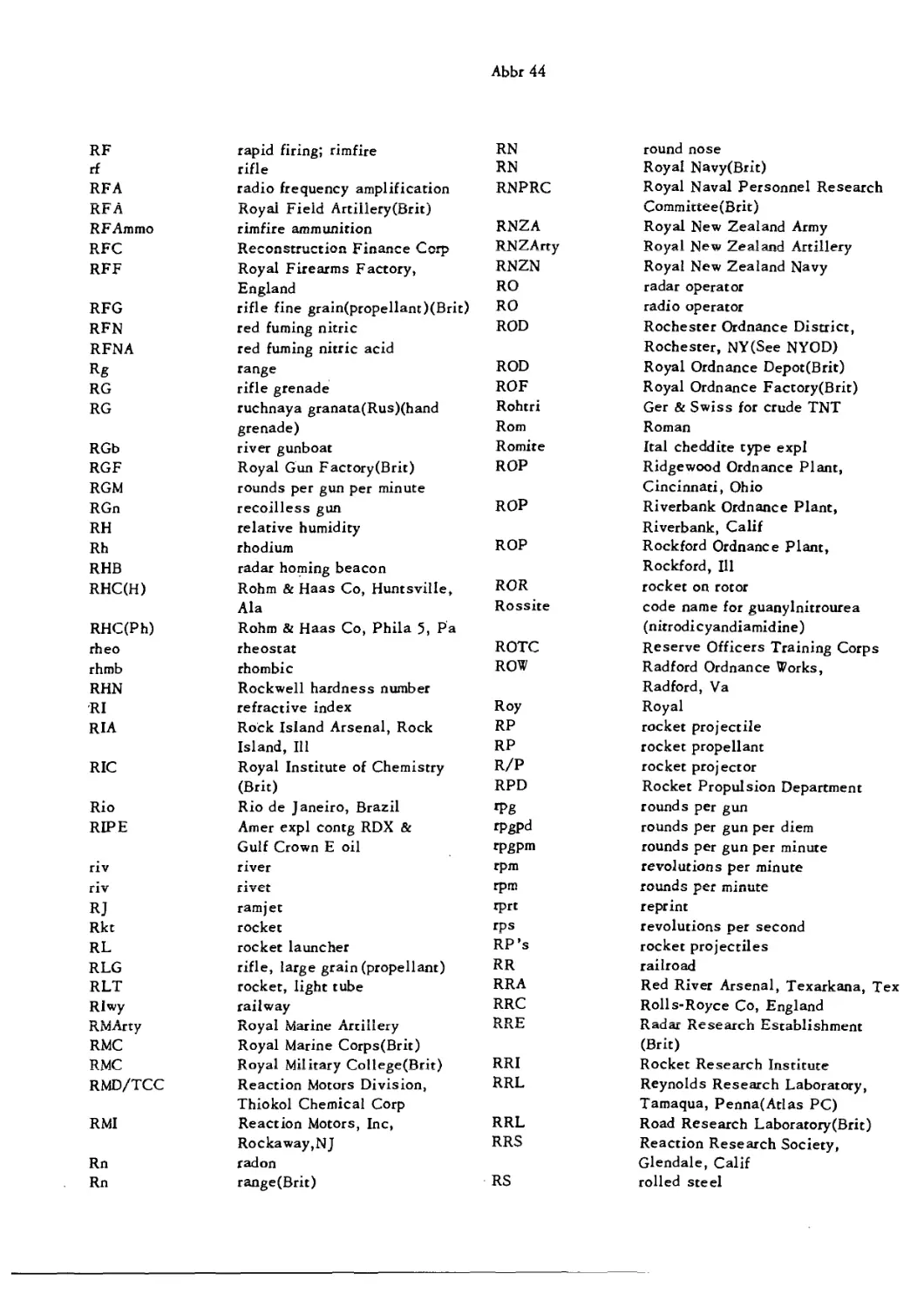
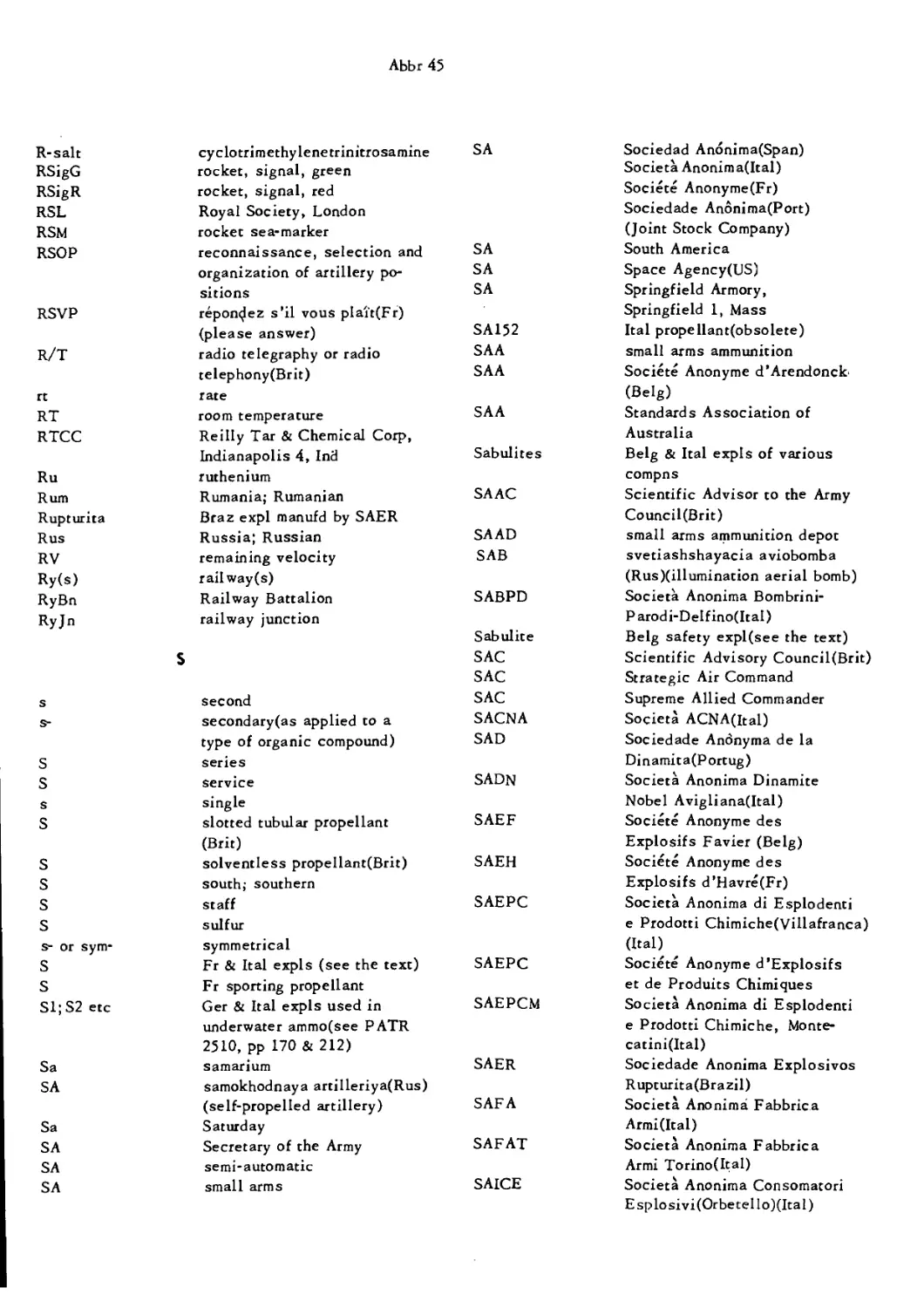
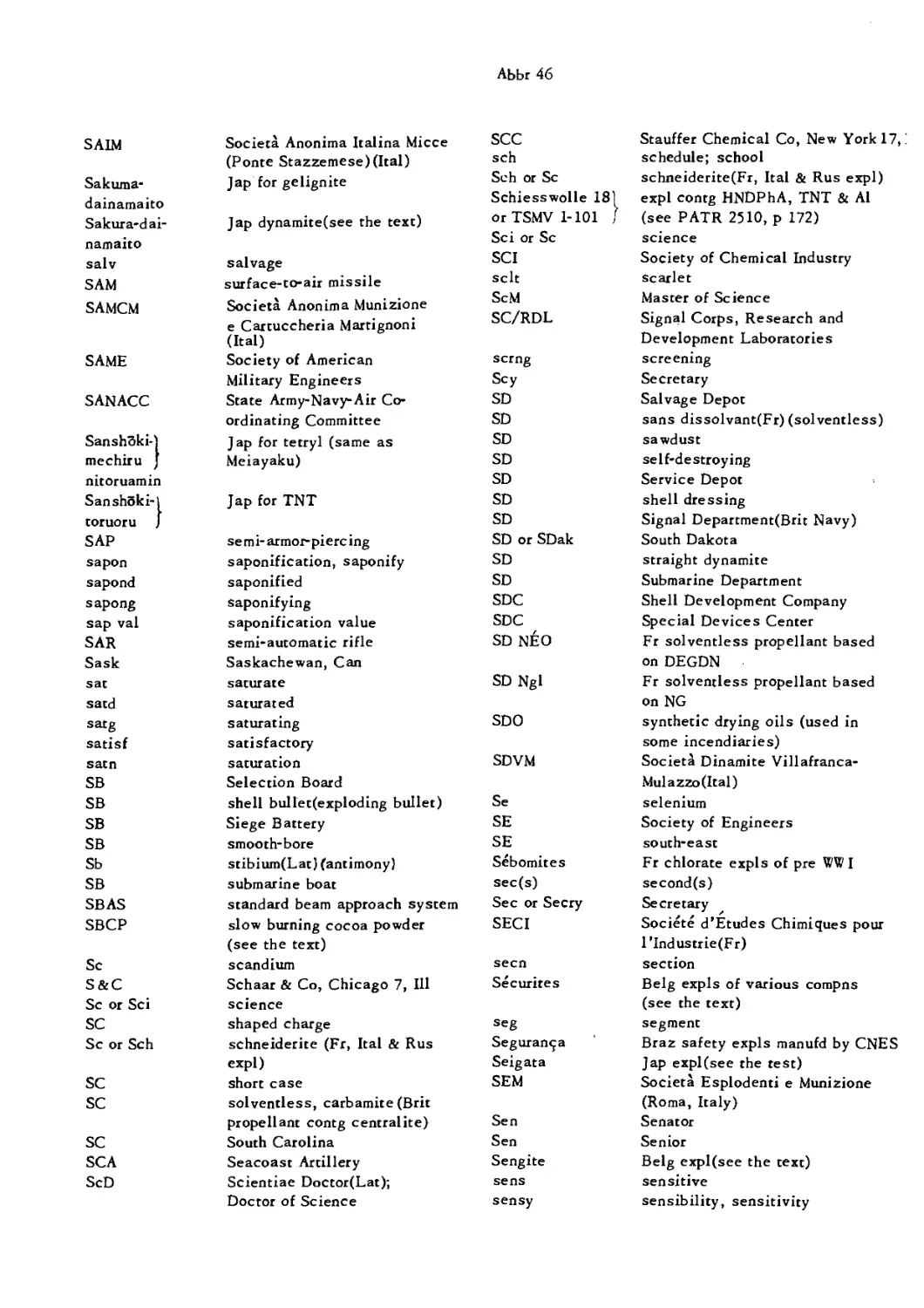
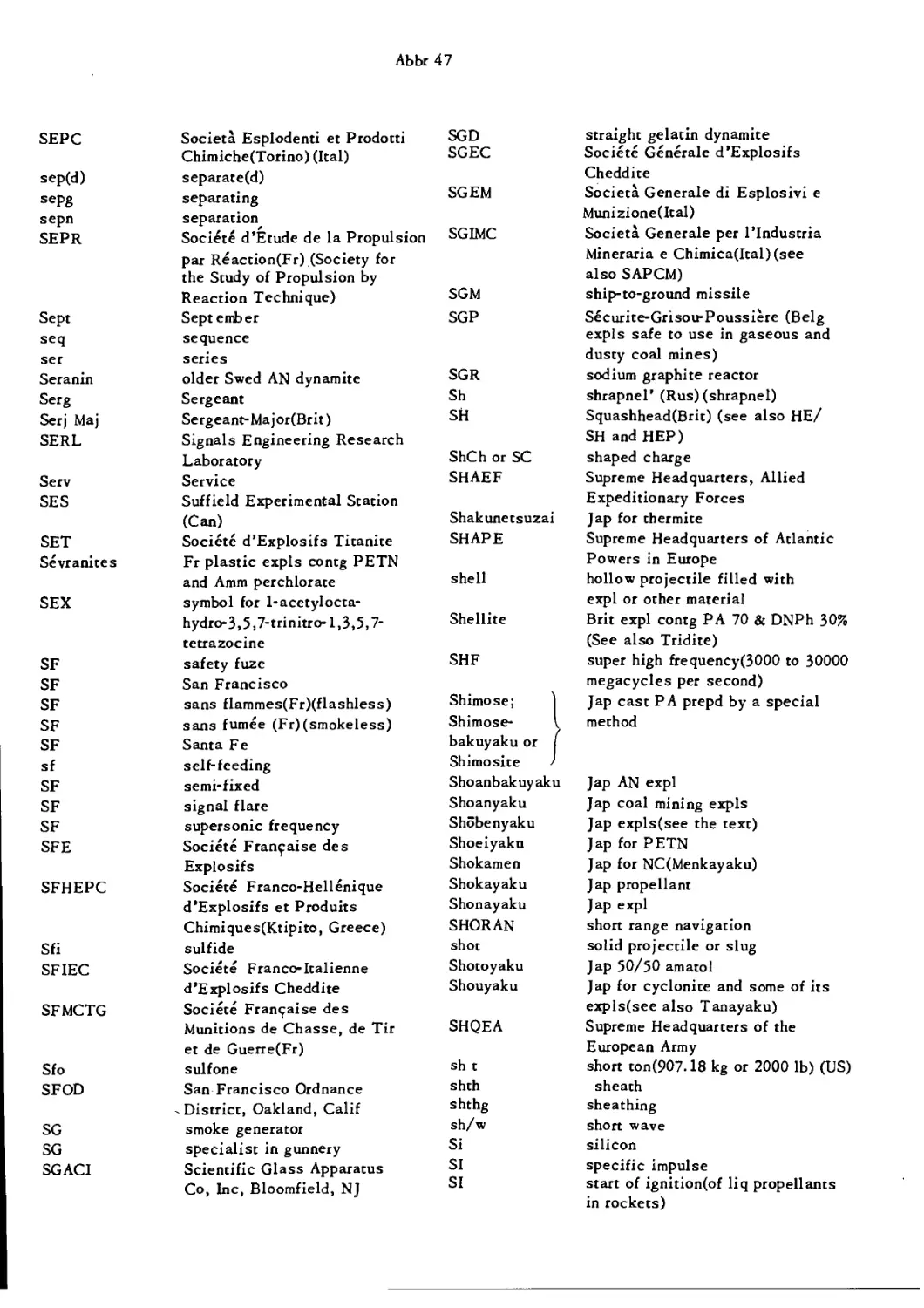
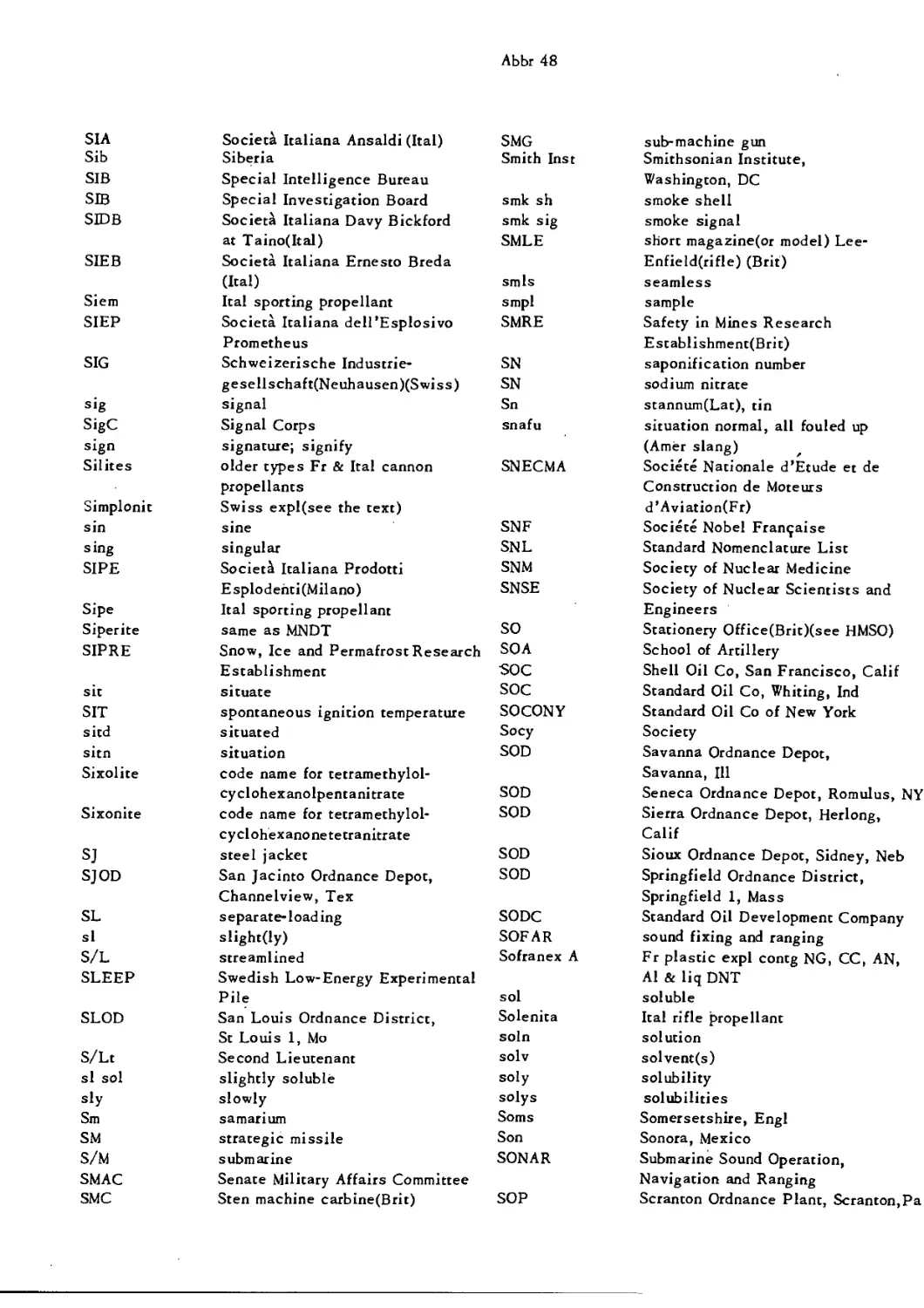
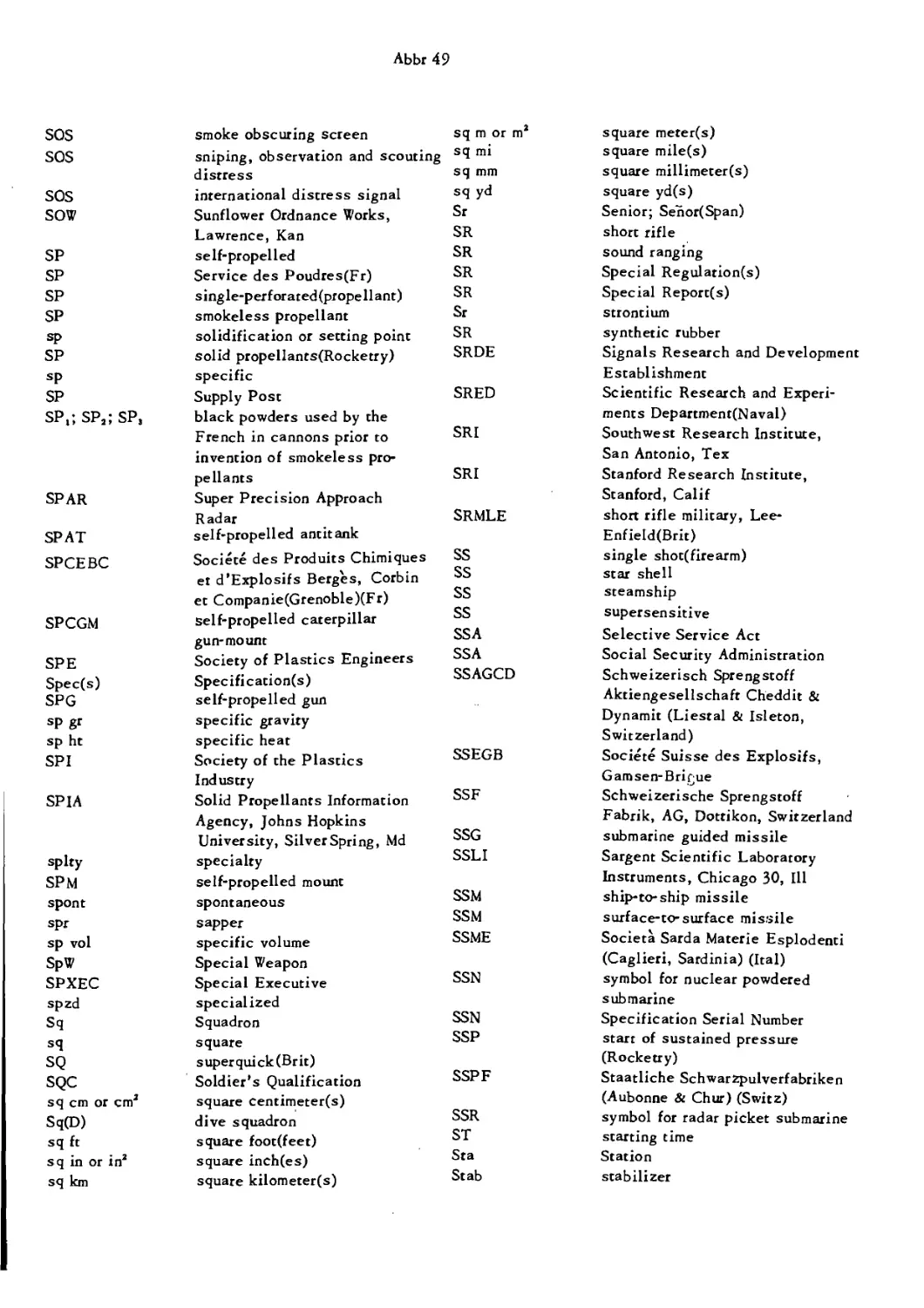
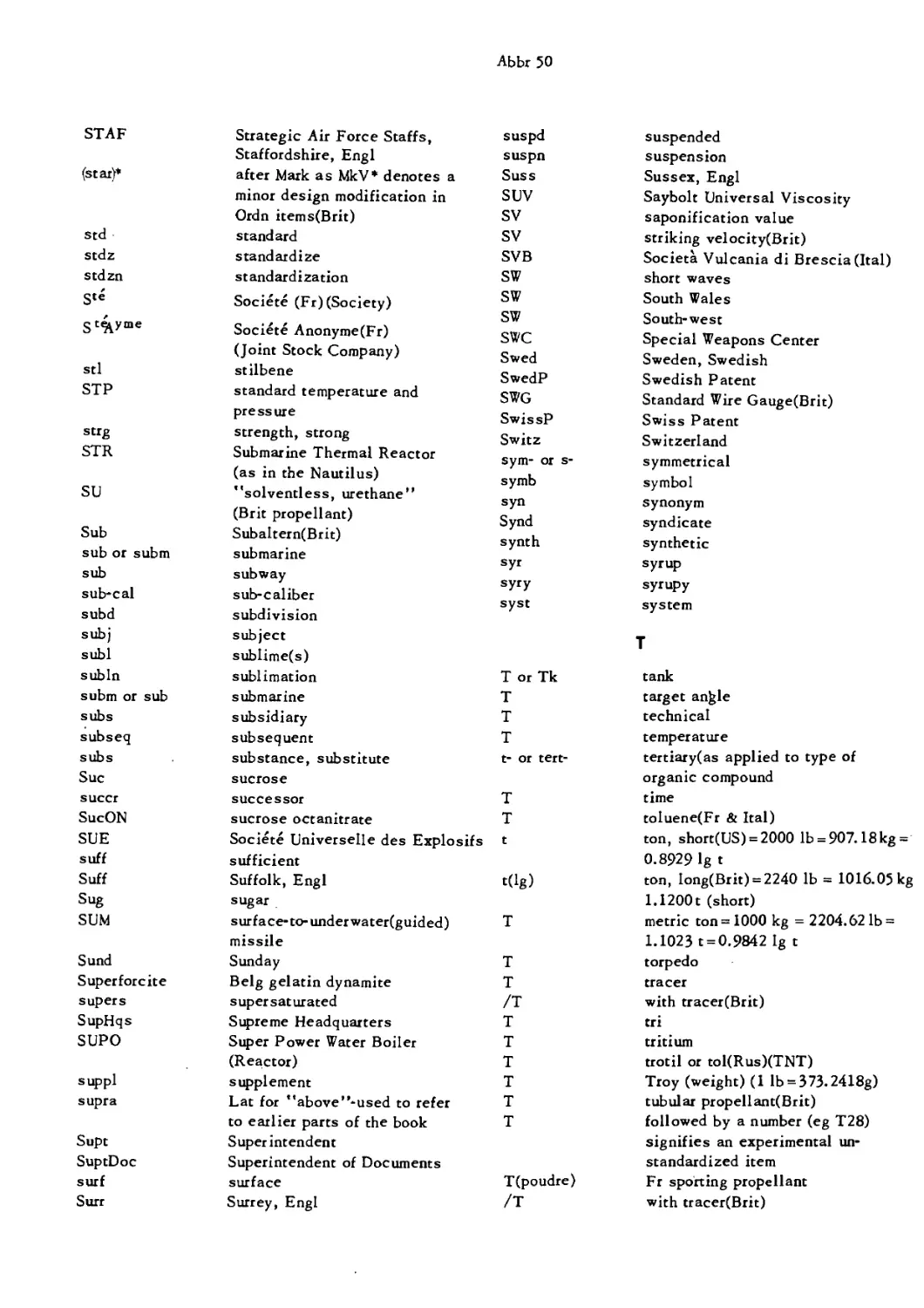
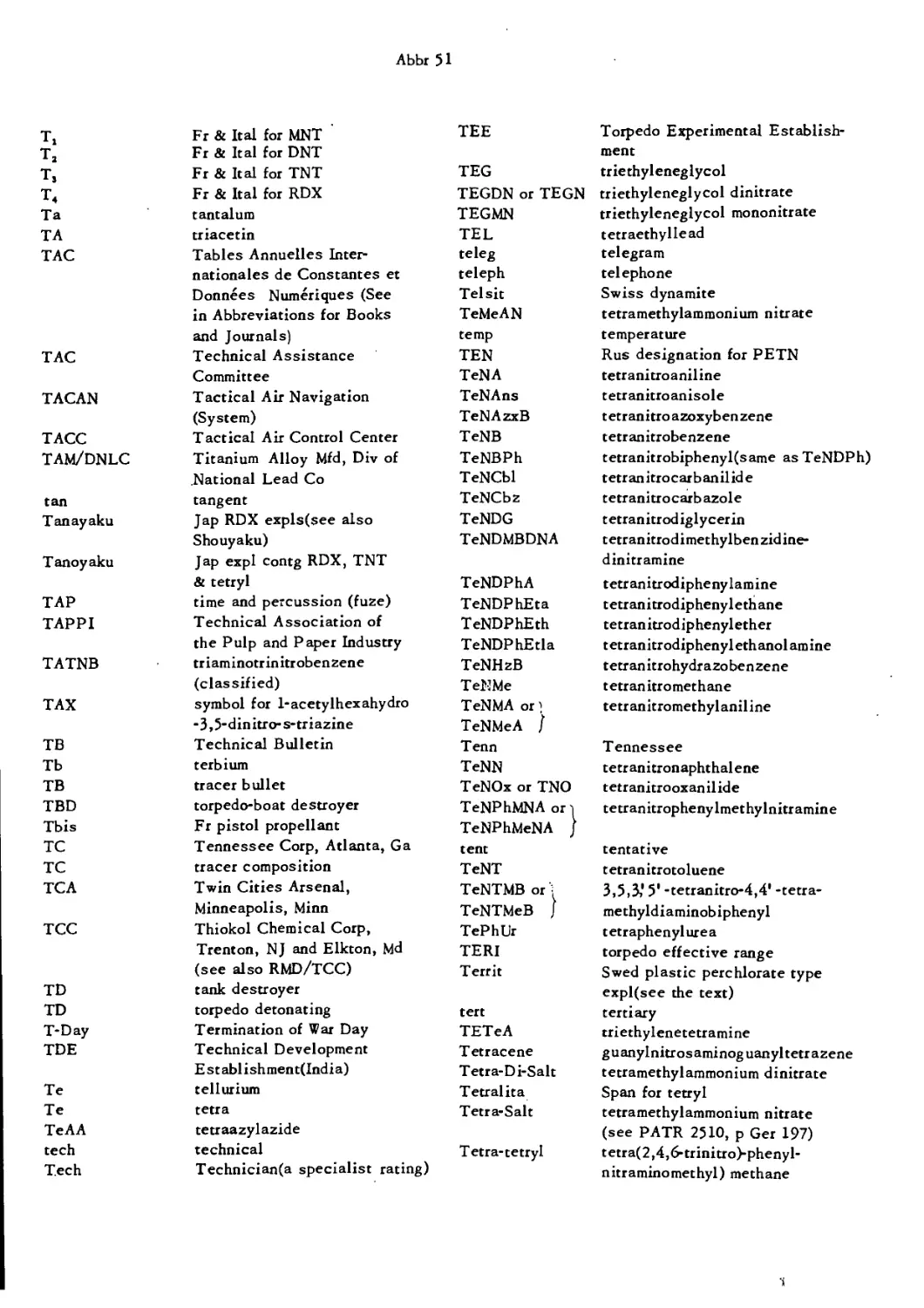
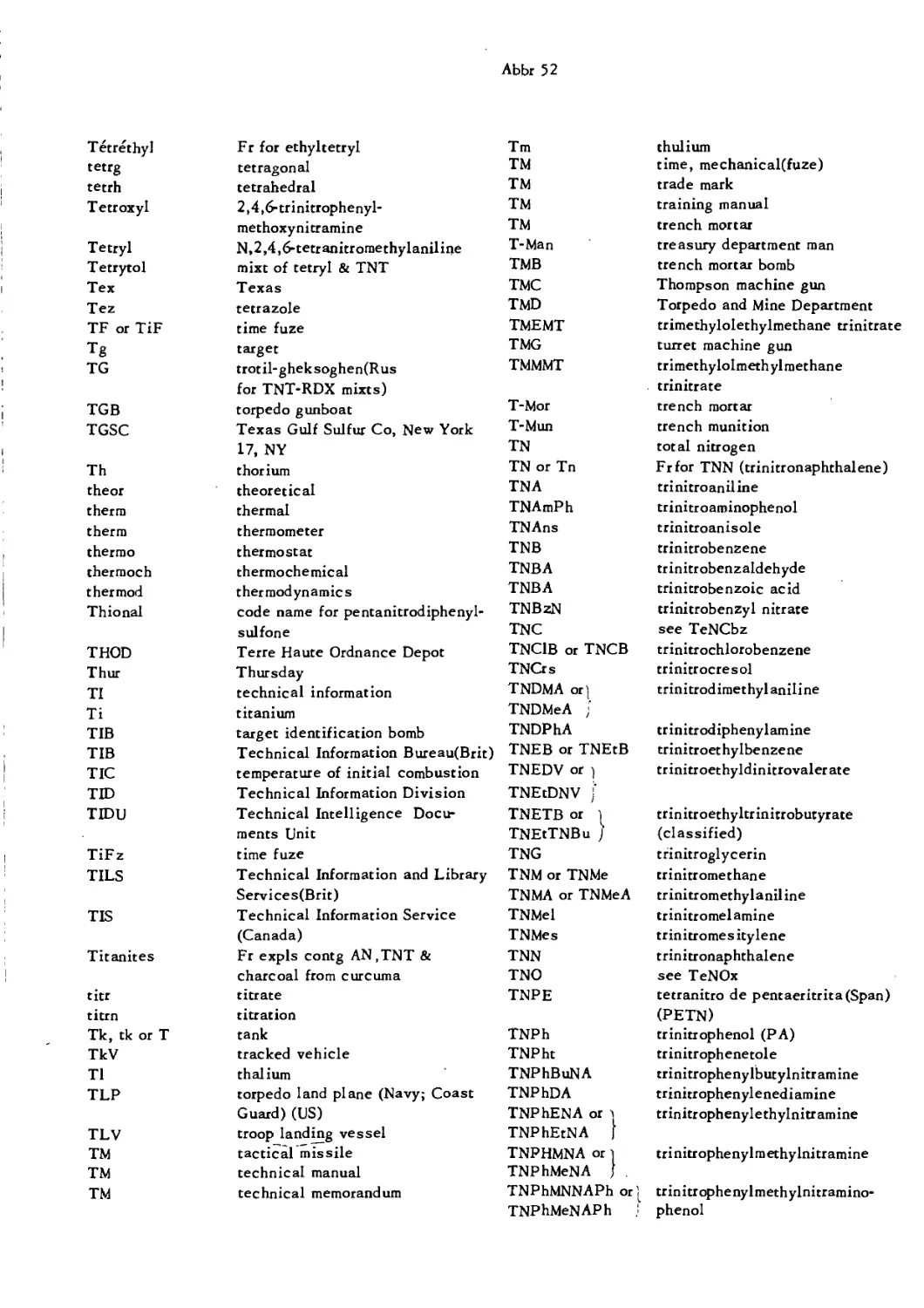
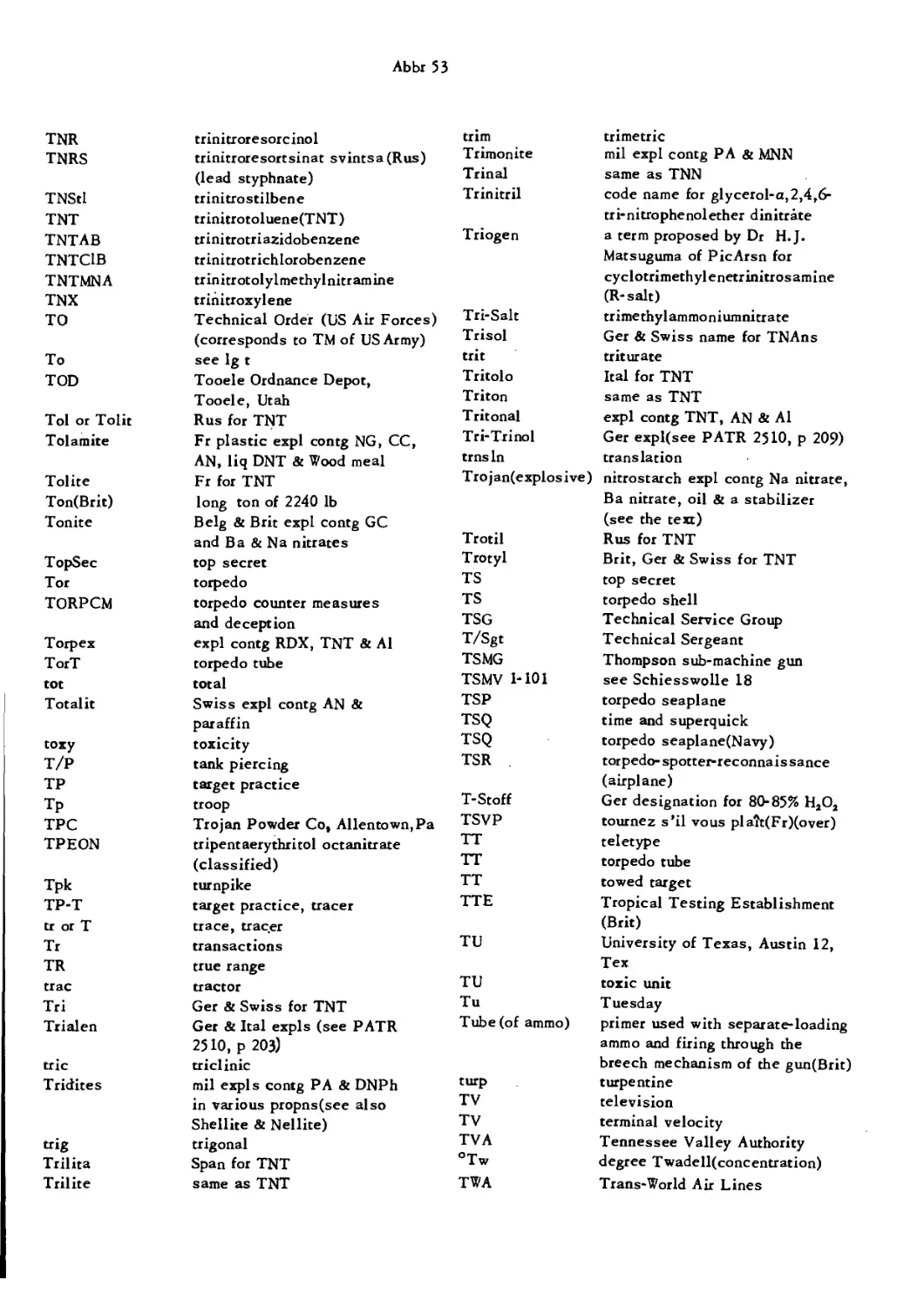
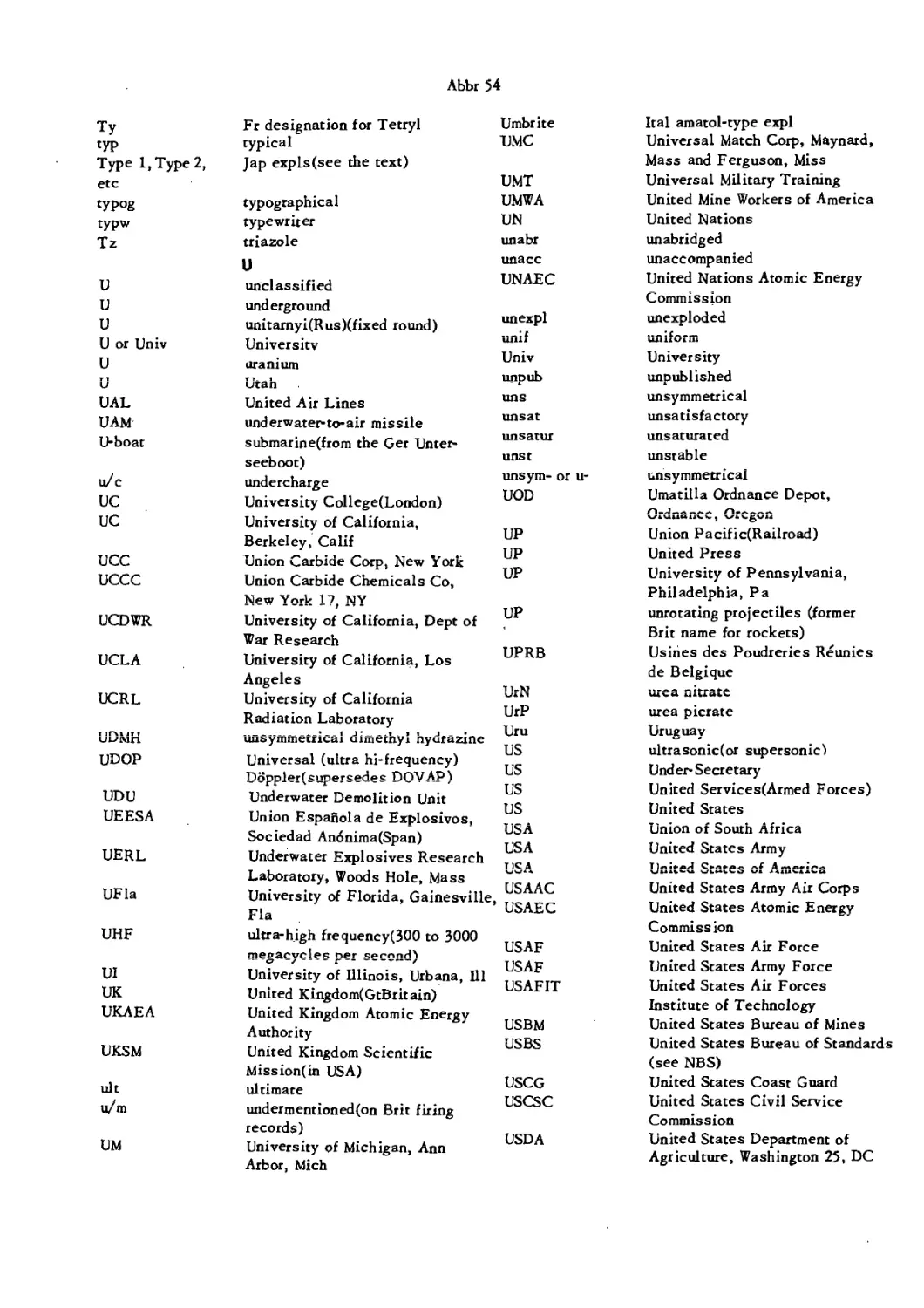
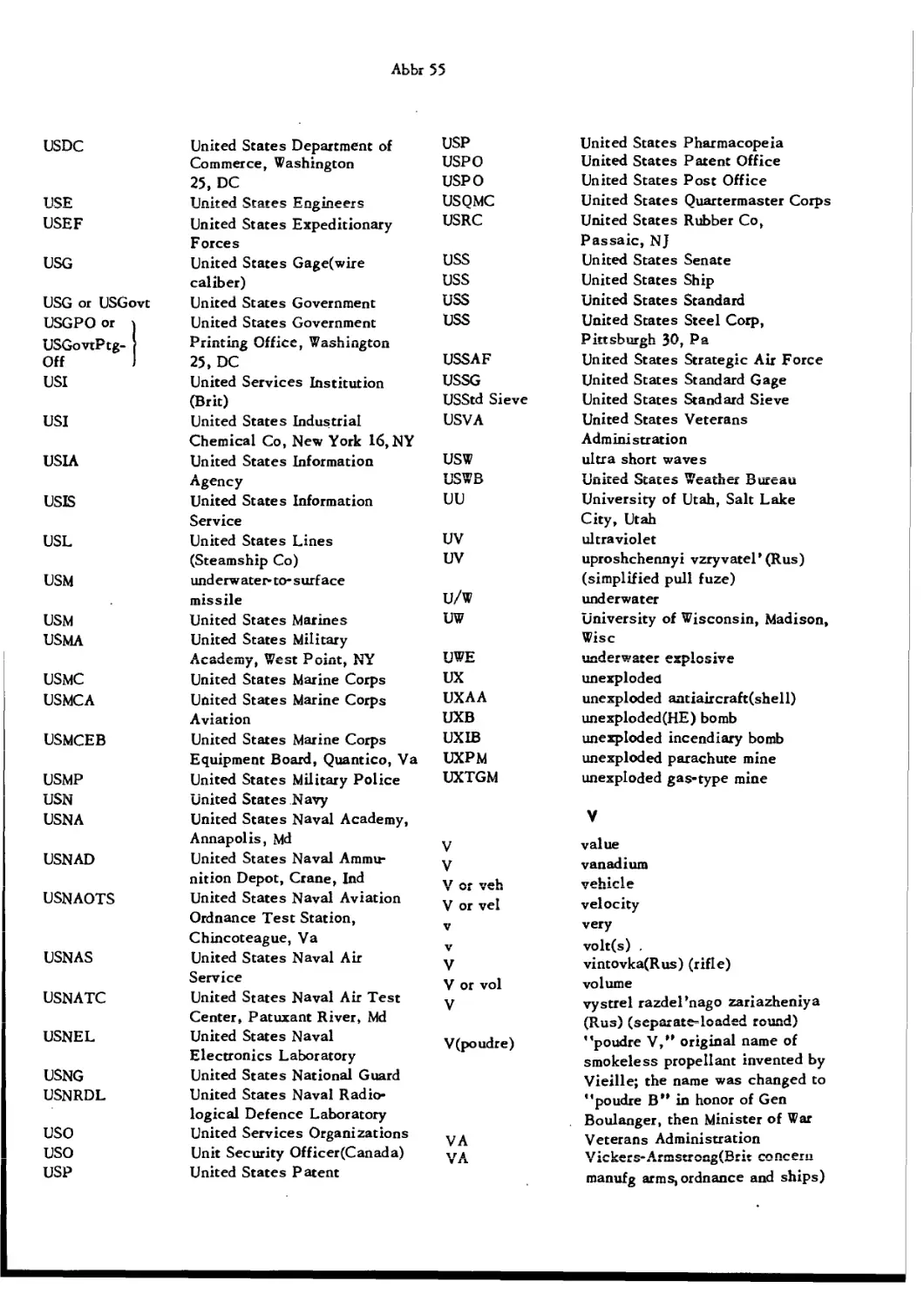
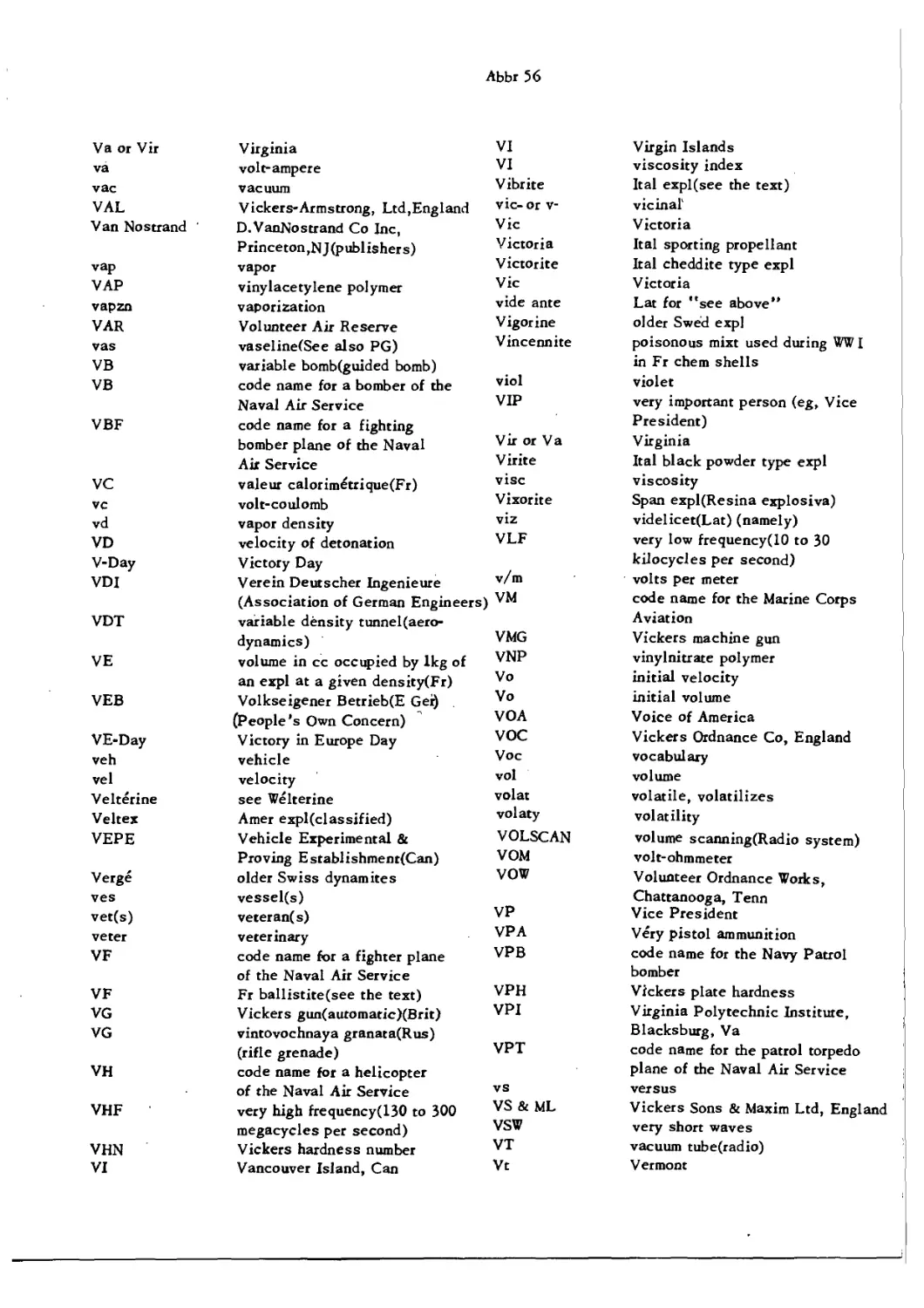
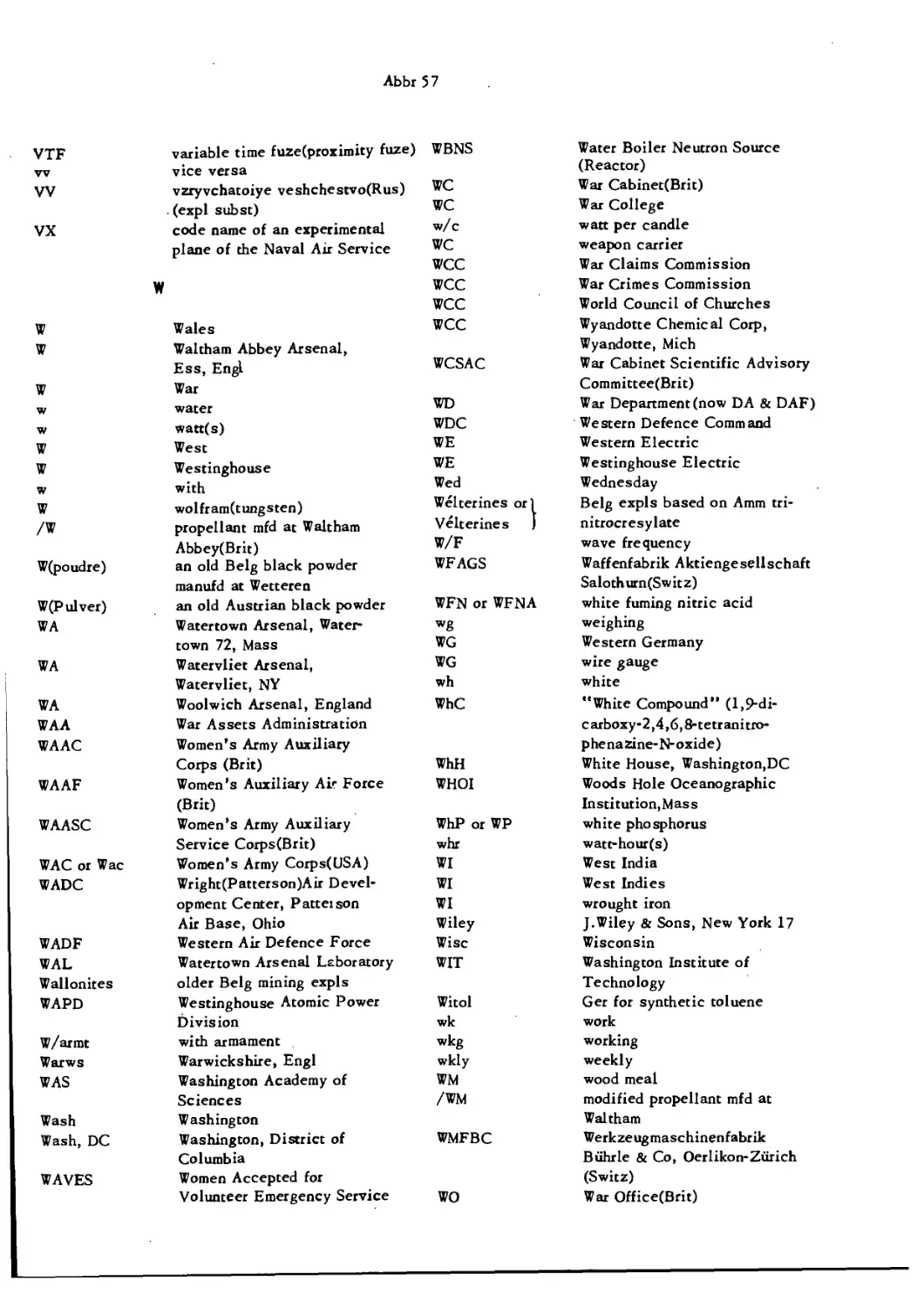
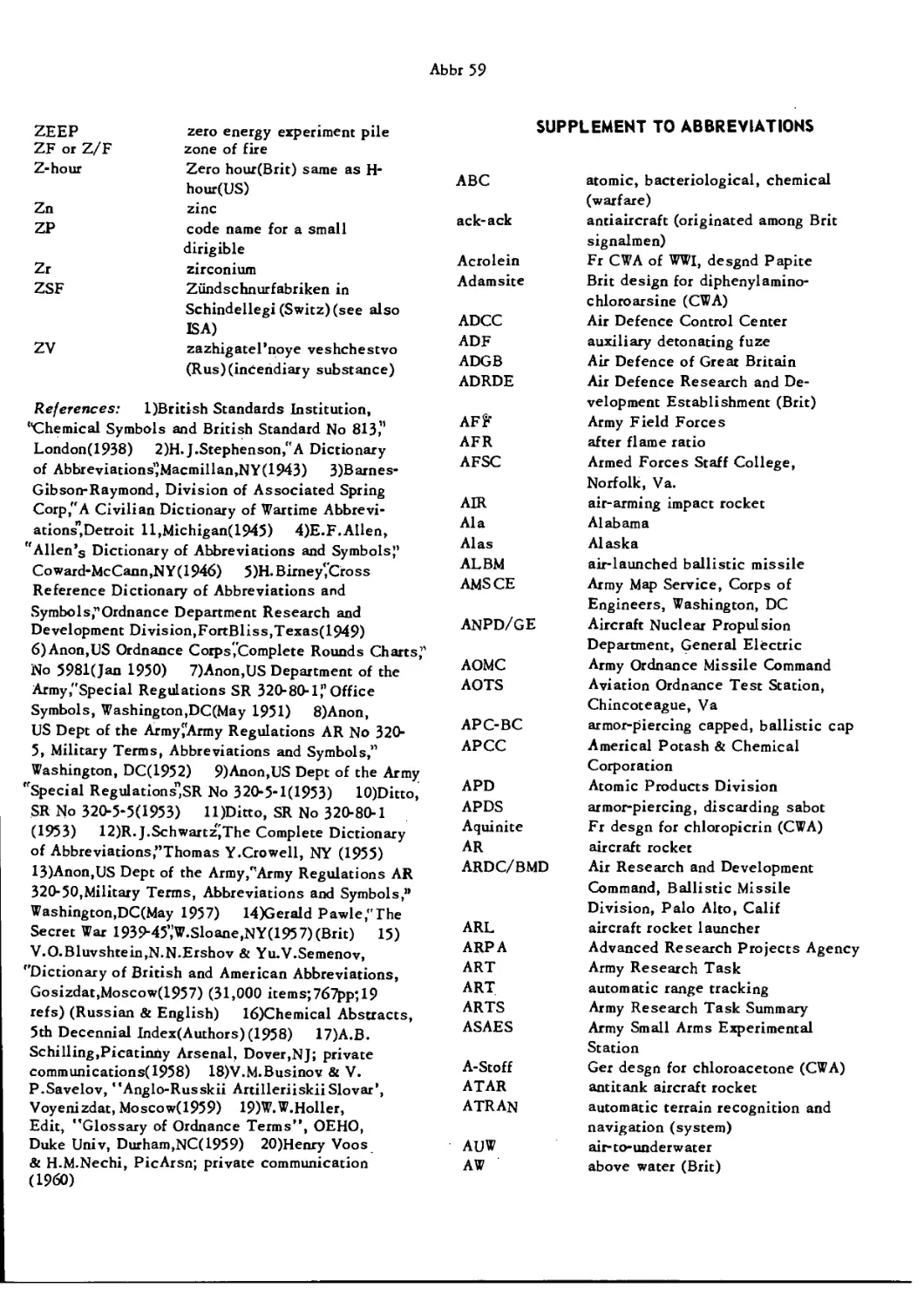
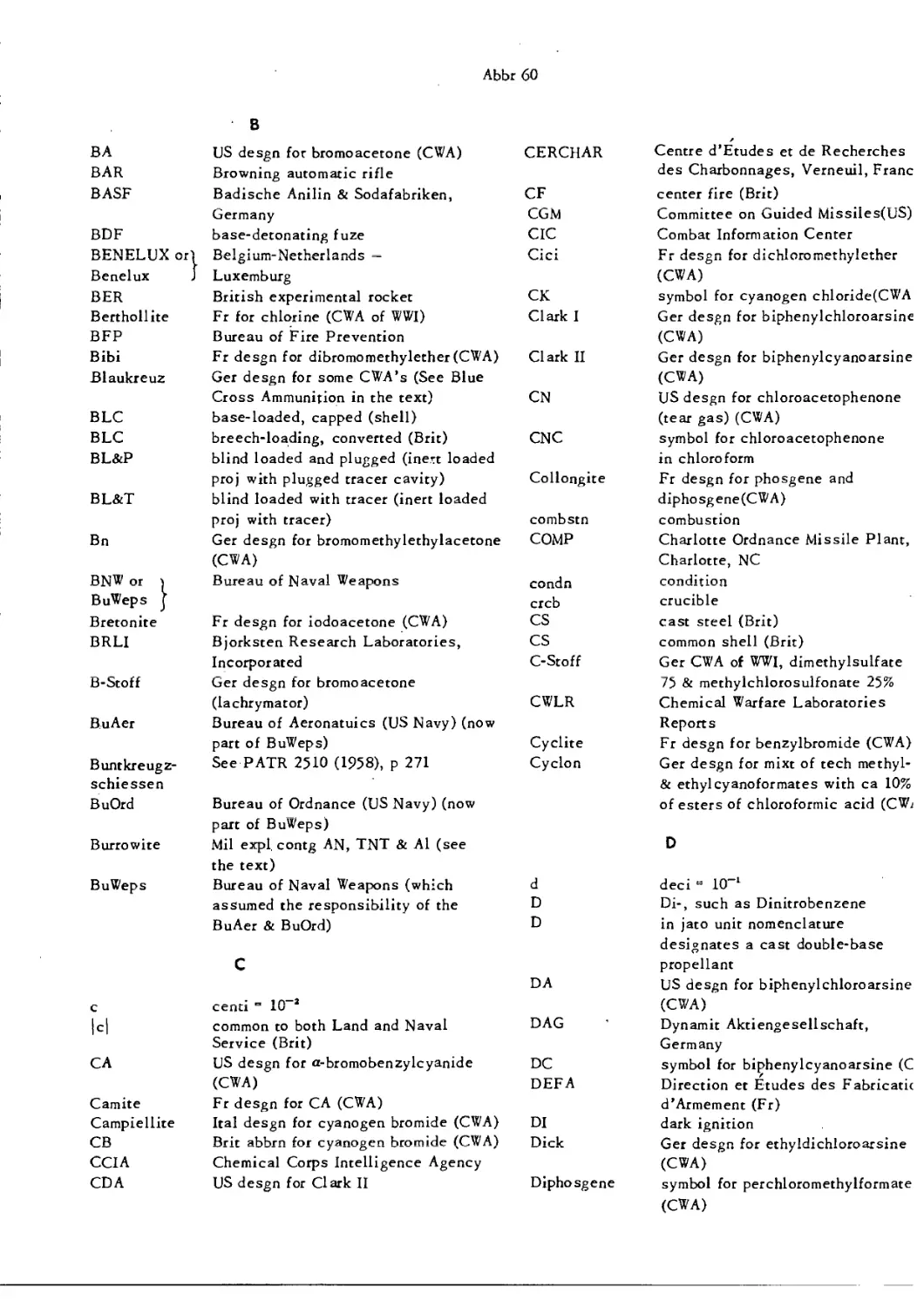
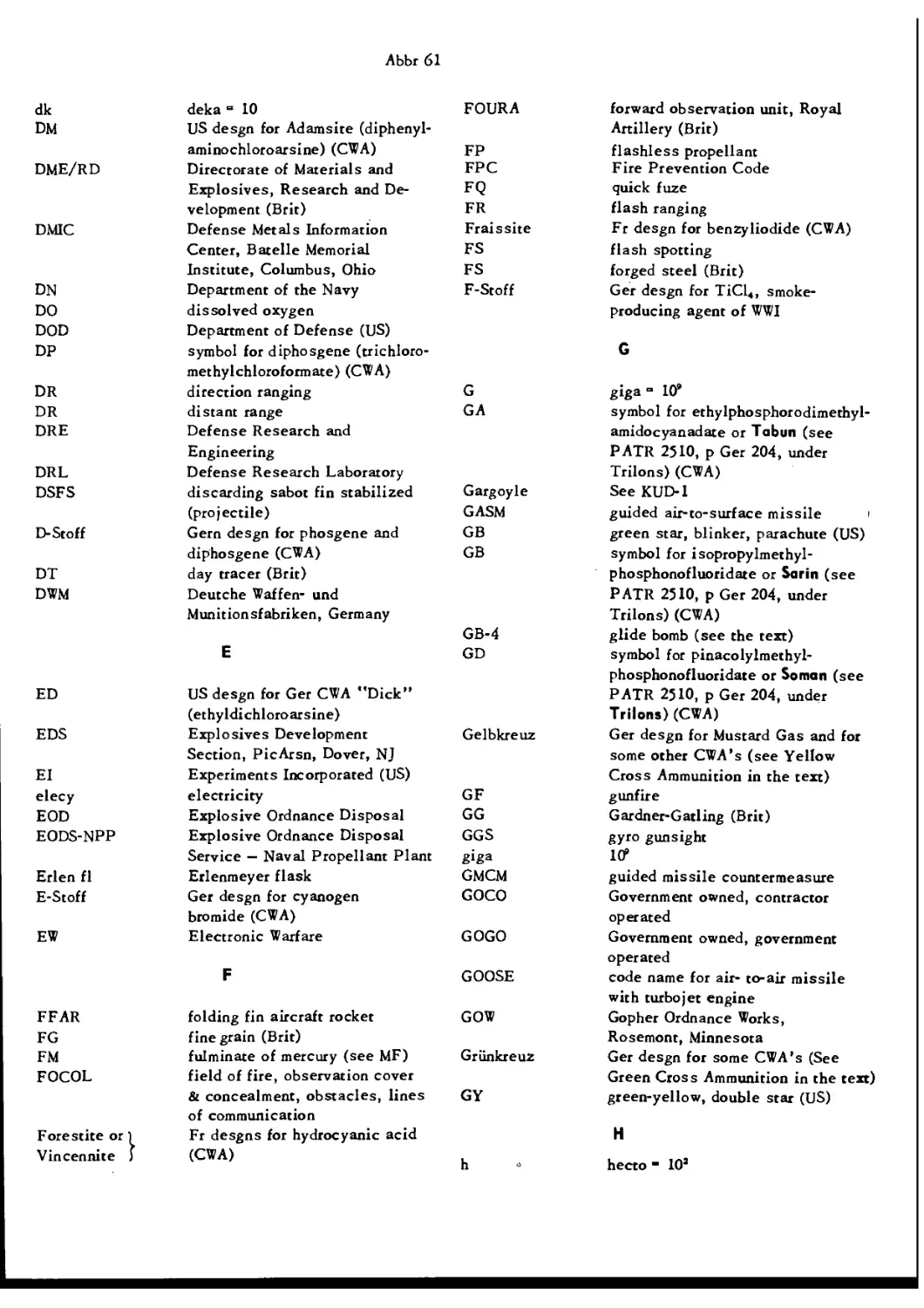
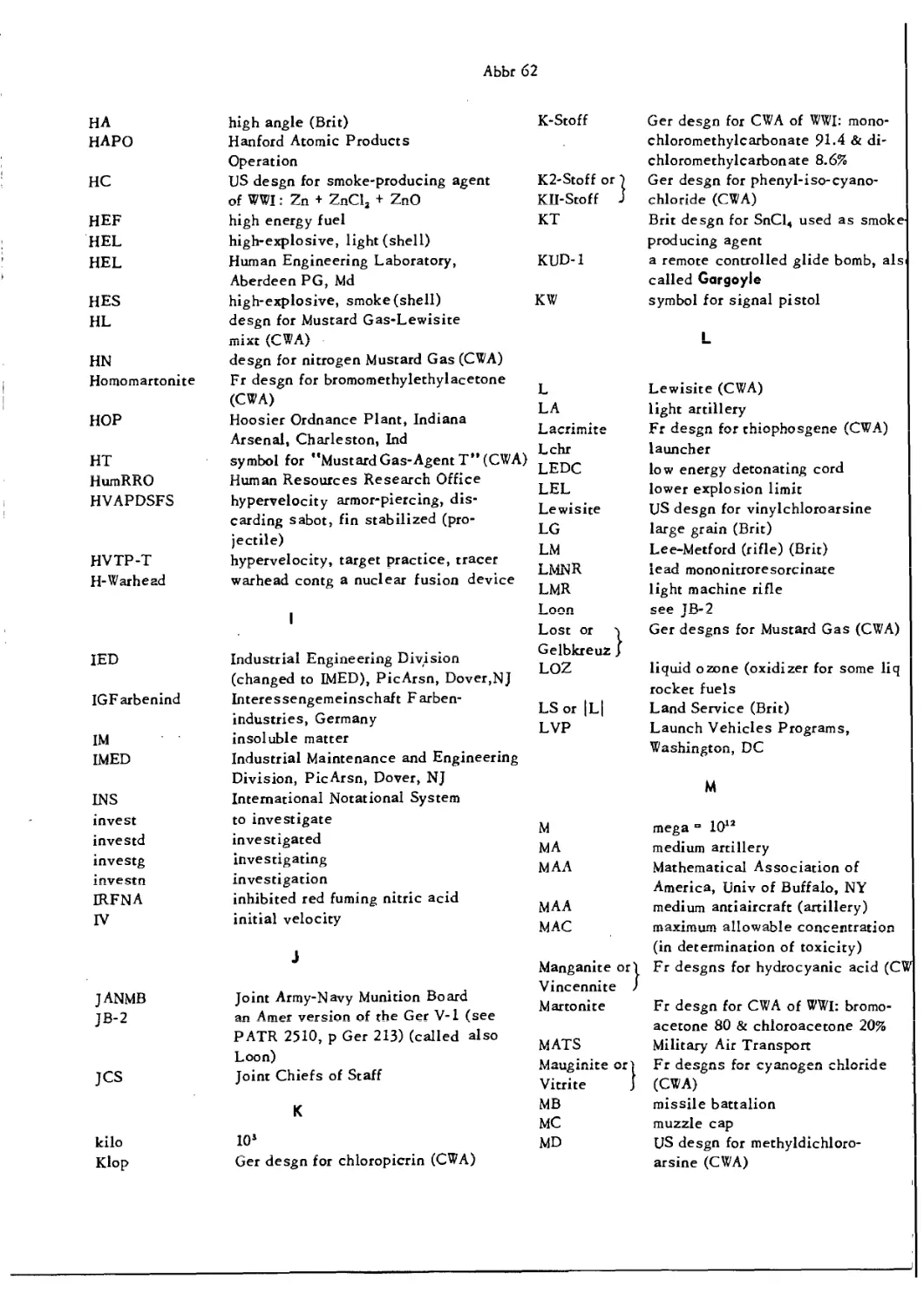
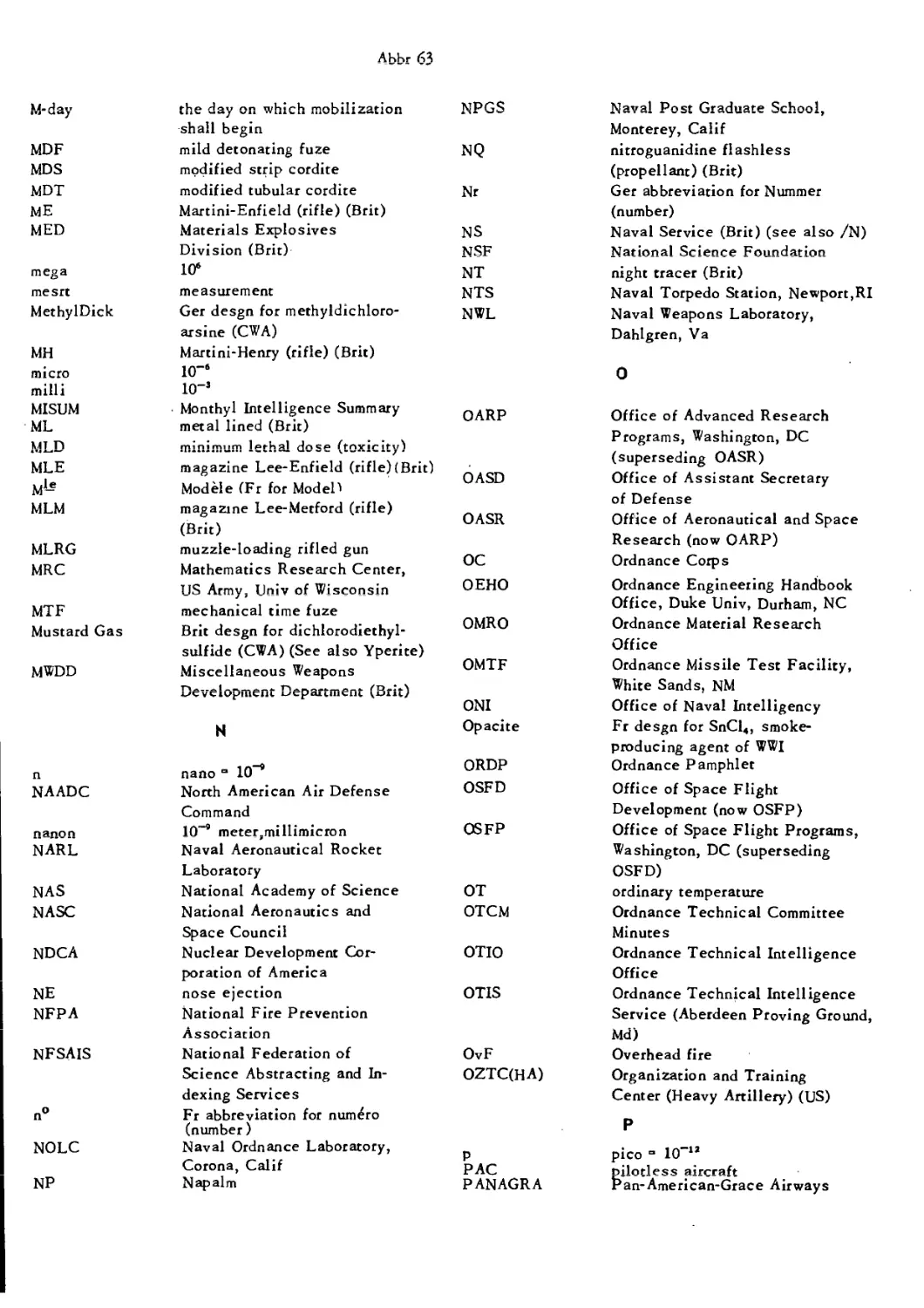
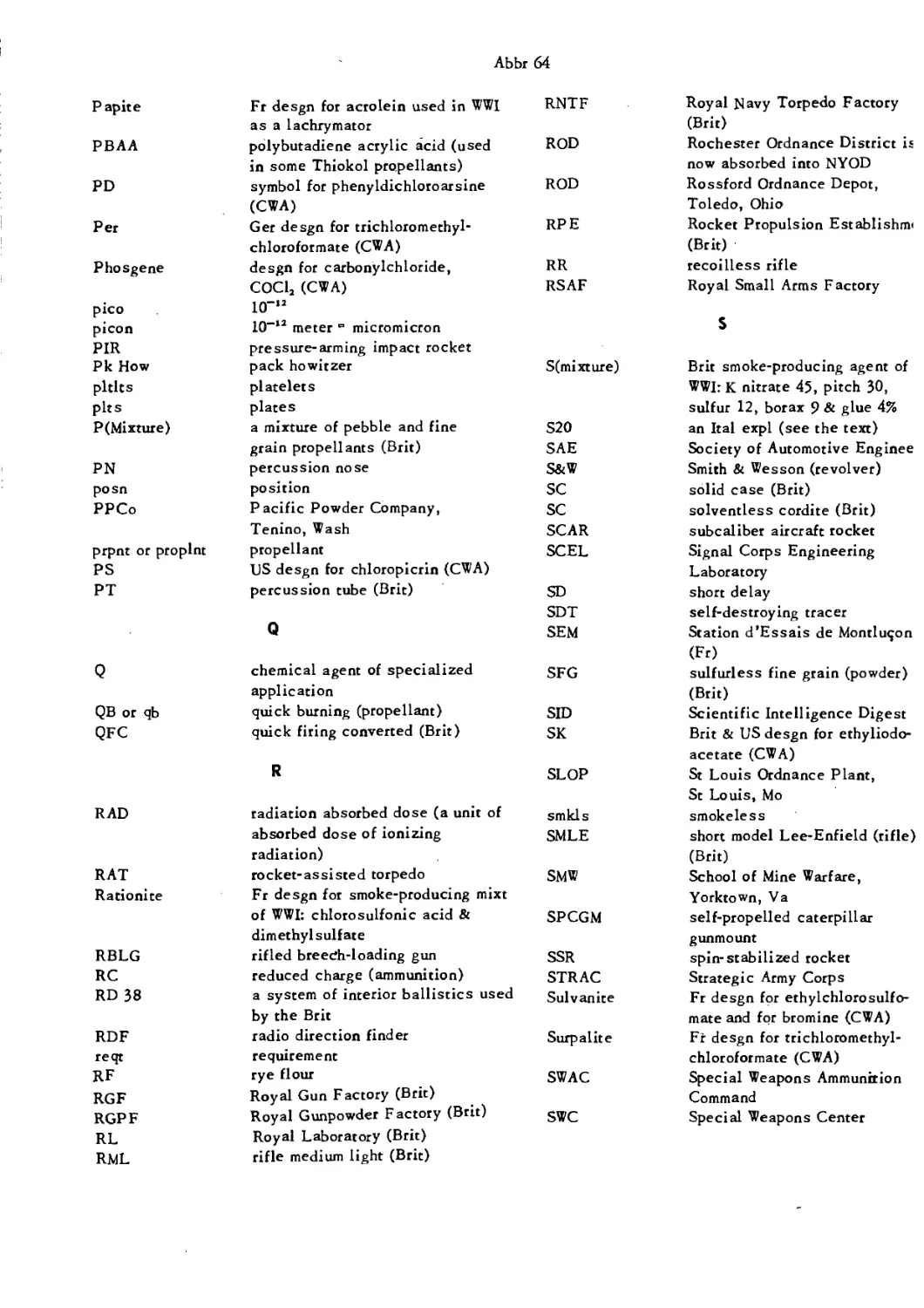
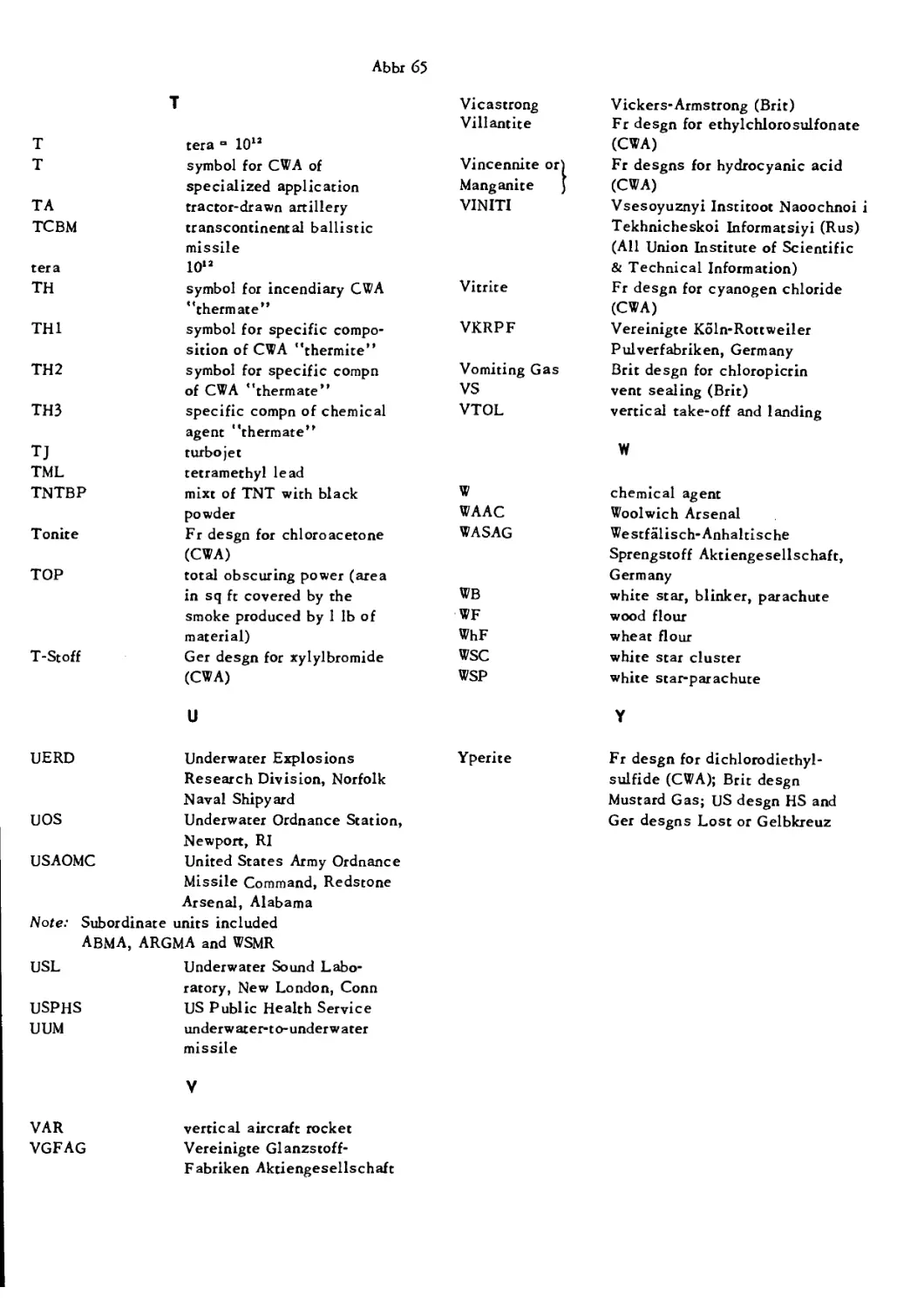
Abbreviations, Code Names, and Symbols	Abbr 1
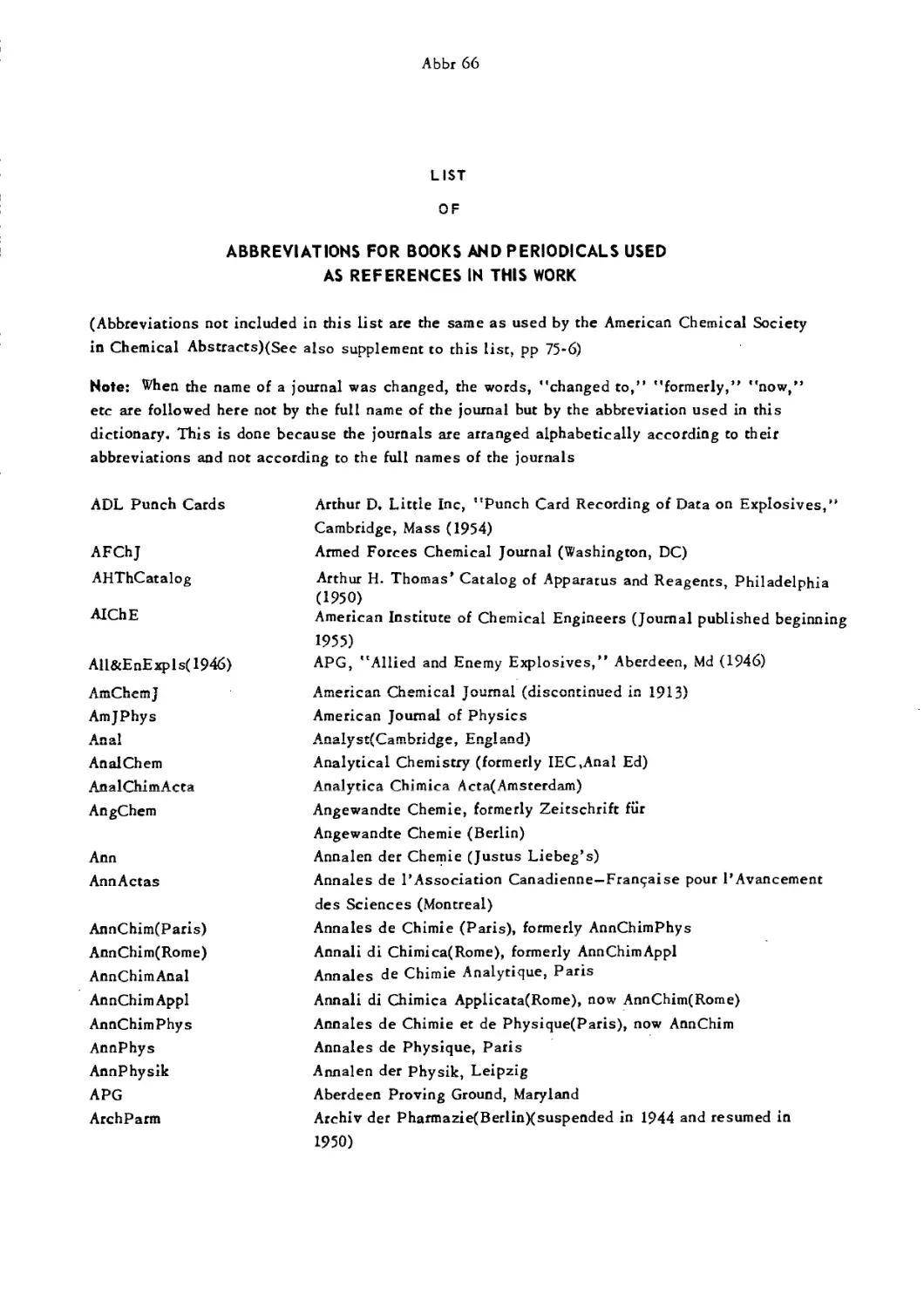
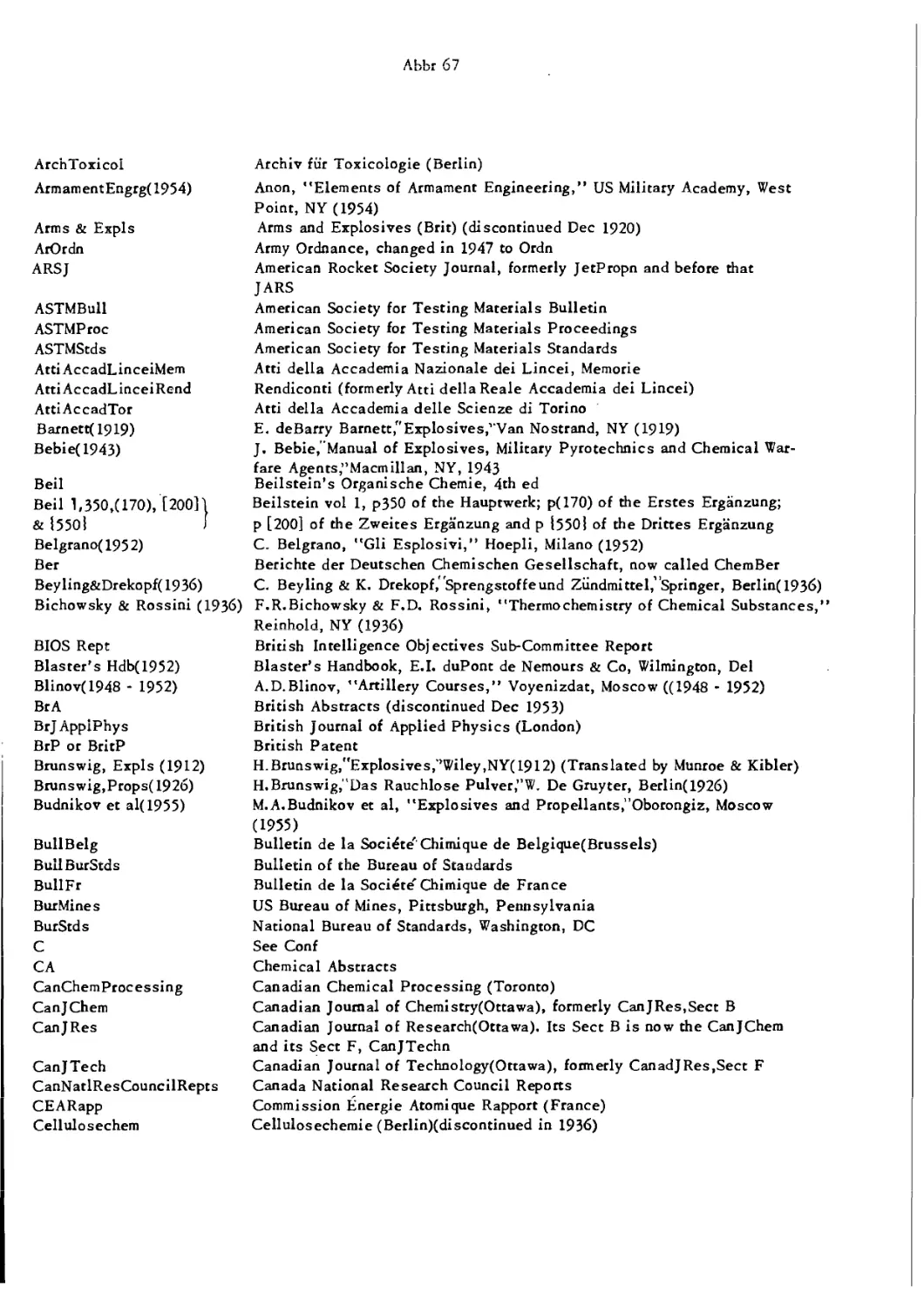
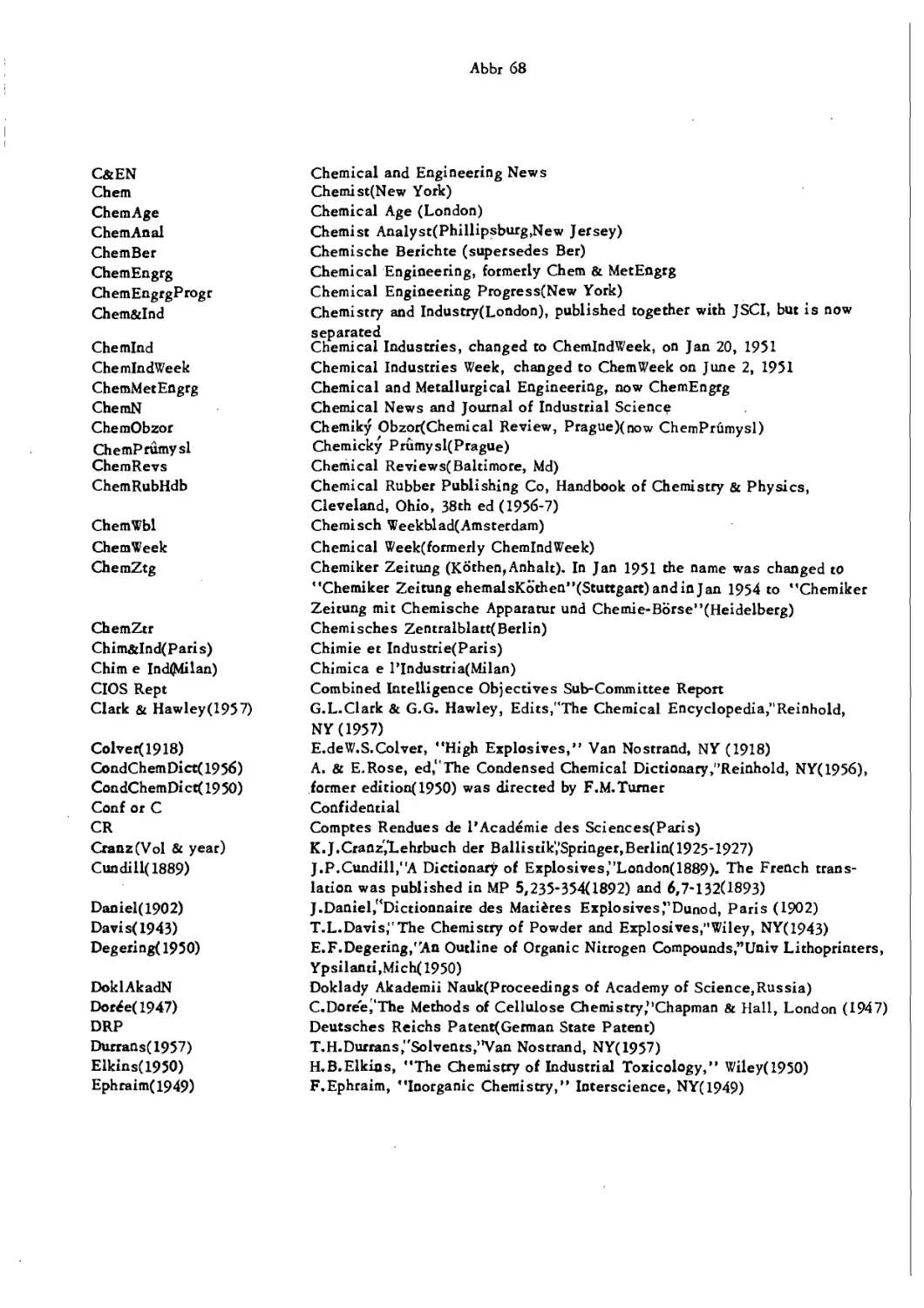
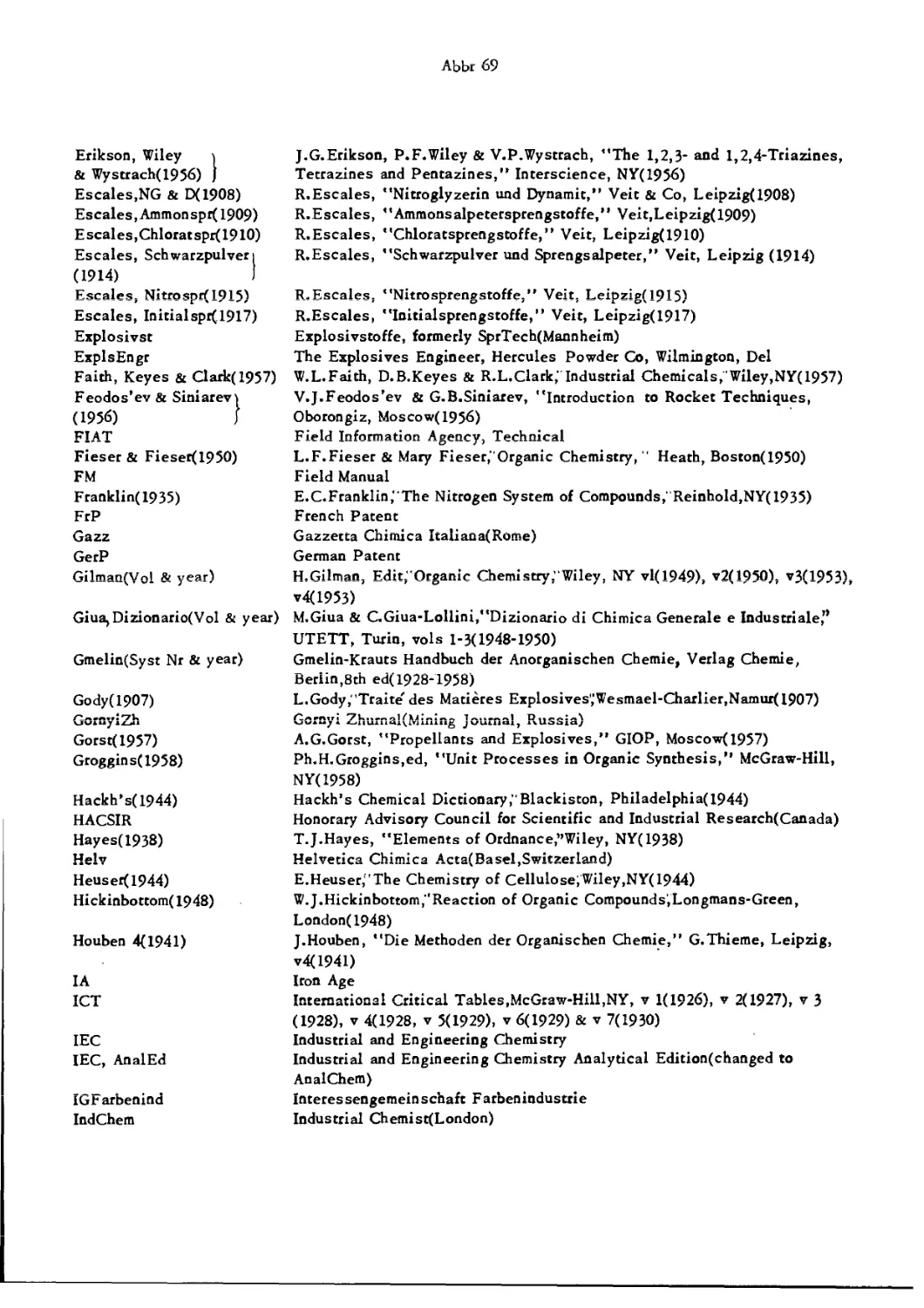
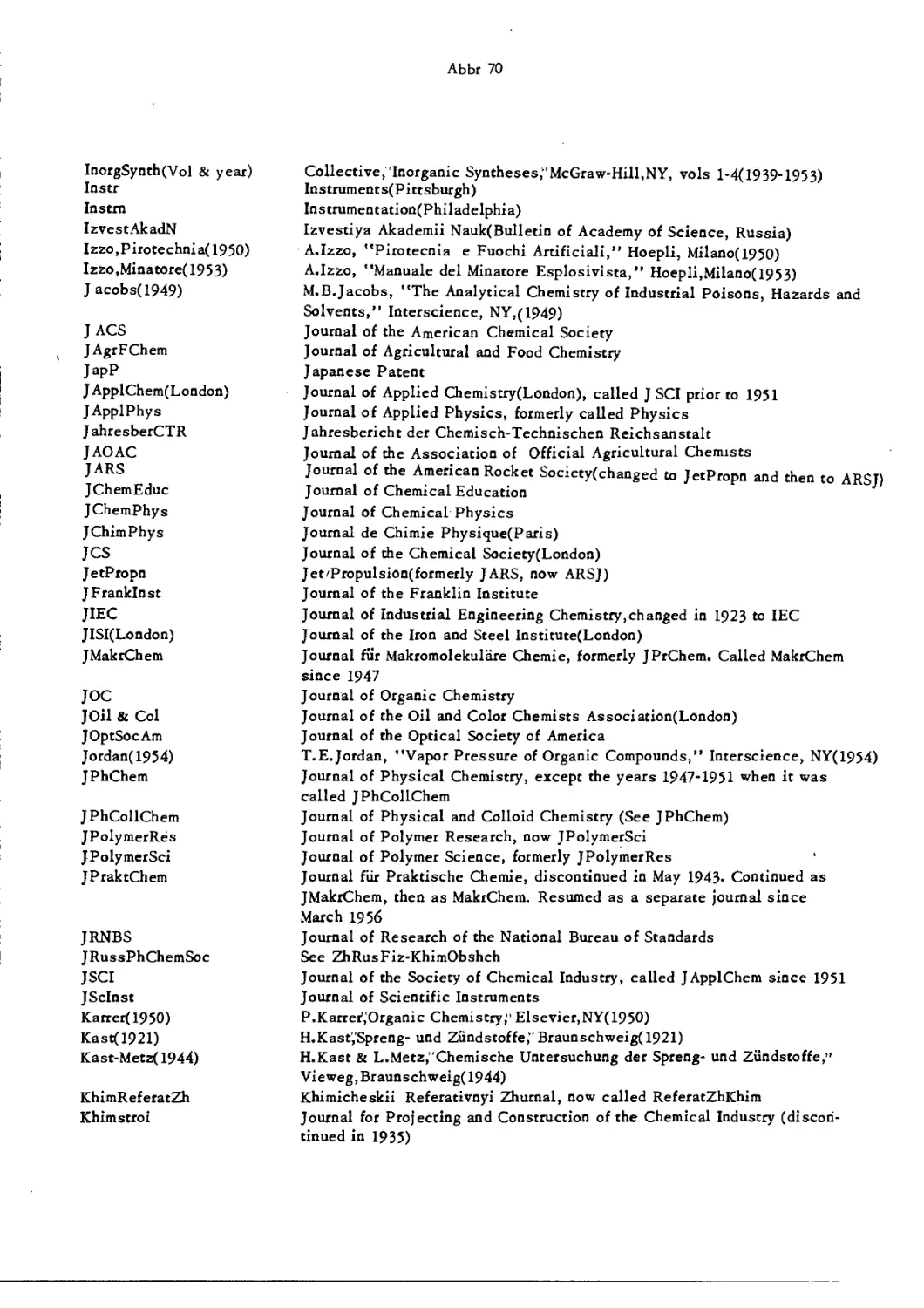
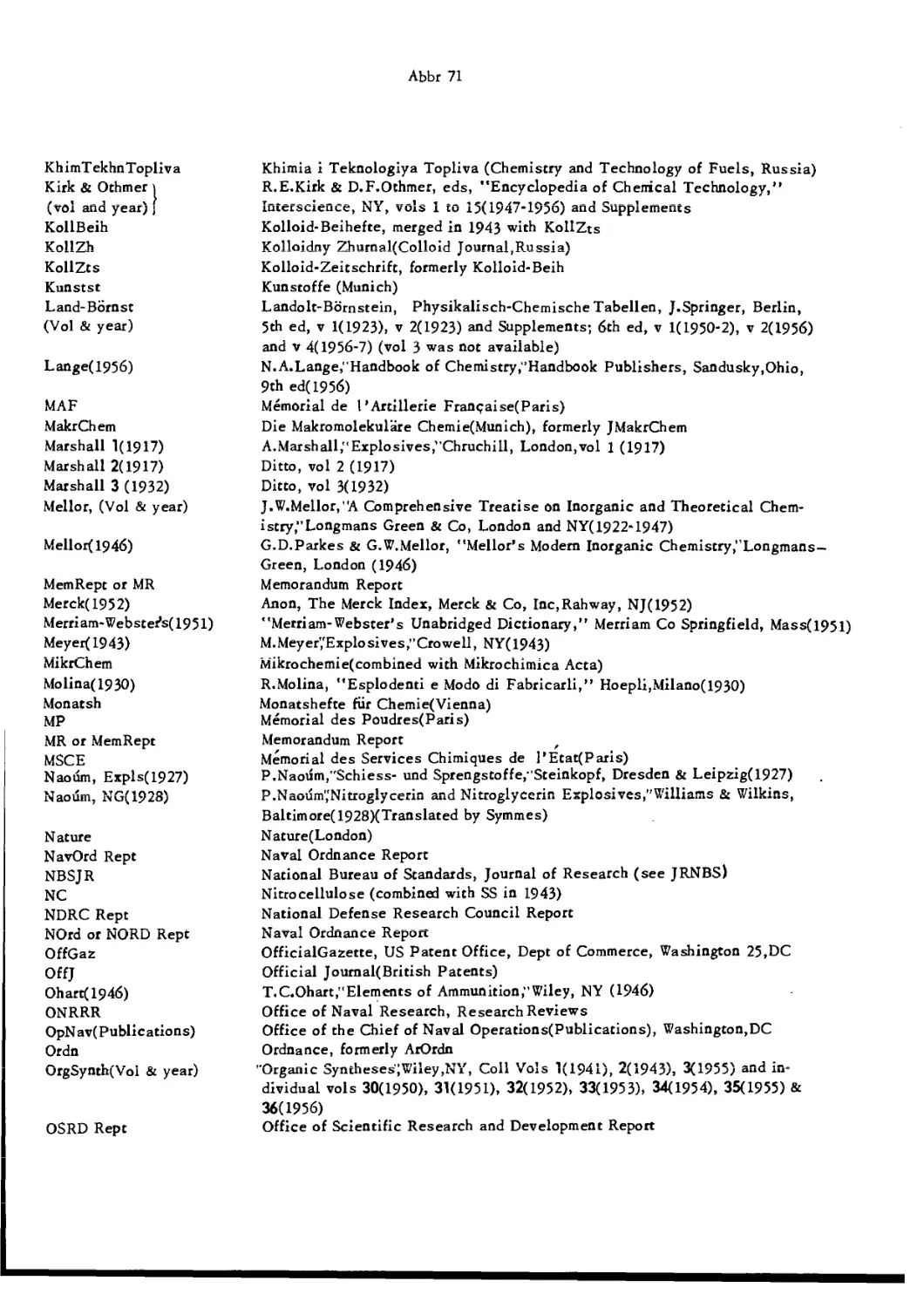
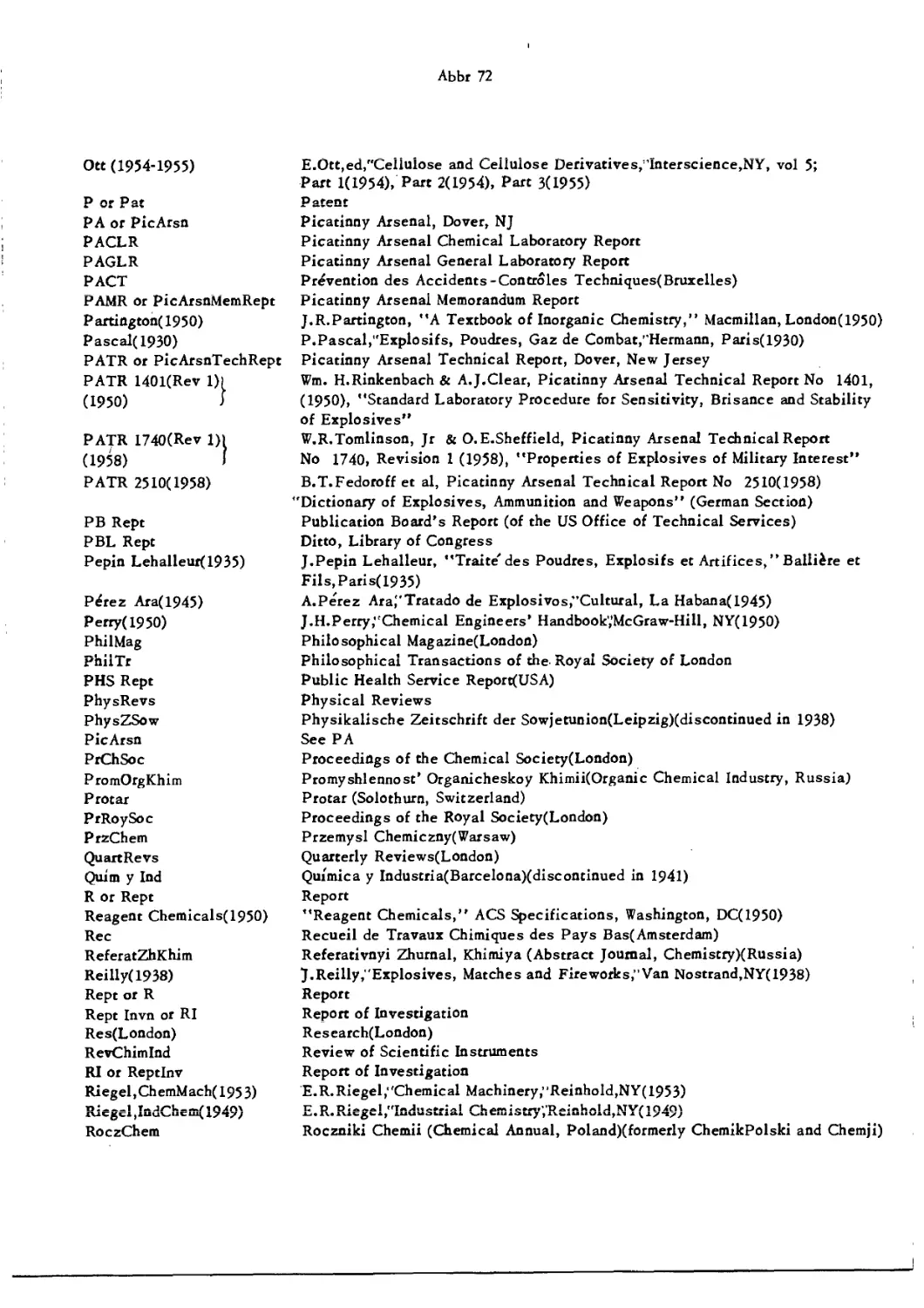
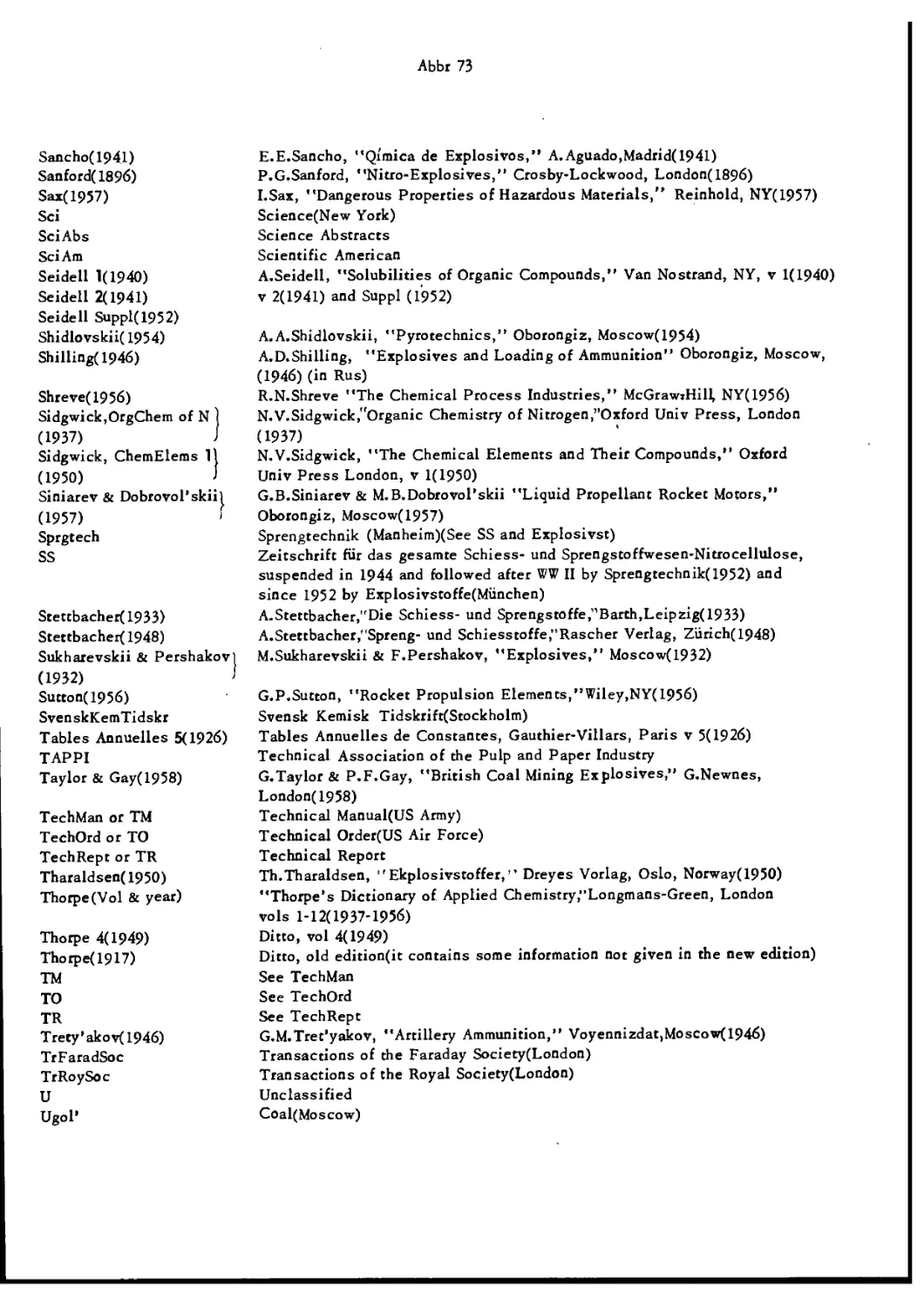
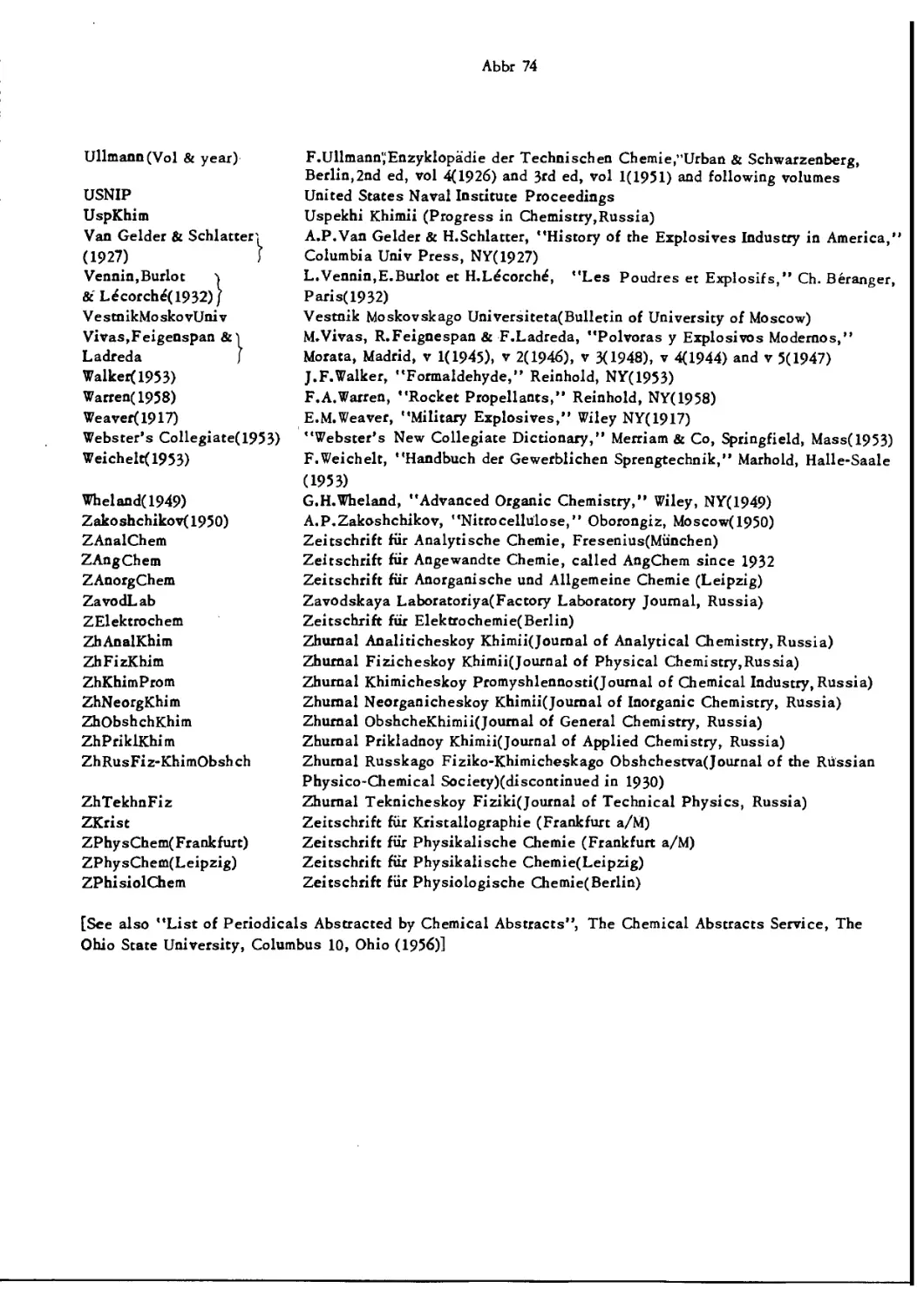
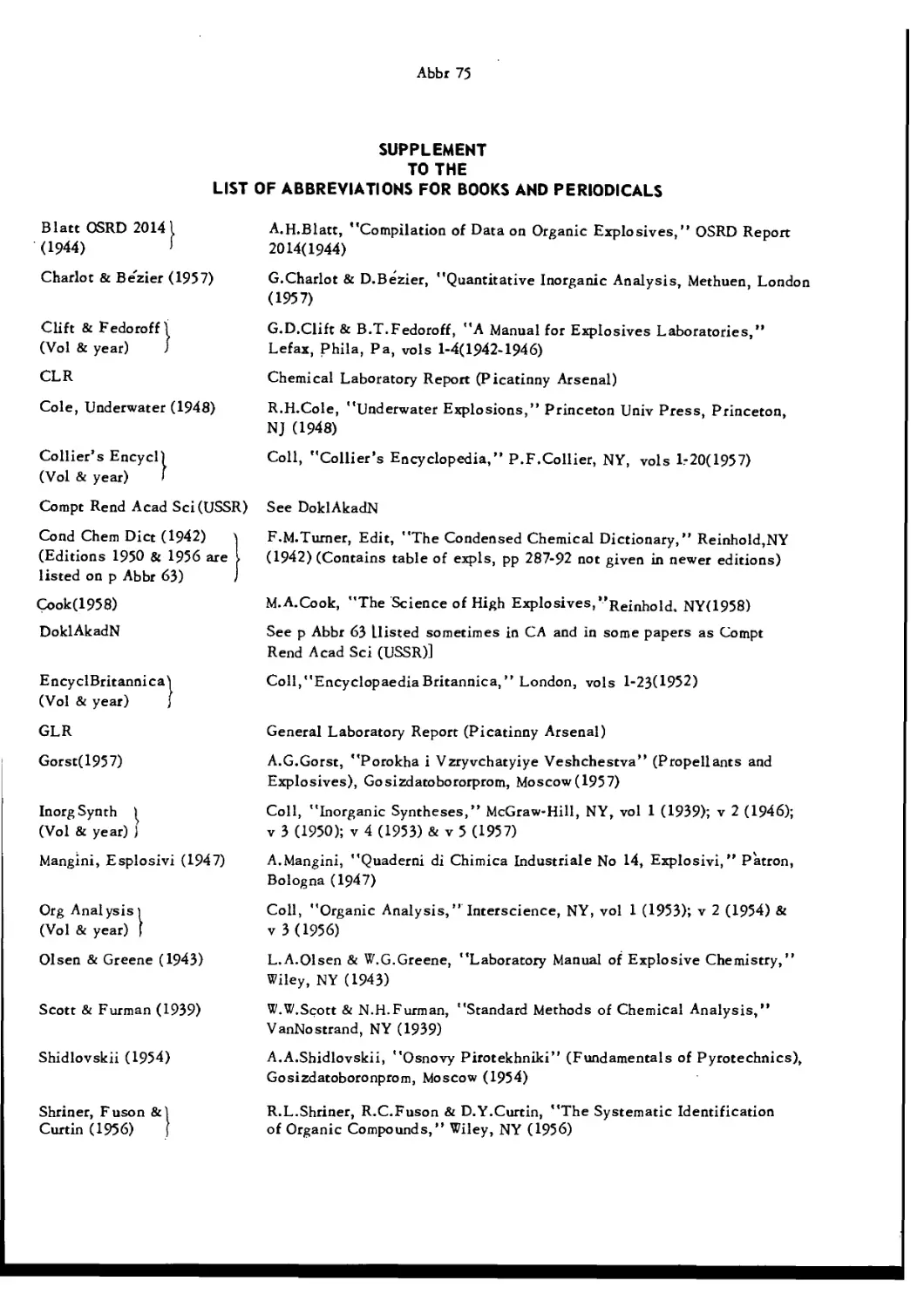
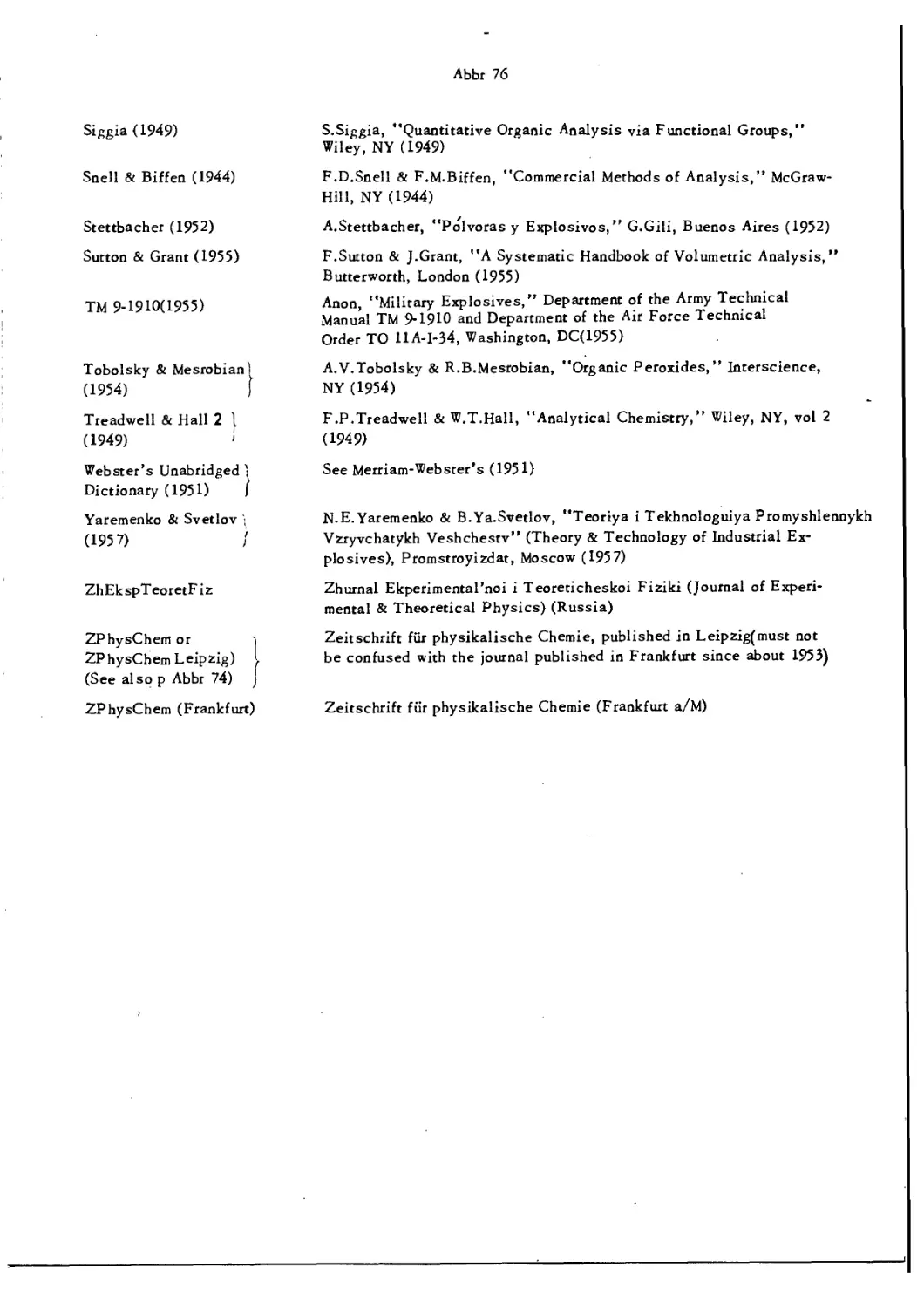
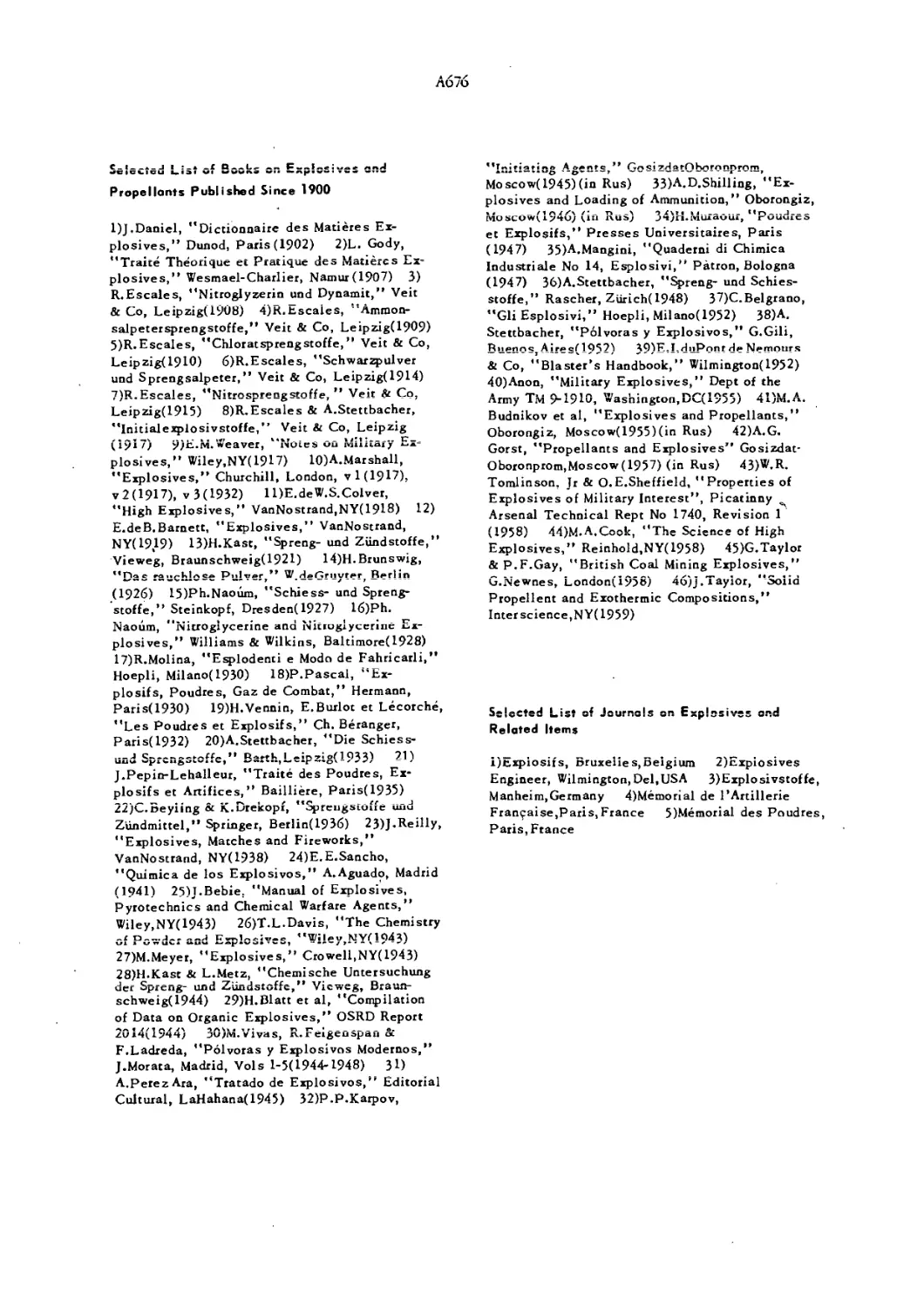
Abbreviations for Books and Periodicals	Abbr 66

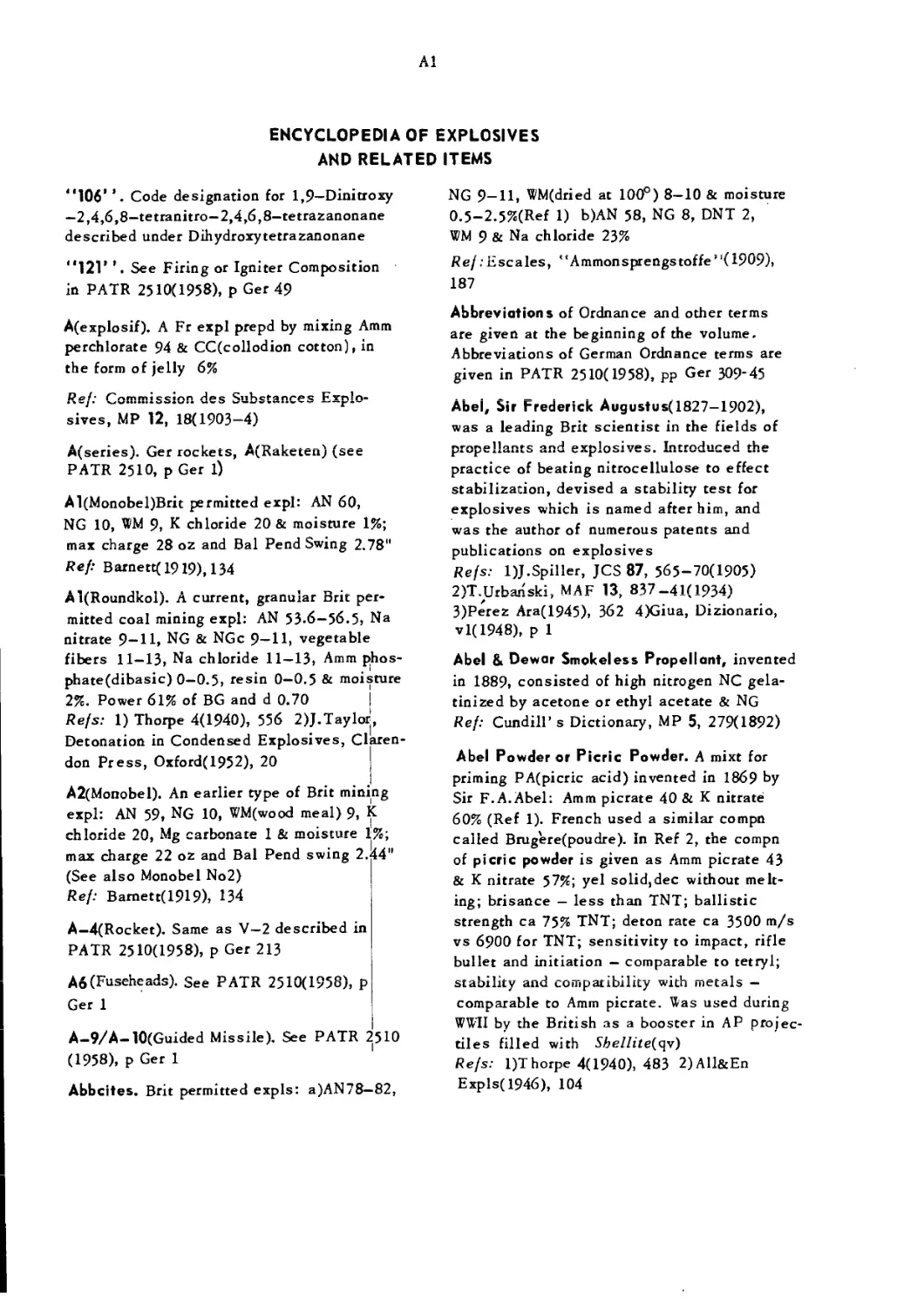
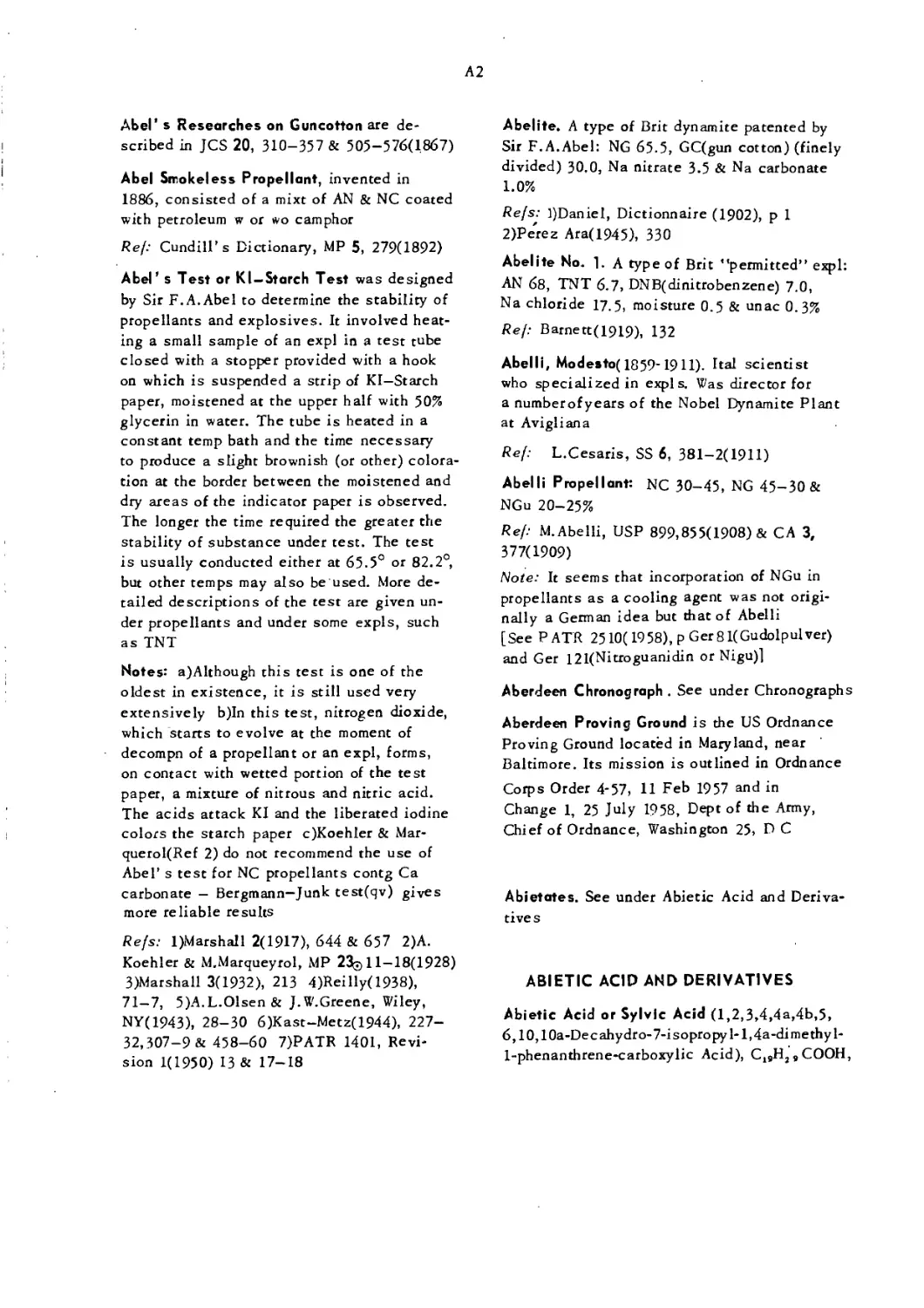
Descriptive Text of Encyclopedic Items	Al to A673
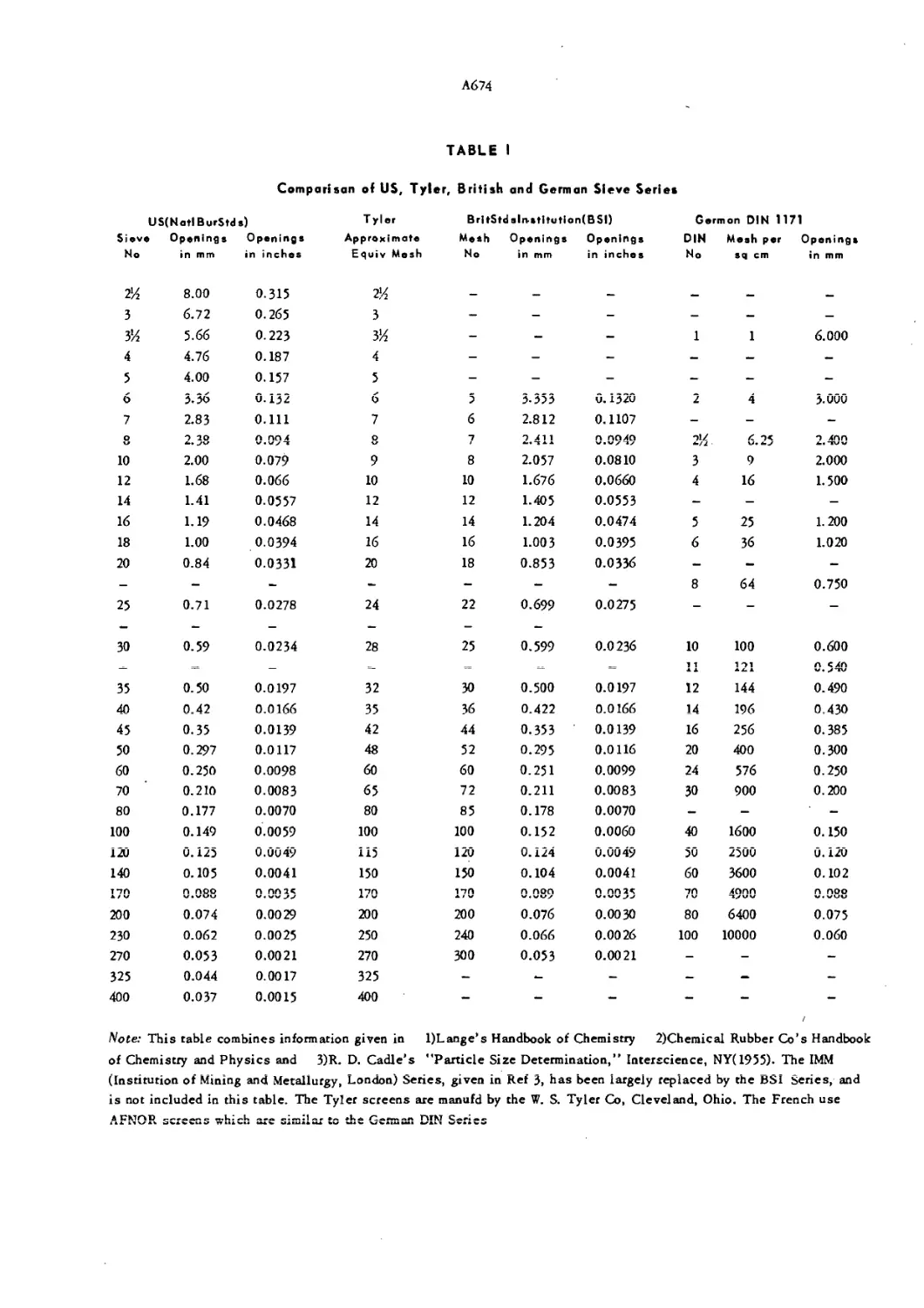
Table I. Comparison of US, British and German Sieve Series	A6 74
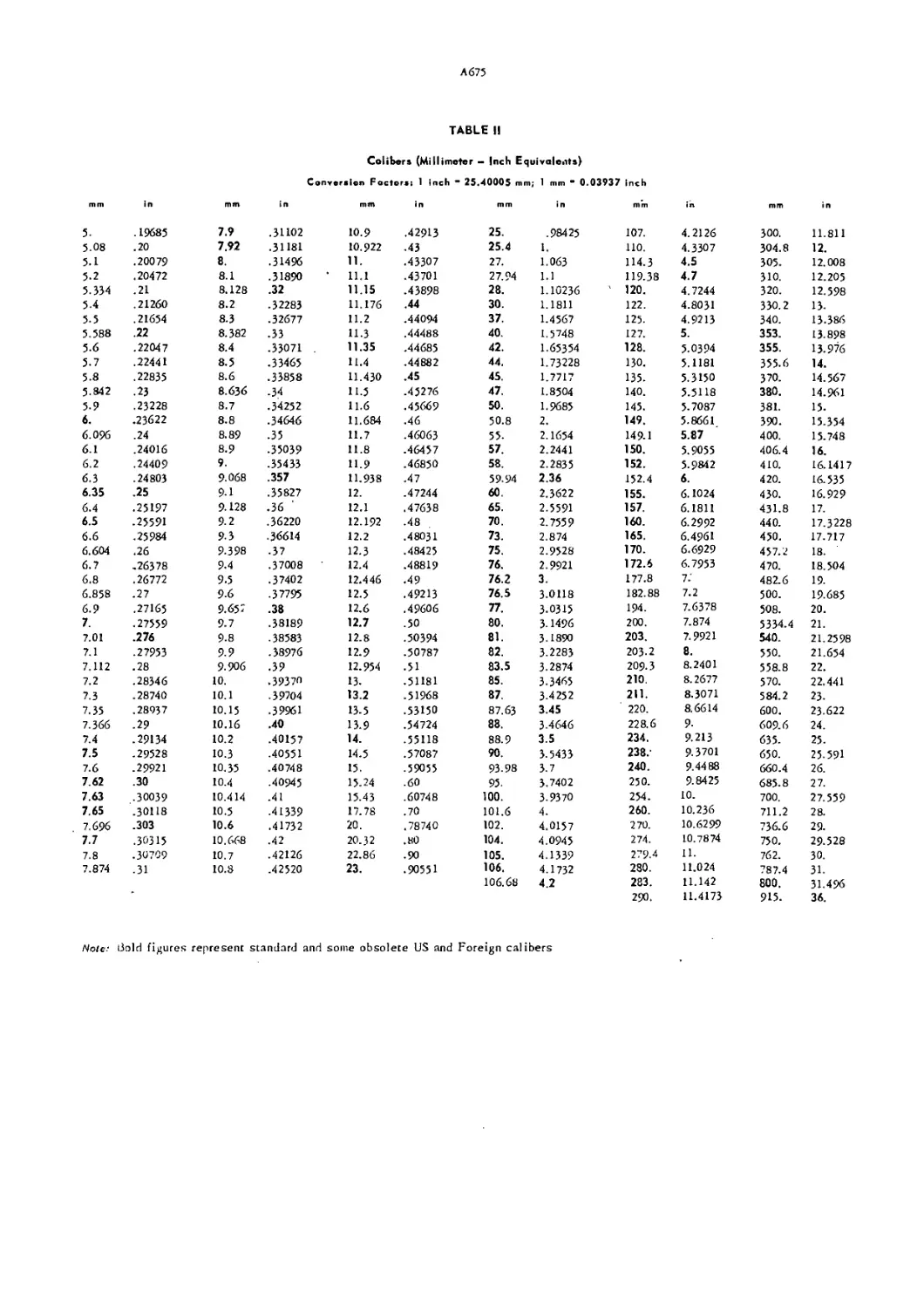
Table II. Calibers of US and Foreign Ammunition	A675
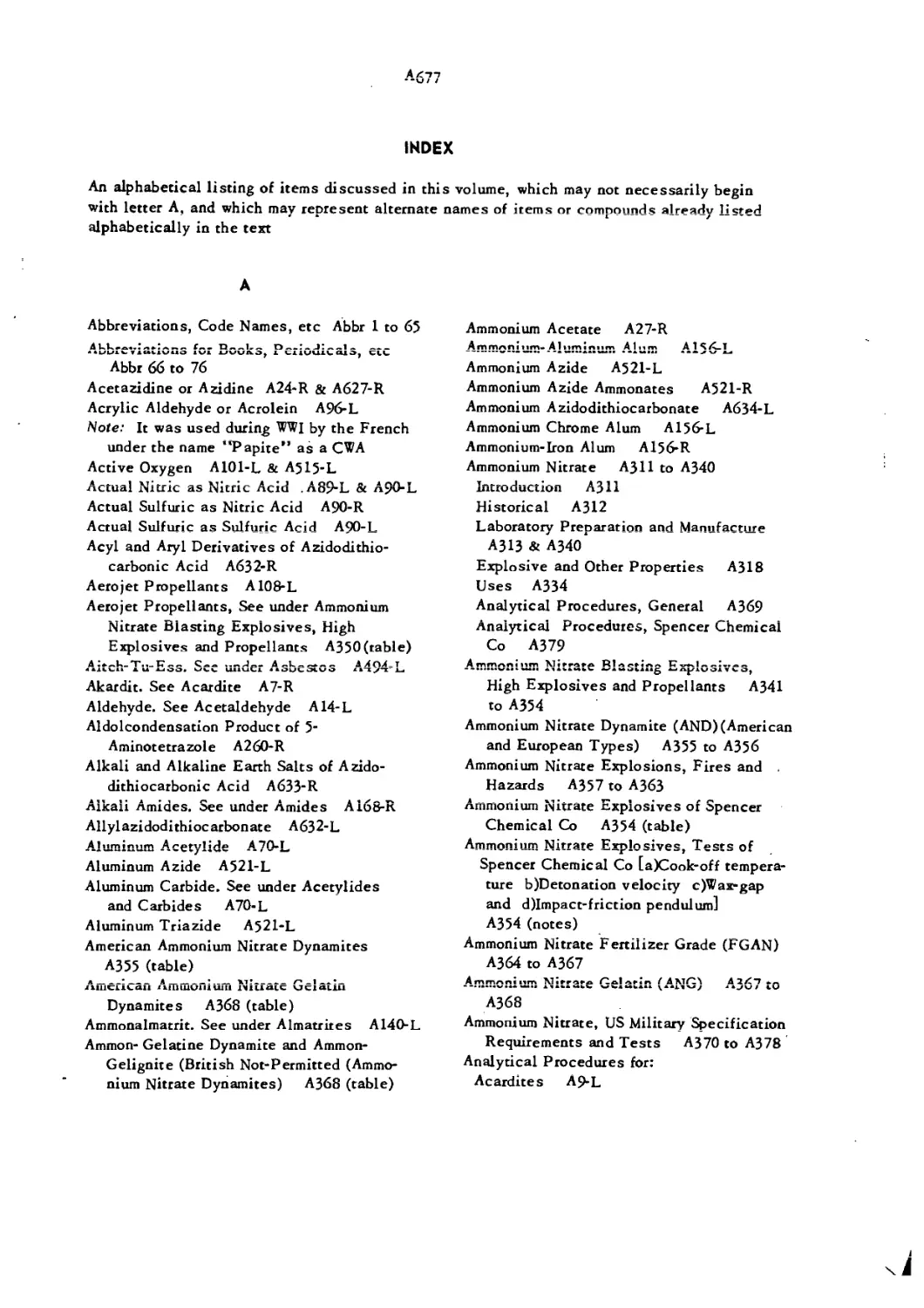
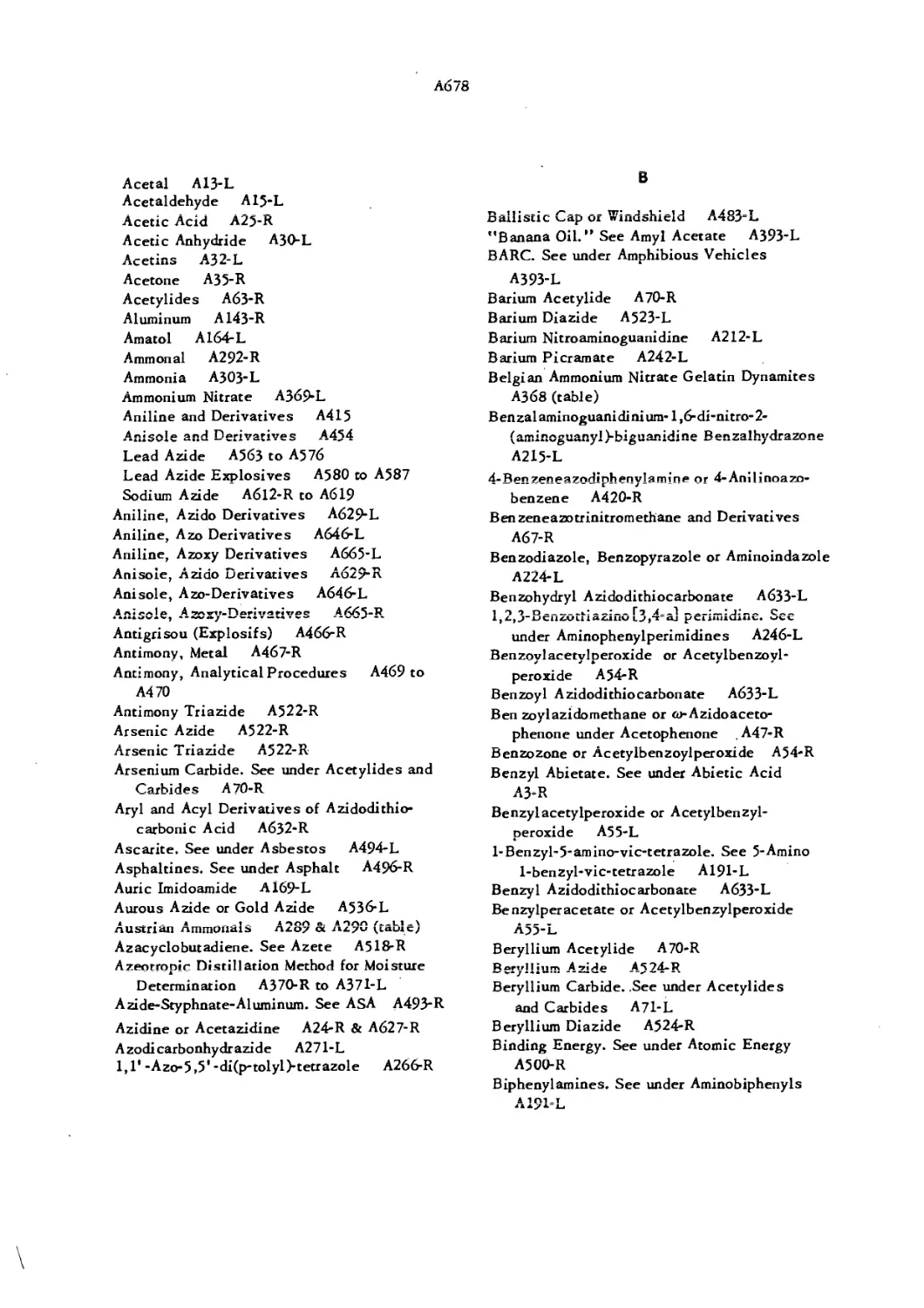
Index of Subjects as Alternate Names of Items
A677
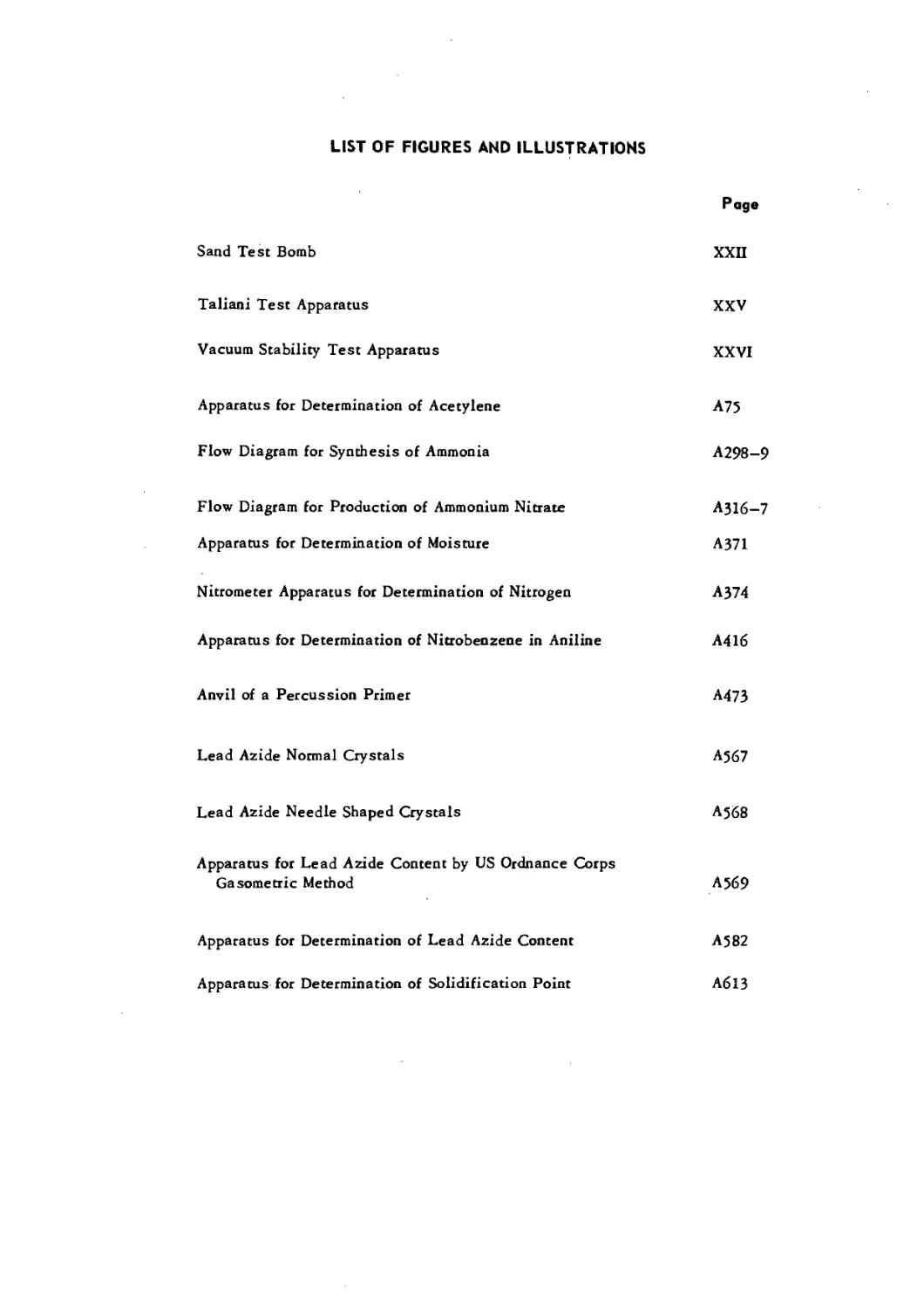
LIST OF FIGURES AND ILLUSTRATIONS
Page
Sand Test Bomb	XXII
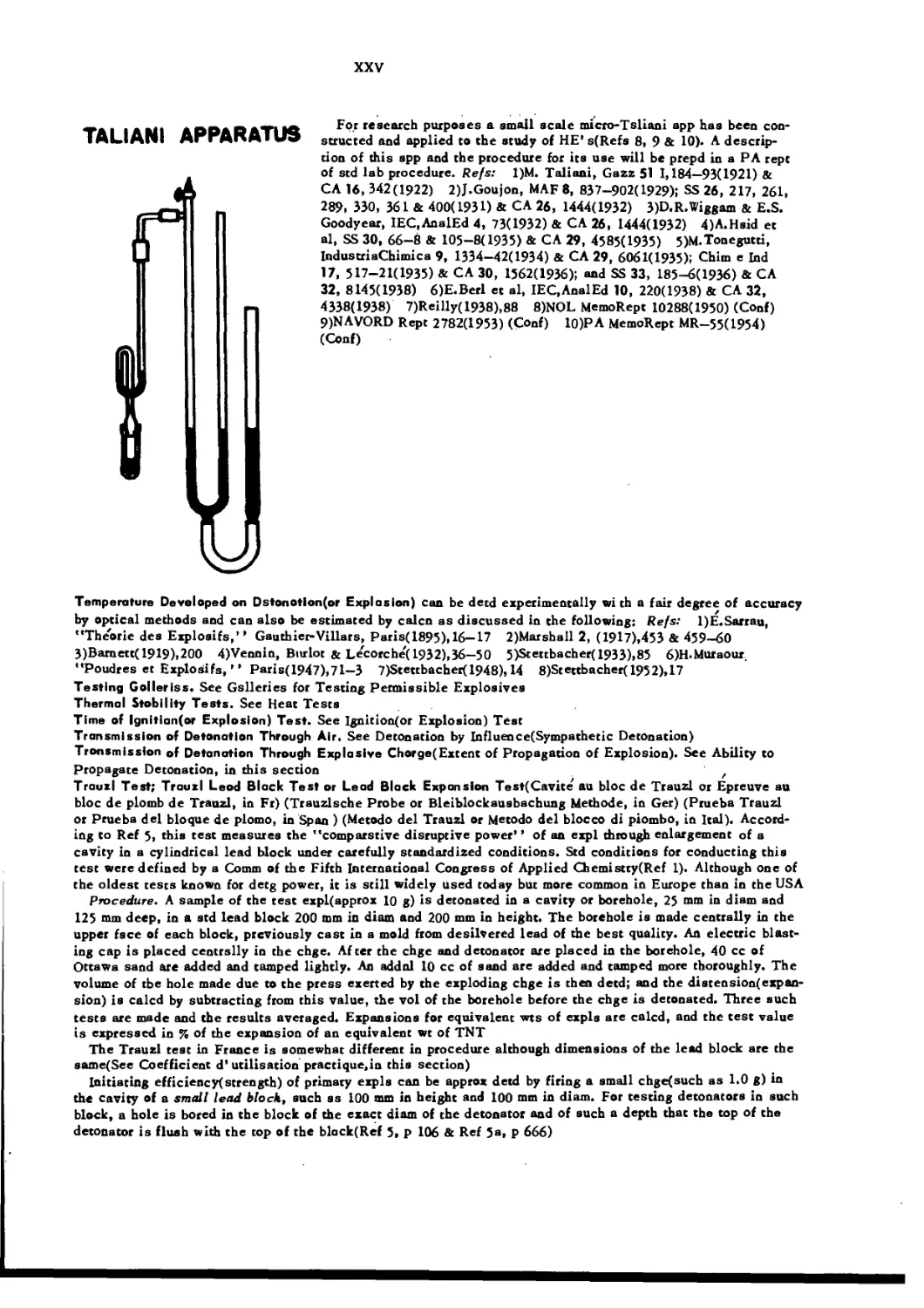
Taliani Test Apparatus	XXV
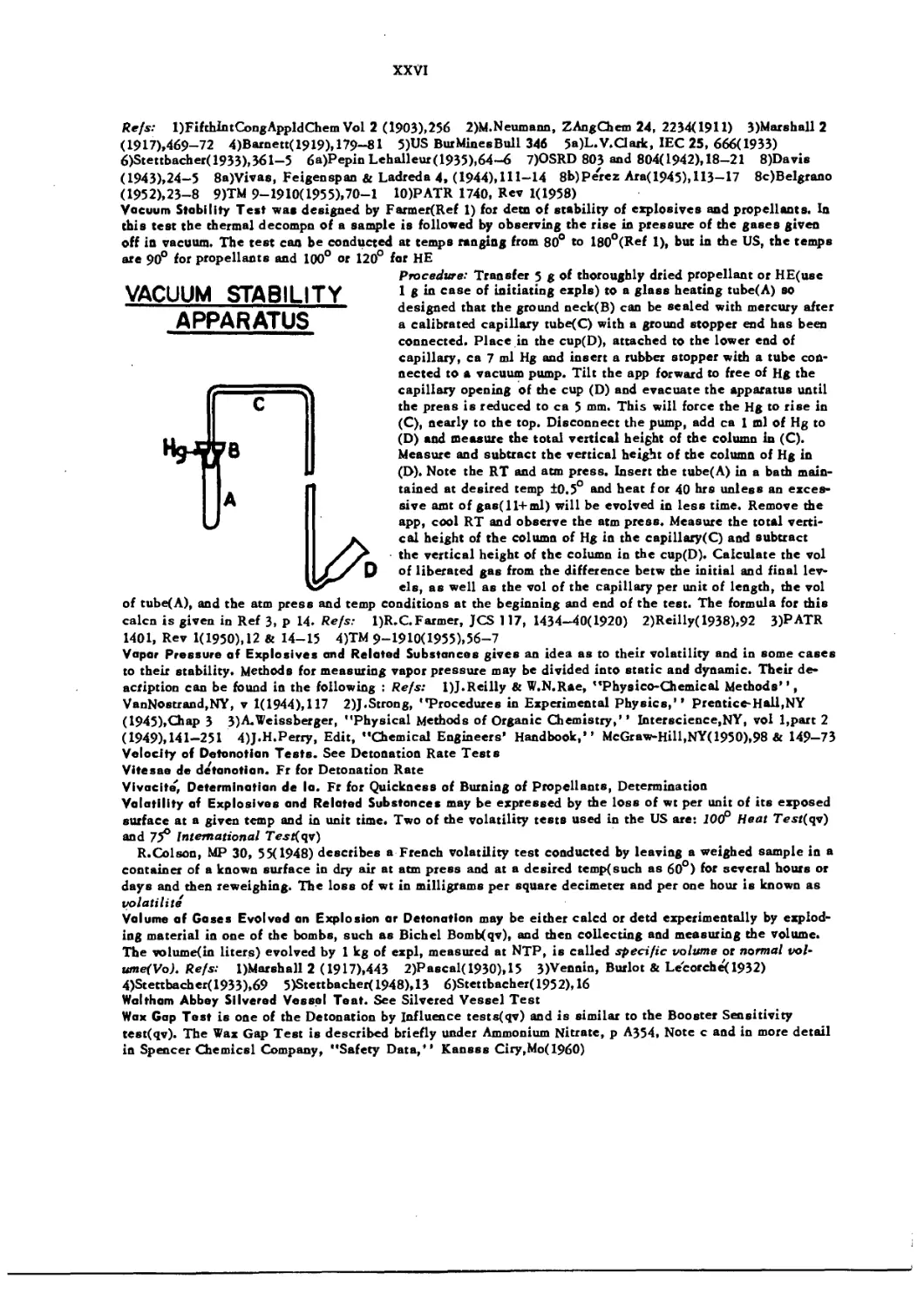
Vacuum Stability Test Apparatus	XXVI
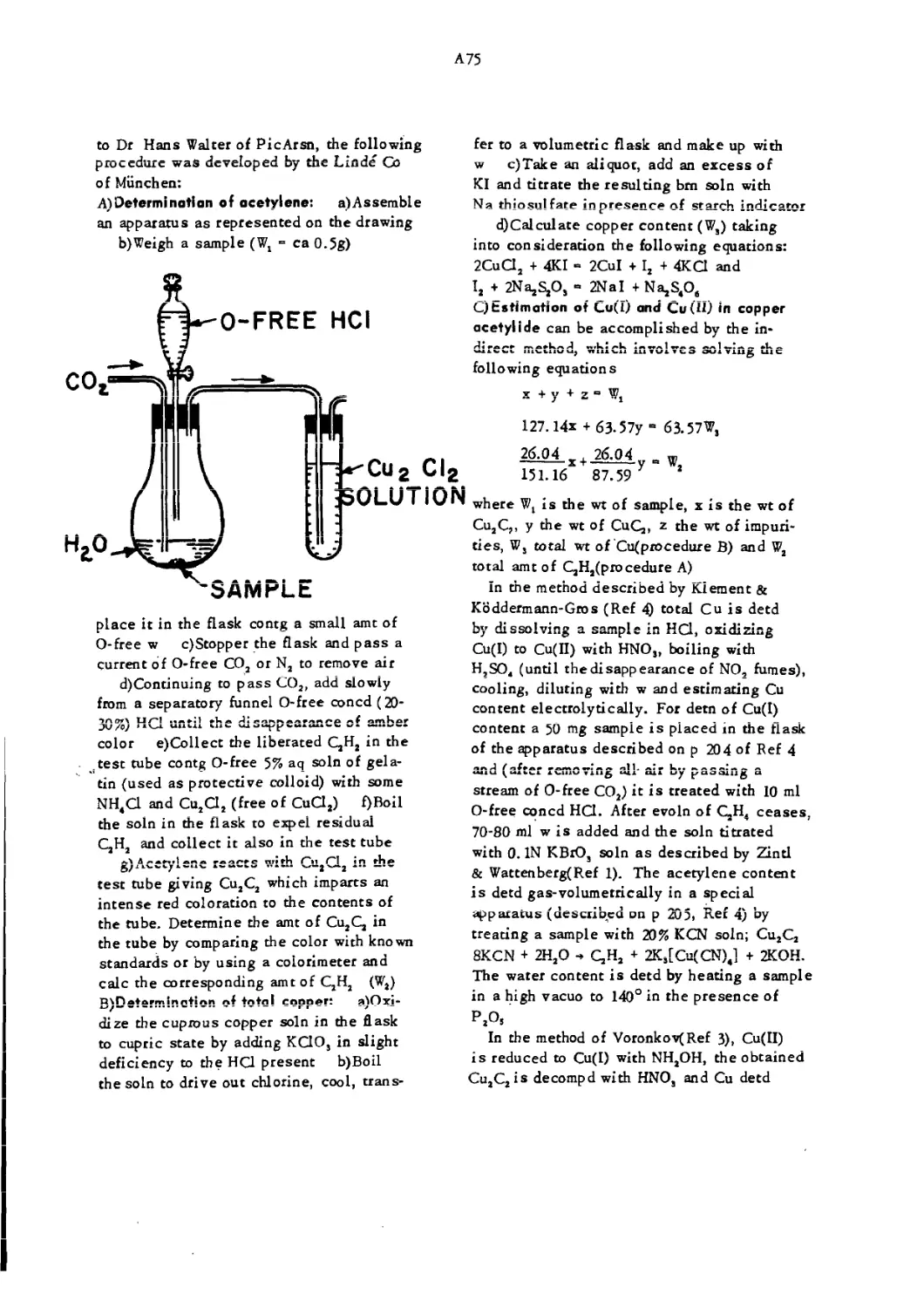
Apparatus for Determination of Acetylene	A75
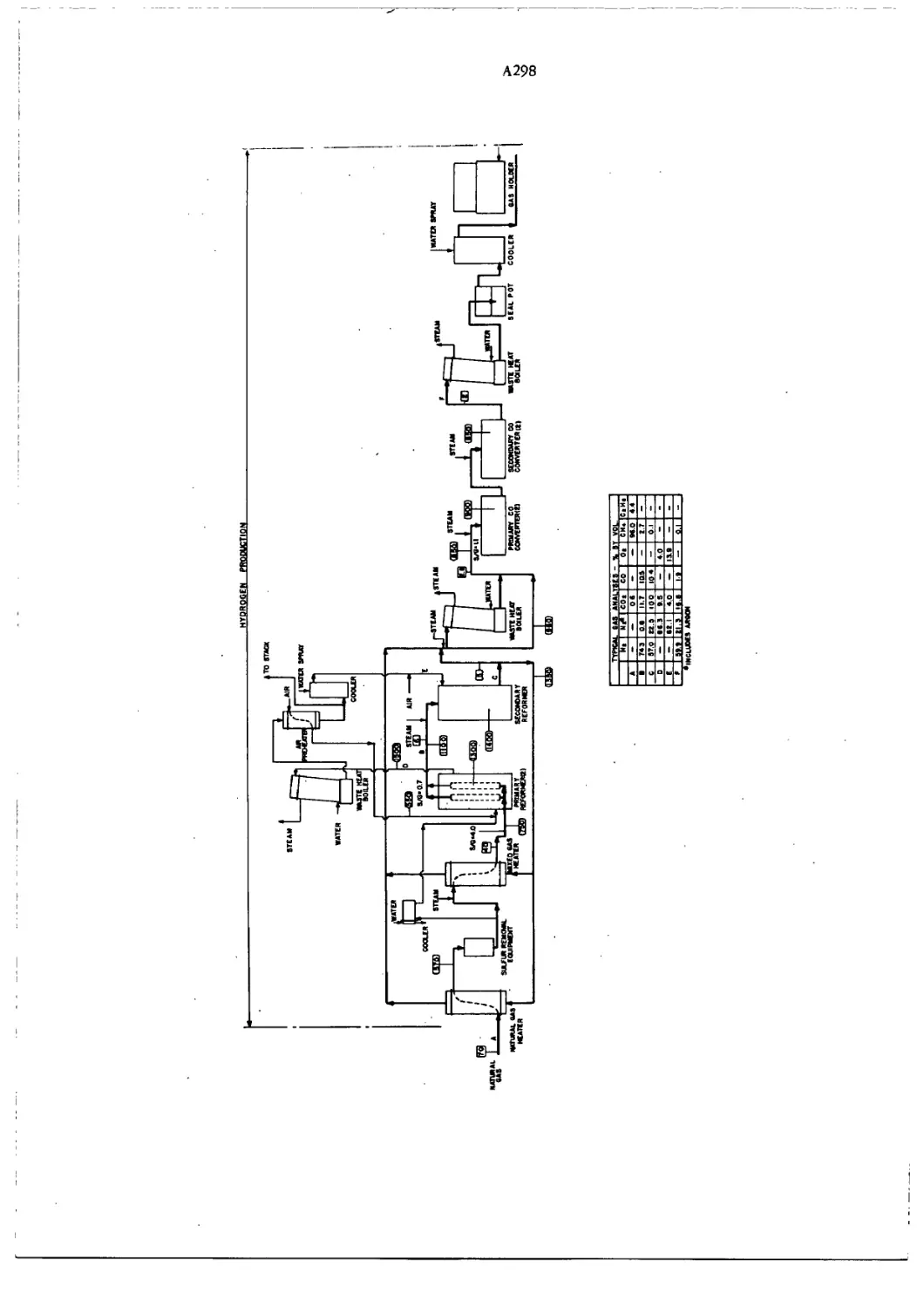
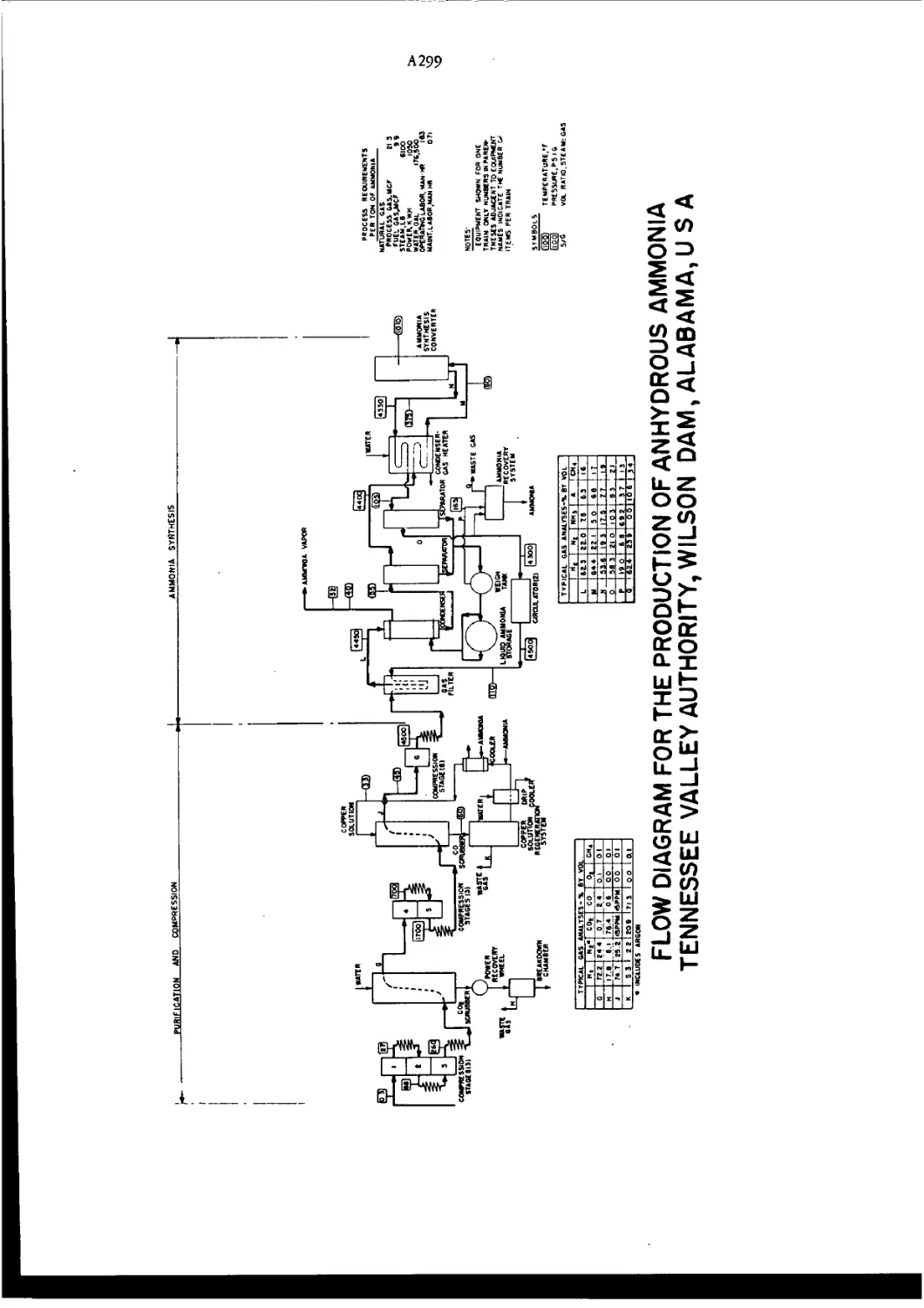
Flow Diagram for Synthesis of Ammonia	A298—9
Flow Diagram for Production of Ammonium Nitrate	A3I6—7
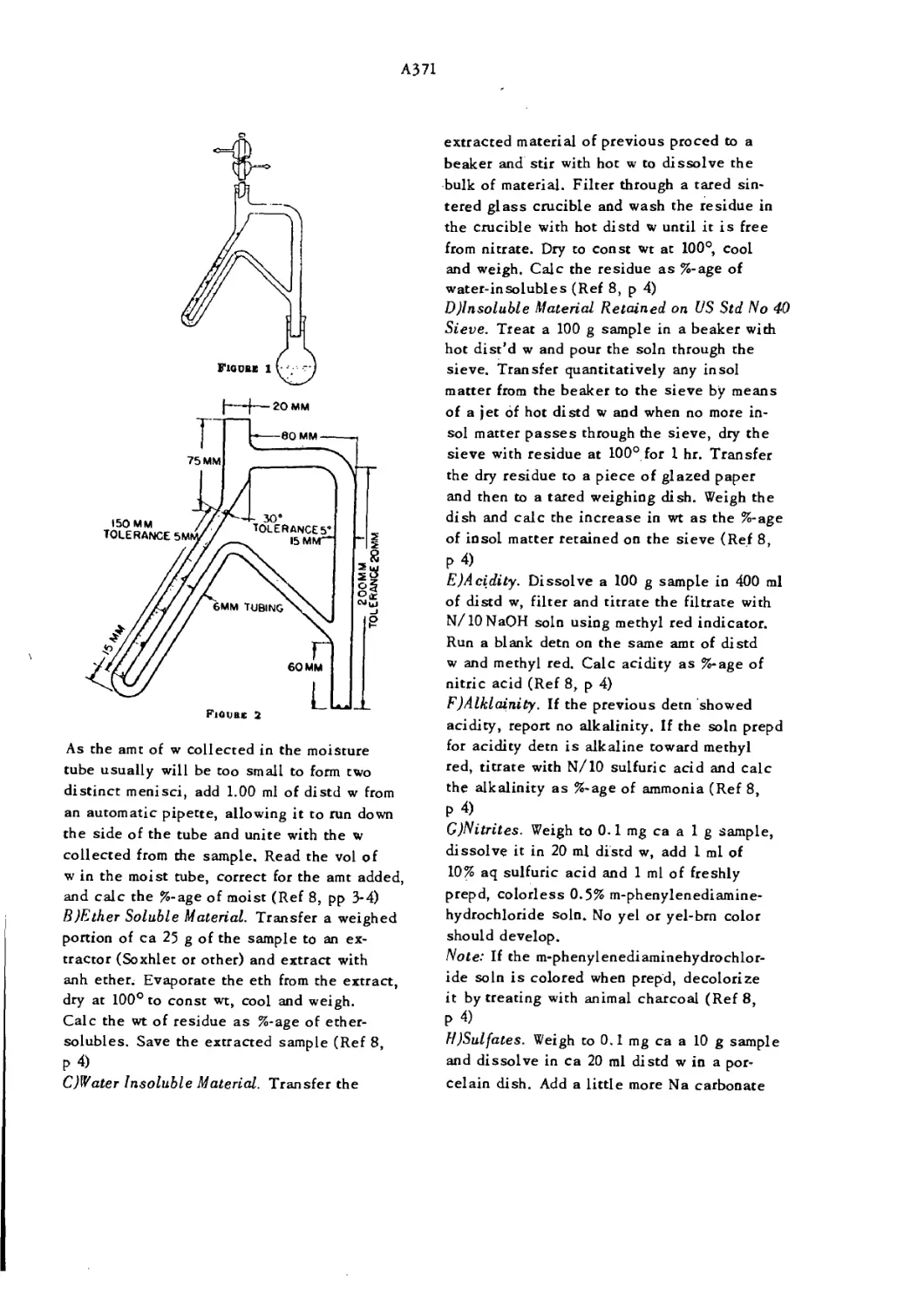
Apparatus for Determination of Moisture	A371
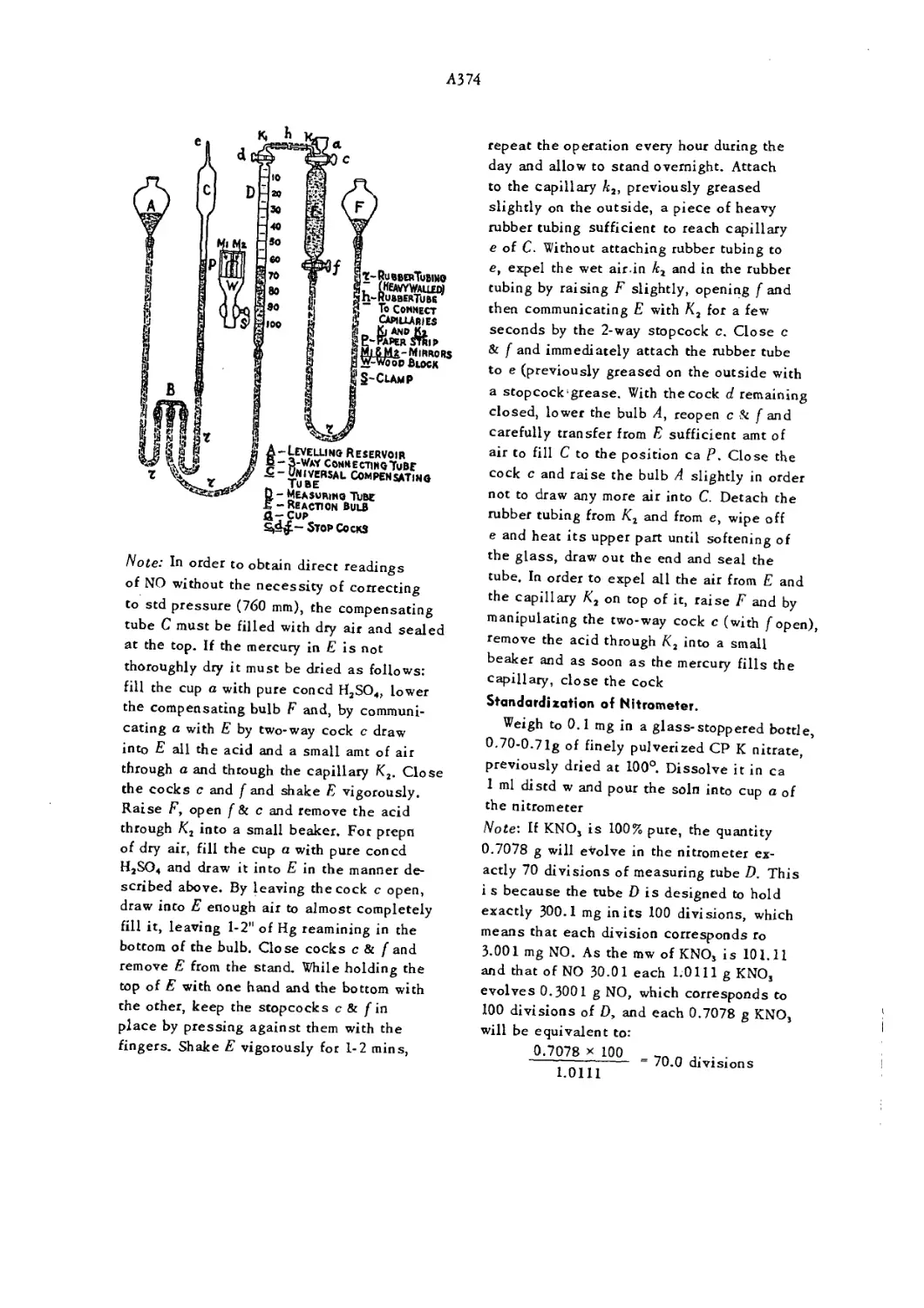
Nitrometer Apparatus for Determination of Nitrogen	A374
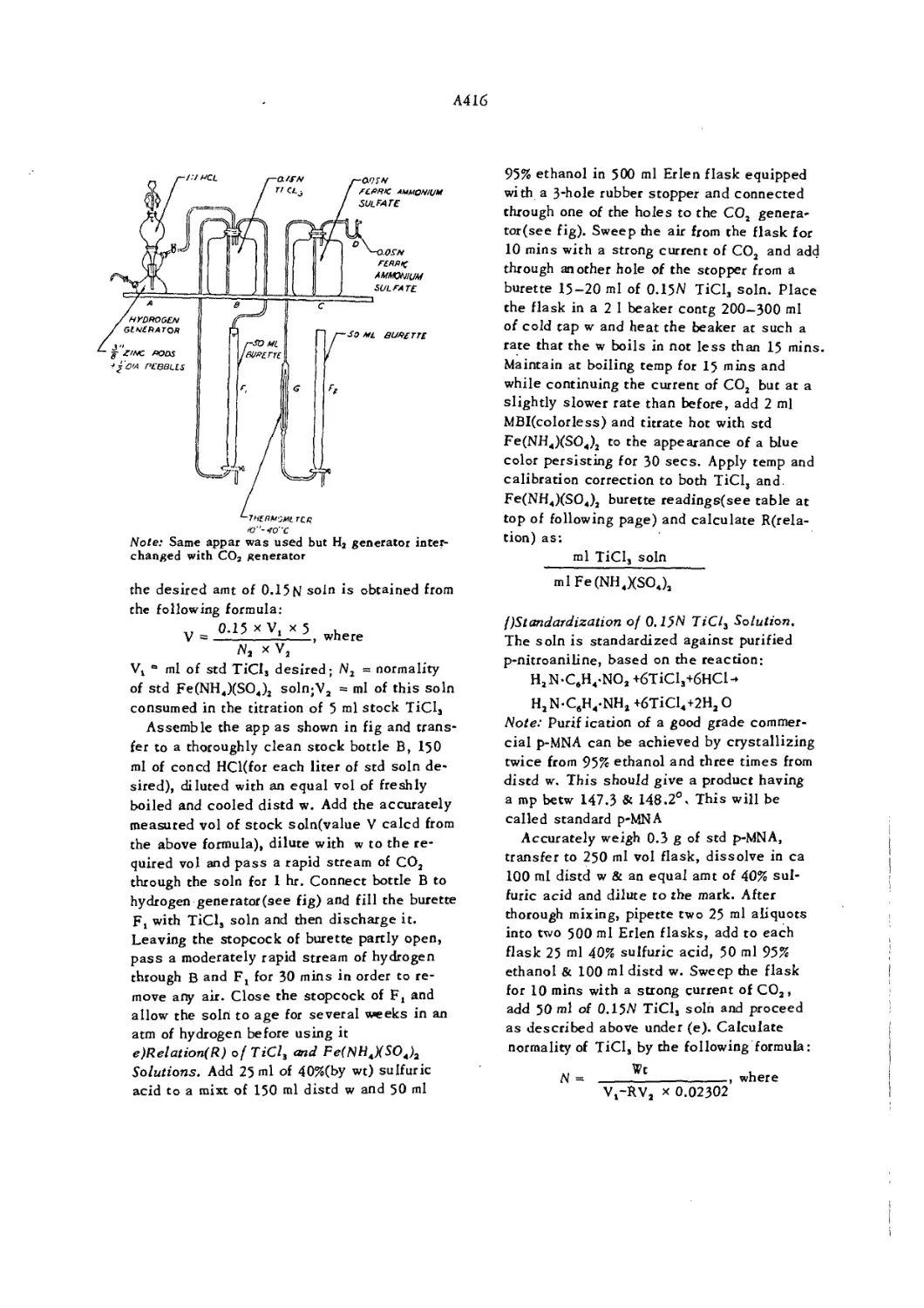
Apparatus for Determination of Nitrobenzene in Aniline	A416
Anvil of a Percussion Primer	A473
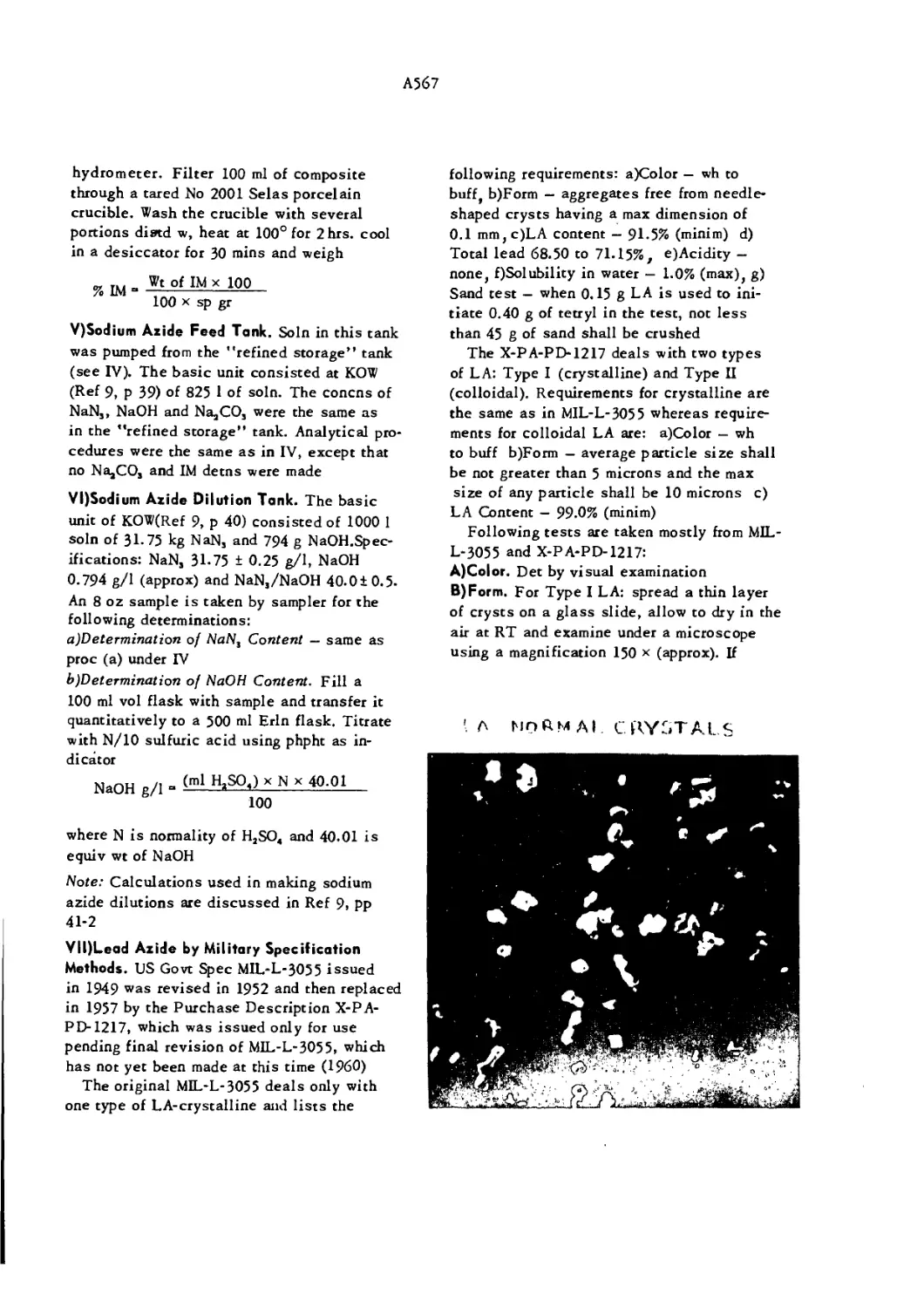
Lead Azide Normal Crystals	A567
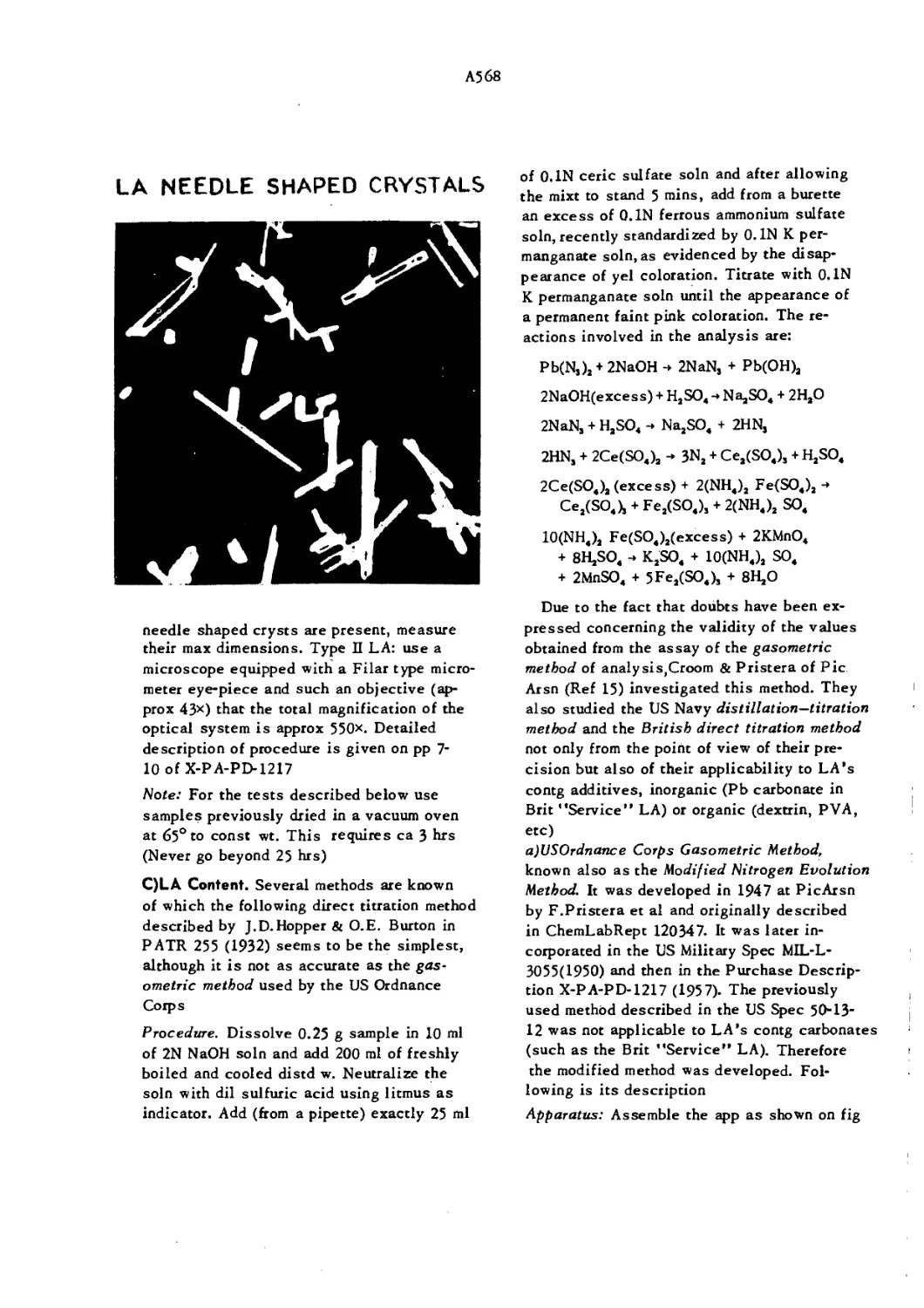
Lead Azide Needle Shaped Crystals	A568
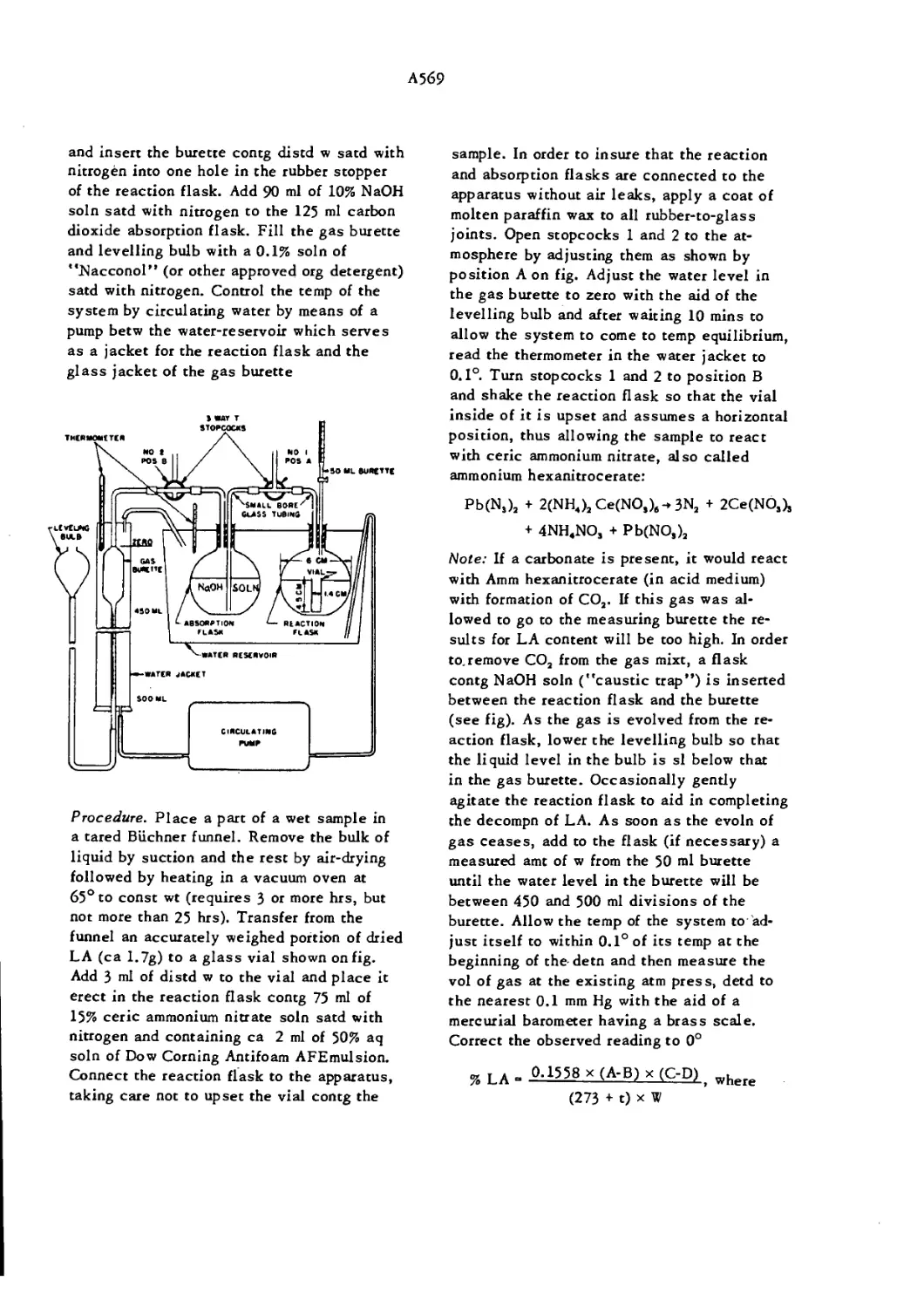
Apparatus for Lead Azide Content by US Ordnance Corps
Gasometric Method	A 569
Apparatus for Determination of Lead Azide Content	A582
Apparatus for Determination of Solidification Point	A613
PREFACE
The widespread interest in explosives during and since World War II has re-
sulted in the need for a comprehensive coverage of the field of explosives and re-
lated items. In 1941-1944, Dr В. T. Fedoroff in collaboration with G. D. Clift had
published a "Laboratory Manual of Explosives” in four small volumes (Lefax Co),
for which there were numerous requests. Since the printed editions had been ex-
hausted and the plates were no longer available, Dr Fedoroff decided to write a
revised edition. As the work progressed, it became evident that additional help
would be needed, not only because of the tremendous expansion of the literature,
but also because it was decided to broaden the scope of the work
industrial explosives, explosive compositions, propellants and pyrotechnic compo-
sitions b)Explosives and explosive compositions which have not been used for
military or industrial purposes c)Analytical procedures for the more common
explosives, propellants and pyrotechnic compositions d)Compounds which def-
lagrate or may possibly explode because of the presence of plosophoric groups
e)Ammunition items, such as projectiles, bombs, grenades, detonators, fuzes, etc
f)Calibers of weapons and projectiles used in the US and foreign countries g)
Brief definitions of ordnance terms h)Names of scientists who made important
contributions in the fields of explosives, ammunition and weapons
Over the years a number of works, including dictionaries, have been published
in the field of explosives, propellants, etc, which are of general or limited scope
None of these has attempted to include in one work a comprehensive coverage of
the broad field of items listed above
The authors hope that this Encyclopedia will be of value not only in saving
many hours of library work but also in reducing the need for much laboratory work
in order to obtain information already available. It is hoped that some of the data
and even lack of data may stimulate additional work in the fields covered
In compiling this work, the authors have freely consulted with, and had the
cooperation of so many individuals that a listing would be impractical. Any at-
tempt to do so would surely result in some embarrassing omissions. We therefore
take this opportunity to thank all those who have been consulted or who have help
ed in other ways in the preparation of this work. Throughout the Encyclopedia
information received from individuals is acknowledged in the text. Picatinny
Arsenal Technical Information (Library) reference works, such as journals,
periodicals books and unclassified reports, were made available through the co-
operation of all Library personnel. The complete copy of this manuscript was
Vari-typed by Miss Margaret Dee, Mrs Sylvia Griffin and Mrs Bertha Kelly with
the cooperation of Mr Joseph Farkas & Mr John Noonan, whom we consulted
freely (all of the Technical Publications Unit, Feltman Research and Engineering
Laboratories). Special acknowledgement is due to the officials (both military and
civilian) of Picatinny Arsenal for encouraging this work and for obtaining its
financial support
Although considerable effort has been made to present this information as ac-
Fa 1 ч r	***»<“*	e» t 1*41 A m « <“*♦ lx A rt AAF	• r4	FF «в	X*#*  F4 F • Xv *4 A zS x* 11 F	I A  <4 F AF«
ч. Ы& V. 1J	UO	UJiaVUrVVQ Ы41М V11V1U	All	U	UV V'eVUAt	A	ШЪ'вА
pretations of data and opinions expressed are the responsibility of the authors and
are not necessarily those of the Department of the Army or of Picatinny Arsenal.
This report has been prepared for information purposes only and the Department
of the Army or Picatinny Arsenal shall not be responsible for any events or
decisions arising from the use of this information
I
INTRODUCTION
The user of this Encyclopedia is urged to read this Introduction to obtain an
understanding of the authors’ way of treating and covering the subject matter. Be-
cause of the broad scope of the work and the vast amount of material available,
discussions of most items are brief. Theoretical and physico-chemical aspects,
except for a few constants, are usually covered by the references. Items of dis-
tinct military or commercial importance are discussed in more detail. References
to all sources of data, as well as references for broader coverage, are given fol-
lowing each item. No claim is made to complete coverage, but the authors believe
that, in general, few pertinent references have been omitted
No attempt has been made to cover the large volume of material included in
classified reports and no information from such reports has been used. However,
for the benefit of those who have the right of access to classified information,
some references to these sources may be given. Army regulations declassifying
most of the classified reports originating before January 1, 1946, were not issued
in time to permit review of the large number of these reports for information which
would have been included under the letter A and covered in this first volume. Sub-
sequent volumes may include subject matter from these declassified reports. In
some cases, reports listed here as classified, may subsequently have been de-
classified
As was mentioned in the preface we have listed not only compounds which have
been reported as explosive, but also compounds which have been or may be pre-
pared and which, because of the presence of plosophoric groups, may possibly be
explosive. This has been done because, unfortunately, many workers who have
prepared compounds which may be explosive, have not made tests for explosibility.
Many substances ordinarily not considered explosive, have exploded accidentally
or been caused to explode experimentally
Because of the potential hazard from compounds containing plosophoric groups
we have included compounds which, in our opinion, contain a sufficient percent-
age of such groups to make them dangerous under certain conditions. Such com-
pounds may possibly find use as components of explosive mixtures, fuse compo-
sitions, etc. In the case of nitro compounds, this percentage was arbitrarily set
at about 14% N02 and/or NO nitrogen, although some compounds with lower
nitrogen content have been exploded. High nitrogen compounds on combustion
yield large volumes of gas which may contribute to the ballistic potential of a
propellant composition containing such compounds. If these compounds are not in
themselves exothermic, their endothermicity may be of value in reducing the flash
of propellent compositions. We have, therefore, decided to include compounds
which contain about 40% or more nitrogen
In addition to a given explosive compound, we have included references to what
may be considered as the parent compound of azido, nitro or nitroso derivatives.
This is done because some information concerning the parent is usually needed
for the preparation of explosive derivatives. References (mostly Beilstein) to
intermediate non-explosive derivatives are included for the same reason. For
example, naphthalene and its various mononitro and dinitroderivatives, which are
not explosive are listed and references given
In order to make the Encyclopedia as compact as possible we used abbreviations,
many of which are the same as used in Chemical Abstracts except that periods
after abbreviations are omitted. A list of abbreviations symbols, code letters and
special designations of items connected with explosives, propellants, pyrotechnics,
ammunition and weapons is included in this work. This list is placed immediately
before the Encyclopedia proper (see Abbreviations, pp Abbr 1-59) and also in-
cludes abbreviations and code letters for various Ordnance establishments, in-
dustrial installations and scientific institutions, both US and foreign. Some addi-
tional abbreviations are given in a supplementary list (see Abbreviations, pp
Abbr 59-65). Wherever we have been able to do so and are permitted by security
regulations, the meaning of code letters on ammunition, weapons and other military
items is briefly explained
Following the above lists, the journals, books, and other reference sources
most frequently used are given, together with our abbreviations for them (See pp
Abbr 66-76). Journal abbreviations, not included in our list, are the same as given
in the "List of Periodicals Abstracted by Chemical Abstracts,” Ohio University,
Columbus 10, Ohio (1956), except that we do not use periods and leave no space
between abbreviated words. Although the French, Italian, Spanish and Portuguese
books and journals do not capitalize the words in titles (except the first word)
we use captials, as is the practice in abbreviating US and British journals
Nomenclature
Since most organic compounds can be designated by several names, it was
necessary in each case to decide under which name to list a particular compound.
Not only are different names used by different writers, but frequently the Ab-
stractor for Chemical Abstracts used another name and in the Chemical Abstracts
Indexes the compound is often indexed under a still different name. In general,
the Chemical Abstracts Index name is here given preference. However, when a
trivial name or an older name is used, the compound may be listed under one of
these names. In every case where more than one name has been used to designate
a compound, the others are also listed. In addition, alternative names are or will
be listed and the various names cross-indexed. The reader will thus usually have
little difficulty in locating the desired item under which the compound is dis-
cussed in this book. In most cases, when a compound is described in the German
literature, the German name is also given. This should be of help to those who
seek information on the compound in the German literature, particularily Beilstein
and Gmelin
Azido, nitramino, nitro and nitroso derivatives are listed under what may Be con-
sidered as the parent compound. Thus all the mono-, di-, and trinitrotoluenes will
be discussed under toluene. For example, nitraminotetrazoles are discussed under
aminotetrazole. With this system the various azido, nitro, etc derivatives in-
cluded above are kept together and are not scattered throughout the Encyclopedia.
Since these derivatives of a given parent compound are usually of some related
interest from the point of view of properties, preparation and references, we be-
lieve that this arrangement is the most convenient
While most azido, nitroso, and nitro derivatives are listed under their parent
compounds, the amino, azo, azoxy, etc derivatives are listed as parent compounds,
themselves, either individually or as a group. Similarly, alkyl, phenyl and other
Ill
derivatives are listed under their corresponding alkyl, aryl, etc names, eg amyl
derivatives under amyl, etc. Bis- compounds in general will be listed under B,
and tris- compounds under T. Halogen containing compounds will be found under
the appropriate halogen; eg chlorobenzene under C etc. Salts, peroxides, hydro-
peroxides, etc of organic compounds are listed under the corresponding organic
parent compound, while metallic salts are discussed under the appropriate acids,
such as chloric, nitric, perchloric, etc. An exception is Ammonium Nitrate which
is discussed separately in this volume and not under Nitric Acid. Normal, iso-,
tertiary-, etc, isomers of alkyl compounds are listed under the corresponding
alkyl group. Thus isobutylperoxide will be found under butylperoxides
When the position of a substituent group has not been established or is in doubt,
the doubtful position may be indicated by x or followed by (?). In some cases the
probable positions are given in parentheses, eg 4 (or 7)-aminobenzotriazole. Where
► НгЛ ТОАчге* ArA ллпчгплгЛо .«c«A^	♦ л	•-« л. г» ’ * а	л — «-> 1 л « л*-г» "л
uvTw najo саач, wiiJanwiiA у иочц lu niuitait «.lit	ui	Ul tltllitiiuo lai a
molecule, one of the alternative ways is usually placed in parentheses directly
after the letter or symbol designating the position, eg 2(or o), and a (or 1H). This
is done to avoid repeating the whole name
The nomenclature,particularly of complex compounds, is not always satisfactory
in spite of the good work of the nomenclature commissions of the International
Union of Pure and Applied Chemistry. Occasionally, a competent chemist would
not be able to write the correct structure based on a given name. This is partic-
ularly noticeable in the naming of open chain and cyclic polynitrogen compounds
and especially when the molecule contains both types of structures. As a result
of our work in this field we have evolved a system which we have been using and
which has some advantage in reducing ambiguity. Where it has seemed advisable,
an additional name has been added, based on the system described below. This
system was worked out in collaboration with Drs H. Matsuguma and H. Walter of
Picatinny Arsenal and is essentially a combination of those systems used in
Beilsteins Handbuch der Organischen Chemie and Chemical Abstracts
tl._______t._:_____i.._:____________:
ALIC V^JCLl Cliaill JJViyIHUUgCll	IIILLUUC,
Diazene	— HN-N<
Triazene	—N:N-N<
Tetrazene(l)	>N-NH-N:N—	[called	herein isotetrazene as has
been done by F.L.Scott et al, JACS 75,	5310(1953)]
Tetrazene(2)	>N-N:N-N< (which herein	will be called simply
tetrazene)
Pentazadiene	-N:N-NH-N:N-
Hexazadiene	—N:N-NH-NH-N:N—, etc
In these groups Beilstein designates the nitrogen at one end of the chain as N
and the one at the other end as Nbut there is no provision for naming the com-
pound if some organic radical is attached to one of the nitrogens not at an end of
the chain. The system used in US Chemical Abstracts consists of designating the
nitrogens by the numerals 1,2,3,4 etc but there is no provision for differentiating
these numerals from those used in the ring structures (such as benzene, pyridine,
triazole, tetrazole etc) which may be attached to one of the nitrogens of the open
chain compounds. None on the above systems provides a ready, unequivocal in-
dication of the position (in the ring) to which the nitrogen of the open chain com-
• <*
b'wuiiw i-o аьънх.iivu
IV
In the system we have adopted the nitrogens of open chain compounds are
designated as N1,N2,№,N4,№,N6, etc. For instance, the compound CjHs.-NiN^NH**
NH*CeHs would be called (Nl-ethyl, N4-phenyl)-isotetrazene and the compound
CH3
CjHj •N:N>N(NH2)«N>^ would be called (N*-ethyl, №-amino, N4-methyl, N4-
phenyl)-isotetrazene. Slightly more difficult would be the naming of a compound
in which one (or several) hydrogens in an attached ring or in the straight nitrogen
chain is substituted by one (or several) radicals, such as NH2, NO2, CeHs, etc
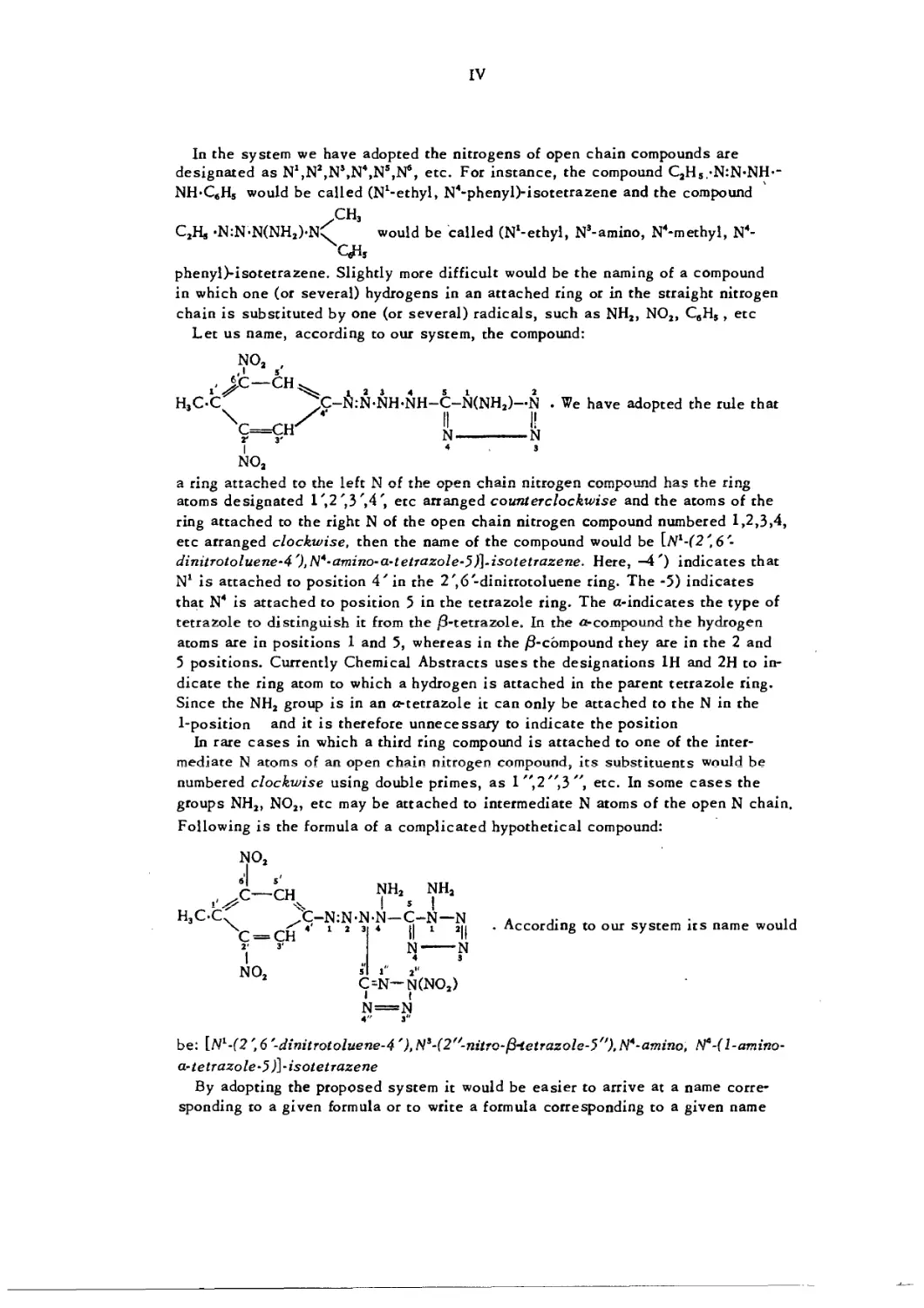
Let us name, according to our system, the compound:
N0a
5
. 1C—CH^
1	%	12 14	5	1	,	2
HjC-C	;c-N.N-NH-NH-C-N(NH2)--N . We have adopted the rule that
V_л/'	II I!
V==YH	N-N
|	4.3
no2
atoms designated	etc arranged counterclockwise and the atoms of the
ring attached to the right N of the open chain nitrogen compound numbered 1,2,3,4,
etc arranged clockwise, then the name of the compound would be
dinitrotoluene-4'),N4-amino-a-tetrazole-5)]-isotetrazene. Here, -4') indicates that
Nl is attached to position 4' in the 2',6 -dinitrotoiuene ring. The -5) indicates
that N4 is attached to position 5 in the tetrazole ring. The а-indicates the type of
terraZole to distinouish it from rhe Й-rerrazol e. In rhe O-romnound rhe hvdrnoen
--  - _ —- - Q	— -	f ____	- — -	£-	~	/	О
atoms are in positions 1 and 5, whereas in the j8-compound they are in the 2 and
5 positions. Currently Chemical Abstracts uses the designations 1H and 2H to in-
dicate the ring atom to which a hydrogen is attached in the parent tetrazole ring.
Since the NH2 group is in an a-tetrazole it can only be attached to the N in the
1-position and it is therefore unnecessary to indicate the position
In rare cases in which a third ring compound is attached to one of the inter-
mediate N atoms of an ooen chain nitrooen cnmoound. its substituents would be
--	r _	_	’ Г
numbered clockwise using double primes, as 1",2 ",3 ”, etc. In some cases the
groups NH2, NO2, etc may be attached to intermediate N atoms of the open N chain.
Following is the formula of a complicated hypothetical compound:
no2
.1
t, ^c—CH
H3C-C\ J
C = CH
2'	3‘
NH2 NHa
! s I
t-N:N-N-N—C-N—N
4	1 2 3 4 II 1	211
. According to our system its name would
no2
2'
C-N~ N(NO2)
2 3
N-----N
4	3
be:	z ~ '~clinitrotoluene~4 *),	2^^-nitrO“ ^*tetrazole~^^^),№4“amino, .V4I~amino~
a-tetrazole-5 )\-isotetrazene
By adopting the proposed system it would be easier to arrive at a name corre*
sponding to a given formula or to write a formula corresponding to a given name
V
than by using the systems described in Beilstein, Chemical Abstracts or British
literature
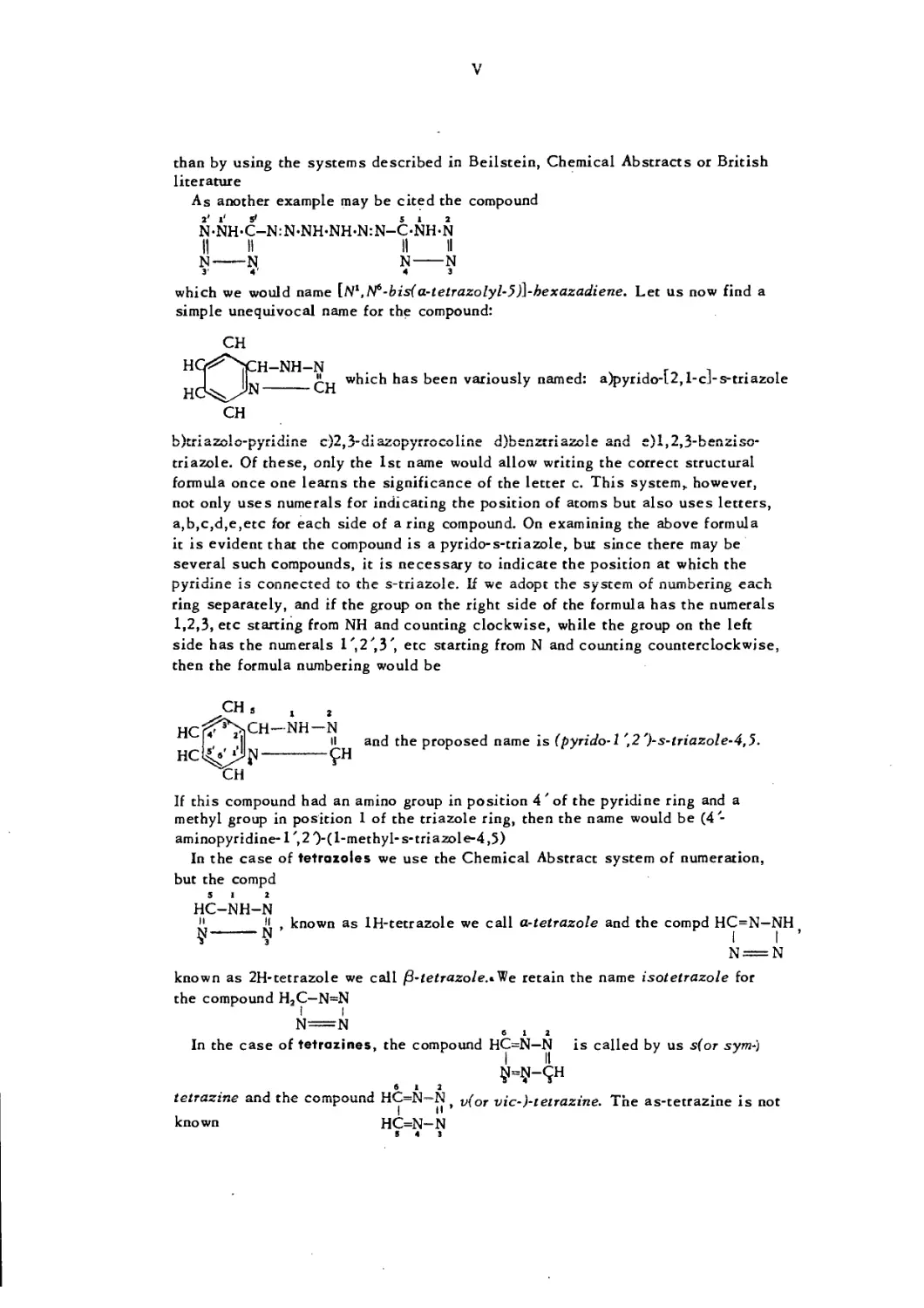
As another example may be cited the compound
N-NH-C-N:N-NH-NH-N:N-C-NH-N
|| II	II	II
N — JQ	N---N
3	4'	4	3
which we would name [Nl,Ni-bis(a-tetrazolyl-5)]-hexazadiene. Let us now find a
simple unequivocal name for the compound:
CH
CH
which has been variously named: a)pyrido-[2,l-c]-s-triazole
t о Ул! л-гмт /41 rt a	A— /41 О'уллчгггала 1« no	О Ул! л О rt zl 1 *7	У«
и/Ы1иЬМА\/ JZ J L Л ЧА А 1i Ч>	U1	J 4 1 V 4V i 111V. U у и V 41	4 I М4А/1 M4IU Ч> J • ) Ла у _J
triazole. Of these, only the 1st name would allow writing the correct structural
formula once one learns the significance of the letter c. This system,, however,
not only uses numerals for indicating the position of atoms but also uses letters,
a,b,c,d,e,etc for each side of a ring compound. On examining the above formula
it is evident that the compound is a pyrido-s-triazole, but since there may be
several such compounds, it is necessary to indicate the position at which the
________~__________л	rr   	_______________i : _~_l.
[jynuiiiic: ia u. unncrcicru iu inc s’luaAuic. xi wc auupt unc зумсш ui и uni ucung ctn_n
ring separately, and if the group on the right side of the formula has the numerals
1,2,3, etc starting from NH and counting clockwise, while the group on the left
side has the numerals l',2',3', etc starting from N and counting counterclockwise,
then the formula numbering would be
CH a ,	,
HCf?%CH~NH-N
HClQ^-------
CH
and the proposed name is (pyrido-1 ',2 ')-s-triazole-4,5.
If this compound had an amino group in position 4' of the pyridine ring and a
methyl group in position 1 of the triazole ring, then the name would be (4-
aminopyridine- l',2 9-(l-methyl-s-triazole-4,5)
In the case of tetrazoles we use the Chemical Abstract system of numeration,
but the compd
5	1	2
HC-NH-N
•I , known as IH-tetrazole we call a-tetrazole and the compd HC=N—NH
У	II’
N —N
known as 2H-tetrazole we call (3-tetrazole.iWe retain the name isotetrazole for
the compound H,C—N=N
’ I I
N=N
б 1	2
In the case of tetrazines, the compound HC=N—N is called by us s(or sym-j
6	12
Ur_M_M Z . I	.	—.	.	.
jj*, v(or vic-)~teirazine. ine as-tetrazine is not
HC=N—N
S 4	3
known
VI
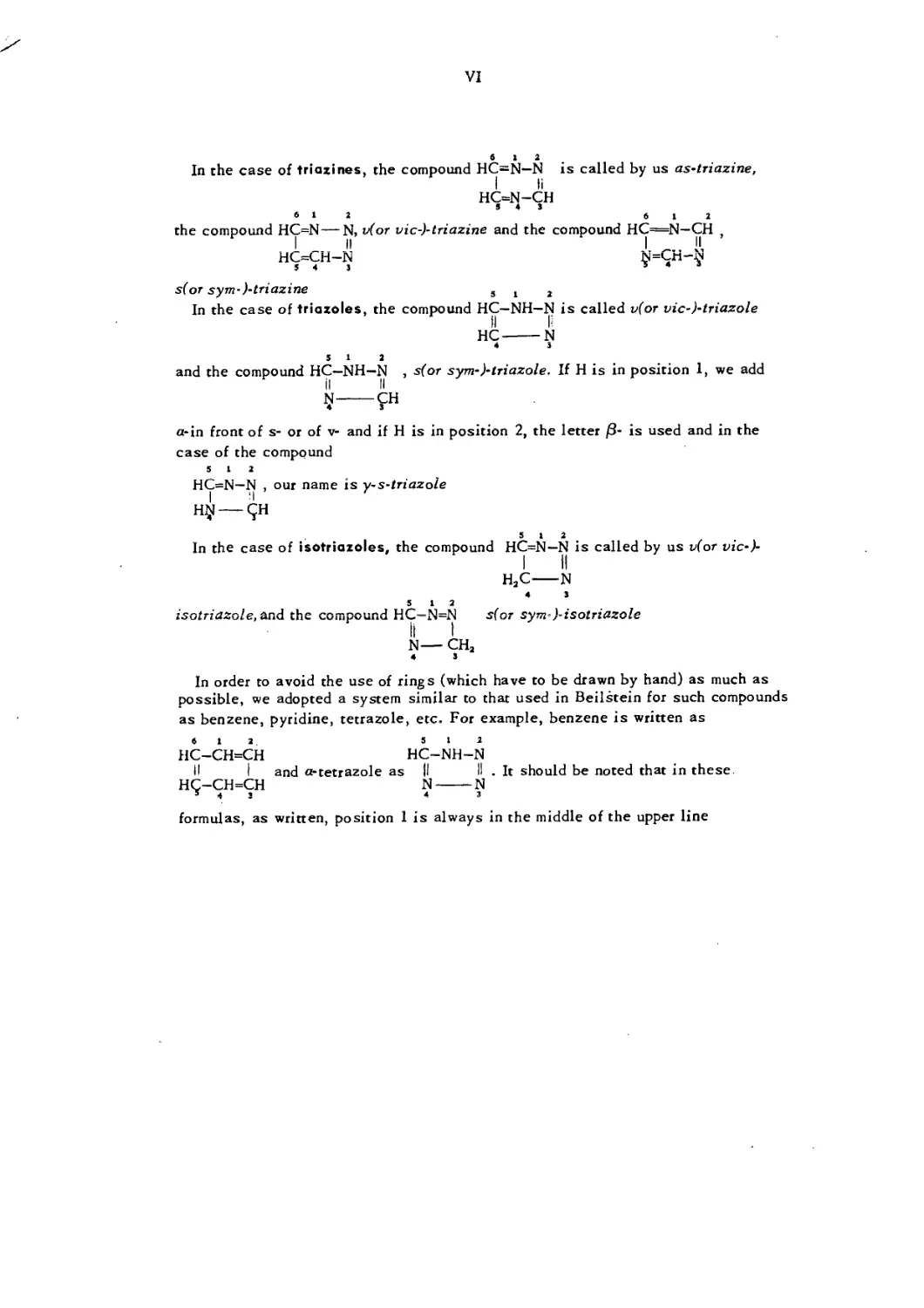
6 I 2
In the case of triaxines, the compound HC=N—N is called by us as-triazine,
I li
HC=N—CH
5	4	3
612	6	12
the compound HC=N—N, v(or vic-)-triazine and the compound HC=N—CH .
i _ II	| II ’
HC=CH-N	(ji=CH—jj!
s(or sym-)-triazine	3 t 2
In the case of triazoles, the compound HC—NH—N is called v(or vic-)-triazole
HC-------N
4	3
512
and the compound HC—NH—N , s(or sym-)-triazole. If H is in position 1, we add
il	II
N------CH
а-in front of s- or of v- and if H is in position 2, the letter /3- is used and in the
case of the compound
5	12
HC=N—N , our name is y-s-tri azole
H^l---qH
In the case of isotriazoles, the compound HC=N—N is called by us v(or vic-)-
I II
H2C----N
5	12
N—CH2
4	3
In order to avoid the use of rings (which have to be drawn by hand) as much as
possible, we adopted a system similar to that used in Beilstein for such compounds
as benzene, pyridine, tetrazole, etc. For example, benzene is written as
6	12	5	12
HC-CH=CH	HC-NH-N
II I	and a-tetrazole as	II	II	. It should be noted that in these
H(^-CH=CH	N------N
formulas, as written, position 1 is always in the middle of the upper line
VII
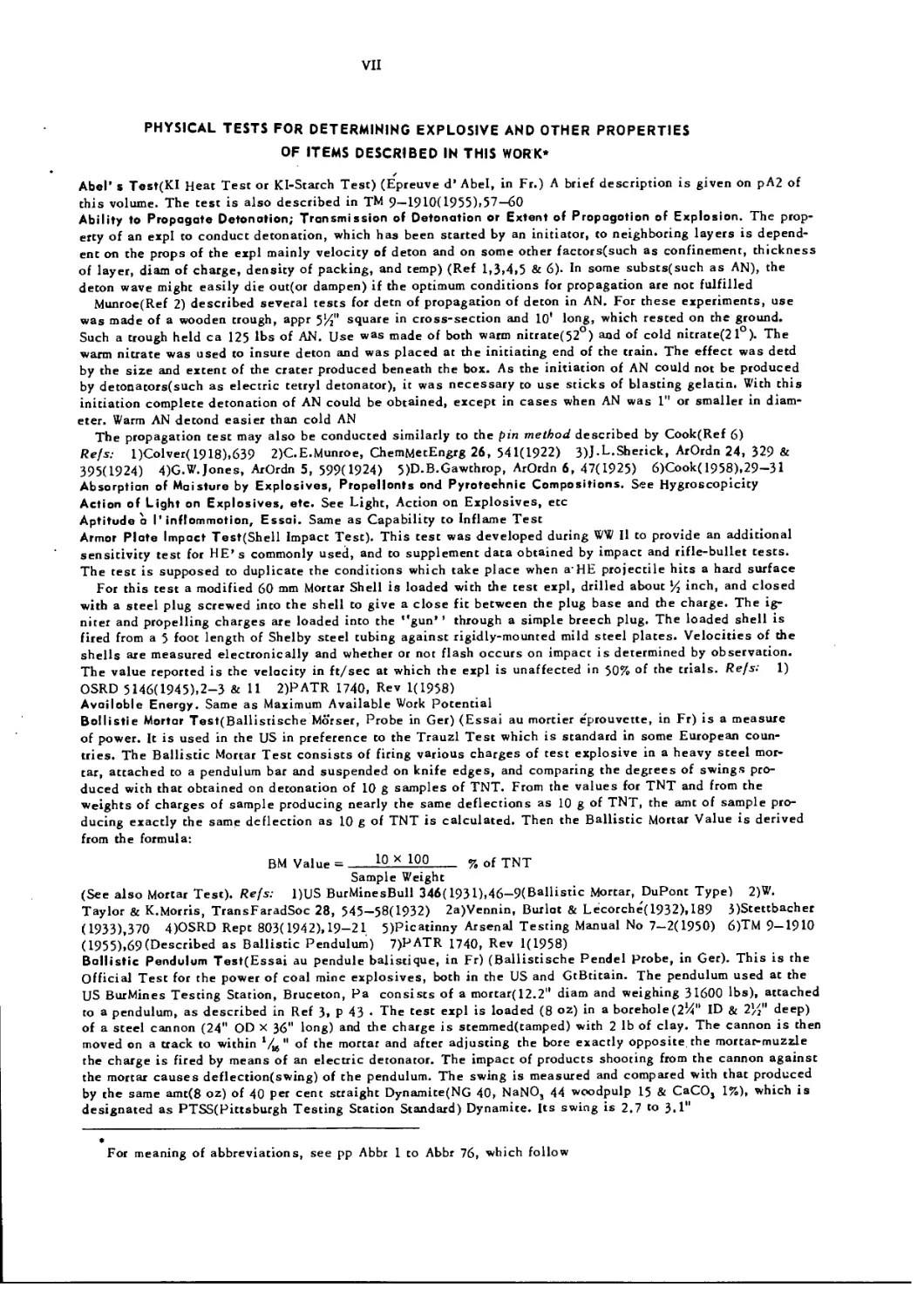
PHYSICAL TESTS FOR DETERMINING EXPLOSIVE AND OTHER PROPERTIES
OF ITEMS DESCRIBED IN THIS WORK*
Abel’s Test(KI Heat Test or Kl-Starch Test) (Epreuve d’ Abel, in Fr.) A brief description is given on pA2 of
this volume. The test is also described in TM 9—191O(1955),57—60
Ability to Propagate Detonation; Transmission of Detonation or Extent of Propagation of Explosion. The prop-
erty of an expl to conduct detonation, which has been started by an initiator, to neighboring layers is depend-
ent on the props of the expl mainly velocity of deton and on some other factors(such as confinement, thickness
of layer, diarn of charge, density of packing, and temp) (Ref 1,3,4,5 & 6). In some substs(such as AN), the
deton wave might easily die out(or dampen) if the optimum conditions for propagation are not fulfilled
Munroe(Ref 2) described several tests for detn of propagation of deton in AN. For these experiments, use
was made of a wooden trough, appr 514" square in cross-section and 10* long, which rested on the ground.
Such a trough held ca 125 lbs of AN. Use was made of both warm nitrate(52°) and of cold nitrate(2 1°). The
warm nitrate was used to insure deton and was placed at the initiating end of the train. The effect was detd
by the size and extent of the crater produced beneath the box. As the initiation of AN could not be produced
by detonators(such as electric tetryl detonator), it was necessary to use sticks of blasting gelatin. With this
initiation complete detonation of AN could be obtained, except in cases when AN was 1" or smaller in diam-
eter. Warm AN detond easier than cold AN
The propagation test may also be conducted similarly to the pin method described by Cook(Ref 6)
Refs: l)Colver( 1918),639 2)C.E.Munroe, ChemMetEngrg 26, 541(1922) 3)J.L.Sherick, ArOrdn 24, 329 &
395(1924) 4)G.W. Jones, ArOrdn 5, 599(1924) 5)D.B.Gawthrop, ArOrdn 6, 47(1925) 6)Cook( 1958),29-31
Absorption of Moisture by Explosives, Propellents ond Pyrotechnic Compositions. See Hygroscopicity
Action of Light on Explosives, ete. See Light, Action on Explosives, etc
Aptitude a I * inflammation, Essai. Same as Capability to Inflame Test
Armor Plate Impact Test(Shell Impact Test). This test was developed during WW II to provide an additional
sensitivity test for HE’s commonly used, and to supplement data obtained by impact and rifle-bullet tests.
The test is supposed to duplicate the conditions which take place when a*HE projectile hits a hard surface
For this test a modified 60 mm Mortar Shell is loaded with the test expl, drilled about l/2 inch, and closed
with a steel plug screwed into the shell to give a close fit between the plug base and the charge. The ig-
niter and propelling charges are loaded into the "gun* ’ through a simple breech plug. The loaded shell is
fired from a 5 foot length of Shelby steel tubing against rigidly-mounted mild steel plates. Velocities of the
shells are measured electronically and whether or not flash occurs on impact is determined by observation.
The value reported is the velocity in ft/sec at which the expl is unaffected in 50% of the trials. Refs: 1)
OSRD 5146(1945),2-3 & 11 2)PATR 1740, Rev 1(1958)
Avoiloble Energy. Same as Maximum Available Work Potential
Bollistie Mortar Test(Ballistische Mors er, Probe in Ger) (Essai au mortier e'prouvette, in Fr) is a measure
of power. It is used in the US in preference to the Trauzl Test which is standard in some European coun-
tries. The Ballistic Mortar Test consists of firing various charges of test explosive in a heavy steel mor-
tar, attached to a pendulum bar and suspended on knife edges, and comparing the degrees of swings pro-
duced with that obtained on detonation of 10 g samples of TNT. From the values for TNT and from the
weights of charges of sample producing nearly the same deflections as 10 g of TNT, the amt of sample pro-
ducing exactly the same deflection as 10 g of TNT is calculated. Then the Ballistic Mortar Value is derived
from the formula:
BM Value =	10 x 100____ % of TNT
Sample Weight
(See also Mortar Test). Refs: 1)US BurMinesBull 346( 1931),46—9(Ballistic Mortar, DuPont Type) 2)W.
Taylor & K.Morris, TransFaradSoc 28, 545—58(1932) 2a)Vennin, Buriat & Lecorche( 1932), 189 3)Stettbacher
(1933),370 4)OSRD Rept 803(1942), 19-21 5)Picatinny Arsenal Testing Manual No 7-2(1950) 6)TM 9-19Ю
(1955)>69(Described as Ballistic Pendulum) 7)PATR 1740, Rev 1(1958)
Ballistic Pendulum Test(Essai au pendule balistique, in Fr) (Ballistische Pendel Probe, in Ger). This is the
Official Test for the power of coal mine explosives, both in the US and GtBtitain. The pendulum used at the
US BurMines Testing Station, Bruceton, Pa consists of a mortar(12.2" diam and weighing 31600 lbs), attached
to a pendulum, as described in Ref 3, Р 43 • The test expl is loaded (8 oz) in a borehole(254" ID & 2/j" deep)
of a steel cannon (24" OD X 36" long) and the charge is stemmed(tamped) with 2 lb of clay. The cannon is then
moved on a track to within l/№ " of the mortar and after adjusting the bore exactly opposite the mortar-muzzle
the charge is fired by means of an electric detonator. The impact of products shooting from the cannon against
the mortar causes deflection(swing) of the pendulum. The swing is measured and compared with that produced
by the same amt(8 oz) of 40 per cent straight Dynamite(NG 40, NaNO, 44 woodpulp 15 & CaCOj 1%), which is
designated as PTSS(Pittsburgh Testing Station Standard) Dynamite. Its swing is 2.7 to 3.1"
For meaning of abbreviations, see pp Abbr 1 to Abbr 76, which follow
vin
By means of trial and failure the weight of the sample(W) that gives approximately the tame awing as 8 oz
of the standard is then detd, and three shots are fired with this wt. The exact swing of the sample(Sx) is
calcd from the formula:
W X Sr>
Sz =_____—, where Sj) is swing given by 8 oz of the standard(Refs 1,2,3 & 4)
8
The pendulum in use at the British testing station at Rotherham weighs 5 tons and is suspended by steel
rods from an overhead axle having toller bearings. The bore-hole of the cannon(gun) is 30" long and 1%11
diam. The charge consists of 4 oz of expl well-rammed with 2 lbs dry clay as stemming. The cannon is
moved to within 2" of the mortar-muzzle and the charge is fired by an electric detonator. The swing is read
and compared with 3.27" which is the swing produced by 4 oz of 60% Gelignite(NG 60, CC 4, KNO, 28 &
woodmeal 8%) (Ref 2,p 183—4)
The ballistic pendulum test is also used in GtBritain fat determining performance of military explosives.
For this a 10 g sample of expl is detonated in a loose condition under light confinement at the center of a
heavy hollow cylinder, closed at one end, and suspended so as to form a pendulum. The swing is com-
pared with that produced by 10 g of picric acid. The results are expressed as percentages of the perform-
ance of picric acid(Ref 5) Refs: l)Marahall 2(1917),473 2)Barnett( 1919), 182—4 3US BurMinesBull 346
(1931),40-6 3a)Vennin, Burlot & LecorcheJ 1932),269 4)Stettbacher( 1933),368 5)Blatt,OSRD 2014(1944)
Behavior Towards Heat Tests. See Sensitivity to Flame, Heat, Sparks, Electrostatic Discharges, etc Tests,
as well .as Burning Tests, Combustion Tests and Idex of Inflammability Tests
Borgmarm-Junk Test has been used widely in Europe and to some extent in the US for testing the stability
of NC. In this method NC is heated at 132° for 2 hours which action causes the evoln of some nitrogen
oxide fumes. The fumes are absorbed in water giving a soln of nitrous and nitric acid. The nitrogen content
of the soln is detd by the Schulze-Tiemann method. More detailed description will be given in Vol II,under В
Refs: DE.Bergmann & A. Junk, ZAngChem 17,982,1018 & 1074(1904) 2)Reilly( 1938)83—5 3)K*st-Metz
(1944),218-20 & 312 4)PATR 1401,Rev 1(1950), 19-25
Bichal Bomb or Bichel Pressure Gage is a device for measuring the press of an expln and for collecting and
examining the gaseous, liq, and solid products formed. The apparatus consists of two stout cast steel hori-
zontal cylinders, one of 15 1 and the other 20 1 capacity. Each cylinder can be closed with heavy lids pro-
vided with lead gaskets and secured in place by heavy stud bolts and an iron yoke. Three(or more) small
diam holes are drilled through the upper part of cylinders: the 1st hole is connected to the tube of a vacuum
pump, the 2nd accommodates an insulated plug that provides a means for conducting the electric current to
the electric detonator inside the bomb and the 3rd is connected to a press gage provided with a registering
drum
For examination of an expl a charge(usually 50 to 300 g) is placed inside the bomb, and, after closing
the lid, the air is evacuated by means of a vacuum pump. Then the chge is fired electrically and the pres-
sure diagram is obtained. Method of computation of results is given in Ref 2. The result thus obtained is
termed the "maximum pressure of the explosive in its own volume* *
This apparatus also affords a means for collecting and examining the products formed on expln. The
method of sampling is described in Ref 2, pp 92— 3-Refs: l)C.E.Bichel, "New Methods of Testing Explo-
sives,** Griffin,London( 1905) 2)US BurMinesBull 346(1931),84—95 3)Vivas, Feigenspan Л Ladreda,
v 4(1944),98— 104(Under the name "Medidor de presion de la case Carbonit” )
Blast Effects in Air, Em th and Water will be described in Vol II, under B.Refs: 1)TM 9—1910(1955),72—6
2)Cook(1958),322 3)Ordnance Proof Manual OPM 80-12(1959)
Blasting Caps and Detonators, Initiating Efficiency. See under Initiating Efficiency of Primary Explosives,
Blasting Caps and Detonators
Bomb Drop Tests(Bomb Functioning Test) are usually conducted using, bombs assembled in the conven-
tional manner, as for service usage, but provided with either inert or simulated fuzes. The target is usually
reinforced concrete-Refs: l)Ordnance Proof Manual, Aberdeen Proving Ground, Nos 9—11(1949) & Nos 10—
80(1957) 2)PATR 1401,Rev 1(1958)
Booster Sensitivity Test involves measuring the relative sensitivities of various expln to an arbitrary
graded series of boosters. This test was designed to classify expls on the basis of their ease of deton hy
boosters- The source of the shock consists of tetryl pellets of varying weights which may be degraded by
wax spacers of Acrawax B. The booster charge is initiated by a No 8 detonator. The weight of tetryl re-
ported as a final value is the min wt which will produce 50% detonations through the thickness of wax in
inches, as indicated
This test is considered as one.of the Detonation by Influence(Sympathetic Detonation) Tests. (Sea also
Gap Tent, Halved Cartridge Gap Teat and Wax Gap Test). Refs: 1)OSRD Rept 5746(1945) 2)PATR 1740,
Rev 1(1958)
Brisance or Shattering Effeet(Brisance, in Ft) (Brisanz, in Ger) (Podet rompedor or Brisancia, in Spaa)
(Potere dirompente, in Ital) can be approximately measured by the following methods: a)Compresslon Tests
IX
[such as Lead Block Compression Test(Hess Teat), Copper Cylinder Compression Test (Brisance Meter of
Kast Test) and Compression of Small Lead Blocks] b)Pragmenlation Testfqy') c)Fragment Densify Test(qv)
<i)Nail Test(<jy) expiate Testsfqv) (Cutting or Denting using various metals, such as brass, copper, iron,
lead and steel) f)Quinan Test(qv) g)Sand Test(Sand Crushing Test)
Brisance can also be calculated from the formula of Kast. This gives Brisance Value, called in Ger
Brisanzwert(Refs 1&4). A detailed discussion on brisance will be given in Vol U, under B. (See also under
Compression Tests)./?e/s.- l)H.Kast, SS 8, 88(1913) 2)Marahall 2 (1917),495 3)Bamett( 1919), 184 4)H.
Kast, SS 15, 181(1920) 5)Stettbacher(1933),49—50 6)Reilly(1938),68 7)Dsvis(1943),3 8)Vivas, F eigen span
& Ladreda, 4(1944),58-62 & 118 9)Belgrano( 1952),39-41 10)TM 9-1910(1953).60-3 ll)Cook(1958),17 & 34
Bulk Compressibility and Bulk Modulus is one of the important constants of an elastic solid. Bulk modulus is
defined as the ratio of stress to strain when the stress is a pressure applied equally on all surfacesof the
sample and the strain is the resulting change in volume per unit volume. The reciprocal of bulk modulus is
called bulk compressibility. One apparatus for the direct expt! measurement of the dynamic bulk modulus of a
solid was developed at the NOL, VhiteOak, Md(Ref 1). Some data obtained, on several HE’s, using this ap-
paratus are given in Refs 2 & 3- Refs; 1)NAVORD Rept No 1534(1950) 2)NAVORD Rept No 4380(1956)
3)PATR 1740,Rev 1(1958)
Bullet Impact Sensitiveness Test or Rifle Bullet Test(Essai au choc des bailee, in Fr) (Beschuse-Sicherheit
Probe, in Ger) (Prueba al choque de las balas, in Span) will be discussed in Vol П, under B. Refs: l)Vennin,
Burlot & Lecorchet 1932),215 2)OSRD Repts 803 & 804(1942), 15 3)Meyer(1943)>374 4)Vivas, Feigenspan
& Ladreda 4, (1944), 115 5)OSRD Rept 5745(1945 ) 6)Ohart( 1946),31 7)E.Burlot, MAF 23, 185(1949) 8)L.
Medard & Cesaat, MAF 23, 195(1949) 9)A.LeRoux, MP 33, 283(1951) I0)TM 9—1910(1955),49(described
under '’Sensitivity to Frictional Impact’ ’ )
Burning Rate Tests'are discussed in US BurMinesBull 346(1931),30— 1
Burning Tests. As surplus expls are usually destroyed by burning, it is desirable to know their burning
characteristics before proceeding to burn them on a large scale. A number of different methods have been de-
sigped at the US BurMines. One of the tests, designated as V—466 is as follows: Paper is placed on the
ground, the cartridges, the wt of which should not exceed 2 lbs, are opened and the contents spread in a thin
layer on the paper. After saturating the expl with kerosene, a charge (cs 25 g) of black blasting pdr is
ftlflAArl Aft fhr» Afi t>A nf	An iotUfA?	РЛ a ftrirta markiA* ftfaAAri at л	a/ nrt#
Г—      --	— .Q—.-.,	— • — — —	w.	aww
than 60 ft, is placed in contact with Ык pdr. The duration of burning of the expl is recorded. (See also Com-
bustion Tests, Index of Inflammability Test and under Sensitivity to Flame, Heat, Spark, Electrostatic Dis-
charges, etc Tests). Ref: US BurMinesBull 346 (1931),31
Calorimetric Tests for Explosives, Propellants and Pyrotechnic Compositions. These tests include determinar-
tions of heat of combust:on(designated as Q_), heat of explosian(Qs ), heat of farmation(Qt), heat of fusion
(Q fusn), beat of sublimation(Q. subln) and beat of vaporizationfQ vapzn)
This subject will be discussed in Vol П, under C. Refs: l)Marshall 2 (1917),440—2 2)Bamett( 1919,197
3)US BurMinesBull 346 (1931), 100—4 4)Vennin, Buriot & Lecorche'(1932),60—7 5)Stettbacher( 1933),S3
6)A.Schmidt, SS 29, 259 8t 296(1934) 7)OSRD Rept 293(1941) 8)OSRD Rept 702(1942) 9)OSRD Repts 803
Л 804(1942),32 10)Vivas, Feigenspan & Ladreda 4 (1944),73-84 ll)Physico-Chemical Unit Rept No
52—HI—595(1952),PicArsn,Dover,N.J. 12)F.D.Rossini, "Experimental Thermochemistry,” In terscience,NY
(1955) 13)H.W.Sexton, "The Calorimetry of High Explosives,” ARDE Rept (5) 4/56, Apr 1956(Conf) (Not
used as a source of information) 14)Parr Oxygen Combustion Bombs. Description of bomba and operation
procedures may be obtained from the Parr Instrument Co,Molline,IH
Capability to Burn Tests. See Burning Tests	,
Capability to inflame Tests(Epreuves de 1’aptituae de i’ inflammation or Epreuvea de combustion, in Fr).
See Combustion Teats, Index of Inflammability Test and also under Sensitivity to Flame, Heat, Spades,
Electrostatic Discharges, etc Tests
Covlty Charge Performance- See Shaped(or Hollow) Charge Efficiency in this section
Chai on Test permits simultaneous detn of the brisance and potential. It is discussed by Pepin Lehalleur
(1935),64
Characteristic Produet of Berthelat(Product characteristique de Berthelot, in Fr) will be discussed in Vol II,
under C. Ref: Marshall 2 (1917),417	,
Closed vessel Test(Essai en vase clos or Epreuve a la bombe, in Fr) will be described in Vol П, under C.
Refe: 1)Н.Мшаош, "Poudres et Explosive,” Presses Universitaires de France, Paris(1947),73—4 2)H.
Muraour et al, MAF 22, 517—93(1948)
Coefftcisnt’d Utilisation pratique(CUP or cup) (Epreuve de travail specifique). It is a modification of Trauzl
Teat(qv) designed by Dautriche and used as an official French test Briefly the test consists of pecking the
cavity(25 mm diem St 125 mm deep) of Trauzl lead block(200 mm diam & 200 mm high) with 15 g of crystal-
line PA(picric add) in such a manner that die height of charge is exactly 38 mm. In an identical block is
placed such an amt of expl to test, that it would prodace an expansion of cavity as close as possible to that’
proaucca Dy i? g Ol ГЛ» Alter ftMgDUy twapivwuig Ul« wumipv	i-w ---------------
detonator, the cavity is filled to the top with dry sand and the same is done with the chge of PA. After firing
the charge*, the expansions of cavities are detd and compared. If expansion(v' cc) produced by C g of earn*
.1.	«,;.к .к.	к.. к „ da k... j...	a:«.. _..^k .k.
wt of expl(C g) necessary to produce expansion Vcc can be found from the equation / C\i,,s _ V Thea tile
.	50 X 100	\ C / v
value of CUP is obtained from the formula_______, where C is wt of expl necessary to produce the same
C
expansion as produced by 15 g of PA(Ref 6). It has been claimed that this method givea more reliable results
than the regular Trauzl test. Refs: l)Marshall 2, (1917),472 2)Vennin, Burlot & Lecorche( 1932), 171
3)Stettbacher( 1933),363 4)Pepin Lehalleur( 1935),66 6)L.Mezdard, MP 33, 344(1951)
Combustion Tests(Epreuvea de combustion ou de l*Aptitude a 1 inflammation, in Fr). French official combus-
tion tests for expls and propeliants include: a)Combustion en gouttiere de 20 mm(Combustion in a trough of
20 mm), known also as Epreuve de propagation dans une gouttiere de 20 mm(Propagation test in a trough of
20 вив) sad b) Combustion en	coniquo( Combustion in a conical pile), known also as Enxeuve de sen si*
bilite a 1’inflammation^ eneitivity to ignition test) are described by L.Medard, MP 33, 329—30(1951)
Compression Tests, such as Copper Cylinder Compression or Crusher 7*ert( Brisance Meter of Kast Test),
Lead Block Compression or Crusher Test(Hess Apparatus Test) and Compression with Small Lead Blocks
will be discussed in Vol II, under C. Refs: l)Marshall 2, (1917),495—501 2)US BurMinesBull 346 (1931),
106—8 3)Stettbacher(1933),365—7 4)Pepin Lehalleur(1936),63 & 78
Concrete Test will be discussed in Vol II, under C. Ref: Marshall 2, (1917),273
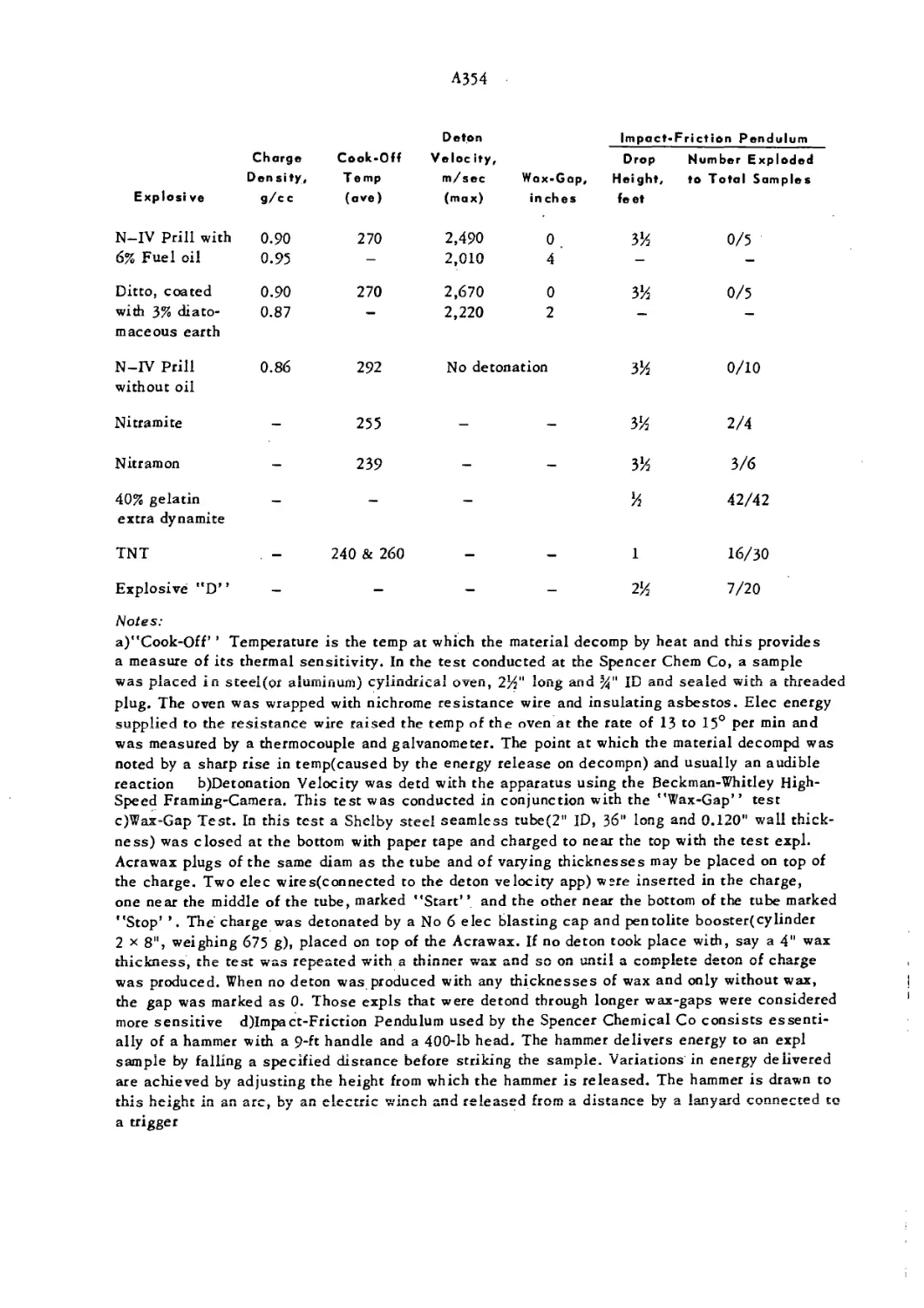
Cook-off Test is briefly discussed in this volume, under Ammonium Nitrate, A354, Note a. Ref: Spencer
Chemical Co, “Safety Data,*’ Feb 4, I960
Copper Cylinder Compression (or Crushing) Test. Same as Brisance Meter of Kast Test will be discussed in
Vol II, under В
Cratering Effect or Earth Cratering Test(Essai dans la terre, in Ft) will be discussed in Vol П, under C-
Refs: l)Pepin Lehalleur(1935),67 2)Meyer( 1943),379—80 3)Vivas, Feigenspan & Ladreda 4, (1944), 117
4)H.Muraour, “Poudre et Explosifs,” Paris( 1947),80-1 5)Belgrano( 1952),28-30 6)TM 9-1910(1955),76-8
Crawshaw-Jones Apparatus for testing coal mine explosives for permissibility will be discussed in Vol II,
under C. Ref: US BurMinesBull 346, (1931),95
Crusher(Crushing) Tests, such as Copper Cylinder Crushing(Compression) Test and Lead Block Crushing
/^rtmnrDS nlAn\ Tost a W0 iiaaJ tne satimaMAM	wla m keiaaMnS
wvuip*wvswily aww sa*^ w0«»m ava *,wa*u4»kivLi va ииъ. миоиыъъ чга vnpiwoivCo
CUP or cup Test. See Coefficient d'utilisation pratique in this section
Dau tri ch e Method for Determination of Velocity of Detonation will be discussed in Vol II, under D, as one of
the Detonation Velocity Tests
Deflagrotion Test or Deflagration Temperature Test. See Ignition Temperature Test in this section
Deliquescence Test. See Hygroscopicity Test in thie section
Density Determinations will be discussed in Vol П, under D
Detonation by Influence or Sympathetic Detonation Tests (Transmission of Detonation at a Distance Test)
(Aptitude a transmettre la de'tonation a distance, Essai or Coefficient de self-excitation, Essai, in Fr)
(Detonationsubertragung Probe or Schlagweite Probe, in Ger) (Determinacion de la sensibilidad a la iniciacion
por eimpatia, in Span) (Dietanza di esplosione pet simpatia, Prova, in Ital) include the following methods:
a)Booster Sensitivity Test(qv) b)Four-Cartridge TestfSee PATR 2510(PB 1612 ' ) (1958),p Ger 52]
c)Cap Test(qr) d)Halved Cartridge Test(qv) and e)Wax Cap Testlqv). Refs: l)Marshall 2 (1917),430
2)Barnett(1919),212 3)US BurMinesBull 346, (1931),59 4)Perez Ara(1945),l 12 5)L.Medard, MP 33, 342
(1951) 6)Belgrane(1952),43
Detonation Pressure is, according to Cook(Ref), a property of great importance in detonation technology. Its
direct measurement cannot be made due to its transient nature and its exceedingly high magnitudes, at least
iu СООибОвсц cXpluSlvcS* The uetOuStiOu picSSUic iS9 huwcvcij SCCUfACcly uefaucu by the uyufvdyuAuHC
equation given on p 32 of the Ref. Note: The “detonation pressure*' must not be confused with “Pressure of
Gases Developed on Detonation* ’(qv). Ref: Cook(1958),32
Detonotion Rate Determination ar Velocity of Detonation Tset(Mesures de vitesse de detonation, in Fr)
(Detonationsgeschwindigkeit Probe, in Ger) (Medida de la velocidad de detonacion,in Span) (Determinazione
della velocita di detonazione, in Ital), can be approx ealed, but more reliable results are obtained experi-
mentally by one of the following methods: s)Mettegang b)Dautriche c)Rotating Drum Streak Cameras
d)Rotating Mirror Cameraa(such as Bowen RC—3; Cook-Doering-Pound; Beckman & Whitley, Inc; AEC-Bowen
Type, etc cameras) e)Grid-Framing Camera of Sultanoff f)O* Brian & Milne Image Dissector g)Pin-
Osciliograph Method h)Mictowave Method i)Miniature Charge Techniques, etc. Refs: l)Marshall 2, (1917),
477 2)Bamett(1919),185 3)US BurMinesBull 346, (1931), 160 4)Vennin, Burlot & Le'corche? 1932),158-61
5)Stettbacher(1933),53-61 6)Reilly( 1938),68-9 7)OSRD Repts 803 & 804(1942).22-3 8)Davis( 1943), 14-18
9)Vivas, Feigenspan & Ladreda 4, (1944),62-72 10)PATR 1465(1945) lljL.Mddard, MP 33, 352(1951)
12)Belgrano( 1952),30-9 13)TM 9-19Ю(1955),41 14)Cook( 1958),22-35 & 41-2
XI
Detonators and Blasting Caps, Initiating Efficiency. See under Initiating Efficiency of Primary Explosives,
Blasting Caps and Detonators
Distribution of Shell Fragment Masses was detd at ERL, Bruceton, Pa by tiring shells in a Fragmentation
Pit filled with sawdust. The fragments were recovered by a magnetic separator. Details of procedure are given
in OSRD Rept 5607(1945). See also OSRD Repts 5606 and 5608
Drop Test. Same as Impact Sensitivity Test
Earth Cratering Test. See Cratering Effect Test in Vol II, under C
Erosion of Gun Barrels[Erosion(ou usure) des touches a feu, in Fr] (Erosion der GewehrlSufe; Bohrabnutzung,
or Bohraubrennung, in Ger) Test will be discussed in Vol Ш, under E. Refs; l)Marshall 2 (1917),315
2)Vennin, Burl оt & Lecorche( 1932),274 3)Marshall 3, (1932),93 4)Stettbacher(1933),211 5)Pepin Lehalleur
ПОКА im	Un.ann,	.r F.nUnU. » » Dari1 CM"74 1 1« К 7YD ЛТП 7C 1 nmol Z 1 mnY I 1 04
p Ger 43
Esop* s Test for Efficiency of Detonators, devised by K.Esop of Austria, in 1889, consisted of the following
operations: A 50 g sample of uniform grain PA(picric acid), was made into a cartridge and, after inserting a
test detonator, it was placed on a steel plate covering two small lead cylinders^zniabets), set vertically on a
steel base. After the chge wss fired, the compression of the cylinders was measured and this served as a std
value indicating complete detonation. This same type of detonator was then tested in mixta of PA with vary-
ing amts of cotton seed oil and the max amt of oil still permitting complete deton was detd. The larger
this amt, the more efficient was the detonator(Ref 1)
This test was investigated in Europe after WWI and found to be more reliable than other tests, especially
the sand teat(Refs 1&2). In a modification of the teat deviaed at the Chemisch-Technische Reichsanstalt, in
Berlin(Refs 3&4) mixts of TNT with paraffin wax and later of TNT with talc compressed into pellets, served
as inert expls for testing detonators. Completeness of deton was judged by firing the pellet with the test
detonator in a small lead block(Trauzl test) and measuring the enlargement of cavity(Compare with Grotta’s
Test and miniature Cartridge Test). Refs; l)Marshall 2 (1917),532 2)n.Kast & A.Haid, SS 18, 166(1924)
3)]ahresber CTR V,112(1926) & VI,121(1927) 4)Marshall 3 (1932),163-4
Explosion by lnfluence(or Sympathetic Detonation) Test s. See Detonation by Influence Testa
Explasion(or ignition) Temperature Test. See Ignition(or Explosion) Temperature Test, in this section
Explosian(or Ignition) Time Test(at Constant Temperatures). See Ignition(or Explosion) Time Test(at Con-
stant Temperature)
Extent of Propagation of Explosion. See Ability to Propagate Detonation in this section
Exudation(ar Sweating) Tests(Exsudation Essais, in Fr) (Ausschwitzungsproben, in Ger). The purpose of the
cxudBtioti test is to determine	exnls. such ss 4vnamitf»it. DNT. TNT. etc would release anv 11n in
storage, especially in hot climates
Following tests are described in Ref 1, pp 25—7: a)Centrifuge Test b)PortyDegree Test and c)Britisb
Tat, Of these the centrifuge test was adopted by the But Mines as being best suited for ascertaining the
liability of dynamites to exude
The French test, called exsudation par etuvage, is conducted as follows:
Weigh to the nearest mg a tall Kraft paper container 30 mm in diam and 0.2 mm thick. Pack the container
with the sample(100 g) and reweigh. Tare to the nearest mg a piece of porous cardboard 5x5 cm square and
2 mm thick. Place the container on the cardboard and insert the ensemble in an oven, thermostatically main-
tained at 4011° or 501 1°. After 21 days, reweigh the cardboard, the sample + container, and the empty con-
tainer
If the loss in Wt of sample is p, incteaae in Wt of container p and increase in wt of cardboard is p’, then
(p+P1) is the wt of exudate and P-(p+p') the loss in volatiles. Multiply the wts by 100 to express in percent-
age(Ref 5)
Another French method is described in Ref 3a
A German method for detn af exudation is described in Ref 7
Some tests have been investigated at Picatinny Arsenal, but exudation has been observed or induced in
loaded items of ammunition by subjecting them either to alternate periods of heating and cooling or to con-
tinuous heating at 160°F(71aC). There is no record of TNT exudation from US shell smaller in caliber than
105 mm or from Compoaition В loaded shell stored at ambient temp. However, mast TNT and TNT-contg expls
can be caused to exude by storing the loaded components at 160uF(71uC) or in temps which fluctuate sharply.
In one series of teats to induce exudation and to obtain exudate samples for analysis and examination of
properties, unfuzed shell were placed in an inverted position in tempo up to 160°F(71°C) and the exudate was
collected in a tared veaoel. A summary of the pertinent results from exudation studies conducted at PA has
been prepared by Stein(Ref 6). Refs: l)Marohall 2 (1917),419-22 2)Bamett(1919),215 3)US BurMinesBull
34« (1O31),25-7 3a)Pepin Lehalleur(1935);61 4)Rcilly(1938);65 5)L.Me'dard, MP 33, 328(1951) 6)PATR
2493(1958) 7)PATR 251O(PB 161270) (1958),Ger 45
Falling Weight Test. Same as Impact Sensitivity Teat
XU
Fl Teet( Figure о/ Insensitiveness Test}. The degree of sensitiveness exhibited by «л expls detonated on
mechanical shock is important because sensitiveness largely determines the precautions necessary in manu-
facturing, handling, and applications of the explosive. The difficulties sometimes attributed to determining
sensitiveness by impact or drop-weight machines were reportedly overcome by an apparatus designed by Dr
Rotter of the Research Dept, Woolwich, England. By this procedure reproducible accurate results were ob-
tained, not by personal observation of sound or flash produced, but by a quantitative measurement of the gas
produced at different heights of fall when the falling weight delivered sufficient energy to cause decompn of
the expl
The results are compared to a standard expl, such as'picric acid, gunpowder or mercury fulminate, and
expressed as a ratio known as figure of insensitiveness. This ratio represents the relative energies of the
impact required to produce explosions of equal degrees of completeness from initial decomposition to com-
plete detonation. Picric Acid is taken as 100, and explosives giving higher numbers are less sensitive while
those giving lower numbers are more sensitive than picric acid. Ref: R.Robertson, JCS 119 1,15(1921)
Fire Resistance or Fire Tests are described under Sensitivity to Flame, Heat, Sparks, Electrostatic Dis-
charges, etc
Flame Test(Length and Duration of Flame Determination) (Grosse und Dauer von Sprengstoff-Flammen
Probe, in Ger) (Medicion de la longitud у la duracion de la llama, in Span), The test is baaed upon the belief
that the greater the length of the flame an explosive emits and the longer the time during which that flame
endures, the greater are the chances that such a flame when shot into the atmosphere of a coal mine will ig-
nite inflammable or expl mixts of mine gas and air; of coal dust and air; or of mine gas, coal dust, and air
The flame-test apparatus used at the US BurMines Explosives Experiment Station at Bruceton, Pa consists
essentially of a cannon in which an explosive is fired or detonated. The cannon, identical with that employed
for the ballistic pendulum,is mounted vertically on a concrete foundation located in a dark building. By means
of a photographic camera equipped with suitable devices to cut off all extraneous light rays, the flame is con-
tinuously observed such that its spex is in the field of view. The flame is recorded on a sensitized film wrapped
about a drum that revolves at a predetermined rate of speed. The length of each flame is indicated by its height
in the photograph, and the duration by the length of photograph
When testing detonating expls, cartridges 1)4" in diam are used, the wt of charge being 100 ±0.5 g, includ-
ing the wrapper. When testing black blasting powder or other burning expls, the chge is tamped in the borehole
and the igniter is imbedded centrally in the top of the charge. Refs: 1)US BurMinesBull 346, (1931),67
2)Stettbacher(1933),65—8 3)Reilly(1938),69 4)Vivas, Feigenspan & Ladreda 4 (1944),108—11 5)Perez Ara
(1945)425
Flash Point Test. See ]gnition(or Explosion) Temperature Test, described in this section
Flash Tsst for Caps. See Optical Method for Testing Caps
Forty-Degree Tost. See under Exudation Teets
Four-Cartridge Test is the Ger detonation by influence test. It is described in PATR 251O(PB 161270) (1958),
p Ger 52
Fragmentation Test(Splitterprobe, in Ger). The fragmentation test consists of static functioning of the expl
filler of a projectile, rocket, bomb or mine for the purpose of determining the number and weight grouping of
the recovered fragments. The test gives a measure of the brisance and efficiency of an expl as well aa the
efficiency of the test item
Tests used abroad are briefly discussed in Refs 1,3,4&9, while the tests used in the US are described in
Refs 2,5,6,7,8A9
There are four general types of fragmentation tests used by US Ord Dept: enclosed Chamber or Pit Test,
b)Open Pit Test, c}Panel Test, and d)Velocity Measurement Test. The Closed Chamber Test, as conducted
at Picatinny Arsenal, is described in detail in Ref 7. The other three tests, as conducted at Aberdeen Prov-
ing Ground, are described in Ref 6. Mote information on fragmentation will be given in Vol Ш, under F
Refs: l)Stettbacher(1933),50-1 & 218-19 2)L.V.Clark,IEC 25, l?89-90( 1933) 3)A.Majrich & F.Sorm,
SS 30, 298-9(1935) 4)A.Stettbacher, Protar 8 , 90(1942) 5)Ohart( 1946),33 & 213 6)Ordnance Proof Manual
OPM 40-23(1947) 7)PicArsn Testing Manual 5-1(1950) 8)TM 9-1910(1955),63-4 9)PATR 1740, Rev 1
(1958) 10)PATR 25Ю(РВ 161270) (1958),p Ger 52
Fragment Density-, Fragment Concentration- or Density of Splinters Tesf(Splitterdichteprobe) is described in
PATR 2510(1958),p Ger 52
Fragment Gun was originally developed by the British as a convenient instrument for imparting high velocity
to controlled fragments in order to study their performance. The "gun* * consists merely of a steel tube into
which is inserted a flat sing, of any desired shape, cast in a Wood’s metal matrix. A cylindrical charge of
expl is inserted into the other end of the tube so that it fits smoothly against the disc of slug and Wood's
metal surround. The charge is then detonated, from the end opposite to the slug, using a tetryl booster and
suitable detonator. With a given type of tube and slug, the velocity imparted to the slug is a measure of a
property of the expl closely related to brisance. The velocity is de termined by sending the slug through
three wire screens and determining the time intervals by means of a Mettegang recorder or other suitable
device. Refs: 1)OSRD Rept 803( 1942),27-8 2)OSRD Rept 804(1942),27-8
Fragment Velocity Measurement of statically detonated projectiles provides data for aaalyaia of the effective*
ness of projectile fillers and shell design. Evsluation of the lethality of fragments also depends upon the
detn of fragment velocity
The basic technique for detg fragment velocity consist a of firing a model shell (such as 3") filled with a
test HE against a mild steel panel(sn<h as %" and */tn thick) and photographing the fragments with a motion
picture camera which also records elapsed time. By comparing the time with the distance traveled, an av
velocity is obtained(Ref 2). In tests conducted at ERL, Bruceton, Pa, 18 expls were investigated using the
"Bruceton Fragment Retardation Apparatus.' * Damage to steel panels was also detd. Refs: 1)OSRD Rept
5622(1946) 2)Ordnance Proof Manual OPM 80-16(1957)
Freezing Tests(for Dynamites). The freezing of expls, such as dynamites, leads as a rule to an increase in
the rigidity and brittleness of the cartridges, as evidenced by cracka in the sample. The extent of the
rigidity has been measured at the US BurMines by means of an apparatus called the "Crusher Board.'' This
consists of a wooden base with a superimposed aluminum plate provided with a hole at each of its four cor*
nera by which it may be made to slide up or down on vertical brass guide roda which are attached to the cor-
ner's of the wooden base. The sample of expl to be tested(a section of a cartridge, previously froxen at de-
sired temp, 10 cm long cut from the center minus wrapper) is placed on its side in the central position of the
Ьяяа апН Ap alnrninum rd ага is elinnad л«ду	тЯя яп ая m раяр nn eamnl®. ЙаА
------—  ------— — ’  ——pF——	-.*rrw«	— a— w« ——	•'*'»« ——  ----г warns	wa
cartridge are observed for the cracks. If none appears in either end in 10 secs a 100 g weight is added to the
center of the Al plate and if no cracks appear in 10 secs an addnl 100 g wt is added. Theae operations are
continued until the first crack is seen on either end of the sample. The total wt on top of the plate plus the
wt of the plate(911 g) is taken as a measure of the compressive strength
Expls that do not freeze when exposed to temps as low ss 35°F(+ 1.67°) are called LF(low-freezing),
those not freezing at 0°F(—17.78°) are ELF(extra low-freezing) and those not freezing at lower temps are
NF(non-freezing). Ref: US Bureau Mine sBull 346, (1931),27—29
Frictional Impact Sensitivity Test. See under Friction Sensitivity Test
Friction Pendulum Test. See under Friction Sensitivity Tests
FRICTION SENSITIVITY TESTS(Reibungsempfindlichkeit Pro ben , in Ger) (Essais la friction, in Fr)
(Pruebas al sensibilidnd al rozamiento, in Span). The tests may be divided into qualitative and quantitative
types
A.	Qualitative Friction Tests: a)Frencb Test No 1. Place a gram of expl in a porcelain mortar and rub with
a pestle. Report if it detonates or deflagrates(Refs 7 s 10) o'/Prencb Test No 2. Place a small sample on a
tile or on an anvil and strike a glancing blow by means of a wooden hammer. Report the results(Refs 6 & 8)
Nate: Expls sensitive to these tests are considered as dangerous to handle and if used in mining should not
be tamped even with a wooden tamper c)German Test of Imperial Railway Commission consisted of rubbing
a small quantity of expl in a small unglazed mortar with an unglazed porcelain pestle(Refa 1,2 8c 6)
d)Britisb Tests of Dupre are glancing blow testa. They are described in Ref 6, p 79
B.	Quantitative Friction Tests. u)Ratbsburg Test uses an apparatus which consists of two steel discs
about %" in diam with polished surfaces. The lower disc is stationary, while the upper rotates at 80 rpm.
Loads ranging from 1 to 20 kg can be placed on the upper disc, thus maintaining it at various pressures. The
explosive to be tested is mixed with finely pulverized sand and then a small portion is placed on the lower
dine. A 20 kg lond is placed on the upper disc, the disc is lowered to touch the sample and the rotation is
started, if the sample does not explode after 20 revolutions, it is removed from the apparatus and a new por-
tion is tested in the same manner. If no detonations occur after 6 trials, the expl ia considered insensitive
to friction. If any detonations are observed with a 20 kg load, the tests are repeated using successively
smaller loads until tile wt is reached with which no expln takes place The av number of revolutions r equired to
detonate an expl when tested 6 times with the minim pressure is then recorded(Refs 5 8c 11)
b)l/S Bureau of Mines Pendulum Friction Apparatus was devised in 1911 by С, E. Munroe, C.Hall 8c S.P.
Howell and three modela of different sizes were built at that time. The apparatus consists of a pendulum to
the lower end of which is attached a 20 kg shoe, with an interchangeable face of steel or fiber. It is also
possible to use other types of shoes, such as a wooden one with/or without carborundum cloth attached to
its striking surface. The shoe is permitted to fall from a height of 1 m and to sweep back and forth on a steel
anvil, the polished face of which is provided with three grooves ca %" deep cut at right anglea to the line of
swing. The grooves are designed to prevent the sample of expl, spread upon the anvil for testing, from being
brushed off the anvil by movement of the shoe across it. The pendulum is adjusted, before placing the sample
on the anvil, to swing 18 ± 1 times before coming to rest
Vi th a steel shoe raised to the height of 1 m, spread a 7 g sample of the explosive evenly in and about the
grooved portion of the anvil, and allow the shoe to atrike the aample with glancing blows until it cameo to
rest. Cleon the anvil and shoe, place another portion of the ваше expl and continue the test Repeat test a
total of 10 times and report the number of snaps, crackling a, ignitions, sad/ or explosions. if the aample
detonates af ter 1 or 2 trials, discontinue the test in order to prevent dastage to the apparatus. Such an explo-
sive is considered as not passing the permissibility test. If the expl remains unaffected la 10 trials with the
steel shoe, it is considered to pass the test. If some trials with the steel shoe produce burnings or cracklings,
repeat the test using the hard fiber shoe. If in 10 trials with this shoe there is no more unfavorable result than
an almost undistinguishable local crackling, the expl is considered as passing the teat for pcrmiasibility(Refa
3,6,8,12,13,14 & 1$) c)Laboratory Model of Pendulum Friction Apparatus, As the regular BurMines apparatus
is expensive and r equires large samples of expls. Taylor & Rinkenbach used a smaller modelfca % the size of
the В of M app). The shoe weighed 74 g and samples 0.00$ to 0.05 g. One of these models is at the В of M
Testing Station and another at PicArsn. This small model is considered particularly suitable for testing ini-
ating expls(Ref 4) &)lmp act-Friction Pendulum, used by the Spencer Chemical Co(Ref 16) consists of a ham-
mer with a 9 ft handle and a 400 lb head. The hammer delivers energy to a sample of explosive by falling a
specified distance before striking die sample. Variation in energy delivered is achieved by adjusting the
height from which the hammer is released. The hammer is drawn to this height in an arc, by an electric winch
and released from a distance by a lanyard connected to a trigger e:)Rifle-Bullet Sensitivity 'Test is described
in Ref 15, p 49 as one of the tests for "Sensitivity to Frictional Impact* *. Refs: l)Marshall 2, (1917),423 &
437 2)Barnett( 1919),216 3)US BurMinea Tech Paper 234, (1919) 4)QA.Taylor & W.H.Rinkenbach, jFrank
Inst 204, 369(1927) 5)H.Rathsburg, ZAngewChem 41, 1284(1928) 6)US BurMinesBull 346, (1931),79-84
7)Vennin, Burlot & Lecorch^ 1932),212 8)Marshall 3, (1932),125 9)Stettbacher( 1933),370-1 10)Pepin
Lehalleur( 1935),75-6 U)R.Wallbaum-Wi ttenberg, SS 34, 162-3(1939) 12)OSRD Repts 803 & 804(1942),16
13)Perez Ara( 1945), 107 14)PicArsn Testing Manual 7-1(1950) 15)TM 9-1910(1955),47-49 16)Spencer
Chemical Co, "Safety Data,** Kanaas City, Mo(1960)
Fuse Test is one of the Fire Resistance Tests described under Sensitivity to Flame, Heat, Sparks, etc Tests
Galleries for Testing Permiasible Exploaives(Galeries d'essai, in Fr) (Schlagwetter-Versuchstrecken, in Ger)
are described in the following Refs: l)Marshall 2, (1917),585—95 2)Bamett(1919) 3)US BurMinea Bull
346, (1931),49 4)Vennin, Burlot & Lecorchet 1932),235-43 5)Stettbacher(1933),248-52 6)PATR 2510(1958)
(PB 161270),p Ger 215(Versuchsstrecke Dortmund-Detne)
Gap Test is one of the detonation by influence!sympathetic detonation) teats. The purpose of this test is to
determine the aensitivity of a charge of expl to initiation by another charge located a certain distance from the
1st chge. The larger the distance, the mote sensitive is the expl
In the test used in France, two cartridgea 30 mm diam, each weighing 50 g, are placed upon two lead plates
supported on two vertical steel cylinders. The cartridges are placed a known distance apart with axis coincid-
ing(in line), and then one of the cartridges ia detonated. After finding the max distance at which there are 3
successive detonations by influence of the 2nd cartridge, the min distance is detd at which there are 3 suc-
cessive failures. The mean of the two diatances is designated as CS£(coefficient de self*excitation) Refs 1,
3 & 4)
US	w-j—Я	folio win* tsst known ss who	GsP м	of ft
wooden device(such aa a skewer), punch a cavity in the center of one end of a 1%" diam cartridge to receive
a No 6 electric detonator, which will be inserted when the operator is raady to fire. Cut the cartridge at right
angles to its axis so that ihe column of expl at the end of the cartridge in which the cavity has been punched
is 4" long. If the expl runs freely, place over the cuts small pieces of thin paper and fasten them in place with
rubber bands. With the two cut ends facing each other, space the two halves of the cartridge the required dis-
tance apart by rolling them on a flat surface in a piece of manila paper 0.005 to 0.0055" thick, cut to such a
length that each gap marie is 4" from the end of the paper and to such a width that it will wrap exactly 3 times
around the cartridges. Hold the tube thus formed in place by means of carpet tacks and bring the temp of sam-
ple to 22±5°C. Insert the detonator and fire it
The greatest distance between the halves at which both of them detonate in four shots is termed the "sensi-
tiveness* * and ia exnressed in ema, the min diatanee at which ПО eynlnainn occurs in four triala ia alan detd.
Finally, by four trials at each intermediate distance, the number of "exploaions* * and "no explosions** that
occur is noted and recorded
In the gap test deacribed in Ref 5, p 68, cylindrical cartridges of expl 8W in length and 1.25м in diam are
ptepd by pressing or casting equsl wts of the expl into paper shells. Two of these are suspended vertically so
that there is an air space between them and their axial linea are coincident. The space between the faces of
cartridges is always a multiple of 1". A detonator is embeded axially in the lower end of the lower cartridge
and used to initiate detonation in thia cartridge. By repeated tests with varying air spaces, there is detd the
max distance at which the upper cartridge can be detonated by the lower. This will be 1" less than the min
distance at which three successive tests fail to detonate the upper cartridge
The interposition of solid barriers such as wood or concrete decreases the max distance for sympathetic
deton and this effect is very aignificant when small charges are involved (Ref 5)
Application of the gap test to detn of efficiency of detonators is described by Clark as one of the
"Propagation Testa** (Ref 2a). For this test a 0.50g chge of DADNPh (diazodinitrophenol) is plsced in a
No 8 detonator shell and pressed under a reenforcing can aide at 3400 psi. In a similar manner detonators
contg 0.50 and 1.00 g chgea of MF(mercuric fulminate) are prepd. The test detonator is placed centrally in
a cylindrical oaken shield, with irs long axis parallel to and coinciding with the long axis of the shield
XV
and with its base flush with the end of the shield. A cartridge of 40% straight dynamite with its cut end
facing the detonator across an air gap of known length, is wrapped together with the detonator in three turns
of heavy paper. The max gap over which detonation can be transferred with certainty from the detonator to
cartridge of dynamite is detd by four trials. (See also Booster Sensitivity Test and Wax-Gap Test). Refs:
l)E.Burlot, MAF 9, 799(1930) 2)USBurMinesBull 346 (1931), 59 2a)L.V.Clark, IEC 25,668(1933) 3)
M.Dutour, MP 31,74(1949) 4)L.M^dard, MP 33, 342-4(1951) 5)TM 9-1910(1955),67-8
132° German Test (Erhitzungsprlifung bei 132° in Ger). This test, originally designed to be conducted at 135°
to determine the stability of NC and propellants, was used to a considerable extent in Germany and in other
countries. A 2.5g sample of NC or of smokeless propellant is placed in a test tube 350 mm long, 16 mm ID
and 19 mm OD. A strip of blue litmus paper is inserted so that it is 25 mm above the expl. The tube is loosely
closed with a cork, and inserted in one of the orifices in the cover of the bath contg boiling xylene and pro-
vided with a reflux condenser. The orifices are in the form of tubes 11 cm long, closed at the bottom and
contg glycerin. The time of heating required to turn the litmua paper red is taken as an indication of stability.
Then heating is continued until the appearance of brown fumes and may be further continued until explosion
occurs.Refs: l)Reilly(1938), 82 2)Kast-Metz( 1944), 233-4
Granulation Test. The purpose of this test is to determine particle-size distribution. For this superimpose
the required number and sizes of US Standard Sieves as required by the specification, in the order of de-
creasing size, placing the largest mesh on top and a receiving pan at the bottom. Place a 50 g portion of the
sample on the top sieve,cover it, and shake mechanically (at 3OO±15 gyrations and 150110 taps) or by hand,
for 5 mins. Weigh the material retained on each sieve and calculate the percentage of the sample through
each sieve and, if required, that retained on any sieve Ref: Spec MIL-STD-286(1956), Method No 506.1
Grotto’s Test for Detonators, described by B.Grotta, IEC 17, 134-8(1925) consisted of firing the charges of an
insens expl(such as a mixt of TNT 92 with iron oxide 8%), placed on a lead plate 1.5 x 1.5" and 0.25" thick,
with various strength detonators and observing the damage caused to the plate. It was found that the so-
called "Reenforced Booster Type Detonators” (compd detonators contg MF,HgN,+TNT) produced complete
detonations in 100% of tests, while simple detonators (contg only MF) gave 90% of misfires (Compare with
Esop’s Test and Miniature Cartridge Test)
Halved Cartridge Gap Test. See under Gap Test
Heat of Combustion (Qc), Heat of Explosion (Qe) and Heat af Formation (Qf) will be discussed under
Calorimetric Tests in Vol II.
10)Desmaroux Test (Ref 2, p 90) ll)Dtq>re’s Vacuum
16)Heat Tests at 100°, 120° & 134.5° (qv) (Compare with
18)Hoitsema’s Test (Ref 2, p 78) 19)Horn-Seifert*s Test
Heat Tests (Thermal Stability Tests) include among others the following: l)Abels* or KI Test (qv) 2)
American Test at 65.5° or 80° (See Ref 2 p 80 and under Surveillance Tests in this section) 3)Angeli*s
Test (See Ref 2, p 90 and p A403 of this volume) 4)Bergmann-Junk Test (qv) 5)Brame*s Test (Ref 2, p 88)
6)Brunswig*s Test (Ref 2, p 86) 7)Chiaraviglio & Corbino’s (Ref 2, p 88) 8)Conductivity Method (Ref 2,
p 91) 9)Continuous Stability Test (Ref 2, p 70) ’ ~	~	_
Test (Ref 2, p 87) 12)Dutch Test (Ref 2, p 85) 13)German 132° Test (qv) 14)Guttmann’s Test (Ref 2, p 78)
15)Haid, Becker & Dittmar’s Test (Ref 2, p 92)
German 132° Test) 17)Hess’ Test (Ref 2, p 78)
(Ref 2, p 79) 20)International 75°Test (qv) 21)Jensen’s Test (Ref 2, p 80) 22)Marqueyrol’s Test (Ref 2,
p 90) 23)Meerscheidt-Hullessem's Tests (Ref 2, pp 85 8c 89) 24)Methyl Violet Test (Ref 2, p 79) 25)
Mittasch’s Method (Ref 2, p 87) 26)Moir*s Test (Ref 1, p 224) 27)Obermuller’s Method (Ref 2, p 87) 28)
p H Measurements (Acidity Measurements) are made on a 5g sample of expl after heating from 75° to 132°
according to the nature of the expl, and the change in pH is noted 29)Pollard*s Test (Ref 2, p 80) 30)
Resistance to Heat Test (qv) 31)Silvered Vessel Test (qv) 32)Simon Thomas* Test (Waltham Abbey Test)
(Ref 1, p 225 8c Ref 2, p 80) 33)Spica’s Test (Ref 2, p 78) 34)Surveillance Tests, at 65° or 80° (qv) 35)
Sy’s Test (Ref 2, p 85)	3 )Talliani Test (qv) 37)Taylor’s Test (Ref 2, p 82) 38)Tomonari’s Test (Ref
2, p 91) 39)Vacuum Stability Tests (qv) 40)Vielle's Test (Ref 1, p 224 8c Ref 2, p 78) 41)Warm-
lagermethode 75° (Ref 2, p 81) 42)Will’s Test (Ref 1, p 225 8c Ref 2, p 86) 43)Zinc Iodide Test (Ref 2, p 77)
Refs: l)Barnett (1919), 217-225 2)Reilly (1938), 70-93 3)PATR 1401, Rev 1 (1950), 12-18
100° Heat Test is one of the US standard stability tests. Transfer four weighed 0.60g portions of sample of
known moisture content to each of four test tubes, 75 mm long and 10 mm diam, two of which have been tared.
Place all tubes in an oven maintained at 10011°. After 48 hrs remove two tared tubes, cool in a desiccator
and weigh each tube. Replace the tubes in the oven and heat for the 2nd 48 hr period. Cool in a desiccator
and weigh. Calculate the percentage loss in wt during each 48-hr period of heating and subtract the known
percentage of moisture from wt lost during the 1st 48 hr period. Allow the untared test tubes to remain in the
oven for 100 hrs of continuons heating and note if ignition or expin takes place. Ref^ l)pATR 1401 Rev 1
(1950), 13 2)TM 9-1910 (1955), 55-6
120° and 134.5° Heat Tests. The 120° test is used for testing the stability of HE*s 8c double-base propellants,
while the 134.5 test is used for single-base propellants and for nitrocellulose. In either case, weigh five
2.5g portions of the sample and place each in a heavy Pyrex test tube, 15 mm ID, 18 mm OD and 290 mm long.
Insert a piece of std, normal methyl violet paper 70 mm long and 20 mm wide, vertically in each tube so that
XVI
the lower edge of paper is 25 mm above the sample. Stopper each tube with a cork through which a hole 4 mm
in diam has been bored to prevent build-up of pressure inside the tube. Place the tubes in the appropriate
const temp bath at 120.010.5° or 134.510.5°, which is so designed that no more than 7 mm of the tube projects
above the cover. The bath is in the form of a cylindrical tube, provided with a perforated cover and reflux
condenser. The bath is filled with aq glycerin d ca 1.21 for 120° and d 1.24 for 134.5° bath. Examine at 5
mins intervals each tube by lifting one-half of its length and replacing quickly. Record the time at which
the test paper in any of the 5 tubes changes to a pink salmon color. Continue heating until any of the tubes
become filled with red fumes. Heating may be continued further to det whether sample in any of the tubes
explodes. Refs; 1)PATR 1401, Rev 1 (1950), 16-17 2)TM 9-1910(1955), 243 & 245
Hemispherical Iron-Dish Test is one of the Fire Resistance Tests described under Sensitivity to Flame, Heat,
Sparks, etc Tests
Hess’ Brisance Test. See under Brisance (Shattering Effect) in Vol П
High Speed Optical Devices Used far Measuring Detonation Rates are mentioned under Detonation Rate
Determination. Ref: Cook (1958), 22-35
High-Speed Radiography may be subdivided into: IJFlash Radiography and 2)Continuous (or Streak)
Radiography. The 1st has been very useful in studing the behavior of the collapsing liner and the jets from
shaped charges, while the 2nd has been used in the study of solid explosives. Ref: Cook(1958), 35-6
Hallow Charge Efficiency Test. See Shaped Charge Efficiency Test
Hapkinsan’s Pressure Bar Test. The quantitative measurement of the press developed by expls over small
intervals of time, which is a measure of expl violence, was made possible by application of the method
conceived by Prof B. Hopkinson. The application of Hopkinson’s principle to a wide field of research; such
as initiation of deton, properties of the deton wave, and the design of detonators & fuses; and the design of
a variety of instruments were carried out by physicists of the Res Dept, Woolwich, England
The principle on which the determination of preas is based depends on the fact that when a charge is
fired against the end of a cylindrical steel bar ballistically suspended, a wave of compression travels along
the bar and is reflected at the far end as a tension wave. In order to investigate the properties of the wave, a
short length of the bar farthest from the charge is cut off, the ends are surfaced, and the pieces are joined
by a film of vaseline. The compression wave travels unchanged through the joint into the short bar (known
as the time-piece), but the film is unable to transmit the tension wave. Hence, when the amplitude of the
reflected tension wave reaching the joint becomes greater than that of the original compression wave, the
time-piece is projected with a momentum which depends on the expl press developed and the time to traverse
the short bar. By the use of time-pieces of different lengths, it is possible to approximate the maximum
pressure developed, and to calculate mean pressure values over various time intervals. In order to protect the
instrument it is necessary to interpose a pellet of standardized material between the test expl and the pressure
bar. Refs: 1)B. Hopkinson, PhilTrans 213A, 437(1914) 2)R.Robertson, JCS 119 I, 19-24(1921) 3)J.L.
Sherrick, ArOrdn 24, 330(1924) 4)Marshall 3 (1932), 1 55-7
Humidity Test. See Hygroscopicity Test
Hygroscopicity (or Humidity) Test (Absorption of Moisture Test) (Reprise d’humidite', Essai, in Fr)
(Hygroskopizitat- or Feuchtigkeit Probe, in Ger). The hygr nature or property of a material to absorb moisture
from its environment must be known if an expl is to be considered for military or commercial use. Absorption
of moisture can have an adverse effect on the sensitivity, stability, or reactivity of expls. This property
should be negligible to very low absorption for most expls
In one test procedure a weighed sample of known granulation, if solid, is exposed to predetermined con-
ditions of temp and humidity until equilibrium is attained. In cases where either the rate of absorption is very
low, or large amounts of water are picked up, the sample is exposed for a stated time, for example, 24 hrs.
The exposed sample is then reweighed and the moisture absorbed is expressed as % hygroscopicity
French hygroscopicity tests, known as: a)Reprise d’humidite' de I’explosif en vrac (Taking up moisture by
an explosive in bulk) and b)Reprise d’humidite en atmosphere saturee d’eau des explosifs encartouches
(Taking up moisture by cartridged explosives in atmosphere saturated with water) are described in Ref 4
Refs: IJMarshall 2(1917), 416-9 2)Barnett( 1919), 214 3)Davis (1943), 313 4)L.Me'dard, MP 33, 325-7
(1951) 5)TM 9-1910(1955), 10-2 6)PATR 1740, Rev 1(1958)
Ignition (ar Explasian)Temperature Test; Ignition Paint Test (Deflagration Temperature or Flash Point Test)
(Entzundungstemperatur; Explosionstemperatur or Entziindungspunkt Probe, also called Verpuffungstemperatur
Probe, in Ger); (Essai de de'flagration, in Fr). Heat causes the decompn of all expls at a rate which varies
with the temp. Almost all expls have a critical temperature below which the rate of decompn is small to
negligible. One measure of the relative sensitivity of expls to heat is detd by means of the ignition or explo-
sion temperature test
The procedure, in one test, is to immerse.to a fixed depth in a bath of Woods* metal, a metal blasting cap
containing 0.02 g expl sample. The molten bath is maintained at a controlled temp by means of an electric
furnace. A number of tests is made with the bath at various temps so as to produce flashes or explosions
over a range of 2 to 10 seconds. The data so obtained are plotted as a time-temp curve and from this curve
is found the temp to>cause ignition or eclosion in 5 seconds (Refs 5,7,8,9,10&ll)
XVII
Another method is to place an expl sample directly on the molten Wood*s metal bath or other metal sur-
face heated at a controlled temp. The temp of the metal surface is increased until a value of 0.1 sec for
ignition or explosion is estimated by the observer as an almost instantaneous interval of time(Ref* 9,10 Л
11). Other methods are described in Refs 1,2,3,3a & 4). Refs: l)Mar shall 2, (1917\435—7 2)Barnett
(I9I9),213 3)MJd.Kostevitch, SS 23, 156(1928) 3a)Vennin, Burlot & Lecorchei; 1932),211	4)Stettbacher
(1933),373 5)L.V.Clark, IEC 25, 668 & 1389(1933) 6)Rei lly(1938),66 & 83 7)Davis(1943),21 8)OSRD
Rept No 1986(1943) 9)PATR 1401, Rev 1(1950), 10)TM 9-1910(1955),50 11JPATR 1740, Rev 1(1958)
lgnitian(nr Explosion) Time Tests(at Constant Temperatures). In some cases the explosive is maintained
at const temp and the time to explosion is measured. Same type of apparatus can be used as for Ignition
Temperature Test. Patterson(Refs 1&3) detd the relationship between time to ignition and temp and showed
that the lower the temp the longer was the time reqd for ign of propellant s. Wiggam & Goody ear(Ref 2)
have made a critical study of the explosion—time test. Refs: 1)G.W. Patterson, SS 5, 49(1910) 2)D.R.
Wiggam & E.S.Goodyear, lEC,AnalEd 4, 77(1932) 3)Reilly(1938),83
Impact.Frietion Pendulum Test is briefly described, p A354, Note d), under Ammonium Nitrate
Ref: Spencer Chemical Co, "Safety Data,” Kansas City, Ma(l%0)
Impact Sensitivity ar Shaek Sensitivity TestfDrop Weight ar Falling Weight Test) (Sensibilite an choc du
mouton, in Fr) (Stossempfindlichkeit or Fallhammer-Prabe, in Ger) (Prueba al choque or Praeba de la caids
de un peso, in Span) (Determinazione della sensibilita all* urto or Saggio alia Berta, in Ital). This test was
designed to determine the sensitiviry(resistance) of expls to shock(impact). The information obtained by
this test is considered most valuable, as it gives assurance at safety af handling, transportation and use
Essentially, the test consists of placing a small amt of expl on a surface of a stationary steel block(an-
vil) and then striking the sample by allowing a certain load( called hammer) to drop on it from a designated
height. The max height that a substance can withstand without exploding o: deflagrating is considered the
impact value. The greater the fall of the hammer of the same wt, the less sensitive to impact is the expl
It seems that one. of the first successful impact machines was constructed in Germany by F. Lense, who
described it in Ref 1. This apparatus is also briefly discussed by Marshall(Ref 2). Stettbacher(Ref 8) p372)
gives a brief description of the apparatus called Fallhammer nacb К ast(See also Ref 11)
The US Bureau of Mines constructed several models, small and large(Refs 5.13&15), which seem to be
similar to the German machines. With the Bureau af Mines Small Impact Apparatus, tests are conducted as
described in Refs 5,13 & 16. One of such machines is installed st Picatinny Araenal. The max wt af the
hammer is 2 kg and the maximum height is 100 cm. This app uses uncanfined samples of expl, each weigh*
ing 0.02 g. This machine gives consistent results for fairly sensitive expls, but for expls such as TNT, the
results are not very reliable. Note: Considerable efforts were made during WWII to place impact testing on a
more fundamental basis both from the suitability of the apparatus used to give reproducibility and the re-
liability and mathematical interpretation of resulta(See Refs 10Д 3 & 17)
More consistent results than some obtained with the В of M machines are obtd with an apparatus used for
many years at Picatinny Araenal(Refs 4,13,15 & 16). With this machine, known as Picatinny Arsenal Impact
Apparatus, samples are tested under confinement and results are reported in inches. The usual weight ham-
mer is 2 kg for HE*s and smaller wts of 1 lb or 8 oz for initiating expls. Fora description af apparatus and
procedure, see Refs 13,15 & 16
Both the US В of M and PA Impact Machines have been used at Picatinny Arsenal fnr the testing of liquid
expls, with a modification in sample handling required only in the caae of the BM apparatua(Refs 12a & 16)
Dr Rotter of the Research Dept, Woolwich, England, designed an apparatus and a method of testing(Refs 3
& 6), which is claimed to be more accurate chan other known methods. Thia is now an official British test
and the value obtained is known as Fl( Figure of Insensitiveness) (qv)
The French tests, known as essais au choc du motuon(described in Refs 7,9 & 14) are subdivided into;
a)essai au choc du petit mouton, which uses small wts, such as 2 kg and b)essn> au gros mouton, which
uses large wts, such as 30 kg. A detailed description of these tests is given in Ref 14. Refs: l)F.Lenze,
SS 1, 287-93(1906) 2)Marshall 2 (1917),423-4 3)R.Robertaon, JCS 119, 16-18(1921) 4)H.S.Deck, Army
Ordn 7, 33-7(1926) 5)US BurMinesBull 346, (1931),71-8 6)MarshaU 3, (1932),127 7)Vennin, Burlot &
Lecorcheif 1932),213-15 8)Stettbacher(1933)371-3 9)H.Muraour, MAF 12, 560-1(1933) 10)OSRD Repts
803 & 804,(1942),3—14 10a)Vivas, Feigenspan & Ladreda 4, (1944), 105—7 ll)Perez Ara(1945), 104—7
12)H.Muraour, "Poudres et Explosifs,” Paris(1947),81—3 12a)PATR 1738(1949) 13)PATR 1401, Rev 1
(1950),2—6 14)L. Mcdard, MP 33, 330-4(1951) 14a)Belgrano(1952),49-51 15)TM 9-1910(1955),43-7
16)PATR 1740, Rev 1(1958) 17)Cook( 1958),38-40 & 332-4
Index af Inflammability. This is a measure af the likelihood that a bare charge will catch fire when exposed
to flames. The test is made by bringing an oxyhydrogen flame in contact with the sample. The maximum time
of exposure which gives no ignition in 10 trials and the minimum exposure which gives ignition in each of
10 trials are determined. The index of inflammability is 100 divided by the mean of the two times in sec-
onds. The most inflammable substances have high indices, such ae 2.50. (See also Sensitivity to Flame,
Heat, Sparks, etc Tests). Ref: PATR 1740, Rev 1(1958)
XVIII
Inflammability Test. See Index of Inflammability Test and under Sensitivity to Flame, Heat, Sparks, Electro-
static Discharges, etc
Influence Tests. See Detonation by Influence Tests
Initial Velocity(Muxzle Velocity) Determination. See under Ballistics, External in Vol II
Initiating Efficiency (or Strength) of Detonators by the Miniature Cartridge Test. This test developed at the
US BurMinea, consists of loading, at a const packing density, a 5 g charge of an insensitive expl(such as a
homogeneous TNT-Iron Oxide Mixture) into a paper cartridge Уг" ID and 2%11 long. After inserting the deto-
nator to test into the cartridge, the ensemble is fired in the center of Ю00 g of Ottawa std sand placed in a
steel bomb of 3м ID. The crushed sand which passes through a No 30 US Std Sieve(see Table I, p A674) is
weighed and from this is subtracted the value for detonator alone(blank), which ia obtained by similarly fir-
ing a miniature cartridge contg 5 g of pure iron oxide and the same type of detonator. The difference in
crushed sand thus derived represents the initiating efficiency of the detonator. Ref: US BurMinesTechPaper
677(1945)
INITIATING EFFICI ENCY(INITIATING VALUE OR STRENGTH) OF INITIATING EXPLOSIVES, BLAST-
ING CAPS AND DETONATORS, DETERMINATIONS(Essais des amorces, in Fr) (Grenzinizialen, in Ger).
Initiating efficiency strength or value) can he expressed in terms of min wt of primary(or initiating) expl or in
smallest No of blasting cap or detonator required to cause max detonation of a HE. This can be detd by one
of the following methods: a.)Esop's Tsst(qv) b)Gop Test(qv) c)Grotta’s Test(qv) d)Lead Plate Test
(see under Plate Tests) e)Miniature Cartridge Test(,see previous item) f)Nail Test(qv) gfOpiical
Metbod(qv) h)Sand Test(see next item) i)Small Lead Block Compression Test(see Esop* s Test) j)Small
Lead Block Expansion Test(aee under Trauzl Tests) k)5ound Test(qv) (Compare with Sensitivity to Ini-
tiation by Initiating Explosives, Detonators and Boosters Tests). Refs: I)Matshall 2, (1917),530—2
2)H.Kast & A.Haid, SS 19, 146 & 165a924) 3)L.W6hlet, SS 20, 145 & 165(1925); SS 21, 1, 35, 55 , 97 &
121(1926) 4)W.Friederich & P.Vervoorst, SS 21, 51(1926) 5)L.Wohler et al, SS 22, 95(1927) 6)B.
Csemeczky, SS 24, 169-72(1929) 7)A.Haid & H.Koenen, SS 25, 393, 433 & 463(1930) 8)Marshall 3,
(1932),163-4 9)Stettbacher( 1933), 361 10 Reilly(1938),69-70 ll)Perez Ara(1945),121-3 12)PATR 1401,
Rev 1(1950),12 13)TM 1910(1955),64(Initiating Value)
Initiating Efficiency(ar Strength) af Primary Explosives by Sand Teat. Using 0.400 g charges of tetryl and
0.400 g of the initiating explosive under test, det the wts of sand crushed by initiator alone and by initiator
+ tetryl. Subtract from the last value, the amt crushed by 0.400 g of initiator and record this as the value
crushed by tetryl. Repeat the test with initiator + tetryl a total of 5 times and compare the.results. If the
values for tetryl do not vary by more than 3.0 g and' the av of these is within 2.0 g of the av value for tetryl
obtained with 0.300 g of LA aa an initiator, consider it as the maximum. Repeat the test using smaller amts
(0.350 g, 0.300 g etc) of initiator(aad always 0.400 of tetryl) until the minimum is reached. (Compare with
Sensitiveneas to Initiation by Detonators, etc). Refs: l)L.V.Clark, IEC 25, 666(1933) 2)PATR 1401,
Rev 1(1950), 12
Initiating Power. Same as Initiating Efficiency
Initiating Strength. Same as Initiating Efficiency
Initioting Value. Same as Initiating Efficiency
Initiation Sensitivity by Electrostatic Discharges ar by Sparks. See under Sensitivity to Flame, Heat, Sparks
and Electrostatic Discharges
International 75° Teat is one of the common stability tests for expla. Place two samples of 10 g each in
tared weighing bottles 35 mm diam and 50 mm high, cover them and weigh. Heat the loosely covered bottles
for 2 hrs at 75°, cool in a desiccator and reweigh. Calculate the loss of wt as % of volatility of sample. Note
if the material undergoes decompn or is markedly volatile as indicated by discoloration, the appearance of
brownish fumes, etc. Refs: l)Reilly(1938),80 2)PATR 1401, Rev 1(1950),13 3)TM 9-1910(1955),55
Iron Oxide-TNT Teat far Detonators. See Grotta’ a Test and the Initiating Efficiency of Detonators by the
Miniature Cartridge Test
Kast Brisanee Meter is an apparatus for measuring the brisance by compression!crushing) of a copper cylin-
der. It will be discussed in Vol II, under Brisance Meter of Kast
Kast Value ar Brisance Value af Kast will be discuesed in Vol II, under Brisance Value of Kaat
Kl-Hent Teats ar Kl-Starch Teste. See Abel Teat, p A2 of thia volume
Kraf tzahl(KZ) Prabe(Strength Number Teet) is a German modification of Trauzl' Test. Ref: PATR 2510
(PB 161270) (1958), p Ger 102
Lead Black(or Cylinder) Comprsssian(ar Crushing) Test (Lead Block Test or Hess Test) (Stauchprobc nach
Hess, in Ger) (Iipreuve au block de plomb, in Fr) is one of the German teats for brisance, also called per-
cussive force. It will be described in Vol II, under Compression Testa
Lead Blaek Expansion Test. See Trauzl Test
Lead Plate Tsat. See under Plate Tests
Length and Duration af Flame Test (Grosse und Dauer von Sprengstoff-Flammen Probe, in Gsr). See Flame
Test
YIY
Maximum Available Work Potential is discussed in Cook( 1958), 36—7
Maximum Potential Work is the same as Brisance Value of Kast
Moximum Pressure of Explosion(Maximum Pressure of Gases Developed on Explosion) (Maximale Explosiona-
druck or Gasdruck, in Ger). See under Pressure of Explosion
Mechonical Shack may be of two types: shock due to friction and shock due to impact. These tests are de*
o/*pSRm4	Taefa апЛ linens Тткал? Taete De/' Raeaatt/IDIA) OHO
Minioture Cortridge Test. See Initiating Efficiency of Detonators by the Miniature Cartridge Test
Minioture Chorge Techniques for detn of detonation velocity is briefly discussed in Cook(1958),41—2
Mortor Test(Epreuve de tir au mortier or Essai su mortier ^prouvette, in Fr) (Morserprobe, in Ger). A device
used both in England and France essentially consists of a large cast-iron, solid cylindrical block securely
fixed on a concrete foundation and set with its axis at elevation of 45°» The upper face of the block contains
s cylindrical bore, 125 111111 diam and 85 mm deep,and on the bottom of this bore is a smaller bore serving as a
receptacle for 10 g charge of expl to test. A 15 kg cylindrical cast-iron shot 123 mm diam and 125 mm high,
perforated in the center to allow the passage of fuse, is inserted in the bore above the charge of expl and
the fuse is ignited. Instead of a fuse an elec detonator with wires passing through the perforation in the shot
can be used. The distance that the shot is thrown is measured and compared with that obtained with 10 g of
a std expl of the same nature. With this device blasting gelatine gave 240 meters, gelatine dynamite 188 and
Brit permitted expls 80 to 120 m(Ref 1)
Same method as in France has been used in Spain and the device is called mortero probetafReis 3 & 4).
According to Ref 5, fhe test with morter permits calculation the travail utile de 1‘ exp lost f(ueehil work of the
explosive). This is called in Ref 4 medida del potencial о ejecta util de un explosive
Vennin et al(Ref 2) do not recommend this test for brisant expls. (Compare with Ballistic Mortar and with
Ballistic Pendulum Tests). Refs: l)Barnett(1919), 181—2 2)Vennin, Burlot & Le'corche(1932), 189 3)Pepin
Lehalleur(1935),66—7 4)Vivas, Feigenspan & Ladreda, Vol 4(1944), 116—17 5)Perez Ara(1945),120
Munroe-Naumann Effect Test. See Shaped Charge Efficiency Test
Muxxle Velocity (Mundungsgeschwindigkeit, in Ger)or Initiol Velocity Determination will be discussed in Vol II
under Ballistics, External
Nail Test(Essai au clou, in Fr) (Nadel Probe, in Ger) (Prueba de la puntilia, in Spaa). A simple, cheap, and
accurate test to determine the relative efficiency of detonators and one suitable for use in the field is called
the nail test. In this test a wire nail is fastened to the side of a detonator suspended horizontally in the air
and the detonator ia fired. The angle to which the nail is bent is measured to the nearest 0.25° and the aver-
age of five tests is the computed result. Four-inch wire finishing nails of approximately the same length,
gage and weight are used in the test. Refs: 1)US BurMinesBull 59, (1913)»25 2)US BurMinesBull 346,
(1931), 113 3)Stettbacher( 1933),354 4)Davis(1943),421 5)Perez Ara( 1945), 123
Normol(or Specific) Volume. See under Volume of Gases Evolved on Detonation(or Explosion)
Opticol Method for Testing Caps consists in photographing the flashes produced on explosion. (Compare with
Flame Test). Refs: l)H.E.Brownsdon, J SCI 24, 381(1905) 2) W.D. Borland, J SCI 25, 241(1906) 3)Reilly
(1938),70
Pandulum Friction Device Test. See under Friction Sensitivity Tests
Percussive Force of on Explosive can be defined as the capacity of an explosive to produce compression or
disruption when it explodes under atmospheric confinement only. Percussive force is manifest only in HE’s
and can be measured by detonating unconfined expls on top of a steel plate covering a small lead block.
The compression of block is approx proportional to propulsive force(Ref 1). According to Refs 2 & 3, the
"relative percussive force’* is identical with "relative brisance.* * Refs: 1)US BurMinesBull 346, (1931),
106—7 2)Vennin, Burlot & Lecorche( 1932), 190 3)L.V.Clark, IEC 25, 1389(1933)
Permissibility Tests in Golleries are described in Refs listed under Galleries For Testing Permissible
Explosives. The US BurMines Tests are described in Bull 346, (1931),49—59 “d other publications of the
В of M
Plate Denting Tests, although not actually involving shattering by expls, are used aa measures of brisance.
In these tests the effect af a cylinder of expl when detonated in contact with a steel plate, is detd under
such conditions that the more powerful expls depress and dent but never puncture or shatter the plate, while
lesa powerful expls merely dent or bend it
Plate <jMiring tests used at ERL, Bruceton, Pa have been conducted by two methods:
Metbod A. A 20 g charge of expl is cast or pressed in a copper cylinder of %" ID and l/x 11 wall. The loaded
tube is placed vertically on a 41* square piece of cold-rolled steel plate, thick, supported by a short
length of heavy steel tubing, placed in a vertical position. The expl charge is boostered by a 5 g pellet of
tetryl which in turn is initiated by a No 8 detonator(Refs 1,3 & 4)
Metbod B. A modification of Method A involves firing a 1/j1 diam by 5й long uncased charge of expl on a
lightly greased 134“ thick, 5“ square coid-roiled steel plate, with one or more of similar plates used as u&Cn-
ing. The charge ia initiated with a No 8 detonator and two 1%" diam, 30 g tetryl pellets as boosters(Refs
2 & 4)
XX
The depth of dent in both test methods is measured within 0.001 to 0.002" and a measure of the relative
brisance or plate denting value, X, is calculated from the formula
X _ Test Sample Dent Depth *
Dent Depth for TNT
Data obtd by Method A are summarized in Refs 1,2,3 & 4and data obtd by Method В are given in Refs 2 & 4.
Refs: 1JOSRD Rept 804(1942),29-31 2)OSRD Rept 5746(1945X20-2 3)TM 9-1910(1955),61-2 4)PATR
1740, Rev 1(1958)
Plate Tests include Plate Cutting and Plate Denting Tests(Plattenproben or Durchschlags- und Strahlungs*
Probes, in Ger) and use brass, copper, iron, lead and steel as materials for plates. The tests are used either
for detn of brisance of expls or for detn of efficiency of detonators. Essentially the tests consist of detonat-
ing a test item in the center of a plate supported at both ends. This may either dent the plate or cut it(punc-
ture), and these damages serve as criteria of brisance or efficiency. When testing a detonator on a lead plate
the strength is judged not only from the size of dent or hole made, .but even more from the number and depth
of the striations on the surface of the lead made by the minute particles of metal( such as copper) from the
capsule of detonator (Ref la) (See also Refs 2a & 6)
The Steel Plate Denting Tests used in the US are described above, while other plate tests are discussed
in the following references: Refs: l)Marshall 2, (1917),501(French method involving detonation of a charge
100 to 200 g of expl in the middle of a soft steel plate 5OOX5OO><25 mm thick, resting on two supports 400 mm
apart, and measuring the depth of dent produced) la)Marshall 2, (1917),53O(Testing of detonators by lead
plate test) 2)B.Grotta, ChemMetEngrg 26, 1126-32(1922) (The lead plate test as applied to commercial
detonators) 2a)H.Kast & A.Haid, SS 18, 166(1924) 3)L.V.Clark, IEC 25, 1386-7(1933) (Same lead plate
test as in Ref 2) 4)Stettbacher( 1933), 361( Brief discussion on uses of iron, brass and copper plates)
5)Vivas, Feigenspan & Ladreda 4, (1944) (Lead plate tests called by them in Span "Pruebas sobre las
planchas de plomo’ * ) 6)Perez Ara(1945), 121—4(Lead plate test called by him in Span, "Prueba de la
place de plomo,’ * described in detail) 7)Stettbacher(1948)) 89(Plate test using 10 mm thick iron plate)
8)Stettbacher( 1952), 115 & 141 9Belgrano(1952),51-2(Steel plate test, called in Ital, "Prove della piastre
di acciaio* ’)
Polential(Potentiel or Effet utile, in Fr). According to definition given in Refs 1 & 2 it is equal to QX425 kg-
m/kg, where Q is heat of expin in Kcal/kg and 425 is mechanical equivalent of heat. This unit is identical
with W which is the maximum quantity of work that can possibly be done by a unit weight of the explosive
A slightly different definition is given by Muraour(Ref 3): the potential de I* explosij is equal to QX428,
where Q is the heat evolved on decomposition of 1 kg of explosive and 428 is the mech equiv of heat.
Refs: l)Marshall 2, (1917),469 2)Pepin Lehalleur(1935),43 & 64 3)H.Muraour, "Poudres et Explosifs,**
Paris(1947),76
Power of Explosive is defined by Barnett(Ref 2) as "its capacity for doing useful work.’ ’ Power may also be
defined as energy X time. The value called in France rendement pratique or effet utile corresponds approx to
"power.* * The Fr value can be calcd as has been done in France'either as potentief(potential) or as produit
cbaracteristique de Bertbe/ot(characteristic product of Berthelot)
Power is usually defined in terms of one or several of the following experimental methods: a)Ballistic
Mortar Test(qv) b) Ballistic Pendulum Testfcpr') c'jCratering Effect Test(qy) d)Mortar Test(qv)
e)Quinan Test(qv) f)Trauzl or Lead Block Expansion Test(qv), and its modifications CUP and Kraftxabl.
Refs: l)Marshall 2, (1917),463 2)Barnett(1919),178 3)Vennin, Burlot & Lecorche( 1932), 166-89 & 192-3
4)Marshall 3, (1932),143 5)OSRD Repts 803 & 804(1942), 18-21 6)Vivas, Feigenspan & Ladreda 4, (1944),
111-15	7)Belgrano(l 952),23-8
Pressure-Bar Apparatus of Hopkinson. See Hopkinson Pressure-Bar Apparatus
Pressure of Gases Developed on Combustion of Propellants or Explosives can be detd either by calcn or by
combustion in a closed vessel(combustion en vase clos, in Fr), as described by H.Muraour, "Poudres et
Explosifs,** Paris(1947),73—4
Pressure of Goses Developed on Explosion or Detonation is an important factor because it serves as a
measure of the capacity of an expl to do work, although the character of the work is detd by the rate at which
this pressure is built up
Pressure of gases can be either calcd or approx detd experimentally by detonating a sample in one of the
following devices: Bichel Bomb,'Krupp Bomb, Noble and Abel Recording Pressure Gage, Petavel Recording
Manometer, Piezoelectric Gages, etc. (See also Bichel Bomb and Detonation Pressure). Refs: l)Marshall 2,
(1917),444-7 2)US BurMinesBull 346, (1931),84 3)Marshall 3, (1932), 133 4)Vennin, Burlot & Lecorche,
(1932),50-3 & 72-86 5)Stettbacher( 1933),69 6)Vivas, Feigenspan & Ladreda 4, (1944),20-29, 85-6 & 98-104
Primary Explosives, Initiating Efficiency. See under Initiating Efficiency of Primary Explosives, Blasting Caps
and Detonators
Produit Character!stique(Fr). See'Characteristic Product
Propagation of Detonation. See Ability to Propagate Detonation, in this section
Propogation Test. Under this name is described by L.V.Clark, IEC 25,668 & 1389(1933) an application of the
gap test(qv) for testing the efficiency of detonators
Propulsive Force. According to L.V.Clark, IEC 25, 1388(1933). the relative propulsive force can be detd
either by ballistic pendulum test or by Trauzl test, the usual tests for detn of power of explosives
Quickness(Vivacilez, in Fr) of Burning of Propellents, Determination is described by H.Muraour, "Poudres et
Explosifs, ” Presses Universitaires de France. Paris(1947),90—92, as well as in his other papers nubli£hed
in MP and MAF
Quinon Test permits determination simultaneously the brisance and the work performed on detonation of an
The apparatus consists of two cylindrical steel blocks placed one on top of the other and guided vertically
by four steel rods imbedded in the base. The top of the lower block is provided with a central cavity to hold
1—2 g of expl and a small electric detonator. The upper block is perforated in the center to allow the passage
of elec wires and it is also provided with a device(such as a ratchet) permitting the block to be held in any
position, but not interfering with its movement upwards. A steel plate is placed on top of the base and a
small solid lead cylinder(crusher) is inserted betw the plate and the bottom of the lower steel block. After in-
serting the charge with detonator, the upper steel block is lowered on top of the lower block and the charge is
fired. The pressure of expln will push the lower block down compressing the lead cylinder located underneath
and will lift simultaneously the upper block to some position in which it will be held by the ratchet. The dim-
inution in height of lead cylinder is taken as a measure of brisance and the height to which the upper block is
lifted as a measure of potential or work, which is practically the same as power. Refs: l)Vennin, Burlot &
Le'corche(1932),192—3 2)Pepin Lehalleur(1935),63 3)Petez Ara(1945)»H8
Rate af Detonation Tests. See Detonation Rate Tests
Red Iron Test is one of the US BurMines ’’Fire Resistance Tests.’’ See under Sensitivity to Flame, Heat,
Sparks, Etc
Relative Percussive Force af an Explosive. See Percussive Force of an Explosive
Py^RijI sivs Fore* of on ExnlosiVw« Pro^ulsivs Force of °- Explosive
Reprise d’humidite, Essai(Fr). See under Hygroacopicity Tests
Resistance to Heat Test(Epreuve de la resistance a la chaleur). This Fr "Official” test for detn of stability
of NC or of smokeless propellants is conducted in a thermostatically controlled oven, "type d’Arsonval• ’ ’
NC is tested at 108.5° propellants at 108.5° and 109°. both with std blue litmus paper. The test is con-
ducted in the following two stages: a)Test to the First Re<f( Epreuve du premier rouge). Place in each of five
clean test tubes, near the bottom, a rolled strip of blue litmus paper, followed by a 10 g sample of propellant
in small grains. Stopper the tubes and place them in the oven. Note the time of beginning change of color of
paper to red. Cool the sample and save it until next day. b)Test for Total Resistonce(Epreuve a la resist-
ance totalise’e). Replace the blue litmus paper with a new atrip and continue heating in the oven until the
change in color to red. Record the time and leave the sample at RT for at least 2 hrs(preferrably overnight).
Change the paper and heat the sample as above, etc. During these tests, one will observe that the intervals
betw beginning of heating and appearance of red color become shorter and shorter. As soon as this becomes
one hour or less, stop the test and discard the sample. Count the total time of heating required to arrive at
this point and this gives RT. Do not count the time between heatings. Ref: Book of Instructions issued by
the Commission des Substances Explosives,* ’ Chapitre III, Articles 95—107 and Chapitre IV, Articles 230—1.
This book may be obtained from the Etat Major de 1’ Atmee, 2eme Bureau, Paris
nine wuci i coi	) tu vitiyi mvv uuitvi iiu^uvi ueuuictr etivoo aeut
Ratter Impact Test. See FI(Figure of Insensitiveness) and also under Impact Tests
Sand Test ar Sand Crushing Test(Sandprobe, in Ger) (Esaai au sable, in Fr) (Prueba de la arena, in Span).
This test, devised by W.O.Snelling in 1910 and studied extensively by C.G.Storm & W.C.Cope(Ref I), is con-
sidered to measure the shatteringfdisruptive) power of an expl, called brisance.* This characteristic is im-
portant because it determines the effectiveness with which an expl can fragment a shell, bomb casing, gren-
ade or warhead of a rocket
The sand test consists essentially in detg the amt of standard sand(supplied by the Ottawa Silica Co,
Ottawa, Ill), crushed by a std wt(usually 0.400 g) of expl. The original sand passes through No 20-mesh
sieve(US Std) and contains no particles smaller than No 30*mesh. The test is conducted in a cylindrical
steel bomb, 3% " in diam, 8!4" *‘th cylindrical cavity 1)4" diam and 6" deep. Procedure: Transfer an ac-
curately weighed 0.400 g portion of test expl, of such granulation as to pass through a No 100 sieve, to each
of five empty No 6 commercial blasting cap shells(of Cu, Al or gilding metal) held during transfer in loading
block. Insert in each shell a reinforcing cap provided with a small hole in the center and by means of a
plunger subject the charge(previously placing it behind a barricade) to a pressure of 3000 psi for 3 mins.
With a pin, prick the powder train in one end of a piece of miner* s black powder fuse 8—911 long and crimp
to the pricked end one of the above loaded No 6 caps, taking cate that the fuse is held firmly against the
•According to W.R.Tamlinson, Jr, formerly of PicArsn, sand test det "energy’ ’ rather than brisance
XXII
SAND TEST
(BOMB)
charge in the cap. Pour into the bomb
80.0 ±0.1 g of std sand and level it by
striking the bomb with a hammer. Lower
the cap into the bomb so that the cap is
centered at the axis of the bomb and
just touches the sand. Pour 120 ±0.1 g
of sand being careful not to disturb the
position of the cap. Pass the upper end
of the fuse through a tightly fitting rub-
ber tubing which is then inserted in the
hole of the bomb cover. Lower the cover
into position and fasten it securely by
means of two bolts with nuts. Ignite the
fuse and after expln of chge, remove the
cover. Transfer the contents of the bomb
to a piece of glazed paper, cleaning the
bomb and cover thoroughly. After remov-
ing pieces of cap and burnt fuse, trans-
fer the sand to a No 30 sieve fitted with
a bottom pan and a cover and shake for
3 mins on a mechanical shaker. Weigh
to 0.1 g the sand which passed through
the sieve and record the average of all
five values. This wt is the sand test
value or brisance value
If the expl chge cannot be initiated by flame, it is pressed without insertion of the reinforcing cap. Then a
0.300 g chge of LA is placed on top of the expl, followed by the reinforcing cap and another compression at
3000 psi. Then the fuse is inserted and the chge initiated as above. After detg the amt of sand crushed by
these caps, subtract the wt of sand crushed by 0.300 g LA, when loaded alone in No 6 caps
A modification of this test applicable to liquid expls is described in Ref 9, PP 9 & IL The sand test may
also be applied to detg the amt of LA and/or tetryl, that must be used as initiator or booster to insure that
the sample crushes the max net wt of sand. This is designated as sensitivity to initiation test. (See also Ini-
tiating Efficiency of Primary Explosives by Sand Test.) Refs: 1)US BurMinesTechPaper 125(1916)
2)L'S BurMines RI 2558(1923) 2a)H.Kast Bi A.Haid, SS 18, 166(1924) 3)US BurMines Rl 3039(1930)
4)US BurMinesBull 346, (1931),109-13 5)L.V.Clark, IEC 25, 664 & 1387(1933) 6)OSRD Repts 803 & 804
(1942),24-7 7)Davis( 1943),422-3 8)Perex Ara( 1945), 124 9)PATR 1401,Rev 1(1950),7-12 9)TM 9-19Ю
(1955),60 10)PATR 1740,Rev 1(1958)
Sand Test for Detonators. See Initiating Efficiency of Detonators by Miniature Cartridge Test and also under
Initiating Efficiency of Primary Explosives by Sand Test
Sensitivity to Detonation by initiating Agents. See Sensitivity to Initiation by Detonators and Boosters
SENSITIVITY(Sensitiveness) of Explosives, Propellants and Pyrotechnic Compositions Tests may include the
following: a)Sensitivity to Detonation by Initiating Agents. See Sensitivity to Initiation by Detonators and
Boosters Tests described below b)Sensitivity to Explosion from Glancing Blow. See under Friction Sensi-
tivity, Qualitative Tests, in this section c)Sensitivity of Explosives to Glancing Blow Test. Same as Item b
d)Sensitivity to Flame, Heat, Sparks, Electrostatic Discharges, etc. See below elSensitivity to Friction. See
Friction Sensitivity Tests f)Sensitivity to Frictional Impact. See under Friction Sensitivity Tests g)Sensi-
tivity to Heat. See under Sensitivity to Flame, Heat, etc h)Sensitivity to Impact. See Impact Sensitivity Tests
i)Sensitivity to fn/Z<tmn>ation(Sensibilite a 1’inflammation, in Fr). See Combustion Tests j)Sensitivity to Ini-
tiation by Detonators and Boosters Tests. See below k)Sensitivity to Initiation by Electrostatic Discbarge.
See under Sensitivity to Flame, Heat, Sparks, Electrostatic Discharges, etc [^Sensitivity to Initiation by
Hsstt Ssc lisdv* Ssaisicivic^ co P*1	SpSfk Sy ecc	jo JfiittstiQfi by IfillusficBi See Deto-
nation by Influence Test n)Sensitivity to Rifle Bullet Impact. See Bullet Impact Sensitiveness Test
o)Sensitivity to Shock. See Impact Sensitivity Test p)Sensitivity to Sparks. See under Sensitivity to Flame,
Heat, Sparks, Electrostatic Discharges, etc q)Sensitivity to Sympathetic Detonation. See Detonation by In-
fluence Tests
SENSITIVITY TO FLAME, HEAT, SPARKS, ELECTROSTATIC DISCHARGES, ETC. These tests may be found
listed in the literature under titles Burning Tests, Combustion, Fire Resistance Tests, Fire Tests, Index of
Inflammability Test, Inflammability Tests and other names
US Bur of Mines(Ref 3) describes the following tests, under general title Fire Resistance Tests:
a)Fuse Test. Insert an 8й long piece of squarely cut burning fuse into a test tube % " x 7" (clamped on a stand)
with spit end against 3 g of the expl. Ignite the projecting end of the fuse and observe the behavior of the
ххш
expl behind a safety glass b)Hemispberical Iron-Disb Test. After heating an iron dish of hemispherical form;
4" in diam with a bottom 0.033 ±0.007" thick, to a red heat, drop(by means of a mechanical charging device
operated behind a safety glass) on the bottom of the dish a charge of expl, not more than 0.5 g. If the 1st
chge doea not detonate, increase the quantity by % g increments up to 5 g. The point of “no explosion' * is
detd by trials in which no expin occurs with "a point of expin’ * occurring for a sample 0.5 8 higher in weight
c)Red Hot Iron Test. Heat to cherry-red(ca 900°) an iron bar 15 mm in diam over 10 cm of its length and bring
it in contact with a am all quantity expl placed on an asbestos board. If the expl burns without detonation, re-
peat the test using ca 100 g charge placed on an asbestoa board. A permisaible expl is considered to pasa
the teat when it burns without deton and extinguishes itself when the source of heat is withdrawn. The iron
bar should be brought in contact with the expl by a mechanical device while the operator is protected by a
safety glass(Ref 3)
Similar testa are listed by Bamett(Ref 2) as Fire Tests
Marshall(Ref 1, p 435 describes under the Title Sensitiveness to Heat the following tests originated by
H.Kast: a)Behavior at Temperatures Near the Ignition Point and b)Bebavior Towards Direct Heating. Simi-
lar testa are described by ReillyfRef 4) as Inflammability Tests. MedardfRef 6) described the French Offi-
cial tests. These tests are listed in this section under Combustion Tests. TM 9—1910(Ref 7) discusses the
Sensitivity to Heat and Spark, and the Sensitivity to Initiation by Electrostatic Discharge is discussed in
Refs 5 & 8. Refs: l)Marshall 2, 435 2)Barnett(1919),216 3)US BurMinesBull 346, (1931),31-2 4)Reilly
(1938),66 5)F.W.Brown et al, "Sensitivity of Explosives to Initiation by Electrostatic Discharges," US BM RI
3852(1946) 6)L.M6dard, MP 33, 329-30(1951) 7)TM 9-1910(1955),49-50 8)PATR 1740, Rev 1(1958)
Sensitivity to Initiation by Primary(or Initiating) Explosives, Detonators and Boosters, Tests(Sensitivity to
Detonation by Initiating Agents) (Sensibilite' а 1* amorce Essais, in Fr) [Ziind-(Initiier}-Vermogen Pro ben, in
Ger] (Eficiencia сото agente iniciador, Prue has. in Span) (Sensibilita all* innescamento, Saggi, in Ital).
Sensitivity to initiation of a HE can be expressed as the min weight of an initiating explosive required for
complete detonation. It can also be expressed in the smallest No of a detonator required for complete deto-
nation. If initiation of a HE cannot be achieved by a detonator alone and a booster is required, the min wt
of booster expl and its name must be indicated
The tests are essentially the same as listed under Initiating Efficiency of Initiating Explosives, etc
In the US the sensitivity to initiation is conducted by the aand test using diminishing wts of an initiator,
such as LA(lead azide), until there is obtained the min amt which will cause complete detonation of 0.40 g
of powdered HE* a when pressed in a blasting cap shell under a pressure of 3000 psi. When a HE(such as
ammonium picrate) cannot be detonated by LA(or by other initiating expls) alone, the test ia repeated by
detonating 0.400 g of HE with a composite detonator consisting of 0.200 g LA and tetryl aa a base charge.
By repeating the tests with diminishing wts of tetryl, the min wt required to detonate the HE is detd(Refs 1
St 3)	. . . , ,	.	.	,
In the Ft test, called ''sensibilite a I’ amorce,’ ’ described in detail by Me'dard (Ref 2) a JO g sample of
test HE contained in a Kraft paper cartridge, 30 mm diam and provided at one end with a mercury fulminate
detonator and picric acid booster is laid horizontally on a lead plate 12X 15 cm and 15 mm thick, resting on
a steel plate at least 1 cm thick. After firing the cartridge, the appearance of the lead plate is observed. If
the detonation is complete, the impression in the part of the plate farthest from the detonator would be some-
what deeper. In this case it ia required to repeat the test using either a smaller detonator or a smaller
booster. If the detonator is too small to achieve complete detonation, a larger size should be tried until deto-
nation is complete. Refs: 1)PATR 1401, Rev 1(1950),7-11 2)L.Me'dard, MP 33, 339-42(1951) 3)TM
9—1910(1955),52—3 (See also Refs under Initiating Efficiency of Initiating Explosives, etc)
Setting Point Determination is described under Sodium Azide, Plant Analytical Procedures, p A613
Shaped Charge or Hollow Charge Efficiency(Csvity Charge Performance of Munroe-Neumann Effect). This
term ia applied to explosive charges with lined or unlined cavities formed in the charge opposite to the end
of initiation. The lined or unlined hollow charge effect is sometimes referred to as simply cavity effect. A
flat end explosive of high brisance produces a dent in a hard steel plate; the same explosive using the un-
lined cavity effect of Munroe-Neumann, erodes the target forming a smooth shallow crater; and a lined cavity
in the same explosive and charge size produces a deep, narrow V-shaped hole in the steel plate. The appli-
cation of this phenomenon represents one of the major advances in the use of explosives during WWI1
The penetration action of a shaped charge is dependent upon a number of factors, such aa a)the explo-
sive used, b)type of liner material and its thickness, c)cone angle and other shape of cavity and d)stand-
off distance or distance between the base of cavity and target. These factors must be determined experi-
mentally for each explosive and for each type of shaped charge design
This test is conducted by placing the assembly vertically, at a known stand-off distance, above several
layers of 0.5 inch thick armor-plate steel and detonating the charge. After detonation,the depth of hole, its
average diameter at the top, and its volume are determined. Refs: 1)TM 9—1910(1955),78—85 2)PATR
1740, Rev 1(1958) 3)Cook( 1958),226-64
XXIV
Shell Impact Sensitivity TeetSee Armor Plate Impact Test, in this section
Silvered Vessel Test or Walthom Abbey Silvered Vessel Test(Silbergefassprobe, in Ger),designed for testing
cordite, but suitable for testing other propellants and NC, is conducted as follows: A 50 g sample of cordite,
cut into pieces %" long, i® placed into a vacuum-jacketed round-bottom flask("silvered vessel* *), provided
with a piece of tubing fused at the lower part of the neck and sealed at the other end. This tube serves as a
means for observing color of gases evolved during heating of cordite. After closing the flask with a perfor-
ated cork and inserting a precision thermometer in the middle of the sample, the flask is placed in a thermo-
statically controlled air-bath at 80 ±0.1°. Reading of thermometer and the color of gases in the lateral tube
are observed at regular intervals and the time of appearance of red fumes is recorded. A few hours after this,
the temp of cordite begins to rise and as soon as the rise reaches 2°, the test is considered completed. A
good '’service” cordite will stand this test for 500—600 hrs. Refs: 1)F.L. Nathan, J SCI 28, 443—4(1909)
2)MarshaU 2, (1917),663-4 3)Reilly(1938),81 4)Kasr-Metz(1944),318
Smalt Lead Block Compression Tost will be discussed under Compression Tests in Vol II
Small Lead Block Compression Test for Detonators. See under Esop’ в Test
Small Lead Block Expansion Test for Detonators. See under Trauzl Test
Sound Test for Detonators(Prueba acustica para detonadores, in Span). Martin(Ref 1) proposed to compare
the brisance of detonators by observing the action of their sound wave on sensitive or vibrating flames.
Other proposals have been made to measure the intensity of the sound by means of a microphone and sensi-
tive galvanometer. In the opinion of Marshall (Ref 2) and of Perez Ara(Ref 3), the weak point in these
methods is that there is no necessary connection betw the intensity of sound and the efficiency of the deto-
nator. Refs: 1)F.Martin, ChemZtg 37, 90(1913) 2)Marsholl 2, (1917),532 3)Perez Ara( 1948), 124
Specific or Norma! Volume. See under Volume of Gases Evolved on Detonation(or Explosion)
Stability(Thermal) of Explosives and Propellants. See under Heat Tests
Steel Plate Denting Test or Steel Test. 3ee Plate Denting Tests and under Plate Tests
Strength of Detonotors, Determination. Same as Initiating Efficiency of Detonators, Tests
Strength of Dynamites. According to Davis( 1943),338—9, the strength^explosive force) of a straight nitro-
glycerin dynamite is expressed by the percent of NG which it contains. Thus "40% straight NG dynamite* ’
contains 40% NG but "40% ammonia dynamite,’ * "40% gelatin dynamite,’ * etc, whatever their compn may be,
are supposed to have the same strength or explosive force as 40% straight dynamite. Strength of dynamites
can be detd by Trauzl Test(qv)
Strength of Explosives, Test. According to Marshall 2, (1917),469 "Trauzl’s lead block test affords a ready
means of ascertaining the approximate relative strength of explosives.’ ’ As power of explosives is also
detd by the same test, it seems that there is no difference between strength and power
65.5° and 80° Surveillance Tests are standard US stability tests for propellants. Transfer a 45 g sample to a
dry 8 oz flint-glass bottle provided with an air-tight ground-glass stopper. Place the bottle in an oven or a
special chamber(such as is represented by Fig 81, p 244, Ref 2) maintained at 65.5 ± 1°. After heating for
24 hrs, reseat the stopper and continue heating. Observe the bottle every 24 hrs and note the number of days
required ta cause the evolution of red fumes(oxides of nitrogen). Test values of 20 days or less indicate a
condition of hazardous instability calling for immediate disposal of the sample. Values of 90 days or less
indicate insufficient stability
The test can be conducted at 80° when anticipatory data are required quicker than by the 65.5° test
Refs: 1)PATR 1401, Rev 1(1950), 15-16 2)TM 9-1910(1955),243-4
78° Surveillance Test, described by D.R.Wiggam & E.S.Goodyear, IEC, AnalEd 4, 73(1932), is similsr to the
above tests, except the temperature of heating is different
Sympathetic Detonation Test. See Detonation by Influence Test
Taliani Test for detg the thermal stability of NG, NC, and NG propellants was first described in 1921(Ref 1).
The app consists of a glass tube, in which 1.3 g of sample is placed, closed with a ground-glass top and con-
nected with a paraffin trap, the top of which is connected to a Hg manometer. The entire app, except the man-
ometer, is heated in a specially constructed oven at 120° for NG or NG contg propellants, and at 135 for NC.
After 30 min of heating the sample, the stopcocks on the sample tube and on the manometer are closed to keep
the sample in contact with its decompn products. The pressure developed is measured at suitable intervals
and the index of stability adopted is the time in minutes necessary to attain a press of 100 or 300 mm Hg
As first described the Taliani test was considered a good quantitative teat of thermal stability but it was
tedious and time consuming. Numerous investigators have subsequently modified the initial procedure. Goujon
(Ref 2) heated NC, previously dried at 100° for 2 hrs, in a const vol at 135° in the presence of its decompn
products and noted the time necessary to develop a press of 100 mm Hg. This time characterized the stsbility
of the sample and the test was completed in 2 hrs. Wiggam & Goodyear(Ref 3) made modifications in the Tali-
ani app and conducted the test on double-base powders at 120°. Haid et al(Ref 4) studied the time-press rela-
tionships of NC and HE’s at 75°* Tonegutti(Ref 5) conducted this test at 120, 125 & 130° on NC, NG, NGu
and other expls. Berl et al(Ref 6) used the "glass-feather’ * manometer,at 135° or higher
XXV
TALIANI APPARATUS
For research purposes a small scale micro-Tsliani app has been con-
structed and applied to the study of HE* s(Refs 8, 9 & 10)* A descrip-
tion of this spp and the procedure for its use will be prepd in a PA rept
of std lab procedure. Refs: 1)M. Taliani, Gazz 51 1,184—93(1921) &
CA 16,342(1922) 2)J.Goujon, MAF 8, 837-902(1929); SS26, 217, 261,
289, 330, 361 & 400(1931) & CA 26, 1444(1932) 3)D.R. Wiggam & E.S.
Goodyear, IEC,AnalEd 4, 73(1932) & CA 26, 1444(1932) 4)A.Hsid et
al, SS 30, 66-8 & 105-8(1935) & CA 29, 4585(1935) 5)M.Tonegutti,
IndustriaChimica 9, 1334-42(1934) & CA 29, 6061(1935); Chim e Ind
17, 517-21(1935) & CA 30, 1562(1936); and SS 33, 185-6(1936) & CA
32, 8145(1938) 6)E.Berl et al, lEC.AnalEd 10, 220(1938) & CA 32,
4338(1938) 7)Reilly(1938),88 8)NOL MemoRept 10288(1950) (Conf)
9)NAVORD Rept 2782(1953) (Conf) 10)PA MemoRept MR-55(1954)
(Conf)
Temperature Developed on DstonOtion(or Explosion) can be detd experimentally wi th a fair degree of accuracy
by optical methods and can also be estimated by calcn as discussed in the following: Refs: l)E.Sarrau,
"The'orie des Explosifs,” Gauthier-Villars, Paris(1895), 16—17 2)Marshall 2, (1917),453 & 459—60
3)Bamett(1919),200 4)Vennin, Burlot 8c Lezcorche( 1932),36—50 5)Stettbacher(1933),85 6)H.Muraour,
"Poudres et Explosifs, ” Paris( 1947),71-3 7)Stettbacher(1948), 14 8)Ste«bacher(1952),17
Testing Golleriss. See Gslleries for Testing Permissible Explosives
Thermal Stability Tests. See Heat Tests
Time of lgnitian(or Explosion) Test. See ]gnition(or Explosion) Test
Transmission of Detonation Through Air. See Detonation by Influence(Sympathetic Detonation)
Tronsmission of Detonation Through Explosive Chorge(Extent of Propagation of Explosion). See Ability to
Propagate Detonation, in this section	,
Trauzl Test; Trouzl Lend Block Test or Lead Black Expansion Test(Cavite' au bloc de Trauzl or Epreuve au
bloc de plomb de Trauzl, in Fr) (Trauzlsche Probe or Bleiblockausbachung Methode, in Ger) (Prueba Trauzl
or Prueba del bloque de plomo, in Span ) (Metodo del Trauzl or Metodo del blocco di piombo, in Ital). Accord-
ing to Ref 5, this test measures the "comparstive disruptive power’ * of an expl through enlargement of a
cavity in a cylindrical lead block under carefully standardized conditions. Std conditions for conducting this
test were defined by a Comm of the Fifth International Congress of Applied Chemistty(Ref 1). Although one of
the oldest tests known for detg power, it is still widely used today but more common in Europe than in the USA
Procedure. A sample of the test expl(approx 10 g) is detonated in a cavity or borehole, 25 mm ia diam and
125 mm deep, in a std lead block 200 mm in diam and 200 mm in height. The borehole is made centrally in the
upper fsce of each block, previously cast in a mold from desilvered lead of the best quality. An electric blast-
ing cap is placed centrally in the chge. After the chge and detonator are placed in the borehole, 40 cc of
Ottawa sand are added and tamped lightly. An addnl 10 cc of sand are added and tamped more thoroughly. The
volume of tbe hole made due to the press exerted by the exploding chge is then detd; and the distension(expan-
sion) is ealed by subtracting from this value, the vol of the borehole before the chge is detonated. Three such
tests are made and the results averaged. Expansions for equivalent wts of expls are ealed, and the test value
is expressed in % of the expansion of an equivalent wt of TNT
The Trauzl test in France is somewhat different in procedure although dimensions of the lead block are the
same(See Coefficient d’ utilisation practique.in this section)
Initiating efficiency!strength) of primary expls can be approx detd by firing a small chge(such as 1.0 g) in
the cavity of a small lead block, such ss 100 mm in height and 100 mm in diam. For testing detonators in such
block, a hole is bored in the block of the exact diam of the detonator and of such a depth that the top of the
detonator is flush with the top of the black(Ref 5, P 106 & Ref 5a, p 666)
XXVI
VACUUM STABILITY
APPARATUS
Refs: l)FifthintCongAppldChem Vol 2 (1903),256 2)M.Neumann, ZAngChem 24, 2234(1911) 3)Marshall 2
(1917),469-72 4)Barnett(1919),179-81 5)US BurMinesBull 346 5a)L.V.Clark, IEC 25, 666(1933)
6)Stettbacher( 1933), 361-5 6a)Pepin Lehalleur(1935),64-6 7)OSRD 803 and 804(1942), 18-21 8)Davis
(1943),24—5 8a)Vivas, Feigenspan & Ladreda 4, (1944),111—14 8b)Perez Ara( 1945), 113—17 8c)Belgrano
(1952),23-8 9)TM 9-1910(1955),70-1 10)PATR 1740, Rev 1(1958)
Vacuum Stability Test was designed by Farmer(Ref 1) for detn of stability of explosives and propellants. In
this test the thermal decompn of a sample is followed by observing the rise in pressure of the gases given
off ia vacuum. The test can be conducted at temps ranging from 80° to 180°(Ref 1), but in the US, the temps
are 90° for propellants and 100° or 120° far HE
Procedure: Transfer 5 g of thoroughly dried propellant or HE(use
1 g in case of initiating expls) to a glass heating tube(A) so
designed that the ground neck(B) can be sealed with mercury after
a calibrated capillary tube(C) with a ground stopper end has been
connected. Place in the cup(D), attached to the lower end of
capillary, ca 7 ml Hg and insert a rubber stopper with a tube con-
nected to a vacuum pump. Tilt the app forward to free of Hg the
capillary opening of the cup (D) and evacuate the apparatus until
the preas is reduced to ca 5 mm. This will force the Hg to rise in
(C), nearly to the top. Disconnect the pump, add ca 1 ml of Hg to
(D) and measure the total vertical height of the column in (C).
Measure and subtract the vertical height of the column of Hg in
(D). Note the RT and atm press. Insert the tube(A) in a bath main-
tained at desired temp ±0.5° and heat for 40 hrs unless an exces-
sive amt of gas(ll+ml) will be evolved in less time. Remove die
app, cool RT and observe the atm press. Measure the total verti-
cal height of the column of Hg in the capillary(C) and subtract
 the vertical height of the column in the cup(D). Calculate the vol
of liberated gas from the difference betw the initial and final lev-
els, as well as the vol of the capillary per unit of length, die vol
of tube(A), and the atm press and temp conditions at the beginning and end of the test. The formula for this
calcn is given in Ref 3, p 14. Refs: l)R.C.Farmer, JCS 117, 1434—40(1920) 2)Reilly(1938),92 3)PATR
1401, Rev 1(1950), 12 & 14-15 4)TM 9-1910(1955),56-7
Vapor Pressure af Explosives and Related Substances gives an idea as to their volatility and in some cases
to their stability. Methods for measuring vapor pressure may be divided into static and dynamic. Their de-
acription can be found in the following : Refs: 1)J.Reilly & W.N.Rae, "Physico-Chemical Methods* *,
VanNostrand,NY, v 1(1944),117 2)J.Strong, "Procedures in Experimental Physics,'* Prentice-Hall,NY
(1945),Chap 3 3)A.Weissberger, "Physical Methods of Organic Chemistry,’* Interscience,NY, vol l,part 2
(1949), 141—251 4)J.H.Perry, Edit, "Chemical Engineers* Handbook,” McGraw-Hill,NY( 1950),98 & 149—73
Velocity of Detonotion Tests. See Detonation Rate Tests
Vitesae de detonotion. Fr for Detonation Rate
Vivacite, Determination de la. Fr for Quickness of Burning of Propellants, Determination
Volatility af Explosives and Related Substances may be expressed by die loss of wt per unit of its exposed
surface at a given temp and in unit time. Two of the volatility tests used in the US are: ЮсР Heat Test(qv)
and 75° International Test(qv)
R. Col son, MP 30, 55(1948) describes a French volatility test conducted by leaving a weighed sample in a
container of a known surface in dry air at atm press and at a desired temp(such as 60°) for several hours or
days and then reweighing. The loss of wt in milligrams per square decimeter and per one hour is known as
volatilite
Volume of Gases Evolved an Explosion ar Detonation may be either calcd or detd experimentally by explod-
ing material in one of the bombs, such as Bichel Bomb(qv), and then collecting and measuring the volume.
The volume(in liters) evolved by 1 kg of expl, measured at NTP, is called specific volume or normal vol-
ume(Vo). Refs: l)Marshall 2 (1917),443 2)Pascal(1930),15 3)Vennin, Burlot & Lecorche( 1932)
4)Stettbacher(1933),69 5)Stettbacher(1948),13 6)Stettbacher(1952), 16
Waltham Abbey Silvered Vessel Teat. See Silvered Vessel Test
Wax Gap Test is one of the Detonation by Influence tests(qv) and is similar to the Booster Sensitivity
test(qv). The Wax Gap Test is described briefly under Ammonium Nitrate, p A354, Note c and in more detail
in Spencer Chemicsl Company, "Safety Data,” Kansss City,Mo(I960)
Abbr 1
LIST OF
ABBREVIATIONS, CODE NAMES AND SYMBOLS
USED IN THIS WORK AND IN MILITARY ORGANIZATIONS
OF THE USA AND OF VARIOUS OTHER COUNTRIES
(Items not listed here are given in the text. For German abbreviations see PATR 25Ю)
(See also Supplement, pages Abbr 59ff)
A or Abstr	abstract
A	acid (as MA, mixed acid)
A	aniline
A	argon
A	Army
A	atomic
A	after an Ordn term, indicates a standardized variation of a standard item
A(gomma)	Ital gelatin type expl contg NG o
A	Angstrom
A0	absolute temperature
Al	first class; excellent
Al(Monobel; 1	British explosives
Al(Roimdkol); > A2(Monobel) J	(see the text)
A/40	Rus 40/60 amatol
A/80	Rus 80/20 amatol
AA	antiaircraft
AA	Augusta Arsenal, Agusta, Ga
AAA	antiaircraft artillery
AAAAW	antiaircraft artillery automatic weapons
AAC	antiaircraft cannon
AADL	Artillery Ammunition Develop- ment Laboratory, PicArsn, Dover, N J (now AARDL)
AAE	American Association of Engineers
AAE	Aeroplane and Armament Establishment (Brit)
AAF	Army Air Forces
AAFCE	Allied Air Forces, Central Europe
AAG	antiaircraft gun
AAM	air-to-air missile
AAMG	antiaircraft machine gun
AARDL	Artillery Ammunition Rocket Development Laboratory, PicArsn, Dover, NJ (formerly AADL)
AASM	Association of American Steel Manufacturers
AATCC	American Association of
	Textile Chemists and Colorists
AAWC	Australian Advisory War Council
AB	Aktiebolaget (Swed)(same as Ger A-G)
AB	aviobamba(Rus)(ae'ial bomb)
ABBG	Aktiebolaget Bofor i-Gullsping (Swed)
ABBN	Aktiebolaget Bofor s—Nobelkrut (Swed)
abbm	abbreviation
APCC	Atomic Bomb Casu ilty Com- mission
ABCM	Association of British Chem - ical Manufacturers
Abel’s Expl	see Picric Powder
ABL	Allegany Ballistic s Laboratory Cumberland, Md
ABMA	Army Ballistic Missile Agency,
	Redstone Arsenal, Huntsville, Ala(see also OML)
ABNP	Aktiebolaget Norms Projektil- fabrik(Swed)
ABNT	Aktiebolaget Nora Tandrofs- fabrik(Swed)
ABSAV	Aktiebolaget Svens r Automat Vapen(Swed)
ABSKF	Aktiebolaget Sven ska Krutfak-
	toriema, Landskrona(Swed)
absol or abs	absolute
abspn	absorption
abstr or A	abstract
abt	about
AC	Allied Chemicals, New York
AC	symbol for hydrogen cyanide (CWA)
Ac	acetyl(CHsCO-,not CHSCOO-)
Ac	acid
AC	adjusted charge (Brit)
Abbr 2
AC	Air Corps; aircraft	Adm	Admiral
AC or ac	alternating current	Admy	Admiralty
A/C	anticoncrete	adrm	airdrome
AC	armored car	adv	adverb
AC	Army Corps	AEA	Atomic Energy Act
AcAn	symbol for 1,9-diacetoxy-	AEC	Atomic Energy Commission
	pentam ethyl en—2,4,6,8-	AECL	Atomic Energy of Canada, Ltd, Canada
	tetranitramine	A EDC	Arnold Engineering Development
Acad	Academy		Center, Talahoma, Tenn
ACC	American Cyanamide Co,	AEF	Allied Expeditionary Forces
	New York	AEG	Allgemeine Elektrizitats Gesell-
ACC	Army Chemical Center,		schaft (General Electric Co of Germany)
	Maryland (See also EA)	A EL	Aeronautical Engineering Laboratory
ACCCE	Association of Consulting		(US Naval Base, Phila, Pa)
	Chemists and Chemical Eng- ineers	AERE	Atomic Energy Research Establishment, Harwell, England
accdg	according; according to	aerod	aerodynamics
Acc of F	accuracy of fire	aeron	aeronautics
ACD	Armour Chemical Div, Chicago 9, Hl	AESC	American Engineering Standards Committee
acet	acetone	AEU	Amalgamated Engineering Union
acet ac	acetic acid	A°F	after firing(Brit)
ACNA	Aziende Chimiche Nazionali	AF	Air Force
	Associate (Cengio) (Ital)	AF	Armored Force
AcH	acetaldehyde	AF	Aviobomba,fugasnaya(Rus)(demo-
ACHEMA	Ausstellung flit Chemisches		lition bomb)
	Apparatewesen	A FAC	Air Force Armament Center, Eglin, Fla
ACO	Army Corps Ordnance (Brit)	AFB	Air Force Base
Ac2O	acetic anhydride	AFBMD	Air Force Ballistic Missile Div,
AcOH	acetic acid		Inglewood, Calif
ACS	Allied Chiefs of Staff	AFCA	Armed Forces Chemical Association
ACS	American Chemical Society	AFBDC	Air Force Base Development Center,
ACSIRO	Australian Commonwealth		Eglin, Fla
	Scientific and Industrial Research Organization	AFCRC	Air Force Cambridge Research Center, Bedford, Mass
act	active	AFFTC	Air Force Flight Test Center,
ACT-5	see the text		Edwards AFB, Calif
Actg	Acting	AFMTC	Air Force Missile Test Center,
ad	advertisement		Patrick AFB, Cocoa, Fla
AD	Air Defense; ASTIA Document	AFNOR	Association Fran^aise de
AD	Ammunition Depot or Dump		Normalisation(Fr Assocn for
AD	Anno Domini (after Christ)		Standardization)
A-day	Army Day	AFOSR	Air Force Office of Scientific
ADC	Air Development Center		Research, Washington,DC and
Add	addenda		Pasadena, Calif
addn	addition	AFOTC	Air Force Operational Test Center
addnl	additional	AFPTRC	Air Force Personnel and Training
ADE	Ital time & percussion fuzes used		Research Center
	with aerial burst or impact pro-	AFR	Admiralty Fuel Research(Brit)
	jectiles (OP 1168, p63)	AFS	Army Field Services, Fort Monroe,Va
adj	adjective	AFSWC	Air Forces Special Weapons Center,
Adj	Adjutant		Kirtland Air Force Base, NM
ADL	Arthur D. Little, Inc, Cambridge, Mass	AFSWP	Armed Forces Special Weapons Project (changed to DASA)
Abbr 5
AFT	adiabatic flame temperature	ALCOA	Aluminum Company of America
AFUS	Armed Forces of the United	aid	aldehyde
	States	Aldorfit	Swiss expl(see the text)
AFV	armored fighting vehicle (Brit)	alk	alkali, alkaline
AG	assault gun	Aik	alkyl
A/G	antigas; air-to-ground	Alkalites	Belg safety expls(see the text)
Ag	argentum (silver)	alky	alkalinity
AgA	silver azide	ALRL	Aluminum Research Laboratory
AGARD	Advisory Group for Aeronautical		(of ALCOA)
	Research and Development (NATO)	Alsilite	Belg expl (see the text)
AGB	American Glycerin Bomb(see the	Alsk	Alaska
	text)	alt	altitude
AGC	Aerojet-General Corp, Azusa,	Alta	Alberta, Canada
	Calif	Alumatols	see the text
a^cv	aoenev	a/m	above mentioned (Brit)
AGDNW	Aktiengesellschaft Dynamit—	AM	Air Ministry!Brit)
	Nobel, Wien (Austr)	Am or am	amyl
AGE	Admiralty Gunnery Establishment (Brit)	AM or am	when added to the designation of a Fr propellant, means that amyl
Agfa	Aktiengesellschaft fur Anilin- fabrikation(Ger chemical firm)		ale was used as a stabilizer (eg BAm, BFAm, etc)
AGI	Acs Glass, Inc, Vinclnnd, NJ	AM	ante meridiem! Latin for before noo
agitn	agitation	AM	Army Manual(Brit)
AGJ(Comp)	cast double-base propellants	AMA	American Medical Association
	developed by ABL	AMA	American Military Attache'
Agr	Agriculture	amal	amalgam
agri	agricultural	am ale	amyl alcohol
AHTCo	Arthur H. Thomas Company,	Amatex	see the text
	Phila 5, Pa	Amatol	see the text
AIC	American Institute of Chemists	A/MB	anti-motorboat
AIC	Ammunition Identification Code	AMC	Army Medical Center
AIChE	American Institute of Chem	AMC	Army Medical Corps
	Engineers	AMES	Air Ministry Experimental Station
AIEE	American Institute of Electrical		(Brit)
	Engineers	AMILAT	American Military Attache
aiha	Industrial Wygjcnc Association	AML	Admiralty Material s Laboratory (Brit)
AIIR	Air Intelligence Information Report	AML	Aeronautical Materials Laboratory (US)
AIMME	American Institute of Mining and	Amm	ammonium(NH4)
	Metallurgical Engineers	ammo	ammunition
Al SC	American Institute of Steel	Ammonals	see the text
		Ammonaru	Jap for Ammonal
AISI	American Iron and Steel Institute	Ammoniak krut	see the text
A(ko)	Japexplosive(see text)	ammoniaku	Jap expl (see the text)
Al	aluminum	Ammonites	see the text
ALA	American Library Association	AmmP or AP	ammonium picrate
Alba	Alberta, Canada	AmocoCC	Amoco Chemicals Corp, Chicago,
Albanite	Brit propellant (see the text)		Ill
Albite	ь * К (0 (> <D* 4? M	amor	amorphous
ale	alcohol, alcoholic	amp	amperes
ALCAN	Alaskan-Canadian Highway	AMP	Applied Mathematical Panel
ALCAN	Aluminum Company of Canada	amph	amphibian
Abbr 4
	ampere-hour	AOD
amp-hr		AOR
AMPS	Army Mine Planting Service	AORG
AMRL	Army Medical Research Lab-
	oratories	AOS
AMSEF	anti-mine sweeping explosive float(Brit)	AOW
amt	amount
AMTB	anti-motor torpedo boat
AMTRAC(s)	amphibious tractor(s)
AMVETS	American Veterans of WW II
AN	ammonium nitrate
AN	ammonium nitrate based
AN	propellants Army-Navy
AN	after an Ordn term designates
AN-507	a standardized item for use by both the Army and Navy see the text
ANC	Argentine Naval Commission,
AND	New York 19, NY Army & Navy Design
ANG	Air National Guard
ANG	code name for nitroglycerin(NG)
anhyd	plus nitroglycol(NGc) anhydrous
Anilite	liq expl (see the text)
ANL	Argonne National Laboratory
Ann	Annals
anom	anomalous
anon	anonymous
Ans	anisole
ANS	Ital expl (Antisanzionite)(see
ANSB	the text Army-Navy Safety Board, Wash-
antifr	ington 25, D C anti freezing
Antigel de sflretfi	Belgian safety expls (see the
Antigrisou(explo-	, text)
sifs) Antigrisous Favier, AntigrisouteuxA	Fr permissible expls
(explosifs) J antilog	antilogarithm
AO	aviobamba, oskolachnaya
AOA	(Rus)(fragmentation bomb) Army Ordnance Association,
AO AC	Washington, DC Association of Official
AOD	Agriculture Chemists Anniston Ordnance Depot,
AOD	Anniston, Ala Army Ordnance Depot
АР
АР
А/P or АР
АР
АРАТ
АРС
АРС
АРСНЕ
APCI
APC-LC
APCI-T
АРС-Т
AP-FS-DS
APG
АРНА
АРНЕ
АРНЕВС
APHV
API
API
API-T
APL
APLN
APMB
AP/NECL
APO
app or appar
appd
appld
appln
approp
approx or appr
apptd
appval
Appx
APRN
APT
AP-T
APWO
Arsenal Operations Division
Army Ordnance Regulations
Army Operational Research
Group (Brit)
Army Ordnance Service
Alabama Ordnance Works,Childers-
burg, Ala
American Patent(see USP)
see AmmP(ammonium picrate)
antipersonnel
armor-piercing
armor-piercing, antitank
armor-piercing, capped
Atlas Powder Co, Wilmington 99, Del
armor-piercing, capped,high explosiv
armor-piercing, capped,incendiary
armor-piercing capped, long case
armor-piercing capped .incendiary
with tracer
armor-piercing capped with tracer
armor-piercing fin-stabilized, dis-
carding sabot (arrow)
Aberdeen Proving Ground, Md
American Public Health Association
armor-piercing, high explosive
armor-piercing, high explosive,
ballistic cap
armor-piercing, hyper velocity
American Petroleum Institute
armor-piercing, incendiary
armor-piercing, incendiary with
tracer
Applied Physics Laboratory,
Johns Hopkins University
armor-piercing, long nose
armor-piercing, monoblock
Ardeer Plant of Nobel’s Ex-
plosives Co, Ltd, Scotland
Army Post Office
apparatus
approved
applied
application
appropriate
approximate(ly)
appointed
approval
appendix
armor-piercing, round nose
appoint(see the text)
armor-piercing with tracer
Association of Public Works
Officials
Abbr 5
APX-4A) APX-5AJ	Amer exptl expls contg EDNA (see the text)	ASDIC
aq	aqueous
aq reg	aqua regia
aq soln(s)	aqueous solution(s)	ASF
AR	analytical grade reagent	ASHVE
Ar	aryl radical
AR	Army Regulations	ASM
AR	automatic rifle	ASM
ARC	Aeronautical Research Council
	(Brit)	ASME
ARC	Atlantic Research Corp, Alex-
	andria, Va	ASN
Arcite	plastic propellant	ASNE
ARD	Armament Research Dept
	(Brit)	ASP
ARDC	Air Research and Development	ASP
	Command, Baltimore, Md	asph
ARDE	Armament Research and De- velopment Establishment,	ASRE
	changed to ARE (Brit)	ASSE
ARDEC (changed	Armament Research and De-
to CARDE)	velopment Establishment, Canada	assoc
ARE	Armament Research Estab-	assocd
	lishment, Fort Halstead, Kent,	Assocn
	England	asstd
ARE/RA	Armaments Research Estab- lishment, Royal Arsenal, Woolwich, Engl	ASTIA
ARF	Armour Research Foundation,
	Chicago, Ill	ASTM
Arg	Argentina
ARGMA	Army Rocket and Guided Missile Agency, Huntsville, Ala	ASTM
ARL	Admiralty Research Labora-	ASV
	tory (Brit)	ASV
ARL	Aeronautical Research Lab-	A/SW
	oratory( Australia)	asym or as
arith	arithmetical)	AT
Arsn	Arsenal	AT
Ar sol	code name for trimethylene-	A/T or AT
	trinitrosamine	AT
Arty	Artillery	at
AS	Air Service (Brit)	ATA
A/S	anti-submarine	АТС
As	Arsenic	ATF
ASA	azide-styphnate-aluminum	ATG
	(Brit initiating mixt)	A/TG
ASA	Ital expl(see die text)	ATIC
ASCE	American Society of Civil
	Engineera	ATIC
ASD	Ammunition Sub-Depot
Antisubmarine Detection
Investigation Committee
(Code name for ultrasonic
underwater detector)
Army Service Forces
American Society of Heating
and Ventilating Engineers
air-to-surface missile
American Society for Metals,
Cleveland, Ohio
American Society of Mech-
anical Engineers
Ital expl and propellant
American Society of Naval
Engineers
Ammunition Supply Point
Army Supply Point
asphalt
Admiralty Signal Research
Establishment(Br it)
American Society of Safety
Engineers
associate
associated
Association
assorted
Armed Services Technical
Information Agency,
Arlington Hall Station,
Arlington 12, Va
American Society for
Testing Materials
American Standard Test
Method
Active Service
aircraft searching apparatus
antisubmarine warfare
asymmetrical
air temperature
Rus for amatol
antitank
assay ton
atomic
air-to-air
Air Training Command
Rus for amatol,phlegmatized
air-to ground
antitank gun
Air Technical Intelligence
Center(changed—see below)
Aerospace Technical
Intelligence Center
Abbr 6
atm'	atmosphere	Ba	Barium
at/no	atomic number	BA	Benicia Arsenal, Benicia,
ATO	assisted take-off		Calif
Att	Attache	BA	benzaldehyde
ATT	attenuated ballistite(Fr)	BA	British Academy
a ten	attention	BA	British Admiralty
at vol	atomic volume	BA	Bureau of Aeronautics, Wash-
at wt	atomic weight		ington, DC
ATX	symbol for 1,7-dinitroxy-	ВАС	Bell Aircraft Corp, Buffalo NY
	2,4,6-trinitro-2,4,6-	ВАС	Bristol Airplane Co (Brit)
	triazaheptane	В Ac	benzoic acid
Au	aurum(Lat) (gold)	bacter	bacteriological
Xu	Angstrom unit	BAD	Base Ammunition Depot
aut	automatic	В & I	base and increment
aux	auxiliary	Bakufun	Jap primary expl (see the text)
A/V	armored vehicle	Bakuhatsu-sel	Jap blasting cap
av or avg	average	bal	ballistics
avdp	avoirdupois(l lb =453»59g)	Balistita	Ital double-base propellant
Avigliana 3	Ital expl (see the text)	Ballistites	double-base propellants
avn	aviation	BalMort	ballistic mortar
AW	automatic weapon	Bain	Fr ballistite(see the text)
AWC	Arm strong-Whitsworth Co,	BalPend	ballistic pendulum
	England	BAM or BAm	Fr propellants stabilized with
AWD	acoustic warning device		amyl alcohol
AWL	absent with leave
AWOL	absent without official leave	BangT	bangalore torpedo
AWRE	Atomic Weapons Research	Baratol	Mil expl contg Ba nitrate & TNT
	Establishment (Brit)	Barisutaito	Jap for ballistite
az	azimuth	Baronal	Mil expl contg Ba nitrate, TNT A Al
Az	azote (French for nitrogen)		& Al
		BAS	Bessemer aerial steel
azx	azoxy	BAS	Ital projectile
	n	BAS	Bulletin of Atomic Scientists
	D	BA/T	battalion anti-tank
В	base (of a bomb)	Battn	battalion
В	ba ttery	BB	barrage ballon
В or benz	benzene	BB	buoyancy bomb(Brit)
В	blind or dud (Brit)	BC	Before Christ
В	bomb (er)	BC	British Columbia, Canada
в	boron	BC	Fr propellant (see the text)
В	brisance calcd by Kast	BCC	Baker Chemical Co, Phillips-
	formula(see the text)		burg, NJ
В	broneprobivnoy(Rus)(armor-	BCD	Becco Chemical Div, Buffalo,
	piercing)		7, NY
в	used after an Ordn term, de-	BQRA	British Cast Iron Research Assocn
	notes a standardized item for	BCNL	Fr cannon propellant (see
	use by both Army and Navy		the text)
B(gomma)	Ital gelatin type expd contg	BCotIRA	British Cotton Industry
	NG		Research Association
B(salt)	one of Amer designations for	BCRA	British Coke Research
	ethylenediamine dinitrate		Association
в4	Jap incendiary expl (see text)	BCSO(NA)	British Commonwealth
B(poudre)	Fr propellant named in honor of		Scientific Office(North
	Gen Boulanger; formerly called		America)
	V(poudre) because it was	BCURA	British Coal Utilization
	invented by Vieille		Research Association
Abbr 7
BD
BD
BD
B/D
BDS
BDSA
BDU
BE
Be
Be
BE AIR A
Belg
Bellites
benz
Berger(explosifs)
В ESA
BESS
Bess
BethStCorp
betw
BF
BF
BF
BFF
BFNL,
BFP.BFP,
BG
nn пгг »,
к* ~~~.
BG or BIG J
В GOD
BGR
BH
BHC
BHOD
ВНР
BHRA
BI
Bi
BI
BIB
bibl
BICERA
bioch
base detonating
bomb disposal
Fr propellant contg DPhA
bulldozer
Bomb Disposal Squad, now
called EODT
Business and Defense Service
Administration (Commerce Dept,
Washington 25, DC)
bomb disposal unit
base ejection(chemical shell)
Baume
beryllium
British Electrical and Allied
Industries Research Association
Belgium, Belgian
older Swed expls
benzene
Fr expls(see the text)
Rririeh Rnoinpprino ЧгяпЯятЯс
----------o-------o ~------
Association
base ejection smoke shell
Bessemer
Bethlehem Steel Corp
between
barrage fire
poudre В fusil (Fr NC propel-
lant for military rifle
Beretta Francese e Figli (Ital firm)
Fr military rifle propellants
(see the text)
Birmingham gauge, for wire
Fr propellents (see the
blasting gelatin
Blue Grass Ordnance Depot,
Richmond, Ky
bombing and gunnery range
Brinell hardness
benzene hexachloride
Millc HrdnanrA F)
------------------
Igloo, SDak
British horse-power
British Hydromechanics Re-
search Association
base initiating; base ignition
bismuth
Board of Investigation
baby incendiary bomb
bibliography
British Internal Combustion
Engine Research Association
biochemical
bl
Blastin
BLC
bldg
blk
BLMRA
bln
BM
BM or BurMines
BM(poudres)
BMG
BMI
bmr
BMRC
BMT
BMTS
BN
BNA
BNF
BNF
BNFMRA
BNL
BNO
biol
BIOS
BIPM
BISC
Bisoflex 102
BISRA
BJ
В ISM
bk or blk
BkPdr
BKhV
BL
BL
biological
British Intelligence
Objectives Subcommittee
Bureau International des Poids
et Mesures(Fr)(Internationai
Bureau of Weights and Measures)
British Intelligence Sub-Committee
Brit for triethyleneglycol
dicaprylate
British Iron and Steel Research
Association
brass jacket
British Joint Services
Mission, Washington 6, DC
black
black powder
boyevoye khimicheskoye
veshchestvo(Rus) (CWA)
base-loaded (shell)
breech loading (separate
loading ammo with bagged
propelling charge)
Burnside Laboratory, E.I.
DuPont de Nemours & Co,
Penns Grove, NJ
blue
Swed expl(see the text)
base-loaded capped (shell)
building
see bk
British Leather Manufacturers
Research Association
balloon
breech mechanism
Bureau of Mines, Pittsburg,Pa
Fr Navy(marine) propellant
Browning machine gun
Battelle Memorial Institute
bomber
British Manufacture & Re-
search Co
British Mean Time
see BurMines TS
poudre nouvelle(Fr modified
propellant)
British Naval Attach^
bomb nose fuze
poudre nouvelle, fusil(Fr
modified rifle propellant)
British Non-Ferrous Metals
Research Association
Brookhaven National Lab-
oratory, Upton, NY
British Naval Officer
Abbr 8
BNP	Bureau of Naval Personnel	Braz
BOAC	British Ordnance Ammunition Corps	Brit
BOAC	British Overseas Airways Company	brg
BO	blown out(Brit)	brghd
BOD	Base Ordnance Depot	BRL
BOD	biochemical (biological) oxygen demand (capacity of water to	bm
	absorb oxygen)	Bros
BOD	Birmingham Ordnance District,	BrP or BritP
	Birmingham, Ala	BRRA
BOD	Boston Ordnance District, Boston 10, Mass	BrS
Bol	Bolivia
Bolovon 0	Austr liq expl (HNOS + m-DNB)	В RS
Bonit	Swed for expl contg RDX & TNT
BOP	Burlington Ordnance Plant,	BrStd
	Burlington, NJ	BS
Boronites	expl mixts of amatols with boron salts (suitable for press-loading of ammo) (see PATR 1292 and	BS BS(poudre)
	the text)	BSA
BOV	boyevoye otravliayoushcheiye veshchestvo(Rus)(War poison	BSI
	substance) (poison gas)(CWA)	В SIR
BOV	brown oil of vitriol (tech sulfuric acid)
BOW	Badger Ordnance Works, Baraboo, Wise	BSIRA
BOW	Base Ordnance Workshop
BP	base point	В SO
bp	boiling point
BP	Bolta Products, Lawrence, Mass	BSP(poudre)
BP	boyevyiye pripacy(Rus) (ammuni- tion)	BSRA
BP	British Patent (see BritP)
BP	broneprozhigayushchii(Rus)	BSS
	(bum through armor) (shaped charge)	BSS
B-P	bullet-proof	BSWG
BP-152(polvere)	brown powder used by Italians in cannons prior to invention of smokeless propellant	BSX
BPB	black pow£>r bag
BPCVMRA	British Paint, Colour & Varnish Manufacturers Association
BPD(polvere)	Ital sporting propellant	BSX
BPP	black powder pellet
BPZ	bronebrozhigayushchii- zazhigayushchii(Rus) (shaped	B-t
	charge, incendiary)	BTEU
Br or Brit	British	BTL
Br	bromine
Br431(polvere)	brown powder used in Ital Navy	BTNES
prior to the invention of smoke-
less propellant
Brazil
British
bearing
bridgehead
Ballistics Research Lab-
oratory, Aberdeen, Md
brown
brothers
British Patent
British Rayon Research
Association
Brown & Sharpe Manu-
facturing Co (wire gauge)
Buildings Research
Station (Brit)
British Standard
bomb sight
Bureau of Standards (see
NBS)
Fr propellant (see the text)
Birmingham Small Arms Co
(Engl)
British Standards Institution
Bibliography of Scientific
and Industrial Reports
(US Dept of Commerce)
British Scientific In-
struments Research As-
sociation
broadside on impact of
projectile
Fr propellant (see the
text)
British Shipbuilding Re-
search Association
British Standard Screen
British Standard Speci-
fication
British Standard Wire
Gauge
symbol for 1,7-diacetoxy-
tetram ethylene-2,4,6-
trinitramine or 1,7-
diacetoxy-2,4,6-trinitro-
2,4,6-triazaheptane
symbol for 2,4,6-
trinitro-2,4,6-triazahep-
tane-l,7~diol diacetate
boat-tailed (bullet)
bi s-( trinitroethyl)ure a
Bell Telephone Lab-
oratories
bi s( tri ni tro eth yl)-
succinate
Abbr 9
В try BTS BTTN or BuTTN	battery (4 guns) Bellini-Tosi System (of radio direction) butanetriol trinitrate	CA' ca CA CA	Chemical Abstracts circa (about, approximately) Coast Artillery Contra-aereo (Ital)(anti aircraft)
BTU	Board of Trade Unit (kilowat/	C/A	counter-attack
	hour)	CApCA2	coton azotique 1 et 2
BTU	British Thermal Unit(s)		(FrXNC contg ca 12%N)(see the
Bu or Bur	Bureau		text)
Bu or but	butyl(normal)	CAA	Civil Aeronautics Admin
BuA	Bureau of Aeronautics, Wash-	CAC	Coast Artillery Corps
	ington 25, DC	CAD	Central Ammunition Depot
Bucks	Buckinghamshire(Brit)	CADO	Central Air Documents Office,
BuGDN	butyleneglycoldinitrate	Cal	now ASTIA
Bulg	Bulgaria		Caliber (inside diameter of a
Bull	bulletin		weapon)
Buna	Butadiene-Natrium (synthetic	cal	length of a cannon in calibers
	rubber)	Cal	see Calif
BuOrd or BUORD	Bureau of Ordnance	cal	gram-calorie
BurMines	Bureau of Mines, Pittsburg,Pa	Cal	kg-calorie (see kcal)
BurMinesTS or)	Bureau of Mines Test Station,	CAL	Cornell Aeronautical Laboratory
BMTS	'	Bruceton.Pa	calc	calculate
BuShips	Bureau of Ships	calcd	calculated
but ale	butyl alcohol	ealeg	calculating
BW	Biological Warfare	ealen	calculation
BW(poudre)	Fr propellant (see the text)	Calif	California
BWC	board wood cellulose (Brit)	CalTech,	\	California Institute of Tech-
BWG	Birmingham Wire Gauge	Caltech, or CITj	nology, Pasadena, Calif
BWRA	British Welding Research		(see also CIT)
	Association	CAM	Centro Armamento Marinha
BWW	Biological Warfare Weapons		(Rio de Janeiro, Brazil)
Bz	benzoyl, C6H5.CO-	Cambs	Cambridgeshire, Engl
BzH	benzaldehyde, СвНгСОН	camf	camouflage
Bzl	benzyljCjH^CH-	Can	Canada, Canadian
BzOH	benzoic acid, C6Hj.COOH	can	canister
		cap	capital letter
	c	Carbamite	Brit for centralite
		CARDE	Canadian Armament Research
°C	degree centigrade		and Development Establish-
c c c	capacitance capped carbamite(Brit for centralite)	Carib Carlsonites	ment (formerly ARDEC) Caribbean older Swed expls
c	carbon	cart	cartridge
c	cellulose	CAS	Canadian Army Staff,
c c C or Conf	centigrade Commanding confidential	CASEE	Washington 8, DC Canadian Army Signals Engineering Establishment
C	constant	Cavy	cavalry
C(explosif) C-2(polvere)	Fr explosive (see the text) Ital propellant similar to Brit cordite MD	Cb CB	columbium Construction Battalion (its members, during WW II were
C-7 Ca ca	Ital sporting propellant calcium cathode	CBR	called '’Seabees”) chemical, biological and radiological (warfare)
Abbr 10
CC	collodion cotton	CG
cc	cubic centimetes	CG
CCA	Celanese Corp of America,
	New York 6, NY	CG-13.CG-14
CCAE	(Joint) Congressional
	Committee of Atomic Energy	CGS
CCL	Chemists Club Library, 50E	CGS
	41st St, New York 6, NY	CGS
CCLI	Charlotte Chemical Laboratories,	CGS
	Inc, Charlotte, NC	CGWI
Cd	cadmium
CDB	Companhia Dinamitos do Brasil	CH
	(Rio de Janeiro, Brazil)	Ch
CDEE	Chemical Defence Experimental	char
	Establishment(Brit)	Ch D’Aff
CDRD	Chemical Defence Research Department	Chakatsuyaku
Ce	ceri um	Chanayaku
CE	Corps of Engineers	Chaoyaku
CE	’’Composition Exploding”	Chauyaku
	(Brit for tetryl)	Cheddites
CEC	Companhia Explosivos	chem
	Cheddite (Brazil)	Chemico
CEF	Canadian Expeditionary Force
	(in France)	ChemSoc
CEG	Chemical Engineering Group,	ChemWarf
	London	chemy
CEI	Commissariat a 1'Energie	chge
	Atomique (Fr Atomic Energy	Chikkaen
	Commission)	Chin
Cellamite	Fr expl contg AN, NG, CC	Chishoki-anin
	and cellulose	chlf
cemf	counter electromotive force	Chujo-kayaku
CENCO	Central Scientific Co, Chicago	CI
	13, Hl	CI
centf	centrifugal	CI
Centr	Centralite (US); Carbamite (Brit)
Central ite TA	Belg AN expl (see the text)	CIA
CEPE	Central Experimental & Proving Establishment (Canada)	CIBA
CERN	European Council for Nuclear	CIGM
	Research
CETME	Centro de Estudios Tecnicos de Materiales Especiales (Span)	CIL
cf	compare with; refer to	CINCAF
CFA	Canadian Field Artillery
cf ante	compare above	CINCEUR
CFE	Central Fighter Establishment
	(Brit)	CIOS
cfh	cubic feet per hour
cfm	cubic feet per minute	CIOS
cf post	compare after
cfs	cubic feet per second
eg	centigram
Commanding General
code name for phosgene
gas (CWA)
Ital double base propellants
(see the text)
centimeter-gram-second
Central Gunnery School
Chief of the General Staff
Coast Guard Station
Corning Glass Works, Inc,
Corning, NY
Case-hardened
chapter
character, characteristic
Charge d’Affaires
Jap for TNT (Sanshoki-
teruoru)
Jap expl (see the text)
Jap expl (see the text)
Jap for cyclotol
Fr, Ital & Swiss chlorate expls
chemical
Chemical Construction Corp,
New York 1, NY
Chemical Society, London, Engl
See CW
chemistry
charge
Jap for lead azide
Chinese
Jap expl (see the text)
chloroform
Jap for cordite
cast iron
Chemical Inspectorate (Brit)
Colour Index (Society of
Dyers and Colourists (Brit)
Central Intelligence Agency
Chemische Industries
Basel (Swiss)
Chief Inspector for Gun
Mounting(Brit)
Canadian Industries Ltd,
Montreal, Canada
Commander in Chief of
Allied Forces
Commander in Chief (of
the US Forces) in Europe
Combined Intelligence
Objectives Subcommittee
Comite International de
1’Organisation Scientifique
(Fr) (International Committee
of Scientific Organization)
Abbr 11
CIT	See CalTech	C of R	center of rotation
CIT	Carnegie Institute of	Col	colonel
	Technology, Pittsburgh, Pa	col	colorless
CIT/GAL	California Institute of	Colinite	Fr expl (see the text)
	Technology/Guggenheim	coll.	collective
	Aeronautical Laboratory	collab	collaborator(s)
CIT/JPL	California Institute of	colleen	collection
	Technology/]et Propulsion	Colo	Colorado
	Laboratory	combd	combined
civ	civil	combn	combination
CK	code name for cyanogen	combstn	combustion
	chloride gas (CWA)	CombZ	combat zone
cl	centiliter	Comdg	commanding
Cl	chlorine	Comdr	commander, commadore
CLR	Chemical Laboratory	Comdt	commandant
	Report (Pic Arsn)	coml	commercial
cm	centimeter	Comm	commission, committee
CM	chemical mortar	comn	communication
CM	court martial	comp	composite
CMA	Canadian Manufacturers Association	Comp A-l Comp A-2 1
CMLC	Chemical Corps	Comp A-3
CNES	Companhia Nacional Explo-	Comp В	Amer explosive compositions
	sives Seguran^a(Brazil)	Comp B-2	>	based on RDX (see the text)
CNQB	Companhia Nitro Quimica Brasileira(Sao Miguel, Brazil)	Comp C Comp C-2
CNR	Canadian National Railways	Comp C-3
CNRS	Centre National de la Re-	Comp C-4 -J
	cherche Scientifique(Fr) (National Center for Scien-	Comp D-2	binding agent and desensitizer contg paraffin, NC & lecithin
	tific Research)	compar	comparative
CNS	desgn for chloroacetophenone	compd	compound
	+ chloropicrin in chlf (CWA)	compl	complete
CNTB	choking, nose, tear and	compn	composition
	blister gases(CWS)	compon	component
с/0	care of	comprsn	compression
Co	cobalt	compt	compartment
CO	Commanding Officer	CON	cash on delivery
Co	Company	con	connect
Co-bomb	cobalt bomb	CONARC	Continental Army Command,
COC	Combat Operations Center		Fort Monroe, Va
COD	cash on delivery, collect on	cone	concentrate(verb)
	delivery	coned	concentrated
COD	Charleston Ordnance Depot,	concg	concentrating
	N Charleston, SC	concln	conclusion
COD	Chicago Ordnance District,	concn	concentration
	Chicago 6, Ill	co nd	conductor
COD	Cincinnati Ordnance District,	condy	conductivity
	Cincinnati 2, Ohio	conf or C	confidential
COD	Cleveland Ordnance District,	co ng	congress
	Cleveland 14, Ohio	conj	conjugate
coef	coefficient	conn	connect(verb)
COFORD or)	Chief of Ordnance	Conn	Connecticut
C of ORD J		cons	consult
Abbr 12
consg	consulting	CP	coton poudre(Fr)(nitrocellulose)
const	constant'	CP,	FrNC(12.96 to 13.4% N)
constg	consisting	CPa	FrNC(11.7 to 12.2%N)
constrn	construction	CP,	FrNC(11.5% N) (old designation)
cont	contain, continue, container	CplOO	carbon pourcent (Fr)(% of C)
contd	contained, continued	CPC	common pointed capped (shell) (Brit)
contg	containing	CPC	Coors Porcelain Co, Golden, Colo
contl	continental	Cpl	corporal
contn	continuation	CPO	Chief Petty Officer
contr	contract, contractor	CPPA	Canadian Pulp and Paper Association
contrg	contracting	CPR	Canadian Pacific Railway
CONUS	Continental United States 1	CPRL	Chemical and Physical Research
conv	convenient		Laboratories (Australia)
Convn	Convention	CPS	Combined Planning Staff
Co-op	cooperation	CPj/SD	CP2 sans disolvant(Fr) (CP2
Coopalite	Belg expl contg AN, TNT,		gelatinized by NG using no solvent)
	NG & wood flour (see the text)	CPVA	Chemisch-physikalische Versuchsanstalt.
COORDBD	Co-ordinating Board		Berlin (see also CTR)
coord n	coordination	CPVC	chlorinated polyvinyl chloride
Co-P	copilot	Cr	chromium
COP	Cornhusker Ordnance Plant,	CR	complete round
	Grand Island, Neb	CRA	complete round of ammunition
cor	corrected	C of R	center of resistance or drag
Cordites	Brit propellants	C of R	commencement of rifling
CORG	Combat Operations Research	Cresylite	code name of 2,4,6-trinitro-m-cresol
	Group, Fort Monroe, Va	CrFol	crown folio(size of a book 9.5" x 15")
Cornw	Cornwall, Engl	crge	carriage
Coronit	Swed for PA	CRH	caliber-radius-head(radius of curvature
Corp	corporation		of the ogival part of a shell expressed
corr	correspond		in calibers)
corrn	corrosion	crit	critical
cos	cosine	crkc	crankcase
co sc	cosecant	CRL	Chemical Research Laboratory (Brit)
COSSAC	Chief of Staff to Supreme	CRS	Canadian Rocket Society
	Allied Commander	Crs	cresol
cot	cotangent (see also ctn)	CrsBl	Cresol Blue
COW	Cactus Ordnance Works,	CRST	cold-rolled steel
	Dumas, Tex	cruc	crucible
COW	Cherokee Ordnance Works	cryst(s)	crystal(s); crystalline
	Danville, Pa	cry std	crystallized
COW	Coventry Ordnance Works (Brit)	crystg	crystallizing
Cox	coxswain	crystn	crystallization
COXE	Combined Operations Experi-	Cs	cesium
	mental Establishment	CS	Chemical Society (Brit)
CP	candle power	c/s	Chief of Staff
CP	chamber pressure, chemically	cs	Civil Service
	pure	CSC	cartridge short case
CP	common pointed(solid pointed	CSC	Central Scientific Co, Chicago 13, Hl
	shell having low armor	CSC	Civil Service Commission
	penetration performance)(Brit)	CSC	Commercial Solvents Corp, Terre Haute,
C/P or CP	concrete-piercing		Ind and New York 16, NY
C n	constant pressure	CSE	coefficient de self-excitation(Fr)
(transmission of detonation by influence)
Abbr 13
CSE	Commission des Substances	c veh	combat vehicle
	Explosive s(Fr)	cw	chemical war(fare)
CSE(exposifs)	explosives developed or	CWA	chemical warfare agent
	approved by the CSE(eg 55*	CWC	Curtiss-Wright Corp, Woodridge, NJ
	CSE-1948)(see the text)	CWRE	Chemical Warfare Royal
CSG	Combat Service Group	CWS	Engineers(Brit)
CSIR	Council for Scientific and		Chemical Warfare Service
	Industrial Research	CWSA	Chemical Warfare Service Army
CSIRO	Commonwealth Scientific and	cwt	hundredweight(used to designate
	Industrial Research		different guns of the same
	Organ! zation( Australia)		caliber by indicating their weigh^
CSP	cast steel plate	Cy	cyan
CSS	cast semi-steel	cycl	cyclic
CST	central standard time	Cyclonite	same as cyclotrimethylene-
CSUSA	Chief of Staff, US Army		trinitramine (RDX)
CSUSAF	Chief of Staff, US Air Force	Cyclotol	cyclonite + TNT
C/T	controlled target	cyl	cylinder
СТА	cyanuric triazide	CyOx	symbol for tetrahydro-3,5-
СТС	carbon tetrachloride		dinitro-1,3,5,2H-oxdiazine
CTF	Commander Task-Force	cz	Canal Zone(Panama)
ctge CTMTN	cartridge cyclotrimethylenetrinitramine	CZ Cz-Sl	Combat Zone Czecho-Slovakia
	(RDX)		ГЧ
ctn	cotangent(see also cot)		P
CTR	Chemisch-technische	d	density(g/ cc)
	Reichsanstalt, Berlin	d	dextrorotatory
CTRA	Coal Tar Research	d	differential
	Association(Brit)	D	when added to the designation
CU	Chicago University,		of a Fr propellant, means that
	Chicago 37, Ill		DPhA is used as stabilizer
CU	Cornell University, Ithaca.NY		(eg BD, BFD, etc)
cu	cubic	D	Dunnite, Explosive D or
Cu	cuprum(copper)		ammonium picrate
CUA	Catholic University of	D-2	"desensitizer 2” (see Comp D-2)
	America, Washington 17, DC	DA	decontaminating agent
CuCTez	copper chlorotetrazole	DA	delay(ed) action
cu cm	cubic centimeter	DA	Department of the Army(formerly
cu ft	cubic foot		part of War Dept)
cu in	cubic inch	DA	Detroit Arsenal, Centerline, Mich
cu m	cubic meter	DA	direction action(point detonating
cum	cumulative		fuze) (Brit)
cu/z	cubic micron	DA	Divisional Artillery
Cumb	Cumberland, Engl	DAB	delayed action bomb
cu mm	cubic millimeter	DAD	Divisional ammunition dump
CUP	coefficient d’utilisation	DADNPh	di azod initroph enol
	pratique(Fr for modified	DAER	Dept of Aeronautical Engineering
	Trauzl test value,relative		Research (Brit)
	to PA taken as 100%)	DAF	delayed action fuze
Сип-	current	DAF	Dept of the Air Force (formerly
си yd	cubic yard		part of War Dept)
cv	calorific value	DAI	direct action impact(fuze)
Cv	constant volume	Dak	Dakota
Abbr 14
DAM	delayed action mine	deg	degree; °
Dan	Danish	DEG	diethyleneglycol
DANC	decontaminating agent,	DEGDN orl	diethyleneglycoldinitrate
	non-corrosive.	degn J
DanP	Danish Patent	DEGMN	diethyleneglycolmononitrate
DART	Code name of an Amer missile	dehyd	dehydrate(d)
DAS	Direction of Armament Supply(Brit)	dehydn	dehydration
DASA	Defence Atomic Support	Del	Delaware
	Agency (formerly AFSWP)	deld	delayed
DATNB	l,3-diamino-2,4,6-trinitrobenzene	delq	deliquescent
DAV	Disabled American Veterans	delvd	delivered
DB	depth bomb	demo	demolition
DB	dive bomber	DEMS	defensively equipped merchant ship
DB	double barreled	Denb	Denbigshire, Wales
DB	driving bandfrotating band)	Densites	older Belg mining expls (see the
DBP or DBuPh	dibutylphthalate		text)
DBT	Rus expl contg DNB & TNT	dep	departure
DBX	depth bomb explosive(contains	Dep	depot
	AN, RDX, TNT & Al)(see also	Dept	department
	Minex)	deptml	departmental
DC	depth charge	Depy	deputy
DC or de	direct current	der	see deriv
DC	District of Columbia	DER	Destroyer Escort Radar (vessel)
DCA	defense contre avion(Fr) (anti-	Derbs	Derbyshire, Engl
	aircraft defense)	deriv	derivative
DCC	Dow Chemical Co, Midland, Mich	derivn	derivation
DCDA	dicyandiamide	deserpn	description
DCDRD	Director of Chemical Defence	desgn	designation
	Research & Development(Brit)	desic	desiccator
DCT	depth charge thrower	Designoil e	Fr expls (see the text)
DD	Design Dept(Brit)	des tn	destination
DD	Fr expls contg PA & DNPh	DETA	diethylenetriamine
	(see also МВТ)	det(d)	determine(d)
DD 60/40	Fr expl contg 60/40-PA/DNPh	detg	determining
DPBSA	Dupont do Brasil Sociedade	detn	determination
	An&nima Industrias Qulmicas	deton	detonation; detonates
	(Duperiol)	detond	detonated
D-day	Beginning of the action day	detong	detonating
DDNP	see DADNPh(diazodinitrophenol)	deton vel	detonation velocity
DEA	diethanolamine	Dets	detachments
Dec	December	DEUCE	digital electronic universal com-
dec or decomp	decompose		puting engine
Dechema or ।	Deutsche Gesellschaft fur	dev	device
DECHEMA J	Chemisches Apparatewesen,	de vel	develope(s)
	Frankfurt a/Main, Germany	develt	development
decomp or dec	decompose	devn	deviation
decompd decompg decompn deconcn	decomposed decomposing decomposition decontamina tion	Devon dext dextro DF or df	Devonshire, Engl dextrinated dextrorotatory direct fire
def	defence	DF	direction finder
defgr defgrg defgrn	deflagrates deflagrating deflagration	DFR dftg dg	Director of Fuel Research(Brit) drifting decigram
АЬЬг 15
DGGM	Director General of Guided Missiles(Brit)	disd Disol	dissolved Ger & Swiss desgn of DNAns
dgnl	diagonal	disp	dispersed
D/H	direct hit	displ	displacement
DGOF	Director, General of Ordnance	dissoc	dissociate(s)
	Factories(Brit)	dissocd	dissociated
DGWRD	Director of Guided Weapons	dissocn	dissociation
	Research & Development	dist	distance
	(Brit)	di std	distilled
DI	degradation increase (of	distg	distilling
	cellulose)	distn	distillation
Di	Ger & Swiss desgn of DNT	Distr	district
diag	diagonal	Ditetryl or 1	code names for N,N -
diam	diameter	Octyl	J	(hexanitrodiphenyl)-
Diamin	Ger for ethylenediamine-		ethylenedinitramine
	dinitrate (EDD)	Dithekite 13	code name for liq expl
dibas	dibasic		contg NB & nitric acid
dicta	dictaphone	div	divided
dictn	dictation	Divn	Division
dicty	dictionary	divn	division
Didi	Ger & Swiss desgn of	dk or drk	dark
	DEGDN	dkg	dekagram
diffc	difficult(ly)	dkl	dekaliter
diffr	difference	dkm	dekameter
dig	digest	DL	dead load
dil	dilute	dlvd	delivered
dild	diluted	dm	decimeter
dilg	diluting	DMWD	Dept of Miscellaneous
diln	dilution		Weapons Development (Brit)
dimin	diminution	DMXRD	Director of Materials &
dimn	dimension		Explosives Research &
Dimple	Deuterium Moderated Pile,		Development(Brit)
	Low Energy, Harwell, Engl	DN	dinitro-
DIN	Deutsche Industrie Normen	DN or Dn	Fr for DNN (dinitronaphtha-
	(German Industry Standards)		lene)
Dina	Ger for dinitronaphthalene	dna	dinitroaniline
DINA	diethanol nitramine dinitrate	DNAcet	dinitroacetone
Dinamaito	Jap for dynamite	DNAns	dinitroanisole
Dinitryl	code name for glycero-a-	DNB	dinitrobe nzene
	2,4-dinitrophenylether di-	DNBA	dinitrobe nzaldehyde
	nitrate	DNB Ac	dinitrobenzoic acid
Dinol	designation for diazodinitro-	DNC	Dept of Naval Construction
	phenol	DNCPB or>	dinitrochlorobenzene
dir(d)	direct (ed)	DNCB 1
DPrGcDN	dipropyleneglycol dinitrate	DNCPH or)	dinitrochlorohydrin
Dir	Director	DNCH J
dirn	direction	DNCrs or DNC	dinitrocresol
dis	dissolve(s)	DND	Dept of National Defence
Di-salt	dimethyl ammonium nitrate		(Canada)
	(see PATR 2510, p Ger 37)	DNDAPh or "I	dinitrodiazophenol
disc	discount	DNDAP J
di scon	disconnect	DNDMOxm orl	dinitroc^r.ethyloxamide
discond	disconnected	DNDMeOxm J	(see also .MNO)
discont(d)	discontinue (d)
Abbr 16
D ND MS A or )	dinitrodimethylsulfamide	DPB	deep penetration bomb (Brit)
DNDMeSA J		DPE	dipentaerythritol
DNDPhA	dinitrodiphenylamine	DPEHN	dipentaerythritolhexanitrate
DNEU or DNEteU	dinitroethyleneurea	DPG	Dugway Proving Ground^ Utah
DNF	dinitrofurane	DPhA	diphenylamine
dng	diglycerindinitrate	DPT or DNPT	dinitropentamethylenetetr amine;
DNG	code name for NG,contg di-		2,6-dinitro(bicyclo)pentamethylene-
	glycerindinitrate serving as		2,4,6,8-tetramine or 3,7-dinitro-
	an antifreeze		l,3,5,7-tetraza-bicyclo[3,3,l] nonane
DNGcU	dinitroglycol uril	Dr	Doctor
DNM or DNMe	dinitromethane	dr ap	dram apothecaries (0.0355 deciliter)
DNMe A or DNMA	dinitromethylaniline	dr av	dram avoirdupois (1.7718 gram)
DNN	dinitronaphthalene	DRB	Defence Research Board (Canada)
DNN	dinitronaphthol	DRBC	Defence Research Board of Canada
DNO	Directorate of Naval Ordnance	DRCL	Defence Research Chemical
DNPF	bis(dinitropropyl)-fumarate		Laboratories (Canada)
DNPh	dinitrophenol	DRD	Design Research Division
DNPN	bis(dinitropropyl)-nitramine	DRD	Directorate of Research and Devel-
DNPS	dinitropropylsuccinate		opment (US Air Force)
	(see the text)	DRF	Deutsche Rezeptformeln (German
DNPT	see DPT		Pharmacopeia)
DNPTB	dinitropropyl-trinitrobutyrate	DRI	Denver Research Institute, Univ
	(see the text)		of Denver, Denver 10, Colo
DNR	d initrore sorcinol	drk	dark
DNT	dinitrotoluene	DRKL	Defence Research Kingston
DNX	dinitroxylene		Laboratory (Canada)
DO	Defence Order	DRML	Defence Research Medical
doc	document		Laboratories(Canada)
DOD	Detroit Ordnance District,	DRNL	Defence Research Northern
	Detroit 31, Mich		Laboratory(Canada)
DOFL	Diamond Ordnance Fuze	drtr	dram troy
	Laboratory, Washington 25, DC	DS	discarding sabot
dom	domestic	DSI	duration of sustained injection
Dom	Dominion		(Rocketry)
Donarit	expl contg AN, TNT, NG, CC &	DSIR	Dept of Scientific and Industrial
	vegetable meal (see the text)		Research(Brit)
Dors	Dorsetshire, Engl	dsir/tidu	DSIR Technical Information and
DOS	Dept of State		Documents Unit(Brit)
DOS	Director of Ordnance	DSIS	Defence Scientific Information
	Services(Brit)		Service(Canada)
DOT	direct oxidation test	DSP	Direction du Service des Poudres(Fr)
DOV	distilled oil of vitriol	DSR	Director of Scientific Research &
	(96%H2SO4)		Experiments Dept (Naval)
DOVAP	Doppler Velocity and Position	DST	daylight saving time
	(see also EXRADOP; KOT AR	DST	double set trigger
	and UDOP)	DSWV	Directorate of Special Weapons and
doz	dozen		Vehicles(Brit)
DP	deck-piercing	DTM	Directorate of Torpedoes and Mines
DP	displaced person		(Brit)
DP	degree of polymerization	Dualines	older Swed expls(see the text)
DP	distribution point (for	duct	ductile
	supplies)	DUKW	’’Duck” (amphibian vehicle)
DPA	see DPhA(diphenylamine)	Dumb	Dumbarton, Scotland
Abbr 17
Dumf	Dumfried, Scotland	Echos or 1	Fr & Ital expl(see the text)
Dunnite	Amm picrate or Expl D	Escho J
dupl	duplicate	ECNR	European Council for Nuclear
duPont	E.I.duPont de Nemours & Co,		Research
	Wilmington, Del	ECPI	Eastman Chemical Products,
DV	dymoobrazuyushcheyiye vesh-		Inc, Kingsport, Tenn
	chestvo(Rus)(smoke agent)	Ecrasite	Amm trinitrocresylate
DVA	Department of Veterans Affairs	ECS	Electrochemical Society
DVV	drobiashcheye vzryvchatoye	ed	editor
	veshchestvo(Rus) (brisant	ED	effective dose
	explosive)	ED	electron device
D-wave	detonation wave	edd	edited
DWE	Director of Weapons and	EDD	ethylenediaminedinitrate
	Equipment(Brit)	EDF	European Defence Force
DWR(D)	Director of Weapons Research	edn	edition
	(Defence) (Brit)	EDNA	ethylenedinitramine(same as
dwt	pennyweight(1.55 gram)		Haleite)
Dy	dysprosium	EDNATOL	EDNA+TNT
dyn	dynamite	EDTA	ethylenediaminetetracetic acid
Dynamit F	Swiss dynamite with 65%NG	EDVAC	electronic discrete variable
Dz	diazole		automatic calculator
DZ	dropping zone	EEI	Edison Electric Institute
		EES	Engineering Experiment
	E	EF	Station, Annapolis, Md effective fire
E	East	EF	Expeditionary Forces
E	electromotive force	EF	Fr propellant for blank fire
E	(suffix) denotes an	EFC	equivalent full charges
	experimental variation of		(number of firings with full
	an ordnance item		charges; a Brit term used to
e	electron or its charge		assess the life of a gun)
E	energy	effl	efflorescence
e	erg	effy	efficiency
E	Jap & Swiss explosives	EFM	Engineering Field Manual
	(see the text and PATR	EGDN	ethyleneglycoldinitrate
	907)	EHP or ehp	effective horsepower
E	Young’s modulus	El	end of injection (Rocketry)
ea	each	eject	ejector
EA	Edgewood Arsenal, Md	EKC	Eastman Kodak Co, Rochester, NY
	(see also ACC)	Ekrasit	Ger for Amm trinitrocresylate
EAON	except as otherwise noted	EL	Eastern Laboratory, Gibbstown,
EB	Encyclopedia Britannica		NJ (DuPont Co)
E-boat	enemy boat (torpedo)	elec or electr	electric(al)
EC	’’Explosive Company”	elem(s)	element(s)
	(Brit propellant invented	elevn	elevation
	in 1880)(see the text)	EIP	electric primer
EC (Blank Fire)	propellant contg GC, Ba &	eman	emanation
	К nitrate, starch, DPhA	emf	electromotive force
	and Aurine)	E MF WK	Eidgen6ssische Munitionsfabrik
ECARL	expandable cluster		und Waffenkontrolle, Altdorf (Swiss
	aircraft rocket launcher		Govt Munition Plant and Arms Inspection)
Abbr 18
emgcy	emergency	Er	erbium
EMMET	ethyltrimethylol methane	ERA	Engineering Research Association
	trinitrate or 1,1,1-trimethylolpro-	ERAMA	Enfield Royal Arms Manufacturing
	pane trinitrate		Arsenal, England
Emp	Emperor, Empire	ERDC	Evans Research & Development
en	ethylenediamine(used in		Corp, New York 17, NY
	formulas only)	ERDE	Explosives Research & Devel-
Encyc	encyclopedia		opment Establishment, Ministry
Energa	Belg A/T rifle grenade		of Supply, Waltham Abbey, Ess,
eng	engine		Engl
Engl	England	ERDL	Engineering Research & Devel-
Engr	engineer		opment Laboratories, Fort
engrg	engineering		Belvoir, Va.
Engrs	Engineers(troops)	EREC	Esso Research & Engineering
ENIAC	electronic numerical integrator		Co, Linden, NJ
	and computer	ERETS	Experimental Rocket Engine
Enl	enlisted		Test Station
Ennayaku	Jap expl(see the text)	ERG	Explosives Research Group,
Ens	ensign		Utah Univ
EO	"explosion only”(Brit)(a	ERI	Engineering Research Institute,
	very inferior explosion in-		Univ of Michigan, Ann Arbor,
	sufficient to be classed as		Mich
	a low order detonation)	ERL	Explosives Research Laboratory,
EOC	Elswick Ordnance Co,		Bruceton, Pa(existed during
	Subsidiary of Armstrong,		W II)
	Elswick, Engl	ERRL	Eastern Regional Research
EOCD	Eastman Organic Chemicals		Laboratory
	Dept, Rochester 3, NY	ErTeN	erythritol tetranitrate
EOD	Erie Ordnance Depot, Port	ESA	Explosives Sociedad Anonima
	Clinton, Ohio		(Lurin, Peru)
EODT	Explosives Ordnance	Escho	same as Echo
	Disposal Team, formerly BDS	ESP	end of sustained pressure
EOR	Explosives Ordnance Recon-		(Rocketry)
	naissance	esp	especially
EP	E'nglish Patentfsee BrP)	Ess	Essex, Engl
EP	Ital initiator for shaped	EST	Eastern standard time
	chge projs (original type)	est	estimate(verb)
EPA	European Producing Agency	estb(d)	establish(ed)
EPF	electrical percussion fuze	estd	estimated
EPF	Emery Paper Figure(Brit)	estg	estimating
EPFW	Eidgenossische Pulverfabrik	estn	estimation
	in Wimmis(Bern)(Swiss	esu	electrostatic unit
	Govt Powder Plant)	Et or et	ethane
epm	explosions per minute	Et or et	ethyl(C2H5 )
EPS	Ital initiator for shaped	et al	et alii(Lat)(and others)
	chge projs (improved type)	et acet	ethyl acetate
eq	equal	et ale	ethyl alcohol
eqn(s)	equation(s)	ete or et	ethylene
EqS	equivalent to sheathed	eth	ether
	(explosives)	Ethyltetryl	N,2,4,6-tetranitrPethylaniline-
equil	equilibrium	etl	ethanol
equim	equimolecular	ETOUSA	European Theater of Operations,
equiv	equivalent		US Army
Abbr 19
et passim	"and here and there”	F	field
Ets	^tablissement(Fr) (Firm)	F	fleet
et seq	et sequentia (Lat) (and the	F	fluorine
	following)	f or ft	foot
ETT	Explosion Temperature Test	F	force
EU	effect utile, also called	f	force specifique (Fr)(specific
	travail pratique (see the text)(Fr)		force)
Eu	europium	f	frequency
Eur	Europe	f	fugacity
ev	electron volt(s)	F	fugasnyi(Rus)(of great heaving
evac(d)	evacuated(d)		effect)
evap(d)	evaporate(d)	F or Fz	fuze
evapg	evaporating	FA	Field Artillery
evapn	evaporation	F/A	fighter aircraft
evoln	evolution	FA	fixed ammunition
EWD	Economic Warfare Division	FA	Frankford Arsenal,Phila,Pa
EWT	Eastern winter time	F/a	fuel-air(ratio)
ex(s)	example(s)	FAC	Federal Atomic Commission
Ex	a Greek prefix meaning "out of”	FAD	Field Ammunition Depot
exam(d)	examine(d)	FADC	First Aid and Decontamination
examg	examining		Center
examn	examination	FAdm	Fleet Admiral
Exc	Excellency	FAFM	Field Artillery Field Manual
exc	excellent	FAIF	Fabbrica Automobili Isotta-
exch	exchange		Fraschini (Ital)
exd	exclusive	FAM	fast air mine
excld	excluded	FAN	first aid nurse
Exogene	Ital for cyclonite	FAP	First Aid Post
exp	exponent	FAP	forward ammunition point
expl	explod e(s)	FAS	forward area sight
expl(s)	explosive(s)	FASP	final average sustained
expld	exploded		pressure(Rocketry)
Expl D	ammonium picrate	fath	fathom(182.5cm)
explg	exploding	F avier(explosif s)	Belg & Fr expls (see the text)
expln	explosion	FB	fighter bomber
expt	exploder	FB	flying boat
expt	experiment	FB	fragmentation bomb
exptl	experimental	FB, FB-1	Ital solventless propellants
ext	external	FBB	free balloon barrage(Brit)
extr	extract	FBI	Federal Bureau of Investigation
EXTRADOP	Extra Doppler (cf DOVAP) ./	fbp	final boiling point
extrd	extracted	FC	Fort Custer, Mich
extrg	extracting	FC-4(polvere)	Ital solventless propellant
extrn	extraction	FCC	Federal Communications
			Commission
	F	FCDA	Federal Civil Defence
°F	degree Fahrenheit		Administration
F	Farad	FCO	firing control order
f	fathom(182.5cm)	FCS	Fellow of Chemical Society(Brit)
F	F ebruary	fest	forecast
F	fellowjmember of an	fety	factory
	association	FD	Field Depot
f	female	FD	Fire Department
Abbr 20
FD FDC fdg f dr F-drive	fuze delay firing data computer fading fluid drachm(0.00355 1) front drive	Fl FLA Fla Flak or FLAK flam	fluorine First Lord of the Admiralty (Brit) Florida Flugabwehrkanone(Ger)(AA cannon) flammable
Fdry	foundry	Flammivore	Belg safety expl (see the text)
FE	Fabrica de Estrela(Vila	flex	flexible
	Inhomerin, Brazil)	Fig	Flagship
FE	Far East	flge	flange
Fe	ferrum(Lat) (iron)	floc	flocculent
FE	Fleet Engineer	fl oz	fluid ounce(0.02957 1) in USA and
Fe, Fe 2, 1	Ital double base propellants		0.02841 1 in GtBrit)
Fe 3, Fe 4J	(see the text)	FLP	Fabrica Lusitania de Polvora
Feb	February		(Portugal)
Fed or Fedl	Federal	flp	flash point
FEMW	Field Engineering and	flshls	flashless
	Mine Warfare(Brit)	flwg	following
FF	flying fortress	FM	Field Manual
ff	and the following pages	FM	Field Marshall
FG	field gun	FM	force-majeure(Fr) (disaster)
FG	fog gun	FM	frequency modulation
FGAN	fertilizer grade ammonium	FM	fulminate of mercury(see MF)
	nitrate	FM	symbol for titanium tetrachloride(CWA)
FH	foghorn	FMP	full metal patched(bullet)
FHA	Federal Housing Adminis-	FN	flat-nosed
	tration	FN(fusil)	current Belg cal .30 rifle
Fi, fi	fighter		(see the text)
FI	Figure of Insensitiveness	FNA	fuming nitric acid
	(Brit) (see the text)	FNAG	Fabrique Nationale d’Armes de
fi	for instance		Guerre, Herstal, Liege, Belgium
FI	Franklin Institute, Phila3,Pa	fnd	found
FI	fuze, instantaneous	fndn	foundation
FIAT	Field Information Agency,	FNEA	Fabric a Naval de Explosivos,
	Technical		Azul (Argentina)
FIAT	Fabbrica Italians Automobili,	FNH	flashless, non hygroscopic
	Torino(Italy)		(propellant)
FID	fuze, instantaneous detonating	FNMAL	Fabrica Nacional de Munifoes de
fig(s)	figure(s)		Armas Ligeiras (Portugal)
file	filter	fn p	fusion point
filte	filtrate	FNP	Ital expl contg AN, PETN & wax
film	filtration	FNP	Fabrica Nacional de Polvora, near
FIMC	Fabbrica Italians Micce di		Mexico City
	Casale(Ital)	FNRL	Fixed Nitrogen Research Laboratory
fin	finance	FNV	Fdbrica Nacional de Valladolid(Span)
fisc	fiscal	FO	Foreign Office(Brit)
FID	Fighter Interception Unit	FOD	Field Ordnance Depot
Fivolite	code name for tetramethylol-	folw	follow
	cyclopentanol pentanitrate	folwg	following
	or nitropentanol	Forcites	Belg & Swed expls(see the text)
Fi von ire	code name for tetramethylol-	forg(s)	forging(s)
	cyclopentanone tetranitrate	Formit	mixt of MAN-salt, AN & Tri-salt (see
	or nitropentanone		PATR 2510, p Ger 52)
fl	fluid	formn	formation
		fort	fort, fortification
АЬЬг 21
Fort	fortress	FSL	First Sea Lord (Brit)
Fortex	older Fr AN expls (see the text)	FT	firing tables
FOSDIC	film optical sensing device	FT	flame temperature
	for input to computers	FT	flame thrower
FP	firing point	ft	foot; feet
FP	fission product	FTB	fleet torpedo bomber
FP or Fp	Fiillpulver (Ger for filler)	FTC	Federal Trade Commission
FPEG	Fabrica de Polvoras у	ft-c	foot candle
	Explosives de Granada (Span)	FtD	Fort Dix, New Jersey
FPL	Forest Products Laboratory	FTD	fuze time difference
FPM	Fabrica de Pdlvoras de	FtKn	Fort Knox, Ky
	Murcia (Span)	ft-lb	feet pounds
fpm	feet per minute	ft-lb/min	feet pounds per minute
FPRL	Forest Products Research	ft-lb/sec	feet pounds per second
	L abor a tory (B rit)	ft/ min	feet per minute
fps	feet per second	FtSam	Fort Sam Houston, Tex
FPV	Fabrica Presidente Vargas	ft/ sec	feet per second
	(Piquette, Brazil)	FtTh	Fort Thomas, Ky
fr	franc(Fr)	fumg	fuming
Fr	France; French	Fus	fusil age
Fractorites	Belg expls (see the text)	fusn	fusion
frag	fragile	FUSAG	First United States Army Group
fragm	fragment	FVRDE	Fighting Vehicles Research &
fragn	fragmentation		Development Establishment (Brit)
FRB	Fire Research Board(Brit)	fut	future
FREL	Feltman Research &	FW	fog whistle
	Engineering Laboratories, Pic-	FYr	fiscal year
	Arsn, Dover, NJ	fz or F	fuze
freqy	frequency
Fri	Friday		G
fricn	friction
FRITALUX	France, Italy and Benelux	G	gauge(pressure above atm)
	Countries	G	gauss
FrP	French Patent	G	Geiger
fr p	freezing point	G	gheksoghen(Rus) (hexogen) (RDX)
FRS	Federal Reserve System	G	ghil’za(Rus) (cartridge case)
FrT	Fragmentation Test	G	glycerin, glycerol
FrV	fragment velocity	g	grams(s)
fs	feet per second	G	grana ta(Rus) (grenade)
FS	Faraday Society (Brit)	G	granata betonnoboynaya(Rus)
FS	Field Service (Brit)		(concrete-piercing projectile)
FS	fin-stabilized	G	gun
FS	fog siren	G	Span single-base rifle propellant
FS	US desgn for smoke-	Ga	gallium
	producing liq mixt of	Ga	Georgia
	S03 & SO,HC1 (CWA)	GAC	Goodyear Aircraft Corp, Akron
FS	Foreign Service		15, Ohio
fs	fuse	GAFC	General Aniline & Film Corp,
FSB	Federal Specification Board		New York 14, NY
FSB	Field Selection Board	GALCIT	Guggenheim Aeronautical Lab-
FSC	Fisher Scientific Co,		oratory of the California Insti-
	Pittsburgh I?, PA		tute of Technology, Pasadena,
FSD	Field Supply Depot		Calif
Abbr 22
GAM	guided air missile
Gam sit	Swiss expl (see the text)
GAP	gun aiming point
GAP	gun aiming post
GAPA	ground-to-air-pilotless
	aircraft
GaR	Garand rifle
GAR	guided air rocket
Garr	garrison(Brit)
gas	gasoline
Gaub	gaubitsa(Rus) (howitzer)
Gaz	Gazette(Brit Govt publication
Gazz	Gazzetta (Ital)
GB	glider bomb
GB	See GtBrit(Great Britain)
GB	gunboat
GBC	green bag charge(used in
	Amer separate-loading
	ammunition)
Gc	glycol
GC	gun control
GC	guncotton
GCA	Geneva Convention Act
g-cal	gram-calorie
GCB	ground contamination bomb
GCC	Goodrich Chemical Co,
	Avon Lake, Ohio
g/cc	grams per cubic centimeter
GcDN	glycol dinitrate
GCL	Gibbs Chemical Lab, Harvard
	Univ, Cambridge, Mass
GCM	General Court Martial
GCRC	Goodrich Research Center,
	Brecksville, Ohio
GCT	General Classification Test
GcTNB	glycol trinitrobutyrate
Gd	gadolinium
GD	gelatin dynamite
GD	General Depot
GD	grenade discharger
GD	ground defence
GDI; GD2;GDII	Ital gelatin blasting
	expls contg NG
GDIM	same as above
GDN	see GcDN or NGc
GE	gas ejection
GE	General Electric Co
Ge	germanium
gel at	gelatinous
Gelatine-1	Swiss expl (see the text)
Aldorfit J
Gelatin-Cheddite	Swiss chlorate expl(see the text)
gen	general
Gen	General
GEO	Ital gelatin blasting expl contg	NG
geol	geological
GEOM	Ital same type of expl as GEO
Ger	German; Germany
g-g or GG	green-green(double star rocket)(AC sig
g gr	great gross(12 gross; 1728)
GH	gun howitzer
GHQ	General Headquarters
GI	Government issue(also nickname
for an Amer soldier)
g/1	gram/liter
GL	grenade launcher
GL	gun limber
glac	glacial
GLEEP	Graphite Low Energy Experimental
Pile
GLMC	Glen L. Martin Co, Baltimore 3, Md
Glos	Gloucestershire, Engl
GLR	General Laboratory Report (PicArsn)
GLTN	glycerinlactatetrinitrate
glyc	glycerol
GM	guided missile
GM	gun metal
G-Man	Govt man(FBI agent)
GMJ	gilding metal jacket (of a bullet)
GMLTeN	glycerin monolactate tetranitrate
g-mol	gram-molecule
gmv	gram molecular volume
gnd	ground
gnde	grenade
Gnr	gunner
GOC	General Officer, Commanding
Gomme(explosifs) Fr gelatin dynamites
GOP	Gulf Ordnance Plant, Aberdeen, Miss
Gov	Governor
gov	governor(mechanical)
Govt	Government
GovtPrtgOff	Government Printing Office,
or GPO	Washington, DC
GP	general purpose
GP	Ital sporting propellant
GPA	Glycerine Producers
	Association, New York 17, NY
GPB	general purpose bomb
GPH	gallons per hour
GPO	General Post Office
GPO	See GovtPrtgOff
gr	grain(s)(0.0648gram)
gr	grey
gr	Gross(12 dozen=144)
GR	gunnery range
Grakrult	older Swed propellant (see the text)
Abbr 23
gran	granular	НА	Halstead Arsenal, Fort Halstead,
GRE	ground radar equipment		Kent, Engl
GrF	grazing fire	НА	heavy artillery
Grf 88	Ger for P A	ha	hectare
Grisou(dynamites)	Fr permissible dynamites	НА	high angle(for antiaircraft)
Grisonites; j	Fr & Belg permissible	НАА	heavy antiaircraft artillery
Grisoutines; \	explosives (see the	НАВ	high altitude bombing
Grisoutites J	text)	НАС	Hague Arbitration Convention
orn D		oreen О		НАС	Hughes Aircraft Co, Colver
grnd	ground		City, Calif
Gs	gauss	HACSIR	Honorary Advisory Council
GS	general service(Brit)		for Scientific and Industrial
GS	General Staff		Research (Canauaj
GS	gun sight	HADC	Holloman Air Development Center
G-salt	nitroguanidine (see NGu)	HADN	hexamine dinitrate
GSC	green star, cluster	Haensosan-1 bakuyaku f	Jap expltsee the text)
GSP	green star, parachute
G-suit	gravity suit	Haishakuyaku	Jap expl(see the text)
Gt	Great(as GtBrit)	Halelite	same as EDNA
GT	gun turret	Harb	harbor
GT’NB	symbol for ethyleneglycol-di-	Harrisite	same as Comp C-4
	trinitrobutyra te(cla ssif led)	HB	hollow base (bullet)
Gu	guanidine	H-bomb	hydrogen bomb
guar	guarantee	HBr	hardness, Brinell
Guate	Guate mala	HBRA	Howitzer Battery Royal
Guer	Guernsey		Artillery (Brit)
GW	guided weapon	HBX	high blast explosives(torpex
i".®V A ХЛ W V Л A	О S и о и 0) из с: Cl я я я я ад О
	(of Canada)	HC	hexachloroethane(smoke)
Gy	gunnery	HC	high capacity (bomb)
gyro	gyroscope	HCC	Harshaw Chemical Co(see UCCC)
		Hd	hogshead(238 1 in USA and
H		HD	286.4 1 in GtBrit) Home Defence(Brit)
H	hardness	HD	horse-drawn
H	headquarters	HD	symbol for Mustard Gas,
H	henry		distilled(blister gas) (CWA)
H	hexa	hdbk	handbook
H	hotter variety propellants	He	helium
	(Brit)	HE	high explosive
h	hour	HEAP	high-explosive, armor-
H or How	howitzer		piercing
H	hydro-	HEAT	high-explosive, antitank
H	hydrogen	HEBD	high-explosive, base detonating
H	code name for mustard gas	НЕС	Halstead Exploiting Centre(Brit)
H,	Jap expl known also as	HE DA	high-explosive delayed action
	Ha-Kongo	HEF	high-explosive, fragmentation
H-6	Amer expl (classified)		(bomb)
H-8	double-base propellant	HEH	high-explosive, heavy(projectile)
H-16	symbol for 2(or4)-acetyl	HEI	high-explosive, incendiary
	-4(or 2),6,8-trinitro-2,4,6,8-	HEIA	high-explosive immediate action
	LC<.x.a£.aiiVLLciii<^- х,		Jap for trinitrophenetoie
	diacetate	HEI-T	high-explosive, incendiary with tracer
'Abbr 24
HELC	high-explosive, long case	HIHM	Hollandsche Industrie und Hande
Helv	Helvetica(SwissXadj)		Maatschappij (Dutch)
HEP	high-explosive, plastic (corresponds to Brit HE/SH)	hl HM	hectoliter His (or Her) Majesty’s (Brit)
HEPL	High Energy Physics Laboratory	HM	hydrazine mononitrate
HEP-T	high-explosive, plastic with tracer	HMAC hmd	House Military Affairs Committee humid
Heptryl	code name for 2,4,6- tri n itrophe n yl- tri m ethyl о 1- methylnitramine trinitrate	HMF HMG	His(or Her) Majesty’s Force (Brit) heavy machine-gun
Heref Herts	Herefordshire, Engl Hertfordshire, Engl	HMG	His (or Her)Majesty’s Govern- ment(Brit)
HES	Hercules Experiment Station, Woodale, Del	HMS	His(or Her) Majesty’s Service (Brit)
HES HE/SH	high-explosive shell high-explosive squashhead (Brit) (corresponds to Amer HEP)	HMS HMSO	His(or Her) Majesty’s Ship (Brit) His(or Her) Majesty’s Stationery Office (Brit)
HE-T	high-explosive with tracer	HMT	see HMTeA
hex	hexagonal	HMTD	see HMTPDA
HEX	high energy expIs(US) (classified)	HMTeA HMTPDA or)	hexamethylenetetramine hexamethyl enetriperoxide-
Hexa,Hexamine, )	code names for hexanitro-	HMTD	J	diamine
Hexyl Urotropine J Hexa	| Hexamit or )	diphenylamine(HNDPhA) Ger for hexanitrodiphenylamine Ger & Swiss expl contg TNT	HMX	His Majesty’s Explosive (High Melting Explosive) (cyclo- tetramethylene-tetranitramine)
Hexanit Hexatonal	& HNDPhA(similar to Novit) Swiss expl(see the text)	HN	’’hotter than no flash” (Brit propellant)
Hexogen	Ger & Swiss for cyclonite(RDX)	HNAB	hexanitroazobenzene
Hex6geno Hexonite	Span for cyclonite (RDX) Swiss expls contg RDX,NG & CC	HNG	hydrin-nitroglycerin(NG contg NSug as an antifreeze)
Hf	hafnium	HNH	hexanitroheptane
HF	harassing fire	HNCbl	h exanitrocarbani lid e
HF	high frequency(3 to 30 megacycles/sec)	HNDPh HNDPhA	hexanitrodiphenyl hexanitrodiphenylamine
HF A HFC	high frequency amplifier high frequency current	HNDPhAEN	hexanitrodiphenylamino- ethylnitrate
HF/DF	high frequency direction finder	HNDPhBzl HNDPhGu	hexani trod ip h enyl b en zy 1 hexanitrodiphenylguanidine
HFI	height finding instrument	HNDPhSfi	hexanitrodiphenyl sulfide
HG	Hotchkiss gun(MG)	HNDPhSfo	hexanitrodiphenyl sulfone
Hg	hydrargyrum(latXmercury)	HNDPhU	hexanitrodiphenyl urea
HH	heavy hydrogen	HNEt	hexanitroethane
H-hour	the time at which a planned operation is to begin(US); same as Brit Z-hour	HNMnt HNO or HNOxn Ho HO	hexanitromannitol hexani trooxanilide holmium Home Office(Brit)
HiC	high capacity	HoC	hollow charge(same as SC)
HiFi H-ion	high fidelity hydrogen ion	HOCL	Hotchkiss Ordnance Co, Ltd, England
hist	historical	Holl	Holland
hi-volt	high voltage	Holter	Span expl comparable to PBX
H2-Kongo	Jap expl(H2 Mixture) (see the text)	Holtex	Mil expl developed by Hispano- Suiza, Geneve, Switz (its compn was not published)
Abbr 25
Homocyclonite	same as HMX	HVAG	Holzverzuckerungs Aktiengesell-
homo-DPT	code name for 3,7-dinitro-l,5-		schaft Domat-Ems(Swiss)
	endoethylene-1,3,5,7-	HVAP	hypervelocity, armor-
	tetrazacyclooctane		piercing
hon	honorary	HVAR	hypervelocity aircraft rocket
horiz	horizontal	HVAT	hypervelocity, anti-tank
hosp	hospital	HVG	hypervelocity gun
HOW	Holston Ordnance Works,	HVTP	hypervelocity,target practice
	Kingsport, Tenn	HW	heavy weapon
How or H	howitzer	hw	hectowatt
h-p or h-press	high pressure	hwt	hundredweight (45.36 kg in USA
HP	hollow point(bullet)		and 50.8kg in GtBrit)
HP or hp	horse power	Hwy	highway
НРАВ	Hanssons Pyrotekniska	Hx	hydroxy
	Aktiebolaget(Swed)	hyd	hydrated, hydrolysis
НРС	Hercules Powder Co,	hydr	hydraulics
	Wilmington 99, Del	hydrd	hydrodynam ics
HPCC	Helenic Powder Cartridge	hydrs	hydrostatics
	Company at Daphni near	hydrx	hydroxide
	Athens	hyg	hygiene
hp-hr	hor sepower-hour( s)	hygr	hygroscopic
HQ	Headquarters	hygry	hygroscopicity
hr(s)	hour(s)	Hyman	code name for N-nitro-
HR	humidity, relative		N-methylglycolamide nitrate
HRRL	Human Resources Research	hyp	hypothesis
	Laboratory	HYPO	High Power Output Reactor
HS	US desgn for Mustard Gas and	Hz	herz
	for chloroacetophenone & chloro- picrin in chloroform (CWA’s)	Hz	hydrazo
HS	high speed		1
HSC	hotter than "solventless carbamite propellant”(Brit)	I	impulse
HSL	high speed launch(Brit)	I or Inc	incendiary
HSMS	high speed mine-sweeper	I	infantry
	(Brit)	I or Inst	instantaneous
HSS	high speed steel	I	intensity of electric current
HSSAB	Hispano-Suiza Sociedad		flow
	Anonima, Barcelona(Span)	I	iodine
HSSAG	Hispano-Suiza Societe	I or i	iso-(as applied to a type of
	Anonyme, Geneve (Switz)		organic compound)
HT	half-tracked	I	Italy
HT	high tension	IA	Indiana Arsenal, Charlestown,
HTA	Amer expls(classified)		Ind
HTP	high-test peroxide	la	Iowa
HU	Harvard University,	IAAW&D	Inspector of Antiaircraft
	Cambridge, Mass		Weapons and Devices(Brit)
Hung	Hungary	IAG	Industria ArmiGalesi(Ital)
Hunts	Huntingdonshire, Engl	IAR	Institute for Atomic Research
hv	heavy	IASP	initial average sustained
HV	high velocity or hyper-		pressure(Rocketry)
	velocity	IATM	International Association for
hv	high voltage		Testing Materials
HV2	Fr for polyvinyl acetate	IAWR	Institute for Air Weapons Research
Abbr 26
IB	incendiary bomb	inc	incendiary
IB	information bulletin	Inc	Incorporated
IBEN	incendiary bomb with explosive	INCEP	interceptor
	nose	incl	inclusive
IBHP	Institut Beige des. Hautes	incld	included
	Pressions, Bruxelles, Belg	inclg	including
ibid	ibidem(Lat) (in the same placet-	Ind	India, Indiana
	used in repeating reference to	ind	indirect
	the work last cited	ind	industrial
ibp	initial boiling point	indef	indefinite
ICBM or IBM	intercontinental ballistic missile	indvdl	individual
ICC	Interstate Commerce Com-	Inf or Infy	infantry
	mission	infl	inflammable
ICI	Imperial Chemical Industries	info or infn	information
	(Ltd) formerly Nobel Co(Brit)	infra	Lat prefix meaning '"below” as in
ICIANZ	Imperial Chemical Industries of		infrared of the invisible spectrum
	Australia & New Zealand	in Hg	inches of mercury
IC1L, Nobel Div	Imperial Chemical Industries,	inj	inject
	Ltd, Nobel Div, Stevenston,	injn	injection
	Ayrshire, Scotland	in-lb	inch-pound(s)
1CSU	International Council of	inorg	inorganic
	Scientific Unions	INS	Iodine number and saponification
ID or id	internal (inside) diameter		number
Ida	Idaho	in/sec	inches per second
IDR	Intelligence Division Report	in sol	insoluble
ie	id est(Lat) (that is)	insoly	insolubility
lE(balistita)	Span propellant	Insp	Inspector
IEME	Inspectorate of Electrical	Inspn	inspection
	and Mechanical Equipment(Brit)	inst	instantaneous
IED	Industrial Engineering Division	Inst	Institute
ign	ignition	InstFz	instantaneous fuze(Brit)(a per-
ignt	ignite(s)		cussion fuze with no delay action)
igntg	igniting	Instn	Institution
I IT	Index of Inflammability Test(Brit)	instrn	instruction
III	Illinois	instru	instrument
illumg	illuminating	int	internal
IM	interceptor missile	interch	interchangeable
IMk	identification mark	inti	international
immed(y)	immediate(ly)	IN/TN	insoluble nitrogen to total nitrogen
immisc	immisc ible	intro or intrn	introduction
imp(s)	impurity(ies)	Io	Iowa
imp	impulse	1OP	Iowa Ordnance Plant, Burlington,
IMP	Industrial Mobilization Plan		Iowa
IMP	initial maximum pressure	IP	initial point
	(Rocketry)	IPD	Ingersoll Products Div of Borg-
imp gal	imperial gallon(4.54 1)		Warner Corp, Kalamazoo, Mich
impr	improved	ipm	inches per minute
imprg(d)	impregnate(d)	ips	inches per second
imprt	important	IR	infrared
IMR	improved military rifle(Pdr)(Brit)	Ir	iridium
in or ”	inch	IRBM	intermediate range ballistic
In	indium		missile
inact	inactive	IRC	initial rate of climb
Abbr 27
IRE	Institute of Radio Engineers	JPL	Jet Propulsion Laboratory
irreg	irregular		Pasadena 3, Calif
IS	impact sensitiveness	JPRS	Joint Publications Research
ISA	Ignifera Societa Anonima		Service
	in Locarno-Minusio(Swiss)	Jr	junior
	(see also ZSF)	JRDB	Joint Research and Devel-
ISC	Iowa State College		opment Board(US Army & Navy)
iso-Bu	iso-butyl	JS&TIC	Joint Scientific and Technical
isom	isomeric		Intelligence Committee (Brit)
iso-Pr	iso-propyl	Jugo	See Yugo
isoth	isothermal	Juinite	Fr code name for ethylene-
Isp	specific impulse		bisurethane
ISTM	International Society for	juncn	junction
	Testing Materials	JUSMAPG	Joint United States Military
ISWG	Imperial Standard Wire Gauge		Advisory & Planning Group
	(Brit)	JUS MG	Joint United States Military
IT	infantry tank		Group
ITB	infantry training bomb	just	justice J
Ital Ital P	Italian Italian Patent	juv	juvenile
IUPAC	International Union of Pure and Applied Chemistry	°K	К degree Kelvin
	J	К К	kalium(Lat) (potassium) constant
J	Ger symbol for iodine	к	Jap expl(see the text)
J	joule	k	kilo = 10’
J or j	journal	к	knot
J	Fr sporting propellant	К-1 & К-2	Rus expls contg TNT & DNB
JA	Joliet Arsenal, Joliet, Ill	Kaipinites	Fr expis contg Amm
JAAF	Joint Army-Air Force		perchlorate, Na nitrate and TNT
Ian	Tannery		or TNN
JAN	Joint Army-Navy	Kan	Kansas
JANAF	Joint Army-Navy-Air Force	KAPL	Knolls Atomic Power Laboratory
Jap	Japanese	Karitto	Jap black powder(see the text)
JapP	Japanese Patent	Kasshokuyaku	Jap brown powder(see the text)
JATO	jet assisted take off, also	КС	Kellog Company, Jersey City, NJ
	called RATO or "booster	kc	kilocycle(s)
	rocket”	kcal or Cal	kilocalorie(s)
JF	jet fighter	KDNBF	potassium dinitrobenzofuroxan
J HU	Johns Hopkins University,	Keyneyaku	Jap for trinitrophenetole
	Baltimore, Md		kilogram(s)
JHU/APL	Johns Hopkins Univ,	kg/cu m	kilograms per cubic meter
	Applied Physics Laboratory,	Kg-m	kilogram-meter
	Silver Springs, Md	kg-m/s	kilogram-meter per second
JHU/ORO	Johns Hopkins Univ,	kg/sq m	kilograms per square meter
	Operations Research Office	KGC	Kontes Glass Co, Vineland, NJ
J OP	Joint Operations Center	KhF	khimicheskii fugass(Rus) (chem
JP	jet propelled		land mine)
JP-1, JP-2, etc	jet fuels(see the text)	Kibakuyaku	Jap initiating expl(see the text)
JPC	Jet Propulsion Center	Kibakuzai	Jap primer or percussion charge
JPG	Jefferson Proving Ground	kj	kilojoule
	Madison, Ind	kl	kiloliter
Abbr 28
KLG	Kimble Laboratory Glassware, Toledo 1, Ohio	LaC lachr	Lance-Corporal(Brit) lachrymator
km	kilometer	Lact ON	lactose octanitrate
kMc/s	kilomegacycles per second	LAG	light automatic gun
	(“1000 megaherz)	Landskrona	older Swed propellant
km/hr	kilometers per hour	lang	language
KMOP	Kings Mills Ordnance Plant,	LAOD	Los Angeles Ordnance District
	Kings Mills, Ohio		Pasadena, Calif
km/s	kilometers per second	LASL	Los Alamos Scientific
KNSFNV	Koninklijke Nederlandsche		Laboratory, Los Alamos, NM
	Spring stof fenf abrieken	Lat	Latin
	Naamlose Venoodschap	lat ht	latent heat
Ko	Jap Amm perchlorate type	LB	light bomb
	expl contg ferrosilicon	lb	pound(s)
Kokoshokuyaku	Jap black powder type expl	lb ap	pound apothecary, see lb tr
KOP	Kansas Ordnance Plant,	lb av	pound avoirdupois(453-59g)
	Parsons, Kan	Ib/cu ft	pounds per cubic foot
KOP	Kingsbury Ordnance Plant,	lb-ft	pound-foot(feet)
	LaPorte, Ind	Ib/HP	pound(s) per horsepower
Koshitsu	Jap expls (see also Shouyaku-	Ib-in	pound-inch(es)
	koshitsu)	LBM	lever of breech mechanism
KOTAR	Correlated Tracking &	lb/mol	pound molecule
	Ranging (cf DOVAP &	Ib/sq in	pound per square inch
	UDOP)	lb tr	pound troy(373.2418g)
KOW	Kankakee Ordnance Works,	lb/yd	pound(s) per yard
	ni JXXXXV.X, XXX	I {***.	i»r.x4:r.„
KOW	Keystone Ordnance Works,	LC	Library of Congress, Wash 25,
	Meadville, Pa	LC	light case (chemical)
KR	Kings Regulations(Brit)	LC	long case
Kr	krypton	LCA	Lake City Arsenal, Independet
KV	kapciul’-vosplamenitel ’		Mo
	(Rus) (igniter cap)	LCA	landing craft assault(ship)
kv	kilovolt(s)	LCB	light case (chemical) bomb(Br.
kva	kilovolt-ampere	LCG	landing craft, gun
kw	kilowatt(s)	LCG(M)	landing craft gun (medium)
kw-hr	kilowatt-hour	LCR	landing craft, rocket
Ky	Kentucky	LCT	landing craft, tank
KZ	Kraftzahl(see the text)	LCT(R)	landing craft, tank(rocket)
		LCSE	Laboratorie de la Commission
L		LCV	des substances Explosives(Fr landing craft, vehicle
1	laevorotatory	Id	laevo-and dextrorotatory
L	liter(s)	LD	lethal dose
L	elevated railroad	LD	long delay
L	latun’(Rus)(brass)	LD	long distance
/Lor |L|	for Land Service (Brit)	LD50	killing 50% of subjects under
I~i,Lj,L3	Belg propellants(see the text)	LD5O/3O	killing 50% of subjects under
La	lanthanum		in 30 days
LA	lead azide	LD50 time	killing 50% of personnel
LA	i	Ax»:iix».r XxXgX.X XXXXXXX^XJ,
LA	Los Alamos(N Mex)	LDNR	lead dinitroresorcinate
LA	Los Angles(Calif)	LDWTI	Lucidol Division, Wallace &
LAA	light antiaircraft artillery		Tiernan Inc, Buffalo 5, NY
lab	laboratory	LDT	long distance telephone
Abbr 29
LE	Lee-Enfield(rifle) (Brit)	Logs	logistics
LE	low explosive	LOMC	Lenape Ordnance Modification
LEC	Laboratory Equipment Corp,		Center, Newark, Del
	St Joseph, Mich	Lond	London
Leics	Leichestershire, Engl	LOP	Louisiana Ordnance Plant,
LEWCF	Lanza Elektrizitatswerke und		Shreveport, La
	Chemische Fabriken Aktiengesellschaft (Basel)	LORAC	long range accuracy(system of radio navigation)
LF	land forces	LORAN	long range navigation
LF	low frequency(30 to 3000 kilocycles per second)	LOW	Longhorn Ordnance Works, Marshall, Tex
lft(s)	leaflet(s)	LOX	liquid oxygen explosives
LG	Lewis gun(Brit)		(oxyliquits)
!g	logarithm	1P	liquid propellant(Rocketry)
igt	light		Lyddite
1g t	long ton (Brit) (1016.05 kg	LP	Livens projector
	or 22401b)	LP(poudre)	Belg propellant(see the text)
Igth	length	LPC	Liberty Powder Co,
1/hr	liter(s) per hour		Mt Braddock, Pa(01in Industries)
1-hr	lumen-hour(s)	LPIA	Liquid Propellants Information
LI	Lefax Inc, Phila 7, Pa		Agency
LI	light infantry	Ipw	lumens per watt
Li	lithium	LR	long range
LIAB	Lindesberg Industries	LRB	long range bomb
	Aktiebolaget(Swed)	LRG	long range gun
Lieut or Lt	Lieutenant	LRL	Livermore Research Lab
ligr	ligroin	LRPG	Long Range Proving Ground
liq	liquid	LRWE	Long Range Weapons
Litho fracteurs	older Belg expls(see the text)		Establishment(Brit)
Lithotrite	/		LSOP	Lone Star Ordnance Plant,
LLA	Lend-Lease Administration		Texarkana, Tex
LLA	low level attack	LST	landing ship tanks
LM	land mine	LSt	lead styphnate
Im	. lumen	Lt	See Lieut
LMG	light machine-gun	Lt,It	light
Imt	limit	LtAA	light antiaircraft artillery
LN	liquid nitrogen	Ltd	Limited
LN	long nose	LTk	light tank
In	logarithm, natural(also loge)	LTRS	Low Temperature Research
loc cit	loco citato(Lat) (in the place		Station(Brit)
	cited)-used when several	Lu	lutetium
	footnotes intervene betw two	lubr	lubricant, lubrication
	citations not only to the	Lux	Luxemburg
	same work, but also to the	LVD	low "velocity dynamite
	same place in that work	LVT	landing vehicle tracked
LOD	Letterkenny Ordnance Depot,	1/w	lumens per watt
	Chambersburg, Pa	Lyddite	Brit for cast PA
LOD	Lima Ordnance Depot, Lima, Ohio	LZ	landing zone
LOD	low order detonation		M
LOF	line of fire	M	Mach number
log	logarithm	M	Manual
l°ge	see In	M	Mark(model)
Abbr 30
м	followed by a number(as М2)	Mar	March
	signifies a standardized	Mar	marine
	Ordn item (Roman numerals as	mart	martial
	Mil are used by the Brit)	MAS	Military Agency for Standardization
m-	meta(position)	MASB	motor anti-submarine boat
M	symbol for a metal(Mu means a	masc	masculine
	divalent metal, etc)	Mass	Massachusetts
m	meter(s)	MAT	Fr, Ital & Jap expl contg PA
m	mile		& TNT
m	milli( 1/1000)	mat	material
M	mine	Ma tagnites	Belg expls (see the text)
M	minomet(Rus) (mine thrower)	math	mathematical
M	molar (as applied to con-	maths'	mathematics
	centration) (not molal)	Matsu	Jap for blasting gelatin
M	Mono-	max	maximum
M	mortar	max	metal and explosive (mixture
M	mortira(Rus) (mortar)		giving maximum performance for
	mu(Greek letter)-meso-position,		each metal and explosive system)
	micro(l millionth of a unit);	max cap	maximum capacity
	micron	MB	medium Besa(Brit machine gun)
M	multitubular propellant(Brit)	MB	medium bomber
М,М4(М4, 1	Ital propellants contg metriol	mb	millibar
Mg, & M10 J	trinitrate	MB	monoblock
Ma	masurium	MB	motor boat
1/ A 1V1Z1		 incuiuin aiiinciy	MB	mountain battery
MA	Milan Arsenal, Milan, Tenn	MB	Fr & Ital sporting propellant
ma	milliampere(s)	mbl	mobile
mA	milliSngstrom	МВТ	Ital expl contg PA & DNPh(see
MA	Military Attache		also DD)
MA	Ministry of Aviation (Brit)	MC	machine carbine
MA	mountain artillery	MC	medium capacity
MABT	Fr & Ital expl contg PA,	me	megacycle
	TNT & DNPh	me	millicurie
macarite	Belg expl(see the text)	MC	motor car
mach	machine	MC(Cordite)	modified cordite contg cracked
machy	machinery		mineral jelly(Brit)
Macmillan	The Macmillan Co, NY	MCA	Manufacturing Chemists’
MADAEC	Military Application Division		Association, Washington 5, DC
	of the Atomic Energy Commission	MCB	Matheson, Coleman & Bell,
MAEE	Marine Aircraft Experimental		Norwood, Ohio
	Establishment(Brit)	MCB	medium capacitv bomb
mag	magazine	MCC	Monsanto Chemical Co, St Louis, Mo
mag	magnet	McGraw-Hill	McGraw-Hill Book Co, Inc, NY
magn	magnitude	MCI	Merck & Co, Inc, Rahway, NJ
Maj	Major	Md	Maryland
Maj-Gen	Major-General	MD	mean deviation
Man	Manitoba, Canada	MD	Medical Doctor
Man-Salt	methylamine nitrate (see PATR	MD	military district
	2510, p Ger 108)	MD	mine depot, mine detector
manuf	manufacture	MD( cordite)	modified cordite(Brit)
manufd or mfd	manufactured	MDN or MDn	melinite-dinitronaphthaline (Fr
manufg or mfg	manufacturing		expl contg PA & DNN)
MAP	ХЛ«П1СГГТ7 f\f A 1 r rro ft P wvlllft 1 ЛП	MDPC	mZ 1 tr» 1	Jin ifrnnk am a1_ s*^a a«*1 « * A
	(Brit)		(Fr expl contg PA,DNPh&TNCrs)
Abbr 31
MDW	Military District,Washington,DC	mf	millifarad
Me or me	methyl	Ff	microfarad
ME	military engineer(ing)	MFA	Manual of Field Artillery
me	milliequivalent	mfd or manufd	manufactured
ME	muzzle energy	MFDN	Fr expl contg PA & DNN
Me AN	methylamine nitrate	mfg or manufg	manufacturing
MEC	Metalab Equipment Co,	MFU	mobile floating unit
	Hicksville, LI, NY	MG	machine gun
mech	mechanical	Mg	magnesium
Med	medicine, medical	mg	milligram(s)
Med	medium	M-gas	motor gasoline
MedArty	Medium Artillery	MGB	machine gun belt
MEDINA	methylenedinitramine	MGB	motor gunboat
MeEDNA	N-methylethylen edinitramine	mhy	millihenry
Megadyne	Belg expl(see the text)	mi	mile
Meiayaku	Jap for tetryl	MI	Military Intelligence
Mel	melamine	Mich	Michigan
Melanite	Belg expl(see the text)	micro sc	microscopic
Melinit	Ger & Rus for PA	Midx	Middlesex, Engl
Melinite	Fr for PA	mi/hr	miles per hour
Mem	Memorandum	MIIR	Mellon Institute of Industrial
Mem	Memorial		Research
Mems	Memoirs	MIL or Mil	military
MeN	methyl nitrate	min or minim	minimum
MeNENA	1- nitroxy t rim et hy 1 e ne- 3-	min(s)	minute(s)
	nitramine	Minerite	Belg expl(see the text)
Menkayaku	Jap for NC(shokamen)	Minex	expl contg Amm carbonate RDX,
Menyaku	Jap for guncotton		TNT & Al
MeOr	methyl orange	Minite	Belg expl(see the text)
mep	mean effective pressure	Minn	Minnesota
meq	milliequivalent	Minol	expl contg AN, TNT & Al
MeR	methyl-red	Minolex	expl contg AN, RDX, TNT
Meri	Merionetshire, Wales		& Al
MERL	Mechanical Engineering	Miny	Ministry
	Research Laboratory(Brit)	misc	miscellaneous
Mes	mesitylene	misci	miscible
Messrs	Messieurs(Fr)	Miss	Mississippi
met	methane	MIT	Massachusetts Institute
mete	methylene		of Technology
meth	method	mixt	mixture
methanol	methyl alcohol	MJ	metal jacketed(bullet)
Metilites	liquid expls used in mine	MJ	mineral jelly(Brit for vaseline)
	clearing	Mk	Mark(used by the Brit with a
metlrg	metallurgical		Roman numeral to designate a
M et R	Fr sporting propellant		model as Mkl) Amer practice is
Metr	metriol		to use an Arabic numeral
MetrTN or MTN	metriol trinitrate	Mkl (cordite)	original Brit cordite(see the
mev	million electron volts		text under Cordite)
МЕХЕ	Military Engineering and Experimental Establishment(Brit)	Mk2	Jap expl (same as Nigotanyaku Mk2)
MF	medium frequency(300 to 3000	m-kg	meter-kilogram(s)
	kilocycles per second)	ml	milliliter(s)
MF	mercuric fulminate	ML	motor launch
Abbr 32
ML	muzzle loader, muzzle loading (in mortars)	Mon MONAB	Montana Mobile Operational Naval Air
Mlt MltON	maltose maltose octanitrate	monocl	Base(Brit) monoclinic
mm	millimeter(s)	monogr	monograph
mp	millimicron	Mons	Monmouthshire, Engl
mM	millimole	Montgom	Montgomeryshire, Wales
m/min	meters per minute	MOP	Michoud Ordnance Plant, New
MMMC МММ or MMn Mn	Minnesota Mining & Manuf- acturing Co, St Paul, Minn melinite-mononitronaphthaline (Fr expl contg PA & MNN) manganese	MOP Mor or Mort MOS	Orleans, La Muskegon Ordnance Plant, Muskegon, Mich mortar Ministry of Supply(Brit)
MN	mononitro	MOUSE	Minimum Orbital unmanned
MN or Mn MN A	Fr for MNN mononitroaniline	movt	Satellite of the Earth movement
MN Ans	mononitroanisole	MOW	Maumelle Ordnance Works, Little
MNB MNBA	mononitrobenzene mononitrobenzaldehyde	MOW	Rock, Ark Morgantown Ordnance Works,
MN В Ac 1 1X1/^		mononitrobenzoic acid mono nitro cresol	MOX	Morgantown, WVa ьлрн 1ШД13 VI Гисчах^идуцх^сх o<
MNDT MNM	Fr & Ital expl contg AN, DNN & TNT (same as Siperite) mononitromethane	MP MP	an expl(US) machine pistol Marine Police
MMeA	mononitromethylaniline	MP	melinite paraffine (Fr)(paraffined
MN or Mn Mnn	Fr for MNN(mononitronaphthalene) mannose	mp	PA) melting point
HMM IVLINAN		-1..1	i	- lllVllvniLlVlJCXp'JlLlJCXldXC	MP	МстЬст of Psrlisment
MnnHN	mannose hexanitrate	MP	Metropolitan Police (London)
MNO	symbol for N,N’-dinitrodimethyl-	MP	Military Police
Mnt	oxamide (DNDMOxm) mannitol	MP MF	Mounted Police multiperforated(propellant)
MNT	mononitrotoluene	mpb	mean point of burst
MntHN	mannitol hexanitrate	mpg	miles per gallon
MNX	mononitroxyl e ne	mph	miles ner hnnr 	I
MO	Medical Officer	MP I	mean point of impact(Brit)
MO	Military Observant	mps	meters per second
MO	Mining Officer	MR	ma chine-rifle
Mo	molybdenum	mr	milliroentgen
MO	money order	MRBM	medium range ballistic missile
mob	mobile	MRI	Midwest Research Institute,
mobn Mod	mobilization Model	MRL	Kansas City, Mo multiple rocket launcher
modifd	modified	MROD	Mt Rainier Ordnance Depot,
Modifn M of F	Modification method of filling(Brit)	M/S	Tacoma, Wash mine-sweeper
moist	moi sture	MS	Ministry of Supply(Brit)(now MA)
mol	molecule, molecular, molar	MSA	Military Service Act
mol-%	molar percentage	ms/erde	Ministry of Supply, Expls Res
mol compd mol hr mol wt	molecular compound molecular heat molecular weight	1VJM Ui xvxov	& Development Establishment Waltham Abbey, Essex, Engl Master of Science
Mon	Monday	msec	millisecond
Abbr 33
Msl	missile	N
MST	Fr & Ital expls contg AN, DNN & TNT (Same as Nougat)
MT	mean time(or proof of time	N
	fuzes) (Brit)	N
MT	mechanical time	N
MT	metric ton	N
MTA	metriol triacetate	n
MTB	motor torpedo boat
MTk	medium tank	N
MTN	metriol trinitrate	n
MTR	materials testing reactor	n
MTrk	motor truck
MTS	Malta Test Station,
	Schenectady, NY	/N; |N| or NS
MTSQ	mechanical time, superquick	N(explosif)
MTTC	melinite-toiite-trinitro-	N(poudre)
	cresole (Fr & Ital expl	Na
	contg PA, TNT & TNCrs)	NA
MTX	melinite-toiite-xyiite (Fr & Ital expl contg PA,	NAAI
	TNT & TNX)	NAC
mtzd	motorized	NAC
muQi)	micron(p)	NACA
MU	University of Michigan,
	Ann Arbor, Mich	NACO
Muenkayaku or) Muenyaku	J	Jap smokeless propellants	NAD
mun(s)	munition(s)	NADC
MunBd	Munition Board	NAE(CAN)
mut	mutual
MUV	modernizirovannyi uproshchennyi vzryvatel’	NAES
	(Rus) (modem simplified	NAMC
	pull fuze)	NAML
MV	mechanical vehicle
MV	methyl-violet	NAMTC
mv	millivolt(s)
MV	muzzle velocity	NARTS
MVD	medium velocity dynamite
mw	milliwatt	NASA
mw	molecular weight
Myrol	Ger for methyl nitrate
MZD	meena zamedlennago deyst- viya(Rus) (delayed action	NATC
	mine)	NATO
N		Nauckhoff naut
N	National	Nav
N	nautical	navig
N	Naval, Navy	NavOrd ; 1 NAVORD f
in design of Fr expls or propel-
lants indicates the presence of
a nitrate such as AN, etc
nitro(see MN-mononitro)
nitrogen
"no-flash” propeliant(Brit)
normai(as applied to concn)
normal (as applied to type of
org compd)
North
noun
index of refraction (nD at 20°
represents n at 20° and Na
light, line D)
for Naval Service(Brit)
Fr AN expls(see the text)
poudre noire(Fr)(biack powder)
natrium(Lat) (sodium)
Naval Aviation
North American Aviation, Inc,
Downey, Calif
nitroacetycellulose
Ital propellants based on NAC
National Advisory Committee for
Aeronautics(changed to NASA)
Navy cool propellants
Navy Ammunition Depot,
Crane, Indiana
Naval Air Development Center
National Aeronautical Estab-
lishment(Canada)
Naval Air Experimental
Station
Naval Air Material Center
Naval Aircraft Materials
Laboratory(Brit)
Naval Air Missile Test
Center, Point Mugu, Calif
Naval Air Rocket Test
Station,Lake Denmark, Dover, NJ
National Aeronautics and Space
Administration, Washington, DC
(formerly NACA)
Naval Air Test Center,
Patuxent River, Md
North Atlantic Treaty
Organization
Swed expis(see the text)
nautical
Naval
navigation
Naval Ordnance
Abbr 34
Nb	niobium	NENO	dinitrodiQ3-nitroxyethyl)-oxamide
NB	nitrobenzene	N^O	Fr for coml DEGDN
NB	Fr propellant contg NEO	NEP A	Nuclear Energy for Propulsion
NBFU	National Board of Fire		of Aircraft
	Underwriters	neut	neutral
NBJK	nitrobenzene-jaune de potasse	neutn	neutralization
	(Fr) (mixt NB+КцРеСув'ЗН2О)	Nev	Nevada
NBruns	New Brunswick, Can	Newfld	Newfoundland
NBS	National Bureau of Standards	NF	National Formulary
NBSX	same as ATX	NF	normal factor(concentration)
NBYA	symbol for bis(trinitroethyl)	NF	night fighter
	urea	NF	nose fuze(bomb)
NC	Naugatuck Chemicals,	NFMC	National Filter Media Corp, Salt
	Naugatuck, Conn		Lake City 10, Utah
NC	Nitrocellulose	NF ОС	National Fireworks Ordnance Corp,
NC or NCar	North Carolina		West Hanover, Mass
NC-82	symbol for bis(trinitroethyl)	NG	National Guard
	urea	NG	nitroglycerin
NCB	National Coal Board(Brit)	NG AB	Nitroglycerin Aktiebolaget,
NCh	normal charge		Gyttorp, Swed
NCO	non-commissioned officer	NGc	nitroglyco'
NCRE	Naval Construction Research	NGF	Naval gunfire
	Establishment(Brit)	Ngl	Fr & Ger for nitroglycerin (NG)
NCT	nitrocellulose, tubular	NGTE	National Gas Turbine
Nd	neodymium		Establishment
ND	New Deal	NGU	See DNGcU
ND	non-delay	NGu	nitro guanidine
ND or NDak	North Dakota	NH	New Hampshire
„20° nD	index of refraction for line D	NH	non-hygroscopic
	of Na at 20° C	Ni	nickel
NDA	National Defence Act	NIBTN	nitroisobutylglycerol trinitrate
NDAC	National Defence Advisory	NID	Naval Intelligence Department
ND/ACC	Committee	Nigotanyaku Mk2	Jap for cyclotol
	Nitrogen Division,Allied	Nigu	Ger for nitroguanidine
ndls	Chemical Corp, NY 6, NY	Niperit (Nyperite)	same as PETN
	needles	NIP	nitroindene polymer
NDNT	Fr expl contg AN, DNN & TNT	NiSt	nickel steel
NDRC	National Defence Research Council	Nitorogurisen	Jap for nitroglycerin
Ne		Nitramidon	Fr for nitrostarch
	neon	Nitramit	expl contg	AN, TNT & Al
NE or NEngl	New England	Nitram ite	Ital expl conte AN, pitch & Al
NE Neb	North-East Nebraska	Nitrocooppalite Nitroferrite	Belg ехрГ Belg expl	. see the text
NEB	nuclear, electronic,	Nitrogomme	Belg expl
	biological	Nitrolit	60/40 TNAns/AN
NEC	Nitrogen Engineering Corpo-	Nitropenta	same as PETN
	ration	Nizol	Swiss Mi 1	tastable expl contg TNT
NECL	Nobel’s Explosives Co, Ltd,		& DNB
	Stevenston, Scotland	NJ	New Jersey
neg	negative	NJIC	National J	oint Industrial Council(Brit
NEL	Naval Electronics Laboratory	NK	Nobelkrut	(see Bofors CoPropellants
Nellite	Brit expl contg PA & DNPh		in the text)
NENA	N-(2-nitroxy)-nitraminoethane	NK1	Nobelkrut	1 (same as Ballistite)
			(see Bofors Co Propellants)
Abbr 35
NK7	Nobelkrut 7 (see the text)
NL	Navy List
N1M	nautical mile
NLRB	National Labor Relations Board
NM	New Mexico
NMD	Naval Mine Depot, Yorktown, VA
NME	National Military Establish- ment
NMe	nitromethane
NNTP	symbol for 2-nitrimino-5- nitroxy-l,2-diazacyclohexane
NO	Naval Officer
NO	Naval Ordnance
no	not observed on firing reports (Brit)
No; no or #	number
Nob el it	Swed & Ger expls(see the text)
Nobelite	Fr plastic expl (see the text)
Nobel’s 704	Brit expl contg AN, TNT & Al
Nobel-SGEM	Nobel-Societa Generale di Esplosivi e Munizioni(Ital)
NOD	Navajo Ordnance Depot, Flagstaff, Ariz
NOD	Naval Ordnance Dept(Brit)
NOG or NsoGu	nitrosoguanidine
NOL	Naval Ordnance Laboratory, White Oak, Silver Spring, Md
NOMTF	Naval Ordnance Missile Test Facility, White Sands Proving Ground, Las Cruces, NM
Nom	nomenci ature
nom	nominal
NOMP	Niskayuna Ordnance Modifi- cation Plant, Schenectady, NY
NOP	Nebraska Ordnance Plant, Wahoo, Neb
NOR	Naval Ordnance Research, Univ of Minnesota, Minneapolis, Minn
Normelit	Swed expl
Norw	Norway; Norwegian
NorwP	Norwegian Patent
Nos	numbers
NOTS	Naval Ordnance Test Station,
	Inyokern, China Lake, Calif
Notts	Nottinghamshire, Engl
not wg	notwithstanding
Nougat	same as MST
Nov	November
Novit	Swed underwater expl contg
TNT & HNDPhA(similar to
Hexamit)
NP	nitropenta(same as PETN)
NP	new pattern
NP	New Providence, Engl
NP	nickel-plated
NP	nitropenta(Fr) (PETN)
N/P	*'no-flash/contg potassium sulfate (Brit propellant)
NP	non-persistent
NPA	National Planning Association
NPF	Naval Powder Factory, Indian Head, Md(changed to NPP)
NPG	Naval Proving Ground, Dahlgren, Va
NPI	National Petroleum Institute
NPL	National Physical Laboratory
NP.Mn 95/5	nitropenta(PETN) 95, MNN 5% (Fr explosive)
NPP	Naval Propellant Plant (formerly NPF)
NR	natural rubber
NR	Navy Regulations
NR	Fr AN expls resistant to water (see the text)
NRC	National Research Council (USA)
NRC(Can)	National Research Council (Canada)
NRC Compd	soln of NC, China wood oil & rosins in methyl acetate used in loading of ammo
NRL	Naval Research Laboratory, Belleview, Md
NROP	New River Ordnance Plant, Radford, Va
NRTS	National Reactor Testing Station, Arico? Idaho
NRX	National Research Experimental (R ea ct orXC an ada)
NS	new series; new system
NS	nitrate of sodium(Brit)
NS	nitro starch
NS	North-South
NS	Nova Scotia, Can
NSA	National Service(Armed Forces)Act
NSA	naval small arms
NSC	National Security Council
NSF	National Science Foundation
Nso	nitroso
NsoGu	n itro soguanid ine
NSug	nitrosugar
NSX	Amer demolition expl contg NS, Ba nitrate, MNN, p-MNA and oil
Nt	nitron, now termed Rn
NT	nitrate-trotyl(Fr expl contg AN & TNT such as amatol)
Abbr 36
NT	normal temperature	obsol	obsolete
NTD	Naval Torpedo Depot	Ob sy	observatory
NTN	Fr expl contg AN & TNN	obt	obtain
N2TN	Fr expl contg AN, Na nitrate &	obtd	obtained
	TNN	obtg	obtaining
NTP	normal temp & pressure (0°C	O/C	Officer- in-Charge
	& 760 mm Hg)	ОС	Ordnance Committee
NV	Naamlose Venoodschap (Dutch	ОС	Fr chlorate type expls
	for Inc)	occpn	occupation
NV	nozzle velocity	occsly	occasionally
NW	north-west	OCCWS	Office, Chief of the Chemical
NWG	National Wire Gauge		Warfare Service
n wt	net weight	OCD	Office of Civilian Defence
NX	Fr expl contg AN & TNX	OCE	Office of Chief of Engineers
NY	New York		Washington 25, DC
NYAS	New York Academy of Science	OCFGC	Owens-Corning Fiberglass Corp
NYC	New York City	OCO	Office, Chief of Ordnance
NYOD	New York Ordnance District,		Dept of the Army
	New York 14, NY(includes ROD)		Washington 25, DC
Nyperite	same as PETN	OCO-ORDTA	OCO-Ammunition Branch
NYU	New York University, New York	Oct No	octane number
	53, NY	Octol	Amer expl(classified)
NZ	New Zealand	Octyl	Brit for Bitetryl
NZAOC	New Zealand Army Ordnance	OD	Officer of the Day
	Corps	OD	olive drab
		OD	Ordnance Department or Depot
	0	OD or od	outside diameter
		OEEC	Organization for European
0	Octa-		Economic Cooperation
0	office	OF	oskolochno-fugasnyi(Rus)
0	Officer		(fragmentation with heaving
0	Ohio		action) oxidizing flame
0	order	OF
0	Ordnance	OfA	offensive arms
o-	ortho	OFD	Ordnance Field Depot
0	orudiiye(Rus) (gun or cannon)	OFF	Office
0	oskolochnyi (Rus) (fragmentation)	Off	Officer
	(adj)	OFM	Ordnance Field Manual
0	oxygen	OFS	Ordnance Field Service
0	Fr explosive(see the text)	OFSO	Ordnance Field Safety Officer,
OA	Ordnance artificer		Jeffersonville, Ind
OAC	Ordnance Ammunition Command	og	ogival
	Joliet, Ill	OGM	Office of Guided Missiles
OAPC	Office of Alien Property	OGMS	Ordnance Guided Missiles
	Custodian		School, Redstone Arsenal
OB	observation balloon	OHMS	On His(Her) Majesty’s Service
OB	see OBd	OIS	Office of Information Services
OB	oxygen balance(OB to CO2 or	OJCS	Office of Joint Chiefs of Staff
	OB to CO expressed in %)	OK	all right
OBA	oxygen breathing apparatus	OK’d	approved
OBD	Ordnance Base Depot	OKh	oskolochno-khimicheskii (Rus)
OBd	Ordnance Board		(fragmentation-chemical)
Obr	Obrazets(Rus) (Model)	Okla	Oklahoma
obsn	observation	OL	Ordnance Lieutenant (Navy)
Abbr 37
OMCC	Olin-Mathieson Chem Corp, East Alton, Ill
OLCr	Ordnance Lieutenant-Commander (Navy)
OME	Ordnance Mechanical Engineer
OMGUS	Office of Military Government of the United States
OML	Ordnance Missile Laboratory, Redstone Arsenal, Huntsville, Ala
Onayaku	Jap for trimonite
ONR	Office of Naval Research, Washington 25, DC, Chicago 11, Ill & Pasadena, Calif
Ont	Ontario, Canada
00	Ordnance Officer
OOR	Office of Ordnance Research, Duke Univ, Durham, NC
OOW	Oklahoma Ordnance Works, Pryor, Okla
OP	observation post
OP	open point(SA Ammo)
OP A	Office of Price Administration
OPC	Ordnance Procurement Center, New York
op cit	opere citato(Lat) (in the work cited)-used when several footnotes intervene between two citations to the same work in the same chapter
OPD	Operations Department
OPDEVFOR	Operations Development Forces(Navy)
OPM	Ordnance Proof Manual
opn	operation
OPNAV or	Office of the Chief of Naval
OpNav	Operations
°PP	opposite
opt	optical, optics
Opts	optical sight
OQMG	Office of the Quartermaster General
or or orn	orange
ORD	Office of the Chief of Ordnance
Ord; ORD or Ordn	Ordnance
ORDAmm Dept	Ordnance Ammunition Depart- ment
ORDB	Ordnance Board
Ordnance Field Service (Code names)
ORDFA	Ammunition Supply Branch
ORDFI	Requirements Branch
ORDFM	Maintenance Branch
ORDFQ	General Supply Branch
ORDFT	Operations Branch
ORDFX	Executive Branch
ORDFX-PM	Planning & Management Office
ORDGA	Office Service Branch
ORDGB	Ordnance Board
ORDGC	Ordnance Comptroller
ORDGL	Legal Branch
ordgl-ad	Administrative Office
ORDGL-CS	Special Council for Contracts
ordgl-id	Special Council for Industrial Division
ORDGL-RD	Special Council for Research and Development Division
ORDGM	Management Office
ORDGN-SA	Intelligence, Security and Safety Office
ORDGX	Executive Office
ORDGX-H	Historical
ORDGX-OTL	Technical Liaison
ORDHO	Military Training and Organization
ORDI	Ordnance Industrial Division
Ordnance Industrial Division (Code names)
ORDIF	Facilities Branch
ORDIM	Ammunition Branch
ORDIP	Production Service Branch
ORDIR	Artillery Branch
ORDIS	Small Arms Branch
ORDIT	Automotive Branch
Ordnance Research and Development Branch
(Code names)
ORDTA	Artillery Ammo Branch
ORDTB	Research & Materials Branch
ORDTQ	Ammo Development Branch
ORDTR	Artillery Development Branch
ORDTS	Small Arms Development Branch
ORDTT	Tank and Automotive Branch
ORDTU	Guided Missiles Branch
ORDTX	Executive Branch
Ore	Oregon
org	organic
org chem	organic chemistry
orgn	organization
orig	origin
ORINS	Oak Ridge Institute of
Nuclear Studies
ORNL	Oak Ridge National
Laboratory, Tenn
ORO	Operations Research Office
Abbr 38
ORS	Operational Research Section	Oxonite	Belg expl (see the text)
	(Brit)	Oxyliquit	liquid oxygen explosive (LOX)
ORS(India)	Operational Research Section,	oz	ounce(s) (28.35g)
	India	Oz	Ozone
ORSORT	Oak Ridge School of Reactor	oz ap	apothecary's ounce see oz tr
	Technology	oz av	ounce avoirdupois(28.31 g)
Os	osmium	oz fl	ounce fluid(29.5737cc) (US)
OSA	Office of the Secretary of	oz fl	ounce fluid(28.4130cc) (Brit)
	the Army	oz tr	ounce troy(31.1035g)
OSA	Official Secret Act(Brit)
OSAF	Office of the Secretary of the Air Force		P
Oshitsuyaku	Jap desensitized RDX	P p-	page para part (s)
Oshiyaku	Jap desensitized PA	p(s)
Oshokuyaku	Jap for pressed PA	p	X	> Z partial detonation
OSM	Ordnance Safety Manual	p	Patent
OSR	Office of Scientific Research	p	penta percussion phosphorus
OSRD	Office of Scientific Research	p
	& Development	p
OSS	Office of Strategic Services	p	pistolet(Rus) (pistol)
OSU	Ohio State University,	p	plastic
	Columbus 10, Ohio	p	podkalibernyi(Rus)(sub caliber)
OSWAC	Ordnance Special Weapons	p	potassium sulfate contg pro-
	Ammunition Command, Pic		pellant(Brit)
	Arsn, Dover, NJ	p	pressure(absol)
OT& AC ОТ AC	Oerlicon Tool & Arms Corp Ordnance Tank-Automotive	p	publication
	Command, Detroit, Mich	p	pushka(Rus)(gun or cannon)
		p	Fr & Ital explosive (see the text)
ОТ AN	1’Organisation du Traite de	P(salt)	symbol for piperazine dinitrate
	I’Atlantique du Nord (French for NATO)	P1	symbol for methyleneglycol dinitrate
OTC	Ordnance Training Command, APG, Md	P2	symbol for (methylenedioxy)- dim ethanoldinitrate
OTLA	Ordnance Technical	PA	Pack Artillery Pan American
	Intelligence Agency, Arlington,	PA
	Va	Pa or Penna	Pennysl vania
Otsu-B or A(ko)	Jap for Hexamit	PA or Pic Arsn	Picatinny Arsenal
OTS/USDC	Office of Technical Services,	PA	Picric Acid
	United States Dept of	Pa	protactinium
	Commerce	\	PAA or PANAIR	Pan American (World)
OV	oil of vitriol (sulfuric acid)		Airways
OV	otravliayushcheiye	PAA	picramic acid
	veshchestvo (Rus) (toxic	Рас	Pacific
OV(Propellant)	substance)(war gas)	PAC(R)	parachute and cable(rocket)
	see the text		(Brit)
owe	Ordnance Weapons Command,	PACLR	Picatinny Arsenal Chemical
	Rock Island, Ill		Laboratory Report
OWI	Office of War Information	PAK or Pak	Panzerabwehrkanone (Ger)
ox	oxalate, oxalic		(antitank gun)
Oxam	oxamide	pam PAM	pamphlet Ital expl contg PETN
Oxan	oxanilide
oxid	oxidize	PAMETRADA	Parsons and Marine Engineering
oxidn	oxidation		Turbine Research & Development Association(Brit)
Abbr 39
PANA	Ital expl contg PETN	Pdr
PAN AIR or PAA Pandastites par	Pan-American(World)Airways Fr & Brit liq expls contg liq N2O4 and liq fuels paragraph	pdr PDT
PAS	Philadelphia Astronautical	PE
PAT	Society platoon anti-tank	PE PE
pathol PatOff	pathological Patent Office	PE
PAU	Pan-American Union	PEAP
PB Pb	pilotless bomber plumbum(lead)	PEFL
PB PBt; PB2; 1	Publication Board of Office of Technical Services(US) prismatic brown powders	PEI Pemb
PBj(poudres) J	used in Fr Naval guns prior	pend
PBL	to the invention of smokeless propellant Publication Board L	Penna or Pa Pent pent
Note: The L following PB means that the rept		Pent
was housed and reproduced at the Library of		Pentastit
Congress. The L since all the PB	no longer has any significance repts are now available from	Penthrite
the Pho to re product ion Service, Library of		Pentolite
Congress PBM	patrol bomber Martin(flying	Pentoriru Pentralita
PBOW	boat) Plum Brook Ordnance Works	Pentrinit Pentro
PB-RDX	Sandusky, Ohio Amer expl(classified)	Pentrol Pentryl
PBRept PBU or PhBU	Publication Board Report of OTS phenylbenzylurethane(Brit	Pentryl(Swiss) or Pentro
PBX	gelatinizer for NC) plastic bonded explosive	Pentyl PEP
PC	(US)(composition is classified) Panama Canal	per
PC	per centum, %	PERA
PC PCC	Pflaudler Co, Rochester 3, NY Polverificio Comocini di Como	Perammon
pcf	(Ital) pounds per cubic foot	percn perfn
pcpn	precipitation	perm
PCX	symbol for 3,5-dinitro-3,5-	permn
PCZ	diazapiperidinium nitrate Panama Canal Zone	Permonite pers
Pd	palladium	PERSPEX
PD PD PDF	partial detonation(Brit) point detonating(fuze) point detonating fuze	pertg
PDNA	propyl ene-l,2-dinitramine	Pertite
pounder(eg 18 Pdr; used to
designate a gun firing a pro-
jectile weighing 18 lb) (Brit)
see powd
Plate Dent Test
pentaerythritol
plastic explosive
point d’ebullition(Fr) (boiling
point)
Post Exchange
Brit for pentaerythritol diacetate
dipropionate
Polverificio Esercito di Fontana
Liri(Ital)
Prince Edward Island, Can
Pembrokeshire, Wales
pendulum
Pennsylvania
Pentagon Building, Washington, DC
pentagonal
pentolite
Swiss expl contg PETN &
pentaerythritol tetrastearate (PETS)
Brit for PETN
mixts of PETN & TNT
Jap for pentolite
Span expl (see the text)
Swiss expl contg PETN & NG
see Pentryl (Swiss)
Ital expl contg PETN & TNT
/3(2,4,6-trinitrophenyl-nitramino)
ethyl nitrate
expl mixt of PETN, TNT & Al
manufd by a special process
Same as PETN
expls contg PETN & Gulr
Crown E oil
period; periodical
Production Engineering
Research Association
Fr Amm perchlorate expl
percussion
perforation
permanent
permission
Belg expl (see the text)
personnel
acrylic resinjmay be used as
a binding or coating agent, in
expls & propellants
pertaining
Ital for PA
Abbr 4U
РЕТА	pentaerythritol tetracetate	PI	Philippine Islands
PETN	pentaerythritoi tetranitrate	PI	point initiating
peer	petrol; petroleum	PIAT	projector infantry anti-tank
П/ifr Af’H	hetrnl mim лгVtAr	PIB	Polytechnic Institute of Brooklyn, N
Petrin	pentaerythritoi trinitrate	PIC	Parr Instrument Company, Moline, Ill
Petrin Acr	Petrin acrylate (classified)	Pic Arsn	Picatinny Arsenal, Dover, NJ
PETS	pentaerythritoi tetrastearate	Picramide	same as TNA
	(component of Pentastit)	Picratol	mixt of Amm P & TNT (US)
PETX	symbol for tetrar(nitraminomethyl)-	Picric Powder \	Brit expl contg AmmP, Al, saw-
	methane	or Abel’s	>	dust & crude petroleum
PF	percussion fuze	Explosive	/
PF	picrylfluoride	Picrinita	Span for picric acid
Pfc	private first class	Picrite	Brit for nitroguanidine
PG or PhGer	Pharmacopeia Germanica	Picurinsan	Jap for PA(Oshokuyaku)
PG	pivot gun	Picurinsan-1	Jap for ammonium picrate
PG	Proving Ground	ammonia J
Pge	page	Pierrit	Swiss blasting expl(see the text)
Pgb	paragraph	PIG	Percentage Initiation by Grit (Brit)
Pgh	Pittsburgh	Piombite	Ital mil expl of WWI(see the text)
PGS	Polverificio Giovanni Stacchini	PIPE	Amer expl contg PETN & Gulf
	(Ital)		Crown E oil
PGTN	pentaglycerin trinitrate (same as	PkArty	pack artillery
	TMMMT)	pl	plural
Ph	phenyl, phenol	Plancastita	Span expl(see the text)
PH	symbol for the logarithm of the	plast	plastic
	reciprocal of the hydrogen ion	Plastit	Swiss expl
	concentration	Plastita	Span expl
ph	telephone; phone	Plastolit	Swiss expl
pharma col	pharmacological	Plat	platoon
PhBr	Pharmacopeia Britannica	Plomoplastrita	Span expl
PhBr	phenylbromide	Plumbatol	Amer expl contg Pb nitrate & TNT
PhCl	phenylchloride	Pluto	reconnaissance & rescue plane,
PhD	Philosophise Doctor(Lat)(Doctor		ground based
	of Philosophy)	PLW	Pressurized Light Water (Reactor)
PHE P hEI	plastic high explosive(Brit)	PLX	Picatinny liquid explosives f П 1 rr»4* Vitrl Aft	* omi л
	Philips Electronics, Inc, Mount Vernon, NY	PM	parachute mine
PhF	phenyl fl uoride	PM	Post meridiem(Lat) afternoon
Phi	phenyliodide	PM	powder metallurgy
PHIB	amphibian	PM	Prime Minister(Brit)
Phil	Philippines	PM	Provost Marshall
Phila	Philadelphia, Pa	PN	performance number
PHLW	pressurized heavy and light water	D \T A	p Cut aflitfOauil 1ПС
	(Reactor)	PNDPhEth	pentanitrodiphenyl ether
photom	photometry	PNDPhEtl	pentanitrodiphenylethanol
phpht	phenolphthalein	PNDPhSfo	pentanitrodiphenylsulfone
PHS	Public Health Service	PNG	persona non grata(Lat) undesirable
Ph-salt	ethylenediamine dinitrate		person
Pht	phenetole	PNP	Ital expl contg PETN, AN & Wax
PhUS	Pharmacopeia of the US	Po	polonium
phys	physical	POD	Philadelphia Ordnance District,
phys chem	physical chemistry		Phila 2, Pa
physiol	physiological	POD	Pittsburgh Ordnance District, Ptgh 22, Pa
Abbr 41
POD	Pueblo Ordnance Depot, Pueblo, Colo	pr ale PrBr	propyl alcohol propylbromide
polym	polymer	prcht	parachute
POP	Pantex Ordnance Plant,	PrCl	propylchloride
	Amarillo, Tex	Pref	preface
pos	positive(as an adjective)	prel	preliminary
poss	possible	Prem	Premier
pot	potential	prep(d)	prepare (d)
Potentite	Belg expl, same as tonite	Prepg	preparing
Potentites	mixts of NC & К nitrate used	prepn	preparation
	in Fr as propellants and as	pres	presence
	demolition expls	Pres	President
Poudre В	see B(poudre)	press	pressure
Poudre NB	see NB(poudre)	Pri	private
Poudre NB JК	see NB JK(poudre)	prim	primary
POW	prisoner of war	prin	principal
powd	powder(ed)	proc	procedure, proceedings
PP	pages	prod	produce, product
PP	percussion primer	prodn	production
PP	picric powder	prof	professor
PP	pistolet-pulemet (Rus)	Prog	progression
	(machine pistol)	proj(s)	projectile(s)
PP	pilotless plane	pron	pronoun
PP	Polverificio Piemontese(Ital)	prop(s)	property(ies)
PP	power plant	proplnt(s)	propellant(s)
PP	proof paper(firing report) (Brit)	propn	propulsion
PPB’t	pin point bombardment	PRP	petrolatum, rosin & paraffin wax
PPC(B)	Phillips Petroleum Co, Bartlesville, Okla		(used in the USA for coating AN crysts)
PPC(McG)	Phillips Petroleum Co, McGregor, Tex	PRS	Pacific Rocket Society, Los Angeles, Calif
PPD	pistolet-pulemet Degtiareva	P«g	printing
	(Rus)	Pruss	Prussian
ppm	parts per million	pry	priority
PPP	plastic protective plate(Brit)	PS	percussion shrapnel
PPRI(Can)	Pulp & Paper Research	ps	per second
	Institute of Canada	PS	point de solidification(Fr)
PPSh	pistolet-pulemet Shpagina		(setting point)
	(Rus)	PS	Police Sergeant
ppt	precipitate	PS	Post Scriptum(Lat)
pptd	precipitated	PS	private secretary
PPtg	precipitating	PSA	Pacific Science Association
pptn	precipitation		(Hawaii)
PQ	Province of Quebec, Canada	pseud	pseudonym
РГ	pair	psf	pounds per square foot
Pr	praseodymium	PSG	Percentage Sensitization by
Pr	Proceedings		Grit (Brit) (see the text)
Pr or pr	propyl (normal)	psi	pounds per square inch
PR	public relations	psia		 (absolute
PR	Puerto Rico	Psig	"	"	”	" (gauge)
Pr 4/5 & 1	Ital propellants(see the text)	PSR	Polverificio Stacchini di Roma (I
Pr 20/24 J		PST	Pacific Standard Time
prac	practice	Pt	pint(s) (0.568 1)
pract	practical	Pt	platinum
ЛООГ
Pt	point(s)		Q
Pt	port
PT	primary target(Arty)	Q	gunner’s quadrant(Arty)
PT-boat	patrol torpedo-boat	Q	quantity of electricity, Coulombs
PTC	patrol torpedo-craft	Q	quantity of heat
PT-Div	patrol torpedo-boat division	Q	quebrachitol
Pte	private(soldier)	Q or Qm	quartermaster
pte	private	Q-boat or Q-ship	vessel for trapping boats
PTRD	protivotankovoye ruZhio	Qc	heat of combustion
	Degtiareva(Rus) (A/T rifle	QP c	heat of combustion at constant
	of Degtiarev)		pressure
PTRS	A/T rifle of Semenov (Rus)	Qc	heat of combustion at constant
PTX1 & 1	Picatinny ternary expls (RDX, tetryl & TNT or RDX, PETN		Vol ymf*
PTX2 J		Q-clearance	clearance for classified atomic
	& TNT)		information; issued by AEC
pty	party	QE	quadrant elevation (angle of
Pu	plutonium		elevn of a gun above horizon) (Brit)
PU	Princeton University,	Qe	heat of explosion
	Princeton, NJ	Qf	heat of formation
PU	Purdue University,	QP	heat of formation at constant
	Lafayette, Ind	f	pressure
Publ	Publication	ov	heat of formation at constant volume
publ(d)	publish(ed)	'f	quick firing(of guns using fixed or
publg	publishing	QF
publn(s)	publication(s)		С А Ж	V A<1 Z»	Z4 n- A Z* Л A C ' ' Q •  * ••
pulv(d)	pulverize(d)		rapid firing(US)
pulvn	pulverization	QFA	quick firing ammunition
PUNS	permanently unfit for Naval service	QFG qlfd	quick-firing gun(Brit) qualified
PV	patrol vessel	QM or Q	quartermaster
PVA	polyvinyl acetate	QMC	Quartermaster Corps
PVA-4	Amer expl contg polyvinyl	QMG	Quartermaster General(Can)
	acetate, RDX& DBuPh	QOC	Quaker Oats Co, Chicago 54, Ill
PVAlc	polyvinyl alcohol	QPN	quebrachitol pentanitrate
PVC	polyvinylchloride	QR	Queen’s Regulations(Brit)
Pvt	private	Q-ship	same as Q-boat quart(s) (for liquids 0.946 1 in the
PW	powder weight(in a charge)	qt(s)
PW	prisoner of war		US and 1.136 1 in GtBrit)
PWA	Public Works Administration	qual	qualitative; quality
PWC	Brit for ’’paper wood cellulose”	qualy	qualitatively
	(contg 85% of a-cellulose)	quant	quantitative; quantity
PWD	Petroleum Warfare Development	quanty	quantitatively
	(Brit)	Que	Quebec, Canada
PWP	plasticized white phosporus	quotn	quotation
PWT	propulsion wind tunnel	qv	quot vide(Lat) (which see)
PX	Post Exchange; Army Exchange	qy	quarry
Py or py	pyridine or pyridyl		p
pyc	pycnometer		К
pyr	pyrometer		degrees Rankine rad ic al (organic )
Pyro	pyrocellulose, pyrocotton	°R n
pyro or pyrot	pyrotechnics	It
Pyrolithes;!	Belg black powder type	R	radius
Pyronomes J	expls	R	range
pz	piezo	R	gas constant(1.9885 cal/degree)
Abbr 43
°R	degrees Reaumur (80°R=100°C)	RCh	reduced charge
R	recoilless	RCL	Radiation Counter Laboratories,
R	relay		Chicago, Ill
R or Rept	report	RCOC	Royal Canadian Ordnance Corps
R	Republic	RD	Research Department
R	resistance	R&D	Research & Development
R	revolver	Rd	road
R	Reynolds numbet(Physics)	rd(s)	round(s) (of Ammo)
r	rheostat	RD	rural delivery
R	rifle	RDB(cordite)	Research Department "B”
R or Rus	Russia(n)		(Brit propellant used during
R or V	ruzhio or vintovka(Rus)(rifle)		WW I)
/R	ribbon propellant (Brit)	RDB	rifle double-base(propellant)
R(poudre)	Fr sporting propellant	rds/m	rounds per minute
P6	symbol for Fivonite	RDX	Research Department Explosive
RA	Radford Arsenal, Radford, Va		(cyclonite, hexogen or cyclo-
RA	Raritan Arsenal, Metuchen,NJ		trimethylenetrinitr amine)
RA	Ravenna Arsenal, Apco,Ohio	Re	Reaumur
RA or RSA	Redstone Arsenal, Huntsville,	Re	rhenium
	Alabama	RE	Royal Engineers(Brit)
RA	Royal Arsenal(Brit)	rec(d)	receive(d)
RA	Royal Artillery	recogn	recognition
RABRM	Research Association of	recryt(d)	recrystallize(d)
	British Rubber Manufacturers	recrystn	recry stall ization
rac	racemic	redn	reduction
RAC	Royal Armoured Corps(Brit)	redox	reduction and oxidation
rad	radio	Ref(s)	Reference(s)
RADAR	Radio Detection and Ranging	refg	refrigerating
RADC	Rome Air Development	refgn	refrigeration
	Center(US)	re fl	reflux
RAE	Royal Aircraft Establishment	Reg	regiment
	(Brit)	Regl	regimental
RAF	Royal Air Force(Brit)	reinfd	reinforced
Raibun	Jap primary ejcpl(see the text)	Reinhold	Reinhold Publishing Corp,
Raiko	Jap for MF		New York 22, NY
RAOC	Royal Army Ordnance Corps	Reintri	Ger & Swiss for purified TNT
	(Brit)	rel	relative
RAOD	Royal Army Ordnance	rein	relation
	Depot(Brit)	Rep	Republic
RArty	Royal Artillery(Brit)	req(d)	re quire (d)
Ra-Th	radium-thorium	res	reserve
RATO	rocket assisted take off,	RES	Reynolds Experimental Station,
	called also "booster rocket”;		of Atlas Powder Co, Tamaqua,
	more common name is JATO		Pa
RB	rifle bomber	RESB	Royal Engineers Standards
Rb	rubidium		Board (Brit)
RBT	Rifle Bullet Test	resp	respectively
RC	Rand Corp, Santa Monica,	re str	restricted
	Calif	retd	returned
RCA	Radio Corp of America	RETMA	Radio-Electronics-Tele vision
RCAF	Royal Canadian Air Force		Manufacturers Association
RCAT	radio controlled airplane	Rev(s)	Review(s)
	target	revn	revolution
Abbr 44
RF	rapid firing; rimfire	RN	round nose
rf	rifle	RN	Royal Navy(Brit)
RFA	radio frequency amplification	RNPRC	Royal Naval Personnel Research
RFA	Royal Field Artillery (Brit)		Committee(Brit)
RFAmmo	rimfire ammunition	RNZA	Royal New Zealand Army
R.FC	e о U и и с: « £ с: •2 и 1.4 w с: о и О Pi	RNZArty	Roval New Zealand Artillery
RFF	Royal Firearms Factory,	RNZN	Royal New Zealand Navy
	England	RO	radar operator
RFG	rifle fine grain(propellant)(Brit)	RO	radio operator
RFN	red fuming nitric	ROD	Rochester Ordnance District,
RFNA	red fuming nitric acid		Rochester, NY(See NYOD)
Rg	range	ROD	Royal Ordnance Depot(Brit)
RG	rifle grenade	ROF	Royal Ordnance Factory(Brit)
RG	ruchnaya granata(Rus)(hand	Rohtri	Ger & Swiss for crude TNT
	grenade)	Rom	Roman
RGb	river gunboat	Romite	Ital cheddite type expl
RGF	Royal Gun Factory(Brit)	ROP	Ridgewood Ordnance Plant,
RGM	rounds per gun per minute		Cincinnati, Ohio
RGn	recoilless gun	ROP	Riverbank Ordnance Plant,
RH	relative humidity		Riverbank, Calif
Rh	rhodium	ROP	Rockford Ordnance Plant,
RHB	radar homing beacon		Rockford, Ill
RHC(H)	Rohm & Haas Co, Huntsville,	ROR	rocket on rotor
	Ala	Rossite	code name for guanylnitrourea
RHC(Ph)	Rohm & Haas Co, Phila 5, Pa		(nitrodicyandiamidine)
rheo	rheostat	ROTC	Reserve Officers Training Corps
rhmb	rhombic	ROW	Radford Ordnance Works,
RHN	Rockwell hardness number		Radford, Va
RI	refractive index	Roy	Royal
RIA	Rock Island Arsenal, Rock	RP	rocket projectile
	Island, Ill	RP	rocket propellant
RIC	Royal Institute of Chemistry	R/P	rocket projector
	(Brit)	RPD	Rocket Propulsion Department
Rio	Rio de Janeiro, Brazil	rpg	rounds per gun
RIPE	Amer expl contg RDX &	rpgpd	rounds per gun per diem
	Gulf Crown E oil	rpgpm	rounds per gun per minute
riv	river	rpm	revolutions per minute
riv	rivet	rpm	rounds per minute
RJ	ramjet	rprt	reprint
Rkt	rocket	rps	revolutions per second
RL	rocket launcher	RP’s	rocket projectiles
RLG	rifle, large grain (propellant)	RR	railroad
RLT	rocket, light tube	RRA	Red River Arsenal, Texarkana, Tex
Riwy	railway	RRC	Rolls-Royce Co, England
RMArty	Royal Marine Artillery	DDE	Radar Research Establishment
RMC	Royal Marine Corps(Brit)		(Brit)
RMC	Royal Military College(Brit)	RRI	Rocket Research Institute
RMD/TCC	Reaction Motors Division,	RRL	Reynolds Research Laboratory,
	Thiokol Chemical Corp		Tamaqua, Penna(Atlas PC)
RMI	Reaction Motors, Inc,	RRL	Road Research Laboratory(Brit)
	Rockaway,NJ	RRS	Reaction Research Society,
Rn	radon		Glendale, Calif
Rn	range(Brit)	RS	rolled steel
Abbr 45
R-salt	cyclotrimethylenetrinitrosamine	SA
RSigG	rocket, signal, green
RSigR	rocket, signal, red
RSL	Royal Society, London
RSM	rocket sea-marker
RSOP	reconnaissance, selection and	SA
	organization of artillery po-	SA
	sitions	SA
RSVP	repon^ez s’il vous plait(Fr)
	(please answer)	SA152
R/T	radio telegraphy or radio	SAA
	telephony(Brit)	SAA
rt	rate
RT	room temperature	SAA
RTCC	Reilly Tar & Chemical Corp,
	Indianapolis 4, Ind	Sabulites
Ru	ruthenium
Rum	Rumania; Rumanian	SA AC
Rupturita	Braz expl manufd by SAER
Rus	Russia; Russian	SAAD
RV	remaining velocity	SAB
Ry(s)	railway(s)
RyBn	Railway Battalion	SABPD
Ryjn	railway junction	Sabulite
	s	SAC SAC
s	second	SAC
s-	secondary(as applied to a	SACNA
	type of organic compound)	SAD
S	series
S	service	SADN
s	single
S	slotted tubular propellant (Brit)	SAEF
S	solventless propellant(Brit)	SAEH
s	south; southern
s	staff	SAEPC
s	sulfur
s- or sym-	symmetrical
S	Fr & Ital expls (see the text)	SAEPC
S	Fr sporting propellant
Si; S2 etc	Ger & Ital expls used in underwater ammo(see PATR 2510, pp 170 & 212)	SAEPCM
Sa	samarium	SAER
SA	samokhodnaya artilleriya(Rus)
	(self-propelled artillery)	SAFA
Sa	Saturday
SA	Secretary of the Army	SAFAT
SA	semi-automatic
SA	small arms	SAICE
Sociedad Anonima(Span)
Societa Anonima(Ital)
Societe Anonyme(Fr)
Sociedade Anonima(Port)
(Joint Stock Company)
South America
Space Agency(US)
Springfield Armory,
Springfield 1, Mass
Ital propellant(obsolete)
small arms ammunition
Societe Anonyme d’Arendoncb
(Belg)
Standards Association of
Australia
Belg & Ital expls of various
compns
Scientific Advisor to the Army
Council(Brit)
small arms ammunition depot
svetiashshayacia aviobomba
(Rus)(illumination aerial bomb)
Societa Anonima Bombrini-
Parodi-Delfino(Ital)
Belg safety expl(see the text)
Scientific Advisory Council(Brit)
Strategic Air Command
Supreme Allied Commander
Societa ACNA(Ital)
Sociedade Andnyma de la
Dinamita(Portug)
Societa Anonima Dinamite
Nobel Avigliana(Ital)
Societe Anonyme des
Explosifs Favier (Belg)
Societe Anonyme des
Explosifs d’Havre(Fr)
Societa Anonima di Esplodenti
e Prodotti Chimiche(Villafranca)
(Ital)
Societe Anonyme d’Explosifs
et de Produits Chimiques
Societa Anonima di Esplodenti
e Prodotti Chimiche, Monte-
catini(Ital)
Sociedade Anonima Explosives
Rupturita(Brazil)
Societa Anonima Fabbrica
Armi(Ital)
Societa Anonima Fabbrica
Armi Torino(Ital)
Societa Anonima Consomatori
Esplosivi(Orbetello)(Ital)
АЬЬг 46
SAIN	Societa Anonima Italina Micce	see	Stauffer Chemical Co, New York 17,
	(Ponte Stazzemese)(Ital)	sch	schedule; school
Sakuma-	Jap for gelignite	Sch or Sc	schneiderite(Fr, Ital & Rus expl)
dainamaito		Schiesswolle 181	expl contg HNDPhA, TNT & Al
Sakura-dai-	Jap dynamite(see the text)	or TSMV 1-101 /	(see PATR 25Ю, p 172)
namaito		Sci or Sc	science
salv	salvage	SCI	Society of Chemical Industry
SAM	surface-to-air missile	sclt	scarlet
SAMCM	Societa Anonima Munizione	ScM	Master of Science
	e Cartuccheria Martignoni	SC/RDL	Signal Corps, Research and
	(Ital)		Development Laboratories
SAME	Society of American	serng	screening
	Military Engineers	Sc у	Secretary
SANACC	State Army-Navy-Air Co-	SD	Salvage Depot
	ordinating Committee	SD	sans dissolvant(Fr) (solventless)
Sanshoki-j	Jap for tetryl (same as	SD	sawdust
mechiru J	Meiayaku)	SD	self-destroying
nitoruamin		SD	Service Depot
Sanshoki-1	Jap for TNT	SD	shell dressing
toruoru J		SD	Signal Department(Brit Navy)
SAP	se m i- armor-pierc ing	SD or SDak	South Dakota
sapon	saponification, saponify	SD	straight dynamite
sapond	saponified	SD	Submarine Department
sapong	saponifying	SDC	Shell Development Company
sap val	saponification value	SDC	Special Devices Center
SAR	semi-automatic rifle	SD NEO	Fr solventless propellant based
Sask	Saskachewan, Can		on DEGDN
sat	saturate	SD Ngl	Fr solventless propellant based
sard	saturated		on NG
satg	saturating	SDO	synthetic drying oils (used in
satisf	satisfactory		some incendiaries)
satn	saturation	SDVM	Societa Dinamite Villafranca-
SB	Selection Board		Mulazzo(Ital)
SB	shell bullet(exploding bullet)	Se	selenium
SB	Siege Battery	SE	Society of Engineers
SB	smooth-bore	SE	south-east
Sb	stibium(Lat) (antimony)	Sebomites	Fr chlorate expls of pre WW I
SB	submarine boat	sec(s)	second(s)
SB AS	standard beam approach system	Sec or Secry	Secretary
SBCP	slow burning cocoa powder	SECI	Societe d’Etudes Chimiques pour
	(see the text)		l’Industrie(Fr)
Sc	scandium	seen	section
S&C	Schaar & Co, Chicago 7, Ill	Securites	Belg expls of various compns
Sc or Sci	science		(see the text)
SC	shaped charge	seg	segment
Sc or Sch	schneiderite (Fr, Ital & Rus	Seguran^a	Braz safety expls manufd by CNES
	expl)	Seigata	Jap expl(see the test)
SC	short case	SEM	Societa Esplodenti e Munizione
sc	solventless, carbamite (Brit		(Roma, Italy)
	propellant contg centralite)	Sen	Senator
sc	South Carolina	Sen	Senior
SCA	Seacoast Artillery	Sengite	Belg expl(see the text)
ScD	Scientiae Doctor(Lat);	sens	sensitive
	Doctor of Science	sensy	sensibility, sensitivity
Abbr 47
SEPC	Societa Esplodenti et Prodotti Chimiche(Torino) (Ital)	SGD SGEC	straight gelatin dynamite Societe Generale d’Explosifs
sep(d)	separate(d)		Cheddite
sepg	separating	SGEM	Societa Generale di Esplosivi e
sepn	separation		Munizione(Ital)
SEPR	Societe d’Etude de la Propulsion	SGIMC	Societa Generale per 1’Industria
	par Reaction(Fr) (Society for		Mineraria e Chimica(Ital) (see
	the Study of Propulsion by		also SAPCM)
	Reaction Technique)	SGM	ship-to-ground missile
Sept	Sept ember	SGP	S£curite-Grisou-Poussiere (Belg
seq	sequence		expls safe to use in gaseous and
ser	series		dusty coal mines)
Seranin	older Swed AN dynamite	SGR	sodium graphite reactor
Serg	Sergeant	Sh	shrapnel’ (Rus) (shrapnel)
Serj Maj	Sergeant-Major(Brit)	SH	Squashhead(Brit) (see also HE/
SERL	Signals Engineering Research		SH and HEP)
	Laboratory	ShCh or SC	shaped charge
Serv	Service	SHAEF	Supreme Headquarters, Allied
SES	Suffield Experimental Station		Expeditionary Forces
	(Can)	Shakunetsuzai	Jap for thermite
SET	Societe d’Explosifs Titanite	SHAPE	Supreme Headquarters of Atlantic
Sevranites	Fr plastic expls contg PETN		Powers in Europe
	and Amm perchlorate	shell	hollow projectile filled with
SEX	symbol for 1-acetylocta-		expl or other material
	hydro-3, 5,7-trinitr o-l, 3,5,7-	Shellite	Brit expl contg PA 70 & DNPh 30%
	tetrazocine		(See also Tridite)
SF	safety fuze	SHF	super high frequency(3000 to 30000
SF	San Francisco		megacycles per second)
SF	sans flammes(Fr)(flashless)	Shimose;	]	Jap cast PA prepd by a special
SF	sans fumee (Fr)(smokeless)	Shimose-	\	method
SF	Santa Fe	bakuyaku or I
sf	self-feeding	Shimosite /
SF	semi-fixed	Shoanbakuyaku	Jap AN expl
SF	signal flare	Shoanyaku	Jap coal mining expls
SF	supersonic frequency	Shobenyaku	Jap expls(see the text)
SFE	Societe Fran^aise des	Shoeiyaku	Jap for PETN
	Explosifs	Shokamen	Jap for NC(Menkayaku)
SFHEPC	Societ£ Franco-Hellenique	Shokayaku	Jap propellant
	d’Explosifs et Produits	Shonayaku	Jap expl
	Chimiques(Ktipito, Greece)	SHORAN	short range navigation
Sfi	sulfide	shot	solid projectile or slug
SFIEC	Societe Franco-Italienne	Shotoyaku	Jap 50/50 amatol
	d’Explosifs Cheddite	Shouyaku	Jap for cyclonite and some of its
SFMCTG	Societe Fran<paise des		expls(see also Tanayaku)
	Munitions de Chasse, de Tir	SHQEA	Supreme Headquarters of the
	et de Guerre(Fr)		European Army
Sfo	sulfone	sh t	short ton(907.18 kg or 2000 lb) (US)
SFOD	San Francisco Ordnance	shth	sheath
	- District, Oakland, Calif	shthg	sheathing
SG	smoke generator	sh/w	short wave
SG	specialist in gunnery	Si	silicon
SGACI	Scientific Glass Apparatus	SI	specific impulse
	Co, Inc, Bloomfield, NJ	SI	start of ignition(of liq propellants in rockets)
Abbr 48
SIA	Societa Italians Ansaldi (Ital)	SMG	sub-machine gun
Sib	Siberia	Smith Inst	Smithsonian Institute,
SIB	Special Intelligence Bureau		Washington, DC
SIB	Special Investigation Board	smk sh	smoke shell
SID В	Societ^ Italians Davy Bickford	smk sig	smoke signal
	at Taino(Ital)	SMLE	short magazine(or model) Lee-
SIEB	Societa Italians Ernesto Breda		Enfield(rifle) (Brit)
	(ka!)	smls	seamless
Siem	Ital sporting propellant	smpl	sample
SIEP	Societa Italians dell’Esplosivo	SMRE	Safety in Mines Research
	Prometheus		Establishment(Brit)
SIG	Schweizerische Industrie-	SN	saponification number
	gesellschaft(Neuhausen)(Swiss)	SN	sodium nitrate
s*g	signal	Sn	stannum(Lat), tin
SigC	Signal Corps	snafu	situation normal, all fouled up
sign	signature; signify		(Amer slang)
Silites	older types Fr & Ital cannon	SNECMA	Societe Nationale d’Etude et de
	propellants		Construction de Moteurs
Simplonit	Swiss expl(see the text)		d’Aviation(Fr)
sin	sine	SNF	Societe Nobel Fran<jaise
sing	singular	SNL	Standard Nomenclature List
SIPE	Societal Italians Prodotti	SNM	Society of Nuclear Medicine
	Esplodehti (Milano)	SNSE	Society of Nuclear Scientists and
Sipe	Ital sporting propellant		Engineers
Siperite	same as MNDT	SO	Stationery Office(Brit)(see HMSO)
SIPRE	Snow, Ice and Permafrost Research	SOA	School of Artillery
	Establishment	soc	Shell Oil Co, San Francisco, Calif
sit	situate	SOC	Standard Oil Co, Whiting, Ind
SIT	spontaneous ignition temperature	SOCONY	Standard Oil Co of New York
sitd	situated	Socy	Society
sitn	situation	SOD	Savanna Ordnance Depot,
Sixolite	code name for tetramethylol-		Savanna, Ill
	cyclohexanolpentanitrate	SOD	Seneca Ordnance Depot, Romulus, NY
Sixonite	code name for tetramethylol-	SOD	Sierra Ordnance Depot, Herlong,
	cyclohexanonetetranitrate		Calif
sj	steel jacket	SOD	Sioux Ordnance Depot, Sidney, Neb
SJOD	San Jacinto Ordnance Depot,	SOD	Springfield Ordnance District,
	Channelview, Tex		Springfield 1, Mass
SL	separate-loading	SODC	Standard Oil Development Company
si	slight(ly)	SOFAR	sound fixing and ranging
S/L	streamlined	Sofranex A	Fr plastic expl contg NG, CC, AN,
SLEEP	Swedish Low-Energy Experimental		Al & liq DNT
	Pile	sol	soluble
SLOD	San Louis Ordnance District,	Solenita	Ital rifle propellant
	St Louis 1, Mo	soln	solution
S/Lt	Second Lieutenant	solv	solvent(s)
si so!	slightly soluble	soly	solubility
sly	slowly	solys	solubilities
Sm	samarium	Soms	Somersetshire, Engl
SM	strategic missile	Son	Sonora, Mexico
S/M	submarine	SONAR	Submarine Sound Operation,
SMAC	Senate Military Affairs Committee		Navigation and Ranging
SMC	Sten machine carbine(Brit)	SOP	Scranton Ordnance Plant, Scranton,Pa
Abbr 49
SOS	smoke obscuring screen	sq m or m
SOS	sniping, observation and scouting	sq mi
	distress	sq mm
SOS	international distress signal	sq yd
SOW	Sunflower Ordnance Works,	Sr
	Lawrence, Kan	SR
SP	self-propelled	SR
SP	Service des Poudres(Fr)	SR
SP	single-perforated (propellant)	SR
SP	smokeless propellant	Sr
sp	solidification or setting point	SR
SP	solid propellants(Rocketry)	SRDE
sp	specific
SP	Supply Post	SRED
SP,; SP2; SP,	black powders used by the
	French in cannons prior to	SRI
	invention of smokeless pro-
	pellants	SRI
SPAR	Super Precision Approach
	Radar	SRMLE
SPAT	self-propelled antitank
SPCEBC	Societe des Produits Chimiques	SS
	et d’Explosifs Berges, Corbin	SS
	et Companie(Grenoble)(Fr)	ss
SPCGM	self-propelled caterpillar	ss CC A
	gun-mount
SPE	Society of Plastics Engineers	SSA
Spec(s)	Specification(s)	SSAGCD
SPG	self-propelled gun
sp gr	specific gravity
sp ht	specific heat
SPI	Society of the Plastics	SSEGB
	Industry
SPIA	Solid Propellants Information	SSF
	Agency, Johns Hopkins
	University, Silver Spring, Md	SSG
splty	specialty	SSLI
SPM	self-propelled mount	ecu
spont	spontaneous	QCkl
spr	sapper	ooM
sp vol	specific volume	SSME
SpW	Special Weapon
SPXEC	Special Executive	SSN
spzd	specialized
Sq	Squadron	SSN
sq	square	SSP
SQ	super quick (Brit)
SQC	Soldier’s Qualification	SSPF
sq cm or cm2	square centimeter(s)
Sq(D)	dive squadron	SSR
sq ft	square foot(feet)	ST
sq in or in2	square inch(es)	Sta
sq km	square kilometer(s)	Stab
square meter(s)
square mile(s)
square millimeter(s)
square yd(s)
Senior; Senor(Span)
short rifle
sound ranging
Special Regulation(s)
Special Report(s)
strontium
synthetic rubber
Signals Research and Development
Establishment
Scientific Research and Experi-
ments Department(Naval)
Southwest Research Institute,
San Antonio, Tex
Stanford Research Institute,
Stanford, Calif
short rifle military, Lee-
Enfield(Brit)
single shot(firearm)
star shell
steamship
supersensitive
Selective Service Act
Social Security Administration
Schweizerisch Sprengstoff
Aktiengesellschaft Cheddit &
Dynamit (Liestal & Isleton,
Switzerland)
Societe Suisse des Explosifs,
Gamsen-Brigue
Schweizerische Sprengstoff
Fabrik, AG, Dottikon, Switzerland
submarine guided missile
Sargent Scientific Laboratory
Instruments, Chicago 30, Ill
ship-to-ship missile
surface-to-surface missile
Societa Sarda Materie Esplodenti
(Caglieri, Sardinia) (Ital)
symbol for nuclear powdered
submarine
Specification Serial Number
start of sustained pressure
(Rocketry)
Staatliche Schwarzpulverfabriken
(Aubonne & Chur) (Switz)
symbol for radar picket submarine
starting time
Station
stabilizer
Abbr 50
STAF	Strategic Air Force Staffs,	suspd	suspended
	Staffordshire, Engl	suspn	suspension
(star?	after Mark as MkV* denotes a	Suss	Sussex, Engl
	minor design modification in	SUV	Saybolt Universal Viscosity
	Ordn items(Brit)	SV	saponification value
std	standard	SV	striking velocity(Brit)
stdz	standardize	SVB	Societa Vulcania di Brescia (Ital)
stdzn	standardization	SW	short waves
gte	Societe (Fr) (Society)	SW	South Wales
		SW	South-west
St^ytne	Societe Anonyme(Fr)	SWC	Special Weapons Center
	(Joint Stock Company)	Swed	Sweden, Swedish
stl	stilbene	SwedP	Swedish Patent
STP	standard temperature and	SWG	Standard Wire Gauge(Brit)
	pressure	SwissP	Swiss Patent
strg	strength, strong	Switz	Switzerland
STR	Submarine Thermal Reactor	sym- or s-	symmetrical
su	(as in the Nautilus)	symb	symbol
	''solventless, urethane”	syn	synonym syndicate
Sub	(Brit propellant)	Sy nd
	Subaltern(Brit)	synth	synthetic
sub or subrn	submarine		syrup
sub	subway	syr
sub-cal	sub-caliber	syry	syrupy
subd	subdivision	syst	system
subj	subject		T
subl	sublime(s)
subln	sublimation	T or Tk	tank
subm or sub	submarine	T	target anjjle
subs	subsidiary	T	technical
subseq	subsequent	T	temperature
subs	substance, substitute	t- or tert-	tertiary(as applied to type of
Sue	sucrose		organic compound
succr	successor	T	time
SucON	sucrose octanitrate	T	toluene(Fr & Ital)
SUE	Societe Universelie des Explosifs	t	ton, short(US) = 2000 lb = 907.18kg =
suff	sufficient		0.8929 1g t
Suff	Suffolk, Engl	t(lg)	ton, long(Brit) = 2240 lb = 1016.05 kg
Sug	sugar		1.1200t (short)
SUM	surface-to-underwater(guided)	T	metric ton = 1000 kg = 2204.62 lb =
	missile		1.1023 t = 0.9842 1g t
Sund	Sunday	T	torpedo
Superforcite	Belg gelatin dynamite	T	tracer
supers	supersaturated	/Т	with tracer(Brit)
SupHqs	Supreme Headquarters	T	tri
SUPO	Super Power Water Boiler	T	tritium
	(Reactor)	T	trotil or tol(Rus)(TNT)
suppl	supplement	T	Troy (weight) (1 lb = 373.2418g)
supra	Lat for ”above”-used to refer	T	tubular propellant(Brit)
	to earlier parts of the book	T	followed by a number (eg T28)
Supt	Superintendent		signifies an experimental un-
SuptDoc	Superintendent of Documents		standardized item
surf	surface	T(poudre)	Fr sporting propellant
Surr	Surrey, Engl	/Т	with tracer(Brit)
Abbr 51
T,	Fr & Ital for MNT	TEE	Torpedo Experimental Establish-
т2	Fr & Ital for DNT		ment
Ts	Fr & Ital for TNT	TEG	triethyleneglycol
тч	Fr & Ital for RDX	TEGDN or ТЕ GN	triethyleneglycol dinitrate
Та	tantalum	TEGMN	triethyleneglycol mononitrate
ТА	triacetin	TEL	tetraethyllead
ТАС	Tables Annuelles Inter- nationales de Constantes et Donnees Numeriques (See in Abbreviations for Books and Journals)	teleg teleph Telsit TeMeAN temp	telegram telephone Swiss dynamite tetramethylammonium nitrate temperature
ТАС	Technical Assistance Committee	TEN TeNA	Rus designation for PETN tetranitroaniline
TACAN	Tactical Air Navigation (System)	TeNAns TeNAzxB	tetranitroanisole tetranitro azoxyben zene
ТАСС	Tactical Air Control Center	TeNB	tetranitrobenzene
TAM/DNLC	Titanium Alloy Mfd, Div of National Lead Co	TeNBPh TeNCbl	tetranitrobiphenyl(same as TeNDPh) tetranitrocarbanilide
tan	tangent	TeNCbz	tetranitrocarbazole
Tanayaku Tanoyaku	Jap RDX expls(see also Shouyaku) Jap expl contg RDX, TNT & tetryl	TeNDG TeNDMBDNA TeNDPhA	tetranitrodiglycerin tetranitrodimethylbenzidine- dinitramine tetranitrodiphenylamine
ТАР	time and percussion (fuze)	TeNDPhEta	tetranitrodiphenylethane
ТАР PI	Technical Association of the Pulp and Paper Industry	TeNDPhEth TeNDPhEtla	tetranitrodiphenylether tetranitrodiphenyl ethanol amine
TATNB	triaminotrinitrobenzene (classified)	TeNHzB TeNMe	tetranitrohydrazobenzene tetranitromethane
TAX	symbol for 1-acetylhexahydro -3,5-dinitro-s-triazine	TeNMA or 1 TeNMeA /	tetranitromethylaniline
ТВ	Technical Bulletin	Tenn	Tennessee
ТЬ	terbium	TeNN	tetranitronaphthalene
ТВ	tracer bullet	TeNOx or TNO	tetranitrooxanil ide
TBD Tbis	torpedo-boat destroyer Fr pistol propellant	TeNPhMNA ori TeNPhMeNA J	tetranitrophenylmethylnitramine
ТС	Tennessee Corp, Atlanta, Ga	tent	tentative
ТС	tracer composition	TeNT	tetranitrotoluene
ТСА	Twin Cities Arsenal, Minneapolis, Minn	TeNTMB or TeNTMeB )	3,5,3? 5' -tetranitro-4,4' -tetra- methyldiaminob iphenyl
ТСС TD	Thiokol Chemical Corp, Trenton, NJ and Elkton, Md (see also RMD/TCC) tank destroyer	TePhUr TERI Territ	tetraphenyl urea torpedo effective range Swed plastic perchlorate type expl(see the text)
TD	torpedo detonating	tert	tertiary
T-Day	Termination of War Day	TETeA	triethylenetetramine
TDE	Technical Development Establishment(India)	Tetracene Tetra-Di-Salt	guanylnitrosaminoguanyl tetrazene tetramethylammonium dinitrate
Те	tellurium	Tetral ita	Span for tetryl
Те ТеАА	tetra tetraazylazide	Tetra-Salt	tetramethylammonium nitrate (see PATR 2510, p Ger 197)
tech Tech	technical Technician^ specialist rating)	Tetra-tetryl	tetra(2,4,6-trinitro)-phenyl- nitraminomethyl) methane
Abbr 52
Tetrethyl tetrg tetrh	Fr for ethyltetryl tetragonal tetrahedral	Tm TM TM	thulium time, mechanical(fuze) trade mark
Tetroxyl	2,4,6-trinitrophenyl- methoxynitramine	TM TM	training manual trench mortar
Tetryl	N,2,4,6-tetranitromethylaniline	T-Man	treasury department man
Tetrytol	mixt of tetryl & TNT	TMB	trench mortar bomb
Tex	Texas	TMC	Thompson machine gun
Tez	tetrazole	TMD	Torpedo and Mine Department
TF or TiF	time fuze	TMEMT	trimethylolethylmethane trinitrat
Tg	target	TMG	turret machine gun
TG	trotil-gheksoghen(Rus for TNT-RDX mixts)	TMMMT	trimethylolmethylmethane trinitrate
TGB	torpedo gunboat	T-Mor	trench mortar
TGSC	Texas Gulf Sulfur Co, New York 17, NY	T-Mun TN	trench munition total nitrogen
Th	thorium	TN or Tn	Frfor TNN (trinitronaphthalene)
theor	theoretical	TNA	trinitroaniline
therm	thermal	TNAmPh	trinitroaminophenol
therm	thermometer	TNAns	trinitroanisole
thermo	thermostat	TNB	trinitrobenzene
thermoch	thermochemical	TNBA	trinitrobenzaldehyde
t her mod	thermodynamics	TNBA	trinitrobenzoic acid
Thional	code name for pentanitrodiphenyl- sulfone	TNBzN TNC	trinitrobenzyl nitrate see TeNCbz
THOD	Terre Haute Ordnance Depot	TNC1B or TNCB	trinitrochlorobenzene
Thur	Thursday	TNCrs	trinitrocresol
TI Ti	technical information titanium	TNDMA or] TNDMeA ;	trinitrodimethyl aniline
TIB	target identification bomb	TNDPhA	trinitrodiphenylamine
TIB	Technical Information Bureau(Brit)	TNEB or TNEtB	trinitroethylbenzene
TIC TID	temperature of initial combustion Technical Information Division	TNEDV or ) TNEtDNV j'	trinitroethyldinitrovalerate
TIDU	Technical Intelligence Docu- ments Unit	TNETB or 1 TNEtTNBu J	trinitroethyltrinitrobutyrate (classified)
TiFz	time fuze	TNG	trinitroglycerin
TILS	Technical Information and Library Services(Brit)	TNM or TNMe TNMA or TNMeA	trinitromethane trinitromethylaniline
TIS	Technical Information Service (Canada)	TNMel TNMes	trinitromelamine trinitromes itylene
Titanites	Fr expls contg AN,TNT & charcoal from curcuma	TNN TNG	trinitronaphthalene see TeNOx
titr titrn	titrate titration	TNPE	tetranitro de pentaeritrita(Span) (PETN)
Tk, tk or T	tank	TNPh	trinitrophenol (PA)
TkV	tracked vehicle	TNPht	trinitrophenetole
TI	thalium	TNPhBuNA	trinitrophenylbutylnitramine
TLP TLV	torpedo land plane (Navy; Coast Guard) (US) troop landing vessel	TNPhDA TNPhENA or 1 TNPhEtNA J	trinitrophenylenediamine trinitrophenylethylnitramine
TM TM	tactical missile technical manual	TNPHMNA or 1 TNPhMeNA J .	trinitrophenylmethylnitramine
TM	technical memorandum	TNPhMNNAPh or; TNPhMeNAPh .1	trinitrophenylmethylnitramino- phenol
Abbr 53
TNR	trinitroresorcinol
TNRS	trinitroresortsinat svintsa(Rus) (lead styphnate)
TNStl	trinitrostilbene
TNT	trinitrotoluene(TNT)
TNTAB	trinitrotriazidobenzene
TNTC1B	trinitrotrichlorobenzene
TNTMNA	trinitrotolylmethylnitramine
TNX	trinitroxylene
TO	Technical Order (US Air Forces) (corresponds to TM of US Army)
To	see 1g t
TOD	Tooele Ordnance Depot, Tooele, Utah
Tol or Tolit	Rus for TNT
Tolamite	Fr plastic expl contg NG, CC, AN, liq DNT & Wood meal
Tolite	Fr for TNT
Ton(Brit)	long ton of 2240 lb
Tonite	Belg & Brit expl contg GC and Ba & Na nitrates
TopSec	top secret
Tor	torpedo
TORPCM	torpedo counter measures and deception
Torpex	expl contg RDX, TNT & Al
TorT	torpedo tube
tot	total
Total it	Swiss expl contg AN & paraffin
toxy	toxicity
T/P	tank piercing
TP	target practice
Tp	troop
TPC	Trojan Powder Co, Allentown,Pa
TPEON	tripentaerythritol octanitrate (classified)
Tpk	turnpike
TP-T	target practice, tracer
tr or T	trace, tracer
Tr	transactions
TR	true range
trac	tractor
Tri	Ger & Swiss for TNT
Trialen	Ger & Ital expls (see PATR 25Ю, p 203)
trie	triclinic
Tridites	mil expls contg PA & DNPh in various propns(see also Shellite & Nellite)
trig	trigonal
Trilita	Span for TNT
Trilite	same as TNT
trim	trimetric
Trimon ite	mil expl contg PA & MNN
Trinal	same as TNN
Trinitril	code name for glycerol-a, 2,4,6- tri-nitrophenolether dinitrate
Triogen	a term proposed by Dr H.J. Matsuguma of PicArsn for cyclotrimethylenetrinitrosamine (R-salt)
Tri-Salt	trimethylammonium nitrate
Trisol	Ger & Swiss name for TNAns
trit	triturate
Tritolo	Ital for TNT
Triton	same as TNT
Tritonal	expl contg TNT, AN & Al
Tri-Trinol	Ger expl(see PATR 2510, p 209)
trns In	translation
Trojan(explosive)	nitrostarch expl contg Na nitrate, Ba nitrate, oil & a stabilizer (see the text)
Trotil	Rus for TNT
Trotyl	Brit, Ger & Swiss for TNT
TS	top secret
TS	torpedo shell
TSG	Technical Service Group
T/Sgt	Technical Sergeant
TSMG	Thompson sub-machine gun
TSMV 1-101	see Schiesswolle 18
TSP	torpedo seaplane
TSQ	time and superquick
TSQ	torpedo seaplane(Navy)
TSR .	torpedo- spotter-reconnais sance (airplane)
T-Stoff	Ger designation for 80-85% H2O2
TSVP	tournez s’il vous pla?t(Fr)(over)
TT	teletype
TT	torpedo tube
TT	towed target
TTE	Tropical Testing Establishment (Brit)
TU	University of Texas, Austin 12, Tex
TU	toxic unit
Tu	Tuesday
Tube (of ammo)	primer used with separate-loading ammo and firing through the breech mechanism of the gun(Brit)
turp	turpentine
TV	television
TV	terminal velocity
TVA	Tennessee Valley Authority
°Tw	degree Twadell(concentration)
TWA	Trans-World Air Lines
Abbr 54
Ту	Fr designation for Tetryl	Umbrite	Ital amatol-type expl
typ	typical	UMC	Universal Match Corp, Maynard,
Type 1, Type 2,	Jap expls(see the text)		Mass and Ferguson, Miss
etc		UMT	Universal Military Training
typog	typographical	UMWA	United Mine Workers of America
typw	typewriter	UN	United Nations
Tz	triazole	unabr	unabridged
	u	unacc	unaccompanied
U	unclassified	UNAEC	United Nations Atomic Energy
U	underground		Commission
U	unitamyi(Rus)(fixed round)	unexpl	unexploded
U or Univ	University	unif	UHlforiu
U	uranium	Univ	University
u		unpub	unpublished
UAL	United Air Lines	uns	unsymmetrical
TJAM	underwatento-air missile	unsat	unsatisfactory
U-boat	submarine(from the Ger Unter-	unsatur	unsaturated
	seeboot)	unst	unstable
u/ c	undercharge	unsym- or u-	unsymmetrical
UC	University College(London)	UOD	Umatilla Ordnance Depot,
uc	University of California,		ordnance, Oregon
	Berkeley, Calif	UP	Union Pacific(Railroad)
	Union Carbide Corp, New York Union Carbide Chemicals Co,	UP	United Press
uccc		UP	University of Pennsylvania,
	New York 17, NY		Philadelphia, Pa
UCDWR	University of California, Dept of War Research	UP	unrotating projectiles (former Brit name for rockets)
UCLA	University of California, Los Angeles	UPRB T1-X1	Usines des Poudreries Reunies de Belgique
UCRL	University of California		Urea QItiSъС
T 1ГЧ1 JIT	Radiation Laboratory unsymmetrical dimethyl hydrazine Universal (ultra hi-frequency) Donpler(supersedes DOVAP) Underwater Demolition Unit	UrP Uru	urea picrate Uruguay
иимп UDOP		US US	ultrasonic(or supersonic) Under-Secretary
UDU		US	United Services(Armed Forces)
UEESA	Union Espafiola de Explosives,	US	United States
UERL	Sociedad An6nima(Span) Underwater Explosives Research	USA USA USA	Union of South Africa United States Army
UFla	Laboratory, Woods Hole, Mass University of Florida, Gainesville,	USAAC	United States Army Air Corps
	'"'la	USAEC	United States Atomic Energy
UHF	ultra-high frequency(300 to 3000 megacycles per second)	USAF	Commiss ion United States Air Force
UI	University of Illinois, Urbana, Ill	USAF	United States Army Force
UK UKAEA	United Kingdom(GtBritain) United Kingdom Atomic Energy Authority	USAFIT USBM	United States Air Forces Institute of Technology United States Bureau of Mines
UKSM ult		USBS	United States Bureau of Standards
	United Kingdom Scientific Mission(in USA) 111 ri mAtP	USCG	(see NBS) United States Coast Guard
u/m UM	UJ- LllllAL v undermentioned(on Brit firing records) University of Michigan, Ann Arbor, Mich	USCSC USDA	United States Civil Service Commission United States Department of Agriculture, Washington 25, DC
USDC	United States Department of Commerce, Washington	USP USPO	United States Pharmacopeia United States Patent Office
USE	25, DC United States Engineers	USPO USQMC	United States Post Office United States Quartermaster Corps
USEF	United States Expeditionary	USRC	United States Rubber Co,
USG	Forces United States Gage(wire	USS	Passaic, NJ United States Senate
caliber) USG or USGovt	United States Government		USS USS	United States Ship United States Standard
USGPO or	United States Government	USS	United States Steel Corp,
USGovtPtg- Off	Printing Office, Washington 25, DC	USSAF	Pittsburgh 30, Pa United States Strategic Air Force
USI	United Services Institution	USSG	United States Standard Gage
USI	(Brit) United States Industrial	USStd Sieve USVA	United States Standard Sieve United States Veterans
USIA	Chemical Co, New York 16, NY United States Information	USW	Administration ultra short waves
USE	Agency United States Information	Tiewin UOWO uu	United States Weather Bureau University of Utah, Salt Lake
USL	Service United States Lines	uv	City, Utah ultraviolet
USM	(Steamship Co) underwater- to- surf ace missile	uv U/W	uproshchennyi vzryvatel’(Rus) (simplified pull fuze) underwater
USM	United States Marines	Uw	University of Wisconsin, Madison,
USMA USMC	United States Military tiiautjijyi ntol л uaixU, fix United States Marine Corps	UWE их	Wise ппЯgreater explosive unexploded
USMCA	United States Marine Corps	UXAA	unexploded antiaircraft(shell)
USMCEB	Aviation United States Marine Corps	UXB UXIB	unexploded(HE) bomb unexploded incendiary bomb
USMP	Equipment Board, Quantico, Va United States Military Police	UXPM UXTGM	unexploded parachute mine unexploded gas-type mine
USN USNA USN AD	United States Navy United States Naval Academy, Annapolis, Md United States Naval Ammu-	V v	V value vanadium
USNAOTS	nition Depot, Crane, Ind United States Naval Aviation	у л, ,,ek V or vel	vehicle velocity
USNAS	Ordnance Test Station, Chincoteague, Va United States Naval Air	V V V	very volt(s) , vintovka(Rus) (rifle)
USNATC	Service United States Naval Air Test	V or vol V	volume vystrel razdel’nago zariazheniya
USNEL	Center, Patuxant River. Md United States Naval	V(poudre)	V,r\.U>3/	IVU44W/ ’’poudre V,” original name of
USNG USNRDL USO	Electronics Laboratory United States National Guard United States Naval Radio- logical Defence Laboratory United Services Organizations	VA	smokeless propellant invented by Vieille; the name was changed to "poudre B” in honor of Gen Boulanger, then Minister of War Veterans Administration
USO	Unit Security Officer(Canada)	'rA	Acrs*4*rs&stro£ig\Bri* concern
USP	United States Patent		manufg arms, ordnance and ships)
Abbr 56
Va or Vir	Virginia	VI	Virgin Islands
va	volt-ampere	VI	viscosity index
vac	vacuum	Vibrite	Ital expl(see the text)
VAL	Vickers-Armstrong, Ltd,England	vic- or v-	vicinal'
Van No strand '	D.VanNostrand Co Inc,	Vic	Victoria
	Princeton ,NJ(publishers)	Victoria	Ital sporting propellant
vap	vapor	Victorite	Ital cheddite type expl
VAP	vinylacetylene polymer	Vic	Victoria
vapzn	vaporization	vide ante	Lat for "see above"
VAR	Volunteer Air Reserve	Vigor ine	older Swed expl
vas	vaseline(See also PG)	Vincennite	poisonous mixt used during WWI
VB	variable bomb(guided bomb)	viol	in Fr chem shells
VB	code name for a bomber of the		violet
	Naval Air Service	VIP	very important person (eg, Vice
VBF	code name for a fighting	Vir or Va	President)
	bomber plane of the Naval		Virginia
	Air Service	Virite	Ital black powder type expl
VC	valeur calorim^trique(Fr)	vise	viscosity
VC	volt-coulomb	Vixorite	Span expl(Resina explosiva)
vd	vapor density	viz	videlicet(Lat) (namely)
VD	velocity of detonation	VLF	very low frequency(10 to 30
V-Day	Victory Day		kilocycles per second)
VDI	Verein Deutscher Ingenieure	v/m	volts per meter
	(Association of German Engineers)	VM	code name for the Marine Corps
VDT	variable density tunnel(aero-		Aviation
	dynamics)	VMG	Vickers machine gun
VE	volume in cc occupied by 1kg of	VNP	vinylnitrate polymer
	an expl at a given density(Fr)	Vo	initial velocity
VEB	Volkseigener Betrieb(E Ger) (People’s Own Concern)	Vo	initial volume
		VOA	Voice of America
VE-Day	Victory in Europe Day	VOC	Vickers Ordnance Co, England
veh	vehicle	Voc	vocabulary
vel	velocity	vol	volume
Velterine	see Welterine	volat	volatile, volatilizes
Veltex	Amer expl(classified)	volaty	volatility
VEPE	Vehicle Experimental &	VOLSCAN	volume scanning(Radio system)
	Proving Establishment(Can)	VOM	volt-ohmmeter
Verge	older Swiss dynamites	VOW	Volunteer Ordnance Works,
ves	vessel(s)		Chattanooga, Tenn Vice President
vet(s)	veteran(s)	VP
veter	veterinary	VPA	Very pistol ammunition
VF	code name for a fighter plane of the Naval Air Service	VPB	code name for the Navy Patrol bomber
VF	Fr ballistite(see the text)	VPH	Vickers plate hardness
VG	Vickers gun(automatic)(Brit)	VPI	Virginia Polytechnic Institute,
VG	vintovochnaya granata(Rus)	VPT	Blacksburg, Va
	(rifle grenade)		code name for the patrol torpedo
VH	code name for a helicopter		plane of the Naval Air Service
	of the Naval Air Service	vs	versus
VHF	very high frequency(130 to 300	VS & ML	Vickers Sons & Maxim Ltd, England
	megacycles per second)	VSW	very short waves
VHN	Vickers hardness number	VT	vacuum tube(radio)
VI	Vancouver Island, Can	Vt	Vermont
Abbr 57
VTF	variable time fuze (proximity fuze)	WBNS	Water Boiler Neutron Source
w	vice versa		(Reactor)
VV	vzryvchatoiye veshchestvo(Rus)	WC	War Cabinet(Brit)
	 (expl sub st)	wc	War College
VX	code name of an experimental	w/c	watt per candle
	plane of the Naval Air Service	WC wcc	weapon carrier War Claims Commission
	W	wcc wcc	War Crimes Commission World Council of Churches
w	Wales	wcc	Wyandotte Chemical Corp,
w	Waltham Abbey Arsenal,		Wyandotte, Mich
	Ess, Engl	WCSAC	War Cabinet Scientific Advisory
w	War		Committee(Brit)
w	water	WD	War Department (now DA & DAF)
w	watt(s)	WDC	Western Defence Command
W	West	WE	Western Electric
w	Westinghouse	WE	Westinghouse Electric
w	with	Wed	Wednesday
W	wolfram(tungsten)	Welterines orl	Belg expls based on Amm tri-
/w	propellant mfd at Waltham	Velterine s	J	nitrocresylate
	Abbey(Brit)	W/F	wave frequency
W(poudre)	an old Belg black powder manufd at Wetteren	WFAGS	Waffenfabrik Aktiengesellschaft Salothurn(Switz)
W(Pul ver)	an old Austrian black powder	WFN or WFNA	white fuming nitric acid
WA	Watertown Arsenal, Water-	wg	weighing
	town 72, Mass	WG	Western Germany
WA	Watervliet Arsenal,	WG	wire gauge
	Watervliet, NY	wh	white
WA	Woolwich Arsenal, England	WhC	‘'White Compound” (1,9-di-
WAA	War Assets Administration		carboxy-2,4,6,8-tetranitro-
WAAC	Women’s Army Auxiliary		phenazine-N-oxide)
	Corps (Brit)	WhH	White House, Washington,DC
WAAF	Women’s Auxiliary Air Force (Brit)	WHOI	Woods Hole Oceanographic Institution,Mass
WAASC	Women’s Army Auxiliary	WhP or WP	white phosphorus
	Service Corps(Brit)	whr	watt-hour(s)
WAC or Wac	Women’s Army Corps(USA)	WI	West India
WADC	Wright(Patterson)Air Devel-	WI	West Indies
	opment Center, Patteison	WI	wrought iron
	Air Base, Ohio	Wiley	J.Wiley & Sons, New York 17
WADF	Western Air Defence Force	Wise	Wisconsin
WAL	Watertown Arsenal Laboratory	WIT	Washington Institute of
Wallonites	older Belg mining expls		Technology
WAPD	Westinghouse Atomic Power	Witol	Ger for synthetic toluene
	Divis ion	wk	work
W/armt	with armament ,	wkg	working
Warws	Warwickshire, Engl	wkly	weekly
WAS	Washington Academy of	WM	wood meal
	Sciences	/WM	modified propellant mfd at
Wash	Washington		Waltham
Wash, DC	Washington, District of Columbia	WMFBC	Werkzeugtnaschinenfabrik Biihrle & Co, Oerlikon-Zurich
WAVES	Women Accepted for		(Switz)
	Volunteer Emergency Service	WO	War Office(Brit)
Abbr 58
wo	Warrant Officer	WWI
WO	without	WWII
WO AS	when on active service	Wyo
WOD	Wingate Ordnance Depot,Gallup,WyoUniv
Worcs	Worcestershire, Engl
w or wo	with or without
wo/w	without Weapon
WP	West Point (US Military Academy)	X
WP or WhP	white phosphorus	X
WP	wood pulp	X
WP	Wiirfelpulv6r(Ger cube or die shape propellant)	X(hour)
WPAFB	Wright-Patterson Air ForceBase, Ohio	X-l, etc
WPB	War Production Board	XB
WPC	War Problems Committee	Xe
wpc	watt per candle	Xilit
wpfg	waterproofing	Xmas
wpn(s)	weapon(s)	Xylite
WRAC	Women’s Roval Armv Corps(Brit)
WRAMA	Warner-Robins Air Materiel Area
WRC	War Resources Council
WRD/ES	Woolwich Research Dept/	Y
	Explosives Section, England	Y
WRE	weapons Research Establish-	Yb
	ment(Australia)	yd
WRNS	Women’s Roval Naval Service	yel
	(Brit)	Y-gun
WROW	Wabash River Ordnance Works,
	Newport, Ind	yld
ws	Wireless Station	YMCA
WSEG	Weapons System Evaluation	Yonckite
	Group	Yorks
	wli.	c	и;	;i _	yr(s)
WV1VJI*	while oHiius ivils&Ue ixangc,
	Las Cruces, NM (formerly WSPG)	Yu
wsow	Weldon Springs Ordnance	Yuc
	Works, Mo White Sands Proving Ground,	Yugo
WSPG		YTS
	Las Cruces, NM(now WSMR)	YU
wss	War Savings Stamp	YWCA
WT	War tax	y-y or Y'
WT	weapon training
wt	weight .
WT Inc	Wallace & Tiernan Inc, Buffalo	z
	5, NY (See also LDWTI)	z
TOTJ	iw	ж.
	wciicin ишии	z
WUDO	Western Union Defence	z
	Organization	ZA
WUTC	Western Union Telegraph Co
WV	Women’s Volunteers	ZAB
WVa or WV	West Virginia
wvow	West Virginia Ordnance Works,	Zac
	Pr PleQCOnr UVa	Zar
	* * л	»» r w
W/W	with weapons
World War I
World War II
Wyoming
University of Wyoming, Laramie, Wyo
X
experimental
explosive(such as RDX)
xenon
code name for the beginning of
actionfsee also H-hour and Z-hour)
Jap unknown name explsfsee the
text)
experimental bomber
Xenon
Rus for TNX
Christmas
Fr for TNX
Y
year
yttrium
ytterbium
yard(91.44cm)
yellow
code name for a depth-charge
launcher
yield
Young Men’s Christian Association
Belg coal mining explsfsee the text)
Yorkshire, Engl
year(s) 4
Yukon, Canada
Yucatan, Mex
Yugoslavia
Yuma Test Station, Yuma, Ariz
Yale University,New Haven, Conn
Young Women’s Christian Association
yellow-yellow (double star
rocket) (AC signal)
Z
zazhigatel ’nyi(Rus)(incendiary)
zenith
zero
zone
zenitnaya artilleriya(Rus)(AA
artillery)
zazhigatel'naya aviobomba(Rus)
(incendiary aerial bomb)
Zacatecas, Mex
zariad(porokhovoy)(Rus) (charge
propellant)
Abbr 59
ZEEP	zero energy experiment pile
ZF or Z/F	zone of fire
Z-hour	Zero hour(Brit) same as H- hour(US)
Zn	zinc
ZP	code name for a small dirigible
Zr	zirconium
ZSF	Ziindschnurfabriken in Schindellegi (Switz) (see also ISA)
ZV	zazhigatel’noye veshchestvo (Rus) (incendiary substance)
SUPPLEMENT TO ABBREVIATIONS
References: l)British Standards Institution,
“Chemical Symbols and British Standard No 813,”
London(1938) 2)H.J.Stephenson,"A Dictionary
of Abbreviations’,’Macmillan,NY(1943) 3)Barnes-
Gibson-Raymond, Division of Associated Spring
Corp,"A Civilian Dictionary of Wartime Abbrevi-
ations” Detroit ll,Michigan(1945) 4)E.F.Allen,
“Alien’s Dictionary of Abbreviations and Symbols;’
Coward-McCann,NY(1946) 5)H. Birney'Cross
Reference Dictionary of Abbreviations and
Symbols,"Ordnance Department Research and
Development Di vision, FortBliss,Texas(1949)
6) Anon,US Ordnance Corps',Complete Rounds Charts,”
No 5981(Jan 1950) 7)Anon,US Department of the
Army "Special Regulations SR 320-80-1" Office
Symbols, Washington,DC(May 1951) 8)Anon,
US Dept of the Army "Army Regulations AR No 320-
5, Military Terms, Abbreviations and Symbols,”
Washington, DC(1952) 9)Anon,US Dept of the Army
"Special Regulations”,SR No 320-5-1(1953) 10)Ditto,
SR No 320-5-5(1953) ll)Ditto, SR No 320-80-1
(1953)	12)R. J.Schwartz“The Complete Dictionary
of Abbreviations,’’Thomas Y.Crowell, NY (1955)
13)Anon,US Dept of the Army,"Army Regulations AR
320-50,Military Terms, Abbreviations and Symbols,”
Washington,DC(May 1957) 14)Gerald Pawle/'The
Secret War 1939-45’,’W.Sloane,NY(1957)(Brit) 15)
V.O.Bluvshtein,N.N.Ershov & Yu.V.Semenov,
"Dictionary of British and American Abbreviations,
Gosizdat,Moscow(1957) (31,000 items;767pp; 19
refs) (Russian & English) 16)Chemical Abstracts,
5th Decennial Index(Authors) (1958)	17)A.B.
Schilling,Picatinny Arsenal, Dover.NJ; private
communications(1958) 18)V.M.Businov & V.
P.Savelov, ” Anglo-Rus skii ArtilleriiskiiSlovar’,
Voyenizdat, Moscow(1959) 19)W.W.Holler,
Edit, "Glossary of Ordnance Terms”, OEHO,
Duke Univ, Durham,NC( 1959) 20)Henry Voos
& H.M.Nechi, PicArsn; private communication
(I960)
ABC
ack-ack
Acrolein
Adamsite
ADCC
ADF
ADGB
ADRDE
AFF
AFR
AFSC
AIR
Ala
Alas
ALBM
AMSCE
ANPD/GE
AOMC
AOTS
APC-BC
APCC
APD
APDS
Aquinite
AR
ARDC/BMD
ARL
ARP A
ART
ART
ARTS
ASAES
A-Stoff
ATAR
ATRAN
AUW
AW
atomic, bacteriological, chemical
(warfare)
antiaircraft (originated among Brit
signalmen)
Fr CWA of WWI, desgnd Papite
Brit design for diphenyl amino-
chloroarsine (CWA)
Air Defence Control Center
auxiliary detonating fuze
Air Defence of Great Britain
Air Defence Research and De-
velopment Establishment (Brit)
Army Field Forces
after flame ratio
Armed Forces Staff College,
Norfolk, Va.
air-arming impact rocket
Alabama
Al aska
air-launched ballistic missile
Army Map Service, Corps of
Engineers, Washington, DC
Aircraft Nuclear Propulsion
Department, General Electric
Army Ordnance Missile Command
Aviation Ordnance Test Station,
Chincoteague, Va
armor-piercing capped, ballistic cap
Americal Potash & Chemical
Corporation
Atomic Products Division
armor-piercing, discarding sabot
Fr desgn for chloropicrin (CWA)
aircraft rocket
Air Research and Development
Command, Ballistic Missile
Division, Palo Alto, Calif
aircraft rocket launcher
Advanced Research Projects Agency
Army Research Task
automatic range tracking
Army Research Task Summary
Army Small Arms Experimental
Station
Ger desgn for chloroacetone (CWA)
antitank aircraft rocket
automatic terrain recognition and
navigation (system)
air- to-underw ater
above water (Brit)
Abbr 60
В
BA	US desgn for bromoacetone (CWA)	CERCHAR
BAR	Browning automatic rifle
BASF	Badische Anilin & Sodafabriken,	CF
	Germany	CGM
BDF	base-detonating fuze	CIC
BENELUX or"1	Rnl n I <»гл— N1 a К a * 1	e> 	 iJVlgrum 11V	A U11UQ
Benelux	}	Luxemburg
BER	British experimental rocket	CK
Berthollite	Fr for chlorine (CWA of WWI)	Clark I
BFP	Bureau of Fire Prevention
Bibi	Fr desgn for dibromomethylether(CWA)	Clark II
Blaukreuz	Ger desgn for some CWA’s (See Blue Cross Ammunition in the text)	CN
BLC	base-loaded, capped (shell)
BLC	breech-loading, converted (Brit)	CNC
BL&P	blind loaded and plugged (inert loaded proj with plugged tracer cavity)	Collongite
BL&T	blind loaded with tracer (inert loaded proj with tracer)	combstn
Bn	Ger desgn for bromomethylethylacetone (CWA)	COMP
BNW or >	Bureau of Naval Weapons	condn
BuWeps |		crcb
Bretonite	Fr desgn for iodoacetone (CWA)	CS
BRU	Bjorksten Research Laboratories,	CS
	Incorporated	C-Stoff
B-Stoff	Ger desgn for bromoacetone (lachrymator)	CWLR
BuAer	Bureau of Aeronatuics (US Navy) (now part of BuWeps)	Cyclite
Buntkreugz- schiessen	See PATR 2510 (1958), p 271	Cyclon
BuOrd	Bureau of Ordnance (US Navy) (now part of BuWeps)
Burrowite	Mil expl. contg AN, TNT & Al (see the text)
BuWeps	Bureau of Naval Weapons (which	d
	assumed the responsibility of the	D
	BuAer & BuOrd)	D
	C	DA
Q		B in—2 C.CIJL1 - XV
|c|	common to both Land and Naval Service (Brit)	DAG
CA	US desgn for a-bromobenzylcyanide	DC
	(CWA)	DEFA
Camite	Fr desgn for CA (CWA)
Campiellite	Ital desgn for cyanogen bromide (CWA)	DI
CB	Brit abbrn for cyanogen bromide (CWA)	Dick
CC1A	Chemical Corps Intelligence Agency
CD A	US desgn for Clark II	Diphosgene
Centre d’Etudes et de Recherches
des Charbonnages, Verneuil, Franc
center fire (Brit)
Committee on Guided Missiles(US)
Combat Information Center
С «- Ялспн	rl i	лгл m At Ki r I
X 1	IV1 Ul\.IUk>lWIU\.VLiy
(CWA)
symbol for cyanogen chloride(CWA
Ger desgn for biphenylchloroarsine
(CWA)
Ger desgn for biphenylcyanoarsine
(CWA)
US desgn for chloroacetophenone
(tear gas) (CWA)
symbol for chloroacetophenone
in chloroform
Fr desgn for phosgene and
diphosgene(CWA)
combustion
Charlotte Ordnance Missile Plant,
Charlotte, NC
condition
crucible
cast steel (Brit)
common shell (Brit)
Ger CWA of WWI, dimethylsulfate
75 & methylchlorosulfonate 25%
Chemical Warfare Laboratories
Reports
Fr desgn for benzylbromide (CWA)
Ger desgn for mixt of tech methyl-
& ethyl cyanoformates with ca 10%
of esters of chloroformic acid (CWj
D
deci = 10 1
Di-, such as Dinitrobenzene
in jato unit nomenclature
designates a cast double-base
propellant
US desgn for biphenylchloroarsine
rr~w л \
V.*—' nil/
Dynamit Aktiengesellschaft,
Germany
symbol for biphenylcyanoarsine (C
Direction et Etudes des Fabricatit
d’Armement (Fr)
dark ignition
Ocr dcs^n for grhyldi chloro ursine
(CWA)
symbol for perchloromethylformate
(CWA)
Abbr 61
dk DM	deka “ 10 US desgn for Adamsite (diphenyl- aminochloroarsine) (CWA)	FOURA FP	forward observation unit, Royal Artillery (Brit) flashless propellant
DME/RD	Directorate of Materials and	FPC	Fire Prevention Code
	Explosives, Research and De-	FQ	quick fuze
	velopment (Brit)	FR	flash ranging
DMIC	Defense Metals Information	Fraissite	Fr desgn for benzyliodide (CWA)
	Center, Batelle Memorial	FS	flash spotting
	Institute, Columbus, Ohio	FS	forged steel (Brit)
DN	Department of the Navy	F-Stoff	Ger desgn for TiCl4, smoke-
DO	dissolved oxygen		producing agent of WWI
DOD	Department of Defense (US)
DP	symbol for diphosgene (trichloro- methylchloroformate) (CWA)		G
DR	direction ranging	G	giga - 10*
DR	distant range	GA	symbol for ethylphosphorodimethyl-
DRE	Defense Research and		amidocyanadate or Tabun (see
	Engineering		PATR 2510, p Ger 204, under
DRL	Defense Research Laboratory		Trilons) (CWA)
DSFS	discarding sabot fin stabilized	Gargoyle	See KUD-1
	(projectile)	GASM	guided air-to-surf ace missile	।
D-Stoff	Gern desgn for phosgene and	GB	green star, blinker, parachute (US)
	diphosgene (CWA)	GB	symbol for isopropylmethyl-
DT	day tracer (Brit)		phosphonofluoridate or Sarin (see
DWM	Deutche Waffen- und		PATR 2510, p Ger 204, under
	Munitionsfabriken, Germany	GB-4	Trilons) (CWA) glide bomb (see the text)
	E	GD	symbol for pinacolylmethyl- phosphonofluoridate or Soman (see
ED	US desgn for Ger CWA ’’Dick”		PATR 2510, p Ger 204, under
	(ethyldichloro arsine)		Trilons) (CWA)
EDS	Explosives Development	Gelbkreuz	Ger desgn for Mustard Gas and for
	Section, PicArsn, Dover, NJ		some other CWA’s (see Yellow
El	Experiments Incorporated (US)		Cross Ammunition in the text)
elecy	electricity	GF	gunfire
EOD	Explosive Ordnance Disposal	GG	Gardner-Gatling (Brit)
EODS-NPP	Explosive Ordnance Disposal	GGS	gyro gunsight
	Service — Naval Propellant Plant	giga	Itf
Erlen fl	Etlenmeyer flask	GMCM	guided missile countermeasure
E-Stoff	Ger desgn for cyanogen	GOCO	Government owned, contractor
	bromide (CWA)		operated
EW	Electronic Warfare	GOGO	Government owned, government operated
	F	GOOSE	code name for air- to-air missile with turbojet engine
FFAR	folding fin aircraft rocket	GOW	Gopher Ordnance Works,
FG	fine grain (Brit)		Rosemont, Minnesota
FM	fulminate of mercury (see MF)	Griinkreuz	Ger desgn for some CWA’s (See
FOCOL	field of fire, observation cover		Green Cross Ammunition in the text)
	& concealment, obstacles, lines of communication	GY	green-yellow, double star (US)
Forestite or 1	Fr desgns for hydrocyanic acid		H
Vincennite )	(CWA)	h	л	hecto ” 10a
Abbr 62
НА	high angle (Brit)	K-Stoff	Ger desgn for CWA of WWI: mono-
HAPO	Hanford Atomic Products		chloromethylcarbonate pl.4 & di-
	Operation		chloromethylcarbonate 8.6%
НС	US desgn for smoke-producing agent	K2-Stoff or 1	Ger desgn for phenyl-iso-cyano-
	of WWI  Zn + ZnCl- + ZnO	КП-Stoff J	chloride (CWA)
HEF	high energy fuel	KT	Brit desgn for SnCl4 used as smoke
HEL	high-explosive, light (shell)		producing agent
HEL	Human Engineering Laboratory,	KUD-1	a remote controlled glide bomb, als
	Aberdeen PG, Md		called Gargoyle
HES	high-explosive, smoke (shell)	KW	symbol for signal pistol
HL	desgn for Mustard Gas-Lewisite
	л \ IJllAU	ПILJ		l_
HN Homomartonite	desgn for nitrogen Mustard Gas (CWA) Fr desgn for bromomethylethyl acetone (CWA) Hoosier Ordnance Plant, Indiana	L	Lewisite (CWA)
HOP		LA	light artillery launcher low energy detonating cord
	Arsenal, Charleston, Ind
HT	symbol for ’’MustardGas-Agent T” (CWA)	LCnr LEDC
HumRKU	Human Resources Research uffice	T FT	lower explosion limit US desgn for vinylchloroarsine large grain (Brit) Lee-Metford (rifle) (Brit)
HVAPDSFS	hypervelocity armor-piercing, dis- carding sabot, fin stabilized (pro- jectile)	JC, JL^ Lewisite LG LM
HVTP-T	hypervelocity, target practice, tracer	LMNR LMR	lead mono nitroresorcinate light machine rifle
H-Warhead	warhead contg a nuclear fusion device
	1	Loon		_
		Lost or л	Ger desgns for Mustard Gas (CWA)
IED	Industrial Engineering Division (changed to IMED), PicArsn, Dover,NJ	Gelbkreuz J LOZ	liquid ozone (oxidizer for some liq rocket fuels Land Service (Brit)
IGF arbenind	Interessengemeinschaft Farben-	LS or |L |
IM	industries, Germany insoluble matter	LVP	Launch Vehicles Programs, nr
IMED	Industrial Maintenance and Engineering
	Division, PicArsn, Dover, NJ		M
INS	International Notational System
invest investd	to investigate investigated	M MA	mega ° 1012 medium artillery
investg	investigating	MAA	Mathematical Association of
investn	investigation		America, Univ of Buffalo, NY medium antiaircraft (artillery)
IRFNA	inhibited red fuming nitric acid	MAA
IV	initial velocity	MAC	гпяYfгпмпл allowable concentration
	I		(in determination of toxicity)
	Joint Army-Navy Munition Board an Amer version of the Ger V-l (see PATR 2510, p Ger 213) (called also Loon)	Manganite or) Vincennite )	Fr desgns for hydrocyanic acid (CW
janmb		Martonite	Fr desgn for CWA of WWI: bromo-
JB-2		MATS	acetone 80 & chloroacetone 20% Military Air Transport
JCS	Joint Chiefs of Staff	КЛ All Л « Л « ► A AF 1 IVlUUgUUbV v* I Vitrite	J	Fr desgns for cyanogen chloride (CWA)
	к	MB	missile battalion
		MC	muzzle cap
kilo	10J	MD	US desgn for methyldichloro-
Klop	Ger desgn for chloropicrin (CWA)		arsine (CWA)
АКК г 63
rl otr ”J 44 “J	the day on which mobilization shall begin	NPGS
MDF	mild detonating fuze	NQ
MDS	modified strip cordite
MDT	modified tubular cordite	Nr
ME	Martini-Enfield (rifle) (Brit)
MED	Materials Explosives	NS
	Division (Brit)	NSF
mega	10*	NT
mesrt	measurement	NTS
MethylDick	Ger desgn for methyldichloro- arsine (CWA)	NWL
MH	Martini-Henry (rifle) (Brit)
micro	10"®
milli	IO"3
MISUM	Monthyl Intelligence Summary	OARP
ML	metal lined (Brit)
MLD	minimum lethal dose (toxicity)

MLE	magazine Lee-Enfield (rifle)(Brit)	OASD
MJ-	Mod el e (Fr for ModeD
MLM	magazine Lee-Metford (rifle) (Brit)	OASR
MLRG	muzzle-loading rifled gun
MRC	Mathematics Research Center,
	US Army. Univ of Wisconsin	OEHO
MTF	mechanical time fuze	OMRO
Mustard Gas	Brit desgn for dichlorodiethyl- sulfide (CWA) (See also Yperite)
MWDD	Miscellaneous Weapons Пл-л1_-.			 Г’ТЭ-Л.Л •MCVClUtJlllClJl LJCpiUllllCUl kLJIH/	OMlb ONI
	N	Opacite
n	nano “ IO"4	ORDP
NAADC	North American Air Defense Command	OSFD
пяплп	10"’ meterjmillimicron	OSFP
NARL	Naval Aeronautical Rocket Laboratory
NAS	National Academy of Science	ОТ
NASC	National Aeronautics and Space Council	OTCM
NDCA	Nuclear Development Cor- poration of America	OTIO
NE	nose ejection	OTIS
NFPA	National Fire Prevention Association
NFSAIS	National Federation of	OvF
	Science Abstracting and In- dexing Services	OZTC(HA)
n°	Fr abbreviation for питёго (number)
NOLC	Naval Ordnance Laboratory,
	Corona, Calif	РАС
NP	Napalm	PANAGRA
Naval Post Graduate School
Monterey, Calif
nitroguanidine flashless
(propellant) (Brit)
Ger abbreviation for Nummer
(number)
Naval Service (Brit) (see also /N)
National Science Foundation
night tracer (Brit)
Naval Torpedo Station, Newport,RI
Naval Weapons Laboratory,
Dahlgren, Va
0
Office of Advanced Research
Programs, Washington, DC
(superseding OASR)
Office of Assistant Secretary
of Defense
Office of Aeronautical and Space
Research (now OARP)
Ordnance Corps
Ordnance Engineering Handbook
Office, Duke Univ, Durham, NC
Ordnance Material Research
Office
Ordnance Missile Test Facility,
White Sands, NM
Office of Naval Intelligency
Fr desgn for SnCl4, smoke-
producing agent of WWI
Ordnance Pamphlet
Office of Space Flight
Development (now OSFP)
Office of Space Flight Programs,
Washington, DC (superseding
OSFD)
ordinary temperature
Ordnance Technical Committee
Minutes
Ordnance Technical Intelligence
Office
Ordnance Technical Intelligence
Service (Aberdeen Proving Ground,
Md)
Overhead fire
Organization and Training
Center (Heavy Artillery) (US)
P
pico “ IO"1’
nilotless aircraft
J*an-American-Grace Airways
АЬЬг 64
Papite	Fr desgn for acrolein used in WWI as a lachrymator	RNTF	Royal Navy Torpedo Factory (Brit)
РВАА	polybutadiene acrylic acid (used	ROD	Rochester Ordnance District is
	in some Thiokol propellants)		now absorbed into NYOD
PD	symbol for phenyldichloroarsine	ROD	Rossford Ordnance Depot,
	(CWA)		Toledo, Ohio
Per	Ger desgn for trichloromethyl-	RPE	Rocket Propulsion Establishm<
	chloroformate (CWA)		(Brit)
Phosgene	desgn for carbonylchloride,	RR	recoilless rifle
	COCla (CWA)	RSAF	Royal Small Arms Factory
pico	IO"*2
picon	IO-*1 meter ” micromicron		S
PIR	pressure-arming impact rocket
Pk How	pack howitzer	S(mixture)	Brit smoke-producing agent of
pltlts	platelets		WWI: К nitrate 45, pitch 30,
pits	plates		sulfur 12, borax 9 & glue 4%
P(Mixture)	a mixture of pebble and fine	S20	an Ital expl (see the text)
	grain propellants (Brit)	SAE	Society of Automotive Enginee
PN	percussion nose	S&W	Smith & Wesson (revolver)
posn	position	SC	solid case (Brit)
PPCo	Pacific Powder Company,	SC	solventless cordite (Brit)
	Tenino, Wash	SCAR	subcaliber aircraft rocket
prpnt or proplnt	propellant	SCEL	Signal Corps Engineering
PS	US desgn for chloropicrin (CWA)		Laboratory
PT	percussion tube (Brit)	SD	short delay
		SDT	self-destroying tracer
	Q	SEM	Station d’Essais de Montluqon (Fr)
Q	chemical agent of specialized	SFG	sulfurless fine grain (powder)
	application		(Brit)
QB or qb	quick burning (propellant)	SID	Scientific Intelligence Digest
QFC	quick firing converted (Brit)	SK	Brit & US desgn for ethyliodo- acetate (CWA)
	R	SLOP	St Louis Ordnance Plant, St Louis, Mo
RAD	radiation absorbed dose (a unit of	smkls	smokeless
	absorbed dose of ionizing	SMLE	short model Lee-Enfield (rifle)
	radiation)		(Brit)
RAT	rocket-assisted torpedo	SMW	School of Mine Warfare,
Rationite	Fr desgn for smoke-producing mixt		Yorktown, Va
	of WWI: chlorosulfonic acid &	SPCGM	self-propelled caterpillar
	dimethyl sulfate		gunmount
RBLG	rifled breech-loading gun	SSR	spin-stabilized rocket
RC	reduced charge (ammunition)	STR AC	Strategic Army Corps
RD 38	a system of interior ballistics used	Sulvanite	Fr desgn for ethylchlorosulfo-
	by the Brit		mate and for bromine (CWA)
RDF	radio direction finder	Surp alite	Fr desgn for trichloromethyl-
reqt	requirement		chloroformate (CWA)
RF	rye flour	SWAC	Special Weapons Ammunition
RGF	Royal Gun Factory (Brit)		Command
RGPF	Royal Gunpowder Factory (Brit)	SWC	Special Weapons Center
RL	Royal Laboratory (Brit)
RML	rifle medium light (Brit)
Abbr 65
т		Vic astrong Villantite	Vickers-Armstrong (Brit) Fr desgn for ethylchlorosulfonate
т	tera “ 1011		(CWA)
т	symbol for CWA of	Vincennite orl	Fr desgns for hydrocyanic acid
	specialized application	Manganite )	(CWA)
ТА	tractor-drawn artillery	VINITI	Vsesoyuznyi Institoot Naoochnoi i
ТСВМ	transcontinental ballistic missile		Tekhnicheskoi Informatsiyi (Rus) (All Union Institute of Scientific
ter а	10n		& Technical Information)
TH	symbol for incendiary CWA “therm ate”	Vitrite	Fr desgn for cyanogen chloride (CWA)
ТН1	symbol for specific compo- sition of CWA "thermite”	VKRPF	Vereinigte Koln-Rottweiler Pulverfabriken, Germany
TH 2	symbol for specific compn	Vomiting Gas	Brit desgn for chloropicrin
	of CWA “thermate”	VS	vent sealing (Brit)
ТНЗ	specific compn of chemical agent “thermate”	VTOL	vertical take-off and landing
TJ TML	turbojet tetramethyl lead		W
TNTBP	mixt of TNT with black	W	chemical agent
	powder	WAAC	Woolwich Arsenal
Tonite	Fr desgn for chloro acetone (CWA)	WASAG	Westfalisch-Anhaltische Sprengstoff Aktiengesellschaft,
TOP	total obscuring power (area		Germany
	in sq ft covered by the	WB	white star, blinker, parachute
	smoke produced by 1 lb of	WF	wood flour
	material)	WhF	wheat flour
T-Stoff	Ger desgn for xylylbromide	WSC	white star cluster
	(CWA) U	WSP	white star-parachute Y
UERD	Underwater Explosions Research Division, Norfolk Naval Shipyard	Yperite	Fr desgn for dichlorodiethyl- sulfide (CWA); Brit desgn Mustard Gas; US desgn HS and
UOS	Underwater Ordnance Station, Newport, RI USAOMC	United States Army Ordnance Missile Command, Redstone Arsenal, Alabama Note: Subordinate units included ABMA, ARGMA and WSMR USL	Underwater Sound Labo- ratory, New London, Conn USPHS	US Public Health Service UUM	underwater-to-underwater missile V VAR	vertical aircraft rocket VGFAG	Vereinigte Glanzstoff- Fabriken Aktiengesellschaft			Ger desgns Lost or Gelbkreuz
АЬЬг 66
LIST
ABBREVIATIONS FOR BOOKS AND PERIODICALS USED
AS REFERENCES IN THIS WORK
(Abbreviations not included in this list are the same as used by the American Chemical Society
in Chemical Abstracts)(See also supplement to this list, pp 75-6)
Note: When the name of a journal was changed, the words, "changed to,” "formerly,” "now,”
etc are followed here not by the full name of the journal but by the abbreviation used in this
dictionary. This is done because the journals are arranged alphabetically according to their
abbreviations and not according to the full names of the journals
AdL Punch Cards	Arthur D. Little Inc, "Punch Card Recording of Data on Explosives,” Cambridge, Mass (1954)
AFChJ AHThCatalog	Armed Forces Chemical Journal (Washington, DC) Arthur H. Thomas’ Catalog of Apparatus and Reagents, Philadelphia (1950)
AIChE	к x v/ American Institute of Chemical Engineers (Journal published beginning 1955)
All&EnExpls(1946) JklUC-UtlH J AmJPhys Ana! AnalChem AnalChimActa AngChem	APG, "Allied and Enemy Explosives,” Aberdeen, Md (1946) Amor-f/'fin r'hominol Tniimol	in 1O1 Л.	&Л к-	J V	UX	АЛЛ	A J / American Journal of Physics Analvet/f' omkrirlffP V		&	✓ Analytical Chemistry (formerly IEC,Anal Ed) Analvtica Chimica A ctaf Amsterdam) 	J	—		 	X--	r Angewandte Chemie, formerly Zeitschrift fur Angewandte Chemie (Berlin)
Ann AnnActas	Annalen der Chemie (Justus Liebeg’s) Annales de 1’Association Canadienne—Franqaise pour 1’Avancement des Sciences (Montreal)
AnnChim(Paris) AnnChim(Rome) AnnChimAnal AnnChimAppl AnnChimPhys AnnPhys AnnPhysik APG ArchParm	Annales de Chimie (Paris), formerly AnnChimPhys Annali di Chimica(Rome), formerly AnnChimAppl Annales de Chimie Analytique, Paris Annali di Chimica Applicata(Rome), now AnnChim(Rome) Annales de Chimie et de Physique(Paris), now AnnChim Annales de Physique, Paris Annalen der Physik, Leipzig Aberdeen Proving Ground, Maryland Archiv der Pharmazie(Berlin)(suspended in 1944 and resumed in 1950)
Abbr 6 7
ArchToxicol	Archiv fur loxicologie (tserlin)
ArmamentEngrg(1954)	Anon, ’’Elements of Armament Engineering,” US Military Academy, West Point, NY (1954)
Arms & Expls	Arms and Explosives (Brit) (discontinued Dec 1920)
ArOrdn	Army Ordnance, changed in 1947 to Ordn
ARSJ	American Rocket Society Journal, formerly JetPropn and before that JARS
ASTMBull ASTMProc ASTMStds Atti AccadLinceiMem AttiAccadLinceiRend AttiAccadTor Barn ett( 1919) Bebie(1943)	American Society for Testing Materials Bulletin American Society for Testing Materials Proceedings American Society for Testing Materials Standards Atti della Accademia Nazionale dei Lincei, Memorie Rendiconti (formerly Atti della Reale Accademia dei Lincei) Atti della Accademia delle Scienze di Torino E. deBarry Barnett,"Explosives,’ Van Nostrand, NY (1919) J. Bebie, Manual of Explosives, Military Pyrotechnics and Chemical War- fare Agents,’’Macmillan, NY, 1943 Beilstein’s Organische Chemie, 4th ed
Beil
Beil 1,350,(170), [200])	Beilstein vol 1, p35O of the Hauptwerk; p(170) of the Erstes Erganzung;
& {550}	I	p [200] of the Zweites Erganzung and p {550} of the Drittes Erganzung
Belgrano(1952)	C. Belgrano, "Gli Esplosivi,” Hoepli, Milano (1952)
Ber	Berichte der Deutschen Chemischen Gesellschaft, now called ChemBer
Beyling&Drekopf( 1936)	C. Beyling & K. Drekopfj' Sprengstoffeund Ziindmittel,’Springer, Berlin(1936)
Bichowsky & Rossini (1936)	F.R.Bichowsky & F.D. Rossini, “Thermochemistry of Chemical Substances,’ Reinhold, NY (1936)
BIOS Rept	British Intelligence Objectives Sub-Committee Report
Blaster’s Hdb(1952)	Blaster’s Handbook, E.L duPont de Nemours & Co, Wilmington, Del
Blinov(1948 - 1952)	A.D.Blinov, “Artillery Courses,” Voyenizdat, Moscow ((1948 - 1952)
BrA	British Abstracts (discontinued Dec 1953)
BrJ AppiPhys	British Journal of Applied Physics (London)
BrP or BritP	British Patent
Brunswig, Expls (1912)	H.Brunswig,"Explosives,’’Wiley,NY(1912) (Translated by Munroe & Kibler)
Brunswig,Props(1926)	H. Brunswig,'Das Rauchlose Pulver,”W. De Gruyter, Berlin(1926)
Budnikov et al(1955)	M.A.Budnikov et al, “Explosives and Propellants,’’Oborongiz, Moscow (1955)
BullBelg	Bulletin de la Societe' Chimique de Belgique(Brussels)
BullBurStds	Bulletin of the Bureau of Standards
BullFr	Bulletin de la Societe' Chimique de France
BurMines	US Bureau of Mines, Pittsburgh, Pennsylvania
BurStds	National Bureau of Standards, Washington, DC
C	See Conf
CA	Chemical Abstracts
CanChemProcessing	Canadian Chemical Processing (Toronto)
CanJChem	Canadian Journal of Chemistry(Ottawa), formerly CanJRes,Sect В
CanJRes	Canadian Journal of Research(Ottawa). Its Sect В is now the CanJChem and its Sect F, CanJTechn
CanJTech	Canadian Journal of Technology(Ottawa), formerly Can ad J Res,Sect F
CanNatlResCouncilRepts	Canada National Research Council Reports
CEARapp	Commission Energie Atomique Rapport (France)
Cellulosechem	Cellulosechemie (Berlin)(discontinued in 1936)
Abbr 68
C&EN Chem ChemAge Chem An al ChemBer ChemEngrg ChemEngrgProgr Chem&Ind	Chemical and Engineering News Chemi st(New York) Chemical Age (London) Chemist Analyst(Phillipsburg,New Jersey) Chemische Berichte (supersedes Ber) Chemical Engineering, formerly Chem & MetEngrg Chemical Engineering Progress(New York) Chemistry and Industry(London), published together with JSCI, but is now
Che mind ChemlndWeek ChemMetEngrg ChemN ChemObzor ChemPrumysi ChemRevs ChemRubHdb	separated Chemical Industries, changed to ChemlndWeek, on Jan 20, 1951 Chemical Industries Week, changed to ChemWeek on June 2, 1951 Chemical and Metallurgical Engineering, now ChemEngrg Chemical News and Journal of Industrial Science Chemiky Obzor( Chemi cal Review, Prague)(now ChemPrumysi) Chemicky Prumysl(PragUe) Chemical Reviews(Baltimore, Md) Chemical Rubber Publishing Co, Handbook of Chemistry & Physics, Cleveland, Ohio, 38th ed (1956-7)
ChemWbl ChemWeek ChemZtg	Chemi sch Weekblad( Amsterdam) Chemical Week(formerly ChemlndWeek) Chemiker Zeitung (Kothen, Anhalt). In Jan 1951 the name was changed to "Cherniker Zeitung ehemalsKothen”(Stuttgart) and in Jan 1954 to ’’Chemiker Zeitung mit Chemische Apparatur und Chemie-Borse”(Heidelberg)
ChemZtr Chim&Ind(Paris) Chim e IndCdilan) CIOS Rept Clark & Hawley(195 7)	Chemisches Zentralblatt(Berlin) Chimie et Industrie(Paris) Chimica e l’Industria(Milan) Combined Intelligence Objectives Sub-Committee Report G.L.Clark & G.G. Hawley, Edits,"The Chemical Encyclopedia,"Reinhold, NY (1957)
Colver(1918) CondChemDict(1956) CondChemDict(1950) Conf or C CR Cranz(Vol & year) Cun dill( 1889)	E.deW.S.Colver, "High Explosives,” Van Nostrand, NY (1918) A. & E.Rose, ed,"The Condensed Chemical Dictionary,"Reinhold, NY(1956), former edition(1950) was directed by F.M.Turner Confidential Comptes Rendues de 1’Academie des Sciences(Paris) K.J.Cranz'Xehrbuch der Ballistic,'Springer,Berlin(1925-1927) J.P.Cundill,"A Dictionary of Explosives,”London(1889). The French trans- lation was published in MP 5,235-354(1892) and 6,7-132(1893)
Daniel(1902) Davis(1943) Degering(195O)	J.Daniel,"Dictionnaire des Mati£res Explosives,’’Dunod, Paris (1902) T.L.Davis,''The Chemistry of Powder and Explosives,"Wiley, NY(1943) E.F.Degering/'An Outline of Organic Nitrogen Compounds,’’Univ Lithoprinters, Ypsilanti,Mich( 1950)
DoklAkadN Dor6e(1947) DRP Durrans(1957) Elkins(195O) Ephraim(1949)	Doklady Akademii Nauk(Proceedings of Academy of Science,Russia) C.Doree,‘The Methods of Cellulose Chemistry,"Chapman & Hall, London (1947) Deutsches Reichs Patent(German State Patent) T.H.Durrans,"Solvents,”Van Nostrand, NY(1957) H.B.Elkins, "The Chemistry of Industrial Toxicology,” Wiley(195O) F.Ephraim, ’’Inorganic Chemistry,” Interscience, NY(1949)
Erikson, Wiley i & Wystrach(1956) J Escales,NG & D(1908) Escales, Ammonspr( 1909) E scales,Chlorat spr( 1910) Escales, Schwarzpulveri	J.G.Erikson, P.F.Wiley & V.P.Wystrach, ’’The 1,2,3* and 1,2,4-Triazines, Tetrazines and Pentazines,” Interscience, NY(1956) R.Escales, "Nitroglyzerin und Dynamit,” Veit & Co, Leipzig(1908) R.Escales, " Ammons alpetersprengstoffe,” Veit,Leipzig( 1909) R.Escales, *'Chloratsprengstoffe,” Veit, Leipzig(1910) R.Escales, "Schwarzpulver und Sprengsalpeter,” Veit, Leipzig (1914)
(1914)	J Escales. Nitrospr(I915) Escales, Initialspr(.1917) Explosivst ExplsEngr Faith, Keyes & Clark(1957) Feodos’ev & Siniarevy (1956)	J FIAT Fieser & Fieser(195O) FM Franklin(1935) FrP Gazz GerP Gilman(Vol & year)	R.Escales. "Nitro sorenvstoffe.” Veit. Leiozivf 1915^ R.Escales, 'Tnitialsprengstoffe,” Veit, Leipzig(1917) Explosivstoffe, formerly SprTech(Mannheim) The Explosives Engineer, Hercules Powder Co, Wilmington, Del W.L.Faith, D.B.Keyes & R.L.Clark," Industrial Chemicals,Wiley,NY(1957) V.J.Feodos’ev & G.B.Siniarev, "Introduction to Rocket Techniques, Oborongiz, Moscow(1956) FielH Information Atrenrv. Technical _	_	_	—	-	o	— J	-J	—	— —	 L.F.Fieser & Mary Fieser,"Organic Chemistry, " Heath, Boston(1950) Field Manual E.C.Franklin,"The Nitrogen System of Compounds,’ Reinhold,NY( 1935) French Patent Gazzetta Chimica Italiana(Rome) German Patent H.Gilman. Edit,"Organic Chemistry,"Wiley, NY vl(1949), *2(1950), v3(1953), *4(1953)
Giua,Dizionario(Vol & year)	M.Giua & C.Giua-Lollini/'Dizionario di Chimica Generate e Industriale,” UTETT, Turin, vols 1-3(1948-1950)
Gmelin(Syst Nr & year)	Gmelin-Krauts Handbuch der Anorganischen Chemie, Verlag Chemie, Berlin,8th ed( 1928-1958)
Gody(1907) Gorst(1957) Groggins(1958)	L.Gody,"Traite' des Matieres Explosives’,'Wesmael-Charlier,Namur(1907) nl ( 1J i n i n	T? i1 л\ a-»*»uiu«ал\ivjjvumai, ikUooia; A.G.Gorst, "Propellants and Explosives,” GIOP, Moscow(1957) Ph.H.Groggins.ed, "Unit Processes in Organic Synthesis,” McGraw-Hill, NY(1958)
Hackh’s(1944) HACSIR Hayes(1938) Helv Heuser(1944) Hickinbottom( 1948)	Hackh’s Chemical Dictionary,"Blackiston, Philadelphia(1944) Honorary Advisory Council for Scientific and Industrial Research(Canada) T.J.Hayes, "Elements of Ordnance,’’Wiley, NY(1938) Helvetica Chimica Acta^JSasel Switzerland^ E.Heuser,'The Chemistry of Cellulose; Wiley,NY( 1944) W.J.Hickinbottom,"Reaction of Organic Compounds',Longmans-Green, London(1948)
Houben 4(1941)	J.Houben, "Die Methoden der Organischen Chemie,” G.Thieme, Leipzig, v4(1941)
IA	Iron Age International Critical Tables,McGraw-Hill,NY, v 1( lp2v), v 2(1927), v 3
	(1928), v 4(1928, v 5(1929), * 6(1929) & * 7(1930)
IEC IEC, AnalEd	Industrial and Engineering Chemistry Industrial and Engineering Chemistry Analytical Edition(changed to AnalChem)
IGFarbenind IndChem	Interessengemeinschaft Farbenindustrie Industrial Chemist(London)
Abbr 70
InorgSynth(Vol & year) Instr Instrn IzvestAkadN Izzo,Pirotechnia(1950) Izzo,Minatore( 1953) J acobs(1949)	Collective, Inorganic Syntheses,'’McGraw-Hill,NY, vols 1-4(1939-1953) Instruments(Pittsburgh) Instrumentation(Philadelphia) Izvestiya Akademii Nauk(Bulletin of Academy of Science, Russia) A.Izzo, "Pirotecnia e Fuochi Artificiali,” Hoepli, Milano(1950) A.Izzo, ’’Manuale del Minatore Esplosivista,” Hoepli,Milano( 1953) M.B.Jacobs, "The Analytical Chemistry of Industrial Poisons, Hazards and Solvents,” Interscience, NY,(1949)
J ACS JAgrFChem JapP J ApplChem(London) JApplPhys JahresberCTR J AO AC JARS JChemEduc JChemPhys JChimPhys JCS JetPropn JFranklnst JIEC JISI(London) JMakrChem	Journal of the American Chemical Society Journal of Agricultural and Food Chemistry Japanese Patent Journal of Applied Chemistry(London), called J SCI prior to 1951 Journal of Applied Physics, formerly called Physics Jahresbericht der Chemisch-Technischen Reichsanstalt Journal of the Association of Official Agricultural Chemists Journal of the American Rocket Society(changed to JetPropn and then to ARSJ) Journal of Chemical Education Journal of Chemical Physics Journal de Chimie Physique(Paris) Journal of the Chemical Society(London) Jet'Propulsion(formerly JARS, now ARSJ) Journal of the Franklin Institute Journal of Industrial Engineering Chemistry,changed in 1923 to IEC Journal of the Iron and Steel Institute(London) Journal fiir Makromolekulare Chemie, formerly JPrChem. Called MakrChem since 1947
JOC J Oil & Col JOptSocAm Jordan(1954) JPhChem	Journal of Organic Chemistry Journal of the Oil and Color Chemists Association(London) Journal of the Optical Society of America T.E.Jordan, ’’Vapor Pressure of Organic Compounds,” Interscience, NY(1954) Journal of Physical Chemistry, except the years 1947-1951 when it was called JPhCollChem
JPhCollChetn JPolymerRes JPolymerSci JPraktChem	Journal of Physical and Colloid Chemistry (See JPhChem) Journal of Polymer Research, now JPolymerSci Journal of Polymer Science, formerly JPolymerRes	‘ Journal fiir Praktische Chemie, discontinued in May 1943- Continued as JMakrChem, then as MakrChem. Resumed as a separate journal since March 1956
JRNBS JRussPhChemSoc J SCI JScInst Karrer(195O) Kast(1921) Kast-Metz(1944)	Journal of Research of the National Bureau of Standards See ZhRusFiz-KhimObshch Journal of the Society of Chemical Industry, called jApplChem since 1951 Journal of Scientific Instruments P-Karre?,Organic Chemistry," Elsevier,NY(195O) H.Kast',Spreng- und Ziindstoffe,” Braunschweig( 1921) H.Kast & L.Metz,"Chemische Untersuchung der Spreng- und Ziindstoffe,” Vieweg,Braunschweig(1944)
KhimReferatZh Khimstroi	Khimicheskii Referativnyi Zhumal, now called ReferatZhKhim Journal for Projecting and Construction of the Chemical Industry (discon- tinued in 1935)
Abbr 71
KhimTekhnTopliva
Kirk & Othmer |
(vol and year) j
KollBeih
KollZh
KollZts
Kunstst
Land-Born st
(Vol & year)
Lange(1956)
MAF
MakrChem
Marshall 1(1917)
Marshall 2(1917)
Marshall 3 (1932)
Mellor, (Vol & year)
Mellor(1946)
MemRept or MR
Merck(1952)
Merriam-Webste?s(1951)
Meyer(1943)
MikrChem
Molina(1930)
Monatsh
MP
MR or MemRept
MSCE
Naoum, Expls(1927)
Naoum, NG(1928)
Nature
NavOrd Rept
NBSJR
NC
NDRC Rept
NOrd or NORD Rept
OffGaz
OffJ
Ohart(1946)
ONRRR
OpNav(Publications)
Ordn
OrgSynthfv'ol & year)
OSRD Rept
Khimia i Teknologiya Topliva (Chemistry and Technology of Fuels, Russia)
R.E.Kirk & D.F.Othmer, eds, "Encyclopedia of Chemical Technology,"
Interscience, NY, vols 1 to 15(1947*1956) and Supplements
Kolloid-Beihefte, merged in 1943 with KollZts
Kolloidny Zhurnal(Colloid Tournal, Russia)
Kolloid-Zeitschrift, formerly Kolloid-Beih
Kunstoffe (Munich)
Landolt-Bornstein, Physikalisch-Chemische Tabellen, /.Springer, Berlin,
5th ed, v 1(1923), v 2(1923) and Supplements; 6th ed, v 1(1950-2), v 2(1956)
and v 4(1956-7) (vol 3 was not available)
N.A.Lange,"Handbook of Chemistry,’’Handbook Publishers, Sandusky,Ohio,
9th ed(1956)
Memorial de I’Artillerie Franqaise(Paris)
Die Makromolekulare Chemie(Munich), formerly JMakrChem
A.Marshall,"Explosives,’’Chruchill, London,vol 1 (1917)
Ditto, vol 2 (1917)
Ditto, vol 3(1932)
J.W.Mellor,"A Comprehensive Treatise on Inorganic and Theoretical Chem-
istry,” Longmans Green & Co, London and NY(1922-1947)
G.D.Parkes & G.W.Mellor, "Mellor’s Modem Inorganic Chemistry "Longmans—
Green, London (1946)
Memorandum Report
Anon, The Merck Index, Merck & Co, Inc,Rahway, NJ(1952)
"Merriam-Webster’s Unabridged Dictionary," Merriam Co Springfield, Mass(1951)
M.Meyer','Explosives,’’Crowell, NY(1943)
Mikrochemie(combined with Mikrochimica Acta)
R.Molina, "Esplodenti e Modo di Fabricarli," Hoepli,Milano(1930)
Monatshefte fur Chemie(Vienna)
Memorial des Poudres(Paris)
Memorandum Report	r
Memorial des Services Chimiques de l’Etat(Paris)
P.Naoum,"Schiess- und Sprengstoffe/’Steinkopf, Dresden & Leipzig(1927)
Baltimore(1928)(Translated by Symmes)
Nature(London)
Naval Ordnance Report
National Bureau of Standards, Journal of Research (see JRNBS)
Nitrocellulose (combined with SS in 1943)
National Defense Research Council Report
Naval Ordnance Report
OfficialGazette, US Patent Office, Dept of Commerce, Washington 25,DC
Official Joumal(British Patents)
T.C.Ohart,"Elements of Ammunition,"Wiley, NY (1946)
Office of Naval Research, Research Reviews
Office of the Chief of Naval Operations(Publications), Washington,DC
Ordnance, formerly ArOrdn
"Organic Syntheses’;Wiley,NY, Coll Vols 1(1941), 2(1943), 3(1955) and in-
dividual vols 30(1950), 31(1951), 32(1952), 33(1953), 34(1954), 35(1955) &
36(1956)
Office of Scientific Research and Development Report
Abbr 72
Ott (1954-1955)	E.Ott,ed,"Cellulose and Cellulose Derivatives,"Interscience,NY, vol 5; Part 1(1954), Part 2(1954), Part 3(1955)
P or Pat PA or PicArsn PACLR PAGLR PACT PAMR or PicArsnMemRept P artxflgton( 1950) Pascal(1930) PATR or PicArsnTechRept PATR 1401(Rev 1)) (1950)	)	P 2.C6DC Picatinny Arsenal, Dover, NJ Picatinny Arsenal Chemical Laboratory Report Picatinny Arsenal General Laboratory Report Prevention des Accidents-Controles Techniques(Bruxelles) Picatinny Arsenal Memorandum Report J.R.Partington, "A Textbook of Inorganic Chemistry,” Macmillan, London( 1950) P.Pascal,"Explosifs, Poudres, Gaz de Combat,’’Hermann, Paris(193O) Picatinny Arsenal Technical Report, Dover, New Jersey Wm. H.Rinkenbach & A.J.Clear, Picatinny Arsenal Technical Report No 1401, (1950), "Standard Laboratory Procedure for Sensitivity, Brisance and Stability of Explosives”
PATR 1740(Rev 1)) (1958)	I PATR 2510(1958)	W.R.Tomlinson, Jr & O.E.Sheffield, Picatinny Arsenal Technical Report No 1740, Revision 1 (1958), "Properties of Explosives of Military Interest” B.T.Fedoroff et al, Picatinny Arsenal Technical Report No 2510(1958) "Dictionary of Explosives, Ammunition and Weapons” (German Section)
PB Rept PBL Rept Pepin Lehalleur(1935)	Publication Board’s Report (of the US Office of Technical Services) Ditto, Library of Congress J.Pepin Lehalleur, "Traite'des Poudres, Explosifs et Artifices,”Balli&re et Fils,Pari s(1935)
Рёгег Ara(1945) Perry(195O) PhilMag PhiiTr PHS Rept PhysRevs PhysZSow PicArsn PrChSoc PromOrgKhim Protar PrRoySoc PrzChem QuartRevs Quim у Ind R or Rept Reagent Chemicals(195O) Rec ReferatZhKhim Reilly(1938) Rept or R Rept Invn or RI Res(London) RevChimlnd RI or Reptlnv Riegel, Ch emM ach( 1953) lucgci ^uuvucui^ L747J RoczChem	A.Perez AraJ'Tratado de Explosives,’’Cultural, La Habana(1945) J.H.Perry/Chemical Engineers* Handbook’,’McGraw-Hill, NY(195O) Philosophical Magazine(London) philosophical Transactions of the-Royal Society of London Public Health Service Report(USA) Physical Reviews Physikalische Zeitschrift der Sowjetunion(Leipzig)(discontinued in 1938) See PA Proceedings of the Chemical Society(London) Promyshlennost’ Organicheskoy Khimii(Organic Chemical Industry, Russia) Protar (Solothurn, Switzerland) Proceedings of the Royal Society(London) Przemysl Chemiczny(Warsaw) Quarterly Reviews(London) Quimica у Industria(Barcelona)(discontinued in 1941) Report "Reagent Chemicals,” ACS Specifications, Washington, DC(195O) Recueil de Travaux Chimiques des Pays Bas(Amsterdam) Referativnyi Zhurnal, Khimiya (Abstract Journal, Ch emi stry)( Russia) J.Reilly,'Explosives, Matches and Fire works,” Van Nostrand,NY(1938) Report Report of Investigation Research(London) Review of Scientific Instruments Report of Investigation E.R.Riegel,’'Chemical Machinery,"Reinhold,NY(1953) г? p р:ал.а| j,	„I	j xTv/inxni £j|	A f LUUWOblJAl	Сш Ю u J , IVViUH W*u jll 1 I / П/у Roczniki Chemii (Chemical Annual, Poland)(formerly ChemikPolski and Chemji)
Abbr 73
Sancho(1941)
Sanford(1896)
Sax(1957)
Sci
SciAbs
Sci Am
Seidell 1(1940)
Seidell 2(1941)
Seidell Suppl(1952)
Shidlovskii( 1954)
Shilling 1946)
Shreve(1956)
Sidgwick,OrgChem of N ]
(1937)	J
Sidgwick, ChemElems 11
(1950)	J
Siniarev & Dobrovol’skii
(1957)
Sprgtech
SS
Stettbacher(1933)
Stettbacher( 1948)
Sukharevskii & Pershakov
(1932)
Sutton(1956)
SvenskKemTidskr
Tables Annuelles 5(1926)
TAPPI
Taylor & Gay(1958)
TechMan or TM
TechOrd or TO
TechRept or TR
Tharaldsen( 1950)
Thorpe (Vol & year)
Thorpe 4(1949)
Thorp e(1917)
TM
TO
TR
Trety ’ ak о v( 1946)
TrFaradSoc
TrRoySoc
U
Ugol’
E.E.Sancho, "Qi'mica de Explosives,” A.Aguado,Madrid(1941)
P.G.Sanford, "Nitro-Explosives,” Crosby-Lockwood, London(1896)
I.Sax, "Dangerous Properties of Hazardous Materials,” Reinhold, NY(1957)
Science(New York)
Science Abstracts
Scientific American
A.Seidell, "Solubilities of Organic Compounds," Van Nostrand, NY, v 1(1940)
v 2(1941) and Suppl (1*952)
A. A.Shidlovskii, "Pyrotechnics,” Oborongiz, Moscow(1954)
A.D.Shilling, "Explosives and Loading of Ammunition” Oborongiz, Moscow,
(1946) (in Rus)
R.N.Shreve "The Chemical Process Industries,” McGrawiHill, NY(1956)
N.V.Sidgwick,"Organic Chemistry of Nitrogen,’’Oxford Univ Press, London
(1937)
N.V.Sidgwick, "The Chemical Elements and Their Compounds," Oxford
Univ Press London, v 1(1950)
G.B.Siniarev & M. B.Dobrovol’skii "Liquid Propellant Rocket Motors,”
Oborongiz, Moscow(1957)
Sprengtechnik (Manheim)(See SS and Explosivst)
Zeitschrift fur das gesamte Schiess- und Sprengstoffwesen-Nitrocellulose,
suspended in 1944 and followed after WW II by Sprengtechnik(1952) and
since 1952 by Explosivstoffe(Miinchen)
A.Stettbacher,"Die Schiess- und Sprengstoffe,’’Barth,Leipzig( 1933)
A.Stettbacher,"Spreng- und Schiesstoffe,”Rascher Verlag, Ziirich(1948)
M.Sukharevskii & F.Pershakov, "Explosives," Moscow(1932)
G.P.Sutton, "Rocket Propulsion Elements,’’Wiley,NY(1956)
Svensk Kemisk Tidskrift(Stockholm)
Tables Annuelles de Constantes, Gauthier-Villars, Paris v 5(1926)
Technical Association of the Pulp and Paper Industry
G.Taylor & P.F.Gay, "British Coal Mining Explosives,” G.Newnes,
London(1958)
Technical Manual(US Army)
Technical Order(US Air Force)
Technical Report
Th.Tharaldsen, ” Ekplosivstoffer, ” Dreyes Vorlag, Oslo, Norway(1950)
"Thorpe’s Dictionary of Applied Chemistry,’’Longmans-Green, London
vols 1-12(1937-1956)
Ditto, vol 4(1949)
Ditto, old edition(it contains some information not given in the new edition)
See TechMan
See TechOrd
See TechRept
G.M.Tret’yakov, "Artillery Ammunition," Voyennizdat,Moscow(1946)
Transactions of the Faraday Society(London)
Transactions of the Royal Society(London)
Unclassified
Coal(Moscow)
Abbr 74
Ullmann(Vol & year)	F.Ullmann','Enzyklopadie der Technischen Chemie,"Urban & Schwarzenberg, Berlin,2nd ed, vol 4(1926) and 3rd ed, vol 1(1951) and following volumes
USNIP UspKhim Van Gelder & Schlatter] (1927)	J Vennin, Burlot	] & L6corch6(1932) J VestnikMoskovUniv Vivas,Feigenspan &] Ladreda	J Walker(1953) Warren(1958) Weaver(1917) Webster’s Collegiate(1953) Weichelt(1953)	United States Naval Institute Proceedings Uspekhi Khimii (Progress in Chemistry,Russia) A.P.Van Gelder & H.Schlatter, ‘‘History of the Explosives Industry in America,” Columbia Univ Press, NY(1927) L.Vennin,E.Burlot et H.L6corch6, ‘‘Les Poudres et Explosifs,” Ch. Beranger, Paris(1932) Vestnik Moskovskago Universiteta(Bulletin of University of Moscow) M.Vivas, R.Feignespan & F.Ladreda, ‘‘Polvoras у Explosives Modemos,” Morata, Madrid, v 1(1945), v 2(1946), v 3(1948), v 4(1944) and v 5(1947) J.F.Walker, ‘‘Formaldehyde,” Reinhold, NY(1953) F.A.Warren, ‘‘Rocket Propellants,” Reinhold, NY(1958) E.M.Weaver, ‘‘Military Explosives,” Wiley NY(1917) ‘‘Webster’s New Collegiate Dictionary,” Merriam & Co, Springfield, Mass(1953) F.Weichelt, ‘‘Handbuch der Gewerblichen Sprengtechnik,” Marhold, Halle-Saale (1953)
Wheland(1949) Zakoshchikov( 1950) ZAnalChem ZAngChem ZAnorgChem ZavodLab ZElektrochem ZhAnalKhim ZhFizKhim ZhKhimProm ZhNeorgKhim ZhObshchKhim ZhPriklKhim ZhRusFiz-KhimObshch	G.H.Wheland, ‘‘Advanced Organic Chemistry,” Wiley, NY(1949) A.P.Zakoshchikov, "Nitrocellulose,” Oborongiz, Moscow(1950) Zeitschrift fiir Analytische Chemie, Fresenius(Miinchen) Zeitschrift fur Angewandte Chemie, called AngChem since 1932 Zeitschrift fiir Anorganische und Allgemeine Chemie (Leipzig) Zavodskaya Laboratoriya(Factory Laboratory Journal, Russia) Zeitschrift fur Elektrochemie(Berlin) Zhurnal Analiticheskoy Khimii(Journal of Analytical Chemistry, Russia) Zhurnal Fizicheskoy Khimii(Journal of Physical Chemistry,Russia) Zhurnal Khimicheskoy Promyshlennosti(Journal of Chemical Industry, Russia) Zhurnal Neorganicheskoy Khimii(Journal of Inorganic Chemistry, Russia) Zhurnal ObshcheKhimii(Journal of General Chemistry, Russia) Zhurnal Prikladnoy Khimii(Journal of Applied Chemistry, Russia) Zhurnal Russkago Fiziko-Khimicheskago Obshchestva(Journal of the Russian Physico-Chemical Society)(discontinued in 1930)
ZhTekhnFiz ZKrist ZPhysChem(Frankfurt) ZPhysChem(Leipzig) ZPhisiolChem	Zhurnal Teknicheskoy Fiziki(Journal of Technical Physics, Russia) Zeitschrift fiir Kristallographie (Frankfurt a/M) Zeitschrift fiir Physikalische Chemie (Frankfurt a/M) Zeitschrift fiir Physikalische Chemie(Leipzig) Zeitschrift fiir Physiologische Chemie(Berlin)
[See also '‘List of Periodicals Abstracted by Chemical Abstracts”, The Chemical Abstracts Service, The
Ohio State University, Columbus 10, Ohio (1956)]
Abbr 75
SUPPLEMENT
TO THE
LIST OF ABBREVIATIONS FOR BOOKS AND PERIODICALS
Blatt OSRD 20141 (1944)	J	A.H.Blatt, "Compilation of Data on Organic Explosives,’’ OSRD Report 2014(1944)
Chariot & Bezier (1957)	G.Chariot & D.Bezier, "Quantitative Inorganic Analysis, Methuen, London (1957)
Clift & Fedoroff 1 (Vol & year)	)	G.D.Clift & B.T.Fedoroff, "A Manual for Explosives Laboratories,” Lefax, Phila, Pa, vols 1-4(1942-1946)
CLR	Chemical Laboratory Report (Picatinny Arsenal)
Cole, Underwater (1948)	R.H.Cole, "Underwater Explosions,” Princeton Univ Press, Princeton, NJ (1948)
Collier’s Encycl) (Vol & year) *	Coll, "Collier’s Encyclopedia,” P.F.Collier, NY, vols L 20(1957)
Compt Rend Acad Sci (USSR) See DoklAkadN
Cond Chem Diet (1942)	' (Editions 1950 & 1956 are listed on p Abbr 63)	F.M.Turner, Edit, "The Condensed Chemical Dictionary,” Reinhold,NY .	(1942) (Contains table of expls, pp 287-92 not given in newer editions)
Cook(1958)	M.A.Cook, "The Science of High Explosives,’’Reinhold NY(1958)
DoklAkadN	See p Abbr 63 [listed sometimes in CA and in some papers as Compt Rend Acad Sci (USSR)]
EncyclBritannica^ (Vol & year)	j	Coll,"Encyclopaedia Britannica, ” London, vols 1-23(1952)
GLR	General Laboratory Report (Picatinny Arsenal)
Gorst(1957)	A.G.Gorst, "Porokha i Vzryvchatyiye Veshchestva” (Propellants and Explosives), Gosizdatobororprom, Moscow(1957)
Inorg Synth (Vol & year) J	Coll, "Inorganic Syntheses,” McGraw-Hill, NY, vol 1 (1939); v 2 (1946); v 3 (1950); v 4 (1953) & v 5 (1957)
Mangini, Esplosivi (1947)	A.Mangini, "Quaderni di Chimica Industriale No 14, Explosivi, ” Patron, Bologna (1947)
Org Analysis 1 (Vol & year) [	Coll, "Organic Analysis,” Interscience, NY, vol 1 (1953); v 2 (1954) & v 3 (1956)
Olsen & Greene (1943)	L.A.Olsen & W.G.Greene, "Laboratory Manual of Explosive Chemistry,” Wiley, NY (1943)
Scott & Furman (1939)	W.W.Scott & N.H.Furman, "Standard Methods of Chemical Analysis,” VanNostrand, NY (1939)
Shidlovskii (1954)	A.A.Shidlovskii, "Osnovy Pirotekhniki” (Fundamentals of Pyrotechnics), Gosizdatoboronprom, Moscow (1954)
Shriner, F uson & I Curtin (1956)	(	R.L.Shriner, R.C.Fuson & D.Y.Curtin, "The Systematic Identification of Organic Compounds,” Wiley, NY (1956)
Abbr 76
Siggia (1949)	S.Siggia, ’’Quantitative Organic Analysis via Functional Groups,” Wiley, NY (1949)
Snell & Biffen (1944)	F.D.Snell & F.M.Biffen, "Commercial Methods of Analysis,” McGraw- Hill, NY (1944)
Stettbacher (1952)	A.Stettbacher, “Polvoras у Explosives,” G.Gili, Buenos Aires (1952)
Sutton & Grant (1955)	F.Sutton & J.Grant, "A Systematic Handbook of Volumetric Analysis,” Butterworth, London (1955)
TM 9-1910(1955)	Anon, "Military Explosives,” Department of the Army Technical Manual TM 9-1910 and Department of the Air Force Technical Order TO 11A-I-34, Washington, DC(1955)
Tobolsky & Mesrobian) (1954)	J	A.V.Tobolsky & R.B.Mesrobian, "Organic Peroxides,” Interscience, NY (1954)
Treadwell & Hall 2 j (1949)	>	F.P.Treadwell & W.T.Hall, "Analytical Chemistry,” Wiley, NY, vol 2 (1949)
Webster’s Unabridged 1 Dictionary (1951) J	See Merriam-Webster’s (1951)
Yaremenko & Svetlov (1957)	/	N.E. Yaremenko & B.Ya.Svetlov, "Teoriya i Tekhnologuiya Promyshlennykh Vzryvchatykh Veshchestv” (Theory & Technology of Industrial Ex- plosives), Promstroyizdat, Moscow (1957)
ZhEkspTeoretF iz	Zhurnal Ekperimental’noi i Teoreticheskoi Fiziki (Journal of Experi- mental & Theoretical Physics) (Russia)
ZPhysChem or ZPhysChem Leipzig) (See also p Abbr 74)	Zeitschrift fur physikalische Chemie, published in Leipzig(must not be confused with the journal published in Frankfurt since about 1953)
ZPhysChem (Frankfurt)	Zeitschrift fur physikalische Chemie (Frankfurt a/M)
ENCYCLOPEDIA OF EXPLOSIVES
AND RELATED ITEMS
'*106”. Code designation for 1,9—Dinitroxy
—2,4,6,8—tetranitro—2,4,6,8—tetrazanonane
described under Dihydroxytetrazanonane
'•121”. See Firing or Igniter Composition
in PATR 2510(1958), p Ger 49
A(explosif). A Fr expl prepd by mixing Amm
perchlorate 94 & CC(collodion cotton), in
the form of jelly 6%
Pg/; Commission des Substances Explo-
sives, MP 12, 18(1903—4)
A(series). Ger rockets, A(Raketen) (see
PATR 25Ю, p Ger 1)
Al(Monobel)Brit permitted expl: AN 60,
NG 10, WM 9, К chloride 20 & moisture 1%;
max charge 28 oz and Bal Pend Swing 2.78"
Ref: Barnett( 1919), 134
A i(Roundkol). A current, granular Brit per-
mitted coal mining expl: AN 53-6—56.5, Na
nitrate 9—11, NG & NGc 9— И, vegetable
fibers 11—13, Na chloride 11—13, Amm phos-
phate(dibasic) 0—0.5, resin 0—0.5 & moisture
2%. Power 61% of BG and d 0.70	|
Refs: 1) Thorpe 4(1940), 556 2)J.Taylor,
Detonation in Condensed Explosives, Claren-
don Press, Oxford(1952), 20
A2(Monobel). An earlier type of Brit mining
expl: AN 59, NG 10, WM(wood meal) 9, К
chloride 20, Mg carbonste 1 & moisture !%j
max charge 22 oz and Bal Pend swing 2.44"
(See also Monobel No2)
Ref: Barnett(1919), 134
A—4(Rocket). Same as V—2 described in
PATR 2510(1958), p Ger 213
A6 (Fuseheads). See PATR 2510(1958), p
Ger 1
A—9/A—10(Guided Missile). See PATR 25Ю
(1958), p Ger 1
Abbcites. Brit permitted expls: a)AN78—82,
NG 9—11, WM(dried at 100°) 8—10 & moisture
0.5-2.5%(Ref 1) b)AN 58, NG 8, DNT 2,
WM 9 & Na chloride 23%
Ref:Escales, "Ammonsprengstoffe’’(1909),
187
Abbreviations of Ordnance and other terms
are given at the beginning of the volume.
Abbreviations of German Ordnance terms are
given in PATR 2510(1958), pp Ger 309'45
Abel, Sir Frederick Augustus(1827—1902),
was a leading Brit scientist in the fields of
propellants and explosives. Introduced the
practice of beating nitrocellulose to effect
stabilization, devised a stability test for
explosives which is named after him, and
was the author of numerous patents and
publications on explosives
Refs: 1)J.Spiller, JCS 87, 565-70(1905)
2)T.Urbanski, MAF 13, 837-41(1934)
3)Perez Ara(1945), 362 4)Giua, Dizionario,
v 1(1948), p 1
Abel & Dewar Smokeless Propellant, invented
in 1889, consisted of high nitrogen NC gela-
tinized by acetone or ethyl acetate & NG
Ref: Cundill’s Dictionary, MP 5, 279(1892)
Abel Powder or Picric Powder. A mixt for
priming PA(picric acid) invented in 1869 by
Sir F.A.Abel: Amm picrate 40 & К nitrate
60% (Ref 1). French used a similar compn
called Brugere(poudre). In Ref 2, the compn
of picric powder is given as Amm picrate 43
& К nitrate 57%; yel solid,dec without melt-
ing; brisance — less than TNT; ballistic
strength ca 75% TNT; deton rate ca 3500 m/s
vs 6900 for TNT; sensitivity to impact, rifle
bullet and initiation — comparable to tetryl;
stability and compatibility with metals —
comparable to Amm picrate. Was used during
WW1I by the British as a booster in AP projec-
tiles filled with Shellite(qv)
Refs: l)Thorpe 4(1940), 483 2)All&En
Expls(1946), 104
А2
Abel's Researches on Guncotton are de-
scribed in JCS 20, 310-357 & 505-576(1867)
Abel Smokeless Propellant, invented in
1886, consisted of a mixt of AN & NC coated
with petroleum w or tvo camphor
Ref: Cundill’s Dictionary, MP 5, 279(1892)
Abel’s Test or KI—Starch Test was designed
by Sir F.A. Abel to determine the stability of
propellants and explosives. It involved heat-
ing a small sample of an expl in a test tube
closed with a stopper provided with a hook
on which is suspended a strip of KI—Starch
paper, moistened at the upper half with 50%
glycerin in water. The tube is heated in a
constant temp bath and the time necessary
to produce a slight brownish (or other) colora-
tion at the border between the moistened and
dry areas of the indicator paper is observed.
The longer the time required the greater the
stability of substance under test. The test
is usually conducted either at 65.5° or 82.2°,
but other temps may also be used. More de-
tailed descriptions of the test are given un-
der propellants and under some expls, such
as TNT
Notes: a)Although this test is one of the
oldest in existence, it is still used very
extensively b)In this test, nitrogen dioxide,
which starts to evolve at the moment of
decompn of a propellant or an expl, forms,
on contact with wetted portion of the test
paper, a mixture of nitrous and nitric acid.
The acids attack KI and the liberated iodine
colors the starch paper c)KoehIer & Mar-
querol(Ref 2) do not recommend the use of
Abel’s test for NC propellants contg Ca
carbonate — Bergmann—Junk test(qv) gives
more reliable results
Refs: l)Marshall 2(1917), 644 & 657 2)A.
Koehler & M.Marqueyrol, MP 23® 11-18(1928)
3)Marshall 3(1932), 213 4)Reilly(1938),
71—7, 5)A.L.Olsen & J.W.Greene, Wiley,
NY(1943), 28-30 6)Kast-Metz(1944), 227-
32,307-9 & 458-60 7)PATR 1401, Revi-
sion 1(1950) 13 & 17-18
Abelite. A type of Brit dynamite patented by
Sir F.A.Abel: NG 65.5, GC(gun cotton) (finely
divided) 30.0, Na nitrate 3.5 & Na carbonate
1.0%
Refs: ])DanieI, Dictionnaire (1902), p 1
2)Perez Ara(1945), 330
Abelite No. 1. A type of Brit "permitted” expl:
AN 68, TNT 6.7, DNB( di nitro benzene) 7.0,
Na chloride 17.5, moisture 0.5 & unac 0.3%
Ref: Barnett(1919), 132
Abelli, Modesto( 1859-1911). Ital scientist
who specialized in expls. Was director for
a numberofyears of the Nobel Dynamite Plant
at Avigliana
Ref: L.Cesaris, SS 6, 381-2(1911)
Abelli Propellant: NC 30-45, NG 45-30 &
NGu 20-25%
Ref: M.Abelli, USP 899,855(1908) & CA 3,
377(1909)
Note: It seems that incorporation of NGu in
propellants as a cooling agent was not origi-
nally a German idea but that of Abelli
[See PATR 2510( 1958), p Ger81(Gudolpulver)
and Ger 121(Nitroguanidin or Nigu)]
Aberdeen Chronograph . See under Chronographs
Aberdeen Proving Ground is the US Ordnance
Proving Ground located in Maryland, near
Baltimore. Its mission is outlined in Ordnance
Corps Order 4-57, 11 Feb 1957 and in
Change 1, 25 July 1958, Dept of the Army,
Chief of Ordnance, Washington 25, D C
Abietates. See under Abietic Acid and Deriva-
tives
ABIETIC ACID AND DERIVATIVES
Abietic Acid or Sylvie Acid (1,2,3,4,4a,4b,5,
6,10,10a-Decahydro-7-isopropy l-l,4a-dimethyl-
1-phenanthrene-carboxylic Acid), C19HJ9COOH,

MW 302.44. Leaflets, mp 174-5°, bp 200°
at 1mm, d 1.132 at 25°, n” 1.514, [a]”
115.6°. Insol in w, very sol in ale & eth.
May be obtained from the resin of pine spec-
ie s(colophony) or by other methods (Refs 1,
2 & 5). A lab method of prepn is described
in Ref 6. Its toxicology, fire hazard, storage
and handling are discussed in Ref 7. It was
claimed (Ref 3) that the ignition sensitivity
life of igniter compds contg cuprous acety-
lide(or other metallic acetylides) is improved
by the addition of small amounts of abietic
acid
Refs: l)Beil 9,[424] 2)L.F.Fieser & W.P.
Campbell, J ACS 60,159 & 166(1938) 3)G.F.
Rolland, USP 2,388,368(1945) & CA 40,1036
(1946) 4)Kirk & Othmer 1(1947), 148 5)H.H.
Zeiss, ChemRevs 42,163-4(1948) 6)Org
Synth 32(1952), 1-4 7)Sax( 1957), 227
Abietic, Azido Derivative, N3-C19Ha B-COOH -
not found in Beil or CA through 1956
Abietic Acid, Diazido Derivative, (NB)aC19Ha7-
•COOH — not found in Beil or CA through 1956
Mononitroabietic Acid, (OaN)C19Ha B-COOH -
not found in Beil
Dinitroabietic Acids. The dinitro compd of
the formula (OaN)a C19Ha 7-COOH, mp 178—
184°, reported to be obtained by Johansson
on nitrating abietic acid (Refs 1 &• 2),could
not be identified as dinitrpabietic acid by
later investigators. Goldblatt et al(Refs 3 &
4) reported that by nitrating abietic acid with
nitric acid(d 1.42) in AcOH or in boiling
ale, they obtained white crysts, mp 171.2—
171.4°, corresponding to the formula,
(OaN)a C1BHaS-COOH. Fieser & Campbell
(Refs 5 & 6) prepd the compd (OaN)a C19Ha B“
•COOH, ndls decomposng at 178—185°, by
nitrating dehydroabietic acid, C19Ha7-COOH,
with fuming nitric or mixed nitric-sulfuric
acid. This compd was identified as 6,8-
dinitrodehydrcabietic or pyroabietic acid and
had the same props as comp reported by Jo-
-hansson as dinitroabietic acid
Refs: l)Beil 9,[428] 2)D.Johansson,
ArkivKemi Min Geol(Stockholm) 6, No 19,
20pp(1917) & CA 12,583(1918) 3)Beil 9,
[430] 4)A.Goldblatt et al,JACS 52,2133(1930)
5)Beil 9,[448] 6.L.F.Fieser & W.P.Campbell,
JACS 60,165(1938)
Trinitroabietic Acid,(Oa N)aCieHa 6« COOH.
This compd, crysts, mp 177—8°, claimed to
be prepd by Dubourg(Refs 1 & 2) proved to
be identical with 6,8-dinitrodehydroabietic
acid, (OaN)aC19HaB - COOH prepd by Fieser
& Campbell(Ref 3)
Refs: l)Beil 9,[428] 2)J.Dubourg,BulUnst-
Pin(Fr) No 41,241—6(Oct 1927) & CA 22,
593(1928) 3)L.F.Fieser & W.P.Campbell,
JACS 60,165(1938)
Polynitro Derivative of Abietic Acid(no
formula given), yel amorphous solid which
exploded on heating and gave bright red Na,
К & Amm salts, sol in w. It was prepd by
di ssolving abietic acid in fuming nitric acid
(heated, if necessary) and pouring the soln
into a large amt of ice cold water
Refs: l)Beil 9,[428] 2)J.Dubourg,BullInst-
Pin(Fr) No 41,241-6(Oct 1927) & CA 22,
594(1928)
Abietic Acid, Organic Derivatives(Abietates):
It has been claimed that the incorporation of
5—10% of an aliphatic or aromatic abietate
(eg ethyl, methyl, phenyl or benzyl abietates)
in single- or double-base propellants reduced
the temp of burning and eliminated the muzzle
flash
Ref: S.G.Norton,USP 1,788,438(1931) &
CA 25,1086(1931)
Following are some organic abietates:
Benzyl Abietate, C19Ha gCOa «СНаСбН5.
Semi-liq, bp 294-297° at 4mm, d 1.036 at
15/4°and Пр 1.551. Used as a plasticizer
and was recommended as a flash reducer in
smokeless propellants
Ref: l)BeiI 9,[431] 2)C.C.KesIer, JACS 49,
2902-3(1927) 3)S.G.Norton, USP 1,788,438(1931)
Ethyl Abietate, C19Ha e-COa -Ca HB. Yel oil
А4
freezing at -45°, bp 204—207°at 4mm,
d 1.032 at 15/4°, np 1.5265- Used in lacquers
and recommended as a flash reducer in smoke-
less propellants
Refs: l)Beil 9,(431] 2)C.C. Kesler et al,
JACS 49,2901(1927) 3)A.C.Johnston, IEC 21,
688(1929)
Ethyl Abietate, Nitration with HNO, (d 1.42)
in alcoholic soln produced a solid, mp 157.5—
157.8°, corresponding to the formula
C3,H30N3O6 with N=6.90%. The same compd
was obtained by refluxing an alcoholic sus-
pensi on of the Na salt of C19H3 6 N3 O6 with
diethyl sulfate
Refs: l)Beil 9 not found 2)L.A.Goldblatt
et al, JACS 52,2135(1930)
Methyl Abietate, C19H3 9-CO3-CH3. Liq, bp
225—6° at 16mm, d 1.050 at 15/4° and n^
1.3344- Recommended as a plasticizer for NC
Refs: l)Beil 9,[430] 2)C.C.Kesler et al,
JACS 49,2902(1927)
Phenyl Abietate, C19H3 9-CO3 -C6HS. Semi-
solid, distilled at 330—333° at 4mm giving
a dark-colored gum which did not become
lighter in color on redistilling: d 1.Q56 at
15/4° and np 1.5354. Recommended as a
flash reducer in propellants
Refs: l)Beil 9[431] 2)C.C. Kesler et al,
JACS 49,2901(1927)
Ablotion. According to Nicholls et al(Ref 1),
there is considerable contemporary interest
in the phenomenon of ablation, or mass loss
from solids as a result of their immersion in
an environment from which there is a large
rate of energy transfer
The study of ablation in shock tubes con-
ducted in Canada is briefly described in
open literature (Ref 1), whereas the studies
of ablation conducted in the USA are classi-
fied(Ref 2)
Refs: l)R.W.Nicholls et al,’ JApplPhys 30,
797—8(1959X16 refs) 2)N.Beecher,National
Research Corp, '’Ablation Mechanism Study”,
Contract DA-19-020-ORD—4689, Progress
Report No 7(1959) and previous repts(C)
Abnormol Temperature Testing of Propellents
is discussed in the US Ordnance Proof Manual
No 40—32(1949)- The purpose of these tests
is to determine the effect of extreme temps
(as low as -70°F and as high as 160°F) on
ballistic uniformity of a propellant and the
adequacy of the ignition system. In these
tests9the projectiles are fired at various temps
to determine the relationship of velocity/temp
and pressure/temp
Abonochit 2. A Ger expl used during WWII for
filling grenades. See Filler No 57 in PATR
2510(1958),p Ger 47
Abrosive. Any grinding or polishing material,
such as emery, ground glass, carborundum,
infusorial earth, pumice etc. Some of these
materials are used in priming compositions
in order to increase the sensitivity of other
components (such as MF, KC1O3 etc) to
friction or impact. Crystalline Sb3 S3 used
in priming compns functions not only as a
fuel but also as an abrasive(See under Primers)
Refs: l)Kirk & Othmer 1(1947), 1-12(12 refs)
2)Riegel,Industrial Chemistry(1949), 334—41
Absolute Method of Meosurement of Power of
Explosives. See under Power of Explosives,
Measurements
Absolute Rote Theory(also known as Transi-
tion State or Activated Complex Theory). A
theory of reaction rates based on the postu-
late that molecules form, before undergoing
reaction, an activated complex which is in
equilibrium with the reactants. The rate of
reaction is controlled by the concn of the
complex present at any instant. In general,
the complex is unstable and has a very brief
existance(See also Collision Theory of Re-
action)
Refs: l)H.Eyring, JChemPhys 3,107—15(1935)
(The activated complex in chemical reactions)
2)W. Wynne-Jones &H.Eyring, JChemPhys 3,
А5
492—5O2(1935XThe absolute rate of reac-
tions in condensed phases) 3)C.F.Prutton
& S.H.Maron, Fundamental Principals of
Physical Chemistry, MacMillan,NY(1951),
pp642-3 4)A.A.Frost & R.G.Pearson,
Kinetics and Mechanism, Wiley, NY( 195 3i
pp85-90 5)E.S-Freeman & S.Gordon, J Phys
Chem 60,867-71(1956) (The application of
the absolute rate theory to die ignition of
propagatively reacting systems)(10 refs)
Absorbent. Any body or substance which
imbibes or takes up another either by pene-
tration into the pores, crevices, or capillary
spaces of the absorbent, or by dissolving it.
Energy of various kinds may also be taken
up by the absorbent. The absorbent may be
a liquid or a solid and the absorption (qv)
may occur with or without chemical action.
Illustrative examples are: wood which ab-
sorbs water, water which absorbs gases
such as ammonia, solid anhydrous Ca
chloride which absorbs water, liquids which
absorb light rays (see Absorption Spectros-
copy) colored solutions which absorb
lights of different wave lengths than the
color of the absorbent
(See also Absorption and Adsorption)
Absorbent Materials to Control Exudation
were discussed by R.W.Heinemann, FREL,
EDS, PicArsn, Dover, NJ, May 1959(See
also under Exudation)
Absorbent(Adsorbent) Moterials in Dyna-
mites. See Dopes
Absorbent(Adsorbent) Materials for Liquid
Explo sives. See under Liquid Explosives
(Oxyliquits)
Absorbent Materials for Nitrogen Oxides.
A satd soln of К bichromate or 0.02M Kper-
manganate in coned sulfuric acid can be
advantageously used to replace PbO2 in
analytical organic combustions for the de-
termination of С, H and N
Ref: P.J.Elving & W.H.McElroy,IEC,Anal
Ed 13,660(1941)& CA35,6896(1941)
Absorbent Moteriols from Potatoes. A fibrous
material, obtained by washing potatoes until
the remaining fibers contain 15% or less
starch and then drying and comminuting the
fibers, was proposed as an absorbent for
liquid explosives (such as NG),etc(Ref 1).
In another patent by the same firm, the ab-
sorbent is prepd by evaporating the liquid
used in washing potato starch, followed by
drying and pulverizing the residual fibrous
mass, which contains but little starch(Ref 2)
Refs: 1)N.V.M. A.Scholten ’ s Aardappelmeel-
fabrieken, BritP 506,929(1939)& CA 34,550
(1940) 2)Ibid, GerP 726,576(1942) & CA 37,
6462(1943)
Absortiometer, an apparatus for analysis of
metals, and probably suitable for analysis of
metal-contg expl & pyro compns, is described
in the book by F.W.Haywood& A.A.R.Wood,
"Metallurgical Analysis by Means of the
Spekker Photoelectric Absorptiometer,”
Hilger & Watts,London( 1957)
Absorption(see also Adsorption) is an act or
process of taking up (incorporating) gases,
liquids or solids inside a liquid or solid sub-
stance which may be called the "absorbent”
Absorptions may be classed principally as
physical, chemical, thermal (radiation), elec-
trical and physiological. Only the first two
are treated here
In physical absorption no chemical reac-
tions take place and the absorbed material
(absorbate) is held by the absorbing material
(absorbent) only by the forces of cohesion or
capillary action in the pores of the solid.
Physical absorption is a reversible process.
As examples may be cited the absorption of
gases such as nitrogen or oxygen in water,
and absorption by soda lime or KOH of car-
bon dioxide
In chemical absorption definite chemical
bonds are produced between the atoms and
molecules inside the "absorbents’ ’ and the
atoms and molecules of the "absorbates”
Аб
This is usually accompanied by considerable
evolution of heat and the reaction is very
difficult to reverse. For instance, when cold
platinum sponge is held in the vapors of alco-
hol absorption proceeds with enormous evolu-
tion of heat — the sponge becomes red hot and
ignites the alcohol. This property has been
used in some "lighters”
From the point of view of industry, the book
of Brown on Unit Operations(Ref 4,p32) de-
fines absorption as "an operation in which
significant or desired transfer of material is
from the vapor phase to the liquid phase’’.
Absorption usually, but not always, desig-
nates an operation in which the liquid is sup-
plied as a separate stream independent of
the vapor being treated
Refs: 1)H.C.Carlson et al, IEC 38, Jan 1948
and following years under Unit Operations:
"Absorption and Humidification” 2)Kirk &
Othmer 1(1947)14-32(25 references) 3)Perry
(1950),667-711 4X3.G.Brown, Edit,"Unit
Operations,’’Wiley,NY( 1950) 5)T.K.Sherwood
& R.L.Pigford, "Absorption and Extraction,’’
McGraw-Hill,NY(1952),pp 115—390
Additional References on Absorption: a)M.
Voogd.CanP 362,060(1936) & CA 31,1563
(1937)(Absorption of nitrogen oxides from
gases leaving the acid absorption system of
a nitric acid plant by contact with sufficient
gaseous NH, to neutralize die N oxides in
the gas stream and render it slightly alkaline)
b)S.N.Ganz & L.I.Mamon, ZhurPriklKhim 26,
1005-13(1953) & CA 48,7982(1954) (Absorp-
tion of NO by FeSO4) c)G.Cherubin, BuIIFr
1954,192-5 & CA 48,9684(1954)(The nitra-
tion of cellulose with mixed HNO,—H2SO4
depends on the absorption of acids into the
fibers)
Absorption Coefficient. See Coefficient of
Absorption
Absorption, Electronic. See under Absorption
Spectroscopy
Absorption Spectroscopy is the technique de-
voted to the study of radiations absorbed on
passing through matter of various forms. Es-
sentially, the method consists in placing a
transparent solid or liq material or soln in
quartz containers, called cells, between the
source of light (visible, ultraviolet etc) and
a spectrometer, and observing which lengths
of radiation are absorbed. Absorption spec-
troscopy is used in anaylsis of expls and
propellants
The technique which determines the relation-
ship between the wave length(frequency) of
radiation and its attentuation by absorption
upon passage through a particular medium, is
called absorption spectrophotometry
Following are selected refs on absorption
spectroscopy, absorption spectrophotometry,
electronic spectroscopy, etc: 1)F.Twyman &
C.B. Allsop, "The Practice of Absorption
Spectrophotometry, Adam Hilger,London(1934)
2)H.Mohler, "Absorptionsspektrum der chemi-
schen Bindung,"reproduced by Edwards Bros,
Ann Arbor, Mich(1943) 3)L.Pauling»OSRD
Rept5953(1945) "Absorption Spectra of Ex-
plosives and Other Compounds of Interest in
the Study of Smokeless Powder” (Conf)(not
used for this dictionary) 4)G.R.Harrison,
R.C.Lord & J.R.Loofbourow, "Practical
Spectroscopy,'Prentice-Hall,NY(1949) 5)W.
West in Weissberger’s "Physical Methods of
Organic Chemistry>lnterscience,NY,vl,part2
(1949,pp 1295-1312 6X3.F.Lothian, "Ab-
sorption Spectrophotometry,” Adam Hilger,
London(1949) 7)M.G.Mellon, et al "Analyti-
cal Absorption Spectroscopy", Wiley,NY(195O)
8)K.Dobriner, "Infrared Absorption Spectra’’,
Interscience,NY( 1953) 9)J.Deschamps,
MSCE 38,335(1953)(Ultraviolet absorption
spectra of nitronium and nitrosonium ions)
10)N.Norrish et al, PrRS A227,423-33(1955)
& CA 49,7391(1955)(Explosive combustion of
hydrocarbons — comparative investigation and
study of continuous spectra) ll)H.M.Hershen-
son, "Ultraviolet and Visible Absorption
Spectra’ ’, Index for 25 years — 1930 to 1954,
Academic Press, NY(1956) 12)A.Gillam &
E.S.Stern, "An Introduction to Electronic
Spectroscopy in Organic Chemistry”, St
Martins,London(1958)(See also Infrared Spec-
troscopy, Ultraviolet Spectroscopy and Visible
Spectroscopy)
А7
Absorption Towers or Columns are tall cylin*
drical structures designed for absorption(qv)
of gases by liquids. There are several types
of towers, such as:
b)Plate tomer-The simplest type consists of
a closed vertical cylinder the inside of which
is partitioned by a set of horizontal trays in-
stalled one above the other. Each tray has
two openings, one in the center for a bubble
cap,the other on the side for an overflow tube.
The liquid moves from the top to the bottom
of the tower while the gas passes counter
current. The liquid flows across the first tray
and then falls to the second tray. It flows in
this tray in the opposite direction and falls
to the third tray, thus following a twisting
path down the column
b)Packed tower consists of a closed cylinder
filled with different solids such as pieces of
stone, brick, glass, coke, Raschig rings,
Berl saddles, Lessing rings, Nielson propel-
ler packing, Hechenbleikner blocks, Stedmann
packing, Bregeat multiple spirals etc. Here,
as in the case of plate towers, the liquid
flows from the top of the tower and the gas
enters at the bottom
cjSpray towers contain fine-spray nozzles
through which the liquid is forced under pres-
sure against the incoming gas to be absorbed.
Another method of "atomizing’ ’ the liquid
consists of impinging the liquid against a
disk rotated at very high speed. In the so-
called "cyclone-spray scrubber’ ’ the gas
enters tangentially and is forced into a spiral
path by a system of deflector plates, while
the absorbing liquid (such as water) enters a
perforated tube located in the center of the
column and is sprayed against the particles
of gas. This method is very suitable for re-
moving dust, fumes, etc from the air. Plate
and packed towers are also used in the
fractional distillation of liquids
Refs: l)Kirk & Othmer 1(1947),15—18 2)Perry
(1950) 3)Riegel, ChemMach(1953),254-8 &
501 4)G.A.Morris & J.Jackson, Absorption
Towers, Butterworth, London(1953)
Acocio, See Gum Arabic
AcAn. Code name for l,9-Diacetoxy-2,4,6,8-
tetranitro-2,4,6,8-tetrazanonane, described
under Diacetoxytetrazanonane. It is also
called 1,9-Diacetoxy pent am ethylene-2,4,6,8-
tetranitramine and 2,4,6,8'Tetranitro- 2,4,6,8*
tetrazanonane-l,9*diol-diacet ate
Acopnia. An Ital sporting propellant (polvere
da caccia), similar to Schultze Propellantsfqv]
formerly manufd by the Societe Italienne pour
la Fabrication de 1' Acapnia
Refs: l)Daniel, Dictionnaire( 1902),2 2)Bel-
gran o(1952), 292
ACARDITE OR AKARDIT
Acordites are compds developed in Germany
as stabilizers-gelatinizers for NC in smoke-
less propellants. There are three acardites
of which Acardite I was developed first
Acardite I (asym-Diphenylurea or N,N-
Diphenylurea)(Akardit I orStabilit in Ger),
(CeHs)aN-CO.NH2, mw 212.24, N 13.20%,
OB to CO, - 233.7%, OB to CO - 135.7%.
Col ndls, mp 189°> d 1.276.Can be prepd by
one of the methods mentioned in Refs 1 or 2
by the method used in Germany during WWII
and communicated to us by Dr Hans Walter
(Ref 9). The manuf in Germany was conducted
in two stages: a) Treatment in the cold of
diphenylamine with phosgene in the presence
of soda ash in an autoclave under atmospheric
pressure: (CeH,),NH + C1-C0-C1 + 1/2
Na, CO —*-(CeHs)2N.C0.Cl + NaCl +00,
b)Treatment of the resulting diphenylcarbamyl-
chloride with ammonia gas, in the presence of
soda ash, conducted in the same autoclave but
under pressure and at a temp of about 100°:
CeH, ),N-CO.C1 + NH, + l/2Na,C0,-*
(CeH, )2 N-CO-NH, + NaCl + CO,
Following are some props of Acardite I:
solubilities(appr) at RT, g/100 ml of solvent
(Ref 6a & other sources): acet 1.50, benz
0.306, carbon disulfide 0.24, chlf 5.80, ale
(95%) 0.94, ethylene chloride 2.31, eth 0.209,
methanol 2.93 toluene 0.105, & petr eth 0.17;
А8
nearly insol in w; heats af combstn 1605.4
kcal/mol at Cv, 18°, H2O liq(Refs 7 & 8) or
1606.2 at Cp(Ref 7); heat of formn 28.3 kcal/
mol at Cv or 32.6 at Cp(Ref 7)
Acardite I was used in Germany as a sta-
bilizer -gelatinizer and as a muzzle flash re-
ducer in NC smokeless propellants. When
used in small quantities(say 0.8%), acardites
served as stabilizers, while in larger quanti-
ties they acted as moderators of burning rate
and as flash reducers. Acardite I was con-
sidered inferior in all respects to acar-
dites II and III(Ref 6). According to Ref 5,
Acardite I does not exercize any gelatinizing
action on NC, especially if NC is of high
nitrogen content
Reudler(Ref 3), studied the nitration of
Acardite I and obtained asym-dinitrodiphenyl-
ureas and asym-tetranitrodiphenylurea
Analytical procedures for acardites are
briefly described following Acardite III
Refs: l)Beil 12,429,(255) &[241] 2)H.Kast,
Spreng- und Ziindstoffe, Braunschweig(1921),
181 3)J-F.L.Reudler,Rec 33,49-55(1914)
4)Stettbacher(1933), 197 5)Anon PB Rept
11544(1944) 6)O.W.Stickland et al, PB Rept
925(1945) 6a)R.Dalbert & J.Tranchant,
MP 30,338(1948) 7)L.Medard & M.Thomas,
MP 34.422,430 & 439-40(1952) 8)P.Taver-
nier, MP 38,307-8 & 329(1956) 9)Dr Hans
Walter, PicArsn,Dover,NJ; privage communi-
cation(1958)
Acardite ll or Me th у I acardite^' -Methyl-N,N-
diphenylurea)(Akardit II in Ger), CH3-NH-CO“
N(C6H5)a, mw 226.27, N 12.38%, OB to CO2
-240.4%, OB to CO -141.4%. White crysts,
mp 170.5° for a tech sample and 171.2° for samples
recrystallized from chloroform or ethanol.
Soly at RT in chlf 15. 2g per 100g of solvent
and in methylene chloride 14.9g(Ref 3a). It
was prepd in Germany by treating equimolecu-
lar quantities of DPhA and methylamine, dis-
solved in CC14, with phosgene in the presence
of limestone. This was followed by fractional
distillation. The reaction proceeded as follows:
CH3NH2 4-COCIj + NH(CeH, )2 + CaCO3______»
CH3-NH-CO-N(CtHs )2 + CaCl2 + CO2 +H2O
(Ref 2)
Heat of combustn 1771.5 kcal/mol at C ,
v
18° & H2O liq or 1772.6 at Cp(Refs 4 & 5);
heat of formn 24.1 kcal/hiol at C? or 29.1
at Cp(Refs 4 & 5)
Acardite II was proposed in Germany as a
stabilizer-gelatinizer in NC smokeless pro-
pellants. As a stabilizer, it was considered
superior to Acardites HI & I and as a gel-
atinizer inferior to Acardite HI but superior
to Acardite l(Ref 3)
Refs: l)Beil — not found 2)Dr Hans Walter,
PicArsn; private communication 3)0.W.
Stickland et al, PB Rept 925(1945),18 3a)
R.Dalbert& J.Tranchant, MP 30,340(1948)
4)L.Medard & M.Thomas, MP 34,423 & 430
(1952) 5)P-Tavernier, MP 38, 307 & 329(1956)
Acardite HI or Ethylacardite (N'-Ethyl-N,N-
diphenylurea)(Akardit HI, in Ger),
C2 H5 .NH-CO-N(CtHs )2, mw 240.29, N 11.66%,
OB to CO2 -246.4%, OB to CO -146.5%.
White cryst, mp 72.3° for a tech sample and
73.1° for samples recrytd from ethanol or
chlf(Ref 4). It was prepd in Germany by treat-
ing with phosgene a soln in carbon tetra-
chloride of equimolar quantities of ethyl-
amine and diphenylamine in the presence of
limestone. This was followed by fractional
distillation. The following reaction took place:
C2HS-NH2 + COCIj + NH(CtHj )2 + CaCO3_______>
C2H, -NH.CO.N(CeH, )2 +CaCl2 + CO2 +
H2O(Ref 2)
Heat of combustn 1922.7 kcal/mol at C ,
18° & H2O liq(Refs 4 & 5) or 1924.1 at Cp
(Ref 4); heat of formn 35.0 kcal/mol at Cv
or 40.5 at Cp (Ref 4)
Acardite III was proposed in Germany as a
stabilizer-galatinizer in NC smokeless pro-
pellants. As a stabilizer it was considered
superior to Acardite I and inferior to Acardite
II and as a galatinizer superior to Acardite II
Refs: l)Beil — not found 2)Dr Hans Walter,
PicArsn; private communication 3)0. W.
Stickland et al, PB Rept 925(1945)» 18 4)L.
Medard & M. Thomas, MP 34,423 & 431(1952)
5)P.Tavernier, MP 38,307-8 & 329(1956)
Acardites, Analytical Procedures. Following
methods are based on Refs 1,2,3 & 5 =
Method 1 (when only acardite I is present and
no urethanes, DPhA or centralites): a)Extract
with chloroform or methylene chloride(5—10g)
a finely divided propellant using a Soxhlet
or other extractor(ca 15 hrs for complete ex-
traction). Evaporate chlf under reduced pres-
sure and weigh the dry residue (wt 1) b)Check
the mp and if it is close to 189°, no further
analysis is necessary c)If mp is not 189°,
shake the residue with 50cc CCl4(in which
acardite I is only si sol), add 50cc of N/5 К
bromide-bromate soln, and lOcc coned HC1:
H,N<O.N(C(H,). + 2Br, _______>. H.N-CO-
N(C4H.Br)2 + 2HBr. This bromination is com-
plete if conducted in the dark for 6 hrs. d)
Determine the amt of unreacted bromine by
adding К iodide soln: Br2 + 2KI__» 2KBr + I2,
and titrating the liberated iodine with N/5 Na
thiosulfate soln in presence of starch. Calcu-
late the amt of acardite I, knowing that lec of
N/5 thiosulfate = 0.0106 g of akardite I(wt 2).
If the wt 2 is smaller than wt 1, some impurity
is present(Refs 2 & 5)
Note: According to Dalbert & Tranchant(Ref 3),
the above direct bromination of acardite I is
not as convenient as their method, which con-
sists essentially of: a)saponification of
acardite I(extracted from propellant) by boil-
ing with 3N NaOH soln for 2 hrs: H2N-CO~
N(CeHs )2 + H2 О CeH5 -NH-CgHj + CO2
+ NH3 b)Bromination of the resulting di-
phenylamine with bromide-bromate(% hr):
CJH. •NH’CJl. + 2Br, BrCgH.-NH.CeH.Br
& з	из	Л	о я	о я
+ 2HBr c)Determination of unreacted bromine
by adding to the soln KI and titrating the
liberated iodine with N/10 thiosulfate in
presence of starch. Calc the amt of akardite I
knowing that Iccof N/Ю thiosulfate corres-
ponds to 0.0021g DPhA or O.OO53g acardite I
Method 2(when acardite I and a centralite
are present): a)Extract the finely ground
sample of propellant, as in Method 1, evapor-
ate the solvent and weigh the dry residue
(wt 1), which is equal to centralite & acar-
dite b) Treat the residue with aq AcOH at
pH ca 4. This will hydrolize the centralite,
leaving acardite I intact c)Wash the residue
with w, dry, and weigh(wt 2). Wt 2 is equal
to acardite I and wt 1 — wt 2 is equal to
centralite d) Det mp of acardite I and if
ca 189°, no further analysis is necessary
e)If mp is not 189°» detn the amt of acardite
either by direct bromination, proc(d)of
Method 1 or by the method of Dalbert &
Tranchant(Ref 3)
Method J(when acardite I and substituted
urethanes are present in propellants not
contg NG or DEGDN) : a)Extract with chlf
or methylene chloride) a large sample(ca 10g)
of finely ground propellant, evaporate the
solvent and weigh it(wt 1). This is equal to
acardite I & urethanes b)Stir the residue
with 50cc of toluene, previously saturated
with acardite I, and filter through sintered
glass crucible, under vacuo. Rinse the
residue with few cc of w, dry, and weigh
(wt 2). Wt 2 is equal to acardite I and wt 1
— wt 2 is equal to urethanes such as di-
phenylurethane, ethylphenylurethane, etc
Method 4(when acardite II alone is present
as stabilizer and gelatinizer); a)Extract a
finely divided sample of propellant(ca 10g)
with methylene chloride or chlf and evap the
solvent b) Dry at 110° and weigh(wt 1)
(acardite II is not volatile at 110°) c)Det
the mp and if it is ca 170.5°, the identity of
acardite П is established. If mp differs
from 170.5°, boil the residue with ethanol
and aq sulfuric acid to split the acardite II:
CHs.HN-CO.N(CeHs )2	CO2 +CeHs."
NH.CeH5 +CHj-NH2 d)Distil off quantita-
tively methylamine into a flask contg AcOH
and save the residue contg DPhA e)Treat .
A10
the soln of methylamine with aq Na nitrite :
CHs-NHa + NaJMO2 + CHjCOOH__________► N2 +
CHjCOONa + CHjOH + H2O, and collect the
liberated nitrogen into a gas burette. Calc
from the amt of N, the amt of acardite II
(wt 2). If wt 2 is smaller than wt 1, then
something else than acardite П is present
f)In order to establish that the sample con-
tains acardite П and not acardite Ш, treat
the soln(after removal of N gas) with chromic
acid mixt(K2Cr2O7 + H2SO4) to oxidize the
methanol to formaldehyde. The pungent odor
of formaldehyde indicates the presence of
acardite II in propellants. More definite results
are obtained by treating the oxidized soln with
fuchsin, previously discolored by treatment
with SO2 gas. Bluish-red coloration indicates
the presence of formaldehyde(and of acardite
II) and the intensity of coloration can be
detnd in a colorimeter g)Another way to check
the results of analysis is to det the amt of
DPhA in residue of proc (d). For this wash
the residue and dry 8c weigh it(wt 2 ° DPhA)
h)Verify the identity of DPhA by dissolving
the residue in coned sulfuric acid and det the
amt of DPhA colorimetrically without delay
using as reagent aq KNO3 soln(Refs 3 & 5)
Method 5(when acardite II & centralites are
present): a)Extract with ch If or methylene
chloride ca 10g of finely divided propellant,
evap the solvent and weigh the dried extract
(wt 1 = centralite + acardite II) b)Treat the
extracted material with aq AcOH at pH ca 4
and filter the mixt through taxed sintered
glass crucible. Rinse the residue, dry it to
const wt and weig)i(wt 2 = acardite II and
wt 1 — wt 2 = centralites) c)Continue, the
analysis as described in procedures (c) to
(g) of Method 4
Method 6(when acardite III alone is present
as stabilizer and gelatinizer): Procs a) to e)—
same as in Method 4 f)In order to establish
that the sample contains acardite П1 and not
acardite П, treat the soln(after removal of
N gas) with chromic mixt(K2Cr2O7 + H2 SO4)
in order to oxidize ethanol to acetaldehyde.
Treat the oxidized soln with fuchsin, previously
discolored by treatment with SO2 gas. No
change in coloration indicates the absence
of formaldehyde, which would form in the
presence of acardite II. Procs g)&h)—same
as in Method 4
Method 7(when acardite III and centralites
are present): Procs a) & b)—same as in Method
5; c), d) & e) — same as in Method 4; f), g)
8c h) — same as Method 6
Method 8(when acardite II and diphenylamine
are present): a)Extract ca 10g of finely
divided propellant with methylene chloride
or with chlf, evap the solvent and dry and
weigh the extracted residue (P = x + y,
where x is the wt of acardite П and у is the
wt of DPhA in propellant) b)Dissolve the
extracted material in JOcc chlf, add 300cc
wat er and an excess of К bromide-bromate
soln of known concn c)After brominating for
4 hrs at RT, add aq soln of KI and titrate the
liberated iodine with N/Ю Na thiosulfate
(lec of thiosulfate is required for 0.0021 g
of DPhA) d)If the ealed wt of DPhA is equal
to P', mol wt of DPhA = 169 and wt of 2 mols
of acardite П is equal to 452, the P' °
169/452 x + у = 0.374 x + у
Eg: If P = 2.5000 g and P' = 1.8000 g, then
x + у = 2,500 and 0.374 x + у ° 1.800, then
x - 1.119 g and у = 1.381 g (Ref 3, p 342)
Method 9(when acardite III and DPhA are
present)—same as in Method 8 except the
formula in proced(d) shall be Pt = 169x/480f
+ У " O.352x + у
Note: In Ref 4 are given colorimetric reac-
tions with aq К nitrate—sulfuric acid for
acardite /(color of ring bm-red 81 violet and
color after mixing grn-brn turning into yel-brn)
and for acardite ///(color of ring blue-grn, and
color after mixing blue-grn turning into violet)
Refs: 1)F.Becker 8c G.A.Hunold, SS 28,285(1933)
2)Kast-Metz(1944), 166 3)R-Dalbert 81 J.Tran-
chant, MP 30,335-42(1942) 3a)T.C.J.Ovenston,
Analyst 74,344-51(1949)(Chromatographic detn
of acardites in propellants) 4)F. vonGizyki &
L.Reppel,ZAnalChem 144,110-11(195 5) (Color
reactions of acardites I & III) 5)Dr Hans Walter,
All
PicArsn; private communication(1959)
Accelerographs, Accelerometers and other
devices for experimental study of movement
of projectiles in guns are described by P.
Libessart, MAF 11,1077-1117(1932)
Accenzione(Ital). Ignition
Acceptable Explosives belong to the group
of "Dangerous Chemica Is” (qv), as defined
by the ICC (Interstate Commerce Commission),
which may be safely transported by railroads,
motor vehicles and steamships subject to
certain regulations
Acceptable explosives may be divided into
three classes:
Class A: dangerous explosive s(detonating
or otherwise) of maximum hazard. Their dis-
tinguishing characteristic is the susceptibil-
ity to deton by a blasting cap. Typical ex-
amples are: dynamite, PA, TNT, NC, NG
and AN and chlorate expls. Blade powder is
also included in this group although it can-
not be detonated by a commercial blasting
cap(lCC Sec 73.53)
Class B: less dangerous explosives than A.
In general they function by rapid combustion
rather than by deton. Typical examples: some
smokeless propellants, some pyrotechnic
powders(flash powders) and signal devices
(ICC Sec 73.88)
Class C: relatively safe expls(minimum haz-
ard). They are defined as certain types of
manufd articles which contain class A or
class В expls, or both, as components but
in restricted quantities. Eg: small arms am-
munition and certain types of fireworks (ICC
Sec 53.1OO)(See also Forbidden Explosives)
Refs; 1)US War Dept Tech Manual TM 3—250
(1940),pp 4—5 2)Agent H.A.Campbell’s
Tariff No 10, publishing the "Interstate Com-
merce Commission Regulations for Transpor-
tation of Explosives and other Dangerous
Articles by Land or Water” , 30 Vesey St,
New York 7, NY(1957)
Accessibility is the ratio between the por-
tion of a cellulose sample which is accessi-
ble to a given reagent (such as Асг O,
Ac2 О + HNO,, AcONO2 etc) and the portion
which is not accessible
It has been claimed that the cryst(or or-
dered) regions of cellulose resist the pene-
tration of reagents while the amorphous re-
gions are more reactive. This definition is
only approximate
Refs: l)J.Chedin & A.Tribot, MSCE 36,42
(1951)(7 refs) 2)0tt, 5, part 1(1954),pp 7
& 266 3)E.Dyer & H.Williams, TAPPI 40,
No 1,14—20(1957)(16 refs)
Acciaio(Ital). Steel
Acciaio fuso(Ital). Cast steel
Accidental Explosions in Process Industry
Plants. Causes of such explosions may some-
times be determined by a study of resulting
missiles as well as of any corpses
Ref: C.Fie Id, ChEng 54,102-4(Jan 1947);
126-8(Feb 1947); 118-20(March 1947)
Accidental Scientific Discoveries. Title of
a booklet by B.E.Schaar, published in 1955
by Schaar & Co, 754 W.Lexington St, Chicago
7,111. Among many interesting items in the
booklet, mention is made of the accidental
discoveries of dynamite, acetylene, the ben-
zene ring, iodine, oxygen, petroleum jelly,
plastics, radioactivity, and X-rays. All these
substances and phenomena are of importance
in the expls industry
Accidents in lndustry(Laws, Prevention,
Statistics, etc). See the following publications:
1)G.C.Whalen, Chemlnds 54,852—3(1944)
"Accident Analysis in Wartime Chemical
Plants” 2)H.H,Judson & J.M.Brown, "Occupa-
tional Accident Prevention ”, Wiley,NY(1944)
3)C.G.Daubney,Metallurgia 33,41—4(1945)
"Accident Investigations” 4)US Army, Corps
of Engineers Safety and Accident Prevention
Div, Safety Requirements,Pamphlet,US Govt
А12
Printing Office(1946) 5)H.W.Heinrich,"in-
dustrial Accident Prevention; A Scientific
Approach’,’ 3rd ed, McGraw-Hill,NY(195O)
6)National Safety Council,"Accident Preven-
tion Manual for Industrial Operations,"2nd
ed, Chicago,111(1951) 7)Und er writers Lab-
oratories,Inc','Lists Relating to Accident
Equipment’,’NY(1951) 8)National Fire Pro-
tection Association,"National Fire Codes
for the Prevention of Dust Explosions,”
ОСТ» СПП7 M	"тк« т
1/^4,^ у f W «MJ, AA UU □blVl j AUV -UM Т» WA
Accidents,” Oceana Publications,NY( 1954)
10)US Bureau of Mines,'"Accidents from Ex-
plosives at Metal and Non-metallic Mines,”
JuIy(1956)(See also Safety Measures in In-
dustry)
Accumulators(Storage Batteries) are fre-
quently used in Ordnance plants and labora-
tories. Since they represent certain explo-
sive hazards some knowledge of their han-
dling is desirable. The following references
contain such information:
Refs: 1)G.W. Vinal,"Storage Batteries,"Wiley,
NY(1940) 2)G.W.Jones et al, USBurMines
Tech Paper 612,pp 1-10(1940) & CA 34,
vt сдршэЮи lu atuiagt
battery rooms due to evolution of hydrogen
and formation of explosive mixtures with air)
3)J.Reilly & W.N.Rae,"Physico-Chemical
Methods,"Van Nostrand,NY( 1943),pp 228—36
4)Kirk & Othmer 2(1948),pp 340—60 under
Batteries (17 refs) 5)Perry(1950),pp 1792—3
Accuracy Life. The number of rounds a
particular weapon can be fired before wear-
ing of the barrel (tube) would cause inaccu-
racy of firing to exceed the permitted toler-
ance
Accuracy Tests of Small Arms Ammunition
are described in Ordnance Proof Manual
7-14(1945)(13 pages)
ACENAPHTHENE AND DERIVATIVES
Acenophthene(Ethylenenaphthalene or 7,8-
CH2
Dihydroacenaphthylene), C10H^j ,
CH,
mw 154.1, col ndls, mp 95°, bp 227°, d 1.0678.
It is one of the products of coal tar distilla-
tion; insol in w and sol in hot ale; used in org
synth in the manuf of dyes(Ref 3). Its prepn
& props are discussed in Beil(Ref 1). A quali-
tative test for acenaphthene(by nitrating it to
5-nitroacenaphthene) is given in Ref 3
Refs: l)Beil 5,586^274) & [494] 2)G.T.Mpr-
gan & H.A.Harrison, JSCI 49,413T to 421T
(1930) 3)Hackh(1944),5 4)C.Y.Vanag &
E.A.Zalukaeva, ZhurAnalKhim 5,315—18
(1950) & CA 44,10605(1950) 5)E.D.Bergmann
& J.Czmuszkovicz, JACS 75,2760(1953)&
CA 49,5408(1955)(A new synthesis of
MUwMMpAAMAWAAW/
Note: M.Berthelot, CR 65,508(1867), tried to
obtain an explosive by nitration of acenaph-
thene but the highest product of nitration was
a non-explosive dinitro compd which melted
with decompn at 206°. The same product was
later prepd by F.Sachs and G.Mosenbach,
Ber 44,2860(1911) and identified as 5,6-
dinitronaphthene(see below)
Acenaphthene, Azido Derivative, НЭ-С|2Н,,
mw 195.22, N 21.53% — not found in Beil, but
one isomer, 4*Tri azoacenaphthene, col crysts,
mp 66—8°, is described by G.T.Morgan & H.A.
Harrison, JSCI 49,415T(1930). Its expl props
were not' examined
Acenaphthene, Diazido Derivative, (Нэ)2С12Нв
not found in Beil or CA through 1956
Acenaphthene-4-diazonium Chloroaurate,
C,2 HjN, C14Au, pale yel ppt decomp violently
on heating
fs*	_slot found 2/0»Т*аьЛог^м*А Sc
H.A.Harrison JSCI 49.415T & 419T(1930)
—	___/Л XT	II
n9 — noi
found in Beil, but two isomers 2- ond 4-
nitroacenophthenes are described by G.T.
Morgan & H.A.Harrison, JSCI 49,415T &
419T(1930). Another isomer 5-nitroacenaph-
thene is described by T.Ishii & Y.Yamazaki,
Memor Faculty Technol, Tokyo MetropoIUniv,
No 1,21-9(1951) & CA 47,2159(1953)
А13
Dinitroacenaphthene, (O2N)2Cl2He, row
244.20, N 11.47%. Following isomers are
described in the literature:
2,^‘Dinitroacenaphthene, yel ndls(from
AcOH), mp dec 205-6° (Ref 2,p 4191)
2,7‘Dinitrocenaphthene, bm-yel nd Is (from
AcOH), mp 155-6° (Ref 2,p 419T)
5,6-Dinitroacenaphthene, crysts, sinter
ca 210° and melt at 220—4°(Refs 1 & 3)
Refs: 1 )Beil 5,588,(277)&[498] 2)G.T.Mor-
gan & H.A.Harrison, JSCI 49,4191(1930)
3)I.Honda & M.Okazaki, JSocOrgSynthChem
(Japan) 7,25 -9(1950) & CA 47,6922(1953)
CH2
Trinitroacenaphthene, (O2N)jCt0Hj ' ।	»
4 CH2
mw 289.20, N 14.53% - not found in Beil or
CA through 1956
Acenaphthene Picrote, C12H l0 + CeHsNjOT,
mw 383.31, N 10.96%- Orange-red prisms, mp
161- 162.5°(Refs 1,2,3 & 5), expl at 418°
(Ref 4). Can be prepd by mixing equimolecular
quantities of acenaphthene and picric acid in
hot ale, followed by cooling
Refs: l)Beil 5,(276) 2)A.Behr & W.A.van
Dorp,Ann 172,265(1874) 3)R-Meyer & A.
Tanzen,Ber 46,3193(1913) 4)R.L.Datta &
N.R.Chatterjee, JCS 115,1008(1919) 5)E.D.
Bergmann & J.Szmuszkovicz, JACS 75,2760
(1953) & CA 49,5408(1955)
Acerit. Same as Polygalit(l,5-Anhydro-d-
sorbitol)
ACETAL AND DERIVATIVES
Acetol or Acetoldehyde-diethylocetol(Acetol,
Ethylidene Diethyl Ether or 1,1-Diethoxy-
ethane),CH,CH(OC2H, )2 , mw 118.17, OB to
CO2 -230.2%, OB to CO -148.9%- Col liq
nJ 1.3819, d 0.825 at 20°/4; si sol in w,
sol in eth, miscible with alc(See also Ref 8).
Heat of combstn at Cv ca 929 kcal/mol or
ca 930.5 at Cp; spec heat 0.51 cal/g/°C .
Can be prepd by treating acetaldehyde with
ethanol in the presence of anhyd Ca chloride
(Ref 2) or by other methods(Ref 1)
Acetal is stable under neutral or si alka-
line conditions, but hydrolyzes in the pres-
ence of acids to form acetaldehyde
It has been used as a solvent and as an
intermediate in the manuf of chemicals used
in the expl industry and of synthetic rubber
(Ref 4). During WWII, acetal(as well as
acetaldehyde) was used in Germany as hyper-
gollic fuel in liquid rocket propellants in
conjunction with red or white fuming nitric
acid which served as an oxidizer. Acetal was
later replaced by catechol(Brenzcatechin or
Brenzol in Ger)(Ref 10)
Acetal is dangerous when exposed to heat
or flame and it can react vigorously with
oxidizing materials. Its toxicity, toxicology
and fire hazards are discussed in Ref 7
Acetal is a poor solvent for NC but its ad-
mixture with anhydrous alcohol(see Acetal
Solvent) greatly increases its solvent power
(Ref 8)
Refs: l)Beil 1,603,(326) & [671-2] 2)Org.
Synth,CollVol l(1941),l-2 3)W.J.Huff, US
BurMinesReptlnvest 3669(1942) & CA 37,
1869— 70(1943)(The lower limit of inflamma-
bility of acetal at atm pressure and at 25°
is 1.65% by vol and the ignition temp at 0°
is 230° in air and 174° in oxygen) 4)Ullmann
3(1953), 13—17 5)P.Dugleux & P.Laffitte,
CR 221,661-3(1945) & CA 40,3951( 1946)
(Studies of spontaneous inflammation of mix-
tures of acetal with air) 6)Kirk & Othmer 1
(1947),40- 5 7)Sax(1957),228 8)Durrans(1957),
116 9)Carbide and Carbon Corp, Bulletin
"The Physical Properties of Synthetic Organic
Chemicals’ ’ 10)Dr Hans Walter,PicArsn,
Dover,NJ; private communication
Acetal, Analytical Procedures are discussed
in: l)Kirk & Othmer 9(1952),607 2)Ullmann 3
(1953),17 3)Organic Analysis, Interscience,
NY, 1(1953),309-328
A14
Acetal Solvent consists of a mixt of acetal
and abs ale. The 90% mixt has d 0.82, boil-
ing range 75—85°and fl p 38°. Acetal solvent
gelatinizes NC much better than straight
acetal and also dissolves many resins
Ref: Durransf 1957), 116
Acetal Compounds of Pentaerythritol are
described by A.Scrabal & S.Kalpasanow,Ber
61B,55-78(1928) & CA 22,1328(1928)(See
also under Pentaerythritol)
ACETALDEHYDE AND DERIVATIVES
Acetaldehyde or Aldehyde(Ethylaldehyde,
Ethylidene Oxide or Ethanal), CH,CHO, rnw
44.05, OB to CO, - 181.6%. Col liq, freez-
ing ca -123.5°, bp 20.8°, d 0.7833 at 18/4°,
n»° 1.3316, Qp 281.9 and (У 47.9 kcal/mol
Def
(Ref la). It is miscible with w, ale and eth
(See also Ref 7). Various methods of prepn
are given in Refs 1,3 & 9. In Ref 2 is de-
scribed the catalytic production of acetalde-
hyde from acetylene and steam over activated
carbon and promoted by phosphoric acid.
Yields of 85—90% of theor were reported. The
ICdUllUIl Ul auCUHUCll/uC W1U1 dUHUllL dClU
is exothermic and when uncontrolled proceeds
with almost expl violence. Mixts of acetalde-
hyde vapor with air(4 to 57% acetaldehyde by
vol) are highly inflammable and expl. Uses
and applications of acetaldehyde are listed
in Ref 3,pp 32 & 39. It was used extensively
during WWI as an intermediate for making acetic
acid, which was transformed to acetone
Acetaldehyde(as well as acetal) was used
during WWII in Germany as a hy pergo lic(qvt)
fuel in liquid rocket propellants in conjunc-
tion with oxidizers, red or white coned nitric
acids. These fuels were later replaced by
catechol(Brenzcatechol or Brenzol, in Ger)
(Ref 5). Acetaldehyde,(together with formalde-
hyde and hydrated lime) has been used for the
prepn of pentaerythritol(Ref 4)
Toxicity, toxicology and fire and expl haz-
ards are discussed in Refs 7 & 8. Its expl
Vjо2is ssveic when exposed -o flsune.
Expl range in air is 4.0 to 57% of acetalde-
hyde(Ref 8)
Typical US specifications for a technical
grade acetaldehyde are: color—water white;
acetaldehyde (minim) 99%; acidity as AcOH
0.5%(max), sp gr 0.770 to 0.790 at 20°
Acetaldehyde shows a great tendency to
polymerize. A few drops of coned H,SO4
added to anhydrous acetaldehyde causes it
to polymerize to:
P ar aldehyde or 2t4,6-Trimethyl-l,3,5-trioxane
(CH3CHO)„ mw 132.16, OB to CO, -181.6%.
Col liq with pleasant odor, fr pea.12.5°, bp
124°, d 0.9943 at 20°, n”° 1.4049, fl p 42°,.
abs vise at 15° 0.1359, sp heat 0.459 ca!/g/°C
and heat of fusion 25.2 gcal/g. Sol in w
(13.3% at 8.5° and 5-8% at 75°); sol in eth,
ale & chlf(Ref 3,p 42). It is used as a solvent
for cellulose derivatives, fats, oils, waxes,
gums, etc,as well as for many other purposes
(Refs 6 & 7)
At a lower temp and with a smaller quant
of sulfuric acid a solid polymer Metaldehyde
is formed. It is used as the solid fuel "Meta’’
(See also Ref 4a)
Refs: l)Beil 1,594,(321) & [654] la)J.Thomas,
ZPhCh 52,347(1905) 2)A.Yakubovich et al,
ZhurPriklKhim(Russia) 19,973—88(1946) (A
гт4гпп1**г*» Fnolach rtanebtinn Nr* RT_A4 ic
—	-.J W A, —
available from Associated Technical Services,
PO Box 271, East Orange,NJ 3)Kirk & Othmer
1(1947),32-39 & 42 4)Walker(1953),222 4a)
Ullmann 3(1953),12—13 5)Dr Hans Walter,
PicArsn,Dover, NJ; private communication
6)CondChemDict(1956),822—3 7)Durrans(1957),
116-17 8)Sax(1957),228 9)Faith,Keyes &
Clark(1957),l-7
Additional References on Acetaldehyde: a)W.J.
Huff, USBurMinesReptlnvest 3669(1942) &
CA 37,1871(1943)(Ignition temp of acetalde-
hyde at 0° in air is 165° and in oxygen 159°)
b)Saburo Yagi, RevPhysChemJapan 19,106—30
(1945)& CA 44,2346-7(1950)(Oxidation reac-
tions of acetaldehyde and explosion of AcH
mivnirpc wirh	f^rou Яг А Г) Y
A 1 с

JCS 1950,3184(Inflammation of acetaldehyde-
nitrogen dioxide mixtures) d)A.G.White &
E.Jones, JSCI 69,206-12(1950) (Limits for
the propagation of flame in acetaldehyde-
oxygen-nitrogen mixtures) e)J .d’Ans et al,
AngChem 66,633-5(1954) & CA 49,10832
(1955) (Peroxide derivatives of acetaldehyde,
prepd by treating AcH with peroxy acids. All
the comnds are highly explosive)(16 refer-
ences)
Acetaldehyde, Analytical Procedures are
discussed in the following references: 1)
Beil l,601,(326)& [668-70] 2)H.A.Iddles
& C.E.Jackson, AnalChem 6,454—6(1936)
(Precipitation of acetaldehyde as hydrazone
using 2,4-dinitropheny (hydrazine as a reagent)
3)Kirk & Othmer 1(1947),38(Qualitative and
quantitative methods of determining acetalde-
hyde) 4)Jacobs(1949),476—8(Qualitative and
quantitative methods of detn) 5)Ullmann 3
(1953),11
Acetaidehyde-Nitrogen Dioxide Mixtures, with
a large propn of dioxide, expl vigorously
when heated to 350—400° . The expln may be
considered to be the result of a chain-thermal
process
Ref: P.Gray & A.Yoffe, JCS 1950,3184
Acetaldehyde, Azido Derivafive(Azidoacetai-
dehyde or Triazoacetaldehyde), N,-CH2 «СНО,
hydrate and Na azide. Dec by KOH with vio-
lent evoln of ammonia & nitrogen
Refs: DBeil 1,627 2)M.O.Forster & H.E.
Fierz, JCS 93,1870-1(1908)
Mononitroacetaldehyde, (O2N) CH2-CHO, was
prepd according to Beil 1, [684], in aq soln
but not isolated
Dinitroacetaldehyde, (O2N)2 CH-CHO — not
found in Beil or CA through 1956
Acetoldehydepicrylhydrazone or Ethylidene-
[2,4,6-trinitrophenylhydrazine], (O2 N)SC4H2"
NH-N:CH.CHJt mw 269.18, N 26.02%. Bm
(fits, mp 119—20°; v si sol in w, si sol in
eth, fairly sol in ale & AcOH. Was prepd by
heating 2,4,6-trinitrophenylhydrazine with
acetaldehyde
Refs: l)Beil 15,495 2)A.Purgotti,Gazz 24 I,
575(1894) & JCS 68 1,28(1895)
Acetaldehyde Superoxide. See Diethylidene
Dineroxide
--r-------
ACETALDOL AND DERIVATIVES
Acetaldol or /3 -Hydroxybutyraldehyde also
called Aldol, СН2СН(ОН)СН2 CHO, mw 88,10.
Col liq when freshly distilled at reduced
press, bp 72° at 12mm, d 1.103 and sp heat
0.737 cal/g/°C. May be prepd by the aldol
condensation reaction(qv) of two acetaldehyde
molecules in the presence of a small amt of
an alkali. Other methods of prepn and props
are given in Refs 1,2,3 & 4. Aldol is used
in solvent mixts
During WWII aldol was used in Germany
for the prepn of 1,3-butyleneglycol (by hydro-
genation) which was either dehydrated to form
butadiene or nitrated to the expl 1,3-butylene-
glycol dinitrate
On standing aldol changes to a viscous
dimer from which paraldol, [CH3CH(OH)CH2 CHO]2
separates. Wh triclinic cryst, d 1.345 at 15-6/4°,
mp 95—97°. It boils in vacuo, under which con-
dition part of it is reconverted to aidol. Sol in
w or ale, si sol in eth. Unlike paraldehyde it
shows some props of the aldehydes. Used as a
raw material for making resins for plastics and
synth coatings(Ref 4). Acetaldol may be hydro-
genated to form l,3"butyleneglycol from which
the expl l,3*butyleneglycol dinitrate may be
prepd.(See also Aldol and Aldol Condensation)
Refs: l)Beil 1,824,(419) & [868] 2)Kirk & Othmer
1(1947),p 41 3)Ullmann 3(1953), 169- 73(under
Aldol) 4)CondChemDict(1956),823
Acetaldol, Analytical Procedures are briefly
discussed under Aldol in Ullmann 3( 1953),172
ACET ALDOXIME AND DERIVATIVES
Acetaldoxime or Aldoxime(Acetaldehydeoxime
А16
or Ethanaloxime), CHSCH(: NOH), mw 59.07,
N 23.71%, Ndls, mp 47°, bp 114-5°, d 0.965
at 20/4°, n”°, 1.4278, Q*, 340.6 kcal/mol,
Qf 12.8; sol in H2 O, misc with ale, sol in
eth, acet and si sol in gasoline. Was dis-
covered in 1882 by V.Meyer, described by
Petraczek(Ref 2) and then by Franchimont
(Ref 3). Can be prepd from acetaldehyde,
hydroxylaminehydrochloride and Na2COs in
aq soln or by other methods. Some of its props
were detnd by Landrieu(Ref 4)
Refs: l)Beil 1,6O8,027)&[675] 2)J.Petraczek,
Ber 15,2783(1882) 3)A.Franchimont,Rec 10,
236(1891) 4)P.Landrieu,CR 140,867(1905)
5)Kirk & Othmer 5( 1953),692(under Oximes)
6)Merck(1952),p 5
Acetaldoxime, Analytical Porcedures are not
discussed in Organic Ana lysis,Interscience,
vols 1—3(1953,1954 & 1956), but identifica-
tion of oximes in general are discussed by
R.L.Shriner & R.C.Fuson, "Systematic Identi-
fication of Organic Compounds’ ’, Wiley,NY
(1940), 167-8
Acetaldoxime, Azido Derivative, Nj-CH2 •
CH(:NOH) — not found in Beil or in CA
through 1956
Mononitroacetaldoxime or Methazonic Acid,
(O2N) CH2.CH(.:NOH), mw 104.07, N 26.92%,
crysts, mp 79—80°; sol in w, ale, eth, acet
and warm benz or chlf. Can be prepd by treat-
ing nitromethane in aq NaOH or by other
methods(Refs 1 & 4). Its ammonium salt,
C2 H,Nj Oj-NH4 obtained by the action of am-
monia on nitromethane, dec on heating with
evoln of poisonous hydrogen cyanide(Ref 3).
Its К salt C2H2N2OjK, yel ppt expl on heating
with evoln of It blue flame!Ref 2) and its Ag salt,
CjHjNjO, Ag, pale yel ppt, expl ca 100°(Ref 3)
Refs: 1) Beil 1,627 2)O.Schultze,Ber 29,
2289(1896) 3)W.R.Dunstan & E.Goulding,
Ber 42, 2030-1(1909)
Nitroacetaldoxime, Anhydride,C4H4N4O4, mw
172.10, N 32.56%. Two isomers, a-, mpl68~72°
(dec)& /3-, mp 121-2° are described in the lit-
erature. Ag&Na salts of a-isomer were re-
ported to be mild ex pls
Refs: l)BeiI 2,(332) & [684] 2)W.Stein-
kopf, JPraktChem 81, 228(1910) 3)H.Wiel-
and. Ann 444, 15(1925)
ACETAMIDE AND DERIVATIVES
Acetamide, Amide or Ethanamide (Acetic Acid
Amide), CH2CO NH2 (abbreviated to AcNH2 )
mw 59.0, OB to CO2 -149.2%, OB to CO
-94.91%- Hygr cryst mp 81°, bp 221.2°,
d 1.159 20/20°,	1.4274 and vapor pres
at 105° 10.0 mm Hg, Sol in w, ale and other
solvents. Solys of several subst in acetamide
were investigated by Stafford (Ref 2). Various
methods of prepn are listed in Refs 1 & 4.
The method from Amm acetate is described in
Ref 2. When heated to decompn it emits highly
toxic fumes of cyanides (Ref 6)
Numerous uses of acetamide are discussed
in Refs 4 & 5- According to Ref 4, p 47, the
neutral and amphoteric characteristics of
acetanilide make it valuable as an anti-acid
in expl compns
Refs: l)Beil 2, 175,(80) & [177]	2)O.F.
Stafford, JACS 55,3987(1933) 3)OrgSynth,
CollVol 1(1941), 3-4 4)Kirk & Othmer 1
(1947),45-8 4a)Giua, Dizionario 1(1948),
464 4b)Ullmann 6(1955), 802 5)Cond
ChemDict(1956),5 6)Sax(1957), 229
Acetamide, Analytical Procedures are dis-
cussed in Kirk & Othmer 1(1947), 47 and in
Organic Analysis, Interscience, 3(1956),
188 & 192
Acetamide, Azido Derivative (Azidoacetamide
or Triazoacetamide) N3. CH2 . CO . NH2 mw
100.08 N55«99%. Col ndls(from benz), mp 58°
expl on further heating; easily sol in ale & w,
diff sol in benz & petr eth. Can be prepd by
shaking azidoacetic ester with aq ammonia
Refs: l)Beil 2,229	2)M.O.Forster & H.E.
Fierz, JCS 93,80-1(1908)
Mononitroacetamide O2N . CH2 . CO NH2 , mw
104.07, N26.92% crysts, mp 102-3° Was prepd
by introducing ammonia into an ethereal soln
А17
of nitroacetyl chloride (Ref 4). It forms salts,
some of which are expl
Distillation of Amm nitroacetamide with
coned KOH gives a tribasic acid, C4HsNs0e
and the Amm salt of this acid gives with Ag
nitrate a yel solid which is expl. Another
nitroacetamide deriv, C4H5NjO5 , gives with
Ag nitrate a wh cryst compd, AgC4H4N,Os,
which expl violently on heating
Refs: l)Beil 2, 226 & (100) 2)F.Ratz,
Monatsh 25, 716 & 739(1894) 3)W.Steinkopf,
JPraktChem 81,207,Anm 210(1910)	4)W.
Steinkopf & M.Kuhnel, Ber 75,1328(1942) &
CA 37,4687(1943)
Dinitroacetamide, (02 N)a CH . CO . NHa, mw
149.07, N28.19%—not found in Beil or CA
through 1956
Note: However, this compd is listed in ADL
Punch Cards and Reports as Compound No
351 and also in the following confidential
reports: 1)J. Farago NOrd 9951(1950)
2)N.D.Mason, NavOrd I589, NOL(1950)	3)
J.Farago et al, NavOrd 483,BuOrd(1952)
Trinitroacetamide, (0a N),. C. CO. NHa —not
found in Beil or CA through 1956
Acetamidine or Ethaneamidine. Same as a -
Amino-a-imino-ethane
Acetamido—6—amino-uracil or 5-Acetamino-
6-amlno-2,4-dioxy-pyrimidine, CeHsN40„
treated with 70% perchloric acid gives
diperchlorate, C6HeN4Os + 2HC1O4, crysts,
decompg at 205-7°
Refs: l)Beil 25,[387] 2)H.Bredereck
et al, Ber 86, 853(1953)
ACETAMIDOANISOLE AND DERIVATIVES
Acetamidoanisole, Methoxyacetanilide,
Acetaminoanisole or Acetaniside, (Acetamino-
methylather or Essigsaureanisidid, in Ger),
CHS. CO . NH . QH4. О. CHS. Three isomers
are listed in Beil 13,371,416,461,(113,133,
160) & [172,243]
Acetamidoanisole, Azido Derivative,
C»H10 N40a—not found in Beil or in CA
through 1956
Acetamidoanisole, Diazido Derivative,
C9H9N7Oa' —not found in Beil or in CA through
1956
Mononitroacetamidoanisole, CH,. CO . NH ;
CeHj(NOa ). 0 . CH,. Several isomers are
listed in Beil 13, 388, 389, 390,422,521,
522,(136,137,186)&[192,193,194,195,216,
287]
Dinitroacetamidoanisole, CH3. CO . NH . C"
H2 (NOa )a . 0 . CH,. Several isomers are
listed in Beil 13,393,394,425,526,527,528,
530,(123,137,138,139)&[290,292]
Trinitroacetamidoanisole or Tri nitroacetomi no-
anisole, C9H,N4O„ mw 300.19, N 18.67%.
Following isomers are listed in Beil:
2,3,5-Trinitro-4-acetam idoartisole or 2,3,5-
Trinitro-4-acetaminophenolmethylether,
O.CH,
I
HC-C - C . NO., wh ndls
I I
0,N . С—C-C . NO,
I
NH.CO.CHS
(called by Lorang 4-Methoxy-2,3,6-trinitro-
1-acetylamino-benzene), mp 242^(from dil
AcOH or aq alc( (Ref 2), mp 246^ from ale)
(Ref 3). Was first prepd by Reverdin (Ref 2) •
from 2,3,5-trinitro-4-amidoanisole and acetic
anhydride in the presence of a little coned
sulfuric acid. Lorang (Ref 3) prepd it by
nitrating 2,3-dinitro*4*acetamidoanisole with
mixed nitric-sulfuric acids. Its expl props
were not examined
Refs: l)Beil 13,(195) & [294]	2)F.
Reverdin,Ber 43,1851(1910)	3)H.Lorang,
Rec 46,638(1927) & CA 22,230(1928)
2,3,6-T rinitro - 4-acetamido anisole or
2,3,6-trinitro-4-acetaminophenol-methylether
O.CH,
I
Oa N . (j2-C=(j.NOa
HC-C=C . NOj
NH.CO.CHj
(called by Meldola & Kuntzen Methyl Ether
of 2,3,5-Trinitro-4-acetylaminoanisole),
wh ndls(from ale), mp 194° Was prepd by
treating Ag salt of 2,3,6-trinitro-4-acetamino-
phenol with methyliodide(Refs 1&2). Its
expl props were not examined
Refs:	l)Beil 13,(197) 2)R.Meldola &
H.Kuntzen, JCS 97,455(1910)
Tetranitroacetamidoanisole, C9H7NS 0,0 —
not found in Beil or in CA through 1956
Acetamidobenzene* See Acetanilide
ACETAMIDOBENZENEDIAZONIUM
HYDROXIDE AND DERIVATIVES
1-Acet amidobenzene—3— diazoniumhydroxide
or l-Acetamino-3-diazonium hydroxide-
benzene (N-Acetyl-3-diazoniumhydroxide-
aniline* Acetanilide-3-diazoniumhydroxide),
x NH.CO.CH.
CeH4
4 N, . OH
Known only in the form of salts, some of
____________i	____ ________________
WHICH cue CA.pi, 1U1 Х11Э LCU1LC, Ud U fJT_C
CH,. CO.NH . CeH4. N2 O(CrOjH) violently
explodes when pressed by a spatula or by
the action of cold ammonia(Ref 1). The
-ombination of its chloride with antimony
chloride, 2CH, CO NH . CeH4N,Cl + SbCl„
melts ca 94° with slight decompn (Ref 2)
Refs: l)Beil 16,[306] 2)W.H.Gray,JCS
1926, 3180-1
l-Acetamidobenzene-4-diazoniumhydroxide
or l-Acetamino-4-diazoniumhydroxide-benzene
(N-Acetyl-4-anilinediazonium-hydroxide or
Acetanilide-4-diazoniumhydroxide),
NH . CO. CH.
C.H
N. .OH
4 -
Known only in the form of salts, some of
which are expl. For instance, its bromide,
mp ca 116°, explodes when heated on a
platinum plate; its chromate, CH,C0NH.~
CeH4. N, 0(CrO,H), has mp 136° with mild
expln* its picrate, CHSCONH s C6H4 s Na.*
[CeHj(t)HXNO4 )j], has mp 146.5° with mild
explon (Ref 2). Its perchlorate is also known
but its expl props have not been investigated
[Ref 1, p (372)j Its acetate and chloride are
unstable and slowly evolve N2 at 100°
Refs: l)Beil 16,603-4,(372) & [307]	2)
W.H.Gray,JCS1926,3180-1
ACETAMIDODIPHENYLETHER
AND DERIVATIVES
Acetamidodiphenylether, CH,. CO . NH . Ce H4:
0 . CeHs is described in Beil 13,414,(161) &
[172,245)
Acetamidodiphenylether, Azido Derivative,
N,. C14H12NO, — not found in Beil or CA through
1956
Acetamidodipherrylether, Diazido Derivative,
(NjJjCj.HuNOj —not found in Beil or CA
through 1956
Mononitroacetamidodipheny lether,
C14H12N2 O4. Two isomers are described in
Beil 13,[285,287]
Dinitroacetamidodiphenylether, C^H^jOj.
One isomer 2 ,4 -Dinitro-4-acetamido-
diphenylether, CH, .CO.NH. C6H4. О . CeH,
(NO,), is described in Beil 13, 463
Trinitroacetamidodiphenylether, C14H10N4O,
-not found in Beil or CA through 1956
Tetranitroacetamidodiphenylether,C14H9N, 010,
mw 407.25, N 17.20%, OB to CO2 -88.4%,
Following isomer is 1 isted in Beil:
3,5,2' ,4'—Tetranitro-4-acetamidodiphenyl-
ether or 3,5-Dinitro-4-acetamidophenol-
[2 :,4' -dinitropheny[\-ether, CH,. CO . NH .
CeH2 (NO, ), . О . C6H,(NO, ), , wh ndls(from
glac AcOH). Can be prepd by warming 3,5,2',4-
tetranitroamidodiphenylether with acetic an-
hydride and some coned sulfuric acid. Its
expl props were not examined
Refs:	l)Beil 13,530	2)F. Reverdin &
A Dresel, Ber 38,1595(1905)
P entanitroacetamidodipheny lether,
А19
CuHeN6O„ -not found in Beil or CA through
1956
H exanitroacetamidodiphenylether, C14H7N7O14—
not found in Beil or CA through 1956
ACETAMIDOFURAN AND DERIVATIVES
Acetamido furan or Furylacetamide, C6H7NO2
is described in Beil 17,248
Acetamidofuran, Azido Derivative, Nj.C6HeNO2
—not found in Beil or in C A through 1956
Acetamidofuran, Diazido Derivative,
(N.). . CJH.NO, —not found in Beil or in CA
through 1956
Mononitroacetamidofuran, (02N) C6H6NO2 —
not found in Beil
3,5-Dinitro-2-acetamidofuran,
0. N . C-O-C .NH.CO. CH,
II II
HC—c.no2
mw 215.12, N 19.54%, pale yel crysts, mp
155°, dec 160°. Was prepd by gradually add-
ing acetamidofurancarboxylic acid to a
stirred mixt of AC2 0 and nitric acid cooled
to “7°. Its expl props are not discussed in
CA
Refs: l)Beil—not found 2)T.Sasaki, Bull-
InstChemResearch,Kyoto Univ 33, 39*48(1955)
(in English) & CA 50,14705(1956)
ACETAMIDOGUANIDINE
AND DERIVATIVES
Acetamidoguanidine, CH,.CO.NH.NH.C(: NH).-
NH2 reported in Beil 3, 120 & [95] in the
forms of its nitrate and picrate
Acetamidoguanidine, Azido Derivative,
Ns. C,H7N40—not found in Beil or in CA
through 1956
Acetamidoguanidine, Diazido Derivative,
(N,)2 . C,H6N4O—not found in Beil or in CA
through 1956
Acetamidoguanidine Nitrate,
CH,. CO. NH .NH. C(:NH).NH2 +HN0„ mw
179.14, N 39.09%. Crysts(from abs ale), mp
145.5-146.S^Ref 2), 142-3^Ref 1). Sol in w
and ale. Can be prepd by heating aminoguani-
dine, AcOH and a trace of nitric acid on a
water bath (Ref 1). QJ 471.55 kcal/mol and Qf
118.04(Ref 2)
Refs: l)Beil 3,120 & [95] 2)M.M. Williams
et al, JPhChem 61,264 & 266(1957)
N-Acetamido-N'-nitroguonidine or 1-Acetamido-
3-nitroguanidine(called in Ref 3, P 264, 1-
Acetamido-2-nitroguanidine),CH,. CO . NH .
NH . C(:NH). NHN02, mw 161.13, N 43.46%,
OB to CO -34.8%. Crysts(from w), mp 194*5°
(dec). Can be prepd either from nitroamino-
guanidine, AcOH and Ac2O or from acethydra-
zide and methylnitrosonitroguanidine(Ref 2).
Qc ca 475 kcal/mol Qf (46.3(Ref3). May be
suitable as an ingredient of propellants
Refs:	l)Beil—not found 2)R.A.Henry,
JACS 72,5343-4(1950) 3)M.M.Williams et al,
JPhChem 61,264 & 266(1957)
1-Acetamidomethylhexamine Nitrate,
C»HieNe04, mw 274-28, N30.64%, crysts, mp
183-4°. One of the compds obtained by Bach-
mann et al in the course of investigation of
the action of acetic anhydride on hexamine
mononitrate, under a contract recommended
by NDRC
Ref: W.E.Bachmann, E.L.Jenner & L.B. Scott
JACS 73, 2775-7(1951)
ACETAMIDONAPHTHALENE
AND DERIVATIVES
Acetamidonaphthalene, Acetyl naphth у lamine,
Acetonaphtholide, or Naphthylqcetamide,
C,2 HjjNO . Several isomers are described in
Beil 12, 1230, 1284,(524,538) & [684,719]
Acetamidonaphthalene, AzidoDerivative,
N,. Cj2H10NO,— not found in Beil or CA
through 1956
Acetamidonaphthalene, Diazido Derivative
(Ns)aCI2H,N0-not found in Beil or in CA
through 1956
А20
Mononitroacetamidonaphthalene,
(OaN)C,aH10NO. Several isomers are de-
scribed in Beil 12,1258,1260,1261,1313,
1315,(530,544) & [704,705,731,732,733]
Dinitroacetamidonaphthalenes,
(Oa N)a Cia H9NO. Several isomers are de-
scribed in Beil 12,1263,1264,1316,(532) & [709,
735]
T rinitroacetamidonaphthalenes,
(OaN),CieH4. NH . О. CH,, mw 308.21, N18.18%,
OB to CO2 -98.6%. Following isomers are
described in the literature, but their expl
props were not discussed:
2,4,5-Trinitro-l-acetamidonaphthalene,
cryst, dec ca 275°. Was prepd by treating
2,4,5-trinitro-l-aminonaphthalene with acetic
anhydride & coned sulfuric acid
Refs: l)Beil 12, [709] 2)W.H.Talen, Rec
47,356(1928)
2,4,8-Trinitro-l-acetamidonaphthalene, creamy
plates, mp 207°. Was prepd by treating 2,4,6-
trinitro-l-aminonaphthalene with acetic an-
hydride & coned sulfuric acid
Refs:	l)Beil—not found 2)E.R.Ward & L.
A.Day, JCS 1951, 785 & CA 45,9014(1951)
1,6,8-T rinitro-2-acetamidonaphthalene,
yel crysts, mp 239-40°. Was prepd by treating
l,6,8-trinitro-2-aminonaphthalene with acetic
anhydride & coned sulfuric acid
Refs: l)Beil 12,[739] 2)E.J.van der Kam,
Rec 45,729(1926)
Tetranitro-, Pentanitro- and Hexanitro-
acetamidonaphthalenes— are not found in Beil
or in CA through 1956
ACETAMIDO PHENETOLE
AND DERIVATIVES
Acetamidophenetole, Ethoxyacetanilide or
Acetaminoph enolethylether,
CH,.CO.NH. CeH4. О . Са H,. All isomers
are listed in Beil 13,371,416,461,(113,133,
160) & [172,244]
Acetamidophenetole, Azido Derivative,
N,. C10HiaNOa — not found in Beil or in CA
through 1956
Acetamidophenetole, Diazido Derivative,
(N,)a C10HnNOa — not found in Beil or in CA
through 1956
Mononitroacetamidophenetole, CH,. CO . NH'.
C6H,(NOj). О . Ca H, . All isomers are listed
in Beil 13,388,389,391,522,(136,137) &
[193,194,285,287]
Dinitroacetamidophenetole, CH,. CO . NH’.
CeHa(NOa)a .O.CaHs. Several isomers are
listed in Beil 13,394,526,(139,193) & [290,
292]
Trinitroacetamidophenetole, CH,. CO . NH;
C,H(NOa),. О. Са H, mw 314.21, N 17.83%.
Following isomer is listed in Beil:
2,3,5-Trinitro-4-acetamidophenetole or 2,3,5-
Trinitro-4-acet aminophenolethylether (called
by Lorang 4-Hthoxy-2,3,6-trinitroacetanilide),
crysts (from ale), mp ca 260° (dec); sol in
acet & AcOH, diff sol in hot ale or benz. Can
be prepd by nitrating 2,3-dinitro-4-acetamino-
phenetole with mixed nitric-sulfuric acid at
RT. Its expl props were not examined
Refs: l)Beil 13,(196) & [295]	2)H.Lorang,
Rec 46, 644(1927)
Tetranitroacetamidophenetole, Cl0 HjN, O10 —
not found in Beil or in CA through 1956
ACETAMIDOPHENOL
AND DERIVATIVES
Acetamidophenol or Acetaminophenol
CH,.CO.HN.C6H4.OH, mw 151.16, N9.27%.
All existing isomers are described in Beil
13, 370,415,460,(113,132,159) & [171,213,
243]
Acetamidophenol, Azido Derivative,
N,. C,H,NOa—not found in Beil or CA
through 1956
Acetamidophenol, Diazido Derivative,
А21
(NJjCjHjNOj-not found in Beil or CA
through 1956
3-Azido-2,6-dinitro-4-acetamidaphenol (called
in Ref 2 2,5-Dinitro-4-acetylamino-3*triazo-
phenol) CHS. CO. NH . QHf^XNOj),. OH,
mw 282.18, N29.79%. Ocher-colored ndls or
golden yet scales (from ale), mp 167-8°.
Can be prepd by treating 2,3,6-tritro-acetamido-
phenol with Na azide in warm w. Its expl props
were not examined
Refs:	l)Beil 13,(198) 2)R.Meldola &
H.Kuntzen, JCS 99,43(1911)
Mononitroacetamidophenol, C,HeN2O4, mw
196.16,N 14.28%. All possible isomers are
described in Beil 13, 422-3, 520-1, (136-7)
& [191,193-4,285,287]
Dinitroacetamidophenolf^i^^Of, mw 241.16,
N17.43%. All possible isomers are listed in
Beil 13, 396,425,528,530,(193-4) & [197,216,
290,292]
Trinitroacetamidophenol, СвНвН4Ов, mw
286.16, N19-58%. The following isomers are
described in the literature:
2,3,5-Trinitro-4-acetamidophenol, CH2CO .-
NH. QHCNOJj. OH, It brn scales (from AcOH),
mp 191-2ctdec), easily sol in ale & AcOH. Can
be prepd by treating 3,5" di nitro-4- acetamido-
phenol with fuming nitric acid at0°or by other
methods. Its explosive props were not examined
Refs:	l)Beil 13,(195)	2)F. Reverdin &
R. Meldola, .JPrChem 88, 798(1913) & JCS
102. 1493(1913)
2,3,6-Trinitro*4-acetamidophenol, CH,CO;
HN . CeH(NOa)J. OH, yel ndls (from AcOH),
mp-178-9°(dec); sol in AcOH and hot ale;
diff sol in hot w. Can be prepd by treating
3-nitro-4-acetamidophenol with fuming nitric
acid (Ref 2) or by other methods (Ref 1,4 &5).
Forms numerous salts of which the cobalt,
nickel, and silver salts are mild explosives
(Ref 3)
Refs: 1) Beil 13, 533,(197) & [296]	2)
R. Meldola & J.G.Hay, JCS 95 1380(1909)
3)R. Meldola & H.Kuntzen, JCS 97,449-51
(19Ю)	4)F.Reverdin & R.Meldola, JPr
Chem 88,797(1913) & JCS 103,1492(1913)
5)A.Girard,BullFr [4] 35,776(1924) & JCS
126i, 959(1924)
3.5.6-Tri nitra-2-aceta mi dophenol, 2-Aceta mi do-
3,5,6-trinitrophenol or 2-Hydroxy-3,4,6-tri-
nitroacetanilide, It yel leaflets mp 151°. Was
prepd by adding 2-acetamido-5-nitrophenol
to nitric acid
Refs: l)Beil—not found 2)G. Heller et al,
JPraktChem 129,242(1931) & CA 25,2129
(193D
T etranitroacetamidophenol, CtHsNsO10, mw
331.16, N 21.15%—not found in Beil or CA
through 1956
ACETAMIDOTETRAZOL E
AND DERIVATIVES
5-Acetamido-IH-tetrazole, called by Thiele a
Ingle Acetyl-[5-amino-tetrazol] and in Beil
Tetrazolon-(5)-anil, CHS. CO. NH. C- NH-N
II	II
N-------N
or CHS. CO. N:C—NH—N
I II
HN------N , mw 127.11, N55.10%.
Wh leaflets (from w or ale) or prisms(from
acetanhydride), mp 269c(dec)(Refs 1,2 & 3),
mp 271°(Ref 4); easily sol in ale, acetanhy-
dride & hot w, nearly insol in ether. Can be
prepd by heating 5-aminotetrazole with an
excess of acetanhydride or acetylchloride.
Its X-ray diffraction pattern is given in
Ref 5
Refs: I)Beil 26, 405 & [243]	2)J.Thiele
& H.Ingle, Ann 287, 234(1895) 3)R.Stolle,
Ber 62,1121(1929) 4)L.Birkofer, Ber 76,
773(1943) & CA 38,970(1944) 5)L.A.Burk-
hardt & D. W. Moore, AnalChem 24,1583(1952)
& CA 47,2010(1953)
Acetamidotetrazole, Azido Derivatives—not
found in Beil or CA through 1956
А22
Acetamidotetrazole, Nitro- and Dinitro-
Derivatives— not found in Beil or CA through
1956
ACETAMIDOTOLUENE
AND DERIVATIVES
Acetamidotoluene, Methylacetanilide or
Acetoluidide, CjH^NO. The three isomers
are described in Beil 12, 792,860,920,(379,
400,420), [439,468,501]
Acetamidotoluene, Azido Derivative,
Nj, C,H10NO—not found in Beil or in CA
through 1956
Acetamidotoluene, Diazido Derivative,
(Nj)2C,H,NO—not found in Beil or in CA
through 1956
4-Acetamidotoluene— 4—diozaniumhydroxide or
4-Acetamido-2-diozoniumhydroxide-toluene
(N-Acetyl-4-methyl-3-diazonium-hydroxide-
aniline or 2-Me thyl-5-acetamino-benzenedia-
zoniumhydroxide),
/ NHCOCHj
CH3C&H3	Known only in the
x NjOH
form of its salts some of which are stable
and a few expl. For instance, the bromide,
СН3 .CO.NH. C&H3(CH3). Nj. Br, prepd by
Wallach from 2-amino-4-acetaminotoluene
(Ref 3) and designated by him as "acetpara-
toluidine-o-diazobromide ” (Refs 1 & 2), is
a yel solid which explodes on rapid heating.
The chloride, designated as * 'acetparatolu-
idine-o-diazochloride” and prepd from 4-
acetaminotoluene-2-diazopiperidide (Ref 4),
also explodes on heating
Refs: l)Beil 16,608 2)0. Wallach, Ann
235,249(1886) 3)Beil 13, 133,(41) & [62]
4)Beil 20,91
Mononitroacetamidotoluene, C,H10N2O3. Sev-
eral isomers are described in Beil 12, 843,
845,847,849,876,877,998,1002,(392,393,394,
408,440) & [458,459,460,476,477,534,536]
Dinitroacetamidotoluene,CjH^NjOj . Several
isomers are described in Beil 12, 851,1010,
(396,409,442) & [462,463,479,480,481,482,
538]
Trinitroocetamidotoluene, С,Нв^ O7, mw
284.19, NI9.72%, OB to CO2 -80.9%. One
isomer is listed in Beil
2.4,6-Trinitro-3-acetamidotoluene,
(O2n)3 . c6h CH1
NH . CO. CH3, microscopic
ndls(from ale), mp 249° (dec). Was prepd by
warming 2,4,6-trinitro-3-amidotoluene with
acetic anhydride and some coned sulfuric
acid. Its expl props were not discussed
Refs: l)Beil 12, [482] 2)J.W.Cook &
O.L.Brady, JCS 117, 752(1920)
Tetranitroacetamidotoluene, Ql^Nj O9 —
was not found in Beil or in CA through 1956
ACETAMIDOTRIAZOLE
AND DERIVATIVES
4-Acetamido-osym-triozole, called by H & S
" Acetyl-hydrotetrazin, ” HC=N—N
I	II > mw
CH3.CO.NH. N--------CH
126.12, N 44.43%, apparently cryst cornpd,
very sol in w & ale and insol in eth, ligroin
& chlf. Was prepd by heating 4-amino-asym-
triazole with acetyl chloride
Refs: l)Beil 26,19 2)A.Hantzsch & O.
Silberrad, Ber 33,84(1900)
l-Acetomido-osym-triozole, called in CA
1,2,4—Triozole—1—acetomide,
HC-N(CH2-CO-NH2)-N, shiny plates, mp 185-
1---------------N
6°. Was obtained from ethyl-1,2,4-triazole-l-
acetate in methanol satd with ammonia at RT
Refs: l)Beil-not found 2)C.Ainsworth &
R.Jones, JACS 77, 622(1955) & CA 50,1785
(1956)
Acetamido triazole, Azido-Derivative—not
found in Beil or CA through 1956
Acetamidotriazole, Nitro- and Dinitro-Deriva-
tives— not found in Beil or CA through 1956
ACETANILIDE AND DERIVATIVES
Acetonilide, Acetomidobenzene or Acetyl-
aniline (N-Phenylacetamide, Antifebrin or
Acetanil),C6HS. NH . CO. CH3) mw 135.16,
OB to CO2—231%, OB to CO-136.1%. Col
crysts, mp 114.2°, bp 303.8°, d 1.21 at
4/4°, Qc 1014.4 kcal/mol, heat of
A 23
vaporization at 154° 136 cal/g, mean heat
capacity (from 0°to 99-6°) 0.339 cal/g°C,
sol in w, ale & eth. Can be prepd by heating
aniline with AcOH or by other methods. A
lab prepn from aniline and (CH3CO)2O is de-
scribed in Ref 2. Its fire hazard is small
„,1__„„„„„„J	pt
WLICLI UAfJUDCU UU liainU\lkCl \JJ
Various uses of acetanilide, among them as
a stabilizer for hydrogen peroxide and for
cellulose, are listed in Refs 4 & 5. Accord-
ing to Ref 4, p 52, a considerable quantity
of acetanilide was used during WWH for the
manuf of acetylsulfonyl chloride
Note: According to one of the Hercules Co
Laboratory manuals,acetanilide was used
as one of the ingredients of smokeless pro-
pe Hants. Some nitrated acetanilide deriva-
tives are explosive
Refs: l)Beil 12,237,(190) & [137]	2)
OrdSynth, CollVoI 1(1941),332 3)H.E.Fierz-
David & L.Blangey/'Grundlegende Operationen
der Farbenchemie,'"wien(1943),125 Kirk &
Othmer 1(1947),48-52 4a)Ullmann 3, (1953),
653-4(under Aniline) 5)Cond Chem Diet
(1956), 6	6)Sax(1957), 229	7)Faith,Keyes
& Clark(1957),8-10
Acetanilide, Analytical Procedures are dis-
cussed in Refs! l)Kirk & Othmer 1(1947),
52 and 2)Organic Analysis, Interscience,
NY, 2(1954), 44,133,142,162, & 2(1956),186,
188,190
Acetanilide, Azido Derivatives, C8HeN4O,
mw 176.18, N 31.80%. Following isomers
are described in the literature:
Azidoacetanilide or Triazoacetanilide,
C6Hj . NH. CO . CH2. N3; ndls, mp 83-83.5°.
Was prepd by treating aniline with azido-
acetamide
Refs: l)Beil 12, 245	2)M.O.Forster
& R.Muller, JCS 95,201(1909)
4-Azidoacet anilide, A cet-[4- azido]-anil ide
or Acetyl-p-aminotriazobenzene, N3.C&H4r
NH.CO.CHj crysts, mp 122.5-124°. was
prepd by treating p-acet amido-benzene di a-
zoniumperbromide with ammonia
Refs: l)Beil 12,772 2)H.Rupe & K.von
Majewski, Ber 33,3406(1900) 3)O.Silberrad
& B. J.Smart, JCS 89,170(1906)
Acetanilide, Diazido Derivative, n3.c&h4t
NH. CO. CH2. Nj—not found in Beil or CA
through 1956
Mononitroacetanilides (MN A A), C»HtN2O3.
All isomers are described in Beil 12,245,691,
703,719,(193,342,347,351) & [371,380,389].
A new method of prepn of p-MNAA is given
in USP 2,406,578(1948), by E.H.Bart,CA 41,
153(1947)
Note: nitration of acetanilide has been dis-
cussed in the. following refs:
1)A.P.Terent’ev & B.M.Kedrov, SciRepts-
MoscowUniv 1936, No 6,213-14 & CA 32,
2519(1938) 2)H. McCormack, IEC 29, 1333-5
(1937) 3)P.P.Shorygin et al, ZhObshKhim
8, 981-5(1938) & CA 33,3781(1939)(Nitration
of acetanilide with an excess of liq nitrogen
dioxide)
Nitronitrosoacetanilides, CtH7N3O4. Several
isomers were prepd by H. France et al. JCS
1940,370 & CA 34,3700(1940)
Dinitroacetanilides (DNAC), CeH7N3Os, mw
225.16, N 18.66%. Several isomers are listed
in Beil 12,447,754,758,759,(362) & [405,410.
414]
Note: B.B.Dey et al, JScilndianResearch
10B,140-4(1951) & CA 47,3257(1953) discuss
the prepn of 3-4-DNAA, mp 145-6° and of 2,3-
DNAA, mp 186-7°
Q Л. Г) tnjfrrt'	I i/Jn	KM •
-----------------
C6H3. N(NO). CO . CH3, mw 254.16, N 22.05%,
oil, prepd by treating 2,4-dinitroacetanilide
with nitrosyl chloride in the presence of К
acetate. Its expl props were not investigated
Refs: l)Beil—not found 2)H.France et al,
JCS 1940,3 70-1 & CA 34,3700(1940)
D ini tro-N-nitroacet anilide, (O2N)2C&H3. N(NO2).-
CO.CH3, mw 270.16 N 20.74% -not found
А24
in Beil or in CA through 1956
Trinitroacetanilides, CaHeN4O7, mw 270.16,
N20.74, OB to COj -71.1%, OB to CO -23.7%.
Following isomers are described in the
literature:
2,3,5-Trinitro acet anilide or N-Acetyl-2,3,5-
trinitroaniline and 3,4,5-Trinitroacetanilide
or N-Acety 1-3,4,5'Trinitroaniline, (O2N)3
CtH2 . NH . CO . CH3, were prepd by acetyl-
ation of corresponding trinitroanilines(TNA’ s)
Refs: l)Beil—not found 2)E.Maciotta,
AnnChimAppl(Rome) 36,212(1946) & CA41,
4115(1947)
2,4,6-Trinitroacetanilide or N-Acetyl-2,4,6-
Trinitroaniline, solid, mp 235° (with decompn).
Was prepd by treating 2,4,6-trinitroaniline
with acetic acid and a little coned sulfuric
acid. Its expl props are not mentioned in
Refs 1,2 & 3-For absorption spectra see Ref 4
Refs: l)Beil 12,767 & [423] 2)O.N.Witt
& E.Witte, Ber 41,3092(1908) 3)W.Borsche,
Ber 56, 1940(1923) 4)K.Masaki, BullChem-
Soc Japan 7, 352( 1932) & CA 27, 904( 1933)
Trinitro-N-nitrosoacetanilide, (O2 N)3CeH2. ~
N(NO). CO . CH3-not found in Beil or in
CA through 1956
Trinitro-N-nitroacetanilide, (O2 N)3CaH2.-
N(NO2 ). CO . CH3—not found in Beil or CA
through 1956
2,3,4,6'Tetronitroacetonilide ar N-Acetyl-
2,3,4,6-tetranitro-aniline, (O2N)4C,H .NH .
CO.CH,, mw 315.16, N 22.22%, OB to CO2
-48.2%, OB to CO -7.6%. Yel ndls(from
benz +AcOH), mp 169*70° (with decompn).
Was prepd by heating 2,3,4,6-tetranitroaniI-
ine with acetic anhydride and a little coned
sulfuric acid. TeNAA is an expl and was
proposed by Fliirscheim(Ref 2) as an in-
gredient of expl compns. It is rather unstable,
even at low temp and sensitive to shock
(Ref 3)
Refs: l)Beil 12,(372) & [428]	2)B.J.
Flurscheim ChemZtr 1912, I, 184	3)C.F.
vanDuin & B.C.R.vanLennep,Rec 39,149
(1920) &CA 14,2708(1920)	4)B.J.Flurscheim
& E.L.Holmes, JCS 1928,3046
Tetranitro-N-nitrosoacetanilide^Oj N)4CeH ~
N(NO). CO. CH,, mw 344.16, N24.42%-not
found in Beil or in CA through 1956
2,3,4,6-Tetranitro-N-nitroacetanilide or N,2,
3,4,6-Pentanitraacetanilide, (O2N)4CeH. N
(NO2).CO.CH3, mw 360.16, N23.34%. Yel
solid, unstable; decomp slowly in air and
in boiling w. Was prepd by treating 2,3,4,6-
tetranitrophenylnitramine with acetyl chloride
Refs: l)Beil—not found 2)E.Macciotta &
Z.Orani, Gazz 60, 408(1930) & CA 24, 4280
(1930)
Acetaniside. Same as Acetamidoanisole
Acetates. See under Acetic Acid and Deriva-
tives
A cetatopenta mm inecoba lt(Uf)n itrate,
[CO(NH3)gC2H3O2] (NO3)2, crysts. Its lab
method of prepn from carbonatopentamm ineco-
ba lt(III)nitrate is described in Inorg Synth
4(1953),175*6
Acetato-plumbo Complexes. See Diacetato-
plumbo Complexes
Acetoxidine, Azidine or Acethydrozidine.
Beil 2, p 4 gives its formula as:
HN:N
^C.CHj, but its prepn is not given
h2n.nx
According to Beil 16, pp 4*5, the hypothetical
radical,HN:N^
is called formazyl and the
h2n.nz
HN:N
hypothetical compound, ^CH is called
H2N.N^
formazan or formazylhydride (Formazyl-
wasserstoff). This means that acetazidine
may be called C-methylformazan.
Acethydrozidine or Azetozidine. SeeFormazans
and Formazyls
Л25
ACETIC ACID AND
DERIVATIVES
Acetic Acid (Ethanoic or Acetonecarboxylic
Acid)(AcOHXEssigsaure,, in Ger), CH3COOH,
mw 60.05, OB to CO, -106.6%. Col liq, mp
16.7°, bp 118.1°, d 1.049 at 20o/4°, fl p 104°E,
Qc 208.5 kcal/mol(Ref 4). Miscible with w,
ale & eth; insol in CS2. It is found in the
products of distn of wood and for this reason
is called "pyroligneous acid ”. Can be prepd
by the oxidation of acetaldehyde, by the
action of CO on methanol or by other methods
(Refs 1,5,7 & 8). Dangerous at high temps
in contact with oxidizing agents, such as
nitric or chromic acids. Its vapors can pro-
duce in air a moderately severe expln above
112°F(44.4°XRef 3a). Toxicology and fire
& expl hazards of acetic acid are discussed
in Ref 9. Freezing points of mixts AcOH/
H2O and AcOH/Ac3O are given in Refs 2 &
3. More information on chemical and physical
props of AcOH is given in Refs 5 & 7
Various uses of acetic acid are discussed
in Refs 5 & 7. Its principal use in explosives
industry is the manuf of cyclonite(RDX) by
the Bachmann process. It can also be used
for the prepn of high-nitrogen(ca 14%N) nitro-
cellulose. US specification JAN-A-465,
covers the requirements for acetic acid used
in Ordnance (see Acetic Acid, Analytical
Procedures)
Recovery of acetic acid used in the pro-
duction of cyclonite and of other nitramines
is discussed in Ref 6
Refs: l)Beil 2,96(39) & [91] 2)Land-
Bornst.HW 11,1443; Erg 1,749 & Erg II,TeilII,
1472	3a)A.L.Brown,CA 22,166(1928)	3)
ICT 4,108	4 )E.Schjanberg,ZPhysChem
172 A,228(1935) & CA 29,3589( 1935) 5)
Kirk & Othmer 1(1947),56-74 6)HACSIR,
BritP 626,926(1949) & CA 44,3258(1950)
7)UIlmann 6(1955),778-90 8)Faith,Keyes
& Clark(1957),11-20	9)Sax( 1957),230
Additional References on Acetic Acid:
a)M.Usanovich & S.Abidov, ZhurObshKhim
10,223-6(1940) & CA 34,7285(1940) (Nitra-
tion of toluene in the presence of acetic acid
and nitrobenzene) b)J.Chedin & S.Feneant,
MSCE 32,92-100(1945)(Molecular composition
of HN03—AcOH mixtures; studies by Raman
spectroscopy) c)J.Chedin et al, MSCE 34,
289-90(1948)(Mixtures of HN03, AcOH, H2O
and metallic nitrates) d)M.Kirsch & C.A.
Winkler, CanJRes 28B, 715-19(1950XNitrolysis
of hexamine in acetic acid) e)E.D.Hughes
et al, JCS 1950,2406*09(Mechanism of aro-
matic nitrations in the presence of AcOH)
f)S.Feneant-Eymard, MSCE 37,297-346(1952)
(Physico-chemical studies of AcOH) g)
A.V.Titov,ZhObshKhim 24, 77-9(in Engl) &
78-81(in RusX1954); CA 49,7338( 1955)(For-
mation of slightly stable compd CH3COOH . HNO3)
Acetic Acid, Analytical Procedures. Acetic
acid intended for use in the manuf of expls
must comply with the following chemical and
physical requirements of Purchase Descrip-
tion PA-PD-572 (superseding Spec JAN-A-
465):
a)	Acetic Acid Content —minim 99.8%, as
detd by immersing a glass-stoppered weighing
bottle contg 5 +0.0002 g sample in 250 ml w
(previously neutralized to phenol-phthalein
by adding few drops of 0.1N NaOH soln) and
titrating to a pink end point with 0.1N NaOH
6.005 x V x N
W
%AcOH
where V =vol of NaOH used in titrating sample,
N —normality of NaOH soln and W = grams
of sample
b)Acetic Anhydride Content—max 0.03%, as
detnd by treating a 10 ml sample (measured
by a pipette), dissolved in 50 ml w (contained
in a 250 ml iodine flask with 10.00 ml of an
approx 1.25% Na bisulfite soln) and titrating
(after allowing the mixt to stand for 15 mins)
the excess of bisulfite with 0.1N std iodine
soln, using starch as an indicator
%Ac2O in AcOH = (A -B) x N x 0.220,
where A = ml of iodine soln used to titrate
А26
10.00 ml of Na bisulfite soln treated as
above but without the sample (blank); B =
ml of iodine soln used for bisulfite soln
contg sample and N= normality of iodine
soln
c) Formic Acid Content—max 0.15%, as detnd
by treating а Ю ml sample (measured by a
pipette), dissolvedin 100 ml w (contained in
a 250 ml iodine flask) with 10 ml of 20% Na
acetate soln and 25.00 ml of 0.01 N Na hy-
pobromite soln. After allowing the mixt to
stand 15 mins at RT and adding 5 ml of 25% KI
soln & 10 ml of coned HC1, the liberated
iodine shall be titrated with 0.1N std Na
thiosulfate soln
%H COOH in AcOH = (A - B) x N x0.230,
where A - ml of Na thiosulfate soln used
to titrate 25 ml of Na hypobromite soln
treated as above but without using the
sample (blank); В =ml of thiosulfate soln
used to titrate the mixt contg the sample
and N-normality of iodine soln
d)Freezing Point—min 16.2°, as detd by
means of 0° to 50° mercury thermometer
graduated to 0.1° and standardized against
one having the Bureau of Standards calibra-
tion. The test is conducted in 100 ml cylinder
immersed in an ice-water bath. After super-
cooling the sample to ca 1° below the as-
sumed fr p, the cylinder is removed from
ice water and its inner side scratched and
the contents stirred by means of the ther-
mometer until the supercooled liquid partly
solidifies. Then the outside of the cy Under
is wiped dry and the thermometer watched
very closely. The temp rises quickly and
then remains constant for about 30 secs.
This temp is taken as the fr p of sample
d)Lead Content—max 10 ppm, as detd by
evaporating a 5 ml sample on a steam bath,
dissolving the residue in 2 ml of 0.1N HC1
soln, transferring the soln quantitatively (by
rinsing with w) into a 25 ml Nessler tube
and filling the tube to the mark with w. A
second Nessler tube shall be filled to 25 ml
mark with the standard soln (which was pre-
viously prepd by dissolving 3.2 mg of lead
nitrate and 5 ml of pure AcOH in 11 of w) and
10 ml of satd hydrogen sulfide water added
to the contents of each Nessler tube. After
allowing the tubes to stand for 10 mins, the
color in the 1st tube shall not be darker than
that in the 2nd tube
i)Iron Content—max 10 ppm, as detd in the
manner described for lead detn, except that
soln of the residue in 2 ml of 0.1N HC1 soln
shall be made alkaline by Amm hydroxide
soln before pouring it into the 1st Nessler
tube and that the standard soln for the 2nd
Nessler tube shall be prepd by dissolving
0.43g of Fe(NH4)(SO4)2 . 12H2O and 5 ml of
AcOH in 1 1 of w. Same reagent, hydrogen
sulfide water, as above is used in both tubes
g)Chlorides Content—max 0.001%, as detd
by comparing the turbidity produced on mix-
ing in a 50 ml Nessler tube a 10 ml sample,
35 ml w, 3 ml coned nitric acid and 1 ml of
0.IN silver nitrate soln with that produced
by 10 ml of standard soln(prepd by dissolving
15 mg of NaCl in 1 1 w) with 35 ml w, 3 ml
coned nitric acid and 1 ml of 0.1N silver
nitrate soln. The turbidity produced in the
1st tube shall be not greater than that in
the 2nd one
h)Sulfates Content—max 0.001%, as detd by
evaporating to dryness a 50 ml sample contg
10 mg of Na carbonate on a steam bath, dis-
solving the residue in 5 ml of w, filtering
into a 10 ml Nessler tube and diluting to the
mark with w. A 2nd 10 ml tube shall contain
10 ml of standard soln, previously prepd by
dissolving 82 mg of К sulfate in 1 1 of w.
After adding to each tube 1 ml of 1:20 hydro-
chloric acid & 1 ml barium chloride soln and
allowing to stand for 10 min, the turbidity
produced in the 1st tube shall be not greater
than that in the 2nd tube
i)Sulfurous Acid Content—max 0.001%, as
detd by titrating 300 ml of w contg some
starch indicator with 0.01N iodine soln to
А27
end point, adding 50 ml of sample and con-
tinuing titration to the same end point
% Sulfurous acid = V x N x 0.082,
where V = total ml of iodine soln minus ml
used to titrate w and N-normality of iodine
soln
Slightly more rigid requirements are for
the reagent grade acetic acid (see Ref 2)
For more information on analysis of
acetic acid see Refs 1 & 3
Refs: l)Kirk & Othmer 1(1947), 68-9	2)
ReagentChemicals (1950),20-3 3)Organic
Analysis, Interscience, 2(1954) & 3(1956)
(Various methods are described. Detn of
AcOH in anhydride is in v 3, p 24)
Acetic Acid, Azido Derivative (Azidoacetic
Acid or Triazoacetic Acid), N3.CH2 . CO2H,
mw 101.07, N 41.58%. Col hygrosc plates,
mp ca 16°, bp 93° at 3 mm, d 1.354 at 33°
Detonates violently on heating in a capil-
lary tube; expl mildly with evoln of flame
on heating on a hot plate. Can be prepd by
shaking ethylester of azidoacetic acid with
aq 20% KOH soln
Its silver salt, C2H2O2N3Ag, N 20.2%,
ndls, deflagrates on heating
Refs: l)Beil 2,229 & (100) 2)M.Forster
& H.Fierz, JCS 93,76(1908) 3)Yu.Sheinker
& Ya.Syrkin,1 zvestAkadN.SerFiz 14,478-87
(1950) & CA 45,3246(1951XUltraviolet,Raman
and Infrared spectra)	4)Yu.Sheihker,Dokl-
AkadN 77, 1043-5(1951) & CA 45,6927(1951)
Ultraviolet spectra of azidoacetic acid)
4)J-H.Boyer & J .Hamer, JACS 77,953(1955)
& CA 50,1826(1956)
Acetic Acid, Diazido Derivative (Azido-
acetic Acid Azide or Triozoocetic Acid),
Nj. CH 2 . CO. N,, mw 126.08, N66.66%.
Col oil with unpleasant smell; mp explodes-;
insol in w. Was prepd by treating azido-
aceticacidhydrazidehydrochloride with
Na nitrite in cold aq soln
Refs: l)Beil 2,230 & (101) 2)T.Curtius,
et al, Ber 41, 354 & 1036(1908)
Nitroacetic Acid (Nitroathansaure or Nitro-
essigsaure, in Ger), O2N.CH2 . COOH, mw
105-05, N 13.33%. Ndls, expl on heating;
sol in chlf, benz & toluene; insol in petr eth;
decompd by w; yields nitromethane when
heated with w. Was prepd from the dipotas-
sium salt (see below) and dry HC1 in ether
(Refs 1 & 3)
Its dipotassium salt, C2HK2NO4, ndls,
sol in w and insol in ethyl & methyl ales,
can expl on contact with w(Ref 2). Can best
be prepd by treating nitromethane with KOH
(l:l)(Ref 6). Other methods of prepn are given
in Refs 1 & 2 - It is a powerful expl(Ref5)
The aq soln of the salt yields with Pb
acetate a white ppt and with Ag nitrate and
mercurous chloride yel ppts. These salt£
deflagrate in a flame (the Ag salt the strong-
est) (Ref 3)
Refs: l)Beil 2,225 2)W.Steinkopf, Ber
42,2029-31(1909) 3)Ibid,42, 3925-9(1909)
4)A.Hantzsch & R.Voigt, Ber 45,108(1912)
(Absorption spectra of nitroacetic acid in
ale, ether & aq alk solns) 5)D.A.Lyttle &
D.I.Weisblatt, JACS 69,2118(1947) & CA 42,
114(1948)(The chemistry of nitroacetic acid
and its esters) 6)H.Feuer et al, JACS 71,3079
(1949) & CA 44, 2915(1950) 7)D. A.Lyttle,
C & EN 27, 1473(1949) & CA 43,4855(1949)
(Approx 3 lb dipotassium nitroacetate in a
10 gal stainless steel can, moistened with
w and covered with about 7 lb dry К nitro-
acetate exploded after 30 mins at RT)
Acetic Acid-Perchloric Acid Mixture. See
Perchloric Acid —Acetic Acid Mixture
ACETATES
Ammonium Acetate(Normal), CH3COO.NH4, mw77.08
Wh deliq crysts, mp 114°, bp decomp, d 1.171
at 25°/4° (see Note). Sol in w & ale, si sol in
acet. Can be prepd by neutralizing acetic
acid with ammonia or Amm carbonate. The '
commercial salt contains some acid salt (see
below ). The pure salt is used as a lab reagent; etc
А28
Note: According to most chemical handbooks
the density of Amm acetate is equal to 1.073.
This seems to be impossible if the densities .
of aqueous solns, as given in Ref 2,p 810, are
1.077 for 40% soln and 1.092 for 50% soln at
16°/4°. The d = 1.171, cited here, was detd
by Bilz & Balz (see Ref 1, p 113)
Refs: l)Beil 2,107,(47)&[ 113] 2)Kirk &
Othmer 1(1947),810-11 3)UHmann 6(1955),
791 4)CondChemDict(1956),69
Ammonium AcetatefAcid), CH3COONH4CH3“
COOH. Long deliq ndls, mp ca 66°. Sol in w
& ale. Can be prepd by distn of the normal
□ an in aitiii auiu
Refs: l)Kirk & Othmer 1(1947),811	2)
Ullmann 6(1955),791
Calcium Acetate(Acetate of Lime), (CH3COO)p
Ca, mw 158.17. Cryst from w as col ndls contg
2 mols of water of crystn. The transition of
the di- to the monohydrate(89.77% of anhyd
salt) takes place at 84° The normal com-
mercial salt contains 82-85% of anhyd salt.
The anhyd salt decomp when heated at
moderate temp. It is sol in w & ale. Can be
prepd by neutralizing the pyroligneous
liquors from hardwood distn with Ca carbon-
ate followed by evapn, drying and purifica-
Илл	1П2О	<ч ►кл Art Tv» <m_
IAU11« Vlilll амиш, A/Ji XL	U1V V/L* Ijr
portant source for prepn of acetone and
acetic acid but the development of the Weiz-
mann fermentation process (yielding acetone
and synthetic acetic acid), as well as direct
acetic acid processes have relegated the
salt to a place of minor industrial importance
Monohydrate of Ca acetate is used as analy-
tical reagent and its requirements when used
in military installations are listed in US
Spec MIL-C-14000
Refs: l)Beil 2,111,(48) & [116] 2)Marsh-
all 1(1917),340-4	3)Kirk & Othmer 2(1948)
447/50) 4)Ullmann 6(1955),792 5)Cond
ChemDict( 1956),202
Cellulose Triacetate. See under Acetyl Cel-
luloses
Dipotassium Nitroacetate. See p A27
Lead Acetate (Sugar of Lead or Plumbous
Acetate)(Bleiazetat or Bleizucker in Ger),
Pb(CHjCOO)2 . 3H2O, mw 379.35. Wh monocl
crysts, d 2.55, mP" loses 3H2O at 75°; for
the anhyd salt, Pb(CH3COO)2, mw 325.35
mp ca 280° Sol in w and glycerin; si sol in
ale, chlf, CC14 & benz. Can be prepd by dis-
solving litharge in hot coned AcOH or by
treating a mixt of lead and AcOH with air
under press. Its lab method of prepn from red
lead oxide (Pb3O4), AcOH and chlorine is
described in Ref 2
Uses of lead acetate are discussed in
Ref 2. US spec MIL-L-15172 lists the re-
quirements of tech grade used in the manuf
of antifouling paint for ship bottoms. The
material shall be white,crystn and contain
84.89% of (CH.COO). Pb which corresponds
to 99% of the trihydrate. A 5 g sample dis-
solved at RT in 8 ml of recently distd w
shall be no more than si turbid and shall
become clear on the addn of 20 ml distd w
and 2 drops of AcOH
Note: According to one of the Hercules Powder
Co laboratory manuals, lead acetate is used
in the ргери of test paper for detection of
hydrogen sulfide. Strips of filter paper are
dipped in 10% Pb acetate soln and then dried
in atm free of H2S. The moist test paper, in
the presence of even traces of H2S, gives a
black color
Refs: l)Beil 2,115-6,(50) & [120] 2)Inorg
Synth 1(1939) 47-9 3)Kirk & Othmer 8(1952),
268 4)CondChemDict(1956),640
Lead Acetates (Basic) are obtained by dis-
solving lead oxide in aq solns of sugar of
lead. White solids, very sol in w. Ullmann
(Ref 2) gives their formulae as, [Pb2(OH)2]-
Г'ГЧГЧХ Art/]	1 fr'U
Refs: l)Kirk & Othmer 8 (1952), 268 2Ullmann
6(1955), 791
А29
Lead Sub-acetate, CH,COOPb and
(СН,СООРЬ)2 ,H2O. Wh powd, sol in w.
Can be prepd by reaction of lead sub-
oxide and acetic anhydride in atm of nitro-
gen. Its aq soln is used in lab for pptg
colloidal substs from solns
Refs: l)Beil 2, (50)	2)H.G.Denham,
JCS 115,109-11(1919)
Lead Tetracetate, Pb(CH,COO)4, mw 443.39.
Col monocl ndls, mp 175° d 2.228; decomp
in w to form РЬОа. Can be prepd by adding
warm glac AcOH to red lead followed by
cooling(Ref 1). It is used as an oxidizer in
some chemical reactions (Ref 2)
Refs: l)Kirk & Othmer 8(1952),268	2)
Ullmann 6(1955),791-2
Lead Aceto-Bromate, Pb2 (CHSCOO)2 (BrOs)2,
plates, expl when heated to ca 165° or on
impact {Beil 2,[121]I
Lead Aceto-Chlorate, Pb2 (CH,COOXOH)-
(C1OS)2 ,2%H2 O, scales, expl violently on
heating {Beil 2, [121]
Lead Aceto-Chlorate, РЬз(СН,СОО)2(ОН)2*
(C1OS)2,3H2O, plates, expl very violently
on heating { Beil 2,[121]I
Leod Aceto-Perchlorate, Pb2 (CHjCOO),-
(C1O4)2,H2O, plates, expl violently on heat-
ing or on impact {Beil 2,[121]l
Leod Aceto-Sodium Perchlorate, Pb(CH,COO)-
NaC104, prisms, explode on heating {Beil
2, [121Л
Sodium Acetate, CH,COO.Na, mw 82.04.
Wh deliq monocl crysts, d 1.528, mp 324°,
n jP 1.464. Sol in w, si sol in ale. Can be
prepd by neutralizing acetic acid with Na2CO,
or with NaOH and heating the resulting tri-
hydrate to remove water of crystn (Refs 1
& 2). Can also be obtained from wood sul-
fiteliquorandNaOHorCa(OH)2(Ref2). Its
uses are listed in Refs 2,5 & 6. According
to Violette (Ref 3) mixts of equal parts of
Na acetate with К saltpeter explode violently
when heated. The same applies to mixts of
Na acetate and saltpeter (Ref 4)
Refs: l)Beil 2,107-8,(47) & [113] 2)Kirk
& Othmer 12(1954),599*600	3)Violette,Ann
Chim [4] 23,306( 1871) 4)Daniel(1902),
786-7 5)Ullmann 6(1955),794 6)CondChem
Dict(1956),992
ACETIC ANHYDRIDE AND DERIVATIVES
Acetic Anhydride, Ethanoic Anhydride
or Acetyl Oxide (abbreviated to
Ac2O), (CH,CO)2O, mw 102.09, OB to CO2
-125.4, col liq, fr p -73.1°, bp 139.5°, d
1.0838 at 20720°, n^° 1.3904, sp ht 0.434
cal/g/°C, Qvapzn66.1 cal/g, fl p 124°F
(closed cup), Qc 431-9 and Qf 130.8 kcal/mol
(Ref 2); sol in cold w (12% at 20°), decompd
by hot w, sol in ale & eth. Various methods
of prepn are given in Refs 1,5 & 18. It has
been used in the acetylation of cellulose
and other substs,in the manuf of RDX and
it can be used, together with HNO, and
AcOH, in the prepn of high nitrogen content
(14%) NC (Refs 3,7 & 13). The physico-chem
props of the system HNO,—AcOH—Ac2 О have
been studied(Refs 4,7,11,14, & 15). US Spec
JAN-A-459 lists the requirements for Ac2 О
used in the manuf of RDX and of some other
nitramines. Toxicity, toxicology and fire &
expin hazards of Ac2O are discussed in Sax
(Ref 17)
The concn of Ac2 О in air in the range
2.67 to 10.13% is expl. Ac2 О reacts vigorously
in contact with w, steam and oxidizing substs.
It is particularly dangerous in contact with
chromic acid, Na2O2 and HNO,(Refs 5, 16 &
17). An expin of a tank, contg 150 gals per-
chloric acid (HC1O4) and 50-60 gals Ac2O in
an electroplating plant, killing 16 persons and
wrecking 116 bldgs ,was reported by Kuney
(Ref 6). Shock sensitivity and expl response
to heat and flame of HC1O4—Ac2 O—water
mixts have been investigated by Medard et
al (Ref 8). The mixt contg 68/32 by vol of
НС1О4/Ас2 О is most expl. A mixt contg less
than 55% by vol of HC1O4 is incapable of
АЗО
deton or one with HC1O4 of d less than
1.50 g/cc has no expl props (Ref 9)
The safe use of Ac2O—HC104 as
electrolytic polishing bath has been in-
vestigated by Hikita & Asaba(Ref 12)
and by Medard & Sartorius (Ref 10) re-
sulting in a 3 phase diagram to show the
dangerous zones
Refs: l)Beil 2, 166,(75) & [170]	2)J.
Thomas, ZPhysChem 52,347(1905)	3X->.
Petitpas, MSCE 30, 245(1943) 4)R.Van-
doni & R. Viala, MSCE 32,80-6 (1945)
5)Kirk & Othmer 1(1947), 78-87 6)J.Kuney,
C & EN 25,1658-9(1947) & CA 41,5309(1947)
7)J.Chudin et al,MSCE 35,fasc 2,53-62(1949)
8)L.Medard et al, RevMet 46,549-60(1949) &
CA 44,330(1950),	9)P- A.Jacquet.Metal
Finishing 47, No. 11,62-9(1949) & CA 44,
459( 1950)	10)L.Medard & R. Sartorius,
MP 32,179-96(1950) & CA 47, 9013(1953)
ll)J.Chedin & A. Tribot,MSCE 36,fasci,
31-6(1951) 12)T.Hikata & T.Asaba, JChem
SocJapan,IndChemSect 54,253*5(1951) & CA
47,2987(1953) 13)W.G.Harland,JTextile
Inst 45,T678-91(1954) & CA 49,607-8(1955)
14)T.V.Mal' kova, ZhObshchKhim 24,1157-
64(1954) & CA 49,2167(1955)	15)T.V.
Mai’kova,Referat ZhKhim 1954, No. 33882
& CA 49, 9373(1955) 16)Ullmann 6(1955)
804-15(under Essigsaure) 17)Sax(1957)
230-1	18)Faith,Keyes & Clark(1957)21-6
Acetic Anhydride, Analytical Procedures.
Material intended for use in the USA for the
manuf of expls(such as cyclonite) shall
comply with the requirement of Spec JAN-
A-459, as determined by the following tests:
a)Color. Prepare 500 ppm of platinum stand-
ard by dissolving 1.245 g PtCle and 1.000 g
CoCl2 .6H2O in aq HC1(1.’5) contained in 11
volumetric flask and dilute to the mark.
Pipette 1 ml of this soln into a 50 ml Nes-
sler tube and dilute with w to the mark. Fill
a 2nd Nessler tube with the sample and
compare the color of solns in both tubes.
The intensity of color of the sample shall
be no greater than that of the standard
Save the sample for procedure (b)
b)	Suspended Matter—none. Observe the sample
in the 2nd Nessler tube of proc (a)— there
shall be no suspended matter
c)	Acetic Anhydride Content (Purity)— minim
97.07%. Have two dry glass-stoppered Erlen-
meyer flasks, the first 500 ml and the 2nd
250 ml. Pipette 50 ml of approx 0-5N carbonate
free NaOH into first flask and 20 ml of freshly
distilled aniline into 2nd flask. Stopper both
flasks. By means of Lunge weighing bottle
weigh to +0.0002 g, 0.9 to 1.0g sample into
1st flask and 1.6 to 1.7 g into the 2nd one.
The samples shall be added dropwise and
the flasks swirled to prevent local overheating.
Stopper each flask immediately and, after 3
to 5 mins of standing,wash down the contents
of 1st flask with 100 ml w (neutral to phenol-
phthalein) and titrate with N/2 HC1 to phpht
end point. Cool 2nd flask, wash down the con-
tents with 100 ml of aq methanol (75 = 25)
(neutral to phpht) and titrate with N/2 car-
bonate-free NaOH to a phpht end point. Ti-
trate a blank soln consisting of 100 ml of aq
methanol and 20 ml aniline using 0.IN carbo-
nate-free NaOH
v,n1-v2n2
/
where V,=ml NaOH added to 1st flask; V2 =ml
HC1 used in back titration of contents in the
1st flask; V, = ml NaOH used in titrating 2nd
f lask; V4 = ml NaOH used in blank; N2 =
normality of NaOH added to 1st flask and
used In titrating contents of 2nd flask; N3 =
normality of HC1 used in back titration of 1st
flask; N4=normality of NaOH usedin blank;
=g of sample in 1st flask and W2 =g of
sample in 2nd flask
d)Chlorides— none, Dissolve 2 ml sample in
20 ml chloride-free w, add 1 ml coned nitric
acid,shake and add a few drops of IN Ag
nitrate soln. No turbidity or opalescence shall
be observed
e)Sulfates—none. Dissolve 2 ml sample in
%Ac2O = 10.21
А31
20 ml sulfate-free w, add 1 ml coned HC1,
shake and add a few drops of 10% Ba chlor-
ide soln. No turbidity shall be observed
f) Heavy Metals—none. Dissolve 10 ml sample
in 100 ml w and 5 ml coned HC1. Saturate the
soln with hydrogen sulfide gas and note
the appearance of a ppt, which is indicative
of the presence of Sb, As, Bi, Cd, Cu, Pb,Hg or
Sn. Dissolve another Ю ml sample in
100 ml w, neutralize with NH4OH (using
litmus paper indicator) and add 5 ml in
excess. Cool the soln, saturate with H2S
gas and note the appearance of a ppt, which
is indicative of the presence of Co, Mn, Nior Zn
Acetic anhydride intended for use as a
reagent shall comply with the requirements
listed in Ref 3
Analysis of acetic anhydride is also dis-
cussed in Refs 1, 3 & 4
Refs: l)Kirk & Othmer 1 (1947), 86-7	2)
Jacobs (1949),652-4	3)Reagent Chemicals
(1950), 22-3 4)Organic Analysis,Interscience
3(1956)
Acetic Anhydride, Azido Derivative (Azido-
acetic Anhydride or Triazoacetic Anhydride,
HSC. ОС , О. CO . CH2 , Nj-not found in Beil
or CA through 1956
Acetic Anhydride, Diazido Derivative or
Diazidoacetic Anhydride, N3.H2 C.OC.O.CO.
CH2.NS, mw 184.12, N45.65%. Col oil, bp
110° at 0.2 mm. Indexed in CA as Triazo-
acetic Acid Anhydride.Prepd by shaking an
abs ether suspension of the Ag salt of
azidoacetic acid with a soln of azidoacetyl-
chloride in abs ether
Refs:	l)Beil—not found	2)K.Freudenberg
et al, Ber 65, 1191(1932)
Acetic Anhydride-Perchloric Acid Mixtures.
See under Perchloric Acid
Acetic Ether (Essig-dther, in Ger). See Ethyl
Acetate
ACETINS AND DERIVATIVES
Acetins are esters obtained by reactions
of glycerin with acetic acid. There are
mono-, di- and tri-acetins
Monocetin or Glyceryl Monoacetate,
C3H,(OH)2(O2C.CH3), mw 134.13, OB to CO2
_71.6%, Mixt of two isomers is a col liqo
d 1.206, at 20°/4°, bp 130° at 3 mm, Ng
1.4499 Qc 595.6 kcal and QY 214.5(Ref 6);
very sol in w or ale; sol in cnlf; si sol in
eth or petr eth and insol benz. Can be prepd
by heating at 170°, equimolar quantities of
anhyd glycerol and glacial acetic acids in
the presence of H3PO4 or P2 0, (Refs 1 & 3).
Vender (Ref 2) proposed using water sol
acetins as gelatinizing agents for NC in the
prepn of smokeless propellents. Acetins
were also used in manuf of some dynamites
(see also Refs 4 & 5)
Refs: l)Beil 2, 146,(69) & [159]	2)V.
Vender, Ger P 226,422(1906) & CA 5, 1517
(1911)	3)H.A.Schuette & P.P.T.Sah, JACS
48, 3162-26(1926) 4)Kirk & Othmer 7(1951)
5)226-7 6)P.Tavernier & M. Lamouroux, MP
38,84(1956)
Diacetin or Glyceryl Diacetate, C3HS(OH)
(O2 С.СНД , mw 176.17, OB to CO2 -136.2%
OB to CO -72.7%. Mixt of two isomers is a
coljiq, d 1.177 at 20/20°, bp 175-6° at 40 mm,
nJO 1.371, Qc 801.8 kcal/mol and Qf 264.8
(Ref 6); sol in w or ale; al sol in eth; very
sol in benz. Can be prepd in mixt with other
compds by heating at 110°, anhyd glycerol
with glacial acetic acid and coned sulfuric
acid (Refs 1 & 3). Vender (Ref 2), proposed
its use as gelatinizer for NC. According to
Refs 4 & 5, diacetin has been used as a
solvent, plasticizer and softening agent
Refs: IJBeil 2,147,(69) & [160]	2)V.
Vender, GerP 226,422(1906) & CA 5,1517
(19П)	3)H.A.Schuette & P.P.T.Sah, JACS
48,3161(1926) 4)Kirk & Othmer 7(1951),
227	5)Durrans(1957),186-7 6)P.Tavernier
& M.Lamouroux, MP 38,84(1956)
Triacetin (TA) or Glyceryl Triacetate,
CSHS(O2C.CHS)S, mw 218.20, OB to CO2,
-139-3%, OB to CO -73.3%- Col liq. fr pQca
-78°, bp 258-60°, d 1.163 at 20/20°, N^
А32
1.4307, Qe 1008.6 kcal/mol and Q} 314.5
(Ref 6); si sol in w, miscible with ale,
eth, chlf or benz; nearly insol in C bi-
sulfide or ligroin. It is hygroscopic. Can
be prepd by treating glycerol with acetic
anhydride at 100° (Ref 2) or by other
methods listed in Ref 1. Its toxicity and
fire & expin hazards are discussed in
Ref 7
Triacetin has been used as a solvent for
acetocellulose and as a plasticizer in the
pyroxylin industry (Ref 5). It was patented
by Hale & Cameron (Ref 3) as a flash re-
ducing agent in NC propellants. According
to Ref 4, triacetin acts as a gelatinizing
and waterproofing agent. It has been used
successfully as plasticizer and coolant in
single-base propellants and in cast double-
base propellants (see Note)
Notes: a) Composition of one of the single-
base propellants contg TA is given in Kirk
& Othmer 6,(1951), 83, as follows: NC(12.6%N)
79.0, TNT 15.0, TA 5.0, DPhA 1.0 and
graphite (added) 0.2%. Compositions of
double-base cast propellants OGK and OIO
are given in PicArsn Purchase Description
PA-PD-182( 1952), which is classified con-
fidential b)Burning characteristics of
liq mixt triacetin-metriol trinitrate was studied
by D.L.Hildenbrand et al, JPhChem 58, 1130-
3(1954) & CA 49,2805(1955) c)Burning
characteristics of liq mixt triacetin with 2,2-
dimethylol-l-propanol trinitrate, also called
2,2-bis(hydroxymethyl)-l-propanol trinitrate
was studied by R. Steinberger & К.E.Carder,-
JPhChem 59,255-7(1955) & CA 49,7935(1955)
Refs: l)Beil 2,147,(70) & [160]	2)F.
Baeyer.GerP 347,897(1919) & JSCI 41,347A
(1922) 3)G.C.Hale & D-R.Cameron, USP
2,035,471(1936) & CA 30,3650(1936) 4)
All & EnExpls(1946), 42 5)Kirk & Othmer
7(1951),227	5a)Merck(1952),967	6)P.
Tavernier & M.Lamouroux, MP 38, 84(1956)
7)Sax 1957),739-40 8)Durrans( 1957), 187
Acetins, Analytical Procedures. Analyses of
mixts of mono- with diacetin and of mono- with
triacetin are described in Ref 1. An infrared
method for detg triacetin is described in
Refs 2 & 3
Triacetin intended for use in the manuf
of US smokeless propellants shall comply
with the requirements of Spec JAN-T-301, as
detd by the following tests:
a)Color Prepare the standard by adding 0.5 ml
of 0. IN iodine soln & 100 ml w and visually
compare the color in 25 ml Nessler tube with
that of sample. The color of sample shall
be no darker than that of standard
^Specific Gravity—1.153 ±0.003 at 25/4°,
as detd by pycnometer or Westphal balance
c)Acidity as AcOH—max 0.005%. Neutralize
about 400 ml of 95% ethanol, with 0.IN NaOH
soln to faint pink coloration, using 1 to 2
drops phpht indicator, and transfer about
half to a 500 ml Erlenmeyer flask contg
100 ml sample. Mix thoroughly and titrate
rapidly with 0.IN NaOH to faint pink color-
ation. Disregard gradual fading of this
color
6.0 x V x N
%AcOH------------------
W
where V-ml of NaOH soln required for titra-
tion-, N^normality of NaOH soln; W-g of sample
(vol x gravity)
d)Ash—max 0.002%. Weigh a portion of ca
10 g in an accurately tared small porcelain
and evap to near dryness over a low flame
or on a hot plate. Ignite the residue to const
wt at a red heat, cool in a desiccator and
weigh
e)Ester Content as TA—min 98.0%. Take two
250 ml flasks which can be fitted by means
of ground joints to reflux condensers. Ac-
curately, weigh by means of a Lunge pipette,
1.8 ±0.2g sample into the 1st flask, add 100
ml of N/3 NaOH soln and connect to the
1st reflux condenser. Add to the 2nd flask
(blank) only 100 ml N/3 NaOH soln and con-
nect to the 2nd reflux condenser. Boil
gently each flask for ca 1 hr with occasional
swirling (saponification takes place in the
1st flask). Wash down the sides of each
condenser and the ground ipints, with
about 25 ml w, cool the flasks rapidly to RT
and titrate their contents with N/3 sulfuric
acid
% TA -
7.27 x (V-v) x N
W
where V»ml of acid used to titrate blank; v=.
ml of sulfuric acid used to titrate excess of
NaOH after saponification and N<iormality of
sulfuric acid
Refs: 1)P. Fuchs, ZAnalChem 121, 305
(1941) & CA 35, 6205(1941)	2)A.H.Castelli
et al, PATR 2021(1954)(C)	3)A.H.Castelli
et al, PATR 2222(1956)(C)
Note: Above classified references 2 and 3
were not used in this description of analytical
procedures
Mononitroacetin ar Glyceryl monoacetate
Nitrate, C3H5 (OH)(ONO2)(O2C-CH3)-not found
in Beil
Dinitroacetin, Glycerylmonacetote Dinitrote
or Glyceroldinitroocetate, called in Beil
Glycerin-acetat- dinitrat,C3Hs (ONO2)2 (O2C-
CH3), mw 224.13, N 12.50% OB to CO2- 42.8%
Lt yel oil d 1.45 at 15° (Ref 2) d 1.42 at 15°
(Ref 3) fr p < -20°, bp 147° at 15 mm (dec);
insol in w, benz & CS2; easily sol in ales,
acet, ether & NG. Can be prepd by nitrating
monoacetin with mixed nitric-sulfuric acid
or by acetylation of dinitroglycerin. It easily
gelatinizes NC at RT, is insensitive to impact
but it can be initiated by detonator-Power by
Trauzl test 450 cc (Ref 2) and 202 cc(Ref 3)
Note: According to Naoum(Ref 3) the. sample of
Vender(Ref 2) probably contained NG
Loss of wt in 24 hrs at 75° was 1.4% (Ref 3)
It was proposed as an antifreeze addition to
NG in dynamites (Ref 2)
Refs:	1)Beil 2, 148	2)V.Vender, SS2,
21(1907) 3)Naoum, NG(1928), 193-7
Mononitrodiacetin, Glyceryldiacetate Nitrate
or Diacetin Nitrate, called in Beil,Glycerin-
a,/3-di-acetat-y-nitrate, C3Hj (0NO2)(02C--
U \	___TK in M < “7107
18-20°, insol in w. Was prepd by acetylating
glycerine-a-mononitrate. It is not mentioned
as an expl
Refs:	l)Beil 2, 148	2)W.Will, Ber 41,
1120(1908)
Acetoacetyldiphenylamine. See N,N-
Diphenylacetamide
Acetocelluloses. See Acetylcellulose
2-(4)-Aceto-l,9-diacetoxy-2,6,8-trinitro-2,4,6,8-
tetrazanonane. See 2-(4-)-Acetyl-1,9-diacetoxy-
2-6,8-trinitro- 2,4,6,8-tetrazanonane, under
Acetyldiacetoxy tetrazanonane
l-Aceta-3,7-dinitro-5-nirroso-l,3,5,7-
tetrazacyclooctane. See under Acetotetraza-
cvclooctane and Derivatives
1-Acet o-3,5-dinitro-l,3,5-tri azacyclohexane.
See under Acetotriazacyclohexane and
Derivatives
Acetol (l-Hydroxy-2-propanone, Propanolon,
Acetyl carbinol or Pyruvic Alcohol) (a-Oxy-
/З-oxopropan, Oxy-aceton, Acetonylalkohol
or Brenztraubenalkohol in Ger), CH3CO-CH2OH,
mw 74.08, OB to CO2 -151.2%, OB to CO
-86.4%. Col, pleasant smelling liq, bp 145-
7°, d 1.024 at 20°/20°(when freshly distilled),
r>20° i Хиги m: :li_ _.:*l	_i_ o. -.l t_
••0	iVlldUXMlCZ WH.11 W, dlL ОС CUI. ill*
dustrial methods of prepn are given in Refs
1	Л» Я on/}	I о К	nrnnn a «n	Def A
+	-X UiiU	LIJV JUU	ill	“X »	it
used as a reducing agent in org chem(Ref 5)
and as a solv for NCfRef 6)
Refs: l)Beil 1,821,(418) & [866]	2)E.
Holmes, BrP 428,462(1935) & CA 29, 6908
(1935)	3)R.W.McNamee, DSP 2,143,383
(1939) & CA 33,2914(1939) 4)OrgSynth,
CollVol 2(1943), 5-6	5)Hackh(1944), 7
6)CondChemDict(1956),8
ACETONE AND DERIVATIVES
Acetone or Dimethylketone (abbreviated to
acet)(2-Propanone, Methylacetyl or Pyroacetic
Ether), CH3-CO-CH3, mw 58.08, OB to CO2
-220.4%, OB to CO -137.7%. Col, mobile,
flamm liq, frp ca “94.6°, bp 56.5°, d 0.7898
at 20°/4° , n^O 1.3591, vap pres 180.3 mm Hg
at 20°, sp heat 0.5176 cal/g at 20 °, vise
0.00337 cgs units at 15°, Q’ 435.3 (Ref 17)
A 34
and Qf 63 kcal/mol.Miscible in all propns
with w, ale, eth, methanol, esters and other
org solvs. It is a good solvt for NC(Refs 11,
12,16& 18), cellulose acetate, nitrocompds
etc. First obtained in 1595 by Libavius by
the dry distn of sugar of lead and in 1805 by
Trommsdorff, who distilled Na and К acetates.
The correct compn was estbd in 1832 by
Liebig & Dumas(Ref 17, p 881)
There are many methods for the prepn of
acet of which the dry distn of Ca acetate
was the most common until, a few years after
WWI, the carbohydrate fermentation method of
C.Weizmann was introduced (Refs 31 & 48).
By far the largest prodn of acet in the USA
is from petroleum-derived propylene by way
of isopropanol (Refs 31 & 48). Another
method is to pass acetylene and steam over
Fe2O3-ZnO catalyst at elevated temps(Ref
48). In Germany acet was produced in 95%
yield from AcOH by a vapor-phase catalytic
process using a cerium oxide catalyst at
400°(Ref 31). There are also other methods
of prepn(Refs 1,2,3,4,10,14,31,33,42,47, &
48)
Acetone is very flammable and should not
be exposed to heat or flame. Mixts of acet
vapor with air are expl if the acet content is
2.55 to 12.8% at RT. The ignition temp of
acet vapor in air at 0° is 567° and in oxygen
485° (Ref 20). The expl props and hazards of
acet air mixts and precautions against their
propagation to expln are discussed in Refs
5,6,7,8,9,19,27 & 28. The exptl detmn of
weak shocks in liqs, such as acet, ethanol
and ether is discussed in Ref 45. Brooke
(Ref 40) detmnd the flash points of acet-
water mixts and has shown that they are
ignitable even when the acet content is as
low as 2%. The fl p of a 2% acet-water mixt
is 44.4° and of an 18% soln is 7.1°. The fl p
decreases rapidly with an increase in the
acet content. In pouring acet down the drain,
it is advisible to add enough water to make
the acet concn less than 2%
The toxicity and toxicology of acet are
discussed in Refs 17,28,31,42&46. In
general there seems to be no indication
that acet produces .any toxic effects in workers
who use it in well ventilated buildings
Osmotic press data for solns of NC in
acet have been obtained by Huggins(Ref 21),
vapor tensionsof gels by Schultz(Ref 15) and
by Calvet(Ref 22), sedimentation rates by
Moisimann et al (Refs 24 & 25), viscosity vs
NC concn by Wissler (Ref 36), thermodynamic
props by Munster (Ref 41), and various other
props of NC-acet solns are discussed in Refs
13,23,26,29,32,34,35,38,39&44. The absorption
spectra of acet are recorded by Pauling (Ref
30) and the reaction with 1,3,5-TNB, in the
presence of an alkali, to give a black solid
complex has been noted by Kimura (Ref 43)
The principal use of acet in the expl in-
dustry is as a solv such as, in the prepn of
pentolite from PETN and TNT, in the purifi-
cation of RDX and other expls, and as a
gelatinizer for NC in the prepn of some pro-
pellants (eg cordite) (See spec, Ref 49, for
Qrdn use of acet). Acet is also used ex-
tensively in labs as a solv and for the washing
of glassware
Refs on Acetone: l)Beil 1, 635(335)&
[692]	2)V.Meyer & K. Locher, Ber(l) 8,
216 (1875)	3)M. Berthelot & M.Delepine,
CR 130, 1045 & 131, 745(1900) 4)Barnett
(1919), 85, 87&88	5)A.L.Brown, QuartNat
FireProtAssoc 21, 47-54(1927)& CA 22, 166
(1928)	6)F.Ritter et al, Jahresber CTR
8, 201-2(1930) & CA 26 , 44 74(1932 )	7)
E.Berl & K.Barth, ZElektrochem 39, 73*5
(1935) & CA 27, 2036(1933) 8)G.W.Jones
et al, Bur Mines Tech Paper 544, 26 pp(1933)
& CA 27, 2812(1933)	9)G.W.Jones et al,
Bur MinesTechPeper 553, 24 pp (1933) & CA
27, 4401(1933)	10)M.Mathieu, CR 199,
55-7(1934) & CA 28, 5659(1934)	11)J.
Desmaroux & M. Mathieu, MP 26, 180-203
(1934-5)	12)J.Desmaroux, CR 199, 148-50
(1934) & CA 28 , 5659(1934)	13)T.H.
Durrans & D.G.Davidson, Chem & Ind 1936,
162-9 & CA 30, 3116(1936) 14)J.N.Crahay,
Ingenieur Chimiste 20, 13-22(1936) & CA30,
А35
7539(1936)	15 )G.V.Schulz, Naturiwissen-
schaften 25, 346-7 (1937) & CA 31,8917
(1937)	16)Y. Inoue et al, Cellulose Ind
(Tokyo) 16 , 37-48(1940) & CA 35, 2715(1941)
17)G.B.Mills & H.Hunt, JPhChem 45, 1358-9
(1941) 18)E.Calvet, CR 213, 126-8(1941)
& CA 36, 6073(1942) 19)J.D.Muller-
Hi 11 ebrand, AutogeneMetallarbeit 34 , 83*90
(1941) & CA 40, 7631(1946) 20)W.J.Huff,
BurMines RI 3669(1942) & CA 36, 4337(1942)
21)M.L.Huggins, JACS 64, 1713(1942) & CA
36, 5407(1942) 22)E.Calvet, CR 214,
767-8(1942) & CA 38, 2546(1944 )	23)E.
Calvet, AnnFaculte Sci, Marseille 16, 17-35
(1942) & CA 41, 2303(1947)	24)H.
Moisimann, Helv 26, 61-75(1943) & CA 37,
6522(1943) 25)H.Moisimann & R.Signer,
Helv 27, 1123-7(1944) & CA 39, 3476-7(1945)
26)A.Munster,KollZts 105, 1-9(1943) & Z
Naturforsch 1, 311-20(1946); CA 38,4494
(1944) & 41, 4996(1947) 27)M.J.Huff,
Bur Mines RI 3745, 49 pp(1944) & CA 38,
540 7( 1944)	28)A. R. Smith & M. R. Mayers,
IndBull(NY State Dept of Labor) 23, 174-6
(1944) & CA 38, 5613(1944)	29)S.N.
Danilov & M.E.Dyn’kin, ZhurObshKhim 15,
О. Г'А ЛЛ 4 C OO_ 2/1 П4Х\	2Л\
/ CX L/Л TV j	l/TUJ
L.Pauling, OSRD Rept No 5953(1945)
31)Kirk & Othmer 1(1947), 88-93	32)J.
Chedin & R. Vandoni, MSCE 33 , 205-18(1947)
& CA 43 , 4927-8(1949) 33)Giua, Dizionario
1(1948), 28-33 34)D.Fensom & J.H.Green-
blatt, Can JRes 26B, 215-25(1948) & CA 42,
4O1O/1A4O\ 2C\C A /~TI_T_____ о. 1 A T>_
•*ОХО\	ОС	IXUUl ,
DoklAkadN 65, 701-4(1949) & CA 43, 6044-5
(1949) 36)A.Wissler, MakrChem 3, 5-12
(1949) & CA 43 , 6885(1949)	37)H.Campbell
& P.Johnson, JPolymerSci4, 427-63(1949) &
CA 43, 8244(1949) 38)S.M.Lipatov & S.I.
Meerson, KollZhl2, 122-30(1950) & CA 44,
5693(1950) 39)S.Newman, JPhColl Chem
54, 964-6(1950) & CA 44, 8740(1950)	40)
M.Brooke, ChemAnal40, 92(1951) & CA 46,
9311(1952) 41)A.Miinster, JPolymerSci8,
633-49(1952) & CA 46, 7845(1952); ZElec-
trochem 56, 899-903(1952) & CA 49, 7928
(1955) 42)Ullmann 3(1953)36-41	43)
M.Kimura, JPharmSoc(Japan) 73, 1216-23
(1953) & CA 48,12699(1954)	44)P.C.
Scherer & N.J.Crookston, JPolymer Sci 14,
129-34(1954) & CA 48,14187(1954)	45)
W.M.Flock & D.F.Hornig, JChemPhys 23,
816-21(1955) & CA 49,11346-7(1955)	46)
Sax(1957), 232-3	47)Durrans(1957) 67 &
112-21 48)Faith,Keyes & Clark(1957), 27-
33	49)US Spec JAN-A-465
ACETONE, ANALYTICAL PROCEDURES
Detection of Acetone. The presence of
acetone may be detected by the iodoform test,
which depends on the fact that when acet is
treated with iodine and Na hydroxide, iodo-
form and Na acetate are formed:
CH3 -CO-CH j + 3I2 + 4NaOH - CHI, + CH, COON a
+ 3NaI+3H,O
The presence of iodoform is detected by its
characteristic odor or by formation of crysts.
Other ketones, as well as aldehydes and
alcohol interfere and should be detd separately.
Description of qualitative test is given in
Ref 16, p 619
Hrhor m, aliKafivro toefe (лг огоглпо t
WMA л АЛ V W bW	A V* MW W Ъ VMW AA* W A WMW •
a)D6niges mercuric sulfate test, described
in Refs 2 & 19 h)Dinitrophenylhydrazine
test, described in Refs 10 & 19 and c,The
Faught sodium nitroprus side test, described
in Ref 16, p 685 (see also Ref 12)
Quantitative Determinations of Acetone. The
oldest and still widely used method is the
"Messinger test", based on the iodoform
reaction described above. This test originally
described in 1888 (Ref 1) was also described
in detail by Goodwin (Ref 5), Friedmann (Ref
6) and Bonner(Ref 13). Jacobs (Ref 16, pp
685-6) describes the test and its modifications
and gives some additional refs. The modifi-
cation of Baer(Ref 17) described below under
"Determination of Acetone in Smokeless Pro-
pellants Also Containing Alcohol" was
successfully used at PicArsn
The quantitative test, known as the hydro-
xylamine hydrochloride test ^R.efs 8 & 16^ or
as the oximation method (Refs 15 & 20) is
based on the following equation:
АЗб
(СНД CO+NH4OH-HC1-----------> (СН,)аС:*
NOH + HC1 + H2 О
In aq soln this reaction goes (in cold) to
95% completion and the same applies to some
other lower ketones. For higher ketones it
is necessary to heat the mixt to complete
the reaction and this might decomp the hy-
droxy lamine hydrochloride
Procedure:
a) Weigh a sample contg acetone into 250 ml
vol flask and dil with w to the mark(concn.
of acet after diln shall be ca 1% b)Take a
10 ml aliquot in a 125 ml Erlenmeyer flask,
add few drops of bromphenol-blue indicator
(0.1% soln in 30% ale) and neutralize any
alkalinity with 0.IN HC1 soln c)Weigh out
approx 0.5g cp hydroxylamine hydrochloride,
dissolve it in 5 ml w, add a few drops of
bromophenol indicator and neutralize any
free acidity with 0.IN NaOH soln d)Add the
hydroxylamine hydrochloride' soln to the above
acetone soln in 125 ml flask, stopper it and
allow to stand for 45 mins e)Titrate the
liberated HCl(see the above equation) with
0.1N NaOH and calc the amt of acet, as fol-
lows:
% Acetone = A * N * °-0^808 * 100
W x 0.95
Where: A—ml of approx 0.1N NaOH used to
neutralize the aliquot; N = normality of NaOH
soln and W = total wt of sample
Quantitative tests other than Messinger
and oximation methods are described in Refs
7,10 & 11. Detns of acet in propellants are
described in Refs 3>4,6,7,13 & 17. The proc
of Ref 17 is given below under Determination
of Acetone in Smokeless Propellants Con-
_______t__
Ldiiniig aibu ан-Ouui
Specification Requirements for Acetone Used
in Ordnance. Acetone intended for use as a
solvent in prepn of propellants and pentolite
shall comply with the requirements of US
Spec JAN—A—489 and shall be tested accord-
ing to the procedures outlined below:
a) Appearance. Acetone shall.be colorless,
transparent and show no turbidity when
mixed with distilled water in any proportion.
This test is conducted in a test tube or
cylinder
b)Distillation Range. Acetone shall distil
completely(reach the dry point) within a
range of 1°C. The temp 56.1° shall be in-
cluded within the distillation range at 760 mm
Hg. The method in sect 100.1 of Federal
Spec VV—L—791 shall be used
c)Nonvolatile Matter — max 0.002 per 100 ml
sample, is detnd by evapg a 100 ml sample in
a platinum dish on a steam bath, followed by
drying the dish to const wt at 105 — 110°
d)Permanganate Reduction. The pink color
shall persist for at least 30 mins when 0.5 ml
of 0.IN К permanganate soln is added to a
100 ml graduate contg the sample. The gradu-
Л * A if*	AA A	АЛ zl А A A 1 A « C А^Л1 1 zvU
QLV X3	CUJ kJ Ul(. OUlll JO
mixed before it is allowed to stand at 15°
a)_j_.	__i:__г* т> г'т:	X-1
Z4W4.tr. /ILLUIUlUg LU 1VJ1	II. J LHC 4U1’
lowing precautions shall be observed during
this test: a)0nly glass stoppers shall be
used for the sample bottles and the graduate
b)The graduate shall be rinsed with HC1,
distilled w and a portion of sample just be-
fore the test c)Only freshly prepd soln of
К permanganate shall be used as die lower
oxides present in old solns catalyze the re-
action. and discolor the permanganate d)
Sample shall not be placed in the sunlight
and e)There shall be no oxides of nitrogen
or sulfur dioxide present
e)Speci[ic Gravity shall be 0 7915 to 0.7935
at 20/20° when detd by a Westphal balance,
chainomatic balance, spgrbottle or pycno-
meter
f) Alkalinity as NaOH - max 0.001%, when
d₽rd hv rirratino а ^Л ml camnlp drQQnlvipd
----	------o _	....  гл, „—
in 100 ml water with N/10 standard acid,
using methyl red as an indicator
g)Acidity as AcOH — max 0.001%, when
detd by titrating with N/10 NaOH soln a
300 ml sample(previously reduced by vigor-
ously boiling to 100 ml) dissolved in 300 ml
distilled water neutral to phpht
Aldehydes — max trace, when detd by
shaking a mixt of 10 ml acetone and 10 ml w
А37-
with 1 cc of the test solution(see below),
allowing to stand for 1 hr and filtering the
mixt. The filtrate tested with 1 ml of a 10%
NaCl soln shall not give more than a trace
of turbidity
Note 1: The "test solution’ ’ is prepd by
mixing 1 ml of NaOH soln(9 g in 100 ml w)
with 1 ml of Ag nitrate soln(9 g in 100 ml w),
followed by adding dropwise enough Amm
hydroxide(d 0.90) to just dissolve the ppt
completely
Note 2: Acetone usedin manuf of pentolite
may contain, according to G.D.Clift, the
following amts of impurities: CO2 —up to
0.05%, mesityl oxide 100,000 ppm, formalde-
hyde 18500 ppm and tar(such as produced
by the action of alkalies on TNT) 1,000 ppm
Acetone Intended for Use os о Reagent shall
comply with the requirements and undergo
the tests described in Reagent Chemicals
(1950),24-5(Ref 18)
Determination af Acetone in Smokeless Pro-
pellants Containing Also Alcohol. This me-
thod developed by M.Baer of PicArsn is de-
scribed in Ref 17. Propellant used for this
detn contnd NC(13.2%N) 54.6 NG 35.5, Et
Centr 0.9,carbon black 1.2, К chlorate(contg
0.5% Mg stearate & 0.5% Mg oxide) 7.6 and
volatiles 0.2%. After investigating several
existing methods of detn of acetone and
finding most of them unsuitable for analysis
of the above propellant, Baer decided that
the most suitable would be Messinger’s me-
thod(see Refs 1 & 5), and for alcohol —
quantitative oxidation to acetic acid with an
excess of K2Cr2O7 in H2SO4 and titrating
the iodine liberated by the excess of dichro-
mate when it is allowed to react with KI
Following is the procedure:
a) Assemble the digestion apparatus, which
shall consist of two condensers vertically
placed and connected at their tops by an in-
verted U tube. To the lower end of the 1st
condenser is attached a 1500 ml flat bottom
flask and the tip of the lower end of 2nd con-
denser is extended to the bottom of a 250 ml
flat bottom flask. All connections shall
consist of std ground glass joints b)Cut
the sample into ca X" *n diam and J4" in
length as rapidly as possible, weigh in a
stoppered bottle(5 g in case of finished pro-
pellant and 25 g in case of green one) and
transfer to the 1500 ml flask of the digestion
apparatus. Add 500 ml w, 100 ml of 30%
NaOH soln, several pieces of porcelain to
prevent bumping and a small piece of paraf-
fin to prevent frothing c)To the 250 ml
flask of the digestion apparatus(which is
marked to indicate vol of 150 ml), add enough
w to cover the bottom with a %" layer. Con-
nect the digestion app. Immerse this flask in
ice-water and let tap w run through the 2nd
condenser, but keeping the 1st condenser
just full but the w not running d)Heat the
1500 ml flask slowly so that 3—4 hrs will
be required to collect 150 ml of distillate.
At the end of this period propellant should be
completely disintegrated,and if not con-
tinue the distillation e)Disconnect the
250 ml flask(receiver) from the 2nd condenser
and add 10—15 g of anhyd Na suKate. Con-
tinue to keep the distillate in the ice-bath for
15—20 mins longer and then filter by means of
a No 41 Whatman(or equivalent) catching the
filtrate in a 250 ml volumetric flask. Rinse
the receiver flask and filter paper with two
25 ml portions of w catching the washings
in the above vol flask f)Allow the flask and
contents to come to RT and fill the flask to
the 250 ml mark with w
Estimation of Acetone: g)Pipette 25 ml ali-
quot to a 250 ml iodine flask contg 50 ml of
N/l NaOH soln, stopper and allow to stand
5 mins h) Add from a burette about 25% ex’
cess of 0.1N iodine soln while continually
and vigorously swirling the flask. Stopper
the flask and allow to stand at least 10 mins
(20 mins in cold weather)
Note: If the flask is not swirled vigorously
while adding iodine soln and if iodine is not
added in 25% excess, the reaction will not
go to completion and much iodine remains
uncombined. This will require 3 times as
much thiosulfate on back titration of
А38
iodine. The excess of iodine may be either
calcd or detd by preliminary titration ^Neu-
tralize the NaOH by adding 25 nil of 2N sul-
furic acid and then 0.3—0.4 ml in excess.
Note: If a larger excess of acid is added,
more thiosulfate will be required to titrate
the excess of iodine than necessary. The
exact amt of acid necessary for neutraliza-
tion of caustic may be established by pre-
liminary titration of 50 mlN/1 caustic with
2N acid in presence of phpht indicator
J) Add from a burette, while swirling the
flask, 0.05N Na thiosulfate soln until the
yel color just remains visible; then add
some freshly prepd starch soln and continue
titration to the appearance of a bluish color
k)Run a blank using the same vol of iodine
soln but no sample
(A-В) x N x 0.96747
% Acetone -______________________
W
where A = ml of Na thiosulfate soln used
to titrate a blank, В = ml Na thiosulfate
soln to titrate the sample, N = normality of
thiosulfate soln and W = g of sample repre-
sented by aliquot portion
Note: Analysis of alcohol is included here
because it can be run simultaneously with
acetone, using the same distillate
Estimation of Alcohol: g‘)Pipette 25 ml
aliquot of procedure (f) to a 250 ml flat bot-
tom flask contg 25 ml w, cool the flask for
15 min in an ice-water bath, add ca 0.20 g
of KaCraO7 (accurately weighed) and 6 ml
coned HaSO4 h*)Attach to the flask (by
means of a ground glass joint) a reflux con-
denser- Bring the contents to a boil in 10—
15 mins and allow it to boil for 5 mins
i‘)Disconnecttheflask from the condenser
and cool to RT. Dilute the contents to
calOO ml with w, and add 3—4 g KI j*)Stop-
per immediately, agitate by swirling and,
after allowing to stand 3 mins, titrate the
liberated iodine with std 0. IN Na thiosulfate
soln in the manner described in proc (j)
„	, , [A - (0.049 x В x N)] x 23.44
% Alcohol » ____-_____________-_________
W
where A - g of KaCraO7 used; В - ml of
Na thiosulfate soln used to titrate the sam-
ple; N - normality of thiosulfate and W - g
of sample represented by aliquot taken
Refs(Acetone, Analytical); 1)A.Messinger,
Вer21,2366(1888) & JSCI18,138(1889) 2)
G.Denig^s, JPharmChim9,7(1899) & Analyst
24,92(1899) (Detn of small quantities of
acet, such as in air,by treating the sample
with a large excess of acidic mercuric sul-
fate and heating to 100°. An insol compd
(2HgSO4. 3HgO)4 (CSH4O)S is deposited.
This method is also described in Ref 19)
3)A.Pieroni, AttiAccadLin 2711,52—7(1918)
JSCI 37,749A(1918) & CA 13,789(1919) 4)
C.F.vanDuin et al, Rec 38,163—9(1919) &
CA 13,2596-7(1919) 5)L.F.Goodwin,
JACS 42,39—45(1920)(Analysis of acet by the
Messinger method was found to be accurate)
6)F.Friedmann,SS 16,121-3(1921) & CA16,
343(1922) (Detn of acet in NG propellants
conducted by passing a slow current of COa
or Na through a U tube filled with fine shav-
ings of sample and immersed in a water bath
at 75°- The acet of sample is volatilized
and passed into burette filled with 23% KOH
soln, where it is absorbed. The soln of KOH
is diluted to 100 ml and a 20 ml aliquot is
placed in iodine flask where acet is detd by
the Messinger method) 7)M-Marqueyrol
& P.Loriette,MP19,362(1922) & CA17,1717
(1923)(Detn of acet based on the addn to a
soln contg sample К iodide and Na hypochlo-
rite in the presence of alkali, until the 1st
appearance of free iodine, which may be de-
tected by starch-bicarbonate indicator)
8)M.Morasco,IEC18,701(1920)(The air contg
acet is drawn through bubblers contg 0.2%
hydroxylamine hydrochloride soln and the
amt of ace t is estimated by titrating HC1
liberated through the formation of acetoxime,
with std NaOH in the presence of methyl
orange indicator)(see also Refs 15 & 16)
9)C. A. Adams& J.R.Nicholls, Analyst 54,
А39
5—9(1929)(Analysis of mixts contg acetone,
ethanol & isopropanol) 10)H.A.Iddle & C.E.
Jackson,AnalChem 6,454—6(1934) (Acet, as
well as other carbonyl compds, reacts quanti-
tatively with 2,4—dinitrophenylhydrazine with
formation of solid hydrazone. This procedure
seems to be only approximate) 11)E.K.Niki-
tin, ZhPriklKhim 9,1543-6(1936)(in Fr) &
CA 31,2126(1937)(Rapid detn of acetone in
w conducted by mixing 1 ml of soln to test
with 1 ml of 0.2% furfural and 1 ml KOH soln.
Treat in a similar manner 1 ml w contg 0.05%
and 1 ml w contg 0.025% serving as standards.
Compare the rates of pptn of sample with
those of standards and calc concn of acet
from the formula given in paper. The accuracy
of the method is +5%) 12)Kirk & Othmer,
1(1947),92(Analytical procedures and specs
for acet) 13)T.G.Bonner, Anaiysr 72,434-39
(1947) 14) W.B.Huckabay et al, AnalChem 19,
838—41( 1947)(21 refs)(Optimum conditions
for titrimetric detn of traces of acet in lique-
fieo gases) 15)R.Dalbert & J.Tranchant,
MP30,343-51(1948) (Detn of acet & ethyl
acetate in propellants)(36 refs)(After briefly
describing and criticizing the principal me-
thods of detg acet in propellants, such as
tknot» zxf Mbc cin пар MorHiiovrrt I Яг T rtFt	on J
LHUUb V4 L»iw.	*41	»-V*4Wk*V
Bonner, D & T give,on p 349,their modification
of the oximation method described in Refs 8
& 16. D & T claim that their modification gives
accurate results and that alcohol and ethyl
acetate do not interfere) 16)Jacobs(1949)>
619 & 685—7(Estimation °f acetone by the
mApkirxrl bvir tkiA МрссШОРГ ГПРгЪлг! апЯ
*U4*U4V*HI 11IVH4WW,	***~	e	----------
by the Morasco method, called by Dalbert &
Tranchant the oximation method)(See also
Refs 1,5,8 & 15) 17)M.Baer,ChemLabRept
130,159; PicArsn,Dover,NJ(1950) 18)Rea-
gent Chemicals(1950),24—5 19)A.Boulegue,
MSCE 36,257-8(1951)(Micro detn of acet in
air by the method ofDeriiges, described in
Ref 2 and by the method dinitrophenylhydra-
zine) 20)J.P.Pillet,MP 36,267-75(1954)
(Anaylsis of mixts contg acet, ethyl acetate
pellants and for recovery of some discarded
propellants. In the method of Pillet, first the
density of mixt is detd at 18°, then acetone
by oximation(see Ref 15), ethyl acetate by
saponification and ale by difference)
Acetoneallylozonide. See Allylacetoneozonide
AcetoneullyIperoxide. Sec Allylacetoneperoxide
Acetone, Azido Derivative! Azidoacetone, Tri-
azoacetone, Azidopropanone or Acetonylazoi-
mide), Ns-CH2 - СО-СИ,, mw 99.09, N42.41%.
Col, very refractive oil bp 33—5° at 1 mm
d 1.1132 at 25/4°, nu° 1.4515(Refs 1 & 2);
л 70 n________10О 1__________________
at uni) (l\ci	111111
(Ref 5); sol in w. Detonates on heating and
decomps in storage. Can be prepd by shaking
chloroacetone with coned aq soln of Na azide
and a small amt of AcOH
Refs: 1 Beil 1, 661 & [7201 2)M.Forster&
H.Fierz, JCS 93, 81(1908) 3)H.Lindemann &
H.Tiele, Ber 61, 1529( 1928) & CA 22, 3598(1928)
4)J.H. Boyer, JACS73^5252(1951)&CA 47,
490(1953)	5)J-H. Boyer & J.Hamer, J ACS 77,
953( 1955) & CA 50, 1827(1956)
Acetone, Diazido Derivative or 1,3-Diazido-
2-propanone, Ns • CH2 *CO-CH2 -N,, mw 140.11,
N59.99% — not found in Beil or CA through 1956
Acetoneozidoacetylhydrazide, called in Ger
Acetyl-[azidoacet]-hydrazid or Isopropropyliden-
[azidoacetyl]-hydrazine(CH,)2 C:N - NH • CO •-
CH2 -Nj, mw 155.16, N45.14%. Wh ndls (from
acet), mp 114°. Was prepd from azidoacetic
anhydride and acetone. No info on expl props
Refs: l)Beil 2,(101) 2)Th.Curtius & A.Bock-
muhl,Ber 45,1033(1912)
Acetone-[4-bromphenylhydrazone]-peroxide
(Peroxyd des Aceton-p-bromophenyIhydrazons,
in Ger), (CHs)2C-N-NH-CeH4Br, mw 259.16,
O,
NIO.81%, OB to CO2 -132.7%, OB to CO-77.1%.
Yel,unstable prisms from ligroin, mp 45—47°
with decomp; expl on heating. Sol in most org
solvents Can be nretvj bu nass’n° q,r
cold, agitated acetone-[4-bromophenylhydrazone],
suspended in ligroin(Ref 2)
А40
Refs: l)Bei!15,435 & 117 2)P.C.Freer,Ber
30,737(1897) 3)M.Busch & W.Dietz,Ber47,
3289-90(1914)
Acetone Compound, C2 4H,, N,eOe, (No struc-
tural formula given), mw 658.56, N38.29%,
J 7*--------
into ice cold nitric acid (d 1.5), cooling and
adding to the resulting oil an excess of am-
monia. Its trinitro derivative, C2 4Ht9NJ(O12,
(No structural formula given), mw 793.59» N
37.07%, yel ndls, mp 193—5°, was prepd by
dissolving compd C24H22N18Oe in nitric
acid (d 1.5) and pouring immediately into
water. No expl props of either compd were
mentioned
Refs: l)Beil 1,647 & 648 2)H.Apetz & C.Hell,
Ber27,939 & 942(1894)
Acetone Compounds of Pentaerythritol are
described by L.Orthner,Ber 61B,116—18(1928).
None of them is an explosive
Acetonediperoxide* See Acetoneperoxide,
Dimeric
Acetoneditetrazyl Azide. See under Acetonyl
azidotetrazoles
5*Acetonehydrazone-a(lH)- tetrazole, called
Acetone 5-tetrazolylhydrazone by Benson,
(Tetrazolon-iso-propyliden- hydrazon, in Ger),
(CH2),C:N*NH-C*NH*N, mw 140.15,
N____N
N 59.97%, OB to CO, -137.0%. Cryst, rap
181.5°. SI sol in w; sol in acet, ale and Et
acet. Was prepd from 5-hydrazinotetrazole
hydrochloride and acetone in die presence of
Na ace tate. Its expl props were not examined
Refs: l)Beil 26,425 2)J.Thiele & H.Ingle,
Ann287,237(1897) 3)F.R.Benson, ChemRevs
41,8(1947)
Acetone Insoluble Test is one of the stand-
ard tests for detg die purity of expls and pro-
pellants. It is conducted by dissolving a
weighed amt of sample(W) in measured vol-
of acet at RT and filtering the soln through
rinsing the residue with acet and drying the
crucible in an oven to const wt, it is re-
weighed^, )
„ .	.	, , .	(W, - W.) x 100
% Acetone Insoluble ° ___1 . 1?________
W
(See also under individual compounds)
Acetonemonotetrazylazide. See under Acetonyl-
azidotetrazoles
Acetone, Nitrotion. Krauz & Stepanek(Ref 1)
attempted to prepare terranitromethane by
nitration of acetone, but failed. Instead, they
obtained (after treating the resulting product
with a silver salt) a very expl solid claimed
to be Ag salt of "acetylmethylnitrolic acid’,
also called a- nitro - a-isonitroso-acetone.
Hass & Hudgin(Ref 3) nitrated acet, using a
vapor-phase nitration technique described in
Ref 2. The high-boiling fractn from the nitra-
tion gave an odor of acetic acid, an acidic
reaction in aq soln, a red color with ferric
chloride and a yel salt with Ag nitrate soln,
« а!» Тж»г* е»	О л I	F#* « А 1 1 ТГ A f* А ПК А /4
WOO V»	OV 1 GMBKX £/«* А К ЛЯ АА J К1С К.
on distil. Attempts at its further purificn and
prepn of other derivs were unsuccessful, pri-
marily due to instability of the compd. The
pap>er(Ref 3) does not give the compn of high
boiling fraction of nitration and does not
state whether the substance was solid or liq-
uid
(See also Nitroacetone, described below)
Refs: l)C.Krauz & J.Stepanek.ChemObzor
10,137-40(1935) & CA 30,3403(1936 ) 2)H.B.
Hass, E.B.Hodge & B.M.Vanderbilt, IEC 28,
339(1936) 3)H.B.Hass & D.E.Hudgin.JACS
76,2693-4(1955) & CA 49,8786(1955)
Acetonenitrile. See Acetonitrile
Acetone, Nitro Derivative(Nitroacetone or
Nitropropanone), CH. • CO* CH,NO,, mw
103.08, N 13.59%, OB to CO, -85.4%, OB to
CO —38.8%. Plates or ndls, mp 49—50°, bp
103—104° at 24 mm or 185—190° with decompn
when heated rapidly in small quantities under
atm press. Si sol in w, sol in'alc & eth and
А41
very sol in benz. It was prepd in 1899 by
Lucas(Ref 4) from iodoacetone and Ag ni-
trate in ethereal soln at 0°. This is an indi-
rect method of prepn as were the methods of
Harries(Ref 5) and Wieland & Block(Ref 6).
It was claimed by Henry(Ref 2) that 0. de
Battice prepd nitroacetone in 1895 in Bel-
gium by oxidation of nitroisopropanol with
chromic mixture. Henry described the compd
as a col, mobile liq with a sharp odor, d 1.070
at 14°, bp 152° at 767 mm and insol in w.
Lucas claimed(Ref 3) that the compd de-
scribed by Henry was not nitroacetone, but
this statement was disputed by Henry(Ref 4).
Harries also c!aimed(Ref 5) that the compd
described by Henry is not nitroacetone
More recently, Hass & Hudgin(Ref 7)
claimed that they had isolated some nitro-
acetone from the high-boiling fraction of the
vapor-phase nitration of acetone but it is not
clear from their paper whether the substance
was liq or solid. Hurd & Nilson(Ref 8) prepd
nitroacetone as pale-green crysts, mp 47°>
by oxidizing 1—nitro—2—propanol with sodium
dichromate and sulfuric acid. The yield was
nf theoretics!. The explosibility of this
compd was not mentioned
Ke[s. L)beii 1,001	Henry,кес1/,ЗУУ—
402(1898) 3)A.Lucas,Ber32,604 & 3179(1899)
4)L.Henry,Ber32,865(1899) 5)C. Harries,
Ann 319,251 & 255(1901) 6)H.Wieland & S.
Block,Ann 340,83(1905) 7)H.B.Hass & E.E.
Hudgin,JACS76,2694(1954)&CA 49,8786(1955)
8)C.D.Hurd & M.E.Nilson,JOC 20,931(1955)
&CA 50,6310(1956)
Acetone Oxime. See Acetoxime
Acetone, Ozonization. According to Schroeter
(Ref 1) a product contg active 0 was prepd
by treating acetone with ozonized О or air.
No compn was given. Briner & Meier (Ref 2)
attempted to ozonize acet in a gaseous form,
but instead of prepg an acet ozonide, they
obtd CO,, HCOOH & HCHO. Doevre (Ref 3)
conducted ozonization of acet in solns.
Schroeter (Ref 4) conducted ozonization of
acet in the presence of org catalysts, partic-
ularly ether. No compns of resulting products
were given
Refs: 1)G.Schroeter, Ger P 495,021(1927)
& CA 25, 1922(1931) 2)E.Briner & R.Meier,
Helv 12, 552(1929) 3)j.Doevre, BuiiFr
[4] 45, 140(1929) 4 )G. Schroeter, GerP
557,516(1933) & CA 28, 783(1934)
ACETONE PEROXIDES
Two peroxides are known, dimeric and
trimeric
Acetoneperoxide, Dimeric or Diacetone Di-
peroxide(Acetonediperoxide, Dimeric Ace-
toneperoxide, Acetonedimer Peroxide, Cyclo-
diacetone Peroxide or Dicycloacetone Perox-
ide) (Whs called in Ger Dinioleku lares»
aceton-superoxyd, Polymeres-acetonsuperoxyd
or 3.3 6.6—Tetramethyl—1.2.4.5-tetraoxan),
OO
(CHS)2C^ /,C(CHS)1, mw 148.16, OB to
00	CO2 -151.2%, OB to
{'“‘Л _QA A<V- С л! nriem c/frnm IT t- arpf] mn
131.5 -133°j very volat. Insol in w and dil
acids & alkalies, unaffected by boiling in w
for 6 hrs. Was prepd by Baeyer & Villiger
(Ref 2) by treating a cooled ethereal soln
of acet with Caro’s reagent(prepd by rub-
bing К persulfate with coned sulfuric acid
uuuiug XX □uhuvCJ, L	j;
prepd the peroxide by treating acetone with
2% hydrogen peroxide in sulfuric acid soln.
Other methods of prepn(including ozonization
of acet) are given in Refs 4,5,7,8 and in
some of the addnl refs
Phillips(Ref 6) attempted to prepare the
dimorip OApt	Ixiz ►I't о	Dof О
Ь/j Wilt **J^**l\ZXa v*	* Л»
but obtai ned the trimeric form instead. How-
ever, he succeeded in preparing the dimeric
form by using the following method: 5 ml of
acetone was mixed with 2 ml of 30% hydro-
gen peroxide(Baker’s Analyzed) and cooled
to 5° in an ice bath. Then 3 ml of dil sul-
Лч. I A	ЛГ* Л/-1 /J A .J Л •“	Л
luirv	xjf «До alluCU <4 l. juuh a ratv
that the temp rose to 50° but was not al-
lowed to exceed 60°(by temporarily cooling
the mixt in an ice bath). The material sepa-
rated as an oily liq which tended to float
on the watery layer. It was purified by dis-
solving it in ether, washing the ethereal
owul uncv muiCu wxmz W anil мчаиу vtajA/rwi"
ing on a steam bath with a slow current of
air. The resulting white solid was dried for
А42
2 hrs and bottled. It explodes violently on
heating, impact or friction
Following props(Ref 6) of dimeric acetone
peroxide were detd at PicArsn: action with
match (lame — a slight puff; brisance by
sand test — 30.1 g sand crushed when 0.4 g
of peroxide was initiated with 0.2 g MF, vs
48.0 g sand crushed by 0.4 g TNT; impact
sensitivity, BurMinesApp with 2 kg wt —
7 cm, vs 60+- for TNT; minimum detonating
charge in sand test — 0.19 g MF; volatility
— 66.4% loss of wt at RT after 14 days and
complete volatilization without residue after
3 hrs at 75°
Its toxicity is unknown and fire & expln
hazards are moderate(Ref 11)
Rohrlich & Sauermilch(Ref 6a) say that high
sensitivity and extreme volatility of dimeric
peroxide exclude it from practical considera-
tion. It was recommended, however, by Nahsen
(Addnl Ref a) for use in fuzes, detonators
and caps and by Thiemann(Addnl Ref c) as
an additive to Diesel fuels
Refs: l)Beill,645 & [714] and 19,435(under
the name of 3.3.6.6— Tetramethyl-1.2.4.5—
tetroxan) 2)A.Baeyer& V.Villiger,Ber32,
3632(1899) & 33, 124, 854 & 2480(1900)
3)J. Pastereau, CR140,1592(1905) Si JCS 881,
572(1905) 4)A.Rieche, "Alkylperoxyde und
Ozonide,’ ’ Steinkopf,Dresden(1931), 84(Re-
produced by Edwards Bros,Ann Arbor,Mich)
5)A.Rieche & K.Koch,Ber75,1016-28(1942)
6)A.J.Phillips, PATR 1202(1942) 6a)
M.Rohrlich & W.Sauermilch.SS 38,98(1943)
7)K.I.Ivanov et al,ZhurObshKhim 16,1003
(1946) 8)R.Criegee et al,Ann 565,9—13(1949)
9)Kirk & Othmer 10(1953) (not found under
Peroxides) 10)Tobolsky & Mesrobian(1954),
171 & 179 ll)Sax(1957), 234(liq peroxide
which is probably a mixt of di- and trimeric
peroxides)
Addnl Refs on Dimeric Acetone Peroxide:
a)Sprengwer ke Dr R.Nahsen, GerP 423,176
(1925) & BritCA, SectB(1926),p 613(Use of
acetone peroxides in fuzes, detonators and
caps in lieu of MF) b)N.V.de Bataafsche
Petroleum Maatschappij, BritP 444,544(1936)
&CA 30,5588(1936); GerP 671,012(1939) &
CA 33,3399(1939)[Acetone peroxides, as
well as peroxides of higher mol wt ketones,
may be prepd by treating a ketone with
hydrogen peroxide (obtained by hydrolysis
of H2 S, Oe or a persulfate in the reaction
bath) at low temp in the presence of a strong
acid and a stabilizer, such as urea. The re-
sulting peroxide is extracted with gasoline]
c)A.E.Thiemann, AutomobiltechnZ 45,454—7
(1942) & CA 38,2803(1944) (Acet peroxide
dimer and trimer are claimed to be effective
ignition promoters when added to Diesel fuels)
d)I.N.Nazarov 8i I.N.Azerbaiev, ZhurObsKhim
18,414 -23(1948) & CA 43,114(1949) (Dimeric
acet peroxide, together with other compds,
was obtained on ozonization of 3,3—dimethyl-
allylchloride in methyl chloride soln) e)
Y.M.Slobodin et al,ZhurObshKhim 23,1873—7
(1953 )&CA49,192(1955)(Dimeric acet perox-
ide was obtained together with other products
on ozonolysis of 5—chloro—2—methyl—2—pentene)
f)R.Griegee & G.Lohaus,Ann 583,6-11(1953)
&CA49,1588(1955)(Dimeric acet peroxide
was obtained by ozonization of freshly prepd
tetramethylethylene in Et chloride at -60°)
g)M.Kolobielski, CR 237,1717-18(1953) &
CA 49,1696(1955XOzonization of one of the
acetylene derivatives gave mixts of a dimeric
and trimeric acet peroxides) h)N.A.Mi!as et
al, JACS 77,2537(1955) &CA50(Prepn of
diacetone peroxide by ozonization of olefins
in the presence of carbonium ions)
Acetoneperoxide, Trimeric or Triacetone
Triperoxide (Acetonetriperoxide, Trimeric
Acetoneperoxid«, Acetonetrimer Peroxide,
Cyclotriacetone Peroxide, or Tricycloacetone
Peroxide) (Called by Wolfenstein Tricyclo-
aceton-superoxyd and by Rohrlich and Sauer-
milch Trizycloazetonperoxyd),
O-C(CHS)2 -O
'	I	I
О	О
I	I
(CH,)2 C-O — о —C(CHS)2,
mw 222.23, OB to CO, -151.2%, OB to CO
-86.4%- Col volat crysts(from eth), mp94—5°
А43
(Ref 3); ndls, mp 96.5°(Ref l,p 714 or crysts,
mp 98.5c(Ref 9); d 1.2(Ref 4); volat with w
vapor; non-hygroscopic. Insol in w, acids &
alkalies and unaffected by boiling in w for
6 hrs; decompd by hot dil sulfuric acid. It
is diff sol in methanol, glycerin & isoamyl
ale. Its soly in some org solvents at 17° is
as follows: absol ale 0.15, ether 5.5, acet
9.15, C disulfide 9.97, C tetracHloride 24.8,
trichloroethylene 22.7, benz 18.0, pyridine
15.4, chlf 42.5 & petr eth 7.35%(Ref 13)
Trimeric acetone triperoxide was first
prepd by Wolfenstein(Ref 2) from acet, 50%
hydrogen peroxide and a small amt of phos-
phoric acid. This method required 4 weeks.
Much simpler and more rapid was the method
of Baeyer & Villiger(Ref 3), which consisted
of adding(with cooling) coned HC1 to a mixt
contg equal amts of acet and 50% hydrogen
peroxide. More recent methods of prepn are
given in Refs 7,9,10,11,13,14 and in some
of the additional references. The method of
prepn used at PicArsn is described in Ref
10. In this, 5 ml of acet were mixed with 2 ml
of 30% hydrogen peroxide(Baker’s Analyzed)
and cooled to 5° an ice bath. Then 3 ml of
dil sulfuric acid(4:l) was added dropwise,
the temp not being allowed to rise above 10°
The white flocculent ppt which formed in-
stantly was shaken out with ether and the
ethereal soln was washed 3 times in a sepa-
ratory funnel with cold w. The ether was
evapd on a steam bath using a slow current
of air and the crysts of peroxide were air
dried for 3 hours
The proced used by Ficheroulle & Kovache
(Ref 13) consisted of adding in small portions
a total of 5 cc of coned sulfuric acid to a
small flask contg 16 g of acet (wellcooled in
ice w). The flask was shaken vigorously af-
ter each addn and the temp was not allowed
to rise above 25°- A total of 32 g of 45%
hydrogen peroxide was added in small por-
tions while the flask was kept in ice-w and
then the mixt was allowed to stand overnight.
The crysts were then separated by filtration
and, after rinsing them with a large amt of
ice w, were dried in a desiccator over an-
hyd Ca chloride
Trimeric acetone peroxide expld violently
on heating, impact or friction. It is highly
brisant and very sensitive. It may be detond
under water or when it contains up to 25%
of moisture(Ref 15)
Its expl and some other props were deter-
mined in Germany(Refs 4 & 11), France(Refs
7 & 13), USA(Ref 10) and Russia(Refs 12
& 15)
Following are some properties:
Action of flame, burned violently and some-
times detond
Action of heat, as detd by Patry(Ref 7) by
placing small samples of ca 0.005g on a
‘'block Maquenne,’ ’ the sample melted at
97° and then up to 245° it vaporized without
decompn; between 245 & 250°, it either de-
compd without flame, burned with smoky
flame, or deton; between 250 & 285° it deton
vigorously; betewen 285 & 305° it behaved
in a manner similar to that described for the
245—250° range; over 305° it ignited with a
smoky flame without deton
Brisance by the Lead Plate Test was detd
by Rohrlich and Sauermilch (Ref 11) with
caps contg as top charge: 0.05, 0.1, 0.2 or
0.3 g trimeric peroxide(compressed to
250 kg/cm2), an intermediate charge of 0.3 g
PETN(compressed to 250 kg/cm1) and a base
charge of 0.5 g PETN(compressed to
500 kg/cm1). The holes punched by these
caps were comparable to those produced by
No 8 caps
Brisance by the Sand Test was detd by Phil-
lips(Ref 10) using 0.4 g sample initiated with
0.2 g MF. The amt of sand crushed was
34.1 g(TNT 48.0 g)
Burning rate at 1 atm of a highly compressed
cylinder of peroxide — 0.95 cm/sec(Ref 12)
A 44
Compatibility with explosives. Equal wt of
peroxide with PA, TNT, RDX, PETN, tetryl,
КСЮ,, AN, or SbjSj, stored for 40 days at
50°, registered loss of wt equal to about 50%
due to complete volatilization of the peroxide-
there was no decompn of PA, TNT, etc(Ref 13)
Compatibility with metals. Strips of metals
(Cu, Al, Zn, Sn, brass or Fe) stored with per-
oxide for 15 days showed no signs of corro-
sion: a slight corrosion was observed with
lead(Ref 13)
Detonation velocity-5290 m/sec as detnd in
column 6.3 mm diam and d 1.2(Ref 4); 3065
m/sec, as detnd in a column 15 mm diam and
with d 0.68(Ref 11); 3750 at d 0.92 and 5300
at d 1.18(Ref 5a)
Friction sensitivity. Extremely sensitive
(Ref 4a)
Impact sensitivity with Bur of Mines App and
500 g wt, 10 cm(Ref 10)
Impact sensitivity with the French app called
"petit mouton’’ using 50 g wt, 15 cm for 50%
detonations(Ref 13)
Note: Results of impact sensitivity tests show
that acetone triperoxide is one of the most
sensitive explosives known
Initiation test. A 0.05 g charge of peroxide,
compressed at 250 kg/cm2, caused PETN to
detonate. When compression of the peroxide
was increased to 500 kg/cm2 partial failures
resulted(Ref 11); min chge of peroxide to
detonate TNT at d 1.35 in Cu tube 0.16g(Ref5a)
Power by the Trauzl Test. A 10 g sample gave
expansion of 250 cc vs 285 cc f°t TNT(Ref 11)
Minimum detonating charge of MF in the sand
test 0.19 g(Ref 10)
Toxicity, Fire & Explosion Hazards are dis-
cussed in Ref'18
Volatility. Sublimes even at ord temp(14—18°),
losing about 6.5% of its wt in 24 hrs(Ref 11);
loses 68.6% of its wt in 14 days at room
temp(Ref 10); loses 1.5% in 2 hrs at 50°
(Ref 11), loses 100% in 3 hrs(Ref 10). At
1 ПП° rr vr>lari IЬас vrrv ranidlv denositinn
* v v	----*------- —/-1---J 1-1------------о
fine needles on the cover(Ref 11)
Uses. It has been recommended for use in
primers, detonators, etc(Refs 13,14 & a),
but due to its high volaty and high sensi-
tivity it does not seem very desirable for
military use
Refs on Trimeric Acetone Peroxide: l)Beil
1,645 & [714] 2)R.Wolfenstein,Ber28,2265
(1895) 3)A.Baeyer & V.Villiger,Ber32,
i/'i'i/i лпп\ в. ЪЪ пт о. 'Хол/1ллл\ Z3
Jahresber CTR 5,111(1926) & 6,100(1927)
4a)F.Schoofs & M.Rohet. CA 23,5008(1929)
5)A.Rieche, "Alkylperoxide und Ozonide,’ ’
Steinkopf,Dresden( 1931)(Reproduced by
Edwards Bros, Ann Arbor,Mich) 5a)H.Muraour,
Bull Fr[4],51,1157(1932) 5b)Pepin Lehalleur
(1935),137 6)A.Rieche, "Die Bedeutung der
organischen Peroxyd fur die chemische
Wissenschaft und Technik,’ ' Enke,Stuttgart
(1936) 7)M.Patry,SS 32,177 & 231(1937)
8)W.Dilthey et al, JPrChem154,219(1940)
9)A.Rieche & K.Koch,Ber75,1016-28(1942)
10)A.J.Phillips,Picatinny Arsenal Technical
Report 1202(1942) ll)M.Rohrlich & W. Sauer-
milch,SS 38,97-9(1943) 12)A.F.Belyaev &
E.E.Belyaeva, DoklAkadN 52,503—5(1946)
13)H.Ficheroulle & A.Kovache, MP 31,20—
21(1949) 14)C.E.Mavrodi,BritP 620,498
(1949) & CA43,6418(1949) 15)K.I.Ivanov
et al, ZhurObshKhim 16,1003(1949) 16)Kirk
& Othmerl0(1953) (not found under Peroxides)
17)Tobolsky & Mesrobian( 1954), 172 & 179
18)Sax(1957),234
Addnl Refs on Trimeric Acetone Peroxide:
a)Sprengstoffwerke Dr Nahsen,GerP 423,
176(1925) & Brit CA.Sect B, 1926,613 (Use
of acet peroxide in detonators, caps and
fuzes in lieu of	. T*. - TH ieni дп n	7.tr
194211,2757—8(Acet peroxides are claimed
to be effective ignition promoters when added
to Diesel fuels) c)R. Acree & H.L.Haller,
А45
JACS65,1652—3(1943) (Small quantities of
Hi g rrirnCf arclaimed to be ^resent in lso~
propyl alcohol left standing for several years.
This peroxide might be a cause of explosions
of stored isopropyl alcohol, occasionally re-
ported in literature) d)G6velot & Gaupilat,
FrP 893,941(1944) &CA 47,8374(1953) (Tri-
meric acet peroxide combined with PA and
KDX gave explosives of high power and
velocity of detonation. Such mixts were less
sensitive to shock than ordinary primary ex-
plosives. A still higher vel of detn may be
achieved by replacing the metallic(Cu or
brass) container for explosives by a flamma-
ble plastic tube which incorporates some ex-
plosive, eg NC + black powder) e)F.I.Bere-
zovskaya et al, ZhurFizKhiml8,321—8(1944)
on the decomp of acet peroxide is discussed)
f)M.Kolobielski,CR 237,1717-18(1935) & CA
49,1696(1955) [Mixt of trimeric and dimeric
peroxides may be obtained by total ozoniza-
tion of 2,2,3,5-tetramethyl-2-(/8,/3-dimethyl-
vinyl)—2.3—dihydrofuran]
Acetonepicrylhydrozone or Acetone-(2,4,6-
tri nitrophenylhydrazone) (CH s)2 C:N-NH •-
C6H2 (NOj )s, mw 283.20, N24.73%, Yel or brn
ndls, mp ca 125°, dec ca 130°. Was prepd by
heating picryl hydrazine with acetone in ale
or AcOH soln. No info on expl props
Refs: l)Beil 15,495 2)T.Curtius & G.M.
Dedicheri, JPraktChem50,274(1894)
Acetonetetrazyl Azide. See under Acetonyl-
tetrazoles and Derivatives
Acetonetriperoxide. See Acetone Peroxide,
Trimeric
ACETONITRILE AND DERIVATIVES
Acetonitrile, Cyanomethane or Methyl Cya-
nide (Ethanenitrile or Methanecarbonitrile),
CHSCN, mw 41.05, N34.12%, OB to CO2
—214.4%, OB to CO -136.4%. Col liq, fr p
-41° to -44°, bp ca 82°, d 0.7828 at 20°/4°,
n J6.5 1.3496, vap press 100 mm at 27°,
p
fl p(Cleveland open cup) 55°F, Qc 304
kcal/mol, —16 kcal/mol(Refs 2 & 3)
Qv detd at PicArsn, 1324 cal/g with w liq
c
(Ref 3a). Miscible with w, ale & eth. Can be
prepd by dehydration of acetamide or by
other methods. Used as a solvent for many
ore comodsfamone- them RDX. HMX. etcl and
О	Г ” *	-- Cf	-----Г ----r ' ~ f --
as a starting material for the prepn of some
org compds. Its toxicity and fire hazard are
discussed in Ref 6. The expl hazard is
great when acetonitrile is exposed to heat,
flame or chem reactions with oxidizers. It
forms an azeotrope with water
Refs: l)Beil 2,183,(84) & [181] 2)J.Thomas,
ZPhysChem 52,348(1905) 3)P.Lemoult, CR
1 JO 1/fnnf 1 r»nr»\ □ T f	___ _ D АГЧ D 1 ТЭ
ЮУЦ iy\jy) 5a) X-.1L.1VCWllicxil ,X-	,
718(1948) (U) 4)Kirk & Othmer 9(1952),367
5)Merck(1952),8 6)Sax(1957),764 & 888-9
Acetonitrile, Azido Derivative (Azidoaceto-
nitrile or Triazoacetonitrile), N3 • CH2 • CN,
mw 82.07, N68.28%. Col liq, bp 53° at 12 mm
deflagrates when dropped on hot plate. Was
prepd from chloroacetonitrile and Na azide in
aq ale
Refs: l)Beil — not found 2)K.Freudenberg
et al, Ber 65B,1188(1932) &CA 26,5071(1932)
(no other refs in CA through 1956)
Mononitroacetonitrile, Nitrocyanomethane or
Nitromethyl cyanide (Nitroethanenitrile)
O2N-CH2 - CN, mw 86.05, N 32.56%, OB to
C02 —55.8%, OB to CO —18.6%. Yel volat
oil, bp—dec on heating, d 1.36 at 18°. Can
be prepd by acidifying with sulfuric acid its
Amm salt, which in turn can be obtained by
treating nitroacetaldoxime(methazonic acid)
with thionyl chloride(sulfurous oxychloride),
SOC12 in ether(Ref 2)- It can also be prepd
by dehydration of nitroacetaldoxime. Its lead
block expansion value, according to Blatt
(Ref 3),is 90% of PA
Nitroacetonitrile forms sparingly sol salts
some of which are expl, eg, silver salt,
AgC2HN2O2, brn ppt, obtained by treating
Amm nitroacetonitrile with Ag nitrate
A 46
Refs: l)Beil 2,227 & (100) 2)W.Steinkopf
et al Ber41,1048-9(1908) & 42,619(1909)
3)A.H.Blatt et al, OSRD 2014(1944)
Dinitroacetonitrile or Dinitrocyanomethane
(Dinitroethanenitrile), (O2N)2CH-CN, mw
131.05, N 32.07%, OB to CO2 -6.1%, OB to
CO +18.3%. Solid, expl on heating or impact.
It was prepd in impure state in 1861 by
Schisckoff on acidifying its Aram salt with
aq sulfuric acid and extracting with ether.
The Aram salt was obtained by treating tri-
nitroacetonitrile(qv) with hydrogen sulfide:
C2N(NO2)2+ 4H2S = CjN(NOa )2 (NH4) + 4S +
2H2O
Dinitroacetonitrile forms salts, some of
which are expl, eg, silver salt, AgC2NsO4,
expl violently on impact
Treatment of dinitroacetonitrile or its
Amm salt with fuming nitric acid gave the
trinitroacetonitrile described below
Refs: l)Beil 2,228-9 2)L.Schischkoff,
Annll9,249-50(1861)(not in CA through 1956)
Trinitroacetonitrile or Trinitrocyanomethane
(Trinitroethanenitrile), (O2N)S C-CN, mw
176.05,N 31.83%, OB to CO2 +18.2%, OB to
CO +36.4%. Yel volat crysts with pungent
odor, mp 41.5° and expl on rapid heating
ca 220°(Refs 1 & 2); sol in eth, decomp by
w or ale. Was first obtained in 1857 by
Schischkoff on treating Na fulminurate with
mixed fuming nitric—sulfuric acid in the cold
(Ref 3). The same investigator obtained it
in 1861 from dinitroacetonitrile and its Amm
salt(Ref 3)
According to Blatt(Ref 4) its lead block
expansion value is 182% of PA and FI(fig-
ure of insensitivity)6% PA
Following props were detd at PicArsn and
given in unclassified reports(Refs 5 & 6):
Q* 1324 cal/g with w liq and 982 cal/g with
w vapor; impact sensitivity, BurMines app
with 2 kg wt 1 5 cm or less
Trinitroacetonitrile is a very powerful expl,
and may be suitable for use in primers and
detonators
Refs: l)Beil2,229 2)L.Schischkoff, AnnChim
Phys[3],49,310(1857) & Ann 101,215(1857)
3)Ibid, Ann 119,250(1861) 4)A.H.Blatt et al,
OSRD 2014(1944) 5)L.E.Newman, Pic
ArsnChemLabRept 123,718(1948)	6)H.
Anderson & H.Vaughan, Ibid 123,975(1948)
ACETONYLACETONE AND DERIVATIVES
Acetonylacetone or 1,2—Diacetylethane
(2.5—Diketohexane or 2,5—Hexanedione),
H,C • CO-CH2 • CH2 -CO • CHS, mw 114.14,
OB to CO2 -210.3%, OB to CO -126.2%.
Col liq, d 0.9737 at 20°/4°, mp ca -9°,
bp 194°J»t 754 mm, vap press 0.43 mm at
20°, Пр 1.4232. Sol in w, ale & eth. Can
be prepd by gently boiling 2,5—dimethylfuran
for 36 hrs with an aq soln of AcOH and sul-
furic acid, followed by addn of Na acetate to
convert the acid to Na sulfate(Ref 2)
Its chromium salt was proposed as a compo-
nent(up to 3% by wt) of some nitroparaffin-gel
compns(such as prepd by blending nitromethane
with 10—50% NC) used either as steadily burn-
ing rocket fuels or as expls. In the latter case,
a sensitizer, eg an org amine, can be added.
It is claimed that Cr acetylacetonate improves
the ignition of nitroparaffin gels(Ref 3)
Refs: l)Beil 1,788,(405) & [841] 2)OrgSynth,
CollVol 2(1943),219-20	3)H.Maisner,USP
2,712,989(1955) & CA 49,14325(1955)
Acetonylocetone,Azido- and Diazido-Deriva-
tives — not found in Beil or CA through 1956
Mononitroocetonylacetone and Dinitroacetonyl-
acetone — not found in Beil or CA through 1956
ACETONYLTETRAZOLES AND DERIVATIVES
5—Acetonyl —a(1H)—tetrazole (C— Acetonyl—
tetrazol or Acetessig—tetrazotsaure, in Ger),
CH,-CO-CH2 -C-NH-N, mw 126.12, N44.43%,
II	II
N N
OB to CO2 —126.9%- Crysts, mp 114°, easily
sol in w or ale. Can be prepd by heating 1,3—
dioxotetramethyleneotetrazole—2—carboxamide
А47
with w, eliminating 2 molecules of COa(Ref 2)
Refs: 1) Beil — not found 2X5.Schroeter &
E.Finck, Ber 71,683—4(1938) 3)F.R.Benson,
ChemRevs 41,6(1947)
Acetonylazidotetrazole or Azidoacetonyl-
tetrazole, called by Friederich Acetonemono-
tetrazylazide, C4H,N40 -N, (no structural
formula given in CA), mw 167.14, N 58.67%,
OB to C02 -90.9%, OB to CO -52.7%. Solid,
explodes on heating. Can be prepd by inter-
action of monochloroacetone with tetrazyla-
ZluC
It was claimed by Friederich & Dynamit
A—G to be a nowerful exnl, which can be used
either alone or in combination with other
expls, such as RDX, PETN & tetryl, or as a
primary compd in detonators. Usual consti-
tuents of primary mixts such as tetracene,
Ca silicide, glass powder, Sb sulfide, Pb
dioxide, Ba nitrate, etc may be admixed with
acetonylazidotetrazole
Refs: 1)W.Friederich,USP 2,170,943(1939)
&CA 34,265(1940) 2)Dynamit A-G,FrP 841,
768(1939)&CA 34,4574(1940) 3)Dynamit
A-G,BrP 510,992(1939)&CA 34,5664(1940)
4)W. Friederich ,GerP 695,254(1940) &CA 35,
5318(1941)
Acetonylazidoditetrazole, called by Friederich
Acetoneditetrazylazide, (N,CN4)-H2 C • CO •-
CHa_(N4CNs), mw 276.19 N 71.01%, OB to
CO2 -63.7%, OB to CO -34.8%. Solid, expl
on heating. Was prepd by interaction of sym-
dichloroacetone, Cl • H2 C • CO • CH, • Cl with
2 mo Is of tetrazyl azide
It was patented by Friederich & Dynamit
A—G for the same purposes as acetonyl-
azidotetrazole
Refs: — same as above
Aceto-Perchloric Acid Mixtures. See Perchlo-
ric Acid—Acetic Anhydride—Water Mixtures
ACETOPHENONE AND DERIVATIVES
Acetophenone or Methylphenylketone(Acetyl-
benzene or Hypnone)(AcPh or MeCOPh),
CH, • CO • C4H,, mw 120.14, OB to CO,
— 253.0%, OB to CO -146.5%. Col crysts,
mp 20.5°, bp 202°(83.5° at 12 mm), d 1.0266
at 25/25°, n2D°° 1.5337, fl p 221°F(140.5°)
(Ref 5). Insol in w but miscible with all
common org solvents. According to Kiilc &
Othmer(Ref 2), it was first prepd in 1857 by
Friedel hv distn of a mixt of Ca benzoate
and Ca acetate. Commercially,acetophenone
is prepd by the Friedel—Crafts reaction usr-
ing benz,Al chloride and acetic anhydride.
It is an excellent solvent for NC(Ref 3), as
well as for other cellulose esters & ethers
(Ref 2). Its toxicity is unknown and its fire
hazard is slight when exposed to heat or
flame. It can react with oxidizing materials
Refs: l)Beil 7,271,(146) &[208] 2)Kirk &
Othmerl(1947),95-7 3)Durrans(1957),186-
4)Sax(1957),235
Acetophenone, Azido Derivatives,C,H7N,O,
mw 161.16, N26.07%. Two isomers are de-
scribed in the literature: —Azidoaceto-
phenone, Triazoaeetophenone, Phenaeyl
Azide, Benzoylazidomethane, N,.CH, - CO”
C6H, plates (from eth + petr eth), mp 17°.
Reacts very explosively with coned sulfuric
acid. Was prepd by prolonged shaking of
<k)-bromoacetophenone with Na azide in aq
ale, with cooling
Refs: l)Beil 7,(154) 2)M.O.Forster & R.Mul-
ler, JCS 97,140(1910) & CA 4,1606- 7(1910)
3)J .H.Boyer,JACS 74,4507(1952)
2-Azidoacetophenone or 1-Acetyl-2-azido-
benzene, CH, • CO • C6H4 • N,, crysts(from
ligroin), mp 22—22.5°. Can be prepd by treat-
in g (2 — a c ety 1—ben zen ed i azo )—h ydroxy lam id e
СН2 • CO • C6H4 *N :N • NH • OH with dil sulfuric
acid. No ref to its expl props
Refs: l)Beil7,(225—6] 2)J.Meisenheimer
et al,Ber 60,1746-7(1927) 3)J.H.Boyer &
D.Straw,JACS 75,2684(1953) & CA 48,7583
(1954)
А48
Diazidoacetophenone, C,H6ON6, mw 202.18,
N41.57%. One isomer, called o-azidophen-
acyl azide, N, • CH2 • CO • C6H4 • N3, wh ndls,
mp 37—8° was prepd by Boyer & Straw by
treating a dil acid soln of diazotized o-
amino-phenacylazide with a si molar excess
xt-
cfl 11 a az.lut. nuaiyoio wao liufl antuipicu
because the compd immediately showed signs
of decompn
Refs: l)Beil — not found 2)J.H.Boyer &
D.Straw,JACS75,2684(1953) & CA48.7583
(1954)
/— ti хтгч _iZe iz
mviiuiiiuuuuciupiiviiunud,	inw avj.14,
N8.48%. Following isomers are listed in
Beil : 2-,3-,4-nitroaceto-phenones, CH,-CO-~
C6H4-NO2,pp 288,(153) & [222-3] andto-
nitro-acetophenone,(02 N)CH2 - CO • C6H, ,
pp 289 & (153)- None of these compds or
their salts is expl. The 5-nitro-isomer listed
in CA46,8630(1952) is actually the 3"ia<Jinel
listed in Beil
Dinitroacetophenone s,CeHeN2 O,, mw 210.14%,
N13.33%. Following isomers are listed in
Beil 7:
2,4—Dinitroacetophenone, CH, • CO • C6H,(NO2 )2,
yel oil, p 154
3,5—Dinitroacetophenone, CH, • CO • C6H,(NOa )2 ,
ndls or plates, mp 82—4°, p 290
4,Dinitroacetophenone, (Oa N) • CH2 • CO •-
C6H4(NO2), It yel plates, mp 148-148-5°,
p291. No expl props were reported
Trinitroacetophenones, C,HSN,O7, mw 255-14,
N16.47%, OB to CO2 -72.1% & OB to CO
—21.9%- Only one isomer is described in the
literature:
2,4,6-Trinitroacetophenone, CH, • CO •"
C6H2(NO2)S, orange-red crysts, mp 90-2°(dec);
sol in hot w with decompn and in most org
solvents except eth. Was prepd by the action
of an ethereal soln of diazomeihane on trini-
trobenzaldehyde. Its expl props have not been
detd
Refs: l)Bei!7,[225] 2)A.Sonn & W.Bulow,
Ber58,1697(1925) & CA20,376(1926)
Tetranitroacetophenone, C,H4N40# was not
found in Beil or CA through 1956
Acetophenone-(4-bromophenylhydrazone)-
peroxide, called in Ger Peroxyd des Aceto-
ph enon—p—brom phenyl—hydrazon,
CH 3
C-N • NH • C6H4 • Br, mw 321.18, N
С6Н5ХХ	10.26%, OB
to CO2 —162.0%. Yel unstable ndls or prisms,
mn AQ__Avrxl r»n hoatino r»r ctandino' cnl
‘“Г	у >	V.	w.
in most org solvents. Can be prepd by passing
air through cold, agitated acetophenone—(4—
bromophenylhydrazone),suspended in petr eth.
No refs to its expl props
Refs: l)Bei!15,437 & (118) 2)P.C.Freer,
ВегЗО,737(1897) 3)M.Busch & W.Dietz,
Ber47,3290-1(1914)
5—Acetophenonehydrazone—a (1H)—tetrazole
or 5—[(Methylphenylmethylene)-hydrazine]-
n(1H)—tetrazole, called in Ger TetrazoIon—
a—phenathylidenhydrazon or 5— a—Phenathyli-
denhydrazinotetrazol,
CH,
C-N • NH-C • NH • N. m™ ini oo
z и	ГГ	™
C6H,	N------N
N41.56%, OB to CO2 -182.0%. Crysts,
mp 235°; si sol in ale & nearly insol in w.
Whs picpd by crcncing 5^bydfHzino_
tetrazolehydrochloride with acetophenone at
RT. No refs to its expl props
Refs: l)Bei!26,406 2)J.Thiele & H.Inge,
Ann 287,236( 1895) 3)F. R • Ben s on, ChemRev s
41,8(1947)
Acetophenoneperoxide Dimeric, or Diaceto-
phenone Diperoxide,CH,	O2	CH,
xc 4c
C.H.	O.	C.H.
V 9	Л	0	9
А49
mw 272.29, OB to C02 -211.5%- Col crysts,
mp 185-6°(Ref 3), 182-3°(Refs 2 & 4), 181-2°
(Ref 5). Was first prepd by heating 1-methyl-
1- phenyl ozonide in AcOH (Ref 2). Other
methods of prepn are given in Refs 3,4, & 5.
No refs to its expl props
Rgfs.‘ P Beil__not found 2)C* Harries,
Ann 390,265-6(1912) 3)W.Dilthey et al,
JPraktChem 154, 234(1940) 4)N.A.Milas
et al, JACS 77,2537 & 2540(1955); CA 50,
5512(1956) 5)T.Yokoyama & Y. Yukawa,
MemlnstScilndResearch,Osaka Univ 12,
159( 1955)(in Engl) & CA 50, 16716(19561
ACETOPHENONEOXIME AND
DERIVATIVES
Acetophenoneoxime or Methylphenylketoxime,
CH3. C(:NOH). C6HS,ndls, mp 58.5-59°, is
described in Beil 7, 278-9, (150) & [216]
Acetophenoneoxime, Azido Derivative (Azido
acetophenoneoxime or Triazo acetophenone-
oxime), N,. CH2. Q:NOH) . C6H5, mw 176.18,
N 31-80%. Pale yel oil which could not be
crystallized. Was prepd from azido aceto-
phenone and hydroxylamine as described
in Ref 2- No refs to its expl props
Refs: l)Beil 7,(154)	2)M.O. Forster & R.
Muller, JCS 97,141-2(1910) & CA 4,1607
(1910)
Acetophenoneoxime, Di azido Derivative,
CBH7N7O—not found in Beil or CA through
1956
Mononitro acetophenoneoximes, CBH,N2O3,
mw 180.16, N 15.55%- Several isomers are
listed in Beil7, 283, 289,(153) & [222]
Dinitroacetophenoneoximes, CB1-L,N3O5, mw
225.16,N 18.66%. Several isomers are listed
in Beil 7,290,291 & (154)
Trinitroacetophenoneoximes, CBHBN4O7, mw
270.16, N20.74%.Not found in Beil or CA
through 1956
Acetophenylamine. See Aminoacetophenone
Acetophenylnitramine. See Nitramino aceto-
phenone under Aminoacetophenone
ACETOTETRAZACYCLOOCTANE OR
ACETYLOCTAHYDROTETRAZINE
AND DERIVATIVES
1- Aceto-1,3,5,7-tetrazacyclooctane or
1-Acetyl-1,3,5,7-tetraza cyclooctane,
CH2. NH . CH2 4
H3C.CO.N '	NH, mw
CH2 - NH . СН/
158.20, N 35.42%. May be considered as the
parent compd of derivs which follow
Refs—not found in Beil or CA through 1956
l-Aceto-3,7-dinitro-5-nitro»o-l,3,5,7-tetra-
zacycia'd crane or l-Acetyl-3,7-dinitro-5-
nitro so-1,3,5,7-tetrazacycl00ctane,
H3C. CO.N
„ CH,. N(NO ). CH
'	2	2 N(nO),
4 CH2. N(NO2). сн/
mw 277.20, N 35-30%, OB to CO2 -66.4%,
OB to CO -31.8%. Crysts, mp 180° with
frothing, vol at completely at 190°. It was
prepd by stirring, at 25° for 15 hrs, a sus-
pension of 1,5-methylene 3,7-dinitro-l,3,5,7-
tetraza cyclooctane in a mixt of nitrosyl
chloride and Ac2O
When oxidized it yields the expl product
which follows
Refs: l)Beil—not found 2)W. E.Bachmann
& N.C.Deno.J ACS 73,2778(1951)
1-Aceto-3,5,7-tri nitro-1,3,5,7-tetrazacyclo-
octane or l-Acetyl-3,5,7-trinitro-l,3,5,7-
tetra zac у clooctone,
CH2. N(NO2). CH2
HjC.CO.N^	^N(NO2),
CH2.N(NO2). ch/
designated as SEX and QDX and also called
l-Acetyl-3,5,7-trinitro8ctohydro-s-tetrozine,
1 • Acetyloctahydro-3,5,7-trini tro-1,3,5,7-
tetrozocine, or Octahydro-l-acetyl-3,5,7-
trinitro-s-tetrazocine, mw 293.20, N33.44%,
OB to CO2 -57.3%, OB to CO -24.6%. Crysts
mp 224.2-224.7° with frothing; can be detond
A 50
by a hammer blow (Ref 4). Si sol in pyridine,
acet & nitromethane; nearly insol in ale, benz,
AcOH & eth. It is usually formed during
nitrolysis of hexamine (Refs 3 & 4), but can
also be prepd by other methods, such as oxi-
dation of l-aceto-3,7-dinitro-5-nitroso-l,3,5,7-
tetrazacyclottctane, either with absol nitric
acid at 40°or with a mixt of absol nitric with
hydrogen peroxide (30% strength) (Ref 6).
Goes over (25%) to HMX on treatment with
98% nitric acid at 5°(Refs 3 & 4). X-ray
diffraction spectra of SEX are given in
Ref 2, UV absorption spectra in Refs 5 & 7
and analytical procedures in Ref 8
Refs:	1)Beil—bot found 2)A.Soldate &
R.Noyes, AnalChem 19, 442-4(1947) & CA
41,6105(1947)	З)1®'-J-Chute et al,CanJRes
27B, 515(1949)	4)E. Aristoff et al, Ibid
278, 533-4(1949)	5)R.N.Jones & D.Thorn,
Ibid 27B, 831(1949)	6)W. E. Bachmann et
al, J ACS 73,2778(1951)	7)W.Schroeder
et al, AnalChem 23,1742( 1951)	8)E.W.
Malmberg et al, AnalChem 25,901(1953)
Acetotetrozanonanediol acetate and Deri vo-
tives.See Acetyldiacetoxytetrazanonane and
Derivatives
Acetotoluide or Acetotoludide. See Acet*
amidotoluene and Derivatives
ACETOTRIAZACYCLOHEXANE OR
ACETYLHEXAHYDROTRI AZINE
AND DERIVATIVES
1-Aceto-1,3,5-triazacydohexane or 1-Acetyl-
1,3,5-triazacyclohexane,
CH,—NH
H3C.CO.N "	CH2,
" ch2-nh
mw 129.16, N32. 54%. May be considered as
the parent compd of the dinitro-deriv which
follows
Refs: not found in Beil or CA through 1956
1-Aceto-3,5-di nitro-1,3,5-tri azacycloh exone;
l-Acety|-3,5-dinitro-s- triazine; 1-Acetyl-
3,5-dinitro-l,3,5-triazacyclohexane or 1,5-
Dini tro- 3-acetyi-1,3,5- tri azi n e; de sign ated
as TAX,
„ CHa-N(NOa)
H3C.CO.N /CHa
CHa-N(NOa)
mw 219.16, N 31.9% OB to COa -69.4%, OB
to CO “32.9%- Crysts, mp I56-80, sol in acet,
ale and acet-alc mixts. It is one of the products
of nitrolysis of hexamine and was first prepd
in Canada. It also can be prepd from 3,5-di-
nitro -3, 5-diazapiperidinium nitrate and by
other methods described in Refs 4&6- Cy-
clonite in 38% yield may be obtained by treat-
ing TAX with nitric acid as described in Ref 3.
Its UV absorption spectra are given in Refs
5&7 and analytical procedures in Ref 8
Refs: l)Beil— not found 2)W.J.Chute et
al, CanJRes 27», 515,517(1949) Л CA43,
9074(1949) 3)E-Aristoff et al, CanJRes
270,534-5(1949) & CA 43,9075(1949) 4)F.
Chapman et al JCS 1949,1640 & CA 44,
1412(1950)	5)R-N. Jones,G.O. Thom, Can
J Res 27 0,843(1949) & CA 44 2848(1950 6)
K.W.Downing & W.J.Downing, JCS 1950,
2923,293O&CA45, 6443-4(1951) 7)W.
Schroeder et al, AnalChem 23,1742(1951) &
CA 46,5434(1952)	8)E. W.Malmberg et al
AnalChem 25,901(1953) & CA 47,12095(1953)
Acetotrinitrotetrazacydooctane. See under
Acetotetrazacyclooctane and Derivatives
ACETOXIME AND DERIVATIVES
Acetoxime or Acetone 0xime(2-Propanone
Oxime or Dimethyl Ketoxime), mw 73.00,
N 19.16%, OB to COa -164.2%, Col crysts,
mp 61°, bp 136.6°, d 0.97 at 20°/20°,
490.5 kcal/mol,Qf 12.6 kcal/mol; sol in w,
ale, eth & pet eth. Can be prepd by shaking
an aq soln of hydroxylamine with acet and
extracting acetoxime with ether (Ref 3), The
product cannot be obtained in a perfectly dry
condition without considerable loss by
volatilization (Ref 2). It can be used as a
solvent for cellulose ethers; as an intermediate
А51
in org synthesis and as a primer for Diesel
fuels
Acetoxime is the simplest ketoxime. It
occurs in two isomeric forms:
R< —C—R(anti)and R' -C-Rfsyn),
II	II
NOH	HON
where R1 is a radical of greater weight than
R
Refs: l)Beil 1,649/344) & [716]	2)P.
Landrieu, CR 140,867(1905) 3)OrgSynth,
CollVol 1(1941),318-20 4)Hackh( 1944), 9
5)Merck(1952), 9 6)CondChemDict(1956)
10
Acetoxime, Azido Deri votive (Azido acetoxime,
Tri azo acetoxime or 1-Azido-2-propaneoxime),
CH3. C(:NOH). CH2. N3, mw]14.11, N49.10%.
Col oil, bp 84° at 2 mm with partial decompn.
Was prepd from azidoacetone and hydroxyl-
amine hydrochloride in aq soln contg some
soda ash. When an attempt was made to distil
50g of azidoacetoxime at 2 mm, about 25 g
distilled off at 84° while the residue in the
flask gradually darkened and then violently
exploded
Refs: l)Beil 1,661	2)M.O. Forster & H. E.
Fierz, JCS 93,83(1908)
Acetoxime, Diazido Derivative, C3HSNTO-
not found in Beil or CA through 1956
Mononitroacetoxime, CH3. C(:NOH). CH2 .NO,,
mw 118.09, N23.72% is listed in Beil 1,661
Dinitroacetoxime, O2N. CH2. C(:NOH). CH2.
NO,, mw 163.09, N 25.77%-not found in Beil
or CA through 1956
ACETOXYDIPHENYLAMINE
AND DERIVATIVES
Acetoxydiphenylamine, CH3. COO . CeH4 r
NH. CeH5. May be considered as the parent
Compd of di-, tri-, and tetranitro- derivs,
listed below
Refs—not found in Beil or CA through 1956
Azidoacetoxydiphenylamine, C14H12N4O2 and
Diazidoacetosydiphenylamine, CI4HnN7O2—
not found in Beil or CA through 1956
Mononitroace toxy diphenylamine, CltlIllN}0^-
not found in Beil or CA through 1956
Dinitroacetoxydiphenylamine Cl4HllN1O4.
Several isomers are listed in Beil 13,
366 & 446
Trini tro aceto xydip henyl a min e,
Cl4HI0N4O3, mw 362.25, N 15.47%. Sev-
eral isomers are described in Beil 13,
366 & 446, none of them explosive
Tetranitroocetoxy diphenyl amine, cI4h,n5oIO)
mw 407.25, N17.20%. Following isomer listed
in Beil
x,x,2' ,4' -Tetranitro-4*acetoxydiphenylamine,
CH3. COO. CSH2(NO2)2. NH . CsH3(NO2)2, yel
ndls (from aq acet), which brown at 155°&
melt at 161°, sol in acet, chlf, benz & AcOH;
diff sol in alc;sl sol in eth and in sol in ligroin.
Was prepd by nitrating 2' ,4' -dinitro-4-
acetoxydiphenylamine with fuming nitric acid.
No ref to its expl props
Refs: l)Beil 13,532	2)F. Reverdin & E.
Deletra, Ber 37, 1731(1904)
Note: No higher nitrated compds are listed
in Beil or CA through 1956
ACETOXY ETHOXYTR1AZAHEPTANE
AND DERIVATIVES
1 - A c eto xy- 7- e tho xy-2,4,6- tri azah ep thane,
CH3. COO-CH2 - NH . CH2. NH . CH2. NH .CH2-
—O-C2 Hs ,may be considered as the parent
compd of the trinitro- deriv described below
Refs~ not found in Beil or CA through 1956
1- Acetoxy-7-ethoxy-2,4,6-trinitro-2,4,6-
triazoheptane, CH5. COO-CH2. N(NO2) .-
CH2. N(NO2). CH2. N(NO2). CH2-OCjH5, mw
340.26, N24.70%, OB to CO2~70.5%, OB to CO
-32.9%- Crysts, mp 106-7° Was obtained by
Chute et al as one of the products of nitrolysis
of hexamine. No refs to its expl props
Refs:	1)Beil—not found	2)W.J.Chute et
al, CanJRes 278,504 & 513( 1949);CA 43,
9074(1949)
Л52
ACETOXYMETHYLT ETRAZACYCLO-
OCTANE AND DERIVATIVES
1—A cetoxymethyl-1,3.5, 7-tetrazacyclooctane,
H2C-N(CH2. OOC. CH3)-CH2, may be
H N — CH2— NH - CH2— NH
considered as the parent compd of trinitro-
deriv described below
Refs: not found in Beil or CA through 1956
1-Acetoxymethy 1-3,5,7-trinitro-1,3,5,7-
tetrazacyclooctane
H2C-N(CH2. OOC. CH j) -CH2
OiN.N-CHi-N(NO2)-CH-N . no2,
mw 323.23, N30.34%, OB to CO2~61.9%, OB
to CO -27.2%. Crysts, mp 152° (when heated
rapidly). No suitable solvent for its recrystn
has been found. It was obtained on nitrolysis
and acetylation of DPT (l,5-methylene-3,7-
dinitro-l,3,5,7-tetrazacyclodctane)
Acetoxymethyltrinitrbtriazacyclooctane
reacts with a mixt of HNOj and Ac2O to give
a linear tetranitramine, l,9-diacetoxy-2,4,6,8-
tetranitro-2,4,6,8-tetrazanone(qv) (scission of
the 8-membered ring takes place). When AN
was present in the HNO5-Ac2O mixt, the ring
remained intact and the cyclic tetranitramine,
HMX( 1,3,5,7-tetranitro-1,3,5,7-tetrazacyclo-
octane) was formed in good yield
Refs:	l)Beil—not found	2)W. E. Bachmann
& E.Jenner, JACS 73,2773'4(1951) & CA 46,
2085(1952)	3)W.E. Bachmann & N.Deno,
JACS 73,2778(1951) & CA 46,2085(1952)
ACETOXYMETHYLTRI AZACYCLO-
HEXANE AND DERIVATIVES
1-Acetoxymethyl-1,3,5-triazacyclohexane,
H 2C-N(CH2.OOC.CH3)-CH2
HN------CH2--------NH
may be considered as the parent compd of
dinitro- deriv described below
Refs: not found in Beil or CA through 1956
1 - Acetoxymethyl-3,5-di nitro-1,3,5-triaxa-
cyclohexane.
Н2^-М(СН2.ООС.СН3)-СН2
O2N . N----CH2---------N. NO, >
mw 249.19, N 28.11%, OB to CO2 ~73.8%,
OB to CO “35.3%. Crysts, mp 143.7-144.7;
sol in acet, in sol in w or petr eth. Was ob-
tained by Chute et al as one of the products of
ni troly si s of hexamine. No refs to its expl props
Refs:	l)Beil—not found	2) W. J. Chute et
al, CanJRes 27B, 506 & 517-18(1949); CA
43,9074(1949)
ACETOXYNAPHTHALENE
AND DERIVATIVES
Aceloxynaphthalene or Naph'thylacetate,
called in Beil Essigsaure -naphthylester,
CHjCOO. C10HT. Two isomers a- and fl- are
described in Beil 6, 608, 644, (307, 313)
& [580, 600]
Acetoxynaphthalene, Azido Derivative,
CH,. COO.Cl0H6. Nj and Diazido Derivative
СН2. COO. Cl0H5 (Nj)2—not found in Beil
or CA through 1956
Mononitroacetoxynaphthalene, C12H9NO4.
Four isomers: 2-nitro- 1-acetoxy-, 5-nitro-l-
acetoxy-, l-nitro-2-acetoxy- and, 8-nitro-2-
acetoxy-naphthalene are described in Beil
6, 615, 616, 654 & 655
Dinitroacetoxynaphthalene, C l2HgN2Oe. One
isomer, 2,4-dinitro-l-acetoxynaphthalene is
listed in Beil 6, [587]
Trinitroacetoxynaphthalene, CHS. COO .-
Cl0H4(NO2)s, mw 321.20, N 13.08%— not found
in Beil or CA through 1956
Tetranitroacetoxynaphthal ene, C12H6N4Ol0,
mw 366.20, N15.3O%. Following isomer is
listed in the literature:
2,4,5,7-Tetranitro-l-acetoxynaphthalene,
also called in Beil [2,4,5,7-naphthyl-(l)]-
acetat, CH,. COO. CeH(NO2)2:C6H2(NO2)2.
Crysts (from AcOH), mp 163-5°(dec). Was
prepd by treating 4-benzeneazo-a-naphthyl-
1-acetate with nitric acid (d 1.42). No ref
to its expl props
Refs: l)Beil 6, [587] 2)R.Meldola & G.
T.Morgan, JCS 55,609(1889)
А53
Note: No higher nitrated derivs were found in
Beil or CA through 1956
ACETOXYTRI AZ AH EPT AN E
AND DERIVATIVES
l-Acetoxy-2,4,6-triazaheptane,
(ch3.coo)ch2.nh.ch2.nh.ch2.nh.ch3,
may be considered as the parent compd
of its trinitro-deriv described below
Refs—not found in Beil or CA through 1956
l-Acetoxy-2,4,6-trinitro-2,4,6,-triozoheptone;
N,N' ,N" -Trinitro(acetoxymethylominomethyl)
-(methylominomethyl)omine; 2,4,6-Triozo-
2,4,6-trinitro-heptan-l-ol or MSX, (H3C-OOC),_
CH2-N(NO3)-CH3-N(NO3)-CH3-N(NO3)-CH3,
mw 296.20, N28.38%. Col rosettes or prisms;
mp 153-4°. Was prepd from 1,5-dinitro-3-
methyl-hexahydro-1,3,5-triazine,
HjC—N(NOj)—CH3
I	I
O2N.N-CH2------N.CH3
added along with a soln of AN in 98% nitric
acid to AcOH + Ac2O, stirring and adding w
(Ref 2)-No ref to its expl props. Ultraviolet
absorption spectra are given in Ref 3
This compd was examined in connection
with a study of the reaction leading to the
production of cyclonite
Refs:	l)Beil—not found	2)F.Chapman
et al, JCS 1949, 1648 & CA 44, 1412(1950)
3)R.N.Jones & J.D.Thorn, CanJRes 27B,
835(1949) & CA 44, 2848(1950)
Acetozone. See Acetylbenzoylperoxide
2)L.Claissen & E.Ehrhardt, Ber 22, 1010
(1889) and many other later refs listed in
Beil and in CA
Chromium Salt of Acetylocetone or Chromyl-
acetylocetone, Cr(C, HTO2)3, red-viol crysts,
d 1.34, mp 214°, bp 340° (without decompn). Was
prepd by Urbain & Debierne by treating chromic
nitrate with acetylacetone (Refs 1 & 2). Its
UV absorption spectra are given in Ref 3 and
crystallographic structure by X-rays in Ref 4
.Maisner (Ref 5) claims that incorporation of
up to 3% Cr acetylacetonate in rocket pro-
pellants prepd by gelling nitroparaffins (such
as nitromethane) with NC, renders them
easier to ignite. These mixts can vary from
syrupy to solid gels, depending on the amt of
NC used. When gels are solid (large amts of
NC), they are suitable for use as regular
propellants. Same mixts can be used as expls,
especially when an org amine (such as methyl-
amine) is incorporated to serve as a sensi-
tizer. All these mixts can be prepd at RT
Refs: l)Beil 1, 782,(404) & [836]	2)G.
Urbain & A.Debifcrne, CR 129,304(1899) &
JCS 76,1,789(1899) 3)G.T.Morgan & H.W.
Moss, JCS 105,200(1914)	4)W. T. Astbury,
ProcRoySoc 112A,449,458( 1926) & CA 21,
842(1927) 5)H.Maisner, USP’s 2,690,964
(1955) & 2,712,989(1955); CA 49,618 &
14325-6(1955)
Acetylacetone, Azido Derivative,
N3. CH2. CO. CH2. CO . CH3 and Acetyl-
acetone, Diazido Derivative,
N3CH2. CO. CH2. CO. CH2. N3—not found in
Beil
ACETYLACETONE
AND DERIVATIVES
Acetylacetone, 2.4-Pentanedione от Di-
acetylmethane, CH3CO. CH2. CO. CH3,
mw 100.11. col liq. d 0.9721 at 25/4° fp
-23.2°, bp 137-140°, nl8.8o L4513. Can be
prepd from acetone, ethyl acetate and Na
ethylate or by other methods. It is an ex-
cellent gelatinizer for NC
Refs: l)Beil 1,777,(401) & [831]
Mononitroacetylacetone, (O2N). CH2.CO.CH2.
CO . CH3 and Dinitroacethylacetone
O2N. CH2 .CO.CHj .CO.CHj.NOj —not found in Beil
Acetylacetane Peroxide, Polymer, (CsH10O+)x,
mw(134.13)x> OB to CO2 -131.2%, OB to
CO -71.5%. Glassy syrup, not volatile with
steam; very expl. Was prepd by Pastureau
from acetyl acetone and hydrogen peroxide
in sulfuric acid soln
Refs: l)Beil 1, 785	2)J.Pastureau,
А54
BullFr [4], 5, 228(1909); JCS 96,208(1909)
& CA 4,191(1910). No other refs in CA 1920-
1956
N-Acetyl amidomethylhexamethylenetetra-
minemononitrate; 1-Acetamidomethyl hexa-
minenit rate or 1-Acetamidomethylhexamethyl-
enetetraminenitrate, designated as H2,
CH2. NH . CO . CH,
I
H,C------- N------CH2
mw 274.28, N 30.64%. Large col plates,mp
183-4° (Ref 4). Its prepn by three different
methods was not described until 1951 by
Bachmann et al (Ref 4), but the compd
was mentioned and used in 1949 (Refs 2 &
3). Ref 2 describes studies of the nitrolysis
of H2 resulting from the prepn of RDX and
HMX, while Ref 3 gives UV absorption
spectra of'Hj. Neither of the papers discusses
the prepn of'H” or gives any previous refs
on this subject. It seems that Bachmann
prepd Ha‘ prior to 1949 but did not publish
his methods of prepn and physical props,
such as mp of’H2 until 1951 (Ref 4). Spectro-
photometric data and the structure of H2
are given in Ref 5
Refs:	1) Beil-not found 2)E.Aristoff
et al, CanJRes 27B, 541-5(1949) & CA 43,
9075(1949)	3)R.Jones & G.Thorn, CanJ
Res 278,832,853(1949)	4)W,E, Bachmann
et al, JACS 73,2775-7(1951) & CA 46,
2085(1952) 5)W.Schroeder et al, AnalChem
23,1741-2(1951), compd No 19
ACETYLALANINE AND DERIVATIVES
Acetyl-dl-alanine or Acetamidopropionic
Acid, CH3. CO . NH. CH(CH3). COOH,
plates or ndls, mp 132-137.5°. Can be prepd
by treating d,l-alanine with acetic anhydride
or by other methods
Refs:	l)Beil 4,394,(495) & [811]	2)A.
de Jong, Rec 19,282(1900) and several other
refs in Beil and in CA
Azidoacetyl-dl-alanine, CH3.CO.N(N3).CH(CH3).
COOH, rnw 172.15, N32.55%. Long fine ndls,
mp 101°. Was prepd by Freudenberg & Keller
from dl-alanin by a procedure described in
Ref 2. In the course of prepn of this compd
an intermediate, Azidoacetyl-dl-alanine
chloride was obtained. This chloride could
not be purified because it decompd explos-
ively at ca 30°
Refs:	l)Beil—not found 2)K.Freudenberg
& R. Kell er, Ber 71B, 334(1938) & CA 32,
2905(1938)
Note: No nitrated derivs of acetyl-dl-alanine
were found in Beil or CA through 1956
Acetylaniline. See Acetanilide
ACETYLBENZOYLPEROXIDE
AND DERIVATIVES
Acetyl benzoylperoxide; Benzoyl acetylper-
oxide; Acetozone or Benzozone (formerly
called Acetylbenzoyl-superoxyd in Ger)
CH3. CO . O2. CO . CeH5, mw 180.15- Wh
crysts mp 37-41°, bp 130° at 19 mm (might
explode); expl violently at 85-100° and also
by friction or compression; stable, when
dry at RT. but decomps in the presence
of moi sture^org matter or traces of ale, eth
or acids; si sol in w(0.064 g in 100 ml at
25°) ale & mineral acids; sol in CC14, chlf,
eth & oils. Was first prepd by Nef(Ref 2)
from benzaldehyde and acetic anhydride.
Other methods of prepn are listed in Ref 1.
А55
Caruthers (Ref 5) patented a method of
prepn in which benzaldehyde and acetal-
dehyde are caused to react at ca 35° with
an O-contg gas in the presence of dibenz-
oylperoxide
Thermal decompn of acetylbenzoylperox-
ide is discussed in Ref 3 and the decompn
by UV light in Ref 4-Its fire & expln hazard,
toxicity and shipping regulations are dis-
cussed in Refs 6 & 7
Acetylbenzoylperoxide is used in lab and
industry as an oxidation and polymerization
catalyst in a number of reactions
Refs:	l)Beil 9, 179,(93) &[ 157]	2)J.U.
Nef, Ann 298, 280(1897) 3)F. Fichter&
H.Erlenmeyer, Helv 9,146(1926) & CA20,
1385(1926) 4)F.Fichter& E.Willi, Helv
17, 1173(1934) & CA 29,1013 (1935)	5)T.F.
Caruthers, USP 1,985,886(1935) & CA 29,
1104( 1935) 6)CondChemDict( 1956), 117
7)Sax(1957), 235
Acetylbenzoylperoxide,Azido Derivative,
N,. C,H704-not found in Beil or CA through
1956
Acetyl-(3-nltrobenxoyl)-peroxide or m-Nitro-
benxoyl acetyl peroxide (called by Nef m-
nitrobenzoylacetylhydroperoxyd), CH,. COr
O2. CO. C6H4. NO,, mw 225.15, N6.22%.
Col ndls (from hot methanol), mp 68**, expl
at higher temps; sol in most org solvents;
di ff sol in cold methanol & ligroin. Was
prepd by treating acetylbenzoylperoxide
with fuming nitric acid in the cold
Refs: l)Beil 9,381	2)J U.Nef, Ann 298,
286(1897)
Note: No later refs were found in CA through
1956
Acetyl-(dinitrobenzoyl)-peroxide,
CH,. CO. O,. CO . CeH,(NO2)2 -not found in
Beil or CA through 1956
Acetylbenzylperoxide; Benxylacetylperoxide;
Benzylperacetate or Peracetic Acid,Benzyl-
ester, CH,. CO. O2. CH2. C6H5; powder. It
was patented in 1927 by Carbide & Carbon
Chemicals Co (Ref 2) for use as a catalyst
in polymerizing vinyl compds particularly
vinyl chloride and acetate. Sax (Ref 4)
lists this compd without giving its formula
or method of prepn but states that it is a
powerful oxidizing agent; its toxicity—details
unknown, fire hazard—moderate by spontan-
eous chemical reaction, expln hazard—mod-
erate when shocked or exposed to heat and
disaster control—dangerous; shock will
cause deton with evoln of toxic fumes; will
react with w and steam to produce heat;
can react vigorously with reducing materials
Refs:	l)Beil-not found 2)Carbide &
Carbon Chemicals Co, FrP 748,972(1933) &
CA 27, 5755(1933) 3)Tobolsky & Mesrobian
(1954)-not found 4)Sax( 1957),236
Acetyl Bromide or Ethanoyl Bromide,
CH,COBr, mw 122.96, OB to CO2 -58.6%,
OB to CO -45.5%- Col liq fuming strongly
in the air; d 1.663 at 16° mp -96.5, bp 76°
at 750 mm, nD 1.4537 at 15.8°- Miscible with
eth, benz & chlf, decomp violently by w and
ale. Can be prepd from acetyl chloride and
an excess of HBr or by other methods. Its
toxicity, fire & explosion hazards are dis-
cussed in Ref 3
Refs: l)Beil 2,174,(79) & [176]	2)H.
Staudinger & E.Anthes,Ber 46,1421(1913)
3)Sax( 1957), 236
ACETYL CELLULOSE
AND DERIVATIVES
Acetyl Celluloses (AC) (Acetates of Cel-
lulose or Cellulose Acetates). According to
Doree(Ref 3) the action of Ac,0 on cellulose
(called acetylation) should theoretically
yield the triacetate [C6H7O2(OOC. CH,),]n.
Actually, the products of acetylation are a
mixture of tri-, di- and mono-acetate. A
characteristic property of the lower acetyl-
ated acetates is their sol in acetone, whereas
the triacetate can absorb acetone only to the
extent of causing swelling
Lab and industrial methods of prepn of
AC are described in Refs 2,3,4&6.AC is
used in the manuf of rayon, films, unbreakable
А56
windows (Ref 4),as a component and as
an inhibitor coating of rocket propellants
(Refs 5 & 7). The Italians claim that AC
has the property of slowing down the rate
of burning of a propellant and rendering
the combstn more uniform
Following are Ital military spec require*
ments for AC: ash <0.15%, free acid none,
foreign matter <0.1, ether <0.15, insyl in
acet <1.0 and acidity (calcd as AcOH)
^0.15%, detd by 132° Heat Test using a
Bergmann-Junk tube
Refs:	l)Beil—not found 2)Heuser( 1944),
226 3)Doree( 1947), 272-92 4)Kirk &
Othmer 3( 1949), 372-6 5)Capitolato Tecnico
Generale per la Fornitura di Esplosivi
Propelenti, MD Esercito CTF 35	6)0tt
5,part 2(1954),767	7)P*Tavernier, MP 38,
328( 1956)(Thermodynamic props of acetyl-
celluloses) 7)J.A.Rolfe & N.J.Morris,
RPE(Rocket Propulsion Establishment),
Gr Britain, TechNote No 171, October 1958
Nitroacetylcelluloses (NAC) (Cellulose
Acetate Nitrates). Oddo (Ref 2), being dis-
satisfied with the chem stability of NC’s
decided to det whether acetylated NC’s
would be any better. He took 10g of NC
(11.66%N), dried it at 90° and gradually
introduced 300g of acetic anhydride free of
AcOH. After 12 hrs at RT the mixt was
heated on a sand bath, under reduced pres-
sure and under a reflux condenser (sealed
with a sulfuric acid valve),until about two-
thirds of the acetic anhydride was distilled.
The residual liq was filtered and poured into
a large amt of w. The resulting It yel product
was dried, dissolved in AcOH, filtered and
repptd by pouring the soln drop wise with ag-
itation into a large amt of cold w. The dried
purified product was white and could be
easily pulverized. Its mw was (290.5)n aad
N ca 9-65%, which corresponds approx to
C6H7O2(ONO2),(OAc), calcd mw (294. l)n-
It decomp at 185.5° with the evoln of gas.
The product was easily sol in et acet,
AcOH & pyridine and could be gelatinized
by 1:1-ether/alc
Doree(Ref 3) prepd several NAC’s (some
of them with a N content as high as 13.8%
and an AcOH content 32.3%) by gradually
adding cellulose to an ice-cooled bath contg
mixt of acetic anhydride and fuming nitric
acid. Kruger (Ref 4) studied the nitration-
acetylation of cellulose with mixts of acetic
anhydride-nitric acid-acetic acid. Werner
(Ref 5) studied a method of prepn of NAC by
nitration of fibrous cellulose triacetate with
nitric acid contg less than 9% w. He also
studied prepn of NAC by acetylation of NC.
A brief description of NAC is also given in
Ref 6
NAC with N ca 11.5% has been used in
Italy as an ingredient of DEGDN propellants
(polveri al nitroglicol). Following are Ital
military specification requirements (Ref 7):
nitrogen content 11.20-11.70%, fineness
<90, acetyl content > 1.50,% ash < 1%, lime
calcd as CaO — 0.30%, stability by 80° Abel
test > 25 min, by 135° Ger test 50 min and
by 131° Bergmann-Junk test < 1.75 cc of NO
Refs:	l)Beil—not found	2)B.Oddo,Gazz
4911,140-5(1919) & CA 14,1530(1920) 3)
Doree( 1947)30 5	4)D. Kruger, Cellulo sechem
11,220(1930) 5)K.Wemer,AngChem 50,
127-32(1937XNew method for making and
utilizing cellulose triacetate) 6)Heuser
(1944), 30 1 7)Capitolato Tecnico Generale
per la Fornitura di Esplosivi Propellenti,
MD Esercito, 1951,CTF 34
ACETYL CHLORIDE AND DERIVATIVES
Acetyl Chloride or Ethanoyl Chloride,
CH,. CO. Cl, mw 78.50, OB to CO, -91.7%,
OB to CO -71.3%. Col liq which fumes in air.
It is flam, d 1.1051 at 20°, mp -112°, bp
51-2°, N 20 1.3898. Miscible with eth, benz,
chlf, glacial AcOH & petr eth. Decompd
violently by w or ale. Extremely irritating
to the eyes. Can be prepd from glacial AcOH
and phosphorus trichloride (see also Ref 6)
or by other methods listed in Ref 1. Used as
an acetylating agent and for the detn of w
in organic liquids. Its toxicity, fire and ex-
plosion hazards are discussed in Refs 4 & 5
Its nitrocompound is described below
Refs: 1)Beil 2,173(79) & [175]	2)L.
Orthner & L.Reichel,Organische Chemisches
Praktikum, Berlin( 1929),73	3)Merck( 1952),
11 4)CondChemDict(1956), 11	5)Sax(1957),
236-7 6)R.D. Coghill, J ACS 60,488(1938) &
CA 32,2355(19 38)(Explns take place some-
times during this method of prepn. Coghill
attributes the formation of phosphine, PH3,
as the cause of such explns)
Azidoacetylchloride or Triazoacetylchloride,
N3. CH,. CO. Cl, mw 119.52, N 35.16%. Col
pungent smelling liq, decomp by moisture;
bp 43-44° at 14 mm & 55-60° at 18 mm; ex-
u:_l j , inn	xzi л
jxx ax xixgucx lxui^o, u l.JVJ 414	, XX X.**u5*t.
Was prepd by Forster & Muller by the action
of phosphoryl chloride on azidoacetate sus-
pended in abs eth (Refs 1 & 2). Other methods
of prepn are given in Refs 3 & 4
Refs: l)Beil 2, 229 & (101)	2)M.Forster
& R.Miiller, JCS 95,200(1909) & 97,1061(1910)
3)E.D.Nicolaides et al, JACS 76,2889
(1954) & CA 49,10184(1955) 4)F.Huber,
JACS 77,11X1955) & CA 50,804( 1956)
Diazidoacetylchloride, (N3),CH. CO.Cl—not
л	ж.и'а	me/:
LUULlll All DC11 U1 K_n Ultuuju LJJV
Nitroacetyl Chloride,O,N. CH,. CO. Cl, mw
i oa <n M и 2W HR	DR tn
L4 XX.3J/O5	*--vza z-^.лли, ~ ~ ~
CO +0%. Liq, fr p -35°, bp 68° at 12 mm;
slow distn is accompanied by an expln. Was
prepd in poor yield by nitration of ketene in
ether, cooled in solid CO, + alcohol(Ref 2)
Refs: l)Beil 2, not found 2)W.Steinkopf
& MXuhnel, Ber 75B, 1328(1942) & CA 37,
4687(1943)
Nitroazidoacetylcbloride, (0,N)N3.CH.CO.C1-
not found in Beil or CA through 1956
Dinitroacetylchloride, (O,N),CH.CO.C1—not
found ir. Beil or CA through 1956
ACETYLDIACETOXYTETRAZANONANE
AND DERIVATIVES
2-(4)-Acetyl-1,9-diacetoxy-2,4,6,8-te tra-
zanon ane or 2-(4-)Aceto-2,4,6,8-tetrazanon-
ane-l,9-diol-diacetate,
CI^.CO-O.CHj-N-CHj-NH-CHj-NH-CHj-NH-CHj.O-CO.CH,
rnrH
may be considered as a parent compd of
trinitrocompd described below
2-(4-)Acety I-1,9- diacetoxy- 4-(2-), 6,8-trinitro
-2,4,6,8-tetrazanonane; 2-(4-)Aceto-4-(2-),6,8-
trinitro-2,4,6,8-tetrazanonane- 1,9-diol-
diacetate; 1,9-Diacetoxy-2-(4-)acetyl-4-(2-),
6,8-trinitro-2,4,6,8-tetrazanonane or H-16
CHj.CO-O.CHj-N-CHjN-CHjN-CHjN-CHj.O-CO.CHj,
ОС. CH, NO, NO, NO,
or
C^.CO-O-CHj-N-CHj-N-CHj-N-CHj-N-CHj.O-CO.CH,,
/III
NO, ОС.CH, NO, NO,
mw 425,32,N23.O5%. According to Arist-
off et al (Ref 2), this compd was prepd by
M.Carmack et al(private communication)
when they treated hexamethylenetetramine
with nitric acid and acetic anhydride. Its
expl props were not investigated. Schroeder
et al(Ref 3) give the absorption spectra
data and Malmberg et al (Ref 4) the chrom-
atographic data
Refs:	l)Beil—not found	2)E.Aristoff et
al,CanJRes 27B, 526-7(1949)	3)W.A.	.
Schroeder et al, Anal Chem 23,1740,1745
(1951)	4)E.W.Malmberg et al,AnalChem
25,903(1953)
Acetyldinitroglycerin. See Glycerin Acetate
Dinitrate under Glycerin and Derivatives
Acetyldinitrotriazacyclohexane. See Aceto-
dinitrotriazacyclohexane under Acetotriaza-
cyclohexane and Derivatives
Acetyl dinitron itrosotetrazacycl 00ctane.
See Aceto di nitfonitrosotetrazacyclooctane
under Aceto tetrazacyclooctane and Deriv-
atives
ACETYLDIPHENYLAMINE
AND DERIVATIVES
Acetyldiphenylamine, C14H13NO. Its N-
acetyl-isomer (C6H5 ),N . CO . CH3 is de-
scribed in Beil 12,247,(194) & [144] under
the name of Essigsaure-diphenylamid.
P.Tavernier & L.Lamouroux, MP 38, 84
(1956) gives for it 1752 kcal/mol and
А58
Qf 9.64 kcal/mol. Isomers in which acetyl
group is attached to the ring, anilinoaceto-
phenones, are not described in Beil, although
their nitro-, dinitro- and trinitro- derivs are
listed in vol 14. One of the anilinoaceto-
phenones, was prepd recently by S.G.P.Plant
& C.R. Worthing, JCS 1955,1279 & CA 50,
2457(1956) and listed as 4-acetyldiphenyl-
atnine
Azidoacetyldiphenylamine, N3.C14H12NO, mw
252.27.N 22.21%, Following isomer is known:
o-Azido-N-acelyl-dipbenylamine or 2' -Azido-
N-phenylacet anilide,
/C6h4.n3
CH3.CO.N<
C6H5
pale yel crysts, mp 99*99.5°, decomp therm-
ally to gums. Was prepd by diazotizing o-
amino-N-acetyl-diphenylamine in aq HC1 and
treating the product with Na azide
Refs: 1)Beil—not found 2)P.A.S.Smith
et al, JACS 75,6336( 1953) & CA 49,7571
(1955)
Diazidoacetyldiphenylamine,
(N3)2C14HnNO—not found in Beil or CA
through 1956
Mononitroacetyldiphenylamine, CUH12O3N2.
Its N-acetyl-derivs are listed in Beil 12,
[372,3911, while the isomers with acetyl
on one of the rings are given in Beil 14,
[29,30]. The latter isomers may also be
called nitroanilinoacetophenones
Dinitroacetyl di phen у lam ine,C14HnN3O5.
Three N-acetyl-isomers are described in
Beil 12,720,754 & [391,410], while one
isomer with acetyl on one of the rings,
2' 4' -dinitro-4-acetyl-diphenylamine,
CH3.CO.CeH5.NH.C6H3(NO2)2,is given in
Beil 14,[32]
T rinitroacetyldiphenylamine, C14H.0N4O7,
mw 346.25, N 16.18%. No N-acetyl-isomers
are listed in Beil 12, but two isomers with
acetyl on one of the rings are given in Beil
14,[42& 47]
Tetranitroacetyldiphenylamine,C14H9Ns O„
mw 391- 25, N 17. 90%. Following isomer is
describedin the literature 2,4,2',4'-Tetra-
nitro-N-acetyl-diphenylamine, called in Ger
Essigsaure- bi s[ 2,4-dinitrophenyl]-amid,
(0№6н3 4
N. CO. CH3,
(O2N)2C6H/
crysts, mp 197°. Was obtained by Pictet on
treating N-acetyldiphenylamine with diacetyl-
orthonitric ас16,(НО)зМ(О.ОС.СН3)2
Refs: l)Beil 12,754 2)A.Pictet,Arch-
SciencPhysNat,Geneve,[IV] 16,201( 1903) &
ChemZtr 1903 II, 1109
P entanitroacetyldiphenylamine,CltP\^(O —
not found in Beil or CA through 1956
Hexani troacety I di phenyl ami ne,C14H7N7O13,
mw 481.25, N 20.38%. Following isomer is
described in the literature:
2,4, 6, 2' 4' .6' -Hexanitro-N-acetyl-diphenyl-
amine, called in Ger Essigstlure-bis[2,4,6*
trinitrophenyl]-amid,
(O2N)3C6H2
4 N. CO. CH3.
(O2N)jCeH2 "
Lt yel crysts, mp 240° with decompn; starts
to blacken ca 200°; sol in ben & acet; in sol
in ligroin. Was prepd by treating silver salt
of hexanitrodiphenylamine with acetylchloride.
No refs to its expl props
Refs: l)Beil 12,767 2)A.Hantzsch &
St. Opolski Ber 41,1747(1908)
N-Acetyldiphenylhydrazine. See N-Acetyl-
hydrazobenzene
ACETYLENE AND DERIVATIVES
Acetylene or Ethine (Ethyne), HC: CH, mw
26.04. OB to CO2 -307.2%, OB to CO -184.3°.
Col gas with garlic odor, fr p -85° at 895 mm,
subl p -84° at 760 mm, d 0.91 (air =1.0),
Qf-54.9 kcal/mol. Bruni(Ref 19c) gives
bp —23° crit temp +35.4° and temp of triple
point —83.6° Soly in w 1.7 vols per 1 vol
of w at RT; soly in acet over the temp range
of 0° to 40° and at a partial press of C2H2
A 59
of 1 atm can be calcd from the equation S =
13OOO/(T-185.3) -81.3 derived by Brameld &
Clark (Ref 7). Soly at higher press is much
greater
Acetylene gas bums in air with a very hot
luminous flame. When burned in oxygen (as
in an oxyacetylene flame) temps of the order
of 6OOO°F(3315C^ can be attained. According
to Reppe (Ref 20g), acetylene tends to de-
compose explosively into its elements even
at a press of the order of 1 atm, evolving ap-
preciable quantities of heat. Compressing
acetylene is a dangerous operation unless a
special technique is used (asin loading
containers for oxyacetylene welding). For
purposes of safe storage, acetylene can be
dissolved in acet and kept indefinitely
Mixts of gaseous acetylene and air are ex-
tremely expl. In dry air at atm press the expl
limits are 2.6 to 77%(or even 80%) of acetyl-
ene by vol
Numerous explosions have occurred (see
CA from 1907 to present) which were at-
tributed to acetylene or to acetylene liber-
ated from Ca carbide
According to Sax (Ref 23) acetylene is si
toxic and its fire hazard is great when ex-
posed to heat or flame. Its expl hazard is
moderate when exposed to heat or flame or
when it undergoes spontaneous chem re-
actions. At high press it may decomp ex-
plosively even at moderate temps. It can
react vigorously with oxidizing materials
and it forms expl compds on contact with
Cu or Ag(see Acetylides)
The di scovery of acetylene in 1836(or
1837) is attributed to Edmond Davy, but it
was not until I860 that Berthelot definitely
identified and named it(Ref 9, p 101 & Ref
16, p 469). The compd obtained by Berthe-
lot from cuprous acetylide was not pure
because it contained some vinyl chloride.
Acetylene was not produced commercially
until Ca carbide was produced in the lab
in 1899 by Morehead & Willson, by heating
a mixt of limeand coke in an electric furnace.
They expected to prepare metallic calcium
but obtained the carbide instead
Examination of the material prepd by M &
W showed that when it was brought into con-
tact with water, a large amt of gas, identified
as C2H2, evolved. This gave impetus to the
coml production of CaC2 for use in acetylene
generators. At first C2H2 was used for in-
creasing the illuminating power and heating
value of water gas, but since 1906 it has
been utilized for welding and cutting steel.
The chemical utilization of C2H2 began in
Germany in 1910, then in Canada in 1914 and
finally in this country. Research in the field
of acetylene chem was greatly expanded dur-
ing WWfcl & II and the use of C2H2 increased
tremendously (Ref 9) The industrial prepn
of acetylene from Ca carbide is described in
Ref 9, pp 102-7 and Ref 24, pp 34-41
Many other methods for the manuf of
acetylene have been developed, especially
during and after WW II in Germany, such as
from hydrocarbons by the Hills arc-cracking
process (Ref 9, pp 107-10), from hydrocarbons
by the Wulff thermal cracking process (Ref
9, PP 110-11) and from methane by its partial
combustion (Ref 9, pp 111-12)
In addn to the above mentioned processes
for the production of acetylene, several
others were developed, of which the Tenn-
essee Eastman process (Ref 22) and the
Societe Beige de 1’Azote (SBA)—Kellogg
process (Ref 27) are the most recent
Purification of crude acetylene for lab pur-
poses i s described in InorgSynth v 2(1946),
76
Uses: In addition to the extensive use of
acetylene in oxyacetylene welding it is used
as a starting material for the manuf of inorg
and org acetylides as well as many other
compds. Some of them such as acetone,
acetaldehyde, acetic acid, acetic anhydride,
etc are indispensible in the manuf and
testing of expls and ammo. Acetylene was
also used to manufacture tetranitromethane
by the method described in PATR 2510
(1958), p Ger 195, under Tetan
АбО
Straight acetylene can be used as an ex-
plosive when in liquefied or solidified form
(see Acetylene as an Explosive) (See also
Acetylene Condensation or Polymerization
Products, Acetylene Derivatives, Acetylene
Hydroperoxides & Peroxides, Acetylene-
Nitric Acid Reactions, Acetylene Reactions,
Acetylenic Compounds, Acetylides, Cuprene
and Halogenated Acetylenes')
Refs: (Acetylene): l)Beil 1,228,(100),
[202] & [887]	2)M. Berthelot, AnnChimPhys
[3]67, 67(1863)	3)J. A.Nieuwland & R.R,
Vogt, "The Chemistry of Acetylene,” Rein-
hold,NY( 1945) 4)P.Piganiol,"Acetylene,
Homologues et Derivees,’’Masson,Paris
(1945) 5)R-L.Hasche,ChMetEng 52,No 10,
116-19(1945)( Acetylene industry in wartime
Germany) 6a)W.Reppe, "Advances in
Acetylene Chemistry”(as developed at the
IG Farbenindustrie A-G), PB Rept 1112(CWS
IDR No 4149)(about 1946) 6b)W.Reppe,
"Synthesis of Intermediates for Polyamids
on Acetylene Basis,” PB Rept 25553(about
1946) 7)V.Brameld & M.Clark, JSCI 65,
58-61(1946) & CA 40, 3670(1946)	8)A.W.
Johnson, "The Chemistry of Acetylenic
Compounds,”Arnold,London,Vols 1 & 2
(1946 & 1950) 9)Kirk & Othmer 1(1947),
101-121	10)E.D.Bergmann,"The Chemistry
of Acetylene and Related Compounds,”
Interscience,NY( 1948)	11)C. J.Herrly,
C&EN 27,2062( 1949)(The acetylene industry
in America) 12)W. Reppe, "Neue Entwick-
lungen auf dem Gebiet der Chemie des
Acetylens und Kohlenoxyds,’’Springer,Berlin
(1949)	13)J. W.Copenhaver & M.H.Bigelow,
"Acetylene and Carbon MonoxideChemistry,”
Reinhold, NY(1949)	14)J. W. Reppe
"Acetylene Chemistry,’’Technical Publica-
tions, NY( 1949)(Translated from the German
by C. A.Meyer & Co,Inc)(PB Rept 18852-s)
15)P.Piganiol,"Acetylene,Homologs and
Derivatives,’’Mapleton House, Brooklyn
(1950)(Translated from the French by F. A.
Hessel 8c J.B. Rust)	16)В. T.Brooks,
"The Chemistry of Nonbenzoid Hydrocarbons,”
Reinhold, NY (1950), p 469-488 17)R.0wens
& А. V/. Johnson, "The Acetylene Industry
and Acetylene Chemistry in Germany During
the Period 1939-19 45,”HMSO,London(1951)
18) W.Reppe, "Chemie und Technik der
Acetylen-Druck-Reaktionen,” Verlag Chemie,
Weinheim( 1952) 19a)M.Konschak,Brenn-
stoff-Warme-Kraft, 4,62-6( 1952)(Explosive
properties of acetylene and safety measures
for its storage)	19b)O.Nicodemus & K.Win-
nacker in E.Weingaertner, "Chemische Tech-
nologie,” Munchen, 3(1952), 614-73	19c)
G. Bruni,Idracarburi 1953, Nov 9-12 & CA
50,5350(1956) 20a)Ullmann 3,(1953)43-68
20b) E.R.H.Jones,	"Acetylene Chemistry,”
Univ of Notre Dame Press, Indiana^ 1954)
20c)P.Holemann,R.Hasselmann & G.Dix,
"Untersuchungen uber die thermische Ziindung
von Explosibelen Azetylenzersetzungen in
Kapillaren, ” Westdeutscher Verlag, Kdln
(19 5 4)	20d)R.Duff et al, JChemPhys 22,
1618-19(1954) & CA 49,617(1955)(Studies of
detonation of pure acetylene gas in tubes)
20e)W.W.Robertson et al, "Self Combustion
of Acetylene,” in the 5th Symposium on Com-
bustion,’Reinhold,NY( 1955), 628-33(9 refs)
20f)E. A. Westbrock et al, "Seif Combustion
of Acetylene,” in the 5th Symp on Combstn”
(1955), 631-37(17 refs) 20g)W.Reppe et al,
Ann 596,6(1955)	21a)R. A. Raphael, "Acetyl-
enic Compounds in Organic Synthesis,”
Academic Press, NY( 1955) 21b)Anon,
Explosivst 1956, 101(Directions for avoiding
accidents in handling acetylene) 21c)
Forschungsstelle fiir Acetylen,Dortmund,
Explosivst 1956,141(Investigation of trans-
formations in the explosive decomposition
of acetylene) 21d)J.L.Romig et al, Ex-
plosivst 1956,218(Investigation of the course
of decomposition of acetonic solns of CaH2)
21e)Trzeciak, Explosivst 1956,219(Sources
of danger in the generation of acetylene)
21f)A.Ebert,Explosivst 1956,245-8(On the
prevention of acetylene explosions) 22)
Anon,C&EN 35,32 (Dec 23,1957)[New process
for prepn of С2На designed by Tennessee
Eastman Co is briefly described. It involves
high temp breakdown of satd hydrocarbons
(such as natural gas) conducted in a special
furnace (constructed of stabilized zirconium)
A 61
which is capable of withstanding temps up
to 25OO°C. The process is different from
any previously used] 23)Sax( 1957), 237
24)Faith, Keyes & Clark( 1957),34-41
25)F. C.Stehling et al, "Carbon Formation
from Acetylene." A paper reported in the
6th Symposium on Combustion, Reinhold,
NY( 1957),247-54(22 refs) 26)H.H.Nelson,
"The Effect of Pipe Diameter on the Thermal
Decomposition of Acetylenes." A paper re-
ported in the 6th Symp on Combstn,Reinhold
NY( 1957),823-27(17 refs) 27)SBA-Kellogg
Way to Acetylene, C&EN 36,15(Jan 13, 1958)
[Brief description of the manuf of C,Ha from
natural gas or naphtha by the process pat-
ented by the Societe Beige de 1’ Azote(SBA)
using a special burner. This process was
adopted in USA by the M.W.Kellogg Co, NY.
Ethylene can also be produced by this method]
28) Many papers on acetylene and acetyl-
ene chemistry are listed in Chemical Ab-
stracts, especially starting about 1940. There
are listed above only the more important
papers
Acetylene-Air Mixtures. Various CaHa—air
mixtures were detonated in rubber balloons
by means of central elec detonators. Photo-
graphs of spherical explosions thus produced
were made with a rotating-drum camera and
with a 6000-frame-per-sec movie camera.
Deton vels measured by this method agreed
with values obtained from measurements in
tubes by std techniques. For instance, the
mixts contg 12.5% CjHa developed a deton
vel of 1920 m/sec and multiple reflected
waves were clearly observed (See also
Acetylene-Oxygen Mixtures)
Refs: 1)H.Freiwald & H.Ude, CR 236,
1741-3(1953) & CA 47,9617(1953) 2)Ibid,
ZElektrochem 57,629'32(1953) & CA 49,
8602(1955)
Acetylene,Analysis.See Acetylene and
Derivatives Analysis, listed after Acetylene
Derivatives
Acetylene as an Explosive. When acetylene
is liquified it becomes an expl which can
be detonated by a blow, spark or a detonator.
The same applies to acetylene in the solid
state. According to Rimarski & Metz (Ref 3),
solid acetylene is an expl of considerable
power as detnd by the Trauzl lead block
test, although less powerful than common
HE’s. Its. brisance and deton vel (2270 m/
sec at d 0.503) 316 also inferior to the common
HE’s. Sensitivity to heat, friction, shock and
spark are slight. By using solid CaHa with
liq air or oxygen, a very brisant expl is ob-
tained. The disadvantages of using solid
CaHa lie in the difficulties in storage and
transportation
Acetylene may also be used as an expl
when in the gaseous state, but for this use
it must be previously mixed with some oxy-
gen-contg gas, such as air to create an expl
mixt. For instance, gaseous acetylene is
used as a blasting expl in cases where ma-
terials are desired to be reduced to large
pieces (Ref 1). In one application a lead pipe
was separated into 3 sections by two light,
easily broken partitions. The first sectn
(next to the tamping) was charged with CaCa
in small grains, the second sectn contained
water and the third an electric exploder.
After inserting the pipe into a borehole and
tamping, the first partition was broken from
outside by an iron bar thus allowing an in-
flux of air and causing the CaCa and HaO
to form acetylene. The resulting press broke
the 2nd partition bringing the CaHa-air mixt
in contact with the exploder which, after a
suitable timehad elapsed caused the mixt to
detonate
According to British regulations issued
during WW I, acetylene when liq or when sub-
ject to a certain degree of compression, or
when in admixture with atm air or oxygen,
was deemed an expl (Ref 2)
Stettbacher (Ref 4) gives the following
expl props for 74.75/24.55 mixts of liq Oa
with solid CaHa: maxim d less than 1, normal
gas vol 634 1/kg, heat of expln 2760 kcal/kg,
deton vel 6000 m/sec, maxim temp of expl
(calcd) 7280° and sensitivity to impact 5 cm
with 2 kg wt
А62
The expl decompn of acetylene is dis-
cussed in Ref 5 and the effect of mixing
with hydrocarbons and other gases upon
the explosibility of C2H2 in Ref 6 (For
more information on explosions of acetylene
and its homologs, consult CA under Acetyl-
ene)
Refs: l)Anon,Sprengstoffe, Waffen und
Munition 9,41(1914) & CA 9, 1115(1915)
2)British Statutory Rules and Orders 1919,
No SO9 “-Acetyl €пс as ян Explosive & CA
14,468(1920) 3)W.Rimarski& L.Metz, Auto-
gene Metallarbeit, 26,341(1933); Chem Ztr
1934,1,803-4 & CA 29,4942(1935)	4)A.
Stettbacher,Protar 8,91(1942) & CA 37,1603
(1943)	5)E. A.Blyumberg & D. A. Frank-
Kamenetskii, ZhFisKhim 20,1301-17( 1946)
« a il	io /“»\	Zx/"*- TO	at a1
04 к-Л Я If ZyoA 174/J	u;vj. w. junto ti. «А,
US BurMinesReptlnvest 4196(1948) & CA 42,
1739-40(1948)
Acetylene Black. See under Carbon Blacks
Acetylene	лг лгздНкупе- See
under Halogenated Acetylenes
Acetylene Condensation and Polymerization
Products may be obtained by subjecting
acetylene to the action of heat. livht. elec-
X	> о >----~ ~
trons, alpha-rays, elec discharge, etc with
or without catalysts (Ref 1, {892-ЗЙ.Опе
such products is cuprene(qv), which is a
condensation product of acetylene and not
a polymer as it is usually called. The real
polymerization product of acetylene is
CeHe, which was obtained (together with
other compounds) in 1866 by Berthelot by
heating acetylene in retorts of glass soften-
ing at 400-500ctRef l,p 232). The same
investigator, prepd by silent electrical dis-
charge in acetylene some unidentified prod-
ucts of high mol wt which decompd ex-
plosively during their distn (Ref 1, p 232)
Wohl (Ref 2) proposed to use the conden-
sation products obtained from С.Н.( either
by the action of heat or by the silent dis-
charge in the presence of Cu20) as com-
burents for various blasting expls, such as
those based on black powder, NG, AN,
Amm perchlorate, liq oxygen, etc
Systematic studies of acetylene polymeri-
zation were conducted in the laboratories of
the du Pont Co and the results are described
in numerous papers (see Ref 3)- Studies of
acetylenic polymers from the point of view
of their utilization in solid rocket propellants
has been conducted by Reaction Motors (see '
Ref 10). Polymerization under press is de-
scribed in Ref 4 and some industrial prod-
ucts obtained by polymerizing acetylene are
listed in Ref 5
Shimizuya & Kimura(Ref 6) proposed a
smoke-producing mixt contg as the principal
ingredient a product obtained by treating
C.H. oolvmer (consisting mainlv of divinvl-
1 t J	'	«-»	'	*
acetylene) with 5*6 atoms of chlorine at
60-70°. Other ingredients of the smoke mixt
are Al, KClOj and kieselguhr
According to Saito(Ref 7), the acetylene
trimers obtained as byproducts in the prepn
of CH2:CH. C: CH by condensation of acetyl-
cn£ czpl» They be stsbilizc<l by hy-
drochlorination in the presence of a complex
salt of CuCl and NH4C1 to yield additive
compds contg 1 or 2 mols of HC1, from which
they are separated by distn. Nakagawa(Ref 8)
reviews the chemistry of polyacetylenes and
gives 25 references. Polymerization of acetyl-
ene is also discussed in Ref 9 (See also
Cuprene)
Refs: DBeil 1,232,( 101), [ 2111 & 1.892-5!
2)A.Wohl,BritP 145,258 & 145,597(1920)
& CA 14,3533(1920) 3)1-A.Nieuwland, W.H.
Carothers and others, "Acetylene Polymers
and Their Derivatives,” series of articles
in JACS 53,4197-4225(1931); 54,4066-76
(1932); 55,786-95, 1094-1101, 1622-31, 2004-
IO ОЛ ЖЛ ci onno 1? zZZe 1л л ел-v-v/ чл n -i\.
X,	ZOV/-1/,	04
56,1167-70, 1625-8 (1934); 57,1978-84, 2255-
59 & 2739(1935); 58,1747-49(1936)	4)H.W.
Stark weather," Polymerization under High
Pressure,” J ACS 56, 1870-74(1934) 5)M.
Piganiol,"New Industrial Acetylene Poly-
merization Derivatives,” BullFr 9,749-58
(1942) & CA 38,3248(1944) 6)N.Shimizuya
& T. Kimura, JapanP 175,984(1948) & CA
АбЗ
45,5341(1951) 7)Н.Saito et al, Japan P
172,910( 1946) & CA 46,5072(1952) 8)B.T.
Brooks,"The Chemistry of Nonbenzoid Hy-
drocarbons," Reinhold, NY( 1950), 474	8a)
M.Nakagawa, Kagaku(Japan) 10,658-65
(1955) & CA 49,15721(1955)	9)R. A.Raphael,
“Acetylenic Compounds in Organic Synthesis,”
Academic Press,NY( 1955), 105,152 & 159-60
10)Reaction Motors Division of Thiocol
Chemical Corp, Denville, NJ, Report RMD-
157F(Final Rept) by G.Golub & D.Perry,
’’Acetylenic Polymers for Solid Propellants”
(1959).Contract NOrd 17851(Conf) (Was not
used as a source of info)
Acetylenecyanide or Acetylenenitrile. See
Cyano acetylene
Acetylene Derivatives. Under this term are
listed compds obtained by substituting the
hydrogen atoms of acetylene or its homologs
with metals,with halogens or with organic
or inorganic radicals. In case of substitu-
tion with metals, thecompds are called
acetylides (qv), whereas the other derivs
are usually called acetylenic compounds
Following examples of acetylenic compds,
some of which are expls, were isolated by
Italian investigators from mixts obtained by
passing acetylene into fuming nitric acid
(d 1.52): a)Straw-yel expl substance melting
at 78° without decompn; when crystd from
benz or petrol eth, copious evoln of nitrous
fumes occur and transparent col crysts of a
neutral compd, C4H2N4O3, melting at 108°,
separates b)Mono-basic acid, C4H3NO3
sepg from toluene in large It yel crysts
melting at 149°, form a stable silver salt
which expl mildly at 165° c)Diazoimide
C3H2N4O, a refractive oil cxplg with great
violence on heating
Refs: 1)G. Testoni & L.Mascarelli, Atti
Reale Accad Lincei [V]10 I, 442-4(1901);
JCS 80 I, 494-5(1901); Gazz 31, 461(1901)
& 33 II, 319(1903)	2)A. Quilico & M. Freri,
Gazz 60,172-84(1930) & CA 24,3789 (1930)
Note: More refs on acetylene derivatives
are given under Acetylene—Nitric Acid Re-
action Studies
Acetylene, Acetylenic Compounds and
Acetylides; Analytical Procedures.
Hydrogen atoms adjacent to the triple bond
of an acetylenic compd are easily replaced
by silver, cuprous or mercurous atoms and the
resulting metallic derivs are usually insol in w
Following methods are described by Siggia
(Ref 7a, pp 48-58)
A)Ammonical silver nitrate method, in which
the excess silver is detd volumetrically by
0. IN NH4 CNS soln. Ppt of AgC: CR which
forms during this reaction is expl and should be
destroyed as described under Silver Acetylide
B)AIcoholic silver nitrate method in which
the following reaction takes place:
2AgNO3 + HC: CR-»AgC I CR. AgNO3 + HNO3,
the liberated HNO3 is titrated by std alkali.
This method is especially useful for H2O-
insol samples but it can also be used for
H2O-sol samples
QAmmoniacal silver nitrate method which
is applicable to samples contg aldehydes;
aldehydes are serious interferences in methods
A & В because they reduce the silver ions
present
D)Cuprous method, described in Ref 7a, pp
57*8, involves reaction of cuprous chloride
with the acetylenic compd in a pyridine
soln, according to the equation: Cu2Cl2
+ 2HC> CR-> 2CuC: CR + 2HC1. The liberated
HC1 is titrated with std alkali. This method
is not as accurate as silver methods, but it
is applicable to samples with which silver
cannot be used because of interfering re-
actions
Piganiol(Ref 8) also describes silver nitrate
and cuprous chloride methods, as well as
the following additional methods:
E)Potassium iodo-mercurate reagent,pfepd
by dissolving 66 g HgCl2 and 163 g KI in
160 ml w and adding 125 nil of 10% NaOH
soln. Acetylenes give,in ale, ppts (RC:-
C)2 Hg whose mp’s are characteristic. For
instance, (CHJ C;C)1Hg has mp 203-4°,
whereas (C2H5-C  C);Hg has mp 162-3°. This
method permits detn in some cases of the
structure of pptd compd, asdoesthe Raman
spectra method
А64
F)Raman spectra method is the only physical
method used at present to detect an acetyl-
ene compd in a complex mixt. The method
is not as rapid as chemical methods, but it
gives more valuable info about theentire
structure of the molecule (Ref 8)
For detn of acetylene in air or other gases
the following procedures can be used:
a) For small concn of acetylenes (up to ca
2%), the measured vol of gas is passed
through a cuprous chloride or silver nitrate
reagent until an appreciable amt of ppt forms.
An apparatus of the Orsat type can be used
(Ref 8)
b) For high concns of acetylenes, the gas
can be passed through coned H2SO4 using
the Orsat apparatus. Olefins are also ab-
sorbed. If silver nitrate soln is used for
absorption of gas, olefins do not interfere
but ammonia and carbon disulfide do (Ref 8)
c)Fractionation methods in columns of Pod-
bielniak or McMillan type, operating at
slightly above atm press to eliminate the
freezing of acetylene in the column (Refs
4 & 7)
In detn of disubstituted acetylenic compds,
formation of ppts is observed only when us-
ing mercuric salts (chloride, sulfate or
nitrate), but this reaction is not specific
because some ethylenic compds and compds
contg certain oxygen and nitrogen groups
also give ppts. This method,however, can
be used in conjunction with the Raman
spectra method (Ref 8)
According to Piganiol(Ref 8), the problem
of detection of various acetylenic compds in
a mixt is fairly complicated and must be
solved individually for each particular case.
Sometimes several methods must be tried
before the problem is solved
Folloving methods may be tried for solv-
ing each problem:
a) Detn of carbon and hydrogen atoms by
combustion
b)Absorption of C2HjContg gas by 80% sul-
furic acid
c) Measurement of d of mixt
d) Use of mercuric cyanide for absorption of
some ingredients of mixt, such as divinyl
acetylene and tetramers and detn of the amt
of carbon in residue
Analysis of acetylenes for impurities is
briefly discussed in Kirk & Othmer (Ref 7)
Refs: l)Beil 1,237-8,(103-4),[216-17] &
[908-9} 2)E.Berl in Berl-Lunge, "Chemisch-
Technische Untersuchungen,’’Berlin 1(1931),
649 ; 3(1932),707 & 722 & U.Stolzenberg, Erg-
Bd 2(1939)112 & 121	3)C.Coulson-Smith
& A.P.Seyfang, Anal 67,39’41 (1942)(Colori-
metric method for estimation of small quan-
tities of acetylene in air) 4)H.P.McKoon
& H.D.Eddy, IEC, AnalEd 18,133(1946)(Detn
of traces of acetylene)	5)C.D. Wagner et
al, Ibid 19,103( 1947)(Detn of mono- and di-
alkyl acetylenes) 6)T. A.Geisman et al,
Ibid 19,919-21( 1947)(Detn of traces of acetyl-
ene in air) 7)Kirk & Othmer 1,(1947) 114-
16 7a)S.Siggia, "Quantitative Organic
Analysis Via Functional Groups .’’Wiley, NY
(1949) 8)P.Piganiol, "Acetylene Homologues,
and Derivatives,” Mapleton House, Brooklyn
(1950)(Translated from the French by F. A.
Hessel & J.B.Rust), 276’9(Numerous refer-
ences are given) 9)I.Marszak & M.Koulkes
MSCE 36,421-6(1951)(Detg the true C,H2
functioning group by using Ag benzoate)
10)M.Koulkes & I. Marszak, BullFrfV]. 19,
556-7(1952) & CA46,10050( 1952)(Detg the
true C2H2 functioning group by using the
AgNO3~C2H4 diamine complex) ll)Ullmann
3(1953),59	12)OrgAnalysis, v 2(1954), 40
& v3( 1956), 329
Acetylenedicarboxamide. See under acetyl-
enedicarboxylic Acid and Derivatives
Acetylenedicarboxanilide. See Bis(carbox-
anilideacetylene, also called Di(N-phenyl-
c arbo x ami de)- ac ety 1 en e
ACETYLENEDICARBOXYLIC ACID
AND DERIVATIVES
Acetylenedicarbaxylic Acid (Acetylendi-
carbonsaure or Butindisaure, in Ger; Acide
Acetylenedicarboxylique, in Fr),
HO2C. С : C. CO2H, mw 114.06, OB to CO2
-70.1%, OB to CO -14.0%. Plates, mp
178’80^decomp). Very sol in w, ale and eth;
Аб5
crysts from solns as a dihydrate. May be
prepd by the method of Baeyer from a, a' -
dibromo succinic acid and ale KOH (Ref 3). A
modified version of the prepn is given in
Refs 4 & 5. Gilman & Haubein(Ref (?) prepd
it by stirring vinyl bromide and n-butyl-
lithium in ether for 15 mins and carbonating
the resulting milky mixt with dry ice
Its silver salt detonates violently from
heat or shock as was found by Bandrowski
(Ref 2). This property is not mentioned in
Beil, although the salt is listed(Ref I, 2,
80 2)
Refs: l)BeiI 2,801,(317) & [670| 2)F.Band-
rowski, Ber 10,841(1877)	3) A. Baeyer, Ber
18,677-8(1885)	4)11. J. Backer & J.M.Van
der Zanden,Rec 47,778(1928) 5)OrgSynth,
CollVol 2(1943),10	6)H.Gilman & Л.Н.
Haubein, J ACS 67,1421( 1945)
Acetylenedi carboxamide or Bi s( carbo xami de)-
acetylene; H3N . ОС. C : C. CO . NII3, mw
120.09, N24.99%. Microcrystallinic powder,
mp-dec at 294°; sparingly sol in w, ale, eth,
chlf & AcOH. Was prepd by treating dimethyl-
acethylenedi carboxyl ate with ammonia at
10°
Refs: l)Beil 2,(317) 2)Ch.Moureau & J.
Bongrand, AnnChim(Paris), [91,14,12(1920)
Mononitroacetylenedi carbo xami de, (O3N)~
HN ’. CO . C = C. CO . NH3-not found in Beil
or CA through 1956
Di nitroacetyl enedi carbo xami de,
(O3N). HN . CO. C = C. CO. NH(NO3)—not
found in Beil or CA through 1956
Acetylenedichloride. See under Halogenated
Acetylenes
ACETYLENEDIUREIN OR
GLYCOLURIL AND DERIVATIVES
Acetylenediurein, Glycoluril or Tetrohydro-
imidaz[ d| imidazole-2,5( lH,3H)-dione ( Acetyl-
enediureide; Glyoxaldiureide)(Acetylene di-
игёе, in Fr) | Acetylendiurein, Glyoxaldiurein;
a. fl’, a - fi—Diureylen-athan; Dioxo-hexa-
hydro-[imidazolo-4'- 5': 4. 5— imid;>zol|; Gly-
koluril or Acetylenharnstoff, in Gerl,
NH-CH-NH
ocx I 4 co,
4 NH-CH-NHZ
mw 142.12, N39.43%, OB to CO3 -101.3%,
OB to CO -56.3%. Wh ndls, mp 297° with
decompn, decrepitates on heating above
mp; Qc 465.4 kcal/mol, 464.5, QVf+ 115.2
and Qp < 1 18.6 kcal/mol(Ref 5, p 83) It is
si sol in w and nearly insol in ord solvents.
Was prepd in 1877 nearly simultaneously by
Schiff(Ref 2) and by Bottinger(Ref 3) from
glyoxal and urea. Several other methods are
listed in Ref 1. Biltz & Schiemann( Ref 4)
prepd it by heating a mixture of glyoxal,
Na bisulfite and urea in aq HC1. The compd
was suggested as an ingredient of propellants
(Ref 5)
Its silver salt, Ag2C4H4N4O3 is explosive
(Ref I, p 442)
Note.’ Numbering of acetylenediurein ring
includes three different systems: a)Beil-
stein system b)CA system prior to 1927
and c)CA system since 1927. We are using
system c
Refs: l)Beil 26,441-2,(131) & [2601	2)H.
Schiff, Ann 189,157(1877)	3)C.Bottinger,
Ber 10,1923( 1877)	4)H.Biltz & G.Schiemann,
JPraktChem 113,98(1926)	5)i>-Tavernier
& M.Lamouroux, MP 38,67-8 & 83( 1956)
Azidoacetylenediurein, С, II, N7O3—not found
in Beil or CA through 1956
Mononi troacetylenediurein, C4HS Ns O4—not
found in Beil or CA through 1956
Dinitroacetylenediureln or Dinitraglycoluril,
C4H4N6O6, mw 232. 12, N36.21%, OB to CO3
-27.6%, OB to CO = 0%. One isomer to which
Franchimont & Klobbie assigned the structure,
ZNH. CH.N(NOj)
oc | ;co
4 NH . CH. N(NO3)
is known. It i s a wh pdr which deflagrates
at- 217° without melting. It was obtained by
treating 1 part of acetylene diureine with
5 parts of abs nitric acid. The structure of
this compd was not definitely established.
А66
It decompd on heating with w but was not
attacked by aq ammonia (Refs 1 & 3)
Another dinitro-compd, called by Fran-
chimont Klobbie isodinitroglycolurile •
wh microscop crysts,insol in ordinary org
solvents and sol in coned nitric acid was
also obtained from acetylenediurein and
absol nitric acid. It was distinguished from
the first isomer by the fact that the latter
was not decomp on heating with w but was
rlo/T*rnr\rl Rtr an ommnnia af RT /RaFq 1 Яг
WJ "4 —   ~	--* ~ -//
Refs: l)Beil 26, 443	2)A. Franchimont
& E.Klobbie, Rec 7,18-19 & 246( 1888)	3)
Ibid, 8,290-1(1889)
Note: No later refs were found in CA through
1956
Trinitroacetylenediurein, C4H3N7O, and
Tetranitroacetylenediurein, C4HaN,Ol0-were
not found in Beil or CA through 1956
Acetylene, Halogenated. See Halogenated
Acetylenes
ACETYLENE HYDROPEROXIDES
AND PEROXIDES
A series of compds which contain both
acetylene bonds and peroxide groups, was
synthesized by Milas et al by using a modi-
fication of the sulfuric acid-hydrogen perox-
ide method originally described in Refs 1 &
2. The procedure consists essentially in al-
1лпипп ол orotu Un«rark;nnl P P Г7Г>14\-
..J.
C  CH or glycol R^.CfOHXClCfOty.R,.-
Rj, in which R, & Ra are various hydrocarbon
radicals, to react at low temp with hydrogen
peroxide in the presence of sulfuric acid of
suitable strength
Following types of compds were prepd:
Д\	ku/lrAnaPA vl/lat *D *D	• C*
ooh
such as 1, l-dimethyl-2-propynylhydroperox-
ide or 3-methyl-3-hydroperoxy-l-butyne,
(CH3)2C(OOH). C.= CH, oxygen 16.0%. Liq,
bp 42 w 52. 2° at 17 mm, d 0.9540 at 25°
and n1.4295; l,ldlethyl-2-propynylhydro-
peroxide or 3-methyl-3-hydroperoxy-l-
pentyne, (C 2H5)aC(OOH). C : CH, oxygen
14.0%. Liq, bp 38-40° at 5 mm, d 0.9547
at 25°/4°, n^l. 4369
B) Acetylene di hydroperoxi des,
R,RaC C :-C.CR,R3
HOO OOH
such as ], l,4,4-tetramethyl-2-butynylene-
dihydroperoxide or 2,5-dimethyl-2,5-dihydro-
peroxy-3-hexyne,(CH3)aC(OOH).CiC(HOO)C-
(CH3)a, oxygen 18.4%. Solid, mp 107-9° (de-
comp); 1,1' -dihydroperoxy-1,11 -dicyclohexyl-
oeetvlene.
----- z-r
CHa-CHa	рна-сна
H2C \ J^C-C’C-C^ )CH2>
XCHa-CHaOOH	|CHa-CHa
OOH
oxygen 12.6%; solid, mp 95° (decomp)
2,5-dimethyl-2,5-di-(t-butylperoxy)-3-hexyne,
(CH3)aC-C;C-C(CH3)a
(CH3)2COO OOC(CH3) 2
Liq, bp 65*7° at 2 mm, d 0.88! at 25°, njj
1.4219
QDiolkynyl peroxides,
RjRjC—OO—CRjRa
I I
HC:C CiCH
such as bi s( 1,1-dimethyl-2-propynyl)-perox-
ide or di-(3-methylbutynyl)-3-peroxide,
(CH3)aC-0O-C(CH3)a
НС;С C:CH
Liq, bp 60° at 76 mm; bi s( 1-methyl-l-
ethyl-2-propynyl)peroxlde or di-(3-methyl-
pentynyl)-3-peroxide,
(CH3)(CjH5 )C-OO-C(C,HS )(CH3)
i	I
HCiC	C:CH
Liq, bp 53-55° at 2 mm, d 0.9030 at 25°/4°
and n 25° 1.4390
These peroxides are stable but they can
be detonated by means of a blasting cap
Refs: l)N.A.Milas, USP 2,223£07( 1940) &
CA 35,1802(1941) 2)N.A.Milas & D.M.
SurgenorJ ACS 68,206-7( 1946)	3)N. A.Milas
Л67
& O.L.Mageli, JACS 74,1471-3(1952) &
С A 48,545(1954)	4)Kirk & Othmer 10(1953),
68-9
Acetylene, Manufacture of Tetranitromethane,
From. See PATR 2510(1958), p Ger 195, unde
Tetan
Acetylene-Nitric Acid Reactions Studies. Re-
actions between acetylene and nitric acid
were studied in Italy as early as 1901 by
Baschieri,(Gazz 31 11,462), in 1902 by Tes-
toni & Mascarelli and in 1903 by Mascarelli
A.Quilico, M.Freri and other investigators
found that the earlier work was incomplete
and questionable and for this reason they
repeated some of the earlier work and pub-
lished a series of papers in Gazz, beginning
in 1929(vol 59). The products which they
examined, many of them explosive, were prepd
by bubbling a slow current of purified acetyl-
ene through fuming nitric acid. Following is
a selected list of papers and the names of the
expl comp ds prepd by Q & F:
a)Gazz 59,930-41(1929) & CA 24,3484(1930)
(An expl compd presumably 5-isoxazolecar-
boxylic acid. This compd was reexamined
in 1942 and the results were published in
Ref m)
b)Gazz 60,721-44(1930) & CA 25,1247(1931)
(An expl compd, C4HaNeO7, which was not
identified)(See Ref h)
c)Gazz 61,484-500(1931) & CA 26,454(1932)
(The constitution of an expl compd,
C4H2NeO7, was partially established). There
was also prepd an expl oil heavier than
water, CjH2ON4,. bp 147° at 155 nun
d)Gazz 61,759-72(1931) & CA 26,1606
(1932)(The structure of a previously prepd
expl oil, C3HjON4, was partly established)
e)Gazz 61,970-6(1931) & CA 26,2978(19 3 2)
(Prepn and some props of a-isoxazoleamine
hydrochloride and diazoaminoisoxazole)
f)Gazz62,436-44(1932) & CA 26, 5561
(1932)(Monosubstituted derivs of a-isoxazole-
carboxylic acid, etc)
g)M. Freri.Gazz 62,457-63(1932) & CA 26,
5952( 1932)(Some expl derivs of a- izoxa-
zolecarboxylic acids and of a- methyl-
isoxazolecarboxylic acid
h)Gazz 62,503-18(19 32) & CA 62,5953-4
(1932)(The structure of a previously prepd
expl compd, C4HaNtO7, was established as
ON:CH.CH:CN:N.C(NO3),. The compd was
named a-isaxazoleazotrinltromethane. Benz-
eneazotrinitromethane and its nitrocompd
p-nltrobenzeneazotrinltromethane were also
prepd
i)Gazz 62,9 1 2-27(19 3 2) & CA 27,1348(1933)
(More info on benzeneazotrinitromethane,
p-nitrobenzeneazotrinitromethane. Prepn an
props of other expl compds are given, such a
/3-naphthylazotrinltromethane and p,p'-
biphenyleneblsazotrlnltromethane)
j)Gazz 65,120 3-13(1935) & CA 30,5219-21
(1936)(Prepn and establishment of structure
of eulite. It decompd explosively when
heated above its mp, 102.8°)
k)Gazz 66,278-99(1936) & CA 31,1805(1937)
(Prepn of the mercuric salt of eulite, which
exploded violently on heating)
l)Gazz 71,327-42(1941) & CA 36,771(1942)
(Nitro, amino and diazo derivs of isoxazole
m)Gazz 72,458-74(1942) & CA 39,2753’4
(1945)(By means of a synthesis of isoxazol
derivs with fulminic acid, it was establish*
that the structure of the acid reported in
Ref a is incorrect. It should be 3-isoxazole
carboxylic acid)
n)Gazz 76,3-29(1946) & CA 41,380-2(1947)
(Further investign of the compd described
in Refs a and m. Prepn of some derivs of
furazan. Silver salts of 4-(3-isoxazolyl)-3-
furazancarboxylic acid and of 3-furazanace
4-carboxyllc acid are explosive)
0)Gazz 76,30-43, 87-107, 195-9(1946) & CA
41,382-6f 1947)(Further work on eulite)
Acetylenenitrile. See Cyan о acetylene
Acetylene-Oxygen and Acetylene-Air Mixti
were examined in Japan and the results ar
reported in the following refs:
l)R.Kiama et al, RevPhysChemJapan 23,
43’8(1953) & CA 48,8544(1954) (A mixt of
54% CjHa and 46% O, initially at 270° and
10.9 atm, exploded on being compressed
A 68
rapid!y(0.7sec) to 56.1 atm. No expln was
observed with mixts of C2H2-air treated
under similar conditions) 2)R.Kiyama et
al, RevPhy sChemJ apan 24,41-8(1954) &
CA 49,12006( 1955)(Mixts of C2H2 and О or
air at 10 kg/cm1 were rapidly introduced
into a heated vessel and the occurrence or
nonoccurrence of an expln was noted. The
min expln temp for C2II2-O mixts was 220-
30° and for C2H2-air mixts ca 390°. Addn of
a small amt of CC14 elevated the temp of
expln about 25° while addn of H2O vapor
elevated the temp even more. In both cases
the resulting explns were more severe than
without the addns) 3)H- Terani slii, Rev
PhysChemJapan 25,58-63(1955) & CA 50
8207( 1956)(Previous work on the expln of
mixts of CjHj with О and air.at 10 kg/cm1
press was continued. Explns of C21I2-
air mixts were less violent than correspond-
ing CjIIj-0 mixts. The addn of small amts
of HjO to C2H2 mixts increased the temp of
expln while addn of small amts of methanol
increased the temp only for a C2Hj/O ratio
greater than 2. N retarded the propagation
of expln and an increase in the press of
either the air or the О mixts decreased the
temp required for spontaneous expln)
Acetylene Ozonide. Briner & Wunenburger
(Ref 1) reported that the action of ozone on
acetylene carried out in a gaseous phase,
resulted in expln, but few crysts of ozonide
were obtained when reaction was carried
out in soln and at low temps. These crysts
Could not be properly investigated because
they exploded violently a short time after
their prepn. Hurd & Christ(Ref 2) conducted
ozonization of some acetylene derivs with
5-10% solns of ozone in chlf. Jacobs (Ref
3) conducted ozonization of some disubsti-
tuted acetylenes. Dallwigket al (Ref 4)
detd infrared spectra of ozonides of some
acetylene derivs
Refs:	l)E.Briner& R.Wunenburger, Helv
12,786-90(1929) & CA 23, 5156(1929)	2)
C.D.Hurd& R.E.Christ JOC 1,141(1936)
3)T.L.Jacobs, J ACS 58,2272-3(1936)	4)
E.Dallwigk, et al, Helv 35,1377-84( 1952) &
CA 46,8965(1952)
Acetylene Peroxides. See Acetylene Hydro-
peroxides and Peroxides
Acetylene Reactions are described in the
following references:
l)Beil 1,232-37,(101-3), [211-16] & 1892-
907i	2)J. A.Nieuwland & R.R. Vogt, ’’The
Chemistry of Acetylene,” Reinhold,NY( 1945)
3) A. W. Johnson, ’’The Chemistry of Acetyl-
enic Compounds,” Arnold,London, 1(1946)
& 2(1950) 4)Kirk & Othmer 1(1947), 101-2
5)E.D.Bergmann, "The Chemistry of
Acetylene and Related Compounds,” Inter-
science, NY(1948)	6)J. W.Copenhaver &
M.H. Bigelow, "Acetylene and Carbon Monox-
ide Chemistry,” Reinhold,NY( 1949)	7)C.
Gardner, J. D. Rose, B. Weedon, J. B. Batty,
R. A.Gale and others made a special study
of acetylene reactions and the results of
their work were published in JCS 1949,780-
796	8)P.Piganiol, "Acetylene, Homologs
and Derivatives,” Mapleton House, Brooklyn
(195O)( Translated from the French) 9)B.T.
Brooks, "The Chemistry of Nonbenzoid
Hydrocarbons, "Reinhold, NY(1950), 474-88
Acetylene Tetrochloride. A misnomer for
1,1,2,2-Tetrachloroethane
Acetylene Tetrourethane. See Ethane Tetra-
urethane
Acetylenic Compounds are organic com-
pounds contg at least one triple bond -С: C- .
They may be hydrocarbons, alcohols, acids,
aldehydes, etc. The acetylenic hydrocar-
bons include, in addition to acetylene (qv),
the higher members, such as allylene or
propyne HjC.C;CH, crotonylene or butyne-2
HjC.C C.CH,, valerylene or pentyne -2
H, C2.C; C.CH,, etc
Considerable research on acetylenic
compds was conducted before and during
WW II in Germany, especially by W. Reppe
et al. In more recent years, research on
acetylenic compds was conducted by a
group of investigators in Gt Britain: K.
Bowden, E.R.Jones, Sir Ian Helbron,
А69
E.J.Haynes, B.C.Weedon, E.A.Braude,
F.Sondheimer, M.C. Whiting, H. B.Henbest,
T.Y.Shen, E.M. Fowler, G.Eglington, etc.
Results of their work were described in
numerous papers published in JCS, begin-
ning in 1946. Many acetylenic compds are
described in refs listed under Acetylene
and Acetylides
Following are some additional references
on acetylenic compounds which might be of
interest as explosives;
1)C.L.Leese & R. A.Raphael, JCS 1950,
2729, & CA 45,3324( 1951)(In the course of
synthesizing long-chain aliphatic acids from
acetylenic compounds, some expl substances
were obtained, eg, methylnonylthiuronium
picrate, Cl7H27NsO7S, N 15.7%, mp > 300°,
detonated violently on rapid heating 2)
J.B.Armitage et al, CA 47,1O34( 1953)(ln
the prepn of mono substituted derivs of di-
acetylene, a small quantity of an expl product
corresponding to the formula:
H2C: CH—CHa. C: C. Ci CH
was obtained. It was a liquid, bp 42° at
150 mm, ntf>° 1.4038	3) ?. Herbertz, Ber
85,475-82(1952) & CA 47,1574(1953)(In the
syntheses of acetylenic compds, starting
with diacetylene, some expl substances
were obtained, eg, C1CH2C: CCH2C1, liq,
bp 110° at 5-6 mm, expl decompn ca 120°
Acetylenic Derivatives. See Acetylene De-
rivatives
Acetylenic Polymers for Solid Propellants.
Title of a series of the Reaction Motors Inc
Reports, Project 157. Contract NOrd, 17851
(1957)(Conf) (Were not used as sources of
info)
Acetyl glycine, Azide (Ando acetylglycine
or Triazoacetylglycine), CH,.CO.N(N,).CH2"
COOH, mw 158.12, N35.44%. Explosive, un-
distill able oil. Was prepd from glycine and
azido acetic acid
Refs: l)Beil—not found 2)K. Freuden-
berg & R.Keller, Ber 71B, 334(1938) & CA
32,290 5(1938)
1-Acetylhexahydro-3,5*dinltro-s-triazine.
See 1-Aceto- 3,5'dinitro-tri azacyclohexane
under Acetotri azacyclohexane and Derivatives
N-Acetylhexahydrodiphenylamine. See N-
Cy clohexyl acetanilide
Acetylhexahydrotrlazine. See Acetotriaza-
cyclohexane
ACETYLHYDRAZOBENZENE AND
DERIVATIVES
N-Acetylhydrazobenzene or N-Acetyl-N,N' -
diphenylhydrazine( Acetic 1,2-diphenylhydra-
zide),
CO. CH,
C6H5 . N. NH. CeH5,
mw 226.27, N 12.38%, OB to CO2-240.4%.
Ndls (from hot ale), mp 159°, Qc 1792.9 kcal/
mol(Ref 3); insol in w & alkalies, si sol in
ale & eth. Was prepd from hydrazobenzene
and acetic anhydride(Ref 2)
Refs: 1)Beil 15,244,(64) & [93] 2)D-
Stern, Ber 17,380(1884) 3)A.Pongratz,et
al, Ber 77,651-4(1944) & CA 40,6068(1946)
Azido-Diazido- and Nitrated Acetyl hydrazo-
benzenes-were not found in Beil or CA
through 1956
ACETYLIDES AND CARBIDES
(INORGANIC)
Acetylides (Acetylene Derivatives, Inorganic)
(Acetylenide or Carbide, in Ger). Acetylides
are compds obtained by replacement of one
or two hydrogen atoms of acetylene or its
homologs or derivatives by a metal. Their
structure may be as follows: HC i CM' ,
M' C tCM or RC i CM' , where M1 stands for
a monovalent metal and R for an organic
radical, eg LiC:CH, AgC^CAg, CuC«CCu.
With divalent metals the formulae would be
CiC, egCiC
M" Ca
Certain carbides (but not all) may be re-
garded as acetylides, eg calcium carbide,
CaC,
Note: Kirk & Othmer(Ref 4) list the acetylides
А70
of Ca and of some other metals under carbides
A general method for the prepn of acetylides
is to pass C2H2 through ammoniacal solns of
the corresponding salts (such as nitrates) or
of oxides. For the prepn of alkali metal acetyl-
ides, the metal(such as Na or K) is dissolved
in liq NHj and the CjH2 is passed through
Most acetylides of the heavy metals are
expls,very sensitive to mechanical action.
Only one of the acetylides( cuprous acetylide)
has found application in industry as an in-
gredient of electric detonators. Some acetyl-
ides, as for instance, that of silver, are prob-
ably suitable for use in primers and deto-
nators. They also may be incorporated in
LA-based compositions for expl rivets in
order to reduce their ignition point(Ref 6)
According to Sax(Ref 6) thetoxicity of
acetylides is unknown, but their expln
hazards are considered to be the same as
those of fulminates and azides. The acetyl-
ides must be handled with extreme care and
in storage they must be kept cool and wet.
Metal powders, such as finely divided Cu
or Ag, should be excluded. Shipping regu-
lations are the same as for other primary
and initiating explosives
Refs: l)Beil 1,238-40,(104-6),[ 217-20] &
1909-141	2)J. A.Nieuwland & R.R.Vogt,
"The Chemistry of Acetylene,’’ Reinhold,
NYU945) 3)Kirk & Othmer 1( 1947), 121-3
4)Ibid 2(1948),827-46	5)Karrer(1950),
68 6)Sax( 19 57), 239'40
The following acetylides and carbides
may be of interest
Aluminum Acetylide, А12(Са),, wh solid,
prepd by direct action of acetylene on Al
pdr at 450-500°. It is a true acetylide be-
cause on hydrolysis it gives CaH2
Refs: l)Beil 1,(220] 2)J.F.Durand,
BullFr[4]35, 1141(1924); JCS 126 I, 1278
(1924) & CA 19,632(1925)
Aluminum Carbide, A14Cj, pale yel hexag
crysts, mp 2200°, subliming in vacuo at
at 1800a, reacts with w giving methane
together with less than 10% hydrogen. This
reaction was used in Germany for producing
the gas employed in galleries for testing
expls in regard to their safety for use in
gaseous and dusty coal mines (Ref 4). A14C,
was first prepd in 1894 by Moissan(Refs 1,
2 & 3) hy heating an intimate mixt of alumina
(A12Oj) with carbon in an electric arc furnace.
Other methods of prepn are also known
Refs: l)Beil 1,59,(7),[U]& {27}	2)H.
Moissan, CR 119,16(1894) & JCS 66 H,450
(1894) 3)Mellor 5(19 24),870 4)Nao4m,
NG(1928),389 5)Kirk & Othmer 2( 1948),
828 6)Sidgwick,ChemElems 1(1950),413‘14
Arsenium Carbide, AsaC^, bm amorph ppt,
which expl on warming or gentle nibbing.
Was prepd by treating acetylene-bis-mag-
nesium iodide, Mgl.CsC.Mg I, in ether with
arsenium trichloride
Refs: l)Beil 1,[221]	2)E.deMahler, Bull-
Fr [4] 29,1072(1921) & JCS 122 1,101(1922)
Aurous Acetylide. See Gold Acetylide
Barium Acetylide, also called Barium Car-
bide, BaCj, greyish solid d 3-75- Was first
prepd by Maquenne by treating Ba amalgam
with carbon in a stream of hydrogen (Refs
1 & 2). Moissan (Ref 2a) prepd it by heating
in an elec furnace mixt of BaO with carbon.
Fischer(Ref 3) preferred to heat BaO, or
BaCO, with methane.Vaughn et al (Ref 4)
obtained an unstable product, corresponding
to an approx formula between BaC2 and
Ba(CjH)2 by adding a soln of Ba in liq NH,
to CaHa in liq NH,. Masdupuy & Gallais
(Ref 5) prepd BaC2, by heating to 120° Ba
(H2G)a.4NH„ which was obtained by treating
Ba in liq NH, with acetylene
Refs: l)Beil 1,243(220] & 19131 2)L.
Maquenne,BullFr[3]7, 366(1892) & JCS 62 I,
685(1892) 2a)H.Moissan,CR 118,683(1894)
& JCS 66 1,314(1894)	3)F.Fischer,Brennstoff-
chem 9.929(1928) & CA 23,2662( 1929)	4)
Т.Н.Vaughn et al, JOC 2,2-3(19 37) & CA 31,
5751(1937) 5)E.Masdupuy & F.Gallais, CR
232,1837-9(1951) & CA 45,7905(1951)
Beryllium Acetylide, BeC2, wh solid, prepd
А71
by passing pure dry C2H2 over Be pdr at
ca 450° |
Refs: l)Beil 1,[218] 2)J.F.Durand,
BullFr [4] 35,1145(1924); JCS 126 1,1278
(1924) & jcA 19,632(1925)
Beryllium Carbide, Be2C, yel or brn-yel
crysts, d|1.9 at 15°. Vas first prepd by heat-
ing beryllium oxide with carbon in an
electric furnace (Ref 2). Other methods of
prepn areHisted in Ref 1. Henry (Ref 3)
established its formula as Be2C
Refs: l)Beil 1,(7) & { 27i	2)P.Lebeau,
CR 121,496(1895) & JCS 70 II, 169(1896)
3)L.Henri, CR 121,600-1(1895) & JCS
70 11,169(11896)
Boron Carbide, B4C; coml prod called ’'Nor-
bi de,” mp ca 2375°, d 2.52 is prepd by
heating ahhyd boric oxide В2О, with carbon
in graphite resistance furnace at ca 2500°.
Its special interest is due to its remarkable
hardness which lies on the Moh’s scale
betw thatiof silicon carbide and diamond.
Used as an abrasive. Detailed description
of this compd is given in Kirk & Othmer
2(1948), 830-4(21 refs)
Cadmium ^Acetylide, CdCa(formula is not
definitely| established). It was prepd by
passing pure dry C2H2 over pulverized Cd
at ca JOO^Refs 1 & 2 ).Gebauer (Ref 3 )
prepd two I derivs, CdC2. CjH2. Cdl2 and
CdC,. C2H2, both of which partially de-
compd by hot w but were stable in the air
even at 200°
Refs: l)Beil l,[220]	2)J. F.Durand,
BullFr 35)1142(1924) & CA 19,632(1925)
3)K.Gebauer, ZAnorgChem 176,284(1928)
& CA 23,815(1929)
Caicium-l-ocetylide, called in Beil Cal-
ciumcarbid-Acetylen, Ca(C2H)2, wh solid
which decompd in 5 hrs. Was first prepd
either by passing С,Н2 into soln of Ca
in liq NH,] or by adding Ca—NHS soln to
CjHj-NH, soln
Refs: l)Beil 1,242 & 19111 2)H.Moissan,
CR 136,1524(1903)	3)T.H.Vaughn & J. P.
Danehy, ProcIndianaAcadSci 44,144-8(1934)
& CA 30,428(1936)	4)Т.Н.Vaughn, et al,
JOC 2, 2-3(1937) & CA 31,5751(1937)
Calcium Acetylide or Calcium Carbide, CaCj,
mw 64.10, OB to CO2 and CaO -75.0%. The
pure prod is a wh solid, mp 2300°, d 2.155,
sp heat (0 to 2000° )0.28 cal/g, whereas the
coml prod ranges in color from steel-grey to
red-bm. It exists in four crystn forms of which
the tetragonal predominates. It reacts vig-
orously with w producing acetylene and Ca
hydroxide. If only a small amt of w is used,
the carbide becomes incandescent and causes
an expin of acetylene-air mixt formed on con-
tact of w with CaCj. Small quantities of
expl gas may form in CaC2 drums during
storage, and the opening of such drums by
spark producing tools, such as steel chisel
or screw-driver, is a dangerous operation.
Many methods of prepn are known and listed
in Beil. The earliest method is that of
Wohler (Ref 2) , who prepd CaC2 by heating
Zn-Ca alloy(previously prepd by Caron) with
carbon at very high temp. Invention of an
industrial method of prepn—heating quick-
lime and carbon in an elect arc furnace at
2500-3000°is generally attributed to Willson,
who in collaboration with Lord Kelvin prepd
CaC2in 1892(Ref 3). Slightly later (1894-5)
and independently, Moissan prepd CaC2 by
essentially the same process as Willson.
Bohm (Ref 4) claimed that he invented a
similar process earlier than Willson and
applied for patent in 1891, but the patent
was not issued until 1895. The electric
arc furnace method invented in 1892 is
essentially the same as the current method
of manuf of CaC2. Detailed description of
the method is given in Refs 5,6,7 & 8. The
coml prod contains CaO,graphite and some
other impurities
For the lab prepn of pure CaCj,a small
quantity of pure Ca cyanamide is heated
in the presence of carbon:
CaCN2 + С -» СаС, + N2 (see also Ref 5a)
Toxicity, fire & expln hazards, storage
& handling and shipping regulations are
discussed in Ref 9
А72
СаС, is used extensively for the manuf
of acetylene, and Ca cyanamidefby fixation of
atmospheric nitrogen), as the starting ma-
terial for making the melamine family of
resins, for the manuf of acetylene black
and many other purposes
Refs: l)Beil 1,242,(105), [218] & {912]
2)F. Wohler, Ann 124,220(1862)	3)H.
Schweitzer, ZAngewChem 1898, 411-12
4)L.K.Bdhm, ZAngewChem 1899,1058-6
5)R.Tausig,"Die Industrie des Calcium-
carbi ds, ” Knapp,Halle( 1930)	5«)H.H.
Franck et al, ZAnorgChem 232,75(1937)
& CA 31,5289(1937) 6)C.H.Aall, "Con-
tribution a I’etude du carbure de calcium
industriel,” Dunod,Paris( 1940) 7)Kirk
& Othmer 2( 1948), 834-46 8)Ullmann 5
(1954), 1-43 9)Sax(i957), 425
Calcium Carbi de—Ammon I a-Acetyl ene,
(called in Ger "Calciumcarbidammoniak-
acetylen)” CaC, + H2C2 + 4NH3, wh prism
crysts, which become incandescent in
contact with w, Cl, CO2 & SOa and yield
on heating pure CaCj. It was prepd by
Moissan by passing acetylene into a soln
of Cain NH3 (cooled at -40 to 80°)until
the original blue color disappeared. When
the resulting col liq was strongly cooled,
or when the NH, was allowed to volatilize,
wh crysts were obtained. The same method
was used by Moissan for prepn of lithium,
potassium and sodium carbide derive
Refs: l)Beil 1,242 2)H.Moissan, CR
127,911-17(1898) & JCS 76 I, 241(1899)
Cesium Hydrogen Acetylide; Manocesium
Acetylide or Cesium Acetyl ide-Acetylene,
CsHCj or CsjCj. CaHj,wh crysts, mp ca
300, sol in liq NH,; reacts explosively with
some inorg compds. Was prepd by Moissan
by treating cesium hydride with acetylene
at 100° or by passing acetylene through Cs-
NH, soln
Refs: l)Beil 1, 240 2)H.Moissan, CR
136,1217,1524(1903) & JCS 84 1,545,595
(1903)
Cesium Carbide or Dicesium Acetylide,
CSjCj, It bm-red leaflets; reacts explosively
with some oxides. Was obtained by Moissan
on rapidly heating CsHC2 in vacuo at 300°
Refs: l)Beil 1,240 2)H.Moissan CR Ц6
1220(190 3) & JCS 84 1, 546(1903)
Chromium Carbide, Cr,C2, crysts, d 5.62,
prepd by Moissan on heating Cr with a large
excess of carbon in a crucible in an electric
furnace. Another carbide, Cr4C was also
prepd. It is harder than quartz and softer than
corundum. According to Kirk & Othmer chrom-
ium carbides are not used in industry
Refs:	l)Beil— not found	2)H.Moissan,
CR 119,185(1894) & JCS 66 II, 452-3(1894)
3)Kirk & Othmer 2 (1948), 849
Cobaltous Acetylide [Kobait (Il)-acetylenid,
in Ger], CoCj; solid, prepd by treating CaC2
with Co Cl,
Refs: l)Beil l,[220]	2)J.F.Durand,CR
.177, 694(1923) & CA 18,657(1924)
Copper Acetylide (Kupfer-acetylenid, in Ger)
exists in both cuprous, CUjCj, and cupric,
CuCj, forms
Cuprous Acetylide or Dicopper Acetylide
(Acetylene Copper or Copper Carbide) [Di -
kupfer( l)-acetylenid, in Ger], Cu—C
I III
mw 151.10	Cu-C
Brick-red,amor pdr which expl violently
when dry, on heating to ca 120° and also by
friction
Note; According to Ref 5, Cu2C2 flashes at
ca 150°. Klement & Koddermann-Gros (Ref
8, p 213-15) gave for 95% pure prod an expln
temp of 170° in air and 265° in a high vac
Cu2C, is si sol in w and sol in alkalies
and aq KCN. The usual method of prepn
is to pass dry CjH2 into an ammoniacal soln
of a cuprous salt in the absence of air. It
has been claimed until recently that mono-
hydrate, Cu2Cj • H2O is first obtained and
this goes,on gentle heating, into the anhyd
salt (Ref 4a). Klement & Kbddermann-Gros,
(Ref 8) prepd C2H2 of 95% purity and studied
its oxidation products
А73
Morita (Ref 11) prepd cuprous acetylide
from a 5% soln of CuCl, and claimed that its
ignition temp was 260-70°. This temp was
lowered to 100° after the acetylide was oxi-
dized by air. At the same time the color
changed to black and the compd became very
sensitive to impact. On further oxidn the
ign temp rose to 200° It is presumed that
oxidn transformed cuprous acetylide into
the cupric compd. Schlubach & Wolf (Ref 9b)
in attempting to prep CuC • CH by treating a
satd soln of С,Н, in w at 0° with an aq soln
of CuSO, + NH, OH + NO. NHa. HC1 obtained in-
stead the CUjCj
Vestin (Ref 10) claimed that there is no
hydrate of Cu,Cj and previously to this Dol-
gopol’skii claimed that the monohydrate is
actually dlcuproacetaldehyde, Cu3CH. CHO.
For its prepn D recommends passing pure
C,H,( with exclusion of air) into a soln of
CuCl until all the CuCl has reacted. The
liq is decanted and the residue washed with
abs ale and eth, previously saturated with
CjHj. The ppt is dried by passing over it
dry CjHj at 50° until const wt is obtained.
The resulting subst obtained by D was a
red-bm powd which expld on heating or on
exposure to mech action. When tested on an
impact sensitivity apparatus with an 8 kg wt,
the-subst detond at 30 cm, compared with
15 cm for a coml anhyd prod prepd by passing a
mixt of tech gases from a low-temp polymeri-
zation of CjHj through the CuCl soln. The
latter compd flashed with a bright flame when
lightly touched with a glass rod. Its structure
was not detd
Cuprous acetylide forms .whenever acetyl-
ene gas comes in contact with copper, its
alloys or some of its salts. As the illuminat-
ing gas, made by distn of coal usually con-
tains some acetylene, it should not be con-
ducted through pipes contg Cu. If such pipes
are used, great care and caution should be
observed in cleaning the pipes inside (Ref 2)
Mixts of CUjCj with РЬС1О3 are extremely
sensitive to friction (Ref 2) and Си3Са expl
on contact with nitric acid, permanganates,
sulfuric acid, bromine or chlorine, etc
(Ref 8)
Toxicity, fire & expln hazards and shipping
regulations are discussed by Sax (Ref 13)
Cuprous acetylide is the only acetylide
which found application in the expl industry.
It is used in ign compns for coml elec
detonators (Ref 5a)
Chambionnat (Ref 9) in the course of in-
vestigation of the possible use of CuaCa
as a fungicide, prepd mixts of CuaCj with
inert subst, such as talcum pdr, and detd
their expl props . The tests showed that
mixts of talc with as little as 16% Си,С3
can be initiated by an elec spark, but it
requires a minimum of 25% СиаСа for initia-
tion by heat, such as a hot plate. Mixts with
as little as 35% Си,С3 can be initiated by
rubbing in mortar at temp 55*60°, whereas
at RT a minimum of 65*70% of CuaCj is re-
quired.
Cuprous acetylide has been used also
for prepn of industrial catalysts (See
Cuprous Acetylide Catalyst, which follows)
Refs: l)Beil 1,240(10 4),[ 217] & 19101
2)Daniel( 1902), 3	3)0-Makowka, Ber 41,
825(1908)	3a)J.Scheiber et al, Ber 41,
3818(1908)	4)H.Rupe, JPraktChem 88,
79(1913) 4a)Thorpe 1,(1937), 82 5)Dy-
namit A-G,BritP 528,299(1940) & CA 35,
7716(1941)	5a)Bebie(1943),50	6)I.M.
Dolgopol’skii, ZhPriklKhim 19,1281*90
(1946) & CA 41,6722(1947) 7)V.E.Brom-
eld et al, JSCI 66,346*7(1947) & CA 42,
1740(1948) 8)R.Klement & E.Kd'ddermann-
Gros, ZAnorgChem 254,202-3,205*16(1947)
& CA 43,2112(1949)	9)A.Chambionnat,
BullSocSciNatMaroc 28,77*9(1949) & CA
45,7791(1951)	9a)E.Jones, ProcRoySoc
198A, 525(1949) & CA 44,2244(1950) (Ig-
nition of copper acetylide by hot wire)
9b)H.H. Schlubach & V.Wolf, Ann568,152
(1950) & CA44 8313(1950)	10)R.Vestin,
SvenskKemiskTidskrift 66,80(1954) & Beil
1, 19101	11)N.N.Polyakov, KhimProm
1954 457-62 &CA 49, 9260( 1955)(Formation
of copper acetylides in the low-temp
А74
separation equipment for coke*oven gas)
12)Sh.Morita JSocHighPressureGasInd 19,
167-76( 1955) & CA 50,6047( 1956) 13)Sax
(1957), 518
Cuprous Acetylide Catalysts. Cu2Cj supported
on silica gel, kieselguhr etc csn be used
as a catalyst in some org reactions
Refs: l)W.Reppe, "Acetylene Chemistry,"
Meyer, NY (1949), 80 2)O.Pesta, Mitt-
Ch em For sch-In st Ost err 3,109-12 (1949) & CA
44, 4857(1950) 3)W.Reppe et al Ann 596,
8(1955) & CA 50,16771(1956)
Cuprous Acetylide-Chloride, C2Cu2+CuCl+H2O,
dk violet pdr, deflagrates very weakly on
heating in an open flame. Was prepd by
passing acetylene through CuCI in 0.2N HCI
Doft'	1 ИПА	о. I Г
» J	А/ л-T w*» • / к	n  *** ****	W Ot J « v_«
Withers, Ann 387 270-2(19 12)
Note: Some other cuprous acetylide-chloride
comp ds (none of them seem to be expl) were
describedin Beil 1,19101 and in the following
Scandinavian papers;
1)R. Vestin, ActaChemScand 3,650-2(1949) &
CA 44, 1000 (1950)	2)R. Vestin & C.Lofman,
ActaChemScand 7,398-429(1953) & CA 48,
13505(1954) 3)H=Vc-Stin et al- AftaCh^rriScand
7,745-63( 195 3) & CA49, 449( 1955) 4) R. Vestin,
SvenskKemTidskr 66,65-94( 1954) & CA 49,
3795(1955) 5)R.Vestin et al, ActaChemScand
8,533-7(1954) & CA 49,10837(1955)
Cuprous Hydrogen Acetylide (Monokupfer-
acetylenid, in Ger), CuCiCH. Attempt to
ullS COuipu by auulug wriui Suixlug
satd soln of CjH, in w at 0° to an aq soln
of CuSO, + NH.OH+HO. HaN. HCI was unsuc-
cessful. Instead of this, the dicopper acetyl-
ide, CuaC, was obtained.
Refs: l)Beil—not found 2)H.Schlubach
& V.Wolf, Ann 568,152(1950) & CA 44,8313
(1950)
Cupric Acetylide [Kupfer (II)-acetylenid, in
Ger], CuCj, mw 87.56, OB & CO- 73.1%
Black amors ppt, which expl violently on
heating, impact or friction. According to
Morita (Ref 5) its ignition temp is 100-120°and
it explodes on slight impact even under w
It was first prepd by Soderbaum (Ref 2), on
passing acetylene through an ammoniacal
soln of a cupric salt at ca 5°. The compn of
rka r**cti1 ftn о kl arlz nrlr шас 19 Г11Г 4-
Durand (Ref 3) prepd CuC2 by the action of
CaC, on an aq soln of CuCI, and purified
the resulting ppt with dil AcOH. Nast &
Pfab(Ref 6) prepd CuC2by treating КС! CH
in NH, with [Cu(NH,)4](NO,)2 in NH,
Brameld et al(Ref 4) investigated the for-
of various cupric salts and acetylene. The
resulting compds appear to fall into two
types; a)black amors ppts and b)lustrous,
metallic appearing plates
The type a) expl sometimes with a report,
sparks and flashes to form black CuO. It
ko ftrarl кчг о flrirtn rtf ИМО Ткй
plosibility of this type of acetylide is greater
than thatof cuprous acetylide. This type in-
cludes most acetylides, formed from the
more common cupric salts, such as the
chloride, sulfate and nitrate, and those
formed from copper org salts made alkaline
With alkali cS Othet thofi ашшиПха, ОГ also
with ammonia, provided insufficient am-
monia is present to retain all the Cu as a
complex salt
The type b) cupric acetylides expl on
gentle tapping (sometimes even when
touched under soln) with a bright flash and
report to form metallic Cu. This type in-
cludes acetylides from Cu borate in strongly
alkaline soln and from Cu acetate in acidic
and strongly ammoniacal solns
Refs: l)Beil 1,241 & [217] 2)H.G.Soder-
baurn, Ber 30,760 & 814( 1897)	3)J. F.
Durand, CR 177,693(1923) & CA 18,657
(1924) 4)V.E.Brameld et al, JSCI 66,
347-9( 1947) & CA 42,1740( 1948)	5)Sh.
Morita, JSocHighPressureGasInd 19,167-
76( 1955) & CA 50,6048-9( 1956)	6)R.
XT__- o. TT> nt-k	OO ХТЛ- ir	Й. Г'A
1'iaai cc n. x taw,	x^ x^z
50, 14604(1956)
Copper Acetylides, Analytical. According
A 75
to Dr Hans Walter of PicArsn, the following
______i_______ j_______i L._ т
piutcuuic was UCVCIU^CU ыу UUC Ы11ЦС Kju
of Munchen:
A) Determi nation of acetylene:	a) Assemble
an apparatus as represented on the drawing
b)Weigh a sample (W2 = ca 0.5g)
5?
O-FREE HCI
'SAMPLt
place it in the flask contg a small amt of
О-free w c)Stopper the flask and pass a
current of О-free C02 orN, to remove air
d)Continuing to pass CO2, add slowly
from a separatory funnel O-free coned (20-
inm\ uri	.кл л:	nt omkor
/0) *	UHUU	Ul	*• v • ьаа«.ь^».а
color	e)Collect the liberated C2H2 in the
test tube contg O-free 5% aq soln of gela-
tin (used as protective colloid) with some
NH4C1 and Cu2CI2 (free of CuCI2) f)Boil
the soln in the flask to expel residual
С,Н2 and collect it also in the test tube
л.\ Д	лил гаолю nrf Л Г*ti	in
... ...----------
test tube giving Cu2C2 which imparts an
intense red coloration to the contents of
the tube. Determine the amt of Cu2C2 in
the tube by comparing the color with known
standards or by using a colorimeter and
calc the corresponding amt of C2H2 (W2)
.f Arm in л+i nn nf fnfnl rnnnrr:	a^Oxi-
M w • V	«r >• -m > > -r - . -  Г г 	-/
dize the cuprous copper soln in the flask
to cupric state by adding KC1O3 in slight
deficiency to the HC1 present b)Boil
the soln to drive out chlorine, cool, trans-
fer to a volumetric flask and make up with
w c)Take an aliquot, add an excess of
KI and titrate the resulting bm soln with
Na thiosulfate innresence of starch indicator
d)Calculate copper content (W,) taking
into consideration the following equations:
2CuCI2 + 4KI - 2CuI + I2 + 4KCI and
I2 + 2Na2SJO5 = 2NaI + Na,S4O6
C)Estimation of Cu(I) and Cu(H) in copper
acetylide can be accomplished by the in-
Л.'галг	.k_
ЪМАЪЪ.*. 111\.L414/U9 HIUVU X14 W A V t О ijuiviug UIC
following equations
x + у + z = W,
127.14* + 63-57y = 63.57W,
Mi,. Wj,. .
151.16	87.59
where W2 is the wt of sample, x is the wt of
Cu2C,, у the wt of CuCj, z the wt of impuri-
ties, Ws total wt of Cu(procedure B) and W2
total amt of CjHjfprocedure A)
in the method described by Klement &
Kbddermann-Gros (Ref 4) total Cu is detd
Rtr rli ccnltunn о	«n W/"”*! av<z1<4*aa
w j	ьь	AA4  * v_ -* J и as.1 fc-1,1 z.mg
Cu(I) to Си(П) with HNOj, boiling with
H,SO4 (until the di sappearance of NO, fumes),
cooling, diluting with w and estimating Cu
content electrolytically. For detn of Cu(I)
content a mg sample is placed in the flask
of the apparatus described on p 204 of Ref 4
ЯпЛ (	л »f" A/W oil. л* •• l^r. м. л е» м » л
«*S4U	AVHlVIiXllg MAA t*A4 Uiy	C*
stream of О-free CO2) it is treated with 10 ml
О-free coned HC1. After evoln of C.H. ceases.
70-80 ml w is added and the soln titrated
with 0. IN KBiO, soln as described by Zintl
& Wattenberg(Ref 1). The acetylene content
is detd gas-volumetrically in a special
apparatus (described on p 205, rver 4) by
treating a sample with 20% KCN soln; Cu2C2
RVCN + 7И П Г H + 'Ж.ГГпГГКП 1 + ЖПИ
The water content is detd by heating a sample
in a high vacuo to 140° in the presence of
Р,О,
In the method of Voronkov(Ref 3), Cu(II)
is reduced to Cu(I) with NH2OH, the obtained
Cu2C2is decompd with HNO, and Cu detd
A 76
volumetrically. The acetylene content is
detd by a rather complicated method which
is not described here because its brief
description is given in CA 43,2972(1949)
Dolgopol’skii et al (Ref 2) proposed two
methods of detg copper in Си2С,: a)The
dichromate methods involves soln in 15-18%
HC1, soln in boiling HNO} adding coned
alkali(to ppt Cu as hydroxide), soln of the
ppt, addn of Seignette salt (turning the
color from greenish to It violet), of boiling
with NHjOH.HCl to ppt-Cu,O, dissolving
it in hot Fe1(SO4)1 and titrating with K2Cr2O7
in the presence (C4H5 )2NH. H2SO4, as an
indicator b)The iodometric method involves
dissolving a 0.1-0.2 g sample in 15-20%
HC1, evaporating the soln to 2*3ml, treating
it with ca 25 ml coned HNO3 and boiling to
complete oxidation (color turning from gm
to blue);this followed by boiling the soln
with coned HjSO4 until disappearance of NO2,
cooling, adding ammonia in excess, boiling
to remove excess NH , cooling, adding
H2SO4, adding 40-50ml 10% KI and titrating
the soln with 0.25N Na2SjO3 using starch
indicator. These methods of analysis are
also applicable to copper derive of vinyl-
acetylene and of acetylenedivinyl
Siggia(Ref 5) gives some general methods
of analysis of acetylene and acetylides
Caution: Copper acetylides are very expl
when dry and should be destroyed, after
experiments, in the same manner as de-
scribed by Siggia for silver acetylide (Ref 5).
For this,rinse all pieces of used apparatus
with dil nitric acid, dissolve all solid de-
posits in the same acid and pour the solns
into a sink. Dolgopol’skii (Ref 2) advises
destroying Cu derive of acetylene, etc, as
well as the technical gas mixts from acetyl-
ene polymerization, by treating them in the
cold for about 1 hr with a 15% HC1 or by
heating them to 80-85°for about 1 hr with
10% HQ
Refs: l)E.Zintl & H. Wat ten berg, Ber 55,
3366(1922)	2)1.M.Dolgopol’skii et al,Zh-
PrikiKhim 19, 1281-90(1946) & CA 41, 6721-
2(1947	3)G.Voronkov, ZhAnalKhim 1, 285*9
(1946) & CA 43, 4972-3(1949) 4)R.Klement
& E.Koddemann-Gros, ZAnalChem 254,20 3r
5(1947) & CA 43,2112(1949	5)S.Siggia,
'"Quantitative Organic Analysis via Func-
tional Groups,” Wiley, NY(1949), 53 & 55
Gold Acetylide or Gold Carblde( Aurous Acetyl-
ide), AUjCj, mw 418.42. Yel ppt, mp- expl on
rapid heating(various temps are reported
ranging from 83° to 157°). Very sol in w, in-
sol in ale. Can be prepd by passing acetyl-
ene through an ammoniacal soln of sodium
aurothiosulfate Na,AufSjOj),, which had been
previously prepd by mixing aq solns of AuCl3
and NajSjOj
When thoroughly dried, aurous acetylide
readily expl, not only on rapid heating(see above)
but also on impact, friction or even when
touched with a camel’s hair brush. Several
explns have occurred during its prepn in
various labs. When expld, it produces aflame
and leaves a black, powdered residue of
gold. Reppe et al (Ref 3) found Au2C2 as
a suitable catalyst in prepn of some org
compds
Refs: l)Beil 1,241	2)J.L.Mathews &
L.L. Waters, J ACS 22,108( 1900) 3)W.Reppe
et al, Ann 596,6(1955) & CA 50,16771(1956)
Halogen Substituted Products of Acetylene.
See Halogenated Acetylenes under H’s
Iron Acetylide (Ferrous Acetylide) [Eisen
(Il)-acetylenid, in Ger], FeC2; solid, stable
in the air or w at RT; decompd by HC1 with
evoln of CjHj. Was prepd by Durand on
treating CaC, with ferrous chloride
Refs: l)Beil l,[22O]	2)J.F.Durand, CR
177,693 (1923) & CA 18,657(1924)
Iron Carbide Fe3C; brilliant wh crysts, ignites
when heated, d 7.07 at 16°, not attacked by
w even at 150° Was prepd by Moissan on
heating pure iron with sugar-charcoal in an
elec furnace
Refs: l)Beil 1,(8) & [11] 2)H.Moissan,
CR 124,716(1897) & JCS 72 U, 375(1897)
Leod Acetylide, PbC2(probably), mw 231.21.
Lt grey powd, stable toward H2O . Stated
to be prepd by adding CaCj to an aq soln
of Pb acetate and washing the resulting ppt
with dil AcOH(Ref 2)
Montignie(Ref 3) reported unsuccessful
attempts to prep PbC2 by calcining some org
salts but he prepd a mixt of PbC2 with sev-
eral other compds by dropping a methanolic
soln of Pb acetate on CaCj. He reported
that his prod was stable in air but hy droll zed
by acid or alk solns
Refs: BBeil 1, [220] & 19141	2)J.F.
Durand, CR 177,693-5(1923) & CA 18,657
(1924) 3)E.Montignie,BullFr [5]?, 1807-9
(1935) & CA 30,691(1936)
Lithium Carbide or Monolithium Acetylide,
LiC,; wh crysts, d 1.65 at 18°; was prepd
by Moissan on heating Li carbonate with
6 molsof sugar-charcoal in an elec furnace:
Li2COj + 6C -* 2LiCj + 3CO(Ref 2). It is a
oowerful reducing aopnt and raar-ne uztrb xv
l	О С?	"	----- ----
in cold to produce pure C,H2 and the re-
action becomes violent at ca lOO'tsee also
Dilithium Acetylide listed below
Refs: l)Beil 1,238 2)H.Moissan, CR
122,36 2-3( 1896) & JCS 70 If, 419( 1896)
Monolithium Hydroacetylide or Monolithium
Aceiylide-Acetylene, LinC2 or Li2C2 + C2H1.
It is claimed in Beil 1, p 238 that this
comod was oreod bv Moissan fRef 7\ Tb«»re
L	U L	/	\	~
is some misunderstanding because the
compd LiHC2 is not listed in Ref 2, but
there is described by Moissan, among other
acetylides, the complex, Li2C2. C2H2.4NH,,
called lithium carbide-ammonia-acetylene
(see below) which gave on heating Li2C2.
Campbell et al, (Ref 3) prepdLiHCj in soln by
adding small pieces of Li to liq NH, while
passing C,H, gas into the mixt until the
final soln changed from blue to col. LiHC,
appears to undergo spont decompn during
its isolation from liq NH,, with an approx
equimol mixt of LiHC2 and Li2C2 being
formed with some occlusion of NH, vapor.
Masdupuy & Gallais (Ref 4) claimed to have
oreod LiHC. from Li. NH. and C-H. but
LI	' Л	•	Л	I
Beil 1 {9091 states that it exists only in
soln
Refs: l)Beil 1,238 & 19091 2)H.Moissan,
CR 127. 911(1898) * JCS 76 I, 241(1899)
3)K.N.Campbell & B.K. Campbell, Proc
IndianaAcadSci 50,123-7(1940) & CA 35,
5457(1941) 4)E.Massdupuy & F.Gallais.
CR 232,1837-9(1951) & CA 45,7905(1951)
Lithium Carbide-Ammonia-Acetylene,
Li2 C2. C2H2.4NH,; wh prism crysts, which
ЬаГПГПА inranjpcfpnr in	With W
Cl2, CO2 or SO2. Was prepd by Moissan from
Li, NH, and C,H2 in a similar manner as
briefly described under Calcium Carbide-
Ammonia-Acetylene. It gave on heating CaC2
Refs: l)Beil 1,238 2)H.Moissan, CR
127, 911(1898) & JCS 76L 241(1899)
Diiithium Acetylide or Lithium Carbide,
LijC,, wh crysts. Was first prepd by Guntz
on heating Li to redness in a vac with
carbon or in a current of CO or CO2(Ref 2).
Moissan fRef В oreod it bv beatino lithium
\	-t/ l l	“ J	О
carbide-ammonia-acetylene. Tucker & Moody
(Ref 4) prepd it by heating Li carbonate
and carbon in three types of elec furnaces
to produce the reaction: Li2CO, + 4C -»
LijCj + 3CO. The granular carbon type of furnace
gave the best results. Other methods of
prepn are given in Refs 5 St 6
Refs: l)Beil 1,238,(104) & 19091 2)A.
Guntz, CR 123, 1273-5(1896) & JCS 72 П,
212(1897)	3)H.Moissan, CR 127,911(1898)
& JCS 76 I, 241(1899) 4)S. A. Tuck er &
H.R.Moody, JACS 33, 1479-80(1911)	5)A.
vonAntropoff & J.F.Muller, ZAnorgChem
2Q4 21 az 1012) & CA 26,3417(1932)	6)E.
Masdupuy & F.Gallais, CR 232,1838(1951)
& CA 45,7905(1951)
Mognesium Acetylide or Magnesium Carbide,
MgC,, tetragonal crysts, which are decompd by
w into C2H2 and Mg(OH)2. Was first prepd
in 1866 by Berthelot (Ref 2) by heating Mg
pdr in stream of CjH2. Many other methods
are listed in Beil, but it seems that heating
of Mg pdr to ca 450° in a stream of acetyl-
ene is the simplest method (Ref 3)- It was claimed
that MgC. was converted to MgjC at ca 500°
Refs: l)Beil 1, 421,(105) & l9111	2)M.
Berthelot, Ann 139.16If 1866)	3)H.H.
Franck et al, ZAnorgChem 232,110(1937)
А78
Manganous Acetylide [Mangan (Il)-acetylenid,
in Ger], MnC2; solid, stable at RT in air
or w. Was prepd by treating CaC, with MnCl,
at 450-500°
Refs: l)Beil l,[220]	2)J. F.Durand, CR
177,694 (1923) & CA 18,657(1924)
Manganese Carbide, Mn3C ; solid, d 6.89
at 17q, was first prepd by Troost & Hautefeuille.
Moissan prepd it by heating in an elec furnace
amixtofMn3O4 with sugar>carbon. Other
methods of prepn are given in Refs 1 & 3
Refs: l)Beil 1,(8), [11] & 1281	2)H.
Moissan, CR 122,421(1896) & JCS 70 И,
423-4(1896) 3)W.R.Myers& W.P. Fishel,
J ACS 67,1962(19 45)
Mercurous Acetylide [Quecksilber(I)-acetyl-
enid, in Ger], Hg2Ca. H2O. Grey ppt, mp-
lost some water on heating and then decompd
or detond. Can be prepd by treating with
acetylene a cold aq suspn of mercurous
acetate or by treating Cu acetylide with an
aq soln of mercurous nitrate. Both operations
should be carried out in the absence of
light
Reppe et al (Ref 5) investigated HgjC,
as a possible catalyst for some org syntheses,
but found it inferior to Cu, Ag and Au acetyl-
ides
Refs: l)Beil 1,243 & [220] 2)R.T.Plimp-
ton & M.W.Travers, JCS 64, 264(1894)	3)
E.Burkard & M.W.Travers,JCS 81,1270-1(1902)
4)J.F.Durand, CR 177,694-5(1923) & CA 18,
657(1924)	5)W.Reppe et al, Ann 596,6(1955)
& CA 50,16771(1956)
Mercuric Acetylide [Quecksilber(II)-acetyl-
enid, in Ger], HgC2, mw 224.63.Keiser(Ref 2)
claimed to prep it by passing C2Ha through
Nessler’s soln (an alk mercuric potassium
iodide soln). The resulting white, very
expl ppt proved later to be the hydrate
3HgCj +НаО. This hydrate dec at 110° and
expl at higher temps. It is insol in w, ale
& eth
The anhyd salt, HgC,, was claimed to
be prepd by Durand (Ref 3) by treating an
aq soln of HgCl2 with CaC2. It was a
greyish solid which expld on rapid heating
leaving a black residue. It also expd when
struck sharply
Ferber & R6mer (Ref 4) prepd a very expl
compd 2HgCj. C2H2. HaO by passing C2H2
through a satd acetic acid soln of mercuric
acetate
Refs: l)Beil 1,243 & [220]	2)E.H.
Keiser, AmerChemJ, 15,535(1893) & JCS
661,61(1894)	3)J.F. Durand, CR 177,694
(1923) & CA 18,657(1924)	4)E. Ferber &
E.RtJmer, JPraktChem 139,277(19’34)(noi£
listed in CA)
Mercuric Acetylide + Three Silver Nitrates
(Complex), HgCj + 3AgNO3, Wh crysts,
decomp on heating without expln. Can be
prepd by treating AgaCj + 6AgNOs with suf-
ficient Hg(NOj)a in HNO3 soln to ppt the
HgC, + 3AgNO3
Refs: l)Beil 1, l913l	2)J. A.Shaw & E.
Fisher, USP 2,474,869(1949) & CA 43,
7670(1949)
Nickel Acetylide [Nickel (Il)-acetylenid,
in Ger), NiCa; solid, stable at RT in air
or w. Was prepd by treating CaCa with an
aq soln of NiCl/Refs 1 & 2). It was pro-
posed as a catalyst in some org syntheses
(Ref 3)
Refs: l)Beil l,[220]	2)J.F.Durand,
CR 177, 693-5(1923) & CA 18,657(1924)
3)O.P esta, MittChemForsch-InstlndOsterr
3,109-12(1949) & CA 48 57(1950)
Nickel Carbide,NijC; solid, stable up to
380-400^ decompd by dil acids or by super-
heated steam to methane & other products.
Was prepd by interaction of Ni pdr with CO
at 200-300°
Refs: l)Beil l,128l	2)H. A. Bahr & Th.
Bahr,Ber 61,2178-83(19 28) & 63,99(1930)
Phosphorus Carbide, PaCe, wh amorph ppt,
which spontaneously ignites when gently
warmed. Was prepd by treating an ethereal
soln of acetylene-bis-magnesium iodide,
Mgl. CjC.Mgl with phosphorous trichloride
Refs: l)Beil 1,[221] 2)E- deMahler, BullFr
[4] 29,1071( 1921) & JCS 122 I, 101( 1922)
Note: W.Venier, BritP 6705(1906) proposed to use HgC2 as an ingredient of primer compns, such
as KC1O5 57.1, HgC2 28.6 & sulfur 14.3%
A 79
Monopotossium Acetylide or Potassium
Hydrogen Acetylide (Ethynylpotassium),
KHCj, mw 64.13- Wh crysts, viol dec on
contact with w; ignites & bums with in-
candescence in atm of Cl2 or S02 in the
cold. Was first prepd by Berthelot (Ref 2)
on heating potassium in acetylene. Moissan
(Ref 3) obtained it by passing CjH2 through
К liquefied by NH, at -40 to - 80°. Vaughn
et al (Ref 4). by adding a soln of К in liq
NH, to С,Н2 in liq NH,. Other methods of
prepn are listed in Ref 1
Refs: l)BeiI 1,239[217] & I909J 2)M.
Berthelot, AnnChimPhy s [4]9,385( 1866)
3)H.Moissan, CR 127,911(1898) & JCS 76 I,
241(1899)	4)Т.Н.Vaughan et al, JOC 2,
3-4(1937) & CA 31,5751(1937)
Dipotossium Acetylide or Potassium Carbide,
K2Cj, mw 102,2. Wh crysts, dec vigorously
on contact with w. Was obtained in small
quant by Moissan on heating monopotassium
acetylide: 2KHC2 -* К2С, + H2C2. Other
methods of prepn are listed in Ref 1
Refs: l)Beil 1,239 2)H.Moissan, CR
127, 917(1898) & JCS 76 I, 241(1899)
Monorubidium Acetylide or Rubidium Hydrogen
Acetyl i de,RbHC, or RbaCj +QH,, Wh hygr
crysts, mp ca 300° with si decompn; stable
in dry atm; reacts explosively when heated
to 350°in presence of PbO2. Was obtained
by Moissan by passing C,H2 through a soln
of Rb in liq NH,. Other methodsof prepn
are listed in Ref 1
Refs: l)Beil 1,239 2)H.Moissan, CR 136,
1217(1903) & JCS 84 I, 545(1903)
Dirubidium Acetylide or Rubidium Corbide
RbjC,, wh solid; reacts violently with halo-
gens, liq S and si heated P with evoln
of flame. Was prepd by Moissan on heating
RbHC2 in a vacuum
Refs: l)Beil 1,239 2)H.Moissan, CR136,
1221(1903) & JCS 84 I, 546(1903)
Silicon Corbide, SiC, mw40.10; crysts from
pale gm to blk, mp-starts to dec ca 2500°
and dec completely ca 2700°, d 3.15-3-20
Was first prepd in 1891 by Acheson by
heating SiO2 with C and essentially the same
methodis used now. It is an abrasive, which
only boron carbide and diamond surpass in
hardness. A detailed description of SiC is
given in Kirk & Othmer 2(1948), 8 5 4-66(49
refs)
Silver Acetylide; Di si I ver Acetylide or Silver
Carbide (A zetylene silber; Disilberacetylenid
or Silberacetylenid, in Ger), Ag2C2, mw
239-78. Wh solid expl at 120-140° (Ref 2, p 3);
225° (Ref 6, p 304) for AgjC, prepd from
neutral soln. Was first prepd in 1858 by Quet
and in the same year by Vogel & Reischauer
(see Ref 2, p 1) by passing a stream of
acetylene through an ammoniacal soln of
silver nitrate. Stettbacher(Refs 2 & 6a) and
other investigators(Refs 3-6) studied props
of AgjC, and compared methods of prepn
using ammoniacal silver nitrate solns with
those using neutral or slightly acidic solns
[see also Disilver Acetylide-Silver Nitrate
(Complex)]
A method of prepn recently described(Ref 7)
consists of passing a rapid stream of acetyl-
ene through an aq N/10 soln of silver per-
chlorate contg 10% ammonia
Following are some props of silver acetyl-
ide which was prepd from ammoniacal solns
of silver nitrate: deton vel 1880 m/sec at d
(not given); power by Trauzl test 132 cm’
at d 1.67(Ref 6, pp 304-5); minimum initiating
charge for 0.8g tetryl, 0.07g Ag2C2 compared
to 0.02g for LA(Ref 2,p 4); beat of expin
400 cal/g
Taylor & Rinkenbach( Ref 4) investigated
four samples of silver acetylide prepd by
various methods. The sample B,prepd from
an ammoniacal soln of AgNOj.gave an impact
sensitivity with 0.5kg wt 15 cm(LA 43 cm);
expln temp 177^LA 383°) and pendulum
friction values, fall 33 cm and number of
swings 4(forLA 37.5 cm and 12 swings)
Ag2C2 is considered to be inferior in
expl props to silver acetylide-silver nitrate,
which is described below. Ag2C2 is more
sensitive to shock
Muraour(Ref 5) investigated the action of
А80
the shock of electrons on AgaCj
Refs: l)Beil 1,241,(104), [217] & $910 J
2) A. Stettbacher, SS 11,1-4(1916)	3)J-
Eggert, Chem Ztg 42,199-200(1918); Ber
51,454-6(1918) & JSCI 37,390A(1918)	4)C.
A.Taylor & W.H. Rinkenbach, JFrankllnst
204,374(1927) 5)H.Muraour, Chim & Ind
30,39-40(19 33) & CA 27,5541(1933) 6)R.
Stadler, SS 33,270, 302 & 334(1938)	6a)A.
Stettbacher, NC 11,227(1940)	7)R.Vestin
& E.Ralf, ActaChemScandinavica (Denmark)
3,101(1949) and Svensk Kemisk Tidskrift
(Sweden) 66,66-78(1954) (33 references) &
CA 49,3795(1955)
Monosilver Acetylide + Silver Chloride
(Complex), AgHC,. AgCI or AgjHCjCI, wh
weakly expl ppt. Can be prepd by treating
an ammoniacal soln of AgCI with an excess
of CjHj
Refs: l)Beil 1,241	2)C. Willgerodt, Ber
28,2111(1895)
Note: According to R.Vestin & E.Ralf, Acta
ChemScandinavica 3,106(1949) & Beil 1,
{9 10i this complex does not exist
Monosilver Acetylide + Silver Nitrate
(Complex), AgHCj. AgNO, or AgHCaNO,
Solid, expl violently ca 230°. Can be prepd
from CaHa and an aq soln of silver nitrate,
as described in Ref 2
Refs: l)Beil 1,241	2)C. Willgerodt, Ber
28,2108-10( 1895)
Note: According to R.Vestin & E.Ralf, Acta
ChemScandinavica 3,106(1949) & Beil 1,
[910I; this complex does not exist
Di silver Acetylide + Silver Chloride(Complex),
Ag2C2. AgCI or[Ag,Ca]CI; wh expl ppt. Can
be prepd by passing CaHa through an ammon-
iacal soln of freshly pptd AgCI until about
two-thirds of die AgCI is consumed
Refs:	1)Beil 1,241	2)M.Berthelot & M.
Delepine, CR 129,370(1899) & JCS 761,842
(1899)
Disilver Acetylide + Silver Nitrate (Complex)
(Silver Acetylide-Silver Nitrate), AgaCa .-
AgNO, or AgsCaNOj, mw 409.67, N3.42%. Wh
pdr,d 5.38(Ref 5);mp-deton ca 212'tRef 6).
It is insol in w, ale & eth. Was prepd by
passing pure CaHa through a soln of 10 g
AgNO, in 40 ml HaO and 6 ml HNO,(d 1.4).
After cooling, the wh ppt was filtered from
the soln and purified by washing with ale
and acet. The yield was 7 to 7.95 g comp-
ared with the theoretical 8.04 g(Ref 2). An-
other method of prepn is to pass CaHa through
an aq soln of AgNO,, not stronger than 10%
(Refs 3 & 6)
This compd is more powerful and less
sensitive than AgaCj. Its rate of deton is
higher than that of AgaC,, but the brisance
is almost the same. It is extremely sensitive
to flame, less sensitive to impact than MF
and less sensitive to friction than LA. It
detonates according to the equation:
AgaCa. AgNO, = 3Ag(vapor) + COa + CO +
0.5Na + 185 cal(Ref 3, p 338)
Following is additional data on the expl
props of this complex: brisance(Brisanzwert,
calcd by the Kast formula) 94(millions), com-
pared with 107 for LA; deton vel 3460 rn/sec
at d 3.96(L A 5300 at d 4.6); expln temp 217°
& 265^ A 315°); heat of expln 451 cal/g
(LA 268); impact sensitivity with a 2kg wt
3.4 cm(LA 3.2 cm); initiating ability-com.-
parable to MF and LA; pou>e»(by Trauzl test)
145cm’ for a 10g sample(LA 181 cm3); spec
vol 200 l/kg(LA ЗЮ); stability in storage
at 90°-satisfactory. Itis unaffected by moist-
ure, light and CO; temp of expln (calcd by
Kast formula given in Ref 3, P 338) 5740°
(LA 3450°)
According to Shaw & Fisher(Ref 6a),this
complex can be used as a means of detg
CaHa in gas mixtures
Refs: l)Beil 1,241 & {910] 2)A.Stett-
bacher, SS 11,1-4(1916)	3)R-Stadler, SS
33,271-2, 304-5 & 334-8(1938) 4)A.Stett-
bacher, NC 11,227-9(1940) 5)Ibid 13,26
(1942)	6)J. A. Shaw & E. Fisher, J ACS 68,
2746(1946) 6a)J.A.Shaw&E.Fisher, Anal
Chem 20,533-6(1948) 7)J.A.Shaw & E.
Fisher,BritP 616,319(1949) & CA 43,5175
(1949); USP 2,474,869(1949) & CA 43,
7670(1949) (Highly explosive AgaCa. AgNO,
Note: W.Venier, BritP 6705(1906) proposed to use AgjC, as an ingredient of primer compns, such as
MF 41.4, KC1OS 41.4, AgjCj 6.9, К picrate 6-9 & Al 3.4%
А81
complex was obtained, together with non-
explosive Ag2Ca.6AgNOs, during removal
of acetylene from coke-oven gases by ab-
sorption in an aq soln of AgNO,)
Disilver Acetylide + Six Silver Nitrotes
(Complex), AgjC, + 6AgNO, orC2AgeN6Ole,
crysts, mp-when heated to 308-327° it melts
and then suddenly decomp with evoln of
red fumes. Can be prepd by passing C2H2
through a 30% soln of AgNOs in H2O or N/l
HNO,. It is not expl
Refs: l)Beil 1, (9111	2)J. A.Shaw & E.
Fisher, J ACS 68,2745( 1946); USP 2,474,869
(1949) & CA 43,7670( 1949) 3)Ibid,USP
2,483,440(1949) & CA 44,1679(1950)
Disilver Acetylide + Silver Iodide (Complex),
Ag2C,. Agl or[Ag2C2H; gm very expl ppt.
Can be prepd from C2Ha and an ammoniacal
soln of freshly prepd Agl, taken in excess
Refs: l)Beil 1,241	2)M. Berth elot & M-
Delepine, CR 129,361(1899) & JCS 76 I,
842(1899)
Disllver Acetylide + Two Silver Iodides
(Complex), Ag2C2 + 2AgI or Ag4C2I2; yel
ppt which mildly deton when heated in a
flame. Can be prepd by reacting C2H2 with
Agl soln in aq KI in the presence of a small
amt of KOH
Refs: l)Beil 1,241	2)M. Berthelot & M.
Delepine, CR 129,361(1899) & JCS 76 I,
842( 1899)
Disilver Acetylide + Two Silver Perchlorates
(Complex), Ag2C2 + 2AgC104 + 2H2O; wh
crysts, expl on heating. Can be prepd by
treating Ag2Ca with coned Ag perchlorate
soln
Refs: 1)Beil 1,(9101 2)R. Vestin & E.
Ralf, ActaChemScandinavica 3,112(1949)
Disilver Acetylide + Di silver Sulfate
Complex, (AgaCa). AgaS04 or (AgjCa) AgSO4,
wh ppt, deton weakly in vacuo. Can be
prepd by treating C2H2 with an excess of
silver sulfate in soln
Refs: l)Beil 1,241	2)M.Berthelot & M.
Delepine, CR 129,361(1899) & JCS 76 I,
842(1899)
Disilver Oxide + Acetylene + Di silver Chrom-
ote (Complex), Ag2O + C2H2 + Ag2CrO4. Or-red
crysts, expl ca 157°. Can be prepd from
acetylene and a boiling soln of silver bi-
chromate
Refs: l)Beil 1,241	2)M.Berthelot & M.
Delepine, CR 129,361(1899) & JCS 76 I,
842(1899)
Note: According to R. Vestin & E. Ralf, Acta
ChemScandinavica 3, 104(1949) & Beil 1,
{911| the existence of this compd is question-
able
Two Disilver Acetylides + Silver Chloride
(Complex), (Ag2C2)2. AgCI or Ag2C2 +
Ag3CaCl; yel ppt which expl violently. Can
be prepd by treating ammoniacal AgCl soln
with HC1 andCaHa
Refs: l)Beil 1,241	2)M.Berthelot & M.
Delepine, CR 129,361(1899) & JCS 76 I,
842(1899)
Silver Acetylide, Analyticol. The acetylene
content can be detd by the same method as
described under Copper Acetylides, Analytical,
procedure A, except that the sample shall
not be exposed to direct light. The silver
content can be detd by transferring quanti-
tatively the residue of AgCI in the flask into
a tared sintered glass crucible, rinsing it
with w and then alcohol, drying it and weigh-
ing
R.Stadler, SS 33,269-72,30 2-5 & 334-38
(1938), briefly outlines analyses of pure
and tech silver acetylides and describes
methods of detg the expln temp, heat of
expln, gases developed on expln, vel of
deton,lead block expansion, sensitivity to
initiation, friction sensitivity, impact sensi-
tivity, stability in storage and brisance
by Kast formula
Silver Acetylide, Destruction can be ac-
complished by dissolving it in dil nitric acid
and pouring the soln into a sink. Another
method is to make ammoniacal the mixture
А82
contg solid acetylide and then dissolve the
ppt (under hood) in 5% KCN soln. The
resulting liq is poured into 5% ferrous sul-
fate (to destroy the excess cyanide) and
then into a sink
Ref: S.Siggia; "Quantitative Organic An-
alysis via Functional Groups," Wiley,
NY(1949), 53 & 55
Monosodium Acetylide or Sodium Hydrogen
Acetylide (Ethynylsodium) NaHC2, mw
48.02; wh to yel friable solid, d 1.33;
expl ca 150° with evoln of gases that catch
fire in the air leaving a blk residue which
is still very reactive; decomp explosively
on contact with w or ale and burns with
flame in atm of Cl or Br at RT; it is sol
in liq NHS and insol in eth & benz. Was
first prepd by Berthelot (Ref 2) by heating
Na with C2H2 and then by Moissan (Ref 3)
from Na and C.H, at RT but under pressure.
Many other methods of prepn are given in
the literature. Its prepn from Na & C2H2 in
liq NH3 and from sodamide and C2H2 in liq
NH, are described in Refs 4-7
Refs: l)Beil 1,238,( 104),L217j & 19091
2)M. Berthelot, AnnChim[4]9,402( 18 66)
3)H. Moissan, CR 126,302(1898)	4)T.H.
Vaughan et al, J ОС 2,2-5(1937) 5)Inorg
Synth 2(1946), 76-81(12 references) 6)Org
Synth 30( 1950), 15	7)R-A.Raphael, "Acetyl-
enic Compounds in Organic Syntheses,”
Academic Press, NY( 1955), 193 8)Air
Reduction Co, BritP 744,803(1956) & CA 50,
17358( 1956)(Prepn of NaHC2 by treating
C2H2 at < 110° with Na dispersed in an inert
liq such as xylene)
Disodium Acetylide or Sodium Carbide,
NaaC1, mw 70.00; whpdr, d 1.575 at 15°, mp
decomp ca 400°; insol in common org sol-
vents. It reacts explosively on contact
with w and forms expl mixts with oxidizers,
phosphorus, some metals, chlorides and
iodides. Was first prepd by Berthelot (Ref 2)
from C2H2 and molten Na. Matignon (Ref 3)
prepd it by heating monosodium acetylide
to 210-220°. Guernsey & Sherman (Ref 4)
describe in detail apparatus and procedure
by bubbling acetylene through molten Na.
Ylla-Conte (Ref 5) patented in Germany an
industrial method of prepn by the action of
Na vapors on carbon at high temps produced
by an elec arc betn C electrodes in atm of
H in a closed chamber. Some other methods
are listed in Ref 1, p (9091
Refs: l)Beil 1,239,[217] & 19091 2)M.
Berthelot, AnnChim [4] 9,40 2(18 66) 3)Matignon,
CR 124,776(1897) .4)E.W.Guernsey & M.S.
Sherman, J ACS 48,141 (1926)	5)J-Ylla-Conte,
GerP 526,627(1930) & CA 4808(1931)
Strontium Acetylide or Strontium Carbide,
SrC2; greyish solid, d 3-19; reacts with w and
acids with evoln of acetylene. Was first
prepd by Moissan (Ref 2) on heating Sr or
Sr CO, with carbon in an elec furnace. Franck
et al (Ref 3) prepd it by heating Sr or StO
with CO at 1050*& 2000°. Ctyst structure
is discussed in Ref 4
Refs: l)Beil 1,243 & 19111 2)H.Moissan,
CR 118,684(1394) & JCS 66 1,314(1894)
3)H.H.Franck et al, ZAnorgChem 232,109
(1937) & CA 31,5289	4)M. A.Bredig, J Phys
Chem 46,816,818(1942) & CA 37,1918(1943)
Thorium Dicarbide, THC2, solid, d 8.96 at
18°. Was prepd by Moissan & Etard on heating
in an electric furnace a mixt of powdered
thorium oxide and sugar-charcoal made into
a paste with turpentine. Other methods of
prepn are given in Ref 3
Refs: l)Beil 1, {914} 2)H.Moissan &
A. Etard, CR 122, 573(1896) & CA 70 II, 423
(1896) 3)Gmelin, Sy st No 55, "Thorium"
(19 5 5), 298
Titanium Carbide, TiC; solid mp ca 3140°
d 4.97. Can be prepd by heating an intimate
mixt of TiO2(or Ti metal) with carbon in
vacuo or in atm of hydrogen. It is used as
an abrasive, being slightly softer than WC
Ref: Kirk & Othmer 2(1948), 848-9
Tungsten Carbide (Wolfram Carbide) WC;
crysts, mp 2867, d 15.7. Was first obtained
in 1893 by Moissan. Can be prepd by heating
W-metal pdr and carbon black to cu 2000°
in a pure graphite crucible. It is the most
important abrasive for general use
Ref: Kirk & Othmer 2( 1948),846-8( 13 refs)
А83
Uranium Carbiav*. Moissan prepd in 1896 a
gm cryst compd d 11.28 at 18° to which he
assigned the formula UjC,. This method of
prepn consisted of heating a mixt of U,OS
with sugar-charcoal in an elec furnace. Later
investigators obtained on using Moissan’s
method UaC. As none of the compds prepd
by Moissan’s method was pure, Litz et al
(Ref 3) designed a new method of prepn and
тт/- ли J TT/-
SuCCccucu in f'lcpu.fiug puic иъ anta
Both compds are crystalline. UC goes at
temp ca 2400° to UC.
Refs: l)Beil 1, {28} 2)H.Moissan, CR
122, 27 4( 1896) & JCS 70 II, 364( 1896) 3)
L.M.Litz et al, JACS 70,1718-22(1948)
Vanadium Carbide, VC, crysts, d 5.36. Was
first obtained in 1896 by Moissan on heating
vanadium anhydride with carbon in the car-
hnn tiihp nf an plnr Airnopn fP2> Olil=
ham & Fischer (Ref 3) examined some re-
actions of pure VC obtained from the Van-
adium Corp of America. According to Kirk
& Othmer (Ref 4), VC was used during WWII
in Germany when w'C became unavailable
Refs: l)Beil l,|28l 2)H.Moissan,CR
122,1297(1896) & JCS 70 II, 606(1896)	3)
S.E.Oldham & W.P.Fishel, JACS 54,3610-
12(1942) 4)Kirk ft Othmer 2(1948)349
Wolfram Carbide. See Tungsten Carbide
Zinc Acetylide (Zinkacetylenid, in Ger),
ZnCj-, yel pdr, reacts with w or NaOH soln
giving off С-H.. Can be prepd by passing
dry C2H2 over Zn pdr at 450-500°
Refs: DBeil 1.[ 2201	2)J. F.Durand,
CR 176,992(1923); BullFr[41 35,166 &
1142(1924); JCS 126 I, 602(1924)
Zirconium Carbide, ZrC; grey pdr, not at-
tacked by w, NHt or HCl even when heated.
It is harder than quartz but softer than
ruby. Was first prepd by Moissan et al on
heating a mixt of Zr oxide with carbon in
an electric furnace
Re/s:	l)Beii—not round 2)H.Moissan
et al, CR 122,651(1896) & CR 70 П, 429
ПЯ06'|
X —
Af**+v| Lnurln / Acetal Coconut Oil). A compd
patented by Woodbridge (Ref 1) for use(in
combination with DNTetc)as an ingredient
of smokeless propellants. The formula and
methods of prepn are not given in the ori-
ginal patent but, according to С. I. Johnson
(Ref 2), theproduct designated as acetyl
laurin apparently consisted of a mixture of
monoacetyl dilaurin, C,H5 OJ(CHJCO)(C11HJO)2
and diacetyl mono! aurin, CLH. O.(CH3CO)a-
(CnH2JCO) in which the term laurin was used
to mean coconut oil. This material is a good
plasticizer for NC and a satisfactory pro-
pellant was made using it. It also acts as
a Hash reducer
According to F.R.Schwart2(Ref 3), the
compd may be prepd as follows: a)Heat
mixture consisting of 639 g coconut oil
(1 mol), 188 о high gravity glycerol(98%
purity) (2mols) and Q.3‘0.5 g CaO(catalyst)
at 250c(480°F) with agitation and in an atm
of CO2 b) Periodically, withdraw a small
amt of the reaction mixture and test it for
miscibility with 90/10-methanol/water soln.
As soon as one part of the reaction mixture
becomes miscible with 4 parts of the 90/iO
methanl-water solvent, stop heating c)
Filter while still hot using a filter of Colum-
bia activated carbon and 8 g of Decalite
(diatomaceous earth) to remove the CaO
catalyst d) Add 150 g of AcOH + 2 g
H2SO4 to the filtrate and heat under reflux
until the acid number is less than 5. This
takes 2 to 5 hours e)Distill off the excess
'•*.!_ л - -----	t
uoiHg a aucam or lu2, neutralize
with NajCOj and filter
Nofe: Method of prepn of acetyl laurin is
described in detail because it is not found
in the literature
Another method of prepn of acetyl laurin
is to treat triacetin (see under Acetins), in
the presence of an alkaline catalyst with
lauric acid to replace one of the acetyl groups.
The AcOH produced by the reaction can be
removed by azeotropic distn using sufficient
hydrocarbon solvent to maintain the distn
temp at ca 200°
A 84
Refs: 1)R.W. Woodbridge, USP 1,854,776
(1932) & CA 26,3380(19 3 2)	2)C.LJohnson,
Burnside Laboratorv of F.I.duPont Co. Penns
Grove,NJ; private communication, Oct 17;
1950	3)F.R. Schwartz, Pic Arsn Dover, NJ;
private communication, April 1958
Acetylmethylglucoside. See Methylgluco-
sideacetate
Acetylmethylnltrolic Acid; Pyruvonltrollc
Acid or a-Nitro-a-isonitrosoacetone [ 1-Nitro-
propanon-(2)oxim-( 1), in Ger], CHS. CO. С,-
/X7/-\ \ - XT r\T_T_1 1 ЛО KT П1 "M А И *-л
. L/П, mw l^UOj	*vr
CO, -48.5%, OB to CO -12.1%. Plates, un-
stable, mp 55-62° with decompn; very sol
in w & eth, insol in ligroin. Was prepd by
mixing acetone with nitric acid(dl. 14) and
a little fuming HNOS and allowing the mixt
to stand for 8 days at RT. An ether extrac-
___-«.ЛА».* zMZb м л аланИ Ж
LIU 11	Oil	auiut avujimtuiji
nitrolic acid(Refs 1 & 2). Krauz & Stepanek
(Ref 3) attempted and failed to prep tetra-
nitromethane by nitration of acet. Instead,
they obtd (after treating the nitrated prod
with silver salt) an expl compd claimed to
be the Ag salt of acetylmetbylnitrolic acid,
CH3 . .CO. C(NO,); N. О Ag (see al so Ace-
tone, Nitration)
Refs: l)Beil 3 621	2)R. Behrend & H
Tryller, Ann283,221-3( 189 4)	3)C.Krauz
& J.Stepanek, ChemObzor 10,137-40(1935)
& CA 30,3403(1936)
ACETYLMETHYLOXYDI AZOLES, C,HeN,O„
mw 126.11, N22.22%. Following isomers are
listed in the literature: 4-Acetyl-5-methyl-
1,2,3-oxydiazoie;Acetyiacerone-diazo an-
hydride or Diazoacetylacetoneanhydride,
CHS. CO. C------N
It yel oil, does not solidify at -17°; dec
ca 90° when distd at 13 mm press and ex-
aIaJaa «.Laa J: a»J	____A.A.1	.
pruuco w*i tn <_u.ot.i_L at /UU llllll, 31/1 nt w,
ale Si eth. Was prepd by diazotization
of the prod obtd on redn of i so nitro so acetyl-
acetone with Zn in dil H,SO4
Refs: l)Beil 27,631 & (585)	2)L.Wolff
et al, Ann 325,175(1902) & 394,36-8(1912)
3)H. Staudinger, Helv 4,239(1921)
4-Acetyi-3-methyi-i,2,5-oxydiazoie or 4-
Acetyl-3- methyl -furazan,
N-O-N
II	II ;
CH. . CO . C_____C CH
3 - — - —	—	"3
liq, bp 154. 5° at 743 mm; volat with steam;
diff sol in w. Can be brend bv heatina a’-
г г /	о *•
acetyl-a-methyl-glyoxime diacetate with w
Refs: DBeil 27.Г6921 2)G.Ponzio & G.
Ruggeri, Gazz 52 1,294,297( 1922)&CA 16,
2676(1922)
3-Ac ety I • 5-m ethy I -1,2,4-o xy d i a zo I e,
CH,. C-O-N
' II II
N---------C. CO. CHa
This compd is not described, butits oxime
and oximebenzoate are in
Refs: l)Beil 27,[692] 2)G.Ponzio & G.
Ruggeri, Gazz 53,301(1923) & CA 17,3874
(1923)
Acetylnaphthylamine. See Acetamidonaph-
-I__-
U1CU t-u t
Acetyl Nitrate or Acyl Nitrate (Nitroacetic
anhydride), CH,. CO. О, NO,, mw 105.05,
N13. 33, OB to CO, -22,8%- Col, hyg, strongly
fuming (in air) liq, d 1.24 at 15°, bp 22° at
70 mm; dec ca 60u to oxides of N, TeNM
& a yel oil; expl violently on rapid heating
Oi ОП COiitaCt With aCuiVC OXiuCS StiCii 3S
HgO; dec by w into AcOH & HNOS. Can be
prepd bv the action of N.O. on Ac.O in the cold
or by adding anhyd HNO3 to a slight excess
of Ac,O, followed by distn in vacuo (Refs
1,2,3 & 5). Another method involves treating
ketene with anhyd HNO3 in the presence of
inert diluents (such as CC14, CH,C1,, etc)
in cold (-10 to -40c)(Ref 12). Its solns are
prepd by mixing fuming HNO3 with AcOH &
Ac,O, in the cold. Wibaut (Ref 4) reported
an expln of crude acetyl nitrate during its
distn in vacuo and Kdnig(Ref 15) reported
two explns attributed to acetyl nitrate
Acetyl nitrate is a very powerful nitrating
acent and can be used for the prepn of anhyd
I ПА ГО nt' rrofp C /	Л c •*-	1 — ~ _ • - *
aS wtu auric esters
of alcohols, PE and cellulose (Ref 10). Dis-
А85
cussion on nitrating action of acetyl nitrate
is given in Ref 8. With aromatic compds,
acetyl nitrate shows a strong tendency to
give ortho-substituted products. Thus toluene
nitrated with acetyl nitrate gives 88% ortho-
and only 12% para-nitrotoluene. Acetylnitrate
solns intended for nitration purposes shall
be prepd just before use by gradually running
fuming nitric acid into freshly prepd mixt of
Ac2O with AcOH. All operations of mixing
and nitration must be conducted in the cold,
preventing excessive evoln of red fumes.
Benzoyl nitrate is also a good nitrating
agent
Following are some props of acetyl nitrate
given in the literature: Vandoni & Viala(Ref
6) detd the compn of the vapors & partial
pressures of acetyl nitrate, ACjO,N2O5 &
HNO, at 0°; total press was also measured.
Dunning & Nutt(Ref Ц) gave freezing points
of acetyl nitrate and anhyd HNO,. Chedin &
Feneant(Refs 7 & 9) gave Raman spectra
of mixts AcjO & HNO, at -10°, as well as
some other props. Mal’kova(Refs 13 & 14)
investigated the systems Ac2O-HNO, by
methods of physico-chemical analysis
Refs: l)Beil 2,171,(79) & [175]	3)A.
Pictet & E.Khotinsky, CR 144,210(1907);
Ber 40,1164(1907) & CA 1,1117,1543(1907)
3)J.Houben, "Die Methoden der Organi-
schen Chemie,” G.Thieme, Leipzig, '4(1941)
4)J.P.Wibaut, ChemWbl 39,534(19 42) &
CA 38,3129(1944)	5)A.Chretien & G.Boh,
CR 220, 822-3(1945) & CA 40,3693(1946)
6)R.Vandoni & R.Viola, MSCE 32,80-6
(1945) & CA 42,48 12(1948) 7)J.Ch£din &
S. Feneant, CR 229,115-17(19-©) & CA 44,
6274(1950) 8)V.Gold et al, JCS 1950,2467-
73 & CA 45,7 5 38(1951) 9)J-Che'din&
S. Feneant, MSCE 35,53-62(1950) & CA
46,2887-8(1952)	10)J-Chedin & A.
Tribot, MSCE 36,37-42(1951); BullAss
Tech IndPapetiere 5, 435'43(1951) & CA
46,3757( 1952) U)W.Dunning & C.Nutt,
TrFarad Soc 47,15-25( 195D& CA 45,6467(1951)
12)M.Reuter, GerP 849,405(1952) & CA 47,4899
(1953) 13)T.Mal’kova, ReferatZhKhim 1954,
No 3388 2 & CA 49,9373(1955) 14)T.Mal’kova,
ZhObshchKhim 24,1157-64( 1954) & CA 49,
2167(1955) 15)W.Konig, AngChem 67,157
(1955) & CA 49,6607(1955)
Acetyl Nitrite (Nitro so acetic Anhydride),
CH,. CO. О. NO mw 89.05, N 15.73%. Yel
liq, dec by direct light, its vapors expl
violently. Can be prepd by the action of
nitrosylchloride on AcOAg under strong
cooling (Ref 2) or by the action of dry AgNO2
on acetyl chloride at -30 to -40°
Refs: l)Beil 2,170 & (79)	2)L. Fran-
cesconi & U.Cialdea, AttiRAccadLincei
[V], 12 П, 74-5(1903) & JCS 84 I, 788(1903)
3)E.Ferrario, Gazz 40 П, 97(1910) & JCS
981,707(1910)
1-Acty loctahy dro-3,5,7-tri n i tro-1,3,5,7-
tetrazocene. See l-Aceto-3,5,7-trinitro-
1,3,5,7-tetrazacyclooctane, under Aceto-
tetrazacy cloo ct an e
Acetylperchlorete or Acetyliumperchlorate,
CHSCO*C1O4. This compd was usually prepd by
treating perchloric acid with an excess of acetic
anhydride: HC1O4 + Ac2O -»AcdO4 + AcOH. This
soln is a very efficient C-acetylating agent
(Refs 2%3). Schmeisser(Ref 5)prepd AcC104
by treating Ag perchlorate with acetylchloride
in ether
Refs: l)Beil—not found 2)H.Mackenzie & E.
Winter, TrFaradSoc 44,169(1947)& CA 42,
6623(1948) 3)H.Burton & P.Praill, JCS 1950,
1203 & 2034 4)Ibid, 1953,827 (Action of acetyl
perchlorate on benzene and related compds)
5)M.Schmeisser, AngewChem67, 501( 1955)&
CA49 15590(1955)
Acetylperoxide. See Di acetylperoxi de
9-Acetylphenanthrene,
C6H«jC. CO. CH,
I II
ед4 .сн
mw 220.3, OB to COa -268.8% OB to Co
“152.5%- Bluish fluorescent leaflets (from
ale), mp 123°; easily sol in eth, ale & bz,
less sol in ligroin. Can be prepd by treat-
ing phenanthrene (dissolved in benz) with
acetyl chloride in the presence of A1C13
(Refs 1 & 2). It was tried in France as a
possible replacement for centralite in
some solventless smokeless propellants
(poudres SD) and found to be of interest.
On extrusion, the colloid prepd from NC
А86
and NG with 7% acetylphenanthrene and
2% centralite gave smooth, brilliant grains
of dark green color. The propellant showed
good stability in storage at temp as high
as 90°
Refs: l)Beil 7(276) & [450] 2)IB Far-
benind, GerP 493688, ChemZtr 1930 1,3486
3)R.Dalbert & H.Fischeroulle, MP 30,
283-300( 1948)
Acetylphenylamine. See Aminoacetophenone
ACETYLPHENYLHYDRAZINE
AND DERIVATIVES
Acetyphenylhydrazine, CeH10N2O Several
isomers are listed in Beil 15, 236,241,
(62,63) & [91,92,286]
Azidoacetylphenylhydrazine, C8H9N5 O—not
found in Beil or CA through 1956
Mononitroacetylphenylbydrazine, CeH9N3O3.
Several isomers are listed in Beil 15,458,
464,478, & [180,183,203]
Dinitroacetylphenylhy drazine, C,H,N4O5,
mw 240. 18, N23. 33%- One isomer, 2,4-
dinitro-fl-acetylphenylhydrazine is listed
in Beil 15,492
Trinitraacetylphenylhydrazine,CgH7N5 O7,
mw 285.18, N 24.56%. One isomer is de-
scribed in the literature:
N* - Acetyl-N-(2,4,6-trinitrophenyl)-hydrazine
or Acetylpicrylhydrazine, CH3.CO.HN.NH.-
C&H2(NO2)3; It yel ndls (from ale), grn-yel
prisms(from dil ale); mp 2I0ctF?ef 2), 223°
(Refs 3 & 4 ) very diff sol in chlf & eth,
insol in pet eth. Can be prepd by heating
picryl hydrazine in glacial AcOH.No refs
to its expl props
Refs: l)Beil 15,496	2)A.Purgotti, Gazz
241, 572(1894) & JCS 68 I, 28(189 5)	3)
Th.Curtius & G.M.Dedichen, JPraktChem,
50,272(1894) & JCS 68 1,30(1895)	4)H.
Leemann. & H.Grandmoujin, Ber 41,1295
footnote 2(1908)
ACETYLPHENYLHYDROXYLAMINE
AND DERIVATIVES
Acetylpbenylbydroxylamine,CeH,NO2. One
deriv, N-ac e ty l-N-ph eny I-hydroxy lamine,
CHS. CO. N(OH). CeH5 is described in Beil
15,8 &(4). The deriv O-acetyl-N-pbenyl-
hydroxylamine, CH3. CO. О. NH. C^H s was
not found in Beil or CA through 1956
Azidoacetylphenylhydroxylamine, C,H8N4O2—
not found in Beil or CA through 1956
Mononitroacetylphenylhydroxylamine,
C8H8N2O4—not found in Beil or CA through
1956
Dinitroacetylphenylhydroxylamine, C8H7N3Oe,
mw 241.16,N 17.43%" One isomer, O-acetyl-
N-(2,4-dinitropbenyl)-hydroxylamine is de-
scribed in Beil 15,[ 11]
Tri nitroacetyl phenylhydroxyl amine, садо„
mw 286.16,N 1958%. One isomer is described
in the literature:
0-Acetyl-N-( 2,4,6-tri nitrophen у l)-hydroxyl-
amine or O-Acetyl-N-picryl-hydroxylamine,
CHj.CO.O.NH. Qi/NOj),; dk yel ndls
(from ale), mp 130^ insol in w, dissolves
in soda soln (red color). Was prepd by
treating N-(2,4,6-trinitrophenyl)-hydroxyl-
amine with boiling Ac2O. No mention of
its expl props
Refs: l)Beil 15,[12]	2)W. Borsche, Ber
56,1942(1923) & CA 18,53X1923)
Acetylphenylnitramine. See Nitraminoaceto-
phenone, under Amino acetophenone
Acetylpicrylhydrazine. See N'-Acetyl-N-
(2,4,6-trinitrophenyl)-hydrazine, under
Acetylphenylhydrazine
Acetylpicrylhydroxylamine. See O-Acetyl-
N-( 2,4,6-trinitroph enyl)-hydroxyl amine,
under Acetylphenylhydroxylamine
ACETYLPYRROLE AND DERIVATIVES
Acetylpyrrole, Oxoethylpyrrole or Methyl-
pyrrylketone, C8H7NO. One isomer is
listed in Beil 20,165 and another in Beil
21,271,(280) & [236]
Azidoacetylpyrrole, CsHgN4O, mw 163.14,
N 42.93%—not found in Beil or CA through
1956
Mononitroacetylpyrrole, CeHeN2O3, mw
154.12, N 18.18%. Two isomers are listed
in Beil 21,272
А87
Di nitroacetyl pyrrole, CgH5N3O5, mw 199.12,
N21.10%. One isomer is described in the
literature:
3,4-(or 4,5-)Dinitro-2-ocetyl-pyrrole,
HC=CH-N. CO. CH3
I I
o2n. c=c.no2
or
О 3N. C=CH-N. CO. CH3 .
OaN. C=-CH
Its monohydrate, yel ndls (from w), mp 106-
7°, looses H2O and then melts at 114°, easily
sol in ale, eth & hot benz. Was obtained,
along with other products by action of fuming
nitric acid on 2-acetyl-pyrrole, or on 4-nitro-2-
acetyl-pyrrole. No refs to its expl props
Refs: l)Beil 21,273 2)G.Ciamician & P.
Silber, Ber 18,1463(1885)
ACETYLSALICYLIC ACID
AND DERIVATIVES
o-Acetylsalicylic Acid or Aspirin (o-Acetyl-
salicylsaure or 2- Acetoxy-benzoesaure, in
Ger), CH3. COO . CSH,. COOH, mw 180.15,
OB to CO2 -159.9%, OB to CO -79.9%. Col
ndls, mp, 135'6°, Qc 859.3 kcal/mol ; sol in w,
si sol in eth, very sol in benz. Wasprepdby Gerhardt
from acetyl chloride and Na salicylate (Ref 2).
Can also be prepd by treating salicylic
acid with AcaO or by other methods (Refs 1).
Several salts are described in Ref 3
Its lead salt, (C,H7O4)2Pb. mw 565.50,
was proposed as an ingredient of some
propellent mixts
Refs: l)Beil 10,67,(28) & [41]	2)Ch.
Gerhardt, Ann 87,162( 1853)	2)0. Gem-
gross & H.Kersarp, Ann 406,24O-6O( 19 14)
3)Ullmann 1(1928), 163-4 4)Kirk &
Othmer 1(1947), 124-5
Azidoacetylsalicylic Acid or Salicylic
Acid Tri azoacetate, CH,. COO . CeH3(N3) г
COOH, mw 221.17, N19.00%. Col crysts,
mp 104^ easily sol in ale,acet, EtOAc,
eth, chlf; diff sol in w. Was prepd by
treating salicylic acid with azido acetyl-
chloride in chlf and pyridine. No mention
of explosive props
Refs: l)Beil—not found 2)K. Freudenberg
et al, Ber 65B, 1190( 19 32) & CA 26,5072
(1932)
lAononitroacetylsalicylic Acid or Nitrosali-
cylic acid Acetate, QfyNOj. Several isomers
are described in the literature, none of them
is expl
Refs:	l)Beil—not found 2)CA 44,131e
(1950) 44,8339f( 1950); 45,2475a( 1951); 45,
7550b,7551c( 1951),46,3019c( 1952); 46,6109a
(1952); 48,2676cd(1954)
Dinitroacetylsalicylic Acid, C,HeN2Oe, mw
270.15, N 10.37%—not found in Beil or CA
through 1956
Trinitroacetylsalicylic Acid, C5H5N3O10, mw
315.15, N13.33%—not found in Beil or CA
through 1956
Acetyltetranitroaniline. See 2,3,4,6-Tetra-
nitro acetanilide, under Acetanilide
Acetyltetrazacyclooctane and Derivatives.
See Aceto tetrazacyclooctane
Acetyltetrazanonanediol-diacetate, Trinitro.
See under Acetyldiacetoxytetrazanonane
Acetyltriazacyclohexane and Derivatives. See
Acetotri azacyclohexane
Acetyltrinitrooniline. See 2,4,6-Trinitro-
acetanilide, under Acetanilide
Acetyltrinitrotetrazacyclodctane. See 1-
Aceto-3,5,7- trinitro-1,3,5,7-tetrazacyclo-
octane, under Acetotetrazacyclooctane
Acetylure(Fr). Acetylide
Achema-Jahrbuch 1956/1958,Dechema, Frank-
furt A/M( 1957)( 1068 pp) is a catalogue in
Engl,Fr,Ger & Span of European chemical
plants, technical institutes, apparatus and
instruments
Acid and Base. A general discussion on
acids and bases may be found in text books
of general, inorg and org chemy. The follow-
ing selected publications deal mainly with
acids and bases:
1)P.Walden, ’’Salts, Acids and Bases,”
Translated from the German by L.F. Audrieth,
McGraw -Hill,NY( 19 29)	2)N.Bjerrum, Chem-
Revs 16,287-304( 1935)(Salts, acids and
А88
bases)(20 references) 3)G.N.Lewis, JFrankl
Inst 226,293-313(1938)(Acids and bases)
4)W.F.Luder, ChemRevs 27,547-83(1940)
(Electronic theory of acids and base s)( 109
references) 5)R-P-Bell, "Acid-Base Cata-
lysis,” Clarendon Press, Oxford(1941) 6)
W.F.Luder & S.Zuffanti, "The Electronic
Theory of Acidsand Bases,’’Wiley,NY
(1946) 7)R.P.Bell, QuartRevs 1,113-25
(1947)(The use.of the terms "acids” and
"bases”) 8)G.B.L.Smith, "Acid-Base
System” in Kirk & Othmer, 1( 19 47), 128-137
9)R.P.Bell, "Acids and Bases. Their Quan-
titative Behavior,”Wiley, NY( 1952) 10)R.P.
Bell, Acid-Base Catalysis and Molecular
Structure, 151-210 in "Advances in Catalysis”
4, Academic Press,NY( 1952)
Acid, Abietic. See Abietic Acid
Acid, Acetic. See Acetic Acid
Acid, Adipic. See Adipic Acid
Acid Analyses are given under individual
acids, such as acetic, nitric, sulfuric, etc
(See also Acidity in Acids)
Acid Anhydrides, Analysis is described in
Organic Analysis, Interscience, NY, 3
(1956)
Acid Boiling of Nitrocellulose. Same as
Preliminary Boiling of Nitrocellulose. See
Nitrocellulose, under Cellulose
Acid, Boric. See Boric Acid
Acide azoteux(Fr), Nitrous Acid
Acide azothydrique (Fr). Hydrazoic Acid
(see under Azides, Inorganic)
Acide azotique (Fr). Nitric Acid
Acide carboazotique (Fr). Picric Acid (see
under Phenol)
Acide carbolique (Fr). Phenol
Acid Egg or Blowcase is a type of "dis-
placement pump”(qv) used for transferring
acids and other corrosive liquids from one
apparatus to another by means of compressed
air. Its description is given in Refs 1&2.
The use of acid eggs is safe for acids
having no dissolved org matter, otherwise
the gaseous phase in the egg (in the
presence of air) may develop into an expl mixt
and in case of spark or overheating, result
in expln (see also Air Lifts)
Refs: l)Perry( 1950), 1439 2)RiegeI,Chem
Mach( 19 53), 172
Acid Elevator with ball valves, operated by
air and made of chemicalware, is described
by Riegel, ChemMach( 1953), 171
Acide metazonique(Fr). Nitromethane
Acide oxypicrique (Fr). Trinitroresorcinol
Acide phenique (Fr). Phenol
Acide de Sprengel (Fr). Sprengel Explosive
Acide styphnique (Fr). Trinitroresorcinol
Acid, Hydrazoic. See Hydrazoic Acid, under
Azides, Inorganic
Acid, Hydrochloric. See Hydrochloric Acid
Acidity in Acids. If the acid used in manuf
of expls, propellants etc is white nitric,
its acidity is detd by dissolving (without
loss of fumes) a weighed sample in w and
titrating the resulting soln with std NaOH
soln in presence of an indicator such as
methyl red
,. RxNx63-O16
% Acidity =______________=TAN,
W x 10
where R «.burette reading, 63.016 = equivalent
of nitric acid,W«<wt of sample (For abbrevia-
tions used in this sectn, see below)
If no other acid is present the above value
is equal to TNN and also to ANN. Water
content of such acid is equal tol00.00“TAN
If nitric acid i s yellow or red it means
that some NO, is present in addn to HNO} •
On dilution of such acid with w, the following
reaction takes place: 2NO2+H2O °HNO2+HNOa.
The resulting nitrous and nitric acids will
be included in the value of total acidity of
the acid:
_.M RxNx 63.016
W x 10
The next step is to det NO, content,
which is usually done by drowning a sample
A 89
under w( without loss of fumes) and titrat-
ing the resulting soln with std KMnO4 soln:
5NO2 + KMnO4 + HaO - KNO3 + Mn(NO3)2 +2HN0,
R x N + 46.008
where 46.008 is equiv of NO2
As NO, forms equal amts of HNO2 and
HNO3, only half of it goes for the formation
of HNOj and the other half must be deducted
from TAN
ANN - TAN -/4(%NO2) x 63:01<2 ,
AA ППЙ
ж-ъх «WWW
where 63.016 is equiv of HNO, and 46.008
For detn of acidity in colorless, non-
fuming sulfuric acid, an aq soln of a weighed
sample is titrated with std NaOH in the
presence of an indicator, such as methyl
red
RxNx49.041	____
% Acidity “	“ TAS,
W x 10
where 49.041 is equiv of sulfuric acid (% °f
mw)
If no other acid is present the above
value is equal to TSS and also to ASS. The
w content is equal to 100.00—TAS
tn racp nf fnmincr sulfuric acid foleuml
— -------------- "O -----	\	f
not contg any other acids, total acidity is
higher than 100% and w content will be ex-
pressed as a negative value, such as “5-50%.
It is customary with such acids to express
their acidity in terms of SO, as,
R x N x 40.0 33
W x 10
As oleums used in manuf of expls
freeze at moderate winter temps, they
usually contain 4-6% nitric acid which acts
as an antifreeze. Outline of analysis of
such oleums will be given after brief de-
SUIlpUUU U1 AUl U11 у UCU1 111 1UXACZU lllXAlu-
sulfuric acid
In making MA’s from commercial oleums
and anhyd nitric acids, nitrogen dioxide
present in nitric acids, reacts with sul-
furic acid forming nitrosylsulfuric acid
(nitroso), as follows: 2NO2+H2SO4-
HNOSO4 +HNO3. The nitric acid in MA is
therefore equivalent to the AN in the orig-
inal NA, plus the HNOj equiv of % of the NOa.
The sum of these quantities is termed in the
H₽rcu1₽s Manual /Rof 1 *Avnilnkla Uklfl ’»
4*'	x.7,	.. ..—3
(see Note b, below). Nitroso reacts with
H,0 forming nitrous and sulfuric acids:
HNOSO, + H2O - HNO, + H2SO4 and these
acids will be included in TA detn by titra-
tion with std NaOH soln:
R x N x 49.041
1 AO —	 —
W X 10
This value includes all of the free HNO3,
free H2SO4 and the nitric and sulfuric acid
equivalents of nitroso
Sulfuric acid content can be detd by titrat-
ing an aq soln of MA (after removal of NA
K** awnr» n n OOMaIa «П Aft ftf\Aft ch иnri 1
vy	«• —xx*	-a--™ —
the disappearance of nitrogen oxides odor,
and adding a few drops of H,0 to break up
nitroso) with std NaOH soln:
TSS-
R x M x 49.041
V X 10
where 49.041 is sulfuric acid equiv
This value includes all of the free
H2SO4, plus the sulfuric acid equiv of nitroso
Nitric acid is usually detd by difference
TNS - TAS - TSS andTNN - TNS x 7-
49.041
It can also be detd by the ferrous sulfate
method (which gives ANN). This method
eliminates detn of sulfuric acid by evapn,
клланол «♦> лоп кл ЯагЯ Kir Я1 АГ АП ft A ImCkWinO’
UUUUUWU xw W* *** -%.—	----•—e>
total acidity and nitric acid content
Nitroso can be detd by titrating a sample
of MA drowned in w (without loss of fumes)
with std KMnO4 soln until the appearance
of permanent pink coloration: 5HNOSO4+ 2KMnO4
+ 2HaO -» K2SO4 + 2MnSO4 + 5HNO3 + 2H2SO4
where 63.54 is nitroso equiv
Sulfuric acid equiv of nitroso is equal
or no-7
to (%N-so) x	=(%N-so) x 0.7718 and
127.082
А90
nitric acid equiv of nitroso
(%N-so) x 63‘016 . - (%N-so) x 0.4959
127.08 2
Following is an example of analysis of
MA, taken from lab files of Keystone OW,
Meadville, Penna:
TAS(by titration with NaOH) 87.3%
TSS (by titration of the residue
after avapg HNO3 from a
sample of MA)	42.11%
N-so(by titration with KMnO4)	0.31%
TNS = TAS - TSS = 87.31 - 42.11 - 45.20%
TNN-TNS x	= 45.20 x<?JL016 = 58.08%
HH2SO4	49.041
H,SO4
ASS=TSS-(%N-so) x hnqSo;= 42.11-(0.31 x
0.7718)“ 41.87%
HNOS
ANN=TNN-(%N-so) x HNQSJ' “ 58.08-(0.31 x
0.4959'“ 57.93%
To report: H2SO4 41.87, HNO3 57.93, N-so
0. 31 and H2O(by diff) -0,11%. The sum of
actual sulfuric, actual nitric and nitroso is
called total actual acidity (TAA)
Notes: a)If solids or mud are present, they
have to be also reported b)If HC1 is pres-
ent (can be detd by Mohr or Volhard method),
the Hercules Manual (Ref 2) gives: ’’avail-
able HNO3” = TAN -(0.68483 x NO2) +
(1.72812 x HC1) and actual HNO3 « TAN
-fl. 36967 x NO2) + (1.72812 x HQ)
Analysis of oleum contg nitric acid as an
antifreeze is essentially the same as that
of MA. Following is an example: TAS (detd
by titration with NaOH)	105-92%
ANN(by a ferrous sulfate method)
(see Note below)	5.10%
N-so(by titration with KMnO4)	0.30%
Nitric acid equiv of nitroso
“ 0.30 x 0.4959 “	0.15%
TNN-ANN+Q. 15=5.10+0.15“	5-25%
TNS°5. 25 x 49.041	4.08%
63.016
TSS=TAS-TNS“ 105.92-4.08“	101.84%
Sulfuric acid equiv of nitroso -
0.30 x 0.7718	0.22%
ASS = TSS -0.22 = 101.84 -0.22 = 101.62%
H2O - 100.00 -(101.62 + 5-10 + 0.30)=-7.08%
To report: TAS 105-92, H2SO4 101.84,HNO3
5.25 and N-so 0.30%
Note: Nitric acid in oleum can also be detd
by nitrometer method, which gives TNN
Abbreviations: AN—actual nitric (unbound
acid which actually participitates in nitra-
tion), ANN—actual nitric as nitric, ANS- ac-
tual nitric as sulfuric,N-so—nitroso(nitrosyl-
sulfuric acid, HNOSO4), AS—actual sulfuric,
ASM—actual sulfuric as nitric, ASS—actual
sulfuric as sulfuric.M A—mixed acid,N—normal-
ity of std soln.NA—nitric acid, N-so—nitroso,
R—burette reading,SA—sulfuric acid.TA—
total acidity, TAA—total actual acidity (the
sum of actual sulfuric, actual nitric and
actual nitroso),TAN—total acidity as nitric,
TAS—total acidity as sulfuric,TNN—total
nitric as nitric, TNS—total nitric as sulfuric,
TSS—total sulfuric as sulfuric,W-weight of
sample (See also under individual acids
and their mixtures)
Refs: l)G.D.Clift & B.T.Fedoroff, ” A
Manual for Explosives Laboratories,” Le-
fax, Inc, Philadelphia, Penna, vol 1(1942),
vol 3(1043)	2)Hercules Powder Co.,"Lab-
oratory Manual, ” Wilmington, Del (1946)
Acidity af Aromatic Nitrocompound* is dis-
cussed in text-books on org chem and in
the following papers: 1)R.Schaal, CR 239,
1036-7(19 5 4 & CA 49, 36 24(19 55)	2)H.Brock-
mann & E.Meyer, ChemBer 87,81-6( 1954) &
CA 49,6153(1955)
Acidity In Explosives. The presence of
acid in explos is usually due either to mech
entrainment of some of the nitrating acid
resulting from defects in the manufg process,
such as insufficient boiling or washing etc,
or to spontaneous decompn of the expl due
to heat or aging. In some cases the presence
of moisture may cause hydrolysis and the
formation of acidic products
The org nitrates, such as NG or NC, are
the types most sensitive to acids and most
likely to decomp on aging or storage at
elevated temps. The presence of very
А91
slight traces of acids in these cotnpds will
hasten decompn of the expl, resulting in the
evoln of various oxides of nitrogen, and in the
presence of moist, in the formn of nitric and
nitrous acids. Once the decompn is started
it becomes autocatalytic. The decompn re-
actions are also exothermic so that in badly
deteriorated compositions enough heat may
develop to cause them to ignite
The mechanically entrapped acids may be
sulfuric, nitric, acetic , or any other acid
used in the tnanufg process. These acids
will also initiate the decompn of org nitrates
as described above
The nitroaromatic compds, such as TNT,
are usually quite stable in the presence of
traces of acids but not when in contact with
metals. The danger from occluded acids in
the case of the nitrocompds arises from the
reaction of the acid with the metal container
in which the expl is usually confined. The
metal salts produced by the action of the
acids on the metal are capable of reacting
with the nitrocompds to form highly sensitive
metallo-org compds, the presence of which
greatly increases the hazards involved in
handling and use. Some expls, such as PA,
are normally acidic because of their chem
structure, even when pure. In the presence
of some metals, highly expl salts(such as
picrates) may form
Not all expls and propellants that are
acidic show low stability when subjected
to theordinary heat tests. However, such
acidic compds usually ignite more readily
than neutral substs. In the case of acidic
propellants some irregularity in burning
may be observed. In many cases such pro-
pellants bum completely and exhibit ab-
normalities in chamber press and range
in firing tests
The effect of various acids on the stabil-
ity of NC was examined by C.Krauz & A.
Majrich, ChemObzor 7,209-16( 1932) & CA
27,2812(1933). They found that mineral acids
lower the stability of NC as also do some org
acids such as aliphatic carboxylic acids
and some of their derivatives. Aliphatic
dicarboxylic acids have only a slight in-
fluence on stability but hydroxy-di carboxylic
acids act also to some extent as stabilizers
(See also Alkalinity in Explosives, Antacids
and Stabilizers )
Acidity in Explosives Test is one of the std
tests for the detn of purity of expls and pro-
pellants. A rapid qualitative method consists
of touching a sample with a strip of moistened
indicator paper, such as blue litmus paper.
For quantitative detn of acidity two methods
can be used: a) If the sample melts below
100°(such as TNT, DNT, etc) shake it with
boiling neutral w, cool, filter the extract
and titrate it with std alkali (such as 0.05N
NaOH) in presence of an indicator or det the
pH of the extract b) If the sample melts
above 100°(such as RDX) or does not melt
at all (such as NC), dissolve it in neutral
acet, add neutral w to reppt the sample,
filter the slurry and det the acidity of filtrate
either by titration with std alkali or by the
pH method
More detailed descriptions are given under
individual expls and propellants (See also
Alkalinity in Explosives Test and also
Angeli & Erani Test)
Acidity of Mixed Nitric-Sulfuric Acids,
briefly described under Acidity in Acids,
can also be detd by conductometric titration
as described by K.K.Savich,ZavodLab 8,
1059(1939)
Acidity of Nitrating Bath, detn by the use
of nomograph is described by Y.Lacroix, MP
37,521(1955)
Acidity of Weak Acids, detn by polarographic
method is described by I. A.Korshunov et al,
ZhAnalKhim, 6,96(1951)
Acid Magenta. A mixt of disulfonic and tri-
sulfonic acids of pararosaniline, used as
a dye or stain. Was proposed for coating
crystsof AN to render them non-hygroscopic
and thus make them more suitable for use in
expls, propellants and fertilizers. Quantities
as low as 0.01-0.03% proved to be sufficient
for effective waterproofing
А92
Refs: l)Hackh( 1944), 358(under Fuchsin)
2)J. Whetstone, IEC 44, 2663-7(195 2) (15
refs)
Acid, Mixed. See Mixed Acid
Acid, Nitric. See Nitric Acid
Acid, Nitrous. See Nitrous Acid
Acid Number or Acid Value is the number
of milligrams of KOH required to neutralize
the acidic constituents of one gram of ma-
terial
Ref: Q ark & Hawl ey( 1957), 10
Acido (Ital); Acido(Span). Acid
Acidopentamminecobolt (III) Salts. Prepn
and some props of several salts are given
in OrgSynt Coll Vol 4(1953), 171-6
Acid, Oxalic. See Oxalic Acid
Acid, Picric. See 2,4,6-Trinitrophenol,
under Phenol
Acid Pumps. Various centrifugal pumps as
well as some piston pumps are described
in Riegel ChemMach( 1953), 138-171
Acid Pump. A special type of pump operated
by air pressure and manufd by the Tung-
stone Products Ltd, Market Harborough,
England, is described in Riegel, ChemMach
(1953), 173-5
Acid Removal in the Manufacture of Ex-
plosives is discussed under individual
expl s
Acid-Resistant Materials. As acid plants
are usually attached to plants manufg
expls, it is important to have some knowl-
edge of acid-resistant materials, such as
metals, bricks, plastics, gaskets, paints,
cements and putties, etc.Basic info on
this subject may be found in the refs
listed below. A common type of acid-proof
putty is one consisting of powd red iron
oxide and asbestos fiber in a petroleum
grease. During WW II, this type of putty
was used at many US Ord Plants, includ-
ing Wabash Ordnance Works
An asbestos putty may be prepd by mix-
ing 50 parts asbestos fiber, 2 ps white
lead, 1 p Ba sulfate in a heavy oil or
grease. An asbestos cement may be prepd
by thoroughly mixing, just before use, a
powd asbestos(free from cellulose filling)
with a coml Na silicate soln(water glass).
This cement may be applied on cracks but
not on joints because it becomes as hard
as stone on standing. A litharge putty may
be prepd by mixing 73 ps of litharge, 8 ps
of flock asbestos and 19 ps linseed oil. The
mixt sets in about 7 days and resists acids
up to about 50% strength. The so-called
"German putty" consists of 70 ps quartz
flour, 8.5 ps fluosilicate, 1.5 ps clay in
20 ps of water glass (Na,0 20, SiOa 60 and
HaO 20%)
A plastic rubber cement which resists
most acids may be prepd by dissolving, with
gentle heating and stirring, 1 p of rubber
(reclaimed) or caoutchouc in 2 ps linseed
oil and then adding 1 p of clay
Following are examples of acid-resistant
materials available in commerce and suitable
for expls plants:
a)DuPont Rubber Putty, manufd at DuPont’s
Repauno and Carney’s Point plants b)Pecora
Cement, manufd by Semmet-Solvay Co. This
has a silicate base c)Charlab Chemical
Putty, manufd by Charlotte Chemical Lab,
Inc, Charlotte, NC. This stays plastic and
may be applied at joints
Many plastic materials are acid resistant,
among them is "Teflon” (polytetrafluoroethyl-
ene). This material resists acids but does
not withstand high temps. "Silastic" re-
sists nitric acid well. Polyethylene plastic
and chlorinated polyethylene are also good
acid resistors
For the prepn of acid-resistant cloth some
vinyl chloride is dissolved in methyl-ethyl
ketone and 10 to 15% of tricresyl phosphate
is added to this. The fabric is then impreg-
nated with this soln and the solvent is evapd
Refs: 1)H. Bennett, ed, "The Chemical
Formulary," Chem Pub Co, Brooklyn, 4,28
(1939) & v 6, Р 29(1943) 2)G.D.Hiscox &
T.O’Connor Sloane, "Fortunes in Formulas,”
Books, In c,NY( 1947) 3)Perry( 1950), 453
(Acid resisting cements), pp 1461-1526(Acid
resisting construction materials); pp 1526-
А93
34(Acid resistant metals and alloys); pp
1534*36( Acid resistant carbon, graphite,
cement, mortar, putty, ceramics and plastics)
4)Kirk & Othmer 8(1952), 824(Materials of Con-
struction)(See also Ceramics in 3, pp 575-
585; Coatings in 4, pp 145-89; Corrosion in
4,pp 487-529; Metallic Coatings in 8, pp 898-
922 and Packing Materials in 9, pp 762-770)
5)C.P.Bacha, J.S.Schwalje & A. J.DelMastro,
“Elements of Engineering Materials, ” Harper,
NY(1957) 6)Annual Reviews of Materials of
Construction appear in Chemical & Engineering
News and Industrial & Engineering Chemistry
7)Chemical Abstracts, Decennial Indexes,
under Acid-Resistant Materials and Sealing
Compositions 8)M.H.Sandler, “Second Report
on the Development of a Fuming Nitric Acid
Resistant Paint,” Aberdeen PG, Md, Project
No. TB4-006D & 593-32/006(1958)
Acid, Spent. See Spent Acid
Acid, Styphnic. See Trinitroresorcinol, under
Resorcinol
Acid Sulfonitric.Same as Mixed Nitric-Sul-
furic Acid
Acid, Tartaric. See Tartaric Acid
Acid, Tests. See under individual acids, such
as acetic, hydrochloric, mixed, nitric, sulfuric,
etc
Acids Used in Manufacture and Analyses of
Explosives. Most expls (such as PA, TNT,
PETN, NG, etc) are prepd by treating org
compds with nitric acid in die presence of
sulfuric acid or oleum, which binds the H,0
formed during the nitration reaction. Thus,
die prepn of NG may be written as follows:
CjH, (OH), + 3HN0, + xHaSO4-» C,H,(ONOa),
+xH2SO4 . 3H2O
In die prepn of RDX, nitric acid, glacial
acetic acid and acetic anhydride are used.
The last two compds serve as dehydrating
agents. Mixed nitric-sulfuric acids are also
used in the prepn of NC, which is an im-
portant component of many smokeless pro-
pellants and an occasional ingredient of
some dynamites. Acids are also used to
neutralize the residual basicity of some ex-
pls due to theuseof alkalies in purification.
For instance, some H,SO4 is added to molten
TNT prior to flaking to neutralize the slight
excess of Na,COs which is added to crude
TNT before "selliting” it. Nitric acid is
used to form a number of expls directly by
neutralizing some bases, eg, ammonia,
methylamine, hydrazine, etc
More info on uses of acids is given under
individual acids and explosives
Acid, Wasta. See Waste Acid
Acme or Llardet Powder. A blasting expl
patented in 1893*4 by Liardet in England
and France. It was prepd by thoroughly mix-
ing Ipart wood meal(or pulverized pine
needles) and 2 ps PA dissolved in ps of
tar at 100°. A preheated mixt of К chlorate
and К nitrate was then added to this. Due
to die presence of a chlorate, the powder
was very sensitive and caused two dis-
astrous expls, one in Australia in 1893 30d
another in Pittsburgh in 1894
Ref: Daniel(19O2), 5 & 406
Aconitic Acid or Propene-1,2,3-tricarboxylic
Acid, (HO2C). CH,. C(CO,H):CH(CO,H) mw
174.11, OB to CO, -82.7%, OB to CO -27.6%.
Wh to yel crysts,mp ca 195° with decompn,
Qv ca 480 kcal/mol; sol in w and ale, very
si vol in ether. Can be prepd by heating
citric acid with 2:1-H2SO4: H,O(Ref 2) or by
other methods listed in Ref 1. Forms numer-
ous salts. Used in org syntheses and in the
prepn of plastics some of which might be
used in ord items
Refs: l)Beil 2,849(327) & [693] 2)Org-
Synth,CollVol 2(1943), 12
Acoustics. A branch of science which
treats of die phenomena and laws of sound
waves (including their production, trans-
mission and effects), and other vibrations
in elastic bodies(See also Ultrasonics)
Refs: l)D.C.Miller, "Sound Waves, Their
Shape and Speed,” Macmillan, NY(1937)
2)H. F.Olson, “Applied Acoustics,” Black-
iston, Philadelphia( 1939) 3)A.Wood,
“Acoustics,” Interscience, NY(1944)	4)
H.F.Olson, "Elements of Acoustical En-
gineering,” Van Nostrand, NY(1947)	5)L.
А94
L.Baranek, ’’Acoustic Measurements,”
Wil ey,NY( 1949)	6)L.L.Baranek, ’’Ac-
oustics,” McGraw-Hill, NY(1954)
Acoustic Guidance Systems for Missiles.
During WWII the Germans utilized the sound
produced by airplane engines as a guid-
ing medium. The original acoustic homing
device was called ’’Kranich” and the later
version ’’Pudel.” A brief description of
these devices is given in PATR 2510
(1958), pGer 83
General description of guidance systems
is given by A.S.Locke et al, ’’Guidance,”
Van Nostrand, vol 1(1955) of series edited
by G.Merrill and entitled "Principles of
Guided Missile Design’ and in other books
listed under "Guided Missiles”
Aequo (Ital). Water
Acrawax.A hard, It brn synth wax, mp 95*7°;
sol in hot ale, toluol, butyl acetate or tur-
pentine, si sol in mineral oil or mineral spirits,
insol in w. A brand name for products, in-
cluding Acrawax В and Acrawax C, which
are modifd fatty acid esters mfd by the Glyco
Products Company, Brooklyn, NY. Waxes
are used to desensitize expl; with ca 10%
incorporated in simple mixt or less is used
when wax is applied as coating . Its uses
in Ordnance are given in some classified
reports
Ref: F.M.Turner, "The Condensed Chem-
ical Dictionary,” 4th Ed, Reinhold, NY
(1950), 12
ACRIDINE AND DERIVATIVES
Acridine or Dibenzopyrldine (2.3:5.6-Di-
benzo-pyridin, in Ger),
H
ООО
mw 179-21, OB to CO3 -272.3%- Rhb crysts
(from aq ale), mp 110-1°, bp 345'6°,	1577.8
kcal/mol; sol in ale, eth & CS3; si sol in w.
Was first obtained in 1870 from crude an-
thracene(Ref 2). Can be prepd by dechlor-
ination of 5-chloro acridine with hydrogen
in presence of Raney nickel or by other
methods. It forms nitrocompds, salts and
addition compds, some of which may find
use in the expl industry
Refs: l)Beil 20,459,(171) &[300]	2)C.
Graebe & H.Caro, Ber 3,746(1870)	3)A-
Albert & J. B. Willis,Nature 157,341(1946)
4)A. A.Morton, "The Chemistry of Hetero-
cyclic Compounds”, McGraw.Hill NY(1946),
326-33 5)Kirk & Othmer, ](1947), 168-70
6)A.Albert, "The Acridines,” Longmans,
Green, London(1951)	7)A. Albert, "Ac-
ridines,” in "Heterocyclic Compounds,”
edited by R.C.Elderfield, Wiley, NY(1952),
491'56 3 8)R.M. Acheson & L.E.Orgel,
"Acridines,” in "Chemistry of Heterocyclic
Compounds,” edited by A. Weissberger, In-
terscience, NY(1956)
Azidaacridine, CI3H,N,—not found in Beil
or in CA through 1956
Diazidoacridine, CISHTNT—not found in Beil
or in CA through 1956
Mononitroacridine, CI3H,N NO3, mw 224.21,
N12.50%. Its 2- and 4'nitro isomers are
li sted in Beil 20,46 2- 3,( 17 2) & [ 301- 21
Dinitroacridine, Cl3H7N(NO3)3, mw 269.21,
N 15.61%. Its 2,4- and x,x-dinitro are listed
in Beil 20, 4 63&(172)
Note: Some nitrated acridines were first prepd
by C.Graebe & H.Caro, Ann 158,275-7(1871),
who used warm nitric acid of d ca 1.45 as the
nitrating medium. Formulas reptd by G & C
are not the same as given in Beil,
Trinitroacridine, Cl3HeN(NO3)3, mw 314.21,
N 17.83%—n°t found in Beil or in CA through
1956
Tetranitroacridine, Cl3H5 N(NO3)4, mw 359.21,
N 19.50%-not found in Beil or in CA through
1956
Note: C.Graebe & H.Caro, Ann 158,277(1871)
claimed the prepn of tetranitroacridine by
nitrating acridine with mixed nitric-sulfuric
acid. The compd was in the form of reddish
plates having N content 16.38%. This compd
did not appear to be tetranitroacridine. No
refs to its expl props were made
A 95
Acridine Di chromate, (Cl3H,N)a.HaCraO„
orange-yel ndls; was prepd in 1871 by
treating a salt of acridine (such as nitrate)
with KjCtjO,. Its structure was detd by
Kahn(Ref 3)
Refs: 1) Beil 20, 461 2)C.Graebe &
H.Caro, Ann 158,273(1871) 3)S.Kahn
Ann 279,274(footnote)(1894)
Acridine Nitrate, C13H,N. HNO3, mw 242.23,
N 11.57%. Yel crysts, mp-dec, sol in w,
QP 1553.3 kcal/mol(Ref 3). Was first prepd
in 1871(Ref 2) by mixing acridine with equim
quantity of cold HNO3(dl.45). Willis (Ref 3)
prepd it by adding acridine to normal HNO,
free of HNOa
Refs: l)Beil 20,461 2)C.Graebe & H.
Caro, Ann 158,273(1871)	3)J.B.Willis, Tr
FaradSoc 43,100(1947) & CA 41,5008(1947)
Acridine Perchlorate, CI3H,N. HC1O4, yel
to grn-yel crysts, mp 238^dec). Can be
prepd by treating AcOH soln of acridine
with perchloric acid. Its expl props were
not reported
Refs: l)Beil 20,(171) & [300]	2)K.A.
Hofmann et al, Ber 43,1083(1910)	3)V.
Cordier, Monatsh 43,530(1922) & CA 17,
1763(1923)
Acridine Picrate, CI3H,N.CeHjNjO7, yel
prisms (from ale), mp-dec ca 208°; very sol
in w, ale or benz. Can be prepd by rapid
crystn from hot ale soln of an equim mixt
of acridine and PA. Its expl props were
not reported
Refs: l)Beil 20,461	2)R. Anschutz,
Ber 17,438(188 4)
Acridine-1,3,5-Trinitrobenzene Salt,
Cl3HeN. CjHjNjOj, amber colored ndls
(from ale), mp 115°. Was prepd by crystg
a mixt of acridine and 1,3,5'TNB from hot
ale. Its expl props were not reported
Refs: l)Beil 20,( 171) 2)J.J.Sudborough
& S.H. Beard, JCS 97,796( 1910)
ACRIDONE AND DERIVATIVES
Acridone or 9(10H)-Acridone, called in
Beil 9-Oxo-9.10-dihydro-acridin,
I
H
mw 195. 21, N 7.17%, OB to CO -135.2%.
Col crysts, mp 354°; insol in w, si sol in
ale or eth. It was first prepd in 1880(Ref 2)
by treating acridine with chromic acid, but
its identity was not established until 1892
(Ref 3). Its method of prepn by heating on a
water bath N-phenylanthranilic acid with
coned HaSO4 is given in Ref 4. Can be ni-
trated to form nitrocompds
Refs: l)Beil 21,335,(312) & [280]	2)C.
Graebe & H.Caro, Ber 13,103(1880)	3)C.
Graebe & K.Lagodzinski, Ber 25,1733(1892)
& Ann 276,45(1893)	4)OrgSynth, Coll Vol
2(1943), 15	5)A. A.Morton, ’’The Chemistry
of Heterocyclic Compounds,” McGraw-Hill
NY( 1946), 333 6)Kiric & Othmer 1,( 1947),
169	7)K.M. Acheson & L. E.Orgel, "Acrid-
ones,” pp 105'198 in "Chemistry of Hetero-
cyclic Compounds," edited by A. Weissberger,
Interscience, NY(1956)
Azidoacridone, C)3H,N4O—not found in Beil
or in CA through 1956
Di azido acri done, Cl3H7N7O—not found in
Beil or in CA through 1956
Mononitroacridone, C13HBNaO3, mw 240.21,
N 11.66%. Four isomers are listed in Beil
21,337-8,(313) & [28 2]
Dinitroacridone, Cl3H7N3O5, mw 285.21,
N 14.73%- The following isomers are listed
in the literature.
2,4-Dinitroacridone, orange-yel leaflets, mp
> 360°
Refs: l)Beil 21,338 2)F.Ullmann et al,
Ber 40,4798( 1907)
2, 7-Dinitro acridone, crysts, mp 36O0
Refs:	l)Beil—not found	2)A. A.Goldberg,
BritP 602,331(1948) & CA 42,8827(1948)
4,5-Dinitroacridone, orange crysts, mp 257-8°
Refs:	l)Beil—not found	2)E.R.Klein &
F.N.Lahey, JCS 1947,1418 & CA 42,1277
(1948)
А96
Trinitroocridone, Cnll6N4OT, mw 330.21 N
16.97%, OB to CO2 -106-6%, OB to CO
-43.6%. The following isomer is listed in
the literature
2,4, 7-Trinitro-9(IOH)-acridone,
Yel ndls, mp 277°. It was isolated from the
products of nitration of 9"aminoacridine
Refs: l)Beil-not found 2)A.Hampton &
D.Magrath, JCS 1949, 1008-9 & CA 44, 633
(1950)
Tetronitroacridone, Ci3H5 N5O9, mw 375-21,
N 18.67%, OB to CO2 -83-2%, OB to CO
-27.7%. The following isomer is described
in the literature:
2,4,5,7-Tetranitro-9(10H)-acridone,
Yel crysts, mp > 350° with sublimation (Ref
2), 337° (Ref 3); diff sol in org solvents.
Can be prepd by heating thioacridone with
fuming nitric acid in a sealed tube at 240°
or by other methods. Its expl props were
not investigated
Refs: l>Beil 21, 338 2)A.Edinger & W.
Arnold, JPraktChem 64, 488(1901) 3)C.W.
Pohlmann, Rec 55, 747(1936) & CA 30, 7111
(1936)
Acrolein or Acrylic Aldehyde (Propenal, Allyl
Aldehyde or Ethylene Aldehyde), CH2: CH •-
CHO, mw 56-06, OB to CO,-199.8%, OB to
CO -114.2%. Col liq, mp -87.7°, bp 52.5°,
d 0.8389 at 2074°, Q* 391-5 kcal/mol
(Ref 3). Very sol in w, sol in ale or eth.
Can be prepd by heating glycerin with de-
hydrating agents such as KHSO4. It is
dangerous when exposed to heat or flame
(Ref 5)
This poisonous, lachrymatory and highly
obnoxious-smelling substance is usually given
off as a vapor during blasting operations in
the "blow-out shots" (qv)(Ref 2) and has
also been isolated from spent acids from the
manuf of NG and P ETN
Refs: l)Beil 1,725(377) & [7821 2)Marsh-
all 2(19 17), 759 3)C.Moureau, JChimPhys
18,333(1920 )	4)Kirk & Othmer 1(1947),
173-5 5)Sax( 1957), 243-4
ACRYLAMIDE AND DERIVATIVES
Acrylamide(Propenamid or Acrylsaureamid
in Ger),CH2: CH. CO. NH2; ndls, mp 84-5°,
dec < 125°. Can be prepd by saturating a
cooled benz soln of acrylic chloride with
dry NH3(Refs 2 & 3)
Refs: 1)Beil 2,400,(186) & [388]	2)G
Moureau, BullFr [31 9, 417(1893) & JCS
64l, 695(1893) 3)J-van der Burg, Rec
41,23(1922)
Azidoacrylamide, N3. CH : CH . CO. NH2—not
found in Beil or in CA through 1956
3-Nitroacrylamide, O2N. CH : CH. CO. NH2,
mw 116.08, N24.14%; yel crysts, mp 165°
(dec). Was prepd by heating a mixt of 3-
nitroacrylonitrile and 85% sulfuric acid at
50-55° for 7 hrs, and then pouring the mixt
on ice
Refs: l)Beil—not found 2)H.Shechter,
JACS 74,5056(1952) & CA 48,9912(1954)
3-Nitroacrylnitramide, O2N. CH: CH . CO .'
NH(NO2)-not found in Beil or in CA through
1956
Acrylate. A salt of acrylic acid(qv). Acryl-
ates, such as a-methylacrylate, ethylacrylate,
etc, are described under the letters M, E,
etc
ACRYLIC ACID AND DERIVATIVES
Acrylic Acid or Ethylenecarboxylic Acid
А97
(Acroleic or Propenoic Acid), CHa:CH.COOH,
mw 72.06, OB to COa -133-2%, OB to CO
-66.6%. Col liq, d 1.062 at 16°/4°, mp 12.3-
13°, bp 141.2° Miscible with w and ale. A
detailed method for its lab prepn is given
by Kaszuba, who used acrylonitrilefqv),
hydroquinone, powdered Cu and HaSO4(Ref 2).
The directions given by К should be followed
closely, keeping the ingredients well chilled,
otherwise a vigorous exothermic reaction
(or even an expln) may occur(Ref 4). Other
methods of prepn are given in Ref 3- Toxic-
ity, fire and expln hazards are discussed in
Ref 6
Note: Some acrylate polymers have been
used in Ordnance items
Refs: l)BeiI 2,397,(186) & [383]	2)F.J.
Kaszuba, J ACS 67,1227( 1945) & CA 39,
4051(1945) 3)Kirk & Othmer 1(1947), 176-
80	4)F.J.Kaszuba, C&EN30,824(1952) &
CA 46,5319(1952) 5)OrgSynth£ollVol 3
(195 5), 30 & 33	6)Sax( 1957), 244
Acrylic Acid-Trinitraphenylester, such as
C^HjNjO,, polymerized by heating to ca
100° with dibenzoyl peroxide, yields an exp
or readily combustible plastic
Ref: H. A. Bru son & G.B.Butler, USP 2,407,
131(1946) & CA 41,288(1947)
Azidoacrylic Acid, N,. CH: CH. COOH-not
found in Beil or in CA through 1956
Acryloylazide, CHa: CH. CO. Ns, mw 97.08,
N 43.29%; wh unstable ndls of lachrymatory
smell, mp 32 to 35° Can be prepd by adding
with intensive stirring acryloyl chloride in
paraffin oil to ice-cooled suspension of
NaNs inparaffin oil; stirring is continued
until chloride is completely consumed (ca
24 hours), and the filtered soln fractionated
in vacuo (8-9 mm) to give crude product,
which on redistn yields pure compd. Its
expl props were not investigated
Refs:	l)Beil—not found 2)T.Lieser, GerP
860,636(19 5 2) & CA 48,10060(1954)
3-Nltroacrylic Acid, OaN.CH:CH.COOH,
mw 117.06, N 11.97%; yel crysts, mp 136°.
Was obtained by dehydrochlorination of
2-chloro-3-nitropropionic acid (mp 78-80^
and also by hydrolysis and deamination of
3-nitroacrylonitrile
Refs: l)Beil—not found 2)H.Stecher
et al, JACS 74,3055-6(1952) & CA 48,9912
(1954)
Acrylic Esters, Monomeric are discussed by
E.H.Riddle, ’‘Monomeric Acrylic Esters,”
221 pp, Reinhold, NY(1954) (See also Methyl-
acrylate and Ethyl acrylate)
Acrylic Resins and Plastics are discussed
in Kirk & Othmer 1(1947), 180-4 and in books
on Plastics
ACRYLONITRILE AND DERIVATIVES
Acrylonitrile (Propenenitrile or Vinyl Cyan-
ide), CHa:CH. CN,mw 53-06, N 26.40%, OB
to COa -226.2% OB to CO -135.7%. Col
liq, d 0.8004 at 25°, ftp -82 to 84°bp 78°
(Ref 2), 77.34Ref 4);nD 1.388 4 at 25°, Q*
420.5 kcal/mol, fl. and fire point 0° ± 2.5°
(32°F)(open cup), vap press Ю0 mm at 22°,
sp heat 0.50 +0.0 3 cal/g, vap d 1.83(air “
1.0), ignition temp 481° in air and 460°in
oxygen (Ref 3); latent heat of evapn 7800
cal/gmol at 0-80°(calcd)(Ref 4). Soly in
w 7.4% at 25°(Ref 4); soly in some common
org solvent is given in Ref 3; expln range in
air 3.05 to 17.0% by vol at 25° (Ref 4); re-
acts vigorously with oxidizing materials.
Was first obtained by Moureau (Ref 2). Current
methods of prepn include dehydration of
/З-hydroxypropionitrile or pyrolysis of cyano-
ethyl acetate( Ref 5). It is somewhat poison-
ous and sustained exposure to its vapors
should be avoided (Refs 4,5,7 & 8). It is
manufd on a large scale for use in making
oil-resistant artificial rubber of GR-N type,
as well as plastics, etc (Refs 3,4,5 & 7).
Absorption spectra and some other physical
props are given in Ref 4
Refs: l)Beil 2,400,(186) &[ 388]	2)
C.Moureau,BullFr [3] 9,424(1893) & JCS
64 I, 682(1893) 3)W.J.Huff, USBurMines
Rept Invest 3669( 1942) & CA 37,1871( 1943)
4)H.S. Davis & O.F.Wiedeman, IEC 37,
483*5(1945) 5)Kirk & Othmer 1(1947)
A 98
184-9 6)Cyanamid’s Nitrogen Chemicals
Digest, "The Chemistry of Acetonitrile,’’
American Cyanamid Co NY( 1951)(pamphlet;
580 refs) 7)CondChemDict(1956), 19 8)
Sax(1957),244-5
Azidoacrylonitrile, N3.CH:CH.CN—not found
in Beil or in CA through 1956
3-Nitroacrylonitrile, 02N.CH:CH. CN, mw
98.06, N 28.57%; yel oil, powerful vesicant
and lachrymator, d 1.268 at 20/4°, bp 53’4°
at 3.3’3.4mm, no 1.4929 at 20°. Was prepd
by adding drop wise 2- chloro- 3-nitropropion-
itrile to a stirred suspension of anhyd Na
acetate in absol eth. Its expl props were not
investigated
Refs: l)Beil— not found 2)H.Schechter
et al JCS 74,30 56(19 5 2) & CA 48,9912(1954)
ACT(Ardeer Cordite Tubular). A propellant
manufd at Ardeer plant of Nobel’s Explosives
Co and later by the Imperial Chemical In-
dustries, Gt Brit
ACT 5 (Ardeer Cordite Tubular No5)- A
batch No 320В delivered in 1938 for the
Brazilian Navy had to meet the following
specification requirements: NC(N= 11.8 +0.2)
65.0 +1, NG 29.0 + 1 and centralite 6.0 +0.5%
Graphite could be added to the extent of
0.2% and max moist content of ACT 5 was 1%
Ref: Adm Alvaro-Alberto, Rio de Janeiro;
private communication Oct 14, 1958
ACT 5, Erosion of. The erosive action of
ACT 5 as well as °f some other propellants
was investigated in Brazil by Admiral Alvaro-
Alberto (Ref 2) from the point of view of
Vieille’s erosion theory (Ref 1). This
theory was modified using some later data
of Muraour and of other investigators. A
brief resume of Alvaro-Alberto’s work on
erosive action of propellants is given in
CA 40, 2629-30(1946)
Refs: l)P.Vieille, MP 11,156-210(1901)
2)Adm Alvaro-Alberto, Anais da Acad-
emia Brasileira de Ciencias(Rio de Janeiro),
14,247,327(1942) & 15,39,187,329(1943)
Action of Gas Explosions on Solid Propel-
lants. In one series of experiments con-
ducted in Russia, a glass tube, 25 mm in
diam and l.J m long, was filled (after evacua-
tion) with H-O gas (obtained by electrolysis
of H2O) at atm press and a large cryst (or
a solidified drop) of an expl was placed on
a piece af iron in the center of the tube.
The gas mixt was detond by means of a
15 mg chge of LA placed in a side arm of
the tube and the expln was photographed.
None of the expls tested(P A, tetryl and
PETN) ignited or detond, even when they
were preheated to 100°. In the second series
of experiments, a steel tube 38 mm in diam
and 1 m long was filled with H-0 mixts
at various pressures, the rest of the condi-
tions were the same as in the first series.
None of the expls tested was affected by
the expln of the mixts at atm press. At 5
atm, blasting gelatin burned without deform-
ing the tube, but at higher pressures it ex-
pld and the tube was blown to bits. Cast
PETN did not bum or expl at 6 or 10 atm
but it did expl at 15 atm and higher pres-
sures. Powdered PETN exploded at 10 atm
and higher. PA was unaffected at 5, 10 &
15 atm, but it burned at 20 & 24 atm and
exploded at 30 atm
Ref: K.K. Andreev & V.P.Maslov, DoklAkad-
Nauk 25,195-7(1939) & CA 34,3495(1940)
Action of Light on Explosives and Propellants.
See Light Sensitivity of Explosives and
Propellants
Action of Light on Explosives and Propel-
lants, Tests. See under Light Sensitivity
Tests
Action of Inorganic and Organic Solts in
the Combustion of Carbon in on Atmosphere
of Nitric Oxide. See Catalysts in Combus-
tion of Carbon
Action of Radiation. See Radiation Action
Action Time of a Propellant in a Rocket.
According to a definition of the Hercules
Powder Co, the action time is the time in-
terval of that part of the time-pressure
curve which is above 10% of the max press
of a rocket propellant. This value is
А99
identical with the 10% burning time, as used
at Pic Arsn
Activated Carbon ar Charcoal. See Carbon
(or Charcoal) Activated
Activated Complex Theory. See Absolute
Rate Theory
Activation (ar Radioactivation) Analysis
(Applications of Radiochemical Methods
to Analytical Chemistry)(In collab with
T.C.Castorina, PicArsn). Activation analysis
is the quantitative detn of elements by the
measurement of the radioactivity produced
in them by nuclear bombardment
Measurement of radioactivity, as an an-
alytical tool became possible after the dis-
coveries of A.H. Becquerel(uranium radi-
ation 1896),Pierre & Marie Curie (polonium &
radium in 1898), Sir E.Rutherford (identifi-
cation of Becquerel rays as consisting of
alpha-, beta- and gamma-particles) and of
F.Soddy(phenomenon of nuclear disinte-
gration, in 1902)
Since not many natural radioactive ele-
ments are in existence analysis by radio-
chemical methods was rather limited until
it becamepossible to "induce” radioactivity
artificially in someof the non-radioactive
elements, as was first done in 1934 by I.
Curie & F.Joliot(Ref 1). This discovery
greatly broadened the application of radio-
chemical analysis. The first application
of artificial radio activation for the identi-
fication of constituents in a mixt was re-
ported by Meinke (Ref 16) to have been
done in 1936 by Hevesy & Levi (Ref 2)-
In the activation method an element under-
goes nuclear reactions by means of some
source producing sufficiently high thermal
neutron fl.ux( preferably by a nuclear re-
actor) to yield radioactive isotopes. These
isotopes are usually unstable and return
to their ground state by releasing energy
in the form of emitted radiations. By
measuring these radiations it is possible
to identify, in most cases, one or several
components in a mixt. Such nuclear
transitions are not affected by the state
of chemical combination of the atom so that
radiochemical measurement, can, in many
cases, be made directly without preliminary
separation, by gamma spectrometric methods.
At times, however, it does become necessary
to resort to wet chemical methods for the more
complete identification of the numerous com-
ponents in the mixt
Because of the extremely high sensitivity
of the activation method of analysis detns of
trace impurities (as low as 1 part per billion)
are made possible. Such analyses can be made
only with difficulty, if at all, by conventional
chemical methods
Activation analysis now finds wide appli-
cation in the identification of the rare earths
and in the field of metallurgy. It has been
also applied to some Ordnance problems, whicl
are being reported in classified literature
(Ref 19)
Detailed description of activation analysis
can be found in many of the following refs
Refs: l)I.Curie& F.Joliot, Naturel33, 20 1
(19 34)( Disco very of phenomenon of induced
or artificial radioactivity) 2)G-von Hevesy
& H.Levi, KglDanskeVidenskabSelskabMatfys
Medd 14, 5(1936) 3)O-Hahn, "Applied
Radioactivity,” CornellUnivPress, Ithaca,
NY(1936)	4)G. vonHevesy & F. A.Paneth,
"A Manual of Radioactivity,” OxfordUniv
Press, London( 1938)	5)G. T. Seaborg, Chem
Revs 27,199-285( 1940) (ca 600 refs)( Arti-
ficial radioactivity) 6)G. vonHevesy, "Radio
active Indicators,” Interscience, NY(1948)
7)G.K.Schweitzer, "Radioactive Tracer
Techniques,” Van No strand, NY(1949)	8)
G.Friedlander & J.W.Kennedy, "Introduction
to Radiochemistry,’’Wiley, NY(1949)	9)W.
F.Bale& J. F.Bonner, Jr, "Determination
of Radioactivity,’’ chap 30 in vol 1 of
"Technique of Organic Chemistry,” edited
by A. Weissberger, Interscience, NY(1949)
10) A.C. Wahl & N. A. Bonner, "Radioactiv-
ity Applied to Chemistry,” Wiley, NY(1951)
11)K.E. Zimen, "Angewandte Radioaktivitat,”
Springer, Berlin(1952) 12)I.M.Kolthoff &
E.B.Sandell, "Textbook of Quantitative
А100
Organic Analysis,” Macmillan, NY(1952),
659	13)0.B.Cooke 8i J.F.Duncan, "Mod-
em Radiochemical Practice,’’ Oxford Univ
Press, NY( 1953)	14)W.J.Whitehouse &
J.L.Putnam, "Radioactive Isotopes,’’Ox-
fordUnivPress, NY( 1953) 15)G.Charlot
& D.Bezier, "Methodes Modemes d’Analyse
Quantitative Min^rale,” Masson & Cie,
Paris(1955) 16)W.W.Meinke, Science 121,
177*84(1955) and Rus translation by N.G.
Polianskii, UspekhiKhimii 15,770-80(1956)
(Trace element sensitivity; comparison of
activation analysis with other methods)
17)G.Chariot & D.Bezier, "Quantitative
Inorganic Analysis,” translated from the
French by R.C.Murray, Methuen Co, London
(19 57), 295*9 18)L.Meites, H.C.Thomas
& R.P.Baumanj "Advanced Analytical Chem-
istry,” McGraw-Hill,NY( 1958), 344-69	19)
Samuel Helf, "Nucleonics Laboratory,” Pic
Arsn, Dover, NJ( 1959); private communication
Activation Energies of Elementary Reactions.
See the dissertation of T. A.Vanderslice,
Catholic University of America Press,
Washington, DC( 1956)
Activation Energies of Explosives. It is
known that for most expls the following Ar-
rhenius equation holds: log t = E/RT +
const, where t is the "induction period”
(time lag in secs prior to ign or expln after
heating to a temp T in °K), R is the gas
constant and E is the activation energy in
kcal/mol for the reaction in question
The following table, taken from Ref 1,
gives the activation energies for some expls
as ealed from the above formula and using
T values from tables I to IV of the above
work. The value E2 represents the aetvn
energy in the lower temp range for those
expls which do not follow a straight line
relationship over the entire temp range
studied, while E, is the aetvn energy at
the higher temp range
Note: The values E are lower than those
reported by others, such as in Ref 2
Refs: l)H.Henkin & R.McGill, IEC 44,
1394(1952) 2)S.Roginsky, PhysZSow 1,
640(19 32) 3)T.Urbanski & Rychter, CR '
208,900(1939)	4)A.J.B.Robertson, Tr-
FaradSoc 44,677(1948)
Table (Activation Energies)
Explosive
Black powder	20.6	—
Di azo dinitrophenol	29.0	48.0
Erythritol tetranitrate	22.8	51.0
Ethylenedinitramine	10.0	80-85
Lead azide	21.2	—
Lead styphnate	58.8	—
Mercuric fulminate	20.2	58.0
Nitrocellulose (12.6-13.4%N)	26.5	67.0
Nitroglycerin	22.6	—
Pentaerythritol tetranitrate	22.0
Picric acid	27.4	—
Tetryl	14.4	—
Trinitrotoluene*	Not given
•In Ref 3, the E value for TNT is given as 14 kcal/mol in the temp range 390'450°, while in Ref 4 the
value is 32 kcal/mol for a lower temp
А101
Activation Energies of Fuels in High Tem-
perature Combustion are discussed in the
paper presented by J.B.Fenn & H.F.Calcotte
at the 4th Symposium on Combustion, Wil-
liams & Wilkens, Baltimore( 1953), PP 231"
9(7 refs)
Note: The paper gives, in addition to ac-
tivation energies of various fuels with stoich-
iometric amounts of air, the flame temps and
the burning velocities
Activator (of a Land Mine). Same as Fuze
of a Land Mine, also called Igniter
Active List of Permissible Explosives and
Blasting Devices. This list approved by the
US Bureau of Mines prior to Dec 3L 1945, may
be found in the Bur of Mines Rept of Invest
3910, compiled by J.E.Tiffany & Z.C.Gaugler.
There is also a supplement to this report.
Earlier Repts of Investigations on the same
subject are Nos 3134 , 3665 & 3736- No other
info on this subject was found in CA through
1956
Active Oxygen is oxygen of an org or inorg
compd which is easily liberated in a free
state, especially in presence of alkalies
and heavy metals, like Pt. Such oxygen is
found in peroxy compds, such as dibenzoyl
peroxide, Na peroxide, etc. It liberates
iodine from KI (Ref 1)
Following method for the detn of active
oxygen in dibenzoy peroxide is described
in Ref 2
Weigh 0.605 g peroxide into a 125 ml
Erlenmeyer flask, add 40 ml acetone and
swirl gently until the sample dissolves
(takes ca 2 mins). Add 5 ml of Kl soln
(prepd by dissolving 33 g cp KI in 67 ml
H2O contg small amt of Hg) and swirl for
J/ min. Titrate with N/10 Na thiosulfate
to a colorless end point
% Active Oxygen = (ml Na2S,Os)x 0.1322
(See also Available Oxygen)
Refs: l)Dr H. Walter, PicArsn; private
communication 2)Bulletin No 9 of Lucidol
Division, Novadel-Agene Corp, Buffalo, NY
(1948)
Active Sheath (Aktive Mantelpatrone). A type
of sheath (see Sheathed Explosives), con-
sistg of flameless, gas-producing mixts cap-
able of self-sustenance of their gas-producing .
character. These sheaths usually consist of
NG(with/or without NGc) and inert ingredients,
such as NaHCO,, NaCl, Kieselguhr, etc
[See also PATR 2510(1958), p Ger 1|
Actuator, Explosive. See Explosive Actuator
Acyclic Mercaptans Containing 1-5 Carbon
Atoms were found to be hypergolic when used
in combination with a strong oxidizer such
as fuming HNO,. Such mixts were proposed
for use in self-igniting rocket fuels. In order
to shorten the ign delay, the oxidizer was
mixed with 2-20% by wt of H2SO4, NO2 or
NOHSO4. In one example, a 1:3 mixt by vol
of ethylmercaptan(qy) and an oxidizer contg
15% by wt of H2SO4 gave an ign delay of 10
millisec at -40°F
Ref: P.C.Condit & M. A.Pino, USP 2,750,
7 32( 1956) & CA 50,16110-12( 1956)
Acylamine, Nitroso. See Nitro so acyl amines
and Diazo Esters
Acylation (Acidylation). A reaction leading
to the formation of an org compd contg one
or several acyl radicals, RCO-
Refs: l)Lassar-Cohn, ’’Arbeitsmethoden
fiir Organisch-Chemische Laboratorien,”
L.Voss,Leipzig( 19 24), 5-28 2)Kirk & Othmer
1(1947), 190
Acyl Hydroperoxides. See Peroxy Acids
Acyl Nitrates and Perchlorates are described
by M.Schmeisser, AngewChem 67, 493-501( 1955)
Acyl Peroxides are peroxides contg one or
more acyl(RCO-) groups. Such peroxides are
described in this work under the names of
the corresponding acyl radicals, such as di-
acetyl peroxide, dibenzol peroxide, etc
Following are some recent refs:
1)K.I.Ivanov et al, ZhObshchKhim 22,2126-8
( 1952) (in Rus); 22,218 1-2(1952)(in Engl) &
CA 48,1257,5084(1954)	2)K. S. Minsk er &
L.V.Stupen, ZhObshchKhim27, 287 5-7(19 57)
(in Rus); 27,2912(1957)(in Engl) & CA 52,
8085(1958)
А102
Acyl Peroxides Reactions with Phenol were
investigated by C. Walling & H. B.Hodgdon,
/'•'-1._L!*TT_:~T_LD__* KT — n С--* 1ЛГ 1
LAHUWUl ДиШ V 1 CLUlXCp 1NV £,
Dec 1956. Project No TBZ-0001, Contract
Cu-ll-57-ORD-1270
Adams (Expit,sif). An expl, patented in 1893
in France, contained: К nitrate 54, sulfur
20, flowers of sulfur 13, PA 1, tungstic acid
0.5, HgO 0.5, Sb trisulfide 1 & water 10%
Ref: Daniel (1902), 5
Adamsite. Same as Diphenylaminechloroars-
ine
Adapter. A metal collar or bushing with ex-
ternal and internal threads. ltrs screwed
into the nose of a projectile, when the nose
rtAflnf’na tc 1 offfpp than	nf th A1 fll
*^*“*“5	— • -ь —   -----------
The adapter serves as the seat for a fuze.
The use of adapters permits the attachment
of various sizes of fuzes to one particular
shell. It also permits the use of a larger
opening in the nose of a shell which facil-
itates the forming and machining of the in-
tenor cavity in the expi luaucu into Cue
shell. Chemical shells have adapters in
order to provide a means of seating the
burster casing
Refs: DHayesf 1938), 595 2)Dept of the
Army, Technical Manual, TM 9" 1901(1950),
379
Note: Specifications for various adapters
are listed in the/’Index of Specifications
and Standards,” Dept of the Army, Wash-
ington, DC, vol 2, Oct 1958, pp 1-2
a j________t_:_L____•____
nvwpvi-wwsivi. n ucvltc wmin vuiibibi»
of a bushing contg a booster charge, usually
tetryl pellets. The adapter-booster is
screwed deep into the nose or base plug
of a bomb. The device is threaded on its
protruding end to seat a standard nose or
tail bomb fuze
Kefs: l)Hayes( 1938), 606 2)Ohart
(1946),217 & 273 3)US Army Spec 50-
^uiivun.ubo Ш1 м wvolo iui aunpivj
boosters used in bombs)
Adapter. Cluster. See Cluster Adapter
Adda Explosives. Mixts of liq expls, pro-
duced by nitrating either xylene, cumene or
benz, gelatinized with NC and combined with
_______________________________________
vruw4ciii£	uo uinaito,
ates, etc) to yield low-freezing (ca -20^
plastic expls. These expls were patented
about 1912 by Symon Adde in Sweden as
well as in England. Eg:AN32, Amm perchlor-
ate 40, liq DNX or TNX 20, NG 5, NC 1 &
ferrosilicon 2%
Refs: 1)S. Adde, BritP 13,373(1912)	2)
Colver( 1918), 258 & 689
ADE. Designation of Ital time and percussion
fuzes used with aerial burst or impact pro-
1 ectiles
Ref: Bureau of Ordnance, Navy Dept, ’’Ital-
ian and French Explosive Ordnance,” OP
1668, Washington, DC(1946), 63
Adenine. Same as 6-Aminopurine
Adesivo (Ital). Adhesive
Adhesion is the sticking together of sub-
stances in contact with each other. The
subject is discussed in the following ref-
cfciiCcs;
1)W. Wehl, "The Theoretical Basis of Ad-
hesion.” ASTM Proceedings 4$( 1946)	2)N, A,
deBruyne& R.Houwink, ’’Adhesion and Ad-
hesives,” Elsevier Press,NY( 1951)	3)Col-
lective, "Adhesion and Adhesives, Funda-
mentals & Practice,” Symposium, Wiley,NY
(1954)
Adhe sives are substances(such as glue,
kl-J „J.'J______________________________
ъ>к-ru*_*»ъ,	utar uiuu ovuu nitr
terials together. Adhesives are used ex-
tensively in Ord items and in the exolosives
*	I
industry. For instance, die solid ingredients
(such as AN, К perchlorate, etc) of gelatin
dynamites are held together by means of a
gel consisting of NG and collodion cotton
(see also Binders). In the manuf of large
grain rocket propellants, the so-called ’’in-
t—\	1...
у у у MA MWUOtrj abiavriuu LZjr
means of an adhesive(Ref 4). Adhesives are
also used in the packing of ammunition (see
under Packing and Packaging)
Testing of various adhesives and ad-
hesive cloths for use in Ord is described
in Refs 6 & 8
А103
Refs: l)P.I.Smith, "Synthetic Adhesives,”
Chem Pub Co, Brooklyn( 1943) 2)T.D.Perry.
"Modem Wood Adhesives,” Pitman,Chicago
(1944) 3)J-Delmonte, "The Technology of
Adhesives,” Elsevier, NY(1947)	4)A.M.
Ball, USP 2,643,611( 1953) & CA 47,9016
(1953)(Inhibitor strips for large-grain rocket
propellants are attached by means of an ad-
hesive consisting of NC dissolved in Et
lactate, cellosolve, mesityl oxide, Bu ace-
tate or di acetone alcohol. These solvents
act as a mutual plasticiser for the material
of the inhibitor strip and for the propellant
itself) 5)G.Epstein, "Adhesive Bonding
of Metals,” Reinhold, NY(1954) 6)ASTM
Committee D-14on Adhesives, Standards on
Adhesives, Specifications, Physical Tests,
Definitions, Philadelphia, Penna(1954)	7)
USOrdnance Corps, "Ordnance Materials
Handbook ORDP 20-306,” Washington, DC
(1957) 8)Dept of the Army, "Index of
Specifications and Standards,” Washington,
DC, vol 2(1958), pp 2-3 9)H.A.Perry,
"Adhesive Bonding of Reinforced Plastics,”
McGraw-Hill, NY(1959)	10)J.J.Veliky &
M.J.Bodnar, "Adhesives for Bonding Com-
pressed Graphites to Steel,” PATR 2604
(1959^
(See also Refs under Adhesion)
Adhesive Tope for Packaging and Packing
of Ammunition. US Specification JAN-P-
127 and Ammendments cover the require-
ments of the US Army and Navy. The tape
must be pressure sensitive and water-
resi st ant
Following are the tests described in this
Spec: wet tensile strength, adhesion at
low temp, moisture-vapor transmission rate,
water-penetration rate; corrosion, acceler-
ated aging, dry tensile strength and tearing
resistance
Adiabatic Compression of Entrapped Gas
or Vapor as a Cause of Initiation of Ex-
plosives. It has been shown by some Brit
investigators that one of the important
causes of initiation of sensitive expls by
mech action(such as impact) is the adia-
batic compression of minute gas or vapor
bubbles entrapped by the expls. These tiny
air spaces are heated by adiabatic compres-
sion and ignite the expls. If precautions
are taken to eliminate all bubbles, the expl
is comparatively insensitive. These bubbles
serve as "hot spots.” Another important
source of hot spots is the presence of small
grit particles(Ref 2, p 3)
This theory was tested by Yoffe(Ref 1)
by comparing the energies required to ini-
tiate NG and PETN with and without en-
trapped air. Samples prepared without air
in the form of a continuous film required
much higher energies of initiation than
samples with entrapped air. A simple method
of including a gas phase in an expl is to
spread it as a small annulus on a flat anvil.
When this is struck with a flat hammer, the
small amt of gas in the center is trapped
and compressed. In these experiments the
size of the annulus was such that the initial
vol of the gas was ca 5 x 10’ cc. A more
detailed description of the theory of adia-
batic compression and methods of testing
are given in Ref 2
Refs: l)A.D.Yoffe, Nature 161,349(1948)
2)F.P.Bowden & A.D.Yoffe, "Initiation
and Growth of Explosions in Liquids and
Solids, CambridgeUnivPress; London(1952),
3& 33-61
Adiabatic Explosion. Since an expln takes
place in an extremely short time, it may be
considered to be adiabatic. Assuming that
an explosive is heated by the decompn of
part of the sample and that the rate of de-
compn increases with increasing temp, R.
B.Parlin et al(Ref) derived the equation
for the time-temp relationship in a purely
thermal expln. A discussion of this equation
would require undue space here
Ref: R.B.Parlin et al, OSRD Report 20 26
(1943)(Unclassified)
Adiabatic Flame Temperature is the maximum
temp produced on combustion (of propel-
lants, pyrotechnic compositions, etc)
A104
assuming no heat is lost to or absorbed
from die surroundings. The adiabatic flame
temp is a calcd value
Ref: Rocket Fundamentals, Appendix 2,
OSRD Rept 399 2(1944)
Adiabatic Ignition of Propellants, Pyrotech-
nic Compositions, etc. When ign of a subst
is effected in a highly insulated condition
with no gain of heat from or loss of heat to
the system, it is called adiabatic ignition.
The ign can be initiated by a spark, flame,
incandescent wire, etc and the heat de-
veloped by these sources must be taken
into consideration when calculating the
heat of expln or deton from experimental
data
Confidential OSRD Rept 4758(19 45) by
the Explosives Research Laboratory,
Bruceton, Pa presents a. theoretical treat-
ment of adiabatic ignition and also con-
siderable experimental data. The theory of
adiabatic ignition presented applies only
to those decompositions which are not
autocatalytic
Adiabatic Ignition Test of Propellants was
developed during WWII by the Hercules
Powder Co at its Radford, Virginia plant.
The test is described in confidential Her-
cules report RD 4 by W.S.Koski, Dec 20,
1943
Adinau Explosive. An Amer pre-WWI expl:
Ba nitrate 69.3, TNT 28-7 & Pb chromate
2%
Refs: 1)L. Adinau, USP 1,056,389(1913)
& CA 7, 1612(1913) 2)Colver( 1918), 250
ADIPIC ACID AND DERIVATIVES
Adipic or Adipinic Acid (Hexanedioic or
1,4-Butanedicarboxylic Acid)(Hexandi-
stlure, in German), (СН^ДСООН),, mw
146.14, OB to CO, -142.3%. OB to CO
<-76.6%. Fine, wh crysts or powd, d 1. 360
at 2574°, rnp 152°, bp 337.5°, A P 385°F
(closed cup), vap press 1 mm at 159.5°
vap d 5.04 (air 1.00), Q’ 668.6 kcal/mol;
reacts with oxidizing materials; si sol
in w or eth and very sol in ale. Can be
prepd by several methods. One of them,
given in Ref 3, uses cyclohexanol and nitric
acid in the presence of NH4VOa. The German
method using tetrahydrofuran and CO is
briefly described in Ref 2. Other methods
are given in Refs 1 & 4. The toxicity, fire
and expln hazards of adipic acid are dis-
cussed in Ref 5- Properties, reactions and
current and potential uses of adipic acid
and derivs are discussed in Ref 6
Adipic acid is used in die manuf of nylon
and of some other plastics. Some of its esters
are useful gelatinizers and plasticizers
(Refs 4 & 6)
Its salts are called adipates
Refs: 1) Beil 2,649( 277) & [5721	2)J. D.
Rose, PBRept 25,553, translation of W.Reppe’s
Report, Ludwigshafen( 1941) 3)OrgSynth,
CollVol 1(1941), 18 4)Kitk & Othmer 1,
(1947), 153-4 5)Sax(1957), 246 6)Poly-
chemical Dept, E.I.duPontdeNemours & Co,
'’Adipic Acid and Its Derivatives,” Wilming-
ton, Del( 1957)(77 pp)
Adipic Acid, Analytical Procedures are de-
scribed in Organic Analysis, Interscience,
NY, vol 2(1954) and vol 3(1956)
Adipic Acid Azide or Adipyl azide (Adipinyl-
azide), Na. CO(CH,)4CO. OH—not found in
Beil or CA through 1956
Adipic Acid Diazide or Adipyldiazide
(Adipinyldiazide), Na, CO(CH,)4CO. Na, mw
196.17,N 42.84%; col oil solidifying at -1°
to wh crysts; bp-expl viol on heating directly
or under w; easily sol in ale or eth. Was
first prepd in 1915 from adipyl hydrazide,
NaNO, and HCl(Ref 2). Details of prepn
are given in Ref 3
Refs: l)Beil 2,(278)	2)Th.Curtius,
JPraktChem 91, 8(1915) & CA 9,1606(1915)
3)P. Eckert & E.Herr, Kunstseide und
Zellwolle 25,204(1947) & CA 43,1564(1949)
Adipocelluloses and Cutocelluloses are
mixts of cellulose with waxy and fatty sub-
sts. Cork and some other barks consist
principally of adipo cellulose, whereas die
epidermis of the leaves and twigs of some
plants contain cutin( combi nation of waxes,
А105
fatty acids, resins, higher alcohols, etc)
and cellulose. The combination of cutin
with cellulose has been called "cuto-
cellulose” but its existence (as well as
of adipo cellulose) as a compd has never
been proven. Some investigators believe
that adipo- and cuto-cellulose are identical
When treated with coned HNO} or mixed
HNO3“HjSO4, adipocellulose yields products
resembling those obtained by nitration of
cellulose and fats
Pulverized adipo cellulose (code, bark, etc)
has been used as an absorbent fot NG,
NGc, etc in coml expls such as dynamites
Refs: l)Marshall 1(1917), 150 2)Doree
(1947)332	3)Webster’s New International
Dictionary, Unabridged, Merriam Co, Spring-
field, Mass( 1951),32 & 652	4)0tt 5,part 1
(1954), 34
Adobe Shooting. Same as Mudcapping or
Plaster Shooting (see under Agriculture and
Forestry Use of Explosives)
Adsorbents. See Adsorption and Adsorbents
Adsorption and Adsorbents. Adsorption may
be defined as the ability of a substance
(adsorbent) to hold on its surface, including
inner pores or cracks, thin layers of gases,
liquids or dissolved substances (adsorbates).
Adsorption is a surface phenomenon and
should not be confused with absorption (qv).
Adsorption may be divided into physical and
chemical (also called chemisorption). In
physical adsorption the forces are those
betw the adsorbing surface and the molecules
of the adsorbate, and are similar to Van der
Waals forces. In chemisorption, which in-
cludes ion exchange, the forces are much
stronger than those of physical adsorption
and depend on chemical bond formation.
One of the most effective physical adsorb-
ents is activated carbon. Kieselguhr, form-
erly used in dynamites, is also an effective
adsorbent. Other physical adsorbents in-
clude activated alumina, clays, silica,
charcoal, sawdust, wood pulp, vegetable
meals, carbene and various salts. Some of
these substances(sawdust, meals, AN,
Na nitrate, etc) are used as absorbents for
the liq components of dynamites, while
other sub sts (carbene, charcoal, etc) are
used for liq air or liq oxygen expls, such
as oxyliquit(qv)
(See also Chemisorption, Ion Exchange and
Surface Chemistry & Physics in this Dic-
tionary and Absorption Analysis and Chroma-
tography)
Refs: l)Kirk & Othmer 1(1947),206-32
(20 refs) 2)P.Meunier & A.Vinet, "Chrom-
atographie et Mesomerie, Adsorption et
Resonnance,” Masson,Paris( 1947)	3)A.
B.Ray, IEC 39,12-13 & 32-35(1947X114
refs)	4)B.L.Harris, IEC 41,15-19( 1949)
(167 refs) and under "Unit Operations”
in the January issues of succeeding years
5)Perry (1950), 885-916 6)C.L.Mantell,
"Adsorption,” McGraw-Hill,NY( 1951)	7)
J.H.deBoer, "The Dynamical Character of
Adsorption,” Oxford UnivPress,London( 1953)
8)V.R.Dietz, "Bibliography of Solid Ad-
sorbents 1943-1953,” USBurStds Circular
566,Govt PrtgOff, Washington,DC( 1956)
Adsorption Analysis is discussed in the
following books:
1)E.O.Kraemer, edit, "Advances in Colloid
Science,” Interscience, NY, 1(1942), article
by A.Tiselius, "A New Method of Adsorp-
tion Analysis and Some of Its Applications”
2)A.Weissberger edit, "Physical Methods
of Organic Chemistry,” Interscience, NY
5(1951), 1-206
ADT and ADV Propellants are described
in confidential "Propellant Manual,”
SPIA/M2, Johns Hopkins Univ, Silver
Spring, Maryland( 1959), Unit Nos 394 & 395
Advance Detonation. In 1941, Woodhead
(Ref 1) observed that the velocity of detona-
tion of unconfined columns of pressed
tetryl pellets was higher by several hundreds
m/sec when there was a continuous cylindri-
cal cavity in the column. Later (Ref 2),
the same investigator observed that this
phenomenon takes' place with HE*s more
sensitive than TNT (such as gelignite, mixt
tetryl/TNT, etc) but is not observed with
straight TNT. He also discovered that
inct/^o fj-t a rawihr илЯлг fkoco An n rli >1лп <•
* •• M* ** W М» M> WMV*	у fc*Al м w* **• WWW ww •* MJ teAVM Wj
a luminous shock wave of fairly const
velocity travels nearly twice as fast aS the
vel of deton of the expl under test. If the
cavity is not blocked, this shock wave
appears at the open end of the cavity as an
intense flame having temporarily a higher
speed than when inside the cavity
If this end of the cavity is blocked with
a pellet of an adequately sensitive expl,
the luminous wave on striking the pellet
initiates in it a deton wave which travels
in two opposite directions. As the deton
initiated in the pellet i s ahead of the main
deton front, it is called the advonce detona-
tion. The pellet deton wave which travels
toward the nncnmino main deton front collides
— -----------------o-------------------------
withit and with the luminous shock wave
of the cavity producing a sharp increase
in the brightness of the flame and a peak
in the deton pressure
Some practical applications of tubular
charges and the phenomenon of advance
detonation are mentioned in Ref 2
Refs: 1)D.W. Woodhead, Nature 160,644
(1947) 2)Ibid, 183,1756-7(1959)
“Advanced’’ Missiles. This term may be
applied to missile systems under develop-
ment for present or future use. These missiles
are described in books and papers on mckets,
guided missiles, space weapons, missiles
of the future, etc. See also R.B.Dow,
*	11 л лЛ ► л I et л£ A w д л ** VZ 	a I*
x. mi мсын Снъш a л ttu rCtuivu ivil ooii ca,
Wiley, NY(1958)
Aerial Baath Aerial Tameda etc are de-
scribed in the following refs:
1)Willy Ley, “Bombs and Bombing,’’ Modern
Age Books, NY(I941) 2)J.R-Newman,
"Tools of War,’’ Doubleday, Doran & Co,
NY(1943), 357-62	3)War Department Tech-
nical Manual TM9-1900(1945), 131-160
a„.i-I n....* с...-.
mvaiMi b**jioa  w*w о «**. ич. ел ъ. ъ. о
to initiate an explosive in a bomb while
it is still in flighc- They were used by the
Germans during WW II
Refs: l)Dept of the Army, TM 9-1985-2
(1953), 132,168,171 & 174-8 2)PATR
1ПС 105Я\ nGer 1- Я
X	[ — ” ”	*" «r
Aerochemical Device for discharging many
incendiary units simultaneously from a plane
or for laying down a shower of a persistent
vesicant agent from the air was devised by
F. Short, USP 2,422,381(1948) & CA 42, 6117-
18(1948)
“Aero" Cyanamid. A trade name for the
commercial Ca cyanamide rnanufd by the
Amoriran C"vcincimtrl C"f\
Л Uli W * * W M*«
Aerodynomics and Its Application in Bal-
listics. Aerodynamics is the branch of dv-
------------ / - -	--	V
namics which studies the motion of gases,
the forces acting on bodies moving through
gases(such as air), and the forces involved
when gases move past bodies. Aerodynamics
is involved in exterior ballisties and in
aeronautics
When a nrnieerile flies thmnoh я oasfairt
--------------------------------О	О X /
it has to overcome some resistance, not only
because of friction with the gas but also
because some energy has to be spent to
compress the air immediately in front of the
moving projectile. As a result of this, the
air immediately behind the projectile be-
	tl.
UUI11C3 LailllUU. A 11«- vuniuiu опии V* wiupivu
sion and ratification constitutes the so-
called "shock waves.’’ The existence of
these waves were unknown until the French
ballistician, General Moisson, in the eighties,
published a paper entitled "L’evaluation
de la resistance de 1 ’aire,’’ Another French
к-ii	— w„ ЛАП1 «1 ОЛ ПГЛ	nn tb. &
UOlllOHklCUlj Iiugviiiv*j uImw wv*i»i.m Un «*• w
subject of the resistance of air and shock
waves(1887), but the actual proof of the
existance of such waves was produced in
1888 by Mach in Germany, who photographed
them
Due to the fact that Hugoniot was the first
to fuiuiulate the laws of the resistance of
air to the flight of projectiles, he is gen-
erally Considered as the founder of rhe
У	-	-	- —---------------------
modem science of "aerodynamics.’’ The
principles of aerodynamics are also applied
to aeronautics
In earlier works on aerodynamics, it was
believed that the resistance of air was a
А107
function of the velocity of the projectile.
Sarrau disproved this and stated that the re-
sistance of air is a function of a certain
value, now known as the "Mach Number”
(nombre de Mach, in French)
Developments in the science of aerody-
namics since WWI have been of consider-
able importance and have resulted in prac-
tical improvements in the flight of airplanes,
projectiles and rockets
(See also Aerodynamics, Supersonic)
Refs: 1)W. F.Durand, edit, "Aerodynamic
Theory,” Springer, Berlin, 6 volumes (1934-
19 36)(Reprinted in 1943 by the Durand Re-
printing Committee, California Institute
of Technology, Pasadena, Calif) 2)L.
Gabeaud, CR 201, 1460-1( 1935)(Shock waves
in an aerodynamic field) 3)R-Sauer, "Theo-
retische Einfiihrung in die Gasdynamik,”
Springer, Berlin( 1943),English translation
by R.A.Alpher& F.K.Hill, Edwards, Bros,
Ann Arbor, Mich(1947) 4)K.D.Wood, "Tech-
nical Aerodynamics,” McGraw-Hill, NY(1947)
5)L.M.Milne-Thom son, "Theoretical Aerody-
namics,” Van Nostrand, NY( 1948)	6) A.M.
Kuethe & J.D.Schetzer, "Foundations of
Aerodynamics,” Wiley, NY(1950)	7)H.
Hugoniot. Works published in the eighties
were reprinted in book form by the MAF,
Imprimerie Nationale, Paris( 1951)	8)M.
Salmon, MAF 25,805'23(1951)(Aerodynamics
and ballistics) 9)0. W.Eschbach,edit,
"Handbook of Engineering Fundamentals,”
Wiley,NY( 1952), "Aerodynamics,” pp 7-
01 to 7-128	10)L.Gabeaud, MAF 26, 169'
252( 1952)(Evaluation of aerodynamic re-
sistance of projectiles) 11)M.Rauscher,
"Introduction to Aeronautical Dynamics,”
Wiley, NY(1953) 12)F.I.Frankl & E.Karpo-
vich,"Gas Dynamics of Thin Bodies,” trans-
lated from the Rus, Interscience, NY(1953)
13)T. von Karman, "Aerodynamics,”
ComellUnivPress, Ithaca, NY(1954)	14)
E.Carafoli, "High Speed Aerodynamics,
Pergamon Press, NY(1956)	15)G.Mueller,
"Introduction to Applied Aerodynamics,
US Naval Institute, Annapolis, Maryland' 1957)
Aerodynamics, High Speed. See Aerodynamics,
Supersonic
Aerodynamics of Propulsion are discussed in
the following books:
l)D.Kiichemann, "Aerodynamics of Propul-
sion,” McGraw-Hill, NY( 1953)	2)E.A.
Booney, M.J.Zucrow& C.W.Besserer, "Aero-
dynamics, Propulsion, Structures and Design
Practice,” Van No strand, NY( 19 56)
Aerodynamics, Supersonic (High Speed) is
treated in the following refs:
1)H.W.Sibert, "High Speed Aerodynamics,”
Prentice-Hall, NY( 1948) 2)R.Courant & K.
Frederichs, "Supersonic Flow and Shock
Waves,” Interscience, NY(1948)	3)A.Ferri,
"Elements of Aerodynamics of Supersonic
Flow,” Macmillan, NY(1949) 4)E.Miles,
"Supersonic Aerodynamics, A Theoretical
Introduction,” McGraw-Hill,NY( 1950)	5)
A. E. Bonney, "Engineering Supersonic Aero-
dynamics,” McGraw-Hill,NY( 19 50)	6)W.F.
Hilton, "High Speed Aerodynamics,” Long-
mans, Green, NY(1951)	7)W.R. Sears,
"General Theory of High Speed Aerodynamics,’
PrincetonUnivP ress,Princeton,NY( 1954)
8)Collective, "High Speed Aerodynamics and
Jet Propulsion-Combustion Processes,”
Series of 12 volumes,published by Princeton
Univ Press, Princeton,NJ, beginning in
1955
Aeroelasticity. This subject is treated in the
following books:
l)Yiian-chen Feng, "An Introduction to the
Theory of Aero elasticity,” Wiley, NY(1955)
2)R.L.Bisplinghoff et al, "Aeroelasticity,”
Addison-WesleyPubCo, Cambridge, Mass
(1955)
Aerogels are gels in which die liq phase has
been replaced by a gaseous phase in such a
way as to avoid shrinkage which would occur
if the gel had been dried directly from a
liquid (Ref 1)
Aerogels of SiO2, А12О2, MgO, SnO2 and
cellulose were recommended as ingredients
(0.1 to 5%) of priming compns, such as: the
complex salt (1:1:1-Pb styphnate, basic Pb
А108
styphnate & Pb hypophosphite) 48. 5,- tetra-
cene 5.0; diazodinitrophenol 7.0> Pb nitrate
19.0, ground glass 19.0, gum arabic 1.0 and
aerogel 0.5%- It has been claimed that the
addn of aerogels permits the use of more
water in the compn than would otherwise be
possible without the dangef of the ni^fcu*
ients settling out. It also increases safety
of handling and improves charging charac-
teristics (Ref 2)
Refs-’ l)R.K.Iler, "The Colloid Chemistry
of Silica and Silicates," Cornell-UnivPress,
Ithaca, NY( 1950), 152	2)W.J.Taylor, USP
9 « 9 О 1О/ ЮЧП в. Г A 40 2/im / 104^
r-,wvZjU 1//	u*. '-.j ж -»u, Л. \
Aerojet Engineering Corporation, Azusa,
California ( A subsist arv nf П^п^гя} Tir₽n.
--	-----—  — —  ] — - ЛЛ	_ w
Rubber Co). This company has had a number
of US Govt contracts, mainly to develop
rockets, jatos, rocket fuels, etc
Aerojet Propellants and Other Substances
prepd by the Aerojet Corp are describedin
numerous reports, many of which are classi-
fl	-St?ПИ ® of th аса reports gre listed undsr
Aeroplex Prop ell ant s(qv) (See also pA35O)
Aerolit (Aerolit). A Danish permissible expl
which had the following approx compn: AN
78.1, К nitrate 7.5, beef suet 2 5, sulfur
8.8, sago flour 1.3, Mn dioxide 1.2 and
resin 0.6%
Refs: 1) A.S. Aerolit Co, DanP 19858, ab-
stracted in SS 10, 295(19 15) 2)Marshall 1,
(1017), 39 2
Aeronautics is the art and science of flying
and navigation in the air. The study includes
not only the flight of airplanes but also of
guided missiles, space ships, rockets, satel-
1 * К A —	_ I ."_ 1 1 — -w.l л. ЛИЛ	4ЛЛ А «Л ЛЛ ♦ 1к.А a1>
CIV» 17U1AL* Wing AXC ounicittbut uvun. cr
on the subject:
1)K. F.Leidecker, ’*G erm an-English Tech-
nical Dictionary of Aeronautics, Rocketry,
Space Navigation," S.F.Vanni, NY(1950)
2)B.Kucherov, "Aeronautical Sciences
and Aviation in the Soviet Union,” A Bib-
liography, Library of Congress. Washington.
DC(1955)	3)w-A.Hefflin, edit, "The
United States Air Force Dictionary," Air
Univ Press, GovtPrintingOff, Washington,
nrvincgj 4)L.L.Beckford, "An ABC of
Aeronautics," Cassell, London(1957) 5)
H. W.Liepmann & A.Roshko, "Elements of
Gas Dynamics,” Wiley, NY(1957)
Aeroplex Propellants are solid rocket pro-
pellants developed and manufd by the Aero-
jet Engineering Corp, Azusa, Calif. They
A A А А» *4* a£ A /« m Al vv /4«W«/4at4 />Ptrctol I «я Л A W _
VUUOJ Л W* t* 1111 V-Л j 41 4 41.4	U»«*11114 *. КУ «ЖЖ
dizer (such as Amm or К perchlorate)dis-
persed in a thermosetting resin(such as
styrene, methyl acrylate, etc), acting as a
fuel. In addition there are binders (such as
resins) and other ingredients. Aeroplex pro-
pellants differ from the usual NC or NC-NG
propellants not only in physical and chem-
ical properties, but also in their methods
of manuf
Refs:	1) Aero jet Rept 336(1948), "Investi-
gation of Aeroplex Propellants and Metal
_________Z_____r»	n_	-I
LUJinpOIlCIUC» W1 DUUOICA I\Uk,bClO (Л'ХИШ
Summary) 2)Aerojet Rept 410(1949), "Basic
Development of the Aeroplex Propellants and
Associated Rocket Design and Production”
(Volumes 1,2 and 3)____________________3) Warren( 1958), 11
Note: In addition to the above unclassified
Aerojet reports there are many classified
reports, such as Nos 426,444,462,475, eCC
dealing with Aeroplex propellants
A good description of the prepn of a typical
Aeroplex Propellant, including a flow-sheet
diagram, is given in the confidential report
of the 7th Joint Army-Navy-Air Force Meet-
ing on Solid Propellants
Aerosols are colloidal systems with gas(air)
as surrounding medium. Eg: smoke, fog or
mist. Smoke is usedin chemical warfare, as
in shells and for producing smoke screens.
The term aerosol is also applied to some forms
of detergents, emulsifiers and wetting agents.
A generator for producing aerosols, smokes,
frtoc on A lovftfc nf tr я « шяс hatpnfprl
---------------------------r----------- - --/
in France(Ref 3)
One of the substances which is used as an
aerosol is dichlorodifluoromethane. It first
made its appearance during WWII in the
Al 09
so-called "bug-bombs,” used extensively
by the ArmedForces(Ref 4)
Industrial uses of aerosols include aero-
sol propellants, antifoam sprays, fire ex-
tinguishers and paints. Herzka & Pickthal
(Ref 5) describe aerosol propellants, con-
tainers, valves, filling methods, lab pro-
cedures, emulsified systems, etc
Refs: 1)Webster’s New Collegiate Dic-
tionary, Merriam Co, Springfield, Mass
f 1Л Э\ 1 С	ТЭ T « ап aam а о» U Cvvom.
OC	Lj, UkiUU
manis, "A Short Textbook of Colloid Chem-
istry,” Wiley,NY( 1954), 389 3)G.Reure 8i
Francois-Gilbert, FrP 1,070,458 (1954) &
MP 38,401-8(1956)	4)Faith, Keyes &
Clark( 1957),319 5)A.Herzka& J.Pickthal,
"Pressurized Packaging(Aerosols),” Ac-
ro am • /* D * Ав а	1ПСО\
auvuuv x	и I \ ЛУ JO)
Aetna Explosives Company was organized
before WWI by the consolidation of several
smaller companies including Aetna Powder
Co(organized in 1880),Key stone, National
Brewester, etc. Then in 1921, the Aetna
Explosives Co was sold to the Hercules
ТЧ__J__Z"»_ mil__ !—	ТЧ-.1
FUWUCL KjU, W11L11JL1J£IV11, JU'CX
Ref: Van Gelder & Schlatter( 1927),541
AEY Pre"e!!ont is described in confidential
"Propellant Manual,” SPIA/M2, Johns
Hopkins Univ, Silver Spring, Maryland( 1959),
Unit No 396 (Conf)
Affusto (Ital); Affut (Fr); Afuste (Span).
Gun carriage; mount
Affut auromoteur (Fr). Self-propelled mount-
Afosite. A black powder type blasting expl:
AN 58-62, К nitrate 28-31, carbon 7-9 &
sulfur 2“3%
Ref: Belgrano( 1952),174
Afror Tyne Powder. One of the older Brit
"permitted” expls: NG + NGc 9, AN58,
MNN 1, wood meal 9, NaCl 22 & water 1%.
It passed the Buxton gallery test and its
swing was 2.52," vs 3.27" for Gelignite
(Bnt 60% dynamite, used as a standard)
Ref: Marshall 3(1932), 120
After-Flame Ratio (AFR). Bichel investi-
gated die duration of a flame by firing
expls at night and photographing the flame
through a quartz lens on a moving film. He
found in all cases that the name outlasted
the time of deton and named the ratio: dura-
tion of deton to duration of flame the "after-
flame” ratio. Experiments with 100 g cart-
ridges of 30 mm diam showed that safety ex-
plosives had a very short flame duration and
consequently a high AFR. For instance,
Ammon-Carbonite had an AFR of 1/7.4 vs
1/883 for blasting gelatin, 1/660 for 75%
guhr dynamite and 1/330 forblack powder
Ref: Bamett(1919),118-9
al..	т. .к.	vr .1,^
f4iiai*4V^W>uaivib iu uiv luouux w*	hiv
mixt after nitration (consisting of NG +
spent acid) is transferred co a lead tank
(separator) and allowed to stand so that the
lighter NG may rise to the surface. After re-
moving the acid through a stopcock in the
bottom of the tank, the NG oil (or NG + NGc)
is run to another tank where it is washed
with NasCOj soln and then with water. The
oil is then sent to a store-house where it is
given further washing. Prior to the days of
efficient refrigeration equipment and prior
to the use of "separating compounds’^qv),
the spent acid still contained an appreciable
dm of NG. To ftiuOVc additional NG, ui€
operation of separation was repeated by
allowinv the scent acid to stand for 2-3 days.
-	CP	- 1-- —
This was done not only to recover as much
of the NG as possible for economic reasons,
but also to reduce the NG content of the
spent acid below the point where subsequent
operations would be hazardous. This second
separation was called "after-separation.”
It was conducted in a lead tank (Nachscheider
in Ger) similar to the first separator. The NG
which floated to the top in the after-separa-
tion was skimmed off. The spent acid was
then run to another building where it was
denitrated with steam
Refs: l)Marshall 1(1917), 211 2)Bamett
(1919), 34-5
AFU Propellant is describedin confidential
"PropellantManual,” SPIA/M2, Johns Hopkins
Univ, Silver Spring, Maryland( 1959),Unit No
397
А110
Agar-Agar(Japanese Gelatin). A yel-white
mucilaginous substance (hydrophilic poly-
saccharide) extracted from some marine
algae or sea weeds. It is in sol in cold water
but sol in hot w, after previous slow swelling
(Ref 2). Its aq soln (hydrosol) cannot be
easily coagulated by salts (Ref 3)
Agar-agar is used for the prepn of glue,
as a culture medium and as a binding agent
in some propellant and expl compositions
(Ref 1)
Refs: 1)Daniel( 1902), 6 & 361 2)Hackh
(1944), 22-23)	3)B. Jirgenson & M.E.
Straumanis, "A Short Textbook of Colloid
Chemistry,” Wiley (1954), p 331 4)I.Miz-
ukoshi, JapP 6183(1954 & CA 50,2093(1956)
(Manuf of agar-agar)
Agar-Agar in Analytical Chemistry. Accord-
ing to E.J.Bogan & H.V.Moyer, IEC, Anal
Ed 14,849-50(1942) & CA 37,575(1943), agar
agar may be used as a coagulant for BaSO4
in detn of sulfur or SO4 by pptn with BaCl2
Agar-Agar Substitutes can be obtained from
floridean(red algae) starches
Ref: H.Kirschnick, Seifen-Ole-Fette-Wachse,
82,39-41(1956)(Review with 16 refs)
Agave. An American aloe of the order Am-
aryllidaceae, widely cultivated in Mexico
and Central America for its juice, which is
used to make an alcoholic beverage called
"pulque.” The residual fibrous cellulosic
material, after expressing the juice, is suit-
able for the prepn of cloths, cords, nets,
etc. In addition there is a green waste ma-
terial usually used for fuel and as a diuretic
(Ref 3), but which can be dried and nitrated
to yield nitroagave, an explosive similar
to NC. The use of nitroagave in expls was
patented by Trench, Faure and Mackie
(Refs 1 & 2). The proposed mixt contained
nitro agave, NC( dissolved in a volatile
solvent), resin, ozocerite, charcoal or
soot and glycerin
Refs: l)BritP 2,742(1876) 2)Daniel
(190 2),773(under Trench)	3)Hackh( 1944),
23
AGB (American Glycerin Bomb) is a time
bomb used for blasting of shallow wells.
A brief description is given in Blaster’s
Handbook(1952),449‘50. The bomb is also
mentioned by Cook( 1958), 280
Aged Propellants, Solubilities. Solubilities
of some aged gun propellants were recently
detd by P.E.Gagnon et al and reported in
TM 229/59 of ARDE, Canada(1959)
Ageing (Aging) of Dynamites. The term age-
ing is applied to the total physical changes
which dynamites undergo on storage in the
course of time. With some dynamites(such as
gelatin dynamites) as little as 3 months
storage, even at ambient temp, is sufficient
to reduce the sensitivity to explosion by in-
fluence as measured by the gap test. This
decrease in sensitivity might cause mis-
fires of charges in bore-holes and for this
reason the problem of ageing is of great
importance
The problem of ageing has been studied
by many investigators and by such organiza-
tions as the US Bureau of Mines. The com-
position of dynamite is an important factor
in ageing. Sawdust and woodpulp are hy-
groscopic and as they absorb moisture their
absorbancy is reduced resulting in exuda-
tion of part of the NG. AN is also hygro-
scopic and its crystallographic form is al-
tered(see under Ammonium Nitrate) result-
ing in changes in particle size and setting
up with loss of sensitivity. Tamping thus
becomes more difficult
The above discussion applies to "straight’
(non-gelatinized) dynamites, but the greatest
changes on ageing take place in the gelatin-
dynamites, as was shown by tests conducted
at the US Bureau of Mines(Ref 3). Accord-
ing to these tests the decrease in the veloc-
ity of detonation and of sensitiveness to ex-
plosion by influence of gelatin-dynamites
proceeds more rapidly the smaller the di-
ameter of the cartridge and the higher the
percentage of explosive oil. For instance,
low-freezing 60% gelatin-dynamites aged
more rapidly than the corresponding 40%
g el ati n-dy n ami t e s
If dynamite is aged too long, it may be-
COiTic SO ifiSciiSitivc that it will biiiu lu
the bore-hole instead of detonating. This
is very undesirable (in addition to the
economics involved) because burning dyna-
mite usually gives off large quantities of
nitrogen oxides, which are very poisonous
even in small quantities. The "misfire” of
an anaA rvol ottn.^un ami to maxr He ntoVflnfAn
if the charge is well tamped. This is be-
cause good confinement insures better and
more complete detonation (Ref 3)
It should be noted here that occasionally
gelatin dynamites stored under Conditions
of excessive humidity may leak NG due
to partial pptn of the NC from the NC-NG
colloid. Such dynamites are very sensitive
and hazardous to handle (Ref 6)
According to Dr I. A.Grageroff, formerly
of the Apache Powder Co, Benson, Arizona
ville, Pennsylvania, the decreased sensi-
tiveness to explosion by influence of aged
gelatin-dynamites may be returned close
to initial values ("rejuvenated”) by pro-
longed rolling of the cartridges on a fiat
surface(Ref 5). Many miners are familiar
mi rK rk i о тлАлЯ rtf *’rrti и vrtn at inn ” of velatin-
A W III W W	J ’ -wew-—-- — — J—, - —
dynami tes
There Sccuib Co be twv main th co lies of
the causes of the ageing of gelatin-dynamites.
The first theory, called the "air-bubble
theory” (Luftblasentheorie in Ger), attrib-
utes ageing to the disappearance of air
bubbles, normally present in freshly prepd
gelatins. The second theory, proposed by
At/ A TJ Л * A* A rtWA A	a*l It Tfl A ₽ A £ TT W—
п . ii, i	a v t. mj x in ч-хх у	ui л^.лг
plosives in South Australia, states that a
gelatin-dynamite has a webbed structure
which does not possess sufficient sensitive-
ness unless there is a considerable amount
of free liquid NG between the webs. As soon
as this liquid NG di sappears (either by the
formation of a gel with NC or by segrega-
tion, followed sometimes by exudation) the
explosive becomes insensitive. In the opin-
ion of Hargreaves(Refs 1 & 2), the gelatin
is best prepd by first mixing the NC
thoroughly in the cold with part of the NG
„„J.к -к., „t _________________________________.l _
auu uicu, O11CA gtl cumi 44UU11) tlUkLLLLg U1C
rest of the NG. He claimed that in this way
some NG remained ungelatinized and the
resulting gelatin-dynamite was less liable
to age quickly
Dr J.Mayer of Villa Maria, Argentina,dis-
cusses both the above theories and seems to
favor the second one/Ref
---------------------4--------------------- a/
The following conclusions cited by Dr M
are in agreement with Hargreaves’ theory;
a)Gelatin-dynamites contg NG and soluble
(low nitrogen content) NC age faster than
those contg either partially soluble or com-
pletely insol NQ As an example Dr M cites
"Meganit” prepd with insol NC. This ex-
plosive sho ws practically no ageing on long
storage b)As NC deteriorates slowly in
storage, losing part of its nitrogen, solubil-
ity in NG increases, thus "binding” more of
A A. A— A : A i _ £ XT Г' t - kJ  1 _ _ • »nl_ • _
ШС ACHLtUUlHg HCC IN kJ ILL ШС CApiUilVC, HUS
results in a decrease in sensitiveness c)
Substitution of part or all of the NG by a
better gelatinizer for NC(such as NGc) re-
sults in a more rapid decrease in sensitive-
ness than the corresponding NG gelatin-
dynamites
Tf	chftiilrl	ко ПлГдЯ	fk at MiQn	<c
• ’ W V W* 	* W	W **W M • “	W W kA О * V.	bl,	A. 1	I и 111 Utell
more volatile than NG and some of the age-
ing might be caused by the loss of some NGc
by evaporation
d)Storing of gelatin-dynamite in hot climates
Causes faster ageing. This may be partly due
to an increase of solubility of the NC in the
NG or NGc and oartlv to evanorartnn nf NG
I -J - -	- - - - г-------
or NGc e)Dynamites contg free NG and no
soluble NCfsuch as straight dynamites, am-
monia dynamites, etc) show practically no age-
ing effects f)Gelatin-dynamites which con-
tain, tn addition to NC and NG or NG + NGc,
some other HE’s, which are gelatinizers for NC,
^.,л-к Г1КГТ ТХТ-Г	__.1_________
uucu C4.CJ	_i_ Ml 114 I , age. laattL LI J qru тиьс UULLlg
NC, explosive oils and a non-gelatinizing
H Fl such as PETN or RDX')
—\ -	f
Note: Dr M recommends incorporation of
15-20% RDX in formulations of gelatin-
dynamites as one way to prevent rapid
ageing, especially in hot climates
А112
This discussion includes only a part of
the experimental work conducted by Dr Mayer,
for the remainder see his paper(Ref 4)
Author's Note: If Hargreave’s theory is
valid and the ’’air-bubble theory” is wrong,
what is the explanation for the fact that
aged gelatin-dynamites can be "rejuvenated”
by prolonged rolling of the cartridges on a
flat surface as was reported by I.A.Grager-
off. It seems that each theory may be partly
right (See also Stettbacher, Explosivst 1954, 44)
Refs: 1)W. A, Hargreaves, J SGJ 33,337-40
(1914) 2)Marshall 1(1917),365 & 368	3)
S.P.Howell & J. E.Crawshaw,US Bureau of
Mines Rept of Invest No 2436( 1922)	4)J.
Mayer, Explosivst 1953, 39'41	5)Dr I. A,
Grageroff, New York,NY; private communica-
tion 6)M.M.Inskeep,PicArsn,Dover,NJ;
private communication
Ageing of Mine Explosives Containing Am-
monium Nitrate and Chlorides was studied
recently in Belgium. The results are re-
ported in Ref. The authors attribute ageing
of explosives contg AN and NaCl partly to
ionic exchange from NH4NO3 + NaCl to
NH4C1 + NaNO, and partly co a change in
particle size as a result of the ionic ex-
change
Ref: A.KreyenbuhI & R.Sartorius, Industrie
Chimique Beige 20, Special Number, pp247-
57(1955) & CA 50,17451-2(1956)
Ageing (Aging) of Propellants. This term
is very loosely used, meaning deterioration
or degradation in storage and sometimes
improvement of physical, chemical and
ballistic props which takeplace directly
after preparation of the propellant
When cannon or rocket propellant grains
prepd by extrusion are allowed to stand
for several days to relieve strains or to
improve gelatinization in these grains, it
is referred in the US as^aging? On the other
hand,when some propellants are ’’annealed”
at 140°F in order to relieve stresses from
the grains the process is not called aging
but "caring!’ The term aging is also used
when a propellant is subj ected to storage
for some time in order to detect any changes
in its compn or ballistic props. This is ac-
tually a test for degradation or deterioration
of the propellant (qv)
In GtBritain the term "ageing” has been
used for the procedure which involves storing
the previously dried (at about 50^ propellant
grains in a humid atm for one to two months
to raise the moist content of the grains to
the desired level. This is necessary because
the drying treatment to remove the excess of
volatiles results in a too low moisture con-
tent. A propellant not subjected to "ageing”
would absorb moisture ununiformlyin storage
and give erratic ballistics. In case of nec-
essity the propellant might be "aged” rapidly
by exposing die grains for a few hrs to a
hot moist atm. This "artificial” method of
"ageing” was claimed to be less satis-
factory than the "natural” method
Refs: l)V.N.Hicks,H.J.Frigand & J.Lerner,
PicArsn; private communication 2)Marshall
1(1917),325	3)Bamett(I919), 84
Agesid 2. One of the Ger pre-WWI dynamites.
It is described in PATR 2510(1958), p Ger 3
Agfa. Abbr for the "Aktiengesellshaft fur
Anilinfarben,” a Ger firm which manuf dyes,
fine chamicals, photographic films, reagents,
etc
Agglantive (Ital). Augmenting (charge for
mortar or subsidiary artillery charge)
Agglutinant. Same as Binder
Aging of Dynamites. See Ageing of Dyna-
mites
Aging of Propellants in Storage. See De-
terioration (Aging) of Propellants in Storage
Agitation. See Stirring and Agitation
AGJ and AGK Propellants are described in
confidentail "Propellant Manual,’ ’ SPIA/M2,
Johns Hopkins Univ, Silver Spring, Mary-
land(1959), Unit Nos 398 & 399
Agriculture and Forestry Uses of Explo-
sives. One of the greatest of peacetime
usages of expls is for agricultural purposes
According to Cottenet(Ref 4,p 6) expls
used in agriculture should possess the
following properties: a)Fairly high brisance
А113
and power b)Insensitivity to ordinary shocks
and flame c)Good resistance to humidity
d)Its residue after explosion should be of
value as a fertilizer e)Its cost should be
very low
The most suitable expls for agriculture
are the AN expls, such as coal mine per-
missible expls. Aromatic nitrocompds and
some dynamites are not as suitable as AN
expls but can be used. Expls contg chlor-
ates and perchlorates are not suitable for
most agricultural purposes because they
develop poisonous gases. Chlorate and
perchlorate explosives may be used, however,
for clearing passes through jungles and
forests and for the destruction of grasses
and weeds in vegetable gardens and along
railroadsand highways
Following are the principal uses of expls
in agriculture and forestry:
a)Planting of trees. This is usually done in
dry hard ground where digging is difficult.
For this purpose, narrow holes, about 30"
deep are drilled in die ground and expl
charges, % to lb, are fired. This not only
enlarges the hole but loosens the surround-
ing soil so thoroughly that when a young
tree is planted its root growth is greatly
facilitated (Refs 1 & 3; Ref 4, pp 43*54)
b) Cl earing die land of stumps. This is
usually done by firing an explosive directly
in the woody root of the stump. This shatters
the stump and blows it out. If it is. desired
to remove the stump intact(as for instance
in the case of stumps contg valuable sub-
stancesfsuch as turpentine or resins) the
charges are placed under the roots of the
stump (Refs 1,2 & 3; Ref 4, pp 70-78)
c)Clearing the land of stones. This may be
done, in the case of small stones, by ex-
ploding die charge under the stone. This
method dislodges die stone and makes it
easier to remove. In the case of larger
stones (boulders), one or several charges
of expl are placed on top or on the sides
of the boulder. Each charge is covered
by a thick layer of mud, clay or plaster
and for this reason the method is called
mudcapping or plaster shooting. This method,
also called adobe shooting, breaks the boulder
into smaller pieces which are more conven-
iently handled. The same purpose may be
achieved by placing on a boulder one or sev-
eral "shaped” charges. In some cases a
boulder may be broken by exploding a length
of detonating cord (eg, one filled with de-
sensitized PETN) wound several times around
the boulder and then mudcapped(Ref 2 &
Ref 4, pp 55*63). See also Ref 3a
d)Converting rocky ground into tillable land.
This may be accomplished by drilling holes
in various parts of the rocky ground and ex-
ploding charges of brisant and powerful expls.
For more information on this subject see Ref 4,
63*66
e)Levelling ground to make it tillable. This
is done by exploding charges of various
strengths in holes drilled horizontally and
vertically in high spots of die ground (Ref 4,
pp 67*70)
f)Digging ditches. This may be done by punch-
ing, with the aid of an iron bar, a series of
holes spaced 18 to 24" and in the line of the
desired ditch. After placing one or more cart-
ridges of expl in each hole and placing sev-
eral extra cartridges in the center hole, the
setup is fired by means of a cap placed in
the center charge. This method of firing is
called the propagation method and is suitable
only for very wet ground which is free of sand.
In cases of dry or sandy ground, the above
method does not work and it is necessary to
fire the charges simultaneously by means of
electric blasting caps placed in each charge
(Refs 2 & 3)
g) Drain age of ground (such as in swamps,
etc). This may be done either by digging
wells(vertical drainage) or by digging drain-
ing ditches (horizontal drainage). Both methods
are described in Ref 4, pp 89*93
h)Controlling erosion. In rolling country, such
as in Georgia and the Carolinas, this may be
done by firing charges of dynamite in the
soil in order to loosen it. As a result, the
waters from heavy rainfalls would soak into
theground in stead of running off rapidly and
А114
carrying away the top soil(Ref 2, p 41)
i)Other agricultural uses of explosives in-
clude: diversion of the courses of water
streams(Ref 4, pp 96-7); digging of wells
(Ref 4, pp 100-101); digging of ponds for
watering cattle(Ref 4,pp 100-101) and in
other rural construction (Ref 4,pp 97-100)
j)Forestry uses of explosives. These uses
are much the same as those for agricul-
tural purposes: eg, removing trees or tree
stumps, etc, described in Ref 4,pp 94-96.
Other forest uses of explosives are the
construction of roads through forests and
lumber camps(Ref 3, p 38) and stripping
of bark from trees. This latter is often nec-
essary for the control of insect pests. For
this work detonating cord (cordeau) is
merely wrapped about the trunk of the tree
and fired with a detonating cap. The stripped
bark is then removed and burned, together
with the insect pests (Ref 2, p 400)
Refs: l)Daniel(190 2),6-7 2)Meyer( 1943),
398-40 0	3)J-J-Berliner & Staff, 840 Broad-
way,NY 3, Pamphlet No 592 entitled
"Explosives” (no date), pp 39*41	3a)J.
Taylor, "Detonation in Condensed Explos-
ives,” Clarendon Press, Oxford (1952) p 22
4)Jean Cottenet, "Les Explosifs au Service
de 1’Agriculture, ” La Maison Rustique,
Paris (1956)( 104 pp)
А-Gun. Same as Atomic Gun
А-Gun Shell. Same as Atomic Gun Shell
АНН Propellant is described in confidential
"Propellant Manual,” SPIA/M2, Johns Hop-
kins Univ, Silver Spring, Maryland( 1959),
Unit No 400
Aimable Cluster. This consists of a number
of incendiary bombs held in a single con-
tainer. When dropped from a plane, at a high
altitude, the container opens a few thousand
feet above the ground and allows the bombs
to scatter over an area. For this reason it is
called the delay opening type, and is distin-
guished from the quick-opening or short-delay
type, which opens and scatters the bombs
almost immediately below the airplane. As
the parts from the quick-opening clusters
constituted a major hazard to the planes
which followed in formation flights, the
USAF,after 1942,required the use of aimable
clusters
Ref: W.A.Noyes, Jr edit, "Science in World
War II,” Office of Scientific Research and De-
velopment, Chemistry, Little, Brown & Co,
Boston( 1948), 395-6
Air Analysis and Air Sampling. The air of
many explosives, chemical and ammunition
plants is frequently contaminated with im-
purities which may be gases, mists, vapors
of volatile solvents or high expls, dusts of
high expls or other materials, etc. As most
of these impurities are more or 1 ess toxic,
it is necessary to insure that they are never
in excess of the amts considered safe by
the health authorities for breathing by
human beings
For this reason analysis of plant air is
of the utmost importance. Air analysis is
also necessary for the detection of leaks or
other abnormal conditions of manuf
Two general methods for testing air im-
purities are in use. One involves direct-
reading instruments (such as thermal indi-
cators, test paper indicators and other
devices described in Ref 16, pp 245*53),
the other involves removal of the impurity
from a given vol of air and determination
of the impurity by a suitable lab method.
The second method is more reliable
The simplest and most widely used method
of air sampling is to pass a continuous
stream of air, by means of a pump or a suc-
tion bottle, from a fixed spot in bldg through
a volume-measuring device connected to a
series of two or three bubble bottles contg
a solvent for the impurity to be removed from
the air (Ref 16, pp 260-64). Instead of these
devices, U-tubes filled with absorbers, such
as activated charcoal, or silica gel may be
used (Ref 16, 264-7). Sampling is followed
by testing the removed impurity by colori-
metric or other methods. For instance,
either TNT or tetryl produce a red colora-
tion in the presence of NaOH, whereas DNT
gives a blue color
Dusts, especially those insol in common
Д 1 1 с
ixx х>
solvents, can be evaluated by passing а
measured vol of air through tared filters
(paper, asbestos mat or sintered glass) as
described in Ref 16, pp 255'6. Collection
of dusts can also be made by an electro-
static method (application of the Cottrell
precipitator principle)(Ref 16, pp 256-7)
or by an impinger (a device for collecting
□	L.. * 2	M AM AM*	t?X*1 Л fir
UU3L My	V111VUV мъ	.W4VW»»)
against a glass surface, followed by en-
trapment in water or other suitable liquids).
Two types of devices, the ’’standard”
impinger and the ’’midget” impinger are
described in Ref 16, pp 257-60
Sometimes "grab samples” of the air
are taken in suitable glass containers
(sizes up 2500 ml) and transferred to the
lok ft,, л vam « n a*t л л Kti * *l-i «cm *>*li/x/4  c
• «***	• «, Амамл a a «*** va.a } ь/w *	w «г wi v x* a
not as satisfactory as the continuous
sampling briefly described above
In testing the atmosphere of various
buildings of a plant manufg expls (as for
instance TNT), it is necessary to det one
or two ingredients, characteristic of each
bldg. For instance, in the so-called "tri-
house,” it is necessary to know the concn
in m * evl/eiwelir Wwt/* *T	T* « c a1 с/х
**» “** v*	д vn д. ь
desirable to know the concn of TNT. In the
bldg where nitric acid is recovered from
the mono-waste acid, it is desirable to
know the content of TeNM and of nitrogen
oxides. In the bldg where spent sulfuric
acid is concentrated by passing hot gases,
ui ourntng petroleum through the acid, it
is desirable to know the content of SO3
in the air
Some of the analyses are describedin
the refs listed below, others are given
under the descriptions of rnanuf of indi-
vidual expls
Refs: 1)0. Marti ens sen, BritP 237,930
(1924) & CA 20,1732( 1926)(Apparatus
contg an electrically heated catalyst
which glows more brightly if combustible
or explosive ga5cS are present in the air)
2)H.F.GBrlacher, Chern Fabrik 1935,
ЧТО я, CA J9. 707711935УAdoaratus usine
a thermocouple for detecting expl gases and
vapors in air) 3)J-S.Haldane & J.I.Graham,
"Methodsof Air Analysis,” Griffin, London
(1935) 4)W.Deckert & B.Prathithavanija,
ZAnalChem 113,182-9(1938) & CA 32,7858
(19 38)(Colorimetric procedure using dimethyl-
aniline for detg small quantities of chloro-
picrin in air, water, etc) 5)1.S.Shereshev-
ebntro D */xmA*r*Wt«m 4 СПТ-//’1П2П\ Qr A ЪА
«мъиум, *	X/, X.
5017( 1940)(Detn of small quantities of aro-
matic nitrocompds in air using colorimetric
and nephelometric methods) 6)J.B. Ficklen,
"Manual of Industrial Health Hazards,”
Service to Industry, West Hartford, Connecticut
( 1940)(Included are methods for detn of over
90 noxious vapors, gases and dusts) 7)K-
Kay, CanJRes 198,86-9(1941) & CA 35,3562
( 1041V Analvsi s of air for the presence of
X	---/ - - -	- -	- - - -	I"'
TNT is conducted by drawing the air from
one point in the room through two sintered
glass bubbling tubes setup in series and
contg ca 150 ml acetone, at a rate of 0.5
l/sec, for a period about 1 hr. After a
partial concn of acetonic soln by evapn at
temp below 82°, the vol of concentrate is
measured and 1 ml is withdrawn for test.
After addiug 0.1 ml of 20% aq NaOH soln
to 1 ml of concentrate, the resulting red
coloration is compared with standards
prepd by dissolving known amts of TNT
in measured vols of acetone) 8)W.F.
Oettinger, USPublicHealthBull No 271,
Washington,DC( 1941), 113(Detn of TNT in
air by the method of Kay)(See ref 7)	9)S.
SPinto & J. R. Fahy, JIndHygToxicol 24,
24-6(1942) & CA 37,847( 1943)(Detn of
TNT in air by collecting the sample in iso-
nronanol bv means of a midoet into in ver
rr	j	~	- о  "с о ’
reducing the TNT to tri aminotoluene with
TiCl, and estimating the tri amino compd
colorimetrically after diazotization and
coupling as describedin the paper) 10)F.
H.Goldman, JIndHygToxicol 24,121-2
(1942) & CA 36,5349( 19 42)(Analyses of
atmospheric samples contg DPhA, MF, NG,
PETN, dimethyl aniline, tetryl, TNT and
глтт____it_____1 и..	:_:__________:*_ut_
x, vmxxcwcu uy ша	ui ouiiauic
solvents are described) ll)Kranke & von
fZt Ti.rr'V i (r»rv iriifialc oiv^n 'i <?<; 38 49/,ioa4'i
“•“/
& CA 38,5085(1944)(Detn of nitrocompds,
especially TNT, by drawing 50-100 1 of air
through three wash bottles placed in series,
each contg 10 ml of methanol, mixing the
contents of the 1st and 2nd bottles, adding
to the mixt 2 ml of 2% aq NaOH soln and
allowing ro stand 10 mins. Meanwhile rhe
contents of the 3rd bottle are tested by ad-
ding aq NaOH-no coloration should be pro-
duced. The red color of the soln in the 1st
and 2nd bottles is compared with standard
solns of TNT in methanol. The test is
claimed to be very sensitive: 0.5 mg TNT
per m3 may be detected by using a 100 ml
sample. If only a qualitative test is re-
quired, a piece of filter paper impregnated
with 5% NaOH soln is suspended in the
air) 12)F.H.Goldman & D.E.Rushing,
JIndHygToxicol 25, 164-7(1943) & CA 37,
5927(1943)(TNT is detected by passing the
air through diethylaminoethanol, as a col-
lecting medium. A red-violet color is pro-
duced even by traces of TNT) 13)F.H.
Goldman & D.E.Rushing, JIndHygToxicol
25,195-6(1943) & CA 37,5927(1943)(Tetryl
__________________________________t_
is utitcitu u»y padding, Lilt an. lijivu£1£
ethylaminoethanol as the collecting medium.
A red color is produced) 14)Th.E.Cone,
Jr, USNavalMedBull 41, 219-20(1943) & CA
38,52 9(1944)(A modification of the Kay
method described in Ref 7. The method
can be used for the detn of TNT, DNT and
tetryl) 15)W.M.Cumming & W.G.D.Wright,
BritJIndMed 2, 83-5(1945) [Colorimetric detn
of air-borne TNT, tetryl and DNT. This
method is briefly described in CA 39,
5209(1945)] 16)H.B.Elkins, "The Chem-
istry of Industrial Toxicology," Wiley,NY
(1950), 17-18(Air analysis) and 245-73(Air
camp] ino 17)E .Ef fcnbcrgcr, AnalChem
34,106-9(195 l)(Quantitative detn of oxi-
dizing impurities in air) 18)J.Raubal et
al, CeskoslovHygEpidemiolMikrobiolImunol
2, 300-3(1953) & CA 48, 13548(1954) (Polaro-
grapnic detn of TNT in air) 19)M.V.
Alekseeva et al "Determination of Harmful
Substances in the Atmosphere of Industrial
Plants ” Goskhimizdat, Moscow,(1954)(in
Rus) 20)N.Strafford, G.R.N.Strouts &
W.V.Stubbings, "The Determination of Toxic
Substances in Air,” W.Heffer, Cambridge,
England(1956)
Air Blast produced by jets of air suddenly
escaping from compressed air pumps, pipes,
___________,_______1 _£ £1__1___
civ, may vaUbc cjtpi ui uxcuaiup
Re/: R.Loison & M.Giltaire, CA 49, 9279 &
16436(1955)
Air-Blast Effect; Air Blast Energy; Air
Blast Impulse and Air Blast Pressure. See
under Blast Effects of Air, Earth and Water
Air-Blast Meter. See under Blast Effects, etc
Air-BI a st Pressure from Small Charges af
Various Explosives are discussed in OSRD
Rept 3479(1944)
Air-Blast Pressures from Some Large Bombs
are discussed in OSRD Rept 3046(1943)
Air-Burst Effects of the Blast from Bombs
and Small Charges are discussed in OSRD
Rept 4246(1944)
Air Conditioning is the branch of engineer-
ing devoted to the study of factors affect-
ing both the physical and chemical condi-
tiOuS Oi the otiijOSphere within any StluCtiuc*
These factors include temp, humidity and
motion, as well as distribution of dust,
bacteria, odors and toxic gases. In air con-
ditioning it is desirable that all factors
be controlled but, if this is not feasible,
at least the first three should be simul-
ran олм <? I IT ПЛПГРЛ I I Ayl	А А. П I ел 13 Л •
wuLiviiuu \vs. uiou iwniguiaiiuU
and Ventillation)
Air conditioning is desirable in the manuf
and storing of some expls, eg black powder
Refs: 1)W.H.Carrier et al, "Modern Air
Conditioning, Heating and Ventilating,”
Pitman,Chicago(1940) 2)J.R.Dalzell &
T U	n nyl ' ' A «	nnz] 1Г1ЛЛ1 пл U oar «пл
• Л Д Ul_>L> UAU у Jill	1VI1 lljg 1
and Ventilating,” AmTechSoc,Madison,
Wis(1944) 3)Kirk & Othmer 1 (1947), 238-
52(9 refs) 4)Perry( 1950), 776-86 5)Air
Conditioning and Refrigerating Machinery
Association,Inc,Washington,DC; various
publications
А117
"Aircraft and Missile Propulsion." Title
of the book by M.J.Zucrow, Wiley, NY
(1958)
Aircraft Armament. See Air Warfare and Air-
craft Armament
Aircraft Armament Tests are described in
the US Ordnance Proof Manual No 16-16
Aircraft Flares. See under Flares
Aircraft Float Lights. See Night Drift Signals
Air, Liquid, Explosives. See Liquid Air and
Liquid Oxygen Explosives
Airplane Take-off Apparatus. A device
patented by Taylor et al includes a gas-
generating charge consisting of a compact
smokeless propellant and a separate oxi-
dizing charge comprising one or more com-
pressed masses, formed by casting an
O-positive mixt of AN with a chromate compd
and a solid nonalk nonoxi di zable AN fusion
promoter
Refs: 1)J.Taylor & R. Wark,BritP 570,210
(1945) & CA 40,5254(1946)	2)J-Taylor &
R.D. J.О wens, BritP 570,211(1945) & CA 40,
5548(1946)
Air Pollution (Atmospheric Pollution) is ob-
jectionable because it is a danger to the
health of people and animals, causes damage
to vegetation, corrosion of materials and
unpleasant odors
In explosive industries, as for instance
in the manufacture of TNT, pollution may be
caused by TNT dust, the strongly acid fumes
of oxides of nitrogen and sulfur and the vapors
of tetranitromethane. All of these are harmful
to both man and vegetation
Refs: 1)C.M. Christi an, "Air Pollution Lit-
erature Review; Elimination of Air Pollution
Due to Oxides of Nitrogen from Acid Manu-
facture at OAC Installations”Project No
56-151, Atlas Powder Co, Wilmington, Del
2)C.E.Lapple, "Dust and Mist Collection,’’
p 1013 in Perry (1950) (numerous refs) 3)
L.C.McCabe et al, "Proceedings of the US
Technical Conference on Air Pollution,’’
McGraw-Hill,NY( 1952) 4)Collective, IEC
44,1339-88( 1952)(Symposium °n air pollution)
(9 papers and numerous refs) 5) A. R. Mee th am,
"Atmospheric Pollution; Its Origin and Pre-
vention,’’ Pergamon Press, London(1953)
6)C. A.Gosline, Edit, "Air Pollution Abate-
ment Manual,’’Manufacturing Chemists Assn,
Inc, Washington,DC( 1954) 7)F.SMallette,
"Problems and Control of Air Pollution,”
Reinhold, NY(1955)	8)P,L.Magill, Edit,
"Air Pollution Handbook,” McGraw-Hill,
NY(1956) 9)CIark & Hawley( 1957),25-7
(See also Air Analysis and Sampling)
Air Reduction Sale* Company, Murray Hill,
New Jersey. This company has had several
US Govt contracts, mainly in the field of
high explosives, polymers, etc. As their re^
ports are classified confidential no dis-
cussion of their work is possible here
Air Resistance to Profectiles in Flight is
discussed in the books and papers listed
under Ballistics, Exterior and Aerodynamics,
as for instance: l)C.Cranz, "Lehrbuch
der Ballistik,” Springer, Berlin, vol 1(1925)
2erAbschnit, 36 2)L.Gabeaud, MAF 15,
1220( 1936)(Recherche sur la resistance de
Pair)
Airdox is a blasting device activated by
compressed air and manufd by the Cardox
Co, Chicago, Illinois. It is particularly suit-
able for breaking down coal in fiery mines.
Descriptions of various types of Airdox are
given in the book of J.Taylor & P.F.Gay,
"British Coal Mining Explosives,” G.Newnes,
London (1958), 137-42
Air Drying Treatment of Propellants. See
under Propellants, Manufacture
Air Lifts are devices for lifting liquids by
means of compressed air without the use
of valves, cylinders, plungers or other mechan-
isms. The first air lift was invented by Carl
L8scher in 1797- Later developments were
made by Frizell( 1880) and Pohle(1892)
Essentially, an air lift consists of a U
tube with legs of uneven length. Liquid(such
as an acid) enters the shorter leg and is
carried over into the longer leg and then
discharged by means of compressed air in-
troduced near the base of the longer leg.
Al 18
The rise of liquid in the longer leg is due
to die fact that the air and liquid mixture
is lighter than the liquid alone
The pulsometer, one kind of air lift, is
a 3-neck, bottle-like pot (made of chemical
ware or Pyrex) with the first neck entering
ппа oMortf fheknrtle at ttc bmttnm f-bi ** On rl
W ** w WA W* **	w W^Z W	« w ww • ww aaa •	w <_
neck entering the other side part-way down
and the 3rd (middle one) at the top of the
pot. Liquid (such as acid) enters through
the first neck (bottom) and is met by com-
pressed air entering through the 2nd neck.
The resulting air-bubbles lift, under pres-
auil^uiv	Vlltwugll LllV .ДАКА.	***
desired height up a vertical tube set in the
top oudet
Pulsometers, used in Acid Recovery
Houses of explosives plants, are sometimes
called nigger beads. They serve for trans-
ferring the weak nitric acid from the bottom
— — — aL ЛЛ at. b! AM	^АГ\ nf A
UL UUC O.U3lFip U.IFU U/Wtl M_F Miv vw^z w л. w.iw
next
Air lifts were formerly used for transport-
ing corrosive liquids from one part of a plant
to another, but have now mostly been re-
placed with acid or alkali resistant centrif-
ugal pumps
Z	«UW. 1V11______la. < < /-U i — м.1 TT —
KBJS-	VUPJauui,	.Lai’
gineering Plant Design,” McGraw-Hill, NY
(1942), 70 2)J-H.Perry. Edit, "Chemical
Engineers’ Handbook,” McGraw-Hill,NY
(1950),1438 3)E.R.Riegel,Chemical
Machinery,Reinhold,NY( 1953), 171*3
Air, Thermodynamic Properties are discussed
in OSRD Rept 369(1942) and OSRD Rept
3550(1944)
A:. Ti	T--i e_______________________
ГЧП- uyaaiJiVB* IVVl« JUU1C CApiU 31 VCS^LW
pell ants, pyrotechnic compositions and
amnunition used at the present time de-
teriorate much quicker if they are stored
under atmospheric conditions(especially in
the presence of moisture) than if the con-
tainers in which they are stored are air-
tight. As aii-tight containers «*€ currently
in use, it is necessary to test them to de-
termine whether there are any leaks in them.
This can be done by pumping air into a
closed container until a pressure of 3 to
5 lbs is reached and then noting the varia-
tions in the reading of the gauge attached
to the air testing apparatus. The pump is con-
nected to the metal container by a special
test hole with which all the containers are
provided. These holes are closed with air-
*a r*l nnc nrlvt 1 a a fr AC>fr c> ага 1ча« n г» ллп.
“б"4	vxiv. uwww к. ww*w& ww**
ducted. The tests should be conducted at
least once a year, oftener if there is a sus-
picion that the container leaks
All containers which are leaking should
be repaired, or the contents transferred to
air-tight containers. Leaks due to defective
^AWA»e> enJ гглсЬоЮ Г'лп tie>asa1lvr Ixa frAFK ai глЯ
WW V V* W <*4>* KA	W W U1J **	1-4LJ WW * «w £Z МД А К. К*
without removing the contents, but leaks
in other parts require the transfer of the
contents to air-tight containers and removal
of the defective container from the magazine,
for repairs. These maybe made either in a
building containing no explosives or in the
open. If it is necessary to repair the con-
tainers by soldering, the insides should first
be thornuffhlv cleaned to remove all dust
- - -CJ—J	-	---- ---- - - —
Note: In opening or closing containers, only
nonsparking tools (such as those made of
copper alloys or berylium-bronze, etc) should
be used
Kef: US Army, Chief or Ordnance, "Safety
and Storage Manual for Explosives and Am-
munition,” OOForm No 5994, Washington.
DC( 1928),Sectn XIV, p 4
Air Warfare and Aircraft Armament. War in
the air is conducted by aircraft equipped
with thefbllowing weapons: bombs, guns,
machine guns, rockets and guided missiles.
General discussion on this subject is given
li* ut v iuiiu Wmg ivi □*	aj j • v»,. uuy r ii t w
Weapons for Air Warfare, Fire Control Equip-
ment, Proximity Fuzes and Air Guided Mis-
siles,” Little-Brown, Boston,Mass(1947)
2)&T.Possony, "Strategic Air Power,
the Pattern of Dynamic Security,” Infantry
Journal Press, Washington, DC( 1949)	3)
A. P. deSeversky, "Air Power; Key to Sur-
vival,” Simon & Schuster,NY( 1950)	4)R. T.
Finke, Ordn 39,1(50-1( 1954)( Aircraft armament)
Alx-la-Chapelle (Poudre d’). One of the older
French blasting expls, which was a mixt of
AU?
finely pulverized Chile saltpeter (Na nitrate)
and carbon
Ref: Dani el( 1902) 8
Ajax Powder. A British "permitted” per-
chlorate explosive: NG 22.5> GC 0.75, TNT
+ DNT 3.0, W 10.5, KC1O4 37.5, Amm ox-
alate 25.0 and H,0 0.75%; power( swing of
ball pend) 269", maximum chge 12 oz
Ref: Bamett( 1919), 137
AJZ Propellant is described in confidential
"Propellant Manual,” SPIA/MZ Johns Hop-
kins Univ, Silver Spring, Maryland (1959),
Unit No 404
AK-14 and AK-14(Mod 1) Rocket Fuel Ox-
idiser* are described in confidential "Pro-
pellant Manual,” SPIA/MZ Johns Hopkins
Univ, Silver Spring, Md( 1959),Unit Nos 1
& 352
Akardit. Ger name for Acardite
A(ko) or Type A Explosive. A Japan expl
similar to Ger Hexamit: TNT(or TNAns) 60,
HNDhA 24 & Al powder 16%. It was intended
for use in torpedo warheads anddepth charges
to replace the Type 94 and Type 97H Ex-
plosives (See Japanese Type Explosives)
Refs: 1)R. A.Cooley et al, PBL Rept
53045(1945), p 9 2)Anon, OpNav 3O-3M,
"Handbook of Japanese Explosives Ord-
nance,” Washington, DC(1945), 32
Akremite. An explosive, patented by Maumee
Collieries Co of Terra Haute, Indiana, suit-
able for all open operations—stripping, open
mining, quarrying, etc. It consists of a com-
mercial grade AN and carbon black shipped
in separate polyethylene containers to the
place of operation and mixed there as needed.
The mixt is put into a blast hole so that
there are no air pockets around the expl
which is then detonated with a small
"booster” charge of a cap-sensitive expl,
such as gelatin-dynamite
Since neither foe raw materials nor the
finished mixture are cap-sensitive expls,
they can be shipped at commercial freight
rates rather than at the higher rates for
expls
The effectiveness of Akremite in actual
mining operations was described in Coal
Age, May I955
Ref: Anon, ChemEngrg 62,No 6,108(1955)
AL-31 Rocket Explosive is described in
confidential "Propellant Manual” SPIA/MZ
Johns Hopkins Univ, Silver Spring, Md(1959),
Unit No 352
Al bo,Chemical Co of New York patented, in
1900, a dynamite contg NG, AN, Na nitrate,
wood meal & vaseline
Ref: Dani el( 190 2), 8
Albanite. A white flashless propellant de-
veloped during WWII in the USA for use in
large Naval guns. The history of its de-
velopment is given in Ref 1, pp 106-108,
and in Ref 2, pp 129-31. It is actually the
Brit Cordite N (a triple base propellant con-
taining a large proportion of NGu with the
remainder chiefly NG & NC) but contgDINA
in place of NG. Its composition and some
properties were as follows: NC(1Z6%N) 20.0,
DINA 19.5, NGu 55-0, DBuPh 4.0 & Et Centr
1.5%; to this may be added an amtof K2SO« which
varied with the weapon (eg 1.5% K2SO4 for the 6
i n/47 gun); vol solvent ca 0.2% & moisture
<0.1%. For compn contg 1.5% K2SO4 the adia-
batic flame temp is 239O°K, the potential
(CVTO) 870 cal/g, the force 98% of pyro pro-
pellant and burning rate 75% of pyro
During WW II Albanite and Cordite N were
considered among the least erosive propellants
According to Riegel (Ref 3), Albanite is a
better flashless propellant than FNH and has
.low sensitivity to shock
Refs: l)Summary Technical Reports of Di-
vision 8, NDRC, vol 1 "The Preparation
and Testing of Explosives,” Washington,
DC( 1946), 106-10	2)W. A.Noyes,Jr, Edit,
"Science in World War II, OSRD, Chemistry,”
Little, Brown & Co, Boston( 1948), 24 &
129-31 3)Riegel,IndChem( 1949),709
Additional Refs on Albanite:
A)Explosives Division, Burnside Laboratory,
E.I.duPont de Nemours & Co,Inc, OSRD
3726( 1944)( Fl ashless propellant for Navy
cannon)	B)E.I.duPont deNemours& Co,
OSRD 4O35( 1944)(Analytical procedure
А120
for chetn analysis of Albanite) QE.I.duPont
deNemours & Co,Inc, OSRD 5475( 1945)( Al-
banite cannon propellant manufd at Winnipeg
Works of Defence Industries Ltd) D)F.H.
Westheimer & R.H.Kallenberger, OSRD 5592
(1945)(Substitutes for Albanite) E)E.I.
duPont deNemours & Co,Inc,OSRD 6215
(1945)(Final rept on flashless propellant for
Navy cannon)
Albionite. According to Daniel( 1902),8, it
was an expl manufd by the Nobel Explosives
Co, Ltd. Its compn is not given
Albit. A Ger blasting expl, such as Gesteins-
Albit ("Rock-blasting Albit”). It contained
Na perchlorate 80, DNN 12, wood meal 3,
phenanthrene 3 & NG 2%
Refs; l)Naoum, Expls( 19 27), 129	2)PATR
2510(1958), 69
Albite. An expl invented by Bernardini &
Manuelli: AN 58.6, NGu 19.1 & GuN 22.3%.
It was used during WW II for filling some
Ital projectiles
Refs: l)R.Molina, "Esplodenti,” Hoepli,
Mil ano( 1930), 343 2)Ordnance Sergeant,
Aug 1943, p 16	3) All & EnExpls( 1946),
149 4)M.Giua, "Dizionario di Chimica,”
UTET, Torino, 2( 1949), 128 & 165	4)C.
Belgrano, "Gli Esplosivi,” Hoepli, Milano
(1954), 131-3
Albumin and Protein, Nitrated. See Protein
and Albumin Nitrated
Alcohol (Span). Alcohol
Alcohol • An organic alkyl compd contg a
hydroxyl group. It is also the common name
for ethyl alcohol or ethanol. This and other
alcohols, as well as their nitrated derivs,
are described under individual names, such
as allyl-, amyl-, butyl-, ethyl-, methyl-,
propyl-, etc
Alcohol, Nitration. See under individual
alcohol s
Alcohols, Heats of Combustion and Forma-
tion. See F.D. Rossini, BurStdsJRes 13,
189(1934) and under individual alcohols
Alcohols, Nitrated, Heats of Combustion
and Formation. See R.M.Currie et al, IEC
44, 329-3K 1952)(15 refs) and under
individual alcohols
Alcohols, Nitrated, Preparation from nitro-
paraffins by condensation with aldehydes
in the presence of an alkaline catalysts is
discussed by H. A.Aaronson in PATR 1125
(1941)
Alcohol, Tribasic. See Glycerin or Glycerol
Alcool (Fr.or Ital). Alcohol
Aldehyde is an organic compd contg the
monovalent —CHO radical. It is also the
common name for acetaldehyde. This and
other aldehydes are described under in-
dividual names, such as benzaldehyde,
formaldehyde, etc
Al deh у de-Amine Condensation Products.
It was observed in 1850 by Laurent and
Gerhardt that benzaldehyde and aniline
react with the formation of the compound
C^H5 CH : NC^Hj, now called a Schiff’s base.
It has also been called an azomethine be-
cause it may be considered as a deriv of
azomethine, HaC:NH, also known as methyl-
enimine. The Schiff’s base may be regarded
as the condensation product C6H5 CH(OH) 7
HNC6HS, from which a molecule of H2O
has been eliminated. A few years later
(1864), Schiff found that many aromatic and
aliphatic aldehydes can condense with
aniline in a similar manner. The condensa-
tion may be effected by warming the compds
together in spproximately equimolecular pro-
portions, either diluted with a suitable sol-
vent(such as alcohol or AcOH) or without
diluents. The azomethines derived from the
lower aliphatic aldehydes and primary aro-
matic amines are less stable than those
from aromatic aldehydes. Only comparatively
few aldehydes and amines yield simple ad-
dition compdsof the general formula R.CH"
(OH). HN. R*, the majority give the cor-
responding azomethine R.CH.’NR'
Formaldehyde reacts with primary and
secondary aliphatic amines but not with
tertiary amines. The reactions with methyl
and dimethyl amines proceed as follows:
HCHO + H2N. CH, -» H. CH(OH). HN. CH,,
HCHO + HN(CHj)a -> HCH(OH). N(CH,)2
The reaction of formaldehyde with
А121
ammonia results in the formation of hexa-
methylenetetramine, (CH2)6N4, used for
the prepn of RDX
Some azomethines, eg H2C:N.CeH4CH3
have a tendency to polymerize to di- or tri-
metric forms
For more information on this subject see
Refs 2,3, & 4
Some of the aldehyde-amine condensation
products have been recommended as ingred-
ients of nondetonating, deflagrating, expl
compns (similar in properties to Ыаск pow-
der) for use in the delay com bustion-train
devices of fuzes. Other ingredients of such
compns are non-explosive, such as alkali
metal nitrates and charred carbonaceous
compounds(Ref 1)
Refs: l)R.C.Payn et al, BritP 576,107
(1946) & CA 42, 1424( 1948)	2)Hickin-
bottom( 19 48), 158-60	3) Walk er( 19 5 3), 281-
90 4)Clark & Hawiey( 1957),846-7
Aldehyde-Nitroparaffin Reactions. The re-
action between an aldehyde and a nitro-
paraffin usually proceeds as follows:
RCHO + R' NO2 -> RCH(OH). CH2 NO2 -
RCH:CHNO2 + H2O
The first studies on this subject were ap-
parently made by Haitinger (Ref 1) and then
by Priebs(Ref 2). These were followed by
Henry(Ref 3), Posner(Ref 4) and others.
More recently Boileau(Ref 5) made alde-
hyde-.nitroparaffin reactions the subject of
his thesis. By means of these reactions
he prepared a number of aliphatic nitro-
alcohols. He also studied the kinetics of
aldehyde-nitroparaffin reactions conducted
in a homogeneous medium and in the pres-
ence ofbasic catalysts
Refs: 1)L.Haitinger, Ann 193,3666 1878)
2)B.Priebs, Ann 225,319(1884)	3)L.
Henry, CR 120,1265(189 5) & 121,210(1895)
4)T.Posner,Ber 31,656(1898)	5)J.
Boileau, "Contribution a 1’etude de la
reaction des aldehydes sur les nitroparaf-
fines,” These, Serie n° 2586, presented
at the Faculte des Sciences, Universite de
Paris to obtain the degree of "Docteur es
Sciences Physiques.” Imprimerie Nationale,
Paris, 6 June 1953(76 pp and 72 refs). This
thesis is reprinted in the Annexe of MP 35
(1953)
Adehydes, Oxidation and Ozonization is dis-
cussed by H.Wieland & A.Wingler, Ann 431,
301-22(1923) & CA 17,2558(1923)
Aldehydes, Polarographic Method of Determin-
ation is discussed by M.B.Neiman, ZhAnal-
Khim 2,135-46(1957)
Aldehydes, Role in Oxidation of Hexane. It
was reported by C. F.Cullis, BullFr 1950,
863-8 & CA 47,2689*90(1953) that an expln
might take place if a temp of ca 227° is
reached during oxidation
Aldol and Aldol Condensation Reactions.
An aldol is a compd of the general formula
RCH2. CH(OH). CHR’. CHO, where R and
R* are alkyl radicals. Aldols were first
studied by Butlerov who in 1861 obtained
some sugar-like products later proved to be
aldols
Aldols can be obtained as result of the
so-called aldol condensation reaction. This
takes place between an aliphatic aldehyde
and another aldehyde or ketone. The second
aldehyde has at least one —CH2CHO group.
Formaldehyde is the most frequently used
aldehyde for this reaction. A small amount
of weak alkali serves as a catalyst. The
reactions may be represented as follows:
RCH2 . CHO + R* CH2. CHO -» RCH,. CH(OH)
CHR’ . CHO and
RCHO + CH3. CO . CH3 - RCH(OH). CH2 .-
CO . CH3 -» RCH: CH. CO-CH3 + H2O
The first member of the group is acetaldol
(qv) which condenses on storage to paraldol
Some aldols serve for the prepn of ex-
plosives: eg, paraldol, which on hydrogena-
tion gives the 1,3-butylene glycol, yield-
ing on nitration the explosive 1,3-butylene-
glycol dinitrate(qv)
Refs: 1) Hickin bo ttom( 1948), 160 & 179
2)Karrer( 1950), 164 3)Walker( I953), 164
Aldol Condensation Product of 5-Amina-
tetrazole. See under Aminotetrazole
5-Al dol imi no-(a- tetrazo I e),
A122
CH3. CH(OH). СН2. CH: N-C-NH-N
И	И
N------N
mw 155-16, N 45.16%, OB co CO, -139-2%,
OB co CO -87.6%. Lc-col, shiny leaflets
(from ale) or prisms (from wacer); mp 170°.
Fairly sol in w; si sol in hoc ale; insol in
ech, acet or chlf. Was prepd by adding co
c---:___f. ______1 z___________-zi-A____
j~ aiuiiiu-^ ci" tcu azJLFi c)	Z.UJ ) 4X11
of anhydrous acecaldehyde, previously di-
stilled in a stream of CO, gas. After the
resulting foaming had subsided, the mixt
was heated under reflux for several hrs on
a water bath and then cooled. The hardened
mass was washed with cold ale and then re-
crystallized several times either from ale
or from w
The silver salt of aldolimino-tetrazole.
Cs HeN5 0 Ag, is a mild explosive
Refs:	l)Beil—not found 2)R.Stolle,
JPrChem 148, 218’20(1937) 3)E.R.Benson,
ChemRevs 41,7( 1947)
AlJ I___LrL.I .. •_J-» _J______n______|
AiQQinapnin/iarnine ^onuensanun  ruuuti
(no formula is given). A solid which can be
prepd from a soln of a mixt of 1.5 mol of
aldol-a-naphthyla:nine and 0.5 mol of aldol-
/3-naphthyl amine in 1.5 mols of dil HCi with
1.5 mols of acetaldehyde. This was followed
by neutralization, filtering, purification and
drying
When 2 ps of chismixture were milled for
3 lionrc witli 1ЛП ncrif kl nrlr nnwder con-
I • • л.	j — ~ - w - -	p-w —   --
si sting of KNO3 75, alder charcoal 17 and
sulfur 8%, the resulting product burned in
fuses at the rate of 250’300 sec/yd (Ref 1),
whereas ordinary fuse powder burns at the
rate of 120 sec/yd (Ref 2). This aldol-
naphthylamine condensation product was
proposed as an ingredient of slow burning
fuse powders
Refs: DR.C.Payn et al, USP 2,423,427
(1947) & CA 41,6050(1947) 2)Blasters’
Hdb( 195 2), 88
Aldonic Acids, Their Derivatives and
Nitric Esters. Aldonic Acids are hydroxy-
__-J_ _£ _l.l_______________
ailllb Ul aiuubCb. which aic caiizjuy uiatco
contg aldehyde groups (pentose, hexose,
etc). The acids can be obtained by mild
oxidation (with silver salts of bromine) of
oxygen
CH2OH(CHOH)4CHO -4 CH2OH(CHOH)4COOH
glucose	gluconic acid
A number of such compds were prepd and
then converted to the corresponding nitric
esters by Wolfram et al of Ohio State Univ
while working under a US Ordnance Corps
contract(Ref 5 & 6). They found that all the
d en t an *	c Dren3 bv rrvtlH Кл*
nated by gentle heat or by a hammer blow
on steel. Thermal stability tests have shown
that the aldonamide pentanitrates are more
stable than aldonic acid pentanitrates or
their methyl esters and that the esters were
less stable than the corresponding acids. All
tKniF	mtratoo ипЯогшапг гап1Я
decompn at their mp’s, accompanied by
violent bubbling and evolution of nitrogen
oxides. No residue was visible after de-
compn
In a surveillance period of 8 to 10 months
the purified nitrates, maintained at 20'35°
in a desiccator, exhibited no visible evi-
dence of decompn
Some of the pentanitrates were suggested
for use in propellants. To determine the
suitability of these nitrates for this purpose,
compatibility tests were made with NC
(12.6%N). The aldonamide pentanitrate
___]	_______u...i_a_£
cUiU LHC hicuiyi Cbici ui cxiuuuji, ачи
nitrate were found to be compatible with
NC in film formationfemploying ethyl acetate
as the solvent) and the stability of the film
was comparable to that of the free penta-
nitrate
Aldonamides(such as d-gal acton ami de
and d*gluconamide) were prepd by the
method of Glattfeld & Macmillan(Ref 2).
This involved treating the corresponding
lactones with liquid amnonia and nitration
of the products by nitrogen pentoxide,as
described by Caesar & Goldfrank(Ref 3).
Methods of prepn of individual compds are
given in Ref 6
Following are examples of pentanitrates
of aldonamides, of aldonic acids and of
Al 23
methyl aldonates. These compds resemble
NC in their explosive and combustive prop-
erties
a)	d-Galactonamide Pentanitrate, CjH^O^,
mw 420.17, N 20.01%, OB to CO2 0.0%, OB
to CO +22.9%. L°ng. slender crysts, mp
168°(decomp); insol in eth, petr eth, chlf
and water; sol in ale, methanol and dioxane.
Method of prepn and more information on
properties are given in Ref 6
b)	d-Gluconamide Pentanitrate, CeHBN6OJe,
mw 420.17, N 20.01%, OB to CO, 0.0%, OB
to CO +22.9%. Crysts, mp 147^decomp);
soly characteristics are same as for pre-
vious compd(Ref 6)
c)	d-G al ac tonic Acid Pentanitrate, C6H7N5O17,
mw 421.16, N 16.63%, OB to CO2 +5.7%, OB
to CO +28.5%. Crysts, mp 138° (decomp);
sol in eth, acet, ale and dioxane; si sol in
chlf; insol in w & benz(Ref 6)
d)	d-Gluconic Acid Pentanitrate, CsH7N5O,7,
mw 421.16, N 16.63%, OB to CO2 5.7%, OB
to CO +28.5%. Crysts, mp 122^decomp);
soly characteristics are same as for previous
compd(Ref 6)
e)	Methyl-d-galactonate Pentanitrate,
C7H9N5O17, mw 435.18, N 16. 10%, OB to CO2
- 5.5%, OB to 00 + 20.2%. Crysts, mp 107° (decomp);
sol in chlf, ale, eth and acet; insol in light petr
eth (Ref 6)
f)	Methyl-d-gluconate Pentanitrate,
C7H,N5O17, mw 435.18, N 16.10%, OB to CO2
-5.5%, OB to CO +20.2%. Crysts, mp 58°
(decomp); soly characteristics are same as
for previous compd (Ref 6)
Refs: l)Beil 3, 2 2)J.Glattfeld & D.Mac-
millan, JACS 56,2481-2(1934) (Preparation
of aldonic and saccharic acid amines in
liquid ammonia) 3)G.V.Caesar & M.Gold-
frank, J ACS 68,372-5(19 46)(Nitration of
starches with nitrogen pentoxide in presence
of sodium fluoride) 4)Karrer( 1950), 325 &
331	5)M.L. Wolfrom et al, US Ordnance
Corps Contract No DA-33-019-ORD-163,
Project No ТВ 3-0110-S),Ohio State Univ
Res Foudn, Columbus,Ohio. Interim Tech
Rept(1955 Final Tech Rept(1952), p 2
6)M.L.Wolfrom & A.RosenthaI, JACS 75,
3662-4( 1953)(Nitrated aldonic acids) (20
refs)
Aldorfit or Aldorfite [spelled by Escales
(Ref 1) Alldorfit]is a permissible expl
developed and manufd by the SSF(Schweiz-
erische Sprengstoff-Fabrik) A-G,Dottikon,
Switzerland. Several formulations are known
of which the Aldorfit-pulverformig is the
oldest. It contains AN 81, TNT 17, and wood
meal 2% (Refs 2,4,5,6 & 7). Its loading
d 0.9-1.05, mp—deflgr >360°; Qe 1010 1046
kcal/mol(H2O vapor), ealed vol of gases at
NTP 890 1/kg, temp of expln 2900°, max
vel of deton 4500 m/sec, impact sensitivity
with 2kg wt 100 cm, Trauzl test value for
10g sample 363'375 cc vs 311 cc for TNT,
compression of copper cylinder (7.0 x 10.5 mm)
1.89 mm vs 2.86 mm for TNT (Ref 4, pp 104,
114 & 123; Ref 5, p 133, 144, & 153; Ref 6,
p 40). Some props are also given for Aldorfit
contg 21.27%TNT(Ref 4, p 14)
A method of prepn of Aldorfit is described
in Ref 3
Some recent formulations of Aldorfit con-
tain aluminum, as for instance Aldorfit LL,
aluminiumhaltig. Stettbacher (Ref 4, p 114
Л Ref 5, p 14-® reports its Trauzl value as
432 cc but gives no compn
(See also Gelatin-Aldorfit)
Refs: l)Escales, Arnnonspr( 1909), 105
2)Naoum, Expls(1927), 118	3)Stett-
bacher(1933),3O2 4)Stettbacher(1948),
14, 86-7, 104, 114A 123 5)A.Stettbacher,
**P61voras у Explosives,” G.Gili,Buenos
Aires(1952), 113, 133, 144 & 153	6)A.
Stettbacher, Explosivst 19 54, 40 7)Schweiz-
Sprengstoff—Fabrik A-G letter dated Dec 10,
1953 to Dr A. Stettbacher, Zurich, Swit-
zerland and transmitted to the authors 8)
PATR 2510(1958), p Ger 3
Aleurityl Azide, C,5 H2B(OH)B. CO. N,; solid
mp-dec on slow heating ca 52a, expl when
heated rapidly to ca 50°, insol in w & petr
eth sol in chlf & ale and si sol in eth &
benz. Was prepd by refluxing aleuritic acid
(9, 10, 16-trihydroxypalmitic acid), C1S Н2В(ОН)3-
COOH with 30% N2H4. H2O in MeOH and
treating the resulting aleurityl hydrazide,
А124
С,5 п2>(ОН),. СО. HN. NH, with NaNO, in
dil AcOH
i\d„:i_____ c___i а т гл______
J ) UCH —IJkJ L IUU11U	UdVlb
& Wm.H.Gardner, JACS 64.1902~5( 1942) &
CA ЗЙ.5770(1942)
Alexander** Explosive Compositions con-
sisted of naphthal ene( with one or more
other solid hydrocarbons), К picrate and
oxidizers such as KNO, or KC103 in various
proportion s
Re/.- Daniel (1902), 8
Alexander’s Primary Explosive consisted
of amorphous phosphorus 83 and Pb(NO3)2
(or other oxidizung metal salt) 17%
Re/’ Cun dill, MP 5, 280(1892)
Al gin or Alginic Acs d i s a protein о f marin e
algae and is found in many seaweeds. Its
principal source of prepn is as a by-product
of the extraction of iodine from kelp, prin-
cipally from Laminaria digitata. It has been
used mainly in Japan, for the prepn of films,
fabric dressing, and for thickening jellies.
Its soln in Na carbonate can be used as a
mucilage (Refs 1 & 2)
t.„_____i. --J:.___________________i -i_ _
Jto oatl; awwiviii	i о uocu 111 L11C
manuf of priming compns and in loading
ammo. The reouiremerrts of the TК Armv
.4	-	— — --/
and Navy (Ref 3) are: a)moisture—not
more than 20%, when detd as prescribed in
paragraph F-4a of Ref 3 b)viscosity of
a 1. 25% aq soln at 20° shall be not less
than 45 secs and not more than 60 secs,
when detd as prescribed in par F-4b c)
— л	„i—________
TVML-taA OHU JllVUlJ-i tUVUUUi 1HOUAUU1UO 011041
not be above 1%, when detd as prescribed
in par F-4c
Refs: l)Hackh( 1944) , 30	2)J.T. Marsh
& F.C.Wood, "Introduction to the Chem-
istry of Cellulose," Chapman & Hall,
London (1945), 104 3)US Specifica-
tion JAN-S-54 i( 1947)
Algodon fulminante or Algodon polvora
/ Qrx on W fij 1 rn i n a f i ng cotton) NC with я bout
13.4% N
Ref: Pe'rez-Ara(1945). 358
Aliphatic Alkanolamine Perchlorate Salts.
These compounds, according to the US
NavOrdLab Memorandum 10068, 3/24/1949,
яге еЬягяеГегг ved hv Inuz mn onnJ hear
-------------------j —	..	—r , o---—
stability and moderate sensitivity
Aliphatic Amines and Imines, Nitrated
Derivatives. A number of these compds are
of interest in the field of explosives and
are discussed under the individual compds,
such as aminomethane, aminoethane, amino-
guanidine, etc
Some aliphatic amines and imines and
their nitrated derivs were oreod and investi-
gated before and during WW II by Division
8 of NDRC
Ref: J.R.Johnston et al, OSRD Rept 161
(PBL Rept 31093) (1941)
Aliphatic-Aromatic Nitramines. See individual
compds
Alt_l_*t - A__	kl»«_	I «
мирпатк.- Arum otic mrrucompouna
individual compds
All-L-ll- kl!A________J_	• J «
Miipnuiii. i-м iivvompourius, oee inarviuuar
compds
Aliphatic Peracids (Peroxyacids), called
also Peroxides of the Structure RC(:O)OOH
io/’lnzlx*	f r\ ргл vtzf/xrmi	r*
---------------------------------------— ~
(peroxyacetic), perpropionic (peroxypro-
pionic), etc acids. They are described in
the book by A. V.Tobolsky & R.B.Mesrobian,
"Organic Peroxides,” Interscience NY(1954),
33-6 & 167. Some of these compds are expl
Aliphatic Peracids (Peroxyacids), Analyses.
As these acids have similar props, the same
analytical procedures can be applied tn all
of them. The rollowing two metnoas nave
been used for detg the contents of these
arl ds:
a) The method of d’Ans & Frey (Ref 2)
based on the procedure of Baeyer & Villiger
(Ref 1) consists in titrating of a soln of
a peracid with std К permanganate to a
pink color adding to the resulting mixt
an excess of KI soln and titrating the
liberated iodine with Stu Na wiOSuiidtc
b) The method of Greenspan & MacKellar
(Ref 3) is based on the use of std ceric
sulfate for the initial hydrogen peroxide
А125
titration, followed by an iodometric detn
of the active oxygen present as peracid.
It has been claimed that this method gives
more reliable results than the method of
d’Ans & Frey
Refs: 1)A. Baeyer & V.Villiger, Ber 34,
854(1901)	2)J.d’Ans & W.Frey, Ber 45,
1845(1912) & ZAnorgChem 84,145(1913)
3)F.P. Green span & D.G.MacKellar, Anal-
Chem 20,1061-3(1948)
Alkali and Alkaline Earth Metal* explode
when brought into intimate contact with
Q, S, 0, and some other compds as by a
strong impact. This property can be of use
in producing explns for blasting or burst-
ing projectiles (Ref 1). In Ref 2 it is stated
that the alkali metals act as powerful deto-
nators with org halogen compds such as
CH2C12, CH2Br}, CH2I2, СНС!,, etc. In Ref 3
are described tests for the reactivity of
various combinations of alkali and alkaline
earth metals with halogen substitution
compds. Many of these systems were found
to be highly sensitive to heat or impact
and those which are less sensitive react
explosively under the influence of a deto-
nator. It is suggested that the expl props
of such mixts may be explained by the in-
termediate formation of small amts of highly
expl compds (such as halogen acetylenes)
which cause the expl decompn of the entire
system.
Refs:' 1)H. Staudinger, USP 1,547,076(1925)
& CA 19,2879(1925)	2)H.Staudinger, ZElek-
trochem 31,549-52( 1925) & CA 20,537(1926)
3)F.Lenze & L.Metz, SS 27,255’8, 293-6,
373-6(19 3 2) & CA 27,844(1933)
Alkalis*, Action an Aliphatic Nitrocompound*.
Compds with hydrogen atoms attached to a
primary or secondary carbon atom linked
to an NOj group show weakly acid properties.
Such compds dissolve or react slowly in
strong alkalies to form salts. This forma-
tion of salts is usually comparatively slow.
It is inferred that these nitrocompds
exist in two forms: a normal nitro
form, which is the more stable but less
acidic, and an aci(oriso) form which is
less stable. The aci form may be written as
ло
R.CHB n"
4 OH
(also called a nitronic acid). This acid form
of an aliphatic nitrocompd has not yet been
isolated. However, the aci forms of mixed
aromatic-aliphatic compds, eg phenylnitro-
methane and the p-brom derivative, have
been isolated(Ref 1). The aci form of phenyl-
nitromethane is acidic, conducts an electric
current and dissolves readily in NaJCO3
solution
Refs: l)A.Hantzsch & W. Schultze, Ber 29,
699 & 225X1896)	2)Sidgwick( 19 37), 231
et seq	3)Wheland( 1949),629 et seq 4)
Karrer( 1950), 135 4)Degering( 1950),71
Alkalis*, Action an Aromatic Nitrocompound*.
Unlike aliphatic nitrocompds, in which C
atoms may be primary or secondary, the NO2
groups in aromatic nitrocompds are attached
to tertiary C atoms. As a consequence, the
latter cannot have an aci- nitro structure
and cannot form nitronic acid salts, although
such aci-forms have been postulated. The
chemistry of the interaction of alkalies and
bases with different types of nitrocompds
have not been satisfactorily clarified, al-
though various structures have been postu-
lated for the reaction products in particular
cases. In general, in the absence of acidic
groups, mononitro aromatic derivs yield no
color or at most a yellow or orange. Di-
and trinitro derivs, in alcoholic or acetonic
solution, usually give decided colors (fre-
quently red and sometimes orange, blue or
green). The compds formed are presumed
to be addition products of a Salt-like nature.
Thus tri nitrobenzene, in methyl alcohol,
when treated with coned aqueous KOH,
yields a red expl compd whose formula
corresponds to CgHJ(NOj)1,CH3 OK . H2O.
The structure H	NO2	OK
MeO NOj	О
А126
has been proposed. On treatment with
acids TNB is regenerated. It has been
suggested that since color formation re-
quires more than one NO* group, the true
structure is a resonance hybrid and in-
volves quinonoid systems. In a number of
cases clear cut reactions can be obtained.
Thus boiling TNB in methyl alcohol with
a solution of Na methoxide proceeds
according to the reaction-.
NO,	no,
( >NO, + CH,ONa- ( >OCH,+ NaNO,,
NO,	NO,
yielding 3,5-di nitro anisole
Some reactions of nitrocompds with strong
alkalies are quite vigorous. A mixt of powd
TNT andpowd KOH inflames when heated
to only 80°. Compds formed by the action
of alkalies on TNT are very sensitive expls.
It has been suggested by some investigators
that these substances are metallic salts of
(O,N),C,HS . CH: CH. C,H5 (NO,)3 or of
(O,N),C,HS . CH,. CH,. C,H5 (NO,),
Na carbonate reacts with TNT to form a
black solid which is sol in water or meth-
anol and melts above 200°. This solid is
as sensitive to impact and heat as tetryl
and is very unstable at 120^Ref 6)
Note: According to Dr Kostevitch(Ref 2),
purification of TNT by an aq soln of Na
carbonate may be one of the causes of forma-
tion of the so-called ’’tarry matter” (qv)
К hydroxide in methanol reacts with TNT
to form a dark red powder which inflames
or expl when heated to 130-150° and has
been reported to expl spontaneously on
standing at ordinary temp (Ref 6)
It should be noted that substances formed
during purification of crude TNT by the ac-
tion of ’’sellite” (alkaline aq soln of
Na,SO,) may also ignite (or explode) spon-
taneously when in a dry state, as can be
seen from the occurrence during WW II at
the Keystone Ordnance Plant, Meadville,
Pa. When a spent ’’sellite” liquor from the
purification of TNT(red water) was re-
moved from a storage tank, after remaining
there for several days, the residue in the
tank ignited(or exploded) as soon as it was
dried by the heat of the sun. This accident
wa-s followed by an investigation of the
’’red water” residues in other tanks at KOW
in order to determine their nature. The deposit
collected at that time was very dark red
(nearly black) and consisted of a mixture
of at least three components: a)a nearly
white component soluble in water and
insol in methanol(Na sulfate) b)a dark red
component sol in methanol and si sol in
water and c)a greyish component insol in
methanol or water. The red component was
a more sensitive explosive than TNT,but
not as sensitive as primary type explosives;
whereas the greyish component was an ex-
plosive extremely sensitive to heat, friction
and shock. Its performance was comparable
to ordinary primary explosives. This explosive
material was named ’’Keystonite.” Its compn
was not detnd due to the shutdown of the
plant shortly after the compd was isolated
Refs: l)G.QSmith, "TNT and Other
Nitrotoluenes,” Van Nostrand, NY(1918)
2)M.Kostevitch, "Tarry Matter of Alpha
Trinitrotoluene,” Part II, Impr d’Art Vol-
taire, Paris( 1927), 8 3)Sidgwick( 1937), 259
et seq 4)Davis( 19 43), 136-7, 147, 149-51
A 170-1	5)Oegering(1950), 139 et seq 6)
Dept of the Army TM 9-1910(1955), 146
Alkalies, Action an Nitric Ester*. Organic
nitrates in general are readily saponified
by alkaline solns. A simple metathetical
reaction to yield the alkali nitrate and al-
cohol does not take place; instead, as a
result of simultaneous oxidation and re-
duction, alkali nitrite and a variety of
products are formed depending on the con-
ditions of the reaction . The resistance of
different nitric esters to alkalies varies
considerably. Thus, starch nitrate is de-
composed much more slowly than cellulose
nitrate and amylopectin nitrate still more
slowly
Jourdin & Tribot(Ref 4) investigated the
А127
action of alkalies on military grade NC’s
__ J C___J .L . .__1_______________________
aim iuuiiu luai Ш1 auiauii сдлсо pave even
by weak alkalies, such as Na carbonate,
especially at elevated temps.. This attack
lowers the stability of the NC
Refs: l)Naoum, NG( 1928), 122 2)W.Asch-
ford et al,CanJRes 25B, 151-8( 1947) & CA
41, 4311-12(1947) 3)Ott, 5, part 2(1954),
ч	nF» т	J • л tv nr*—• 1 I /Ti *5/ e пл
/51	4)r.JOULUlIl <K I\. muui, 1*1^ JQ, ОГ/и
(1954) & CA 50, 5173(1956)
Aik flltAC ArfirtH rtn	of NiftrtcftlIti.
lose*. See under Alkalies, Action on Nitric
Esters
"Alkali Liability*' of Starch or "Alkali
Number” of Starch. See under Starch
Alkali Metal Amide*, such as potassamide
(KNH2) and sodamide (NaNH2),can be ob-
tained by the action of pure liq NH3 on these
metals. The blue solns of the metals thus
formed are the result of the reaction*
M + NH, = MNH, + 1/2Н2. Catalysts such
as spongy Pt or Fe oxides greatly acceler-
ate the reaction. These amides may serve
for the prepnof the very explosive silver
amides
Refs:	1)A. Jo annis.CR 112, 392(1892)
2)E. C. Franklin & O, F.-Stafford. AmChemJ
28, 83(1902) & JCS 821, 748-9(190 2)
Alkali Metal* and Halide* of Metals,
Mixture*. According to J.Cuielleron, BullFr
12, 88-9(1945) & CA 40, 4309(1946) mixts
of Na or К with halides of metals (except
those of the alkali or alkali-earth metals)
a. »	m otr	e wxl л rl e rl Kvr a hammer
k/X IlltLOlXUlUU luuj lzG	wj **
blow. The same results may be obtained by
substituting oxy gen-containing compds for
the halides
Alkali Metal Ozonates. See under Ozonates
Alkalinity in Explosives ond in Propellant*.
Residual alkalinity in expls and in pro-
pellants is undesirable because even traces
of alkalies may lower the stability and mp of
an expl with a resulting increase in exudation.
Alkalies also may form products which are
more sensitive than the original expl.Some dis-
cussion on this subject is given under ''Al-
kalies, Action on Nitric Esters” and
under "Alkalies, Action on Nitrocompounds”
„u.„i	j.._____i. _r____
ivcoiuuiu cuEvaxxiixvy 15 U1C 1C&U1L U1 over
neutralization of residual acids of the crude
expls or of NC (used in propellants') to oH’s
•	’	* b	Z	L
higher than 7- Neutralization is usually done
by aq solns of soda ash or by ammonia but
can also be effected by chalk, lime, etc
Refs: 1)M.Copisarow, Chem News 112,
283-4(1915) & CA 10, 527-8(1916)	2)G.C.
Smith, "TNT and Other Nitrotoluenes,”
Van Nostrand.NY( 101R) 3)M.Kostevitch,
"Tarry Matter of Alpha Trinitrotoluene,”
Part II, Impr d’Art Voltaire, Paris (1927)
4)P.Jourdin & R.Tribot. MP 36, 65-70
(1954) & CA 50, 5173(1956)
Alkalinity Test is one of the std tests for
detn of the purity of expls and propellants.
It is conducted in the same manner as the
acidity te*t (qv) except that titration is done
by 0.05N aq sulfuric acid instead of std
aq NaOH soln. (See also under individual
explosives and propellants)
Alkalsit is a Ger blasting expi which is de-
scribed in PATR 2510(1958), p Ger 3
Alkanes Nitrated riorivnfivae
j , - • „ w v »  • • v • • • v v у *. » д. ы via
Aliphatic Hydrocarbons). The first nitro-
alkane described in the literature was 1,2-
di nitro ethane, prepd in Russia by A. Semenov.
Since then hundreds of nitro alkanes, some
of them explosive, were obtained. The ref-
erence given below describes old and new
methods of nrenn of nitro alkanes. Most of
expl nitroalkanes are described in this
dictionary under their parent names, such
as methane, ethane, propane, etc
Ref: 0. vonSchickh, AngewChem 62, 547-56
(1950)(Chemie und Technologie der Nitro-
alkane)
Alkolites are Belgian industrial safety exps
("explosifs SGP”), which may be sheathed
or not. Pepin I - я11 gnу	gives the
following compn: AN 53.0, TNT 14.0, К
nitrate 8.5> Al 1.5 & NaCl 23.0%; its charge
limite of 900 g is equivalent to 705 g of
dynamite No 1 (NG 75, kieselguhr 25); not
stable in storage
Dr Deffet (Ref 2) states that current
Alkalite contains: AN 59.0, TNT 12.5 К
nitrate 2.0 Al 0.5 & NaCi 26.0%. If a
sheath (gaine in Fr) is used, it consists
nf T ЛЛ о nf Na hi г я rhn n я tt> nr»r 1ПП о of
&	— — ----------г	---G, -
Alkalite
Refs: 1)P epin L ehalleur (1935), 420	2)
Dr L.Deffet, Bruxelles; private communi-
cation, March 10,1954
Alkenyl Aromatics of the general formula
Ar. CH,. CH,. C: CH,, were prepd by react-
ing aromatic liydi о carbons (at moderate temp
and press) with 1,3-diol efins in the pres-
ence of a catalystfsuch as boron trihalide
satd with an organic carboxylic acid). The
purified alkenyl aromatics can be nitrated
to yield expl derivs
Ref: W.N.Axe.USP 2,430,660 and 2,430,661
(1947) & CA 42, 3778(1948)
Alkogol’(Rus). Alcohol
Alkohol (Ger). Alcohol
Alkyd Resins are the reaction products of
poiyhydric alcohols(such as glycerol, glycols,
erythritol, etc) and resinifying polybasic
acids(such as phthalic and maleic acids,
the dimer of abietic acid, sorbic acid, tartaric
acid, etc). The first alkyd resin was prepd
by Berzelius in 1847 from glycerol and tar-
taric acid, but the first resins to become
industrially important were the glycerol-
phthalate resins introduced in 1901 by W.
Smith and used widely at about the time of
WWI. Second in importance are the maleic
alkyd resins(Refs 1 & 2)
Alkyd resins are finding wide use as sub-
stitutes for metals, wood, etc in numerous
ordnance items, such as some parts of rocket
motors(Ref 3)
о.	cn_
/ICJJ.	k/uiuiki 1(174/2, jx/
refs) 2) Clark & Howley( 1957), 42-3
T.Zaehringer & R.M.Nolan. "Missiles and
Rockets,” March 1958,69
Note: H.A.Bruson, Preparation of Polymers
Which Might be of Interest in Explosives,’’
 in the NDRC Div 8 Interim Rept PT-7, Feb 15
to March 15, 1943 on "Preparation and Test-
ing of Explosives’’ p 25 claimed that on
3)A.
with formaldehyde it is possible to introduce
two methylol groups to form a dihydric al-
cohol,
/QNOJ-C.CHj.OH
c4h,.c^ )c.no2
C(NO,)-C. CH,. OH
which might serve as a primary material for
prepn of explosive "alkyd resins.” It is not
stated how these resins can be prepd
Alkyd Resins, Analytical Procedures are
given in OrgAnalysis, Interscience, NY,2
a-Alkylacrylonitriles and a-Alkylacrylo-
nyimoc "Rnth nf	omnne	пгяпЯ
-r -
and examined in 1950 by Marvel et al (Refs
3 and 4) and a short resume of their work is
presented here
It should be noted that some of the nitriles,
CH,: C(R)CN(where R may by an aliphatic
group), were prepd in 1929-1935 in Belgium
/___n _ £	L..   L_.	___________L _ J _ _
(	uui nui uy uie saint incmuu aa
reported by Marvel et al
Marvel et al also prepd oximes of the
general formula CH,: C(R). CH: NOH by treat-
ing a-alkylacroleins with NH,OH. HCI and an
aq soln of Na, CO,. The oximes prepd by M
et al and by some previous investigators
^ReiS 1 <K 2) Ягс ViSCQuS OiiS which Can be
purified by distillation. With Et- and iso-Pr-
homoloes the distn proceeds smoothlv but
CZ	I	/
with some higher homologs some decompn and
polymerization occurs on heating. Addition
of a little hydroquinone facilitates the dis-
tillation. In the case of theiso-Pr homolog,
hydroquinone prevents a violent reaction
which has been observed to take place after
kl	л » /-» . «	л	I 1 rt/4M ZW» «"•*
UlkkLUllg Uli XiikkJ	U1 OUXX UWUH	JIVIU
In no case did M et al observe the "ex-
plosive decomposition” of the metacrolein
oxime or of a-ethylacrolein oxime as pre-
viously reported in the literature(Ref 2)
Note: M.R.Ross & R.Rolih in a private com-
munication reported to M et al that an ex-
plosion took place with a-ethyl acrolein oxime
Following are examples of a-alkylacrylo-
nitriles prepd by Marvel et al (Ref 4):
A129
a)a-Ethylacrolein Oxime, CH, :C(C2H,).
CH: NOH, mw 99.13, -N 14.13%, OB to CO,
-217.9%, OB to CO-137.2%. Viscous oil ,
bp 78° at 30 mm, n^O1.4820
b)a-lsopropylocrolein Oxime, CH,: C(iso-
C,H,). CH: NOH, mw 113.16, N 12.39%, OB
to CO, -233.3%, OB to CO -148.5%- Viscous
oil, bp 63° at 3.5 f0®, n 20° 1.4744
Refs: l)See Ref 1 in J ACS 72, 5408	2)D.
T.Mowry & R.R.Momer, J ACS 69, 1831(1947)
3)C.S.Marvel et al, JACS 70, 1694( 1948)	4)
C.S.Marvel et al, J ACS 72, 5408-9(1950)
Alkyl-Aluminum Compound*. See Aluminum
Alkyls
Alkylamides ond Their Nitroted Derivatives.
When an amide of a hydroxy aliphatic mono-
carboxylic acid of the general formula
HOCH,. CONRH(where R is an alkyl radical)
is treated with nitric acid, nitric esters
(O,NO. CH,. CO . NHR) are usually obtained.
However, in some cases NO, groups are also
introduced yielding compds of the general
formula O,NO . CH,. CO . N(NO,)R
The following compds were patented by
Filbert(Refs 1 & 2) for use as ingredients
of blasting cap charges:
a)Gluconamide pentanitrate(qv) b)N-2-
Hydroxyethylgluconamide hexanitrate(qv)
c)N-2-Hydroxyethylglycolamide dinitrate
(qv) d) N-Methylgluconamide pentanitrate
(qv) e)N-Methyl-N-nitro glycolamide nitrate,
described under N-Methyl-N-glycol amide
Refs: 1)W.F. Filbert, USP 2,443,903( 1948)
& CA 43, 1797-8(1949) 2)Ibid 2,449,843
(1948) & CA 43, 1797(1949)
Alkylomines, Alkylarylamine*, Arylomine*
and Their Explosive Derivative*. Alkylamines
alkyl aryl amines and aryl amines may form
nitrocompds as well as various salts of which
the nitrates, perchlorates and picrates may
be explosive
For mare information on this subject see
individual explosives, eg, tri- and tetra-
nitroaniline, ethylenediamine dinitrate,
tetryl, etc
Alkylominoguonidines. See Aminoalkyl-
guanidines and Alkylaminoguanidines
Alkylominatetrazoles. See Aminoalkyltetra-
zoles and Alkylaminotetrazoles
Alkylominotriozales. See Aminoalkyltria-
zoles and Alkylaminotriazoles
Alkyl and Aryl Azides are discussed by J.H.
Boyer & F.C.Canterin ChemRevs 54, 1-59(1954)
(See under individual compds, such as allyl-
azide, phenylazide, etc)
Alkylaryl Ureas or Dialkyldiaryl Urea*. See
Centralite
Alkylated Benzene*, Nitroderivatives of.
Studies were made at Pic Arsn regarding the
possibility of using some nitroderivs of
alkylbenzene as gelatinizers in smokeless
propellants. Although derive of methylben-
zene (toluene), such as DNT and TNT, pre-
viously examined, are effective gelatinizing
and waterproofing agents when used with
NC in smokeless propellants, it was assumed
that gelatinization would be improved by using
substances which were either liquid(oils) or
at least had lower mp’s than those of either
DNT(ca 70°) or TNT(ca 80^. As the nitro-
derivs of ethylbenzene melt at much lower temps
(DNEtB is liq at RT and TNEtB melts ca 37°),
they were chosen for further study. For the results
and additional information see under Ethylbenzene
and Derivatives
Ref: P. Varrato, PicArsnTechRept R9U193O)
Alkylated Benzidine*, Nitrated Derivative*.
Mertens, in 1887, obtained a compd which he
considered to be tetranitrodimethyl azobenzene
(Ref 1). P. van Romburgh proved in 1886, that
the substance was tetranitro dimethyl benzi-
dine but he did not det the position of the
NO, groups(Ref 2). This was done in 1922
by G.van Romburgh, who established the
structure as 3,3' ,5,5' -tetranitrodimethyl-
benzidine, H3C.HN. CgH,(NO,),—CeH,(NO,)‘,•-
NH(CH3) mw 39 2.28, N 21.43%, red crysts,
dec ca 282°(Ref 3) The same investigator
prepd 3,3' ,5,5' -tetranitrodiethylbenzidine,
mw 420.34, N 20.00%, red crysts, mp 248е;
3,3' ,5,5' -tetranitro dipropyl benzidine, mw
448.39, N 18.74%, red ndls, mp 200°; 3,3',
5,5' -tetranitrodiisopropylbenzidine, mw
А130
448.39, N 18.74%, red ndls, mp 250°; 3,3',5,5'-
tetranitrodiisobutylbenzidine, mw 476.44, N
17.64%, red crysts, mp 194°; and 3,3' ,5,5' -
tetranitrodiallylbenzidine, mw 446.36, N
18.91%, orange-red ndls, mp 205°
None of these compds were examined by
G.van Romburgh from the point of view of
ignitibility or explosibility
Refs: 1)K.H.Mertens, Thesis, Univ of I.ey-
den(1877) & Ber 19, 2127(1886) 2)P.van
Romburgh, Rec 5, 244(1886)	3)G. van Rom-
burgh, Rec 41,38-43(1922) & CA 16, 1238
(19 22)
Alkylation is the process by which an alkyl
radical is introduced by addition or sub-
stitution into a compd. Description of methods
of alkylation may be found in Refs 1,5 & 6.
Alkylation reactions assumed great importance
during WWII for the prepn of toluene (used
for the manuf of the explosive TNT and of
DNT, which was used as an ingredient of
smokeless propellants), for the prepn of high
octane blending' agents used in aviation
gasoline and for the prepn of materials used
in the manuf of synthetic rubbers and plastics.
The alkylation reaction was also used for
the prepn of cumene (which yields an ex-
plosive trinitrocompd on nitration) and of
ethylbenzene, which in turn served for the
production of styrene and dinitro ethyl benzene.
The last compd has been suggested as a
component of smokeless propellants in lieu
of DNT. Ethylbenzene can also be nitrated
to trinitro ethyl benzene, an explosive slightly
less powerful than TNT but not as econom-
ical to produce(see under Ethylbenzene)
Explosives have also been prepd from
alkylated compds by methods other than
nitration. For instance, some explosive
primary and secondary dialkyl peroxides
were obtained by interaction of alkylmethane
sulfonate and hydrogen peroxide(Ref 4,
Sept 1957, P 1463)
Some plastics obtained from the products
of alkylation can be used in the manuf of
various ordnance items
A flow sheet and a brief description of a
sulfuric acid alkylation process designed
by M. W.Kellog is given in Ref 2
Refs: l)Kirk & Othmer 1 (1947), 532-50
(67 refs) 2)Anon, "HaSO4 Alkylation,”
Ch em Engrg 58, 212-15( Sep t 19 51)	3) R.
Norris Shreve et al, IEC, Sept issues 1948-
1955	4)L.F. Albright, IEC, Sept issues
1956-1957 5)Clark & Hawley( 1957),43-4
6)Gro ggin s( 195 8), 804- 5 5
Alkylation, Regeneration of Acid Used in
is described in the following papers:
1)J. A.Lee,ChemMetEngrg 53, 146*9(JuIy
1946)(Recovering alkylation spent acid
by the Chemical Construction Corp process)
(brief description and a flow sheet) 2)
Chemico Bulletin S-10 7( 19 46)( Diagrammatic
arrangement of the "Chemico” alkylation
and regeneration process and a brief de-
scription of the process)
Alkyl Azides. Prepn and reactions of some
alkyl azides are discussed by J.M.Clegg
(Univ of Michigan, Ann Arbor), UnivMicro-
filmsPubl No 12555 and Dissertation Abstr
15, 1310(1955); C A 50, 259(1956)
Alkyl Boranes. See under Boranes
Alkyldichloroamines. See Di chloro alkyl-
amines
Alkylene. An organic radical derived from
an unsaturated hydrocarbon: eg, ethylene,
propylene, etc
Alkyl Halides are described under individual
compds, such as carbon tetrachloride, chloro-
form, etc
Alkyl Hydrazines are described under indi-
vidual compds, if they are expls or used in
Ordnance. The major physical and chemical
props of a large number of alkyl-substituted
hydrazines, currently of interest in the rocket
propellant field, were detd by R.C.Harshman
at the Olin Mathieson Chem Corp, Niagara
Falls, NY and discussed in Jet Propulsion
27, 398-9(19 5 7)
Alkylidene. A divalent organic radical
derived from an unsaturated aliphatic hydro-
carbon: eg, ethylidene (H, C. CH =),
propylidene, (СН,СН2СН=) etc
Alkylideneperoxide. The name coined by
Rieche & Meister for polymeric реюaides
derived from alkyl aldehydes or alkyl ketones.
They assigned to them the formulae:
The simplest known compd for the first
group is ethylideneperoxide
viscous tar, extremely explosive; whereas
the simplest members of die second group
are acetoneperoxides (dimeric and trimeric)
Ref: A.Rieche & R.Meister, Ber 64, 2335-
40( 1931)
Alkylized Diamines of the Aromatic Series,
Nitrocompounds of. Compounds of this type
were patented in France (Ref 1) for use in
detonators and as HE fillers for shells,
mines, torpedoes and bombs. They may be
used either alone or mixed with other ex-
plosives or with oxidizers, such as nitrates,
chlorates or perchlorates
Among the diamines suitable for the manuf
of such explosives may be mentioned phenyl-
ene-di(methyl amine) and phenylene-ditoluidine
As an example of an explosive prepd from
these diamines, Colver (Ref 2) cites trinitro-
phenylene-difmethylnitramine)
NO2
which he calls pentanitrodimethylmetaphenyl-
enediamine. It is described in this dictionary
as Phenylene-di(methylnitramine), Trinitro
Refs: l)FrP 391,107(190 7)	2)Colver
(1918), 711-12
Alkyimercaptosilone* are thioethers of the
_	_ —— I 4- t - --1 — t On V C" U	й», A «4 ol I ««
ГОГШшд Qoxv/jCuit. aixcjt ate иоишху
prepd by treating die appropriate Na mer-
toluene soln at ca -70°. The reaction may
be written:3RSNa + HSiCl,-» 3NaCl + HSi(SR),.
Attempts to prep tri-tert-butylmercaptosilane,
HSi[SC4H9(tert)l3, resulted in a serious ex-
plosion in one case
Ref: L.Wolinski et al, JOC 16, 395-8(1951)
* CA 46,423( 1952)
Alkylnitramines. The effect of cold 98% HN03
on alkylnitramines was detd by A.T.Blomquist
& F.T.Fiedorek,OSRD 4134(1944),! 10. They
found that the reactions can be represented as:
a)R-NH-NO2
“Tu’ R-O-NOj
HNO3

tiujj
c)R.N(R')-NO2 H-^°’ R-O-NOj +r*-o-no2
Alkylnitramines, Nitroxy of die general
formula O2N . O. R. N(R'). NO2 were pro-
posed as non-volatile plasticizers for triple-
base propellants
Refs: J.Kincaid* R.McGill, USP 2,698,228
(1954) & CA 49, 5846(1955)
All...I Alt* . _ __ I . ... J Al. _ »  —<
mik/i I'Miraies as uiquia monorueis. ine
desirability of having a non-expl liq mono-
fuel for application which involves its use
in proximity to human life, such as in ATO
(assisted-take-off) of aircraft or die starting
of airplane engines, was the reason for the
Brit investigation of methyl-, ethyl-, propyl-,
etc nitrates. It was found that n-propyl
nitrate is satisfactory for these purposes
Ref: A.C.Hutchison, Report of the ICI(*ni-
perial Chemical Industries), Ltd, Nobel
Division. Stevenston. Ayrshire (lOSfD
»	• J	\	J
N-Alkylnitroaniline* were proposed as
stabilizers for NC. See under Aniline,
Mononitro-
N-Alkyl-N’ -(2-nitroxyethyl)ethylene Di-
nitramine* of the general formula,
R. N(NO2). CHj. CH2. N(NO2). CH2. CH2 т
ONTO WPfP	хт ГчпЮПГР/1 Kir RIaiyi.
quist & Fiedorek (Ref 3) for use in pro-
pellants as explosive, practically non-
volatile plasticizers for NC. These
compds can be prepd either by the
a. £	rkitmAnt’ JJr ICInKKl^ f R
1I1CL11VU Ul Л 1U*1 vurliivii». 1Л.	— - a/)
which involves the treatment of
А132
N-alkylethylenedinitramines with ethylene-
dibromide, or, preferably, by the method of
Wright & Chute (Ref 2). The latter method
consists of converting N-alkyl ethylenedia-
mines by means of ethylene oxide to the
corresponding N-alkyl-N' -(2-ethanol)ethylene-
diamines, followed by treatment with nitric
acid and then acetic anhydride in the pres-
ence of a chloride or bromide ion:
R. NH. CH,. CH,. NH. CH,. CH,. OH
HNOj +
Ac,0 +
Cl (or Br )
R. N(NO,). CH,. CH,. N(NO,). CH,. CH,.
ONO,
Аь ал CAcunplc uf siii.ii a vuinpd uic ca-
plosive N-methyl-N- (2-nitroxyethyl)ethylene-
dinitramine is cited
Refs: 1) A. Franchimont & E.Klobbie,
Rec 7, 346-7(1888)	2)C.F. Wright & W.J.
Chute, USP 2,462,052(1949) & CA 43, 4286
(1949)	3)A,T.Blomquist & ,F. T. Fiedorek,
USP 2,481,28 3( 1949) & CA 44, 4925(1950)
Alkylol amines, Nitrated Products. Hie
following explosive alkylol amines were
prepd and examined in 1944 at PicArsn:
a)[ Bi s(hydroxymethyl)methylamino]methane
dinitrate and b)[Tns(hydroxymethyl)amino]
methane trinitrate
Both of these compds were found to be
unstable even at RT and for this reason un-
suitable for military purposes
Ref: H.A.Aaronson, PATR 1412(1942)
Alkyl Peroxides, Decomposition was dis-
cussed in the following refs:
1)E.J.Harris & A.C.Egerton, Nature 141,
472(1938) & CA 32,7805(1938)	2)E.J.
Harris, ProcRoySoc 173A, 126-46 (1939)
& CA 34, 2 3 23(1940)
AIL..len —..	ail..i esis ,
juuiivi vi	jniwnes are compos
combining alkyl groups with silicon or
silicon hydrides, eg, methylsilane CH.SiH.,
dimethyl silane (CH3),SiH2, trim ethyl silane
(CHj)jSiH, tetramethylsilane (CH,)4Si and
vinyl silane (CH2; CH)SiH3. They are very
reactive compds and some of them even
ignite spontaneously in air. Their mixts with
air are usually expl. These compds have
been known for about one hundred years,but
Ref 1 seems to give the first comprehensive
description of their prepn. Several methods
of synthesis of alkylsilanes are reviewed in
Ref 6. One of the most common methods is
the Grignard reaction, which involves the
interaction of a suitable alkylmagnesium
halide with a halosilanein anhydrous ether:
itv t f ГЧ ,. n-Trz'!	\ t_T j_
3^tl3WgBr T OlHUj-*	• JLVlgJU&VA
In Ref 7 are given the temp-compn limits
of	expln for 9 alkyl silanes with
air at atm press, and in Ref 8 are discussed
the combustion and expln limits of several
alkylsilanes at 1 atm press. The expln temp
decreases in the order: tetramethyl silane
x__:__.v..i	<.:i
silane > vinylsilane
Some alkylsilanes may be considered as
suitable components of liquid rocket fuels
Refs:	1) A. Laden burg, Ann 164, 300*332
(1872) 2)A.Stock, ’’Hydrides of Boron
and Silicon,” Cornell Univ Press, Ithaca,
NY(1933)	3)E.Krause & A.von Grosse,
’’Die Chemie der Metall-Organische Ver-
bindungen,” Gebr Borntrager, Berlin(1937)
4)E.G.Rochow, “The Chemistry of Sili-
cones,” Wiley,NY( 1946), 32 5)H.W.Post,
’’Silicones and Other Organic Silicon
Compounds,” Reinhold,NY( 1949)	6)S.
Тяпг спЪашп S. O. K.Lewcn"7 I ACS
75, 3753-57(1953), (Synthesis and Proper-
ties of Some Alkyl Silicanes) (17 refs) 7)
R.L.Schalla& G.E.McDonald,NACA Tech
Note No 3405(1955) & CA 49, 7248(1955)
8)R.L.Schalia et al, "Combustion Studies
of Alkyl silanes,” paper reported in the Jth
Symp on Combust,Reinhold,NY( 1955),7Q5-
10(7 refs)
N-Alkyl-N1-(5-totrazolyl)-ureas and N,N-
Diajkyi-N» -(5-tetrazolyi)-ureas, such as
N-ethyl-C4HsNeO, N$3.83%, mp 223-4° with
<4дглтг»л» NT NT_rlimarliwrt-Z’*' T-Г M NT ^2 0 5 0/
mp 287° with decompn and N,N-diethyl-
C.H„N6O, N 45.63%, mp 237°
А133
Although these compds arenot expl they
contain enough nitrogen to be of some in-
terest as potential gas-producing components
for propellants or industrial expls
Ref: L. F. Audrieth & J. W.Currier, "Deriva-
tives of 5-Ami no tetra zo le,” Univ of Illinois
Final Rept Part В on "Compounds of High
Nitrogen Content,’’ Urbana, Ill, June 15,
1954, pp 75-8 (US Ordn Corps Contract No
DA-U-022-ORD-33)
Alkyltetrazyl azides, such as methyl-, ethyl-,
etc were patented by W. Friederich, USP
2,170,9 43(1939) & CA 34, 265(1940) for use
as high expls (See under individual compds)
Alkyltrimethylolmethane Triacetates or
Alkyl-tris-hydrbxymethylmethane Triacetates,
RC(CH2O-OCCH3)3,are compds prepd by
acetylation of alkyltrimethylolmethane
(Alkyl tri soxymethylm eth an in Ger), RC(CH2-
OH)3. These acetates were patented as
gelatinizers forNC’s and acetylcelluloses
for use in expls and smokeless propellants.
A procedure for the prepn of methyl trimethylol-
methane triacetate, CH3 QCHjO.OCCHj),,
is given in Ref 1. It is a liq, bp 200° at 80 mm
In another patent(Ref 2) it is claimed
that the above compds act as stabilizers for
NC, NG. etc
Refs: l)Bombrini Parodi-Delfino, FrP
79 3,590( 19 36) & CA 30, 4517( 19 36)	2)P aolo
Parodi-Delfino, USP 2,096,451( 1937) & CA 32,
357( 1938)
Alkyltrimethylolmethane Trinitrates or Alkyl-
tri s-hydroxymethylmethane Trinitrates,
RC(CH2. ONOS)3, are compds prepd by nitrat-
ing alkyltrimethylolmethanes RC(CH2OH)3.
They were patented for use as expls, either
alone or in mixts with other substances
Ref: Bombrini Parodi-Delfino, FrP 771,599
(1934) & CA 29,929(1935)
Alkynes (Acetylene Series). A group of un-
saturated aliphatic hydrocarbons of the gen-
eral formula Cjl2n.2, contg triple bonds.
These compds were also called Alkines
ALL (Propel lent) is described in conf "Pro-
pellant Manual,’’ SPIA/M2, Johns Hopkins
Univ, Silver Spring, M aryl an d( 1959), Unit
No 406
Al Idorfit. Same as Aldorfit
Allege Explosifs (lightened Explosives)(Ex-
plosifs de mine du genre dit allege) are Fr
coal mine expls of low packing density (0.6
to 0.9). For instance, the compn AN 88 and
nitropolystyrene 12% has a d 0.65
Ref: L.M6dard, MP 34, 104(1952)
Allenic Compounds are derivs of allene or
propadiene, also called dimethylenemethane,
CH2: C: CH2. Allene was probably first prepd
in 1865(Ref 2), but the hydrocarbon was not
actually identified until 1872 (Ref 3). A
rather general method for the prepn of allene
by treating 1,2-dihalopropene with Zn dust
in ale, was first used in 1888(Ref 4). Many
other methods of prepn are known and some
of them are described in Ref 5
Numerous halo allenes are known, but the
perhalo allenes of the type XjC: C : CXj
were unknown until a study at the Univ of
Calif, LA (Ref 5) was undertaken as part
of the US Dept of the Army Contract DA-
04- 495'0RD-527. It is expected that compds
such as tetrafluoroallene, F2C: C: CF2 will
be of interest as monomers for both homo-
polymerization and copolymerization studies
and for the prepn of materials similar to
Teflon which is the homopolymer of tetra-
fluoroethylene F2C: CF2. This study is being
continued as of 1958
Refs: l)Beil 1, 248,(107),[223] & (9221
2)W.Pfeffer & R. Fittig, Ann 135, 357(1865)
3)G.Aarland, JPraktChem 6, 265(1872)
4)G.Gustavson & N.Demjanoff, JPraktChem
38, 201(1888)	5)T.L.Jacobs & R.S.Bauer,
"Chemistry of Allenic Compounds,' ’ Tech
Rept Univ of Calif, Los Angeles, Calif,
(June 1958)( ASTI A Document No 137095)
Note: This report is based chiefly on the
dissertation by R.SBauer, "The Synthesis
and Polymerization of Polyhalogenated
Allenes," Univ of Calif, LA(1958)(86 Refs)
Allison Powder. A blasting expl consisting
of porous black powder and some NG ab-
sorbed in the pores
Refs: l)Cundill, MP 5, 281(1892) 2)Daniel
(1902), 8
Allophanylazide (AllophansSureazid, in Ger),
А134
HSN. CO. NH. CO. Ns, mw 129.08 N 54.26%.
Fine crysts, mp 195°(dec) (Ref 2), 193-4°
(dec)(Ref 4); si sol in ale, nearly insol in
w; insol in eth, benz or ligroin. Was first
prepd in 1898(Refs 1 & 2) by treating allo-
phanylhydrazide-hydrochloride with aq
KNO2 + HC1 in the cold. This procedure was
improved by Audrieth et al and a detailed
description of the method is given in Refs 3
& 4
Although the azide could not be purified
by recry stn because of its instability in warm
solns, it could be purified by subliming a
small sample at 150° on a hot stage micro-
scope (Ref 3, p 35)
According to the tests conducted at
PicArsn, allophanylazide is practically non-
hygroscopic (gain in wt at 90% RH and RT
0.19% in 24 hrs). The 100° thermal stability
test showed that the azide is appreciably un-
stable on prolonged heating (loss of wt
5.98% in 24 hrs and 7.15% in 48 hrs). The
impact test with a 2 kg wt showed that the
azide is insensitive. Contact with a hot
wire did not cause the material to inflame
to a self-propagating reaction (Ref 3, p 35)
Thiele & Uhlfelder(Ref 2) obtained a
white ppt of the explosive silver salt by
treating an alcoholic soln of allophanyl-
azide with an aq soln of Ag nitrate
Refs: l)Beil 3, 129	2)J.Thiele & E.
Uhlfelder, Ann 303, 105'6(1898)	3)L.F.
Audrieth & P.G.Gordon, ’’The Chemistry
of Allophanyl Hydrazide andUrazole,”
Final Rept March 15, 1954, Univ of Illinois,
Urbana, Ill, pp 33'41(Contract DA-11*0 22-
ORD-33)	4)L. F. Audrieth & P.G.Gordon,
JOC 20, 247( 1955) & CA 50, 4060( 1956)
Allophanylhydrazide or Aminobiuret (Allo-
phan saurehydrazid; Kohlensaure-ureid-
hydrazid or 4-Carbaminyl-semicarbazid, in
Ger), H2N . CO. NH. CO. NH. NH2, mw
118.10, N 47.44%. Wh crysts mp 166°(dec);
sol in w, ale A: MeOH (Ref 3). Was first
prepd in 1898 (Ref 2) in the form of itsfjy^ro-
chloride, C2H6N4O2. HC1, by reduction of
nitrobiuret with Zn dust in aq HC1. At the
same time the nitrate and picrate were prepd
The free base allophanylhydrazide was
prepd by Audrieth et al (Refs 3 & 5) in good
yield (80%) by hydrazinolysis of methyl- or
ethyl- allophan ate under reflux. Some esters
and salts of allophanylhydrazide were also
prepd (Ref 3, РР 17-27 & 42-6)
Tests at PicArsn showed that allophanyl-
hydrazide is not Sufficiently compatible with
NC for use in propellants (Ref 4)
Refs: l)Beil 3,100	2)J. Thiele & E.Uhl-
felder, Ann 303, 100-4( 1898)	3)L. F. Audrieth
& P.G.Gordon, "The Chemistry of Allophanyl
Hydrazide and Urazole,’’ Final Rept March 15,
1954, Univ of Illinois, Urbana, Ill, pp 14-59
4)J.P-Picard & W.P. Morton, Letter to
Prof F. Audrieth from PicArsn, dated May
1955 (Contract DA-11-0 22-0 RD-33)	5)L.F.
Audrieth & P.G.Gordon, JOC 20, 246(19 5 5) &
CA 50, 4060(19 56)
Alloxan or N,N-Mesoxalyl Urea (Pyrimidine-
tetrone or Erythric Acid of Brugnatelli,
OC-NH-CO
I ! .
OC-CO-NH
mw 142.07, N 19.72%,mp dec ca 170°. Dark
yel crysts, very sol in w and sol in ale. Can
be prepd by oxidation of uric acid with HNOS
(Ref 5) or by other methods (Ref 1)
Several investigators have reported ex-
plosions of alloxan after long storage and
while attempting to open a glass-stoppered
bottle containing alloxan by filing the neck
of the bottle in which the stopper was frozen
(Refs 2 & 3). One of the reports stated that
a bottle of Kahlbaum’s alloxan was found to
have developed considerable pressure after
storage at RT for 1 year (Ref 4)
It was remarked(Ref 6) that if it was
possible to nitrate alloxan to the dinitro
stage, the resulting product would be a per-
fectly oxygen-balanced explosive
Refs: l)Beil 24,500, (428) & [301] (In-
cludes several refs of prepn described in
Ord Synth)	2)A.S.Wheeler & M.T.Bogert,
JACS 32,809(1910) &CA 4, 1906 (1910)	3)
E.C.Franklin, JACS 32, 1362(1910) & CA
4,3138(1910)	4)R.A.Gortner, JACS 33,
85(1911) 5)Karre< 1950),802 6)L.F.
А135
Audrieth et al, "Compounds of High Nitro-
gen Content,’’ 2nd Quarterly ProgrRept,
Univ of Illinois, Urbana, Ill, April 1,1951
Alloys Suitable for Use in Ordnance Plants
should be acid resistant, heat resistant and
nonreactive with explosives. The most use-
ful alloys in die manuf of acids and expls
are various kinds of stainless steels. Among
the non-ferrous alloys may be cited Chlorimet 2
and Chlorimet 3- During WWII the Germans
used some high temp alloys such as Bohl er,
Chromadur, Remanit, Si его m al, Th erm an it,
Thertnat, etc
Descriptions of various alloys are given
in the following refs: l)S.L.Hoyt, "Metals
and Alloys Data Book,” Reinhold, NY( 1943)
2)CIOS Rept File No 22-4( 1946)	3)W-A.
Luce, ChemEngrg 55, 233 & 238(Feb 1948)
4)F.Johnson, "Alloy Steels, Cast Iron
and Non-ferrous Metals,” Chem Publ Co,
Brooklyn( 1949)	5)C.L. Clark, "High Tem-
perature Alloys,’’ Pitman, NY(1953)	6)
Anon, "Data on World Wide Metals and
Alloys,” Engineering Alloy Digest, Inc.
Upper Montclair, NJ(1953)	7)J.L.Haughton
8c APrince, "The Constitutional Diagrams
of Alloys,” Institute of Metals,Londonf 1956)
(Bibliography)	8)M.C.Smith, "Alloys Series
in Physical Metallurgy,” Harper, NY(1956)
9)PATR 2510(1958), p Ger 3
Alloys, Analysis is discussed in the follow-
ing refs: l)W.W.Scott & N.H. Furman,
"Standard Methods of Chemical Analysis,”
Van Nostrand, NY(1939), vol 2, 1348-1509
2)F. Twyman, "The Spectro chemi cal
Analysis of Metals or Alloys, Griffin & Co,
London(1941) 3)C.H.Burton, "Analytical
Methods for Aluminum Alloys,” Aluminum
Research Institute, Chicago (1948)	4)M.
Jean, "Precis d’Analyse Chimique des
Aciers et des Fontes, "Dunod, Paris(1949)
5)I.M.Kolthoff & J.J.Lingane, "Polar-
ography,” Interscience, NY(1952), 582-620
6)W.F.Hillebrand & G.E.F.Lundell "Ap-
plied Inogranic Analysis,” Wiley, NY(1953)
7)G.H.Osborn & W.Stross, "Analysis of
Aluminum Alloys,” Chapman & Hall, London
(1953) 8)E.C.Pigott, "Ferrous Analysis”
Wiley, NYQ953) 9)"ASTM Methods of
Chemical Analysis of Metals, "Amer Socy
for Testing Materials, Philadelphia, Penna
(1956)	10)"Review of Analytical Chem-
istry” in An al Chem, beginning 19 53
Allumage (Fr). Ignition or priming (of a
grenade)
Allumeur (Fr). Igniter; any burning substance
used to touch off a charge; primer (of a
grenade)
Allumeur de surete (F). Safety igniter or
fuse
ALLYLACETONE AND DERIVATIVES
Allylacetone or 5-Hexen-2-one, CH3: CHt
CHj . CH3. CO. CH3, mw 98.14; col, mobile
liq, bp 129.5°, d 0.841 at 20/ 20°, vap d
3.39(air= 1.00), Q, 856.5 kcal/mol. Was
first prepd in 1877 by heating allyacetic
ester with ale KOH(Ref 2). Several other
methods of prepn are listed in Ref 1. Its
fire hazard is moderate and toxicity is
unknown (allyl compds are generally toxic).
It can react with oxidizing materials
Refs: l)Beil 1, 734,(382) & [7921	2)F.
Zeidler, Ann 187, 35(1877)
Allylacetone Ozonide or Acetoneallyl
Ozonide. If the formula of this compd,
CH —CH . CH.. CH,. C. CH,
\/	/\
0,	0-0
is correct, it is an Ozonide-peroxide, inw
162.14, OB to CO -118.4%, syrup d 118.4%;
expl violently on heating and dec on boil-
ing with w. Was prepd by ozonization of
allylacetone
Refs: l)Beil 1,734 2)C.Harries & K.
Landheld, Ann 343, 348-9(1905)
Allylacetone Peroxide—Ozonide. Same
as previous compd
Allyl Alcohol or Vinyl Carbinol, CH2: CH:
CH2OH, mw 58.08. Col liq with pungent,
mustard-like odor; it is irritating to the
eyes; mp -50°, bp 96-7°, d 0.8 5 40 at 2074°,
n^° 1.41345, fl p 70°F(open cup). Mi sc
with w, ale, chlf, eth & petr eth. Can be prepd
by heating glycerin with formic acid(Refs
1 & 2) or by other methods. Used for the manuf
of war gas, resins andplastici zers( Ref 3)
А136
It forms an ozonide which is very un-
stable(Ref 1).
Refs: l)Beil 1, 436-7, (224-5) & [474-7]
2)OrgSynth,CollVol 1(1944), 42 3)Merck
(1952), 34-5 4)Sax( 1957),252
Allylamine. See Aminopropene
Allylamine-Diphenylcarbamide Complex. See
under Diphenylcarbamide Complexes Suit-
able as Stabilizers and Gelatinizers in Smoke-
less Propellants
Allyl amine Perchlorate. See under Aminopro-
pene
AllylaminePicrote. See under Aminopropene
5-(Allylamino)-l-amino-a-tetraxole or 5-(Allylr
am i no)-1 • amino-1 H-tetrazole,
(CH2: CH. CH2). HN. C-N(NH2)-N ,
mw 140.15, N59.97%. Lt yel ndls, mp 94°.
Was prepd from allylthiosemicarbazide, Na
azide and Ph oxide as described in Ref 2
Because of its high nitrogen content, it
might be of interest as a component of pro-
pellant compns
Refs:	l)Beil—not found 2)R.Stolle &
E.Gaertner, JPraktChem 132, 212 & 220
(1931); CA 26, 1608(1932)
ALLYLAMINOTETRAZOLES
l-Allyl-5-amino-a-tetraxole or l-Allyl-5-
amino- iH-tetraxole,
H2N. C-N(CH2. CH: CH2)-N
II	II >
N------------------N
mw 125.14, N 55.97%, OB to CO, -147.0%,
OB to CO -95.9%. Crysts (from w or et
acetate) 127 -130.5°, Q’ 675.8 kcal/mol
and Qjf-64.4 kcal/mol(Ref 5). Can be prepd
by diazotization of aminoguanidine and
cyclization of the resulting l-allyl-2-
azidoguanidine (Ref 2) or by refluxing 5-
amino tetr azole, aq NaOH and allylbromide
as described in Ref 4- In the latter method,
the 2-allyl-5-amino-^3-tetrazole was ob-
tained as a by-product
Because of its high nitrogen content,
it might be of interest as a component
of propellant compns
Note: Henry et al reported that 1-allyl-5-
aminotetrazole undergoes a reaction of
thermal isomerization with the formation of
5-allylamino- iH-tetrazole,
(CH2: CH. CH2). HN. C-NH -N ,
N---------------------------N
when treated as described in Ref 3
Refs:	l)Beil—not found 2)W.C. Finnegan,
R.A.Henry & E.Lieber, JOC 18, 779 & 788
(1953) & CA 48, 7007( 1954)	3)R. A.Henry,
W.G.Finnegan & E.Lieber, JACS 76,88*93
(1954) & CA 49, 2427(1955)	3)R-A.Henry
& W.G.Finnegan, JACS 76, 928(1954) & CA
49, 10940(1955)	5)M.M.Williams et al,
JPhysChem 61, 261*3 & 265(1957)
2-Allyl-5-amino-j8-tetrazole or 2-Allyl-5-
am i no-2H-tetrazole,
H2N. c —N-N. (CH2. CH : CH2) ,
mw 125.14,N 55.97%, OB to CO, -147.0%,
OB to CO “95.9%. Crysts, mp 67-8°, Q’
682.9 kcal/mol & Qf -67.6 kcal/mol (Ref 3).
Was obtained as by-product in the prepn of
l-allyl-5-amino-a-tetrazole from 5-amino-
tetrazole, aq NaOH and allylbromide, as
described in Ref 2
Because of its high nitrogen content,
it might be of interest as a component of
propellent compns
Refs:	l)Beil—not found 2)R. A.Henry &
W.G.Finnegan, JACS 76, 926(1954) & CA 49,
10940 (1955)	3)M.M.Williams et al, JPhys-
Chem 61, 226 & 265 (1957)
ALLYLANILINE AND DERIVATIVES
N-Allylaniline ar Phenylallylamine CH,:
CH. CH,. HN. C4HS is listed in Beil 12,
170, (162) & [96]
N-Allylaniline Azide, CsH10N4 —not found
in Beil or CA through 1956
N.Allylnitroaniline, CeH10N2O2, mw 178.19,
N 15.72%. The following isomer is known.
N-Allyl-o-nitroaniline, red oil bp 174-5° at
12 mm. Was prepd by oxidation of N-allyl-
o-aminoaniline with FeCl, and p-benzo quinone
А137
Refs:	not found 2)V.C. Barry
et al, JCS 1956,894
N-Allyldinitroaniline, C,H,N3O4, mw 223.19,
N 18.83%- The following isomer is known:
N-Ailyl-2,4-dinitroaniline, yel ndls, mp 75-6°
Was prepd by treating allyamine with bromo-
dinitrobenzene. Its expl props were not ex-
amined
Refs: l)Beil 1,751 2)P.vanRomburgh,
Rec 4, 192(1885)
N-Allyl-trlnitroaniline, C^HeN406, mw 268.19,
N 20.89%. The following isomer is known:
N-Allyl-2,4,6-Tri nitroaniiine, called by P.
van Romburgh Trinltrophenylallylamlne,
CH2: CH. CH2. NH. CeH2(NO2)s; solid, mp
80* was prepd from picrylchloride and allyl-
amine. Its expl props were not examined
Refs: l)Beil 12,765 2)P.van Romburgh,
Rec 4, 192(1885)
Note: In the CA formula index for 1956, the
formula C,HeN4Oe is assigned to allylamine-
picrate, which is evidently in error as it is
an addition salt with the empirical formula
Q,H10N 0, (see under Aminopropene)
N-Allyl-tetranitroaniline, Ca^Nj O4— not
found in Beil or CA through 1956
Allylazide; 3-Tri azapropene or 3-Azida-l-
propene, N3. CH2. CH: CH2 mw 83.09, N
50.57%. Mobile liq, bp 76.5°, d 0.924 at
25/25* decomp violently on adding of coned
H2SO4; its vapor explodes when heated. Was
first prepd by heating an ale soln of allyl
chloride with an aq soln of NaN3. Fridman
(Ref 3) studied its oxidation reaction,
Sheinker & Syrkin (Ref 4) detd its vibra-
tional spectra and Shott-L’vova & Syrkin
(Ref 5) its dipole moments
Refs: l)Beil 1, 203 & 1715*	2)M.O.
Forster & H.E.Fierz, JCS 93, 1177(1908)
3)S.G. Fridman, ZapInstChemUkr 4, 351-
5(1937)(P 356 in Rus & pp 356-7 in Ger) &
CA 32, 5373(1938)	4)Yu.N. Sheinker 81
Ya.K.Syrkin, IzvestAkadN, SerFiz, 14,478
(1951) & CA 45,3246(1951) 5)E.A.Shott-
L’vova & Ya.K.Syrkin, DoklAkadN 87,639
(1952) & CA 47,6203(1953)
Allylbenzeneozonide or Phenylallylazonide,
CjH, CeH, .O3, liq, bp 70° at 0.5 mm, d
1.1361 at 20°, nD 1-5132 at 20°. Can be
prepd by ozonization of allylbenzene using
the method of Harries (Ref 1) for ozoniza-
tion of org compds. A detailed description
of its prepn is given by Ryffel(Ref 3). Briner
et al (Ref 4) detd the following props of
allylbenzeneozonide: soly in benz, Raman
spectra, UV absorption spectra, dielectric
constants and dipole moments
Note: According to Dr H.Walter of PicArs
this ozonide is an explosive
A dimer of allyl benzeneozonide was
obtained from the distn residue of monomer
Refs:	IJBeil—not found 2)C.Harries
et al, Ann 343, 311-75(1906); 374,288-368
(1910); 390,235-68(1912) & CA 6,2754(19 1 2)
3)K.Ryffel, Thesis, Univ de Geneve
(1939) 4)E.Briner et al, Helv 22, 927-34
(1939) & CA 33,8068(1939)
N-Allyl-N* ,N' -diphenylurea (Diphenylcarb-
amylallylamine), (CeH3 )2 = N. CO. NH—CH2.~
CH: CH2, mw 252.30, OB to CO -145-9%.
Wh crysts, mp 82-83.9°, Qc 2044 kcal/mol
&	7.97 kcal/mol(Ref 3); sol in methanol,
acet & ale. Can be prepd by refluxing
carbamylurea with allylamine and anhydrous
Na2CO3(Ref 2). It was suggested as a pos-
sible stabilizer or gelatinizer of NC in pro-
pellants (Refs 2 & 3)
Refs: l)Beil— not found 2)R.Levy, MP
32, 309 & 312(1950) 3)P.Tavernier & M.
Lamoutoux, MP 37,71 & 8X1956)
Allyl Ethers af Carbohydrates. A number of
compds, such as allylglycerol, allylglycol,
allylmannitol, allylsorbitol, allylpenta-
erythritol, etc were prepd during and after
WWII by Nichols & Yanovsky. They also
discussed previous work on this subject
and listed several refs. According to them
the first compd of this type was triallyl-
glycerol prepd in 1856 by M.Berthelot & S.
de Luca
Refs: 1)P.L.Nichols, Jr & E.Yanovsky,
JACS, 66, 1625-7(1944) 2)Ibid, 67, 46-9
(1945)
Note: Some of the above carbohydrate ethers
А138
were nitrated to form expl derivs, eg
allylpentaerythritol trinitrate and are de-
scribed individually
ALLYLGUANIDINE AND DERIVATIVES
N-Allylguanidine, CH2:CH. CH2.NH. C(:NH)-.
NH2 has been described in Beil 4,210 &
[664] in the form of salts, among them the
picrate
N- Allyl guanidine 4ziJe,'C4HeNe—was not
found in Beil or CA through 1956
N-Allyl-N' -nitroguanidine or l-Allyl-3-3-
nltroguanidine, CH2: CH . CH2. NH. C(:NH):
NH.NO,, mw 144.14, N 38.87%; crysts, mp
107-8°. Can be prepd by the interaction allyl-
amine and N-methyl-N1-nitroguanidine by
the method В of Ref 3. This high nitrogen
Compd which may be suitable as a component
of propellants was also prepd at the US Naval
Powder Factory and described in conf rept
(Ref 2)
Refs:	l)Beil—not found	2)US Naval
Powder Factory, Indian Head, Md, Quarterly
Rept No 2, 1 March to 31 May 1948	3)A.F.
McKay, JACS 71, 1968-9(1949) & CA 43,
9035(1949)
Allylnitrate, CH2  CH. CH2. ONO2, mw 103.08,
N 13.59%; col limpid liq with suffocating
odor, bp 106-106.8°, d 1.07 at 20/4°, nD 1.417
at 20°; insol in w. Was prepd by Henry by
treating allylbromide with Ag nitrate in ale
(Ref 2) and by Desseigne by treating allyl-
alcohol wi th mixt HNOs/Ac2O(Ref 3). It is
an explosive
Refs: l)Beil 1,438	2)L.Henry, Ber 5,
452(1872)	3)G. Desseigne, BullFr 1946,
98-9 & CA 41,92(1947)
Note: Not listed in Beil 3rd Suppl, vol 1,
part 2(1958)
Al lylnitrite, CH2: CH. CH2. ONO, mw 87.08,
N 16.09%. Liq which does not freeze at
-20°; bp 43.5-44.5°, d 0.9546 at 0°; insol
in w; its vapor expl at 100°. Was prepd
by treating allylalcohol with glycerinenitrate
as described in Ref 2. Tarte detd its in-
frared & UV spectra (Ref 3)
Refs; l)Beil 1,438 2)G.Bertoni, Gazz
15, 364(1885) & JCS 50 I, 218(1886) 3)P-
Tarte, BullBelg, 60,240(1951) & CA 46,826
(1952); JChemPhys 20, 1570(1952) & CA 47,
7322(1952)
Note: Not listed in Beil, 3rd Suppl, vol 1,
part 2(1958)
Allyl, Nitro-; y-Nitropropylene or 3-Nitro-
propene, O2N . CH2. CH: CH2, mw 87.08, N
16.09%. Col liq, bp 125-30°, d 1.051 at 21*
sometimes explodes on distn; insol in w, sol
in ale & eth. Can be prepd by treating allyl-
bromide with Ag nitrate in ether
Some of its salts are expl, eg the sodium
salt, Na. CjH4.NO2., ndls, easily sol in w;
expl when heated above 200°
Refs: l)Beil 1,20 3	2)P.Askenasy & V.
Meyer, Ber 25,1701-3(1892)
Allylnitrolic Acid,
/NO,
CH2: CH . Cf , mw 116.08, N 24.14%,
^NOH
OB to CO2 -68.9, OB to CO -27.6%. Crysts,
mp ca 68° (in capillary tube); expl violently
ca 95°; sol in w and eth. Can be prepd by
the action of nitrous acid (NaN02 + H,SO4)
on sodium y- nitropropylene in aq soln
Refs: l)Beil 2, 400 2)P.Askenasy & V.
Meyer, Ber 25,1703-4(1892)
2-Aliyloxymethyl-2-hydroxymethy|- ]r3-
propanediol Trinitrote; Monoallylpentaeryth-
ritol ether Trinitrate or Pentaerythritol-
monoallylether Trinitrate,
2.ono2
CH,-O-CH, • CH : CH„
CH2. ONO,
mw 311.22, N 13.50%, OB to CO2 -64.3%,
OB to CO -23.1%- Liq, d 1.373 at 20°/20°,
1.4797. Can be prepd by nitrating
monoallylpentaerythritol ether. It might
be suitable as a gelatinizer for NC (see
also Diallylpentaerythritol Ether Dinitrate)
Refs:	1) Beil-not found 2)R.Evans &
J.A.Gallaghan, JACS 75, 1248-49(1953)
& CA 49, 3811(1955)
ALLYLPENTAERYTHRITOL
AND DERIVATIVES
Allylpentaerythritol; Monoallylpentaerythritol
I
o2no.h2c-c-
A139
Ether or 2-[(Allyloxy)methyl]-2-(hydroxy-
methyl)-! 3-propanediol,
Ln.Un
I
CH,: CH. CH,. О. CH,. C. CH2OH,
CH,. OH
col liq, bp 148-50° at 1 mm, d 1.135 at 20°/
20°, nD 1.4843 at 20°. Was first prepd in
an impure state by Nichols & Yanovsky from
PE and allylbromide, as describedin Ref 2.
Evans & Gal laghan (Ref 3) prepd it in 35%
yield by treating a suspension of PE in
dioxane with an aq KOH soln followed by the
addition of allylchloride
Refs: l)Beil—not found 2)P.L.Nichols,
Jr & E.Yanovsky, J ACS 67, 47-8( 1945)	3)
R.Evans & J.A.Gallaghan, JACS 75,1248-9
(1953) & CA49, 3811(1955)
Allyip ent aery thritol Azide, CeH15 N3O4—not
found in Beil or CA through 1956
Allylp entaery thritol Mononitrate, C8Hl5NOe—
not found in Beil or CA through 1956
Allylpentaerythritol Dinitrate, CeHl4N,O8—not
found in Beil or CA through 1956
Ailylpentoerythritol Trinitrate or 2-[(Allyl-
oxy)methyl]-2-(hydroxymethyl)-l/3-Propane-
dlol Trinitrate,
CH2.ONO2
CH,: CH. CH,. О . H2 C-C-CH, . ONO,,
CH,. ONO,
mw 311.21, N 13.50%. Col liq, d 1.373 at
20/ 20°, Пр 1.4797 at 20° Was prepd by
nitrating allylpentaerythritol (Ref §
The props of this liq explosive were
investigated at the US Naval Powder Factory
and are discussed in confidential reports
(Refs 2 & 3)
Refs:	l)Beil—not found 2)US Naval
Powder Factory, Indian Head, Maryland,
"Propellant Research and Development
Problems,’’ Monthly Progress Rept No 14
(15 Oct, 1947), p 10 (Conf) 3)Ibid, Quar-
terly Report No 1, Dec 1, 1947 to Feb
29, 1948 (Conf) 4)R.Evans & J.A.Galla-
ghan, JACS 75, 1249(1953) & CA 49,
3811(1955)
Allylpentaerythritol Trinitrate, Polymer is
discussed in US Naval Powder Factory
conf reports listed as Refs 2 & 3 under
Allylpentaerythritol Trinitrate
p-Aliyiphenylmethylether. Same as Anethole
Allylphthalate. Same as Di allylphthal ate
Aliylpicrate, Picryllallylether or Allyl-2,4,6-
trlnltrophenylether, (O,N)3CeH,-O-CH,.
CH:CH„ mw 269.17, N 15.61%, OB to CO,
-86.2%. Col crysts, mp 85-90°, Q’ 1019.7
kcal/mol. Can be obtained either by the
interaction of picryl chloride, allylalcohol &
KOH(Ref 2 & 4) or from allyliodide & Amm
picrate (Ref 3)
Allylpicrate is an expl about 85% as power-
ful as TNT as judged by the Trauzl lead block
test (Ref 4)
Refs; l)Beil 6, [281] 2)A,Fairboume &
G.E.Foster, JCS 1926, 3148 & CA 21, 1096
(1927)	3)L.C. Raiford & D.M. Biro sei, JACS
51, 1778, footnote 15(1929) 4)A.H.Blatt &
A.W.Rytina, JACS 72, 3274(1950) & CA 44,
10673(1950)
Allyltetrazole, C4HeN4-not found in Beil or
CA through 1956
Allyltetrazole, Azide, C^HjN,— not found in
Beil or CA through 1956
Allyltetrazole, Nitrated Derivatives—not
found in Beil, or CA through 1956
ALLYLTRIAZOLE AND DERIVATIVES
1-Allyl-sym-triazole or l>Aily|-lH-l,2,4-triazole
HC-N(CH,. CH: CH,)—N
II	II
N--------------------CH
mw 109-13, N 35.51%. Col liq, bp 198°, d
1.056 at 18°; easily sol in w, ale & benz.
Was prepd by heating 1,2,4-triazole with
Na ethylate soln and allyl bromide at 100°
Refs: l)Beil 26, 14 2)G.Pellizzari &
A.Soldi, Gazz 251, 381(1905) & JCS 88 I,
673(1905)
I-Allyl-azidotriazole, CsHeNe— not found in
Beil or CA through 1956
l-Allyl-nitrotridzole, C5H8N4O,—not found
A140
in Beil or CA through 1956
1-Allyl-dinitrotriazole, C5H5N5O4 -
not found in Beil or CA through 1956, but
described in confidential Naugatuck Chem-
ical Co Progress Rept of June 15-Aug 15,
1949, P 3, NORD 10121
Allyl Type Alcohols, Polymerized. See under
Polymerized Alcohols
AllylenefPropyne or Propine), CH3. C: CH,
mw 40.06- Gas, mp -102.7°, bp -23.2°. SI
sol in w, sol in ale & eth. Its toxicity and
fire & expln hazards are discussed in Ref 3
It was reported that an expln occurred
when an attempt was made to carry out the
reaction HC:C. CH2C1 + 2NH3 = NH4C1 +
НС C. CH2NH2 in a 1-liter steel vessel
with an initial NH3 pressure of 8 atm. The
expln was ascribed to a slow induction
period followed by rapid acceleration of
the reaction rate (Ref 2)
Refs: l)Beil 1,246,(106), [222] & (919)
2)E.Banik, CA 50, 14 229(1956)	3)Sax
(1957), 255
Almatrites (Almatrity in Rus).Commercial
expls developed in Russia in 1925. They
contain chlorates and perchlorates together
with combustible org materials and are
claimed to be as stable, but less sensitive
than Cheddites. Following are compns and
some props of Almatrites: &)Kaliialma~
trit No 55: К chlorate 88 and combustible
(consisting of vaseline 5, paraffin 30 and
rosin 65) 12%;d 1.15 and brisance 10.2 mm
(compression of lead cylinder) vs 18.0 mm
for TNT b) Natriialmatrit No 19: Na
chlorate 90 combustible (vaseline 5, paraffin
92.5 & rosin 2.5) 10%; d 1.40 and bris-
ance 14.0 mm c)Ammonalmatrit No 98'
Amm chlorate 89, combustible (vaseline 8,
paraffin 27 and rosin 65) 11%; d 1.17 &
brisance 16. 2 mm
Ref: E.Spital’skii & E.Krause, SS 20, 120-1
& 134-5(1925) & CA 20, 1141(1926)
Almidon tetranitrico (Sp). Starch Tetranitrate
or Nitrostarch (see under Starch)
Aloe, Nitrated. In 1876 Trench, Faure &
Mackie in England, patented explosives
contg nitrated aloe (or other nitrated cel-
lulosic material), collodion,charcoal, rosin,
ozocerite, etc
Ref: Daniel (1902), 773(under Trench, Faure
et Mackie)
Aloeemodlne or 4,5,2' -Trihydroxy*2-methyl-
anthraquinone (4.5.2* -Trioxy-2-methyl-anthrachinon;
Isoemodin; 3-Oxymethylchrysasin or Rhabarberon,
in Ger),
.CO.
HO . CeH3< >CeH2(OH). CH2OH,
CO
orange-red ndls, mp 224-225.5° is described in
Beil 8, 524,(745) & [565]
Azidoaloeemodine, C1S H9N3OS —not found in
Beil or CA through 1956
N itroaloeemodine, C15HjNO7—not found in Beil
or CA through 1956
Dinitroaloeemodine, C15 H8N2O9—not found in
Beil or CA through 1956
Trinitroaloeemodine, CjjHyNjOj,—not found
in Beil or CA through 1956
Tetranitraaloeemodine or 1,3,6,8-Tetranitro-
4,5,2* -tri hydroxy-2-methyl-anthraquinone
(Called in Beil 1.3.6.8-Tetranitro-4,5.2*-
trioxy-2-methyl-anthrachinon or Tetranitro-
aloeemo din), co
(HO)(O2N)2. CeH^ ^Ce(NO2)2(OH). CH2OH,
CO
mw 450.23, N 12.45%. When anhydrous golden-
yel ndls (from AcOH); mp- begins to soften ca
285° and then puffs off; its monohydrate,
orange-red crysts (from ale), which softens
ca 130° and puffs off at higher temp; si sol
in w, sol in ale. Was first prepd in 1841
(Ref 2) under the name of "Aloetinsaure,”
or "Aloeresinsaure” as one of the nitration
products of some aloe derivs. Its composi-
tion was established in 1848 (Ref 3). There
are other methods of prepn, but the simplest
method seems to be nitration of aloeemodine
with nitric acid (d 1.5) with cooling as de-
scribed in Ref 5
Several metallic salts are known of which
the Ba salt deflagrates and the Ag salt expl
on heating (Ref 4)
Refs: l)Beil 8, 525 & (745) 2)E.Schunck,
Ann 39, 4 & 24 (1841) 3)E.Schunck, Ann
65, 235(1848) 4)C.Finckh, Ann 134, 236-40
А141
(1865) 5)E.Leger, CR 151, 1129(1910);
CA 5, 1400(1911) & BullFr [4] 9, 90(1911)
Tetranitroaloeemodine Nitrate, C15H5NSO1S —
not found in Beil or CA through 1956
Alox 600- A polar wetting agent, one of a
series of complex methyl esters of high mol
wt alcohols, acids and lactones, manufd by
the AloxCorp, Niagara Falls, NY, It is
suitable as an additive (1 to 10%) to petrol-
eum waxes (eg “Aris to wax 160-165” of the
Union Oil Co of Calif) to serve as a de-
sensitizer for RDX or other expls, thus re-
placing previously used beeswax. Such a
modified petroleum wax will wet RDX in
water in the same way as does beeswax and
seems to have about the same desensitizing
action as beeswax. A series of such mixts
were developed in the USA during WW II, as
for instance, Bruceton IFax No 10, which con-
sisted of "Aristowax 160—165’ ’ 90 and "Alox 600’ ’
10%
Refs:	1)C. Young & K.Coons, "Surface Active
Agents,” Chem Pub Co, NY(1945) 2)Anon,
Summary Technical Report of Division 8,
NDRC, "The Preparation and Testing of
Explosives,” vol 1, Washington, DC (1946),
30
Aloxite. A trade name for an abrasive prepd
by fusing alumina (bauxite) in an electric
furnace
Note: This abrasive might be of use in
primary compns in lieu of glass, etc
Refs: 1)Hackh( 1944), 37	2)Webster’s
New International Dictionary, Merriam Co,
Springfield, Mass (I95I), 73
Alperox C. Trade name for tech lauroyl
peroxide manufd by the Lucidol Division
of Wallace & Tiernan, Inc, Buffalo, NY
Alpha-Cellulose is that portion of cellulosic
material(pulp, paper, etc) which,after treat-
ment with 17,5% NaOH(mercerized strength)
at 20° and diln to 7.3% NaOH,can be sep-
arated by filtration. The residue of alpha-
cellulose is a good index of the undegraded
cellulose content of the material. The alkali
treatment removes degraded (oxidi zed or
hydrolyzed) cellulose and short chain ma-
terial. Some pentosans and hexosans may
be included with the alpha-cellulose (See
also Beta- and Gamma-Cellulose)
Refs: 1)US Spec J AN-C-216,Dec 7,1945,
"Cellulose Woodpulp(Sulfite) ” (For use
in explosives) 2)0tt, 5, part 1(1954), 12
3)ASTM Standards, Part 7, Test D 588-42,
Philadelphia( 1955), 843'8(Same as TAPPI
Standard Method T 429*48)
Alpha-Compounds, such as a-Mononitronaphtha-
lene, a-Trinitrotoluene, etc are listed under
the corresponding parent compds, such as
Naphthalene, Toluene etc
Alpha Particles os Initiators of Detonation.
According to some investigators a-particles
emitted by radium or other sources can, by
irradiation, initiate the detonation of very
sensitive expls, such as nitrogen iodide,
but not of expls such as acetylides or azides.
Nitrogen iodide can also be irradiated by
fission products (See also Initiation of Ex-
plosives by Irradiation)
Refs: l)G.H.Henderson, Nature 109,749
(1922) 2)H.H.Pode, Nature 110, 148(1922)
3)A.D.Yoffe, Nature 180,74(1957)	4)R.
C.Ling, PATR 2393(1957)	5)F.P.Bowden,
PrRS 246, 216(1958)
Alphosone. A brand of succinic peroxide
(qv), manufd by the Lucidol Division of
Wallace & Tieman, Inc, Buffalo, NY
Aisilite, One of the current Belg high expls
("explosifs brisants”) : AN 80, TNT 18 &
Al 2%
Ref: Dr L. Deffet, Bruxelles; private com-
munication, March 10, 1954
ALT. A solid propellant for rockets: К per-
chlorate 76.5 & asphalt base fuel 23.5%.
Its props are described in conf rept (Ref 2)
Refs: 1)Armament Engrg(1954), 42	2)
Propellant Manual, SPIA/M2, Johns Hopkins
Univ, Silver Spring, Maryland (1959), Unit
No 297(Conf)
Alto esplosivo (Ital), High Explosive (HE)
Alum. See Alums
ALUMATOL. A Brit expl of the ammonal type.
It is practically 80/20 amatol in which part
of the AN is replaced by Al powder: AN 77,
TNT 20, Al 3%. During WWI alumatol was
А142
used on a considerable scale for filling
grenades and trench mortar bombs and as
a blasting expl. It was found not very suit-
able for loading shells. When compressed
to d higher than 1.2, there is danger of in-
complete deton, while at lower d there is
danger from set-back, and full power does
not develop (Refs 1 & 2). Some alumatols
contained charcoal, as for instance the
French composn: AN 65, charcoal 10,
TNT 15 & Al 10% (Ref 1)
E.Cheylan studied the behavior of Al in
the persence of AN with or without TNT and
found the ternary mixtures, Al-AN-TNT,
stable when stored for 100 days at tempera-
tures up to 90°. Mixts contg AN contamin-
ated by chlorides proved to be unstable.
Cheylan assumes that the instability of some
Al contg expls in storage is due to the use
of AN containing chlorides (Ref 3).
(See also Aluminum Containing Explosives)
Refs:	l)Marshall 3(1939), 117	2)A11 &
EnExpls(1946), 58	3)E.Cheylan, MP 30,
139-41(1948) & CA 45, 8250(1951)
Alumina. See Aluminum Oxide under Oxides
Aluminized Explosives. See Aluminum Con-
taining Explosives
ALUMINUM (Aluminium in Fr & Ger; Allu-
minio in Ital; Aluminio in Span; Aluminio
in Port; Aluminii in Rus; Aruminiumu
in Japan), Al, at wt 26.98%. Lt silvery
metal, very maleable & ductile, mp 660°,
bp 2056-7°, d 2.6978 at 25/4°, Qc (to A12O3)
399-0 kcal, sp heat at 100°0.2226 cal/g.
It does not occur in the free state but its
compds, such as feldspar (KAlSi3O,) mica
(KAlSiOj, kaolin clay [H2Al2(SiO4)2. H2O],
bauxite (A12O3.2H2O) are widely distributed
as minerals. Al is considered the most abund-
ant metal—it makes up 7.85% of known ter-
restial matter
Al is nearly insol in w, nitric acid, acetic
acid & ammonia; sol in hydrochloric & sul-
furic acids and in alkalies
Was first prepd in 1824-5 by H.Oerstead
by heating Al chloride with К amalgam and
and a few years later, by F. Wohler who
used metallic К as a reducing agent. The
first industrial method of prepn was developed
in 1854 by H.Sainte-Claire Deville, who used
Al chloride and metallic Na, but Al thus pro-
duced was impure and very expensive. The
first large-scale industrial method was de-
veloped in 1886 by Hall in USA (Ref 1) and
simultaneously by Heroult in France(Ref 2).
This process, which involves electrolytic
reduction of A12O3 dissolved in molten cryolite
(3NaF. A1F3), has been improved in later
years and is known now as the Hall-Heroult
method. Detailed descriptions of this and of
some other current methods of prepn are given
Refs 5, 11,12,15, & 20. As the source of
AljO3, the abundant mineral bauxite, Al2O3r
2HaO, is usually used
Al is generally considered non-toxic, ex-
cept when it is inhaled in the form of dust
(Ref 23)(See under Aluminum Dust)
Al possesses a great affinity for oxygen
and when finely divided (powdered, flaked,
etc) it bums in the air. It burns also when
made in the form of a thin ribbon similar
to that of Mg. When Al powder is mixed and
heated with an oxide of a metal below it in
the electromotive series, displacement takes
place, for instance in Thermite (qv):
Fe2O3 + 2A1 - A12O3 + 2Fe
Temps of 3000*3500° are obtained as a
result of this reaction
Al has a high heat of combustion, as shown
by the equation:
2Al+1.5O2-Al2O3+393.3kcal/mol or 7291 cal/g
(Ref 11)
Aluminum is very reactive and some of its
reactions proceed with expl violence. Bauer
(Ref 7) discussed the danger of expln when
Al or its alloys aremelted in cast iron crucibles.
Kohlmeyer (Ref 8) described an extremely
violent expln which destroyed app and in-
jured the observer. The expln occurred when
Al powder and Na2SO4 in the mol ratio 8:3
were melted at ca 800°. Clogston (Ref 9) dis-
cussed fire and expln hazards on heating Al
or Mg powders with chlorinated hydrocarbons,
such as CC14, CH2C12, CHC13, etc. Lindeijer
(Ref 16) reported a fatal expln on heating a
/143
a mixt of powdered Al with CC14. Van
Hintel(Ref 18) reported a spontaneous ig-
nition caused by reaction betn Al and tri-
chloroethylene. Charmandarian (Ref 19)
reported that the action of powdered Al, Mg>
etc on molten AN, hydrazonium nitrate and
Na sulfate is very violent and often ex-
plosive. Stettbacher (Refs 13 & 17 ^d many
other investigators studied the influence
of the addn of Al to expls and this subject
is discussed under "Aluminum Containing
Explosives’’
An important reaction of metallic Al is
its behavior with О or water. Under many
conditions the reaction is self-stopping be-
cause of the formation of an impervious film
of A1,O3
Explosion of Al dust is discussed under
Aluminum Dust and Its Explosion
Uses of Al in industry are too numerous
to be described here. They are listed in
Refs 5, 11, 12, 15 & 20. The uses of Al
powder in expls are discussed under Alum-
inum Containing Explosives. Al powder is
also usedin incendiaries and in pyrotechnic
compositions. Discussion on uses of finely
divided Al and some other metals is given in
Ref 16a
Refs: l)Ch. M. Hall, USP 400,766(1886)
?)P.L. T.Heroult, FrP 175,711(1886)	3)
Mellor 5(1924), 160-73 4)Gmelin, Syst Nr
35,Teil A, Lfg 4( 1936) 5)Thorpe 1 (1937),
264-80	6)D.B. Hobbs, "Aluminum,’’ Bruce
Pub Co, Milwaukee, Wisc(1938)	7)Th.
Bauer, Arbeitschutz No 10, III, 399(1941) &
CA 37,4664(1943) 8).E.J.Kohlmeyer, Al-
uminum 24, 361-2(1942) & CA 37,5592(1943)
9)C.Clogston, Underwriters Laboratory Bull
Research No 34, 5-15(1945) & CA 40, 209-10
(1946) 10)"Alcoa Aluminum and Its Alloys,”
Aluminum Co of America, Pittsburgh, Pa
(1946) ll)Kirk&Othmer 1(1947), 591-605
12)Giua, Dizionario 1 (1948), 437-45 13)
Stettbacher(1948), 89-90 14)A.vonZeerlender,
"Technology of Light Metals,” Elsevier,
Amsterdam(1949), translated from 1st Swiss
edn by A. J.Field	15)Riegel, IndChem(1949),
346-52 16)E.W.Lindeijer,ChemWbl46, 571(1950)
& CA 46, 7769(1952) 16a)D.Hart & W.R.
Tomlinson, Jr, Metal Progress 59, 788-92
(1951) & CA 45,6844( 1951) 17)Stett-
bacher, Polvoras(1952), 114-17 18)J.van
Hinte, Veiligheid(Amsterdam) 28,121-3
(1952) & CA 47,10152(1953) 19)M.O.
Charmandarian, BullFr 1952, 975-6 & CA
47,3740(1953) 2O)UUmann(1953), 331-407
21)Anon, C&EN 32,258(1954) & CA 48,
4838(1954)(A1 & Mg dusts react violently
with chlorinated hydrocarbons, with NajO2
and A1C13)	22) Anon, C & EN 32, 1824(1954)
& CA 48,9064(1954)(A mixt of Al dust,
A1C13, 2-m ethyl propane and chioromethane
heated in an autoclave, reacted normally at
first and then exploded violently) 23)Sax,
(1957),259-60
Aluminum (Analytical Procedures). The Al
ion is usually detected in qualitative anr
alysis by the precipitation of A1(OH)S which
results from heating the aq soln with NH4OH
and NH4C1. The ppt dissolves on adding
a sufficient excess of NaOH. In a quanti-
tative method, the ppt of A1(OH)3 is filtered
off, ignited and weighed as A12O3. Alizarin-
S,"aluminon”(Amm aurintricarboxylate) and
some other reagents give distinctive ppts
with the Al ion. Al can also be detd colori-
metrically, spectrographically and polaro-
graphically. Detailed descriptions of an-
alytical procedures are given in Refs 5-8
& 10-15- An optical method for the study
of powdered Al grains intended for use in
AN expls is described in Ref 9
.Aluminum, in flaked, grained or atomized
form intended for use in US ammo should
conform to the requirements of specifica-
tions listed as Refs 1,2 & 3- The tests and
detn include:
a)Optical examination of particles of Al with
a 20-30 power microscope to det their form
b)Granulation(fineness), usingUS Std sieves
conforming to the requirements of Federal
Specification RR-S-366 c)Apparent density,
using a tared 100 ml graduate d)Material
volatile at 105° e)Oil and grease—by
extraction with ether f)Silicon g)Zinc
h)Iron i)Copper j)Magnesium k)Free
A144
metallic Al l)Alkalinity as Mg(OH)a
m)Grit n)Other metallic impurities. An
app and a method for the detn of Al by gas
evoln is described in Ref 2
When Al is alloyed with Mg(as for use in
some incendiary, tracer of photoflash compns),
the tests and detns for such alloys include:
a)Granulation, using US Std sieves b)
Moisture, by drying in a vacuum desiccator
over H2SO4 for 24 hrs c)Grease and fats,
by extraction with ether d)Aluminum,
using 8-hydroxyquinoline reagent e)Mag-
nesium f)Total Al and Mg g)Oxides as
Al 2O3 h)Silicon i)Iron j)Zinc k)Other
metals l)Grit
In Ref 2 are described the US requirements
and tests for Al powder,superfine
Refs:	1)US Specification J AN-A-289,
"Aluminum Powder Flaked, Grained and
Atomized" (for use in ammunition) 2)US
Spec JAN-A-512, "Aluminum Powdered”
(Grained or Atomized)(from secondary metal)
(for use in pyrotechnics or in incendiary
"thermite”) 3)US Spec J AN- A-667, "Al-
uminum Powder, Superfine" 4)US Spec
JAN-M-454, "Magnesium-Aluminum Alloy,
Powdered” 5)W.W.Scott & N.H.Furman,
"Standard Methods of Chemical Analysis,
"Van No strand, NY(1939)	6)H.V. Churchill
& R.W.Bridges, "Chemical Analysis of Al-
uminum,” Aluminum Co of America, Pitts-
burgh, Pa(1941)	7)"Routine Spectrographic
Analysis of Aluminum and Magnesium and
Their Alloys,” Aluminum Co of.America,
Pittsburgh, Pa(1944) 8)Kirk & Othmer 1
(1947), 595 8a)American Research Insti-
tute, "Analytical Methods for Aluminum
Testing," Chicago( 1948)	9)P-Sartorius,
MP 32, 145-52(1950) 10)I-M.Kolthoff & J.J.
Lingane, "Polarography," Interscience,
NY(1952)	1 l)R.S.Yodung, "Industrial In-
organic Analysis," Wiley, NY( 1953), 1"Ю
12)W.F.Hillebrand et al, "Applied In-
organic Analysis," Wiley, NY(19 5 3), 494-
515 13)"ASTM Methods of Chemical
Analysis of Metals,” Philadelphia, Pa
(1956) 14)E.B.Sandell, "Colorimetric
Determination of Traces of Metals,”
Interscience, NY(1959), 219-53	15)F.D.
Snell et al, "Colorimetric Methods of Analysis,”
vol II A, Van Nostrand(1959), 156-87
Aluminum Alkyls were prepd in 1865 by the
action of aluminum on mercury alkyls(Refs
1 & 6)(see also Note below). Later they were
made by the action of "electron metal’ ’ (alloy
of Al and Mg) on a soln of the alkyl halide in
ether (Refs 2 & 6). The Al trialkyls are volatile
liquids, violently attacked by air or water.
Following are examples: trimethylaluminum A1(CH3)3,
d 0.752 at 2074°, mp I5.O0, bp 126.1°; tri-
ethyl-, A1(C2H,)3, d 0.837 at 2074°, mp-52.5°,
bp 185.6°i tri-n-propyl-, Al(n-C3H7)3. d 0.823
at 2074°, mp -107°, bp ca 250° (Refs 3,4,5 & 6).
These three compds are inflammable in air and
for this reason may be of interest as compon-
ents of liquid propellants for rockets
Note: The prepn of a compd called "Aethyl-
aluminium” was claimed by W.Hallwachs
& A.Schaffatik, Ann 109, 207(1859) but it
was not properly identified and its props
(except that it is violently decomp by water)
were not detd
Refs: l)G.B.Buckton & W.Odling, AnnSupl
4, 109(1865)	2)E.Krause & B.Wendt, Ber
56,466(1923) 3)A.V.Grosse & J.M.Maviry,
JOC 106(1940)	4)A.W.Laubengayer & W.F.
Gilliam, JACS 63, 477(1941) 5)K.C.Pitzer
& H.S.Gutowski, JACS 68, 2204(1946) 6)
Sidgwick, ChemElems(1950), 414-15
Aluminum Alkyl Halides of the general formu-
lae AlRXaand AlRjX were prepd by Grignard
and other investigators by treating Al with
alkyl halides:2 Al + 3RX= AlRXa + AlRaX.
Most of these compds are liquids or low
melting solids which easily catch fire in air
and react violently with water. As examples
of these compds may be cited aluminum ethyl
diiodide, Al(CaH5)Ia solid, mp 35-7°, bp 158-
60° at 4 mm and aluminum diethyl iodide,
Al(C2H5)aI, liq, bp 118-20° at 4 mm
For additional info on prepn and props see;
Refs: l)W.Hallwachs & A.Schafarik, Ann
109, 207(1859) 2)V.Grignard & R.L.Jenkins,
BullFr [4] 37, 1376(1925) 3)A.V.Grosse &
J.M.Mavity, JOC 5, 106-121(1940)(12 refs)
4)Sidgwick, ChemElems 1(1950^417-18
Aluminum Alkyl Hydrides. As an example
of such compds may be cited aluminum
tf>t.rnmfthvl hvdridf.. Al H.fCH_L. a viscous
--------j. -y	,--3	3'---
liq, volat in vacuo and burning explosively
with a purple flame in air. It is hydrolyzed
by w and is decompd above 160° yielding
A1(CH,)S. Was prepd by the action of an
electric discharge on a mixt of AI(CHJ)J
and hydrogen
Refs: l)w.E. wiberg & O.Stecher, Ang-
Chem 52,372(1939)	2)Sidgwick,ChemElems
1,(1950) 415-16
Aluminum Azide. See under Azides, Inorganic
Aluminum Block (of Kreulen) is a hollow
Al block used for detg the tendency of coal
and other materials to spontaneous combus-
tion
Ref: D.Kreulen,Brennstoff-Chem 11, 261-2
(1930) & CA 25,394(1931)
Aluminum Block Expansion Test is similar
to the Lead Block Expansion Test,but
superior to it when testing brisant expls,
especially those contg Al. A brief descrip-
tion of this test is given under Trauzl Tests
Aluminum Boride. See under Borides
A liiMinuiM R	Ja Caa nn/lof* Плелки-
Z%iUlil 111 V III к* VI WH f W  I	~
drides
Aluminum Carbide. See Aluminum Acetylide
and Aluminum Carbide under Acetylides
Aluminum Chlorate. See under Chlorates
Aluminum Chloride. See under Chlorides
Aluminum Chloride-Nitromethone Complex.
See under Chlorides
Aluminum Containing Alloys. Al forms vari-
ous alloys with other metals. Some of the
alloys melt at temps below the mp of either
metal(eg, Al-Cu, Al-Ag), others above that
of either metal and some at intermediate
temps(eg, Al-Sn, Al*Fe, Al-Zn)(Ref 6, p 281).
Sotnc alloys contain lafgo percentages of
Al while others contain only small percent-
ages. Several Al-contg alloys are listed
by Perry(Ref 6, pp 1527-1531)- The more common
alloys, of which Al is the largest consti-
tuent, are tabulated by Thorpe(Ref 2)
who also lists 20 books and pamphlets
________At______J	-JIa.k.
relating to /и ади	о. лич.
of Al alloys is discussed in Ref 5 and the
phase diagrams of the most important Al
systems are given in Refs 1 & 4. Al and its
allntFC finrl Warlp Qhhli/'orinn in rka fokri/'n-
tion industry in castings and the making of
wrought products. Alloys for casting generally
contain larger amts of added elements than
those for wrought products. The nominal
compositions of commercial cast and wrought
alloys and their typical mechanical and
nhvsiral nrnne arp viv₽n in Ref A Clark Ят
E--J ---~ C-Г -----O~ ---------- *•	---*"•>
Hawley(Ref 8) give an example of wrought
''age-hardenable" alloys which are modifica-
tions of Duralumin or of castable alloys con-
taining Al and ca 12%. Other industrial
products of Al alloys are granules of various
sizes used for adding to molten steel, for
Thprmi fp reactions and for pxrds, В.рлтгр-
ments of the most important alloy of Al(Mg-
Al) used in expls are described in a joint
Army-Navy Spec(Ref 3)- The tests and
detns are listed under Aluminum (Analytical
Procedures). The alloy of Al with Mg is
used in pyrotechnic compositions and as a
metal additive to some high explosives
According to Perez Ara(Ref 9a) the addi-
tion of Al-Zn alloy has certain advantages
over straight Al because the alloy is less
reactive(oxidizable) in the presence of
moisture
Examples of tracer and incendiary compns
wh»/*h 11 ср А1*Мл. all/ччг in nrni pr'fi 1 p ammn ~~~ 			, taken from Ref 7, follow:
Composition, %	Rod Trocor	Incendiary
50/50 Al/Mg alloy 40	37 Chlorinated mb be-	e	—	48.0	48.0
Strontium nitrate	55	56	—	—
Barium nitrate	—	—	50.5	50.5
Polyvinyl chloride —	7	—	—
Linseed Oil	—	—	1.5	—
Asphaltum	—	—		1*5
Refs: l)Meiior 5(1924), 2Z9-46 2a)Perez-
Ara(1945) 2)Thorpe 1 (1937), 275*9 3)Spec
I лм-М-лчл/1ал7\ X'lKirk & Ohmer
605-9 5)ASM, "Physical Metallurgy of Al-
uminum Alloys,’’Cleveland, Ohio(1949)
Л146
6)Репу(1950),281, 1527 & 1531 7)US Dept
of the Army Technical Manual TM9-1910
(1955),292 & 294 8)Clark & Hawley(1957),
47
ALUMINUM CONTAINING EXPLOSIVES OR
ALUMINIZED EXPLOSIVES (Explosifs d’-
aluminium in Fr; Aluminiumhaltige Spreng-
stoffe in Ger & Swiss; Explosivi contenenti
alluminio in Ital and Explosives con alumim
in Span). The addition of Al to increase the
performance of expls was first proposed by
Escales (Germany) in 1899 and patented by
Roth in 1900(Ref 1). According to Lheure
(Ref 2), Fuhrer of Austria, in 1901, proposed
to the Fr Govt the use of Al in expls. The
following compns were examined in 1902
by the CSE (Commission des Substances Ex-
plosives): a)AN 83, charcoal 3 & Al 14%
b)AN 70, charcoal 5 & Al 25% and proved to
be fairly satisfactory. Better results were
obtained when part of the AN was replaced
by a HE such as NG, DNN or TNT, as in
the explosive designated Formula 226- AN
74.5, DNN 6.0, Al 5.0 cellulose 2.0, NG
12.0 & NC(12%N) 0.5%. This compsn was
tested in 1925 by the CSE and found to have
a CUP(Fr Trauzl test) of 130 (PA 100) and
a deton vel of 3400 m/s (Ref 25). Investiga-
tions conducted before and during WWI in
Austria and Germany with Al-contg expls
also gave satisfactory results
Notwithstanding satisfactory performance
of aluminized expls, they were not used
much as long as the quantity of Al on the
market was limited and its cost much higher
than of any other ingredient of the expl
compn. When these drawbacks were over-
come, (some time after WWI), more and more
aluminized expls started to be used not only
for military purposes but also as industrial
expls. This included the use of Al powder
in some primary and ignition compns, as
was proposed in 1906 by Venier (Ref 3).
Other ingredients of such compns were MF,
К chlorate, К picrate and Ag acetylide
Although the cost of Al was high at
the time of WWI, the Austrians, Germans
and to a lesser extent the French, used
it in some expls, such as Ammonal (qv).
To a much higher extent aluminized expls
were used during WWII by all the belligerent
nations, especially in underwater ammo,
(sea mines, torpedoes, depth charges, etc),
where they were found to be most effective.
They were also found very effective in Aerial
bombs (because their radius of blast damage was
greater than with nonaluminized expls) and also in
incendiary bombs, flares, photoflash bombs etc
The action of Al in expls was investigated
by many persons, inclg Kast(Ref 5),
Tonegutti (Ref 8), Muraour (Ref Ц), Stett-
bacher (Ref 12), Schmidt & Haid (of Zent-
ralstelle in Neubabelsberg), as reported by
Stettbacher (Ref 12) and by others. It has
been claimed that Al does not takepart
in the actual detonation (Ref 12)but reacts
immediately afterward with the products of
expln such as CO, and H,O:
2Al + ЗСО,- A1,O3 + 3CO + 196 kcal/mol A1,O3
2A1 + 3H,0 -» A1,O3 + 3H, + 226 kcal/mol A1,O3
The large amts of heat liberated by these
reactions maintain a high pressure of expln
for a longer period of time than would be ob-
tained without Al; thatis, the pressure-time
curves of expls contg Al do not have such
high ’’peaks” as do the corresponding
non-aluminized expls but the pressures re-
main high, lasting 2*3 times as long (Ref 12)
Haid & Schmidt have shown that Al reacts
not only with oxygen but also with nitrogen
forming a nitride (Al +N= AIN +80kcal).
This means that it is not necessary to make
Al expls with a positive oxygen balance, as
was done prior and during WWI, but it is
better to maintain some negative balance
A further advantage of the addition of Al
lies in the fact that A1,O3 formed during the
reaction does not remain as a solid but
vaporizes, thus increasing the overall volume
of gases and the pressure. These increases
are due to the fact that the bp of A1,O3 is
only 2980° while the temp developed on
expln of HE’s is usually above 4500°
A147
According to Medard(Ref 25), import-
ant studies of aluminized expls in France
were made by Douillet about 1935- At that
time he showed that although the binary
mixt of AN 82 & Al 18% gave a Trauzl test
value (CUP or cup, in Fr) much higher than
PA, it was inferior to mixts in which part
or all of the AN was replaced by a nitro-
compd such aS TNT, or pentolite
Stettbacher (Ref 12) gave several tables
showing the differences in some expl props
of non-aluminized and aluminized expls,
from which the data for the table were taken
This table shows considerable increase
in E and substantial increases in Qe and Te
due to the addition of Al, whereas the vols
of gases evolved decrease
Muraour (Ref 11) discussed the advantage
obtained by adding Al to mixts TNT/HNDPhA.
Such mixts without Al were used by the
Germans during WWI for filling torpedoes
and sea mines. When about 15% Al was in-
corporated in such mixts, the heat of expln
was raised about 40%. It seems that the
addn of 15% Al adopted by the Germans for
their underwater expls is about optimum
(cont’d on next page)
TABLE
Comparison of Properties of Explosives with and without Aluminum
(Reduction to CO + H2 in Aluminized Explosives)
	Max	Gas	.leaf of Expln		Temp af Expln		Spec	Max d
Composition	Load	ing Vol			°C		Press a	if Energy
	d	Evolved	kca	IAg		t:	f atm	E
TNT	1.62	IAg 684.0	950.0						1539.0
TNT 81.8 + Al 18.2	1.78	559.0	1472.0	—	—	—	—	2620.0
Erythritetetranitrate	1.70	704.8	1467.7	1486.0	4729.8	4759-0	44080	2496.0
ETeN 67.75 + Al 32.25	1.99	452.4	2350.0	2361.7	—	—	—	4676.0
Penthrinit[NG 74.9%,	1.64	719-5	1597.8	1616.5	4857.2	4885.9	48473	2620.4
NC of 12,1%N 4.2% & PETN 20.9%l Penthrinit 69-+ Al 31	1.93	496.5	2274.0	2286.8	—	—	—	4389.0
Blasting Gelatin [NG	1.61	711.1	1612.5	1631.0	4970.2	4998.4	47528	2596.1
91.3%, NC (of 12.24% N) 8.7%] BiGel 68.7 + Al 31.3	1.92	488.7	2287.9	2300.6	—	—	—	4393.0
Oxyliquit(liq oxygen	1.1	610.8	2287.0	2303.0	—	6383.0	38300	2516.0
75%, C10H„ 25%) Oxyl 67.05 +Al 32.95	1.6	410.8	2747.0					4395.0
Note: For definition of (f) and (E) see Ref 12
A148
because it is close to the amt required to
reduce the CO, to CO and the H,O to
H,
Medard (Refs 25 & 29) detd some props of
aluminized expls and gave a table comparing
Trauzl test valuesfCUP in Fr)and in some
cases deton velocities of nitrocompds contg
from 0 to 40% Al. It seems that in most cases
15 to 20% is the optimum but this amt can
be as high as 25% or even 30% when PETN
or RDX is present. Among the aluminized
expls investigated by Medard were
a)/Vn°30: AN 80.2, TNT 10.6 & Al 9.2%;
CUP 132(PA 100)	b)Nn°31: AN 78.5, pento-
lite(PETN/TNT-80/ 20) 12.3 & Al 9.2%; CUP
138	c)Nn°33: AN 69, TNT 10 & Al 21%;
CUP 146	d)63—CSE—1949- AN 67, pento-
lite(80/ 20) 12 & Al 21%; CUP 147
Note: The first two expls have a positive
oxygen balance and lower CUP while the
last two have a negative OB and higher
CUP
Medardalso examined an industrial alum-
inized expl Nn° 32: AN 78, DNC1B 12 & Al
10% (Ref 2, p 223),as well as Sofranex A:
AN 48, NG 40, NC 2, Al 8 & liq DNT 2%
(Ref 23, p 218) and Sevranite N°l: NH4C1O4
31, PETN 48, Al 3 & plasticizer (poly-
vinylacetate in liq DNT) 18% (Ref 29, p 219)
Le Roux (Ref 31) claimed that compns
contg phlegmatized RDX and granulated Al
are more powerful and possess higher deton
velocities than those contg pulverized Al.
They can be easily loaded by compression
to d’s higher than those with pulverized Al.
As an example of such expls may be cited:
RDX 80, MNN 5 & granulated Al 15%; CUP
ca 155(PA 100), deton vel Ca 7350 m/s at d
1.60
Belgrano(Ref 34) gave compns and props
(Trauzl test values, gap test values & deton
velocities)of a number of Ital aluminized
expls. Most of them seem to be too weak for
military purposes. An Ital military alumin-
ized plastic HE consisting of RDX 67.2,
NG 16.3, Al 12.2, wax 4.1 & unacc 0.2%,
is listed in Ref 9. This expl was used during
WWH for filling some projectiles. Other Ital,
Al-contg military expls of WWII were Nitramite
and Trialine-105
Following is some additional information
on the props and uses of Al in expl compns
as well as the advantages of such uses:
Baron (Ref 6) reported that replacement in
AN-expls of carbonaceous material by a light
metal, such as Al, reduces the amt of gas
liberated on expln, but the loss in power due
thereto is more than compensated by the greater
production of heat. Holmes (Ref 7) proposed
incorporation of small amts of Al powder in
blasting expls consisting of black powder &
AN, Schwarzer(Ref 10) proposed incorporation
of Al powder in expls consisting of NG &
kieselguhr
Stettbacher (Refs 12, 24 & 36),in addition
to the previously mentioned advantages gained
by the use of Al in expls, gave examples of
military aluminized expl compositions de-
veloped during WWII, such as: a)German
underwater expl contg TNT 62, HNDPhA 23
& Al 15% b)British and American expl contg
TNT 42, RDX 40 & Al 18% c)Russian expl
contg erythritetetranitrate & Al powder
Cooley et al(Ref 15) & Anon in OpNav
3O-3M(Ref 16) discussed the uses of alumin-
ized expls by the Japanese. Belyaev & Nal-
bandyan (Ref 17) described expl props of
gasless mixts of Al with К chlorate. Ratner
& Khariton (Ref 18) found that a small addn
of Al, such as 5-10%, to AN raised not only
the blasting power but also the brisance.
When large amounts of Al were added, such
as 20%, the brisance was not affected. This
was explained by volatilization of the AlaO3,
which absorbs heat. The blast effect was
increased because expansion of the deto-
nation products caused the temp to drop;
the A12Oj vapor condensed and its latent heat
of vaporization was liberated to enhance the
blast effect
All & EnExpls(Ref 19) gives a general
discussion on aluminized expls and its use
by belligerents during WW II
Shidlovskii(Ref 21) described expl mixts
A149
of powdered Al & Mg with water. Perver-
zev(Ref 22) reported that the max increase
in expl force of a nitroaromatic is achieved
when the amt of Al is sufficient to completely
reduce CO2 and H2O vapor. Goto & Sito
(Ref 23) discussed expln and inflammation
of Al powder in air (see under Aluminum
Dust and Its Explosion)
Dinamite Nobel SA(Ref 26) patented alum-
inized HE’s such as RDX with 10-25% of
Al. Polverifici Giovanni Stacchini SA(Ref 27)
patented HE’s contg Al 5‘3O, TNT 30-90 &
PETN 5'65% and also (Ref 28) expls in which
half of the TNT of the preceding patent was
substituted by DNN
Tominaga and Kanno (Ref 30) reported that
Al powder used in flashlight powders can be
partially replaced by CaS2 or FeS2 which re-
sults in their improvement. The presence of
KNOj promotes uniform burning and reduces
the combustion rate. Stearin and coconut
binders are superior to paraffin with respect
to promoting uniform combustion. Sakamaki
(Ref 33) patented compns for use in electric
detonators, such as Pb dinitroresorcinate
55, perchlorate 20, sulfur 10, Al 10 & binder
(jelly of CC) 5%- Byers (Ref 35) patented
AN-expls contg atomized Al particles (cryst
size ca 30 p) as an activator. An intimate
mixt of ingredients was obtained by intro-
ducing atomized Al directly into the nitrate
crystg bath. The resulting expls were reported
to be easily activated
Sartorius(Ref 37) investigated several
metals and metalloids as possible replace-
ments of Al in expl compns. None of the
straight substances seems to be as satis-
factory as Al, even including Mg, but the
author thinks that beryllium in alloys is
promising and needs further investigation.
Silicon, although less satisfactory in
expls than Al from the point of view of
power & deton velocity, might find applica-
tion if the price was less than that of
Al. Nuhsbaum(Ref 37a) patented a cartridge
for an expl charge which contained within
a separate casing an admixt of substances
having high burning temps, such as
powdered Al, Mg, ferrosilicon or red phos-
phorus. Richardson (Ref 38) patented expl
compns consisting of particles of sulfur
coated with a liq nitroaromatic and finely
powdered AN & Al. Wallerius (Ref 41) claimed
that incorporation of 8-12% Al powder together
with the necessary amt of inorg nitrate for
its combustion in plastic expls based on liq
org nitrogen compds, lowered their costs and
sensitivity to shock. Frutiger (Ref 42) pat-
ented expl compsns claimed to be of high
stability and low sensitivity to shock by
mixing methylhydrazine perchlorate with
1-2.5% carbonaceous material (such as graph-
ite, starch or woodmeal) and up to 10% of
Al powder. To make such expls plastic,
gelatinized acetylcellulose may be used as
the carbonaceous material
Note: Nav Ord Repts(Refs 43 & 46), being
conf, were not used here as sources of info
PATR 2510(Ref 44) listed several Ger
aluminized expls used prior to and during
TO II
Streng & Kirschenbaum (Ref 45) claimed
that an expl consisting of Al powder and a
stable oxidizer is rendered more powerful
and safer to handle and to store if some water
is incorporated
A recent study of the role of Al in expl
mixts is that of Cook and co-workers(Ref 42).
The low relative "brisance” of aluminized
explosives has been attributed in the past
to incomplete reaction of Al at the "Chap-
man-Jouguet plane,” and the high blast
potential to after-burning of the Al. Thus,
early shaped charge studies indicated that
Al acts effectively as a diluent as far as
the end effect is concerned. More careful
studies by Cook showed, however, that Al
lowers the detonation pressure and velocity
even more than an ideal diluent. The effect-
ive endothermic reaction of Al in the deto'n
wave is shown in the following results of
deton pressures measured by the shaped
charge method:
(See next page)

Explosive	Density d, g/cc	Detonation Pressure (atm X 10 ’)
TNT	1.59	150
80/20- TNT/Al	1.68	140
TNT	0.81	46
80/20-TNT/ Al	0.94	45
Composition В	1.71	230
80/20-Comp B/Al	1.81	170
73.2/ 26.8- CompB/ Al	1.83	155
This table shows that the deton pressures
of Tritonal and HBX are smaller than those
of TNT and Composition В respectively,
even though the d’s of the former expls are
TTliiQ iq ci&mfiranr in viow nf th*»
known effect of d on press. The same situa-
tion may be observed by compg the deton
vel (D), as represented below:
Velocity Camporison (by Cook)
Explosive	d, g/cc	D(m/sec)
TNT	1. 59	6910
80/20- TNT/N aCl	1.75	6900
80/ 20-TNT/Al	1.75	6800
TNT	0.85	4525
	1.00	4400
BU/2U-1N i/ivaei
60/40-RDX/TNT	1.70	7800
45/ 30/ 25- RDX/TNT/ NaCl	1.77	(743O)a
45/ 30/ 25 RDX/TNT/ Al	1.77	7200
50/40 RDX/TNT	1.00	(5650)a
45/30/25 RDX/TNT/ NaCl	1.15	(5400)a
ic/'tn/'tc Tinv/TMT/		4600
4Jf jo/	±U--A/ 114, Al	1.15
aBy linear interpretation of results for IN 1/
NaCl and RDX/NaCl
These results show that Al lowers the
deton val of TNT and of 60/40 RDX/TNT even
more th an does NaCl which acts as a heat absorb-
ing or endothermic material. Therefore, Al must
have a strong endothermic effect at the C-J plane.
This would be the result if Al2 (gas) was
nation wave. But if AlaO3 (cryst) was the
sole Al product, the det vel of the TNT/
Al and RDX/TNT/Al mixts would be ap-
preciably higher than the corresponding
expis without Al due to the high heat of
formation of А1аО3( cryst). The only compds
oxides are AIN and A1H. A14C3 exists only
in the solid state, decompg on vaporization.
Cook showed that none of these can be
important as deton products and the sig-
nificant products are therefore considered
to be only Al2O3(gas), AlaO(gas) and A1O
(gas)
Besides the Al-contg expls described
in this section, there are many other expls
which are described individually; such as:
Alumatol, Ammonal, Anagon, APX-4A, ASN,
Saronol, Berclavit 8, Bonii, Borotorpex,
Burrowite, DBX, Dentex; German Fillers
Nos 15, 19, 105, 109, 110 & 13-113; HBX,
Hexa, Hexamit; Japanese Explosives Types
1, 2, 83&92; Minex, Minol, Minol 2, Nitra-
mite, Nitrobaronit, Nobel’s 704, Novit
Pentonal, Sevranite, Sofranex A, Torpex-2,
T_____~ n 1	— l___	__1ЛГ- T’._______1
/ui^/сл ич, iitutcn ut AftUrtirie IUD9 1 ruuriui
and UWE
Some Al can be added with some advantage
to practically every explosive compsn pro-
vided the Al does not react with any of the
compounds. This is the case with Comp A,
CompB, Ednatol, PETN, RDX, TNT, etc
Refs: 1)G.Roth, GerP 172,327 (1900)	2)
L.Lheure, MP 12,125(1903*4) 3)W.Venier,
BritP 6,705(1906) & CA 1,929-30(1907)	4)
R.Forg, "Das Ammonal,” Wien( 1917)(200 pp)
5)Kast (1921),378*86 6)Ch.Baron, CR
208,1010-12(1939) & CA 33, 4423(1939) 7)H.
H.Holmes, USP 2,168,030(1939) & CA 33,
9648(1939) 8)M.Tonegutti, Suppl Technico
della Rivista d’Artiglieria e Genio 1941,
108" 17	CHQ r<1n Sa rgаяпГ Aug 1943> 1(5 -4c 13
10)F.Schwarzer, SwissP 228,654( 19 43) &
CA 38, 4445(1944) ll)H.Muraour, Protar 9,
62-3(1943) 12)A.Stettbacher, Protar 9,
33-45, 212-18, 233-42(1943) & CA 38, 4445
(1944)	13)Davis(1945), 25 14)A.Perez
А151
Ara(1945), 246	15)R. A. Cooley et al,
"Japanese Explosives," PBL Rept 53,045
(1945) 16)Anon, "Handbook of Japanese
Explosive Ordnance,” OpNav 30-3M(1945),
32	17)A.F.Belyaev & A.B.Nalbandyan,
DoklAkadN 46, 113-16( 1945) &CA 40, 4523
(19 46)	18)S. B. R atner & Yu. B. Kh ari ton,
ZhFizKhim 20, 221-2( 1946)&CA 40, 5919
(1946)	19) All & EnExpls(i946), 31-3, 48,
85-8, 128-30, 134-35 & 144 20)H.Muraour,
MAF, 20,681-4(1946)	21)A. A.Shidlovskii.,
ZhPriklKhim 19, 371-8( 1946)& CA 41,1105
(1947) 22)I.Perverzev, TrudyLeningrad-
Teknologlnst 1946, No 12, 47-68 &CA 44,
6627(1950) 23)L.Goto & E.Suito, Rev-
PhysChemJ apan, ShinkichiHoribaCommem
Vol 1946, 82-5 & CA 44, 1707(1950)	24)
Stettbacher (1948), 88-90 & 126	25)L.
Medard, MAF 22, 596-600 & 608-10(1948)
26)Dinamite Nobel SA, ItalP 439,931
(1948) & CA 44, 6130(1950) 27)Polverifici
Giovanni Stacchini SA, ItalP 445,601 &
445,602(1949) & CA 45, 1770 & 3160(1951)
28)Ibid, ItalP 445,603(1949) & CA 45,
3160(1951) 29)L.Medard, MP 32, 215-16
(1950) 30)H.Tominaga & T.Kanno, JChem-
Socjapan 53, 106-8(1950) & CA 46,8373
(1952)	31)A.Le Roux, MP 33, 107-11
(1951)	32)L.Medard, MP 33, 350(1951)
33)T.Sakamaki, Japan? 147(’51) & CA
46, 11690(1952)	34)Belgrano(1952), 187
and tables at the end of the book 35)L.
S.Byers, USP, 2,589,532(1952) & CA 46,
5320(1952) 36)Stettbacher, Polvoras
(1952), 114-17	37)R.Sartorius, MP 34,
205(19 5 2) 37a)A.Nuhsbaum, Austrian?
927(1952) & CA 47, 322(1953)	38)W.B.
Richardson, USP 2,647,047(1953) & CA
47, 10852(1953) 39)''Annament Engineer-
ing,” US Military Academy, West Point,
NY (19 5 4), 69-70	40)"Military Explosives,"
US Dept of the Army Technical Manual
TM 9-1910(1955), 184-6, 196-9> 210-12 &
214	41)P.G.Wallerius, SwedP 152,025
(1955) & CA 50,7463(1956) 42)F.Frutiger,
SwissP 306,061(1955) & CA 50,16110(1956)
42)M. A.Cook et al, JPhysChem 61, 189‘96
(1957)	43)"Aluminized Nylon PBX,”
US Naval Ordnance Laboratory, NavOrd Rept
6067(1957)(Conf)	44)B.T. Fedoroff et al,
PATR 2510(1958), pp Ger 3 & 212	45)A.G.
Streng & A.D.Kirschenbaum, USP 2,836,484
(1958) & OffGazz 730(May 1958), 955	46)
D.Price, "Current Status of Problems Con-
cerning Aluminized High Explosives,” Nav
Ord Rept 6238,(6 March 1959)(Conf)
Aluminum Containing Explosives; Trauzl
Test Vai ues. According to Davis (Ref 1), the
standard Trauzl test does not give reliable
results with expls contg Al or other materials
which produce high temperatures on detona-
tion. This is because the hot gases of re-
action erode the lead inside the Trauzl block
(cylinder), thus increasing its volume in addn
to the increase produced by expansion of the
gases. Medard (Ref 2) claimed that more re-
liable results are obtained when the French
modification of the test is used. The result
thus obtained is called the "coefficient
d’utilization pratique,” abbreviated to CUP
or cup. The test is described in Ref 2
Refs: l)Davis( 1943), 25	2)L..Medard,
MP 33, 344-51 (1951)
Aluminum Containing Flares. See Aluminum
Flares
Aluminum Containing Rocket Propellants.
See .Aluminum Dust in Rocket Propellants
Aluminum Cordeau, according to Davis(1943)
p 11, is a detonating fuse consisting of Al
tubing filled with PA
Aluminum Dust and Its Explosions. Dusts
of Al and of some of its alloys (such as А1/
Mg) are hazardous materials to handle be-
cause they are inflammable and may cause
explns or fires. Particularly dangerous are
mixts of dusts with gases contg oxygen such
as air. Mason and Taylor (Ref 1) reported
that the low expl limit for Al dust in dry air
is ca 40 mg Al per 1 1 air and if the SiO2
content in air was twice the concn of Al
dust, no expln took place. Berger (Ref 3)
discussed the danger of expln and fire during
grinding of the light metals Al or Mg. Brown
(Ref 4) discussed dust expln hazards in
plants producing or handling Al, Mg or Zn
powders. Sata & Harisaki (Ref 5) studied
А152
the ignition and expln of Al dust in air in
various proportions and at different pres-
sures. Fieldner & Rice (Ref 6) reported that
tests of explosibility of various dusts, of
comparable fineness, showed that Al, pure
Fe, Mg, Dow m₽tal, Ti and Zr are more
expl than other metals or coal dust. Hart-
mann & Greenwald (Ref 7) discussed the
explosibility of various metallic dusts.
Hartmann & Nagy (Ref 8) discussed the ef-
fect of relief vents on reduction of pressure
developed by dust expins of Al, Mg, etc. Goto
Qr Qll i Гп /"Q of	/*1 о« m	о »кч а ovaIr л* i
flammation of Al powder is a chain reaction
in which radiation participates to some ex-
tent. The designation "radiation chain" was
suggested. Schlapfer(Ref 10)studied Al
dust-air expln s by the method of producing
a steady dust flow. Anon (Ref 12) discussed
the hazardous nature of Al and other metallic
dusts
According to Hart & Tomlinson(Ref 11),
while the explosibility of metal powders de-
pends upon many factors, such as ignition,
temperature, particle size, particle size dis-
tribution, shape, moisture content, energy
____:__i :__________..-I________________
IdjlULCU IU1 IgUl LIUU( CtL, LUC ШЫСЦЗ IHOy UC
arranged in decreasing order of explosibility
of their dusts as follows: a)Zr & Tifusually
shipped under w or ale) b)Mg (less than
200 mesh) c)iMg/Al alloy (less than 200
mesh) d) Al (less than 6 microns) and e)Si
Toxicology, fire & explosion hazards of
л) j__*__j:__________i t>_f т -»
n.L uuit aic uiauuoocu iu net x^
Refs: 1)R.B.Mason & C.S.Taylor, IEC
00 < Э/С- 2 1 t T n	0. Г' \ 01 CCO П/ 1П
v» I, ;;Oi\ *-УЛ) Af
Ibid, 32, 67-8(1940) & CA 34, 1486(1940)	3)
H. Berger, Metallwirtschaft ]9. 404-11(1940)
& CA 34, 5805(1940) 4)H.Brown, USBur-
MinesInfCirc 7148(1941) & CA 35, 5703
(1941) 5)N.Sata & Yu. Harisaki, BullChem-
Soc, Japan 18, 21-30(1943) & CA 4311(1947)
Д Г' trial	o. W tr Dlz-a	ГГСОцг-
w/ii.x.,,! x^xuai^L ОС ’v.b.ixi'-t, U0L)Uf
MinesIhfCirc 7241 (1943) & CA 37, 6845
(1943)	7)1.Hartmann & H.P.Greenwald,
Mining & Met 26, 331-5(1945) & CA 40, 2629
(1946)	8)1.Hartmann & J.Nagy, USBurMines
Reptinvest 3924(1946) 9)L.Goto & E.Suito,
RevPhysChem, Japan, ShinkichiHoribaCom-
memVol 1946,82-5 & CA 44, 1707(1950)	10)
P.Schiapfer, SchweizVerGasWasserfachMonats-
bull 31,69-82(1951) & CA 46, 3762(1952)	11)
D.Hart & W.R.Tomlinson. Jr, Metal Progress
59,788-92(1951) & CA 45,6844(1951) 12)Anon,
C & EN 32, 258(1954) & CA 48, 4838(1954)
13)Sax(1957), 261-2
Aluminum Dust In Rocket Propellants. The pos-
sibility of using Al dust as a fuel ingredient
of rocket propellants was investigated by
Stettbacher. The dust, was mixed with liq
hydfocatbous such as benz, mineral Oil, etc,
and liq oxygen was added as an oxidizer.
Other combustible metal dusts, such as Mb
----------------------------------------
and Be, could be incorporated with Al. Heats
of combustion of some of these mixtures were
given
Ref: A. Stettbacher, Explosivst 1956,27
Aluminum Flares are military devices contg
pyrotechnic compns which are mixts of finely
powdered substances compressed into candies.
The most important ingredients in a pyrotech-
nic rnmnn arp thp fuel an Я the nviHirino
--- ---r -----------------------------o
agent. To these are usually added other ma-
terials to intensify the color of the light
produced, decrease the burning rate, act as
a binder and waterproof the compn
Powdered Mg, Al and alloys of these are
the fuels generally used. The oxidizing agent
cel	« г» yj	• еч a zJ W *1» л
□VIVVLVu IO uvivkuuuvu |_ry Ult VUI.U4) XULCXldliy
of light and burning rate desired. The nitrates
of Ba, Sr, Na andK, the perchlorates of
Amm and K, and the peroxides of Ba, Sr and
Pb are among the most important oxidizing
agents used. Effective color intensifiers
are organic chlorine compounds such as
hexachlorobenzene, polyvinyl chloride and
chlorinated waxes. Polyvinyl chloride, ethyl
cellulose, metallic resinates, oils, waxes
and asphaltum have been used as binding
agents
Flares are used for illuminating purposes
in: a) projectiles to illuminate enemy
А153
territory b)trip flares to prevent enemy infil-
trations c) airport flares to provide illumina-
tion for landing d’inarachute flar₽« fr>r nhs₽r-
CP	/ Г---------------—. - ’
vation and bombing operations e)reconnais-
sance f)bombardment flares for high-alti-
tude bombing and g)tow-target flares for
target practice for antiaircraft gun crews
Some typical Al flare compositions and
their characteristics follow:
Плел» 1 \ A T?	-1 T А /-"С /А « ЧЛЛ
k)n. xl. riuuuli ci ai, j л.1^0 oyf 1 АУУ"
120 3 (1947)	2)G. Barbaras et al, J ACS 70,
877(1948) 3)Sidgwick, Chem Elems l.(l_95O);
413
Aluminum, Illuminating Powders. Various
mixtures contg Al and oxidizers were
prepd and examined in France as pyrotech-
nic illuminating composns. It was found
that although the ’’illuminating power”
Composition, %	Trip Flore	Airport Flore	Reconnaissance ond Landing Flare	Bombardment F lore
Al, powder	21.5	—		8
Al, Grade A	—	2.0		—
Al, Grade В	—	20.0	26.0
Magnesium	—	—	—	36
Barium nitrate	69.5	62.0	66.0	34
Strontium nitrate	—	11.0	—	—
Sodium oxalate	5.0	—		20
Sulfur	4.0	3.5	6.25	—
Linseed oil		1.5		1
Castor oil	Л.	Л.	1.75	1
Oh о г act er i sties
Candlepower	50,000	60,000	75.000	800,000
Candlepower, per ina	Zz.uuu	50,000	29 ППП W	71,000
Burning rate,	2.7	5,0	3.7	6.1
in/min Explosion temp, °C	600	600+		490
Ref: US Dept of the Army TM9-1910, "Mil-
itary Explosives,” April 1955,
Aluminum Hydride. A series of aluminum
hydrides, ano logo us to borohydrides, were
described in Ref 1. They include the sol-
uble polymer (A1H,)X as well as its in-
soluble polymer
Occasionally explns have been reported
during evapn of ethereal solns of A1H3 or
related compds used as reducing agents
— Л2 л «ллл^.ЛМЛ	лла л л л л « лл <3
ди UXgaHlL Lt EX’* bAVLl О. t/U UHL	»
violent expln occurred when the residue
obtained on evapn of a dimethylcellulosolve
soln of AlHj contaminated with A1C13 was
warmed, but no explns took place when A1H3
free of A1C13 was used (Ref 2)
Refs: See top of the right column
(pouvoir eclairant in Fr) of Al-contg
mivre t c c 1 • r»h rl vr infarinr гл fhncA	+ п
Mg, the former are much superior to mixts
based on Zn, Cu and organic combustible
materials including propellants and ex-
plosives
The following table gives the absolute
and relative illuminating powers of various
Al	ЛЛЛЛЛ.Л	лл л ААИААпга/^
/U LUUtg LUIU^U XlUu О	vvjul
mixtures of Mg, Zn, Cu and organic compds:
Mg ribbon burning in air
Bulb "Photolita” of
RelotivefPj) Absolute(P)
Mg = 1.0 (Lumens x 103)
seconds/gram
1.00	290
ca0.04	0.009
Philips, 115v, 250w
(Continued on next page)
А154
Substance, Composition	llluminat	ing Power
ar Device	Relotive(P )	Absolute(P)
	Mg= 1.0	(Lumens x 10J)
		seconds/gram
Mg 56, NaNO3 39 *	0.62-1.01	180-293
binder 5%
Al 49.3 & NaNOj 50.7%	0.40-0.84	116-244
Al 39.4, NaN03 40.6	0.87	252
& MgO 20%
Al 39.4, NaNO3 40.6	0.74	214
& A12O3 20%
Al 39-4, NaNO3 40.6	0.44	128
& NaCl 20%
Mg 58 & KC1O4 42%	0.43	125
Al 49 & KC1O451%	0.30	87
Mg 29-2 & NH4CIO4 70.8%	0.27	78.5
Al 27.7 & NH4CIO4 72.3%	0.27	78.5
Al 43.9 & NH4CIO4 56.1%	0.45	130
Mg 52.7 & NaC104 47.3%	1.23	357
Mg 78.2 & NaC104 21.8%	1.67	485
Al 33.7 & NaC104 66.3%	0.35	101
Al 51.2 & NaC104 48.8%	0.83	241
Mg 37.3 & KC1O3 62.7%	0.25	72.5
Al 30.6 & KC1O3 69.4	0.23	67
Mg 49.1 & pb(NO3)2 50.9%	0.31	90
Al 30.8 fi pb(NO3)2 69.2%	0.26	75.5
Zn 65.3 & KC1O4 34.7%	0.013	3.8
Cu 57.5 & NH4CIO4 42.5%	0.000091	0.026
S 20.7 & KC1O3 79.3%	0.013	3.8
NC alone	0.0034	0.99
NC 60 & КСЮ340%	0.044	13
TNN 31.7 & KC1O4 68.3%	0.047	14
Resin 13.7 & NaClO486.3:	% 0.088	25-5
Woodmeal 27.6 &	0.044	13
NaClOj 72.4%
Ref-' P.Tavernier, MP 31, 309'426(1949, especially
tables on po 368'382
Aluminum-Liquid Oxygen and Liquid Air
Explosives. An expln of a mixt Al powder
and liq oxygen, injuring 17 persons, occurred
during a lecture demonstrating the ignition of
such a mixt (Ref 4). The procedure used in the
demonstration was one previously described
by Cady(Ref 1). After this accident the fol-
lowing letters (Ref 5) dealing with Al-oxygen
explosions appeared: a)A.V.Grosse stated
that for a number of years at the Research
Institute of Temple University they had ex-
ploded mixtures of Al powder with oxyger
and air and had also detonated Al powde
mixed with liq oxygen(Ref 3). They foun<
that Al powder mixed with a stoichiometi
amt of liq oxygen to form A12O3 is a very
powerful expl, giving 3.85 times the amt
energy of an equal wt of TNT b)A.T.Ba
stated that he too had a classroom expl
of a mixt of liquid oxygen and Al when c
ducting the experiment according to Cad]
description. However, Bawden had also [
formed the experiment about 100 times, c
taining a flash each time rather than an <
In 1936 David Bruce, a student at the
College of the Pacific, did his master’s
thesis on the study of powdered Al-liqui<
O2 reactions. He learned that such a mi
would always expl rather than flare up if
were enough O2 to oxidize 83 to 90% of t
Al, when ignited with a burning taper. Hi
also learned that such a mixt could be e:
ploded by an electric spark from a Ford ।
A continuous spark would not ignite the
mixt until it reached expl proporns by ev
of the liq oxygen. Then an expln rather t
a flare was always obtained. This expln
noteworthy because a small amount of th
mixt produced a powerful shock wave. TI
above results were not published becaus
it was found that similar experiments hai
been previously described(Ref 2)
Austin et al (Ref 6) discussedthe exp
hazard of Al-liq O2 mixts in detail
Refs: l)H.P.Cady, JChemEduc 8, 1027
(1931) 2)G.S.Perrott & N.A.Tolch, Bur
Bull 349, (1932)(Liquid oxygen explosi<
3)A.D.Kirshenhaum, Research Institute c
Temple University,Phila,Pa, Final Repo
on Fundamental Studies of New Explosh
Reactions for Officeof Ordnance Researc
Contract No DA-36-034-0RD-1489(30 Api
1936) 4)Anon, C&EN 35,90(17 June 19
5)Anon, C&EN 35, 12 & 14(15 Aug 1957)
6)C.M. Austin et al, JChemEduc 36, 54-8
(Feb 1959) (15 refs)
Aluminum-Lithium Hydride or Lithium Al
uminohydride, AlLiH4, wh solid prepd frc
aluminum chloride and lithium hydride in
А155
ethereal soln: A1C13+4LiH = LiAlH4 +
3LiCl(Ref 1). The compd is a powerful
reducing agent, converting SiCl4 into silane,
etc(Ref 3). Although AlLiH4 is considerably
more stable than aluminum hydride(AlH3),
explns similar to the ones described under
aluminum hydride may take place (Ref 2)
Refs: 1)A.E. Fin holt et al, JACS 69, 1199"
1203(1947)	2)G.Barbaras et al, JACS 70,
877(1948) 3)Sidgwick,ChemElems 1(1950),
413
Aluminum (or Magnesium)-Methanol (or
Water) Explosives. According to Shidlovskii
(Ref 1),mixts of Al and H2O(2:3) or Mg and
HjO(l:l) are capable of combustion when
subjected to intense heat. The Mg mixture
can be detonated with a primer while the Al
mixt cannot. The same investigator claimed
(Ref 2) that on the basis of theoretical calcns
of. he at evoln, mixtsof Mg or Al with H2O
or ales are potentially more powerful expls
that the usual military materials, with Mg-
MeOH giving the max gas evoln. The tests
were conducted in bombs or lead enclosures
with tetryl detonators to set off the mixts
of powdered metal and the liquid. All mixts
tested were found to be powerful expls
with Mg-HaO being most sensitive to shock,
while A1-H2O and Mg-MeOH were less sensi-
tive and required a booster
According to an investigation by Medard
(Ref 3),mixts of Mg + H2O, Mg + MeOH or
2A1 + 3H2O are comparable in their power
to guncotton but they are not able to pro-
pagate the deton unless a small quantity of
a sensitizer (such as 7%+ of PETN) is in-
corporated. For instance, the mixt contg Al
(powder) 30, H2O 30 and PETN 40% has a
vel of deton of 5140 m/sec at d 1.55, co-
efficient d’utilization pratique (CUP)(French
Trauzl test value) 119(PA 100), and may be
detonated by a Briska primer. It is prac-
tically insensitive to shock but its exuda-
tion, as detnd by the method of Burlot,
[MAF 14, 30X1935)], and its stability make
it unsatisfactory for use as a military ex-
plosive
Refs: 1)A.A.Shidlovskii, DoklAkadN 51,
131-3(1946) & CA 40,6817(1946)	2)A. A.
Shidlovskii, ZhPriklKhim 19, 371(1946) &
CA 41, 1105(1947) 3)L.Medard, MP 33,
4°l-,'03( 1951) 4)A.G.Streng & D.Kirshenbaum,
USP 2,836,484(1958)(Aqueous metal powder
explosives; eg Al 42, AN 30 &H2O 28%)
Aluminum Methyl. Same as Trimethyl Aluminum
Aluminum Nitride. See under Nitrides
Aluminum Ophorite. Under this unusual name,
an expl mixt was patented and claimed to be
suitable for military purposes.'It consisted
of Al foil finely ground in oil (which was
not in excess of 2% of the mixt) and mixed
with pulverized alkali and metal perchlorates
Ref: D. B.Bradner, USP 1,775,063(1930) &
CA 24, 5161(1930)
Aluminum Oxide-Silicon Carbide Fiber, de-
veloped by the Carborundum Co at Niagara
Falls, NY, will withstand temps of 23OO°F.
The fiber is suitable for insulation of gas-
turbines and jet-engine exhaust systems,
and its mixt with asbestos will resist fire
and reduce heat loss through radiation
Ref: Anon, Common Defence Bulletin,No
143, Washington, DC( Sept 1952)
Aluminum Perchlorate. See under Perchlorates
Aluminum Picrate. See under Picrates
Aluminum Plate Test for Detonators is briefly
described under Plate Tests and also in
Davis (1943), 26
Aluminum Soap Gels are briefly described
in Science in World War II, Chemistry, edited
by V/.A.Noyes, Jr, Little, Brown & Co,
Boston(1948), 411-12: "Properties of Aluminum
Soap Gels as Thickening Agents ”
Aluminum Soaps of Mixed Isobctoic Acids
when mixed with hydrocarbon fuels produce
jellied gasoline suitable for use in flame
throwers and incendiary bombs
Ref: L.Cohen, USP 2,741,629(1956) & CA
50, 1169X1956)
Aluminum Stearate. See under Stearates
Aluminum Stearate Gels. See under Stearates
Aluminum Triethyl. Same as Triethyl Aluminum
Aluminum Tripropyl. Same as Tripropyl Al-
uminum
А156
ALUMS
Alum is the generic name given to an import-
ant group of double sulfates of the general
formula M12SO4 .	(SO4)3. 24H2O, which is
sometimes written MlM’(SO4)2. 12H2O, where
n> -__________i__- __*_i - -_____ ___l _ _
.*1	13 a 1ILUL1U v OACLIL	U1 giUUp dUL-II 4Л
Na, K, Li, Rb, Cs, Tl, NH4, Ag etc and M1
is a trivalent metal such as Al, Cr, Fe, Mn,
In, Co etc (Ref 3). Alums are prepd by mix-
ing aq solns of the corresponding salts and
crystallizing out the alum. Alums are all
soluble in water and crystallize with 24 moles
of water tn r-rvsfc helnnoino tn the reonlar
... t ----------------O-—O — --- ~~o-----
systems, usually octahedra or cubic. Some
alums, because of their high water of ctystn,
have been used in commercial expls as cool-
ing agents. Those alums which have been
used ior this purpose are described below
For more information on alums see Refs
1, 2. 3, 4. & 5
Refs: l)Mellor 1(1924), 340-54 2)Gmelin,
Sy st Nr 35, В 1 & 2(1934), 248-279, 378, 453, 509
3)Thorpe 1 (1947),293-6 4)Kirk & Othmer
1(1947), 653-5 5)Cond Chem Dict(1956), 47
Ammonium-Aiuminum Alum, (NH4)2SO4. Al2
(SO4)3. 24H2O, mw 906.64, mp 92-5°, d
1 AA at 7П°/4° n~ I 4501 Col octagonal
—	----' - J --JJ	•-----O-- -
crysts losing 24 H2O at 200°. The soly of
the hydrate in w is given by Locke(Ref 1).
Ammonium alum is used in medicine, as a
mordant in dyeing, in water purification,
in paper sizing and in the dressing of skins
(Ref 5) and can be used in expls as a cool-
ino acrent For more information see Refs
2.3.4&6
Refs: 1)J.Locke, AmChemJ 26, 174(1901)
2)Mellor 5, (1924),340-57 3)Gmelin,SystNr
35, B2( 1934),508-15	4)Thorpe 1(1947),296
5)Kiik & Othnier । (1947),655 6)Cond Chem
Dict( 19 56), 49
Ammonium Chrome Alum (Alum Ammonium
Chrome), (NH4)2SO4. Cr2(SO4)3. 24H2O, mw~~^
956.72, mp dec 100°, d 1.72; gm or viol
crysts. Can be prepd by treating an aq soln
of (NH4)2Cr2O7 with H2SO4 and a stream of
QO fRpfc 1 Sr Sill in w ssl Sol in ale. It
>2^***** a. kA,	----	j - ---	-
has been used in some explsfeg, Chromeam-
monite Reinforced/qv), as an oxidizer, and
as a cooling agent. On expln it also evolves
fairly large amts of gases, N2, H2O and SO2
Refs: 1)C. A.Taylor & W.H.Rinkenbach,
BurMinesBull No 219, 49(1923) 2)Mellor
11(1931),452 3)Thorpe 3(1946), 100	4)
Cond Chem Diet (1956), 279
Ammonium-1 run Alum, (NH4)2SO4. Fe2(SO4)3T
24H2O, mw 964.40, mp 40°, d 1.71. Violet
octagonal crysts, sol in w, insol in ale.
Was prepd by mixing molecular proporns of
ferric and ammonium sulfates and concentrg
the soln spontaneously. It has been proposed
as a standard in titrations(Ref 1) and prob-
nkl • »	ke ticail n. c n. pAftlirto n r»ont «rt	c
OU к у Ч. CUI LT4.	U	ЛЬЛ
Refs: l)L.L.de Konnick, Bull Belg 23, 222
(1909)	2)Thorpe 7, (1948), 60 3)Cond
Chem Dict(1956), 476
Potassium-Aluminum Alum (Kalinite),
K2SO4. Ai2(SO4)3.24H2O, mw 948.75, mp
92^1oses 18HjO at 64.5°), d 1.76 at 26°/4°.
Col rr.onocl crysts, sol in w. Its Anhydrous
salt, KA1(SO4)2, mw 258.19, d 2.75 at 20°,
when heated with carbon produces "Homberg’s
Pyrophorus,” a flammable compd contg К
sulfide(Ref 3). It has also been used in
expls, such as Clark’s Powder(qv)
Refs: l)Mellor 5(1924),343 2)Thorpe 1
(’1047'1 744 ttKirk * Othmer 1(1947). 655
4)Cond Chem Dict(1956), 52
Potassium-Chrome Alum(Chrome Alum),
K2SO4. Cr2(SO4)3. 24H-O, mw 998.86, mp
89°, d 1.813. Viol crysts turning gm on
melting; in aq sol the change occurs at ca
78^Ке! 1). The satd soln at 18° contains
28.2% K.SO.. Cr2(SO.)s. 24H.O of which
51.8% exists as a violet salt (Ref 2).
Chrome alum is used in paper making, photog-
raphy, dyeing, printing and tanning. It has
also been used in an expl called Chrome-
пл, >a f
шнииш UV )
Refs: l)Mellor 11 (1931),454 2)Thorpe
3(1946). 100 3)Cond Chem Dict( 1956),279
Potassium-Iron Alum (Ferric Potassium
Sulfate or Iron Alum), K2SO4. Fe2(SO4)37
24HjO, mw 1006.5, mp 33°, d 1.806. Prepd
by mixing equi molecular amts of ferric and
V fnlfotO rsrtrl	ГТ» tko cnln cnnnt on РЛ11 cl U
IV OUASUV4- U11M «.xziA.g,	.
It forms fine violet octahedra crysts, liable
to decomp to a brown deliquescent mass.
Iron alum is sol in w, insol in ale. This
А157
alum is used in dyeing and in calico print-
ing and probably can be used as a cooling
agent in expls. If caustic potash is added
to a soln of the alum and the brown liquid
allowed to evaporate, у el-brn crysts of
5K2SO4.2Fe2(SO4)2. 16H2O separate. These
crysts have the peculiar optical props of
tourmaline (Ref 1)
Refs: l)Mellor 14 (1935), 340-4 2)Thorpe
7(1948),60 3)Cond Chem Diet(1956),479
Sodium-Aluminum Alum (Soda Alum),
Na2SO4. A12(SO4)3. 24H2O, mw 916.55, mp
61°, d 1.675 at 20°/4°, nD 1.43884. Col
octahedra or monoclinic crysts, occurg
naturally as the mineral mendozite. It is
produced from Al sulfate by adding a clear
soln of Na sulfate. Soda alum is highly sol
in w (Ref 2), sol in dil acid and insol in
ale. It has been used in baking powder
manuf and in the prepn of matches
Refs: l)Mellor 5,(1924), 342 2)M.Nousseron
& P.Gravier, BullFr [4] 51, 1383(1932)	3)
Thorpe 1 (1947),296 4)Kirk & Othmer 1
(1947),655	5)Cond Chem Dict(1956),53
Alundum. A pure crystalline A12O9 in gran-
ular form, d 3.9-4.0, mp 2030-2050°, hard-
ness on the Mohs scale 9- It has been used
as an abrasive, a basic refractory material,
as a component of low-expansion glasses,
as a filtering material and for chemical
apparatus. It is probably suitable as a
component of primer compns in lieu of
glass, etc
Kefs: l)Hackh( 1944),41 2)Kirk & Othmer
1 (1947),640-1 & 646-9
Alvisi patented beginning 1898 in Italy
and England a series of expls based on am-
monium perchlorate, such as cremonites,
kratites, etc
Ref: Daniel( 1902), 17
Am—added to a Fr name or abbrev of a pro-
pellant means that amyl alcohol was used
as a stabilizer. For instance, BFAm2 stands
for "poudre B, fusil, amyl ale 2,” means
a NC propellant with 2% of amyl alcohol,
for use with rifles. Such propellants are
no longer tnanufd because amyl alcohol
proved to be a poor stabilizer
Ref: Pascal(1930),234
Amalgam is a liquid, semiliquid or solid
alloy of mercury with Na, Ag, Ca, Li, NH4,
Au, etc. The most important amalgam is
that of Na and it will be a liquid when the
amt of Na is less than 1.25%, or a solid
when the amt of Na is higher. It can be prepd
by gradually adding small pieces of Na to
Hg under kerosene or mineral oil while avoid-
ing a rise in temp, (Refs 3 & 4). A good
description of amalgams is given in Thorpe’s
(Ref 2). Na amalgam is easier to handle than
Na metal; it is used as a reducing agent.
Other uses of amalgams are given in Ref 2.
Dowling (Ref 1) pointed out the danger of
expln in amalgam barrels (Note: The type
of amalgam is not indicated in Ref 1)
Refs: 1)W.R.Dowling, CA 5, 2240(1911)
2)Thorpe 1(1937), 298-300 3)InorgSynth
1 (19 39), 5-18 4)Kirk & Othmer 1 (1947), 447
Amasite. An expl patented in the early 1900’s
by the Societe Anonyme des Explosifs
Favier, Vilvorde, Belgium and permitted for
use in England: NH4C1O4 32 to 36, NaNO3
29 to 33, NB 30 to 36 & agar-agar 0.15 to
0.5%
Ref: Escales, Chloratspr( 1910). 163
Amatex. According to Ref 1 there are sev-
eral composns known under this name, such
as Amatex 5, which consists of AN 25, TNT
50 & RDX 25%. Mare important is Amatex 9:
AN 50, TNT 41 & RDX 9%, which was used
by the Brit during WWII in large GP, MC,
HC & A/S bombs. It was prepd by mixing
60/40 amatol with 15% Comp B. The latter
was added to eliminate the tendency of
large amatol-filled bombs toward low order
detonation. The sensitivity and brisance of
Amatex 9 was slightly higher than that of
amatol 60/40
According to Jimenez(Ref 2), Amatex
is an amatol sensitized by a small amt of
HNDPhA
Refs: 1)A11 & EnExpls( 1946), 133	2)J.M.
Jimenez, ''Explosives,” Ediciones Ejercito,
Madrid(1951), 28
А158
AMATOL
"Military Nitrate of Ammonia"
[Called Amatol or Fiillpulver(Fp) No 13 &
No 13a in Germany; Amatol in GrBrit, Fr &
Rus; Amatolo in Spain; Amatola in Italy and
Shotoyaku in Japan](Fr abbreviation NT)
Amatols are expl mixts of AN with TNT
in various propns. They were invented in
1915(Refs 4 & 6) by the Brit in order to ex-
tend the available supply of TNT which was
very scarce at that time* Two mixts were
used by the British: an 80/20 amatol (a
plastic mass resembling wet brown sugar)
and a 50/50 amatol (a cast mass resem-
bling cast TNT). The 1st figure refers to AN,
the 2nd to TNT. (The Germans who also
adopted amatols had the 1st figure referring
to TNT and the 2nd to AN.) The US Govt,
shortly after its entrance into WWI author-
ized the use of above amatols for loading
HE shells. The first mixt was loaded, while
hot, either by extrusion or pressing,whereas
the second mixt could be cast-loaded, which
was an advantage. Amatols were cheaper
than TNT and, on explosion, produced greater
volumes of gas per unit weight. The addition
of AN, rich in oxygen, results in more com-
plete combustion of the TNT. For this reason
the smoke produced by the deton of amatol
is of a light yellowish-white color in contrast
to the heavy black smoke produced by straight
TNT. All amatols have lower velocities of
deton and brisance than TNT,but are more
powerful as judged by Ballistic Mortar and
Trauzl tests. The impact sensitivity of ama-
tols is comparable to that of TNT, but with
increasing proportions of AN amatols become
more difficult to deton. All amatols are hygro-
scopic and in the presence of moisture attack
metals such as copper, brass, bronze and
lead(Ref 14)
Explosive Properties. Some explosive proper-
ties of the more important amatols are given
in the table shown on the following page
Hackel(Ref 5) reported that with a 2kg
hammer there was no difference in impact
sensitivity between amatol and straight TNT
(value about 60cm) but with larger weights
amatol proved to be more sensitive. For one
explosion in ten trials using a 5kg wt, Hackel
obtained the following results in cm: TNT
40—42, 10/90 AN/TNT 27, 40/60 2L
50/50 19, 60/10 15, 70/30 18, 80/20
24-26 & 90/10 39
Smith(Ref 7) claimed that the explosive
action of amatol is increased by incorporat-
ing into it (by absorption) a highly inflamma-
ble liquid such as benzene or gasoline. A
method for increasing the density of a charge
of amatol in which the percentage of the TNT
is less than that required to make the amatol
flow at a temp within 10—20° above the mp
of TNT has been reported by Snelling(Ref 8)
Systematic measurements of the influence
of boundary conditions on the detonation ve-
locity of 60/40 amatol charges of finite radii
have been made by Copp & Ubbelphde (Ref
15). Various physico-chemical conditions
which control the thermal decomposition and
the rate of energy release were investigated
by the method of Dautriche. A summary of
mean deton vels (D) for cast 60/40 amatol
confined in cylindrical tubes of steel, lead
and cardboard (which approximates an uncon-
fined chge) is given in their paper. Results
of their work have shown that the grist size
of AN and the boundary conditions, have a
marked influence on the value of D(mean vel
of deton at a given chge radius), but not on
the value of Do(vel of deton at infinite chge
radius)
Preparation of Amatols
80/20 Amatol. AN(US Spec JAN-A-175),
previously ground by running through a
crusher , dried to contain not more than 0.25%
moisture and screened to remove foreign
materials and to obtain required size(see
Note), was heated to 90—95° in a mixing ket-
tle, provided with a steam jacket and mechani-
cal agitation. To this was added gradually,
with constant agitation, the ealed amt of
molten TNT at ca 95° and the mixt thoroughly
blended by continuing the agitn for at least
15 mins, while maintaining the temp at 95°.
At the end of this period the hot amatol was
transferred to the load! hg apparatus(Refs 6 & 10)
А159
Explosive Properties of Amatols
(Taken mostly from Ref 19)
Composition & Properties	80/20	60/40	Amatol 50/50	45/55	40/60
Composition: AN	80	60	50	45	40
TNT	20	40	50	55	60
Nitrogen Content	31.7%	28.4%	26.8%	25.9%	25.1%
Oxygen Balance to CO2	+1.20%	-17.6%	-27.0%	-3h7%	-36.4%
Oxygen Balance to CO	+11.06%	+2.13%	-2.32%	-4.55%	-6.78%
Color	Lt buff	Lt buff	Buff	Buff	Buff
Melting Point, °C	—	—	81	—	—
Density, g/cc	1.46	1.61	1.59	—	U54
Detonation Velocity,m/sec	5080*	5500*	5600*	6470	6500
Detonation Velocity,ft/sec	—	—	19,680	—	—
Brisance by Sand Test,	75	85	86-90	—	95
assuming 100% for TNT
Explosion Temperature, °C	280-300	270	254-265	—	—
Heat of Explosion,cal/g	1004	—	950	—	920
at Cv
Heat Tests	Slightly less stable than TNT
Impact Sensitivity Test,
2kg wt, assuming 100cm
fall for TNT	90-95	95-100	93-100	—	93-100
Pendulum Friction Test		Unaffected
Power(by Ballistic Mortar
Test or by Trauzl Test),
assuming 100% for TNT	130	128	120-125	—	120
Power by Trauzl Test,
assuming 100% for PA	—	—	—	112	—
Rifle Bullet Test		Unaffected
Energy of Air Blast	—	—	84	—•
Energy of Shock in Water		—	94	—
Shaped Charge Efficiency	—	—	54	—
* According Ref 15, vel of deton of 60/40 amatol charged at 1..50 in a steel tube 17 mm diam
is 6060 m/sec when prepd with a finely ground AN, vs 5860 m/sec when using a coarse AN.
Evans (Ref 156) gives for 60/40 amatol 5600 m/sec at d 16,for 50/50 amatol 5850 at d 1.6 and
for 80/20 amatol 5200 at d 1.6
A160
Note: In order to obtain a mixt sufficiently
plastic to consolidate well on loading with-
out separation (leaking) of molten TNT, it
is necessary to use AN of proper granula-
tion. American practice was to use AN,
which met the following requirements:
Through a No 10 US Std Sieve — not less
than 99%, through a No 10 & on No 35 —
32 to 48% and through a No 100 — 15 to 30%
50/50, 60/40 and 40/60 Amatols. AN(US
Spec JAN—A—175), previously ground, dried
(to contain not more than 0.25% moisture)
and screened to remove foreign materials,
was heated to 90—95° and gradually added
to calcd amt of molten TNT in a kettle, pro-
vided with a steam jacket and mech agitn.
The rate of addn was such that no segrega-
tion or lumping of AN took place. Agitn was
continued at 90—95°, until thorough blending
and uniform fluidity were achieved. Then
the mixt was cooled to ca 85° and ready for
cast loadi ng(Refs 6 & 10)
Notes: Mitra & Ram(Ref 14) conducted studies
of the optimum conditions for crystn, drying
and caking of AN and detnd the effects on
amatol fluidity. Some of their conclns were
as follows: a) the cryst form of AN is of
little importance but spherically shaped
crysts make satisfactory amatols b) crystn
of AN at a temp of 160°, followed by drying
at 100 gives a product suitable for pouring
65/35 amatol c) it is of importance to keep
the moist content of AN below 0.15% before
mixing with TNT. Medard & Le Roux(Ref
16a) reported that i n prepn of various AN
expls(including the amatols) the best vel of
deton, sensitivity to ignition and coeff of
self-excitation are obtained when a heavy
wheel (5 tons) is used for pulverizing AN
Shell-l.oadi ng with 80/20 Amatol. Part of
the mixt maintained in the kettle at 90—95°
(See above under Preparation) was trans-
f£rred to the hopper of an extruder which
was provided with a stirrer and jacket heated
with steam at 3—5 lbs pressure. The extrud-
ing machine consisted of a steel tube in
which a worm screw rotated slowly. This
machine was counterweighted so that the
amatol was forced into the shell under a
definite limited pressure. The shell, pre-
viously cleaned inside and uniformly coa
with a special varnish, was placed at the
mouth of the extruder and filled to within
inches of the top. After removing the she
a cavity for a "booster surround” was f<
by driving or pressing a hardwood plug ii
the nose of the shell. After removing the
the cavity was filled with molten TNT. A
this has solidified, a booster cavity was
drilled as described under TNT. Extrusic
was carried out automatically and no one
allowed in the building while the shell w.
ing filled. No tools containing copper ma
used, which means that brass or bronze t
ment, as customarily used in the loading
straight TNT, was excluded. After filling
first shell, the density of the amatol chai
was determined as prescribed by US Arm1
Spec 50—15—ЗА. It should not be below 1
Note: The density was detnd by weighint
the empty shell before loading (We), wei;
ing it filled with water (W ), (making all,
ance for the surround cavity), thoroughly
ing the shell and reweighing it after load
by extrusion with TNT (W^). This gives c
(of amatol) =	— We
If d is below 1.38, the pressure in the
truder is increased until the desired d is
tained(Refs 6 & 10 and US Army Spec 50
15-3A)
Note: H.Graham et al(Ref 13) described .•
procedure for filling shell with 80/20 am;
which produced d's up to 1.47. In this pr
the amatol was first flaked by passing it
through milling rolls heated to about 100'
with space between the rolls about 0.019
and then cooled to RT. The empty shell(<
bomb), nose down, was stemmed with an
hammer for 15 to 20 mins while the amatc
flakes were added in 20 increments. This
method of filling, it was claimed, would
ford the advantage of uniform distribution
which was never obtained by other metho
of filling
А161
Shell-Loading with 50/50 Amatol. A part of
molten amatol was brought to a temp ca 85°
and poured into the shell through a tightly
fitting funnel, called a riser, so that the level
of the charge before solidification came
within approximately 1" below the bottom of
the booster casing. After allowing the charge
to solidify, with occasional breaking of the
crust until the central portion of the pour was
still slightly mushy, a second pour was made
to the desired height. Immediately after the
second pour a rod was inserted through the
second pour until it came into contact with
the first pour. When the charge had cooled,
the rod was removed with a twisting action
and the cavity was filled with molten TNT.
The same precautions had to be observed as
was mentioned under "Loading with 80/20
Amatol’ ’. The density of loaded 50/50 ama-
tol had to be >1.50 and it was detnd as de-
scribed under 80/20 amatol or in US Army
Spec 50—15—15C(Refs 6 & 10)
Note: This method of loading is applicable
to any castable amatol, such as 60/40 and
40/60
Recovery of TNT from Scrap Amatol. During
WWI, a method was developed and used for
the recovery of TNT from amatol scrap. The
recovered TNT, however, was often discolored
and of doubtful quality due to the low grade
TNT and AN used in making amatol. During
WWII, the TNT specified for amatol was of
higher quality and since the AN was made
from synthetic ammonia, it did not contain
impurities which reacted with TNT to affect
its color or purity. Therefore, the process
formerly used which involved the extraction
of the AN with hot water, filtering and grain-
ing the molten TNT, yielded a Grade I TNT
from scrap 50/50 amatol complying with the
minimum requirements of the US Army(Ref 9)
Stability of Amatols, According ro Ref 17a,
p 183, the vacuum stability of 50/50 amatol
is a little less than that of TNT at temps of
100 and 120°, there evidently being very si
reaction betw TNT and AN at those temps.
At temps below the mp of TNT(ca 80°), there
is no evidence of reaction. After storage at
50° for 3 months, there is no change in the
sensitivity brisance or stability
Inasmuch as some amatols prepd in France
showed i nstability, an investigation on sta-
bility of various mixts of AN and TNT was
conducted after WWII at the Laboratoire Cen-
trale des Poudres, Paris(Ref 16). The re-
sults showed that mixts of military grade
TNT and pure AN decomposed with the evolu-
tion of ammonia. This attacked the TNT to
form various unstable colored compds, some
of them containing as much as 21.5%N, com-
pared to 18.45%N for TNT. One such compd
of brownish-red color was claimed to be:
/°
CHsC6Ha (NO2 )aN—ONH4 ,
XNHa
which is similar to that previously obtained
by Korczinski(Ref 1) as a result of the reac-
tion of ammonia with TNT
Also, due to the hygroscopic nature of AN,
amatols are very unstable in storage(Ref 1).
unless it is possible to exclude moisture. At
90% RH and 30°, 80/20 amatol would contain
ca 61% moisture in 2 days. This not only
lowers the sensitivity and vel of deton to a
low order but results in failure to detonate.
In the presence of Fe, hydrolysis of moist
AN may take place with the formation of
NH4OH, which reacts with TNT to form an
exudate of a brown oily material igniting at
67°. This can be detected by discoloration
of the explosive and the odor of NH}. In this
case the shell cannot be safely washed out
with steam and it is necessary to use cold
water
To prevent the corrosion caused by con-
tact of amatol with metal, it was an Ameri-
can practice to coat the insides of shells
with acid-proof black paint prior to loading,
and to prevent moisture entering amatol in
loaded shells a seal was formed by pouring
some molten TNT on top of amatol. This TNT
served as a booster surround
Bourjol(Ref 17) investigated samples of
amatol stored for 25 years in Zn boxes and
А162
found that considerable deterioration of TNT
took place. Lab experiments have shown that
if Al is usedin lieu of Zn, the TNT remains
unaffected
Exudation of TNT from Amatol Shells. The
study of exudation began in the USA shortly
after WWI because it was observed that some
amatol and TNT loaded shells were exuding
a brown oil(Refs 2 & 3). Samples of the exuda-
date were collected at Pic Arsn and the mechan-
ism and significance of exudate formation was
the subject of an exhaustive study. Exudation
of oil from TNT and amatol filled shell was
found to be purely a physical phenomenon re-
sult! ng from the effect of elevated tempera-
ture upon TNT containing impurities. The
danger of such a condition lies not i n the ex-
plosive properties of the exudate but i n the
decreased density of the charge (due to for-
mation of cavities), making possible a pre-
mature explosion upon set-back when the
shell is fired. (Cavitation is more pronounced
in straight TNT than in amatols.) The TNT
oil when present in the booster charge also
desensitizes the booster so that duds may
result. The presence of gas within TNT or
amatol shell is due to a chemical reaction
between TNT and alcohol. This reaction is
not progressive and will continue only so
long as there is alcohol present. Exudation
is not as serious a problem from the stand-
point of safety as is commonly supposed.
Yet, it is not desirable to issue for use shells
showing exudation si nee there is a danger
of explosion on unscrewing boosters with
explosive collected in the screw threads
(Ref 2)
Destruction of Amatols. Scrap amatols or
amatol-loaded small bombs or projectiles,
may be destroyed by burning in beds not
more than 3" thick, as described in Ref 19a,
p 316 or in the US Ordnance Safety Manual
ORDM 7-224, C7, pp 27-13 to 27-15- Amatol
loaded in ammo may be destroyed by detona-
tion as described in ORDM 7—224, C7, pp
27 — 16 to 27-19- In case of large shells and
bombs it is preferrable and less dangerous
to remove the amatol by steaming, disposing
of AN soln into a stream and burning off the
removed TNT
Uses of Amatols
France. Although amatols are described in
several Fr papers (Refs 16, 16a & 17), there
is no info on their uses in France (see also
Refs under Amatol, Analysis)
Germany. The following modified amatols
with low TNT content were used during WWI
for cast-loading some ammo (Ref 4, p 173).'
a) AN 60-65, Na nitrate 10, dicyandiamide. 5
& TNT 25-20% b) AN 65-67, Na nitrate 12-
10, Na acetate 3 & TNT 20%. According to
Ref 14a, the following compn was used during
WW II: AN 40-45, TNT 50 & RDX 10-5%.
Several modified amatols, No 39,40 & 41
are listed on p 4 of Ref 19a. On pp 47-8 of
the same Ref are listed: a) 40/60 amatol
(called in Ger Fullpulver No 13 or Fp 60/40)-
used in GP, SAP & А/P bombs and shells
b) 50/50 amatol (called in Ger Fiillpulver
No 13a or Fp 50/50)- used in GP bombs
and land mines, such as the Tellermine c)
70/30 amatol (called in Ger Fp 30/70)- used
in some А/P bombs d) 60/40 amatol (called
in Ger Fiillpulver No 88 or Fp 4/60)- used
in some shells, grenades and radio-guided
bombs e) 95/5 amatol (Fp 5/95, in Ger)- use
is not known (See also Ref 12, p 82)
Great Britain. The 80/20 and 60/40 amatols,
invented in 1915 at the Research Dept,
Woolwich,soon became the main fillings for
HE shells in the Brit Land Service (Ref 4,
p 152 & 171). According to Ref 12, the use
of amatols during WW II was as follows: a)
60/40 amatol - in GP, Medium Capacity, High
Capacity & А/P bombs; also in depth charges,
rockets, grenades, land & sea mines b)
80/20, 70/30, 60/40 or 50/50 in shells of
all types
Italy. The 80/20, 70/30 and 60/40 amatols
were used for filling various kinds of shells,
bombs, grenades and bombs (The 60/40 was
known as ’’esplosivo 60/40”) (Ref 12, 13a &
16b). According to Ref 16b, the 90/10 amatol
А163
was used in mining. Its props were: Trauzl
test value 365 cc, deton vel 2500 m/sec and
gap test value (ditanza colpo, in Ital) 2.0 cm
Japan. The 50/50 amatol known as shotoyaku
was used in some bombs and projectiles
(Ref 11, p 27). According to Ref 12, the use
of amatol was limited due to the shortage of
TNT. It had been reported in Naval mines
Russia. According to Blinov (Ref 15a), two
types of amatol were used during WWII: a)
80/20 amatol - in many types of ammo, such
as 76.2 & 107 mm HE shells, 82, 107 & 120
mm mortar shells, and 122 mm HE howitzer
shells b) 50/50 amatol in some ammo and
to a lesser extent than 80/20 amatol. A
similar expl call Ammoksil(qv) contained TNX
in lieu of TNT
United States of America. The ,US Govt
shortly after its entrance into the WWI author-
ized the use of 50/50 amatol for shells from
75 mm up to and including 4.7", and 80/20
amatol for shells from 4.7" up to and including
9.2" (Ref 6, p 124). According to Ref 12, the
use of amatols during WWII was as follows:
a) 50/50 and (80/20 amatols in LC (light
case)), GP and SHP bombs b) 50/50, 60/40
and 80/20 amatols were used in various
shells. During the early part of WWII, some
65/35 amatol was used in some shells and
bombs (Ref 19a, p 182)
Note: The rapid production during WW II of
a huge supply of TNT (obtained by nitration
of plentiful petroleum toluene), removed the
necessity of using AN as a substitute for
TNT. Another factor contributing to the dis-
use of amatols as military expls was the
appearance during WWII of materials more
powerful than TNT, such as PETN and RDX,
as well as their binary mixts pentolites,
cyclotols, etc
The use of cast amatols, such as: AN 35,
TNT 34, Na nitrate 30, chalk 0.9 & stearic
acid 0.1% was recently patented for military
and civlian applications (Ref 17b)
References on Amatols: 1) A.Korczinski,
BullAcadSciKrakow 1908, 633-448 & JCS 94,
977-8(1908) 2)F.Hawks, "Exudation from
TNT and Amatol”, ArOrdn 5,611-2(1924)
3) PA ResRept Nos R-15(7 Feb 1928), R-25
(31 May 1928), R-32(8 Aug 1928) and R-4I(4
Dec 1928) 4)Marshall 3(1932), 152,171 &
173 5)J.Hackel, Wiadomsci Techniczne-
Uzbrojenia No 38, 519(1937) & MAF 18,769-
72(1939) 6)Anon, WarDeptTM 9-2900(1940),
124-7 7)A.Smith, BritP 538,920(1941) & CA
36, 3670 (1942) 8)W.O.Snelling, USP 2,275,
569(1942) & CA 36, 4340(1942) 9)F.H.Vogel,
PATR 1225 (1934)(Recovery of TNT from
amatol scrap) 10)Anon, WarDept TM 9-1904
(1944), 113*14 & 147-51 ll)Anon, NavyDept.
OPNAV 30-3M(1945) 12) All&EnExpls(1946),
80 & 82 13)H.Graham et al, CanChem &
Process Ind 30, 37-41(1946) & CA 42, 4753
(1948XBomb filling with 80/20 amatol) 13a)
Mangini(1947), 225 14)B.N.Mitra & R.Ram,
JSciIndRes(India),7B, 163-6 (1948) & CA 43
6417(1949) 14a)T.Urbanski, Przemysl-
Chemiczny, 27(IV), 487(1948) 15)J-L.Copp
& A.R.Ubbelohde, TrFaradSoc 44, 646-69
(Sept 1948) 15a)Blinov, vl(1948), p 19 15b)
W.M.Evans, ProcRoySoc204 A, 14(1950) 16)
F.M.Lang & J.Boileau, MP 34, 181-7(1952)
16a)L.Medard & A.LeRoux, MP 34, 195-203
(1952) 16b)Belgrano(1952), 289 17X1.
Bourjol, MP 36, 41-5(1954) & CA 50, 2173
(1956) 17a)Anon, L’SDept of the Army TM
9-19Ю & Dept of the Air Force TO 11A-1-34,
"Military Explosives” (1955), 182-4 17b)
C.H.Winning, USP 2,736,724(1956) & CA 50,
6796(1956) 18)Sax (1957), 266 (Fire & expln
hazards and toxicity of 80/20 amatol) 19)
PATR 1740(1958), 1-11 19a)PATR 2510
(1958), p 4 (Amatols) & pp 47-8(Fiillpulver
No 13, No 13a and Fiillpulver 30/70 & No
88) 20)Cook(1958), 18, 54 & 307
Additional Refs on Amatol:
a)Van Gelder & Schlatter (1927),. 954-6
(Amatol ,also called Military Nitrate of
Ammonia,was manufd in the US during the
latter part of WWI. Judging by the amts of
its ingredients producd at the same period:
AN 95,500,000 lbs and TNT 101,800,000 ’
A164
lbs, the amt of amatols produced was prob-
ably ca 150,000,000 lbs, because most of
the TNT produced went for the manuf of
amatols) b)A.Stettbacher, Explosivst 1954,
Nr 3/4, p 40 (Properties for 50/50 amatol:
d 1.5-1.55, gas vol at NTP 930 1/kg, Qe 840
kcal/kg with HaO vapor, temp of deton 2640°,
maxvel of deton 5000 m/sec and impact
sensitivity 90 cm with 2 kg wt) c)M.A.Cook
et al, JPhysChem 59, 675-80(1955)(Deton
vel and wave shape were measured as a
function of charge diam for 50/50 amatol and
a loosely packed mixt of 50/50 AN/TNT as
compared with pure AN and Comp В contg AN.
Vels of deton of amatol and loose mixt AN/
TNT were practically the same for identical
diams of chge, ranging from ca 4700 m/sec
for diam 3.81 cm, 5000-6000 m/sec for diam
5.04 cm and 6000-6500 m/sec for diams
7.62-17.78 cm)
Amatol, Analytical Procedures
Identification of Amatol, a) Place about
0.05 g of previously pulverized unknown ma-
terial in a 5-cc beaker, add 2 to 3 cc of dis-
tilled water, stir for 5 mins and observe the
color of aliquot. It is colorless in case of
amatols b) Test the aliquot with a strip of
Universal pH indicator paper,there shall be
no change in color c) Add a drop of Ness-
ler’s reagent — brown ppt in case of amatol.
If the test is negative, the substance is not
amatol
If the above test is positive confirm the
identity of amatol by one or several of the
following tests: A) Place about 0.05 g of
unknown material in an indenture of a white
porcelain spot-test plate and add 2-3 drops
of 65 to 68% aq soln of ethylenediamine and
stir — the color of soln shall be maroon B)
Repeat the test using a new 0.05 g sample
and 3*4 drops of DPhA soln (1g in 100 cc of
coned CP sulfuric acid), stir and wait 1 min;
the color of soln shall be dirty green C)
Repeat the test using a new sample, an equal
amt of thymol and 3 drops of coned sulfuric
acid; stir the mixt and wait for 5 min — green
coloration indicates the presence of amatol
(Ref 5)
Note: The same colorations are obtained in
with ammonals
Analysis of Amatol
Moisture, a) Weigh to *40 mg a dry 50 ml
Pyrex crystallizer covered with a ribbed
watch glass, introduce a previously pulverized
sample of ca 5 g and obtain exact total wt
of the crystallizer, cover and sample b)
Heat for 2-3 hrs at a temp not above 75°,
cool in a desiccator and reweigh. The diff
in wt divided by wt of sample.and multiplied
by 100 gives % moisture
Note: The ribbed cover is used to catch the
small amt of TNT which sublimes on heating
TNT by Benzene Solution- a) Weigh to */0
mg a dry sintered glass crucible, place ca 2g
of thoroughly pulverized sample and reweigh
to 7l0 mg b) Insert the crucible into the
stopper of a heavy walled filtering flask
placed on a steam bath, fill the crucible to
/4 with hot benz, cover with a watch glass,
allow to stand for % min and apply gentle
suction c) Repeat the operation several
times, using a total of 75-100 ml benz, in
order to estract all the TNT d) Dry the
crucible to const wt, cool and weigh. Loss
in wt “ TNT + moisture e) Crystallize the
TNT from the benz soln and det the mp of
one or several crysts, using Fisher-Johns
or other apparatus
Ammonium Nitrate. a)In the manner described
above, extract 2 grams of the original sample,
by running through the sintered glass
crucible a total of 150 ml of water at 84°
b) Evaporate the combined filtrates to a
small volume, transfer quantitatively to a
fared small dish and continue evapn just to
dryness, at temps not higher than 100° c)
Leave overnight in a desiccator and rinse
the residue 2-3 times with anhydrous ether
in order to remove traces of TNT. d) Dry
the dish with AN and weigh (Ref 1)
A165
Miaud & Dubois (Ref 3) and previously
Bourgoin (Ref 2) devised a rapid method for
detn of AN in amatols by comparing index
of refraction at 20° of its aq soln with a
curve (or table) giving relation between
concn of AN and index of refraction)
Miaud (Ref 4) devised a rapid method for
detn of TNT in amatols by comparing density
I of its benzolic soln with a table giving rela-
tion between densities of TNT in Ce He and
% TNT in CSH&
Refs: l)Anon, War Dept TM 9-2900(1940),
126-7	2)L.Bourgoin, Anales de 1’Acfas
(Canada) 9, 90-1(1943) & CA 40,1317(1946)
3)P.Miaud & P.Dubois, MP 32, 225'9(1950)
4)P.Miaud, MP 32, 227-38(1950)	5)
Anon, Dept of the Army TM 9'1910 & Dept
of the Air Force TO 11A-1-34(1955), 269*7
Note: According to N.Lisztof PicArsn, the
following method is recommended for analysis
of mixts of TNT with nitrates: a)Quanti-
tatively transfer an accurately weighed
sample (ca 1g) to a dry, tared, sintered glass
extraction thimble and extract with anhyd
methylene chloride CHaCl2, using a Soxhlet
or equivalent apparatus into a tared flask
placed on a water bath	b) Adjust the temp
of the bath so that the solvent drips from the
end of the condenser at the rate of 2 - 3
drops per second c)When extraction is comp-
lete, evaporate the liquid in the flask to
dryness under stream of dry air and then in a
vacuum desiccator to const wt d)Subtract
the wt of flask from tot wt, thus obtaining
the wt of TNT e)Subtract the wt of TNT
from wt of sample(ca lg),thus obtaining the
wt of AN (or its mixt with materials insol
in methylene chloride) f)Dry the thimble
for TNT extraction and transfer its contents
quantitatively into 300 ml Erlenmeyer flask
using water g) Determine AN content as
described in Spec JAN-A-175. Par F-4j or
identify AN by one of the color reactions
such as with DPhA(dirty green), thymol
(green) or other reactions described in the
books on analytical chemistry h)If it is
suspected that AN is mixed with Na nitrate,
use the procedure described by N.Liszt in
Pic ArsnGenLabRept 54-Hl-1718(1954) and
included in Spec MIL-C-13879(ORD) (1954)
Nonaqueous Titrimetric Method о/ Analysis
of Compositions contg AN, Na nitrate and
TNT was developed by H.L.Herman and
described in PATR 2384(1956). This method
was critically evaluated by N.S.Garman,
PicArsn GLR 57-Hl-109(1957) and found to
be more rapid than the one described in Spec
MIL-C-13879 but slightly less accurate. It
was recommended to include this method as
an alternate in Spec MIL-C-13879
Amatoxol. A HE contg AN 80 and Toxol
(TNT 70 & TNX 30) 20%. Its power by the
Trauzl test 118 (PA 10Q), rate of deton
5100 m/sec and sensitiveness to impact
110+(PA 100)
Ref: Dr L.R.Littleton, Washington,DC;
private communication
Amber (Succinum), Cl0Hl4O(?),d 1.07 to 1.09,
hardness 2 to 2-5- A fossilized, bituminous
resin which is derived from an extinct variety
of pine. It is pale yel to brn or red-brn and
varies from transparent to opaque. It is used
as a semi-precious stone or in experiments
on static electricity (See also Note under
Amberites)
Refs: l)Hackh(1943),41 2)CondChemDict
(1956),55
A166
Amberites. Fast burning smokeless propel-
lants manufd by Curtis and Harvey Ltd in
Gt Britain beginning in 1891. The original
propellant, described by Cundill(Ref 1), con-
sisted of insol NC 40-47, NG 40-30 and
paraffin 20-23%, together with a small quan-
tity of shellac soln
Daniel (Ref 2) gives the following compo-
sitions for Amberite No 1: NC(insol) 40-47,
NC(sol) 20-23 and NG 40-30%. For its prepn
the mixture of 13% and 12%N nitrocelluloses
together with NG was granulated and treated
on the surface with a volatile solvent so that
only the sol NC was gelatinized. On drying
the grains, the two types of NC were cemented
and the surface of the grains hardened. Small
quantities of paraffin, shellac or linseed oil
could be incorporated as moderants
The following compositions contained no
NG: a)Amberite No 2A:NC(insol) 13.0, NC
(sol) 59.5, Ba and К nitrates 19-5, paraffin
6.1 and vol matter(mostly H2O) 1;9% (Ref 2)
and b'jAmberite No 2b:NC(insol) 53.2, NC
(sol) 24.1, Ba and К nitrates 10.8, paraffin
9.6 and vol matter (mostly H2O) 2.3%(Ref 2)
Beginning in 1894, WM(woodmeal) was in-
cluded in the formulation and the resulting
compn was called "Blasting Amberite". In
1899, the incorporation of charcoal and
calcined WM was started (Ref 2)
In Refs 3,4 & 5, the formulation of an
Amberite used as a shot-gun propellant is
given as follows: NC 71.0, Ba nitrate 18.6,
К nitrate 1.2, WM 1.4, vas 5-8% and vol matter
2.0%. In Ref 6, the following properties of
a British Amberite are given:	745 cal/g
and total vol of gases evolved per gram at
NTP 791 ml of which 156 ml is water vapor
Refs: l)Cundill, MP 5,281(1892) 2)Daniel
(1902), 17-18 3)W.MacNab & A.E.Leighton,
JSCI 23, 293(1904) 4)Marshall 1(1917),327
5)Barnett(1919),86 6)Thorpe 4(1946),530
7)PATR 2510(1958), p Ger 4
Note: The name Amberite is also used for
the compressed amber(qv) scrap used for
electrical insulation
Ref:Hackh(1944),42
Amberlac: Trade name for a rosin modified
oxidizing type phthalic alkyd resin or modi-
fied polyester type resin manufd by Rohm &
Haas, Phila Pa.
It was used by Aerojet Engrg Corp, Azusa,
Calif in some experimental smokeless pro-
pellants. Eg: a)RL-210 propellant- Amberlac
75 & Paraplex AP-31 25% and b)RL-22J
propellant- Amberlac 85 & Duraplex 15%
Refs: l)Aerojet Engineering Corp Rept No
192(1946), 16-17 2)CondChemDict(1956)>55
Amberlite. Trade name for resorcinol type
resins used for wood adhesives and manufd
by the Rohm & Haas Co, Phila 5,Pa. Also
a trade-mark name for insoluble crossed-
linked polyelectrolytes (ion-exchange resins).
Used for water conditioning and other pur-
poses
Ref: Cond Chem Diet (1956), 56
Note: It may be used as a binding agent in
propellent or expl composns
Amberol. Trade name for oil-soluble phenol
formaldehyde — maleic glyceride resins.
Used in paints, varnishes, lacquers, etc
Ref: Cond Chem Dict(1956), 56
Note: It may be used as a binding agent in
propellent or expl composns
Ame(Fr). Bore(of a firearm)
Ame de canon(Fr). Cannon bore
American Ammonium Nitrate Dynamites. See
under Ammonium Nitrate Dynamites
American Ammonium Nitrate Explosives. See
under Ammonium Nitrate Explosives
American Ammonium Nitrate Gelatins. See
under Ammonium Nitrate Gelatins
American Chemical Society (ACS). Organized
in 1876 and located at 1155 16th St,NW.Wash-
ington, DC. Publishers of the JACS, C&EN,
IEC, CA, Anal Chem, JPhChem, JAg &
FChem, and JOC
Refs: l)Hackh(1944), 42 2)Library of Con-
gress, Scientific and Technical Societies of
the United States and Canada, NAS and NRC,
Washington 25,DC(1955.), 40-43 3)R.S.Bates,
Scientific Societies in the United States,
Columbia Univ Press,NY(1958), 100, 143, 177,
178, 179, 181, 195 & 202
А167
American Dynamite of 1894 contained NG
and a mixture of sieved coke and Ca acetate
as the absorbent
Refs: l)Callahan & Higgins, USP 525,188
(1894 ) 2)Daniel(1902), 18
American Dynamites, Gelatinized. According
to Davis(Ref 2), blasting gelatin (qv) is not
used very widely in the US; the somewhat
less powerful gelatin dynamite or simply
Gelatin finds much greater use. Gelatin is
essentially a straight dynamite in which a
gel, consisting of NG (or NG+NGc) with 2 to
5.4% NC is used instead of liq NG or a liq
mixt of NG+NGc. The resulting composn is
elastic similar to blasting gelatin
The composn of typical American 30 to 70%
strength gelatins used in 1915 were given by
Munroe & Hall(Ref 1) and also by Davis(Ref
2). They contained 23 to 60% NG (or NG+
NGc), 0.7 to 2.4% NC, 62.3 to 29-6% Na nitrate,
13 to 7% combustible material (wood pulp in
those with 50 and 60% NG, wood pulp and in
some cases rosin and sulfur in other grades)
& Ca carbonate 1%
Bebie(Ref 3) gives two examples; a)NG
62.5, NC 2.5, Na nitrate 27.0 and wood pulp
8.0% and b) NG 36, NC 2, vegetable meal
2, nitrates and/or perchlorates 52 & nitro-
compounds(of toluene, naphthalene or di-
phenylamine) 8%. Bebie also cites Gel-Coalites
as a brand of gelatinous permissible expls
manufd by the Atlas Powder Co of Wilmington,
Del, but does not give their composns
Refs: 1)C.E.Munroe & C.Hall, USBurMines
Bull 80(1915) 2)Davis(1943),344-5 3)Bebie
(1943), 73-4
American Dynamites, Law Freezing, Non
Gelatinized, are a series of “straight”
dynamites which do not freeze at temps pre-
vailing in the USA iri winter. They consist of
20 to 60% of mixed nitric esters (NG with
NGc) absorbed on wood pulp(or other carbon-
aceous materials) and mixed with sufficient
Na or К nitrate to maintain any desired oxygen
balance
Note; Instead of NGc, nitrosugars may be used
as antifreezing components. In European
practice di nitrochlorohydrin, tetranitrodi-
glycerin and liquid aromatic nitrocompounds
have been used
Refs: l)Davis(1943),333-4 2)Bebie(1943), 94
American Dynamites, Low-Freezing, with
Ammonium Nitrate. See under Ammonium
Nitrate Dynamites
American Dynamites, Ordinary. A series of
non-gelatinized, so-called “straight” dynamites
or dynamites with active base, reported to
contain: NG 15-60, combustible materials
(wood pulp,sawdust,ivory nut meal, raw corn
flakes, sulfur, etc for grades below 40% NG
or wood pulp alone for other grades) 20-14,
Na nitrate 64-23 & Ca or Mg carbonate (ant-
acid) 1%. Deton velocs are between 4500
and 6250 m/sec depending on the NG content
The “standard” 40% straight dynamite
used at the USBurMines in comparative tests
contains: NG 40, Na nitrate 44, wood pulp
15 & Ca carbonate 1% (Ref 2 and Ref 3, Р
333)
Refs: 1)C.E.Munroe & C.Hall, USBurMines
Bull 80(1915) 2)C.A.Taylor & Wm.H.
Rinkenbach Ibid 219(1923) 3)Davis(1943),
333 & 338-9 4)Bebie(1943),140
American Dynamites, Ordinary, with Ammo-
nium Nitrate. A series of non-gelatinized or
"straight” dynamites reported to contain:
NG 15-35, AN 15*30, Na nitrate 51-24, com-
bust material(mixt of WP, flour and sulfur)
18-10 & Ca carbonate or Zn oxide 1%
Refs: 1)C.E.Munroe & C.Hall, USBurMines
Bull 80(1915) 2) Davis(1943), 341
American Electroplastics Corporation Ex-
plosive, according to the analysis made at
PicArsn, contained: AN 70.97, NS 21.56, Al
metal 4.50, oil 2.94 and Pb tetraethyl 0.03%.
Its brisance, as detnd by the Sand Test 24.3 g
(vs 34.3 g for the Trojan Demolition Expl
and 28.5 g for 80/20 amatol); impact test
with 2 kg wt 14 cm(vs 25 cm for tetryl and
17 cm for PETN); 75° International Test,
100° Heat Test and 120° Vacuum Stability
Test—si more satisfactory than for the Trojan
Demolition Expl. It is more difficult to initiate
than the Trojan Explosive
A168
The Electroplastics Corp expl was con-
sidered unsatisfactory for military use be-
cause of its fairly high sensitivity and low
brisance value
Ref: PATR 1117(1941)
American Explosive. A non-gelatinized per-
missible explosive manufd by the American
Cyanamide and Chemical Corp, New York, NY
Ref: Bebie(1943), 20(The compn is not given)
American Forcite Powder Co was organized
in New Jersey in 1883 by H.A.deCastro.-In
1913 it became the property of Atlas Powder
Co, Wilmington, Del
Ref: VanGelder & Schlatter(1927), 453 & 465
Americanite. A very powerful liquid expl in-
vented in 1890 by Smolianinoff and tried
successfully in the US for loading shells up
to 203 mm. There were no prematures at a
muzzle velocity of 654 m/sec. The expl
consisted of NG 80 to 97 and a liq alcohol
20 to 3%
Ref: Daniel(1902), 19
American Permissible Explosives. See under
Permissible and Permitted Explosives
American Powder, also called White German
Powder. See Augendre Powder
American Smokeless Propellants, listed in
Marshall, v 1(1917), 327, contained a)GC 80
sol NC 19.5 & urea 0.5 and b)GC80, sol NC 10,
NG9 & urea 1%. Urea was later replaced by di-
phenylamine as a stabilizer
American Stability Tests at 65.5° and 80°.
See under Stability Tests
American Table of Distances for Storage of
Explosives, as revised and approved by the
Institute of Makers of Explosives,.September
30, 1955, is given by Sax(1957), 154-7 and
Cook(I958), 354-6
Amiante(Fr); Amianto(Ital & Span). Asbestos
Amidation is the process of forming an amide
Amide(Explosif), designated also as I'explosif
amylace, was patented in 1886 in France. It
contained ‘'sulfurless black powder” (AN+
KNOj+charcoal) 32-60 & NG 68-40%
Ref: Dani el( 1902), 20
Note: The above ''sulfurless black powder”
was similar in compn to Amide Powder de-
scribed below
Amide Powder (Amidpulver, in Ger). One of
the earliest types of Ger smokeless artillery
propellants. The original compn patented in
1885 by Gans contained AN 35’38, К nitrate
40-46 & charcoal 14-22%. Its formulation was
modified several times until a powder which
was flashless and nearly smokeless was ob-
tained. The improved compn: AN 37, К nitrate
14 & charcoal 49% was used during WWI as
a cannon propellant. Amide powder left only
a small residue on combustion. This was at-
tributed to the formation and ignition of
potassamide which is formed on burning the
powder
Refs: l)Thorpe 1(1937),304 2)Davis(1943),
49 3)Bebie(1943), 20-21 4)PATR 2510
(1958), p Ger 4
Note: According to Daniel(1902), 20, Amid-
pulver was exported from Germany to England
under the name of Chillworth Special Powder
Amides, imides and derivatives
(Inorganic)
Amides and Imides, Inorganic. An inorganic
amide, also called ammonobase, is a compd
in which one hydrogen in ammonia is re-
placed by a metal, as for instance sodamide,
NaNHa. An inorganic imide is a compd in
which two hydrogens are replaced by metals,
eg, lead imide, PbNH
Metallic amides and imides can be pptd
from liq ammonia solns of certain metallic
salts by the action of potassium amide, KNHa
Some amides and imides are explosive, eg,
silver amide and lead imide (Compare
with Nitrides) (See also Polyamides)
Refs: l)Mellor 8(1928), 252-68 2)Franklin
(1935), 33 3)Hackh(1944), 42 4)Kirk &
Othmer 1(1947), 667-71
Alkali Amides, such as potassamide and
sodamide are described individually. A
general description of the prepn and props of
various alkali amides is given by F.W.
Bergstrom & W.F.Fernelius,ChemRevs 12, 43-
179(1930). Alkali amides can be used for the
A169
prepn of other metallic amides, some of them
explfsee Auric Imidoamide, Cadmium Amide
Amide
—— ----------7--'
Auric Imidoamide or Gold Amide-lmide
Au(:NH)NH, or HN:Au.NHa. Powder, ex-
tremely expl and sensitive. Was first obtained
in the Middle Ages by alchemists and named
aurum fulminans (fulminating gold). It was
prepd by treating gold oxide with an ammo-
niacal soln of st gait of gold* Fulminating
gold does not expl when wet and must be
stored under w to avoid accidents. A number
of explosions with the dry salt have been
reported in the literature. When fulminating
gold is kept at 100° for several hrs, it be-
comes so sensitive that it scarcely can be
touched without exploding (Ref 1)
Franklin (Ref 2) prepd it by treating
potassium-auri-bromate with potassamide
in liq NHj soln
Mellor (Ref 1) stated that if aq ammonia is
added to a soln of auric chloride, a mixt of
fulminating gold and a yel solid identified as
auric imidochloride, HN:AuCl is formed and
the chloride cannot be removed even by pro-
longed digestion with aq ammonia. The mixt
is expl
Refs: 1) Mellor 3(1923),582-3 2)Franklin
/1П2СЧ Cl
J '
Cadmium Amide, Cd(NHa)a, wh powder expl
when rapidly heated. Can be prepd by treating
Cd iodide or KCd cyanide with a soln of
potassamide in liq NH3
When heated to 180u in vacuo, Cd amide
loses NH3 leaving Cd nitride, CdsNa, a black
amorphous pow'der which expl violently
when brought in contact with w
Ref: Mellor 8(1928), 261
Fulminating Gold. See Auric Imidoamide
Ful minating Silver. See Silver Amide
Gold Amide—Imide. See Auric Imidoamide
1	OkNlU Пг^п,->е.грЯ r'.r'.r whir'll
........."/ *	---ГГ’ ------
expl violently when heated or or coming in
contact with w, dil acids or liq NH3. It is
obtained when Pbla (or some other Pb salt)
is brought together with К amide in liq NH,
soln: РЫа + 2KNHa ~ PbNH t- NH, + 2KI
Refs: 1)E.C.Franklin, JACS 27,842(19’5)
2)Mellor8(1928), 265 3)Franklin(1935),61
& 325-6
Potassium Amide or Potassamide, KNHa. Col,
delq leaflets, mp 239° Was first prepd ca
1810 by Gay-Lussac and Thenard by heating
metallic К in an atmosphere of NH,. When
metallic К is brought in contact with liq NH,
it slowly dissolves to form an intensely blue
goln which	th А яггиЛа nn Qtanriino
several weeks (or even months). The reaction
can be greatly accelerated by sunlight or
by the presence of some substances acting
as catalysts. A relatively minute amt of Pt
black, placed in a liq NH, soln of metallic
K, causes an immediate and fairly vigorous
reaction resulting in the formation of RNHa
in the course of a few minutes
According to Mellor (Ref 1, p 255),KNHa
reacts vigorously with w and the reaction
may be accompanied by inflammation
Potassamide can serve for the prepn of
other metallic amides and imides, some of
them expl, eg AgNH, or PbNH
(See also Ref under Alkali Amides)
Refs: DMellor 8(1928),253-5 2)E.C.Franklin,
JACS 27,830(1905) 3)C.A.Kraus & E.J.Cuy, JACS
45,712(1923) 4)Franklin(1935),53-4
Silver Amide, AgNHa, bulky wh ppt which
darkens on exposure to air and shrinks in vol;
verv fyr*! and its sensitiveness to deton is
not materially charged by lowering the temp
to -190° (Ref 4). Can be prepd by mixing a
soln of potassamide with Ag nitrate (or
iodide) in liq NHS, followed by washing by
decantation and careful drying (Refs 2,4 &
5). Franklin (Ref 2 & 5) warned that AgNHa
can expl on the slightest provocation,
shattering test tubes containing the material
and tearing holes in several layers of strong
towelling wrapped around the tube for the
protection of the operator
XI attuio umt otiwi aiutuv ю jui.iiiii.ai wj.hi
the compd previously known as fulminating
silver of Berthollet (1’argent fulminant de
Berthollet in Fr and Bertholett’ schen
Knallsilber in Ger), also called by Mellor (Ref
1) silver imide or silver nitride. This compd,
A170
as a dark extremely expl solid,was first
mentioned, but not identified, by J.Kunckel,
in 1767. Berthollet prepd it in 1788-9 by
treating pptd Ag oxide with coned aq ammo-
nia and described some props. Several other
investigators prepd this expl and various
formulae were assigned to it, such as Ag2N
and Ag3N(see Ref 1), until the present
formula AgNHa was established
Refs: 1)F. Raschig, Ann 233, 93(1886) 2)
E.C.Franklin, JACS 27, 833(1905) 3)Mellor
3(1923), 381 4)Mellor 8(1928), 259 5)
Franklin(1935), 57 & 319-25
Sodium Amide or Sodamide, NaNH2. Wh crysts,
mp 206.4°; dissolves in liq NH3 and is vig-
orously hydrolyzed by H2O. Was first prepd
ca 1810 by Gay-Lussac and Thenard by the
action of NH3 gas on molten metallic Na
heated to 300°. Can also be prepd by dis-
solving metallic Na in liq NHS and then placing
in the soln a a spiral of Fe wire, which
catalytically accelerates the otherwise very
slow reaction: Na + NH3 “ NaNH2 + H
Mixts of sodamide with nitrates and chlo-
rates expl when triturated (Ref 1, p 255)
When finely divided sodamide was exposed
to air in the presence of a little w, a yel-red
solid was formed identified as sodium amido-
peroxide, NaNH2O2. It is stable in dry air-but
decomp by moisture (Ref 1, p 255)
Fused NaNH2 dissolves metallic Mg, Zn,
Mo, W, quartz, glass, many natural silicates
and many, other substances
Refs: l)Mellor 8(1928),253-5 2)F. W.Bergstrom
& W.C.Fernelius, ChemRevs 12, 67(1933) &
20,413(1937) 3)Franklin(1935), 54-5 4)Inorg-
Synth 1(1939) 74-7 & 2(1946), 128-35
Nitramide or Nitroxylamide, O2N.NH2, mw
62.03, N 45-17%. Wh solid, mp 72-5° with de-
compn; puffs off on rapid heating. Sol in w
(slowly dec) and in common solvents, except
petr ether. Was first, prepd in 1890 by Mathieu-
Plessy but not properly identified. Thiele &
Lachman prepd it in 1894(Refs 1,2 & 3) from
nitrourethane,O2N.NHCOO.C2Hs, and described
its props. Since then nitramide was prepd by
various investigators, mostly by hydrolysis
and decarboxylation of potassium —N —
nitrocarbamate (Ref 4,5&6). Only small
quantities should be prepd at a time and
kept in a desiccator placed in a refrigerator
because the compd is unstable, although it
does not expl at ord temp
Thiele & Lachman (Refs 2&3) prepd
alkali nitramidates and ammonium nitramidate-
but could not analyze them because they
existed for only a few seconds. A little more
stable was mercuric nitramidate, O2N.NHg.
This was obtained on treating an aq soln of
nitramide with a soln of mercuric nitrate in
HNOS
(See also Ref under Alkali Amides)
Refs: 1)J.Thiele & A. Lachman, Ber 27,
1909-10(1894 ) 2)Ibid, Ann 288, 297-302
(1895) 3)Mellor 8(1928), 268-9 4)Franklin
(1935), 154-9 5)InorgSynth 1(1939), 68-73
6)Davis(1943), 369 7)Kirk & Othmer 1(1947),
410 8)R.N.Jones & G.D.Thorn, CanJRes
27B, 829(1949) (UV absorption spectra of
nitramide, nitramines, etc)
Amides and Imides, Organic. An organic
amide is a compt contg the monovalent
-CO.NHj radical (eg, acetamide CH3.CO.NH2,
oxamide H2N.CO.CO.NH2, benzamide
C6H5CONHj, etc). An organic imide is a
compd of the general formula R,NH in which
R is an acyl radical such as CH3CO—. Another
type of imide is a compd derived from acid
anhydrides in which one oxygen is reolaced
CO
by NH, as for instance C2H4< >NH
(succinimide)	CO
These compds are not explosive but some
of their nitrocompds (nitramide s) are. For
instance, the silver salt of nitroderivatives
of acetamide (qv) are explosive(See also Urea
or Carbamide, Formamide and Polyamides)
Refs: l)Beil 2,26, 226, 545,(20, 100, 237) &
[36, 509] 2) Beil 9, 195, (96) & [163] 3)
Hackh(1944),42 & 432 4)Kirk & Othmer 1
(1947),668-71 5)Hickinbottom(1948),68, 228-
31 & 281-2 6)Text books on Organic Chem-
istry, such as Karrer, Fieser & Fieser, etc
Amides and Imides, Organic. Analytical Pro-
cedures. Some procedures are described in
Organic Anal sis, Interscience, NY, vol 3(1956)
А171
and in Shriner, Fuson & Curtin(1956),
220-21
Amides and Imides, Organic, Nitrated are
compds of the general formula R.NH.NO,
and R2N.NO2, in which R is an acyl radical,
such as CH,CO~. Most of these compds are
unstable and sensitive to moisture. A general
description of organic nitramides may be
found in the books on Organic Chemistry, such
as Gilman vol 4(1953), 979-81. Some nitramides
are described individually or as a class in
the following refs:
Refs: 1)H. J.Backer, "Ahrens Sammlung
Chemischer und Chemisch-technischer Vortrage”
18 359-474(1912), translated by H. Stone,
Ohio State University, Columbus, Ohio (His-
torical and prepn & props of numerous nitra-
mides and nitramines) 2)R.Adams & C.S.
Marvel, OSRD Rept 86(1941) (Historical sur-
vey of nitramides, synthesis of intermediates
and their nitration to the final products. Only
few of the prepd nitramides were of interest
as expls or as components of expl compns)
3)Series of papers by A.H.Lamberton, C.
Hol stead, J.Barrott, LN.Denton & others, en-
titled "Nitramines and Nitramides” in JCS
1951, 1282-89; 1952, 1886-94; 1953, 1998-
2005; 1953, 3341-49; 1953, 3349-52; 1954,
2391-95; 1955, 1655-57; 1955, 3997-4002
Amidines or Aminoimines are compds contg
the monovalent radical ~C(:NH)NH2, as for
instance, acetamidine, CHSC(:NH)NH2. They
are cryst solids, sol in ale and eth. Some of
these compds have been known for about %
of a century but they were not studied in-
tensively until after WWII, when papers by
P.Oxley, W.F.Short, M.W.Partridge, T.D.
Robson, J.Miller and others appeared in the
Journal of the Chemical Society, beginning
in 1946. The compds described by the above
authors were not investigated from the point
of view of their explosiveness, but one mighi
suspect that some of them are expl
General methods of prepn of amidines are
given in Ref 3, p 671. With organic and in-
organic acids, amidines form salts which are
more stable than the amidines. For instance,
acetamidine (ethaneamidine or a-amino-a-
iminoethane) CHS.C(:NH).NH2, is an unstable
solid melting ca 166-7° with decompn. Its
hydrochloride, which is prepd by the action
of HC1 gas on acetonitrile in abs ale cooled
in ice-salt, reacts with AgNOj to give
acetamide nitrate C2H6N2+HNOj, crysts,
mp 148° (dec). The picrate of acetamidine
C2HeN2+C6HjNjO7, mw 287.19, N 24.39%, mp
252°, is an explosive
(See also Aminoguanidine, Biguanide,
Cyanoguanidine, Guanidine and Guanyl urea)
Refs: l)Beil 2,185,(85) & [183] 2)OrgSynth,
Coll Vol 1(1944), 5-7 3)A,J,Ewins & J.N.
Ashley, USP 2,364,200(1944) 4)Kirk &
Othmer 1(1947), 671-2
4-Amidino-l-(nitrosoaminoamidino)-l-tetrazene.
One of the names for Tetracene, also called
l-Guanyl-4-nitrosaminoguanyltetrazene
l-Amidino-3-nitrourea. See Nitroguanylurea
under Guanylurea
Amidino-semicarbazide, 1-Nitr-. See 1-Ureido-
3-nitroguanidine
Amidino-3-thio-semicarbazide, 1-Nitr-. See 1-
Thio-ureido-3-nitroguanidine
Amidoazaurolic Acid. See Aminoazaurolic Acid
Amidocarbonic Acid. See Carbamic Acid or
Aminoformic Acid
Amidogene. Two mixts were known under this
name: a)A black-powder type expl patented
in 1882 by Gemperle, and manufd for some
time in Switzerland, was prepd by mixing the
following ingredients in moist condition: К
nitrate 73, sulfur 10, bran or starch 8, charcoal
8 & Mg sulfate 1% b)A dynamite-type expl
contained NG 70-75, AN 4-7, paraffin 3-10 &
powdered charcoal or coal 18-13%. This mixt
was hygroscopic and its NG exuded
Refs: IXZundill, MP 5, 346(1892) 2)Daniel
(1902), 20-21 3)Thorpe 4(1940), 463
Amidoguanidine. See Aminoguanidine
Amidon (Poudre a I’), a blasting expl patented
in 1884, consisted of black powder mixed
with 2 to 5% of starch (Compare with '‘Starch
Powder”) Ref: Daniel(1902), 21
А172
Amidon nitre(Fr). Nitrostarch
Amidotriazole of Thiele. See 3-Amino-
asym-triazole
Amidpulver. See Amide Powder
Amilol. Same as Amylphthalate
Aminated (Aminized) Cellulose or Amino»
cellulose. By attaching amino-groups to a
cellulose molecule(such as cotton), products
are obtained which react differently than
the untreated celluloses. Due to the presence
of amino groups the aminated celluloses com-
bine with acidic substances, such as acid
dyes, some flame-proofing agents, rot-resisting
compounds,and acidic explosives, such as
2,4-dinitrochlorbenzene, 2,4,6-trinitrochlor-
benzene, etc
A series of papers on amination of cellu-
lose appeared after WW II in various journals
(see Refs)
Note: It may be possible to form rapid-
burning materials suitable for propellants,
fuses, quick matches, etc by combining
aminated cellulose with an oxidizer, eg,
aminocellulose nitrate or perchlorate
(See also Aminoethylcellulose)
Refs: l)L.Vignon, CR 112,487(1891) (Direct
addition of the amino nitrogen to cellulose
was reported but the results have not been
reproducible, according to Ref 2) 2)T.S.
Gardner, JPolymSci 1,121 & 289(1946)	3)
J.D.Guthrie, Textile Research J 17,625(1947)
4)C.L.Hoffpauir & J.D.Guthrie, Ibid 20,617
(1950) 5)W.A.Reeves & J.D.Guthrie, Ibid
23,522(1953) 6)W.A.Reeves et al, Ibid 23,
527(1953)
Aminated Cellulose Acetate Esters. Prepn
and props of cellulose acetate esters contg
amino nitrogen are described in a paper by
T.S.Gardner, JPolymSci 1,121-6(1946) and in
some refs listed in that paper
Amination is the process of forming an amine
(qv). This may be doneby any one of the re-
actions described in textbooks on Organic
Chemistry(see Ref 3). The'most important
method is the reduction of nitrocompds or
cyanides. Other methods, such as the hydrolysis
of nitriles, or the replacement of hydroxyl
by an amino group, are not used commercially
The process of reduction of nitrocompds
was discovered in 1842 by N.Zinin, a prof at
the Univ of Kazan’1,Russia. He prepd aniline
by reducing nitrobenzene with (NH4)4S. A
less expensive reducing agent, Fe and dil
acid, was proposed in 1854 by В echamp. The
reduction process by Fe and acid was used
on a large scale by Perkin. With cheap
aniline the synthetic dyestuff industry was
born
Amination by reduction may be achieved
by using the metals Fe, Sn, Zn (in acid or
neutral solns), Zn or Fe (in strongly alkaline
solns), Zn (in weak alk soln), sulfides,
FeSO, & hydrosulfites (in alkaline solns),
hydrogen in the presence of catalysts, etc.
These methods are described in Refs 1,2 &4
The greatest industrial use of amination
by reduction was made during WWII in Ger-
many (mostly by IG Farbenindustrie), as well
as in Gt Britain and the USA
Although the amination process does not
produce any explosives, it is mentioned here
because it can be used for transforming some
discarded explosive nitrocompds into non-
explosive amines, which might be useful as
dye intermediates or other purposes. For
instance, during WWII, some nitroxylenes
were reduced to produce mixed xylidines for
use with aviation gasoline. The reduction
method can also be used for the harmless
destruction of discarded explosives. For in,
stance, at least one of the US Ordnance in-
stallations destroyed unwanted TNT by placing
it in shallow basins dug in the ground and
adding iron scrap in water acidified with
sulfuric acid
Refs: 1)J.Werner, IEC, Sept 1947-1957, under
"Unit Processes Review” 2)Kirk & Othmer
1(194 7),673-702 3)Hickinbottom(1948), 105,
281-4, 344-50 & 402-4 4)Groggins(1958),
129-203 & 388-485
AMINES
Amines are compounds derived from ammonia
by substituting hydrocarbon radicals (R) for
А173
hydrogen. They may be primary RNH,, sec-
R
ondary	(called also imines), tertiary
R ,R
>N<
R I R
OH
>N-R or quaternary
amines. Their
prepn and props are given in Organic Chem-
istry books, Chemical Encyclopedias and
Chemical Dictionaries.
(See Refs 1,2,3a & 5)
Amines have been used for the following
purposes related to expls,propellants, pyro-
technic compositions and fuels: a)Stabilizers
for NC propellants(eg, diphenylamine, nitro-
diphenylamine and phenyl-/3-naphthylamine,
the last examined in France(Ref 3) b)Sensi-
tizers for some expl and propellent compns
(Ref 4 and addnl ref d) c)Smoke-producing
compds (Addnl Ref d) d)Liquid fuels for
rockets in conjunction with strong oxidizers,
such as nitric acid(some of these are hyper-
golic) (Refs 6 & 8 and addnl refs e,g, i,k & 1)
e)Additives to gasoline and other motor fuels
(Addnl refs a,b,c&f)
Refs: l)Kirk & Othmer 1,702*17 2)Hickinbottom
(1948),105, 281-4 & 292-332 3)L.Medard,
MP 32,305-7(1950) (Phenyl-j8-naphthylamine
as a stabilizer for smokeless propellants)
3a)Degering(195O),199-221 & 292-321 4)11.
Maisner, USP 2,712,989(1955) & CA 49,14325-
6(1955) (An organic amine was proposed as
an addn to nitroparaffin-gel rocket propellants
to make them expl, eg, a rocket propellant
consisting of MeNOj blended with 10-50% NC
and contg Cr acetylacetonate up to 3% by wt
became an expl after incorporating some amin^
5)Clark & Hawley(1957), 68-9 6)L.R.Rapp
& M.P.Strier, JetPropn 27,401-4(1957) (The
effect of chemical structure on the hypergolic
ignition of amine fuels) 7)V.Migrdichian,
Organic Synthesis, Vols 1 & 2, Reinhold, NY
(1957) 8)R.Fuchs, Explosivst 1958, 89*97
(Aliphatic and aromatic primary, secondary
and tertiary amines were examined from the
point of view of their hypergolicity when used
with strong nitric acid as an oxidizer. Various
devices for such investigations are discussed)
Addnl Refs on Amines: a)SODC, BritP 530,
597 (1940) & CA 36, 893(1942) (Secondary
amines as blending agents in high octane
number motor fuels) b)SODC, BritP 559,
051(1944) & CA 39,4750(1945) (Primary or
secondary isoalkylamines in which the iso-
alkyl groups contain from 4 to 5 carbon atoms,
as antiknock blending agents for high octane
motor fuels) c)A.G.Mazurkiewicz & V.G.
Oberholzer, J InstPetroleum 32,685(1946) &
CA 41,5281(1947) (Aromatic amines as anti-
knock addns to motor fuels) d)H.E,Britt,
USP 2,420,416(1947) & CA 41,4874(1947)
(An exceedingly dense white smoke is pro-
duced when a liq amine such as C2H4(NHI)I
is treated with a volatile org acid, such as
CHjCOOll) e)V.L.King, USP 2,474,183(1949)
& CA 43,6811(1949) (Rocket propellants are
obtained by treating alkyl-substituted mono-
nuclear aromatic amines with 95% or stronger
HNOj. Such mixts ignite spontaneously even
when the amines are dissolved to the extent
of 20% by vol in low-boiling hydrocarbons
such as gasoline or light fuel oils. Hydro-
carbon solns remain miscible and do not
freeze at temps of the order —40°) f)A.
Beranger, FrP 942,418(1949) & Ca 45,1337
(1951) (The octane number of gasoline may
be increased by adding to it a mixt of o-
toluidine, triethanolamine, Fe(CO\ and
cholesterol) g)P.F.Winternitz & D.Horvitz,
JAmRocket Soc No 85,51-67(1951) & CA 45,
8771(1951) (Amines are superior to the cor-
responding ales as fuels in rocket propel-
lants) h)VGFAG, GerP 841,000(1952) &
CA 47,3867(1952) (Amines for prepn of sur-
face active substances) i)J.D.Clark,Ordn
36,661-3(1952) & CA 48,11062(1954) (Amines
as fuels for liq rocket propellants) j)H.
Maisner, USP 2,690,964(1954) & CA 49,618
(1955) (Amines may be added as sensitizers
to gelled liq nitroparaffins used in expls or
propellants, eg, nitromethane contg 5-75%
NC is sensitized by the addn of some amine.
Cr acetylacetonate may be incorporated to
obtain easier ignition) k)L.R.Rapp & M.P.
Strier, Jet Propulsion 27, 401-4(1957) (A
systematic study of’the relationship betw
Al 74
chem structure and hypergolic ignition of
numerous amine fuels with WFNA oxidizer
was conducted at Reaction Motors, Inc,
Denville, NJ in order to determine the suit-
ability of such amines as rocket fuels) 1)
trt___ZIACOl Тс /А ____________
wajicru	\лтшсэ ал lulikci iuuia.
The most important compds are aniline and
unsym-dimethylhydrazine, abbr UDMH. Less
important are methylamine and diethylene-
triamine)
Amines and Imines, Analytical Procedures
are described under some individual compds
(such as aniline) and in the following refs:
l)Siggia(1949), 65-73 2)Org Analysis 3
Q956) 129-201 3)Shriner Fuson & Curtin
(1956), 222-4
Amine. Catalyzed Nitration. A series of oaoers.
•	•	- 1	*	r
on this subject, were published in CanJRes
26B (1948) by the following investigators:
l)W.J.Chute et al, pp 89-ЮЗ (Dinitroxydiethyl-
nitramine) 2)G.E.Dunn et al, pp 104-113
(Relative Basicity of Secondary Amines in
Acetic Acid) 3)W.J.Chute et al, pp 114-137
(ТЬа Рася r\( Mttratinn Amr» no A 1 inhat if'
a***’ -----	............’•'£> -«’-г-—
Secondary Amines) 4)J.C.Mackenzie et al,
pp 138-153 (The Role of Electropositive
Chlorine in the Nitration of Lysidine) 5)
G.S.Myers & G.F.Wright, pp 257-270 (The
Nitration of Aliphatic Dialkylchloramines)
6)K.K.Carroll & G.F.Wright, pp 271-283 (The
NJirrorirtn nf	limine)	Smsrt
& G.F. Wright, pp 284-293 (A New Method of
Preparation of Primary Nitramines) 8)T.Connor
et al, pp 294-308 (The Medium Used in Ni-
tration of Secondary Aliphatic Amines)
(See also "Amines, Nitrated and Nitrited”)
Amines, Complexes. A number of amine com-
plexes with cupric chlorates, perchlorates and
bromates were examined before WWII in France
Refs: l)J.Amiel, CR 199, 51-3(1934) & CA
28, 5361(1934) 2)J.Amiel, CR 200, 672-4
(1935) & CA 29, 2469-70(1935) (Compare with
Ammines)
Amines, Condensation With Aromatic Chlorine
Compounds. Amines can be condensed with
nitrated to explosives. For instance, dinitro-
chlorobenzene reacts with 2 equivalents of
aniline to form dinitrodiphenylamine and
aniline hydrochloride. The DNDPhA may be
nitrated to tetra- and hexanitrodiphenylamines
(Ref,p 185). In some cases an expl can be
obtained in one operation without further
nitration. For instance, the action of potas-
sium methylnitramine on picryl chloride pro-
duces the explosive 2,4,6-trinitrophenyl-
methylnitramine, known as tetryl:
CH3	CH3
(O2N)3C4H2C1 + KN <	-» (OjN/jCjlijN <	+ KC1
NO2	NOj
(Ref,p 175)
Ref: Davis(1943),175 & 185
Aminat Hn 1лллпл*ог1	1-1я1лоапягаН Aminic
....—— —----------------------------
Amines Nitrated and Nitrited. The various
types of amines have been converted into
derivs contg oxynitrogen groups. In some
cases the desired derivs can be produced
directly from the amine by the action of
nitric or nitrous acids or their anhydrides
but more often indirect syntheses are re-
quired. Many amine derivs contg oxynitrogen
crnuns are exnlosive. If a hvdropen of an
О" ~ I— —i-------- — "J о — ’
NH2 group is substituted by an NO or an NO2
group the resulting compds are known cor-
respondingly as nitrosamines (or N-nitrosamines),
RjN.NO and nitramine s(pr N-nitramines),
R.NH.NO2. There are also nitrosoamine s(or
C-nitrosoamines) and nitroamines(or C-
ntrmamtnps^ in which the NO and NO. огпппя
....-------z  ------ --- ------ - - — X О "Г
are attached to C atoms, eg, ON.C6H4.NH2
and O2N.C6H4.NH2. The corresponding derivs
of secondary amines are called nitrosimines,
nitrimines, nitrosoimines and nitroimines
In amine nitrates, the HNO3 group is con-
nected to a molecule of an amine to form an
addirir»n salt snrh as R.NH..HNO. nr
R2NH.HNO3. The term amine nitrate is also
applied to amines contg nitroxy(ONOa) groups,
such as O2NO.CH2.R.NH2. In order to dis-
tinguish between nitrates and nitrate esters,
the amines contg ONO2 groups are called
nitroxy amines
Some nitrated and nitrited amines may be
А175
combinations of the above types, such as
nitraminonitrates, nitraminonitro compds,
nitraminonitroxy compds, nitronitrosamines, etc
Note: There is frequently a lack of clarity
in the nomenclature of nitrated compounds
used by various authors. For instance, eight
papers in the JCS 1949, pp 1631-58 (see
Addnl Refs on Amines, Nitrated) are en-
titled "‘Studies on Nitroamines”, but they
all actually deal with Nitramines
The literature on the various types and
individual oxynitrogen derivs (expl and non-
expl) was considerable even before WW I!-.
Since many nitrated amines are expl (the
nitro, nitramino and nitrate groups are ex-
plosophores), WW II served as a strong
stimulus for a more intensive study of them,
so that today the published material in this
field is so extensive that a listing of more
than a small number of the most significant
refs is not practicable in this dictionary.
Some of the more general articles on nitrated
amines are given below, while other articles
are given as Addnl Refs on Amines, Nitrated
Individual amines and their nitrated derivs
used in expl, propellent and pyrotechnic
compns are described separately under their
own names, such as: cyclonite, nitroguanidine,
tetryl, etc
Attention is also directed to the section
on “Nitration” edited by W.deC.Crater in
.1 _ _____I__________”n_:.
UlC annual SCUCb C1ILH.1CVJ tjllll x iuuujjuj
Reviews” in the September issues of IEC
beginning in 1948 and ending in 1955- The
review was resumed in 1957 by W.R.Tomlin-
son, Jr
Inasmuch as the nitramines are the most
important of the nitrated amines, it would be
appropriate to say a few words about them.
According to Backer(Ref 1) some nitramines
were prepd as early as 1869 by Griess,but
they were not identified as such until much
later when Zincke repeated some of Griess’
work, in 1877, Mertens of Holland prepd an
explosive by nitration of dimethylaniline but
he did not establish its structure. In 1883,
van Romburgh, also of Holland, proved that
the compd prepd by Mertens was a nitramine.
After this, van Romburgh worked with aromatic
nitramines while Franchimont(first alone and
then with Klobbie and van Erp) studied
aliphatic nitramines. Considerable work was
done, beginning about 1890, in Germany and
in Italy. In later years, work on nitramines
was conducted not only in Holland and Ger-
many but in other countries as well. Great
advances were made during and after WW Ц,
particularly in the USA (where most of the
work is still classified) in Canada(where
many papers have been published in Canad
jRes and 'CS) and in Russia
Aromatic nitramines are much easier to
prepare than the aliphatic nitramines. For
this, the aromatic amine can be treated with
coned nitric acid either alone or in the pres-
ence of a dehydrating agent such as sulfuric
acid or acetic acid-acetic anhydride(Ref 2,
n VCA
Г "--'
In the prepn of aliphatic nitramines, the
indirect methods are preferable, as for in-
stance, dehydration of amine nitrates with
acetic anhydride. The presence of a chloride
ion acts as a catalyst
For more information on the prepn of
nitramines, see Refs 3 & 4 and individual
compds listed under corresponding amines
(See also Amines, Catalyzed Nitration)
Refs: 1)H.J.Backer, Ahrens Sammlung
Chemischer und Chemisch-Technisher Vortrage
IO icn	_____l_^_J L_. II e._
 V, J jy~4 !Ч\ X /1 i.) i, X laiioiatcu Uy ll.OLUlie ui
Ohio State Univ) (General review of nitramine
chemistry) 2)Hickinbottom(1948) 3)A.H.
Lamberton, Quart Revs 5, 75-98(1951) (“Some
Aspects of the Chemistry of Nitramines”)
4)Gilman4(1953)
Addnl Refs on Amines, Nitrated: a)A.P.N.
Franchimont,Rec 16,226-8(1897) (Contribution
to the knowledge of aliphatic nitramines) b)
J.Pinnow, Ber 30,833-43(1897) (Aromatic
nitramines and nitrosamines) c)E.Bamberger,
Ber 30,1248-63(1897) (Alkylnitramines)(earlier
refs are given) d)G.R.Clemo & J.M.Smith,
JCS 1928,2414-22 & CA 23, 117-1'8 (1929)
flMitratmn r*f substituted tertiarv arnmatir
'   —	----- — J ------
amines. One of the compds prepd was tetryl)
e)Dynamit A-G,BritP 384,966(1931) (Aliphatic
Al/6
nitrated mono- and polyamines, such as
me thy laminenitrate and ethylenediaminedi-
nitrate, are melted in mixts with AN to
be cast in shells, etc) fjP.Naoum & R.
Sommerfeld, USP 1,968,158(1934) (Nitrates
of alinhatic nitramines used in cast AN
explosives) g)A.E. Shouten, Rec 56,541-'
561(1937) j Prepn and props of some explo-
sive nitramines, such as I,2-bis-[(2,4,6-
trinitrophenyl)-nitramino]-ethane and 1,2-
bis-[N-(4-methyi-2,6-dinitrophenyI)-nitramino]-
ethane} h)W.L.C. Veer, Rec 57,989-1015
(1938) ,Prepn and props of several explo*
sive nitramines, such as l,3-bis(2',4,,6'-
trinitrophenyl-nitraminoj-propane; 1,3-bis
fN-(4' -methyl-2' ,6' -dinitrophenylj-nitramino]-
propane; l,3-bisKN-(4' -chloro(or bromo)-2',
6' -dinitrophenyl)-nitramino]-propane; 1,3-
bis[N-(5', chloro(or bromo)-2',4',6'-trinitro-
______________:__1_________. l	t-
jzuuiiy ipnudiuuiujsp upeuic, ciu I	1 Г •
Waldkotter, Rec 57,1294-1310(1938) { Prepn
and props of some explosive nitramines, such
as: N-(2,4,6-trinitrophenyl)-N-nitro-/3Tamino-
ethyl nitrate; N-[4-chloro(or bromo)-2,6-dini-
trophenyl]-N-nitro-j9-aminoethyl nitrate; N-
[5-chloro(or bromo)-2,4-dinitrophenyl]-N-
nitro-p-aminoethyi nitrate-, etc} j)P.P.
Shorygin et al.ZhOhshKhim 8,986—90(1938)
Ял C A 33 Л7Я1ГЮЛ0\ fNirrarion nf aromatic
------ — —V-------------------
amines) k)E.Macciotta et al, Series of
articles in Gazz and other Italian journals
beginning 1930 and ending 1947[See CA 24,
4279-80(1930); 26,1585-6(1932); 27,4528
(1933); 3’1,3889 & 4965(1937); 33,8592(1939);
36,1593-5(1942) and 41,4115( 1947)1 1)G.
DrimPr Ролле» лп 1«'гл1лсмгос DPI Pon, QS
--	, ------------------, . - —
160(1946) (Aliphatic nitramines 1,7-dinitroxy-
2,4,6-trinitro-2,4,6-triazaheptane and 1,9-
dinitroxy-2,4,6,8-tetranitro-2,4,6,8-tetrazano-
nane obtained as by-products in the manuf
of RDX)[See PATR 2510(1958) under Ali-
phatic Nitramines of WW II and Hexogen, E-
Col*»-------------------------If	Огллрес’ос! rvj \Co 1  Г1 V£»
Series of' papers on the prepn and props of
nitramines in CanJRes 26B,pp 89— ЮЗ,
114-37, 257-70, 271-80, 284-93 and 294-
308(1948) & CA 42,4918,4919,5843 and
5844(1948) n)L.Heger,Przemysl Chem 4,
522-4(1948) & CA 43,4218(1949) (A review
on the prepn of nitroamines) o)Collective,
Can J Res 278,218—37,462—8, 469-74, 489-
502, 503-19 & 520-44(1949) & CA 43,8354-
9072____75(1949) (Series of papers on the
prepn of some explosive nitramines by ni-
trolysis of hexamethylenetetramine) p)Col-
lective, JCS 1949,1631-58 & CA 44,1410-
13(1950) (Eight papers on the prepn and
props of several nitramines, called in these
papers "nitroamines’’ . The compds in
than 14% nitro- or nitroxynitrogen are listed
individually in this dictionary because they
may be potential components of explosive
propellent or pyrotechnic compns) q)HACSIR
(Canada), BritP 615,419 & 615,793(1949)
(Nitramines and their preparation, mostly
polymethylene polynitramines, eg 3,7-dinitro-
pentamethylenetetramine, cyclotetramethyl-
enetetranitramine, cyclotrimethylene trinitra-
mine, 1,9*diacetoxypent amethylene-2,4,6,8-
tetranitramine, 1,9-dinitroxy pen tame thy lene-
2,4,6,8-tetranitramine, etc) r)G.F. Wright
& W.J.Chute, USP 2,461,582 and 2,462,052
(1949) Sc CA 43,4286(l949XNitramines) s)
A.T.Blomquist & F.T.Fiedorek, USP
2,481,283(1949) & CA 44,4925(195O)(Prepn
and props of some nitroalkylnitramines)
t)A.T. Blomquist & F.T.Fiedorek, USP
2,485,855(1949) & CA 44,3516(1950X Prepn
and props of some nitramines and nitrated
aminoalcohols) u)J.A.IIaipham et at, JACS
72,341-3(1950) & CA 45,1048-9(1951)
(Prepn and props of linear secondary polyni-
tramines, some of which are explosive, eg
(1,8-dicyclohexylnitramino-3,6-dinitro-3,6-
diazaoctane) v)K.W. & W.J. Dunning,JCS
1950,2920-28(1950) & CA 45,6642-44(1951)
(Metiiyienenitraniines) w)L.Berman et al,
CanJChem 29,767- 76(1951) & CA 46,2084
(1952XNitrolysi s of hexamethylenetetramine)
x)W.E. Bachmann et al, JACS 73,2769—73
(1951) Si CA 46,2084(1952XCycIic and linear
nitramines formed by nitrolysis of hexamine)
y)Collective, JCS 1951,1282-89 & CA 46,
2513(1952); JCS 1952,1886-94 & С А 47,
1044(1953); JCS 1953,1998-2005 & CA 48,
10540(1954); JCS 1953,3341-49 & CA 49,
8311(1955); JCS 1953,3349-52 & CA 49,
8311(1955); JCS 1954,2391-5 & CA 49,
9511(1955); JCS 1955,1655-7 & CA 50,5514
(1956); JCS 1955,3997-4002 & CA 50,7715(1956)
(Ргярп
which are explosive) z)G.F. Wrigjit & W.J.-
Chute, CanP 479,928(1952)& CA 50;8747
(1956) (Conversion of secondary amines to
nitramines) aa)J ,M.Patterson, Northwest-
ern Univ, Evanston, Ill, Univ Microfilms
Pub No 6234(77pp), Ann Arbor, Mich ; Dis-
sertation Abstrs 13,990-1(1953) & CA 48,
3930(1954) (Prepn and chemistry of hydroxy-
aminonitrocomr4is'' sb^^.S.
Salyamon et al, Sbornik Statei Obshchei'
Khimii(Russia) 2,1315-24(1953) & CA 49,
4554(1955) (Structure of aromatic nitramines)
ac)G.F.Wright & W.J.Chute, USP 2,678,927
(1954) & CA 49,7606-7(1955) (Prepn and
props of expl nitramines, such as cyclotetra-
me thy le ne te tran it rami n e) ad )J. C ason, Jr,
USP 2,686,804(1954) & CA 49,2075(1955)
[Secondary nitramines prepd by nitrating
secondary amines or their nitrates are pro-
posed for use as explosives, eg Bis(2—ni-
troxy-ethyl)-nitramine] ae)T.M.Cawthon,Jr,
Princeton Univ, Princeton, N J, Univ Micro-
films, Publ No 13675,103pp, Ann Arbor,
Mich; Dissertation Abstrs 16,247—8( 1956) &
CA 50,7593(1956) (Kinetics and mechanism
of thermal decompn of amine nitrates) af)
OSRD Reports on Nitraminesr 65(1941),
158(1941X 159(1941), 393(1942), 540(1942),
560(1942), 800(1942), 819(1942), 820(1942),
907(1942), 915(1942), 950(1942), 979(1942),
1044(1942), 1089(1942), 1134(1942), 1234
(1943), 1711(1943), 1733(1943), 1734(1943),
1803(1943), 2054(1943), 3567(1944), 4099
(1945), 4134(1944), 5186(1945), 53981945),
5943(1945), 5944(1945), 5945(1945), 6126
(1945), & 66 28(1945) ag)Office of Techni-
cal Information Reports: PBL 31089(1942)
& PBL 18,867(1944) ah)Picatinny Arsenal
Technical Reports: 414(1933), 1166(1942)
& 1177(1942)
Amines, Nitrated and Nitrited, Analytical Proce-
dures. Many of the procedures used for the ana-
lytical determination of amines are applicable to
nitramines andnitrosamines(see Refs under
Amines). Detn of the nitro-group in nitramines is
given in Org Analysis 2(1954), 78,80, si 85
Addnl Refs: a)I.V.Grachev, ZavodLab 12,434
(1946) & CA 41,1177(1947) (Duect detn of nitros-
amines) -b)C.J.Ovenston & C-A.Parker, JSCI 66,
30A_V1 QATl Я/ГА A2.?771f1t)48i fDetn of nitros-
amine content of propellants stabilized with sym-
diethyldiphenyl urea) c)K. Kohlrausch, ActaPhys-
Austriaca 1,292(1948) & CA 42,6665(1948)
(Raman spectra of nitramines and nitrosamines)
d)C.A.Parker, JSCI 67,434(1948) & CA 43,3617
(1949) (Chromatographic separation of N-nitroso-
N-ethylamine and of some nitramines from propel-
lants) e)S.I. Burmistrov, ZhAnalKhim 5,119—22
(1950) & CA 44,4828-9(1950) (Identification of
primary nitramines. Spot test colorations with
various reagents are given for 45 nitramines)
(Translation RJ—44 of the Associated Technical
Services, PO Box 271, East Orance, NJ) f)E.W.
Malmberg et al, Anal Chem 25,901-7(1563) &
CA 47,12095(1953) (Detn of nitramine impurities
in RDX by a chromatographic method)
Amine Nitrates are compds of the general formu-
lae R-NH2 -HNO,, R^NH- HNO. or RjN. HNO..
where R, R, and R^ may be hydrocarbon-, alcohol,
or other radicals. Those of them which are expl
are listed here individually, such as aminomethane-,
aminoethane-, aminoethanol- nitrates, etc
Refs: 1)A.Franchimont, Rec 2,329(1883) 2)P.
van Romburgh, Rec 5,246(1886) 3)J-B.Willis,
Tr Far ad Soc 43,97(1947) & CA 41,5008(1947)
5)T.L.Cottrell& J.E.Gill, JCS 1951,1798-1800
&CA 45,10028(1951)
Amine Nitrites are conpds of general formulae
R-NH2-HNO2, etc
Re/s: 1)J.K.woife&K.L.Temple, JACS70,
1414(1948) 2)Ibid,USP 2,635,U6(1953)&CA
48. 7048(1954)
Amine Peroxides as Explosives. Some amines
may yield expl peroxides. For instance, hexa-
methylenetetramine when treated with hydrogen
peroxide in the presence of an organic acid(citric)
which combines with the liberated NH,, forms
hexarnethylenetripeToxidediaminelqv) (Ref 1).
P s bases зги mon *ЭСд 1 aldehydes or their
А178
derivs form peroxides in the presence of an oxi-
dizing agent. Thus, tricrotonylidenetetramine
treated with Ha 0a in the presence of malonic (or
lactic) acid and mineral or organic salts, yields
tricrotanylidenetriperoxide tetramine, HaN-R.
CH-R-NH-R-NHa where R = MeCH: CH • Oa • CH=
This compd may be used in detonators and primers
(Ref 2)
Refs: l)Davis(1943),451 2)SFMCTG, FrP893,942
(1944) & CA 47,8373(1953)
Amine Picrates. Molecular combinations of picric
acid with various amines were prepd and ex-
amined before WW II in Rumania. Some cf these
complexes are explosive and are described under
individual amines
Refs: l)R.Rascanu, AnnSciUnivJassy 25 1,395
423( 1939) (hi French) (58 refs) 2)Ibid 26 1,3-40
(1940) & CA 34,394 & 4385(1940)
Amines as Rocket Fuels. See Refs 6 & 8 and
Addnl Refs e,g,i,k & 1 under Amines and Imines
Aminized Cellulose. See Aminated Cellulose
Aminoacetic Acid; Aminoethanoic Acid; Glycine
or Glycocoll (Gelatin Sugar or Glycocin) (Leim
zucker or Leimsiiss in Ger and Sucre de gelatine,
in Fr)HaN-CHa -COOH, mw 75.07, N 18.66%.
Col crysts, mp 232-6° (decomp), d 1.161. Very
sol in w, si sol in ale, insol in eth. Was ob-
tained in 1820 by Braconnot by treating isinglass
(fish glue) with HaS04(Ref 2). Can also be prepd
by the action cf coned NH40H on monochloroacetic
acid as well as by alkaline hydrolysis of gelatine, etc
Was vised by Burstenberger(Ref 3,p 89) for the
prepn of an expl compn in which cellulose, dried
mushrooms, etc were treated with glycine and
then impregnated with NG
Refs: l)Beil 4,333,(462) &[771J 2)E.N.Homs-
ford, Ann 60,1—57(1846) (Glycoooll and some
derivatives) 3)DanieI( 1902),89 4)T.Cocking,
IndChemist 13,137-8(1937) (Manuf, props and
methods of identification of glycine)
Aminoacetic Acid Nitrate or Glycine Nitrate,
HaN-CHa • COOH + HNO„ mw 138.08, N
20.29%, OB to CO2 -23.2%, OB to CO 0%.
Rhombic plates or ndls, mpca 145° withevolu-
tion of gas(Ref 3). Was prepd in 1820 by
Braconnot by the action of nitric acid.on glycine
(Ref 2)
According to Thorpe(Ref 4), glycine nitrate is
a powerful expl resembling PA in its props. On
deton, it evolves a considerable amt of toxic
carbon monoxide, as is shown by the equation: -
HaN • CHa • COOH • HNO3 = 2CO + 3Ha О + Na
It has been used with good results in some pro-
pellant compns
Refs: l)Beil 4,340 2)E.N. Hornsford, Ann 60,
26(1846) 3)A.P.N.Franchimont, Rec 2,339
(1883) 4)Thorpe 2(old edit 1917),467
Nitraminoacetic Acid or Nitroglycine,
OjN-HN-CHj - COOH, mw 120.07, N 23.33%.
Ndls, mp 103-4° (decomp). Sol in ale, eth
& acet; diff sol in chlf, benz, ligroin and
cold w. Was obtained from its ammonium
salt, as described in Ref 2. Some of its salts
are expl, eg Ag2CaH2N2O4
Refs: l)Beil 4,575 2)A.Hantzsch & W.Met-
calf, Ber 29,1684- 5(1896)
AMINO ACETOPHENONES AND DERIVATIVES
Aminoacetophenones; Acetylphenyl amines
or Aminophenacyls, HaN.C6H4.CO.CHa. Three
isomers are described in Beil 14, 41,45,46,
(364,365,366) St [28,30]
Aminoacetophenones, Azido Derivatives
C,H,N40, mw 176.18, N 31-80%. One isomer
n-aminoazido acetophenone or o-aminophen-
acylazide, II2 N.C6H4.C0.CHa .Nj, crysts,
mp 66-70 is described by J.H.Bayer &
D.Straw, JACS 75, 1642 & 2684-5(1953).
Diazotization of this comp and treatment,
with NaNOa in dil acid gave expl o- azido-
phenacyl azide
Aminoacetophenone, Diazido Derivative,
Ce H7N7O was not found in Beil or CA
through 1956
Mononitraminoacetophenones, C8H8N2 O3.
The following isomer is described in Beil:
2-^itraminoacetophenone or 2-Acetylphenyl-
nitramine, (O2 N)HN.C6H4.CO.CH3, crysts,
mp 103-4°;was prepd from methylanthranil,
Na nitrite and HC1
A179
Its silver за11,(02№)А^  C6H4 • CO • CHS, wh
voluminous ppt,deflagrates suddenly on heating
with evoln of yel vapor
Refs: Beil 16,(401) 2)E. Bamberger, Ber 48,
548 & 557-8(1915) & CA 9, 1780(1915)
Dinitroaminoacetophenone and higher nitrated
derivs were not found described in Beil or CA
through 1956
Aminoacridines, Сц^Д,™ 194.23, N 14.48%.
Three isomers are described in the literature. No
azido- or diazido-compds were found in Beil cr
CA through 1956. Mononitro-, dinitro- and trinitro-
acridines are described in the literature but none
of them are reported to be expl. И tetranitroamino-
acridine was known it very likely would be an
expl because its NO2 nitrogen content is ca 15%.
This compd however, is not Hsted in Beil or CA
through 1956
Following are some refs on amino-acridine,
aminoacridine nitrate and mono-, di- & trinitro-
aminoacridines
Refs: l)Beil 21,[280, 282, 283] 2)Beil 22,462-
3,(643) & [376-8] 3X)rgSynth 22(1942),6 4)J.B.
Willis,TrFaradSoc 43,97-102(1947) 5)A.Hampton
& D.Magrath, JCS 1949,1008-11 & CA 44,633
(1950)
Aminoalcohols(Hydroxyamines-, Alcamines or
Alkanolamines) contain both the amino- and the
hydroxyl groups attached to different C atoms,
usually adjacent, such as; monoethanolamine or
2-aminoethanol HOCH2 CH2 NH2, diethanolamine
or 2,2' -iminodiethanol (HOCH2 Od2 )2 NH and
triethanolamine (HOCH2 CH2 ),N. Many amino alco-
hols and their derivs are important products of
commerce and some of them serve for the prepn
of expls
Aminoalcohols, Nitrated and Nitrited. Similar to
the amines, aminoalcohols may be converted into
various types of derivatives contg oxynitro groups.
Many of these comps are expl, as for instance,
di ethanol nitraminedinitrate (OjNO-CHj-CH^/N-NOjJ
diethanolnitrosaminedinitrate (O2N 0-CHyCH^tN-NO;
nitroxyethyleneaminenitrate.OjNO-CHj-CHj-NH^HNO.,;
l,9-dinitroxypentamethylene-2,4,6,8-tetranitranune,
O2NO-CH2-N(NO2)-CH2-N(NO2)2-CH2-N(NO2)--
CH2-N(NO2)-CH2-ONO2. The individual
nitrated derivs are described under the parent
aminoalcohol
Refs: l)Sidgwick(1942),41-3 2)Kirk & Othmer
1(1947),729 3)Hickinbcttom (1948), 158-60
Addnl Refs: a)Dynamit A—G,GerP 514,955(1929)
& CA 25,2739(1931) (Prepn of monoethanolamine
dinitrate from monoethanolamine or its mononitrate
is described) b)Ibid,GerP 516,284(1929) & CA
25,3362(1931) (Modification of the above patent)
c)Ibid,BritP 350,293(1929) & CA 26,5423(1932)
(Prepn of mono- and dinitrates of monoethanolamine.
Mention is also made of triethanolamine tetranitrate)
d)Ibid,BritP 357,581(1930) & CA 26,6141(1932)
(Prepn of diethanolamine dinitrate) e)Ibid,BritP
358,157 & CA 26,6141(1932) [Nitration of aliphatic
amino alcohols for use as or in expls. For instance,
dihydroxypropylamine, dipropanolamine, n-butylmono-
ethanolamine, etc were nitrated by the method de-
scribed in BritP 357,581(1930) & CA 26,6141(1932)]
f)J.Barbiire,BullFr[5], 7,621-6(1940) & CA 36,1913
(1942) (Nitration of aromatic alkylaminoalcohols)
g)R.C.Elderfield, OSRD Rept 158(1941) (Expls from
hydroxy- and aminocompds) h)A.T. Blomquist,
OSRD Rept 4134(1944) (Nitramine-nitrates from
aminoalcohols) i)J. Barbi£re,BullFr[5], 11,470—80
(1944) & CA 40,2110(1946) (Nitric add esterifica-
tion and nitration of aminoalcohols) j)B.L.Zenitz
& W.H. Hartung, J ОС 11,444-53(1946) & CA 41,
420(1947) (Aminoalcohols) k)P. Freon & S.Ser,
CR 226,1098-9(1948) A CA 42,6770(1948) (Prepn
of aminoalcohols with a tertiary alcohol group)
1)A.T.Blomquist & F.T.Fiedorek,USP 2,481,283
(1949) & 2,485,855(1949); CA 44,3516 A 4925-6
(1950) (Prepn and props of some nitrated amines
and aminoalcohols suitable for use in expls and
as plasticizers for NC in propellants) m)V.E.
Haudry, USP 2,497,548(1950) & CA 44,4494(1950)
(Aminoalcohols) n)S. A.Ballard & B.P.Geyer,
USP 2,513,132(1950) A CA 44,10732(1950) (Amino-
alcohols) o)R.E.)folmen & D.D.Carroll,}ACS 73,
1859-60(1951) & CA 46,428-9(1952) (Synthesis of
some aminoalcohols) p)A.W.D. Avison,JAppiChem
(London) 1,46.9-72(1951) & CA 46,11109-10(1952)
(Application of LiALH4 to the prepn of some amino-
alcohols) r)A.T.Blomquist & F.T.Fiedorek,USP
2,678,946(1954) & CA 49,4704(1955) (Nitroxyl-
alkylnitramines) s)J.R.Johnson, A.T. Blomquist &
F.T.Fiedorek.USP 2,683,165(1954) A CA 49,7590
(1955) (Hydroxyalkyl, alkylenedinitramines and
А180
their nitrate esters). Some nitrate esters are
suitable as nonvolatile NC gelatinizers
Aminoalcohols, Aliphatic, Nitrated Derivo-
Дч1*,ПЛ W/lVi I I	^I1A
I  TVOj ±11 VL. □n^atuu uuim^ nnn utiutl Uli*-
direction of Prof A.T.Blomquist included:
a)N-(fl-Nitroxyethyl)nitramine, designated as
NENA b)N-( fl-Nitroxyethyl fmethylnitrami ne,
designated as MeNENA c)N-(f3-Nitroxy ethyl)
-.m.________J-.:______п,мпмл
d)N-(fl-Nitroxypropyl)methylnitramine, designated
as Me}NENA e)N-(fl-Nitroxypropyl)nitramine,
designated as IsoMeNENA f)Dinitraminoisopropyl
Nitrate g)N, N-Bis( fl-nit roxy ethyl )nitramine,
designated as DINA h)N,N-Bis(fl-niiroxyethyl)
ethylenedinitramine and i)N,N-Bis(fl-nitroxypropyl)
nitramine
All of these compds, with the exception of a),
e) and f), were prepd by the catalyzed Bamberger
reaction. This reaction, which appears to be
generally applicable to the prepn of secondary
nitramines is as follows:
+ —	AC- О
R NH NO	- R NNTO + H П
3	V ~’2 -2	--2 -
Cl
Ref: A.T.Blomquist Л F.T.Fiedorek, OSRD Rept
4134(PB 18867X1944),pp 28-9 (Several refs are
given in the report together with the description
of each of the above compds)
Aminoalkylguanidines end Alkylaminoguanidines.
Aminoalkylguanidines are compds in which an
amino-group has replaced a H atom of the alkyl
group of an alkylguanidine(eg, aminomethyl-
guanidine H2NC(:NH)NH • CHjNHj , aminoethyl-
Vlianidine	allrvlaminnonanidin^ft
o	------,----,,	-----------j------------------
are compds in which one or more alkyl-groups
have replaced a H atom of the amine group of an
aminoguanidine(eg, methylaminoguanidine,
[H2 N • C(: NHJNHCHj
e:_______i__л
□uxc wul uyp^d V4 duuiilimcCj ^илшшис a <UC
described together in many papers, the refs given
in this work in most cases include both types
It diould be noted that derivs contg one or two
alkyls of low molecular weigjit(such as methyl-,
-rL__l _____1	_______J-	____
CUiyi-, pxcjpyi-, fcUC I-Ullipub VI lllgil IJUlUgEll
content and may be of interest as components of
propellants and expls. Their nitrated and/or
nitrited derivs would be of even more interest.
The individual exnlosive derivs are described
— 1
under the parent compd
Below are some refs to alkyl amino- and
aminoalkyl-guanidine s:
Refs: l)E.Strack,ZPhysiolChem 180,198(1929)
& CA 23,1880(1929) (Prepn of l-propyi-3-amino-
guanidine) 2)G.W.Kirsten & G.B.L.Smith,JACS
5Й.ЯПП_1Л04^» CA 30.4R9<Y10¥iWPrem of
salts of l-methyl-3-aminoguanidine, l-ethyl-3-
aminoguanidine and l-n-butyl-3-aminoguanidine)
3)J.J.Pitha et al,J ACS 70,282X1948) & CA 42,
8165(1948) (Prepn of diacid salts of l-methyl-.3-
□ minnmiantrlinA^ zi^A H	Я/ R T QmtfJi
JACS 72,874-5(1950) & CA 45,1958(1951) (Prepn
and props of 1-methyl-I-aminoguanidine and its
salts) 5)R.A.Henry & G.B.L.SmithJACS 73,
1858-9(1951) & CA 46,2502(1952) (Prepn of 1-
rrvirliti Ll^ominnminnirlrno^	M Pmnxanan дЬ ol
UA.U1J. J	W,
JACS 74,2981-3(1952) & CA 48,9329(1954) (Prepn
of 1-methylamino-guanidine and its salts)
Nitrated Derivatives of Aminoalkyguanidines and
of Alkylaminoguanidines. Following are some refs
to compds of this group contg alkyl groups of low
molecular weight:
Refs: l)R.A.Henry & G.B.L.Smith,JACS 73,
1858-9(1951) & CA 46,2502(1952) [From the reac-
tion betw methylamine and nitroguaniuine the
above authors isolated, among other products,
1—methyl—2—amino—3—nitroguanidine. Its isomer
l-methyl-l-amino-3-nitroguanidine «'as prepd by
die interaction of methylhydrazine and 1-methyl-
l-nitroso-3-nitroguanidine, using the method de-
scribed in JACS 69,3028(1947) & 71,1968(1949)]
2)J.E.DeVries & E.St.Clair Gantz,JACS 76,1009
(1954) & CA 48,7995(1954) (Dissociation constants
, of l-methyl-l-amino-3-nitroguanidine) 3)L.A.
Bur kardt, AnalChem 28,323(1956) & CA 50,7540
(1956) (X-ray diffraction spectra of 1-amino-l-
methyl-2-nitroguanidine) (This compd was apparently
prepd at the US NavOrd Test Sta,China Lake,
Calif but no ref to its method of prepn is given in
this paper)
Aminoalkyltetrazoles and Alkylaminotetrazoles.
Aminoaikyltetrazoles are compds in which an
amino-group has replaced a H atom of the alkyl
group of an alkyltetrazole (eg, aminomethyltetrazole.
Л181
Hj N • H2 C-C-NH-N , whereas alkylaminotet-
ii ii
N_________________N
nra /wmtvlc an	лпа ztr пллга а11лч»1—
Iwtwo ia&w w И1|Л4и аал '44 1V41 x«»«v хл* iiivix UUb^ 1
groups have replaced a H atom of the amino group
or an aminotetrazole(eg, methylaminotetrazole
N=CH-N-NH-CH3 •
Inasmuch as both types of tetrazole derivs(when
they contain one or two alkyls of low mw) are
high nitrogen compds, they may be of interest as
components of explosives and propellants
Below are some of Ле references to alkylamino-
and aminoalkyl-tetrazoles:
1)J.Thiele & H.Ingle.Ann 287,249-53(1895) (Some
alkyl derivs of aminotetrazole) 2)J.von Braun &
w v«iur nor AC lAvv	я, n Vi-nutcnn
(Synthesis of tetrazole compds from acid nitriles)
3)R.M.Herbst et al, JOC, 16,139-49(1951) & CA 45,
6629-31(1561) (18 refs) (Prepn of various 1-
alkyl—5—aminotetrazoles by Ae interaction of
alkylcyanides wiA hydrazoic acid in benzene soln
in the presence of a coned acid; some props of
<a IVv lam шл« anrl □rul'jminnrArrQ7nl/1c^ ЛМ A
Burkardt & D.W. Moore, AnalChem 24,1579—85
(1952) (X-ray diffraction patterns of some tetra-
zole derivs) 5)W.G.Finnegan et al, JOC 18,
779-91(1953) & CA 48,7006-8(1954) (Prepn and
isomerization of alkylaminotetrazoies) 6)W.L.
Garbrecht & R.M.Herbst, JOC 18,1003-13(1953)
(V\ refc^fe CA 4Я	CPrr-m and rrnns
\ ‘	•— - • -"-J	a.	л	“ —£  £— ~ [
of some mono- and dialkyl- aminotetrazoles)
7)R.M.Herbst & D.F.Percival, JOC 19,439—40
(1954) & CA 49,4636(1565) (Structure of some
alkylaminotetrazoies) 8)R. A.Henry et al, JACS
76,88-93(1564) & CA 49,2427(1955) (Thermal
isomerization of substituted aminotetrazoles)
9)R=A.Henry Яг W.G. Finnegan.JACS 76,923—6
(1564) & CA 49,10939(1955) (Monoalkylation of
sodium 5-aminotetrazole in aq medium) 10)
Ibid,J ACS 76,926-8(1954) & CA 49,10940(1955)
(Prepn of some alkyl- and aryl- aminotetrazoles)
li)R.A.Henry et al,JACS 76,2894—8(1954) & CA
49,10274-6(1565) (1,3-and l,4-dialkyl-5-amino-
tetrazoles) 12)K.Hattori. E.Lieber & J.P.Hor-
witzjACS 78,411-15(1566) & CA 50,12993-4
(1956) (Prepn of some alkylaminotetrazoies)
(See also AmmomeAyltetrazole, Aminoeiyltetra-
zole, etc)
Aminoalkyltri azoles and Alkylaminotri azoles.
Aminoalkyltriazoles are compds in which an
amino-group has replaces replaced a H atom of the alkyl
___________.ь/л_
v* dll aiJiyiitiaxAJxcicg, £UuuiiA.uiyiuiaz.uxty,
whereas alkylaminotriazoles are compds in which
one or more alkyl-groups have replaced a H atom
of the amino group of an aminotriazole(eg,
methylaminotriazole)
Inasmuch as both types of triazole derivs(when
contg one or two alkyls of low mw) are high-
/.rtnirv/lp	rxx ЯЯ T IxA	1П^А«>АС>* ОС*
IHtAJ l_/W V* MlbwXVCTL X» «-Г
ponents of expls and propellants
Below are some of the references to alkylamino-
and aminoalkyl-triazoles:
l)J.C.Sheehan & C. A. Robinson, J ACS 71,1437
(1949) & CA 43,6620(1949) (SynAesis of some
triazole compds) 2)C.AmsworA & R.G.Jones,
JACS 76,5651-4(1954) & CA 49,1378-80(1955)
(Prepn of nine new 3-aminoaIkyl-l,2,4*triazoles)
3/C.Ainsworth & R.G. Jones.JACS 77,621-4
(1955) & CA 50,1785(1956) (Prepn of some amino-
triazoles) 4)J .H. Boyer & F.C. Canter, J ACS 77,
1280-1(1955) & CA 50,1786(1566) (Prepn of some
alkyloxatriazoles) 5)R-G.Jones & C.AinsworA,
JACS 77,1538—40(1955) « CA 56,1784(1956)
(Prepn of some triazole derivs) 6)R.G.Jones &
C.AinsworA. USP 2 710 206(1 Л CA 50 S768
(1566( (Substituted triazoles)
(See also AmmoeAyltriazole, AmmomeAyltriazole
and AminodimeAyltriazole)
1-Amino-5-allylamino-a-tetrazole (Called Amino-1-
allylammo-5-tetrazol by Stolle), CH2 :CH • CH2 • NH-
-C-N(NH2)-N, mw 140.15, N 59.97%. Lt yel ndls,
ii	ii
N--------N
mp 94°. Was obtained in poor yield by Stolle et al
starting from allylthiosemicarbizide, NaNa and
PbO2(Ref 2,p 220). AlAough Ae compd is not an
expl, yet as a high nitrogen compd it may prove to
be useful as an ingredient of propellants
Refs: l)Beil-not found 2)R.Stoile & E.Gaertner,
JPrChem 132,212 & 220(1932) 3)F.R.Benson,
rhemRevs 41,16(19*47)
Note: No azido- or nitrated derivs of l-allylamino-
a-tetrazole were found in Beil or CA through 1956
А182
Aminoaminotetrazine. Same as Di aminotetrazine
Aminoaminotriazine. Same as Diaminotriazine
Aminoaminotriazole. Same as Di aminotriazole
Aminoaniline. Same as Phenylenediamine, also
called Diaminobenzene
AMINOANISOLES AND DERIVATIVES
Aminoani soles(Anisidines, Methoxyaminobenzenes
or Aminophenolmethyl Ethers), H2 N • C6H4 • OCH3,
mw 123—15, N 11.37%. Three isomers, o-, p- and
m- exist and they are described in:
Beil 13,358,404, 435,(108, 129, 145) & [165, 211
& 223]
Aminoanisoles, Azido Derivatives,	—
were not found in Beil or CA through 1956
Aminoanisoles, Diazido Derivatives, C;HTN7O —
were not found in Beil or CA through 1956
Mononitroaminoanisoles, H2N(O2N)- CcH3-OCH3,
mw 168.15, N 16.66%. Ten isomers are described
in Beil 13,388-90, 421-2, 520-1,(121, 136-7,
186) & [191-2, 194-5, 215-16, 284 & 286] (See
also CA 42,148i, 3968c, 7053d, 8175b & 8790a)
Nitraminoanisoles, (O2 NHN)C6H4 • OCH, — not
found in Beil
Dinitroaminoanisoles, H2N(O2N)2 • C6Hj *OCH3,
mw 213.15, N 19.72%. Ten isomers are described
in:
Beil 13,393-5, 423-4, 525, 527-9,(122, 137, 188-
90, 193) & [196, 290, 293]
Dinitronitraminoanisoles, (O2NHN)(O2N)j ‘C6H2 •
ОСН, — Not found in Beil or CA through 1956
Trinitroaminoanisoles; Methoxy-trinitroaminoben-
zenes or Trinitroanisidines, H2N(O2N)j-C6H • 0CH3,
mw 258.15, N 21.71%, OB to CO2 -62.0%, OB to
CO -18.6%. The following isomers are described
in the literature:
2,4,^Trinitro-3-aminoanisole or 3-Methoxy-2,4,6-
trinitroaminobenzene, O2NC-C(0CH3) = C• N02
II I
HC-C(NO2) =C'NH,
Lt yel crysts(from abs methano^.^mp 131°’, ex-
plodes at 238 or 254° (Note). Can be prepd either
by boiling tetranitroaniline with methanol or by
boiling trinitro-m-dichlorobenzene first with Na
or К alcoholate, then with ammonia. Impact sensi-
tivity with the Kast app, max fall for no detona-
tion using a 2kg wt > 60cm vs 49cm for tetryl and
using 10kg wt > 24cm vs 14cm for tetryl(Ref 4,
pp 174—5); Trauzl test 250—260cc and thermal
stability at 95° — no change in 30 8-hr days
Note: The expln temp of 238° was detnd by heating
the sample at the rate of 5°/min, while a temp of
254° was obtained on heating at the rate of
20?/min(Ref 4)
Refs: l)Beil 13,(140) & [217] 2)B.J.Flurscheim,
BritP 18,777(1911) & CA 7,1100(1913) 3)C.
Claessen.GerP 288,655(1913) & CA 10,3162(1916)
4)GF.van Duin & B.C.R.van Lennep,Rec 39,150,
170 & 174-5(1920) & CA 14,2708(1920) 5)A.H.
Blatt,OSRD 2014(1944)
2,3,*>Trinitro-4-cniinoanisole or 4-Methoxy-2,3,6-
trinitroaminobenzene, HC-C(OCH3)=C• NO2
II I
O2N-C-C(NH2)= c-nq
Red crysts(from ale or water), mp 114—120° or
126—128?, when finely pulverized. Easily sol in
acet & NB, sol in benz & eth. Can be prepd by
saponifying 2,3,5'trinitro-4-chloroacetaminoanisole
or by several other methods listed in Ref 1. Its
expl props were not detd
Refs: l)Beil 13,532,(195) & [294] 2)R.Reverdin,
Helv 6,92(1923) 3)Ibid 9,796(1926) 4JH.RJ.
Lorang,Rec46,638(1927) & CA 22,230(1928) \
2,3,6-Trinitro-4-ominoanisole or 4-Methoxy-
2,3,5-trinitroaminobenzene,OaN • C-C(OCH3)=C"NO2
II I
HC-CfNH^—C'NO,
Red crysts(from ale), mp 138-139°. Can be prepd
by saponifying 2,3,6-trinitro-4-acetaminoanisole
with coned H2SO4 at 105°. Its expl props were not
reported
Refs: l)Beil 13,(197) 2)R.Meldola & H.Kuntzen,
JCS 97,456(1910) & CA 4,2108(1910)
Trinitronitraminoanisoles—not found in Beil or CA
through 1956
A183
Aminoanisole. Analytical Procedures are dis-
--- - — - _ - - a  -f- — -
cussed in OrgAnalysis 3(1956),184
Aminnnnfhrnc0n0.	2S Allthf2HJLQC
AMINOANTHRAQUINONES AND
DERIVATIVES
CO
Aminoanthraquinones,C.H. C,H, -NH,,
	' О 4	0	9	Л •
mw 223.22, N 6.28%, are described in Beil 14,
177, 191,(436,449) & [99, 1071
Amino anthraquinones, Azido Derivatives,
/"* M XI Л =	пл* F/Mtrs/'J in Rai I r\r A
through 1956
C14H7N702 — were not found in Beil ar CA
through 1956
Mononitroaminoanthraquinones,Cx^\^2 04,
mw 268.22, N 10.45%, are described in Beil
14,187-9,195-6,(447-8,458-9) & [105-6,
117]
CO
Nitr aminoanthraquinones, C6H4 ^С6Н3 —
CO
NHN02, mw 268.22, N 10.45%, are listed in
Beil 16,671,(401) & [348]
Note: One of the compds, 2-nitraminoanthraqui-
none, patented by the ChemFabrik Griesheim-
Elektron, SwissP 62,348(1912) & CA 8,2263
(1914), was reported to expl at 206°. It is a
yel powder obtained by treating anthraquinone-
2-isodiazotate with an oxidizing agent
Dinitroaminoanthraquinones,Qx^\2Nfi6, mw
313.22, N 13.42% are listed in Beil 14,190,
107	[106]
Nitronitraminoanthraquinone s, C14HTN3O6,
mw 313.22, N 13.42%. The following isomers
are listed in the literature:
2(?)- N-N itro-1-nitramino anthraquinone,
CO
C6H4 Z 'C6H2 (NO2 )NHNO2. Lt bm ppt
obtd by treating its Na salt(see below) with
di 1 HC1: expl at 149—50° on rapid heating
and 10—15° lower if slowly heated. Its Na
salt was obtained by slowly adding 10 g
aminoanthraquinone to 100 cc HNO3(d 1.50)
at -10°, stirring for 1% hrs and treating the
mixt with 20% CH3COONa. Yel-brn crysts of
the Na salt separate out
Refs: DBeil 16,[3481 2)E.Terres, Mon-
atsh 41,603—12(1921) & CA 15,3835(1921)
Л-N itrn-1 -n i tTOtni Плап+111»лл11апапА
CO
C.H, 7	c H„<NO- >NHNO . L t vp| now Я
-л 4	^6- a	/--"'ч • — j ’x i— -
CO
PYhla cB 117®  i'n«n I in и/ сп I in arr Nafll-I
--r-o - - - . J у —-   — Л
soln & coned H2 S04. Can be prepd by treat-
ing 1-nitraminoanthraquinone with HNO3(d
1.50)
Refs: l)Beil 16,679 2)H6chster Farbw,
rt,...-?.- 1ОЛС т т ,
I7VJ 1, Э1J
3-Nitro-2-nitraminoanthraquinone,
CSH4 7 C6H2 (NO2 )NHN02. Lt yel powd,
4 CO
explg at 180—291°, depending on the rate of
heating; si sol in acet Sc NB, sol in coned
H2SO4 & in alkalies, insol in other org sol-
vents. Can be prepd bv treating 2-amino-
anthraquinone with HNO3(d 1.50) plus some
urea at below —10°. Its Na salt expl when
heated over an open flame
Refs: Beil 16,679 & (401) 2)R.Scholl et
И1, DC1
Di nitro nitrami noanthraquinones, c14h6n40.,
mw ASR 7? N IS.64%. OR to CO. -102.7%.
— 7— -	—	’ 7	-	—	- л	-
The following isomers are described in the
literature:
2,4-D i nitro- 1-nitrami no-anthraquinone,
CO
C6H4 7 4 C6H2 (N02 )2 NHNO2. Lt yel
о 4 4 У о л ' л 'Л	л	*
А184
rructc гпгч _ ovnl of 1 1*7_1 А О® лн ranirl
—X_//~ *T*-
heating, decomp ca 100° on slow heating,
sometimes expl when treated with a small
amt of coned H2SO4; diff sol in org solvents
of low bp. Was prepd by treating its Na salt
with dil HCI. The Na salt was obtained in
the same manner as the Na salt of 2(?)-N-
П *f	1 — П А (ЧЧ Л Л f 1ч en 1 J *4 ЛЛ A / /Ч	A \ 1чя«
niirv x irin uuiiii vuiamiuvjurirvnt ^uuu» v у му
prolonging the reaction at —10° to 2 hrs and
then continuing for 15 hrs at 0°
Refs: l)Beil 16,(348] 2)E.Terres, Montasn
41.603-12(1921) & CA 15,3835(1921)
l,3-Dinitro-2-nitramino-anthra quinone,
C6H4
C6H(NO2)2NHNO2. Lt yel ndls,
explg ca 99°; sol in acet and some other
org solvents. Can be prepd by treating 2-
aminoanthra quinone with HNOs(d 1.52) at
35-40°
Refs: l)Beil 16,679 2)R. Scholl et al,
Ber 37,4436 -7(1904)
T rinitro amino anthraquinones, CI4HeN40e,
mw 358.22, N 15.64% and higher nitrated
derivs were not found in Beil or CA through
1956
Aminoorylguonidines; Aryl amino guanidines;
Aminoaryltetrazoles; Arylominotetrazoles;
Aminooryltriazoles and Arylaminotriazoles
are compds similar to aminoalkylguanidines,
alkylaminoguanidines, etc except that they
contain aryl-groups instead of alkyl-groups
There are also alkylaryl derivatives of
amino-guanidines, tetrazoles and triazoles
Some of these compds are described indi-
dividually, such as aminobenzohydroxytria-
zole, aminobenzotriazole, aminobenzyltetra-
zole, aminoethoxyphenyltetrazole, amino-
methoxyphenyltetrazole and aminophenyl-
tetrazole.
Refs — see under the individual compounds
mentioned above
Aminoazaura lie Acid(Amidoazaurols‘dure,
in Ger), H2 N • C(N0 ): N • NH • C(:N0H) • NHa,
mw 146.12, N 57.52%. Orange-red ndls with
a bluish surface luster, mp — decomp explo-
sively ca 184°; si sol in cold w, sol in hot
w, nearly insol in usual org solvents. Can
be prepd by treating an aq soln of dihydroxy-
quanidine hydrobromide, HO • N : C(NH2 )•
NH • OH + HBr, under strong cooling with an
яп «nln nf NaOH
— л ---~~ “ ---
On heating with dil HC1, aminoazaurolic
acid partly decomp and also forms a deriv
of tetrazine, isonitrosoaminodihydrotetrazine
hydrochloride	N:N
HN:CZ \C:N-OH + HC1
\ /
NH  NH
Refs: l)Beil 3,121 2)H.Wieland & H.Bauer,
Ber 40.1684-К19071
—	-	- - i-— • z
AUIkin*7OHCkl7CKIKt АМП
ГУ I1U 11W Г* Ъ W Ы ta Ilk tail taw Ml 1
DERIVATIVES
*-*1111 IIWWAW WVIIAVIIV^  IICII yi*lX.UUII|l НН7Э
or Benzeneazoanilines,
CeHs -N:N • C H4-NH , mw 197.23, N 21.31%;
exist as three isomers of which the para(4) —
isomer is of interest because it forms salts
some of which, such as the picrate(Ret 1, p
311) and the perchlcrate(Ret 3) are explosive
4-(or p-) Aminoozobenzene exists
as yel monoci crysts, mp 125—127°, v si sol
in hot w; more sol in eth and hot ale. Many
methods for its nrenn яге listed in Ref 7 Trc
--------- — - — — - j—- — ——— — — — — , — —
Q’ was reported as 7983.7 cal/g(Ref 4) and
as 1573.7 kcal/mol(Ref 2 p [150]). Fire haz-
ard and toxicity are unknown. When heated
to decompn, it emits toxic fumesfRef 5)
Refs: l)Beil 16,303-11,(308-9) & 147-8
2)Beil 16,307(310) & [149] 3)C.J.S.Lunds-
gaard, BritP 163,946(1920) & CA 16,165(1922)
4)Swientoslawski & M.Popoff. JChimPhys 22,
395(1925) & CA 20,326(1926) 5)Sax(1957),
267
Note: R.L.Datta & N.R.Chatterjee, JCS 115,
1008(1919) reported that aminoazobenzene
exploded at 598°
А185
Aminoazobenzenes, Azido Derivatives,
C12 H1PN6 — were not found in Beil or CA
through 1956
Aminoazobenzenes, Diazido Derivatives,
C12H9N, — were not found in Beil or CA
through 1956
Mononitroaminoazobenzenes,CI2 H,oN4O2 ,
mw 242.23, N 23-13%- Five isomers are
listed in Beil 16,311,(310) & [151,178];
without indicating whether they are explo-
sive or not
Nitronitraminoazobenzen es, C12 H9N, 04,
mw 287.23, N 24.38%, not found in Beil or
CA through 1956
Dinitroaminoazobenzenes, Cl2 H9N5 04,
mw 287.23, N 24.38%. The following isomers
are listed in Beil 16,342 & (309), without
describing their expl props:
2,3'  D ini tro-4‘amino azobenzene, O2N • C6H4
-N:N-CeH}(NO2 )NH2, yel pdr; mp 175-6°
(decomp)
4,6-Dinitro-3-aminoazobenzene, C6H5 -N-'N
-C6H3(NO2)2NH2, red ndls, mp 200°
Dinitronitraminoazobenzenes, C12H,NeO6,
mw 332.23, N 25.30%; Trinitro aminoazoben-
zenes, C12H,NeO6, mw 332.23, N 25.30% and
T etranitro amino azo benzenes, C12 H7N7O„
mw 377.24, N 26.0% were not found in Beil
or CA through 1956
Aminoazo ben 10 di triazole. See Aminoazo-
ben zotriazole
AMINOAZOBENZOTRI AZOLE
AND DERIVATIVES
Aminoazobenzotriazoles or Aminoditriazole-
azobenzenes аге compds of the general
formula TrC6H,-N=N-CeH2 (NHa )Tr, where
Tr is a triazole radical
A high-nitrogen compd with the empirical
formula Cl2H»N„ mw 279.26, N 45.15%, is
listed in Beil as $-Amino-(4,5' -azobenztri-
azole) and its formula is given as:
,N----C- CH=C—N=N----------1
|| I	I
'NH — C— CH=CH H2 N • C=C- C -Na
I II ,.N.
HC=CH- C- NH
In this formula, the connections of the azo-
groups are made at positions 4 and 5' and not
at positions 1 and 1’ , as is customary. By
placing the azo nitrogens in positions 1,1*
and rewriting the above formula as is pro-
posed in our nomenclature, we obtain the
formula
[---------N-.N-----1
H2 N - C==C--C—HC— C=CH
I II	II I
H C=C H--C- NH C- C=CH
I I
1^ NH
and the name 2* Amino-4,5:5' ,6' -ditriazole
-azobenzene, yel-brn leaflets, mp > 300°.
Can be prepd by treating an aq soln of
5-aminobenztriazole hydrochloride with NaNO,
Refs: l)Beil 26,342 2)R.Nietzki & R.Prinz,
Ber 26,2958(1893) 3)K.Fries & J .Empson,
Ann 389,349-50(1912)
Amino azobenzo triazoles, Azido Derivatives,
Cl2H,Nl7, — were not found in Beil or CA
through 1956
Aminoazobenzotriazoles, Diazido Derivatives,
Cl2H,N15 - were not found in Beil or CA
through 1956
Nitraminoazobenzotriazole, CI2H,N1OO2, and
higher nitrated derivatives were not found in
the literature through 1956
AMINOAZOXYBENZENES
AND DERIVATIVES
Aminoazoxybenzenes, C6H5 -(N20).C6H4
NH2, mw 213.23, N 19.71%. Several isomers
are described in Beil 16,654 & [338—9]
Amino azoxy benzenes, Azido Derivatives,
C,2H|0N60 — were not found in Beil or CA
through 1956
Aminoazoxybenzenes, Diazido Derivatives,
C12H9N,0 — were not found in Beil or CA
through 1956
А18б
3' -Nitro-3-amino-azoxybenzene, o2n.c«h4-
(N2O)-C6H4.NH2 , mw 258.23, N 21.70%.
Was obtained by reduction of 3,3' -dinitro-
azoxybenzene by hydrogen in the presence
of Pt black in ether(Ref 2). Its expl props
were not described
Refs: l)Beil 16,[338] 2)G.Cusmano, Ann-
ChimAppl 12,129(1919) & CA 14,1315(1920)
Note-' No higher nitrated derivs of aminoazoxy-
benzenes were found in Beil or CA through
1956
AMINOBENZALDEHYDES
AND DERIVATIVES
Aminobenzaldehydes, H2N -CeH4 • CHO, mw
121.13, N 11.56%. Three isomers, o-, m-,
and p-, exist and are described in Beil 14,
21, 28, 29,(356,359) and [21-2]
Note: Prepn of o-aminobenzaldehyde is de-
scribed in OSRD Rept 739(1942)
Amino benzaldehydes, Azido Derivatives,
C7HjN4O — were not found in Beil or CA
through 1956
Aminobenzaldehydes, Diazido Derivatives,
C7H5N7O — were not found in Beil or CA
through 1956
Mononitroaminobenzaldehydes, H2 N(O2N) —
CjHj-СНО, mw 166.13, N 16.86%. Several
isomers же described in Beil 14,28—9,39,
(364) & [21,27]
Nitraminobenzaldehyde,(Q2N- HN)C6H4 • CHO,
mw 166.13, N 16.88%. Its isomer, 2-Nitramino~
benzaldehyde is described in Beil 16,(400)
Dinitroaminoben zaldehydes, H2N(O2N)2 -
C6H2-CH0, mw 211.13, N 19.90%. Follow-
ing isomer is described in Beil:
3,5-Dinitro~4-<tminobenzaldehyde. Yel crysts
(from ale), mp 171°; easily sol in chlf, bz,
AcOH and et acet; diff sol in eth and pet
eth. Can be prepd by treating 3,5*dinitroanis-
aldehyde with alcoholic NH3 or by nitrat-
ing (4-aminobenzal)aniline with mixed HNO3-
H2 SO4 at not higher than 5—6°. Its expl
props were not investigated.
Refs: l)Beil 14,40 & [28] 2)M.P.DeLange,
Rec 45,48(1926)
Dinitronitraminobenzaldehyde, (O2 N • HN)-
(O2N)2CeH2 - CHO and higher nitrated deriva-
tives were not found in Beil or in CA through
1956
AMI NO BENZ AMI DES
AND DERIVATIVES
Am i no ben zam id es( Aminobenzo saure-am id,
in Ger), H2 N  CeH4-CO-NH2.Seve ral isomers
are described in Beil 14,320. 390,425,(531,
559) & [210]
Aminobenzamides, Azido Derivatives,
C7H7NSO — were not found in Beil or CA
through 1956
Aminobenzamides, Diazido Derivatives,
C7H6N3O — were not found in Beil or CA
through 1956
Nitraminobenzamide, O2NHN • C6H4 • CONH2
— not found in Beil
Nitroaminobenzamide, H2N • CgH,(NO, )-CONH,
Several isomers are described in Beil 14,
376,415,441 & [272]
Nitronitraminobenzamide, O2NHN •CgHJ(NO2)--
CONH2, mw 226.15, N 24.78% . Not found in
Beil
Dinitroaminobenzamide, H,, N • C*H2 (NO2 )2—
CONHj, mw 226.15, N 24.78%. The following
isomers are described in the literature:
3,5-Dinitro-4-aminobenzamide,HC=C(CONH2 )-CH
I	II •
O2 NC=C(NH2)— c • no2
Yel ndls, mp 252°; sol in hot NB and less sol
in ale. Was prepd by warming 4-chloro-3,5-
dinitrobenzoyl chloride with coned NH4OH(Ref 2)
or by bubbling a current of dry NH3 through an
etheral soln of 4-fluoro-3,5-dinitrobenzoy 1 chlo-
ride(Ref 3). Its expl props were not investigated
Refs: l)Beil 14[273] 2)H.Lindemann & W.
Wessel,Ber 58,1224(1925) & CA 19,2824(1925)
3)H.Goldstein & A.Giddey, Helv 37,2087(1954)
& CA 50,241(1956)
A187
3,5*Dinitro-2-aminobenzamide,
HC=C(C0NH2)-C-NH2.
I	II
02 N.c = CH —------C • N02
Yel ndls, mp 278°(Ref 3) or 284°(Ref 2);
sol in acet & AcOH, si sol in ale, eth, benz
& w. Can be prepd either by warming 2-
chloro-3,5-dinitrobenzoyl chloride with coned
NH4-OH(Ref 2) or by bubbling a current of
dry NH, through an ethereal soln of 2-fluoro-
3,5-dinitrobenzoyl chloride(Ref 3). Its expl
props were not investigated
Refs: l)Beil — not found 2)J .Blanksma 8i
G.Verberg, Rec 53,994-5(1934) & CA 29,462
(1935) 3)H.Goldstein & A.Giddey, Helv 37,
1126(1954) & CA 49,10231(1955)
Dinitronitrami nobenzamide, O2N *NH—C6H2
(NO2)2 • CONH2 , mw 271.15, N 25.83%, and
higher nitrated derivs were not found in
Beil or in CA through 1956
Aminobenzozides ond Nitrated Derivatives.
See under Aminobenzoic Acids and Deriva-
tives
6-Amino-benzazimidole or 2' -Amino- 1-hydroxy-
iH-benzo-triozole. See (2*-Aminobenzo)-5' ,6' :4.5*-
(l-hydroxy)-vic-triazole
Aminobenzene. See Aniline
Aminobenzenearsonic Acid. Same as Amino-
phenylarsonic Acid
l-Aminobenzene-4-diozonium Hydroxide or
Anilino-4-diazonium Hydroxide,HjN-CgH^Nj-OH,
mw 137.14, N 30.64%. It is known in the form
of salts of which the hydrochloride, H2N ‘
CeH4-N2-Cl+H2O, may serve as a starting
material for the prepn of other salts, some
of which are explosive. Chromate, H2N-~
CjH^-Nj-O-CrOjH, N 17.7%. Red crysts
(from water) explodes violently ca 160° ;
insol in ale and sol with darkening in gla-
cial AcOH. Can be prepd either by adding
chromic acid to an aq soln of the hydrochlo-
ride or by treating p-phenylenediamine(sus-
pended ia dil H2SO4) with the calcd amt of
NaN02 followed by adding coned Na2Cr2O7
soln. Picrate, H2N • C6H, • N2 • О • C6H/NO2 )„
N 24.1%. Glistening plates(from ale), ex-
ploded at 160° or burned rapidly but quietly
on a heated spatula. It is sparingly sol in
boiling ale or acet. Can be prepd by mixing
an aq soln of the hydrochloride with PA
Refs: l)Beil 16,602 84 [306] 2)R.Meldola
& L.Eynon,JCS 87,2-3(1905) 3)W.H.Gray,
JCS 1926,3178-9
Aminobenzenephosphonic Acid. Same as
Aminophenylphosphonic Acid
Aminobenzenyloxytetrazotic Acid Methyl
Ether, H2N • C6H4 • C":N4 • 0 • CH,, mw 191.19,
N 36.63%. Ndls(from w), mp 110° and de-
flagrates at higher temps. Very sol in ale &
eth. Was prepd by reduction of methyl ether
of nitrobenzenyloxytetrazotic acid with
SnCl2 in HCI
Refs: l)Beil 9,332 2)W.Lossen & F.Fuchs,
Ann 298,66(1897) & JCS 74,83(1898)
Note; The position of NH2 was not indicated
in the above refs and no later ref was found
AMINOBENZIMIDAZOLES
AND DERIVATIVES
2-Aminobenzimidozole(Benzimidazolonimid
or N,N-o-Phenylenguanidin in Ger)
mw 133.15, N 31.56%. Ndls(from w), mp 222-
224°; v sol in ale & acet, sol in w, diff sol
in eth & benz. Can be prepd by prolonged
treatment of o-phenylenediamine with cyano-
gen bromide in water or by other methods.
Some of its salts are explosive: nitrate
C7H7Nj. HNOj, mw 196.17, N 28.56%
ndls(from w), mp—expl ca 225°; picrate,
C,H,N. + CaH,N,07, mw 326.26, N 23.20%,
mp—decomp explosively ca 270°
Refs: l)Beil 24,116 & (240) 2)P.Pierron,
Ann Chim(Paris)[8]15,189 & 193(1908) &
CR 151,1365(1910) 3)G.Pellizzari & A.
Gaiter, Gazz 48 11,173(1918) & CA 13,1584
(1919) 4)IG Farbenind, FrP 773,944(1934)
& CA 29,2177(1935). GerP 617,544(1935) &
CA 30,734(1936) (Prepn of 2-amino-benzi-
midazole) 5)G.Bruto Crippa et al, Gazz 65,
38(1935) & CA 29,4007(1935) (Discussion on
A188
methods of prepn of 2-aminobenzimidazoles.
The methods of Pierron and Pellizzari &
Gaiter are considered best
Afar A V A m inn hr, n r i m i rl a га I a ar ^.Aminn. 1 *1-
X \	» w f ----- - ---v	— Ww-- — -v «.	—<	- ------- V r f W
benzodiazole, H N,C^ JXH Crysts,
^NH
mp 120—121°. Was prepd by condensing
1,2,3-triaminobenzene with formic acid, simi-
lar to the method Woolley used for the
r»~
VI	2‘4I'4IU	< y. Ita
picrate C7H7N3 • C6H3N3O7, obtained by crystsn
from w as orange colored needles, decomp ca
250°
D о f c ’ 1 \Da «1 Dr л £л tinzi ""У	КЛ ttв м /4 a r
I» VJ U.	X	X X LA HV*. 4 V/ W11U X. * X»J «VM4Z <4 »- X
Want,Rec 67,45-51(1948) & CA 42,5020(1948)
5(or 6)-Aminobenzimidazole or 5-Amino-l,3-
N-
benzodiazole, H2N • ^CH , Crysts,
^NH
mp 108.5—109°. Was first obtained by Woolley
(Ref 1) by the condensation of 1,2,4-triamino-
benzene with formic acid. He reported the
mp of the resulting compd as 105—106°. Van
J— _	ЛЛ4
Ubl W аЦЦ1\11 2, J	kill. i3 CAI1J t-	O11U
obtained, by crystn from water, light-reddish-
brown crysts, mp 108.5—109° with decompn.
Its picrate melts ca 205.5° with decompn
Pp/c' 1 \Rpi I   nnr fnnnH 7^ TY WWnnlIpv
• Ж -V J V - A	A • “ W- W — W- ww	у "W*. T	J
J BiolChem 152,225(1944) 3)G.M. van der
Want,Rec 67,45-51(1948) & CA 42,5020(1948)
Aminobenzimidazoles, Azido Derivatives,
С H N — were nnr fnunrl in Rei 1 ar C.A
— ’• * ----------------- — -
through 1956
*73 * *20 v? fff2 Z* 77i t (^CIZQ Joe	DSr'tV^tivss
C7HjN9 — were not found in Beil or CA
through 1956
4(or 7)-Amino-6(or 5)-nitrobenzimidazole,
Г' W M П mw 1 ~rct 1< V 11	VaI rrvcf-c
'-7‘*6x’4v2 ’ IM"
mp 240—l°(dec). It was prepd by refluxing
5-пкго-1,2,3'сг1апнпоЬепгепе and formic
acid in aq HC1, as described in Ref 2
Refs: l)Beil - not found 2)C.T.Bahner
et al, JACS 74,3689(1952) & CA 48,5183(1954)
(2' - Ami no benzo )-5' ,6* :4,5-(l-hydroxy)-vic-
frinrnle- A-Amina-benzazimidole or 2' -Amino-
-------- ~f w --------— -	- -
1-hydroxy-lH-benzotri azole (l-Oxy-6-amino-
H2N • C-CH~C-N(0H)-N,
oenztriazol in Beil), |	||	|l
HC=CH-C N
mw 1^Л 1A NT 37 37%. 4nlirl wh irh dpcnmns an
••• •’ XyVtXLJ*»	— — — •   w—  — — £- -
heating or on standing. Can be prepd by the
reduction of 6-nitro-benzazimidol(See under
Benzazimidol) with tin and coned HC1. It
forms salts, some of which are explosive, eg
the acetate CeH6N4O + CH3COOH, reddish
prisms which explode at 235—36° without
m a 1» • м л
Refs: l)Beil 26,326 2)T.Curtius & M.Mayer,
JPrChem 76,395(1907) & JCS 941,53-4(1908)
amiwOBEMZOIC acids
AND DERIVATIVES
Aminobenzoic Acids or Anthranilic Acids,
H2N-C6H4-COOH, mw 137.13, N 10.21%.
All three existing isomers. 2(°rtho)-; 3(raeta)-
and 4(para)- are described in Beil 14,310,
383, 418,(529,558,565) & 205,237,246
Aminobenzoic Acid,Azido Derivatives; An-
thranilic Acid Azides* Aminobenzazides or
Aminobenzoylazides, H2N • CeH4 • CO-N,,
mw 162.15, N 34.56%. The following isomers
are described in the literature:
2-Aminobenzazide. It yel ndlsffrom benz +
petr eth), mp 82—83°(decomp); deflgr on
rapid heating; insol in w & ligroin; sol in
many org solvents. Can be prepd from the
hydrazide of anthranilic acid as described
in Ref 2
Refs: l)Beil 14,[212] 2)G.Heller & A.
Siller, JPrChem 116,13-14(1927)
3-Aminabenzazide, It yel ndls(from dil ale),
mp 85°; easily sol in eth: Was prepd by inter-
action of 3"amin°benzohydrazide and benzene-
diazonium sulfate in aa soln. Its exr>l nrons
4	-	XXX
were not investigated
A189
Refs: l)Beil 14,391 2)A.Struve & R.Rad-
enhausen, JPrChem 52,241(1895) & JCS 70,
36(1896)
4-Ami no ben zozide or Anthranoylazide, yel
ndls, darkening rapidly in air; rap 85-90°
(decomp), defgr on rapid heating; insol in
w; diff sol in benz, sol in ale, v sol in eth
and sol in many other org solvents. Was
prepd by interaction of 4-aminobenzohydra-
zide and NaNO2 in AcOH or HC1 soln
Refs: l)Beil 14,(571) & [259] 2)G.Heller
& A.Siller, JPrChem 116,16(1927) & CA 21,
2697(1927)
Aminobenzoic Acid, Diazido Derivatives,
C7HSN7O2 — were not found in Beil or CA
through 1956
2-Nitro-4-aminobenzazide, H2N • CSH5(NO2 )•-
CO*Nj, mw 207.15, N 33.81%. Red floc ppt;
defgrg on heating; insol in w, ale or eth.
Was prepd by treating 4-aminobenzohydrazide
in AcOH with NaNO2 in w
Refs: l)Beil 14,440 2)T.Curtius & F.Bol-
lenbach, JPrChem 76,296(1907) & JCS 92 i,
i mo/1
lu/o^iyv/J
Notex No other nitrated aminobenzazides were
found in Beil or CA through 1956
Mononitroaminobenzoic Acids, H2N • C4HS'
(NO2)COOH, mw 182.13, N 15.38%. Various
isomers are described in Beil 14,373,374,
375.3-78,414,415,417,439,440,(555,556,557,
565,583) & [233,234,245]
Nitronitraminobenzoic Acids. O N • HN •
C6HS(NO2 )COOH, mw 227.13, N 18.50%. Two
isomers: 2-nitro-6-nitramino- and 4-nitro-2-
nitraminobenzoic acids are listed in Gazz 55,
1632(1955) by G.Berti, S.Carboni & A.Da
Sertimo[See also CA 50,10041a(iy56)]
Dinitroaminobenzoic Acids or Dinitroan-
tbranilic Acids, H2N • C4H2 (NO2 )2-COOH,
mw 227.13, N 18.50%. The isomers 2-amino-
3,5-dinitro-, 3-amino-2,4-dinitro- and 4-amino-
3,5-dinitro- are described in Beil 14,379,445,
(557,565) & [236,273]
*Thc j -О—с г	««Jq- л ^«/7» yg«c dcscnHcd
by H.Goldstein & R.Stamm Helv 35,1472(1952),
the 2-amino-3,5’dinitro~ by H.Goldstein & A.
Giddey in Helv 37,1121 8c 1124(1954) and the
4-amino-3,5~trinitro-benzoic acid by H.Gold-
stein & A.Giddey in Helv 37,2084 & 2087(1954)
Dinitronitraminobenzoic Acids, OjN-HN—
C6H2(NO3)2 - COOH, mw 272.13, N 20.59%.
The following isomers are described in the
literature:
3,4-	Dinitro-2-nitraminobenzoic Acid or 3,4-
Dinitro-N-nitroanthranilic Acid. Yel, unstable
solid, which may be stored for some time in
the dark. No mp given. Sol in aic & eth; less
sol in w; nearly insol in chlf & benz. Was
nrend hv adding HNO_/d 1 4ЯХ dronwise tn a
г -	— /	--О-- JX -'	---г
soln of 4-nitroaminobenzoic acid, while main-
taining the temp below -5°. Its expl props
were not investigated
Refs: Beil — not found 2)G = Berti, S. Car-
boni & A.Da Settimo, Gazz 85,1637, 1640—1
(1955) & CA 50,10041(1956)
3,5-	Dinitro-4-nitrominobenzoic Add. Its mono-
hydrate. C-H4N.05+H2 O, exists as yel plates
which lose H2О at ca 95°, decomp ca 135—
136° and explodes when heated on a Pt foil.
Very sol in ale, eth & AcOH; sol in warm w,
diff sol in chlf; nearly insol in benz. Was
prepd by nitration of 3,5*dinitro-4-aminoben-
zoic acid with HNO2(d 1.48) at 0°
Refs: l)Beil 16,[350] 2)L.Elion, Rec 42, .
175-6(1923) & CA 17,3489(1923)
Trinitroaminobenzoic Acid, H2N • C6H(NO2)jT
COOH and higher nitrated aminobenzoic acids
were not found in Beil or CA through 1956
Aminobenzophenones, C,H, • CO . CjH,-NH2.
Several isomers and some nitrated compds,
none of t]iem expl, are listed in Beil 14. No
azido- or diazido- derivs were found in Beil
or CA through 1956
AMINOBENZOTRI AZINES
AND DERIVATIVES
Aminobenzotriazines, C7HeN4, mw 146.15,
A190
N 38.34%. The following isomers are listed
in the literature:
3-Amino-asym-benzotriazine or 3-lmino-
2,3(or 3,4)-di hydro-1,2,4-benzotriazine(origi-
nally called Aminophentri azin),
CH=CH-C-N=N	CH=CH—C=N—NH
I II I - I II I
CH=CH-C-N=C-NH2 CH=CH—C=N—C:NH
Yel ndls, mp 207°. Sol in hot ale and less in
ether. May be prepd by oxidation of 3-amino-
l>2-dihydro-l,2,4-benzotriazine with К ferri-
cyanide(Ref 2) or by the method described in
Ref 3. The compd was investigated by Merck
Co(Ref 4). It is described here because it has
fairly high N content
Refs: l)Beil 26,(44) & [90] 2)F. Arndt,
Ber 46,3528(1913) 3)F.Arndt & B.Eistert,
Ber 60,2602(1927) & CA 22,1162(1928) 4)
F.J.Wolf et al, JACS 76,3551-2(1954) &
CA 49,12494(1955)
3*-Aminobenzo-asym-triazine(Called in JCS
6 - A minoben zo-1,2,4-tr i a zin e),
HC=CH—C—N=N
[	|[ I ; shiny golden plate-
H2N • C=CH—C—N=CH
lets, mp 298—9°(dec). Was obtained by hy-
drogenation of N-2,4-dinitrophenyl-N' -formyl-
hydrazine, 2,4-(O2N)j C6Hj-NH • NH • CHO,
in hot ethanol in the presence of palladium-
charcoal. It is described here for the same
reason as the above compd
Refs: l)Beil — not found 2)R.A.Abramo-
vitch & K.Schofield,JCS 1955,2333 & CA
15,12077(1956)
Aminobenzotriazines, Azido Derivatives,
C7H5Nt — were not found in Beil or CA
through 1956
Aminobenzotriazines, Diazido Derivatives,
еде, — were not found in Beil or CA
through 1956
Mononitroaminob enzotriazines, C,H, Ns O2,
and higher nitrated and nitrited, derivs
were found in Beil or CA through 1956
AMINOBENZOTRI AZOLES
AND DERIVATIVES
Aminobenzotriazoles, C6H6N4, mw 134.14,
N 41.77%. One isomer,	HC—CH=C—NH— N,
II I II
H2NC-CH=C---------
described in Ref 1 as 5(ar 6)-Aminobenzotria-
zole. It may also be called (3'* Ami nobenzol-
s' ,6' :4,5-(a-vic-triazole, or (3' -Aminobenza)-
1H-1,2,3-triazole)<It forms several salts and a
dinitroderiv which contains a phenyl group in
the triazole ring. This deriv is called in Ref
21 1-Phe ny l-4-nitro-5-nitrami no benzo tri azole
and may also be called: [(3' -Nitiumino-4* -
nitro)benza]-5* ,6* :4,5-(l-phenyl-a-vic-triazole.
It defgrs at ca 175° and its probable formula is
HC-CH= C—N(C6HS )—N
||	[	||,n>w 300.23
O2 NHN • C-C(N02)-~ C N
N 27.99%. Lt yel ndls obtnd by treating 1-
phenyl-5-acetaminobenzotriazole with nitric
acid(d l.S2XRefs 2 & 3)
Another isomer of aminobenzotriazole,
HC-CH—= C-NH-N
II	I	ll> listed in Ref 1 as;
HC-C(NH2 )=C N
4(or 7)-Ami no benzotri azole, exists in the form
of the nitroderiv, O2N • (jZ—CH==<j;-NH—N,
HC-C(NH2) = C У1
mw 179.14, N 39.10%, dk yel ndls. Can be ob-
tained from 5*nitro-l,2,3'triaminobenzene
through a series of operations described in
Ref 3- We propose naming the nitrocompound
[2* -Nitro-4' — amino)benzo]-5* ,6' :4,5-(a-vic-
triazole). It is probably expl, judging by the
fact that a similar nitrated aminobenzotriazole
deriv with a lower nitrogen content is expl.
Refs: l)Beil 26,323 2)Beil 26,(107) 3)R-
Nietzki & H.Hagenbach,Ber 30,544(1897)
4)K.Fries & J.Empson, Ann 389,354(1912)
Aminobenzotriazoles, Azido Derivatives,
CgHjN, — were not found in Beil от CA
through 1956
Aminobenzotriazoles, Diazido Derivatives,
CgH4N l0 — were not found in Beil or CA
through 1956
A191
Aminobenzoylazides or Aminobenzazides.
See under Aminobenzoic Acids and Deriva-
tives
5-Amino-l-benzyl-vic-tetrozole or 1-Benzyl-
5-amino-vic-tetrazole, [1-Benzyl-tetrazolon-
(5)-imid, in Ger], HaN • C-N(CtHsCHa )—N
II	II
N N
or HN:C-N(CeHsCHa)-N, mw 175-19,
HN_________;____N
N 39.98%. Fine ndls(from hot w); mp 187°
(Ref 2); 191°(Ref 1). Methods of prepn are
indicated in Refs 1,2 & 3. It is a high nitro-
gen compd and probably can be nitrated to
form expls
Hydrogenative fission of aminobenzyl-
tetrazole gave aminotetrazole(Ref 4)
Refs; l)Beil 26,[249] 2)Knoll A—G Chemische
Fabriken, GerP 540,409(1926) & CA 26,3263
(1932) 3)J.von Braun & W.Keller, Ber 65B,
1679(1932) & CA 27,723(1933) 4)L.Birkofer,
Ber 756,433(1942) & CA 37,3067(1943)
AMINOBIPHENYLS
AND DERIVATIVES
Aminobiphenyls; Biphenylamines; Aminodi-
phenyls or Phenylanilines, СбНв ;СбН4-ЫЦ,
mw 169.22, N 8.28%. Three isomers, o-(or 2-),
m-(or 3") анd p-(or 4-) are known and de-
scribed in Beil 12,1317—18(546) & [747,751
& 7531
The most important of these is 4-(or p-)
Aminobiphenyl, leaflets(from ale), mp 53—
55°, bp 302°; diff sol in cold w; sol in ale,
eth, chlf & hot w. Was first prepd by Hofmann
(Ref 2) from the high boiling residue obtained
in the manuf of aniline and named "Xenyla-
min'' , It can also be prepd by the reduction
of 4-nitrobiphenyl or by other methods(Ref 1)
When a salt of 4_aminobiphenyl, such as the
hydrochloride, is treated with NaNOa+acid,
diazotization takes place. If diazotization of
aminobiphenyl is followed by treatment with
perchloric acid the resulting compd is an
explosive, biphenyldiazonium perchlorate.
C6HS .C6H4«Na • C1O4, which was found to be
suitable for charging detonators(Ref 3)
Refs: l)Beil 12,1318 & [753] 2)A.W.Hof-
mann.CR 55,901(1862) 3)T.L.Davis & F.H.
Huntress,USP 1,828,960(1932) & CA 26,849
(1932)
Aminobiphenyls, Azido Derivatives, CiaHl0N4
- not found in Beil or CA through 1956
Aminobiphenyls, Diazido Derivatives, CiaH9N7
— not found in Beil or CA through 1956
Mononitroaminobiphenyls, C6HS • C6Ha(NOa )NHa
or (ОаМ)С;Н4.СбН4.МНа, mw 214.22, N 13.08%.
Several isomers are described in Beil 12,1320—
1,(547) & [750-3, 760-1]
Dinitroaminobiphenyls, CjaHeN1O4, mw 259.22,
N 16.21%. Several isomers are described in
Beil 12,1321(546) & [750, 762-31
Dinitronitraminobiphenyls, CiaHeN4O4 — not
found in Beil or CA through 1956
Trinitroaminobiphenyls, Cl2H8N4O4, mw 304.22,
N 18.42%, OB to COa -115.7%, OB to CO
~52.6%. Following isomers are described in
the literature:
3,5,4' -Trinitro-2-aminobiphenyl, (0aN)C6H4-
C4Ha • NHa(NOa)a. Prisms(from pyridine)
mp 239°. Can be prepd by treating 3,5,4'*
trinitro-2-p-toluensulfonylaminobiphenyl,
Oa N • C6H4 • C6Ha (NOa )a • NH . SOa • CtH4 • CH„
with HaS04. Its expl props were not investi-
gated
Refs: l)Beil 12,[751] 2)F.Bell, JCS 1928,
2775 & 1930,1075
3,2* ,4' -Trinitro-4-aminobiphenyl, (Олхса-
C6Hj(N0a )NHa. Orange-yel needlesffrom
glac AcOH), mp 192—3°. Was prepd in small
quantity by heating 4* -bromo-2,4,3* -trinitro-
biphenyl with satd alcoholic NH, in a sealed
tube at 150° for 8—10 hrs. Its expl props were
not investigated
Refs: l)Beil 12,[764] 2)J .W.Le Fevre et
al,JCS 1927,2337
А192
Trinitronitraminobiphenyl, Cl2 H7NS 0,;
Tetranitroaminobipbenyl, Cl2H7N3Oe and
higher nitrated derivs were not found in
Beil or CA through 1956
Aminobiuret. Same as Allophanylhydrazide
Amino-Boranes are complexes of boranes
(ВН3) with amines. Most of the secondary
and tertiary amines form these complexes.
The following amine boranes are manufd by
the Callery Chemical Co: a)Dimethylamine-
borane, (CH,)2 NH • BH5, wh solid b)Tri-
methylamine-borane, (CH3)3N • BH3 wh solid
c)Pyridine-borane, C3H3N- BH3, col liquid
These amine-boranes are relatively stable
complexes and are of interest because they
act as selective reducing agents, polymeri-
zation catalysts, anti-oxidants and stabiliz-
ing agents. They may also be used for the
prepn of diborane and as petroleum additives.
Further information may be obtained from
Tech Bull C—200(Ref 2)
Refs: l)Advertisements of the Callery
Chemical Co in C&EN 36,p 97(May 26, 1958)
and p 15(June 23,1958) 2)Technical Bulle-
tin, Callery Chemical Co, Pittsburgh, Pa
Aminoboronhydride Compounds. Many amino-
boronhydride compds and their derivatives
are volatile and self-inflammable. A series
of papers by H.I.Schlesinger et al published
in JACS on boron hydrides(qy) include the
prepn and props of the following amino-
boronhydrides and their derivatives: borine-
amine, HjN • BH3 or BH6N; dimethylamino-
borine(or dimethylaminoboric acid) (CHS)2 BNH2
dimethylaminodiborane(CHj)2NB2Hs; bor-
inetriamine BjNgH6; borinetrimethylene
(CH3)3NBH3; aminodiborane H2N • B2H5
or BjHjN; methylaminodiborane CH3HN •'
B2HS; dimethylaminodiborane(CHj)2NB2Hs
and the very volatile and self-inflaming
chloroderivative of dimethylaminodiborane,
(CH3)aNBa H4C1
(See also under Boron)
Refs: 1)H.I.Schlesinger et al, JACS 58,
409-14(1936) 2)A.Burg & H.I.Schlesinger,
Ibid 59,780 & 785-6(1937) 3)S.H. Bauer,
Ibid 60,524—30(1938) 4)H.I.Schlesinger et
al, Ibid 60,1296-1300 & 2297-2300(1938)
5)H.I.Schlesinger et al, Ibid 61,1078—83(1939)
6)A.Burg & C.L.Randolph,Ibid 71,3451—55(1949)
(See also German refs listed in these papers)
Aminoboron-Silicon Compounds. See Silyla-
minoboron Compounds
Aminobutane. Same as Butylamine
2-Amino-l-butanol or l-Butonol-2-Amine,
CH3 • CH2 . CH(NH2). CH2 OH, is the parent
compd of the following derivative:
2-Nitramino-l-butanol Nitrate or 1-Nitroxy-
2-nitramino-butane, CH3 • CH2 -CH(NH-NO2)-
CH2 -ONO2, mw 179.14, N 23.46%, OB to
CO2 -67.0%, OB to CO -22.3%. Properties —
not found in Beil or CA through 1956
According to Ref 2, the prepn is in agree-
ment with the following scheme:
CH3 -CHa -CH(NHa) -CH2OH
Add C1COO-C2HS>
followed by
aq NaOH
n
CH3-CHa-CH-CH2OH
iiH-coo.c2H3
Add the above
mixt with stir-
ring to 98%
nitric acid at 10°
CH3-CHa-^H-CH2-ONOa
N(N02)-C00-C2H3
Add anhyd NH3
to the ethereal
soln of the above
hitrate(ammonolysis)
▼
CH3 -CH2 -CH(NH+)-CH2. ono2
no;
Add coned hydro-
chloric acid
CH3.CH2-CH(NH-NOa)-CHa-ONO2
А193
Details of this method of prepn are given
in Ref 2,pp 122—3 and in the patent(Ref 3,
p 15), but no props are described. This ni-
trate was suggested as a possible gelatini-
zer for NC
Refs: l)Beil - not found 2)A.T.Blomquist
& F.T.Fiedorek,OSRD Rept 4134(PB Rept
18867)( 1944),pp 122-3 3)Ibid, USP
2,485,855(1949),P 15
AMINOCARBAZOLES AND
DERIVATIVES
Aminocarbazoles, CtH4----C6HS. NH,,
NH
mw 182.22, N 15.38%. Its 1-amino, 2-amino-
and 3-amino-isomers are described in Beil
22,460(642) [370*1] and 1-aminocarbazole is
also described by H. Lindemann & F.Werther
in Ber 57, 1316(1924)
Note: There is also an N-aminocarbazole or
N,N-diphenylenehydrazine, C^H^	CeH4,
N. NHa
described in Beil 20,(166)
Aminocarbazoles, Azido Derivatives,
Ct,H9Ns —not found in Beil or CA through
1956
Aminocarbazoles Diazido Derivatives,
C12H,Ne -not found in Beil or CA through
1956
Mononitroaminocarbazoles, CjjHoNjOj, mw
227.22, N 18.49%. The 2-nitro-3*amino- and
4-nitro-3-amino isomers are listed Beil 22,
373-4
Note: No higher nitrated aminocarbazoles
were found in Beil or CA through 1956. It is
suggested that these compds may have some
value in expl compns or fuse powders as
flash reducing agents or burning rate modi-
fi ers
AminocarbonylamlnosuccinyI Diazide or
Aminocarbonyliminosuccinyl Diazide (Am-
idocarbon- iminobemsteinsaure-diazid in
Ger)>	CH.CO.N,
HjN.CO.N^ I
4CH. CO. Nj
mw 224.15, N 50.0%. Oil, expl violently on
heating. Can be prepd by adding dropwise
the calcd amt of coned aq NaNO, to amino-
carbonyliminosuccinyl dihydrazide (in HCI
and covered with a layer of ether), while
maintaining the temp at —10° or below
Refs: l)Beil—not found 2)T.Curtius &
W.Ddrr, JPrChem 125,442*3(1930) & CA
24,3214(1930)
Aminocellulose. See Aminated Cellulose
l-Amino-5-(o-chlorophenyl)-a-tetrazole or
l-Amino-5-(2* -chlorophenyl)-lH-tetrazole,
(o-Cl. Сбн4). C-N(NH2)-N,
II	II
N---------N
mw 195.62, N 35.80%. Leaflets (from ale),
mp 173°, decomp at higher temps with vig-
orous evoln of gas; si sol in eth, benz,
chlf & hot w, nearly insol in cold w, fairly
sol in hot ale & toluene, sol in hot acet.
Was obtained by heating l-(o-chlorobenz-
alamino)-5-phenyl-a-tetrazole(sl wet with
ale) with coned HCI for Ю hrs. Serves for
the prepn of other tetrazoles, some of them
expl, eg l-dichloroamino*5-(o-chlorophenyl)
-a-tetrazole(qv)
Refs:	l)Beil—not found	2)R.Stolle et al,
JPrChem 138,2 & 9*10(1933)
Aminochrysammlc or Aminochrysamminic
Acid. See 2,4,5,7-Tetranitro-8-amino-1-
hydroxy-anthraquinone, described under
Aminohydroxy anthraquinone and Derivatives
Aminocompounds are described individually,
such as aminoacetic acid, aminobenzoic acid,
aminocarbazole, aminotetrazole, aniline, etc
AMINOCRESOLS AND
DERIVATIVES
Aminocresols; Aminohydroxytoluenes;
Methylominophenols or Aminohydroxymethyl-
benzenes, H2N . CgH^CHjOH. All possible
isomers are described in Beil 13, 572,
574, 576, 579, 589, 590, 593, 598, 601,
(212, 216, 222, 226, 227) & [319, 324, 326,
330, 337, 338]
Aminocresols, Azido Derivatives, C7HeN«O-
not found in Beil or CA through 1956
A194
Aminocresols, Diazido Derivatives, CyHjNjO
not found in Beil or CA through 1956
Mononitramino cresols,O2N. HN . CeH3(CH3)OH
were not found in Beil or CA through 1956
Mononitroaminocresols, H2N. CeH2(CH3)(NO2)OK
All possible isomers are described in Beil 13,
574,578,595,605,(213, 228) &[319, 345,346]
Nitronitramino ere sols, C7H7N3OS were not found
in Beil or CA through 1956
Dinttroaminocresols, C7H7N3O5, mw 213.5,
N 19.72%. The following isomers are de-
scribed in the literature:
2,4-Dinltro-6-omino-m-cresol; 2,6-Dlnitro-4-
amino-3-hydroxy-toluene or 2f6-Dlnltro-4-
amlno-3-hydroxy-l-methyl-benzene, H4N
CeH(CH3)(NO2)2OH. Yel crysts (from ale),
mp 151°(Ref 3), 156°(Ref 4); decomp at si
higher temp; insol in cold w; sol in ale, very
sol in eth. Can be prepd by treating 2,4,6-
trinitro-3-hydroxytoluene with ammonium
sulfide, as indicated in Ref 5
On treating dinitroaminocresol with nitrous
acid, die diazocompd, C,H(CHi)(NO1)1(OH) г
N = N. NH . CeH(CH3)(NO2)2OH, is obtained
as golden yel leaflets which expl violently
on heating to ca 160°
Refs: l)Beil 13, 591 & [327]	2)W.
Kellner & F.Beilstein, Ann 128, 166-7(1863)
3)C.L.Liebermann & W. A.von Dorp, Ann 163,
104-5(1872) 4)O.Emmerling & A.Oppenheim,
Ber 9,1094(1876) 5)R.B.Drew, JCS 117,
1617(1920)
2,6-Dlnitro-4-amlno-m-cresol; 2,4-Dinltro-6-
amino-3-hydroxy-toluene or 2,4-Dinitro-6-
amlno-3-hydroxy-l-methyl-benzene, H2N .-
CgHfCHjXNOjJjOH. Ruby-red ndls(from aq
ale); mp 160°(Ref 2), 166.5-167.5°(Ref 3);
diff sol in w. Can be prepd by heating 2,4-
dinitro-6-acetamino-3-hydroxytoluene with
HCl(Ref 3)
Refs: l)Beil 13,595 & [335] 2)R.Nietzki
& F.Ruppert, Ber 23, 3479’80(1890) 3)M.T.
Bogert & G.H.Connitt, JACS 51,907(1929)
& CA 23, 1888(1929)
2,6-Dlnltro-3-amlno-p-cresol; 3,5-Dinitro-2-
amlno-4-hydroxy-toluene or 3,5-Dlnltro-2-
amino-4-hydroxy-l-methyl-benzene.
H,N. СвН(СН3) (NO2)2OH. Bm-red ndls (from
ale), mp 141-142°. Can be prepd by briefly
heating 3,5"dinitro-2-amino-4-methylamino-
toluene with aqNaOH
Refs: l)Beil 13, 601	2) A.Sommer, JPr-
Chem 67, 551(1903) & JCS 84, 656(1903)
4,6-Dinttro-3-omino-o-cresol; 3,5-Dinitro-
6-omtno-2-hydroxy-toluene or 3,5-Dinitro-
6-omino-2-hydroxy-l-methyl-benzene,
H2N . CgH(CH3)(NO2)2OH. Yel ndls (from w).
Can be prepd by treating 3,5'dinitro-2-
azido-l-methyl-benzene with coned HaSO4
Note: The identity of this compd was not
definitely established. It might be 2,6-
Dinitro-3-amino-p-cresol
Refs: l)Beil 13, 614 2)P.Drost, Ann
313, 315(1900)
eso-Dlnitro-eso-amlno-cresol or x,x-Dlnitro-
x-amino-x-hydroxy-methyl-benzene,
HjN. CgH(CH3)(NO2)2OH. Red ndls (from
w); mp ca 172° with decompn. Can be prepd
by treating 3,5’dinitro-4-azido- 1-mediyl-
benzene with coned H2SO4
Refs: l)Beil 13,614 2)P.Drost, Ann
313, 314-15(1900)
Dinitronitraminocresols, O2NHN. CeH(CH3)
(NO2)2OH; Trinitroaminocresols, H2N.
Cg(CH3)(NO2)3OH and higher nitrated derivs
of aminocresols were not found in Beil
or CA through 1956
Aminodiazacycloalkenes Nitrated Deriv-
atives. Several nitrated products of 2-
amino-l^-diazacyclo-2-hexenes and 2-
amino-l,3-diazacyclo-2-pentenes are de-
scribed in the literature. Inasmuch as
some of these compds contain more than
40% nitrogen, they may be of interest as
components of propellants. Some of these
compds are described here individually,
as well as in the following refs:
l)Beil—not found	2)A.F.McKay & G.F.
Wright, J ACS 70, 3990(1948) & CA 43,
2203(1949)(The nitration products of 2-
nitramino- A2-1,3-di azacyclo alkene s)	3)
A.F.McKay & D.F.Manchester, JACS 71,
1972(1949) & CA 43,9065(1949)(The ni-
tration products of some substituted 2-
nitramino-l,3-diazacycloalkenes) 4)L.
А195
Fishbein & J. A. Gallaghan, JACS 76, 3218
(1954) & CA 49,8991(1955)(Prepn & props
of 2-amino- 1-nitro-1,3-diazacyclo-2-hexene;
2-amino- 1-nitro-1,3-di azacyclo-2-hexene
nitrate; 2-amino-l,3-dinitrocyclo-2-hexanone
and other derivs)
Amlnodlazacyclohexanone. See Aminotetra-
hydropyrimidone
Amlnodlazacyclohexene. See Aminotetrahydro-
py rimidol
Amlnodlazacyclopentane. See Aminoimida-
zoline
Amlnodlazacyclopentanone. See Aminoimida-
zolidone
Aminodiozacyclopentene. See Aminoimida-
zoline
4-Amlno-dlazoamlnobenzene, CgHs.N:N.
NH.CgHg.NHj, mw 212.25, N26.40%. Brn-
yel ndls (from dil ale), dec at 157° and expl
when heated in a tube; sol in ale diff sol
in ether & insol in w, or petr ether. Was
prepd by treating 4- acetamino-di azo amino-
benzene with Na ethylate
Refs: l)Beil 16,732 2)R.Willstatter &
M.Benz, Ber 39, 3491(1906) & CA 1, 302
(1907)
2-Amlno-7-dlazonaphthalene Bromide Hydro-
bromIde, [H ,N. Ct0Hg. N ! N] Br.HBr,
mw 331.03, N 12.7%. Yel ndls, mp- expl
violently. Prepd by diazotizing 2,7-naph-
thalenediamine in alcoholic soln with hydro-
bromic acid and amyl nitrite. The compd
expl also on contact with coned HNO3.
Refs: l)Beil 16,610 2)F.KaUfler & U.
Karrer, Ber 40, 3262( 1907) & JCS 92, 795
(1907)
Amlnodlbenzofuranes. See Amino diphenyl-
eneoxides
6-Amlno-2,2* -diearboxyblphenyl-61 dlozonlum
Chloride,
H,N	^^-COOH
HOOC	NJN
Cl,
mw 319.70, N 13.14%. Red-brn prisms, mp-
defgr ca 100°; stable in storage and insensi-
tive to impact. Was prepd by diazotization
of di amino diphenic acid
Ref:	l)Beil—not found 2)J. Schmidt & R.
Schall, Ber 40, 300X1907)(footnote 1)
Note: Beil 16,612 gives the name and
structural formula for the 4* diazonium salt
but die props are those given in Ber for the
6'diazonium compd. No litr was found for
the 4' -compd
Amlnodlethanol or Dlhydroxyethylamlne.
Same as Diethanolamine
Amlnadlmethyldiazacyclapentene. See Amino-
dime tiiylimidazoline
AM I NODIMETHYLIMIDAZOLINE
AND DERIVATIVES
Aminodimethylimidazoline or Aminodimethyl-
diazacyclopentane, C5HuN3, mw 113.16, N
37.14%, may be considered as the parent
compd of the following derivs:
Aminodimethylimidazoline, Azido Derivative,
C, H10Ng—not found in Beil or CA through
1956
Aminodimethylimidazoline, Diazido Deriva-
tive, CsH9N9—not found in Beil or CA through
1956
2- Amino-4,4-dimethyl- 1-nitro-^-imidazole
or 2-Amino-4,4-dimethyl-l-nitro-l,3-diaza-
cyclo-2-pentene, H,C—N(NOj)—C. NHa,
(CH3)2:C---------N
mw 158.16, N 35.43%—not found in Beil or
CA through 1956
2-Amlna-4,4-di me thyl-1-nitro-Д 3-l midazole
Nitrate or 2-Amlno-4,4-dlmethyl-l-nltro-
l,3-diazacyclo-2-pentene Nitrate,
H2C—N(NOa)—C. NH3
I	II	+ HNO3,
(CH3)jC---------N
mw 221.18, N31.67%. Crysts (from abs ale),
mp 179-181°- Was prepd by refluxing l-($-
nitroxy-tert-butyl)*3-nitroguanidine with
some n-butanol for 30 mins followed by
evaporation of the soln
Refs: l)Beil—not found 2)L.Fishbein &
J.A.Gallaghan, JACS 76, 3219(1954) & CA
49,8991(1955)
A196
2-Nitramino-4,4-dimethyl-l-nitro-\2-imidazole
or 2-Nitramino-4,4-dimethyl-l-nitro-1.3-
diazacyclo-2-pentene,
H,C-N(NOS)_C. NH. NO,
I	II
(CH3),C---------N
mw 203.16, N 34.48%—not found in Beil or
CA through 1956
AMINODIMETHYLTRIAZOLES
AND DERIVATIVES
Note: Although this compd is not listed in
the literature as an expl, it is included here
because it is isomeric with l-amino-4,5'
dimethyl-a-vic-triazole, which is an expl
Refs: l)Beil 26,29—30 2)K. A.Hofmann &
O.Ehrhart, Ber 45,2732(1912) 3)W.Ober-
hummer, Monatsh 63,285(1933) & CA 28,
2679(1934) 4)H.Aspelung & A.M.August-
son, Acta Acad Aboensis Math Phys 7,No 10
1-7(1933) & CA 29,5088(1935)
Aminodi methyltri oxoles, C4HBN4, mw 112.14,
N 49.97%. The following isomers are listed
1П the literature:
l-Amino-4r5-dlmethyl-a«Yic(lH-l/2/3)-triaxolez
K,C. C—N(NrL)—N
II	II
H,c. C----------N
Leaflets, mp 95°, defg on rapid heating. Was
prepd in 1900 by von Pechmann & Bauer by
h eati ng 1-be nz amino -4,5" di methy 1-1,2,3‘ tfi'
azole in a sealed tube at 95'100° and believed
L.^..*	rr’l	rr1 Л Crttfl -
UU UAVC uilt SUHIVVULV Vi	J
azin” (Ref 2). The correct structure was
established in 1909(H£f 3)
Its silver nitrate-double salt, (C4HBN4)a.
AgNO3, melts with decompn at 188° or expl
with the formation of flame when heated
rapidly
Refs: l)Beil 26,28 2)H.von Pechmann &
W.Bauer, Ber 33,645(1900) 3)Ibid, Ber 42,
665-7(1909)
1-Am ino-3,5-dim ethyl-1,2,4' tri azole, listed
as such in CA 28,2679(1936), seems to be
identical with 4-amino-3,5-dimethyl-4,l,2-
tnazolc listed in ^3A Formula Index 1^20===
1946,p 61, bottom of right-hand column
4-Amino-3,5-dimethyi-4H-1,2,4-triozaie or
3,5-Dimethyl-4-omino-4,1,2-triazole,
и c•r=N_N
T ~ li
H2N-N______C-CH3
Prisms, mp 196—9°- Can be prepd by treat-
ing an ale soln of acetonitrile with hydrazine
hydrate in air(Ref 2) or by other method s
listed in Refs 1,3 & 4
Aminodimethyltriazole s, Azido Derivatives,
C4H,N, — not found in Beil or CA through
1956
Aminodimethyltriazoles, Diazido Derivatives,
C4HeN10, — not found in Beil or CA through
1956
Nitrated and/or Nitrited Aminodimethyltri-
azoles were not found in Beil or CA through
4-Am ino-3,5-dioxo- 1,2,4-tri azol idi ne o>
Urazine, 4-amino-[lH-l,2,4-triazole-3,5
(2H,4H)-dione] . See 4-Aminourazole
Aminodiphenyl. See Aminobiphenyl
AMINODIPHENYLAMINES
AND DERIVATIVES
Aminodiphenylamines, H2 N • CeH4 • NH • CeHB.
The isomers 2-, 3' & 4-aminodiphenylamines
are described in Beil 13,16,76,(623) &
[13,26,40]
Aminodiphenyl amines, Azido Derivatives,
CjjHjjNj, — not found in Beil or CA through
1956
Aminodiphenylamines, Diazido Derivatives,
CuHl0NB — not found in Beil or CA through
1956
Mononitroaminodiphenylamines, H2N • C6H4—
NH-C6H4-NO2, mw 229.23, N 18.33%. The
ISOJhCaS‘21 -mitrO“2“3IijiuO, 4* ’и1ГГО”2’лП1 iiiO-j
2'-nitro-3-amino, 4' -nitro-3-amino-, 2'-
nitro-4-amino- and 4' -nitro-4-aminodiphenyl-
amine are described in Beil 13, 17,41,78-9
A197
Mononitroaminodipheny famines, H2N(02N)-
C6H5-NH-C6H5, mw 229.23, N 18.33%. The
isomers 4-nitro-2-amino- and 6-nitro-2-
amino-diphenylamine, are described in Beil
13,29,(10) & [21]
Nitronitraminodipheny famines, CI2Hi0N4O4,
mw 274.23, N 20.43%, were not found in
Beil or CA through 1956
Dinitroarninodiphenylamines, H2 NJ4N,QH3(NO2)2,
mw 274.23, N 20.43%. The isomers 2' ,4'-
dinitro-2-amino-; 2' ,4' -dinitro-3-amino- and
2' ,4'-dinitro-4-amino-diphenylamine are
described in Beil 13,41 & (7)
Dinitroarninodiphenylamines, H2N(O2 N)C6H3—
NH C6H4- NO2> mw 274.23, N 20.43%- The
isomer 4,3' -dinitro-2-aminodiphenylamine is
described in Beil 13,(10)
Dinitroarninodiphenylamines, H2 N(Oa N)aC6Ha'-
-NH-C6HS, mw 274.23, N 20.43%- The iso-
mers 4,6-dinitro-3-amino- and 2,6-dinitro-
4-amino-diphenyl-amine are described in
Beil 13, & [32,60]
Dinitronitraminodiphenylamines, C I2H.»N5 O6j
mw 319.23, N 21.94%. Not found in Beil or
CA through 1956
Trinitroaminodiphenyl amines, C,2 H,NB 04,
mw 319.23, N 21.94%, OB to CO, -112.8%.
The following isomers are described in the
literature:
2' ,4* ,6* -Trinitro-2-amino-diphenytamine or
N-Picryl-o-phenylenediamine, H2 N - C6H4-
NH-C6H2(NO2 )3. Red crysts(from xylene),
mp 177—8°(decomp with frothing), expl on
rapid heating; nearly insol in w, diff sol in
eth & ale, easily sol in acet, NB & xylene.
Can be prepd by heating an ale mixt of o-
phenylenediamine , picryl acetate and К
acetate at 50°, followed by washing the re-
sulting crysts with warm w, warm ale and
then recrystallizing from boiling xylene
Refs: l)Beil 13,17 2)H.Leemann,& E.
Grandmoujin, Ber 41,1308(1908)
2' ,4' ,6' -Trinitro-3-amino-diphenylamine or
N-Picryl-m-phenylenediamine, H2N -C6H4--
NH-C6H2(NOj )3. Red crysts(from acet), mp
206-7°, expl on rapid heating; easily sol in
acet, diff sol in ale & AcOH. Can be prepd
by a 2-hr heating of picryl chloride with
equivalent quantities of m-phenylenediamine-
hydrochloride and Na acetate in ale
Refs: l)Beil 13,41 & [26] 2)G.Jaubert,
Ber 31,1181(1898)
2,4,6-Trinitro-3-ominodiphenylamine, HaN-
C6H(NO2 )3-NH-C6Hs. Red ndls(from acet
by pptg with ale), mp 191°. Can be prepd by
heating a mixt of aniline and 2,3,4,6-tetra-
nitroaniline in benz, or by other methods.
Its expl props were not examined
Refs: l)Beil 13,61 & (17) 2)C.F.vanDuin,
Rec 38,94(1919)
2' ,4' ,6' -Trinitro-4-amino-diphenylamine or
N-Picryl-p-phenylenedi amine, H,N -CeH4-NH-
-C6H2(NO2)j. Dk red(almost black) crysts
(from et acet), mp 185—7°, expl on rapid heat-
ing; sol in et acet & amyl ale, v sol in boil-
ing AcOH or chlf. Can be prepd by treating
picryl chloride with p-phenylenediamine in
ale, or by other methods
Refs: l)Beil 79 2)E.Wedekind, Ber 33,435
(1900) 3)R-Ciusa & C. Agostinelli, Atti
AccadLin (5)1511,240(1906) 4)G.T.Morgan &
M.G.Micklethwait, JCS 93,608(1908) 5)T.C.
Jones et al,JCS 117,1278(1920)
3,2* ,4' -Trinitro-4-aminodiphenylamine, H2N*-
C6H3(NO2 )-NH-C6H3(NO2 ), . Red-brn ndls
(from AcOH), mp 226°. Can be prepd from 2-
nitro-l,4-phenylenediamine and 4-chloro-l,3’
di nitrobenzene. Its expl props were not in-
vestigated
Refs: l)Beil 13,121 2)Hbchster Farbwerke,
GerP 110,360(1899) & ChemZtr 190011,301
3)F.Reverdin & E.Deletra, Ber 37,1727(1904)
Trinitronitraminodiphenylamines, CI2HBN6OB,
mw 364.23, N 23.08% — were not found in Beil
or CA through 1956
A198
Tetranitroaminodiphenylamines, C12HgN6Og,
mw 364.23, N 23.08%, OB to CO2 -87.86%.
The following isomer is listed in Beil:
2,4,6,3* -Tetranitro-3-amino-diphenylamine
{Called in Beil N-[3"Nitro-phenyl]-2,4,6-
trinitrophenylendiamin-( 1,3)1, H2N(O2N)3-
CgH-NH-C6H4 • NO2. Crysts(from et acet),
mp 272°(decomp). Can be prepd either by
heating 2,3,4,6-tetranitroaniline with 3’
nitrobenzene in benzene or by fusing N-nitro-
N-methyl-2,4,6-trinitro-l,3*phenylenediamine
with 3-nitroaniline at 110—120°. Its expl
props were not reported
Refs: l)Beil 13,(17) 2)C.F.van Duin,
Rec 38,95(1919)
Tetranitronitraminodiphenylamine, C12H,N7Ol0,
mw 409.23, N 23.96% and P entanitroamino-
diphenylamine, C12H7N,O10, mw 409.23»
N 23.96% were not found in Beil or CA
through 1956
AMINODIPHENYLENEOXIDES
AND DERIVATIVES
Aminodiphenyleneoxides or Aminodibenzo-
furanes, C12H9NO, mw 183.20, N 7.65%, may
be considered as parent compds of derivs
listed below. The isomers 2-amino- and 3-
aminodi phenyleneoxide are known
Refs: l)Beil 18,587(557) & [422-3] 2)F.
Brumberg, Doctoral Dissertation, Gottingen
(1925) 3)N.M.Cullinane, JCS 1930,2268
4)Ibid, 1932,2367 5)H.Gilman et al,JACS
56,2475(1934)
Aminadiphenyleneoxides, Azido Derivatives,
Cl2HgN4O — not found in Beil or CA through
1956
Aminodiphenyleneoxides, Diazido Derivatives,
C12H7N7O - not found in Beil or CA through
1956
Mononitroaminodiphenyleneoxides, C12HgN2O3,
mw 228.20, N 12.28%- The following isomers
are described in the literature: 3-nitro-2-amino-
diphenyleneoxide, mp 222°(Refs 1 & 2),
2- nitro-3-aminodiphenyleneoxide, mp 238—9°
(Refs 1 & 2) and 6-nitro 2-aminodiphenylene-
oxide, mp 268°(Ref 3)
Refs: l)Beil 18,[422—3] 2)F.Brumberg,
Doctoral Dissertation, Gottingen(1925), pp
12,22 & 27 3)N.M.Cullinane,JCS 1932,2367
Dinitrodiphenyleneoxides, C12H7N3O5, mw
273.20, N 15.38%, - not found in Beil or CA
through 1956
Trinitrodipherryleneoxides, C12 H6N4O7,
mw 318.20, N 17.61% — not found in Beil or
CA through 1956
Tetranitrodiphenyleneoxides, C12 Hs Ns O9,
mw 363.20, N 19.28%. The following isomer
is described in Beil:
x-Tetranitro-3-am inodiphenyleneoxide, dk
red ndls decompg above 280°; diff sol in
ale, acet, chlf & NB, more sol in AcOH.
Was prepd by heating 3'bromo-x-tetranitrodi-
phenyleneoxide with ale NH3 in a sealed
tube at 150°. This compd is undoubtedly a
mild expl, but its expl props were not
examined
Refs: l)Beil 18,[423] 2)F.Brumberg,
Doctoral Dissertation, Gdttingen(1925),30
Pentanitrodiphenyleneoxides, C12 H4N6O13,
and higher nitrated derivs were not found in
Beil or CA through 1956
AMINODIPHENYLETHERS
AND DERIVATIVES
Aminodiphenylethers or Aminophenolphenyl-
ethers, H2N-C6H4-O-C6Hs, mw 185.22,
N 7.56%. Several isomers are described in
Beil 13,359,404,438,(109,147) & [167,227]
Aminodiphenylethers, Azido Derivatives,
C12 H10N4O - not found in Beil or CA through
1956
Aminodiphenylethers, Diazido Derivatives,
C12H,N7O - not found in Beil or CA through
1956
Mononitroaminodiphenylethers, Cl2 H10Na O3,
A199
mw 230.22, N 12.17%. Several isomers are
described in Beil 13,(121) & [285—6]
Nitraminodiphenylether, CI2H1ON2O5 — not
found in Beil or CA through 1956
Nitronitraminodiphenylether, C12H9N,OS —
not found in Beil or CA through 1956
Dinitroaminodiphenytethers, C12H9NjO5,
mw 275.22, N 15.27%. One isomer, 2'4'-
dinitro-4-amino-diphenylether, H2N • CSH4-
O-C6H5(NO2 )2, is listed in Beil 13,438
Dinitronitraminodiphenylethers, C12 HeN4O7
— not found in Beil or CA through 1956
Trinitroaminodiphenylethers, C12HSN4O7,
mw 320.22, N 17.50%. The following isomer
is described in the literature:
3,2', 4' -Trinitro-^aminocliphenylether,
H2N(O2N)C6HJ-O-C6H1(NO2)2. Grn-yel leaf-
lets(from ale), mp 188°. Was obtained from
3-nitro-4-aminophenol and 4*chloro-l,3*dini’
trobenzene
Refs: l)Beil 13,521 2)F.Reverdin & A.
Dresel, Ber 38,1595(1905)
Trinitronitraminodiphenylethers, C12H7N5 Oe,
mw 365.22, N 19.18% — not found in Beil or
CA through 1956
Tetranitro aminodiphenyl ethers, c12h7n509,
mw 365.22, N 19.18%. The following isomer
is described in the literature:
3,5,2' ,4' -Tetranitro-4-aminodiphenylether,
H2 N(O2 N)2 CeH2. O.C6H,(NO2 )2. Lemon-yel
ndls(from AcOH or acet), mp 225—6°; insol
in w or in aq soda soln; diff sol in ale, benz,
chlf & ligroin. Can be prepd by heating 3,5-
dinitro-4-aminophenoI with ale soln of 4-
chlcro-l,3*dinitrophenol. Its expl props were
not investigated, although it is probably an
e—1
Refs: l)Beil 13,529 2)F.Reverdin & A.
Dresel, Ber 38,1594(1905)
Tetranitronitraminodiphenylethers, C12H6N6O1P
mw 410.22, N 20.49% — not found in Beil or
CA through 1956
AMINOETHANE AND
DERIVATIVES
Aminoethane or Ethyl amine, CH,. CH2 - NH,,
mw 45.08, N 31.07%. Col liq, mp -80.6°, bp 16.6°, d
0.689 at 15°/ 15°; easily inflammable. Forms
numerous salts and other derivs. Prepn and
props are given in Beil 4,87—94,(342—5) &
[586-9]
Aminoethane, Azido Derivative, called /3-
Azidoaminoethane, /3- Azidoethyl amine or
/З-Tri azoethyl amine, N5 • CH2 • CH2 - NH,,
mw 84.08, N 66.64%. Liq, bp 47° at 16.5
mm, d 1.0429 at 25/4°, ND 1.4635 at 25°;
decomp vigorously on contact with H2SO4.
This high nitrogen compd was prepd and
investigated as described in the refs
Refs: l)Beil 4,(360) 2)M.O.Forster &
H.S.Newman,JCS 99,1278(1911) 3)Th.Curtius
et al,Ber 45,1086(1912) 4)J .C.Philip, JCS
101,1868(1912)
Mononitroaminoethane, O2N • C2 H4 • NH2 ,
mw 90.08, N 31.10% — not found in Beil
Nitraminoethane, N-Nitroethylamine or Ethyl-
nitramine, CH3 • CH2 .NHNOj, mw 90.08,
N 31.10%. Col, non-volatile liq with acidic
reaction, mp +6°, d 1.1675 at 15°, Qv 372.82
c
kcal/mol and Qf 23.1 kcal/mol(Ref 4). Was
prepd in 1888 from ethylester of N-ethylcar-
bamic acid and nitric add(Ref 3). Other
methods of prepn are given in Refs 3 & 5-
Nitraminoethane forms numerous salts,
of which the following are explosive:
Ba(C2H5N2O2)2, mp 228°, expl at higher
temps; Cu(C2 H5 N2 O2 )2 + 2H2O(?) - expl on
rapid heating; and Hg(Ca Hs N2O2 )2 — expl
on heating Ret 2)
Refs: l)Beil 4,569(568) & [968] 2JA.P.N.
Franchirnont & E.A.Klobbie,Rec 7,355—6
(1888) 3)H.Umgrove& A.P.N.Franchirnont,
Rec 16,388—93(1896) 4)F.Swarts,Rec 32,
78(1913) 5)L.C.E.Kniphorst,Rec 44,697 &
702(1925) 6)G.Kttrtum & B.Finkh,ZPhysChem
B48,32(1940)(Ultraviolet absorption spectra)
А200
Nitronitraminoethane, 02 N • Са H4 • NHNOa,
mw 134 ЛЯ N 31 11%. was not found in Reil
--	« jT * V W J — -	— —----------- ----
or in CA through 1956
i-Nitramino-2-nirroxyerhane, known as NENA,
is a deriv of aminoethanol(qv)
Aminoethanecarboxylic Acid. See Aminopro-
panoic or Aminopropionic Acid
Aminoethanediperoxide or Ethylaminoperoxide,
H,N- С,Н, -211,0,, oil; obtained by treat-
ing a coned ethereal soln of aminoethane
with a coned ethereal soln of H2 02. Its expl
props have not been examined
Refs: l)Beil — n ot found 2)G.L.Matheson
& 0.Maas,JACS 51,680-1(1929)
Aminnofh лпл|р Acid. SbJDC 3S AfninnarPtir
Acid or Glycine
AMINOETHANOL(ETHANOLAMINE)
AND DERIVATIVES
Aminoethanol; Monoethanol amine; Aminoethyl
Alcohol or j8-Hydroxyethylamine(Amino-
oxyathan in Ger), H2N • CH2 • CH2 • OH, mw
61.08, N 22.93%- Prepn and props in Beil
4,274/424) & [717]
Note: Aminoethanol(monoethanolamine) in-
tended for use by the US Ordnance Corps
must comply with the requirements of Speci-
fication MIL- M-2776
Aminoethanol, Azido Derivative, C2 H6N4O
— not found in Beil or CA through 1956
Aminoethanol, Diazido Derivative, C, HfNTO
— not found in Beil or CA through 1956
a ...-_.1_I L!_r_hU	CxL__^l
мтmueiiiunui-uiыиии».-
amine di (cupric azide) or Monoethanolamino-
tetrazido-copper. [(N.k • Cu — H.N • CH2 —
CH2 • 0H-Cu(Ns)2], dk gm crysts explg ca
186° or when thrown on a preheated metal
block. It was obtained in a impure state
and in small yield from Cu diazide and amino-
_____I \
Refs: l)BeiI — not found 2)M.Straumanis
& A.CiruliSjZAnorgChem 251,352-3(1943)
& CA 37,6574(1943)
l-Nitronino-2-ethanol or /З-Nitraminoethyl
AlcohoK l-Hydroxy-2-nitramino-ethane) (a-
Oxy-^3-nitramino-’athan, in Ger), ( O2N. HN)CH2
-CH2 - OH, mw 106.08, N 26.41%. Thick, col
syrup, misc with w. Was prepd by boiling
3-nitrooxobxazoletetrahydride,
h2 c-n'-no2
(called in Ref 2 /t-ceto-N-nitrotetrahydro-
oxazoi), with water
Its silver salt, AgC2HsN2Os, a col or si
greyish powd, detonated on heating but not
as violently as the mercuric salt,HgCCj HSN2 O2)2,
white, fine ndls, very si sol in w
Refs: l)Beil 4,573—4 2)A. Franchimont &
A.Lublin,Rec 21,50-4(1902) 3)J.Vaughan,
JCS 1950,748-9 & CA 44,6818(1950) [Prepn
of 2-nitraminoe th anol by hydrolysis of
[CON(NO2) CH2 CH2 ONO2 ]2 ]
Aminoethanol(Ethanolamine) Dinitrate; Nitroxy-
aminoethane Nitrate or Nitroxyethylammonium
rl:.—х.гл	—
ni 11 mi c	vaj t nij lanmit nuiaiu, ihliuaj-
ethanolamine Nitrate(Called in CA Formula
Index vol 50,p 12F, 2-Aminoethanol Nitrate
Nitrate) or Nitroxyethylammonium Nitrate],
OjNO-CHj-CHj-NHj-NO, or (NOS)(HSN-CH2-
CH2 • ONOj), mw 169.10, N 24.85%, OB to
CO, -14.2%. Wh crysts, mp 103°, d 1.53(cast).
on пгопЯ ku rh© nitrorinn nf aminnpfkannl
r-'-r- ~7	™	.
with coned HNOj or mixed HNOS-H2 S04(Refs
2 & 3)- It is a powerful expl, with a Trauzl
value of 78.5% of NG, or 93% of TNT, but it
is unstable, acidic and hygroscopic. Although
it was patented in Germany for use in expls
(Ref 2), Medard(Ref 5) does not consider it
** • — • A — 1 v Л 1^ - «а» —» л A A A м A A A • . А м л
□miauic iui uiat	avvuuni ui no
extreme hygroscopicity(See also Ref 4)
Kefs: l)Beil — not found 2)Dynamit A—G,
GerP 500,407(1929) & CA24,4397(1930); GerP
514 955(1929) & CA 25,2739(1931); GerP
516,284(1929) & CA 25,3362(1931) 3)
Aubry,MP 25,189-191(1932-3) 4)Blatt,
OSRD Rept 2014(1944) 5)L.Medard, MP 36,
93(1954) & CA 50 6795(1956)
А201
l-Nitramino-2-ethanol Nitrate; N-(/3-Nitroxyethyl)
nitramine or l-Nitramino-2-nitroxy-ethane or
NENA( called in Ref 4 l-Nitroxy-3-nitro-2-aza-
propane), (O2N • HN) • CH2 • CH2 • ONO2,
mw 151.08, N 27.81%, OB to CO, -15.9%,
OB to CO +5.3%. Yel oil, fr p 15°; volatizes
rapidly at 360° without explg; but it expld
when struck with a 2 kg hammer falling from
a height ca 107 cm(50% pt) vs 33 cm for
RDX. When heated at 135°, it became acidic
in 75 mins. It is nearly insol in w. Power by
ballistic mortar test 133.9%(TNT = 100%).
Its UV absorption spectra are discussed in
Ref 4
NENA can be prepd from aminoethanol and
ethylchlorocarbonate by the following series
of reactions:
a)H2N • CH2 • CH2 • OH + C} H, • COOC1 +
aqNaOH-------- C2 H5 • COO • HN • CH2 • CH2 • OH
b)Add the reaction mixt dropwise with stir-
ring to 98% HNO, at 10°: C2H5 • COO • HN*
CH2 -CH2 - OH HNO3^.C2HS -COO.N(N02).
CH2 • CH2 • ONO2 c)Add NHS to the ethereal
soln of the above nitrate(ammonolysis) and
then add HC1 immediately
C2 H, • COO • N(NO2) • CH2 • CH2 • ON02~1
I NH> h n2N.HN.CH2 .СНД .ONO,
followed by HC1
NENA is of interest from the standpoint
of expl props because it possesses a struc*
ture intermediate betn ethyleneglycoldinitrate
(EGDN) and ethylenedinitramine(EDNA). It
was proposed as a gelatinizer of NC for use in
propellants and also as an ingredient of some
expl compns
NENA being si acidicfpH 2.7), can form
salts, some of them expl: silver salt,
C2 H4N3OS Ag, wh solid darkening on expo-
sure to light and decompg ca 120°(Ref 1,
P 72)
Refs: l)Beil — not found 2)A.T.Blomquist
& F.T.Fiedorek, OSRD Rept 4134 & PB
Rept 18867(1944), 30-31 3)lbid,USP
2,485,855(1949) & CA 44,3516-17(1950)
4)R.N.Jones & G.D.Thom, CanJRes 27B,
829 & 838-9(1949)
2-Amino-2,2-di nitroethanol or 2,2-Dinitromono-
ethanolamine, H2N.C(NO2)2 ’CH20H, mw
151.08, N 27.81% — not found in Beil or CA
through 1956. It may be considered as the
parent compd of its К salt although the salt
was not prepd from it
Its potassium salt, H2N -C(NO2)2 -CH2OK,
yel pdr, prepd from К dinitroeth anol ate and
NH3, as described in patents listed as Ref 2
It was proposed as a potential ingredient of
expl and propellent compns
Refs: l)Beil — not found 2)F.R.Schenck &
G.A.Wetterholm, SwedP 148,217(1954);
BritP 129,469(1955); USP 2,731,460(1956)
(Example 7) & CA 50,1893,7125(1956)
Aminoethonol, Alkylderivatives of. N-alkyl
derivatives of aminoethanol and of aminodi-
ethanol were patented in Germany for use
as/or in explosives.
Refs: l)Beil — not found 2)Dynamit A—G,
GerP 513,653(1930) & CA 25,1675(1931)
Aminoethanol Derivatives, Proposed by E.
von Herz for use as/or in expls included
among other compds the acyl- and sulfonyl-
derivs of nitrated aminoethanol. As an ex-
ample of an acyl derivative may be cited
the compd,[O2 NO • CH2 • CH2 .N(NO2)C0]2,
mp 88°, prepd by the condensation of HO •
CH2 -CH2 -NH2 with (COOH)2, followed
by nitration. As an example of a sulfonyl
(sulfuryl) derivative may be cited [O2NO •
CH2 • CH2 .N(N02)]S02, prepd by condensing
HO-CH2. CH2 -NH2 with SO2C12 followed
by nitration(Ref 3). The same inventor pro-
posed another deriv of amino ethanol,
C6H2 (NO2 )s • N(NO2) • CH2 • CH2 • ONO2, which
may be called , l-nitroxy-N-nitro-N-(2' ,4' ,6' -
trinitrophenyl)-aminoethane or trinitrophenyl-
ethanolnitramine nitrate(Ret 2)
Refs: l)Beil — not found 2)E.von Herz,
GerP 530,704(1930) & CA 26,309(1932)
3)E.von Herz, GerP 543,174(1930) & CA 26,
2598(1932)
А202
AMINOETHOXYPHENYLTETRAZOLES
AND DERIVATIVES
Aminoethoxyphenyltetrazoles, CjH^Nj O,
mw 205.22, N 34.13%. The following isomer
is described in the literature:
5-Amino-l-p-ethoxyphenyl-a-vic-tetrazole or
l-p-Ethoxyphenyl-5-amino- IH-1,2,3,4-
tetrazole, (p— C2 Hs О • CSH4)
H2N-C-N-N,
II II
N________ N
wh ndls, mp 197°(with previous shrinkage);
fairly sol in hot w, nearly insol in cold w &
eth, sol in hot ale & si sol in cold ale. Can
be prepd by passing a stream of CO2 gas
through a boiling mixt of p-ethoxyphenylthio-
urea, РЬСО3 and NaN3 in alcohol. Its nitroso
compd is expl(see below)
Refs: l)Beil — not found 2)R.Stolle et al,
JPrChem 134,282-3 & 301(1932)
Azido aminoethoxyphenyltetr azoles, CsH10NgO,
— not found in Beil or CA through 1956
Diazidoaminoethoxyphenyltetrazoles, С9Н^21О
— not found in Beil or CA through 1956
5-Ni trosomi no- 1-p-ethoxyphen yl-a-v ic-tetr azole,
(p—C2 Hs О • C6H4)
ON • HN-C-N-N
II II
N___N
mw 234.22, N 35.88). Wh ndls(from acet), mp
defgr ca 117°; insol in w, si sol in hot benz,
fairly sol in eth, sol in ale & acet. Can be
prepd by adding dropwise to a soln of 5-amino-
1-p-ethoxy-phenyl-a-vic-tetrazole in dil HC1 a
ealed amt of aq NaNO2. The resulting ppt is
treated with dil soda soln and dil HC1 is
added to the dissolved portion. The portn un-
dissolved in soda soln is unreacted amino-
ethoxy phenyltetrazole
Refs: l)Beil — not found 2)R.Stolle et al,
JPrChem 134,282-3 & 302(1932)
5-Nitramino-l-p-ethoxyphenyl-a-vic-tetrazole,
(p-C2H5 О • C6H4)
O.N-HN-C-N-N
' II II
N_____________N
mw 250.22, N 33-59% — not found in Beil or
CA through 1956
Note: No higher nitrated derivs were found
in the literature
Aminoethylamine. See Ethylenediamine
Aminoethylation. In connection with its
general research activities in the field of
solid propellants, the Interior Ballistics
Laboratory of the BRL(Ballistics Research
Laboratory) of Aberdeen Proving Ground
studied the polyaminoethylation of cellulose
in an exploratory program. The product of
this reaction process was called AEC,
aminoethylcellulose. It was formed by the
graft polymerization of ethyleneimine onto
cellulose and could be perchlorated to yield
a reasonably stable product AECP, amino-
ethylcellulose perchlorate. The subsequent
successful course of the preparative and
burning-characteristic studies led to an ex-
panded program of research and development
in this area. Under a contract with the De-
partment of the Army, Ordnance Corps, the
Wyandotte Chemicals Corporation, Wyandotte,
Mich, undertook an investigation comprising
research and development work on AEC,
AECP and other fast burning propellants
By March 1, 1957, the aminoethylation of
the following materials and compds had been
achieved by the Wyandotte Chemicals Corp:
cellulose, cellulose derivatives, regenerated
c el lu los e, 2-hydroxym ethy 1-2-nitr o-1,3-pro-
panediol, nylon, polyurethane, polyvinyl al-
cohol, polyvinylchloride, protein(wool),
starch and toluene diisocyanate
Refs: 1)T.S.Gardner, JPolSci 1,289(1946)
2)L.M.Soffer et al,BRL Memo Rept No 674,
Apr 1953 3)L.M.Soffer et al.TextileJRes 24,
847(1954) and Refs 4)C.T.Lenk et al of
Wyandotte Chemicals Corp,"Studies on the
A 203
Preparation of Aminoethylcellulose Perchlo-
rate and Other Fast-Burning Propellants' ’,
Summary Reports: No l(June 1955), No 2
(May 1956) and No J(June 1957): Contract
No DA—20—018—ORD—13364, Project No
ТВ 3—0230, Wyandotte, Mich
Ami noethyl atian of Cellulose Derivatives
and of Regenerated Cellulose, Cellulose ob-
tained by regeneration from a Cuprammonium
soln of cotton(in the manner described in
Rept No 2,p 14) from the Wyandotte Chem
Corp gave an amorphous product contg ca
23-5% N when heated with ethyleneimine in
a sealed tube at 120° in the presence of
toluene, The cellulose derivatives carbox'v-
methylcellulose and hydroxy ethylcellulose
(prepd in the manner described in Rept No 3,
pp 14—18) gave solid products with nitrogen
contents of 24.8 and 28.1% respectively,
when heated with ethyleneimine in a sealed
tube, in the manner described in Rept No 1,
All the above products resembled amino-
etuyicehulose arid could be perchlorated in
the manner described under Aminoethylcellu-
lose Perchlorate
Refs: C.T.Lenk et al, "Studies on the Prepa-
ГоНлП	Д m inrtntkirirol liilrtPo Dor/’klnroto
awaawbi	л iina aa vw waa j А ъ* w ar wa * vw w * w A w a » * v A »<• w w
and Other Fast-Burning Propellants’’ , Wyan-
dotte Chem Corp Summary Repts No 1(1955),
No 2(1956) and No 3(1957)
Aminnofhvl Minn of	9- Hvrlra Yvnronvl V
---  - - / - ------	X"--/—
ethylenediamine. "Monolene’’ , which is the
trade name of the Wyandotte Chemicals Corp
for N-^-hydroxypropylj-ethylenedia-mine,,
OH
1
I
(CH3 • CH • CH2) • HN • CHa • CH2 • nh2 ,
on treatment with ethylene imine, in the man-
ner described in Rept No 2,p 18, yielded a
dark solid ppt contg 29.2% N
Ref: C.T.Lenk et al, "Studies on the Prepa-
ration of Aminoethylcellulose Perchlorate and
Other Fast-Burning Propellants’’ , Wyandotte
Chemicals Corp Summary Rept No 2
Aminoethylation of Toluene Diisocyanate
(AETDi). Inasmuch as the aminoethylation
of polyurethane had apparently degraded the
nolvurerhane and vielded a me th anol-ins ol
Г--J-------- ----- J--
product, it was of interest to det whether
toluene diisocyanate, CH3 • CeH3(NCO)2, a
precurser constituent of polyurethane, could
also be aminoethylated to yield an insol
product
For aminoethylation, a soln of 1 g of
toluene diisocyanate(80% 2,4-isomer and
20% 2,6-isomer) in 10 ml toluene was heated
C К 1 -a. mnO	„.IaL 1Л 1
iui iQ 111a at xvu хм a auaitu luuc wiuii lu 111&
of ethyleneimine and 0.1 ml of benzyl chlo-
ride. The material insoluble in the cooled
reaction mixt was washed with methanol and
ether and dried. The yield was 8.6 g for a
98% conversion of ethyleneimine to AETDI.
The product was a white rubbery solid which
___ii_j ______I..	___-1___1	__
□ ntiitu auuii^iy лк mtuiauui, ^iduuaity uv~
compd at ca 150° and melted when placed on
a block at 300°. When 3.0 g of this product
was perchlorated with 70% perchloric acid
in methanol, the AETDIP was obtained in a
low yield(4.7 g instead of the ealed 7.0 g)
but the perchlorate burned readily leaving
—.„.'j..-
Willy a ^LllCUX lUOJUUV.
Ref: Same as under Aminoethylvinyl Chloride,
Rept No 3,p 29
Aminoethylcel lulose(AEC) (Polyaminoethylated
Cel lul ose). The aminoethylation of cellulose
with ethyleneimine had been studied prior to
WW II but not for the purpose of using the prod-
uct as a propellant. Most of the aminoethylated
1 111 1л CO С ЛГОЛЛ^ кл/лго П>лг1л П7ПО linrl OFtn ft
by the BRL and the Wyandotte Chem Corp un-
der contract with the Dept of the Army, Ord-
nance Corps(see Ref 1 under Aminoethylation
Reactions) contained only a small amt of ni-
trogen. The material prepd at BRL contained
up to 20% N(Refs 2 & 3) and the material prepd
О	<5 ft	ftRft. Aftft^Olftftz*! O/C_l_07 141
kZJ	П j UllUU IUV	V-UlllUlllCu	I /0 Al
(Ref 4)
The structure and formula of AEC has not
been clearly established but is assumed to be;
А204
H ОН
I f
CHjOR
i
CH2 OR
where R = (CH2 CH2NH)nCH2 CH2NH2 and
n is an integer usually between 4 and 8
It seems that the ethyleneimine graft poly-
merizes on the hydroxy groups of cellulose.
It is not known to what extent the three hy-
droxyls of the anhydroglucose are involved
in the reaction but it is safe to assume that
the more reactive OH group of the 6th carbon
would be more aminoethylated than other
OH groups
For discussion of the reaction of cellulose
with ethyleneimine see. Refs 1,2 & 3
For the prepn of AEC with a N content of
ca 20%, BRL treated a small amt of cellulose
with a large excess of ethyleneimine in a
bomb reactor at 160—200° for 6—20 hrs and
recycled the product 2 or 3 times under the
same conditions to get a higher N content
(Refs 2 & 3). Later work(Ref 4) raised the
N content to a max of 28.8%. This material
was used for the prepn of fast burning salts,
such as the perchlorates and nitrate. A de-
tailed description of the prepn of high nitro-
gen AEC is given in Ref 4, Rept No l,p 6
Refs: Same as under Aminoethylation
Aminoethylcellulose NitratefAECN). This
salt was prepd by adding 50 ml of 69% nitric
acid to a vigorously stirred mixt of 10 g
aminoethylcellulose (27.2% N) and 75 ml
absolute methanol and then continuing to
stir for 9 hours. After leaving the resulting
slurry under refrigeration overnight» it was
filtered and the ppt washed with methanol,
then with ether, and dried over P2O5 in
vacuo. Analysis by the gravimetric nitron
method showed ca 53% HNOS, indicating an
approx 90% conversion to AECN. The mate-
rial burned slowly, leaving considerable
residue
Ref: C.T.Lenk et al, "Studies on the Prepa-
ration of Aminoethylcellulose Perchlorate
and Other Fast Burning Propellants” , Wyan-
dotte Chem Corp, Summary Rept No 3(1 June
1957), 18
Aminoethylcellulose Perchlorote(AECP) or
Polyaminoethylcellulose Perchlorate. This
salt was prepd by adding 70% perchloric acid
to a vigorously stirred AEC(aminoethylcellu-
lose)methanol mixt cooled with an ice bath.
A series of methanol washes removed excess
acid from the salt(Ref 1 and Ref 2,No 2,p 5)-
Yields of 80—85% conversion were obtained
with the N content of the product 10—11%
and the Cl content 20—21%. The N content
of AEC used for preparing the perchlorate
was 26+%
Following are some properties of AECP:
explosion temp(PA method) 305—10° (5 sec);
impact test with 2kg wt—detonated at 12”;
hygroscopicity(% gain in wt at RT and 77%
RH) 23% after 6 days and 22.3% after 13
days; thermal stability— relatively stable at
85° for long periods of time but decomp ex-
tensively at 125° within a week; tensile
strength—decreases with increase in perchlo-
rate content; solubility—insol in common
solvents, sometimes dissolved at elevated
temps with decompn, swelled in some polar
liquids; dissociated to some extent in H2O;
compatibility with NC—incompatible
It seems that this substance is not as
suitable for use in propellants as the poly-
ethyleneimine perchlorate(qv)
Refs: l)L.M.Soffer et al, BRL Memo Rept
No 674,Apr(1953) 2)C.T.Lenk et al, "Studies
on the Preparation of Aminoethylcellulose
Perchlorate and Othej Fast Burning Propel-
lants” , Wyandotte Chem Corp, Summary
Repts: No 1(1955), No 2(1956) and No 3(1957)
А2О5
AMINOETHYLGUANIDINE
AND DERIVATIVES
TJ NT . /’'TJ	. /"U NTTJ
’1U1 •
C(:NH)-NHa, may be considered as the par-
ent compd of die following derivs:
Azidoaminoethylguanidine, C3H9N7 — not found
in Beil or CA through 1956
Diazidoaminoethylguanidine, C3H,N10 — not
• rt Doll S'" А	IHCZ
«VtMAW All 1JV1 к VA \_>11 UllUUgll k?J\J
l-/3-Nitraminoethyl-l-nitroso-2-nitroguanidine,
0, N • HN • CH3 • CH3 . N(NO) • C(:N • N03) -NH3,
mw 221.14, N 44.34%. Yel crysts(from abs
rr.— 1П° w.:.k	TTI^_ ~L
iuvtnauuiyj lu|z tij nim uuuuiuyiit wao uu-
tained by treating 1-nitro-2-amino-2-nitraminoi-
midazolidine, CH, -N(NO, )-C(NH, )(NH • NO,)
Г ’ I
CH2 NH
with NaNO2 and aq HNO3. Its expl props were
not examined. Being a high nitrogen compd,
1 # m 1 Г*1ч + ЛИА > А 1ч. A H Oofll 1 ЛГ» П J* Л»ЧЧА А.Л AV4 > «f
*S AUA^llL W W IV ur^. UQU1U1 aa A WLU^UUUlll V»1
propellants
Refs: l)Beil - not found 2)R.H.Hall, A.F.
McKay & G.F.Wright, JACS 73,2207(1951) &
CA 46 1988(1952)
Note: No higher nitrated or nitrited derivs
were found in Beil or CA through 1956
/З-Atninoethylnitramine. See under Ethylene-
diamine
a_s___a i _ i__/ к rin _1 ii_ n _i i___
мпптгетлу!лу1огцмсгч/ oig it» rercniorore
(AENP). A product(AEN) contg 29.2 to 29.8%
N was obtained by heating a small amt of
nylon with ethyleneimine in a sealed tube.
The procedure was the same as for amino-
ethylation of cellulose(see Rept No l,p 6).
AENP was prepd by adding, with stirring,
a soln of 50 ml of 70% perchloric acid in
200 ml ethanol to 4 g AEN(28.8% N) in
inn ml Athannl. After standino for several
- - — ----------------------о   ---------
hours the AENP was filtered off, washed by
decantation with methanol and ether and
dried. The product contained ca 20.2% Cl
and burned readily but with more smoke than
aminoethyiceilulose perchlorate (See also
Aminoethylation)
Ref: C.T.Lenk. "Studies on the Preoaration
i---------	•	к
of Aminoethylcellulose Perchlorate and Other
Fast-Burning Propellants’ ’, Wyandotte
Chemicals Corp, Summary Repts: No 1(1955),
p 6 and No 3(1957),pp 23-26
Aminoethylpolyurethane(AEPU). A white,
rubbery solid contg ca 30.6% N was obtained
by treating 1 g of polyurethane(dissolved in
25 nil of toluene) with 10 ml ethylene imine
and 0.1 ml benzyl chloride in a sealed tube
at 100° for 43 hours. Material remaining in-
crkl in	гал1рЯ гласили mivt wac ajachf*J
with methanol and ether and then dried.
Aminoethylation of polyurethane was accom-
panied by degradation. The dried product
should be suitable for perchloration(See also
Aminoethylation of Toluene Diisocyanate)
Ref: Same as under Aminoethylpolyvinyl
Chloride
A-:-__*u..l-«I„I Al___U_I/ACPVA\ --J
Its Perchlorate(AEPVAP). Treatment of
PVA("Elvanol” ) with ethyleneimine in a
bomb reactor at 100° as indicated in Rept
No 2,p 37, produced AEPVA with as high as
26.8% N. Treatment of the dry product with
70% perchloric acid in the manner used for
.'-«„.L..1_1 1..1_____LI__,_Z A trz~n\
cuuuiuumy lUCllUlUOU ^Clulliui	J
yielded the perchlorate(AEPVAP) with 20.3%
Cl and 10.8% N(See also Aminoethylation)
Ref: C.T.Lenk et al, "Studies on the Prepa-
~C A	__- J A.L..
AQLAU11 VZ* liaiUUUULllJ 1UU11U1UQU OA1U vuaui
Fast-Burning Propellants’’ , Wyandotte
Chemicals Corp, Summary Repts: No 2(1956),
pp 34-38 and No 3(1957),p 19
A_:___.L I__I....:_I z-LI_'J-ZlenurL * j___
MininuvTnyipol yvinyl vniuriue\HLi т v). л ueep
red, gummy product, difficult to work with and
contg 25,6% N. was obtained by treating one
gram of PVC(in 10 ml toluene) with 10 ml of
ethyleneimine and 0.1 ml benzyl chloride in a
sealed tube at 100° for 43 hours. Material
remaining insol in the cooled reaction mixt
was wasucd with methanol and ether aud
finally dried(See also Aminoethylation)
Ref: C. T.Lenk et al, "Studies on the Prepa-
ration of Aminoethylcellulose Perchlorate and
А20б
Other Fast-Burning Propellants’ ’ , Wyandotte
Chemicals Corp, Summary Rept No 3(1957),
pp 27-29
Aminoethylprotein(AEP). A spongy tan gum,
contg ca 27.8% N, was prepd by treating wool
fabric with ethyleneimine in the manner de-
scribed under Aminoethylvinylchloride. The
aminoethylated wool fabric became a gum
when soaked in methanol(See also Amino-
cthylatlOu Reactions)
Ref: Same as under Aminoethylpolyvinyl
Chloride
AMINOETHYLPROPYLUREAS
AND DERIVATIVES
ArninnpthvltirnhvliiTPiif; Г* l-Г Ю О mnv Kp
----------------------,
sidered as the parent compds of the following
derivs:
Azidoaminoethylprcpylureas, C6H14 N6O — not
found in Beil or CA through 1956
Diazidoaminoethylpropylureas, C6H1SN,O —
d»:t a	incz:
UV*. 1UUX1U AU UV1A VA	UllVUgll A^X
N-(/3-Nitraminoethyl)-N’ -propyl-urea),
O2N-HN • CH2 • CH2-HN  CO • NH • C3H7, mw
190.20, N 29.46%, crysts, mp 78.9-80.5°.
L-. UaT i o.	___1
a*. nao	\jy nail ot ffligiil **□ uuaunutu
in Ref 2
Refs: l)Beil — not found 2)R.H.Hall &
G.F.Wright,JACS 73,2212(1951)
N-(/3-Nitraminoethyl)-N-propyl-N' -nitro-urea,
OjN-HN-CHj • СНг-N(C3H7) • CO-NH • NOj,
mw 235.20, N 29.78%, crysts, mp 130.2-130.5%.
It was prepd by Hall & Wright as described
in Ref 2(see above)
Refs — same as-above
Aminoethylstorchf AES) and Its Perchlorate.
A gummy substance contg ca 28.3% N was
prepd by heating anhydrous soluble starch
with ethyleneimine in toluene in the presence
of a small anil ui etiiyicneciuorouyuriu in a
sealed tube at 100° for 48 hours and then
repeating the procedure. Details of the method
are given in Rept No 2,p 39. A product contg
ca 26% N was also prepd at atmospheric
pressure as indicated in Rept No 2,pp 39—40
Treatment of AES with perchloric acid in
the manner described under aminoethylcellu-
lose perchlorate gave aminoethylstarch per-
chlor ate(AESP) with a N content ca 14% and
Cl lo.о to 20%
Since the AES prepd from sol starch was
not stable at elevated temps, other starches,
such as rice, corn, tapioca and potato were
1 ПХГЯ QFI ООГАг!fR АПГ Nn X П	Млпа nf th Am
-------o-----•.«/.
can be recommended because agglomeration
occurred and workup was difficult
After this, a modified sealed tube proce-
AES with 28.4% N and the AESP with 21.9%
Cl. Details of the procedure are given in Rept
No 3,p 20(See also Aminoethylation)
Ref: C.T.Lenk et al, "Studies on the Prepa-
ration of Aminoethylcellulose Perchlorate and
Other Fast-Burning Propellants’ ’, Wyandotte
Chemicals Corp, Summary Repts: No 2(1956),
pp 39-40 and No 3(1957),p 20
AMINOETHYLTETRAZOLES
AND DERIVATIVES
Aminoethyltetrazoles and Ethylaminotetra-
7П lo с И* M M m hi 1 1 2 1 2 M 1 01 Of *1*1» a
11 VX.^A/e. X14U
following isomers are described in the
literature:
5-Amino-l-ethyl-a-tetrazole ar 5-Amina-l-
.1L..I 1U A_x__I- n	.1 .
cuiyi-iirieuuxuie, llj.I • V,—n5/-IN .
II II
Crysts (from w), mp N N
147—148.5°• It was prepd by Herbst et al
(Ref 3) by ethylation of 5”aminotetrazole
using the procedure of von Braun & Keller
(Ref 2), which is also described in Ref 3,
pp 140-l(see also Ref 5)
Refs: l)Beil — not found 2)J.von Braum &
П7 ГлНл.	/С iZn/i	-» \т\ и TI__1
C.W. Roberts & E. J.HarviIl,JOC 16,140—2
& 146(1951), CA 45,6630(1951) 4)L.A.
Burkardt & D.W. Moore, AnalChem 24,1582—3
А207
(1952) (X-ray diffraction pattern) 5)^-G.
Finnegan, R.A.Henry & E.Lieber,JOC 18,
788(1953) & CA 48,7006(1954) 6)R.A.
Henry, W.G. Finnegan & E.Lieber, J ACS 76,
89(1954) & CA 49,2427(1955) (Thermal
isomerization of 5-aniiuo-l*ethyltetrazole)
5-Ethylamina-a-tetrazale ar 5-Ethylamina-
IH-tetrazale, (C2HS )HN • C-NH-N, crysts,
II	II
N____N
mp 175—6°(Ref 4). This is one of the 5-
alkylaminotetrazoles prepd and studied
after WW II at the US Naval Ordnance Test
Station, China Lake,Calif. It is the product
of so-called thermal isomerization of 5°
amino-1-ethyl-tetrazole. When 5-am*nO"l-
ethyl-tetrazole is kept in the molten state
at ca 200°, about 4% of it is isomerized to
5-ethylaminotetrazole and the following
equilibrium is established according to the
equation
H2N
(j-N(C2 Hs }-N =»
N-----------N
(C2HS )HN • fi-NH-N (Refs 3 & 4)
N________________N
Since the mp of the isomerized product(5-
ethylaminotetrazole) is higher than that of
5-amino-l-ethyltetrazole, the equilibrium may
be continuously displaced toward the iso-
merized product by cooling the melt to be-
low the mp of the isomerized product(Ref 3)
The isomerized product can also be prepd
directly, similarly to one of the methods of
prepn of 5*methylaminotetrazole described in
Ref 2,p 785-
Refs: l)Beil—not found 2)W.G.Finnegan ei
al, JOC 18, 780 & 785(1953) & CA 48, 7006
(1954) 3)R.A.Henry et al,JACS 76,89(1954)
4)A.G.Whittaker & D.W.Moore, JChemPhys 25,
366-7(1956) & CA 50, 15229(1956) (Observa-
tion of thermal isomerization of 5-ethylamino-
tetrazole by nuclear magnetic resonance
spectroscopy)
5-/3-Aminaethyl-lH-tetrazale, H2N- C2H4.-
C-NH-N. Its hydrochloride, C3H,N. • HC1,
II	II
N_____N
crysts, mp 128—9°(from eth—alc)fwas ob-
tained by refluxing 5"/3-benzamidoethyltetra-
zole suspended in dil hydrochloric acid.
Refs: l)Beil — not found 2)C.Ainsworth,
JACS 75,5728-9(1953) & CA 49,6928(1955)
Azidoaminoethyltetrazoles, CsHeNg — not
found in Beil or CA through 1956
Diazidoaminoethyltetrazoles, CjHjN,, —
not found in Beil or CA through 1956
Aminoethyltetrazoles, Nitrated and/or Ni-
trited Derivatives were not found in Beil or
CA through 1956
AMINOETHYLTRIAZOLES
AND DERIVATIVES
Aminaethyltriazales, C8H8N8, mw 112.14,
N 49.97%. The following isomers of this
high-nitrogen compd are described in the
literature:
3-Amino-5-ethyl-a-sym-triazole ar 5-Amina-
3-ethyl-lH-l,2,4-triazale[Called in Ger 3-
Athyl-1.2.4-triazolon-(5)-imid],
C2 H. • C-NH-N
II	II
N C • NH2
or
HN-C-NH-N
II II
HN— C-CjHj
or
HN:C-NH-N
I	II
HN____C-C2H5
Crysts(from ethyl acetate), mp 152°. Can be
prepd from aminoguanidine nitrate and propi-
onic acid. Its nitrate, C„H8N8 • HNOg, mw
175-15, N 39.99%, crysts(from et acet + alc),
mp 167°, is a mild explosive which is sol in
hot w and ale
Refs: l)Beil 26, [79] 2)J.Reilly & D.Madden
А208
JCS 1929,816 & CA 23,3470(1929) 3)E.
Lieber & G.B.L.Smith,ChemRevs 25,255
(1939)
l.(jg.Aminoethyl)-a-sym-triazole or l-(2'-
Aminoethyl-IH-1,2,4-triazole,
С2н4. nh2
I
HC-N-N
Юн
Its dihydrochloride, C4HgN4 • 2HC1, N 30.28%,
crysts, mp 182—3°, was prepd by hydrolyzing
1^3-phthalimidoethyl 1,2,4-triazole with 6
normal HCl(Ref 2)
Refs: l)Beil - not found 2)C. Ainsworth &
R.G.Jones, J ACS 77,621 & 623(1955) & CA
50,1785(1956)
3-(/3-Aminoethyl)-a-sym-triazole or 3-(2'-
Aminoethyl-IH- 1,2,4-triazole,
HC-NH-N
II	II
N CC2H4NH2,
crysts, mp 83—5° • Was obtained by treating
3-)8-aminoethyl-l,2,4-triazole dihydrochlo-
ride in abs ale with Na methylate(Ref 2)
Its dipicrate, CieH14N10OI4, N 23.97%,
crystallized from ale as yell cubes, mp 190°
Refs: l)Beil — not found 2)C.Ainsworth
& R.G.Jones,JACS 75,4917(1953) 3)Ibid,
JACS 76,5651—4(1954)(Some pharmaceutical
props) 4)R.G.Jones & C.Ainsworth,USP
2,710,296(1955) & CA 50,5768(1956)
4-(/3-Aminoethyl)-a-vic-triazo1e or 1H-
1,2,3-Tri azol e-4-ethy I amine,
HC-NH-N;
II	II
H2NC2H4-C N
crysts, mp 157.5-159°; sol in w & in hot ale;
nearly insol in eth,acet, ethyl acetate &
chlf. Was prepd by treating 1, 2,3-triazole-
4-ethylamine hydrochloride with Na ethoxide
in ethanol, whereas the hydrochloride was
obtained from l,2,3*carboxaldehyde by a
series of reactions described in Ref 2
Refs: l)Beil — not found 2)J.C.Sbeehan
& C. A. Robin son, J ACS 71,1436 & 1439(1949)
3)C. Ainsworth, J ACS 75,5728(1953) (Pharma-
ceutical props of some triazoles and tetra-
zoles)
Azidoaminoethyltriazoles ,C4H7N7 — not found
in Beil or CA through 1956
Azidoaminoethyltriazole s, C4HgN10 — not found
in Beil or CA through 1956
3-Nitrosamino-5-ethyl-a-sym-triazole or 5-
Nitrosamino-3-ethyl-lH-l,2,4-triaz°le,
C2H. -C-NH-N
II	II
N C-NH-NO
or
ON • HNC-NH-N
II	II
N C • C2 Hg,
also called 5-Nitrosimina-3-ethyl-lH- 1,2,4-
triazole, ONN:C-NH—N	or
I	I
HN______C-C2H,
3-Ethyl-lf2,4-triazol-5-diazoniumhydroxide,
HO • (N:)N • C-NH-N
h-----(Lc2H,;mw 141.14,
N 49.63%. Its structural formula has not been
definitely established and no methods of
prepn or props are given
Refs: l)Beil26[80] 2)J.Reilly & D.Madden,
JCS 1929,816( give only the chloroauric salt of
the above compd, under the name of 5*diazo-
3-ethyl-l,2,4-chloroaurate, 2C4H5N, ClgAu,H2 O)
Nitraminoethyltriazole, C4H7N,O2 — not found
in Beil or CA through 1956
Nitronitraminoethyltriazole, C4H6Ng04 — not
,found in Beil or CA through 1956
3-(/3- Ethyl aminoethyl Ja- sy m-triazole Dipicrate,
CIgHlgNl0OI4, mw 598.40, N 23-41%, ndls,
mp 161°. Was prepd by interaction of 3*(/3-
chloroethyl)-l,2,4-triazole hydrochloride and
ethylamine, followed by treatment of the re-
action product with picric acid
Refs: l)Beil — not found 2)C.Ainsworth
& R. G.Jones,JACS 76,5654(1954) & CA 49,
13980(1955)
3-(/3-Diethyl aminoethyl)-a-sym-tri azole
Dipicrate, Cj0H2 2Ni0OI4, mw 626.46, N 22.36%,
prisms, mp 160°. Was obtained from 3°()8-
chioroethyi)-l,2,4-triazoie hydrochloride and
diethylamine, followed by treatment of the
reaction product with picric acid
Refs: l)Bell — not found 2)C.Ainsworth &
R.G.Jones JACS 76,5654(1954) & CA 49,
13980(1955)
AMINO ETHYLU REAS
AND DERIVATIVES
2-Amino ethyl urea(/3-Amino-athyl-harnstoff
in Ger), H2N-CHa-CH2-NH-C(:O)-NH2,
mw 103.13, N 40.75%. Prepn and props are
given in Beil 4, [693]
nitrourea, (Called l^-Nitraminoethyl-3-
nitrourea by McKay et al), O2N -HN-CH2
-CH2 -NH-C(:0)-NH • NO2, mw 193.13,
N 36=24%. Wh crystsffrom et acet or hot w),
mp 104-105°. Was prepd from l-nitro-2-
nitriminoimidazolidineCH2 -N • NO2
'C=N • NO2
ch2-nh
and Na2CO3 or NaOH in H2O.
1	] _ nnr	W K’f rlrwnrwd
& G.F.Wright, JOC 18,638(1953) & CA 48,
6968(1954) 3)A.F.McKay et al, JACS 76,
6372-3(1954) & CA 49,15861(1955)
Aminoformaldehyde and Derivatives. See
Formamide and Derivatives
AMINOGu AN AZOLE
AND DERIVATIVES
Azidoaminoethylureas, C3HeNeP — not found
in Beil or CA through 1956
Diazidoaminoe thylureas, C3H?NSO — not
found in Beil or CA through 1956
3-(2-Aminaethyl)-1-nitrourea or 3/3-Amino-
ethylnitrourea, H2 N • CH2 -CH2 -NH-C(:O)
-NH -NO2, mw 148.13, N 37.83%- Crysts,
mp 136-7° (decomp)
According to CA 46,1988a(1952), the compd
prepd by S.S.Barton, R.H.Hall & G.F.Wright,
JACS 73,2205(1951), from 2-nitrimino-2-
imidazolidone and called by diem 2-hydroxy-
2-nitraminoimidazoline, might be the above
nitrourea
The same compd was prepd by M.W.Kirk-
wood & G.F.Wright,JACS 76,1838(1954), who
named it 3p*Arninoethylmtrourea and was charac-
terized by its X-ray diffraction pattern
The kinetics of the alkaline hydrolysis of
3^3-aminoethylnitrourea has been studied at
25° bv M. A. Weinberger я? A.F.McKay. J ACS
77,1321-4(1955); CA 49,10272(1955)
3-(2-Nirtosthy!)-l-nitroureo^ 3"(^S"NJtro“
minoethyl)- 1-nitrourea, or (2-Nitraminoethyl)-
4-Aminoguanazol e; 4- Ami no- 3,5-diimi no-
1,2, 4-triazolidine; 3,4,5-Triamino-a-sym-
triazole or Guanazine,HN:C-NH -NH
H2N- N-------C:NH
or H2N • C=N-N, mw 126.13, N 66.64%.
I II
H2N -N____C-NHj
Col crysts(from w or ale), mp 255 —7°(decomp),
easily sol in w, diff sol in ale and insol in
eth, benz and ligroin, reacts strongly alka-
line. Was nrfnrl hv hparina its hvdrnhromide
---	..	£	£- —	— J	---o --	—J —---
with Pb hydroxide for several hours in w at
100°. The hydrobromide was obtd by treat-
ing either hydrazine or N,N ’ -diaminoguani-
dine hydrobromide with cyanogenbromide
(Refs 2,3 & 4). Its constitution was estab-
lished by Stolle(Refs 4 & 5)
It forms salts, some of which are explosive,
eg, the nitrate, C2HeNe- HN03, crysts, mp
210°, expl when heated on a Pt foilfRef 3)
Refs: l)Beil 26,206 & (61) 2)G.Pellizzari
о.	-Пл» ЭО2/1ПЛС	(7огугу
351,300 & 302(1905) 4)G.Pellizzari & А.
Repetto.Gazz 3711,319(1907) 5)R.Stolle,
JPrChem 75,423(1907) 6)R.Stolle &
А210
W.Dietrich, JPr Chem 139,209(1934) & CA 28,
2714(1934)
AzidoaiTtiTio^uuricizolcs, CaHsNg — not found
in Beil or CA through 1956
Diazidoaminoguanazoles, C2H4NI2 — not
found in Beil or CA through 1956
Nitrated and/or Nitrited Derivatives of 4~
Amino guanazole were not found in Beil or
ГА tbmiioh 1OSA
........
AMINO GUANIDINE
AND DERIVATIVES
Aminoguanidine or Guanylhydrazine(Kohlen
saure-amidin-hydrazid or Hydrazinmonocarbon-
saure-amidin in Ger) (Was called Amido-
guanidin by Thiele), abbr as AGu, H2N •"
C(:NH) -NH-NH2, mw 74.09, N 75.63%,
OR to CO — 1ПЯЯ. Crvsts. mn—decomn. sol
---  — 2 - - — / - -	- Г ~   rr
in w, insol in ale. Can be prepd by the reduc-
tion of nitroguanidine by Zn dust in dil
AcOH or by other methods.
Aminoguanidine Nitrate(AGuN), CH.N4-HN03.
mw 137.11, N 51.08%, OB to CO2 -17.5%,
OB to CO ~5.85%> Col crysts, mp 144—145°;
expl at higher temp. Sol in w and ale. Its
soly in w at various temps is given in Ref 3-
___________________________ли
Ut pFicpnj All litany LllCUltlH, ai ул tiu uy
treating 1 mol of aminoguanidine bicarbonate
with 1 mol of dilute (1:1) nitric acid(Ref 3)-
When an aq soln of the nitrate was heated
with NaNOj and AcOH, as described in Ref
2,p 48, a yel amorphous substance,C2HgN10O,
was obtained. It expld on heating
Due to the high mp of AGuN it cannot be
used alone for cast loading projectiles. Its
mn mav he somewhat reduced hv inrnmnrarino
г / -- -----------------------------1-----&
either AN <x GuN. For instance, the mp of a
50/50 mixt of AGuN/AN is 109° and of an
85/15 mixt of AGuN/GuN is 126°(Ref 3)
Refs: l)Beil 3,117 2)J-Thiele, Ann 270,
25-6 & 48(1892) 3)J.Barlot & S.Marsaule,
MP 35,357-61(1953)
Aminoguanidine Picrate(AGuP) (Called Amido-
guanidinpikrat by Thiele), CHeN4+CeH3N3O7,
mw 303-20. N 32.34%. Yel crysts(from w);
mp—expl. Can be prepd by the action of PA
or a picrate on a salt of aminoguanidine in
aq soln
Refs: l)Beil 6,279 2)J.Thiele,Ann 270,
27(1892)
Azidoaminoguanidine, CH5N7 — not found in
Beil or CA through 1956
Diazidoaminoguanidine, CH4N10 — not found
in Beil or CA through 1956
. __ __	___• J?_	I.IXT	vu «
IVlLTUbUmiTlUgUUllLULTie, VAN • TIAN • V^-ANllj • ANAA •
NH2, mw 88.07, N 63.62%. This compd is
listed in CA 47, 1044 g(1953) as being prepd
by C.Holstead & A.H.Lamberton, JCS 1952,
1889- It is evidently an error because the
compd described is nitraminoguanidine(see
below)
AGu forms salts, nitrated and other derivs,
some of them expl. Several AGu salts were
studied in France(Ref 6)
Refs: l)Beil 3,117(57) & [95] 2)J.Thiele,
Ann 270,23(1892) & 302,332(1898) 3)J.A.
Wyler, USP 2,123,032(1938) & CA 32,6674
/imo) aw т	о. d т	«
25,213—71(1939) (Chemistry of aminoguani-
dine) (179 refs) 5)Degering(1950),470
6)J.Barlot & S.Marsaule,MP 35,349—64(1953)
7)Wm.G.Finnegan, R.A.Henry & E.Lieber,
JOC 18,783 & 786-7(1953); CA 48,7006(1954)
(Substituted aminoguanidines) (See also Refs
ilnrfpr Nitrosminnonsnirlinp]
---, __ _.----------------y
Ami noguanidinedi azonium Hydroxide( Amido-
guan idindiaZohydroxyd, in Ger) are the names
(misnomers) first given by K.A.Hofmann &
R,Roth,Ber 43,682—4(1910) to a compd of
the formula C2 H7N10OH, which is now known
as guanylnitrosaminoguanyltetrazene, also
called tetracene
Nitraminoguanidine(NAGu) Aminonitroquani-
dine (N1-Nitro-N-aminoguanidine or 1-Amino-
3-nitroguanidine), CH5N5O2, mw 119.09, N
58.82%, OB to CO2 -33.6%
Note: NAGu, possessing a labile H atom, is
А211
capable of existing in two forms, one of
which has acid characteristics and conse-
quently is able to form metallic derivatives.
The structure of the normal form is assumed
to be O2N-NH-C(:NH)-NH-NH2 and of the
pseudo-acid form
yN:N • C(:NH) • NH • NH2
NAGu consists of wh monocl crysts(from
w), apparent d 0.22 g/cc, mp 184°(decomp);
expl ca 190°. When heated on a metallic
spatula near a flame, each particle of NAGu
expl as it is ignited by the flame. It may be
ground in a mortar without producing an
expln. One of the methods for its prepn is
the interaction of nitroguanidine with hydra-
zine sulfate in ammonia. This and other
methods are described in Refs 1,2,3,4a,6,
7,8 and 9
The following properties of NAGu were
detnd at Picatinny Arsenal; brisancefby
sand test) 39-8g(TNT 43.0g); minimum chge
for detonating 0.4g of NAGu in sand test, 0.27g
of MF & 0.20g tetryl; pou>er(by ballistic
mortar test, deflection with 10g sample) 14°
(TNT 12°25' ); impact test with 2kg wt
22cm(tetryl 30cm); friction pendulum test
(with steel shoe) snaps but does not burn or
detonate; ignitability — not ignited by black
powder fuse; explosion temp(5 secs) 190°;
hygroscopicity at 30° and 90% RH,0.72% in
96 hrs; 700° heat test,% loss in 1st 48 hrs
0.12, 2nd 48 hrs 0.15 and no explosion in
100 hrs; 120° vacuum stability test,11+cc
in 16 hrs; solubility at 30° in g/100 cc of
water 1.07(0.32 at 10°), ethanol 0.59, metha-
nol 0.55, acetone 3.3 and ethylenedichloride
0.32(See also Ref 7a);	270.14 kcal/mol
and Qj +5.30 kcal/mol(Refs 4a and 11)
NAGu reduces Fehling’s soln with the
formation of an expl copper salt, it also re-
duces an ammoniacal AgNO, soln with the
formation of an expl silver salt and some
gases(See under Nitrami noguanidine Salts)
Refs: l)Beil 3, [101] 2)R.Phillips & J.W.
Williams, JACS 50,2465-70(1928) (Prepn and
props of NAGu) 3)E.R.Riegel & K.W.Buch-
wald, JACS 51,492(1929) (Ultraviolet absorp-
tion of NAGu,etc) 4)E.Lieber & G.B.L.Smith,
ChemRevs 25,225(1939) 4a)A.J.Phillips,
PATR 1104(1941) and PB Rept 3054(1941)
5)T.E.O’Connor, G.Fleming & J.Reilly,
JSCI 68,309—10(1949) (Diazotization of
NAGu yielded NGu and nitroguanylazide)
6)Thorpe 4(1949)448 (Prepn and props of
NAGu) 7)Navord Rept 1158.NOTS 214,
Inyokern,Calif,May 1949(C) (Prepn of NAG
from NGu and hydrazine hydrate according
to a conf procedure of NOTS 7a)Wm.
McBride et al, JACS 71,2937-8(1949)
(Solubility of NAGu in H2 0) 8)R.A.Henry
et al, J ACS 72(1950) (NAGu was obtained
together with AGu and diaminoguanidine by
hydrazinolysis of NGu in aq soln) 9)R-A.
Henry et al,JACS 73,474(1951) & CA 46,
1986(1952) (Prepn of NAGu by adding hy-
drazine hydrate drop wise and with stirring,
to NGu. Analysis for detn of purity is de-
scribed) 10)E.Lieber et al,JACS 73,2327—
29(1951) & CA 46,1987(1952) (Study of the
interaction of nitrous acid and NAGu re-
sulted in the isolation of several expl prod-
ucts, eg, 5-nitroaminotetrazole, some salts
of guanidinium-5-nitraminotetrazole and of
nitroguanyl azide) 1 l)W.S.McEwan & M.W.
Rigg,JACS 73,4726(1951) (Heats of combus
and formn of NAGu and other compds)
12)R.A.Henry,USP 2,617,826(1952) & CA
47,9352(1953) (Prepn of NAGu in 50—60%
yields by treating N2H4-H2O with H2NC-
(:NH)*NHNO2 in an unbuffered H2O-system,
and neutralizing prior to isolating the NAGu)
12a )C. Hol stead & A.H.Lamberton, JCS 1952,
1889(Note 1) (Prepn of NAGu) 13)F.L.
Scott et aljApplChem 2,370(1952) & CA 48,
3354(1954) (Prepn of NAGu by adding an aq
soln of N2H4-H20 to an aq soln of azido-
nitroamidine, N,-C(:NH)-NH • NO2) 14)W.D.
Kumler & P.T.Sah.JOC 18,669-72(1953) &
CA 48,6969(1954) (The structure of NGu and
NAGu)
Addnl Refs on NAGu: a)R.A.Henry &
А212
G. В.L. Smith, J ACS 71,1872-3(1943) & CA
43,6983—4(1949) (Rearrangement of NAGu
in a soln of ammonium carbonate) b)R.A.
Henry & G.B.L.Smith,JACS 73,1858-9(1951)
& CA 46,2502(1952) (Some reactions of
NAGu with methylamine) c)E.Lieber et al,
AnalChem 23,1594-1604(1951) & CA 46,
3857(1952) (Infrared absorption spectra of
compds of high-nitrogen content, among them
NAGu) d)E.Lieber et al,JOC 18,218-28
(1953) & CA 48,1343-4(1954) (Acetylation
and ring closure in reduction of NGu and
NAGu) e)W.D.Kumler,JACS 76,815(1954)
& CA 48,8051(1954) (Infrared spectra of
NAGu and related compds) f)J.E.De Vries
& E.St.Clair Gantz, JACS 76,1009(1954)
& CA 48,7995(1954) (Spectrophotometric
studies of dissociation constants of NAGu
and related compds) g)L.M.Hall et al,
JACS 77,6507-8(1955) & CA 50,5376(1956)
(Basic-equilibrium constants of NGu and
NAGu) h )L. A. Burkardt, AnalChem 28,323 —
4(1956) & CA 50,7540(1956) (X-ray diffrac-
tion patterns of NAGu and of some other
guanidine derivs)
Nitroaminoguanidine(NAGu) Salts. As men-
tioned under nitroaminoguanidine, this compd
exists in two forms: the normal and the
pseudo-acid. The existence of a pseudo-
acid form explains the possibility of forma-
tion of metallic salts
The following heavy metal salts, which may
be considered as derived from the pseudo-
acid form of nitroaminoguanidine are explosive:
Barium Nitraminoguanidine(BaNAGu),
-O
Ba
‘N:N • C(:NH) • NH • NH2
1	3
Lo
mw 373.52, N 37.50%, OB to CO2, H2O&
BaO -21.4%. Crysts, mp 187°, expl at higher
temp. Can be prepd by treating an aq soln of
NAGu at ca 85° with a hot slurry of Ba(OH)2
filtering and cooling to obtain crysts(Ref 2).
A detailed description of the method used
at PicArsn is given in Ref 3- BaNAGu was
patented for use in priming compositions and
for other purposes(Ref 4)
Refs: l)Beil - not found 2)K.D.Ashley,
USP 2,251,101(1941) & USP 2.286,327(1942)
3)A.J.Phillips, PATR 1183(1942),8 4)L.R.V.
Clark,USP 2,325,742(1943) & CA 38,489-90
(1944)
Copper Nitroaminoguanidine(CuNAGu),
-fo
Cu XN:N • C( :NH)  NH • NH2
/ г
lo
mw 299.73, N 46.73%, OB to CO2, H2O &
CuO -26.7%. Crysts, mp-expl. Can be
prepd by treating an aq soln of NAGu with
Cu hydrate(Ref 2). A detailed description
of the method of prepn from NAGu, Cu hy-
drate and Cu acetate is given in Ref 3-
CuNAGu was patented for use in priming and
other explosive compositions.
Refs: l)Beil — not found 2)K.D.Ashley,
USP 2,251,101(1941) & CA 35,7195(1941)
3)A.J.Phillips, PATR 1183(1942),8 4)L.R.V.
Clark,USP 2,325,742(1943) & CA 38,489-90
(1944)
Lead Nitroaminoguanidine (LNAGu),
Pb
N:N • C( :NH) • NH • NH2
'	3
mw 443.37, N 31.59%, OB to CO2, H2O &
PbO -18.0%. It is the most important of the
NAGu salts. Pale yell crysts, apparent d
0.092-0-096 g/cc, loading d 1.47, mp 182°;
insol in org solvents, hydrolyzed by boiling
water. Can be prepd by treating an aq soln
of NAGu with Pb hydrate(Refs 2 & 3). In
Ref 4 is given a detailed description of the
lab method of prepn used at PicArsn: NAGu
(1g) was dissolved in 25 cc H2O and brought
to 65°. Pb hydrate(lg), contg 85% H2O, was
slurried in 15 cc of H2O to which was added
dextrin or urea in the amt of 0.5 to 1% of
the wt of NAGu. The slurry was poured into
the agitated NAGu soln during a period of
3 min and the resulting ppt of LNAGu fil-
tered off, rinsed with H2O and dried
The following props of LNAGu were
А213
determined at PicArsn: brisance(by sand
test, when initiated by MF) 29-9g(TNT
43.0g); explosion temp($ secs) 208°; impact
sensitivity with 2 kg wt 9cm(tetryl 30cm);
hygroscopicity at 30° and 95% RH 1-91% in
96 hrs; 100° heat test, % loss of wt 1st
48 hrs 0.40, 2nd 48 hrs 0.77 and no explo-
sion in 100 hrs
LNAGu was patented for use in priming
and initiating compositions(Refs 5,6,7, & 8)
Tests conducted at Pic Arsn(Ref 4) have
shown that a compn consisting of LNAGu
33.6, KC1O, 14.3, Sb2Ss 21.5 and glass
30.6%, loaded wet with 2% of shellac, proved
to be suitable for caps in lieu of MF or LA
compns. The impact test of the above mixt
with a 2 kg wt was 2.5 cm, and the delay
assembly of a M-48 fuse contg that mixt
gave no failures in 30 tests
Refs: l)Beil — not found 2)A. J.Phillips,
PATR 1104(1941) & PB Rept 3054(1941)
3)K.D.Ashley,USP 2,251,101(1941) & CA &
35,7195(1941) (LNAGu and a process of
making it) 4)A.J.Phillips,PATR 1183(1942)
p 8 4a)K.D.Ashley,USP 2,286,327(1942)
(Ba salt of pseudo-acid of NAGu) 5)L.R.V.
Clark,USP 2,325,742 & 2,326,008(1943) &
CA 38,488-90)(1944) (Use of heavy metals
salts such asPb in initiating expls) 6)
L.R.V.Clark,CanP 435,873(1946) and USP
2,405,189(1946) & CA 40,6818(1946)
(Electric blasting cap contg a base chge of
PETN and a superimposed initiating chge
comprised of a mixture of LNAGu 80 and
KClOj 20%. LNAGu can be rendered more
stable for storage by incorporating 0.1 to
5% of an anhydrous salt, such as CuS04,
capable of taking up H2 О and NHS; this
prevents catalytic decomps of LNAGu)
7)American Cyanamide Corp,BritP 593,878
(1947) & CA 42,7046(1948) (Improvement
of the method of prepn described in USP
2,251,101 for the purpose of increasing the
loading density of crysts from 0.4 to 0.6 or
even 1.0. In the new method, pptn from the
aq soln of NAGu and lead hydroxide is
made in the presence of more than 0.001% of
a hydrophilic colloid based on the wt of the
slurry. Suitable colloids include Me cellulose,
animal glue, gelatin, agar-agar and pepsin.
Examples of various mixts suitable for blast-
ing caps are given in the patent) 8)L.R.V.
Clark,USP 2,456,583(1948) & CA 43,3200
(1949) (Same as previous patent)
Nickel Nitroaminoguanidine(An additive
product), 2CHsO2N5 +NiO, mw 312.87, N
44.77%, OB to COj -20.4%. Brownish solid;
mp—expld with a flash on heating in a
flame, but did not expl on heating in a test
tube to 220°. Expld mildly on impact. Insol
in w and in most org solvents; dissolves in
caustics with a blue coloration; decomp by
H2 SO4 with the formation of poisonous
gases. Can be prepd by boiling a dil soln
of ammoniacal NiSO4 with a 1% soln of NAGu
in the presence of some metallic Ni for
20 min
An intense deep-blue coloration develops
when a trace of a Ni salt is added to an aq
soln of NAGu contg some caustic alkali. The
coloration lasts 15—20 min and as little as
0.0002 mg may be detected by this method.
Cobalt and a number of other metals failed
to give this test(Ref 2,p 2467)
Refs: l)Beil 3,[10fl 2>R-PHHips& J.F.
Williams,JACS 50,2467-9(1928)
Silver Nitroaminoguanidine(SNAGu). An explosive
silver compd was obtained by the interaction
of aq NAGu and ammoniacal silver nitrate
in the cold. The composition of this product
was not determlned(Ref 2)
Refs: l)Beil — not found 2)R.Phillips &
J .F. Wi lliams, J ACS 50,2467-9( 1928)
Nitronitrosaminoguanidine, O2N • NH -C( :NH).
NH-NH-NO, mw 148.09, N 56.72%, OB to
CO2 -10.8%. Solid, explg at 210°, Trauzl
test value 70% PA, impact sensitivity expressed
as FI(figure of insensitivity) 93% PA. No
method of prepn is given in the literature and
in Ref 2
А214
Refs: l)Beil — not found 2)A.H.Blatt,
Г>	1Л 2 A ✓ 1 n Л А \
Aminoguanidine and Derivatives, Analytical
Procedures. Some info on this subject may
be found in the following papers: 1)R.P.
! mm	яfi	T7 т< аI^a г Ari" l/^ViArrt	J==
5(1950) (21 refs) & CA 45,499(1951) (Behav-
ior of some compds contg—NH - NO, groups,
such as NAGu, in attempts to reduce them
with titanous chloride) 2)R.A.Henry et al,
JACS 73,474(1951) & CA 46,1986(1951)
(Detn of purity of NAGu by the modified
Jamieson method using К iodate for titration
3)J.E.De Vries & E.St.Clair Gantz, AnalChem
25,1020-22(1953) (10 refs) & CA 47,1131-2
(1953) (Spectrophotometric detn of NAGu etc)
4)Wm.R.McBride et al,AnalChem 25,1042—6
(1953) & CA 47,9862(1953) (Potentiometric
titrations of organic derivs of hydrazine. This
includes some derivs of aminoguanidine)
5)P.D.Stemglanz et al,AnalChem 25,1111 — 13
(1953) & CA 47,9864(1953) (10 refs) (Reduc-
tion of NAGu by titanous chloride) (See also
addnl refs c,e,f & h under Nitraminoguanidine)
Aminaguanidinium-3,5*bis(nitrami na)-asym-
triazole or Aminoguonidinium-3,5-di(nitromino)-
1,2,4-triazole. See under Diaminotriazoles
AMih'OGUAK YLBiGuAHiulNE
AND DERIVATIVES
2-( Amino guanyl )-biguanidine,
H, N • C( :NH) • NH • NH • C • NHa
11
II
N • C( :NH)-NH-NH2,
may be considered as the parent compd of the
derivs described below
A zi Ao am in no uanvlhi p uan idine. С. H. -N.. an d
----- ✓ о	• -л 1** 1Л
Diazidoaminoguanylbiguanidine, C,H9N1S —
were not found in Beil or CA through 1956
Nitroaminoguanylbiguanidine and Nitramino-
guanylbiguanidine,C,H,oN,oO2 — were not
found in Beil or CA through 1956
1	£_ft« м	run  ппл it ли w ft-h i л и ли i rl I rt^
11	ij- w I	 W-fc- у ««••> •	W — • • f  f — - g — —• — • • • —J
02 N • HN • C( :NH) • NH • NH • C • NH • NO2
N-C( :NH)-NH-NH2r
mw 263.19, N 58.54%. Rosettes or col ndls
/£_____\ J___-_____*__1 nnO
w J9 UtZWJLLlg VlgVlUUOAy Д1 1OZ. »
product expld at 180—2°. Was prepd from am-
mon ium-1 .б-di nitro- 2(am in oguany IJ-bigu an ide in
cold H2O acidified with cone HNO, to pH 4.5.
X-ray data is given
Refs: l)Beil — not found 2)R.A.Henry et al,
JACS 75,95 & 96(1953); CA 48,2052(1954)
1,6-Dinitro-2-(aminoguanyl)-biguanidine, Am*
—г u м r> 000 ox cz:
Crysts, mp 178—9°. Was prepd by boiling an
aq soln of bis-(aminoguanidinium)-l,6-dinitro-
biguanide and NH4C1 for 10 min
Refs: l)Beil — not found 2)R.Henry et al.
JACS 75,957 & 959-60(1953); CA 48,2051(1954)
1,6-Diniiro-2-(aniiподиonyl)-biguanidine Nitrate,
C3H9NnO4-HNO3, mw 326.21, N 51.53%. Wh
crysts, mp 115 —115.5°(decompn). Was prepd by
adding coned HNO, to bis-(aminoguanidinium)-
l,6-dinitro-2-(aminoguanyl)-biguanidine drop-
wise in cold Н2 О to a pH of 2.0, followed by
filtration and chilling the soln overnight at 0°
Refs: l)Beil — not found 2)R.Henry et al,
JACS 75,957 & 960(1953); CA 48,2050 et
seq(1954)
Bis-(am i noguan idini urn)- 1,6-di nitrobiguanidine
or Di'(aminoguanidinium)-l,6-dinitrobiguani-
dine, O, N • HN • C( :NH) • NH• NH • C( :NH) •*
NH • NOj +2CH6N4, mw 354.32, N 63.26%.
Yel crysts, mp 166—7°(dec); sol in w. Was
obtained by refluxing nitroguanidine and hy-
drazine hydrate in MeOH
o'	M <— om i n лопал «rJ 1 nA
Refs: l)Beil — not found 2)R.A.Henry et al,
JACS 75,957—8(1953) & CA 48,2052(1954)
В i s-(am i nog uan idi nium)- 1,6-di nitro-2-(am ina-
guanyl)-biguanidine or Di-( amino guanidinium)
1,6-dinitro-2~aminoguanyl)-biguanidine,
А215
02 N • HN • C( :NH) • NH • NH • С • NHNO2 +2CHeN4
N • C( :NH) • NH • NH2
mw 411.37, N 64.70%. Rosettes or yel-orange
ndls, mp 147—8 (decompn); readily sol in cold
H2O, sparingly in boiling MeOH with slow
decompn. Was prepd by refluxing nitroguani-
dine and hydrazine hydrate in abs ale
Note: CHeN4 = aminoguanidine
Refs: l)Beil — not found 2)R.Henry et al,
JACS 75,957 & 959-60(1953); CA 48,2050
(1954)
2-( Am i nog uan у I)- 1,6-di nitro-b igu an idi ne-
benzalhydrazone,O3 N • HN • C( :NH) • NH«-
NH'C-NH-NOj
NC( :NH) • NH • N : CH • C6HS,
mw 351.29, N 43.86%. Wh ndls, mp 178-80°(or
181—3°) with decompn. Was prepd by shak-
ing together the ammonium salt of 1,6-dini-
tro-2-( aminoguanyl)-biguanide, few drops of
coned HNO, and benzaldehyde. X-ray data
are given
Refs: l)Beil — not found 2)R.Henry et al,
JACS 75,957 & 961(1953); CA 48,2052(1954)
Benzol aminoguanidinium- 1,6-di nitro-2-(omino-
guanyl)-biguanidine benzol hydrazone,
O2 N • HN • C( :NH) • NH • NH • C • NH • NOa +C,H10N4
II
NC(:NH)-NH-N:~
CH  CeH5
mw 513.48, N 40.92%. Wh platelets,
mp 193°(dec). Was prepd by refluxing bis-
(benzalaminoguanidinium)-lf6-dinitrobiguani-
dine and benzaldehyde in MeOH or byre-
fluxing 1,6-dinitrobiguanide with benzal-
aminoguanidine in MeOH. X-ray data are given
Note: CaH10N4 = benzalaminoguanidine
Refs: l)Beil — not found 2)R.A.Henry et
al, JACS 75,959(1953) & CA 48,2051(1954)
Bi s-(benzal aminoguanidinium)- 1,6-di nitro-
biguanidine or Di-(benzalaminoguanidinium)-
1,6-dinitrobiguanide, O2N  NH • C( :NH) •”
NH • NH • C( :NH) • NH  NO2 +2CbH1PN4,
mw 530.52, N 42.28%. Orange platelets(from
ale), mp 176—7 ; sparingly sol in ale & in
ether, sol in hot w with decompn; dec on pro-
longed heating in ale. Was prepd by shaking
benzaldehyde in ale with bis-(aminoguani-
dinium)-l,6-dinitro-2-aminoguanyl-biguanidine
in w. X-ray data are given
Note: CeHwN4 = benzalaminoguanidine
Refs: l)Beil — not found 2)R.A.Henry et al,
JACS 75,957 & 960(1953); CA 48,2052(1954)
Aminoguanylaminoguanyl-tetrazene. Same as
Bis-(aminoguanyl)-tetrazene
Aminoguanylnitraminoguanyl-tetrazene. See
under Bis-(aminoguanyl)-tetrazene
Aminoguanyl nitro s aminoguanyl-tetrazene,
designated as Tetracene. See under Bis-
(aminoguanyl)-tetrazene
Aminohemimellitene; 5-Amino-l,2,3-trimethyl-
benzene or 3,4,5-Trimethyl ani line (Amin o-
hemellitol in Ger), H2N • CeH2(CH3)3. Ndls,
mp ca 75°- Can be prepd by heating sym-m-
xylidene hydrochloride with methanol, or by
other methods
Refs: l)Beil 12,1150 & (498) 2)L.Limpach,
Ber 21,643(1888)
Note: No azido-, nitroamino-, nitramino-derivs
were found in Beil or CA through 1956.
(See also Aminomesitylene and Aminopseudo-
cumene)
Aminoheptanes or Heptyl amines, C7H17N.
Several isomers are described in Beil 4,193
(385) & [652]. The most common isomer is
1 -Aminoheptane or n-H ep iylamine, CH 3 • (CH2 )g-
CH2 -NH2. Its perchlorate was investigated
by R.L.Datta & N.R.Chatterjee,JCS 115,
1008(1918) and found to explode at 265°
Aminohexanes or Hexylamines, CgHlgN.
Several isomers are described in Beil 4,188,
(384) & [649—50]. The most common isomer
is 1-Aminohexane or n-Hexylamine, CH3--
(CH2 )4 • CH2 • NH2 . Its perchlorate was
А216
investigated by R.L.Datta & N.R.Chatterjee,
JCS 115,1008(1918) and found to explode
at 278°.
1- Am inoh exahydro* 2,4,6- triimino-sym-triazine
or Aminoisomelamine, called in CA Hexo-
hydro-2,4,6-tri imino-s-triazine,
(HN:)C-N(NH2 )-C(:NH),
I I
mw 141.14, N 69-47/O. Solid, mp—decomp ca
242°. Can be prepd by treating its hydro-
chloride with 10% NaOH soln. The hydro-
chloride was prepd by heating a mixt of К
dicyanoguanidine with hydrazine dichlo-
ride in water on a steam bath for 3 hrs,
followed by filtration
Aminoisomelamine was patented for use
in resin formulations, ion exchange resins,
pharmaceuticals, etc(Ref 2). It forms salts,
such as picrate, mp 233°
Note: Aminoisomelamine is included be-
cause of its high N content as a possible
component of propellants
Refs: l)Beil - not found	2)J.J.Roemer
& D.W.Kaiser,USP 2,729,639(1956) &
CA 50,14004(1956)
Aminohydrazinomercaptotriazoles or Amina-
hydrazinotriazolethiones, C2H6NbS, mw
146.12, N 26.41%. The following isomer is
described in the literature:
4-Amino-5-hydrazino-3-mercapto-4H-s-triazale,
or 4- Am i no- 5-h yd ra z i no- 4H-1,2,4-t ri a zol e-
3-thione(Called in Beil 4-Amino-5-hydrazono-
3-thion- l^^-tTiQZolidin) (Called 4-Amino-
3-hydrazino-5-mercapto-l,2,4-triazole in Refs
3,4 & 5), H2N-HN-C=N-N or HaN-N:C—NH-NH.
I II II
H2N-N_____C-SH h2n-n________CS
Col ndls, mp 228°(Ref 2), 230-l°(Ref 3),
228°(Ref 4), si sol in w, insol inalc & eth,
easily sol in dil acids & alkalies. Can be
prepd from 2,5-dimercapto-l,3,4-thiadiazole
or by other methods(Refs 2—5)
Refs: l)Beil 26,217 2)R.Stolle & P.E.
Bowles,Ber 41,1101(1908) 3)E.Hoggarth,
JCS 1952,4817 & 4820 & CA 48,5181(1954)
4)H.Beyer et al,Ber 87,1404(1954) & CA49,
15869(1955) (Obtained in small quantity
during the prepn of thiocarbohydrazide by
the method of P.C.Guha & S.C.De,jCS 1924,
1215-8) 5)L.F.Audrieth et al,JOC 19,741
(1954) & CA 49,10857(1955)
Aminohydrazinotetrazoles, CH5N7, mwll5.11,
N 85.19%- The following isomer is listed
in the literature:
l-Amino-5-hydrazino-vic(l,2,3,4)*tetrazole
(Amino-l-hydrazino-5-tetrazol, in Ger),
H.N -HN -C-N(NH.)-N. Stolle and Gaertner
II	II
N N
(Ref 2,p 213), stated that this compd can be
prepd by treating thiocarbohydrazide with
PbO and NaNs, but they did not describe the
method. They did, however, give the method
of prepn of l-amino-5-hydrazino-vic-tetrazole
hydrochloride, CHgN7-HCl, It yel crys which
vigorously decompd with evoln of gas ca
171°; easily sol in w, giving a strongly
acidic soln. Its method of prepn consisted
of heating 1-diben zalamino-5-hydrazinotetra-
zole with 20% hydrochloric acid
When an aq soln of aminohydrazinotetra-
zole hydrochloride was treated with NaNO2
and a part of the reaction mixt evaporated to
dryness, the resulting crysts(contaminated
with NaCl) expld vigorously when heated
in a flame. A still stronger expln took place
when a benzene extract of the above reac-
tion mixt was evapd and the resulting crysts
heated in a flame
Refs: l)Beil — not found 2)R.Stolle &
E.Gaertner,JPrChem 132,213 & 222-3(1931);
& CA 26,1607(1932)
Aminohydrazinotriazoles, C2 HeN6, mw 114.12,
N 73-65%- The following deriv is listed in
the literature:
3-Amino-5-hydrazino- 1,2,4-triazole Dihydro-
chloride, H2N-HN-C-NH-N + 2HC1,
Ik	"
N-----C-NH2
А217
N 44.9%, crysts, mp 217° with vigorous de-
compn; dissolves in w, giving a strongly
acidic soln, nearly insol in ale and insol in
eth. Was prepd by adding the dinitroso deriv
of guanazole to a soln of SnCl2 in HC1
Refs: l)Beil - not found 2)R.Stolle &
W.Dietrich,JPrChem 139,199(1934) & CA 28,
2714(1934)
AMINOHYDROXY ANTHRAQUINONES
AND DERIVATIVES
Aminohydroxyanthraquinones (Oxyamino-
anthrachinone, in Ger), C14H,NO3. Vari-
ous isomers are described in Beil 14,
267-8,272-3,275,(502-3, 510, 512) &
[167-8, 172-4]
Azidoaminohydroxy anthraquinones,CiAHtNtO3
— not found in Beil or CA through 1956
Diazidoaminohydroxy anthraquinones,
C14H7N7O3 — not found in Beil or CA through
1956
Mononitroaminohydroxyanthraquinones,
C14HgN2O3 — not found in Beil
Nitraminohydroxyanthraquinone,Qi^t^2 Os
— not found in Beil
Nitronitraninohydroxy anthraquinones,
C34H7N3O7. The isomer 3-nitro-2-nitramino-
1-hydroxyanthraquinone is described in Beil
16,681
Dinitroamino-, Dinitronitramino-, Trinitro-
amino- and T rinitronitr amino- hydroxy anthra-
quinones were not found in Beil or CA through
1956
Tetron i fro am i no h у drox yon thro qui no ne s,
C14H5NsO11, mw 419.22, N 16.71%, OB to
CO2 -74.42%. The following isomer is
listed in the literature:
2,4,5,7-Tetr onitro-8-am i no- 1-hydroxy-an-
thraquinone(Ami'nocZ>rys<»wnic Acid or
Chrysammidic Acid), (2.4.5.7-Tetranitro-8-
amino-l-oxy-anthrachinon or Chrysammid-
saure in Ger) (Called by Schunck Amido-
chrysamminsaure),
H2NC6H(NO2)2 C6H(NO2)2OH. Its
co
ammonium salt, dk olive-grn ndls, was ob-
tained by heating 2,4,5,7-tetranitro-l,8-
dihydroxyanthraquinone(chrysammic acid)
with NH3. This salt, as well as those of
potassium and barium deton violently on
heating
Refs: l)Beil 14,274 2)E.Schunck,Ann 65,
236-8(1848)
Note: No higher nitrated derivs of amino-
hydroxyanthraquinones were found in Beil
of CA through 1956
Aminohydroxyazobenzenes, HO-CeH4-N:N-
CeH -NH, or CgH.-N:N-C6H3(OH)-NH .
Various isomers are described in Beil 16,
304,322,(338) & [148, 159]
Note: No azido- or diazido-derivs were
found in Beil or CA through 1956. Only one
mononitro- and one dinitro-deriv are listed
in Beil 16,402 & [149] but neither is expl.
No higher nitrated derivs were found in Beil
or CA through 1956
Aminohydroxybenzene. Same as Aminophenol
AMINOHYDROXYBENZOIC ACIDS
AND DERIVATIVES
Aminohydroxybenzoic Acids (Amino-oxy-
benzosauren, in Ger), H2N-C6H3(OH).COOH,
are described in Beil 14,577,579,587,589,592—
3,(649-50)& [350,352,355-7,359-60]
Azidoam inohydroxybenzoic Acids, C7H6N403
— not found in Beil or CA through 1956
Diazidoaminohydroxybenzoic Acids,C7HSN7O3
— not found in Beil or CA through 1956
Nitroaminohydroxybenzcic Acids,C7H6N2 Os,
mw 198.13, N 14.14%. The following isomers
are described in the literature: 3-amino-5-
nitro-4-hydroxy- and 3*amiuo-6-nitro-4-hydroxy-
benzoic acids.
Refs: l)Beil 14,598 2)J.Nevole,Ber 77B,
А218
61(1944) & С A 39,288(1945) (3-amino-4-
hydroxy-5-nitro-benzoic acid)
Nitraminohydroxybenzoic Acid and Nitro-
nitr amino benzoic Acid were not found in
Beil or CA through 1956
Dinitroaminohydroxybenzoic Acids,C,HSN3O„
mw 243.13, N 17.28%, are not described in
Beil, but the following nitrile is known:
2,6-Dinitro-4-amino-3-hydroxybenzonitrile
or 2.4-Dinitro-6-amino-3-cyanphenol,
H2NC6H(NO2)2(OH)CN, mw 224.13, N
25.00%. Red-yel pdr, mp—expl. Was prepd
by treating its К salt with HC1, whereas
the К salt was obtained by warming picramic
acid with KCN. Some of its salts are expl
(Refs 1 & 2)
Refs: l)Beil 14,590 2)W.Borsche & A.
Heyde, Ber 38,3941-2(1905)
Dinitronitramino- and Trinitroaminohydroxy-
benzoic Acids were not found in Beil or CA
through 1956
Amino- and Hydroxy-methylnitramines. See
Hydroxy- and Amino-methylnitramine s
2-Amino-2-hydroxymethyl-1,3-propanediol
Trinitrate. See Tris(hydroxymethyl)-amino-
methane Trinitrate
1-Ami no-5-h у drox y-1,2,3-tri azole-4-carboxy-
lic acid hydrazide or 1-Amino-4-hydrozido-
carbo n-5-hydroxytri azol e,( Called 1-Amino-
4-hydrazidocarbon-5-oxytriazol in Ref 2),
HOC-N(NH. )~N, mw 158.13, N
II	II
H2N-HN-OC-C N
53.15%. Crysts, mp—decomp. Was prepd by
heating l-a-naphthalene-sulfone-4-car-
bethoxy-s-hydroxytriazole with an excess of
hydrazine hydrate in a sealed tube for 4 hrs
at 95°
Its diammonium sal t,C3H10NeO2, N 58.9%,
crysts, mp 210° accompanied by expln, was
obtained from the mother liquor of the pre-
vious operation
Refs: l)Beil - not found 2)H.Bottler &
G.Hasse,JPrChem 125,377-8(1930) & CA
24,3230(1930)
Aminohydroxytriazolopyrimidine. Same as
Aminotriazolopyrimidinol.p A271
AMINOIMIDAZOLES
AND DERIVATIVES
2-Aminoimidazole; 2-Amino- 1,3-di azole or
2-Aminoglyoxaline[Imidazolon -(2)-imid, in
Ger], Hfi:~NH-|j.NH2 or Hfi-NH-fj;NH,
HC N HC NH
mw 83.09, N 50.57%. Prepn and props are
in Refs 1 & 2
This high nitrogen compd forms salts, eg
nitrate,C3HSN3‘HNO3, plates mp 135—6°and
picrate, C3HsN3-CeH3N3O„ ndls, mp 236°
Refs: I)Beil 24,(188) & [7] 2)R.G.Father
& F.L.Pyman.JCS 115,246-7(1919) 3)K.
Hoffmann, "Imidazole and Its Derivatives’’,
Interscience,NY(1953), 141—2 (One of the
monographs on the Chemistry of Heterocy-
clic Compounds, edited by A.Weissberger)
Note: No azido-, diazido-, nitro-, nitramino-,
nitroso- or nitronitrosamino-derivs were
found in Beil or CA through 1956
4(5)-Aminoimidazole or 4(5)-Aminoglyoxa-
line[lmidazolon-(4 or 5)*imid in Ger],
HC-NH-CH or H2N:C-NH-CH, mw 83.09,
II II I II
H2N-C N HC N
N 50.57%. Prepn and props are in Refs 1,
2 & 3
4(5)*Aminoimidazole Dipicrate, C3HgNs +
2CeH3N3O„ ndls, darkening at 200° and
melting ca 234°. A small quantity was prepd
by Fargher by treating 4(or 5)*aminoimidazole
with picric acid in w. Its expl props were
not determined(see Refs 2,p 673)
Refs: l)Beil 24,[8] 2)R.G.Fargher,JCS
117,672-3(1920) & CA 14,3219(1920) 3)G.
Hunter & J.A.Nelson,CanJRes 19B.296—304
(1941) 4)K.Hofmann, "Imidazole and Its
Derivatives’ ’, Interscience,NY(1953), 142— 3
(One of the monographs of "The Chemistry
of Heterocyclic Compounds’ ’, edited by
A. Weis sberger)
л 2’9
4(5)- Am i no- 5(4)- i m i dazol ecar boxam i di ne,
ru\1	inc 14 XI CC л^ог	__—J
Ч^дИуДЛд , WW	4Л JJ.y//Of ^aa L^pvn.^4
as the dihydrochloridefCJAiNg -2HC1, N 35.3%.
It was prepd by heating adenine sulfate with
HCI in a sealed tube at 150° + 2° for 2 hrs
““ iiw tuuuu £yi^.r «^атапси
et al, JACS 71,3976(1949) & CA 45,121(1951)
111УС.&. ни axauu”, uiax,4uw, tuiiu-} uxlx aiuuiWj
nitroso- or nitronitrosamino-derivs were found
in Beil or CA through 1956
AMINO IMIDAZOLI DINES
4kin ReniuiTiwre
мпи VLt\l thiIt lj
2* Aminoimid azolidine or 2- Amino tetr ahydroi-
midazole, H2 C-NH-CH-NH,. This substance
H2t Ijh
may be considered the parent compd of:
l-Nitro-2-ani no- 2-nitramlnoimidazol idine,.
H2C-N(NO2)-C(NH2)-NH-NO2, mw 192.15,
И /" liu
N 43.7%. Solid, mp 184.8-185-3°. Was ob-
tained by treating 1-nitro-2-nitramino-A2-
imidazolintf) H2 C~N(NOa )-C-NH«NO2,
I	II
и г	XT
“a ------------
with ammonia followed by acidification to a
pH of 1 with aq HCl(Ref 2,p 3993)- Its ex-
plosive props were not reported in Refs 2,3
or 4
Refs: l)Beil — not found 2)A.F.McKay &
G.F.WrightJACS 70,3991-3(1948) & CA 43,
2203(1949) 3)R-H.Hall, A.F.McKay & G.F.
Wright,JACS 73,2205 & 2207(1951) & CA 46,
i nnn/ ne	Ml i TT7 TZ * _1._. _ — J r*_ M T? TT7_ * — V.A.
OC VJ.r « WiigiiV,
JOC 18,634 & 640-1(1953) & CA 48,6968
(1954)
Note: No azido- and diazido-derivs were
found in Beil or CA through 1956
AMINOIMIDAZOLINES
AND DERIVATIVES
2-Am ino-A2-imidazoline; 2- Ami no- A2-1,3-
diazacyciopentene; 2-Amino-4,5-dihydro-2-
imidazole or N,N' -Ethyleneguanidine,
[lmidazolidon-(2)-imid, in Ger] H C-NH-C-NH,
I	II
H2C_____N
or H-C“NH-C=NH, mw 85.11, N 49-38%. Its
I I
H21_____NH
prepn and props are given in Beil 24,p 3
It forms salts and yields nitrated and ni-
trited derives, but no azido- or diazo-derivs
were found in Beil or CA through 1956
2-Nitramino-A2-imidazoline or 2-Nitramino-
A2- 1,3-di azacycl openteneH2 C-NH-C-NH -NO..
I	II
H2C N
mw 130.11, N 43.07%. Solid, mp 220-1° with
Лрглгпп f**on	rtr^rt/4 ku Ггмнпг» on an allza —
line soln of nitroguanidine with diaminedi-
hydrochloride. Its expl props were not ex-
amined
Refs: l)Beil 24 — not found 2)A.F.McKay
& G.F.Wright,JACS 70,430-1 & 3991—2(1948)
& CA 42,2253(1948) & 43,2203(1949) 3)Ibid,
USP 2,525,927(1950) & CA 45,2513(1951)
4)A.F.McKay, J.P.Picard & P.E.Brunet,Can
J Chem 29,751(1951) & CA 46,2501—2(1952)
(Structure of 2-nitramino-A2-imidazoline by
UV absorption spectra)
2-Ami no-1-nitro-A2-imidazoline,
Ы Z"_ХТ/МГТ \_r.MU mn, пл 11 XI A1 Otar
..2 у х.ч.,х.2, у —*.2 ,	x,
H2C N
Crysts, mp 133-5° • Can be prepd by treating
2-amino- 1-nitro-A2 -imidazoline hydrochloride
with NH4OH. Prepn of the hydrochloride is
described in Ref 2,p 1618
Its nifr<«e,CjH7Ns Os, mw 193.12, N 36.26%,
mp 161°(with decomp), was prepd by treat-
tno N-/S-nitroxyethyl-N' -nitroguanidine,
O2NO‘CH2-CH2-NH-C(NH)-NH-NO2, as
indicated in Ref 2,p 1619. Its picrate,
CjHgNjOg, mw 359.22, N 27.30%, crysts, mp
189.6°, was prepd by treating 2-amino-1-
nitro-A’-imidazoline hydrochloride with a
saturated picric acid soln
Refs: l)Beil 24— not found 2)A.F.McKay
& J E.M.Milks,JACS 72,1618-19(1950) &
А220
CA 44,10661(1950) 3)A.F.McKay,JACS 77,
1058(1955) & CA 49,8929(1955)
l-Nitroso-2-nitramino- A2- imidazoline,
H2C-N(NO)-C-NH-NO2, mw 159.11, N 44.02%.
H,C N
Crysts, mp 141.2° with decompn. Can be prepd
by treating a soln of 2*nitramino-A2-imidazo-
iine in 70% nitric acid with NaNOa. Treating
l-nitroso-2-nitramino-A2-imidazoline with
ДГОГП?tlC 3ITJ1I1CS 1П 2.CJ —tHuiiol at 30^ gave
l-substituted-2-nitramino-A2-imidazolines and
1,2-disubstituted-3-nitroguanidine s
Refs: l)Beil 24 — not found 2)A.F,McKay,
W.R.R.Park & S.J.Viron.JACS 72,3659-60
(1950) & CA 45,2887-8(1951) 3)A.F.McKay,
JOC 16,1395-1404(1951) & CA 46,5583-4
(1952) (Reaction of primary amines with 1-
nitroso-2-oitramino-A2-imidazoline) 4)A.F.
McKay,JOC 16,1846— 50(1951) & CA 46,
9096—7(1952) (Reactions of ethylamine and
p-aminoacetanilide with l-nitroso-2-nitramino
-A2-imidazoline) 5)A.F.McKay, CanJChem
31,284-6(1953) & CA 48,153(1954) (Reaction
of methylamine with l-nitroso-2-nitramino-
A2-imidazoline)
l-Nitro-2-nitromino-AJ-imidazoline or 1-Nitro-
2-nitrami no-A2.1,3-diazacyclopentene,
H2 C-N(NOj )-C-NH-NOj, mw 175.11, N 40.00%.
I	II
H2C N
Wh crysts(from dioxane %, mp 151.5—152.5°
with decompn. Can be prepd by nitrating 2-
n „т f rxл _	, m , J	1 m n ao Jaez’rtkoJ ж
U4U1 UJH1UV 1—> JHUUUZ-Wllll»-	V* V О Л LM_ <1 All
Refs 2 & 3
Although this compd is a powerful expi
(1.3 x TNT in the ballistic mortar and 1.6 *
TNT in the Trauzl block at d 0.8), it cannot
be considered suitable for military purposes
because of its low stability and high sensi-
tivity to impact and friction(Ref 2)
Refs: l)Beil 24 — not found 2)A.F.McKay
& G.F.Wright, J ACS 70,3990-2(1948) & CA
43,2203(1949) 3)A.F.McKay & W.G.Hatton,
JACS 75,964(1953) & CA 43,2049(1954)
4)W.D.Kumler,JOC 18,676-9(1953) & CA 48,
6969(1954)
AMINOIMIDAZOLINE AND IMIDAZOUDINE
substituted derivatives
a)l-Methyl-2-nitramino-A1-imidazoline,
H2C-N(CHs)-C-NH-NO2mw 144.14, N 38.87%
H2C N
Crysts, mp 115—116°. Methods of prepn are
described in Refs 6,p 386 and 10,p 965
b)l-Ethyl-2-nitramino-/A -imidazoline,
C,Hl0N402, mw 158.16, N 35.43%. Crysts,
mp 86.5°• Its prepn is described in Ref 6,
p 386
c )l-(2- Hydroxy ethyl)- 2-nitr amino- t^-imidazo-
line or l-^-Hydroxyethyl-2'nitramino-Ai-
imidazoline, C5H10N40j, mw 174.16, N 32.17%.
Crysts, mp 131.5—132°. Its prepn is described
in Ref 6,p 386
d)l-( 2-Nitroxyethyl )-2-nitr amino-Ad-imidazo-
line or J-fB-Nitroxyethyl-2-nitramino-^^-imidazo-
line, CsHeN5O5, mw 219.16, N 31.96%. Crysts,
mp 114.8—115.2°. Its prepn by nitration of
compd c)with mixed HNOS~H2 S04 is de-
scribed in Ref 6,p 387
e )1,2-Bis( 2~nitramino-2-imidazolin- 1-yl)-
ethane or Bis-l-(2-nitramino-2-imidazolinyl)
-ethane, CgHl4Ng04, mw 286.26, N 39.14%.
Crysts, mp 300—301°(decomp). Its prepn is
z - to-,
UVJVllkA-U 1U A\tl	JO/
f)l- (2-Nitroxyethyl)-2-nitrimino-5-nitroimid-
azolidine or l-p-Nitroxyethyl-2-nitrimino-j-
nitroimidazolidine, Cs HeN60T, mw 264.16,
N 31.82%. Crvsts. mn 115—116° with decomn.
—	J	,	t---»	— — —	- г ’
Its prepn by nitration of comp c)with HNO,
in Ac2O medium is described in Ref 6,p 387.
It combines violently with phenylhydrazine
giving a partially charred mass
g)l-(2-Nitroxyethyl)-3-nitro-2-imidazolidone
or 1-fi-Nitroxy ethyl-5-nitro-2-imidazolidone,
C,ngN406, mw 220.15, N 25.45%. Crysts,
mp 101 — 2 . Its prepn by hydrolysis of f)is
described in^Ref 6;p 388
6)1,2-Bis(2-nitrimino-3-nitro- 1-imidazolidyl)-
ethane ac Bis-l-(2-nitrimino-3-nitroimidazoli-
dinyl)-ethane, CtHl2Nl0Ot, mw 376.26, N
37.23%, mp 180—1° with decompn. Its prepn
А221
by nitrating compd e)in Ac2O-HNO, is de-
scribed in Ref 6,p 388
i)l ,2-Bis(3~nitro-2-oxo- l-imidazolidyl)ethane
or Bis-l-(3-nitro-2-imidazolidanyl)ethane,
C,H12N606, mw 288.22, N 29.16%. Crysts,
mp 242—3° with decompn. Its prepn by hy-
drolysis of compd h)in boiling water is de-
scribed in Ref 6,p 388
j)l-Methyl-2-nitrimino-3-nitroimidazolidine,
С4Н^,04, mw 189.14, N 37.03%. Crysts, mp
169-70° with decompn. It’s prepn by nitra-
tion of l-methyl-2-nitramino-2-imidazoline
is described in Ref 6,p 388
k)l-Ethyl-2-nitrimino-3-nitroimidazolidine,
CSH9NSO4, mw 203.16, N 34.48%. Crysts, mp
137—8° .with decompn. Its prepn by nitration
of l-ethyl-2-nitramino-2-imidazoline is de-
scribed in Ref 6,p 389
I)Guanidinoethylaminoimidazoline, Nitrated
and Nitrited Derivatives are described under
Aminoimidazolin-l-yl-ethylguanidine
m)l-Nitto-2-amino-4-methyl-k? -imidazoline
Nitrate, C4H9N, 0,, mw 207.15, N 33.81%.
Crysts, mp 150°. Was obtained in 43% yield
by treating 1-nitro-2-amino-4-niethyl-A2-
imidazoline hydrochloride with aq ale AgNO3
soln(Ref 7,p 2207)
n)l-Nitro-2-nitramino-4-methyl- ^-imidazoline
or I*Nitro-2-nitramino-4~rnethyI-A2-1,3-
diazacy cl opent ene, C4H,NS 04mw 189-14, N
37.03%. Crysts, mp 121.6-123°. Was obtained
by treating 2-nitramino-2-imidazoline with
HNO, + Ac2O(Rev 3.PP 1971-2 & Ref 4, p
3965). The 2-nitramino-4*methyl-2-imidazo-
line, crysts, mp 170.5°, was prepd accord-
ing to the method described in Ref 5
о)l-Nitro-2-ethox у-2-nitramino-imidazolidine,
C,H11N,Of,.mw 221.18, N 31-67%. Crysts,
mp 133.6—134°. Its prepn is described in
Ref 2, p 3993
p)l-Nitro-2-n-propoxy-2-nitraminoimidazoli •
dine, CeN13NsOs, mw 235.20, N 29-78%.
Crysts, mp 124.4-125.5°. Its-prepn is de-
scribed in Ref 2,p 3993 an<i Ref 9,P 2215
q) 1-Nitro-2-propylamino-2-nitram inoimidazoli-
dine, C6H14N6O4, mw 234—22, N 35.88%. Crysts,
mp 124.8—125.7°. Its prepn is described in
Ref 2,pp 3993—4 and its reactions are given
in Ref 8
r) 1-Nitro-2-propylamino-^-imidazoline,
C6H12N402, exists in the form of its hydrate,
CeH14N4O3, and salts, such as the nitrate,
C6H13NSO3, mw 235-20, N 29-78%, mp 148.8-
149° and the styphnate, Ci2H1sN7O10, mw
417.30, N 23.50%, mp 163-163-5° with de-
compn(Ref 8,p 2212)
s)2-Nitrimino-3-propylimidazolid-2-one,
C6H12N402,mw 172.19, N 32.54%, mp 104—104.2° and
1-Nitro-2-nitrimino-3-propy timid azolid- 2-one,
C6HnNs04, mw 217.19, N 32.25%, mp 124.5-
125.0°, are described in Ref 8,p 2212
t)]-Nitro-2-methylamino-b?-imidazoline,
C4HSN4O2, mw 144.14, N 38.87%. Crysts, mp
76.5—77°. Its prepn is described in Ref Ю,
P 965
и ) 1 - N itro- 2- me t hy lam ino- A ’- i m i dazoli n i Um
Nitrate, C4N,NS 0,, mw 207.15, N 33-81%.
Crysts, mp 172° withdecompn. Its prepn is
described in Ref 10, p 965
v)l-Nitro-2-ethylamino-№-imidazolinium
Nitrate, CSH31NSO3, mw 221.18, N 31.67%.
Crysts, mp 157.5° with decompn. Its prepn
is described Ref 10,p 965
Refs: l)Beil — not found 2)A.F.McKay &
G.F.Wright, JACS 70,3993-4(1948) & CA 43,
2203(1949) 3)A.F. McKay & D.F.Manchester,
JACS 71,1971-2(1949) & CA 43,9065(1949)
4)A.F.McKay & S.J.Viron.jACS 72,3965(1950)
& CA 45,2936(1951) 5)A.F.McKay & G.F.
Wright,USP 2,525,927(1950) & CA 45,2512
(1951) 6)A.F.McKay & J.R.G.Bryce & D.E.
Rivington,CanjChem 29,382—90(1951) & CA
46,7094—5(1952) 7)R.H.Hall,A.F.McKay &
G.F.Wright,JACS 73,2205-8(1951) & CA 46,
1988(1952) 8)R.H.Hall & G.F.Wright, J ACS
2208-13(1951) & CA 46,1988-9(1952) 9)
Ibid, J ACS 73,2213-16(1951) & CA 46,1989
(1952) 10)A.F.McKay & W.G.Hatton,JACS
75,963-5(1953) & CA 48,2049(1954)
А222
AMINOIMIDAZOLINOL
AND DERIVATIVES
2-Amino-2-imidazolinol or 2-Hydroxy-2-
/0H
aminoimidazolidine, CH2-NH-C ,
I |
CH2 NH
mw 103.13, N 40.75%. May be considered
the parent compd of:
2-Nitramino-2-imidazolinol or 2-Hydroxy-2-
/ОН
nitraminoimidazolidine, CH2—NH-C	,
|	I^NH-NO,
CH2_____NH
mw 148.13, N 37.83%. Crysts, mp 136—7°
(decomp). One of the hydration products ob-
tained by Barton et al(Ref 2) from 2-nitrimino-
imidazolidine(see also Ref 3). Its explosive
props were not detd
Refs: l)Beil — not found 2)S.S.Barton,
R.H.Hall & G.F.WrightJACS 73,2204-5(1951)
& CA 46,1987(1952) 3)M.W.Kirkwood & G.F.
Wright, J ACS 76,1836(1954) & CA 49,6927
(1955)
Note: No higher nitrated- or nitrited-derivs
as well as azido- and diazido-derivs were
found in Beil or CA through 1956
AMINOIMIDAZOLIN-l-YL
AND DERIVATIVES
Aminoimidazolin- l~yl-ethylguanidine,
CH2 -CH2 -NH-C(:NH)-NH2
CH, N-C-NH,, may be considered a parent
1 И
CH2____N compd of the following sub-
stances:
l-[2-(2-N itram ino-A2-imida zolin-l-yl)ethyl]-
3-nitro-guan idine,* 1 -[2-(3- Nitroguan i di no) -
ethyl]-2-nitramino-A2-imidazoline or l-)3-
Nitroguanylaminoethyl-2-nitramino-A2-
imidazol ine,
CH2 -CH2 .NH-C(:NH)-NH-NO2
CH -N-C-NH-NO,, mw 260.22, N 43.07%.
1	>1
CH2_____N Crysts (from H2O), mp 197 with
decompn. Was prepd by adding 1,5-diamino-
3-azapentane, NH(CH2 CH2 -NH2 )2, to methyl-
nitrosonitroguanidine, CH3N(NO)C(:NH)NHNO2,
as described in Ref 2,p 387. Its expl props
were not examined
1' -[/3-(2-Nitramino-A2-imidazolin- l-yl)ethyl]-
3' -nitro-]' -nitroso-guanidine; l-[/3-(3' -Nitro-
1' -nitrosoguanidino)ethyl]-2-nitranino-A2-
imidazoline or l-(N-Nitroguanyl-N'-nitroso-
/З-am inoethyl)-2-nitrom ino-A2-i mid azoline,
CH2 -CH2 .N(N0).C(:NH).NH-N02
H,C-N-C-NH-NO2, mw 289.22, N 43.56%.
I II
H2C_____N Yel crysts, mp 176° with decompn.
Was prepd by treating a soln of the previous
compd in dil nitric acid with Na nitrite, as
described in Ref 2,pp 389-90. Its expl props
were not examined
Г -[/3-(2-Nitrimino-3-nitro-A2-imidazolin-l-
yl-ethyl]-V ,3' -dinitro-guanidine; l-[^-(T ,3' -
Dinitroguanidino)ethyl]-2-nitrimino-3-nitro-
A2-imidazolidine or 1-(N-Nitroguanyl-N' -
nitro-/3-aminoethyl)-2-nit ri mino-3-nitroimid-
azolidine, CH2 -CH2-N(NO2 )-C(:NH)-NH.N02,
H2C-N-C=N-NO2. Crysts, mp 161-2°
j	I	with decompn. Was
H2 C___N-NO2	prepd by treating
l-[2-(2-nitramino-2-imidazolin-l-yl)ethyl]-3-
nitroguanidine with nitric acid and acetic
anhydride as described in Ref 2,p 389- Its
expl props were not examined
Refs: l)Beil — not found 2)A.F.McKay,
et al.CanJChem 29,384,387 & 389-90(1951)
& CA 46,7094-5(1952)
Note: Azido- and diazido-derivs of amino-
imidazolinol were not found in Beil or CA
through 1956
2-Amino-4(or 5)-A2-imidazolone [Glykocyami-
din, 4*Oxo-2-imino-imidazolidin or Hydanto-
inimid-(2), in Ger], H2 C-NH-C-NH2,
I	II
OC N
А223
OC-NH-C-NH, or H2C-NH-C:NH, mw 99.09
H2C-----N ОС NH
N 42.41%. Prepn and props are in Beil 24,244
& 25,451
Note: No azido-, diazido-, nitrated and/or
nitrited derivs of aminoimidazolone were
found in Beil or CA through 1956
4-Amino-7H-imidazo-[4,5-d]— triazine, also
called 6-Aminoimidazo-1,2,3-triazine,
HC-NH-C-NH-------NH, mw 136.12, N 61.75%.
N-----C-C(NH2)=N
This high nitrogen compd was obtained by
Woolley et al on treating 4-amino-5-imidazole-
carboxamidine-di-HCl with NaNO2. No props
are given in CA
Refs: l)Beil — not found 2)D.W.Woolley
et aljBiolChem 189,401(1951) & CA 45,
5764(1951)
AMINOIMIDOETHANE
AND DERIVATIVES
a-Amino-a-imidoethone; Acetamidine;
Ethaneamidine or Ethenylamidine, CH, • “
C(:NH)-NH2, mw 58.08, N 48.23%. This
high nitrogen compd is known only in the
form of salts, such as nitrate, C2H6N2-HNO3,
ndls, mp 189°, obtained by electrolysis of
ammoniacal-alcoholic soln of ammonium
carbonate(Ref 2) and the picrate, С2Н^2.
C6H3N3OT,orange prisms, mp 252°(Ref 3)
Refs: l)Beil 2,185(85) & [183-4] 2)F.
Fichter et al, ZElectrochem 18,651(1913);
ChemZtr 19131,1271 & CA 7,3967(1913)
3)R.G.Fargher,JCS 117,674(1920) 4)K.
Takeda & K.Tokuyama, jPharmSoc Japan 75,
957-9(1955) & CA 50,4980(1956)
Note: Azido-, diazido-, nitrated and/or ni-
trited derivs were not found in Beil or CA
through 1956
AMINOIMINODIHYDROTRIA-
ZOLE AND DERIVATIVES
Aminoiminodihydrotriazoles, C2HSN5, mw
99.10, N 70.68%. The following isomer is
listed in the literature:
4-Amino-3-imino-2,5-dihydro-a-sym-triozole
or 4-Amino-3-imino-2,5-dihydro-2H-1,2,4-
triazole[Called in Beil, 4-Amino-1.2.4-tti-
azolon-(3)-imid], HG-N-NH . Yel ndls
H2N-N_ C:NH
(from ale), mp 208°; very sol in w, sol in
ale. Was prepd by treating its hydrobromide
with moist Ag2O. The hydrobromide was
obtained by heating N,N' -di amino guanidine
hydrobromide with formic acid on a water
bath. The aq soln of the above triazole gives
with aq AgNO3 a wh ppt sol in NH3 or in
HNO3. When treated with HNO3 the triazole
gives nitrate, C2H3N3 +HN03, crysts, mp
194°, and when treated with picric acid
picrate, crysts, mp 192°. Expl props of these
compds were not examined
Refs: l)Beil 26,(39) 2)A.Gaiter,Gazz 451,
457(1915) &CA 10,603(1916)
Note: Azido-, nitrated and/or nitrited derivs
of aminoiminodihydrotriazole wete not found
in Beil or CA through 1956
AMlNOIMINOMETHYLDIHYDROTRI-
ZOLE AND DERIVATIVES
4-Amino-5-imino-3-methyldihydro- a-sym-
triazole or 4-Amino-5-imino-3-methyldihydro-
1H-1,2,4-triozole [4-Amino-3-methyl-l. 2.4-
triazolon-(5)-imid, in Ger], HN:C-NH—N	,
I	II
H2N-N_____C-CHS
mw 113.13, N 61.91%. Ndls(from ale). Was
prepd by treating its nitrate with aq Ba(OH)2
soln. The nitrate, C3H,N3 -HNO3, wh ndls, mp
184°, was obtained by heating N,N’ -diamino-
guanidine nitrate with AcOH on a water bath
in the presence of a small amt of coned HNO3.
Treatment of an aq soln of the nitrate with a
coned aq soln of picric acid yielded the pic-
rate, C3H,NS -C6H2 (NO2 )3OH, small yel
crysts decompg ca 189°. Expl props of these
compds were not examined
А224
Refs: l)Beil 26,(40) 2)A.Gaiter,Gazz 451,
460(1915) & CA 10,603(1916)
Note: Azido-, nitro- and nitroso- derivs of
aminoiminomethyldihydrotriazole were not
found in Beil or CA through 1956
AMINOINDAZOLES
AND DERIVATIVES
Aminoindazole, Benzodiazole or Benzopyra-
zoles, C7H7N3. Several isomers are described
in Beil 24,112 & 59 and 25,317-18 & 308.
Some isomers described in Beil are also
called Indazolonimide
Azidoaminoindazole, C7H6N6 and Diazido-
aminoindazole, C7HSN, — were not found in
Beil or CA through 1956
Mononitroaminoindiazole, (O2N)C7HeN3 — not
found in Beil or in CA through 1956
5,7-Dinitro-6-amino-indazole, (O2N)2 C7H3N2 •
NHj, mw 223-15, N 31.39%. Brn-yel scales,
mp—melted with decompn on heating on Pt
foil in flame; very diff sol in w, easier in
boiling AcOH. Was prepd by heating 5,7-
dinitro-6-indazolesulfonic acid with ammonia
Refs: l)Beil 25,318 2)T.Zincke & A.
Kuchenbecker.Ann 339,240(1905)
^^-Dimtro-G'nitramino'indazole, (O2N)2C7HjN2 • -
NH(NO2), mw 268.15, N 31.34%. Refs to this
compd and higher nitrated derivs, which un-
doubtedly would be expl were not found in
Beil or CA through 1956
Arrinoi some I omine. See 1-Aminohex ah yd ro-
2,4,6-triimino-sym-triazine
5-Amino-2-mercapto- 1,3,4-thiodiazole; [5-
Imino-2-thion-l.3.4-thiodiazolidin or 5-
Amino-1.3.4-thiodiazolthion-(2) in Ger],
H , N-C-S-C-SH, HN:C-S-C:S or H2N-C-S- C:S,
II II I II H I
N___N HN —NH	N___NH
mw 133.07, N 31.58%, OB to CO2 & SO2
-114.2%. OB to CO & SO2 -90.2%. Accord-
ing to Beil(Ref 1), there are two forms of this
compd, one, called endo-iminothiobiazol,
which melts at 245°(with decompn) and the
other called imino-thiol-dihydro-thiobiazol,
which melts at 234°. Their prepn is de-
scribed in Beil and in refs listed in it. The
yields were low(ca 25%)
Audrieth & Scott(Ref 2), in the course of
their work on high-nitrogen compds under
contracts with US Ordnance Corps, prepd a
compd which they named $-amino,5-thiol-
l,2,4-thiadiazole\ they assigned to it the
structures HS-C=N—N and S:C~NH- NH
I II	II
S____C-NH2 S C:NH
Crysts, mp 232—237°; very si sol in w;
dissolves in bases from which solns it may
be repptd by addition of acid. It was obt
in yields up to 60% by deamination of bis-
thiocarbamyl-hydrazide, H2 N-CS-NH-NH-CS-NKj,
in the presence of polyphosphoric acid contg
82—84% P2O3 as the deaminating and cycliz-
ing agent. This compd seems to be identical
with the 234° mp form described in Beil
Because of the fairly high nitrogen con-
tent of aminothiodi azole, its low soly in H2O
and its compatibility with NC, Audrieth &
Scott suggested its possible use as a flash-
reducing agent in gun propellants to replace
K2SO4 currently used
Refs: l)Beil 27,674,(600) & [757](Numerous
refs) 2)L.F.Audrieth & E.S.Scott, "Com-
pounds of High Nitrogen Content’ ’, Univ of
Illinois Fourth Quarterly Progress Report,
Urbana, Ill, October 1, 1951
AMINOMESITYLENES
AND DERIVATIVES
Aminomesitylenes or Amino-l,3,5-trimethyl-
benzenes(Trimethylanilines or Mesidines),
CjHjjN, mw 132.20, N 10.36%. Several iso-
mers are listed in Beil 12,1160, 1163,(503)
& [631]
Azidoaminomesitylenes, C9H12N4 — not found
in Beil or CA through 1956
2-Amino-4f6-diazido-mesitylene; Bistriazomesidine
А225
or Aminomesityl enebisazoimide,(CH3)3C6-
(Nj)a-NH2, mw 217.23, N 45.14%. Col crysts,
mp 68°; swells if heated rapidly; decomp
vigorously with evoln of gas by coned H2SO4.
Was prepd by treating hydrochloric acid soln
of triaminomesitylene trihydrochloride suc-
cessively with NaNOa and NaN3 at — 5°, as
described in Ref 2
Refs: l)Beil 12,[6331 2)G.T.Morgan &
G.R.Davies,JCS 123,237(1923) & CA 17,1633
(1923)
Mononitroaminomesitylenes, (CH3)3.C6H(NO2 )-
•NH2, mw 180.20, N 15.55%-One isomer,
4-nitro-2'Omino-me sitylene is described in
Beil 12,1162 & [632]
Nitronitraminome sitylene, (CH3)3C6H(NO2 )—
NHNOj, not found in Beil or CA through 1956
Dinitroaminomesitylenes, (CH3)3C6(NOa )2 -NH2,
mw 225.20, N 18.66%. One isomer, 4,6-dini-
tro-2-aminome sitylene, yel ndls, mp 193—5°,
is listed in Beil 12,1163
Dinitronitraminome sitylene, (CH3)3C6(NO2 )-
(NHNO2) — not found in Beil or CA through
1956
6-Nitro-4-azido-2-aminomesitylene(Triazoni-
troaminomesitylene or Nitromesidineazoimide),
(CHj)3CeNH2 (NOj )N3, mw 221.22, N 31.66%, Lt
yel crysts(from petr eth), mp 83—84°. Was
prepd by adding NaN3 to a soln of nitroamino-
mesitylenediazonium chloride
Refs: l)Beil 12,[633] 2)G.T.Morgan & G.R.
Davies, JCS 123,235(1923) & CA 17,1633(1923)
2-NitraminO'4-azido-6-nitro~me sitylene or
Nitraminome sitylene azoimide,
(CH3)3C6(N3)NOa -NHNOa, mw 266.22,
N 31,57% was not found in Beil or CA
through 1956
2-Nitroamino-4,6-diazido-mesitylene or
Nitraminomesitylenebisazoimide,
(CH3)3C6(N3)a -NH-NOj, mw 262.23,
N 42.74% was not found in Beil or CA
through 1956
Aminomesitylenebisdi azonium Chloroaurate
Hydrochloride. Diazotization of triamino-
mesitylene trihydrochloride, followed by
treatment with a soln of chloroauric acid,
gave two expls, C9HnN5CleAua and
C9Hi2N5 C19Au2 , both solid
Refs: l)Beil — not found 2)G.T.Motgan &
G.R.Davies,JCS 123,236-7(1923) & CA 17,
1633(1923)
1 - Amino-mesitylene; 1 -Amino-l,3,5-tri-
methyl-benzene; 3,5-Di meth у I benzyl amine
or Mesitylamine, HjN-CHj .C6H3(CH3)2 is de-
scribed in Beil 12,1163
AMINOMETHANE
AND DERIVATIVES
Aminomethane or Methylamine(Monomethyla-
mine or Carbinamine), CH3NHa, mw 31.06,
N 45.1%, OB to CO2 -231-8%, OB to CO -180.3%-
Col, inflammable gas, fr p ~93.5°, bp -7.69°,
d 0.662 at 20/4° or 0.769 at -10/4°, fl p
(closed cup) 0°F, autoignition point 806°F,
expl range with air 4.95— 20.75%(Ref 8). Sol in w,
ale & eth. Can be prepd by several methods
which are described in Refs 1,2,3,4,5 & 6. A
large scale, inexpensive method of prepn was
used during WW II at Dyhernfurth, near Bres-
lau, Germany, and produced the following
compds in one operation: monomethylamine
(used for the manuf of Man-Saiz), dimethyla-
mine [used for the manuf of the war gas
Tabun, described in PATR 2510(1958) under
Trilon] and trimethylamine(used for the manuf
of Tetra-Salz). The method of manuf con-
sisted essentially of passing a mixt of am-
monia and methanol, in the absence of air,
through a pressure reactor. The pressure was
200—300 psi and the temp 180—200°. Alumina
(A120j) was used as the catalyst(Ref 9)
As a fire hazard, aminomethane is danger-
ous when exposed to flame; as an explosion
hazard, it is moderate when exposed to sparks
or flame. It can react vigorously with oxi-
dizing materials (Ref 8)
Being a weak base, aminomethane for,;.-;
salts with acids, some of which are expl. It
А226
also forms some» eirnl addn romnds. Amino-
--------------- —r_----------c----------
methane is used in the synthesis of wetting
agents(such as Igepon T), drugs,photographic
developers, dye intermediates, solvents, etc.
It has also been used for the prepn of tetryl.
In this synthesis aminomethane is treated
with dinitrochlorobenzene to form N-methyl-
2,4-dinitroaniline, which on nitration yields
N-methyl-N,2,4,6-tetranitroaniline (tetryl)
(Refs 4,5 & 7)- During WW II millions of pounds
of tetryl were manufd by this process
Refs: l)Beil 4,32,(316), & [546] 2)E.Briner
& J.Gandillon.Helv 14,1283(1931) & CA 26,
1575(1932) 3)E.B.Punnet,USP 2,113,241
(1938) & CA 32,4175(1938) 4)Kirk & Othmer 9
(1952),64—5 5)R°hm & Haas, "The Methyla-
mines" , Phiiadelphia(1954) (84 pages) 6)
M.Ishidate et al, JPharmSoc Japan 74,882—3
(1954) & CA 49,9486(1955) (Method of syn-
thesis of CHjNH2 by heating a mixt of hexa-
methylenetetramine,(CH, )6N4, formamide,
HCONH,, and Raney nickel in an autoclave
in an atm of hydrogen under pressure) 7)R-
Williamsjr et al, C&EN 33,3982-3(1955) &
CA 49,14634(1955) (Production, consumption,
use гпзгкес etc of meth^71 я rn j n \ 8^Snx
(1957), 920(Monome thy lam ine) 9)H. Walter,
PicArsn,Dover,NJ, private communication
(1958)
AzidoUminomethnne, Nj.CH2 ‘NH, — not found
in Beil or CA through 1956
Aminomethane Chlorite, CH,-NH2 • HC10,, mw
99.53, N 14.07%, OB to CO2 -48.2%. Syrup.
Its aq soln was prepd by Levi by neutraliz-
ing a 30% soln of aminomethane with 2N
H SO and trf*3fino th#» r#»cnltino mrvr w irh
~~ 2-A-----------О ----------’"O ——
Ba(C102 )2, followed by filtration. The filtrate
was evapd in vacuo over CaCl2 to a dense,
syrupy liq contg about 66% of CH,NH2 -HC1O2,
but no crysts were formed. When this syrup
was poured onto a cold iron plate, a slight
expln occurred.
Refs: l)BeiI 4,[549] 2)G.R.Levi,Gazz 52 I,
207-9(1922) & CA 16,2474(1922)
Aminomethane Nitrate or Methylamine Ni-
trate (Man-Saiz, in Ger), CHj-NHj-HNO,, mw
94.07, N 29.78%, OB to CO2 -34.0%. Prism
crysts, mp 109—11°, sol in w and very hygro-
scopic. Can be prepd by neutralizing amino-
__________- *J____________t_______ж:_____1
uicuianc wicji nitric аСш ur uy icacniig uicuiyr
nitrate with ammonia
This salt was thoroughly investigated in
Germany before and during WW II. A detailed
description of the method for its prepn and its
explosive props are given in PATR 2510(1958),
under Man-Saiz
Addnl info not included in the German Sec-
tion(PATR 2510) follows; Aminomethylnitrate
is of satisfactory thermal stability and is more
powerful than TNT(the Trauzl test gives 325 cc
expansion vs 290 cc for TNT, which is about
112% TNT). Its vel of deton is ca 6600 m/sec
А Пл- ОГчА Г*  f ,Л d *	0 1 S Л Izr* о1 /mЛ1 onrl V
Ufc. u x_i nut «J |_/w	X. Л • “X ** w w* / •••«z *	>z
c	f
81.6 kcal/mol(Ref 5). It has been used in some
cast expl mixts, such as with dinitrodimethyl-
sulfamide(Ref 2)
Dynamit A—G(Ref 3) proposed expl compns
prepd by me Iting together AN with nitrates of
simple or multiple aliphatic amines, such as
aminomethane nitrate or diaminoethylene di-
nitrate. SECI(Ref 4) proposed an expl compn
consisting of aminomethane nitrate and AN
prepd by heating a mixt of formaldyhyde, or
its polymers or higher homologs, in the pres-
ence of H2O with AN in excess of the amt
theoretically required for the prepn of amino-
methane nitrate. The dried product could be
waterproofed by mixing or coating with mol-
ten paraffin
Aminomethane nitrate was used during w w
II in Germany in admixt with NaNOj,
Ca(NO.)sand RDX(10—15%) for bomb and shell
Ioading(Ref 6). Some of these mixts melted at
ca 76° and could be easily cast-loaded
Refs; l)Beil 4,36 & [318] 2)P.Naoum,GerP
499,403(1928) & CA 24,4160(1930) 3)Dynamit
A—G,FrP 742,312(1933) & BritP 384,966(1932),
CA 27,3612,5981(1933) 4)SECI,FrP 815,880
А221
(1937) & CA 32,1934(1938) 5)L.Medard &
M.Thomas,MP 35,172(1953) 6)H.Walter,
PicArsn,Dover,NJ; private communication
(1958)
Nitroaminomethane or C-Nitromethylamine,
OjN-CHj-NHj — not found in Beil or CA
through 1956
Nitrami nomethane, Methylnitramine or N-
Nitromethylamine, CHj-NH-NOj , mw 76.06,
N 36.84%, OB to CO2 -42.1%. Ndls(from
ether), mp 38°, d 1.2433 at 48.6°, nD
1.46162 at 48.6°(Ref 2); expl violently when
heated in a capillary(Ref 5). Easily sol in
w, ale, chlf & benz; less sol in eth; very si
sol in petr eth. Was first prepd by Franchi-
mont & Klobbie(Ref 2) by nitration and hy-
drolysis of methyl-N-methyl-carbamate,
CHjCOj "NH-CHj. Other methods are known
(Refs 1 & 4). Johnson(Ref 5) prepd it in 66%
yield by nitration and hydrolysis of ethyl-
N-methyl-carbamate. Detailed description
of procedure is given. It is a powerful expl,
with a Trauzl test value of 144%PA. Its
toxicity is probably similar to that of amino-
meth ane(qv)
Nitraminomethane was patented for use as
an additive to Diesel fuels(Ref 10). There is
no info at our disposal about its uses in
expls or prplnts
Its Raman spectra are discussed in Ref 7
and UV spectra in Refs 8 & 9
Many salts of nitraminomethane are known,
some of them more or less explosive, eg,
ammonium, barium, cobalt, cadmium, copper,
nickel, potassium, silver, sodium and zinc
(Refs 1,2 & 3)
Refs: l)Beil 4,567,(568) & [968] 2)A.P.N.
Franchimont & E.A.Klobbie,Rec 7,354(1888)
& 8,295-7(1889) 3)A.P.N.Franchlmont,
Rec 13,308—30(1894) 4)0.Diels & M.Paquin,
Ber 46,2013(1913) 5)J.R.Johnson,OSRD
Rept 915(1942),28-9 6)A.H,Blatt,OSRD
2014(1944) 7)K.W.Kohlrausch & H.Wittek,
ActaPhysAustriaca 1,292(1948) & CA 42,
6665(1948) 8)M.Karmack & J.J.Leavitt,
JACS 71,1222(1949) 9)R.N.Jones & G.D.
Thorn,CanJRes 275,828(1949) 10)J.B.
Hinkamp & R.Sugimoto,USP 2,595,789(1952)
& CA 46,8362(1952)
Aminomethane Nitroform or Meth у I ami non i-
troform, CHjNHj-CH(NOa ),, mw 182.10, N
30.77%, OB to CO2 -8.8%. Powerful expl
(Trauzl test 168% PA), but unstable and hy-
groscopic
Ref: A.H.Blatt et al, OSRD Repot 2014(1944)
Aminomethane Perchlorate, CH2NH2 -HCIO,,
mw 131.52, N 10.65%; OB to CO2, H2O, N2O
& Cl2 -18.2%; OB to CO2, H2O, N2 & Cl2
-12.2%. Crysts, d 1.68(cast), mp 210°(242°,
Ref 5); expl violently ca 338°; sol in w(110 g
in 100 ml at 15°). Can be prepd by neutraliz-
ing aminomethane with perchloric acid
Aminomethane perchlorate is a more power-
ful explosive than TNT(Trauzl test value
160% of TNT) but much more sensitive to im-
pact, comparable to LA. Its vel of deton is
7540 m/sec at d 1.68 and 6600 at d 1.565.
Corresponding pressures of gases developed
at expln are 1000 and 750kg/cm2
As this expl has a high mp and is highly
sensitive to shock, additives are mixed with
it to lower its mp and sensitivity. It is
suitable, when in such mixts, for loading in
STET projectiles. It also can be used in
AN mining expls as well as in plastic expls
(Refs 4,5 % 6)
[See also Man-Saiz Perchlorate in PATR
25 10(1958)]
Refs: l)Beil 4,(318) 2)K.A.Hofmann et al,
Ann 386,306(1912) 3)B.L.Datta & N.N.
Chatterjee,JCS 115,1008(1919) 4)G.Lunds-
gaart & K.Herbst,BritP 168,333(1921) & CA
16,344(1922) 5)J.F.Roth,SS 28,42-6(1933)
& CA 27,2579-80(1933) 6)SAEH,BelgP
425,369(1938) & CA 33,2719(1939)
Nitraminomethanecarboxylic Acid. Same as
Nitraminoacetic or Nitraminoethanoic Acid
А228
AMINOMETHOXYPHENYLTETRAZOLES
AND DERIVATIVES
Aminomethoxyphenyltetrazole s’, Anisylamino-
tetrazoles or Anisidinotetrazoles,CtH9NsO >
mw 191.19, N 36.63%- The following isomers
are described in the literature:
5-Amino-l-(o-methoxyphenyl)-a(or 1H)-tet-
razole or ]-(2-Anisyl)-5-omino-tetrazole
(o-CH3O-C6H4)
H, N-C____N-M. Fine ndls (from ale),
N-------N
mp 172°(Ref 2); crysts(from et acetate),
mp 174(Ref 3); si sol in hot w, easily
sol in hot w. Was first prepd by Stolle
(Ref 2) by prolonged heating of o-meth-
oxyphenyl thiourea with PbCO3 and NaN3
while passing in CO2 gas. Henry et al
(Ref 3) prepd it by cyclization of o-ani-
sy Iguanylazide
Refs: l)Beil — not found 2)R.Stolle
et al, JPraktChem 134,282—3 & 300(1932)
3)R.A.Henry et al,JACS 76,92(1954)
5-(o-Methoxyphenylomino)-a(or IK)-tet-
razole or 5-(2-Anisyl)-5-aminotetrazole,
(o-CH30-C6H4)-HN-C-NH-N. Crysts(from
N-----N 95% ale),
mp 213—14°. Was obtained by isomerization
of previous compd
Re/s: l)Beil - not found 2)R.A.Henry et al,
JACS 76,92(1954) 3)Ibid,77,2264-70(1955)
(Isomerization of substituted 5-aminotetrazoles)
5-(3'-Amino-p-anisyl)-tetrozole, called by
Lossen ArnidoanisenyltetrazotsSure,
|(CH1O.(NH2)C6HJ1-C-NH-N
N-----N °r
((CH3O-(NH. )C6H3|-G-N-NH
'	'	. Brn ndls of
N
the monohydrate(from w), mp 223°; insol
in eth; easily sol in hot w & ale. Was prepd
by heating 5-(3-nitro-4-methoxyphenyl)-tet-
razole with SnCl2 in HCI of d 1.17
Refs: l)Beil 26,586 2)W.Lossen et al,
Ann 293,115(1897)
5-Amino-l-(m-methoxyphenyl)-a(or lH)-tet-
razole or l-(3-Anisyl)-5-aminotetrazole
(m-CH30-C6H4)
[IjN-C----N— N. Crysts(from 95% ale),
N--------N mp 140.5-141.5°.
Was prepd by cyclization of m-anisylguanyl-
azide, H2 N-C(NJ):N(m-CHJ0-C6H4)
Refs: l)Beil — not found 2)R.A.Henry
et al,JACS 76,92(1954)
5-Amino-l-(p-methoxyphenyl-a(or 1H)- tetrazole
or l-(4-Ani syl)-5-ami notetrazole,
(p-CHjO-C6H4)
ILN-C-N-N . Crysts(from 95% ale),
II II
N---------N
mp 209-10°. Can be prepd by cyclization of
p-anisyIguanylazide
Refs: l)Beil — not found 2)W.G.Finnegan
et al,JOC 18,788(1953) 3)R-A.Henry et al,
JACS 76,92(1954)
5-(p-Methoxyphenylamino)-a(or ]H)-tetrazole
or 5-(4-Anisyl)-5-aminotetrazole,
(p-CH30-C6H4)-HN-C__NH-N
II	11. Crysts(from
N------N 40% ale),
mp 200—2°. Was prepd by catalytic dibenzyla-
tion of 5-(benzyl-4-anisyl)-5-aminotetrazole
over palladium in AcOH
Refs: l)Beil — not found 2)R.A.Henry et al,
JACS 76,92(1954)
Aminomethoxyphenyltetrazoles, Thermal Iso-
merization. See R.A.Henry et al,JACS 76,88(1954)
Aminomethoxyphenyltetrazoles, Identification by
Means of IR Spectroscopy. See W.G.Finnegan
et al,JACS 77,4420(1955)
Aminomethoxyphenyltetrazoles, Azido— C3H,N3O
and Diazido—tCtH1NllO Derivatives were not
found in Beil or CA through 1956
Aminomethoxyphenyltetrazoles, Nitrated and/or
Nitrited Derivatives were not found in Beil or
CA through 1956
AMIN OMETHYLAMINOIMIDAZOLIDINES
AND DERIVATIVES
Aminomethylaminoimidozolidines, C4H12 N4,
mw 116.17, N 48.23%. The isomer 2-amino-
2-(methylamino-imidazolidine may be con-
sidered the parent compd of the following derivs:
2- Amino-2-(methylnitr amino)4-nitro-imidotolidine,
IL C-N(N02 )-C(NH, )-N(CH3)-NO2
I	I	, mw 206.17,
H2C----------NH
N 40.77%. Crysts, mp 103-103.7°. This high
nitrogen compd was obt in small yield in the
course of the prepn of methylnitraminoethyl-
nitroguanidine(Ref 2,pp 639—40)
Refs; l)Beil — not found 2)M.W.Kirkwood &
G.F.Wright,JOC 18,634 & 639-40(1953); CA 48,
6968(1954)
A 229
Aminomethylaminoimidazoline, Azido—
C4H21NT and Diazido—C4H10N10 Deriva-
tives—not found in Beil or CA through 1956
Aminomethylanilines. Same as Methylphenyl-
enediamines
Aminomethylbenzene. Same as Aminotoluene
1'-Amino-1-methylbenzene or <d-Aminotolu-
ene. Same as Benzylamine
AMINOMETHYLBIPHENYLS
AND DERIVATIVES
Aminomethylbiphenyls or Methylbiphenyla-
mines, CjjHjjN, exist in several isometric
forms, such as H2N-CgH4-CgH4-CH2;
H2N
/CeHj—CeHs; HjC*HN-CeH —CgH5 and
H,C
Ha N-H2 C-CgH4-CgH,. There is also the iso-
mer aminobiphenylmethane,H2 N-CgH4--CH2 -
CgHs. They are described in Beil 12,1326 &
[770-1]
Azidoaminomethylbiphenyls, CUH12N4 and
Diazidoaminobiphenyls, C12HnN7 — were not
found in Beil or CA through 1956
Mononitroaminomethylbiphenyls, C13H12 N2 O2.
The isomer 3*nitro-4-methylamino-biphenyl is
described in Beil 12,[760] and the isomer
2-nitro-2-amino-biphenylme thane in JCS
1948,299
Nitraminomethylbiphenyls, C12H12N2O2 and
/Vitronitraminomethylbiphenyls, C j 2H j ,NjO4
— were not found in Beil or CA through 1956
Dinitroaminomethylbiphenyls, С1ЭНПНЭО4.
The isomer 3,5-dinitro-4-methylamino-biphenyl
is described in Beil 12,[762] and the isomer
3,4* -dinitro-4-amino-biphenyl-methane in
JCS 1933,1064
Dinitronitrosaminomethylbiphenyls, С„Н10Ь14О, •
The isomer 3,5-dinitro-4-methylnitroso-biphenyl
is described in Beil 12,[762]
Dinitronitraminomethylbiphenyls.C^X^fib
— not found in Beil or CA through 1956
Tri nitro am in omethylb ip hen yl s, С 2 3H l0N 4 O6,
mw 318.24, N 17.61%. The isomer N-(2,4,6-
trinitro-benzylj-aniline, or phenyl-(2,4,6-
trinitrobenzylj-amine is described in Beil 12,
(468); the isomer N-benzyl-4-nitro-aniline or
picrylbenzylamine is in Beil 12,[549] and
the isomer x,x,x-trinitro-2-aminodiphenyl-
methane is in Beil 12,(547). None of these
isomers seem to be explosive
Tetranitroam inomethylbiphenyls,CI2H»Ns 0,,
mw 363.24, N 19.28%. The following isomer
is described in the literature:
N-(2,4,6-Trinitrobenzyl)-3' -nitroaniline or
(3' -Nitrophenyl)(2,4,6~trinitrobenzyl)-am ine,
(02N)2CgH2-CH2-NH.CgH4N02, Red ndls,
mp 153°. Was prepd from 2,4,6-benzylbromide
and 3-nitroaniline in boiling benz. Its expl
props were not examined
Refs: l)Beil 12,(468) 2)S.Reich,0.Wetter
& M.Widmer,Ber 45,3059(1912) & CA 7,1011
(1913)
Note: No later refs were found in CA through
1956
Pentanitrophenylbenzylamine, C13HgN60g,
mw 408.24, N 20.59%. Yel ndls(from acet),
mp 274°(dec); sol in acet, AcOH & hot ale;
v si sol in chlf & eth. Was prepd by treating
phenylbenzylurethane with fuming HN03 +
H2SO4 at a temp somewhat higher than -10°.
Its expl props were not investigated
Refs: l)Beil 12,[566] 2)H.Ryan & J.
O’ Donnovan,SciProcRoyDublinSoc 17,134
(1923) & CA 17,1792(1923)
Note: No higher nitrated and/or nitrited derivs
were found in Beil or CA through 1956
Aminomethyldiazacyclopentene. Same as
Aminomethylimidazoline
Aminomethyldiphenyl. See Aminomethylbi-
phenyl
AMINOMETHYLDIPHENYLAMINES
AND DERIVATIVES
Aminomethyldiphenylamines, C12H14N2, mw
198.26, N 14.13%- Following isomers are
listed in Beil 13,18,42,80-1,130,154-5 &
[13,42,61] : N-tolylphenylenediamine or
А23О
aminotoluinobenzene, H2N-C&H4-NH-CeH4-
CHJf and N-phenyltoluenedi amine or amino-
anilinotoluene, H2 N
/CjHj-NH-CgH,
H3C
Azidoaminomethyldiphenylamines, C1SH13N5
— not found in Beil or CA through 1956
Diazidoaminomethyldiphenylamines,
CjjHjjN, — not found in Beil or CA through
1956
Mononitroaminomethyldiphenylamines,
C13H13N3O2> mw 243.26, N 17.28%. Several
isomers described in Beil 13,30,130 &
[21,66]
Nitronitraminomethyldiphenylamines,
C13H12N4O4 — not found in Beil or CA through
1956
Dinitroaminomethyldiphenylamines,
C13HI2N4O4, mw 288.26, N 19.44%. Several
isomers are described in Beil 13,42,79,81,
131,155 & [13,14,26,42]
Dini troni traminom et hy Idiph enylam in es,
CjjHjjNjOj — not found in Beil or CA through
1956
Trinitroaminomethyldiphenylamines,
C13H11N,Ot, mw 333-26, N 21.02%. Several
isomers, none of them expl, are described
in Beil 13,30,61,79 & 81
Trinitronitr ami nomethyl diphenyl amine,
C.jH.o.N.O., mw 378.26, N 22.22%, OB to
CO2 -97.3%. The following isomer is de-
scribed in the literature:
2,4,6-T ri nitro-3-me th ylnitramino-di phenyl-
amine, also called in Beil N-Nitro-N-methyl-
N' -phenyl-2.4. 6-trinitrophenylendiamin-( 1.3)
or Methyl-[2.4.6-trinitro-3-anilino-phenyl]-
nitramin, C6H3 -NH-C6H(N02 )3-N(NO2 )-CH3.
Yel crysts, mp 183°; easily sol in boiling
acet, diff sol in ale. Was prepd by treating
aniline with methyl-(2,3,4,6-tetranitrophenyl>
nitramine in benz
Refs: l)Beil 13,(17) 2)P.van Romburgh &
J.H.Scheppers, VerslagKAkadWettenschappen
22,298(1913) & CA 8,3656(1914)
T etranitroam inomethyldiphenylamine s,
CI3H10N6O, - not found in Beil or CA through
1956
Tetron itronitrami nomethyldiphenylamines,
C13H,N,Ol0, mw 423.26, N 23.17%, OB to C02
-77.5%. The following isomers are described
in the literature:
2,4,6,2' -Tetranitro-3-methyInitramino-diphenyl-
amine, also called in Beil N-Nitro-N-methyl-
N’ -[2-nitro-phenyI\-2.4.6-trinitrophenylendia-
min-(1.3). 02N-CeH4.NH-C4H(NO2 )3-N(NO2 )-CH3.
Yel crysts (from AcOH), mp 200°(dec). Was
prepd by treating 2,4,6-trinitro-3-methylnitramino-
diphenylamine with HNO3(d 1.49) at RT. Its
expl props were not examined
Refs; l)Beil 13,(18) 2)C.F.van Duin &
B.C.R.van Lennep,Rec 38,366(1919)
2,4,6,3’ -Tetranitro-3-methylnitramino-di phenyl-
amine, also called in Beil N'-Nitro-N'-methyl-
^-УЗ~пИго-рЬепуР\-2.4.6-trinitrop benylendiamin-
(1.3), 02N-C6H4-NH.C6H(N02)s.N(N02) CH3. Yel
crysts(from AcOH), mp 206°. Was prepd by
heating methyl-(2,3,4,6-tetranitrophenyl)-nitra-
mine with 3-nitro-aniline in benz. Its expl props
were not examined
Refs: l)Beil 13,[34] 2)C.F.van Duin & D.R.
Koolhaas,Rec 46,380(1927)
2,4,6,4' -Tetranitro-3-methylnitramino-diphenyl-
amine, also called in Beil N' -Nitro-N-metbyl-
Ns-(4-nitro-phenyl)-2.4.6-trinitro-phenylendia-
min-Ц.З), O2N-CeH4-NH.C6H(N02)3.N(NOa).CH3. Or-
ange-yel crysts(from AcOH), mp 200°. Was
prepd by treating methyl-(2,3,4,6-tetra-nitrophenyl)-
nitramine with 4-nitroaniline in boiling benz.
Its expl props were not examined
Refs: l)Beil 13,(18) & [34] 2)C.F-van Duin
& B.C.R.van Lennep, Rec 38,367(1919) 3)-C.F.
van Duin & D.R.Koolhaas,Rec 46,478(1927)
Pen tanitroam inome t hyldiphenylam ines,
Г* U M	пл.'1 r* A Л-л,.»к
4*13*1®xl7v’l0 “ пиц tuuliu xii U^iiy UL ч^гх ILUUUgll
1956
Pentanitronitraminodiphenylam ines, CuHeN.Ola
mw 468.26, N 23.94%, OB to CO, -61.5%. The
lUlluwillg ISUlllCL 45 UC5^UUCU XU Ulc UlCiaiUIC.
2,4,6,2' ,4'-Pentanitro-3-methylnitrami no-
diphen yi amine, also called in Beil, N-Nitro-N-
methyl-N' •(2.4~dinitrophenyl)-2-4- 6-trinitro-
pkpnylendi^-TP.iYi~(1.3), (02N)2 C6H3*NH*
CeH(NOa ),. N(NOa)-CH3. Crysts(from AcOH),
mp 224—5 • Can be prepd by nitrating 2,4,6,2-
or 2,4,6,4* -tetranitro-3-methylnitramino-
diphenylamine with cold HNOS (d 1.52) or by
nitrating 4,6-dinirro-3-methylnitramino-
diphenylamine with mixed HNO3-Ha S04 at
RT
Refs: l)Beil 13,(18) 2)C.F.van Duin &
R.C.R.van T ennen.Rec ЗЙ. Af 101 QI
~'	-	------	-—--£->*«--	— — , -Л — JF	— \ —	— .Г J
Note: No later refs and no higher nitrated
zlarirx? п>а» а	tn Z"* A
CUIU^UI L1.LL1111.U МК.АЛ V «3	W^.1C 1UUUU XU
through 1956
AMINOMETHYLGUANIDINES
AND DERIVATIVES
Aminomethylguanidines and (Aethylamino-
guanidines, C2HeN4, mw 88.12, N 73.59% are
high nitrogen compds, which might be useful
as components of prplnts or expls. None of
.1_________1_____r_____1 o-:i тк. t-ii—.
U1C5C uviupuo W ла 1UUIJU All	Hit 1U44UW-
ing isomers and derivs were either prepd or
could be prepd if there was a need, or interest:
l-Amino-l-methylguanidine(using the numera-
•	________J_J v лг'гч ri XT хт/г^и \
tion reuyuuucuucu оу ли,э}, n2 хч —гц^и5</—
C(:NH)-NHa. Its nitrated deriv was described
in Ref 3 as 1-Amino-l-methyl-3-nitroguanidine,
HaN-N(CH3)-C(:NH)-NH-NOa, mw 133-12,
N 52.61%, rosettes or flat ndls(from ale), mp
170—1°. It was prepd by Henry & Smith(Ref
3) from methylhydrazine and 1-methyl-l-
nitroso-3-nitroguanidine using a method de-
veloped by McKay & Wright (Ref 2)
Note» According to Or. Hcnry(J^c£ 5) tHc above
aminomethylnitroguanidine is the same as
1-Amino- l-methyl-2-nitrogiianidine mentioned
by Burkardt(Ref 4) and its formula is
HaN-N(CH3)-C(:N-NOa )-NHa. The name
1-amino- l-methyl-2-nitroguanidine is pre-
ferred because it uses the smallest possible
numbers(Ref 5)
Refs: l)Beil — not found 2)A.F.McKay &
G.F.Wright, JACS 69,3028(1947) 3)R-A.
Henry & G-B.L.Smith.J ACS 73,1858-9(1951)
& CA 46,2502(1952) 4)L.Burkardt,AnalChem
28,823(1956) (X-ray diffraction pattern of
l-amino-l-methyl-2-nitroguanidine, stated
to have been prepd by R. A.Henry, W-G-
Finnegan & J.Cohen. No reference, no method
of prepn or no props are given) 5)Dr Ronald
A.Hciify^NOTSjChifia Lake,Calif; private
communication 5056/RAH:ef,22 Dec 1958
2-Amino-l-methylguanidi ne, (CH3)HN-
C(:NNH, )-NHa. Its nitrated deriv 2-amino-
1-methyi-j-niiroguanidine was mentioned in
Ref 2 without giving its method of prepn or
props. Its formula is presumed to be
(CH3)HN-C(:NNHa )-NHOa
Ar*r*r»rrl« no m ГЛг Monrxy/Pef 1 ' Actual Itr
this compound has never been isolated in
the free form: only its benzal hydrazone has
been described. At the time this work was
done we could not think of a straightforward
synthesis leading to the free compound. I
believe that we could do it today if there
was a need or interest’ ’
Refs: l)Beil — not found 2)R-A.Henry &
Г* n T	ТАГС TFO 1 а Л/1ЛС1\ «*_ /- A 4Z
ЛЧО /«J, 1OJO-Об
2502(1952) 3)Dr Ronald A.Henry.NOTS,
China Lake,Calif; private communication
5056/RAH:ef 22 Dec 1958
1	О —жлк ..I1 Jl _w ti Mi г'/.»7ГЧ1 \
................	HC, Ilj ГНШ_Ц.Лк,113()_
NHa(Ref 3)- This compd was one of the prod-
ucts obtained by Henry and SmithfRef 2) as
result of the reaction between methylamine
and nitroaminoguanidine. It was first named
3*am ino- 1-me thy Iguanidi ne
According to Dr Henry(Ref 3), "Direct
nitration of 1-amino-2-methylguanidine is not
possible because the hydrazino group would be
А232
oxidized. If the hydrazino group could be pro-
tected, one would probably get a mixture of
nitramines, for example: l-amino-2*methyl-3-
nitroguanidine, H2 NNH-C(:NCHs)-NHNO2 and
l-amino-2-methyl-2-nitroguanidine,H2NHN-
C(:NH)NNO2. This latter isomer is also un-
СН3 described in the literature’’
Note: The formula for l-amino-2-methyl-2-
nitroguanidine is given in Ref 3 and it does
not seem to agree with the numeration pro-
posed by the ACS. If the formula of the last
compd is right, then its name should be 1-
a.mino-3-methyl-3-nitroguanidine
Refs: l)Beil - not found 2)R.A.Henry &
G.B.L.Smith,JACS 73,1858-9(1951) & CA 46,
2502(1952) 3)Dr Ronald A.Henry.NOTS,
China Lake,Calif; private communication
5O56/RAH:ef 22 Dec 1958
Methylaminoguanidine, (CH3)NH-NH-C(NH2 ):
NH or (CH3)HN-N:C(NH2 )2, was prepd as the
sulfate by heating on a water bath coned
solns of methylhydrazine and S-methyl-
isothiourea sulfate. It was patented in Ger-
many
Refs: l)Beil 4,[959] 2)Schering-Kahlbaum,
GerP 463,576 & ChemZtr 1928,11,1846
Azidoaminomethylguanidine, C2 H7N7 — does
not exist as such because it is assumed to
isomerize at once to the corresponding
tetrazyl-guanidine compd
t
Nitronitraminomethylguanidine, C2 HeNe04
and Dinitraminomethylguanidine, C2 HtN604
— not found in Beil or CA through 1956
Aminomethylimidazoline and Derivatives.
See under Amiooimidazozoline and Amino-
imidazolidine Substituted Derivatives
Aminomethylnitramines and Hydroxymethyl-
nitramines. See under Hydroxy- and Amino-
met hylnitr amines
Aminomethylnitroso lie Acid, Nitrosoformami-
doxime or NitrosoaminoformodoximeCCalled
Amido-methylnitrosolsaure by Wieland),
0N-C(:N0H)-NHa, mw 89.00 N 35.90%.
Green plates changing readily to a yel amor-
phous mass; is decompd violently by inor-
ganic acids. Can be prepd by the action of
methylalcoholic KOH on dihydroxyguanidine-
hydrobromide
The potassium salt, KCH2N3O2, crystal-
lizes from 80% ale in brilliant, steel-blue ndls,
which dec at 21 ° or expl at 220°(Refs 1 & 2).
Its aq soln treated with aq AgNO3 and HNO3
yields the very explosive silver fulminate
Refs: l)BeiI 3,97 2)H.Wieland,Ber 38,
1456-61(1905) & JCS 88,421(1905) 3)H.
Wieland,Ber 42,820(1909)
AMINOMETHYLPROPANEDIOLS
AND DERIVATIVES
2-Amino-2-methyl- 1,3-propan ediol; 2-Amino-
2-methyl-l,3-dihydroxy-propane or Bis(hy-
droxymethyl )methyl-aminomethone(called in
Beil /3-Amino-|S-methyl-trimethylenglykol),
HO-CH2-C(NH2 )-CH2 -OH
J.	, is described in
Beil 4,303- It may be considered the parent
compd of the following derivs:
2-Amino-2-methyl-],3-propanedial Di nitrate
or 2- Am ino-2-methyl-1,3-di nitroxypropane,
also called Bis(nitroxymethyl)methylamino-
methane or /3-Amino-/3-methyl-trimethylene-
glycol Dinitrate, O2 NO-CH2-C(NH2 )-CH2-ONO2
CH,
mw 195.14, N 21.54%, OB to CO2 -69.7%.
Col liq, d 1.368 at 20/20°, nD 1.4759 at 20°,
expl on heating, unstable even at RT. Was
prepd at PicArsn by nitration of 2-methyl-2-
amino-l,3-propanediol, drowning the spent
acid in w and making the soln alkaline. It
was considered unsuitable for military pur-
poses
Refs: l)Beil — not found 2)H.Aaronson,
PATR 1412(1944)
Note: Description of this compd was not
A 233
found in CA through 1956
2-Nitramino-2-methyl- 1,3-propanediol Dini-
trate, 0,NO-CH, -C(NH-N02 )-CH2 -ONO,
I
CH,
not found in Beil or CA rhrnnob ючЛ
o-.
Azidoaminomethylpropanediol, C4HI0N402,
_____________________.____t- I r- ti xt л
и i	num kirjy тирurieatoi,i_4n9lN7\J2
and Azidoaminomethylpropanediol Dinitrate,
C4HeNt04 — were not found in Beil or CA
through 1956
Note: R.C.Elderfield et al [OSRD Rept 158
(1941), 7—8J prepd by condensing 2-amino-
2-methyl-1,3-propanediol with 2,4-dinitro-
chlorobenzene the product identified as
2,4-dini trophenyl-bis(hydro xym ethyl /
methylamine, mp 162—3°, which on nitra-
tion with mixed nitricsulfuric acid gave
2,4,6-trinitrop henyl-f bis-hydroxy)-tert-
butylnitramine dinitrate, mp 159°,(See also
under Anilinomethylpropanediol
AMINOMETHYLPROPANOLS
AND DERIVATIVES
2-Amino-2-methyl-l-propanol, 2-Amino-2-
methyl- 1-hydroxypropane ос H у drox yam in o-
NH2
налпям a —. . A »	л»»	R/oxr ко ^лп_
СНэ-С’СН2иП •	v'w"
СН_
 л
sidered the parent compd of the following
derivs:
2-Nitramino-2-methyl-l-propanol Nitrate, 1-
Ni*rnYv.9.ni*ramina>%methvl>DrODane 0Г 1-
............- — -“	/ • *
Nitroxy-2-nitramino-2,2-dimethyl ethane,
NH-NOj
I
CH,-C-CHJ-0N0a, mw 179.14, N 23.46%',
I	crysts, mp—not given.
CH,
Can be prepd from 2-amino-2-methyl-l-prop-
anol according to the reactions given in
Ref 2, as follows;
NH,
I
,, 1	C1COOC2HS followed
СН,<-СН2ОН _______LJ---------►
I	by aq N aOH
CH,
NH-COOC2H5
ch,
N(N02 )СООС2Н;
'	NH followed
СН,- C	------------»
I	I . 11/^1
I	Dy П^1
CH,
nh-no2
ch,-cch2 -ono2
I
CH.
It was proposed as a possible gelatinizer
for NC in propellants
Refs: l)Beil - not found 2)A.T.Blomquist
& F.T.Fiedorek, USP 2,485,855(1949),PP 6 &
15; CA 44,3516-17(1950)
Azidoaminomethylpropanol, C4HI0N4O, Diazido
aminomethylpropanol, C4H9N70 and Azidoni-
traminopropanol Nitrate, CeH,NeOs were not
found in Beil or CA through 1956
Aminomethylpyridine. Same as Aminopicoline
AMINOMETHYL- AND METHYLAMINO-
TETRAZOLE S AND DERIVATIVES
Aminomethyltetrazoles and Methylamino-
tetrazoles, Ca HSN,, mw 99-10, N 70.68%. The
following isomers were found in the literature:
e a_:___i____ka —
methyl-lH-tetrazole, called in Beil 1-Methyl-
5-amino-tetrazol or l-Methyl-tetrazolon-(5)-imid,
H2N-C-N(CH,)-N
|| . Ndls or crysts, mp 218-223-5°
N N
(Refs 2,3,4,5); mp 226-232°(Refs 7,8,9);
decomp with evoln of gas. Easily sol in hot,
diff sol in cold w, sol in ale, si sol in eth.
Was firs! nr^»r»d kv Thiplp Sir Tr» „Ia/R ert *> \ r» n J
. ------t---t-
then by 01iveri-Mandala(Ref 3). Stolle(Ref 4)
prepd it by passing C02 gas through the
stirred and heated mixt of monomethylthiourea,
PbCO3 and NaNj in ale. Other methods of
prepn are in Refs 6,7 & 8. This compd was
also prepd by Dr R.A.Henry(see footnote in
Ref 8,p 1026)
X-ray diffraction spectra of 5'amino-l-
methy 1-a-tetrazole are discussed in Ref 6,
its thermal isomerization in Ref 9, and its
UV and IR absorotion soectra in Ref 10
XI	--
Refs: l)Beil 26,404 & [245] 2)J.Thiele &
H Ingle Ann 287 252(1895) 3)E Oliveri
Mandala,Gazz 52 1,103(1922) & CA 16,2112
(1922) 4)R.Stolle et al, JPrChem 134,282-
3 & 285-6(1932), CA 26,5565(1932) 5)R-M.
Herbst et al,JOC 16,142(1951) & CA 45,6630
(1951) 6)L. Burkard & D.W.Moore,AnalChem
24,1582(1952) & CA 47,2010(1953) 7)W.G.
Finnegan et al,JOC 18,785,788 & 790(1953);
CA 48,7007(1954) 8)W.L.Garbrecht & R.M.
Herbst,JOC 18,1025-6(1953) & CA 48,8225
(1954) 9)R-A.Henry et al,JACS 76,88(1954)
& CA 49,2427(1955) 10)D.B.Murphy & J.P.
Picard,JOC 19,1808 & 1810(1954); CA 49,
15879(1955)
5-Methylamino-a-tetrazole ar 5-Methylamino-
IH-tetrazole, CH3-HN-C-NH-N
||	11 icrysts (from
N N
abs ale), mp 185 • Can be prepd by hydro-
genation of 5-methylbenzylamino-tetrazole
or'bv other methodsTRefs Ч Яг 4V Its X-rav
f -------------4----w— •	----- -- J
absorption spectra are discussed in Ref 2,
thermal isomerization in Ref 5, UV and IR
absorption spectra in Ref 6, and kinetics
of thermal isomerization in Ref 7
Refs: l)Beil — not found 2)L.Burkardt &
D.W.Moore,AnalChem 24,1582(1952) & CA
47,2010(1953) 3)W.G.Finnegan et al,JOC
18,785(1953) & CA 48,7007(1954) 4)W.L.
Garbrecht & R.M.Herbst,JOC 18,1026—7
(1953) & CA 48,8225(1954) (According to
footnote,p 1026,Dr R.A.Henry prepd 5-methyi-
aminotetrazole by a method essentially like
that-of the authors) 5)Р-А.Непгу et al, J ACS
76,88(1954) & CA 49,2427(1955) 6)D.B.Mur-
phy & J.P.Picard, JOC 19,1808 & 1810(1954);
CA 49,15879(1955) 7)R.A.Henry et al,JACS
77,2264(1955( & CA 50,2557(1956)
5-Amino-2-methyl-j3-tetrazole or 5-Amino-2-
me th yl-2H-tetr azole, H2N-£=N-N-CH3.
I I
N=N
Crysts, mp 104.5—105.5°. Was obtained in
25—35% yield, together with 35—50% of the
l-isomer(see above), when an aq soln of
Na 5*aminotetrazole(l mol) was heated with
dimethyl sulfate(0.5 mol)
Refs: l)Beil - not found 2)J.H.Bryden,
JACS 75,4863( 1953) & CA 49,6242(1955)
5-Nitrosamino-l-methyl-a-tetrazole,
fONIHN-C-NfCH.l-N. mw 128 10. N 65 61%.
' ' 11 II'
N________N
T яА	л л* tr» \ m Jof rvv* r» r» 1	ci <ie< lu
will
sol in hot w, diff sol in cold w, very sol in
hot, less in cold ale and v si sol in eth. Was
prepd by treating the above aminomethyltetra-
zole with NaN02 plus dil HC1 in the cold. Its
ale soln gives with ale AgNO3 a wh flaky ppt
of a silver deriv which is insol in ammonia
Refs: l)Beil — not found 2)R.Stolle et al,
JPrChem 134,282-3 & 286(1932) & CA 26,
5565(1932)
5-Nitrosamino- 1-methyl- fS’tetrazole,
(0N)HN—C=N—N-CHj was not found in Beil
or CA through 1956
Note: No nitrated derivs or azido compds
were found in Beil or CA through 1956
AMINOMETHYLTHIAZOLES
AND DERIVATIVES
Aminomethylthiazoles and Methyl aminothia-
zoles, C.H6Nj S, may be considered the parent
А235
compds of the following derivs:
2-Amino-4-methyl-5-nitrothiazole,
O,N-C-S-C-NH., mw 159.17. N 26.41%.
II II • ‘
H3C-C----N
Crysts(froim ale), mp 220°. Can be prepd by
hydrolysis of 2-acetamido-4-methyl -5-
nitrothiazolefRef 2). or by other methods(Refs
3,4 & 5)
____________________ f__i -tw r->______l: „
r\cjo. X/UCII — 11VL 1VUX1U £ JlV. U<U1 apa Uli. ОС
A.Venkataraman,ProcIndianAcadSci 22A,343
(1945) & CA 40,4058(1946) 3)I.V.Bellavita,
AnnChimAppl 38,449(1948) & CA 44,154(1950)
4)J.B.Dickey & E.B.Towne,USP 2,659,719
(1953) & CA 49,1336e(1955) 5)J.B.Dickey &
E.B.Towne,USP 2,746,953(1956) & CA 50,
1 САГИ/ 1 ле/ \
Azidoaminomethylthiazole, C4HsNsS — not
found 1П Beil Or CA through 1956
2-Nitramino-4-methylthiazole, HC-S-C-NHN02
II II
HjC-C_____N
not found in Beil or CA thru 1956
2-Nitram ino-4-meth у I-5-nitrothi azole,
O2N-C-S-C-NHNO2 or O2N-C-S-C=N-NO2
II	II	II	I
H3C-C____N	H3C-C NH
mw 204.17, N 27.45%- Yel plates, mp 185°
(Ref 2), 184-5° (decomp) (Ref 3)- Was prepd
by nitrating 2-amino-4-methylthiazole with
mixed nitric-sulfuric acids, as indicated in
Ref 3
Refs: l)Beil - not found 2)E.Ochiai &
H.LNagasawa,JPharmSocJapan 59,43(1939)
3)S.J.Viron & A.Taurins,CanJChem 31,887
& 891(1953) & CA 49,2423(1955)
2-(N-Methylamino)-5-nitrothiozole,
o2nc-s-onh-ch.
||	||	; crysts (from 2:1 alc-
HC —N
water), mp 223.4—224,5°- Was prepd by heat-
ing 2-chloro-5*nitrothiazole with MeNH2-HOAc
and AcONa in AcOH
Refs: l)Beil — not found 2)S.R.MBushby
& E.C.Copp,JPharm and Pharmacol 7,112
(1955) & CA 50,964c(1956)
2-(N-Methylnitramino)thiazole, HC-S-C-N(CH3)NO2
' II II
HC____N
Crysts, mp 271.5—272°. Can be prepd
by treating 2-nitraminothiazole either with
dimethyl sulfate or ethereal diazomethane
as described in Ref 2
Refs: l)Beil — not found 2)J.B.Dickey,
E.B.Towne & G.F.Wright,JOC 20,505(1955)
& CA 50,4128b(1956)
2-(N-Meth у In itr am ino)-5-nitro thiazole,
O.N-C-S-C-N(CH.)NO.
II II ’	", mw 204.17, N 27.45%.
HC_N
Crystsffrom ale), mp 168.5 — 160°. Can be
prepd either by nitration of methylnitraminothiazole
with abs HNO3 at —70° or by treating nitronitra-
minothiazole with methyl sulfate
Refs: l)Beil — not found 2)J-B.Dickey, E.B.
Towne & G.F.Wright, JOC 20,505(1955) & CA 50,
4127-8(1956)
3,5-Dinitro-4-methyl-2-nitrimino-A4-thiazoline
(listed in CA as 3,5-Dinitro-4-methyl-2-ni-
trimino-4-thiazoline), O2N-C-S-C=N-NO2
Wh solid, mp expl ca 98°. Was prepd by
treating the previous compd with mixt of 99—
100% nitric acid, acetic anhydride and glac
acetic acid(Ref 2)
When the nitro compd was warmed with sol-
vents, such as benz & acet or glacial AcOH,
brown fumes of nitrogen dioxide were libera-
ted. (See also Aminothiazoles)
Refs: l)Beil — not found 2)S.J.Viron & A.
Taurins,CanJChem 31,891(1953) & CA 49,
2423(1955)
AMINOMETHYLTRIAZOLES
AND DERIVATIVES
Aminomethyltriazoles, C,H,N„ mw 98.11, N
57.11%, OB to CO2 -146.8%, OB to CO -97.8%.
А236
These high nitrogen compds might be of use
in expl & propellent compns. The following
isomers and their derivs are described in the
literature:
1-Amino-5-methyl-a-vic-triazole or 1-Amino-
5-methyl-lH-l 2,3-triazole,H3C-C-N(NH )-N,
Jj	II
HC N
col Ifts, mp 70°; easily sol in chlf, ale & w,
more diff чо1 in ether. Can be ore nd bv heat-
---  —      -r.	L 4	J
ing l-benzalamino-5-methyl-victriazole with
5% MCI or by other methods. It reacts neu-
tral in water and forms salts with some
acids
Refs: l)Beil 26,23 & [9] 2)L.Wolf & А.Л.
Hall, Ber 36,3617-18(1903) 3)R.Stolle,
Ber 59B,1745(1926)
3-Am ino-5-methy l-a-Sy m-tri azo le or 3-Amino-
5-methyl- lH-],2,4-triazole, H3C-C-NH-N
II	II
N	ГЛШ
ЛЧ --- iu«2
is isomeric with 5-Amino-3-methyl-^-sym-
triozole or 5-Amino-3-methyI-2H-2.4,1-triazole,
h2n-c=n-nh
I |	, also called 5-Amino-
N=C-CH3
3-methyl-l,2,4-triazole(called in Ref 2 Amido-
methyltriazol'l- Wb ndls, mp 148°(Rofs 1 — 2),
mp 151—2°(Ref 4); very sol in w & ale, diff
sol in acet and nearly insol in other organic
solvents. Can be prepd from acetylamino-
guanidine nitrate and soda by the procedure
described in Ret 2. No methods of prepn are
given in Refs 3 & 4
It forms salts, such as: a)ni/r«fe,C3HtN4r
HNO3, mw 161.13, N 43.47%, OB to CO2
-54.6%, OB to CO -24.8%, wh crysts, rap
176-7°(Ref 4), 171°(Refs 1 & 2), Q*
466.68 kcal/mol and +54.59 kcal/mol
fRef 41 blfticrate. C.H.N.-C.H.N.O-.
X	- Z	, L	-JVWUJd'-
mw 327.22, N 29-97%, OB to CO, -75.8%,
OB to CO -31.8%, yel ndls, mp 225°(decompn)
Refs: l)Beil 26,145,(39) & [77] 2)J.Thiele
& K.Heidenreich.Ber 26,2599-2600(1893)
3)E.Li eber & G.B.L.Smith,ChemRevs 25,253
& 255(1939) 4)M.M.Williams et al,JPhChem
61,264 & 266(1957)
Azidoaminomethyltriazoles, C3HSN7 — not
found in Beil or CA through 1956
Nitrosaminomethyltriazoles, C3HSNSO, mw
127.11, N 55.10%. The compd listed in Beil 26,
[78] as 5-Nitrosamino-3-methyl- 1,2,4'triazol
seems to be the nitroso deriv of previous
aminomethyltriazole. It can be called 5-
Nitrosamino-3-methy I- fl-sym-triazole,
ONHN-C=N______NH
I [	, which is identical with
N=C-CH3
3-Nitrosamino-5-methy l-a-sym-triazole,
H3C-HN.C-NH-N
II	|j , also called 3-Nilrosamino-
N----C-NH-NO
5-methyl-lH-l. 2,4- tri azole
Nitraminomethyltriozoles, C3HSNSO2, mw
143.11, N 48.94%, OB to CO2 -72.7%, OB to
CO -39.2%. The compd listed by Henry(Ref 2)
ЯпЯ l“lV T f 1"» ГT? £ 4^ CIC 3. Wfl f Al/Z. S.T) tf rn/Mn П.
J	\ A v	Z /	_^Z < • в	Г »	W* t • • 4Z
1,2,4-triazole is identical with 3-Nitramino-
5-methyl-l,2,4-triazole of Williams(Ref 5).
We call this compd 3-Nitramino-5-methy I-a-
sym-triazole which corresponds to the CA
name 3- Niiramino-5-methy I- 1H -1,2,4-triazole,
HjC-C—NH-N
II	II	. It is identical with
N C-NH.N03
5-Nitramino-3-methyl-f3-sym-triazole or 5-
Nitramino-3-methyl-2H-2.4.1-triazole,
O2N-HN-C=N-NH
I 1	11_. _ :_
I	I	.	tfj 11SIS 150-
N = c-CH3
mers 3-methyl-5-nitroamino-l>2,4-triazole and
3-nitroamino-5-meth^l-l,2,4-triazole as two
different compds, but it seems that they are
identical
муп
Nitraminomethyltriazole described in Ref
2 was obtained as col rosettes or ndls, mp
212-13° with decompn. Williams(Ref 5)
gives mp 206-7°. Was prepd by Henry from
l-acetamido-3-nitroguanidine as described
in Ref 2,p 5344. Spectrophotometric studies
of dissociation constant are discussed in
Ref 4 and IR absorption spectra in Ref 3a.
Its Qv is 465.67 kcal/mol and Q -12.72
c	f
kcal/mol(Ref 5)
Refs: l)Beil — not found 2)R.H.Henry,
J ACS 72,5344(1950) 3)E.Lieber et al, J ACS
73,1793(1951) 3a)E.Lieber et al,AnalChem
23,1594(1951) 4)J.E.DeVries & E.St.Clair
Gantz, J ACS 76,1009(1954) 5)M.M.Williams
et alJPhysChem 61,264 & 266(1957)
AMINONAPHTHALENES
AND DERIVATIVES
Aminonaphthalenes or Naphthylamines,
Cl0H7NH2, mw 143.18, N 9.78%, are de-
scribed in Beil 12,1212,1265,(519,532) &
[675,710]
Azidoaminonaphthalenes, C10H4.N3-NH2 and
Diazidoaminonaphthalene s, C1OHS(N3)2 -NH,
— were not found in Beil or CA through 1956
Nitroaminonaphthalene s, О2М-С10Н6-МН2, mw
188.18, N 14.89%, are described in Beil 12,
1258-61,1308,1313-15,(530,544) & [703-5,
731-3]
Nitraminonapbthalene s, C,0H7-NHNO2, mw
188.18, N 14.89%. Two isomers are de-
scribed in Beil 16,675 & [346]
Dinitroaminonaphthalenes, (O2 N)2 .C10H5 -NH2,
mw 233.18, N 18.02%. Several isomers are
described in Beil 12,1262—4,1315—16,(530)
& [708,734-5]
Nitronitraminonaphthalenes, O2N-Ci0He.NH.
NO2 and Dinitronitraminoaphthalenes,
(O2N)2 -С4Н5 .NH-NOj , were not'found in
Beil or CA through 1956
mw 278.18, N 20.14%. The following isomers
are described in the literature:
2,4,5-Trinitro-l-aminonaphthalene or 2,4,5-
Trinitro-a-naphthylamine, yel ndls or micro-
scopic prisms; mp ca 264° with darkening
and defgr at higher temp(Ref 2); melts with
decompn at 305°(Ref 3); decomp at 310°
(Ref 4). Was first prepd by Staedel(Ref 2)
by heating the ethyl ether of 2,4,5*ttinitro-
a-naphthylamine with ale NH3 in a sealed
tube at 50° for 2 hours. *A simpler method is
to pass NH3 gas through an amyl alcohol
soln of 4-chIoro-l,3,8-trinitro-naphthalene
(Ref 3). Other methods are described in
Ref 4
Refs: l)Beil 12,1264,(532) & [7091 2)W.
Staedel.Ann 217,173(1883) 3)Max Ridl,
JCS 103,1915(1913) 4)H.W.Talen,Rec 47,
355(1928)
2,4,8-Trinitro-l-aminonaphthalene or 2,4,8-
Trinitro-l-naphthylamine, orange-yel crysts,
mp 189—90°. Was prepd by nitration of 8-
nitro-l-toluene-p-sulphonamidonaphthalene
in AcOH, followed by hydrolysis in sulfuric
acid
Refs: l)Beil — not found 2)E.R.Ward &
L.A.Day,JCS 1951,782-7 & CA 45,9014(1951)
l,6,3-Trinitro-2-aminonaphthalene or 1,6,8-
Trinitro-2-naphthylamine. Yel ndls turning
black at ca 266°, decomp ca 300°(Ref 3) and
defgr at higher temps(Ref 2). Was first prepd
by Staedel by beating the ethyl ether of
l,6,8-trinitro-3*naphthylamine with ale NH3
in a sealed tub.e at 50°. Other methods of
prepn are listed in Refs 1,3 & 4
Refs: l)Beil 12,1316 & [736] 2)W.Staedel,
Ann 217,174(1883) 3)E.J.van der Kam,Rec
45,572 & 727(1927) 4)F.Bell,JCS 1929,2786
Trinitronitraminonaphthalenes, (O2 N)3.Cl0H4“
NH-NOj — were not found in Beil or CA
through 1956
Trinitroam inonophtholenes, (O2N)3.C10H4.NH2,
Tetranitroomir>onaphtholenes,(02 N)4C10H3.NH2.
А238
mw 323.18, N 21.67%. The following isomers
are described in the literature:
2,4,5,7-Tetranitro-l-aminonaphthalene(Called
by Merz, a-Tetranitro-l-naphthylamine), It
yel ndls, mp 194°. Was first prepd by Merz &
Weith by treating 4-bromo-l,3,6,8-tetranitro-
naphthalene in benzene with NH3(Ref 2). An-
other method is to heat the corresponding
tetranitro-halogen compd with urea at atm
pressure, using xylene as a diluent(Ref 3).
This compd is expl
Refs: 1 )BeiI 12,1264 & [710] 2)V.Merz &
W.Weith.Ber 15,2717-18(1882) 3)W.H. Bentley
& W.Blythe & Co Ltd.BritP 263,552(1925) &
CA 22,92(1928),-GerP 480,343(1926) & CA
23,4950(1929)
2,4,5,8-Tetranitro-l-nminonaphthalene(Called
by Merz, (S-Tetranitro-naphthylamine). Yel
ndls, mp 202°. Was obtained by Merz & Weith
by moderately warming 4-bromo-l,3,5,8-
tetranitronaphthalene(suspended in benzene)
with NHj(Ref 2). This compd is a mild expl
Refs: l)Beil 12,1264 2)V.Merz & W.Weith,
Ber 15,2720-1(1882)
Tetranitronitraminonaphthalenes.iS^ N)4Cl0H3-
NHNOj, P entanitroaminonaphthalene s,
(O2N)sC10H2.NH2 and higher nitrated deriva-
tives were not found in Beil or CA through
1956
AMINONICOTINIC ACIDS
AND DERIVATIVES
Aminonicotinic or Amino-3-pyridinecarboxylic
Ac»^s(Aminonicotinsaure or Amino-pyridin-
carbonsaure in Ger),H2N-(CaNHS)-COOH.
Aminonicotinic acids are aminopyridinecar-
boxylic acids in which the carboxyl group is
attached to position 3(if it is attached to
position 2 the compd is called aminopicolinic
acid). Four isomers of aminonicotinic acid
with the amino groups in 2,4,5 or 6 positions
are known. There is also an isonicotinic
acid in which the carboxyl group is in posi-
tion 4 and the amino group in position 3
(See also Aminopicolinic Acid)
Ref: Beil 22,542-3,(676) & [264]
I
Azido aminonicotinic Acid, C4HSNSO2 and
Diazido aminonicotinic Acid, C4H4NeO2 —
were not found in Beil or CA through 1956
COOH
Nitroaminonicotinic Acids,H2N-(C5NH2 /
NO2
mw 183.12, N 22.95%. The following isomers
are described in the literature:
5-Nitro-2-aminonicotinic Acid. Col ndls, de-
compg on heating to ca 318°.
Refs: l)Beil 22,542 2)S.Carboni,Gazz 83,
637(1953) & CA 49,1039-40(1955)
5-Nitro-6-aminonicotinic Acid. Yel ndls melt-
ing above 300° with decompn.
Refs: l)Beil 22,542 &[ 465] 2)C.Rath &
G.Prange.Ann 467,8(1928)
Nitraminanicotinic Acids, O2N-HN-(C5NHS).
COOH, mw 183.12, N 22.95%. The following
isomers are described in the literature:
2*Nitraminonicottnic Acid, yel crysts decompg
violently ca 180°. Was prepd by nitrating
2-aminonicotinic acid
Refs: l)Beil — not found 2)S.Carboni,Gazz
83,637(1953) & CA 49,1039-40(1955)
6-Nitraminonicotinic Acid [6-Nitramino-pyri-
din-carbonsaure-(3), in Ger], solid, decompg
explosively ca 233°. Was prepd by nitrating
6-aminonicotinic acid with HNO3 + H2 S04
Refs: l)Beil 22,[522] 2)C.Rath & G.Prange,
Ann 467,6-7(1928)
3-Nitramino-iso-nicotinic or 3-Nitramino-4-
pyridinecarboxylic Acid, 02NHN(C5NH})>COOH,
mw 183.12, N 22.95%. Crysts, mp—expl ca 188°.
Was obtained by adding 2.5 g HNO3(d 1.40)
slowly to 3 g of 3-amino-4-pyridinecarboxylic
acid in 30 cc coned H2 SO4 while maintaining
the temp below 0°, pouring the mixt onto
150 g of chopped ice, making alkaline with
NH40H and bringing the mixt to a pH of 1 with
HC1

Refs: l)Beil — not found 2)S.Carboni &
G.Berti,Gazz 84,883(1954) & CA 50,992(1956)
Note.' No higher nitrated derivs of aminonico-
tinic and amino-iso-nicotinic acids -were
found in Beil
Aminonitroform, Aminotrinitromethane or
 rindfv<SrTiiriurrteinuiie\ l NAlde), H2N’C(NOj )3,
mw 166.06, N 33.74%. Solid substance ob-
tained before WW II from TeNMefrerranirrn-
methane) by Dr Hans Walter in the laboratory
of Dr Friedrich L. Hahn at the University of
Frankford a/Main
Dr W used the following series of reactions-
0	----------.
C(NO2)4 _____”CH0 , KC(NO2)3 chlorine r
KOH
ClCfNO. KfoiD 2NH\ H.N.rrNO i +NHCI
 ' a '	*-------_-a_-	— 4-	- 2	--4'—-?
but he failed to publish the results of his
work(Ref 3)
It should be noted that during WW II large
_____	—£ T-xni-_______i /-___
ijuaijLKXca vx iciwc wcicvuiaxoou 111 vjci-
many and other belligerents as a by-product
in the manuf of TNT, Inasmuch as TeNMe
is a very dangerous oxidizer and very toxic,
attempts were made at the laboratory of the
Keystone Ordnance Works, Meadville, Penn-
sylvania, to transform TeNMe into a less
obnoxious substance. In addition to trans-
forming it to nitroform through the reaction:
C(NO2 )4__________________________________» C(NO2 )3SO3Na Ac_ ->
HC(NO2 )3 + NaHSO4, attempts were made to
reduce the TeNMe to TNAMe, H2N-C(NO2 )3
-i____r ________»i.;„ --------J
WIL 11 LUt у it w Vl uinaniig ина wiufu w
O2N<HN~C(NO2 )3. The work was not com-
Dieted because the olant was closed at the
Л	«•
termination of hostilities
rv t .	____ £______1 -IX/’A
ке[и. LJDtU — 11ML 1UU11U	UUUU^u
1956 — not found 3)Dr Hans Walter & Dr
B.T.Fedoroff. Picatinny Arsenal, Dover, Nj:
private communications
Aminonitroguanidine. See under Aminoguani-
dine
Aminonitrosaminothiadiazole. See
under Diaminothiadiazole
Aminonitrotetrazole. See under Aminotetra-
zole s
Aminonitrotoluenes. See under Aminotoluene
Aminonitrothiazole. See under Aminothiazole
Aminonitrotriazole. See under Aminotriazole
Aminonitroxylenes. See under Aminoxylenes
AMINOOXAZOLINES
AND DERIVATIVES
Aminooxazoline, C3H4N2O may be considered
a parent compd of the following derivs:
2-Nitraminboxazoline, CH -O-C-NH-NCL ,
I II
CH2__________________________N
mw 131.09, N 32.06%. Crysts(from 95%
ethanol), mp 111—113.5°. Can be prepd either
from l-^S-chloroethyl-3*nitrourea, ethanol
апЯ VOMfDef O'f rtF Rir treating tVw» rino !слгпрг
— ~--------------------------------------
of 3-/3-aminoethylnitrourea(see formula П,
P 1837 of Ref 3) with NaNO, and AcOH(Ref 3)
Its expl props were not examined
2-Nitraminooxazoline and Nitric Acid. A trace
of an expl oily substance was obtained on
mi A AAVd "7Л I I пй m th	ИМП
USUUllg 4, 4111,4,	AW/P “*’-'3
(Ref 3)
2-Nitraminooxazoiine and Diazomethane. A
trace of an expl oily subst was obtained on
О » I*--	1 A nnxk A • Л "»ЛГпл4^
LLtaUHg	aUUHUUACH-U 4441V u 4Ш W*HX.VUIV4*> KU
(Ref 3)
Refs.- l)Beil - not found 2)R.H.Haii &
G.F. Wright, J ACS 73,2214-16(1951) & CA 46,
1лЛЛ/1Г\С^\	*5 XU W	Or Г" t War'll*
1.J/OJ/V. iy A £- )	И	W WU4 UV \J»X .n4*gus,
JACS 76,1839(1954) & CA 49,6927(1955)
Azidoaminodxazoline, C3HaN5O, and Diazido-
amino'bxazo line, CjH^NjOwere not found
iu Beil or CA through 195o
Aminooxydthan. Ger for Aminohydroxyethane
(see Aminoethanol)
anthraquinone
А240
AUlLinn VVTDI i 7Л1 ее
niflinWA I I r\IM4.VLUJ
AND DERIVATIVES
Klitrntor^ anrl /cir
were not found in Beil or in CA through 1956
Aminooxy triazoles, C2H4N4O, mw 100.08,
N 55.99%, are high nitrogen compds and
might prove to be useful as ingredients of
prplnts. The following isomers are described
in the literature:
4-Aminn-3-oxy-1.2.4-triazole or 4-Amina-3-
hydroxy-1,2,4-triazole [Called in Beil 4-Amino-
1.2.4-triazolon-(5)], HC=N-NH or HC=N-N
i i i Ii
H2N.N_____C0 H2-N_______C-OH
Crysts, mp 181°. Was prepd by heating car-
bohydrazide (Beil 3,121) with the ethylester of
orthoformic acid in a sealed tube at 100° (Ref
2). It forms salts, such as silver aminooxytri-
n'rnla АоС H N CVRef«:
--3-4-К------------------- —
Note: This triazole was believed by Curtius
to have the structure, OC-NH-NH and he
I I
HN— N~=CH
called it "Methenylcarbohydrazid’ ’(Ref 2).
The correct structure was established by
Stolle(Ref 3)
Refs: 1'Beil 26 H2 21T.Cwtius к K =
Heidenreich.Ber 27,2685(1894) & JPrChem
52,475(1895) 3)R.Stolle,JPrChem 75,423
(1907)
5-Oxo-3-imino- 1.2.4-triazolidin, Urazol-
monoimid, 5-Amino-1.2.4-triazolon-(3) or
Imidurazol] (Called in JCS I minourazole),
H2N-C-NH-NH or OC-NH-NH. Wh ndls,
il I II
N___________CO HN________C:NH
mp 285°. Was obtained by heating amino-
guanidinehydrochloride and urea at 150—160°
Refs: l)Beil 26,192 2)G.Pellizzari & C-
Roncagliolo,Gazz 31,1,487—8(1901) & JCS
801,773(1901)
Azidoaminooxy triazole, C2HSN7O — not found
in Beil or CA through 1956
Am inopentanes. Same as Amylamines
AMINOPH ENETOLES
AND DERIVATIVES
Aminophenetoles, Aminophenolethylethers
or Phenetidines (Ethoxyaminobenzenes,
E* ►Kvy I	ex n «If na лг TT луплш I mac)
kVJA.y	О U4 AjUlUaj Utii llliv J fy
H2 NC6H4-OC2 H5. Thethreeknown isomers are
described in Beil 13,359,404,436,(109,129,
146) & [166,211,224]
Azidoaminophenetoles, C,H10N4O and Diazido-
dminophenetole s, C,H8N7O — were not found
in Beil or CA through 1956
K'ononitroaminophenetoles, H2N-C4Hs(NO2 )—
ОС, H-- mw 18? IR. N IS лячс Several iso-
mers are described in Beil 13,388—90, 422,
520-1(136-7,186) & [192,284,286]
Nitraminophenetoles, O2 NHN-CeH4-OC2H5
not found in Reil or CA throuoh 10$A
—------------------------ - - - О
Dinitrodminophenetole s, H2N-C6H2 (NO2 )2 •-
OC2H5, mw 227.18, N 18.50%. Several iso-
mers are described in Beil 13,393,423,525,
(138,188,190,193'& [292—3]
Nitronitraminophenetoles, O2NHN-C6HS(NO2 )•-
OC2 Hs and Dinitronitraminophenetoles,
O2 NHN'C6H2 (NO2 )2 OC2 Hs- not found in
ПлН Г~ Л	,O<Z
U~-LL w x-.l ui.vug..
Trinitroaminophenetoles, Trinitrophenetidines
or Ethoxytrinitroanilines, H2N'CeH(NO2 ),•-
OC2H., mw 272.18, N 20.59%, OB to CO,
-76.4%, OB to CO -29.4%. The following iso-
mers are found in the literature:
2,4,6-Trinitra-3-aminophenetole, 2,4,6-Trinitro-
m-phenetidine, 2.4,6-Trinitro-3-aminophenol-
ether or 3-Ethoxy-2,4,6-triniftoaniline. Lt yel
crysts, mp 107-8°. Can be prepd by boiling
pure 2,3,4,6-tetranitroaniline with abs ale
and NaOAc. Another method consists of
____-> z z
IfCALUlg Z ^^"LLIUILA	4-uii %. in uk
with EtOH and then with NH2(Refs 1,2,3)- Its
expln temp is 236° when heated at the rate of
А241
5°/min and 257° when heated 20°/min; im-
pact test values with a 10 kg wt > 24 cm max
fall for 0/6 shots vs 18—19 cm for tetryl;
thermal stability at 95°—no change in 30
8-hour days(Ref 3)
Refs: l)Beil 13,(140) & [217] 2)B.J.
Flurscheim,BritP 18,777(1911) & CA 7,1100
(1913) 3)C.F.van Duin & B.C.R.van Len-
nep,Rec 39,150-1,162-5 & 169-77(1920)
4)A.H.Blatt,OSRD Rept 2014(1944)
2,3,5-Trinitro-4-aminophenetole or 2,3,5-
Trinitro-p-phenetidine(called 4-Ethoxy-
2,3,6-trinitroani line by Lorang). Red ndls
with greenish sheen (from methanol), mp
125—7°; easily sol in acet, hot ale, AcOH
and NB. Reacts in the same manner as the
previous compd. Was prepd in an impure
state in 1884 by Kohler, but he did not es-
tablish its structure (Ref l,p 532). Much later
it was prepd in a pure state by hearing 2,3,5-
trinitro-4-p-toluenesulfaminophenetole with
coned H2SO4 at 70—80°(Ref 2). There is also
another method of prepn(Ref 3)- It is un-
questionably an expl of superior stability
against hear, bur it was not investigated from
this point of view
Refs: l)Beil 13,532(195) & [294] 2)F.
Reverdin & L.Furstenberg,BuIlFr [4] 13,676
(1913) & JPrChem 88,323(1913) 3)H.F.
Lorang, Rec 46,642-644(1927)
Note: No higher nitrated and/or nitrited derivs
were found in Beil or CA through 1956
AMINOPHENOLS AND DERIVATIVES
Aminophenols or Aminohydroxybenzenes
(called in JCS 119,p 1310, "Aminophenoxides" ‘
Amino-oxy-benzol in Ger). Three isomers of
HjN-CeH4-OH, mw 109.12, N 12.84%, are
known and described in Beil 13,354,401,427,
(108,128,143)& [164,209,220]
Azidoaminophenols, C6HeN4O and Diazido-
aminophenols were not found in Beil or CA
through 1956
Mononitroaminophenols or Aminonitrophenols,
H2N-C6H3(NO2)-OH, mw 154.12, N 18.18%.
Several isomers are described in Beil 13,
388,390-1,421-2,520-1) & [121, 136, 185-6]
Nitraminophenols, O2NHN-C6H4-OH and Nitro-
nitraminophenols, O2 NHN-CeH3(NO2 )OH not
found in Beil or CA through 1956
Dinitroaminophenols or Aminodinitrophenols,
H2N-CeH2(NO2 )2-OH, mw 199.12, N 21.10%,
OB to CO2 -84.3%, OB to CO -4.02%. As
these compds and some of their derivs are
mild expls, a brief description of each iso-
mer is given
3,5-Dinitro-2-ominophenol or 2-Amino-3,5-
di nitropheno I, yel solid, mp 218°. It was
prepd from o-aminophenol and p-roluene
sulfochloride through a series of reactions
described in Ref 2. Its sodium salt was
also prepd
Refs: l)Beil — not found 2)L.Horner, U.
Schwenk & E.Junghanns,Ann 579,226(1953)
& CA 48,2692(1954)
4,6-Dinitro-2-aminophenol; 2- Amino-4,6-
dinitrophenol or Picramic Acid(PAA)
(Dinitrophenamic Acid or l-Hydroxy-2-
amino-4,6-dinitrobenzene). Dark-red ndls
(from ale) or prisms(from chlf), mp 169—
170°; v si sol in cold w, 10.14 g in 100 g
at 22°, more sol in hot w, easily in ale,
benz & AcOH; diff sol in eth & chlf. Was
first prepd in 1853(Ref 2) by reducing PA
with H2S in ale NH3. Other reducing agents
such as Zn inNHj, ale (NH4)2S, or aqNa2S,
can be used. Lyons & Smith(Ref 5) prepd
PAA in good yields by reducing PA with
iron turnings in a very di 1 soln of Fe or Na
chloride at 80—85°• Other methods of prepn
are listed in Ref 1 as well as in Refs 7 & 7a
According to Daniel(Ref 3), Turpin prepd
PAA about 70 years ago in France on an
industrial scale and used it, as well as its
Na salt, in expl compns such as PAA 30 to
50% and KNO3 70 to 50%
А242
PAA is a mild explosive and its expl
props were examined by Will(Ref 4). Its Qv
c
is 678.49 kcal/mol(Ref 6) or 677—74(Ref 8),
and QP is 676.9(Ref 6) or 676.15(Ref 8); Qj
is +57.8(Ref 8) and +6O.5(Ref 6) or
+60.5(Ref 6) or 61.8 kcal/mol(Ref 8)
PAA forms salts, some of which are ex-
plosive(see below)
Refs: l)Beil 13,394,(123) & [196] 2)A.
Girard,CR 36,421(1853) & Ann 88,281(1853)
3)Daniel(1902),615 4)W.Will,Chemische
Industrie 26,130(1902) 5)R-E-Lyons & L.T.
Smith,Ber 60,180(1927) 6)W.H.Rinkenbach,
JACS 52,1161(1930) 7)1.1.Vorontsov,Zh
7a)H.H.Hogson & E.R. Ward, JCS 1945, 663 & CA
40, 1149(1946) 8)L.Medard & M.Thomas,MP 31,
196(1949)
Ammonium Pfcr«mate,(NH4)C&H4N3Os, dk
orange plates, mp 165° and dec at higher
temp. Was prepd by Girard by neutralizing
PAA with ammonia
Refs: l)Beil 13,395 2)A.Girard,Ann 88,
281(1853)
Barium Pieramate, Ba(C6H4N3Os )2, red ndls
with golden reflection, which can be safely
heated to 200° but which detonate at a higher
temp. It was prepd by Girard by mixing a
hot aq soln of Amm picramate with an aq
soln of Ba nitrate
Refs: i)Beil 13,395 2)A.Girard, Ann 38,
281(1853)
Chromiumhexammine Picramate or Hexam-
minochromic Picramate, [Cr(NH3)(!](CeH4C^ N3)3,
brn, amor ppt. Was prepd from hexammine-
chromic hydroxide and picramic acid
Refs: l)Beil — not found 2)H.J.S.King,
JCS 125,1335(1924)
Copper Picramate, Cu(CeH4N3Os )2, yel grn
amor ppt; insol in w & ale and sol in acids
and NH3; detonated mildly on heating. It
was prepd by Girard by treating an aq soln
of Amm picramate with a soln of a Cu salt
Refs: l)Beil 13,395 2)A.Girard,Ann 88,
281(1853)
Lead Picramate, [H2 N-CeH2 (NO2 )2 O]2 Pb,
mw 603.44, N 13-93%- Red-brn ndls, si sol
in w, sol in NH3 and acids and insol in ale.
Can be prepd by treating a soln of picramic
acid with a sol lead salt. It expl on heating
or on impact(Ref 2). Was proposed by
Friederich(Ref 3) for use in primers, deto-
nators and percussion caps.
Refs: l)Beil 13,395 2)A.Girard,Ann 88,
281(1853) 3)W.Friederich,BritP 192,830
(1921) & CA 17,3255(1923)
Potassium Picramate, KC4H4N3OS, red plates,
decomp explosively at fairly high temp. Was
prepd by treating hot soln of Amm picramate
with KOH
Refs: l)Beil 13,395 2)A.Girard,Ann 88,
282(1853)
Silver Picramate, AgC6H4N3O5, brick-red
amor powder, mp I650 and burns without
deton when placed on red-hot coal
Refs: l)Beil 13,395 2)A.Girard,Ann 88,
283(1853)
Sodium Picramate, NaC4H4N3Os, dk red
scales, si sol in w. According to Dunn(Ref 3),
Na picramate contg 15.5% H2O was readily
ignited by spark or flame and was only ig-
nited and not detonated by a No 6 elec deto-
nator; at 295-300° it exploded with con-
siderable violence. After 72 hrs at 75°, it
gave no evidence of decompn. It was first
prepd by neutralizing picramic acid with
NaOH. Hodgson & Ward(Ref 4) prepd it in
almost quant yield by reducing Na picrate
with Na sulfide
Na picramate was used in 1887—8 by
Turpin in some expl compns, such as: a)Na
picramate 20, Ba nitrate 60, nitrobenzene 10
& nitrophenol 10% b)Na picramate 25 to 53
& К nitrate 75 to 47%(Ref 2)
Refs: l)Beil — not found 2)Daniel(1902),
615 3)B.W.Dunn, "Rept of Chief Inspector,
А243
Bureau for Safe Transportation of Explosives
an я QtHsr r^an ggrQMg Articles * * t Мэх 1921
& CA 15,2356(1921) 4)H.H.Hogson & E.R.
Ward,JCS 1945,664 & CA 40,1149(1946)
Thalliumdi ethyl Picramate(called by Goddard
Thaliiumdiethyl-4,6-dinitro -2-aminophenoxide),
(CaHa )a T1-C6H4N,OS ,mw 432.57, N 9.71%. Small
____:_____j	___„„ 1 <toO
LfUHUllC'lCU piail-O WILLI UiLUUlilL 1UJL1L,	*«#✓
with decomp(darkening ca 140°); expl violently
when moistened with fuming HNO,. Moderately
sol in ale, acet and pyridine, si sol in chlf,
eth or toluene, insol in CC14 & petr eth. Was
prepd by Goddard by treating an aq soln of
picramic acid with thalliumdiethyl bromide,
Т1(С2Н,)2Вг
Refs: l)Beil 13,[197] 2)A. E. Goddard, JCS
119,1313(1921)
f'r’aflp-rl kv
•	- awav'xv'v yw» — — — —	—• J v-
dard Thalliumdimethyl-4,6-dinitro-2-amino-
phenoxide), (CHA Tl-C.H.N.O., N 9.72%.
Small, deep red-violet plates darkening at
220° and melting with decompn at 236°.
Easily sol in ale, acet and pyridine, moder-
ately sol in eth, insol in chlf, CC14, toluene
& petr eth. Was prepd by Goddard from pic-
ramic acid and thallium dimethyl iodide,
Tl(CIIa)2I. Il piobabiy cxpl, aS JucS Cue ui-
ethyl salt, when moistened with fuming HNO3
Refs: l)Beil 13,(197] 2)A.E.Goddard, JCS
119,1313(1921)
2,6-Dinitro-3-ominophenol or 3-Amino-2,6-
dinifrophenol. Crystsffrom chlf), mp 222—5°:
diff sol in w or chlf, more readily sol in eth.
Was prepd by Lipmann & Fleisser(Ref 2)
by treating 2,4-dinitroaniline with ale KCN,
filtering the pptd К salt, dissolving it in w
and treating the soln with HC1 to ppt the
din itr oa mi no phen ol
Note: Its structure as 2,6-dinitro-3-amino-
isomer was established by Borsche & Feske
(Ref 3). Prior to this, some investigators
considered it as 2’ ,4-dinitro-3-aminophenol
[See Beil 13,(137)]. The correct formula is
given in Beil 13,[216]
Refs: l)Beil 13,424,(137) & [216] 2)E.
Lippmann Я/ F.Fleissner^ Monatsh 7_osflRRA)
& JCS 50,791(1886) 3)W.Borsche & E.Feske,
Ber 61,699(1928)
2,3-Dinitro-4-aminophenol or 4-Amino-2,3-
di nitro-phenol. Red cryst ppt. It was prepd
in small quantity by heating 2,3-dinitro-4-
acetaminonhenol with coned H2 SO4 for a few
mins, as described in Ref 2. It was not possi-
ble to isolate the 2,3*DNAPh in a state
suitable for analysis since it began to de-
comp with the evoln of gas as soon as it was
freed from acid by washing on a filter. The
mobile nitro-group in proximity to the amino-
_______________
giuup XO Lilt Lit Lt 1.111 XL1XLJ£ LflUQt U1 Lilt ШЛЯ-
bility
Refs: l)Beii 13,525 & (188) 2)R.Meldola
& J.G.Hay,JCS 91,1482(1907)
2,5-Dinitro-4-aminophenol or 4-Amino-2,5-
dinitrophenol (Called by Girard 3,6-Dinitro-
4-aminophenol). Dk-violet ndls(from ale, w
or benz); mp 166—167° with sublimation.
Easily sol in aic, acet or AcOH, sol in w,
diff sol in benz and insol in ligroin. Can be
prepd by beating 2 n iino*
phenol with coned H2 S04(Ref 3) or by heat-
ing 2,5-dinitro-4-aminophenetol(Ref 2)
Refs: 1 )BeiI 13,[292] 2)F.Reverdin &
H D 1	U„L, К anX/'im-n
.... ...,..«......^^.5........	j;
A.Girard,BullFr [4] 35,776(1924) & JCS 126 I,
959(1924)
2,6-Dinifro-4-aminophenol, 4-Amino-2,6-
dinitro-phenoi or isopicramic Acid (Isopikra-
minsaure in Ger). Yel-bm ndls(from w), mp
170° with si decompn. SI sol in w(0 0S2
g/100 g at 22° and 0.812 g at 100°), very
sol in ale and less sol in benz. It expl on
heating above the mp. Was first prepd in
1883 by C.W.Dabney(Ref l,p 528). Reverdin
et aI(Ref 2) prepd it by treating 2,6-dinitro-
4-acetamidophenol, CH2CO.NH.CeH2 (NO2 )2OH,
TJr>1 T*. £______-____1-______-£	_______
W 11.11	It lUlIlib ddjis, auilic Ul UUUlll CApi,
eg potassium isopicramate, (O2 N)2 СвН^ (NH2 )OK,
bluish-black ndlsffrom ale) v sol in w or ale
(Ref l,p 528)
А244
Refs: l)Beil 13, 527, (190) & [2931 2)
F. Reverdin et al Ber 37, 4452(1905); 38,
1598(1906) & 39, 126(1907)
3/5-Dinitro-4*amlnophenol or 4-Amino-3,5-
dinitro-phenol. Red ndls with greenish
luster; subl ca 150°and melts at 230-231°;
easily sol in ale and hot w, si sol in benz
and nearly insol in ligroin. Can be prepd by
heating 3,5-dinitro-4-(3-nitro-4-methylbenzene-
sulfamino)-phenetole with coned Ha SO4
on water bath (Ref 2) or by other methods
(Refs 1 & 3)
Refs: l)Beil 13,529,(193) & [293]	2)R.
Reverdin & L.Fiirstenberg Bull Fr [4] 13,
673(1913) & JPrChem [2] 88, 321(1913) 3)
R.Reverdin, Helv 12, 117 & 119(1929)
Dinitronitraminophenols, О aNHN . CgHa(NOa)a.
OH, mw 244.12, N 22.95%. Not found in
Beil or CA through 1956
Trinitroamt nophenols, HaN.CeH(NOa)3OH,
mw 244.12, N 22.95%, OB to CO, -45.9%,
OB toCO -6.55%. The following isomers
were found in the literature:
3,5,6-Trlnitro-2-aminophenol or 2-Amino-
3,5,6-trlnitrophenol, crysts, mp- expl ca
167°. Was prepd by Heller et al (Ref 2)
by heating 2-acetamido-3,5,6-trinitrophenol
with coned HaSO4 on a water bath, pouring
the reaction mixt into water and recrystal-
lizing from benzene
Its brominated product, yel ndls, structure
not established, expld ca 1RO°
Refs:	l)Beil—not found 2)G.Heller et al,
JPrChem 129, 242-3(1931) & CA 25, 2129
(193D
2,4,6-Trinitro-3-ominophenol (TNAPh) or
3-Amino-2,4,6-trinitrophenol or 3-Amino-
picric Acid. Yel-bm flat ndls (from ale),
mp 178-180°(was reported by Blanksma as
218° and in Ref 5 as 222- 3°)’, nearly in sol
in cold ale or w, si sol in hot ale or benz.
Several methodsof prepn are describedin
the literature. C. F.van Duin et al (Ref 3)
prepd it by treating an acetonic soln of
tetranitroaniline with an aq soln of
CHjCOONa at RT- Several other methods
are given in Refs 1, 2 & 4
In a recent patent(Ref 5) is described the
method of prepn of 3-amino-2,4,6-trinitro-
phenol, mp 222-3°; from 3-chloropicric acid
and gaseous NH
Expl props of TNAPh, as detnd by van
Duin et al, are as follows: explosion temp
-25O°(when heated at the rate of 20°/min)
and 231°(when heated at the rate of 5°/min)
(corresponding temps for TNT are 321° &
304° and for tetryl 196° & 197°); impact
sensitivity with Lenze-Kast app and 10kg
wt—maxim fall for 0/6 shots 22—24cm (TNT
>24 and tetryl 14cm), and minim fall for 6/6
shots > 24 cm (TNT & tetryl > 24 cm);
thermal stability at 95?—no change in 30
8-hour days (Ref 3, pp 169'177 & Ref 5).
These results show that as an explosive
2,4,6-trinitro-3-aminophenol lies between
TNT and tetryl in sensitivity to impact and
thermal stability
Refs: l)Beil 13, 425, (140) & [217]	2)
J.J.Blanksma, Rec 21,259'61(1902) and Ber
47, 687(1914) 3)C.F.van Duin et al, Rec
37, 116(1918); 90-1(1919) & 39,149-50, 165
& 169-77(1920) 4)W. Borsche & E.Feske,
Ber 61,694-5(1928) 5)A.H.Blatt,OSRD
Rept 2014(1944) 6)H-Feurer& A.A.Harban,
USP 2,679,538(1954) & CA 49,4715(1955)
2,3,6-Trinitro-4-aminophenol or 4-Amino-
2,3,6-trinitrophenol. Red ndls(from AcOH),
mp—decomp ca 145° and then expl. Can be
prepd by heating 2,4,6-trinitroacetamidophenol,
СН3СО.№Н.С8Н^Оа)5ОН, for a short time in
a water bath with coned HaSO4(Ref 2)- Its
constitution, previously reported as the
2,3,5-trinitro isomer, was established by Mel-
dola & Reverdin as the 2,3,6-isomer(Ref 3)
In earlier work, Meldola and Hay(Ref 2,
pp 1382-4) described the diazotization of the
same TNAPh. One of the products obtained by
them was the highly expl trinitro quinonediazide
Refs: l)Beil 13,533 & [197] 2)R.Meldola &
J.G.Hay,JCS 95,1381-4(1909) 3)R.Meldola &
F. Reverdin, jCS 103,1485(1913)
Trinitronitraminophenol, Oa ННН.С8Н(НОа)5оН,
not found in Beil or CA through 1956
A 245
Note: No higher nitrated derivs were found
in Beil or CA through 1956
Aminophenols ond Derivatives, Analytical
Procedures are discussed in OrgAnalysis,
Interscience, NY, 3(1956), 184
Aminophenolethylether. Same as Amino-
phentole
Aminophenolmethylether. Same as Amino-
anisole
Aminophenylocetic Acid. See Anilinoacetic
Acid
AMINOPHENYLARSONIC ACID
AND DERIVATIVES
Aminop henylar sonic Acid or Aminobenzene-
arsonic Acid, H2N-C6H4-O-As(0H)J. Its o-,
m- and p-isomers are known; the para is of
interest because its dinitro deriv is explo-
p-Aminophenylarsonic Acid or p-Aminoben-
zenearsonic Acid, also called Arsanilic
Acid; Atoxylic Acid; Arsenic Acid Anilide
or m-Ar sen io us Acid Anilide; col ndls(from
w or ale); loses at 150° a mol of w ro form
the anhydride H2N-CeH4-AsOa; begins to
brown at 280° but can be heated over 350°
without melting or completely decompg;
sparingly sol in cold w, AcOH or ale; easily
sol in boiling w or ale and in MeOH ; almost
insol in eth, acet,.benz & chlf. Was first
prepd in 1863 by Bechamp by hearing ani-
lino-arsenic acid(see Beil 16,878). Cheetham
& Schmidt(Ref 3^ ’Ter"d it by heating arsenic
acid in a large excess of aniline. Detailed
description of lab method of prepn of p-
aminophenylarsonic acid is given in Ref 3
Refs: l)Beil 16,878(466) & [491] 2)H.C.
Cheetham & J.H.Schmidt, J ACS 42,828(1920)
3)OrgSynthCollVol 1(1941),70
Azidoaminophenylarsonic Acid, CeH7N40jAs,
and Diazidoaminophenylarsonic Acid,
C6H6N70jAs, not found in Beil or CA through
1956
Nitroaminophenylarsonic Acid, CeH7N2Os As.
HC-C——CH
II I
Л	V-C.m
с.111*.,
The deriv 3-nitro-4-amino-phenylarsonic acid
is described in Beil 16,881,(483) St [j08j and
2-nitro-4-aminophenylarsonic acid in Beil 16,
(484) & [510]
Nitroazidoaminophenylarsonic Acid, C6H5NSO5^S
_not found in Roil or f,brourt^!
Nitronitraminophenylarsonic Acid, C6H6N3O7As
— not found in Beil or CA through 1956
Dinitroaminophenyl ar sonic Acid, CeHfiN,O7As,
mw 307.05, N 13.69%. The following isomer is
described in the literature
3,5-Dinitro*4-amino-phenylarsonic Acid or
2,6-Dinitro-l-amino-4-benzene-arsonic Acid,
Brn-yel ndls or
lflts(from 50%AcOH)
(Ref 2); golden yel
pdr, mp 285-95°
(Ref 3); diff sol in
ale, w and dil inarg acids; sol in alkalies &
aq AcONa. Was first prepd by Benda(Ref 2) by
nitrating p-aminophenylars.onic acid. DeLange
(Ref 3) prepd it by treating 4-methoxy-3,5*
dinitrophenylarsonic acid with ale ammonia,
followed by acidification with HCI
This compd is probably expl, yet not re-
ported as such. Its methyl deriv is expl al-
though its N02-nitrogen content is smaller
(See 3,5-D in itr о-4-me th у lami n opheny lar sonic
Acid under Methylaminophenyl-arsonic Acid)
Refs: l)Beil 16,(484) & [510] 2)L.Benda,
Ber 45,54(1912) 3)M.P.deLange,Rec 45,51
-3(1926)
Dinitronitraminophenylarsonic Acid, CeH5N4O9As
— not found in Beil or CA through 1956
AMINOPHENYLETHANOL
AND DERIVATIVES
(See also Anilinoethonol)
fi-Aminophenylethanol; 2-Aminophenyl-ethyl
alcohol; fi-Eth ano I aniline or Q-Hydroxy ethyl-
aniline, H2 N-CjH^-CHj-CH2 OH. Two isomers:
^3-(2-amino-phenyl )-ethanol and j8-(4-amino-
phenyi)-ethanoi are described in Beil 13,242
& [362] (See also under Anilinoethanols,
CJL • NH.CH- -CH. -OH)
A 246
Azidoaminophenylethanol, CeH10N4O and
Diazidoaminophenylethanol, CeH9N7O — were
not found in Beil or CA through 1956
Nitroaminophenylethanol, CeHl0N2O3; Nitrami-
nophenylethanol, C9H10N2 O3 and Nitronitrami-
nophenylethanol, C9H9N3OS - were not found
in Beil or CA through 1956
Dinitroaminophenylethanol, C,H9N3O5, mw
227.18, N 18.50%. The following isomer is
known:
2-(2' ,6* -Dinitro-41 -aminophenyl)-ethanol,
H2N-C6Hj(NO2 )2 "CHj-CHjOH. Yel ndls, mp
161-5°. Was prepd by reduction of 2-(2' ,4' ,6'-
trinitrophenyl)-ethanol with hydrogen sul-
fide. Its expl props were not investigated
Refs: l)Beil — not found 2)G.D.Parkes &
A.C.Farthing,JCS 1948,1277-8 & CA 43,
592(1949)
Dinitronitraminophenylethanol, C9HgN4O7 and
Trinitronitraminophenylethanol, CgH7Ng O9
were not found in Beil or CA through 1956
Trinitroaminophenylethanols, H2N*CeH(NO2 \
CH2 *CH2 *OH — not found in Beil or CA
through 1956. [Cf with j8-(2,4,6-Trinitroani-
lino)ethanol described under Anilinoethanol]
Note: No other nitrated derivs of aminophenyl-
ethanols were found in Beil or CA through 1956
[Cf with /3-(2,4,6-Trinitronitranilino)-ethanol
Nitrate described under Anilinoethanol]
AMINOPHENYLPERIMIDINES
AND DERIVATIVES
Aminophenylperiniidines,C17HlgN3. Three
isomers are described in Beil 25,369
o-Amidophenylperimid ine Azoimide or 1,2,3-
Benzotriozino[3,4-a]perimidine, C|7Hi0N4,
mw 270.28, N 20.73%. Dk red solid, mp—
expl suddenly at 140°; sol in ale eth, acet,
MeOH, chlf, AcOH,benz, ethyl acetate and
in hot di 1 sulfuric acid; insol in w. Was
prepd by Sachs & Steiner from o-amino-
phenylperimidine and Na nitrite in AcOH
with cooling
Refs: l)Beil 26,382 2)F.Sachs & M.
Steiner,Ber 42,3674(1909) 3)J.H.Erickson,
et al, "The 1,2,3* and 1,2,4-Triazines, Tetra-
zines and Pentazines’ ’ , Interscience, NY
(1956),41
AMINOPHENYLPHOSPHONIC ACIDS
AND DERIVATIVES
Aminophenylphosphonic Acids or Aminoben-
zenephosphonic Acids, CeHgNO3P. The meta-
isomer is described in Beil 16,383 & [410]
and the para-isomer in Beil 16,[401]
Aminophenylphosphonic Acid, Azido—,
CeH7N4O3P and Diazido—, CeH6N7O3P
Derivatives were not found in Beil or
CA through 1956
Nitroaminophenylphosphonic Acids,
C6H7N2Os P. Two isomers are described in
Beil 16,[401], neither of them expl
Compound C6H6N3OgP + 3H2O, called by
Michaelis "Salpetersaure-Diazophosphenyl-
saure’ ’, prisms, losing 2H2 О at 130°, melt-
ing with decompn at 188° and explg violently
at si higher temp; very stable; si sol in eth
and easily sol in w & in ale. Was prepd by
treating boiling nitric acid soln of m-amino-
phenylphosphonic acid with nitrous acid.
Numerous salts are known
Refs: l)Beil 16,823 2)A.Michaelis & E.
Benziger, Ann 188,288-92(1877)
Note: No higher nitrated and/or nitrited
derivs were found
AMINOPHENYLTETRAZOLES
AND DERIVATIVES
Aminophenyltetrazoles, C7H7NS , mw 161.17,
N 43.46%, OB to CO2 -173.7%, OB to CO
“104.2%, are compxds with one amino- and
one phenyl-group attached directly to the
tetrazole ring or compds with the amino-group
attached to a phenyl-group which, in turn, is
attached to the tetrazole ring
Both types of tetrazoles are high-nitrogen
compds and may be of interest as ingredients
of prplnts and expls

The following aminophenyltetrazoles and
their derivatives were found in the literature:
l-Amino-5-phenyl-a-tetrazole; l-Amino-5-
phenyl-lH-tetrazole or 5-Phenyl-l-amino-
tetrazole, CeHs-C-N(NH2 )-N. Crysts, mp
II II
N N
155°, expl on rapid heating; very si sol in
cold w, easily sol in ale and hot w, nearly
insol in eth, insol in acids and alkalies.
Was prepd by heating l-benzalamino-5-phenyl-
tetrazole with HCl(Ref 2). Another method of
prepn is given in Ref 3- Some props are
given in Refs 4 & 5
Refs: l)Beil 26,(113) & [216] 2)R.Stolle
& F.Helwerth,Ber 47,1140(1914) 3)R-Stolle
et al,Ber 55,1294-5 & 1302(1922) 4)F.R.
Benson.ChemRevs 41.16(1947) 5)Ph.Rochlin,
D.B.Murphy & S.HelfJ ACS 76,1453(1954)
5-Amino-l-phenyI-a-tetrazole, 5-Amino-1-
phenyl-lH-tetrazole or 1-Phenу 1-5-amino-
tetrazole [Called in Beil 1-Phenyl-tetrazolon-
(5>imin],HaN-C-N(C6Hs )~N. Scales(from
II	II
N N
chlf), mp 158—160°; sol in ale & hot w, in-
sol in eth & ligroin. Can be prepd by passing
COj through a heated mixt of monophenyl-
thiourea, lead oxide and NaNs in alc(Refs 3
& 5). Other methods of prepn are given in
Refs 2 & 4
Its hydrochloride decomp on heating with
evoln of gas
The compd prepd by Garbrecht & Herbst
(Ref 6) melted at 163—163.5°, solidified at
165° and then remelted with decompn at
205—6°. When a suspension in xylene of the
compd melting at 163—163.5° was refluxed
for 2 hrs, the resulting col ndls, melting at
205—6°, proved to be y-(phenylamino)-
tetrazole, C6HS-NH-C-NH-N (Ref 7)
II	II
N N
Refs: l)Beil 26,(124) & [245] 2)E.01iveri-
Mandala et al,Gazz 43 1,313(1913) 3)R.
Stolle et al,Ber 55,1294(1922) 4)R.Stolle
et al,JPrChem 124,268 & 293-4(1930)
5)Ibid 134,282-3 & 288-9(1932) 6)W.L.
Garbrecht & R.M.Herbst,JOC 18,1019-20
(1953) & CA 48,8224 - 5(1954 ) 6a)Ibid 18,
1278(1953) & CA 48,12092-93(1954) 7)D.B.
Murphy & J.P.Picard,JOC 19,1808,1810-11
(1954) & CA 49,15879(1955)
l-(p-Aminophenyl)-a-tetrazole or 1-(p-Amino-
phenyl)-lH-tetrazole,HC-N(CeH4*NH2 )-N.
II	II
N N
Ndls(from w), mp 155°. Can be prepd by the
reduction of l-[4' -nitrophenylene]-a-tetra-
zole with tin chloride and fuming HC1. Heat-
ing the product with К permanganate in dil
H2SO4 gave the tetrazole
Refs: l)Beil 26,347 2)M.Freund & T.
Paradies,Ber 34,3121(1901)
5-Amino-(2*phenyl)-/3-tetrazole or 2-Amino-
(2-phenyl)-2H-tetrazole[Called in Beil 2-
Phenyl-tetrazolon-(5)-imid],H2N-C=N-N.CeHs.
N=N
Yellowish crysts(from w), mp 142°, decomp
on further heating. Diff sol in cold & hot w,
sol in eth, ale, AcOH and coned HC1. Can be
prepd by heating 2-phenyl-5-carbethoxyamino-
tetrazole with coned HCl(at 200°) or coned
H2SO4(at 105 — 110°). Its double salt with
silver nitrate decomp ca 200° and expl mildly
when heated in an open flame
Refs: l)Beil 26,[246] 2)R.Stolle & O.Orth,
Ber 588,2103-4(1925)
Nl-Amino-Nl-phenyl-№-(tetrazolyl-5)-triazene or
Diazotetrazolephenylhdrazine, called in Beil
3-Phenyl-l-[tetrazolyl-(5)]-tetrazen-(l) or
[Tetrazol-5-diazo]-[a-phenylhydrazid],
HaNs
yN-N:N-C-NH-N, mw 204.20, N 54.88%,
/	II	II
H, C6	N N
OB to CO2 -141.0%. Orange-yel crysts(from
me th anol+eth anol); decompg ca 139°; near!,-
А248
insol in w. Can be prepd by the interaction
of phenylhydrazide with 5'diazotetrazole
(Refs 1 & 2). It was proposed by Rathsburg
for use in compositions for caps, detonators
etc. Instead of mixing the ingredients by
mechanical means R proposed the prepn of
"mixed crystals’ ’ by the method described
in his patent(Ref 3)
Some of its salts are explosive and may be
used in priming and initiating compositions
Refs: IJBeil 26,(191) 2)K.A.Hofmann &
H. Hock,Ber 44,2592-3(1911) 3)H.Rathsburg,
BritP 201,009(1923) & CA 18,472(1924)
5-Nitrosamino-l-phenyl-a-tetrazole or 5-
Nitrosamino-l-phenyl-lH-tetrazole [Called
in Beil 1-Phenyl-tetrazol-diazonium-hydroxyd-
(5)],	(ON)HN-C-N(C6HS)-N,	mw 190.17, N
II  II
N__________N
44.20%, OB to CO2 -134.6%. Spongy mass,
exploding mildly ca 108°. Easily sol in acet
and alc(dec); insol in w, diss in aq Na2COj
from which it may be recovered by acidifying
with AcOH(but not with mineral acids). May
be prepd by treating 5-amino-l-phenyl-a-
tetrazole with an aq soln of NaN02 +HC1
It forms salts, some of which are expl, eg,
the silver salt, AgC7HsN6O, mw 297.06. N
28.3%, wh voluminous ppt obtained by treat-
ing the nitroso compd with ale AgNO,, de-
comp ca 224° and expl mildly when heated
rapidly in a sealed glass tube above the mp
Refs: l)BeiI 26,[350] 2)R.Stolle et al,
Ber 55,1295(1922) 3)R-Stolle et al,JPrChem
134,291(1932)
l-Amino-5-(p-nitrophenyl)-a-tetrazole or 1-
Amino-5-(4' -nitrophenyl)-lH-tetrazole,
(O2N-H4C6)-C-N(NH2)-N, mw 206.17, N
N N
40.77%, OB to CO2 -116.4%. Long col ndls,
mp 154°; moderately sol in hot w & eth,
easily sol in ale. Was prep>d from p-nitrobenzal
amino-l-p-nitrophenyl-5-tetrazole and coned
sulfuric acid as described in Ref 2. Its expl
props were not investigated
Refs: l)Beil — not found 2)R.Stolle et al,
JPrChem 138,2 & 13-14(1933) & CA 27,
4798(1933)
Note: R.Stolle et al [JPrChem 137,336(1933)
& CA 27,4233(1933)] obtained among the
products of reaction between di-p-nitrobenzo-
hydrazide chloride in ale and Na azide, a
small quantity of a substance which defla-
grated violently ca 149° • It was suggested
that this compd was the p-nitrobenzenyl
azide of 1-amino, 5-p-nitrophenyltetrazale
(See also under Di-p-nitrobenzohydrazide
Azide)
5-Amino-l(p-nitrophenyl)-a-tetrazole, 5- Amino-
l-(4-nitrophenyl)-IH-tetrozole or l-(p-Nitro-
phenyl)-5-aminotetrazole, H2 N-C-N(C6H4-N02 )-N.
II	II
N N
Pale yel plates, which on heating in a capillary
tube, began to darken at ca 170°, shrank sud-
denly at ca 176° and melted with frothing at
221—3°. Can be prepd either by nitration of 5-
amino-l-phenyltetrazole(Ref 2) or by treating
f>-nitrophenylcyanamide with hydrazoic acid
(Ref 2 & 3)
Refluxing a xylenic suspension of 5*amino-
l-(p-nitrophenyl)-tetrazole for 2 hours yielded
pale yel ndls melting with decompn at 221—3°-
The product proved to be 5'(p-nitrophenylamino')
tetrazole, O2 N-C6H4.NH.C-NH-N (Ref 3)
II	II
N N
Refs: l)Bei 1 — not found 2)W.L.Garbrecht &
R.M.Herbst,JOC 18,1020(1953) & CA 48,8225
(1954) 3)Ibid,JOC 18,1280(1953) & CA 48,
12092-93(1954) 4)D.B.Murphy & J.P.Picard,
JOC 19,1808 & 1810(1954) & CA 49,15879(1955)
5-Amino-l-(m-nitrophenyl)-a-tetrazole, 5-Am ino-
1-(3'-nitrophenyl)-1H-tetrazole or 1-(m-Nitro-
phenyl)-5-aminotetrazole, H2N-C-N(C6H4-N02 )-N.
II	II
N N
A 249
Fine yel ndls, which shrank at ca 170° and
melted with decompn at 226.5—228°. Was
obtained by treating m-nitrophenylcyanamide
with hydrazoic acid(Ref 2)
Refluxing a xylenic suspension of the
crystals for 2 hrs effected a thermal rear-
rangement. The resulting fine pale-yel ndls
melted with decompn at 226° and proved to
be 5-(m-nitroph eny laminaftetrazole,
O,N-C6H4-NH-C-NH~N (Ref 2)
N_____N
Refs: l)Beil — not found 2)W.L.Garbrecht
& R.M.Herbst, JOC 18,1280(1953) & CA 48,
12093(1954) 3)0.B.Murphy & J.P.Picard,
JOC 19,1808 & 1810(1954) & CA 49,15879
(1955)
Aminophenyltriazoles, C,H,N4, mw 160.18,
N 34.98%, are described in Beil 26, 135,
140 & [76] and in papers appearing after 1929.
No expl derivs were found listed in the litera-
ture (See also Anilinotriazoles)
AMINOPICOLINES AND DERIVATIVES
Aminopicolines or Aminometbylpyridines,
CeH,Na are described in Beil 22,(633) &
[342-3]
Azidoaminopicoline s, CeH7Ns and Diazido-
aminopicolines, C6HsNg — not found in Beil
and CA through 1956
Nitroaminopicolines or Aminonitropicolines,
HSC(CSN)H2(NH2)NO2, mw 153.14, N 27.44%.
Several isomers are described in Beil 22,
(633) & [342—31 and in the following refs:
a)E.D.Parker & W.Shive,JACS 69,63-7(1947)
& CA 41,2044-5(1947) b)G.R.Lappin &
F.B.Slezak, JACS 72,2806-7(1950) & CA
44,9966-7(1950) c)S.J.Childress & R.L.
McKee,JACS 73,3504(1951) & CA 46,5583
(1952) d)H.E. Baumgarten & H.Chien-Fan
SuJACS 74,3228-31(1952) & CA 47,5958
(1953)
Nitraminopicolines, HgCfCjNJH^NH-NOj),
mw 153.14, N 27.44%. The following isomers
are described in the literature:
a-Nitramino-fl-picoline or 3-Nitro-3~metbyl-
pyridine. Lt yel ndls, mp 159° with decompn.
Was prepd by nitrating 2-amino-3-methyl-
pyridine with HNO,(d 1.4) in coned H2 SO4
in the cold
Refs: l)Beil 22,[521] 2)O-Seide,Ber 57,
1804-5(1924)
a-Nitramino-y-picoline or 2-Nitramino-4-
metbyl-pyridine. Lt yel prisms, mp 182°
with decompn. Was prepd by nitrating 2-
amino-4*methyl-pyridine with HNOs(d 1.4)
in coned H2SO4 in the cold
Refs: l)Beil 22,[521] 2)O.Seide,Ber 57,
794(1924)
a-Nitramino-8-picoline or 2-Nitramino-5-
methyl-pyridine. Lt yel ndls, mp 183—183.5°
(decomp). Was prepd by nitrating 2-amino-
5-methylpytidine with HNO2 and H2SO4
(Refs 2 & 3)
Refs: l)Beil — not found 2)S.J.Childress-
& R.L.McKee, JACS 73,3504(1951) & CA 46,
5583(1952) 3)L.A.R.Hall & C.A.van der
WerfJACS 73,4466(1951) & CA 47,136(1952)
Note: No higher nitrated aminopicolines were
found in Beil or CA through 1956
AMINOPICOLINIC ACIDS
AND DERIVATIVES
Aminopicolinic Acid or Aminopyridinecarboxy-
lic Acid(Amino-pyridin-carbonsaure, in Ger),
H2N(CsNHs)COOH. Aminopicolinic acids
are aminopyridine carboxylic acids in which
the carboxyl group is attached in position 2
(next to the nuclear N). Two isomers, 3*
amino- and 4-amino- are described in Beil
22,541 & [463]. If the carboxyl is attached
to position 3 of aminopyridinic acid, the
compd is called aminonicotinic acid(qv)
Azidoaminopicolinic Acid, C6H5Ns O2 and
Diazidoaminopicolinic Acids, C6H4NeO2 —
not found in Beil or CA through 1956
Nitroaminopicolinic Acid, CjHjNjC^ — not
found in Beil or CA through 1956
3-Nitraminopicolinic Acid, O2 N'HN(CsNHj)-
COOH, mw 183.12, N 22.95%. Crysts, mp
178—80° with decompn. Was prepd by cau-
tiously adding nitric acid(d 1.4) to 3-amino-
picolinic acid in coned sulfuric acid at a
temp not above 5°, allowing to stand for
А250
20 mins and pouring the mixt onto ice. After
neutralizing most of the acidity, the ppt was
washed with w and dried
An aq NaOH soln of 3-nitraminopicolinic
acid, acidified with AcOH precipitated the
sodium salt, C6H4N3O4Na, which decomp ex-
plosively at 218°
Refs: IJBeil — not found 2)S.Carboni &
G.Berti,Gazz 84,683(1954)& CA 50,991(1956)
Nitronitraminopicolinic Acid, C6H4N4O6 and
Dinitroaminopicolinic Acid, C&H4N406 — not
found in Beil or CA through 1956
Aminopicric Acid. See 3-Amino-2,4,6-trini-
tro-phenol under Aminophenols
AMINOPROPANES AND DERIVATIVES
Aminopropanes or Propylamines, C3H7-NH2,
mw 59.11, N 23.70% are described in Beil
4,136,152,(360,368) & [619,629]
Aminopropane Salts. Some salts of amino-
propane containing phosophoric groups are
explosive, eg, the perchlorate of 1-amino-
propane, СН3-СН2 -CH2 -NH, +HC104, solid,
expl on heating to 290° in a reaction tube
Refs: l)Beil 4,360 2)R.L.Datta & N.R.
Chatterjee, JCS 115,1008(1919)
Azidoaminopropanes or Azidopropylamines,
C3H,N4, mw 100.13, N 55.96%. The follow-
ing isomers are described in the literature:
2-Azido-l-am inopropane or ^3-Azidopropyl-
amine, CH3-CH(N3)-CH2-NH2. Col liq, bp
44-6° at 16 mm. Was prepd by heating /3-
bromopropylaminohydrobromide with Na
azide in w
Refs: IJBeil 4,(368) 2)M.O.Forster &
J.C. Withers, JCS 101,493(1912)
3-Azido-1-am inopropane or у Azidopropyl-
amine, N3-CH2 -CH2 -CH2 -NH2. Col li q, bp
56-7° at 16 mm, d 1.0043 at 25/4°,	1.4615
at 25°; miscible with w, ale or eth; volatile with
steam. Was prepd by prolonged heating of
y-bromopropylamino-hydrobromide with Na
azide in w. Its picrate melts at 96°
Refs: IJBeil 4,(368) 2)M.O.Forster &
J.C.Withers,JCS 101,491(1912)
Diazidoaminopropanes, C3H7N7 — not found in
Beil or CA through 1956
Mononitroaminopropanes, and Nitram inopro-
pane s, C3H,N2O2, mw 104.11, N 26.91- The
following isomers were found in the literature:
1-Nitraminopropane; Propylnitramine or N-
Nitropropylamine, H3C-CH2 -CH2 -NHN0,. Col
liq, frp -21° to -23е, bp 128-9° at 40 mm,
d 1.1046 at 15°, si sol in w, misc with ale &
eth. Prepn is described in Refs 1 & 2. Forms
solid salts, some of which are explosive, eg,'
the potassium salt, KC3H7N2O2, scales ex-
pldg mildly on heating and the silver salt,
AgC3H7N2O2, ndls, detonating strongly on
heating
Refs: IJBeil 4,570 & (569) 2) Simon
Thomas,Rec 9,75—7(1890)
2-(or /З-JNitraminopropane; Isopropylnitramine
or N-Nitroisopropylamine, (CH3)2 CH-NH-N02,
liq, frp-4°, bp 90-1° at 10 mm, d 1.098 at
15°. Forms salts, some of which are expl,
eg, the potassium salt, KC3H7N2 O2, ndls,
expl on heating and the silver salt, AgC3H7N2O2,
plates, detong on heating
Refs: IJBeil 4,571 2)Simon Thomas,Rec 9,
77-9(1890)
Dinotroaminopropanes and Nitronitraminopro-
panes, CjH7N3O4, mw 149.11, N 28.18%, OB
to CO2 -59.0%. The following isomer was
found in the literature:
1,l-Dinitro-2-aminopropane; a,a-Din itro-/3-
aminopropane or /3,/3-Dinitroisopropylamine,
(O2N)2CH-CH(CHj).NH2. Yel crysts, mp
decomp ca 120°. Can be prepd from acetalde-
hyde-ammonia, CHjCH(OH)NH2 and dinitro-
methane
Refs: IJBeil 4,156 & [631] 2JP.Duden et al,
Ber 38,2038(1905)
А251
Note: No higher nitrated aminopropanes were
found in Beil or in CA through 1956
AMINOPROPANEDIOLS
AND DERIVATIVES
Aminopropanediols, Aminopropyleneglycols
(Aminodihydroxypropanes or Dihydroxypro-
pylamines) (Called Aminodioxypropan or
Dioxypropylamin, in Ger), H2 N-CSHS (OH),,
mw 91.11, N 15.37%. The following isomers
are described in the literature:
l-Amino-2,3-propanediol or 3-Amino-l,2-
propanediol (Glycerol-a-monoamine, 1-Amino-
2,3-hydroxypropane, l-Aminopropane-2,3-diol
or y-Aminopropylene-glycol) Q3,y-Dioxy-
propylamin, in Ger), H2 N -CH2 -CH(OH).CH2 (OH).
Viscous oil, d 1.1752 at 20°/4°, bp 264° at
739 mm(with si decompn), n^ 1.49 at 10°;
readily sol in w & aic, insol in eth or benz.
Can be prepd by mixing glycidol, CH, .Q-CH.-
CH2OH, with NH3(Ref 2) or by other methods
(Refs 1 & 3)
Refs: l)Beil 4,301,(447) & [753] 2)L.Knorr
& E.Knorr,Ber 32,752-4(1899) 3)H.P.den
Otter,Rec 57,18—20(1938) & CA 32,3354(1938)
2-AminO'l,3-propanediol ( Glycerol- ^-mono-
amine, fl-Aminotrimethyleneglycol, 2-Amino-
1,2-dihydroxypropane or 2-Aminopropane-
1,3-diol) (fl, fl' -Dioxyisopropylamin, in Ger),
HO-CH,-CH(NH, )-CH,-OH. Extremely hygro-
scopic syrup. Can be prepd by the reduction
of 2-nitro-l,3-propanediol(Ref 3) or by other
methods
Refs: l)Beil 4,303 & (448) 2)E.Schmidt
& G.Wilkendorf,Ber 52,398(1919) 3)H.P.
den Otter,Rec 57,13-16(1938)
Azidoaminopropanediols, C3H3N40, and
Diazidoaminopropanediols, C3HTNTO, — not
found in Beil or CA tnrough 1956
l-Amino-2,3-propanedlol Dinitrate) 1-Amino-
2,3-dinitroxypropane or 3-Amino- 1,2-pro-
panediol Dinitrate, H2N-CH2 .CH(ONO, )•”
CH, (ONO,), mw 181.11, N 23.20%. Its
nitrate salt, C3H7N3Oe + HN03, crysts(from
BuOH), mp 90°. Was prepd by ВагЫёге
(Ref 2) by nitrating the nitrate salt of 3*
amino-l,2-propanediol with 97% HN03 at -5°
removing the excess HNO3 in vacuo, pptg
the reaction product with ether at -10° and
recrystg the final product from BuOH
Refs: l)Beil — not found 2)J.Barbiere,
BullFr 11,470(1944) & CA 40,2111(1946)
Note: No other nitrated derivs were found in
Beil or CA through 1956
Aminopropanediol Derivatives of den Otter.
Several derivs were obtained by H.den Otter
(See Ref 2 at the end of this section) by
coupling aminopropanediols with aromatic
nitro- or halogen-nitro compounds. On nitra-
tion of these derivs, several compds were
obtained
Coupling reactions were achieved by boil-
ing alcoholic solns of aminopropanediols
under reflux with the necessary quantities of
nitro/or halogen-nitro compds and CH3COONa
for several hrs on a water bath, filtering off
the NaCl formed and evapg the soln obtained
under vacuum(Ref 2,pp 15-16). Nitrations of
the resulting compds were carried out by dis-
solving about 1g of the substance in 5—6 ml
of fuming HN03(cooled in an ice-salt mixt)
and allowing the soln to stand for Ihr. The
container with the soln was then placed in an
ice-salt mixt and water added dropwise in
order to ppt the nitrated product. The result-
ing substance was purified either by recrys-
tallizing it or by extracting it with a suitable
solvent
Among the numerous products listed in
Tables 1—4 of Ref 2, the following have
expl properties comparable to those of a HE,
such as tetryl:
2-(2' ,4' ,6' -Trinitrophenyl-nitramino)-l,3-
dinitroxy-propane or 2-(2' ,4' ,6'-Trinitro-
phenyl nitramino)-l,3-propanediol Di nitrate,
(0, NO)CH, -C[NH(NO2)] [CeH, (NO, )3]-CH, (ONO,),
mw 437.20, N 22.43%. Lt yel solid, mp 142-3°
(with decompn); insol in w, ale & eth, sol in
А252
acet, NB, AcOH, etc. Expl on heating or on
impact(Ref 2, listed at the end of this sec-
tion)
2-(2' ,4' -6' -Trinitro-3-chlorophenyl-nitramino)
-1,3-dinitroxy-propane or 2-(2' -4' -6' -Trini-
tro-3- chlarophenylnitramino)-1,3-propanediol
Dinitrate, (O, NO)CH, -C[NH(NO,)] [C6H(C1)
(NO, )S]-CH, (ONO,), mw 471.65, N 20.79%.
Lt yel sol, mp softens ca 40° becoming resin-
ous; insol in w, ale ft eth, sol in acer. NR.
AcOH. Expl on heating or on impact(Ref 2)
2-(2s ,4: -Dinitronaphthylnitramino)- 1,3-dini-
troxypropane or 2-(2' ,4* -Dinitronaphthyi-
nitramino)- 1,3-propanediol Dinitrate,
(O,NO)CH, C NH(NO,) Cl0Hs (NO,), •
CH, (ONO,), mw 442.26, N 19.00%. Yel
crysts, mp 117° (softening at a lower temp);
insol in w, eth & chlf, sol in ale, acet, AcOH
& benz. Expl on heating or on impact(Ref 2)
11,3* •Bis-(l,3-Dinitroxy-2-nitramino-propane)
•2',4' 6'-trinitrobenzene (called by den Otter,
Tetranitrate of l,3-Bis-[(Г , 3'-dihydroxy-
propyl-2' ) nitramino']-2,4,6’tnnitrobenzenei
(O,N)3.CJ1
ch, (ONO, )
C-NHNO
/\
/ CH, (ONO,)
c-nhno,
\
CH, (ONO,)
mw 66.30 ,
N 23.30%. Lt yel
crysts, mp—turns
bm at 50—60°and
then decomps;
insol in w, chlf,
benz, si sol in ale & eth, sol in acet, methanol.
3-(2* ,4' ,6' -Trinitro-31 -chlorophenyl-nitramino)
-1,2-dinitroxy-propane or 3-(2',4',6'-Trinitro-
3* -chlorophenyl-nitramino)-1,2-propanediol
Dinitrate, (O,NO)CH, -CH(ONO, )-CH[NH(NO,)]
[C6HC1(NO, )s], mw 471.65, N 20.79%- Lt yel
vise fluid at 50°; insol in w, per eth, chlf,
CC14, sol in ale, acet, benz, NB and AcOH.
Expl on heating or on impact (Ref 2)
3-(2' ,4* -Dinitronaphthyl-nitramino)- 1,2-dini-
troxypropane or 3-(2' ,4' -Dinitronaphthyl-
nitramino- 1,3-propanediol Dinitrate,
(O,NO)CH, -CH(ONO,).CH[NH(NO,)]
[C|OHS (NO,), ], mw 442.26, N 19.00%. Lt yel
crysts, changes to a viscous liq ca 73° and
decompg ca 80^; insol in w, chlf, CC! , pet
eth, sol in ale, eth, acet, benz, NB. Expl
on heating or impact(Ref 2)
1' ,3' -Bis-(2,3-Dinitroxy-1 -nitramino-propane)-
2' .4' ,6' -trinitrobenzene I cal le ci by cd en Ort er,
Tetranitrate of 3-Bis[(2' ,3' •Dihydroxypropyl-У )
-nitramino'\-2,4,6-trinitrobenzene},
CH(NHNO, )-CH(ONO, )-CH, (ONO,)
fO-NLC.H
CH(NHNO, )-CH(ONO, )-CH, (ONO,),
mw 661.30, N 23.30%. Lt yel solid softening
ca 60° and decompg ca 73°; insol in w, chlf,
CC14; sol Ш ale, eth, acet, AcOH, benz &
NB. Expl on heating or on impact(Ref 2)
Refs: l)Beil - not found 2)11.P. den Otter,
Rec 57,23-24(1938) & CA 32,3354(1938)
AMINOPROPANOIC ACIDS
AND DERIVATIVES
AcOH, NB(Ref 2)
3-(2‘ ,4‘ ,6! -Trinitrophenyi-nitromino)-1,2-
dinitroxy-propane or 3- (2‘ ,4' ,6' -Trinitro-
phenylnitramino)- 1,2-propanediol Dinitrate,
(O, NO)CH, -CH(ONO, )-CH-[NH(NO,)] ’
[CeH, (NO, )s], mw 437.20, N 22.43%. Lt yel
crysts, mp—softens ca 67° and decomps ca
80°, insol in w, pet eth & CC14, sol in ale,
eth, acet, chlf, etc. Expl on heating or on
impact(Ref 2)
Aminopropanoic Acids, Aminopropionic Acids
dr AlflTlinpC M NI • С M f’ClClW	icnmorc
__ --------- --2-.
are described in Beil 4,381,401 & [809,827]
Aziaoaminopropanoic Acid, C3H6N4O, and
Diazidoaminopropanoic Acid, CSHSN7O, —
not found in Beil or CA throuoh 1OSA
—---__	D
3-Nitraminopropanoic Acid,'O,N-HN-CH,—
CH,-COOH, mw 134.09, N 20.89%. Ndls,
,np 73° Was obtained by treating its amide,
А253
O2N-HN-CH2 -СО-NH,, with NaOH soln. Its
barium and silver salts are expl
Refs: l)Beil 4,576 2)A.P.N.Franchimont
& H.Friedmann,Rec 26,220-2(1907)
Note: No higher nitrated aminopropanoic
acids were found in Beil or in CA through
1956
AMINOPROPANOLS AND DERIVATIVES
(Propanolamines and Derivatives)
Am inop тор anols or Aminopropyl Alcohols
(Aminohydroxypropanes or Hydroxyaminopro-
panes), C,He(NH2)OH, mw 75.11, N 18.65%.
Three isomers are described in Beil 4,288,
289,(432,433,437) & [733,734,736]. Their
picrates are listed under Picric Acid
Azidoaminopropanols, CsHeN40 and Diazido-
amtnopropanols, C3H7NTO — not found in
Beil or CA through 1956
Aminopropanol Nitrate, C3H3N1O3 — not found
in Beil or CA through 1956
Nitroamitiopropanol, C3HeN20j and Nitrami-
nopropanol, CjHgNjO, — not found in Beil
or CA through 1956
3-Amino-2-nitroxypropane Nitrate or Amino-
isopropanol Dinitrate, H2N-CH2 .CH(ONO2 )•
CHj+HNOj, mw 183.13, N 22.94%. Crysts
from abs ale, mp 94°. Was prepd by Barbiere
(Ref 2) by treating 3-amino-2-propanol ni-
trate with coned HNOj at -5°, removing the
excess HNOS in vacuo, pptg the reaction
product with eth at -10° and recrystallizing
it from abs alcohol
Refs: l)Beil 4 — not found 2JJ.Barbiere,
BullFr 11,470-80(1944) & CA 40,2110-11
(1946)
Nitroaminopropanol Nitrate, C3HTN3OS; Ni-
traminopropanol Nitrate, C3HTN3OS and Di-
nitroaminopropanol, CsH7NjOs — not found
in Beil or CA through 1956
Nitraminopropanol Nitrate, l-Nitramino-2-
nitroxy-propane, l-Nitramino-2-propanol Ni-
trate or N-(j3-Nitroxypropyl)nitramine called
by Blomquist & Fiedorek Iso-Me-NENA,
O2N-HN-CH2 -CH(ONO2 )-CHs, mw 165.11,
N 25.45%, OB to CO2 -43.6%, OB to CO
-14.5%. Col crysts, mp 86-7°. Was prepd,
starting with l-amino-2-propanol and ethyl-
chlorocarbonate, by the following series of
reactions:
H2 N-CH2 -CH(OH)CH,	Cr H» COOC1 r
followed by aq NaOH
(CjHjCOOJ-HN.CHj.CHfOHJ-CH,
N— (2- propanol Jurethane
Urethane added dropwise »	COO)N(NO2 ).-
to 98% HNO, at 10°
CH2.CH(ONO2)-CH,
NH, added to the ethereal / NH, + \
___!_________________>	-CH2.-
soln of the nitrate \ NO3 I
CH(0NO2)-CH3
HCI added immediately q N-HN-CH •-
after NH3
CH(ONO2)-CH,
Details of the method of prepn are given
in Refs 2 & 3
Iso-Me-NENA was proposed as a possible
plasticizer for NC in prepn of prplnts and as
an ingredient of expl compns
Refs: IJBeil - not found 2)M;T. Blomquist
& F.T.Fiedorek,OSRD Rept 4134 or PBRept
18867(1944),45-7 3)Ibid,USP 2,485,855(1949),
5-6 & 12-13; CA 44,3516-17(1950)
AMINOPROPENES AND DERIVATIVES
3-Amino-l-propene, y-Amino-a-propylene or
Allylamine, CH2 :CH-CH2 -NH2, mw 57.09,
N 24.53%. Col liq, d 0.761 at 22°/4°, bp
56.5° at 756 mm; misc with w, ale & eth.
Prepn in Ref 3 and props in Ref 1
Its perchlorate was reported to expl ca
262° and the picrate at 270° (Ref 2)
Refs: IJBeil 4,205,(389) & [662] 2)R.L.
Datta & N.R.Chatterjee, JCS 115,1007-8(1919.''
3)OrgSynth,Coll Vol 2(1943), 24
Note: R.Levy,MP 32,309-12(1950) prepd
several solid compds as possible stabili-
zers in smokeless propellants. One of these
compds(p 312),(C6HS )2 :N-CO-NH-CH2 -CH:CH2,
mp 82°, was prepd by refluxing for 6 hrs
allylamine with (CHS )2 :N-CO-C1
А254
Azidoaminop торene, C3HeN4 — not found in
Beil or CA through 1956
3-Nitramino- 1-propene or Allylnitramine,
CH2 :CH-CH2 -NH(NOa ), or other nitrated
derivs of aminopropene were not found in
Beil or CA through 1956
Note: E.E.Lewis & M. A.Naylor, J ACS 69, 1968
(1947) prepd allylaminopicrate as yel crysts,
mp 141—141.5°. A.J.Restaino et al,JACS 78,
2940(1956) prepd the compd with mp 144°. Both
compds seem to be identical with the picrate
listed on p A253(explodes at 270°)
Aminopropoxyaminoimidazolidine, Nitrated.
See 1-Nitro-2-n-propoxy-2-nitraminoimidazoli-
dine under Aminoimidazoline and Aminoimid-
azolidine, Substituted Derivatives
Aminopropyl am inoimidazolidine. Nitrated.
See l-Nitro-2-propylamino-2-nitraminoimidazol-
idine and l-Nitro-2-propylamino-2-imidazoline
Nitrate under Aminoimidazoline and Amino-
imidazolidine, Substituted Derivatives
y- Aminopropyleneglyco I. See l-Amino-2,3-
propanediol under Aminopropanediols
Aminopseudocumenes or Amino-1,2,4-trimethyl-
benzenes,(CH3)3C6H2-NH2. Several isomers are
known of which the J-aminopseudocumene is
the most important. Its mono- and dinitro- compds
are known but they are not expl. Azido- and
diazido- derivs were not found in Beil or CA
through 1956
Some of its salts are expl, for example, that of
2,4,6-trinitro-m-cresol, explg ca 477°(Ref 2)
Refs: l)Beil 12,1150-3,1159,(498-9,502) &
[629-31] 2)R.L.Datta et al,JACS 45,2432(1923)
AMINOPURINES AND DERIVATIVES
Aminopurine s or Iminodihydropurines,
CSHSNS, mw 135.13, N 51.83%, are compds
of higher nitrogen content and may be of
interest as gas producing components of
expls and prplnts. The following isomers
are described in Beil:
2-Aminopurine, 2-lmino-2,3-dihydropurine or
Isodenine,CsHSNS +H2O, ndls. Can be prepd
by heating 2,4-diamino-5-formaminopyrimi-
dine or by other methods
Refs: l)Beil 26,414 2)O.Isay,Ber 39,264
(1906)
6-Aminopurine,6-imino-1,6-dihydropurine or
Adenine, C3HSNS + 3H2O, wh ndls or leaflets
loosing w at 110°, mp 360.5° with decompn
on rapid heating in a capillary tube. Can be
derived from nucleic acid. Numerous methods
for its prpn are listed in Ref 1. Its Qv is
663.74 kcal/mol
Refs: 1) Beil 26,420,(126) & [252] 2)P.A.
Levene & L.W.Bass, "Nucleic Acids,’’ NY
(1931),95 3)J.Baddiley et al, JCS 1943,
386-7 & CA 37,6667(1943) (Synthesis of
adenine) 4)CA — see under Adenine
Azidoaminopurine, CsH4Ng; Nitro aminop urine,
CsH4Ng02 and Nitraminopurine,CsH4NeO2 —
not found in Beil or CA through 1956
AMINOPYRIDINES AND DERIVATIVES
Aminopyridines or Pyr idylamine«(formerly
called Pyridonimides), Cs HeN2 , mw 94.11,
N 29.77%. Several isomers are listed in
Beil 22,428,431,433,(629,633) & [322,339,
340]
Azidoaminopyridine, Cs HSNS — not found in
Beil or CA through 1956
Note: E.Koenigs et al, Ber 57B, 1172-8 & 1179-87
(1924) discussed diazotization and nitration of
4-aminopyridine, as well as the prepn of salts,
such as picrate, yel ndls, mp 215—16°(p 1175)
Mononitroaminopyridines and Nitraminopyri-
dines, CsHsN3Oj, mw 139.11, N 30.21%, are
listed in Beil 22,(631,702) & [335-6, 465,
519—21]. Prepn of pure compds is described
by L.N.Pino and W.S.Zehrung,JACS 77,3154—
5(1955) & CA 50,3435(1956). Although these
compds are not expl some of their salts and
derivs are mild expls , eg, the sodium salt of
2-nitraminopyridine was reported to defgr on
heating. Methylation of 2-nitraminopyridine
with Me2SO4 gave an expl compd, CeH7N302 ,
mw .153.14, N 27.44%, darkens at 185°, melts
at 189 and defgr at higher temps
Refs: l)Beil - not found 2)A.E.Chichibabin
& A.V.Kirsanov, Ber 60,2433-8(1927) & CA
22,961(1928)
Nitronitr aminopyridines, CsH4N4O4, mw 184.11,
N 30.43%. The following derivs are described
in the literature:
5-Nitro~2-nitr ami nopyridine, CH=N“C-NH-NO
I II
O2N-C=CH-CH
Plates or ndls(from w), mp de comp on heating.
Its sodium salt was reported ro be a mild expl
А255
Refs: IJBeil 22,(703) & [522] 2)A.E.Chi-
chibabin et al. JRusPhChemSoc 47,1292(1915)
Ibid 60,978-80(1928) and Ber 58,1708,1715
(1926) & 61,1223,1232(1928)
CH=N-CH
I II
3-Nitro-4-nitraminopyridine, CH=C-C-NO2
NH(NO2)‘
Dk yel ndls, mp-decomp at 202° and defgr
on rapid heating. Can be prepd by nitration
of 4-aminopyridine or 4-nitraminopyridine.
Its potassium salt was reported to expl on
heating, more violently than the basic compd
Refs: IJBeil 22,[521] 2)E.Koenigs et al,
Ber 57,1183-4(1924)
Dinitroaminopyridines, Cs H4N404, mw 184.11,
N 30.43%- The following isomers are listed
in the litertaure:
3,5-Dinitro-2-aminopyridine,	HC—N=C-NH,.
II I
O2NC—CH=C-NO2
Yel ndls(from w), mp 190.2°, diff sol in cold
w, easily sol in inorg acids, insol in alka-
lies. Can be prepd by treating 5-nitro-2-
aminopyridine or 3*nitro-2-aminopyridine with
coned H2SO4
Refs: IJBeil 22(632) & [338] 2)A.E.Chi-
chibabin et al, JRussPhChemSoc 47,1293
(1915) & 60,980(1928) 3)C.Rath,Ber 58B,
346(1925) 4)A.E.Chichibabin et al,Ber 58B,
1707-8(1925)
HC-N=CH
И ।
3,5-Dinitro-4-ominopyridine, O2N  C—C=C-NO2.
NH2
Yel ndls(from w), mp 170—1°, si sol in ale &
hot w, easily sol in inorg acids, dissolves in
hot alkalies with decomp. Can be prepd by
treating 4-aminopyridine with HNO3+H2SO4
as indicated in Ref 2. Forms salts, some of
which are expl, eg, the picrate
Refs: IJBeil 22,[342] 2)E.Koenigs et al,
Ber 57,1184(1924)
Note: No higher nitrated derivs of amino-
pyridine were found in Beil or CA through
1956
Aminopyridinecarboxylic Acid. See Amino-
nicotinic Acid
AMINOPYRIDYLPYRAZOLE
AND DERIVATIVES
3-Amino-5-pyridyl~pyrazole or 3-Amino-5-
pyridyl- 1,2-diazole, CeHeN4, mw 160.18,
N 34.98%, may be considered as the parent
compd of the following:
Azidoaminopyridylpyrazole, C8H7N7 — not
found in Beil or CA through 1956
4-N itro-3-am i no-5-pyrid yl-p yrazol e,
CsH4N-C-NH-N , mw 205.18, N 34.12%.
II	II
o2n-c______c-nh2
Ndls. Was prepd by treating an alkaline soln
of 3,4-dinitro-5-pyridyl -pyrazole with H2S
at 90°
When the nitroaminopyridylpyrazole was
diazotized in 4 mols of 4N nitric acid with-
out cooling, a clear soln was obtained which,
on cooling in ice water, deposited crystals
of the diazonium nitrate, C8HSN7O5, N
34.1%
The diazonium perchlorate, C8HS N.O.C1,
mw 316.63, N 26.54%, was obtained by
diazotizing nitroaminopyridylpyrazole in
4N hydrochloric acid soln, filtering the
lukewarm soln and adding 70% perchloric
acid. The separated crysts of the perchlo-
rate were dried and ground in a mortar with-
out producing an expln. The substance,
however, expl with great violence when
struck with a hammer or when heated to 160°
Refs: IJBeil — not found 2)H.Lund,jCS
1935,418-19 & CA 29,4359(1935)
Note: No other nitrated derivs of 3"amino-5-
pyridyl-pyrazole were found in Beil or CA
through 195
AMINOQUINOLINE AND DERIVATIVES
Amino quinoline (Amino-chinolin, in Ger),
(C9HeN)NH2, mw 144.17, N 19.43%. Several
isomers are described in Beil 22,443—5,
447,450,(637-640) & [350,352-3,355-6]
Note: Nitration of 4-aminoquinoline was in-
vestigated by J.C.E.Simpson & P.H.Wright,
JCS1948,2023-4 & CA 43,3002(1949)
А256
Azidoamino quinoline, C9H7NS and Diazido-
aminoquinoline, CBH6Ng — not found in Beil
or CA through 1956
Nitraminoquinolines, (C9HeN)NH-NO2 , mw
189.17, N 22.21%. Two isomers are described
in Beil 22,593 & [522]
NH2
Nitroaminoquinolines, (C,HSN)\ , mw
N02
189.17, N 22,21%. Several isomers are de-
scribed in Beil 22,445,452,(637,639) &
[352,354,357]
nh-no2
Nitron itramino quinol ines, (C,HSN)/
N02
mw 234.17. N 23.93%. The following isomer
is described in the literature;
6-Nitro-4-nitraminoquinoline. Golden yel
ndls decompg ca 203°(Ref 2), orange-yel
ndls decompg without melting at 216°(Ref 3).
Was obtained by adding mixed HN0s+H2S04
to 4-aminoquinoline dissolved in H2SO4
(Ref 2). Can also be obtained by adding
coned HNOS to 6-nitro-4-aminoquinoline dis-
solved in coned H2SO4 at -15 to —20°
Refs: l)BeiI 22,593 2)A.Claus & W.
Frobenius,JPrChem 56,197(1897) 3)J-C.E.
Simpson & P.H.Wright, JCS 1948,2024 &
CA 43,3002(1949)
(NO2)2
mw 234.17, N 23-93%. The following isomers
are described in the literature:
5,7-Dinitro-8-am inoquinoline. Lt yel ndls,
mp 187—8°. Can be prepd by warming 5,7-
dinitro-quinolinecarbamic acid with aq H2SO4
on a water bath, as described in Ref 2, or by
other methods(Ref 1)
Refs.- l)Beil 22,452,(640) & [358] 2)R.P.
Dikshoom,Rec 48,525(1929)
6,8-Dinitro-5-aminoquinoline. Dark yel ndls
decompg ca 275°- Can be prepd by heating
a mixture of methyl-(or ethyl)-6,8-dinitro-
quinoline carbamate with coned H2CO4 at
105°(Refs 1 & 2)
Refs: l)Beil 22,[354] 2)R.P.Dikshoorn,
Rec 48,244(1929)
3(?),6-Oinitro-4-nminoquinoline. Pale yel
ndls, mp 282—3°. Was prepd by adding
HNOs(d 1.40) to a stirred soln of 4-amino-
quinoline dissolved in coned H2SO4 at -7°
to +2°
Refs: l)Beil — not found . 2)J.C.E.Simpson
& P.H.Wright,JCS 1948,2023-4
Note: No higher nitrated derivs of amino-
quinoline were found in Beil or CA through
1956, but some of them probably can be prepd
Amino Resins and Plastics. The commerci-
ally important amino resins are the urea-
formaldehyde and the melamine-formaldehyde
condensates. Of lesser importance are the
sulfonamide, aniline and thiourea resins
Ref: Kirk & Othmer 1(1947),741-771(84
refs)
Note: Amino resins and plastics, as well as
other resins and plastics, are finding more
and more extensive use .in ordnance
AMINORESORCINOLS AND DERIVATIVES
Aminorescorcinols, H2N.CeHj(OH)2, mw
125-12, N 11.20%. Three isomers are de-
scribed in Beil 13,782-3,787 & [468-9]
Azidoaminoresorcinols, CeHeN4O2 and Diazi-
doaminoresorcinols,Q^dsN1Oi — not found
in Beil or CA through 1956
Mononitroaminoresorcinols, H2N.C6H2(OH)2NO2,
mw 170.12, N 16.47%. Two isomers are de-
scribed in Beil 13,783,(315)
Nitraminoresorcinols, O2 NHN-CgHs(OH)2 —
not found in Beil or CA through 1956
Dinitroaminoresorcinols, H2N*CeH(OH)2 (NO2 )2 ,
mw 215.12, N 19.54%. One isomer, the
А257
4,6*dinitro-2-aminoresorcinol, is described
in Beil 13,(783)
Dinitronitraminoresorcinols, O NHN'C.H
'2	О
(OH)2(NO2)2 — were not found in Beil or
CA through 1956
Trinitroaminoresorcinols, H2N-C6(0H)2(NO2 )„
mw 260.12, N 21.54%, OB to CO2 -36.9%,
OB to CO 0.0%. The following isomer was
found in the literature:
2,4,6-Trinitro-5-ami noresorcinol,
O2N-C=C(OH)—C(NO2)
I	|| Dark yel crysts
H2N-C=C(NO2)-C(OH)
(from ben z +ale), decompg at 236—7°. Was
prepd by treating pentanitroaniline (free from
benz) with CHjCOONa or Na2CO, in aq
acet. Its expl props were not investigated
Refs; l)Beil 13,[474] 2)B.Fliirscheim &
E.L.Holmes,JCS 1928,3044 & CA 23,823
(1929)
Note: No higher nitrated derivatives of
aminoresorcinols were found in Beil or CA
through 1956
AMINOSALICYLIC ACID
AND DERIVATIVES
Aminosalicylic Acids or Aminohydroxyben-
zoic Acids, C7H4O2 (0H)*NH2 are described
in Beil 14,577,579,(649,650) & [350,352]
Azidoaminosalicylic Acid, C7HgN4O, and
Diazidoaminosalicylic Acid, C7HSN7O, —
not found in Beil or CA through 1956
Nitroaminosalicylic Acids, CTHgN2 Os . Two
isomers are described in Beil 14, 579,586,
(649) & [350,354]
Note: No higher nitrated and/or nitrited
derivs were found in Beil or CA through 1956
AMINOSTYRENES AND DERIVATIVES
Amino styrenes, Vinylaniline s or Aminovinyl-
benzenes, CHj	, mw 119.16,
N 11.76%. Three isomers, 2-, 3- and 4-, are
described in Beil 12,1187 & [648]
Azidoaminostyrene, C,H,N4 and Diazidoam-
inostyrene, CgHTNT — not found in Beil or
CA through 1956
at-Aminostyrene or Styrylamine, CgH5 >CH:
CH-NHj , is listed in Beil 12,1188 & [648]
but no description of its props and no me-
thod of prepn are given
4'Aminostyrene Polymer, (CaH,N)*, is an
amor substance which softens ca 76° and
melts ca 81°. Can be prepd by heating 4-
aminocinnamic acid(Ref 3) or by reduction
of its ethylester with Sn + HCl(Ref 2)
Refs: l)Beil 12,1188 2)G. Bender, Ber 14,
2359—61(1881) 3)A.Bernthsen & F. Bender,
Ber 15,1982(1882)
Mononitroaminostyrenes, C,H,N2O2, mw
164.16, N 17.07% — not found in Beil or
CA through 1956
2,co(or 3,co)-Dinitro-4-amino-styrene or
3(or 2)-Nitro-4-(^3-nitrovinyl)ani line (Called
by Friedlander "Nitroparamido-co-nitro-
styrol’ ’), O2N-CH:CH-CgHJ(NO2 >NH2 , mw
209.16, N 20.09%- Red-bm ndls(from ale),
mp—not given. Was obtained by treating 4-
aminocinnamic acid with mixed nitric-sul-
furic acid in the cold. Its expl props were
not investigated
Refs: l)Beil 12,1188 2)P.Friedlander &
M.Lazarus,Ann 229,247(1885)
Note: No other nitrated and/or nitrited derivs
were found in Beil or CA through 1956
AMINOTETR AZOLE AND DERIVATIVES
Aminotetrazoles, CHjN,, mw 85.06, N 82.34%,
OB to CO2 -65.8%, OB to CO -47.0%. The
following isomers are theoretically possible:
a)l-amino-a-tetrazole or 1-amino-lH-tetrazoIe
b)2-amino-/3-tetrazole or 2-amino-2H-tetrazole
c)5-amino-a-tetrazole or 5-amino-lH-tetrazole
and d)5-amino-/S-tetrazole or 5-amino-2H-
tetrazole. Of these the best known is item c
А258
Items a and c exist only in the form of
derivs. while item b or derivs were not
found in the literature
i-мтino-a-teirazole or l-wmina-IH-ieirazole,
HC—N(NH2)-N, appears to be known in the
I!	I!
N N
form of its derivs such as: a) 1-amino-5-
phenyl-a-tetrazole and its chlorophenyl-,
nitro- anddichloroamino-derivsfsee under
л	им _	_<
а в 111x11 kjpai t ny ilv LLa£.\j)\.jj w Ji.
tolyl)-a-tetrazole and its dichloramino-
derivfsee under Aminotolyltetrazoles) and
c) l-benzyliclineamino-5-phenyl-a-tetrazole
(qv)
Refs: l)Beil 26,(113) & [216] 2)R.Stolle
et al, JPrChem 138,2—14(1933)
2-Amino-/3-tetraozle or 2-Amino-2H-tetrazole,
WC=N-N.NH . This cnmn<4 лг tfs derivs
------ ------------—------------_
I I
N=N
were not found in Beil or CA through 1956
5.AMlNO-s-TETRAZOLE or 5-AMSNO-1H-
TETRAZOLE (One of the Ger names is
Tetrazolon-iinid and Thiele called it
"Amidotetrazotsaure1 ’ ). It is usually desig-
nated as 5-ATZ, H2N’C—NH-^j or
N N
HN:C-NH-N. It crystallizes from w in the
i	ll
HN N
form of monohydrate, wh prisms or Iflts,
which lose 1H2 О above 100° and melts at
200—3°. It is diff sol in ale; insol in eth;
sol in aq solns of bases and strong acids;
sol in w to the extent of 117g per 100g
Tf zi	inO 1 -г.	1ллО/г>_£ in - пэ\ Ti-_
n2v at io anu /g ai aw
Qv 246.2 kcal/mol and Qv —49.7 kcal/mol
c	f
(Refs 11 & 13)
S-ATZ is an acid, very hygroscopic and
stable to heat. Its dissociation constant is
1 x Ю'4 . In addn to the acidic props of the
IH-tetrazole ring, the 5-ATZ also has a
basic amino-group. The compd is therefore
amphoteric and behaves very much like an
amino acid(Ref 12,p 19)
5-ATZ was first synthesized in 1892 by
Thiele(Ref 2) by treating aminoguanidine
with nitrous acid. The intermediate guanyla-
zide was cyclized by ammonia to 5-ATZ:
H2N—C(:NH)-NH-NH2______HQIS° ,
a_
niujjjug u amm uu
H2N-C(-.NH)-N1-NH<OH » h2n-c-nh-n
Guanylazide	II II
N_____N
Dilute acids may be used in lieu of am-
monia. Several other methods of prepn are
described in the literature. In the method of
Stolle(Ref 4) 5-ATZ is obtained by treating
aminoguanidine with nitrous acid. Lieber &
T ew>rinc>rRef 1ПУ afrer modifvinv and work-
—  ----o ,-----J,-----------J —o
ing out Stolle’s method in detail, obtained
yields up to 74.5%. The same investigators
prepd 5-ATZ in 70% yield by the reduction
of tetrazolylazide(or its К salt) with H2 S.
Garbrecht & Herbst(Ref 11b) prepd 5-ATZ
by hydrogenolysis of 5-benzylaminotetra-
zole in abs ale in presence of Pd charcoal
catalyst
o. z~.__________________
uauiiGLii oc	iu vcoirgmcu
5-ATZ as a high-nitrogen compd which
might be of interest as a component of pro-
plnts(or expls) or as a starting material for
various derivs. According to these investi-
gators the high chemical stability of the
tetrazole ring plus the fact that substitutions
in frkixa rinn orn iidiollir о nmmnlicknrl
—Xi;
gether with the synthesis of. tetrazole itself,
leaves only the amino group of 5-ATZ avail-
able for useful chemical reactions. Therefore,
the reactions of 5-ATZ aside from salt for-
mation deal principally with the reactions of
this functional group. The amino group of
5-ATZ can be likened to that of aniline
X-ray diffraction spectra and IR absorp-
tion spectra of 5-ATZ are given in Ref 12,
pp 81—9, IR absorption spectra in Ref 10a,
X-ray diffraction patterns in Ref Ila, UV
and IR absorption spectra in Ref 12a
5 ATZ forms metallic salts, some of them
expl, eg, the silver salt, AgCH2Ns. Wh amor
ppt obtained by treating an aq 'soln of 5-ATZ
гл A	r» z\.1 *4 T «•	(л»	кал а/ ТЭ а £ *Э
null Ш 4>&ХЛЧ-У3 оиш» UV *£1 4/11 IIV £1 LAI A gv, -Л \ 11 X]
р 59)- The mercury salt, prepd in 1942 in
CanadafRef 6a) on treating 5-ATZ with
HgfNO,^ expl on impact or heating
Wh#*n S-AT7. was	with NaNO + ал
----„----------------------- ----п
HCl under cooling, Thiele obtained a compd
which was not analyzed because it exploded
at ca 0°. Details of the procedure are given
in Ref 2,p 62
Although not expl by itself, 5-ATZ may
serve as the starting material for the prepn
of expl derivs such as the nitrate, nitramino-
compd, di(tetrazolyl-5):N' ,№-hexazadiene,
etc, some of which are described below
5-ATZ is a high nitrogen compd and can
be used as a cooling agefit in propellants.
For instance, Hale & AudriethfRef 9) claimed
that incorporation of up to 25% of 5-ATZ in
smokeless propellants reduced the amt of
flash and cmnlr«* wirhnnr chanoino rhe ballis-
--------------- --------------- -C> O - ---
tic potential or sensitivity to mechanical
action
Refs: l)Beil 26,403(123) & [243] 2)J.
Thiele-Ann 270,54-61(1892) S.A.Hantzsch
& A.Vagt.Ann 314,352-3,362-3(1901)
4)R.Stolle et al,Ber 62B, 1118-20(1929)
5)E.Lieber & G.B.L.Smith,ChemRevs 25,
233 & 259(1939) 6)Davis(1943),448 6a)A.
H.Blatt,OSRD Rept 2014(1944) (under Tetra-
zoles) 7)F.R.Benson,ChemRevs 41, 7(1947)
q\\7tyon	Лт R. Anschutz, Chem-
istry of the Carbon Compounds’ ’,Elsevier,
NY,4(1947), 172-3 9)G.C.Hale & L.F.
Audrieth,USP 2,480,852(1949) & CA 44,840
(1950) 10)E.Lieber & D.R.Levering,JACS
73,1316(1951) 10a)E.Lieber et al,AnalChem
23,1594(1951) 11)W.S.McEwan & M.W.Rigg,
JACS 73,4726(1951) lla)L.A.Burkhardt &
D.W.Moore,AnalChem 24,1581-2(1952) lib)
W.L.Garbrecht & R.M.Herbst.JOC 18,1028
1953 12)L.F.Audrieth & J.W.Currier,
"Derivatives of 5'Aminotetrazole’ ’ , Univ of
Illinois Rept,Urbana, Ill, June 15, 1954(US
Ordnance Corps Contract DA-11-022-ORD-33)
12a)D. B.Murphy & J.P.Picard, JOC 19,1808 & 1810
(1954) 12b)P.Rochlin,D. B.Murphy & S.Helf, JACS
7A	fRpliitiup k^ctriripc nf 4_AT7 Jtr
• у * » ✓ _Z\	*/ \ “ * ——A •	Л « W -V kZ V A S   4 • Л. ' - Uk
derivs) 13JM.M. Williams et al,JPhysChem 61,262(1957)
5-Amino-fl(or 2H)-tetrazole, Ha N-C=N—NH. It
N=N
seems to be known only in the form of its
derivs, such as 2-phenyl-5-amino-/3 (or 2H)-
tetrazole, H-N-C=N—N>CeH,, described in
I I
Beil 26,[243] N=N
5-Amino-a-tetrazole Nitrate or 5-Amino-lH-
tetr azole Nitrate (called by Hantzsch et al,
"Amidotetrazolnitrat’’ ), CH,NS-NNO3, mw
148.09, N 56.75%, OB to CO2—10.8%, OB to
CO 0%. Crysts, mp-decompg explosively ca
174-5° (Refs 2&3). Its Q’ is 224.1 kcal/mol
(Ref 4) and its X-ray diffraction specira are
given in Ref 5). The nitrate was prepd by dis-
solving 5-ATZ in the ealed amt of nitric acid
Refs: l)Beil 26,403 & [243] 2)A.Hantzsch
& A.Vagt,Ann 314,352—3(1901) 3)R.Stolle,
et al,Ber 62B, 1120(1929) 4)W.S.McEwan &
M.W.Rigg,JACS 73,4726(1951) 5)L.A.Burk-
hardt & D.W.Moore,AnalChem 24,1582(1952)
5-Nitraminotetrazole(5-NATZ) of O’Connor,
Cl N.HN.r.MU.M 13П П7 M fZA r'-'W nn
ЛЧЛ* 11. Ill” *yw,vi. 11 VniV4./U,
II 1!
N-----N
to CO, _12.3%, OB to CO 0%. Col crysts, mp
195°, expl at si higher temp, fairly sol in w;
insol in ale, acet, eth, chlf & benz (Ref 2);
219.2 kcal/mol(Ref 3). Was prepd by
treating nitroguanylazide with aq ammonia
as described in Ref 2
Its disodium salt, Na2 CNgOj, mw 174.05,
N 48.29%, OB to CO2 -9.2%, OB to CO 0%.
Yel ndls, mp-expl violently with a bright yel
flash ca 207°. Very sol in w, si sol in eth
о. 1_— .	r'Q Я» лк 1 F VC ас; nr#*nrl
oc ucur.,	ди ciuvi.)	••—- l 1—
by treating guanylazide in water with an aq
Na acetate soln(Ref 2)
Refs: l)Beil — not found 2)T.E.O’Connor
et al,JSCI 68.309(1949) & CA 44,3443(1950)
3)W.S.McEwan к M.W.Rigg, J ACS 73,4726
(1951)
Note: Lieber et al(see next item) could not
obtain 5-NATZ by duplicating the reaction
of O’Connor. Instead of obtaining the 5-
NATZ they obtained its diammonium salt
Г-See also F I .Scott et al. T AnnlChem 2.
379(1952]
5-riitroaminotetrazoie(5-NATZ) of Lieber
et al, O,N-HN-C-NH-N, called by us
II	II
N N
5-Nitramino-a-tetrazole, because N02 is
о e rtVx a rl ел omi rt л _ ormirx	л1 ertter e ave.1 o
with an orange flash at ca 140°; extremely
sensitive to shock and pressure. Its aq solns
display strong acid props. Was prepd by dis-
solving with gentle heating potassium 5-
A1Z in 1:1 hydrochloric acid, followed by
cooling the soln and separating the result-
л л* •%*%.*	D i » * « C • rt rt * « А л ««» а О ArtZ'rtrtN —
a UK ppt	ицкаиин. к ULiuvauuu nao uvCwiu
plished by dissolving the ppt in small amt
of dioxane, adding a large amt of cold benz
and then chilling the mixt to crystallize the
pure 5-NATZ(Ref 2),p 2328)
Potassium-5-nitraminotetrazole, KCHNg02 ,
mw 168.17, N 49-98%, was obtained as al-
most colorless plates on treating nitramino-
guanidine with К nitrite in water, as de-
scribed in Ref 2,p 2328. The compd exploded
with a purple flash when dropped on a hot
bar at ca 220°
Diammonium-^-nitraminotelrazole, (NHg)2--
CN6O2, mw 164.14, N 68.27%, col short
ndls, mp 220—1°. Was obtained by heating
s_n itranunotetrazole witli srnrnonia on 2
steam bath and then chilling the mixture.
Another method of prepn consists in treating
nitroguanylazide with ammonia(Ref 2, p 2327)
Guanidinium-S-nitrammotetrazole, CH- N. +
CH2NeO2, mw 189.148, N 66.65% was ob-
tained in the form of wh platelets(which
melted after purification at 225—226°) from
guanidine carbonate, AcOH and nitramino-
guanidine as described in Ref 2,p 2328
Refs: l)Beil — not found 2)E.Lieber et al,
JACS 73,2327-28(1951) & CA 46,1987(1952)
3)E.Lieber et al,JACS 73,2329-3К1952)
/T!V_______~C с МЛТ7
v a|.cuuin vi	i riни. ii а ьдкэу
Aldolcondensation Product of Aminotetra-
__7- Z-tJ	r-U /—ri .XI /- NTLI NT
zuie,	.хи.н-у-пи-^
N N
mw 155-16, N 45.14%. Col Iflts or prisms,
mp ca 170°; fairly sol in hot w; si sol in
hot ale- insol in eth. acet & chlf. Was oreod
--	- - >	- -	- r -	IL
by heating anhydrous 5-aminotetrazole with
anhydrous freshly distilled(in an atm of C02)
acetaldehyde for several hours on a water
bath
Its silver salt, AgCsH,Ns0,wh expl ppt, was
prepd by adding to an ale soln of the above
aldol condensation product, the ealed amt of
AgNO3 in ale and some ale ammonia
When 5-ATZ was treated with freshly re-
distilled benzaldehyde(instead of acetalde-
hyde), the resulting mixt consisted of crysts
explg at 183°, which proved to be guanyl-
aminotetrazole nitrate and some unreacted
5-aminotetrazole
Refs: l)Beil — not found 2)R.Stolle &
TA	1ЛО ->1“7
I1U( /. J. t — Z.V1.A 7J i )
[N1,N6-Bis(a-tetrazolyl-5)l-hexazad iene or
N’.N’-tDitetrazolyl-S)-hexazadiene. Hofmann
& Lieber called it Bisdiazotetrazolylhydra-
ziae. Beil names it l,6-Bis-[tetrazolinyliden-
(5)]-hexazdien or l,6-Oi-[tetraZolyl-(5)]-
hexazdien. N-NH-C-N:N.NH.NH-N:N-C-NH-N
'II II	II	II
N______N	N_____N
or N-NH-C=N«N:N-N:N-N=C-NH-N, mw 224.16,
II I	I II
N NH	HN N
N 87.49%, OB to CO2 -42.9%, OB to CO -28.6%.
Lflts, mp—expl very violently ca 90°; also expl
when rubbed with a glass rod or spatula. This
substance, one of the richest in nitrogen, was
prepd by diazotization of 5-ATZ, followed by
treatment with an aq soln of hydrazine hydro-
rhloridp	in пгрчрпгя of Na	arerat?	ar	low
-------—------c------------------------------------ —	 - -
temp
T ♦“ £ Л» /«4 0 Ort 1 * О	A rt ОЛА	a£ « /, tx « rt	A «• A	A WX 1	Art
Д t	O'ULDj	OVH»-	VZZ ’» i I IX	H	L*LX	>
sodium salt, NaC2HsN14, yel solid obtained
by treating the tetrazolyl-hexazadiene with
cold NaOH soln
A 261
Refs: l)Beil 26,(123-4) 2)K. A.Hofmann
e_ ti U_n _ _ AA inciM ni 1\	7\U* T	o.
04 n.HUVK.,UCl	pJL.blCUd oc
G.B.L.Smith,ChemRevs 25,247-8(1939)
Addnl Re/s on ATT' s, Their Salts and Ni-
trated Derivatives. a)L.Krauss, "Uber
л —u«: j„i ci2i \
b)H.Veldstra & P.W.Wiardi.Rec 61,635—6
(1942) & CA 38,3263(1944) c)J.Reilly, P.
"eegan & M.F.Carey,SciProcRoyDublinSoc
>4,349-53(1948) & 43,1769-70(1949) (The
diazo reaction in the tetrazole ring) d)E.
Lieber et al,JACS 73,2329-31(1951) & CA
4E OOQ1/inci\ /Т1Х7	c MAT ««J
*tJ,ooO	y 3pt»_ u. a ui yn I * A cuau
its NH4 deriv) e)E.Lieber et al,AnalChem
23,1594-6(1951) & CA 46,3857(1952) (IR
spectra of compds of high nitrogen content)
f)W.S.McEwan & M.W.Rigg,JACS 73,4725-7
(1951) & CA 46, 4350(1952) (Heats of com-
bustion of compds contg the tetrazole ring;
incluw£u arc дT"7 «ATZ nirracc snd
5-NATZ) g)F.L.Scott & J.Reilly, Chem &
ind 1952,907-8 & CA 47,6886(1953) (Prepn
of 5-ATZ by acyl hydrazide transformations)
h)L.A.Burkardt & D.W.Moore,AnalChem 24,
1580-1(1952) & CA 47,2010(1953) (X-ray
diffraction patterns of 29 tetrazole derivs,
uMivii И Uit 14 j	* л anu 4La uvii v J J
Lieber et al, JACS 74,2684(1952) & CA 48,
2693—4(1954) (Salts of 5-NAT prepd by the
reaction of amines with nitroguanyl azide)
j)R.A.Henry,JACS 74,6303(1952) & CA 49,
1023(1955) (Salts of 5-ATZ) kjR.M.Herbst
& J .A.Garrison,JOC 18,941—5(1953) & CA
40 ovvo/incxj (The nitration of 5-ATZ) 1)R.A.
Henry & W.G.Finnegan, J ACS 76,290—1(1954)
& CA 49,12451 (An improved procedure for
the deamination of 5-ATZ) m)Ibid,JACS 76,
926-8(1954) & CA 49,10940(1955) (Prepn and
hydrogenation of azomethines derived from
5-ATZ) n)J.E.DeVries & E.St.Clair Gantz,
TA rd 7A 1ЛЛО/1О<Х\ я, CA AO 7OOC(’10<X\
(Spectrophotometric studies of dissociation
constants of tetrazoles, triazoles and nitro-
guanidines)
E_ Дачч	aIvmvaI а	Dy aa Ay a el aa el
Examined under the Direction of Professor
L.F.Audri eth. As part of the research on
compds of high nitrogen content under'
contract DA—11—022—ORD—33 of the US
Ordnance Corps, the following derivs of
5-ATZ were prepd and examd at the Univer-
.c th:______: - ii.L__к	-J-
^liy ui l-llAilUl Э. JtlUJUUgll Ullt-J»- 4,\Z44lpu>9
not expl they may be of value as components
of propint compns
a)N-($-T etrazolylf-urethane,
HjC-CHj-O-C-NH-C-NH-N,
II	II	II
0	N____N
and its salts and derivs (Refs, pp 25-31)
b)4-(5-T etrazoly I)- semicarbazide,
HjN'NH'C’NH—C—NH—N ,
II
0 N_________N
and its salts and derivs (Ref, pp 31-45 & 48-49)
c)N-( 5-T etrazoly I)-carb amyl Azide,
N}<.nH-C-NH-N, and its derlvs(Ref,pp 46-8)
II	II	H
0	N N
d)5-Tetrazolylammonium Cyanate,
ONCH-H,N-C-NH-N (Ref,pp 49-56)
II	II
N____N
e)N-(5-Tetrazolyl)-urea, H, N—C-NH—C—NH—N,
II	II	II
0	N-----N
and its derivs(Ref,pp 57—67 & 68—71)
f)l-(5-T etrazolyl)- semicarbazide,
H2 N—C—NH-NH-C-NH-N,
II II II
0 N_____________N
and its derivs ^Ref nn 71*75^
g)N-Alkyl-Nl •(S-1etrazolyI)ureas and N,N-
A/LyhN1-^.1е/гП71у/у1}1/грг1с ^R^fjpp 7S_7g)
h)l-Octadecyl- 5- octadecyl- aminotetrazole,
(CiaH„)HN-C-N(CiaH„>-N (Ref.l pp 79-81)
II	II
N N
Ref: L.F.Audrieth & J.W.Currier, "Deriva-
tives of 5-Aminotetrazole’ ’, Rept of the
Univ of Illinois, Urbana,Ill,June 15,1954
Amjnatetrazol e Substituted Derivatives.
Many substituted alkyl-, dialkyl-, aryl-,
alkylaryl-, etc compds are described in the
literature, for instance, methylaminotetrazole,
which is described as 5-amino- l-methyl-a-
tetrazole. Other substituted 5-aminotetrazoles,
А262
such as ethyl-, ethylmethyl-, propyl-, iso-
propyl-, dimethyl-, diethyl, etc are de-
scribed by R.M.Herbst, C.W.Roberts & E.J.
HarvillJOC 16,139-49(1951) & CA 45,
6629(1951)
Addnl Refs on ATZ Substituted Compounds
a)J.vanBrsun & W.Keller.Ber 65,1677-80
(1932) (Syntheses of some derivs of tetra-
zole) b)W.G.Finnegan, R.A.Henry & E.
Lieber,JOC 18,779-91(1953) & CA 48,
7005—7(1954) (Prepn and isomerization of
5-alkylaminotetrazoles) c)W.Garbrecht &
R.M.Herbst.JOC 18,1003-13(1953)(21 refs)
& CA 48,8224—5(1954) (Synthesis of cer-
tain 3-ATZ derivs) d)Ibid,JOC 18,1014—
21(1953) (21 refs) & CA 48,8224(1954)
(Synthesis of 1-substituted 5-ATZ’s) e)
Ibid,JOC 18,1022-29(1953) (12 refs) & CA
48,8225—6(1954) (Synthesis of 5-monoalkyl-
aminotetrazoles) f)Ibid,JOC 18,1269—82
(1953) (21 refs) & CA 48,12092-3(1954)
(Rearrangement of certain monosubstituted
5-ATZ derivs) g)Ibid,JOC 18,1283-91
(13 refs) & CA 48,12093(1954) (Acylation of
some 5-ATZ derivs) h)R.A.Henry.W.G.
Finnegan & E.Lieber,JACS 76,88—93(1954)
& CA 49,2427(1955) (Thermal isomerization
of substituted 5-ATZ’s) i)Ibid 76,923—6
(1954) & CA 49,10939-40(1955) (Monoalkyl-
ation of sodium 5-ATZ in aq medium) j)
Ibid, J ACS 76,2894-8(1954) & CA 49,10274
(1955) (Dialkyl derivs of 5-ATZ) k)D.W.
Moore & L. A. Burkardt, AnalChem 26,1917—
20(1954) & CA 49,4364(1955) (X-ray powder
diffraction patterns of some tetrazole de-
rivs) l)P.Rochli n,D.B.Murphy & S. Helf,
JACS 76,1451-3(1954) & CA 49,3950-1
(1955) (Some properties of 5-ATZ substituted
derivs) m)D.B.Murphy & J.P.Picard,JOC
19,1807-14(1954) & CA 49,15879(1955)
(Studies of tautomerism in 5-ATZ and its
derivs by means of UV and IR absorption
spectra) n)R. A.Henry,W.M.Finnegan & E.
Lieber, J ACS 77,2264-70(1955) & CA 50,
2556— 8(1956) (Kinetics of the isomerization
of substituted 5-ATZ’s)
m-Aminotetryl or 2,4,6-Tinitro-3-methyl-
nitram ino-aniline. See Methylaminoaniline
and Derivatives
AMINOTHIADIAZOLE
AND DERIVATIVES
2-Amino-1,3,4-thiadiazole or 2-Imino-1,3,4-
thiadiazoline, called by Freund "Imidothio-
biazolin” , HC-S-C-NH, or HC-S-C:NH.
II II II I
N____N N_____________NH
Col crysts, mp 191—4°; easily sol in hot w
81 in ale; insol in eth, benz & chlf. Was
prepd by treating with aq NaOH the hydro-
chloride of aminothiadiazole(ndls, mp 149—
50°) which was prepd by prolonged treat-
ment of 1-formyl-thio-semicarbazide with an
excess of acetyl chloride at RT(Ref 2). If
the last reaction was conducted under pres-
sure, acetylaminothiadiazole was obtained
Refs: l)Beil 27,624 & [687] 2)M.Freund &
C.Meinecke.Ber 29,2515(1896) 3)R.Stolle &
K.Fehrenbach.JPraktChem 122,296—7(1929)
Note: Several later refs are given in CA
Azido aminothiodiazole, C2H2N2S — not found
in Beil or CA through 1956
2-Nitrosamino-l,3,4-thiadiozole, called by
Freund "Nitrosoimidothiobiazolin’ ’ ,
C2H2N4OS, mw 130.13, N43.06%. Yel crysts,
mp 220°(dec). Was prepd by treating 2-amino-
1,3,4-thia di azole hydrochloride with aq Na
nitrate while cooling
Refs: l)Beil 27,625 2)M.Freund & C.Meinecke
Ber 29,2515(1896) 3)M.Kanaoka,jPharmSoc
Japan 75,1149(1954) & CA 50,5647(1956)
5-Azido-2-nitrosamino- 1,3,4-thiadiazole or
5-Azido-2-nitrosimino-1,3,4-thiadiazoline,
NjC-S-C-NH-NO or Ns-C-S-C:N-NO, mw 171.15,
II II	II I
N_ N	N___NH
N 57.29%. Dk brn ppt which expl violently ca
150°, si sol in w, eth and hot ale. Was prepd
by treating 5-hydrazino-2-amino-l,3,4-thiadi-
azole-dihydrochloride with aq Na nitrate sol.
at 0°
Refs: l)Beil 27,[688] 2)R.Stolle & K.Fehren-
bach.JPraktChem 122,301(1929)
5-Nitro-2-Amino-1,3,4-thia diazo le,C2 H2N4O2S,
mw 146.13, N 38.34%. Crysts, mp 178°. Was
А263
prepd by nitrating 2-amino-l,3,4-thiadiazole
with fuming nitric acid at 40°
Refs: l)Beil — not found 2)E.B.Towne &
J.B.Dickey,USP 2,708,671(1955) & CA 49,
15252(1955)
2-Nitramino- 1,3,4-thiadiazole, C2 H4N402 S,
crysts, mp 177°. Was prepd by nitrating
with coned HNOa the 2-amino-l,3,4-thiadi-
azole dissolved in coned H2S04
Refs: l)Beil — not found 2)M.Kanaoka,
JPharmSocJapan 75,1149(1955) & CA 50,
5647(1956)
Note: Apparently the last two derivs of
2-amino-l,3,4*thiadiazole are identical
AMINOTHIAZOLES AND DERIVATIVES
2-Aminothiazoles, called in Beil Thiazolon-
(2)-imid, HC-S-C-NH, or HC-S-C:NH,
II II II	I
HC—N	HC NH
mw 100.14, N 27.97%. Yel crysts, mp 90—
92°; easily sol in hot w; diff sol in ale &
eth. Can be prepd by refluxing aq suspension
of thiourea and chloroacetaldehyde alcohol
until the oily layer was no longer turbid
(Refs 2 & 3)
Moran & Morrow obtained a col cryst per-
chlorate when they added aminothiazole to
20% perchloric acid. When its soln, cooled
to 0°, was treated with ethyl nitrite in view
to obtain di azonium perchlorate and then
stirred, a sharp expln occurred and the crack-
ing detonation was repeated at short inter-
vals, even when the soln was allowed to re-
main unstirred in contact with fragments of
ice. On account of these explns and because
of its great soly, no attempts were made to
isolate the diazonium perchlorate. When gold
chloride was cautiously added to the above
soln, an orange ppt was obtained. It was
collected, washed with a little ice water and
dried on a porous plate in a desiccator over
KOH. The partly dried material was somewhat
expl, owing either to co-pptd diazonium per-
chlorate of to adherent perchloric acid
Note: The prefixes Aminothia and Aminothio
in the compds on pp 262-4 are interchangeable
Refs: l)Beil 27,(263) & [205] 2)V.Trau-
mann,Ann 249,35—6(1888) 3)6.T. Morgan &
G.V.Morrow, JCS 107,1293-5(1915)
Note: Later refs are given in CA’s
Azidoaminothiazole, CjHjNj S — not found in
Beil or CA throu^i 1956
2-Amino-5-nitrothiazole or Enheptin,
OjN-C—S-C-NH., mw 145.14, N 28.95%.
II II
CH_N
Solid, mp 197-8°(decomp). Can be prepd by
refluxing a soln of 2-acetamido-5-nitrothia-
zole in aq H2SO4 for 1 hr, followed by cool-
ing and treatment with phosphoric acid(Refs
2 & 3) or by nitrating 2-aminothiazole with
mixed nitric-sulfuric acids(Ref 4)
Refs: l)Beil — not found 2)H.L.Hubbard,
USP 2,753,641(1951) & CA 46,3573(1952)
3)G.W.Steahly,USP* s 2,573,656 & 2,573,657
(1951) & CA 46,3573(1952) 4)J.B.Dickey,
et al,JOC 20,505(1955) & CA 50,4128(1956)
2-Nitramino-5-nitrothiazole, 0,N-C-S-C-NHN02
II II
HC_N
or 02N-C-S-C:N.NO2, mw 190.14, N 29-47%.
II II
HC_NH
Crysts, mp—explodes at 162—7°. Was prepd
by treating a sulfuric acid soln of 2-amino-
thiazole with 90—95% nitric acid mixed with
coned sulfuric acid. Abs ale was added
dropwise to destroy the excess of nitric acid
(Ref 3) (See also Ref 2)
Refs: l)Beil — not found 2)H.von Babo &
& B.Prijs.Helv 33,306(1950) & CA 44,5872
(1950) 3)S.J.Viron & A.Taurins.CanJChem
31,887 & 890(1953) & CA 49,2423(1955)
4)J.B.Dickey et al,JOC 20,504-5(1955) &
CA 50,4128(1956)
2-Nitramino-dinitrothiazole, C,HN5 OeS — was
not found in Beil or in CA through 1956
2-Nitramino-3,4,5-trinitro-thiazolone or 2-
N itr i m ino-3,4,5-tr in i tro-4-th i azo tin e,
O2N-C-S-C:f5-NO2, mw 280.14, N 30.03%.
II I
O2N-C_N-NO2
A 264
Wh crysts, mp 121—3° with violent decompn.
Was nr end bv nitratinv 2-nitramino-S-nitro-
_	x--r -	- J	-- o	—	--- -	,	-	-
thiazole with 99—100% nitricacid in the
presence of acetic anhydride and glacial
acetic acid. The crude product must be well
washed or it becomes gummy and explodes.
(See also nminonie di у 1 thiazole and Deriva-
tives)
Refs: l)Beil — not found 2)S.J.Viron &
A.Taurins,CanJRes 3l,887(formula VI) &
Addnl Refs on Aminothiazoles and Derivs:
a)K.Ganapathi & A. Venkataram, Proclndian
AcadSci 22A,343-61(1946) & CA 40,4056-
unit-ato Ui j~ajniuu_ aiiu ‘t-animu-
thiazole derivs) b)I.V, Balia vita, AnnChim-
Appl 38,449-55(1948) & CA 44,154(1950)
(Prepn of some aminothiazole derivs) c)
J.B.Dickey & E.B.Towne,USP’s 2,659,719
(1953) & 2,683,708-9(1954); CA 49,1335 &
1336-7(1955) (2-amino-5-nitrothiazole dyes)
J\C t> », □_1.1... о. T7 t~ ____1П1___J
uyu, i\.. tvi. uu on uy ex л	j J. ti a ini auu
Pharmacol 7,112-17(1955) & CA 50,964
(1956) (Some aminothiazols) e)J.B.Dickey,
E.B.Towne & G.F.Wright,JOC 20,499—510
(1955),& CA 50,4128-9(1955) (Nitration of
2-aminothiazoles) f)J.B.Dickey & E.B.lowne,
USP 2,730,523(1956) & CA 50,7467(1956)
In».;__о	T1...I___
<	л vo vi i_|>' yi xuvxairt^ xauixu с/у racuj
-5-nitrothiazoles} g)J.В.Dickey & E.B.Towne,
USP 2,746,953(1956) & CA 50,15093(1956)
(5-nitrothiazolylazoaniline compds)
>4 Ml Л— 7 %	C & & _
.J IIIXIXIZ	trz хии* H**»UX*M	(	*-/»» J -
Am ino, 2-mercapto-1,3,4* ihiadiazo le
3-Amino-)-thiol-1,2,4-thiadiazole. See 5-
Amino,2-mercapto-l,3,4-thiadiazole
5-Amino-vic(or 1,2,3,4)-thiotri azole[l. 2.3.4-
Thiotriazolon-(5)-imid or 5-Imino-l.2.3.4-
thiotriazolin, in Ger] (Called by Freund
" Amido-Thiazsulfol” )
H.N-C-------N HN:C--------------NH
‘I I or	T 1
S—N = N	S-N—N
mw 102.12, N 54.87%, OB to CO2 and SO2
-78.3%, OB to CO and S02 -62.7%. Ndls
(from eth). nrismsffrom MeOH+eth). mn de for
'	» ' I	>	fj-[	O'"
at 128—130°. Sol in warm ale, AcOH, ethyl
acet & aniline; more diff sol in chlf & CS2 ;
insol in benz; decomp by boiling w. Was
prepd by treating thiosemicarbazide hydro-
chloride with an aq soln of NaOH in the cold
It forms salts, some of them expl, eg,
CH2N4S+HC1, crysts, defgrg at 96°
Refs: l)Beil 27,781 2)M.Freund & A,
Schander, Ber 29,2502-2505(1896)
Мл#Л'	bnnntn olFanrlu	ЛПЛР
I1UXC.I X111U K.KSAXA £j\-X } Л1ХМПИ	л	V » Ъ> •
60 years, was recently described in the con-
fidential Rept of the Naugatuck Chem Div,
US Rubber Co, Progress Rept Mar 15—Apr
15,1949(Nord 10,121),788. This rept was not
used here as a source of information
AM.! NO T HI AT RI AZO L E
AND DERIVATIVES
5-Amino-l,2,3,4-thiotriazoie, called in Beil
1.2.3.4-Thiotriazolon-(5)-imid or fi-lmino-
7 0 3 X- #	# A »	/Т'гл/гг asnzl IwiP 1 I TTOPI-КЛо rt —
x , X» • -J • “T LW*'-' •" <•/ » * *•••*» V» • uaiixx L» J V/ **• V X* калми
dala ''Thiocarbamids’aureazid’ ’ ,H,N*C—S—N
II II
N----N
orHN:C-S-N, mw 102.12, N 54.87%. Crysts,
! II
HN—N
mp—expl ca 128—30°; sol in warm ale, AcOH,
ethyl acetate & aniline; more diff sol in chlf
& CS2 ; insol in benz; decompd on boiling in
Cail uC picpu by ucaufig a Coded aCj SO 111
of thiosemicarbazide hydrochloride with aq
NaNOs soln
Its hydrochloride, CH2N4S + HC1 expl at 96°
Refs: l)Beil 27,781 2)M.Freund & A.Schan-
der,Ber 29,2502(1896) 3)E-01iveri-Mandala,
Gazz 441,672(1914)
Nitrosaminothiotriazole, CHN« OS and Nitramino-
thiotriazole, CHNgOjS — not found in Beil or
CA through 1956
AMINOTOLUENES AND DERIVATIVES
Aminotoluenes, Aminotoluols, Aminomethyl-
________________________T_ J. >
иК.ПЛ.КЧКЛ,_____________1 Viyi ОГЛ	S ОГ
А265
Toluidine s, CHS-C6H4'NH2, are described in
n - • 1	ctei r»nr\ ЛТ-Ч *5 ПТ XIA о. ГЛПП
DW1 l4,//4,OJJJOOU,p/Z,J7/>‘UV a
463,482]
Azidoaminotoluene, CTH,N4 and Diazidoamino-
toluene, CTHTNT — not found in Beil or CA
UilOu^u cjjv
Mononitroaminotoluenes, CH,.CeH,(NO2 )-NH2,
mw 152.15, N 18.41%, are described in Beii
12,843-4,846, 848, 876- 7,996,1000,(392,
золе хло	я, Глча_Кп Л7А
-J , ~t V*) “X Ju /J v*	W, * •	*	>> J
Nitraminotoluenes, CH,CeH4-NHN02, are de-
scribed in Beil 16,67.0 & 672
Nitronitramino toluenes, CHs-C6Hj(NO2 ),NHNO2,
mw 197.15, N 21.32%, are described in Beil
12,848,1000,1006 and 16,671-2
Dinitroaminotoluenes, CHa*C6H2(NO2 )2 *NH2,
mw 197.15, N 21.32%, are describedin Beil
12,851-2,878-9,1009,(396,409,442) & [462-3,
479-80,482,537-91
Dinitronitraminotoluenes, CH,-C6H2 (NOa )2—
NHNOa, mw 242.15, N 23.14%, OB to C02
~72.7%, OB to CO -26.4%. The following
isomers are described in the literature:
3,5-Dinitro,2-nitrami notoluene or 4,6-Dinitro,
2-methyl-phenylnitramine,HC=C(CH,)-C"NH(NOa).
02N-t=CH_______C-NO2
Yel crystsffrom benz), mp 92°, defer violently
when heated above its mp. Easily sol in ale,
eth & benz. Can be prepd by treating 6-amino-
toluene sulfonic acid with nitric acid(d 1.51)
at -10° to 0°. It forms salts, such as AgCT
HaN40e “““ Ba(C7H»N«Oe)2
Refs: l)Beil 16,671 2)T.Zincke & P.Malko-
mesius,Ann 339,219(1905)
3,5-Dinitro-4-nitraminotoluene or 2,6-Dinitro-
4-methyl-phenyl nitramine,
HC=C(CHa)------CH
I	li
O2N-C=C-NH(NO2)-C-NO2. Col crysts, mp
in/o z^sfr>e when heated above its mn easilv
sol in w; very sol in org solvents, except benz.
Can be prepd by treating 4-aminotoluene-
sulfonic acid with nitric acidfd ls48) at —5°-
Kocms salts, such as AgCTH,N4Oe
Refs: l)Beil 16,672 2)T.Zincke & A.
Kuchenbecker.Ann 339,230(1905)
Trinitroaminotoluenes, CHa*CeH(NO2 ),-NHa,
mw 242.15, N 23-14%, OB to CO2 -72.7%,
OB to CO -26.4%. The following isomer is
described in the literature:
2,4,6-Trinitro-3-aminotoluene or 2,4,6-
Trinitro-3-methyl-aniline, 02N‘C=C(CH,)-C-N02.
1	11'
I	II
HC=C(N02)-C-NH2
Yel prismsffrom ale), mp 136—138°; easily
sol in ale & eth; sol in aq solns of NaOH &
Ba(0H)2 and in NHa. Can be prepd by treating
2,4,6-trinitro,3-ethoxy-toluene with ale NH, at
ord temp(Ref 2) or by other methods listed in
Refs 1 Sc Its expl props were not examined
Refs: l)Beil 12,879 & 409 2)E.Noelting &
E. van Salis,Ber 15,1864(1882) 3)J-J-Blanksma,
Rec 21,332(1902)
Note: No other isomers of trinitroaminotoluenes
and no higher nitrated derivs were found in
Beil or CA through 1956
AMINOTOLYLTETRAZOLES
AND DERIVATIVES
Aminotolyltetrazoles or ToTyltetrazolommides
(Cf with Tolylaminotetrazoles), CeHjNg , mw
175.19. N 39.98%. The following isomers are
described in the literature:
2-	tQlyjl rtf nr iH }~fgfrs2zole fAmino-
(l)-p-tolyl-(5)-tetrazol, in Ger]
(p-CHj-CJU- C-N(NH2)-N.
II	II
N N
Long ndls, mp 141°, decomp at higher temps;
si sol in cold w, fairly sol in hot w, mod-
erately sol in eth, sol in ale & acet. Can
be prepd by heating l-p-tolyal-amino-5-
(p-tolyl)-tetr azole,
z_ z~u u '|_г_мГм .ru/.j-u u \1_ы
tE-—6**4/ *- ‘’i?-’
II	II
N N
with 30% hydrochloric acid (Ref 2)
A 266
Although not known as an expl, 1-ATTZ may
serve as the starting material for the prepn
of derivs, some of them expl(see below)
Refs: l)BeiI 26 - not found 2)R.Stolle
et al,JPrChem 138,2 & 6-7(1933)
2-Amino-5-tolyl-fl(or 2H)-tetrazole,
(CH3-CeH4)-C=N—N-NH2 — not found in Beil
I I
N____N
or CA through 1956
5-Amino-2-tolyl-[i(or 2H)-tetrazole,
H2N-C=N—N(CH3C6H4) — not found in Beil
N=N
or CA through 1956
5-Amino-l-(o-tolyl)-a(or 1H)-tetrazole,
H2N-C-N(o-CH3-C6H4)-N. Crysts, mp 191-2°.
II	II
N----------------N
Was prepd by cyclization of a substituted
guanylazide as described in Refs 2 & 3- Its
rate of isomerization is ci ven in Ref 4. Rela-
tive basicities are given in Ref 4
Refs: l)Beil — not found 2)W.H.Finnegan
et al,JOC 18,788(1953) 3)R.A.Henry et al,
JACS 76,92(1954) 4)R.A.Henry et al,JACS
77,2265(1955) 5)P-Rochlin,D.B.Murphy &
S.Helf.J ACS 76,1453(1954)
5-Amino-l-(m-tolyl)-a(or lH)-tetrozole,
H2N-C-N(m-CH3-C6H4)-N. Crysts, mp 162—3°.
II	II
N----------------N
Was prepd by cyclization of a substituted
guanylazide as describedin Ref 2. Its thermal
isomerization is discussed in Ref 2 and the
rate of isomerization is given in Ref 3. Rela-
tive basicities are given in Ref 4
Refs: l)BeiI — not found 2)R.A.Henry et
al,JACS 76,92(1954) 3)R-A.Henry et al,
JACS 77,2265(1955) 4)P.Rochlin,D.B.Murphy
& S.Helf, J ACS 76,1453(1954)
5-Amino-l-(p-toly|)-a(or 1H)- tetrazol e,
H2N-C-N(p-CH3- C6H4)-N. Col crysts, mp
II	II
N N
175.5—177°; easily sol in hot ale, diff sol in
hot w, very diff sol in eth. Was prepd by
Stolle(Ref 2) on treating p-tolylthiourea with
Pb monoxide and Na azide in hot ale. Henry
et al(Ref 3) prepd it by cyclization of a sub-
stituted guanylazide. Its rate of isomerization
is given in Ref 4
Refs: IJBeil 26,[249] 2)R.Stolle,Ber 55,
1295(1922) 3)R.A.Henry,JACS 76,92(1954)
4)R. A. Henry, J ACS 77,2265(1955)
Azidoaminotolyltetrazole, CgHBNe and Diazido-
aminotolyltetrazole, CjH7N21 — not found in
Beil or CA through 1956
1, l-(N-Dichloramino)-5-(p-tolyl)-a(or 1H)-
tetrazole(p-CH3- С6Н4)-С-Н(НС12 )-N, mw
II	II
N N
244.09, N 28.69%. Crysts, mp-expl. Can be
prepd by treating 1-amino, 5-phenyl-a-tetrazole
with an aq soln of hypochlorous acid(which
can be prepd by passing chlorine gas through
an aq soln of Na2CO3)
It should be noted that the dichloramino
compd is a very violent and extremely sensi-
tive expl. It expl even when in the wet condi-
tion on being touched with a spatula or with
the fingers
Refs: l)Beil - not found 2)R.Stolle, et al, J
PraktChem 138,2,7 & 8(1933) &CA 27,4798(1933)
1,1' -Azo-5,5' -di(p-tolyl)-tetrazole,
(p-CH3C6H4)-C______N-N:N-N------C-(p-CH3C6H4),
II I I II
N-N=N N=N-N
mw 346.35, N 40.44%, OB to CO2 -180.2%, OB
to CO -106.3%. Lt yel ndls, explg violently on
heating or on impact; insol in w, si sol in MeOH
& acet; sol in benz(decomp on standing). Was
prepd by treating dichloraminotolyltetrazole
(see above) with an aq soln of KI, followed by
addn of thiosulfate to remove the iodine
This compd is very unusual as it contains
ten nitrogen atoms linked together in a chain
А267
Refs: l)Beil — not found 2)R.Stolle et al,
JPrChem 138,2 & 7-8,CA 27,4798(1933)
Nitro- and/от Nitroso-Derivatives of Amino-
tolyltetrazoles were not found in Beil or CA
through 1956
AMINOTRIAZINES AND DERIVATIVES
Aminotri azines or Iminodihydrotri azines,
C,H4N4, mw 96.09, N 58.31%. The following
isomers of these high nitrogen compds are
described in the literature:
2-Amino-sym(or 1,3,5 htriazine,
HC=N____C-NH2 or HC=N______C:NH.
I II II
N=CH-N	N=CH-NH
Ndls decomg ca 228°(Ref2) or224°(Ref 4). Was
first obtained in a small amt by Diels and
called "Monoaminocyanurwasserstoff’ ’(Ref
2). In the method patented in GtBritain (Ref
3), the 2-amino-s-triazine was produced by
heating formylguanidine with HCONH2 in
the presence of an alkali metal hydroxide such
as NaOH at 160° until the mixt became wholly
liq. The liq was then distilled at 250°
Refs: IJBeil 26, 152 2)0.Diels,Ber 32,696
(1899) 3)J.P-English & J.H .Paden,BritP
566,993(1945) & CA 41,1716(1947) 4)R-Hirt
et al,Helv 33,1365(1950) & CA 46,120(1952)
3-Amino-asym(or l,2,4)-triazine,HC=N-N
I II
hc=n-c-nh2
Wh ndls, mp 171.5—172.5°; sol in w. Was
prepd by adding an aq soln of glyoxal to an
aq suspension of aminoguanidine bicarbon-
ate, as described in Ref 2- Relative
basicities are given in Ref 5
Refs: IJBeil — not found 2)J.G.Erickson,
JACS 74,4706(1952) & CA 48,8224(1954)
3)P.Rochlin, D.B.Murphy & S. Helf,JACS
76,1452(1954) & CA 49,3951(1955) (Some
properties cf 3-amino-as-triazine) 4)J.G.
Erickson, The 1,2,3- and 1,2,4-Triazines,
Tetrazines and Pentazines, Interscience,
NY(1956),p 54 5)P.Rochlin, D.B.Murphy
& S.Helf,J ACS 76,1453(1954)
Addnl Refs on Aminotri azines: aJC.Grund-
mann et al,ChemBer 87,23(1954) & CA 49,
6277(1955) (Prepn and props of 2-amino-
1,3,5-triazine) b)R.C.Hirt & R.G.Schmitt,
JChemPhys 23,600(1955) & CA 49,10058
(1955) (UV absorption spectra of amino-as-
triazine s) c)L.Paoloni,Gazz 84,735(1954)
& CA 50,1039—40(1956) (Monoamino-, di-
amino- and triaminotriazine s)
Nitrated and/or Nitrited Aminotri azines were
not found in Beil or CA thru 1956
Azidoaminotriazine, CjHjNj — not found in
Beil or CA through 1956
Nitro- and Nitroso- derivs — not found in
Beil or CA through 1956
6-Amino-2,4-sym-triazinediol. Same as Am-
ro elide
AMINOTRIAZOLES AND DERIVATIVES
Aminotriazoles, C2H4N4, mw 84.08, N 66.64%,
OB to CO2 -114.2%, OB to CO -76.1%. The
following aminotriazole isomers are theoreti-
cally possible: a)l-amino-a-vic(or lH-1,2,3)*
triazole b)2-amino-^3-vic(or 2H-l,2,3)-triazole
c)4-amino-a-vic(or lH-l,2,3)-triazole d)5-
amino-a-vic(or 1H-I,2,3)*triazole e)2-amino-
/3-as(or 2H-l,2,4)-triazole f)3-amino-a-as(or
lH-l,2,4)-triazole(also called 5-amino-2H-
1,2,4-triaZole or’5-amino-3H-l,3,4-triazole) and
g)4-am ino-/3-as (2Hrl,2,4J-triazole
No description was found in the literature for
compounds b), c), d) or e)
Among the nitrated and/or nitrited derivatives
only 3-amino-a-as(or lH-l,2,4)-triazole nitrate
and 3-nitramino-a-as(or lH-l,2,4)-triazole were
found in the literature
1-Amino-a-vic-triazole or 1- Amino-1H-If2,3-
triazole[1.2.3-Triazolon-(l)-imid, in Ger](Called
in Ber '*N-Amino-osotriaZol’’ ),HC—N(NH2 J—N.
II	II
HC N
Crysts, mp 51°; decomp explosively with a sharp
report at higher temps. Was prepd by von Pach-
mann by heating a mixt of 1-benzamino-vic-triazole
А268
with dil HCI in a sealed tube at 90—100°
(Ref 2). The constitution of his "aminooso-
triazole’ ’ was established by StoIle(Refs 3
& 4). It forms salts, some of them expl, eg,
the picrate, which melts with decompn ca
130° and then defgr(Ref 2)
Refs: l)Beil 26,12 2)H.von Pechmann &
W.Bauer,Ber 42,669(1909) 3)R.Stolle,Ber
59,1742(1926) 4)J.G.Erickson et al, "The
1,2,3* and 1,2,4-Triazines, Tetrazines and
Pentazines’’ , Interscience,NY(1956), 154
3- Amino-a-sym-triazol e; 3- Am ino- 1H-1,2,4-
triazole or 5-Amino-2H-l,2,4-triazole[1.2.4-
Triazolon-(3)-imid, in Ger] (Called by Thiele
' 'Amidotriazol’ ’ ), HC—NH—N	,
II	II
N C-NH2
HC-NH—NH	or H2N-C=N—NH. This compd
II	I	II
N_____C:NH	N—CH
is manufd by the Fairmont Co(Ref 5) under
the name 5-Amino- 1,3,4-triazole. Yel crysts,
mp 159b(Ref 2), 156-7°(Ref 4) or 156-9°
(Ref 5); sublimes and partially decomp at
higher temps. Sol in w, ale or chlf; very si
sol in acetic ester and nearly insol in acet
or eth(Refs 1 & 2). Its is 343.10 kcal/
mol and Q^-18.3 kcal/mol(Ref 4). Accord-
ing to Ref 2b, its power is low and FI = 72%
PA. Was first prepd by evaporating a soln of
for my lam ino guanidine nitrate with soda on a
water bath(Ref 2)
HC-HN-HN + 2HNO,	+ Na2CO3—►
II I.
o	hn=c.nh2
2NaNO, + CO2 + 2H. 0 + HC-NH-N
II	II
N-----C-NH2
This and some other methods of prepn are
listed in Ref 1
In Ref 3 is given a detailed description
of a method of prepn from formylaminoguani-
dine sulfate and soda soln. Rathsburg(Ref
2a) patented its use in primers, detonators,
etc
The silver salt of 3-amino-a-sym-triazole
is a weak expl(Ref 2)
Note: The amino triazole examined by Will-
iams et al(Ref 4) was obtained from the
Fairmont Chemical Co. This material was
purified by dissolving in dioxane, decoloriz-
ing by charcoal and recrystallizing 3 times
from dioxane
Refs: l)Beil 26,137,(38) & [76] 2)J.Thiele
& W.Manchot,Ann 303,46— 7(1898) 2a)H.
Rathsburg,BritP 185,555(1921) & CA 17,
1147(1923) 2b)A.H.Blatt & F.C.Whitmore,
OSRD 1085(1942) 3)OrgSynth 26(1946),
11 or CollVol 3(1955),95 4)M.M.Williams
et al,JPhChem 61,264 & 266(1957) 5)F.
von Hessert, Fairmont Chemical Co, Newark,
NJ; private communication Nov 18,1958
4-Amino-y-sym-tr iozole or 4-Amino-4H-
1,2,4-triazole (Called in some papers, 4-
Amino-4,1,2-triazole), HC=N—N . Hygr
I II
H2N-N_____CH
ndls, mp 82—3°; sol in w or HCI, si sol in
chlf & pet eth. Although this compd was
claimed to have been prepd as early as
1899(Ref 1), its structure was not estab-
lished until 1906(Ref 2). According to Erick-
son et al(Ref 6), S.Ruhemann & R.W.Merri-
mann,JCS 87,1768—9(1905), believed that
this aminotriazole was 1,4-dihydro-s-triazine,
N—NH—CH, and named it tetrazoline, but
II II
HC-NH-N
this structure proved to be wrong
A detailed description of the prepn of 4-
am ino-У-sy m-triazole by heating formylhydra-
zine at 150—200° is given in Ref 3. Formyl-
hydrazine was obtained by heating a mixt of
ethylformate and hydrazine hydrate in ale
for 18 hours. In Refs 4 & 5 is described a
method of prepn of this aminotriazole start-
ing with the treatment of hydrazine hydrate
and carbon monoxide at high pressure and
elevated temps
It forms numerous salts and additive
compds, some of them expl, eg: a)C2H4N4 +
АиС13, yel amor pdr, mp 120°, expl at
higher temps b)C2 H4N4 + AgNO3, wh ppt,
rlefnr r>n калГшг»
^‘б* v“ “VUI.X*.6
Ref: l)Beil 26,16 & [7] 2)C.Biilow,Ber 39,
2620(1906) 3)0rgSynth 24(1944), 12 or Coil
Vol 3(1955),96 4)G.D.Buckley & N.H.Ray,
ICS 1949,1157 & CA 44,2942(1950) 5)Ibid,
BritP 649,445(1951) & CA 45,8561(1951)
6)J.G.Erickson et al, ’’The 1,2,3- and 1,2,4-
Triazines, Tetrazines and Pentazines’’ ,
Interscience,NY(1956), 185—6
5-Amino-2H-l,2,4-triazole or 5-Amino-3H-
1,3,4-tri azole. Same as 3-Amino-lH-l ,2,4-
triazole, listed here as 3-Amino-a-sym-
triazole
Ref: Private communication from Dr Ronald
A.Henry,NOTS,China Lake,Calif,5O56/RAH:
j|, 18 Nov 1958
Azidoaminotriazole, C2H3N7 — not found in
Beil or CA through 1956
3-Amino-a-sym-triazole Nitrate or 3-Amino*
lH-1,2,4-triazole Nitrate, HC-NH-N + HNO3,
N C-NH2
mw 147.10, N 47.61%, OB to CO2
_5O lor OR Г'О -1/C 2 От	ЮЛ С
_2О.Л/0, \ju W	lU»7/Ct	tuf-»
— 181.5C(Kef 3), 174°(decomp) (Ref 2). Its
Q is 318.0 kcal/mol and Q, + 14O.9(Kef 3).
c	f
Was prepd by Thiele et al by treating the
mother liquor left after removal of 3-amino-
a-sym-triazole with nitric acid, as described
in Ref 2. Rathsburg(Ref 2a) proposed its use
in primers, detonators, etc
Refs: l)Beil 26,138 2)J.Thiele & W.Man-
chot,Ann 303,47(1898) 2a)H.Rathsburg,
BritP 185,555(1921) & CA 17,1147(1923)
3)M.M.Williams et al,JPhChem 61,264 &
266(1957)
3-Nitramino-a-sym-tri azole, 3-Nitramino-lH-
1,2,4-triazole or 5-Nitromino-2H-1.2.4-triazole
(Was called by Henry, 5-Nitramino-l,2,4-
triazole), HC-NH-N	or O2 NHN -C=N-NH,
li il	i l
N C-NHNO,	N—CH
mw 129.08, N 54.26%, OB to CO2 -43.4%,OB
to CO -18.6%. Wh granular product decompg
at 217°; QV is 317-5 kcal/mol and Q У -26.9
c	r
kcal/mol(Ref 3). Was obtained by Henry(Ref
2) on heating l-formamido-3-nitroguanidine
with anhyd NaaCO3 in a small amt of water
for 25 min according to the procedure devel-
oped by J.Thiele & K.Heidenreich,Ber 26,
2599(1893) for the prepn of aiDinomethylcri-
azole. The reaction may be represented as
follows:
HC-NH-NH + Na2 CO3 ----------------►
u HN=C-NH-NO2
2NaOH + CO2 + HC-NH-N
I i	i i
N C-NH-NOj
The formamido nitroguanidine was prepd by
heating nitraminoguanidine with 3 times its
weight of formic acid. The 3-nitramino-
1,2,4-triazole may also be prepd by nitration
of its parent compd, 3-aminotriazole
Refs: l)Beil - not found 2)R.A.Henry,
JACS 72,5344(1950) 3)M.M.Williams et al,
Tm<",___Z1 г n -,zz/,r.r-n	,\n. T> л
jrucucm ицюча zuoiiyj/J
Henry,NOTS,China Lake,Calif; private com-
munication 5056/RAH:jj, 18 Nov 1958
Note: Expl props of the above nitraminotri-
azole were determined by Henry et al and
were supplied to SPIA for its propellant in-
gredients manual. OSRD 2014(1944) gives
power & brisance less than PA and FI
72% PA
Addnl Refs on Aminotriazoles and Their
Derivatives: a)J.Reilly & P.J.Drumm,JCS
1926,1729—37[Prepn and props of aminopropyi
-1,2,4-triazoles and their salts and derivs.
One of the derivs described in diis paper is
expl. See also diazo-5-isopropyl-asym(l,2,4)-
triazole, under D’s] b)O.Dimroth & W.
Michaelis,Ann 459,39-46(1927) & CA 22,423
(1928) (Discussion on intramolecular rear-
______— . _r «_:__,	1	__i_ J___
idiigciiiciAi	j"aiuiuu"£,£utiivaitvt
R2HN-C-NR'-N r’hn.c-nr2-n
II	II	||	|| )
R-C N	R-C N
A 270
c)J.Reilly & D. Madden,JCS 1929,815-6
(Stability of diazonium salts of the triazole
series) d)R.A.Henry JACS 72,5344(1950) &
CA 46,6088-9(1952) (Some derivs of 5-
amino-triazole, including 5-nitro-amino-l,2,4-
triazole) e)R.A.Henry & W.G.Finnegan,
JACS 76,291(1954) & CA 49,10274(1955)
(An improved proced for the deamination of
3-amino-l,2,4-triazole) f)J.E.deVries & E.
St.Clair Gantz,JACS 76,1008-10(1954) &
CA 48,7995(1954) (Spectrophotometric studies
of dissociation constants of aminotriazoles,
etc) g)M.R.Atkinson et al,JCS 1954,4508—
10 & CA 49,15916-17(1955) (Derivs of 3-
amino-1,2,4-triazole)
AMINOTRI AZOLECARBOXYLIC
ACIDS AND DERIVATIVES
Aminotriazolecarboxylic Acids,C3H4N4O2 ,
mw 128.09, N 43.74%. The following isomers
and some derivatives are described in the
literature:
5-Amino-a-sym-triazole-3-carboxylic Acid
or 5-Amino-lH-l,2,4-triazole-3-carboxylic
Acid [Called in Beil, 5-Imino-1.2.4-triazolin-
carbonsaure-(3)],
H2N-C—NH-N	HN:C-NH-N
11	11	I II
N-----C-CO3H hjj____________t.co,H
Crysts with % H20(from w), decomp at
182—3° when heated rapidly. Can be prepd
by prolonged heating of 4- amino-1,2,4-
triaZole-3,5-dicarboxylic acid with coned
KOH on a water bath
Refs: IJBeil 26,311 2)T.Curtius et al,Ber
40,818(1907) & CA 1, 1418(1907)
5(4)-Amino-a-vic-triazole-4(5)-corboxy lie
Acid or 5(4)-Amino-1H-l,2,3-triazole-4(5)-
carboxylic Acid,
H2N-C-NH-N
II II or
HO2C-C----N
HO, C-C-NH-N.
II II
H2NC_____xN
Crysts, mp 160—l°(decompn).
Can be prepd by treating lH-vic-triazolo[d]
pyrimidine-5,7-diol monohydrate with 25%
NaOH soln in the manner described in Ref 2
Refs: See under next item
5(4)-Am ino-a-vi c*tr i azo I e-4(5)-c orbox am ide
or 5(4)-Amino-1H-1,2,3-triazole-4(5)-carbox-
amide, H2N-C-NH-N or H2N OC-C-NH-N,
II И II II
HjN-OC.C_______N	H2N-C__N
mw 127.11, N 55.10%. Crysts, mp 226-7°
(decompn). Can be prepd by treating IH-vic-
triazolo-[d]-pyrimidine-5,7-diol with NH4OH
in the manner describedin Ref 2
Refs: IJBeil 26 — not found 2)J.S.Webb,
& A.S.TomcufcikjUSP 2,714,110Г1955)&
CA 50, 12116(1956)
5-Nitrosamino-a-sym-triazole-3- carboxylic
Acid or 5-Nitrosanino-lH-]f2,4-triazole-
3-carboxylic Acid [Called in Beil, 5*Nitros-
imino-1.2.4-triazol-carbonsaure-(3) or 5-
Diazo-1.2.4-triazol-carbonsaure-(3)],
ON-HN-C-NH-N , 0N-N:C-NH-N
II II	I II
N_____C-CO2 H HN___________C.CO2 H
or HO-N:N-C—NH—N	, mw 157.09»
II	II
N____C-CO2H
N 44.59%» Solid, explg when dry at 120—130°
as well as on friction. Can be prepd by treat-
ing the sodium salt of 5-amino-l,2,4-triazole-
3-carboxylic acid with NaNOa in dil aq HCI
at ca -3° (Refs 2 & 3)
Its ethyl ester is even more expl than the
acid(Ref 3,p 8)
Refs: IJBeil 26,311 2)J.Thiele & W.Man-
chot,Ann 303,54(1898) 3)^.Manchot & R.
Noll,Ann 343,2 -9(1905)
Nitraminotriazolecarboxylic Acid, C3H3NS O4
— not found in Beil or CA through 1956
AMINOTRIAZOLEDIONE
AND DERIVATIVES
4-Amino-l,2,4-4H-triazole-3,5-dione, called
А271
in Beil 4-Amino-3.5-dioxo- 1.2.4-triazolin or
Azodicarbonhydrazid, OC-N=N , mw 114.07,
I I
1 h2n-n_______co
N 49.12%. Violet, very unstable pdr, mp-expl
ca 72°. Was prepd by treating disilver salt
of 4-aminourazol with ether soln of iodine in
presence of BaO and MgO
Refs: l)Beil 26,(64) 2)R.StolIe,Ber 45,
288(1912) & 46,260(1913)
Nitrosaminotriazoledione, C2HNS O3 and Nitr-
aminotriazoledione, C2HNSO4 — not found in
Beil or CA through 1956
4-Amino-1,2,4-triazolon-(3)-imid. One of the
Ger names for 4-Amino-3-imino-2,5"dihydro-
a-sym-triazole
AMINOTRIAZOLOP YRIMIDINES
AND DERIVATIVES
Aminotriazolopyrimidines, C4H4Ne, mw 136.12
N 61.75%. The following isomer is described
in the literature:
7*Amino-a-vic-triazolo-fd]-pyrimidine or 7-
Amino-1H-1,2,3-triazolo-[d]-4,6-di azine,
N=C(NH. )-C-NH-N. Col crysts, decompg
|	II	II
HC=N C____________N
without melting above 310°. Can be prepd
by treating an aq soln of 4,5,6-triaminopyri-
midine(acidified with some AcOH) with
NaN02 in H2O, followed by 20 min heating
oh a water bath(Ref 2). UV absorption spec-
tra are given in Ref 3
Refs: l)Beil — not found 2)R.O.Roblin
et aljACS 67,292(1945) & CA 39,1845(1945)
3)L.F.Cavalieri et aljACS 70,3875-8(1948)
& CA 43,1424(1948)
Nitrosaminotriazolopyrimidine, C4H3N70 and
Nitraminotriazolopyrimidine, C4H3N7O2 — not
found in Beil or CA through 1956
AMINOTRIAZOLOPYRIMIDINOLS
AND DERIVATIVES
Aminotriazolopyrimidinols or Aminahydroxy-
pyrimidines, C4H4NSO, mw 152.12, N 55.25%.
The following two isomers are described in
the literature:
5-Amino-7-hydroxy-a-vic-triazolo-[d]-pyrimi-
dine; 5-Amino- 1H- I,2,3-triazolo-[d]-pyrimi-
din-7-ol or 5-Amino-7-hydroxy-lH-l,2,3-tri-
azolo-[d]-4.6-di azine, N=C(0H)-C-NH-N.
H2N-C=N_______C_____N
Col microscopic ndls, decomp above 300°
without melting. Can be prepd by treating an
alkaline aq soln of 2,4,5-triamino-6-hydroxy-
pyrimidine with NaN02 +AcOH(Ref 2). Prepn
of its hydrochloride is described in Ref 3,
which also gives the UV absorption spectra
Refs: l)Beil - not found 2)R.O.Roblin et
aljACS 67,293(1945) & CA 39,1846(1945)
3)L.F.Cavalieri et aljACS 70,3878-80(1948)
& CA 43,1424(1948)
7-Amino-a-vic-triazolo-[d]-pyrimidin-5-ol; 7-
Amino-5-hydroxy-]H-1,2,3-triazolo-[d]-pyrimi-
dine or 7-Amino-5-hydroxy- 1H- 1,2,3-triazolo-
[d]-4,6-diazine, N=C(NH2)-C-NH-N. Its
HO-C=N C____________N
hydrochloride was prepd by treating an aq
soln of 4,5,6-triamino-2-hydroxypyrimidine
sulfate with NaN02 in HCI, followed by addi-
tion of HCI to the reaction mixture(Ref 2).
Its UV absorption spectra are given in the
same ref
Refs: l)Beil - not found 2)L.F.CavaIieri
et al, JACS 70,3878-80(1948) & CA 43,1424
(1948)	• j- , r- u M n
Nitro saminotriazolopyrimidinol, C4n3iN7(J2
and Nitraminotriazolopyrimidinols, C4H3N7O3
- not found in Beil or CA through 1956
Aminotriethanol or Trihydroxyethylbenzene.
See Triethanolamine
Aminotrimethylbenzenes. See Aminohemimelli-
tene; Aminomesityl ene and Aminopseudocumene
Aminotrinitrophenyl methylnitramine. See N-
Methyl-N-nitro-2,4,6-trinitro-m-phenylenedi-
amine, under Methylphenylenediamines
3-Amino-2,4,6-trinitrophenylnitramine. See N1 -
Nitro-2,4,6-m-phenylenediamine, under Phenyl-
enedi amines
AMINOURAZOLES AND DERIVATIVES
Aminourazoles, C2 H4N4O2, mw 116.08, N 48.27%.
А272
The following isomer is described in the
literature;
4-Aminourazale; 4-Amina-3,5-dioxo-sym-
triazalidine; 4-Amino-3,5-dioxo-l,2,4-tri-
azolidine; (called p-Urazine in JCS 95, 237)
[Called in Beil, 4-Amino-3.5-dioxo-1.2.4-
triazolin], OC-NH-NH. Crysts, mp 273
H2N-N_____CO
to 276°(decomp). Soly in w 0.032 g/lOOg at
0° and 4.02/100 g at 65°; diff sol in ale and
insol in eth. Was first prepd in 1894 by Curtius
and Heidenreich(Ref 2) butits correct struc-
ture was not established until 1907(Refs 3 & 4)
(see note below). Several methods of prepn
are listed in Beil(Ref 1) and the following
two methods are described in detail in Ref 5:
a)heating carbohydrazide, OC(NH-NHa)2,
with HC1 and b)heating carbohydrazide
/NH-CONHj
N-carboxamide, ОС	, with HC1
NH-NHj
Note: Curtius et al(Ref 2) assigned to p-
urazine the structure HN-CO-NH and called
HN-CO-NH
:t "Bishydrazicarbonyl” or "Dihamstoff”
(Diurea)
Refs: l)Beil 26, 204,(60) & [109] 2)T.
Curtius & K.Heidenreich,Ber 27, 2684(1894)
3)M.Busch,Ber 40, 2093(1907) 4)R.Stolle,
JPrChem 75, 422(1907) 5)InorgSynth 4
(1953),29-32
Nitrosaminourazole, C2H3N3O3 and Nitrami-
noutazole, C2H3N5O4 — not found in Beil or
CA through 1956
AMINOXYLENES AND DERIVATIVES
Aminoxylen es, CaHnN, mw 121.18, N 11.56%.
All possible isomers are known and listed
in Beil 12,1101, 1103, 1106-7, 1111, 1131,
1134-5,1141,(478,480,482,483,487-8,490)
& [601-4,606,613-14,618 ]
Azidoaminoxylenes, CaH10N4 and Diazido-
aminoxylenes, CaH,N, — not found in Beil
or CA through 1956
Nitram inoxylenes, (O2 N-NH)C6H3(CH3)2.
One isomer, eso-Nitramino-p-xylene or
2,5-Dimethylphenylnitramine, is mentioned
in Beil 16,675
Nitroaminoxylenes, C,HION2O2. Various
isomers are described in Beil 12,1102—3,
1105-6,1110,1127-9,1132,1135,1140-2,
(479,481,487—490) & [605-6,612-13,617-18,
620]
Nitronitraminoxylene, CaH,N3O4. One isomer,
5-nitro-4~nitramino-m-xy lene, is described
in Beil 16,[346]
Dinitro am inoxylenes, CaH,N3O4. Various
isomers are described in Beil 12, 1111,
1130, 1132, 1141, (479-82, 490) & [613]
Dinitronitraminoxylenes, C,HeN4O6, mw
256.18, N 21.87%. The following isomer is
described in the literature:
3,5-Dinitro-2-nitramino-p-xylene or 4,6-
Dinitro-2,5-dimethylphenyl-3-nitromi ne,
HC = C(CH3)-C-NH-NO,. Ndls, mp 130°
I II
O2N-C=C(CH3)-C-NO2
(decomp) and defgr when heated to higher
temps. Sol in ale, ethyl acetate and ether.
Was obtained(together with 3,5-dinitro-p-
xylene-2-diazoniumnitrate) by treating 5-
amino-p-xyIene-2-sulfonic acid with HNO3
(d 1.51) at ~5°. Its expl props were not in-
vestigated
Refs: l)Beil 16,675 2)T.Zincke & E.
Ellenberger.Ann 339,207—9(1905)
Trinitroaminoxylenes, CaHaN4O6, mw 256.18,
N 21.87%. The following isomer is described
in the literature;
2,4,6-Trinitro-5-amino-m-xylene or 2,4,6-
Trinitro-sym-m-xylidene or 2,4,6-Trinitro-
3,5-di methyl aniline, O2N-C-C(CH3)-C-NO2
I	II
H2N-C=C(NO2)-C-CH3
А273
Yel crysts, mp 206°. Can be prepd by heat-
ing 2,4,6-trinitro-5-methoxy-1,3-dimethyl-
benzene for 2 hours with ale NHS in a sealed
tube on a water bath(Ref 2) or by heating
5-bromo-2,4,6-trinitro-m-xylene with ale NH3
at 130^Ref 3)
Refs: l)Beil 12, 1133 2)J. J.Blanksma,
Rec 21, 329-30(1902) 3)Ibid, 25, 374(1906)
Trinitronitr aminoxylenes, (O2N-HN)C6(CH3)2
(NO2)j, mw 301.18, N 23.26% — Not found in
Beil or in CA through 1956
AMMELIDE AND DERIVATIVES
Ammelide; 6-Amino-s-triazine-2,4 diol от
5,6-Di hydro- 6-im ino- s-triazine-2,4( 1H, 3H)-
dione (called in Beil 4,6-Dioxo-2-imino-
hexa hydro- 1.3-5-triazin; Isocyaniirsaure-
monoimid; 2.4-Dioxy-6-amino-1.3-5-tri azin
or Melanurensaure)
H2N-C=N—CO	H2N-C = N------C-OH
I I ’	। II ’
HN-CO-NH	N=C(OH)—N
mw 128.09, N 43.74% Prepn and props are in
Beil 26, 243, (73) & [132]
[See also CA 28, 4706 (1934); 31, 3490 (1937);
32, 502 (1938); 40, 7072 (1946); 43, 698(1949);
44, 1136(1950); 46, 6163(1952); 50, 1041,
9062 & 9151 (1956)]
Nitroammelide or 6-Nitramino-s-triazin-2,4-
diol (Designated by Cason as TM-1),
02N-HN-C~N—CO	02N-HN-C=N-------C-OH
I I or	I	||
HN-CO-NH	N=C(OH)-N
mw 173.10, N 40.46%, OB to CO2 - 32.4%
OB to CO — 4.6% Col powd, decompg
sharply without melting at 248°; appreciably
sol in w (hydrolyzing slowly in cold and
rapidly in hot w with formation of cyanuric
acid). Was prepd by Cason on treating tri-
acetylmelamine with a 1/1 mixt of fuming
HNOj and Ac2O at 25° for 5 hrs (Refs 2 and
3). The originally assigned empirical for-
mula, CjH^Nu O12 (Ref 2), proved to be
erroneous and should be CjH3N5O4 (Ref 3).
When analyzing a sample by combustion, it
is necessary, in order to avoid explosion,
to mix it thouroughly with copper oxide (Ref
2)
When nitroammelide was treated with
ammonia an amorphous product contg 47.4%
N was obtained
As nitroammelide and its ammonium salt
are high nitrogen compds and as their OB
to CO is close to zero, they may be of pos-
sible value in cool propellent compositions
Refs: l)Beil-not found 2)J.Cason, JACS
69, 497(1947) & CA 41, 4158(1947) 3)E.R.
Atkinson, JACS 73, 4443(1951) & CA 47,
138(1953)
AMMELINE AND DERIVATIVES
Ammeline; 4,6-Diamino-s-triazin-2-ol or 3,
4,5,6-Tetrahydro-4,6-diimino-s-triazin-2( 1H)-
one, called in Beil 6-Oxo-2.4-diimino-
hexahydro-1.3.5-triazin; Isocyaniirsaure-
diimid or 2-Oxy-4.6-diamino-1.3-5-triazin,
H2N-C=N-------C-OH	HN:C—NH—CO
I	|| or I	I
N=C(NH2)-N	HN—C(:NH)—NH
mw 127.11, N55.1O% Prepn and props are in
Beil 26, 244, (74) & [132]
[See also CA 32, 502(1938); 40, 7072(1946);
41, 1179 & 4003(1947); 43, 698, 2786 &
5809(1949); 44, 2158(1950); 46, 6163(1952);
48, 9413 & 9414(1954); 49 14008, 14816 &
15734(1955); & 50, 1041, 9062, 9151 &
10109(1956)]
Mononit roamme lines, C3H4N6O3, mw 172.11,
N48.83% — not found in Beil or CA through
1956
Djnitroammeline, called by Atkinson N*,N6-
А274
Dinitroammeline, O,N-HN—C~-N------------C-OH,
I	II
N=C(NH-NOa)—N
mw 217.11, N 45.16%, OB to C03 -18.4%,
OB to CO + 3-7%. Wh crysts decompg sharply
at 228°; can be detonated by a sharp blow
(Ref 3)- It is sol in w (slow hydrolysis)
and in aq Na bicarbonate solns; insol in
organic solvents. It was first prepd by Cason,
but not properly identified (Ref 2). Atkinson
(Ref 3) improved the method of prepn and
identified the product as N4, №-dinitro-
ammeline. For its prepn, the finely ground
melamine was added to a 1/1 mixt of HNO3
and Ac2O at 0-5° and stirred for 2 hrs. The
resulting solid was filtered off and washed
with AcOH and then with w. The purification
was achieved by dissolving the product in
aq Na bicarbonate soln followed by filtering
and acidification with HCI as indicated in
Ref 3. The yield was ca 50%
Dinitroammeline is an explosive, fairly
stable in storage and comparable to tetryl
in impact sensitivity
Following are the results of some tests
conducted at PicArsn, Dover, NJ: heat of
combustn at Cv 1673 cal/g; explosion temp
(5 sec test) 275°; impact sensitivity
9" (PicArsn app, 2 kg wt, 0.014g sample)
and 37cm (BurMines app, 2 kg wt); 100° heat
test (%loss of wt) 0.14 in 1st 48 hrs, 0.0 in
2nd 48 hrs and no expln in 100 hrs; 100°
vacuum stability test 0.88cc gas evolved in
49 hrs per 5g sample
Refs: l)Beil — not found 2)J.Cason, JACS
69, 496(1947) & CA 41, 4158(1947) 3)E.R.
Atkinson, JACS 73, 4443(1951) & CA 47,
138(1953) 4)PicArsn, GenLab; private
communication 5)Corinfskii, ZavodLab
12, 418-21(1941)(Detn of ammeline by pptn
as its picrate after separation of melamine)
Ammeline Picrate or Diamino-hydroxy-
triazine Picrate, C3H5 Ns O-C6H3N3O7-H2O,
golden-yel crysts, mp 266°. It loses water
of crystn only when it is heated in vacuo
over P2O5 at 140°. Can be prepd by treating
ammeline with hot coned picric acid to which
some oxalic acid is added to facilitate the
soln of ammeline
Refs: l)Beil — not found 2)A.Ostrogovich
and G.H.Gheorghiu, Gazz 60, 648(1930) &
CA 25, 957(1931)
Ammiachno-selitrennyi Porokh. One of the
early Russian compns used as a propellant
and as a blasting expl: AN 85 & powdered
carbon 15%
Ref: N.N.Ushakov & I.V.Lebedev, "Manu-
facture of Explosives’’, Gosizdat, Lenin-
grad(1934)
Ammiak. Russian for Ammonia
Ammiak or Ammoniakat. Ger names for
Ammine
А275
AMMINE OR AMMONIATE
AND COORDINATION
(AmmonlakatlnGerand Ammoniacate in Fr)
The complex compds in which ammonia
(NH,) functions as a neutral group are very
numerous and frequently very stable. They
belong to the so called ''coordination”
compds, known since beginning of the 19th
century but not properly systematized and
explained until 1893 when Alfred Werner
introduced his theory. In his theory, now
nearly universally adopted(with slight modi-
fication, such as by Sidgwick and Lowry,
etc), there are two types of valencies: a)
primary (principal, main, ordinary or ionic)
and b) secondary (auxiliary or non-ionic),
now called ''coordinate covalence”. The dif-
ference between ionic and non-ionic valences
is not as great as Werner at first supposed,
and is one of degree rather than of kind. The
same kind of anion radical or molecule may
be held by either or both types of valence.
There is, however, an upper limit for both
types of linkages. In case of non-ionic
linkages, the maximum number of atoms,
radicals or molecular groups, which can be
directly connected with central atom(metal),
is called the ''coordination number” of this
atom. This number is for most metals six,
but it can be also four, five, three and two
for the same metal(as for instance Co). For
Mo the "coordination number” was reported
to be eight
In writing the formula of a "coordinated
complex”, the "coordinated group”, called
"nucleus” or the "first sphere” is enclosed
in square brackets, while the acid radicals
are placed outside in the so-called "second
or ionization sphere”. For instance in the
formula [M R 1 X , M is a metal (such as Cd,
m n
Co, Cr, Cu, Fe, Hg, Mn, Ni or Zn), R is a
non-ionic(neutral) radical(such as NH3, H20,
ethylenediamine, diethylenetriamine, pyridine,
etc), m is "coordination number” of M, X is
a negative(acidic) radical(such as Cl~, CN ,
N07, N07, C107, C104, 10,, etc) and n is
number of monovalent acidic radicals. An
example of this type of complex is the compd
[Co(NH,)s] (NO3)3, in which the electro-
valency of the nucleus is 3 (positive), the
same as for the Co atom. If one or several
NH, groups are replaced by neutral groups,
such as H20, the electrovalence of the
nucleus remains the same, as for instance
in the compd [Co(NH3)3 H20] (NO3)3 If howr
ever, one or several negative(acidic) radicals
replace neutral radicals in the nucleus, the
electrovalency of the nucleus is reduced-
one positive valence less for each negative
valence introduced. For instance in the
compd [Co(NH,), Cl ] (NO,), the electrovalency
of the nucleus is two and in the compd
[Co(NH3)3 CI3]° it is equal to zero. If the
negative valency in the nucleus exceeds
the positive valency of the central metal, as
in the compd [Co(NH3)a (N0,)4]~K+, the
nucleus as a whole becomes negative and has
to be associated with a corresponding number
of positive ions(such as K) outside
In naming the complexes, the constituents
of the nucleus are taken first(starting with
the acid radical or extra neutral radical, if
any present, and followed by the neutral
group and metal) and then comes the name
of the radical outside the bracket. For in-
stance, the compd [Co(NH3), Cl] (NO, )2 is
called "chloropentammine cobalt (III)
nitrate” and the compd [Co(NH3)3 H2O](NO3),
is "aquopentamminecobalt (III) nitrate”,
etc
Ammonia can form many "coordinated
complexes” with the above mentioned metals
and these complexes, called "ammines” or
"ammoniates” are among the most important.
Usually divalent metals form complexes with
four NH3 groups, while trivalent metals
usually coordinate with six NH, groups. There
are, however, many exceptions
Many metal ammines are explosive and
those which were investigated in various
А276
countries from that point of view are listed
in tables A,B,C,D,E,F&G
It should be noted that until Werner’s time,
complexes were usually designated by names
denoting color: luteo for yellow, purpurea
for purple-red and rosea for pink. Some
compds were called praseo to designate
their green color
As a rule, the colors of Co and Cr ammines
are largely independent of the nature of the
metal, but depend on the number of neutral
and acidic radicals. For instance hexammines
are yellow(luteo), chloropentammines are
purple-red(purpureo) and aquopentammines
are pink(roseo). The compd [Co (NH3)4 C12]C1
is green(praseo) and the compd [Co(NH3)4“
(NO2)j]C1 is called the flavo- or coceo salt
Preparation of ammines. Most ammines can
be prepd by passing NH3 gas into a coned
soln of a metal salt, such as chlorate,
iodate, perchlorate, etc, as for instance:
Cd(C103)3 + 6NH3 - [Cd(NH3)e] (C1O3)2
Cu(IO3)2 + 4NH3 + 2H2O-> [Cu(NH3)4] (10,)2• 2H3O
Co(C104), +6NH3 + H20->[Co(NH3)6](C104)3. H2O
A detailed description of prepn of hex-
amminecolbalt (III) nitrate is given in Refs
33 and 41 and prepn of some other ammines
may be found in Refs 3,7,9,10,11,Ila,12,13,
14,15,16,17,19,20,21,22,24,25,26,30,31,34,
35,40,43,47,48,54,55,56,57,58,59,62,63, and
65
Explosive properties of metal ammines
were studied by many investigators and ref-
erences are given in the tables A,B,C etc
The NavOrd Rept 5639 (1957) (Ref 69) was
not available to be utilized for this work
It seems that the most important ammines
from the point of view of explosiveness and
stability are chlorates and perchlorates.Their
potential energy and velocity of deto-
nation are usually between those of primary
expls, such as MF and LA, and aromatic
nitro compds, such as TNT. The chlorates
are definitely more sensitive than the per-
chlorates. The expln temps of some ammo-
niates were reported to be higher for confined
than for unconfined samples
According to Friederich and Vervoorst
(Ref 11, p 49) the chlorate and perchlorate
complexes decomp with explosive violence,
when heated, and the reactions proceed as
follows:
[M(NH3)4] (C103)2-> MC12 + 2N2 + 6H2O
[M(NH3)6] (C1O3)2 -4 MC12 + 3N2 + 6H2O + 3H2
. [M(NH3)4](C1O4)2-MC12 + 2N2 + 6H2O + O2
[M(NH3)J (C104)2->MCla + 3N2 + 8HjO + H3,
where M represents a suitable metal
Uses: Some metal ammines were patented
for use as primary explosives. This ex-
cludes those which are unstable at ambient
temps (evolve NH3) and are too hygroscopic
(See Tables A to G, pp A277 to A282)
References on Ammines: 1) A.Werner,
ZAnorgChem 3, 267-330(1893), "Beitrag zur
Konstitution anorganischer Verbindungen,”
2) R.Escales, SS 2, 413-14 (1907)[According
to R.Escales, the "Kupfernitrat-Ammoniak”,
listed here in table E as "tetramminecopper
(II) nitrate” and abbreviated as CuTAN, was
proposed in 1887 by A.Nobel, BritP 16920,
for use as follows: a) CuTAN 4, AN 91 &
TNT 5% b) CuTAN 5, NG 30-35, Na nitrate
30.5 & meal 39.5% c)CuTAN 10, NG 48, CC 2,
NaNO3 30, WM 9-6 & soda 0.4%.The first of these
belonged to the class of "AN explosives”,
the second to *'carbonites” and the third to
"gelatin-dynamites”. The firm G.Roth of
Austria used the compns contg CuTAN 30-40,
К nitrate 42-25, sulfur 10-7.0 & Al 18-28%
for filling some blasting caps] 3)R.Salvatori,
Chem Ztr 1910, 1444 & CA 5, 1568(1911)
TABLE A
Somt Properties (Approximate Vetoes) of Explosive Metal Ammines Compared with Sems Standard Expletives
No.	Homo of Compound	Forwulo	Color	Density e/cc	Molting Paint, °C	*»□ Expl T.-p	loipoct Sensitivity, 2kgwt	Ikgwt	Tffauii	Send Bomb To».	Tost TNT-100 TNT-100	Roq for Initiation, q Primary Espl	Vol of Do ton, m/soc	Solubility In Various Solvents	References
Cdl	Diamminecedmium (П) Azide	[Cd(NH,),l (N,),			Note: Decomp	on slow beating and axpl violently, when heated on a metallic spatula					Dissolves in H*O with decamp)	22. pp 212- 13
Cd 2	Tetramminecadmium (II) Bromate	[Cd(NH,)J (BiOJ,	Col	2.53	-	192	2.5	-	-	-	-	7( pp 43 * 51
Cd3	Tecrammioecadmium (П) Chlorate	[Cd(NH,),l (CIO,),	Col	-	dee >120	195	40	6;	-	-	-	У. p 49* 11, pp 116 * 144
Cd4	Tetnmminecadmium (П) Iodate	[Cd(NH,),l (10,),	Col	3.23	-	218	- -	— —	-	-	-	У, pp 43, 45, * 54 -6
Cd 5	HeEammineeadmhun (II) Bros are	[C<MNH,)J (ВгОД	Col	-	-	192	15	- -	-	-	-	У, p 43
Cd6	Hexamminecadminm (П) Chlorate	(Qi(NH,J,)(CIO1),	Col	1.78	-	205	15	46	57	Noto: It loses	NH, even nt RT		-	7, pp 42 - 3 * 49 ft 11. pp 66 & 144
Cd7	Hezamminecadmitm (II) Perchlorate	(Cd(NH,).) (С1ОД	Col	-	-	270	53	59	-	-	-	11, ррбб* 144
Crl	Triazido tri ammine* chromium (Ш)	[CrtNH,),(N,X)°	Dirty olive	-	-	250- 300 (deton)	Less sensitive chan cocrespg Co complex	- -	-	-	Insol in w, sic & eth.	45. pp 175 - 8 & 181
Cr2	Aquopentammine- chromium (HI) Perchlorate	[CrtNH.j.H.OKClO.),	Orange		—	ca 300	Not sensitive	— —	—		Soly in H,0 at RT: 10.9 g/ 100 cc of soln; insol in ale & eth	65. pp 178 - 9 ft 180
as	Azidopeacammine- chiomium (HI) Nitrate	(CltNH,), N,J (NO,),	Dk red			250 - 300 (sizzles off with yel flame)	Not sensitive	~ —		-	Soly in H,O at 20°: 0.762 g/100 cc of solo; insol in io ale & eth	65, pp 175 - 6 & 181
04	Azidopeat amm ine- chromimn (HI) Perchlorate	(Cr(NH,),N,) (CIO,),	Red- violet	—	—	250 - 300 (expl)	Less sensitive than cocrespg Co complex	* -	-	-	Soly in w at 20°: 4.32 g/lOOcc of soln; insol in ale & eth	65. pp 175 - 6 & 180
Cr5	Chloropentammine- chromium (Ш) Azide	[G(NH,),C11 (N,),	Red			Noto: Heated on a metal spatula it melts and then puffs off with report					Sol in H tO	22, p 216
06	Hexamminechromium Azide	[Ci (NH,),) (N,),	Lt yellow			Noto: Heated oo a metal spatula		it expl with loud report		-	Sol in HjO	22, p 215 - 16
Ct7	Heiammineehromitun (щ) Nitrate	(Cr(NH,)J (NO,),	-	-	-	265	52	97	0.20 gof MF	-	-	46, p 376
08	Hexamminechromium (Ш) Perchlorate	[Cr(NH,)J (CIO.),			Note*. Ita method of prepn ia		mentioned in Ref 65. but no props are given-			-	-	65. p 180
A277
TABLE В
$ыяа Properties (Approximate Values) H Explosive Metal Ammines Compared with Some Standard Explosives
No	Нова of Compound	Fot-ulo	Color	Density, g/es	Melt- log Point, °C	Av Expl Tomp	Impact sanal- tlvlty, ем 2 kg wt	1 kg wt	Req fee Sand	Initio*	Vai Ttoual	ВемЬ	tlon, g	of Tost	Tact	Primary	Detoa, TNT -100	TNT -100	Expl	m/so«	Solubility in Various Solvont*	Referan.ce*
Co 1	Teiazidotriammiae* cobalt (111)	[Co(NHJ, (N J, ]°	Green or blue -Ык		dec >100	187° (detoa)	Very sensitive	Moto: May be detooated by rubbing the crysts even under water	Soly in HaO at RT: 0.08 g/100 cc; si sol in di- oxane & ace- tone; iosol in other sol- vents	57,pp 245-52
Co 2	Tricicrocriammioe- cobalt (HI)	[Co(NHJ, (NO,),] °	-	-	dec >158	305	44	-	_	_ Now* According to Ref 9* evolution of gas begins at 158 and at 162 the decompn becomes violent			-	21, p 1652; 9, P 2496; 46, p 376; 49, p 381
Co 3	Tetramnuoecobalc (Ш) Chlorate	[Co(NHjJ(C10J,	Dirty green	-	Unstable		-	-	-	7, pp 49-50
Co 4	Di azidotetrammine* cobalt (Ill) Azide (cis)	[Co(NHJ, (NJ, JN,	Blk		150 (dec)	ca 182 (deton with sharp report)	Very sensitive		Soly in HjO: 8-4 g/100 cc of sola at 20°; sol ia 95% sic 0.028 g/ 100 cc at 20’	55, pp 235-6 239—40 & 243
Co 5	Diazidotetrammiae* cobalt (Ш) Azide (trans)	Same as above	Bra -Ык		170 (dec)	ca 182 (dccon with sharp report)	Very sensitive	— — — —	Soly in H4O: 3.04 g/100 cc of solo at 20°; sol ia 95% ale 0.029 g/ 100 cc at 20°	55, pp 235-6 239-40 & 243
Co 6	Di azidotetr am mine- cobalt (Ш) Iodide (cis)	[Co(NHJ. (NJ, ]1	Violet •bra	-	dec >80	180 (detea)	Not sensitive	Noto: Detonation of both cis & trans iodide is attributed to formation of nitrogen iodide	Soly ia H,0 at 20°: 2.57 g/100 cc of sola; v si sol ia 95% ale	55, pp 235-6 239-40 & 244
Co 7	Di azidotetraramine* cobalt (1П) Iodide (trans)	Same as above	Bra -blk	-	dec >80	180 (det on)	Not sensitive		Soly in HjO at 20е: 3.41 g/ 100 cc of sola; v si sol ia95% ale	55, pp 235-6, 239-40 & 243
Co 8	Di azi dotetramrn in e- cobaltflU) Nitrate (tie)	[CoCNH.bfN.JjjNO,	Viol-bra -Ык	—	dec >150	200 (sizzles off with yel (lame)	Not sensitive	— — _ _	Soly in HaO at 20°; 2.73 g/100 cc of sola; v si sol.in 95% sic	55, pp 235-6 239-40 & 244
A278
TABLE С
Seme Properties (Appro ata ata Vsloas) of Explaslvo Metal Aealwi C—pared with Seme St aid ord Exploslvot
Ho	Homo of Compound	Foraulo	Color	Density, 0/ee	Melt- la* Point, eC	Av EM> Томр	lapact see al- •Ivlty, «• 2hewt	Ifagwt	To st TNT - 100	Send Bomb TMT - too	R*q for InlHo- HSR, 0 Prior Ory Eapl	Vol of Doton,	Ulvblllty In Vorlous Solvent*	R«
Co 9	Diazidotetr ammine* cobalt (111) Nitrate (trans)	[Co(NH,), (N0.JNO,	Viol- btn-blk	-	dec >150	180° (sizzles off with yel flame)	Not sensitive	-	-	-	-	Soly io На О at 20°: 1.71 g/100 ec of soln; v si ssl ia 95% ale	SS, pp 255-6, 239-40 a 243
Co 10	Diazidotetr ammine* cobalt (Ш) Perchlorate (ria)	(Co(NH,). (N,),]CI0.	Violet •blk	-	dee >180	200 (puffs off with yel flame)	Very sensitive	-	-	-	-	Soly in H,O at 20°: 5.02 g/100 cc of soln; v si sol in 95% ale	S3, pp 235-6, 239-40 a 244
Co 11	Diazidotetr ammine- cobalt (111) Perchlorate (trans)	Same *. above	Greea -blk	—	dec >180	220 (puffs off with yel flame)	Very sensitive	-	-	-	-	Soly in H,O ac .20°: 1.70 g/100 cc of soln; v al sol in 95% ale	S3, pp 235-6, 239-40 a 243
Co 12	Thiocyanatotetrammine- cobalt (111) Perchlorate	(Co(NH,)4(SCN)}(CIO,),	-	-	-	325	55	-	48	-	-	-	44, p 376
Co 15	Dithiocyan atotetr ammine- cobalt (Ш) Perchlorate	[Co(NH,).(SCN)1]CI04	-	-	-	335	35	-	33	-		-	44, p 376
Co 14	Aqu opent amm in e cobalt (III) Chlorate Xtonohydrate (Ros eocobalti ammine chlorate)	|Co(NH,), ,H,O]- (C1O0,, H,O	Pink	-	>100 (decamp)	130- 150	Not sensitive	-	-	-	-	Soly in HjO at 18°: 105*8%	3, p 1444
Co 15	Aquopentamminecobalt (HI) Perchlorate Monohy- drate (Roseocobaltiammine Perchlorate)	[GXNHA.H.O]- 1СЮ0, H,O	Pink	-	110 (dccomp)	ca 250	Not sensitive	-	-	-	-	Soly in H,O at 18°: 7.4%	3, p 1444
Co 16	Azidopentamm ine- cobalt (111) Azide	(Co(NH,), Nj(N,),	Red	-	dec >120	194- 200 (deten)	Not sensitive	-	-	-	-	Soly in H,O at 20°: 3.82 g/100 cc of soln; insol in ale & eth	34, pp 330-1, 338 a 341
Co 17	Azidopentammiae- cobalt (III) Chromate	[QKNH.J.NjClO,	Red	-	ca 500 (decrep- itates)	ca 500 (sizzles off with yel flame)	Not sensitive		-	-	-	Soly in H,O ac 20°: 0.06 g/100 cc of soln; insol in ale & eth	34, pp 330-1, 339 a 343
Co 18	Azidopent ammine- cobalt (Ш) Nitrate	[Co(NH,),N,](NO,),	Red	-	200 (dec)	300 (defgr)	-	-	-	-	-	Soly in HjO at 20°: 0.611 g/100 cc of soln; insol in	34, pp 330-1, 339 a 542
ale & eth
A279
Co 19a Chlaritopentammine-	(CofNH,), (CIO, ^NO,),
co bale (III) Nitrate
(See the original paper for description)
Not*: les chromate, bichromate and picrate were also prepd
TABLE D
$ои* Properties (Approximate Valves) «I Expletive Metal Ammines Compared with $om Standard Explosives
Ho	Nem« of Compound		Color	Density O/ec	Malting Point °C	Avg E.pl Temp	Sand Impact Sensitivity,	Troual	Bemb cat	Teat	Teat 2kg wt	Ihgwt	TNT -100	TNT -100			Req for fait lotion, g Primary Expl	Vai Detea. m/eec	Solubility In Various Solvents	References
C019	Chloropent amminecobslt (III) Chlofate(“Purpuxeo- cobaltiammine Chlorate*')	[Co(NH,), С1] (CIO,)»	Purple		Noto; It was prepd by treating purpureocobaltimmine chloride with silver chloride. Its explosive props are not given in Ref 3						-	-	3.P 1444
Co20	Chlor opentamminecobak (III) Chlorite	[Co(NH,X Cl](C10,),	-	-	-	(ejpl)	-	-	-	-	-	-	10,p 522
Co? I	C hloropcn tammi necobal I (Ill) Perchlorate	[Co(NHA CI](C10A	Red	-	-	320	21	-	73	0.20 of MF	-	-	46,p 376
Co?)a	Purpureocobaltiammioe Perchlorate	Formula not given	Rec^brn	-	-	200	Noto:	’ This compd	secma to be identical with the Co21 compd			Soly in H,0 at 18°: 11%	3.p 1445
Co21b	Forma topent ammine- cobalt (ill) Nitrate	lCo(NH,J, ](HCO,)] (NO,),					(See the	original paper for description)					47 and 56
Co??	Nitratope nr amminecobalt (III) Nitrate	[Co(NH,X NO,] (NO,),	Red	-	-	>10	48	-	84.5	0.24 of MF	-	-	46, p 376
Co?)	Hexamminecobalt (111) Chlorate, Monohydrate or “Luteocobaltiarnmine Chlorate'*	[Co(NH,)k ] (C 10,), 'H,0	Yellow	-	-	120- 150	-	—	— ~			Soly in H*O at 18°: 7.87% and more si higher temp	3, p 1444
Co 24	Hexamminecobalt (111) Chlorite	[Co(NH,), ] (C |0,), • H,0	Orange- Yel		Noto:	Explodes on percussion			-	-	-	-	10,p 522
Co?)	Hexamminecobalt (Ill) Hexa nitrocob altntc	]Co(NH,),)Co(NO,),	-	-	Unstable		85	-	81	0-20 of MF	-	-	46, p 376 & 49, p 381
Co26	Hexamminecobalt (111) Iodate	[Co(NH,),l( 10,),	Yellow	-	-	355	100	-	35	0-24 of MF	-	-	46, p 376
Co?7	Hexamminecobalt (III) Nitrate	lCo(NH,),](NO, X	-	-	-	295	50	-	85	0-27 of MF	-	-	41. p 216 & 46, p 376
Co2b	Hexamminecobalt (Hl) Perchlorate, Mono- hydrate or "Luteo* cobalti ammine Perchlorate**	[Co(NH,J,)(C10AAO	Yellow	-	ca 110 Moto:	Looses H^O and forms the		anhydrous salt (See next item)		—		Soly in HjO at 18^ 0-967% and more at higher retnps	3.P 14444
Co29	Hexamminecobalt (III) Perchlorate	[Co(NH,X](C10,X	Orange-red	-	dec >110	360	18	-	93	0-25 of MF	-	-	3. p 1444 & 46, p 376
Co)0 Cui	Hexamminecobalt (П) Perchlorate Dietaminecopper (Ц) Aside	[Co(NH,)J (C10,), [Cu(NH,),](N,),	Dk green	-	-	275 202 (hot block)	-	55 5-10	87 —	Leas brisant than CuN*	Init by coml de roars	-	Inaol in neutral solvents, water & methanol; decomp by hoc water	11. pp 66 & 144 22, pp 209*10; 35» P 343
C«2	Diemminecopper (П) Nitrate	(Cu(NH,X] (NO,),	-		Explodes oo beating or on		impact		-	-	-	-	1 la, pp 479*80
Cu)	Tetramrainecopper (11) Azide	(Cu(N»,k](N,X	Blue	—	—	202 (hot block)	—	20	Nete: It looses NH, in air			SI sol in ale, sol io aq NH,, deeomp by HtO; inaol io neutral so Ivetas	22, p 21Л 34, p 336
A280
TABLE E
Sea» Properties (Лрргм1ао*о Valm) »f Expies Ivo Motel AbbImi Comperod with Soaw Standord Explosives
	Мам» of Compooad		Color	Denelfy 2.31	Molting Polo* °C		l"M« 2kg wt	Sensitivity, Ikg wt	Trousl Tost TNT • 100	Send Bomb Toot TNT - 100	Initiation, । Primary Ex>l	Vol of Oetoo,	Solubility Io Vorlova Solvent*
Cu4	Tetrammineccpper (11) Bromate	[Си(МНД] (ВгОД	Blue			140	2							7. pp 43 & 50
Cu}	Tetramminecopper (11) Chlorate	(Cu(NH,)J (С10Д	Blue	1-81	ca 125 cal60 Noto: Thia compd is		15	39 able to initiate TNT		80	-	-	-	-	7, pp 4 2 & 46; 11, pp 66 & 144
Cuja	Tetramminecopper (11) Iodate	[Си(ИНД)(10Д		(See description in the original paper)					-	-	-	-	-	IS, p 329
Cufi	Tetramminecopper (11)	(СиДОНД] (N0,\	Purple	-	—	ca3}0	19	• Nitrate	(ignited by a flame but not by i Koi*: This sensitive explosive may form by the action of AN on Cu in presence of moisture (See Ref )))								a fuse)	41	0-24 MF or 0.19 tetryl	-	-	33 and 46, p 376
Cu7	Tetramminecopper (11) Perchlorate	[Си(Ь1НД)(С10Д	-	-	-	260	-	50	66	-	-	-	-	11. PP 66 & 144
Cua	pentamminecopper (II) Iodate	[С«(МНД)(ЮД	Blue-green	2.72	-	210	-	-	-	-	-	-	-	7. PP43 & 51
Cup	Hexamminecopper (11) Chlorate	[Си(МНД](С10Д	Blue	-	Decamp at room temp		-	-	-	-	-	-	-	7, PP 46-7
МЩ	Diamminemanganese (11) Fulminate	[Мп(КНД] (OCN),	Yellow	-	dec	defgr weakly	-	Note	: It is unstable and loses Nh,		in air	-	-	13, pp 2750 A 2751
Nil	Pentammineniekel (11) Iodate	[Ni(NH,X J(IO,X	Lt violet	2-У7	dec	219			Noto: This salt exists also as		a trihydrate		-	7, pp 43- 45 Л 52-3
Ni2	Hexamminenickel (11) Azide	(Ni(NH,),] (N,),	Lt blue	-	turns green eipl viol		-	Neto: It bees NH,		at RT	-	-	Sol in HtO	22, P 217
Ni3	Hexamminenickel (II) Bromate	(NiCNH,),) (ВгОД	Lt violet	1.99	dec	195	-	Noto-. It loses NH) at RT			—	-	-	7. PP 43 & 50
Ni4	Hexamminenickel (П) Chlorate	[Ni(NH,),l (С1ОД	Blue	1.52	dec	210	25	47	68	Noto: When ignited burns slowly. It would not initiate tetryl			-	7. pp 43. 45. 51 ' 2; 11, pp 66 & 144
Ni4i	llexamminenickel (П) Iodate	[Ni(NH,>, (ЮД		(See description in the		original paper)			•	-	-	—	—	15, p 329
Ni5	llexamminenickel (П) Dnrrkl^nH.	(Ni(NH,),) (С1ОД	Blue	1.57	dec	275	-	55	91 .	-	-	5300 at d 1.36	-	11, pp 66, 85. & 144
												(pressed)
A 281
TABLE F
U-« Prep.rtl.. (Approx!—•»• V.l.a.) .1 ЕжркЧт. M.tol U=l-» C.-por.d with S... St.nd.ri Expl..1«.
Req for
				Molting	Avg	Impact Sensitivity,	Trauil	Sand Bomb Initiation. Tost	Primary	g	Vol of Doton,	Solubility In Varloua
				D.n,lt,	r.lnl,	E«pl	T.„
He	Noma of Compound	Formula	Color	./««	*C	T.-p	2 kg wt	1 kg 4 TNT-IOO	TNT-100	Expl	m/s*e	Solvonts	Rof*r*ne*s
7л 1	Diatnuinezinc (П) Fulminate	[Zn(NH,),l (OCN),	Col	—	dec	defgr	Noto: It decrepitates when heated in	а Пате; the salt is stable even at 100		-	13. p 2750
Znla	Diamminezinc (II) Nitrite	[Za(NH,),] (NO,),		(See description in the original paper)	—	- -	-	-	30
7л 2	Tetramminezinc (II) Bromate	(Zn(NH,]J (BrO,),	Col	2.27	dec	170	2	— —	-	—	7. pp 43, 45. & 50 • 1
ZnJ	Tetramtninezinc (II) Chlorate	[Zn(NH,)J (CIO,),	Col	1.84	dec	220	15	69	79	- -	-	-	7. pp 42 • 3, 45 & 46; 11, pp 66 & 144
Zn4	Tetramminezinc (П) Iodate	(Zn(NH,),] (IO,),	Col	2.82	dec	214	-	- -	-	-	7. pp 43, 45. & 53
Zn4a	Tetramminezinc (II) Nitrate	[Zn(NH1).](NO,)1		(See the original pnper)	—	—	—	- -	-	—	23. p 526
Zn5 Zn6	Tctramminexinc (П) Perchlorate Hexamminezinc (II) Chlorate	(Za(NH,),] (CIO,), [Za<NH,)J (CIO,),	Col Col	—	dec	305	—	70	70	•	— —	Noto: Loses NH, at RT and forms the corresponding tetrammine (see above)				1 1, pp 66 A 144 7, pp 44 A 48 • 9
Zn7	Hexamminezinc (П) Nitrate	(Zn(NH,),] (NO,),	(See the original paper)	—	-	-	~	- table g Same Properties (Approximate Values) of Explosive Metol Ammines Compered with Some Standard Explosives Matting	Avg	Impact Sensitivity,	Trauxt	Send Bomb D.n.U,	P“"'’	E*P’	c"	T*«'	T"’			Req for Initiation, g Primary	Vol a. Ooton.	23, p 526
	Homo of Compound	Formula	Color	ez«	c	T.mp	2 kg wt	Ik, •<	TNT «	100	TNT - 100	Expl	m/»«c	Rofsroncos
	Cyclonite (RDX)	C.H4(N . NO]),	White	1.82	204	260	32	100»	157	125	0.19 of MF	8180 at d 1.65	71, p 76
	Lead Azide (not dext)	₽b(N,),	White	4.80	Dec	340	10	32	39	40	-	5180 at d 4.0	7), p. 173
	Mercuric Fulminate	HgfOCN), z CH,	White	4.43	Dec	210	5	20	51	49	-	5000 at d 4.0	71. p 187
	Tetryl	(OjNJ.CgH.N NO,	Yellow	1.73	130	257	26	100»	125	113	0.20 of MF	7850 at d 1.71	71. p 300
	Trinitrotoluene (TNT)	CH, . C^H^NO,),	Buff	1.65	81	475	ca 100	Not affected	100	100	0.24 of MF	6225 at d 1.56 (pressed)	7). p 318
A282
Note»: The tests for (he souaine* Non Cr?, C$2, Col2, Co)?, CoJI, Co22, Co25, Co26, C$2?, aod Cu6 Md For rbe scaadard explosives listed et the end of the table were coeducted accordiag eo the methode isaed at Picatinay Arsenal,
Dover, N. J. and described tn PATR 1401 (1950) by fa. H. Rinkeabach and A. J. Clear. The teats for the other amines were conducted either by methods used in Germany and described ia SS 21, 50 - 52 & 65 • 69 (1926) or by
methods devised by individual investigator*. Explosion temps were determined far uaeoofioed «ample*, but these was no uniformity in methods of determioattoe—to some caeca the samples were heated very gradually, in other
e**es *ef? «lowly, in some case* the sample s were heated oo a metallic spatula, in other esses ebey were dropped on a preheated met*) plate, etc. All this makes the values of explosion temps only approximate
А283
[Prepn and props of amminocobalt (III)
compds with chloric and perchloric acids.
Three varieties are described: the luteo
(yellow), purpureo(purple) and roseo(rose).
The perchlorates are very stable at ord temps
while the chlorates decomp slowly; the
luteo-derivs being more stable than the roseo-
and purpureo- compds] (See items Col4. Co 15.
Col9, Co21a, Co28 & Co29 in our tables C
& D) 4) F.Ephraim, Ber 45, 1322-31(1912)
& CA 6, 2709-10(1912) (The nature of partial
valences in metal ammines)	5)F.Ephraim,
ZPhysChem 81, 513-42(1912-13) & 83, 196-
220(1913); CA 7, 1658 & 3863(1913) (The
nature of residual valence in ammines) 6)
F.Ephraim, Ber 46, 3103-31(1913) CA 8, 597
(1914) (The nature of residual valence; in-
fluence of the anion on the stability of com-
plex cations in metal ammonia compds) 7)
F.Ephraim & A.Jahnsen, Ber 48, 41-56(1915)
& CA 9, 2194-5(1915) {Various metal ammo
mates of bromates, chlorates and iodates
were prepd and examined at the Univ of
Bern, Switzerland. The general method of
prepn of hexammines was to pass ammonia
gas into a coned aq soln of the corresponding
oxyhalide salt: 6NH3 + Cu(C103)2 -> [Cu(NH})e]~
(СЮ,)2. In some cases hexammines can be
prepd by treating the corresponding tetrammine
at room or lower temp. Many tetrammines can
soln of the corresponding oxyhalide salt,
while others are prepd by heating the corre-
sponding hexammine to above 100°. The
compds described by E and J are explosive
and they are listed in the above table. The
explosion temps were detnd for confined and
unconfined samples and were found in some
cases, to be higher for confined samples
then for unconfined onesl (See items Cd2,
Cd3, Cd4, Cd5, Cd6, Co3, Cu4, Cu5, Cu8,
Cu9, Nil, Ni3, Ni4, Zn2, Zn3 and Zn6 in
tables A,B,E & F) 8)F.Ephraim & E.Bolle,
Ber 48, 638-48(1915) & CA 9, 2195(1915)
(The nature of residual valence of zinc
ammines. Table in Ber 48, p 646 gives calcd
values for absol temps of dissociation and
heats of formation of various Zn ammines)
9)G.L.Clark et al, JACS 42, 2496-8(1920)
& CA 15, 456(1921)[Cobaltammines such
as trinitrotriamminecobalt (III)] (See item
Co2 in table B) 10)G.R.Levi, Gazz 53,
522-5 (1923); JCS 124, II, 767 (1923) & CA
18, 362 (1924) [Prepn and some props of
several cobalt ammines, such as hexammine-
cobalt (III) chlorite [Co(NHs)6] (С1ОД • H2O
and chloropentamminecobalt (III) chlorite
[Co(NH3)s Cl] (СЮ2)2 are given. These
complexes are less stable then the corre-
sponding chlorates and perchlorates] (See
items Co20 and Co24 in table D) 11)W.
Friederich Af P.Vervoorsr. F4 21 40-57
65-9, 84-7, 144-5(1926) & CA 21, 1184(1927)
[Metal ammine-Cd, Co, Cu, Ni and Zn
chlorates and perchlorates were prepd by
passing ammonia gas over the desired metallic
chlorate or perchlorate solns, followed by
cooling, agitation, filtering, and drying the
pptd salt. Most of these compds proved to be
explosives of the primary type. Asa rule,
they were deliquescent and hydrolyzed
rapidly in moist air. Their explosive props
are given in tables A,B,C,D,E&F. Methods of
testing are described on pp 50*1 of this
reference. Tetramminecopper (II) chlorate
was the only one of the examined compds
capable of detonating TNT] (See items
Cd7,Co30,Cu5,Cu7,Ni5,Zn2, and Zn6 in
tables A,D,E & F) lla)Mellor, "A Com-
prehensive Treatise,” v 8(1928), pp 228-52
479"80(See item Cu2 in table D) 12)J.N.
Friend, edit, '’Textbook of Inorganic Chem-
istry,” Griffin, London, v 10(1928), "The
Metal Ammines” by M.J. Sutherland 13)
L.Wohler & A.Berthmann, Ber 62, 2750*1
(1929) & CA 24, 1348(1930)(Prepn and props
of diammine Mn and Zn fulminates)(See items
Mnl and Znl in tables E & F) 14)Gmelins
Handbuch der anorganischen Chemie,Verlag
Chemie, Berlin, System No 58, Kobalt, T1
B(Cobaltammines)(1932) 15)J.M.Cros &
L.LeBoucher, Anales de la Sociedad Expahola
de Fisica у Quimica(Madrid) 33, 229-40(1935)
& CA 29, 4279(1935)[Prepn and props of some
А284
ammines, such as tetrammine-copper(II)
iodate and hexamminenickel(II) iodateJ'See
items Cu5a and Ni4a in tables E & F) 16)
G.Spacu & P.Voichescu, ZAnorgChem 226,
273-88 (1935) & CA 30, 3737(1936)(Ammo-
niates of some copper salts) 17)G.Spacu,
ZAnorgChem 230, 181-6(1936) & CA 31,
2117(1937)[Ammoniates of uranium(VI) and
uranium(IV) chlorides]	18)A.F.Wells,
ZKrist 95 , 74-82(1936) & CA 31, 1676(1937)
{The cryst structure of silver tetranitro-
diamminocobaltiate [Co(NH3)3 (NOjjjAg and
of some other ammines] 19)N.R.Agafoshin,
ZhObshKhim7, 2235-9 (1937) & CA 32, 72
(1938){Complex compds of Cu ammines with
picric acid and some other nitrophenols such
as [Cu(NH3)4]*[CsHj(NOs)3O]j and [Cu(NH3)J;
[C6H3(NO2)3O]3* Both compds seem to be
explosive. They are not listed in our tables]
20)H.Brinzinger and H.Plessing, ZAnorg-
Chem 235, 110-14(1937) & CA 32, 2450(1938)
{Studies of nitrosopentamminecobaltic salts
such as red complex [Co(NH3)s (NO)] (NO3)2r
0.5H-O . Thev are not listed in our tables ]
20a)J.L.Milward et al, JCS 1938, 233-6 & CA
32, 8296(1938) (Constitution of nitrosopent-
ammine cobalt salts, among them the compd
listed in the previous reference) 21)R.
Duval, CR 206, 1652-4(1938) & CA 32, 5720
(1938) {Studies of trinitrotriamminocobalt (III)
[Co(NH3)3 (NO 2) 5 ] £ (See item Co2 in table
B) 22)W.Strecker & E,Schwinn,JPraktChem
152, 205-18(1939) & CA 33, 5314(1939){In-
troduction of the azide group into complex
compds to replace Cl was studied. Among
the compds prepd were several ammines
such as diamminecadmium(II)azide, diam-
minecopper(II) azide, tetramminecopper(II)
azide, chloropentamminechrome(lll) azide,
hexamminechrome(HI) azide and hexam-
minenickel(II) azide](See items Cdl, Cr5,
Cr6, Cui, Cu3, and Ni2 in tables A,D & E)
23)D.B.Donskaya and M. A.Portnov, ZhObsh-
Khim 9, 526-31(1939) & CA 33, 9091(1939)
Zn4a and Zn7 in table F) 24)A.Cirulis,
Naturwissenschaften 27, 583(1939) & CA
33 , 9175(1939) (Prepn and props of some
Cu ammines) 25)C.O. Davis, USP 2,168,
562(1939) & CA 33, 9648(1939) (An explosive
obtained by dissolving a nitrate, such as
AN, in anhyd liq ammonia, dispersing in the
soln a comminuted sensitizer, such as Al, S
or DNT, and evaporating free NH3, thus
leaving the nitrate in a continuous phase)
26)L.E. AgronomovjZhObshKhim 10, 1120-40
(1940) & CA 35, 1333-5(1941)(Prepn and
props of some boronhydride ammoniates)
27)M.A.Cook et al, USP 2,220,891-2(1940)
& CA 35, 1636(1941)(Blasting expls contg
AN and ammine complexes are prepd by
interaction of inorg nitrates, other than those
of alkali metals, with ammonia) 28)T.W.
Hauff & H.H.Holmes, USP 2,222,175(1940)
& CA 35,. 1636(1941)(Nonsetting expls ob-
tained by coating AN grains with tetram-
minezinc nitrate) 29)0.Schmitz-Dumont,
ZElektrochem 47, 221-2(1941) & CA 35,
5O59H 941 МТпГРГЯгнпп nf Cn anrl Qr amminpc
with alkali metal amides results in formation
of Co and Cr amides) 30)W.V.Smith, CanP
401,643(1941) & CA 36, 1744(1942)(Prepn of
diamminezinc nitrite)(See item Znla in table
F)	31)0.Schmitz-Dumont et al, ZAnorgChem
248, 175-207(1941) & CA 37, 6205-7(1943)
corresponding ammines and alkali metal
amides) 32)E.I.du Pont de Nemours and
Co, BritP 544,582(1942) & CA 36, 6804(1942)
(Solid complexes obtained on treating metal
nitrates with ammonia are recommended as
ingredients of AN explosives) 33)A.J.
Pk iiI ir, о рлто 1 гл-Vi
• **	ч» f x. ri 1 iv	f \ i uuaiu ii ли 1upiiL
nitrate; its prepn and explosive props; danger
of formation when AN or its mixts come in
contact, in presence of moisture, with copper
or its basic salts)(See item Cu6 in table E)
34)M.Straumanis & A.Cirulis,ZAnorgChem
251, 336-7(1943) andCA 37, 6573(1943)! Prepn
nia and prepn of ammines such as tetrammine-
and hexammine Zn nitrates) (See items
among them, the tetramminecopper(II) azide]
(See item Cu3 in table D) 35)A. Cirulis &
А285
& M. Straumanis, ZAnorgChem 251, 343’4
(1943) & CA37, 6574(1943)|Prepn and props
of some Cu azide complexes among them the
di amminecopperdi) azide I (See item Cui
table D) 36)H.J.Emeleus & J.S.Anderson,
"Modern Aspects of Inorganic Chemistry,”
Van Nostrand, NY(1945), Chapter 4 "Co*
ordination Compounds and Inorganic Stereo-
chemistry" 37)L.Pauling, "Nature of the
Chemical Bond," Cornell Univ Press, Ithaca,
NY(1945) 38)Mellor’s''Modern Inorganic
Chemistry;' Longmans,Green, London( 1946),
pp 841-6(Complex compds including some
ammines) 39)A.K.Dey,Nature 158, 95(1946)
& CA 40 , 6360(1946) (Composition of cupric
ammino nitrates. Data are given leading to
the inference of the existence of the tri-,
tetra-, penta-, and hexammines of cupric
nitrate) 40)C. A. Jacobson, "Encyclopedia
of Chemical Reactions” Reinhold, NY, v 2
(1946), pp 14, etc 41)W.C.Fernelius in
"Inorganic Syntheses," McGraw-Hill, NY,
2 (1946), p 218|Prepn of hexamminecolbalt
(III) nitrate! (See item Co27 in table D) 42)
O.Schmitz-Dumont et al, ZAnorgChem 253,
118-35(1947) & 254, 329-42 (1947); CA 43,
2887-8 & 6101 (1949)(Formation of hexammine-
cobalt(III) nitrate by the thermal decompn of
cobalt(III) amide) 43)J.Brigando, CR 225,
1319-20(1947) & CA 42, 3725(1948) (Prepn of
some hexamminecobalt(III) complexes! 44)
W.Huckel, "Anorganische Strukturchemie,”
F.Enke Verlag, Stuttgart(1948), pp 56-138
45)W.C.Fernelius, "Structure of Coordinated
Compounds" in Burk and Grummitt, "Chemical
Architecture”, Interscience, NY (1948),
Chapter 3 46)W.R.Tomlinson, K.G.Ottoson
& L.F.Audrieth, JACS 71 375-6(1946) & CA
43, 5187(1949)(ExpIosive properties of metal
ammines)(See items Cr7, Co2,Col2,Col3,
Co21,Co22,Co25,Co26,Co27, and Cu6 in
tablesA,B,C,D&E) 47)K.B. Yatsimirskii,
ZhObshKhim 20, 1408-11(1949) & CA 44,
10565-6(1950)|Prepn of formatopentammine
complexes of cobalt(III) among them the
nitrate! (See item Co21b in table D) 48) M.
Linhard & M.Weigel, ZAnorgChem 260,65-83
(1949) & CA 44 , 5753(1950) (Prepn and props
of some cis- and trans-diacidotetrammine
complexes with fatty acid anions, such as
[Co(NH3)4 X2]C1O4, where X represents acid
residues from formic to caprylic acids]
49)Kirk & Othmer, "Encyclopedia,”v 4(1949),
PP 379-9 (Coordination compounds, among
them some ammines)(54 refs) 50)F.Ephraim,
"Inorganic Chemistry," Interscience, NY
(1949), P 292(Cu and Ni ammines); pp 320-
32(Co and Cr ammines)	51)J.R.Partington,
“A Textbook of Inorganic Chemistry,” Mac-
millan, London(1950), pp 416-26(Coordination
compounds) 52)W.HiickeI, "Structural
Chemistry of Inorganic Compounds" (trans-
lated by L.Long) .Elsevier, Amsterdam v 1
(1950),pp 52 - 62(The coordination theory of
complex compds) 53)A.F.Wells "Structural
Inorganic Chemistry," Oxford Univ Press,
London(1950),pp 7, 315, 638 & 649 54)M.
Linhard & H.Flygare, ZAnorgChem 262, 338-9,
341-3(1950) & CA 44, 9853(1950){Azidopentam-
minecobalt(III) salts, such as azide, chromate,
nitrate, etc|(See items Col6, Col7 and Col8
in table C)	55)M.Linhard et al ZAnorgChem
263, 233-4(1950) & CA 45, 3747-8(1950)
(Diazidotetramminecobalt(III) salts such as
azide, iodide, nitrate, perchlorate, etc|(see
items Co4 to Coll incl in tables В & C)
55a)N.V.Sidgwick, "The Chemical Elements
and Their Compounds,” Oxford Univ Press,
London, v 1(1950), pp 156-7 & 279-8; v 2(1950),
pp 1016-17, 1399-1400 & 1439-40 56)K.B.
Yatsimirkii, ZhObshKhim 20, 1465-8(1950)(in
English) & CA 46, 3444(1952)1 The pentam-
mineformates of cobalt(III)|(See also Ref 47)
57)M.Linhard & M.Weigel, ZAnorgChem 263,
245-52(1950) & CA 45, 3748(1951)1 Prepn and
props of triazidotriamminecobaIt(III)!(See
item Col in table B)	58)E.Weitz & H.Muller,
AngewChem 62A, 221-2(1950) & CA 44,
8810(1950)(Nitrosopentammineferric salts)
(They are not included in our tables) 59)
O.Schmitz-Dumont, AngewChem 62, 560-7
(1950) & CA 45, 3749-50(1951)(A compre-
hensive survey of complex chemical reactions
in liq ammonia resulting in the formation of
ammines and other complexes)(36 refs)
60)Y.Tanito and Y.Saito, BuIlChemSoc,
Japan 25, 188-91(1952) & CA 47, 6213(1953)
А286
(Crystal structure of trinitrotriamminecobalt
(Ш)} 61)T.Moeller, "Inorganic Chemistry,
An Advanced Textbook,” Wiley,NY(1952),
pp 227-73 62)G.R.Levi,R.Curti & G.Brig-
nani, Gazz 84, 753-8(1954) & CA 49, 13813
(1955)1 Complexes contg chlorite groups co-
ordinated with the metal, such as chlorito-
pentammine-cobalt(III) nitrate,-chromate,
-bichromate and -picrateXSee item Col8a in
table C) 63)N.I.Lobanov, Izvest Sektora
P la tiny i Drugikh Blagorodnykh Metallov
(Akad Nauk, Russia), No. 28, 277-81(1954)
& CA 49, 14555-6(1955)(Cobalt ammine
iodates) 64)E.H.McLaren, Univ Microfilms
(Ann Arbor, Mich), Publ No. 15174(1955X73
pp) & CA 50, 613O(1956)(Structure of tri-
amminochromium tetroxide [(NH3)3CrO4)|
65)MXinhard & W.Berthold, ZAnorgChem
279, 173-81(1955) & CA 49, 13812(1955)
I Azidopentamminechromium(HI) salts and
triazidotriamminechromium(III)(See items
Crl,Cr2,Cr3,Cr4, and Cr8 in table A) 66)
E.S.Gould,"Inorganic Reactions and Struc-
ture, "H.Holt and Co,NY(1955),pp 351-7
67)H.Remy,"Treatise on Inorganic Chemistry”
(translated by J.S.Anderson),Elsevier,
Amsterdam v 1 (1956),pp 392-410(Coordina-
tion theory) and v 2(1956),pp 304-6(Co
ammines),pp 317-18(Ni ammines) & pp 389-90
(Cu ammines) 68)J.C.Bailar, "Coordina-
tion Compounds,” ACS Monograph No. 131,
Reinhold,NY(1956),pp 59-62(Ammines)
69)B.Taylor & B.Joyner,"Study of Explosive
Sensitivity of Cobalt Ammine Complexes,”
NavOrd Rept 5639(1957)(UXNot consulted)
70)F.Basolo & R.G.Pearson, "Mechanisms
of Inorganic Reactions,” Wiley, NY(1958),
pp l-90(Numerous refs) 71)W.R.Tomlinson,
Jr,"Properties of Explosives of Military In-
terest,” PATR 1740, revised by O.E.Sheffield
(April 1958XU)(Expls props of standard mil-
itary explosives) 72)H.Taube & A.G.Maddock,
edits,"Chemistry of the Coordinate Com-
pounds’’Pergamon Press, NY,vl( 1958X638 pp)
Additional References on Ammines:
L. M. Orlova, ZavodLab 8, 502(1939) & CA36,
6935(1942)Destruction of cobaltic ammines
can be achieved by treating with thiosulfate
in acid soln: 2[Co(NH3)e] + 2Na3SJO3 + 12HC1
- 2CoCla + NajS4Oe + 12 NH4C1 + 2 NaCl
Ammlssible(Ital). Permissible or "Per-
mitted* ’ (Explosive)
Ammoksll or Ammonxyl: Russian AN mining
expls such as; a)AN 82 & TNX(called in
Russ "ksilil” or "xylyl”) 18% b)AN 82,
TNX 12 & Al powd 6%. Properties of b) are:
rate of deton 5300 m/sec, temp of expln
3380°, heat of expln 1180 cal/g and vol of
gases evolved on expln 836 1/kg at STP
Ref. A. D. Blinov,Artillery Course, Voyennoye
Izdatel’stvo, Moscow, 2(1949)
Ammon. Ger for Ammonia or Ammonium
Ammons were AN mining expls of varying
compns developed in England prior to WWII
during a shortage of glycerin to replace NG
expls. Their strength was about 78% of blast-
ing gelatin and vel of deton and sensitivity
to shock and friction values were lower than
those for NG expls of corresponding strength.
They were appreciably hygroscopic and their
oxygen balance was near zero
Refs:	l)Wm.Cullen & J.E.Lambert, Bull-
In stMiningMet No 399, (1937) & CA 32,1933
(1938) 2)Ibid, MiningJ(London) 199, 1125-6
(1937) & CA32, 396X1938) 3)Ibid,Bull-
MiningMet No 400, 1-9(1938) & CA 32,
2751(1938)
А287
AMMONAL (USA)
^Ашпюлз! Alumatol В*1ггл%*1Се Minol and
Nobel’s 704(GtBritain); Ammonal (France);
Ammonal and Fillers 19, 110 & 13-113
(Germany); Ammonal, Toluol-Ammonal and
Nitramit (Italy) ; Amonal(Spain); Ammonal
(Russia) and Ammonauru(Japan)]
Ammonals are explosive mixtures contain-
ing, as the principal ingredients, AN and
powdered Al incorporated with high explos-
ives, such as TNT, DNT, RDX and HNDPhA.
Powdered carbon was also used in the first
ammonals
Historical and Properties. The idea of
incorporating powdered Al in expl mixts
was originated by R.Escales in 1899 and
by H.vonDahmen in 1900 but the explosives
called ''Ammonal’ ’ were patented in 1900
by G.Roth (Refs 1, 3 & 6). Originally all
ammonals contained AN, Al and charcoal.
The incorporation of charcoal was-based on
the assumption that the following reactions
take place:
3NH4NO3 + 2A1 -» 3N2 + 6H2 0 + Al2 O3 + 522 kcal
Al2 O3 + 3C -» 3CO + 2A1 (Refs 3 & 17)
тк„____„:~k.	_____u r_n_______
x nv Ataunuii uixgi iL alou puvctu ao 1U11UWO.
4NH4NO3 + 2A1 + C-» Al2 O3 + CO + 8H2
(Refs 3 & 18)
If the above reactions occur, then the volume
of gasous products is increased as a result
of the presence of carbon and the high temp
developed by oxidation of the Al
Later, a small quantity of TNT was added
to make the expl compn more sensitive to
deton and to increase its power and brisance.
When ammonals were first tried for military
purposes in Austria, it was found necessary
to increase the amount of TNT in order to
obtain higher loading densities
One of the earliest Ger ammonals was
invented bv Fuhrer. It contained! AN 83»
charcoal 3, Al 14%. In France, Lheure pro-
posed the following mixture: AN 71, charcoal
4 & Al 25%, which was tested and approved
in 1902 by the Commission des Substances
Explosives. Finally(sometime after WWI),
the Austrians, Germans, French and British
______1 .k. „1____1	_
uiiuiitu inc unaiuuai aitugciuci xn uixiiLcuy
ammonals and these explosives became
simply mixtures of amatols with aluminum.
(See also Alumatol and Amatol)
In the ammonals not contg carbon, the
mixture of TNT and AN detonate, developing
a very high temp, which causes volatilization
of the Al powder. Secondary reactions which
follow, involve the oxidation of vaporized
Al, either by air (if it is present) or by the
products formed on deton of TNT and AN,
such as CO2 and H2O:
3CO2 +2 Al -» A12O, + 3CO
ЗН, O + 2A1 -> ALO. + 3H,
These highly exothermic reactions develop
much additional heat, causing greater ex-
pansion of the gases and consequently greater
blast effect
Between WW I and WW II, ammonals were
investigated in the Chemisch—technischen
Reichsanstalt, Germany, by Haid & Schmidt
(see Ref 20), who reported that Al reacts
not only with O2 but also with N2 with the
formation of Al nitride (80 kcal/Al2N2).
For this reason the Germans developed al-
uminized explosives with a negative oxygen
balance. The ammonals developed by the
Austrians and used during WW I had positive
oxygen balances. Expls contg Al were also
investigated by the eminent Swiss chemist
A. Stettbacher(Ref 14), who showed that the
addition of Al increases the power while it
slightly decreases the performance of the
explosives. Stettbacher also found that Al-
contg explosives(such as ammonals, etc)
were most suitable in underwater performance
and as such were used during WW II in depth
bombs and torpedoes
As in the case of AN in amatols, the AN
of ammonals might be hydrolyzed in the
presence of moisture with the formation of
ammonia but, due to the presence of Al, the
amount of ammonia will be much greater.
This amount might be as much as 3 times
greater with ammonals than with 80/20 amatol.
A 288
The presence of ammonia is very undesirable
because it reacts with TNT to form a complex
addition compd which ignites at 67°. In addi*
tion, the reaction between Al and moisture
produces hydrogen, which is highly inflammable
in oxygen or oxygen-containing compds. If
ammonia is detected in ammonals (identified
by odor or brown coloration), the shells
should not be washed out be steam but by
means of a stream of cold water
The effect of incorporating Al in AN/TNT
mixts was reported to be as follows: a) in-
crease in sensitivity to impact, to friction
and to rifle bullet impact b)increase of
temp of deton from ca 1710° to ca 3914° and
even to 4000° c) increase in strength
(power) about 20% d)lncrease, in some
cases, of total vol of gases evolved on deton
e)decrease in vel of deton and, in some cases,
in brisance(Ref 18, p 372 & Ref 19, pp 85-6)
In general, the current ammonals are fairly
insensitive and stable mixtures but they are
hygroscopic due to the presence of AN. Even
if a small amount of moisture is absorbed,
the Al(especially if impure) often reacts with
it resulting in a slow evolution of hydrogen
gas. This gas evolution usually occurs in
storage, particularly at high temps. Ammonals
are soluble(except the Al component) in water
and acetone. They react (in the presence of
moisture) with the same metals as the amatols,
that is, copper, bronze, lead and copper-
plated steel(Ref 19)
Preparation of Ammonals. In the USA
ammonals were prepd by a method similar
to that used for the prepn of amatols: the
calcd amt of TNT(or other aromatic nitro-
compd) was placed in a kettle (provided with
a steam jacket and an agitator) and heated
between 85° and 100°. To this was added
gradually and with stirring, the calcd amt
of powdered AN, previously preheated to
the same temp (85 to 100°). Finally, Al
powder was added and the mass cooled
while continuing the agitn. The resulting
mixt was in the form of a grayish pdr. If the
ammonal mixt contained less than 40% TNT
it had to be press-loaded but with 40% TNT
or more such a mixt could be cast loaded
directly into ammunition components. In pre-
paring cast mixts a dry blend of the powdered
Al and AN was added with stirring to molten
TNT heated in a steam-jacketed kettle
According to PepinLehalleur(Ref 12), am-
monals were prepd in France by a method
similar to that used to prepare black powder.
The calcd amt of the ingredients (total 35kg)
were wetted with water to make about a 4%
moisture content and then worked for about
1 hour on a wheel mill similar to that de-
scribed in Ref 15,p 46
Composition and Uses of Ammonals as
Commercial Explosives. Originally, ammonals
were used as commercial blasting explosives
and only with the outbreak of WW I did the
use of ammonals for military purposes began.
As commercial explosives they may be used
for any blasting operation except in "gas-
eous’ ’ (fiery) coal mines (German regulation
prohibit their use in such mines). Ammonals
are especially useful in blasting soft rocks
because the force of the bxpln does not break
the rock into pieces which are too small
for building or other purposes. The ammonals
used in coal mining should contain reduced
amts of Al, as well as-. some compds (such as
a dichromate) which serve to reduce their
temp of explosion. The density of ammonals
used in commerce was ca 1.0 g/cc
The table, p A289, gives compositions of
some commercial blasting ammonals •
Composition and Uses of Ammonals as
Military Explosives. Originally, ammonals
were used as commercial blasting explosives^
but with the outbreak of WW I they began to
be used for military purposes such as filling
grenades, aerial bombs, land and sea mines
and trench mortar projectiles. The Austrians
also used ammonals for loading cannon shells,
but loading densities were too low (see
Notes below) to achieve good explosive
effic iencies
Commercial Blasting Ammonals
	Felixdorf Factory Ammonals (Austrian)				Ammonals (German)	Ripping Ammonal	St Helen's Powder	Nuevo Anagan	Ammonal	German Ammonal
Components	a	b	c	d	A	В	(British)	(British)	(Spanish)	(Spanish)	*
NH,NO3	80 75	90 0	88 0	80 0	72 0 93 - 95 5	84 - 87	92 - 95	70 0	84 5	91-8
KNOj	—	—	—	—	— —	—	—	—	15	—
Ba(NO3)2	—	—	—	—	— —	—	—	—	0 5	—
Al(powder)	15 00	40	8 0	18.0	23 5 2 5 - 3 5	7-9	2- 3	—	55	17
Alloy Al/Zn		—	—	—	— —	—	—	20.0	—	—
Red Charcoal	—	—	—.	—	4 5	—	—	—	—	—
Charcoal	4.25	6.0	4.0	2.0	2-3	2 - 3	— 	10 0	8 0	—
Pitch	—	—	—	—	— —	—	—	—	—	6-7
K,Cr2O,	—	—	—	—	— ••	3 - 4	—	—	—	—
TNT	—	—	—	—	— —	—	3 - 5	—	—	0 3
Moisture References	—	Ref 4, p	394	—	0-1 Ref 4, p 393	0 - 1 Ref 4, p 393	0 - 1 Ref 4, p393	Ref 17, p 247	Ref 18, p 372	Ref 19, p 84
•Was also used for military purposes, requiring a booster (Ref 23, P 4)
A289
Marshall (Ref 4, p 393) cites the values fur properties obtained by Bichel for ammonal A (see above table) compared with the same
properties of dynammon contg AN 95-5 and red charcoal 4.5% (See table below)
Explosive	Density, d	Vel of Deton, m/sec	Heat of Expln, cal/g	Total Vol of Gases, l/kg	Vol of Gases at NTP (minus HjO vapor) l/kg	Expln Press (Calcd), kg/cm2	Power by Trauzl Test, cc
Dynammon	865	3380	727 0	976	360	3668	250
Ammonal A	900	3450	1600 5	594	418	9425	329
А29О
Noles: a) Although ammonals can be cast
and compressed to densities as high as 1.65
(Ref 19, p 85), such highly compressed ma-
terials are very difficult to detonate and re-
quire very strong boosters. In order to assure
their complete deton by conventional methods
of initiation, the ammonals are usually pressed
to a density of ca 1.2. However, this density
is not sufficient for the safe firing of shells
at high velocities because there is always
the danger of premature explosions due to
set-back b) According to Marshall(Ref 5, p
558), ammonal is said to be insensitive to
blows and can be fired through the armour
plating of a warship without exploding. This
probably refers to the Austrian ammonal: AN
58.6, Al 21.0, TNT 18.0 & charcoal 2.4%,
compressed to a high density — say 1.6
Originally, ammonals were not considered
very favorably by military authorities due to
ius.il laiiluv tu itan^v nit iiui t-iituii ¥ tus-oo
of Al in explosives. Also, Al was very scarce
and very expensive during WW I. As soon as
the price of Al dropped and the supply be-
came plentiful (sometime after WW I), several
new formulations for ammonals were reported.
They were used during WW II and these mix-
tures were more effective than those used
during WW I. The uses of ammonals during
WW II included: demolition charges, block
busters, aerial bombs (such as concrete-
fragmentation bombs) and underwater ammu-
nition, (such as mines, torpedoes and depth
charges). Inasmuch as ammonals produce
brilliant flashes on explosion, they are suit-
able for use in shells employed for testing
purposes
The table, gives the compositions
of some ammonals used for military purposes
during WW I and WW II (See this page)
Note 1: American military ammonal, designated
as 1 in attached table, was developed during
WW I. It is a grayish powder which may be
cast loaded. Its properties are: mw 102, OB
to COa _55%, OB to CO -22%, density 1.65,
brisance (by sand test) 47.8g(TNT 48.0g),
power (by ballistic mortar) 122% of TNT,
According to Davis (Ref 15), incorporation of NHtSCN in ammonals produced mixts which were unstable to heat
It was also used in Germany (Ref 23)	***A1 16% coarse and 16% fine powder
A 291
impact sensitivity 91cm (TNT 90 cm) with
2kg wt, Bur of Mines App and 11" (TNT 14"),
with 2kg wt, Pic Arsn App; expln temp 265°
(dec), sensitivity to initiation required 0.20g
of MF, stability to heat- si inferior to TNT.
It was used as a shell filler (Ref 21, pp 12-
13)
Note 2: Ammonal designated in the tablejp
A290,as 2 is similar in composition to the
"British Service Ammonal” used for demo-
lition purposes. It must be press-loaded.be-
cause it does not contain sufficient TNT to
permit cast loading (Ref 19, p 84)
Note 3: Properties of the Austrian ammonal
_________1____i _i__i_____~ o ”_____nr м
iislcu as x ana al&u miuwu aS aiiinivuat x^
are given by Sukharevskii and Pershakoff
(Ref 10), as follows: density ca 1.6 (Ref 13
gives 1.62), heat of formation +550 cal/g,
heat of expln 1465 cal/g(Ref 13 gives 1485),
vol of gases of expln(including H2O vapor)
605 1/kg, temp of explosion 4050°, vel of
deton 5400 m/sec(Ref 13 gives 5650), specific
energy f (Abel) 9900(TNT 8080), power by
Trauzl test 470cc(TNT 290); (Trauzl test
values for ammonals and other Al-contg ex-
plosives are always unduly high due to the
erosion of the lead testing block resulting
from the enormous heat liberated on combustion
of Al); brisance by copper crusher test 2.8
mm(TNT 3.6mm) or 77.7% of TNT; brisance
by Kast formula 85.5 X IO6 (TNT 86.1 x 10е)
or 99.2% of TNT; sensitivity to friction-
insensitive; sensitivity to impact (2kg wt)
60cm (TNT 90cm). The Austrian "ammonal
T” was invented in 1917 by R. Forg to be
used for underwater ammunition such as
torpedoes, sea mines and depth charges. This
explosive has no advantage over TNT or PA
when used in air, but underwater it is def-
initely more effective. It has been claimed
that this ammonal was used in torpedoes which
destroyed during WW I the French cruiser
Leon Gambetta and the Italian cruiser Gari-
baldi (Ref 13)
Hofwimmer & Heckel(Ref 7) claimed that
some German ammonals had vel of deton as
k:.k	i .^..i ..«i
UAgll CIO	III/ occyai, kl	UVFLCIX VU1 1Л1
gases of expln 740 1/kg, max press(calcd)
2693 kg/cma, temp of deton 3720° and spe-
cific energy (f) 10820. The Felixdorf Powder
Works in Austria (Ref 2) reported that some
Austrian ammonals gave better fragmentation
test values than PA
Auultluiull IrilurmutlUH U7t Alllllivrtuls und
Their Uses:
Germany In addition to the ammonals listed,
in the above tables and in Ref 23, p 4, there
was Fiillpulver 19 (Fp 19): AN 35, TNT 55
& Al 10% used in some HE shells of mountain
artillery; Fiillpulver 13-113 (Fp 13-113): AN
70, TNT 20 & Al 10% - used in some GP
bombs and Fiillpulver 110 (Fp 110); AN 90,
Al 2.5, naphthalene 5 & wood meal 2.5% —
used press-loaded in some bombs (Ref 23,
pp 47 - 8)
Great Britain Taylor & Gay (Ref 24) give
the following compn and props of one of the
current "non-permitted” expls: AN 83, TNT
12 & Al 5%. It is free-running powder of d
1.1 and power 88% of blasting gelatin. Used
under dry to damp conditions
Italy Several pre-WW II ammonals were listed
by Molina (Ref 8a), including a) AN 54, Al
ЭХ 1Л1П on А	007	ANT	Al 17 fnt
1VJ1XO X.V a. xaiuvu Л./0 М/ Z1X1	III \Vl
which 16% was coarse and 1% fine), TNT 15
& carbon 3%- It was not stated whether they
were used by the Italians. All & EnExpls
(Ref 19, p 84) lists the following ammonal
used during WW II for military purposes: AN
84.5, К nitrate 1.5, Ba nitrate 0.5, Al powder
5-5 & BkPdr 8.0%. It required a booster for
detonation Mangini (Ref 19a) lists the follow-
ing compns suitable for military purposes:
a) AN 72 to 95, Al powder 2 to 25 & carbon 0.8
to 3% b) AN 46 to 64, Al powder 17 to 22, carbon 3
& TNT 15 to 30%. The last expl was also
called "toluol-ammonal". TNN was used in
some compns in lieu of TNT. Belgrano (Ref
20b, p 163) lists a compn similar to ammonal,
which is called "dinammon” (See also Nitra-
mite)
A 292
Japan. An expl consisting of AN & charcoal
and known as ammon~yaku, was listed as a
"substitute powder”. Its uses are unknown
(Ref 17b, p 29 & Ref 21, p 212)
Russia. Several ammonals were used for
civilian and military purposes, of which the
following seem to be most common: a) AN
82, TNT 12 & Al powder 6% b) AN 80 & Al
20%, in which the Al was not too finely pul-
verized — otherwise it coated the AN grains
thus impeding the reaction. This mixt had
the following props: Trauzl test value 520 cc;
brisance(by the Hess lead crusher test) 15.5
mm at d 1.0 & 22 mm at d 1.3, vs 13.0 for
loose uncompressed TNT; tot vol of gases
evolved on deton 700 l/kg at NTP; heat of
expln 1680 cal/g (with AlaO3 as solid) and
1270 cal/g (with A12OS as gas) (Refs 19b &
20a)
Spain. In addition to the ammonals listed in
the above tables and in Refs 17 & 18, it
would be of interest to list here a fairly
powerful and brisant expl developed in 1933
by Prof A. Blanko and called amonal 1. It
contained AN 92.4 carbon 6.6 & Al 1% and
was used by the Forces of Gen Franco during
the Spanish Civil War. Its expl props com-
pared favorably with those of 75% dynamite
(Ref 17b)
Fire and explosion hazards of ammonal are
briefly discussed in Sax (Ref 21a), but its
toxicity is not mentioned. It would be safe
to assume that toxicity of ammonals is similar
to that of mixts of amatol (Ref 21a, p 266)
with aluminum (Ref 21a, pp 259 & 261)
References on Ammonals: 1)G.Roth,GerP
172,327(1900) 2)Pulverwerk Felixdorf, SS
1, 26-7(1906) 3)R«Escales,"Ammonsal-
petersprengstoffe”, Veit, Leipzig(1909),69-
71, 97-8, 187 & 201-209 4)Marshall vl
(1917),393-4	5)Marshall v2 (1917),557-9
6)R.Forg, "Ammonal” Otto Klemm, Wien(1917)
(200 pages) 7)F.Hofwimmer & F.Heckel,
SS 13, 169-72(1918), "Beitrage zur Kenntnis
des Ammonals” 8)Barnett(1919), 114 & 195
8a) Molina(1930), 339-40 9)Marshall v 3
(1932), 116-18 & 152 10)Sukharevskii &
Pershakov(1932),55 & 150	11 Stettbacher
(1933), 308-9 12)Pepin Lehalleur(1935),
352 13)H.Muraour, Protar 9,62-3(1943)
14)A.Stettbacher,Protar 9,212-18 & 233-42
(1943) 15)Davis(1943),368 16)Bebie(1943),
21	17)P<?rez-Ara(1945),245-7 17a)PB
Rept No 925(1945) 17b)Serrano de Pablo,
Revista de Aeronautica 4, 41-44(1943) & CA
39, 3159(1945) 17c)Anon, US Navy Dept,
OPNAV 3O-3M(1945), 29 18)Vivas,Feigenspan
& Ladreda, v 2 (1946),372-3 18a)PBL Rept
No 85160(1946)	19)AU&EnExpls(1946),
83-7 19a)Mangini(1947),225	19b)S.B.
Ratner, GornyiZhur 121, No. 5, 21-5(1947) &
CA 42, 4347(1948) 20)Stettbacher(1948),
88-90 20a)Blinov vl(1948), 19 20b)
Belgrano(1952), 163 21)Anon, Dept of the
Army TM 9-1910(1955), 184,214,269 & 315
21a) Sax(1957),273	2 2)PATR 1740(Revl)
(1958),12-13	23)PATR 2510(1958),4	24)
Taylor & Gay (1958),26	25)Dr L.R.Littleton,
Washington, DC; private communication (See
also PicArsnTechRepts 1108,1286,1292,1308,
1372 & 1783)
Ammonals, Analytical Procedures
Identification of ammonals by color reactions
described under Amatols(qv)and in Ref 2,
pp 269-70, is also applicable to ammonals.
This procedure does not, however, identify
the Al always present in ammonals. For detn
of Al it is necessary to apply one of the pro-
cedures listed below
Quantitive Analysis of Ammonals. Wogrinz
(Ref 1) described the procedure which is
essentially as follows: a) Thoroughly pul-
verize and dry the unknown material and
weigh accurately a sample of ca 1g. Place it
on a tared filter and rinse thoroughly with
several portions of chloroform. Dry and weigh
the residue on the filter. Loss in wt is equal
to TNT or other nitrocompds in amatol b)
Rinse the residue with several portions of
cold water, dry and reweigh. The loss in wt is
equal to AN c)Fold the filter with residue,
А293
insert it in a small cylindrical glass vessel
and introduce it in a vertical position into
about 50 cc of 50% KOH soln in an Erlenmeyer
flask which is a part of an apparatus con-
sisting of a gas measuring burette and a
levelling bulb d)Connect the flask by means
nf ire оГЛППг! olflcc nPrV f-П rhp orniinJ olaee
~~ e>------— &-----
fixture connected to a three way stopcock of
the burette which is filled with water e)
With the stopcock closed to the flask and
open to atmosphere, move the levelling bulb
until the level of water in the burette is at
zero. f)Open the stopcock to the flask and
tip the apparatus slightly to make the glass
cylinder(inside the flask) fall. g)Contact
of Al with KOH soln will cause the evoln of
hydrogen and movement of the level of water
in the burette. The reaction lasts about 1
hour. From the volume of hydrogen evolved
the amt of Al is calcd. h)If there is any
black residue in the flask, the presence of
carbon is indicated and if the residue is
yel or brown, the wood meal is present.
Quantitative Procedure Used at Picatinny
Arsenal: a)Quantitatively transfer an
accurately weighed sample (ca lg)to a tared
sintered glass extraction thimble and extract
with anhyd methylene chloride (ca 1g) using a tared
flask placed on a water bath b)Adjust the
temp of the bath so that the solvent drips at
the rate 2-3 drops per second c)When extrac-
tion is complete evaporate the liquid in the
flask to dryness under a stream of dry air and
then in a vacuum desiccator to const wt d^
Subtract the wt of the flask from the tot wt,
thus obtaining the wt of TNT e) Dry the
thimble with the residue and extract AN with
water into a second tared flask. f) Deter-
mine the amt of AN according to Spec JAN-
A-175, Par F-4j, or identify it by one of the
«^1^.	T\DLA -- -U___
uuiui LcaCuOiio, ^uCti ao witu ur nn vi myiuui
g) Dry the thimble with the residue, weigh it
and extract the Al with coned HCI h)Deter-
mine the amt of Al as aluminum 8-hydroxy-
quinolinate, Al(CgHsON)3 according to Spec
JAN-M-454, Par F-4c(2) or by other procedures
described in the books on analytical chemistry
i)Dry the thimble and reweigh. Total wt,
minus the wt of thimble gives the wt of residue.
If the residue is black, it is carbon and if the
color is yellowish or brown, the possibility
of presence of wood meal is indicated
Kefs; l)A.Wogrinz, SS 14, 62(1919)	2)
Anon, Dept of the Army TM 9-1910(1955), 269-
71	3)N.Liszt, PicArsn; private communi-
cation
Ammonolmatrite. See under Almatrites
Ammoncahusit, See Wetterammoncahusit in
PATR 2510(1958), p Ger 260, table 64
Ammoncarbonites. Belgian, Brit & Ger
coal mining, permissible expls contg large
amts of AN and small amts of NG, such as;
a)AN 82.0, К nitrate 10.0, NG 4.0 & WM
4.0% b)AN 56.4 Na nitrate 7.0, NG 5.0,
glycerin 5.0, WM 4.0 & Na chloride 22.6
c)AN 80.3, К nitrate 5.0, NG 4.0, NC 0.2,
coal dust 6.0 & starch 4.5%
Note: Ger Ammoncarbonites are described
in Ref 4
Refs: l)Marshall 1(1917), 396 2)Bamett
(1919), 118 & 194 3)Naoiim, NG( 1928),434
4)PATR 2510(1958), p Ger 5
Ammondynomit. A type of Ger mining dyna-
mite contg large amts of AN and NG, such
as AN 45 to 75, Na nitrate 5 to 0, NG 40 to
20 & WM 3 to 10%. This type of expl was
also used in France, Gt Brit & USA (See
al ел Дrv\жллiitna
Refs: l)Naoum, NG(1928)	2)Bebie(1943),
21 3)PATR 2510(1958), p Ger 5
Ammondyne. A type of mining expl: AN
45-51, Amm oxalate 17-19, NG9-11, Na
nitrate 8-10 & dry WM 11-13%
Ref: Cond ChemDict (1942), 287(not listed
in the new editions)
Ammonex. Under this name are known thirteen
castable AN expls, not contg TNT, prepd and
examined during WWII at PicArsn, Dover, NJ.
Their compns are given in Table p 294
Ammonexes
Compn and some props	A	в	C	D	E	F	G	H	1	J	к	L	M
Amm nitrace	60.5	78.0	78.0	36.3	38.0	38.0	43.0	43.0	42.0	32.5	42.0	36.0	36.0
Na nitrate	18.0	—	—	10.8	11.0	11.0	12.5	12.5	17.0	5.0	17.0	5.5	5.5
Urea	10.5	11.0	11.0	6.3	6.0	6.0	4.5	4.5	—	—	—	—	—
Al (flake)	1.0	1.0	—	—	—	—	—	—	—	—	—	—	—
Al (granular)	10.0	10.0	—	—	—	—	—	—	—	—	—	—	—
Ca silicide	—	—	11.0	6.6	—	—	—	—	—	—	—	—	—
Ca nitrate (anhy)	—	—	—	—	—	—	—	—	—	7.5	—	8.0	8.0
Gu nitrate	—	—	—	—	—	—	—	—	5.5	—	5.5	—	—
Dicyandiamide	—	—	—	—	—	—	—	—	5.5	5.0	5.5	5.5	5.5
Am pcirate	—	—	—	40.0	45.0	—	40.0	—	30.0	50.0	—	—	45.0
Tetryl	—	—	—	—	—	45.0	—	40.0	—	—	30.0	45.0	—
Arg d of chge	1.63	1.62	1.46	1.41	1.64	1.47	—	—	1.35	1.66	1.63	1.56	1.61
Appr pour point*,°C	86	98	98	95	92	92	—	—	97	98	100	94	92
Avg wt of chge (lbs) in 3" M42 Shell	0.91	0.88	0.80	0.77	0.90	0.80	—	—	0.74	0.91	0.89	0.85	0.89
% Tot fragms compd to TNT Exudation in 3" Shell:	24	28	41	73	87	86	—	—	69	95	84	85	100
7 days at 50°	—	—	—	None	Apprec	None	Apprec	Apprec	None	None	None	None	None
7 days at 65° Stability:	—	—	—	Apprec	Apprec	Apprec	Apprec	Apprec	None	None	None	None	None
100° Vac stab test	—	—	—	—	Satisf	Satisf	>-	—	Sati sf	—	—	—	—
100° Heat test	—	—	—	—	Satisf	Satisf	—	—	Satisf	—	Satisf	Satisf	Satisf
120°Vac stab test	Satisf	—	Satisf	Satisf	Satisf	Unsatisf	—	—	Satisf	—	Unsatisf Unsati sf		Satisf
Rifle bullet test, (5 trials)	—	—	—	—	No detons	2 low order	—	—	1 low order	—	4 high & 1 low order	4 high order	1 high & 3 low order
"Note: Pour point is the temp below which mixt does not readily flow by gravity and pouring temp(min) is about 5°C above pour point
A294
A 295
The following conclusions may be
reached in regard to the table, p A294:
a)Ammonex A developed by Phillips (Ref 1)
while satisfactory with regard to stability
and loading characteristics is of low bris-
ance(when cast-loaded at high d in 3" M42
shell and subjected to fragmentation test)
b)Ammonex M is comparable to TNT in
brisance(fragmentation test), loading char-
acteristics, stability and exudation and for
these reasons may be considered as a suit-
able expl for shell-loading c)Ammonex J,
while as satisfactory in brisance and ex-
udation as M, cannot be poured below 100°
d)Ammonex L, while not as stable as M or
TNT, is comparable to pentolite and tetrytol
in other props. It is very sensitive to rifle
bullet impact e)Ammonex E, while favor-
able with regard to fragmentation and stabil-
ity, exudes a dark-brown oily liq when
stored at 50° or 65° for 7 days. This liq
forms upon cooling needle-like crysts
f)Ammonex F, while satisfactory in bris-
ance and in 100° stability tests, is un-
satisfactory with regard to exudation and
120° vac stab test g)Ammonex K, while
satisfactory in regard to brisance and
exudation, is unsatis in regard to 120°
vac stab test and pour point. It is very
sensitive to rifle bullet impact h)Am-
monex D, while not too low in brisance,
is unsatisf due to exudation and high pour
point i)Ammonex I is unsatisf due to
its high pour point	j) Ammonexes В and
C, as well as previously mentioned Am-
monex A, are too low in brisance as
detnd by the fragmentation test k)Props
of Ammonexes G & H were not given in
Refs 1 and 2
Refs:	1)A.J.Phillips, PATR 1106(1941)
2)R.D.Sheeline, P ATR 1234(1943)
Ammongelatine. A type of Ger permissible
gelatin dynamite. Several compns are
listed in PATR 2510(1958), p Ger 5
Ammongelatine Dynamit. Atype of gelatinous
or plastic expl invented in 1879 by A. Nobel,
in Sweden. One formulation contained NG
71, CC 4, charcoal 2 & AN 23%, another
contained NG 25, CC 1, charcoal 12 & AN
62%. The 1st dynamite was gelatinous,
whereas the 2nd was plastic and rather
crumbly
Note: In these expls, AN particles were
coated with NG-CC jelly. It was supposed
that this jelly carries the expl impulse
originating in the detonator to the AN caus-
ing it to decomp explosively with the forma-
tion of Nj, H2O and O2. The O2 reacted
with charcoal or other combustibles
Formulations of these dynamites were
later changed to include HE’s such as TNT,
TNX, liq DNT, NS, NGc, etc. These compds
act not only as sensitizers for AN but also
as antifreezes
Compds similar to Ammongelatines are
manufd by the DuPont Co under the name
of "Extra Dynamites" (Ref 3)
Refs: l)Naoum, NG(1928), 11 2)Davis
(1943), 335 3)Blaster’s Handbook 1952),
59-62
Ammongelignite. A type of current Brit
"non-permitted gelatinous AN expl. It is
described under Ammonium Nitrate Gelatines
Ammongelit I. An expl mentioned in Ex-
plosivstoffe 1957,168 (compn not given)
А296
AMMONIA
(Anhydrous and Aqueous)
(Called Ammoniak in Ger, Ammoniaque in
Fr, Ammiyak in Rus, Ammoniaca in Ital,
Amoniaco in Span), NH,, mw 17.03, N 82.25%,
OB to HaO + N, 141 2%, mp -77 7°, bp -33 4°.
Col gas with pungent odor at ord temp and
press, col liq when compressed; usually
stored in "Hortonspheres” at press 40 - 50
psi; critical temp 132 4°, crit press 111. 5 atm,
d 0 771 g/1 at 0°and 0 817 g/cc at -19°;
autoignition temp 651°, vap press 10 atm at
25 7°, expl range (in air) 16 0 - 25 0%. Fire
and expln hazard moderate when exposed to
flame(Ref82) Sol in water, alcohol and ether.
Anhydrous ammonia is irritating to eyes, skin
and mucous membranes of the respiratory
tract. Ammonia gas at concns above 0 5% in
the air is fatal to humans after prolonged
breathing. When confined under pressure,
anhyd ammonia may shatter the container
with expl force (For a general discussion of
the properties of ammonia see Refs 12,14,17,
30,32,34,59,72 & 86)
Ammonia is by far the most important of
the hydride compds. It can be prepd by:
a)synthesis from its elements b)hydrolysis
of nitrides and amides c)reduction of oxides
of nitrogen and d)the dry distillation of
nitrogenous substs, such as coal, bones,
etc. The history and occurrence of ammonia
have been discussed in detail by Mellor
(Ref 6), Gmelin (Ref 13), Gamburg (Ref 25),
Kirk and Othmer(Ref 32) and Mittasch (Ref 47).
The use of ammonia-water solns had been
mentioned by the alchemists. In the 18th
century Priestley isolated ammonia gas and
demonstrated it could be decomposed by
passing it over a hot wire or through an
electric spark. Van Scheele first identified
the component gases and Berthollet and
also Henry discovered that they consisted
of 3 parts hydrogen and one part nitrogen.
The principal source of ammonia until about
the twenties of this century was the by-
product of distillation of coal for gas, coke
and tar. Ammonia, in this process, was ob-
tained as an aqueous soln(ammonia liquor)
and could be recovered either as Amm sulfate
or as NH, gas, which could be liquified. Other
nitrogen contg materials, such as bones, horns,
etc could be utilized for prepn of ammonia.
Manuf of ammonia from coal is described by
Kirk and Othmer(Ref 32), Riegel(Ref 38),
Just et al(Ref 62), Little(Ref 69), Martin et
al(Ref 71), Shreve(Ref 80), Osthaus(Ref 81)
and Groggins(Ref 86). Fulton(Ref 45) and
Groggins(Ref 86) describe the processes for
the recovery of anhydrous ammonia from its
aq solns
The first successful attempt to prep ammonia
by direct synthesis of atmospheric nitrogen
and hydrogen was made at the beginning of
the century by P. Haber. He passed a mixt
1 vol Na and 3 vols H, at moderately high
temps and under press over a contact catalyst.
This procedure, which consists of reduction
of nitrogen from № to N was inspired by
previously developed method of Birkeland &
Eyede in which atmospheric nitrogen was
oxidized to the state of its oxides. In this
method, called ’’fixation of nitrogen,” В & E
passed air at a rapid rate through an electric
arc spread out to form a flame and the result-
ing N oxides were removed as soon as they
formed. It should be noted that as early as
1780 Cavendish prepd a small quantity of N
oxides-by passing a series of electric sparks
through the air. The method of Haber is the
’’direct synthesis” methods, whereas Frank
and Caro process, Serpek process and Bagnulo
process are "indirect synthesis” methods
In the Prank & Caro process, invented in
1895 - 7 and known as the "calcium cyanamide
method,” a carbide, such as Ca carbide ab-
sorbs nitrogen to form cyanamide(fertilizer),
which by a further treatment may be transformed
either into cyanide or into ammonia. Thi s
process was used in Europe, USA and Canada
(Refs 38 & 71). In theSerpek process intro-
duced in France and not adopted in the USA,
nitrogen was ’’fixed” as Al nitride and this
gave ammonia when treated with steam(Refs
38 and 71) In the Bagnulo process, invented
in Italy, ammonia and other N-contg substances
А297
are obtained by a continuous method either
from Ca cyanamide or from the reaction of
hydrocarbons with nitrogen and waterfRef 43)
Of all the known methods of manuf of am-
monia, the most important is the "direct
synthesis,” which consists essentially of
producing a gaseous mixt of 3 vols of hydro-
gen and 1 vol of nitrogen, purifying the mixt
and synthesizing to ammonia by passing it
at high press and temp through a converter
contg a catalyst. The resulting anhydrous
ammonia is stored in liq form and under
moderate pressure in the so-called "Horton-
spheres.” It may be shipped to its destina-
tion in a special tank car or truck
Since the development of the Haber process,
many patents were issued to various persons
and companies, but essentially all the "direct
synthesis'* methods are based on the original
process—the main differences are in construc-
tion of converters and in some minor details,
A comprehensive description of "direct syn-
thesis" methods and a general discussion on
methods of manuf of ammonia is given in
Kirk and Othmer(Ref 32) and Faith, Keyes &
Clark(Ref 83) (See also Refs 4,7,19,20,21,23,
25,27,32,33,35,36,38,39,42,48,49,50,60,62,
70,71,77,79,80,81 & 82)
A flow diagram of the direct synthesis of
ammonia as practiced at the TVA(Tennessee
Valley Authority), is given on pp A298-9
Following is the list of "direct synthesis”
processes practiced currently in various
countries: a)Haber-Bosch(Refs 19,32,38,39,
42,48 & 80) b)Casale(Refs 19,38,39 & 80)
c)Claude(Refs 19,32,38,39,49,50,76 & 80)
d)Fauser(Refs 19,32,39, & 80) e)Mont-
Cenis(Refs 19,32,38 & 80) f)Air Liquide
(Ref 80) g)DuPont(Refs 20& 80) h)Gen-
eralChemical(Ref 19) i)Kellogg(Refs 64 &
80) j)Mathieson(Ref 38) k)NEC(Nitrogen
Engineering Corp)(Refs 32,39,67 & 80)	1)
FNRL(Fixed Nitrogen Research Laboratory)
(Ref 80) m)Uhde(Ref 39)
The following may be added to the informa-
tion on the manuf of ammonia: Mitchell(Ref
26) discusses the manuf of ammonia from
natural gas as practiced at the Lion Chemical
Corp plant. Holroyd(Ref 27) discusses syn-
thesis of ammonia by the Haber-Bosch process
as practiced at the IG Farbenindustrie plants
at Ludwigshaven and Oppau,Germany. Guill-
aumeron(Ref 33) reviews the production of
synthetic ammonia during WWII in USA and
Canada. Cope(Ref 36) discusses US produc-
tion facilities for ammonia. Odelhog(Ref 44)
patented an ammonia synthesis process using
a granular catalyst consisting of either Fe + Ni,
Fe + Co, Fe + Mg or Fe + V at temp 300°
and press 50 kg/cm1. Vergues & Patry(Ref
46) describe manuf of ammonia from natural
gas in a plant located at Saint-Marcel,
Pyrendes, France. Anon(Ref 48) gives a flow
sheet and a brief description of the Lion Oil
Co plant at El Dorado,Arkansas. The plant
was designed to produce ammonia from natural
gas by modification of the Haber-Bosch pro-
cess. Shearon & Thompson(Ref 49) describe
the modified high pressure Claude process
plant, at Yazoo City, Mississippi. The authors
also state that the first Claude units were
installed in USA in 1927 and, with modifica-
tions from the Casale process, are now owned
by the DuPont Co. The US Govt plant at
Morgantown, West Virginia, was designed,
built and operated during WWII by the DuPont
Co using its own modification of the high
pressure Casale process. Reidel(Refs 63,
64,65) describes some recently constructed
ammonia synthesis plants, such as the
Spencer Chemical Co plant at Vicksburg, Miss
and the Kellogg process plant. The Spencer
plant is also described in Refs 66 & 68.
Anon(Ref 67) and Reidel (Ref 79) describe
the Phillips Chemical Co plant near Houston,
Texas. It is the NEC (Nitrogen Engineering
Corp) medium pressure process utilizing
natural gas as starting material. Resen(Ref
70) describes the manuf of ammonia at the
Lion Oil Co plant in Louisiana. Frankenburg
(Ref 51) studied the relationship between the
nature and the effectiveness of ammonia
synthesis catalysts. Other studies of syn-
thesis catalysts were made by Odelh6g(Ref
44), Enomoto & Horiuchi(Refs 53 & 54),
Nielsen(Ref 60), Emmett(Ref 74) and Faith
TYPICAL 6AS ANAL		AES - t Bl		VOL.
	Wt | Nt* | CO*	CO	0*	CM«	CtW*
A	- I — | oe	•»	*	99.0	4.4
	743	0.9	11.7	tas	—	гл	—
C	8?,0 | K.S | 100	10 4	—	0.1	—
0	— 1*4.3 1 9.8	—	4.0	*	—
E	ИЛЦДИЮЕ*	*	119
f	Г! J1I1IHIH1	_Li_
‘iNCLUMS AMCN
PUftlflCATION AND COMPRESSION
AMMONIA SYNTHESIS
* AMWPflA VAPOR
PROCESS REQUIREMENTS
PER TON OF AMMONIA
MAMT.LABOR.MANHR	O?l
NOTES'
EQUIPMENT SHOWN FOR ONE
TRAIN ORLY NUMBERS M PAREN-
THESES ADJACENT TO EOUIPAEKT
NAMES INDICATE T< NUMBER O'
ITEMS PER TRAIN
TYPICAL		GAS	MALTSES-% BY VOL.
	Ht		COt	CO	°' T	CM 4
G	72.2	24 4	O.T	2 4	0.1	01
H	ire	8.1	76.4	06	QO 1	QI
J	74.T	23-2	«ЗРРМ.	4PPM	00 1	at
К	S 3	2 2	£06	71 3	00 I	OJ_
• IMCLUDCS MQOM
TYPICAL GAS ANALYSES-% BY VOL
	HE		NMS |	A	I CM 4
L	62.3	22.0		63	1 16
M	64 4	22-1	s о 1	66	I 1 7
	53.6	19 3	17.S 1	77	19
0	38 3	21 0	103 1	B>	?;
P	19 0	6 8	692 1	37	1 19
0	M.4	4Si		10 &
TEMPERATURE,T
PRESSURE,PS l 6
VOL RATIO.STEAM: CAS
FLOW DIAGRAM FOR THE PRODUCTION OF ANHYDROUS AMMONIA
TENNESSEE VALLEY AUTHORITY, WILSON DAM, ALABAMA, USA
АЗ 00
et al(Ref 83). The thermodynamics of am-
monia synthesis was reported by Oldham
(Ref 22), Enomoto & Horiuchi(Ref 54), Jag-
annathan(Ref 56), Harrison and Kobe (Ref
61) and Schmidt(Ref 78)
Schlachman(Ref 21) lists the US War Dept
sponsored synthetic ammonia plants operat-
ing during WWII and Faith Keyes & Clark
(Ref 83) gives a list of current US ammonia
plants
General properties of ammonia are dis-
cussed in Mellor(Ref 6), Gmelin(Ref 13),
Thorpe(Ref 15),ChemRevs(Ref 17a), Kirk &
Othmer(Ref 32) and in Ullmann(Ref 59).
Franklin(Ref 1) described the reactions of
liq ammonia. Von Braun et al(Ref 16)
reported a violent and explosive reaction of
liq ammonia with some organic halogen compds.
For example, when the reaction between liq
ammonia and BrH2C—CH2Br was carried out
at RT, there occurred a spontaneous evolu-
tion of heat resulting in a violent expln.
Reeves & Giddens stabilized cellulose ni-
trate with ammonia(Ref 31). Sampey(Ref 28)
observed that the residue resulting from the
reaction of ammonia with Hg exploded in a
steel U tube connected with a glass Hg
manometer when an attempt was made to
clean the tube with a steel rod. Some of the
gray-brown solid residue was recovered and
detonated by heating in a crucible. Analysis
indicated that the residue consisted of de-
hydration products of Millon's base[See CR
140. 853 (1905)] and was readily sol in
Na2S2O,.5H2O
The expln of mixt of ammonia with electro-
lytic gas and oxygen was reported by Parting-
ton and Prince(Ref 2) and with carbon monox-
ide and oxygen by Beeson and Partington
(Ref 3). Jorissen et al (Refs 5,8 & 9) studied
the expl regions of hydrogen-ammonia-air,
hydrogen-ammonia-oxygen, ammonia-air and
ammonia-oxygen-nitrogen mixts. Scliephake
et al(Ref 10) also investigated the expl com-
bustion of ammonia-air mixes while Franck and
Doting (Ref 11) made similar studies under
high pressure. Rozlovskii(Ref 24) detd the
ignition limits of ammonia-oxygen mixts in
a heated quartz vessel. When the pressure
(P) of the gas mixt increased from 40 to
100 mm Hg, the min ignition temp (T) de-
creased from 1100° to 1025°. At a given
P, T was the lowest for 33% or 50% ammonia;
the minimum press at which the mixt could
be ignited was at 33% concn of ammonia.
Pieters(Ref 29) detd the expln limit of
gases by a new type apparatus which gave
values of 15.0 to 25% ammonia in air. Shap-
horst(Ref 37) found that dry mixts of air
contg 16-5 to 26 8% ammonia were combustible,
whereas damp mixts were neither combustible
nor explosive. Other studies of explosibility
of ammonia-air mixts were made by Clarke
& Wright(Ref 73) and by Banik(Ref 84)
The handling of ammonia safely has been
discussed by Brandt(Ref 40) and the toxicity
of ammonia fumes by inhalation,by Wheatherby
(Ref 55)- Ohno(Ref 57) noted that the toxicity
of gaseous ammonia was much smaller than
that of sulfur dioxide. Both gases produce ir-
ritation of mucous membrane and eyes, bron-
chitis, hyperemia, hemorrage, endema, exu-
dation and pneumonia. Krop(Ref 58) lists
the toxicity and health hazards of ammonia
and other substances used as fuels in rocket
propellants[Also see Sax(Ref 82) for addi-
tional information on the hazards of ammonia]
For use in the explosive industry, an-
hydrous ammonia is converted by oxidation,
at high temp and pressure, in the presence
of a suitable catalyst, to 60% nitric acid,
called ’’dilute nitric” before being concen-
trated to 98 - 99% strength acid called
"strong nitric .” The "strong nitric” is used
in the manuf of NG, NC, NS, DNT, TNT,
PA, PETN, RDX and tetryl, whereas the
"dilute nitric” serves the expl industry
for the manuf of AN which is used either
for prepn of various expl mixts(such as
amatol, ammonal, etc) or for the prepn of
fertilizers
There are many other uses of ammonia
discussed by Kirk and Othmer(Ref 32)
Serruys(Ref 18) investigated ammonia and
some other substances as possible motor
fuel substitutes. Canright(Ref 41), Clark
А301
(Ref 52), Baker(Ref 75) and Gordon & Glueck
Ref 85) investigated ammonia-oxygen systems
as a liq propellant for rocket motors
Ammonia was also used during WWII in the
rrcA	лс
iui %>nc *1 cutxautauvu их xcoluuax avxuLij
in crude TNT prior to its purification by sel-
litefaqueous soln of Na sulfite). Use of am-
monia in lieu of soda ash as a neutralizer
produced a lighter colored TNT(See Trinitro-
toluene, Manufacture of)
Requirements for ammonia used in the
manuf of explosives are listed in Specifica-
tion JAN-A-182
References: 1)E.C. Franklin, J ACS 27, 820-
51(1905) 2)J.R.Partington & A.J.Prince,
J CS 125, 2018-25(1924)& CA 19, 400(1925)
3)J.W.Beeson & J.R.Partington, JCS 127,
1146-50(1925) & CA 19, 2314(1925) 4)B.
Waeser(transl from Ger by E.Fyleman) "The
Atmospheric Nitrogen Industry with Special
Consideration of the production of Ammonia
and Nitric Acid,"Churchill, London(1926)
5)W.P.Jorissen & B.L.Onkiehong,Rec 45,
224-31(1926) & CA 20, 1906(1926) 6)Mellor,
vol 8(1928), 144-228) 7)G.Fauser,USP
1,686,371(1928) & CA 22, 4735-6(1928)
8)W.P.Jorissen,ChemWbI 25, 228-30(1928) &
CA 22, 330(1928) 9)W.P.Jorissen & B.L.
Onkiehong, Rec 48, 1069(1929) & CA 23,
1929(1929) 10)O.Scliephake et al.ZAng-
Chem 43, 302-8(1930) & CA 24, 3372(1930)
11)H.H. Franck & G.Doring, ZAngChem 44,
273-7(1931) & CA 25, 3172(1931)	12)H.A.
Curtis, ed, "Fixed Nitrogen System of Com-
pounds,” Chem Catalog Co, NY(1932)
13)Gmelin,Syst No 4,Lfg 2(1935),320-506
14)E.C. Franklin, "The Nitrogen System of
Compounds,"Reinhold, NY(1935),pp 15-30
15)Thorpe vol 1(1937), 326-56 16)J.von
Braun et al, Ber 70, 979-93(1937) & CA 31,
4961-3(1937)	17)W.L.Badger & E.M.Baker,
"Inorganic Chemical Technology, "McGraw-
Hill, NY(194D, 89-98 17a)Coll, ChemRevs
26, pp l-104( 1940)(Symposium on the chem-
istry of liquid ammonia solutions) 18)M.
Serruys, JSocIngenieurs Automobile (Paris)
14, 153-80(1941) & CA 41, 3598-9(1947)
19)Roger's Industrial Chemistry, ed by C.C.
Fumass,VonNostrand, v 1(1942), 325-332
20)E.I.duPont deNemours & Co, Ammonia
Oxidation Manual, Wilmington,Del(1942-5)
(USDept of Army Contr W-36-034-ORD-3839)
(Conf)(Not used as a source of information
for this work) 21)p.G.Slachman, ChemMet-
Engrg 52,No 10, 115(1945) 22)B.C.Oldham,
"Thermodynamic Charts of Freon, Ammonia,
Aqua Ammonia and Carbon Dioxide," Author,
33 Hadley Gardens, London W4(1943)
23)Anon, BIOS Final Report 1441(1946)
24)A.I.Rozlovskii, ZhFizKhim 20, 33-49(1946)
&CA 40,4280(1946) 25)D.Yu.Gamburg,
UspKhim 15, 732-54(1946) & CA 41, 5265
(1947)	26)G.S.Mitchell,Petrol Refiner 25,
97-1 U(June 1946)	27)R.Holroyd, USBur-
MinesCirc 7375 (1946)(75 pp) 28)J.J.Sampey,
C&EN 25, 2138(1947) & CA 41, 5723-4(1947)
29)H.A.J.Pieters et al, Fuel 26,No 3, 80-1
(1947) & CA 41, 6048(1947) 30)Anon, Manuf
ChemAssoc,"Anhydrous Ammonia Chemical
Data Sheets,” SD-8 and SD-13, Washington,
DC(1947) 31)R-E.Reves & J.E.Giddens,
IEC 39, 1303-6(1947) & CA 41, 7110-11
(1047) 32)Kirk and Othmer v 1(1947), 771-
810 33)P.Guillaumeron, GenieCivil(Paris)
123, 57-9(1947) & CA 42, 329(1948)	34)M.
Giua & C.Giua-Lollini, "Dizionario di Chimica,”
UTET, Torino v 1(1948), 480-90	35)F.
Tredici & S.Pontello, 21е Congress deChimie
Industrielle, Bruxelles(1948), v 63, No 3
bis, 330-4 (1950) 36)W.C. Cope, Chiminds
64, 920-5(1949) & CA 43, 6372(1949) 37)
Xi/ С	C rt rt лл Г"* к « г»
ТТ • А • kJIXClfSIlV*	у
53, Nol2, р 36 (1949) & СА 44, 8109-10(1950)
38)Riegel,IndChem(1949), рр 114-33 & 294-5
39)К. Winn acker & E.Weingaertner.ed, "Chem-
ische Technologie, Anorganische Technologie
II,"C.Hanser Verlag, Munchen (1950),
pp 156-164 40)L.Brandt, Power 94, No7, 85-7
/1ЛСЛ\ e. Г' A AA	X1\D П
ex	ivziXiyjuj
right, ChemEngProgfess 46, 228-32(1950) &
CA 44, 6129(1950) 42)B.C.Metzner & P.
Корре, ChemischeTechnik(Berlin) 2, 105-
16(1950) & CA 44, 806-7(1950)	43)A.Bag-
nulo, ItalP 458,822(1950) & CA 46, 224(1952)
44)S.O.B.Odelhog, BritP 640,170(1950) &
А302
CA 44, 10273(1950) & SwedP 131,225(1951)
& CA 45, 9816-7(1951) 45)D.Fulton, USP
2,519,451(1950) & CA 41, 10274(1950)
46)J.Vergues & M.Patry.Chim & Ind 63, 487-
93(1950) & CA 44, 11043 & 11062(1950)
47)A.Mittasch,“Geschichte der Ammoniak-
synthese,” Verlag Chemie, Weinheim (1951)
(196 pp) 48)Anon,ChemEngrg 58,No 8,
174-7(1951) 49)W.H.Shearon,Jr & H.L.
Thompson, IEC 44, 254-64(1952) & CA 46,
4183(1952)	50) H.L.Thompson et al,Chem
EngProgress 48, 468-76(1952) & CA 46,
10558(1952) 51)W.G.Frankenburg, Euclides
(Madrid) 11, 255-61, 285-90, 329-34; ibid 12,
21-34(1952) & CA 48, 10259(1954) 52)J.D.
Clark, Ordn 36, 661-3(1952) & CA 48, 11062
(1954) 53)S.Enomoto & J.Horiuchi, Proc
JapanAcad 28, 493-8(1952) & CA 47, 7741
(1953) 54)S.Enomoto & J.Horiuchi, Proc
JapanAcad 28, 499-504(1952) & CA 47, 7741
(1953); JResInstCatalysis 2, 87-104(1953)
& Ca 47, 11673(1953) 55)J.H.Weatherby,
ProcSocExptlBiolMed 81, 300-1(1952) & CA
47, 1840(1953) 56)R.Jagannathan, Trans
IndianlnstChemEngrs 5, 100-16(1952-3) &
CA 48, 11012(1954) 57)S.Ohno,Igaku
Kankyuu(Japan) 23, 1258-64(1953) & CA 47,
12641(1953) 58)S.Krop, JetPropulsion 24,
223-7(1954) & CA 48, 1322(1954) 59)Ullmann,
v 3(1953), pp 523-602 . 60)A.Nielsen, “Re-
cent Developments in Ammonia Synthesis,"
in Advances in Catalysis 5, (1953), Academic
Press,NY,pp 1-37 & CA 47, 12703(1953)
61)R.H.Harrison & К» A.Kobe, ChemEngrg
Prog 49, 349-53(1953) & CA 48, 35(1954)
62)H.Just, ErdbiundKohle7,14-20(1954)&CA48, •
6100( 1954) 63)J.GReidel, OilGasJ 52, No40,60-2
(1954)&CA48,7283(1954) 64)J.GReidel, Oil
Gas) 52,No 44, 86-91, 109-10, 112(1954) &
CA 48, 7283(1954) 65)J.C.Reidel, OilGasJ
53, No 5, 86-9(1954) & CA48, 11011(1954)
66)Anon, ChemEngrg 61,No4, 126(1954)
67)Anon,ChemEngrg 61,No5, 140 & 142(1954)
68)Anon,ChemEngrg 61,No 5, 332-5(1954)
69)A.D.Little,Inc, “Ammonia and Methanol
from Northern Lignite, "Cambridge,Mass
(1954)	70)F.L.Resen,OilGasJ 53,No 32,
120-2, 124(1954) & CA 49, 7201(1955)
71)G.Martin et al, “Industrial and Manufactur-
ing Chemistry, Inorganic," Technical Press,
London, v 1(1954), 453-74 72)O.Schmitz,
“Untersuchungen fiber Reaktionen in fltissigen
Ammoniak," Westdeut Verlag, Kdln(1955)
73)R«M.Clark & G.F.Wright,CanJTechnol 33,
161-8(1955) & CA 49, 10625(1955)	74)P.H.
Emmett, ed, “Catalysis:Hydrogenation and
Dehydrogenation, "Reinhold, NY, v 3 pp 171-
263	75)D.Baker,JetPropulsion 25,,217-25,
234(1955) & CA 49, 9929-30(1955) 76)P.V.
Maqua, InstNaclCarbon(Oviedo,Spain), Bol Inform
4, No 19, 1-30(1955) 77)Y.Okura & T.Naga-
kawa, JSocHighPressureGasInd 19, 26-9(1955)
& CA 49, 16365(1955) 78)P.Schmidt, BritP
737,555(1955) & CA 50, 6108(1956) 79)J.C.
Reidel, OilGasJ 54,No 47, 106-7, 110 & 113
(1956) & CA ,50, 10351(1956)	80)R.N.
Shreve,“The Chemical Process Industries,”
McGraw-Hill, NY(1956), pp 91-2 & 399-410
81)K.H.Osthaus, IndianMiningJ 4,No 2,1-8
& 17(1956) & CA 50, 16076(1956) 82)N.I.
Sax,ed,“Dangerous Properties of Industrial
Materials," Reinhold, NY,(1957),p 273
83)Faith,Keyes & Clark(1957)pp 80-6	84)E.
L.Banik,Explosivst 1957(Aug)pp 29-32(English
translation by Dr G.Loehr of Pic Arsn)
85)S.Gordon & A.R.Glueck,“Theoretical Per-
formance of Liquid Anmonia with Liquid
Oxygen as a Rocket Propellant," NACA Re-
port RME58A21(May 1958)(Conf)(Not used as
a source of info) 86)P.H.Groggins, edit,
“Unit Processes in Organic Synthesis,"
McGraw-Hill, NY(1958), pp 389-96, 450-3 &
482-5 87)B.Kit & D.S.Douglas, "Rocket
Propellant Handbook,’’ Macmillan, NY
(I960),47—52(Ammonia as a fuel in rocket
propellants)
A 303
AMMONIA, ANALYTICAL PROCEDURES
Detection of small quantities of ammonia
in air, water, etc can be done by colorimetric
methods using reagents such as Nessler’s
(Refs 1—6 and 8—10), phenol & hypochlo-
rite(Ref 12). A detailed description of the
colorimetric de tn of NH, in air by use of
Nessler's reagent is given by Jacobs(Ref 9,
p 364)- The concn of ammonia in air may be
obtained also by passing a known vol of the
air through two bubblers in series contg
known vols of standard 0.02N sulfuric acid
until the color of methyl-red indicator changes
from yel to red. Detailed description of this
method is given in Ref 9, pp 363—4. A midget
impinger may be used instead of bubblers.
Description of oxidimetric detn of ammonia
is given by Hurka & Ruzdik(Ref 7)
Procedures described on the following
pages are used at the US Ordnance plants for
analyses of anhydrous and aq ammonias
I. Ammonia, Anhydrous, Synthetic. Commer-
cial anhydrous ammonia contains as princi-
pal impurities: moisture, traces of oil and
some rust, dirt, etc. The product intended for
use at the US Ordnance plants for the manuf
of nitric acid, Amm nitrate, Amm picrate and
Na azide must comply with the following re-
quirements of the US Specs(Ref 15): a)Mois-
ture — max 0.5% by wt b)Oil — max 5 ppm
The procedures for sampling and testing of
ammonia and calculations given in
the above specs can be slightly simplified
(especially in calcns), as was done during
WW II at the Keystone Ordnance Works lab, to
make them less time-consuming
Following is a description of the sampling
and testing of anhydrous ammonia:
Sampling is usually done by two persons, each
equipped with a full-face mask and heavy rub-
ber gloves. Connect to the unloading valve in
the dome of the tank a stainless-steel sam-
pling line with a 1-inch union and a J^-inch
valve, and attach to the sampling line by a
rubber tubing connection the adapter equip-
ped with a rubber stopper as shown on figs
in the Spec(Ref 15). Attach to the sidepout-
let connection of the adapter a 4- or 5‘foot
length of rubber tubing to carry the NH^
vapors, released by the sampling, to one
side of the sample taker. Place yourself
facing the sampling jet with your backj
against the wind and ask the operator to
open the discharge valve slightly. Let! the
NH3 run out for a few mins to sweep the
pipes and then carefully fill two or three
duPont special centrifuge tubes graduated
from 0 to 100 ml. These tubes will serve
for moist detn. If it is required to det oil
content, fill with liq NH3 two 2-1 round-
bottom flasks	j
Immediately after each sample is taken,
tightly close the containers by means of
rubber stoppers provided with Bunsen valves
(in order to prevent the penetration of moist
from the atm) and take the samples to the lab
Procedures: '
a)Moisture Content. Wearing a full-face mask,
loosen up slightly the stoppers and plunge
each centrifuge tube slowly into a cooling
bath contg salt-ice mixt. Remove after ca
1 hr one of the tubes and warm its tip by
holding it between the fingers. If the liq
starts to boil, continue the evapn of NH, for
a little longer, etc. For the final test,jremove
the stopper, let the gas escape, and warm the
bottom of tube with the hand. If the smell of
NH3 is gone, take the reading. Each small
division of the tube corresponds to 0.05% by
vol. Divide the reading by the d of liq|NH3 =.
0.682 in order to obtain % moisture byj wt in
the NH3. Check if there is any oil or rust at
the bottom of the tube
Note: A much more complicated formula for
calcg % moisture is given in the Spec(Ref 15),
but it is not necessary to employ it unless
required by the Govt inspector
b)Oil Content. If an appreciable amt of oil is
present in liq NH,, some droplets wi111 be
A 304
visible at the bottom of centrifuge tubes
used in the previous operation. In this case
proceed as follows:
Place in each of the 2000 ml round-bottom
flasks(see under Sampling) a piece of 14—
20 mesh washed coke(known commercially as
’’anti-bump’ ’), loosen slightly the stoppers
and place the flasks in the cooling bath, as
in proced a. When the bulk of NH, is gone,
transfer the flasks into a bath contg tap water
at RT and continue the evapn. Finally bring
the temp of the bath to ca 30°(by adding some
hot w) in order to complete the evapn of NH,.
Rinse the inside of each flask with four
10 ml portions of carbon tetrachloride de-
livered from a pipette, transferring each set
of washings into a 75 ml separatory funnel
contg no grease on its stopcock. After sepa-
ration of layers and allowing evapn of w from
the top layer, draw the liq in each funnel
through a dry filter paper(previously washed
with carbon tetrachloride) into a small (30-
60 ml) tared dish. Evaporate the tetrachlo-
ride on a steam bath, cool each dish in a
desiccator and weigh. Run a blank on 40 ml
of tetrachloride and calculate oil in ppm from
,	.• (W. - W.) x F x 1000	,
the equation*	, where
0.682 x V
Wt = wt of residue in mg, Wa ° wt of blank,
V e vol of sample in ml, 0.682 = d of sam-
ple and F = evaporation factor (0.871 for a
press in the tank car of 60 psi; values for
other pressures may be obtained from the
chart in the spec)
II. Ammonia, Aqueous, Analytical Proce-
dures
a)Ammonia Sales Car Analysis. Take two
8 oz samples from a tank car and fill two
tared glass bulbs, each ca 4 ml capacity
and provided with a capillary at least 3"
long. Seal the bulbs and after reweighing,
place each bulb in a known excess of N/3
HCl(usually 150.00 ml). Keeping the tip of
the capillary completely immersed, drain
the bulb as much as possible after breaking
the tip, and then crush the bulb and the
capillary with a stirring rod. Add a few drops
of methyl-red indicator and titrate the excess
of acid with N/3 NaOH. Calc % NH, from the
t , (V,N, - VaNa) x 1.703 where V N !
formula	____________> wnere v,n,
w
vol and normality of HCI; VaNa » vol and
normality of NaOH and W  wt of sample
(Ref ll,p 64)
b)Ammonia Recovery. Condensate from the
evapn of crude Na azide at the KOW plant
was sampled every 24 hrs and d was detd
in the lab with a hydrometer, range 0.9—1.0.
From a density-vs-concentration table
(such as given in Lunge’s Handbook), det
the % NH, in the liq(Ref 11,p 63)
c)Ammonia in Steam Condensate of Ammonia
Oxidation Plants can be detd by colori-
metric method using Nessler’s reagent. The
following procedure was used during WW II
at the Keystone OW;
To a 25 ml of condensate in a 50 ml
Nessler tube was added from a pipette 5 nil
of Nessler’s reagent and distd w to the
mark. The presence of ammonia was indi-
cated by the appearance of brown turbidity
due to the formation of NHgaI • Ha 0 and the
intensity of this turbidity was detd colori-
metrically using the Nalco Phototester,
which was previously calibrated by using
freshly prepd standards
Refs on Ammonia. Analytical Procedures:
l)Mellor 8(1928), 224-5 2)Berl-Lunge 2
(1932),834-6 3)Gmelin, Syst No 23(1936),
21-41 4)Scott(1939),630,636-9,2049-50,
2077-8,2270-1 & 2396 5)V.A.Khrustaleva
& M.V. Yakovenko, SbornikTrudovTsentral’-
Sanit-Higienich Lab 1940, No 3, 5-14 &
CA 37,5925(1943) (Rapid method for the
detn of NH, in air) 6)Treadwell & Hall 2
(1942),493-4 & 635-8 7)W.Hurka & I.
Ruzdik, "Die Oxydimetrische Bestimmung
des Ammoniaks’’, E. Haim,Wien(1943),
9-14 8)Kirk & Othmer 1(1947),820 9)
Jacobs(1949),362-5 10)Ullmann 3(1953),
608—13 11)B.C.Carlson, "Lead Azide
Laboratory Manual,’ ’ US Rubber Co,
АЗО5
Kankakee Ordnance Works, Joliet, Illinois
(1953) 12)A.Lamouroux,MP 37,439—50
(1955) (Colorimetric micro-determination
of ammonia, utilizing the intense blue
coloration produced on treatment of its aq
soln with phenol and hypochlorite) 13)
A .M. P .Tans, J Che m Educ 62,218(195 5)
(Chart giving densities of aq ammonia at
various temps) 14)Manufacturers Chem-
ists Association of the US, "Table-Aqua
Ammonia, Manual Sheet T—1’ ’ (Densities
of aq ammonia at various temps), Washing-
ton, DC 15)Joint Army-Navy Specification,
J AN-A-182(Synthetic Anhydrous Ammonia
for use in explosives) 16)Spencer Chemical
Co Standard Procedure FP-1, for analysis of
Anhydrous Liquid Ammonia, is essentially
the same as Ref 15 17)G.M.Arcand &
ЕЛ.Swift,AnalChem 28,440(1956) (Coulo-
metric titration of ammonia with hypo-
bromite)
Ammoniac, Ammaniacum ar Sal Ammoniac.
See Ammonium Chloride, under Chlorides
Ammoniacal Copper Nitrate. See under Am-
mines
Ammoniacal Liquor or Gas Liquor. Impure
ammonia water obtained as a by-product in
the distillation of coal, tar, bones, etc
Ref: Merriam-Webster’s Unabridged Diction-
ary(1950),p 86
Ammoniacal Metal Complexes. See Ammines
Ammoniacal Nitrogen Iodide. See under Nitro-
gen Iodide
Ammoniacal Saltpeter Plastic Explosive. A
plastic mixture consisting of AN 78— 85%
(with or without К nitrate) and a soln of
nitrosemicellulose in nitrobenzene, nitro-
toluene or nitroxylene
Ref: Vereinigte Kbln-Rottweiler Pulver-
fabriken A-G.BritP 3,937(1909) & CA 4,
1378(1910)
Ammoniacal Silver Compounds and Their
Solutions. The following refs describe the
explosive ammonical silver nitrate & silver
oxide or their soluti ons:
1)C.L.Berthollet,CrellAnn 2,390(1788) (Ac-
tion of ammonia on silver oxide produced an
extremely sensitive compd named "fulminat-
ing silver’ ’ ) (See next ref) 2)F.Raschig,
(Liebig’s)Ann 233,93-101(1886) (Zur
Kenntniss des Berthollet’schen Knallsilbers)
(Investigation of Berthollet’s fulminating
silver showed that it is Ag,N) 3)M.Berthelot
& M.Delepine,CR 129,326-30(1899) & JCS
76 II, 748(1899) (Ammoniacal silver nitrate
AgNO, • 2NH, was prepd by treating 1 mol
AgNO, with 2 mols NH, in an aq soln and
evaporating the water) 4)C.Matignon,BulIFr,
[4], 3-4,618(1908) & CA 2,245(1908) (An
explosion at 1’ Ecole de Sevres of a mixt of
Ag nitrate alkali and ammonia, after it had
stood quietly for 24 hrs, was evidently due
to silver ammine formed by interaction of the
foregoing ingredients) 5)A.Tingle,lEC 11,
379(1919) & CA 13,1152(1919) (Ammoniacal
solns of silver oxide have to be handled with
care because they might contain fulminating
silver) 6)E.J.Witzemann,IEC 11,893(1919) &
CA 13,2449(1919) (Several explosions took
place while W was studying the oxidation of
organic compds by silver oxide and was us-
ing ammonia to remove the non-reacted AgaO.
It was claimed that silver fulminate, formed
as a product of the reaction was the cause
of these explosions) 7)J. Eggert,ZElektro-
chem 27,547-58(1921) & CA 16,1013(1922)
(Investigation of sensitiveness of some expls,
among them Aga 0 • 2NH, and NH, • NI,)
8)H.Vasbinder,PhartnWeekblad 87,861—5
(1952) & CA 47,4083(1953) (Discussion on
hazards of ammoniacal silver solns. One of
the solns obtained on mixing Ag nitrate, Amm
hydroxide and gum arabic exploded on warm-
ing. Another soln, prepd by pptg Ag oxide
from Ag nitrate soln with Na hydroxide, wash-
ing the oxide, dissolving it in Amm hydroxide,
adding dropwise Ag nitrate until a permanent
ppt was formed and then centrifuging, exploded
on two occasions after standing for 10—14
days. Both these solns were used as perma-
nent marking ink. It is suggested that the
АЗО6
exp Ins were caused by an amorphous sub-
ctonna Art UNI VxAPVF nan	*rt llArt*
u»bb4»vv лл/э2л*л‘ч) vwajr avnurixTv хи uuai ruiu
shock even when wet, which formed as a
result of the following reactions:
a)Agj O+4NH4OH-»2Ag(NHJ)a OH + 3Ha О
b)2Ag(NHs)2 OH->Aga HN + 3NHS + 2Ha О
Am mon locate. French for Ammoniate(See
Ammine)
Ammonia Derivatives of Polynitro-Alcohols.
-Several compds, some of them explosive,
were patented recently by Swedish inventors.
For their prepn, polynitro-alcohols(having all
N0a groups attached to the same C atom and
the OH group or groups attached to the adja-
cent C atom) were treated with ammoniafor an
N-substitution deriv thereof) in aq or other
solns
Following equations illustrate this process:
a)R-C(NOa )a -CHaOH +NHa-R-C(NOa )a -CHa NHa +Ha 0
b)R-C(NOa )a -CHa OH+R.C(NOa )a -O^NH^R-
C(NOa)a-CHa]aNH+Ha0 where R may be H, K,
N0a or any other substituent. The conversion,
carried out in soln, normally appears to cease
when a secondary amine has been formed. For
some compds the reaction may proceed to the
formation of a tertiary amine, as for instance
in the case of the К salt of dinitroethanol.
Here, the reaction with ammonia may lead to
О м«мт<а«>1Г	U M
л.uiiuauxwu wl '-j-vuvi. «*	ышшч. ujxi
C(NOa)a -CHa OK(See 2*Апйпо-2,2^й1йго-
ethanol, К salt) or a tertiary amine N[C(NOa)a-
CHaOK]j(See Tris(2,2-dinitroethanol)amine]
If instead of ammonia a deriv such as hy-
drazine is used, the reaction with dinitroeth-
anol may proceed thus: 2(OaN)aCH-CHaOH +
,1 -M XILI .	Г'и.Г'Ы _uxj.mu_/"u-
l,a 14 •1'IIij	r V'-'j	>2 ч-1*'j 11Н-1Ш V-1.J
CH(NOa)a
Another example is the reaction between
urea and trinitroethanol: 2(0aN)aC-CHa OH +
Ha N-CO-NHa -> 2Ha 0 + [(0a N),C.CHaNH]a CO
(See also Azetidine or Cyclotrimethylenei-
mine, Dinitro)
Refs: l)Beil — not found 2)F.R.Schenck.
& G.A.Wetterholm,SwedP 148,217(1954) &
(1956) & CA 50,7125(1956)
Note: Some of the compds patented by Schenck
Sj W/arr/arhrUm ma v brf* fniind enifrahle AS incrrp-
-4.bl.C*..v....— J — -	~
dients of explosive and propellant composi-
tions
Ammonia Dynamites are listed in this work as
Ammonium Nitrate Dynamites, with the excep-
tion of the following:
a)Ammonia Dynamite or Ammonia Powder:
AN 78, NG 18, paraffin & charcoal 4%. It was
a powerful expl suitable for all types of
i \
wiaomigyiivi 1/
b)Ammonia Dynamite No 1. A French expl:
AN45, NG 40, Na nitrate 5 & wood flour 10%
(Ref 2)
c) Ammonia Dynamite No 2. A Fr expl:
AN 75, NG 20 & wood flour 5%(Ref 2)
d)Ammonia Dynamite Pulverulent: AN 25,
Na nitrate 36, NG 20 & flour - 2)
(See also Ammonique Dynamite)
Refs: 1)A.R.Ramsey & H.C.Weston, "A
Manual on Explosives,’’ Dutton, London —
NY(1917),21 2)CondChemDict(1942),287
(not listed in newer editions)
Ammonia Gelatin A: AN 67, NG 30 & CC
(collodion cotton) 3%
Re!: CondChemDictd 042У?87Спог listed in
/ —   ------------— -r	-- \
newer editions)
A____-i-C-l-»:-	___
r^linilVIHIU VICIUIIII VJIIUIHB ICO VI «”«11111» Will Ы
Gelatins are listed in this work as Ammo-
nium Nitrate Gelatin Dynamites and also as
Ammongelatin Dynamites. See also Ammon-
gelatine in PATR 2510,p Ger 5
Ammonia Gelignite: AN 70, NG 29.3 &
NC 0.7%
Ref: ConChemDict(1942),287(not listed in
newer editions)
Ammoniak(Ger). Ammonia(In old Ger chem
tcfiTiS it wfiS equivalent tO "ашшOulUiii’ * )
Ammoniakat(Ger). Ammoniate described in
this work as Ammine
Am mnniri kkrut is tile fjr"r Ignown exp!	ed
on AN. It was patented in Sweden on
АЗ 07
May 31» 1867 by J.H.Norrbin & C.J.Ohlsson.
Slightly later(June 9, 1867) Bjoerkmann
patented, also in Sweden, an expl contg
AN 72.46, NG 18.12, sawdust(or charcoal)
8.70 & benzene or creosote 0.72%, and
named seraninfRef l,p 713)
The original expl of Norrbin & Ohls son
consisting of AN 80 & charcoal 20% was
difficult to ignite and was replaced by
AN 80, charcoal 6-10 & NG 14-10%(Refs
2—5). The modified compn, in which NG
served as a sensitizer for the insensitive
AN, was much more powerful than the
Guhrdynamite, previously inventedfca 1866)
by A.Nobel, if it contd an equal amt of NG
(Ref l,p 21). Davis(Ref 6) listed Ammoniak-
krut as an expl consisting of AN, either
alone or in admixture with charcoal, saw-
dust, naphthalene, PA orNB
The modified ammoniakkruts were used to
some extent in Sweden, but were found to
be too hygroscopic and exudable. A.Nobel
purchased in 1870 Norrbin & Ohlsson's
patents and reduced the hygroscopicity and
exudability of Ammoniakkrut by coating the
particles of AN with paraffin, stearin or
naphthalene (BritP 1570 of 1873). Still bet-
ter results were obtained when AN particles
were coated with NG gelatinized with collo-
dion cotton. The resulting expls became
known as gelatin dynamites(qy)
Refs: 1 )Daniel,"Dictionnaire’’ (1902), 21
& 713 2)Anon,SS 2,57-8(1907) 3)VanGel-
der & Schlatter (1927),340 4)Naoum,NG
(1928), 11 5)PepinLehalleur(1936),342
6)Davis( 1943), 335
Ammonia Nitrate(Poudre): AN 80, nitroglu-
cose 10, К chlorate 5 & coal tar 5%
Ref: Daniel, ' 'Dictionnaire’ ’ (1902),24
Ammonia Oxidation consists of treating
anhydrous ammonia with air (or oxygen) at
high temp and pressure and in the presence
of a catalyst(such as Pt gauze) to obtain
nitrogen oxides and eventually nitric acid.
Installations for this treatment are called
"Ammonia Oxidation Plants’’ , and nearly
every large plant using nitric acid for the
manuf of explosives includes such facilities.
Some information on ammonia oxidation plants
is given under Nitric Acid, Manufacture
Ammonia Powder. See under Ammonia Dyna-
mites
Ammoniaque(Fr). Ammonia
Ammoniaque(Dynamite a)(Fr). Ammonia
Dynamite
Ammoniate. Same as Ammine
Ammonio-Nitrogen Iodide. See under Iodides
Ammonique Dynamite. A safety expl prepd
by mixing guhrdynamite(75% strength) 50,
Amm carbonate 40 & К nitrate 10%. The
nitrate was incorporated to prevent the for-
mation of CO
Ref: Daniel, "Dictionnaire’’ (1902),22
AMMONITE
(Ammonit in Germany and in Russia; Explosif
Favier type N n° 1c in France; Explosif
Faviern0! in Belgium; Ammonite in Italy and
Amonita in Spain)(Formerly called in England
"Miner’s Safety Explosive’ ’ ). A type of AN
expl known since 1884(Refs 1 & 2) and manufd
since then in many varieties in several Euro-
pean countries. In England they were manufd
by the Miner’s Safety Explosives Co, Ltd at
Stanford-le-Hope, Essex(Ref 5У, in France by
the Poudrerie d’ Esquerdes; in Belgium by
the Usine de Vilv<xde(Ref 3) and in Germany
by several plants(See Refs 9 & 12—14)
Most ammonites were used as commercial
expls(particularly in coal mining) but some of
them were used in military applications
chiefly as substitutes for HE’s based on
aromatic nitro compds(such as TNT) or ni-
tric esters(such as NG)(See also Ersatzspreng-
stoffe in PATR 2510)
According to Cundill(Ref 4) the first expl
of this type manufd in England consisted of a
cylindrical container, made by compressing a
mixt of AN 91.5 and MNN 8.5%, and filled
either with a pulverized mixt of AN and MNN
or with dynamite or NC. The resulting car-
tridge was wrapped in paper and then water-
proofed. In France similar cartridges were
АЗО8
prepd by using mixts of AN with either 8.5
— 12.6% DNN or with 4.5% of TNN(See-also
Ref 3). According to Marshall(Ref 7) the
original expl.invented by Favier consisted
of an AN, MNN, paraffin and resin. Another
compn listed by Marshall(Ref 7,p 389) and
then by Cook(Ref 18) was the ammonite contg
AN 88, DNN 12%, which passed the Brit
Woolwich test and was on the "Permitted
List’’ . In order to pass the more stringent
Brit Rotherham testfin which the expl was
fired, without stemming, into the gas mixt),
the previous compn had to be modified to
AN 75, TNT 5 and NaCl 20%(Ref 7,p 390).
This expl was placed on the "Permitted
List’ ’ in 1914(Ref 6), under the name of
ammonite No 1. Its compn was modified after
WW I to AN 79.5, TNN 5.5 and NaCl 15%. A
similar expl known as ammonite No 2 con-
tained AN 79-5, DNN 5.5 and NaCl 15%.
Both of these expls passed the Brit Buxton
Test(Ref 10). Barnett(Ref 8) gives for ammo-
nites No 1 and No 5 the same compn: AN 75,
TNN 5, NaCl 20% plus 0.5% moisture and for
ammonite No 4". AN 66, Na nitrate 10, DNN 4
& KC1 20%, plus 0.5% moisture. The only
difference betn the No 1 and No 5 was that
the latter was put up in waxed paper and the
former in metal foil cases. Molina(Ref 9a)
gives compn of Ital ammonite No 1 as: AN 88,
DNT 3, vegetable flour 6 & NG 3%, plus
traces of DPhA
According to Nao6m(Ref 9) and Pepin-
Lehalleur(Ref 14), seven types of ammonites
were used in Germany. Their compn was, in
general, 70 to 88% of AN(of which 10% could
be replaced by К nitrate), 7 to 20% of aro-
matic nitrocarbons and 1 to 6% of a vegetable
meal w/or Wo a solid hydrocarbon. Besides
these components the Ammonits 1, 3, and 6
contd up to 4% of NG, the Ammonits 3, 4 & 5
contd 3 to 10% of К perchlorate and the Am-
monit 5 contd 2 to 12% of Al. These expls
are described in Ref 9, pp 424—5 and in
Ref ll,p 118. Ger Ammonit 1 contg AN 80,
TNT 12, rye meal 4 and NG 4% was also
known as Astralit or Donarit(Ref 12,p 309)
and Ammonit 2 contg AN 81, TNT 17 and
rye meal 2% was also known as Aldorfit
(Ref 12,p 309). A variety of Ammonit 2 , contg
DNT, was also known as Astralit ONfSee
PATR 2510,p Ger 10).Slightly different
compns for Ammonit 1, Ammonit 2 and
Donarit 2 are given in Ref 13,p 94
Table 2,p Ger 6 in PATR 2510 gives
compns of Ammonits in Germany developed
during WW II
For the prepn of ammonites, the thoroughly
pulverized and dried ingredients were stirred
in a pan for 1 or 2 hrs, then heated(by in-
direct steam or hot water) above the mp of a
nitrocarbon and then cooled while stirring.
The result of such treatment was that the
grains of hygroscopic ingredients(such as
AN) were coated with nonhygroscopic nitro-
carbons(See Ref 7,p 388 and Ref 14)
Ammonites are apparently no longer manufd
in western European countries, but are still
very much in use in Russia. Radevich
(Ref 16) describes some Russian pre-WWH
ammonites and Bebie(Ref 17) says that am-
monites are the main types of expls used in
industrial practice in Russia. The following
are some Russian ammonites as described
in additional Refs 20, 22 and 23 listed below:
a)AN 88 & TNT 12%(called Ammonite No 2)
b)AN 73, К nitrate 15 & TNT 12% c)AN 77.6,
TNT 18.4 & WM 4% d)AN 54.5-57.5, TNT
8.5—9-5, finely ground pine bark(contg less
than 12% of HaO) 2.5-3.5 & NaCl 31-33%
e)AN 59.5—62.5, TNX 9.5—Ю.5, pine bark
2.5-3.5 & NaCl 25—27%(See also Ammoksil
or Ammonxyl, Ammonal, Ammonpek, Ammon-
tol and Dynanammon in this section and Am-
monit I in PATR 2510, under Commercial
Explosives)
Refs on Ammonites: l)Faviet,GetP 31,411
(1884) 2)Ibid,BritP 2139(1885) 3)Charton,
MP 4,159-60(1891) 4)Cundill,MP 5,334-5
(1892)(Favier explosives) 5)Danie 1(1902)£2
6)Anon,JSCI 33,986(1914) 7)Marshall 1
(1917),388-90 8)Barnett(1919),133 9)Naoum,
NG(1928),424-6 9a)Molina(1930),339 10)
Marshall 3(1932), 119 & 153 ll)F.A.Pershakov,
A 309
Ugol’ i Zhelezo 1933, No 90-91,pp 94-104
& CA 28,899(1933) 12)Stettbacher(1933),
246 & 309 13)Beyling & Drekopf( 1936),94-5
14)Pepin Lehalleur(1936),351—2 15)Thorpe,
4(1940),554 & 556 16)P.Radevich, Tekhnika
i Vooruzheniye 1938,No 7,86-94 & CA 34,
1173(1940) 17)Bebie(1943),23-4 17a)J.M.
Jimenez, "Explosivos’ ’, Ediciones Ejercito,
Madrid(1951),29 18)Cook(1958),10
Addnl Refs on Russian Ammonites: 19)A.G.
Suvorov & V.L.Machkarin.Chim & Ind 36,785
(1936) & CA 31,2437(1937)(The higher the
moist content of ammonites, the larger the
amts of noxious N oxides formed. For am-
monites having a positive 0 balance of not
more than 5% and intended for use in under-
ground work, the max permissible moist
content is ca 0.5% because with larger amts
of w, the amts of N oxides produced would
be excessive. With ammonites having a
negative 0 balance the amt of moist can be
as high as 2%. This type of ammonite is
therefore preferred for underground work un-
der damp conditions) 20)K.K.Andreyev &
M.M.Purkal’ n,DoklAkadN 25,394-9(1939)
(in Engl); GornyiZhur 1939, No 2,44—7 &
CA 34,4270(1940)[lnvestigation of some
Russian ammonites by expln in a closed
bomb to det the amt of toxic gases(such as
CO and N oxides) showed that in case of
ammonite No 2,(AN 88 & TNT 12%), the
increase in fineness of the ingredients
(from sieve No 16 to No 49) and their thor-
ough mixing decreased the amt of N oxides
but had practically no effect on the amt of
CO formed. Increase of moist increased the
yield of noxious gases especially if the
ingredients were finely ground. Increase in
propn of TNT, decreased the amt of N ox-
ides formed but increased the amt of CO.
Addn of 4% birch wood at the expense of
the AN gave the same results as the in-
crease of TNT] 21)1.A.Mukhin,Ugol’ 20,
No 1/2,27(1945) & CA 40,2629(1946) (Am-
monites may be waterproofed by heating
them to 65° and mixing with 2% paraffin.
Such ammonites may be wrapped in ordinary
paper) 22)K.K. Andreyev & M.M.Purkal’ n,
DoklAkadN 51,445 -8(1946) & CA 40,6817
(1946) (Investign of deton of ammonite, contg
AN 73, KN03 15 & TNT 12%, showed that the
amt of sand surrounding the chge greatly in-
fluenced not only the decompn of the chge
itself but also the formation of CO and N ox-
ides. Since in actual practice it is difficult
to duplicate the favorable conditions estab-
lished by lab expt, the addn of К nitrate will
usually not solve the problem of reducing
noxious gases. More promising results were
obtained by changing the compn of ammon-
ites in order to obtain higher heat of expln
and by more thorough pulverization and mix-
ing of the ingredients. For instance the
charge of ammonite contg AN 77.6, TNT 18.4
& WM 4%, when surrounded by quartz sand,
gave smaller amt of noxious gases than a
similar compd contg К nitrate) 23)B.O,
Agranovich et al, RussP 67,692(1946) &
CA 43,3200(1949) [Non-brisant ammonites
can be prepd by adding to a finely ground
mixt of AN and a HE(such as TNT or TNX)
in a mixing drum, first the ground pine bark
(contg not more than 12% of moist) and then
NaCl] 24)V.A.Assonov & E.P.Maksimova,
GornyiZhur 122,No 10,18-19(1948) & CA 43,
3617(1949) (Expl props of ammonites were
greatly improved by providing in the base of
the chge a conical cavity. In storage the
density of ammonites increased while the
brisance and transmission of detonation de-
creased) 25)L.V.Dubnov & N.S.Bakharere-
vich,GornyiZh 1950,No 12,20—2 & CA 45,
5920(1951) (Expls safe for use in sulfur
mines were prepd by combining ammohite
No 8 with flame attenuators, such as Amm
chloride, Na chloride, aq agar-agar jelly and
Na sulfate dekahydrate. Na chloride proved
to be ineffective)(Compn of Russ ammonite
No 8 is not given in CA) 26)V,A.Assonov,
GornyiZhur 126,No 7,25—8(1952) & CA 47,
319—20(1953)(It is claimed that compressed
ammonite is superior to the powder in shat-
tering effect and in resistance to moist, thus
not requiring a water-impervious cover)
А310
27)N.E.Yaremenko & A.V.Korenistov, Ibid
28—30(It is claimed that pressed ammonite
is in no way superior to the powd and the
added cost of pressing is not justified)
28)N.I.Kozlov,Ibid 126,No 10,21-2(1952)
& CA 47,1391(1953)(It is claimed that there
is no significant diff between pressed and
powdery ammonites when used in very
small bore-holes for blasting hard rocks)
Ammonite Goudronite. A Russian coal min-
ing expl consisting of AN and tar(goudron).
Its props are given by N.A.Shilling,"Ex-
plosives and Loading of Ammunition’ ’,
Oboronguiz,Moseow(l 946), 107(See also
Ammonpek and Dynammon)
Ammonium Azides. See under Azides(Inor-
ganic)
Ammonium Bicarbonate. See under Bicarbon-
ates
Ammonium Bichromate(Dichromote). See un-
der Chromates, Bichromates, etc
Ammonium Borate. See under Borates
Ammonium Bromate. See under Bromates
Ammonium Carbamates. See under Carbamate
Ammonium Carbonate. See under Carbonates
Ammonium Chlorate. See under Chlorates
Ammonium Chloride. See under Chlorides
Ammonium Chromate. See under Chromates
Ammonium Cobaltic Hexanitrate. See Ammo-
nium Hexanitrocobaltate
Ammonium Compounds. A general descrip-
tion of such comps is given in Kirk and
Othmer, 1(1947),810—26(29 refs) as well as
in the books on inorganic chemistry and in
Chemical Abstracts. The compds which are
used either as components of expls or pro-
pellants or for prepn of such components
are listed in this dictionary individually,as
for instance Ammonium Nitrate
Ammonium Cyanide. See under Cyanides
Ammonium Dichromate (Bichromate). See un-
der Chromates, etc
Ammonium Ethylenedinitramate. See Ethyl-
enedinitramine, Ammonium Salt, under Ethyl-
enediamine
Ammonium Haleite. See Ethylenedinitramine,
Ammonium Salt, under Ethylenediamine
Ammonium Hexanitrocobaltate or Ammonium?
cobaltic Hexanitrite(Cobalticammonium Ni-
trite),(NH4)sCo(NOa)6-lb HaO. It was prepd
according to Mellor(Ref 1) in 1857 by O.W,
Gibbs on mixing an acidified soln of cobalt
chloride with ammonium nitrite. The follow-
ing expl props were determined at PicArsn:
expln temp(5 sec) 230°; impact sensitivity
(BurMines app, 2 kg wt) 33 cm and.sand test
45% of TNT. It requires 0.30 g of MF for its
initiation(Ref 2)
Refs: l)Mellor 8(1928),504 2)W.R.Tomlin-
son, K.G.Ottoson & L.F.Audrieth, JACS 71,
375-6(1949)
Ammonium Hydroxide. See Ammonia, Aqueous
Ammonium Hypophosphite. See under Hypo-
phosphites
Ammonium, Metal(Metal Ammonium). Solutions
of mercury and the alkali metals in liq am-
monia were first prepd and studied by Weyl
(Ref 1). According to his views', the metals
are joined to the nitrogen of ammonia, form-
ing substituted ammonium radicals. Many in-
vestigators later studied the solns of metals
in liq ammonia and while a few of the investi-
gators were in favor of Weyl’s theory(Joannis
in 1892, Moissan in 1898 and Benoit in 1923),
others were against it(Seeley in 1871, Ruff
and Geisel in 1906, Kraus in 1908, Biltz in
1920 etc)
Kraus & Johnson(Ref 2) reinvestigated the
solns of lithium in liq ammonia and came to
the conclusion that there is no evidence indi-
cating that Li is joined to the nitrogen of am-
monia, forming a substituted ammonium ion
Note: The compds formerly called "metal-
ammoniums' ’ are now called amminesfqv) or
"ammoniates”
Refs; 1)W.Weyl,Ann Physik(Poggendorff’s
Ann) 121,601(1864) & ChemZtr 1864,601—4
2)C.A.Kraus & W.C.Johnson; JACS 47,
725-31(1925X16 refs) & CA 19,1360(1925)
3)J-N.Friend,edit, "Textbook of Inorganic
Chemistry’’, vol 10, Griffin,London(1928),
"The Metal Ammines’ ’ by M. J. Sutherland
AMMONIUM NITRATE
(AN or Amm Nitrate)
(Arnmonsalpeter in German, Nitrate d’
ammoniaque in French, Ammoniynaya
Selitra in Russian, Nitrato amonico in
Italian, Nitrato amonico in Spanish, Hsiao
Hsuan An in Chinese and Amonum Shosanen
in Japanese ).NH4NO,, mw 80.05, N35.OO%,
OB to H2O and Na + 20.0% cry st d at 25°
1.725 (Ref 127a) (for densities of various
modifications, see below), d of material
used for manuf of amatol 1.06 or higher
(Ref 127a), d of molten material 1.402 at
175° and 1.36 at 200°. Hardness on Moh’s
scale 1.1, mp 169.6 - 169.9° (with slight
sublimation) (Ref 122a), mp of technical
grade ca 165°, bp of pure material ca 210°
at 11 mm Hg pressure and it distills prac-
tically without decomposition. It decomp
at 230° and 760 mm Hg pressure, and above
325° it deflagrates. There may be some de-
compn even at as low at 100°, since constant
weight cannot be obtained at this temp, and
decompn is quite perceptible above the mp
of AN. If confined, AN may explode between
260 and 300°. When liquid AN is cooled below
its fr p, there are formed cubic crysts which,
on further cooling, undergo (at 125.2°) trans-
ition into tetragonal crysts. There are five
allotropic modifications of solid AN (Refs
122 & 122a)
The following table gives the crystallo-
graphic characteristics of the different
forms of AN:
The heat of transition from form III to form
II is 310 kcal/mol and that from form II to
form I is 979 kcal/mol. Whetstone (Ref 113)
studied the initiation of transition between
forms III and IV. The effect of foreign sub-
stances on the transition IV / III was studied
by Campbell and Campbell (Ref 81) who
found that in the case of a solid solution of
8. to 10% of KNO3 in AN the temperature of
transition of form III into form IV is depressed
by about 20°. Such solid solutions can be
prepared either by fusion or by co-crystalliza-
tion from aqueous solutions. Hendricks et al
(Ref 40)found form III to be orthorhombic and form
V to exist up to -18° and not to -16°. Bowen
(Ref 30) showed that there is also a metastable
inversion occurring at about 50° as follows:
orthorhombic form (/3)(32.1° to —16°/»
tetragonal form (3)(125.2°to 84.2е).
The heat of transition of various
modifications of AN was studied also
by Steiner and Johnston (Ref 36). According
to Assonov and Rossi (Ref 68), beta ortho-
rhombic crysts, which are stable up to
32.1°, do not cake provided that the moisture
content is less than 0.5%. If the temp is
raised above 32.1°, these crysts (d 1.725)
undergo an increase of about 3% in volume
and then break up into a fine, cryst powder
having a d of 1.66. When stored in the open,
this powder hardens (cakes) like cement.
This is especially pronounced in the presence
of moisture. Caking is also observed when
crysts of the gamma form are cooled below
32.1°. This occurs with relatively dry
samples having less than 0.15% moisture
Form	Crystol System	Density, g/cc	Range °C
Liquid	—	—	Above 169.6
I Epsilon (f)	Regular (cubic) (isometric)	1.594 at 130 +5°	125.2 to 169.6
II Delta (5)	Rhombohedral or tetragonal	1.666 at 93 +5°	84.2 to 125.2
III Gamma (y)	Orthorhombic	1.661 at 40 +1°	32.1 to 84.2
IV Beta (/3)	Orthorhombic	1.725 at 25°	-16 to 32.1
V Alpha (a)	Tetragonal	1.710 at —25 +5°	-18 to -16
А312
Historical (Refs 31, 62, 71 & 72)
AN is very-seldom encountered in nature.
The first description of its preparation and
properties was in 1659 by Glauber, who
treated (NH4)aCO3 with HNO3 and called the
resulting salt ’'Nitrumflammans”. Gmelin,
at the start of the 19th century, called AN
'’Flammender Salpeter”. Grindel and Robin
were the first, in the beginning of the 19th
century, to use it in explosives — as a
replacement for KNO3 in black powder. In
1840 Reise and Millon reported that a mix-
ture of powdered AN and charcoal exploded
on heating to 170°. In 1867 the Swedish
chemists Ohlsson and Norrbin patented an
explosive called "Ammoniakrut” which con-
sisted of AN with a small amount of other
ingredients. Nobel purchased the patent in
1870 and started to work on the possibility
of rendering the An less hygroscopic by
various treatments. He partly succeeded in
doing this in his "Extra Dynamites” or
"Ammongelatin Dynamites”, patented in
1879- In these explosives AN crystals were
coated with a jelly consisting of NG and
collodion cotton (Refs 5, 9, 10 & 84)
The study of AN was continued and in the
eighties of the 19th century Berthelot pub-
lished a theoretical equation for its decom-
position (Refs 1 & 2). At the beginning of
the present century Kast and Naoum studied
and described such explosive properties of
AN as sensitivity to detonation, impact and
heat, rate of detonation, Trauzl block value
etc
Until the time of the Oppau disaster (1$>21),
AN was not considered to be an explosive.
This disaster called for more extensive
research into its properties, and numerous
works were published as a result of such
investigations (Refs 15a & 15b). However,
the findings of the various investigators
were somewhat at variance. While some
claimed that AN itself cannot be detonated
unless it. is strongly confined and a very
strong initiating charge is used, others
claimed that it can be detonated even on
strong heating if confined, because the
gases formed by decomposition are explo-
sive, detonate first and cause the explosion
of any remaining molten material. Although
the Oppau disaster certainly showed that
AN is an explosive, fires and explosions
continued to occur throughout the world,
although generally on a small scale
After the termination of World War П, the
US Government began shipments to Europe
of so-called FGAN (Fertilizer Grade Ammo-
nium Nitrate), which consisted of grained
AN coated with about 0.75% of wax and
conditioned with about 3.5% of clay. Since
this material was not considered to be an
explosive, no special precautions were
taken during its handling and shipment —
workmen even smoked during the loading of
the material. Numerous shipments were made
without trouble prior to April 16 and 17,
I947, when one of the worst explosions in
history occurred. The SS Grandcamp and the
SS Highflyer, moored in the harbor at Texas
City, Texas and loaded with FGAN, blew
up. For description and probable causes, see
under ’’Ammonium Nitrate Explosions and
Fire Hazards”
As a consequence of this disaster, a
series of investigations was started in the
United States in an attempt to determine the
possible causes of the explosions. At the
same time a more thorough study of the ex-
plosive properties of AN and its mixtures
with organic and inorganic materials was
instituted
The explosion at Texas City had barely
taken place when a similar one aboard the
SS Ocean Liberty shook the harbor of Brest,
France on July 28, 1947- As investigations
following the Texas City and Brest explo-
sions showed that AN is much more danger-
ous than previously thought, more rigid
regulations governing its storage, loading
А313
and transportation in the United States were
promptly enacted
At present, AN is classified as "anexplo-
sive ingredient” and oxidizing material. Its
manufacture, use, storage distribution and pos-
session are regulated by the Federal Explosives
Act, which is administered by the US Bureau of
Mines. A yellow label, the same as for Amm
perchlorate, is required on all railroad ship-
ments. Since 1947, fortunately, there have
been no major disasters with AN, only a few
fires have occurred
Preparation of AN (General Discussion)
Until World War I, AN was manufd chiefly
by neutralizing, with weak HNO,, the NH,
present in aqueous by-products of the artificial
gas and coking industries. As the HNO, was
then manufd from Chile saltpeter, it con-
tained HCI, HNO, and boric acid as im-
purities, while the gas liquor NH, used con-
tained pyridine and thiocyanates. Conse-
quently, the AN also contained the same
impurities. Such AN was used in blasting
explosives and, to some extent, in mixed
fertilizers. In 1913 the manuf of HNO, from
NH, produced from atmospheric nitrogen was
begun in Europe. This acid was of a higher
degree of purity and, as it was neutralized
with synthetic NH,, the AN produced was
much purer than that obtained by the earlier
process
Some later achievements and problems in
the manuf of AN and Amm sulfate have been
reported by Perelman and Klevke (Ref 69).
In a patent issued for nitrogen fertilizers
from NH, and nitric, phosphoric or sulfuric
acid, Lutz (Ref 1Q0) described a procedure
for the prepn of AN. Strel’zoff (Ref 98) de-
scribed a process for the manuf of AN from
NH, and aq HNO, in which the heat of re-
action is utilized to evap and cone the soln
so that the cryst AN can be withdrawn without
any addition of external heat. By maintaining
the reaction zone at a relatively high pressure
and the concentrating zone at a low pres-
sure, a sufficient temp gradient was set up to
allow a rapid and efficient transfer of heat
from the hot vapors of the reactor to the
soln to be boiled and coned. A typical
arrangement producing 32100 Ib/hr is de-
scribed in the patent. Seaman et al (Ref 102)
reported the production of AN by continuous
vac crystn. An apparatus to control the AN
content of waste water from manufg plants
has been described by Krichmar (Ref 117)
Laboratory Procedure. A. Perez Ara (Ref 76)
gives the following laboratory method of
prepn of AN: Dilute in a beaker 100 ml of
commercial nitric acid with an equal amount
of water. Add coml Amm hydroxyde slowly,
while stirring and cooling the soln, until it
is alkaline to litmus paper. Evaporate on a
steam bath to the formation of a crust. Cool
the soln and separate crysts from the mother
liquor. Dry the crysts and, if desired, purify
byrecrystn from distd water
Plant Processes. Following are some of the
processes for manuf of AN:
1.	Passing NH, gas into 40-60% HNO,.
This is the most common method of manuf
and is described further with more detail.
Symmes (Ref 19) was one of the first to
describe this process in detail and later
assigned the patent to the Hercules Powder
Co (Ref 33)
2.	By the double decomposition of calcium
nitrate and ammonium carbonate (or sulfate)
in solution: Ca(NO,), + (КНДС0, -» CaCO, +
2NH4NO,
3.	By the double decomposition of ammo-
nium sulfate and sodium nitrate in solution:
(NH4)2SO4 + 2NaN0, - 2NH4NO, + Na,S04.
This process, patented by Freeth and
Cocksedge (Ref 13), was an economical one
up to the time of the development of syn-
thetic NH, and of HNO, by ammonia oxida-
tion
АЗ 14
4.	By using sodium nitrate instead of
common salt in the ammonia-soda process:
NaNO3 + NH„HCO3 ? NH„NO3 + NaHCO,
obtained as by-products of ammonia oxi-
dation plants, with ammonia gas and extra
air in order to bring about the following re-
action: 4NOa + 0, + 2HjO + 4NH3 - 4NH4NO3.
In this process, AN is deposited as a powder
The first of these processes is now
usually conducted on a plant scale as follows,
the operation being continuous:
a.	40% nitric acid is gradually fed into
a stainless steel open vessel (reactor or
separator) and an equimolecular quantity of
goggQiig mu io introduced simultaneously
beneath the surface of the acid. The re-
action NH3 + HN03 я NH4NO3 is highly
exothermic and causes the solution to boil,
thus partially concentrating it
b.	As soon as the reactor is full and/or
the solution has reached a cone of about
50-55% AN, a valve at the bottom is opened
and the liquor is continuously drawn to a
cooler. From there it is run into a storage
tank. While the solution is being removed
from the reactor, it is continuously replaced
with equivalent amounts of HN03 and NH3
c.	The AN solution in storage can
either be shipped directly as such (to be
used as fertilizer) or it can be converted
into solid AN by evap. Several methods of
evaporation and crystallization are used, as
described below;
Methods of Evaporation of AN Solutions
A. Batch Process (Refs 93» 102). The satu-
rated solution from the storage tank is gravity
fed to open evaporating pans ("high pans”)
provided with stainless steel or aluminum
heating coils and air agitation. The soln is
evaporated to about 98% at a temp of
155-16O°C (31O-32O°F). The evaporn is
stopped when the material fudges. The
fudge is transferred into flat grainers ("low
pans”) provided with slowly rotating stain-
loce etaol	rl/41 a c Qtirrinn fka	in
ormrirg tuC a.	in
the open, cools it, drives off the remainder
of the water and produces small, rounded
crystals of AN. When the granulation has
reached a certain point, a coating material
is added and the stirring continued for a
while to insure uniform coating. One ton of
AN so produced requires approx 440 lbs of
NH3 and 1630 lbs of 100% HNO3 (Yield 98%)
B. Continuous Process of Graining (Spray
Granulation or Prilling (Refs 104 & 118).
The AN solution is transferred from the
storage tank to evaporating pans ("high
pans”) where it is evapd to a concn of about
95%. The hot soln (about 140°) is pumped
to the top of a spraying chamber (20 ft square
by 70 ft high) and fed into the chamber
through a sprayer. As the soln falls, the re-
mainder of the water evaporates, leaving
spherical grains about the size of buckshot,
called "prills”, which fall to the bottom of
the tower. In order to prevent caking of these
particles, they are dried further and coated
with substances such as wax, paraffin and,
in the case of FGAN, with diatomaceous
earth, clay etc. The resulting product is
called "Nitraprill” and can be stored without
becoming caked (See Note, p A340)
C. Continuous Vacuum Crystallization
(Refs Ю2, 118). The AN, after being con-
centrated in "high pans” to about 75’80%
strength, is transferred to a special stain-
less steel vacuum crystallizer, similar to
th#» ’гиеГя!” rlaeciFvtno Гипд Fvann
.... -----—— ...---------
is conducted at an absol press of 2 mm of Hg
and a temp of 36°C(97°F). The resulting
slurry, contg about 40% by weight of crys-
tals, is continuously removed from the
bottom and run through a centrifuge. The
crysts, contg about 1% water, are dried to
a 0.1% moisture content. The mother liquor
is returned to the system (See also Ref 54)
(See Note, p A340)
A?1S
Other methods of manufg AN are based
on complete utilization of the heat of re-
action. They include the following:
6.	Fatiser Process. This method originated
in Italy and has assumed considerable im-
portance in Europe (Refs 52 & 85)
7.	Bamag Meguin A-G Process (Refs 58
& 85)
8.	Caro and Frank Process (Refs 41 & 85)
9.	Tomolo Process (Refs 34 & 85). Some
comparatively recent patents for the pro-
duction of AN have been assigned to the
du Pont Co (Refs 63, 64 & 66) (See also Refs
95 & 127)
10.----TV A Process (Refs 85, 93 & 102). In
1933 the Tennessee Valley Authority in-
herited a World War I plant designed to pro-
duce ammonia by a roundabout and obsolete
method in the following steps: first the manuf
af limp and ciihcamipntlv Ca carbide, then
-------		------д	z	„-	,
Ca cyanamide, ammonia, nitric acid and
finally AN. In 1940 a modern high-pressure
ammonia plant was constructed, in which
there were used an improved ammonia syn-
thesis catalyst and a water-gas conversion
catalyst. During WW II, the TVA produced
ЭОЛЛЛ ^лпс опИиЛглпс ammnnia 1 ППП0 t nf
ь-----------------------------------v *	м* v-* v ЧГ * — — w —
AN liquor, 64000 t of AN crysts and over
375,000 t of phosphate and nitrate fertilizer.
When the Ordn Dept in 1943 reduced its de-
mand for AN, TVA changed to the production
of AN suitable for use as a fertilizer. In
cooperation with the US Dept of Agric, the
A	л1 лж. Л J АП !mr.aAVfO>4 тагклЛ r\f ЛЛГЫ
j v ci Lie V ClUjjm 0.11 uai^iV V К. 4*	v a
ditioning grained AN. This process was sub-
sequently adopted by Ordn plants. In 1948
the batch graining process was replaced by a
continuous crystg process operated at low
temp; hence it is the safest known process
for prepg cryst AN. In spite of the superiority
of the coke-air-water process of ammonia
production over the old cyanamide process,
a more economical process is one based on
the use of natural gas as the raw material.
The TVA plant has been converted to the
use of gas for this more efficient process
of producing fertilizer and munition grades
of AN. The TVA flow diagram for AN is
included. (See next page )
11.	Stengel Process. (Refs 99, 105, 114 &
118). The neutralization of ammonia with pre-
heated nitric acid takes place in a packed,
tubular reactor at about 204°. The molten AN
collects on the packing, flows to the bottom
of the reactor and through a centrifugal
separator, the bottom portion of which is
also filled with packing. The heat of the
highly exothermic reaction between NH3
and HNOj serves to evaporate any water
present. Air blown through the material con-
trols the moisture content at almost any de-
sired level. The molten product leaving the
bottom of the reactor is essentially water
free (0.2%) and goes to a weir box. A sheet
of AN forms on water-cooled Sandvik belts,
at the end of which is a breaker which re-
duces the sheet to flakes. The flakes are
transferred to grinders, screens and a coating
drum (See also the patented process of
Davis, Ref 96). The Stengel process is in
use at the Sterlington plant of the *’Com-
mercial Solvents” (See enclosed flowsheet)
are two other modern commercially important
processes — the Prilling Process and the
Crystallization Process (See inclosed flow-
sheets)
In the Prilling Process, such as practiced
I'M T	T 1ЛП ("ill	« V» •	Maaoaa»a
tzj	CJlVli	W* 1V1U11OUUIV
Chemical Co, El Dorado, Arkansas), the
production centers around a prilling tower,
where a coned soln of AN forms into small
droplets which flow downward against a
stream of air. The resulting slightly moist
prills are screened, dried and cooled by air
and again screened
In the Crystallization Process, such as
practiced by Aburdarverksmidjan HF plant,
Л316
FLOW DIAGRAM FOR THE PRODUCTION OF AMMONIUM NITRATE
TENNESSEE VALLEY AUTHORITY, WILSON DAM, ALABAMA, U S A
FLOW DIAGRAM FOR THE PRODUCTION OF AMMONIUM NITRATE
BY THE STENGEL PROCESS (COMMERCIAL SOLVENTS)
А317
FLOW DIAGRAM FOR THE PRODUCTION OF AMMONIUM NITRATE
BY THE PRILLING PROCESS (LION OIL CO)
FLOW DIAGRAM FOR THE PRODUCTION OF AMMONIUM NITRATE
BY THE CRYSTALLIZATION PROCESS (ABURDARVERKSMIDJAN HF)
АЗ 18
the production centers around a vacuum
crystallizer, where a satd soln of AN is
cooled under vacuum to produce a slurry,
which goes next to a centrifuge where crysts
of AN are separated. After removal of mois-
ture in a dryer, the crysts are coated with
clay to prevent their caking
Note: High Pan Fires and Explosions.
Numerous fires, sometimes resulting in ex-
plosions, have occurred during the concn
of AN in "high pans”. In view of this, it
might be inferred that unconfined, pure AN
may be detonated by heat alone. However,
this is not the case, as investigations of
ftrac on/l pvrJ rx c trx n e Kavro d-trxnrn fkot
******* ***'»
there was confinement and there was definite
proof of the presence of some organic in-
flammable materials such as TNT, carbon-
aceous matter, organic nitrates etc. The
burning of these organic materials has been
considered to yield so much heat that the
ишл. U1 U1C	Dcglll» IU	AHU 111*-
rate of such decomposition increases so
rapidly that it becomes explosive. For more
information on this subject, see Ref 86
Preparation of Fertilizer Grade Ammonium
Nitrate (FGAN). As many explosives plants
produce fertilizer grade AN, a short de-
scription of the American process is included.
After transferring the AN fudge liquor from
the "high pan” to the "low pan” (graining
kettle) (see above under Methods of Evapo-
ration), agitation and cooling are continued
until the fudge breaks into grains. At this
point, coating material [wax and clay; petro-
latum, rosin and paraffin wax(PRP);or
similar mareriall is added and srirrinrr is
“— —---- --- л	—	-	__o
continued until coating is complete. This
coating (0.5 to 1.0%) with a waxy, water-
repellant substance is necessary in order
to render the nitrate less hygroscopic. In
order to prevent caking of the coated grains,
3 to 5% of a so-called "conditioning” (anti-
rakinol ao₽nt such as nowdered clav fkaolinl
— -	--О	Г	/	'
kieselguhr, "Celite,” plaster of Paris,
tricalcium phosphate etc is introduced and
mixed with the AN. Very good results with
a product called "Kittitas” (qv) have been
reported. The AN is screened and the portion
passing through an 8-mesh screen is bagged
in moisture-proof bags at a temp not ex-
ceeding 93°C (200°F) (See Note, p A34O)
The finished FGAN is required to meet
the following specifications: moisture-0.25%
(max), ether-soluble matter 0.75% (max),
water-insol matter, such as clay 3-50% (max),
nitrogen 32.50% (min); granulation: through
US Std Sieve No 8 100% (min), on US Std
Sieve No 35 55% (min) and through US Std
Sieve No 100 8% (max)
For more information on preparation of
FGAN, see Refs 74 , 82 & 87
Properties of Ammonium Nitrate. Refs 5, 8,
11, 16, 56, 84, 109, 128, & 129 give one or
several of the following properties of AN:
Ability to Propagate Detonation. AN has a
very low ability to propagate a detonating
wave. It happens very often that if a charge
(cartridge) is long and of small diameter and
unconfined, the detonating wave dies out
(dampens) before it reaches the opposite end
of the cartridge
Ballistic Mortar Test Value. See under Power
Behavior Towards Heat. See Sensitivity to
Initiation by Heat
Behavior Towards Metals and Other Substances.
According to Mellor, vol 7 (Ref 16), fused
AN will hot-react at room temnerature with
As, Sn or Hg but will react with Al, Zn, Pb,
Sb, Bi, Ni, Cu, Ag and Cd. Of these metals,
Zn is attacked very rapidly and so is Cu. Fe
reacts in the presence of moisture, with the
formation of ammonia (Ref 122a). According
to Kast (Ref 31), the presence of KMnO4 may
Caus^ the snonranpons ionitinn nf AM. In-
i’	-	“O““-	—
vestigations conducted at Pic Arsn (Ref 88)
showed that different Cr compounds catalyze
А319
the decompn of AN. According to Ref 122a,
p 120, AN is decomposed by strong alkalis
with the liberation of ammonia, and by sul-
furic acid with the formation of (NH4)2SO4 and
HNO,. In the presence of moisture, AN
reacts with copper to form tetramminocupric
nitrate, [Cu(NH,)4 ] (NOS)2, which is of the
same order of brisance and sensitivity to
impact as lead azide. For this reason, tools
of brass or bronze should not be used in
operations with explosives contg AN. AN
has little if any effect on coatings of acid-
proof black paint, shellac, baked oil or NRC
Compound (Ref 122a) (See Note, p A34O)
Brisance, by the following methods: a) Lead
Cylinder Compression Test, 54% of that of
TNT b) 200 g Sand Test, only partial ex-
plosion takes place (Ref 122a) c) Kast
Formula (Max Potential Work), 17,000 for
complete and 5,800 for incomplete decompo-
sition as compared with 86,000 for TNT
(Ref 56) d) Fragmentation of 40 mm shell
(average charge 44.5 g at d 1.0) - 16 frag-
ments for AN coated with wax vs 66 frag-
ments for TNT
Note: According to Ref 122a, p 123, because
of its low rate of detonation, the brisance
of AN is relatively low. Fragmentation tests
in small shell loaded with AN and with TNT
showed the nitrate to produce only 24% as
many fragments as TNT
Coefficient of Expansion. See Thermal Ex-
pansion
Decomposition Reactions. Berthelot stated
that AN can decompose according to any
of the seven equations given below. The
heats of decompn (indicating the heat evolved
at const vol and 300°K) were calcd by C.G.
Dunkle of Pic Arsn, based on the latest
NDRC values. Unless otherwise stated, these
values are for the solid salt. For molten AN,
add about 4,000 cal/mol to these values.
Values in square brackets are those of Scott
and Grant (Ref 90), and were calcd from the
data of Bichowsky and Rossini (Ref 57). The
values for heat liberated are at const press
and 18° for solid AN, with all products of
decompn in gaseous form. It should be noted
that the temps of decompn indicated here for
some of the reactions are only approx and
are not those originally given by Berthelot
(Ref 1), but by later investigators. None of
the Berthelot’s reactions occurs as a single
reaction,, but is always accompanied by other
reactions. The higher the temp of decompn,
the more the reaction approaches reaction c
(see below)
Berthelot’s reactions are:
a.	NH4N0, - HNO, + NH, + 38.30 kcal. This
reaction takes place at a temp somewhat
above the mp of AN(169.9°). The corresponding
value for the solid salt is -41.70 kcal
b.	NH4N0, - N2O + 2 H2O + 13.20 kcal (H2O
gas) and 33.10(H2O liq). For the same re-
action the value of -10.7 kcal is given in
in Ref 122a, p 121. According to Berthelot,
this reaction takes place at 180-200° when
the AN is not confined. Other oxides (than
NjO) form at 230 to 285°. Berthelot also re-
ported that AN decomp with puffs of smoke
when heated to 260°
c.	NH4N0, -> N2 + 0.5 02 + 2 H2O + 30.50
kcal [28.47] (H2O gas) or 50.40 (H2O liq).
For the same reaction, the value of +27.72
kcal is given in Ref 122a. This reaction is
stated to take place when AN is heated
under strong confinement or when initiated
with a powerful detonator. It is the principal
reaction of complete detonation of AN. Ac-
cording to calcn, this reaction developes
temp 1500° and pressure 11200 kg/cm2. The
gas evolved is calcd to be 980 1/kg at STP
d.	NH4NO, -» NO + 0.5 N2 + ?H2O + 9.0 kcal
[6.87] (H2O gas) or. 28.90 (H2O liq). This is
supposed to be one of the side reactions
taking place during incomplete detonation
and one which developes a pressure of
4860 kg/cm2 and a temp of 518°
А32О
е.	3 NH4NOs -» 2 N2 + N2O3 + 6 H20 + 20.80
kcal [21.80] (H2O gas) or 40.60 (H2O liq).
This reaction cannot take place alone be-
cause N2O, exists only in the dissociated
state as NO + NOa
f.	4 NH4NO, - 2 NO, + 3- Na + 8 H2O + 29.80
kcal [24.46] (H2O gas) or 49-80 (H2O liq).
This is another possible side reaction,
occurring during incomplete detonation. For
this reaction Ref 122a, p 121 gives the
value of 96.0 kcal which does not agree with
the value given by Berthelot. Ref 122a also
gives the following endothermic reaction
of decompn, which was not listed by Berthelot:
4 NH4NO, -» 3 NO, + 5 H2O + N, + NH, +
NO -84.88 kcal
g.	5 NH4NO, - 2 HNO, + 4 N2 + 9 H2O +
35.10 kcal [31.12] (H2O gas) or ca 55 kcal
(H2O liq with HNO, dissolved therein). This
reaction takes place under certain conditions,
such as in the presence of spongy Pt and
gaseous HNO, (Ref 1)
Later investigators have shown that the
following other reactions of decompn of AN
are possible:
h.	8 NH4NO, - 16 H20 + 2 NO, + 5 Na +
16.58 kcal (207 cal/g). Saunders (Ref 21)
found that this reaction takes place during
incomplete detonation and is accompanied
by a yellow flame. The ealed value for total
gas developed by this reaction is 945 l/kg
i.	NHjNO, - 0.5 NH, + 0.75 NO2 + 0.25 NO +
0.25 Na + 1.25 H2O - 21.20 kcal. Kaiser
(Ref 52) lists this reaction of decompn of
AN when under confinement and at 200 to
260°. This endothermic reaction is followed,
at 260 to 300°, by explosion of the gaseous
products of reaction. This expln is an
exothermic reaction liberating 48.94 kcal which
is more than 1.5 times as great as the heat
liberated by the reaction c (see above)
j.	According to Ref 122a, p 121, the most
important reactions of decompn of AN, when
heated under various conditions, are:
NH4N0, - N,0 + 2 H2O + 10.7 kcal
4 NH4N0, -» 2 NO, + 8 H2O + 3 N2 + 96.0 kcal
4 NH4N0, - 3 NO, + 5H2O + Na + 2NH,
+ NO-84.88 kcal
In the last reaction the decompn is endother-
mic, and if the gaseous mixt of products of
decompn is heated, these react exothermically
with explosive effect
(See also Heait of Decomposition, Heat of
Dissociation and Heat of Explosion of AN)
Detonation Rates (Velocities of Detonation).
Rates as low as 1000 and as high as 3000
m/sec have been reported in the literature
for AN depending on the conditions and
methods of testing. The most important
factors affecting the velocity are: density,
degree of confinement, charge diameter,
particle size (especially at low densities),
strength of initiating impulse (nature and
quantity of booster charge), temperature of
sample and the presence of certain impurities
such as organic materials or oxidizable
metals (Refs 45 and 94)
According to Ref 122a, p 123, values from
1100 to 2700 m/sec were observed for AN,
depending on whether the detonation was in-
complete or complete. Because of the in-
sensitivity of AN its rate of detonation is
affected by its particle size, apparent den-
sity, degree of confinement, efficiency of
booster charge and temperature of charge.
Increase in rate is brought about by decrease
А321
in particle size, decrease in apparent density
of charge and increase in confinement. In-
crease in the temp of charge from 15 to 140°
has been found to result in an increase of
400 m/sec in the rate
The following table gives values for
rates of detonation of AN, and its mixtures
under various conditions of testing. These
values were taken from different sources as
indicated
Rates of Detonation
Rate,	Density,	Charge	Initiation	Charge
m/sec	g/cc	dia, mm	Container F	by • ure AN No 8 cap plus:	temp, °C Investigator Rel
1140	0.68-0.73	26.2 Shelby tube	75 g tetryl	15	Gawthrop	29
1560	0.68-0.73	26.2	53.5 cm long 4.85mm wall	,	75 g tetryl	71	Gawthrop	29
1230	0.69	50	Steel tube	100 g PA	Room Kast	31
1310	0.84	25-	Steel tube	50 g tetryl	Room Kast	31
1470	0.83	26	Steel tube	60 g tetryl	Room Kast	31
1530	0.79	80	Steel tube	100 g PA	Room Kast	31
1550	0.88	80	Steel tube	100 g PA	Room Kast	31
1820	0.84	100	Steel tube	200 g PA	Room Kast	31
1850	0.82	26.2 Shelby tube	100 g tetryl	Room Perrott	37
1920	0.64	100	Steel tube	100 g PA	Room Kast	31
2440		50	Lead tube	100 g PA	*	Л		* ••	t
				Koom	Aurscniager Z4
2700 1200-1 1500 1 2000-1 2500 ]	0.98	80	Steel tube When incompletely decomposed When completely decomposed		250 g tetryl	Room Kast	31 Stettbacher 44 Stettbacher 44
1500	Calculated value for incomplete		detonation	Kast	31
3000	Calculated value for complete detonation AN + \% Nitrastarch			Kast	31
1940	0.82	26.2 Shelby tube AN +	100 g PA 5% Nitrostarch	Room Perrott	37
2060	0.82	26.2 Shelby tube	100 g PA	Room Perrott	37
AN +10% Nitrostarch
2470	0.82	26.2	Shelby tube	100 g PA	Room	P errott	37
		Fertilizer Grade A		mmonium Nitrate	(FGAN)
1106	0.90	114.3	Paper tube	225 g Comp C	Room	Macy	88
1350	0.91	31.7	СЛ s a cr О	50 g Comp A3	T? Anm	Njacy	88
2109	1.4	30	Glass tube	50 g Comp A3	>169°	Macy	88
Note: Booster charges of PA, tetryl, Comp A3, Comp C, etc were compressed
А322
The above results show that rates of
deton increase (within certain limits) with
increased strength of initiating agent, in-
crease in confinement, increased diam of
charge, increase in d of charge, increase in
temp and the presence of organic compds
whether explosive or nonexplosive
According to Aufschlager (Ref 24) the
rate of deton of AN increases with increasing
diam of the charge, and if the diam is great
enough, unconfined AN can detonate; the
rate decreases with increased distance from
the initiator
Aufschlager also found that: a) A 10 g
charge of AN in a Trauzl lead block, under
slight confinement, can be detonated com-
pletely by a No 8 blasting cap, but with a
No 6 cap deton was not complete and with
smaller caps no deton occurred. The Trauzl
test value was about 165 cc b) Increasing
the grain size of the AN seemed to improve
propagation of deton, but if the crysts were
too large the d was decreased to such an
extent that the blasting effect was decreased.
With AN of max d, such as is obtained by
fusing and then solidifying the salt (d 1.65),
only partial deton took place as indicated by
the Trauzl test c) When large quantities of
AN were tested under slight confinement or
no confinement, they could be detonated only
by a very strong initial impulse d) The
sensitivity of AN is increased by the in-
cprpn of even very small quantities (1-2%)
of organic substances such as coal dust,
wood pulp etc e) The vel of deton of AN
decreased with decrease in confinement,
decrease in diam of container and increase in
distance from point of initiation. The in-
fluence of change in initiating agent is not
very great. The lowest velocity (1270 m/sec)
was obtained with No 5 to 8 caps in steel
tubes of 40 mm diameter. The highest value
(2450 m/sec) was obtained in 60 mm seam-
less steel tubes (Mannesmann’s), using PA
as the booster
Kast (Ref 23) reported velocities of deto-
nation ranging from 1200 to 1900 m/sec
when AN was loaded at d of 0.65 to 1.0 in
wrought iron tubes having diams from 2-5 to
10 cm and the charges were detonated by
means of boosters consisting of 50 to 300 g
of tetryl or PA. Monroe (Ref 25) found that
AN could not be detond at ord temps when
unconfined, but when confined, it could be
detond by several different detonators. The
certainty with which deton could be effected
increased with the degree of confinement.
On the other hand, the certainty of deton by
initiation decreased with an increase in d
of the AN; that is, the salt tended to become
'‘dead pressed” (See also studies by
Parisot, Ref 67)
C.G. Dunkle of Pic Arsn conducted studies
of the rate of deton of TNT and amatols at
a d of 1.5 in Shelby steel tubing of 1%" ID
and initiated by pressed tetryl pellets. His
data (Ref 70) indicated, by extrapolation,
that the rate of deton of AN, under the ex-
perimental conditions given, should be
3700 m/sec. The amatols uniformly detond
under the conditions mentioned, but the
50/50 amatol consistently failed to deton
when extruded,lead tubing was substituted
for steel tubing
‘‘Limiting charge diameters” for AN under
varying .degrees of confinement were re-
ported by Belyaev & Khariton (Ref 77) in
studies summarized as follows: a) Deton of
AN does not differ in principle from other
explosives and is not unique b) In a series
of experiments, dry AN (d 0.7-0.8) was
packed in long, thin-walled glass tubes and
cardboard casings of various diameters.
These charges were initiated by means of a
mixt of AN and 3% of TNT. This mixt,
serving as a "booster”, occupied the upper
portion of the tube (or casing) and was set
off by an electric detonator. Stable, non-
damping detons of AN were observed where
the charge diam (‘‘limit charge diameter”)
А323
was greater than 80 - 100 mm. The smaller
the diameter of the charge, the more abrupt
was the damping cjWhen using heavy
casings, such as concrete, or when ex-
ploding under water, the ''limit charge
diameter” decreased to 30 - 40 mm d)
Explosives having lower heats of explosion
than AN, such as mixts of AN with inert
substances, have greater "limit charge
diameter” values
Cook et al (Ref 119) measured the deton
rates of pure AN (as well as of its mixts
with TNT and with Comp B) as a function
of charge diam. A hand-tamped charge of
AN in paper tubing diam 12.72 cm, failed to
deton. Average rates in larger diam paper
tubes were: 1300 m/sec in 16.0 cm diam
tube, 1500 in 19.99 cm, 1750 in 25.4 cm,
2150 in 35.7 cm, 2360 in 40.4 cm and 2760
m/sec in 46.0 cm diam tube
According to Rinkenbach (Ref 130), rates
of deton of pure AN packed in steel tubes
at approx d 0.96 g/cc were as follows:
2570 m/sec in 5" ID tube, 1681 in 4" and
failure in 3" ID tube
Sakurai (Ref 120) determined the "shock
wave velocity” of AN at an apparent d of
0.91 g/cc to be 3200 m/sec when measured
in air and initiated by a TNT booster
Dissociation Pressures, as given in Ref
112a, are as follows:
Temp, °C	188.2	205.1	215.9
mm Hg	3.25	7.45	11.55
Temp, °C	223.1	236.7	249.1
mg Hg	15.8	27.0	41.0
Entropy (Absolute), as given in Ref 122A
is 36.0 cal/mol/°C at 25°
Explosion by Heat. See Sensitivity to
Initiation by Heat
Explosion by Initiation. See Sensitivity to
Detonation by Detonators and Boosters
Explosion Temperature — cannot be
determined (Ref 122a, p 121)
Fire and Explosion Hazard. According
to Ref 122a, p 123, AN is a fire hazard,
since it is a powerful oxidizing agent
and will increase the intensity of com-
bustion of any flammable material
mixed with or adj acent to it. More in-
formation on the subject as well as
on the handling of AN in storage and
shipping may be found in Ref 127a
and Ref 86a
Flash Point or Ignition Temperature may
be detd by various methods such as those
outlined in Refs 89 and 101. According to
Ref 89> pure AN can be decompd by a flame
at a temp of 395—6°, while a petrolated AN
decomp at ca 380°. According to US Dept
Agric Circ No 719, the fl p of AN is
ca 500°
Formation, Heat of. See Heat of Formation
Fragmentation Test. See under Brisance
Fusion Heat. See Heat of Fusion
А324
Friction Sensitivity. As shown by the US
Bur Mines Pendulum Friction Test, neither
pure AN or FGAN can be detonated when
subjected to the test with a steel shoe
Gas Developed on Decomposition and
Detonation. According to Kast (Ref 31) the
total volume of gas produced by AN when
complete deton takes place is 980/1 kg,
while incomplete deton yields 945 lAg.
Macy (Ref 88) gives for incomplete deton
937 lAg as an average derived from the
values given by Brunswig (Ref 9)> Berthe-
lot (Ref 1), Colver (Ref 11) and Marshall
(Ref 10). Ref 122a, p 120, gives 980 l/kg
or 78.44 1/mol for complete deton. This is
a ealed value for gas volume at STP
Heat of Combustion. According to Medard
and Thomas (Ref 110) the values Q’
are 627.8 cal/g and 50.3 kcal/mol and
QP are 616.9 cal/g and 49.4 kcal/mol
Heat of Decomposition. Kast (Ref 31) gives
207 cal/g for AN at d of 1.0 g/cc, as de-
rived from the reaction: 8 NH«NOS -> 16 H2O
+ 2 NOa + 4 NO + 5 Nj. Dunkle of PicArsn,
NJ, ealed the heat of decompn as 414 cal/g
or 33.14 kcal/mol from the following Berthe-
lots’ reaction: NH4N0s -» 2 H2O (liq) + N2O.
One of the older literature values for the heat
of decompn was 347 cal/g. The average of
these three values is 323 cal/g or 25.86 kcal/
mol
Heat of Detonation. See Heat of Explosion
Heat of Dissociation at Various Tempera-
tures. Ref 112a gives the following values:
Heat of Dissociation (ДН)
Temp, °C ДН, kcal/mol	169.6 39.33	200 38.92	250 38.25
Temp, °C	300	350
AH, kcal/mol	37.65	37.12
Heat of Explosion or Detonation. As ealed
from constants given by Brunswig, Berthe-
lot, Colver and Marshall, an ave value
for Qe is 630 cal/g (H2O liq). According
to Ref 122a, p 121, the detonation reaction
is: NH4NO2 - N2 + 2 H2O (gas) + 0.5 O2 +
27.72 kcal. This is equivalent to 346.3 cal/g.
One of the older literature values for Qe
was 375 cal/g with НгО liq. Kast gave a
value of 347 cal/g at a d of 1.0 g/cc (Ref 31)
p
Heat of Formation. Mellor gives for 88.1
kcal/mol or 1101 cal/g (Ref 16). As ealed from
NDRC data (Rpt A—116), the value for Q* is
84.5 kcal/mol or 1056 cal/g , which
corresponds to 87.2 kcal/mol or 1090 cal/g for
qP • Ref 122a gives 87.93 kcal/mol and
1098.46 cal/g respectively. Medard and
Thomas (Ref 110) report a value of 1059 cal/g
or 84.8 kcal/mol for Qf and 1091 cal/g or
87.4 kcal/mol for . (See also values reported
by Tavernier, Ref 123)
Heat of Fusion. 18.23 cal/g (Ref 122a, p 120)
Heat of Sublimation. See Latent Heat of
Sublimation
Heat, Specific. See Specific Heat
Heat Tests. See under Thermal Stability
Humidity and Hygroscopicity. Pure AN is not
deliquescent at RT and at RH up to about
75°, but at higher RH the salt starts to de-
liquesce. Moisture uptake of dried cryst AN
exposed in a 5—7 mm layer for 7 days at
20.1° was as follows: 17% at 78% RH, 27.5%
at 87.75% RH and 36.5% at 97.5% RH (Ref -
Pic Arsn data)
The following values were taken from a
curve in Ref 82 for the RH of air at various
temps when in equilibrium with a satd soln
of AN:
°C 5 10 15 20 25 30 35 40 45 50
% RH 82 75 70 67 63 59 56 53 51 48
The following values, detnd at Pic Arsn,
give % gain in wt of AN stored in thin layers
at 22.2° (72°F) at different RH’s:
А325
Hygroscopicity of AN
Exposure, days
% Gain at 52% RH
_ - i/о» r»IJ
ai /uzo n*i
at 90% RH
Exposure, days
% Gain at 52% RH
at 76% RH
at 90% RH
1	2
0.2	0.2	0.2
		•>Q 1
14 1	£U»1
32	62	84
6	7	8
0.2	0.2	0.2
69.1	74.1	78,4
133	145	156
Hygroscopicity. See Humidity and Hygro-
scopicity
Ignition Temperature. See Flash Point
Impact Sensitivities at Room Temperature.
PicArsn App, 2 kg wt: 31" for cp AN and
29—32” for AN coated with about 1% wax;
Bur-Mines App, 2 kg wt: no action for cp or
wax-coated AN. Tests conducted at the same
time with PicArsn App for standard explo-
sives gave: 17" for Explosive D (Amm pic-
rate), 12-15" for TNT, 8" for tetryl, 4" for
LA and 2" for MF (See also Ref 122a)
i_c________т____-
PicArsn App, 2 kg wt (Ref 88):
Temp, °C	25	100	150	175
Impact Test, inches
AN, cp	31	27	27	12
AN, wax-coated	30	22	23	12—13
The test at 175° shows that AN in molten
condition is much more sensitive than the
solid material. This had been previously
shown by Kast (Ref 31) who gave 16—20 cm
impact sensitivity with 10 kg wt and 12 cm
with 20 kg wt. Ref 122a gives for molten AN
12” with 2 kg wt, PicArsn App
initiation Sensitivity. See Sensitivity to
Initiation
Latent Heat of Sublimation “ 41.8 kcal/mol
at 25° (Addnl Ref H) (See p A340)
i	S***1 Trauzl Block
Test value, under Power
Lead Cylinder Compression Test. See under
Brisance and a Note under Power
Maximum Potential Wor£. See under Brisance
Oxidizing Properties of AN. Due to the fact
that AN contains ca 20% of available oxygen,
it serves as a powerful oxidizing agent. Vari-
ous metals (especially Zn) react with AN
even at RT, but the reaction is more vigor-
ous when the mixture is heated. All organic
compds, when heated with AN, burn with the
evolution of COa, CO, N2, NaO etc (Ref 94).
Hardesty and Davis (Ref 83) found that pea-
nut-hull meal may be oxidized by AN with
a * • аГ	M M fl fl	email
tiiv ivpHeiivu v* s-v'2 I ‘'2>	v2	•»*“•*•*
amounts of C2N2 and NO2. Aqueous solns
of AN corrode metals, such as Cu, but not
as much as do NH, and HNO, (Ref 45)
Power. Values as detd by the Trauzl Lead
Block Test (Lead Block Expansion Test)
have been reported as high as 225 cc for
complete detonation, as compared with
305 cc for PA and 300 cc for TNT. For in-
complete detonation, a value of 165 cc has
been reported (Ref,OSRD Rpt 2014). Compar-
ing the Trauzl Block Test values of current
Russian AN explosives used in open-pit
mining, such as Ammonite No 2 and Dynamon
K, which have test values of 280 cc and
300 cc respectively, Assonov and Rossi
(Ref 68) concluded that it was cheaper to
replace them with straight AN, for which they
gave a test value of 225 cc. According to
Ref 122a, p 123, both lead block expansion
and lead cylinder compression tests gave
55% of TNT. In the standard Ballistic Pendu-
lum Test, AN undergoes only partial detona-
tion. If the test is modified so that a No 16
blasting cap is used, AN is found to be 79%
as powerful as TNT (Ref 130)
Pressure Developed on Detonation. For the
reaction: NH4NO3 -» Na + 2 H2O + 0.5 O2,
the calcd pressure is 11200 kg/cm2 at a
temp of 1500°. Robinson (Ref 15) reported a
pressure of 12.5 long tons/in’ in 0.5 x 10“’
sec for straight AN and 15.2 1g t/in2 for a
mixt of AN with 0.5% TNT. The pressure rose
steadily and rapidly with increasing amounts
of TNT in mixts to a max value of 55 1g
t/in1 for straight TNT
А326
Propagation of Detonation. See Ability to
Propagate Detonation
Rates of Detonation. See Detonation Rates
Rifle Bullet Test. AN at a d of 1.2 g/cc was
unaffected in 10 trials. The presence of small
amts of wax-coating did not affect these re-
sults (Refs 122 a & 128)
Sand Test Value. See under Brisance
Self-Ignition. See Spontaneous Ignition
Sensitivity to Impact. See Impact Sensitivity
Sensitivity to Initiation by Detonators and
Boosters. As a rule AN is much more diffi-
cult to detonate or explode than any of the
standard explosives. Even with strong ini-
tiators, such as a No 8-cap, the process of
explosn (or deton) does not always gd to
completion with the formation of N2, O2 and
H2O, but various quantities of nitrogen ox-
ides are also formed. This is especially pro-
nounced when confinement is not complete
(Ref 26). If AN is unconfined, it cannot be
initiated to complete deton by a No 8 cap
(Ref 60). If AN is partly or completely con-
fined, a No 8 cap may be considered in some
cases as a sufficient initiator,' but more com-
plete deton is obtained either by combining
a No 8 cap (or a weaker cap) wi th a booster
(Ref 28), or by using a stronger cap, such as
No 16, alone (Ref 130). It is much easier to
deton the molten salt than the solid material
(Refs 28 & 29). The pressed cryst material
is much easier to deton than the cast material,
and the sensitivity to deton of the cryst mate-
rial increases with packing d. The dry salt
is easier to deton than the moist. In finely
divided, low-density form, pure AN with an
apparent d of 0.75 deton more completely
(and gives higher Trauzl block value),than
does technical grade AN
The relative insensitivity to deton of pure
AN was demonstrated at the Bur of Mines by
Scott and Grant (Ref 90) by firing 5 g charges
at d 0.84 with caps contg various amts of
80/20"MF/KC103 mixture. These tests were
made in the sand test bomb with small paper
cartridges in a manner similar to the minia-
ture cartridge test describedin Ref 78. The
results of the tests were as follows:
Cop	Wt, g, of No	MF —KCIOj	0 rd i n c Groms Crus 5 AN*	>ry Type of Sand shed by g of TNT*
6	1.0	21	253
8	2.0	43	254
10	3.0	58	261
♦ After correction for	sand crus	bed by
iaitiator
The above results show that only part of
the 5 g sample of AN detonated. On the other
hand, some tests conducted at the Bur of
Mines with the ballistic pendulum, showed
that, when properly confined, AN can be
detond completely even with a No 6 cap
(Ref 90)
Munroe (Ref 25) noted that an increase in
temp results in increase in the sensitivity
to initiation as well as the Trauzl lead block
value of AN
Belyaev and Khariton (Ref 77) stated that
sensitiveness to initiation is increased by
increase in confinement and also by diam of
the AN charge. For instance, charges at d
0.7—0.8 g/cc, under strong confinement such
as steel tubing, could be initiated completely
in smaller diameter containers than when the
charges were relatively unconfined in glass
or cardboard tubes
Sherrick reported (Ref 27) the following
observations in studying the sensitivity of
AN to initiation: a) Attempts to ignite 3 g
of AN in a test tube by means of a black pow-
der fuse failed b) Attempts to detonate AN
loaded at d 0.7 in 1.5" id Shelby steel tubing
having wall thickness of %" did not result in
А327
more than feeble, partial deton when 100 g
boosters of TNT, tetryl, PA or TNA were
used c) At a red heat, 5 g of AN merely
decompd without flame, leaving no residue
d) The explosibility of AN decreased with
increasing d and decreasing confinement
Sensitivity to initiation of AN is also
increased when impurities, especially or-
ganic materials, are present (Refs 20, 21,
73 and 89)
According to Ref 122a, P 122, it has been
practicable to deton large charges of prop-
erly confined AN by means of-a booster
charge of tetryl, but not by means of a LA
or MF blasting cap. Sensitivity to initiation
decreases with increase in loading d, and
if this exceeds 0.9 charges of 1 to 3 lbs
cannot be detond completely even by large
booster charges. Charges larger than 3 lbs
can be detond completely at d’s not greater
than 1.1. The admixture of up to 8% of non-
explosive carbonaceous material somewhat
sensitizes AN to initiation. Molten AN is
much more sensitive than the solid material
and can be detonated with practically no
confinement
Sensitivity to Initiation by Heat. There is no
agreement among various investigators as
to what is the minimum temp at which AN
under confinement explodes or detonates. It
is safe to assume that this is above 260°
and more probably nearer 300°. However,
some investigators reported that pure AN
can be initiated if heated above its mp
(169.9°), if confined and under pressure of
2500 psi or more (Refs 21,106 & 122a). It is
very probable that explosion starts, not in-
side the molten mass itself, but because the
gases of decompn form an expl mixture which
explodes (or deton) first and initiates the
deton of the undecd, molten AN
It should be noted that heating pure un-
confined AN never produces an explosion
or deton, but only a more or less rapid de-
compn accompanied by a flash and a hissing
sound (Refs 17, 75 & 86). For instance, if a
cryst or a piece of cast AN is thrown upon a
hot plate at a temp of about 500°, the material
immediately catches fire and burns rapidly
with a yellowish flame and a crackling or
hissing sound, but leaves no residue. If a
large piece of cast AN is thrown upon a red-
hot plate, the decompn proceeds so rapidly
and with so much noise that it resembles an
explosion. This phenomenon apparently ex-
plains why some earlier investigators be-
lieved that AN could be exploded by heating,
even if unconfined (Ref 18)
In experimental work conducted at the Bur
of Mines after the Texas City disaster, it
was shown that pure AN can be initiated when
heated between 277 and 334°, FGAN at 114
to 350° and a mixture of FGAN and bag paper
at 134 to 153°iwhen under confinement
The sensitivity of AN to initiation by heat
may be increased or decreased by the pres-
ence of certain inorganic impurities. For
instance, small amts of Cu increase sensitivity
to heat because of the formation of a small
amt of copper nitrite, which causes instabil-
ity (Ref 90). The formation of Cu nitrite also
was reported in Mellor, v 7 (Ref 16). Mellor
also reports that the presence of Fe, Al or
especially Zn in powdered form lowers the
temperature required for the decompn of AN.
Kast (Ref 31) reported that the presence of
KMnO4 in powdered form may cause the spon-
taneous heating of AN. Investigations con-
ducted at Pic Arsn showed that different Cr
compds such as the oxide and nitrate cata-
lyze the decompn of AN, and in some cases
explosions occurred at temps as low as 200°.
Among the inorganic substances which lessen
the sensitivity of AN to heat are clay, kiesel-
guhr, powdered limestone etc. The same ef-
fect was expected of Amm sulfate until the
disaster at Oppau in 1921 (Refs 15a & 15b)
rendered the safety of such a mixt uncertain.
Amm sulfate had been used for many years as
a desensitizer for AN in fertilizers and it
was considered that such mixts could not be
А328
exploded or detond. This was disproved ac-
cording to Scott and Grant (Ref 90) by Kast,
who claimed that under certain conditions
mixtures containing less than 40% of Amm sul-
fate may react exothermically according to
rk» annqfinn. A NH NO + 7 ГМН \ <50
------------------v — J -V-4/J--4
16 H2O (gas) + 2 SO, (gas) + 6 N, (gas) +
145-2 kcal
The sensitivity of AN to heat is always
increased bv the nresence of organic com*
--------------— J--£- -	-	--—o	- —
pounds, provided that the proportions of these
do not exceed certain limits. Among the sub-
stances investigated are cellulose, paper,
pulverized carbon, soot, sawdust, waxes,
paraffin, TNT, NS, DNT and drip oil. For
instance, the presence of 5% NS in AN in-
creased the sensitivitv to such an extent
------------------------------------------	- —J-	--
that the mixture detond when heated to about
150°. The presence of paper bags such as the
containers for FGAN was a contributing
factor to the Texas City disaster in 1947.
In connection with this disaster, tests con-
ducted at Pic Arsn and Aberdeen PG showed
that transformation of the combustion of a
mixture of FGAN and bagging paper into
detonation required the building up of a gas
pressure greater than a certain critical value.
This was ealed to be about 100 psi (abs) or
perhaps less
Sensitivity and Stability of Molten AN. (See
also Decomposition Reactions ).Klevke re-
ported practically no decompn of AN during
evapn of its solns at atmospheric or reduced
pressures (Ref 53). Klevke also claimed to
obtain the undecomposed AN in the gas phase
(Ref 59). Tram and Velde (Ref 49) found that
when AN (either neutral, slightly acidic or
alkaline) was left standing in a molten con-
dition at 175°, it underwent only slow decompn
provided that no chlorine wa&present as an
impurity. Samples of AN containing nitric
acid and a small amount of chloride decom-
posed spontaneously at temps as low as 140°
Shah and Oza (Ref 42) studied the decompn
of AN when heated and reported that dis seen be
gan before decompn started (180°) and NH3 was
evolved while HNO3 accumulated in the
residue. On heating to higher temps, other
products of decompn, such as N2, N2O and
H2O were also formed. The decompn of AN
was slow at 240°, but became rapid at 290°.
Between these temps, N2 О and H_ О were
the main decompn products and the amt of
N2O formed was directly proportional to
the pressure. Gas phase explosions occurred
at some point near 300°
Kretzschmar (Ref 48) also studied the
thermal decompn of AN and reported that
decompn began at 170° and became quite
appreciable at 220°. During this time N2O,
H,O and N2 were evolved. At a higher temp
(250°), a little oxygen was also evolved. In
no case were other nitrogen oxides formed
The explosiveness of molten AN was
studied also by Kaiser (Ref 52) who reported
the following:
A small sample of AN in an evacuated tube
was heated gradually to desired temps, and
samples of the gas produced by decompn were
pumped out, measured and tested. Decompn
proceeded very quietlv at temps below 200°,
and only a small amt of gas was formed even
on heating for several hours. The reaction
proceeded more vigorously at higher temps
and became rather violent at ca 260°. Be-
tween 260 and 2693 a gray smoke was pro-
duced and, after a time, an explosion took
dace. This also Occurred after heatino
L - ~	-	----------------------------О
above 250° for 10 hours, at which time more
than 93.4% of the nitrate had decomposed.
The main reaction of decompn of AN heated
in an evacuated tube was: 4 NH4NO3
2 NH3 + 3 NO, + NO + N2 + 5 H2O, but there
were also found present small amts of N2O
and HNOS in the gaseous products of decompn.
Some of the above products of decompn (am-
monia and nitrogen oxides) interacted with
the evoln of heat. This heat might raise the
temp of the gases above the molten AN to
SilCu au extCflt that they COulu cXplodc diiu
cause the explosn of the molten AN in the
tube. In order to avoid the danger of expln
А329
it is necessary to remove the gases produced
by decompn as rapidly as they are formed.
There is a possibility that some substances
present in impure AN act as catalysts and
accelerate the reactions of decompn
Sensitivity to Initiation by influence (Sensi-
tivity to Sympathetic Detonation) . Accord-
ing to Abinder and some other Russian in-
vestigators (Ref 60), cartridges or shells
loaded with AN or explosives contg large
amts of AN transmit deton by influence to
other cartridges or shells provided they are
laid side-by-side, even with a small air
space between them; but detonation usually
is not transmitted if the cartridges or shells
are laid end-to-end. The presence of 1% or
less or moisture does not affect the sensi-
tivity of AN to initiation by influence, but
the presence of more than 2.5% moisture
renders AN insensitive to initiation. The
presence of small amounts of organic sub-
stances or of inorganic reducing materials
such as Fe increases the sensitivity of AN.
Less than 0.1% of paraffin has practically no
effect on the properties of AN
Shock Wave Velocity. See under Rate of
Detonation (last paragraph)
Solubility of AN in Various Solvents
[Taken from Land-Bornst (Ref 22); ICT (Ref 35); Seidell (Ref 69a);
Kirk & Othmer (Ref 84); PATR]
Solubility in Water
T emp, °C	g/100 g soln	g/100 g water	Temp, °C	g/100 g soln	g/100 g woter	T emp, °C	g/100 g soln	g/100 g water
-20	40.0	66.7	30	69.9	232	80	85.2	576
_in	АЯ A	°3.8		IA Q	907	an	88.1	740
AV			~Х V	/ ~i e v*	!
0	54.2	118	50	77.6	346	100	89.4	843
10	60.0	150	60	80.4	410	140	97.4	—
20	65.2	187	70	83.3	499	160	99.2	—
More data are given in Ref 69a, v 1, pp 1105—6 and Suppl, pp 385—7
Solubility in Aqueous Nitric Acid
See Ref 69a, vol 1, p 1107
A - Grams of HNO, per 100 g of soln saturated with AN
n _ Grams of AN per 100 g of sard soln
At 0°
A	0.0	9.2	21.0	27.0	33.2	39.1	41.4	45.8	47.4
В	54.3	43.5	34.5	31.9 А» 15°	31.0	33.2	34.0	39.5	48.2
A	0.0	9.0	21.7	27.1	36.7	39.0	44.0	45.0
В	62.4	52.0	42.2	40.9	39.9	40.8	46.8	52.5
АЗЗО
Solubility in Aqueous Nitric Acid (continued)
	 At 30°
A	0.0	8.6	20.8	26.4	37.5	40.1	42.2
В	70.2	60.9	51.5	48.5	48.6	51.0 At 75°	55.6
A	0.0	12.8	16.0	26.3	31.6
В	. .	84.1	73.7	71.8	67.5 Solubility in Pyridine (Ref 128)	66.8
20 to 25 g in 100 g of satd soln at 25°
Solubility in Acetone’ ,
Slightly soluble (Ref 84, v 1, p 818)
Solubility in Aqueous Solutions of Ammonium Sulfate, Ammonium Acid Sulfate,
Sodium Chloride, Sodium Nitrate, Lead Nitrate, Uranyl Nitrate
and Ammonium Thiocyanate
Ref 61а, Seidell, v 1, pp 1108-1112 (1940)
	Solubility in Acetic Acid *
T em p.	T em p.		T emp,
°C	Solubility	°C	Solubility	°C	Solubil ity
6	0.16	63.5	1.89	110.6	31.25
17.7	0.28	72.8	3.45	120.0	55.5
21.4	0.33	80.9	5.51	131.4	75.0
27.0	0.39	85.7	7.26	149.7	86.3
33.6	0.51	97.1	13.68	167.5	100.0
45.8	0.88	101.0	17.15
Gram moles of AN per 100 g mols of satd soln (Ref 46)
Note: According to Eichelberger (JACS S6, 801		(1934), one liter of	a satd	soln of AN in pure '
acetic acid	; contains 3.5 g of AN at 16.46°
	Solubility in Ammonia (Ref 61a, vl, p 1108)
Temt>, °C	-60	-30	-10.5	0	33.3	35.9	68.8	94.0	190.8
g AN	1.39	0.83	0.97	0.76	0.94	0.77	4.26	0.64	0.76
g NH,	4.43	0.37	0.35	0.26	0.24	0.19	0.77	0.07	0.06
	Solubility in Aqueous	Ammonia at 25°
	(Ref 69a, v 1,	p 1108)
9 H2O	Per	g AN per	g НгО per		g AN per
100 g H2 0	+ NH,	100 g' H2O + NH,	100 g H2O + NH,		100 g H2O + NH,
0	390	21.8		316.8
2.80	381	47.5		247.0
4.82	372.8	68.0		220.0
10.1	354.7	100		214.0
15.9	337.4
А331
Solubility in Liquid Ammonia
(Ref 69a, v 1, p 1 115)
T em p, °C	g AN per 100 cc NHS	T em p, °C	g AN per 100 cc NH
-50.6	70.1	r-40.8	75.1
-46.5	72.6	-36.6	77.0
-45.0	73.4	-34.0	77.9
-44.0	73.5	25	235.56
Note: According to Ref 84, v 1, p 818, the solns of AN in liquid NHS are called '‘Diver’s
Liquids’ ’ . The amount of NHS taken up by 100 g AN is 42.5 g at-10° and 31.5 g at 18°,
forming liquids containing 30% and 24% respectively of NH,
Solubility in Absolute and Aqueous Ethanol (Ref 69a, v 1, p 1112)
% Ethanol				g AN per 100 g solvent
by Weight	°C	100	86.77	76.12	SI.65	25.81	0
	20	2.5	11	23	70	140	195
	30	4	14	32	90	165	230
	40	5	18	43	115	196	277
	50	6	24	55	144	244	365
	60	7.5	30	70	'	183	320	—
	70	9	41	93	230	—	—
	80	10.5	56	 —	— 	—	—
Note: Kirk and Othmer (Ref 84,			p 818) give the	amt of AN	dissolved in	100 g of abs ethanol
as 3.8 g at	30 and 10.1	. g at 80 .	Additional data are given		in Ref 69а, Suppl, p 390
			in Absolute on	14 А ПНЙЛН IE	M ethenol
			(Ref 6.9a, p	1112)
			Gram s	per 100 g of satd sain
HaO	0	5	10	15	20	25	29.9
снэон	83.3	74.8	63.8	50.7	35.2	19.8	0 '
AN	16.7	21.3	27.1	35	46.3	59	70.1
Note 1: Kirk & Othmer (Ref 84, p 818) give the amnt of AN dissolved in 100 g of abs methanol
as 20 g at 30° and 39.6 at 60°; Note 2: Schiff & Monsacchi, ZPhysChem 21, 277 (1896), give the
soly of AN in 100 g of abs methanol as 14.6 g at 14°,. 16.3 g at 18.5° and 17.1 g at 20.5
Solubility in 95% Isapropanol
(Ref 69a, Suppl, pp 391—2)
Temp, °C	30	. 40	50	60	70	75
g/100 g soln	3.23	3.81	4.50	5.45	6.37	6.89
А332
Solubility in Ethonol-Methbnol-Woter Mixtures ot 30° (Ref 69a, v 1, p 1112)
(Various proportions of water were added to □ mixt of 51.7% methanol and
48.3% ethanol by wt)
		Grams per 100 g of		sotd soln
Water	3.4	5	10	15	20	25	29.9
Alcohol (mixt)	84.9	82.9	74.6	63.5	48.2	22.4	0
AM	111 111/	12e3	А	A	35.1	54	70*1
Solubility in Ethyl Acetate at 19° — 0.050 g per 100 g of solvent (Ref 22)
Solubility in Furfural at 25° — 0.4 g per 100 g of soln (Ref 69a, Suppl, p 392)
Solubility In Carbon Tetrachloride and in Chloroform at 20° — Insoluble (Ref 22)
Solubility in Various Organic Compounds
Determined in Russia. Khaishbashev et al
(Ref 79) investigated about 200 organic
compds and came to the following conclu-
sions: a) AN is miscible in all proportions
with compds contg OH or NH groups pro-1
vided that the mol wt is not too high; b)
Total or partial insolubility is observed with
hydrocarbons and with the compds contg NOt
or halogen groups. For instance, AN is misci-
ble in all proportions with mannitol, resorci-
nol, urea and acetamide, while with p-pheny-
lenediamine it forms a mol compd in the ratio
of 3 parts AN to 1 p of the diamine. In the
liquid state AN is partially miscible with m-
phenylenediamine, PA, TNT and cholesterol.
Eutectic mixts are formed with many of the
organic compds investigated by К
-------v..
(Ref 56) gives 5575 kg/1 for complete detpn
and 3840 kg/1 for partial deton
Specific Gas Volume. See Gas Volume De-
veloped on Decomposition or Detonation
Specific Heat. Beliati in 1886 (Ref 3), Behn
in 1908 (Ref 7) and Crenshaw and Ditter in
1932 (Ref 43) detnd sp heat values. The fol-
lowing values, in calories per gram per °C,
represent average rounded figures taken from
all three sources:
Specific Heots
Temp, °C Sp ht	-200 0.07	-150 0.19	-100 0.30
Temp, °C	-80	-50	0
Sp ht	0.35	0.37	0.40
Temp, °C	50	1 nn 1 w
Sp ht	0.414	0.428
Kirk and Othmer (Ref 84, 1, p 819) give the
on kt- Глг t-^mnc fmm 0° to 1 ° as 0.407.
“Г ... — . —.r~----- _ -
Mellor (Ref 16) gives the following values
for sp ht at atm pressures: Form II 0.426,
Form III 0.355 and Form IV 0.407. The value
for Form V at temps —190 to 20° is given as
0.423 ± 0.00143 cal/g
Ref 122a, p 120 gives the sp heat of AN
as 0-	/ст nt П® л A'JQ rol/л a*
— W.TX •	— —-y & *** W	*****/ £, W
100° (For additional information on sp ht
values at low temps, see Refs 22 and 35)
Landolt & Bornstein, 3 Erg, 3 Teil, p 2276
gives sp heat 0.508 at 0°
Specific Volume. See Gas Developed on Decom-
position and Detonation
Spontaneous Ignition, Self-Ignition, Heat of
Spontaneous Combustion. As far as is known,
there is no recorded instance of the spontane-
ous heating of pure AN, but there have been
АЗЗЗ
several fires in which it was reported that
impure AN underwent self-ignition. Labora-
tory tests have shown that self-ignition may
take place when organic substances or easily
oxidizable metals (such as Zn), plus some
moisture, are present. The chance of self-
ignition is greater if some free nitric acid
is present or if the material is stored or
transported at high temps. On the other hand,
the presence of small quantities (0.5—1.0%)
of organic materials, such as paraffin, wax
or petrolatum (generally used for coating
purposes) did not cause any spontaneous
combustion at temps as high as 60°. How-
ever, if there is a fire somewhere in the
neighborhood of AN or FGAN, which is in
contact with some org material (such as
sawdust), self-ignition may take place if the
temp of material becomes sufficiently high
(say 150°). Under these circumstances FGAN
requires about 50 minutes for self-ignition
Stability. See Thermal Stability
Temperature Developed on Decomposition.
Temps ranging from 800 to 1230° are reported,
depending on how the reaction proceeds
(Ref 56).
Temperature Developed on Detonation. For
the reaction of complete deton to yield nitro-
gen, water and oxygen, the temp developed
has been estimd to be 1500°. Macy et al
(Ref 88) gave 2120° as the temp calcd from
the data of Brunswig, Berthelot, Colver and
Marshall
Thermal Conductivity. Golubev and Lavrent*.
eva (Ref 65) gave a value of 0.205 kcal/meter/
hr/°C, which is equivalent to 0.1375 Btu/ft/
hr/°F
Thermal Expansion. Cubical coefficient of
expansion (y) (Ref 56):
°C	-60	-20	0	18
у x 10*	677	852	920	978
°C	20	60	100
у x 10*	982	1069	1113
Thermal Stability. In general, pure AN may
be considered stable up to its mp (169.9°)•
Reports of early investigators, such as
Berthelot (Refs 1 & 8), that the salt begins
to decompose at temps as low as 100°,
were apparently correct because the sub-
stance was not pure. In the days when
nitric acid (used for the manuf of AN) was
prepd from Chile saltpeter, some nitrites
and chlorides, as well as other impurities,
remained in the AN, and it was apparently
due to them that, the stability of the product
was not satisfactory. Tram & Velde (Ref 49)
found that as little as 0.1% of Amm or Na
chloride increases greatly the probability of
decompn of AN, while 1—2% of such impuri-
ties are definitely the cause of increase of
decompn of molten AN
In summarizing the present stability data
on AN, prepd from synthetic ammonia and
ammonia oxidation nitric acid, it may be said
that up to temp of its mp, AN is fairly stable.
At slightly above it s mp (say ca 170°), slow
decompn begins, but this is hardly perceptible
until temps 200—210° are reached. From this
point on the decompn, accompanied by evoln
of gas, is fairly rapid and, if the substance
is confined, explosion may take place above
260° (See Refs 91, 92 and 124 for more in-
formation on the thermal decompn of AN)
Following are the results of some tests
conducted for the US Govt (after Texas City
disaster) in order to determine the .safety
factors of AN: a) 100° Heat Test 0.74%
loss in wt in the first 48 hrs, 0.13% loss in
the 2nd 48 hrs and no explosion in 100 hrs
b) 120° Vacuum Stability Test: 0.1—1.0 cc
gas evolved from 5 g of pure AN in 40 hrs
and 1.2 cc gas from AN coated with 1% wax
c) 150° Vacuum Stability Test: 0.3 cc gas
from 5 g pure AN in 40 hrs and 3.2 cc gas
from FGAN d) Storage at 80? N content
of pure AN decreased in 2 weeks from 33.3%
А334
to 32.9%» but that of AN coated with 1 % wax
decreased in N content only from 32.7 to 32.6%
Note: According to Ref 122a, p 123,
ANT i с я vprv	material	at
.1*1 * W' WV T	» wv w* ** •	fe fe  * < 'W*. ъш w a W
as indicated by the Vacuum Stability Test
at that temp. It can be heated at 100° for
100 days without appreciable decompn. This
does not appear to begin until the compd
melts. At 220° there are formed nitrous ox-
ide, water and nitrogen, and this reaction is
used for the manuf of nitrous oxide. If an
organic material such as cellulose is pres-
ent, decompn of the mixt begins at 100° and
is pronounced at 120°. Admixture with TNT
has little, if any, effect on the stability of
AN at temps lower than 120°
Toxicity. Not toxic (Ref 122a, p 123)
Trauzl Block Test Value. See under Power
Uses. AN is one of the most widely used
components of explosives. The most import-
ant explosives contg high percentages of
AN include amatols, ammonals, ammonites,
dynamites, dynammons, Favier type explor
sives, grisounites, grisoutines, schneider-
ites etc. In addition, AN and mixts contain-
ing it have been used extensively as fertili-
zers
_ j j 2^.1_*1	шм. a»< лп	a 11 cpc
pOf aUUlVlUlLSU ill ronuauuu uu wiC
AN, see “Ammonium Nitrate Explosives and
Prone Hants”, and also “Ammonium Nitrate
Fertilizer”
Note: According to Ref 128, AN has been
used as an ingredient of mixtures for
large bombs
Vacuum Stability Test Values. See under
Thermal Stability
Vapor Pressure. See Dissociation Pressure
Velocity of Detonation, See Detonation Rate
Volume of Gases of Explosion, See Gas Vol-
ume Developed on Decomposition or Detona-
tion
Water Resistance and Prevention of Caking.
AN and its expl mixts are hygroscopic and
absorb moisture unless this tendency is
prevented by coating the AN particles with
a water-repellent agent. Gorshtein (Ref 47)
QflirltArl tKp kif AeAomni/'ittr onrl	ton <4—
mV 11 j gx V U	V j UklU	IVUU
ency of AN and its admixt with Amm sulfate.
He reported that a moisture content in AN
varying between 0.5 and 30—40% showed no
difference in the absorption of water. Thick
layers of nitrate absorbed but little moisture
and if the nitrate was covered with a thin
layer of sand, the absorption of moisture
was reduced still further. The size of the
lumps of nitrate was almost without effect.
At 32° AN changes from one modification to
another. Dry AN does not cake at this point,
but if more than 0.1% of moisture is present,
severe caking accompanies the transition.
Drying the moist salt results in caking. Al-
though methods of mixing and small varia-
tions in the relative amts of AN and Amm sul-
fate in a mixt of these compds did not af-
fect their absorption of moisture, increase
in the relative amt of Amm sulfate decreased
the caking tendency. If a double salt was
formed; the mixture caked about as much as
AN alone, but when these were mechanical
mixtures, the caking was less
Snelling. (Ref 14) suggested that the water-
proofing of AN may be accomplished by allow-
ing the crystals to fall through an atmosphere
of nitronaphthalene vapor in such a manner
that a water resistant coating is deposited.
More recently Davidson and Rigby (Ref 97)
proposed coating AN grains with a small
amount of methylcellulose. Other coating
materials such as clay, chalk, silica, alumina
etc were used by Whetstone (Ref 103), but
the best results were obtained by spraying
AN crystals with “acid magenta”. Goodale
(Ref 107) found that coating of AN with 0.1—
5.0% of 2,2-dinitropropane combined with
about 5—30% of a nonvolatile liquid rendered
the AN less hygroscopic and less water-
soluble. Le Roux (Ref 108) noted improvement
in resistance to water of explosives contain-
ANT	__Ж_________________________££•_
lug ГХ1Ч LUdLCU WJ.L11 LlelliblUllilci Ull, paiailHl,
naphthalene acids, Al or Ca naphthenate,
rosin, natural resins, Ca resinate, abietic acid.
А335
beeswax, polyvinyl acetate dissolved in liq
DNT, silicone grease dissolved in trichlo-
roethylene, MNT, tetrachloronaphthalene,
starches, Na or Al alginate, kaolin or Al
stearate (See also Explosifs N)
According to Lytle (Ref 111), the water
resistance of AN used in explosive compo-
sitions may be improved by the addition of •
a solid hydrophilic urea-HCHO-type reaction
product such as Uformite, Cascamite, Melmac
and other resinous products such as glues
and adhesives. Taylor (Ref 112) obtained
water-resisting explosives containing AN
coated with 0.4—15% of a gel-producing
mannogalactan such as guar flour, Locust-
bean gum or carob-bean gum. Improved re-
sistance to water damage of coal-blasting
explosives was achieved by Davidson and
Rigby (Ref 116), who incorporated at the
time of manuf a small amt of a water-swella-
ble and water-soluble ether of a polysaccha-
ride such as methylcellulose. Nylander
(Ref 121), in order to prevent formation of
hard lumps on storage, treated AN with 0.01 —
5% of Na polymetaphosphate. For example,
an aqueous soln satd at 160° with AN was
granulated at 70° until the water content was
reduced to 0.1% and during the final stages
of the drying there was added 0.25% of Na
hexametaphosphat e
Shneerson et al (Ref 126) recently deter-
mined the effects of cooling, moisture con-
tent, К nitrate content and compression up
to 0.2 kg/cm2 on the caking characteristics
of AN. He concluded that caking occurred at
the transition of forms III and IV into each
other at 32,27°. Based on thermographic in-
vestigations of granulated AN, Alekseenko
and Boldyrev (Ref 125) suggested rapid
cooling and low moisture content as effective
means for decreasing caking. Enoksson &
Enoksson (Ref 122) decreased the tendency
to lump formation in AN in incorporating
0.005 to 5% of an alkyl sulfate, alkyl sul-
fonate, alkylarylsulfonate of alkyl phosphate.
In the examples given, the following com-
pounds were added either before or after
crystallization of AN: (CgH17)aNaPO4, iso-
propylamine dodecylsulfate, RCHMeOSO3Na
where R is an alkyl group having about 12
carbon atoms: ClgH37OSO3Na,
C4H9CHEtC, H4CH(SO4Na)CHa CH(CH3)a
and 3,4(NaO3S) (MeO)C6H3NHOCC17H35
Note: The following information is included
in Addnl Refs (See p 340): The Hercules
Powder Co patented a method of coating AN
with nitrates of metals such as Cu,Pb,Zn,
Cd,Ni or Fe to increase its sensitivity to
detonation (Addnl Ref A). Lindsey proposed
sensitizing AN by coating it with such mate-
erials as finely divided Al(Addnl Ref B).
McGill examined., during WW II, the thermal
stability of AN’s melting betw 163 & 169u and
found that at 100° and 135° the materials did
not become acid and did not expl in 300 mins
(Addnl Ref C).. The NatlBurStds detd some
thermodynamic props of AN(Addnl Ref D).
Societe Technique de Recherches et
d’Exploitatio'n (Addnl Ref E) proposed to treat
AN for storage by coating its crysts with
diatomaceous earth and to incorporate some
urea. It has been claimed that some org im-
purities in present commercial AN might form
in storage formaldehyde, which would react
with inorganic impurities such as NlljOll and
HNO3. Urea is added to destroy formaldehyde.
The NatlResCouncil gives compendium on
the hazards of transportation, manuf etc (Addnl
Ref F). Nitroglycerin AB (Sweden) proposed
to crystallize AN from a soln contg a micelle-
forming substance, such as alkylsulfonic acid.
This is to prevent or reduce the tendency of
AN to cake (Addl Ref G). Luft detd the latent
heat of sublimation of AN as 41.8 kcal/mol
(Addnl Ref 11)
АЗЗб
References on Ammonium Nitrate: 1)M.
Berthelot, ”Sur la Force des Matieres
Explosifs d’Aprfcs la Thermochimie,”
Paris, 3rd ed (1883)	2)M. Berthelot & P.
Vieille, AnnChimPhys (5),28,289(1883)
(Wave of explosion) 3)M.Bellati & R.
Romanese, JCS 54,106-7(1888)(Transforma-
tion of AN) 4)C.A.Lobry de Bruyn, Rec
10,127-31 (1891XExplosibility of AN)
5)J .Daniel,’’Dictionaire”, Paris(1902),p 458
6)L.Lheure,Ann des Mines 12, 169-88(1907)
& SS 3,141-6(1908)(A new method of igniting
explosives to increase safety against fire-
damp explosions) 7)U.Behn, PrRoySoc
80A,444(1908)(Polymorphic transition of
AN)	8)R.E scales, ” Ammonsalpeterspreng-
stoffe,” von Viet,Leipzig(1909),pp 40-5
9)H. Brunswig,’’Explosives,” Wiley,NY(1912)
p 32	10)A.Marshall,’’Explosives,’’Churchill,
London,v 1(1917),pp 388-98 & v 3(1932),pp
115*32	11)E.Colver,’’High Explosives,”
Van Nostrand (1918 and reissued in 1938),
pp 274-8	12)R.G.Early & T.M.Lowry, JCS
115,1387-1404(1919)(Freezing points and
transition temperatures of five allotropic
modifications of AN) 13)F.A.Freeth &
H.E.Cocksedge, USP 1,301,047(1919) & CA
13,2918( 1919XAN) 14)W.O.Snelling, USP
1,310,037(1919) & CA 13,2450(1919)(AN
waterproofed for use in explosives) 15)
R.Robinson, Nature 107,524-7(1921) & CA
15,3207(1921)(Some explosive properties of
AN and other explosives) 15a)C.Commentz,
ChemMetEngrg 25,818-22(1921) (Explosion
at Oppau,Germany)	15b)Anon, JSCI 40,
381R(1921)& CA 16,164(1922)(Explosion
at Oppau) 16)Mellor, v 2(1922),832 and
v 7(1922),836 17)F.Fbdransperg, SS 17,
46-8(1922)(On insensitivity of AN) 18)C.
E.Munroe, ChemMetEngrg 26,535*42(1922)
& D.W.Bramkamp, SS 17,67-8 (1922)(Ex-
plosion of two carloads of AN at the
’’Lignose Expl Plant” in Germany) 18a)
A.J.der Weduwen, ChemWeekblad 19,341-2
(1922) & CA 16,3760(1922)(Expl props of
mixts contg AN) 19)E.M.Symmes, Chem
MetEngrg 26,1069-74(1922) & CA16.2603
(1922)(Manuf of AN; detailed description
of process using neutralization of nitric
acid by NH, gas used by Hercules Powder
Co) . 20)A.Findlay & C.Rosebourne, JSCI
41,58T(1922) & CA 16,1319(1922)(Decompn
and stability of AN in the presence of oxi-
dizable material) 21)H.L.Saunders, JCS
121,698-711(1922) & CA 16,2225(1922)(De-
compn of AN by heat) 22)Landolt-Bbrnstein,
Hw 1(1923),p 669, Eg I(1927),p 254 & Eg Hla
(1935),pp 510-ll(Solubility and some other
props of AN; vels of deton ranging from 1200
to 1900 m/sec at d 0.65 to 1.0 are reported)
24)R. Aufschlager, SS 18,117(1923), trans-
lated by H.Schlatter for ChemMetEngrg 30,
619-21(1924)(Explosibility of AN and its
mixts)	25)C.E.Munroe, ChemMetEngrg
30,621(1924)(Some characteristics of AN as
shown by recent research) 25a)P.Naoum
& R. Aufschlager, SS 19,35, 106(1924) & CA
18,260, 3721(1924)(Explosibility of AN and
its mixts with other salts) 26)R.M.Cook,
ChemMetEngrg 31,231-4(1924)(AN as an ex-
plosive) 27)L.Sherrick, ArmyOrdn 4,236-41,
329*33,395*400(1924)(Some expl props of AN,
fire and expl risks etc) 27a)C.E.Munroe,
ChemMetEngrg 31,962-6(1924) (Famous ni-
trate fires in history) 28)G.W.Jones, Army
Ordn 5,599*6O3(1925)(Influence of temp on
the explosibility of AN) 28a)M.Lupus, SS
20,190(1925)(Sensitivity of AN to detonation)
29)D.W.Gawthrop, Army Ordn 6,47-50(1925)
(Influence of temp on the detonation of AN)
29a)C.E.Munroe, IEC 17,819(1925)(Destruc-
tion of Muscle Shoals AN plant by fire and
explosion) 30)N.L.Bowen, JPhChem 30,
721(1926) & CA 20,2435(1926)(Crystalline
props of AN) ‘ 31)H.Kast, SS 21,205-9(1926);
22,6-9,30-4,56,77-80,99-102,131-5(1927);
22,208-13,243*7,279-83(1927)(Various props
of AN and its mixts) 32)P.Naoum,’’Schiess-
und Sprengstoffe/’Steinkopf, Dresden(1927),
pp 114-22 33)E.M.Symmes, USP 1,613,
334(1927) & CA 21,629(1927)(Granular AN)
34)G.Fauser, BritPats 247,227,247,228 & 247,
229(1927)(Manuf of AN) 35)International
Critical Tables,v 4(1928),217(Soly of AN)
36)L.E.Steiner & J.Johnston, JPhysChem
32,912-39(1928) & CA 22,3087(1928)(Heats
А337
of transition of various crystalline rnodifi"
cations of AN)	37)G.St. J.Perrott et al,
USBurMines RI 2987(1930) & CA 24,1983
(1930)(Sensitization of AN by nitrostarch)
37a)G.Fauser, Chim & Ind,Special No,March,
1931,536-40(Improvements in the manuf of
AN) 38)Vennin,Burlot & L^chorche,
"Poudres et Explosifs,’’Paris(1932),pp
296 & 482	38a)W.O.Snelling & J.A.Wyler,
USP 1,827,675(1931) & CA 26,601(1932)
(Sensitization of AN by coating grains with
various organic compds such as aniline,
toluidine, azobenzene,etc) 39)M-Sukharev*
skii & F.Pershakov, "Explosives,’’Moscow
(1932),0 226	40)S.B.Hendricks et al, JACS
54,2766-86(1932)(Variation of the crystal
structure of AN with temp) 41)G.Fauser,
BritP 370,278(1932)(Manuf of AN) 42)M.S.
Shah & T.M.Oza, JCS 1932,725-36 & CA
26,374(1932)(Decompn of AN on heating)
43)J.L.Crenshaw & I.Ritter, ZPhysChem
163,143-52(1932) & CA 26,3175(1932)
(Specific heats of AN) 44)A.Stettbacher,
"DieScheiss- und Sprengstoffe,’’Barth,
Leipzig(1933), pp 295-309	45)V.Oborin,
Khimstroi 5,2316-19(1933) & CA 27,5705
(1933)(Corrosive action of AN) 46)A.W.
Davidson & H.A.Geer, JACS 55,645(1933)
(Soly of AN in acetic acid) 47)G.I.Gorstein,
ZhKhimProm 1933,No 7,47-56 & CA 28,
1142-3 (1934)(Hygroscopicity and caking of
AN and its mixts with Amm sulfate) 48)W.
Kretzschmar, ZAnorgChem 219,17-34(1934) &
CA 28,7191(l934)(Thermal decompn of AN)
49)H.Tram & H.Welde, AngChem 47,782-3
(1934) & CA29,699(1935)(Spontaneous de-
compn of AN melts) 50)J.Pepin Lehalleur,
"Poudres,Explosifs etc,’’Paris(1935), pp
351-4 51)G.Fauser, USP 1,987,552(1935)
& CA 29,1593( 1935)(Manuf of AN) 52)R.
Kaiser, AngChem 48,149-50(1935) & CA 29,
3161(1935)(The explosiveness of molten AN)
53)V.A.Klevke, ZhKhimProm 1935, No 1,53-4
& CA 29,3469(1935)(Decompn of AN during
evaporation) 54)G.I.Gorshtein et al,
Khimstroi 7,150-8(1935) & CA 29,4526-7(1935)
(Factory experiments in studying the physical
props of AN and the process of crystalliza-
tion)	55)Beyling-Drekopf, "Sprengstoffe
und Zundmittel, ’ ’Springer,Berlin( 1936),pp
92-6 56)Gmelins Handbuch, Syst Nr23(1936),
93-144	57)F.R.Bichowsky & F.D.Rossini,
"Thermochemistry of Chemical Solutions,’’
Reinhold,NY( 1936) 58)Bamag-Meguin A-G,
BritP 441,586(1936) & CA 30,4633(1936)
(Manuf of AN) 58a)N.S.Torsuev, ZhKhim
Prom 13,102-4(1936) &CA 30,3150(1936)
(Some expl props of AN and its mixts with
Amm sulfate) 58b)I.F.Blinov, ZhKhimProm
13,337-41(1937) & CA 31,5163(1937)(Crit-
icism of previous paper) 59)V.A.Klevke,
ZhKhimProm 13,164(1936) & CA 30,3173
(1936) (Prepn of AN in the gas phase) 60)
G.A.Abinder, ZhKhimProm 13,1351-4(1936)
(Deton of AN, unconfined and when loaded
in shell; influence of moisture, organic sub-
stances and Fe) 61)P.Laffitte & A.Parisot,
CR 203,1516-8(1936) & CA 31,1615(1937)
(Vel of deton of AN in mixts with 1.5 to
2.0% Mg,Al,TNT,di- or trinitronaphthalene)
62)Thorpe’s Dictionary of Applied Chemistry,
Longmans,Green,London,v 1(1937), pp 354-6
63)J.D.Converse et al, USP 2,089,945(1937)
& CA 31,7203(1937)(Prepn of a substantially
dry AN) 64)G.J.Harris & J.D.Converse,
USP 2,089,957(1937) & CA 31,7202-3(1937)
(Production of AN and other salts)	65)1.F.
Golubev & A.V.Lavrent’eva, ZhKhimProm
14,906-7(1937) & CA 32,417(1938) (Detn of
thermal conductivity of AN and other Amm
salts) 65a)I.F.Blinov, ZhKhimProm 14,
1151-3(1937) & CA 32,781(1938)(Mixts of
AN with KaCraO7 are neither explosive nor
flammable, whereas mixts with KMnO4 burn
easily when heated or are exposed to flame,
but not enough gas is liberated to cause ex-
plosions) 66)S.L.Handforth & R.C.Simon,
USP 2,115,851(1938) & CA 32,4733(1938)
(Prepn of solid AN of predetermined density
and particle size) 66a)H.Muraour & G.Aunis,
MP 28,182-203(1938) & CA 33,8406(1939)
(Satisfactory agreement between calcd and
detd values for explosion pressure of mixts
of AN with TNT) 67)A.Parisot, MAF 18,
А338
4 99(1939) & CA 34,4907(1940)(Exptl studies
of the vel of deton of AN explosives) 67a)A.
Stettbacher, Nitrocellulose 10, 109-10, 128-
3O(1939)(Calcn of tech experimental char-
acteristics of oxidation decompn of mixt of
AN and paraffin leaving no residue) 68)V.
A.Assonov & R.D,Rossi, GornyiZh 1939^No
7,38-41 & CA 34,8283(1940) (AN as an explos-
ive in open mining) 68a)G. A.Abinder &
K.Andreev,GornyiZh 1939,No 7,42-3(Expln
of AN without combustible matter causes a
35% loss in work effect obtainable with a
mixt with combustible matter) 69)S.Perel’-
man & V.Klevke, ZhKhimProm 17,28-31(1940)
& Ca 34,4868(1940)(Problems in the produc-
tion of AN) 69a)Seidell, "Solubilities,”
v 1(1940), v 2(1940), Suppl(1952)	70)C.G.
Dunkle, PATR 1145(1942)(Study of mixts of
AN with TNT) 71)T.L.Davis,"Chemistry
of Powder and Explosives,’’Wiley,NY(1943),
PP 335-6,348-52 & Зб7 71a)A.F.Belyaev,
DoklAkadN 38,178-80(1943) & CA 37,6132
(1943)(Vel of deton of mixts of AN with 3%
TNT) 72)Kast-Metz, "Chemische Unter-
suchung, ” Vie weg, Braun schwe ig( 1944), pp
367-71 73)W.M.Cobb,Jr,USP 2,324,363
(1943) & CA 38,256(1944)(AN explosives)
74)W.H.Ross et al, IEC 36,1088-95(1944)
(Prepn of AN for fertilizer use) 75)D.F.
Smith et al, US BurMines Tech Note 29
(1944)(Preliminary tests on the initiation of
AN by heat) 76)A.Perez Ara,"Tratado de
Explosives, ’ ’Cultural,La Habana,Cuba
(1945),pp 237-47 76a)R.O.E.Davis,"Ex-
plosibility and Fire Hazards of AN Ferti-
lizer, ”US Dept of Agric Circular No 719
(1945)	77)A.F.Belyaev & Y.B.Khariton,
DoklAkadN 48,256-8(1945) & CA 40,4884
(1946)(Limit diameter of a charge of AN)
78)R.L.Grant & J.E.Tiffany, US BurMines
Tech Paper 677(1945)(Detonators, initiating
efficiency by the miniature cartridge test)
79)O.K.Khaishbashev, IzvestAkadN(Class
of ChemSci)1945,587-96 & CA 40,5981(1946)
(Soly of AN in organic solvents) 80)M.Vivas,
R.Feigenspan & F.Ladreda,"PoIvoras у
Explosives Modernos/’Morata,Madrid,v 2
(1946),p338	81)A.N.Campbell & A.J.R.
Campbell, CanJRes 24B, 93-108(1946)(Ef-
fects of foreign substances on the transition
of AN IV into AN III and the reverse of this)
82)W.H.Ross et al, US DeptAgric TechBull
912(1946)(Prepn of AN for use in a fertilizer)
83)J-O.Hardesty & R.O.E.Davis, IEC 38,
1298-1303(1946)(Spontaneous development of
heat in mixed fertilizers) 84)Kirk & Othmer,
"Encyclopedia of Chemical Technology,”
Interscience,NY,v 1(1947),817-21 84a)G.M.
Kintz et al, US BurMines RI 4245(1947)(Expln
of AN fertilizer on Board the SS Grandcamp
and SS High Flyer at Texas City on Apr 16,
1947)	85)P. Miller & W.C.Saemon, Chem
EngrgProgr 43,667-90(1947)(Continuous vac-
uum crystallization of AN) 86)C.Field,
ChemEngrg 54,146-7(1947)(The product that
could not explode) ' 86a)J. Whetstone & A.W.
Holmes, IndChem 23,717-23(1947)(Explosion
and fire hazards of AN)	87)J.C.Holtz &
R.L.Grant, USBurMines Expl Div Rept
?040-C,446(1947)(Manuf of'AN fertilizer of
the type that exploded at Texas City) 88)
P.F.Macy et al, PATR 1658(1947)(Investiga-
tion of sensitivity of FGAN to explosion)
89)A.H.Nuckolls, UnderwritersLablnc, Bull
of Research 39(1947)(The comparative ex-
plosion hazards of AN coated with organic
matter) 90)G.S.Scott & R.L. Grant, US
BurMines Circ 7463(1948)(AN, its properties
and fire and explosion hazards) 91)A.Robert-
son, JSCI 67,221-4(1948) & CA 43,405 (1949)
(Thermal decompn of AN and other explosives)
92)L.H.Herquet,"XXI Congres de Chimie
Industrielle,’’Belgium,v 63,No 3bis(195O),
351-3 92a)WmH.Rinkenbach,Explosibility
of AN Fertilizer,’’Lecture at PicArsn(1948)
92b)L.H.Eriksen, PATR 1675(1948)(Investi-
gation of Sensitivity of FGAN to Explosion)
93)Tennessee Valley Authority, "Soil,
People and Fertilizer Technology,”US Govt
PrintgOff(1949) 93a)P-Varrato, PATR
1720(1949)(Investigation has shown that
FGAN coated with 0.4% wax is not more
sensitive to initiation than pure uncoated
AN: Pure AN. coated with 0.4% wax is more
sensitive than pure uncoated AN, but the
А339
most sensitive was a sample coated with
0.7% wax. When heated, all coated samples
underwent more rapid decompn than uncoated
ones) 94)B.Lewis, US BurMines RI 4502
(1949)(Investigation of flammability and ex-
plosibility of pure AN and its mixts with
carbonaceous materials, phosphorus, sulfur
and certain metals such as Zn) 95)J.R.
Partington,"Inorganic Chemi stry,”Mcmi Ilan,
London(1950),541 & 710 96)W.R.Davis,
USP 2,509,812(1950) & CA 44,9150)(AN
charges) 97)S.H.Davidson & C.H.Rigby,
BritP 645,039(1950) & CA 45,4043(1951)
(AN blasting explosives) 98)S.Strel’tsoff,
USP 2,551,569(1951) & CA 45,8215(1951)
(Manuf of AN)	99)L.A.Stengel, USP 2,
568,901(1951) & CA 46,2247(1952)(Manuf
of AN) 100)W.Lutz, USP 2,600,253( 1952)
& CA 46,8310(1952)(Fertilizers containing
AN) 101)H.Henkin & R.McGill, IEC 44,
1391-5(1952)(Rates of explosive decompn
of mixts containing AN)	102)W.C.Seaman
et al, IEC 44,1912-5(1952)(Manuf of AN by
continuous vacuum crystallization) 103)J-
Whetstone, IEC 44,2663-7(1952)(Solution to
the caking problem of AN and its explosives)
104)W.H.Shearon & W/B.Dunwoody, IEC 45,
496(1953)(Manuf and some properties of AN)
105)Anon, ChemEngrg 59,215(1952)(One-
step manuf of AN) 106)A.Haid & H.KSnen,
Sprengtechnik,No 10/11,196-8(1952) & Chem
Ztg 76,471-5 (1952); CA47,4083( 1953)(AN
explosives) 107)C.D.Goodale, USP 2,615,
800(1952) & CA 47,2487(1953)(Coated AN
explosives) 108)A.LeRoux, MP 33,265»82
(1.95 2)( Water-resistant AN explosives)
109)Ullmann, "Enxyklopadie der technischen
Chemie,"Berlin ,3rd ed,v3(1953),pp 688-13
110)L.Medard & M.Thomas, MP 35,155,160
&172(1953)(Heats of combustion and forma-
tion of AN)	111)W.C.Lytle, USP 2,630,
379(1953) & CA 47,6658(1953)(Improving the
water-resistance of .AN) 112)W.J.Taylor,
USP 2,654,666(1953) & CA 48,3692(1954)
(Water-resistant AN explosives) 112a)G.
Feick, jACS76,5859-60(1954)(Dissociation
pressure and free energy of formation of
AN) 113)J.Whetstone, ActaCryst 7,697
(1954) & CA 50,5358(I956)(Initiation of
transition between AN modifications III
& IV) II4)A.S.Hester et al, IEC 46,622-
32(1954)(Stengel process of AN manuf)
115)H.G.Felio & C.O.Brown, ChemEngrg
61,190-2(Aug, 1954)(Manuf of AN by a new
two-stage crystallization process) 116)S.
H.Davidson & C.H.Rigby, USP 2,680,068
(1954) & CA 48,9694(1954)(AN blasting ex-
plosives) 117)S.I.Krichmar, ZavodLab21,
748(1955) & CA 50,3685(1956)(An apparatus
to decrease AN losses through waste waters
of manufg plants)	118)Anon, ChemEngrg
62,320-3(July,I955)(Three commercial proc-
esses for manuf of AN are compared with the
aid of flow sheets; these are the Stengel,
Prilling and Vacuum Crystallization proc-
esses)	119)M.A.Cook et al, JPhChem 59,
675-80(1955) & CA 49,16436(1955)(Reaction
rates of AN in detonation) 120)T.Sakurai,
JIndExplosiveSoc,Japan 16,90-4(1955) & CA
50,17452(1956)(Propagation of shock waves
in air and powdery materials) 121)L.R.
Nylander, SwedPat 146,307(1954) & CA 49,
2038(1955)(Treatment of AN to prevent lump-
ing) 122)E.C.Enoksson & B.P.Enoksson,
SwedPat 146,308(1954) & CA 49, 2038(1953;
BritP742,636(1955)(Minimizing lump forma-
tion in AN) 122a) Anon,"Military Explosives,"
US Army TM 9-1910 and US Air Force TO
11 A-l-34(April, 1955),US GovtPrintgOff,Wash-
ington 25,DC,pp 119-23	123)P.Tavernier,
MP 38,311 & 330(1956)(Heats of combustion
and formation of AN) 124)T.M.Cawthon,
Jr, Princeton Univ,Princeton,NJ, Univ Micro-
films(Ann Arbor,Mich), PublNo 13675(108 pp)
and Dissertation Abstr 16,247-8(1956);CA
50,7593(1956)(Kinetics and thermal decompn
of AN, amine nitrates etc) I25)L.Alek-
seenko & V.Boldyrev, ZhPriklKhim 29,529-
35(1956) & CA 50,16011(1956)(Thermographic
investigation of granulated AN contg inorganic
additives) 126)A.L.Shneerson et al, ZhPrikl
Khim 29,682-8(1956) & CA 50,16011(1956)
(Caking characteristics of AN) 127)Faith,
Keyes & Clark,"Industrial Chemicals,"Wiley,
NY(1957),pp91-5(Manufof AN) 127a)Sax,
* 'Dangerous Properties of Industrial Materials,"
А340
Reinhold,NY(1957), pp 281-3(Fire and expln
hazards of AN) 128)W.R.Tomlinson & O.E.
Sheffield, PATR 1740, Revision 1(1958),pp
10-4 129)M.A.Cook, '‘The Science of High
Explosives, Reinhold,NY(1958), pp 10-4 130)
Wm.H.Rinkenbach; private communication(1958)
131)J.Taylor, "Solid Propellant and Exothermic
Addnl Refs: A)Hercules Powder Cd, BritP
476,285(1937) & CA 32, 4339(1938) B)M.F.
Lindsley, Jr, USP 2,126,401(1938) & CA 32,
7728(1938) C)R.McGill, OSRD Rept 830
(1942) D)NatlBurStds, "Selected Values of
Chemical Thermodynamic Properties,” Series
I, US Dept of Commerce, Washington, DC
(1947) E)Societe Technique de Recherches
et d’Exploitation, FrP 953,420(1949) & CA
45, 7314(1951) F)National Research Council,
Note: Comments on Plant Processes for
manuf of AN (private communication, March
I960) from Dr Ralph D, Miller, Tech Director
Agricultural Chem Div, Spencer Chemical
Co, Kansas City, Missouri:
Under Continuous Process of Graining. There
is no continuous graining carried on at this
time and certainly none in the United States
for the preparation of fertilizer materials.
There may be some used for the preparation
of dynamite grade AN where they can prepare
exceedingly fine particle size material. Actu-
ally, all of the large producers and all of the
materials made for fertilizer are made either
by the Stengel process or by prilling through
towers
For the prilling operation "high pans”
have been completely eliminated and the AN
solutions are evaporated to approximately
95% in vacuum evaporators. Exit the vacuum
evaporators, the material is pumped to the
top of the prilling tower dependent upon the
size and design. The height may vary from
70 feet to 200 feet. The material is sprayed
through nozzles or spray headers, and as it
falls, some more of the water is evaporated.
This leaves spherical particles called prills.
These materials are dried further through
various types of drying equipment, either
counter or co-current flow with hot air and
Compositions,” Interscience, NY(1959),
75-89 (A description of the decompn of AN
into product gases; examination of the re-
actions of AN with Amm bicarbonate, Amm
bichromate and Amm acetate and a study
of burning laws using a specially designed
apparatus)
"Compendium on the Hazards of Water Trans-
portation and the Manufacture, Handling,
Storage and Stowage of Ammonium Nitrate
and Arnrnnninm Mitrat-z» 1J ’’ PR
119969 or NRC R 4702(1953) (255 pp, dia-
grams, graphs & tables) G)Nitroglycerin
Aktiebolaget, BritP 742,636(1955') H)N.W.
Luft, Ind Chemist 31, 502(1955) & CA 50,
5388 (1956)
are then parted with diatomaceous earth or
kaolin clay to prevent caking
There, is no wax or paraffin used today in
modern FGAN nor has there been since 1948
Under Continuous Vacuum Crystallization.
This process is not used today, except for
a small quantity which is manufactured by
TV A. Here, the liquor is concentrated by
vacuum crystallizers, and no "high pan” is
used to concentrate the liquor prior to en-
tering the crystallizer. All AN produced to-
day in the neutralizers reaches about 80% to
85% concentration. Therefore, "high pans”
are not necessary
Under Preparation of Fertilizer Grade Am-
monium Nitrate. This process has not been
used for making ammonium nitrate fertilizer
since 1948, as mentioned above
Under Behavior Towards Metals and Other
Substances. AN very definitely attacks
shellac, baked oils and natural rubber com-
pounds if applied as a coating. The only ma-
terials that we know of which can be used as
coatings for AN and AN solutions are certain
polyvinyl chloride coatings and a number of
epoxy resins. The Ordnance Department used
acid-proof black paint, shellac, baked oil
and rubber paints. All were quite unsuccess-
ful over long periods of time
Л341
AMMONIUM NITRATE BLASTING
EXPLOSIVES, HIGH EXPLOSIVES
AND PROPELLANTS
As was mentioned above under the head-
ing '"Ammonium Nitrate Historical”, the use
of AN in expls began about 186 7 when Norr-
bin & Ohlsson patented their expl called
"‘Ammoniakkrut’ ’ (Refs 2,3)- This expl con-
sisted of AN in mixts with combustibles
such as charcoal, sawdust, naphthalene,
picric acid, NG or nitrobenzene. Nobel ac-
quired the patent and soon introduced a new
series of AN expls called "'extra dynamites”,
examples of which were 71/4/2/23—NG/collo-
dian cotton/charcoal/AN and 25/1/12/62-
NG/collodion cotton/charcoal/AN (Refs 52
& 94). AN has steadily increased in import-
ance in the expl industry, especially in the
’’permissible expls’ ’ used in coal mining.
One of the.principle advantages of AN, be-
sides its low cost, is its low temp of expln,
which makes it suitable for use in gassy and
dusty coal mines (Ref 16). The hygroscopicity
of AN retarded to some extent its use in gen-
eral expl mixts. During WW I AN found ex-
tensive application in military expls such as
amatol, ammonal, sabulite etc. These expls
are described under their individula names.
Notwithstanding its hygroscopicity and tend-
ency to pack, AN was recommended in Russia
prior to WW П for use as a military expl
(Ref 39)
AN Blasting Explosives allowed for use in
American coal mines are called ' "permissi-
bles”, those in England "'permitted’ ’, in
France "’explosifs antigrisouteux’’, in Bel-
gium "’explosifs S.G.P. (securite, grisou,
poussiere)’’ , and in Germany "'schlagwetter-
sichere Sprengstoffe’ ’ (Ref 94). According
to Taylor and Rinkenbach (Ref 14), one of
the early ’"permissibles’’ was the duPont
Monobel, consisting of 80/10/10—AN/NG/
combustible and other ingredients. Early
British '"permitted explosives’ ’ included
Ammonite (88/12-AN/DNN), Westfalite
(95/5—AN/resin), Bellite (83.5/16.5 and
93.5/6.5-AN/DNB) and others. French safety
expls included ‘"grisounaphthaliteroche* ’
(91.5/8.5—AN/DNN), ’’grisoudynamite’ ’
(70/29/1—AN/NG/colldion cotton) and
""grisoudynamitecouche’ ’ (87.5/12/0.5— AN/
NG/CC). Germany, Belgium and other coun-
tries developed many similar high-AN, non-
NG safety expls (Ref 94)
Schmerber (Ref 5) examined mixts of or-
ganic ingredients with such proportions of
AN as to give sufficient or excess oxygen
for complete combustion. The ealed values
for temp (t) developed on expln and also the
specific gas pressure (f) were selected as
characteristic of these mixts. It was ob-
served that the (f) values for mixts contg
excess 0 were proportional to the lead block
expansion values in cc (Trauzl test). The
approx ealed percentages of AN required to
obtain maximum expln temps (t) of 1500°
and 1900° (reqd in France for coal mining
expls) are given in the table on the following
page
Assonov and Rossi (Ref 40) compared the
Trauzl block values of Russian expls used
in open mining, such as "‘ammonit No 2”
and '"dynamon K’ ’, having Trauzl values of
280 and 300 cc respectively, and concluded
that it was cheaper to replace them with
straight AN, which gave a Trauzl value of
225 cc. Abinder and Andreev (Ref 41) dis-
agreed with the conclusion of Assonov and
Rossi, and reported a loss of about 35% in
expl energy when AN is used without com-
bustibles. Satisfactory agreement between
ealed and exptl values for expl pressure was
found for mixts of AN with TNT and with NG
expls (Ref 35)
An AN expl, having no special name but
which could be detonated, consisted of granu-
lated AN (85 ю 97%) coated with a small
quantity of solid, nonexpl vulcanized oil (for
example, the product obtained by treating
cottonseed oil with sulfur chloride) and mix-
ing with a sensitizing, detong subst such as
А342
Organic ingredient	% AN for comp lete combustion	Colculated Values		Approx % AN reqd to obtain t
		(t) °C	(f) kg/cm2
				1900°	1500°
Naphthalene	93.75	2122	8449	95.3	97.9
Carbon	93.02	2107	8179	94.7	97.3
Toluene	93.99	2100	8497	95.4	97.9
Nitronaphthalene(MNN)	90.86	2171	8553	93.0	97.0
Ni trotoluen e(MN T)	90.05	2174	8632	92.9	96.6
Dinitronaphthalen e(DNN)	87.45	2229	8650	91.2	95.8
Dinitrotoluene(DNT)	85.11	2244	8697	90.2	95.3
Trinitronaphthalene(TNN)	83.39	2298	8710	90.0	95.0
Trini trotoluen e(TNT)	78.10	2352	8833	87.0	93.5
Trinittoxylene(TNX)	81.75	2298	8797	89.0	94.0
Picric acid(PA)	69.42	2507	8932	83.5	92.0
N itrogly cerin e(NG)	0	3469	10084	68.0	84.0
Guncotton(GC)	58.93	2561	9076	78.5	89.0
NS (Refs 11,13). Snelling also patented
(Ref 17) an expl constg of AN intimately
mixed with sensitizers such as TNT, NS and
other expls. Wyler (Ref 18) patented a deto-
natable expl constg of AN (76 to 96%) and
hexamethylenetetramine. To this there may
be added one or several of the following: NS,
NaNO„ ZnO, hydrocarbons etc. Snelling and
Wyler (Ref 22) proposed sensitizing AN by a
coating of 1 to 6% of one of the following:
aniline, toluidine, naphthylamine, anthramine,
diphenylamine, ditolylamine, phenylenedi-
amine, tolylenediamine, benzidine, tolidine,
phenyl hydrazine, diphenylhydrazine, tolylhy-
drazine, phenylhydroxylamine, azobenzene
or azoxybenzene. Champney (Ref 25) used
crystd AN having a packing d of 0.5 to
0.8 g/cc, as detd under a pressure of 10 psi,
mixed with various other ingredients such as
NG, NaNOs and bagasse pitch. McFarland
(Ref 63) sensitized AN by the addition of 6
to 8% NG. The presence of 6% water was con-
sidered advantageous in blasting, as it ap-
peared to decrease the brisance without af-
fecting the strength of the expl
The popular duPont "Nitramon” blasting
agents were invented in 1934 by Kirst et al
(Ref 30). These expls contd AN as the princi-
pal ingredient with at least one sensitizer,
such as DNT, paraffin or a mixt of fuels. The
fineness and intimacy of contact of the con-
stituents were so controlled that, at a d of
1.0 g/cc, the unconfined expl required a
detong impulse greater than that from any
common detonator. Kirst et al (Ref 32) also
patented an expl of high blasting strength
and relatively high density consisting of a
mixt of coarse and fine particles of AN and
a sensitizing agent such as NG, DNT, etc.
Handforth and Johnson (Ref 33) developed a
blasting expl of relatively low d, composed
of AN having an apparent d less than 0.8 g/cc
and a sensitizer such as NG. Hauff and
Kirst (Ref 34) reported an expl suitable for
blasting coal composed of AN with a puffed,
porous texture and an apparent d less than
0.7 g/cc plus a sensitizer such as NG. The
porous texture of the AN was obtained by
subjecting the slightly moist salt to a special
treatment under vacuum. During the past sev-
eral years a number of additional expls of the
"Nitramon’’ type have appeared. These in-
cluded "Nitramon A’’, "Nitramex* ’, "Vibron-
ite B” and various trade name "Nitramon
types” (Ref 94)
Many developments of AN coatings and dope
additives have improved the resistance to
water and moisture of high-AN, low-NG dynamites.
A 543
The more important coatings are the Ca
stearate coating proposed by Baker (Ref 31)
and the Cairns? "PRP’ ’ (petrolatum, rosin,
paraffin) coating (Ref 47). Winning (Ref 51)
described the use of pregelatinized starch
products such as rye flour, cereals, meals
and similar starch additives [See also the
AN/paraffin expls by Stettbacher (Ref 43) ]
One problem in the use of AN/fuel mixts
for commercial blasting has been the diffi-
culty in detong such expls and insuring the
propagation of deton in long columns having
small diams. Stoops (Ref 23) reported im-
proved sensitiveness of AN dynamites ob-
tained by making use of the water of cry stn
of some metal nitrates and heat to yield a
molten mixture contg AN, which then was
absorbed by a suitable combustible. Spaeth
(Ref 24) described another method, in which
AN/urea mixts were heated to the mp and
absorbed by dynamite pulps. Coatings of
trimethylolethylmethane trinitrate were also
used by Spaeth (Ref 27). Stettbacher (Ref 20)
suggested the use of PETN and other explo-
sives as additives, as did Lewis and
Johnson (Ref 26), for increasing the sensi-
tivity of dynamites. Cairns (Ref 36) increased
the sensitivity to deton by coating crystals
of AN with a soln of inorg nitrates such as
Ca, Mg or Zn, and drying the mixts. Davis
(Ref 38) disclosed an expl of improved sensi-
tivity to deton and of decreased sensitivity
to unintentional initiation, which could be
prepd by dissolving AN in liq ammonia and
dispersing in it finely divided sensitizers
such as Al, sulfur, DNT, NS etc. After
evaporating the NH3, a product remains in
which the sensitizer is distributed in a con-
tinuous phase. Davis (Ref 45) also developed
an expl of good sensitivity to initiation prepd
by treating 92 p of AN with a solid aromatic
compd such as DNT, and a solid fuel such as
diphenylamine or p-toluidine which is soluble
in the nitrocompound. The Davis’ ammonia
process (Ref 38) yields soft and pliable mixts
that propagate deton reliably in regular dyna-
mite cartridges and even in charges having
small diams. However, these AN/fuel mixts
were not easily waterproofed without exces-
sive loss of sensitiveness (Ref 94)
Cook et al (Ref 48) developed another type
of expl based on the reaction of AN with Ca
cyanamide to yield Ca nitrate and ammonia.
An organic substance is added to act as a
fuel. During mixing at an elevated temp such
as 80°, the freed ammonia renders the mixt
plastic and facilitates intimate mixing of the
AN with the fuel and/or expl sensitizer. Upon
cooling, the mixt remains plastic, and while
in this condition may easily be packed at any
desired density. A few hours after packing,
the free NHS reacts with the Ca nitrate to form
Ca nitrate-amine and the product "sets’ ’ like
concrete. Following are examples of mixts pro-
posed by Cook
Density	Deton
Composition, %	g/cc	m/V
83/12/5-AN/DNT/Ca(NO3)2NH3 1.30	3830
83/ 12/5*AN/DNT/Ca(NO3)a -	1750
81.5/12/6.5-AN/DNT/Ba(NO3)2-
NH3	1.30	3500
81.5/12/6.5-AN/DNT/Ba(NO3)2	-	2250
81.5/12/6.5- AN/DNT/Sr(NO3)2-
NH3	1.27	3325
81.5/12/6.5-AN/DNT/Sr(NO3)3	-	1900
One formulation of Cook’s expls was used with
satisfactory results when pressed wafers, sealed
in cans, were subjected to trials in shooting of
oil wells (Ref 54)
Two high-AN "permissibles’ ’ which had
excellent safety properties for use in gassy
and dusty coal mines and also nearly ideal
blasting properties were developed by Wahl
(Ref 44) and by Cook et al (Ref 46). These
features were achieved by careful regulation
of reaction rate, which was established by
appropriate intimacy of mixing and by control
of particle size of the product. Whitworth &
Hornell (Ref 61) reported a low density blast-
ing expl also suitable for use in gassy and
dusty coal mines and particularly useful for
obtaining lump coal. This expl compn con-
sisted of a liq expl org nitrate (such as a
nitrated 80/20 mixt of glycerol and glycol)
6—12%, an org expl sensitizer (such as NGu
in needle like crysts) ca 10, a bulky, sub-
divided vegetable material (such as peat)
ca 7, AN (or other inorg power producing salt)
ca 57—59. resin ca 0.5, diammonium phos-
phate ca 0.5 and a salt (such as NaCl), which
acts as a flame-coolant and retardant ca 11%.
The expl described h ad a bulk d 0.73 —0.76 g/cc
А344
Taylor (Ref 72), in prepn of low density
AN expls used a special low d(bulk d < 0.99
at 1,77 atni) dendritic NaCl as the coolant.
Such NaCl was prepd by rapidly adding KNO,
to a boiling soln of equimol quantities of
NaNO, & KC1 satd with respect to the result-
ing NaCl. Using these NaCl crysts, the fol-
lowing expl compn was prepd by Taylor: AN
(bulk d 0.71 at 1.7 atm) 55.5, NaNO, 10>
mixt 80/20—NG/NGc 10, peat (bulk d 0.20
at 1.7 atm) 12, dendritic NaCl 12, diammonium
phosphate 0.2 and rosin 0.3%
Farr (Ref 66) in 1951 developed a dynamite
compn having high d and a low vel of deton
when confined. This consisted of AN (coarse
and coated with 1% microcryst wax) 82, NG 5,
NaNO, 5, corn flour 2, wood pulp 1.5, apricot
pip pulp 4 and chalk 0.5%. The same investi-
gator developed an improved AN dynamite
fvhich could be detonated by a No 8 blasting
cap) of the following compn: AN 85.4, TNT
2.5, liq DNT 1.5, granulated soft coal 6.1 and
NaNO, 4.5%. Farr also suggested that improve-
ment in AN/NG expls was achieved by the use
of cryst AN contg from 4 to 11% KNO, distribu-
ted in solid soln throughout the AN crysts
(Ref 67)
Semigelatin dynamites represented a signifi-
cant advance in the development of high AN
dynamites. These dynamites made use of collo-
dion cotton, nitrobodies and waterproofing
agent s in the form of a gelatin to which was
added balanced-dope materials (Ref 28). These
products had excellent physical and expl props
for small diam blasting. Whetstone & Taylor
(Ref 62) patented an expl incorporating AN in
a liq mixt with certain low-melting eutectics.
For instance, a liquid mixt consisting of AN
50, urea 25, Na acetate trihydrate 15 and
NaaSaO3-5HaO 10 parts, was gelled by boil-
ing with 3% starch soln and into, this 20 p of
NG contg 1% NC was dispersed. TJte resulting
product was a soft plastic expl having greater
sensitivity than similar compds using dry AN.
Hauff & Holmes (Ref 49) prepd a nonsetting
expl by coating AN crysts with Zn tetrammino
nitrate. Sakurai & Sato (Ref 73) measured,
by means of a plastometer, the stress-strain
relationship resulting from the addn of 20 to
80% of AN to NG gels. A plot of these data
gave an "S’ ’ shaped curve. The mechanical
properties of these dynamites depended upon
the amt of AN, its cryst form, density and
surface props. Young’s modulus became
greater as the d of AN decreased
Some more recent safety AN blasting expls
have been described by Taylor & Reid (Ref 86),
Davis et al (Ref 84), Rinkenbach & Carroll
(Ref 89), Scalera & Bender (Ref 90) and Tay-
lor (Ref 91). Taylor & Reid described an expl
prepd by grinding together AN 53.1 & TNT
11.9 parts so that all the mixt passed through
a 150 mesh Brit Std Sieve. To this was added
35 parts of AN, all of which passed a No 60
sieve and only 50% of which passed a No 120
sieve. The resulting expl compn had a vel of
deton of 2400 m/sec and was sensitive to a
No 3 commercial fulminate detonator (Ref 86).
Davis et al (Ref 84) described a NG-free
blasting compn contg: AN/NaNO, mixt 60,
DNT/TNT mixt 10—30 and finely divided metal-
lic fuel 0.5—10%. The nitrate mixt contained
30—80% AN which passed a 100 mesh sieve.
The DNT/TNT mixt contd 1-50% DNT, but the
DNT content was not to exceed 10% of the en-
tire compn. The fuel was preferably ferrosili-
con contg at least 40% Si. The resulting mixt
was blended at 160°F and packed into 1—2"
diam cartridges at 120—150°F to obtain a cold
d of 1.3—1.5 g/cc. It could be initiated by a
cap sensitive primer to give a rate of deton
3500—3900 m/sec and had approx the same
blasting strength as an equiv length of tamped
dynamite. The compn was less toxic, much
less shock sensitive and formed more rigid
cartridges than dynamite. Rinkenbach & Car-
roll (Ref 89) proposed a blasting expl con-
sisting essentially of mixed crysts of AN,
urea and a dry pulverized absorbent for liq
thoroughly mixed with the said crysts. They
patented also a cast expl of high d consisting
of AN, urea and an expl sensitizer. Scalera &
Bender (Ref 90) rendered AN blasting compns
А345
water-resistant by incorporating ethylenic
monomers which polymerize on contact with
water. Taylor & Reid’s invention (Ref 91)
was related to a safety AN blasting expl for
use in dusty mines
The properties of AN and the recommended
practices for the use of AN in field-compounded
expls have been described by Cooley (Ref 96).
Parrott (Ref 97) described the use of AN blast-
ing agents in strip-mine operations and Cook
(Ref 98) has dealt with large diam bore holes
using AN expls not contg NG. One of the
cheapest types of AN blasting expls is prepd
by mixing prilled AN with 2—10% of No 2 or
other fuel oil. The mixing can be done in the
л: —
nuiu ui uvuh ди uvxt uuito vi	uiaiHtutu
The О-balanced mixt consists of 94% AN and
6% fuel oil. Its properties are: d 0.8 g/cc,
heat of expln 890 cal/g, max available energy
855 cal/g, av heat capacity 0.38 cal/g/°K,
total number of moles of gas per kg 43.1, max
pressure of gas 42 kilobars, deton vel 4200
111/ OCX Oliu LCIlipi Ml CA-pHll JMUU XV» /1 XM111-
pletely new expl, an aq slurry of AN and
TNT, is being used for open pit blasting at
the Iron Ore Co mine in Newfoundland. Ac-
cording to Canadian Industries, Ltd, which
developed the expl in collaboration with the
inventors Cook and Farnum, the slurry char-
acter of the material enables it to be loaded
directly or in bags into the borehole. Because
of its high d (1,4 g/cc) and good water toler-
ance, the expl can be loaded under water and
performs effectively under wet conditions.
Strength of the expl compares to that of 70%
gelatin dynamite. However, the slurry is much
less sensitive and requires a HE primer, the
preferred primer being a six-ounce pellet of
pentolite which can be initiated by an elec-
tric blasting cap or a ''Primacord” detonat-
ing fuse. The explosive’s high strength and
efficient loading characteristics are expected
to make it especially suited to open pit min-
ing (Ref 93)
The so-called Ammoniakkrut originally
patented by Norrbin and Ohls son in 1867
consisted of AN to which could be added
either a combustible (charcoal, sawdust,
naphthalene) or an expl (PA, NG, NB).
Practically the same AN/fuel compns have
been patented over the years and recently
for use in large diam blasting. These mixts
may be prepd in advance like the Lee and
Akrel mixt of AN with 1 — 12% carbon black
packed in polyethylene tubes, or they may be
prepd at the place of use (Ref 79)« For in-
stance, on the Mesabi Range, Minnesota, in
blasting iron ore, good results were obtained
by drilling 9" diam bore holes and pouring
into each hole, one 80 lb bag of AN, followed
by one gal of fuel oil. It was found that in
large diam holes (5" or more), AN is capable
of propagating deton if it is sufficiently fine
grained and adequately boostered. It was
also found that, for large diam holes, it is
not necessary to prepare an intimate AN/fuel
mixt to make available at least most of the
high explosive potential of such mixts (Ref
94). In very recent developments, Crater
XU al	JL) AC^VILCU L11CXL a XMUI^/U WUO1OU"
ing of AN mixed with about 5% fuel oil gave
satisfactory results when poured into large
diam holes and strongly primed with dyna-
mite to insure deton. The holes must be dry,
as propagation of deton under unfavorable
conditions is less satisfactory than when a
nitro-carbon-nitrate mixt,' such as 91/4/5-
AN/DNT/carbonaceous material is used.
Present trends in the use of high-AN/fuel
mixts suggest that important new develop-
ments can be expected in future AN blasting
expls
AN High Explosives. As outlined above, AN
is an important constituent of dynamites, but
it is also a significant constituent of a num-
ber of other expls in which it is present in
large proportions. These expls may be divided
into two main types: a) expls in which a
sensitizer, itself detonable, is used as a means
of increasing the sensitivity to deton of AN
and b) expls in which the material employed
to sensitize AN is not detonable. In general,
AN expls have low rates of deton (2000—
А346
3500 m/sec) and high gas vols. Consequently,
they have low shattering and good heaving or
pushing effects. Their ballistic pendulum test
values are 115—125% that of TNT. When used
in quarries, it has been found that AN expls
often show a shattering effect greater than,
expected on the basis of their low rates of
deton, and this is ascribed to their large vols
of gases having a disproportionate effect on
shattering power. Although AN expls are
rarely graded commercially in terms of strength
percent, their strength may be as great as 65%
dynamite, ie,equivalent to a 65% straight NG
dynamite on an equal weight basis
AN Explosives Containing Detonable Sensi-
tizers. There is no sharp line of division be-
tween AN dynamites and some other AN expls;
the difference being mainly that AN expls are
formulated with a lower percentage of NG or
NS and therefore a higher percentage of AN.
The presence of as little as 1% NG or NS in
AN is sufficient to cause marked sensitiza-
tion. Commercial AN expls are made by in-
corporating 3—10% NG or NS and 40—89% AN.
The remaining component is usually a small
amt of wood pulp or other carbonaceous mate-
rial which would also be sensitized by NG.
TNT, nitrotoluenes, naphthalene and other
similar materials have been proposed for use
as Sensitizers, and some of them have actu-
ally been used, especially in foreign count-
ries. However, in the US, NG and NS are the
principle detonable sensitizers
AN Explosives Containing Nondetonable
Sensitizers. Many substances which are not
in themselves expls greatly increase the sen-
sitivity of AN when added to it. To these be-
long: powdered metals (such as flaked Al)
and combustible org materials (such as rosin,
many metallic resinates, hexamethylenetetra-
mine, many org bases, and paraffin oils and
waxes). Usually these AN expls are prepd by
coating granules of AN, either alone or mixed
with NaCl, with a thin layer of sensitizer. If
it is desired to make an expl of exceptional
safety, there is employed an amt of sensitizer
insufficient to make the expl capable of
deton by the action of an ordinary blasting
cap, but requiring either a US Corps of Engi-
neers cap or a heavy booster charge such as
TNT or amatol. A mixt of 92.5 AN, 4 DNT
and 3.5% paraffin wax is representative of
this type of expl. By controlling the d, bulk
strength from less than 40 to 75% that of
straight dynamite may be obtained. The vel
of deton varies with the grade of AN and the
diam of the charge, but it usually is between
3500 and 5000 m/sec. When properly initiated,
the deton can be propagated across an air gap
of 8—15 in. In order to exclude moisture, all
AN expls must be packed in sealed metal con-
tainers. The simultaneous action of Zn,
humidity and AN on nitrocompds such as TNT
and TNX is apt to produce some dangerous
products. As Al does not react under the same
conditions, it is recommended for packing any
mixt contg AN and nitrocompd expl (Ref 74)
In 1917 a patent was granted, to Vereinigte
Koln-Rottweiler Pulverfabriken (Ref 6) for a
cast AN expl contg nitrocompds and "cell-
pitch lye”. One such compn contd at least
60 AN, less than 20 NaN03, less than 30 TNT
and up to 10% "cell-pitch lye’’(qv). The
addn of "cell-pitch lye’ ’ lowers the mp con-
siderably, aids in the mixing of the nitrates
and nitrocompds, and prevents separation of
the ingredients. Muller (Ref 12) proposed mix-
ing molten AN, in an autoclave at a pressure
of 0.5 to one atm, with hydrocarbons or hydro-
carbon derivatives. Cook & Talbot (Ref 65)
studied the sensitivity to explosion of AN/
hydrocarbon mixts. Manuelli & Bernardini
(Ref 8) melted together AN and GuN (guani-
dine nitrate) or biguanidine nitrate, or AN
and dicyandiamide with/without the addition
of NGu, in such proportions that the product
melted below 130°. To the above could be
added oxidizing agents, either with or with-
out oxidizable substs. Heating AN and di-
cyandiamide together produces salts of bi-
guanide and guanidine according to the temp
and duration of the process. An expl compn
consisting of AN 25 and urea nitrate 75%,
Аз47
to which may be added some NC and Al, also
was reported (Ref 15). In another procedure
AN was melted with a nitrate or nitrates of
aliphatic mono- or polyamines and then cast
(Ref 21). Morris (Ref 29) obtained a nongela-
tinous HE by agitating hot, pulverized AN
with a molten or partly molten mixt of a ni-
trocompd, such as TNT or DNB, and PETN
at a temo not exceeding 100°. Davis (Ref 42)
described a plastic expl consisting of granu-
lar AN and molten TNT for loading into shell.
Some promising low-melting AN expls were
developed at Pic Arsn. It was found that
mixts of AN with Na acetate or with urea and
NaNO, could be melted and cast at 103°
(Ref 50). By the addn of Al to such mixts,
expls were obtained having brisance and sta-
bility characteristics equal to TNT. However,
when cast-loaded into 3" shell and detonated,
the expl was of too low brisance for military
use. Addn of Amm picrate to the basic ternary
mixt resulted in an expl of satisfactory bris-
ance; but upon storage at elevated temps, the
expl exuded (See also Addnl Ref H on p Л352)
In an effort to overcome the objection of
exudation, two additional low-melting AN
expls were developed at Pic Arsn (Ref 53)-
The most promising compns, designated as
A m m ЛЛ ev T 7 qnj KX RozJ	nr*
......*, J «Xa.u	Ult. Iv.ivntug bVIH
ponents and properties:
The three mixts shown below were approx
equal to TNT in brisance, as indicated by
fragmentation tests of cast-loaded 3” shell.
Their stability was satisfactory, and they
did not exude in storage tests at 65°
Campbell & Campbell (Ref 60) studied
binary and ternary eutectics involving AN
nitrates of alkalies or heavy metals and TNT
were unsatisfactory for filling shells. The
eutectic consisting of 50/50-AN/ethylenedi-
amine dinitrate, however, melted at 100° and
satisfied nearly all requirements for a casta-
ble shell filler. A castable AN-based expl
was reported also by Taylor & Whetstone
(Ref 59). Early processes for the loading of
AN into shell were described by Paris (Ref 9)
and Olsen & Bain (Ref 19). Paris exhausted
the air from a hermetically sealed mold having
a riser, and siphoned the charge-forming mate-
rial from a molten supply into the mold and
riser. The material in the riser was maintained
in a molten state while the charge solidified
(Ref 9). Olsen & Bain suggested pouring into
shell a predetermined amt of expl, such as
TNT, followed by addn of AN pellets not
larger than 10 mesh until the liquid just
molten expl by the AN pellets (Ref 19). The
i
Composition, %	i	J	M
AN	42.0	32.5	36.0
Na nitrate	17.0	5.0	5.5
Ca nitrate, anhyd	—	7.5	8.0
Dicyandiamide	5.5	5.0	5.5
Guanidine nitrate (GuN)	5.5	—	—
Expl D (Amm picrate)	30.0	50.0	45.0
Avg chge d, g/cc	1.35	1.66	1.61
Approx pour point, °C	97	98	92
Av wt chge in 3" shell, lbs	0.74	0.91	0.89
Note: Compns, designated Ammonex К and L, were also developed with tetryl added in amounts
equivalent to those of the Amm picrate used in the above mixts. These mixts were not superior to
those contg Ammpicrate when subjected to shell fragmentation tests
А348
process for the liquifaction of AN of mp
152° used in expl charges, by mixing AN
with dicyandiamide (mp 205°) in the propor-
tions 85/15 was described in 1917. The re-
sulting mixt (fluid at 115°) was considered
to be easier and less dangerous to use than
AN alone (Ref 7). (See also Ref 70 for de-
scription of methods of prepn of AN expls by
Medard and LeRoux)
Some miscellaneous AN expls having no
special names include the following: a) A
mixt of AN 93.6 and charcoal 6.4% similar
to ”thorite”(4v) with the addition of a lit-
tle Al was used in bombs during the Spanish
Civil War. This mixt had low brisance but
comparatively high power (see also Ref 68)
b)Mixts of AN with trinitrophenoxyethanol,
(O2 N)sCsH2 -O.C2 H„OH(Ref 63) c)A stabili-
zed AN/NG expl compn in which 4 to 12% of
KNOj was distributed in solid soln throughout
the AN crysts. The expl had stable rate of
deton, small setting tendency and good thermal
stability d)A 50/45.5/4.5 mixt of AN/RDX/
beeswax that has the characteristics: OB to
CO2—24%, power by Bal Mort 122% TNT,
Qv 209.3 kcal/mol, Qi 94.5 kcal/mol, calc
temp of expln 4890°K and gas vol 43.2 mol/kg
e)A 60/40 AN/methylamine nitrate mixt that
has the characteristics: OB to CO2—1.6%,
power 122% TNT, Qv 108.0 kcal/mol, Q’
c
102.2 kcal/mol, calc temp of expln 343O°K
and gas vol 43.7 molAg f)A mixt contg AN
60-40, RDX 15-20, TNT 0-10, hydrated
potters clay 25 and water 2—6.25(Ref 75)
g)A mixt of AN 35-60, TNT 0-10, NC 0-0.5,
carbohydrate 0.5—5, NaCl with seaweed 5—25,
WM(wood meal) with starch 0—10 and water
5-15%(Ref 76) h)An expl compn prepd by
blending mixt A 8.8—12.5% with mixt В 91.2—
87.5%. The mixt A consisted of Na cellulose
glycolate 0.8, glutenous millet powd 2.5,
glutenous rice powd 2,5, nonglutenous rice
powd 3.0, flour 3.5 and potato starch 4.5
parts to which 8% of water was added. The
mixt В consisted of NG 22, NC 1, AN 62.2
and WM 2 parts (Ref 77) i)An expl prepd by
mixing 918 g of AN, 80 g of TNN or TNT
dissolved in coned nitric acid, followed by
neutralization of acid by blowing ammonia
into the mixt(Ref 78) j)A compn consisting
of AN 78.5—83.5, hydrazine nitrate 5—10,
TNT 7.5, Al dust 0.5, coal 3 and chalk 0.5%.
The introduction of up to 10% of hydrazine
nitrate in an AN expl markedly increases
sensitivity and deton rate. AN and hydrazine
nitrate are preferbably mixed together prior to
the addition of other ingredients, or they may
be fused, solidified and subdivided prior to
such addition (Ref 80) k)An expl obtained
by neutralization of an acidic nitrated polyol
such as Ng by the addition of amines or am-
ides such as urea, especially in the form of
a melt with AN in a eutectic mixt. The expl
is stable in storage, especially when the
amine or amide is present in excess(Ref 87)
l)An expl prepd by treatment which consists
of neutralizing an acid-contg nitrated org
prod, such as NG+nitroglycol or nitrosucrose,
with a mixt or soln of AN(with or wi th out
other nitrates) in ammonia and/or org bases
such as amines, amides and urea. The neu-
tral mixt is then converted to a powerful expl
by the addition of fuels, such as peat or wood
flour and powd Al, and a gelatinizing agent
such as NC(Ref 83) m)A cored AN expl
cartridge having a granular base charge con-
sisting of AN 88.5, TNT 7.5, coal dust 3,
chalk dust 0.5 and Alpowd (d 0.9—1.0) 0.5% is
overlaid with a cast core of HE such as 40%
RDX (100 —200 mesh) in 60% TNT. The core
diam may be varied so as to alter the strength
from 60 to 90% of the same wt of NG and the
deton rate is simultaneously varied between
4000 and 8000 m/sec(Ref 85) n)A Brit '’non-
permitted” expl contg 92 AN and 8% carbona-
ceous material(Ref 95)
It is known that expls contg AN possess the
undesirable property of changing their vol if
there are large variations in temp. If this ex-
pansion occurs in thin-walled ammunition com-
ponents, considerable damage may result. This
abnormal expansion is due to the fact that AN
exists in five cryst modifications and great
А349
changes in vol occur at the transition points.
According to G. Romer(Ref 57), E. Janecke
observed that if 5—10% KNO3 is melted with
95—90% AN and the melt grained, mixed
crysts are formed which do not possess any
sharp transition points .and undergo no ab-
normal expansion or contraction. It was also
observed that, in mixts contg AN and PETN,
if part of the PETN is replaced with "Tetra-
Salt’ ’(See Tetra-methylammonium Nitrate)
the abnormal expansion of the expl is very
much reduced(Ref 57)
AN Propellants. Propellants based on AN
have had limited uses for military purposes,
particularly in Germany and Austria, since
1885 when Gans(Ref 1) patented a powd
made from 35—38 AN, 40—45 KNO3 and 14—
22% charcoal. This compn came into use
under the name "Amidpulver* ’. An improved
"Amidpulver’ ’ contained AN 37, KNO3 14
and charcoal 49%. It gave a flashless dis-
charge and only a moderate amt of smoke when
fired in a gun. Another propellant, first manufd
in Austria *in 1890 and used during WW I by the
Austrians and Germans, was called "Ammon-
pulver’ ’. This compn incorporated 85 AN and
15% charcoal in addition to a small amt of an
aromatic nitro compd. " Ammonpulver” was
cheat», nowerful. flashless, smokeless, and
----r -------,
insensitive to shock and friction but it had
the disadvantage of being difficult to ignite,
as well as giving irregular ballistic effects
and tended to disintegrate on storage under
widely varying temp conditions. According
to one report(Ref 55), the "Ammonpulver’ ’
used, during WW I contained AN 50, NC (12%
N) 22, DEGN 22, hydrocellulose 5 and
Centralite l%(Ref52).(See also "Ammon-
pulver’ ’ in PATR 25Ю, p Ger 5)-
Mayr(Ref 4) has discussed the advantages
and disadvantages of using AN in gun pro-
pellants. Du Pont(Ref 10) adopted a propel-
lant for use in guns by using 92.5% AN im-
bedded in 7.5% of colloided NC
Ro f fey st	56) formed a. propellent
by evapg a soln of AN, with small amts of
KNO3 or Mg(NO3), added, to dryness and
grinding the resulting cake. Some AN propel-
lants developed by the Aerojet Engrg Corp
(Ref 58) include those shown on the following
page. Taylor and Whetstone(Ref 59) prepd a
rocket propellant by melting together at 90°
AN 67 and magnesium nitrate 10 parts and
adding, just before casting, 8 parts of am-
monium dichromate to yield a gas-producing
mixt. In a paper reported in the 3rd Symposium
on Combustion(Ref 64) Taylor and Sillitto
described the use of AN as a solid to provide
gas for propulsive purposes. A cast of a com-
pressed mixt of AN with 3% or more of potas-
sium dichromate reacts completely, when ig-
nited, to give gsseous water, nitrogen and a
mixture of oxides of nitrogen. Hannum(Ref 81)
described a liq propellant consisting of AN
or ammonium perchlorate dispersed in a poly-
nitro aliphatic hydrocarbon such as nitro-
methane, nitroethane, 1-nitropropane, 2-nitro-
propane, 1,1-dinitropropane, 2,2-dinitropro-
pane, 1,2-dinitropropane, 1,3-dinitropropane
or mixts thereof. The Std Oil Co of Indiana
also has contributed to the development of
auuu piupcnauts класса uu лллцнс* oo)
AN propellants assume importance in the
type of compn known as "composite propel-
lants” . These contain no NC or NG, and are
uncolloided, heterogeneous mixts consisting
of org fuel, inorg oxidizing agent and org
binder. Such compns can be manufd by a sim-
ple mixing operation and then molded in the
desired form by pressing. The development of
improved binding agents less affected by ex-
treme temps will expand the future usefulness
of this type of propellent compn(Ref 82)
Some AN propellent compns developed in
the USA since WW II are classified and cannot
be described in this work
The Table on next page lists some re-
cently developed US AN propellants which
are not classified
А35О
Aerojet Propellants
Composition, %	SP-42	SP-43	SP-45	SP-47	SP-49
AN	70.00	49.00	50.00	40.00	20.00
NH4C1O4	—	31.00	20.00	—	55.00
KC1O4	—	—	—	35.00	—
Paraplex P—10	29.83	19.90	29.80	24.85	24.85
t-Butyl hydrogen peroxide	0.17	0.10	0.20	0.15	0.15
Composi tion, %		SP-51	SP —52	SP-54	SP-55
AN		71.70	50.00	50.00	56.00
Nitromethane		—	23.00	23.00	20.00
Paraplex P—10		—	26.85	26.45	23.50
t-Butyl hydrogen peroxide		—	0.15	—	0.50
cat KNR-neoprene cement		28.30	—	—	—
Dibenzoyl peroxide		—	—	0.55	—
References on Ammonium Nitrate Blasting
Explosives, etc: l)D.R.Gans, GerP 37,.
631(1885) & Davis(1943),p 49 2)R.Escales,
SS 1,456-7(1906) 3)O.Guttmann, SS 2,57
(1907) 4)J.Mayr, SS 2,401-3(1907)	5)H.
Schmerber.SS 12,128-32 & 151-5(1917);CA
12,426(1918) 6)VKRP,GerP 303,980(1917)
& JSCI 41,199A(1922) 7)Dynamit AG, Ger
P 305,567-8(1917) & JSCI 39.430A (1920);
CA 14,2555(1920) 8)C.Manuelli & L.Bern-
ardini,BritP 138,371(1917)& CA 14,2086
(1920)	9)P.G. Paris, USP 1,282,623(1918)
& CA 13,188(1919)	10)F.I.duPont,USP
1,341,207(1920) & CA 14,2265(1920)	11)
W.O.Snelling,USP 1,343,063(1920); J.B.
Bronstein & C.E.Waller,USP 1,343,077(1920)
& CA 14,2420(1920) 12)E.Muller, BritP
152,199(1920) & CA 15,756(1921)	13)W.O.
Snelling,USP 1,395,775(1922) & CA 16,648
(1922)	14)C.A.Taylor & W.H. Rinkenbach,
US BurMines Bull 219(1923) 15)Societe
d* Explosifs et des Produits Chimiques, Fr
P585,671(1924)(not found in CA) 16)E.
Audibert, RevIndMinerale 1925,1—14 & CA
19,1198(1925)	17)W.O. Snelling, USP
1,617,182(1927) & CA 21,1013(1927)	18)
J.Wyler,USP 1,720,459(1929) & CA 23,4344
(1929)	19)F.01sen & C.J. Bain, USP
1,752,391(1930) & CA 24,2606(1930) 20)
A.Stettbacher, SwissP 150,015(1930) & CA
26,4955(1932);USP 1,867,287(1932) & CA
26,4720(1932); NC 4,166(1933) 21)Dynamit
A-G, BritP 384,966(1932) & CA 27,5981
(1933); FrP 742,312(1933) & CA 27,3612
(1933); P.Naoum & R. von Sommerfeld u
Falkenhayn.USP 1,968,158(1934) & CA28,
5986(1934) 22)W.O.Snelling & J.Wyler,
USP 1,827,675(1932) & CA 26,601(1932)
23)B.I.Stoops, USP 1,908,569(1933) & CA
27,3823(1933)	24)C.P.Spaeth, USP
1,920,438(1933) & CA 27,4930(1933) 25)
H.Champney, USP 1,924,912(1933) & CA 27,
5542(1933) 26)H.A.Lewis & N.G.Johnson,
USP 1,922,938(1934) & CA 28,7018(1934)
27)C.P.Spaeth, USP 1,932,050(1934) & CA
28,646(1934); CanP 340,401(1934) & CA 28,
3906(1934)	28)C. A. Woodbury, USP
1,944,910(1934) & CA 28,2538(1934); J.A.Farr,
USP 2,602,026(1952) & CA 46,7771(1952)
29)W.Morris, BritP 437,035(1934)(not found in
CA) 30)W.E.Kirst et al, USP 1,992,216 &
-17 CA 29,2744(1935) 31)S.G. Baker, Jr,
USP 2,048,050(1936) & CA 30,6200(1936)
32)W.E.Kirst et al, USP 2,069,612(1937) &
CA 31,2010(1937)	33)S.L. Hanford & N.G.
Johnson, USP 2,087,285(1937) & CA 31,6466
(1937) 34)T.W.Hauff & W.E.Kirst, USP
2,125,161(1938) & CA 32,7728(1938); CanP
380,363(1939) & CA 33,5662(1939) 35)H.
Muraour & G.Aunis, MP 28,182—203(1938) &
CA 33,8406(1939) 36)R. W.Cairns, USP
2,130,712(1938) & CA 32,9504(1938)	37)
А351
E.F.Reese, PATR 946(1938) 38)C.O.Davis,
USP 2,168,562-3(1939) & CA 33,9648(1939)
39)M. Ovchinnikov, KhimRefZh 2, No 4, 135
(1939) & CA 34,2173(1940)	40)V. A.Assonov
& R.D.Rossi, GornyiZh 1939, No 7, 38—41 &
CA 34,8283(1940)	41)G.A. Abinder & K.
Andreev, GornyiZh 1939, No 7, 42 — 3
42)T.L.Davis, ArOrdn 20,91-4(1939)	43)A.
Stettbacher, NC 10,109-10 & 128-30(1939)
44)M.H.Wahl, USP 2,171,379(1940) & CA 34,
265(1940) 45)C.O.Davis, USP 2,185,248
(1940) & CA 34,3092(1940) 46)M.A.Cook
et al, USP 2,199,217*8(1940) & CA 34,6078
(1940)	47)R.W.Cairns, USP 2,211,738(1941)
& CA 35,625(1941); USP 2,338,164(1944) &
CA 38,3478(1944); USP 2,355,269(1944) &
CA 38,6564(1944) 48)M.A.Cook et al, USP
2,220,891&-92;CA 35,1636(1941); Brit P
544,582(1942) & CA 36,6804(1942)	49)T.W.
Hauff & H.H.Holmes, USP 2,222,175(1941) &
CA 35,1636(1941) 50)A.J.Phillips, PATR
1106(1941)	51)C. Winning, USP 2,314,806
& 7,8,9,10(1943) and CA 37,5241(1943),
52)Davis(1943),p 49 53)R.D.Sheeline,
PATR 1234(1943) 54)M.A.Cook, CanP
411,896(1943) & CA 37,3943(1943); USP
2,312,752(1943) & CA 37,4902(1943) 55)
Anon, CIOS Rpt No 31-68,p 7(1945)	56)F.
Roffey et al, BritP 573,147(1945) & CA 43,
5952(1949)	57)G.Romer, PBL Rept No
85160(1945) 58)W.E.Campbell,Jr. & W.H.
Brown, AerojetEngrgCorp Rept No 192(1946)
(15 pp) 59)J.Whetstone, USP 2,409,919
(1946) & CA 41,865(1947); USP 2,460,375
(1949) & CA 43, 2776(1949); J.Taylor & J.
Whetstone, USP 2,434,872(1948) & CA 43,
852(1949) 60)A.N,Campbell & A.J.R.Camp-
bell, CanJRes 25B,90-100(1947) & CA 41,
3967(1947)	61)E. Whitworth & J.Hornell,
BritP 595,443(1947) & CA 48,6699(1954)
62)J .Whetstone & J. Taylor, BritP 597,716*8
(1948) & CA 42,4349(1948); USP 2,548,693
(1951) & CA 45,10590(1951) 63)D.McFar-
land, USP 2,463,709(1949) & CA 43,6828(1949)
64)J.Taylor * G.B.Sillito, *'3rd Symposium
on Combustion’ ’, Williams &Wilkins, Balti-
more, Md(1949),572—9 65)M.A.Cook & E.L.
Talbot, IEC 43,1098-1102(1951) 66)J.A.
Farr, BritP 649,473(1951) & 649,613(1951);
CA 45,10589(1951) 67)J.A.Farr, BritP
662,346(1951) & CA 46,5320(1952) 68)A.
Darche & E.Delemotte, FrP 986,807(1951) &
CA 50,574(1955) 69)F.M.Lang, MP 34,189-
94(1952)	70)L.Medard & A.LeRoux, MP 34,
195 -204(1952) 71)J.A.Farr, BritP662,346
& USP 2,602,026(1952); CA 46.5320&7771
(1952)	72)J.Taylor, BritP 682,209(1952)
& CA 48,6700(1954), 50,11672(1956); USP
2,736,262(1956) & CA 50,6796(1956) 73)
T.Sakurai & Y.Sato, J IndExplSocJapan 14,
111-6,226-9(1953) & CA 49,11283(1955)
74)G.Bourjol, MP 36,41-5(1954) 75)A.Sato,
JapP 988(1954) & CA 48,14210(1954)	76)
T.Sakurai, JapP 989(1954) & CA 48,14210
(1954) 77)N.Sakurai. JapP 990(1954) & CA
48,14210(1954) 78)Y.Tsurusaki, JapP 148
(1954) & CA 48,13222(1954) 79)H.B.Lee &
R.L.Akre, USP 2,703,528(1955) & CA 49,
15248(1955) 80)L.F. Audrieth, USP2,704,706
(1955) & CA 50,8208(1956)	81)J.Hannum,
USP 2,721,792(1955) & CA 50,3740(1956)
82)Anon, TM 9-19Ю/ТО 11A-1—34(1955),
p 259	83)B.P.Enoksson, USP 2,736,742
(1956) & CA 50,6796(1956) 84)C.Davis et
al, USP 2,752,848(1956) & CA 50,13444(1956)
85)J.Ruth & R.Wakefield, USP 2,754,755(1956)
& CA 50,15087(1956)	86)J.Taylor & T.Reid,
BritP 743,710(1956) & CA 50,14230(1956)
87)B.P.Enoksson, SwedP 154,069 & 70(1956)
& CA 50,14230(1956) 88)Anon, Std Oil Co
(Ind) Quarterly Rpt No 5, Dec 1956—Feb 1957
89)W.H.Rinkenbach & W.H.Carroll, USP
2,814,555(1957) & 2,817,581(1957); OffGaz
724, No 4, 774(1957) 90)M.Scalera & M.
Bender, USP 2,826,485(1958)* OffGaz 728,
No 2, 383(1958) 91)J.Taylor & TJ.Reid,
USP 2,839,374(1958)* CA 52,14172(1958)
92)W.DeC.Crater et al, IEC 50,43A(1958)
93)Anon, C&EN 17 Nov 1958,p 43 94)Cook
(1958),pp 10—4 95)J.Taylor & P.F.Gay,
"British Coal Mining Explosives’ ’ , G.Newnes
Ltd, London(1958),p 26	96)G.B. Clark,ed,
f<rhird Annual Symposium of Mining Research”
Univ of Missouri School of Mines & Metallurgy
(1958),pp 123—8, C.M.Cooley 97)Ibid,pp 129—
34, F.W'.Parrott 98)Ibid,pp 135—48, M.A.Cook
А352
Addnl Refs: A)Societe Roth (Germany), FrP
303,427(1900) & 353,864(1905); CA 1, 1343
(1907)(An expl suitable for loading shells
contained: AN 45, DNT or TNT 19.5, Al 22.0, .
ТЛ1 Г* J- X C TIL ГЧ 1 Cl_If_ПСО.
DKFUI ***>>	A.V SUlllll X..> OC X\J.NV-*3 "Ш1
charcoal 5.5%)	B)A.Haller, BullSocEncour-
IndNat 119, 761(1920) & CA 15, 1401(1921)
(Expls consisting of AN coated with paraffin
were used by the French during WWI as
bursting chges in airplane bombs, trench
mortar projectiles and hand grenades) C).
T.J.R.Alexander, BritP 297,375(1927) & CA
23, 2827(1929) (A very intimate mixt suitable
for use in expls can be obtained by heating
to 140° equimol quantities of a coned soln
of AN and Na perchlorate, followed by crys-
tallization) DJPepin Lehalleur(1935), 352-3
lists several AN expls manufdd betw WWI &
WWII by the Poudreries de l’Etat(France) and
supplied to industry for cartridges. These
expls were known under the general name
Explosifs de Favier and included the following:
a)Grisou-naphthalite couche AN 95 & TNT 5%
bYjrisou~napht.halite salpetree AN 90, К
nitrate 5 & TNT 5% c)Grisou-naphthalite
roche AN 91-5 & DNN 8.5% d)Ghsow-
naphthalite roche salpetree AN 86.5, К nitrate
5 & DNN 8.5% e)Poudre Favier pour mines
non-grisouteuses AN 87.5 & DNN 12.5% f)
Grisou-tetrylite couche AN 88, К nitrate 5 &
tetryl 7% g)Poudre de mine C lb AN 78 &
Amm trinitrocresylate 22%	E)A.G.White,
USP 2,128,576(1938) & CA 32, 8782(1938)
(Blasting expls consisting of AN mixed with
a faster burning substance such as black
powder)	F)Wm.E.Kirst, USP 2,145,399
(1939) & CA 33, 3590(1939) (Expl, consisting
of AN mixed with an org sensitizer such as
DNT which is.normally solid but fusible G)
E.I. duPont de Nemours & Co, BritP 531,562
(1941) & CA 35 , 8299(1941) [Blasting expls
consisting of AN sensitized with inorganic
sensitizers (such as Al, Mg, Sb, Zr, ferro-
silicon, Ca silicide, S etc) or organic sensi-
tizers (such as DPhA, hexamethylenetetramine,
acid amides,nitrocompds, ales, nitrates,
sugars, etc). These substances are dis-
persed in AN soln prior to crystn] H)A.J.
Phillips, PATR 1106(1941) [A number of
commercial AN expls tested at PicArsn, have
been found to have satisfactory brisance
values, but they were unsuitable for general
_i__________________»i_______tj____
шилсиу иле	Liicy	uui uc Laai
or extruded, but only compressed. When com-
pressed to obtain suitable high density, they
were found to be relatively insensitive to
detonation. An effort had been made to de-
velop AN expls which were highly brisant
and castable. Two promising expls were de-
veloped: No 1 which contd AN 80.1 Na acetate
9.9 & Al 10.0% and No 2 which contd AN
60.5, Na nitrate 18.0, Al 11.0 & urea 10.5%.
Both compns could be cast-loaded at ca
103° but the cast material was more difficult
to initiate than the pressed material, espe-
cially at low d. Compsn No 2 was easier to
initiate and it was of excellent stability. The
sand test value of pressed material initiated
with a No 8 elec detonator was almost equal
to TNT, but the cast material gave lower
results. The cast Compn No 2 fragmentation
test value, listed in PATR 1234 was not as
satisfactory as expected and new expls, known
as Amatexes were developed (See Ref 53)
DCondChemDict (1942), p 287 lists the fol-
lowing compsn AN NG 10* ЬС chlorate
5 & coal tar 5% J)E.I. du Pont de Nemours
& Co, BritP 535,137(1941) & CA 36, 1496
(1942) (Coal blasting expl consisting of AN,
a solid capable of functioning as both a deto-
nation sensitizing agent and a binder and a
liq medium capable of softening superficially
the particles of binder) K)J.Barab, USP
2,280,360(1942) & CA 36, 3650(1942) [A low
d expl mixt detonable by a No 6 or No 8 cap
is prepd by intimately mixing very finely
divided AN and combustibles (such as coal,
rosin, Al & TNT), compressing the mixt
thus formed and crushing the resulting mass
into a pdr, detonable by a No 6 or No 8 cap]
L)A.J.Phillips, PATR 1302(1943) (Study of
corrosive action AN expls, such as amatols
on Cu in presence of moisture. In the first
stage of reactions are formed basic Cu ni-
trates and ammonia and these readily combine
giving tetrammine copper nitrate, which is expl)
А353
N)Societe Suisse des Explosifs, Swiss P
228,940(1943) & CA 43 2437(1949) (An expl
mixt consisting of AN 70, PETN 10, TNT 10
& NaNH4HPO4-4H2O 10%. The phosphate is
incorporated in order to lower the mp of the
mixt and to give it higher stability) O)A.H.
Blatt, OSRD Rept 2014(1944) lists the fol-
lowing mixts suitable for military purposes:
a)AN 55 & ethylenediamine nitrate 45%; casting
LCllip	a“u JJV» w fcl му лха11£.л lVu>l J.4-W/V Л I»
b)AN 50 & ethylenediamine nitrate 50%; mp
102.5°, d 1.6333 at 25/4°; impact sensitivity-
requires fall height 161% that of TNT; decomp
with evoln of brn fumes at 278° c)AN 60,
ethylenediaminedinitrate 20 & TNT 20%; the
components were mixed dry and then molded
inoo.	u.,
at lw<j , punui uy udiiuuu iiiwnm r. «j
TNT, impact sensitivity-requires fall height
170% that of TNT; decomp with evoln of brn
fumes at 260° d)AN 60 & methylamine nitrate
40%; can be cast at 58°; power by Trauzl test
121% PA O)OpNav Rept 3O-3M(1945), p 27,
PBL Rept 53045(1945) and PB Rept 50394
(194:6/ list the following expls used by
the Japanese during WWII; Ammonarii Anbenyaku
(Shobenyaku), Angayaku, "E” Explosive,
Shoanbakuyaku, Shoanayaku, Shonayaku,
Shotoyaku, Torpex-Type Explosives, Type
4(Mk2K2), Type 4(Mk3), Type 4(Mk5K5) and
Type 88 Explosives. These compns are
listed in this work in alphabetical order P)
PB Rept 1154(1945) & All & EnExpls(1946),
p 134 list an AN expl used during WWII by the
Italians for press-loading some 47 mm AP
shell. Irs compn was AN 73.4-75.0, RDX 22.0
& Wax 5-0-4.6%	R)T. Watanabe, Japp 176,
113(1948) & CA 45, 4930(1951) (A blasting
expl consisting of AN 71.7 NG 8.0, CC 0.3
& pulverized seaweeds 20.0%) S)Belgrano
(1952), pp 33-6 & 45 lists many Italian AN
expls, for example: a)AN 75, К perchlorate
10, DNN 10, Ca silicide 4 & wood flour 1%
b)AN 69, К perchlorate 8, TNT 20 & Al 3%
c)AN 82, DNN 9, TNT 3, cellulose 2 & Mn
dioxide 4% d)AN 76, К perchlorate 8, TNT
12, sawdust 2 & Al 2% e)AN 68, К per-
chlorate 10, TNT 12, Ca silicide 8 & saw-
dust 2% f)AN 79.5, TNT 10, Ca silicide 8
& wood flour 2.5% T)K.K.Andreev & A.P.
Glazkova, DoklAkadN 86, 801-3(1952) & CA
47, 10229(1953)(Additives such as NaCl and
BaCl2 exert an anti-firedamp action and in-
crease the rate of combustion of AN) U)
Kirk & Othmer 11 (1953), 777 stated that AN
can be used as an oxidizer in rocket propel-
lants in place of К perchlorate V)Warren
(1958), p 1 lists a solid rocket propellant
consisting of AN 80, elastomeric binder 18
& additives 2%. He also discusses on pp
34-5 the use of AN as an oxidizer in rocket
propellants W)Dr L.Deffet, Belgium listed
in private communication, 10 March 1954, the
following AN expls as currently manufd in
Belgium: Alkalite, Alsilite, Centralite TA,
г-,,„1	tit tri
c/yuaiunu	x *<*1*11111 vuxu,
Fractorite, Matagnite, Nitrocooppalite,
Sabulite, Securite C and Securite G. Their
compositions are given in this work in al-
phabetical order corresponding to their given
names	X)A.Stettbacher, Switzerland listed
in private communication July 9, 1954,
Aldorfit as a powdery -AN expl manufd by the
SweizSprengstoff-Fabrik A-G, Dottikon. The
same plant manuf Gelatine-Aldorfit. Other
Swiss AN expls are Gamsit and Telsit Y)J.
Taylor, ‘'Solid Propellent and Exothermic
Compositions,Interscience,	113“
20 lists the following ball-milled powder: AN
78.5, KNOj 9.0, anhyd Amm oxalate 6.9 and
Ammbichromate 5.6parts with 0.7pChina clay
added as a compn proposed for propulsion of
the reciprocal energetic "William & James”
motor, and with 2.5p China clay added as a
compn proposed for driving a rotary blower
motor ZJSpencer Chemical Co, Kansas City,
Missouri reports:'‘Ammonium Nitrate Explo-
sives for Underwater Applications”, Jan 18,
I960 and "Safety Data”, Feb4, I960 obtained
through the courtesy of Mr. S.J.Porter give some
expl properties of Spencer AN expls, such as
94/6-N-IV Prilled AN/Fuel oil No 2. These
expls are the least sensitive of all military
expls and of some commercial expls, such
as 40% dynamite, Nitramite, Nitramon A, etc
of typical Spencer expls, as compared with
those of TNT, dynamite, etc. In all cases,
Spencer expls were initiated by the Pentolite
booster(675 g)
А354
De ton	Impact-Friction Pendulum
Explosi ye	Charge Den si ty, g/cc	Cook-Off T emp (ave)	Veloc ity, m/sec (max)	Wax-Gap, in ches	Drop Hei ght, fe et	Number Exploded to Total Samples
N—IV Prill with <<t? Pilot oil	0.90 0.95	270	2,490 2 010	0 . A	3J4	0/5
Л.	wx*				n
Ditto, coated	0.90	270	2,670	0	354	0/5
with 3% diato- maceous earth	0.87	—	2,220	2	—	—
N—IV Prill without oil	0.86	292	No detonation		3^	0/10
Nitramite	—	255	—	—	3J4	2/4
Nitram on	—	239	—	—	3J4	3/6
40% gelatin extra dynamite	—	—	—		Vi	42/42
TNT	. —	240 & 260	—	—	1	16/30
Explosive *'D’ ’	—	—	—	—	2lA	7/20
Notes:
a)"Cook-Off’ ’ Temperature is the temp at which the material decomp by heat and this provides
a measure of its thermal sensitivity. In the test conducted at the Spencer Chem Co, a sample
____— i____i ' -___1/ i ________\ -t____________	-Л1/И i  i ,?ii тгл i i.j
was piatcu in	aluminum J uyIinuncai oven, z/2 lung ai,u 74 auu scaicu WWI a uiiCaueu
plug. The oven was wrapped with nichrome resistance wire and insulating asbestos. Elec energy
supplied to the resistance wire raised the temp of the oven at the rate of 13 to 15° per min and
was measured by a thermocouple and galvanometer. The point at which the material decompd was
noted by a sharp rise in temp(caused by the energy release on decompn) and usually an audible
reaction b)Detonation Velocity was detd with the apparatus using the Beckman-Whitley High-
Speed Framing-Camera. This test was conducted in conjunction with the "Wax-Gap” test
r- »k;„	ТП	опЯ Л 1ЭЛ" moil
J п CLA.~4JCapr X t. JL. ш L1UO IVDL a OllVlUy 3LCC1 OV.U1111UOO	MUU s/ax^>V w м XX
ness) was closed at the bottom with paper tape and charged to near the top with the test expl.
Acrawax plugs of the same diam as the tube and of varying thicknesses may be placed on top of
the charge. Two elec wires(connected to the deton velocity app) w^re inserted in the charge,
one near the middle of the tube, marked "Start’ ’ and the other near the bottom of the tube marked
"Stop’ ’. The charge was detonated by a No 6 elec blasting cap and pentolite booster(cylinder
2 x 8", weighing 675 g), placed on top of the Acrawax. If no deton took place with, say a 4" wax
 —i 1>м л л л »l>« —.	a	«г л e ft ft a e* nr ft w « ft z? e* ft	nntfl ft ftftrnrtlof-A rlntnn nf rhoron
(.1114- ЛЛСЭЭ} ШС teat WcxO lC|7tutCU nun C* UU11U>-1 vtua	ov \J»1	w к.	v w	we
was produced. When no deton was produced with any thicknesses of wax and only without wax,
the gap was marked as 0. Those expls that were detond through longer wax-gaps were considered
more sensitive d)Impact-Friction Pendulum used by the Spencer Chemical Co consists essenti-
ally of a hammer with a 9*ft handle and a 400-lb head. The hammer delivers energy to an expl
sample by falling a specified distance before striking the sample. Variations in energy delivered
are achieved by adjusting the height from which the hammer is released. The hammer is drawn to
a trigger
А355
AMMONIUM NITRATE DYNAMITE (AND)
OR AMMONIA DYNAMITE
(AMMONDYNAMIT, IN GER)
A type of "straight” (powdery) dynamite
Ю 'W/VlIZ'V* 11ГЧ	л( 1»л nefriz*	f\T
*«• HUiVll	*-* * 1*'l	«г»
NG + antifreeze additives) is replaced by
AN and the remaining nitric ester acts as a
sensitizer for the insensitive AN. These
expls ,which originated in the USA about 50
years ago,are notable for their heaving rather
than shattering effect and their strength is
1Л nv л» ап	л( *	« а1ч	n л m • »a <?
*w w их ШШ1 «>iiau vi □i.iaxgiix u^xianuxvMi
AND’s have been used for blasting soft
rocks, clays and for earth excavations. They
are not suitable, however, for use in coal
mining except "strip-mining’’, called "open-
cast mining* ’ by the British
The included table gives compns of typical
American AND’s:
AND’s were also used in some European
countries and compn and props of some of
these AND’s are given in the tables shown
on top of the next page
Some AND’s were used for militarv nure
poses, such as demolition, excavation and
cratering work
DuPont Co, Wilmington, Del has been
manufg several brands of ammonia dynamites,
such as "DuPont Extra’ ’, "Red Cross Extra’ ’,
<tRed Cross Blasting FR* * etc» Some of their
props are given in Ref 8, but their compn seems
to be a trade secret
According to Stettbacher (Ref 7), the Ger AN
expls contg more than 4% of NG were not con-
sidered as safe for use in coal mines. The
name"Ammonsalpetersprengstoffe” was applied
onlv to AN expls contg not more than 4% NG
AMERICAN AMMONIUM NITRATE DYNAMITES (AMER AND’s)
			Designation			and Strength
Compasitian(%) and same properties	American		American ‘ ОПОТ *ЗЛ07 4U/O uv/o		‘Ordinary’ ’ АЛ07 СПОТ fW/O	wFVZQ		60%	Amer! 30%	etn Law-Freezing 40% 50% 60%			Monabel (permissi- Ll_ IICA\ MID wwem/
NG	9.50	9.50	12.0	12.6	16.5	16.7	22.5	13	17	21	27	10
NGc, NSug etc	—	—	—	—	—	—	—	3	4	5	6	—
Amm nitrate	79.45	69.25	11.8	25.1	31.4	43.1	50.3	15	20	25	30	80
Na nitrate	—	10.20	57.3	46.2	37.5	25.1	15.2	53	45	36	27	—
Carbonaceous fuel	9.75(a)	9.65(a)	10.2	8.8	9.2	10.0	8.6	15(b)	i3(b)	12(b)	9(b)	10
Sulfur	—	—	6.7	5.4	3.6	3.4	1.6	—	—	—	—	—
Anti-acid	0.40	0.50	1.2	1.1	1.1	0.8	1.1	1	1	1	1	—
Moisture	0.90	0.90	0.8	0.8	0.7	0.9	0.7	—	—	—	—	—
Density, g/cc	—	—	1.30	1.31	1.28	1.26	1.28	—		—	—	—
Rate of deton, m/sec	—	—	2700	—	3300	3900	4600	—	—	—	—	—
Ballistic pendulum, % TNT	—	—	89	—	91	99	109	—	—	—	—	—
Lead block ex- pansion, cc per/ g sample	—	—	19.9 -		27.5	—	34.7	—	—	—	—	—
' TL. _	_L. а— о — — л.»—, —««лк., ли kip m	e e шлл/i rvulrx а л f 1 л 11 л'Ла» a I	П	nf 8RP ГИ
X UC UUl Uvlldctv U □ сишииэыихС «it uswsa Ui \QUV11	vvvUm	awve»»/ wwu*m.4w— vi~iv,v —  SJ- —•———
oil which was added to AN to counteract its hygroscopicity
(b) -j^e carbonaceous combustible material of these Amer dynamites was mixed with some sulfur
А356
EUROPEAN AND's
	Composition, %
Designation af AND	NG	Amm nitrate	Na	Wood- or nitrate	cereol-meal	Ch arcoal
French 1	40	45	5	10	—
French 2	20	75	5
French 3	22	75	— —	3
NG powder(Brit)	10	80	10	—
		EUROPEAN	AND’ $
			Properties
Design ation	Dens ity, g/cc	OB to colf %	Pb block expan- sion, cc/10 g	Pb block crush- ing, mm
French 1	1.38	4Ю.75	400	22.0
French 2	1.20	+9.7	335	15.5
French 3	1.33	+7.8	330	16.0
NG powder(Brit)	1.0	—	Power: 78% of blasting gelatin
These expls were also called “Sicherheits-
sprengstoffe’ ’. [See also pp 6 and 177 in
PATR 2510 (1958)]
Refs: (1) C. Hall, W. O. Snelling & S. P.
Howell, ’‘Investigation of Explosives Used
in Coal Mines* *, US Bur Mines Bull 15,
Washington, DC (1912), pp 171 & 173
(2) C. A. Taylor & Wm. H. Rinkenbach,
“Explosives, Their Materials, Constitution
and Analysis’ *, US Bur Mines Bull 219» Wash-
ington (1923), p 133	(3) Naoum, NG (1928)
285-6	(4) Marshall, v 3 (1932), 107
(5) Bebie /10441. 22 C6i Davis (19431 341
& 351	(7) Stettbacher (1948), p 86 (8)
Blasters Handbook (1952), 59—62	(9) Dept
of the Army Tech Manual, TM9—1910 (1955),
205-6	(10) Taylor and Gay (1958), p 26
А357
AMMONIUM NITRATE EXPLOSIONS
FIRES AND HAZARDS
Glauber, who first prepd AN in 1659,
1 <1алГ|£| prl rVi a г Атл/4 oc ’ ’Nl .m.m K*1 am гтч Aft c* *
UUV vuuiyu	Л АШШПЧД! ъа I
because it evolved luminous gas when
heated but did not explode. In 1835 Turner
(Ref 1) stated that when AN is exposed to
fire it liquifies, emits aq vapor and deto-
nates. However, Berzelius reported that when
AN is heated to about 300° (572°F) or drop-
A >4	« Л Ал Л л.!а Я,< Пл. кл»	к) Л « А 1^1 1 А ТГ»»
lliLV a glvWXUg 11V L tlULlUltj 11 UULUO П1Ш
a weak hissing noise and a yellow flame
(Ref 2). About the same time Gmelin (Ref 3)
also observed that if AN is thrown on a red-
hot porcelain plate, it bums with a pale yel-
low light, produces a very slight noise and
gives off H2O, nitrous acid and nitrogen.
According to Munroe, AN explodes when
thrown on red-hot charcoal (Ref 15); with pure
AN, explosion does not occur (Ref 80)
The value of AN as an explosive was
recognized in 1867 when Ohlsson and Norr-
bin patented a mixt of it with organic fuels
such as charcoal, sawdust, naphthalene, ni-
trobenzene etc (Ref 49)* These mixts were
difficult to detonate until Nobel added NG to
them. When unconfined, such mixts, called
"extra dynamites’ ’ could be burned without
detonation if spread in a thin layer or if the
end of the cartridge were ignited
In 1883 Berthelot listed AN as an explo-
sive and showed that one g-mol of AN liber-
ated 10.3 kcal of heat when undergoing incom-
plete decompn and 30.7 kcal when completely
confined (Refs 4, 6). According to Berthelot,
the probable equation of detonation is:
2NH4NOS“2N2 + 4H2O + O2, because this re-
action developed the highest temp. Brunswig
(Ref 7) stated that the above reaction occur-
red as the result of sudden heating of AN to
a very high temp under great pressure, and
actually, can be effected only with the aid of
a strong detonator. The reaction: 2NH4NO, =
2NO + N2 + 4H2O occurred as the result of
insufficient initial imnulse- as with a weak
detonator
In 1921 Krase et al (Ref 8) reported that
the decompn of AN proceeds at an apprecia-
ble rate at 210° and is accompanied by the
evolution of heat in accordance with the
xtu Mr, - м x ou r\ x аса x
tt|uauuu.	— iij • 4iijV > vijUj *
29.5 kcal. The exothermicity of this equation
accounts for the explosive properties of AN.
Rosendahl in the same year (Ref 9) stated
that when AN was heated above its melting
point, decompn into H2O and N2O was great-
est at about 200°. This decompn was local
к,,. if л\т
«UU ши UVl ttoull. Ill UtlVll, VUU Д1 rut HV4V
subjected suddenly to a high temp such as is
obtainable only with other expls, it can be ex-
ploded. The decompn of AN by heat was stud-
ied also by Saunders (Ref 18), who observed
that at some temp near 300° the decompn
proceeds explosively. Fddransperg (Ref 13)
stated in 1922 that even when large masses are
ignited, AN burns quietly without expln. Al-
though Kast (Ref 31) found that when AN was
heated above 300° there resulted an evolution
of heat at an accelerated rate followed by expl
decompn, the work at Neubabelsberg (Rev 32)
showed that AN could not be detonated when
gnKigQtgrl гл th** h**at '"'f thermite or wood fire®
The findings of Kaiser (Ref 40), who studied
the explosiveness of molten AN, showed the
follow! ng reaction to take place at 200 to
260°:. 4NH4NO5 - 2NH, + 3NO2 + NO + N2 +
5H2O and although this reaction is endother-
mic, Kaiser showed that the gaseous.products
а«яГ\1а^4а Tr. oanafo] Г 1ч a fir4z4irtr*o лС
Kaiser were in agreement with independent
studies made by Shah and Oza (Ref 36) and
Kretzschmar (Ref 38), who also studied the
thermal decompn of AN. In 1936 Torsuev
(Ref 41) accepted the point of view that aqy
deton of AN which is caused by thermal de-
АЛМКА	A АШ*ъ1аа«НА /4а»АИА«КА
uUuipll ItOUILD UU1U U1C	иьсиш^и U1
the N2O formed at the beginning of the reac-
tion. Abinder (Ref 42) in the same year found
that no expln resulted when samples of 53 and
1110 lbs of AN (loose and packed in bags,
barrels or boxes) were burned in-an open flame.
The temp of combustion was found to be be-
low 800° (See Note, p A363)
А358
Although Parisot (Ref 46) in 1939 summa-
rized the findings of other workers as estab-
lishing that AN cannot be detonated by either
direct heating or heating in an open vessel,
Nuckolls (Ref 48) stated that AN can be ex-
ploded at high temp under certain conditions,
but that this was not accomplished readily.
In 1945 Davis (Ref 51) observed that under
favorable conditions of pressure, rapid heat-
ing and retention of heat, AN may be exploded
when heated to approx 300°. Davis and
Hardesty (Ref 52) also emphasized the fire
hazard of AN, but referred to the expln haz-
ard only obliquely. Summarizing the foregoing,
it must be admitted that the literature, up to
this time, was confusing and to some extent
contradictory with respect to the fire and
expln hazards of AN. Fortunately, more recent
studies of the mechanism of expln of AN have
been made by Delsemme (Ref 68), and kinetic
studies relative to its rates of explosive de-
compn and hazardous behavior have been
made by Henkin & McGill (Ref 71), Hainer
(Ref 77) and Burns et al (Ref 74)
Between 1896 and 1948 there occurred about
eighteen fires, serious explosions and dis-
asters in which AN was involved (Ref 61). Of
these, five were fires only and thirteen in-
volved accidental explosions of various de-
grees of severity. A list of these incidents,
together with a resume of the conditions, and
a complete bibliography of the fire and ex-
plosion hazards of AN have been reported by
Scott and Grant (Ref 61). Other reports on the
fire and explosion hazards of AN have been
made by Sherrick (Ref 21), Munroe (Ref 25),
Nuckolls (Ref 48), Davis (Ref 51) and Whet-
stone & Holmes (Ref 53)
A disastrous expln of 1,000,000 lbs of AN
occurred during crystn in October, I9I8 at
the Morgan Plant of the T. A. Gillespie Co
in New Jersey. Other explosions at the Oak-
dale and Repauno plants had occurred in 1916
during the evapn process. These explns were
attributed to the presence of organic impuri-
ties. However, a fire occurred on board the
SS "Halfried' ’ at Brooklyn on Apr 14, 1920
in which about half of over 4,000,000 lbs of
AN was consumed without expln (Ref 62).
On July 26, 1921 two carloads of 99*3% pure
AN exploded at the AG Lignose factory in
Germany while being loaded and presumably
being broken up by blasting (Ref 14). The
most disastrous expln involving AN that has
occurred to date was at Oppau, Germany on
Sept 21, 1921, when 9,000,000 lbs of a mixt
of AN & (NH4)2SO4 detonated, killing
more than 1,000 people and leaving a crater
250 ft in diam and 50 ft deep (Refs 10, 11
16, 18). The Oppau explosion aroused the
world to a new awareness of the explosibil-
ity of AN, since (NH4)2SO4 is not an explo-
sive. Although the exact cause was never
determined, it was suspected that blasting
of the caked material into lumps was the
cause although thousands of similar blast-
ing operations had been carried out before.
The mixt of salts had been assumed to be
insensitive to detonation, but many subse-
quent investigations showed that a mixture
of equal parts of AN & (NH4)2SO4 can
detonate with a velocity as high as 1400 m/s
(Refs 26, 44, 73), and that sensitivity of the
nitrate to detonation increases with an in-
crease in temp (Refs 27, 29)- It has been
shown also that the effect of an increase in
density of AN varied with the degree of con-
finement (Refs 21, 22)
Kast (Ref 30) studied the sensitiveness to
impact and heat of AN, AN/salt mixts and
AN/combustibles mixts. He reported in 1926
that the presence of up to 30% of (NH4)2SO4
has practically no effect on the explosibility
of AN, and that sensitiveness to impact as
well as to heat increases with increasing
amounts of KMnO4 in AN mixts. Naoum and
Aufschlager (Ref 26) had found in 1924 that
mixts of AN with (NH4)2SO4 were explo-
sive, but with increasing amts of sulfate
deton became more difficult. An intimate
mixt of equal parts of dry, powd nitrate and
sulfate were detonated by an extremely
strong impulse only. Torsuev (Ref 41) in
А359
agreement with Kast, observed that addition
of (NH4)2SO4 rendered AN less sensitive
and dangerous. Blinov (Rev 44) criticized
the results of Torsuev and showed that it is
possible to ignite nitrate-sulfate mixts with
a Bickford fuse; and he detonated them, as
had Naoum and Aufschlager previously, when
the ingredients were pulverized and thor-
oughly mixed. The effects of the following
other inert and inorganic additives on'AN
have been reported: KC1 (Refs 19, 30), acids
(Refs 39, 76), H2O (Ref 68), H2O & Fe
(Ref 42), Fe, Cu, Al, brass, Zn, & stainless
inorg coating (Ref 70) and chalk (Ref 72).
Stengel and Broadhacker (Ref 75) proposed
preventing phys disintegration of AN, pro-
duced from NH, and HNO,, by adding to the
HNO, used sufficient H2SO4 to yield a prod-
uct contg 0.25—5.0% (NH4SO4. The sulfate
may also be mixed directly with the molten
AN after its formation. Comparative tests
made by alternately heating and cooling 10 g
samples between 22 and 55° showed that
80 to 100% of pure AN disintegrated into
particles having less than % the size of
those originally present; but samples con-
taining 2% (NH4)2SO4 showed no disintegration
Later incidents of fire or expln involving
AN were the burning of two carloads of this
material in transportation from Muscle Shoals,
Alabama (Ref 28). Bashford (Ref 23) de-
scribed an explosion at Nixon, NJ and at-
tributed it to traces of TNT found in the AN.
Shreve (Ref 35) described an explosion that
took place during the graining of AN at a
plant of the Ammonite Co, but no explanation
of the cause was given. Fire and expln at
Roseburg, Oregon is described in Ref 79
At Brest, France, a shipload of 6,600,000 lbs
of AN exploded on July 28, 1947, killing 21
persons, injuring 100 others and doing major
damage for a distance of three miles (Refs 61
& 78). Another cargo of AN fertilizer (FGAN)
(2280 tons) on the SS Grandcamp at Texas
City, Tezss, detonated on Apr 1947 and
set off a series of fires and explosions that
led to the deton (16 hours later) of 960 tons
of FGAN on the SS High Flyer berthed 600 ft
from the Grandcamp (Refs 59, 64, 66). These
explosions took the lives of over 600 per-
sons, injured 300 others and caused property
damage of over $58,000,000. US Bureau of
Mines personnel reached the scene some
12 hours after the initial expln, investigated
the disaster and prepared a detailed descrip-
tion of the event. Suggestions were given for
prevention of such accidents in the future .
(Ref 64). Investigations of different phases
of this disaster were made at Picatinny
JixStualj cut.	jjuxeau ul utairuaiuS, llic
Bureau of Explosives of the Amer Assoc
Railroads and the National Board of Fire
Underwriters. Detailed accounts of these
investigations are given in a number of re-
ports (Refs 54, 55, 56, 59, 62, 66). It has
been accepted generally that the fire on
board the SS Grandcamp had its origin in the
careless handling of lighted cigarettes on
the part of stevedores engaged in loading the
cargo, and that other possible origins were
highly improbable. The paper bags contain-
ing the FGAN were not marked to indicate
the hazardous nature of the material, the
stevedores handling it lacked knowledge of
the danger in the presence of fire and the
captain of the ship did not enforce the regu-
lations against smoking in the hold of the
ship. In May, 1947 the Secy of the Treasury
appointed an interagency committee to de-
velop additional information relative to the
hazards involved m the transportation,
handling and storage of AN and recommend
a national safety policy in this connection.
In 1947, the interagency committee issued
two of three parts of its report (Refs 57, 58)
Irrespective of the origin of the fire on the
Grandcamp, the following surmises were
offered as possible explanations of the trans-
formation of combustion of the nitrate and
paper into detonation (Ref 62): a) abnormal
sensitivity of FGAN b) impact of falling
steel members on molten FGAN c) addition
of steam to the gaseous combustion products
A 360
in the hold d) entry of fuel oil from adjacent
tanks and its admixture with FGAN to form
a sensitive explosive e) initiation by the
fire of small*arms ammunition adjacent to the
hold in which fire occurred f) formation of
gaseous products of combustion or thermal
decompn which were explosive and detonated
upon ignition after reaching a lower limit
of concentration and g) transformation of
combustion into detonation as a result of in-
creasing gas pressure due to conditions of
partial confinement. Each of these possible
causes was evaluated with respect to its
probability as the cause of an explosion
PicArsn and BurMines data on sensitivity
and some other expl properties of FGAN and
pure AN (Refs 59 & 62) were as follows:
The injection of steam into the hold, as
was done aboard the SS Grandcamp, was not
a logical cause of the expln. This was not
done aboard the High Flyer. Steam is one of
the major products of decompn or expln of
AN and is not reactive with the nitrate. Steam
should retard rather than accelerate the de-
compn of molten FGAN, and its wetting ef-
fection paper bagging should tend to retard
the burning of this. The possible effect of
fuel bil, which might have soaked into FGAN
and farmed a sensitive explosive mixture,
was dlso considered. Tests at PicArsn (Ref 59)
showed no reactivity between fuel oil and
FGAN even at 120°. Numerous investigators
have studied the effects of organic combusti-
bles on AN, for example: TNT (Refs 12, 24,
43, 50), petrolatum or paraffin (Refs 24, 42,
	FGAN	AN	TNT
PA Impact Test, 2 kg wt, inches
At 25°	30	31	14
At 90° (molten TNT)	—	—	3
At 175°(molten)	12	12-13	—
Pendulum Friction Test, steel shoe
Unaffected in 10 trials	10	10	10
Explosion Temp Test
3 sec	333-85	325	—
5 sec	—	—	47 5d
Rote of Deton, m/sec
At 25°	1350	1190	6800
Molten	2109	—	—
The above data show that FGAN is not ab-
normally sensitive to initiation by impact,
friction or heat, but the molten FGAN is much
more sensitive than the cryst material. How-
ever, a 52-lb wt allowed to fall 10 ft on a
mixt of molten FGAN and bagging paper con-
fined in a steel tube caused no expln. The
impact on,and immersion in similar mixts of
burning wood or charcoal also failed to cause
deton of FGAN. The probability of expln by
impact on molten FGAN appears to be unlikely
44, 47, 67, 69), petrolatum-rosin-paraffin
(PRP) (Refs 51, 52, 72), combustibles such
as wood pulp, etc (Refs 17, 20, 30, 34, 42,
63, 70, 74) and other organics (Refs 37, 41,
60). In general, it has been found that such
mixts are only slightly more sensitive than
AN itself. Elliott (Ref 63) made an investi-
gation of an expln that occurred during evapn
by air agitation of an AN solution in a high-
'pan with the possibility that lubricating oil
in the air compressor might have passed
А361
through the air filter. His tests showed that
no rapid exothermic reaction took place in
mixts of compressor oil and AN at temps be-
low 250°. Tests also showed that highly con-
fined AN at 146° could be detonated by means
of a No 8 detonator, but not when the AN was
at 21°. The possibility that fuel oil may have
been a factor in causing the Texas City ex-
plosion was dismissed as negligible
Since there were 16 cases of small-arms am-
munition in a hold of the Grandcamp adjacent
to that in which the fire started, their initia-
tion and sympathetic de ton of the burning cargo
have been suggested as being responsible for
the expln. As small-arms ammunition contains
no HE charge and the propellant charges are
small and separated by cartridges, fire involv-
ing the ammunition should result only in the
combustion and low-order expln of the charges,
with high-order deton of these only a remote
possibility. Also, there was a heavy steel
bulkhead between the two holds, and the trans-
mission of such an explosive wave through
this would be improbable. However, Abinder
(Ref 42) found in 1936 that a shell loaded with
AN and detonated,did transmit the deton by
influence to other shells. The fact that a simi-
lar explosion following a fire took place on
board the High Flyer, which had no small-arms
ammunition cargo aboard, disposes of this
possible explanation of the explosion on the
Grandcamp
Sherrick (Ref 21) suggested in 1924 that the
expl decompn of nitrous oxide, a product of
the decompn of AN, or its mixt with carbon
monoxide, might be capable of causing the
deton of AN. Mixts of equal vols of nitrous ox-
ide and carbon monoxide were detonated by
merns of an electric spark by Berthelot and
Viellle (Refs 5&33), who found the rate of
deton of the mixt to be 1106 m/s. As would be
expected, some carbon monoxide, as well as
carbon dioxide, was produced by the burning
of a. mixt of FGAN and bagging paper in tests
made at Pic Arsn (Ref 59)« In laboratory
tests, the gaseous phase produced by heating
the mixt at 175° underwent expln, but whether
the residual solid material was detonated
could not be determined. It can be postulated
that as the burning of paper and wood dunnage
progressed, the concn of nitrous oxide and
carbon monoxide could increase until the
limit of inflammability was reached, when
deton of this would occur and cause deton of
unburned FGAN
The final surmise as to the cause of trans-
formation of fire into expln aboard the Grand-
camp was an increase in gas pressure due to
a condition of confinement. In an effort to
simulate the conditions existing in the hold
of the Grandcamp, small and intermediate
scale tests in bomb cases were made at Pic
Arsn and Aberdeen Proving Ground. These
indicated that a certain minimum gas pressure
must be developed before the deton of a burn-
ing FGAN-paper mixt can take place (Ref 65).
Charges of 2,000 and 3,000 lbs of bagged
FGAN in 12,000 lb T10 Bomb cases underwent
only burning when some degree of venting was
provided. However, when confinement was
complete, deton of the entire charge occurred
after 64 min of heating of an attached auxiliary
tube contg approx 8 lb FGAN and bagging
paper and also after only 45 sec of burning of
a mixt of FGAN, excelsior and kindling in the
center of the bomb charge. It was calculated
that the gas pressure at the instant of expln
was not greater than 235 psi in the case of
the charge that detonated in 45 sec, approx
75 psi or less for the auxiliary bomb that
detonated in 64 min and approx 22 psi for the
vented bomb in which the FGAN-paper charge
burned for 120 min without expln. Branconier
and Delsemme (Ref 72) found that it is neces-
sary to have sufficient confinement to build
up a pressure of 1400 psi in order to cause the
expln of AN solely by heating. If the AN is not
stabilized or has a coating of thePRP type,
the minimum pressure required for expln is only
42 psi
In the hold of the Grandcamp, the condition
of confinement was one of venting, as the hatch
was open at the instant of explosion. Whether
А362
a gas pressure of 42 psi could be developed
under this condition or whether the hull of
the ship could have withstood this much pres-
Oil ГА 1ft ft ft* 1# ft ЛП» ft Jj 'l^ A « ft *l« А КЛЛ Li I I
Klivnui AUCLt XO LUV V» о OX ЦЛЛ XJ
that collapse of part of the burning mass could
have produced a localized pressure of 42 psi
or more and caused transformation of burning
in this region into detonation which was then
transmitted to the rest of the FGAN in the
hold
In conclusion, it might be said that most of
the investigators of AN prior to the Texas
City disaster recognized,especially after the
Oppau disaster, that this compound may be
exnloded bv imnact nr a nowerful detonator.
--r _     —z _ -r   — „ r _  ------------J
but very few recognized the possibility of
exploding it by heat alone. With the know-
lege of the explosibility of AN acquired after
the disaster, it is now known that AN and
mixtsof it with organic materials and even
ammonium sulfate can be caused to detonate
by heating under conditions of confinement.
With this knowledge, the problems of handling,
storage and transportation of these materials
can be solved by controlling conditions so as
to insure safety and, in spite of potential
_________________________________________— I __
11CX£.CXXUJ	<ИАШС111Д1 сх|лиэ1ииэ элшлхак
to those at Texas City and Brest
References on Ammonium Nitrate Explo-
sions, etc:	1)E.Turner, "Elements of
Chemistry", 5th Amer Ed, Philadelphia(1835),
p 446	2)J.J.Berzelius, Lehrbuch der Chemie,
5th Ed,Dresden 3(1843—8),p304	3)L.Gmelin,
Handbook of Chemistry, London 2(1849),p 491
4)M. Berthelot, "Sur la force des Matieres
Explosifs d’ Apres la Thermo chi mie’ ’, 3rd Ed,
Paris(1883)	5)M.Berthelot & P.Vieille,
AnnCh;mDk„o	->a neori ооал
..j u.	x-v,
"Dictionnaire* ’(19O2),p 458 7)Brunswig,
"Explosives’’ (1912),p 32 8)H.J.Krase,
J.Y.Yee & J.M.Braham, Fixed Nitrogen Res
Lab, Amer Univ, Report No 71, 4(1921)
9)G.Rosendahl, ChemZtg 45,1034-5(1921)
10)C.Commentz, ChemMetEngrg 25,818—20
(1921)	11)J.Kendall, Ibid 25, 949(1921)
12)R.Robi nson, Nature 107,524-7(1921) &
CA 15,3208(1921) 13)F.Fodransperg, SS 17,
46(1922) 14)D.W.Bramkamp, SS 17,67(1922)
15)C.E.Munroe, ChemMetEngrg 26,535—42(1922)
тсгт <л joiD/imn я, r~ л iz Ш/ШНА
1UJ'“‘UU,	1741;	1—1‘  W, хи-тух/ ‘-‘-I
17)A.Findlay & C.Rosenboume, JSCI 41,
58T(1922)& CA 16,1939(1922) 18)H.L.Saun-
ders, JCS 121,698-711(1922) & CA 16,2225
(1922) 19)A.J.Weduwen, ChemWbl 19,
341—2(1922) & CA 16,3760(1922)	20)R.Auf-
schlager, SS 18,117(1923) trans by H.Schlatter
in ChemMetEngr 30,619-21(1924)	21)J.L.
Sherrick, ArOrdn 4,236-41, 329-33, 395-
400(1924)	22)C.E.Munroe, ChemMet Engrg
30,621(1924) 23)K.D.Bashford, Ibid 30,
622(1924) 24)R.M.Cook, Ibid 31, 231-4
(1924)	25)C.E.Munroe, Ibid 31,926—66(1924)
26)P.Naoum & R.Aufschlager, SS 19,35 &
106(1924);CA 18,2603,3721(1924)	27)G.W.
Jones, ArOrdn 5,599-603(1925)	28)C.E.
Munroe, JIEC 17,819(1925)	29)D.B.Gaw-
throp, ArOrdn 6,47-50(1925) 30)H.Kast,
SS 21,204-9(1926) and 22,6-9,30-4,56-61,
77-80,99-102,131-5(1927) 31)H.Kast,
SS 21,207—8(1926) 32)Anon, Chemisch-
technische Reichsanstalt Jahresberchte 7,
145(1927/8) 33)Mellor 8(1928),p 398
34)G.St.J.Perrott et al, US BurMines RI 2987
(1930) (7 pp) & CA 24,1983(1930)	35)R.N.
Shreve, JIEC 23,506(1931) & CA 25,3171
(1931) 36)M.S.Shah & T.M.Oza, JCS 1932,
125-36 & CA 26,3743(1932) 37)W.O.Snell-
ing & J.A.Wyler, USP 1,827,675 & CA 26,
601(1932) 38)W.Kretzschmar, ZAnorgan-
Chem 219,17—34(1934) & CA 28,7191(1934)
ЭП\и	o. U UJJ,.	J-T Ton 1
X LailllH ОС HiVCIUC,	_)
(1934) & CA 29,699(1935) 40)R.Kaiser,
AngChem 48,149-50(1935) & CA 29,3161
(1935) 41)N.Torsuev, ZhKhimProm 13,
102-4(1936) & CA 30,3150(1936)	42)G.A.
Abinder, ZhKhimProm 13,1351-4(1936) 43)
P.Lafitte & A.Parisot, CR 203,1516-8(1936)
& CA 31,1615(1937)	44)1. F.Blinov, ZhKhim
Prom 14,337 - 41(1937) & CA 31,5163(1937)
45)LF.Blinov, ZhKhimProm 14,1151-3(1937)
& CA 32,781(1938) 46)A.Parisot, MAF 18,
540(1939)	47)A.Stettbacher, NC 10,109 &
128(1939); CA 33, 8015(1939)	48)A.H.
Nuckolls, Underwriters LabResBull 20(1940)
А363
49)Davis(1943),p 335	50)A.F. Belyaev,
CR 38,178-80(1943) & CA 37,6132(1943)
50a)C.S.Robinson, "Explosives, Their
Anatomy and Destructiveness’ ’, McGraw-
Hill, NY(1944)	51)R.O.E.Davis, USDept
AgrCirc No 719(1945) (22 pp) 52)R.O.E.
Davis & J.D.Hardesty, JIEC 37,59—63(1945)
53) J. Whetstone & A.W.Holmes, IndChem 23,
717-23(1947)	54)Anon, "Texas City,
Texas, Disaster’*, Fire Prevention & Engrg
Bur of Texas, Dallas, Tex & The Natl Board
of Fire Underwriters, New York(1947)
55)G.Armistead,Jr, "The Ship Explosions
at Texas City, Texas, on April 16 and 17,
1947 and their Results’’, Washington, DC
56)Anon, "The Texas City Disaster’ ’, Natl
Fire Protection Assoc Quarterly, 41, No 1,
July 1947 , 25- 57	57)Anon, US Coast Guard,
"Rept of Interagency Comm on Hazards of
Ammonium Nitrate Fertilizer in Transporta-
tion on Board Vessels’’, Part 1(1947)
58) Anon, US Coast Guard, "Rept of
Interagency Comm on the Hazards of AN
Fertilizer Grade, in Land Transportation and
in Storage Under Various Conditions’ ’,
Part II(Nov, 1947) 59)P«F.Macy et al,
PATR1658, "Investigation of Sensitivity of
Fertilizer Grade AN to Explosion’ ’ (July
1947) 60)A.H.Nuckolls, Underwriters Lab
Inc, Bull of Res No 39(Aug, 1947)	61)G.S.
Scott & R.L.Grant, USBurMinesInfCircNo
7463(1948)	62)Wm.H.Rinkenbach, PicArsn
TechDiv Lecture, "Explosibility of AN
Fertilizer” (Feb, 1948) 63)M.Elliott, US
BurMines RI 4244(1948)(11 pp) & CA 42,
3179(1948) 64)G.M. Kintz et al, US Bur
Mine s RI 4245( 1948) 65)L.H. Eriksen,
PATR 1675, "Investigation ot Sensitivity of
FGAN to Explsion—Intermediate Scale
Tests’’,(Apr, 1948) 66)B.Lewis, USBur
Mines RI 45 02( July, 1949) 67)A.Marshall,
Nature 164,348-9(1949) & CA 46,9311(1952)
68)A.H.Delsemme, CR 230,1858-60(1950)*
CA 44,8110(1950) 69)E.Bank, Brand-
schutz 4,100-12,127(1950); CA 47, 8371
(1953) 70)M.A.Cook & E.L.Tabbott, IEC
43,1098-1102(1951) & CA 45,6381(1951)
71)H.Henkin & R.McGill, IEC 44,1391-5
(1952) & CA 46,8857(1952) 72)F.Bran-
conier & A, Delsemme, Explosifs (Liege)
5,No 1,34-6(1952) & Chem&Ind 68,382(1952)
& CA 48,11060(1954) 73)S.Yamamoto,
JlndExplSoc(Japan) 14,230-2(1953) & CA 49,
11282(1955) 74)J.J.Bums et al, USBur
Mines RI 4994(1953) & CA 47,11736(1953)
75)L.A.Stengel & J.W.Brodhacker, USP
2,657,977(1953) & CA 48,2995(1954)
76)B.Wood & H.Wise, JChemPhys 23,693—6
(1955) & CA 49,10715(1955) 77)R.M.Hanier,
"The Application of Kinetics to the Hazard-
ous Behavior of AN’ ’, Fifth Symposium on
Combustion, The Combustion Institute, Rein-
hold, NY(1955) 78)M.A.Cook, "The Science
of High Explosives”, Reinhold,NY(1958),p 7
79)"The Roseburg, Oregon, Fire, Explosion
and Conflagration,” Report by the National Board
of Fire Underwriters, New York 38, NY (A
truck-load consisting of 4% tons of blasting
agent called Car-Prill and 2 tons of 40%
dynamite exploded with great violence at
Г.14 AM on August 7, 1959. The expln which
was probably initiated by the intense heat
from a fire in a nearby warehouse, killed 13
persons, injured more than 125 and devas-
tated the downtown section of Roseburg. The
Car-Prill is a trade-name of 240 parts AN
(prilled), 12 parts ground walnut shells & 10
parts Diesel oil. It belongs to the class of
blasting agents known as Nitro-Carbo-
Nitrates. These mixts are less sensitive and
less powerful than dynamites and are used
in blasting operations around quarries, in
strip-mining, road construction, etc 80)S. J.
Porter et al, Spencer Chemical Company,
Kansas City, Missouri; private communication
(1960)
Note: Dr R.D.Miller of Spencer Chemical Co,
Kansas City, Missouri, pointed out (private
communication, March I960) that the Inter-
Agency Rept which was issued after Texas
City disaster stated that two reactions, one
endothermic and the other exothermic, occur
at the same time:
"AN melts at about 170°(338°F). If the melt
is heated to about 210° (410°F) in an open
container it will begin to decomp into N2O
(the "laughing gas” of commerce) and H2O.
This reaction produces heat, and it would,
therefore, ordinarily be expected that a mass
of decompg AN would become progressively
hotter and decomp at an accelerating rate
until finally the decompn would become expl.
However, a process which absorbs heat is
going on at the same time as the heat-pro-
ducing decompn which gives N2O and H2O.
This process includes the simultaneous
vapzn and dissocn of AN into gaseous NH,
and HNO,.”
А364
AMMONIUM NITRATE, FERTILIZER
GRADE (FGAN)
The history of restoring fertility to the
soil shows that in 500 BC the Celts of West-
ern Europe had learned the virtues of lime,
wood ashes and compost. However, agri-
cultural science as such is only a hundred
years old. The foundations of soil chemistry
were laid down in 1840 by Justus Liebig, a
German chemist, in his classic text "Organic
Chemistry in its Applications to Agricultural
Chemistry”. Complete, mixed fertilizers em-
bodying various proportions of nitrogen, phos-
phate and potash were virtually unknown in
England and Europe until 1925—30, but mixed
fertilizers dominated the American market al-
though most of the individual ingredients
were imported prior to World War П. Both ni-
trogen and phosphorus have double roles:
they are plant nutrients and materials useful
in the production of war munitions (Ref 24)
Since 1930 increasingly larger quantities of
nitrogen in the form of anhydrous ammonia and
ammoniating liquors contg mixts of AN-
ammonia-water or urea-ammonia-water have
been used. Most of the AN used as fertilizer
in the USA is applied directly to the soil. AN
shows a marked tendency to cake and absorb
moisture from the air (Ref 27) when Ле humid-
ity exceeds 60% at 30°. A study by Gorshtein
(Ref 4) of Ле hardening and caking of AN in
storage showed ЛаГ the granulated material
wiA a max of 0.15% HaO does not cake under
any storage conditions; wiA a 0.4 to 0,5%
HaO content, caking is excessive at temps
above 31.5°, while a higher H2O content
(0.5 to 1.5%) has no influence on the degree
of caking. The rate of hardening is reduced
sharply by an increase in particle size and
is retarded by coating Ле nitrate wiA 0.1%
paraffin. Gorshtein also describes a series of
expts on producing granulated AN and mixed
fertilizers (such as AN + (NH4)2SO4 + CaO
+ phosphorite) employing Kestner evaporators
and crystallizers (Ref 4)
During the past twenty years many develop-
ments of AN coatings and' additives for im-
proved moisture resistance have been dis-
closed. For instance, Baker (Ref 5) reported
a Ca stearate coating, Cairns (Ref 10) the
PRP (paraffin, rosin, petrolatum) coating,
and Winning (Refs 11 & 12) a pre gelatinized
starch products coating. It was not until
1943 that the TVA (Tennessee Valley АиЛог-
ity) developed American FGAN, consisting
of AN coated with 1% PRP and 4% kaolin
dust (Ref 15). The method of prepn of Amer
FGAN is described briefly under "Ammonium
Nitrate* ’. In 1945 the US Dept of Agric
(Refs 13 & 14) published Ле results of in-
vestigations which showed the fire hazards
of FGAN, but no definite statement was made
wiA respect to its explosibility by heat. Pre-
vious to these publications, dynamite manu-
facturers for many years practiced the coat-
ing of AN with up to 2% of petrolatum or
PRP. Cook (Ref 2) showed in 1924 that mixts
of AN with 1% petrolatum were more sensi-
tive to initiation than uncoated AN. US Bur
Mines investigations indicated Aat 1% nitro-
starch increased the sensitivity of AN to
expln at elevated temp and under confinement
(Ref 3). Torsuev (Ref 6) stated that the pres-
ence of org matter in AN facilitated its thermal
decompn wiA the formation of an expl mixt of
gases. His claim Лаг even 0.1% of paraffin is
dangerous was denied by Abinder (Ref 7) and
also by Blinov (Ref 8), blit both agreed that
larger amounts of paraffin than 0.1% would
considerably increase the sensitivity of AN
The explosibility of AN with approx 7%
rosin was investigated by Hopper (Ref 9),
who found Ла! rosin increased the sensitiv-
ity to initiation and rendered the mixt less
hygroscopic. The mixt was also satisfactory
with respect to stability, brisance and impact
sensitivity, being unaffected in the rifle bul-
let and pendulum friction tests. Marshall
(Ref 23) and Banik(Ref 26) studied the explos-
ibility of Amer FGAN contg 1% petrolatum and
5% kaolin in comparison with Brit FGAN contg
А365
99.8% AN and about 0.15% H2O. Marshall
reported laboratory and field tests which
showed that the Amer FGAN ignited more
readily and decompd more quickly than Brit
FGAN when these were subjected to heat;
when confined, the Amer product exploded
violently, whereas the Brit product either
did not explode at all or did so only mildly.
When heated in steel tubes 2 ft long which
had an ID of 0.45" and a wall thickness of
0.08", the Brit FGAN burst the tube only at
the end where it was heated, whereas the
Amer FGAN burst the tube from end to end.
This test showed that the explosion propa-
gated throughout the unheated mass. Admix-
ture of either type of FGAN with paper and
wood (packing materials) in the form of small
pieces did not cause the explosion of the un-
confined mass. An intimate mixture of Brit
FGAN and 1% hydrocarbon, when heated
strongly under confinement, exploded in a
manner similar to that of Amer FGAN (Ref 23).
In general, the discussion of Bank (Ref 26)
is in agreement with the findings of Marshall.
Cook and Talbot (Ref 28) reported that AN
grains coated with hydrocarbons were more
sensitive to initiation than uncoated AN or
AN coated with inorganic materials. Max
sensitivity occurred in fine-grained AN coated
with 0.75 to 1.5% wax. A No 6 blasting cap
was sufficient to deton this material, and the
expln propagated indefinitely in charges
1.875" in diam (See Note, p A340)
Early investigation of the sensitivity of
mixed fertilizers was made by Rosendahl
(Ref 1), who reported that mixts of Amm nitrate
& sulfate decompd on heating according to
the equation: 2NH4NO2 + (NH4)2SO4 °
3N2 + 8H2O + SO2. Hardesty and Davis
(Ref 16) observed the spontaneous develop-
ment of heat in mixed fertilizers. Macy et al
(Ref 17) at PicArsn, tested FGAN, consisting
of AN nodules coated with 0.75% wax and
3.5% clay (identical with the material loaded
on the SS Grandcamp and SS High Flyer), with
the following results: a)FGAN at d 0.7 to
1.0 can be detonated by sufficiently strong
boosters (50—100 g of tetryl) in columns
8—10 cm in diam when confinement is weak
(paper) and in 3—4 cm diam columns when
confinement is strong (steel). Rates of
deton are between 1000 and 1350 m/s in the
solid state and 2100 to 2500 m/s in the liq-
uid state. Rate and sensitivity depend upon
the particle size, density, confinement,
charge diam and temp b)Due to the action
of heat alone, gas phase expins have been
noted at 260° and above c)Certain inorg
and org contaminants in small amts can cause
FGAN to decomp explosively at a temp as
low as 200% or it may be ignited at lower
temps. For example, moist Zn dust and FGAN
explode while in the presence of phosphoric
acid, at 30°, mixts of FGAN and combustible
may ignite spontaneously or explode at ele-
vated temps. FGAN is apparently reactive
with substances like resins, starch, sugar,
dry sawdust or bagging paper, with consequent
charring or gassing. It is less reactive with
iron, only slightly so with asphalt, and nonre-
active with lubricating oil of SAE 30 at
120°C(248°F). The presence of 10% sawdust
or bagging paper in FGAN reduces the igni-
tion temp by 70 to 200 for exposure times
from 0.5 to 6 min, and such mixts can ignite
at 150 °C (302°F) within 30 min. Mixts of
FGAN with sawdust or bagging paper which
react at 150° do so exothermically, but at
temps of 135 to 150° the reactions are very
slow and not exothermic d)Tests to det the
susceptibility of FGAN to deton by impact
or initiation show it to be, in the liquid state,
as sensitive to impact as cryst TNT tested
under the same condi tions e)At a temp of
about 50°(120—125°F), FGAN is far easier
to explode than below this temp f)Liquid
FGAN can be exploded by a booster charge in
spite of its relatively high density (1.4 g/cc)
g)The fragmentation effect of solid FGAN is
about 24% that of TNT at the same density
h)An electric spark passed through the gas
over a 1.6 g sample of FGAN heated for 5 min
at 175° in a partially closed glass tube, re-
sulted in a flash
A 366
Eriksen (Ref 20) found that 2,000 and
3,000 lb charges of bagged FGAN can be
detonated by the application of heat alone
if confinement is such that the products of
decompn can develop a gas pressure of about
100 psi. When some degree of ventilation was
provided, FGAN could not be detonated by
heat and underwent burning only. Eriksen
also showed (Ref 21) that six-ply asphalt
laminated paper bags stored with FGAN at
60°(140°F) were adversely affected after a
period of eight weeks; similar bags without
FGAN were not appreciably affected by the
same storage conditions, and FGAN stored
in such bags at a temp as high as 88°
(190°F) remained unchanged. Rinkenbach
(Ref 18) summarized these studies and others
in a lecture delivered at PicArsn, Dover, NJ.
The relative sensitivity of pure AN, wax-
coated AN and FGAN to initiation by heat
was studied by Varrato(Ref 25). These mate-
rials had the following characteristics:
Pure
Composition, %	AN
AN	99.83
Wax (PRP)	0.03
Clay	0.14
Moisture	0,04
Nitrogen content, %	34.62
Granulation
Through No 8 US	100
Std sieve
On No 325 US Std	57.5
sieve
Apparent density, g/cc	0.97
Wax-caated AN	FGAN-A	FGAN-B
94.45	96.03	96.22
0.38	0.40	0.68
0.17	3.57	3.10
0.02	0.04	0.12
34.81	32.98	33.40
100	100	100
59.5	55.0	58.0
1.06	1.01	1.01
Varrato’s tests showed that AN coated with
0.38% wax was not more sensitive to initia-
tion by heat than pure, uncoated AN. The sam-
ple of AN coated with 0.38% wax was more
sensitive than FGAN-A. The most sensitive
of the above mixts was that contg about 0.7%
wax (FGAN-B)
Ottos on (Ref 19) investigated a mixt called
"Cai-Nitro’ contg 60% AN and 40% CaCO,
supplied by the Semmett Solvay Co of Hope-
well, Va, He found that Cai-Nitro was less
reactive with paper and sawdust than ordinary
FGAN. It did not yield significant amts of
expl gases when decompd at realtively low
temps, and bagged Cai-Nitro represented a
slightly lesser fire hazard than bagged FGAN
"Uraform” (95% AN and 5% urea-formaldehyde
resin), also investigated by Ottoson (Ref 19),
was found to be more explosive than FGAN,
since its expl temp of 280° is considerably
lower than that of FGAN (333-385°). The
impact sensitivity values for,(Uraform''ob-
tained with PicArsn test apparatus, using a
2 kg wt, were 23” at 20° and 8" for molten
material at 175°. These values are to be com-
pared with 31" and 12" respectively for FGAN
under the same test conditions. A detonation
velocity of 1760—19Ю m/s at d 0.80 was ob-
tained for Uraform as against 1350 m/s at d
0.90 for FGAN
A more recent study by Bums et al (Ref 29)
of the explosibility of AN may be summarized
as follows:
Explosion took place at:
Temperature, °C Pressure, psi
Pure AN, mp	277 to 344	2600 to 3000
Pure AN with 1.5%	134 to 153	250 to 300
bagging paper FGAN	304 to 350
FGAN 1,5% bagging	140 to 153	—
paper
А367
According to Bums, the incorporation of
about 25% of an inert material such as lime-
stone materially decreased the expln hazard
of AN
In conclusion it may be said that currently
produced American FGAN, as well as some
other ammonium nitrate fertilizers, can ex-
plode when confined and subjected to heat,
impact or initiation by powerful detonators
or boosters
References on Ammonium Nitrate, Fertilizer
Grade (FGAN): l)G.Rosendahl, ChemZtr
1922 II, 247(1922) 2)M.A.Cook, ChemMet
Engrg 31,231-4(1924) & CA 18,3114(1924)
3)G.St.J.Perrott et al, US BurMines RI 2987
(1930) & CA 24,1983(1930) 4)G.Gorshtein
et al, Khimstroi 7,150-8(1935) & CA 29,
4526-7(1935)	5)S.G.Baker,Jr. USP
2,048,050(1936) & CA 30,6200(1936) 6)N.
Torsuev, ZhKhimProm 13,102—4(1936) &
CA 30,3150(1936)	7)G.A.Abinder, ZhKhim
Prom 13,1351-4(1936) 8)I.F.Blinov, Zh
KhimProm 14,337-41(1937) & CA 31,5163
(1937.) 9)J.D.Hopper, PATR 1008(Oct 1939)
10)R.W.Cairns, USP 2,211,738(1940) &
CA 35,625(1941)	11)C.H. Winning et al,
USP 2,314,806 & -7,-8,-9(1943); CA 37,
5241(1943) 12)W.E.Kirst & C.H,Winning,
USP 2,314,832(1943) & CA 37,5241(1943)
13)R.O.E.Davis, US DeptAgrCirc 719(1945)
14)R.O.E.Davis & J.O.Hardesty, IEC 37,
59-63(1945) 15)P.MiIler et al, IEC 38,
709—18(1944)	16)J.D.Hardesty & R.O.E.
Davis, IEC 38,1298-1303(1946)	17)P.F.
Macy et al, PATR 1658,(J uly 1947) 18)Wm.
H.Rinkenbach, PATechDiv Lecture, "Explos-
ibility of Ammonium Nitrate Fertilizer’ ’ (Feb
1948) 19)K.G.Ottoson, PATR 1682, Marl948
20)L.H.Eriksen, PATR 1675(Apr 1948)
21)L.H.Eriksen, PATR 1696(July 1948)
22)R.D.Miller JAssocOfficAgrChem 31,373-
81(1948) & Anal 74,651-2(1949)	23)A.Mar-
shall, Nature 164-348-9(1949) & CA 46,
9311(1952) 24)Anon, TVA Pamphlet,
"Soil, People and Fertilizer Technology’’,
US GovtPrintgOffice, Washington,DC(1949)
(57 pp) 25)P.Varrato, PATR 1720(Mar 1949)
26)E.Bank, Brandschutz 4,100—1,127(1950)
* CA 47,8371(1953) 27)Kirk & Othmer 6,
(1951), PP 384-8 28)M.A.Cook & E.L.
Talbot, IEC 43,1098-1102(1951) & CA 45,
6381(1951) 29)J«J»Burns et al, US BurMines
RI 4994(1953X19 pp) & CA 47,11736(195^)
AMMONIUM NITRATE GELATIN (ANG)
OR AMMONIA GELATIN DYNAMITE
ANGisa blasting type expl similar in
cOmpn to Ammonium Nitrate Dynamite, ex-
cept that gelatinzed NG is used in lieu of
straight NG. For the prepn of ''gel’ ’, the NG
is thoroughly mixed with 2 to 5«4% of collo-
dion cotton (CC) and the mass is left for
several hours at 40—45°. The resulting soft
gel is mechanically incorporated with pre-
viously pulverized and thoroughly mixed AN,
carbonaceous material, anti-acid, etc, to give
a plastic mass. The above mixt of solid in-
gredients is called in the USA "dope” and
it serves as an absorbent for NG. The pres-
ence of gel makes these explosives gelatin-
ous or semi-gelatinous and more water-resist-
ant than corresponding ammonia dynamites.
As these expls produce comparatively small
amounts of abnoxious gases, it is permissi-
ble to use them for underground quarrying,
mining (except gaseous and dusty coal mines)
and tunneling operations. Their velocity of
deton is 4750 to 5750 m/sec, when confined
The table shown on next page gives compn
and some props of ANG’s
Refs: l)Marshall 1(1917),372	2)Nao6m,
NG(1928),328 & 349 3(Marshall 3(1932), 108
4)Davis(1943),346&351 5)Bebie(1943),23
6)Stettbacher(1948),86 7)TM9-1910(1955),
206 8)Taylor & Gay (1958),26 9)PATR
2510(1958),p 5(Ammongelatin)
AMMONIUM NITRATE GELATINS(ANG*s)
		American			Belgian			British			French
Composition(%) ond some properties	30%	(Non* Permissible) 40% 50% 60%			—	(Non. Permissible) Forcites Forcite Extro		(Hot-Permitted) Ammon-Gelo- Ammon- tine Dynamite Gelignite		Semi- Gelatine	(Non. Dynamite 0	>Permiss Farcite Extra	ible) Grisou-dyna- mite-roche
NG	22.9	26.2	29.9	35.3	45.0	36—64	63.0	33.0	25-7	15.0	50.0	64.0	29.0
Collodion cotton	0.3	0.4	0.4	0.7	2.5	2-3.5	2.0	1.3	0.9	0.3	2.5	3.5	1.0
Atom nitrate	4.2	8.0	13.0	20.1	45.0	0-25	30.0	59.2	57.8	78.7	44.5	25.0	70.0
Na nitrate	54.9	49.6	32.0	33.5	—	0-35	— .	—	—	—	—	—	—
К nitrate	—	—	—	—	—	0-~46	—	—	—	—	—	—	—
Carbonaceous fuel	8.3	8.0	8.0	7.9	7.5	6.5-15	5.0	6.5	5.8	6.0	3.0*	6.5”	—
Sulfur	7.2	5.6	3.4	—	—	—	—	—	—	—	—	—	—
Inert ingredients	—	—	—	—	—	—	-	—	9.8	—	—	—	—
Anti-add	0.7	0.8	0.7	0.8	—	1.0	—	—	—	—	—	1.0	—
Moisture	1.5	1.4	1.6	1.7	—	—	—	—	—	—	—	—	—
Density, g/cc	—	—	—	—	—	—	1.44	1.5	1.5	1.2	—	—	—
Rate of deton, m/sec	4400	4900	5300	5700	—	—	7000	—	—	—	—	—	—
Ballistic pendulum, percent TNT	83	88	92	97.5	—	—	—	—	—	—	—	—	—
Pb block expansion, cc per 10g sample	—	—		—	—	—	485	—	—	—	—	—	—
Pb block crushing, mm Power, % of blast-				—	—	—	21.0	90	78	82	—
ing gelatin
A368
Carbonaceous fuel consisted of 2.5% cereal meal and 0.5% lamp-black
Wood meal
A 369
AMMONIUM NITRATE, ANALYTICAL
PROCEDURES
I. Qualitative Tests for AN. This can be
done either by detecting the NH< ion or the
NO3 ion
A)Delection of the NH^Ion. Add to 2-3 ml
of liquid to be tested, a few drops of
Nessler’s reagent. If ammonia is present
(free or bound) in small quantities, the liq
turns dark yel to reddish-bm (Ref 3 & Ref 6,
p 145). If a large amt of NH«+ ion is pres-
ent, a brn ppt of NHgJ.HjO is formed (Ref 3)
B)Detection of NOi Ion. If it is desired to
detect AN in the absence of nitric acid
and inorg or org nitrates, use the diphenyl-
amine method. For this pour about 5 ml of
liquid to be tested into a narrow test tube
of ca 25 ml capacity and while holding the
tube in an inclined position (ca 45°angle),
add slowly ca 2 ml of DPhA reagent (prepd
by dissolving 1 g DPhA in 100 ml coned
H2SO,) in such a manner that the reagent
flows down the wall of the tube without
mixing with the sample. If NOj ion is
present, a blue ring appears at the interface
(Ref 3 & Ref 6, p 140)
Note: Instead of using DPhA, the ferrous
sulfate reagent may be used. The reagent
can be prepd by dissolving the max amt of
powdered FeSO«.7H2O in cold ca 60% sul-
furic acid (previously prepd by slowly adding
with stirring 1 vol of coned H2SO4 to 1 vol
of w, cooled in ice). This test is conducted
in the same manner as the DPhA test and
the presence of a brown ring indicates the
presence of a nitrate (Ref 6, p 140)
II. Quantitative Tests for AN. The following
methods may be used:
A)Colorimetric Methods are applicable for
detn of small quantities of AN such as 0.1-
10 mg. This can be done by using one of
the following reagents: Nessler’s (Refs 3
& 6), m-xylenol (Refs 5 & 12) or sulfanilic
acid & a-naphthyl amine (Ref 6, p 140)
BJOther Quantitative Methods. For larger
quantities of AN, the gravimetric, volumetric,
gasometric and other methods can be used,
such as:
a)Nessler s Reagent Method consisting of
weighing NHg2I.H2O precipitated on treating
a soln of AN with the reagent (Ref 3)
b)Ammonium Chloroplatinate Method consist-
ing of weighing (NH«)2PtCle (Ref 3)
c)Direct Titration of Nitrates with Titanous
Chloride Using Alizarin as an Adsorption
Indicator, described by Wellings (Ref 1)
d)Volumetric Determination of Nitrates with
Ferrous Sulfate as Reducing Agent, de-
scribed by Kolthoff et al (Ref 2) (See also
Ref 3, p 644)
e)Schulze-Tiemann Method for Determination
of Nitrates, described in Ref 9, p 218
f)Oxidimetric Nitrate Analysis of Fertilizers
and Other Commercial Products, described
by Leithe (Ref 10)
g)Formaldehyde Method, proposed by Miller
for rapid detn of nitrogen in AN fertilizers
(Ref 11) (See also Ref 8, p 6)
h)Devarda Method, in Allen's modification,
described in Ref 3, pp 640-3
i)Kjeldahl Method, described in Ref 6, pp
142-5
])Nitrometer Method, describedin Ref 8,
pp 6-7
k)Refractometric Me thod, described by Miaud
& Dubois (Ref 14)
l)Phase Analysis in Non-Aqueous Medium,
described by Sartorius & Kreyenbuhl (Ref 18)
Gordon & Campbell (Ref 17) described
the differential method of analysis in the in-
vestigation of thermal decompn of inorganic
oxidants, such as AN
Jacobs (Ref 12) stated that AN is usually
estimated in dusts by detg the NH3 content
of a sample either by nesslerization or by
the m-xylenol reagent. When the dust also
contains nitrocompds (such as nitrated derivs
of toluene), it is necessary to-make a distn in
the presence of an alkali (as in the Kjeldahl
method) and then test the distillate by one
of the above reagents
А370
Detn of moisture in AN is described by
the following investigators: a)Guichard
(Ref 4)—detn of small amts of w by con-
tinuous weighing on a specially designed
analytical balance b)Roberts & Levin
(Ref 13), —detn of small amts of w employ-
- a:
nig ax.uutiu^i\, ulouij aiiu ouuoutjut.uu unu
of w in the distillate by titration with Karl
Fischer reagent c)Eberius (Ref 15)—detn
of w by the Karl Fischer method in ex-
plosives chemistry d)Jensen et al (Ref
16)—detn of moist using a modified high
frequency apparatus e)Engelbrecht et al
(Ref 19)—a rapid method for detn of moist
in AN using the Karl Fischer reagent f)
Zil’berman (Ref 7)—cal’cn of moist content
in AN melt by detg bp’s at pressures of
500 to 560 mm Hg and interpolating the re-
sults from concn-temp curves prepd for
pressures 520, 540 & 560 mm Hg
К a st-Met z( 1946) described detn of AN in
some expl mixts, such as blasting expls
of black powder type, permissible expls,
etc (See also under Amatol and Ammonal)
AN intended for military uses must compl
with the following requirements of Spec
J AN-A-175 (Ref 8, p 2)
	Grade 1	Grade III
Moisture (max), %	0.15	0.15
Ether solubles (max)	0.10	0.10
Water insolubles (max)	0.18	0.18
Insolubles retained on	0.01	0.01
US Std No 40 (420 micron)
sieve (max)
Acidity, as HNO3 (max)	0.02	0.02
Alkalinity, as NH3 (max)	0.025	0.025
Nitrites	None	None
Sulfates as (NH4)aSO4 (max)	0.05	0.02
Chlorides as NaCl (max)	0.50	0.02
Soly in nitric acid (min)	—	100.0
NH4NO3 content (min)	99.0	99.0
Note: Apparent density for Grade I, Class В AN
shall be not less than l.Oo
Granulation, % Class A		Grade 1 Class В	Grade II Class C
Through а 2.5"	-	-	-	99.9
opening (min)
Through No 10	—	99	99	-
(2000 micron)
sieve (min)
Through No 12	99.9	-	—	-
(1680 micron)
sieve (min)
Retained on No	—	32-48	50-80	-
35 (500 micron)
sieve
Through No 35 and	-	-	7-29	-
retained on No 80
(177 micron) sieve
Through No 80 sieve	-	-	13-21	-
Through No 100	15-30
(149 micron) sieve
Note: Grade II AN covered by US Army Spec 5O-11-59E,
July 1944 is a material of 97% purity
Grade I AN, Classes A & В are intended
for use in the manuf of cast-loaded amatols,
while Class C is for extrusion-loaded amatol
(80/ 20), Grade III AN is intended for use as
a nitrating agent in the manuf of expls
Following is a brief description of tests:
A)Moisture may be determined by one of the
following methods:
” о
a)Weigh accurately ca a 10 g sample in a
tared wide-form weighing dish, heat at 100°
for 2 hrs, cool in a desiccator and reweigh.
Calc the loss of wt as %-age of moisture
b)Transfer a weighed 100 g portion of the
sample to the 500 ml flask of the apparatus
shown on Fig 1 and add 200 ml of perchlor-
ethylene, which has been stored over anhyd-
rous CaCl- in a moisture tube the interior
of which has been cleaned with chromic
acid. Connect a moisture tube (see Fig 2)
and reflux condenser by means of tight
cork stoppers, and support on a ring stand
with the flask resting on a wire gauze.
Heat to a brisk boiling and maintain so for
15 mins. Cool and disconnect the apparatus.
А371
As the amt of w collected in the moisture
tube usually will be too small to form two
distinct menisci, add 1.00 ml of distd w from
an automatic pipette, allowing it to run down
the side of the tube and unite with the w
collected from the sample. Read the vol of
w in the moist tube, correct for the amt added,
and calc the %-age of moist (Ref 8, pp 3-4)
B)Ether Soluble Material. Transfer a weighed
portion of ca 25 g of the sample to an ex-
tractor (Soxhlet or other) and extract with
anh ether. Evaporate the eth from the extract,
dry at 100° to const wt, cool and weigh.
Calc the wt of residue as %-age of ether-
solubles. Save the extracted sample (Ref 8,
p 4)
C)Water Insoluble Material. Transfer the
extracted material of previous proced to a
beaker and stir with hot w to dissolve the
bulk of material. Filter through a tared sin-
tered glass crucible and wash the residue in
the crucible with hot distd w until it is free
from nitrate. Dry to const wt at 100°, cool
and weigh. Calc the residue as %-age of
water-insolubles (Ref 8, p 4)
D)lnsoluble Material Retained on US Std No 40
Sieve. Treat a 100 g sample in a beaker with
hot dist’d w and pour the soln through the
sieve. Transfer quantitatively any insol
matter from the beaker to the sieve by means
of a jet of hot distd w and when no more in-
sol matter passes through the sieve, dry the
sieve with residue at 100° for 1 hr. Transfer
the dry residue to a piece of glazed paper
and then to a tared weighing dish. Weigh the
dish and calc the increase in wt as the %-age
of insol matter retained on the sieve (Ref 8,
p 4)
E)Acidity. Dissolve a 100 g sample in 400 ml
of distd w, filter and titrate the filtrate with
N/10 NaOH soln using methyl red indicator.
Run a blank detn on the same amt of distd
w and methyl red. Calc acidity as %-age of
nitric acid (Ref 8, p 4)
F)Alklainity. If the previous detn showed
acidity, report no alkalinity. If the soln prepd
for acidity detn is alkaline toward methyl
red, titrate with N/10 sulfuric acid and calc
the alkalinity as %-age of ammonia (Ref 8,
p 4)
G)Nitrites. Weigh to 0.1 mg ca a 1 g sample,
dissolve it in 20 ml distd w, add 1 ml of
10% aq sulfuric acid and 1 ml of freshly
prepd, colorless 0.5% m-phenylenediamine-
hydrochloride soln. No yel or yel-brn color
should develop.
Note: If the m-phenylenediaminehydrochlor-
ide soln is colored when prepd, decolorize
it by treating with animal charcoal (Ref 8,
p 4)
HJSulfates. Weigh to 0.1 mg ca a 10 g sample
and dissolve in ca 20 ml distd w in a por-
celain dish. Add a little more Na carbonate
А372
(free from sulfates) than necessary to trans-
form AN to carbonate and evaporate to dry-
ness. Cool the dish and acidify the residue
with HCI, taking care to avoid loss during
effervescence. Evap to dryness, moisten
the residue with HCI and again evap to dry-
ness to insure complete removal of nitrates.
Dissolve the residue in distd w, filter if
necessary, heat to boiling, and add 5 ml of
a 10% Ba chloride soln. Allow the ppt to
settle and transfer the liq and ppt quanti-
tatively to a tared sintered glass crucible
of medium porosity. Wash the ppt with hot
di st w, dry the crucible at 100° for 2 hrs,
cool in a desiccator and weigh. Calc the
wt of Ba sulfate to %-age of Amm sulfate
in the sample
Note: If the amt of sulfates in Grade III AN
is not above 0.02%, the following turbido-
metric proced may be used
Transfer ca a 5-0 g sample, weighed to
0.1 mg to a tail-form beaker of ca 180 ml
capacity, add 20 ml coned HCI and boil the
mixt gently. From time to time replace the
HCI lost by evapn, and continue boiling
until а К I-st arch paper moistened with distd
w is no longer colored by the vapor. Evap
the soln to dryness, dissolve the residue
in a little distd w and transfer the soln to
a 50 ml Nessler tube. Add 5.0 ml of 10%
Na citrate soln, mix the contents and add
2.0 ml of 10% BaClj soln. Dilute the mixt
to the mark with distd w. Add 10.0 ml of 2%
(1:20) HCI soln, mix and allow to stand
10 mins. Simultaneously and in the same
manner prep in the 2nd Nessler tube a std
contg 0.001 g of Amm sulfate, 5 g AN (sul-
fate-free) and the same reagents as in the
1st Nessler tube. Shake both tubes and
compare the turbidity, while holding the
bottoms of the tubes over a source of strong
light. Consider the Amm sulfate content
of the sample to be notmore than 0.02%
if the turbidity of the test soln is not
greater than that of the standard. If the
turbidity in sample tube is greater, use
the gravimetric procedure described above
(Ref 8, p 4)
l)Chlorides. Add to ca a 10 g sample weighed
to 0.1 mg in a porcelain casserole, ca 80
ml of 10% NaOH soln and boil until all am-
monia is driven off. Dissolve the residue in
ca 150 ml cold distd w, neutralize with
nitric acid and add a slight excess of Ca
carbonate (free from chlorides). Titrate with
N/10 Ag nitrate soln, using К chromate as
an indicator. Calculate the chlorides found
to %-age of NH^Cl in the sample
Note: If the amt of chlorides in Grade III
AN is not above 0.02%, the following turbido-
metric procedure may be used:
Transfer a 5-0 g sample, weighed to 0.1 mg,
to a 100 ml low-form Nessler tube, add 50 ml
of distd w and shake until the soln is com-
plete. Add 10 ml of 10% HNO3 soln, followed
by 2.0 ml of 10% AgNO3 soln and mix well.
Protect the tube from the direct light. Simul-
taneously and in the same manner prepare in
a 2nd 100 ml Nessler tube a std contg 0.001 g
of NH4C1 and 5 g of AN (chloride-free) and
the same reagents as in the 1st Nessler
tube. As soon as the AgNO3 soln is added,
shdke both tubes and compare the turbidity
while holding the bottoms of tubes over a
source of strong light. Consider the Amm
chloride content of the sample to be not more
than 0.02% if the turbidity of the test soln
is not greater than that of the std. If the
turbidity in sample tube is greater, use the
gravimetric test described above (Ref 8, p'5)
J )Solubility in Nitric Acid. Add an 80 g
sample with stirring to 100 g of 97.5 to
99.0% nitric acid in a 200 ml beaker. After
allowing the soln to cool, transfer a 100 ml
portion to a 100 ml Goetz (or equal) oil sedi-
mentation tube and centrifuge at 1800 rpm
for 20 mins, using an 8-in centrifuge head.
The sample is considered completely sol
if the vol of sediment does not exceed 0.15
ml (Ref 8, p 8)
K)AN Content may be detd by one of the fol-
lowing methods:
А373
a)Volumetric Method. Add to 100 ml distd w
in an Erlenmeyer flask 25 ml of ca 40% formal-
dehyde soln and a few drops of phpht indi-
cator. Neutralize the soln with ca0.15^
NaOH soln and introduce ca a 1 g of sample
weighed to 0.1 mg. Heat the mixt to 60° and
titrate, after cooling it to RT, with ca
0.15/V NaOH soln to a pink end point which
persists for 30 secs
% AN =8‘°°t5'4g - 1.494D - 1.212E, where
A = ml of NaOH soln used in the titration
В = normality of NaOH soln as detd by titra-
tion against AN of known purity D = %-age
of Amm chloride in sample E = %-age of
Amm sulfate in sample and Wt = weight of
AN. on dry basis
bJGasometric Method. In this proced the con-
tent of AN is calcd from nitrate nitrogen
co nt <3i t as detd by the nitrometer method.
The method depends on the following reac-
tion taking place when nitrates or nitric acid
are shaken with mercury in- the presence of
coned sulfuric acid:
2NH4NO3 + 4HjSO„ + 3Hg ->
(NH4)2SO4 + 3HgSO4 + 4H2O + 2NO
The amt of nitric oxide liberated is measured
and the amt of AN is calcd as will be shown
under Calculation
The apparatus used for this test, the du-
Pont nitrometer is described in most books
on Analytical Chemistry, eg Scott & Furman
(Ref 3, p 651), but the description of proced
is usually not sufficiently elaborate for any-
one not familiar with the apparatus. The pro-
cedure described below was used during WWII
for training technicians. It contains enough
details to permit learning the handling of
the apparatus by anyone without previous
experience. The same proced can be used
in detn nitric acid, К or Na nitrate, NC,
NG, etc and it is not considered necessary
to describe it again under these items
The assembled nitrometer is shown in
the attached fig
If the nitrometer is in an unassembled
condition, cut а 9И ft piece of special
thick-walled rubber tubing (such as AHTh
No 8842), hang it vertically doubled up to
form an upright U-shape, and fill it with
10% NaOH soln. After about Уг hour, drain
the tube, rinse with tap water, and cut into
the following lengths: 3 ft for tubing A to
B, 3J< ft from F to E, 2 ft from В to D and
1 ft from В to C. Roll each piece under the
foot and wash the inside and outside with
tap water. Pass a long stiff round brush
(such as made by trimming of AHTh No
2396) several times through the tubes to
remove all dusty material, and then wash
with w and with acet. Dry by passing,
through the tubes, air thoroughly dehydrated
by bubbling through two Drexel wash bottles
contg coned H2SO4 and finally through glass
wool (to catch acid droplets mechanically
entrained)
Before assembling the glass parts of the
nitrometer, fill them with a mixt of coned
H2SO4 and К bichromate to which a little
oleum is added. Let stand overnight, drain,
and thoroughly wash first with tap w and
then with distd w. After this, rinse three
times with acet and dry by passing air de-
hydrated by bubbling through two Drexel
tubes contg coned H2SO4. Wash the stopcocks
in the same manner and grease them slightly
when assembling the apparatus. Tie a piece
of soft wire around each rubber-to-glass
joint and attach the assembled apparatus by
means of clamps to a vertical stand speci-
ally designed for the nitrometer
Preparation of Nitrometer for Standardiza-
tion and Tests. Break the capillary e of the
conpensating tube C and with the cock d
open, raise the levelling bulb A and pour
into it pure, dry, redistd mercury until
C and D are completely filled and 2-3"
of mercury are left in A. Close cock d and
open c and f of the reaction bulb E. Raise
the levelling bulb F and pour into it pure
mercury until E is filled and 2-3"' of mer-
cury remain in F and close c
АЗ 74
Ь Кп
к—йП *
СЭЮ с
A-Leveujng Reservoir
c~3-W** conhec-tinqTuBF
£ - ONIVERSAL COMPENSATING
TUBE
D - Measuring tvbe
£-Reaction BulB
fl 7 Cup
5,4^.-Stopcocks
Note: In order to obtain direct readings
of NO without the necessity of correcting
to std pressure (760 mm), the compensating
tube C must be filled with dry air and sealed
at the top. If the mercury in E is not
thoroughly dry it must be dried as follows:
fill the cup a with pure coned H2SO4, lower
the compensating bulb F and, by communi-
cating a with E by two-way cock c draw
into E all the acid and a small amt of air
through a and through the capillary K2. Close
the cocks c and f and shake E vigorously.
Raise F, open f & c and remove the acid
through K2 into a small beaker. For prepn
of dry air, fill the cup a with pure coned
H2SO4 and draw it into E in the manner de-
scribed above. By leaving the cock c open,
draw into E enough air to almost completely
fill it, leaving 1-2" of Hg reamining in the
bottom of the bulb. Close cocks c & f and
remove E from the stand. While holding the
top of E with one hand and the bottom with
the other, keep the stopcocks c Si f in
place by pressing against them with the
fingers. Shake E vigorously for 1-2 mins,
repeat the operation every hour during the
day and allow to stand overnight. Attach
to the capillary k2, previously greased
slightly on the outside, a piece of heavy
rubber tubing sufficient to reach capillary
e of C. Without attaching rubber tubing to
e, expel the wet air.in кг and in the rubber
tubing by raising F slightly, opening f and
then communicating E with K2 for a few
seconds by the 2-way stopcock c. Close c
& f and immediately attach the rubber tube
to e (previously greased on the outside with
a stopcock‘grease. With the cock d remaining
closed, lower the bulb A, reopen c & f and
carefully transfer from E sufficient amt of
air to fill C to the position ca P. Close the
cock c and raise the bulb A slightly in order
not to draw any more air into C. Detach the
rubber tubing from K2 and from e, wipe off
e and heat its upper part until softening of
the glass, draw out the end and seal the
tube. In order to expel all the air from E and
the capillary K2 on top of it, raise F and by
manipulating the two-way cock c (with f open),
remove the acid through K2 into a small
beaker and as soon as the mercury fills the
capillary, close the cock
Standardization of Nitrometer.
Weigh to 0.1 mg in a glass-stoppered bottle,
0.70-0.71g of finely pulverized СР К nitrate,
previously dried at 100°. Dissolve it in ca
1 ml distd w and pour the soln into cup a of
the nitrometer
Note: If KNO, is 100% pure, the quantity
0.7078 g will evolve in the nitrometer ex-
actly 70 divisions of measuring tube D. This
i s because the tube D is designed to hold
exactly 300.1 mg in its 100 divisions, which
means that each division corresponds to
3.001 mg NO. As the mw of KNO3 is 101.11
and that of NO 30.01 each 1.0111 g KNO3
evolves 0.3001 g NO, which corresponds to
100 divisions of D, and each 0.7078 g KNO3
will be equivalent to:
0.7078 x 100
-------------- = 70.0 divisions
1.0111
АЗ 75
By lowering F and opening f & c draw the
contents of cup a slowly into E being
careful not to introduce any air in E. Close
the cock c, but leave the cock f open.
Caution. From this point until further
notice the stopcock /must remain open. If
it is closed the pressure produced by the
evolving NO will blow the reaction bulb
E to pieces
Rinse the weighing bottle (after removal
of KNO3 soln) with 2 ml of cool 94.5% ±0.5
(H2SO4) and transfer it into a. By open-
ing the cock c, accompanied by slight low-
ering of bulb F, draw a small portion of the
acid from a to E and wait until the top of
E cools. A gentle swirling of the mercury
in the upper portion otE will hasten cool-
ing. Introduce through c the balance of the
acid slowly (to prevent overheating) and
close c. Repeat the operation of rinsing two
more times and then rinse the inside upper
part of a 2 times with a stream of coned
H2SO4 from a Schuster dropping bottle (AHTh
No 2250), transferring the acid each time
into the bulb. About 10 ml of 94.5% ±0.5
H2SO4 should be used altogether. This amt
will dissolve ca 0.34 ml NO at RT
Note: Soly of NO in sulfuric acid varies
with concn and temp. In order to have con-
cordant results the acid of the same concn
must be used in all tests and its amt must
be approx proportional to the vol of NO
evolved in the reaction. Still better, is to
use always approx the same amt of acid
and the amt of sample which would evolve
approx the same vol of NO (ca 70 divisions
of the measuring tube D) as does 0.70-
0.71 g of CP KNO3 used in standardization
After introducing the last 2 ml portion
of HjSO4, close the cock c and lower the
bulb F as far as it will go. At this point,
inspect the cock c to det if any air is leak-
ing into E, which, of course would ruin
the test. Make sure that f isopen. Put on
a full-view mask, wrap bulb E in several
layers of toweling and remove it from the
stand. Holding the bulb E vertically and
much above F (one hand on the top of the
bulb while the other at its bottom, place one
of the fingers of each hand on the stopcocks
c & fin such a manner as to prevent them
from becoming loose. Shake the bulb E,
gently at first and then more and more vig-
orously to start the reaction. After ca 1 min
examine E to see if there is any gas formed.
Continue to shake for another min and this
is usually sufficient for evoln of the bulk
of NO. Care must be taken not to shake the
bulb so vigorously that the acid is carried
down through (into the connecting rubber
tubing
Remove the toweling and raise E. The
mercury will flow into F as the vacuum is
created. When 1-2 inches of Hg (not of
emulsion) is left in E, close thecock f
Note: If too much Hg is left in the bulb, the
reaction will proceed slowly and a longer
time will be required for the residue to
settle. Also some of the gas is liable to be
held in the emulsion bv the suspension
With the cocks c & f tightly closed and
held in the manner described above, place
E in a nearly horizontal position and shake
vigorously for exactly 2 mins. By this time,
the mass will be a nearly homogeneous
emulsion. Replace E on the stand and allow
the mixt to settle
While waiting, slightly grease the out-
side of capillaries & Кг and see that they
are filled with mercury. Raise or lower the
measuring tube D so that will be on the
same level as Кг, Slip a piece of heavy rubber
tubing h, 7" long, over and push it all
the way through. Place the end of K2 just
against Kt and push the rubber tubing h over
the junction until both capillaries are
equally covered
Lower A, raise F above E and, by open-
ing f, let the mercury enter E fromF with
formation of some pressure. Open the cock
d and examine for any leakage. Normally the
mercury in capillary will move slightly due
АЗ 76
Со the presence of rubber connections and
traces of air
If there is no leak, leave d open and, by
manipulating carefully with cock c, allow
the gas to flow slowly from£ to D. Towards
the end of transfer, partly close c to slow
down the rate of flow and just as soon as
the acid starts to fill the capillary, close
c. No acid shall enter D and no gas shall
remain in the capillary. Close d, but leave
f open
Allow the gas in D to stand until it
acquires RT
Note: During this time, clean the reaction
bulb E in prep for the test of the sample.
For this, lower the bulb F, fill the cup a
with coned HaSO4 and open the 2-way cock
c to admit the acid into E. Suck in some air
by manipulating c right and left and then
create some vacuum in E by closing c and
leaving f open, while F remains si below
E. Close f, remove E from the stand and
shake it, while holding in two hands to wash
the white deposit of mercuric sulfate from
the walls. Replace E on the stand, raise
F above E, open f, and, after the mixt has
settled, let the acid and a few drops of
mercury run through c and Кг into a small
beaker. Repeat the operation of cleaning
once more and after the operations are
Completed, leave both capillaries in stop-
cock c and the capillary kt filled with
mercury so as not to introduce any air in
subsequent operations
Before proceeding with actual measuring
of vol of NO evolved, calculate the divi-
sions in D expected to be produced by the
amt of KNOj used, from the following equa-
tion:
p Wt x 100	....	, p e
К =----------- divisions, where К “
1.0111
expected divisions in the measuring tube
D and Wt = weight of KNOS sample
If the expected vol of NO is 70.0 divi-
sions (which corresponds to exactly 0.7078 g
KNO3), manipulate A, C & D by lowering
and raising them until the position is ar-
rived at, in which the top of the meniscus
in D is at 70.0 and at the same time the top
of the meniscus in C is on the same level
as in D
Note: A convenient arrangement for leveling
the mercury in D & C is to paste on a block
of wood W (approx 5 x 5 x 10 cm) two pocket-
sized mirrors /V, & M2 so that the two long
sides touch. Attach this block of wood by
means of a clamp S in the Center betw C 8c
D. Move W forwards and backwards as well
as up and down until the images of the two
menisci form a single image as represented
on the fig.
Paste a strip of paper P on the compen-
sating tube C even with the top of the
meniscus and this completes the standard-
ization. Tighten the screws on the clamp
holding C as this should never be moved,
otherwise it will be necessary to restandard-
ize the apparatus
Note: Another method of standardization
called the "absolute method" is described
in the Spec (Ref 8, p 7)
Determination of AN by Nitrometer Method
The best results are obtained with the
nitrometer method when sufficient quantity of
the sample is taken to produce 70 +10 divi-
sions of tube D. In case of AN, the ealen
is as follows: 80.05 g of CP material pro-
duces 30.01 g NO and 0.8005 g produces
0.3001 g NO which corresponds to 100 divi-
sions. In order to obtain 70 divisions, the
amt AN must be
-70 ° * °-8005  0.5604 .
100	s
If the sample is impure, larger amts are
required to obtain 70 divisions
Procedure. Weigh to 0.1 mg ca 0.56 g or
larger sample of finely pulverized material
dried at 100° and proceed exactly as de-
scribed under standardization of nitrometer.
Calculation
% AN =	* 80-05
Wt x 100
А377
where R = divisions of D and Wt = weight
of sample
Note: The Spec (Ref 8, pp 6-7) prescribes
the taking of a sample of exactly 1 g and
to proceed in practically the same manner
as described above
LJApparent Densify. Transfer a 20 g sample
to a stoppered glass cylinder ca 6" high,
0.08" ID and graduated in divisions of
0.5 ml. Drop the cylinder vertically 30 times
from a height of 2.5", permitting the base
to strike against a hard leather pad. Level
off the surface of the column and note the
vol occupied by the AN. Calc the d by divid-
ing the wt by the vol occupied (Ref8, p 9)
M)Granulation. Place a 100 g sample and a
silver quarter (25£) on a specified nest of
sieves, properly superimposed and assembled
with a bottom pan. Break up lumps or ag-
gregates by gentle brushing with a camel’s
hair brush. Cover and shake for 3 mins by
means of a mechanical shaker geared to
produce 300 +15 gyrations and 150 + 10 taps
of the striker per min. Weigh the portions
retained or passed by the various sieves
and calc the results to a %-age basis (Ref
8, p 9)
N)Zinc Oxide Content. Weigh to 0.1 mg ca
10 g sample in a tared evapg dish and heat
on a hot plate until the disappearance of
fumes. Then heat it over a gas burner to a
dull red heat, cool in a desiccator, and
weigh. Calculate the wt of residue to %-age
of ZnO. If the residue is red in color, det
the %-age of iron oxide present by dissolv-
ing the residue in HC1, pptg any iron pres-
ent by the addn ofNH«OH, catching the ppt
on a filter, igniting and weighing. Correct
the wt of residue by subtracting from it
any iron oxide present (Ref 8, pp 8-9)
Note: ZnO is added sometimes to AN to
prevent its caking. It is also added to AN
in order to enhance its burning qualities
in pyrotechnic compositions
Jet Propulsion Laboratory at California
Institute of Technology, Pasadena, Calif,
under the Dept of the Army, Ordnance Corps,
ORDCIT Project, Contract No DA-04-495-
Ord 18, has been investigating the methods
of analysis
In their Progress Report No 20-310 (Ref 20)
are given descriptions and evaluations of the
following methods of moisture detn: a)Abder-
halden Drying Procedure (by loss of wt)
b)New Procedure for Determination of Moist-
ure by Loss of Weight c)Oven-Drying at
130° d)Modified Karl Fischer Titration Ap-
paratus for Use with AN Coated with ZnO
e)Q-Metry Method (attempts to use this method
were unsuccessful)
In the Progress Rept No 20-311 (Ref 21)
are given the following procedures; a)Assay
of AN by a Redox Titration with Alkali Hy-
pobromite Solution [This method is based on
the method described by G. M. Arcand &
E. H. Swift in AnalChem 28, 440(1956)]
b)Determination of Total Ash in AN (using
a proced of slow sublimation) and ^De-
termination of -Zinc Oxide in AN (using a
thio acetamide separation as ZnS and sub-
sequent chelatometric titration with ethyl-
enediaminetetraacetic acid) d)Determina-
tion of Zinc Oxide by a Short Procedure (for
samples which do not require a sulfide sep-
aration)
Note: The Specification procedure described
in Ref 8, pp 8-9) is not applicable if An con-
tain s other materials, such as an anticaking
agent Attasorb. Zinc oxide acts not only as
an anticaking agent but it also enhances the
burning characteristics of AN which is im-
portant in case of pyrotechnic compns and
may be of propellants
In the Progress Rept No 20-365 (Ref 22)
are given the following procedures: a)As-
say of AN by Quantitative Distillation of
Ammonia (modification of the Kjeldahl
method described in various books, such
as in Ref 3) b)Assay of AN by Quantita-
tive Reduction with Ferrous Ammonium Sul-
fate (modification of a method described
in Ref 2)
А378
c)Reduction of An with Titanous Salts (mod-
ification of Knecht & Hibbert Method de-
scribed in various papers and books)
Note: It has been claimed in the Progr Rept
20-365 that none of the existing methods of
reduction of nitrate by titanous ion are ac-
curate when analyzing AN. The modification
proposed in the rept is not as accurate as
ferrous sulfate or other methods and for this
reason cannot be recommended
References on Ammonium Nitrate, Analytical
Procedures:
1)A. W. Wellings, TransFaradSoc 28, 665-7
(1932)
2)I.M.Kolthoff et al, JACs55, 1454-7(1933)
3)Scott & Furman (1939), 637-7 & 640-44
4)M.Guichard, CR 215, 20-1(1942) & CA 38,
5470 (1944)
5)H.Yagoda & F.H.Goldman, JInd Hyg Tox-
icol 25, 440(1943)
6)F.D.Snell & F.M.Biffen, ’’Commercial
Methods of Analysis,” McGraw-Hill, NY
(1944), 109, 140, 145, 150, 152 & 237
7)D.E.Zil’berman, ZaVodlLab II, No 1,
108-9(1945) & CA 39,4025 (1945)
8)Joint Army-Navy Specification JAN-A-
175, "Ammonium Nitrate,” US Govt Print-
ing Office, Washington, DC (1945) and
Engineering Change Order No 25859-S(1954)
9)Kast-Metz(1946), 218, 337-8, 439, 441,
446-7
10)W.Leithe, AnalChem 20, 1082-4(1948)
11)R.D.Miller, JAssocOfficAgrChem 31,
373-81(1948) & Analyst 74, 651-2(1949)
12)Jacobs( 1949), 364-6
13)F.M.Roberts & H.Levin, AnalChem 21,
1553( 1949)
14)P.Miaud & P.Dubois, MP 32,224(1950)
15)E.Eberius, AngewChem 64,195-202
(1952)
16)F.W. J ensen et al, AnalChem 26,1716
(1954)
17)S.Gordon & C.Campbell, AnalChem 27,
1102(1955)
18)R.Sartorius & A.Kreyenbuhl, MP 38,
89-103(1956)
19)R.Engelbrecht et al, jAgrFoodChem 4,.
786-7(1956) & CA 50, 17286(1956) 20)R.
F.Muraca&S.P.Vango, Analysis of Ammon-
ium Nitrate, ” ProgressReptNo 20-310, Jet
Propulsion Lab, Pasadena, Calif(1957) 21)
R.F.Muraca et al, "Analysis of Ammonium
Nitrate,” Progress Rept No 20-311, Jet Pro-
pulsion Lab, Pasadena, Calif (1957) 22)E.A.
Burns, "Analysis of Ammonium Nitrate,” Pro-
gress Rept No 20-365, Jet Propulsion Lab,
Pasadena, Calif (1958) 23)F.Pristera et al,
AnalChem32, 503(1960Xlnfrared Spectrograms)
Ammonium Nitrate, Analytical Procedures
Used by the Spencer Chemical Co, Kansas
City, Missouri
l)Ammonia, Anhydrous. See under Ammonia
IIJAmmonium Nitrate Solution. (Standard
Procedure FP-4)
A)Sampling. When each car is completely
loaded, it is sampled while the liq is still
hot and before the sepn of any crysts. Four
clean and dry 12 to 16 oz Pyrex bottles are
placed on the sampling pole and lowered
through the liq in the car and raised again
to the top at a uniform rate, such that the
bottles are filled approx %rd full. The bottles
are,then tightly stoppered and sent to the lab
for analysis
B)Preparation of Sample. Place three of the
bottles on a steam heated water bath, retain-
ing one bottle as a reserve sample. Heat
until all crysts are completely dissolved and
then pour all three bottles into a heated, dry
500 ml Florence flask. Mix well and analyze
as follows:
C)Procedures:
l)Acidity or Alkalinity. Pour two 100 ml
samples, accurately measured in a 100 ml
graduate, into a 400 ml beaker contg 200 ml
distd w. Add 5 drops of methyl-red indicator
(prepd by dissolving 0.1 g of MR in 100 ml
of 70% alcohol and neutralized to a salmon
pink color). If the soln is yel, titrate with
N/10 sulfuric acid and if red, titrate with
N/10 NaOH soln. Calculate alkalinity as
NH3 and acidity as nitric acid
ml H2SO4 x n x 0.017
Alkalinity	~;-----------
SpGr or Sample
А379
ml NaOH x N x 0.063
Acidity SpGr of Sample
2) Ammonium Nitrate Content:
a)By Titration. Using a heated 1 ml graduated
pipette, transfer ca 0.8 ml of hot sample into
each of two tared and covered 30 ml beakers.
Weigh quickly and wash into two 250 ml
Erlen flasks. Dil each to ca 100 ml with
distd w, add 25 ml neutral 20% formaldehyde
and heat to 60°. Cool to 30° and titrate with
N/10 NaOH soln using 5 drops of phenol-
phthalein indicator (prepd by dissolving 1 g
phpht in 100 ml of 70% neutral ale)
ml NaOH x N x 0.08005 x 100
% AN =----------------------:------
Wt of Sample
b)By Fog Point. Add ca 75 ml of hot sample
into a well dried 100 ml beaker. Insert a
thermometer, turn on an electric stirrer and
run it until cloudiness appears in the AN
soln. Check temp and det % AN from the
table given on p 4 of Standard Procedure
FP-4. For instance, if the Fog Point is at
55.5°C, the % AN is 78.89 and if it is at
58.0°, the % AN is 79-68, etc
c)By Specific Gravity. Fill to near the top
of a preheated hydrometer jar with hot sample.
Insert a 1.300-1.400 hydrometer and a thermo-
meter, from 38° to 82° graduated in 1/10°.
Stir the soln carefully with a thermometer and
when the hydrometer has come to equilibrium,
take a reading at the bottom of the meniscus
and note simultaneously the temp to the near-
est 1/10°. Det % AN from the table given on
pp 5-6 of Standard Procedure FP-4. For in-
stance, if sp gr at 60°C is 1.362, % AN is
78.76% and if sp gr at 70.1° is 1.360, % AN
is 79.67 etc
III)Unparted Ammonium Nitrate Prills
In order to det if product meets specific pur-
chaser’s specifications, the following detns
described in Spencer’s Standard Procedure
FP-5A are used:
l)Ammonium Nitrate Content
2)Moisture Content
3)Average Particle Size (ca 1.8 mm)
4)Water Insoluble Material (example given
0.0024%)
5)Chlorine as Cl (less than 5 ppm)
6)Ash
7)pH of 10% Solution at 20°
8)Acidity as Nitric Acid
9)Alkalinity as NaOH
10A)Ether Soluble
10B)CCl4 Extractible Material
ll)Foreign Material (visual)
12)Particle Size
13)Density
14)Nitrites
15)Sulfates
А380
AMMONIUM NITRIDES
In order to explain certain anomalous be-
havior of cobaltous amide, Co(NH2)2, ob-
tained as a result of the reaction:
Co(SCN)2 + 2KNH2 = 2KSCN + Co(NH2)2,
it was suggested by Bergstrom(Ref), that
actually reaction proceeds further and co-
baltous nitride and ammonia are formed:
3Co(NH2)2  CojN2 + 4NHS.
As a large part of NH3 is always retained by
the nitride, the resulting compd, CojN2 *xNH3,
may be called ’’ammonium cobaltous nitride”.
A similar compd, AlN>xNH3, called ’’ammonium
aluminum nitride” was prepd by pouring a
soln of NH4 Br in liq NH3 into a soln of Na К
ammonoaluminate. The amt of NH3 retained by
these complexes varies within certain limits
depending on the temp and pressure. Attempts
to prepare a similar complex from stannous
nitride, Sn3N2, were unsuccessful
Ref: F.W.Bergstrom, JPhysChem 32,433—40
(1928)
AMMONIUM NITRITE
NH4NO2, mw 64.04, N 43.74%. Wh to yel
ndl-like deliquescent crysts, d 1,69, mp —
starts to sublime at 32—3° and decomp ex-
plosively >60°; fl p 158°F. Readily sol in
w(with evoln of heat); sol in ale and nearly
insol in eth, chlf or ethyl acetate. Was
first prepd in 1812 by J.J.Berzelius by treating
Pb nitrite with Amm sulfate or by treating
Ag nitrite with Amm chloride. Later, 1874,
M.Berthelot used the reaction betw Ba ni-
trite and Amm sulfate and also the interac-
tion of ammonia with nitric oxide and oxygen.
O.L.Erdmann & S.P.Sorensen prepd it by
passing a mixt of nitrogen oxide s(obtained
by the action of arsenic trioxide on nitric
acid) over coarsely ground Amm carbonate,
kept cool by ice; the half liq mass was
treated with ale, the unchanged carbonate
filtered off and the Amm nitrite precipitated
by the addn of ether. The nitrite so obtained
was of 90—94% purity and was further puri-
fied by dissolving in ale and pptg by ether.
All these methods are described in Mellor
(Ref 1) and in Gmelins(Ref 4). Amm nitrite
cannot be obtained by evaporating its aq
soln(Ref 2). A procedure for prepg its aq
soln was patented by Kahr(Ref 5)'
Amm nitrite is an explosive sensitive to
heat or shock. When a very small quantity
of the dry salt is heated slowly on a spatula,
the salt volatilizes and burns with a pale
flame. When an appreciable quantity is
heated above 60°, a violent expln takes
place. Its coned aq soln decomps explosively
when heated to 60-70° and if a similar soln
is acidified with 1 drop of coned HC1, HNO3.
or H2SO4 a spontaneous decompn takes place
even at room temp. Following props were
detnd by Kast(Ref 3): heat of formation
65 kcal/mol or 1016 cal/g, heat of expln
803 cal/g, temp of expln 2210°, tot vol of
gas evolved on expln 1050 1/kg, vel of
deton(V)(calcd) ca4000 m/sec at d ca 1,
spec energy(f) 9865 kg/1, brisance (by Kast
formula fdV) 39500 vs 86000 for TNT. Heat
of formation in Lange’s Handbook is given
as — 61.5, while in Hodgman’s Handbook it
is + 62,5, kcal/mol
Amm nitrite cannot be stored under ordinary
conditions because it is very deliquescent
and unstable, de compg slowly in winter and
rapidly in summer into N and H2O. The salt
may be transported in dry ether, free from
ale. The dry salt may be preserved for some
time under an atm of hydrogen and in the
presence of Amm carbonate and CaO. Its
fire hazard and toxicity are discussed in
Sax(Ref 6)
Refs: l)Mellor 8(1928), 470-2 2)H.Kast,
SS21,207(1926) 3)H.Kast, SS22,8(1927)
4)Gmelins, Syst No 23,Lfg 1(1936), 85-93
5)K.Kahr to Inventa A—G, USP 2,606,813
(1952) & CA 47,278(1953); BritP 685,726
(1953) & CA 47,4563(1953) 6)Sax(1957),
282 and under Nitrites, p 943
А381
Ammonium Nitroform. See Ammonium Trini-
tromethane under Methane and Derivatives
Ammonium Oxalate. See under Oxalates
Ammonium Perbramote. See under Bromates,
Perbromates, etc
Ammonium Perchlorate. See under Perchlo-
rates
Ammonium Perchromate. See under Bichro-
mates, Chromates, etc
Ammonium Periodate. See under Iodates,
Periodates, etc
Ammonium Permanganate. See under Manga-
nates, Permanganates, etc
Ammonium Peroxychromate. See under Bi-
chromates, Chromates, etc
Ammonium Persulfate. See under Sulfates
and Persulfates
Ammonium Picrate; Explosive “D” or Dun-
nite. See 2,4,6-Trinitrophenol, Ammonium
Salt and Phenol and Derivatives
Ammonium Picrate Mixtures. See under
Phenol and Derivatives
Ammonium Salts of Aromatic Nitro Compounds
such as of Nitrophenol, m-Nitrocresol or of
Picric Acid. For prepg phlegmatized and
substantially shockproof Amm salts of the
above aromatic nitro compds, ammonia gas
(in excess) is dissolved in a viscous petrol-
eum jelly or viscous lubricating oil having
no substantial solvent effect upon the Amm
salt and having a high bp. The above reac-
tion medium is brought into contact at RT
with the desired nitrocompd in the solid
state and the resulting Amm salt of the ni-
trocompd is removed
Ref: E.fieri & W.Berl, USP 2,350, 322(1944)
& CA 38 , 4961(1944)
Ammonium Salts, Quarternary. Several org
quarternary Amm salts were prepd by Tadros
et al. When, in the prepn of 4-formyl-2-nitro-
phenyltrimethylammonium salt, a mixt of
4-dimethylamino-3-nitrobenzaldehyde
(CH3)2N-CeH3(NO2 )-CHO with methyl sulfate
(CH3)2SO4 was heated to ca 140°, a violent
expln took place
Refs: 1)W.Tadros & A.Latif, JCS 1949,
3337-40 & CA 44, 4888(1950) 2)W.Tadros
& A.Kamel, JCS 1951, 1890-2 & CA 46,
920(1952)
Ammonium Salts Which are Explosive, ex-
amined by H.Kast and described in SS 21,
205-9(1926) and SS 22, 6-9, 30-4, 56-61,
77-80, 99-Ю2 & 131-5(1925) included:
azide, bichromate, chlorate, nitrate, nitrite,
perchlorate, permanganate and trichromate
Ammonium Sulfamate. See under Sulfamates
Ammonium Sulfate. See under Sulfates and
Persulfates
Ammonium Sulfide. See under Sulfides
Ammonium Sulfite. See under Sulfites
Ammonium Tartrate. See under Tartrates
Ammonium Triozidocuprate. Same as Triazido-
cuprate, Ammonium
Ammonium Trinitrate, NH4NO3-2HNO3, pris-
matic ndls, mp 29-30° and Ammonium Dini-
trate, NH4NO3-HNO3, Ifts or plates, mp ca 12°.
Both salts were obtained by Groschuff(Ref 1)
from AN and anhyd nitric acid under cooling.
Both salts were found to be hygroscopic and
the dinitrate decompd by water. Duke &
Llevellyn(Ref 2) gave a detailed description
of prepn of trinitrate as well as its cryst
structure as detd by means t>f X-rays. Its expl
props were not examined
Refs: l)E.Groschuff, Ber 37, 1487-8(1904)
2)J.R.C.Duke & F.J.Llevellyn, ActaCrystallo-
graphica 3, 305-11(1950) & CA 45, 923(1951)
Ammonium Trinitrocresylate or Ecrasite. See
Trinitrocresol, Ammonium Salt, under Cresol
and Derivatives
Ammonium Ulmate or Ammonium Humate is а
substance obtained in 1889 by Gaens on boil-
ing peat(previously washed) with a soln of
Na2CO3. An expl mixt contg this "ulmate’ ’ ,
KNOj and collodion cotton(gelatinized by
А382
ethyl acetate) was patented by Gaens(Ref 1)
and another expl prepd by mixing the "ul-
mate’ ’ with molten naphthalene was pat-
ented by Reuland
Refs: l)Daniel(l$>02),p 322(under Gaens)
2)Ibid,p 681(under Reuland)
Ammonium Urate. See under Urates
Ammonkarbonit. See Ammoncarbonit in
PATR 2510(1958),p Ger 5
Ammon-Nobel it. See in PATR 2510(1958),
p Ger 5
Ammona-Basic Lead Nitrate,Pb2N(NOj)’nNHj,
N(detd) ca 7.6%. Wh to yel amorphous pow-
der obtained by Franklin by the action of
К amide on Pb nitrate, both dissolved in liq
NH3. The resulting ppt which settled with
difficulty was dried and analyzed. Its expl
props were not detd
Ref: 1)E.C.Franklin,JACS 27, 846(1905)
Ammonolysis is the direct reaction of am-
monia with an organic compd. This reaction
is used for the prepn of various amines, ni-
tramines, etc and some of these products
are or may be converted into expls
Refs: l)W.C.Fernelius & G.B.Bowman,Chem-
Revs 26, 3—48(1940) (286 refs)(Ammonoly-
sis in liquid ammonia) 2)Kirk & Othmer 1
(1947), 826—44(89 refs) 3)A.C.Stevenson,
IEC Sept 1948 to 1952, under "Unit Process
Review’’	4)G.H.Coleman,IEC Sept 1953,
under "Unit Process Review’ ’(No ammonoly-
sis reviews appeared in the years 1954—1957)
5 )Grog gins (195 8),3 88-48 5
Ammonpek. A Russian coal mining expl con-
sisting of AN 95 and coal tar pitch (рек) 5%
Ref: A.D.Blinov, "Kurs Artilleriee,’’ Voyen-
noye Izdatel’ stvo,Moscow,v 2(1949)
Ammonpentrinit or Ammonpenthrinite is a
Pentrinit in which some AN is incorporated
(up to 50%) in order to obtain expls suitable
for blasting purposes. Pentrinits are plastic
non-exudable expls invented ca'1928 by
Dr A.Stettbacher, Zurich, Switzerland. One
of the first mixts contained PETN 80 &
NG 20% and was considered suitable for
loading shells and as a base chge in deto-
nators(using 0.04 g of LA as a primary chge).
If CC(collodion cotton) is incorporated, the
expl is called Gelatinepentrinit. Pentrinit
was prepd and investigated at the Gamsen-
Brigue plant of the Societe Suisse des
Explosifs and proved to be an outstanding
expl, particularly effective for underwater
expins. Incorporation of ca 15% of Al in-
creases the efficiency but higher amts seem
to decrease it. For low-freezing Pentrinit,
NG is mixed with 20—25% of NGc(nitroglycol)
The enclosed table gives the composition
and some props of Ammonpentrinits
Ammonpentrinits of Stettbacher
Compn & Props	1	2	3	4	5
PETN	40.9	40.6	37.0	31.0	33.8
NG	40.9	7.6	7.2	7.5	50.7
NGc	—	2.6	2.0	—	—
CC	1.6	—	0.8	0.5	0.5
AN	16.6	47.5	48.0	59.0	15.0
DNT(liq)	—	—	5.0	—	—
Vaselin	—	1.7	—	2.0	—
d( loading)	—	—	1.37	—	—
d(max)	—	—	1.45	—	—
Deton	—	—	6600	—	—
Vel, m/s
Gas Vol	—	—	430	—	—
at NTP,l/kg
Trauzl Test	—	—	—	—	—
Value,cc
(See also Gelatinpentrinit and Pentrinit)
Refs: 1)A.Stettbacher, SS 23, 345-8(1928)
2)Ibid,AngewChem 43, 844-7(1930) 3)Ibid,
Nitrocellulose 4, 179,199,222-7(1933) & 5,
6-12(1934) 4)Davis(1943), 281 5)Stett-
bacher(1948), 83—5 6)Stettbacher, Polvoras
(1952), 113 7)Dr A.Stettbacher,Zurich,
Switzerland; private communication Dec 14,1953
Ammonpulver. See PATR 2510(1958), p Ger 5
AmmonsalpOter(Ger). Ammonium Nitrate
Ammonsalpetersprengstoffe(Ge r). Ammonium
Nitrate Explosives(see PATR 2510, p Ger 5)
Ammon Semi-gelatine or Semi-gelatine is one
of the modern Brit "non-permitted’’ expls
А383
oased on AN: NG and NGc 15.0, NC 0.3,
AN 78.7 & carbonaceous material 6.0%.
It is a cohesive substance with d of 1.2
and its power is equal to 82% that of blast-
ing gelatin
Ref: Taylor & Gay(l$>58), 26
Ammonsprenggelatine. A gelatinized dyna-
mite consisting of NG(gelatinized with
2-3% CC) 38-47, AN 45-55, dry meal
3.5-5.0 and Na2C0, 0.5%
ne/,	2o/(ikh uscea
in newer editions)
A____—	z-____ r • . r
niuniuinui tuiauipeier. vjer name tor mixts ОГ
AN & Amm sulfate used in fertilizers
Ref: Stettbacher(1948), 81
Ammontol or Russian Mixture(Russkay a Smes’).
A castable HE mixt used for filling project-
iles: AN 50, TNT 38 and TNX(called
"ksilil” in Russian) 12%.
Ref: A.D.Blinov, "Kurs Artilleriee,” Voyen-
noye Izdatel’stvo, Moscow,v 2(1949), 64—5
Ammonxyl. See Ammoksil
Ammonyaku. A mixt of AN & charcoal used
by the Japanese as a "substitute explo-
sive ’ ’
U • Д n АП * *IJ	л T ОАоПа ea T7 vrila-
IVC.J,	W* J Mjjmiv. qv. A_»Ap/AW
sive Ordnance,’’ OpNav 30—3M, GovtPrtg
Off,Washington,DC(1945), 29
AMMUNITIONS AND WEAPONS OR ARMS
[Munitionen und Waffen in Ger; Munitions et
Armes in Fr; Boyepripassy i Qruzhiye
(Boyevyiya Sredstva) in Russ; Municiones у
Armas in Span; Munizioni(Proietti) e Armi
in Ital]. Ammunition is any material used in
warfare and designed to inflict damage upon
the enemy. The term includes the couplet€
round of ammunition as well as other compo-
nents or elements. Reduced to its funda-
mentals, ammunition usually consists of a
container(metallic or other material) con-
taining propellant and a missile with/or
without explosive. Weapons may be sub-
divided into small arms (calibers up to about
0.60" in the US) such as pistols, revolvers,
carbines, rifles, submachine guns & machine
guns; artillery ammunition(calibers of 20 mm
and larger in the US), such as guns(cannons),
howitzers & mortars as well as recoiless
rifles, rocket launchers & pyrotechnic pistols
The basic types of ammunition are:
I. Small Arms Ammunition(SAA), which in-
cludes various kinds of bullets to be fired by
propellants enclosed in metallic cartridges
from weapons called ''small arms’ ’ and
which are carried by one or two men. US small
arms are weapons 0.60 inch or under in cali-
ber and include: rifles(except recoiless),
semi-automatic rifles, automatic rifles, pis-
tols, revolvers, carbines, machine guns and
submachine guns. This category also in-
cludes shells used in shot gun and rifle gren-
ades
Note: The British also use inches to express
calibers of their small arms and ammunition,
whereas nearly all other countries of the
world use the metric system
II.	Artillery Ammunition consists of project-
11 с/ ok a 11 c? \ frx кл fir&A fmm n:por^\ne lornpr
л л 4»	VW W t A A A W А А \Stli TV t	AMA A
than 0.60 inch in caliber. Calibers of US
artillery ammunition and weapons are given
mostly in millimeters, some, however are
given in inches(eg, most naval guns)
Artillery ammunition may be classified as
follows:
A)According to Service Use: This includes:
a)Service Ammunition—designed to inflict
damage on the enemy b)Practice Ammuni-
tion— designed for training troops in marksman-
ship. The filler of the projectile may be inert
or consist of a small explosive charge serv-
ing as a "spotting charge’’ c)Drill or
Dummy Ammunition—designed to train gun
crews in the motions of loading and firing a
weapon without actually firing it; there is no
explosive filling d;3ldi»k,	»*'o?»—de-
signed primarily for saluting purposes and
for simulated fire. It is also used for accus-
toming animals(such as horses, mules, dogs,
etc) to the sound of fire; there is a propel-
lant which is retained by a wad but no pro-
jectile
Note; This classification may also be ap-
plied to small arms ammunition
B)According to Tactical Use. This includes
А384
the following projectiles(shells): HE(high
explosive), HE—T(high explosive with
tracer), AP(armor-piercing), AP-T(armor-
piercing with tracer), CP(concrete-piercing),
SAP(semi-armor-piercing), HEAT(high-
explosive, antitank), HEP-T(high explo-
sive-plastic, with tracer), HEI(high explo-
sive-incendiary), HVAP(hyper-velocity
armor-piercing), HVTP—T(hyper-velocity,
target practice, with tracer), TP-T(target-
practice, with tracer), Incend(incendiary),
lllum(illuminating) and Can(canister)
QAccording to the Type of Weapon from
which the Projectile is Fired. This includes
two types of artillery weapons: a)Fixed
Artillery or Artillery of Position—designed
for permanent emplacements. This may in-
clude: siege artillery, harbor and seacoast
defence artillery, antiaircraft artillery and
sometimes antitank artillery. Guns(cannons),
mortars and howitzers of calibers 155 mm
and higher are used for this type of artillery
bjlAobile Artillery—designed to be movable
from place to place to accompany or follow,
the troops. This may include: field artillery
(self-propelled and towed), tank and anti-
tank artillery, armored vehicles artillery and
antiaircraft artillery. Weapons of smaller than
155 mm are used for this type of artillery but
there are some mobile guns(usually towed)
which are larger than 155 mm. Artillery used
on gunboats, as well as naval and railroad
artillery, may also be included in this type.
Naval artillery is of all calibers(large and
small) whereas railroad artillery comprises
mostly large caliber weapons, such as the
155 mm gun and larger. Antiaircraft artillery
may also be considered as one of the types
of mobile artillery, but it is usually con-
sidered separately
Note: It is regrettable to say that there are
no modern comprehensive treatises on US,
Brit, French, Ital, Spanish, etc Artillery
Weapons. Most of the existing books are
either too brief or obsolete. The Russian
book "Kurs Artilleriee’’ by Blinov(Ref 52)
is fairly comprehensive but it is now out of
print(A copy is available in the Library of
Congress)
III.	Aircraft Ammunition includes anything
fired or dropped from a plane, such as shells,
bullets, rockets, bombs, aerial torpedoes,
aerial mines and pyrotechnic devices
IV.	Rocket Ammunition is fired from a device
called a ’'launcher,’’ such as the "bazooka’’
of WW II fame. Rocket launchers consist of
either guide rails or guide tubes fitted with
some electric ignition device. Each rocket
carries its own propelling type motor and a
warhead containing an HE or a chemical agent
V. Jatos consist of propelling-type motors
used to furnish auxiliary thrust in the launch-
ing of aircraft, rockets, guided missiles, tar-
get drones and mine clearing detonating cables
VI. Guided Mi s si les consist of propelling-type
motors fitted with warheads contg HE or other
active agents and equipped with guidance de-
vices
VII.	Grenades are explosive- or chemical-
filled projectiles of a size and shape conveni-
ent for throwing by hand or projecting from a
rifle or a launcher
VIII.	Bombs are containers filled with an ex-
plosive, chemical or other agent, designed for-
release from aircraft
IX.	Land Mines are containers, metal, plastic
or wood, filled with HE or chemical agents,
designed for placing in or on the ground for
initiation by and effect against enemy vehicles
or personnel. This includes some booby traps
(Other booby traps are not land mine types)
X. Demolition Materials consist of explosives
and explosive devices designed for demolition
purposes or for blasting in connection with
military construction
XI. Pyrotechnic Ammunition includes devices
used for signaling, illuminating or igniting
purposes. It may be classified according to
tactical use as ground devices, which are
fired or used on the ground, and aircraft de-
vices released from aircraft. Following are
examples of pyrotechnic items: flares(trip,
airport, ground, aircraft, parachute, reconnais-
sance & landing, observation, bombardment
and tow range); photoflash cartridges and
bombs; tracers in artillery projectiles; igniters
(in incendiaries and for jet propulsion units);
signal smokes and gunflash simulators
А385
XII. Miscellaneous Ammunition includes items
not listed in the above groups, such as torpe-
does(sea, aerial and bangalore), depth charges,
sea mines, destructors, cartridge-actuated
devices(designed to facilitate an emergency
escape from high-speed aircraft), etc
Ammunition: Complete Round of, includes all
the components necessary to fire a weapon
лпг'л To rKio	r\( email ormer ammo А r*z\m«
kuv 4- UOV W1 UU1LUA UiiUij lAiumvj Cl
plete round consists of a primed cartridge
with propellant and a bullet with/or without a
tracer. In the case of artillery ammo, a com-
plete round consists of propellant in a primed
cartridge case or in bags, an igniter train and
a projectile and/or high explosive shell.
American artillery ammo may be divided into
the following three classes, depending upon
the type of enclosure used in loading the
propellant charge:
a)Fixed Ammunition. The propellant charge
is enclosed in a metallic cartridge which is
provided at the base with a primer and an
igniter and at the open end with a rigidly
fixed projectile. The round is all in one unit
b)Semifixed Ammunition. The propellant
гкягоя к rnntained in several cloth bass
----------------------------— — ------------------------- <-»
which are placed in the cartridge provided
at the base with a primer and an igniter. The
other end of the case is loosely attached to
a projectile so that it can be removed before
firing in order to adjust the number of bags
to the desired muzzle velocity and range
selected for the projectile. The unit is self-
contained and ready to fire c)Separate-
loaded Ammunition. The propellant charge
is contained in several bags which are trans-
ported separately from the projectile. In
loading the gun, the projectile is inserted
through the breech of the gun and rammed
into place; this is followed by bags of pro-
pellant, loaded one by one until the desired
charge is reached; the breech is then closed
and the nrimer-ieniter and the firing mechan-
-------------------------------- r -	UF-_
ism inserted
The above classification applies only to
the US artillery ammunition. Other countries
may have different systems
For instance, the German artillery of
WW II consisted of the following two types:
a)Einheitsmunition oder P atronenmunition
(One-piece Ammunition or Cartridge Ammuni-
tion), corresponding to US fixed ammunition
b)Kartuschmunition oder Getrenntemunition
(Canister Ammunition or Separated Cartridge
Ammunition)—This was somewhat interme-
diate between US semi-fixed and separate-
loaded ammunition. It consisted of a pro-
jectile which was placed in the weapon first
and a canister(cartridge), provided with a
primer and contg one or several bags with
propellant charges, which was loaded into
the breech afterward. The canister was not
fixed to the projectile. The number of bags
with propellant charges could be varied
according to the range requirement at the
place of firing
The Russians, according to Blinov, vol 5
(Ref 52), used the following types of artil-
lery complete rounds:
a)Patronnoye Zariazbeniye(Cartridge Load-
ing). This corresponds to US "fixed’’ am-
munition and is used for rounds up to and
including 100 mm b)Patrony s Sostavnymi
Zariadami v bAetalicheskikh Ghil’ zakh(Rounds
with Composite Charges in Metallic Car-
tridges)—corresponds approximately to US
"semi-fixed’’ ammunition, but the round is
loaded in two operations: first the projectile
(snariad) and then the metal cartridge case
(ghil’za) with the propellant(porokh). This
type of ammo was fired from 107, 122 and
most 152 mm weapons c)Razdel' noye
Zanazf>eniye(Separate-loaded Ammunition) -
corresponds to the US "separate-loaded’’
ammo, but the round is loaded in three opera-
tions; first the projectile(snariad), then the
cloth bag(kartoozy) with propellant(porokh)
and finally igniter(vosplamenitel’). This type
of ammo, also known as Kartooznoye Zaria-
zheniye, was used in 152 mm M1935 cannon
and in all cannons and howitzers of larger caliber
Note: More information on German ammo &
weapons may be found in PATR 2510(1958)
(Ref 100) and in Refs 25,45,73,75,76,89 &
102. A comprehensive treatise on Russian
artillery may be found in the books of Blinov
(12 vols)(Ref 52) and a brief description is
given in conf PATR 2145(1955)(Ref 89a) and
А386
in Ref 45. Russ ammo in general is de-
scribed in Ref 44 and in conf Ref 74. Russ
machine guns and other automatic weapons
are described in conf vol 2 of Chinn’s
books(Ref 73). Some French ammo & wea-
pons are described in Refs 12 & 14 and in
a series of booklets by Pichene(Ref 63, 64,
65 , 66 , 67, 68, 81, 86, & 88). A few Fr items
are described in TM 9—1985—6(Ref 79),
which is identical with OP 1668(1946)
(Ref 44a). Some info on British items(mostly
obsolete) is given in Refs 1,2,3,4,5,6,7,28
& 96). Several Brit ammo items are described
in conf TM 9—1985—6(Ref 79).	Incomplete
info on Italian ammo is given in Refs 44a &
79- Some info on Japanese ammo may be
found in Refs 40, 77 & 78. No info at our
disposal exists on ammo & weapons of
Austria, Belgium, Egypt, Greece, India,
Mexico, South American countries(except
Argentina), Persia, Spain, Sweden, Switzer-
land, Turkey, and of the countries with
communistic governments(Albania, Bul-
garia, China, Hungary, Poland, Rumania
and Yugoslavia)
Calibers and Uses of Small Arms Ammuni-
tion(USA)
Cal .22(0.223") (5.59 mm)-for cal .22 long
and short rifles(TM 9—1990)
Cal 7.62 mm(0.300"), M61—for cal 7.62 mm
NATO rifles M14 & M15 and for AR—10
"Armalite” rifles(Ref 100,pp 34-9)
Cal 7.62 mm—for cal 7.62 mm machine gun
M60(Ref 100,p 44)
Cal .30(0.3075") (7.81 mm) M2-for rifle Ml,
carbine, Krag(subcaliber) machine guu and
rifle-grenade cartridges(TM 9-1990)
Cal .32(0.314") (7.98 mm)—for automatic
Colt revolver and S & W revolver (TM9—1990)
Cal 9 mm(0.354")—for Parahelium pistol
(TM 9-1990)
Cal .380(0.356") (9-04 mm)—for automatic
pistol, called 9 mm short(TM 9—1990)
Cal .38(0.359") (9.12 mm)—for super auto-
matic Colt special and S & W (TM 9-1990)
Cal .38(0.375") (9.52 mm)-for short Colt
(TM 9-1990)
Cal .45(0.4505") (11.44 mm)—for automatic
pistols, revolvers and submachine guns
(TM 9-1990)
Cal .50(0.5110") (12.98")-for machine guns,
including multiple MG,M55 Shotgun shells:
12, 16, 20 and .410 gage (TM 9-1990)
Calibers and Uses of Artillery Ammunition
and Rockets(USA)
Cal 20 mm(0.787") (fixed)—for 20 mm auto-
matic guns AN—М2, М3, BRHS & M24 mostly
used as aircraft cannons(TM 9—1901)
Cal 37 mm(1.457") (fixed)—for 37 mm auto-
matic guns M1A2, M4, Мб & M9, used as AA
and as aircraft cannon(TM 9—1901) & Ref 49,
pp 140-1)
Cal 40 mm(1.575") (fixed)—for 40 mm auto-
matic AA gun Ml(Bofors) (Ref 49,P 146)
Cal 40 mm(fixed)—for 40 mm guns M1A2,
Navy MK1 and for twin self-propelled gun
M42(TM 9-1901 and Ref 100,pp 14 & 20)
Cal 57 mm(2.244") (fixed)—for 57 mm gun Ml
(TM 9-1901)
Cal 57 mm (fixed, perforated cartridge)—for
57 mm recoilless rifle(TM 9—1901 & Ref 100,
P 39)
Cal 2.36"(59.9 mm) rocket M6A3-for 2.36"
rocket launcher "Bazooka” (Ref 49>P 178)
Cal 60 mm(2.362") mortar ammo—for 60 mm
mortars М2 & M19(TM 9—1901 & Ref 49,
P 161)
Cal 75 mm(2.953") (fixed)—for 75 mm guns
М3, Мб, M17 and the "Skysweeper” (Ref
100,p 15)
Cal 75 mm(fixed and semifixed)—for 75 mm
howitzers MlAl(pack) and M3(TM 9—1901)
Cal 75 mm(fixed, perforated cartridge)—for
75 mm recoilless rifle M20(TM 9—1901)
Cal 76 mm(2.992") (fixed)—for 76 mm guns
M1A1C & M29(TM 9-1901)
Cal 3"(76.2 mm)—for 3" AA gun М3 and
A/T gun M5(Ref 49,p 148)
Cal 81 mm(3.19") mortar ammo—for 81 mm
mortars Ml, M21 & M29(TM 9-1901) &
Ref 49,p 165)
Cal 3.25"(82.55 mm) rocket M2(referred to
as "target rocket’ ’ )-for 3.25" rocket pro-
jector Ml(Ref 49,p 180)
Cal 3.5"(88.9 nun) rocket—for 3.5" rocket
launcher(Ref 100,p 42)
Cal 90 mm(3.54") (fixed)—for 90 mm guns Ml,
M1A1, M1A2, М2, M2A1, М3, M3A1 & T8
(TM 9-1901 & Ref 100,p 15)
Cal 90 mm(fixed)—for 90 mm self-propelled
А387
gun M56, also known as "assault gun’ ’
(Ref 100,p 40)
Cal 105 mm(4.134") (semifixed)—for 105 mm
howitzers M2A1, М3 & M4(TM 9-1901)
Cal 105 mm mortar ammo—for 105 mm mortar
T13(Ref 49,p 168)
Cal 105 mm(perforated cartridge )-for 105 mm
recoilless rifle(Ref 100,p 40)
Cal 106 mm(4.17") (perforated cartridge ammo)
—for 106 mm recoilless rifle M40Al(Ref 100,
P 39)
Cal 4.2"(106.7 mm) mortar ammo—for 4.2"
mortar М2, М3 and M30(TM 9-1901) & Ref
100,p 43)
Cal 4.5"(114.3 mm) (separate-loading)—for
4.5" gun and for howitzer Ml(Ref 57)
Cal 4.5" rockets—for 4.5" rocket launchers
M23, T36 & T66(Ref 49,p 182 & Ref 100,
P 43)
Cal 120 mm(4.72") (separate-loading)—for
120 mm AA gun M1(TM 9-1901)
Cal 155 mm(6.10") (separate-loading)—for
155 mm guns Ml & М2 and howitzer Ml
(TM 9-1901 & Ref 100,p 18)
Cal 155 mm mortar ammo—for 155 mm mortar
T25(Ref 49,p 170)
Cal 155 mm(perforated cartridge ammo)—for
155 mm recoilless rifle(Ref 57)
Cal 175 mm(6.89")-for 175 mm self-propelled
gun T235(Ref 100,p 11)
Cal 7.2"(182.9 mm) rocket—for 7.2" multiple
rocket launcher M17CRef 49;P 182)
Cal 8"(203 mm) (separate loading)—for 8"
gun Ml and howitzer M2(TM 9—1901)
Cal 8" rocket T25—for 8" rocket launcher
T53(Ref 49,p 194)
Cal 240 mm(9.449")(separate-loading)~for
240 mm howitzer M1(TM 9—1901)
Cal 280 mm(l 1.024") (separate-loading)-
for 280 mm gun(Ref 100,p 9)
Cal 318 mm(12.91") rocket "Little John” —
for 318 mm rocket launcher(Ref 100,p 24)
Cal 14"(355.6 mm) (separate-loading)—for
14" guns(TM 9-1904)
Cal 762 tnm(30.29") rocket "Honest John’ ’ —
for 762 mm rocket launcher(Ref 100,p 23)
Cal 914 mm(35-98") mortar ammo—for
914 mm mortar, nicknamed "Little David”
(Ref 49,pp 172-3)
Calibers of guided missiles: Corporal, Dart,
Hawk, Jupiter, Lacrosse, Nike(Ajax & Hercu-
les) Redstone, etc are classified(Ref 10
pp 25-33 & 41)
Subcaliber and blank ammunition are described
in TM 9—1901, etc
Notes: a)Mortars are either smooth-bore or
rifled b)Some of the items listed above may
be still in the development stage and some
were used during WW II but not since(forex-
ample, the 914 mm mortar)
(See also Bangalore Torpedoes, Bullets,
Bombs, Cartridges, Demolition Materials,
Depth Charges, Grenades, Guided Missiles,
Jatos, Land Mines, Projectiles, Pyrotechnic
Devices, Rockets, Sea Mines, Shells and
Torpedoes)
References on Ammunition and Weapons:
1)W.W.Greener, "The Gun and Its Develop-
ment,” Cas sell,Peter,Galpin & Co,London
(1881) 2)Sir Andrew Noble, "Artillery and
Explosives,” Dutton Co,NY(1906) 3) Ad-
miralty(Brit), "Handbook on. Ammunition,”
HMSO,London(1909) 4)H-A.Bethel, "Mod-
em Guns and Gunnery,’ ’ Cattermole,Wool-
wich(1910) 5)Ordnance College,Woolwich,
"Textbook of Gunnery,’ ’ HMSO,London,
parts 1 & 2(1911 & 1914) 6)War Office,
"Treatise on Ammunition,” HMSO,London
(1915) 7)H.M.L. Hime, "The Origin of
Artillery,” Long mans, Green & Co,London
(1915) 8)O.M.Lissak, "Ordnance and Gun-
nery’’Wiley,NY(1915) 9)^-H-Tschappat,
"Textbook of Ordnance and Gunnery’’Wiley,
NY(1917) 10)G.van der Haegen, "Armes et
Munitions,” H.Desoer,Liege(1919) 11)US
Ordnance Dept Document No 2034, "Railway
Artillery,’ ’ US GovtPrtgOff,Washington,DC,
vois 1 & 2(1918-1922) 12)P.Charbonnier,
MAF 7, 1227(1927) and 11, 1ег, 2е, 3е & 4е
fascicules(1932) (Artillery) 12a)A.Basset,
MAF 11, 865-1035(1932) (Les Grands Maitres
de Г Artillerie) I3)E.McFarland, "Textbook
of Ordnance and Gunnery,’ ’ Wiley,NY(1932)
14)A.Basset,MAF 13, 529-78(1934) (Biblio-
graphy on Artillery; more than 1000 refs)
15)M.I.Globus, "Artillery Projectiles,”
А388
(in Russian), Izd ArtilAkad,Moscow(1934)
16)Anon, "Basic Field Artillery,’ ’ Military
Service Publg Co,Harrisburg,Pa(1934)
17)Anon, "Coast Artillery,’ ’ MilServPublg
Co,Harrisburg, Pa(l 935) 18)H.G. Bishop,
"Field Artillery, The King of Battle,”
Houghton Mifflin Co,Boston(1935) 18a )A.
Basset, MAF 14, 881 — 1280(1935) (Essais
sur 1’Historique des Fabrications d’Ar-
me me nt en France) 19)J.S.Hatcher,
"Textbook of Pistols and Revolvers,’ ’
Small Arms Publg Co,Marines,N Carolina
(1935) 20)J.N.Bingen, "La Technique de
1’Artillerie,” L’Ecole Royale Militaire de
Belgique, 5 vols(1935-6) 21)G.Isidori,
"Corso di Resistenza delle Artigliere,’ ’
Rafaelo Giusti,Livorno(1937) [Reviewed in
MAF 17, ler fasc(1938)] 22)T.J.Hayes,
"Elements of Ordnance,” Wiley ,NY(1938)
23)Officers of the US Navy, "Naval Ord-
nance,’ ’ US Naval Inst, Annapolis,Md(1939)
24)Anon, "Ammunition, Powder and Explo-
sives,’ ’ The Ordnance School Course,
Picatinny Arsenal,Dover, NJ(1940) 25)G.
Bock, "Moderne Faustfeuerwaffen und ihr
Gebrauch,’ ’Neudamm,Berlin(1941)(462 pp)
26)J.C.de Wilde, D.H.Popper & E.Clark,
"Handbook of the War,” HoughtonMifflin
Co,Boston(1939) 27)A.M.Low, "Modern
Armaments,” J.Gifford Ltd,London(1939)
28)L.Renn, "Warfare,’ ’ Faber & Faber,
London(1939) 29)T.Wintringham, "New
Ways of War,” PenguinBooks,NY(1940)
30)H.Foertsch, "The Art of Modern War-
fare,’ ’ VeritasPress,NY(1940) 30a)Anon,
"Coast Artillery Ammunition,” TM 4-205
(1940); Changes No 1(1942) & No 2(1944)
31)M.M.Johnson,Jr & C.T.Haven, "Auto-
matic Arms,” W.Morrow,NY(1942)
32)Anon, "Naval Weapons and Their Uses,’ ’
US Navy Dept,Washington,DC(1943)
33)J.R.Newman, "The Tools of War,”
Doran & Co,NY(1943) (History, develop-
ment and operation of various weapons)
34 )D. A. Werblin, Ordnance Serge ant, Feb
1943,PP 160—63(Fundamentals of Artillery
Weapons) 35)M.M.Johnson,Jr & C.T.Haven,
"Ammunition, Its History, Development and
Use,” W.Morrow, NY( 1943) 36)M.M Johnson,
Jr & C.T.Haven, "Rifles and Machine Guns,’ ’
W.Morrow,NY(1944) 37)R.E.Hardy, ArOrdn
27, 442—3(1944) (Heavy Artillery Ammunition)
38)Anon, "Dictionary of US Army Terms,’ ’
Dept of the Army Technical Manual TM 20—
205(1944) 38a)A.C.VanTine & J.L.Corbett,
"Inspection of High-Explosive Shell by
X-Ray’ ’ (Radiography of Am munition), low a
Ordnance Plant,Burlington,Ia(1944 ) 39)Anon,
"Ammunition Inspection Guide,” TM 9—1904
(1944 ) 40)Anon, "Handbook of Japanese
Explosive Ordnance,’ ’ OpNav 30—3M, Govt
PrtgOff, Washington,DC(1945 ) 41)L.Bruchiss,
"Aircraft Armament,’ ’ Aerospherelnc,NY(1945)
42)C.E.Balleisen, "Principles of Firearms,”
Wiley,NY(1945) 43)T.C.Ohart, "Elements of
Ammunition,’ ’ Wiley,NY( 1946) 43a)Anon,
"Ammunition Tests,” Ordnance Proof Manual
No 5 — 10(1946) (Office of Chief of Ordnance,
Washington,DC) 44)N.A.Shilling, "Explo-
sives and Loading of Ammunition,’ ’(in
Russian), Oboronguiz,Moscow(1946) 44a)
Anon, "Italian and French Explosive Ord-
nance,” US Navy,Bureau of Ordnance,
Washington,DC(1946) 45)Anon, "Ammuni-
tion of Former German Army” (in Russian),
Voyenizdat,Moscow(1946) 46)G.M.
Tret’ iakov, "Artillery Ammunition’ ’ (in
Russian), Voyenizdat,Moscow(1946) 47)H.D.
Rutkovsky, "Recoilless Ammunition 57, 75
and 105 mm,” Lecture,PicArsn,Dover,NJ
(1947) 48)Anon, "Small Arms Ammunition,”
Dept of the Army Tech Manual, TM 9-1990,
Washington 25,DC(1947) 49)G.M. Barnes,
"Weapons of World War ll,” VanNostrand,NY
(1947) 50)J.SkHatcher, "The Book of Garand,”
Infantry Journal Press,Washington,DC(1948)
51)Anon, "Evolution of Naval Weapons,”
US Naval Dept,Washington,DC(1949) 52)A.D.
Blinov, "Kurs Artilleriee” (Artillery Course)
(in Russian); twelve volumes, Voyienizdat,
Moscow(1948—50) 53)Anon, "Small Arms
Materiel,” TM 9-2200(1949) 54)Anon,
"Ammunition,’ ’ US Military Academy,West
Point, NY(1950) (pamphlet 180 pp) 55)Anon,
"Artillery,” US Military Academy,West
Point,NY(195O) (Pamphlet 240 pp) (Chapter 1
АЗ 89
-Gun Design, Chapt 2—Gun Construction,
Chapt 3—Recoil, Chapt 4—Carriages and
Mounts and Chapt 5—Breech Mechanisms)
56)Anon, "Artillery Ammunition,’’ Dept
of the ArmyTechManual, TM 9-1901,
Washington,DC(195O) 57)ORDIM,Office of
Chief of Ordnance,Washington 25,DC,"Com-
plete Round Charts,’ ’ No 5981(1950-1)
58)Anon, "OrdnanceProofManual,” Nos 1—1
to 70—10, years of issue 1937—1951, Office
of Chief of Ordnance,Washington,DC 59)
R.Held, "The Age of Firearms, A Pictorial
History,’’ HarperBros,NY(1951) 60)C.R.
Jacobs, "Official Gun Book,’ ’ CrownPublg
Co,NY(1951) 61)Anon, "Ordnance Inspec-
tion Handbook on Ammunition Material,’ ’
US Ordn anceCorps,IndustrieIService,Wash-
ington 25,DC(1951) (Pamphlet) 62)R.
Pichene, "Vocabulaire d’Armement, ’ ’
Charle s -La vauze lie, Pari s( 1951) 63)R •
pichene, "Les Grenades et les Lance-
Flammes, ’ ’ Charle s-Lavauzelie,Paris
(1952) 64)R,Pichene, "Les Armes
Antichars,’ ’ Charles-Lavauzelle,Paris
(1952) 65)R.Pichene, "Les Armes a
Tir Vertical(Courbe),’’ Charles-Lavauzelle,
Paris(1952) 66)R.Pichene, "Les Pistolets
et Pistolets-Mitrailleurs,’’ Charles-
Lavauzelle, Paris(1952) 67)R. Pichene,
"Les Fusils-Mitrailleurs,” Charles-
Lavauzelle, Paris(1952) 68)R.Pichene,
"Les Mitrailleuses,’ ’ Charles-Lavauzelle,
Paris(1952) 69)"Encyclopedia Britannica,’’
London(1952);v l,pp 820—8( Ammunition);
v 2,pp 392—4(Arms and Armor);v 2,pp 463—
78(Artillery);v 4,p 751— 2(Cannon);v 10,
fp 985—7(Machine gun);v 11,pp 1—3(Naval
Gunnery);v 16,pp 856—70(Ordnance); v 17,
pp 965—68(Pistols);v 20,pp 802— 13(Small
arms);v 22,p 300—2(Torpedoe s) and v 23,
pp 454—5(Weapons) 70)Anon, "British
Explosive Ordnance,’’ Dept of the Army
Tech Manual TM 9-1985-1(1952) (C) (not
used as a source of info for this work)
71)Anon, "Fundamentals of Small Arms,’’
Dept of the Army Tech Manual TM 9—2205,
Washington 25,DC( 1952) 71a)Gen6ral
Challeat, "Histoire Technique de 1'Ar-
tillerie de Terre en France,’’ Imprimerie
Nationale,Paris,vols 1 & 2(1952) 72JW.H.B.
Smith, "The NRA(National Rifle Association)
Book of Small Arms,’ ’ MilitaryService Pub-
lishing Co,Harrisburg,Pa(1952-1953),v 1-
pistols and revolvers and v 2—rifles 73)G.M.
Chinn, "The Machine Gun,’’ US NavBurOrdn,
GovtPrtgOff,Washington 25,DC,v 1(1952)(U);
v 2(1952) (C) (not used for this work); v3
(1953) (C) (not used for this work) and v 4
(1955) (U) 74)Anon, "Soviet Projectiles
Identification Guide,’' Dept of the Army
Tech Manual TM 30—240(1953) (C) (not used
as a source of info for this work) 75)Anon,
"German Explosive Ordnance’’ (Bombs,
Fuzes, Rockets, Land Mines, Grenades and
Igniters),Dept of the Army Tech Manual
TM 9-1985-2(1953) 76)Anon, "German
Explosive Ordnance’’ (Projectiles and Pro-
jectile Fuzes), TM 9-1985-3(1953) 77)Anon,
"Japanese Explosive Ordnance’’ (Bombs,
Bomb Fuzes, Land Mines, Grenades, Firing
Devices and Sabotage Devices), TM 9—1985—
4(1953) 78)Anon, "Japanese Explosive Ord-
nance’’ (Army Ammunition, Navy Ammunition),
TM 9-1985-5(1953) 79)Anon, "Italian and
French Explosive Ordnance,’’ TM 9—1985—6
(1953) (Same info as in Ref 44a) 80)R.R.
Sharpe, "Rifle in America,’’ Funk & Wagnails,
NY(1953) 81)R.Pichene, "Les Mines,’’
Charles-Lavauzelle, Paris(1953) 82)E. Tunis,
"Weapons, A Pictorial History,’’ The World
Publg Co, Cleveland,Ohio(1954) 83)Anon,
"Elements of Armament Engineering,’’ US
Military Academy,West Point,NY(1954)
84)McGraw-Hill Book Co, "Findings and
Recommendations on the Projected Ordnance,’’
Engineering Handbook Series, 21 Jan 1954
85)Anon, "Extension Course of the Ordnance
School,’’ US Aberdeen Proving Ground, Mary-
land(195O—1956) 86)R.Pichene, "Les
Munitions,’ * Charles-Lavauzelle,Paris(1955)
87)J.F.Hay ward, "European Firearms,’’
Philosophical Library,NY(1955) (A brief
history and a short bibliography of Amer,
Danish, English, Germ & Swedish books on
firearms) 88)R.Pichene, "Les Fusils,"
Charles-Lavauzelle, Paris(1955)
А390
89)W.H.B.Smith, ''Small Arms of the World,’’
Military Service Publishing Co,Harrisburg,
Pa(1955) 89a)B.T.Fedoroff et al, PATR
2145(1955) (C) (A short description of Rus-
sian expls, ammo and weapons) (not used
as a source of info for this work) 90)R.R.
Lewis,Ordnance 41, 371—3(1956) (Fifty
Years of Firepower) 91)F.Downey, "Sound
of the Guns. The Story of American Artil-
lery,” McKay Co,NY(1956) 92)Anon,
"Ammunition General,’ ’ Dept of the Army
Tech Manual TM 9—1900,Washington 25,DC
(1956) 93)Anon, "Principles of Artillery:
Weapons,’’ TM 9-3305-1(1956) 94)Sir
Gerald Burrard, "The Identification of Fire-
arms and Forensic Ballistics,’’ H.Jenkins,
London(1956) 94a)Anon, "Care, Handling,
Preservation and Destruction of Ammuni-
tion,’’ TM 9-1903(1956) 95)R-R.Lewis,
"Small Arms and Ammunition in the US
Service,’’ Smithsonian Institute,Washington,
DC(1956) 96)G.Pawle, "The Secret War
1939—45,’’ W.Sloane,NY(1957) (Story of the
development by the British Navy of some
special weapons and devices) 97)Anon,
"Ordnance Proof Manual,’ ’ Aberdeen Prov-
ing Ground,Md,v 1(195,7) "Arms and Ammuni-
tion,’ ’ v 2(1957) "Automotive Testing,”
v 3(1945) "Small Arms Ammunition’ ’ and
v4(1957) "Instrumentation’ ’ 97a)Anon,
"Summary of Test Firing No 54,” Jefferson
Proving Ground, 15 Nov 1957(Digest of test
results for unusual or non-standard tests of
ammo and ammo items) 98)"Collier’s
Encyclopedia,” Collier & Son,NY(1957),
v 2,p 259—68(Arms and Armor); v 2,pp 294—
310(Artillery); v 8,pp 57—64(Firearms),
v 12,pp 646—8(Machine gun); v 14,pp 414—
16(Naval Gunnery); v 14,pp 416—20(Naval
Mines); v 18,pp 149-52(Sporting Arms) and
v 18,pp 606—7(Torpedoes) 99)Anon,
"Artillery Ammunition Series,’’ Ordnance
Engineering Design Handbook,’’ ORDP—
20-244 to 20-249,McGraw-Hill,NY,May
1957) (C) (not used as a source of info for
this work) 100)B.T.Fedoroff et al, PATR
2510(1958) (German expls, ammo and wea-
pons) 101)M.L.Worley,Jr, "A Digest of
New Developments in Army Weapons, Tactics,
Organization and Equipment,’ ’ Military Serv-
ice Publishing Co,Harrisburg,Pa(1958)
102)R.Lusar, "Die Deutschen Waffen, und
Geheimwaffen des 2 Weltkrieges und ihre
Weiterentwicklung,” Lehmann’s Verlag,
Miinchen(1958) 103)Anon, "Rocket Ammuni-
tion,” TM 9-1950(1958) 104)V.M.Buzinov
& V.P.Savelov, "Anglo-Russkii Artilleriiskii
Slovar’ ’’(English-Russian Artillery Dic-
tionary), Voyenizdat,Moscow(1959) (Gives
many illustrations of ammo and weapons with
Engl and Rus names of various parts and
items) 105)Bureau of Naval Personnel,
"Principles of Naval Ordnance and Gunnery,”
NavPers 10783,US GovtPrtgOff,Washington,
DC(1959) 106)US Specification MIL—A—625A,
"Ammunition, Small Arms” (General Specifi-
cation) 107)US Spec MIL—A—13931(Ord),
"Artillery Cannon and Cannon Equipment’ ’
(General Specification) 108)US Spec
MIL—A—13917(Ord), "Artillery Carriages and
Mounts, Recoil Mechanisms, Guided Missiles
and Rocket Launchers’ ’ (General Specifica-
tion) 109)A.B.Schilling, PicArsn, Do ver,N J;
private communication (I960) 110)US Spec
MIL—W—13855(Ord), "Weapons, Small Arms”
(General Specifications) lll)French Journal
"MAF” (Memorial de 1’Artillerie Franqaise)—
publishes each year a comprehensive biblio-
graphy on anillery and vari ous papers on that
subject 112)US journal "Ordnance’’—pub-
lishes each year brief papers on ammunition
and weapons but these papers do not contain
much technical information
References for Ammunition and Weapons,
Manufacture
A)D.T.Hamilton, "High Explosive Shell Manu-
facture,” The Industrial Press,London(1916)
B)L.P.Alford,edit, "Manufacture of Artillery
Ammunition,’ ’ McGraw-Hill,NY(1917)
C)C.O.Bower, "Practical Shell Forging,’ ’
Longmans,Green,London(1919) D)US Ord-
nance Dept Document No 2035, "Theory and
Design of Recoil Systems and Gun Carriages,’ ’
Engineer Reproduction Plant,Washington,DC
(1921) E)M.J.Pedersen,ArOrdn 15,347-51(1935)
А391
(Production Design of Ordnance) F)J.L.
Rivals,MAF 15,123-144(1936) (Sur Quel-
ques Procedes Speciaux d’Usinage des
Bouches & Feu) G)W.Schwinning, "Kon-
struktion und Werkstoff der Geschiitzrohre
und Gewehrlaufe,’ ’ VDI Verlag,Berlin
[Reviewed and partly translated in MAF 15,
643(1936) and 16,495-526(1937)] H)J.
Obremskii.MAF 18,391—410(1939) (Theorie
et pratique du traitement thermique des
projectiles d’artillerie perforants) I)St.
Lubanskii,MAF 19,313—53(1940) (Principes
de construction de projectiles d’artillerie)
J)The Iron Age, "Munitions and Ordnance
Manufacture,’ ’ CliftonPublication(about
1942) (pamphlet) K)R.S.Smith & W.W.
Walker, US PubHeakhRepts 58,1393-1404
(1943) & CA 37,6784(1943) (Small arms am-
munition plants, wastes) L)Editors of
Steel, "Modern Ordnance Production,’’
Penton Publg Co,Cleveland,Ohio(1951)
(pamphlet) M)L.G.Volkheimer, "Formaliz-
ing Design Calculations for Artillery Am-
munition,” Picatinny Arsenal,Dover,NJ
(1954) N)Anon, "Shell Moulding,’’
Machinery Publg Co, Brighton,England(1955)
O)journals: Ordnance(USA) and Memorial
d’Artillerie Fran<;aise(France)
Ammunition Component. Any part of a com-
plete round of ammunition, such as a primer,
cartridge, shell, etc. It is called "live”
when loaded and "inactive” when inert
Ref: Anon, "Ammunition Inspection Guide,”
War Dept Tech Manual TM 9—1904(1944),
p 899
Ammunition Inspection consists of tests to
determine the current degree of service-
ability or deterioration of ammunition as
affected by the various conditions of manu-
facture, storage, handling, maintenance and
renovation.
Ref: TM 9-1904(1944),pp 902-920
Ammunition Looding. See Loading of Am-
munition	।
Ammunition Packing. See under Packaging,
Packing, etc	|
Ammunition Priming Compositions. See
Priming Compositions
Ammunition, Self-Destroying. In firing from
guns(sucn as AA) against enemy 'aircraft,
great damage could be caused if the shells
which failed to explode in the air fell on
friendly territory and exploded there. In
order to prevent this, a feature is incorpor-
ated(either in the fuze or in the explosive
train of a shell) which destroys such a shell
in the air before it strikes the ground. Am-
munition provided with this feature is called
"self-destroying’ ’
Ref: A. B. Schilling, Pic Arsn, Do ver, NJ;
private communication I960)
Amonal 1. A Spanish expl proposed by Prof
A.Blanco(See under Ammonal)
Amor^age(Fr). Priming; initiation
Amor^age(Explosif d’ ) (Fr). Priming; iriiti-
ating explosive
Amorce. A French word meaning primer, cap
detonator or fuse. In England the word has
been used to mean a toy pistol cap. Accord-
ing to Ref 1, amorces consisting of a mixt
of minute quantities of red phosphorus, К
chlorate and gum are less dangerous than
those contg MF. According to Ref 2, the
word "amorce’ ’ is also applied to "snaps
for bon-bon crackers.” Amorces should not
contain more than 60 grains(3.88g) of chlo-
rate and 10 grains(0.65g) of red phosphorus
per 1000. Some amorces contain Ag fulmi-
nate in an amount not exceeding 15 grains
(0.97g) per 1000 amorces. Ref 3 gives the
compn and prepn of some Ger amorces[See
also PATR 2510(1958),p Ger 7]
Refs: l)R.Hartenau,Sprengstoffe, Waffen
und Munition, No 24,p 283(Sept 1909) &
CA 4,384(1910) 2)Marshall 2(1917),611
3)BIOS Final Rept 1313(1947),pp 2-4
Amorce deton ateur(Fr). Detonator; initiator
Amorce electri que(Fr). Electric primer;
electric blasting cap
Amorce fulminate(Fr). Blasting cap
Amorce a percus sion(Fr). Percussion cap
А392
Amperometric Titration s(Polarometric Titra-
tions). In a strict sense, the term "ampero-
metric’ ’ should be applied to titrations in
which a polagraphic diffusion-controlled
limiting current is measured, according to
the procedures described in references 3 to
8. This method has to be differentiated from
galvanometric titration bf E.Salomon
[ZPhysikChem 24,55(1897) & 25,366(1898)],
or the de ad-stop end-point method ofG.W.
Foulk and A.Bawden[jACS 48,2045(1926)]
Heyrovsky and Berezicky(Ref 1) were the
first to perform titrations based on the meas-
urement of polarographic diffusion currents
and they used the term polarographic titra-
tion. Majer(Ref 2) simplified the technique
by measuring diffusion currents at a con-
stantly applied emf rather than recording a
series of polarograms, and proposed the name
polarOmetric titration. Kolthoff and Pan
(Ref 4) proposed the term amperometric titra-
tion as more consistent with the terminology
applied to other electrometric titrations, such
as potentionometric and conductometric
Amperometric titrations can be conducted
either with a dropping mercury electrode or
with rotating platinum electrodes. Both pro-
cedures are described by Laitinen (Ref 8)
and by others(see References given by
Laitinen)
Refs: 1)J.Heyrovsky & S.Berezicky, ColF
CzechoslovChemCommun 1,19(1929) 2)V.
Majer, ZElektrochem 42,120, 122(1936)
3)I.M.Kolthoff & Y.D.Pan, JACS 61,3402
(1939) 4)LM.Kolthoff, TransElectrochem
Soc 78,191(1940) 5)LM.Kolthoff & H.A.
Laitinen, "pH and Electro-Titrations,”
J.Wiley,NY(1941) 6)I.M.Kolthoff & J.J.
Lingane, "Polarography,’’ Interscience,NY
(1941) 7)J.T.Stock, Analyst 72,291(1947)
8)H.A.Laitinen, AnalChem 21,66—70(1949)
(Amperometric Titrations; 59 references)
Amphibious Cargo Vehicle(BARC). See under
Amphibious Trucks, Tractors and other
Vehicles
Amphibious Devices for Tanks. During land-
ing operations troops and their equipment are
particularly vulnerable to enemy fire until
they have arrived on the beach and have
been able to set up their weapons for de-
fence. Amphibious trucks(qv) were designed
for bringing troops, weapons and supplies,
and amphibious devices were developed to
allow the tanks to move from ships to shore
a few miles away. The first of these devices,
called DD Device, was developed in Eng-
land and then produced in the US for the in-
vasion of France during WW II. The device
consisted of a canvas framework(resemb-
ling a boat) attached to the top of a tank,
thereby giving it the necessary flotation. A
propeller arrangement was attached to the
tank engine so that the ensemble could move
under its own power. When not in use, the
canvas folded down on top of the tank. The
disadvantage of this device was that the
tank and its occupants were submerged about
20 ft under water and the tank weapons could
not be fired while moving through the water.
In addition, the canvas framework was very
vulnerable to wave action
An improved amphibious device was de-
veloped in the USA. It consisted of metal
boxes filled with plastic foam and attached
to the front, rear and sides of the tank in
such a manner that they could be detached
from the tank by the crew without getting
out. The tank was propelled through the
water at speeds up to 6 mph by simply
driving the tanks in the normal manner. The
advantages of this system were that the
tank turret was above water and the wea-
pons could be fired if necessary on approach-
ing the enemy'shore. This device was used
for light and medium tanks
(See also Amphibious Vehicles and Amphtrack)
Ref: G.B.Barnes, "Weapons of World War II,”
Van Nostrand,NY(1947),232-3
Amphibious Vehicles are vehicles which can
propel themselves through water and on land.
Among these vehicles may be listed amphibi-
ous trucks which were made by installing
amphibious bodies(resembling boats) on
trucks. The smallest truck was % ton and the
largest 2% tons. The latter truck was nicknamed
А393
DUKW(Re fs 1 & 2). These vehicles proved
to be very valuable during WW II for bringing
men, weapons and supplies ashore from
ships anchored beyond the range of enemy
land-based guns. The amphibious vehicle
BARC is the largest wheeled vehicle(60 tons)
utilized by the US Army. When in the water it
resembles a boat. The BARC can haul large
bulky cargoes(See also Amphtrack)
Refs: 1)G.B.Barnes, "Weapons of World
War II,’ ’ Van Nostrand,NY(1947),282-5
2)M.L. Worley, Jr, "A Digest of New Develop-
ments in Army Vehicles,” The Military
Service Publg Co,Harrisburg,Pa(1958),248—51
Amphipathic Substance. Same as Surface-
active Substance
Amphoteric Substance. A substance having
both acid and basic props, such as amino-
acids, Al hydroxide, etc
Ref: Hackh(1944),50
Amphtrack. An amphibious track vehicle
developed in the USA during WW II. This
vehicle could land troops, carry supplies
and weapons across the water and its arma-
ment is used for returning fire in the face of
intense hostile resistance. Several models
are described by V.J.Croizat in the Army
Ordn 31,265—7(Nov—Dec 1946)
Ampoule(Chemical) (also Ampule or Ampul).
In addition to the usual meaning of a small
sealed vessel for holding a liquid, this term
was found listed without definition in a Brit-
ish paper entitled a "Comprehensive List of
Government Explosives,” 1955»Admiralty
BR 819(1 B/54),War Office Code No 11155
AMR-2504 is a code name for a rubber com-
posite propellant described in classified
’'Propellant Manual SPIA/M2,” The Johns
Hopkins Univ,Silver Spring,Md(1959),Unit
No 515
AMT-2035AX-3; AMT-2091-AX; AMT-
2096-4AX; AMT-2106-AX ond AMT-2109-
BT are code names for fuel-oxidizer propel-
lants described in classified "Propellant
Manual SPIA/M2,” (1959), Unit Nos 470,
473, 474, 475 and 476
AMTB. See Anti-Motor-Torpedo Boat
Amvis(Explosive). A Brit "permitted”
expl patented in 1896 by W.J.Orsman and
manufd beginning 1897 for some-time by the
Roburite Explosives Co. Its compn was:
AN 88 to 91, DNB or chloronaphthalene 4 to
6 and wood flour 4 to 6%. It was packed in
paper cartridges waterproofed by means of
ceresine. A detonator contg 1 g of 95/5—
MF/KCIO, mixt was used for its initiation.
CoIver(Ref 2) gives the following compn for
Amvis Powder: AN 90, chlorodinitrobenzene
5 and wood meal 5%
Refs: l)Dariiel(1902),27 2)Colver(1918),145
AMYL ACETATES
Amyl Acetate or Amylacetic Ester(commonly
known as Banana Oil),C5 Нц.СООСЩ, mw
130.18- Several isomers are known of which
n-amyl acetate and isoamyl acetate are the
most important. They can be prepd by heat-
ing amyl alcohols with acetic acid in the
presence of some sulfuric acid. Industrial
methods of prepn are given in Ref 9,pp
102—3- Commercial products are usually
mixts of n- and iso-amyl acetates. When amyl
acetate is prepd from "fusel oil” (a by-
product obtained in the manuf of ethyl ale by
fermentation), the chief component is isoamyl
acetate
n-Amyl Acetate,CH.-CH2 -CH- -CH. -CH- -COOCH..
Col liq with a pear- or banana-like odor, d
0.879 20°/20°, mp -70.8°, bp 148.4° at 737 mm,
fl p(closed cup) 77°F(25°), ignition temp
750°F(399°), LEL(lower expln limit) in air
1.1% by vol, n^0 1.4012. SI sol in w(0.2% at
RT) and raise with ale or ether. Prepd from
n-amyl alcohol and acetic acid in the pres-
ence of some sulfuric acid. Its is
1004.9 cal/g and 1011 cal/g(Ref 7,p ЗЮ)
iso-Amyl Acetate,(CH,)2CH-CH2 -CH2 -COOCH,.
Col liq with banana-like odor, d 0.876 15°/4°,
mp —78.5°, bp 142° at 757 mm, fl p (closed
cup) 92°F(ca 33°), ignition temp 715°F(ca
380°). Prepd from iso-amyl alcohol and acetic
acid in the presence of some sulfuric acid.
А394
Amyl acetates are dangerous when ex-
posed to flame or heat. When heated they
emit acrid fumes. Their explosive hazard is
moderate(Ref 8). Toxicity is discussed in
Refs 6 & 8. Ritter et al(Ref 3a) detd the
temp at which mixts of air with satd vapor
of amyl ace.tate(in contact with some of the
liq) in a stoppered flask are explosive. Pres-
sure of expln was also detd. Amyl acetates
are used for the manuf of fruit essences and
as high-boiling solvent constituents of lac-
quers and other coating materials(Refs 5 &
9). They were also used as colloiding agents
for NC(Refs 2, 3 & 4) employed in the manuf of
smokeless propellants. For instance, one of
the US shot-gun propellants was prepd by
agitating at RT(in a jacketed vessel) a
pulped, wet NCfcontg 5% Ba nitrate & 2% К
nitrate) with an emulsion of amyl acetate
and waterfcontg some Ba- and К nitrate).
After allowing to stand for a few minutes,
the steam was turned into the jacket and
agitation continued for 5—6 hours during
which time most of the amyl acetate and
some water were distilled off. The contents
of the vessel were then run out and the
grains of propellant dried and sieved(Ref 3)
Refs: l)Beil 2,131-2,(60-1) & [143—4]
2)Marshall 1(1917),336 3)Barnett(1919),82
3a)R.Ritter et al, Jahresber CTR 8,201—2
(1930) & CA 26,4474(1932) 4)Davis(1943),
321 5)Kirk & Othmer 5(1950),826 6)Ibid 7
(1951),854 7)P.Tavefnier, MP 38,310
(1956) 8)Sax(1957),287 9)Faith,Keyes &
CIark(1957), 102-3 10)US Specification
TT—A—516(Amyl acetate for use in organic
coatings)
iso-Amy I acetyl Azide(Isoamyl-essigsaure-azid,
in Ger),(CHs)2 CH-CH2 CH2-CO-NS, mw
141.17, N 29.77%. Oil with a pungent odor,
puffs off when heated on a spatula; easily
sol in ale, ether and some other org sol-
vents. Can be prepd by treating an aq soln of
the HCI salt of isoamylacetylhydrazide with
NaNOj +HCJ
Refs: l)Beil - not found 2)T.Curtius,
JPraktChem 125,159-60(1930) & CA 24,
3217(1930)
AMYL ALCOHOLS
Amyl Alcohol, CsHn0H, mw 88.15- Eight
isomers are known, all of them liquid ex-
cept 2,2-dimethylpropanol, which is a solid.
They are si sol in water and miscible with
oils or org solvents, such as ales, esters,
ethers, ketones and aromatic hydrocarbons.
Its most important isomers are:
n-Amyl Alcohol’, l-Pentanol or n-Butyl-
carbinol,CHj-CH2 CH2 -CH2 -CH2 -OH. Col
liq with a mild odor, d 0.824 20°/20°,
mp -79°, bp 138.1°,fl p(closed cup) 100°F
(ca 38°), ignition temp 700°F(371°), LEL
1.2% by vol in air, n^5 1.4581 and sp heat
0.712 cal/g. Soly'inw2.7g per 100 ml at 22°
Its QP given in Hodgman’ s Handbook, is
793.7 kcal/mol, while its calc by Tavem-
ier(Ref 6,p 309), is 980 cal/g
iso-Amy I Alcohol; iso-Butylcarbinol or 3-
Methyl-l-butanolXCli^ -CH-CH2 -CH2 -OH.
Col liq with a mild odor, d 0.813 15°/4°,
mp —117.2°, bp 132.0°, fl p(closed cup)
114°F(ca 46°), ignition temp 450°F(232°),
n20° 1.41
Amyl alcohols can be prepd either from
fusel oil or by a synthetic method which in-
volves hydrolysis of amyl chloride, which
in turn is prepd by the chlorination of a
mixt of pentane and isopentane obtained
from petroleum. The ale prepd by synthetic
method has, according to Ref 5,p 147, the
following props: d 0.812 to 0.820 20°/20°,
boiling range 120 to 130°, n20° 1.409 and
fl p(open cup) 113°F(45°)
Industrial methods for the prepn of amyl
alcohols are discussed in Ref 8
Their fire hazard and toxicity are given
in Ref 7. The explosion hazard of amyl
alcohols is moderate when exposed to
flame(Ref 7). Ritter et al(Ref 3a) detd the
temp at which mixts of air with satd vapor
of am у 1 alcohol (in contact with some of the
liq) in a stopped flask is explosive. Pres-
sure of expln was also measured
Amyl alcohols are used as solvents for lacquers
А395
and for the manuf of amyl acetates. At
the end of WW II amyl alcohols and their
derivatives were replaced to a great extent
by other solvents such as methyl-isobutyl
ketone and butyl alcohols and their deriva-
tivesfRef 8,p 113)
Amyl alcohol was used in France, begin-
ning in 1896—7, as a stabilizer for the mili-
tary propellant called Poudre В and were
known as Poudres B(AM). The propellants
were prepd from a mixt of sol and insol NC
gelatinized with ether-alcohol to which some
amyl alcohol was added. After incorporation,
the mass was worked between rollers at 70°
and the rolled sheets either cut into strips
or extruded through a die into ribbons. It was
then dried at 50° and washed with water.
Amyl ale being less volatile than ether-alc
remained in the finished product. Poudre В
(AM2), used for small caliber guns, con-
tained 2% of amyl alcohol, whereas Poudre
B(AMt) used for large naval guns contained
8% of amyl alcohol as a stabilizer. These
propellants became porous in storage be-
cause part of the stabilizer evaporated.
Experience showed that amyl alcohol acted
only as a temporary stabilizer. Several dis-
astrous explns of Poudres B(AM) occurred.
The most notable were the total destruc-
tion of the French battleships, the lena in
1907 and the Liberte in 1$>11. At first the
exnlns were attributed to annreciable loss
of the stabilizer because of volatility.
Later, it was realized that while amyl al-
cohol reacts with nitrogen oxides liberated
from deteriorating propellant to form amyl
nitrate or nitrite, these in turn were not
very stable in the presence of acidic de-
composition products gind would dccomp
with the liberation of oxides of nitrogen
which would further accelerate the decom-
position of the propellant. Since any ali-
phatic alcohol could be expected to behave
similarly, subsequent stabilizers were made
from aromatic compds or derivatives which
fnrmo/l ofdkle MA
of nitrogen
compounds with oxidos
Refs: l)Beil 1,383-5, 388, 392-3(193-6)
& [416, 418, 420-2, 426] 2)Marshall 1(1917),
295 3)Barnett(1919),81 3a)F.Ritter et al,
JahresberCTR 8,201-2(1930) & CA 26,4474
(1932) 4)Davis(1943),307-10 5)Kirk &
Othmer 1(1947),844—9 6)P.Tavernier,MP 38,
309(1956) 7)Sax(1957),288-9 8)Faith,
Keyes & Clark(1957), 106-14 9)US Specifi-
cation TT—A—56(Secondary amyl alcohol for
use in organic coatings)
Note: Nitration of amyl alcohol with mixed
acid at low temp to obtain CgH12NOj is de-
scribed by J.B.Hinkamp et al, USP 2,618,650
(1952) &CA 48,1412(1954)
AMYLAMiNE AND DERIVATIVES
Amylamine; Aminopentane; Aminomethyl-
butane, CgHn-NH2. Several isomers are
known, including Isoamylamine,(CHS)2 ‘CH-
CHj-CHj-NHj. They can be prepd by the
reaction of amyl chlorides with ammonia in
the presence of alcohol as a mutual solvent.
Datta & Chatterjee (Ref 2) detd expln temps
of amylaminepicrate and amylamineperchlo-
rate and found them to be 270° and 262°,
respectively
Refs: l)Beil 4, 175, 177-8,180,(377-80) &
[641, 643-5]	2)R.L.Datta & N.R.Chat-
terjee.JCS 115,1007-8(1919) 3)C.K.Hunt,
IEC 35,1050-2(1943) 4)Kirk & Othmer 1,
(1947),849-51
[a-Nitroisoamyl]- isonitramine, called by Traube
Nitropentylisonitramin, (CHS)2CH«CH2 —
CH(NO2 )(N2 O2 H). Prepd as the Na salt from
4-nitro-2-methylbutane, 2 mols NaO-CaHs
and NO. By treating aq solns of the Na salt
with Ba(OH)2(or BaCl2), CuSO4 and
PbfCH.COOL . Dots of explosive Ba-. Cu-
> 	~ ~ ел Г L-L	-Л		•	~
and Pb-nitroisoamylnitraminates were obtained
Refs: l)BeiI 1,687 2)W.Traube, Ann 110,
(1898)
Amylazide; Azidopentane; Azidomethylbutane
or Methyltriazobutane,CsHuNj, mw 113.16,
N 37.14%. The isomer 1-Azidopentane or
d-l-Azido-2-methylbutane, N, H2 C-CH(CHS)‘-
CH2-CHS, liq bp 72° at 138 mm, d 0.8770
A 396
at 25/4°(Ref 2) & 0.8695 at 25°(Ref 4);
n|5 1.4240(Ref 2) & 1.4248(Ref 4);
at 25°, 7794.6 cal/g or 882.1 + 0.5 kcal/mol;
QP -36.1 kcal/mol(Ref 5). Refs 2 & 3 give
optical rotations and Ref 4 viscosities from
15 to 45°. The expl props of amylazide were
not investigated
Refs: l)Beil — not found 2)P.A.Levene
et al, JBiolChem 115,415(1936) & CA 30,
8175(1936) 3)P-A.Levene & H.Rothen,
JChemPhys 5,985 & CA 32,1151(1938)
4)0.L.I.Brown & H.E.Cary, Memorandum
Rept No 112, US Naval Powder Factory,
Indian Head, Md(1956) 5)J-W.Murrin &
G.A.Carpenter, Memorandum Rept No 129
USNPF (1957)
Amyleneozonide,CsН1ОО3; col viscous liq
explg on moderate heating. Was prepd by
ozonization of amylene dissolved in dry
hexane cooled in salt-ice mixt. The result-
ing mixt was distilled in vacuo to remove
the hexane. The product was called
"Normales Ozonid.’’ Another ozonide cor-
responding to the formula betw CsH10O, &
C5H10O4 was prepd from the crude product
as described in Ref 2,p 3100. This ozonide
expd more violently than the C5H10O,
Refs: l)Beil — not found 2)C.Harries &
K.Haeffner, Ber 41,3099-3100(1908) & CA 3,
66(1909)
Amylether; Diamylether or Amyloxide,
(C5Hlt)2O, mw 158.28. Several isomers are
known. The commercial product is a mixt,
principally of isoamyl ether and n-amylether,
formed as a by-product in the manuf of amyl
alcohols from amyl ch!oride(Ref 2). This
ether is a clear and si yell liq, d 0.78-0.81
20°/20°, mp <75°, boiling range 165-210°,
fl p(open cup) ca 135°F(57°), n20° 1.42.
D
Very si sol in w and miscible with ale or
ether. Its fire hazard is moderate when ex-
posed to heat or flame. Toxicity details un-
known(Ref 4). It is used principally as a
solvent. When mixed with 15—20% of ethanol
it dissolves ethylcellulose but not NC
Refs: l)Beil 1,401,(199) & [432] 2)Kirk
& Othmer 1(1947),846 3)Ibid 5(1950), 862
& 874 4)Sax(1957),293
AMYLGUANIDINE AND DERIVATIVES
n-Amy [guanidine,)4«NH>C(:NH)"NH2,
is listed in Beil 4, [642]
l-Nitro-3-n-amylguanidine(NAmGu),
CHs(CH2)4NH-C(:NH)-NHNO2, mw 174.20,
N 32.17%. Col leaflets, mp 98.8-99.3°; si
sol in ale, very diff sol in ether and cold w,
decomp slowly in hot w. Was prepd by heat-
ing NGu at 60—70° with 10% aq soln of
amylaniline. Its q’ is 1004 kcal/mol(obs)
and 884.8 kcal/mol(calcd)
Refs: l)Beil 4, [642] 2)T.L.Davis & S.B.
Luce,JACS 49,2304(1927) 3)A.D.Li ttle,
Report on the Study of Pure Explosive Com-
pounds,Cambridge,Mass, v 4(1952), 541(C)
l-Nitro-3’tert-amylguanidine,C1 Hg -С(СН3)2 •-
NH-C(:NH)-NHNO2. Col plates, mp I54.8-
155.6°; si sol in ale and very diff in ether
and cold w, decomp slowly in hot w. Was
prepd by heating NGu at 60—70° with a 10%
aq soln of tert-amylamine
Refs: l)Beil 4, [644] 2)T.L.Davis & S.B.
Luce,JACS 49,2304(1927)
l-Nitro-3~iso-amylguanidine,(CHi)j CH(CH2 )2 •-
NH-C(:NH)-NHNO2. Col ndls, mp 145.5-
146.2°. Was prepd by heating NGu at 60—70°
with a 10% aq soln of iso-amylamine
Refs: Beil—not found 2)T.L.Davis & S.B.
Luce,JACS 49,2304(1927)
Dinitroamylguanidine,Ce H1SN5O4, mw 219.20,
N 31.95% — not found in Beil or CA through
1956(would probably be a weak explosive)
Amyl malonyl azidic Acid(Isoamylmalonazidsaure,
in Ger),(CH,)2 CH-CH2 -CH2 -CHfCO-NgXOOH,
mw 199.21, N 21.10%. Lt yel oil expldg weakly
when heated on a spatula. Diff sol in w, sol in
ale and very sol in eth or chlf. Can be prepd by
treating an aq soln of the К salt of isoamyl-
malonylhydrazidic acid with HCl+NaNO2
Refs: l)Beil - not found 2)T.Curtius &
W.Wirbatz,JPraktChem 125, 274(1930) & CA 24,
3216(1930)
А397
Amyl Nitrate(Mixed Isomers),C5Hn-ONO2,
mw 133.15, N 10.52%. Col to pale yel, liq
with ethereal odor, bp 145 to 156°, d 0.99,
fl p 118°F. Can be prepd by treating com-
mercial amyl alcohol with mixed nitric-
sulfuric acid
Its main constituent is isoamyl nitrate,
(CHj)2CH-CH2CH2-ONO2 called in Ger
"Isoamylnitrat* ’ or "Salpetersaure-isoamyl-
ester.’ ’ It is col to pale-yel liq, bp 147—8°
and d 0.996 at 21.7°; very si sol in w and
insol in ale or eth. Was first obtained, accdg
to Beil, in 1847—8 by Rieckner(Ref 1). A
commercial method of prepn of isoamyl ni-
trate was patented during WW II by Olin
(Ref 2). Vapor pressures in mm Ilg at vari-
ous temps are given for commercial product
in Ref 4. They are 0.9 mm at 10°, 2.7 at
20°, 5.15 at 30°, 9.7 at 40°, 17-4 at 50°,
29.7 at 60°, 70.5 at 80°, 166 at 100°, 335
at 120°, 612 at 140° and 760 at 147.5°.
Values given in Ref 5 are 1.6 mm at —10°,
2.4 at 0° and 3.3 at 10°
Commercial amyl nitrate has been used
as an ignition accelerator for compression-
ignition engine fuels (Ref 3). It also was
investigated as a possible monofuel in
rocket or ATO engines but found to be un-
suitable. Amyl nitrate is capable of decompn
on a Ni catalyst but the reaction is barely
self-sustaining and large quantities of soot
are deposited which quickly choke the pipes
of motors(Ref 4).
Its toxicity and fire and explosion haz-
ards are discussed in Ref 7
Refs: l)Beil 1,403,(200) & [434] 2)J.F.
Olin,USP 2,243,471(1941) & CA 35,5511
(1941) 3)J.S.Bogen & C.C.Wilson, Petrol-
eum Refiner 23,118(1944) & CA 40,6781
(1946 ) 4)A.C.Hutchinson, ''The Use of
Amyl Nitrates as Liquid Monofuels,” ICI
Ltd ,N obe1 D iv ,Ste ven ston, Ayrsh ire (195 0)
(a pamphlet) 5)T.E.Jordon, "Vapor Pres-
sure of Organic Compounds,” Interscience,
NY(1954),pp 180, 193 & plate 5	6)R.
Vandoni & M.Laudy.MSCE 40,187(1955)
7)Sax(1957),295
Amyl Nitrite, C5HUONO, mw 117.15,
N 11.96%, exists in several isomeric forms
of which isoamyl nitrite(Isoamylnitrit or
Salpetrigsaure-isoamyl-ester, in Ger),
(СНЭ)2 CH-CH2’CH2-O"NO, is the most im-
portant. It is a pale yel liq with an ethereal
odor, bp 99°, d 0.8528 at 20%°, n 2°-7°
1.38708. SI sol in w and miscible with ale
or eth. Can be prepd by treating isoamyl al-
cohol with a mixt of NaN02 +H2 SO4 +H2O
or by other methods(Ref 1). A detailed de-
scription of a lab procedure for the prepn of
isobutyl nitrite is given in OrgSynth(Ref 3)
and this method is suitable for the prepn of
isoamyl nitrite Its QP is 812.64 kcal/mol
and its Q* is 44.66 kcal/mol(Ref 2). Its ignition
temp in air is 408°F(209°) and in oxygen
396°F(202°)(Ref 4); temp range of flammabil-
ity in air extends from 45-5° to 134.1 °F(Refs
5 & 6). More info on limits of inflammability
can be found in Ref 6
Amyl nitrite is used as a first aid treat-
ment(by inhalation) until intravenous injec-
tions can be given. Its inhalation into the
lungs presents, however, a danger because
it might form an expl mixt with air(Refs 5
& 6)
Its fire and expln hazards are discussed
in Ref 8 and its toxicity in Refs 8 & 9
Refs: l)Beil 1,402,(200) & [434] 2)J.
Thomas, ZPhysChem 52,348(1905) 3)Org-
Synth 16(1936),8 4)G.S.Scott et al,Anal
Chem 20,2381(1948) (Detn of ignition temp
of combustible liquids) 5)M.G.Zabetakis
et al,US BurMines RI 4824(1951) (Descrip-
tion of apparatus used for detn of limits of
flammability of amyl nitrite in air and oxy-
gen) 6)M.G.Zabetakis & G.W.Jones,US
BurMines RI 4877(1952) (Flammability of
amyl nitrite) 7)Kirk & Othmer 9(1952),416
8)R.Chary, MP 37,35lff(l955) (Cardio-
vascular props and the toxicity of nitrated
derivs in their relation to the industry) (10
refs) 9)Sax(1957),295
Amylodexfrin is an intermediate product of
acid degradation(hydrolysis) of starch. It is
А398
sol in water.and gives a blue coloration
with iodine. The final product of hydrolysis
is D-glucose
Refs: l)Merriam-Webster’s Unabridged
Dictionary(1951),p 92 2)Kirk & Othmer
12(1954),767
Amyloid,(C6HI0Og )x> mw (162.14^. Marshall
(Ref 2,p 150) calls it "hydrocellulose’ ’
and gives its formula as C12H22O21. It is a
gelatinous cellulose hydrate produced when
a freshly prepd soln of cellulose in coned
sulfuric acid is diluted with w. Amyloid is
also the name given to the following sub-
stances: a)Parchment paper formed by the
action of sulfuric acid on sheets of cellu-
lose b)substances produced in woody fis-
sures as an intermediate stage in the pro-
cess of lignification and c)a gummy sub-
stance found in seeds of the nasturtium
and other plants
Marshall(Ref 2,pp 155—6) stated that ni-
tration of "hydrocellulose’ ’ with mixed
acid contg HNOS 42.03, H2SO4 46.22, H2O
11.50 and N2O4 0.25% gave a product contg
about 13.3% N. Its soly in ale was 12.15%
and its methylene-blue test(mg absorbed by
1g of nitrated product) was 2.4
Refs: l)Beil — not found 2)Marshall 1
(1917),150 & 155-6 3)Hackh(1944),53
4)Merriam-Webster’s Unabridged Dictionary
(1951),92
Amylopectin is a branched polymer of the
formula(C*H.0O5) . It is made up of 1500 or
x
more glucopyranose units joined to each other
through a-l,4-glucoside units. In addn to
these normal or predominating.linkages, an
anomalous a-1,6-glucoside linkage is present
at the point of branching in the ratio of about
1:25. Its structural formula is given in Ref 7,
p 766. Amylopectin is a white mucilagenous
substance present in starch granules together
with amylose(qv). When starch is treated with
water to obtain a paste, amylopectic forms a
gelatinous soln which imparts to the paste its
viscosity. Amylopectin may be separated from
amylose by fractionating starch, as is briefly
outlined under amylose, and then nitrated in
a manner similar to starch (Ref 3)- The ni"
trated product obtained by Ashford et al
(Ref 4) contained 12.25% N and was sol in
ale tp the extent of 86%. Its alc-soluble por-
tion had N=11.82%, whereas the insol por-
tion had N=12.58%. The stability of amylo-
pectin nitrate, judging by the Abel and
Bergmann-Junk tests, was lower than for
amylose nitrate or NC
In a later paper(Ref 5), Ashford et al de-
scribed an amylopectin nitrate having N=
13.25% which was attacked by hot alkali to
a smaller degree than amylose nitrate
Refs: l)Beil — not found 2)Hackh(1944),
53 3)W.R.Ashford, et al, CanJRes 24B,
242-3(1946) 4)Ibid, 250-3(1946) 5)Ibid
25B,151-4(1947) 6)Merriam-Webster’ s
Unabridged Dictionary(1952),92 7)Kirk &
Othmer 12(1954),764 & 766
Amylose(also called Polyamylose) is a linear
polymer with the formula (C6H10Os) . It con-
sists of 200—1000 glucopyranose units joined
together through a-l,4*glucoside linkages. Its
structural formula is given in Ref 8, p 766. It
is a, white substance contained in the inner
part of starch granules together with amylo-
pectin(qv). Amylose may be separated from
amylopectin by fractionating starch. Most
existing methods of fractionating employ
swelling agents which may bring about hy-
drolysis of glucosidic linkages so that the
products isolated from starch may not be the
true constituents of native starch
The "selective absorption method’’ em-
ployed by Ashford et al(Refs 5 & 6) in the
study of starch avoids the use of harsh swel-
ling agents but employs adsorbing agents
(such as cotton activated charcoal or Fuller’s
earth) to remove amylose from amylopectin
when in aq soln. The cotton-amylose adsorb-
ate is formed instantly when a cold corn starch
paste(2%) is brought into contact with cotton
and can be washed free of amylopectin with w.
The cotton-adsorbate is then readily decomp
by boiling w to give a clear soln of amylose
and the solid is obtained by concg the soln to
А399
ca 1/£oth of the original vol at a temp not ex-
ceeding 55°, adding an equal vol of ale, sepa-
rating the flocculent amylose by centrifuging
and grinding the product under absol aic. The
soln of amylopectin was coned to ca at
50—55° and 20—25 mm Hg and treated with an
equal vol of ale. The resulting flocculent ppt
was centrifuged, dehydrated with ale, washed
with ether and dried in a desiccator (Ref 5,
pp 248 & 251-2)
Nitration of amylose was carried out ac-
cording to the Will & Lenze method, using
mixed nitric-sulfuric acid as described under
nitration of starch(Ref 4). The resulting
product had N=12.96%, soly in ale 20% and
stability(by Abel and Bergmann-Junk tests)
higher than for aminopectin nltrate(Ref 5).
In the later paper(Ref 6), Ashford et al de-
scribed amylose nitrate with N=13.25%. Hot
alkali attacked it slightly more than amylo-
pectin nitrate
The purpose of Ashford et al(Ref 5) in
fractionating corn starch was to obtain homo-
geneous products giving on nitration more
stable products than crude starch. This was
accomplished to a certain degree. In order
to make possible a more thorough study of
the props of amylose and amylopectin, a
fractionation of nitrated starch was under-
taken and a study was made of the charac-
teristics of the resulting amylose nitrate and
amylopectin nitrate. Separation of these two
products was achieved by fractional disso-
lution, employing alcohol as a solvent. A
detailed description of the procedure is
given in Ref 5,p 252. The separated nitrates
of amylose and amylopectin had props simi-
lar to the nitrated starch fractions
Amylose and its nitrated starch products
were also studied by Pringsheim et al(Ref
2). They claimed that nitration of amylose,
even with a large excess of nitrating acid,
always gave a mixt of compds nitrated to
varying degrees. The yield of crude nitrates
was always good. On superheating the solns,
they often spontaneously underwent decompn
with evoln of nitrous fumes. All the nitrates
described in Ref 2 were unstable. They be-
came yel in a desiccator and finally lost up
to 75% of the N
Refs: l)Beil — not found 2)H.Pringsheim,
Ber 58,1889-93(1925) & CA 20,380(1925)
3)Hackh(1944),53 4)W.R.Ashford et al,
CanJRes 24B,242-5(1946) 5)Ibid 248-53
(1946) 6)W.R.Ashford & H.Hibbert,CanJRes
25B, 153-4(1947) 7)Merriam-Webster’s
Unabridged Dictionary(1951)>92 8)Kirk&
Othmer 12(1954),7б4 & 766(under Starch)
Amyloxide. See Amylether
Amylphthalate. See Diamylphthalate
iso-Amylpicrate or iso-Amyl-(2,4,6-trinitro-
phenyl)ether(Pikrinsaureisoamylather, in
Ger),(OaN)3CeHa-O-CsHl3, mw 299.24, N
14.04%. Nearly col hexagonal plates, mp
68—9°• It is decomp by air but may be stored
in a vacuum; decomp by water or acids. Can
be prepd by treating dipicrylsulfide with
boiling sodiumisoamylate
Refs: l)Beil 6,290 & [281] 2)C.L.Jackson
& W.F.Boos,AmChemJ 20,452(1898) & JCS
74i,517(1898) 3)C.L.Jackson & R.B.Earle,
AmChemJ 29,105(1903)
V iso-Amylureidoacetyl Azide(Isoamyl-ureido-
essigsaure-azid, in Get), (CH3)aCH-CHa-CHa ~
NHC0-NH-CHa -CON,, mw 213.24, N 32.85%.
Wh solid; expl on heating but stable at RT;
easily hydrolyzed. Can be prepd by treating
i s oam у lure idoa cetyl hydrazide with HC1 +
NaNOa
Refs: l)Beil — not found 2)T.Curtius et al,
JPraktChem 125,199(1930) & CA 24,3217(1930)
Amyrin or Amyrol,C30Hs0O. A cryst resinous
substance occurring in some gums. It exists in
a- and jS-forms(Ref 1). On treating their solns
in CCI4 with ozone, Ruzicka et al(Ref 2) ob-
tained powdery substances corresponding to
the formula C30H50O16. They were called a-
and /3-amyrin ozonides. Both substances
were stable at RT but decompd ca 100°. These
ozonides were probably mild expls
Refs: l)Beil 6,593(304) & [568-70] 2)R.
Ruzicka et al, Ann 471,32(1929)
А400
AN. Abbreviation for Ammonium Nitrate
AN-507. A resin-based solid rocket propel-
lant contg Amm perchlorate 75 and fuel 25%.
The fuel consists of styrene 50 & ‘'A—10
Polyester Resin’ ’ 50%. The d of AN—507
is 0.058 lb/in.a, Isp 195 secs, burning rate
0.365 in/sec, temp sensitivity 0.16%/°F.
Its smoke is light
Ref: Armament Engrg(1954),42
AnAc. Ger designation of ethylideneaniline
(Athylidenanilin, in Ger),CHJ-CH=N<CeHg ,
which was used during WW II as one of the
numerous fuels in liquid propellants
Ref: Dr H.Walter, PicArsn; private communi-
cation
AN-525; AN-525J; AN-557; AN-565J;
AN-579Y; AN-581 W; AN-583AF; AN-584J.
Code names for cast fuel-oxidizer powders
described in classified "Propellant Manual
SPIA/M2,’ ’ ,The JohnsHopkinsUniv,Silver
Spring,Md( 1959), Unit Nos 2, 255, 299, 256,
356, 357, 358 & 359
AN-586Y; AN-628BF; AN-2011; AN-2017;
AN-2030; AN-2035AX; AN-2502EB. Code
names for fuel-oxidizer propellants described
in classified "Propellant Manual SPIA/M2’ ’
(1959), Unit Nos 477, 478, 257, 298, 360,
479 & 489
Anagan Pawder(Anagon-Sprengpulver, in Ger).
According to Escales(Ref 1) it is a mixt of
neutral inorg nitrates with pulverized Al,
charcoal & alizarin or resinified linseed oil.
Medard(Ref 2) gives compn of Anagon as:
AN 84.5, К nitrate 1.5, Al 5.5, charcoal 8.0
& Ba nitrate 0.5%
Refs: l)Escales, Ammonsprengstoffe(1909),
104 2)L. Medard,MAF 22,596(1948)
"Analmatlc” is an automatic lab system
which does away with routine lab work. This
system was invented by the Ger firm Achema
and is now available in US through Chicago
Apparatus Co
Ref; Anon, C&EN 36, 48(9 June 1948)
ANALYTICAL CHEMISTRY
Following is a selected list of books on
this subject:
l)Collective, "Allen’s Commercial Organic
Analysis,’’ Blackiston, Philadelphia, vols
1 — 10(1923—33) 2)W.W.Scott & N.H.Furman,
"Standard Methods of Chemical Analysis,’’
Van Nostrand, NY(1939) 3)F.P.Treadwell
& W.T.Hall, "Analytical Chemistry,’’ Wiley,
NY(1937-1942) 4)I.M.Kolthoff et al, "Volu-
metric Analysis,’’ Interscience,NY, 1(1942),
2(1947), 3(1957) 5)A.L.Olsen & J.W.Greene,
"Laboratory Manual of Explosive Chemis-
try,’ ’ Wiley,NY(1943) 6)F.D.Snell & F.M.
Biffen, "Commercial Methods of Analysis,’ ’
McGraw-Hill,NY(1944 ) 7)R.E.Burk, edit,
"Recent Advances in Analytical Chemistry,’ ’
Interscience,NY(1949) 8)W.G.Berl, "Physi-
cal Methods in Chemical Analysis,’ ’ Aca-
demic Press,NY(195O) 9)H.H.Willard et al,
"Instrumental Methods of Analysis,’ ’ Van
Nostrand,NY(1951) 10)A.I.Vogel, "A Text-
book of Quantitative Inorganic Analysis,’ ’
Longmans, Green,London(l 951) 11)D.F.
Boltz, edit, "Selected Topics in Modern
Instrumental Analysis,’ ’ Prentice-Hall,NY
(1952) 12)I.M.Kolthoff & E.B.Sandell,
"Textbook of Quantitative Organic Analy-
sis,’ ’ Macmillan,NY(1952) 13)M.Pesez &
P.Poirier, "Methodes et Reactions de
1’Analyse Organique,’’ Masson,Paris(1952)
14)I.Specht, "Quantitative Anorganische
Analyse in der Technik,’’ VerlagChemie,
Weinheim(1953) 15)J-J-Lingane, "Electro-
analytical Chemistry,’ ’ Interscience,NY
(1953) 16)W.F.Hillebrand & G.E.F.Lundell,
"Applied Inorganic Analysis,’’ Wiley,NY
(1953) 17)S.R.Young, "Industrial Inorganic
Analysis,’’ Wiley,NY(1953) 18)Collective,
"Organic Analysis,’’ Interscience,NY, v 1
(1953), v 2(1954) & v 3(1956) 19)F.Feigl,
"Spot Tests,’’ Elsevier,Amsterdam(1954)
(translated by R.E.Oesper) 20)C.W.Griffin,
"Inorganic Quantitative Analysis,’ ’ Blaki-
ston, Philadelphia(1954) 21)L.F. Hamilton
& S.G.Simpson, "Calculations of Analytical
Chemistry,’ ’ McGraw-Hill,NY(1954)
А401
22)G.W.Ewing, "Instrumental Methods of
Chemical Analysis,’’ McGraw-Hill,NY( 1954)
2J)J.H.Harley & S.E.Wiberley, "Instrumental
Analysis,” Wiley, NY(1954) 24)C.R.N.
Strouts, J.H.Gilfilan, "Analytical Chemistry,”
Clarendon Press, Oxford, vols 1 & 2(1955)
25)G.Chariot & D.Bezier, "Methodes Modernes
d’Analyse Quantitative Minerale,’’ Masson,
Paris(1955) 26)R.Belcher & C.L.Wilson,
“New Methods in Analytical Chemistry,”
Reinhold,NY(1955) 27)A.F.Dagett & W.B.
Meldrum, "Quantitative Analysis,” Heath,
Boston(1955) 28)M.G.Mellon, "Quantita-
tive Analysis,’ ’ Crowell,NY(1955) 29)W.
Wagner, C.J.Hall& G.E.Markle, "Advanced
Analytical Chemistry,’ ’ Reinhold,NY(1956)
30)S.Siggia & H.J.Stolten, "An Introduction
to Modem’Organic Analysis,’ ’ Interscience,
NY(1956) 31)R.L.Shriner, R.C.Fuson &
D.Y.Curtin, "The Systematic Identification
of Organic Compounds,” Wiley ,NY(1956)
32)G.Chariot & D.Bezier, "Quantitative In-
organic Analysis,’ ’ translated from the
French by R.C.Murray, Methuen Co,London
(1957) 33)L.Meites, H.C.Thomas & R.P.
Bauman, "Advanced Analytical Chemistry,”
McGraw-Hill,NY(1958) 34)L.F.Hamilton &
S.G.Simpson, "Quantitative Chemical Analy-
sis,’ ’ Macmillan,NY(1958) 35)I-M.Kolthoff,
P.J.Elving & E.B.Sandell, "Treatise on
Analytical Chemistry,’ ’ Interscience,NY,
vol l(in three parts) (1959) 36)C.L.Wilson
& D.W.Wilson, "Comprehensive Organic
Analysis,’ ’ Elsevier,Amsterdam(1959)
37)ColIective, "Anal Reviews of Analyti-
cal Chemistry,” AnalChem 21,196—84
(1949); 22,2-153 & 206-71(1950); 23,
1-257(1951); 24,1-300(1952); 25, 1-380
(1953); 26,1-440(1954); 27,1-476(1955);
27,577 et seq(1956) (See also Activation
Analysis, Chromatographic Analysis,
Colorimetric Analysis, Microanalysis,
Polarographic Analysis, Semi-Micro Analy-
sis,etc)
Analytical Procedures for Acids. See under
individual acids, such as Acetic Acid,
Nitric Acid, Sulfuric Acid, etc and also
under explosives and propellants for manuf
of which these acids are used
Analytical Procedures for Explosives and
for Primary Materials Used for their Manu-
facture are described under corresponding
primary materials, such as Aniline, Anisole,
Benzene, Toluene, etc
Analytical Procedures for Propellants are
described under Propellants
Anarchists’ and Revolutionists’ Explosives
ond Weapons. See Explosives and Weapons
Used by Anarchists and Revolutionists
Anasite. An expl compn consisting of AN,
К nitrate, myrobalans and a small amt of
agar-agar
Ref: CondChemDict(1942), 287(not listed in
newer editions)
ANB. Code name for a cast double-base pro-
pellant described in classified "Propellant
Manual SPIA/M2,’ ’ JohnsHopkinsUniv,
SilverSpring,Md(1959), Unit No 407
Anbenyaku. A Japanese expl: An 55 & DNB
45% used during WW II as a bursting chge in
some projectiles. It was manufd at Nanman
Arsen al, Manchuria, under the name of Sho-
benyaku(Refs 1 & 2). A blasting expl also
called Anbenyaku was patented after WW II
by Watanake. It consisted of AN 71.7, NG
8.0, CC 0.3 & powdered seaweed(Ref 3)
Refs: l)G.C.Tibbitts et al, PB Rept 50394
(1945) 2)R.A.Cooley et al, PBL Rept 53045
(1945) 3)T.Watanabe, JapP 176,113(1948) &
CA 45,4930(1951)
Anchorite. One of the Brit "permitted” expls:
AN 34, Na Nitrate 33» TNT 12, Amm chloride
20 & moisture 1%; max chge 14 oz; ballistic
pendulum swing by 4 oz of expl 2.73” vs
3.27" for std Gelignite contg 60% NG
Ref: Bamett(1919),132
Anderson* s Explosives, patented in 1908 in
Denmark had the following compositions:
a)Pb peroxide 60 & PA 40% b)Pb peroxide 45»
PA 20, TNT 10, GC 15 and NG 10%
Ref: Colver(1918),324-5
А402
Andre* s Explosive, patented in 1895» con-
tained AN 85) К nitrate 3 and wood flour 12%
cf Electronite No 2
Ref: Daniel(1902),28
ANE. Code name for a cast double-base pro-
pellant described in classified '’Propellant
Manual SPIA/M2’ ’ (1959), Unit No 408
Anello di forzamento(Ital). Driving band(of
a projectile)
Anello graduato(AneUo mobile) (Ital). Time
ring(of a fuze)
Anello superiore della spoletfa(Ital). Upper
time train ring
Anesthetic Agents, Ignition and Explosion of.
Some anesthetic agents used by inhalation
(such as ether) may ignite or explode when
brought in contact with air or oxygen. The
subject of ignition and explosion of anesthe-
tic agents is discussed in the following papers:
Refs: 1)M.Thalheimer, Anasthesie et Anal-
gesic 4,382-9(1938) & CA 32,8781(1938)
(Explns of anesthetics in operation rooms)
2)W.P.Morrill, BullAmAssocNurseAnesthetics
7,302-9(1939) & 8,285-95(1940); CA 34,
1486(1940) & 35,624(1941) (Hazards and pre-
vention of anesthetic explns) 3)D.F.March,
UnivCalifPubPharmacal 1,369—74(1940) &
CA 35,2276(1941) (Explosibility of inhalation
anesthetics and related compds) 4)H.B.Hass
et al, Anesthesia and Anelgesia 20,1 — 14(1941)
& CA 35,2217(1941) (Studies relating to anes-
thetic expln hazards) 5)J.W.Horton,Anesthesi-
ology 2,121-37(1941) & CA 35,4208(1941)
(Present status of the problem of preventing
anesthetic explns) 6)B.A.Greene, Anesthesi-
ology 2,144-60(1941) & CA 35,4954(1941)
(The hazard of fire and expln in anesthesia)
7)W.P.Morrill, Hospitals 15,No 4, 42—9(1942)
& CA 36,2413(1942) (Anesthetic explns-
their incidence and prevention) 8)G.W.
Thomas, et al, US BurMinesTechPaper 653,
47pp(1943) & CA 38, 487(1944) (Expln haz-
ards of combustible anesthetics) 9)S.D.
Miller, NebraskaStateMedJ 29,9—11(1944) &
CA 38,3477(1944) (The expln hazard in
anesthesia) (A lecture) 10)F.Cole,Surgery
18,7-26(1945) & CA 39,4487(1945)(Expln
in anesthesia) (A review with 77 refs)
ll)W.A.Low, ProcRoySocMed 44,219—24
(1951) & CA 45,6844(1951) (Fires and explns
connected with anesthesia) 12)B.A.Ribeiro,
Arqivos de Facultade de Hygiene e Saude
Publica da Universidade de Sao Paulo
(Brazil)6,61-84(1952) & CA 47,9013(1953)
(A review with 53 refs) 13)A.S.Jackson,
JlntemlCollegeSurgeons 23,398—401(1955)
& CA 49,7853(1955)(A discussion of the
causes and prevention of explosions of in-
halation anesthetics during their use)
Anethole, p-Allylphenylmethylether or p-
Propenylantsole("Anisoin’’ or "Anise
Camphor" ),CHS-CH:CH-C6H4-OCH3. Wh
crysts tending to melt at warm RT. It was
the first org compd to be treated with fuming
nitric acid to produce a nitrocompound. This
nitrocompd[C10H10(NO2 )2]^, mw 222.20, N
12.60%, was prepd in 1842 by Cahours(Ref
2) and is called in Beil "Dinitroanisoin,’ ’
because the name of polymeric anethole
(C10H12O)x is "anisoin’’. Anethole com-
bines with PA to yield a mild expl,
C10H13 O+CgHjNjO,, red ndls(from ale), mp
70°(decomp)
Refs: l)Beil 6,566-70,(280-1) & [522-3]
2)A.Cahours,Ann 57,73(1842) 3)Colver
(1918),82-3
ANF-58. Code name of one of the liquid
fuels of rocket propellants listed by Bloom,
Jr, et al, without giving its compn
Ref: R.Bloom et al, JAMRocketSoc No 80,
14(1950) & CA 44,8110(1950)
Angayaku. Japanese expl compns: a)AN/
RDX—75/25, 78/22 or 84/16 b)GuN/RDX/
AN—34/15/51 or 32/20/48 used during WW
П. All of them were white, nontoxic mixts
comparable in performance to amatols. The
expls(a) were used for press-filling some
bombs, while expls(b) were used for cast-
loading some shells and bombs. It was
claimed that expls(b) had low coefficient
of shrinkage and therefore could be poured
in quite large casts in a single pour, whereas
А4ОЗ
with similar ехг>1я basr»ri nn TNT. it was
----------- ~ L	--- — ~ — _ _. _ , . .
necessary to break down between increments
in the larger casts
Refs: l)Anon, OpNav ЗО~ЗМ(1945),27
2)Anon, Allied and Enemy Explosives,Aber-
deen Proving Ground ,Md(1946), 135 3X3.C.
Tibbitts et al, PB Rept 50394(1946),48 &
62 and Appendix A
Angeli, Angelo(1864—1931) An Italian pro-
(aл( am « пет «ч*1ч л тл Ja г» лт л лл»»  _
i«.aovi vzx unvunoiiу vvilks inc* vix. jvuiu cUiiin
but ion to the explosives industry(See
"Angeli Test’ ’ below)
Ref: L.Cambi,Gazz 63,527-60(1933) & CA
28,1231(1934) (An obituary and a bibliogra-
phy of Angeli’s 238 publications from 1889
to 1931)
Angeli Testf Saggio Angeii in Ital) (Detec-
tion of Acidity in NC Propellants). The
presence of small amts of acids^ which are
not easily detectable by indicator papers
or by means of tests involving heating may
readily be detd by the following procedure:
Cut ca 0.5g of sample in very thin slices
(shavings), place them in a small beaker
and add a few mis of distd w contg 3—4
olf” cnln rtf п.Я imof-k trio m тл«
X**	X** X»	V*.	ч**ла<**аа^ AMiaiMav
azobenzenef 'butter yellow’ ’), (CH,)2N'-
CeH4-N:N-C6H5, serving as an indicator.
Stir the mixt in cold and observe the color
of shavings: if it is yel, the sample is
alkaline, if it is red, the sample is acid
and if the color is buff, the sample is neu-
ггз1« In the last case it is advisable to heat
the mixt slightly in order to be sure that the
sample is neutral. If the sample is acidic,
the degree of reddening indicates the extent
of decompn of the propellent. If the red color
appears and then disappears almost imme-
diately, it might indicate that the material is
Jr, an advanced stage of decompn and that
oxides of nitrogen, being evolved during the
test, are attacking the indicator with proba-
ble formation of a compd such as (CH3)2 :-
NR:CeH4:N-NH-CeH5(?) where R is the acid
group(Ref 2)
This test can also be used for detg acidity
or alkalinity of expls
If it is required to examine the decomnos-
ing effects of light on expls or propellants,
the same test can be used and if the result-
ing coloration is too intensely red, a weaker
soln of indicator is advisable
Refs: 1)A.Angeli,AttiRAccadLincei 27,
164(1918); JSCI 37,608A(1918) & CA 13,
262(1919) 2)A.Angeli & G.Erani,Gazz 50 I.
139(1920) & CA 14,2858(1920) 3)A.Angeli,
SS 17,115(1922) & CA 16,4064(1922) 4)
Molina(1930),428-30 5)Reilly(1938),9O
Angstrom, A.J.(1814-1874) A Swedish physi-
cist, noted for optical research. He proposed
a unit of wave length equal to 10 7 mp or
in"1___ tl:.	z__—
iu	ilud min. xa	inc augauum
and is abbreviated to si, A or AU
Ref: HarlrhH044YS7
.. -J -- ---y— x	•
ANH. Code name of a cast double-base pro-
reliant described in classified 11 Propellant
Manual SPIA/M2,’ ’ JohnsHopkinsUniv,
SilverSpring,Md(1959)» Unit No 409
Anhydro-[cotarnine-(2,4,6-trinitrotoluene)]
or V -(2,4,6-Trinitrobenzyl)-hydrocotarnine
XO ^OCH,) CH, -C6H, (NO, ),
H,C HCi----------CH— N.CH3
xo^ I	I
H,c-----------CH,
mw 446.37, N 12.55%. Yel prisms, by pptg
with MeOH from chloroformic soln; melts when
slowly heated to ca 130° with expl decompn.
Sparingly sol in most neutral solvents but
readily dissolves in cold chlf. Can be prepd
by grinding a mixt of TNT, ale and cotarnine
Refs: l)Beil 27,(459) 2)E.Hope & R.
Robinson,JCS 99,2133(1911)
Anhydrodi acetoneurea ar 2-Oxo-4,4,6-trimethyl-
tetrahydropyrimidine H,C-C-NH—CO
HC-----C----NH ,
II
(CH,),
when nitrated with mixed nitric sulfuric acid
yielded Tr in itroan hydrodi acetoneurea,
C7H8N,O(NO,)„ mw 275.18, N 25-45%. Wh
ndls(from ale), which flash when heated in a
flame. It is diff sol in cold w and decomp by
т._ л____________„л	_________r,.t
yukuufa 'w • ia<3	aajL-э cu c

Refs: l)Beil 24,71 2)W.Traube & H.
Lorenz, Ber 32,3161—3(1899)
ANHYDROENNEAHEPTITOL
AND DERIVATIVES
Anhydroenneaheptitol or Tetrahydro-
3,3,5,5-tetrakis( hydroxymethyl )-4-
oxypyrane,C9HiS06, mw 222.23. Wh crysts
(from ale), mp 156u. Can be prepd by the
interaction of acetone with a large excess
r\f £лгтп Irl eki xrzJ*» tn nromr tn rlin
of slaked lime as a condensing agent(Refs
1—4). Its Q’ is 1158.1 kcal/mol and Qj
300.0 kcal/mol(Ref 5)
Refs: l)Beil 17,208 2)M.Appel & B.
Tollens, Ann 289,46—9(1896) 3)A.H.Blatt,
OSRD Rept 2014(1944) 4)J.F.Walker,
"Formaldehyde.’ ’ Reinhold,NY(1953);226—7
5)L.Medard & M.Thomas, MP 38,51 & 62(1956)
Anhydroenneaheptitol, Azido-C9H .,N.OS and
Diazido- C9H1SN6O6 Derivatives were not
found in Beil or CA through 1956
Anhydroenneaheptitol, Mononitro- C9H19NOt
Dinitro- C,HieN2OI0 Trinitro- C9H15 N3Ol2
and Tetranitro- C9Hi4N90lt Derivatives were
not found in Beil or CA through 1956
Anhydroenneaheptitol Pentanitrate(AEHP) or
T etranitroxy-3,3,5,5-tetrakis( ni troxymethyl)
•^•oxypyfwiv, called also 2ri-Pyran-3t3t5,5’
(4H,6H)-tetramethanol; 2,2,4,4-Tetrakis
( hydroxyme thy In it та teh 1 -рут ano- 1-nitrate
(Pentanitrate de 1’ anhydro-enneaheptite, in
French),
(O2 N0-H2 C)2 C- CH(0N02 )-C(CH2 -0N02 )2,
HjC—O-----------CH2
mw 447.23, N 15.64%, OB to C02 -30.4%,
OB to CO +1.8%. Crysts, mp 132.5—136°;
explodes at higher temps. Can be prepd by
nitration of AEH as described in Refs 2 & 4.
It was patented by von Herz for use in
blasting caps(Ref 2). He claimed that AEHP
possessed greater brisance and lower sensi-
tivity than PETN. According to Blatt(Ref 3),
the power of AEHP, detd by ballistic mortar,
is 137% of TNT and the impact sensitivity,
when detd with BurMines app and 2 kg wt, is
30 сш vs 16 сш for PETN* Msdard & Thomas
(Ref 5) give for at 18° 1105.2 kcal/mol
and Qy 184.1 kcal/mol
Л
Refs: l)Beil — not found 2)E.von Herz,
GerP 856,527(1913) 3)A.H.Blatt, OSRD
Rept 2014(1944 ) 4)J.F.Walker, "Formalde-
hyde,” Reinhold,NY(1953),473 5)L.Medard
& M.Thomas, MP 36, 123-5(1954) & CA 50,
3763(1956)
ANHYDRO FORMALDEHYDEANILINE
AND DERIVATIVES
Anhydroformaldehydeaniline; Trimeric Methyl-
eneaniline or 1,3,3-Triphenyl-trimethylenetri-
amine, H3 C——N(CeHs ) — Cn2
(Hg Ce)N---CH2--------N(C6HS)
Crysts, mp 140—3°; nearly insol in w; very
si sol in ales more sol in eth and easily sol
in chlf & benz. Its prepn is described in
Refs 1—4. It has been used in plastics and
„„ ________i__........ :«
uj un	xii uiu v uiiaiii£.uiivu u*
rubber
Refs: l)Beil 26,3 & Ы 2)Ullmann 3(1953),
494 3)Kirk & Othmer 11(1953),874 4)Walker
(1953),10 & 288
Anhydroformaldehydeaniline, Azido- C21H20Ne,
Diazido- C2iHt9N9 and Triazido- C21HleNl2
Derivatives were not found in Beil or CA
through 1956
N itro anhydro form aid ehy deaniline, C2 jH20N4O2 ,
mw 360.40, N 15.55%. Red solid, mp 136—41°;
Rtimo dnnilv in nnon flame laavinn laroe <1 m f
of ash; si sol in 95% ale. Was prepd by Shriner
et al(Ref 2) in 90% yield by nitration with
mixed 98% nitric acid and acetic anhydride,
followed by pouring the mixt into crushed ice.
The yield was only 50% when mixed nitric-
sulfuric acid was used. The substance does
not seem to f'X'ssess exnl pronQ worthv of
future testing
Refs: l)Beil — not found 2)R.L.Shriner et
al, OSRD Rept 2054(1943), 11 & 15 3)CA
through 1956 — not found
Dinitroanhydroformaldehydeaniline,C2 2H19N5 O4
and higher nitrated derivs were not found in
Rod nr f'' A tkrftiioh
Anhydroglucose, C6H100s ; wh ndls, mp 117—
1 Q® • tt ел] tn w cnl air tt cl cnl in pfkulara.
tate. Was prepd by Fischer & Zach by hy-
drolysis of glucosides(Refs 1 & 2)
Note: It is logical to assume that this compd
can be nitrated to form explosives. None of
А405
the nitrated derivs was, however, found in
Beil or CA through 1956
Refs: l)Beil 18,386 2)E.Fischer & K.
Zach, Ber 45,459-61(1912)
Anh ydroh ydr a st i n i n e-[2,4,6-tr i ni tr oto I uene]
or 1* -[2f4,6-trinitrobenzyl]-hydrohydrastinine,
CH2-C6H2 (NO 2),
I
H2C4 H2C —CH-----------N-CH,
i	1
H2C-----------CH2
mw 416.34, N 13.64%. Or-yel prisms(from
ethyl acetate); mp decomp explosively ca
143°. Can be prepd by grinding a mixt of
TNT, methanol and hydrastinine
Refs: l)Beil 27,[535] 2)R.Robinson &
H.West. ICS 1926.19Я7
, _ ------------r — , - -
Anh yd ro>(4* h у droxy-3-с arbox y- a zoben zene-
л ji___*_i__
*u I U4VHIUIIHIJUIVAIUV)	ZIZ 4JV11
Anhydro-[4-oxy-azobenzol-carbonsaure-
(3)-diazoniumhydroxyd-(4' )]
HO.^ -N:N ^ N:N
OC—----------------0
mw 268.23, N 20.89%= Brn-blk powder, rnp
— deflagrates at 130—2°; fairly stable; insol
in most of org solvents; dissolves in aq
pyridine with formation of salts. Can be
prepd by the diazotization of anilinosali-
cylic acid as described in Ref 2
Refs: l)Beil 16,375 2)C.Bulow, Ber 44,
608-10(1911)
1,4-	Anhydro-D>mannitol. Same as Mannitan
1,5-	Anhydro-D-mannitoi. Same as Styracite
Anhydro-(7-oxy-4-methylcumarin-8-diazonium-
hydroxide), called in Beil 8-Diazo-4-methyl-
umbelliferon and in Ref 2 fi-Methylumbelli-
jerone- j-diazoanhydrid,
CO n
HCX
II	II	I
HC	C
\cN2 ) X(CH3)
mw 202.16, N 13.86%,. Red-yel crysts of two
icfifnpfS nnp	at 174 —th A nfhpr/whirh
-----r- - — J ---- --- — .	s у	_ у .
is not always present) at 135—6°. The 1st
isomer gives red prisms with PA, deflg at
176—80°, while the 2nd gives ndls deflg at
160—5°- Both isomers were prepd by treat-
ing 8-amino-4-methyl-umbelliferone(Beil 18,
624) with NaN02 +HC1, as described in Ref 2
Refs: l)Beil 18,652 2)H.von Pechmann &
J.Obermiller, Ber 34,668— 70(1901)
1,5-Anhydro-D-scrbitol. Same as Polygalite
or Acerite, formerly called Styracite
4	r u л
v-6ll12
mp 113°, obtained by treating anhydro-D-
glucose with Na amalgam in weak alk soln.
It seems logical to assume that it can be
nitrated to form expls but none of such
products was found in Beil or CA through 1956
Refs: l)Beil 17,(129) 2)E.Fischer & K.
7aA ЛЧ amn WltH -n
л—f •"*••• , *_» Чи * TV, I.W , V A у A A. J
Anhydrous Ammonia. See under Ammonia
Anhydrous Powder. Same as Baked Powder
Anilides are compds contg the monovalent
C6H5 NH-radical, such as acetanilide,
C6H„ NH-COCH , nitranilide, C6H. NH-N02,
etc. Some of the nitrated products are expl
Refs: l)Hackh(1944),58 2)Kirk &
Othmer 1(1947),913—14
zvtvo
ANILINE
(Aminobenzene or Phenylamine)
r- w mw n: i "> mis nxw rin «... г-л
'-e“S1’“U Z*’ x->ev>T/o, I.W
-266%. Col oily liq, fr p -6.2°, bp 184 4°,
d 1.022 at 2074°, nD 1.5863 at 20°, sp ht
0.518 cal/g at 20-25°, at ht of vapn 113.9
cal/g, H₽ 815 cal/g, H* 810.4, fl p 168°F
(75.5°) & vap press at various temps(Refs
4&6). It is si sol in w and very sol in ale,
eth or benz. Was first prepd in 1826 by
Unverdorben. The usual method of prepn of
aniline is the reduction of nitrobenzene with
iron in dil HC1 or ammonolysis of chloro-
benzene. Tech methods for its prepn are
given in Refs 4 & 10. Aniline was formerly
used as a stabilizer for smokeless propel-
lants but its strongly basic character and
volatility are serious objections to such
use (Ref 2). Snelling & Wyler(Ref 3) pro-
posed the use of aniline as a sensitizer
for AN. The principal commercial use of
aniline is in the manuf of dyes and synthetic
rubber additives(Refs 4 & 10), while its
military uses are: a) as a fuel in liq rocket
propellants(Refs 5a, 7, 9& 12) b)as an in-
termediate in the manuf of diphenylamine
	i:.„^	„„
41IU___________________uu ao ламшг.\.1 xax
NC propellants (Refs 4 & 10) and c) as
the starting material for the production of
tetryl
Its higher nitrated compds are powerful
expls (see below). Military requirements of
aniline are discussed in US Spec MIL-A-
1 ЛХСЛ A _ _ J I». л	< n	A Ar 1 1
ЛЦ1Д 11,0 UUAlUiljf m	л. ле
Aniline is extremely poisonous and if ad-
sorbed through the skin may lead to cyanosis
and death (Ref 5)
Aniline forms salts, some of which are
explosive (see below)
Refs-. 1) Beil 12, 59, (131) & [44]
2) Marshall 1, (1917), 272	3)W. CL Snelling
& J. A. Wyler, USP 1, 827,675(1931) & CA
26,601(1932) 4)Kirk & Othmer 1(1947),
914-20	4a)J.B. Willis,TrFaradSoc 43,100
(1947)(Heat of combustion) 4b)W.C.
Lothrop et al, j ACS 73,3583(1951)(Infraxed
spectra) 5)J.D.Clark,Ordn 36,661-3(1952)
5a)Kirk&Othmer 11(1953), 770 6)Jordan
(1954), 181 & 196 7)S.Krop,JetPropn24,
224(1954) 8)M.Kilpatrick & L.L. Baker,
5th Symposium on Combustion,*’ Pittsburgh
1954, published in 1954, pp 196-205 & CA
50,574(1956) 9)Sutton( 1956), 168 & 177 10)
Faith,Keyes& Clark(1957), 115*28 ll)Sax
(1957),300 12)Warren(1958), 21&25
Salts of Aniline with Inorganic Acids:
Aniline, Azidoderivatives. See under
Azidoaniline
Aniline chlorate, CeH,N + HC10s; col prisms
exnlndinp ca IS-A0 or on imriarf- col in nr and
--r------o---* «Г -	----r,	___	”	~~~
v sol in ale or eth. Can be prepd by treating
aniline with aq chloric acid. It is unstable
Refs:	l)Beil 12,116-7	2)M.Beamer &
F.W.Clarke.Ber 12,1066(1879)
Anilinoiodate, CeH,N+H10s; scales, d 1.48
at 13°, expl at 125-30° on rapid heating but
remains unchanged on slow heating; sol in
hot w & v sol in hot ale. Can be prepd by
treating aniline with aq iodic acid
Refs: l)Beil 12,117 2)M.Beamer & F.W.
ГЭ__ IO
v-iomc,ucl IA, lUUU(lO/y;
Anilinonitrate, CeHTN + HNO3; col crysts, mp
182-4°, yields nitraniline when heated to
190°, d 1.356 at 4°; very sol in w, ale or eth.
Гол	k«r	ТЛОГ
Lfjr Ll\.auiug UlirilUv W1H1 /V/0
nitric acid as described in Ref 2,p 1798. Its
Q’ is 787.9 kcal/mol(Ref 2,p 100),Q₽ 795-1
(Ref 3) and Qf +42 5 kcal/mol(Ref 3)
Note: According to Daniel( 1902),pp 462-3,
aniline nitrate served in France for the prepn
of a primary compd, diazobenzene nitrate,
known in France as aniline fulminante. The
reaction proceeded as follows:
C.H_ NH. HNO. + НЫП -» Г H N. HNH. + ?H O
Nitrous acid was obtained by the interaction
of nitric acid with arsenic acid
Refs: l)Beil 12,117,(141),[66]	2)J.B.
Willis,TrFaradSoc 43,98 & 100(1947)	3)T.
L.Cottrell & J.E.GillJCS 1951,1798-9
Anilinoperchlorate, CbH7N+HC10,, plates,
А407
decomp slowly at 180° and expl at 250°
(Ref 3) or 2754(Ref 4); deton on impact, sol
in w, ale, acet & hot AcOH, insol in eth.
Can be prepd by treating aniline with aq
perchloric acid
Refs: l)Beil 12,117,(141),[66]	2)M.
Beamer & F.W.Clarke.Ber 12,1066(1879)
3)R.L.Datta & N.R.Chatterjee.JCS 115,
1008(1919)	4)F. Arndt & P.Nachtwey, Ber
59,446(1926)
Anilinop erchromate, С6Н^ + HCrO5; crysts
similar in appearance to KMnO4; very ex-
plosive and unstable; sol in eth, insol in w
and nearly insol in benz & ligroin. Can be
prepd by treating aniline with aq perchromic
acid, as described in Ref 2
Refs: l)Beil 12,117 2)O.F.Wiede,Ber
30,2187(1897)
Dianilino cupric Nitrite, 2CeH7N + Cu(NO2)2;
green plates, deflagrates on heating to 85°
or on treatment with liq ammonia or with cold
coned sulfuric acid; insol in w, ale or eth.
Can be prepd by treating aniline with the
green soln obtained when a mixt of equiv
solns of К nitrite and Cu sulfate is treated
with ale and filtered(Ref 2)
Refs: IJBeil 12,[67]	2)H. J.S.King, JCS
1929,2593
p-N,N-Trilithioaniline, Li. CeH4. N(Li)2;
bright yel ppt; when dry expl violently on
contact with air. Was prepd by adding an
ethereal soln of n-butyllithium to p-bromanil-
ine, as described in Ref 2
Refs: l)Beil- not found 2)H.Gilman &
C.G.Stuckwisch.JACS 71,2933(1949) & CA
45,5127(1951)
Salts of Aniline with Organic Compounds:
Aniline /ulminante (Fr). Diazobenzene Nitrate
(See Note under Anilinonitrate on previous
page)
Anilinopicrate(AP),C6H7N + CjHjNjOy; yel
crysts, darkened ca 168°, melted at 181° and
exploded at 398°(Ref3); d 1.558. Can beprepd
by mixing equim quantitiesof aniline and
picric acid in w
Note: According to Daniel (Ref la), aniline
picrate was used in the following expls pro-
posed by Street: a)AP 13.5, К chlorate
67. 3, castor oil 9 6 & starch 9.6% b)AP
1.8, К chlorate80.0, MNB 9.1 & castor oil
9.1%
Refs:	IJBeil 12,120,(143), [72] la)
Daniel(1902),742 2)O.Silberrad & G.Rotter
JCS 89, 169(1906) 3)R.L.Datta & N.R.
Chatterjee, JCS 115, 1008(1919) 4)T.Curtius
& A.Bertho, Ber59, 583(1926)
Anilinotetranitrobenzene, C6H,N + CeH2N4Ot,
red ndls, very unstable(Beil 12,115)
Anilinotrinitrobenzene, C6H,N + CeH3N3Oe;
red ndls, mp 123*4°; can be prepd by mixing
equim quantities of aniline and 1,3,5*TNB
in ale
Refs: l)Beil 12,115 2)P.Hepp,Ann215,
356-8(1882)
Anilinotrinitrotoluene, C6H,N + C7H5N3O6;
red crysts, mp 83-4°, can be prepd by mixing
equim quantities of aniline and 2,4,6-TNT
in ale
Refs: l)BeiI 12,115,[71]	2)P.Hepp,Ann
215,365(1882)	3)C.A.Taylor & W.H.Rinken-
back,JACS 45,54(1923)
Nitrated Derivatives of Aniline
Mononitro anilines, CeHeN2O2, mw 138.12, N
20.28%, OB to CO2 -150.6%. If the substitu-
tion takes place in the ring, O2N. CeH4. NH2,
the compd may be called nitroaniline, mono-
nitroaniline or nitroaminobenzene. If the
substitution takes place in the -NH2 group,
the compd may be called nitraniline, N-nitro-
aniline or phenylnitramine. In order to avoid
confusion the last group of nitrated anilines
is described under phenylamine
Mononitroanilines ar Nitroanilines, O2N. Ct_
H^.NHj, exist in three isomeric forms:
ortho-, meta-, and para-. They are com-
mercially available and extensively used in
industry. None of these isomers can be ob-
tained in good yield by direct nitration of
aniline and it is necessary to employ in-
direct methods such as the Holleman method
of acetylation of aniline to acetanilide
followed by nitration(Ref 2) or by ammonolysis
А408
of chloronitrobenzenes, similar to the am-
monolysis of chlorobenzene described in
Refs 4 and 10, listed above under Aniline
o-(or 2-Mononitroaniline(o-MNA); yel-orange
rhmb crysts, mp 71-5°, bp 284.1°, d 1.442 at
15°, Q£ 765-9 kcal/mol(Ref 3); for vap press
at various temps see Ref 8. Other props and
prepn are given in Refs 1,7,7a & 9
m-(or 3-)Mononitroaniline(m-MNA yel, rhmb
crysts, mp 114°, bp 306.4°, d 1 43,	766.3
kcal/molfRef Я) & 754. IfRef 61. O, 16 Ural/
’ " -- ---------------------------------1
mol; for vap press ac various temps see
Ref 8. Other props and prepn are given in
Refs 1,4,7 & 9
p-(or 4-)Mononitroaniline(p-MNA); yel, monocl
ndls, mp 146.7°, bp 331.7°, d 1.437 at 14°,
Q£ 760.2 kcal/mol(Ref 3); for vap press at
D*/ О Ad.*-	-.— J
vtuiuuo	out nti o. vuici	auu
prepn are given in Refs 1, 4a,5,7& 9
Mononitroanilines serve for the prepn of
higher nitrated derivs, some of which are
used in die expls industry
Note: According to Daniel (Ref la), com-
mercial mononitroanoline was used in the
following expls proposed by Street: a)MNA
13-5, К chlorate 69.4, azobenzene 14-3 &
«И о aar klincr л 1 1 v
VUOkVl Vll A.qW/P	LSJIVX1.4X1 ,л,> klliviuik
79.1, MNB U.0,CC 1.1 & castor oil 1.1%
iacjS. (мипинтиашНПсгэ; ljdcll iAjUO/,
(339) & [367] (o-MNA); Ibid 698,(345) & [374]
(m-MNA); Ibid 711,(349) & [3831(p-MNA)
la)DanieI(1902),742 2)A.F.Holleman et al,
Ber 44,704 ff(1911)	3)F.Swarts, Rec 33,
281-98(1914) 4)Marshall 1(1917), 273
4a)R. Robertson, JCS 119,18(1921)	5)Org-
Synth 9,64-5(1924)& CollVol l(1941),pp 388-9
6)W.H.Rinkenbach,JACS 52, 116(1930)	7)
Pepin Lehalleur(1935). 260 . 7a)Kirk & Othmer
1(1947),921-2	8)Jordan( 1954), 181 & 196
9)Sax( 1957),943-4
N-Alkylnltroanllines, which contain groups
such as Me, Et or iso-Pr and a nitro group in
either the 3 or 4 position on the ring, were
proposed(in quantities of 0.5 to 5%) as stab-
ilizers of NC in smokeless propellants. A
eutectic mixt of N-ethyl-and N-methyl-4-
nitroaniline was found to improve the plasti-
cizing qualities of propellants
Ref: J.A.Gallaghen & I.Pincus.USP 2,696,430
(1954) & CA 49,5845-6(1955)
4rNitro-N-nitrosaniline, (O2N)C6H4. NHNO
also called 4-Nitro-phenylnitrosamine, is
dtSCtibcd UuuCr Pheuyluiiuiie
Nitro-N-nitranilines, (O2N)C6H4. NHNO2,
olcrt ЬлЛПтА	Л/т # л А л V4*."	*-.a™-.
ьм w V nuw TV ** 0.0 11 H/l
described under Phenylamine
ni-i..1глл i\-- n:-:._________i_j________
krill' IIVWHUIIIU9\I/Iinjvi Will Ilf QUlllinQUtfni^neSj
(O2N)2C6HS-NH2, mw 183.12, N 22.95%, OB
to CO. -91.2%. Six isomers exist of which
the 2,4-DNA and the 3,5-DNA are of interest
either as components of expl compns or as
intermediates in the prepn of higher nitro
derivs
2,3-	uinitroaniline, orange-yel ndls, mp 127°.
Other props and prepn are given in Ref la
2,4-	Dinitroanlline(2,4-DNA); yel, monocl prisms,
ndls of plates; mp 186-8°, explodes when
heated in a flame at ca 548u(Ref 26); d 1.615 at
14°; insol in cold w, v si sol in hot w, si sol
in ale; Qp 718 9 kcal/mol(Ref 4). Qi(average)
711.5(Refs 13 & 14), Q (ealed) 103.2 and Qf
(ealed average) 18.1 kcal/mol(Refs 13 & 14);
btni^	XXXV	X*t/. "“3
first prepd in 1870 by heating 4-chloro-l,3-
dinitrobenzene with ammonia(Ref lb). More
recent methods of prepn are described in
Refs 6,8& 12. The X-ray diffraction pattern
is given in Ref 11 and a spectrographic method
for its detn in Ref 9
The 2,4-DNA is я weak expl. Its power is
ca 88% TNT as detd by BalMort. Its expl
props were investigated by Robertson(Ref 3),
Rinkenbach(Ref 4) and by Wohler & Wenzel-
berg(Ref 5). Its FI(figureof insensitiveness)
is > 120% PA(Ref 3) and the 50% impact
sensitivity figure with a 2-kg wt was reported
as 12.8 m kg/cm* or 112% TNT(R.ef 5). Its
thermal stability at 140° is satisfactory
DNA was used by the Germans during WW II
as an additive to TNT, presumably to render
the TNT less brisant so that excessively
smaii nagmeuts wouiu oe eumiuateu ^Rer oa/.
Another reason for use of DNA was unques-
tionably to stretch the available supply of TNT

2,5-	Oinitroaniline, orange-yel crysts, mp
137° Other props and prepn are in Ref 1c
2,6-Dinitroaniline, yel ndls, mp 138-142°,
or leaflets, mp 137°. Other props and prepn
are in Ref Id
3,4-Dinitroaniline, lemon-yel ndls (from w),
mp 154°, Other props and prepn are in Ref le
3,5-Dinitroanlline(3,5-DNA), yel ndls, mp
158-6147, si sol in cold w, sol in hot w, ale
& eth; si sol in benz(Ref If). Was prepd in
ЮО1	-n from 1 4 5-TNB and bv
XU^ X b'J XZ w * »•» “	—	У
Fliirscheim(Ref 2a) who improved the method.
A synthesis from 3,5-dinitrobenzoic acid
utilizing the Schmidt reaction(Ref 7) is de-
scribed in Ref 10. 3,5-DNA is a weak ex-
plosive, similar in props to 2,4-uNA. Ni-
tration of 3,5-DNA yields a very powerful
explosive 2 3 4 5,6-pentanitroaniline
Blanksma & Verberg (Ref 5a) prepd 3,5-
DNA and a number of its derivs, some of
which proved to be explosive
Ref s(Dinit to anilines): laJBeil 12, 747&
ГллсЪэ a min	10 ш /з/Гн о. Г лл<1
/17 ID/VCll «X.J /“»/, (JVA/Ul LIV^J
(2,4-DNA) lc)Beil 12, 757, (365)&[413](2,
5-DNA) ld)Bei!12,758,(365)&[413] le)
Beil 12, 758 (3,4-DNA) lf)Beil 12 , 759, (366)
&[414](3,5-DNA) 2)R. Bader, В er 24, 1654(1891)
2a)B.Flurscheim, JPraktChem71,537(1905)
2b)R.L.Datta&N.R.Chatterjee, JCS115, 1007
(1919) 3)R. Robertson, JCS 119,18(1921) 4)
W.H. Rinkenbach, JACS52, 116(1930) 5)L.
Wohler & 0. Wenzeiberg, AngChem46, 173(1933)
5a)J. J.Blanksma&G.Verberg,Rcc53, 988-1000
&. 1037-46(1934) 6)OrgSynth 15 (1935),22 or
CollVol2(1943), 221 6a)Anon,'Allied andEnemy
Explosives,’’Aberdeen PG,Md(1946), 90 7)H.
Wolff,Organic Reactions,” Wiley,NY, v 3(1946),
307 7a)Kirk & Othmer 1 (1947) 922 8)M.F.
В tihl er, AnalesAsocQulm Argentin a38, 252-4
(1950)&CA 45,5116(1951) 9)L.S.Harrow,
JAssocOffAgrChemists 33,390-6(1950)& CA
44, 9155(1950) 10)W.C.Lothrop et al, JACS
73 X5MHQ511 11 Mu M R ;<-₽ Я, R ТЛлшЯрп
CanJChem 30, 575-80(1952) & CA 47, 2567
(1953) 12)A.L. Beckwith & J.Miller, Australian
JSciResearch 5A, 786-9(1952) & CA 47, 12333
(1953) 13)L.Medard & M.Thomas, MP 36, 97-
127(1954 Л CA 50 , 3763(1956) 14)ADL Punch
Cards (1954)(C) 15)Sax(1957), 628 16)Blatt,
OSRD 2014(1944)
2,4-Dinitro-N-nitraniline or N,2,4-Trinitro-
aniline, (OaN)2CeHs. NHNOj, also called
О	А Л	W, IM Л *4»
Xf ,	UFp	xo UkOULlUtU
under Phenylamine
1 nnuroani iines( 1 or i nniiroamino-
benzenes, (O2N),C6H2 . NH2, mw 228.12, N
24.56%. OB to CO. —56,1%. The following
isomers are known of which only 2,4,6-TNA
is of importance in the expl industry
2,3,4 Trinitroaniline(2,3,4-TNA)-, It yelcrysts,
mp 190°. Can be prepd by oxidation of 2,3,4-
trinitrodimethylaniline with chromic acid in
AcOH
Refs: l)Beil 12, [419] 2)P.van Romburgh
& D.W.Wensink,PrAkadAmsterdam 17,1036
(1915)
2,4,5-Trinitroaniline(2,4,5-TNA); It yel
ndls, claimed to be prepd from 3-nitroacetanil-
ide as described in Ref 2 According to Ref 3
this procedure yielded the 2,3,4,6-tetranitro-
aniline instead of 2,4,5-TNA
Refs: l)Beil 12,763 2)O.N.Witt & E. Witte,
Ber 41,3095(1908) 3)C.F.van Duin & BC.R.
Lennep.Rec 39,148(1920)
2,4,6-Trinitroaniline(2,4,6-TNA) or Picramide.
----------1	_\
vjiaiigcxcu ^wxuix uxuiaij ixxigc/
crysts(from AcOH), mp 189-92°, bp- explodes;
d 1.762 at 20°:QP (av) 678 4 kcal/mol (Refs
8 & 17), QJ (av)U680 (Refs 7,8 & 17), Qe
191.2(Ref 19) and Q^(av) 21.6 kcal/mol(Refs
12 & 17) It is nearly insol in w, si sol in ale
or eth and sol in benz, acet, liq NHS or hot
ethyl acetate (some numerical data is given
below under solubility).Apparently was first
prepd in 1854 by Pisani by treating picryl
chloride with Amm carbonate(Refs 2 & 3)
Witt & Witte prepd TNAby nitrating with coned
nitric acid a soln of aniline in glacial AcOH
(or in coned H2SO4) at about 5°, but the yields
WC1C	ЫСЧСХ yiclua WtLC uuiaiutu uy
nitrating mono- or dinitro- anilines (Ref 14).
Other methods of prepn are describedin Refs
13 & 15- Sancho(Ref 12a) described prepn of
TNA, called in Span "picramina,” at the
F&brica de Granada. Oglobin and Markina
(Ref 20) described the separation of 2,4,6-TNA
А410
from its mixts with mono- and dinitroani-
lines. Lothrop et al(Ref 18) detnd infrared
spectra of 2,4-TNA. Toxicity is given in
Ref 21
Following are some expl props of 2,4,6-TNA:
Brisance—no data found in open literature
Detonation Rate— by the Dautriche method,
for compressed TNA in cardboard cartridges
30 mm diam and 3 mm thick: at d 1.5 7000m/
sec for TNA vs 7300 for PA and at d 1.7
7600 vs 8200 for PA (Ref 16)
FI—see under Impact Sensitivity
Gap Test RaZue(Coefficient de self-excita-
tion, in Fr). A paper cartridge 30 mm diam &
78.5 mm long contg 50g TNA(d ca 0.85) and
initiated by 2g of MF caused the deton of
another cartridge placed at a distance of
7.5cm (PA gave 13cm and TNAns 6 5cm in
the same test)
Hygroscopicity- considerably higher than for
TNT(Ref 16)
Impact Sensitivity. FI(figure of insensitive-
ness) 111% PA(Ref 6); impact work for 50%
expln with 2kg wt is 10,4 kg m/cm’(Ref 11);
impact sensitivity by the French method with
10kg wt for 50% point 36cm vs 17cm for PA
(Ref 16). Blatt(Ref 22)gives FI = 122% PA
Initiation Sensttivity(Sensibilite'a 1 'amorce,
in Fr). A 50 g sample loaded at d 0.85 ia a
Kraft paper cartridge, 30mm in diam, re-
quired ca 1g MF for complete deton(Ref 16)
Power. The pressure bomb method gave ca
110%TNT(Ref 14, p 132), while the Trauzl
testjFr modif,gave a value(called CUP)equal
to 92%PA(Ref 16). Blatt(Ref 22) gives Trauzl
test value 98% TNT
Sensitivity to Impact. See Impact Sensitivity
Sensitivity to Initiators. See Initiation Sen-
sitivity
Solubility. Desvergnes(Ref 10) gives solys
in g per 100 g in the following solvents:
water 0106 at 19 5° 0.120 at 50°&.0 123
at 100*^ ethyl acetate 1.898 at 19 5°> ace-
tone 4 798 at 19-5°; 96% alcohol 0.120 at
19 5°;abs ale 0.127 at 19 5°; methanol
0.245 at 19»5°; benzene 0.907 at 19.5°;
chloroform 0 322 at 17°; ether 0-121 at 17°;
pyridine 13 64 at 17°; CS2 0 013 at 17. 5°;
CC14 0 003 at 17 5° and toluene 0 108 at
21.5°
Stability. According to Daniel(Ref 2a) stab-
ility of TNAis satisfactory and according to
Robertson(Ref 6,p 13), the vacuum stability
test at 140° gave values comparable to TNT
Temperature of Explosion is, according to
Burlot & Tavernier(Ref 16,p 122), ca 37OO°C
Uses. According to Daniel(Ref 2a) one of the
first patents on the use of TNA in expls was
issued to the Chemische Fabrik Griesheim
as well as to Pierre & Pottgiesser. TNA has
advantages over PA because it is nearly insol
in w and it is not acidic. Marshall(Ref 4a)
and Colver(Ref 5a) stated that although TNA
is a powerful expl it has not been widely used.
This probably because other HE’s such as
TNT, are more available and cheaper to pro-
duce. Sancho (Ref 12a)stated that TNA was
used in mixts with TNT for cast loading some
projectiles. Derivs of aniline are in great
demand in industry other than as expls
Refs (Trinitroaniline): l)Beil 12,763,(368)
8 [421] 2)F.Pisani,CR 39,853(1854)	2a)
Daniel( 1902),475	3)J.Meisenheimer & E.
Patzig,Ber 39,2534(1906) 4)0.Witt & E.Witte,
Ber 41,3091(1908) 4a)Marshall 1(1917),
273 5)C.F.van Duin, Rec 37,111(1917)
5a)Colver(1918), 364 6)R.Robertson,jCS
119,13 & 18(1921) 7)Land-Bornst, Eg 3,T1
3(1923), 291	8)W H Rinkenbach,J ACS 52,
116(1930)	9)A.Holleman,Rec 49,112-20(1930)
& CA 24,2440(1930)	10)L.Desvergnes, Rev-
Chimlnd 44,34-7(1931) & CA 25,2980(1931)
10a)Vennin, Burlot & Lecorche (1932),461
11)L.Wohler & O.Wenzelberg,AngChem 46,
173(1933)	12)A.Schmidt, SS 29,262(1934)
12a)E.Sancho]'Quimica de losExplosivos,”
Aguado,Madrid(1941), 164-5 13)E.Macciotta,
Gazz 71,81-94(1941) & CA 36,1593-4(1942)
14)Davis(1943) 132,137 & 173	15)E.T.
Spenser & G.F.Wright,CanJRes 24B>204-7
(1946) & CA 41,723(1947) 15a)Kirk &
Othmer 1(1947),p 922	16) E. Burlot & P.
Tavernier,MP 31,121-9(1949) & CA 46,11685
(1952)	17)L.Medard & M.Thomas.MP 31,
173-96( 1949) & CA 46.11684( 1952)	18) W.
C.Lothrop et al, JACS 73,3583-4(1951)	19)
ADL Punch Cards(1954)(C), Compd No 270
20)K. A.Ogloblin & G.V.Markina,ZhObshKhim
26,93-101(1956); CA 50,9235 & 15347(1956)
/I»*	o.	Oi\	mnn
ivuoa «. 411	i.1/
22)Blatt, OSRD 2014(1944) 23)Vivas, Feigen-
span & Ladreda 2 (1946) (Trinilina — as re-
placement for PA)
2,4,6-Trinitroaniline Nitrate, (O2N)jCeH2,_
NH2.HNOs, mw 389.12, N 24.23%, OB to CO2
-30.5%. Crysts (from ale), which defl on heat-
• «ч/v W7z«<s	o г*Fji 11 ari miTt
XMg. waS р*.«-рч V]	™-----
p-nitroaniline with fuming nitric acid to
chilled oleum and allowing to stand until
crysts are formed
Refs: l)Beil—not found	2)E.Macciotta &
Zaira Orani,Gazz 60,408-14(1930) & CA 24,
4280(1930)
n t s	M _____.•».*_Л/ О A £.
^}4‘,V-1 nrHiru-i’l-an-ruitiiiin: ui n,л,t,u~
Tetranitroaniline, (2N)sCeH2. NHNO2, is de-
scribed as 2.4.6-Trinitro-phenylnitramine
under Phenylamine
TetranitroanllinesfTeNAk (O:N).CSH. NHJ;
mw 273-12, N 25.64%, OB to CO2 ~32.2%.
The following two isomers are theoretically
possible, of which only the 2,3,4,6-TeNA
is of interest to the expl industry
2,3,4, 5- Tetranitroaniline(2,3,4,5- TeNA)—
not found in Beil or in CA through 1956
2,3,4,6-Tetranitroaniiine(TeNA)(Chishoki -
anin in Jap). Golden-yel crysts (from acet),
mn 716-1nuffc nff af 999®’
--£	• ** **	••	\	'-'-/J w • • w • *	j *—/ V J
1.867;	654.3 kcal/mol(av values of Refs
22,27 & 33), QP 653 kcal/mol (Ref 27), Q_
265.1 and Qf 14.0 kcal/mol(Ref 45). It is =
a neutral compd. Solys of TeNA in various
solvents were reported in Refs 4,16 & 21.
Ref 21 gives solys of TeNA at RT in g
1OA О of #F1** Follows n о linilizlc»
Г------- O -- —---• ..
0.07, acetone 7.50, benzene 0.13, CS2 0,0056
CC14 0.0036, ethanol 0.34, ether 0.81,meth-
anol 0.45 and toluene 0.188. TeNA is also
sol in ethyleneglycol(Ref 37)
Hygroscopicity for pure lab prepd TeNA
is very low (gain in wt 0.1% for a sample
exposed for 48 hrs in highly humid atm at
32*^ and noticeably higher for commercial
products(Refs 4,16 & 19)
Behavior toward metals: TeNA, whether
wet or dry, did not attack steel, iron, tin,
copper, brass, lead, aluminum or zinc in 14
Jano T? T4 fDnfo Q Яг 1 TaMA	M/4#
UUJ U Ub XV Л.	v* U4 a. W / а Л. UX141 MALI UV *
attack inorganic nitrates in storage(Ref 16,p
99T)
No change in color or props was observed
after exposure to light at RT for periods as
long as 17 years(Ref 16,p 102T). Crystallo-
graphic data are given in Ref 44 and infrared
absorption spectra values in Ref 43. Accord-
ing to Ref 16,p 103T, TeNA is non toxic,
while according to Ref 46, it is highly toxic
Additional info on chem and phys props of
TeNA can be found in Refs 4,7,9,11,16,17,
20,40,41, & 42
According to Fliirscheim (Ref 16 p 97T),
TeNA was discovered in 1904 but he does
not indicate where this discovery was de-
scribed. The first patent on prepn and uses
of TeNA was granted in 1910 to Fliirscheim
(Ref 2). He prepd TeNA by one-stage nitra-
tion of nrniiroaniline asuescribed in Refs 2,3,
4 & 5- Essentially, the same method was used
recently by Lothrop(Ref 43) and by van Duin
(Ref 10). Later, Stettbacher(Ref 31) described
a method of prepn starting with aniline. Van
Duin & Lennep(Ref 12) prepd TeNA starting
with 3-acetanilide. Purification of TeNA can
be achieved by washing crysts with a 40-70%
aq soln of acetone at a temp not over 304(Ref
34), or by crystn from ethyleneglycol (Ref
37)
Good descriptions of prepn and props of
TeNA are given by Colver(Ref Ila) and by
Fliirscheim(Ref 16)
Explosive Properties of TeNA:
Brisance. According to Stettbacher(Ref 16)
and some other investigators (Refs 6 & 7),
TeNA is more brisant than tetryl, while
Clark(Ref 32),gives its brisance, as detnd
by the sand test, as only 102% that of TNT.
According to Fliirscheim(Ref 16,p IO5T), the
brisance, as detnd by the steel plate test
А412
and by the fragmentation test, is much greater
than that of TNT
Detonation Rate, According to Fliirscheim
(Ref 16, p 104T), the velocity of deton is
"great” and exceeds that of tetryl and NG,
but he did not give any numerical data. The
value given in Blatt (Ref 41a) is 7630 m/sec
at d 1.6
Detonation Temperature. See Explosion Tem-
perature
Explosion Temperature. According to Ref 4,
p 186, a 0.1g sample of TeNA in a test tube
deflagrated at 220° when heated in an oil
bath. In Ref 12, the expln temp is given as
ino л	— .к-	cO/_:_
aji iwa и. saui^ic ucaicu ai. uiciaic ui j / шил
and 247° when heated at the rate of 20°/min.
According to Ref 21, there is a violent com-
bustion at 225°
1 ft T aNT A own Ivy Ari nn nmlrt
10.55 1 at 3238°C vs 6.76 at 2217° for TNT
(Ref 16,p 103T)
Impact Sensitivity. According to Fliirscheim
(Ref 16.p 102T). TeNA is si less sensitive
than tetryl and si more sensitive than PA.
This agrees with tests conducted by Robert-
son(Ref 18,p 18), who gives for FI(Figure
of Insensitiveness) 86%PA for TeNA, 70%
ПЛ	11 Corn A TKTT Tko
jt n iui	auu iij/о1 ax	x • ши
values given in Ref 12 are 54-55cm fall for
TeNA vs 51-53cm for tetryl, when using the
Kast app and a 2kg hammer(See also Ref 41a)
Initiation Sensitivity. According to Ref 32,
p 667, for 0.5g TeNA compressed at 3400
psi in a No 8 cap with reinforcing cup, the
min wt of initiator reqd was 0.175g MF or
0.05g LA. According to Ref 16, p 105T a
100g cartridge oi TeNA requires ca 0.5g
MF for complete detonfSee also Ref 41a)
Power; a)by Trauzl Test 140%TNT(av
value of Refs 5,7,16 & 31) b)by BalMort
171% TNT (av value of Refs 13 & 15)
c)by BalPend 146%TNT(Ref 16,p 104T) and
155%TNT, as ealed by Waller using the
formula of Mallard & LeChatellier(Ref 16,
p 104T) (See also Refs 41a and 41b)
Note: Although some of these data show
higher values for TeNA than for tetryl, the
Manometric Bomb(Druckmesser) Test of
Bichel gives values lower than for tetryl
(Ref 16,p 104T)
Stability of Dry Material. According to
Flurscheim(Ref 16,pp 97T-99T), a sample of
dry TeNA, produced on an industrial scale
and without any purification other than wash-
ing with water, proved to posses satisfactory
stability for use in military and commercial
explosives. The following tests were used:
a)Abel Test at 65.5°—satisfactory b)Vacuum
Stability Test at 100° for the commercial
product predried 18 hrs at 30-40°—loss of wt
0.034 cc/g per hr in the first 16 hr period, 0.020
in 17to 32 hr period and 0.015 in 33 to48hrperiod
-uicOr________T-___	__ c.___/л 1_______
\jcriшаи icai-uu mines in иит шг>
d)British Storage Test at 90°F(32°C)~satis-
factory e)Intemational Test at 75°—satis-
factory f)French Litmus Test -neutral
litmus paper was n ot reddened in 5 days at
RT g)French Railway Test-neutral litmus
paper was not reddened by lOOcc of w with
which 1^ of ToNA hsd. Ъояо shslcdi for Hr
at 15° h)Refs 12 & 36 state that TeNA
starts to evolve nitrous acid fumes after 18
hrs at 70° i)Ref 12 stated that the vacuum
stability test at 120° was 1.39 cc/g gas
evolved in 30 hrs for a sample after about
10 months storage j)Hinschelwood & Bowen
CRef 141 renorted that TtNA in email rrvcrq
% ' ~	— г — — - . — —   — — ** * / —
required about 350 hrs at 120° for complete
decompn, while at 140° the time was reduced
to 70 hrs. The vel of decompn increased
steadily throughout, falling sharply near the
cuu or tue reaction (See also Ref 41a)
Stability in Presence of Moisture is unsatis-
factory(Refs 6,7,19,28 & 38). According to
Carneiro(Ref 38) this poor stability is due
to the presence of an NO, group in the 3rd
position of the aniline ring. This labile group
allows moisture to slowly hydrolize it with
the formation of HNO. and Л-hvdroxv-? 4 6
------------- -	--.	— a--_	J----J	— > .J „
TNA. This phenolic compd attacks metals
similarly to PA. Bradley (Ref 7), reported
that this Instability can be remedied by
coating the crysts of TeNA with a small
А413
of TeNA with a small amt (about 5%) of par-
affin (see also Refs 41c & 43a)
Strength. See Power
Temperature of Explosion Two calcd values
are given in Ref 16,p 103T: 3238° & 3500°
vs 3127° & 3370° for tetryl and 2217° for
TNT
Uses. According to Fliirscheim(Refs 4,5,6,
Ila & 16), TeNA is suitable as a substitute
for tetryl in composite detonators and deto-
nating cord as well as a filler for projectiles,
bombs, mines and torpedoes. It is also suit-
able as a component of HE compositions,
where it serves to sensitize cheaper insen-
itive conipCjSy SUch aS QIt*ohcflZCiaC, ulttv"
naphthalenes and AN. Formulations of some
mixts contg TeNA are given below. As a
military explosive it was used to some extent
by the Germans during WW II as a “substitute”
explosive (Ersatzsprengstoff) in order to
conserve TNT and other scarce nitroaromatic
LTD»-. T*	L *
iixj 3» it tuuin l/c uocu tu a ilium £L«_aiti
extent, even in peace time, if it were more
stable in the presence of moisture(Ref 47)
(see above under Stability in Presence of
Moisture). TeNA was called Chishoki-anin
in Japan but there is no info whether or not
it was used there for military purposes.
Ч/ ПС11 ОС OL.11L4L1L.41L ^1\L1	414V
use of TeNA for coating grains of some NC
propellants. According to Ref 26a, TeNA was
used in Russia as a booster. It was manufd
in US by Aetna Expl Co and by Verona Chem
Refs(Tetranitroaniline): l)Beil 12, 763 (foot-
note).(372) & [427] 2)B.Flurscheim. BritP
3224&3907 (19Ю), USP 1,045,011 & 1,045,-
012; CA 7, 258(1913) 3)B.Flurscheim & T.
Simon,ProcChemSoc 26,69(1910) аг CA 5, 865
(1911) 4)B.Flurscheim,SS 8, 185-8(1913) 5)
B.Flurscheim,GerP 243.079&SS 9, 195(1914)
6)B.Flurscheim, CA 9, 1391(1915) 7)W.
Bradley, ProcUSNavallnst 42, 533-41(1916)
& CA 10, 1596(1916) 8)C.Storm & w’.Cope,
BurMinesTechPaper 125, 59(1916) 9)A.Stett-
bacher,SSll, 114(1916) 10)C.van Duin.Rec
37,111(1917) ll)Marshalll (1917), 169 Ua)Col-
ver(1918), 371-80 12)C.vanDuin&B.van Lennep,
Rec 39,146 & 165-177(1920) 13)A.Marshall,
IEC 12,336(1920) 14)C.N.HinsheIwood &
E. J.Bowen.PhilMag 40,573 & 578(1920)
15)W.C.Cope,IEC 12,870(1920)	16)B.Flur-
scheim, JCSI 40,97T-107T(1921) & CA 15,
2548 (1921) 17)A.Stettbacher,SS 16,137-8
1П\П T7 _ 1  — T	ТТЛ 1 -> a_ 1Л
{кУА1) AO>T\.«	J	I 17,1? CC AO
(1921) 19)L.G.Marsh,ChemMetEngrg 27,
1261-2(1922) & CA 17,469(1923)	20)C.W.
Davis & T.C.James,Aberystwyth Studies 4,
213-6(1922) & CA 17,3487(1923) 21)C.A.
Taylor & W.H.Rinkenbach,JACS 45,1218-20
(1923) 22)Land-Bornst,Eg III.Tl 3(1923),
— oni а	nnz
у xyxt 4^;имГ1и1ЭШС1111,иИ1Г	1 А *У*>
& CA 19,2133(1925)	24)C.A.Taylor & Wm.
H.Rinkenbach,BurMinRI No 2513(1923) 25)C.A.
Taylor&Wm.H.Rinkenbach,ArOrdn 5,464(1924) 26)
L.Desvergnes,MonSci 14,121( 1924) &CA 18,2810
(1924) 26a)VanGelder&Schlatter( 1927),953 27)Wm.
H. Rinkenbach, J ACS 52,116(1930)	28)W.T.
11 <0.40/10201 o. CL 04
lugicuiaiu , xu vzx <444	  f \j\j\ jxj) UL
4933(1920) 29)A.S.O(Neil & A.G.Schuricht,
USP 1,849,355(1932) & CA 26,2867(1932)
30)Vennin, Burlot & Lecorche(1932),p 461
31)Stettbacher(1933),291 & 363 32)L.R.V.
Clark,IEC 25,666-7 & 1385*90(1933)	33)L.
Wohler & 0.Wenzeiberg,AngChem46,173
rioaai 34)C.W.Davis,CanP 339,579(1934)
& CA 28,2727(1934) 35)A.Schmidt,SS 29,
262(1934) 36)Pepin Lehalleur (1935),
p 261	37)W.A.Smith.USP 2,024,396(1936)
& CA 30,1233(1936) 38)A.Carneiro,Rev
BrasiiQuim(Sao Pauio)i3,287-8(1942) & CA
37,261(1943) 39)Davis (1943),p 173 40)
T-lTatsnrfli jtr S-_Yamaguchi,BullInstPhysChem
Res(Tokyo) 22,750-1(1943) & CA 42,370(1948)
41)Thorpe 4(1949),p 487 41a)A.H.Blatt,OSRD
Rept 2014(1944) 41b)Vivas,Feigenspan &
Ladreda 2(1946) (Tetralina) 41c)Giua,Dizion-
ario v2(1949), 151 42)E.Burlot & P.Tavern-
ier, MP 31, 121-9(1949) & CA 46, 11685(1952)
43IW=C.Lothron et al I ACS 73 45RW/10S11
43a)Belgrano(1952),14 1 44)W.C.McCrone,
AnalChem 25, 1774-5(1953) 45)ADL Punch
Cards, Compd No 233 46)Sax(1957), p 1170
47)Dr Hans Walter, PicArsn; private communi-
cation
А414
Tetranitraaniline Explosives. Flurscheim
(Ref 1) proposed the following expl compns
contg TeNA: a)Molten mixt of TeNA/DNB
(1:2) 6 & AN 94%; Trauzl test 265cc vs 254
for TNT or 430 for TeNA b)Molten mixt of
TeNA/MNN/DNN(5:3:7)4.5 & AN 94.5%; Trauzl
test 220cc c)Molten mixt of TeNA/DNN
(1:2) 4 & AN 96%; Trauzl test 205cc d)
Molten mixt of TeNA/DNB(l:2) 20 & AN 80%;
Trauzl test 360cc e)Molten mixt TeNA/DNB
(1:2.5) 12 & AN 88%; Trauzl test 500cc f)
TeNA 35 & AN 65% and g)TeNA 50, К ni-
trate 10 & Ba nitrate 40%. Bradley (Ref 2)
proposed the mixt TeNA 95 & paraffin 5%
for use as burster chges in shells, bombs &
mines and as a booster charge. Colver(Ref
3) lists the following TeNA blasting expls:
a)TeNA 13, AN 81 & charcoal 6% and b)
Mixt TeNA/DNB(23:77) 7, AN 87 & charcoal
6%. Fliirscheim(Ref 4) patented expl compns
prepd by heating pulverized mixts of TeNA
60 to 95% with TNT (or other low melting
nitro-compd) 40 to 5% in such a manner that
the TNT melts and permeates the TeNA crysts,
thus rendering them waterproof. Oxidizers,
such as inorganic nitrates, may also be in-
corporated
Refs: 1)B.Flurscheim,SS 8, 187-8(1913)
2)W.Bradley,ProcUSNavallnst 42, 533-41
(1916) & CA 10, 1596(1916) 3)Colver (1918),
pp 328-9 4)B. J.Fliirscheim,BritP 226,913
(1923) & CA 19,2133(1925)
2,3,4,5,6-Pentanitroaniline(PNA),
(O2N)sCeNHa, mw 318.12, N 26.42%, OB to
CO2 -15.1%. Golden-yel prisms, mp 196-8°
(dec)(Ref 7), Q’ (H2O liq) 686.8 kcal/mol
(2159 cal/g)(Ref 4). When dropped into a red-
hot crucible, a few centigrams at a time, PNA
flashes without deton. It is insol in w, sol in
acet (~25g in lOOcc at 20°), AcOH (~10g in
lOOcc at 20°), benz (-5g in lOOcc at 20°) and
si sol in cone H2SO4 (-2g in lOOcc at 20°)(Ref 3)
In most respects the chemical and physical
props of PNA are similar to those of TeNA.
The 3-and 5-NO2 groups of PNA are react-
ive and may be easily hydrolyzed. In the
100° Heat Test (Ref 5) PNA lost 1.58% in
the 1st 48 hrs, 5-90% in the 2nd 48 hrs and
did not explode in 100 hrs
PNA was prepd for the first time in an
impure state in 19Ю by Flurscheim and Simon
(Ref .2). In 1928 Flurscheim and Holmes (Ref
4) prepd PNA in a pure state(mp 192°) by
nitration of 3,5-dinitroaniline using 100%
H2SO4 and coned HNO3 at 75° for 3 hours.
The structure assigned from chemical evidence
was confirmed by infrared spectra data (Ref
7)
PNA is a powerful and brisant expl, being
comparable to RDX or PETN. Its sensitivity
to impact is between values for PETN and
LA, which would make this expl unsuitable
for use as a filler for projectiles. It could
be used, however, as an initiating expl. Some
numerical data for its power and sensitivity
are given in Ref 9, such as Trauzl Test value
164% PA and FI (figure of insensitiveness)
36% PA
Note: The toxicity of PNA is not discussed
in Sax(Ref 8) but it is logical to assume that
toxic effects of PNA are similar to those of
TeNA(Ref 8,p 1170)
Refs: l)Beil 12,[4281 2)B.Flurscheim &
T.Simon, PrChSoc 26, 81(1911) & CA 5, 865
(1911) 3)B.Fliirscheim & E.Holmes, JCS
1928, 3041 & CA 23, 823(1929) 4)Detd at
PicArsn by Mrs. L.E.Neuman, PACLR 124,-
138(1948) 5)Detd at PicArsn by B.Kanouse,
PACLR 124,345(1948) 6)P.Karrer(195O), p
465 7)W.C.Lothrop et al, JACS 73, 3583-4
(1951) & CA 46,6093(1952) 8)Sax(1957),
p 987(PNA is not listed), p 1170(TeNA) 9)
A.H.Blatt, OSRD Rept 2014(1944) 10)L.
Pauling, OSRD Rept 5953(1945) (Absorption
spectra of nitrated anilines)
А415
ANILINE AND DERIVATIVES,
ANALYTICAL PROCEDURES
Aniline intended for US military use must
comply with the requirements of Specifica-
tion MIL—A—10450A(Ref 12) which pre-
scribes the following tests:
A)Aniline Contentfminim 99-5%) is detd
volumetrically by the potassium bromate-
bromide method based on the following re-
action:
CtH5 NH2 +KBrO3+5KBr+6HCI->
C6H2 Br3NH2 +6KCI+3H2 О+ЗНВг
The original bromination method was de-
scribed in 1876 by Koppeschaar(Ref 1)
a)Preparation and Standardization of 0.2N
KBrO3~KBr Solution. Dissolve in distd w
contained in 1 I volumetric flask, 5-56 g
of KBrO3 and 30 g of KBr and make up to
the mark. Standardize this soln against
purified anilinefprepd by distn of commer-
cial aniline as described on p 2 of Spec
MIL—A—10450A) as follows:
Weigh to 0.1 mg 2.5 to 3 g of the purified
aniline, transfer to a 1 I volumetric flask
contg 900 ml distd w and 50 ml coned HCI.
Fill the flask to the mark and shake it un-
til the soln is uniform. Transfer a 100 ml
aliquot to a 400 ml beaker, add 10 ml coned
HCI and cool the soln to 15°. Titrate slowly
with the 0.2N KBrO3-KBr soln. Near the
end of titration, test, after the addition of
each drop of the soln, by spotting Kl-starch
test paper. The end point is indicated by
the It blue coloration which can be dupli-
cated after a 2-min period. When the end
point is reached, an addnl drop of the
KBrO3-KBr soln will color the mixt yel,
thereby corroborating the end point indi-
cated by the test paper. Calculate the
normality of KBrO3~KBr by the following
formula:
_ Grams aniline in aliquot
(ml KBrO3~KBr soln) x 0.01552
b)Procedure. Conduct the test in exactly the
same manner as for standardization and
calculate percentage of aniline by the fol-
lowing formula:
% Aniline = <ml KBrO3--KBr soln)xNxl.ss2
Wt
N = normality of KBrO3-KBr soln and Wt =
weight of sample in aliquot
B)Nitrobenzene(NB) Content(max 0.2%) is
detd by titrating the steam distd NB with
std titanous chloride, based on the following
reaction :
CtH,NO2 +6TiCI3+6HCl-
CtHs NH2+6TiCl4+2H2 О
a)Apparatus used in the standardization and
test is shown in the fig on the following
page
b)Preparation of Methylene Blue Indicator
(MBI). Weigh into a 500 ml Erlen flask 0.5 g
of MB dye, especially prepd for oxidation
and reduction reactions. Dissolve it in 50 ml
dist w and 50 ml of 25% sodium tartrate soln
(Na2C4H4O6-2H2 O)- Heat to boiling in an
atm of CO2 and add dropwise the TiCl3 soln
to disappearance of blue color. Filter rapidly,
dil to 500 ml and store in a tightly stoppered
bottle. If the blue color reappears due to
oxidation, discolor the soln before using by
adding a few drops of TiCl3 soln
c)Preparation of 0.05N Ferric Ammonium
Sulfate Solution. Weigh into a large beaker
24.1 g of Fe(NH4)(SO4)2 • 12H2 0 for each liter
of std soln desired. Dissolve in a mixt of
50 ml 40% sulfuric acid(by wt) and 50 ml
distd w and filter into 1 1 vol flask. Dil to
the mark with distd w and thoroughly mix.
Store it in the stock bottle C(see fig)
djPreparation of 0.15N Titanous Chloride
Solution. Filter the commercial 15—20%
soln of TiCl3 in strong HCLthrough asbes-
tos, place the filtrate(s/oc£ solution) in a
gas washing bottle and pass CO2 through the
soln to remove air. Close both exits of the
bottle with rubber tubing and pinch cock as-
semblies. Det the strength of this "stock
soln’ ’ by pipetting 5 ml into a 300 ml Erlen
flask contg 25 ml distd w and 25 ml of 40%
sulfuric acid, boiling the soln and titrating
hot with std ferric ammonium sulfate soln
using MBIfmethylene blue indicator). The
vol of stock soln required for the prepn of
А416
Note: Same appar was used but H2 generator inter-
changed with COa generator
the desired amt of 0.15 N soln is obtained from
the following formula:
V =	where
N2 x Vj
V, “ ml of std TiCl3 desired; N2 = normality
of std Fe(NH4)(SO4)2 soln;V2 = ml of this soln
consumed in the titration of 5 ml stock TiCl3
Assemble the app as shown in fig and trans-
fer to a thoroughly clean stock bottle B, 150
ml of coned HClffor each liter of std soln de-
sired), diluted with an equal vol of freshly
boiled and cooled distd w. Add the accurately
measured vol of stock solnfvalue V calcd from
the above formula), dilute with w to the re-
quired vol and pass a rapid stream of CO2
through the soln for 1 hr. Connect bottle В to
hydrogen generatorfsee fig) and fill the burette
F, with TiCl, soln and then discharge it.
Leaving the stopcock of burette partly open,
pass a moderately rapid stream of hydrogen
through В and F, for 30 mins in order to re-
move ary air. Close the stopcock of F, and
allow the soln to age for several weeks in an
atm of hydrogen before using it
e)Relation(R) of TiCl3 and Fe(NHA)(SO4)2
Solutions. Add 25 ml of 40%(by wt) sulfuric
acid to a mixt of 150 ml distd w and 50 ml
95% ethanol in 500 ml Erlen flask equipped
with a 3-hole rubber stopper and connected
through one of the holes to the CO2 genera-
tor(see fig). Sweep the air from the flask for
10 mins with a strong current of CO2 and add
through another hole of the stopper from a
burette 15-20 ml of 0.15N TiCl3 soln. Place
the flask in a 2 1 beaker contg 200—300 ml
of cold tap w and heat the beaker at such a
rate that the w boils in not less than 15 mins.
Maintain at boiling temp for 15 mins and
while continuing the current of CO2 but at a
slightly slower rate than before, add 2 ml
MBI(colorless) and titrate hot with std
Fe(NH4)(SO4)2 to the appearance of a blue
color persisting for 30 secs. Apply temp and
calibration correction to both TiCl, and.
Fe(NH4)(S04)2 burette readingsfsee table at
top of following page) and calculate R(rela-
tion) as:
ml TiCl3 soln
ml Fe (NH4XS04)2
^Standardization of 0.1SN TiCl3 Solution.
The soln is standardized against purified
p-nitroaniline, based on the reaction:
H2N-CeH4-NO2 +6TiCl3+6HCl-
H2N-C6H4-NH2 +6TiCl4+2H2 О
Note: Purif ication of a good grade commer-
cial p-MNA can be achieved by crystallizing
twice from 95% ethanol and three times from
distd w. This should give a product having
a mp betw 147.3 & 148.2°. This will be
called standard p-MNA
Accurately weigh 0.3 g of std p-MNA,
transfer to 250 ml vol flask, dissolve in ca
100 ml distd w & an equal amt of 40% sul-
furic acid and dilute to the mark. After
thorough mixing, pipette two 25 ml aliquots
into two 500 ml Erlen flasks, add to each
flask 25 ml 40% sulfuric acid, 50 ml 95%
ethanol & 100 ml distd w. Sweep the flask
for 10 mins with a strong current of CO2,
add 50 ml of 0.15N TiCl3 soln and proceed
as described above under (e). Calculate
normality of TiCl, by the following formula:
M	Wt	к
N = ____________________ where
Vj-RVj x 0.02302
А417
Temperature Corrections for TiCI, and Fe(NH4)(S04)2 Solutions
Burette	Correction s		Correction s			to be subtracted t		ml
read in g,	added,	ml
ml	16°	18°	22°	24°	26°	28°	n JU’	32°	34°
5	0.01	0.00	0.00	0.01	0.01	0.01	0.01	0.02	0.02
10	.01	.01	.01	.01	.02	.02	• 03	• 03	.04
15	.02	.01	.01	.02	.03	.03	.04	.05	.05
20	.02	.01	.01	.02	.03	.04	.05	.06	.07
25	.03	.01	.01	.03	.04	.05	.06	.08	.09
30	.04	.02	.02	-03	.05	.06	.08	.09	.11
35	.04	.02	.02	.04	.05	.07	.09	.11	.12
40	.04	.02	.02	-04	.06	.08	.10	.12	.14
Л/оГе.-These temp corrections are applied to burettes calibrated at 20°. The corrections for TiCl3
and Fe(NH4)(SO4)2 solns are different from those applicable to aq solns generally due chiefly to
the large amt of HCI present. The cubic coeff of expansion of the solns is on the average
Л ЛЛЛЭ^А ml	паг ml 1 and	If all ralihrations arc done at the same remb.
no temp corrections are necessary
N = normality of TiCl3 soln-,Wt = weight of
p-MNA used-.Vj = ml of TiCl3 used;R = rela-
tion(see procedure e);V2 = ml of Fe(NH4)(SO4)2
used
gjrroceaure /or Determination oj NB. Pip-
ette a 50 ml samplefca 51g) into all round
bottom flask to which is attached a 24-inch
reflux condenser cooled with tap w. Pour
slowly through the inner tube of condenser
200 ml coned HCI and cool the mixt in the
flask to RT. Disconnect the condenser and
connect the flask to steam distn app, pro-
vided with a Kjeldahl spray trap and conden-
ser and distil with steam into a 500 ml Erlen
flask contg 50 ml 95% ethanol until the total
vol in the receiver is ca 200 ml. Stop the
distn, transfer the distillate to a 500 ml vol
flask and dil to the mark with 95% ethanol
Note: If it iS suspected th ли the NB COHtCut
is not above 0.1%, the entire distillate may
be titrated with Fe(NH4)(SO4),, directly in
the receiver without transferring it to vol
flask
Pipette an aliquot(100 ml or more) into a
500 ml Erlen flask equipped with a 3-hole
jYibber stopper and connected through one
of the holes to CO2 generator(see fig).
Sweep the air from the flask for 10 mins
With a Strung Current of CO2 ЗГт лии ffOin
a burette, through another hole in the stop-
per, 40—50 ml std 0.15N TiCI, soln. While
continuing to pass CO2 over the soln,
quickly remove the rubber stopper and in-
sert the one carrying a Hopkins condenser
cooled with tap w, in order to prevent loss
M Q «*4 ni» k л и an»1 л a.+ I e» Dln/'O tka
4ZX ±1JU it* JU UOV Vj u Wilk Wp>VLULlVUJt X XM
flask in a 2 1 beaker with a porcelain grid
in the bottom and contg 200—300 ml cold
tap w. Heat the beaker at such a rate that
w boils in not less than 15 mins, and con-
tinue boiling for 15 mins while still passing
CO2 but at a si slower rate than at the be-
oinnino nf fhp ППАГЯ11ЛП Adri 7 ml MR!
о-----o ---- ----------------- -----
(colorless) and titrate, while hot and still
passing CO2, with 0.05N Fe(NH4XSO4)2
(see proced c) to the appearance of a blue
color which persists for 30 secs. Calculate
NB content from the following formula:
or мп (V,-RV2) X N X 2.0518	,
% NB =______________________, where
Wt
А418
Fe(NH4XSO4)2 soln;Wt = weight of sample ti-
trated and 2.0518 = grams of NB correspond-
ing to 100 ml of normal TiCl3 soln
C)Moisture Content(max 0.25%). Det moist by
the Method 3001.5 of Federal Specification
V V—L—791e(1953), with the exception that
75 ml of commercial toluene which has been
previously dried over CaCI2 and redistilled,
is used as the diluent. The same results may
be obtained by using the method for mois-
ture detn under Ammonium Nitrate, Analyti-
cal Procedures
D)Specific Gravity(1.015 to 1.019 at 25°/4°).
Det it by pycnometer method such as de-
scribed in Federal Specification VV—L—791e
(1953), Method 402.1 or in IEC, Anal Ed 16,
55(1944)
Anilines, Nitrated, Analysis. Mononitroani*
lines can be detd by methods described in
Refs 4-7 & 9-Ю
Dr H. WaIter(Ref 15) used in his work the
following method for detn of nitroanilines:
Weigh a sample, transfer it to a round-
bottom flask equipped with a reflux conden-
ser cooled with tap w and introduce through
the inner tube of condenser, a quantity of
acetic anhydride slightly in excess of that
required for acetylation. After introducing
through the condenser an amt of pyridine = to
ca 10% of acetic anhydride, the reaction of
acetylation starts spontaneously and then
procedes at a much slower rate. The fol-
lowing reaction takes place:
H2 N-CeH4- NO2 +(CHSCO)2 O-
CH3CO.NH.CeH4-NO2 +CH3COOH
After allowing to stand for 1 hr, add distd
w through the condenser in an amt suffi-
cient to hydrolyze surplus anhydride to
acetic acid. Transfer to a 1 1 vol flask and
dilute to the mark. Pipette an aliquot into
a beaker and titrate with N/10 NaOH soln
in presence of an indicator, such as
phenol-phthalein. Take the burette reading
(R,). Run a blanc by titrating with N/10
NaOH the same quantity of acetic anhydride
but without any nitroaniline, treated in ex-
actly the same manner as above(burette
reading R2). The difference R2_R, is pro-
portional to the amt of sample taken
Aniline, Polynitro Derivatives. As no info is
available on the analysis of these compds,
we asked the opinion of Mr. F. Pristera and
Dr H. Walter, who had wide experience in
analysis of polynitro derivs of toluene, phenol,
etc. If the sample is a solid, its mp must be
detd and if it is a liquid, its bp. Next comes
the analysis by IR(if an apparatus is avail-
able). Experiments at PicArsn showed that
IR spectrograms of various nitrated derivs of
toluene permitted distinguishing, not only the
degree of nitration but also the position of
NO2 groups(Refs 13 & 14). In later work
spectrograms of o- and p-nitroanilines [See'
paper by F.Pristera et al published in
Anal Chem 32, 497(1960)] showed dis-
tinct differences between these two compds.
If IR spectrograms do not give any definite
info, it is advisable to det C and H con-
tents by microcombustion method and also
to det N content by micro-Dumas combus-
tion method
If the sample does not contain more than
two (or three) N02 groups, the titanous chlo-
ride method(described above under detn of
nitrobenzene in aniline) may be applicable.
This method determines the nitro-nitrogen
but not the amino-nitrogen. No info is avail-
able on application of the TiCl3 method to
tri-, tetra- and pentanitroanilines, but it
definitely works with mono- and di-nitro
derivs
In the opinion of Dr H. Walter, the appli-
cation of the TiCl3 method to aromatics
contg more than 3 symmetrically arranged
NO2 groups might lead to inaccurate results,
because this method exhibits a solvolytic
effect on the 4th, 5th, etc groups. As these
nitrogroups are very loose, they split off
quantitatively by boiling with w(especially
at pH >7) leaving a phenolic (—OH group) in-
stead. This reaction may probably be used
for analysis of compds, such as pentanitro-
aniline, as follows:
А419
identified by the mp and also in the form of
its lead salt, obtained by the action of Pb
acetate on aminostyphnic acid
Dr Walter stated also that diazobenzene-
sulfonic acidfprepd by diazotization of sul-
fanilic acid) readily couples with aromatic
-NH2 in acid medium or with -OH group in
alkaline medium, provided at least one ortho-
or para- standing H-atom is available. The
reaction proceeds as follows:
H2N<f >H + N:'N<	>SO3~-»
H2 N:N-^_ 2^2 SOsH
In this method, an ale soln of benzene-
sulfonic acidfpreviously standardized with
phosgene by weighing the pptd diphenyl-
carbamide) is added from a burette to a sam-
ple of anilinefor its nitrated compd not
kir»koF	until rkio onnooFonno
—J «1*41 Ч1Ч.
of a dirty-bluish coloration, when a drop of
the reaction mixt is placed on a filter paper
previously impregnated with amino-^3-
naphthol indicator(spot test). This method
is not applicable for analysis of penta-
nitroaniline(Ref 15)
Rejs: l)W.F.Koppeschaar, ZAnalChem 15,
233(1876) (Detn of aniline by bromination)
2)M.Francois, JPharmChiin 9,521(1899) &
JCS 76 11,713(1899) (Volumetric estimation
of aniline by bromine w in presence of sul-
fate of indigo) 3)G.Deniges, JPharmChim
10,63(1899) & JCS 76 II, 826(1899) (A claim
for priority with respect to the method de-
scribed by Francois) 4)F.L.English, IEC
Ю r*r» zz i	/л_l:___r	______1
i л, yy4*^ x у z.	appuuaixuu ui nvij uicujvu
to detn of nitro nitrogen in p-and m-MNA’s)
5)B.M.Margosches & W.Kristen, Ber 56,
1947(1923) (Kjeldahl method is applicable
ъ rt.1 A 1____	_ о. ~ 1Л1 A___Z
IO	Л out I1UI IU V" ОС	VI LV
DNA) 6)I.M.Kolthoff & C.Robinson, Rec 45,
171 & 174(1926) (Detn of nitro-nitrogen in
p- & m-MNA by TiCl3 method) 7)A.R.Day
& W.T.Taggert, IEC 20,545(1928) (Detn of
m- and o-MNA by bromination method)
8)Kirk & Othmer 1(1947),918(Small quanti-
> a a e* a £ а к « 1 a n а a a n kvA о z* л I zx м tn о • z* о 11 wt
L1V XZ* ULllilllV	1_ЛХ_ UVbkA 4. VI
by means of a purplish-violet color formed
on treatment with hypochlorite soln or by
conversion of this to a permanent blue dye
on treatment with ammonia or phenol
9)W.Kemula et al RocznikiChem 29,643
(1952) & CA 50,3956(1956) (Separation of
mixes of various isomers of nitrated aniline
by the method or partition chromatography)
10)L.D.Johnson et al, AnalChem 27,1494—8
(1955) and 28,392(1956) (Bromination method
is not always applicable in analysis of mixts
of nitrated aniline and phenols) lljOrganic
Analyses,Interscience,NY,vol 3(1956)
12)US Specification MIL—A—10450A 13)F-
Pristera, AppISpectroscopy 7,115—21(1953)
14)F.Pristera & M.Halik, AnalChem 27,217—
22(1955) 15)Dr Hans Walter and Mr. Frank
Pristera,PicArsn; private communication(1960)
Note: Dr Walter also suggested the following
method for analysis of trinitroaniline.
Г).’г</>л1т»л а AAmwTo «Г* A a /’"'I H /JtllirA CTTtrVx W
1,-11 О ОКЛ г. v a □ UUlp'lV Ill 11VV1X1)	tv л мл • »
and add Na nitrite:
(0. N),c.H,. NH,	-N^"c CH>
Add an excess of dimethylaniline and trans-
fer the resulting dark-red soln, contg
zz> wi \ z"' ti жт xt z~* ti atZz^u \	a ..«I..-
, X11LW « vuxu
metric flask. Take an aliquot and test it
colorimetrically
For analysis of tetranitroaniline, the fol-
lowing method was suggested:
Boil a sample with w to transform it to
aminopicric acid (O1N)3C6H(OH)>NH1. Add
V Z”T(J	KivRRIa ►крлнпк »klO pnciilttnr* о rr
IWII	uuwiv kuivugii niv i и шivлаа£» -П
soln of potassium aminopicrate (O2 N)3C6H(OK)—
NH2 a stream of CO2:
(02 N)3C6H(OK>NH2—-2*(0J N)3C6H(OH)-NH2 +KHCO3
Extract the resulting aminophenol with ether,
evaporate and weigji
А420
ANILINOACETIC ACID
AND DERIVATIVES
Anil ino ace tic Acid; Aminophenyl acetic Acid;
N-Phenyl glycocoll or N-Phenylglycine
(Anilinoessigsaure in Ger), C6HS-NH-CH2 • -
COOH. is described in Beil 12,468(263) &
[249]
Anilinoacetic Acid, Azido—, CaHaN4O2 and
Diazido— CaH,N,O2 Derivatives were not
found in Beil or CA through 1956
Mononitroanilinoacetic Acid, CaHaN2 O4. Its
three isomers are described in Beil 12,695,
709 & “25
2,4-Dinitroanilinoacetic Acid or N-(2,4~
Dinitrophenylpglycine,(O2 N)2 CaH3-NH-CH2.
COOH. Golden-yel scales(from aq aic), mp
1 1 nO/T) _ £ 1 \ ._I_*._/£_______-!_•_t\
XXX. 1.ЛС1 xj, ycl ну Ы.ь(ххи111 «1 kJ IllCUlclIlUl/ 1
mp 2 0 5 °(Ref 2 & 4). Several methods of
prepn are listed in BeiI(Refs 1 & 2). It is
evident that one value of the reported mp
(115° and 205°) is wrong. Waldemann (Ref 5)
did not clarify the point, although he also
prepd the dinitroanilinoacetic acid. The mp
of his Coiiipu IS ПОС glvcu
Nearly all metallic salts of the dinitro
compd. especially those of Pb, Ba & Ag are
explosive(Refs 1 & 3)
Refs: l)BeiI 12,756 2)BeiI 12,(363)
3)A.Sanna, Gazz 34 II, 222(1905) & JCS 88 I,
48-9(1905) 4)E.Abderhalden & P.Blumberg,
____________________/Г зто/тлчлЧ о. ТСС 09 > 111
д.х'пу sioi^uciu	<x -> iu a, j i a
(1910) 5)E.Waldmann, JPraktChem 91,190
(1915) & JCS 108 I, 180(1915)
2,4,6-Trinitroanilinoacetic Acid, N-Picryl-
nlyeneoll or N-Picrylolycine, (O.N).C.H. •-
NH-CH2-COOH, mw 286.16, N 19-58%. Yel
ndls(from hot w), mp 161°; si sol in w and
sol in ale. Can be prepd by the interaction
of glycine and picrylchloride. It is undoubt-
edly an expl and its salts even more so
Refs: l)Beil 12,770 2)K.Hirayama,
ZPhysiolChem 59,290(1909)& CA 4,222
(1910)
T etranitroanilinoacetic Acid, CaH5 N, O10 —
not found in Beil or CA through 1956
ANILINOAZOBENZENE
AND DERIVATIVES
4-Anil ino-azobenzene, Phenylazodiphenylamine
or 4-Benzeneazo-diphenylamine, CSHS ’NH--
C6H4-N:N-CaHs, is described in Beil 16,314
Anilinoazobenzene, Azido-,C,,H,.N. and
Diazido—, CiaH13N9 Derivatives were not found
in Dail /"‘A	incZ
LIlXVFUgll ly
Mononitroanilinoazobenzene, CiaH 14N4O2 .
Several isomers are described in Beil 16,315,
(311)& [153,178]
Dimtroanilinoazobenzene, CiaH13Ns04. Several
isomers are described in Beil 16,314 & [148,
149.153]
Trinitroanilinoazobenzene, CIaH12N6O6, mw
N	Scvcrsl isomers sre de-
scribed in Beil 16,314 & [149,153]
Note: No higher nitrated derivs were found
in Beil or CA through 1956, although the
compds hexanitroanilinoazobenzene,
CiaH9N9O12, mw 543.32, N 23.20%, and
higher nitrated derivs would be expected to
be err, I
- -x -
ANILINOBENZALDEHYDE
AND DERIVATIVES
Anilinobenzaldehyde, C£H, -NH-CjH.-CHO.
One isomer is described in Beil 14,37
Anilinobenzaldehyde, Azido—, C13H1ON4O
and Diazido Derivatives, Ci3H9N70 — were
not found in Beil and in CA through 1956
Mononitroanilinobenzaldehyde, C13H10N2 O3—
not found in Beil
Dinitroanilinobenzaldehyde, C13H9N3OS.
Two isomers are listed in Beil 14,(357) & [22)
Trinitroanilinobenzaldehyde, C13HaN4O7 and
higher nitrated derivs were not found in Beil
t- A	1 O4Z.
V»X Ч-.4Х
Anilinobenzene. One of the names for Di-
phcfiylamiuc
А421
anilinobenzenediazonium
HYDROXIDE AND DERIVATIVES
p’Anilinobenzenediazonium Hydroxide; Di-
ph eny I amine-4-di azonium Hydroxide or
Phenylamine-4~diazonium Hydroxide,
C6HS -NH-CeH4-N2-OH, known only in the
form of salts, some of which are explosive
Ref: Beil 16,602—3,(371) & [307]
p’Anilinobenzenediazonium Azide, C12 H10N6
not found in Beil or CA through 1956
p’Anilinobenzenediazonium Nitrate or Di-
phenylamine-4-diazonium Nitrate,C6HS -NH—
C6H4-N2-ONO2, mw 258.23, N 21.70%. Yel
ndls, explg mildly on heating. Was prepd by
treating N-phenyl-N-(4-nitrosophenyl)~
hydroxylamine with nitrogen oxide
Refs: IJBeil 16,603 2)E.Bamberger et al,
Ber 31, 1515(1898)
p’Anilinobenzenediazonium Nitrate, Azido—,
C12 HeN7O3 and Diazido —, C12 HeN10Oj Deriva-
tives were not found in Beil or CA through
1956
Nitro anilinobenzenediazonium Nitrate,
C12H,NgOs — not found in Beil or CA through
1956
l’Anilino-2,6-dinitro benzenediazonium
Azide, C12H,NeO4 — not found in Beil and
CA through 1956
l~Anilino-2,6-dinitrobenzene-4-di azonium
Chloride, C6H, -NH-C6H2 (NO2 )2 -N2 -Cl;
decomp at 175° when slowly heated and
expl mildly when heated rapidly
Refs: Same as under Nitrate» described below
1-Anil ino* 2,6-dinitrobenzene*4*di.ozonium
Nitrate; 2,6-D ini tropheny I am ine-4-di azonium
Nitrate, indexed in CA as 4-Anilino-3,5-
Dinitrobenzenediazonium Nitrate, C6HS -NH-
C6H2 (NOj )2-N2-ONO2, mw 348.23, N 24.14%,
OB to CO2 ~95.7%. Yel-brn ndls, mp decomp
at 148° with emission of light on slow heat-
ing and detonates violently on rapid heating
or when struck; si sol in ale. Was prepd by
treating 2,6-dinitro-4-aminodiphenylamine
nitrate with iso-amylnitrite in alcohol
Refs: IJBeil 16, [307] 2)H.Lindemann &
W.Wessel,Ber 58,1227(1925) & CA 19,2824
(1925)
l-AnilinO’2,6-dinitrobenzene-4-di azonium
Sulfate, C6H, -NH-C6H2 (NO2 )2 -N2 -OSO3H,
decomp at 180° when heated slowly and
expl mildly when heated rapidly
Refs: Same as under Nitrate described above
l-(2,4-Dinitroanilino)-benzene-4, -idiazonium
Azide Cl2 HeN,04 — not found in Beil or CA
through 1956
l-(2,4^Dinitroanilino)-benzene•4, -diazonium
Chloride or 2,4’Dinitrophenylamine-4* •
diazonium Chloride, (O2N)2C6H3-NH-C6H4-
N2*C1. Its monohydrate, in the form of
golden-yel ndls, was prepd by diazotization
of 2' ,4’-dinitro-4-aminodiphenylamine
Refs: IJBeil 16,603 2JG.T.Morgan &
M.G.Micklethwait, JCS 91,603(1908)
l-(2,4-Dinitroanilino)-betizene*4l -diozonium
Nitrate or 2* ,4*-Dinitrodiphenylamine-4 -
diazonium Nitrate, (O2N)2 C6H3-NH- C6H4--
N2 ’ONOj; yel crysts exploding on heating,
comparable in sensitivity and stability to
PA. Can be prepd in several steps starting
from ch loro-2,4-dinitrobenzene and acetyl-
p-phenylene diamine(p-aminoacetanilide),
as described in Ref 2. This compd is also
listed in Refs 3 & 4 but no additional data
are given
Refs: IJBeil — not found 2JF.Steppes,
GerP 291,156(1915) & CA 11,889(1917)
3)A.H.Blatt & F.C.Whitmore,NDRC Div В
Rept Serial No 442 and OSRD 1085(1942),23
4)A.H.Blatt,OSRD 2014(1944) (Under Di-
azonium Salts)
Note: No higher nitrated derivs of Anilino-
benzenediazonium salts were found in Beil
or CA through 1956
ANILINOBENZOIC ACID
AND DERIVATIVES
Anilinobenzoic Acid; Diphenylaminocarboxy-
lic Acid or N-Phenylanthranilic Acid, C6HS-
NH-C6H4-COOH. Several isomers are de-
scribed in Beil 14,327,(533, 585) & [213]
А422
Anilinobenzoic Acid, Azido—, C33Hi0N4O2
and Diazido—, C13H#N7O2 Derivatives were
not found in Beil or CA through 1956
Mononitroanilinobenzoic Acid, CJ3H10N2O4.
Several isomers are described in Beil 14,
328-9, 374,377,442 & [214,233]
Dtnitroanilinobenzoic Acid, CI3HoN3Oe.
Several isomers are described in Beil 14,
329,380,445,(560,572) & [214,235]
4-Anilino-3,5-dinitrobenzoylazide or 2,6-
Dinitrodiphenylamino-4-carboxylazide,
C6H5 • NH-C6H2 (NO2 )2  CO-Nj, mw 328.24,
N 25.61%. Pale red crysts(from benz), mp
135°; defl on rapid heating; easily sol in
NB, sol in benz, diff sol in gasoline. Can
be prepd by treating 4-anilino-3,5-dinitro-
benzoylchloride with Na nitrite in AcOH
Refs: l)Beil 14,[274] 2)H.Lindemann &
W. Wessel,Ber 58,1228(1925) & CA 19,
2824(1925)
Trinitroanilinobenzoic Acid, C13H,N4O,,
mw 348,23, N 16.09%, Several isomers are
described in Beil 14, 329,393,429,(533,560,
572)& [236]
T etranitroanilinobenzoic Acid, C13H7NgO10,
mw 393.23, N 17.81% — not found in Beil
or CA through 1956
ANILINOBENZONITRILE
AMD DERIVATIVES
Anilinobenzonitrile or Cyanodiphenylamine,
C6Hg ,NH,CeH4-CN — not found in Beil or
CA through 1956. It may be considered as
the parent compd of the following derivs:
Anilinobenzonitrile, Azido—, C13N#Ng and
Diazido, C13H,N, Derivatives were not found
in Beil or CA through 1956
Nitroanilinobenzonitrile or Nitrocyanodi-
phenylamine, C13HeN3O2. Several isomers
are known
Refs: l)Beil 14,377,443,(584) & [2351
, 2)M.Schdpf, Ber 23,3442(1890) 3)H.Gold-
stein & R.Voegeli, Helv 26,1127(1943) &
CA 38,78(1944) 4)D.L.Vivian et al,
JOC 20,800(1955) & CA 50,7813(1956)
m-(2,4-Dinitroanilino)-benzonitrile or 2,4-
Dinitro-У -cy anodiphenylamine, (O2N)2CeH3-
NH-C6H4-CN, mw 284.23, N 19.71%. Yel
crysts, mp 190°. Was prepd by condensation
of 3-aminobenzonitrile with l-chloro-2,4-
dinitrobenzene(Ref 2)
Refs: l)BeiI — not found 2)J.J.Blanksma
& E.M.Petri,Rec 66,358(1947) & CA 42,148
(1948)
m-(2,4,6-Trinitroaniliho)-benzonitrile or
2,4,6-Trinitro-y - cyanodiph eny I amine,
(O2N)3C6H2-NH.C6H4-CN, mw 329-23,
N 21.27%. Golden-yel cry sts(from ale);
mp 180°; si sol in w, insol in petr ether;
moderately sol in ale & CC14; readily sol in
warm NB and chlf and very sol in acetone.
Was prepd by condensation of 3*aminobenzo-
nitrile with picryl chloride(Ref 2,p 364).
Its expl props were not examined
Refs: l)BeiI — not found 2)J.J.Blanksma
& E.M.Petri,Rec 66,364(1947) & CA 42,148
(1948)
Tetranitroanilinobenzonitrile, C13H6N6O, —
not found in Beil or CA through 1956
Anilinobenzoylazide, Dinitro. See 4-Anilino-
3,5-dinitrobenzoylazide under Anilinobenzoic
Acid
Ani linobutane. Same as Butylaniline
ANILINOBUTANOL AND DERIVATIVES
Anilinobutanols; Butanolanilines, called also
Aminophenylbutanols and Phenylaminobutanols,
C10HlgNO. Several isomers are described in
the literature and they may be considered as
parent compds of the following derivs:
Anilinobutanol, Azido—, C10H14N4O and Di-
azido—, C10H14N4O Derivatives were not found
in Beil or CA through 1956
Mononitroanilinobutanols, C10H14N2 O3 were
not found in Beil or CA through 1956
2-(2' ,4' -Dinitro anilino-N-)-l-butanol or 2-
(2* ,4* -Dinit roph eny I ami no)-l -but ano I,
CH2OH
(O2N)2C6H.,NH,CHf	, mw 255.23,
XCH2-CH3
А423
N 16.47%. Col solid, mp 113-113.5°. Was
prepd by Elderfield et al(Refs 2 & 5) by
condensation of 2,4-dinitrochlorobenzene
with 2-amino-l-butanol in ale soln and in
the presence of NaOH. When nitrated it
yields the explosive which may be named:
2-(N,2' ,4' ,6' -Tetranitroanilino)-l-butanol
Nitrate; 2-(2‘ ,4' ,6' -Trinitro-N-nitranilino)-
1-nitroxybutanol; 2-{N-Picryl-N-nitramino)-
1-butanol Nitrate; 2-(2',4',6'-Trinitro-
phenylnitramino)-l-butanol Nitrate or 2-
(N,2' ,4' ,6' -Tetranitrophenylamino)-!-
butanol Nitrate. Elderfield called it(Ref 2):
2-(2’ ,4' ,6’ -Trinitrophenylaminoybutanol-
N•nitramine Nitrate; McGill(Ref 4): 2,4,6-
Trinitroph enylisobutylolnitramine Nitrate
and Blatt(Ref 6): 2,4,6-Trinitrophenyl-(l-
me thy lol )-propyln itram in e Nitrate,
CH2(ONO2)
(O2N)1CtH2N(NO2)-CH^
CH2 -CH,
mw 390.23, N 21.53%, OB to CO2 -57.4%,
OB to CO -16.4%. Yel crysts, d 1.39,
mp 140—140.5°(decomp); insol in w & ale,
sol in molten TNT and acetone. Was prepd
by Elderfield et al by nitrating 2-(2' ,4' -
dinitroanilino)-l-butanol with mixed nitric-
sulfuric acids. A detailed description of the
procedure is given in Ref 5
Tetranitroanilinobutanolnitrate is a power-
ful expl(Bal Mortar Test 117% TNT). When
heated above its mp it deflagrated at 205 —
10° with a brilliant puff without deton, when
heated to 216° it ignited in 5 secs. Its
Sensitivity to Impact is comparable to that
of tetryl(Ref 6). Fairly stable in storage
and when heated to 100°; when heated in a
closed tube at 135° for 30 mins, it exploded.
Loss of wt in the 75° International Test
0.1%; Hygroscopicity Test at 90% RH and
25° gain in wt 0.06% and at 100% RH 0.19%
(Refs 2 & 3). Its Qv 1250.6 kcal/mol and
Qf “35.7 kcaI/mol(Ref 3). Some other props
are given in Ref 7, which is still classified
Refs: l)Beil 12 — not found 2)R.C.
Elderfield et al,OSRD Rept 158(1941),
7—Ю & 15—17 3)G.B.Kistiakowsky,
OSRD Rept 702(1942) (Table II) 4)R.
Me Gill, OSRD Report 830(1942),65 5)R.C.
Elderfield et al, OSRD Rept 907(1942),
5-6 6)A.H.Blatt,OSRD Rept 2014(1944)
[See 2,4,6-Trinitrophenyl-(l-methylol)propyl-
nitramine Nitrate] 7)A.D.Little,Inc, "Report
on Study of Pure Explosive Compound,’ ’
Cambridge,Mass,-v 4(1952) Compd No 305,
p 586‘(Part of rept is unclassified)
Note: No higher nitrated derivs were found in
Beil or CA through 1956
ANILINOBUTYRIC ACID
AND DERIVATIVES
Anilinobutyric Acids or Phenylaminobutyric
Acids, CtH5 -NH-CjHg-COOH. Two isomers
are descrilid in Beil 12,493,495 & [253], of
which a-anilino-isobutyric acid, CeHs -NH--
C(CH3)2 -COOH is the parent compd of the
following derivs:
Anilinobutyric Acid, Azido—, Cl0H12 N4O2 and
Diazido—, Cl0HuN,O2 Derivatives were not
found in Beil or CA through 1956
Mononitroanilino-iso-butyric Acid, C,0H12 N2 O4
— not found in Beil
2~( 2* ,4' -Dinitroanilino)-iso-butyric Acid or
N-(2,4-Dinitrophenyl)-a-amino-iso-butyric Acid,
called by Moulder: L’ acide 2,4-dinitroanilido-
isobutyrique and in Beil: ar[.2,4-DinitToanilino\-
iso-buttersaure, (O2N)2 C6H3*NH-C(CH3)2 -COOH,
mw 269.21, N 15.61%. Lt yel leaflets(from dil
AcOH), mp 190—l°(decomp beginning at 175°).
Was prepd by Moulder(Refs 1 & 2) by the action
of HCl(d 1.19) on the nitrile of a-(2,4-dinitro-
anilino)-iso-butyric acid.
Refs: l)Beil 12,756 2)A.Moulder,Rec 26,
186 -7(1907)
2-(2' ,4' ,6' -Trinitro-N-nitranilino)-iso-butyrlc
Acid; N-(2,4,6-Trinitrophenyl)-N-nitro-a-amino-
iso-butyric Acid; N,2,4,6-Tetranitro-N-iso-
butyricacid -aniline or a-Picrylnitramino-iso-
butyric Acid, called in CA, a-Trinitropnenyl-
nitraminoisobutyric Ac id, (O2 N)3CgH2-N(NO2 )•-
C(CH3)2-COOH, mw 359.12, N 19.50%, OB to
CO2 -64.6%, OB to CO 0%. Crysts, mp 152-
3°(with complete decompn). Was prepd by
Filbert of the duPont Co by nitrating N-(2' ,4' -
dinitroanilino)-iso-butyric acid with nitric-
sulfuric acid. Details of the method are given
in Ref 2(See also Ref 3)
This acid as well as its heavy metal salts
(such as those of Pb, Cu, Zn, Hg & Ag) are
expl and were proposed as ignition compo-
nents for electric blasting caps. Filbert also
claimed that these heavy metal salts are
suitable for use in some primary and
А424
and initiating expl mixts as, for instance,
with NS
Among the heavy metal salts, Filbert pre-
ferred the basic lead salt, (OjN),CeHa -
N(PbOH)-C(CH,)2 -COO(PbOH) (probable
formula), which was prepd by treating tri-
nitronitranilinoisobutyric acid with lead
nitrate in the presence of some NaOH. This
salt is extremely sensitive to static elec-
tricity and fairly sensitive to shock and
friction. It offers a marked advantage over
lead styphnate in ease of ignition—in a
loose condition it may be fired with a cur-
rent of only 0.32 amp vs 0.38 amp required
for lead styphnate
Filbert claimed that the basic lead salt
is especially suitable for use as an igni-
tion agent in fast electric blasting caps
used in seismographic investigations
Note: In seismographic work it is desira-
ble that there be no appreciable delay be-
tween the application of the current and
the firing of the cap. Investigations by
means of an oscillograph showed that
caps contg the above basic lead salt as
an ignition agent exhibited a time lag of
0.004 sec when fired by a current of
1 amp, compared with 0.006 sec when lead
styphnate was used under the same con-
ditions. In both cases, the time lag was
greatly diminished by applying larger cur-
rents
Refs: l)Beil — not found 2)W.F.Filbert,
USP 2,115,066(1938) & CA 32,4787(1938)
3)A.H.Blatt & F.C.Whitmore,OSRD 1085
(1942),115
Anilinodiazonium Hydroxide and Derivatives.
See Aminobenzenedi azonium Hydroxide and
Derivatives
ANILINOETHANOL AND DERIVATIVES
2-(or f$-)Anilinoethanol; Phenylaminoethanol;
Phenylethanolamine; fl-Ethanol-N-aniline;
fi-Anilinoethyl Alcohol; /3-Hydroxyethylani-
line or f$-Hydroxyethylaminobenzene(ca.lled
in Beil N-[/8-Oxy-athyl]-anilin), C6H,NH’-
CH2-CH2OH, mw 137.18, N 10.21%. Col liq
turning yel and then brn on standing, bp
167-70° at 19 mm, d 1.1129 at 25°/25°,
n^O 1.5749* Was first obtained in 1873 by
Laden burg. Methods of prepn and other props
are given in Beil 12,182 & [1061] (See also
Aminophenylethanol)
2-Anilinoethanol, Azido—, CeHl0N4O and
Diazido—, CeH9N7O Derivatives were not found
in Beil or CA through 1956
2- Anilinoethanol Nitrate, CeHs NH-CHa *CH2 •-
ONOa, mw 182.18, N 15.38% — not found in
Beil
Mononitroanilinoeth anols, (Oa N)C6H4*NH-
CHa *CHa «ОН. Several isomers were prepd
and examined by Kremer from the point of
view of their physiological props
Refs: l)Beil — not found 2)C.B.Kremer,
JACS 61,1323(1939) & CA 33,6259(1939)
Nitronitranilinoethanols, (OaN)C8H4*N(NOa )-
CjH4OH, mw 227.18, N 18.50% — not found in Beil
Nitroanilinoethanol Nitrates, (O2N)C6H4*NH*-
C2H4iONOa — not found in Beil
Nitronitranilinoethanol Nitrate, (O2N)C6H4—
N(NOa )-CaH4« ONOa — not found in Beil
2—(2' ,4' -Dinitroanilinoj-ethanol; N-(2,4-
D ini tropheny I ethanol amine; 2,4-Dinitro-
phenylaminoethanol; 2-4-Dinitro-hydroxy-
ethylaniline or 2,4-Dinitro-l-( fl-hydroxy- '
ethyl)-aminobenzene; (OaN)a C6Hs-NH-CHa -
CHa >OH, mw 227.18, N 18.50%. Orange-
yel crysts, mp 89.92°. Was prepd by Moran
(Ref 2) from 2,4-dinitrochlorobenzene and
aminoethanol. This method is described by
Clark(Ref 3). Other methods of prepn are
described in Refs 4 & 5- On nitration this
compd yields the highly explosive 2-
(2',4' ,6' -trinitro-N-nitrani!ino)-ethanol ni-
trate, designated as Pentryl(See p A425)
Refs: l)Beil — not found 2)R.C.Moran,
USP 560,427(1925) 3)L.R.V.Clark,IEC 25,
1385(1933) 4)P. van Romburgh & C.W.Zahn,
Rec 57,444(1938) 5)K.F.Waldkotter, Ibid,
1295(1938) 6)J.C.Crawhall & D.F.Elliott,
Biodiem 61,264(1955) & CA 50,2694(1956)
(A new method of prepn of 2,4-di nitro phenyl
derivs of amino alcohols, among them amino-
ethanols)
А425
Dinitroanilinoethanol Nitrate, (O2N)2 CsHjNH-
CH2-CH2ONO2, mw 272.18, N 20.59% - not
found in Beil and CA through 1956
Dinitronitranilinoethanol, (O2N)2 C6H3*N(NO2)
CH2 -CH2 OH, mw 272.18, N 20.59% — not
found in Beil and CA through 1956
Dinitronitranilinoethanol Nitrate, (O2N)2 —
CSH,-N(NO2 )-CH2-CH2 (ONO, ), mw 317.18,
N 22.08% — not found in Beil or CA through
1956
2-(2',4' ,6' •Trinitroanilino)-ethanol; 2,4,6-
Trinitrophenylaminoethanol; 2,4,6-Trinitro-
hydroxyethylaniline; Hydroxyethylpicramide
ar 2,4,6-Trinitro-l-(fi-hydroxyethylamino)-
benzene, (O2N)SC6H2 -NH-CH2 -CH2 -OH, mw
272.18, N 20.59%. Yel ndls, mp 109-10°,
insol in eth & petr eth, si sol in w. Can be
prepd by the interaction of picryl chloride
and aminoethanol. When nitrated it gives
expl Pentryl(see below)
Refs: l)Beil — not found 2)P.van Rom-
burgh & C.W.Zahn,Rec 57,444(1938)
3)K.F.Waldkdtter, ibid, 1297(1938)
2-(2' ,4' ,6' -TRINITRO-N-NITRANILINO)-
E TH ANOL NITRATE; 2-(N,2,4,6-Tetrani-
troanilino)-ethanol Nitrate; 2,4,6-Trinitro-
l-(f$-nitroxyethylnitramino)-benzene; sym-
TrinitTOphenylnitrammoethyl Nitrate; N-
(2,4,6-T rinitrophenyl)-N-nitro-(5-aminoethyl
Nitrate; 2,4,6-Trinitrophenylnitramino)-
ethyl Nitrate or Trinitrophenylethanolnitra-
mine Nitrate, designated as Pentryl[A/o/e;
According to A.Stettbacher,Protar 8,91
(1942), the word ’’Pentryl’’ has been used
to designate mixts of PETN and TNT,
known also as Pentolites], (O2N),C6H2 •-
N(N02 )-CH2 • CH2 (ONO, ), mw 362.18, N
23.22%, OB to CO2 -35-3%, OB to CO 0%.
Small cream-colored crysts, d 1.82(absol),
d 1.73(maxim by compression), d 0.45
(apparent), d 0.74(compressed in detonators
at 3400 psi = 239 kg(cm2); mp 126-9°(with
si decompn); expl at 235° when heated at
the rate 20°/min from 100° on(Ref 6); ig-
nites in 1.5 sec at 270—80°(Ref 8a). Was
first prepd in 1925 by Moran(Ref 2) by
nitrating 2,4-dinitrophenylaminoethanol with
mixed nitric-sulfuric acid. E.von Herz(Ref 3)
prepd pentryl by nitrating phenylaminoethanol,
and patents were granted for its use as an
ex plos ive
Clark(Ref 4) gives the following method for
the prepn of pentryl: a)Dis solve, with stir-
ring, 100g of 2,4-dinitroanilinoethanol in
1000g of 95% sulfuric acid maintained at
20—30° by a cold water jacket, and pour this
soln gradually over a period of 12—15 mins
into stirred nitric acid(47°Be = d 1.48 = 86%
HNO,}, also maintained at 20—30°- b)Con-
tinue stirring for 30 mins at 30° then slowly
raise the temp to 40° and maintain at this
temp for 30 mins c)At the end of this sec-
ond 30-min period raise the temp to 50° and
hold at this temp for 30 mins d)Drown the
mixt in a large amt of ice water and separate
the resulting ppt of pentryl by filtration
e)Rinse the ppt on the fi Iter, first with cold
water, then with cold dilute Na carbonate
soln and finally with water (yield of the
crude product is ca 90% of theoretical)
f)Dry the product and purify it by recrystalli-
zation from benzene. A melting point of 128°
was reported for the product
Waldk6tter(Ref 7) prepd pentryl from the
same ingredients as Clark and reported a mp
of 129°. Desseigne(Ref 10) gives detailed
description for the prepn of pentryl starting
with the condensation of dinitrochloroben-
zene and monoethanolamine, followed by
nitration of the resulting product with mixed
nitric-sulfuric acid. Pentryl was also prepd
and investigated in Russia(Ref 5)
The explosive props of pentryl were detnd
by Clark(Ref 4) at the USBurMines and by
L.Medard(Ref 9) for the "Commission des
Substances Explosives.’’ Some of these
props are also listed by Desseigne(Ref 10).
A few props were detnd by van Romburgh
(Ref 6). A brief description of pentryl is
given by Davis (Ref 8)
Following are the properties of pentryl
taken from various sources:
Action of Light, See Light, Action of
Ballistic Mortar Test, See Power, by Ballis-
tic Mortar
А426
Behavior Toward Flame. Whether confined
or not, pentryl burns when ignited with a
brilliant white flame without detonating.
The same thing happens when pentryl is
compressed at high pressure and confined
in a detonator cap and then ignited by the
spit of a fuse(Ref 4,p 1386)
Brisance by Fragmentation Test. When
using a malleable iron grenade container
with a 16.5g sample of explosive, the bris-
ance was found to be greater than that of
TNT and somewhat greater than that of PA
-(Ref 4,p 1390)
Brisance by Lead Block Compression
(Crushing) Test. When using the procedure
described in the USBurMines Bull 346(1931),
the compressions of 64.0g samples weigh-
ing 50.0g and of density 0.75 were: 14.8 mm
for, TNT(100%), 18.5 mtn for Pentryl (125%)
and 16.4 mm for PA(lll^) (Ref 4,p 1389)
(See also Ref 8a). This test serves also as
a measure of percussive force of expls
Brisance by Lead Plate Cutting Test. When
using the proc described in ChemMetEngrg
26,1126-32(1922) and exploding a sample
compressed at 2320 psi(163-l kg/cm2), pentryl
cuts a hole in the plate equal in size to that
made by tetryl and slightly larger than PA or
TNT(Ref 4,pp 1387-8) (See also Ref 8a)
Brisance by Sand Bomb Test(Sand Crushing
Test). When a No 2 USBurMines bomb was
used with 0.50g samples compressed in a
No 8 detonator shell at 3400 psi(239.O
kg/cm2) and initiated by 0.30g of MF(com-
pressed at 3400 psi), the amt of sand
crushed by pentryl alone(after deducting ca
11.5g crushed by 0.30g MF) was 56.0g
(129%) vs 43.6g(100%) for TNT, 54.2g(124%)
for tetryl and 45.3g(104%) for PA(Ref 4,
p 1387) (See also Ref 8a). The bomb and pro-
cedure are described in IEC 25,664—5(1925)
Note: Some authorities believe that the
sand test measures the strength of an ex-
plosive
Compressibility- When subjected to a pres-
sure of 2500 kg/cm?, pentryl attained a
density of 1.73- At a pressure of 400 kg/cm2
its d was ca 1.5, at 1000 ca 1.63, at 1500
ca 1,68 and at 2000 ca 1.70(Ref 9,p 52)
Dead-Pressing. Clark subjected pentryl to
pressures as high as 5830 psi (409.8 kg/cm2)
and observed no dead-pressing(Ref 4,p 1387);
Medard used pressures as high as 2500 kg/
cm2 and reported no dead-pressing(Ref 9,
PP51-2)
Detonation Equations. When pentryl is deto-
nated in the absence of oxygen(or air), it
does so approximately as indicated in the
following reaction: CaHeNeOu->8CO+3H2 O+3N2.
When sufficient oxygen is present the reac-
tion may be represented by: CaH6N6Ou+4O2'->
8CO2+3H2O+3N2
If К chlorate is used as the oxidizer, 47.4
parts of it are required for 52.6 parts of
pentryl to give 0% oxygen balance to CO2.
This mixt, however, did not give a high bris-
ance(by the sand test) and it is better to use
a smaller amt of К chlorate. For instance, a
mixt consisting of 20 p К chlorate and 80 p
pentryl gives about a 2% higher sand test
value than the corresponding amt of straight
pentryl(Ref 4,p 1387)
Detonation Velocity(Rate of Detonation).
When using the Mettagang method as de-
scribed in USBurMines Bull 346(1931), the
average velocity for a sample compressed
to d 0.80 in a light lead tube over 0.5 m
long and 0.5"(1.27 cm) id was 5000 m/sec
vs 4450 m/sec for TNT compressed to d
0.90(Ref 4,p 1389)
Note: The above velocities are not maximum
because low densities were used. The
Hercules Powder Co reported 5254 m/sec
for a sample confined at d 1.0 in a ’/^ "
glass tube(Ref 8a). Medard(Ref 9,p 51) re-
ported the vel of deton detnd by the method
of Dautriche for samples packed in card-
board cartridges of 30 mm diam and initiated
by 1.5g MF, as 5330 m/sec at d 0.90, 5560
at d 0.99 and 7340 at d 1.65 . In another ser-
ies of tests, in which samples were initiated
by MF and a PA booster, Medard reported
(Ref 9,p 52): 6220 m/sec at d 1.20, 7020 at
1.40 and 7180 at 1.56. Desseigne(Ref 10,p 26)
А427
reported 7300 m/sec at d 1.60 vs 7100 for
PA
Drop Test. See Impact Sensitivity Test
Effect of Pressure on Performance in Deto-
nators. See Pressure Effect, etc
Explosion(or Ignition) Temperature. When
0.02g charges of pentryl were dropped on
molten Wood’s metal preheated to various
temps, no expln or ignition took place at
233°(5 trials), but at 235° the sample ig-
nited in 3 secs after it touched the hot sur-
face. The same time interval was observed
at 240°, while at 250° it was 2 secs, at
26CP 1.5 to 2 secs and at 270—280° 1-5 secs
(Ref 4,p 1389)
Note: According to van Romburgh(Ref 6),
pentryl exploded at 230° when heated from
100° at the rate of 20°/min
Flame Action. See Behavior Toward Flame
Fragmentation Test. See Brisance by Frag-
mentation Test
Friction Sensitivity. When using a Type A
"Pendulum Friction Device’ ’ with a steel
shoe and the procedure described in USBur
Mines Bull 346(1931) and in IEC 25,664—5
(1925), pentryl proved to be somewhat more
sensitive to friction than tetryl and very
much more sensitive than PA or TNT(Ref 4,
p 1386)
Gap Tes/(Propagation Test or Sympathetic
Detonation Test). In order to ascertain die
relative ability of the disturbance sent out by
the explosion of a shielded detonator
charged with pentryl as the base charge
to transfer deton over an air gap to a re-
ceiving charge of an explos ive(such as
dynamite), Clark used the same method as
he described for DDNP in IEC 25,668(1933)
When a shielded detonator contg a base
charge of pentryl(0.50g) and a priming
charge of MF( 0.20g) (reinforced) was fired
in a galvanized tube, it propagated deton
to a charge of 40% straight dynamite located
at a distance of 54 ft(16.5 m). This distance
is 37% greater than that required for the
Commercial No 8 tetryl detonators and about
4 times greater than that for a No 8 (80/20—
MF/K chlorate) detonator(Ref 4,pp 1389-90)
Heat of Combustion,Q pealed) 911.1 kcal/mol
Heat of Explosion, Q’(calcd) 372.4 kcal/mol
Heat of Formation, Qf (calcd from above heat
of combustion) 43.4 kcal/mol(Ref 12)
Ignition Temperature. See Explosion(or Igni-
tion) Temperature
Impact Sensitivity Test(Drop Test). When
using the "Small Impact Device,’ ’ described
in USBurMines Bull 346(1931) and in IEC 25,
664—5(1925)» the following max heights of
drop in cm for a 2-kg hammer to produce "no
explosion” in 5 trials were obtained: pentryl
30, tetryl 27.5 and TNT 100+. These tests
show that the sensitivity to impact of pentryl
is si less than that of tetryl but considerably
greater than that of TNT(Ref 4,p 1386)- Г-ait
(Ref 8a) gives FI(figure of insensitiveness)
61% PA. Medard(Ref 9) reported that a 5-kg
hammer falling from a height of 0.26 m
(energy 1.30 kg m) on a sample of pentryl
placed in a Bourges cap produced 56 expins
out of 100 trials, while a 2-kg hammer fall-
ing from a height of 0.75 m(energy 1.50 kg m)
produced 50 explns out of 100 as against
1.05 m(energy 2.10 kg-m) for tetryl . Des-
seigne(Ref 10,p 263) reported that PA re-
quired 5.0 kg m energy(more than three times
that for Pentryl) for 50% detonations
Initiation, Sensitivity to(Sensitivity to Deto-
nation by Initiating Agents). This may be
expressed in terms of the minimum wt of an
initiating agent which causes complete
deton of an explosive used as a base charge.
Complete deton is indicated when there is
no further increase of sand crushed in the
BurMines No 2 "sand bomb test” with an
increased wt of initiator(except that result-
ing from the additional wt of the initiator
itself). This proc is described in USBur
Mines Tech Paper 125(1916) and Rept In-
vest 2558(1923)
А428
Following are minimum amts of two pri-
mary explosives required to cause complete
deton of 0.50g of pentryl loaded as a base
charge into a No 8 detonator case and com-
pressed at 3400 psi(239.O kg/cm2): 0.150g
of MF & O.O25g of LA. The corresponding
values for PA are 0.225 & 0.12, for 1N1 —
0.240 & 0.16 and for tetryl-0.165 & 0.03g
(Ref 8a)
The above values indicate that the sensi-
tivity of pentryl to detonation is similar to
that of tetryl and greater than that of TNT
and PA(Ref 4, p 1387)
Medard(Ref 9) reported that 0.20g of MF
assures complete detonation of pentryl at
d’s 1.50 to 1.65 and that 0.25g is required
at d 1.73
I ОЛг] tilrxr'b	f ruckinn} T oct
,	-M*.
See Brisance by Lead Block Compression
(Crushing) Test
Lead Block Expansion Test. See Power by
Trauzl Test
Lead Cylinder Compression Test. Same as
Lead Block Compression(Crushing) Test
Lead Plate Cutting Test. See Brisance by
Lead Plate Cutting Test
Light, Action of. Slight decoloration after
exposure to light for several monthsfRef 4,
p 1388)
Percussive Force. See Brisance by Lead
Block Compression(Crushing) Test
Power by Ballistic Mortar Test. Was detnd
at the USBurMines as 133% of TNT and by
the Hercules Powder Co as 84% of blast-
ing gelatin(Ref 8a)
Powedor Strength) by Trauzl Test(Lead
Block Expansion Test). This test is sup-
posed to represent the comparative "dis-
ruptive power’ ’ of explosives. When using
1g samples and a small lead block and the
prлсоirg described in the USBurMines
Bull 346(1931), the following values for ex-
pansion of the cavity in the block(in cc)
and for relative strengths were obtained:
pentryl 15.8cc(13O%), TNT 12.2(100), tetryl
13.8(113), PA 12.4(104) and 80/20 pentryl/K
chlorate 16.2cc(133%) (Ref 4,p 1388). Blatt
(Ref 8a) gives 145% PA
Pressure Effect on Performance in Detonators.
Results of the "Lead Plate Test,’ ’ described
in ChemMetEngrg 26,1126-32(1922), indicated
that excellent penetrations of the plate are
obtained when nentrvl is con^ressed at ca
2320 psi (163.1 kg/cm2) and that increasing
the pressure to 5830 psi(409.8 kg/cm2) has no
significant effect. When tested by the "Sand
Bomb Test,’ ’ pentryl showed nearly the same
performance at pressures from 1160 to 5830
psi(81.5 to 409.8 kg/cm2). In these series of
tests the amt of sand crushed was 56.4+O.6g
(Ref 4,p 1386)
Propagation Test. See Gap Test
Rate of Detonation. See Detonation Velocity
Sand Borno Test. See Brisance by Sand Bomb
Test
Sensitivity to Detonation by initiating Agents.
See Initiation, Sensitivity to
Sensitivity to Friction. See Friction Sensitivity
Sensitivity to Impact. See Impact Sensitivity
Sensitivity to Initiation. See Initiation, Sensi-
tivity to
Solubility of Pentryl
(grams/100 grams of	solventKRef 4,p	1386)
Solvent	25°C	50°C
Benzene	0.70	v sol
Carbon tetrachloride	trace	trace
Chloroform	0.07	0.26
Ethanol	0.11	0.48
’Ether	0.16	—
	Г. 7') v. r t.	2.68
Methanol	0.67	2.14
Nitroglycerin	v sol	v sol
Toluene	0.63	1.70
Water	trace	trace
А429
Specific Wor£(Travail Specifique, in French).
Medard(Ref 9,p 51) report—124 vs 100 for
PA and'Desseigne(Ref 10,p 263) gave 126
vs 100 for PA and 114 for tetryl
Stability, Thermal, When detnd by the 75°
International Heat Test, described in USBur
Mines Bull 96(1916)-no loss of wt in 48 hrs.
When the temp was raised to 120°, red fumes
(nitrogen oxides) appeared in 4 hrs(Ref 4,
Р 1388) (See also Ref 8a)
Storage under Distilled Water for 15 days at
RT resulted in no loss of brisance and
strength, as detnd by the "sand bomb test.’ ’
No decompn took place and the water re-
mained neutral(Ref 4,pp 1387—8)
Strength, See Power by Trauzl Test and
Brisance by Sand Bomb Test
Surveillance Test at 75°. Slight decomposi-
tion accompanied by a change of color from
cream to yellow and a lowering of the mp
from 128° to 127.5° took place after 40 days,
but this did not affect its strength and bris-
ance as detnd by the "sand bomb test’ ’
(Ref 4,p 1388)
Sympathetic Detonation Test. See Gap Test
Thermal Stability. See Stability, Thermal
Toxicity. According to Sax(Ref 11), its toxi-
city is unknown, but when heated to decompn
it emits highly toxic fumes of nitrogen oxides.
Hercules Co reported that it causes derma-
tatis(Ref 8a)
Trauzl Test. See Power(Strength) by Trauzl
Test
Velocity of Detonation. See Detonation veloc-
ity
Work Specific. See Specific Work
Uses. Pentryl was proposed for use as a base
charge in detonators in lieu of tetryl or nitro-
mannite, as well as for some other purposes
either alone or mixed with other explosives.
Addition of an oxidizing agent(such as К
chlorate) to pentryl greatly enhances its
strength and is recommended by Clark as of
distinct economic advantage(Refs 3,4,5,8,
9,10 & 11)
Refs: l)Beil — not found 2)R.C.Moran,
USP 1,560,427(1925) & CA 20,112(1926)
3)E.von Herz,BritP 367,713(1930) & CA 27,
2036(1933); GerP 530,704(1930) & CA 26,
309(1932) 4)L.R.V.Clark,IEC 25,1385-90
(1933) 5)M.S.Fishbein,Veyennaya Khimiya
(Russia) 1933,No 6,pp 3—8, Chem Ztr 1934,
11,1074-5 & CA 29,7077(1935) 6)P.van
Romburgh,ChemWeekblad 31,728—9(1934) &
CA 29,3159(1935) (review of props of some
explosive nitroamines and nitramines)
7)K.F.Waldkdtter, Rec 57,1296-8(1938) &
CA 33,1286-7(1939) 8)Davis(1943), 229-32
8a)A.H.Blatt,OSRD Rept 2014(1944), under
/3-(2,4,6-Trinitrophenylnitramino)-ethyl
Nitrate 8b)A.D-LittIe,Inc, Report on the
Study of Pure Explosive Compounds, v 4
(1952),p 586(C) (not used) 9)L.Medard,
MP 33,51—2( 1953) & CA 47,5685(1953)
10)G.Desseigne,MP 33,255—64(1953) & CA
47,10229(1953) 1 l)Sax(1957),l 223-4
(Trinitrophenylnitramine Ethyl Nitrate)
12)C.G. Dunkle, PicArsn, Do ver,N. J.; private
communication
Note: No higher nitrated derivs of anilino-
e th anol were found in Beil or CA through 1956
Pentryl Homologs. A series of explosive
compds related to pentryl were prepd by den
Otter(Ref 2) by nitrating the products of reac-
tion obtained by reacting l-amino-2,3-
propanediol or 2-amino-l,3 -propanediol with
dinitroch lorobenzene, d ini trodich lorobenzen e
or dinitrochloronaphthalene. Most of these
compds are listed in this work separately.
Waldkbtter(Ref 3) prepd a series of compds,
some of them explosive, obtained by nitrat-
ing the products of the interaction of hy-
droxyethylamine with halo-benzene. Kremer
& Meltsner(Ref 4) prepd a number of chloro-
nitroanilino- and chloraminoaniline alkanols,
intermediates of pentryl homologs
Refs: l)Beil — not found 2)H.P.den Otter,
Rec 57,17-24(1938) & CA 32,3354(1938)
3)K.F.Waldkbtter,Rec 57,1296-8(1938) &
CA 33,1286-7(1939) 4X2.B.Kremer & M.
MeltsnerJACS 64,1285-6(1942) & CA 36,
4490(1942)
А430
ANILINOETHANOL, HALOGEN
DERIVATIVES
Halo-nitro-anilinoethanols; Halo-nitro-]-(
hydroxyethylamino)-benzene, or Halo-nitro-
phenylaminaethanols were prepd and exam-
ined by K.F.Waldkottet,Rec 57,1298—1310
(1938). Among these compds, the halo-
dinitro-N-nitranilinoethanol nitrates of
general formula (O2N)2 -CeH2(X)-N(N02 )-
CH2 ‘CH2(ONO2) (where X is a halogen)
proved to be explosive. They can be prepd
by nitrating either halo-nitro-l*(/S hydroxy-
ethylamino)-benzene or halo-dinitro-l-()3-
hydroxyethylamino)-benzene with absol
nitric acid at —10 to —15°. Some dihalo-
nitro-N-nitranilinoethanol nitrates,
(O2 N )C6H2 (X2 )-N(NO2 )-CH2 -CH2 (ONO2),
are also explosive but much weaker than
the corresponding di nitro-com pounds
2d 4' -Chloro-2' -nitroanilino)-eth anol and
2-(5' -Chloro-2' -nitroanilino)-ethanol,
(O2N)C6H3(CI)-NH-CH2.CH1OH, N 12.93%,
orange crysts, mp 107—107.5° and 116°
resp, were prepd and examined by K.F.
Waldkotter,Rec 57,1298 & 1302(1938) and
by C.B.Kremer & M.Meksner.JACS 64,
1285(1942)
2-(3' -Chloro-2' -nitroanilino)-ethanol and
2-(6' -Chloro-4' -nitroanilino )-ethanol,
crysts, mps 78.5° and 120° resp, and 2-
(6’ -Chloro-2' -nitroanilino)-ethanol, oil,
bp 155 — 7° at 2 mm, were prepd and exam-
ined by C.B.Kremer & M.Meltsner, JACS
64,1285(1942)
2-(4' -Bromo-2' -nitroanilino)-ethanol and
2-(5' -Bromo—2' -Bromo-2' -nitroanilino)-
ethanol, (O2 N)-CeH3(Bt)-NH-CH2 -CH2 OH,
orange and yel crysts, mps 106° and 126°,
resp, were prepd and examined by K.F.
Waldkbtter.Rec 57,1300 & 1304(1938)
2-(4' ,6' -Dichloro-2' -nitroanilino)-ethanol,
(O2N)C6H2(C12)-NH-CH2-CH2OH, N 11.16%
orange-red ndls, mp 51°, was prepd and
examined by K.F.Waldkbtter,Rec 57,
1307-8(1938)
2-(4' ,6' -Dibromo-2' -nitroanilino)-ethanol,
(O2N)CeH2(Br2 >NH-CH2 -CH2OH, N 8.02%,
orange-red ndls, mp 71°, was prepd and
examined by K.F.Waldkdtter, Rec 57,1309
(1938)
2-(4’ -Chloro-2' ,6' -dinitroanilino)-ethansl
and 2-(5' -Chloro-2' ,6' - dinitro anilino)-eth anol,
(O2N)jC6H2(C1 )-NH-CH2-CH2OH, N 16.06%,
orange and yel ndls, mp 102° and 132° resp,
were prepd and examined by K.F.Waldkdtter,
Rec 57,1299 & 1303(1938). The 5' -chloro
deriv seems to exist in two modifications,
mps 132° and 116°
2-(4' -Bromo-2' ,6' -dinitroanilino)-ethanol,
(O2N)2C6H2(Br)-NH.CH2.CH20H, N 13.72%,
orange ndls, mp 114°, was prepd and exam-
ined by K.F.Waldkdtter, Rec 57,1301(1938)
2-(4' ,6' -Dichloro-2' -nitro-N-nit rani lino )-
ethanol Nitrate, (O2N)C6H2 (Cl2 )-N(NO2 )•-
CH,-СН2(ONOj), N 16.42%. Nearly col crysts,
mp— decomp at 187° and inflames at 305°.
It is a weak explosive. Was prepd and exam-
ined by K.F.Waldkdtter,Rec 57,1307—8(1938)
2-(4' ,6' -Dibromo-2' -nitro-N-nitranilino-ethanol
Nitrate, (O2N)C€H2(Br2 )-N(N02)-CH2 -CH2(0N02),
N 13.02%. Pale yel crysts, mp 69°, decomp at
178° and inflames at 305°. It is a weak explo-
sive. Was prepd and examined by K.F.Wald-
kdtter,Rec 57,1309(1938)
2-(4' - Chloro-2', 6' -dinitro-N-nitranilino)-ethanol
Nitrate, (O2 N)2 C6H2 (C1).N(NO2 )-CH2 -CH2 (ONO2).
N 19.91%. Yel crysts, mp 90—92°. Seems to
exist in a modification which melts at 81°, de-
comp at 105° and inflames at 296°. It is an
explosive. Sol in chlf, insol in w, si sol in
eth and very sol in petr eth. Can be prepd by
nitrating 2-(4' -chloro-2' -nitroanilino)-ethanol
with absol nitric acid at “15°
Refs: l)Beil — not found 2)K.F.WaIdkbtter,
Rec 57,1299(1938)
2-(5'-Chloro-2' ,4' -dini tro- N-nit rani lino )-
ethanol Nitrate, (O2N)2 CeH2 (C1)-N(NO2 )-CH2 •-
CH2(ONO2), N 19.91%. Yel crysts, mp— decomp
at 180° and inflames at 253°; insol in w, very
si sol in petr eth, si sol in eth and sol in chlf.
А431
It is an explosive. Can be prepd by nitrating
either 2-(5' -chloro-21 -nitro-anilino)-ethanol
or 2-(5' -chloro-2' ,4' -dinitro-anilino)-ethanol
with absolute nitric acid at -10°
Refs: l)Beil — not found 2)K.F.Waldkotter,
Rec 57,1302-3(1938)
2-(4' -Bromo-2' ,6' -dinitro-N-nitranilino)-etha-
nol Nitrate, (O2 N)2CeH2 (Br). N(NO2 )• CH2 • ’
CH2(ONO2), N 17.67%. Col crysts, mp 95°,
decomp at 180° and inflames at 256°; insol
in w & petr eth, si sol in eth and sol in chlf.
It is an explosive. Can be prepd by nitrating
either 2-(4' -bromo-2' -nitro-anilino)-ethanol
or 2-(4' -bromo-2' ,6' -dinitro-anilino)-ethanol
with absol nitric acid at -15°
Refs: l)Beil — not found 2)K.F.Waldkb'tter,
Rec 57,1301(1938)
2-(5' •Bromo-21,4' -dinitro-N-nitranilino)-Etha-
nol Nitrate, (O2 N)2 C6H2 (Br)-N(NO2 )• CH2 “
CH2(ONO2), N 17.67%. Nearly col crysts, mp
114°, decomp at 173° and inflames at 262°;
insol in w & petr eth, si sol in eth and sol in
chlf. It is an explosive. Can be prepd by ni-
trating 2-(5' -bromo-2' -nitro-anilino)-ethanol
with absol nitric acid at —15°
Refs: l)Beil — not found 2)K.F.Waldkotter,
Rec 57,1305(1938)
ANILINOETHYLAMINOETHANOL
AND DERIVATIVES
Anilinoethylaminoethanol; Anilinoethylethanol-
amine or N-(fl-Hydroxyethyl)-N'-phenyl-l,2-
di aminoethane, C6H5  NH-CH2 -CH2 -NH-
CH2 >CH2 -OH, may be considered as the
parent compd of derivs described below, al-
though they were not prepd from it
Anilinoethylaminoethanol, Azido—, CloH15N5O
and Diazido—, CloH14NeO Derivatives were
not found in Beil or CA through 1956
Mononitroanilinoethyl amino ethanol,
C10H15NjOj was not found in Beil
N-[2-(2,4-Dinitroanilino)-ethyl\-aminoethanol
or N-ff3 Hydroxyethylj-N' -(2,4-dinitrophenyl)-
1,2-diaminoethane, (O2 N)2 CeH3-NH-CH2 -CH2 "
NH-CH2-CH2-OH, mw 270.24, N 20.73%, OB
to CO2 -130.3%. Crysts, mp 121-2°(from
ale). Was prepd in 75% yield by the conden-
sation of 2,4-dinitrochlorobenzene with /3-
hydroxyethylethylenediamine, as described
in Ref 2. Its Q₽ is 1342 kcal/mol(Ref 3)
c
Refs: l)Beil — not found 2)R.C.Elder-
field, OSRD Rept 158(1941),7 & 9-10(PBL
Rept ЗЮ94) 3)A.D.Little,Inc, "Report on
Study of Pure Explosive Compounds,’’ Pt
4( 1952),547(Part of rept is unclassified)
N-[2-(2,4,6-T rinitroanilino)-ethy I- aminoetha-
nol Nitrate or N-(f3-Nitroxyethyl)-N' -(2,4,6-
trinitrophenyl)-! ,2-diaminoeth one,
(O2N)3C6H2 -NH-CH2 CH2 • NH-C2 H4-ONO2,
mw 360.24, N 23-33%, OB to CO2 -75.5%.
Was not found in Beil and CA through 1956
Note: This product would be expected to
appear on nitration of the above dinitro
deriv. Instead, an indefinite compd was
obtained by Elderfield, as reported in OSRD
158,p 8, and the work was abandoned
ANILINOGUANIDINE
AND DERIVATIVES
\
Anilinoguanidine or Phenylaminoguanidine,
CeHs • NH-NH.C(:NH)-NH2, is described in
Beil 15,290,(71) & [106]
Anilinoguanidine, Azido—, C7H,N, and Di-
azido—, C,HeNl0 Derivatives were not found
in Beil
Anilinoguanidine Nitrate, CeHs -NH-NH-
C(:NH)-NH2-HNO3, mw 213.20, N 32.85%.
Pink crysts, mp 178°. Prepn and props are
given in Ref 2
Refs: l)Beil — not found 2)F1.Scott et al,
JACS 75,4053-4(1953).& CA 48,11395(1953)
1-Anilino-3-nitroguanidine or 1-Phenylamino-
3-nitroguanidine, C6H5 • NH-NH- C(:NH>NH-
NOj , mw 195.18, N 35.89%. Wh crysts, mp
164—172°. Methods of prepn are described
in Refs 2—5
Refs: l)Beil — not found 2)R.A.Henry,
JACS 72,5344(1950) & CA 46,6088(1952)
3)F.L.Scott et al, JApplChem(London) 2,
А432
368(1952) & CA 48,3354(1954) 4)F.L.Scott
et al,JACS 75,1296(1953) & CA 48,5183(1954)
5)L.Fishbein & J.A.Gallaghan,JACS 76,1878
(1954) & CA 49,6838(1955)
Note: Isomers called Aminophenylnitroguani-
dines are described by R.A.Henry,JACS 72,
5344(1950) & CA 46(6088(1952)
N-Anili no-N' -nitroguanidine or 1-Phenyl-
amino-3-nitroguanidine, CeH, -NH-NH-
C(:NH)-NH-NO2, mw 195.18, N 35.89%. Wh
feathery ndls(from aq ale), mp 164°. Was
prepd by adding 0.65 ml of phenylhydrazine,
C6HS «NH-NHj, to a soln of 1g azidonitro-
amidine, N3.C(:NH).NH-NO2, in 20 ml of
water and heating the resulting mixt at 60°
for about 10 mins in order to dissolve all
the hydrazine. A yel ppt(mp 162°), obtained
in cooling the soln, was purified by crystn
from aq ale
Refs: l)Beil — not found 2)F.L.Scott et
al.JApplChem 2,368 & 370(1952) & CA 48,
3354(1954)
Dinitroanilinoguanidine, C7H9N604 and
higher nitrated derivs were not found in
Beil от CA through 1956
An i I i nohydroxymethyldi hydroxypropone a nd
Derivatives. See Anilinotrimethylolmethane
and Derivatives
Anilinohydroxymethylpropanediol and
Derivatives. See Anilinotrimethylolmethane
and Derivatives
ANILINOIND AZOLE
AND DERIVATIVES
Anilinoindazole, C6HS • NH-C7HS N2, may be
considered as the parent compd of derivs
described below
Anilinoindazole, Azido—, C1SH1ON6 and
Diazido—, Cl2H9N9 Derivatives were not
found in Beil
Mononitroanilinoindazole, (02N)C6H4-NH —
C,7HgN2 — not found in Beil or CA through 1956
6-(2' ,4* -Dinitroanilino)-indazole, (О2М)2С6Н,“
NH-C7H,N2, mw 299.24, N 23.41%, is de-
scribed in Beil 25,317
5,7-Dinitro-6-anilino-indazole, C6H, • NH-
C,H,(NO2)2N2, mw 299-24, N 23.41% is de-
scribed in Beil 25,318
6-(2' ,4' ,6' -Trinitroanilino)-indazole, called
in Ref 2 "Trinitrophenyl-B-l-Aminoindazol,’’
(O2N),C6H2 -NH.C7HsN2 , mw 344.24, N
24.42%. Orange ndls(from benz+alc), mp
240—50°(decomp). Diff sol in most org sol-
vent s. Was prepd by treating 6-aminoindazole
with 2-chloro-l,3,5-trinitrobenzene in ale
soln and in the presence of Na acetate. Its
expl props were not examined
Refs: l)Beil 25,317 2)E.Noelting,Ber 37,
2582(1904)
5,7-Dinitro-6-(2' ,4', 6* -trinitroanilino)-inda-
zole, (O2N)SC6H2 .NH.C,H,(NO2 )2N2. This
undoubtedly explosive compd is not described
in Beil or CA through 1956. It may be possi-
ble to prepare it by careful nitration of either
5,7-dinitro-6-anilino-indazole or of 6-(2' ,4' ,
6' -trinitroanilino)-indazole
Note: No higher nitrated derivs were found in
Beil от CA through 1956
Anilinoisovalerianic Acid. See under Anilino-
valerianic Acids
Anilinomethane or Phenylaminomethane. See
Methylaniline
2-Anilino-2-me+hoxy-l,3-propanedioi. See 2-
Anilino-2-hydroxymethyl-l,3-dihydroxypro-
pane
А433
ANILINOMETHYLPROPANEDIOL
AND DERIVATIVES
2-Anilino-2-methyl-l,3-propanediol or 2-
Phenylamino-2-methyl-l,3-dihydroxy-propane,
C6HS -NH-C(CH ,XCH2 OH)2, may be con-
sidered as the parent compd of derivs
listed below:
Anilinom ethylpropanediol, Azido—,
Cl0Hl4N4O2 and Diazido, CWHISN7O2 - not
found in Beil or CA through 1956
Nitroanilinomethylpropanediol, Cl0H14N2 O4
— not found in Beil or CA through 1956
2-(2’ ,4' -Dinitroanilino)-2-methyl-l,3-
propanediol) or 2-( 2* ,4' -Dinitrophenylamino)-
2-methyl-l,3-dihydroxy-propane, called by
E Id erf ield 2,4-Dinitrophe ny 1-bis (hydroxy-
me thy IJ-meriiylamine, (02 N)a CoH^NH.—
C(CH,XCH2 0H)2, mw 271.23, N 15-49%,
OB to C02 -120.9%. Crysts(from ale), mp
162—3°. Was obtained in 35% yield by the
condensation of chloro-2,4*dinitrobenzene
with 2-amino-2-methyIpropanedioi in ale
soln(Ref 2). Its Qp is 1266.9 kcal/mol
c
Refs:	— not found 2)R.C.Eider-
field,OSRD Rept 158(1941),7 & 9-10(PBL
Rept 31094) 3)A.D.Little,Inc, ’’Report
on Study of Pure Explosive Compounds,”
Pt 4(1952),546(Part is unclassified)
2-(2' ,4* ,6' -Trinitro*N«nitranilino)-2->nethyl*
1,3-proponediol Dinitrate or 2-(2',4',6' -
Tri nitrophen yl-N-nitramino)-2-methyl-1,3-
dinifroxy -propane, called by Elderfield,
2,4,6-Trinitrophenyl-(bishydroxy)-teTtiary-
butylnitramine Dinitrate, (O2 N)SC6H2 •"
К7/А7ГЧ \ /’"‘//’"‘U 4 Л/^U	4	__2c1
, uiw 4^1.zj,
N 21.73%, OB to CO2 -37.2%, OB to CO
-1.77%. Crysts, mp 159°; expl on heating
in a test tube above the mp or when struck
with a hammer. Was obtained in 45% yield
by nitrating the above dinitro deriv with
mixed nitric-sulfuric acid, as described in
Ref 2,p 14. Its expl props were not reported
Refs: IJBeil — not found 2)R.C.Elderfield,
OSRD Rept 158(1941),8 & 14(PBL Rept
31094) 3)A.H. Blatt,OSRD Rept 2014(1944)
— not found
Note: No higher nitrated derivs were found
in Beil or CA through 1956
Anilinonaphthalene. See Phenylnaphthylamine
or Phenylaminonaphthalene
N-Anilino-N*-nitroguonidine See Anilino-
guanidine
ANILINOPHENOL AND DERIVATIVES
Anilinophenol or Hydroxydiphenylamine,
called in Beil Oxy-diphenylamin, CeH, NH-
C6H4OH. Several isomers are described in
Beil 13,365,410,444,(131,150) & [213 & 231]
Anilinophenol, Azido—, Cl2Hl0N40 and
Diazido—, Cl2H,N,0 Derivatives were not
found in Beil or CA through 1956
Mononitroanilinophenols or Hydroxynitro-
JJx-1__J__-•__TT XT	___«-1ПМ ЛО
uiprjvTiyiwfiiTivb) v-’12 riio-^a v3J 1BW
N 12.71%. Two isomers are described in
Beil 13.421 & 444
Dinitroanilinophenols or Hydroxy dinitro di-
о С" W NT mnr
N 15.27%. Several isomers are described in
Beil 13,365,444,(138,150) & [169,216]
Dinitronitroanilinopbenols or Hydroxydini-
tronitrodip henylamines, C.. H.N4O7, mw
320.22, N 17.50%. Two isomers are de-
scribed by G.Leandri,AnnChim(Rome) 40,
620(1950) & CA 46,929(1952)
Trinitroanilinophenols or Hydroxytrinitro-
diphenylamines, called in Beil,
Trinitrooxy-diphenylamine, C12 HaN4O7,
mw 320.22, N 17.50%. The isomers contg
NO2 groups in the 2,4,6-positions are called
Qpxroral trin^oanilinO-
phenols are described in Beil 13,365,411,
425,445,(111,150,187) & [217,231], but none
of them seems to be explosive
Tetranitroanilinoph enols, C12 H7Ng O,, mw
365.25, N 19.18% and higher nitrated derivs
were not found in Beil or CA through 1956
ANILINOPHENYLTETRAZOLE
AND DERIVATIVES
5-Anilino-l-phenyl-l,2,3,4-letrazole, called
А434
in Ger, l-Phenyliminophenyltetrazolon-(5)-
ani7,ClsHuN5, mw 237.26, N 29.52%. Ndls
(from ale), mp 162—3°, decomp >220°(Refs 1
& 2), leaflets, mp 159°(Ref 3), ndls mp 162°
(Ref 4). Was prepd in 1900 from aminodiphenyl-
guanidine and Na nitrite in HCl(Refs 1 & 2).
Other methods of prepn are given in Refs 3 & 4
Refs: l)Beil 26,408 & [245] 2)M.Busch &
P.Bauer,Ber 33,1069(1900) 3)R.Stolld, Ber
55,1292-3(1922) & CA 16,3898(1922) 4)E.
01iveri-Mandala,Gazz 52,11,139(1922) & CA 17,
1642(1923)
Anilinophenyltetrazole, Azido—, ClsH10Na and
Diazido—, C1SH9N12 Derivatives were not found
in Beil or CA through 1956
Mononitroanilinophenyltetrazole, ClsH10N6O2,
mw 282.26, N 29.78%; Nitronitranilinophenyl-
tetrazole, C1SH9N7O4, mw 327.26, N 29.96%;
Dinitroanilinophenyltetrazole, C1SH9N7O4 and
higher nitrated derivs were not found in Beil
or CA through 1956. If prepd, some would
undoubtedly be explosive
ANILINOPHTHALIMIDE
AND DERIVATIVES
N-Anilinophthalimide or N-Pbenyl-N' ,N' -
phthalylhydrazine, C14H10N2 02 , is described
in Beil 21,502,(388) & [371]
Anilinop hthalim ide, Azido—, C14H9N502 and
Diazido—, C14H8N8O2 Derivatives were not
found in Beil or CA through 1956
Mononitroanilinophthalimide, C14H9NSO4. One
isomer is described in Beil 21, 503 & (389)
Dinitroanilinophthalimide, Ci4H8N40t— not
found in Beil or CA through 1956
N-(2' ,4' -Dinitroanilino)-3-nitrophthalimide or N-
(2' ,4' -Dinitrophenyl~3-nitrophthalyl)-hydrazine,
CO
(O2N)2C6HJHN.N^ ^C6Hs(NO2), mw 373.24,
CO
N 18.77%. Yel crysts, mp 249—50°. Can be
prepd by the interaction of 2,4-dinitro-phenyl-
hydrazide with 3*nitrophthalic acid
Refs: l)Beil — not found 2)J.Cerezo & E.
Olay, AnalesSocEspanQuim 32,1090(1934) &
CA 29,2932(1935)
Dinitronitran ilinonitrophthalimide, C14H6N6O10,
mw 418.24, N 20.10%; Trinitroanilinonitro-
phthalimide, C14H6N6O10,and higher nitrated
derivs were not found in Beil or CA through
1956. If prepd, some would undoubtedly be
explosive
Anilinopropane or Phenylaminopropane. See
Propylaniline	|
AN IL INOP ROP AN EDIOL AND
AND DERIVATIVES
Anilinopropanediol; P henyl aminopropane diol
or Phenylaminodihydroxypropane, C9H1SNO2,
exists in the following two forms:
I-Anilino-2,3-propanediol; 3-Anilino-l,2-
propanediol; y- Anilinop ropyleneglycol;
3-P henylamino-1,2-propanediol or 1-
Phenylamino-2,3-dihydroxy-propane. Called
in Beil [/3, y-Dio xypropy I]-anilin, C6H5 -
NH.CH2.CH(OH).CH2(OH). Solid, mp 52°,
bp 249° at 50 mm (Refs 1 & 2), bp 175-85°
at 0.5 mm (Ref 3). Methods for its prepn
are given in Refs 2 & 3. On nitration, it
gives the derivs described below
Refs: l)Beil 12,183	2)E.Bamberger &
M.Kitschelt, Ber 27,3425(1894)	3)R.C.
Elderfield et al, OSRD Rept No 158(1941) &
PBL Rept 31,094,pp 22-3)
2-Aniline- 1,3 -propanediol or 2-Phenylamino-
l ,3-propanediol, C6HS. NH.CH(CH2OH)2-not
found in Beil. May be considered as the
parent comp of derivs listed below.
Anilinopropanediol, A zido-, C9H12N4O2 and
Diazido-, C9HnN702 Derivatives were not
found in Beil or CA through 1956
l-Nitroanilino-2,5-proponedioZ, fO2N)C6H4 -
NH.CH2.CH(OH).CHjOH—not found in Beil
or CA through 1956
2-Nitroanilino-1,3 -propanediol, (O2N)C6H4.-
NH.CH(CH2OH)j—not found in Beil
I-(2' ,4' -Dinitroanilino)-2,3-propanediol;
2\ 4' -Dinitroanilino2,3-propyleneglycol;
3-(2' ,4' -Dinitrophenylamino)-!,2-propanediol
А435
or l-(2' ,4' -Dinitrophenylamino)-2,3-dihydroxy-
propane, (O2N)2C6H3. NH. CH2. CH(OH). CH2OH,
mw 257.20, N 16.34%. Yel solid, mp 95°; insol
in w, petr eth, ether, chlf, CC1« & benz, sol
in ales, AcOH & benz. Can be prepd either
by boiling an ale soln of 3-amino-1,2-prop-
anediol with 2,4-dinitrochlorobenzene in the
presence of Na acetate (Ref 2) or by nitrat-
ing 3-anilino-l,2-propanediol with fuming
nitric acid(Ref 3)
Refs: l)Beil—not found 2)H.P.den Otter,
Rec 57, 20 & 22 (1938) & CA 32, 3354 (1938)
3)R.C.Elderfield et al, OSRD Rept 158(1941),
PBL Rept 31,094,pp22-4
2-(2* ,4* -Dinitroanilino)-1,3-propanediol; 2-
(2',4' -Dinitrophenyl amino)-],3-propanediol
or 2-(2* ,4* -Dinitrophenylamino-l,3-dihydroxy-
propane, (O2N)2C6H3.NH.CH(CH2OH)2, mw
257.20, N 16.34%. Yel solid, mp 133-5°,
same solubilities as for l-(2' ,4' -dinitroanil-
ino)-2,3-propanediol. Can be prepd by boil-
ing an ale soln of 2-amino-1,3-propanediol with
2,4-dinitrochlorobenzene in the presence of
Na acetate (Refs 2 & 3). This substance ex-
ploded weakly on heating in an open dish or
test tube and upon being struck with a
hammer on an iron surface (Ref 3, p 7)
Refs: l)Beil—not found 2)H.P.den Otter,
Rec 57,15-17 (1938) & CA 32,3354(1938)
3)R.C.Elderfield et al, OSRD Rept 907(1942),
6-7(PBL Rept ЗЮ85)
l-f2' ,4' ,6-Trinitroanilino)-2,3-propanediol;
3-f2' ,4' ,6' -Trinitrophenylamino)-! ,2-propane-
diol or l-(2' ,4' ,6' -Trinitrophenylamino)-2,3-
propanediol, (O2N)3C6H2.NH.CH2.CH(OH).CH2-
OH, mw 302.20, N 18.54%. Yel solid, mp
136°, insol in w, eth, petr eth, chlf & CC14,
sol in ale, acet, benz & NB. Can be prepd
by boiling an ale soln of 3-amino-1,2-pro-
panediol with 2,4,6-trinitrochlorobenzene in
the presence of Na acetate. It exploded on
heating or on impact
Refs:	l)Beil—not found 2)H.P.den Otter,
Rec 57,22-3(1938) & CA 32, 3354(1938)
2-(2> ,4' ,6' -Trinitroanilino)-!,3-propanediol;
2-(2'} 4' ,6-Trinitrophenylamino)l,3-propane-
diol or 2-(2' ,4' ,6' -Trinitrophenylamino)-
1,3- dihydroxy-prop an e; (O2N) s CeH2. NH. CH-
(CH2OH)2, mw 302.20, N 18.54%. Yel solid,
mp 150°; insol in petr eth, chlf, CC14 & benz;
sol in w, ale, acet & NB. Can be prepd by
boiling an ale soln of 2-amino-1,3-propane-
diol with 2,4,6-trinitrochlorobenzene in the
presence of Na acetate. It exploded on heat-
ing or on impact but milder than its higher
nitrated product described below
Refs:	l)Beil—not found 2)H.P.den Otter,
Rec 57, 22-3(1938) & CA 32, 3354(1938)
l-(2’ ,4’ ,6’ -Trinitro-N-nitranilino)-2,3-pro-
panediol Dinitrote; l-fN^'^'jfi'-Tetra-
nitroanilino)-2,3-propanediol Dinitrate;
3-(2’ ,4’, 6' -Trinitrophenylnitromino)-1,2-
propanedial Dinitrate or 3-(2* ,4', 6'-Tri-
nitrophenylnitramino)-l,2-dinitroxypropane,
(O2N)3C6H2.N(NO2).CH2.CH(ONO2).CH2 -
(ONO2), mw 437.20, N 22.42%, OB to CO2
-27.4%, OB to CO +5-5%. Lt yel crysts;
mp- softens ca 67° and decomp ca 80°; in-
sol in w, petr eth, CC14, sol in ale, ether,
acet, chlf, benz & NB. Was first prepd in
1933 (Ref 2) by condensing glycerol with
phenylamine and nitrating the resulting
product. Later, it was prepd by nitrating 3-
anilino-1,2-propanediol or its dinitrocom-
pound with either fuming nitric acid (Ref 3)
or mixed nitric sulfuric acid (Ref 4). It is
a very powerful explosive which is unstable
in storage
Refs:	l)Beil—not found 2)WestfaIisch-
Anhaltische Sprengstoff A-G, GerP 576,
152(1933) & CA 27,3823(1933)	3H.P.
den Otter, Rec 57,20-23(1938) & CA 32,
3354(1938)	4)R.C.Elderfield et al,
OSRD Rept 158(1941), 22-4(PBL 31094)
5)A.H.Blatt, OSRD Rept 2014(1944), under
2,4,6-Trinitrophenyl(/3, у -dinitroxy)pro-
pylnitramine
А436
2-(2' ,4' ,6' -Trinitro-N-nitranllino)-l,3-
propanediol Dinitrate; 2-(N,2' ,4' ,6' -
Tetranitroanilino)- 1,3-propanediol Di-
nitrate or 2-(2* ,4* ,6* -Trinitrophenyl-
nitramino-1,3-dinitroxy-propane; (O2N)3-
CeH2.N(NO2)CH(CH2ONO2)2, mw 437.20,
N 22.42%, OB to CO2 -27.4%, OB to CO
+5.5%. Lt yel crysts, mp 142-3° (with
decomp); insol in w, ales, pet eth, chlf,
CC14, benz & tol; sol in acet, AcOH, NB
& pyridine. Can be prepd by nitrating
either the corresponding dinitro- or
trinitro- compds with fuming nitric acid
(Ref 2). It is a powerful explosive
Note: According to Elderfield et al (Ref
3), the nitration of 2-(2 ',4' -dinitrophenyl-
amino)-1,3-propanediol with mixed nitric-
sulfuric acid yielded a product which
melted at 146.5° and exploded on further
heating or on being struck with a hammer
on an iron surface. No analysis was made
but it seems that this product was ident-
ical with the one prepd by den Otter
Refs:	l)Beil—not found 2)H.P.den
Otter, Rec 57,16-18(1938) & CA 32,3354
(1938)	3)R.C.Elderfield et al, OSRD
Rept 907(1942), 6-7(PBL Rept ЗЮ85)
ANILINOPROPANOL
AND DERIVATIVES
Anilinopropanol’, Anilinopropylalcohol;
Phenylaminopropanol or Prop anol aniline
C9H13NO. One isomer, called in Ger
y-Anilinopropylalkohol or [Oxy-propyl]-
anilin, CgHs NH.CjH6OH, is described
in Beil 12, [109]
Anilinopropanol, Azirfo—C9H12N40 and
Diazido-CgH11N7O Derivatives were not
found in Beil or CA through 1956
Mononitroanilinopropanols, C9H12N2O3,
mw 196.20, N 14.28%. Several isomers
were prepd and examined by Kremer
(Ref 2) from the point of view of their
physiological action
Refs:	l)Beil—not found	2)C.B.Kremer,
JACS 61,1323( 1939) & CA 33,6259( 1939)
Nitronitranilinopropanols, CgH^NjOj, mw
241.20, N 17.42%—not found in Beil or CA
through 1956
Dinitroanilinopropanols, CjHjjNjO, , mw
241.20, N 17.42%. The following isomer
was found in the literature:
2-(2' ,4' -Dinitroanilino)-l-propanol or 2-
Methyl-N-(2' ,4' -dinitrophenol)-ethanol-
amine. Listed in CA 50, 2694d as N-
(2,4-Dinitrophenyl)-alaninol, (O2N)2CeH,.-
NH.CH.CH2OH,
I	mp 94-5°. Was prepd by
CH3
mixing 2,4-dinitrobenzenesulfonate with 2-
amino- 1-propanol (or its chloride or oxa-
late) and aq Na carbonate soln
Refs: l)Beil—not found 2)J.C.
Crawhall & D.F.Elliott, BiochemJ 61,264
(1955) & CA 50,2694(1956)
Dinitroanilinopropanol Nitrate, (O2N)2C6-
H3.NH.CsH6ONO2, mw 286.20, N 19.58%;
Trinitroanilinopropanol and higher nitrated
compds were not found in Beil or CA through
1956
Chloronitroanilinopropanols, С9НИМ2О3С1,
N 12.14%. In the course of a study of the
condensation of substituted nitrobenzenes
with aminoalcohols to produce intermediates
from which analogs ofpentryl(see under
Anilinoethanol) might be obtained, several
chloroanilinoalkanols, among them chloro-
anilihopropanols, were prepd and described
by C.B.Kremer & M.Meltsner in JACS 64,
1285(1942) & CA 36,4490(1942)
ANILINOPROPIONIC ACID
AND DERIVATIVES
Anilinopropionic Acid or Phenylalanine,
CgHjjNOj. Two isomers are described in
Beil 12,488,492 & [253]
Anilinopropionic Acid, Azido-C9H10N402 and
Diazido- C,H9N7O2 Derivatives were not
found in Beil or CA through 1956
Mononitroanilinopropipnic Acids, C9H10N2O4.
One isomer is described in Beil 12,725
Dinitroanilinopropionic Acids, C9H9N3O6, mw
А437
255.19, N 16.47%. One isomer is described
in Beil 12, (364).
Trinitroanilinop ropionic Acid, C9HeN4Oe, mw
300.19, N 18.67%—not found in Beil or CA
through 1956
Anilinopropyl Alcohol. See Anilinopropanol
y-Anilinopropyleneglycol. See 3-Anilino-l,2*
propanedol or l-Anilino-2,3-propandiol
ANILINOSUCCINIC ACID
AND DERIVATIVES
Anilinosuccinic Acid, called in Ger Anilino-
bemsteinsdure or N-Phenyl-asparaginsaure,
C6H5NH.CH(COOH).CH3COOH. Several iso-
mers are described in Beil 12, 508 & [262]
Anilinosuccinic Acid, Azi</o-Cl0HloN9O9
and £>£<ях1<Аэ-С10Н^7О4 Derivatives were
not found in Beil or CA through 1956
Mononitroanilinosuccinic Acid, Cl0H10N2Oe—
not found in Beil
Dinitroanilinosuccinic Acid, C10H,N,Oe-
not found in Beil
2,4,6-Trinitroanilinosuccinic Acid, called
in Ger: N-Pikryl-asparaginsdure, (О2М),С6-
H2.NH.CH(COOH).CH2.COOH, mw 248.20,
N 22.58%. Rhombic Hits, mp 137°, diff sol
in w, easily sol in ale & ether. Was prepd
by mixing an aq soln of asparaginic (amino-
succinic) acid with an equivalent quantity
of picryl chloride in toluene and, after
making the mixt strongly basic (by adding
NaOH), shaking it for 3 hours. Its expl
props were not investigated
Refs: l)Beil 12,770 2)K.Hirayama,
ZPhysChem 59,291(1909 & CA 4,222
(1910)
ANILINOTETRAZOLE
AND DERIVATIVES
5-Anilino-a(or lH)-tetrazole or 5-Phenyl-
amino-tetrazole, called in Beil Tetrazolon-
(5)-anil, C6H5.HN. C-NH-N,
II	II mw 161.17,
N------N
N 43.46%. Ndls, mp 206°(with vigorous .
evolution of gas); very sol in hot ale, sol
in hot w, diff sol in eth. Was first prepd by
Stolle et al (Refs 2 & 3) together with other
products. A higher melting product(211-12c)
was obtained by Finnegan et al by heating
1-phenyl-5-aminotetrazole, mp 160-1°, as
described in Ref 5
Refs: l)Beil 26, [243]	2)R.Stolid et al,
JPraktChem 124,269,297-8(1930) & CA 24,
2748(1930) 3)R.Stolle et al, JPraktChem
147,286( 19 37) & CA 31,1807( 19 37)	4)F. R.
Benson,ChemRevs 41,7(1947)	5)W.G.Finn-
egan, JOC 18,790(1953) 6)R.A.Henry et
al, JACS 76,88-93(1954) & CA 49,2427(1955)
(Thermal isomerization of substituted 5-
aminotetrazoles)
(See aslo Aminophenyltetrazole)
Anilinotetrazole, Azido-, C7HeN8 and Diazido-
C7H5Nu Derivatives were not found in Beil
or CA through 1956
5-Nitroanilino-afor IHf-tetrazole or 5-(nitro-
phenylamino)-tetrazole, QHeNeOj, mw 206.17,
N 40.77%. Not found in Beil but its o-, m- and
p-isomers are described by W.L.Garbrecht &
R.M.Herbst in JOC 18,1278-82(1933) & CA 48,
1209 2-3(19 5 4). This paper also gives UV ab-
sorption curves for some of these compds
5-(2' ,4' -Dinitroanilino)-a(or IH)-tetrazole or
5-(2' ,4' -Dinitrophenylamino)-a(or !H)-tetrazole,
(О2Ю2С6Н,. NH. C-NH-N,
||	|| mw 251.17, N
N-----N
39.04%. Bm-red powd, mp 174° with decompn,
diff sol in hot w, eth & hot ale. Was obtained
by heating 2,4-dinitrochlorobenzene with Na
aminotetrazole in toluene for 6 hrs on an air
bath and under reflux
Refs:	l)Beil—not found 2)R. Stolle et al,
JPraktChem 139,64(1933) & CA 28, 1345(1934)
5-(2'(4' ,6' -Trinitroanilino-)-o(or lH)-tetrazole;
5-(2’ ,4' ,6' -Trinitrophenylamino)-a(or 1H)-
tetrozole or 5-(Picrylamino)-a(or lH)-tetrazole,
(O2N)3C6H3NH. c-nh-n,
II	II	mw 296.17, N 37.79%,
N------N
А438
OB to CO2 -54.0%, OB to CO -16.2%. Yel
pdr, mp 224°; expl at higher temps, easily
sol in acet, more diff in ale & w, hardly sol
in eth. Can be prepd by heating 5-aminotetra-
zole with picryl chloride in AcOH for 2 hrs
(Ref 2, p 63).
Its silver salt, C7H3NeOeAg, N 27.89% and
Ag 26.98%, brownish-yel solid, is a power-
ful explosive (Ref 2, p 64). Its copper salt
(greenish powder) and lead salt (golden-yel
powd) are not as powerful explosives
Note: None of these salts was recommended
by Stolle for use as igniting or initiating
agents in blasting caps or detonators
Refs:	l)Beil—not found	2)R.Stolle et al,
JPraktChem 139,63-4(1933) & CA 28,1345
(1934)	3)D.W.Moore & L. A. Burkhardt, Anal
Chem 26,1923(1954) & CA 49,4363(19 5 5)(X-
ray powder diffraction pattern of 5-picrylamino-
tetrazole)
ANILINOTOLUENE; DIPHENYLMETHYL-
AMINES AND DERIVATIVES
Anilinotoluenes; Phenyl toluidines-, Diphenyl-
methylamines and Methyldiphenylamines,
CjjHjjN. All isomers are described in Beil
12,180,787,857,905,(166) & [105,436,467,4931
Anilinotoluene, Azido-CliHliNi and Diazido-
C13HnN7 Derivatives were not found in Beil
or CA through 1956
Mononitroanilino toluenes; Mononitrophenyl-
toluidines; Nitrodiphenylmethylamines and
Mononitromethyldiphenylamines, C13H12N2O2,
are described in Beil 12,787,876,906 &[437],
Dinitroanilinotoluenes; Dinitrophenyl tolui-
dines; Dinitrodiphenylmethylamines or Di-
nitromethyldiphenylamine, C13HnN3O4, mw
273.24, N 15-38%. Several isomers are de-
scribed in Beil 12,752,787,851,857,879,906,
1010 & [409,443]
Trinitroanilinotoluenes; Trinitrophenyltolu-
ides; Trinitrodiphenylmethylamines and
Trinitromethyldiphenylamines, C13H10N4O6,
mw 318.24, N 17.61%. Several isomers are
described in the literature:
Note: There seems to be confusion in the
literature in regard to identification of some
trinitro- and tetranitro- derivs. The compds
are therefore listed according to their names
and props as reported by the authors. The
structural formulae of some compd^ cannot
be given because they were not definitely
established
2-(2' ,4', 6'-TrinitroanilinoJ-toluene; N-(2I -
4', 6' -TrinitrophenylJ-o-toluidine; 2', 4* ~
6' - Trinitro-2-methyldiphenylamine or Picryl-
o-toluidine. Called by Reverdin o-Tolyl-2',
4', 6' -trinitrophenylamine, (O2N)3C6H2.-
NH.CeH4.CH3; orange-red crysts, mp 163-4°;
easily sol in acet, chlf, benz & AcOH, diff
sol in eth & cold ale, nearly insol in ligroin.
Can be prepd by treating o-toluidine with
picryl chloride or by other methods
Refs: l)Beil 12,787,(377) & [437]	2)F.
Reverdin & P.Crepieux, Bull Fr [3]29,236
(1903) & Ber 36,31(1903) 3)F.Kehrmann
et al, Helv 4,540(1921) & CA 15,3449(1921)
3-(2' ,4' ,6' -Trinitroanilino)-toluene; N-(2*,
4' ,6' -Trinitrophenyl)-m-toluidine; 21,4' ,6' -
Trinitro-3-methyl-diphenylamine or Picryl-
m-toluidine. Called by James et al 2,4,6-
Trinitrophenyl-m-tolylamine, (O2N)3C6H2. NH.-
C6H4CH3; exists in stable yel form, mp 129°
and in labile red form, mp 118.5° (Ref 3),
mp 119° (Ref 4). Can be prepd by treating
m-toluidine with picryl chloride in ale (Ref 2)
or by other methods (Refs 1,3 & 4)
Refs: l)Beil 12,857,(399) & [467]	2)M.
Busch & E.Pungs,JPraktChem 79,549-50
(1909)	3)T.C.James et al, JCS 117,1276
(1920)	4)B.Linke,Ber56,851(1923)
4-(2' ,4* ,6' - Tr initroanilino)-toluene; N-
(2' ,4' ,6' - Trinitrophenyl)-p-toluidine; 2' ,-
41 ^^-Trinitro-A-methyl-diphenylamine or
Picryl-p-toluidine. Called by James et al
2,4,6-Trinitrophenyl-p-tolylamine, (O2N)3-
C6H2.NH.C6H4CH3. Exists, according to
Ref 2, as yel monocl ndls, mp 163° or as
red rhombic ndls, mp 165-9°, and according
to Ref 3 as orange-yel ndls, mp 163-4°, or
as blood-red prisms, mp 165°. Can be prepd
by treating p-toluidine with picryl chloride
in aicfKef 2) or by other methods(Kefs 1
& 3)
l)Beil 12 906 (414) & [4941	2)M.
Busch & E.Pungs, JPraktChem 79,547(1909)
3)T.C. James et al, JCS 117,1276(1920)
2,2' ,6-Trinitro-N-methyl-diphenylamine or
1.(2' -Nitro-N- me thylanilino)-(2, 6-dinitro-
benzene), O2N.C6H4.N(CH3).C6HS(NO2)2;
yel ndls, mp 221-3°. Was obtained on pro-
longed heating of a mixt of 2,6-dinitrochloro-
benzene, N-methyl-o-nitraniline, K2SO4, Cui
and amyl alcohol
Refs:	l)Beil—not found	2)H.Hillemann,
ri _ n ensimtw «_ л OO 'll 1 А/ i n о o\
oer / ID,	ОС Ji,
4,2' ,4' -Trinitro-2-methyl-diphenylamine or
N-(2', 4' -Dinitrophenyl)-4-niiro-o-iolu.idine,
(O1N)2C6HJ.NH.C6HJ(CHJ).NO2; orange prisms,
mp 159° Was obtained after 2-tnethyl-2' ,4'-
dinitrodiphenyl amine had been shaken with
glacial AcOH contg nitric acid (dl.42) and
the mixt left at RT overnight
Refs:	l)Beil—not found 2)G.G.Coker et
al, JCS 1951,112 & CA 45,8510(1951)
4,2' ,4' - Trinitro-3-methyl-diphenylamine or
N-(2' ,4' -Dinitrophenyl)-4-nitro-m-toluidine,
(O2N)2C6H3.NH.C6HS(CH3).NO2; red prisms
mp 171-2^ from AcOH). Was obtained after a
mixt of l-chloro-2,4-dinitrobenzene, 6-nitro-
m-toluidine and anhydrous AcONa had been
heated for an hr at 190°
Refs:	l)Beii—not found 2)G.G.Coker et
al, JCS 1951,112 & CA 45,8510(1951)
3,2',4' -Jrinitro-4-methyldiphenylamine or
N(2' 4' -Dinitrophenyl)-3-nitro-p-toluidine,
/П XT\	TI XTTI TI /ХТГХ \ Г'ТТ .	__tJ__ t_
\C/2lN/2. Ч.б113.1.Ч ll."^6u jVL'fk/jy. 4-11 3, guiucfi-uiu
plates, mp 207°. Can be prepd by heating a
mixt of 1-chloro-2.4-dinitrobenzene , 2-nitro-
p-toluidine and K2CO3 at 150-60° for an hour
(Ref 2) or as described in Ref 3
Refs: l)Beil—not found 2)A.F.Childs &
S.G.P. Plant, JCS 1948,1993 & CA 43,2176
(1949)
2,2', 4' -Trinitro-4-methyldiphenylamine or N-
(2' ,4' -Dinitrophenyl)-2-nitro-p-toluidine,
(u2N)2CeH3.NH.C6H3(NO2).CHs; orange-yel
ndls, mp 221°. Can be prepd by heating 1-
1 ГЧ ГА - *7 zL rlin Itrnkon	ЛА лм —
UU1I 4JVUV	К CUI 111 UF1J d
steam bath with nitric acid (dl.63) (Ref 2).
This compd was considered by Reverdin &
Crepieux to be the tetranitro with mp 219°
(see below)
Refs: l)Beil-not found 2)A.F.Childs &
S.G.P.Plant, JCS 1948,1993 & CA 43,2176
(1949)
TetranitroaniIinotoluenes; Tetranitrophenyl-
toluidlnes; Tetranitrodiphenyl methyl am Ines
and Tetranitromethyldiphenylamines, C,3-
H9N5Oe, mw 363.24, N 19.28%. The follow-
ing isomers are describedin the literature:
2,4,2' ,4' -Tetranitro-N-methyl-diphenylamine
or l-(2' ,4' -Dinitro-N-methylanilino)-(2,4-
dinitrobenzene), (O2N)2C6H3.N(CH3).C6H3-
(NO2)2; yel leaflets(from ale or AcOH), mp
210°. was prepd by nitrating 2,4-dinitro-N-
methyl-diphenylamine as described in Ref 2.
Its exnl hffthu were nnt examined
— —r _ [— r - --------------------
Refs: l)Beil 12,753 2)R.Nietzki & A.
Pollbr/l Rof *11 l^VIQOQ'l
X VUX * Л U*	X W  , X IV ли/
2* ,4' ,x,x-Tetranitro-4-methyl-diphenylamine,
-.ii__i u.. n__j:_
vcuitid vy ivtvtium л c Lor»	- с.цгс'у	c rs у v*
amine, (O2N)4C13H9N, red-bm prisms(from
ale), mp 219°. Was prepd by nitrating 2' ,4*-
dinitro-4-methyl-diphenylamine(red ndls, mp
137^ with nitric acid (See 2,2' 4' -Trinitro-
4-methyldiphenylamine)
Refs: DBeil 12,906	2)F.Reverdin & P.
Crepieux, Bull Fr [3] 29,237(1903) & Ber 36,
31-2(1903)
Note: According to A.F.Childs & S.G.P.
Plant, JCS 1948,1993 & CA 43,2176(1949),
the product obtained by Reverdin & Crepieux
is actually 2,2',4'-trinitro-4-methyldiphenyl-
amine, mp 221° (see above). Further nitra-
tion of this compd under more vigorous con-
____________О £. Ol	__A____d.J
UlLJUIlb gdVC	•tCUU/lH./U-T-iyiCtuji.’
diphenylamine, mp 169° (see below)
A 440
4,6,2' ,4' -Tetranitro-2-methyldiphenylamine
or N-(2', 4' -Dinitrophenyl)-4,6- dinitro-o-
toluidine, (O2N)2CeH3.NH. C6H2(CH3)(NO2)2;
yel ndls, mp 190°. Can be prepd by heating,
on a steam bath, 2'4 '-dinitro-2-methyl-
diphenyl amine with a mixt of glacial AcOH
and nitric acid (dl.42) until a straw colored
soln is obtained (ca У hr). Its expl props
were not examined
Refs: l)Beil-not found 2)G.G.Coker et
al, JCS 1951, 112 & CA 45,8510(1951)
4,6,2' ,4' -Tetranitro-3-methyl-diphenyl-amine,
or N-f2',4' -Dinitrophenyl)-4,6-dinitro-m-
toluidine, (O2N)2CeH3.NH.CeHj(NO2)2.CH3;
yel plates (from AcOH), mp 208-9°. Was ob-
tained on heating on a water bath 3-methyl-
2' ,4'-dinitrodiphenylamine with coned H2SO4
and HNO3(d 1.42) until the soln became pale
yel (ca У hr). Its expl props were not ex-
amined
Refs:	l)Beil—not found 2)G.G.Coker et
al, JCS 1951, 113 & CA 45, 8510(1951)
2,2' ,4' ,6* -Tetranitro-4-methyldiphenylamine
or N-(2' ,4' ,6' -Trinitrophenyl)-2-nitro-p-
toluidine, (O2N)3CeH2.NH.CeHj(NO2). CH3;
golden-bm plates, mp 217-19°. Can be prepd
by heating a mixt of picryl chloride and 3-
nitro-p-toluidine to 160° (Ref 2). Its expl
props were not examined
Refs: l)Beil—not found 2)A.F.Childs
& S.G.P.Plant, JCS 1948, 1993 & CA 43,
2176(1949)
2,6,2' ,4' -Tetranitro-4-methyldiphenylamine
or N-(2' ,4' -Dinitrophenyl)-2,6-dinitro-p-
toluidine- (O2N)2CeH3. NH. CeH2(NO2)2. CH3;
bright yel ndls (from ale), mp 169. Can be
prepd by heating 2,2' ,4*-trinitro-4-methyl-
diphenylamine on a steam bath with coned
HNO3(dl.42) (Ref 2). Its expl props were
not examined
Refs:	l)Beil—not found 2)A.F.Childs
& S.G.P.Plant, JCS 1948,1993 & CA 43,
2176 (1949)
Pentanitroanilinotoluenes, C13HeNeOl0, mw
408.24, N 20.59% were not found in Beil or
CA through 1956. There is, however, Penta-
nitro-N-methyl-p-biphenylamine, known also
as N-Methyl-N,2,2' ,4' ,6-pentanitroxenyl-
amine, which has the same empirical formula
as above. This expl compd is described in
this work under Methylbiphenylamine and
Derivatives
Hexanitroanil inotoluenes; Hexanitrophenyl-
toluidines; Hexanitrodiphenylmethylamines
and Hexani tromethy Id ipheny I amines,
C13H7N7O1J( mw 453.24, N 21.63%. The follow-
ing isomer is described in the literature:
2,4,6,2',4',6'-Hexanltro-N-methyl-di phenyl-
amine or N-Methyl-dipicrylamine, (O2N)3-
CeH2.N(CH3).C6H2(NO2)3; yel leaflets (from
ale); mp 236-7** insol in w, v si sol in eth
& hot ale; sol in AcOH and v sol in acet.
Was prepd by nitrating N-methyl-N-phenyl-
2,4-dinitroaniline with nitric acid (dl.49)
(Refs 1 & 2). Its expl props are: power by
Trauzl Test 87% PA and FI (figure of in-
sensitiveness) 92% PA (Ref 4). Hantzsch &
Opolski (Ref 3) also prepd the compd as
well as its aci isomer, (O2N)3C6H2.N:CeH2-
(NOj)2:N.O.OCH3, violet crysts, mp 140-1°
with decompn
Refs: l)Beil 12,766 2)A.Moulder, Rec
25,121-2(1906)	3)A.Hantzsch & St.Opol-
ski, Ber 41,1747-9(1908) 4)A.H.Blatt,
OSRD, 2014(1944), listed as Hexanitro-
diphenylmethyl amine
ANILINOTRIAZOLE AND DERIVATIVES
Anilinotriazoles, CeHeN4, mw 160.18, N
34.98%. The following isomers are de-
scribed in the literature:
4-Anilino-1,2,3-triazole, called in Beil
1.2.3-T riazolon-(4)-anil,
H2C—NH—N	HC-NH-N.
I	II °‘ II	II
C,H,N: C-------N C,H,HN.C------------N
А441
Crysts, mp 139-40°. Methods of prepn are
given in Beil 26, 134 & [75]. Its constitu-
tion was discussed in JCS 123,265(1923)
3-Anilino-l,2,4-triazole, called in Beil
1.2.4-T riazolon-(3 )-anil,
HC-NH-NH HC-NH-N
II I II II
N------C:N.C«H5 N----------C.NH.QH,.
Crysts, mp 180°. Prepn is given in Beil 26,
[76]
(See also Aminophenyltriazoles and Deri-
vatives, p A249L)
Anilinotriazole, Azi</o-CaH7N7 and Diazido-
CjHeNjo Derivatives were not found in Beil
or CA through 1956
Nitrosoanilinotriazole, CaH7N4.NO, mw 189-18,
N 37.02%. Yel crysts decompg ca 117-18°
Ref: Beil 26, 134 & [75]
Note: This compd might be of interest on
acct of its high nitrogen content
Mononitroanilinotriazole, CaH7NsO2, mw
205.18, N 34.12% and higher nitrated derivs
were not found in Beil or CA through 1956
2,4-Dinitroanilino-trimethylolmethane; N-
(2,4-Dinitrophenylamine)-trimethylolmeth-
ane; N-(2,4-Dinitrophenyl)-(tris-hydroxy-
methyl-methyl)-amine; 2-(2' ,4' -Dinitroanilino)-
2-hydroxymethyl-l,3-propanediol; 2,4-Di-
nitrophenyltrimethylolmethylamine or 2,4-
D initropheny Itri hydroxymet hylmet hylam ine,
CH2OH
I
(O2N)2C6H3NH-C-CH2OH, mw 287.23,
I
CH2OH
N 14.63%, OB to CO2 “108.6%. Golden-yel
crysts from dil ale, mp 100°. Was obtained
in 76% yield by condensation of chloro-2,4-
dinitrobenzene with 2-amino-2-hydroxymethyl-
1,3-propanediol, as described in Ref 2, p 12.
Its Q₽ is 1222.9 kcal/mol andQ^ -65.7(Ref3)
с	I
Refs: l)Beil — not found 2)R.C.Elderfield,
OSRD Rept 158(1941),7 & 12(PBL Rept
31094) 3)G.B.Kistiakowsky, OSRD Rept 702
(1942)
ANILINOTRIMETHYLOLMETHANE
AND DERIVATIVES
Anilinotrimethylolmethane; N-(Trimethylol-
methane)-aniline; Phenylaminotrimethylol-
methane; N-P,henyl-(tris-hydroxymethyl)-
methylamine; 2-Anilino-2-hydroxymethyl-
1,3-dihydroxypropane; 2-Anilino-2-hydroxy-,
methyl-1,3-propanediol or Phenyltrimethylol-
methylamine, C6HS .NH.C(CH2OH)j. This may
be considered as the parent compd of the
derivs described below:
Anilinotrimethylolmethane, Azz<yo-CWC14N405
and DzazizZo-CI0H15N7O3 Derivatives were
not found in Beil or CA through 1956
Mononitrotrimethylolmethane, Cl0Hl4N2O5 —
not found in Beil or CA through 1956
N-(2,4,6-TRINITRO-N-NITRANILINO)-
TRIMETHYLOLMETHANE TRINITRATE;
N-(2,4,6 Trinitrophenyl-N-nitramino)-tri-
methylolmethane Trinitrate or N-(2,4,6-
Trinitrophenyl)-(tris-nitroxymethyl-methyl)-
nitramine, designated as Heptryl. Called by
Kistiakowsky N-Nitro-N-picryl-trimethylol-
methylamine Trinitrate. Also called: 2-(2' ,-
4', 6' -Trinitro-N-nitranilino)-2-nitroxymethyl-
1,3-dinitroxypropane; 2-(N,2' ,4’ ,& -Tetra-
nitroanilino)-2-nitroxymethyl-l ,3-propanediol
Dinitrate or 2,4,6-Trinitrophenyltrimethylol-
nitramine Trinitrate, (O2N)3C6H2-N(NO2)--
C(CH2-ONO2)j, mw 512.23, N 21.87%, OB to
CO2 -21.9%, OB to CO +9.37%. Yel
A 442
crysts, mp 154-7° (decompn); ignites at
180° and explodes. >360° with a purple
flash. Was prepd by nitrating 2,4-dinitro-
anilino-trimethylolmethane (see above) with
mixed nitric-sulfuric acid, as described in
Ref 2, pp 14-15. Heptryl was purified by dis-
solving the crude material in acetone and
adding alcohol
Heptryl is a HE comparable in power,
brisance and sensitivity to PETN (Refs 2,4
& 6)
Following are some props of Heptryl;
a)Brisance, comparable to PETN
b)Heat of combustion, 1160.7 kcal/mol
CR₽fc 4 5 л
c)Heat of formation, 57.3 kcal/mol (Ref 5)
d)Hygroscopicity at 25° & 90% RH, gained
0.07%; and at 100% RH, gained 0.2% (Ref
6)
1 ЯЛ° Al
*"‘5..... --•••№•	---
f)lmpact sensitivity. A small sample wrapped
in tin foil detonated when struck with a
hammer on an iron anvil, and did not deto-
nate when a concrete anvil was used (Ref
2)
g)International Test, 75° (thermal stability),
loss of wt 0.5% (Ref 6)
h)Pou>er by Ballistic Mortar Test, 143%
TNT (Refs 4 & 6)
i)Stability (thermal) at 100°, not acid and no
expln in 300 mins (Ref 4)
j)Stability (thermal) at 135°, exploded in 13
mins in a closed container (Refs 4 & 6)
Refs: l)Beil— not found 2)R.C. Elder-
field, OSRD Rept 158(1941), 8 & 14-16
(PBL Rept ЗЮ94) 3)G.B.Kistiakowsky,
OSRD Rept 702(1942), Table I, Compd Gb2
4)R.McGill, OSRD Rept 830(1942), 29
5)A.H.Blatt & F.C.Whitmore, OSRD Rept
1085 (1942), 116	6)A.H.Blatt, OSRD Rept
2014(1944), listed as 2,4,6-Trinitrophenyl-
trimethylolmethyl-nitramine Trinitrate
ANILINOVALERIC ACIDS
AND DERIVATIVES
Я и 1 / i'r/и /л Ft л f A n < I t пл trol art ин t	onJ Anil-
1 l<m>llllU Ruv V I Ь V j ИШ1111С/ » UXW *• X	»*U CX « X « VO V
inoisovaleric (Anilinoisovalerianic) Acids,
Cj.H.eNOj are described in Beil 12,497
Anilinovaleric & Anilinoisovaleric Acids,
Azido-, CuHl4N4O2 and Diazido—СИН13М7О2
Derivatives were not found in Beil
or CA through 1956
(W/in/in itrrtnn ilin n^tnlori Anirl^- С" T-T NT _
.......
not found in Beil
Dinitroanilinoisovaleric Acid, CnH^NjOe, is
described in Beil 12,(364). a-(2,4,6-Trinitro-
anilino)-isovaleric Aciif(called N-Pykrylvalin
in Ger), (O2N)3C6H2.NH.CH(COOH).CH(CH3)2,
mw 328.24, N 17.07%. Lt yel ndls, mp 171°,
easily sol in aic or eth, si sol in w (0.029%
at RT). Was prepd by shaking 1 mol of a-
3*ninoisova!enc acid 1 тл1 NaOH d 1 mo!
picryl chloride for 3 hrs in toluene
Refs: DBeil 12,770 2)K.Hirayama,
ZPhysChem 59,291(1909) & CA 4,222(1910)
Note; No higher nitrated anilinovaleric
acids were found in Beil or CA through 1956
Anilite. A liquid expl consisting of butane
and Hq nitrogen peroxide, N2O4. It is sensi-
tive to mechanical action and equal in
strength to 161% P A.
Ref: Anon, "Elements of Armament Engineer-
ing”, US Military Academy, West Point, NY
(1954), 71
/ Anilithe or Anilite Some small antipersonnel
aerial bombs used by the French during WW I
consisted of two separate compartments,
one filled with liquid nitrogen peroxide,
N2O4, the other with a liq combustible material
А443
such as carbon disulfide or gasoline. When
such a bomb was released from an air-
plane, a small propellant on the nose of
the bomb actuated the mechanism which
caused the two liquids to mix. During the
flight, the bomb became filled with a very
powerful and sensitive mixture (called
anilithe or anilite) which detonated with-
out any initiator upon impact with the
target
Refs:	1) A. Ho 11 er, Nature 106,831-4(1920)
& CA 15,1401(1921)	2)T.L.Davis, Army
Ordn 20,93(1939) 3)Davis( 1955), 355
4)Bebie( 1943), 27-8
ANILINOXYLENE AND DERIVATIVES
Anilinoxylenes; P henylxylidines; Ditolyl
amines and Dimethyldiphenylamines,
C14H15N. All isomers are described in Beil
12, 787,858,907,1115,(377,414,415) &
[437,467,494]
Anilinoxylene, Azido, C14H14N4 and Di-
ахг</о-СпНиМ7 Derivatives were not found
in Beil or Ca through 1956
Mononitroanilinoxylenes, C14H14N2O2. Sev-
eral isomers are described in Beil 12,1001
& [530]
Dinitroanilinoxylenes, C14H13NjO4. Several
isomers are described in Beil 12, 787,1002
(443,479-481,483,488) & [462,479,481,494,
536,618]
Trinitroanilinoxylenes, C14H12N4Oe, mw
332.27, N 16.86%. Several isomers are de-
scribed in Beil 12, 906,907,1109,1115,1133,
(377,414) & [608]
Tetranitroanilinoxylenes, C14H11N!O8, mw
377.27, N 18.56%—not found in Beil or CA
through 1956
Pentanitroanilinoxylenes etc, C14H10NeO20 ,
mw 422.27, N 19.90%—not listed in Beil or
CA through 1956
Hexanitroanilinoxylenes etc, C14HSN7O12)
mw 467.27, N 20.98%. The following isomers
are listed in the literature:
2,3,6(?),2' ,3' ,6' (?)-Hexanitro-4,4' -
dimethyl-dlphenylamine, called by Lehne
Hexanitroditolylamine, [CHjQHfNOjjJjNH,
yel crysts, mp 285°, very diff sol in org sol-
vents. Can be prepd by treating either p,p' -
ditolylamine or N-nitroso-p,p-tolylamine with
cold fuming nitric acid. It expl props were
not investigated
Refs: l)Beil 12,1013 2)A.Lehne, Ber
13,1545(1880)
2,4,6,2' ,4' ,6* -Hexanitro-3,3’ -dimethyl-
dlphenylamine or Bis(3-methyl-2,4,6-tri-
nitro-phenyl)-amine, [CHJ.CeH(NOJ)3]itNH,
bm tables (from ale), mp 60°. Can be prepd
by warming 4,6-dinitro-3,3'-dimethyl-
diphenylamine with nitric acid(d 1.5) on a
water bath. Its expl props were not investi-
gated
Refs: l)Beil 12,[482]	2)O.L.Brady et
al, JCS 125,2404(1924)
Animal and Vegetable Fats and Oils, Ni-
trated. See Fats and Oils, Nitrated
Anil it. A Ger expl contg .at least 70% AN,
not more than 5% sugar and the rest aniline
copper sulfate
Ref: R.Escales, Ammonsprengstoffe
(1909), 104
Anilite or Anilithe. The name given to some
Panclastite type expls used by the French
during WW I for filling some aeroplane bombs.
These bombs contained two compartments
divided by a horizontal partition. One com-
partment contained liquid nitrogen tetroxide,
N2O4(called in Fr "peroxide d’azote), while
the other contained CSa,NB,MNT or gasoline.
As long as the liquids were not mixed they
could be transported without hazard in a
plane. When the bomb was released, a
small propeller on its nose, actuated by
passage through the air, opened a valve
which permitted the two liquids to mix. This
transformed the contents into a very power-
ful expl mixt which was so sensitive that it
required no fuze but exploded immediately
А444
upon impact with the target. When it was
desired to have these bombs explode in the
air before they reached targets, they were
provided with a time fuze
Anilite was cheap to prepare and so were
the bombs using it. The power and brisance
of these bombs was si higher than those
contg TNT or PA
The term ’’anilite” was extended after
WWII to any liq expl contg N2O4 as an oxi-
dizer, and a liq carbonaceous material (such
as benzene, butane, etc) as a fuel
Several formulations of "anilite” consist-
ing of N2O4 and butane were investigated
before WWII at PicArsn(Ref 4). The mixts:
N2O4/butane—70/30, 60/40 and 50/50, ex-
amined at PicArsn were extremely sensitive
to rifle bullet test (using cal .30 rifle at a
distance of 30 yards from the muzzle to an
open bomb contg the sample). All samples
were unstable (they were constantly fuming)
and very hazardous to handle. The 70/30
mixt had a rate of deton ca 10% higher than
TNT and brisance by fragmentation test
ca 130% of TNT. In fragmentation test a 3-inch
AA M42 shell loaded with 70/ 30—anilite
gave 408 fragments vs 351 fragments for
TNT
Refs: l)A.Haller, BullSocEncourlndNat
119,761-5(1920) & CA 15,1401(1921)
2)Pascal(1930), 193-4 3)Pepin Lehalleur
(1935), 360 4)C.J.Bain, "Tests of Liquid
Nitrogen Peroxide Explosive”, PATR 985
(1939) 5)Davis (1943), 355 6)Pe'rez-
Ara(1945), 229 7)Kirk & Othmer 6(1951), 58
Anima (Ital) Bore (of a weapon)
Anima lascia (Ital) Smooth bore
Anima rigata (Ital) Rifled bore
Anisalcohal or Anisic Alcohol. Same as
Anisyl Alcohol
Anisolanlshydrozide Azide or Anisylidene-
[a-azidoanisylidene]-hydrazine, H3CO.CjH4.-
C(N3):N.N:CH.CeH4.OCH3 mw 309.22, N 22.64%.
Ndls (from eth), mp 113° (decomp); defgr at
higher temps; insol in w and fairly sol in eth
or hot ale. Was prepd as described in Ref 2
Refs: IJBeil 10,[102]	2)R. Stolle, Ber 55
1300 (1922)
ANISALDEHYDES AND DERIVATIVES
Anisaldehyde or Methoxybenzaldehyde,
HsCO.CeH4.CHO, mw 136.14
Note: Although the name "anisaldehyde” previ-
ously was reserved for the "p-methoxybenzal-
dehydi”, current nomenclature extends the term
"anisaldehyde” to all methoxybenzaldehydes,
provided it is indicated which of the isomers
is being described. Thus there will be o- (or
2-), m- (or 3-) and p- (or 4-) anisaldehydes
These compds are described as "methoxy-
benzaldehydes” in Beil 8, 43,59,67,(519,525,
529) & [40,53,64]
Note: A.Albert & A.Hampton, JCS 1952,
4985-93 & CA 48,8231(1954) described prepn
in 95% yield from m-HO.C6H4.CHO with
Me2SO4 & NaOH in MeOH and its nitration to
3,2-MeO.(O2N): C6Hj. CHO
Anisaldehyde, Azido-, C,H7N3O2 and Diazido-
QHjNjOj Derivatives were not found in Beil
or CA through 1956
Monohitroanisaldehydes or Mononitrometh-
oxybenzaldehyde, HsCO.CeHs-(NO2)CHO. Sev-
eral isomers are described in Beil 8, 56,57,
62,63,83,(523,527,533) & [58,77]
Dinitroanisaldehydes or Dinitromethoxyben-
zaldehydes, H3CO.CeH2(NO2)2. CHO, mw
226.14, N 12.39%. The following isomers are
described in the literature:
x,x-Dinitro-(m-anisaldehyde) or x,x-Dinitro-
3-methoxy-benzaldehyde of mp 110°, first
prepd by Tiemann & Ludwig(Ref 2), was
later (Ref 3) identified as a mixt of 2,6-
and 4,6-dinitro-3-methoxy-benzaldehydes
Refs: IJBeil 8,63 & [62]	2)F.Tiemann
& R.Ludwig, Ber 15, 2056 (1882)	3)H.H.
Hodgson & H.G.Beard, JCS 1927,2376
Д44*
т-ипттаапуае/ or x,x-uinuro-
3-methoxy-benzaldehyde of mp 155°, prisms,
fircf nrpnd Rif Ttflmann Яг T ii^win/Pof 9^
----r-„r—	-•	„ *fe4 ЖКЖ.Ж —
was later identified as 2,6-dinitro-3-methoxy-
benzaldehyde, mp 157Я(Ве1 3)
Refs: Same as above and also J. Troger &
C. Eicker, JPraktChem 116, 29(1927)
4,6-Dinitro-(m-anisaldehyde) or 4,6-Dinitro-
3-methoxy-benzaldehyde, prisms, mp 131°.
Other props & prepn are in Refs
Refs: l)BeiI 8,[62] 2)H.H.Hodgson &
H.G.Beard, JCS 1927, 2381
3,5-Dinitro-(p-anisaldehyde) or 3,5-Dinitro-
4-methoxy-benzcddehyde, yel ndls, mp 86°.
Other props & prepn are in Refs
Refs: l)Beil 8,84 & [80] 2)E.W6mer,
Ber 29,157(1896)	3)M.P.de Lange, Rec
4C Xt/io'IZX	u t_T~J___o. ur г4 о_
i/iuj ч/и.и.иии^эоп ex ii, v.vca.
JCS 1927,2376
Л 7 I/UIJ UUfHdUlUC7CjuC Uf Л nHH,IUriLC
benzaldehyde, H3CO.C6H(NO2)3.CHO, mw
271.14, N 15.50%—not found in Beil or CA
through 1956
p-Anisaldehyde Perchlorate or 4-Methoxy-
benzaldehyde Perchlorate, 2 CeHeO2 +
HC1O4; col deliq prisms or plates. Was
prepd from ethereal soln of anisaldehyde
and 70% perchloric acid as described in
Ref 2. Its expl props were not investigated
Refs: l)Beil 8,(529)	2)K. A.Hofmann et
-i -n _ _ JO nZnrvininx
ax, Del HsJ, xuzy^i^iu;
ANISALDEHYDEPHENYL HYDRAZONE
AND DERIVATIVES
p-Anisaldehydephenylhydrazone; hi ethoxy-
benzaldehyde-phenylhydrazone or Anisylidene-
nhopvlhvJra-rir,* н cn г н гн-м.мн.гн
is described in Beil 15,192,(51) & [80]
АП А ЙТ14/	A Л
•	bVVU*	1 j. «•> u>ur~
Cl4Hl3NsO and Diazido-, C14H12NeO
Derivatives were not found in Beil or CA
through 1956
p-Anisaldehyde-(N-nitrosophenylhydrazone),
CH,O.CeH4.CH:N.N(NO).CeH5 is de-
scribed in Beil 15,417
p.Anisaldehyde-\2-(3- and 4-)nitrophenyl-
by^azones]H3CO-CeH4.CH:N-NH-C6H4(NO2),
are described in Beil 15,(137) & [180,183» 199]
p-Anisaldehyde-(2,4-dinitrophenylhydrazone),
H3CO.CeH4.CH:N.NH.CeH3(NO2)2, mw 316.27,
xj 17.72% is described m Beil 15,[218]
Anisaldehyde- trinitrophenylhydrazones,
tr t- O z-rj.M MU Г U 7МП 1 mw 3/11 77
11JW, к.8114.ч.ч.ч.1ч*.	“• ••	---- 1
N 19.39%, not found in Beil, but one isomer
anisaldehyde-picrylhydrazone or 4-methoxy-
benzaldehyde-2,4,6-trinitrophenylhydrazone
is described by J.J.Blanksma & M.L.Wackers,
Rec 55, 665(1936)
p-Ani sal dehyde-phenyl hydrazone Peroxi de,
H3CO.C6H4-CH—N.NH.C6HS ,mw 258.27, N 10.85%.
°2
Yel ndls(from benz + petr eth), dec 83-4° and
expl when heated, in a flame; v sol in eth,
sol io ale or benz and diff sol in cch;
Was prepd by treating anisaldehyde-phenyl-
hydrazone with hydrogen peroxide. It turns
brown by action of light but is stable in the
dark
Refs: l)Beil 15,(51) 2)M.Busch & W.Dietz,
Ber 47,3287(1914)
3-Nitro-(p-anisaldehyde)-phenylhydrazone,
HjCO.CjHjfNOjJ.CHiN.NH.CgHj, is described
in Beil 15, 193 & [80 J
3-Nitro-(p-an isaldehyde)-(4' -nitrophenylhydra-
zone), H3CO.CeH3(NO2).CH:N.NH.CeH4(NO2)
is described in Beil 25,476 & [200]
Nitroanisaldehyde-dinitrophenylhydrazones,
H3CO.C6H3(NO2).CH:N.NH.CeH3(NO2)2, mw
361.25, N 19.39%. They are not found in
Beil, but the isomer, 2-nitro-(p-anisaldehyde)-
QI /41 J»»» !члvt л 1 • a	клт]
by W.R.Boon, JCS 1949, Suppl Issue, p S230
and the isomer 4-nitro-o-anisaldehyde 2,4-
dinitrophenylhydrazone by W. Berends et al,
Rec 74,1341(1955)
Nitroanisaldehyde-trinitrophenyl hydrazones,
H3CO. CsH3(NO2). CH:N.NH.CsH2(NO2), not
found in Beil or CA through 1956
Dinitroanisaldehyde-phenylhydrazones,
А446
H3CO.C6H2(NO2)2.CH:N.NH.CeH5. Two
isomers: 2,6-dinitro-3-methoxybenzalde-
hyde-phenylhydrazone, mp 185° and 4,6-
dinitro-3-methoxybenzaldehyde-phenyl-
hydrazone, mp 210°, are described by J.
Troger & C.Eicker, JPraktChem, 116,21 &
29(1927), of which only the first compd is
listed in Beil 15, [80]
Dinitroanisaldehyde-nitrophenylhydrazones,
H3CO. C6H2(NO2)2.CH:N.NH. CeH4NO2, mw
361.25, N 19.39%. The following isomers
are described in the literature:
2,6-Dinitro-(p-anisaldehyde)-4 -nitrophenyl-
hydrazone or 2,6-Dinitro-3-methoxybenz-
cddehyde-4-nitrophenylhydrazone , It orange
plates exploding at ca 260°. Was obtained
by treating 2,6-dinitro-3-methoxybenzalde-
hyde with p-nitrophenylhydrazone, as de-
scribed in Ref 2
Refs: l)Beil 15,[199] 2)H.H.Hodgson &
H.G.Beard, JCS 1927,2381
3,5-Dinitro-(p-anisaldehyde)-(4' -nitrophenyl-
hydrazone), dk brn crysts, mp 275°. Was
prepd by treating 3,5-dinitro-4-methoxybenz-
aldehyde with p-nitrophenylhydrazone as de-
scribed in Ref 2
Refs: l)Beil 15, [201] 2)M.P.deLange,
Rec 45, 49(1926) & CA 20, 1982(1926)
4,6-Dinitro-(m-anisaldehyde)-(4'-nitrophenyl-
hydrazone), terra-cotta ndls mp >300°. Was
prepd by treating 4,6-dinitro-3-methoxybenzal-
dehyde with p-nitrophenylhydrazone as de-
scribed in Ref 2
Refs: l)Beil 15, [199] 2)H-H.Hodgson &
H.G.Beard, JCS 1927, 2381
Dinitroanisaldehyde-dinitrophenylhydrazones,
H3CO-CeH2(NO2)2-CH:N-NH-CeHs(NO2)2 not
found in Beil or in CA through 1956
Dinitroanisaldehyde-trinitrophenylhydrazones,
H3CO-C6H2(NO2)a-CH:N-NH-C4H2(NO2)J not
found in Beil or CA through 1956
Trinitroanisaldehyde-trinitrophenylhydrazone,
H3 CO-QH(NОД • CH:N-NH• CeH2(NO2\ was
not found in Beil or CA through 1956
Anisenyltetrazotic Acid. An old name for
Anisyltetrazole
ANISIC ACIDS AND DERIVATIVES
Anisic or Methoxybenzoic Acid, HjCO-CgHv
COOH, mw 152.14
Note: Although the name "anisic acid” previous-
ly was reserved for the "p-m eth oxy ben zoic
acid”, current nomenclature extends the term
"anisic acid" to all methoxybenzoic acids,
provided it is indicated which of the isomers
is being described. Thus there will be o- (or
2-), m- (or 3-) and p- (or 4-) anisic acids
These compds are described as methoxy-
benzoic acids in Beil 10, 64, 137, 154, (27,
64,69) & [39,80,91]
Note: According to Davis (1943), p 170,
nitration of p-anisic acid yields trinitroanisole
(see under Anisole and Derivatives)
Anisic Azide. See Anisoylazide
Anisic Acid, Azido-, C,H7N3O3 and Diazido-,
C,H6N6O3 Derivatives were not found in Beil
or CA through 1956
Mononitroanisic or Nitromethoxybenzoic Acids,
H3CO.CjH3(NO2).CO2H are described in Beil
10, 117,146,147,181,(50,51,52,67,79) & [66,
67,68,84,85,106]
Dinitroanisic or Dinitromethoxybenzoic Acids,
CH3O.C6H2(NO2)2-CO2H, mw 2421.4, N 11.57%.
The following isomers are described in the
literature:
2,4-Dinitro-(m-anisic) or 2,4-Dinitro-(3-
methoxybenzoic) Acid, ndls (from w), mp
240-1° (dec). Was prepd by treatg 2,3,4-
trinitrobenzoic acid with aq К methylate
Refs: 1 )BeiI 10, (67) 2)M.Giua, Gazz 45 T,
355(1915) & CA 10,599(1916)
2,6-Dinitro-(m-anisic) Acid, col ndls(from w),
mp 195°(Ref 2), 199°(Ref 3). Can be prepd by
oxidation of 2,6-dinitro-3-methoxybenzalde-
hyde with aq KMnO4 soln(Refs 2 & 3)
Refs: l)Beil 10, [86] 2)J.Trdger & C.Eicker,
А447
JPraktChem 116, 31-2(19'27) 3)Н.Н.
Hodgson & H.G.Beard, JCS 1927, 2381
4,6-Dinitro-(m-anisic) Acid, col ndls, mp
186-7°(Ref 2), 188°(Ref 3), 188-9° (Ref 4).
\ T Л • • Л. • • Л	Л. J м	«П
VOIAUUO UJ CLllVkl-» VI	OAU	Ш
Refs 2-5
Refs; IJBeil 10, (67) & i86j 2)fvj.Giua, Gazz
45 I, 355(1915) & CA 10, 599(1916) 3)
J.Troger & C.Eicker, JPraktChem 116, 27
(1927) 4)H.H. Hodgson & H.G.Beard, JCS
1927, 2381 5)H.Goldstein & R.Stamm, Helv
35, 13 3 2(1952) & CA 47, 3269(1953)
2,3-Dinitro-(p-anisic) or 2,3-Dinitro-4-
methoxybenzoic Acid, ndls, dec at 248-250°.
Can be prepd by oxidation of 2,3-dinitro-4-
___________________о
IIICXIlUAyiOlUCIIC dd UChCLIUCU 111 A\C1 4.
Refs: l)Beil 10, 108 2)H.E.Dadswell &
J.Kenner, JCS 1927, 587
3,5-Dinitro-(o-anisic) or 3,5-Dinitro-2-
methoxybenzoic Acid, called by Ullmann
3,5-Dinitromethylsalicylic Acid, col ndls
under reflux 2-chloro-3,5-dinitrobenzoic
acid in methanol with Na methylate
Refs; l)Beil 10, 184 2JF.Ullmann, Ann
366, 94(1909)
3,5-Dinitro-(o-anisic) or 3,5-Dinitro-4-
methoxybenzoic Acid, col ndls, mp 181-2°.
Was first prepd by nitration of 3-nitroanisic
acid (Ref 2). Other methods of prepn are
given in Refs 1,3,5
Refs: IJBeil 10, 184, (80) & [108] 2JH.
Salkowsky & C.Rudolph, Ber 10 1255(1877^
3)F.Ullmann, Ann 366, 94(1909) 4)M.P.
deLange, Rec 45, 45(1926) 5)J.van Alphen,
Rec 48, 1116(1929)
Trinitroanisic or Trinitromethoxybenzoic
Acids, CH3-O-C6H(NO2)3-CO2H, mw 287.14,
N 14.64% not found in Beil or CA through
1956
Anisic Alcohol or Anisalcohol. Same Anisyl
Alcohol
Anisic Peroxide. See Dianisoylperoxide
Anisidine. Same as Aminoanisole
o. Anisidina-diozido-copper, [(N3)2Cu-
CtHtONH,], crysts explg at ca 125°, but not
on impact; insol in common org solvents, sol
in dil sulfuric acid. Was prepd by mixing
methanolic solns of Cu nitrate (or chloride)
and o-anisidine with aq soln of Na azide,
followed by cooling
Refs: I)Beii — not found 2)A.Cirulis &
M.Straumanis, JPraktChem 162, 315(1943) &
CA 38, 1969(1944)
Anisidinotetrazole. Same as Anisylamino-
tetrazole
ANISOLE AND DERIVATIVES
Anisole fAns^ Mnthox^benzene or Mothvl°
phenylether, CH3-O‘C6H5, mw 108.13, OB to
CO2 -251.5% Col liq, fr p -37.3°, bp 154.5°,
d 0.995 at 20/4°. Prepn & other props are in
Beil 6, 138, (79) & [139]
A_i__l_ A_ :J___________ c.A Л-.и.л^.’лл1л
шпэи1&гпд, iuuuci ivuii гсэ. ut>- iiz.juuaiuauit
and Derivatives under Azides, Organic
Nitration of Anisole has been discussed in
many papers such as:
1)C.A.Bunton et al, Nature 158, 514(1946)
2)C. A. В unton & G. J .Minkoff, J CS 1947, 1416
3)R.M.Schramm & F.M.Westheimer, JACS 70,
1782(1948) 4)N.C.Deno&R.Stein, JACS 78,
578(1956)
Mononitroanisoles(MNAns) or Nitroanisoles,
CH3-O-C6H,(NO,), mw 153.13, N 9.15%, OB
to СО3 -151.5%. Three isomers are known:
о-(or 2-) Nitroanisole, col liq, fr p 9.4°, bp
272-3, d 1.253 at 20/4°. Prepn & other props
are given in Refs 1,4,5 & 6. It yields on
nitration a mixt of 2,4- & 2,6-DNAns
m-(or 3-) Nitroanisole, col ndls (from ale),
mp 38°, bp 258°, d 1.373 at 18°. Prepn & other
props are given in Refs 2, 5 & 6. It yields on
nitration a mixt of 2,5- 2,3- & 3,4-DNAns
p-(or 4*) Nitroanisole, col prisms, mp 54°, bp
274, d 1.233 at 20°. Prepn & other props are
given in Ref 3. It yields on nitration 2,4-
DNAns
Dole' (	сл Jo cl 1 \ Li £1 f 1 A
a x wi у w t	r	w V* » w j a f is	Л. f \ ъ j
[2091 (o-MNAns) 2)Beil 6, 224(116) [214]
(m-MNAns) 3)Beil 6, 230(119) [220] (p-
MNAns) 4)E.H.Weltz, USP 1578943 (1926)
& CA 20, 1631(1926) 5)P.H.Griffiths et al,
JCS 1934, 631-3 & CA 28, 4726 (1934 ) 6)
R.M.Schramm & E.H.Westheimer, JACS 70,
1 TQ'l-X/l CUQ\ О. /-Л А*) <2 2*7 ИГ»ЛО\
J. rU4.TVA/‘’L'/ «. Vil -»*, UJJ!
Din itroantsoles (DNAns), CH3-O-C6H3(NO2)2,
mn, 1 C)O 11 M 1 A 1 A Схп л. —	Л/X
uin	11 A**.	Ane
following isomers (of which the 2,4-DNAns is
the most important), are described in the
literature:
2,3 — Dinitroanisole crysts, mp 118-19°, d
1.524 at 204 Other props and prepn are given
in Ref la. An improved method of its prepn is
0 tn in P a( Al
O~ ’ ’'*• •••	’«*•
2,4-	Dinitroanisole (2,4-DNAns) (Disol, in
Ger). Wh prisms with amber tinee for t>ure
material and yel crysts for tech grade. The
monocl-prism form of a new modifn is de-
scribed in Ref 10 and dimorphism in Ref 11.
Tech grade DNAns has mp ca 89° and d
1.341 at 20°; mp of labile form 86.9° and
stable form 94.6°(Ref 5); bp — sublimes (Ref
AM- ПР Я7П 7 Ural/mnlCRef 7ЧУ O? zr о i. — i !
-cc --------------,----—ч 4 4J,\J в-vai/
mol (Ref 23) and Qe 92.1 kcal/mol(Ref 45).
Badoche (Ref 25) gives for Qv the same
value as for Qp given above; Qfus3on 3.9
kcal/mol (Ref 17). It is si sol in w; sol in
ale or ether. Numerical values for the soly in
w and in twelve org solvents are given in
Ref 3. Cheruicai behavior of 2,4-DNAns rs
described in Refs 4,5,12,13,31,38 & 40.
Binary systems of 2,4-DNAns with various
compds are listed in Ref 43 and absorption
spectra curves are given in Refs 21,27 & 37.
Like other nitroaromatic compds it is toxic
and this is discussed in Refs 16,30,33 & 44.
A colorimetric method of detu of 2,4-DNAns
is given in Ref 28
Various methods of prepn of 2,4-DNAns are
discussed in Refs 2,3,4,6,19,20,24,31,32,35
& 41, but it seems that the best lab methods
are: a) nitration of o- or p-MNAns and b)
interaction of 4-chloro-l,3-dinitrobenzene
with К or Na hydroxide in aq methanol. Yields
as high as 95% were reported with the latter
m erhod
2.4-DNAns is an expl about 10% less power-
ful then TNT and less sensitive to impact
(Refs 15 & 26); its sensitivity to initiation is
such that it can be fired by No 8 detonator
but not very well by No 6 detonator (Ref 26).
Its calcd temp of expln is 1805°K(Ref 45)
Tt has Keen nronosed as a combonent of
-- -- — —   I - - I - _ -	— —1.....-	—
some expl compn. Under the name of ’’Disol ”
it was used in Germany as a component of
’’Amatol 40”: DNAns 50, AN35 & RDX 15%
— an explosive employed for filling some
warheads of V-i (Ref 47, p 4). In the USA it
has been used by military personnel as an in-
sect repellant (Ref 38)
2,4-	DNAns yields on nitration 2,4,6-TNAns,
a powerful explosive
2,5—	Dinitroanisole, col ndls (from benz +
ligroin), mp 96.7°, d 1.476 at 18°. Other props
and prepn are in Ref 1c
А449
2,6—	Dinitroanisole, col ndls (from ale), mp
116-18°, d 1.319 at 20°. Other props and
prepn are in Ref Id
3,4—Dinitroanisole, golden-yel ndls, mp
ca 70°. Other props and prepn are in Refs
2a & 18
3,5— Dinitroanisole (3,5—DNAns), col crysts,
mp 105*105.8°, bp - sublimes, d 1.558 at
20°/4°. Chemical reactions are described in
Refs 12,13 & 29. Urbanski (Ref 14) studied
eutectic mixts of 3,5-DNAns with hexanitro-
mannitol and with nitro erythritol. Methods of
prepn are discussed in Refs 2b,8,9,22,31 & 34.
The method of prepn from 1,3,5-trinitrobenzene
and Na methylate in anhyd methanol is de-
scribed in detail in Ref 8
3,5-DNAns is an expl less powerful than
TNT and slightly less sensitive to impact
than TNT (Ref 15)
Refs (Dinitroanisoles): la)Beil 6, 251 [2391
(2,3-DNAns) lb)Beil 6, 254 (126) [241]
(2,4- DNAns) lc)Beil 6, 256 (127) (2,5-
DNAns) ld)Beil 6, 257 (127) [245] (2,6-
DNAns) 2a)Beil 6, 258 (127) (3,4-DNAns)
2b)Beil 6, 258 (128) [246] (3,5-DNAns)	3)
L. Desvergnes, MP 19, 269-99 (1922) & CA
17, 469 (1923) 4)W. Borsche, Ber 56B, 1488-
93 (1923) & CA 17, 3326-7 (1923 ) 5)L. .
Desvergnes, MonSci 14, 249-57(1924) & CA
19, 1700 (1925) 6)L. Raiford & J. Colbert,
Proclowa AcadSci 31, 287-8(1924) & CA 20,
2319(1926) 7)J.Troger & C.Eicker, JPrakt-
Chem 116, 17-33,(1927) & CA 21, 2675(1927)
8)F.Reverdin, Org Synth 7, 28-9(1927) & Col"
Vol 2(1944), pp 219-20	9)L. Desvergnes,
RevChimlnd 38, 66-9(1929) & CA 23, 4207
(1929) 10)M.Werther & J.Boak, ZKrist 73,
572(1930) & CA 24, 4440 (1930)	11) J. van
Alphen, Ber 63B, 94-5(1930) & CA 24, 2441
(1930) 12)G.B.Kolhatkar & R.B. Ghaswalla,
J Indian ChemSoc 8, 511-6(1931) & CA 26,
113-4(1932) 13)R.S.Cahn, JCS 1931, 1121-3
& CA 25, 4245 (193D 14)T.Urbariski, Rocz-
Chem 13, 399-434(1933) & CA 28, 27(1934)
15)L.Wohler & O.Wenzelberg, AngChem 46,
175(1933) 16)R.Jonnard CR 117, 618-9(1934)
& CA 29, 2596(1935)	17)J.Timmermans,
BullBelg 44, 17-40(1935) & CA 29, 2433
(1935) 18)K.S.Topchiev, CR 4, 201-6(1935)
& CA 30, 3820(1936) 19)Pepin Lehalleur
(1935), p 256	20)C.W.Pohlman, Rec 55,
737-52(1936) & CA 30, 7110(1936)	21)
H.Halban & B.Szigeti, Helv 20, 746-61(1937)
& CA 31, 6557 (1937) 22)H.Degiorgi & E.
Zappi, BullFr [5] 4, 1636-42 (1937) & CA
32, 519(1938)	23)E.Burlot et al, MP 29,
257(1939) 24)B.M.Bogoslovskii & L.M.
Tsil’man, PromOrgKhim 6, 445-8(1939) &
CA 34 , 2360(1940) 25)M.Badoche, Bull
Fr9, 86-95(1942); Chem Ztr 1942 П, 2013 &
CA 38, 2558(1944) 26)NDRC Rpt, Sec B-l,
Int Rpt PT-2, Sept to Oct 1942	27)H.Mohler,
Helv 26, 121-9(1943) & CA 38, 299-300(1944)
28)M.S.Schechter & H.L.Haller, IEC (Anal Ed)
16, 325-6(1944) & CA 38, 3221 (1944) 29)
G.Zemplen et al, Ber 77, 446-51 (1944) & CA
40, 4374(1946) 30)P.Gavaudan, MSCE 32,
418-42(1945) & CA42 , 5601(1948) 3DP.E.
Verkade et al, Rec 65, 368(1946) 32)B.B.
Dey et al, JScilndResearch(India)5В No. 3,
37-40 (1946) & CA 43 , 2599(1949) 33)J-R.
Busvine, AnnApplBiol 33,271-9(1946) & CA
41, 2850(1947)	34)P.E. Verkade & P.H.
Witjens, Rec 65, 631-9(1946) & CA 40,6435
(1946)	35)J. van Steenis, Rec 66, 29-46
(1947) & CA 41, 4787(1947) 36)Y. Ogata
& M. Okano, JChemSoc (Japan), Pure Chem
Sect 69, 148-51(1948) & CA 46 , 4500(1952)
37)A.I.Shatenstein & Ya.M. Varshavskii, Zh"
FizKhirn 22, 529-39(1948) & CA 42, 6659
(1948) 38)J.H.Draize et al, JPharmExptl
Therap 93, 26-39(1948) & CA 42, 6051(1948)
39)Y.Ogata & M.Okano, JACS 71, 3211-2
(1949) & CA 44, 2945 (1950) 40)T.Canback,
FarmRevy48, 217-24,234-41 & 249-58(1949)
& CA 43, 6174-5(1949) 41)W.B.Whalley,
JCS 1950, 2241-3(1950) & CA 45, 3347(1951)
42)D.L.Vivian et al, JOC 16, 6(1951) & CA
45, 6642(1951) 43)H.Reiboldt & M.Perrier,
Univ Sao Paulo, Faculdade Filosof Cienc e
Letras, Bol No 129, Quimica No 3, 75*97 &
127-9(1951) & CA 46, 7552-4(1952) 44)
E.W.Simon & G.E.Blackman, JExptl Bot 4,
235-50(1953) & CA 48, 934(1954) 45) A.D.
А450
Little Punch Cards (1954)	46)Sax(1957),
p 628 47)PATR 2510(1958), 4 & 36
5-Nitroso-2,4-d i n itr oo n i sol e, CHj-O-CeH/CNO)-
(NO2)j, mw 227.13, N 18.50%, orange-yel
crysts (from AcOH), mp 158°(dec). Was ob-
tained by oxidation with chromic acid of
N- (4,6-dinitro-3-methoxyphenyl)-hydroxylamine
as described in Ref 2
Refs: l)Beil 6, [253] 2)W.Borsche & E.
Feske, Ber 59, 818 (1926)
Trinitroanisoles (TNAns), CHs-O«CeH2 (NO2)S,
mw 243.13, N 17.28%, OB to CO2-62.5%. The
following five isomers are all expl:
2,3,4‘Trinitroanisole, It yel ndls, mp 155°;
sol in ale, expl on heating. Prepd by Vermeulen
by nitration at 80° of 2,3-DNAns with mixed
nitric-sulfuric acid (Refs 3 & 9)
2,3,5-Trinitroanisole, leaflets or rhombic
bipyramidal crysts, mp 104-106.8°, d 1.618
at 15°; sol in w, ale acet or pyridine. Quan-
titative soly in var org solvents given in Ref
30. Prepd by the nitration of 3,5-DNAns with
mixed nitric-sulfuric acid (Ref 4)
2,4,5-Trinitranisole, almost colorless crysts
from ale, mp 104-107°; si sol in ligroin, sol
in aic. Prepd according to Vermeulen by
nitrating 2,5-DNAns with mixed nitric-sulfuric
acid (Refs 4 & 9)
2,4,6-Trinitroanisole (TNAns) (Nitrolit;
Methyl Picrate or 2,4,6-Trinitrophenylmethyl
Ethej) [Trinitroanisole in Fr; Trinitroanisol
or Trisol in Ger; Trinitroanisol* in Rus;
Trinitroanisolo in Italy; Trinitroanisol in
Spain; Type 91 Explosive in Japan]. Pale
-yel leaflets, mp 65-67° (coml) and 68.4°
(pure); bp 310°, d (cast) 1.4, d at max loading
press 1.7; Q’ 792.1 kcal/mol (av value from
Refs 31,41,46 & 50),	784.4 kcal/mol (Ref
31), Qf 42.5 kcal/mol (Ref 68), (calcd)
136.5 kcal/mol (Ref 68), Q vapn 15 kcal/mol
(Ref 59), Q subln (Ref 63) appt dipole moment
(Ref 64) and absorption spectra (Refs 44,52 &
66),
Solubilities of TNAns in Various Solvents,
as Determined by Desvergnes (Ref 26)
(g TNAns per 100 g solvent)
Solvent	15°	50°	100°
Vater	0.02	0.14	0.39
Chloroform	25.6	334.5	—
Carbon tetra-	0.51	3.65	—
chloride
Benzene	95.	597.9	—
Toluene	86.5	421.5	—
Methanol	5.24	27.65	—
Abs alcohol	2.37	21.36	—
96% alcohol	2.31	17.79	—
Ether	4.18	7.86 (34°)	—
Acetone	194	813.2	—
Ethyl acetate	89.4	368.5	—
Carbon disulfide	0.43	1.11	—
Pyridine	40.4	221.	—
The toxicity of TNAns is discussed in
Refs 16, 49,57,67 & 70а; its chem reactions
in Refs 7,11,15,16,17,21,23,27,32,35,38,45,
47,55,65,69&70
TNAns forms eutectics with the following
compds:
	%	mp	Refs
Picryl sulfide	13	62.5	25
Tetryl	70.5	22.8	29
0-Nitroaniline	33.3	30.2	33
Erythritol-	74	addition	42
tetranitrate		compd
TNB	37.5	45	42
TNT	40	42	42
TNT/TNB	54.4	30	42
(26.8/27.6)
PA/TNB	38.	37.5	43
(3-8/34.2)
TNT/PA	51.	37	43
(30/21)
TNAns is hygroscopic and is decompd by
hot water with the formation of iso-picric
acid (qv) (Ref 26). TNAns was prepd in
1849 by Cahours by direct nitration of anisole
(Ref 6). This method according to Davis
(Ref 51) is dangerous as it may produce an
А451
expln. He recommends for lab prepn the
method of Jackson (Ref 7) in which a
methanolic soln of picryl chloride is treated
with an excess of sodium methylate or strong
NaOH soln. Deposits of red crysts of (O2N)j-
C4H2OCH3NaOCH3 are obtained which on
treatment with acid yield 2,4,6-TNAns. Davis
(Ref 51) describes this lab method in detail.
For plant scale prodn see Refs 9,24,34,36,40&
60. Additional info on the prepn and props is
given in Refs 5,10,24,36&61. Damschroeder
& Shriner (Ref 45) observed that 2,4,6-TNAns
prepd from picryl chloride and MeONa in MeOH
exists in 4 forms: sq plates-mp 50-1°, hexa-
gonal plates - mp 56-7°, prisms - mp 58-9
and needles - mp 69*9° (stable form). Ovenston
(Ref 58) reported the monotropic transformation
in 2,4,6-TNAns. He prepd )8-TNAns (mp
57.5°) by sealing e-TNAns (mp 68°) in glass,
immersing it in boiling H20, supercooling and
inducing crystn with broken glass. According
to Ovenston, in a lab completely free of a-
form, the /3-form may be the sole product in
the usual synthesis of TNAns
Explosive Properties. TNAns was developed
as a substitute for PA which is high-melting
and tends to react with metals. . The dry
TNAns does not attack metals since it con-
tains no hydroxyl groups, and it therefore
does not form dangerous metallic salts, as
does PA. Its relatively low mp permits cast
loading of the expl, but it will exude at
tropical storage temps. TNAns is compatible
with NC with which it forms colloidal mixts
The following expl props have been reported:
Booster Sensitivity, by Gap Test, 6.5 cm vs
13 cm for PA (Ref 62)
Brisance, by Sand Test, 43g vs 43 for TNT
(Ref 57) and 110% TNT (Ref 28); by Copper
Cylinder Crusher Test 92% PA or 100% TNT
(Refs 18 & 52a)
Detonation Rate 6660 m/s at d 1.59 (Refs
18 & 68), 6900 m/s (Ref 57) and 7640 m/s vs
6880 for TNT (Refs 24 & 52a)
Explosion Temperature 165- 296° (Ref 57)>
225° (Ref 48) & 279- 500° (Ref 53)
Impact Sensitivity 15*16" vs 14" for TNT
by PicArsnApp using 2kg wt; max value for
no expln with 5kg wt — 19 cm or 20% positive
at 100 cm and 30% positive at 110 cm vs
50% positive at 30 cm for PA (Ref 24); FI
120-124% PA and by Rifle Bullet Test-no deton
from impact of .30 cal bullet fired from 90 ft
(Ref 57)(See also Ref 52a)
Impact Work, for 50% explns with 2 kg wt:
10.1 m kg/cm2 or 89% TNT (Ref 37)
Power by BalMort 106% of TNT (Refs 19 &
68) by Trauzl Test 98% PA (Refs 18 & 22)
and 112% TNT (Ref 68); by Manometric Bomb
Test — develops 2850 kg/cm2 at loading d
0.25 vs 3230 for PA (Ref 24, p 282); by French
Trauzl Test (CUP) 96% PA (Ref 62)(See also
Ref 52a)
Pressure (maximum theoretical) if exploded in
own volume and without loss of heat — 9235
kg/cm2 at d 1.5 (Refs 20 & 52a)
Sensitivity to Initiation for 0.5 g sample of
TNAns loaded in a detonator cap at 1100 kg/
cm2, a min of 0.37 g MF or 0.28 g LA is reqd
(Refs 13 & 52a)
Specific Energy (f) 8232 vs 8080 for TNT or
102% TNT (Ref 18)
Stability — fairly stable in dry state, but in
the presence of moisture it will hydrolyze to
PA which reacts with metals to form sensitive
picrates; in the presence of ammonia, TNAns
gives picramide (Ref 36). Due to its low mp,
TNAns will exude if stored at elevated temps
Temperature of Explosion or Detonation:
2366°K (ealed) (Ref 68)
Uses. Because of low mp (exudation) and
poor stability in presence of moisture, TNAns
was not used extensively for military pur-
poses. It was used, however, as a substitute
explosive and also when it was necessary
to lower the mp of other expls, such as PA
Following are some uses of TNAns:
France. According to Pepin Lehalleur(Ref 40)
TNAns was manufd at the Poudrerie de Saint-
Fons by nitration of DNAn= but does not
describe its uses
А452
Germany. According to Marshall (Refs 12 &
34a) straight TNAns and its mixts with HE’s
and AN were used to some extent for filling
bombs and shells. Straight TNAns was used
in some boosters, and mixts of TNAns with
hexanitrodiphenyl sulfide for filling bombs
(Ref 51a). Straight TNAns (Trisol) was used
in long range projectiles (Ferngeschiitz-
granaten), which were fired against Paris
(Refs 60 & 72). It was also used in sea mines
and torpedoes (Ref 57, p 110)
Great Britain — no information at our disposal
Italy — no info about its use for military
purposes, but it was used in a mining expl
constg of TNAns 20 & AN 80%. Belgrano(Ref
66a) analyzed the expl and reported its
props as Trauzl test value 420 cc and gap
test 2 cm
Japan. Straight TNAns, under the name of
Type 9bwas used during WW II in AP shells
and bombs such as in jet-driven suicide planes
(Refs 52a,53,54 & 57). Its mixtures with AN
and some HE’s were used by both Army &
Navy. These included A(ko) or Type A, called
also Otsu-B[TNAns(or TNT) 60 HNDPhA 24
& Al 16%) (Ref 52a & Ref 53, p 32) - it was
intended to replace Type 97H, called also
Seigata (TNT 60 & HNDPhA 40%)in torpedo
warheads; B4 or Type 2 (incendiary expl
contg TNAns 60 or 70 & Al powder 40 or 30%)
(Ref 52a); *‘E” (Explosive),called also
Nitrolit (TNAns 60 & AN 40%) (Refs 52a &
57, p HO); Hj Kongo (H2 Mixture) (TNAns
70 & HNDPhA 30%) - press-loaded in bomb
auxiliary boosters (Ref 52b & Ref 53, p 31);
same expl cast-loaded in bombs, sea mines
and depth changes was called Type 98 (Ref
53, p 32); Type 98H (Navy)'(TNAns 60 &
HNDPhA 40%) — cast-loaded in bombs, tor-
pedoes, depth charges & other ammo, re-
placing PA & TNT(Ref 52a & Ref 57, p 109h
Type 94M (TNAns 60&RDX 40%) — used in
some shaped charges & booster surround; its
use in torpedo warheads was discontinued
due to its sensitivity to sympathetic deto-
nations (Ref 52a & Ref 53, p 32)
Russia — no information at our disposal
Switzerland — used under the name of Trisol
(Ref 60). Was manufd during WW II by the SSF
A-G, Dottikon(Aargau)
United States of America. According to
Colver(Ref 14) an Amer inventor Hudson
Maxim patented in 1904-5 the use of TNAns
in the manuf of smokeless propellants. In
a later patent (Ref 8) is given the compn of
such propellants as: TNAns 40-50 & pyro-
cellulose 60-40%. Recent investigation at
the Armour Res Inst (Ref 71) has shown that
TNAns is useful as an anticracking additive
to cast TNT and Comp B. Optimum percent-
ages are: 0.4-0.8% for TNT and 0.8-1.0% for
Comp B. Exudation of samples contg 0.1-
0.2% TNAns in Comp В and 0.1-0.4% in TNT
was only slightly higher than that for straight
TNT. At higher percentages of TNAns the
extent of exudation was too great (Ref 71)
3,4,5-Trinitroanisole, si yel needles, mp
119-120°, si sol in ligroin, sol in AcOH. Can
be prepd according to Vermeulen (Ref 9) by
nitration of 2,5-DNAns with mixed nitric-
sulfuric acid (Ref 2)
Refs (Trinitroanisoles): 1) Beil 6, (129)	2)
Beil 6, (141) 3)Beil 6, 264 & (129) 4)Beil
6, 264, (129) & [253] 5)Beil 6, 288, (140) &
[280] 6)A.Cahours, Ann 69, 236(1849)	7)
C. Jackson et al, AmChem J 20, 448(1898) &
JCS 74,1,517(1898); AmChemJ 23, 294, 376-96
(1900) & JCS 78,1,433 (1900) 8)H.Maxim,
USP 951,445 (1910)&CA 4,1546(1910) 9)
H.Vermeulen, Rec 31, 101-4(1912)	10)A.L.
Broadbent & F. Sparre, 8th Inti Cong Appl
Chem 4, 15 (1912) & CA 35, 3522(1941) 11)
M.Kohn & F.Grauer, Monatsh 34, 1751-5(1913)
& CA 8, 500(1914) 12)Marshall vl (1917)
p 284	13)L.Wohler & F.Martin, SS 12, 19
(1917)	14)Colver(1918), 336-40, 342 &
702 15)M.Giua & F.Cherchi, Gazz 49 II,
152-7(1919) & CA 14,1531 (1920) 16)F.
Koelsch, ZAngChem 33,1,1-5(1920) & CA14,
2034(1921) 17)M.Giua et al, Gazz 50 II,
300-12(1920) & CA 15, 2280(1921) 18)H.Kast,
SS 15, 173 & 184(1920) 19)W.Cope, IEC
12, 870(1920) 20)J.Crawshaw, JFranklnst
А453
189, 607(1920) 21)Michele Giua & Mario
Giua, Gazz 51 I, 313-7(1921) & CA 16, 77
(1922) 22)B.Flurscheim, JSCI 40, I, 97
(1921) 23)M.Giua, Gazz 52 I, 182(1922) &
CA 16, 2493(1922)	24)L.Desvergnes, MP
19 , 270-84 (1922) & CA 17, 469(1923) 25)
C.T. Thomas & V.Thomas, CR 176, 1323'5
(1923) & CA 17, 2417(1923) 26)L.Desvergnes,
MonScientQuesneville (51, 14, 252*3(1925) &
ChemZtr 1925 1,837	27)0.L.Brady & H.V.
Horton, JCS 127,2230-3(1925) & CA 20, 177
(1926) 27a)W.Borsche & E.Feske, Ber 59,
818(1926) 28)W.Dehn & A.Wagner, ArOrdn
8,35(1927)	29)N.N. Efremov & A.M.Tikhomi-
rova, IzvInstFiz-KhimAnal 4, 92-117(1928)
& CA 23, 3214(1929)	30)L.Desvergnes,
RevChimlnd 38, 68(1929) & CA 23, 4207(1929)
3DWm.H.Rinkenbach,JACS52, 116(1930) 32)
R.S.Cahn, JCS 1931, 1121*3 & CA 25,4245
(1931) 33)M.Giua, AttiAccadTor 66, 548
(1931) & CA 25, 4452(1931) 34)Vennin,
Burlot & Lecorche (1932)p454 34a)Marshall,
v 3(1932), 84	35)E.Hertel & J.Dressel, Z
Physik Chem B23, 281*90(1933) & CA 28,
958(1934) 36)G.Guastalla & G.Racciu, Ind-
Chimica 8, 1370-7(1933) & CA 28 , 2185(1934)
37)L.Wohler & O.Wenzelberg, AngChem 46,
173(1933)	38)E.Hertel & J.Dressel, ZPhysik
Chem B29, 178-91(1935) & CA 29, 6216(1935)
39)T. Urbanski, RoczChem 15, 191-7(1935) &
CA 30, 2834(1936) 40)Pepin Lehalleur(1935),
p 257 41)Land-Bornst, Eg III, TI 3 (1936),
p 2914 42)T.Asahina & C.Shinomiya, JChem-
Socjapan 57, 732-42(1936) & CA 30, 7434
(1936) 43)T.Asahina & C.Shinomiya, J
ChemSocJapan 58, 119-23(1937) & CA 31,
2913(1937) 44)H.von Halban & B.Szigeti,
Helv 20, 746-61(1937). & CA 31, 6557(1937) —-
45)R.E.Damschroeder & R.L. Shriner, JACS
59, 931-3(1937) & CA 31, 4291(1937) 46)
E.Burlot & M.Thomas, MP 29, 262(1939) &
CA 34, 1849(1940)	47)E.Hertel & H.Liihrmann,
ZElektrochem 45, 405-8(1939) & CA 33,
6267(1939) 48)A.F.Belyaev & E.Sanburskaya,
DoklAkadN 30, 632-4(1941) & CA 37, 533
(1943) 49)Anon, US P ubHealth Bull No 271
(1941), p 155 50)M.Badoche, BullFr 9, 86-
95(1942); ChemZtr 1942 II, 2013 & CA 38,
2558(1944) 51)Davis(1943), p 169-73 51a)
Bebie (1943), 152*3 52)M.Mohler, Helv 26,
121-9(1943) & CA 38, 300(1944) 52a)A.H.
Blatt, OSRD Rept 2014(1944) 52b)R.A.Cooley
et al, "Japanese Explosives,” PBL Rept 53,
045(1945) 53)Anon,"Handbook of Japanese
Explosive Ordnance,” OPNAV 3O-3M, US Govt
Print Offc (1945), p 32 53a)Perez-Ara(1945),
533-5	54)W. J.Osborn Jr, ARSJ 65, 20-3
(1946) & CA 40, 5253 (1946) 54a)Vivas,
Feigenspan & Ladreda, v2 (1946), 258	55)
Schweiz Sprengstoff-Fabrik AG, Swiss P
243,264(1946) & CA 43, 5958(1949) 56)
G.B.Tibbets et al, PB Rpt 50394(1946) pp
74-7 & 90 57)Anon, All & EnExpl (1946),
pp 108-9(expls) & 157(toxicity) 58)T.C.
Ovenston, Nature 159 , 437 (1947) & CA41,
4121(1947)	59)A.F.Belyaev, ZhFizKhim
22, 91-101(1948)& CA 42, 5227(1948) 60)
Stettbacher (1948), pp 77 & 286 61)Thorpe
(1949), P 484	62)E.Burlot & T.Tavernier,
MP 31, 125(1949) 63)I.Nitta et al, JChem-
Socjapan, PureChemSect 71, 378-82(1950)
& CA 45 , 6448(1951)	64)C.G.LeFevre &
R. J.LeFevre, JCS 1950, 1829-33 & CA 45,
2279 (1951) 65)H.Merwein, Ann 566, 150-
62(1950) & CA 44 , 5806(1950) 66)W.A.
Schroeder, AnalChem 23, 1742(1951) & CA
46, 5434(1952) 66a)Belgrano(1952), 154-5
67)E.W.Simon & G.E.Blackman, JExptlBot
3, 99(1952); 4, 235-50(1953) & CA 48, 934
(1954) 68)ADL Punch Cards(1954), Compd
No 271	69)A.Langhans, Explosivst 1954,
1/2,3-11 & CA 49, 3046(1955)	70)J.B^
Ainscough & E.F.Caldin, JCS 1956, 2528-39
& CA 50, 16310(1956) 70a)Sax(1957),1222
71)R.S.Spriggs & J.Krc, Jr, Armour Res Found
Project Cl 14, Rept No5(Final Report) (1958)
72)PATR 2510(1958), 204
Trinitroanisole Complex, CH3-O-C6H2(NO2)3-
3CHAcNaCO2C2H5 , red amor ppt, expl on
heating; sol in ale or acet. It was obtained on
treating a benzolic soln of TNAns with a
benzolic soln of ethyl sodium acetate. Another
expl complex was obtained on treating TNAns
with ethyl sodium malonate
Ref: C.L. Jackson & F.H.Gazzolo, Amer Chem-
J 23, 376(1900) & JCS 78, I, 433-4(1900)
А454
Tetranitroanisoles (TeNAns), СН,-ОС6Н-
(NO2)«, mw 288.13, N 19.45%, OB to C02
“38.9%. Three isomers are theoretically
possible: 2,3,4,5-TeNAns, 2,3,4,6-TeNAns
and 2,3,5,6-TeNAns,but only the latter two
are described in the literature:
2,3,4,6-Tetranitroanisole(2,3,4,6-TeNAns),
granular or plates, mp 94°, d 1.64; v si sol in
w, ale or eth; si sol in cold chlf, readily sol
in hot chlf. Prepd by nitrating m-nitroanisole
(Refs 1 & 3). This expl is reported to be more
powerful and brisant than TNT. It gelatinizes
NC. Its sensitivity to impact is comparable
to that of tetryl and it explodes on heating
at about 300°. The nitro-group in the 3 posi-
tion is readily replaced, for example, by a
hydroxyl group on heating with water. 2,3,4,-
6-TeNAns was used in Germany in primary
expl mixts and as an ingredient in HE compo-
sitions (Ref 5). This isomer is reported to be
equal in expl props to the 2,3,5,6-isomer (de-
scribed below) but because of its lower mp,
the use of 2,3,4,6-TNAns is preferred to the
higher melting compd (Ref 5)
2,3,5,6-Tetranitroanisole (2,3,5,6-TeNAns)
exists in two cryst modifications: col with
mp 153.5° and yel with mp 112е*; on crystn
from ale, col crysts appear first, then change
to the yel modifn (Ref 2). It is non-hygroscopic.
Desvergnes (Ref 6) reported the following
solubility data:
g 2,3,5,6-TeNAns/100 g Solvent ot 29°
Chloroform	0.79
Carbon tetrachloride	0.07
Benzene	1.55
Toluene	1.02
Methanol	4.39
Abs alcohol	2.38
96% alcohol	1.88
Ether	1.66
Acetone	1.15
Ethyl acetate	37.0
Carbon disulfide	0.08
P.yridine	*
* Also dissolves in pyridine with evoln of nitrous
gases, imparting a red coloration to the soln
2,3,5,6-TeNAns can be pred by nitration,
with mixed nitric-sulfuric acid, of either 2,3,
5-TNAns or 3,5-DNAns (Ref 4)
Explosive Properties: Explosion Temperature
300° (Ref 4); Impact Sensitivity 20 to 35 cm
vs 25 cm for tetryl & 110 cm for TNT, using
2 kg wt (Ref 4); Power, by Lead Block Ex-
pansion, 380-400 cc vs 290 cc for TNT or 131-
8% TNT (Ref 4); Reactivity-the nitro group
in the 3 position is readily replaced; Stability*-
claimed to be as stable as TNT (Ref 4) but
not found so by others. See also Ref 8
Uses: TeNAns was used in Germany in
initiating and other expl mixts (Refs 3 & 7)
but later was found to be too reactive and
too sensitive for military or coml application.
No information at our disposal about its uses
in other countries
Refs (Tetranitroanisoles) l)Beil 6(142)	2)
Beil 6, 293,(142) & [284]	3)J. J.Blanksma,
Rec 23, 114-16(1904) 4)C.Claessen, Ger-
P 288,655(1913) & CA 10, 2800(1916) 5)
C.Claessen, GerP 289,446(1914) & CA 10,
3162(1916) 6)L.Desvergnes, Rev Chimind
38, 69(1929) & CA 23,4207(1929) 7)A.H.
Blatt & F.C. Whitmore, OSRD Report 1085
(1942),p 83 8)A.H.Blatt, OSRD 2014
(1944)
ANISOLE AND DERIVATIVES, ANALYTICAL
PROCEDURES
A)Anisole gives with SeO3 or with Na selenite
in coned H2SO« a dark green coloration (Ref
1). For quantitative estimation of anisole,
Dr H. Walter (Ref 7) suggests the bromination
method, simply by adding bromine water. This
gives 2,4,6-tribromoanisole. Det its mp(87-8°)
and mixed mp
B)Mononitroanisoles. The following method
is suggested by Dr H. Walter: Hydrolyze the
sample by boiling it with aq KOH in the
presence of some alcohol:
H3CO-C6H,-NO2 KOJlKO-CeHrNOj
Acidify with aq HCI and extract the resulting
nitrophenol with ether. Evap the ether,
А455
recrystallize the residue from hot ale and
identify the crysts by mp, mixed mp and/or
IR spectra. When the sample contains a mixt
of several isomers, the presence of o- and
p-isomers is indicated by the intense yel
coloration produced in ag KOH. The m-fsomer
does not produce this coloration in the pres-
ence of KOH
IR spectrograms of m- and p-nitroanisoles
were prepd at PicArsn by Pristera et al (Ref
6)
ODinitroanisoles. The following methods are
suggested by Dr H. Walter:
Method 1. Dissolve a sample in aq methanol,
add KOH and reflux:
(OjN)j С6Н3-ОСНЭ	(O^bQH,-OK
Evaporate the resulting soln of potassium
dinitropnenolate to near dryness and dissolve
the residue in coned H2SO4 (with cooling).
Add gradually coned HNO3(d 1.5) in order to
obtain PA:
(OjN^QHfOK^ (O^QHj-OH
Add an excess of Na acetate and then Pb
acetate. Separate the resulting ppt of Pb
picrate and weigh. PA content may also be
detd colorimetrically
Method 2. Dissolve the sample in aq methanol,
add KOH and gently reflux. Cool the soln and
add aq HCI, followed by stannous chloride:
H3CO-C6H3(NO2)2	KO-C6H3(NO2)2
SHO.CeHs(NO2)2^^feHO.CeH,(NH2)2
wicn Oilrig
Treat the resulting diaminophenol with di-
azotized sulfanilic acid to obtain the orange
colored dye:
(H2N)2(HO)C6H3 + NiN-C6H4-SO3" ------
(H2N)2(HO)C6H2~N=N-CeH4-SO3H
Transfer the soln to a vol flask, take an
aliquot and test it colorimetrically
Note: If additional identification is desired,
det nitrogen content by titanous chloride
method described on p A415
The IR spectrogram of 2,4-DNAns was made
at PicArsn by Pristera et al (Ref 6)
A method of analysis of 2,4-DNAns samples
contg 2,4-dinitrochlorobenzene was developed
at PicArsn by S.M.Kaye (Ref 4). In this method
the amt of 2,4-DNClB is estimated from the
amt of chloride detd by means of a photo-
electric turbidimeter
D)Trinitroanisole. The following method is
suggested by Dr H.Walter:
Dissolve a sample in aq methanol, add KOH
and reflux
(O2N)3CeH2-OCH3 CHi0K> (O2N)3C6H2-OK
Det the content of potassium picrate either
colorimetrically or gravimetrically, such as
by pptn with Pb acetate
IR spectrogram of 2,4,6-TNAns was prepd
at PicArsn by Pristera et al (Ref 6)
Identification of TNAns when in mixt with
HNDPhA, such as was encountered in the
Japanese 45 mm rocket was done at PicArsn
by Weissberger(Ref 2) as follows:
Procedure: a)0.4g sample of rocket chge was
treated in a tared 100 ml beaker with 50 ml of
hot benzene and the mixt allowed to stand
on a hot bath for 10 mins with frequent stir-
ring b)The beaker was removed, cooled to
10-12° and, by means of a filtering stick, the
sipernatant soln of a material, later iden-
tified as TNAns, was removed c)The
residual material, later found to be HNDPhA,
was washed 3 times with 5 ml of cold benzene
(10°) and dried to const wt. The increase
in wt of the beaker was considered as the
amt of HNPhA d)After evaporating the
benzene from soln (b) the residue was iden-
tified as TNAns by its mp (65-67°) and its
equivalent wt of 13.5 was detnd by reduction
with titanous sulfate e)The residue in
beaker of proced (c) was identified as
HNDPhA by its mp (242°) and its equiv wt
of 12.6 f)The TNAns was confirmed, as
such, by the mp of a mixt of the unknown
material and pure TNAns (mixed mp), and the
similarity of spectrophotometric curves and
the X-ray diffraction pattern of the unknown
material and pure TNAns g)The HNDPhA
was confirmed, as such, by the same tests
as in proced (e)
Note: If additional identification is desired
det nitrogen content by titanous chloride
method, described on p A41J
E)Tetranitroanisole. The following method
is suggested by Dr H. Walter:
Reflux a sample with methanolic KOH in
excess, whereby potassium styphnate is
formed
m-Anisoylazide or 3-Methoxybenzoylazide,
mp 22.5°, dec 61°. Was prepd by treating 3-
methoxybenzoylchloride in acetone with aq
Na azide
Refs: l)Beil — not found 2)C.Naegeli et al,
Helv 21, 1139(1938) & CA 33, 540(1939)(not
listed)
p-Anisoylazide or 4-Methoxybenzoylazide.
(Ref 2). Sah & Chang (Ref 2) prepd it in 95%
yield by diazotization of p-methoxybenzoylhyd-
razide. Naegeli et al (Ref 3) prepd it by adding
the calcd amt of Na azide to an acetonic soln
H3CO«CeH(NO2)4
KOH in
CHjOH
KO-CeH(NO2)$-OK
of p-methoxybenzoylchloride. They also
claimed that this compd was first prepd in
1933 by O.Brunner & R.Wohrl, Monatsh 63,
376(1933)
Weigh the sample and identify the styphnate
by decompg a portion of it with aq HCI, ex-
tracting the free styphnic acid formed with
ether,evapg the ether,and recrystallizing the
rpcirlnp fmm Ptkannl Trl^»r»r«Ar cfvrxkni/' arirl
by detg its mp, mixed mp and/or IR spectra
Nntp,’ Tf arlrl it inn irl AntiFinciMnn ic
det nitrogen content by titanous chloride
method, as described on p A415
Refs: l)Beil 6, [142] 2)S.Weisberger, Pic
ArsnGenLabRept 117206(1946) 3)Kirk &
Othmer — not found 4)S.M.Kaye, PicArsn
GenLabRept 52-HI-3074(1952) 5)Organic
Synthesis, Interscience, NY, vols 1-3(1953-
6) —not found 6)F.Pristera et al, PATR
2254(1956) & Anal Chem 32 , 498(1960) 7)
Dr H. Walter, PicArsn; private communication
(I960)
Anisolebutane. Same as Butylanisole
Anisoleethane. Same as Ethylanisole
Anisolemethane. Same as Methylanisole
Anisolepropane. Same as Propylanisole
Anisoylozide or Methoxybenzoylozide
(Anisic Azide or Methoxy benzazide)
HjCO-CbH^CO-Nj, mw 177.16, N23.72%. Fol-
lowing isomers are described in the literature
Re/a; lyBeil —not found 2)P.P.T.Sah & K.
Sh. Chang, Ber 69B, 2764(1936) & CA 31, 218
(1937) 3)C.Naegeli et al, Helv 21, 1139
(1939)
Wq/л» corned is lisced if* CA 33 ^40
(1939), but the props are those of the 3*
isomer
Anisoylperoxide. See Dianisoylperoxide
ANISYL ALCOHOL AND DERIVATIVES
Anisyl Alcohol or Methoxybenzyl Alcohol,
Н,СО-СжН.-СН-,ОН. All three isomers: o-,
m- and p- are described in Beil 6, 893, 896,
897, (439,440) & (878, 881 & 883)
Anisyl Alcohol, Azido—, CjHsNjOj and
Diaziod—, CjHeNeO2 Derivatives were not
found in Beil or CA through 1956
Anisyl Alcohol, Nitrates, HjCO-CjHvCHj--
ONOj. Ail three isomers o-, m- and p- were
prepd by J.W.Baker & T.G.Heggs, Chemistry
o.	1914 kf-Л fmm An nirrQto anrl
corresponding chlorides. The p-isomer was
too unstable to distil
Mononitroanisylalcohols, QHeNO^. Several
isomers are described in Beil 6, 901,(440) &
[880,884] and in various papers
Dinitrodnisylalcohols, CaH,N2Oe, mw 228.16,
А457
N12.28%. Two isomers: 3-methoxy-2,6~dinitro-
benzyl alcohol, mp 139.5-40.5° and 3-methoxy-
4,6-dinitrobenzyl alcohol, mp 135-6° were prepd
by E.L.Jackson, JACS 79, 2912(1957) & CA
51, 14615(1957)
Dinitroanisylalcohol Nitrate, Cg^NjO, and
higher nitrated derivs were not found in Beil
or CA through 1956
Anisylaminotetrazole and Derivatives. See
Aminomethoxyphenyltetrazole and Derivatives
ANISLYTETRAZOLE AND DERIVATIVES
Anisyltetrazole or Methoxyphenyltetrazoles,
CgHeN4O, mw 176.18, N 31.80%. The following
isomer is described in the literature:
5-[4 '-Methoxyphenyl]-tetrazole, formerly
called “Anisenyltetrazotic Acid”,
H3COC6H4-C-NH— N
II	II or
N-----N
H3CO-CeH4-C=N-NH
I I tricl-pinacoidal
N==N	K
cryst, mp 228°(dec) and burns when heated
on a Pt foil; easily sol in ale, insol in cold
w, si sol in hot w & in eth. Was prepd from
ethyl ether of anisiminohydrazine hydrate
as described in Ref 2
Refs: l)Beil 26 , 395 2)W.Lossen & J.
Colman, Ann 298, 107(1897)
Anisyltetrazole, Azidoderivative, CeH7N7O —
not found in Beil or CA through 1956
Anisylnitrotetrazole or Methoxyphenylnitro-
tetrazole, H3CO-C6H4-C-N(NO2)-N
II	II or
N---------N
H1CO-C6H4-C=N-N-NO2
I I , not found in Beil
N=N
or CA through 1956
5-[3 '-Nitro-4 -methoxyphenyU-tetrazole,
formerly called "Nitroanisenyltetrazotic. Acid1
H3CO-CeH3(NO2)—C—NH—N
II	II or
N-----N
H,CO.C.H3(NO2)-C=N-NH
I I , mw 221.18,
N=N ,
N 31.67%. Its monohydrate consists of yel
ndls, mp 203°; insol in cold w, si sol in hot
w, and sol in eth, was prepd by nitrating the
previous compd with nitric acid (d 1.4) (Refs
1 & 2)
Refs: l)Beil 26, 396 2)W.Lossen & J.
Colman, Ann 298, 115(189-7)
Dinitroanisyltetrazole, CeHeNeOs —not found
in Beil or CA through 1956
Trinitroanisyltetfazole, CeHs N7O7 — not found
in Beil or CA through 1956
ANJ. Cast double-base propellant described in
conf ’‘Propellant Manual,’’ SP 1А/M2( 1959),
Unit No 410
AN-M-69 Bomb. An incendiary bomb, weighing
6.2 lb used in WW II. It was filled with either
Napalm Filling (Napalm 9, gasoline 91%) or
IM Filling [isobutylmetacrylate polymer 5.0,
fatty acids (such as stearic) 2.5, naphthenic
acid 2.5, aq 40% NaOH soln 3.0 & gasoline
87%]
Ref: W.A.Noyes, Jr, “Science in WW П,”
OSRD, “Chemistry” Little, Brown & Co,
Boston (1948), 389
ANP-512DS ANP-514DD, ANP-528DV, ANP-
2502EB, ANP-2512EE, ANP-2541CD, AnP-
2566EN & ANP-2569EK are polyurethane fuel-
oxidizer propellants; ANP-2639AF & ANP-
2655AF are polyurethane propellants for
rockets and ANR is a Cast-double-base pro-
pellant
Ref: "Propellant Manual,” SPIA/M2(1959),
Unit Nos 480-4, 516-18, 568-9 & 381 (Conf)
ANS or Antisanzinate. A castable expl: AN
60, PETN 20, GuN Ю & DCDA 10%, developed
by M. Tonegutti and used during WW II by the
Italian Navy for filling some ammunition. Its
comparatively low mp(104°) was due to the
presence of GuN and DCDA. Incorporation of
some Al increased the efficiency of ANS when
used in underwater ammo, such as torpedoes,
depth charges, and sea mines
Ref: Belgrano(1952), 96&187
Anschutz Thermometers. German-made thermo-
meters known for their precision
Ansonit Caps. See PATR 2510(1958), p Ger 7
ANT-623 & ANT-638BV are Aeroplex fuel-oxi-
dizer propellants described in conf "Propel-
1 ant Manual, ” SPIA/M2 (1959), Unit Nos 486 & 487
Antacids. See Antiacids
ANTHRACENE AND DERIVATIVES
Anthracene or p-Naphthalene,
А458
mw 178.22; col monocl crysts with blue
fluorescence, гпр 216-5~21В°, bp 345°, dl = 25
at 27/4°, fl p 250°F(closed cup). Insol in w,
si sol in ale, eth, chlf & CS2, sol in benz. It
is one of the principal ingredients of coal
tar, from which it is usually obtained com-
mercially. It has been used as a flash-
reducing agent in propellants and for pro-
rlnri'no orav omnl/Ac in ffAnrb xvo rf sir A^P Af e
--------------------------------— ~
2&3), but its principal use is in manuf of
alizarin dyes (Ref 4). In BritP 23, 579(1893)
(Ref la), anthracene was proposed in expl
mixts with AN, К nitrate with or without К
chlorate. US military requirements for tech-
nical grade anthracene are given in spec
Ctxiu HO LUAXVliy IO U1C*- U0ijk.u 111
Ref 5
Refs: l)Beil 5, 655, (321)&[569] la)
Escales, Ammonsprengstoffe( 1909), 59 2)
Bebie(1943), 28 3)Davis(1943), 124, 129 &
327 4)Kirk & Othmer 1 (1947), 941-3 5)Sax
(1957), 304
Anthracene, Azido-, Cl4H,N3 and Diazido-,
Cl4HeN6 Derivatives were not found in Beil
_ _ /“» A __1_ 1 OCZ
иг V-n lliruugll 17.2U
Note: Nitration of anthracene is discussed
in the following papers;
l)P.P.Shorygin et al, ZhObshchKhim 8, 981
(1938) A CA 33. 3781(1039)(Anthracene re-
acts with N2O4 in CHClj at 0° & 20-30°,
yielding 40% 9,10-dinitro- and 4-8% 9-nitro-
anthracene)
2)R.Oda, JSocChemlnd, Japan 42, Suppl
binding 414-18(1939) & CA 34, 3259-60(1940)
(Action of nitric acid in acetic acid pro-
Hitr-Acl varinii^ пглЯпггк surh as O-nirro-
—	_---------—	p. —----j	------ _	-----
anthrone; 9,10-dinitroanthracene, 2,7-
dinitroanthraquinone, etc)
3)R.Oda & M.Kotake, JapP 133052(1939) &
CA 35, 3270(1941)(Treatment of anthracene
suspended in giaciai AcOH + ’4 its vol of w,
with nitric acid yielded a mixt of 50-60% of
2,7-dinitroanthraauinone and 40/50% of
anthraquinone)
Mononitroantbracenes, C!4H>N07, mw 223.22,
N 6.28%. One isomer, 9-nitroanthracene, is
described in Beil 5, 666 &[578]
Dinitroanthracenes, CMH,(NO2)2, mw 268.22,
N 10.45%. One isomer, 9.10-dinitroanthracene,
is described in Beil 5, 666, (327) & [579]
Trinitroanthracene, Cl4H7(NO2)3 and higher
nitrated compds were not found in Beil
Anthracene Peroxide (Transannular Photo-
peroxide of Anthracene),
, CH.
CeH^ 62/C«H«>
CH
crysts, mp-expl ca 120°. Was prepd by treating
anthracene (in dil C$2 soln) with air under
exposure to UV light
Refs: IJBeil — not found 2)C.Dufraisse &
M.Gerard, CR 201,428(1935) & 202, 1859
-2\ТО D________ o. 1 1 1 H_T_/-*1__
J J Vi • JU tl&JHCUJU «. 1VJ. J . 1V1U1—CCU1, ъцеш
Revs 28, 367(1941) 4)Tobolsky & Mesrobian
(1954), 27-8 5)J.W.Breitenbach & A.Kastell.
Monatsh 85, 676(1954) & CA 48, 13372(1954)
ANTHRACHRYSONE AND DERiVATiVES
Anthrachrysone or Tetrahydroxyanthraquinone,
Cl4HeO6, mw 272.20. Several isomers are
listed in Beil 8, 551-2, (755) & [585]
Anthrachrysone, Azido-, Cl4H7N3Os and
Diazido-, CMH6N6O6 Derivatives were not
;n n«:i r-a
1UU11U 111 Vk.il ЧЛ1. k^ll LlllUUgll
Mononitroanthrachrysone, CMH7NOe, mw
217 70 M A A"W-______- t__1 I" n„;i r- A
_/*-/•***, 14 “XAT4-/U   HUI 1UU11U 111 VU11 Ul
through 1956
Dinitroanthrachrysone, CMH6N2U10, mw j62.20,
N 7.73%. Several isomers are listed in Beil
Я 742 Г74<\ я, fsosl
»,	'	J \	куму!
Trinitroanthrachrysone, CuH5N3Ol2, mw
nv/.4U, IN	— not lULUlU in DCH
Tetranitroanthrachrysone, С^НдИдОц, mw
452.20, N 12.39%. One isomer: 2,4,6,8-
tetranitro-l,3,5,7-tetrahydroxyanthraquinone,
CO
(НО)2(О2Н)2С^	"C^NOj )j(OH)2, orange
coZ
leaflets turning brown ca 200° and explg ca
285°; sol in w, ale & AcOH. Can be prepd by
А459
nitrating anthrachrysone with mixed nitric-
sulfuric acids
Refs: l)Beil 8, 553&586 2)G.Heller &
P.Lindner, Ber 55, 2675-6(1922) & CA 17,
1012(1923)
Anthracite. A nongelatinous permissible expl
manufd by Independent Explosive Company
of Pennsylvania
Ref: Bebie(1943),28
Anthracite Particles(Coal Dust). Their fire
& expln hazard, as well as toxicity are dis-
cussed in Sax(1957),304
ANTHRAMINE AND DERIVATIVES
Anthramine or Aminoanthracene, Cl4H«NH2,
mw 193.24, N 7.25%, Exists in the form of
three isomers; 1-aminoanthracene
, yel crysts, mp
127-30°(Ref 1); 2-aminoanthracene
2 , yel leaflets, mp
236-8° (Ref 2) and 9-aminoanthracene,
NHj
Г J	I,yel crysts,
J mp 145-50° (Ref 3)
Snelling & Wyler (Ref 4) proposed the use
of anthramine (specific isomer not indicated
and therefore presumably a commercial prod-
uct which is a mixt of isomers) as a coating
agent for AN crysts or to increase their sensi-
tivity to initiation
Refs: l)Beil 12, 1335,(554-5) & [785] 2)
Beil 12, 1335, (555)&[786] 3)Beil 7, 474,
(257)&[416] 4)W.O.Snelling & J.Wyler, USP
1,827,675(1932) & CA 26, 601(1932)
Anthramine, Azido-, C14H10N4 and Diazido-,
C^H^N, Derivatives were not found in Beil
or CA through 1956
Mononitroanthramines, Cl4Hl0N2O2. One
isomer 9-amino-10-nitroanthracene is
described by S.Hunig & K.Requardt, Ang
Chem 68, 152(1956) & CA 50, 12944-5(1956)
Dinitroanthramine, CUH4NJO4 — not found in
Beil or CA through 1956
Trinitroanthramine, Cl4HeN4O6 — not found in
Beil or CA through 1956
Anthranilic Acid. Same as Aminqbenzoic Acid
Anthranoylazide. See Aminobenzazide under
Aminobenzoic Acid and Derivatives, p A189
ANTHRAQUINONE AND DERIVATIVES
Anthraquinone or Dihydro-diketo-anthracene,
CO
CjH/^ C6H4, mw 208.20 is de-
^CO^
scribed in the following refs: l)Beil 7, 780-5,
(407-9) &[709-13] 2)Kirk & Othmer 1 (1947),
944-7 (several refs) 3)Faith, Keyes & Clark
(1957), 122-125(manuf)
Anthraquinone Azides or Triazoanthraquinones
also called Azidoanthraquinones, Cl4H7N3O2,
mw 249.22, N 16.86%, OB to CO2 -187.8% &
to CO ~99.5%. Following isomers are de-
scribed in the literature:
1-Azida-Anthraquinone, bright yel ndls (from
MeOH) (Ref 2). Its expl props were not ex-
amined. Prepn is described in Refs 1 & 2
2-Azido-Anthraquinone, bright yel ndls (from
coned HCOOH), mp 160-162°, turning brown
on exposure to light. Defl on heating above
the mp. Prepn is described in Refs 1 & 3
Refs: l)Beil 7(416)&[722] 2)L.Gattermann
& R.Ebert, Ber 49, 2119(1916) 3)A.
Schaarschmidt, Ber 49, 1637(1916)
Anthraquinone Diazide or Ditriazoanthra-
quinone, also called Diazidoanthraquinone
Cl4H6N6O2, mw 290.24, N 28.96%, OB to CO2
-159-9% to CO -82.7%. Following isomers,
most of them unstable, are described in the
literature:
1,4-Diazidoanthraquinone, red brn, unstable
(Refs 1 & 2)
А460
1,5-Diazidoanthraquinone, yel-bm to red brn,
unstable(Refs 1 & 2)
1,8-Diazidoanthraquinone, brn, unstable
(Refs 1 & 2)
2,6-Diazidoanthraquinone, It brn crysts
light sensitive, defl 202° on rapid heating,
expl when heated in a test tube (Refs 1 & 2)
Refs: l)Beil 7, [723] 2)K.Brass & F.
Albrecht, Ber 61 983-93(1928) & CA 22 2938-
9(1928)
Nitroazidoanthraquinone or Nitroanthraquinone
Azide, С14Н^4О4, mw 294.22, N 19-04%, OB
to CO2 -146.8% & to CO -70.7%. Following
isomers are described in the literature:
4-Nitro-l-azido-anthraquinone, yel ndls(from
pyridine), mp 245° (dec), expl on rapid heating.
Prepd by gentle warming of 4-Nitroanthra-
quinone^l-diazohydroxylamine with acetic
anhydride and pyridine (Ref 2)
1-Nitro-2-azido-anthraquinone, Pale yel-grn
crysts(from pyridine), mp 210° (dec), changing
on exposure to light and in the air to pale
orange-red (Ref 3). Prepd by rubbing )3-
anthraquinone-azidc with coned nitric acid
Refs: l)Beil 7, [722] 2)L.Gattermann &
H.Rolfes, Ann 425, 147(1921) & CA 16, 929
(1922) 3)F.Bayer & Co, GerPat 337,734
(1921) & ChemZtr 1921, IV, 262
l,5-Dinitro-2,6-diazido>anthraquinone,
C14H4NeO6, mw 380.24, N 29.47%, OB to CO2
-101.0% & to CO -42.1% Bright yel ndls
(from CeHsNO2), mp 200-202°(dec). Prepd by
treating 2,6-Diazoanthraquinone with fuming
nitric or sulfuric acids
Refs: l)Beil 7, [723] 2)F.Bayer & Co, Ger
Pat 337,734(1921) & Chem Ztr 1921, IV, 262
Note: Nitration of anthraquinone is dis-
cussed in the following refs: l)R.Oda &
K.Tamura, BullInstPhysChemResearch
(Tokyo) 16, 950(1937) & CA 32, 5631(1938)
(Nitration of anthraquinone with mixed nitric-
sulfuric acid gave l-nitroanthraquinone) 2)
Y.Ogata & R.Oda, Ibid 22, 106-11(1943) &
CA 42 , 7284(1948) (Nitration of anthraquinone
with mixed nitric-sulfuric acid) 3)F.Ebel
& W.Rupp, USP 2715131(1955) (Improvements
in the production of nitrogenous anthraquinone
compounds)
Nitranthraquinones or Mononitranthraquinones,
C14H7NO4, mw 253-20, N 5-53%. The 1- and
2-isomers are described in Beil 7, 791-2,
(415) & [719-20]. The 2- isomer is best formed
by persulfate oxidation of 2-amino anthra-
quinone [Kirk & Othmer 7 (1947), 955]
Dinitroanthraquinones, Cl4H6N2O6, mw 298.20,
N 91.40%. Several isomers are described in
Ref 1 and their purification in Ref 2. Nitration
gives predominantly a-deriv (Ref 3)
Refs: l)Beil 7, 793-6, (415-6) & [721] 2)
H.C.Olpin, C.S.Argyle & F.Brown, USP
2,309,708(1943) & CA 37, 3769(1943) 3)Kirk
& Othmer 1 (1947), 955 (Several refs) 4)J.
Franc, ChemListy 49 , 872-5(1955) & CA 49,
12836(1955) (Chromatography of dinitro-
anthraquinones)
Trinitro-, Tetranitro-, Pentanitro- and
Hexanitroanthraquinones were not found in
Beil or CA through 1956
/?-Anthraquinonesulfonazide, CI4H7SO2N3,
mw 281.29, N 14.94%, OB to CO2 (assuming
S to SO2) -179.2%. Yel plates, mp 153° and
defl with copious evolution of smoke when
heated on a spatula. Prepd by heating
anthraquinonesulfonchloride with Na azide
in alco soln
Refs: l)Beil — not found 2)T.Curtius &
H.Derlon, J.PraktChem 125, 420-1(1930)
& CA 24, 3230(1930)
Antiacid Compounds or Antacids (Antazide
or Sauerbindende Stoffe in Ger). Some explo-
sives and propellants, especially those contg
org nitrates (such as NG, NGc, NC, etc) may
contain traces of mechanically entrapped
acids, especially sulfuric acid. In other
cases, acids (nitric and nitrous) might form
on decompn of the above organic nitrates
during storage, especially at high temps and
in the presence of moisture. If these traces
of acids are not immediately neutralized, they
А461
might soon cause autocatalytic decompns
of the expls or propints, thus rendering them
useless for service. These decompns often
develop into spontaneous combustion and
even explns. Neutralization о f the a<_ids
may be achieved by incorporating in the
formulations of expls and proplnts some
weakly basic substances, such as CaCO3,
ZnO, MgCOj, urea, etc. These substances,
’'antiacids,” may also be considered as
"stabilizers” although this term usually ap-
rtl t ft e	C? I tK £*»	Г«и/»к О O J	Ontd 4 m an A
yilVO W	VQy OU4.U	Vi	V 11J X CXI il XI1 V ,
centralite, acardite, etc, which function in a
different manner but achieve the same ulti-
mate purpose
Refs: l)Marshall 2 (1917), 640-1 2)Barnett
(1919), 207-8 3)Davis(1943), 302 4)Kast-
Metz (1944), 20
Addnl Refs: A)01in-Mathieson Chem Corp,
BritP 738441(1955) & CA 50, 8148(1956)
(Addn of metallic Mg, Ca, Zn & Al or their
oxides or carbonates for stabilization of hy-
drazine) B)B.P.Enoksson_ USP 2736742
(1956) & CA 50, 6796(1956)(Addn to acid-
contg nitrated products such as NG, NGc or
NC of AN & ammonia and/or org bases, such
as amines, amides, urea, etc) C)Nitro-
_i  а и-_l - i _ _ ле tZZcoo
£1 у Cl III	U1ЦГ
(1957) & CA 51, 8438(1957)(Same as in pre-
vious ref)
Antiaircraft (AA) refers to the weapons, am-
munition 2nd personnel used for defense
against enemy aircraft
Refs: l)Encyclopaedia Britannica 2(1952),
59 2)Collier’s Encyclopedia 2(1957), 39-42
AmIi л	Jo.
г v  i • i ** i  w । **   v will I  ч»	sa w  чг g «•  ч» »aa «• мл чл v
scribed in A.S.Locke et al, "Guidance,” Van
Nostrand, NY(1955), 22-33
Antiaircraft Projectile Charges of Willing
contained a HE mixed with a material, such as
emery capable of impairing the operation of
internal combustion engines
Ref: M.S.Willing, USP 2,103,807(1935) & CA
32, 1935(1938)
Anticaking Treatment of Explosives and
Substances Used in Explosive Compositions.
Substances such as AN have a tendency to
cake in storage, thus rendering them difficult
to load in cartridges, shells, etc. The problem
of caking was recently investigated bv
LeRoux (Ref 2). Among the substances pro-
posed to prevent caking ("anticaking agents”)
of substance, such as AN may be mentioned:
a)Coating compounds(matieres d’enrobage, in
Fr), such as petroleum oils, petroleum tars,
paraffins & waxes (natural & synthetic) and
T Л	«VK л«т ko nJJoJ	Кик-
lUOUia* X W LUCQC UJCtJ UV	VX^CIXJAV OUV-
stances which form gels in the presence of
water, such as starches, dextrin, gum-arabic,
Na-Al alginates, etc
b)Powdering ugents(agents de poudrage, in
Fr), such as finely powdered kaolin, bentonite,
CaCO3, MgCO3, MgO, ZnO, SiO2, A13O3, talc
(Mg silicaccy> Al, luciallic soaps (such as Al
stearate), etc. LeRoux proposed to incorporate
ca 1% of Ca stearate in AN expls, such as
"explosifs N” and "explosifs NR”
Whetstone (Ref 1) proposed to add "Acid
Magenta" to a satd soln of AN, just before
crystn. It has been claimed that this treatment
___t_______________________ .________________
UJWIX ЦХС.О U1V 1U1U1 VI '.tyOlO 111 □UV.ll CX lllCUJUVl
that their agglomeration does not form cakes
but leaves them as granules
Anticaking agents used with AN are de-
scribed in this work on the following pages:
A314(under "Continuous Process of Graining),
A315 & A318 (under Crystallization Process),
AZ1	D
A 1	ULLWil VI X	AA_/_/-X _/
(under Water Resistance and Prevention of
Caking), A342-4(under AN Blasting Explosives)
and A364(under FGAN)
Refs: 1)J.Whetstone, Industrial Chemist 25,
401(1949) (Anticaking treatment of AN) 2)A.
LeRoux, MP 33, 265-82(1951) (Explosifs du
type N resistant a Peau)
Anticorro(Ital). Antitank
Antichor(Fr). Antitank
_____________П_____________A_________о _ _
miiiiivppcriiiy ui wivppcriny муепп, jcc
under Fouling of Guns and Antifouling Agents
Anticracking Additives to Cast Explosives. The
А462
problem of cracks in HE shells was in-
vestigated at Pic Arsn, by Heredia (Ref 1)
and more recently by Johnson (Ref 3). Ac-
cording to Johnson, it has been reported that
the problem of cracked cast chges has arisen
when cooling w temps below 120°F (48.9°)
for Comp В and below 65°F(18.3°) for TNT
are utilized in an attempt to decrease solid-
ification time. This condition has brought
about the need for some compd(s) which,
when added in small percentages to the melt,
will prevent or minimize to a large extent
cracked casts which are the result of thermal
stresses. Previous work done at the Iowa
Ordnance Plant, Burlington, Iowa and by the
US Navy indicated that the addition of small
amts of certain compds reduced the tendency
of cast expls to crack when they were cooled
at temps below 120° F for Comp В and 65°F
for TNT
Additives used by the US Naval Ordnance
Test Station, Inyokern, Calif included 0.5 to
1.0% a-MNN, 0.5% catechol, 0.25% anthracene
and 0.25 to 0.75% Span 80A. In addition,
small percentages of o- and p-nitrotoluene
mixts, such as 3.36/1 were found to be ef-
fective. However, the high-melting eutectic-
forming additives anthracene, a-MNN and
cathechol were preferred because little exu-
dation occurred at temps up to within ca 5°
of the eutectic temp
Based on these earlier studies, a contract
was entered into with the Armour Research
Foundation, Chicago, Illinois for the purpose
of finding compds that would overcome this
tendency to crack. Optimum percentages of
a-MNN, 2,4,6-TNAns and 1,2-dihydroxy-
benzene were investigated by the ARF (Ref
2) relative to prevention of cracks due to
thermal shock and exudation when these
compds were added to TNT and Comp B.
Visual examination of laboratory casts (ca
3/l6" diam by 3%' length), when compared to
control castings without crack preventing
agents, showed progressive improvement in
the casts with regard to the reduction in
number of cracks as the percentage by wt of
each additive was increased (such as from
0.1 to 1.5%) until the optimum percentage
range was reached. Unfortunately, however,
the amt of exudate increased as the percent-
age of each additive was increased. Lab test
also have shown that the effectiveness of
the additives as crack preventative agents
was less for Comp В than for TNT
These rather optimistic results of lab
tests, were not confirmed when the same ad-
ditives were used at Picatinny Arsenal in
cast-loaded 155 mm shell. The degree of
cracking in the 155 mm shell casts was detnd
by means of radiographs (which is a standard
production inspection procedure), which
showed that there was no apparent difference
betw the degrees of cracking in an additive-
contg cast and an ordinary cast. Exudation,
as evaluated by subjecting the loaded shell
to 160°F (71.1°) storage test for 30 days,
showed that the casts contg additives exuded
more than those without them
Further work on this subject is necessary
Refs: 1)R. J.Heredia, "Significance of Cracks
in HE Shell and Effect of Interior Coating on
Crack Formation,” PATR 2269 (1956) 2)
Armour Research Foundation Rept No 5 (Final
Rept), "Industrial Engineering Study on the
Determination of Additives to Eliminate
Cracking of Cast Explosives” Chicago, Ill,
Sept 8, 1958 3)D.H. Johnson, "Study of Crack
Preventing Additives for Cast Explosives”
TechRept DB-TR:6-60, I & MED, PicArsn,
Dover, NJ, Feb I960
Antidetonating or Antiknock Compounds
(Antidetonanti, in Ital and Antidetonants, in
Fr). Substances such as lead tetraethyl
Pb(CaHs X tin tetraethyl Sn(C2H,)4, ferro-
carbonyl Fe(CO)s, nickel carbonyl Ni(C0)4,
aniline, etc possess the property of preventing
knock in internal combustion engines and for
this reason are also called “antiknock” sub-
stances. For their description see Refs 3,5,7
& 8
Several theories exist on the mechanism for
antiknock action, such as outlined in Refs 1
& 5. Demougin(Ref 6, p 139), H.Moureu &
C.Dufresse attribute the action of
А463
"antidetonants” to their "antioxydizing
power (pouvouir antioxygene, in Fr) which
hinders the formation of peroxides
Some of the "antidetonants,” such as tin
_______________!_ p_______________
itiiaumyi, wcic pxupuacu in rianuc ijxci \jj
as additives (in small quantities) to propel-
lants as "flash reducing substances ("sub-
stances antilueurs,” in Fr). The idea was
based on the hypothesis that on the burning
of a propellant such substances would evolve
a dust of extremely small solid particles
which when dispersed through the gases such
as CO & H2 would cool them thus preventing
their combustion
Refs: 1)G.L.Wendt & F.V.Grimm, IEC 16,
890-3(1924) (A suggested mechanism for anti-
knock action) 2)T.A.Boyd, IEC 16, 893-5
(1924) (Relative effect of some nitrogen compds
upon detonation in engines) 3)Wm.H.Charch
et al, IEC 18, 334-40(1926) (Antiknock mate-
X\u т oi:_ ~i ттгг* 10	10
11315/ Jll. X- . V/11U Cl di, A-L-V— IW, XJIWIU
(1926) (The role of metallic colloids in the
supression of detonation) 5)P as cal (1930),
303-9(Antidetonants) 6)P.Demougin, MP 25,
130-41(1932-3) 7)Giua, "Dizionario” 1
(1948), 519-21(Antidetonanti) 8)Kirk &
Othmer 6 (1951), 949-50 (Antiknock compds)
0)11	___l’__ о. Г' T'___ Г)__T_J
jx/ivj. x din anuici ex u. iuilz.cdU) ivcviuu-
Minerale 39, 579-82(1957) & CA 51, 17168
(1957) (Incorporation in expls some carbon
or paraffin prevents rapid propagation of
explns)
Antiflash Agents (Antiflash Compounds)
(Antilueurs in Fr). See Flash-Reducing
Agents
Antiflash Baas (Sachets antilueurs in Fr and
Vorlage in Ger). See under Flash-Reducing
Agents
Antiflash Pellets (Pastilles antilueurs in Fr).
See under Flash-Reducing Agents
Antifoaming or Antifrothing Agents (Froth or
Foam Preventing Compounds). For a general
description of foams and antifoaming agents,
see Refs 1,2,4 & 5. According to King (Ref
2), foaming is usually accompanied by a de-
crease in surface tension, but the converse
is not necessarily true
Several instances of molten TNT becoming
frothy when cast-loaded into shells were re-
ported in the US during WWII. This resulted
in undesirable cavitation at the interface
between the solidified TNT and the upper
part of the shell wall and also at the inter-
face between the two lavers of TNT when
---------------- J
two pourings were made. Investigation con-
ducted at PicArsn (Ref 3) showed that in-
corporation of small amts (such as 0.1%) of
the surface-active agents Duponol C or Span
85 was sufficient to reduce frothing to the
level of good grades of TNT. These additives
did not reduce the st?.bilitv of TNT and did
not appreciably change its props such as
setting point
The test for frothiness was conducted by
melting ca 25g of TNT in a 6-inch test tube
which was placed in a water-bath at ca 95°.
The tube, about half filled with molten TNT,
wac ejQppgrgd* removed from the bath and
vigorously shaken 5 times at the rate of one
shake per 2 secs. The tube with contents was
immediately placed in a thermostatic bath
maintained at 86 ± 1°. The end point of frothing
(duration of foam) was recorded as the time
in seconds required for the froth to break
Until nnlu К К1 a e* ram о tn Ari Tko nrxnenvi'.
Vluj	MUVU1VU Л. Vlll ЛЛЛЛЛ	Л.
mate amt of froth was also noted. Some stand-
ard grades of TNT showed duration of frothing
as low as 50 secs, while TNT with abnormal
frothing recorded 164 secs before addn of
surface-active agents and as low as 59 secs
after the addn
T7 »*»*T*. A* an .vAAXazbA^.A^ ft С	Г w.	П 1
x шши ui woiigaixuii vi ди x wnn uxjliui Jiiiu
frothing showed that its surface tension (47
dynes/cm2) was only slightly lower than that
for a std TNT (51 dynes/cm2), but there was
also a sample of TNT with a low frothing
value, which had an abnormally low surface
tension (38 dynes/cm2). The viscosity of
ТКТПГ	_____
iiv/Liiy Ii4i waa ui inv- эашъ viuci аэ uiai ui
the std lot of TNT. Chemical analysis of
frothy TNT did not indicate any difference
from std TNT. It was found, however, that
incorporation in std TNT of small amts of
impurities, such as wax or grease increased
the frothing value, but incorporation of 0.06%
acid-proof black paint or 0.07% tctianitromcthanc
А464
had no adverse effect on the frothing
value
Of the two surface-active agents investi-
gated, the Duponol C, manufd by the duPont
Co, is a solid and said to contain Na lauryl
sulfate, while the Span 85, manufd by the
Atlas Powder Co, is an oily liq and said to
contain sorbitol trioleate. The use of Span
85 is preferred because, being purely organic,
it does not contain any metallic ions, such
as Na and also because, being a liquid, it
dissolves quicker in molten TNT
Plant-scale tests at Iowa Ordnance Plant,
Burlington, Iowa have shown that the addn
of 0.1% of Span 85 to molten TNT is effective
in preventing frothing and the consequent
pithing and cavitation of the cooled charge.
It has also been found that the presence of
0.1% of Span 85 has no significant adverse
effect on the stability or impact sensitivity
of TNT, and does not cause formation of
TNT-water emulsion during the "streaming-
out” of TNT chges. However, it causes
significant reduction in sensitivity to initi-
ation and a slight exudation in storage at
65°. TNT contg only 0.05% of Span 85 was
found to have essentially normal sensitivity
and brisance and to undergo no exudation
in storage at 65°. It was recommended that
authorization be granted for the addition of
not more than 0.05% of Span 85 to TNT
during loading operations
Refs: 1)S.Berkman & G.Egloff, "Emulsions
and Foams,” Reinhold,. NY(1941) 2)F.G.
King, jPhysChem 48, 141-53(1944) (Foam
formation in organic liquids) 3)A.J.Clear,
PATR 1472(1944) (Cause and prevention
of frothing of molten TNT) • 3a)A.J.Clear,
PATR 1553(1945) (Same title as above) 4)
J.V.Robinson & W.W. Woods, "A General
Method of Selecting Foam Inhibitors,” Tech-
nical Note 1205, NACA, Washington,DC
(1946) 5)Kirk & Othmer 5(1950), 715-17
Antifouling Agents. See under Fouling of
Guns
Antifreezes and Their Uses in Explosives
ond Propellants. For general description of
various "antifreezes” used for general pur-
poses see Refs 8
As some of the liq components of expls and
propellants freeze at prevailing winter temps
in Europe, Canada, US, etc, it is desirable to
lower the fr p of such liqs by incorporating a
substance exercizing an antifreezing effect.
Such substance is called in Ger "das
gefrierpunktherabsetzendes (Aittel"
Widest uses of antifreezes are in NG contg
expls, such as dynamites. Dynamites contg
antifreezes are called ''low-freezing”
("schwergefrierbare,” in Ger) and "non-
freezing” ("ungefrierbare, ” in Ger) dynamites
("Dynamite” in Ger)
Note: NG freezes at +13°, but when in compns,
its crystn is rather slow. When an expl contg
NG is stored in cold weather for a long time,
it freezes to a mass as hard as a stone. Such
a mass is unsuited for use because NG be-
came. insensitive. In order to make such an
expl fit to use, it must be heated in order to
melt NG. This operation, called thawing, is
time-consuming and very dangerous, especially
if conducted carelessly. It is possible that
some accidents took place because on thawing
part of the liquid NG escaped from the cart-
ridges and was present in full strength at
their surfaces. It is therefore highly desira-
ble to prevent freezing of NG contg expls
According to Escales (Ref 2, pp 37-46) and
Naoum(Ref 3, pp 15-21 & 356-81), the first
attempt to reduce fr p of NG was made by
A.Rudberg(Swed P of April 30,1866) who
added materials like benz or NB and later
Nobel(Swed P, July 8,1876) proposed the addn
of Me and Et nitrates,acetins, or NB. A.Wahlen-
berg & K.Sundstrom proposed in 1877 addn of
o-MNT; K.Amark(1879) proposed nitrostarch,
nitromannit and amyl nitrate and Liebert(1889)
isoamyl nitrate. While Me & Et nitrates were
the most suitable from the chem point of
view, their volatility was too great. The other
compds were effective only in such large
quantities that they reduced the sensitiveness,
strength and brisance.of NG very appreciably
А465
A more promising "antifreeze” was ob-
tained in 1890 by A.Wohl(GerP 58947) who
succeeded in polymerizing glycerin and
nitrating to an expl oil, tetranitrodiglycerin,
[CjHj (ONO2)j]2O very difficult to freeze.
This process, however, attracted no attention
at that time
A.Mikolajczak proposed in 1903 and patentee
the addn of dinitroglycerin (glycerin dinitrate),
C,H5 (OHXONO2)2, and developed a simple
method for its prepn
S. Nauckhoff investigated the question of
reducing the ft p of NG and showed in his
paper (Ref 1) that all previously proposed
agents could not completely achieve their
purpose
The solution of the problem was more
closely approached by the use of highly-
nitrated aromatic hydrocarbons, especially
the low-melting eutectic mixts of the isomers
of di- and tri-nitrotoluenes (such as "TNT
oil” or "drip oil” which dissolve readily
in NG even at low temps and desensitize it
much less than the mono-nitro compds. How-
ever, these compds did not produce dynamites
which were absolutely non-freezing at the
lowest winter temps reached in some countries
such as in Canada or Siberia
Further research in this field showed that
nitric esters homologous or related to NG,
such as previously mentioned dinitroglycerin
and tetranitrodiglycerin, as well as dinitro-
chlorohydrin, acetyldinitroglycerin and dinitro-
glycol, being misible in all proportions with
NG and nearly equivalent in expl strength,
were the most suitable antifreezes. Of these
compds, the tetranitrodiglycerin (manuf
patented by the "Zentalstelle fur Wissen-
schaftlich-technische Untersuchungen” in
Neubabelsberg) found little use on acct of
certain tech difficulties of manuf, which di-
nitrochlorohydrin does not present. Dinitro-
glycerin, although it is a satisfactory anti-
freeze, came into very little practical use on
account of its solubility in w. Dinitrochloro-
hydrin, CjH5 C1(ONO2)2 was used quite ex-
tensively until the invention in 1904 (GerP
179879) of glycol dinitrate, C2H4(0N02)2, or
simply nitroglycol (abbreviated in our work
as NGc). This substance has been widely
used in the US since 1912 in "low-freezing
dynamites” (qv). In actual practice a mixt of
20-30% glycol and 80-70% glycerine is nitrated
in the same manner as straight NG
In addition to the foregoing antifreezes
may be mentioned nitrosorbite (Ref 6, p 238)
and nitrated sugar mixts (Ref 3, pp 251-8 &
Ref 6, pp 239-40). A mixt of nitrosucrose and
NG, prepd by nitrating a soln of 20 (or 25)
parts of cane sugar and 80(or 75) parts of
glycerin is known in the US as nitrehydrene
and is suitable for use in non-freezing dyna-
mites. Another low-freezing liq tried in the
US dynamites was obtained by nitrating
glycerin 60, glycol 20 and sugar 20%
According to E.Mohrenweiser of PicArsn,
"gelatin-dynamites” freeze at a much slower
rate than "straight-dynamites” and the higher
the content of NC (which serves as a colloiding
agent), the better is their resistance to low
temps. The same applies to NG-contg propel-
lants such as "ballistite,” "cordite” and
"solventless propellants.” Most of these pro-
pellants do not contain any antifreezes. For
instance, "double-base” rocket propellants
manufd during WW II by the Hercules Powder
Co at Radford, Va for shipment to Russia did
not contain any *antifreeze. There was added
however, a small amt of liq plasticizer in-
tended to facilitate the gelatinization of NC
by NG. Some current US propellants contain
DEGDN in lieu of NG and they are low-
freezing. These propellants were invented in
1934 by the German Gen U. Gallwitz [See
PATR 2510(1958), p Ger 70, as "G”Pulver].
The same inventor proposed in 1935, the use
of nitrated polyglycol and TEGDN. Incor-
poration in "G” Pulver of large amt of NGu
produced a propellant known as ’‘Gudolpulver’ ’
[See PATR 2510 (1958), p Ger 81], proposed
in 1937 by the Dynamite A-G
Refs: l)S.Nauckhoff, ZAngewChem 18, 11-22
& 53*60(1905) 2)R.Escales, "Nitroglycerine
und Dynamit,” Voigt, Leipzig (1908) 3)Naoum,
NG(1928), 15-21, 161-258 & 356-81 4)
Stettbacher(1933), 166-72 233 5)Beyling &
А466
Drekopf(1936), 75-8, 92 & 316 6)Davis
(1943), 154, 214-27 & 238-40 7)Stettbacher
(1948), 61-2 & 83 8)Kirk & Othmer 2(1948),
37-50(15 refs) 9)T.B.Wasserbach, USP
2,722,099(1955) & CA 50, 2956(1956)(Tetra-,
penta- and hexa-ethylene glycols when
added to jet engine fuels, previously satd
with w, prevented freezing even after 1 hour
at -20° or -50°) 10)J.G.Tschinkel, IEC 48,
732-5(1956) & CA 50, 10369(1956) (MeNO, or
NO2 as antifreezes for rocket propellants
contg TeNM as an oxidizer) 11)D.W.Riker,
USP 2,768,888(1956) & CA 51, 1589(1957)
(Guanidine nitrate as an antifreeze for inter-
nal combustion and jet fuels contg hydrazine)
12)CalifResearchCorp, BritP 75 7916(1956)
& CA 51,8413(1957) (Na nitrite solns as
antifreezes for fuming nitric acid oxidizing
compositions for hypergolic rocket propel-
lants 13)E.Mohrenweiser, PicArsn, Dover,
NJ; private communication(1960)
Antifrast Cellodyne. An older Brit low-freezing
dynamite which passed the Buxton test:
NG + NGc 56.5, CC 3, NaNOj 6, NaCl 10.5
& borax 24%. Its ballistic pendulum swing
was 2.51", vs 3.27" for 60% Gelignite
Ref.- Marshall 1 (1917), 110
Note: The swing of 60% Gelignite, a std
Brit expl is given by Barnett (1919), 184
Antifrost Gelomonite No 1. An older Brit
‘'permitted” low-freezing dynamite: NG + NGc
24, CC 1, DNT + TNT 2, AN 36, WM 1 &
NaCl 36%. Its ballistic pendulum swing was
2.30" vs 3.27" for 60% Gelignite
Ref: Marshall 3(1932), 120
Antifrost Penryhn Powder. One of the older
Brit "permitted” expls: AN 58.5-61.5, NG
7.5-9-5, WM 7.5-9.5, NaCl 20.5-22.5 & mois-
ture 2.0%
Ref: Thorpe 4(1940), 556
Antifrothing Agents. See Antifoaming Agents
Antifume Blasting Gelatin. An older SoAfrican
(Transvaal) expl consisting of "blasting
gelatin,” to which a small quantity (ca 5%)
of an oxidizer, such as AN, К nitrate, К
chlorate or К perchlorate, was added. This
expl was used in mines with poor ventillating
facilities, where the formation of even small
quantities of the highly poisonous CO (as
often occurs on expln of ordinary "blasting
gelatin”) is very undesirable
Ref: Naoum, NG(1928), 321
Antigel de Surete. One of the older Belgian
permissible expls of the type "explosifs
SGP”:NG 25, Na nitrate 20, DNT 15, Amm
sulfate 5, cellulose and/or WM 35%
Ref: Marshall 1 (1917), 376
Antigrisau D’Arendonck. One of the oldest
Belgian permissible expls: AN 72, NG 27 &
CC 1%
Refs: l)Daniel(1902), 28 2)Gody(1907),
701
Antigrisou(Explosifs) are expls safe for use
in coal mines in the presence of firedamp
("grisou”, in French). The terms "anti-
grisou,” "antigrisouteux” and "grisoutine”
have been used in France, but in Belgium
such expls are known as "explosifs, SGP”
("explosifs Securite-Grisou-Poussiere”) (See
tables on pp 419-21 of Ref 4). All these expls
contain large amts AN. The following "ahti-
grisou” expls called also antigrisous Favier
or grisounites, were introduced (before WWI
by Favier (Ref 2, pp 593-4) and manufd for
some time by the SA des Explosifs Favier
at Vilvorde (Troix Fontaines, near Bruxelles):
Names of Explosives	Components
	AN	DNN	TNN	NH.CI
Antigrisou No 1	87.6	12.4	—	—
Antigrisou No 2	87.6	12.4	—	8.0( added)
Antigrisou No 3	81.0	—	6.0	13.0
Antigrisou II	80.9	11.7	—	7.4
Gri so unite roche	92.0	8.0	—	—
Grisonite couche	95.5	—	4.5	—
Note: Perez-Ara (Ref 5) gives for No 1: AN
81, DNN 6 & NH4C1 13% and for No 2: AN 81,
TNN 6 & NH4CI 13%
The ealed temp of expln of No 1 is ca 2000°,
of No 2 1878°, and of No 3 1400°
А467
According to Pepin Lehalleur(Ref 4) the
AntigrisouNo 1 was used during WWI for
filling some HE shells. It was safe to handle,
inexpensive and insensitive, but not as
powerful and brisant as TNT
Pepin Lehalleur (Ref 4, p.343) gave also
the following compns of “antigrisou” explo-
sives reported in 1935 to be in use in France
at that time
Components	Antigrisou (Explosifs)
	Roche	Couche	Couche so Ipetree
NG	29.1	11.7	12.0
CC	0.9	0.3	0.5
KNO3	—	—	5.0
AN	70.0	88.0	82.5
Medard (Ref 6) gives the following compns
of current "explosifs antigrisouteux.”
Components.	Explosifs antigrisouteux
	N no 7	N no 9	N no 62
AN	76.0	48.2	12.0
DNN	7.0	—	—
TNT	—	9.15	—
PETN	—	—	23.0
WF*	2.0	1.65	—
NaCl	15.0	41.0	65.0
*WF = wood flour
The first of these expls, belonging to the
type "I’explosif-couche nitrate,’’ was pro-
posed in 1933 by Burlot & Schwob. Its CUP
value (coefficient d’utilisation pratique) is
87(PA = 100) and gap test value (coefficient
de self-excitation) 6cm [See also C(Explosif s),
CSE(Explosifs), Dynamites, Grisou-dynamites,
Grisou-dynamites chlorourees, Grisounites,
Grisoutines, Grisoutites, N(ExpIosifs), etc]
Refs: l)Daniel(1902), 28 2)Gody(1907),
593,701 & 705 3)Pascal(1930), 219-20 4)
Pepin Lehalleur(1935), 343 & 419-21 5)
Perez-Ara( 1945),240 6)L.Medard, MP 32,
219-22(1950)
Antiknock Compounds. See Antidetonating
Compounds
Antilueur (Fr). Antiflash
ANTIMONY(Stibium in Lat; Antimon, in Ger;
Antimoine, in Fr; Antimonio, in Ital &
Spanish; Soor’ma, in Russian), Sb, at wt
121.76. Lt greyish metal, mp 630.5°, bp
1380°, d 6.684 at 25/4°, sp heat 0.049i latent
heat of fusion 38.3 cal/g, Moh’s hardness
3-3%. Temp of ignition of powder in air
>600° (Ref 9, p 37). It is insol in w; sol in
aqua regia & in hot coned H2SO4
Native Sb element is known, but it is too
rare to be commercially important. It exists
in nature in the form of several ores of which
the most important is stibnite, which is sul-
fide, SbjSj. Commercial method for obtaining
free.Sb consists of fusing stibnite with iron
turnings or shavings, followed by slagging
off the resulting iron sulfide with NaCl or
Na sulfate. Detailed descriptions of methods
of Sb recovery from ores are given in Ref 5
pp 64-9
According to Kirk & Othmer (Ref 5, p 51),
metallic Sb is non-toxic, although many of
its compds are toxic. According to Sax (Ref
10) antimony is highly toxic, but because it
is usually associated in industry with lead
and arsenic, it is often difficult to assess
the toxicity"of Sb and its compds. According
to Elkins (Ref 7, p 67) "occasionally workers
exposed to the dust of antimony or its com-
pounds exhibit symptons of gastrointestinal
upset, usually accute rather than chronic in
character”. Elkins gives MAC for Sb dust or
fume in air ca 1 mg/m3 (Ref 7, p 225), while
Jacobs (Ref 6, p 253) gives 0.1 mg/m3. The
same author gives on p 766, 0.5 mg/m3 as
"probable safe concn limits of exposure for
toxic dusts, fumes and mixts,” as recommended
by the US Govt hygienists. Physiological
action of Sb and its compds is described in
Mellor (Ref 1, p 385)
In addn to the above common metallic form
(rhombohedral crysts), Sb also exists in yel-
lowback. and the so-called explosive forms.
The yellow form is non-metallic and
corresponds to yel phosphorous or yel arsenic.
А468
It is obtained by adding oxygen to Sb
hydride at -90°. It is unstable and changes
to the black form at temps above -90°. Ac-
cording to Krebs et al (Addnl Ref C), the yel
form is a mixed polymer contg chemically
bonded H atoms
The black, amorphous, form is produced by
sudden cooling of Sb vapors. The black form
is more active and more easily volatilized
than the metallic form. It is said (Ref 5, p
51), that if Sb is distilled in high vacuum,
it deposits as an amorphous powder which
might explode on heating or scratching
The explosive antimony, prepd either
electrolytically or by other methods, is de-
scribed below under the title ‘’Antimony,
Explosive. ”
Antimony is used in many alloys, chiefly
for its props of hardening the softer metals,
such as Pb. The best known of these alloys
are; type metal, bearing metal, hard lead and
pewter. The powdered Sb is used in some
pyrotechnic compns, as a fuel (Ref 9, p 32)
and as a source of white light (Refs 3a & 8)
Following are some pyrotechnic compns
listed by Davis (Ref 3a), expressed in parts
bv wt:
Component s	White L ights		White Stars
Sb, metal	12	5	5	40
Amm picrate	—	5	—	—
К nitrate	32	—	28	180
Ba nitrate		>0	—	—
Sulfur	15	—	8	50
Pb,O4	10	—	—	—
SbjSj	—	—	—	10
Dextrin	1	—	1	6
Lampblack	—	1	—.	—
P araff in	—	1	—	—
Charcoal dust	—	—	—	3
Izzo (Ref 8) lists quite a number of pyro-
technic compns contg Sb powder, of which the
following were selected as examples:
Components	Whi		ite Lights
К nitrate	49	50	60	31.5	—
Sulfur	15	16.5	20	5	—
Charcoal	—	—	—	16	14.5
Pul verin	18	—	—	3L5	43
Lampblack	—	—	—	—	28
Antimony	18	16.5	10	16	14.5
'S^S,	—	17	—	—	—
AsjSj	—	—	10	—	—
One of the white light compns listed in
Izzo (Ref 8, p 217) contained black antimony
20, К nitrate 54, sulfur 20, charcoal 2.5 &
lampblack 3-5%
Antimony was also proposed as a compo-
nent of expl compns (Addnl Refs A & B)
According to Weingarten (Ref 11), metallic
antimony is not used in any current US mili-
tary pyrotechnic compns, but the US Military
Specification MIL-A-10841B, 10 Sept 1958,
deals with Antimony, Technical, intended for
use in pyrotechnics (See Antimony, Analytical
Procedure
Refs: DMellor 9 (1929), 339-90 2)Thorpe 1
(1937), 439-46 3)Gmelin, Syst Nr 18, Teil 1
(1942-3) 3a)Davis(1943), 64,70-1 & 83 4)
C-Y-Wang & G.C.Riddell, “Antimony,” in
Liddel’s “Handbook of Nonferrous Metallurgy,”
McGraw-Hill, NY, 2(1945), 104-38 5)Kirk &
Othmer 2(1948), 50-69 6)Jacobs (1949), 253-
63 & 766 7)Elkins(1950), 67-8 & 225 8)A.
Izzo, "Pirotecnia e Fuochi Artificial!,”
Hoepli, Milano(1950), 216-19 & 225 9)A.A.
Shidlovskii, "Osnovy Pirotekhniki,” Go sizdat
Oboronprom, Moscow(1954), 32, 37 10)Sax
(1957), 305-6 11)G.Weingarten, PicArsn,
private communication (I960)
Addnl Refs: A)L.Carta, CanP 378158(1938)
& CA 33, 2339(1939) (Expls contg К chlorate,
antimony, sulfur & Na bicarbonate with suit-
able binding and combustion controlling agents,
such as flour, coal, wood, grease & petroleum)
B)S.Kinoshita & T.Sakamaki, JapP 2498(1953)
& CA 48, 6700(1954) (Use of antimony powder
in electric detonator compns. Eg: Sb 80,
Pb mononitroresorcinate 10 & К chlorate 10%
with a suitable binder) C)H.Krebsi; et al,
А469
ZAnorgAllgemChem 288, 177(1955) & CA 50,
9816(1956) (Allotropy of antimony)
Antimony, Explosive. According to Mellor
(Ref 1), it was first prepd in 1855 by G.Gore
and then in 1858 by R.Bottger. It is a black
powder usually obtained by electrolysis of
solns contg antimony trichloride, tribromide
or triiodide using Pt, Cu, Zn, Hg or graphite
as cathodes. A low temp or high current
density favors production of an expl deposit
but if the current exceeds a certain limiting
value the deposit might explode during the
electrolysis. The deposited material is a
black, inhomogeneous, amorphous mass,
which always contains varying amts (such
as 4-15%) of occluded or absorbed halide. It
explodes when subjected to a mechanical
action (such as impact, grinding or scratching)
or when rapidly heated to 110-125°. The heat
of expln of a sample contg 4% of SbClj is,
according to Coffin & Hubley (Ref 14), ca
22.2 cal/g. Sidgewick (Ref 13) gives for a
sample, contg 10-15% of a halide ca 2.4kcal/
atom. According to theory of Coffin (Ref 6),
expln of Sb is due to heat evolved when the
amorphous structure (probably gel-like) is
changed to crystalline. According to Glazunov
& Lazarev (Ref 8), the expl props of Sb
depend upon the quantity of Cl in the space
lattice of the Sb. The groups SbCl2 & SbCl
are formed in the space lattice by the re-
actions SbCl4-q=i SbCl2+ + 2C1 and SbCl^^
SbCl++ + 3C1 . Within limits, the greater the
current density, the more undecomposed
SbCl2+ & SbCl++ remain and the more abun-
dantly they pass into the cathode metal.
These groups force apart the space lattice
of Sb and thus produce a lability and a
tendency to transformation. According to
Krebs et al (Ref 15), the expl form of Sb is
a mixed polymer contg chemically bonded
Cl atoms. According to Frongia & Ladu
(Ref 11), the expl Sb is inhomogeneous, and
crystn to normal Sb can begin simultaneously
at various points throughout the mass. The
heat thus liberated propagates the reaction.
Application of heat, or electricity renders
the reaction explosive
Refs: l)Mellor 9(1929),359 2)E.Cohen & C.C.
Coffin, ZPhysikChem 149A,417(1930) & CA
24,5553(1930) (Prepn and physico chem
study of expl Sb) 3)H.von Steinwehr & A.
Schulze,ZPhysik 63,815(1930) & CA 24,
5553(1930) (The nature of expl Sb) 4)J.A.
Prins,Nature 131,760(1933) & CA 27,4160
(1933) (Electron diffraction patterns of
amorphous and cryst Sb) 5)C.C.Coffin &
S.Johnston,ProcRoySoc A146,564( 1934) &
CA 29,974(1935) (Microscopic examination
of expl Sb) 6)C.C.Coffin,ProcRoySoc A152,
47(1935) & CA 30,924(1936) (Structure, elec
conductivity & rate of crystn of expl Sb)
7)C.C.Coffin,CanadjRes 13A, 120( 1935) &
jCA 30,2061(1936) (Magnetic susceptibility
of expl Sb) 8)A. Glazunov & N.Lazarev,
ChemListy 34,89-90(1940) & CA 38,5741
(1944) (Mechanism of formation and structure
of expl Sb) 9)8.docker & H.Hendus,
ZElektrochem 48,327(1942) & CA 37,5633
(1943) (Diffraction diagram of expl Sb)
10)H.Hendus,ZPhysik 119,265(194 2) & CA
37,6514(1943) (Structure of expl Sb detd by
X-rays) 11)G.Frongia & M.Ladu,Rend-
SeminarFacoltaSciUnivCagliari 15, No 2/3,
19pp(Separate) & CA 45,6843(1951) (Struc-
ture of expl Sb and mechanism of transforma-
tion to cryst form 12)Kirk & Othmer 2
(1948), 51 13)Sidgwick,ChemElems 1(1950),
759 14)C.C.Coffin & C.E.Hubley,Canad
JRes28B,644-7(1950) & CA 45,3703(1951)
(Detri of the heat of transformation of expl
Sb to cryst form) 15)H.Krebs et al,ZAnorg
AllgemChem 288,177(1955) & CA 50,9816
(1956) (Structure of expl Sb)
Antimony, Analytical Procedures. Various
qualitative and quantitative procedures for
detn of Sb including its detection in air
are given in Refs 1,2 & 3- Specification re-
quirements for refined antimony are given
in Ref 4 and the US Military Specification
requirements for technical antimony are
given
The military requirements and tests are
given as follows:
A)Color and Appearance. The material shall
be a grayish-black powder when visually
examined
А470
В) Purity. The material shall contain not less
than 98.0%, by wt, of Sb, when tested as de-
scribed below:
Transfer ca 0.2 g sample weighed to 0.1 mg
to a 500 ml Erlen flask contg 5g NaHSO4 and
20 ml coned H2SO4. Heat until soln is com-
plete and if any sulfur is visible, volatilize
it by heating the flask over an open flame.
Cool, add 10 ml H2O and cool again. Add
cautiously 5 ml of coned H,PO4 and 1 g
Na2SO3. Heat for 20 mins to expel the ex-
cess of SO2 and cool again. Add 100 ml
H2O and 15 ml coned HCI. Cool in an ice
bath to 5—10° and titrate with 0.1N KMnO4
to the appearance of a pink color which
persists for 5 secs. Run a blank and calc
as follows:
%Sb= 6.088хМх(У,-У2)) whefe
W
N = normality of KMnO4 soln; V, = ml of
KMnO4 soln used for sample; V2 = ml of
KMnO4 soln used for blank and W = weight
of sample
CJAlois/nre(max 0.1% by wt). Dry a glass-
stoppered weighing bottle in a vacuum oven
at 50—55° and 25" Hg for an hr, cool in a
desiccator, and tare it to 0.1 mg. Transfer
ca 10 g of the sample to the bottle and
weigh. Heat unstoppered in the same vacuum
oven as above for 2 hrs, stopper the bottle,
cool it in vacuum desiccator and reweigh.
Calculate as follows:
„ ,. .	100x(W -W.) .
% Moisture =____________L',where
W, = weight of empty bottle; W2 = wt of bot-
tle with sample before removal of moisture
and W3 = wt of bottle with sample after re-
moval of moisture
DjGranulation of the material shall be such
that not less than 99-5% will pass through
a No 80 US Std sieve( 177-micron), not less
than 90% through a No 140 sieve( 105-micron)
and not less than 75.0% through a No 270
sieye(53-micron), when tested as described
below:
Weigh to the nearest 0.1g clean, dry
sieves and assemble them in order of increas-
ing fineness, with the coarest sieve on top,
so that the material passing through a sieve
is transferred directly to the next one in the
series. Place under the bottom sieve a pan.
Weigh a ,200 g sample to the nearest 0.5 g
and place it on the upper(No 80) sieve, cover
it and attach the assembly by means of clamps
to a mechanical shaker geared to produce 300
+ 15 gyrations and 150 + 10 taps of the striker
per minute. Shake for 3 mins and weigh each
sieve to the nearest 0.1 g. Calculate die per-
centage passing through each sieve as follows:
% through No 80 = 100*(W-A); % through
W
No 140 = lOQx(W-A-B) and % through No 270 =
lOOx(W-A-B-C), where W = wt of sample used
W
(200 g); A = wt of material retained on No 80
sieve; В = wt of material retained on No 140
sieve and C = wt of sample retained on
No 270 sieve
Refs: 1)W.W.Scott & N.H.Furman, ''Standard
Methods of Chemical Analysis,’ ’ Van
No strand,NY( 1939),63-86 2)J acobs( 1949),
254-9 3)Elkins( 1950,279 4)ASTM Stand-
ards 1955,Part 2,pp 522—3, ASTM Designa-
tion B237-52(reapproved in 1955) 5)US
Military Specification MIL—A—10841B, 10
Sept 1958(Antimony, Technical) (For use in
pyrotechnics)
Antimony Azide. See under Azides, Inorganic
Antimony Chloride. See under Chlorides
Antimonyl Potassium Tartrate. See under
Tartrates
Antimony Pentasulfide. See under Sulfides
Antimony Selenide. See under Selenides
Antimony Sulfides. See under Sulfides
Antimony Telluride. See under Tellurides
Antimony Trichloride. See under Chlorides
Antimony Triethyl. Same as Triethylstibine
Antimony Trimethyl. Same as Trimethyl-
stibine
Antimony Tri sulfide. See under Sulfides
Anti-Motor-Torpedoboat(AMTB) was used
during WWII to combat Ital motor-torpedo-
boats, each equipped with a powerful gun
and running close under the heights along
the coast. AMTB’s were equipped with
А471
90 mm guns on the special mount М3 which
permitted abnormal depression of the gun tube
Ref: F.W.F.Gleason, "A Glossary of Ord-
nance Terms,’ ’ ArmyOrdn 29,368(1947)
Antioxidants. In general, an antioxidant is a
substance which prevents or retards oxida-
tion of various constituents of materials.
For some substances, for example rubber,
an antioxidant means an age-resistor; and
substances like tannic acid, anthraquinone
or aniline are used. It is said that antioxi-
dants possess "antioxidant power’ ’
("pouvoir antioxygene,’ ’ in French). A
fairly comprehensive description of antioxi-
dants is given in Kirk & Othmer (Ref 5)
In case of propellants, several French
investigators(Refs 1,2,3), called some sub-
stances, which prevent oxidation of CO to
CO2, "antioxidants,” These substances
are usually incorporated in propellants to
suppress the flash and are called in Fr
"antilueurs.’ ’ These investigators found
that when small amts of certain substances,
particularly KC1, К hydrogen tartrate or
powdered tin, which are volatile at high
temps, are vaporized in an atm of mixed CO
and air, the temp of ignition of CO is raised
to such an extent that the gas exiting from
a weapon does not ignite at the muzzle. For
instance, for a mixt contg 24.8% CO and
75.2% air, the regular temp of ignition,
656° was raised to 1010° by a simple addn
of 3.5% KC1 to the propellant. For a propel-
lant producing a CO—air mixt contg 44.1%
CO, 2.5% KC1 was sufficient to raise the
ignition temp to 1000°. It was also found
that KC1 has no effect upon the ignition
temp of hydrogen—air mixt
In another series of experiments it was
found that addn of small quantities of so-
called "antidetonating substances’ ’
("antidetonants,’ ’ in Fr), such as tin
tetraethyl(Ref 1), reduced the flash, because
these "antidetonants’’ acted as "antioxi-
dants’ ’ since they prevented the formation
of peroxides
Davis(Ref 4) gives a short resume of work
of these French investigators(Refs 1,2,3)
(See also under Flash Reducing Compounds)
Refs: l)P.Demougin, MP 25,139—41(1932 — 3)
2)J.Fauvau & (?)LePaire,MP 25,142—59
(1932-3) 3)M.Prettre,MP 25,160-7(1932-3)
4)Davis( 1943), 323 5)Kirk & Othmer 2(1948),
69-75(12 refs) and 1st Suppl(1957),77 - 88
(68 refs)
ANTIPYRINE AND DERIVATIVES
Antipyrine; 2,3-Dimethyl-l-phenyl-3-pyrazolin-
5-one or Phenazone, listed in Beil as 1-
Phenyl-2.3 -dimethyl-pyrazolon-(5) or
"Phenazon,” OC-N(C6HS )-N(CH3)
I	I , is
HC- -C(CH3)
described in Beil 24,27,(194) & [11]
There is also an isomer called:
3-Antipyrine or 2,5-Dbnethyl- l-phenyl-4-
pyrazoline-3-one, listed in Beil as 1-Phenyl-
2.5-dimethyl-pyrazolon-(3),(H3C)C—N(C6HS )-N(CH3)
HC----------CO
Ref: Beil 24,34,(198) & [17]
4-Azidoantipyrine, CjjHjjNjO, mw 229.24,
N 30.55%. Lt yel crysts(from benz by petr eth),
mp 74°(dec); easily sol in ale, benz or acet;
in sol in petr eth. Can be prepd by diazotiza-
tion of 4-aminoantipyrinesulfate, followed by
addn of NaN3. Its expl props were not examined
Refs: l)Beil 24,56 2)M.O.Forster & R.
Muller, JCS 95,2075(1909)
Diazidoantipyrine, CuHI0NeO — not found in
Beil or CA through 1956
Antipyrine Nitrate, CltHI2N2O-HNO3 — not found
in Beil
Antipyrine Pzcrate, CUH12N2О+ CeH3N3O2. Two
isomers; yel ndls, mp ca 188°(not sharp) and
It yel ndls, mp 168°(not sharp) are listed in
Beil 24,31,34
Antipyrine Complexes with Nitrates of Some
Rare Earth Metals are mild expls
Ref: Beil 24,(196)
Antipyrine Complexes with Perchlorates of
Some Rare Earth Metals ond of some other
metals are mild expls
Ref: Beil 24,[14-15]
Mononitroantipyrines,	Several
isomers, none of them expl, are described in
Beil 24,55,(197-8) & [27]
А472
Nitroantipyrine Nitrates, СПНПМ3О3 + HNO3.
One isomer 3-nitro antipyrine nitrate, mp
143°, is described in Beil 24,(198)
Nitroantipyrine Picrates, СПНПМ3О3 +
C6H3N3O7. Two isomers: yel crysts, mp
165° and yel crysts, mp 101° are listed in
Beil 24,(198)
Nitrosoantipyrine, CjjHjjNjOj. One isomer
4-nitrosoantipyrine is described in Beil
24,(217)
Nitronitro so antipyrines, CuHI0N404, mw
262.22, N 21.37%. The following isomers
are described in the literature:
l^m-Nitro)-4-nitrosoantipyrine, called in Ger
4-Nitro so-2.3*dim ethyl- l-[3-nitroph enyl]-
pyrazolon-(5), ОС—N( C6H4-NO2 )-N(CH3)
ON-C	C(CH3)
Green crysts; mp—begins to dec ca 165°
and deflagrates at 188-90°; in sol in common
solvents. Was obtained by treating 1-m-
nitroantipyrine with ealed amt of Na nitrite
in AcOH, and cooling
Refs: l)Beil 24,(217) 2)A.Michaelis et al,
Ann 378,302(1911) & CA 5,1274(1911)
l{p-Nitro)>4-nitrosoantipyrine, called in Ger
4-Nitro so-2.3-dim ethyl-1- [4-nitro-ph enyl]-
pyrazolon-(5), ОС-----N(C6H4-NO2 )-N(CH3)
ON • C	-------C( CH 3)‘
Green crysts; mp— turns yel & bm at ca
176° and melts at 188-9°; sol in acet; si
sol in w, ale & AcOH; in sol in petr eth.
Its expl props were not investigated
Refs: l)Beil 24,(217) 2)A.Michaelis et
al,Ann 378,332(1911) & CA 5,1274(1911)
Dinitroantipyrines, C11H10N4O5, mw 278.22,
N 20.14%. The following isomers are de-
scribed in the literature:
l-(o-Nitro)-4-nitro-antipyrine or
1-o-4-Dinitroantipyrine, called in Ger
4-Nitro-2.3-dim ethyl-1-[2-nitro-phenylJ-
pyrazolon-(J), ОС—N(CeH4-NO2)—N(CH3)
O2N C - --------------C(CH,)
Ndls, mp 244°; si sol in w, ale or chlf;
more sol in AcOH; insol in ligroin. Was
prepd by treating 1-o-nitroantipyrine with
coned nitric acid at temp below 60°. Its
expl props were not investigated
Refs: l)Beil 24,(220) 2)A.Michaelis et ai,
Ann 378,321(1911) & CA 5, 1275(1911)
l-(m-Nitro)-4-nitro-antipyrine or
l-m-4-Dinitroantipyrine, called in Ger 4-Nitro-
2.3-dimethyl- l-[3-nitro-phenyl]-pyrazolon-(5),
OC-N(C6H4-NO2)-N(CH3).‘ Wh shiny ndls,
„	„ mp 203°(with expl
02N-C ===== C(CH3) decompn); insol
in ale, eth & w; sol in AcOH. Was prepd by
treating 1-m-nitroantipyrine with coned nitric
acid, with si warming
Refs: l)Beil 24,(221) 2)A.Michaelis et al,
Ann 378,302(1911) & CA 5,1274(1911)
l-(p-Nitro)-4-nitro-antipyrine or
l-p-4-Dinitroantipyrine, called in Ger 4-Nitro-
2,3-dimethyl-l-[4-nitro-phenyl]-pyrazolon-(5),
OC-N(CeH4-NO2)—N(CH3). Col crysts, mp
J.	'	276°; in sol in
O,N.C----__C(CH0 wotalc. d
sol in AcOH. Can be prepd by treating 1-p-
nitroantipyrine with coned nitric acid or by
treating antipyrine with mixed nitric-sulfuric
acid. Its expl props were not examined
Refs: l)BeiI 24,(221) 2)A.Michaelis et al,
Ann 378,333-4(1911) & CA 5,1275(1911)
l-(m-Nitro)-4-nitro-3-antipyrine or
l,4-Dinitro'r3-antipyrine, called in Ger 4-Nitro-
2.5-dimethyl- l-[3-nitro-phenyl]-pyrazolon-(3),
H3C.C-N(C6H4-NO2)-N(CH3). Yel crysts,
o.n-c-----------------io	"Pio-
2	sively at ca
271°; diff sol in ale, more sol in AcOH. Was
obtained by treating l-m-nitro-3-antipyrine
with coned nitric acid, with cooling
Refs: l)Beil 24,55 2)A.Michaelis & A.
Stiegler, Ann 358,155(1908)
Trinitroantipyrine, СПН^3О7 and Tetranitro-
antipyrine, CuHeNeO9 were not found in Beil
or CA through 1956
Antisanzionite(Ital). Same as ANS(Esplosivo)
Antisubmarine Weapons include: guns, mines,
nets & booms, projector charges, bombs,
depth charges & depth bombs, torpedoes(air-
craft, surface and submarine launched),
rockets and guided missiles
Ref: H.P.Cooper,Ordnance 36,583-5(1952)
Antitank(A/T) Ammunition and Weapons in-
clude: A/T grenades, guns, incendiaries,
mines, rifle grenades and rockets
А473
Refs: l)Ohart( 1946),4,9,139,179,354,361,
363-7 2)G.E.Rogers, "Antitank Mines and
Fuzes,” Lecture delivered at PicArsn,Dover,
NJ, on 6 Feb 1948 3)ArmamentEngrg(1954),
343-6 4)Anon, "Ammunition General,’ ’ Dept
of the Army Manual TM 9-1900( 1945), 109,
162,215-26,243-55
Antonite Cava. An Ital mining expl manufd by
the Societa Vulcania di Brescia
Ref: A.Izzo, "Manuale del Minatore Esplosi-
vista,’ ’ Hoepli, Milano(1953),32
Antonite Galleria Extra. An Ital mining expl
consisting of AN & TNT in propn to give an
oxygen balance of ca +2.5%. Its props are
reported as Trauzl test 400 cc, vel of deton
(by Dautriche method) 4300 m/sec, impact
sensitivity with 2 kg wt 100 cm, expln temp
>180°, temp of expln 2570°, expln pressure
8290 kg/cm2. It was manufd by the Societa
Vulcania di Brescia
Ref: Same as above,pp 17 & 32
ANU. A cast double-base propellant described
in conf Propellant Manual SPIA/MZ( 1959),
Unit No 412
Anvil of a Percussion Primer is a metallic
item of a special shape, which is pressed into
the open end of a metallic cup contg primer
compn(such as one consisting of MF, К chlo-
rate, Sb sulfide & ground glass). A paper
disc is placed over the compn, prior to inser-
ion of anvil, to provide a moisture seal. The
ensemble is pressed into an ammunition
component(such as a cartridge) and fired by
striking the bottom of the cup with a firing
pin which crushes the primer compn against
the anvil
Refs: l)Davis( 1943),455 2)Ohart( 1946),47
3)"Ammunition General,” TM 9-1900(1956),
72-3 4)A.B.Schilling, PicArsn; private
communi tion( I960)
AOE;AOK;AOR;AOV. Cast double-base propel-
lants described in conf "Propellant Manual,”
SPIA/M2(1959),UnitNos414,415,416&417
AP. See Armor-piercing
Apache Coal Powder. A nongelatinous per-
missible expl manufd by the Apache Powder Cc
Ref: Bebie(1943),28
Apache Powder Co, located in Benson,
Arizona was established in 1921 by W.W.
Edwards( 1876-1922), formerly of Aetna Ex-
plosives Co. Apache Co has been manufg
various grades of dynamites and its principal
trade is in copper mines of S. Arizona(such as
Bisbee) and adjacent territory
Ref: Van Gelder & Schlatter( 1927),634
APC. See Armor-piercing Capped
Apfelsoure(Ger). Malic Acid
Aphosite. An older Brit "permitted’ ’ expl:
AN 58—62, К nitrate 28-31, charcoal 3.5-4.5,
WM 3.5—4.5, sulfur 2—3 & moisture 0 — 1.5%
Refs: l)Daniel(1902), 29 2)Escales,
Ammonspr(1909), 188
APIGENIN AND DERIVATIVES
Apigenin; 4', 5,7-Trihydroxy flavone or
4',5,7-Trihydroxy-2-phenylchromone, called
in Ger 5.7.4'-Trioxy-flavon or 5.7-Dioxy-
2-[4‘ -oxy-phenyl]-chromon
,O—C- C6H4-OH
(HO)jQH2 [I	, is described in
''CO-CH
Beil 18,181,(396) & [172]
Apigenin, Azido-,CI5H9N2OS and Diazido-,
CsHeN6O5, Derivatives were not found in
Beil or CA through 1956
Mononitroapigenins, C15H9NO7. One isomer
is listed in Beil 18,183
Dinitroapigenins, CI5HeN2O9 — not listed in
Beil
А474
Trinitroapigenins, Cl5H,N3On. Two isomers:
yel ndls, mp 296° and orange leaflets, mp
245—6° are listed in Beil 18,183
Tetranitro dpi genins, C1SH6OS(NO2)4, mw
450.23, N 12.45%. One isomer x, x,x, x-tetra-
nitro-4' ,5,7-trihydroxy flavone, nearly col ndls,
mp 243-4° (dec), diff sol in common solvents,
is described in Refs 1—3. Can be prepd by
nitrating apigenin with mixed nitricsulfuric
acid. Its expl props were not investigated
A compd of mp 258°, described in Ref 4>
was prepd by heating with 20% HNO3 the brn-
red vitexin(Ref 4), Cl5 Hl+O7, obtd from air-
dried and powdered bark of Vitex peduncularis
Refs: l)Beil 18,184 2)A.G.Perkin,JCS 73,
1025(1898) 3)Ibid, 77,4 20(1900) 4)G.Barger,
JCS 8911,1222(1906) 5)V.N.Sharma, JScilndRe-
search(India) 14B, 267(1955)&CA50,5649(1956)
Aplastic Anemia and Taxic Hepatitis can be
caused by exposure to TNT or other aromatic
polynitro compds and to polynitramino compds
Refs: 1)R.L.Stump et al,US PubHealthBull
No 291,85—98(1945) (included are 70 refs)
2)R.F.Sievers et al, Occupational Medicine 1,
351-62(1946)
Apparatus for Blasting Coal, patented by
Davis et al, consists of a pressure-resistant
metal tube, the end of which is sealed by a
rupture disk for releasing the gas pressure at
the desired value. The tube contains a chge
of gas-generating expl, such as AN + starch,
with a nichrome elec heater embedded in it.
The material is heated until decompd and
sufficient gas pressure is generated to rup-
ture the disk
Ref: C.O.Davis et al,USP 2,736,261(1956) &
CA 50,10412(1956)
Apparatus far Indicating the Presence of Ex-
plosive or Flammable Vapors or Gases was
developed by H.T.Ringrose,BritP 711,133
(1954) & CA 48,8544(1954)
Apparatus(Laboratory) for Continuous Prepa-
rations(lncluding Nitrations) of Explosives
is described by F.Tabouis & J. Vagan ay,
MP 37,413-16(1955)
Apparechio(Ital). Apparatus
Apporechio nebbiogeno(Ital). Smoke genera-
tor
Appareil(Fr). Apparatus
Appareil d’ecoute(Fr). Sound locator
Apporeil de pointoge(Fr). Sighting gear
Apparent Density. See under Density
Apparent Ignition Temperature in Airis the
same as Spontaneous Ignition Temperature
(SIT) described in this work under Flam-
mability of Gases, etc
Applications of Explosives for Non-Explo-
sive Purposes. See Explosives, Applica-
tions of Non-Explosive Nature
Applied Analysis. Title of the book by
Cornelius Lanczos, Prentice Hall, Engle-
wood Cliffs, NJ(1956). It deals with mathe-
matics and must not be confused with Ap-
plied Chemical Analysis
Applied Chemistry and Applied Chemical
Analysis deal with application of chemistry
to practical purposes such as manuf and
analyses of glass, ceramics, pigments,
metals, expls, plastics, etc
Following are some refs on these subjects:
l)J.R.Partington, ’’Origins and Development
of Applied Chemistry,’’ Longmans-Green,
London(193S) 2)M.D.Curwen, Edit, "Chemis-
try in Commerce,’ ’ G.Newnes, London,4 vols
(ca 1937) 3)J.F.Thorpe et al, "Thorpe’s
Dictionary of Applied Chemistry,” Longmans-
Green, London, 4th edn; vols 1 to 11(1937 to
1954); vol 12(General Index) (1956 ) 4)S.R.
Wilson & M.R.Mullins, "Applied Chemistry,’ ’
Holt,NY( 1947) 5)R.E.Kirk & D.F.Othmer,
eds, "Encyclopedia of Chemical Technology,’ ’
Interscience,NY, Vols 1 to 15(1947 to 1956);
1st Supplement 1957) 6)M.Giua & C.Giua-
Lollini, "Dizionario di Chimica,’ ’ UTET,
Torino, Vols 1-3(1948-50) 7)K.Winnacker
& E.Weingaertner, "Chemische Technologic,’ ’
C.Hanser, Munchen, Vols 1 to 5(1950 to 1954)
8)E.S.Gyngell, "Applied Chemistry for Engi-
neers,” StMartins,NY(1951) 9)F.Ullmann,
А475
"Enzyklopadie der Technischen Chemie,”
Urban & Schwarzenberg, Berlin, 3rd edn,
Vols 1 to 10(1951 to 1958) 10)C.K.Tinkler
& H.Masters, ''Applied Chemistry,’ ’ Lockwood,
London(1953) 11)W.F. Willebrand & C.E.F.
Lundell, "Applied Inorganic Analysis,’’
Wiley,NY( 1953) 12)Coll, "Reports on Prog-
ress of Applied Chemistry,’ ’ Yearly publica-
tions by the Society of Chemical Industry,
London; the last rept printed is Vol 43 of 1958
(See also Refs under Chemical Engineering
and under Industrial Chemistry)
Appoint(Fr). See Increment
APQ. A cast double-base propellant described
in conf "Propellant Manual,” SPIA/M2(1959),
Unit No 419
Aprotic Solvents are those which have no
tendency either to lose or to gain a proton.
To these belong the hydrocarbons and their
halogen derivs, such as benzene, pentane,
toluene, chloroform, carbon tetrachloride,
chlorobenzene, etc. Because of the inert
nature of these solvents, no dissociation or
other reaction can take place when a single
acid or base is dissolved
Ref: P.B.Bell, "Acids and Bases,’’ Methuen,
London(1952),36 & 81
Aptitude a la Deflagration(Fr). Sensitivity to
Deflagration
Aptitude a la Deflagration par Chac Mecha-
nique(Fr). Sensitivity to Deflagration by
Impact(See under Impact Sensitivity Tests)
Aptitude a la Detonation(Fr). Sensitivity to
Detonation(See under Sensitivity to Initia-
tion by Detonators and Boosters)
Aptitude а Г Inflammation, Epreuve(Fr).
Sensitivity to Inflammation, Test. This
French test, also called epreuve de combus-
tion-, combustion en gouttiere or combustion
en tas conique, is described here under
Flame Tests
APU. A cast double-basepropellant described
in conf "Propellant Manual,” SPlA/M2(1959),
Unit No 421
APX Explo sives. A series of experimental
expls developed and tested in the US during
WW II, such as APX-5A, which contained
EDNA 87, wax 5 & Al 8%
Ref: All & EnExpls( 1946), 144
Note: There was also АРХ—4A which con-
tained Comp A 92 & Al 8%
Apyrite. A single-base smokeless propellant
invented at the end of the last century by
Skoglund of Sweden and manufd for many
years by the Grakrut Co. It was used by the
Swedish Navy
Ref: Daniel(1902),29
AQG;AQL;AQN;AQO. Cast double-base pro-
pellants described in conf "Propellant Man-
ual,” SPlA/M2(1959),UnitNos422,423,425 &426
Aquadag. A colloidal suspension of graphite
in w used as a lubricant. The Acheson Graph-
ite Co manuf it by grinding graphite and tan-
nin in w and then adding dil ammonia. If a
mineral oil is used instead of ammonia, the
resulting product is called Oildag
Refs: l)Hackh( 1944),70 2)Kirk & Othmer 4
(1949), 226
Aquametry is a generic term for detn of water
content in various substances. Following is
a partial list of methods used in aquametry:
a)Qven drying method b)Karl Fischer rea-
gent methods c)Distillation methods, which,
in general, depend on a heterogeneous azeo-
tropic distn with hydrocarbons(such as ben-
zene) or org halides(such as CC14) in which
the water separating as a phase in the dis-
tillate is measured volumetrically d)Ab-
sorption methods are usually based on the
evoln of w at elevated temps into a stream
of inert gas by which it is carried into a
tared tower contg an active desiccant, such
as Dehydrite[anhyd Mg(C104)2], Drierite
(anhyd CaSO4), CaCla, PaO,, etc. e)Evapo-
ration method in which w remains as a resi-
due(see under Ammonia, Analytical Proce-
dures) f)Specific gravity method, such as
used in estimating the strength of alcohols,
some acids, etc. g)Refractive'index method
h)Viscosity method i)Electric conductivity
method j)Dew point test k)Cloud point
test l)Heat of dilution test(such as used in
detn of sulfuric acid strength) m)Boiling
point test n)Polarimetric tests o)Calcium
carbide test, based on measuring the Vol of
Л476
acetylene evolved on contact of CaC2 with w
(See also determinations of moisture under
individual substances)
Ref: J.Mitchell, Jr& D.M.Smith, "Aqua-
metry.’ ’ Application of the Karl Fischer
Reagent to Quantitative Analysis Involving
Water,” Interscience, NY(1948)
Aqua Regia or Aqua Regis(Nitrohydrochlo-
ric or Nitromuriatic Acid) (L* eau regale, in
Fr; Konigwasser or Goldscheidenwasser, in
Ger; Tsarskaya Vodka, in Rus; Aqua Regia,
in Span; Acqua Regia, in Ital). The name
aqua regia(or regis) was given to a liq dis-
solving gold. It was prepd by dissolving sal
ammoniac(NH4Cl) in strong nitric acid. E.
Davy prepd in 1831 a similar solvent by mix-
ing HCI with HNOj. It is now usually prepd
by mixing 1 vol of coned HNO3with 3-4 vols of
coned HCI. The liq is at first colorless, but
it gradually becomes orange-yel due to the
formation of nitrosyl chloride and free chlorine:
HNOS+3HC1-----, aj+2HaO+NOCl(nitrosylchloride)
This reaction is believed to proceed in two
steps: HNO3 +HC1------„ H20 + NO2 Cl(nitrochloride)
and N02 Cl + 2HC1_____„ Cl2 + H2O + N0C1
Aqua regia dissolves not only gold,but also
other noble metals(such as platinum) as well
as sulfur
It is not advisable to bottle and store
aqua regia(Ref 6)
Refs: l)W.C.Moore,J ACS 33,1091(1911) &
35,333(1913) 2)Gmelin,Syst Nr 6(Chlorine)
(1927),439—41(Kb‘nigwasser) 3)Mellor 8
(1928),618 4)Thorpe 1(1937),453 5)Kirk &
Othmer 2(1948), 108—9 6)H. Faucett, C&EN
33,897(1955) & CA 49,5843(1955)
ARA. A cast double-base propellant described
in conf "Propellant Manual,’’ SPIA/M2
(1959), Unit No 429
Arabic, Gum. See under Gums
ARABINOSE AND DERIVATIVES
Arabinoses, C4HS-CHO(OH)4, mw 150.13-
Colorless monosaccharides of which a-
arabinose or L-arabinose is the common form;
rhombic crysts, mp 159-5°> d 1.585 at 20/4°.
It is usually obtained from plant gums by
hydrolysis with mineral acids. There is also
D-arabinose which is produced by the degra-
dation of D-glucose
Refs: l)Beil 1,859,(435) & [900] 2)Kirk &
Othmer 2(1948),869
Arabinose, Azido-, Cs HgNsOs and Diazido-,
CsHeN6Os Derivatives were not found in
Beil or CA through 1956
Arabinose, Mononitrate, CSH9NO7, Dinitrate,
CgHgNjOg and Trinitrate, CsH,NjOn — were
not found in Beil or CA through 1956
Arabinose Tetranitrate, C4H, -CHO(ONO2 )4,
mw 330.13, N 16.97%, OB to CO2 + 0%, OB
to CO +24.2%. Col monocl crysts; mp 85°,
dec ca 120° and expl at higher temps; sol
in acet, ale & AcOH; insol in w & ligroin.
Was prepd by nitrating D-arabinose as
described in detail by Will & Lcnze(Ref 2).
It explodes also by shock; not stable in
storage even at temps as low as 50°
Refs: l)Beil 1,863 2)W.Will & F.Lenze,
Ber 31,72(1898) 3)Davis( 1943), 240
Note: No refs were found in CA through 1956
ARABITOL AND DERIVATIVES
Arabitol(Arabit in Ger), CSH7(OH)S, mw
152.15, exists in several forms, of which
D-arabitol is most common; col prismatic
crysts, mp 103°; can be prepd by reduction
of D-lyxose or D-arabinose
Refs: l)Beil 1,531,(281) & [604] 2)O.Ruff,
Ber 32,555(1899) & 33,1802(1900)
Arabitol, Azido, CjHjjNjOj and Diazido,
CsH10NeOs Derivatives were not found in
Beil or CA through 1956
Arabitol, Mononitrate-, CsHnN07, Dinitrate,
CsHl0NaOe, Trinitrate-, CsHjNjOn and
Tetranitrate, CsH4N4On — were not found in
Beil or CA through 1956
Arabitol Pentanitrate, CSH7(ONO2),, mw
377.15, N 18.57%, OB to CO2 + 6.36%,
OB to CO +27.5%. Wh syrupy mass;
sol in ale, eth & acet. Can be prepd by
nitrating D-arabitol with fuming nitric acid
at “5°, followed by addn of coned sulfuric
acid. Its expl props were not investigated
Refs: IJBeil 1,531 2)L.Vignon & F.Gerin,
CR 133,641(1901) & JCS 82 1,9-10(1902)
Note: No refs were found in CA through 1956
Araldite is an epoxy resin bonding agent,
made by Bond Master Rubber & Adhesive Co,
Irvington, NJ, used in some US elec deto-
nators, such as the T44. In this item, the
pin and the inside of the plug яге coated
with Formvar for insulation and then bonded
together with Araldite
Refs: 1)P.B.Tweed,Ordnance 44,654(1960)
2)P.B.Tweed, PicArsn; private communica-
tion(1960)
Aranox, Ricardo. A Spanish general special-
izing in Ordnance, who died in 1932. In
1906 he introduced in Spain the modem pro-
gressive smokeless propellants and did con-
siderable work on their improvement. He
also did some work on HE’s. such as tetryl,
and was the author of several publications
on expls and propellants
Refs: l)Pe'rez Ara( 1945),426 & 429
2) Vivas, Feigenspan & Ladreda, vol 3
(1948), 86(footnote) & 212
ARB. A cast double-base propellant described
in conf ''Propellant Manual, SPTA/M2( 1959);
Unit No 430 '
Arbalest or Crossbow. A weapon, invented
in the 4th century, consisted of a stock
(arbier) and a short powerful bow fixed
._________I______-L _____1 -C ______t.
LLZUlbVeibCly ЦСгЦ ШС C11U Ui Hit □tUVb
ing the target. The stock contained a groove
to guide the missilefsuch as an arrow, stone,
dart or bullet), a notch to hold the string of
the bow, and a trigger to release it. The end
of the stock opposite the bow was placed
against the shoulder, gun fashion, and the
string was released by trigger
This weapon was used successfully for
r>v»»r 1П cpnruripsfincludinc Norman invasion
W ’--------------V-------О “ • '
of England in die 11th century and battle of
Crecy in the 14th century) and even com-
peted for some time with early firearms,
which were not as efficient as arbalests of
the 14th and 15th centuries
Refs: l)Webster’s Unabridged Dictionary
ЛСИИ 137	a Rritannica.
4	— —	»
vol 6(1952),755(Crossbow) 3)Collier’s
Encyclopedia, vol 2(1957), under Archery
Archery. The term derived from the Larin
"arcus’ ’(a bow), covers the equipment and
procedures of shooting with all types of bows
and arrow for war, hunting and sport. History
of development and a comprehensive survey
C wo,:—>.><	i	л	/>» wam
V* v miUUO kJJJVQ V * tAJ W О	iUiW VT «3 urv	w vu
in Collier’s Encyclopedia, NY, vol 2(1957)
135—41 (See also Arbalest)
Arcites are rocket propellants developed re-
cently in the US by Atlantic Research Corp,
Alexandria, Virginia. They usually contain
oxidizers(such as AN or NH4C1O4), binders
(such as polyvinyl chlorides) and plasrici-
zers(such as di butyl sebacate)
Ref: warren(1958), 11
Arcites 251,309,358,362 & 368 are described
in conf "Propellant Manual,” SPIA/M2(1959),
Unit Nos 460,462,547,546 & 524
Ardeer Cordite. A solventless cordite de-
veloped in 1919 at the Ardeer plant of Nobel
/'’* жт z-*/ 1	ел XTУ* X 'T a. -.L.	клл mrl _
uo: IN .LZ.ZZclN) JV, lAtkJ nr ot piitoy
urethane 8%. Its stability did not meet Brit
militarv reouirements. mainlv on account of
acid products which developed in the pres-
ence of moisture
Ref: J.N.Pring,"Modern Propellants Employed
in British Ordnance,” Paper read at a Meeting
of the Chemical Engineering Group, London,
SWI, May 4, 1948, p 5
Ardeer Plant of Nobel’s Explosives Co, Ltd
is located at Stevenston, Scotland
Ardeer Powder. An older Brit "permitted’ ’
expl: NG 31-34, kieselguhr 11-14, Mg sul-
fate 47—51, К nitrate 4—6 Na carbonate 0.5
& Amm carbonate 0.5%
Refs: l)Daniel(1902),30 2)CondChemDict
(1942),287(not listed in newer editions)
A — «—IA А	>*» D 1ч T\T Tre /'липлп
ZMyWIJI. JI UWJOO	* a-ra.ii, 1* w wwwfy,,
is based on Stettbacher’s patents which are
now expired
Ref: Dr A.Stettbacher, Zurich; private com-
munication, June 25, 1958
Argent fulminant de Berthollet(Fr). Fulminate
ing Silver of Berthollet
ARGENTINE ARMAMENT. Argentina is capa-
ble of producing all explosives required for
А478
their industrial and military purposes, as
well as for most of their ammunition and
small arms. It still depends on foreign coun-
tries (such as Sweden, France, GtBritain,
Italy and USA) for cannons, howitzers,
mortars, some machine guns and rockets
According to Capitan de Navio Lopez
(see Ref), most of their small arms come
from foreign countries; a great variety of
them exist, but it is expected that some
standardization will be achieved when all
(or most) of the arms will be manufd in
Argentina. One of the first small arms manufd
in Argentina was the pistol Colt C/45. The
production of weapons was gradually ex-
tended to the manuf of rifles and machine-
guns. Larger caliber weapons up to 12.7 mm
and even 20 mm and 40 mm are also pro-
duced but on a small scale. Most ammo and
some rockets (such as 57 mm) are also
manufd
The current armament of the Argentine
Army includes:
a)7.65 mm rifles and carbines (such as the
Mauser, previously manufd in Germany &
Spain, but now to a limited extent in
Argentina)
b)7.65 & 12.7 mm machine guns
c)20 & 40 mm automatic guns
d)80 mm antiaircraft gun
e)105 mm howitzer and
f)75,105 and 155 mm cannons
The current armament of the Argentine
Navy includes:
a)20 and 40 mm automatic guns
b)75,80,120,127.5,150 & l$>0 mm cannons
The following explosives and propellants
are used by the Argentine Army and Navy:
a)TNT (Trotil) is used as a HE filling for
most shells, bombs, grenades, mines, tor-
pedoes & rockets. Some of the shells im-
ported from the US are filled with ammonium
picrate. The possibility of using PETN
(Pentril) and RDX (Hexogeno) has also been
investigated
b)Tetryl is used for boosters
c)Mercuric fulminate (fulminato de mercurio)
and lead azide (nitruro de plomo) are used
in primers
d)Mercuric fulminate and lead styphnate
(trinitroresorcinato) are used in detonators
e)Single-base propellants (NC,DNT & DPhA),
multiperforated,are used in various cannons
f)Single-base propellants (NC with DPhA),
single perforated,are used in rifles, pistols
and machine guns
g)Double-base propellants (NC, NG &
centralite), tubular solventless and tubular
using acet as a solvent,are used in various
cannons
h)Triple-base propellants (NC, NG & NGu),
laminated, are used in mortars
i)Propellants consisting of NC, NG, DNT &
TNT,are used in rockets
Following is a list of Argentine plants
manufg explosives, ammunition and weapons:
A.	Government Owned Plants
a)Fabrica Militar de Polvoras у Explosivos,
Villa Marra, Cordoba (NC, NG, NC propellant,
NC-NG rocket propellant, TNT, RDX and
dynamites)
b)Fabrica Naval de Explosivos Azul, Azul,
Provincia Buenos Aires (NC, NG, NC &
NC-NG propellants, TNT and dynamites)
Note: This modern plant (1955) may be con-
sidered among the best in the Americas. It
was constructed by Bofors AB(Sweden) and
by other European firms. Manuf of TNT is
continuous (by the method of Bofors) and
so is the manuf of NG (method of Meissner).
Stainless steel is used for all apparatus.
Its laboratory is well equipped not only for
analytical work, but also for research. The
sr author (BTF) of this book had the privi-
ledge of visiting this plant in 1955
c)Fabrica Militar Jose de la Quintana,
Cordoba (Ball powder for small caliber
weapons, PETN, RDX, TNT, LA and LSt)
Note: Ball powder is called in Argentine
"pdlvora W”, where *’W” stands for Western
Powder Co
А479
d)Fabrica Material Pirotecnico, Pilas, Pcio
Buenos Aires (Primacord, fuses, detonators
MF, LA, LSt and various pyrotechnic mix-
tures and items)
e)Fabrica Militar de Municiones, San Lorenzo,
Santa Fe (MF and ammo for small arms)
f)Fabrica Militar de Municiones, San
Francisco, Cordoba (Ammo for small arms)
g)Fabrica Militar, Rio Tercero, Cordoba
(Artillery ammo)
h)Fabrica Militar de Armas Portatiles,
Rosario, Santa Fe (Pistols, rifles and
machine guns)
B.	Privately Owned Plants
1)DESA, Sierras Bayas, Pcia Bs Aires (NG,
RDX & dynamites)
2)Delbene у Serris, Olavarria, Pcia Bs Aires
(Black powder & chlorate expls)
3)FADEX, San Vicente, Pcia Bs Aires (NG
& dynamites)
4)FAPOL, Tandil, Pcia Bs Aires (Black
powder)
5)F0Tl, Rafaela, Santa Fe (Black powder)
6)LG-PCM, Haedo, Pcia Bs Aires (Various
pyrotechnic compns & items)
7JCOA5A, Florencio Varela, Pcia Bs Aires
(MF, LSt and ammo for pistols, rifles &
shotguns)
8)Scorzatto Hnos у Cia, Lujan, Pcia Bs Aires
(Ammo for shotguns)
9)Spreafico SAIC, Florencio Varela, Pcia
Bs Aires (MF, detonators for hand grenades,
signal cartridges and ammo for shotguns)
10)La Bengala, Moreno, Pcia Bs Aires
(Pyrotechnic items)
ll)lmaz у Ryser, Miramar, Cordoba (MF,
initiating compns and percussion caps)
12)Armotor SA, Bs Aires (Pistols)
13)Belenda, Scapusio у Cia, SRL (Machine
guns 7.65 & 12.7 mm, hand grenades and
pyrotechnic pistols)
14)CATl-TA, Bs Aires (Shells for 120 & 150mm
cannons)
15)Dillon Ernesto Pablo, San Martin, Pcia
Bs Aires (Revolvers)
16)DeBoer у Barbieri SRL, Bs Aires (Shot-
guns)
17)Establecimento "Klockner'' SAlC, Bs
Aires (Rifles, rocket launchers and shell
bodies)
18)Establecimento Metalurgico "Guerrino
Venturini,*' San Isidro, Pcia Bs Aires
(Revolvers)
19)Fabrica de Armas "Centauro", Lands,
Pcia Bs Aires (Automatic carbines and
compressed air rifles & pistols)
20)Fabrica de Armas "Mahely", Lanus, Bs
Aires (Same as above)
21)Fabrica de Armas "Halcon", SRL,
Avellaneda, Pcia Bs Aires (Machine pistols,
automatic rifles & carbins and shotguns)
22)FADA, Chascomus, Pcia Bs Aires
(Shotguns)
23)FAPESA, Bs Aires (Fuzes)
24)Garb Monetti у Cia, Mar del Plata, Pcia
Bs Aires (Automatic pistols)
25)GUK Metal SRL, Haedo, Pcia Bs Aires
(Signal pistols and launching equipment)
26)HAFDASA, Bs Aires (Carbines, pistols
and automatic pistols)
27)lnfantino Hnos у Gia, San Antonio de
Padua, Pcia Bs Aires (Pistols)
28)lndurgica Argentina SRL, Ramos Mejia,
Pcia Bs Aires (AA gun carriages and gun
sights)
29)lndustrias "Marcati", Avellaneda, Pcia
Bs Aires (Compressed air and automatic
rifles)
30)Krahmer, Pfeffer у Cia, Bs Aires (Com-
pressed air rifles and Cal .22 pistols)
31)Lambda SRL, Bs Aires (Semi-automatic
carbines)
32)Luan, Comercial e Industrial, Bs Aires
(Machine pistols and pistols Cal .22)
33)Martin Bass у Cia, Bs Aires (Pistols)
34)Metalurgica Industrial Argentina, Bs Aires
А480
(Carbines & pistols syst Mauser and shot-
guns)
35)Metalurgica ”Jaguar” SRL, Bs Aires
(Rifles and shotguns)
36)OTME SRL, Cordoba (Machine pistols,
semi-automatic carbines, shotguns and
other items)
37)Pasper SRL, Avellaneda, Pcia Bs Aires
(Shotguns and compressed air rifles)
38)Saboy e Hijo, Alfredo V., Lanus, Pcia
Bs Aires (Rifles)
39)Silva Antonio Maria, Bs Aires (Pistols)
40)Sole Nelson G., San Francisco, Cordoba
(Shotguns)	'
41)TALA SRL, Bs Aires (Pistols)
42)Televel SA, Bs Aires (Shotguns)
Abbreviations: Bs Aires — Buenos Aires;
CATI-TA — Compania Argentina de Talleres
Industriales, Transportes у Annexes; Cia —
Compania; COASA — Cartucheria Orbea
Argentina Sociedad Anonima; DESA —
Dieterle Explosives Sociedad Ano'nima;
FADA — Fabrica Argentina de Armas; FADEX-
Fabrica Argentina de Explosives; FAPESA —
Fabrica Argentina de Productos Electricos
Sociedad Anonima; FAPOL — Fabrica
Argentina de Polvoras; FOTI — trade name
for Manufacture Argentina de Polvoras;
HAFDASA — Hispano Argentina Fabrica de
Armas Sociedad Anonima; Hnos — Hermanos
(Brothers); LG-PCM — Laboratorios Giorgi —
Pirotecnia Civil у Militar; OTMESRL —
Organizacidn Tecnica de Mecanica Especial-
izada Sociedad de Responsabilidad Limitada;
Pcia — Provincia; SA — Sociedad Anonima;
SAIC — Sociedad Anonima Industrial у
Comercial; SRL — Sociedad de Responsabilidad
Limitada; TALA — Talleres de Armas
Livianas Argentines
Ref: Capitan de Navio Adolfo E. Lopez,
IngEsp (RE), Director de Industrias Quimicas,
Buenos Aires, RA; private communications
15 July 1959, 4 Sept 1959 and 1 Oct 1959
Argol (Argal or Argil). A grayish or reddish
crust deposited in wine casks during
fermentation of grape juice. It consists of
ca 70% potassium hydrogen tartrate and was
used during WWI by the French as a flash
reducing agent. It was packed in flat, cir-
cular cotton bags (sachets antilueurs), which
were assembled along with the smokeless
propellant and black powder igniter in silk
cartridge bags to make up a complete pro-
pellant charge. Since the antiflash material
tended to reduce the ballistic effect of the
chge, it was necessary to add an additional
quantity (appoint) of smokeless propellant.
Thus, for ordinary firing of the 155 mm gun,
the chge consisted of 10 kg of poudre BM7
along with an igniter system contg a total of
П5 g of black powder. For a flashless round,
3 bags each contg 500 g of argol were used
with an additional 305 g of smokeless pro-
pellant to restore the ballistics to normal
Refs: l)Davis (1943), 325-6 2)Hackh( 1944),
73
Argonit. A plastic HE manufd at Dottikon,
Switzerland: PETN 70-80 & liq waste TNT
30-20%
Ref: Dr A. Stettbacher, Zurich; private
communication, 23 Aug 1958
Argus. A type of older Brit blasting powder:
К nitrate 87-82, charcoal 17-20 & sulfur
0.5-1%
Ref: Daniel (1902), 30
Arkite. An older Brit “permitted” expl,
similar to duxite; NG 31-3, CC 0.5-1, К
nitrate 26-8, WM 8-10, & Amm oxalate 29-
31%. An expln of arkite during its manuf is
described in Ref 1
Refs: l)A.P.Desborough, HMInspExplos
SpecRept 193 (1910) & CA 4, 2879(1910)
2)Marshall 1 (1917), 374 3)Barnett( 1919),
136
Arlberg Dynamite. An older dynamite prepd
by mixing 65 pans of NG with 35 ps of
absorbent, a mixt of kieselguhr, Ba nitrate
& charcoal
А481
Ref: Cundill, MP 5, 288(1892)
Arma (Ital). Arm or weapon
Arma bianca (Baionetta) (Ital). White arm
(bayonet)
Armada (Span). Fleet, Navy
Arma da fuoco (Ital). Firearm; gun
Armament is the aggregate of a nation’s
military strength, which includes all the
items used by the Army, Navy and Air Force
(ships, aircraft weapons, ammunition, expls,
tanks, transportation, etc), as well as the
personnel to man them. It also includes all
military installations (fortifications, barracks,
ammo magazines, etc) and all industries
working for war purposes
Ref: Webster’s Unabbridged Dictionary(1951),
149
Note: In connection with armored vehicles
such as tanks, the word armament indicates
the protective plate (see also Armor)
Ref: A.B.Schilling, Pic Arsn; private
communication (I960)
Armament Engineering. This subject is
discussed in the following book:
Anon, “Elements of Armament Engineering’’,
US Military Academy, West Point, NY(1954)
(722 pp) (It contains the following parts: a)
military expls, b)fundamentals of ballistics,
c)ammunition and weapons, including atomic
weapons & guided missiles and d)a brief
glossary of armament engineering terms)
Armament Research Establishment (ARE)
is a Brit military institution located at
Halstead, Kent, England
Armament Research Establishment, Canada
(AREC) is located at Valcartier, Quebec
Armament Research Establishment, Royal
Arsenal (ARERA) is located at Woolwich,
England
(See also Woolwich Research Department)
Armamento (Ital & Span). Arming
Arme (Fr). Arm; rifle
Arme (Fr). Cocked; armed
Arme a chargement par la culasse (Fr). Breech-
loading weapon
Armed Forces (Wehrmacht in Ger; Armee, in
Fr). This term includes in the US: Army,
Navy & Air Forces; in Germany Heere,
Kriegsmarine & Luftwaffe and in France:
Arme'e de Terre, Arme'e de Mer and Armee de
1’Air
Armee (Fr). Armed Forces; Army
Armee-de I’Air (Fr). Air Force
Armee de Mer (Fr). Navy; Fleet (lit Sea
Force)
Armee de Teree (Fr). Army (lit Land Force)
Armee Mecanique (Fr). Tank Corps (lit
Mechanized Army)
Arme a feu (Fr). Firearm
Arme a feu automatique (Fr). Automatic
firearm
Arme portative (Fr). Small Arm (lit portable
arm)
Armeria (Ital). Armory
Arming. This term applies to fitting or
equipping an item to be ready for action. Ar-
ming corresponds in a rough way to cocking
in a small arm. A fuze may be armed (set for
detonation) by utilizing forces exerted within
or outside the gun. Various methods of fuze
and booster arming are described by Chart
(1946), 127 & 166
Armor is a covering intended to protect a
person, ship, tank, aircraft combat vehicle,
etc from the destructive effects of various
types of missiles. For individual protection
of a person a flexible fabric of interlinked
metal rings (called mail) is commonly used.
For protection of other items, the most
common material is steel, but research in-
dicates the possibility of aluminunijtitanium
and even of some non-metallic material
A comprehensive description of various
А482
types of armor is given in Refs 1,2,3, es-
pecially in Ref 2
Refs: l)Encyclopedia Britannia 2 (1952),
392-4 2)Armament Engineering (1954), 227-
49 (Armor protection against ballistic at-
tacks) 3)Collier’s Encyclopedia 2 (1957),
259-68
Armored Car (Military) may be defined as a
wheeled motor-vehicle (such as truck, jeep,
station wagon), protected by a light armor
and provided with one or more machine-guns,
rocket launchers, hand & rifle grenades and,
in some cases, with light guns (such as
20 mm or 37 mm). The first armored motor
car was designed in 1898 by R.P.Davidson,
Colonel in the Illinois National Guard (Ref
5). This car was actually semi-armored (Ref
1). Soon after this, armored cars were built
in England (the Pennington) and in France
(the Charron). Italians employed a number
of armored cars in their campaigns in Africa
(1913) (Ref 5). Russians used some armored
cars (as well as some armored trains) in
WWI, Russian Civil War (1918-21) and WWII.
Some idea about German armored cars of
WWII may be obtained from Refs 4,6 & 7
US armored cars have been primarily
employed for reconnaissance, although in
some cases, they were used against tanks.
Newman (Ref 2) gives photographs of US
armored scout car with AA machine-gun
mounts and of US armored half-track scout
cars. Barnes (Ref 3) gives photographs of
US armored car M8 (used during WWII in all
theaters) and of US armored car M38, 6 x 6
Historical development of armored cars is
described in Refs 1 & 5
Refs: l)R.J.Icks Army Ordn 17, 331-3
(1937) (Four Decades of Mechanization; Our
Record of Combat-Vehicle Development) 2)
J.R.Newman, “The Tools of War,” Doubleday,
Doran & Co, NY (1943), 198-9 3)G.M.Barnes,
“Weapons of World War II,” Van Nostrand,
NY (1947), 286-7 4)G.B.Jarrett, "Achtung
Panzer,” Great Oaks, Aberdeen, Md(1948)
5)Encycl Britannica 2 (1952), 388	6)
D.F. von Senger u Etterlin, “Taschenbuch
der Panzer,” Lehmann, Munchen (1954) 7)
B.T.Fedoroff et al, PATR 2510 (1958), 123-6
Armored Ships. The necessity of protecting
ships by some kind of armor was realized
after the introduction of HE shells in sea
warfare (ca 1849), and introduction of AP
shells at a later date. The first ship pro-
tected by armor was “La Gloire” the French
wooden ship, dressed in 1859 in iron plates.
Two years later, the British launched the
9000-ton Warrior with 4И" thick iron plates
all around and 6 ft below the waterline
The advantage of armor was shown during
the American Civil War in the battle (1862)
between Merrimac (South) and Monitor (North).
Both ships withstood numerous hits by HE
shells and were not incapacitated
From that time on, the warships of all
nations were protected by armor. A more
perfect protection against artillery was
achieved in the 20th century when the con-
struction of wooden ships was abandoned in
favor of steel ships
Ref: J.R.Newman, “The Tools of War,”
Doubleday, Doran & Co, NY (1943), 204-67
Armored Train is one in which locomotive
and cars are protected by a light armor
capable of withstanding the impact of bullets.
Such trains can carry artillery (artillery
train) or troops provided with weapons, such
as small arms, rockets, etc. In case of cars
carrying artillery, each gun can be provided
with a shield
Before the appearance of motor cars and
construction of good highways, armored
trains were considered very useful. They
were employed successfully in American
Civil War (1861-5), Franco-Prussian War
(1870-1) and South-African War (1899-1900)
(Ref 1). In Russia, where the roads are gen-
erally in a poor condition, armored trains
were used in WWI and in Russian Civil War
(1918-20). Some of the Russian "armored”
trains were makeshift affairs consisting of
an ordinary locomotive protected by sand-
bags and several flat cars with sandsbags
laid along the sides (Ref 2)
(See also Artillery Train)
А483
Refs: l)Encyclopedia Britannica 2 (1952),
388 2)M.M.Kostevitch, Buenos Aires,
Argentina; private communication (1955)
ARMOR-PIERCING (AP) PROJECTILE
(Panzergeschoss, in Ger; Projectile perforant
in Fr; Proietto perforante, in Ital; Proyectil
perforante, in Span; Broneprobivayoushchii
snariad, in Rus). AP projectiles are designed
to penetrate the armor plate of ships, tanks,
etc and may be divided into the following
types:
A)A solid projectile contg no explosive, such
as AP Bullet, which usually contains a core
of hardened steel, a gilding metal jacket and
a base (Ref 5, p 185; Ref 6, p 76 & Ref 12,
p 76) and AP Shot, called in Ger Panzer-
granate, which usually consists of a solid
steel cylindrical block pointed at the nose,
provided with a rotating band and tracer. AP
shots are used now mostly for target practice
and are provided with tracers (Ref 6, pp 108-9;
Ref 10, p 8 & Ref 14)
There is also the so-called HVAP (hyper-
velocity armor-piercing) shot which consists
of a tungsten carbide core surrounded by a
steel body and provided with a cone-shaped
steel nose and a pointed windshield (See
below) (Ref 6, pp 108 & 111; Ref 10, p 8)
B)A hollow projectile (shell) contg a HE
charge and a base-detonating fuze are de-
signed to penetrate the armor (or concrete)
without exploding until they are inside the
target. They are usually made of high-carbon,
heat-treated alloy steel (in contrast with the
common forged steel of the HE shell) and are
fashioned with an extremely hard nose and a
relatively soft, tough body with thick walls,
especially in the forward section
AP shell intended to penetrate face-
hardened armor is usually provided with a
slightly blunted nose which is fitted with a
cone-shaped cap made of soft and tough
forged alloy steel, face hardened. Such shell
is called APC (armor-piercing capped). The
cap of this shell is fitted with a conical cup,
called windshield or ballistic cap, (also
called false ogive) the purpose of which is
to improve streamlining of projectile as it
speeds toward the target. Windshield, usu-
ally made of thin Al, shatters on impact with
armor, leaving the projectile with only its
steel capped nose. The tough steel nose
strikes into the armor and weakens it. The
projectile then starts to penetrate the softened-
up armor spot, while the nose cap breaks
away from the remaining part of the projectile.
This remaining portion then penetrates the
armor and explodes inside the target by the
action of base fuze (Ref 6, p 107-9)
It is important that the HE charge be so
insensitive that it will not be exploded by
the tremendous shock caused by the impact
of the shell on the armor. However, it must
be sensitive enough to be detonated by the
action of the fuze. Black powder fulfills this
condition and was used until the end of the
last century. It was replaced later in some
countries by some AN expls, such as
ammonals. These expls were more powerful
than black powder, but inferior to ammonium
picrate (Expl D) and guanidine picrate (Gu P)
commonly used now
An interesting AP shell was patented
during WWI by Quartieri & E.Molinari (Ref 1).
In order to render such shell insensitive to
shock, the forward part was partly filled with
HE (such as TNT or PA) desensitized by
1 to 10% camphor or paraffin. This served
as a cushion to take up the stress of im-
pact. A thin felt was placed over the chge
and the middle and base part of the shells
were filled with a straight HE, such as TNT.
Then the booster and the base fuze were in-
serted. A schematic view of such shell is
given in CA 10, 694(1916)
An ingenious complex filling for AP and
A/C shells was used by the German during
WWII. It had in the forward section an in-
sensitive charge (KC1, followed by KCl/wax/
TNT), in the middle section a moderately
sensitive chge of TNT/wax in different
proportions and in the base section a fairly
sensitive chge of straight TNT (Ref 12, p
Ger 48)
Because of the thickness of the projectile
А484
walls, the bursting chge of AP and APC
projectiles is comparatively small, repre-
senting only 5 to 25% of the total wt of the
shell
The so-called API ( armor-piercing in-
cendiary) projectile contains an incendiary
mixture and the API-T (armor-piercing in-
cendiary tracer) is similar to API but has a
tracer in the rear of the bullet (Ref 6, p 65)
Various AP and SAP ( semi armor-piercing)
bombs are described by Ohart (Ref 6, pp
232-4)
C)A projectile designed to utilize the prin-
ciple of the Munroe-Neumann Effect (qv) is
called Shaped Charge Projectile (SCP) or
Hollow Charge Projectile. They are similar
in appearance to conventional projectiles,
except that the forward part of the bursting
chge is cast with an indentation in the
shape of a cone. The cone surface is usually
provided with a metallic liner which in-
creases the penetrating effect (Ref 6, pp 41-
3). These projectiles function immediately
on impact with armor or concrete, making a
relatively small hole through it and hurling
hot fragments at a very high velocity inside
the target. These fragments are very effec-
tive as А/P (antipersound) missiles especially
in small enclosures, such as the interior of
tanks, pill-boxes, etc. In addition to the
damage caused by the flying fragments, a
greater damage is probably caused by the
blast effect of the chge and by the high tem-
perature (ca 2000°C) and suffocating effect
of the gases developed on expln. Combinations
of these effects are usually 100% fatal whereas
the fragments alone are not
These projectiles are filled with cast HE,
such as cyclotol, pentolite, TNT and are
provided with a base fuze and a cap designed
to provide the necessary stand-off required
for proper formation of the jet
As most of the US recent shaped charge
projectiles are classified, the reference here
is made to unclassified WWII items described
by Ohart (Ref 6), such as: bombs (p 240),
HEAT (high-explosive antitank) shells (pp
108, 110, 112 & 138), HEAT rockets such
as 4.5-in (p 347). A greater variety of shaped
charge ammunition was used during WW II
by the Germans, as can be seen from the
following examples: Faustpatrone (shaped
charge A/T rocket) (p 46); 75 mm SC shells
(pp 74 & 76); 88 mm, 100 mm & 105 mm SC
shells (p 77); Hafthohlladung (adhering
shaped charge) used for destroying tanks
(p 85); shaped charge handgrenade (p 86);
Panzerhandmine and Haftmine (shaped charge
adhering mines) used for destroying tanks
(p 87); shaped charge bombs DS (p 92);
105 mm & 75 mm SC projectiles (p 92);
Panzerfaust & Panzergranate (shaped charge
A/T rocket grenades) (p 126); Panzerschreck
(shaped charge A/T rocket) (p 127); Panzer-
wurfmine (shaped charge A/T hand grenade)
(p 127) shaped charge pistol grenades (p
133); shaped charge rifle grenades (p 152);
and shaped charge rockets (pp 161 & 168)
Refs: l)F.Quartieri & E.Molinari, BritP
19547 (1914) & CA 10, 694(1916) (An AP
shell insensitive to shock) 2)L.Gafceaud,
MAF 14 , 85-92(1935) (Essai sur la theorie
de la perforation des blindages) 3)Ibid, 14,
399-414(1935) (Sur la loi de variation de la
poussee dynamique dans la perforation des
blindages) 4)P.Regnault, MAF 14, 379-97
(1935) (Note sur la penetration des projectiles
et la perforation des blindages) 5)Anon,
"Ammunition Inspection Guide”, War Depart-
ment Technical Manual, TM9-1904(1944),
16,179&185 6)T.C.Ohart "Elements of
Ammunition, ” Wiley, NY (1946) (see Index
p 400) 7)F.Gleason, Ordnance, 31, 368-9
(1947) (A glossary of Ordnance terms) 8)
L.Gabeaud, MAF 21, 97-112(1947) (Sur la
perforation des blindages) 9)F.Primus, MAF
22 , 971-80 (1948) (Perforation des blindages)
(Translated from Polish) 10)Anon, "Artillery
Ammunition,” Dept of the Army Tech Manual
TM9-1901(1950), 8 & 14 ll)Armament
Engineering (1954), pp 199-225 (Defeat of
armor and concrete); 254(AP bullets); 283 &
286 (AP & APC shells); 285 (HEAT shell);
287 (HVAP shot); 308 (3.5-in HEAT rocket,
А485
М28); 343 (HEAT, T41 rifle grenade,
Energa) L2)Anon, Ammunition General,"
TM9-1900(1956), 76 13)B.T.Fedoroff et al,
*’1C*Юftof E'XpjloSlVCS Ammunition nd
Weapons” (German Section), PATR 25Ю
(1958) 14)A.B.Schilling, PicArsn; private
communication (I960)
Armor Testing. The purpose of testing is to
det the effect produced on armor (such as
plates, castings, weldments, etc) on impact
of various projectiles, such as HE, AP,
APC, HEAT, HVAT, etc. The tests are de-
dvxiutu ill vxuuauw x xvrvrx ivjauuai A4v<
(1950)
NQfg; Г)|сгисс1лп nn CVSluHClOP. of wdd"
cracking tests on armor steel was given by
S.Weiss et al, Welding J (NY), 35, 348s-56s
(1956) (20 refs) & CA 50, 13705-6 (1956)
Armour Research Foundation (ARF), of the
Illinois Institute of Technology, Chicago,
Illinois, is an organization doing work on
explosives, propellants and related items
under US Govt contracts. Their reports are
listed, when used as refs, unuer inuvui cornpus
Armory. This term usually means a Govern-
ment establishment where arms and other
military items are stored for distribution to
troons. Some US armories (such as Spring-
field Armory, Springfield Mass)-are also en-
gaged in manuf arms and other items, while
others serve as a drilling place for troops
Ref: Webster’s Unabridged Dictionary (1951),
151
Arms. See under Ammunition and Weapons
Armstrong Airbreaker is a blasting device
activated by compressed air, used for break-
ing down coal in fiery mines. For its de-
scription see J.Taylor & P.F.Gay, ’‘British
Coal Mining,” Newnes, London (1958), 137
& 140-2
Armstrong Gun. A rifled gun, constructed
according to the system of built-up, wrought-
:___•_______________„„ 10^1 L.. Ci. W П
null иГиПаПсс, IDvcuicu va xlm> uy <jxx n.-u.
Armstrong of England
Ref: Webster’s Unabridged Dictionary
(1951), 151
Armstrong's Explosive or Mixture is a red
solid substance prepd by blending under a
volatile liq (such as ale or acet) 75 parts of
puwucrcd К chlorate with 25 ps of red
phosphorus and then allowing the volatile
liq to evaporate. The mixt is very explosive
and sensitive. Extreme care must be exer-
cized in handling it, because it may deto-
nate on a slight shock,touch or when brought
into contact with a drop of coned H2SO4. The
ma*v* *	(лг Avtaa 1ЛЛ	л«zJ Laa
xiixai xo ikiiuwii xvrx vvCt xw ycaio axxU xi naa
caused many mishaps
Germans used this mixt for loading the so-
called ''Hinterhaltsminen” the land mines
left by them on retreat
Stettbacher ealed the heat generated by.
the reaction: 5KC1O, + ^P(reci)-* 3P2OS +
5KC1 as equal to 1417 kcal/kg
Ref: A. Stettbacher, Protar 10, 159-60 (1944)
Army (Heere or Armee, in Ger; Armee de terre,
in Fr; Esercito, in Ital; Ejercito, in Span;
Armiya, in Rus). A large organized body of
men, armed for war and designed for land
service. It is a part of the Armed Forces (qv)
According to the definition given in ORDP
50-13, p 84 (Ref 4), the Department of the
Army (US) is charged with the responsibility
of providing support for national and inter-
national policy and the security of the US
by planning, directing, and reviewing the
military and civii operations of the Army
Establishment, to include the organization,
~~A	___~c
I4u441411g U41C4 Cj U4^ ^/XX 4 g VT X 4U14U tCUCLO UX LllV
US for the conduct of prompt and sustained
combat operations on land in accordance with
plans for national security
Refs: l)Webster’s Unabridged Dictionary
(1951), 115 2)Encyclopedia Britannica 2
(1952), 397-416 3)Collier’s Encyclopedia
2 (1957), 272-7 4)Ordnance Pamphlet, “Basic
Training Course for Training Offices” (1958)
Army Ordnance Corps (US) is an organization
which is responsible for procurement, storage
А486
Лл J J I A* •,»< АЛ f » A *1^ A A *VWVT NT AW»»» A « »
HUU UlDlllUUllVU kuv/ 41*- 4*XUjjt)
Force, Marine Corps, National Guard, etc)
of small arms, automatic weapons, artillery,
fire control equippment, ammunition & ex-
plosives, bombs & mines, transport & combat
vehicles, rockets & guided missiles, tanks,
and other
tt_ ,._*n loco _______i__~______ л______ n_i
О J-' UX11X1	XX паэ A.llV'WU ao	XJ r К"
nance Department, The Dept was created, by
an Act of Congress, 14 May 1812. Prior to
this, in colonial days, the colonists used
ammunition and weapons seized from the
British either on land or seas; and originally
the Quartermasters Corps handled supply
problems. Some muskets were produced by
locksmiths imported from France and West
Colonial government storage depots
were established, but no provisions were
made for producing new weapons until 1794
when Congress authorized the establishment
of Springfield Armory (constructed in 1794-5)
and Harper's Ferry, W Va, (1796). Springfield
Armory has been an arms-making center for
_________________1 -1 ________I -- A — МГ^А — .
ill any ycais anu aiou scivcu aa a luixnaxy
storehouse. The armory at Harper’s Ferry
was destroyed by Federal troops early in
the Civil War so that Confederate troops could
not use it
After establishing the Army Ordnance
Department, the construction of several arse-
nals (qv)was authorized by the Congress. For
testing of weapons and ammunition, the so-
r'O 11 or! ,^ar»rl xr	Prnuinr» (’пглппЯ Maw Vr^rV
'-*****' — —-.**4*7	- .V , — «ft —   ,
was established. This was replaced in 1917
by the Aberdeen Proving Ground, Maryland
During WWI the Ordnance Dept expanded
until it had on payroll 6000 officers, 60000
enlisted men and 73000 civilians. After
WWI the Dept was rapidly demobilized and
munition plants and machinery were con-
verted to peacetime production. The Dept
rwo«»c«zir*r*4>1 КглгН	anrl r'ivriJtQr* wac
drastically reduced in numbers. It average
yearly budget was reduced to ca 10 million
dollars
The greatest expansion of the Dept took
place just prior and during WWII when an
average yearly budget was boosted to ca
I uiuiuti uoiiaxs. local oi Ca 3*t billion
dollars was assigned to the Dept during
WWII
After WWII the activities of the Dept were
greatly reduced, but were again increased
when the Korean War started (1950). At this
time the Army Ordnance Department was
renamed the Army Ordnance Corps
Still greater expansion of Ordnance Corps
MnV nlar'*» in fko loot 1П noorc
Refs: l)Anon, ’’Supervisor Development
РглогДяч ** *T «а л-	D»aA>»aa Г1л..а-
*	х/ianvii, x хчноц, wuvci,
NJ, Sept 1953 (Revised), 21-4 2)A.B.
Schilling, PicArsn; private communication (I960)
Arnoudts’ Explosive. A blasting expl contg
К chlorate 60 & sugar 40% with added tur-
pentine 2, vegetable tar 2 & К permanganate
.00125 parts
Ref: Ch. Arnoudts (of Guatemala), USP
964,365 (19Ю) & CA 4, 2733 (19Ю)
ARO. A cast double-base propeiianr described
in conf “Propellant Manual, SPIA/M2
(1959), Unit No 433
Aroclor. Trade name for a series of poly-
chlorinated polyphenyls manufd by the
Monsanto Chem Co of St Louis as liquids,
resins or solids. The use of one of the
contg no NC is discussed in Ref 1. Other
uses of Aroclors are listed in Ref 2
Following are some examples of pro-
pellants listed in Ref 1:
Amm picrate	54.6
К nitrate	36.4
Et cellulose	3.6
A	1	1 ПС A	< A
niULIUI	J •**
Ca stearate	—
Zn stearate	—
2
71.6
17.9
6.0
x 0
0.5
3
38.5
31.5
5.0
- — \ —— — — —Л
Refs: 1)W.E.Campbell et al, Aerojet En-
n « ГЧ A A* « А Л A MW A •»! «	О I • f ТЭ	A 1 CtA Qf
ft***’-’—y	*x-x 4.
199 (1946) 2)Cond Chem Diet (1956), 109
**romatic-xiipnaiic Nitrocompounds and
Nitrate Esters, Title of OSRD Report No
176 Nnv 1941 hv T .F Fieser
r	— j - - - - —
Aromatic Alkylamino Alcohols. Their nitration
А487
in two stages, first with 36%, and then with
99% nitric acid, both nitrations in the cold,
is described by J.Barbiere, BullFr 7, 621-6
(1940) & CA 36, 1913 (1942)
Aromatic Compounds are substances char-
acterized by benzene-type structures (ring
or cyclic), and in many cases having pleasant
odors. The compounds which are of interest
in ordnance are described in this work in-
dividually, such as benzene, phenol,
toluene, etc
For more info on this subject see text-
books on organic chemistry (such as Karrer’s,
Fieser & Fieser’s, etc) and also Kirk &
Othmer 2 (1948), 109-12
Aromatic Compounds, Nitration. See under
Nitration
Aromatic Diazo Compounds and Their Tech-
nical Application. Title of the book by K.H.
Saunders, Arnold, London (1949)
Aromatic Hydrocarbons, Detection in Aqueous
Solutions. Presence of small amts of aromatic
hydrocarbons in water (1 to 500 ppm) may be
detected by means of formaldehyde-sulfuric
acid reagent as described by H.E.Morris et
al, IEC, AnalEd 18, 294-5(1946)
Aromatic, Nitrated Derivatives. Aromatic
nitrocompounds are ring type substances, which
contain one or more NO2 groups attached to
carbons (such as nitrobenzene, trinitrotoluene,
etc). Aromatic nitroamino compds or C-
nitroamino compds are those contg NO2 groups
attached to carbons (as 2,4,6-trinitroaniline)
and should not be confused with nitramino
compds which are N-nitroamino derivs and
which have the NO2 group attached to the
amino nitrogen to give an NH-NO2 group.
If the NO2 group replaces a H atom of an
imino group, :NH, to give :N.NO2, the deriv
is called a nitrimino compd, but if the :N.NO2
is not attached through the double bond but
joins two other groups through single bonds
[as in -CH2-N(NO2)-CH2-], the compd is still
called nitramino-, as in cyclotrimethylene-
trinitramine. Nitronitramino compds have
NOj groups attached to both the carbon
and nitrogen of an amino compd, as in 2,4,6-
trinitrophenylmethylnitramine
Throughout this work care has been taken
to differentiate clearly between nitroamines,
nitramines, nitronitramimines and nitrimines.
In the literature, especially in Brit, this
differentation is not always made
In aromatic compds contg aliphatic alco-
holic groups, such as anilinoethanol, benzyl
alcohol, etc, the NO2 group can be intro-
duced into both the aromatic and aliphatic
portions of the molecule as in N, 2,4,6-
tetranitroanilinoethanol nitrate, (O2N)3CeH2—
N(NO2)-CH2-CH2-ONO2. In this compd the
NO2 group replaces the H of the aliphatic
OH group. The resulting ONO2 group is
called a nitrate or an oxynitro derivative.
The term nitrate is also used when HNOS
combines directly with an organic molecule
without replacing any H, as in aniline nitrate
Many nitrated aromatic and aromatic-
aliphatic derivs have been prepd and
theoretically many more can be prepd. Numer-
ous compds of these types, already prepd
are expl, but relatively few possess a com-
bination of props which make them acceptable
for use as military or industrial expls
The individual nitrated compds are de-
scribed in this work under what may be con-
sidered their parent compds; eg TNT under
toluene, PA (2,4,6-trinitrophenol) under
phenol, etc
Aromatic, Nitrited Derivatives. These
derivs are similar to nitrated derivs except
that they contain nitroso- groups, -NO, in
lieu of nitro groups. If the NO group is at-
tached directly to C, the deriv is called
nitroso- and if to the nitrogen of an amino
group, the deriv is called nitrosamino-. There
are also nitronitroso-, nitronitrosamino- and
nitrosonitroamino- derivs
Many of these compds are known but only
few of them are explosives suitable for
military or industrial purposes. They are
described in this work under their parent
compds; eg 2,4 dinitrosoresorcinol under
А488
resorcinol, trinitrodinitroso-j3-naphthol
under naphthol, etc
Aromatic Peracids. See under Peroxides,
Organic, with the Structure RC(:O)OOH
Aromatic Silanes. See under Silanes
Aromatic Substitution-Nitration and Halo-
genation. Title of a book by P.B.D. DeLaMare
& J.H.Ridd, Academic Press, NY(1959)
Aromatic Triazenes. Compds of general
formula Ar. NH'N:N’Ar were investigated by
Campbell in regard to their reactions with
nitric oxide. Some of the compds prepd by
him proved to be expl
Eg: When 1,3-di-p-tolyltriazene,
H1C<CeH4'NHiN:N,CeH4‘CH1, in dry toluene
at 0°, was treated with NO at 23° and 758 mm
pressure, a solid compd was obtained. It
was filtered off, dissolved in anhyd iso-
propanol and pptd by adding ether as wh
hygroscopic ndls which exploded when struck
with a hammer or when heated to ca 75°. Its
empirical formula was reported.as CyHjNjOj
(which corresponds to mw 165.15 and
N25.45%), but the structure was not detd
Ref: T.W.Campbell, J ACS 73, 401>20(195D
& CA 46 , 7573(1952)
ARP. A cast double-base propellant described
in conf "Propellant Manual, SP IA/M2
(1959), Unit No 434
Arquebus or Harquebus was the first practi-
cal firearm (invented in 15th century). It had
a bent stock and the touchhole was at the
side of the barrel with a little pan for priming.
Its range was 400 to 500 paces. Later models
were equipped with matchlock which was
also used in the early musket which re-
placed the arquebus, late in the 16th century.
But before the replacement took place, the
caliber of the arquebus was standardized and
the resulting weapon was called in England
caliver and in France arquebus de calibre
Refs: 1)J.R.Newman, ’’Tools of War”,
Doubleday & Doran, NY (1943), 36 2)Webster’s
Unabridged Dictionary (1951) 1141(under
Harquebus)
Arrested Burning of Gun Propellants. A con-
venient apparatus for recovery partially
burned gun propellant grains as result of
arrested burning was described by J.F.
Kincaid & B.P.Dailey in OSRD Rept 1836
(1943)
Arrosage des poudres (Fr). Spraying of pro-
pellants with gelatinizers or phlegmatizers
in order to make them progressive-burning
can be condusted by various methods. For
example, Fauveau & Delpy describe a pro-
cedure in which the propellant grains were
sprayed with an alcoholic soln of camphor
and centralite using a painter’s spray-gun
Ref: J.Fauveau & R.Delpy, MP 31, 162(1949)
Arrow is a slender shaft with a pointed
head used as a missile which is propelled
by releasing the tension of the string of a
long bow. A bow consists of a strip of wood
or other elastic material with a tension cord
connecting both end. The bow and arrow
constituted one of the earliest weapons. A
later development of the long bow was the
crossbow, also known as arbalest (qv).
Eventually both were replaced by firearms
Ref: Webster’s Unabridged Dictionary
(195D, 154 & 318
Arrow Projectile (Pfeilstabiles Geschoss, in
Ger), also called Needle Shell (Ref 5), is a
slender, very long, fin-stabilized, projectile,
fired from a smooth-bore gun at supersonic
velocity. Its development, described in Refs
1 & 4, may be considered as one of the out-
standing Ger achievements of WWII. Some
info on these projectiles is given in Ref 3,
pp 9-Ю
It seems that slender projectiles developed
during WWII by Dr Otto Gessner of Peenemunde
and described by Domberger (Ref 2, pp 22-3)
and also in Ref 3, p 69, under Gessner Pro-
jectile are also arrow projectiles.
The so-called Rochling Anticoncrete
Projectile (Roehlingsgranate 42, Beton) re-
sembled in appearance the arrow projectile,
except that instead of the fin'assembly of
the arrow projectile it had a discarding flange
serving as a driving band. It was manufd by
the firm Rochling at Saarbriicken,Saar (Ref 4,
p 160 & Ref 6)
А489
Refs: l)H.Kurzweg, "Die grundsatzlichen
aerodynamischen Untersuchungen zur Ent-
wicklung pfeilstabiler Geschosse,” Schriften
der Deutschen Akademie der Luftfahrtforschung,
Nr 1059/43(1943), pp 33-71 2)W.Dornberger,
"V-2, ” Viking, NY (1954) 3)B.T.Fedoroff
et al, PATR 2510(1958), 9-Ю, 69 & 160 4)
R.H.Riel, "Arrow Projectile Development in
Germany,” Aberdeen Proving Ground, Md,
April 1958 5)H.H.Bullock, PicArsn Museum;
private communition (1958) 6)R.Lusar,
"Die deutschen Waffen und Geheimwaffen
des 2 Weltkrieges und ihre Weiterenrwicklung,”
Lehmanns Verlag, Munchen (1958), 213 & 217
Arrowroot is a starch obtained from the roots
of some varieties of plants belonging to the
genus Maranta. It is a light wh powder,
usually imported from Bermuda (Refs 2-4)
According to MacDonald (Ref 1), an ex-
plosive similar to xyloidine was prepd in
1847 by Gladstone in England by nitrating
dry arrowroot
Refs: 1)G.W.MacDonald, "Historical Papers
on Modern Explosives,” London (1912), 36
2)Thorpe 1 (1937), 468 3)Hackh’s(1944),
75 4)CondChemDict (1956), 110
Arrowhead Projectiles (Needle Point Pro-
jectiles) were AP projectiles used by the
Germans during WWII against the tanks. They
consisted of a pointed tungsten carbide core
cemented to a steel body which had forward
and rearward flanges, a plastic arrowhead
shaped head covered with a sheet steel bal-
listic cap and a tracer assembly. The for-
ward flange acted as a rotating band, while
the rear flange acted as a bourrelet. It
could be fired from an ordinary gun. The wt
of an arrowhead projectile was about half
that of the conventional HEAP projectile.
More info is given in Refs 1 & 2
Refs: l)Anon "German Explosive Ordnance,”
Dept of the Army Tech Manual TM 9-1985-3”
(1953), 373 & 376-7 2)B.T.Fedoroff et al,
PATR 2510(1958), p Ger 9
Note: According to Mr. A.B.Schilling, PicArsn,
similar projectiles are called hypervelocity,
armor-piercing (HVAP)
Arsanilic Acid. See Aminophenylarsonic Acid
ARS. A cast double-base propellant de-
scribed in conf "Propellant Manual”,
SPIA/M2 (1959), Unit No 435
ARSENAL. A L)S Arsenal is a military in-
stallation of the Army Ordnance Corps (qv),
primarily involved with the development,
manufacture, loading, storage and issue of
materiel used by the armed forces for the
conduct of war. Arsenals with primary
function of storage are usually called Depots
As it is mentioned under Army Ordnance
Corps, the oldest US military installation,
which may be considered as a manufacturing
arsenal, is Springfield Armory, Springfield,
Mass, established in 1794-5. The first US
military establishment named "Arsenal”
was the Watervliet Arsenal, Watervliet, NY.
It was authorized by Congress in 1812, built
in 1813, but known as "the arsenal near
Troy” or Gibbonsville Arsenal, until named
Watervliet in 1817. Watertown Arsenal,
Watertown, Mass was established in 1816,
but it’s history dates back to 1800 when an
arsenal was created at Charlestown, Mass.
Frankford Arsenal, Philadelphia, Pa was
authorized by Congress in 1815, constructed
in 1816. The Augusta Arsenal, Georgia was
authorized in 1816-17, but a new site was
chosen in 1827. All the above arsenals were
called "manufacturing arsenals,” to dis-
tinguish them from "storage and repair
arsenals,” also called "depots.”
New arsenals were established as the
nation grew to the West, particularly during
and after the Mexican War (1846-8). Two
arsenals (which are actually depots) which
continued to the present, are Benicia Arsenal
(Depot), Benicia, Calif (established in 1851)
and San Antonio Arsenal (Depot), Texas
(1858)
During the Civil War, Rock Island Arsenal
was established in 1863 at Rock Island, Ill
to supply the Union troops in the Mississippi
Valley
Although Picatinny Arsenal, Dover, NJ,
was established in 1879-80 (as a powder
depot), the history of arms-making at Picatinny
А490
goes back beyond the Revolution, when
cannon balls were made at what was known
as Middle Forge. Its present name "Pica-
tinny Arsenal” dates from 1907 when the
propellant plant was built
Ппг! na fko WVT7 T До arrivitipc nf orconolc
*-'“xx*4£> VXI* ” ” x, ’*** “*«•*
were greatly expanded and a permanent
storage arsenal, Raritan Arsenal, Metuchen,
NJ was built (1918). In 1920 the Ogden
Arsenal (for storage and repair) was built
Other US Arsenals, include in alphabetical
order: Detroit Arsenal, Detroit, Mich; Edge-
wood -^rssfivi.1)	у 1 ggirj ^j4rmy Chemical
Center), near Aberdeen; Indiana Arsenal
(Ordnance Works) (Hoosier Ordnance Plant,
Charlestown, Ind; Joliet Arsenal (Elmwood
Ordnance Plant and Kankakee Ordnance
Works), Joliet, Ill; Lake City Arsenal;
Independence, Mo; Radford Arsenal (Ord-
nance Works), Radford, Va; Raritan Arsenal
(Depot), Metuchen, NJ; Ravenna Arsenal,
Apco, Ohio; Redstone Arsenal, Huntsville,
Alabama; Red River Arsenal (Depot), Texar-
kana, Tex; Rocky Mountain Arsenal, Denver,
Colo and Schuylkill Arsenal, Philadelphia,
Pa
-ri_______«•-------1 >’ :__- ..__j c_
iut наше aiotiiai. io uui uovu iui uit
Ordnance establishments of the US Navy or
Air Force
Refs: l)Anon, ''Supervisor Development
Program,” PicArsnTraining Branch, Dover,
NJ, Sept 1953 (Revised), pp 21-4 2)Anon,
"Organization, History and Mission of Office,
Chief of Ordnance and US Ordnance Instal-
lations and Activities,” Special Text ST
9-175, The Ordnance School, Aberdeen
Proving Ground, Md, July 1955 3)Ibid, ST
9-184, Dec 1955 4)Anon, Ordnance 40, 69
(1955) 5)Anon, "US Army Installations,”
Dept of the Army Pamphlet, PAM 210-1, Nov
1956 6)Map of the Major Army, Navy, and
Air Force Installations in the United States,"
income A »JC/~T7	_____
э i nvjKjv-x-r , w аз	tun ,
7)A.B.Schilling, PicArsn, Dover, NJ; private
communication (I960)
Arsenic. As, at wt 74.91; exists in three
modifications all corresponding to the for-
mula As4, mw 299-64. The most common form
is the crystalline or а-form, known also as
metallic arsenic. Its mp is 814° at 36 atm
prCSS, siihl imari nn point 615°, d 5.72° at RT
(5-6-5.9 for commercial grade) and hardness
3.5 Mohs. Prepn & props are given in Refs
1-6; toxicity, fire & expln hazards of As
dust are discussed in Ref 7. Arsenic is used
in some alloys and for hardening lead shot
US military requirements for As metal in-
tended for use in the manuf of Mg arsenide
are covered by spec MIL-A-10852B
Arsenic compds have been used in some
pyrotechnic compns (see Arsenic Disulfide
and Arsenic Trisulfide described under
Sulfides) and as chemical warfare agents
(see Arsenic Tribromide described under
JU1 U11JJUK. О f I H OVJHV X lltlllVl ЛКЛЧ» uCovnuvu
under Chloride and Arsine and Derivatives
listed under Arsine)
Refs: l)Mellor 9 (1929), 1-48 2)Thorpe 1
(1937), 468-72 3)Kirk & Othmer 2 (1948),
113-38 4)Gmelin Syst Nr 17(1952), 1-194
5)Ullmann 3 (1953), 828-35 6)CondChem
Diet (1956), 111 7)Sax(1957), 315
Arsenic Azide. See under Azides, Inorganic
Arsenic Disulfide. See under Sulfides
Arsenic Hydride or Hydrogen Arsenide. See
Arsine and Derivatives
Arsenic Pentasulfide. See under Sulfides
Arsenic Sulfides. See under Sulfides
Arsenic Tribrpmide. See under Bromides
Arsenic Trichloride. See under Chlorides
Arsenic Trioxide. See under Oxides
Arsenic Trisulfide. See under Sulfides
ARSENIDES are metallic derivs of arsenic.
As they can be prepd by heating of some
metals with arsenic, rbev mav be called
-----	—	-- ,-----------j --	/	— -	~	- —
arsenic alloys. Ullmann calls them Melall-
Arsenide. A number of arsenides occur in
А491
nature; some of them are definite compds,
while others are mixts. The compd of hydrogen
and arsenic, hydrogen arsenide or arsenic
hydride is described below as arsine
Several arsenides are described in Refs
1,2,4&5
tiQ	мтт kx игкта
M*-» iiuiltaiy	/ rx
covers requirements and tests for technical
grade magnesium arsenide.*Purified grade,
Mg3As2 is a chocolate-colored solid, mp ca
800° & d 3-148 at 25°/4°. It can be prepd by
strongly heating (to red heat) a mixt of
powdered Mg with As in atm of hydrogen.
moi? VxO HCOrl О С О	1Г» n fl4or frn
L/V	V»«_> M UAIUWU). Ill WА ЧА X- X A-W
slow down the reaction (Ref 1, p 66; Ref 3,
p 413 & Ref 4. p 122)
*Note: Mg arsenide is intended for use in the
manuf of CW'A’a: arsine, diphenylaminechloro-
3rcinp and dinhenvl chloroarsine
---— -1 - --J -	- 	 -
Refs: l)Mellor 9 (1929), 61-90 2)Thorpe 1
(1937), 472 3)Gmelin. Sy st Nr 27(1938).
413-14 (Magnesiumarsenid) 4)Kirk & Othmer
2 (1948), 122 5)Ullmann 3 (1953), 851
ARSINE AND DERIVATIVES
Arsine (Hydrogen Arsenide; Arseniuretted
Hydrogen; Arsenic Hydride or Trihydride)
(Arsenwasserstoff in Ger), AsH3, mw 77.93;
col gas; with offensive odor resembling that
of garlic; sp gr 2.695 (Air ° 1.0); fr p - 113-5°;
—55°’	ГЯ 7 AO®* mnd ргога!и	’> r. ne el
’ -- ,--------- , -------
sol in ale; insol in eth. It decomposes with
heat and is inflammable
Arsine is a nerve and blood poison and a
concn of 500 ppm is lethal for a man after
exposure for a few minutes. MAC (max
allowable concn) in air is 0.05 ppm (Refs 4,
5 & 9)
It can be prepd by the action of H2SO4 on
metallic zinc mixed with arsenic compds
(Ref 8) or by other methods (Refs 1-3 & 6 & 7)
Detection and detn of arsine in air, urine
J:___________1 n _r x
LIU IO ЩЗииДЗЩ lil J'-Cl 4
Refs: l)Mellor 9 (1929) 2)Thorpe 1 (1937),
472-j 3)Kirk & Othmer 2 (1948) 121-2 4)
Jacobs (1949), 246-7 5)Elkins(1950), 66-7
& 227 6)Gmelin Syst Nr 17(1952), 195-233
7)Ullmann 3(1953), 851 8)CondChemDict
(1956), 113 9)Sax(1957), 321
Arsine Derivatives,Organic. Many arsine
derivs were proposed as CWA’s. More than
60 of such derivs are listed by Wachtel
(Ref, pp 189-92). The most known of these
compds is Lewisite or Ml, which is fl-chloro-
vinyldichloroarsine, C1-CH:CH‘ AsC12, first
:» inn l.. n. w т _________________:----1
louraiuu ли л/х/ \jy	»» •	J—.t w ю aiit-i
developed as a war gas by the US Chemical
Warfare Service (Ref, pp 202-6). Another im-
portant arsine CWA is Adamsite (Brit) (des-
ignated in the US as DM) or diphenylamine-
chloroarsine _
ClAs J>NH (Ref, p 206).
И' TJ '
''-б1 *4
Arsine derivs used by the Germans were not
as effective as Lewisite. They included: a)
Dick, US designation ED, ethyldichloroarsine
t~~ U . А-Г~1	~	I CriC
designation DA) biphenylchloroarsine,
(C6HS )jAsCl (Ref, p 196) and Clark II, bi-
phenylcyanoarsine, (C6HS )2As-CN (Ref, p
199). Another Ger arsine deriv was phenyl-
dibromoarsine, C6HS -AsBr2,
Ref: C.Wachtel, "Chemical Warfare,”
ChemPubgCo, Brooklyn (1941), 184-206
Arsol One of the names for cyclotrimethylene-
trinitrosamine (R-Salz, in Ger), described
in this work under Cyclotrimethylenetriamine
ART. A cast double-base propellant de-
scribed in conf ’’Propellant Manual,” SPIA/
innosm Tioir и- ача
Artifice (Fr). Pyrotechnic device or compo-
sition
Artifices(Fr). Fireworks
Artifices a fumees colorees (Fr), Colored
smoke devices used for signalling during
daytime
Artifices de guerre (Pyrotechnic militaire)
(Fr). Military pyrotechnics
__-	r_____1:_______
1ъс11иаиа|с,л А/. XULmujaiy [JyiV
technic devices
Artifices lumineux(Fr). Illuminating devices
used for nighttime signalling
Artifices produisant un sifflement(Fr).
whistle-producing devices, designed for
signalling by sound. They were usually made
А492
by loading long, narrow tubes ca 10 mm diam
and made from reed, cardboard or plastic,
with a mixt of К picrate 87 & К nitrate 13%
Ref: Pepin Lehalleur (1935), 478
Artifices de signalisation(Fr). Pyrotechnic
signals
Artifices pour signaux(Fr). Same as petards
pour signaux
Artificial Barricade means an artificial mound
or revetted wall of earth of a minimum thick-
ness of 3ft, erected as protection around
places storing expls, propellants or ammo
Ref: Cook(1958), 355
Artificial Silica can be prepd by decompg
silicon fluoride with water. It possesses high
absorptive value and was used by M.Berthelot
in France for prepg some dynamites
Ref: Marshall 1 (1917), 360
Artifizi da guerra(Ital). Military pyrotechnics
Artifizi pirotecnici per usi be 11 ic i(Ital).
Pyrotechnic devices for use in war
Artiglieria(Ital). Artillery; ordnance
Artilleri'a(Span). Artillery; ordnance
Artillerie(Fr & Ger). Artillery; ordnance
Art i 11 eriya(Rus). Artillery; ойпапсе
Artillery is the branch of the armed forces
which uses weapons of caliber greater than
firearms. This includes cannons, howitzers,
mortars and rocket launchers, which may be
mounted on wheels and towed by horses or
motor vehicles, or mounted on tanks, motor
vehicles, boats, ships etc
The calibers of US artillery weapons are
listed under Ammunition and Weapons
Refs: l)Merriam-Webster’s (1951), 157 2)
EncyclBritannica 2 (1952), 463*78 3)Collier’s
Encycl 2(1957), 294-310
Artillery Ammunition. See under Ammunition
and Weapons
Artillery Ammunition Components Tests. The
purpose of these tests is to determine if
the components of a round of artillery ammo
(such as cartridge cases, powder bags, pro-
pelling & bursting charges, projectiles,
boosters,igniters and fuzes) function ac-
cording to the requirements of the US Armed
Forces Specifications. These tests may be
conducted also in order to obtain data for
further research and development
Descriptions of testing methods for various
components are given in the following Ord-
nance Proof Manuals:
a)OPM No 8-10(1947) (General) b)OPM No
8-11(1943) (Projectiles) c)OPM No 8-12
(1937) (Propellants) d)OPM No 8-13(1948)
(Fuzes) e)OPM No 8-14(1943) (Primers for
cannons) f)OPM No 8-15(1942) (Boosters)
and g)OPM No 8-16(1942) (Cartridge cases
and bags)
Artillery Cannon and Cannon Equipment.
General specification for manuf and in-
spection is in MIL-A-13931(Ord)
Artillery Carriages & Mounts; Recoil Mech-
anisms; Rocket Launchers; Auxiliary Equip-
ment and Parts. General specifications for
these items are in MIL-A-13917A(Ord)
Artillery Materiel and Its Testing. Artillery
materiel includes items such as cannons,
mounts & carriages, recoil systems, sighting
systems, subcaliber guns, rocket launchers,
aircraft armament and recoilless weapons.
The purpose of tests is to determine whether
or not the submitted materiel meets the re-
quirements of the US Armed Forces Specifi-
cations
The following Ordnance Proof Manuals
describe these tests:
a)OPA No 16-10(1947) (Artillery materiel;
general) b)OPA No 16-10-75(1944) (Pilot
units) c)OPA No 16-10-75A(1952) (Winter-
ization testing of artillery materiel) d)
OP A No 16-11(1943) (Cannons) e)OPA No
16-12(194?) (Carrages & mounts) f)OPA No
16-13(1942) (Recoil systems) g)OPA No
16-14(1943) (Telescopic sights) h)OPA
No 16-15(1942) (Subcaliber guns) i)OPA
А493
No 16-16(1944) (Aircraft armament) j)OPA
No 16-17(1948) (Erosion and service life
tests) k)OPA No 16-20(1951) (Recoilless
weapon materiel development tests)
Artillery Propellants. See under Propellants
Artillery Rockets. See under Rockets
Artillery, Railway. This term covers artillery,
mostly of large caliber, mounted on special
carriages attached to heavy duty platforms
(flat cars) of special trains (mostly armored
trains). Protection of gun crews is usually
achieved by means of steel shields
A comprehensive description of British &
French, Italian and US railway artillery used
during WWI is given in Ref 1
Newman (Ref 2) describes three pieces of
US railway artillery: a)8-inch Railway Gun
b)12-inch Railway Mortar and c)14-inch
Railway Gun. US Railway Artillery which
was at the beginning of WWII a part of the
Coast Artillery, was disbanded in March
1942
Two examples of Ger railway artillery of
WWII, used on the Russian Front are given in
Ref 3, p 263: a)310 mm Glott Gun and b)
5Ю mm Self-Propelled Mortar Karl Gerat
Refs: 1)H. W.Miller, "Railway Artillery, ”
Ordnance Department Document No 2034,
Washington, DC (1922) 2)J.R.Newman,
“Tools of War,’’ Doubleday & Doran & Co,
NY (1943), 164-6 3)B.T.Fedoroff et al,
PATR 2510(1958), 263
Artillery Train comprises a number of pieces
of artillery (ordnance) mounted on carriages
equipped for marching, together with their
munitions and the vehicles transporting them
Ref: Merriam-Webster’s(1951), 157
Arukoru(Jap). Alcohol
Aruminyiimu(Jap). Aluminum
Arylamines and Their Explosive Derivatives
are described individually, such as aniline,
anilinoethanol, etc
Arylamines, Qualitative Reactions were dis-
cussed by S.I.Burmistrov, ZhAnalKhim 1,
265(1946) & CA 43, 5344(1949)
Aryl aminoguanidines; Arylaminotetrazoles
and Arylaminotriazoles and Their Explosive
Derivatives are described individually
Arylazides. See under Alkyl- and Arylazides
Arylparaffins. Theory of nitration of side
chains of arylparaffins was discussed by
A.I.Titov, UspKhim 21, 881-913 (1952)
ARZ. A cast double-base propellant described
in conf “Propellant Manual,” SPIA/M2(1959),
Unit No 437
ASA (Azide-Styphnate-Aluminum). British
initiating mixts of LA, LSt & Al (flake powder)
for detonators using tetryl as a base charge.
Brit “Service ASA” contains the crystalline
“Service Azide,” while commercial ASA
contains dextrinated LA
The No 6 commercial detonator consists
of an Al cap containing 0.35 g of ASA as an
upper layer and 0.25 g of tetryl as a lower
charge. The larger and stronger detonator,
No 8, contains 0.35 g ASA & 0.55 g tetryl.
PETN can be used as an alternative base
charge for tetryl to obtain detonators of in-
creased initiating power or to reduce the
detonator charge required. The corresponding
charge of ASA & PETN are 0.20 & 0.22 g
respectively for the No 6 cap and 0.20 &
0.45 g for the No 8
Still stronger detonators may be produced
by using three layers: ASA, an intermediate
charge of PETN or tetryl slightly compressed
and a base charge of PETN or tetryl very
highly compressed
Refs: l)A.R.Ubbelohde, Trans Roy Soc
(London), 241A, 215&217(1948) 2)Taylor
& Gay (1958), 54-5
Asbestos(Earth-Flax; Stone-Flax; Mountain
Cork) (Asbest in Ger; Amianthe in Fr).
Asbestos is a class name for several native
fibrous materials, but commercial asbestos
is mainly the fibrous form of serpentine
known as chrysolite, which is a hydrptfs
А494
magnesium silicate, 3 Mg O.2SiO2’2H2O.
Other types of asbestos often contain
silicates of magnesium, iron and aluminum as
well as of magnesium. Commercial forms of
asbestos can be white, grayish, bluish or
greenish in color. Asbestos is acid- and
heat-resistant and may be spun or woven
(Refs 2-4)
Uses of asbestos include: acid- & fire-
proof cord, gloves, clothing, pads, paper,
carton, gaskets & filtering disks, acidproof
cements & putties and as filter bed in Gooch
crucibles and funnels (Refs 2-4). Powdered
asbestos was used as an absorbent for NG
in some older dynamites (Ref 1). Fibrous
asbestos has been used in Ascarite and in
Aitch-Tu-Ess, Ascarite is an absorbent for
C02 made of asbestos with NaOH and
Aitch-Tu-Ess is a solid generator of H2S
made by compressing asbestos with a sulfide
decompg on heating. Platinized asbestos
has been used as a catalyst both in laboratory
and plant. Hutchison (Ref 5) proposed to use
asbestos in solid gas generating units em-
ployed for actuation of pressure-operated
mech devices in blasting operations, pro-
pulsion of rockets, etc. In these units, self-
sustained, exothermic, nondetonating, gas-
evolving,decompn reactions are obtained by
igniting local areas of NGu and/or GuN
compns contg 0.25-1% by wt of asbestos fiber
& 0.2- 10% H2Mo0„-Ce02 or H2Mo04-V205
Asbestos dust in air can be trapped with
an impinger dust-sampling apparatus using
25% aq ethanol as the collecting medium
(Ref 4). The safe threshold value for asbes-
tos dust exposure is considered 5 million
particles per cubic foot
US military requirements for crude asbes-
tos are given in specification MIL-A-13651
and for asbestos sheet, compressed, MIL-A-
7021A
Refs: l)Daniel (1902), 31 2)Hackh(1944),
78 3)Kirk & Othmer 2(1948), 134-42(Asbestos)
(13 refs); 142-50(Asbestos-Cement Products)
(49 refs) 4)Jacobs(1949), 188 5)A.C.
Hutchison, USP 2,710,793(1955) & CA 49,
13652(1955)
Ascaridol(a-Terpinene Peroxide or 1,4-
Ep idio xy- 2-p- me nth ene),
H3C-^O-O^>—CH(CH3)2, mw 166.21. Liq
bp 83° at 4-5 mm & 96-7° at 8 mm,dec ex-
plosively >130° at atm pressure; n^ 1.4769
at 25°. A naturally occuring (in ethereal oil
of Chenopodium seeds) transannular peroxide,
which may also be obtained from a-
terpinene and other substances. It is toxic
Refs: l)Beil 19, 17,(611) & [18] 2)0.
Wallach, Ann 392, 59(1912) 3)E.K.Nelson,
JACS 33, 1404(1911) & 35, 84(1913) 4)K.
Bodendorf, ArchivPharmazie 271, 1-35(1933)
5)H.Hock & F.Depke, Ber 84, 122 & 349
(1951) 6)Tobolsky & Mesrobian(1954) 24-6,
166 & 178
Ascarite. See under Asbestos
ASG. A cast double-base propellant described
in conf "Propellant Manual,” SPIA/M2( 1959),
Unit No 449
Ash is a solid left after a combustible mate-
rial is thoroughly burned at not too high temp.
Ashes vary in compn , both qualitatively
and quantitatively, but in most cases they
consist of oxides and non-volatile salts of
Na, K, Ca, Mg & Fe. Some sand and silicates
may also be present. The amt of ash is
sometimes taken as a measure of the
"mineral matter” of the original material
Refs: l)Thorpe 1(1937), 503-11 2)Kirk &
Othmer 4(1949),93-4 3)Merriam-Webster’s
(1951), 161
Ash Determination. This is one of the tests
for the detn of purity of substances con-
sisting primarily of one or more organic
compds
A)lf the material is normally slowburning
(such as coal, wood, paper, etc) and
not an explosive nor readily ignited (such
as NC or propellants), weigh accurately a
sample (1g or more depending on the amt of
expected ash) in an accurately tared crucible
(porcelain or metallic) and heat in an oven
at ca 105° until all the moisture is removed
(1-2 hrs). Cool in a desiccator and weigh.
The loss in wt, divided by wt of sample and
А495
multiplied by 100 gives % of volatiles.
Place the crucible in a muffle furnace (or
use Bunsen burner or an electric heater) and
heat gently at first (until most of the
smoke disappears) and then increase the
heat gradually to a dull red (700-750°) in
order to destroy all the carbonaceous mate-
rial. Avoid heating to higher temps to pre-
vent fusing of ash to the walls of the cru-
cible. Occasionally stir the ash with a
platinum wire. Cool the crucible in a des-
iccator and weigh. Heat again for 30 mins,
cool and reweigh. Repeat until a const wt
is obtained (Ref 3, p 598)
B)lf the substances is an explosive, the
direct heating in a muffle furnace or in a
flame is not advisable because all the ash
would be blown out by the expln. In order
to avoid this, the sample must be treated
prior to combustion with some liquid, such
as H2SO4, oil, isopropanol, etc, preventing
the expln and slowing down the combustion
For example, when analyzing PA, weigh
ca 5 g in a tared crucible and add few drops
of coned H2SO4. This will decomp PA with
formn of carbonaceous material. Heat care-
fully to remove the excess H2SO4 and to
bum the bulk of carbon. Cool, add few drops
of coned H2SO4 + HNO3 and heat at below
dull red to eliminate all carbonaceous mate-
rial. Cool in a desiccator and weigh. The
difference betw this wt and the wt of empty
crucible gives ash as sulfates
During WWII in analyzing TNT for sodium
content in the ash, the following method for
combustion of TNT was used at Keystone
Ordnance Works, Meadville, Pa:
Weigh on a rough balance in a tared plati-
num dish a 25 g sample and moisten it with
a little isopropanol. Heat the dish, under the
hood, with the colorless flame of a Bunsen
burner until all the TNT is melted. Care
must be taken not to heat platinum in a
yellow flame as the incandescent carbon of
such a flame attacks platinum, forming
carbide which is extremely brittle. If the
material has not already ignited, ignite it,
remove the burner, close the hood and allow
the combustion to proceed by itself. Do not
be alarmed if the material flashes at the end
of burning. Transfer the dish into a muffle
furnace preheated to 700-750° and leave
there to bum off all the carbon (ca 5 mins).
Cool the dish in a desiccator and weigh
If it is desired to transform the carbonates
and oxides to sulfates, add a few drops of
dil H2SO4 (ca 10%) and with the aid of a
rubber policeman rub down the sides of the
dish moistening them with the liquid in the
dish. Evaporate the liquid and heat the dish
in the muffle furnace at below dull red
(Ref 1)
C)lf the sample is a propellant, treat 1-2 g
in a tared crucible (porcelain or platinum)
with a few drops of coned nitric acid and
heat on a steam bath, under the hood, until
the evolution of nitrogen oxides subsides.
Continue heating until the liquid fraction
evaporates, thus leaving a gummy mass.
Transfer the crucible to a triangle, and using
a low flame heat carefully until most of the
carbonaceous matter has been burned off.
Finish the combustion at ca 600° for ca 1 hr,
cool in a desiccator and weigh (Refs 1 & 2)
D)lf the material is a liquid or a syrup con-
sisting of water with some dissolved com-
bustible substance (such as a red water or
thick liquor of TNT manuf), pipette out 10 ml
to a tared, low form, procelain crucible, and
evaporate the water with stirring, on a steam
bath. Transfer to oven at 135° and heat for
4 hrs. Cool in a desiccator and weigh. This
gives total solids
Moisten the residue with ca 10 ml of
acetone, slant the dish at ca 45° angle and
ignite. Remove the gas burner, cool the dish,
and repeat the above treatment. Heat the
crucible on a gas burner or in a muffle
furnace until the disappearance of carbon-
aceous matter, cool in a desiccator and
weigh (Ref 1)
(See also under individual compounds)
Refs: l)Clift & Fedoroff, 1(1942) & 3(1943)
А496
2)01sen & Greene(1943), 37&64 3)Snell
& Biffen(1944), 598
ASN. An expl compn developed by CPV (Ref
1): AN 70, PETN 20 & dicyanodiamide 10%.
It was used during WWJI both in Germany and
Italy as an underwater explosive. Its props
were: rate of deton at dl.55>5500 m/sec and
equation of expl decompn:
14NH.N0, + C(CH2ONO2)4 + 2(CN-NH2)2 ->
9CO2 + 36H2O + 20 N2
Vol of gases evolved according to the above
reaction is 972 1/kg at NTP and heat evolved
938 kcal with H2O in vapor phase
Brandimarte (Ref 3) describes the prepn
of ASN, as follows: PETN (20 parts) was
added at 115-18° to a binary mixt of 70 ps
AN and 10 ps dicyanodiamide, Which had
been previously fused for 6-8 hrs. The mixt
was analyzed and found to contain ca 2% of
GuN and ca 6% of biguanide nitrate, which
were formed by interaction betw dicyanodiamide
and AN
An improved underwater expl compn was
prepd by mixing 90 parts of ASN with 10 ps
Al powder
Refs: l)Report of the Chemisch-physikalische
Versuchsanstalt, Berlin(1943) 2)Mangini
(1947), 225 3)E.Brandimarte, Chim e Ind
(Milano) 35, 553-5(1953) & CA 48, 4219-20
(1954) 4)PATR 2510(1958), 212
Asphalines. Brit blasting expls used at the
end of the 19th century: a)Asphaline No 1
was prepd by thoroughly mixing 54 parts of
KC10, with 42 ps of bran and/or wheat,
barley, etc & 4 ps of К sulfate, in presence
of small amt of w. After drying the mixt could
be bound and waterproofed by incorporating
a small amt of mineral oil, paraffin, soap or
ozocerite b)Asphaline No 2 consisted of
75 parts asphaline No 1 and 25 ps К nitrate
Refs: l)Cundill*s Dictionary, MP 5, 287
(1892) 2)Gody (1907), 263
Asphalt; Asphaltum or Mineral Pitch (Earth
Pitch; Jew’s Pitch or Trinidad Pitch) is a
solid or semisolid black or dark brown
amorphous material found native in many
parts of the world. One of the greatest known
deposits is in Trinidad (’’Pitch Lake”). A
soft variety, which is found on the surface
of Dead Sea, has been known since Biblical
times
Asphalt is one of the bitumens, to which
also belong tar and pitch. Bitumen, as well
as asphalt, is a mixt of hydrocarbons asso-
ciated sometimes with mineral matter. The
org constituents are sol in CS2 and may be
roughly divided into asphaltines and carbenes.
The former are insol in ether and mineral
oils, whereas the latter are insol in CC14 or
in CHC1,
The common form of asphalt is a black,
compact, amorphous, brittle mass of dull
luster, which breaks showing a polished
surface and fuses at 188-90°F (ca 87°),
d 1.40-1.42 at 77°F (25°C) and Moh’s hard-
ness 1 to 2
Large amt of asphalt used in the US
is artifical. It is obtained as the residue
from distillation of asphaltic and mixed base
crude petroleum oils
Another variety of artificial asphalt is
one of the by-products of manuf of coal gas.
This asphalt is the residue left in the retorts
after removal from coal tar (by distillation)
of aromatic hydrocarbons, phenols, cresols,
etc
The mixt of asphalt with sand and lime-
stone used in roofing and for paving roads
is commonly called ’’asphalt”
The purest variety of natural bitumens is
gilsonite or mineral rubber. It belongs to the
group of asphaltites. Gilsonite is easily
distinguished from the other asphalts by its
brown streak, lower d, fixed carbon and low
sulfur content. Its d is 1.03-1.10 at 77°F
(25°), softening point (ring & ball) 270-400°F
(132-204°) and soly in CS2 >98%. There are
three commercial grades: "selects,”
“seconds” (standard) and "jets” (Ref 3, p
166)
Uses: Asphalt is used for paving streets,
surfacing floors & roofs; as an ingredient
of paints, varnishes, cements; for impregnating
А497
belting material and as a bonding and water-
proofing agent. Davis (Ref 1) lists uses of
asphalt in some commercial pyrotechnic
compns and Sutton (Ref 7), Warren (Ref 8)
and Herrick & Burgess (Ref 9) describe uses
of asphalt in rocket propellants. US military
specification MIL-A-3029(l) deals with as-
phalt used in waterproofing fiber ammunition
containers
Powdered gilsonite has been used as a
component of some US pyrotechnic and ignition
compns
The following requirements for gilsonite
are given in specification JAN-A-356:
a)Granulation — through No 100 US Std Sieve
99% (rnin) b)SP gr at 25/25° 1.05 ± 0.05 c)
Softening point 125° (min) d)Mineral matter
1.0% (max) e)Grit-none f)Volatile matter
1.0% (max) g)Reaction of water extract —
alkaline to methyl orange h)Solubility, %,
min — in CC14 99, in petr ether 30 and in CS,
99
For description of tests see the above
specifications
Refs: l)Davis( 1943), 121 2)Hackh(1944),
80 3)Kirk & Othmer 2(1948), 164-199(68 refs)
4)P.Horwink, Edit, ’’Elastometers and
Plastometers—Manufacture, Properties and
Application,” vol 2, Elsevier Amsterdam
(1949), Chap 13, ’’Asphalt,” by R.N.Traxler
5)EncyclBritannica 2(1952), 549-50 6)Cond
ChemDict(1956), 116 7)Sutton(1956),313 &
337 8)Warren(1958),37 9)J.W. Herrick &
E.Burgess, Edits, ’’Rocket Encyclopedia, ”
AeroPublishers, Los Angeles 26, Calif(1959),
29
Asphalt-Perchlorate Castable Propellants
for use in JATO’s were developed at GALCIT
(Guggenheim Aeronautical Laboratory, Cali-
fornia Institute of Technology) and by the
Aerojet Corp, Azuza, Calif. The original
propellant was called Galcit and it consisted
of К perchlorate and asphalt
Refs; 1)J.E.Burchard, ’’Rockets, Guns &
Targets,” Little, Brown & Co, Boston(1948),
19 2)W.A.Noyes, Jr, ’’Science in WWII,
Chemistry,” Little, Brown & Co, Boston
(1942), 112
Asphaltenes. See under Asphalt
Aspirin and Derivatives. See Acetylsalicylic
Acid and Derivatives
Asplund Process of Pulping. See under
Pulp and Pulping
Assisted Take-off (Units), abbreviated to
ATO. This term usually refers to an auxil-
iary rocket engine specifically used for pro-
viding extra thrust to a heavily loaded air-
craft during the take-off nin and initial
climb. It is generally understood that an
ATO is a liquid propellant engine to dis-
tinquish it from RATO (rocket-assisted take-
off) which is operated by a solid propellant.
ATO and RATO are designed to operate only
during take-off, and all or any part of power-
plant system can be jettisoned after com-
pletion of take-off. The term JATO (jet-
assisted take-off) was coined during the
early part of WWII for a solid-propellant
rocket power plant that would give assistance
to the take-off of heavily-laden airplanes and
seaplanes. The term JATO is discontinued
in favor of RATO
Refs:	1)C.M.Bolster, ’’The Assisted Take-
off of Aircraft,” Norwich Univ, Northfield,
Vermont (J.J.Cabot Fund Publication No 9)
(1950) (It covers the whole range of ATO in-
cluding catapult take-off) 2)W.W.Holler,
Edit, "Glossary of Ordnance Terms,” OEHO,
Duke University, Durham,NC(1959), 163 3)
J.W.Herrick & E.Burgess, Edits, ’’Rocket
Encyclopedia Illustrated,” Aero Publishers,
Los Angeles 26 Calif (1959), 29-31(ATO);
240-2(JATO) and 375(RATO)
AST. A cast double-base propellant de-
scribed in conf "Propellant Manual,” SPIA/
M2(1959), Unit No 442
Aston, Francis W. (1877-1945). A Brit
physicist, professor at Cambridge Univ, noted
for studies of isotopes and for the develop-
ment of mass-spectra
Refs: l)Hackh(1944),81 2)Guia, Dizionario
1(1948),582
Astralits are AN mining expls contg as sen-
sitizers TNT or DNT and sometimes a small
amt of NG. Compn of five Ger Astralits are
listed in Ref 3. One of the Ger Astralits:
AN 84.5, NG 4.0, TNT 7.0, WM 1.0, charcoal
А498
1.0 & paraffin oil 2.5% was used during WW
as a filling for trench mortars and hand
grenades (Ref 1)
According to Izzo (Ref 2) some Astralits
were manufd in Italy by the Societa Dinamite
According to Antonelli (Ref 4). the Ger
Astralit IA contained AN 68.3, TNT 25.0,
NG 4.0 & WM 2.7% and the corresponding
Brit Astralit contained GC instead of WM
Refs: l)Marshall 1 (1917),397 2)Izzo,
Minatore(1953),53 3)PATR 2510(1958), 10
4)R.P.Antonelli, OTIA, Ariington,Va(I960)
Astrodyne Synthetic Rubber Propellant, a
solid rocket propellant made from synthetic
_________i_ ____1___a Ki _______li_______i_:______________
guin siucK пилен wiin nix in ruDuei-inaKiiig
machinery. After mixing, the material is ex-
truded at low pressing into shapes with the
desired cross section and then cured by
heating for 3 days at ca 180°F
Ref: B.Kit & D.S.Evered, "Rocket Pro-
pellant Handbook," Macmillan, NY(196O),33
Astronautics or Space Travel (Astronavigatsia,
in Russian) is the study of the physical
possibilities of voyaging through space to
other celestial bodies, including stars
A HU	WllOHJVltvJ Ivl 11IUU J J	«вы
fiction, became a reality when the Russians
launched their "Spootnik” in 1956
Although space travel is outside of the
scope of our work, it would be appropriate to
give a partial list of books on this subject:
l)N.A.Rynin et al "Mezhplanetnyiye
о .« _i_ -i__ / л ________:_____:>• /-___:________________J —
OOUDbiiuiiiniiya. V^uuiiavigaibid/, kjvoi iAiai,
vols 1-9 (1928-1939) (Vol 9 contains a com-
prehensive bibliography covering nearly every
publication in any language up to 1931) 2)
A.Ananoff, "L’Astronautique, ” Librairie
Artheme Fayerd, Paris(1949) 3)H.H.Koelle
& H. J.Kaeppeler, "Literature Index of
A _______•__»» fr'__- О.	WZ Г>_________________
/^SlIUIiilULlUS WCIlliail ex uiiglisu/, «.at uaiti
Verlag, Tittmoning (Bayern) (1954) (A recent
bibliography on Astronautics) 4)G.Portel,
"Dizionario di Tecnica dei Razzi e
d’Astronautica, ” Associazione Italiana Razzi,
Roma (1955) (Dictionary in Ital, Ger, Engl &
Fr on rockets & astronautics) 5)A.Zaehringer,
Sr» I irl	1 ante огч/4 A ctrnnaiiti rc Sfln
— * “ “ ”	“ A Г** A A	W «АДАЧА * A W A A V*I**Mfc* 4* J	w ——
Congress International Astronautical
Federation, Innsbruck, Austria, Aug 1955 &
CA 49, 10627(1955 ) 6)Willy Ley, Rockets,
Missiles and Space Travel,” The Viking
Press, NY(1957), 489-520 (An extensive
bibliography in all languages on space
travel) 7)M.T.Bizoni & R.Griffin, Edits,
"тил	>’ Г|„„Лп mv
(1957) 8)E.Burgess, "Satellites and Space-
flight, Macmillan, NY(1957) 9)A.Fritz,
"Start in die dritte Dimension,” Herold-
Verlag, Stuttgart (1958) 10)A.G.Haley,
"Rocketry and Space Exploration,”
VanNostrand, NY(1958) 11)F.G.Grieger,
” D,.ki:<- Affoi-e P,ccc
1Л.1Ш1М LLL*-	* UM11W aaaamaaw a a*ww,
Washington,DC(1958) 12)E.Bialborski,
"Raketen, Satelliten, Raumschiffe,” Urania-
Verlag, Leipzig (1958) 13)H.S.Seifert,
"Space Technology,” Wiley, NY(1959) 14)
Journals: Aerospace Engineering, ARS Jour-
nal, Astronautica Acta, Astronautics, Interavia,
Tnnrnal pf rhp British 1пгргп1япргягу SoCl€tv
Missiles and Rockets, Raketen und Raumfahrt-
forschung, Space Aeronautics, Spaceflight,
Space Technology, Thiokol Astronaut & Welt-
raumfahrt 15)Russian Journals translated
into English may be obtained from Consultants
Bureau, Inc, New York 11, NY
AT. Rus abbrn for amatol
ATJ. A cast double-base propellant described
in conf "Propellant Manual,” SPIA/M2
(1959), Unit No 444
Atlas. One of the numerous US missiles
Ref: J.L.Chapman, "Atlas: The Story of a
Missile,” Harp er,NY( i960)
Atlos Dynamite, patented in 1883 by Kalk
contained NG and,as an absorbent,a mixt of
NC, NS, nitromamite and powdered glass
Ref: Daniel(1902), 32
Atlas Powder Compony (APC), Wilmington,
___________________ inn ________________
Mtiawait, nao uigaiiii.'-u ш a/ia. iu uviupiy
with the decree of US Federal Court dis-
solving the E.I. du Pont de Nemours Powder
Co into three separate units: E.I. du Pont de
Nemours & Co, Atlas Powder Co and
Hercules Powder Co. The name "Atlas”
was chosen to represent the brand of dyna-
ITiitC wiiicli had ЬсСй uSSigfiCu tO LiiC uCn
Company
Ref: Van Gelder & Schlatter(1927), 211 &
465-78
Atlas Powders were blasting expls manufd
A 400
» » X
by the Atlas Powder Co before WWI. Some of
these powders were used in building the
Panama Canal
Following are two examples of Atlas
Powders given in Marshall 1 (1917), 364:
_\Xl_ 1.ХТГ' <1 1	____1__1_ IX 1 TZXIX", T1 <
a/nw i.ixvj mx. x,	X'r.x*	xx.v,
MgO (or CaCO3) 3-0 & moisture 0.2% b)No 2:
NG 45.7, woodpulp 10.5, KNO, 40.9, CaCO,
1-9 & moisture 1.0%
Note: According to Mr. G.D.Clift, none of the
Atlas Powders analyzed by him while working
before WWI at the duPont laboratory, contained
KNO3, but only NaNO-
Atmospheric Pollution. See Air Pollution
ATN. A cast double-base propellant de-
scribed in conf "Propellant Manual” SPIA/
M2(1959), Unit No 447
AT0. See A ssisted Take-off
Atomic Ammunition. See Atomic Weapons and
Ammunition
Atomic Artillery. See Atomic Weapons and
Ammunition
At^ir (^. Kl,.^l^r,,l P^k * A __________
• • •  I  w	— w ••.r. Jb	111
vented during WWII and developed in the
United States as a joint effort with the
British and Canadian governments. It utilizes
for its destructive effect the energy of an
Atomic or Nuclear Explosion (qv). Since
atomic explosions are of two types, fission
„„j	____i______«... -i________».___>:_
СМДИ 1U31U11, ULUlUlU UVUIU3 tut VI Л.1Ш C •SpMlldlllg
types. However, it has been necessary to
first initiate an atomic explosion with a
nuclear fission reaction in order to bring
about the conditions under which a nuclear
fusion(thermonuclear) reaction can occur.
Thus a Fusion Bomb, (Hydrogen or H Bomb,
„ tl___-^,^..-1	___.	_____
и. I Г7С1 ГИи/lULlCU/ UVJttlUf UlUOL	HJtmiO
of initiating both types of atomic explosion
The three bombs exploded during WWII — in
the New Mexico desert on July 16, 1945,
over Hiroshima on Aug 6, 1945, and over
Nagasaki on Aug 9, 1945 — were all of the
fission type and of tens of kiloton(thousands
of tons of TNT ccjuxValciitj yield. Efforts
since the war have had two aims. One is the
development of fusion bombs. The first one
was tested at Eniwetok in the spring of 1948.
The bomb of several megaton (millions of
tons of TNT equivalent) yield reported in
1955 seem to be of a three-stage fission-
fusion-fission type. An ordinary fission
bomb at the center is surrounded by lithium
deuteride, the fusion component, which on
•	• zx .. . л Z4 zx «vk • ZX F- л лА ь * л Л « г V л A .
1 111 Liauun UIUllO 1UOL iiuuixvno. X 11U	111
duce fission in the outer component, U238.
Efforts are in progress to minimize or eli-
minate the fission reaction and thus produce
a relatively ''Clean” Bomb of fusion type,
with reduced output of poisonous radioactive
isotopes of extremely long half-life. Prob-
lems here are similar to those involved in
the attempt to generate power for industrial
purposes by fusion reactions. The second
aim was the development of atomic(presumably
fission) bombs of smaller size and yield,
adaptable to missions of military units in
the fieldjA/owjfc Artillery
It is necessary, in the construction of an
atomic bomb, to utilize the energy released
bv the nuclear reaction or reactions in such
~ J ------------ _ ~T----	— — -----------
a way that an explosion of the desired yield
takes place. This requires control, so that
the explosion occurs when wanted and not
before (usually obtained by keeping the
fissionable material in units smaller than
critical size) and then effecting a chain re-
actinn which takes place so quickly that a
large amt of material undergoes nuclear re-
action before the bomb flies apart. The
latter is done by bringing the parts together
quickly, for instance by shooting one part
as a projectile against the other part as a
target. A suitable tamper of dense material
PQfl VxA licnrl	A A *» lx— ИЛ
Refs: 1)H.D.W.Smyth, "Atomic Energy for
SXlIfFCJFXr Р11ГЛЛСДС	ТЭ Г fl ГЧ Z*AFs«r4 TTntvp Ргдее
Princeton,NJ(1945) [Comprehensive resume
in French is given in MAF 20, 217-35(1946)]
2)J.K.Robertson, "Atomic Artillery and the
Atomic Bomb,” VanNostrand, NY(1945) 3)
H.Sabatier, MAF 20, 437-59(1946) (Note sur
la bombe-uranium) 4)A.K.Solomon, Fortune
33 No 5 115-22 173-4 & 176'T946)> CA 4Q
6969(1946) (Physics of the atomic bomb) 5)
W.L.Lawrence, "Dawn over Zero; The Story
of the Atomic Bomb,” Knopf, NY (1947)
’Written by C.G. Dunkle
AS 00
6)A. Stettbacher, "Spreng-und Schiesstoffe,”
Rascher Verlag, Zurich(1948), 157-66
(Atombomben und Kernumwandlungsexplosionen)
7)H.D.W.Smyth, "Atomic Energy for Military
Purposes," PrincetonUnivPress, Princeton,
NJ, 2nd enlarged edition(1948) 8)Encycl-
Britannica 2(1952) 647A to 647D 9)A.
Stettbacher, "Polvoras у Explosivos," G.
Gili, BuenosAires(1952), 197-213(Bombas
atdmicas у explosiones de fisidn nuclear)
10)D.Dietz, "Atomic Science, Bombs and
Power," Dodd, Mead & Co, NY(1954) 11)
G.McAllister, Edit, "The Bomb: Challenge
and Answer,” Batsford, London(1955) 12)
S.Tolansky, "Introduction to Atomic Physics,"
Longmans, Green, London(1956)
(Other refs are given under Atomic Energy)
Atomic (or Nuclear) Energy; Atomic (or
Nuclear) Reactions; Atomic (or Nuclear)
Explosions.* In chemical reactions the atomic
nuclei maintain their charges, masses, and
individual identities. These all change in
atomic or nuclear reactions, first revealed
in the discovery of radioactivity by Becquerel
in 1895 and of radium by the Curies in 1898.
The natural radioactive disintegrations
evolved energies per atom almost a million
times those evolved in chemical reactions,
but resisted all attempts to change their
rates or control them by any chemical means.
Therefore physicists began bombarding var-
ious nuclei, first with alpha- and beta-particles
and gamma rays from natural sources; and
later with protons, deuterons,etc from arti-
ficial sources. In 1939, discoveries made
almost simultaneously by E.Fermi in Italy,
by O.Hahn, F.Strassrriann et al in Germany,
the Joliots and others in France, and
J.Chadwick et al in England, gave a new
dimension to nuclear research. Uranium
nuclei, bombarded by neutrons, were found
to split into two other nuclei of roughly
equal masses, forming such pairs as Kr and
Ba or Xe and Sr
The energy of the process, about 200 mev
(million electron volts) is out of all pro-
portion to the energies of only 5 mev or so
given by nuclear transmutations known up
to that time. For comparison, since 23 kcal/
mole or per gram atom is equivalent to only
1 ev (electron volt) per particle, a heat of
explosion of 240-250 kcal/mole (TNT) is
less than 11 ev per molecule
The evolution of energy in a nuclear re-
action follows from the Einstein relation
between mass m and energy: E ₽ me2 (where
E ° energy in ergs, m “ the mass in grams
and c  velocity of light in cm/sec). The
measured mass of a nucleus is not exactly
the sum of the masses of the nucleons
(protons and neutrons) present, but some-
what less. The small discrepancy represents
the loss of mass due to the association or
binding together of these particles. The
energy equivalent to this loss, by the
Einstein relation, is called the binding
energy
Nuclear forces between any two nucleons
are very much alike, whether they are
neutrons or protons, and arrangements contg
equal numbers of each tend to be most stable
in light nuclei. As the size and weight of
the nucleus increase, however, Coulomb
repulsion gains in relative importance be-
cause it falls off only with the square of the
distance, much more slowly than the nuclear
force. Thus, with increasing atomic weight
the number of neutrons increases more and
more, relative to the number of protons
The binding energy per nucleon, if plotted
against the mass number (total number of
nucleons) of the nucleus, jumps sharply from
its minimum of 1.0 mev for hydrogen, rises
above 8.5 mev to a level stretch for mass
numbers from 40 to 80, and then falls off
slowly, dropping below 8.0 mev for mass
numbers over 175. The atoms near the center
of the sequence therefore have the largest
binding energies and hence the greatest
stability against nuclear distintegration. The
lighter elements and the much heavier ones
are less firmly bound aggregates of nucleons.
Reactions which either convert heavy
elements into those near the center of the
‘Written by C.G.Dunkle
А501
table by fission, or combine lighter nuclei
to make heavier ones by fusion, evolve large
amounts of energy. These are the two types
of Nuclear Reactions applicable to production
of Atomic Explosions
Three nuclei known to undergo fission are
U233, LJ255 and Pu23’. One of these on capturing
a neutron can apparently oscillate violently
and then, like an oversized raindrop, split
into approximately equal halves along with
smaller droplets or neutrons. The splitting
is a statistical process rather than one that
always occurs in the same way; sometimes
one pair of product nuclei results and some-
times another; sometimes two neutrons are
produced and sometimes three. A typical
fission reaction producing two neutrons is:
,2U235 + on‘ -»S;La'"’ + JS Br" + 20n‘
(Subscripts indicate atomic number or positive
charge on the nucleus, superscripts indicate
mass number )
The product nuclei as initially formed are
highly unstable isotopes and emit delayed
neutrons as well as electrons and gamma
photons while settling down into their stable
configurations, which are usually isotopes
of different elements from those first formed.
The neutrons, both prompt and delayed, con-
tinue the reaction by encountering Other
fissionable nuclei
Thus one neutron suffices to start the re-
action while 2 or 3 are produced by it, and
are available to initiate fissions of Other
nuclei. This makes a chain reaction possible,
and in fact inevitable if neutrons are gen-
erated more rapidly than they escape or are
Otherwise lost, for any excess if present
grows exponentially with extreme rapidity.
Since the rate of escape depends On surface
area and is thus proportional to the square
of the length whereas the rate of production
depends On the mass or volume and is thus
proportional to the cube of the length, there
is for each fissionable material a critical
mass. Smaller masses remain unchanged, but
if brought together quickly enough to form a
mass exceeding the critical size, undergo
the fission reaction at once. The initiating
neutron can come from a cosmic ray or from
an artificial source
Fusion or thermonuclear reactions produce
more energy than fission. Furthermore, the
reactants are cheap and easily available,
and the products are harmless and thus give
hope for developing a '"clean” nuclear bomb.
Reactions of this general type supply the
energy of the sun and other stars, where
gravitational forces hold the reactants to-
gether despite temperatures of several million
degrees K. Since strong Coulomb repulsion
must be overcome for the nuclei to collide
and hold together long enough to react, it
is likely that the only reactions practically
realizable On an industrial scale are those
between nuclei having small charges, such
as the following:
,D2 + tD2 -» 2He3 + on* + 3-2 mev
,Da + ,Da -» tT3 + ,Hl + 4.0 mev
,D2 + jT3 -» 2He* + onl + 17.6 mev
,Hl + 3Li7->4Bee + 17.2 mev
Temperatures high enough to induce
transitory fusion reaction can be reached
with a fission reaction. Despite the short
duration of the fusion, thermonuclear bombs
have yields in the megaton (TNT equivalent)
range as compared to kilotons from fission
bombs. Problems involved in starting the
fusion without a preliminary fission, or of
holding the reactants together in a steady
fusion reaction for power generation, have
not been solved
The fission reaction has been success-
fully applied to industrial power production;
here the reaction is conducted not explosively,
but in such a way as to provide a steady
source of energy for power generation by
conventional heat engines. This method is
suitable 'also for large vehicles such as
atomic energy submarines and atomic energy
aircraft (See also Atomic Weapons and
Ammunition)
Atomic or Nuclear Explosions evolve quan-
tities of energy, per unit mass of reactant, from
А5О2
a million to a billion times those available
from chemical explosives. Therefore,the
shock waves, although basically of the same
nature as those from HE, have much higher
pressures in the positive pulse, lower pres-
sures in the negative phase, and much longer
duration
The atomic explosion not only produces
high temperatures and a great shock wave but
emits inteffse IR and UV radiation, with
burning effects over several square miles,
intense enough to char wood and cause third-
degree burns. The heavy flux of neutrons
emitted would suffice in itself to be deadly
to individuals close to the explosion. The
great amounts of gamma radiation can be
deadly even to those who are some distance
away from the explosion and indoors. Be-
sides the radiation emitted at the instant of
explosion, the blast scatters radioactive ma-
terials as fallout over wide areas, and much
of it is carried hundreds of miles downwind.
These materials decay, and this decay also
yields radiation which is harmful. Alpha- and
beta-particles emitted in the blast itself have
only short ranges and present no problems,
but those emitted by the fallout material make
it a very serious hazard. They can do great
damage if the material is breathed or ingested
as dust, or introduced into wounds. Gamma
radiation may also be dangerous over a wide
area after the explosion
In view of the foregoing, considerable study
has been devoted to effects of nuclear blasts
on houses, industrial structures, underground
piping and vaults, and to design of blast-
resistant construction. For both military and
civil defense against nuclear as well as
chemical and biological weapons, much
effort has been applied to developing means
of detecting nuclear radiations and other
effects of these weapons, design and con-
struction of fallout shelters, and other de-
fense measures
Refs: 1)H.D.W.Smyth, "'Atomic Energy for
Military Purposes, ” Princeton Univ Press
Princeton, NJ (1945) [Comprehensive resume in
French is given in MAF 20, 217-35(1946)]
2)D.Dietz "Atomic Energy in the Coming
Era,” Dodd, Mead & Co, NY(1945) 3)G.G.
Hawley & S.W.Leifson "Atomic Energy in
War and Peace,” Reinhold,NY(1945) 4)C.
Darwin, Science Progress 34, 449-65(1946)
& CA 40 , 6967(1946XAtomic energy) 5)H.
Tellez, MAF 20, 461-77(1946)(Les elements
trans-uraniens) 6)H.Sabatier, MAF 20, 685-
704( 1946)(Carburant moleculaire, carburant
atomique, carburant nucleaire) 7)J.Hely
MAF 21, 209-33(1947XEssais d’une represen-
tation symbolique de la constitution des
noyaux atomiques) 8)M.Cahen, MAF 21,
273-367(1947)(L’energie atomique) 9)Kirk
& Othmer, Encyclopedia 2, 207-13 (Atoms
and atomic structure) (12 refs) 10)A.
Stettbacher, "Spreng- und Schiesstoffe, ”
Rascher Verlag, Zurich(1948), 157-66 11)
P.Caldirola, jChemPhys 16, 846-7(1948)
(Detonation wave in nuclear explosions)
12)W.Hume-Rothery, "Atomic Theory for
Students of Metallurgy,” Institute of Metals,
London (1948) 13)G.Gamow & C.L.Critch-
field, "Theory of Atomic Nucleus and Nuclear
Energy Sources,” Clarendon Press, Oxford
(1949) 14)S.Rothmann, Edit, "Constructive
Uses of Atomic Energy,” Harper,NY(1949)
15)S.Glasstone, "Sourcebook on Atomic
Energy,” Van Nostrand, NY (1950) 16)F.
Gaynor, Edit, "Concise Encyclopedia of
Atomic Energy,” Philosophical Library, NY
(1950) 17)F.Gaynor, "Pocket Encyclopedia
of Atomic Energy," Philosophical Library,
NY(195O) 18)W.Finkelburg, "Atomic Physics,”
translated from the German, McGraw-Hill,
NY(1950) 19)Max Born, “Atomic Physics,”
Blackie, London (1951) 20)M.E.Nahmias,
MAF 25, 849-920(1951) (Sur quelques aspects
de I’industrie et de la guerre atomique) 21)
D.E.Gray & J.H.Martens, "Radiation Moni-
toring in Atomic Defense,” VanNostrand, NY
(1951) 22)R.Glasscock, "Labelled Atoms;
The Use of Radioactive and Stable Isotopes
in Biology and Medicine,” Sigma Books,
London (1951) 23)C.D.Goodman, Edit, "The
Science and Engineering of Nuclear Power,”
Addison-Wesley Press, Cambridge, Mass(1952)
А5ОЗ
24)EncycIBritannica, 2(1952),642-647A &
647D-648 25)A.Stettbacher, "Polvoras у
Explosivos,” G.Gili, Buenos Aires(1952),
197-213(Explosiones de fisidn nuclear) 26)
R.E.Lapp, "New Force; The Story of Atoms
and People,” Harper, NY(1953) 27)ASME,
"Glossary of Nuclear Terms,” American
Society of Mechanical Engineers, NY(1953
& 1955) 28)D.Dietz, "Atomic Science,
Bombs and Power,” Dodd, Mead & Co, NY
(1954 ) 29)0.Oldenburg, "Introduction to
Atomic Physics, McGraw-Hill,NY(1954) 30)
R.E.Lapp & H.L.Andrews, "Nuclear Radi-
ation Physics,” Prentice-Hall, NY(1954)
3l)G.P.Harnwell, "Atomic Physics,” McGraw-
Hill, NY(1955) 32)F.Reinfeld, "Uranium
and Other Miracle Metals,” Sterling Pubg
Co, NY(1955) 33)H.S.Renne, "Atomic Radi-
ation Detection and Measurement,” H.W.
Sams, Indianapolis(1955) 34)E.R.Andrew,
"Nuclear Magnetic Resonance,” Cambridge
Univ Press, NY(1955) 35)D.C.Peaslee &
H.Mueller, "Elements of Atomic Physics,”
Prentice-Hall, NY(1955) 36)D.O.Woodbury,
"Atoms for Peace,” Dodd, Mead & Co, NY
(1955) 37)US Atomic Energy Commission,
Technical Information Service, "The Reactor
Handbook,” GovtPrintgOff, Washington, DC
(1955); vol 1-Physics, vol 2-Engineering,
vol 3-General Properties of Material 38)US
Atomic Energy Commission, "Selected
Readings on Atomic Energy,” GovtPrintgOff,
Washington,DC (1955) 39)J.E.Boswell, "A
Bibliography of Current Materials Dealing
with Atomic Power and Related Atomic
Energy Subjects for Non-Specialists and
Lay Persons,” Michigan Univ Library, Ann
Arbour, Mich(1955) 40)J.A.Bearden & j.S.
Thomsen, "A Survey of Atomic Constants,”
Johns Hopkins Univ, Baltimore, Md(1955)
41)R.D.Dunglison, "The Atomic Nucleus,”
McGraw-Hill,NY(1955) 42)R.S.Shankland,
"Atomic and Nuclear Physics,” Macmillan,
NY(1955) 43)D.Halliday, "Introductory
Nuclear Physics,” W'iIey,NY(1955) 44)H1H.
Hausner & S.B.Roboff, "Materials for
Nuclear Power Reactors,” Reinhold, NY: 1 9^5.)
45)F.G.BrickweJJe, " Г’.’.арсг.нигс in Atomic
Explosions,” pp 395-412 in vol 2 of the
"3rd Symposium on Temperature,” Reinhold
NY(1955) 46)H.S.W,Massey, "Atoms and
Energy,” Philosophical Library, NY(1956)
47)S.Tolansky, "Introduction to Atomic
Physics,” Longmans, Green, London(1956)
48)A.S.Thompson & O.E.Rogers, "Thermal
Power from Nuclear Reactors,” Wiley, NY
(1956) 49)E.Bi6rkland, "International
Atomic Policy During a Decade,” translated
from the Swedish by A. Reed, Van Nostrand,
NY(1956) 50)C.K.Beck, "Nuclear Reactors
for Research,” Van Nostrand, NY(1957) 51)
C.F.Bonilla, "Nuclear Engineering,” McGraw-
Hill, NY(1957) 52)G.L.Wendt, "The Pros-
pects of Nuclear Power and Technology,”
Van Nostrand, NY(1957) 52)J.K.Pickard,
"Nuclear Power Reactors,” Van Nostrand,
Princeton, NJ(1957) 54)RCA Service Co,
Inc, "Atomic Radiations, Theory, Biological
Hazards, Safety Measurements, Treatment of
Injury,” RCA, Camden, NJ(1957) 55)G.P.
Harnwell, JFranklinlnst 263, 303-16(1957)
(The atomic nucleus and modern technology)
56)W.B.Thompson, Nature 179, 886-9(1957)
(Thermonuclear power; a theoretical intro-
duction) 57)H.Hintenberger, Edit, "Nuclear
Masses and Their Determination,” Pro-
ceedings of the Conference held in the "Max-
Plancks Institut fiir Chemie,” Mainz, 10-12
July 1956, Pergamon Press, NY(1957) 58)
Anon, "Nuclear Energy:Bibliography 1946-
1958, Nos 13 & 14, Communaute Europe'ene
du Charbon et de I’Acier, Haute Autorite
(In Engl, Fr & Ger) (Bibliography dealing
with the problems of nuclear energy is
presented after the listing of some publica-
tions on some general aspects. The largest
part of the work is devoted to articles on
the peaceful applications of nuclear energy
in a number of countries 59)Anon,Atomics
& Nuclear Energy (London 9, 58-9(1958)
(Thermonuclear fusion; Brit & Amer progress
reports) 60)W.K.Mansfield, "Elementary
Nuclear Physics,” Temple Press, London
(1958) 61)1..D.Landau & Ya.Sniorodinsky,
"Lecture on Nuclear Theory,” translated from
the Russian, Plenum Press, NY(1959)
А504
62)K.Way, Edit, "AEC 1959 Nuclear Data
Tables,’’ Nuclear Data Project NAS-NRC,
Washington, DC(1959) 63)F,W.Hutchinson,
"Nuclear Radiation Engineering; An Intro-
duction,” Ronald Press Club, NY(1960)
64)Journals on Atomic and Nuclear Energy:
a)Atomics(London) b)Atomics & Nuclear
Energy (London), changed in 1958 to Atomic
World and combined in 1959 with Chemical
and Process Engineering c)Atomnaya
Energuiya(Moscow) issued in English by the
Consultants Bureau, Inc, NYU,NY, under
the name "Soviet Journal of Atomic Energy.”
The same journal is incorporated in the
Journal of Nuclear Energy d)Journal of
Nuclear Energy (London) e)journal of
Nuclear Materials (Amsterdam) f)Journal of
Inorganic & Nuclear Chemistry (London) g)
Nuclear Science and Engineering (New York)
h)Nuclear Instruments and Methods (Amster-
dam) i)Nuclear Power(London) j)Nuclear
Physics(Amsterdam) k)Nucleonics(New York)
(with which is consolidated "Atomic Power”
and "Atomic Engineering”) DNukleonik
(Berlin) 65)Russian Publications on Atomic
Energy, translated into English, are obtain-
able from the Consultants Bureau, Inc, 227
West 17th St, New York 11, NY
Atomic Explosions. See under Atomic Energy
Atomic Gun (А-Gun) Shell. See under Atomic
Weapons and Ammunition
Atomic Reactions. See under Atomic Energy
Atomic Rifle (Dave Crockett). See under
Atomic Weapons and Ammunition
Atomic Rockets. See under Atomic Weapons
and Ammunition
Atomic Shell. See under Atomic Weapons and
Ammunition
Atomic Submarine. See under Atomic Weapons
and Ammunition
Atomic Weapons and Ammunition* are a
natural consequence of the tremendous power
and destructiveness of nuclear explosions.
Atomic artillery 'has been developed by
‘Written by C.G,Dunkle
adaptation of the fission process to pro-
jectile warheads. Development of an atomic
shell for the 280-mm gun was announced in
1953 in newspaper releases. The process
has been adapted for local tactical appli-
cation to smaller shell fired from guns of
regulation caliber, though with some loss of
efficiency in the use of the fissionable mate-
rial. Development of an atomic rifle called
the "Davy Crockett”, a weapon for use by
the foot soldier, was developed about 1958,
according to newspaper reports. This weapon
is sufficiently portable to be mounted on a
jeep or carried by several men. The warhead
has considerable destructive force but the
effective radius is so small that infantrymen
firing it will not be endangered by the blast.
Danger from radioactive fallout is minimized
Atomic rockets are obtainable through ap-
plication of the nuclear reaction to propul-
sion rather than explosion. In 1952, con-
struction of a nuclear fission rocket within
ten years was predicted. A small atomic pile
would heat hydrogen to a temperature of
several thousand degrees and expel it through
a nozzle. A chunk of fissionable uranium
would serve as the fuel and, because the
only gas in the exhaust stream would be
hydrogen, the lightest possible molecule,
the thrust of a nuclear rocket would be very
large. The specific impulse might be around
900 sec, from three to four times that avail-
able from the most powerful chemical rocket
fuels
Energy from nuclear fusion might also be
used for propelling jets and rockets. Formid-
able difficulties would be encountered, how-
ever. For reactions occurring at ca 10е °K,
such as those between the hydrogen isotopes,
chamber pressures of around 100 atm could
give rates of energy production comparable
to those from the familiar chemical fuels.
The rates would be much lower for heavier
atoms, and increase with the square of the
combustion pressure. The half-life of burnup
in the most rapid reactions may drop to
periods as short as those of chemical fuels.
Despite the high temperatures, the radiated
АэО5
energy can fall short of that produced, par-
ticulary with an inefficiently radiating mate-
rial such as a gas like hydrogen which is
easily ionized completely
On the other hand, the fraction of com-
going nuclear combustion must not exceed a
certain upper limit because the corresponding
densities lie in the range of high vacua. Only
if a considerable proportion of the particles
remain un-ionized can the densities be kept
high enough to make chamber diameters of
______i J_____________________* A*	____
acvcidi UU4CH nicicio auuivicni. n.ni|ytia
cures and pressures of interest here, the
mean free path is about 107 cm in a fully
ionized plasma. Sanger discusses three types
of nuclear rocket propulsion: (l)direct ex-
pansion of the gases in a pure nuclear rocket,
(2)admixture of the gases with surrounding
air in turbojets, ramjets etc, or with other
gases in thermal atomic rockets, and (3) con-
J rX С	• п»л кклГАП л<5 e «rt
rUlQlVll V 1 UUUlgJ rnvw ^HWbVU	111
photon rocket. He concludes the combustion
pressures available to attain the required
chamber loading in practice seem inadequate
for the last two methods, except possibly in
central power stations, marine propulsion
plants, or in pure nuclear rockets of very
large dimensions
Refs: 1)J.K.Robertson, “Atomic Artillery
and the Atomic Bomb,” Van Nostrand, NY
(1945) 2)E.Nahmias, "Artillerie Atomique,”
/-LD J_____ _________________________
'^IIUCfdllgCL,	j/u.'Jiadoivm. ч
al, "The Effects of Atomic Weapons,” Govt-
Prtg Off. Washington. DC(1950) (456 pp) 4)
D.E.Gray & J.H.Martens, "Radiation Moni-
toring in Atomic Defense,” Van Nostrand, NY
(1951) 5)C.P.Lent, "Rockets, Jets and the
Atom,” Pen-Ink Pubg Co, NY(1952) 6)E.
Diel, SatEveningPost 226, No 21, Nov 1953
(How We Made the А-Gun Shell) 7)G.C.
& W«lx,ICintner, ''Atoniic Wc—pons
in Land Combat,” Military Service Pubg Co,
Harrisburg, Pa(1953-4) 8)Anon,''Elements
of Armament Engineering, US Military Acad-
emy, West Point, NY(1954)(Part V is entitled
"Atomic Weapons”) 9)C.Blair, "Atomic
Submarine and Admiral Rickover,” Holt, NY
(1954) 10)F.O.Miksche, "Atomic Weapons
and Armies,” Praeger, NY(1955) ll)Anon,
"Atomic Weapons,” USMiiitary Academy,
West Point, NY(1955) (pamphlet) 12)E.
Sanger, Astronautics Acta(Wien) 1 61-88
(1955) (StationSre Kernverbrennung in Raketen),
translated as "Steady Nuclear Combustion
in Rockets,” NACA TN 1405(1957) 13)H.A.
Kissinger, "Nuclear Weapons and Foreign
Policy,” Harper, NYU957) 14)G.A.W.
Boehm, Fortune»Dec 1957, pp 167 & 172
(Nuclear Fission Rocket) 15)j.W.Herrick,
E.Burgess & W.Lanford, "Rocket Encyclo-
й Tl I исГгдгдЛ 99 Аргл Piikltchprc Tn/»
Los Angeles, Calif(1959), 31*2(Atomic
Rocket Power Plant) 16)Anon, Dover Ad-
vance, Dover, NJ 58, No 19, May 12, I960,
pp l-2(Foot Soldier’s Atomic Weapon Devel-
oped Here) (A photo and few words about the
weapon known as "Davy Crockett,” de-
__i____i -- o:__:___ л______i__inco\
vtivjjcu di i ivaLimiy niocuai va
also Refs under Atomic Energy)
Atomization is the reduction of a substance
to very small particles often approaching the
size of atoms or molecules. In Case of
liquids, atomization is done by spraying.
The same method may be applied to solids
when they melt without decompn. Spraying
may also be applied to solns of solids in
volatile liquids, such as acetone, alcohol,
etc. Solids may also be diminuted to very
small size by the methods used for prepn
of colloids such as by using a colloid mill
or a homogenizer, as described in Ref L
Another method for prepn of small solid
particles is electric atomization, which is
achieved by passing an electric arc between
electrodes of pure metal in distilled water
contained in a vessel made of practically
insol material. This method produces a
stable colloidal soln of the metal used as
the electrodes (Ref 3)
Some atomized metals are used in expl
and pyrotechnic compns. The following US
specifications give tests and requirements
for such metals:
А506
a)J AN-A-289(Aluminum powder, flaked,
grained or atomized (for use in ammunition)]
b)JAN-A-512 [Aluminum, powdered (grained
or atomized) (from secondary metal)]
c)J AN-M-454 (Magnesium-aluminum alloy,
powdered)
d)JAN-M-382A (Magnesium powder, for use
in ammunition
e)jAN-M-476A (Manganese, powder, for use
in ammunitiSn)
Refs: l)Kirk & Othmer 5 (1950), 705-6 2)
Perry (1950), 839-40 3)Encycl Britannica 2
(1952), 651 3)E.Giffen & A.Muraszew,
"The Atomization of Liquid Fuels," Wiley,
NY(1953) 4)P.Barret, "Etude de Mecanisme
de la Pulverisation des Solutions Electro-
lytiques par 1’Etincelle Anodique,” Magasin
CTO, Paris (1953) 5)Kirk & Othmer 11
(1954), 714-21(Sprays) 6)W.R.Marshall, Jr,
"Atomization and Spray Drying," Amin st-
ChemEngrs, NY(1954) 7)W.R.Marshall, Jr,
ChemEngProgr, Monograph Ser, No 2, 122 pp
(1954) (Atomization and spray drying; a
review) 8)R.Bailleres & A.Avy, MSCE 39,
113-18(1954) & CA 50, 16195(1956) (A new
method for fine atomizing of liquids) 9)C.C.
Miesse, IEC 47, 1690-1701(1955) & CA 50,
9069(1956) (Correlation of experimental data
on the disintegration of liquid jets) 10)R.D.
Ingebo, "Atomization, Acceleration and
Vaporization of Liquid Fuels,” a paper re-
ported in the "6th Symposium on Combustion,”
Reinhold, NY(1957), pp 684-7(11 refs) 11)
R.P.Fraser, "Liquid Fuel Atomization,” a
paper reported in the 6th Symposium on
Combustion," Reinhold, NY(1957), pp 687-
701(29 refs)
Atoxylic Acid. See p-Aminophenyl arsonic
Acid, p A245
ATT (Attenuated) Ballistite. A ballistite,
claimed to be flashless,was made in France
from a mixt of CP, (NC with ca 13% N) &
CP2 (NC with ca 12% N) treated with NG and
a non-volatile solvent (Ref 2, p A259)
An improved variety, called sup er attenuated,,
ballistite and used during WWI by the French
and Italians, contained CP, 30, CP2 30, NG
25 & DNT 15%. It was made without vola-
tile solvent (Ref 1 & Ref 2, p 327)
Refs: l)Pascal(1930), 227 2)Davis(1943),
259 & 327
Attasorb. A light-weight, free-flowing, highly
adsorptive powd derived from the mineral
attapulgite, a hydrated Mg-Al silicate. It is
manufd by the Minerals & Chemicals Corp
of America (Ref 1). It has been used as an
anticaking agent for substances, such as
AN(eg Attasorb 0.5, ZnO 0.2 and the rest
AN) (Ref 2)
Refs: 1)0.T.Zimmerman & l.Lavine,
"Supplement II to the 1953 Edition of Hand-
book of Materials Trade Names” Industrial
Research Service Inc, Dover, New Hampshire
(1957), 26 2)R.F.Muraca et al, "Analysis
of Ammonium Nitrate," Jet Propulsion Lab
Progress Rept No 20-311 (1957), 4
Attenuoted Ballistite. See ATT
Attenuating Materials. Effects of Detonation
Induction Distances in Gases is discussed
by M.W.Evans et al, jApplPhys 26, 1111-1}
(1955) & CA 49, 16436(1955)
Attenuation is, in most general sense, re-
duction in concentration, density,effective-
ness, etc. It is also a general term for the
decrease in amplitude of waves of various
kinds as they progress
Attenuation of shock waves in air as a
function of distance was detd by R.G.Stoner
& W.Bleakney, JApplPhys 19, 670-8(1948) &
CA 42 , 8475(1948). They measured the
velocity of propagation produced on expln
in air of chges TNT or 50/50 Pentolite
1.45 to 8 lb (either spherical or cylindrical
in shape) and then calcd peak pressures by
applying the velocity-pressure relation de-
rived from the Rankine-Hugoniot equations
Attrition Mill is an apparatus contg two-
sided knives which grind the material very
fine by friction. Attrition mills are used at
some expls plants, such as Wabash Ordnance
Works. For drawings and description, see
А507
Perry (1950), pp 1123 (Fig 24) and 1143-4
(Figs 48 & 49)
ATX or NBSX. Code letters designating 1,7-
Dinitroxy-2,4,6-trinitro-2,4,6-tri azaheptane
or 1,7-Dinitroxy-1,3,5,7-tetramet hylene- 2,4,6-
tri nitramine,
o2no-ch2-n—ch2-n—CH2-N CH2-ONO2.
no2 no2 no2
See under l,7-Dihydroxy-l,3,5,7-tetramethy-
lene-2,4,6-triamine and Derivatives
ATZ. See Aminotetrazole and Derivatives
Audemars Explosives, patented in 1855 in
England, were prepd by nitrating purified
barks of mulberry or of some other trees
Refs: l)Cundill’s Dictionary, MP 5, 288
(1892) 2)Daniel (1902), 33
Aufschlager, Gustav (1853-1934). Ger
engineer specializing in expls. He estab-
lished in 1882 the Dynamitfabrik Mulden-
hiitten bei Freiberg i S and in 1884 the
Dresdener Dynamitfabrik. Since 1889, he
was the Generaldirektor of the Dynamit AG,
Hamburg. Numerous publications on expls;
one of the editors of the Zeitschrift fur das
gesamte Schiess- und Sprengstoffwesen,
abbreviated in our work as SS
Refs: l)Anon, Angew Chem 36, 65(1923)
2)F.Ebeling, SS 28, 1-2(1933) 3)P.Muller,
SS 29, 127-8(1934)
Augendre Powder, also called American
Powder or White German Powder (Poudre
blanche allemande or Teutonite, in Fr). The
original mixt patented in France in 1849 con-
tained KC1O3 48-50,K4FeCy6 25-29,& sugar
23-25%. It was intended as a replacement
for black powder as a propellant, but proved
to be too sensitive for this purpose. If found
use, however, in primer compns and per-
cussion caps. The modified compn: KC1OS
41.7, K4FeCy6 25.0, sulfur (or sugar) 20.8,
& charcoal 12.5% was proposed for use in
electric primers. Its modifications were
also used in Germany
Refs: l)Cundill’s Dictionary, MP 5, 288-9
(1892) 2)Daniel (1902), 33 & 74 3)Marshall
1 (1917), 358 4)Davis (1943), 358
AUN. A cast double-base propellant de-
scribed in conf "Propellant Manual,” SPIA/
M2(1959), Unit No 449
"Aunt Jemina” Explosive was a white
powdery material developed in the US dining
WWII consisting of a mixt of flour with a
white finely powdered HE which was not
sufficiently toxic to hurt a person tasting it.
The mixt was insensitive to handling and
could be heated (baked) without explg it. It
was intended to be shipped ostensibly as
flour to neutral countries, where it could be
used for purposes of sabotage
Ref: W.A.Noyes, "Chemistry” (Science in
WWII, OSRD), Little, Brown & Co, Boston
(1948), 51
AURAMINE AND DERIVATIVES
Auramine; Auraminebase or Tetra methyl-p3-
diaminoimino-benzophenone (called in Beil
4,4'-Bis-dimethylamino-benzophenon),
(CH3)2N-C6H4-C(:NH)-C6H4-N(CHJ)2, mw 267.36,
N 15.72 %. Col Ifts mp 136°; insol in w; sol
in ale & in eth. Can be prepd by treating its
hydrochloride (see below) in aq ale with dil
NaOH, as described in Ref 3, or by heating
4,4 -bis-dimethylamino-diphenylmethane with
sulfur followed by treatment with ammonia
(Refl, p 92)
Refs: l)Beil 14, 91, (392) & [58] 2)
C.Graebe, Ber 20, 3260-9(1887) 3)L.Semper,
Ann 381, 235(1911) 4)H.E.Fierz-David &
L.Blangey, "Grundlegende Operationen der
Farbenchemie,” Springer, Wien(1943), 282
5)Hackh’s(1944), p 87
Auramine Hydrochloride; Auramine 0 or
Auramine of Commerce,
(h3o2n-Q~c-O"N(CHj)2’ h’°
NH.HCl
or
(HjCXn-Q-c-Q^ch,),, h2o
nh2 Cl
Yel powd; mp 267° for anhyd salt (Ref 2, p
3264); sol in ale; diffc sol in w. Can be prepd
by heating tetramethyldiaminobenzophenone
with Nh^Cl in presence of Zn(Ref 2)
А508
Shidlovskii (Ref 5, pp 243-245) gives for
Auramine O: mp 216-18°, d —1.3, latent heat
of vaporization 26.8 kcal/mol or 110 kcal/kg
and vapor pressure 2.0 mm ng at 260°. Its
vapor is yel with a definite grn tinge. If it
is desired to obtain a smoke of pure yel
color, some Chrysoidine (brn dye) is mixed
with Auramine О
Auramine hydrochloride (Auramine O) in
various colored smoke pyrotechnic compns.
Davis (Ref 3) gives yel and green smoke-
signal grenade compns used by the US planes
dtirino- WWI and Tzzn (Ref 4) vives vel and
orange smoke compns used by the US CWS
and by some European countries. Shidlovskii
(Ref 5, p 252) lists several colored smoke
compns contg Auramine O, which seem to be
of Russian origin
TABLE
Some US Smoke Compositions with Auramine 0
Auramine О	34	15	38.0	16.4	11.7
К CIOs	33	33	24.4	25.9	25.9
NaHCOj	—	—	28.5	23.0	24.0
1 л *.		/*
Ct LU Э
Sulfur	—	—	9.1	10.1	10. ’
Chrysoidine	9	—	—	—	—
Indigo	—	26	—	—	—
O- Amino-
anthraquinone	—	—	—	24.6	—
1,4-Di-p-tolui-
dineanthraquinone	—	—	—	—	28.3
Color of smoke	Yel	Grn	Yel	Orn	Grn
Refs	3	3	4	4	4
TABLE
Some European Smoke Compositions
with Auramine О
	40	Я1		97	1П	15
К CIO,	30	34	33	34	30	33
Lactose	20	25	24	25	20	26
Chrysoidine	10	—	9	—	—	—
Indigo	—	—	—	14	20	26
Oxalate of
mal achlt e-gre en	—	—	—	—	ZU	—
Color of smoke	Yel	Yel	Yel	Grn	Grn	Grn
Refs	4&5	5	4	5	4	4
Auramine hydrochloride intended for use in
some US colored smoke compns must be
tested according to specification MIL-A-3664
and comply with the following requirements:
a)Purity — not less than 86.0% when tested
by both chemical and spectrophotometric
analysis specified in 4.4.2
b)Moisture — not more than 3-5% when tested
as specified in 4.4.3
c)Particle size — not less than 99% through
No 60 US Std Sieve not less than 90% through
No 100 sieve, and not less than 40% through
No 200 sieve when tested as specified in
4.4.4
d)Apparent density — 0.35 ± 0,15 when
tested as specified in 4.4.5
e)Performance. The material fired in yellow
smoke grenades shall burn without flaming
and shall emit a continuous cloud of yel
smoke for a period of 70 ± 20 secs when
tested as specified in 4.4.6. The smoke shall
rif ef-t n out chaRI яс rr»	aoatnct a
** *'**''• -
contrasting color background, at a distance
of 10000 ft on a clear day
Methods of detection of auramine are de-
scribed in Ref 6
Refs: l)Beil 14, 92-3, (392) & [58] 2)C.
Graebe, Ber 20, 3261-2 & 3264(1887) 3)
Davis (1943), 123 4)lzzo, Pirotecnia(1950),
235-6 5)Shidlovskii, Pirotekhnika( 1954),
243 & 247 6)0rgAnalysis, Interscience,
v 3(1956), 190
Auramine, Azido— C17H20N6 and Diazido-
C1THleNg Derivatives were not found in Beil
a	lOSzt
ui	uuvuiui
Mono-, Di-, Tri- and Tetranitroauramines
were not found in Beil or CA through 1956
Aurantia. See 2,2',4,4,,6,6'-Hexanitrodiphenyl-
amine, Ammonium Salt, under Diphenylamine
and Derivatives
AURINE AND DERIVATIVES
Aurine;Coraiiin nr 4,4,-Di'nydroxyfuchsone,
called in CA 4-[Bis(p-hydroxyphenyl)
methylene]-2.5-eyc|ohexadien-l-one and in ’
Beil 4,4'-Dioxy-fuchson; Pararosolsaure or
p-Chinon-mono-[bis-(4-oxy-phenyl)-metid],
А509
О:^____:С(С6Н4’ОН)2, mw 290.30; deep red
(garnet-like), rhmb crysts; mp 308-10°(dec);
insol in w or benz; sol in ale or eth. Was
first prepd in 1878 by heating a mixt of phenol
oxalic and sulfuric acids (Ref 2). Many other
methods of prepn are listed in Beil (Ref 1)
and in Merck Index (Ref 3)
Aurine is used in small amt (ca 0.25%) as
a component of EC Propellant for Blank
Cartridges and Fragmentation Hand Grenades.
A gravimetric method of aurine detn in EC
propellant is described in US Army specifi-
cation No 50-13-8B, while a colorimetric
method is given in US Military Standard MIL-
STD-286A(1960)
A historical discussion on the nomen-
clature of aurine is given in Beil 8, 361
Refs: l)Beil 8, 361, (671) & [417] 2)C.
Zulkowsky, Ann 194, 109 & 122 (1878);
202, 179(1880); Monatsh 16, 358(1895) 3)
Merck Index (1952), 109
Aurine Perchlorate, C„H14O3 + HC1O4 + H2O;
red crysts, forming on prolonged heating an
anhydrous salt. Was first prepd by Hofmann
(Ref 2) by treating aurin in AcOH with coned
HC1O4. It was also obtained by Pfeiffer (Ref
3)
Refs: l)Beil 8, (671) & 418 2)K.A.Hof-
mann et al, Ber 43, 184(1910) 3)P.Pfeiffer,
Ann 412, 333 (1917)
Aurine, Azido- C19H13N3O3 and Diazido-
C19H12NeO3 Derivatives were not found in
Beil or CA through 1956
Mono-, Di- and Trinitroaurines were not found
in Beil or CA through 1956
Tetranitraaurine, C19H10(NO2)4O3, mw 470.30,
N 11.91%; brownish microscopic needles;
mp ca 140° when carefully heated. It is a
mild explosive, sol in ale, nearly insol in
w, eth, chlf or benz. Was prepd by treating
1 part of powdered aurin with 4 ps nitric
acid (d 1.51) in the cold. The positions of
the nitro groups are not given
Its silver salt, Ci»Hg(NO2)4O3Ag is a mild
explosive
Refs: l)Beil 8, 365 2)E.Ackermann, Ber
17, 1625-6(1884) 3)Np later data was found
in Beil or CA through 1956
Aurous Acetylide. See Gold Acetylides under
Acetylides
Aurum Fulminans or Aurum Tonitruans.
Old Latin names for Fulminating Gold (qv).
Ger names,Knallgold and obsolete
"Donnergewaltig Gold”; Or fulminant, in Fr
Austin Powder Co, Cleveland, Ohio was
established in 1883 under the name of Austin
Black Powder Mills by L. Austin(1817-1887)
and his brothers (Ref 1). The plant manu-
factures mining expls among them "Austin
Red-D-Gel” (gelatinous permissible expls)
and "Austin'Red Diamond” (nongelatinous
permissible expl) (Ref 2)
Refs: l)VanGelder & Schlatter (1927), 265
2)Bebie(1943), 30
Australian Ammunition, Explosives and
Weapons. No information at our disposal
Australian Warplants. No information
Austrian Ammonal or Austrian Military Ex-
plosive. See under Ammonals
Austrian Ammunition, Explosives and
Weapons. The items used during WWII were
practically the same as used by the Germans
[See PATR 2510(1958)]. Some of the Austrian
weapons were of WWI vintage, as for ex-
ample: 47/32 mm Antitank Gun Boeler;
7.65 cm FK 5/8(6); 7.65 cm FK 17(6); 8 cm
1FK 18(o); 10 cm 1FH 14(6); 10 cm 1FH
14/37(6) and 10 cm GebH 16(6). No infor-
mation about current items
Abbreviations: F — Feld(field); Geb —
Gebirg(mountain); H — Haubitze(howitzer);
К — Kanone(cannon); I — leicht(light); (o) —
о sterreichisch( Austrian)
Austrian Propellants of WWI. Compositions
of the following two propellants were detd
in Russia by Dr M.M.Kostevich: a)NC (ca
13-25% N) 42, NG 40; Ba nitrate 16 &
vaselin 2% b)NC (ca 12.1% N) 67 NG 26 &
vaselin with diethylphthalate and volatiles 7.0%
А5Ю
private communication (1955)
A . •	11*	| ж _ A _ _ I _»	W» т
Austrian narpianrs, Arsenais, етс. ur w.j.
Lohninger, formerly of Austria and now at
Piraunnv Аг<г«»пл1 rpmAmkprc rhp fnTlnwino
-	-------J-----------------------О
war establishments operating in Austria
during WWII: a)Govt Explosives and Ammu-
nition Plant at Wollersdorf b)Govt Arsenal,
Wien c)Govt Proving Ground Bruck und
Leitha d)Govt Proving Ground Steinfeld
(Wiener Neustadt) e)AG Dynamit Nobel,
WH -- С- T	— -
nidi, Г1ащ At *-»L l^ailJUlCTUUL l/b'VlUiaU
Chemie AG, Moosbierbaum g)Eisenwerke
Oberdonnau. Linz hlGebriider Bohler AG
with Plants at Deutschendorf, Kopfenberg,
St Egidy, St Marein, Waidhofen and Wien
i)Krupp Metallware Werk, Berndorf (Wien)
j)Metallwerke Plansee Reutte, Tyrol k)
Nibeiungenwerke, St Valentin i)Steyr-
Daimler-Puch AG, Wien with Plants at Wien,
T in1» опЯ
No information at our disposal about the
current war establishments
Authorized or Acceptable Explosives are
wtiiz'R ллп£лгт F/л	и 1 5» r izxn «3 r\f
-------------—
transport, safety in handling, etc. They are
to be distinguished from permissible (Brit
permitted) expls. Both kinds authorized and
permissible expls belong to the class of
safety expls
Ref: Davis(1943), 347
Autoclaves are thick-walled steel cylindrical
vessels, designed to withstand very high
pressures. They are used for prepn of some
products and for the study of reactions at
high pressure and high temp. The contents
of autoclaves may be agitated either by
rocking the autoclave or by a mechanical
agitator, such as turbine type, placed inside
klaotino лг	mov
accomplished by a jacket (with circulating
liquid), by internal coils, or by electrical
resistance wires (or strips)
Refs: l)Thorpe 1(1937), 550-8 2)D.M.
Newitt, "Design of High Pressure Plant and
Properties of Fluids under High Pressures,"
Clarendon Press, Oxford (1940) 3)D.B.
Gooch, IEC 35, 927-46(1943) (Description of
various autoclaves for high-pressure re-
actions) 4)Riegel, Chem Machinery (1944),
484-94 5)Giua, Dizionario (1948), 592-3
6)Perry (1950), 1256-7 7)A.H.Thomas
Catalog (1950), 56-6I 8i 231 8)K.Thormann^
ChemlngTech 24, 689-92(1952) (Pressure
and vacuum technique) 9)Kirk & Othmer 11
(1953), 102 10)E.Kuss ChemlngTech 28,
141-52(1956) (Review on autoclaves, etc)
(62 refs)
Autofrettage; Self-Hooping or Cold-Working
(Autofrettage in Fr; Kaltrecken in Ger;
Samoskrepleniye Stvola, in Rus). Auto-
frettage is a process for manufg gun barrels,
in which the inner surface layers of a plain
Гнко nro inib'sllt! atraeeaA Kir охллопгч'ла
using high hydraulic pressure beyond the
elastic limit which would be reached by the
explosion of any charge to be used sub-
sequently in the gun. In this process, the
inside diam of the gun can be permanently
enlarged ca 6% while the outside diam en-
larges ca 1%
Autofrettage is also used for strengthening
the wall s of tubes, evlinders. nressnre
--- —	—	-	-	-	-	»_-J- ,	t	.----
vessels, etc and it is claimed that it nearly
doubles the elastic strength of the walls
Refs: 1)A. E.Macrae, "Overstrain of Metals
and Its Application to the Autofrettage Proc-
ess of Cylinder and Gun Construction,"
HMSO, London(1932) 2)L.Gentil, MAF 15,
313-45(1936) 3)G.delaChaise, MAF 15,
811-940(1936) 4)E.Bergeron, MAF 15, 941-
4ОЛП2/Г\ <\FJ 1J-1-	1 ИАГ IE 241 ZX o.
J JU . IVjcUAVd, IVJZXA*	OC
1003-1061(1915) 6)T. J.Hayes, "Elements
of Ordnance,” Wiley, NY(1938), 164-7 7)
T.Lyman, Edit, "Metals Handbook,” Amer
Soc for Metals, Cleveland, Ohio(1948), 2 &
250 8)Perry(1950), 124 1 9)Merriam-
Webster’s Unabridged Dictionary(1951), 186
10)J.G.Henderson & J,M.Bates, “Metal-
lurgical Dictionary,” Reinhold,NY(1953), 28
Autogenous Ignition; Autoignition; Self-
А5И
ignition;Spontaneous Ignition. See under
Ignition
Autoignition Temperatures of Organic and
Inorganic Powders in Air was determined by
D.Costa et al, Chimica e Industria(Milano),
34, 645-54(1952); CA 47, 12817(1953)
Automatic Arms. See under Automatic
Weapons
Automatic Computers and Calculators. Com-
puting mechanisms are of two distinct types:
(a)arithmetical or digital computers and (b)
continuously acting (geometrical) or analog
computers that range from simple cams and
levers to enormously complex devices. The
latter have been used for the direction of
naval and antiaircraft gunfire (Ref 1, p 1),
and both types of computers assist mate-
rially in ballistic and thermochemical cal-
culations and other means of evaluating ef-
fects of propellants and explosives
Following is a partial list on automatic
computing machines:
1)A.Svoboda & H.M. James, "Computing
Mechanisms and Linkages,” McGraw-Hill,
NY(1948) 2)A.D.Booth & K.H.Booth,
"Automatic Digital Calculators,” Academic
Press, NY(1953) 3)W.Soroka, "Analog
Methods in Computation and Simulation,”
McGraw-Hill, NY(1954) 4)C. A.A.Wacs,
"Introduction to Electronic Analogue Com-
puters,” Pergamon Press, London(1955)
5)N.Chapin, "An Introduction to Automatic
Computers,” Technology Center,Chicago,
111(1955 ) 6)US National Bureau of Standards,
“Computer Development(SEAC & DYSEAC)
at the NBS,” Govt PrntgOff, Washington
(1955) 7)E.C. Berkeley & L.Wainwright,
"Computers, Their Operation and Appli-
cation,” Reinhold, NY(1956) 8)C.L.
Johnson, "Analog Computer Techniques,”
McGraw-Hill, NY(1956) 9)G.A.Korn & Th.
M.Korn, "Electronic Analog Computers,”
McGraw-Hill,NY(1956) 10)M.V. Wilkes,
"Automatic Digital Computers,” Wiley,NY
(1956) H)R.K.LivesIey, "An Introduction
to Automatic Digital Computers,” UnivPress,
Cambridge, Mass(1957) 12)W.J.Karplus,
"Analog Simulation Solution of Field Prob-
lems,” McGraw-Hill, NY(1958) 13)F.L.
Alt, "Electronic Digital Computers,”
Academic Press, NY(1958) 14)E.M.
McCormick “Digital Computer Primer,”
McGraw-Hill, NYU959) 15)J.N.Warfield,
"Introduction to Electronic Analog Com-
puter,” Prentice-Hall, Englewood Cliffs,
NJ(1£>59) 16)S.Williams, "Digital Com-
puting Systems,” McGraw-Hill,NY(1959)
17)S.H.Hollingdale, "High Speed Computing,”
The English Universities Press, London
(1959)
Automatic Control. See under Automation
Automatic Feed Mechanism. A mechanical
arrangement in an automatic weapon which
repeatedly inserts fresh cartridges in po-
sition for firing
Ref: Same as under Automatic Weapon(qv)
Automatic (Self-Acting) Weapon. A weapon
that acts by itself without application of
power from an outside source. This may be
accomplished either by employing propel-
lent gas pressure^or force of recoil and
mechanical spring action for ejecting the
empty cartridge case after the first shot,
loading the next cartridge from the magazine,
firing and ejecting this cartridge and re-
peating the above cycle as long as the firing
mechanism is held in the proper position and
there is ammunition in the magazine. Machine-
gun, heavy and light are typical examples
of automatic weapons
The semi-automatic is similar to the auto-
matic but the trigger must be pulled for each
round fired. Many automatic weapons are
designed to permit semi-automatic fire
Besides machine-guns there exist auto-
matic and semi-automatic small arms, such
as machine-rifles and machine-pistols
The so-called contact mine belongs also
to the class of automatic weapons
Refs: l)Hayes(1938),630 2)M.M. Johnson,
Jr & Ch.T.Haven, "Automatic Weapons, Their
History, Development and Use,” W.Morrow,
NY(1943) 3)M.M. Johnson, Jr "Rifles and
* . I •	./**	))	I I	14TJ/1 Л2 / \	1 1 n
масшпе kjuns, w.Morrow,iniho-
223 4)M.M. Johnson, Jr & Ch.T.Haven, ”
Anromatic Weapons of rhe World,M W.Morrow,
'Л (1946) 5)G.M.Chinn, "The Machine Gun,”
Bur of Ordn, Dept of the Navy, US Govt Prtg
Off, Washington, DC (vol 1(1951)) (Vols 2
& 3 are conf) 6)G.M.Chinn, "The Machine
Gun,” US GPO, Washington, vol 4(1955) 7)
W.H.B.Smith, "Small Arms of the World,”
________i_i„—:_i_________ d_zioss\
81,193,196,204 &208 8)G.Baillard, MAF
30 , 383-509(1956) Cine'matique des armes
automatiques) 9)A.B.Shilling, PicArsn;
private communication(1960)
Automation; Automatic Control; Automatic
Process Control. Automation is, according
to definition given in Ref 19, the technique
of improving human productivity in the proc-
essing of materials energy and information
in utilizing in various degrees, elements of
automatic control and of automatically exec-
uted product programming. Automatic control
rnnckrc arrnrdino ret rhp Hpfinirion oivpn
by Perry (Ref 6), of maintaining within limits,
or altering in predetermined manner, the
energy and sometimes the material balance
of matter undergoing treatment in a process.
The process is controlled automatically by
measuring the state of a selected process-
variable) either continuous I у or at frequent
intervals, and then correcting the imput of
energy or material to maintain the value of
the variable within acceptable limits
For more information on this subject, con-
sult some of the following references
1)J.C.Peters & Th.R.Olive, ChemMetEngrg
50, 98-107 (May 1943) (Fundamental princi-
ples of automatic control) 2)Editorial Staff
RTkM 50 105^74 (Мяи 1044^ fTncrrn-
-— - - — -- 7   7 — — -	— 7 — <r / Ч»— ~ “
ments for measuring and controlling process
variables) 3)Editorial Staff Review, Ibid
50,. 125(May 1943) (Automatic control ther-
minology) 4)E.S.Smith, "Automatic Control
Engineering,” McGraw-Hiii,NY(1944) 5)
D.P.Eckman, "Principles of Industrial Proc-
ACC Cnntrnl M W11 PV MVflO4S^
j 9—4 *	— a- Z	7
(1950), 1309-40(Fundamentals of automatic
control) 6)P.E.Nixon, "Principles of
Automatic Controls, Prentice-Han, NY
(1953) 7)l.Flugge-Lotz, "Discontinuous
Automatic Control,” PrincetonlJnivPress.
Princeton,NJ(1953) 8)M.H.LaJoy, "In-
dustrial Automatic Controls,” Prentice-
Hall, NY(1954) 9)S.Furman, "A Selected
Bibliograph on Automation,” Special Librar-
ies Association,NY(1954) 10)A. J. Young,
"An Introduction to Process Control System
_______>> i_____т «ллл«гточч\
IZtOlgll,_______VJX4-4-L1,	/
ll)W.F.Wade & E.N.Kemler, "Automatic
Control Bibliography” Spring Park, Min-
nesota(l?55) 12)D.O.Woodbury, "The Full
Story of Automation,” Harcourt,Brace,NY
(1956) 13)N.H.Ceglske, "Automatic Proc-
ess Control for Chemical Engineers,” Wiley,
NY(1956) 14)Magnus Pyke "Automation, Its
Purpose and Future,” Philosophical Library,
NY(1957) 15)Kirk & Othmer, 1st Supple-
ment (1957), 88-103(20 refs) 16)W.G.
Holzbock, Automatic Control: Principles
and Practice,” Reinhold,NY(1958) 17)R.L.
Cosgriff, "Nonlinear Control System,”
McGraw-Hill, NY (195 8) 18)D.P. Eckman,
"Automatic Process Control,” Wiley,NY
/1ПСП\ 1 Л\/~* li-_:ii T7J!^	Чтл;**!_л__.
\LJjO)	L.UII, L/IU LlVliai у vrl
Guided Missiles and Space Flight,”
VanNostrand,NY(1959),69 20)Russian Pub-
lications on Automation and Automatic Con-
trol, translated into English, may be obtained
from the Consultants Bureau, -Inc, 227
W 17th St, New York 11, NY
Autopropulsion or Propulsion par reaction.
French term indicating reaction engines
carrying as a source,of energy not only a
combustible substance (carburant) but also
an oxiuizervconiuufantA Tnc iiiciS useu in
such engines are called propergols and the
devices that utilize the principles of auto-
propulsion are called "engins autopropuls^s. ”
The Ger weapon V-2 was driven by such a
motor (See also Jet Propulsion and Reaction
Motors)
Refs (French): l)P.Blanc,MAF 20, 877-1004
(1946) & 21, 885-1006(1947) 2)J.J.Barre,
MAF 22, 323-76(1948) 3) J.Gudin, MAF 22,
379-412(1948) 4)j.Fauveau, MP 31, 287-305
А513
(1949) 5)P.Blanc, MAF 25, 103-16(1951)
6)P.Carriere, MAF 25 , 253-360(1951) 7)
E.Roth, MAF 30 , 551-5(1956) 8)H.Moreu,
MAF 32, 405-35(1958)
Autopropul si ve Devices. See Jet Propulsion
and Reaction Motors
Autoxidation is a low-temperature oxidation
of a substance (usually a liquid) by the
atmosphere without the aid of other oxidizing
agents, but requiring, in many cases, the
presence of inductors for initiation of
oxidation
For detailed description of mechanism
of autoxidation see Refs 1,3,5&6
The process of autoxidation was used
during WWII by the Germans for manuf of
some chemicals, among them hydrogen
peroxide (Ref 2)
Evans (Ref 4) discussed expln hazards
of autoxidized solvents
Refs; l)J.L.Bolland, Quarterly Revs 3, 1-
21(1949) 2)Kirk & Othmer 7(1951), 735 and
9(1952),677 3)L.Bateman, Quarterly Revs
8, 147-67(1954) 4)A.G.Evans, JRoylnst-
Chem 80 , 386-9(1956) 5)H.E.De La Mare
& W.A.Vaughan, JChemEduc 34, 64-70(195 7)
6)G. A.Russell, JChemEduc 36, 111-18(1959)
Autoxygen Company Process of Nitration.
The Autoxygen Company of New York, NY,
during WW Ц, proposed a method of nitration
of. substances which it claimed would elimi-
nate the use of sulfuric acid, reduce the
proportion of nitric acid to material nitrated,
and eliminate the necessity for reworking
spent acid
In this process, the material to be nitrated
is dissolved or suspended in an inert sol-
vent which form azeotropes with water (such
as petr eth, CC14, etc) and treated with coned
nitric acid under such conditions that water
formed during nitration is removed as an
azeotrope. Dilution of nitric acid is thus
avoided. The azeotrope which distills at
the temp of nitration is cooled by conden-
sation and the solvent minus the water is
continuously returned to the nitrating vessel.
After the nitration,the solvent is removed by
distillation, leaving as residue the nitrated
product plus unused nitric acid
This method was investigated at PicArsn,
Dover, NJ and found to have only a very
limited application (Ref 1). The azeotropic
method seems to be suitable for nitration of
benzene (Ref 2)
Refs: 1)H.A. Aaronson,PATR 1164 & 1209
(1942) 2)D.F.Othmer et al, IEC 34, 286-91
(1942)
Autozone. G.M.Schwab, Omschau 1922, 538-9
& CA 17, 468(1923) coined this word for an
isomer of ozone, which does not seem to
exist. The word "autozone” could not be
found in Mellor’s, Kirk & Othmer’s,Olmann’s,
Hackh’s, CondChemDictionary nor CA’s
indices except the one referring to 17, p 468
AUV. A cast double-base propellant. It is
described in conf "Propellants Manual,”
SPIA/M2, (1959), Unit No 451
Auxiliary Booster. See under Booster
Auxoexplose or Auxoplosophore; Explosophore
or Plosophore. According to Lothrop &
Handrick (Ref 3), Pletz (Ref 1) proposed the
theory of explosophores and auxoexploses
analogous to the Witt theory of chromophores
& auxochromes and to the Ehrlich theory of
toxophores and autotoxes
According to the Pletz theory the expl
props of any given substance depend upon
the presence of definite structural groupings
called explosophores, while the auxo-
exploses modify or fortify the expl props
brought about by explosophores
On the basis of this theory Pletz examined
eleven classes of organic compds and sub-
divided all expls into the following eight
classes contg explosophores:
a)—NO2 and —ONO2 groups connected to inorg
or org radicals [eg: HNO3, C(NO2)2,
C2H5 (ONO2)2 & CeHjfNOjj]
b)-N=N- and -N-N [eg: Pb(N3)2 & CH3N3]
N
c)—NX2 group (eg: NC13 & RNC12)
А514
d)C=N-group[eg;HONC & Hg(ONC)2]
e)—OC1O2 & —ОСЮ3 groups(eg:KClOj,
КСЮ4 and org chlorates and perchlorates)
f)—0—0— & —0—0—0—groups(eg: peroxides
& ozonides)
g)—C:C—group(eg: acetylene or its derivs)
h)A metal atom connected by an unstable bond
to the carbon of certain org radicals (eg:
org compds of Hg, T1 & Pb)
While the arrangement of Pletz embraced
the whole expl field in a purely empirical
fashion the distinction betw the terms explo-
sophore and auxoexplose was not clearly
defined. This was done later in the US,
mostly under the direction of Dr A.H.Blatt
as a wartime project. The object of this work
has been the collation and classification of
information through relationships which exist
betw org structure and the expl props of
HE’s which are of interest in military appli-
cations
In the course of this work the term
plosophore was coined (Ref 2 & Ref 3, pp
423-4) for a group of atoms which on sub-
stitution into a hydrocarbon is capable of
forming an expl compd. Inspection of the
groups which can function in this way indi-
cated that there are two classes of ploso-
phores, differing sharply in effectiveness
and consistency in producing power and
hence they were called primary and
secondary plosophores
Primary plosophores include the following
groups: nitrate ester, aromatic nitro,
aliphatic nitro, and nitramines; while the
secondary plosophores include the remainder,
such as azo, azido, nitroso, peroxide, ful-
minate, chlorate, bromate, perchlorate, per-
bromate, etc groups
It was also established that primary
plosophores are responsible for high power
and brisance of expls and these are at the
maximum in compds whose oxygen balance
to CO2 (see under Available Oxygen) is
favorable (close to zero). The relationship
betw power and oxygen balance vanishes
when one considers secondary plosphores
and further, with few exceptions, secondary
plosophores do not, as a rule, exceed
primary plosophores as power-producing
groups. Although the secondary plosophores
cannot be recommended in the synthesis of
powerful HE’s, they often impart desirable
qualities of another kind, for example, in
forming imitiating expls [eg Pb(Nj)2,
Hg(0NC)a]
When two or more different primary ploso-
phores are present in a single molecule, the
compd is called hybrid (eg: nitrate & aliphatic
nitro, nitrate & aromatic nitro, nitramine &
aromatic nitro). It was established that
hybrids are as powerful (or more) as pure
types, although they tend to exhibit some-
what greater variability. This property of
hybrids is of importance, because it extends
enormously the synthetic possibilities for
expls
A very common feature of many expls is
the presence in them of a large variety of
substituent groups which are not plosophoric,
since they do not in themselves produce
expl molecules, but which may be expected
to alter the expl props in the same way as
an auxochromic group is found to vary the
intensity or shade of a dye. Such sub-
stituents are designated auxoplosive. To
these belong hydroxyl, carbonyl, chloride,
sulfide, ether, amino, etc groups. Very often
their presence affects the oxygen balance
favorably, but with hardly an exception
auxoplosive groups are deterimental to power
whether or not they improve oxygen balance.
The chief justification for the presence of
such groups in powerful expls is expediency
in synthesis
Refs: !)V.Pletz,ZhurObshchKhim 5, 173
(1935) 2)S.R. Brinkley & E.B.Wilson, Jr,
OSRD Rept No 905(1942) 3)W.C.Lothrop
& G.R.Handrick, ChemRevs 44, 419-45(1949)
Auxoplosive Group. Same as Auxoexplose
or Auxoexplosophore
i Available Diphenylamine” is the total
percentage of DPhA and derivs available
for stabilization of NC propellants. The term
is confined to the product obtained by the
А515
soda-distillation method (see Available
Stabilizer) and consists of residual DPhA
of the propellant, plus the N-nitrosodiphenyl-
amine, converted by the soda-distillation
treatment to DPhA, and a small amt of 2-
nitrodipheny lam ine
Ref: E.F.Reese, private communication(1960)
Available Energy of Explosives. See under
Power of Explosives
Available Ethyl Centralite. See under Avail-
able Stabilizer
Available HNO3 in mixed acids is equal to
actual nitric plus half the HNO3 equivalent
of the nitrogen oxides, ealed as NO2 (see
also pA81, under Acidity of Acids)
Available Oxygen; Active Oxygen; Effective
Oxygen; Oxygen Balance to CO, and to CO.
Available oxygen is oxygen which can be
utilized as an oxidizer. The amt of such
oxygen depends on the conditions of re-
action. For instance, the amt of available
oxygen in KMnO4 is five for each 2KMnO4
in an acidic medium and only three in an
alkaline medium. Methods of detn of avail-
able oxygen are given in Refs 1 & 5 '
Active oxygen is oxygen which is generally
liberated in the free state, expecially in the
presence of small amts of alkali, heavy
metals, etc. Such oxygen is found in all
peroxy compds. Two methods for detn of
active oxygen in peroxides are given in Refs
2 & 3(See also p A101)
In many cases available and active oxygen
are identical
Oxygen balance to СОг (OB to CO,) for
an organic compd, is the percentage of
oxygen required for complete conversion of
the carbon to CO,, the hydrogen to H,O and
the nitrogen to N,. For any compd contg
x atoms of С, у atoms of H.and z atoms of 0
the OB to CO, ° — [l600(2x+y/2 -z)]/MolWt.
Thus an expl having perfect OB to CO, has
zero balance (eg NGc), one lacking suf-
ficient О has a negative balance (eg TNT),
and one contg excess О has a positive
balance (eg Amm nitroform). It is noted that
with very few exceptions expls have de-
cidedly negative OB to CO,
The above method of computation makes
no distinction betw oxygen already bound
to carbon or hydrogen and that bound to
nitrogen. The latter is termed in Ref 4, the
effective oxygen. It differs from other
oxygens in that it is not yet reduced but is
still available for combustion
Oxygen balance to CO (OB to CO) of an
organic compd, is the percentage of oxygen
required for complete conversion of C to CO,
H to H,O,and N to N2. It is ealed from the
formula — [1600(x + y/2 - z)]/MolWt. This
ealen is required for compds used or in-
tended for use in propellants or in industrial
expls of low brisance, acting by heaving
action
Refs: l)W.W.Scott & N.H.Furman, "Stand-
ard Methods of Chemical Analysis,” Van
No strand, NY(1939), 675 [The detn of avail-
able oxygen in metal peroxides is some-
times required on account of their use as
oxidizing agents in various processes, such
as the use of MnO2 in manuf of chlorine
from HCI. There are two methods for such
analysis: a)Direct method consists of
treating a weighed amt of a peroxide by a
measured amt of a std reducing agent, such
as ferrous sulfate: MnO2 + 2FeSO4 + 2H2SO4->
MnSO4 + Fe,(SO4)3 + 2HaO, followed by
titrating with std KMnO4 the excess of re-
ducing agent. This gives the exact amt of
reducing agent required by the peroxide b)
Indirect method consists of treating a per-
oxide with HCI and KI, followed by titration
of liberated iodine with std thiosulfate:
MnO, + 4HC1 -> MnCla + 2HaO + Cl2°; Cl,°+
2KI -» 2KC1 +I,U and I, + 2Na,S,O3 -» 2NaI +
Na,S4O6] 2)Lucidol Division, Novadel —
Agene Corp, Buffalo, NY, Bulletin No 9
(1948) (Active oxygen in a peroxide is detd
by treating its acetohic soln with aq KI,
followed by titration of liberated iodine with
N/10 Na,S,O3) 3)R.Cliegee et al, Ann 565,
16(1949) (Active oxygen in a peroxide is
А516
detd by adding it to a soln of Nal in glacial
AcOH, previously freed from oxygen by
bubbling pure CO2 gas. After allowing to
stand for 30 mins, the soln is dild with O2-
free water and the liberated iodine is
titrated with N/10 NajSjOs) 4)W.G.Lothrop
& G.R.Handrick, ChemRevs 44, 421(1949)
(The relationship between performance and
constitution of pure organic compounds)
5)H.H.Willard, N.H.Furman & C.E.Bricken,
"Elements of Quantitative Analysis,” Van
No strand,NY( 1956) 234-5(Available oxygen
in MnO2 is detd by heating a sample in dil
sulfuric acid soln with a known wt of Na
oxalate until the dioxide has dissolved:
MnO2 + H2C2O4 + 2H+-> Mn++ + 2C0a + 2HaO.
The excess of oxalate is then titrated with
0. IN KMnO4 soln)
Available Stabilizer (Diphenylamine and/or
Ethyl Centralite) in Aged or Stored Propel-
lants is determined by Method 217.2(T)
listed in specification MIL-STD-286
In this method ca 5g sample of propel-
lant (previously cut into small pieces as de-
scribed in Method 509.3 of MIL-STD-286) is
placed in a 1000 ml balloon flask contg
100 ml of distd w and 100 ml of 30% NaOH
soln. After connecting the flask to a con-
denser, adapter, receiver (a 750 ml Erlen
fl contg 25 ml distd w), and a steam genera-
tor, the mixture is steam distilled until
350-400 ml of distillate is collected in the
receiver. After adding to the contents of re-
ceiver 5g NaCl they are transferred to a
separatory funnel where the stabilizers are
extracted with ether
If only DPhA or only Et centralite is
present the ether is evaporated with a cur-
rent of dry air and the contents of stabilizer
detd by a standard volumetric bromination
described in Method 201.1 (in case of DPhA)
or in Method 202.2 (in case of Et Cent) of
spec MIL-STD-286
If both stabilizers are present, their con-
tents are detd by the volumetric bromination
procedure described in Method 217.2(T) of
spec MIL-STD-286
Average Particle Size Measurements. See
under Particle Size Measurements
Aviation Gasoline-Explosive Characteristics
of. Studies of the explosiveness of gasoline
air mixts showed that: a)Ignition temps in-
creased and expl press decreased as the fuel/
air ratio varied towards the limits of flam-
mability b)Ign temp increased slightly and
the expl press decreased as RH increased
c)Ign temp increased with increasing air vel
& increasing altitude and the expl press de-
creased rapidly at alts above 20000 ft d)
Both ign temp and expl press decreased
rapidly at low ambient temp
Ref'. D.J.Babic & H.G.White, Petroleum
Engr 28, No 7, 041-4(1956) & CA 50, 15055
(1956)
Avigliana 3 or Nitramite. An ammonal-type
expl contg AN 71-72, Al 22 & paraffin or pitch
7-6% ’
Refs: l)Allied & Enemy Explosives (1946),
84 2)Giua, Dizionario 2(15)49), 165
Avigliana Dynamite Factory, located at
Avigliana, near Torino, Italy is one of the
largest and best equipped factories in
Europe. It was founded in 1872. See Nobel
Societa Generale di Esplosivi e Munizioni
(Nobel-SGEM) under Italian Warplants
Axite. A Brit double-base smokeless, sporting
propellant manufd by Kynoch Ltd. It is
essentially Cordite MD II (GC 65, NG 30 &
MJ 5%) to which 2% of К nitrate has been
added (Ref 2). Marshall (Ref 1) gives its
compn as: GC 63-1, NG 29.7, MJ with oil
5.1, К nitrate 1.9 & volatile matter 0.2%
Refs: l)Marshall 1 (1917), 308 2)Barnett
(1919), 78
Az. Fr abbrn for azote (nitrogen)
Aza(Nomenclature). The name aza is now
applied to hetero nitrogen atoms occurring
in a ring. In this system of nomenclature a
hetero oxygen is called oxa and sulfur thia.
The compd commonly known as cyclonite,
А51/
nnv____:~-
их \-y uxuunucuiy xciiciiuiiii апшхс,
H2C-N(NOj)- CHj
I	I
(O2N)N-CH2------$](N0a)
mou R/* />а11лй 1 X in!tfO“ 1 3 5“triazscv£*!n=
hexane, and the compd known as cyclo-
tetramethylenetetranitramine or HMX,
si	з
H2C-N(NO2)-CH2
I	I
(O2N)N7 ’ncnoj ,
n2C—^l(NOj)— CH2
may be called 1,3,5,7-tetranitro-l,3,5,7-
tetrazacyclooctane
The aza nomenclature is also applied by
some to linear nitrogen compds. For example,
the compd,
(O2NO)CH2-CH2-N(NO2)-CH2-CH2(O-NO2),
known as diethanolnitramine dinitrate (DINA),
may be called l,5-dinitroxy*3-nitro-azapentane
and the compd,
CHj’N-CHrCHrN-CHj, may be called 2,5-
N02 N0a
dinitro-2,5-diazahexane
Refs: l)A.M.Patterson, JACS 55, 3912
(1933 ) 2)N.Jones & G.D.Thom, Can JRes
27B, 832(footnote) (1949)
Azacyclo-. A prefix indicating the presence
of a hetero nitrogen in a saturated carbon
ring [See Aza (Nomenclature)]
3-Aza-4-oxa-2-hexene! 2.5.5-Trinitro or
2,4,4-Trinitro-3-aza-2-pentene 3-oxide,
H3C-C(NO2)=N-O-C(NO2)2-CH3 or
HSC-C(NO2)=N-C(NO2)2-CH,, mw 222.12,
6
N 25.23%. SI yel crysts, mp 121.2-121.6’.
Was prepd by Belew et al from ammonium 1-
nitroethanenitronate and 1, l-dtnitroethane
and previous to this, it was prepd by A.D.
Little labs using aq К salt of 1.1-dinitro-
ethane
Its expl props were not investigated
Refs: l)Beil — not found 2)J.S.Belew et
al, JACS 77, 1112-13(1955) & CA 50, .1648-9
(1956)
i*7Alinni IZ* А /*1ГЧе
M4.AUI\ULIV AllUJ
Azauralic Acids are compds represented by
the general formula ON'C(R):N-NH-C(R):NOH
The following azaurolic acids or their
derive might find application in the expl
industry
metnylazauroiic Acia‘, ON-CH:N-NH-CH:NOH,
mw 116.08, N 48.27%. Dk yel prisms (from
fnetfsHndmp сз 13with Hotonj si sol in
w or ale. Was first prepd by Wieland &
Hess (Refs 1 & 2) on passing bromine vapor
through hydrazoformaldoxime suspended in
cold w
Its metallic salts are expl (Refs 1 & 2)
especially the lead salt which was patented
by Rathsbutg (Ref 3) for use in detonators.
The lead salt is more sensitive to friction
than MF (Ref 4)
Refs: l)Beil 2, 94 & [89] 2)Wieland &
H.-Hess, Ber 42 , 4187-8(1909) 3)H.Rathsburg,
Ger P 447,459(1916) 4)H.Rathsburg, ZAngew-
Chem 41, 1285(1928)
Note: No later refs through 1956 were found
Ethyiazauroiic Acid, ON"C(CHj):N-NH-
C(CH3):NOH, mw 144.14, N 38.87%. Orn-red
ndls (from methanol),mp 142c(dec); si sol
in w; appreciably sol in eth & in hot ale;
nearly insol in chlf, benz & ligroin. Can be
prepd by reducing ethylnitrolic acid with
sodium amalgam (Refs 1 & 2) or by other
methods (Refs 1 & 3)
Its expl props were not investigated
Refs: l)Beil 2, 192-3 2)V.Meyet & E.J.
Constam, Ann 214, 330-1(1882) 3)H.Wieland,
Ann 353, 83-5(1907) & CA 1, 2238(1907)
Note: No later refs through 1956 were found
“Azdioxdiazin,” H2C—N—O, mw 89.06,
III
H N-N-0
N 47.19%. Derivs of this hypothetical high
nitrogen compd were claimed to be prepd by
Jovitschitsch (Refs 1 & 2), but the existence
of such compds was denied by Semper &
Lichtenstadt (Ref 3)
Refs: l)Beil 27, 789 2)M.Z. Jovitschitsch,
Ber 30, 2426(1897); 31, 3036(1898)
А518
3)L.Semper & L.Lichtenstadt, Ann 400, 302
(1913) & CA 8, 63(1914)
Azeotrope. A liq mixt which exhibits a max
or minim boiling point
Azeotropic Distillation. See under Azeotropy
Azeotropy (1’Azeotropisme, in Fr). Azeotropy
may be defined as the capability of a liquid
to form with other liquids, some mixts, which
possess constant boiling points (max or
minim). An azeotropic mixt resembles a
chemical individual in boiling without under-
going change in compn, but differs from it in
losing this characteristic as soon as the
pressure is altered
According to Timmermans (Ref 2), M.Berthe-
lot discoved in 1863 that some org liqs (such
as pinene-ethanol) form const boiling point
mixts, but this phenomenon was already ob-
served for some inorganic liqs in about 1859
when H.E.Roscoe et al distilled some aq
inorganic acids. Many azeotropic mixts were
discovered since then in the 2nd half of the
l$>th and the beginning of the 20th century,
but no industrial application was made until
1917, when the Germans started to manuf
absolute ethanol by azeotropic distn
After WWI other European countries, than
Germany, and also US started to use azeo-
tropic distn in prepn of abs ethanol, as well
as of some other anhydrous substances (such
as abs AcOH) and by the middle thirties the
method became well established
Azeotropic distn can be employed in the
explosives industry as, for instance, for
removal of water formed during nitration (See
Autogen Company Nitration) and also for
detn of water in various liquids (See under
Aquametry)
Refs: l)V.Grignard, "Traite de Chimie
Organique,” Masson, Paris, tome 1(1935),
154,156 & 165 2)J.Timmermans, "Les
SolutionsConcentrees” (Theorie et appli-
cation aux melanges binaires de composes
organiques), Masson, Paris(1936) (Included
are numerous Tables of azeotropic mixts, as
for instance on pp 127,171,214,245,287,377,
418,454,495 & 543) 3)R-H. Ewell et al,
IEC 36, 871-5(1944) (Azeotropic distn) (14
refs) 4)R.H.Ewell & L.M.Welch, IEC 37,
1224-31(1945XRectificati°n in ternary systems
contg binary azeotropes) (8 refs) 5)L.H.
Horsley, Anal Chem 19, 508-600(1947)
(Tables of azeotropes and non-azetropes)
(172 refs) 6)H.S.Nutting & L.H.Horsley,
AnalChem 19, 602-3(1947) (Graphical methods
for predicting effect of pressure on azeo-
tropic systems 7)M.Lecat, "Tables Azeo-
tropiques," tome I (Azeotropes binaires
orthobares), Bruxelles (1949); may be ob-
tained from the author 29, rue Auguste Danse,
Ucele-Bruxelles, Belgium(Data for 230 azeo-
tropes of nitrocompds with other org compds)
8)Kirk & Othmer 5(1950), 175-9 (under Dis-
tillation by E.G.Scheibel) 9)A.Weissberger,
"Physical Methods of Organic Analysis,"
Interscience, NY, 4(1951), 356-85(Azeo-
tropic Distillation by C.S.Carlson) 10)
Ullmann 1(1951), 43Iff (Destination) 11)
M.G.Larian, "Fundamentals of Chemical
Engineering Operations,” Prentice-Hall,
Englewood Cliffs, NJ(1958), 415-21
Azete (Azacyclobutadiene or Pyriculine),
N=CH. This four-membered nitrogen-contg
HC=CH
heterocyclic compd was reported to be ob-
tained by Abderhalden & Paquin (Ref 2).
According to Gensler (Ref 3) the cmpd obtd
by A&P was not azete but probably ally-
lamine
Elderfield (Ref 4) lists azetidine, 1-
azetine and azetidinones as derivs of azete
Refs: l)Beil — not found 2)E.Abderhalden
& M.Paquin, Ber 53, 1137(1920) & CA 14,
3656(1920) 3)W.J.Gensler, JACS 69, 1966
(1947) & CA 41, 6873(1947) 4)R.C.Elder-
field, Edit, "Heterocyclic Compounds,”
Wiley, NY (1950), Chapter 3 "Derivatives of
Azete” by S.A.Ballard & D.S.Melstrom, pp
80 & 116-18
AZETIDINE AND DERIVATIVES
Azetidine (Trimethyleneimine or
Cyclotrimethyleneimine), H N—CH2,
i i
H2C—CH2
mw 57.09. N 24.53%. Liq. bp 63° at 748 mm;
miscible with w & ale. Was first described
in 1888 (Ref 1,2&4), but was not isolated in
pure state until 1899 (Refs 1,3&4). An im-
proved method of prepn of azetidine is re-
ported in Ref 5
Refs: l)Beil 20, 2-3 2)S.Gabriel & J.
w'einer, Ber 21, 2676-7(1888) 3)C.C.Howard
& W.Marchwald, Ber 32, 2032-4(1899) 4)
R,C-Elderfield, Edit, ’’Heterocyclic Com-
pounds,” Wiley, NY, vol 1 (1950) 5)F.C.
Schaefer, JACS 77, 5929(1955) & CA 50,
8669(1956)
HN—CO ; 2,4-Azetidinedione, HN—CO
H2C-CH2	OC-CH2
and 1-Azetine. N=CH are derivs of azete
II
H2C-CH2
and are known only in the form of derivs
Ref: R.C.Elderfield, Edit, ’’Heterocyclic
Compounds,” Wiley, NY(1950), 98-115
Azido-, CjHgN* and Diazido-, C,H? N,
Derivatives of Azetidine were not found in
Beil or CA through 1956
l-Nitrosoazetidine or N-Nitrosotrimethyleni-
mine, ON-N—CH2, mw 86.09, N 32.54%. Lt
I •
H2C-CH2
yel oil; bp 196-7°; miscible with w. Was
prepd by heating azetidine with NaNO2 in
dil AcOH. Its expl props were not examined
Refs: l)Beil 20, 3 2)C.C.Howard & W.W.
Marckwald, Ber 32, 2035(1899)
Note: No later refs were found in CA through
1956
Nitroazetidine, CsH«N2O2 — was not found
in Beil or CA through 1956
Dinitroazetidine or Dinittotrimethyleneimine,
CiHs N3O4, mw 147.09, N 28.57%. The fol-
lowing isomer is found in the literature
3.3>Dinitroazetidine. H N—CH.	.
•	.	,mwi4y.uy,
N28.57%;	_ _Hsc“c<NOjb
was obtained from 2,2-dinitro-l,3-propanediol
and aq ammonia
Refs: l)Beil — not found 2)R.Schenck &
G.A. Wetterholm, SwedP 148217(1954) & CA
СП 1oni/ln«Zl 2lTl.:J 11CD Э -72 1 x<nci
2-Azetidinone (2-Ketotrimethyleneimine)
AS 20
AZIDES, INORGANIC
Azides; Trinitrides or Triazoates (formerly
called Azoimides) are the salts of hydra-
zoic acid, HNj. This acid is a little stronger
than acetic acid. The —N3 radical in HN3 re-
sembles the chloride ion (Cl~) in its chem-
ical behavior. Hydrazoic acid was first
prepd by Curtius (Ref 1) by the reaction of
nitrous acid with hydrazine. For addnl info
see Hydrazoic Acid. Azides may be divided
into two main classes: inorganic and organic.
The org azides and the complex azide compds
are listed under their indvdl names as given
in CA. Inorg azides are described below.
Due to their extreme sensitivity only a few
azides are suitable for use in the expl in-
dustry (Ref 3). The prepn and props of most
known azides are described in the general
Refs 2,4,5,6,8,9,10,11,12,14,15,17,18,19,25
&27; their structure and stability (Refs 13,
14a,25&26); their sensitivity to initiation by
impact and heat (Refs 7,8,20&21); their
thermochemisty (Refs 23&24); the theory of
decompn (Refs 16&16a);Raman spectra (Ref
18a);and their analytical determn (Ref 22)
are described in the references indicated
Refs: DT.Curtius, Ber 24, 3341(1891) 2)
W.Wislicenus, Ber 25, 2084(1892)	3)M.
Berthelot & P.Vielle, MP 8, 7-16)1895-6);
L.Chenel, MP 8, 17-24(1895-6) 4)T.Curtius
& J.Rissom, JPraktChem 58, 2б9&295(1898)
& JCS 76 П, 90-2(1899) 5)L-Dennis &
H.Isham, Ber 40, 458(1907) 6)L.W6hler
& W.Krupko, Ber 46, 2045-57(1913) 7)L.Wohler
& F.Martin, ZAngChem 30 I, 33-9(1917) &
JSCI 36, 570(1917); CA II, 3432(1917) 8)
L.Wohler & F.Martin, Ber 50, 586-96(1917) &
JCS 112 I, 383-4(1917); CA II, 2900(1917) 9)
L.Wohler & F.Martin, SS 12, 1-3,18-21,39-42,
54-7& 74-6(1917) & CA 12, 629(1918) 10)
Marshall 2(1917), 687 U)Mellor 8(1928),
344-56 12)A.Haid et al, Jahresber CTR 8,
102-8(1931)&CA 26, 3669(1932) 13)A.Hantzsch.
Ber 66, 1349(1933) & CA 28, 985(1934) 14)
L.F.Audrieth, ChemRevs 15, 169-224(1934)&
CA 29, 700(1935) 14a)J.H.deBoer, Chem
Weekblad 31, 729-32(1934) & CA 29, 2826(1935)
15)Thorpe 1, (1937), 562 16)N.F.Mott, Pr
RoySocl72A, 325-35(1939) & CA 33, 8502
(1939) 16a)N.F.Mott, PrRoySocl72A, 325-
35(1939) 17)P.Sah et al, jChineseChemSoc
13, 22-76(1946) & CA 42, 148(1948) 18)P.
Sah et al, JChineseChemSoc 14, 52-64(1946)
& CA 43 , 7446(1949) 18a)L.Kahovec & K.W.
Kohlrausch, Monatsh 77, 180-4(1947) & CA
42 , 6666(1948) 19)Kirk & Othmer 2 (1948),
213-4 20)F.P.Bowden & H.T.Williams, Pr
RoySoc 208A, 176-88(1951) & CA 46, 5844
(1952) 21)A.D.Yoffe, PrRoySoc 208A, 188-
99(1951) & CA 46, 5845(1952) 22)L.P.
Pepkowitz, AnalChem 24, 900-1(1952) & CA
46 , 7940(1952 ) 23)P.Gray & T.Waddington,
PrRoySoc 235A, 106-19(1956) & CA 50, 12627
(1956); PrRoySoc 235A, 481-95(1956) & CA
50, 15203(1956) 24)T.Waddington & P.Gray,
"ComptRend 27е ConglnternlChimlnd",
Bruxelles(1954), 3 & IndChimBelge 20, Spec
NO, 327-30(1955); CA 50, 16328(1956) 25)
B.L.Evans & A.D.Yoffe, PrRoySoc 238A,
568-74(1957) & CA 51, 15129(1957) 26)B.L.
Evans, ProcRoySoc 246A, 199-203 (1958) &
CA 52, 21106(1958) 27)H.Rosenwasser, US
ArmyEngrRes & DevelopLabsRpt 1551-TR,
72pp (1958), "Hydrazoic Acid and the Metal
Azides" (a literature survey) 28)B.L.Evans
A.D.Yoffe & P.Gray, "Physics and Chemistry
of Inorganic Azides," Chem Reviews, 59,
515-68(1959) (160 refs) 29)J.Krc, Jr & T.A.
Erickson, "investigation of Crystallographic
Properties of Primary Explosives," Armour
Research Foundation Quarterly Progress
Rept Nos 1-3 and Final Rept No 3130-4, May
1, 1958 through May 1, 1959 (Study of crystn
of LA under various conditions of manuf)
30)G.Todd & E.Parry, "The X-Ray Decompo-
sition of Alpha Lead Azide," ARDE Rept
No (MX)17/59, July 1959 (Complete destruc-
tion of LA can be achieved by exposing it to
strong radiation, such as a dose of 3.35 x
Iffr)
А521
LIST OF INORGANIC AZIDES
Aluminum Triazide, (formerly called Aluminum
Azoimide) A1(NS)S, mw 153-04, N 82.38%; Wh
crysts, sol in tetrahydrofuran, insol in eth or
benz, hydrolyzed by w(Ref 3). Prepd in quant
yield by adding an eth soln of excess HNS to
a frozen ether soln of A1HS and thawing(Ref 3).
A tetrahydro furan soln of A1(N3)S is prepd by
reaction of AlClj and NaN3 in benz, and ex-
traction with tetrahydrofuran. When the tetra-
hydrofuran soln of Al(Ns)j was boiled under
reflux with phenyl cyanide for 25 hrs, the pro-
duct after decompn with HCI gave 76.5% yield
of 5-phenyltetrazole (qv). Reaction of ’’nascent”
Al(Ns)j with phenyl cyanide gave an almost
quant yield. Similar reaction of the "nascent”
azide with thioacetamide gave 55% yield of
5-methyltetrazole and a 65% yield of penta-
methylenetetrazole (Cardiazole) from thio-
caprolactam (Ref 3)- According to Mellor
(Ref 2) when a soln of ammonia-alum is
treated with an alkaline azide, Al(OH)j is pptd
and not Al(Ns)j (Ref 1)
A1(NS)S is sensitive to percussion and
decrepitates in a flame (Ref 3)
See also Methylaluminum Diazide [CH3
A1(N3)2] which reacts with sulfuric acid,
occasionally igniting with expln.
Refs: l)T.Curtius & J.Rissom, JPraktChem
58, 261-309(1898) & JCS 76 II, 92(1899) 2)
Mellor 8 (1928), 352 3)E.Wiber & H.Michaud,
ZNaturforsch 9b, 495-7(1954) & CA 49, 767
(1955) 4)H.Rosenwasser, LSArmyEngrRes
&DevelopLabsRpt 1551-TR, 48(1958) ’’Hydra-
zoic Acid and the Metal Azides” (a literature
survey)
Ammonium Azide (formerly called Ammonium
Trinitride or Ammonium Azoimide), Nl^Nj,
mw 60.06, N 93.29%; col, nonhygr, rhmb
plates; mp expl 160° (Ref 5), starts to sublime
at 133-4°, bp expl above temp limit for slow
decompn ca 300°, d 1.346 at 20°, QP— 26.0 kcal/
mol (Refs 17&21) Qj -19 kcal/mol (Ref 9)
QP °r v approx 98 kcal/mol (Ref 6) & Q
c	e
31.2 kcal/mol (Refs 6&9); sol in w, si sol
in ale or hJH4OH, insol in eth. It forms with
ammonia a diammonate NH4N3-2NH3, in clear,
col elongated plates, which is stable at
-33°, unstable at 0° and undergoes transition
at -9° (Ref 7). One g liq NHS dissolves 0.7g
Amm azide at -33° and 1g at 0° (Ref 7),
forms a eutectic with NHS at -87° and 76%
NHj concn (Ref 14). Addnl soly data and
other props given in Ref 7). Amm azide was
first prepd in 1890 by Curtius (Ref 1) by the
action of NHS on hydrazoic acid. Detailed
descrpns of methods of prepn can be found
in Refs 4,10,11,13,15Д6&18.
While it sublimes below 250° at press 0
to 150 mm Hg, it shows slow decompn between
250-450° at 70 mm and betw 250°-310° at
150 mm. Amm azide is one of the more stable
azides (Ref 20). According to Gray & Wad-
dington it vaporizes and dissociates into
NHj & HNS and then the HNS explodes. A hot
wire causes Amm azide to burn quietly in
air rather than detonate (Ref 20). This azide
detonates violently when properly initiated,
heated rapidly or heated, under confinement
(Refs 2 & 10). Temp of expln is 1400° and
specific energy 7102 kg/1 (Ref 9)- It is con-
sidered a non-brisant expl as it decomposes
in an ideal manner producing only innocuous
gases (1148 1/kg at 0° and 760 mm) (Ref 6).
The toxicity of Amm azide is unknown (Ref
22). Ephraim (Ref 19) states that this salt
may be regarded as a polymer of imide(NH)^.
Infrared spectra studies of solid Amm azide
are presented by Dows et al (Ref 19a) and
the cryst structure detd by Frevel (Ref 17a)
By mixing ammonium azide and hydro-
chloroplatinic acid and concg the soln by
evapn, a very expl residue was obtained
(Ref 10, p 355)
Ammonium Azide Ammonates. Ammonium
azide forms with ammonia addition products:
a'jMonoammonate, NH4N3'NH3, its existence
was established from a study of the system
ammonium azide-ammonia (Refs 7&8) b)
Diammonate, NH4N3-2NH3, clear, col elongated
plates stable at -33°, but incapable of
existence at 0° (Ref 7) cfTetrammonate,
А522
NH4N3-4NHr, found co exist at low temp
(Refs 8 & 12) and d) Pentammonate,
NH4Ns‘5NHj, wh cryst solid which undergoes
transition into the diammonate at -71°, with
the eutectic located at -87° and 76% ammonia
(Ref 14)
The expl props of these solvates have not
been, studied. See discussion under Hydrazine
Azide
Refs: l)T.Curtius, Ber 23, 3023(1890) & 29,
759(1896) 2)T.Curtius, Ber 24, 3342 & 3347-8
(1891) 3)M.Berthelot & C.Marignon, Ann
ChimPhys [7] 2, 144(1894) & BullFrbl U,
744(1894) 4)M.Berthelot & P.Vieille, MP 8,
7-12 & 19(1895-6) 5)T.Curtius & J.Rissom,
JPraktChem 58, 261-309(1898) & JCS 76II,
91(1899) 6)A.Darapsky, SS 2, 41-2 & 65-7
(1907) & CA 1, 1059 (1907) 7)A.Browne &
A.Houlehan, JACS 35, 657-8(1913) & CA 7,
3261(1913) 8)A.W.Browne & O.R.Overman,
JACS 38, 288(1916) 9)H.Kast, SS 21, 206-7
(1926) & 22, 6(1927) & CA 21, 3745(1927)
10)Mellor V8(1928) 344 U)W.Frost et al,
JACS 55, 3516-8(1933) & CA 27, 5019(1933)
12)A.L.Dresser et al, JACS 55, 1964(1933)
13)L.F.Audrieth, ChemRevs 15, 169(1934);
CA 29, 700(1935) & InorgSynth 2 (1946) 136-8
14)D.H.Howard, Jr et al, JACS 56, 2332-40
(1934) & CA 29, 700(1935) 15)W. J. Frierson
& A.W. Browne, JACS 56, 2384(1934) & CA
29, 699(1935) 16)Pepin Lehalleur (1935),
151 17)Bichowsky & Rossini (1936) 17a)
L.K.Frevel, ZKrist94A, 197(1936) 18)Gmelin,
System Nr 23, Lieferung 1 (1936) 80-83 19)
Ephraim (1943), 662 19a)D.A.Dows et al,
JChemPhys 23, 1475(1955) & CA 49, 15486
(1955) 20)P.Gray & T.Waddington, Research
Correspondence, Suppl to Research 8, No. 11,
556-7(1955) & CA 50, 4692(1956) 21)P.Gray
& T.Waddington, ProcRoySoc 235A, 106-19
& 489(1956) & CA 50, 12627(1956) 22)Sax
(1957), 274 23)H.Rosenwasser, USArmy
EngrRes &DevelopLabs Rpt 1551-TR, 25
(1958), "Hydrazoic Acid and the Metal Azides”
(a literature survey)
Note: N.W.Luft, IndChemist 31, 502-4(1955)
& CA 50, 5388(1956), gives latent heat of
sublimation at 25° 38.9 kcal/mole
Ammono-basic Mercuriazid. See under Mer-
curic Azide
Ammono-basic Ferric Azide. See under
Ferric Azide
Ammono-basic Nickel Azide. See under
Nickel Azide
Antimony Triazide (formerly called Antimony
Trinitride), Sb(N3)3, mw 247.83, N 50.87%;
yel solid which exploded on heating. Was
obtained by Browne et al using an antimony
anode in the electrolysis of a soln of ammo-
nium azide in liq NH3 at —67° (Refs 3 & 5).
An electrical discharge through a mixt of N2
and Sb vapors results in the formation of
antimony nitride, SbN, which when heated
decomp with a mild expln (Ref 2). The ni-
tride prepn and props are also discussed in
Refs 6,7,8&9. SbN is extremely sensitive to
moisture and decomp on being heated to 550°
(Refs 6&10) [Also see Refs 1 & 4 for un-
successful efforts to isolate Sb(Ns)3]
Refs: l)T.Curtius & A.Darapski, jPrakt
Chem 62, 419(1900) & JCS 78II, 475(1900)
2)F.Fischer & F.Schrbter, Ber 43, 1465-79
(1910) & CA 4, 2075(1910) 3)A.W.Browne
et al, JACS 41, 1769(1919) & CA 14, 28(1920)
4)A.C.Vournazos, ZAnorgChem 164, 263(1927)
5)Mellor 8 (1928), 354 6)R.Schwarz & A.Jean-
Marie, Ber 65B, 1662-4(1932) & CA 27, 241
(1933) 7)N.H.Coy &H.Spooner, PhysRev
53, 495(1938) & CA 32 , 4075(1938) 8)N.H.
Coy & H.Spooner, PhysRev 58, 709-13(1940)
& CA 35, 29(1941) 9)W. Jevons, ProcRoySoc
56, 211-12(1944) & CA 39, 2030(1945) 10)
Gmelin System No 18, Teil B2(1949), 392
Arsenic Triazide, As(N3)3, mw 327.05, N
62.73%; prepn attempted by Vournazos (Ref
1) by reacting Na.azide with As tribromide:
3NaN3 + AsBr3 ° 3 NaBr + As (N3)3, but he
obtained instead wh needles of the complex
sodium arsenic bromoazide, Nae[AsBr3(N3),],
in methyl ale soln (Ref 2)
There are no expl props given in the litera-
ture
Refs: 1)A.C.Vournazos, ZAnorgChem, 164,
264(1927) & CA 21, 3841(1927) 2)Mellor 8
(1928), 337
А523
Barium Diazide (formerly called Barium
Trinitride), Ba(N2)2, mw 243.43 N 51.79%;
wh monoclinic prisms, mp expl at 150° (Ref
16), ignites 190-200° (Ref 11), d 2.936, Qsoln
at 19-8°-7.8 kcal/mol (Ref 2), Qf 5.32 kcal/
mol (Ref 27), enthalpy of formation, free
energy and entropy (Ref 27); very sol in w
(12.5% at 0°, 16.2% at 10.5°, 16.7% at 15°
and 17.3% at 17°), v si sol in ale (0.017%
at 16°), insol in eth (Refs 3 & 10). The tox-
icity is discussed by Sax (Ref 28) and is
considered very si (Ref 19). First prepd in
1890 by Curtuis (Ref 1) by neutralizing pure
hydrazoic acid with Ba hydroxide soln. This
method of prepn is also described by Audrieth
(Ref 12) and in Refs 4 & 18. Can also be
prepd by the action of hydrazoic acid on Ba
oxide or carbonate (Ref 10). When evapd over
Sulfuric acid, crysts of monohydrate barium
azide, Ba(Nj)2-H2O, are formed which have a
mean idex of refraction of 1.7 (Ref 4). A safe,
semi-industrial method has been developed
for the production of Ba(Ns)2 using ethyl
nitrite, Ba(OH)2 and hydrazine hydrate (yield
44-55%) (Ref 19). An alternative method con-
sists of treating Ba(C104)2 with an equimolar
quant of KNj, yielding 80% Ba azide (Refs
10a & 19)
Ba azide is not as powerful an expl as Ca
azide, but it is nearly as powerful as Sr
azide. According to Curtius and Rissom (Ref
3), Ba azide does not expl by percussion and
behaves on a hot plate like Ca azide. In a
capillary it expl at 217~221° and at about
180° metallic Ba is present. Tiede (Ref 6)
observed that in vacuo, Ba azide begins to
decomp at 120° and evolves N2 at 160°. Hitch
(Ref 8) noted that Ba azide undergoes no
change until 180° when N2 is evolved; at
225° the salt explodes. Wohler and Martin
gave 152° as the temp at which the salt
expl (Ref 7).
The thermal decompn of solid Ba azide was
studied by Gyunter et al (Ref 14) and by
Yoffe (Ref 18a), the former investigators re-
porting a heat of decompn of 13.7 kcal. They
supposed that expln occurs as a result of
another primary reaction with the formation of
nitride or of a strong exothermal reaction
between the primary products of decompn (See
also Ref 25). According to Ryabinin (Ref 17)
to achieve decompn of a thin tablet of Ba
(Ns)2 within 3 min at atm press, a temp of
170° is required. This temp rises with the
press on the tablet: at 2000 kg/cm2 it is
ca 210°, at 10,000 kg/cm2 ca 225° and at
45,000 kg/cm2 ca 235° Gamer & Reeves
(Ref 26) found that the thermal decompn of
Ba(Nj)2 obeys a 6th power law, whereas,
Ca(Nj)2 and Sr(Ns)2 obey a 3*rd power law.
The mechanism of the thermal decompn of
unirradiated and of briefly preirradiated Ba
azide was postulated by Mott (Ref 13) and
studied by Thomas, & Tompkins (Ref 20).
However, on detailed examination of the
photo and ionic conductivity of this salt,
the latter authors found that their results
did not agree with the mechanism postulated
previously (Ref 21). Jacobs and Tompkins
(Ref 23) in their study of the ionic con-
ductance of solid metallic azides found that
all salts obeyed the equation: log к “ log A
- (E/2.303RT) in which, for Ba azide, log A =
— 5.99 and E = 11.6 kcal/mol in the temp
range 295 to 380°K
According to Ebler (Ref 5) Ba azide is not
decompd by exposure to radium. Gyunter et
al (Ref 15) also found that, unlike other azides,
Ba azide is not decompd by X-rays of radium.
X-rays of less than 0.7 A ° also have no ef-
fect while soft X-rays produce a weak blue
fluorescence. By using a Hadding tube,
Gyunter et al, decompd approx 6% of Ba(N2)2
with more than half of the decompn product
appearing as nitride. This fact was con-
nected with the impact sensitivity of Ba
azide. Groocock & Tompkins (Ref 24) de-
scribed a technique for studying the effects
of pre-irradiation and of prolonged bom-
bardment with 100 and 200 V electrons on Ba
azide at RT
The expl props of Ba azide were studied by
Ficheroule & Kovache (Ref 19) who found
that this salt detond 14% of the time with a
2 kg wt at a height of 100 cm. It is extremely
sensitive to friction. When laid in a train it
А524
does not behave like a primary expl, but
large quantities deflagrate violently and
lead to explosion. According to Haid et al
(Ref 11) dry Ba azide may be safely trans-
ported in cardboard boxes in quantities up to
500 g, but with a water content of 10%, larger
quants of it can be transported without dan-
ger-
The spectra of Ba azide were photographed
by Petrikaln (Ref 9) who observed not only
triplet lines but also that those of the singlet
system were emitted. In addition the oxide
bands of the molecule were present in all
spectra of the azides of Ca, Sr and Zn. For
Raman Effect of the cryst Ba azide see Ref
17a
Ba azide has not been used as an expl, but
it has been used in the manuf of fluorescent
lamps and radio tubes (Ref 12a & 19). It
has also found use as a blowing agent during
the vulcanization of cellular rubber (Ref 22).
The expl reaction of Ba azide is prevented by
adding gelatin, machine oil or Neugen (poly-
ethylene glycol laurate)
Refs: 1)T. Curtius, Ber 23, 3032 (1890) 2)
M.Berthelot et al, BullFr [31 11 747(1894);
AnnChimPhys [7] 2, 144 (1894) & JCS 66 II,
352(1894) 3)T.C,urtius & J.Rissom, JPrakt
Chem 58, 261-309(1898) & JCS 76 II, 91(1899)
4)L.M.Dennis & C.H.Benedict, JACS 20, 229
(1898); JCS 74 П, 426(1898) & ZAnorgChem
17, 18-25(1898) 5)Е.ЕЫег, Ber 43, 2613
(19Ю) 6)E.Tiede, Ber 49, 1742(1916) 7)
L.WShler & F.Martin, ZAngChem 30, 33(1917)
& JSCI 36, 570 & CA 11,3432(1917) 8)A.R.
Hitch, JACS 40, 1195(1918) 9)A.Petrikaln,
ZPhysChem 37, 610-8(1926) & CA 20, 2791
(1926) 10)Mellor 8 (1928), 350 10a)W.Hoth
& G.Pyl, ZAngChem 42 , 888-91(1929) & CA
23, 5547(1929) ll)A.Haid et al, Jahresber-
CTR 8, 102-8(1931) & CA 26, 3669 (1932)
lla)Gmelin, System No 30(1932), 134-8 12)
L.F.Audrieth, ChemRevs 15 169(1934); CA
29, 700(1935) & InorgSynth 1, (1939), 79-81
12a)Thorpe 1 (1937), 563 13)N.F.Mott, Proc
RoySoc 172A, 325(1939) 14)P.L.Gyunter et
al, KhimReferatZhur 1940, No 10-11, 120 &
CA 37, 1270(1943) 15)P.L.Gyunter et al,
KhimReferatZhur 1940, No 10-11, 80-3 &
CA 37, 1271(1943) 16)Davis(1943), 411
17)Y.N.Ryabinin, ZhurFizKhim 20, 1363-6
(1946) & CA 41, 2970(1947) 17a)L.Kahovec
& K.W.Kohlrausch, Monatsh 77, 180-4(1947)
& CA 42, 6666-7(1948) 18)Material Tele-
phonique SA, FrP 938,720(1948) & CA 44,
291(1950) 18a)A.D.Yoffe, ProcRoySoc
208A, 196(1951) & CA 46, 5845(1952) 19)
H.Ficheroule & A.Kovache, MP 33, 7-19
(1951) & CA 47, 6617(1953) 20)J.Thomas
& F.Tompkins, ProcRoySoc 210A, 111-25
(1951) &CA 46, 11000 (1952) 21)J.Thomas
& F.Tompkins, JChemPhys 20, 662-6 (1952)
& CA 46, 11000 (1952) 22)J.Tanaka & K.
Yasuda, Repts Osaka Perfect Ind Res Inst
4, No 1, 32-6(1952) & CA 46, 11743(1952)
23)P.W. Jacobs & F.C.Tompkins, JChemPhys
23, 1445-7(1953) & CA 49, 15336(1955) 24)
J.M.Groocock'& F.C.Tomkins, ProcRoySoc
223A, 26 7-82(1954) & CA 48, 8059(1954)
25)P.I.Byal’kevich, KhimReferatZhur 1954,
No 23239 & CA 49, 15530(1955) 26)W.E.
Garner & E.L.Reeves, TransFaradSoc 51,
694-704(1955) & CA 49, 15398(1955) 27)
P.Gray & T. Waddington, ProcRoySoc 235A,
106-19 (1956); 235A, 489(1956) & CA 50,
12627(1956) 28)Sax (1957), 329 29)H.
Rosenwasser, USArmyEngrRes & Develop
LabsRpt 1551-TR, 26(1958) "Hydrazoic Acid
and the Metal Azides" (a literature survey)
Beryllium Diazide (formerly called Beryllium
Trinitride), Be(Ns)j mw 93.07, N 90.31%; wh
solid, sol in tetrahydro furan, insol in eth
and easily hydrolyzed by w(Ref 1). Obtd by
Wiberg & Michaud (Ref 4) when Me3Be was
sublimed and reacted with a dry eth soln of
excess HNS at -116°. Removal of eth and ex-
cess HN» by vac distn yielded Be(N»)3. In
a reactn betw a beryllium salt and an azide,
Curtius & Rissom (Refs 1 & 2) obtd an impure
beryllium azide; it detonated only si in a
flame and is insensitive to initiation by per-
cussion (Ref3)
Refs: 1)T.Curtius & J.Rissom, JPraktChem
58, 277(1898) & JCS 76 II, 92(1899) 2)
Mellor 8 (1928), 350 3)Gmelin, System No 26
А525
(1930), 102 4)E.Wiberg & H.Michaud,
ZNaturforsch 9Ь, 502(1954) & CA 49, 768
(1955) 5)H.Rosenwasser, USArmyEngrRes
& DevelopLafcsRpt 1551-TR, 48(1958) "Hydra-
zoic Acid and the Metal Azides" (a litera-
ture survey)
Bis (Hydroxylamino) Azide (called Dihydroxyl-
Ammonium Trinitride by Dennis & Isham),
(NH2OH)2-HN„ mw 109.10, N64.20%; col,
trans, leaf-like crysts, mp 66°; v sol in w,
sol in ale and insol in eth. This compd was
prepd in 1906 by Dennis & Isham (Ref 1)
upon evapg a mixt of hydroxylamine and hydra-
zoic acid, both in methyl ale solns. The re-
covered crysts were purified by dissolving
in a mixt of 1 g methyl ale and 20 p ether,
filtering and rapidly evapg the solvent in a
vacuum desiccator (See also Ref 2). No expl
props were determined (Also see Hydrazoic
Acid)
Refs: 1)L.M.Dennis & H.Isham, JACS 29,
22-4(1907) & CA 1, 528(1907) 2)L.F.Audrieth,
ChemRevs 15, 200-202(1934) & CA 29, 700
(1935)
Bismuth Triazide, Bi(N,)j, mw 335.07, N
37.63%. The prepn of this compd was attempted
by Vournazos (Ref 1) who treated Bi iodide
with an equimolar part of Na azide. The
following reaction occurred: 2 Bi I, + 2NaN,
+ H2O - BiOI + Bil, + 2HN, + 2NaI and with
twice this amt of Na azide: Bils + 2NaNs
+ H2O ° BiOI + 2NaI + 2HNS. It was thought
by Vournazos that an unstable bismuth iodo-
diazide, Bi I(Ns)2, was formed but immediately
hydrolyzed (Ref 2)
Refs: 1)A.C.Vournazos, ZAnorgChem 164,
263(1927) 2)Mellor 8(1928), 337
Boron Triazide, B(N1)1, mw 136.89, N 92.10%;
wh hex crysts, sol in tetrahydrofuran insol in
eth; prepd by Wiberg and Michaud (Ref 1) by
the addn of diborane to a frozen eth soln of
excess HNS at -20° and thawing at RT. The
residue was isolated by distn at -65° to —45°
for 4% hrs. B(Nj)j is extremely explosive and
deton with water or eth vapor,but it can be
stabilized as NaB(N,)4 by reaction of an eth
soln of excess B(Ns)s and NaNj. Upon addn
of an eth soln of MesN to B(Ns)s, the partial
azides, BH(N,)2 and BHaNs, form stable addn
compds
An eth sol of Lithium Boroazide, LiB(N,)4
is formed in 90% yield upon evapn to dryness
of a reaction mixt consistg of excess HNS in
eth soln and frozen LiBIL in eth soln. The
wh solid residue is an expl very sensitive
to pressure and to percussion. It is sol in
eth and easily hydrolyzed. B(Ns)s and LiNs
are assumed to be intermediate products
(Ref 1)
Refs: 1)E.Wiberg & H.Michaud, ZNaturforsch
9b, 497-9(1954) & CA 49 , 767(1955) 2)H.
Rosenwasser, USArmy EngrRes& Develop
LabsRpt 1551-TR, 48(1958), "Hydrazoic
Acid and the Metal Azides" (a literature
survey)
Bromine Azide (Bromoazide), BrN$, mw 121.94,
N 34.45%; orange-red liq, fr p-45°; bp expl,
misc in all proportions with eth, less sol in
benz or ligroin (Refs 2 & 3). Prepd by Spencer
(Ref 1) by passing a stream of bromine, di-
luted with N2, over Na or Ag azide and con-
densing the resulting liq bromoazide. It may
be prepd also by heating NaNs or AgNs with
 a soln of bromine in eth, benz or ligroin
(Refs 1&3)
Bromoazide is a very powerful expl compd
and extremely sensitive to heat and to me-
chanical shock. Eth, benzene or ligroin solns
of BrN, are stable in the dark,but when coned,
they are likely to expl on shaking,and grad-
ually decompose on standing. In general,
BrNj resembles INS but is more volatile and
is immediately decompd by water. The Only
evidence for the existence of BrNs in aq soln
was the formation of a little HNS with con-
sequent dimunition of free N2 (Ref 1). The
liq BrNs expl in contact with P, As, Na and
Ag foil, but the vapor, when diluted with
N2 and passed over Ag or Na leaf, gives a
film of the corresponding azide and bromine
(Ref 2)
Bromoazide gives a pungent vapor which
А526
irritates the eyes. It has toxicological props
similar to hydroazoic acid, causing giddi-
ness, headache, and slakening of the muscles
when inhaled (Ref 6). It is dangerous, when
heated, emitting highly toxic fumes of bromine
and explodes. Reacts with water or steam to
produce toxic or corrosive fumes, and it can
react on contact with reducing materials (Ref
6)
Refs: 1)D.A.Spencer, JCS 127, 216-24(1925)
& CA 19, 1106 (1925) 2)Mellor 8(1928), 336
3)Gmelin, System No 7(1931), 334 4)Thorpe
1 (1947), 581 5)Kirk & Othmer 7 (1951), 594
6)Sax(1957), 383
Cadmium Diazide Cd(Ns)2, mw 196.46, N
42.78%; wh biaxial crysts, mp expl 291°
(Ref 3); d 3.24 at 20° (Ref 12), Qe 558-625
cal/g (Refs 2 & 4); sol in water and is hy-
groscopic. First prepd by Curtius & Rissom
(Ref 1) by dissolving CdCO, in 16-17% hydra-
zoic acid, and by Brown et al (Ref 5) by
electrolyzing solns of Amm azide in liq NHa
using a cadmium anode. Birckenbach(Ref 10)
prepd the pure compd by the method of Curtius
& Rissom and Bassiere from a mixt of solns
of Cd(NO,)a and NaNj by evapn in cold over
H2SO4, after removal by filtration of the first
ppt formed (Ref 12). The usual method of
prepn is by the action of hydrazoic acid on
CdO or CdCOs (Refs 1,7,8,9&U)
Cd(N3)2 is an extremely sensitive and
dangerous expl which detonates, on heating
or on rubbing with a horn spatula (Ref 10).
Thermal decompn in high vac between 100
and 120° leads to the reaction 3Cd(N3)a “
CdjNa + 8N2. WShler and Martin reported
the following expl props: Impact Sensitivity
by 0.964 kg falling wt on 0.01 to 0.02 g-
compressed sample reqd energy of 18.54 kg
m/cma vs 4.76 kgm/cm1 for LA under 0.600
kg impact on same sample wt (Ref 3); Loading
Density at 1100 kg/cm2 - 3.200 g/cc (Ref 4);
Minimum Initiating Charge: required for tetryl—
0.01g,for PA — 0.02g, for TNT — 0.04 g and
for TNA 0.10g (Ref 4); Temperature on Ex-
plosion 3829° (Ref 4) and Work Density (an
approx measure of deton value) 116.8 kg/cm2
(Ref 4)
According to Wohler (Ref 6), Cd azide is
much more powerful than LA but is more dif-
ficult to prepare because of its high soly in
water (Ref 13)
The cryst structure of Cd(N3)2 was studied
by Bassi&re (Ref 12). Bowden and Singh
(Refs 14 & 15) studied the effects of irradiation
and nuclear bombardment on Cd(Ns)a crysts.
They observed no ignition or detonation due
to bombardment with slow neutrons, fission
products, a-particles or y-particles. Irradiation
with intense electron beams by X-rays, Hy-
drogen, Argon or Mercury-ions led to exp Ins
which proved thermal in origin. The critical
thickness for thermal initiation and growth
to expln is 24p at 320°, 20p at 325° and 17p
at 330° (Ref 15). According to Bowden and
Singth, neutron bombardment of Cd(Ns)2 does
not affect its rate of deton, given as 4200 m/-
sec (Ref 15)
Cd(Ns)a in aq soln, forms with pyridine a
col, cryst compd, CdGSJJ^C, NHS (Ref 1).
Other complex salts described in Ref 13a
(See also Table A under Ammines)
Refs: 1)T.Curtius & J.Rissom, JPraktChem
58, 261-309(1898) & JCS 76 И, 91-2(1899)
2)L.Wohler & F.Martin, Ber 50, 586-96 (1917);
JCS112 I, 383-4(1917) & CA 11, 2900-1(1917)
3)L. Wohler & F.Martin, ZAngChem 30, 33‘9
(1917); JSCI 36, 570(1917) & CA 11, 3432
(1917) 4)L.Wohler & F.Martin, SS 12, 1-13,
18-21, 39-42, 54-7, 74-6(1917) & CA 12, 629
(1918) 5)A.W.Browne et al, JACS 41, 1769-
76 (1919) & CA 14, 28(1920) 6)L. Wohler,
ZAngChem 35, 545(1922) & CA 17, 1144(1923)
7)Gmelin, System No 33(1925), 75 8)Mellor
8(1928), 351 9)Marshall 3(1932), 158 10)
L.Birckenbach,ZAnorgChem 214, 94-6(1933)
& CA 27, 5267(1933) U)L.F.Audrieth, Chem
Revs 15, 208, 214(1934) & CA 29, 700(1935)
12)M.Bassifere, CR 204, 1573-4(1937) & CA
31, 5238(1937) 13)Davis(1943), 183,411 & 412
13a)W.Strecker & E.Schwinn, JPraktChem 152,
205-18(1939) & CA 33, 5314(1939) 14)F.
Bowden & K.Singh, Nature 172, 378-80(1953)
& CA 48, 1003(1954) 15)F.Bowden & K.Singh,
ProcRoySoc 227A, 22-37(1954) & CA 49,
4991 (1955)
А527
Calcium Diazide (formerly called Calcium
Trinitride), Ca(N3)2, mw 124.13, N 67.71; col,
rhmb ndls (Ref 2); mp dec 100° (in vacuo);
N2 evolved at 110° (Refs 2,3 & 15) expl 158°
(Refs 5 & 11) Qe 625 cal/g (Ref 4), Qf -11.0
к cal/mol (Ref 20) sol in W (38.1% at 0° &
45% at 15.2°), v si sol in ale (0.211% at 16°)
and insol in eth (Ref 1). Its toxicity is dis-
cussed by Sax (Ref 21) under azides. Ca(N3)2
was first prepd in 1898 by Dennis & Benedict
(Ref 2) and by Curtius & Rissom (Ref 1) by
dissolving calcium oxide or carbonate in
dil aq HN3 and concg the filtrate by evapg
over sulfuric acid (Refs 7&9)
The expl props, as detd by Haid et al
(Ref 8), indicate that Ca azide is the most
powerful of the alkaline earth azides. Al-
though Curtius found that this salt did not
expl by percussion, Wohler & Martin (Ref 5)
and Haid et al (Ref 8) obtained deton by
impact (Refs 7&12). When heated rapidly
Ca(N3)2 expl between 144-156°. Heated in a
capillary tube, metallic Ca appears at 120-
130° (Ref 11) and in vacuo expl between 160-
170° (Ref 14). The kinetics of the thermal
decompn has been studied by Andreev (Ref
10), Garner & Reeves (Ref 19) and others;
ionic conductance of the solid by Jacobs &
Tompkins (Ref 18) in the temp range 290-
370°K, and initiation and propogation of
expln by Bowden & Williams (Ref 16) who
measured the rate of deton as 770 m/sec.
Haid et al (Ref 8) ignited Ca(N3)2 by rubbing
a small sample in a mortar and in the Lead
Block Expansionist obtained a value of
120 ml
The spectra of calcium azide explns were
photographed by Petrikaln (Ref 6) and the
Raman Effect studied by Kahovec & Kohlrausch
(Ref 13)
Ca(N3)j, as well as Ba(N3)2 or NaN3, has
been recommended as a cellulating agent in
the prepn of sponge rubber (Ref 17)
Refs: 1)T.Curtius & J.Rissom, JPraktChem
58, 261-309(1898) & JCS 76 II, 91(1899) 2)
L.M.Dennis & C.H.Benedict, JACS 20, 228 &
231(1898); JCS 74 II, 426(1898) & ZAnorg-
Chem 17, 18-25(1898) 3)E.Tiede, Ber 49,
1742(1916 ) 4)L. Wohler & F.Martin, Ber
50, 586-96(1917); JCS 112 I, 383-4 & CA 11,
2901(1917) 5)L.Wohler & F.Martin, ZAng
Chem 30, 33-9(1917); JCSI36, 570(1917) &
CA 11, 3432(1917) 6)A.Petrikaln, ZPhys
Chem 37, 610-8(1926) & CA 20 , 2791(1926)
7)Mellor 8 (1928), 349 8)Haid et al,
Jahresber CTR 8, 102-8 (1931) & CA 26,
3669(1932)	9)L.F.Audrieth, ChemRevs 15,
169(1934) & CA 29, 700(1935); Inorg Synth
1 (1939) 80-1 10)K.K.Andreev, KhimReferat
Zhur 1940, No 10-11, 120-1 & CA 37, 1271
(1943) ll)Davis (1934), 411 12)Thorpe 1
(1947) 562 13)L-Kahovec & K.Kohlrausch,
Monatsh 77, 180-4(1947) & CA 42, 6666-7
(1948) 14)A.D.Yoffe, ProcRoySoc A208,
188-99(1951) & CA 46, 5845(1952) 15)Kirk
& Othmer 7 (1951), 594 16)F.P.Bowden &
H.T.Williams, ProcRoySoc 208A, 176-88
(1951) & CA 46, 5844-5(1952) 17)J.Tanaka
& K. Yasuda, ReptsOsakaPrefectlndResInst
4, No 1, 32-6(1952) & CA 46, 11743(1952)
18)P.W. Jacobs & F.C.Tompkins, JChem
Phys 23, 1445-7(1953) & CA 49, 15336(1955)
19)W.E.Garner & L.E.Reeves, TransFarad
Soc 51, 694-704(1955) & CA 49, 15398(1955)
20)P.Gray & T.Waddington, ProcRoySoc
235A, 106-19(1956) & CA 50, 12627(1956)
21)Sax(1957), 424 22)Gmelin, System No 28,
Teil B, Lieferung 2(1957), 329-31 23)H.
Rosenwasser, DSArmyEngrRes & Develop
LabsRpt 1551-TR, 27(1958), "Hydrazoic
Acid and the Metal Azides” (a literature
survey)
Calcium Diazide Monohydrazinate (formerly
called Calcium Trinitride Hydrazinate),
Ca(N3)2-N2H«, mw 154.16, N 72.69; wh, fluffy
pwd, mp dec at 120° (losing hydrazine); bp
expl violently at 308°; v sol in w. Prepd by
the gradual dehydrazination of Ca diazide
dihydrazinate in N2 at 100° and its chem
identity established by means of press-concn
and press-temp curves (Refs 1&2). No ref-
erences to expl props found.
Refs: 1)A.L.Dressier & A.W.Browne, JACS
53 , 4238-42(1931) & CA 26, 666(1932) 2)
Gmelin, System No 28, Teil B, Lieferung 2
(1957), 331
А528
Calcium Diazide Dihydrazinate (formerly
called Calcium Trinitride Dihydrazinate)
Ca(N3)2-2N2H4, mw 188.22, N 74.37; wh,
rect, ortho rhombic crysts, mp dec slowly at
RT, bp exp violently at 335°; v sol in w, sol
in anhyd hydrazine (34.7% at 23°), mod sol
in methanol (7% at 23°) v si sol in ale (0.4%
at 23е); pract insol in CC14, chlf, benz, acet,
diethyl eth, et acetate or CS2. Prepd from a
nearly satd soln of Ca(N3)2 in anhyd hydrazine
by either evapn at RT over sulfuric acid or
treatment with absol ale. Chemical identity
established by means of press-concn and
press-temp curves in addn to chemical anal-
ysis (Refs 1&2)
Refs: 1JA.L.Dressier & A.W.Browne, JACS
53, 4236-8(1931) & CA 26, 666(1932) 2)
Gmelin, System No 28, Tell B, Lieferung 2
(1957), 331
Carbonyl Diazide (formerly called Carbonyl
Nitride & Carbazoimide) (Called Kohlensaure
diazid, Carbazid or Stickstoffkohlenoxyd in
Ger), CO(N3)2, mw 112.06, N 75.00%; ex-
tremely volat, long ndls very sol in w, ale
and eth but insol in petr eth; undergoes
hydrolysis to yield CO2 and HN3;it has a
penetrating odor and like other carbonyl
compds is highly toxic and dangerous (Ref
7)
CO(N3)a was first prepd in 1894 by Curtius
& Heindenreich (Refs 1&2) by the action
of sodium nitrite on the hydrochloride of
carbohydrazide, CO(NH«NH2HC1)2. Kesting
(Ref 3) found that this reaction did not al-
ways proceed homogenously and that hy-
drazidicarboxyazide, (NHCON3)2, was always
formed as a by product in ca 20% yield. The
two compds could be separated by carrying
out the diazotization under benz. Kesting
(Ref 3) obtd CO(Nj)2 in about 70% yield from
CO(OEt)2 refluxed for 2 days on a w bath
with 99% N2H4-HaO
Carbonyl diazide is an extremely dangerous
expl as it may explode violently, even under
H20, on si friction or when exposed to light
(Refs 1,2,3,5&6)
Like sulfuryl azide, CO(N3)2 decomposes
in such solvents as benz and aniline, and
converts aromatic hydrocarbons into pyridine
bases and also into primary amines (Ref 1 &
4). Kesting (Ref 3) found that CO(N3)2 in H20
and NaNO2 under benz, when slowly treated
with HO yielded (NHCONj)2 and when
CO(Nj)2 in ale was heated with piperidine, it
gave hydrazidocarboxy piperidide, mp 179°
No addnl info on CO(N3)a was found in the
literature.
Refs: l)Beil 3, 130 & [102] 2)T.Curtius &
K.Heindenreich, Ber 27, 2684(1894); JPrakt
Chem 52, 454(1895) & JCS 68 I, 12(1895) 3)
W.Kesting, Ber 57B, 1321-4(1924) & CA 19,
245(1925) 4)T.Curtius & A.Bertho, Ber 59,
565(1926) & CA 20, 2500-1(1926) 5)L.F.
Audrieth, ChemRevs 15, 216-7(1934) 6)
Thorpe 2 (1938), 278 & 323 7)Sax (1957),
442
Cerium Hydroxydiazide, Ce(OH)(N3)a, mw
241.19, N34.85%; yel expl residue obtained
by Curtius & Darapsky from freshly pptd Ce
hydroxide dissolved in hydrazoic acid and
evapn of the soln formed (Refs 1&2). No
references to expl props found
Refs: 1)T. Curtius & A.Darapsky, JPrakt
Chem 61, 408(1900) & JCS 78 II, 474(1900)
2)Mellor 8(1928), 354
Cerium Triazide, Ce(N3)s, mw 266.20, N47.36%;
expl ppt obtained by Curtius & Darapsky
(Ref 1) by boiling a mixt of Ce nitrate and Na
azide (Ref 2) No references to expl props
found
Refs: 1)T.Curtius & A.Darapsky, JPrakt
Chem 61, 408(1900) & JCS 78 II, 474(1900)
2)Mellor 8(1929), 354
Cesium Azide (formerly called Cesium Tri-
nitride or Cesium Azoimide), Cs N3, mw
174.93, N24.02%; col, clear, tetrag ndles
(Ref 1); mp 310-18° (Ref 2), 320° (Ref 3) or
326° in vacuo (Refs 4 & 12); bp dec at 350°
evolving N2 (Ref 3), Qf 2.37 к cal/mol (Ref
13); lattice energy 146 kcal/mol (Ref 14);
v sol in w (307% at 16°), si sol in ale
А529
(1.04% at 16°), insol in eth (Ref 2). Its
toxicity is not known. First prepd in 1898
by Dennis & Benedict (Ref 1) and also by
Curtius & Rissom (Ref 2) by dissolving
freshly pptd CsOH in aq HNS and evapg the
soln in air or over sulfuric acid. Moldenhaur
& Mottig (Ref 6) prepd the compd by reacting
Cs metal with Na activated by an electrical
discharge. It can also be prepd by neutralizing
3% hydrazoic acid with an aq soln of pure
CsOH, concg the soln on steam bath, acifying
with HN3 and adding 2 vols ale to the soln
cooled in an ice bath. The ppt was collected
by filtration and washed with ale and ether
(Refs 4,8,9& 10)
CsN3 does not expl on impact; it behaves
like KN3 on a hot plate and like RbN3 at
temps above its mp (Ref 5). The thermal de-
compn of CsN3 has been studied by Clusius
(Ref 7), Klaus & Mollet (Ref 15) and by
Tiede (Ref 3). The Raman Effect was studied
by Kahovec & Kohlrausch (Ref 11).
Refs: l)L.M.Dennis & C.H.Benedict, JACS
20, 227(1898); ZAnorgChem 17, 20(1898) &
JCS 74 II, 426(1898) 2)T.Curtius & J.Rissom,
JPraktChem 58, 261-309(1898) & JCS 76 П,
92(1899) 3)E.Tiede, Ber 49, 1742(1916) &
CA 11, 2176(1917) 4)R.Suhrmann & K.Clusius,
ZAnorgChem 152, 52(1926) & CA 20, 1962
(1926) 5)Mellor 8(1928), 348 6)W.Moldenhaur
& H.Mbttig, Ber 62, 1955(1929) & CA 24,
1300(1930) 7)K.Clusius, ZAnorgChem 194,
47-50(1930) & CA 25, 889(1931) 8)L.F.
Audrieth, ChemRevs 15, 202-3(1934) & CA
29, 700(1935) 9)Gmelin, System No 25(1938),
115-6 10)A.W.Browne, InorgSynth Vl(1939),
79 & CA 36, 2488(1942) U)L. Kahovec &
K.Kohlrausch, Monatsh 77, 180-4(1947) & CA
42, 6666-7(1948) 12)Kirk & Othmer, 7(1951),
593-4 13)P.Gray & T.C.Waddington, Proc
RoySoc 235A, 106-19(1956) & CA 50, 12627
(1956) 14)P.Gray & T.C.Waddington, Proc
RoySoc 235A, 481-95(1956) & CA 50, 15203
(1956) 15)P.Klaus & H.Mollet, Helv 39, 363-
75(1956) & CA 50, 15413(1956)
Chlorine Azide or Chloroazide, (Chlorazid in
German), C1N3, mw 77.48, N 54.24%; col gas
at RT; yel-orange liq, bp —15°; yel, v expl
solid at below —100° (Ref 8); si sol in w,
readily sol in butane, pentane, benz, MeOH,
EtOH, diethyl ether, acet, chlf,CCl4 & CSa
(Ref 8). According to Sax (Ref 15) the tox-
icity of C1N3 azide is severe and acute on
single exposure or inhalation, causing in-
jury to skin or mucous membranes of suffi-
cient severity to threaten life or cause
permanent physical damage. The effects of
continuous or repeated exposure are un-
known.
Chlorine azide was first prepd in 1908 by
Raschig, (Ref 1) upon acidification with
acetic or boric acid of a mixt of Na hypo-
chlorite and Na azide in aq soln:
NaOCl + 2HAc + NaN, -» 2NaAc + H,O + ON,
Although Raschigs’ method was satisfactory,
Frierson et al (Ref 8) preferred,for the lab
prepn,passing chlorine gas into an ethereal
suspn of silver azide at RT:
AgN3 + Clj -> AgCI + C1N,
Chlorine azide gas, with a sweetish odor
similar to that of HC1O, is an extremely
dangerous expl. It expl violently in contact
with a flame, on exposure to sunlight and
sometimes even spontaneously (Refs 1,5,6,7,
10,11 & 12). Gleu (Ref 4) found C1N3 decompd
at 400° and 2 mm press without expln into the
elements, Na and Cla. Decompn was accom-
panied by red radiation and intense short
wave radiation in the blue and ultraviolet
regions. Pannetier (Ref 13) observed that the
deton of pure C1N3 by a simple electric spark,
resulted in a continous spectrum from ultra-
violet to red with max intensity at 5000-
55OOA°. The kinetics of expln corresponded
to complete rupture of the mol, recombination
of the individual atoms giving rise to the
spectra, Expln of C1N3 occurred at all press
above 0.1 mm (Ref 14).
The chemical reactions of C1N3 have been
studied by Raschig (Ref 2), Gutmann (Ref 3),
and by Frierson et al (Refs 8 & 9)- Reaction
with lq ammonia resulted in the formation of
an expl liq (Refs 8 & 9); reaction with pentane
gave hydrazoic acid (Ref 8); and reaction
АЭЗО
with Na and P resulted in violent explns, with
spontaneous deton occurring within a few
minutes in the case of P (Ref 8). Gutmann
(Ref 3) found that tertiary sodium arsenite,
Nas AsOs, does not react with the inorg salts
of HNS, but with chloro- and iodoaxides it
gives the alkali azide and halide and is
ozidized to arsenate. Chlorine azide with
silver azide forms Azino-Silver Chloride,
Ns AgCI, which is a deep blue solid, stable
only below —30° and expl violently in the
dry state (Ref 9), decompg into AgCl and
N5. When moistened with non aq liqs, the
compd, N,AgCl, decomp rapidly but without
expln as the temp is raised. It is not sensi-
tive to mech shock but extremely sensitive
to temps above -30° (Ref 9)
Ре/s.- l)F.Raschig, Ber 41, 4194 5(1908)
& CA 3, 622(1909) 2)F.Raschig, "Schwefel-
Stickstoff-Studien,” Leipzig (1924), 204 &
CA 18, 2584(1924) 3)A.Gutmann, Ber 57B,
1956-8(1925) & CA 19,1253(1925) 4)K.Gleu,
ZPhysik38,176(1926) & CA 21, 1229(1927)
5)Gmelin, System No 6(1927) 417 6)Mellor 8
(1928)336 7)L.F.Audrieth, ChemRevs 15,
215(1934) & CA 29, 700(1935) 8)W.J.
Frierson et al, JACS 65, 1696-8(1943) & CA
37, 6576(1943) 9)W.J.Frierson & A.W.
Browne, JACS 65, 1698-1700(1943) & CA 37,
6576(1943) iujThorpe 1 (1947), 581 11)
Ephraim (1949), 675-6 12)Kirk & Othmer 7
(1951), 594 13)G.Pannetier, CR 233, 168-70
(195D&CA 46, 1871(1952) 14)G.Pannetier,
BullFr 1954, 1068-70 & CA 49, 7247-8(1955)
15)Sax(1957), 464
Chromium Triazide (Chromium Azoimide or
Chromium Azide) Cr(N3),, mw 178.08, N
70.79%; dk green crysts, sol in w. Reported
in 1898 by Curtius & Rissom (Ref 2) to be
formed in soln by dissolving chromiun hydrox-
ide in aq hydrazoic acid but the product was
not isolated because it decompd on evaporg
the soln. Curtius & Damp sky (Ref 3) found
that chrome alum, Сг2(5ОД-K2SOt-24H2O,
and NaNj, gave a green soln of Cr(Ns)s which
however, was completely hydrolyzed on
boiling; the resulting basic Cr azide pptd as
a green salt when ale and ether were added
to the soln. They observed that the chrome-
alum solns reacted with NaNs in a manner
similar to that described by Dennis (Ref 1)
with the elements separating as the hydrox-
ides. Oliveri-Mandala fRef 5) treated a soln
of chromic nitrate with 3 mols of Na azide
and noted that the soln became violet and
then green, but nothing separated even when
coned solns were used. The normal Cr azide
was obtained by Oliveri-Mandala & Cornelia
(Ref 6) by evapg Cr(NO3)j in abs ale with
excess NaN, in vacuo over KOH. If the ale
soln contains some w, basic azides of Cr:
chromium hydroxydiazide, Cr(N3)2OH and
chromium dihydroxy azide, CrNj(OH)2 are
formed (Ref 6). The expl props of the basic
__________________ :____—____i
wtit nui nivcau^ai^u,
Other methods of prepn Cr azide are given
In Refs 7 & 9
Aq solns of Cr azide hydrolyze slowly
and have the green color of Cr complexes.
They do not ppt Cr(OH)j when NH4OH is added
or ppt AgCI when AgNO, is added (Refs 5
Xz 6\ When boiled its coned лп solns de*
posit mixts of basic salts, the compns of
which depend upon the duration of heating
and concn of the solns. One basic Cr azide,
Cr(Nj)2OH’2H2O, was analyzed and found
to be far less expl than the original Cr(Nj)j
(Refs 6&7). Other Cr azide complexes are
described below
Chromium Azide Complexes In attempting to
prepare Cr azide from a soln of Cr(NOj)3 and
NaNj in pyridine, Oliveri-Mandala (Ref 5)
____________________*1__1____1- _ £ ft XI
ivuuu mat wucii ujuic Ilian j liJUlb VI 4^5 П5 IN
were added a greenish-violet ppt slowly
separated. This subst was washed with cold
w, ale and then acet to give a green crust
of chromium triazide pyridine complex, Cr(Ns)J--
3CSHSN, which was insol in most org sol-
vents but si sol in CgH, N or glycerol. The
dfi<?d (tn yaniin) subst exploded violently on
heating (Refs 5 & 7). Another complex sodium
chromium azide, CrN,-3NaNs, green crysts,
was prepared by Oliveri-Mandala & Cornelia (Ref
6) by adding 3 mols of NaN3 in ale to a soln of
of freshly prepd Сг(ОН\ in coned aq HN3.
Aq solns of sodium chromium azide did not
react with Cr or N3 but with AgNO3 gave an
expl complex salt. The sodium chromium azide
is considered to be the Na salt of chromihy-
drazoic acid, H3Cr(N3)6, but this acid was not
isolated because it decomposed too readily.
Attempts to obtain it by the methods of
w'ohler & Martin (Ref 4) failed
Strecker & Schwinn (Ref 8) prepd the fol-
lowing chromium azide romnlex salts:
[Cr(NH,)6] (N3)3 and [Cr(NH3)s Cl] (N,)2 {See
Table A under Ammines and also see Ref
10 for prepn and props of Cis-diazidobis-
ethylenediamine chromium azide, cis-[Cr(en)2
(N3)2j N3.
Refs; l)L.M.Dennis, ZAnorgChem 6, 35
/ 1 ПЛ / 4 ft. T A lo л 2 -ff 1	; n
«X	IQ,	ZM'^UFCIUS
& J.Rissom, JPraktChem 58, 266(1898) &
JCS 76 II, 92(1899) 3)T.Curtius & A.Darapsky,
JPraktChem 61, 408-22(1900) & JCS 78 II,
474-5(1900) 4)L.Wohler & F.Martin, Ber 50,
595(1917); JCS 112 I, 383-4(1917) & CA 11,
2900(1917) 5)E.01iveri-Mandala, Gazz 49 П,
43-6(1919) & CA 14, 701(1920) 6)E.01iveri-
Mandala & G.Comella, Gazz 52 I, 112-5(1922)
& CA 16, 2089(1922) 7)Mellor 8 (1928), 354
8)W.Strecker & E.Schwinn, JPraktChem 152,
205-18(1939) & CA 33, 5314(1939) 9)Thorpe
3 (1946), 109 10)M.Linhard & M.Weigel,
ZAnorgChem 271, 131-7(1952) & CA 47, 7360
(1953) il)H.Rosenwasser, USArmyEngrRes
&DevelopLabsRpt 1551-TR, 46(1958)
’^Hvdrazoic Acid, nnd the Metai Azides” a
literature survey)
Cobalt Triazide (formerly call Cobalt Tri-
nitride or Cobalt Azoimide) Co(N3)2, mw
142.99, N58.78%; red-brn crysts (anhyd), mp
det 148° (0.02 g in 5 sec) (Ref 5), hygroscopic
and easilv hvdrolvzed (Ref 4). The basic
cobalt azide, Co(OH)N3 was first prepd in
1898 by Curtius & Rissom (Ref 1). An aq
soln of cobalt azide was studied by Dennis
& Isham (Ref 2). The anhyd salt, prepd by
the action or cobaltous carbonate on hydrazoic
acid, was prepd by Wohler (Ref 3) and by
Wohler & Martin (Ref 4), Methods of prepn are
also described in Refs 6,7,8& 10)
According to Wohler (Ref 3), Co azide is
extremely easily detond by friction.and a
0.01-0.05g compressed sample is detond by
impact (Ref 5). Wohler & Martin (Ref 4) con-
sider Co azide even more expl and more
dangerous than either Pb or Ag azide. A thin
layer of Cr azide crysts exploded by a hot
wire gave a measured vel of deton of 3400
m/s (Ref 10). After being subjected to neu-
tron bombardment no measurable difference
in vel of deton was observed.
Cobalt Azide Complexes — Curtius & Rissom
(Ref 1) found that potassium cobaltoazoimide,
[KN3-Co(N3)2j, pptd when strong solns of the
two azides were mixed. This compd appeared
as bright-blue crysts (pink in soln) which
expl at 225°, The ammonium analogue,
[(NH4)N3(CO(N3)2], was similar in appearance
and props (Ref 1).
Dennis & Isham (Ref 2) observed that on
adding pyridine to an aq soin of Co azide,
a pink ppt formed which partially dissolved
in excess pyridine and on evapn in air yielded
a green cryst ppt, insol in water. Another
portion of the pink ppt was filtered, washed
with water, then with a small amt of pyridine
and finally redissolved in excess pyridine.
A dark-red soln was obtained which on evapn
in a desiccator produced small red transp
crysts. [CoNs-6Cj H5 nI, insol in w. and
which became opaque in w or on exposure to
air (Ref 2).
Strecker & Oxenius (Ref 9) were unable to
prep by the usual methods Co complexes
contg the azido group, because of the tend-
ency of Co(N3)2 to hydrolyze. They succeeded,
however, in prepg by using other methods
the following complexes: a) Hexammine-
cobaltic azide, [Co(NH3)6] (N3)3, yel solid—
by interacting hexamminecobaltic sulfate with
Ba azide in aq soln b)Chloropentammine-
cobaltic azide [Co(Nri3)3 Cl] (N3)2, dk red solid
by treating chloropentamminecobaltic sulfate
with Ba azide in aq soln (See Table C under
Ammines) c)Tetramminediazidocobaltic
azide, [Co(NH3)4(N3)2]-N3, red-brn- by treating
А532
tetramminediazidocobaltic chloride with
hydrazoic and (See also Table В under
Ammines) <T)Diethylenediamminediazido-
cobaltic azide, [Co(CaH4NHa)a(Nj)a]Nj, grn —
by treating diethylenediamminediazidocobaltic
chloride with hydrazoic acid. All these
complexes are sol in w and are expl when
dry
Several other complexes of this type are
described in Refs 9 and 6
Refs: l)T.Curtius & J.Rissom, JPrakt
Chem 58, 261-309(1898) & JCS (2) 76, 92
(1899) 2)L.M.Dennis & H. Isham, JACS 29,
22(1907) & CA 1, 528(1907) 3)L. Wohler,
ZAngChem 27, 335-6(1914) & CA 9, 1115
(1915) 4)L.Wohler & F.Martin, Ber 50, 592
(1917); JCS 112 I, 383-4(1917) & CA 11,
2900(1917) 5)L.Wohler & F.Martin, ZAng
Chem 30, 33-9(1917), JSCI 36 , 570(1917) &
CA 11, 3433(1917) 6)Mellor 8, (1928),355
7)Gmelin, System No 58, Teil A (1932), 251
8)L.F.Audrieth, ChemRevs 15, 199 & 201
(1934) & CA 29, 700 (1935) 9)W.Strecker &
H.Oxenius, ZAnorgChem 218, 151(1934) &
CA 28, 5002(1934) 10)F.P.Bowden & K.
Singh, ProcRoySoc 227A, 24(1955) & CA 49,
4991(1955) ll)H.Rosenwasser, USArmy
EngrRes&DevelopLabsRpt 1551-TR 45(1958),
''Hydrazoic Acid and the Metal Azides” (a
literature survey)
Cupric Azide (formerly called Cupric Azoimide
or Copper Trinitride) Cu(Ns)a, mw 147.59»
N 56.93%; dk brn with red tinge, rhmb crysts,
mp-begins to dec slowly ca 120° and rapidly
ca 150° (Ref 13), deton ca 174° (Ref 4); d at
25° 2.20 to 2.25 (Ref 17), Qf 139.4 kcal/mol
(Ref 20); sol in all acids and in most org
bases, si sol in w, hydrolyzed by boiling w
to CuO, insol in neutral solvents (Ref 10)
Cupric azide, with % or 1 mol HaO, was
first prepd in 1898 by Curtius & Rissom (Ref
1) by mixing dil aq solns of Cu sulfate and
Na azide, washing the ppt with ice w and
drying it in a desiccator (Ref 18) They also
obtd it by the action of 3*87% hydrazoic acid
on Cu {ptd by Zn. Browne et al (Ref 6) found
that, in addn to Cu(Ns)a, some CuNs was
formed on electrolysis of a soln of Amm
azide in liq NHS at -67°, using a copper
anode. Pure, anhyd Cu(Ns)a was prepd by
Straumanis & Cirulis (Refs 11 & 13) by the
following methods: a)from Cu(N0,)a-3Ha0
and aq NaNOs b)from Cu(NOs)a-3HaO and
LiNj-HjO in abs ale c)from Cu(Ns)a-2NHs
by decompn at 100-5° d)from Cu pdr and aq
HNS, as dk coarse crysts and e) from CuO
and coned HNa, as dk grn crysts of inter-
mediate size and particularly sensitive to
expln (Ref 13). Although these azides dif-
fered slightly in appearance, they all had
the same crystn structure as shown by X-ray
photographs (Ref 11). For addnl info on prepn
of cupric azide, see Refs 7,9,19&21
According to Curtius and Rissom (Ref 1),
the(ahyd)Cu(Ns)a was considered to be very
sensitive to shock or heat, even when water
wet. Based on more recent data, Cirulis
(Ref 11 & 13) states that the product is sen-
sitive only when dry or wet with ether; the
moist product wet with ale is rather in-
sensitive to friction or shock. The sensitivity
of the dry azide to friction is so great that
it explodes while being removed from filter
paper (Refs 7.18&21)
Explosive Properties — Brisance — si greater
than Pb(Ns)a (Ref 13)
Detonation Rate — 5000 to 5500 m/sec (Ref 11)
Explosion Temperature — 174° for 0.02g
sample/5 sec (Ref 4) to 202-5° (Refs 9& 11);
not decompd thermally without expln (Ref 5)
Friction Sensitivity — extremely sensitive
(Refs 7,11,13,18& 21)
Gas Volume on Explosion — 607 l/kg as
compared to 308 l/kg for LA (Ref 13)
Impact Sensitivity (1 kg wt) — det under im-
pact (Ref 4); 1cm for crystn product and
2 cm for amor product against 4 cm for LA
(Refs 11,13,&21)
Init iating Efficiency — very small quantities
are needed to initiate other expls, for ex-
ample PETN is initiated by 0.0004g Cu(Ns)a
compared with 0.0025g by LA and 0.18 g by
MF (Ref 13)
А533
Power by Trauzl Test — 115 cc/lOg sample
(Refs 9&11)
Stability in Storage — No loss in wt on stor-
age at RT for one year (Ref 13).
The use of polyvinyl ale or gelatin for the
desensitization of cupric azide, its decompn
in moist air or high temp and its use in deto*
nators were described recently (Ref 20a)
Infrared absortion spectra were obtained
by Delay et al (Ref 17) in the range 3-19 p.
Cirulis (Ref 13) found that LA loaded into
copper caps can form copper azide if moisture
is present. Hydrazine and hydroxylamine re-
duce Cu(Ns)a to white, cuprous azide, CuNs
(Ref 11). Other reactions involving cupric
azide are described below:
Cupric Amminoazide (Ammoniate of Copper
Azide), Diammine copper azide, [Cu(NHs)a]
(Ns)a, mw 181.65, N 61.69%; green crysts,
expl when heated or struck. Obtained by Dennis
& Isham (Ref 2) by shaking freshly pptd
black cupric hydroxide, while still moist, with
an excess of hydrazoic acid, and washing and
dissolving the ppt in aq ammonia. This compd
was also prepd by Browne et al (Ref 6) and
studied by Strecker & Schwinn (Ref 8) and
by Straumanis & Cirulis (Ref 11) (See also
Ref 21, p 149 and Table D under Ammines
in this dictionary). Tetrammine copper azide,
[Cu(NH»)J(N»)a, mw 215.72, N 64.90%, blue
crysts, expl at 202° and on impact. Prepd by
Strecker & Schwinn (Ref 8) and by Straumanis
& Cirulis (Ref 11) from cupric azide and NHS,
(either liq or the dry gas). Only the di- and
tetrammino- compds were prepd, (See also
Ref 21, p 149 and Table D under Ammines)
Cupric Azide, Basic (Anhydrous Cupric
Oxyazide), CuO-Cu(Ns)a, mw 227.13, N 37.00%;
yel solid, expl 203-5° (Ref 11), ignites 245°
(Ref 3)- Cirulis & Straumanis (Ref 11) as-
signed to it the formula Cu(0H)N3. Basic
cupric azide was first prepd by Wohler &
Krupko (Ref 3) on heating cupric azide in w
at 70-80°, followed by drying in air free from
CO2, until hydrazoic acid is evolved. This
compd expl at 7 to 8 cm under 1kg impact
(Ref 11) and is about one third as sensi-
tive as normal cupric azide (Refs 7&21, p
154). The basic azide, Cu(Ns)a-Cu(OH)a, is
formed on retention of water by the oxyazide
or prepared by reacting an ale soln of
Cu(NOs)a with an aq soln of dimethyl or di-
ethylamine and NaNs (Ref 11, p 332-4). An-
other basic azide, Cu(Nj)a*2Cu(OH)a, was
prepd by treating Cu(NHs)a(Ns)a with water
at 80° until the water becomes col. This
product is a yel grn powder, insol in water,
hydrolyzed by water above 80°, and is sol
in acids and bases. It expl at 199-200° and
under 1kg impact at 8 cm (Ref 11, p 332-4)
(See also Refs 7,9 & 21, p 155)
Cupric Azide Complexes. Cupric azide forms
numerous complex compds, such as [Cu
(С, H, N)a] (N.)a and [Cu(CaH4(NHa)a)a](Ns)a,
wherein the azide group is analogous to the
corresponding halides (Ref 8). The cupric
pyridine azide, Cu(Ns)a-2Cs Hs N, mw 305.78,
N 36.65%; brn ndls insol in water but readily
sol in dil acids. Was first prepd by Dennis
& Isham (Ref 2) by the action of pyridine on
cupric azide. It was studied by Strecker &
Schwinn (Ref 8) and by Cirulis & Straumanis
(Ref 11, p 341). This compd expl at 205° and
under a 1kg impact at 20 cm. It is an expl
weaker than Cu(Ns)a’2NHs (Refs 7 & 21)
The copper azide chloride, Cu(Ns)a-3CuCla
6HjO or Cu(Ns)a-3CuCla prepd by Straumanis
& Cirulis (Ref 16) expl at 207-8°. The
hydrate cannot be dehydrated. Therefor the
anhyd compd should be prepd from abs ale
The general types of copper azide addn
compds: a)[Cu(Ns)6]‘	b)[Cu(Ns)4]“ c)
[Cu(Ns)j]' and d)[(Nj)aCuNjCu(N3)a]‘ have
been prepd and studied by Straumanis &
Cirulis (Ref 16). These brn to grn azido
cuprates were prepd by dissolvingCu(Ns)a in
aq or ale solns of sol azides. Compds a)&b)
are stable in coned aq solns, c) is stable
only in ale soln, and d) only in the presence
of an excess of RNHSNS or HNS. The same
authors have prepd and studied nonelectrolyte
complexes (Ref 11, p 335 & Ref 14) and other
azido cuprates with org cations in Refs 12,
А534
15 & 16. Many of these compds are expl and
deton when heated or struck (See also Ref
21, p 150-4 and Azido Complexes under
Ammines)
Refs: l)T.Curtius & J.Rissom, JPraktChem
58, 295(1898) & JCS (2) 76, 92(1899) 2)L.M.
Dennis & H.Isham, JACS 29, 19(1907) & CA
1, 528(1907) 3)L.Wohler & W.Krupko, Ber
46, 2055(1913); JCS 104 II, 703(1913) & CA
7, 3088(1913) 4)L.Wohler & F.Martin, Ang
Chem [1] 30, 33-9(1917); JSCI 36 , 570(1917)
& CA 11, 3432(1917) 5)A.R.Hitch, JACS
40, 1195-1204(1918) & CA 12, 1951(1918)
6)A.W.Browne et al, JACS 41, 1770-2(1919)
& CA 14, 28(1920) 7)MelIor 8 (1928), 348
8)W.Strecker & E.Schwinn, JPraktChem 152,
205-18(1939) & CA 33, 5314(1939) 9)A.
Cirulis, Naturwissenschaften 27, 583(1939)
& CA 33, 9175 (1939) 10)M-Straumanis &
A.Cirulis, ZAnorgChem 251, 315-31(1943) &
CA 37, 6573(1943) U)A.Cirulis & M.
Straumanis, ZAnorgChem 251, 332-54(1943)
& CA 37, 6573-4(1943) 12)M.Straumanis &
A.Cirulis, ZAnorgChem 252, 121-5(1943) &
CA 38, 1701(1944) 13)A.Cirulis, SS 38, 42-
5(1943) & CA 38, 1879(1944) 14)A.Cirulis
& M.Straumanis, JPraktChem 162, 307-28
(1943) & CA 38, 1969-70(1944) 15)A.Cirulis
& M.Straumanis, Ber 76B, 825*30(1943) & CA
38, 1970-2(1944) 16)M.Straumanis & A.
Cirulis, ZAnorgChem 252, 9*23(1943) & CA
38 , 3564(1944) 17)A.Delay et al, CR 219,
329*33(1944) & CA 40, 4273(1946); BulIFr
12, 581-7(1945) & CA 40, 2386(1946) 18)
Thorpe 1 (1947), 562 19)Kirk 81 Othmer 7
(1951), 594 20)T.Waddington & P.Gray,
ComptRend 27е ConglnterChimlnd, Brussels
1954, 3; IndustrieChimBelge 20, Spec No
327-30 (1955) & CA 50, 16328(1956) 20a)
S.Okubo et al, TokyoK6gyoShikenshoH8koku
52, 311,315(1957) & CA 52, 8559(1958) 21)
Gmelin, System No 60, Teil B, Liefurung 1
(1958), 142-4 & 149*55 22)H.Rosenwasser,
USArmyEngrRes &DevelopLabsRpt 1551’TR,
43(1958) “Hydrazoic Acid and the Metal
Azides’’ (a literature survey)
Cuprous Azide (formerly called Cuprous
Trinitride or Cuprous Azoimide), CuN,, mw
105.56, N39.81%; wh or si yel-grn crysts
changing under sunlight to deep red with a
violet tinge; mp — deflg ca 174° (Ref 5) to
220° (Ref 4) expl 217° in 5 sec(Ref 19); d
3.26 (Ref 15); Qe 58.7 к cal/mol (Ref 7);
Qf —67.2 kcaI/mol(Ref 17); theor temp on
expln 3152° (Ref 7); practically insol in
water (0.08g/l) and in 2% HN, (0.29g/l) at
RT (Ref 14)
Curtius in 1890 (Ref 1) described the
existence of cuprous azide, (deep red in
color), obtained by treating cuprous oxide
with hydrazoic acid. Wohler & Krupko (Ref 4)
reported a new subst, CuN3, prepd by grad-
ually adding a soln of NaN, to an excess of
a coned soln of copper sulfite to which К
sulfite had been previously added, followed
by AcOH in sufficient quant to dissolve
the ppt. Browne et al (Ref 8) found that some
CuN, was formed by electrolysis of a soln
of ammonium azide in liq NH, at ”67° using
Cu electrodes, although earlier investigations
by Turrentine & Moore (Ref 3) produced
electrochemically a compd corresponding to
the formula CuN,‘2Ha0. Straumanis & Cirulis
(Ref 14) found that in the reaction of Cu with
HNS, CuN, was formed as an intermediate
which was subsequently oxydized to Cu(N,)a.
Cirulis reported (Ref 11) that CuO or Cu(OH)a
with an aq soln of HN, yielded CuN, as fine
moss-grn crysts which expld when dry by
whisking with a brush. Deniges (Refs 12 &
13) in a study of the analogy between the
azide ion and the halogen ion described the
prepn of CuN, which was obtained as white
hexahedral crysts whose props paralled those
of the cuprous halides
In a study of the cryst structure of CuN,,
Wilsdorf found (Ref 15) that the azide obtained
either by reduction of a CuSO« soln by
KHSO, and addn to NaN, or by treating Cu
powdr with NH4OH show the same X-ray pat-
terns. Suzuki (Ref 16) made thermodynamic
studies of CuN, and from the reaction Cu +
’4 Na “ CuN, obtained the following results:
AF° = 71.219 cal & AH° = 60,230 cal
Cuprous azide is highly sensitive to heat,
iipnact nnd friction. The brisance is close
to that of Ag azide. Its expl props are affected
by cryst size: small crysts (0.06 to 0.09 mm)
expl on impact and, when 3 mm in size and
dry, may expl by the touch of a feather.
Spontaneous deton can occur even under
water (Ref 2). It will expl in contact with a
red-hot wire and deton either in open air or
in vacuo by mechanical effect (Ref 10). Deton
by impact under 0.60 kg falling wt occurs
from 9.5 cm for 0.01 g sample to 24 cm for
0.05 g sample of small crysts (Refs 4& 5)
A recent study of the sensitivity of cuprous
azide to heat and impact by Singh (Ref 20)
rnnftrmc Pdrltftp i* mro cf i nd tirtnc oknnunn
•«.wvv 4.1.6 W.l-U
sensitivity increases with an increase in
cryst size. The activation energy involved
in its thermal decompn has been established
as 26.5 к cal (Ref 20). In addn to heat of
deton, temp develpd on expln, work density
and loading density, Wohler & Martin (Refs
< я, T\ -.I™	„.:.l
W K* 1 f MAJU	UliV 1V11V Wlllg 11HU Willi
respect to the initiating efficiency of CuNs:
Minimum Priming Charge
HE	Reqd to Initiate HE’s
	CuNj, g	L A, g	MF, g
Tetryl	0.025	0.025	0.29
PA	0.045	0.025	0.30
TNT	0.095	0.09	0.36
A		Г\ "Ч Л	л
А ГЧЛ	v.9 / J	U.ZO	U.S /
TNX	0.40	—	0.40
Irtcidonv 71ПЯ TT invioiib Л> CA 7
J	 w-г aa, » v	-w-“ « ?
3088(1913) 5)L.Wohler & F.Martin, ZAng
Chem 30, 33-9(1917) & CA 11, 3432(1917)
6)L.Wohler & F.Martin, Ber 50, 595(1917);
JCS 112 I, 384(1917) & CA 11, 2901(1917)
7)L.W6hler & F.Martin, SS 12, 2,18, 41 &
57(1917) & CA 12, 629(1918) 8)A.W.Browne
«1 1 ACC >11	1 77‘>Г1 O1 O\ jb ГА U 7R
Ul O.A,	-Tl, А/	V*
(1920) 9)MeIIor 8(1928), 348 10)H.Muraour
et al, TransFaradSoc 34, 991(1938) & CA
32 , 95 0 2(1938) ll)A.Cirulis, Naturwissen-
schaften 27, 583(1939) & CA 33, 9175(1939)
12)G.Deniges, BullTransSocPharmBordeaux
79, 7& 12(1941); Bull Fr[5] 10, 177-80(1943);
414 ZC 1 А/1ПАТ1 o. r~ А 7Я
Ч-ХК Д.1Ч, \Jj А"''-il WW,
13)G.Deniges, BullTransSocPharmBordeaux
80, 97-104(1942); ChemZtr 1943 I, 2674-5 &
CA 38, 4876(1944) 14)M.Straumanis & A.
Cirulis, ZAnorgChem 251, 315(1943) & CA
37, 6573(1943) 15)H.Wilsdorf,ActaCryst 1,
115-8(1948) & CA 42 , 7594(1948) 16)S.
C___1.: 7Z~U_D	IA
kju^unj) J VIIU lUeJW J up C*u J A	v Г~»,
269(1953) & CA 47, 11934(1953) 17)T.
Waddington & P.Gray, ProcRoySoc 235A,
489(1956) 18)Gmelin, System No 60, Teil
B, Lieferung 1 (1958) 142-4 19)H.Rosen-
wasser, USArmyEngrRes&DevelopLabsRpt
1551-TR, 43(1958) "Hydrazoic Acid and the
inCiui Jicmivo	liitidiuiv о ui v v у )	/**•
Singh, TransFaradSoc 55, 124(1959)
Cuprous azide is thus indicated to be an
efficient initiator. For addnl info on prepn of
Cuprous azide see Refs 9&18
In a large variety of detonators, in which
LA has been loaded into brass containers,
cuprous azide is formed on the surface of
containers stored under hot and humid con-
ditions. Extreme care should be exercised
in handling cuprous azide or any components
of ammunition in which it may be formed
Refs: l)T.Curtius, Ber 23 , 3023(1890 ) 2)
T wnjkl__'7A..Z'I_____->nnZ7 1 Г11 1 \ o. Z—1__
i_.wuiucij ing\_nvui ***,	ex c.ncni
Ztg 35, 1096(1911) 3)J.W.Turrentine & R.L.
Moore, JACS 34, 375-82(1912) & CA 6, 1410
(1912) 4)L.W8hler & W.Krupko, Ber 46,
А536
Cyanazide, See under Cyanocompounds and
Derivatives
Cyanuric Triazide, See under Cyano compounds
and Derivatives
Dicyandiazide, See under Cyanocompounds
and Derivatives
Fluorine Azide, FN3, mw 61.02, N68.86%,
grn-yel solid at “154°, mp explodes on evapg
and at RT decomps to N2 and N2F2. It was
prepd by A.W. Browne & J.F. Haller in 1942
by treating HN3 with fluorine in a stream of
Na [J.F.Haller, Dissertation, Cornell U
(1942) cited by N.V.Sidgwick, ’’The Chem-
ical Elements and their Compounds”, Vol 1
(1950) p 718 Oxford University Press, London],
No further work is known to have been re-
ported since the original prepn of fluorine
azide
Gallium Triazide, Ga(N3)j, mw 195-79, N
64.39%; col crysts, sol in tetrahydrofuran,
sens to moisture. Prepd by Wiberg & Michaud
(Ref 1) by adding an eth soln of excess HN3
to a frozen eth soln of GaHs and thawing the
mixt at RT. Excess HNS and eth were re-
moved by distn at -25° and heating to RT in
vacuo. The eqn for the reaction is GaH, +
3HNS -> Ga(N3)3 + 3H2. Analysis of the azide
gave GaHo.a (N3)a.,. No expl props were given
Refs: 1)E. Wiberg & H.Michaud, ZNaturforsch
9b, 502-3(1954) & CA 49, 768(1955) 2)H.
Rosenwasser, USArmyEngrRes &DevelopLabs
Rpt 1551-TR, 48(1958) ’’Hydrazoic Acid and
the Metal Azides (a literature survey)
Gold Azide (Aurous Azide), AuN3, mw 239.22,
N17.5%; orange ndls extremely expl were
obtained by Curtius & Rissom (Ref 1) on
evapg a soln of a mixt of gold chloride and
Na azide. They also obtd a Sodium Gold
Azide, as an orange, crystn, extremely expl
residue, on evapg a soln of a mixt of auro-
chloric acid and Na azide. The structure of
these compds was not supported with evidence.
While investigating methods of prepg Au
azide, Rogers (Ref 3) obtd sodium gold azide
and detd its props and structure: NaAuj,43-
Nj.os, or-red ndls; mp begins to dec at 90°»
rapid decompn at 117° and expl at ca 130°;
extremely sol in w giving unstable aq solns
which dec on standing in light, sol in ale
or acet, si sol in dry eth and insol in chlf
or CC14. Its method of prepn was the treating
a soln of aurochloric in eth with dry Na
azide. The color of the soln changed rapidly
from bright yel to deep rd-brn indicating
immediate reaction. After standing overnight
with intermittent shaking the soln was
filtered and evapd to dryness at RT. Purifi-
cation was made by washing with eth and
crystg from abs ale (Ref 3)
Microscopic examination and qualitative
analysis proved the existence of a pure compd
which was extremely expl and unstable even
in aq solns (Ref 3)
Refs: 1)T.Curtius & J.Rissom, JPraktChem
58, 304(1898) & JCS 76 П, 92(1899) 2)Mellor
8 (1928), 349 3)G.T.Rogers, JInorgNuclear
Chem 5, 339(1958) & CA 52 , 8815(1958) 4)
H. Rosenwasser, USArmyEngrRes & Develop
LabsRpt 1551-TR, 43(1958) "Hydrazoic Acid
and the Metal Azides” (a literature survey)
Hydrazine Azide (formerly called Hydrazine
Azoimide,Hydrazine Trinitride or Hydrazonium
Azide) (called by Curtius Diammonium Azide,
N3Hj), NjHrHN,, mw 75-08, N93-29%; rhmb,
hygr crysts; mp 75.4(Ref 6); v sol in w, sol
in hydrazine(190% at 23°), methanol (6.1% at
23°) and in ale (1.2% at 23°C), not appreciably
sol in chlf, carbon tetrachloride benz, carbon
disulfide, ethyl acetate or diethyl ether (Ref
6). First prepd by Curtius in 1891 (Ref 1) by
neutralizing hydrazoic acid with hydrazine
А537
hydrate or by pouring hydrazine hydrate
over ammonium azide and evapg the mixt in
a flat dish placed in a desiccator. This
latter method of prepn was patented by Muller
in 1936 (Ref 10). The cryst product obtained
by Curtius was in the form of long
lustrous plates or prisms (mp ca 50°) which
detonated violently on rapid heating but the
azide also burned quitely with a smoky yel
flame when heated slowly (Ref 1). The moist
salt is also expl (Ref 11). Curtius & Rissom
(Ref 2) reported that hydrazine azide begins
to melt at 65° and decomp energetically at
108°. Dresser & Browne (Ref 6) prepd a very
pure material (mp 75-4°) which was relatively
stable since it showed only very si decompn
when heated to 110° in vacuo for several
days. Thrown upon a hot plate it burned with
a puff, but without deton. According to Dresser
& Browne, hydrazine azide is entirely insen-
sitive to ordinary mech shock or impact (Ref
6). This compd reacts readily with benzalde-
hyde and with acet and is regarded by Ephraim
(Ref 11) as a polymer of imide, (NHX (See
also Refs 4,7& 9)
Hydrazine Azide Monohydrazinate, N2H, N3-
N2H4, mw 107.13, N 91.53%; wh delq crysts,
mp 66.4°; v sol in w or in anhyd hydrazine.
Prepd by treatment of a nearly satd soln of
hydrazine azide in anhyd hydrazine with an
equal vol of abs ale (Ref 6). This solvate
was first obtained by Riegger in the lab of
Cornell Univ (Ref 3) and has the same
empirical formula as normal hydrazonitrous
acid (3 - hydrazinopentazane) or as heptazane
(Refs 5 & 6). In order to establish the identity
of this monohydrazinate and establish whether
higher solvates exist, the temp-concn diagram
was detd for the system hydrazine azide-
hydrazine. This investigation showed only one
solvate formed, with eutectics located at 51°
and -17°C (Ref 6) (Also see Refs 7&9). No
expl props were mentioned
Hydrazine Azide Hemiammonate, (N2H5 N3)2NH3,
mw 167.21, N 92.16%; wh delq crysts which
exhibit extreme hygr on exposure to air but
stable in the absence of moisture. It was
isolated and identified by Howard & Browne
(Ref 8) in a study of equilibria in the system
hydrogen azide-ammonia. It is easily prepd
by condensing liq ammonia upon solid
hydrogen azide and permitting the soln to
evap to dryness upon warming to RT (Ref 8,
p 2352). In liq ammonia, the hemiammonate
undergoes ammonolysis to an extent that
varies directly with temp and with the concn
of ammonia. (See also Ref 9)- No expl props
were determined.
Refs: l).T.Curtius, Ber (2) 24, 3342,3348-9
(1891); JCS 62 I, 113(1892) & Ber 29, 772
(1896) 2)T.Curtius & J.Rissom, JPraktChem
58 , 261(1898) & JCS 76 П, 92(1899) 3)H.E.
Riegger, PhD The sis, "Hydronitric Acid and
Hydrazine Trinitride,” Cornell University,
Ithaca, NY(1910) 4)Mellor 8 (1928), 344 5)
A.W.Browne & F.Wilcoxon, JACS 48, 683
(footnote 13) (1926) 6)A.L.Dresser & A.W.
Browne, JACS 55, 1963(1933) & CA 27, 3417
(1933) 7)L.F.Audrieth, ChemRevs 15, 202
(1934) & CA 29, 700(1935) 8)D.H.Howard,
Jr & A.W.Browne, JACS 56, 2348(1934) &
CA 29, 700(1935) 9)Gmelin, System No 23
(1936), 549-50 10)E.Muller, GerP 634688
(1936) & CA 31, 511(1937) ll)Ephraim
(1943), 662
HYDROGEN AZIDE AND HYDRAZOIC ACID
(formerly called Azoimide, Ammonitric Acid,
Hydrazonitrous Acid or Hydronitric Acid)
(Stickstoffwasserstoffsaure in Ger). It exists
as anhydrous and as aqueous hydrogen azide.
The latter is called hydrazoic acid. The
structure of hydrogen azide and of hydrazoic
acid has been the subject of a number of in-
vestigators, such as Mendeleeff (Ref 2),
Thiele (Ref 27 & 28),Turrentine (Ref 35),
Franklin (Ref 62), Hendricks & Pauling (Ref
63), Herschberg et al (Ref 98), Pauling &
Brockway (Ref 103), Davis (Ref 104), Buswell
et al (Ref 105), Eyster (Ref 111), Shomaker
& Spurr (Ref 118),and Lieber et al (Ref 140).
Various other investigators studied the be-
havior of azides and proposed structures
А538
(See Refs 58,69,71,79,90,96,101,117,136,137,
142,147,148,150 & 154). It is now generally
agreed that the hydrogen azide molecule has
a hydrogen atom linked by a bond at an^angle
112° to the linear azide group:
1.14A	1.25A
№=N===N
Vu2°>H
Hydrogen Azide, Anhydrous, HN3, mw 43.03,
N 97.66% Col liq, fr p -80° (Ref 18), bp
35.7° (Ref 99) & 37° (Ref 18), dt = 1.126/
(1+0.00131), where t = 0 to 20° (Ref 99);
Qdecompn(liq) 67 * 5% kcal/mol(Ref 77),
Q,.	. -70.9 + 0.5 kcal/mol (Ref 99);
Rossini (Ref 146) gives for heat of formn at
25° -70.3 kcal/mol; Qsoln in 9.7 + 0.1
kcal/mol (Ref 99), Qvapzn at 12.4° 7.3+0.01
kcal/mol(Ref 99); vapor press can be calcd
from the formula log10 P-8.198 — 1643/T mm
Hg (Ref 130). Values for the dipole moment
were measured by Sidgwick (Ref 91) and by
Amble & Dailey (Ref 137)
Browne & Lundell(Ref 23) found pure
anhyd HNS to have low electrical conductivity
but the addn of potassium azide very greatly
increased its conductivity. Hydrogen azide
is sol in w, ale or eth and is itself a solvent
for many substs as found by qual investigations
of McKinney(Ref 59). Vapors of HN3 are con-
sidered dangerous (Refs 94,123,124 & 160);
low concns produce eye irritation and head-
ache, high concns affect the central nervous
system and continued exposure may cause
death (Refs 3,67,84,102,131 & 133). The gas,
aq solns and its salts act as protoplasmic
poisons (Refs 67,84,145 & 151). Two cases
of accidental poisoning have been reported
(Refs 66,86)
Anhydrous hydrogen azide was first prepd
in 1891 by Curtius & Radenhausen by
fractionally distilling the aq soln with fused
calcium chloride(Ref 4). In 1907 Dennis &
Isham isolated the pure compd in larger
quanty and detd some physical and chem props
(Ref 18). The pure compd is extremely expl
but it can be kept for days at RT in sealed
tubes without change (Refs 18 & 130). After
months of storage its tendency to expl
spontaneously becomes much greater (Ref
93). It expl readily when subjected to the
slightest shock dr when heated. Thermal
decompn takes place at 290° and at 4 cm press,
9-11% of HN3 decompd in 25 min (Ref 80).	«
Traces of impurities catalyze the reactn to
expln (Ref 93). Gaseous HN3 also decomp
explosively under the influence of an elec
spark, with emission of yel light, at all
press of HN3 above 5 mm (Ref 156). Introduction
of H2, N2 or A into the system markedly in-
hibits expl reaction, Ha exerting the largest
inhibitive effect (Ref 156). When frozen at
4°K, the products from the decompn of
gaseous HN3 by elec discharge formed a blue
solid identified as NH4N3 (Ref 152). Depo*
sition of HN3 at 77°K, in the absence of
elec discharge, gave a clear col glass that
became polycrystn at 148°K. No other prods
were observed above 148°K (Refs 46,14181152).
о
Ultra-violet light of 2200 A decomposes
gaseous HN3 into N2, H2 and NH4N3 (Ref 72).
Beckman & Dickinson (Ref 85) have proposed
a mechanism for this decompn and they detd
the no of mols decompd by measuring the
press of the Na and H2 produced
The Hg photosensitized (at 2537 X) de-
compn of gaseous HN3 at press from 0.3 to
20 mm is reported to parallel closely its
photochem decompn (Ref 97). The variation
of absorption as a function of press and the
influence of other gases are given by Verdier
(Ref 121) mol coefficients of absorption by
Bonnemay & Verdier(Ref 129a)}and fluorescence
of the HN3 mol by Gaviola & Wood (Ref 73)
The spectra of the expln of HN3 at 18° to
130° and of HN3—Hg vapor mixts have been
studied by Tolmachev (Ref 115) who found
a similarity with the spectra of slow thermal
decompn flames. Pannetier (Ref 138), in a
study of the expln of HN3 vapor, observed
two new bands of the NH radical at 3240 and
3253 X . A review by Bonnemay(Ref 127) on
the photochem, thermal and elec decompn of
HN3 supports the hypothesis (Ref 89) that
in gaseous, liq or solid phases a chain
А539
reaction is propagated by atoms of nitrogen.
The free radical of N*, or possibly N3, has
been detected by Thrush (Ref 158). Infrared
spectroscopic studies of the decompn of
HN, have been reported by Dowes et al (Ref
157) and by Becker & Pimentel (Ref 159),
and an exptl value of the dissocn energy has
been detd by Pannetier & Gaydon(Ref 139)
The mechanism of the expl decompn of
pure hydrogen azide and of its mixts with
Ha has been studied in some detail by
Avanesov & Rukin(Ref 108). The propagation
of deton is periodic and consists of the
transfer of the elastic impulse in the still
unchanged gas and of the decompn of the
particles which have been subjected to the
impulse(Ref 108)
Use. Liq HN3 has been found by McKinney
(Ref 59) to act as a solvent for many-substs,
especially inorg compds
Hydrogen Azide, Aqueous or Hydrozoic Acid
(HA), HNS + nHjO (aq distillate has contd
up to 27% HN3, Ref 94, p 183) was first
obtained in 1890 by Curtius(Ref 1) on treat-
ment of benzoyl azide with NaOH, followed
by distn with H2SO4. Subsequently Curtius
used instead of NaOH, Na ethylate (Ref 5)
and also ale ammonia(Ref 8). Methods of
prepn employed by other investigators may
be divided into the following general classes:
a.)direct syntheses (Refs 78,88 & 131a) b)
interaction of hydrazine and nitrous acid(Refs
7,9,11,35,55,62&64) c)oxidation of hydrazine
(Refs 15,19,20,21,22,36,42,48,49,52,68,74 &
95) d'fammonolysis of nitrous oxide and
nitrates(Refs 6,12,14,64,81 &87) and e)
oxidation of triazines and decompn of higher
hydronitrogens(Refs 7,16,43,83, HO & 153)-
Addnl info on methods of prepn may be found
in the books of Mellor(Ref 75), Gmelin(Ref
100), Thorpe(Ref 132) & Kirk & Othmer(Ref
144) and in a review by Audrieth(Ref 94)
Note: See also "A Safe Method for Prepara-
tion of Uncontaminated Hydrazoic Acid” by
M.D.Kemp, JChemEduc 37, 142 (March I960)
Ultra violet decompn of HA has been
studied by many investigators (Refs 70,119,
122,126,129,135& 143). The threshold of
photodecompn is at 2550 A (Ref 119) and
decompn occurs after a short induction
period (Refs 122 & 126) at a rate indicated
by the gases evolved (Ref 126). The energy
of activation of the decompn of HA was
ealed as 695 cal/mol (Ref 129b). In the
electrolysis of aq solns of HA, low intensity
UV emission has been observed in the gaseous
phase (Refs 107,112 & 120)
West(Ref 13) made conductivity measure-
ments of HA and ealed the limiting value to
be 1.86 x IO-5. Oliveri-Mandala also made
conductivity measurements and ealed a dis-
sociation constant and an ionization constant.
Also see values reported by Quintin (Ref
113) and by Yui(Ref 116)
Roth & Muller (Ref 77) ealed the Qf (dil
soln) as -53.3 kcal/mole and Qneutn by
Ba(OH)a as 10.0 kcal/mol and Qneutn by NH3
as 8.2 kcal/mol. Rossini et al(Ref 146) re-
ported Qf values at 25°C for HA solns of
various concns. Other thermodynamic props
have been ealed by Eyster & Gillette (Ref
114) and by Waddington & Gray(Ref 155).
Racz(Ref 125) has reviewed the literature
on the stability, thermodynamics and photo-
chemistry of HA
The chemical reactions of HA have been
the subject of numerous investigations. It
reacts with acids (Refs 17,21,26,33,37,45,
56,60,64,82,92 & 109), oxidizing agents (Refs
14,32 & 76), reducing agents (Ref 34), and it
forms expl derivs such as azides (Refs 38,
39&44), tetrazoles(Refs 24,25,30,31,40 &
60) and others (Refs 46,47&61). Platinum
black and Raney nickel decomp solns of
hydrazoic acid to form ammonia and nitrogen
(Refs 51& 106). Other reactions are also de-
scribed (Refs 29,41,43,53,57,59,128,132,
147a & 149)
Explns involing HN3 or HA may be avoided
by carrying the gas as it is formed into a stream
of nitrogen or air and absorbing the gas in
Ba hydroxide soln(Ref 134). During the in-
vestigation of the vel of deton of hydrazoic
acid, the bottle contg it exploded on agitation,
killing a man (Ref 65). The vel of deten of
pure HN3 has been measured by photographic
techniques as 2650+ 100m/sec(Ref 108)
Uses - The acid character of hydrazoic acid
А540
has made it the basis for use in several
analytical methods (Refs 10,13&56). It is
a unique compd of hydrogen and nitrogen,
many derivatives of which are expl and,
being solids, are used in comml and
military expls.
Refs: 1)T.Curtius, Ber 23, 3025(1890) &
JCS 60l, 57(1891) 2)D. Mendel ceff, Ber 23,
3464(1890) 3)0.Loew, Ber 24, 2948(1891)
4)T.Curtius & R.Radenhausen, JPraktChem
43, 207(1891) & JCS 601, 524(1891) 5)T.
Curtius, Ber 24, 3341(1891) 6)W.Wislicenus,
Ber 25, 2084(1892); JCS62II, 1151(1892) 7)
T.Curtius, Ber 26, 1263(1893) 8)T.Curtius,
Ber 29 , 781(1896) 9)M.Dennstedt & W.
Gohlich, ChemZtg 21, 876(1897) & JCS 74 П,
425-6(1898) 10)T.Curtius & J.Rissom,
JPraktChem 58, 261(1898) & JCS 76 II, 92
(1899) ll)S.Tanatar. Ber 32, 1399(1899)
12)E.C.Szarvasy, JChemSoc 77, 606(1900)
13)C.A.West, JCS 77, 705(1900) 14)L.M.
Dennis & A.W.Browne, JACS 26, 577(1904)
& ZAnorgChem 40, 68(1904) 15) A.W.Browne,
JACS 27, 551(1905) 16)A.Darapsky, Ber
40, 3033(1907) & CA 1, 2479(1907) 17)L.M.
Dennis & H.Isham, JACS 29, 18(1907) & CA
1, 528(1907) 18)L.M.Dennis & H. Isham,
JACS 29, 216(1907); Ber 40, 458(1907) & CA
1, 1102(1907) 19)A.W.Browne & F.F.
Shetterly, JACS 29, 1305(1907); Ber 40,
3953(1907) & CA 2, 234(1908) 20)R.Stolle,
GerP 205683(1908) & CA 3, 1805(1909) 21)
J.Thiele, Ber 41, 2681(1908) & CA 2, 3315
(1908) 22)R.Stolle, FrP 400445(1909) & CA
5, 977(1911) 23)A.W.Browne & G.E.Lundell,
JACS 31, 435(1909) & CA 3, 1373(1909) 24)
F.C.Palazzo, AttiAccadLinceiMem(51,191,
218(1910) & CA 4, 2455(1910) 25)E.Oliveri-
Mandala, AttiAccadLinceiMem[51, 191, 228
& CA 4, 2455(1910) 26)E. Oliveri-Mandala
& A.Coppola, AttiAccadLinceiMem[5], 191,
563(1910) & CA 4, 2455(1910) 27)J.Thiele,
Ber 44, 2522(1911) & CA 5, 3820(1911) 28)
J.Thiele, Ber 44, 3336(1911) & CA 6, 630
(1912) 29)E. Oliveri-Mandala & B.Alagna,Gazz
40 II, 441(1910); ChemZtr 19111, 662&CA 5,
3571(1911) 30)E.Oliveri-Mandala, Gazz 411,
59(19H) & CA 5, 2636(1911) 31)E.01iveri-
Mandala & T.Passalacqua, Gazz 41II, 430
(1911) & CA 6, 625(1912) 32)H.E.Riegger,
JACS 33, 1569(1911) & CA 6, 46(1912) 33)
E.A.Werner, ProcChemSoc 28, 257(1911) &
CA 7, 2931(1913) 34)J.W.Turrentine & R.L.
Moore, JACS 34, 375 & 382(1912) & CA 6,
1410(1912) 35)J.W. Turrentine, JACS 34,
385(1912) & CA 6, 1410(1912) 36)H.Staud-
inger, GerP 273667(1913) & CA 8, 2787
(1914) 37)E.Oliveri-Mandala & F.Noti, Gazz
43 I, 304(1913) & CA 7, 2934(1913) 38)E.
Oliveri-Mandala & F.Noti, Gazz 431, 514
(1913) & CA 7, 3495(1913) 39)E.OIiveri-
Mandala & E.Calderaro, Gazz 431, 538(1913)
& CA 7, 3755(1913) 40)E. Oliveri-Mandala
& T.Passalacqua, Gazz 43II, 465(1913) &
CA 8, 1272(1914) 41)P.j.Kirkby & J.E.
Marsh, ProcRoySoc 88A, 90(1913) & CA 7,
я»	SoJUfUCr, *7 A nnr о
Chem 86, 71(1914) & CA 8,* 1932(1914) 43)
E.Oliveri-Mandala, Gazz 441, 662 & 670(1914)
& CA 9, 70-1(1915) 44)L. Wohler, ZAng
Chem 271, 335(1914) & CA 9, 1115(1915)
45)F.Sommer, Ber 48, 1833(1915) & CA 10,
342(1916) 46)E.Oliveri-Mandala & E.Calderaro,
Gazz 45 I, 307(1915) & CA 10, 596-7(1916)
47)E.Oliveri-Mandala, Gazz45ll, 120(1915)
& CA 10, 1514(1916) 48)A.W.Browne &
O.R.Overman, JACS 38, 285(1916); CA 10,
727(1916) & ZAnorgChem 94, 217(1916) 49)
F.Sommer, ZAnorgChem 96 , 75(1916); JCS
112II, 30(1917) & CA 11, 1374(1917) 50)
E.Oliveri-Mandala, Gazz 461, 298(1916) &
CA 11, 1142(1917) 51)E. Oliveri-Mandala,
Gazz 46li, 137(1916) & CA 11, 1608-9(1917)
52)F.Sommer & H.Pincas, Ber 49, 259(1916)
& CA 10. 1138-9(1916) 53)E.Oliveri-
Mandala, Gazz 48 II, 35(1918) & CA 13, 844
(1919) 54)A.Angeli, AttiAccadLinceiMem
[5], 2711, 389(1918); JCS 116 II, 149(1919)
& CA 13, 3100(1919) 55)W.R.Hodgkinson,
BritP 128014(1918) « CA 13 , 2425(1919)
56)E.Oliveri-Mandala, Gazz 51 I, 138(1921)
St CA 15, 3039(1921) 57)E.Oliveri-Mandala.
Gazz 52 II, 139(1922) & CA 17, 1642(1923)'
58)A.W.Browne & A.B.Hoel, JACS 44, 2116
(1922) 59)A.E.McKinney, “The Behavior of
А541
Anhydrous Hydronitric Acid Toward Various
Inorganic Salts,” PhDThesis, Cornell U, NY
(1923) 60)K.F. Schmidt, Ber 57B, 704(1924)
& CA 18 , 2868(1924) 61)A.Korczynski &
S.Namyslowski, BullFr 35, 1186(1924) & CA
19, 644(1925) 62)E.C Franklin, JACS 46,
2137(1924) 63)S.B.Hendricks & L.Pauling,
JACS 47, 2917(1925) 64)A.W.Browne &
F.Wilcoxon, JACS 48, 682(1926) & CA 20,
1185(1926) 65)A.Cooper-Key, ”50^ Annual
Rpt of HMInspExpls, ” Pamphlet(1926) 45 pp
& CA 20, 3085(1926) 66)R.Stern, Klin
Wochschr 6, 304(1927) & CA 21, 1847(1927)
67)W.Biehler, ArchExptlPathPharmakol 126,
1-9(1927) & CA 22, 823(1928) 68)J.Martin,
JACS 49, 2133(1927) 69)A.Angeli, Atti
AccadLinceiMem [6],5, 732(1927) & CA 21,
3603(1927) 70)K.Gleu, Ber 61B, 702(1928)
& CA 22, 2324(1928) 71)H.Lindemann &
H.Thiele, Ber 61B, 1529(1928) & CA 22,
3598(1928) 72)A.O.Beckman & R.G.Dinkinson,
JACS 50, 1870(1928) & CA 22, 3840(1928)
73)E.Gaviola & R.W.Wood, PhilMag[7] 6,
1191(1928) & CA 23, 771(1929) 74)R.E.
Kirk & A.W.Browne, JACS 50 , 337(1928) 75)
Mellor 8 (1928), 328-35 & 341-2 76)K.Gleu
& E.Roell, ZAnorgChem 179, 233(1929) &
CA 23, 3179(1929) 77)W.A.Roth & F.
Muller, Ber 62В, 1188(1929) & CA 23, 4400
(1929) 78)W.Moldenhaur & H.Mottig, Ber
62B, 1954(1929) 79)V.K.Pershke, Ber 62B,
3054(1929) & CA 24, 1624(1930) 80)H.C.
Ramsperger, J ACS 51, 2134(1929) & CA 23,
4617(1929) 81)W.Hoth & G.Pyl, ZAngChem
42, 888(1929) & CA 23, 5547(1929) 82)A.
Hantzsch, Ber 63B, 1784(1930) 83)L.F.
Audrieth, JChemEd 7, 2055 (1930) 84)W.
Biehler, KnollsMitt 1927, 21-6; BergesPhysiol
ExptlPharmakol 49, 829(1930)CA24 659(1930)
85)A.O.Beckman&R.G.Dickinson, JACS52,
124(1930) &CA24,1034(1930) 86)Z.Kocher,
KlimWochschr 9, 2160(1930) & CA 25, 1907
(1931) 87)J.Meissner, BritP 369,529(1930);
CA 27, 2255(1933) & ChemZtr 1920 П, 715
88)H.Wattenberg, Ber 63, 1667(1930) 89)
D.Alekseev, ZhFizKhim 2, 535(1931) & CA
27, 5979(1933) 90)A.Hantzsch, Ber 66B,
1349(1933) & CA 28 , 985-6(1934) 91)N.V.
Sidgwick, TransFaradSoc 30 , 801(1934) 92)
E.C.Franklin, JACS 56, 568(1934) & CA 28,
2289(1934) 93)R.Meyer & H.J.Schumacker,
ZPhysChem 170A, 33(1934) & CA 28, 7133
(1934) 94)L.F. Audrieth, ChemRevs 15, 169
(1934) & CA 29, 700(1935) 95)M.Moller,
KglDanskeVidenskabSelskabMath-fysMedd
12, No 16, 61 pp (1934) & CA 29, 3930(1935)
96)A.Hantzsch, Ber 67B, 1674(1934) 97)
A.E.Myers & A.O. Beckman, JACS 57, 89
(1935) & CA 29 , 2089(1935 ) 98)G.Hershberg
et al, ZElectrochem 41, 522(1935) & CA 29,
7806(1935) 99)P. Gunther et al, ZPhysChem
175A, 154(1935) & CA 30, 2094(1936) 100)
Gmelin, System No 4, Lieferung 3(1936),
285-303 101)W.Engler & K.W. Kohlrausch,
ZPhysChem 34B, 214(1936) & CA 31, 1296
(1937) 102)F.Hildebrandt & D.F.Schmidt,
ArchExptlPathPharmakol 187, 155(1937) &
CA 32 , 8557(1938) 103)L.Pauling & L.O.
Brockway, JACS 59, 13(1937) 104)M.M.
Davis, TransFaradSoc 35, .1184(1939) & CA
33, 9141(1939) 105)A.M.Buswell et al,
JACS 61, 2809(1939) & CA 33, 9141(1939)
106)L.Irrera, AttiX°CongrInternChim 3, 206
(1939) & CA 33, 9175(1939) 107)R.Audubert
& E.T.Verdier, CR 208, 1984(1939) & CA 33,
6162(1939) 108)D.S.Avanesov & L.G.Rukin,
KhimReferatZh 1939, No 6,4&CA 34, 3496
(1940) 109)G.Caronna & B.Sansone, Gazz
69 , 739(1939) & CA 34, 5363-4(1940) 110)
L.F.Audrieth & C.F.Gibbs, InorgSynth 1
(1939), 77-9 & CA 36, 2488(1942) 1U)E.H.
Eyster, JChemPhys 8, 141(1940) & CA 34,
1562(1940) 112)R.Audubert & C.Racz CR
210, 217(1940) & CA 34, 2709(1940); BullFr
7, 907(1940) & CA 36, 2209(1942) 113)M.
Quintin, CR 210, 625(1940) & CA 34, 4647
(1940) 114)E.H.Eyster & R.H.Gillette,
JChemPhys 8 , 369(1940) & CA 34, 4663-4
(1940) 1I5)Y.M.Tolmachev, ZhFizKhim 14,
10 & 615(1940) & CA 35, 975 & 3904(1941)
116)N.Yui, BullInstPhysChemRes(Tokyo)
20 , 390(1941); EngAbstract in SciPapers
InstPhysChemRes(Tokyo) 38, Nos 1034-5
& CA 36, 1230-1(1942) U7)E.01iveri-
Mandala & G.Caronna, Gazz 71, 182(1941) &
CA 36, 2804(1942) H8)V.Schomaker &
А542
R.Spurr, JACS 64, 1184(1942) & CA 36, 3996
(1942) 119)M. Bonnemay & E.T.Verdier, CR
214, 228(1942) & CA 37, 3341(1943) 120)E.
T.Verdier, CR 214, 617(1942) & CA 37, 6194
(1943) 121)E.T.Verdier, CR 214, 953(1942)
& CA 38, 4511(1944) 122)M.Bonnemay, CR
215, 65(1942) & CA 38, 5457(1944) 123)L.T.
Fairhall et al, USPubHealthRpt 58 , 607
(1943) & CA 37, 3833(1943) 124)Anon,NatF
SafetyCouncil, Inc,WartimeSafetyDigest
(1943) & CA 37, 6461(1943) 125)C.Racz,
JChimPhys 40, 109(1943) & CA 39, 1799
(1945) 126)M. Bonnemay, CR 216, 230 & 882
(1943) & CA 39, 1594 & 2255(1945) 127)M.
Bonnemay, JChimPhys 40, 231(1943) & CA
39 , 2939(1945) 128)Davis(1943), 426-30
129a)M.Bonnemay & E.T.Verdier, JChimPhys
41, 113(1944) & CA 40 , 2384(1946) 129b)
M.Bonnemay, JChimPhys 41, 18(1944) & CA
39, 3205-6(1945); JChimPhys 41, 56(1944) &
CA 40, 1736(1946) 130)K.Stewart, Trans
FaradSoc 41, 663(1945) & CA 40, 3312(1946)
131)N.S.Pravdin & S. B.Shakhnovskaya,
Farmakol i Toksikol 8, No 5,50(1945) & CA
40, 7410(1946) 131a)K.Stewart, Nature 157,
191(1946) & CA 40, 3057(1946) 132)Thorpe,
1(1947), 580-1 & 2(1946), 572 133)J.D.Graham
et al, JIndHygToxicol 30, 98(1948) & CA 42,
3571-2(1948) 134)MaterielTelephonique,
FrP 938720 (1948) & CA 44, 291(1950) 135)
E.Oliveri-Mandala & G.Werber, Gazz 80, 177
(1950) & CA 44, 9262(1950) 136)A.Bonnemay
& R.Daudel, CR 230, 2300(1950) & CA 44,
8711(1950) 137)E.Amble & B.P.Dailey, J
ChemPhys 18, 1422(1950) & CA 44, 10430
(1950) 138)G.Pannetier, CR 232, 817(1951)
& CA 45, 5514(1951) 139)G.Pannetier &
A.G.Gaydon, JChimPhys 48, 221(1951) & CA
46, 1354(1952) 140)E.Lieber et al, Annal
Chem 23, 1594(1951) & CA 46, 3857-8(1952)
141)F.O.Rice & M.Freamo, JACS 73, 5529
(1951) & CA 46, 6206(1952); JACS 75, 548
(1953) & CA 47, 5291(1953) 142)J.D.Rogers
& D.Williams, PhysRevs 82, 131(1951) & CA
46, 6925(1952) 143)E.01iveri-Mandala & G.
Valenti, RicercaSci 21, 232(1951) & CA 47,
10352(1953) 144)Kirk & Othmer 7(1951), 591-
5 145)B.Chance, JBiolChem 194, 483(1952)
& CA 46, 5107(1952) 146)F.D.Rossini et
al, ’’Selected Values of Chemical and Thermo-
dynamic Properties," USGovtPrintgOffice
(1952), 55	147)W.J.Thomas, JCS 1952,
2383 & CA 46, 10714(1952) 147a)C.L.
Arcus et al, JCS 1953, 178 & 3698; JCS 1954,
4319 148)W. J.Thomas, TransFaradSoc 49,
855( 1953) & CA 48, 5570(1954) 149)J.
Bandoz-Lambling, AnnChim(Paris) 8, 586
(1953) & CA 48, 10474(1954) 150)W.V.
Bhagwat & R.P.Shukla, AgraUnivJRes(Sci)
2, 187(1953) & CA 49, 2293(1955) 151)W.
Scheier et al, ZBiochem 325, 258 & 401
(1954); CA 48, 8286(1954) & 49, 5555(1955)
152)I.L.Mador & M.C. Williams, JChemPhys
22, 1627(1954) & CA 49, 42-3 (1955) 153)
R.T.Merrow & R.W.VanDolah, JACS 76,
4522(1954) & CA 49, 13069(1955) 154)K.
Singh, ProcRoySoc 225A, 533(1954) & CA
49, 15585-6(1955) 155)T. C. Waddington&P.
Gray, CR, 27е CongrlnternChimlnd(Brussels)
3(1954); IndChimBelge 20, Spec No 327-30
(1955) (in English); ProcRoySoc 235A, 106
(1955) & CA 50, 12627 & 16328(1956) 156)
G.Pannetier & M.Lecamp, BullFr 1954, 1068
& CA 49, 7247-8(1955) 157)D. A.Dowes et
al, JChemPhys 23, 1258 & 1606(1955); CA
49, 144 84-5(1955) & CA 50, 676(1956) 158)
B.A.Thrush, ProcRoySoc 235A, 143(1956) &
CA 50, 12660(1956) 159)E.G.Becker &
G.C.Pimentel, JChemPhys 25, 228(1956) &
CA 50, 15244(1956) 160)Sax(1957), 761
161)H.Rosenwasser, USArmyEngtRes &
DevelopLabsRpt U51-TR, 1-9 (1958),
"Hydrazoic Acid and the Metal Azides" (a
literature survey)
Iodine Azide or lodoazide (called Jodazid or
Azoimidjodid in Ger), IN3 mw 168.93 N 24.88%;
yel volat solid, extremely dangerous expl when
exposed to heat or shock; sol in w, giving
a neutral soln which on standing hydrolyzes
into hydrazoic and hypoiodous acid; also sol
in many org solvs in which it slowly decomps
into iodine and nitrogen. Its toxicity is
severe, as a single exposure can cause injury
to the skin or mucous membranes of sufficient
severity to threaten life or cause permanent
А543
physical impairment (Ref 10). Iodine azide
was first prepd in 1900 by Hantzsch (Ref 1)
on adding an ethereal soln of iodine to an
aq suspn of silver azide cooled to 0° fol-
lowed by extracting with eth at below 0°
(Refs 4,5,7,8 & 9)
When in a dry state, iodine azide may de-
comp spontaneously with great violence into
its elements. According to Gutmann (Ref 2)
tertiary sodium arsenite, Na3AsO3, does not
react with inorg salts of hydrazoic acids
(metal azides) but with chloro- or iodoazides
it gives sodium azide, alkali halide and sodium
arsenate. By means of a photon counter,
the radiation emitted on deton of iodine azide
(prepd by a modn of Hantzsch’s method)
clearly showed UV radiation which was not
found on deton of nitrogen triiodide, NI3, an
extremely sensitive and dangerous expl (Ref
6)
According to Mellor (Ref 3), A.C.Vournazos
prepd some complex azides of iodine by re-
acting zinc nitrate with sodium iodoazide
forming Sodium Zinc lodoazide, Na[ZnlaN3],
which reacted with silver iodide to form
Sodium Silver Zinc lodoazide, Na(ZnIaN3)“
AgI”Na(ZnIaN3), and with lead iodide to form
Sodium Lead Zinc lodoazide, PbIa[(ZnIaN3)
Na]4. No expl props of these complex iodine
azides were described
Refs: 1)A.Hantzsch, Ber 33, 523(1900) &
JCS 78 П, 274(1900) 2)A.Gutmann, Ber 57B,
1956(1924); CA 19, 1253(1925) & ZAnalChem
65, 252(1924) 3)Mellor 8 (1928), 337 4)L.
C.Ramon, Afinidad 10, 211(1930) 5)L.F.
Audrieth, ChemRevs 15, 215(1934) 6)R.
Audubert & R.Ralea, CR 208, 983(1939) &
CA 33, 4131(1939) 7)Thorpe 1(1947), 581
8)Ephraim(1949), 675 9)Gmelin, System No
8, Lieferung 2(1955), 600 10)Sax(1957),
785-6
Iron Azide or Ferric Triazide, Fe(N3)3 or
[Fe(N3)] (N3)a, mw 181.92, N 69.30%; dk brn
hygro Ifts easily hydrolyzed and very un-
stable, mp-expl 200c(Ref 10). It was first prepd
and isolated, in 1917 by Wohler & Martin (Ref
5), by treating dry ferric sulfate with sodium
azide in abs methanol, removing the pptd
sodium sulfate by filtration, and concg the
soln of ferric azide in a vac desiccator.
Earlier, Turrentine (Ref 4) obtained ferric
azide in soln by electrolysis of a dil sodium
azide soln using iron electrodes and later by
Browne et al (Ref 6) on using iron electrodes
in liq amm solns of ammonium azide, but the
product was ammonolyzed to an Ammono-
Basic Ferric Azide. Curtius et al (Refs 1&2),
with ferric alum and NaN3, obtained ferric
azide in soln and they also reported that iron
dissolved in dil aq hydrazoic acid to form
the azide, but the soln decompd on evapn
giving either the basic azide or hydroxide. In
1934 Franklin (Ref 9) noted that aq hydrazoic
acid reacts on iron to form ferric azide, ni-
trogen and ammonia together with a small
amt of hydrazine. According to Franklin
Ferrous Azide, Fe(N3)a, is formed first and
oxidizes to ferric azide when the soln is
warmed with excess hydrazoic acid present.
Ricca (Ref 11) studied the reactions of the
ferric ion with hydrazoic acid on electrolysis
of their solns and obtained results which
would indicate that ferric azide has the
structure [Fe(N3)](N,)a
Aq solns of ferric azide have a deep red
coloration similar to that produced by
Fe(CNS)3. This characteristic coloration is
also produced when ferric salts are added
to aq solns of hydrazoic acid, thus serving
as a colorimetric test for HN3(Ref 3)
Racz (Ref 10) studied the thermolysis and
UV radiation emitted by ferric azide. He
reported that, when enclosed, ferric azide
expl at ca 200° in air and at 230° in nitrogen.
Decompn of this azide was accompanied by
strong UV emission which began at 270°, at
activation energies of 47, 33 and 64 kcal. By
comparison with the results of other azides,
it is inferred that the processes occurring at
47 and 64 kcal energies are independent of
the metal, while that occurring at an activation
energy of 33 kcal indicates a different mech-
anism of thermolysis (Ref 10). Santappa
(Ref 12) studied the ferric azide-vinyl monomer
system when irradiated with UV light of wave
А544
length 300-400 m/r and found the quantum
yield varied linearly with the monomer
cone, and the rate of Fe2+ production was
dependent on the org impurities present.
Vinyl monomers studied were acrylonitrile,
methyl methacrylate and methacrylic acid
The toxicity or hazardous nature of ferric
azide is not given in Sax nor were there
found any other expl props reported in the
literature (Refs 7 & 8)
Refs: l)T.Curtius & J.Rissom, JPraktChem
58, 291(1898) & JCS 76 II, 91(1900) 2)T.
Curtius & A.Darapsky, JPraktChem 61, 408
(1900) & JCS 78 II, 474(1900) 3)L.M.
Dennis & A.W.Browne, JACS 26, 603(1904);
ZAnorgChem 40, 100(1904) 4)J.W.Turrentine,
JACS 33 , 820(1911) 5)L.Wohler & F.Martin,
Ber 50, 594(1917) & JCS 112 I, 384(1917)
6)A.W.Browne et al, JACS 41, 1775(1919) &
CA 14, 28(1920 ) 7)Mellor 8 (1928), 354
8)Gmelin, System No 59, Teil В (1932), 156
9)E.C.Franklin, JACS 56, 568(1934) & CA
28, 2289(1934) 10)C.Racz, CR 209, 534
(1939) & CA 34 , 30(1940) ll)B.Ricca,
Gazz 75, 71(1945) & CA 41, 4397-8(1947)
12)M.Santappa, CurrentSci(India) 23, 145
(1954) & CA 48, 12561(1954) 13)H.Rosen-
wasser, USArmyEngrRes &DevelopLabsRpt
1551-TR, 14(1958) "Hydrazoic Acid and
the Metal Azides” (a literature survey)
Lanthanum Triazide, La(N3)3, mw 222.97,
N37.25%, Curtius and Darapsky prepd the
basic salt, Lanthanum Hydroxyazide, La
(OHXNjX-I^HjO, by boiling a soln of
lanthanum nitrate and sodium azide. The
white slimy mass of basic lanthanum azide
was obtained either on evapg the mixed soln
in vacuo or on treating it with a mixt of ale
& eth. No props of the product were reported
nor were there any addnl refs found in which
any attempts were made to prepare and
isolate the lanthanum azide
Refs: l)T.Curtius & A.Darapsky, JPrakt
Chem 61, 408(1900) & JCS 78 II, 474(1900)
2)Mellor 8 (1928), 352
AS45
LEAD AZIDE OR LEAD DIAZIDE (LA)
(Formerly called Lead Trinitride, Plumbic
Nitride, Plumb amide, or Lead Hydronitride)
(called Bleiazid in Ger, Azoture or Nitrure
de plomb in Fr, Acido di piombo or Azotidruro
di piombo in Ital, Azida de plomo, Plumbazido
or Nitruro de plomo in Span, Azid svintsa
in Russian and Chikkaen in Japan), Pb(N3)3,
mw 291.26, N 28.86%, Col crysts which exist
in two modns: orthorhombic (a) and mono-
clinic (j3) forms (Refs 44,45,113,137,142&
144); mp - decomp into Pb and N3 (Ref 143)
at 245 to 250° (Ref 17), expln temp LA 315°
to 360° (Refs 16,17,28,44,73,106,124 & 149)
and 275° for dextrinated (Ref 106); cryst d
4.71 (a) (Refs 92 & 144), 4.93 (/3) (Ref 144),
4.38 (dextrinated) (Ref 141), apparent d cryst
0.8 (Ref 103) & dextrinated 1.5 (Ref 141);
Q expln 26° cal/g (Ref 73) to 367 cal/g
(Refs 16,91,111 & 167) Q activation kcal/
mol (Ref 70) to 55 kcal/mol (Refs 47,58,84,
106,111 & 133) QP -114.5 kcal/mol (Refs
137&149) to -1/б.З kcal/mol (Ref 123),
-115.5(a) and -115.8Q3) kcal/mol (Ref 137)
LA is very sol in AcOH, sol in w to the
extent of 0.02% at 18° and 0.09% at 70°
(Ref 141); Ref 128a gives 0.05/100 g H3O at
100°; almost insol in eth, acet, ale, ammonia
or org solvents. The sol of a-LA in w is
8.5 x. Ю-4 mol/1 which gives a concn solu-
bility product of 2.6 x 10“® and a thermo-
dynamic solubility product of 1.8 x IO-8
(Ref 134). LA may be dissolved in mono-
ethanolammine or in a 50/50 mixt of mono-
ethanolammine/ammonia, from which it may
pptd by addg dil AcOH. The resulting prod,
according to Majrich (Ref 66) is impure
LA is not considered particularly toxic
but inhalation of its dust should be avoided
as this causes headaches and distention of
blood vessels. It has been recommended
that the LA content of air should be less than
0.2 mg/cubic meter in order to avoid toxicity
by inhalation (Ref 141). An investigation of
LA as an industrial hazard (Ref 96) has in-
dicated that the storage and distribution of
Pb from LA in tissues following ingestion
are similar, in general, to other Pb salts. The
acute toxicity of LA is associated with the
azoimide radical (See Hydrazoic Acid in
this section) rather than with the lead. Also,
see Sax (Ref 150), Eddy (Ref 95), Schwartz
(Ref 90), Ref 97 and Siefert (Ref 102) for
further discussions of the toxic effects of
LA
LA was first prepd in 1891 by Curtius
(Ref 1) by adding Pb acetate to a soln of
Na or Amm azide. Curtius & Rissom (Ref 2)
prepd it by the action of hydrazoic acid on
a lead salt. Turrentine (Ref 6) obtd LA
during electrolysis of a 3% soln of Na azide
on lead anodes. Browne et al (Ref 20) found
LA was formed when a soln of NH4NS, in
liq NH3 at “67°, was electrolyzed with a Pb
anode. Some details of prepg LA have been
described by Hyronimus (Ref 3), Stettbacher
(Refs 13,85 & 114), Hodgkinson (Ref 18),
Hale (Ref 29), Matter (Ref 32), Wallbaum-
Wittenberg (Ref 79), Meissner (Ref 78) and
by many others (See Refs 15,19,35,41,59,
64,68,72,86,94,122a, 126& 151). Plant methods
of manufg LA have been given by Meissner
(Ref 60) von Herz (Refs 53&61), Gomez
(Ref 141a) and Stettbacher (Ref 52) and pro-
cedures for continuous manufg by Matter
(Ref 39a), Meissner (Ref 40), Greceanu (Ref
93) and others (Ref 104), Moskovich(Ref 75)
prepd stable gelatine emulsions of LA.
Darier & Goudst (Ref 22) described a pro-
cedure for preventing expln of LA by effecting
the reaction within the interstices of a porous
inert absorbent material
The hazards involved in the manuf of the
pure crystalline material delayed its practical
use for many years. Although manufd and
used in foreign countries since 1920, its
military and cornl uses in the USA, since
1931, have been restricted to an impure col-
loidal form or ’’dextrinated” LA (Ref 122a).
The prepn of colloidal LA has been described
by Rintoul & Weir (Ref 21), Snelling (Ref 23),
Lowndes (Ref 24), Rinkenbach (Ref 51),
Fleischer & Burtle (Ref 108), Moskovich (Ref
74), Bostrom et al (Ref 145) and Fonda &
Fonda (Ref 125). In these procedures the
objective was to obtain rounded aggregates of
A 546
uniform size and to prevent the formation of
large crysts (See Ref 72). The existence of
LA in (a) and (/3) forms was first reported in
1931 by Garner & Gomm (Ref 44) and by
Miles (Ref 45). According to Moskovitch &
Aleksandrovich (Ref 65) and Hattori &
McCrone (Ref 144) the stable form (a) is
prepd by mixing equal vols of 1M Pb(NOs)2
and 2MNaNs solns and recrystg the pptd LA
from sodium acetate soln. The less stable
(/3) form is prepd by slow diffusion of Pb4-1-
and Nj ions into water. /З-LA transforms
readily in soln to a-LA (See also Manufacture
of LA, which follows Laboratory Methods)
Laboratory Methods of Preparation of Dex-
trinated LA
(Caution: All operations should be conducted
behind a barricade of safety glass or trans-
parent plastic)
I)	Method Used in Some American Laboratories:
a) Dissolve 2.33 g of Na azide and 0.058 g
NaOH in 70 ml HaO (distilled or permutite
treated) by shaking in a 125 ml separatory
funnel. This is soln A b)Dissolve 6.9 g Pb
nitrate and 0.35 g dextrin in 90 ml HaO (dis-
tilled or permutite treated) in a 250 ml tall
form beaker, and add 1 or 2 drops of 10%
NaOH to bring the pH to ca 5- This is soln
В c)Heat soln В to 60-65° on a water bath
and agitate it with a formaldehyde plastic or
hardwood stirrer. The stirring should be as
efficient as possible to prevent the formation
of large crysts. Stirring while vigorous should
not produce any spattering of the mixt and
the stirrer should not rub against the walls
of the beaker d)Add soln A(which is in the
125 ml separatory funnel) dropwise to soln B,
with continuous agitation. The addition should
require about 10 mins e)Remove the beaker
from the water bath and continue stirring the
mixt in beaker while cooling to room temp
(about 1 hr) f)Remove the stirrer and rinse
it into a beaker with a stream of distilled w
g)Allow the ppt of LA to settle and filter by
suction the contents of the beaker through a
filter paper placed in a 100 ml plastic Buchner
funnel h)Stop the suction, add 50 ml of
distilled H2O to the Buchner and stir the °
ppt with a plastic rod or spatula, taking care
not to tear the filter paper i)Remove the
H2O by suction and repeat the operation of
washing two more times j)Set aside the
mother liquor and the wash waters and
(under a hood) destroy the azides in soln by
adding the required amt of Na nitrite, fol-
lowed by a slow addn of 92% sulfuric acid:
NaNs + NaN02 + H2SO4-> Na2 SO4 + N2O + N2 + H2O.
When the azide is destroyed, which is indi-
cated by the sample turning litmus paper red
and starch-iodide paper blue, pour the soln
into a sink (See also under Destruction or
Killing of LA) k)By means of a plastic or
wooden spatula transfer the wet ppt to an
open Al dish l)Dry the sample for 8-15
hrs (but no more than 24 hrs) at 65° and ex-
amine it under the microscope. The LA crys-
tals should be approximately spherical in
shape, opaque in appearance, averaging not
over 0.07 mm in diam. They should be free
flowing and contain an average of 92.5%
PbfNj^. There should be no needle-shaped
crysts. The yield will be ca 5 g m)If it is
desirable to save the sample, wet it with
a small amt of H2O and transfer to a rubber-
stoppered plastic or hard rubber bottle
Note: It is not advisable to use a sintered
glass funnel or crucible for filtering because
friction between the glass and LA might re-
sult in an expln, even under water, especially
if a glass rod or spatula is used for stirring
or transferring the sample
II)	Argentine Naval Powder Factory Method
(Azul, ProvBuenosAires): a)Dissolve 8-9 g
of Pb nitrate in filtered water free of Cl2,
chlorides and gritty materials b)Dissolve
3g of Na azide in 100 ml w and det the approx
alkalinity by titrating a 5 ml of soln with
N/10 H2SO4, using phpht as an indicator. If
the amt of acid required to discolor the phpht
is 8 to 10 ml, the soln is satisfactory; if less
than that add a few drops of NaOH soln c)
Dissolve 0.3 g of potato dextrin in a small
А547
amt of hot w d)Provide a reaction vessel,
consisting of a round bottom stainless steel
beaker of about 0.5 1 capacity, highly pol-
ished inside, equipped with a water jacket
and a stainless steel agitator with two double
blades placed one above the other and not
ronrhino the walls or the bottom of the vessel
--------o------ --__ — -
e)Transfer the Pb nitrate soln in the vessel,
start the agitator and circulate water pre-
heated to ca 50° through the jacket. Test the
neutrality of soln by placing a few drops on
a glazed white porcelain plate and adding one
drop of methyl orange indicator. If the soln is
acidic, add a few drops of aq NaOH and re-
test the soln f)Add the dextrin soln and
while stirring as rapidly as possible (in order
to obtain small uniform crysts) run in the
Na azide soln slowly while maintaining the
temp at 50 + 5° g)Decant rhe mother liquor
using a rubber tube syphon. h)Refill the
ГРЯГГГПП vp«?<;pI with w aaitate fnr a few
--------------------- .., — o-----
mins, allow to settle and decant i)Tilt the
vessel and transfer its contents (using a jet
of water) into a filter cloth bag and wash
the bag and contents in three changes of w
j)Store the bag in a plastic container k)
Dry it when required at 60-65° The yield
will be ca 6.5g
Note: This laboratory method is essentially
the same as the Argentinian plant procedure:
the only difference is in quantity of materials
used. When using 440-450 g of Pb nitrate,
150 g Na azide and 15 g dextrin about 330 g
LA are obtained (Some European'plants use
as much as 10 times these quantities, pro-
ducing up to 3300 g in one batch) (Ref 141a)
III)	German Method is essentially the same
as the plant procedures described in Ref
1	1 Л • О *91 y-J ПУЛЛП»1	rfiian
tities are much smaller
IV)	Italian Method is essentially the same as
the plant procedure described in Ref 126, pp
230-33, except that the quantities are much
smaller
V)	Spanish Method. The procedure used at the
Pirotecnia de Sevilla on an industrial scale,
is described by Vivas, Feigenspan &
Ladreda (Ref 104a, pp 316-22). The same
method can be used in the laboratory pro-
vided the quantities are much smaller
Plant Manufacture of Dextrinated LA by the
duPont Method. The procedure briefly de-
scribed below is essentially the same as
was observed by B.T.Fedoroff at the Kan-
______________	m:___
aaatt viuiioiit-t___________________uuuuio,
which was operated by the United States
Rubber Company. This method is based on
the duPont method developed before WW II
[See Bleiazid, pp Ger 12-13 of PATR
2510 (1958)3
In the manuf of LA, the size and shape of
,..„„.„1	тк»____
HIV.	£O IllVUl	XXXV VIJOIQ
produced by the duPont method are free-
flowing, It buff, spherical in shape, opaque
in appearance under the microscope and
averaging not over 0.07 mm in diam. Their
Pb(N3)3 content is ca 92.5%
Dextrin is used as a colloiding agent,
_.V.*	_____________£___________ £ t__ ____•
picvciua inc Luiujauuii ui larger bCUSi*
tive crysts of LA and regulates, to some ex-
tent, the shape, though not so much as NaOH
and the agitation. It has been found that an
unsatisfactory dextrin could be much improved
by its pptn from an aq soln of alcohol. Further-
more, the addn of various substances such as
К or Na ferrocyanide, Na oxalate, Na tartrate
and .Rochelle salt improves the colloiding
action of dextrine. The use of amts of dex-
trine in excess of the prescribed duPont
method tends to lower the purity and make the
final LA product more hygroscopic. In the
duPont process, yellow potato dextrin with
—	________Л nw	1
uvl luvLc luou v.4/0 uisvi material is usea
As the concn of solns employed in the
manuf of LA affects crvst size and shane
У	—	£ —
to some extent it is advisable not to deviate
from the following concns: 7.325±0.075%
Pb(NOs)a, 3.175 ± 0.025% NaN3 and 4.1 g dex-
trine per liter of Pb nitrate soln
TInloor. ,k« Dk	____ _______________
mv. ju м niuuaut wiiixhi ia ouillVlClll
to give 10% excess over theory, fine white
crysts appear in the mother liquor which will
not settle out properly and which mix with
A548
the LA to give it a white appearance. This
condition is not particularly serious, but the
yield and purity are lowered and the resulting
product tends to cake on the drying pans
and to be dusty
Procedure a)Prepare the stock soln A by
dissolving 169 lb (ca 73.9 kg) lead nitrate
in about 750 1 of water treated by the per-
mutit demineralizing process. Care must be
taken to remove all grit and insol matter.
As this soln is usually acidic (pH 4.2-4.6),
add slowly 25 to 30 g NaOH in dil aq soln.
NaOH serves to neutralize all acid either
occluded or that due to hydrolysis of lead
nitrate. An excess of NaOH must be avoided
because it tends to produce elongated crysts
of LA which are very sensitive. Add to the
stock soln 9 lb(ca 4.08 kg) potato dextrin
previously dissolved in about 100 1 of water
and then bring the soln to 7.325 ± 0.07% Pb
(NO3)3 content. b)Prepare the stock soln
В by diluting with treated w the refined
solution (contgca 27% NaNj),delivered from
the Sodium Azide (qv) plant, to 3.175±
0.02% NaNj content. Add 794 g NaOH in
pellets. This quantity of caustic is supposed
to be sufficient to keep neutralized most of
the free acid formed during the interaction
of lead nitrate soln for pptg LA. This quantity
of NaOH is also just sufficient to control
the purity of the finished LA, because it ppts
a small amt of lead as Pb(OH)2 or Pb(OH)N3.
Adjust the concn of stock soln В to 3-175 +
0.025% NaNj content. c)Drop 60 1 of stock
soln B(10% in excess) from a 1000 1 storage
tank to the stainless steel measuring tank
of ca 100 1 capacity, where the soln is heated
by means of hot water coils. Drop the pre-
heated soln into the precipitator (reactor).
This is a stainless steel round bottom spouted
kettle of 120 1 capacity with a steel jacket
and four-bladed stainless steel agitator which
rotates at 95 RPM. d)Raise and maintain the
temp of soln A at 135-140°F (57.5-60°) by
circulating 170°F (ca 76.5°) water through
the jacket of the reactor. e)Drop 50 1 of stock
soln Bj(NaNj),from the 1000 1 storage tank to
a second stainless steel measuring tank of
ca 100 1 capacity. f)While agitating the
soln A at 95 RPM and maintaining the temp
at 135-140°F add the soln В at a rate of
2 1 per min. When the soln is all in, start
to circulate cold w through the jacket, while
continuing the agitation until the temp drops
to 90° or lower. g)Stop the agitation and
when LA settles, decant the mother liquor
to the "killing tank,” where the azide con-
tent is destroyed with NaNO2 and HN03, as
described under Destruction (Killing) of
Azides. h)Wash the ppt of LA into a rubber
bucket and transfer on filter cloth spread
over a vacuum Nutschi Rinse the ppt with
four changes of w and send it to the killing
tank. i)Leave on the last wash just enough
w to cover the LA and pack the wet LA (24-
26% moisture) in drums for shipment
The overall pptn time cycle is 60 mins,and
7.6 lbsLA(92.3% purity) is produced per pptn
Analytical procedures for plant control
and for finished products are described under
Lead Azide, Analytical Procedures and
under Sodium Azide Analytical Procedures
Note: A plant method used in Argentina is
similar to the laboratory method described
above, except that much larger quantities of
lead nitrate, sodium azide and dextrin were
used. A plant method used in Germany be-
fore and during WWIIis described in Ref 157a,
under Bleiazid. A plant method used in Italy
is described in Ref 126, pp 230-33 and the
method used in Spain is described in Ref
104a, pp 316-22
Explosive Properties of LA. Many compds
have been proposed as substitutes for MF
but none has been found more suitable than
LA. The others are either too sensitive, too
expensive or less effective than LA in
initiating efficiency. As early as 1893 the
Prussian Government investigated the azides
of Pb, Ag and Hg for possible uses as deto-
nants, but a fatal accident caused these ex-
periments to be discontinued. No further work
was done with LA until Wohler in 1907 called
attention to it again as a possible substitute
for MF (Refs 15 & 59). Since that time
considerable interest in and study of the
expl props nave resulted:
Brisance by Sand Test. Dextrinated LA 95%
as brisant as pure, crystalline LA; 75% as
MF and 37% as diazodinitrophenol (Ref 141);
ealed by Kast formula LA 107 x 10е and MF
128 x 10* (Ref 73) by Lead Plate Test, LA
is much less effective than MF (Ref 13).
Stewart (Ref 11) claimed LA had same bri-
sance as MF
Detonation Rate. 4500 m/sec at d 3-8 to
5300 m/sec at d 4.6 (Refs 28&73), 5400 m/
sec at max d (Ref 91). For addnl values and
discussions see Roth (Ref 169), Bowden &
HD ~£ 17O\ Г'___________1- /П^£ 1ЛП\___J
iv / j aiiu
others (Refs 13,43,48,50,57,59,67,86,118,
141 & 151). Deton effect on plastic material
of various shapes is described by Koi sky
& Shearman (Ref 115). The deton charac-
teristics of LA, MF and other expls, using
an assumed equation of state, have been
ealed (Ref 146)
Explosion Temperature. 315° for pure LA
and 275° for dextrinated LA (min temps for
ignition in 5 sec) (Ref 106) (See also Refs
33,79,83,110,ill,122a& 132)
Friction Sensitivity. LA is more sensitive
rhon мтг 73 79& ХЮ). Bowden & О-
(Ref 112) detd the effect of grit particles for
frictional initiation of LA
Gas Evolution on Explosion. 308 l/kg for LA
vs 315 l/kg for MF (Ref 91)
Impact Sensitivity. Dextrinated LA is less
sensitive to impact than MF, Pb styphnate,
diazodinitrophenol, tetracene or crystalline
LA. When wet with water or ale LA is still
sensitive to deton by impact (See also Refs
9,11,16,29,33,35,73,79,81,91, HO,122a, 131,
136,140,159& 166); with 2 kg wt LA 12 cm
vs MF 5 cm (Ref 82), with 500 g wt LA 30-
40 cm vs 10.5 cm for MF (Ref 35a)
Initiating Efficiency. More efficient initiator
than MF and slightly less efficient than di-
azodinitrophenol(See Table under Mercurous
Azide and Refs 16,29,38,46,48,49,59,71,73,
79,81,94,101 & 116)
Power by Trauzl Test. Dextrinated LA is
oner т A	о nor
0^/0 ao	ao	cxnu ov/o 0.0
powerful as MF (Ref 141); 181 cc expansion
for 10g LA vs 128 cc for MF ealed by Kast
formula (Ref 73) (See also Refs 11 & 153)
Pressure Developed on Explosion (own vol).
94,930 kg/cma vs 90,260 kg/cma for Ag azide,
both at loading d 3.0 g/cc under 1100 kg/cma
press (Ref 16). Noddack & Grosch (Refs 132
& 147) ealed the surface press on explosion
as 11,900 kg/cm2 for LA vs MF 14,3000 kg/
cm2.
Stability to Heat. loss in wt in /5°C inter-
national Test: 0.17 for LA vs 0.18 for MF;
100° C Heat Test: 0.5% loss 1st 48 hrs and
0.1% 2nd 48 hrs vs expln for MF under same
test conditions; 100°C Vac Stab Test: 0.4cc
gas evolved in 40 hrs (Ref 141). The thermal
stability of both dextrinated and pure LA is
exceptional (Ref 116)
Specific Energy 4380 kg/1 (Ref 28), 361.2
joules/gm (Ref 169)
Stability in Storage. LA has been found un-
changed with respect to purity or brisance
after storage for 25 months at 50° or after
storage under a w-aic mixt at RT; storage at
80° for 15 months caused no decrease in bri-
snnee, 2fic! sifter siinilsir stors^e^ я priming
compn contg LA showed no decrease in sen-
sitivity to stab action (Ref 141) (See also
Refs 11,28, & 79). On the otherhand, MF
stored at 80° for 1 day was reduced to 92%
purity and its initiating efficiency was
practically destroyed (Ref 141)
Temperature Developed on Explosion. 3420°
(Ref 16) to 3450° (Refs 73 & 91); 3484° (Ref
128a, p 1)
Thermal Decomposition of LA has been the
subject of study by a large number of in-
vestigators: Hitch (Ref 17) found LA ex-
tremely hard to decomp without explg. Garner
& Gomm (Ref 44) in studying the rate of de-
« -.-.J O-C^_______________1 о T A J_
VI	Ui U14U	Гмини lliaL	Xlf”
compd much more rapidly than a-LA; the
critical increments were a-form 47,600 cals
and /3-form 38,800 cals. The kinetics of
А550
thermal decompn of a-LA were studied by
Evans (Ref 165), Hill (Ref 156) and Griffiths
& Goocock (Refs 152& 155) who found initial
rapid evolution of gas, followed by the for-
mation of surface nuclei which grow three-
dimensionally. The decay stage followed
the contracting sphere mechanism. Garner
(Refs 88& 161) also investigated the reaction
kinetics of LA decompn while Hawkes &
Winkler (Ref 106) indicated that thermal
expln of LA may be spontaneous. The min
energy requirements for ignition of LA and
other expls have been reported (Ref 164).
According to Suzuki (Ref 133), Ryabinin
(Ref 105), Tsukerman (Ref 103), Apin (Ref
84), Yoffe (Ref 121), Ubbelohde et al (Ref
111) expl decompn occurred after an in-
duction period. Moskovich & Aleksandrovitch
(Ref 65) found that during the induction
period, Pb atoms formed at the cryst sur-
face were autocatalytic in accelerating de-
compn. Experiments by Apin (Ref 84) showed
that the decompn velocity increased slightly
during the induction period, then rapidly, and
finally expln occurred. Muraour (Ref 77),
Andreev (Ref 168) and Bowden et a[ (Refs
120 & 148) have studied the effects of pres-
sure and confinement on the decompn rate
of azides, fulminates and other expls. Also
studies of LA decompn in vacuo have been
reported by Schumacher (Ref 55) and Burlot
(Ref 56) Muraour & Schumacher (Ref 56a) and
of the influence of heat have been reported
by Belyaev (Ref 83)>Weyl (Ref 122) and the
effect of shock from electrons by Muraour
(Ref 54). The critical amt of LA for ignition
in H2-O2 mixt and CH4-air mixt has also been
detd (Ref 117)
Andreev (Ref 154) published a book on the
thermal decompn and expln of substs which
includes a discussion on azides. Recent
exptl work on azide research has been re-
viewed in a symposium on the initiation and
growth of explosions in solids [Proc Roy Soc
246A, pp 145-297 (1958)]. Wyatt (Ref 160) dis-
cussed ignition by elec discharge, Bowden
(Ref 162) ignition by neutrons, a-particles
and fission products, Kaufman (Ref 163)
discussed the effect of nuclear radiation and
Groocock (Ref 155) Todd and Parry (Ref
172) the effect of high energy x-rays on the
thermal decompn of LA. Low x-ray dosage
caused LA crysts to decrepitate with heat
and to increase in hardness. Higher x-ray
dosage produced severe damage, 98% de-
struction of a Service LA sample was ob-
served after an x-ray dose of 3.5 x 10⁸
rontgen. In air the solid decompn prod was
basic lead carbonate, 2PBCOs-Pb(OH)2. In
the absence of CO2 but in the presence of
w, the prod was Basic Lead Azide of un-
known formula. According to Renaud (Ref
119) LA when treated for 20 min with a
supersonic intensity of 100 w/sq cm and 1
megacycle/sec showed no explosibility.
Audubert (Ref 76) found that slow thermal
decompn of LA gave rise to UV radiation
(See Refs 67a & 69)
Effects of Radiation. LA exposed to gamma
radiation by Warren et al and by Kosen-
wasser, as reported in Ref 139, exhibited post-
irradiation gas evolution as measured by vac
stab test appar. Bowden & Singh (Ref 135)
irradiated Pb, Ag and Cd azides with electrons,
neutrons, fission prods and x-rays. All
azides were exploded by an intense 75-kv
electron stream. Thermal neutron irradiation
did affect the subsequent decompn of Li and
Pb azides. Muraour & Ertaud (Ref 129) also
subjected LA to a neutron flux. Raney (Ref
158) reported that a total flux of 7.5 x 10¹⁶
n/sq cm converts LA to Pb carbonate. Ac-
cording to Berchtold & Eggert (Ref 128) ig-
nition of LA by exposure to energy from a
photographic "electron” flash bulb at a dis-
tance of 6 cm, reqd 240 W-sec energy. The
dissociation of LA by absorption of light
energy was described by Eggert (Refs 130 &
167)
Other Properties. Delay et al (Ref 100) and
Mohler (Ref 98) obtd infrared absorption
spectra of LA and other expls in the range
3 to 19/1 Kahovec & Hohlrausch (Ref 109)
detd the Raman Effect of crystalline LA.
Wohler (Ref 7) observed that LA decompd in
А551
direct sunlight quicker than other azides.
In sunlight or under w, LA becomes yel-brn
and then It yel; NH3 is evolved as a result
of the reduction, by Pb, of the HNO3 formed
on hydrolysis; the Pb is oxidized to form a
Basic Lead Azide PbO-Pb(N3)2 (qv) (Ref 9).
Belyaev & Matyushko (Ref 87) measured the
heat conductivity of LA and obtd a Specific
Heat value of 0.09 cal/gm/°C vs a value of
0.1 for MF. Roth’s (Ref 169) value of the
ratio of mean specific heats is 1-337. Hattorie
& McCrone (Ref 144) measured the Refractive
Index and the Molecular Refraction of form
I (a) and form II (/3) LA
According to Stewart (Ref 11) moist LA is
not affected by contact with steel or Fe
whereas MF changes under storage in con-
tact with these metals. Also Cu, brass and
Al had considerably less effect on LA than
on MF (Ref 28). LA does corrode Cu with the
formation of the extremely sensitive Cupric
Azide (qv) (Ref 99)- Eschback & LBbbecke
(Ref 39) avoided the reaction of LA with Cu
or brass parts by coating them with Cd.
Warren (Ref 89) has also studied the action
of LA on copper
According to Seavey & Kerone (Ref 63) LA
can be made safe for handling by wetting it
with a non-flammable liq, such as dichloro-
ethyl ether, which is a non solvent and is
less volatile than w but is capable of com-
plete removal by drying. Moskovich (Ref 75)
prepd stable gelatin emulsion of LA and
detd their props. Strecker & Claus (Ref 26a)
found that selenium monobromide reacted with
LA suspended in benz forming Pb chloride and
selenium. Klatt (Ref 80) noted that LA in
HF produced an insol ppt of PbFa with evo-
lution of gaseous HN3. The characteristics
of LA have been modified by Birkenbach &
Rorig (Ref 30) by the formation of mixed
crysts or double salts, such as Pb(N3)a-PbCla
and Pb(N3)a-PbBra. The double salt with Pb
bromide was not exploded by a 10-kg hammer
falling through 100 cm, whereas, the Pb
chloride double salt exploded when the same
hammer fell 65 cm. Pure LA exploded when a
2-kg hammer fell 35-40 cm. Friederich (Ref
25) by simultaneous or successive pptn
obtd LA in mixed or double crysts with other
substs, such as basic lead azide (qv), heavy
metal hydroxides, carbonates, basic chlo-
rides and sulfates, and neutral and basic
salts of nitro compds. Such mixed LA crysts
are claimed to be suitable for use in expl
compns
Destruction or Killing of LA. Explosives of
the initiating type, such as LA, cannot be
burned, hence relatively large quants are de-
stroyed by detonating them; small quants are
decompd chemically. LA can be chemically
destroyed by any one of the following methods
(Ref 141): (a) mix LA with at least 5 times
its weight of a 10% NaOH soln and allow the
mixt to stand for 16 hrs with occassional
stirring. The resulting supernatant soln of
Na azide is decanted and disposed of by
drainage into the ground, (b) dissolve LA in
a 10% ammonium acetate soln and add a 10%
Na or К bichromate soln until no more yell
lead chromate is pptd. (c) Wet LA with 500
times its weight of w, slowly add 12 times
its weight of a 25% sodium nitrite soln,
agitate, and then slowly add 14 times its
weight of a 36% nitric acid or glacial acetic
acid soln. A red color produced on adding
ferric chloride soln indicates LA is still
present. Toxic fumes of nitrogen oxides (See
Sax, Ref 150, p 950-1) are liberated in this
process: Pb(N3)a + 2NaNOa + 4HNO3 -*
Pb(NO3)a + 2NaNO3 +N2O2+ 2Na + 2H2O. (d)
dissolve LA in 50 times its weight of a 15%
cerric ammonium nitrate. The LA is decompd
with the evolution of nitrogen
Uses. Hyronimus of France (Ref 3) should be
credited with the first success, in 1907, in
the attempt to use LA in the expl industry.
He proposed the use of LA in detonators to
replace either wholly or in part the MF which
had been used theretofore. In 1908 and later
Wohler (Ref 4) also secured patents for the
use of LA as a substitute for MF in filling
detonators and primers. Soon afterwards LA
was manufd in Germany and in France" and
compd detonators were used in Europe during
WWI. Some years later the manuf of LA
А552
I
detonators was begun in the TJSA but,
since 1930, its military and coml uses have
been restricted to ’’dextrinated” LA
A number of investigators have conducted
tests or reviewed the literature relative to
the use of LA as a detong agent. These in-
clude reports by Stettbacher (Refs 13,31,85
Sb 1 144 Taulnr Sb Глг\л 144 T-ldl/i
29), Taylor & Rinkenbach (Ref 33), Audrieth
(Ref 59), Ubbelohde et al (Ref 111), Rosen-
wasser (Ref 170), Evans et al (Ref 171) and
others (Refs 5,8,10,12,26,27,34,36,37,42,62,
127,141, & 157). The large and extensive
patent literature is evidence of the impor-
т л ____________ -	_______1
LailLC U1 l_-.fi 0.9 «X Md.UllCll.Xllg
LA is used as an initiating agent in
military ammo and in priming compns which
are physical mixts of materials that are
very sensitive to impact or percussion, and
when exploded undergo very rapid auto com-
bustion. LA has many advantages over MF:
a) ir is safer to handle, b) its nitrogen con-
tent is higher, c) it possesses a lower sen-
sitivity to imp ясс япН percussion when pressed
and is more easily detond by flame than by
shock or friction, d)while MF and some other
initiating compds become "dead” at high
press, LA acquires a higher brisance and
penetrating power when compressed to high
density, e) it is less expensive than MF to
available (See also Lead Azide Explosive,
Primer and Detonator Compositions)
Refs on LA: T.Curtius, Ber24, 3345-6(1891) &
JCS62 1.112(1892) 2)T.Curtius&J.Rissom. J
PraktChem 58, 267-70(1898) & JCS76II, 92(1899)
3)F.Hyronimus, FrP 384792(1907); JSCI 27,
524-5(1908) & CA 3, 1690(1909); BritP 1819
(1908); USP 908674(1909) & CA 3, 1088
(1909) and GerP 224669 (19Ю) & ChemZtr
1910 II, 771 4)L. Wohler, BritP 4468(1908);
FrP 3S7640Л190S); GerP 196824*T908) & Chem
Ztr 1908 I, 1439; USP 904289 (1909) & CA 3,
717 (1909) and USP 1128394(1915) & CA 9,
1118(1915) 5)L.Wohler, SS 6, 253(1911) & CA
5, 3730(1911) 6)J.W.Turrentine, JACS 33,
822(1911) & CA 5, 2455(1911) 7)L.Wohler,
ChemZtg 35, 1096(1911) & CA 6, 2894-5(1912)
S/A.L.Kibler, OrigComm Sth Int CongAppl
Chem (Appendix) 25, 235-8(1913) & CA 7,
2117(1913) 9)L.Wohler & W.Krupko, Ber
46, 2052-3(1913) & CA 7, 3088(1913) 10)
Anon, ProfNotesUSNavallnstProc 40, 882-3
(1914) & CA 8, 2483(1914) U)A.J.Stewart
USArtillery 41, 212-23 (1914) & CA 8, 3120
(1914) 12)Aiion, Sprciigstofic, WaffcijU
Munition 9, 29(1914) & CA 9, 1392(1915)
13)A.Stettbacher. SS 10, 193-5 & 214-6(1915)
& CA 10, 118(1916); SS 11, 34-7(1916) 14)
G.B.Taylor & W.C.Cope, BurMinesTechPaper
162 (32 pp) (1917) & CA 12, 1421(1918)
15)Marshall 2, 508&688(1917) 16)L.Wohler
& F.Martin, Ber 50, 595(1917); JCS 112 I,
383-4(1917) & CA 11, 2900(1917); ZAngChem
30 I X4-CHTO17V тSCI 36 *?7(K10171 & CA
11, 3432(1917); SS 12, 1,18,39,54&76(1917);
CA 12, 629(1918) 17)A.R.Hitch, JACS 40,
1202(1918) & CA 12, 1951(1918) 18)W.R.
Hodgkinson, BritP 128,014 & 129,152 (1918)
& CA 13, 2425(1919) 19)Colver (1918), 523-
31, 594&737 20)A.W.Browne et al, JACS
41	о. д 14 то/1спл\ mm
Rintoul & J.Weir, BritP 142898 (1919) & CA
14, 2859(1920) 22)G.E.Darier & C.Goudet,
USP 1349411(1920) & CA 14, 3157(1920)
23)W.O.Snelling, USP 1353805(1920) & CA
14, 3796(1920) 24)A.G.Lowndes, BritP
160953(1920) & CA 15, 2549(1921) 25)W.
Friederich,BritP 180605(1921) & CA 16, 3399
(1922) 26)C. A.Taylor & C.E.Munroe, Bur
Mines RI NO 2558(1923) & CA 18, 754(1924)
26a)W.Strecker & L.Claus, Ber 56, 362(1923)
27)Dr. Sedlaczek, SS 19, 11-15 & 17-24(1924)
& CA 18, 2604 (1924); SS 19, 49,83,104,115,
136,152 & 170(1924) and SS 20, 22-5(1925)
Bi CA 19, 3018(1925) 28)H.Kast & A.Haid,
ZAngChem 38, 43-52(1924) & CA 19, 1197
(1925) 29)G.C.Hale, ArOrdn 6, 135-7(1925)
30)L.Birkenbach & W.Rorig, PreussBergakad
Clausthal, Festschriftl925, 123-35 & CA 20,
3237(1926) 31)A.Stettbacher SS 21, 53-5 &
69-71(1926) & CA 21, 324(1927). 32)O.Matter,
GerP 513933 (1926) & CA 25, 1999(1931); Brit
P 300401 (1927) & CA 23, 3933(1929) 33)C.A.
Taulnr Я, W И	tflA
л.	W4 ••••*• **	1 J* &	“V’T1
369-76(1927) & CA 21, 3462(1927)
А553
34)L.W6hler et al, SS22, 95-9 & 135-9
(1927) & CA 22, 318(1928) 35)Mellor 8
(1928), 353-4 35a)L.Metz, SS 23, 260,
305 & 353(1928) & CA 23, 984(1929) 36)J.
Weir, SS 23, 78-9 (1928) & CA 23, 1752(1929)
37)J.A.Cresswick & S.W.Parsons,- ProcRoy-
Soc, NS Wales 63, 85-8(1928) & CA 24, 1511
(1930) 38)B.Cserneczky, SS 24, 169-71
(1929) & CA 23, 4821(1929) 39)W.Eschbach
& G. von Lobbecke, GerP 5 08,244(1929) &
CA 25, 819(1931) 39a)O.Matter, GerP 5Ю,
420(1929) & CA 25, 967(1931) 40)J.Meissner,
GerP 514,012(1929) & CA 25, 1341 (1931);
FrP 702415(1930) & CA 25, 4405(1931) and
BritP 359659 (1929) & CA 26, 4920(1932)
41)Vennin, Burlot & L6corch£ (1932), 293-5
& CA 26, 5761(1932) 42)A.Haid & H.Koenen,
SS 25, 393, 433 & 463 (1930) & CA 25, 1998
(1931) 43)A.Haid et al, Jahresber CTR 8,
124-9 & 141-5 (1930) & CA 26, 3670 & 4474
(1932) 44)W.E.Garner & A.’S.Gomm, JCS
1931, 2123-34 & CA 25, 5826 (1931) 45)F.D.
Miles, JCS 1931, 2532-8 & CA 26, 848(1932)
46)Marshall 3 (1932), 158 & 222 47)S.
Roginskii, PhysikZSowjetunion 1, 640-99
(1932) & CA 26, 5759(1932) 48)H.Muraour,
BullFr 51, 1152-66(1932) & CA 27, 603(1933)
49)D.W.Gawthrop, JFranklnst 214, 647-64
(1932) & CA 27, 845(1933) 50)J.F.Roth, SS
28, 42-6(1933) & CA 27, 2579-8C)(1933) 51)
W.H.Rinkenbach, USP 1914530(1933) & CA
27, 4402(1933) 52)A.Stettbacher, SS28, 77-
81 (1933) & CA 27, 2812 (1933); Techind
SchweizChemZtg 1933, 198-200(1933) & CA
28,1863(1934) 53)E.vonHerz, SS 28, 141-2
(1933) & CA 27 , 4 083 (1933); SS 29, 159-63
(1934) & CA 28, 5240(1934) 54)H.Muraour,
Chim & Ind (Paris) 30, 39-40 (1933) & CA
27, 5541(1933) 55)W.Schumacher, CR 197,
917-8 (1933) & CA 28, 898(1934) 56)E.
Burlot, CR 197, 1223-5 (1933) & CA 28, 2535
(1934) 56a)H. Muraour & W.Schumacher, CR
199, 140-2(1934) & CA 28, 5671(1934) 57)A.
Michel-Levy & H.Muraour, CR198, 825-6 &
1499-1501 (1934) & CA 28, 2907 & 3904(1934)
58)T.C.Sutton, Nature 133, 463(1934) & CA
28, 3587(1934) 59)L.F. Audrieth, ChemRevs
15, 207-12 (1934) & CA 29, 700(1935) 60)J.
Meissner, SS 30, 10(1935) & CA 29, 4585
(1935) 61)E. von Herz, SS 30, 10-11 (1935)
& CA 29, 4585(1935) 62)W.Payman et al,
PrRoySoc 148A, 604-22(1935) & CA 29,
4586(1935) 63)F.R.Seavy & E.B.Kerone
USP 2000 995(1935) & CA 29, 4586(1935);
USP 2146033 (1939) & CA 33, 3590(1939)
64)PepinLehalIeur (1935), 150-2 & 367 & CA
30, 2004-5(1936) 65)S.M.Moskovich & V.A.
Aleksandrovich, ZhFizKhim 6, 1218-31(1935)
& CA 30, 7057(1936) 66)A. J.Majrich, SS 31,
147-8(1936) & CA 30, 5041(1936) 67)W.
Friederich,SS 31, 252 & 288 (1936) & CA 30,
8620(1936) 67a)H.Muraour & A.Langevin,
jPhysRadium 7, 417(1936) & CA 31, 865
(1937) 68)Thorpe 1 (1937), 562-3 69)R.
Audubert & H.Muraour, CR 204, 431-2(1937)
& CA 31, 2518(1937) 70)R.Audubert, CR
204, 1192-4(1937) & CA 31, 4210(1937) 71)
A.F. Belyaev et al, ZhEkspTeoretFiz 7,
191-202 (1937) & CA 31, 4499 (1937) 72)
R. A.Thomas et al,'f62ndAnnualRpt of His
Majesty’s Inspectors of Explosives 1937 ’’
HomeOfficeRpt (Brit) 1938, 50 pp & CA 32,
9499(1938) 73)R.R. Stadler, SS 33, 334
.(1938) & CA 33, 1939(1939) 74)S.M.Moskovich,
ZhFizKhim 12, 460-7 (1938) & CA 33, 4892
(1939) 75)S.M.Moskovich, KhimReferatZh
1939, No 6, 115 & CA 34 4001-2 (1940) 76)
R.Audubert, TrFaradSoc 35, 197-204(1939)
& CA 33, 2806-7(1939) 77)H.Muraour, CR
208, 809-11(1939) & CA 33, 4037(1939)
78)].Meissner, BritP 500711 (1939) & CA 33,
5414(1939); GerP 703,565(1941) & CA 36,
229(1942) 79)R.Wallbaum-Wittenberg, SS
34, 126,161 & 197 (1939); CA 33, 7569 (1939)
80)W.Klatt, ZPhysChem 185A, 306-12(1939)
& CA 34, 1899(1940) 81)K.K.Andreev & V.
P.Maslov, DoklAkadN 25, 195-7(1939) (in
English) & CA 34, 3495-6(1940) 82)A.
Berthmann, ChemApp 27, 243-5(1940) & CA
35, 623(1941) 83)A.F.Belyaev, SbornikStatei-
TeoriiVzryvchatykh Veshchestv(Moscow)
1940, 7-20; KhimReferatZh 1940, 10-11 & 119
& CA 37, 1270(1943) 84)A.YaApin, Khim-
ReferatZh 1940, No 12 106-20 (1940) & CA
37, 1604(1943) 84a)P.F.Bubnov, "Initsi-
iruyuschchiye Vzryvchatyiye Veshchestva,”
А554
Oborongiz, Moscow (1940)	85)A.Stett-
bacher, ChemZtg 24, 61-3 & 95’100 (1941)
& CA 36, 1779 (1942) 86)H.Muraour & J.
Basset, Chim & Ind (Paris) 45, Suppl to
No 3,218-24(1941); ChemZtr 1942 П, 365 &
CA 37, 4572 (1943) 87)A.F.Belyaev & N.
Matyushko, DoklAkadN 30, 629’31(1941) &
CA 37, 531’2(1943) 88)W.E.Garner, Chim
& Ind (Paris), Suppl to No 3, 111-18 (1941);
ChemZtr 1942 II, 365-6 & CA 37, 4571-2
(1943) 89)K.S.Warren, PATR 1152(1942)
90)L.Schwartz, IndMed 11, 457-62(1942) &
CA 37, 969(1943); Proc 7thAnnMtgIndHyg-
FoundAm, Inc (1942), 36-47 & CA 37, 2095
(1943) 91)A.Stettbacher, Protar 8, 81-92
(1942) & CA 37, 1603(1943) 92)A.Stettbacher,
Nitrocellulose 13, 23-6(1942); ChemZtr 1942
II, 366-7 & CA 37, 4900 (1943) 93)A.Gre-
ceanu, Antigaz 16, 3-22(1942); ChemZtr
1943 I, 591 & CA 38, 3129(1944) 94)Davis
(1943), 424-30 95)J.H.Eddy, Jr, NewOrleans-
Med&Surg J 95, 511-8(1943) & CA 37, 3941
(1943); IndMed 12, 483-6 (1943) & CA 37,
5591 (1943) 96)L.T.Fairhall et al, USPublic
HealthRpt 58, No 15,. 607-17 (1943) & CA
37, 3833(1943) 97)Anon, NatlSafetyCouncil,
Inc, WartimeSafetyDigest(1943) & CA 37,
6461(1943) 98)H.Mohler, Helv 26, 121-9
(1943) & CA 38, 299(1944) 99)A.Cirulis,
SS 38, 42-5 (1943) & CA 38, 1879(1944) 99a)
Perez-Ara (1944), 559-60 99b)A.H.Blatt,
OSRD Rept 2014 (1944) 100)A.Delay et al,
CR 219, 329-33(1944) & CA 40 , 4273-4(1946);
BullFr 12, 581-7 (1945) & CA 40, 2386(1946)
101)R.L.Grant & J.E. Tiffany IEC 37, 661-6
(1945) & CA 39, 3671 (1945) 101a)J.D.
Parsons, ’’Visit to Italian Explosives Fac-
tories,” PB Rept 11544(1944), 19 102)H.E.
Seifert et al, IndMed 14, 75-8 & 80(1945) &
CA 39, 4168(1945) 103)V. A.Tsukermann,
BullAcadSciURSS, ClasseSciTech 1946, 863*
74 & CA 41, 2287-8 (1947) 104)HaIstead
ExploitingCentre, НЕС Rpt 13026 (1946)
104a)M.Vivas, R.Feigenspan & F.Ladreda,
"Polvoras у Explosivos,” Morata, Madrid,
2 (1946), 315-24 105)Y.N.Ryabinin, Dokl-
AkadN 58, 245’8 (1947); ChemZtr 1948 L 544
& CA 44, 7539(1950) 106)A.S.Hawkes &
C.A.Winkler, CanJRes25B, 548-65 (1947) &
CA 42, 1424(1948) 107)M.A.Cook, JChem
Phys 15, 518-24(1947) & CA 41, 6047(1947)
108)J.Fleischer & J.G.Burtle, USP 2421778
(1947) & CA 41, 5724(1947) 109)L.Kahovec
& K.W.Kohlrausch, Monatsh 77, 180(1947) &
CA 42 , 6666(1948) 109a)A. Mangini ”Es-
plosivi,” Patron, Bologna(1947), 161-2 110)
J.L.Copp et al, TrRoySoc 241 A, 197(1948) &
CA 42 , 7983(1948) Ul)A.R,Ubbelohde et al,
TrRoySoc 241 A, 204(1948) & CA 42, 7983
(1948) 112)F.P.Bowden & O.A.Gurton, Nature
162, 654-5(1948) & CA 43, 1982(1949); PrRoy
Soc 198A, 337-72(1949) & CA 44 , 2241-4(1950)
113)G.Pfefferkorn, ZNaturforsch 3a, 364(1948)
& CA 43, 6031(1949) 114)A.Stettbacher(1948),
96-97&CA43, 2437(1949) U5)H.Kolsky
& A.C.Shearman, Research (London) 2,
No 8, Suppl, 384-9(1949) & CA 43, 8784-5
(1949) H6)A.LeRoux, MP 32, 207(1950)
117)K.K.Andreev & M.A.Rabinovich, ZhFiz-
Khim 24, 650-6(1950) & CA 44, 11097(1950)
118)W.G.Penney et al, PrRoySoc 204A, 1-33
(1950) & CA 45, 10587(1951) 119)P.Renaud,
JChimPhys 48, 336-8(1951) & CA 46, 3374
(1952) 120)F.P.Bowden & H.T.Williams,
PrRoySoc 208A, 176-88(1951) & CA 46, 5844
(1952) 121)A.D, Yoffe, ProcRoySoc 208A,
188-99(1951) & CA 46, 5845(1952) 122)W. A.
Weyl, Aetas у Trabjos Congr Peruano Quim,
5th Congr(Lima, Peru) 1, 422-35(1951) & CA
50, 2173-4(1956) 122a)Kirk & Othmer 6
(1951), 8,12 & 18 123)S.Suzuki, jChemSoc
(Japan), PureChemSect 73, 278’80(1952) &
CA 46, 6907(1952) 124)H.Henkin & R.McGill,
IEC 44, 1391-5(1952) & CA 46, 8857(1952)
125)V.Fonda & L.Fonda, ItalP 471135(1952)
& CA 47, 10852(1953) 126)C.Belgrano,
”Gli Esplosivi,” Hoepli, Milano(1952), 226-
36 127)W.Schneider, Sprgtech 1952, 185-96;
1953, 1-10 & CA 47, 12818 (1953) 128)J.
Berchtold & J.Eggert, Naturwissenschaften
40, 55’6 (1953) & CA 47, 11735(1953) 128a)
USRubberCo, "Lead Azide Laboratory Manual,”
Kankakee OW, Jolliet, T1I (revised by B.C.
Carlson in 1953) 129)H.Muraour & A.Ertaud,
CR 237, 700-2(1953) & CA 48, 3029(1954)
130)J.Eggert, InternConfPhot(London) 1953
& CA 48, 6889(1954) 131)N.R.Hollies et al,
CanJChetn 31, 746-54(1953) & CA 48, 1683
(1954) 132)W.Noddack&E.Grosch, ZElectro-
chem 57, 632-6(1953) & CA 49, 8601-2(1955)
133)A.Suzuki, JIndExplSoc (Japan) 14, 142-
63(1953)& CA 49, 11281(1955) 134)W.
Feitknecht & M.Sahli, Helv 37, 1431(1954) &
CA 48, 13506(1954) 135)F.P.Bowden & K.
Singh, PrRoySoc 227A, 22-37(1954) & CA
49, 4991(1955); Nature 172, 378-80(1953) &
ГА АЯ 1ЛЛ^/Ю5А\ ПЛ» A r..„ & A I
Bennett, JChemPhys 23, 1979-80 (1955) &
CA 50, 2174(1956) 137)P.C.Gray & T.C.
Waddington, Nature 176, 653(1955) & CA 50,
2268(1956); Comptes Rendus 27е Congr
InternChimlnd (Brussels) 3, 1954, IndChim
Beige 20, Spec No, 327-30(1955) & CA 50,
16328(1956) 138)F.P.Bowden & A.C.Mac
Laren, Nature 175, 631-2(1955) & CA 49,
12833(1955) 139)H.Roserrwasser, USAtomic
EnergyCommRept ORNL-1720(22 pp) (1955)
& CA 50, 14229(1956) 140)K.K. Andreev et
al, DoklAkadN 105, 533-6(1955) & CA 50,
9741(1956) 141)USDeptArmy TM >1910
(1955), 93-8 141a)Private Communication
from Commander, H.Gomez, Beunos Aires,
Argentina(1956) 142)L.V. Azaroff, ZKrist
107, 362-9(1956) & CA 51, 3225(1957) 143)
F.P.Bowden & J.McAuslan, Nature i7o, 408-
10(1956) & CA 51, 120(1957) 144)K.Hattori
St W.C.McCrone, AnalChem 28, 1791-3(1956)
& CA 51, 796(1957) 145)A.G.B<3strom et al,
SwedP 154979(1956) & CA 51, 4001(1957)
146)T.Hikita & T.Kihara, JlndExplSoc(Japan)
17, 261-70(1956) & CA 51, 5423(1957) 147)
W.Noddack & E.Grosch, Explosivst 4, 69-78
(1956) & CA 51, 9162(1957) 148)F.P.Bowden
er al, DiscussionsFaraaSoc 22, 182-7(1956)
& CA 51, 12494(1957) 149)P.C.Gray & T.C.
Waddington, PrR.oySoc 235A, 106-19 & 481=95
(1956) & CA 50, 12627 & 15203(1956) 150)
Sax (1957), 815-6 151)H.Rosenwasser, US
ArmyEngrRes&DevelopLabsRpt 1507-RR, 2
(1957) 151a)A.G.Gorst, "Porokha i Vzryv-
chatyiye Veshchestva,” Oborongiz, Moscow
(1957), 108-9 152)P.F.Griffiths & J.M.
Groocock, JCS 1957, 3380-91 & CA 52, 849
(1958) 153)J.F.Roth, Explosivst 5, No 8,
161-76 (1957) St PA Translation No 30 by
G.R.Loehr (1959) 154)K.K.Andreev,
"Termicheskoe Razlozhenie i Gorenie Vzryv-
chatykh Veshchestv” (1957) (311 pp); CA
52, 12401(1958) 155)J.M.Groocock, PrRoy-
Soc 246A, 225-32(1958) & CA 52, 21109
(1958); TrFaradSoc 54, 1525-36(1958) & CA
53, 12680(1959) 156)O.H.Hill, PhD Thesis,
_£ T__________e».	/TS^£___"П _
UU1V VI ItAdb WJOJ a L-UX-L. (ucicnac 1XC
search Laboratory) Acoustical Rpt No 128
HQ57'> B7Vd атп 1740 Rev 1 <19585 163-8
157a)PATR 2510(1958), 12-13 158)J.K.Raney,
BullAmPhysSoc[2] 3, 117(1958) 159)P.W.
Levy, Nature 182, 37(1958) 160)R.M.Wyatt
et al, PrRoySoc 246A, 189(1958) & CA 52,
21105(1958) 161)W.E.Garner, PrRoySoc
246A, 203-6(1958) & CA 52, 21109(1958)
162)F.P.Bowden, PrRoySoc 246A, 216-9
(1958) & CA 52, 21109(1958) 163)J.V.
, PrR.oySoc 246A, 219-25(1958) &
CA 52, 21105-6(1958) 164)G.J.Bryan & E.
C.Noonan. PrRoySoc 246A, 167-75(1958) &
CA 52, 21106(1958) 165)B.L.Evans PrRoy-
Soc 246A, 199-203(1958) & CA 52, 21106
(1958) 166)J-I-Evans & A.M.Yuill, PrRoy-
Soc 246A, 176-80(1958) & CA 52, 21106(1958)
167)J.Eggert, PrRoySoc 246A, 240-7(1958)
&CA 52, 21110(1958) 168)K.K.Andreev,
PrRoySoc 246A, 257-67(1958) « CA 52, 21110
(1958) 169)J.F.Roth, Explosivst 1958, 53-4
1 7П R Ае^ПтиЯ о саг T ArmvT? m	a о ТЛ ач» а1 —
LabsRpt 1551-TR, 31-7 (1958), "Hydrazoic
Acid and the Metal Azides" (a literature
survey) 171)B.L.Evans, A.D.Yoffe St P.
Gray, ChemRevs 59, 515-68(1959) 172)G.
Todd & E.Parry, ARDE Rpt No (M/X) 17/59
(1959) 173)D.G.Young, formerly of Kankakee
/STV/	Til.__!___________-___•___1Л/Л
V**) JOkiCL, ill, pnvatc WHlinUlllUdklWll, xyuu
(info on manuf and analysis of LA)
Lead Azide, Basic, pbO-Pb(Nj)2, mw 514.47,
N 16.34%, ndls, mp-explodes at 390й. Basic
LA was first prepd by Wohler & Krupko (R.ef
1) in three ways: a)heating aq suspensions
of Pb(N5)2 and Pb(OH), in a sealed tube at
140° for 12-15 hrs, b)leading CO2 free air
thru a boiling aq suspension of LA until the
calcd amt of HN3 was evolved,and c)heating
the requisite quants of LA and Pb(OH)a on a
water bath for 24 hrs. The latter two methods
А556
yielded uniform products. Feitknecht &
Sahli (Ref 4) prepd basic LA by hydrolysis
of LA with H2O, by reaction of LA with
NaOH,and by pptn from Pb salt solns by a
mixt of NaN, and NaOH
X-ray examination (Ref 4) showed three
forms of Pb(N,)a-PbO: la, the unstable re-
action product of Pb(N,)2 with 1 equiv NaOH;
1/3, the stable reaction product of Pb(N,)a
with 1 equiv NaOH; and ly, the reaction prod-
uct of Pb(N,)j with PbO-^H2O and the hy-
drolysis product of Pb(N,)a with H2O. Three
forms of 3Pb(N3)2-5H2O were identified: Па,
the reaction product of Pb(N,)a with 1.2 equiv
NaOH; II/3, the ppt from Pb(NO,)a with 1
NaOH and INaN,; and Hy, the ppt from
Pb(NO,)j with 1.2 NaOH and 0.8 NaN,. Basic
LA,form III, Pb(N,)a-2PbO-Pb(N,)a-3PbO;
form IV, 2Pb(N,)a-7Pb(OH)a; and form V,
Pb(N,)a-4PbO to Pb(N,)2‘9PbO were also
reported by Sahli (Ref 4).
Basic LA is less sensitive to impact or
temp than normal LA. According to Mellor,
however, (Ref 3) an intimate mixt of LA
and oxide in proportions necessary to form
the sub-oxide showed the same sensitivity
as pure LA
Friederich (Ref 2) proposed the use of
basic LA in mixed or double crysts with
other substs, such as LA, heavy metal car-
bonates etc. The double crysts were obtd by
simultaneous or successive pptn.
Refs: 1)L.Wohler & W.Krupko, Ber 46, 2052
& 2054(1913) & CA 7, 3088(1913) 2)W,
Friederich, Brit P 180605(1921) & CA 16,
3399(1922) 3)MeIlor 8 (1928), 353-4 4)W.
Feitknecht & M.Sahli, Helv 37,1423-39(1954)
&CA 48, 13505-6(1954)
Lead (IV) Azide. Treatment of Pb,O4 with
aq HN, soln yielded a yel-red soln with a
considerable Pb(IV) azide content. Normal
HN, soln and Pb,O4 gave compds of PbN,
to PbNl0, while coned HN, solns yielded a
compd slightly lower than PbNla. These aq
Pb(IV) azide solns decompd spontaneously
with evolution of Na and pptn of Pb(N,)a.
Attempts to prepare solid Pb(IV) azide by
mixing ethyl acetate or acetone solns of
(NH4)2 PbCl6 and NaN, gave a dk-red soln.
This soln on treatment with petr eth gave
an unstable expl azide thought to be NH4Pb
(IV) azide
Ref: H.Moller, ZAnorgChem 260 , 249-54
(1949) & CA 44, 5750-1 (1950)
А557
Lead Azide, Various Military Types.
Although LA has been known since 1891
and patented in l£>07 for use in detonators
(see general discussion and Uses under
Lead Azide), its adoption for military pur-
poses was slow due to hazards involved in
its manuf. Notwithstanding its many advan-
tages over MF, some countries (such as
Russia) still did not replace MF with LA
in all primers and detonators. It is known
that Germany, GtBritan and US started to
use LA for military purposes in the early
thirties. Germany and US adopted dextrinated
LA, while GtBrit preferred cryst LA built
around a nucleus of Pb carbonate (called
’’service” LA). Commercial manuf of LA in
the US began ca 1932 by the duPont Co and
this material (dextrinated LA) was adopted
some time later by the US Ordnance Corps.
Another type of LA, the so-called colloidal,
was known since about 1918 (see Refs 21,
23, 24 etc under general discussion on Lead
Azide), but it was not until 1932 that it was
investigated at PicArsn with a view of its
use for military purposes (Ref 1). The mare-
rial investigated at PicArsn was prepd by
the method patented by Rinkenbach (Ref 2).
This investigation showed that CLA was
much less hygroscopic than the DLA sup-
plied by the du Pont Co and that it was
about 3 times as efficient when used in det-
onators. Another type of non-dextrinated LA,
the so-called PVA-LA (polyvinyl alcohol
LA) was developed and patented in 1947 by
Fleischer & Burtle (Ref 6) and assigned to
Olin-Mathieson Chem Corp. This substance
proved to be superior not only to DLA but
also to CLA, as was later shown by Wagner
et al at PicArsn (Refs 23 &24)
According to Wagner (Ref 24), the DLA
was considered satisfactory for military
purposes until it was required to produce a
small detonator for use in 20 mm ammo. The
development of this detonator, which began
at PicArsn c*a 1947 is described in detail
by Seeger (Fef 14). This detonator, desig-
nated as M47 or T32E1, was a short, stab-
type contg as a primary chge ca 15 mg NOL
No 130 [basic LSt 40, LA 20,tetracene 5,
SbaS3 15 & Ba(NO,)2 20%], as a base charge
not less than 34 mg RDX,and as an inter-
mediate charge LA. As the dimensions re-
quired for this detonator were very, small
(0.290" long and 0.145" diam, outside), there
was not enough room to contain the amt of
DLA needed to achieve what was required
from this detonator. This meant that a more
efficient expl than DLA was required. As no
other initiating expls seem to be superior
to LA, it was decided to investigate the
non-dextrinated LA’s and to compare their
properties with dextrinated LA’s. A total of
six LA’s (including the dextrinated) were
investigated at PicArsn (see table, pA559),
while experimental LA’s RD-1343 and RD-
1352 were investigated in GtBritain. Since
Brit reports ERDE 7/R/58 and ERDE 10/R/57,
describing prepn and props of RD-1343 and
RD-1352 are conf, they were not used.
Following LA’s are listed by Wagner (Ref
24):
A) Dextrinated Lead Azide: (abbrd as DLA),
known also as Type I LA (US). Its prepn and
props are described under Lead Azide
B) Service Lead Azide: (abbrd as SLA)
(Brit). It is the std United Kingdom LA con-
sisting of LA crysts each contg a nucleus
of Pb carbonate. Its method of prepn is prob-
ably conf. No repts describing its prepn were
available at PicArsn. Its props were detd at
PicArsn on a sample procured from the Western
Cartridge Co, which used to manuf this mar
terial for Canada during WW II (Ref 24). Most
of these props are listed in the table, pA559
Brit service LA is practically non-
hygroscopic and is superior in functioning
characteristics to dextrinated LA, but it
offers no substantial advantage over RD-1333
LA. It has been considered at Gt Brit that
storage of SLA under w is hazardous due to
the possibility of growth of crysts and for-
mation of agglomerates which deton sponta-
neously. At least one expln was attributed
to this cause. Long-term storage tests con-
ducted at PicArns did not show any growth of
crysts (Refs 22 & 24)
с
А558
С) Colloidal Lead Azide: (abbrd as CLA)
or Type И (US) is nondextrinated LA of
very small (3-4 micron) particle size, patented
in 1933 by Rinkenbach (Ref 2). For its prepn,
to an aq soln contg 4% of Na azide was
rapidly added, while mechanically agitating
and maintaining the temp at 25°, a soln of
Pb nitrate or Pb acetate in slight excess of
the amt necessary for the equation:
2NaNj + Pb(NO3)2 -> Pb(Nj)2 + 2NaNO3
The resulting slurry was filtered and the ppt
washed with several portions of w and dried.
This product could be handled and pressed
without danger of expln (Ref 2). This state-
ment is not consistent with the impact test
values given in table, p A559- This table
also gives some other props of CLA, as was
reported in Ref 24. Its loading d was not re-
ported at 15000 psi, but in Ref 1 it is given
as 2.77 at psi 3000 vs 2.93 for crystalline LA.
Stability in storage is given in Ref 18
According to Ref 24, the CLA is not suited
for uses requiring good flow characteristics,
but, because of its very fine particle size it
is ideal as a spot charge and a priming chge
in low energy electric initiators. It success-
fully replaced the milled dextrinated LA for-
merly used for this purpose, thus eliminating
the milling operation which was always con-
sidered dangerous, even under carefully con-
trolled conditions. For prepg a spot charge for
a low energy elec detonator, a dry colloidal
LA is mixed with a coned soln of NC in eth-
alc (or other solvent) and a small quantity of
resulting paste is placed on the bridge wire
to form a droplet (spot). For a type of deto-
nator in which the bridge wire is located in-
side a cavity, the charge of LA can be made
in the form of a pellet by pressing wet LA
into the cavity.
US Military requirements and tests for
colloidal LA (called also Type П) are given
in Ref 19. The tests are essentially the same
as for DLA (Type I) (See item VII under Lead
Azide, Plant Analytical Procedures), except
the particle size detn
D) Polyvinylalcohol Lead Azide: (abbrd as
PVA-LA), patented by Fleischer & Burtle
(Ref 6) can be prepd by adding to the soln
of NaNj a soln of Pb nitrate contg ca 3% of
PVA in soln. The resulting product consists
of LA crysts coated with PVA. This method
of prepn is very similar to prepn of dextri-
nated LA described in detail under Lead
Azide. PVA-LA possesses practically the
same sensitivity to impact as DLA, but is
much more efficient in detonators and is
practically non-hygroscopic. Its assay is
usually 93-96% LA. Its ignitability is prac-
tically the same as for straight LA and
better than for DLA. Some props of PVA-
LA contg 96.07% LA are given in the table.
For more info on PVA-LA see Refs 23 & 24
Note: Fleischer & Burtle (Ref 6) also patented
LA’s prepd by pptg in presence of one of the
following substances: polyethylene glycols
(such as "Carbowax” and hexaethylene-
glycol) and ureaformaldehyde polymer (such
as "Uformite). Their props were claimed to
be similar to those of PVA-LA
E)RD-I333 LA (Brit). It is an experimental
expl developed as a possible substitute for
the SLA, which has been considered to be
too sensitive for some operations. Method of
prepn of RD-1333 is described in conf Brit
rept (Ref 12). Its props were examined at Pic
Ars and are given in conf rept (Ref 21). The
props of RD-1333 listed in the Table, p A559
were taken from an unclassified rept (Ref
24)
F) Dextrinated Colloidal Lead Azide (abbrd
as DCLA), was prepd on an experimental basis
by the Olin-Mathieson Chem Corp, in essen-
tially the same way as the DLA except that
process controls were requlated to give an
end product of a very small (1-2 micron) par-
ticle size. Its props are described in Ref 24.
See also the table on p A559
G) RD-1343 LA (Brit). It is an experimental
LA, considered to be an improved version of
RD-1333'LA. Its prepn and props are described
in conf Brit rept (Ref 20)
	Various	Types of Lead Azide	(Comparison of Some		Properties)
Dextrinated		British Colloidal	PVA	RD-1333 D«	ixtrinated	RD-1343	RD-1352
Properties	(Type I, US)		Service (Type II, US) (US)		(Brit Exptl) Colloidal (Brit Exptl)			(Brit Dextr)
Color	Buff	Wh	Wh	Wh to		—
			buff
Lead azide, %	92.7	98.1	99.9	96.0	98.7	95.3
Total lead, %	69.3	71.5	71.67	71.6	71.06	69.99
Particle size, mean, microns	24.5	55.0	3.4	19.0	34.5	1.74	43	Tl
Apparent density, g/cc (Ref 1)	1.83	0.85	—	—	—	ft •u	ft
Density (pressed at 15000 psi), g/cc	3.14	3.31	3.81	—	—	3 § X	3 § X
Sand test values	13.8**	15.0**	—	—	—	Cfl Q	w rt
Expln temperature (5 secs),°C	340	350	344**	340	345	—	9 ft	В ft
Impact sensitivity:						TJ rt
PicArsn App, 2 kg wt, inches	4-6	2	2-3	4-5	5	3-6(?)	cn	О 'TJ
charge wt, mg	28	37	25	30	23	18
BurMinesApp, 2 kg wt, cm	13-28	30(?)	13-16	15	—	ft Q-	ft p
PicArsn App, 500 g wt, in	12(?)	6**	18	15	—	ft cn	ft ft
Charge wt, mg	28		31	21	—	n	a •t.
BurMines App, 500 g wt, cm	100+	35**	100+	100+	—	cr ft p 	cr ft p .
Vacuum stability (avg):						S’	s
100° gas evolved, ml/g/40 hrs	0.32	— “-	0.20	—	—	s?	И
120°, gas evolved, ml/g/40 hrs	0.46	—	0.44	0.43	—		rt
100°Heat Test:						ft	Я ft
Loss in sample wt in 8 hrs, %	—	0.11	0.12	0.30	—		rt tn
Loss in sample wt in 48 hrs, %	0.34	0.08	0.13	0.30	—	я и	я (-1
Loss in sample wt in 96 hrs, %	0.39	0.16	—	0.30	—
Explosion in 100 hrs	None	None	—	None	None	—	2; 0	2; 0
Minimum chge in mg required	90	25	30	25	—	'"J	H* 0
to initiate 60 mg RDX base						$	я
chge of M47 Detonator *						V» 00	VI
Hygroscopicity at 90% RH	1.18	0.07	0.02**	0.03	—	— '	sr
and RT (% gain in 56 hrs)						n sr	cr n
Solubility, g/100 g H2O						cn	ЕГ
At ca 10°	0.056	0.019	0.017	—	—	n rt	и
At ca 35°	—	0.032	0.041	—	—	3	П о 3
Soly in 50% ale at ca 35°	—	0.009	0.022	—	—
* LA was used as an intermediate charge; as a primary chge was used 15 mg of NOL No 130 mixt (basic LSt 40, LA 20, tetracene 5,
Ba nitrate 20 & Sb sulfide 15%). All chges of M47 were consolidated at ca 15000 psi	** Values given in PATR 255 (1932)
A} 60
H)RD-1352-LA (Brit). It is an experimental
dextrinated LA prepd with the idea of im-
provg the existing Brit LA’s. Its prepn and
______________________________________c_/та i
p/XWp/O CUt givtu 111 l_Jl.ll Will lCp>L ^IXCl ± I )
Remarks on Table: a)LA content was detd
L>y measuring Cue nitrogen content of the
sample and calcg % LA [See US Ordnance
Corps Gasometric Method, item III C a. under
Lead Azide Plant, Analytical Procedures]
b)The % lead in a sample on a LA basis is
always less than that given by a total lead
analysis (See item III D, under Lead Azide
plant, Analytical Procedures). A sample
calcn showing this is outlined below: mw
of Pb(N3). “ 291.26: at wt of Pb 207.21 and %
Pb in Pb(N3)2 “ 207.21/291.26 “ 71.08. If
% Pb(Ns), in a DLA is 92.8, then % Pb in
sample based on LA is 71.08 x 92.8 = 65.8,
as against 69-3 found by analysis. The %
excess of Pb: 69-3 ~ 65.8 “ 3-5 is due to
Pb contg impurities, believed to be organic
nAmrdovac IaozI	*ТУч i « «• ol oa
W AW AZ XZ • 4W	LIJ UAW AXUV • X. ААГ ej 1 <J CA4 JV
true for other LA’s contg organic matter
(such as PVA LA, DC LA, RD-1333, RD-1343
and RD-1352). The Pb contg impurity in
case of Brit SLA is Pb carbonate
c)Particle size was detd either according to
procedures given in Ref 19 or by the improved
mi ARA САЛЛ) Л	fxt T	/Т? a£ 1f)\
П1Г xrv	IIJWLXXVXX vr XjUVltk (rt«_i Л. XJ f
Note: According to Wagner (Ref 24), it has
always been generally accepted that a few
of the accidental explns which have occurred
with LA during its history were caused by
the fracture of crysts which were too large
or too easily fractured. Some of the recent
i niFP с»! notAre	о e	Sr	/Pof
3) and-Miles (Ref 4) are inclined to think that
accidental explns might be caused by the beta
variety of crysts which are formed during
manuf together with alpha-crysts and-remain
in stored LA. This view seems inconsistent
with the recent work conducted at the Armour
T? AAA а Уч T7 Z4.11 f4 zl /s * i A Л	1 in п;1ч 1 А Уч If VU О C
IWUVUXVil X VM11UUMW1I	X//, X»«	•* ” *• W
shown that if any beta-variety were made, it
would be rapidly transformed to the alpha-
form when the material is stored under water
According to Wagner (Ref 24) it is believed
that the sensitivity of LA is due at least in
part, to internal stresses formed in the crys-
tal which are an inherent result of the manufg
|л.„ „„л „„„и
^IVUVQOi	MW44	auu OI11CXU.X
crysts could be stressed, making them ex-
tremely sensitive to impact. More evidence
that cryst size is not a controlling influence
on impact sensitivity may be found in Ref 11
d)Apparent density given in the table for
duPont DLA and for CLA was detd by Burton
A. U_____/D „£ 1\ I £1!»:  ~	__
04 IlUppCl (l\Ci A.) Uy UlUllg W1U1 О. О£1£А11
ping a tared 5 ml graduate to the mark and
weighing the ensemble
e)Density of pressed sample was detd by the
mercury displacement method. For this a
tared No 6 cap was filled with Hg and weighed.
After emptying the cap, it was filled with a
_ __ 1 _      J ч e ала _ • 1___________
sample, coiupiesseu at ijuuu psi aim accu-
rately weighed. After adding some Hg to fill
the empty space in the cap created by com-
pressing, the cap was reweighed
/ B-C
d‘A/u3«’’,he'e
A = wt of sample, В ° wt of Hg necessary
to fill the cap C “ wt of Hg to fill the empty
space and 13.546 the d of Hg
f)Sand test values were taken from Ref 1.
'Г'^АЧГ ПГАРЛ	УчЧГ ^Уча 1ЧГЛАЛ/4 /4 А А OF  Уч А/4 « *4
nwlU ЧХЧ^ЪХХ k/j иххх.	XX U>V4	XXX
Ref 7
g)Explosion temperature values were detd as
described in Ref 7
h)Impact sensitivities were detd as described
in Ref 7
Note: Most of the impact sensitivity values
recorded in the table, pA559 are averages of
those reported in various CLR and GLR re-
Borts of PicArsn. The values which аввеагеИ
<	- - *	-	—	-	-44
to be doubtful are marked with (?). It seems that
the values obtained for LA with PicArsn app
are more reliable then those obtained with
BurMines app. This unrealibility is partic-
ularly noticeable when a 2 kg wt is used with
BM app. As readings for LA’s are very small
when using the 2 kg wt. it is difficult to dif-
ferentiate between samples because their
sensitivities are so similar. It is easier to
А561
evaluate the sensitivities if larger readings
are obtained, such as when using a 500 g wt
i)Vacuum stability test and 100° Heat test
were detd according to Ref 7. Judging from
the data as recorded in the table, p A559,
all types of LA’s investigated at PicArsn
were of satisfactory stability
j)Minimum chge of LA required to initiate
60 mg of RDX, was detd by loading each of
many caps used for M47 detonator with 60 mg
RDX (base chge) and different amts of LA
(initiating chge). The smallest amt of LA re-
quired to cause high order detonation (as
judged by the diam of hole punched in a lead
disk on firing a cap against it) in 100% of
firings was considered the minim chge
k)Hygroscopicity was detd according to the
proced described in Refs 9 & 13- The same
info is given in Ref 14
In this procedure a 2-3 g dry sample
was transferred by means of a wooden spat-
ula to a tared Petri dish (ca 90 mm diam and
13 mm high). After redrying the sample at
95° for ca 30 mins, the ensemble was cooled
for 20 mins in a desiccator and reweighed.
All weighings were made as quickly as pos-
sible. The dried sample and dish were placed
in a humidor maintained at 90% RH and 30°
and left there for a specified period, such as
24, 48, or 56 hours
Note: Results in the table, p A559 indicate
that of all the examined types of LA’s only
DLA is very hygroscopic. This means that
it can pick up moisture in excess of permitted
max 0.5% from the time of its removal from
the dry house until it is used for loading
detonators (Ref 24). From this it is logical
to assume that some of the picked up moist
would have to be volatilized before DLA
could be raised to a temp high enough to be
initiated by flame. This means that the
higher the moist content, the harder it will
be to initiate DLA especially by heat trans-
fer and the lower will be the output. This
decrease in output might be the result of a
substantial decrease in the stable.deton rate
or the inability of DLA to attain a high rate
of deton in a limited column length. If moist
content of DLA is 0.8% or higher, the det-
onators used by the US Ordnance Corps usu-
ally function low order. It has' been tenta-
tively established that in order to obtain a
high ordet-detonation a column length of at
least 0.1"is required if dry DLA is used and an
appreciably longer column must be used if
DLA is moist. Most US detonators are long
enough to permit the use of DLA with a moist
content 0.5% or si higher, but this does not
apply to the M47 detonator, which has a LA
column only ca 0.11" long and ca 0.12" in
diam. As it is practically impossible to have
DLA completely dry, its use in short deto-
nators, such as M47 cannot assure 100%
functioning high order. For these reasons,
it has been proposed to use in short deto-
nators non-hygroscopic materials, such as
PVA-LA, RD-1333'LA etc, which are be-
sides more effective than DLA
Aside from impairing the functioning of
LA, moisture in a detonator has other detri-
mental effects, such as hydrolysis with
formation of small quantities of hydrazoic
acid. This acid can react with Cu or Cu-
bearing alloys such as gilding metal cup
forming extremely sensitive CufN,), (See
under Copper Azide). In order to prevent this
danger the Brit use in their detonators, tin-
coated copper cups, while the US practice
includes coating of gilding metal cups with lac-
quers (such as Red No 1105) or paints (such
as acid-proof black paint Type I or II). With
these methods there is always the possibility
of scraping off part of the coating thus leaving
Cu exposed to the action of LA. For this
reason, the US Navy prefers to use Al cups,
but the Ordnance Corps considers Al not
very suitable because it does not provide
sufficient confinement and also because some
difficulties are encountered with shrinkage of
Al cups during loading. The ideal material
seem to be stainless steel because it is not
attacked by LA and because it provides suf-
ficient confinement (Refs 22 & 24)
Another approach to prevent the formation
А562
Cu(N,)2 has been suggested by the Linden
Laboratories, Inc in their Final Rept Con-
tract DAI-28-017-501-ORD-(P)-1405, April
1955. The method consists of treating the
crysts of LA with a limited amt of Н2СО3,
H2S or HI, so as to form lead carbonate, sul-
fide or iodide orrty on the surface without
penetration into the crystal (Ref 22). This
treatment will unquestionably reduce the
efficiency of LA because it will be contam-
inated by inert materials
l)Solubility of LA in water or in 50% alcohol
was detd as described in item VII F under
Lead Azide Plant Analytical Procedures
In addn to above listed tests, the various
LA’s were loaded in M47 caps as intermediate
chges together with NOL No 130 as a pri-
mary chge and RDX as a base chge and sub-
jected to the following tests given in the
Purchase Description P A-PD-202, with Rev
1 dated 30 Sept 1952 and Amend 1 dated 27
Jan 1953:
A) Detonator acceptance test, conducted by.
firing each detonator against a lead disc
gave satisfactory results because all samples
punched holes not smaller than 0.156" in
diam
B)Detonator periodic functioning test, con-
ducted by firing detonators, previously sub-
jected to long-term storage at 71°, against a
lead disc as in previous test, also gave sat-
isfactory results
C)Detonator safety test, conducted by assem-
bling M47 detonators into M5O5 fuzes and
firing statically in M97A1 HEI 20 mm shells,
gave satisfactory results
Other tests included: ballistic firing test,
booster initiation test and waterproofners
test. They all gave satisfactory results
In conclusion, it may be said that although
all six types of LA’s investigated at Pic
Arsn are satisfactory, the PVA-LA and the
RD-1333 LA stand out as being generally
superior to DLA. The other types investi-
gated: Brit SLA, CLA and DCLA, while
superior to DLA in some respects such as
output and hygroscopicity, have certain
disadvantages, as can be concluded from
the table, p A559 (See also Ref 24)
The latest Brit exptl LA’s, RD-1343 and
RD-1352 cannot be discussed because they
are classified materials
Refs: 1)0.E.Burton & J.D.Hopper, PATR
255 (1932), "Study of the Explosive Char-
acteristics of Lead Azide Prepared Com-
mercially’’ 2)Wm.H.Rinkenbach, USP 1,914,
530(1933), "Method of Producing Noncrys-
talline Explosive Azide’’ 3)^.E.Garner &
A.S.Gomm, JCS 1931, 2123*34 (Thermal de-
compn and deton of LA crysts) 4)F.D.
Miles, JCS 1931, 2532-42 (Formation and
characterization of crysts of LA and some
other initiating expls) 5)K.S. Warren, PATR
1152 (1942), "Study of the Action of Lead
Azide on Copper’’ 6)J.Fleischer & J.B.
Burtle, USP 2,421,778 (1947) "Initiating
Explosives’’ 7)Wm.H. Rinkenbach & A.J.
Clear, PATR Rev 1(1950), "Standard Labo-
ratory Procedures for Sensitivity, Brisance
and Stability of Explosives” 8)U.S.Military
Specification MIL-L-3055, Amend 1(1952)
(Requirements and tests for dextrinated lead
azide) 9) J. Bern stein, GLR 51-HI-2332, Pic
Arsn (1952) "Hygroscopicity of Dextrinated
Lead Azide” 10)J.W.Lavitt, PATR 1957
(1953), "An Improved Microscopic Method for
the Determination of the Crystal Size Dis-
tribution of '2-Micron' RDX’ 11)F.P.
Bowden & K.Singh, Nature 172 , 378(1953)
(Size effects in the initiation and growth of
explosives) 12)J.W.C.Taylor, A.T.Thomas
& K.J.Holloway, ERDE (Explosives Research
& Development Establishment) Rept No 17/R/
53(1953) (Manuf of RD-1333 LA) (Conf) 13)
M.Falcione, GLR 54-HI-1354, PicArsn (1954)
"Hygroscopicity of Dextrinated Lead Azide”
14)D.E.Seeger, PATR 2198(1955), "Develop-
ment of the M47 (T32E1) Detonator” 15)
Armour Research Foundation, Contract No
DAI-11-022-ORD-(P)-18, Rept No 6, 25 Apr
1956(Crystallographic props of primary expls)
16)B.Furini, Jr, EPR (Eastern Process Rept)-
220, No 10, Serial No 30, E.I. du Pont de
Nemours & Co (1956), "Special RD-1333 Lead
А563
Azide for Picatinny Arsenal” (Conf) 17)
K. J.Holloway, G.W.C.Taylor & A.T.Thomas,
ERDE Rept No 10/R/57(1957) (Prepn and
props of exptl dextrinated LA RD-1352)
(Conf) 18)T.W. Stevens, PicArsn Expls
DevelSection Rept No 8 (1957) (Storage
stability tests of colloidal LA for use in low
energy electric detonators) 19)Purchase
Description X-PA-PD-1217(1957) (Tentative
spec for Type I and Type II LA’s used in the
US for military purposes) 20)K. J. Holloway,
G.W.C.Taylor & A.T.Thomas, ERDE Rept
No 7/R/58(1958) (Prepn and props of RD-
1343 lead azide) 21)R.L.Wagner, PicArsn
EDS Rept No 18(1958), "Investigation of
RD-1333 Lead Azide for Use in Detonators”
(Conf) 22)R.L.Wagner, K.G.Sheffield &
D.E.Seeger,PicArsn EDS Rept No 57(1959),
"Investigation of British Service Lead
Azide.” 23)R-L.Wagner, K.G.Sheffield &
D.E.Seeger, PicArsn EDS Rept No 60 (1959)
"Investigation of Polyvinyl Alcohol Lead
Azide for Use in Detonators” 24)R.L.
Wagner, PATR 2662(1960), "Lead Azide,
Its Properties and Use in Detonators”
LEAD AZIDE PLANT, ANALYTICAL PRO-
CEDURES. The lead azide plant of the
Kankakee Ordnance Works (KOW), Joliet,
Illinois, operated by the US Rubber Co manufd
dextrinated crystalline LA from Na azide and
Pb nitrate in presence of dextrin. Na azide
also was manufd at KOW; the analytical pro-
cedures are described under Sodium Azide,
Analytical Procedures
Most of the procedures (unless otherwise
stated) described below were taken from the
"Lead Azide Laboratory Manual” (Ref 9)
with grateful acknowledgment to the US
Rubber Co
The procedures given below include not
only the analysis of LA,but also analyses of
primary materials used in the manuf of LA,
as well as various solns, wastes, etc.
I) Lead Nitrate, intended for use in the manuf
of LA is a commercial, specially washed
product, which has to comply with the re-
quirements of the US Military Spec MIL-L-
20549, which are: a)Color-whitej b)Moisture -
1.25% (max), c)Purity 98.0% min (calcd on
the basis of the material as received), d)
Water-insoluble matter — 0.20%(max), e)
Acidity 0.50% max (calcd as HNO,), f)Copper—
none
Procedures:
a)Color — by visual examination
b)Moisture. Accurately weigh approximately
10g in a tared glass-stoppered dish, remove
the stopper and heat the dish for 5 hrs at
125°. Cool in a desiccator, stopper and re-
weigh
~ i.  Loss of wt _ inn
% Moisture “ Wt Qf sample 100
c)Purity. Transfer an accurately weighed
sample (ca lg)to a 250ml beaker and dis-
solve in 100 ml distd w. Add dropwise 10 ml
of satd Na sulfate soln contg 5% of sulfuric
acid. Catch the ppt on a tared Gooch or
Selas No 2001 crucible, wash with a 1% sul-
furic acid soln and then with 50% ale. Heat
the crucible and contents in a muffle furnace
to const wt, cool in a desiccator and weigh
Wt of PbS04 x 1.0922
%Pb(NO3)2------------------:----- x 100
Wt of sample
Note: When using a Selas crucible, it is im-
portant to have it properly cleaned after each
test. For this remove as much ppt as possible
by inverting the crucible and tapping lightly,
but do not use a glass or metal rod to pry the
ppt. Convert the remaining sulfate to chloride
by immersing the crucible in hot 1:1 HCI;
wash it with hot distd w, employing both
straight and reverse washings; dry thoroughly
in oven and weigh to const wt. Repeat the
operations until two successive washings
agree within at least 0.005 g
d)V/ater-insoluble matter. Dissolve a 25 g
sample (weighed on a trip balance) by heating
it in a 500 ml beaker with 250 ml distd w.
Filter the hot soln through a tared Gooch or
Selas No 2001 crucible and wash the residue
А564
thoroughly with hot distd w. Dry the crucible
at 100° for 2 hrs, cool in a desiccator and
weigh
% WIM “ Gain in Wt----x 100
Wt of sample
Note: For cleaning the Selas crucible after
this test use reverse washintrs urirh я hot
--------------- — -----------------------
acid (except hydrofluoric), followed by hot
distd w until two successive weighings of
dried crucible agree within at least 0.0005 g
e)Acidity. Dissolve a 25 g sample (weighed
on a trip balance) in 500 ml distd w, add a
few drops of methyl orange indicator and
:»k о эki	„„uj
LIU Щ.С null u.i.l’l liavil OULU IV ItUULOLl VHU
point
Procedures:
a)Solubility in Water. Agitate mechanically
for 1 hr at 2-4° a 20 g sample in 1 1 distd w
лл/4 a£*A* л11ан>!лл tka
auu^ balvl aiivnxiig Hit oxuxxjr lv avurv ivi
30 mins, decant and filter about 150 ml of
supernatant liquid. Pipette 100 ml of clear
liq to a tared 150 ml beaker and evaporate
to dryness over steam. Dry for 2 hrs in an
oven at 100°, cool in a desiccator and weigh
c_i_. _ /1 _	r-	in
OWJ.y g/ 1 — 4jaj.ll in wi л iv
b)Insolubility in Water. Dissolve in hot w
a 5 g sample, digest it on a steam bath for
1 hr and filter while hot through a tared
Gooch crucible. Wssh the crucible with hot
w, dry for 2 hrs at 100°, cool and weigh
„ . j-	О.ОбЗ x N x mi of NaOH
% Acidity as HNO,  -----—— -------;---------x 100
Wt of sample
„ T , (Gain in wt) x Ю0
% Insol “ ---------------------
f)Copper. Dissolve a 100 g sample (weighed
on a trip balance) in distd w and ppt all lead
as sulfate by slowly adding a satd aq soln of
Na sulfate coht₽ 5% sulfuric acid. Filter
ь» - - -
through a filter paper, catching the filtrate in
a Nessler tube. Add NH4OH until alkaline
and note if any Cu is present as indicated by
the appearance of a blue color
Note: A more sensitive test for Cu is the
addn of a few drops of a dil poln of K4Fe
(CN)e to the slightly acidic filtrate. A red-
dish-brown color due to CuFe(CN)6 indi-
cates the nresence of Cu
- - £ - - - -
II) Dextrin. There seems to be no US military
for r'0t3to dextrin used in msnuf of 1-A
but there is Spec MIL-D-3994 covering the
requirements of corn dextrin for use in pyro-
technic mixts
The following tentative specs were pro-
posed by the Eastern Laboratories of the E.i.
du Pont Co (Ref 9, p 24) for yel potato dex-
trin suitable in manuf of "dextrinated LA’’:
a)So!y in w at 2-4° -10 g/l(min) b)Insolubility
in w at 90° -0.3%(max) c)Starch — present or
absent (see Note below) d)Acceptance- after
plant trial prepn of LA
c)Starch. Dissolve a 5 g sample in 50 ml
hot w and add an excess of N/10 iodine soln
[previously prepd by dissolving 12.692 g
cryst iodine in 25 ml of soln contg 15 g KI
(free from iodate) in w and diluting to 1 1
with distd w]. Blue color is produced if
starch is present
Note: The color obtained should be recorded,
as it is a definite clue to the compn of the
dextrin sample. The iodine test can indi-
cate the extent of hydrolysis dextrin has gone
through, and the soly characteristics of the
dextrin
d)Acceptance. Prepare in the lab a sample
rif T A »□ e» rJ а е*л*«>а l^A J	T лк a —a
vr* л-ллл. мм uvwiiwu	j_,avuiaLVLу x icp;-
aration of Lead Azide, using the dextrin under
test. See if the resulting LA meets the re-
quirements of military specs
Note: Requirements of MIL-D-3994 for com
starch used in pyrotechnic mixts are more
numerous and include: a)Granulation — not
less than 99.5% must pass a No 80 US Std
sieve, b)Water, uncombined — not more than
R noz aUaU	»Uaa n i cor JMTJ-x___
7»v/vj vynoii —	iiiurt. vuau u.12/5«
insoluble material — not more than 2.5%, e)
Acidity as AcOH — not more than 0.18% and
А565
f)Reducing sugars, as dextrose — not more
than 4.0%
lll)Lead Nitrate Dilution Tank. According
to Ref 9> P 43> a basic unit at KOw consisted
of a 1000 liter batch composed of 163 lb (ca
7^ Q lro\ Ph nirtatp Q Ik	(гя А ЛЯ IrcA
and sufficient amt of NaOH to raise pH to
4.6-4.8 (each 10g NaOH raises pH about
0.1). Sodium hydroxide was USP or CP
grade pellets or flakes and it was not re-
quired to analyze it. The Pb(NO3)a content
in the tank was 73.25±0.75 g/1
A 6 oz sample was taken by the operators
after each batch was made and analyzed in
the lab as follows
a)De termination Lead Nitrate Content: Method
I. Pipette 5 ml sample into a 400 ml beaker
contg 150 ml distd w and 20 ml acetate buffer
soln (previously prepd by mixing 200 ml 50%
CHSCOO-NH« soln with 800 ml l:4-CH,COOiy
HaO). Add dropwise 5 ml of 10% K,CraO7
soln and boil on hot plate until the color of
soln becomes orange. Remove from heat and
1м	Filter rhrmioh No ЛП пяпрг апЛ
---------- ---------o— —	t—t—----
wash the ppt with hot w until wash w becomes
colorless
The following reactions took place:
Pb(NO,)a + 2CHjCOO-NH4 ~>(CHaCOO)a Pb
+ 2NH4NOs
2(CHsCOO)aPb + KaCraO7 + HaO -
2PbCrO« + 2СЦСООК+ 2 CH, COOH
Discard the filtrate and transfer the ppt
quantitatively to an iodine reaction flask by
successive washings with 3NHC1 and hot w.
Cool, add 10 ml of 10% KI soln and titrate
with N/10 NajSaOj soln until near discolora-
tlon* ?*dd ml of 0 starch soln con~
tinue titration to greenish coloration
Following reactions take place:
2РЬСгО« + 6KI+ 16HC1 -> 2PbCla
+ 2 q-ci,+6kci + sh^o + 3i2
31, + iSNa^SjO, -> 6NaI + 3Na,S4Oe
/11	4/1 /lit -
Pb(NO3)a g/1 = (ml NaaSaOJ)xNxF, where
F is the factor calcd from the formula:
Pb(NOs)a g/1
pb(NQ.2.x woo.. „ na,
3000	5
_________J___f
UJUKICl nilllUHUft и/
Method П. P ipette 25 ml sample in 400 ml
beaker. Add 50 ml distd w and 4-5 drops of
methyl red indicator. If the soln is alkaline,
neutralize it with N/10 HNOS. Titrate with
std Na sulfite soln (prepd by dissolving 18g
of CP anhyd NaaSOs in a mixt of 900 ml
distd w and 100 ml methanol or ethanol and
stored in the dark) to faint, but definite yel
Tk a wk лл»	/flirtnr* ^kn
XUW nr.
titration is an aid in observing the end-point
ml NaaSOj xlOOO x F
ml sample
where F represents grams of Pb(NOa)a cor-
responding to ml of std NaaSO, soln. The stdzn
_r co________i_ _______i__._j	-l._____
ui iiOjUVj oviu ia LuimuLicu in uuc aanic
manner, using 1.8 g of CP lead nitrate weighed
to the nearest mg
c)D etermination of pH by Bromcresol Green.
Place 10.0 ml sample in a test tube and add
1.0 ml of 0.04% brom cresol green indicator
(prepd by dissolving 100 mg powdered indi-
cator in 2.9 mi N/20 NaOH and diluting to
250 ml with distd w). After shaking the mixt
ife гл!ар nr«*k	a e> an ►ka
WiUUbUC	L.XZAXZA. TVAbll	Hi Ы1С
LaMotte comparator. With brom cresol green,
the pH should be 5.2 to 5.4
Note: More exact control of titre can be
achieved by using a pH meter, such as The
Coleman Industrial Tester No 15
IV4P^X:.»J	A-:J= i	__j„ —
 ijnvainvu wwivui	wao uiauc ai
the Sodium Azide Plant (qv) and transfered
to the Lead Azide Plant
According to Ref 9, p 37, the capacity of
the basic unit at KOW was 900-950 lbs of
soln with the following average analysis:
NaNj 320 g/1, NaOH 1-7 g/1, NajCO,, 0.01-
0.05% and IM (insol matter) ^0.008%
An 8 oz sample was taken by the operator
while the soln was in the '’refined scale
tank” and brought to the lab. After detg the
sp gr of the soln by means of a 1.1-1.2 hydro-
meter, the following determinations were made:
А566
^Determination of NaN3 Content. Assemble
the apparatus consisting of "gas evolution
flask" [Pyrex Erlen flask ca 130 mm high
and ca 68 mm diam, std taper 29/42 with
hollow stopper, having inside permanently
attached in the center of bottom, a cylindrical
vial, 25 mm diam and 30 mm high; a "gas
measuring burette” 100 ml capacity provided
with a bulb and a levelling bulb (reservoir^
Prepare an aliquot by pipetting 20 ml of
liquor into 1000 ml volumetric flask, diluting
to the mark with distd w and shaking the
flask. Pipette exactly 20 ml of this soln into
the inside of the Erlen flask surrounding
the vial ("outer space”) and exactly 5 ml
of 43% ceric ammonium nitrate soln into the
vial ("inner space”). Connect the Erlen flask
to the gas measuring burette filled with w
(satd with N2&CO2)and let stand for 10 mins.
Remove burette stopcock for 10 secs, in order
to equalize the pressure inside and outside the
reaction chamber. Raise levelling bulb until just
above level of stopcock hole. When burette
is full of w and it begins to seep into stop-
cock chamber, replace the stopcock and the
levelling bulb. Open stopcock and if there
are any bubbles in top of gas burette, repeat
the previous operation. Loosen the evoln
flask from the clamp and shake, gently at
first. Replace flask in clamp and after al-
lowing to stand for 10 mins level the water
in the bulb with that in the gas burette and
take reading. Note temp of burette jacket and
of const temp bath and correct barometric
press to 0°
A-N.N, e/.-0.63639xVx^(P-»)tO
V- is observed vol of N2, P - corrected press
in mm, W - vap press of w at observed temp
t° in °C. The value 0.63639 is obtained from
the formula
where 1.25057 g/liter is density of N2 at std
conditions
Note: If NajCOj is present as an impurity, the
value V includes CO2 because ceric ammonium
nitrate, being si acidic reacts with carbonates
liberating CO2
b & c)Determination of NaOH and Na2CO3
Contents by a modification of the method
described in vol 2, p 514 of "A Manual for
Explosives Laboratory,” Lefax, Philadelphia
1943)
Procedure: Pipette a 10 ml sample into a
250 ml Erlen, dil with ca 100 ml CO2-free
distd w, add 1 drop of phpht indicator and
titrate with N/10 std sulfuric acid just to
the disappearance of pink color. This occurs
when all NaOH is neutralized and the car-
bonate has been converted to bicarbonate.
Take the burette reading as R,. Add 5 drops
of methyl-yellow indicator and titrate to the
first slight indication of change of color
from yel to reddish. This occurs when all
bicarbonate is converted to sulfate. Take the
burette reading as R2
Calculations:
% Total alkalinity as NaOH °
R2 x N of acid x 0.0401 x 100
Wt of sample in aliquot
As the reading (R2-R3) corresponds to bi-
carbonate obtained by conversion of carbonate,
the amt corresponding to Na carbonate must
be 2(R2-Rt) ml
C - % NaICO - 2(R>~R,)XN of and x 0.Q53 x Юр
Wt of sample in aliquot
As the reading R3 corresponds to NaOH
plus bicarbonate, the amt corresponding to
NaOH must be; R, - (R2-R,) = (2Rt -R2) ml
and B =(2R,-R2)xN of acid x 0.0401 x 100
Wt of sample in aliquot
Note: It was mentioned in the previous proced
that the value V includes CO2. For calcn of
actual %NaN3, the formula
----------—---------- -C x 0.6134 is given
10 x (sp gr of soln)
in Ref 9, p 37. As the amt of Na2CO3 in refined
NaNj liquor is only ca 0.05%, it is sufficient
to calc % NaN3 from the formula
A
10 x (sp gr of soln)
d)lnsoluble Matter (IM) in Composite. Pipette
a 25 ml sample into a bottle contg several
other samples of refined liquor. Shake the
composite, det its sp gr by a 1.1 to 1.2
А567
hydrometer. Filter 100 ml of composite
through a tared No 2001 Selas porcelain
crucible. Wash the crucible with several
portions distd w, heat at 100° for 2 hrs. cool
in a desiccator for 30 mins and weigh
% M . W. 01 IM x 100
100 x sp gr
V)Sodium Azide Feed Tank. Soln in this tank
was pumped from the "refined storage” tank
(see IV). The basic unit consisted at KOW
(Ref 9, p 39) of 825 1 of soln. The concns of
NaN,, NaOH and NaJCO, were the same as
in the "refined storage” tank. Analytical pro-
cedures were the same as in IV, except that
no NajCO, and IM detns were made
VI)Sodium Azide Dilution Tank. The basic
unit of KOW(Ref 9, p 40) consisted of 1000 1
soln of 31-75 kg NaN, and 794 g NaOH.Spec-
ifications: NaN, 31-75 ± 0.25 g/1, NaOH
0.794 g/1 (approx) and NaN,/NaOH 40.0i0.5-
An 8 oz sample is taken by sampler for the
following determinations:
a)De terminal ion of NaN, Content — same as
proc (a) under IV
^Determination of NaOH Content. Fill a
100 ml vol flask with sample and transfer it
quantitatively to a 500 ml Erin flask. Titrate
with N/10 sulfuric acid using phpht as in-
dicator
NaOH g/1 = HaSO4) x N x 40.Qi
100
where N is normality of H2SO4 and 40.01 is
equiv wt of NaOH
Note: Calculations used in making sodium
azide dilutions are discussed in Ref 9, PP
41-2
VII)Lead Azide by Military Specification
Methods. US Govt Spec MIL-L-3055 issued
in 1949 was revised in 1952 and then replaced
in 1957 by the Purchase Description X-PA-
PD-1217, which was issued only for use
pending final revision of MIL-L-3055, which
has not yet been made at this time (I960)
The original MIL-L-3055 deals only with
one type of LA-crystalline and lists the
following requirements: a)Color — wh to
buff, b)Form — aggregates free from needle-
shaped crysts having a max dimension of
0.1 mm, c)LA content - 91.5% (minim) d)
Total lead 68.50 to 71-15% , e)Acidity —
none, f)Solubility in water — 1.0% (max), g)
Sand test — when 0.15 g LA is used to ini-
tiate 0.40 g of tetryl in the test, not less
than 45 g of sand shall be crushed
The X-PA-PD-1217 deals with two types
of LA: Type I (crystalline) and Type II
(colloidal). Requirements for crystalline are
the same as in MIL-L-3055 whereas require-
ments for colloidal LA are: a)Color — wh
to buff b)Form — average particle size shall
be not greater than 5 microns and the max
size of any particle shall be 10 microns c)
LA Content — 99.0% (minim)
Following tests are taken mostly from MIL-
L-3055 and X-PA-PD-1217:
A)Color. Det by visual examination
B)Form. For Type I LA: spread a thin layer
of crysts on a glass slide, allow to dry in the
air at RT and examine under a microscope
using a magnification 150 x (approx). If
f\	CRYSTALS
А568
LA NEEDLE SHAPED CRYSTALS
needle shaped crysts are present, measure
their max dimensions. Type П LA: use a
microscope equipped with a Filar type micro-
meter eye-piece and such an objective (ap-
prox 43х) that the total magnification of the
optical system is approx 550х. Detailed
description of procedure is given on pp 7-
10 of X-PA-PD-1217
Note: For the tests described below use
samples previously dried in a vacuum oven
at 65° to const wt. This requires ca 3 hrs
(Never go beyond 25 hrs)
C)LA Content. Several methods are known
of which the following direct titration method
described by J.D. Hopper & O.E. Burton in
PATR 255 (1932) seems to be the simplest,
although it is not as accurate as the gas-
ometric method used by the US Ordnance
Corps
Procedure. Dissolve 0.25 g sample in 10 ml
of 2N NaOH soln and add 200 ml of freshly
boiled and cooled distd w. Neutralize the
soln with dil sulfuric acid using litmus as
indicator. Add (from a pipette) exactly 25 ml
of 0.1N ceric sulfate soln and after allowing
the mixt to stand 5 mins, add from a burette
an excess of 0.1N ferrous ammonium sulfate
soln, recently standardized by 0.1N К per-
manganate soln, as evidenced by the disap-
pearance of yel coloration. Titrate with 0. IN
К permanganate soln until the appearance of
a permanent faint pink coloration. The re-
actions involved in the analysis are:
Pb(N,)a + 2NaOH -» 2NaN, + Pb(OH)a
2NaOH(excess) + HaSO4-»NaaSO4 + 2HaO
2NaNs + HaSO4 - Na2SO4 + 2HN,
2HN, + 2Ce(SO4)a -* 3Na + Cea(SO4)3 + HaSO4
2Ce(SO4)a (excess) + 2(NH4)a Fe(SO4)a -
Cea(SO4), + Fea(SO4)5 + 2(NH4)a SO4
10(NH4)a Fe(SO4)a(excess) + 2KMnO4
+ SHjSO, - K2SO4 + 10(NH4)a S04
+ 2MnSO4 + 5Fea(SO4)3 + 8H.0
Due to the fact that doubts have been ex-
pressed concerning the validity of the values
obtained from the assay of the gasometric
method of analysis,Croom & Pristera of Pic
Arsn (Ref 15) investigated this method. They
also studied the US Navy distillation—titration
method and the British direct titration method
not only from the point of view of their pre-
cision but also of their applicability to LA’s
contg additives, inorganic (Pb carbonate in
Brit'’Service” LA) or organic (dextrin, PVA,
etc)
a)USOrdnance Corps Gasometric Method,
known also as the Modified Nitrogen Evolution
Method. It was developed in 1947 at PicArsn
by F.Pristera et al and originally described
in ChemLabRept 120347. It was later in-
corporated in the US Military Spec MIL-L-
3055(1950) and then in the Purchase Descrip-
tion X-PA-PD-1217 (1957). The previously
used method described in the US Spec 50-13-
12 was not applicable to LA’s contg carbonates
(such as the Brit ’’Service’’ LA). Therefore
the modified method was developed. Fol-
lowing is its description
Apparatus: Assemble the app as shown on fig
A 569
and insert the burette contg distd w satd with
nitrogen into one hole in the rubber stopper
of the reaction flask. Add 90 ml of 10% NaOH
soln satd with nitrogen to the 125 ml carbon
dioxide absorption flask. Fill the gas burette
and levelling bulb with a 0.1% soln of
"Nacconol” (or other approved org detergent)
satd with nitrogen. Control the temp of the
system by circulating water by means of a
pump betw the water-reservoir which serves
as a jacket for the reaction flask and the
glass jacket of the gas burette
) WAT T
STOPCOCKS
•-WATER JACKET
Procedure. Place a part of a wet sample in
a tared Buchner funnel. Remove the bulk of
liquid by suction and the rest by air-drying
followed by heating in a vacuum oven at
65° to const wt (requires 3 or more hrs, but
not more than 25 hrs). Transfer from the
funnel an accurately weighed portion of dried
LA (ca 1.7g) to a glass vial shown on fig.
Add 3 ml of distd w to the vial and place it
erect in the reaction flask contg 75 ml of
15% ceric ammonium nitrate soln satd with
nitrogen and containing ca 2 ml of 50% aq
soln of Dow Corning Antifoam AFEmulsion.
Connect the reaction flask to the apparatus,
taking care not to upset the vial contg the
sample. In order to insure that the reaction
and absorption flasks are connected to the
apparatus without air leaks, apply a coat of
molten paraffin wax to all rubber-to-glass
joints. Open stopcocks 1 and 2 to the at-
mosphere by adjusting them as shown by
position A on fig. Adjust the water level in
the gas burette to zero with the aid of the
levelling bulb and after waiting 10 mins to
allow the system to come to temp equilibrium,
read the thermometer in the water jacket to
0.1°. Turn stopcocks 1 and 2 to position В
and shake the reaction flask so that the vial
inside of it is upset and assumes a horizontal
position, thus allowing the sample to react
with ceric ammonium nitrate, also called
ammonium hexanitrocerate:
Pb(N,)2 + 2(NH4)2 Ce(NO,)e-* 3N2 + 2Се(НОэ),
+ 4NH4NOs + Pb(NO,)j
Note: If a carbonate is present, it would react
with Amm hexanitrocerate (in acid medium)
with formation of CO2. If this gas was al-
lowed to go to the measuring burette the re-
sults for LA content will be too high. In order
to.remove CO2 from the gas mixt, a flask
contg NaOH soln ("caustic trap”) is inserted
between the reaction flask and the burette
(see fig). As the gas is evolved from the re-
action flask, lower the levelling bulb so that
the liquid level in the bulb is si below that
in the gas burette. Occasionally gently
agitate the reaction flask to aid in completing
the decompn of LA. As soon as the evoln of
gas ceases, add to the flask (if necessary) a
measured amt of w from the 50 ml burette
until the water level in the burette will be
between 450 and 500 ml divisions of the
burette. Allow the temp of the system to'ad-
just itself to within 0.1° of its temp at the
beginning of the-detn and then measure the
vol of gas at the existing atm press, detd to
the nearest 0.1 mm Hg with the aid of a
mercurial barometer having a brass scale.
Correct the observed reading to 0°
% LA . 0.1»s x (A-в) x (C-D)' whe„
(273 t t) x W
АЗ 70
А = ml of gas measured in gas burette, В =
ml of w added to reaction flask from burette,
C = atm press in mm Hg, D= vapor press of
________u_________________ * = __.1_______
W 111 пни 1 Ifi **1_______________________L, L Ctlljpz U1 W XU Lilt
jacket surrounding gas burette, W = wt of dry
sample in grams
Note: For routine plant analysis at KOW, detn
of LA content was done bv the easometric
--------------- -	-- f - - - о
method similar to detn of NaN3 content de-
scribed under IV Refined Sodium Azide
Liquor, Ref 9, PP 40 & 53a. This method was
simpler and more rapid although probably
not as accurate as the Ordnance Corps method
b)US Navy Distillation — Titration Method,
known also as NOL Method was developed
at the NavalOrdnLab and described in Ref
10. It consisted of treating LA with dil sul-
furic to produce volatile hydrazoic acid. This
wac distilled into a measured excess of Amm
hexanitrocerate and the excess cerate was
then detd by titration with std Na oxalate
As this method proved to be inaccurate
for some types of LA (see Discussion, which
follows the description of methods), the
following modified version was developed
at PicArsn and described in Ref 14, on S-6
and Ref 15, pp 5-6
Apparatus consists of a heating mantle, a
125 ml round-bottom reaction flask a three-
way side-arm adapter, a 50 ml burette with
a No 5 rubber stopper, a water-cooled con-
denser, a support with a clamp, a curved
adapter and a 125 ml Erlen flask, serving
as a receiver. Std tapered ground glass
: •____________i _________. .l-
O1C UbCU IU LUllllCLl llic Cliotllllllg uaon
side-arm adapter, condenser and curved
adaoter. The three-wav side-arm adapter has
a female joint,at its upper end,to which the
burette is fitted with the No 5 rubber stopper.
A thin film of silicone grease may be applied
to ground-glass joints
Procedure. Air-dry a portion of the sample
in a Buchner funnel and then heat in a vac-
____ _____________________________1
uuill uvcii al jj iv w ivi j iu.o их мааь&л lvhji
wt is obtained. Transfer an accurately weighed
portion of from 2 to 3 milli-equivalents
(0.2991 to 0.4366 g) of the dried sample to a
small porcelain (or glass) crucible and
cover the sample with w. Add to the reaction
flask a small amt of 50% Dow Corning
AntiiOufu AF Fmulsion	ths crucihls
in the flask, using rubber-tipped tweezers.
Connect the ground glass joints of the ap-
paratus and insert in the upper end of the
three-way adapter a 50 ml burette, using a
No 5 rubber stopper. Fill this burette with
3N perchloric acid and place 40-50 ml (ac-
curately measUreu) Oi 0.1N niTifii nexanitro-
cerate in the Erlen flask. Arrange this flask
in snr-h я nnsirinn that rhe adanrer from rhe
-------— r---------------------1-----------
condenser extends below the surface of liq.
After checking all the joints for tightness,
run the perchloric acid from the burette to
the reaction flask and close the stopcock of
burette. Heat the flask for about 12 mins to
The acid reacts with Amm hexanitrocerate
in the Erlen flask as follows: 2HN> +
2(NH4)2Ce(NO3)e - 3N2 + 2Ce(NO3)3 + 2HNO,
+ 4NH4NO3. Disconnect the adapter and rinse
it by a stream of distd w into Erlen flask,
add 1 drop of O.25M 5-nitro-l,10-phenanthro-
iine (nitroferroin) and titrate the excess of
cerate with std 0.1N Na oxalate until the
rninr	fmm г/arl Гл r>a1/a orponi eb hl, 1/a
Make a blank detn on the reagents and apply
correction if necessary. Standardize the
cerate by titrating 40.0 ml of soln with std
Na oxalate obtained from the NBS (National
Bureau of Standards)
% LA . (Л*В)-[(С-Е)хМх4.2 , where
0.2886 x w
A = ml of Amm hexanitrocerate soln in Erlen
flask, В = normality, C = ml of Na oxalate,
D = its normality, E 1 ml Na oxalate soln
used in blank detn, W = wt of sample in grams
c)British Direct Titration Method, known also
as ERDE (Explosives Research and Develop-
ment Establishment) Method, was described
in ERDE Report 17/R/53, Essentially it con-
sists of prepg a soln of the sample and quan-
titatively pptg the azide with a known excess
of std Ag nitrate soln. The excess Ag nitrate
А571
is then titrated with std thiocyanate (See
also under Discussion, which follows)
This method is also described in the Brit
Spec IG 237, a copy of which is included
as Appendix in PicArsn, ExplDevSectn Rept
No 57 (1959), Appendix. Other Brit tests for
LA, described in the same Spec include:
matter insoluble in nitric acid, acidity, mois-
ture and bulk density
Discussion. In the opinion of Croom & Pristera
(Ref 15, pp 4-5), although the Brit ERDE
method is applicable to all LA’s and is the
simplest (because it does not require any
special equipment),it is undesirable because
it is very tedious and because Ag azide pptd
in the course of analysis is a very sensitive
Ткл X1Z1T	m 0. D»( 1 s
VA^ZX» 1 ilV IIVLJ lUXtiiUU ^Х\Ч*1 -X V	**>.* i J ,
2 & 5-6) is undesirable because it is rather
tedious, is inapplicable to LA’s contg certain
organic additives (such as PVA) and often
gives low results with other types of LA.
This inaccuracy is probably due to partial
coating of unreacted LA with insol Pb sul-
fate (formed on treating LA with dil sulfuric
acid), thus preventing this coated portion
fro™ co™pls?sly r^ncting with, sulfuric 3cid^
Replacement of sulfuric acid by perchloric
acid as described in the distillation-titration
procedure given below gave satisfactory re-
sults
The US Ordnance Corps method (Ref 15, pp
3*5 and Ref 14, pp 4-5) requires a complicated
______-___+ ~________________.U1 ~ L..*
appaidiui	iu aootiuuit, mu*. u
method is used for control work, these dis-
advantages are encountered only on initial
installation, because the equipment can be
used countless times without any readjust-
ments or repairs. Once the equipment is as-
sembled, the method enjoys the advantage of
being applicable to all types of LA. Also,
it has a shorter working time, eliminates the
tedious pre«n and standardization of reagents^
it uses a larger sample (which tends to re-
duce any error in weighing and also lessens
the possibility of obtaining a non-homogeneous
sample), and it is relatively safe because the
sample is placed under water immediately
after weighing
D)Total Pb Content in LA. This test, not
required now for the Army material, is simple
and can be used for the detn of purity of LA
samples, if desired
Procedure: Dissolve with const stirring a
ca 1gaccurately weighed sample (previously
dried at 65° for 3 hrs) in 50 ml of satd Amm
г>л1л	«f*> г» ХГ1О	RoaLor ) ''Via
uvxtutv	livatvu *** X* “XK/XZ 1X1* IZWHAVt» * HV
principal reaction is probably:
Pb(N3)2 + 2CH3COONH4-> 2NH4N3
+ (CH3COO)2Pb
Add ca 200 ml distd w, heat to boiling and
while stirring rapidly, add gradually 10 ml
O1 ’Л 10% puCaSSluiu CiirOiTiHuc SOiFiZ
(CH3COO)2Pb + K2CrO4 - PbCrO4
+ 2CHSCOOK
Digest on a steam bath for 1 hr with fre-
quent stirring and filter through a tared Gooch
or Selas No 2010 crucible. Wash the ppt of
PbCrO4 in crucible with hot distd w, dry for
2 hrs at 100°, cool in a desiccator and weigh
% Pb = 0-64109 x Wt of ppt x IQo
Wt of sample
Note: For cleaning the Selas crucible, re-
move as much of ppt as possible by inverting
the crucible and lightly tapping the base with
the fingers. Dissolve the rest of ppt in warm
1; 1 HCi ana wasii tile crucible wltn uot aistd
w, employing straight and reverse washings.
Drv in an oven until two successive weiohines
--J	-	-	-	---- _____	o	o
agree within at least 0.0005 g
E)Acidity in LA by the Standard .Method
(Army). Mix the original wet sample and trans-
fer ca 10 g portion to a tared Gooch or Selas
No 2001 crucible. Wash with five 20 ml portions
of cold (0 to 15^ distd w, which has been
boiled and cooled prior to the test. Allow each
portion of w to remain in contact with LA for
3 mins. Add to the filtrate 5 drops of 0.1%
methyl orange indicator and note if the sample
is free from acirlirv as shown bv the ahsence
------ J	------ -- -J	-------_____
of a red tinge
Note: For tne routuie analysis 01 LA intended
for the Navy a dried sample (calg)is
А572
accurately weighed in a tared Grooch or
Selas crucible and, after subjecting it to the
same treatment as above, the filtrate is
tested for acidity. The crucible, with washed
LA, is dried at 65° to const wt and the loss
of wt gives the solubility of LA in water
(see Solubility in Water). The Navy test has
the advantage of determining the acidity and
soly on the same sample. Its disadvantage
seems to be a too small sample (1 g) to per-
mit accurate detn. It probably would be better
to use a larger sample
F)Solubility of LA in Water. Transfer ca 5 g
of air-dry sample to a tared filtering crucible,
dry in a vacuum oven at 65° to const wt (ca
3 hrs), cool in a desiccator and weigh. Wash
the dry LA with five 10 ml portions of distd
w at 0 to 15°, allowing each portion to remain
in contact with the sample for 3 mins. Re-
move each wash by suction and aspirate for
5 mins after the last wash. Dry the crucible
at 65° to const wt, cool in a desiccator and
reweigh
% Soly “ Loss of wt x 100
Wt of sample
Note: The same method can be used for soly
in 50% alcohol, etc
G)Sand Test, used to det initiating efficiency
of LA, is conducted according to description
given in Ref 6, p 5 and Ref 7, pp 7-9
VIII)Moisture in Dried LA. LA's dried at
the Plant usually contain small amounts of
moisture (0.3-0.4%). The following two methods
for the detn of this moisture were studied at
PicArsn by Bernstein (Ref 8):
a)Closed Vessed Technique, Transfer care-
fully by a wooden spatula ca 2 g sample to
a tared, flat top Pyrex, weighing vessel ap-
prox 55 mm in diam and 30 mm high, provided
with a ground joint cap. Close the dish and
accurately weigh the ensemble. Remove the
cap and heat the vessel in an oven at 65°
for 1 to 1% hrs. Cool for 20 mins in a desic-
cator over freshly prepd CaCl2, cap the
vessel and reweigh
„		Loss in wt x 100
% Moisture “ -------------------
Wt of sample
b)Open Vessel Technique. The test is
essentially the same as above except that
an open dish, approx 55 mm in diam and
30 mm high is used. The weighing operation
must be conducted as quickly as possible to
avoid absorbtion of atm moisture
Note: Investigation of the above two methods
conducted at PicArsn (Ref 8) have shown
that values obtained by the "closed vessel
technique” are on the average 0.06% higher
(when tests are conducted at 43’47% RH)
then obtained by the ’’open vessel technique”
IX)Moisture in Wet LA. According to Ref 9,
p 54, LA manufd at the Kankakee OW was
packed wet (contg 22-27% of water or 50%
ale) in cloth bags, each contg the equivalent
of 25 lbs of dry azide. Five such bags were
placed in a drum and surrounded by sawdust
wetted with 50% ale. As the azide was packed,
a sample of ca 25 g was taken from each
drum, placed in a tared Al dish and reweighed.
After drying the sample at 65° for 16 hrs,
the ensemble was cooled and reweighed
% H О = (Loss *n wt) * 100
Wt of wet sample
Note: Since the azide had been packed us-
ually a day or more before the moisture detn
was completed, it was necessary to calculate
in advance the wt of wet azide to pack in
order that each bag should contain 25 lbs
of dry LA. For this purpose it was assumed
that the moisutre content of the lot (four
drums) being packed would be approx the
same as the ave of the ten preceding analyzed
lots. From this ave value, the wt of wet
material equiv to 25 lbs of dry LA was calqd.
This result, plus a tare of Containers con-
stitutes the pack weight (Ref 9, p 54)
Eg: If average moist content of 10 preceding
lots was 25-26% and tare of containers 10 lbs
6 oz, the ave wt of wet LA equiv to 25 lbs
of dry LA = юо-2^.^ ’ 33-449 lbs “ 33 lbs 7oz-
4573
This gives for pack weight “ 33 lbs 7 oz
+ 10 lbs 6 oz = 43 lbs 13 oz
X)Moisture in Wet LA by Density Measure*
ments. For rapid estimation of moisture in
Nutsch blends of LA going into a drum, the
following procedure was used at the Kankakee
OW
A wet sample was packed to about \
capacity of a tared calibrated 125 Erlen flask
and the ensemble weighed on a trip balance.
Water was added to the mark and the ensemble
reweighed. The gain of wt in grams was
approx equal to the vol in ml of w added and
vol of wet LA was equal to capacity of
flask (ca 125 ml) minus vol of w add. By
dividing the wt of wet LA by its vol, the den-
sity was detd (Ref 9, p 55)
Calculation. Percentage of moisture in wet
LA may be calcd from the formula:
%H2O =
x 100, where
D = density of dry sample, d = density of wet
sample and 1 = density of water
Eg: If D° 4.38 and d = 2.18, then
%H2O
1.01 x Юр = 29.9%
3.38
XI) Ball Drop Test. In order to det the sen-
sitivity of LA to impact,a composite sample
was taken from each lot manufd at the Kankakee
OW, dried as usual and subjected to the fol-
lowing test described in Ref 9, p 56:
A steel ball, %" diam and weighing 8.33 S,
was dropped from a height 25" on a 0.08"
layer of LA spread on 1" thick SAE 3260,
nickel-chrome, hardened steel block which
rested on a 1J4" thick by 12" diam cast iron
base. Ten consecutive drops should produce
no detonations in a properly manufd LA, but
when the ball was dropped from the height of
45", it should deton in all trials. Care was
taken not to drop the ball on the same spot
twice, as a pellet made by the first drop
would usually fire if hit a second time. If
detonations occurred at 25" drop, lower
heights were tried until no detons were pro-
duced
XII)Ethyl Alcohol Solution. Since LA is
very sensitive, it was shipped and stored at
KOW wet with not less than 20% (usually
25-27%) of a 50 ± 0.5% (by wt) denatured
alcohol (Ref 9, p 57). Alcohol served as an
antifreezing agent. The compn of an ale soln
can be detd from the table,density vs % ale
after detg the density by means of a Leach
pycnometer standardized at 25°, using the
following formula:
, Wt of pycn with ale soln — Wt of pycn empty
d = -------------------------g------------
Vol of pycn at 25°
Note: Alcohol used at the Kankakee plant
was Grade SD No 1, delivered in No 50 drums.
It contained 5 pans of methanol per 100 parts
of ethanol; No analysis is necessary because
ale is produced and shipped under Govt super-
vision
XIII)Killing Tank at KOW contained, accord-
ing to Ref 9, p 59, various waste liquids and
slurries in which azides are likely to be pres-
ent. When a sufficient quantity of such ma-
terial was accumulated (not less than 1000
liters), the operator stirred the contents of
the tank and took a 6 oz sample. If a small
portion of the sample gave a positive test for
azides (a red ppt of iron azide obtained on
adding few drops of 1% feCl3 soln), a quan-
titative test was conducted as follows:
Determination of Azide as NaN3. Pipette a
25 ml portion of the sample into a 500 ml
Erin flask and dil with w to 150-200 ml.
Titrate with 40% sulfuric acid to just to the
phpht end-point, not overrunning it. Add
N/10 ceric sulfate soln in 5 ml portions
until the soln becomes deep yel, indi-
cating an excess of ceric sulfate. Record
the exact amt used. Add 10 ml of 40% sul-
furic acid and 2 drops of o-phenanthroline
indicator (prepd by dissolving 14.85 g of o-
phenanthroline monohydrate, C12HBN2-H2O in
1 1 of 0.025 M freshly prepd ferrous sulfate
А574
soln). Add N/10 ferrous sulfate soln to an
orange (or pink) end-point in order to reduce
the residual ceric sulfate to cerous salt
The following reactions take place:
2 Ce(SO4)2 + 2NaN3 -»2N3 + Na2SO4 + Ce2(SO4)3
2 Ce(SO4)2 + 2 FeSO4-> Fe2(SO4)3 + Ce2(SO4)3
Calculation:
NaN3 g/1 =
FeS04 equivalent of
CeS04 used, ml
— (FeS04 used, ml)
NaN3 x N of FeSO,
x-----------------
75
Note: Killing of contents of the tank was
usually done by adding a mixt of 1 part 30%
NaN02 and 2 parts of 30% HN03
NaN3 + NaN02 + 2HN0, - 2NaNO3
+ N2O + N2 + H2O
Pb(N3)2 + 2NaNO2 + 4HNO3 -» Pb(NO3)2
+ 2NaNO3 + 2N2O + 2N2 + 2H2O
XIV)Hitric Acid for Killing was used (Ref 9,
p 61) in mixt with 30% NaN02 soln and should
be ca 30% and not below 22%
Procedure: Cool to 20° the sample collected
in an 8 oz glass-stoppered bottle and fill a
hydrometer jar to about 2/3. Insert hydro-
meter of range 1.0-1.2 and take reading at
20°. Det approx concn from tables, density vs
concentration, such as
d af 20°	% HNO
1.115	20.0
1.120	20.8
1.125	21.6
1.130	22.4
1.134	23-0
1.140	24.0
1.152	25.8
1.156	26.4
1.160	27.0
1.164	27.6
1.168	28.2
1.170	25.0
1.172	28.8
1.176	29-4
1.180	30.0
XY)Disposa| of Laboratory Samples Con-
taining Azides at KOW. According to Ref
9, pp 69-71 the following were some of the
rules observed in the lab of Kankakee OW:
a)No more than 25 g of dry LA was allowed
in the lab at a time
b)No azide-contg sample was allowed to be
mixed with an acid since this would form
the extremely toxic hydrozoic acid (gas)
c)No azide-contg sample was allowed to be
mixed with salts of heavy metals, especially
of Cu, Cd, Ag,and Pb since these would
form sensitive azides
d)All samples contg a high percentage of
NaNj, such as crude, refined, mother liquor,
clear liquor, lime treatment, feed tank and
wringer cake (see under Sodium Azide), were
saved and returned to operations, as ah
economy measure
e)All LA moisture samples were, after final
weighing, saved and returned to the plant
for mixing with finished product
f)All Government composite samples were,
after removal of the, port ion for analysis,
wetted with 95% ale and returned to the Govt
Inspector
g)All LA samples, suspected to be impure
(such as contaminated, exposed to direct
sunlight, exposed to temps in excess of 65°,
etc) were returned to the plant to be destroyed
as described under Killing Tank. Small amts
of azide were killed in the lab with ceric
ammonium nitrate soln:
2NaN3 + 2Ce(NH4)2(NO3)6 - 4NH4NO3
+ 2NaNO3 + 2Ce(NO3)3 + 3N2
XYI)Laboratory Disposal of LA by the Method
of Wm. H. Rinkenbach. Disperse with stirring
ca 1 oz of waste LA in 1.5 gal 10% aq Amm
acetate soln,, add 2.5 oz of Na nitrate dis-
solved in 1 pint of w, and then 7 oz of glacial
AcOH or its equivalent of weaker acid. After
allowing the soln to stand in a warm place
for at least 1 hour, dispose of it
Notes: A)The above proced results in a
clear soln, which contains no toxic materials
and can be easily disposed of by pouring it into
А575
a sink or a stream B)This proced does not
possess the disadvantages of other methods,
such as: a) Solution in Amm acetate and
decompn with Na bichromate. This method
produces a sludge which cannot be disposed
of by dumping into a sink b)Decompn with
ceric ammonium nitrate soln. This reagent is
expensive and somewhat corrosive c)Decompn
by Na nitrite and nitric acid. This mixture is
very corrosive and the procedure requires
stirring during decompn to keep the heavy
LA in suspension C)The procedure of WHR
can be used to remove azides from bags used
for storing wet LA or for catch-bags placed
underneath sinks, without injuring the fabric.
For this, the bags are impregnated with Amm
acetate soln and then subjected to treatment
with Na nitrite soln and AcOH. For removing
LA or other azides from machinery, tables,
floors, etc, it is usually sufficient to wipe
the object with a rag impregnated with Amm
acetate soln, followed by wiping with Na
nitrite soln and AcOH
XVII)Laborotory Disposal of LA by the
British Method. Disperse with stirring ca 1 oz
of LA in 250 ml of 15% aq Na nitrite soln,
and add slowly 250 ml of 25% aq AcOH soln.
Carry out this operation in the hood behind
a protecting screen
XVIII)Laboratory Disposal of LA by the
Method Used at the du Pont’s Plant at Pomp-
ton Lakes, NJ. Disperse slowly with stirring
ca 1 g sample in ca 16 ml of 25% aq ceric
ammonium nitrate soln and allow to stand.
Fumes from the decompn are not toxic
XlX)Loboratory and Plant Disposal of LA by
the Method Used at the du Pont’s Plant at
Pompton Lakes, NJ. Disperse with stirring
ca 1 g sample in 500 ml w and mix it with
9 ml of a 30% aq Na nitrite (commercial grade)
soln. Finally add ca 18 ml of a 24% aq nitric
acid and test with ferric chloride for the com-
pletion of destruction
XX)Laboratory Disposal of LA by the Method
Used at Picatinny Arsenal. Disperse with
stirring ca 1 oz sample in 1.5 gal of 10%
Amm acetate soln and add sufficient
Na bichromate soln to ppt all lead as chro-
mate. Test for the completion of destruction
by transferring a portion of slurry to a filter
paper and treating the filtrate with a few
drops of Na bichromate soln. Confirm the
absence of LA by washing,with distd w,the
residue on filter,free of sol azide salts, dry-
ing it,and subjecting a 20 mg portion to the
impact test, using 2 kg wt. The material
should not detonate
XXI)Laborotory Test for the Presence of LA.
The following proced was used at PicArsn
and described in ChemLabRept 94772(1943)
for detection of azides in loaded housings
of friction primers:
Procedure: Place three of the loaded housings
in a 50 ml beaker, add 20 ml of 25% aq Amm
acetate soln and heat to boiling. Allow to
boil gently for 5 mins. Remove the housings,
washing them with a stream of distd w. Boil
the soln for another 5 mins and filter, catching
the filtrate in a small beaker. Acidify the fil-
trate with 3 drops of coned nitric acid and
add 5 ml of 10% aq Ag nitrate soln. After al-
lowing to stand for 30 mins, filter and wash
the ppt on filter paper with w. Remove the fil-
ter paper, spread it on a watch glass and pour
ca 10 ml of 10% ceric ammonium nitrate soln
on top of ppt. The evolution of odorless gas
(nitrogen) indicates the presence of an azide
(in this case, it is silver azide)
Refs: l)M.Marqueyrol & P.Loriette, MP 18,
93-5(1921) & CA 16, 1667(1922) (Detn of LA
in primer compns as conducted at the Labo-
ratoire Centrale des Poudres, Paris) 2)S.M.
Moskovich, Visti Institutu Fizichnoi Khemii-
Akademiya Nauk Ukraina (Russia), 6, 179-87
(1936) & CA 31, 6579(1937) (Potentiometric
detn of LA was conducted by dissolving
0.02 g LA in 50 ml of 2% Ba nitrate, making
the soln acid with 1 ml of 2N nitric acid,
plus 2 ml of 2N AcONa and titrating with
0.1N Ag nitrate) 3)J.W.Arnold, IEC, AnalEd
17, 215-17(1945) & CA 39, 2267(1945) (Assay
of LA & Na azide by cerate oxidimetry) 4)
R.HauI & E.Scholz, Naturwissenschaften 32,
А576
294-5(1944) & CA 40 , 2764(1946) (Polaro-
graphic detn of azide ion in general and in
LA in particular) 5)D.F. Vasil’ev, Trudy-
KomissiiAnalKhim, OtdelKhimNauk, 2, [5],
90-5(1949) & CA 44, 9300-1(1950) (Polarogra-
phic detn of Pb content of LA) 6)US Mili-
tary Specification MIL-L-3055(1949) and
Amendment 1 (1952) (Requirements for crys-
talline LA intended for use in manuf of deto-
nators, fuzes and priming compns) 7)W.H.
Rinkenbach & A. J.Clear, "Standard Labo-
ratory Procedures for Sensitivity, Brisance
and Stability of Explosives", PicArsnTech
Rept 1401 (1944), Revised in 1950 8)J.
Bernstein, "Determination of Moisture Con-
tent of Lead Azide", PicArsnGenLab Rept
51-H1-2331 (1951) (Comparison of closed
and open vessel techniques) 9)US Rubber
Co, Kankakee Ordnance Works, Joliet,
Illinois, "Lead Azide Laboratory Manual”,
Revised in 1953 by B.C.Carlson (Lab pro-
cedures used in the manuf,of Na and Pb azides
and a brief description of manufg process
developed by the Du Pont Co) 10)S.G.
Landsman & J.M.Rosen, "Improved Method
for the Assay of Lead Azide", Navord Rept
4191(1955) Il)J.Vfe3tdl et al, Chem
Priimysl 6, 50-2(1956) & CA 50, 14229(1956)
(Chelatometric detn of Pb in LA) 12)Y.
Mizushima & S.Nagayama, JIndExplosives
Soc Japan 17, 113-15(1956) & CA 50, 16557
(1956) (Microdetn of Pb, Cu & Na in azides)
13)Ibid, Rept Govt Chem Ind Res Inst 51,
320-2(1956) & CA 51, 4216 (1957) (Gaso-
metric detn of Pb, Ca & Na azides with ceric
ammonium nitrate) 14)US Military Purchase
Description X-PA-PD-1217(1957) issued for
use pending revision of MIL-L-3055 (Require-
ments for crystalline and colloidal lead azides)
15)R.Croom & F.Pristera, "Investigation of
Methods for the Analysis of Lead Azide”,
SFAL, Tech Rept 2486(1958), PicArsn, Dover,
NJ 16)D.G.Young, formerly of Kankakee
OW, Joliet, Ill; private communication, I960
(info on manuf and analysis of LA)
Lead Azide Explosive, Primer and Detonator
Compositions, LA has replaced MF for many
purposes. Its chief applications are as an
initiating agent for less sensitive HE charges
and as an ingredient of priming compns which
are very sensitive to impact or percussion.
Priming compns are used for the ignition of
initial detonating agents, BkPdr, small arms
propellants, etc. Most military priming compns
consist of a mixt of one or more initial detong
agents, oxidizing agents, fuels, sensitizers
and binding agents (Ref 98)
Some typical primer and detonator compns
used in USA are as follows (Refs 88,95,97
&98): Percussion Type — LA/KC103/Sb3S3/
ground glass 33.6/14.3/21.5/30.6 and LA/
KC103/Sb2S,/Pb(SCN)2 5/53/17/25 (Ref 87);
Friction Type — LA/KClO3/Sb2S3/carborundum
28.3/33.4/33.3/5.0; Relay Type - LA Pressed
at 5000 psi and covered with an onion skin;
and Detonator Type — LA generally sensi-
tized by the addn of lead styphnate (LSt),
PbOjCjHfNOjVHjO, to lower the ignition
temp
Grant and Tiffany (Ref 84) detd that the
order of initiating efficiency of priming com-
positions increased as follows:
Priming Composition	%	Order
Lead styphnate (LSt)	100	1
LA/LSt	20/80	2
Mercury fulminate/KC103	80/20	2
LA	100	3
LA/LSt/ Aluminum	80/17/3	3
LA/LSt	40/60	3
Diazodinitrophenol/KClOj	75/25	3
LA/LSt/ Al/KClOj	80/18/0.5/1.5	4
LA/LSt.	60/40	4
LA/LSt	80/20	5
The sand crushed per unit wt of expl in the
detonator was taken as a measure of the
А577
initiating efficiency of the expl chge. This
test is called the miniature - cartridge test
(Ref 85). The testing of detonators was de-
scribed in previous reports (Refs 9,32,43,73
&80)
Modern detonators are compd detonators
loaded with a base chge, a priming chge and
sometimes an ignition chge. The common
base charges in use are tetryl, PETN and
TNT (Refs 5,11,15,18,30,31,36,38,39,42,44,
48,49,53,59,60,65,81,82,86,94&98). RDX
was proposed in 1922 (Ref 23) as a base
detonator chge but it has not found practical
use. Grant and Tiffany (Ref 84) found the
order of increasing efficiency of detonator
base charges to be: MF/KC1O3 80/20, tetryl,
PETN and RDX. The influence of other
factors such as priming chge, reinforcing
capsule and outside diameter of shell was
also investigated
Although Blechta (Ref 33) concluded that
LA was too sensitive and unsuitable for
practical use, the large and extensive patent
and technical literature is evidence of the
interest and application of LA in detonators.
Hyronimus (Ref 1) was the first to propose
the use of LA in priming chges. The use of
layers of a HE nitro compd and a covering
layer of LA suitable for blasting caps, primers
or detonators was patented by Wohler (Ref 2)
Rheinisch-Westfalische AG (Ref 3), Burkard
(Ref 7), Will (Ref 5), Matter (Refs 11 & 31),
Eschbach (Ref 15), Friederich (Ref 24),
Nobels Expl Co & Morris (Ref 30), Oerlikon
(Ref 36), Symmes (Ref 38), Hercules Powder
Co (Ref 39), Eschbach & Wippenhohn (Ref 42),
Meissner (Ref 44), Lewis (Refs 48&53),
Biazzi (Ref 49), Johnson (Ref 60), Rubenstein
& Imperial Chem Inds (Ref 65), Burrows (Ref
81), Lyte (Ref 82) and Bain & Carl (Ref 89).
General discussions of the use of LA in det-
onator compositions may be found in Refs 5,
18,29,51,52,79,84,88,97&98). According to
Kast (Ref 29) LA loaded into detonators at
600 to 5000 kg/cm2 showed increased initiating
efficiency
Various multi-component LA compns or
admixtures with LA to alter its sensitivity
characteristics have also been developed,
for example: LA/KC1O3 by Wohler (Ref 8);
PETN/lA/kC1O3 or tetryl/LA/KC103 by
Claessen (Ref 4); NC/LA 3/1 p or NC/LA/
NaN3 11/6/3 p by Buell (Ref 6); LA/TNT
80/20 or LA/TNT/gum arabic 70-95/5’30/
0.2-0.4 p by Runge (Ref 10); NC/PA/LA by
Stine (Ref 12); LA/LSt/resin by Eschbach
(Ref 16); NC/LA 10-20/90-80 or NG/NC
97-70/7-30% with LA by Hudson (Ref 13);
paraffin/cork flour/LA by Sprengluft-Ges
(Ref 14); LA/tetryl 40-95/60-5% by Cook &
Grotta (Ref 21); Pb salt of trinitrophloro-
glucinol/LA or Pb derivs of tetrazole/LA
by Rathsburg (Ref 19); LA/LSt by vonHerz
(Ref 22); LA/soot or powd cork by Kowatsch
(Ref 25); LA/basic LA or basic salts of
nitro compds by Friederich (Ref 20); LA/fatty
subst 0.05-20% (paraffin) by Harle (Ref 27);
LA/TNT, tetryl or PETN by Matter (Ref 28);
LSt/LA/Al or graphite (3%) by Ashcroft &
Imperial Chem Inds (Ref 37); LA/diazodinitro-
phenol by Symmes (Ref 38) and 80-20/20-
80% mixt by Hercules Powder Co (Ref 39);
LA/powd glass 98/2% or LA/powd quartz
99/1% and LA/tetracene/CaSij 80/10/10%
by Eshbach & Wippenhohn (Ref 42); LA/
CaSij/Ba(NO3)3/tetracene by Imperial Chem
Inds & Weale (Ref 40); LA/2,4,6-trinitro-
1,3,5-triazidobenzene by Turek (Ref 45); LSt
or dibasic picrate/LA (10-20%)/resin by
Eshbach & Friederich (Ref 50); LA/binder/
ester gum, cellulose acetate or Canada
balsam by Olsen et al (Ref 55); LA/tetracene
with or without other substs such as PbO2,
Sb sulfide, Ba(NO3)3 or CaSi3 by McNutt (Ref
56); LA with KClO3/S/Pb thiocyanate “40/
10/50% by duPont (Ref 58); LA/natural, synth
or rubber substitute by Snelling (Ref 63); LA/
Ba(NO3)3/tetracene by Weale (Ref 62); LA/
diazoguanidine picrate with or without tetryl
by Imperial Chem Inds (Ref 67); LA/nitro-
soguanidine by Olsen & Seavey (Ref 61); LA/
nitratohypophosphite by Brun & Burns (Ref
68); LA/ground glass by Hatch (Ref 70); LA/
various expl additives,which lower flash point
by Dynamit-AG (Ref 72); LA/РЬ nitrosores-
orcinate by Kerone & Carroll (Ref 71); LA/
А578
PETN or tetryl or NC(30-60%) by Lawrence
(Refs 74&78);LA/tetracene 85-90/10-15%
by vonHerz (Ref 75); LA/BkPdr or smokeless
powd 60-95/5-40% by Hanley (Ref 83) and
LA/normal Pb salt of 2,4-dintroresorcinol
by Rubenstein (Ref 92)
LA and its priming or detong compns have
also been desensitized by special treatment
or devices, for example: addn of 0.05 to 20%
by wt of oil, grease or paraffins (Ref 26); re-
moval of insol carbonates of Pb in LA (Ref
34); for an elec blasting cap the use above
the LA chge of Pb thiocyanate/KC103/ground
pyro pdr loose mixt free from admixture with
LA (Ref 47); LA wetted with non flammable,
non solvent liq of low volatility, such as
dichloroethyl ether, but capable of complete
removal by water (Ref 54); a stratified primer
reqd a relatively small quantity of LA compn
(Ref 64); a detonator particularly suitable for
coal mining consists of an outer polyvinyl
resin shell and an inner iron walled capsule
charged with LA (Ref 76); by blending with
LA a small quant (0.5 to 3%) of finely divided
Ca stearate, blasting caps with an approp
base chge were made less sensitive to shock
or frictional impact (Ref 86); the addn of 4-
20% of NC having a fiber length 30 to 250/x
to LA reduced its sensitivity and improves
loading characteristics (Ref 91); by using an
elec ign device the priming compn LA/LSt
80/20% was replaced by LA alone (Ref 93);
detonators for use in presence of firedamp
were made safe by mixing from 3 to 20% of
an inert material, such as KC1, Na2CO3,
NaHC03, KBr or wax, with both the primary
(LA or LA/LSt-65/35%) and secondary (PETN
or tetryl) charges (Ref 94) and by the use
of dextrinated LA for initiating compns (Ref
96)
Since LA reacts with Cu or brass detonator
capsules to form extremely dangerous Cupric
Azide(qv), this difficulty has been overcome
by the use of Al, Al alloy, iron or paper con-
tainers; for example: Al detonator shells were
patented by Eschbach (Ref 15), Biazzi (Ref
49), Lewis (Ref 53), duPont (Ref 58), Noddin
(Ref 59), Rubenstein & Imperial Chem Inds
(Ref 65) and others; according to Galewsky
(Ref 18), German military detonators of W
substituted for the Cu shells first Zn, then
Fe and finally Al; Eschbach (Ref 35) also
proposed protecting LA, in Cu containers,
from moisture and CO2 by applying a cast
seal to container mouth equipped with an
elec igniter; Noddin (Ref 59) coated the Al
shell surface with A12O3 to make it corrosion
resistant; detonator casings for LA expls
were also made of an alloy contg Cu or Zn
(Ref 17) contg Cu 90-95% and A15-10% or
replacing Al in part by Mg (Ref 41), nitrited
alloy steel (Ref 47), alloy of Zn 95-0-98.5%,
Cu 4.0-1.5% and Ag 1.0-0.1% (Ref 57) or
high Al alloy subjected to anodic oxidation
(Ref 58); von Hertz (Ref 46) proposed the
use of vulcanized fiber casings, Lignoza-
Spolka Akcyjna (Ref 66) casings made wholly
of Pb;and Dhdme & Deffrenne (Ref 69) the
use of a steel shell protected by an exterior
layer of Pb; Salzberg (Ref 77) treated the
gilding metal shell with lauryl mercaptan
and Martin (Ref 90) separated the priming
chge from the main chge by a foil of D’Arets
alloy or Woods metal to obtn more uniform
ignition
Refs: l)F.Hyronimus, FrP 384792(1907);
JSCI 27, 524-5(1907) & CA 3, 1690(1909);
USP 908674(1909) & CA 3, 1088(1909); Brit
P 1819(1908); GerP 224669(1910) & Chem
Ztr 1910 II, 771 2)L. Wohler, BrtiP 4468
(1908); FrP 387640(1908); GerP 196824 &
ChemZtr 1908 I, 1439 and USP 904289(1909)
& CA 3 717(1908) 3)Rheinisch-Westfalische
Sprengstoffe AG, GerP 238942(1910) & CA
6, 2170(1912) 4)C.Claessen, FrP 459979
(1913) & CA 8, 3238(1914); GerP 284400
(1916) & CA 10 , 970(1916) and SwedP 40749
& 40955(1916) & CA 10, 2525 & 2800(1916)
5)W.Will, SS 9, 52-3(1914) & CA 8, 1508(1914)
6)W.H.Buell, BritP 21082 (1914) & CA 10,
970(1916); USP 1174669(1916) & CA 10, 1435
(1916) 7)E.Burkard, BritP 16405(1914) & CA
11, 889(1917) 8)L. Wohler, USP 1128394(1915)
& CA 9, 1118(1915) 9)C.G.Storm & W.C.Cope,
BurMinesTechPaper 125 (1916) 10)W.Runge,
USP 1168746 & 1185830 (1916) & CA 10, 822
& 2045(1916); CanP 181129(1917) & CA 12,
631(1918) UjO.Matter, USP 1239613(1917)
& CA 11, 3438(1917); CanP 176610(1918),
TISP 12,i4147G01«'i * CA 12 226* 766'Ю18Т
12)C.M.Stine, USP 1313650(1919) & CA 13,
2763(1919) 13)W.G.Hudson, USP 1329525
(1920) & CA 14, 1045(1920) 14)Sprengluft-
Ges, BritP 152335(1920) & CA 15, 756(1921)
15)W.Eschbach, BritP 151572(1920) & CA
15 , 599-600(1921); USP 1438431(1923) & CA
17, 882-3(1023) 16)®.Eschbach BritP
156429(1920) & CA 15, 1815(1921); ChemZtr
1921 II, 765 17)W.Eschbach, BritP 204277
(1923) & CA 18, 905(1924) 18)P.Galewsky,
SS 15, 153,163,190,197,2ОЗ&212(1920) &
CA 15, 2986(1921) 19)H.Rathsburg, BritP
177744(1921); CA 16, 3399(1922) & ChemZtr
1922 TV R10- RrirP ТОП71ЧГ1О7П fb CA 17
3101(1923) 20)W. Friederich, BritP 180605
(1921) & CA 16, 3399(1922) 21)R.M.Cook
& B.Grotta, USP 1385245(1921) & CA 15,
3751(1921) 22)E.vonHerz, BritP 187012
(1921); CA 17, 1147 (1923) & ChemZtr 1923
II, 781; USP 1498001(1924) & CA 18, 2605
HQ24T 23YE=vonHerz TT.RP 14П760ЯИ O77T
& CA 16, 1014(1922) 24) W. Friederich, USP
1424462(1922) & CA 16, 3399(1922) 25)A.
Kowatsch, USP 1424487(1922) & CA 16,
3400(1922); CanP, 222375(1922) & CA 16,
4067(1922) 26)Etabiissements Davey,
Bickford, Smith et Cie, BritP 19б593( 1923);
CA 17, 3791(1923) * ChemZtr 1923 IV, 306
27)E.C.Harle, USP 1488787(1924) & CA 18,
1911(1924) 28)0.Matter, BritP 280249(1926);
CA 22, 3048(1928) & ChemZtr 1928 I, 2599
29)H.Kast, SS 21, 188-92(1926) & CA 21,
1184(1927) 30)Nobei’sExpiCo,Ltd & G.Morris,
BritP 297853(1927) & CA 23, 2827(1929)
31)O=.Matter, RritP 303975(1927); CA 23, 4822
(1929) & ChemZtr 1931 I, 2712 32)M.
Sukharevskii, SS 22, 17(1927) 33)F.Blechta,
ChemObzor 3, 330-6(1928) & CA 23, 1271
(1929) 34)0.Matter, FrP 663841(1928) &
CA 24, 696(1930) 35)w.Eschbach, BritP
304144(1928) & CA 23, 4822(1929) 36)Werk-
zeugmaschinenfabrik Oerlikon. BritP 309114
(1928); CA 24, 502(1930) & ChemZtr 1931 I,
1053 37)G. A.Ashcroft & ImperialChemlnds,
Ltd, BritP 317023(1928) & CA 24, 1983(1930)
38)E.M.Symmes, BritP 333534(1938) & CA
25, 595(1931) 39)Hercules Powder Co, FrP
675638(1929) & CA 24, 2886(1930) 40)
ImperialChemlnds, Ltd & A.Weale, BritP
362048(1930) & CA 27, 1177(1933) 41)W.
Eschbach & W.Friederich, FrP 65X5663(1930)
& CA 25, 2853(1931) 42)W.Eschbach &
wippenhohn, BritP 374060(1930) & CA 27,
3336(1933) 43)A.Haid & H.Koenen, SS 25,
393,433&463(1930) 44)J.Meissner. BritP
373516(1931) & CA 27, 3336(1933) 45)0.
Turek, USP 1824848(1932) & CA 26, 309
(1932) 46)E.vonHerz, BritP 382247(1932) &
CA 27, 5982(1933) 47)H.A.Lewis, USP
1877772(1933) & CA 27, 420(1933) 48)G.A.
Noddin, USP 1906869(1933) & CA 27, 3612
(1933) 48)H. A. Lewis. USP 1918920(1933)
& CA 27, 4931(1933) 49)M.F.Biazzi, BritP
387545(1933) & CA 28, 328-9(1934);USP
1950019(1934) & CA 28, 3235(1934) 50)W.
Eschbach & W.Friederich, BritP 417763(1934)
л ' Л Hft	t t / 1	*- 1 W ’Г' A 1 • 1 Z-wl
л Л7, zmusoj; ;i/L.r.Auan«n, tnem
Revs 15, 223-4(1934) 52)I.E.Moisak, Trudy
KazanKhimTekhnolInst No 2. 81-5(1935) &
CA 29, 5271(1935) 53)H. A.Lewis, USP
1991857(1935) & CA 29, 2360(1935) 54)F.R.
Seavey & E.B.Ketone, USP2000995 (1935) &
CA 29, 4586(1935) 55)F.Olsen et al, USP
2001212(1935) & CA 29, 4586(1935) 56)J.D.
McNutt, USP 2004505(1935) & CA 29, 5274
(1935) 57)E.T.Lednum, CanP 348649(1935)
& CA 29, 3518(1935) 58)E.I.duPont, BritP
451668(1936) & CA 31, 542(1937) 59)G.A.
Noddin, CanP 361815(1936) & CA 31, 1616
(1937) 60)C.R.Johnson, CanP 361816(1936)
& CA 31, 1616(1937) 61)F.Olsen & F.R.
Seavey, USP 2060522(1937) & CA 31, 542
(1937) 62)A.Weale, USP 2065929(1937) *
CA 31, 1212(1937) 63)W.O. Snelling, USP
2067213(1937) & CA 31, 1616(1937) 64)F.R.
Seavey, USP 2068516(1937) & CA 31, 2010
(1937) 65)L.Rubenstein & ImperialChernical
Inds, Ltd, BritP 470418(1937) « CA 32, 1456
(1938) 66)LignozaSpolka-Akcyjna, BritP
474495(1937) & CA 32, 3156(1938) 67)Imperial
Chemicallnds, Ltd, AustralianP 102202(1937)
& CA 32, 2753(1938) 68)W.Brun& J.E.Burns,
А58О
USP 2116878(1938) & CA 32, 5214(1938)
69)A.Dhome & P.D.Deffrenne, FrP 826286
(1938) & CA 32, 7728(1938) 70)G.B.Hatch,
USP 2156942(1939) & CA 33, 6600(1939)
71)E.B.Kerone & C.C.Carroll, USP 2177657
(1940) & CA 34, 1176(1940) 72)Dynamit-
AGvorm AlfredNobel&Co, BritP 528299
(1940) & CA 35 , 7716(1941); FrP 852495
(1940) & CA 36, 2414(1942) 73)R.L.Grant
& A.B.Coates, BurMines RI 3696(1943)
74)R.W.Lawrence, CanP 398139(1941) & CA
35, 6796(1941) 75)E.vonHerz et al, GerP
70 2 269 (1941) & CA 35, 8299(1941) 76)W.
Eschbach, GerP 715101(1941) & CA 38,
2212(1944) 77)P.L.Salzberg, USP 2255600
(1942) & CA 36, 274(1942) 78)R.W. Lawrence,
BritP 546276 (1942) & CA 37, 3274(1943)
79)Davis(1943), 424-30 80)R.L.Grant, Bur
MinesRI 3696(1943) 81)L.A.Burrows, CanP
411756(1943) & CA 37, 3943(1943); USP
2427899(1947) & CA 42 , 764(1948) 82)G.A.
Lyte, USP 2360698(1944) & CA 39,. 1294
(1945) 83)E.J.Hanley, USP 2363863(1944)
& CA 39, 3672(1945) 84)R.L.Grant & J.E.
Tiffany, BurMinesTechPaper 677, 34pp (1945);
IEC 37, 661-6(1945) & CA 39, 3671(1945)
85)R.L.Grant & J.E.Tiffany, IEC, AnalEd
17, 13-19(1945) & CA 39, 1053-5(1945) 86)
L.A.Burrows & W.E.Lawson, USP 2402235
(1946) & CA 40, 5568 (1946) 87)L.F.
Audrieth, USP 2410801(1946) & CA 41, 866
(1947) 88)A11 & EnExpl(1946), 66 89)C.J.
Bain & L.R.Carl, USP 2415806(1947) & CA
41, 2901(1947) 90)C. A. Martin, USP 2423837
(1947) 91)L.Rubenstein & B.Campbell, USP
2464777(1949) & CA 43, 6828(1949) 92)L.
Rubenstein, USP 2493551(1950) & CA 44,
3022(1950) 93)Dynamit-AG,vorm Alfred Nobel
& Co, GerP 803644(1951) & CA 45, 5930-
(1951) 94)H.Elsner, GerP 803645(1951) &
CA 46, 1260(1952) 95)Kirk & Othmer 6
(1951), 8 96)L.Rubenstein, USP 2653863
(1953) & CA 48, 2376(1954) 97)Armament-
Engrg(1954), 47-9 98)TechMan ТМ9-19Ю
& Tech Ord TO UA-1-34(1955), 113-6
Lead Azide Explosive, Primer and Detonator
Compositions, Analytical Procedures. Follow-
ing are some typical methods of analysis:
l)Analysis of an Unknown Sample by the
Method Used in the Laboratoire Centrale des
Poudres as described by M. Marqueyrol &
P.Loriette in MP 18, 93—5(1921):
a)Extract a weighed portion of sample with
ether in a tared filtering crucible and evapo-
ratethe extractat RT. Dry at 60°, weigh and
test for nitro compds, such as PA, TNT,
tetryl, etc
b)Extract the residue on filter with a small
amt of w, evaporate die extract at 60° in a
tared crystallizer and weigh it. Test the con-
tents of crystallizer for chlorates, nitrates,etc
c)Add to the residue left after extraction with
eth and with w, 10 ml of cold 5% aq soln ,of
KCN and leave for 2 hrs while periodically
agitating. Filter and wash the ppt with a few
ml of KCN soln and then with w. This treat-
ment dissolves MF if it is present. Test for
its presence by adding a drop of nitric acid
to few drops of soln. If this causes some
pptn, det the MF content(by electrolysis of
soln and weighing the Hg deposited on cath-
ode
d)Place the residue insol in cyanide in a
small distillation flask, add few ml w contg
ca 1 ml AcOH, cool the mixt and collect the
distillate in a Ag nitrate soln of ca 5%
strength. Formation of ppt of AgN, indicates
the presence of LA in the original sample.
Remove AgN, by filtration, wash it with w,
then ale and finally with ether. Dry in air
and weigh
ll)Analysis of Mixtures Containing Lead
Azide, Antimony Sulfide, Lead Sulfocyanate
and Potassium Chlorate. As an example of
such mixts may be cited the T—4 Primer
Composition used in M15A2 Detonator. Its
ave analysis is: LA 5.0, Sb sulfide 17.0,
А581
Pb sulfocyanate 25.0 & К chlorate 53.0%.
It can be analyzed as described under
Method 1 and Method 2
Method 1. US Military Spec MIL— D—2493
(1950) superseding the US Army Spec
50—78—7(1946), describes the following
procedures
a)Moisture content. Dry to const wt at
55—65°, or in a desiccator contg Ca chlo-
ride, an accurately wt sample 0.40 to 0.70 g
and calculate the loss in wt as the percent-
age of moisture (M)
bjAntimony sulfide content. Transfer ca 1g
of air-dried sample, accurately weighed,
to a beaker contg 100 ml of 1% nitric
acid and allow to digest for 10 mins at RT,
with occasional stirring. Filter through a
Selas or Gooch crucible and wash the resi-
due with distd w. Retain the filtrate and
washings for the next procedure. Rinse the
residue in crucible with ale & eth, dry at
ca 70° for 1 hr, cool in a desiccator and
weigh. Calc % Sb2S3 on moisture-free basis
Wt °f residue in crucible x 101
where W = wt of sample and M = % of
moisture
c)Lead sulfocyanate content. Dilute the
combined filtrate and aq washings of the
previous proced to ca 300 ml with distd
w. Add, while vigorously agitating, 15 ml
of 10% Ag nitrate soln and continue agita-
tion until the ppt coagulates. Allow to stand
for ca 10 mins and filter through a Gooch
crucible having a thick asbestos mat. Wash
the residue, which consists of a mixt of Ag
sulfocyanate and Ag azide, with distd w.
Assemble the crucible to another suction
flask. Add to the crucible, while applying a
very light suction,25 ml of 3% ceric ammon-
ium sulfate soln and cover the crucible with
a watch glass to retain spatterings due to
gas evolution. Adjust the rate of suction so
that the 25 ml of soln passes through the
crucible in 5 mins. Repeat this treatment
and wash the material accumulated on the
watch glass into the crucible with a stream
of distd w. Using a rubber policeman on a
glass rod, tamp the ppt in the crucible into
compact pad which will not crack when air
is drawn through it. Continue treating the
residue with ceric ammonium sulfate until
no further evolution of gas is observed and
then repeat the treatment three more times.
Be sure to return to the crucible any asbes-
tos which might pass into the suction flask.
Wash the residue(Ag sulfocyanate) with
distd w, followed by ale and eth. Aspirate
until free of ether, dry at ca 135° for 1 hr,
cool in a desiccator and weigh. Calc %
Pb(SCN)2 on a moisture-free basis
% Pb/SCN), = Л X 97'4 X °'965 , where
W(IOO-O.OIM)
A = wt of residual sulfocyanate, M = %
moisture and W = wt of sample
Note: This method is tedious, requiring up
to 10 hrs, and it is not sufficiently accurate
d)Lead azide content. Assemble the appara-
tus shown in the fig, p A582, and protect
it by screens from effects of air currents in
order to maintain the temp around the app as
constant as possible. В and I are thermometers
Procedure: Transfer ca 2 g, accurately weighed,
to a 125 ml Erlen flask D, add 5 ml of 10% Ag
nitrate soln and 10 ml distd w. Shake the flask
and wash down its sides with a stream of
distd w. Fill a 5 ml delivery burette A with
60% ceric ammonium nitrate soln and connect
the flask D, by means of a tightly fitting rub-
ber stopper C, to the gas measuring burette E
(such as a 100 ml burette calibrated in 0.1 ml).
Clamp this assembly in position, open stop-
cock F and, using the leveling bulb G, adjust
the water level in the burette E to the zero
point. Close the stopcock F and test the sys-
tem for gas-tightness by raising and lowering
the bulb G and releveling the water in G with
that in E. Consider the system to be gas-
tight if the w level in E returns to zero point
А582
Add to the flask D, exactly 5 ml of ceric
ammonium sulfate from the burette A, lower
the bulb G to the vicinity of the JO ml mark
of the gas burette E. Shake the flask D(to-
gether with the clamp and stand) vigorously
until no further increase in gas volume is
observed. Add to the 400 ml beaker H ca
200 ml of w of the same temp as shown by
the thermometer I, and raise the beaker until
the flask D is covered with w to about 2"
above the bottom. Clamp the beaker in posi-
tion and allow the app to stand with occa-
sional shaking until the temp as indicated
by В is the same as that indicated by I.
Adjust the height of G so that the level of
w in it is the same as in the burette E. Re-
cord the observed level in E, the temp of
the gas and the atm pressure. Calc %
Pb(N,)2 on a moisture-free basis
%Pb(N ) = (E~5-Q)X(P~V)X 0-0570 x 1,08 ,
W(1 - 0.01M) x (1 + 0.00367t)’
where E = ml of gas collected in burette E,
P = atm press, mm Hg(see Note)V= vapor
press of w at t°, M = % moisture in the
sample, t = temp shown by thermometers В
and I, W = wt of sample, grams
Note-' If the atm press is observed on a
mercurial barometer having a brass scale,
calc the corrected atm press(P) as follows:
P = ?! - 0.000163Pitp where Pt = reading
in mm Hg of mercurial barometer and t, =
temp of barometer
e)Potassium chlorate content is calcd on a
moisture-free basis by subtracting from 100
the sum of the percentages of SbjSj,
Pb(SCN)2 and PbfN,),
Method 2 for Analysis of Primary Mixtures
Used in Detonators T— 4, T— 32, etc. It has
been observed that the analysis of this primer
by the methods of US Military Spec MIL—D—
2493(1950) usually gives too high results
for Pb sulfocyanate and Sb sulfide contents
and too low results for К chlorate content.lt
has also been observed that the detn of Pb
sulfocyanate by washing with ceric ammonium
sulfatefas described in proced c of Method 1)
is an extremely slow operation(usually re-
quires ca 10 hrs) and different analysts do
not check with each other. It is believed
that one of the reasons for the inaccuracy of
А583
results is due to the fact that no satis-
factory test is provided for the detn of com-
pleteness of washing with ceric ammonium
sulfate. A similar condition exists in the
detn of Sb sulfide(proced b of Method 1),
where no test is provided for the completion
Oi wasiiing oi ine sample witn 1% nitric
acid. The only detn of Method 1 which gives
accurate results is the proced d for detn of
the LA content
______-I__________—	___i
ил vttw ut uit auuvc iiicuiiuncu ciiim-Ui-
ties in analysis by Method 1, Method 2
was develooed at PicArsn bv B.T.Fedoroff.
M.L.Mauger & 0. J.Hearn and described in
ChemLabRept 130535(1951). The method
was incorporated in the Purchase Descrip-
tions PA—PD—202(1952) and PA-PD-124
(1953)
Method 2
a)Moisture content — same as proced a) in
Method 1
b)Potassium chlorate content. Weigh ac-
Alim It» z* /х» А 1	A r*n as A .4 • _
bwruivij a	&£/ **»ч>latuiv — иV-v
rectly in a tared 30 ml sintered glass cruci-
ble of medium porosity. Add from a burette,
3 ml of Solution No.l[prepd by shaking in a
1 1 amber or blue glass bottle ca 800 ml
dist w with 40 g KSCN, followed by 1 g
Pb(SCN)2, 1 g Sb2S3 and 1 g Pb(N3)2. After
allowing to stand overnight, filter a portion
of the soln reqd for analysis into another
cma Ирг	Swirl rh#> rnirihl^ fnr AYArrlv
“   ——— .. -- -   — ---------------------J
1 min, taking care not to spill any liq; aspi-
rate by suction and wipe die bottom and the
side of crucible on the outside with tissue
or filter paper. Continue the washing using
one more 3.0 ml portions, two 2.0 ml and
two 1.0 ml, making a total of 12.0 ml. Re-
____-k_______:li_ c._»k_________________„«1 „к
IUUYC 4.X1C LlUtrlUlt 1LU1I1 VUG	U11U VT UOU
it on the outside with a stream of w. Empty
the suction flask and wash it.as well as the
adapter,with a stream of distd w. Place a
clean test tube in the flask arid insert the
stem of the adapter. Insert the crucible and
wash its contents with 1 ml of Soln No 1
aS abovej aSpifate with SUCtiOH Catching the
filtrate in the test tube. Remove the test
tube, add 1 ml of distd w and test the soln
for die presence, of chlorate ion as follows:
Incline the tube at an single of ca 45° and
run down the side of the tube from a dropper,
ca 0.5 ml of a soln contg 1.0 g DPhA in
100 g of coned sulfuric acid, so that there
will be two distinct layers. И an appreciable
amt of chlorate ion is present, a distinct
blue ring will be visible at the border of the
two layers* On shaking the tubej the ring
disappears, but the contents assume a blue
coloration, which lasts several seconds
depending on die amt of chlorate ion present.
If only a trace of chlorate is present the blue
ring may not form, but upon shaking the test
tube a slight bluish coloration will appear
momentarily, lasting only a fraction of a
second. If a definite blue ring forms in this
tsst, repent ths washing of residue in the
crucible using one 1 ml and one or two
0.5 ml portions of Soln No. 1 depending on
the outcome of the test for the chlorate ion
Noto' If 2 total of more than 14 0_14 ml of
Soln No. 1 is required to remove the chlo-
rate, it is advisable to repeat the whole
proced b starting with a new sample and per-
forming all operations exactly as described
After complete removal of the chlorate
ion. wash the inside of the crucible with
1.0 ml of Solution No. 2[prepd by shaking
vigorously in a 500 ml amber or blue glass
bottle ca 400 ml distd w with 1 g of Pb(SCN)2,
1 g Sb2Sj and 1 g Pb(Nj)2, allowing to stand
overnight and filtering a portion of liq re-
quired for analysis into another smaller bot-
•IaI on/l	imm C/JI о fa Itr W i«^a	fka
HilU UQyiAMV».	JJ a	Ш J
bottom and the sides of crucible on the out-
side with tissue or filter paper and dry the
crucible in an oven at 80 ± 1° for 30 mins;
cool in a desiccator and weigh. Calc %
KC1O3 on a moisture-free basis
В x 100	.
% KC1O3 = , where В = loss in wt
W
А584
of the crucible with sample and W = wt of
moisture-free sample
c)Antimony sulfide content. Weigh accurately
ca 1 g of air-dried sample directly in a tared
30 ml sintered glass crucible of medium
porosity. Add 5 ml of 1% nitric acid and
swirl the crucible constantly for 1 min tak-
ing care not to spill its contents in order to
dissolve the bulk of the ingredients of the
compn except Sb sulfide. Filter the mixt into
a vacuum flask by applying suction, remove
the crucible from adapter and wipe the bot-
tom and sides dry on the outside with tissue
or filter paper. Repeat the operation of wash-
ing seven more times making a total of 40 ml
of 1% nitric acid used. Remove the crucible
from the adapter and wash it on the outside
with a stream of distd w. Empty the suction
flask and wash it, as well as the adapter
with a stream of distd w. Place in the flask
ca 1 ml of a satd soln of ferric ammonium
sulfate[prepd by shaking vigorously in a
500 ml bottle 125 ml of (NH4)a Fea (SO4)4-
24Ha 0 with ca 120 ml distd w, allowing to
stand overnight and filtering a portion into a
smaller bottle], insert the adapter with
crucible. Add 5 ml of,l% nitric acid and
aspirate. If the liq in the flask turns redfdue
to the formation of ferric sulfocyanate), re-
peat washing of residue with one or two 5 ml
portions of 1% nitric acid and test again for
the presence of the sulfocyanate ion
Note: If more than 50 ml of 1% nitric acid is
required to complete the removal of the sul-
focyanate ion, repeat the entire proced c,
starting with a new sample
Rinse the crucible and contents with
factory ale and then with eth. Aspirate un-
til the disappearance of the eth odor and
dry the ensemble in an oven at 80 + 1° for
30 mins. Cool in a desiccator and weigh.
Calc % SbaS, on a moisture-free basis
C x 100
% SbaSs = , where C = wt of
W(1 - 0.01M)
residue(Sba Ss) in the crucible, M = % moisture
in air-dried sample and W = wt of air-dried
sample before washing it with 1% nitric acid
d)Lead azide content — same as proced d)
in Method 1
e)Lead sulfocyanate content. Calculate %
Pb(SCN), content in the sample on a mois-
ture-free basis by subtracting from 100 the
sum of the percentages of KC1O,, Sb, and
Pb(N,),
(ll)Analysis of Mixtures Containing Lead
Azide, Potassium Chlorate, Antimony Sul-
fide and Carbarundum(or Glass). As examples
of such mixts may be cited: Primer Compo-
sition I: KC10, 33.4, LA 28.3, SbaS, 33.2 &
carborundum 5.1%;and Primer Composition
II: KC1O, 15.4, LA 33.4, SbaS, 21.1 &
glass 30.1%.
Methods of analysis of such mixts were
developed at PicArsn by T.D.Dudderar &
E.F.Reese and described in Chem Lab
Rept 42863(1935). These methods were in-
corporated in the US Army Spec 50—78—7
(1946) which was superseded by the US
Military Spec MIL—D—2493(1950) and the
Purchase Description PA—PD—124(1953)
Following are the procedures:
a)Moisture content — same as proced a
in Item II
b)Potassium chlorate content. Weigh ac-
curately in a small (ca 15 ml), previously
ignited, cooled and tared Grooch or Selas
crucible ca 1 g moisture-free sample. Add
3 ml of distd w, previously satd with LA,
at temp 25 + 2° and agitate for exactly
1 min, breaking up(very cautiously) any
lumps with a rubber policeman attached to
a glass rod. Apply suction and repeat the
operation 5 times, making a total of six
3 ml extractions. Rinse the sample in the
crucible with a few ml of ale and then'with
eth; dry for ca 15 mins at 95°, cool in a
desiccator and weigh. Save the residue for
the next proced
А585
% КСЮ, = Loss in wt x IQO where w =
W
wt of sample
Note: For a mixt contg glass instead of
carborundum, four 3 ml extractions are
sufficient
c)Lead azide content. Extract the residue
of proced b with 5 ml portions of satd amm
acetate soln at ca 25°(hot soln must not be
used as it dissolves Sb sulfide to some ex-
tent), agitating each portion for ca 30 secs.
Continue the washings until they no longer
give a yel ppt with a few drops of К bichro-
mate soln. The use of more than 60 ml of
amm acetate soln should be avoided. Wash
the residue with distd w, followed by a few
ml of ale and then eth. Dry for ca 1$ mins
at 100 + 10°, cool in a desiccator and weigh.
Save the residue for the next proced. Calcd
on a moisture-free basis
, Loss in wt x 100	,	„
% LA = , when W = wt
W
of sample used in proced b)
d) Antimony sulfide content. Treat the residue
from proced c directly in the filtering cruci-
ble with cold coned HCi until nearly all the
sulfide is removed. This can be approx
judged by the disappearance of hydrogen
sulfide odor. In order to remove the last
traces of sulfide, rinse the residue with hot
coned HCI. Finally wash it with w, ale arid
eth and ignite to remove separated sulfur
and organic matter; cool in a desiccator
and weigh
„ Loss in wt x 100	,	_
% Sb,S, = -----------------, where W =
W
wt of sample used in proced b)
e )Carborundum or glass content. Subtract the
tare of ignited empty crucible(see proced b)
from the wt of crucible with residue after the
Sb sulfide detn and calculate the difference
as the percentage of carborundum in the
sample
|V)Analysis of Mixtures Containing Lead
Azide, Potassium Chlorate, Antimony Sul-
fide, Glass and Shellac. As an example of
such mixts may be cited the primer compo-
sition contg: KC1O, 14.0, LA 33.0, Sb,S,
21.0, glass 30.0 & shellac 2.0%. Its method
of analysis was developed at PicArsn by
T.D.Dudderar and described in ChemLab
Rept 49334(1937). It does not seem to be
incorporated in any specs
Following are the procedures:
a)Moisture content — same as proced a under
Item II
b)Shellac content. Weigh accurately ca 2g
moisture-free sample (dried at 55° for 30 mins)
in a tared 50 ml beaker and add 5 ml of
absolute alcohol(previously satd at RT with
KC10,, which is appreciably sol in ale).
Warm cautiously on a steam bath over a thin
sheet of asbestos for 15 mins, breaking up
any lumps by very cautious use of a rub-
ber policeman attached to a glass rod. Cool
to RT, let settle and decant the ale shel-
lac soln through a small tared, previously
ignited and cooled, 30 ml Gooch or Selas
crucible. Repeat the extraction with new
portions of abs ale until the shellac is com-
pletely removed(about 3 times). Transfer
the residue in the beaker by means of a rub-
ber policeman to the above crucible, rinse
the beaker with several portions of chlf into
the crucible and after aspirating, dry the
crucible with the residue at 55° for 15 mins,
cool in a desiccator and weigh. Save the
residue for use in the next proced. Calc %
shellac on a moisture-free basis
o, ,, Loss of wt in the crucible x 100
% Shellac = --------------------------------
W
where W = wt of sample
c)Potassium chlorate content. Extract the
residue of previous proced with distd w satd
with LA, etc as described in proced b under
Item III
А586
d)Lead azide content. Extract the residue
of previous proced with amm acetate soln,
etc, as described in proced c)under Item III
e )Antimony sulfide content. Extract the
residue of previous proced with HCI, etc,
as described in proced d)under Item III
f)Glass content — same as proced e) under
Item III
V)Anoly sis of Mixtures Containing Lead
Azide, Barium Nitrate, Basic Lead Styph-
nate and Antimony Sulfide. As an example
of such mixts may be cited the NOL No 130
Primer Mixture used in T—32E1 and M47
Detonators: LA(dextrinated) 20.0, Ba(NOs)2
20.0, LSt (basic) 40.0, tetracene 5.0, &
Sb2 Ss 15.0%. Its max moisture content is
0.3%. The method of analysis of such mixts
was developed at PicArsn by J.Campisi,
ChemLabRept 52—Hl—2114(1952) and was
incorporated in the Purchase Descriptions
PA—PD—202(Rev 1)(1952) and PA-PD-124
(1953)
Following are the procedures;-
a)Moisture content. Place ca 0.5 g of air-
dried sample into a tared weighing bottle
with outside ground cap and reweigh the
ensemble accurately. Remove the cap and
heat the bottle in an oven maintained at
60 + 5° for 2 hrs, cool in a desiccator and
re we igh
_ .. .	Loss in wt x 100
% Moisture =  = M
Wt of sample
b)Barium nitrate content. Place ca 0.5 g
moisture-free sample in a tared 20 ml,
medium porosity, sintered glass crucible
and re weigh the ensemble accurately. Add
3 ml of LA-satd distd w at temp 5 ± 2°,
agitate by swirling for exactly 1 min and,
if necessary, break up gently any lumps
with a rubber policeman attached to a glass
rod. Remove the liq by suction and repeat
these procedures 5 times, making a total of
six 3 ml extractions. Rinse the sample in
the crucible 3 times with factory alcohol
(90—95% by vol), dry in an oven at 60 ± 5°
for 30 mins, cool in a desiccator and weigh.
Save the residue for the next proced. Calc %
Ba(NO3)2
n /vn x Loss in wt x 100	,
% Ba(NOs)j = --------------------, where
W = wt of sample
c)Basic lead styphnate content. Extract the
residue of previous proced with six 5 ml por-
tions of satd amm acetate soln at temp not
higher than 25°. Agitate by swirling each
portion for ca 30 secs, allowing the liq to
remain in the crucible for ca 2 mins and then
remove it by suction. Finally wash the resi-
due with w until the filtrate is colorless. This
treatment dissolves not only basic LSb but
also LA. Transfer quantitatively the extract
and washings to a 250 ml volumetric flask.
Dilute to the mark with distd w and mix thor-
oughly. Pipette accurately 2 ml of this soln
to a 50 ml volum flask and dilute to mark with
distd w. Fill a ''Corex’’ glass spectrophoto-
metric cell, having a width of ca 1 cm with
this soln, and det the optical density of com-
bined styphnate and acetate ions at a wave-
length of 410 millimicrons (azide ions do not
interfere at this wavelength) by using a
"Quartz Ultraviolet Spectrophotometer’ ’ as
described in the Jour AmerOpticalSoc 31, 683
(1941) or a "Beckman Spectrophotometer
Model DU’’ . Fill a 2nd cell(which is identical
in optical characteristics as the 1st cell)
with straight satd amm acetate soln and det
its optical density. Save the crucible with
residue for detn of tetracene. Calc % basic
LSt on a.moisture-free basis
% Basic LSt =	where A = optical
W x D
density of basic LSt soln, В = optical density
of amm acetate soln, W = wt of sample of pro-
ced b),and D = width of "Corex” cell in cm
Note: If the cells are not identical, it is neces-
sary to correct the optical density for the dif-
ference in the amt of light which the two cells
/Ml
scatter and absorb. To do this, fill both
cells with amm acetate soln and measure
the optical density of the cell,whidi origi-
nally contained the basic LSt soln,at a
wavelength of 410 millimicrons.
d)Tetracene content. Wash the wet residue
of previous proced 3 times with factory
alc(90—95% by vol), remove ale by suction,
dry the crucible in an oven at 60 + 5° for
30 mins, cool in a desiccator and weigh(C).
Transfer the dried residue in the crucible
to a 125 nil beaker, with a stream of distd
w. Add 25 ml distd w and boil the slurry
on a hot plate for 5 mins. Filter through the
above crucible, wash the residue 3 times
with boiling w and then with factory ale.
This treatment removes the tetracene. Dry
the crucible & the residue in an oven at
60 + 5° for 30 mins, cool in a desiccator
and weigh(D). Calc % Tetracene on a mois-
ture-free basis
(C — D) x 100
% Tetracene = , where C =
W
wt of crucible with residue after completion
of proced c . D = same after boiling with w
to remove tetracene,and W = wt of sample
of proced b
e)Antimony sulfide content. The residue in
crucible after removing all other ingredients
of sample is Sb2S3. Calcd on a moisture-free
basis
(D - E) x 100
% Sb2Sj = _________________ where D = wt of
W
crucible with sample(see proced d), E =
tare of crucible, W = wt of sample of proced b)
f)Dextrinated lead azide content. Calculate
by subtracting from 100 the combined per-
centages of Ba nitrate, basic LSt, tetra-
cene and Sb sulfide
Note: LA was removed from mixt together
with basic LSt on treatment with satd amm
acetate(see procedure d)
VIJAnalysis of Mixtures Containing Lead
Azide and Aluminum. As an example of such
mixts may be cited the M41 Primer Mixture:
LA 90 & Al 10%. Its method of analysis was
developed at PicArsn by F.Pristera & L.May,
ChemLabRept 113523(1945)
Following are the procedures:
a)Moisture content — same as in proced a
in Item II
b)Aluminum content. Transfer an accurately
weighed ca 1 g moisture-free sample, to a
150 ml beaker and add with stirring 2 ml of
50% ale, followed by 50 ml distd w, 3 ml
glac AcOH and 5 ml of 25% Na nitrite soln.
Cover the beaker with a watch glass and
lift it as soon as the evolution of gas sub-
sides. Stir the mixt and allow it to stand for
ca 3 mins with occasional stirring. Total
reaction of destruction of LA shall not last
more than 5 mins. Decant the supernatant
liquid immediately and transfer Al residue
quantitatively to a tared sintered glass cruci-
ble of fine porosity, in order to be able to
retain the superfine Al. Wash the Al in the
crucible with cold w, followed by acetone,
dry at 100° for 30 mins, cool in a desiccator
and weigh. Calc % Al on a moisture-free basis
(A - B) x 100	. A c
% Al = _________-_____, where A = wt of
W
crucible with Al, В = wt of empty crucible,
and W = wt of sample
c)Lead azide content. Subtract from 100 the
percentages of Al and of moisture
Refs for Analytical Procedures are listed
before each method of analysis
А588
Lithium Azide (formerly called Lithium
Azoimide or Lithium Trinitride), LiN3, mw
48.96, N85.83%; anisotropic, col crysts, mp-
expl 115° to 298° (Ref 1); sol in w (36.1% at
10° and 66.4% at 16°), sol in ale (20.3% at
16°) and insol in eth (Ref 1); Qj —2.58 kcal/
mol at 298°K, lattice energy 194 kcal/mol
at 298°K (Ref 21). Prepd in 1898 by Curtius
& Rissom (Ref 1) by the action of a soln of
lithium sulfate on barium azide and evapn of
the clear liq. In the same year, Dennis &
Benedict (Ref 2) prepd lithium azide by dis-
solving lithium hydroxide in hydrazoic acid
and allowing the soln to evap in air. They
obtd the hydrated salt with 1 mol of water
of crystn, LiNj-HjO (Ref 3). Hoth & Pyl
(Ref 8) made lithium azide by interaction of
sodium azide and lithium chloride in aq ale
soln. Frankenburger & Zimmermann (Ref 9)
produced LiN3 by passing O2-free N2 over Li
heated to 500-600°. Nitrogen, contg very
small amts of O2 produced a glow in the gas
in immed contact with the solid azide. More
recently Hofman-Bang (Ref 22) prepd 99.5%
pure Li azide by dissolving NaN3 and LiSO«-
H2O in water and adding 96% ale. The filtrate
from this mixt was evapd to near dryness on
a w bath and finally at 80° in an oven. Ac-
cording to Browne & Houlehan (Ref 4), anhyd
Li azide is best prepd by reacting metallic
Li with a liq NH3 soln of NH«N3
Dennis & Benedict (Ref 2) claimed that Li
azide when crystd from aq soln always contd
1 mol of w of crystn while Curtius & Rissom
(Ref 1) stated that Li azide and Ba azide
were both obtd without water of crystn.
Dennis & Browne (Ref 3) prepd both azides
contg 1 mol of w, but by long continued drying
over coned H2SO4 they dehyd these salts
completely to the anhyd azides. In a study of
the system LiN3-water, Rollet & Wohlgemuth
(Ref 11) found that LiN3 was deposited above
68.2°, LiN3-H2O from 68.2 to _31° and LiN3-~
4HaO from —31° to the eutectic point of
—47.5°. They observed a considerable tendency
to supersatn in spite of inoculation of the
system
Explosive Properties. Li azide, although
detond with difficulty, propagates at a
velocity of 990 m/sec (Ref 15). Wohler &
Martin (Ref 5) obtd an expln temp of 245°
for 0.02 g of the subst which detond violently
after 5 sec, but this compd could not be
detond by impact. The photochemical decompn
of Na, К & Li azides in solns irradiated by
UV light of 2537^ wave length was studied
by Bonnemay (Refs 13). For low concns the
reactn was homogenous and decompn pro-
ceeded at a vel proportional to the concn,
but independent of the cation. At high concns
the vel of decompn was not explained by a
simple law (for example Beer’s Law) but
showed, after an induction period, that reaction
proceeded by chains which formed at the
start of photolysis. Crystalline Li azide can
be initiated to expln by intense electron
streams but not by slow neutron bombardment
(Ref 16)
Other Properties. The mol refractions of Li,
Na and К azides were detd in solns of varying
concns by Petrikalns & Ogrins (Ref 12).They
also detd the density and refractive index for
crystn Na and К azides. The ionic conductance
of solid Li azide, as detd by Jacobs & Tom-
kins (Ref 18), obeyed the general equation:
log к = log A - (E/2.303RT) where к is the
specific conductivity in ohm-1 cm"1; A is a
constant and E is activation energy in kcal/
mol. For Li azide log A ° 0.840, E is 19-1
and T, the temp range 300_370°K. The Raman
Effect of crystn Li azide was detd by
Kahovec & Kohlrausch (Ref 14); the observed
frequency, 1368.7 cm-1, corresponded to the
oscillation in a linear triatomic molecule.
The chem reaction between LiN3 and
benzene di azonium chloride has been de-
scribed by Huisgen (Ref 20). The formation
of an expl Lithium Boroazide, LiB(N3)4, a
wh solid sol in ether, easily hydrolyzed and
very sensitive to impact and pressure was
reported by Wiberg & Michaud (Ref 19). This
compd was obtd on evapg to dryness a mixt
of ether solns of excess HN3 and LiBH*j Li
azide and В azide were assumed as inter-
mediate products in the stepwise reaction
The reaction between Ba and Li .azides
«
А589
and N2 at 400500° and 280-320 arms was
studied by Ariya & Prokof’eva (Ref 17) but
no expl props were det’d. Their enthalpies
О О Л 1 -a r»/4 Я 1
IFl 1VI 111 C*LA4/*4	LWUIVU С. ъ» V.* малЧЛ
kcal/mol for the respective azides. (See
also refs 6,7,10 & 23)
Refs: 1)T.Curtius & J.Rissom, JPraktChem
58, 277(1898) & JCS 76 П, 92(1899) 2)L.M.
Dennis & C.H.Benedict, JACS 20, 226(1898);
ZAnorgChem 17, 18(1898) & JCS 74II, 426
O\T 11 T\__л. A V¥7 О _ —__7 АТС*
^7L-,14.4-/ClUUb CX A.W.LHUWHC J
26, 601(1904); JCS 86 П, 558(1904) & ZAnorg-
Chem 40, 97(1904) 4)A.W.Browne & A.E.
Houlehan, JACS 33, 1747(1911) 5)L.W3hler
& F.Martin, ZAngChem 30, 33(1917); JSCI
36, 570(1917) & CA 11, 3432(1917) 6)Gmelin,
System No 20(1927), 86 7)Mellor 8 (1928),
'tie	n.L л. Ti l TA_______Z“4__40	000
ojw.nuin 04 kJ.r^yi,	*♦<>, POO
(1929) & CA 23, 5547(1929) 9)W.Franken-
burger & W. Zimmermann, ZPhysChem 10, Abt
B, 238(1930) & CA 25, 642(1931) 10)L.F.
Audrieth, ChemRevs 15; 202(1934) 11)A.P.
Rqllet & J.Wohlgemuth, CR 198, 1772(1934)
& CA 28, 3999(1934) 12)A.Petrikalns &
B.Ogrins, Radiologica 3, 201(1938); ChemZtr
1939II, 327 & CA 35, 3145-6(1941) 13)M.
Bonnemay, CR 215, 65(1942) & CA 38, 5457
(1944); JChemPhys 41, 18(1944) & CA 39,
3205(1945) and JChemPhys 41, 113(1944) &
CA 40, 2384(1946) 14)L.Kahovec & K.W.
Kohlrausch, Monatsch 77, 180(1947) & CA
**x, 6666(1948) 14a)Thorpe / y!948), 368
15)F.P.Bowden & H.T.Williams, ProcRoy
Soc 208A, 185(1951) & CA 46, 5884-5(1952)
Jj6)F.P.Bowden & K.Singh, Nature 172, 378
(1953) & CA 48, 1003(1954); ProcRoySoc
227A, 28(1955) & CA 49, 4991(1955) 17)S.
M.Ariya & E.A.Prokof’eva, SbornikStatei-
ObschKhim 1, 9(1953) & CA 48, 12522(1954)
18)P.W.Jacobs & F.C.Tompkins, JChem
Phys 23, 1445(1953) & CA 49, 15336(1955)
19)E.Wiberg & H.Michaud, ZNaturforsch 9b,
499(1954) & CA 49, 767(1955) 20)R.Huisgen,
Chimica(Switz) 10, 266(1956) & CA 51, 16326
(1957) 21)P.Gray & T.C.Waddington, Proc
n	_ '11C*	1 Л/ o. 1 nn / 1 AC К \ fl. Z”' A сл
ixuyouu	Iw'j <X	ОС
12627& 15203(1956) 22)N.Hofman-Bang,
ActaChem(Scand) 11, 581(1957) & CA 52,
6996(1958) 23)H.Rosenwasser, USArmy
EngrRes&DevelopLabsRpt 1551-TR, 10(1958)
"Hydrazoic Acid and the Metal Azides” (a
1 ItOfariirA
. .ъъ». v Ы. v w m. « j j
Magnesium Diazide (formerly called Magne-
sium Azoimide от Magnesium Trinitride,
Mg(Ns)2, mw 108.37, N 77.56%; wh ppt sol
in w, insol in eth or tetrahydrofuran. The
prepn of Mg diazide was attempted in 1898
Ktr zJs осл1 ягtnn rko moral in rl 1 1
... ~
product decompd on evapg the soln and was
not isolated (Ref 1). Turrentine (Ref 2)
studied the electrochem corrosion of Mg in
Na azide soln and obtd a wh flocculent ppt,
probably basic magnesium azide, Mg(OH)Ns,
but he did not identify the product. Browne
St T-Jz4 1aln о n /Do/ i \	riot moroHif1
IA iiv U14.11U4I	IVfVllw W ъ.дмъ iu~*»**i*~
Mg reacted vigorously with a liq NHS soln
of Amm azide to form Mg azide; however,
this compd probably united with NHS to form
an ammonate. Wiberg & Michaud (Ref 6)
obtd Mg(Ns)2 in almost quant yield from an
eth soln of excess HNS and a frozen ether-
dioxaiiC soln of EtjMg. The ГОЯССЮП Ьедon
below 0° and ended in about 30 min at RT.
Distn removed the excess solvent and HNS.
Mg azide was found to deton only slightly in
flame and to be sensitive to moisture. Ac-
cording to Wiberg and Michaud (Ref 6) it can
be isolated from w only as Mg(OH)Ns and
__________	__n-r
IL Ч-ail MUI UV VUlflllll CVU All lAAgll V aV CAL 1X1
Refs: 1)T.Curtius & J.Rissom, JPraktChem
58, 291(1898) & JCS 7611, 91(1899) 2)J.W.
Turrentine, JACS 33, 811(1911) 3)A.W.Browne
& A.E.Houlehan, JACS 33, 1750(1911) 4)
Mellor 8 (1928), 350 5)Gmelin, System No
27, Teil B, Lieferung 1 (1939),73 6)E.Wiberg
& H.Michaud, ZNaturforsch 9b, 501(1954) &
CA 49, 768(1955) 7)H.Rosenwasser, USArmy
o.n...aln^T aU-Db. 1«LTD ЛОПОСО^
Э1Х1>С 10^1-, au OAV.p'L Л. J J Л. 1 It, 1U( L/JUJ
"Hydrazoic Acid and the Metal Azides” (a
literature survey)
Manganese Diazide (formerly called Manganese
Azoimide or Manganese Triniiride), Mn(Ns)a,
mw 138.99, N 60.47%; wh hygro powd easily
hydrolyzed, mp-expl at 203 in 5 sec, (Ref 5),
А59О
676 cal/g (Ref 4),	~92.2 kcal/mol
(Ref 4). By dissolving Mn in dilHN3, Curtius
& Rissom (Ref 1) obtd a basic manganese
azide, Mn(OH)N3, but the soln decompd on
evapn. On continuing this work, Curtius &
Darapsky (Ref 2) found that an aq soln of
Mn alum and Na azide on pptn with ale and
eth gave the basic Mn azide previously
obtd. Wohler (Ref 3) studied the reaction of
Mn carbonate on HN3 in acet and obtd Mn(N3)a
which was not as easily detond as Co
azide but exploded more violently than Zn
azide. It was prepd by shaking together finely
divided dry basic Mn azide with HN3 in
acetone until the solid became entirely sol
in w (Ref 4). The expl temp for a 0.02 g
sample to det in 5 sec was 203° and a com-
pressed sample detond under impact of a
2 kg falling wt (Ref 5). Franklin (Ref 6) re-
ported that Mn azide was prepd by reactg the
metal with aq hydrazoic acid, HN3
Refs: 1)T.Curtius & J.Rissom, JPraktChem
58, 261(1898) & JCS 7611, 90(1899) 2)T.
Curtius & A.Darapsky, JPraktChem 61, 408
(1900) & JCS 78II, 474(1900) 3)L.Wohler,
ZAngChem 27 I, 335(1914) & CA 9, 1115(1915)
4)L.Wohler & F.Martin, Ber 50, 594(1917);
JCS 1121, 383(1917) & CA 11, 2901(1917)
5)L.Wohler & F.Martin, ZAngChem 30 I, 33
(1917); JSCI 36, 570(1917) & CA 11, 3432
(1917) 6)E.C.Franklin, JACS 56, 569(1934)
& CA 28, 2289(1934)
Mercuric Azide (formerly called Mercuric
Trinitride (called Quecksilberazide in Ger),
Hg(N3)j, mw 284.66, N 29-52%; clear to lemon
yel crysts, existing as ortho prisms (stable
а-form) or aggregates terminating in prisms or
ndls (abnormally sensitive, unstable /8-form)
(Refs 8&12); mp —begins to dec with gas
evoln ca 212°, bp ca 215°, expl at 220° (Ref
3) to 300° (Ref 4); si sol in cold w (0.26 g in
100 g sol at 20°), sol in hot w; its toxicity is
not known (see Mercurous Azide)
It was first prepd in 1894 by Berthelot &
Vieille (Ref 1), by Wohler (Refs 2&3) and
later by Stettbacher (Ref 6) all essentially
from a soln of NaN3 decompd by coned H2SO4
and/or passing the HN3 formed into mercuric
oxide in boiling w. The HgO was quantitatively
converted to Hg(N3)a which crystd from the
slowly cooled soln. An alternative method
of prepn consisted in mixing a coned soln of
NaN3 and mercuric nitrate; Hg(N3)a pptd as
wh powdery mass was less sensitive than
LA, but according to Stettbacher (Ref 6) it
could be converted into the highly sensitive
/S-form by soln and crystn. Alpha-Hg(N3)a
was prepd by Miles (Ref 8) by mixing a satd
soln of mercuric chloride with an equiv soln
of NaN3 made si acid with hydrazoic acid.
According to Miles, a mixt of a and /S crysts
was always obtd when the a azide was re-
crystd from w or acetone. Stettbacher (Ref 6)
considers the prepn of mercuric azide as one
of the most dangerous and treacherous of
chem operations as this subst presents one
of the few examples of "Crystal Tension”
(qv) (Ref 7)
According to Stettbacher, mercuric azide
develops the same vol of gas on deton as
MF but it is 20 times more brisant. Wohler
& Krupko (Ref 3) observed that its sensi-
tivity depended on the cryst size of the azide.
Mercuric azide is considered to be more
sensitive to impact and friction than MF and
is so unstable that it frequently undergoes
spontaneous deton at the slightest touch
even under w (Refs 5 &7). Hitch (Ref 4)
noted this sensitivity expecially when the
azide was prepd from mercuric nitrate and
Na or К azide solns but by careful thermal
studies he decompd it quanty into its elements
without expln below 300°. Miles (Ref 8) re-
ported that in every case when /З-crysts of
Hg(N3)2 were present the material was likely
to expl, and in w or more rapidly in mercuric
nitrate soln, the /З-type was unstable being
transformed to the а-type, as in the parallel
case of LA.
Klatt (Ref 10) studied the bp rise of solns
of Hg(N3)a in HF (hydrogen fluoride) and
found indications that 3 ions per mol were
formed: HgN6Ha++ and 2F“
The ignition of Hg(N3)a by exposure to the
intense light produced from a photographic
Ajyl
’'electron” flash bulb at 6 cm dist was detd
by Eggert (Ref 11) as requiring 300 w-sec
elec energy. Wohler (Ref 2) observed that
Hg(N3)a remained unchanged in the dark under
water but on exposure to sunlight or heat the
yel color changed successively to orange,
brn, black and finally grey, yielding the
metal
A compd called in Ger Ammon-basisches
Mercuriaziae, HgaNN3, was obtd by Strecker
& Schwinn (Ref 9) as yel crysts, insol in w
or which detond violently on hentin^
or on impact. It was prepd by several methods,
one of which was the dropwise addn of coned
NH3 to a soln of mercuric azide in hot w, as
long as any yel ppt formed, followed by fil-
tration and drying. The second crop of crysts
were obtd by heating the mother liquor on a
w bath and filtering the ppt
Refs: 1)M. Berthelot & P.Vieille, AnnChim
Phys [7j 2 339(1894) & BullFrt’] 11 747
(1894) 2)L. Wohler, ChemZtg 35, 1096(1911)
& CA 6, 2 895(1912) 3)L.Wohler & W.Krupko,
Ber 46, 2056-7 (1913) & JCS 104 П, 703(1913)
4)A.R.Hitch, JACS 40, 1202 (1918) & CA 12,
1951(1918) 5)B.Oddo, AnnalChimAppl 11,
165-98(1919) (A monograph on prepn, props
& applications) & CA 13, 3011(1919) 6)A.
Stettbacher, SchweizChemZtg 27 , 273-4(1920);
CA 14, 3531(1920) л SS 15, 211-2(1920) 7)
Mellor 8 (1928), 351 8)F.D.Miles, JCS 1931,
2536 & CA 26, 848(1932) 9)W.Strecker
& E.Schwinn, JPraktChem 152, 214(1939) &
CA 33, 5314(1939) 10)W.Klatt, ZPhysChem
185A, 306(1939) & CA 34, 1899(1940) 11)J.
Eggert, Naturwissenschaften 40, 55(1953) &
га 47	lie
* л • r ,	/д j• 1111 W UOOVl )
ArmyEngrRes&DevelopLabsRpt 1507-RR, 18
(1957)
Mercurous Azide (formerly called Mercurous
Trinitride) (called Stickstoffquecksilberoxydul
or Stickstoffcalomel in Ger), HgN3, mw 242.63,
м 17 2 7<v. „.k	—*_________u_.--------------1
n aiija/u, wai идахъэчль&ч/рглu 1ШЮ,	— ouaiicu
to dec with evoln of gas at 215°, expl at
270° (Ref 8); Q__pia 266 cal/g or 64.4 kcal/
mol (Ref 7); Qf 70.2(Ref 21) to 77.3 kcal/mol
(Ref 19); v si sol in w (0.025 g) in 100 g
(Ref 6). According to Sax (Ref 22), mercurous
azide is highly toxic. When heated it emits
fumes of Hg and may expl on exposure to
light or heat
In 1Я00-1 Curtins 1 &2^ nr₽r>d HoNL
by re,actg 'solns of HN3 or Na azide with
HgNOi to ppt the azide (Ref 2a). Berthelot
& Vieille, prepd it by adding a dil aq soln
of NHjNj to HgNO3 followed by washing the
product (Ref 3) and later also Wohler &
Krupko (Ref 6) who detd some of its expl
characteristics and its decompn by light
According to Curtius (Ref 2), HgN3 is more
stable than either Ag or Pb azide but it does
become yel on exposure to light and yields
a blk compd with aq NH3. Wohler (Ref 5)
observed that HgN3 turned yel because of
the formation of colloidal Hg; the yel color
passed to orange, brn, bick and finally to
grey when exposed to light. In darkness,
Wohler & Ktupko kept the salt under water
for several months without change; the dry
salt, in vacuo and darkness, did not change
in 24 hrs at 120-140°(Ref 6). Wfthler & Martin
(Ref 7) repotted an expl temp of 281° in 5
sec for a 0.02 g sample and deton of a com-
pressed sample under impact. Taylor &
co 1 i \ »k.J	|—t___________
a *. f vi/tu n**- iviluwillg vaiuco
for sensitivity to impact and friction:
SENSITIVITIES OF
DETONATING COMPOUNDS
HgN3 Pb(N3)2 AgN3
Impact Test, US BM App:
500 kg wt,
0.02 g sample, cm 6	43	41
Pendulum Friction Test: (10% point for min wt
and height to cause expln)
Lr <» "г	i	Л /С	4*35
Fall, cm	50	37.5	33
Swings, No	16-17	12	39
(See also Refs 13,14,16& 18 for addl info on
prep & props)
Noddack & Grosch (Ref 20) caica the expln
temp, measured the gas press produced and
obtd the energy output from HgN3 in primers
set off in a closed bomb. For a 1g compressed
charge, they obtd an expln press value of
А592
10,900 kg/sq cm (Ref 20)
Infrared absorption spectra of HgNs in the
range 3 to 19 microns were obtd by Delay et
al (Ref 17). The formation of a complex salt
involving Hg+ azide, [Hg(C2H,N)] (Ns)a, is
described by Strecker & Schwinn (Ref 15)
Uses. The great sensitivity of certain metal*
lie azides to heat, impact and friction sug-
gested their possible use as detonants. As
early as 1893 (Refs 5& 14), the Prussion
Govnt investigated mercurous and other
azides for their possible application in det-
onators and Wdhler & Martin (Ref 7) detd the
min amt of the various azides necessary to
initiate deton in different HE’s, as follows:
INITIATION EFFICIENCY OF AZIDES
Min Amt of Initiator Reqd to
Detonate HE
Initiator, g	Tetryl	PA	TNT	TNA	TNX
Cd azide	0.01	0.02	0.04	0.1	—
Ag azide	0.02	0.035	0.07	0.26	0.25
Pb azide	0.025	0.025	0.09	0.28	—
Cu+ azide	0.025	0.045	0.095	0.375	0.40
Hg+ azide	0.045	0.075	0.145	0.55	0.50
Ti azide	0.07	0.115	0.335	—	—
Mercurous azide,, although ranking 5th in
the above comparative efficiency rating, was
suggested by Wohler & Martin (Ref 7) and pro-
posed by others (Refs 4,9,10 & 12) as a con-
stituent of priming mixts for use in deto-
nators. Grotta (Refs 9& 10) patented a mixt
of HgNj/MF/KClOj—20/60/20%. He claimed
that it had great brisance, was-not readily
"dead pressed” and, unlike other mixts
contg MF, it was not hygroscopic nor rend-
ered ineffective by moisture. It was claimed
further that this mixt does not attack copper
to form the dangerous Cu azide, thus pro-
viding an advantage over Pb azide which does
react with copper [Also see patents by
Blechta (Ref 12)]
Refs: l)T.Curtius, Ber 23, 3032(1890) &
JCS «0 I, 56(1891) 2)T.Curtius, Ber 24,
3345(1891) & JCS 621, 112(1892) 2a)T.
Curtius, & J.Rissom, JPraktChem 5811,
261(1898) & JCS 76 II, 91(1899) 3)M.
Berthelot & P.Vieille, AnnChemPhys [7] 2,
339(1894) 4)L.Wohler, GerP 196824(1907)
& CA 2, 2302(1908) 5)L.Wohler, ZAngChem
24, 1111 & 2089(1911); SS 6, 253(1911) & CA
5, 3730(1911) 6)L.Wohler & W.Krupko, Ber
46, 2050(1913) & JCS 104II, 702(1913) 7)
L.Wohler & F.Martin, a)Ber 50, 595(1917);
JCS 1121, 383(1917) & CA 11, 2900(1917);
b)ZAngChem 301, 33(1917); JCS 112II, 466
(1917); JCSI 36, 570(1917) & CA 11, 3432
(1917) and c)SS 12, 1,18,39,54 & 74(1917) &
CA 12, 629(1918) 8)A.R.Hitch, JACS 40,
1201(1918) & CA 12, 1951(1918) 9)B.Grotta,
a)DSP 1439099(1922) & CA 17, 883(1923);
b)DSP 1453976(1923); JSCI 42, 804A(1923)
& CA 17, 2506(1923); c)CanP 246338(1925);
ChemZtr 19261, 553 &CA 19, 1349(1925) 10)
B.Grotta, IEC 17, 134(1925) ll)C.A.Taylor
& W.H.Rinkenbach, JFranklnst 204, 374(1927)
12)F.Blechta, AustrP 126,150(1931) & CA
26, 2320(1932); FrP 704,994(1931) & Chem-
Ztr 19321, 1325 13)Mellor 8 (1928),351 14)
L.F. Audrieth,ChemRevsl 5, 204-14(1934)
15)W.Strecker & E.Schwinn, JPraktChem 152,
205-18(1939) & CA 33, 5314(1939) 16)Davis
(1943), 183,4U,412&420 17)A.Delay et al,
CR 219, 329(1944) & CA 40, 4273-4(1946);
BullFr 12, 581(1945) & CA 40, 2386(1946)
18)Kirk & Othmer 6 (1951), 19 & 7(1951), 594
19)S.Suzuki, JChemSocJapan, PureChemSect
73, 278(1952) & CA 40, 6907(1952) 20)W.
Noddack & E. Grosch, ZElectrochem 57, 632
(1953) & CA 49, 8602(1955); Explosivst 4,
69(1956) & CA 51, 9162(1957) 21)P.Gray
& T.C.Waddington,"ComptesRendues. 27е
Congr InternChimlnd,Brussells 1954,”3
IndustrieChimBelge 20, Spec No, 327-30(1955)
& CA 50, 16328(1956); ProcRoySoc 235A,
106(1956) & CA 50, 12627(1956) 22)Sax
(1957), 865
Niekel Diazide (formerly called Nickel Tri-
nitride or Nickel Azoimide), Ni(N,)1, mw
142.76, N 58.88%; sandy, hygr grn pdr, mp—
expl ca 200°,	656 cal/g(Ref 4), QP
-91-9 kcal/mol (Ref 4); very sol in w which
it holds tenaciously (ca 13%) but soon undergoes
А593
hydrolysis (Ref 4). In 1898 Curtius & Rissom
(Ref 1) obtd Basic Nickel Azide, Ni(OH)N3,
with some Ni(N3)a (?) by reacting nickel
carbonate with aq HNS. It was a grn cryst
compd exploding at 247-71°. Curtius &
Darapsky (Ref 2) continuing this work found
that solns of Ni alum and Na azide, pptd with
ale and eth, produced the neutral Ni(N3)a +
Ha0. Wohler & Martin (Ref 4) obtd Ni azide
by shaking together finely divided Ni car-
bonate or the basic Ni azide with an ethereal
soln of HNS until the solid became partly sol
in w. Franklin reported (Ref 10) that Ni azide
was formed by reacting the metal with aq
hydrazoic acid, HNS. Ni azide is a very sen-
sitive expl, detong violently even at the
slightest touch (Ref 5)
Dennis & Isham (Ref 3) prepd the addn
compds, Ni(N3)a(Cs H5 N)4 and Ni(C6Hs N)e, as
grn ppts by treating Ni azide with pyridine.
Both compds were unstable in air and non
expl. Browne et al (Ref 6) obtd an Ammono-
basic Nickel Azide by electrolyzing solns of
NH4 azide in liq NHj, using Ni electrodes.
The pink deposit which formed on the elec-
trodes exploded on heating. It turned grn on
treatment with w, gradually dissolved and
settled out as an expl ppt. Ricca & Pirrone
(Ref 8) prepd an addn compd from 1 vol of 15%
NiSO4 and 3 vols of a 5% aq soln of a compd obtd
by mixing equal volsof satd aqHg(CN)aand
NNaN3. The grn compd, Hg(CNa)a-Ni(N3)a, did
not explode when heated. ^. It blue solid, sol
inw and exploding violently was described by
Strecker & Schwinn (Ref 11). This complex
compd called Hexamminenickel Azide, [Ni
(NH3)6](N3)a, is listed in Table E under
Ammines (See also Refs 7 & 9). Double salts,
such as Ni(N3)a-NH4N3 and Ni(N3)a-KN3, have
been reported (Refs 1&4)
Refs: 1)T.Curtius & J.Rissom, JPraktChem
58, 299(1898) & JCS 76 II, 92(1899) 2)T.
Curtius & A. Darapsky, JPrakt Chem 61, 418
(1900) & JCS 78 II, 474(1900) 3)L.M.Dennis
& H.Isham, JACS 29, 21(1907) & CA 1, 528
(1907) 4)L.Wohler & F.Martin, Ber 50, 593
(1917); JCS 112 I, 383(1917) & CA 11, 2900
(1917) 5)L.Wohler & F.Martin, AngChem 30 I,
35-9(1917); JSCI 36, 570(1917) & CA 11,
3432(1917) 6)A.W.Browne et al, JACS41,
1775(1919) & CA 14, 28(1920) 7)Mellor 8
(1928), 355 8)B.Ricca & F.Pirrone, Gazz
59, 564(1929) & CA 24, 309(1930) 9)L.F.
Audrieth, Chem Revs 15, 199-200(1934) 10)
E-C.Franklin, JACS 56, 569(1934) & CA 28,
2289(1934) 11)W.Strecker & E.Schwinn,
JPrakt Chem 152, 217(1939) & CA 33, 5314
(1939)
А594
Nitrosyl Azide, NON,, mw 72.04, N77.79%,
yel unstable compd (above -5O0), mp —66
to -57 depending on method of prepn; bp
1.5° (extrapolated value); Qvapzn 5.6 kcal/
mol; vapor pressure 30 mm at —66°, 60 mm
at -58° and 200 mm at -32° represented by
log p = 7.306 — 1215-6/T where p = mm press
and T = degrees Kelvin; Trouton constant
20.2
Nitrosyl azide was first prepd in 1957 by
H.W.Lucien [Ref JACS 80, 4458-60(1958)]
from the reactions between: a)NaN3 and
nitrosyl chloride b)NaN3 and nitric acid, c)
NaN, and nitrosyl hydrogen sulfate and d)
hydrazoic acid and nitrosyl hydrogen sulfate
at temps below —30°. It was necessary to ex-
ercise due precaution against explns in all
reactions. Successful prepns were obtd only
when the reagents were slowly mixed at the
lowest practical temp and gradually warmed
to the desired reaction temp. According to
Lucien, explns occurred at least once in
each reaction type except in those experi-
ments in which either ether was used as a
solv or anhyd NaN3 was used. Of seven at-
tempts to treat NaNj with nitrosyl hydrogen
sulfate, only two were successful. Almost
the same record of success was reported for
the reaction between NaN3 and wh fuming
nitric acid. Low yields, not exceeding 6%,
were attributed to the instability ..of NON3
and to the slow and incomplete reactions by
which it was prepd. The yields of the various
reactions decreased in the order:
NOHSO4 + NaNj
NOCI + NaNj (moist)
H2SO4/HNOj(1: 1) + NaNj
HNOj (70%) + NaNj
N0HS04 + HNj
NOCI (anhyd) + NaNj
Although the extremly low yields (1%) in the
last reaction were increased (to 5%) by adding
water, excessive water resulted in reactions
difficult to control
Nitrosyl azide was characterized by con-
ventional analytical data and a study of its
decompn into equimolar quants of nitrous
oxide and nitrogen. The infrared spectra of
samples from each of the procedures of prepn
were compared and all showed similar ab-
sorption patterns. No other properties of
NONj were reported
Phosphorus-Nitrogen Azide, [PN(N3)2]2, mw
387.09, N 75.99%, col oil, insol in w, sol in
org solvs, stable to alkali, decompd by coned
HNO,. It was prepd by reacting (PNC12)3 with
Na azide in acetone under N2 to form the
trimeric phosphonitrile azide which was readily
detond by friction
Refs: l)C.Grundmann & R.Ratz, ZNaturforsch
10b, 116-7(1955) & CA 49, 13007(1955) 2)H.
Rosenwasser, USArmyEngrRes &DevelopLabs
Rpt 1551-TR, 49(1958) "Hydrazoic Acid and
the Metal Azides” (a literature survey)
Potassium Azide (formerly called Potassium
Trinitri.de or Potassium Azoimide), KN}, mw
81.12, N 51.80%, wh tetrag crysts (Refs 2,12 &
50); mp 320°(Ref 7), 343°(Ref 13), 35O°(Refs
10&48) and decompg 355°-360° (Refs 2,7&
13); d 2.038 g/cc (Ref 12), 2.045 g/cc (calcd
in Ref 12) and 2.056 g/cc (Ref 14); Qj 0.33
kcal/mol(Ref 45) Qhydration 157 kcal/mol
(Ref 45), ionic conductance of crysts, E =
30.1 kcal/mol in temp range 390—500°K for
log A =4.59 in equation log к = log A - (Е/
2.303RT) (Ref 42). KN3 is sol in w (49-2 g in
100g solv at 17°), si sol in ale (0.14g in 100g
solv at 16°), insol in eth (Ref 2)>and its soly
in NH, is considerable and approxs that of
KBr; in liq SO2 potassium azide the salt
becomes yel and explodes (Ref 5). The re-
fractive index and conductivity of aq solns
and soly of KN3 in ale, w and benz were
detd by Cranston & Livingstone (Ref 14).
The density, refractive index and mol re-
fraction of crystn К azide also have been
reported (Ref 27). According to Sax
(Ref 49) its toxicity is similar to that
А595
of other azides; its expln hazard is moderate
but it must be considered a dangerous mate-
rial.
Potassium azide was claimed to be first
prepd in 1898 by Dennis & Benedict (Ref lb)
and in the same year by Curtius & Rissom
(Ref 2), both by methods involving evapn of
a soln of KOH neutralized with a slight ex-
cess of hydrazoic acid, HN3. This same
method of prepn was described in 1894 by
Dennis (Ref la). Browne & Houlehan (Ref
3) obtd KN3 by reactg metallic К with NH,N3
in liq NH3. Other methods of prepn are de-
scribed by Hoth & Pyl (Ref 16), Moldenhauer
& Mottig (Ref 17), Wattenburg(Ref 17a),
Franklin (Ref 19), Audrieth et al (Refs 21,
30 &37) and others (Refs 15, 22, 29, 39&51)
According to Curtius & Rissom (Ref 2), К
azide was neither volatile nor hygro. When
heated the salt melted, boiled and gave off
nitrogen; the residue inflamed with a feeble
deton. It did not explode under impact of a
hammer (Ref 8). Hitch (Ref 9) studied the
slow thermal decompn at high temps and
found that К azide behaved similarly to
Ba azide, depositing metallic K,’but not de-
compg violently enough to break the apparatus.
Audubert (Ref 26) reported an energy of
activation of 20-22к cal/mol for its thermal
decompn; Garner & Marke (Ref 24) 36.1 kcal/
mol with decompn appreciable at 220° in
the presence of К vapor,and in vacuo decompn
occurred in two stages at 330-350° (see Ref
32). Jacobs & Tompkins (Ref 41), who also
observed that decompn was catalyzed by a
constant vapor pressure of K, proposed a
mechanism for its decompn and detd a value
of 41.5 kcal/mol as the energy reqd
The photo-chemical decompn of aq solns
of К azide was accompanied by intense UV
(emission) (Refs 25,28,33,34, & 35). Tompkins
& Young (Ref 46) noted that color centers
developed and the salt decompd into its ele-
metns when freshly pptd К azide was ir-
radiated with UV light. In studying the elec-
trolysis of aq К azide solns, Audubert & Racz
(Ref 31) observed that low intensity UV radi-
ation appeared. The Raman Effect of both
cryst and К azide in soln has been reported
by Kahovec & Kohlrausch (Ref 38). Wohlge-
muth (Ref 20) studied the KN3-H2O system
and found the eutectic at -12.9° contained
26.2% KN3. The satd soln contained 29-3%
KN3 at 0°, 51.4% at 100° and formed no hy-
drate. The optical^props of К azide solns
were reported by Angstrom (Ref 6)
The structure of the К azide mol has been
studied by Frevel (Ref 23) and others who
have obtd diffraction data (Ref 36), neutron
diffraction measurements (Ref 40) and its
mol refraction (Ref 43)
According to Browne & Hoel (Ref 11) К
azide reacts with iodine in the presence of
carbon disulfide to form К iodide and liberate
nitrogen. When manganese dioxide is gently
heated with К azide, the reaction proceeds
with considerable violence forming К manga-
nate (Ref 4). These authors also used К azide
impregnated paper to detonate Ag azide in a
lecture demonstration. According to Mellor
(Ref 18), R.Stan studied the reduction of К
azide by chromous salts
The mechanism of К azide formation with
labeled N15 and its reactions are discussed
by Clusius et al (Refs 44&47).
Potassium azide can be used for the
qualitative detection of thorium and for its
quantitative detmn either alone or in the
presence of other rare earths (Ref la)
Refs: la)L.M.Dennis, AmChemJ 16, 79-83
(18 )& JCS 66 II, 256(1894); JACS 18, 947-
52(1896) & JCS 72 II, 232(1897) lb)L.M.
Dennis & C.H. Benedict, JACS 20, 227(1898);
ZAnorgChem 17, 18-25(1898) & JCS 74 II,
426(1898) 2)T.Curtius & J.Rissom, JPrakt
Chem 58, 279(1898) & JCS 76 П, 91(1899)
3)A.W.Browne & A.E.Houlehan, JACS 33,
1749(1911) 4)H.Goldberg, JACS 34, 886-90
(1912) & CA 6, 3236(1912) 5)F.Friedrichs,
ZAnorgChem 84, 390(1914) 6)A.K.Angstrom,
ZPhysChem 86, 525-8(1914); JCS 106 II, 229
(1914) & CA 8, 1538(1914) 7)E.Tiede, Ber
49, 1745(1916) 8)L.Wohler & F.Martin, ZAng
Chem 301, 33-9 (1917); JSCI 36, 570(1917) &
CA 11, 3432(1917) 9)A.R.Hitch, JACS 40,
1195(1918) & CA 12, 1951(1918) 10)W.R.
А596
Hodgkinson, BritP 129152(1918) & CA 14,
805(1920) ii)A. w.Browne & A.B.Hoel,
JACS 44, 2106 & 2117(1922) & CA 16, 4154
(1922) 121S.B.Hendricks & L.Pauline, JACS
47, 2908(1925) & CA 20, 318(1926) 13)R.
Suhrmann & K.Clusius, ZAnorgChem 152, 56
(1926) & CA 20, 1962(1926) 14)A.Cranston
& A.Y.Livingstone, JCS 1926, 502 15)Mellor
Я (1928), 347 16)V.Hoth A G.Pyl. ZAngChem
42, 888(1929) & CA 23, 5547(1929) 17)W.
Moldenhauer & H.Mottig, Ber 62B, 1954-9
(1929) & CA 24, 1300(1930) 17a)H.Watten-
berg, Ber 63B, 1667-72(1930) & CA 24,4998
/1Л7Л\ ЮИжПж. 11 /1П21\	2<О 1ПЧТ7 Г*
XO1VJC11U1  •	JVU
Franklin, JACS 56, 568-71(1934) & CA 28,
2289(1934) 20)J.Wohlgemuth, CR 199, 601-
3(1934) & CA 28, 7129(1934) 21)L.F.Audrieth,
ChemRevs 15, 199 & 202(1934) 22)Gmelin,
System No 22, Teil 2 (1936), 247-50 23 )L.
K.Frevel, JACS 58, 779-82(1936) & CA 30,
4756(1936) 24)W.E.Garner & D.J.Marke,
JCS 1936, 657-64 & CA 30, 6270(1936) 25)
R.Audubert & H.Muraour, CR 204, 431(1937)
& CA 31, .2518(1937) 26)R. Audubert, CR
204, 1192(1937) & CA 31, 4210(1937) 27)
A.Petrikaln A R-Ogrins, Radiologica 2,
201(1938); ChemZntr 1939 II, 327 & CA 35,
3145-6(1941) 28)R.Audubert, TransFarad
Soc 35, 197-204(1939) & CA 33, 2806-7(1939)
29)A.Chretien & O.Hoffer, BullFr 6, 1587
/1П2П\ ©► Г'A
UU v-л **-T,	Z\. *✓-**-»/
1(1939), 79-81 & CA 36, 2488(1942) 31)R.
Audubert & C.Racz, CR 210, 217(1940) & CA
34, 2709(1940); BullFr 7, 907(1940) & CA
36, 2209(1942) 32)W.E.Garner, Chim & Ind
(Paris) 45, Suppl to No 3, 111-8(1941); Chem
Zentr 1942 П, 365-6 & CA 37, 4571-2(1943)
33)M.Bonnemay, CR 214, 826-8(1942) & CA
38, 3540(1944); CR 215, 65-7(1942) & CA
38, 5457(1944); CR 216, 52 & 154(1943) &
CA 38, 4868(1944); CR 216, 230(1943) & CA
39, 1594(1945) 34)M.Bonnemay, JChimPhys
41, 18.41(1944) & CA 39, 3205(1945) 35)M.
Bonnemay & E.T.Verdier, JChimPhys 41,
113-24(1944) & CA 40, 2384(1946) 36)L.K.
Frevei et ai, IEC, AnaiEd 18, 83-93(1946) &
CA 40, 2051 (1946) 37)M.W.Miller & L.F.
Audrieth. InorgSynth 2 (1946), 139-41 & CA
40, 6356(1946) 38)L.Kahovec & K.W.
Tr 1 1	1 a a	t	1 ЛЛ / 1 Л Z Л Г' А A
Komrauscn, Monacsn //,	<x v-л
6666(1948) 39)Kirk & Othmer 7 (1951), 593-4
40)S.W.Peterson & H.A.Levy, PhysRevs 87,
462-3(1952) & CA 46, 9436(1952)' 41)P.W.
Jacobs & F.C.Tompkins, ProcRoySoc 215A,
254-77(1952) & CA 47 , 4206(1953) 42)P.W.
Jacobs & F.C.Tompkins, JChemPhys 23,
1445-7(1953) * CA 49, 15336(1955) 43)SS,
Batsanov, Vestnick Moskov Univ 9, No 9,
Ser Fiz Mat i EstestvenNauk No 6, 95-108
(1954) & CA 49, 8652(1955) 44)K.Clusius
& E.Effenberger, Helv 38, 1843*7(1955) &
Г' А КП 1 1	XC ЧП .. о. T Г'
O.V,	17A . 4JXXX^ LA.
Waddington, ProcRoySoc 235A, 106 & 481
(1956) & CA 50, 12627 & 15203(1956) 46)
F.C.Tompkins & D. A.Young, ProcRoySoc
236A, 10-23(1956) & CA 50, 15241(1956)
47)K.Ciusius & M.Vecchi, Helv 39, 1469-83
(1956) & CA 51, 3483(1957) 48)B.L.Evans
& A.D.Yoffe, ProcRoySoc 238A. 568-74
(1957) & CA 51, 15129(1957) 49)Sax(1957),
1063 50)C.N.Rao & C.W. Hoffman, JScInd-
Res(India) 16B, 267-8(1957) & CA 51, 17317
(1957) 51)R-W.Dreyfus & P.W.Levy, Proc-
от » от- W
wasser, USArmyEngrRes&DevelopLabs
Report 1551-TR, 12,13,17&50(1958) "Hy-
drazoic Acid and the Metal Azides” (a litera-
ture survey)
Rubidium Azide (formerly called Rubidium
Trinitride or Rubidium Azoimide), RbNs,
mw 127.50, N32.96%; col tetrag, si hygro
crysts (Ref 1); mp 260°, Nj evolved in vacuo
(Ref 3), 300° (Ref 3), 321° (Ref 5), 330° (Ref
2), 395° in vacuo (Ref 5) and regular evolution
of No at 310° once decompn has begun (Ref
3); d" 2.937 g/cc (Ref 8); QJ 0.07 kcal/mol
(Ref 18); lattice energy 152 kcal/mol (Ref
18); sol in w (114g/100 g w at 17°), si sol^in
ale (0.182g/100g ale at 16°) insol in eth (Ref
Rubidium azide was first prepd in 1898 bv
Dennis & Benedict (Ref 1) & in the same
year by Curtius & Rissom (Ref 2) both by
neutralizing RbOH with HN3 and allowing
the soln to evap in air. It is also formed
А597
when N3 activated electrically reacts with Rb
metal (Refs 7&9). The toxicity of Rb azide
is not discussed in Sax (Ref 19). Also see
general Refs 6, 13, 14&20
This compd was found to be sensitive to
impact by drop hammer (Ref 8), but stable
to heat and light at RT (Ref 3). During
electrolysis of its solns N3 is liberated in
an active form (Ref 4). In the thermal de-
compn of Rb azide, the residue contains the
nitride, Rb3N, which is a grn grey pdr ex-
tremely sensitive to moisture (Ref 11). The
structure of Rb azide was detd by Pauling
(Ref 10) and by Bussen et al (Ref 12); its
diffraction data tabulated by Frevel et al
(Ref 16) and the Raman Effect of both crystn
pdr and in soln was reported by Kahovec &
Kohlrausch (Ref 17)
Rubidium pentazido cuprate, Rb[(N3)3
CuN3Cu(N3)a], crystallizes from a coned soln
of RbN3 and Cu(N3)a; the corresponding Cs
salt is very expl (Ref 15). The expln temp
of the Rb salt is 230-3° and it deton in a
flame
Refs: 1)L.M.Dennis & C.H.Benedict, JACS
20, 227 & 231 (1898); ZAnorgChem 17, 20
(1898) & JCS 74II, 426(1898) 2)T.Curtius &
J.Rissom, JPraktChem 58, 280-2(1898) & JCS
76II, 91-2(1899) 3)E.Tiede, Ber 49, 1742-5
(1916) & CA 11, 2176(1917) 4)E.Briner &
P.Winkler, Helv 6, 429-35(1923); JChimPhys
20, 201-16(1923) & CA 17, 2841(1923) 5)R.
Suhrmann & K.Clusius, ZAnorgChem 152, 52
(1926) & CA 20, 1962(1926) 6)Mellor 8
(1928), 347-8 7)W.Moldenhauer & H.Mottig,
Ber 62, 1954-9(1929) & CA 24, 1300(1930)
8)P.Gunther et al, ZPhysChem, Abt В 6, 461
(1930) & CA 24, 2930(1930) 9)H.Wattenberg,
Ber 63, 1667-72(1930) & CA 24, 4998(1930)
10)L.Pauling, ZPhysChem, Abt В 8, 326-8
(1930) & CA 24, 5561(1930) ll)K.Clusius,
ZAnorgChem 194, 47-50(1930) & CA 25, 889
(1931) 12)W.Bussen et al, ZPhysChem 15B,
58(1931) & CA 26, 1170(1932) 13)L.F.
Audrieth, ChemRevs 15, 202(1934) & CA 29,
700(1935) 14)Gmelin, System No 24 (1937),
113-4 15)M.Straumanis & A.Cirulis, ZAnorg-
Chem 252, 121(1943) & CA 38, 1701-2(1944)
16)L.K.Frevel et al, IEC, AnalEd 18, 83'93
(1946) & CA 40, 2051(1946) 17)L.Kahovec
& K.W. Kohlrausch, Monatsh 77, 180(1947)
& CA 42,6666(1948) 18)P.Gray & T.C.Wad-
dington, ProcRoySoc 235A, 106&481 (1956)
& CA 50, 12627& 15203(1956) 19)Sax(1957),
not listed 20)H.Rosenwasser, USArmy Engr-
Res&DevelopLabsRpt 1551-TR, 11,45 & 50
(1958) '‘Hydrazoic Acid and the Metal Azides”
(a literature survey)
Silicon Tetrazide, Si(N3)«, mw 196.19, N85-68%;
wh crysts, sol in bz and eth. It was prepd
by the reaction of SiCl, and NaN3 in dry benz
in the presence of LiAlH^ in ether. The soln
was heated under reflux on a w bath for 20-
30 hrs, decanted and the benz sublimed at
high vac and 0°. Attempts to prep Si azide by
the reaction of SiH, and HN3 were unsuc-
cessful
Si (N3)4 is highly expl and sensitive to
moi sture.
Refs: 1)E.Wiberg & H.Michaud, ZNaturforsch
9b, 500(1954) & CA 49, 768(1955) 2)H.
Rosenwasser, USArmyEngrRes & DevelopLabs
Rpt 1551-TR, 48(1958) “Hydrazoic Acid
and the Metal Azides” (a literature survey)
SILVER AZIDE (formerly called Silver Azoi-
mide or Silver Trinitride) (called Silberazid
in Ger; Nitrure d’argent in Fr; Acido d’argento
о Azotidruro d’argento in It and Acido de
plata in Span), Ag N3, mw 149-90; N 28.03%,
col ortho ndls from NH3 (Ref 88) mp 250°
(Ref 1) in vacuo 185°(Ref 21);Na evolved
above 254°(Ref 21) and expl 297-300°(Refs
10,21&60); d 5.1g/cc(Ref 50) to 4.8g/cc
(Ref 37a). Qj -74.2 kcal/mol (Ref 80), Qfeact
68kcal/mol (Ref 60), lattice energy 204.7 kcal/
mol(Ref 80), AF°eo 78.69kcal/mol from elec
chem cell (Ref 63); Q activation 20-21 kcal/
mol (Ref 41), 35 kcal/mol (Ref 79) to 41 kcal/
mol (Refs 65 & 71); Qdeton 65.5 kcal/mol
(Refs 14 & 16) and sp heat 0.12 cal/g (Ref 66).
The soly of Ag azide in w has been reported
as 3.9 x IO"’ mol/1 at 17° (Ref 68),5.lx 10-s
mol/1 at 25° (Ref 43),and 8.4 x 10⁻³ g/1
А598
(Ref 37).(Also see Refs 7,8,38&74). It is non-
hygro and only very si sol in ale, eth or
acet(Ref 27). Ag azide, like other Ag compds,
can be absorbed into the body circulation and
subsequently deposited in various body tis-
sues causing a generalized greyish pigmen-
tation of the skin-a condition known as
"argyria” (Ref 89). According to Sax there
is no known method by which silver de-
posited in a body can be eliminated. The
expln hazard of AgN3 is severe when it is
exposed to shock or heat
Silver azide was first prepd in 1890-1 by
Curtius (Ref 1) by passing hydrazoic acid,
HN3, into neutral silver nitrate soln. This
and other methods of prepn were later de-
scribed by Thiele (Ref 2), Angeli (Ref 3),
Dennis (Ref 4), Curtius & Rissom (Ref 5),
Dennis & Isham (Ref 8), Wohler & Matter
(Ref 9), Hodgkinson (Ref 20) & Hitch (Ref
21). Turrentine (Ref 9a) electrolyzed 3%
Na azide soln using Ag anode; Brown et al
by electrolysis at the Ag anode in Amm azide
soln (Ref 24). See also Darier & Goudet (Ref 25),
Meissner (Ref 30), Taylor & Rinkenbach (Ref
27), Majrich (Ref 38), Wallbaum-Wittenburgh
(Ref 46), Stettbacher (Ref 73), Bertho & Aures
(Ref 76) and others (Refs 29, 57, &58).
Darier & Goudet (Ref 25) describe the prepn
with a min risk of expln by effecting the
reaction within the interstices of a porous
absorbent material which is inert and main-
tains the expl crysts separate from each
other. Taylor & Rinkenbach (Ref 27) prepd
Ag azide in the pure state, as white colloidal
aggregates, by mixing fairly coned solns of
AgNOj and NaN3. The colloidal prod was
more stable and less sensitive than the crysts.
Meissner (Ref 30) described an app for the
prepn of Ag azide by a continuous process and
Stettbacher (Ref 73) detailed a recent lab
procedure for its prepn
Explosive Properties:
Brisance by Sand Test, 41.1 g sand crushed
vs 37.2 g by MF (Ref 27)
Detonation Rate, 1500 m/sec (unconfined and
initiated by hot wire), 1700 m/sec (unconfined
and initiated by impact with grit particle), and
1900 m/sec (unconfiried in vacuo at 0.1 mm
Hg) (Ref 59)
Explosion Temperature, °C. 297° in 5 sec
for a 0.02g sample (Ref 15) to 308° in 1 sec
for a 0.02 g sample (Ref 58)
Friction Sensitivity, extremely sens, but
more stable to friction than either Cu, Ni or
Co azides (Ref 15) (also see Ref 28)
Impact Sensitivity, 3 in with 2 kg wt and 6
cm with 1 kg wt or 41 cm with 500 g wt vs
43 cm for LA both in BM App (Refs 28&58)
Initiating Efficiency, see table under Mer-
curous Azide (or Ref 16)
Lead Block Expansion, 22.6 cc for 2g sample
vs 25.6 cc for MF(Ref 9, p 247)
Stability, color remains white when kept in
the dark but on exposure to sunlight cyrsts
darken. It is stable at 75° (Refs 28&46)
Temperature Developed on Explosion 3545°
vs 3420° for LA(Ref 16)
WorA Density, 96.5 kg/cc vs 98.9 kg/cc for
LA (Ref 16). Other expl props have been
described in Refs 12,13,16,18,32,35,48,51,
72,75,81,83 & 94
General Properties: The x-ray cryst structure
of Ag azide was detd by Bassiere (Ref 36)
and his results were confirmed by West (Ref
39). Pfeiffer(Ref 55) also studied the x-ray
struct of Ag azide and detd the Ag-N bond
dist as 2.56 A° and the Ag-Ag bond dist as
3.00 A°. The optical and elec props, di-
electric const, UV absorption spectra and
photo conductivity were detd by McLaren &
Rogers (Ref 84). Suzuki(Ref 64) calcd the
std free energy, AF°; entropy, AS°; and the
heat content, AH° for the reactn AgN3 + Hg “
HgN3 + Ag. The normal AgN3~Ag electrode
potential, referred to hydrogen, was measured
by Brouty (Ref 49) as 0.2945V. Bowden &
McLaren (Ref 90) studied the expln of Ag
azide in an elec field and found that with
45V across the cryst, expln occurred when
the current rose to ca 150 ^A within minutes.
Berchtold & Eggert (Ref 67) observed that Ag
azide exposed to the energy from a photo-
graphic "electron” flash bulb at a dist of
6 cm, reqd 300 w-sec for ignition to deton.
Bowden & Singh (Ref 69) found that Ag and
other azides were all exploded by an intense
electron stream but not by slow neutron
bombardment
Decomposition. The thermal decompn of Ag
azide has been the subject of considerable
nitre
ЛИ W Ohl£UhAVl4« * AV OXlXjl	UI J VM1 Vlj'OtU
Ag azide in sunlight or Hg light becomes
violet, gray, and finally black with the evo-
lution of Na. The compd remains unchanged
when kept in the dark at RT but evolution
of Na continues, even in the dark, when Ag
azide is heated (Ref 10). Bowden & McAuslan
o->\	j_______
\XWX	OLUUIVU L11U О хм W UJVllliai
by means of a scanning electron microscope
and observed between 120° and 250° a
crystallographic phase change at 180°. Small
crysts of Ag azide irradiated in vacuo with
UV light (2000-3600A) reqd a critical amt,
corresponding to 8 x 10⁻⁴ cal/sq mm of
rrvsf cnrfar#» M inirior^ pvnln ГР 77^ T inht'
~-J	---------------- —r— x.ww. . , J,
emitted by the explosn of one cryst of azide
did not initiate expln of another cryst, but
tiny flying fragments did. The effect of light
on Ag azide and other expls was recently
reported by bggert (Kef y2) and by McAuslan
(Ref 93). The UV absorption and UV irradiation
r»n tbprmal rlp/'Amrvn exf A n о’яЯл	Кллл
v»»	uCi.v>i<|/L4 wi	нас
studied by many investigators (Refs 31,40,
42, 45&8S), also IR absorption (Refs 53).
Audubert & Calmar (Ref 86) found that surface
dissocn of Ag azide showed nitrogen active
with 2 haif-iives characterized by different
emission spectra. Thermal decompn has also
been studied by Evsns & Yoffe (Ref S7}
Bowden (Ref 70), Sawkill(Ref 78), Gray &
Waddington (Ref 80), Bartett et al (Ref 91)
and others. Bartett et al (Ref 91) investigated
the thermal decompn of both allotropic forms
of Ag azide and obtd activation energies of
44 to 46 kcal/mole for the low-temp form and
Я1 tn ?? Vr-ol / mr\l	fha kinb.^amf\ Слет
--AMA.14
Chemical Reactions. Hantzsch (Ref 6) reacted
mdin₽ with Ao	anrl nbitrl Inrlin#» A Я a»
__    — -~o — — — - —	-w—«•—
(qv) and Spencer (Ref 26) reacted bromine
with Ag azide to form the highly unstable
Bromine Azide (qv); Frieson & Browne (Ref
52) formed Azino Silver Chloride, N,AgCl,
stable only below ~30°,by reacting chlorine
azide (qv) with Ag azide. Friedlander (Ref
22) reacted tetramethylammonium iodide with
Ag azide and obtd tetramethylammonium azide
was prepd by reacting quanidine chloride
with Ag azide (Ref 34). Silver azide in anhyd
acet reacts with a-acetobromo sugars to form
fl-acetoazido sugars (Ref 56). The formation
of complexes between Ag and azide ions has
been described by Leden & Schoon (Ref 74).
Klatt (Ref 47) noted that the molal bp rise of
a soln of Ag azide in HF indicated formation
of 4 ions per mole: AgFH+, HN,F+ and 2F“.
Tingle (Ref 23) warned against the expl
nature of ammoniacal silver oxide solns due
to the unexpected ready formn of Ag azide.
A method of analyzing components contg
small quants of Ag azide and its identification
by behavior under impact or flame are given
by Loriette & Loriette (Ref 19). Cyanimide
ions have been introduced into the Ag azide
cryst lattice by coprecipitation (Ref 79)
Uses. As early as 1893 the Prussian Govt
investigated Ag azide for its possible use
in detonators (Refs 10,32 & 35). Originally
the cost and extreme sensitiveness acted as
SeriOvlS dvxvfxvaltS tO itS OXtvfidvd uSv RlvCbita
(Ref 33) proposed mixing Na azide with gran-
ular substs, such as tetryl, PETN, MF, etc
and adding AgNOj soln to ppt Ag azide as a
film over them. The efficiency of such ini-
tiators was about the same as that of pure
Ag azide. In Italy Ag azide was manufd, by
the analogous method used for Pb azide, in
the form of an amor powder for use in some
priming compns (Refs 54 & 62). Sprenger (Ref
17) described a method for opening and ex-
amining blasting caps contg Ag azide, but
C.G.Storm considered the procedure danger-
ous. Ag azide is photosensitive and gelatin
PmllloiAne ext « f	Ktr
VUIMIUIULIO (JI	k/jf UlCtllVMQ uiiaiugvua
to those for AgBr emulsions, were relatively
insensitive to shock or temp rise (Ref 11)
(Also see Refs 44 & 61)
Refs: l)T.Curtius, Ber 23, 3032(1890) &
JCS 60 I, 57(1891) Ber 24 , 3344-5(1891) &
ziuw
JCS 62 I, 112(1892) 2)J.Thiele, Ann 270,
53-4(1892) & JCS 62 II, 1298(1892) 3)A.
Angeli. AttiAccadLinceiRend [5] 21, 599
(1893) & ChemZtr 2, 559(1893) 4)L.M.
Dennis, JACS 18, 950(1896) 5)T.Curtius
& J.Rissom, JPraktChem 58, 267(1898) &
JCS 76 П, 91(1899) 6)A.Hantzsch, Ber 33,
522(1900) 7)L.M.Dennis & A.W.Browne,
26, 602-3(1904) 8)L.M.Dennis & H.Isham,
т a z— о ОЛ m/1 пл*?\ о. /— л 1 cnn/1
47, ££^X7V// ОС 1, J£O\Ly\Jf) У)
L. Wohler & O.Matter, SS 2, 181, 203, 244 &
2As/1W17'i oan w Turrentine LACS 33
824(1911) & CA 5, 2455(1911) 10)L. Wohler,
ChemZtg, 35, 1096(1911) & CA 6, 2894(1912);
ZAngChem 24, 2089(1911) & CA 6, 803-4
(1912); L.Wohler & W.Krupko, Ber 46, 2047-
50(1913) & CA 7, 3088(1913) ll)J.Bekk,
ZWissPhot 14, 105(1914) & CA 9, 416(1915)
12)A.Stettbacher, SS 10, 193 & 214(1915) &
CA 10, 118(1916) 13)Marshall 2(1917), 508
14)L.Wohler & F.Martin, Ber 50, 595(1917);
JCS 112 I, 383-4(1917) & CA 11, 2900(1917)
15)L. Wohler Я- F. Martin, ZAngChem 30 I, 33-
9(1917); JSCI 36, 570(1917) &°CA 11, 3432
(1917) 16)L.Wohler & F.Martin, SS 12, 1,18,
39,54 & 74(1917) & CA 12, 629(1918) 17)F.
Sprenger, SS 12, 73(1917) & CA 12, 628-9(1918)
18)Colver(1918), 526-8 19)M.Loriette & P.
Loriette, BullFr 23, 401-3(1918) & CA 13,
790-1(1919) 20)w.R. Hodgkinson, BritP 128,
014& 129,152 (1918) & CA 13, 2425(1919)
oi\a n	lire iinz: nni/i/niox o.
л.л.у\г	(X
CA 12, 1951(1918) 22)F.V. Friedlander,
JACS 40. 1945-7(1918) 23)A.TingIe, IEC 11,
379(1919) & CA 13, 1152(1919) 24)A.W.
Browne et al, JACS 41, 1772(1919) & CA 14,
28(1920) 25)G.E.Darier & C.Goudet, USP
1349411 (1920) & CA 14, 3157-8(1920) 26)
D.A.Spencer, JCS 127, 216-24(1925) & CA 19,
1106(1925) 27)C. A.Taylor & W.H. Rinkenbach,
ArOrdn 5, 824-5(1925) & CA 19, 2564-5(1925)
28)C. A.Taylor & W.H.Rinkenbach, JFranlnst
204, 374(1927) 29)Mellor 8 (1928) 348-9
30)J.Meissner, FrP 702415(1930) & CA 25,
4405(1931); USP 1959731(1934) & CA 4601
(1934); BritP 500711(1939) & CA 33, 5414
(1939) 31)H.Arens & J.Eggert, PhotKorr 67,
Congress No 17-21(1931) & CA 26, 1529(1932);
VerbffentlichWeisZentrLabPhotAbtAgfa 3,
67-74(1933) & CA 28, 3012(1934) 32)Marshall
3 (1932), 159 33)F.Blechta, Chim&Ind
(Paris) Spec No, 921-5(1933) & CA 28, 646
(1933) 34)J.Craik et al, JACS 56, 2380-1
(1934) & CA 29, 700(1935) 35)L.F.Audrieth,
ChemRevs 15, 204(1934) & CA 29, 700(1935)
36)M.Bassiere, CR 201, 735-7(1935) & CA
30, 348(1936) 37)E.H.Risenfeld & F.Miiller,
7C1______Л1 0-7. M/1	O. r~ A OO
tUHUUUVUl T  J \J I - y*	У J J / ft	4b z J
2857(1935) 37a)Hughes, Thesis, Cornell U
(1935) cited in Rosenwasser. 39(Ref 94) 38)
A.Majrich, SS 31, 147-8(1936) & CA 30, 5041
(1936) 39)C.D.West, ZKrist 95, 421-5(1936)
& CA 31, 2894(1937) 40)R.Audubert & H.
Muraour, CR 204, 431-2 & CA 31, 2518(1937)
41)R. Audubert, CR 204, 1192-4(1937) & CA
31, 4210(1937) 42)R. Audubert, CR 205, 133-
5(1937) & CA 31, 6561(1937) 43)A.C.Taylor
& L.F.Nims, JACS 60, 262-4(1938) & CA 32,
3703(1938) 44)S M.Moskovich, ZhFizKhim,
12, 460-7(1938) & CA 33, 4892(1939) 45)R.
Audubert. TransparadSoc, 35, 197-204 (1939)
& CA 33 , 2806-7(1939) 46)R.Wallbaum-
Wittenberg SS 34, 126,161 & 197 (1939) & CA
33, 7569(1939) 47)W.Klatt, ZPhysChem
185A, 306-12(1939) & CA 34, 1899(1940) 48)
H.Muraour & J.Basset, Chim & Ind (Paris)
45, Suppl to No 3,218-24(1941); ChemZtr
1942 П, 365 & CA 37, 4572(1943) 49)M.L.
Brouty, CR214, 258-61(1942) & CA 37, 2640
____________________
ChemZtr 1942 II, 366-7 & CA 37, 4900(1943)
51)Davis(1943): 430-2 52)W, J, Frierson et al,
JACS 65, 1698-1700(1943) & CA 37, 6576
(1943) 53)A.Delay et al, CR 219, 329-33
(1944) & CA 40, 4273-4(1946); BullFr 12, 581-
7(1945) & CA 40, 2386(1946) 54)J.D.Parsons,
PBRept No 12663, 20 (1945) 55)Pfeiffer,
PhDThesis, Cal Inst of Tech (1948) cited in
Rosenwasser, 38(Ref 94 ) 56)A.Bertho, Ann
562, 229-39 (1949) & CA 43, 7430(1949) 57)
Thorpe 10 (1950), 769 58)Kirk & Othmer 6
(1951), 14&18& 7 (1951), 594 59)F.P.Bowden
& H.T.Williams, ProcRoySoc 208A. 187-8
(1951) & CA 46, 5844(1952) 60)A.D. Yoffe,
ProcRoySoc 208A, 195-7(1951) & CA 46, 5845
(1952) 61)J.Eggert, Colloque SensibilitePhot-
A 601
(Paris) 1951, Science et Inds Phot 23A, 227-
36(1952) & CA 47 , 3734(1953) 62)C.Belgrano,
’’GliEsplosivi, ” Hoepli, Milano (1952),236
63)S.Suzuki, JChemSoc(Japan), PureChem
Sect 73, 150-2(1952) & CA 46, 9952(1952)
64)S.Suzuki, jChemSoc(Japan), PureChem
Sect 73, 278-80(1952) & CA 46, 6907(1952)
65 )R. Audubert, JChimPhys 49, 275-85(1952)
& CA 46, 9005(1952) 66)M. A. Yuill, PhD
Thesis, Cambridge(1953) cited in Rosen-
wasser, 39(Ref 94) 67)J.Berchtold & J.
Eggert, Naturwissenschaften 40, 55-6(1953)
& CA 47, 11735(1953) 68)J.Eggert & R.
Zemp, ZNaturforsch 8b, 389-95(1953) & CA
48, 1864(1954) 69)F.Bowden & K.Singh,
Nature 172, 378-80(1953) & CA 48, 1003
(1954); ProcRoySoc 227A, 22-37(1955) & CA
49, 4991(1955) 70)F.Bowden, 4th Symp on
Comb, Cambridge, Mass 1952, 161-72 (Pub in
1953) & CA 49, 5807(1955) 71)A.Suzuki, J
IndExplSoc (Japan) 14, 142-63(1953) & CA
49, 11281-2(1955) 72)W.Noddack&E.Grosch,
ZElectrochem 57, 632(1953) & CA 49, 8602
(1955) 73)A.Stettbacher, Explosivst 1954,
1-2, & CA 48, 6301(1954) 74)I.Lenden &
N.H.Schoon, TransChalmersUnivTechnol
Gothenburg No 144, 3-17(1954) & CA 49, 1466
(1955) 75)Kirk & Othmer 12(1954), 444 76)
A.Bertho & D.Aures, Ann 592, 54-69(1955)
77)J.S.Courtney-Pratt & G.T.Rogers, Nature
175, 632-3(1955) & CA 49, 12833-4(1955) 78)
J.Sawkill, ProcRoySoc 229A, 135-42(1955) &
CA 49, 14412(1955) 79)P.Gray & T.C.
Waddington, Chem & Ind 1955, 1255-7 & CA
50, 3763(1956) 80)P.Gray & T.C.Waddington,
ProcRoySoc 235A, 106-19(1956) & CA 50,
12627(1956); ProcRoySoc 241 A, 110-21(1957)
& CA 51, 15230(1957) 81)W.Noddack & E.
Grosch, Explosivist 1956, 69 82)F.P.Bowden
& J.McAuslan, Nature 178, 408-10(1956) &
CA 51, 120(1957) 83)F.P. Bowden, "6th
Symposium on Combustion” Reinhold, NY
(1957), 611-2 84)A.C.McLaren & G.T.Rogers,
ProcRoySoc 240A, 484-98(1957) & CA 51,
15258(1957) 85)A.C.McLaren, ProcPbvsSoc
70B, 147-50(1957) & CA 51, 17443(1957) 86)
R. Audubert & G.Calmar, CR 244, 349-51(1957)
& CA 51, 9356(1957) 87)B.L.Evans & A.D.
Yoffe, ProcRoySoc 238A, 568-74(1957) &
CA 51, 15129(1957) 88)H.Rosenwasser,
USArmyEngrRes&DevelopLabs Rpt 1507-RR,
14(1957) 89)Sax(1957), 1103 90)F.P.
Bowden & A.C. McLaren, ProcRoySoc 246A,
197-9(1958) & CA 52, 21109(1958) 91)B.E.
Bartett et al, ProcRoySoc 246A, 206-16
(1958) & CA 52, 21109(1958) 92)J.Eggert, '
ProcRoySoc 246A, 240-7(1958) 93)J.H.
McAuslan, ProcRoySoc 246A, 248-50(1958)
94)H.Rosenwasser, USArmyEngrRes & Develop
LabsRpt 1551-TR, 38-42(1958), ‘’Hydrazoic
Acid and the Metal Azides” (a literature
survey)
SODIUM AZIDE (Formerly called Sodium
Azoimide or Sodium Trinitride) (called
Natriumazid or Stickstoffnatrium in Ger;
Azothydrure or Nitrure de sodium in Fr; Acido
di sodio or Azotidruro di sodio in Ital; Azida
de sodio or Nitruro de sodio in Span and
Azid natriya in Russian), NaN,, mw.65.02,
N 64.63%. ^h hex crysts, mp decomp (in
vacuo) with evolution of Na from 275° (Refs
17 & 29) to 330° (Refs 17, 20, 48, 50 & 69)
at atm press for complete decompn; d/s
1.8473 (Refs 25, 27&30), Q activatioa 10 to
34 kcal/mol below 365° and 20 to 50 kcal/mol
above 365° (Refs 69, 72, 77 & 115); Qf -5.08
kcal/mol at 298°K (Ref 188); lattice energy
175 kcal/mol at 298°( (Refs 78& 188); ionic
conductance of crysts obeyed equation log
к = log A — (E/2.303RT) where log A = 0.490
and E = 25.0 kcal/mol in temp range 375 to
490°K (Ref 156); sp heat from 0° to 100° is
0.2934 cal/gm/°C (Ref 86)
The soly of NaNj in acet, CHC13, hexane,
cyclohexane, CC14, trichloroethylene or ethyl
acetate at 25° is less than 0.005 g/100 ml
of soln (Ref 130); the soly in methanol at
25° is 2.48 g/100 ml soln (Ref 130); in ethanol
at 0° 0.22 g/100 ml solvent, 0.46 at the bp
of soln; and in benz at bp soly is 0.10 g/100
ml solv (Ref 30). Curtius (Ref 1) found NaN3
soly in H2O to be 40.2 g/100 g at 10° and
41.7 g/100 g H2O at 17°; it is insol in ether.
According to Friedrichs (Ref 12) NaN3 was
A 602
insol in sulfur dioxide but readily sol in liq
NH3. Wohlgemuth (Ref 60) studied the system
H2O-NaN3 and found a eutectic at -15.1°
(21.6% NaN3), a point of transition at 2.1°
(27.8% NaN3), and a metastable eutectic at
-20° (26.8% NaN3). The satd aq soln at 0°
contd 28% NaN3 and at 100° 35.6% NaN3.
Crysts of NaNj-3HaO were isolated by
Wohlgemuth (Ref 60). Cranston & Livingstone
(Ref 30) and Glinther & Perschke (Ref 46)
detd densities, refractive indices and elec
conductivity of aq NaN3 solns; the electrol-
ysis also was studied by Turrentine (Ref 11),
Briner & Winkler (Ref 24), Schmidt (Ref 140)
and by Semenchenko & Serpinskii (Ref 58),
Audubert et al (Refs 82 & 87), Verdier (Ref
93), and Jolibois & Clerin (Ref 95); mol
refraction by Petrikalns & Ogrins (Ref 79),
optical props by Angstrom (Ref 13). From his
studies of the props of aq NaN3 solns, Yui
(Ref 88) detd the true dissociation constant
of HN3. Nuclear spin resonance of aq NaN3
and other Na compds has been reported in
Ref 187
Structure. NaN3 was assumed by Curtius &
Rissom (Ref 4) to be hexagonal crysts. This
form was established by A.C.Gill as reported
by Dennis & Benedict (Ref 3)- According to
West (Ref 59) the hexagonal units of NaN3
contain 3 mols. He detd their cryst dimen-
sions and showed by powd photographs their
anisotropic nature on thermal expansion. By
means of X-ray and Laue photographs
Hendricks & Pauling (Ref 27) detd the
rhombohedral unit cell dimensions and the
interatomic distances of NaN3. The config-
uration of NaN3 was detd also by Frevel
(Ref 68) who found the N—N distance of
1.150 + Э.016 A in good agreement with the
value 1.17 A reported by Hendricks & Pauling.
However, Bassiere (Refs 81 & 102) claimed
that the azide ion in NaN3 was asymetric
with N—N distances of 1.10 and 1.26 A (see
also Ref 75). Dreyfus & Levy (Ref 200)
observed that NaN3 and KN3 subjected to
thermal or mech shock showed distortion
along slip planes. By X-ray diffraction
techniques Krasner & Keating (Ref 199) in-
vestigated stacking faults introduced into
NaN3 by grinding or exposure to radiation.
Joebstl & Rosenwasser (Ref 202) in a study
of the optical and electron microscopy of
NaN3 observed that crysts from soln go
through a change from needle and hexagonal
forms, respectively, to microcrystalline ag-
gregates. Both KN3 and NaN3, as a result of
ageing, will form etch pits, oriented over-
growths and other surface defects. It is
therefore necessary in interpreting physical
data obtd with azide crysts to know the
preparative method and history of the mate-
rial examined
Toxicity. Sodium azide is more acutely toxic
than LA and is considered 3 times as potent
as org azides (Ref 192). According to Sax
(Ref 194) NaN3 is classed by ICC and Coast
Guard regulations as a poison В subst and
must be packed in wooden boxes, with in-
side containers of securely closed paper bags
placed within a waterproof duplex bag. Net
wt of material must not exceed 100 lbs. The
minm lethal dose of NaN3 following injection
(Ref 103) is 35 to 38 mg/kg of body wt, while
up to 150 mg/kg of body wt (ca 66 mg NaN3)
can be injected intraperitoneally without
causing death. When a 0.005 to 0.010 g
tablet was swallowed (Ref 36), there ensued
within 5 min violent heart stimulation, throb-
bing at the base of brain and loss of con-
sciousness for 10 mins followed by rapid
recovery. Less severe attacks recurred during
the following hour. The symptons are similar
to those caused by strychine. According to
Hurst (Ref 90), a single dose of NaN3 was
more lasting in effect than KCN. Repeated
doses of NaN3 produced necrosis or demy- ,
elination in optic nerves of the brain (Ref
179). Black et al (Ref 159) reported that an
oral dose of NaN3 had a rapid hypotensive
effect and produced a sustained lowering of
blood pressure
Other effects due to intoxication by NaN3
(Ref 34) include respiratory arrest, develop-
ment of convulsions, at first clonic, later
A 603
tetanic, and finally heart failure (Ref 174).
Biehler (Ref 45) noted that NaN, when in-
jected stimulated respiration and acted as
a central irritant. Small doses decreased
blood pres§, while repeated dosage increased
it and caused a transient decrease in body
temp. The final effect can result in rigor
mortis although the onset is earlier in case
of exposure to NaF (Ref 163). The reaction
between hemoglobin and NaN3 has been dis-
cussed by Sjostrand (Ref 148) and by Kikuchi
et al (Ref 176). According to Ponz (Ref 158)
NaNj partially inhibits absorption of glucose
thru the intestines. Neither HN, nor NaN3
is excreted unchanged in the urine (Ref 116).
The effect of NaN3 on muscular activity is
similar to that produced by 2,4-dinitrophenol
(Ref 198). Death due to intoxication with
NaN3 can be prevented by prophylactic in-
gestion of methemoglobin-forming agents,
such as NaN02 (Ref 74)
Preparation. Sodium azide was first prepd in
1891 by Curtius (Ref 1) by saponification of
benzoylazide with an ale or aq soln of NaOH.
Wislicenus (Ref 2) prepd NaN3 by passing
a mixt of NH3 and NaO over molten Na or
by treating sodium amide at 15O°-25O° with
nitrous oxide:
2NaNHa + NaO - NaOH + NaN3 + NH3 *
In 1898 Dennis & Benedict (Ref 3) and
Curtius & Rissom (Ref 4) independently made
NaN3 by evapg a soln of NaOH neutralized
with HN3. The prepn of NaN3 has been de-
scribed also by Dennis & Browne (Ref 5),
Thiele (Ref 6), Orelkin et al (Ref 19), Browne
& Wilcoxon (Ref 28), Wilcoxon & Grotta (Ref
32), Moldenhauer & Mottig (Ref 43), Dynamit-
AG (Ref 65), Newman (Ref 63), Westfalisch-
Anhaltische Sprengstoffe-AG (Ref 64), Acken
& Filbert (Ref 106), Abe et al (Refs 138,
142 & 169), Wehrle et al (Ref 135), Funaoka
& Iwanaga (Ref 167), Clusuis et al (Refs
181 & 189), Dreyfus & Levy (Ref 200) and
others (Refs 37,38,62,84,107,109,113,133,
143,144, & 201)
Sodium azide is manufd.in France, Germany,
Italy and the USA by the sodamide process
which is the one generally employed com-
mercially. (See under Manufacture of Sodium
Azide) This reactn discovered by Wislicenus
(Ref 2) and known as the Wislicenus Method
gives a 90% yield in lab prepn. The method
was investigated thoroughly by Dennis &
Browne (Ref 5). A later modn of this process
is based on the catalytic conversion of Na to
NaNHj in liq NH3 and treatment of the result-
ing suspension with NaO under press at RT
(Ref 133). The reaction between hydrazine,
ethyl nitrate and caustic soda (or sodium
ethylate) in ale soln also forms NaN3:
N2H4 + C2HS ONO + CjH, ONa
= NaN3 + 2CjH3 OH + 2HaO
This process is considered particularly
attractive for coml development as it re-
quires no particular precautions in handling
the reactants during the manuf of NaN3 (Ref
133)
According to Schlenk & Wichselfelder (Ref
14) when thin slices of Na were gradually
added to free hydrazine in pure, dry Na, a
col cryst ppt formed which, after excess
N2H4 was distd off in vacuo exploded violently
when removed from the vessel or when brought
in contact with moisture. On similarly treating
hydrazine, entirely free from the hydrate, and
evapg the yel soln, brilliant cryst Ifts of
sodium hydrazide, NHaNHNa were identified.
This compd exploded violently at the least
breath of air or trace of moisture. It could be
decompd without expln by soln in benz contg
a little ale (Ref 37)
Manufacture of Sodium Azide was conducted
at the Kankakee Ordnance Works, Joliet,
Illinois, (Ref 144) by the "liquid phase
process” as follows: For this five 12-lb
bricks of sodium were melted in an electri-
cally heated melter and the molten Na at
35O°F (176.7°) dropped to a high-pressure
autoclave contg 375 lbs liq ammonia and 1 lb
ferric nitrate catalyst. The Na reacted to
form Na amide and hydrogen:
2Na + 2NH3 - 2NaNHa + H2,
the latter being vented out of the autoclave
A 604
along with some ammonia at a gage press
300 psi. The temp was held below 105°F
(40.6°) by cold w in the autoclave jacket.
When this reaction had subsided the remain-
ing hydrogen was vented and about 55 lbs
of nitrous oxide gas was added to the charge
through a standpipe the end of which was
directed beneath the gas disperser agitator
in the autoclave. The following reaction
took place: 2NaNH2 + N2O -» NaN3 + NaOH
+ NH,. In this operation as much of the N2O
as possible was fed continuously and at
such rate that the concn of N2O in the vapor
space was less than 25% by vol, to prevent
forming an expl mixt with NH3. When no
more N2O was absorbed the charge was blown
into a 247 gal drowning tank which contained
enough w to give a final soln strength of
8% NaN3. The yield from Na to NaN3 in the
crude solution was 87%
The next step.was the removal of ammonia
from the ’’crude soln”, which was done by
steam-stripping in an evaporator to an am-
monia recovery system, where NH3 was ab-
sorbed in w. The resultant NH3-free crude
soln was filtered through a Nutsch type fil-
ter to remove the catalyst and other insol
impurities. The filtrate referred to as clear
liquor was stored in a 1000 gal tank from
which it could be transferred by suction
into either of two 280 gal jacketed evapo-
rators. The evaporation was conducted under
24" vacuum with 50 lb steam press in the
jacket. A total of 425 gal of "clear liquor”
was concentrated until a sample of its
"mother liquor” showed the strength of 35%
NaOH. During this operation the bulk of
NaN3) being less sol in w than NaOH, pptd.
Then the mixt was cooled to 80-90°F (27-
32°) (to cause the pptn of addnl NaN3) and
dropped to a wringer. The yield was ca 75%
NaN3 and the overall cycling time was 5-6
hrs
The "mother liquor” was wrung out of the
slurry and drained from the wringer to a catch
tank from which it was pumped to a storage
tank to be reworked. The crystals of NaN3
were washed on the wringer with 100 lbs of
treated w, which was pumped through spray
nozzles inside the basket, and the washings
sent to the mother liquor storage tank. (The
total, about 350 gals, was referred to as the
first mother liquor).Then the crysts were
dissolved directly in the wringer with about
65 gals of treated w, which yielded the re-
fined solution of 27% NaN3 strength. The
"refined soln” was pumped to a weigh tank
from which it was dropped (after it was
sampled and the wt recorded) to a 1000 gal
storage tank. When required the "refined
soln” was pumped to the LA manufg plant
(See under Lead Azide)
The "first mother liquor” (see above),
max 350 gals, was evapd until the NaOH
concn reached 50%. After cooling to 80-90°F,
the slurry was dropped to a wringer where
the second mother liquor was wrung out to
the catch tank from which it was pumped to a
240 gal storage tank. The second crop of
crysts remaining in the wringer was not
washed but dissolved in treated w and de-
livered to a 240 gal receiver tank, from which
the soln was sucked into the clear liquor
evaporator to be reworked. The refining pro-
cess gave an overall recovery yield of 94-
96%
The "second mother liquor” was analyzed
for its NaN3 content and if it was over 2%,
the liquor was reworked in the mother liquor
evaporator. If the liquor contained less than
2% NaN3 it was sent to the 710 gal killing
tank, where the azide was destroyed by a
calcd amt of Na nitrate and coned sulfuric
acid to produce the reaction:
NaN3 + NaN02 + H2SO4 + N20 + N2 + Na2SO4
+ H2O
After destroying the azide, the waste liquor
of the killing tank was siphoned to a settling
pond from which it was sent to a stream
Explosive Properties. According to Curtius
(Ref 1) NaNj is neither volatile nor hygr,
its solns may be evapd to dryness without
undergoing any change, and it explodes only
when heated to a high temp. This stability
to heat was confirmed by Curtius & Rissom
А605
(Ref 4), Dennis & Benedict (Ref 3) and
Dennis & Browne (Ref 5). Wohler & Martin
(Ref 18) exploded NaN3, without true deton,
by heating a 0.02 g sample but did not ex-
plode it by impact on a compressed 0.01 to
0.05 g sample. Bowden & Williams (Ref 132)
were unable to propagate deton in NaN3
Thermal Decomposition. Wattenburg (Ref 48)
observed that NaN3 must be heated to 250°
before decompn starts and that formation of
NasN is a necessary stage in the decompn
of NaN3 to N2 and Na. According to Garner
& Marke (Ref 69) the decompn in a vac at
257-365° was similar to that of KN3, but the
catalytic effect of Na vapor was small. De-
compn followed an induction period and then
occurred in two or three steps (Refs 89 & 108).
Audubert (Refs 72 & 80) noted that intense
UV radiation was emitted during slow thermal
decompn of NaN3 and KN3 (Ref 71). In a
closed system the nature of gas or its ab-
sence had no effect but in a moving current
of gas UV radiation was more intense (Ref
76). Bonnemay (Ref 100) detd the effect of
bases and neutral'salts on decompn rate.
Thermal decompn of NaN3 has been studied
extensively by Yoffe (Ref 131) and by Jacobs
& Tompkins (Ref 139)
Effects of Radiation. The threshold for de-
compn of NaN3 by electron bombardment is
at 11.65 ± 0.2 volt-electrons (Ref 52).
Groocock & Tompkins (Ref 160) studied the
decompn with 100 and 200 v-electrons at RT
and found theoretical calcns agreed with
exptl results. Muller & Brous (Ref 52) found
that photochemical decompn occurred at
wave lengths below 405 mg at a rate directly
proportional to the UV intensity. No relation
between energies necessary for electronic
and photochemical decompn was apparent.
NaN3 turned brown under X-ray and slow
neutron bombardment (Refs 149 & 184). When
irradiated NaN3 was dissolved in H2O, N2
gas was evolved andOH",NH3 and N2H4 were
present. Heal (Ref 196) showed also that
NaN3 irradiated at or below RT was initially
pale green and later became brn on standing
a few hrs at RT. Irradiated NaN3 dissolved
in liq NH3 gave a blue soln similar to that
obtd from Na in liq NH3. By irradiation of
NaN3 with'alpha rays from Po or Rri, a new
radioisotope was produced (Ref 61). Rosen-
wasser et al (Ref 184) investigated the in-
duced coloring of NaN3 exposed to gamma
rays and to neutron bombardment. Gamma-
rays produced a broad band at 3600 A and a
band at 6000 X when gamma-irradiated NaN3
was heated above 90°
Absorption and Emission of Radiation. Raman
spectra of NaN3 have been detd by Petrikalns
& Hochberg (Ref 41), Kahovec & Kohlrausch
(Ref 111) and by Sheinker & Syrkin (Ref 120).
Moler (Ref 99) expressed the absorption
spectra of aq NaN3 soln as log of extinction
coeff vs wave length. Sheinker (Ref 127)
noted that the UV absorption spectra of aq
NaN3 soln were markedly different from those
of typical aliphatic azides. Infrared absorption
spectra were reported by Lieber et al (Ref
129) and by Delay et al (Ref 105) in the
range 3 to 19g. From the intensities of bands
observed, it was concluded by Delay et al
that the sym form was more abundant than
the unsym form in azides of Na, Cu, Aq and
Hg but the reverse was true for azides of T1
and Pb
The optical absorption and UV absorption
of aq NaN3 were detd by Bonnemay & Verdier
(Refs 92 & 104). In both cases Beer’s law
was not obeyed except for narrow regions of
concns and wave lengths. The kinetics of the
photochemical effects on NaN3 decompn has
been discussed in detail by Bonnemay (Ref
94)
Chemical Reactions, Eorstet (Ref 8) de-
scribed the interaction of benzhydroximic
chloride with NaN3 to give wh ndls (mp 124°)
of l-hydroxy-5-phenyltetrazole which de-
compd spontly. The reaction of acid chlo-
rides with NaN3 was described by Schroeter
(Ref 9) Waltmann (Ref 83) and Kiss & Vinkler
(Ref 124). While Schroeter found that coml
NaN3 reacted smoothly and rapidly with acid
chlorides to form isocyanates (Also see Refs
А606
63 & 83), Naegeli et al (Ref 39) obtd good
results only when pure NaN3 was used.
Nelles (Ref 54) observed a similar diff in
reactivities of pure and coml NaN,. At the
time of Schroeter’s investigation coml NaN,
was prepd by the Thiele-Stolle method
(Refs 6 & 7), but later was manufd from N2O
& NaNH2, and contd impurities which hindered
its reaction with acid chlorides. These im-
purities were not removed even by liberating
the acid from the salt and neutralizing with
the purest NaOH. However, Nelles (Ref 54)
found that if NaN, were rubbed with a trace
of N2H4-H2O and pptd from a little w with a
little acet, it was not only as reactive as
pure NaNj made from N2H4 and NH4NO2, but
because of its greater surface area it was
even more reactive (See also Ref 197 for
prepn of activated NaN,). According to Stolle
(Refs 22 & 57) the reaction between NaN,
and benzalbenzhydrazide, dibenzhydrazide
or diacylhydrazide chlorides gives various
tetrazole and hydrazide azide derivs, some
of which are expls. Goyal & Saxena (Ref
173) also studied the reactions of acid
chlorides with NaN, and reported that dry
NaN, and CrO2Cl react explosively in CC14
below 0° probably forming a solid, CrO2(N,)2
The interaction of nitrosates with NaN,
was described by Forster & vanGeldern (Ref
10). Sommer (Ref 15) treated aq NaN, with
CS2 and obtd, on cooling to 0°, yel prisms
of sodium azidodithiocarbonate, N,CS2Na-H2O,
stable below 10° and only moderately expl
but defgrg violently on Pt foil. The anhyd
salt exploded on impact and detonated on
gentle heating. NaN, with AgNO, gave a
white Ag salt, insol in HNO, and NH4OH, and
explosive at the slightest touch when dry (see
Silver Azide). On adding 3 moles of NaN,
in ale to Cr(N,),, Oliveri-Mandala & Cornelia
(Ref 21) sepd grn crysts of CrfNjlj^NaN,
which in aq soln with AgNO, gave an expl
complex salt. Currier & Browne (Ref 23)
absorbed CS2 vapors in 5% sard aq solns of
NaN, and formed an azido salt which possessed
no dangerous expl props but decompd slowly
on long standing. According to Spencer (Ref
26) dry bromine reacted with NaN, to give
the highly unstable expl bromazide:
NaN, + Br2 *= NaBr + BrN,
and bromine water reacted instantly with
NaN, to give a mixt of hydrazoic and hypo-
bromous acids:
NaN, + Br2 + H2O *= NaBr + HN, + HBrO
Hofmann & Hofmann (Ref 31) found that
NaN, reacted with molecular H2 and O2 to
form NaNH2 and NaNO2, resp. NaN, with
colloidal Pd and CO2 was unchanged (Ref
53)
Anhyd HF decomp NaN,, evolving HN,
(Ref 47). Hoffmann (Ref 51) studied the
mechanism of reaction of various types of
ultramarines on NaN, and observed that rose
ultramarine gave the most vigorous reaction,
evolving N2. Stolle et al (Refs 55 & 56) re-
acted 1,4-dichloro or 1,4-dibromophthalazine
and dichloroquinazolines with NaN,. The
synthesis of aromatic nitro compds with an
azide group in the side chain was accomplished
by Yushchenko (Ref 67) by reacting either
NaN, or AgN, with the appropriate chloride
or iodide in ale or acet soln. Kuz’min &
Zemlyanskii (Ref 66) prepd the monoazides
of Ph styryl and Ph 3*hitrostyryl ketones by
reacting NaN, with the appropriate starting
materials. According to Labruto & Landi
(Ref 73), the reaction of benzoyl chloride
with NaN, without solv and in the presence of
NaOH or KOH was spontaneous and violent,
evolving suffocating and lachrymous vapors.
The reaction between phenylcarbylamine
chloride, PhN:CCl2) and NaN, is quant in
acet giving a product Ph N'N:N-N:CN,, mp
99° (Ref 85)
By dissolving Cu(N,)2 in aq or ale solns of
NaN, Straumanis & Cirulis (Ref 98) obtd
sodium triazido-cuprate Na [Cu(N,)3], anhyd
after heating above 120°. This compd exploded
at 216-23° and under impact of drop hammer.
Explosion also took place when Hg (NO3)2
was added to Na[Cu(N3)3] (Ref 98). The addn
of NaN, to an amine soln of Cu++ salts pptd
complex non-electrolytes (Ref 97).Wiberg &
A 607
Michaud (Ref 164) prepd a wh solid complex
salt, sodium hexazidostannate, Sn(Nj)4-2NaNj
or NajSnCN,)^ from SnCl4 in tetrahydrofuran
soln heated with an excess of NaN3. After
filtration arfd evapn of solv, the solid com*
plex was sol in tetrahydrofuran, insol or only
si sol in ether or benz and was hydrolyzed
by moist air. In tetrahydrofuran soln the salt
detonated on boiling. In the reaction betwn
FeClj and NaNj no complex Fe azides were
formed (Ref 150). The prepn of azido compds
by the reaction of NaNj with epoxides was
described by Vander Werf et al (Ref 166) and
by Ingham et al (Ref 190). Vander Werf et al
(Ref 166) found that (N3CH2)2-CHOH when
hydrogenated catalytically gave (H2NCH2)-
CHOH (bp 3 mm Hg 93-5°) which decompd
violently above 150°. The di-HCl salt and
the picrate both melted with decompn at
184° and 233.6° respectively
Adamson (Ref 110) described the prepn of
NaC14N from BaC14O3 and NaN3 in a N2 atm
to yield 75-80% of prod after 30 min heating.
Henneberry & Baker (Ref 118) modified
Adamson’s method, to prevent explns, by
fusing NaN, and BaCO, at 630° for 20 min
to form NaCN. The reduction of NaN3 by
amalgamated Al was reported by Labruto
(Ref 125). Other reactions involving NaN3
include: isomerization of halohydrins (Ref
152), reaction with anthraquinone derivs
(Ref 154) and monobromomalonic ester to
form diazidomalonic ester (Ref 155), synthesis
of phenanthridines by interaction with fluoren-
9-ols (Ref 168), conversion of'secondary
nitro compds to amides or lactams (Ref 178)
and the prepn of toxic fluorine compds by
using 1’activated” NaN3 (Ref 197). Miller et
at (Ref 195) discussed the role of NaN3 in
Sjg mechanisms involving aromatic substi-
tutions. Werle et al (Ref 161) reported that
NaN3 was decompd by animal or plant tissues,
such as liver & kidney extracts and potato,
sugar beet or apple extract. Levey (Ref
165) noted that a small amt of NaN3 inhibited
the anthrone reaction used for detn of total
carbonates, but NaN3 did not affect the fer-
ricyanide test for reducing sugars or the
skatole test for fructose
The lodine-Sodium Azide Reaction. This re-
action:
2NaN, + I2 ~ 2NaI + 3N2
has been used for the gasometric detection
of thiocyanates, sulfides and thiosulfates
(Refs 35,40,101,117,122.126& 128). According
to Senise (Ref 126) at pH 5.8 as little as
0.035 microgram can be detected by a spot
test at a concn limit of 1 x 10s. When N2
was measured with a Lunge nitrometer, the
vol showed a linear relationship to the amt
of S=, S2O3 and SCN present (Ref 122).
LeRosen et al (Ref 117), by using equal
vols of a satd soln of Ij in 1% KI and of 10%
NaN3 in 1% starch, obtd a new streak reagent
to detect CS2 by bleaching of the blue color.
The effect of catalysts on the iodine-azide
reaction has received considerable attention
from many investigators (Refs 35,40,70,91,
121,141,145,153 Л others). Sulfhydryl compds
as catalysts were listed by Friedmann (Ref
70),and thioureas were given by Feigl (Ref
171) and Kayama (Ref 121). The kinetics of
the catalytic activity of cysteine and related
compds was studied by Whitman Л Whitney
(Ref 153). Awe Л Naiyoks (Ref 141) detd the
catalytic order of effectiveness of S compds
and noted that the reaction did not take place
in acid media. Feigl Л Chargov (Ref 35) used
the iodine-azide reaction to detect small
quants of CS2 and for the detn of azides. Ac-
cording to Moss (Ref 147) Niello, the blk
metallic-like mixt of the sulfide of Cu, Ag Л
Pb, used to inlay ornamental designs en-
graved in metal, can be identified by its a-
bility to decomp catalytically a soln of NaN3
in iodine
Uses of Sodium Azide. The principal use of
NaN3 in the expl ind is in the prepn of alkali
alkaline earth and other azides (Refs 37,38,
42,96,113,201, % others) (See Lead Azide,
Plant Manufacture, etc). Meissner(Ref 44)
used equiv quants of NaN3 and a heavy metal
salt, such as Pb acetate, for the continuous
prepn of LA. Matter (Ref 33) found that NaN3
was freed from carbonates by the addn of aq
А608
solns of hydoxides or salts of alkaline
earth metals, such as these of Ba, , and this
NaN3 was then suitable for use in the prepn
of other metal azides. Buell (Ref 16) proposed
as a priming chge for expls a mixt of NaN3/-
КСЮ./БЬЛ- 35/30/35%
NaN3 is used as an initiator for emulsion
polymerization (Ref 137), as a cellulating
agent (Ref 134) and as a retarder (Ref 185)
in the manuf of sponge rubber. The addn of
NaN3, an alkali bicarbonate and an alkali to
form a compn of pH 9" 12 prevents or reduces
plating out or coagulation of styrene and
butadiene latexes stored in contact with
metals (Ref 162). NaN3 is used also to de-
comp nitrites in the presence of nitrates
(Ref 172). The rate of nitrite decompn is in-
creased with an increase in azide concn.
Acosta (Ref 172) detd the optimum ratio to
be C№N3/^--NaNO2 = 3-9- Compds of the
structure R2R (->0) (->NH) have been prepd
from the corresponding sulfoxide and NaN3 +
H2SO4 in chlf soln (Ref 171):
(CH3)2S-O + HN3 -> (CH3)2 S<* ° + N2
NH
According to Black & Kleiner (Ref 112),
encouraging therapeutic effects, without
toxicityjwere exerted by NaN3 and some other
compds in 31 cases of advanced cancer and
leukemia in man. Cudkowicz (Ref 175) found
that NaN3 and hydroxylamine reduced growth
of transplantable tumors up to 50%. NaN3
has been used to some extent in the treating
of wounds under conditions where the slow
oxidizing action is considered desirable in
inhibiting growth of anaerobic bacteria (Ref
114). Jones (Ref 182) reported that NaN3 and
merthiolate solns will preserve blood typing
serums if they are kept sterile, whereas, under
ordinary storage conditions unseated serums
deteriorate
NajNj prevented fungus growth (Ref 193)
which caused darkening of sake cake (Japa-
nese beer). Fales (Ref 146) noted that the
effect of NaN3 on alcoholic fermentation was
to increase efficiency in the conversion of
glucose to fermentation products. NaN3 is
also useful as a wine preservative, inhibiting
or preventing growth of microorganisms
(Ref 177). The enzymic oxidation of poly-
phenols, causing red stain in pulp wood
(Ref 170),and enzymic oxidation of lignin
can be inhibited or prevented by NaN3 (Ref
180). Since NaN3 inhibits microbiological
reactions in soil (Ref 123), its use *n soil
has had the following effects: a)inhibiting
biological oxidation of iron (Ref 119) b)
inhibiting oxidation of manganese (Ref 186)
c)markedly inhibiting pyruvic oxime oxidation
(Ref 136) d)completely inhibiting biological
oxidation of arsenite to arsenate (Ref 151)
and e) useful in the treatment of tobacco
shank in soil but with some other toxic ef-
fects (Ref 191)- Hill et al (Ref 157) proposed
using NaN3 to control the growth of weeds
in plant beds while Wesenberg (Ref 49) used
NaN3 in a mixt with mashed potatoes to com-
bat pests, such as insects or rats
Refs on NaNs: 1)T.Curtius, Ber 23, 3023
(1890); Ber 24, 3346(1891) & JCS 62 I, 112-
3(1892) 2)W.Wislicenus, Ber 25 , 2084(1892)
& JCS 62 II, 1151(1892) 3)L.M.Dennis &
C.H.Benedict, JACS 20, 226(1898); ZAnorg
Chem 17, 18(1898) & JCS 74 II, 426(1898)
4)T.Curtius & J.Rissom, JPraktChem 58,
278(1898) & JCS 76 II, 91-2(1899) 5)L.M.
Dennis & A.W.Browne, JACS 26, 594 (1904)
& JCS 86 II, 558(1904) 6)J.Thiele, Ber 41,
2681-3(1918) & CA 2, 3315(1908) 7)R.Stolle,
Ber 41, 2811(1908) & CA 2, 3360(1908) 8)
M.O.Forster, PrChSoc 25; JCS 95, 184-91
(1909) & CA 3, 1525-6(1909) 9)G.Schroeter,
Ber 42, 3356(1909) & CA 4, 48-9(1910) 10)
M.O.Forster & F.M. vanGeldern, PrChSoc 27,
19(1911); JChemSoc 99, 239-44(1911) & CA
5, 2070(1911) ll)J.W.Turrentine, JACS 33,
803-28(1911) & CA 5, 2455(1911) 12)F.
Friedrichs, JACS 35, 1874(1913); ZAnorg-
Chem 84, 389(1914) & CA 8, 1896(1914) 13)
A.K. Angstrom, ZPhysChem 86, 525-8(1914);
JCS 106 II, 229(1914) & CA 8, 1538(1914)
14)W.Schlenk & T.Weichselfelder, Ber 48,
669(1915) & CA 9, 2197-8(1915) 15)F.Sommer,
Ber 48, 1833-41(1915) & CA 10, 342-3(1916)
16)W.H.Buell, DSP 1184316(1916) & CA 10,
1791(1916) 17)E.Tiede, Ber 49, 1742-5(1916)
Аби?
& CA 11, 2176(1917) 18)L.Wohler & F.
Martin, ZAngChem 30 I, 33-9(1917); JSCI
36, 570(1917) & CA 11, 3432(1917) 19)B.
P.Orelkin et al, ZhFizChem 49, 82-7(1917)
& CA 18, 1254-5(1924) 20)E.Moles, JChim-
Phys 16, 401-4(1918) & CA 13, 1665-6(1919)
21)E.Oliveri-Mandala & G.Cornelia, Gazz
52 I, 112-5(1922) & CA 16, 2089(1922) 22)
R.Stolle & A. Netz, Ber 55, 1297(1922) &
CA 16, 3899(1922) 23)A,J.Cuirier л A.W.
Browne, JACS 44, 2849-54(1922) & CA 17,
501(1923) 24)E.Briner & P.Winkler, JChim-
Phys 20, 201-16(1923); Helv 6, 429-35(1923)
& CA 17, 2841(1923) 25)E.Moles & J.M.
Clavera, ZPhysChem 107, 423-35(1923) &
CA 18, 1217-8(1924); E.Moles, AnalesSoc-
r?_Ox 1 □ а с/ inoo\ о. r A *>*>
bdjjaiu	ди, xjj ~ aot
3072(1928) 26)D.A.Spencer, JCS 127, 216-
24(1925) & CA 19, 1106(1925 ) 27)S.B.
Hendricks & L.Pauling, JACS 47 , 2904-8
(1925) & CA 20, 318(1926) 28)A.W.Browne
& F.Wilcoxon, JACS 48, 682-90 (1926) & CA
20, 1185(1926) 29)R-Suhrmann & K.Clusius,
ZAnorgChem 152, 52-8(1926) & CA 20, 1962
(1926) 30)J.A.Cranston & A.Y.Livingstone,
JCS 1926, 501 & CA 20, 2439-40(1926) 31)
K. A.Hofmann & U.Hofmann, Ber 59, 2574-9
(1926) & CA 21, 870(1927) 32)F.Wilcoxon
& B.Grotta, USP 1628380(1927) & CA 21,
2137(1927) 33)0.Matter, BritP 300401(1927)
& CA 23, 3933(1929) 34)W.Biehler, Arch
ExptlPathPharmakol 126, 1-9(1927) & CA 22,
ncxr? r-.'-l a. T? _______________
ОС b.c,Hai^uv,
Chem 74, 376-80,(1928) & CA 22, 4083-4
(1928) 36)E.Kayser, ZAngChem 41, 49(1928)
& CA 22. 4819(1928) 37)Mellor 8 (1928),
345-7 38)Gmelin, System No 21(1928), 249-
53 39)C.Naegeli et al, Helv 12, 227-61
(1929) & CA 23, 2418(1929); Helv 15, 49-59
& 60-75 (1932) & CA 26, 2430-1(1932) 40)
F.Feigl et al, Mikrochemie 7, 10-20(1929) &
га 23, 4421(1929) 41)A.Petrikalns & J.
Hochberg, ZPhysChem 3, Abt B, 217-28(1929)
& CA 23, 3628(1929) 42)W.Hoth & G.Pyl,
ZAngChem 42, 881-91(1929) & CA 23, 5547
(1929) 43)W.Moldenhauer & H.Mottig, Ber
62, 1954-9(1929) & CA 24, 1300(1930) 44)
J.Meissner, BritP 359659(1929) & CA 26,
4920(1932) 45)W.Biehler, KnollsMitt 1927,
21-6; BerGesPhysiolExptlPharmakol 49, 829
(1930) & CA 24, 659(1930) 46)P.Gunther &
W.Perschke, JCS 1930, 100-4 & CA24, 2659
(1930) 47)K.Fredenhagen & G.Candenbach,
ZPhysChem 146, Abt A, 245-80(1930) & CA
24, 2938(1930) 48)H.Wattenberg, Ber 63B,
1667-72(1930) & CA 24, 4998(1930) 49)C.
Wesenberg, USP 1819399(1931) & CA 25,
5739(1931) 50)E.Justi, AnnPhys [5] 10,
983(1931) & CA 26, 24(1932) 5DJ.Hoffmann,
ZAnorgChem 201, 175-6(1931) & CA 26, 933
(1932) 52)R.H.Muller & G.C.Brous, JChem-
Phys 1, 482-9(1933) & CA 27, 4481(1933)
53)H. Weinhaus 81 H.Ziehl, Ber 65B, 1461-7
(1932) & CA 26, 5911(1932) 54)J.Nelles,
Ber 65В, 1345= 7(1932) & CA 26, 5925(1932)
55)R.Stolle & H.Storch, JPraktChem 135,
128-36(1932) & CA 27. 725(1933) 56)R.
Stolle & F.Hanusch, JPraktChem 136, 9-14
& 120(1933) & CA 27, 1632 & 1885 (1933)
57)R.Stoll6 et al, JPraktChem 137, 327-38
(1933) & CA 27, 4233(1933) 58)V.K.
Semenchenko & V.V.Serpinskii, ZhObsch-
Khim 3, 470-7(1933) & CA 28, 1605-6(1934)
59)C.D.West ZKrist 88, 97-115(1934) & CA
28, 5734(1934) 60)J.Wohlgemuth, CR 199,
601-3(1934) & CA 28, 7129(1934) 61)M.
Danysz & M.Zyw, ActaPhysPolon 3, 485-92
(1934) & CA 31, 3781(1937) 62)L.F.Audrieth,
ChemRevs 15, 169 & 202(1934 ) 63)M.S.
Newman, JACS 57, 732-5(1935) & CA 29,
чХ/'л- //1лпе\	__1_	A_1_____1__
0<4)wc:5CiaAisuii-/xiuiaA<.i5>tiic
Sprengstoffe-AGChemFab, GerP619017(1935)
& CA 30 , 582(1936) 65)Dynamit-AG, vorm
A.Nobel & Co, GerP 619753(1935) & CA 30,
1527(1936) 66)V.O.Kuz’min & M.LZemlyan-
skii, MemlnstChemUkrainAcadSci 2, 183'9
(1935) & CA 31, 3467(1937) 67)Y.Yushchenko,
MemlnstUkrainAcadSci 2, 195-205(1935) & CA
31, 3467(1937) 68)L.K.Frevel, JACS 58,
779-82(1936) & CA 30, 4756(1936) 69)^'.E.
Garner &D.J.Marke, JCS 1936 , 657-64 & CA
30, 6270-1(1936) 70)E.Friedmann, JPrakt
Chem 146; 179-92(1936) & CA 30, 8158(1936)
71)R. Audubert & H.Murapur, CR 204, 4)1-2
(1937) & CA 31, 2518(1937) 72)R. Audubert,
CR 204, 1192-4(1937) & CA 31, 4210(1937);
CR 206 . 748-50(1938) & CA 32, 3696(1938)
73)G.Labruto & A.Landi, Gazz 67, 213-6
(1937) & CA 31, 8517(193 7) 74)V.N.Rosen-
berg, FiziolZh 22, 896-900(1937) & CA 33,
747(1939) 75)C.S. Venkateswaran, Proc
Tcrl.'^r.	7A t AA_4f i o-jqa o, r~ a in
5703(1938) 76)R. Audubert & J.Mattier, CR
206, 1639-41(1938) & CA 32 , 6155(1938) 77)
J.Mattier, JChimPhys 35, 277-85(1938) & CA
33, 1217(1939) 78)K.Hojendahl, KglDanske-
VidenskabSelskabMath-FysMead 16, No 2,
1-58(1938) & CA 32, 7319-20(1938) 79)A.
Petrikalns & B.Ogrins, Radiolovica 3, 201-
37(1938); ChemZtr 1939 II, 327 & CA 35,
3145-6(1941) 80)R.Audubert, TrFaradSoc
35, 197-204(1939) & CA 33, 2806-7(1939)
81)M.Bassiere, CR 208, 659-61(1939) & CA
33, 3229(1939) 82)R. Audubert & E.T.
Verdier, CR 208, 1984-6(1939) & CA 33, 6162
(1939) 83)E.Waltmann, GerP 680749(1939)
& CA 36, 2096-7(1942) 84)A.W. Browne,
InorgSynth 1 (1939), 79-81 & CA 36 , 2488
(1942) 85)P.S.Pel’kis & T.S.Dunaevs’ka,
MemlnstChemAcadSciUkrain, SSR 6, No 2,
1K2-77 (Eng 179-80) (1940) & CA 34, 5829-
30(1940) 86)S.Sato & T.Sogabe, Bulllnst-
PhysChemRes(Tokyo) 19 , 943*50(1940); Sci-
PapersInstPhysChemRes (Tokyo) 38, 174-82
(1941) & CA 35, 3156(1941) 87)R.Audubert
& C.Racz, CR 210, 217-9(1940) & CA 34,
2709(1940); BullFr 7, 907-14(1940) & CA 36,
2209(1942) 88)N,Yui, BullInstPhysChem
Res(Tokyo) 20, 390-8(1941); EngAbstr in
SciPapersInstPhysChemRes (Tokyo) 38, Nos
1034-5(1941) & CA 36, 1230-1(1942) 89)W.
E.Garner, Chim&Ind 45, Suppl to No 3, 1П-
8(1941); ChemZtr 1942 II, 365-6 & CA 37,
4571-2(1943) 90)E.W.Hurst, Australian
JExptlBiolMedSci 20, Pt 4, 297-312(1942) &
CA 37, 2074(1943); Med]Australia 1941 II,
661-6 & CA 36, 6646-7(1942) 91)F.Feigl,
AnaisAssocQuim Brasil I, 234-42(1942) &
CA 37, 1916(1943); JChemEd 20, 137-41
(1943) л CA 37 - 2294(1943 ) 92)M.Bonnemay
& E.T.Verdier, CR 214 , 228-30(1943) & CA
37, 3341(1943) 93)E.T.Verdier, CR 214,
617-9(1942) & CA 37, 6194(1943) 94)M.
Bonnemay, CR 214, 826-8(1942) & CA 38,
3540(1944); CR 215, 65-7(1942) & CA 38,
5457(1944); CR 216, 52-4, 154-6 & 230-2
(1943) & CA 38, 4868(1944) & CA 39, 1594
(1945); JChimPhys 41, 18-41(1944) & CA
39, 3205(1945) 95)P.Jolibois & J.Clerin,
BullFr 9 840-1(1942) & CA 38, 3912(1944)
96)Davis(1943), 4 28-9 9 7)M. Straumanis &
A.Cirulis, ZAnorgChem 251, 341-54(1943)
& CA 37, 6573(1943) 98)M.Straumanis &
A.Cirulis, ZAnorgChem 252, 9-23 & 121-5
(1943) & CA 38, 1701-2 & 3563-4(1944 ) 99)
H.Moler, Helv 26, 121-9(1943) & CA 38, 299
(1944) 100)M.Bonnemay, CR 216, 52-4
(1943) & CA 38, 4868(1944) 101)H.Goto &
T.Shishiokawa, JChemSocJapan 64, 515-20
(1943) & CA 41, 3392(1947) 102)M.Bassiere,
MSCE 30, 33-46(1943) & CA 41, 5374(1947)
103)1-.T.Fairhall et al, USPublicHealthRpt
58, No 15 , 607-17(1943) & CA 37, 3833(1943)
104)M.Bonnemay & E.T.Verdier, JChimPhys
41, 113-24(1944) & CA 40, 2384(1946) 105)
A.Delay et al, BullFr 12, 581-7(1945); CR
219, 329-33(1944) & CA 40, 2386 & 4273-4
(1946) 106)M.F.Acken & F.W.Filbert, USP
2373800(1945) & CA 39 , 3129(1945) 107)J.
D.Parsons, PBRpt 12663(1945), 20 108)R.
Audubert & J.Robert-Lung, JChimPhys 43,
127-33(1946) & CA 41, 1916(1947); CR 222,
1228-9(1946) & CA 40, 5626(1946) 109)M.
W.Miller & L.F. Audrieth, InorgSynth 2 (1946),
139-41 & CA 40, 6356(1946) 110)A.W.
Adamson, JACS 69, 2564(1947) & CA 42,
475(1948) 111)L.Kahovec & K.W.Kohlrausch,
Monatsh 77, 180-4(1947) & CA 42 , 6666
(1948) 112)M.M.Black & I.S.Kleiner, Cancer-
Res 7, 717-8(1947) & CA 42, 7868(1948)
113)Anon, PBRpt 95613(1947) 114)Kirk &
Othmer 2 (1948), 81 115)S.Lormeau, CR
226 , 247-9(1948) л CA 42, 2874(1948) 116)
J.D.Graham et al, JIndHygToxicol 30, 98-
102(1948) & CA 42, 3571-2(1948) U7)A.L.
LeRosen et al, AnalChem 22, 809*11(1950)
& CA 44 , 8816-7(1950) 118)G.O.Henneberry
& B.E.Baker, CanJRes 28B, 345-51(1950) &
CA 45, 56(1951) 119)H.Gleen, Nature 166,
871-2(1950) & CA 45, 3105*6(1951) 120)Yu
N. She ink er & Ya K. Syrkin, IzvestAkadN, Ser
Fiz 14, 478-87(1950) & CA 45, 3246(1951)
6611
121)1.Kayama, JChemSocJapan, PureChem
Sect 71, 38-40(1950) & CA 45 , 5053(1951)
122)T.Shiokawa & S.Suzuki, JChemSoc
Japan, PureChemSect 71, 629*31(1950) &
CA 45, 6538-9(1951) 123)H.Lees, Trans
4th-InternCongrSoilSci (Amsterdam) 1, 184-
6 & 4, 87-9(1950) & CA 46, 2221(1952) 124)
J.Kiss & E.Vinkler, ActaUnivSzeged, Chem
et Phys3, 75-8(1950) & CA 47, 110-1(1953)
125)G.Labruto, BollSeduteAccadGioeniaSci-
Nat,Catania[4] Ho 1, 233-43(1950) & CA 49,
2920(1955) 126)P.Senise, MikrChem 35/36,
206-9(1951) & CA 45, 5069(1951) 127)Yu
N.Sheinker, DoklAkadN 77, 1043’5(1051) &
CA 45, 6927(1951) 128)W.Awe & E.Naujocks,
MikrChem 38, 574-80(1951) & CA 46, 2448
(1952) 129)E.Lieber et al, AnalChem 23,
1594-1604(1951) & CA 46, 3857-8(1952)
130)F.Hudswell et al, JApplChem(London)
1, Supplissue No 2, S137-8(1951) & CA 46,
4944(1952) 131)A.D.Yoffe, PrRoySoc 208A,
188-99(1951) & CA 46, 5845(1952) 132)F.P.
Bowden & H.T.Williams, 208A, 176-88(1951)
& CA 46, 5844-5(1952) 133)Kirk & Othmer
7(1951), 593-4& 9(1952), 412 134)J.Tanaka
& K.Yasuda, ReptsOsakaPrefectlndResInst
4, No 1, 32-6(1952) & CA 46, 11743(1952)
135)J-Wehrle et al, BSP 2591664(1952) & CA
46, 6340-1(1952) 136)J.H.Quastel et al, Bio-
chemj 51, 278-84(1952) & CA 46, 6781(1952)
137)E.G.Howard, Jr, USP 2594560(1952) &'
CA 46, 7360(1952) 138)S.Abe et al, Sci
RptsResInstTohokuUniv 4, SerA, 105-20(1952)
&CA 47, 2620(1953) 139)P.W. Jacobs &
F.C.Tompkins, PrRoySoc 215A, 265-77(1952)
& CA 47, 4206(1953) 140)H.Schmidt, ZAnorg
Chem 270, 188-200(1952) & CA 47, 5821-2
(1953) 141)W.Awe & E.Naujoks, Osterr-
ApothZtg 6, 534-6(1952) & CA 47, 6608(1953)
142)S.Abe et al, BullChemResInstNonAqueous-
Solns(TohokuU) 2, 99-111(1952) & CA 48,
7471(1954) 143)C.Belgrano, GliEsplosivi
(1952), 217-26 144)B.C.Carlson, USRubber,
LeadAzideLabManual (1953),3 145)0.W.
Whitman, UnivIHDissertationAbstr 13, 21-2
(1953) & CA 47 , 4180(1953) 146)F.W.Fales,
JBiolChem 202, 157-67(1953) & CA 47, 8309
(1953) 147)A.W.Moss, Studies in Conservation
I, 49-62(1953) & CA 47, 10441(1953) 148)
T.Sjostrand, ActaPhisiolScand 28, 244-54
(1953) & CA 47, 12572(1953) 149)H.G.
Heal, CanJChem 31, 1153-63(1953) & CA
48, 3796-7(1954) 150)B.Ricca, AttiAccad
PeloritClasseSciFisMat e Nat 48, 136-46
(1953) & CA 48, 6898(1954) 151)J-H.
Quastel & P.G.Scholefield, SoilSci 75, 279-
85(1953) & CA 48, 8456(1954) 152)H.
Bretschneider & N.Karpitschka, Monatsh
84, 1043-52(1953) & CA 48, 10574-5(1954)
153)D.W.Whitman & R.M.Whitney, AnalChem
25, 1523-7(1953) & CA 48, 1125-6(1954)
154)G.Caronna & Palazzo, Gazz 83, 533*9
(1953) & CA 49, 1068(1955) 155)H.
Bretschneider et al, Monatsh 84, 1084-90
(1953) & CA 49, 1566-7(1955) 156)P.W.
Jacobs & F.C.Tompkins, JChemPhys 23,
1445-7(1953) & CA 49, 15336(1955) 157)
G.D.Hill et al, NCarolinaAgrExptlStaBull
No 382, 3-43(1953) & CA 50, 12388(1956)
158)F.Ponz, RevEspaiiFisiol 9, 277-85
(1953) & CA 48, 13967(1954) 159)M.M.
Black et al, ProcSocExptlBiolMed 85, 11-16
(1954) & CA 48 , 4693(1954) 160)J.M.
Groocock & F.C.Tompkins, PrRoySoc 223A,
267- 82(1954) & CA 48, 8059(1954) 161)E.
Werle et al, BiochemZ 325, 482-90(1954) &
CA 48, 12835(1954) 162)J.H.Bates, USP
2683698(1954) & CA 48, 13266(1954) 163)
E.V.Moreva, ByullEksptlBiolMed 38, No 10,
54-6(1954) & CA 49 , 6471(1955) 164)E.
Wiberg & H.Michaud, ZNaturforsch 9b, 500-
1(1954) & CA 49, 768(1955) 165)H. A.Levey,
ProcSocExptlBiolMed 87 , 568-9(1954) & CA
49, 4763(1955) 166)C. A. Vander Werf et al,
JACS 76, 1231-5(1954) & CA 49, 5284-5
(1955) 167)M.Funaoka & E.Iwanaga, JapP
3475(1954) & CA 49, 7203(1955) 168)C.L.
Arcus & M.M.Coombs, JCS 1954, 4319-29 &
CA 49, 13249-50(1955) 169)S.Abe & M.
Funaoka, JapP 6417(1954) & CA 50, 2934
(1956) 170)G.O.Gadd & V.Wartiovaara,
Paperi ja Puu 36, 291-4(1954) & CA 50,
4498(1956) 171)Kirk & Othmer 13(1954),
441 172)R.S.Acosta, InformQuimAnal
(Madrid) 8, 115-8(1954) & CA 49, 4455-6
(1955) 173)P-D.Goyal & O.P.Saxena, Agra-
А612
UnivJRes 4, 17-24(1955) & CA 49, 13006
(1955) 174)C.C.Gruhzit & A.E.Farah, J
PharmacolExptlTherap 114, 334-42(1955) &
CA 49, 14194-5(1955) 175)G.Cudkowicz,
Tumori 41, 181-5(1955) & CA 49, 15085
(1955) 176)G.Kikuchi et al, jBiochem(Japan)
42, 267-84(1955) & CA 49, 15991(1955)
177)T.Kushida & C.Taki, JSocBrewing(Japan)
50, 526-30(1955) & CA 50, 1258(1956) 178)
L.G.Donaruma & M.L.Huber, DSP 2702801
(1955) & CA 50, 1896(1956) 179)S.H.Bryant
& J.M.Tobias, JCellularCompPhysiol 46, 71-
95(1955) & CA 50, 2058-9(1956) 180)T.
Higuchi et al, JJapanForestSoc 37, 147-52
& 446-7(1955) & CA 50 , 5847 & 7233(1956);
J JapanWoodResSoc 2, 31'5(1956) & CA 50,
7211(1956) 181)K.Clusius & E.Effenberger,
Helv 38, 1843-7(1955) & CA 50, 11871-2
(1956) 182)S.Jones, ProcLouisianaAcadSci
18, 82-5(1955) & CA 50, 12402(1956) 183)
USDeptArmy TM9-1910(1955), 96 184)H.
Rosenwasser et al, JChemPhys 24, 184-90
(1956) & CA 50, 7599(1956) 185)J.F.Lenney
et al, USP 2734875(1956) & CA 50, 978(1956)
186)S.M. Bromfield Australian}BiolSci 9, 238-
52(1956) & CA 50,11421(1956) 187)J.E.
Wertz & 0. Jardetsky, JChemPhys 25, 357-8
(1956) & CA 50, 14359-60(1956) 188)P.Gray
& T.C. Waddington, PrRoySoc 235A 106-19 &
481-95(1956) & CA 50, 12627 & 15203(1956)
189)P. A.Clusius & H.Knopf, ChemBer 89,
681-5(1956) & CA 50, 15311(1956) 190)J.D.
Ingham et al, JOC 21, 373*5(1956) & CA 51,
203(1957) 191)W.Lautz, PlantDiseaseRpt
40 , 855-60(1956) & CA 51, 3078(1957) 192)
F.E.Roth et al, ArchIntern Ph arm 108, 473-
80(1956) & CA 51, 10730(1957) 193)Y.
Kobuyama, NipponJozoKyokaiZasshi 51, 896-
8(1956) & CA 51, 17082(1957) 194)Sax
(1957), 1112 & 1305 195)J.Miller et al, JACS
79, 93-5(1957) & CA 51, 8692(1957) 196)H.G.
Neal, TrFaradSoc 53, 210-17(1957) & CA 51,
11862(1957) 197)G.J.O'Neill & F.L.Pattison,
JACS 79, 1956-8(1957) & CA 51, 12837(1957)
198)E. Bulbring & H.Liillmann, jPhysiol
(London) 136, 310-23(1957) & CA 51, 16936
(1957) 199)S.Krasner & D.T.Keating, PATR
2489(1958) 200)R.W.Dreyfus & P.W.Levy,
PrRoySoc 246A, 233-40(1958) & CA 52,
21105(1958) 201)H.Rosenwasser, USArmy
EngrRes & DevelopLabsRpt 1551-TR, 10-20
(1958) "Hydrazoic Acid and the Metal Azides"
(a literature survey) 2O2)J. Joebstl & H.
Rosenwasser, ERDL TechRpt 1577-TR, 5
(1959) "Optical and Electron Microspy'of
Na and К Azides” 2O3)D.G.Young, formerly
of Kankakee OW, Joliet, Ill; private communi-
cation, I960 (info on manuf and analysis of
NaN3)
SODIUM AZIDE PLANT, ANALYTICAL
PROCEDURES. The sodium azide plant of
the Kankakee Ordnance Works (KOW), Joliet,
Illinois,operated by the US Rubber Co,used
as starting materials anhydrous ammonia,
sodium ferric nitrate (catalyst) and nitrous
oxide
Following are the analytical procedures
used at the KOW plant, as described in Ref
7
IJAnhydrous Ammonia Synthetic. The methods
of analysis described in US Spec JAN-A-182
were used (See under Ammonia, Analytical
Procedures.)
IlJSodium was in the form of bricks packed in
barrels or tank cars. It had the following
props: purity — min 99.95%, metallic Ca —
max 0.04%,chlorides — max 0.005%, mp 97.6°,
bp 880° and sp gr 0.970. The tests used at
KOW are described in Ref 7, pp 25a to 25d.
These tests are not included in US Spec JAN-
S-328(1946) which requires only the following
tests:
a)Foreign Matter. When examined visually
the metal must be substantially free of foreign
impurities
l.)Solidification Point. The value must be
97.0 ± 2° when detd in the apparatn= shown
on fig(next page)
Procedure: Free the metal from any adhering
oil or other impurities by shaving a thin
layer. Fill a clean, dry, 1" x 6" Pyrex test
tube, about *4 full with the clean sample and
plunge the lower part of the tube in an oil
bath at 105°. When the temp of molten sodium

reaches ca 105°, remove the tube, wipe it
off and quickly assemble the apparatus.
Stir continuously until the temp stops falling
and then starts to rise. Stop stirring and
note the max temp, which is known as "un-
corrected setting point”. After this the temp
falls slightly and remains stationary for ca
1 min. Record this temp as the "solidifaction
noint” of Na
1 -
lll)Ferric Nitratefcatalyst in reaction between
Na and NH3) was procured in No 50 drums.
It was of analytical grade and had the fol-
lowing props: insoluble matter — max 0.01%,
chloride — max 0.001% and sulfafe 0.10%. No
analysis was made at KOW (Ref 7)
IV)Hitrous Oxide was procured in carload
lots of 200 50 lb cylinders. It was USP
grade, free of impurities to the lowest prac-
tical amt and which were designated on the
аллк ftftft*-A4ftAr Mft Onolucip tU!5C
tauul v*	•• wtiLitxiivia *• i v <л»*к**^	> «w
made at KOW (Ref 7)
V/VrFiiiyGF Cuke iS a Solid COHtg Ca 99% Na
azide^obtained after centrifuging the slurry
obtained лп evanz4ration rtf crude Na azide
soln, as described under Manufacture of
Sodium Azide. Basic unit weighs 100-250 lb
and a 100-g sample is taken of each cake
immediately after it is wrung and washed.
A strip of cake of the width of the centrifuge
was knocked down and sampled by means of
a cup. The requirement was that the cake
contain less than 1% NaOH and the test was
aS follows (Rei 7, p 2o>
Procedure: Weigh a 10.00-g sample on a tared
4” watch glass and brush up all spilled crysts
immediately, because they are very poisonous.
Tran«:f₽r rhp samnlp rr> a ЛПП-ml hpakpr rnnro
------------ ---1---- ----------------------o
ca 150 ml distd w neutral to phpht and stir
until completely dissolved. Titrate rapidly
to colorless end-print with 0.1N sulfuric
acid. Avoid overrunning the end point, which
causes evoln of the very poisonous gas HN3
A x N x 0.0401 x 100
% NaOH =----------------------------------
W
where A = burette reading. N = normality of
H2SO4?and W = wt of sample
Note: The cake must contain at least 99%
NaNj on the dry basis. A small amt of NaOH
is not harmful but traces of Na carbonate
produce Pb carbonate which inhibits the
formation of desirable form of LA crysts. The
presence of any appreciable carbonate will
also tend to lower the purity of the final
___j.___	„„1	_ 1_________»:_11.. c_-
^LVUUVl! 1UC.	11JU01 Ut pl Cl\_ LX ai iy LltL.
of NaCl
VhFirct кАлфклг I 1ЛКАГ a <- eka IiHiiN пгеипл
• • f » •• vi rviw » »*» »  '•f wi «>9	** ^uxu w 1 U1‘6
from one evaporator chge (See under Manu-
facture of Sodium Azide) of normal or average
analysis: NaOH (actual) 34.4%, NaN, (actual)
2.5% and Na,COS (actual) 0.2%. A 25-ml
sample was dipped by hand from the catch
tank after the charges had been centrifuged
and all samples composited for one week. At
the end of each month, an 8-oz sample was
гя^рп frnm th#* сюгяор fanV fnr	in-
---------- --------—.....................—	--
ventory and was analyzed in the same way
as the weekly composites
Procedures:
r~_________________________•!.. in —i _r
L i^CLLC CAa\.LXJ lU.uU HJl VI
sample into an accurately tared glass-stoppered
weighing bottle and accurately weigh it. Use
this weight for all 10.00-ml samples and
save the contents of the bottle for the detn
of NaOH (see proced c). Using the same
A 614
pipette, transfer another 10.00-ml sample to
a Kieldahl distn flask and add 300 ml of
freshly boiled distd w. Add a few boiling
chips to prevent bumping and close the flask
with a stopper equipped with a spray trap
and a closed separatory funnel. Place the
flask on a cold electric heating unit. Trans-
fer exactly 50.00 ml of approx N/3 NaOH
soln to a 1000-ml Erlen receiving flask and
dilute with ca 200 ml of freshly boiled distd
w. Assemble the flasks and a condensing
apparatus, closing the receiving flask with a
tight-fitting rubber stopper through which
passes the tube (adapter) from the condensing
app and a tube connected to a U-tube contg
soda-lime. The tip of adapter must be slightly
immersed in the contents of the receiving
flask. Add 20 ml of 40% sulfuric acid to the
separator funnel of Kjeldahl flask
Heat the liq in the Kjeldahl flask and con-
tinue boiling until most of the air has been
driven from the apparatus and replaced with
water vapor. This will be shown by the dis-
appearance of air bubbles escaping from the
tip of adapter tube in the receiver. Through
the separatory funnel, slowly add 20 ml of
40% sulfuric acid, making sure that the re-
sulting partial vacuum does not cause the
receiver liq to back up more than half way
in the condenser. Close the stopcock of the
separatory funnel
Caution. Never add the acid before the system
is filled with vapor, as high concns of hydra-
zoic acid may cause explns if air is present.
Be careful to avoid leakage of acid vapor, as
HN3 is very poisonous
Continue the distn until ca 200 ml of the
liq is distilled into the receiver
The following reactions takes place: in
the Kjeldahl flask, 2NaN3 + H2SO4 -* 2HN3
+ Na2SO4, and in the receiver, HN3 + NaOH-*
NaN3 + H2O
Disconnect the inlet to the condenser and
remove the heater. Elevate the adapter of
the condenser about 2" out of the receiver,
and with a stream of freshly boiled distd w,
rinse the condenser and adapter 3 times into
the receiver. Also, wash down the outside
of the condenser end into the receiver.
Remove the receiver, rinse its inside and
add 3 drops of phpht indicator. Titrate the
excess of NaOH with approx N/3 HCI to
just disappearance of pinkish coloration. The
following reactions take place:
NaOH + HCI -* NaCl + H2O
NajCOj + HCI - NaHCO3 + NaCl
Save contents of the receiver for the next
proced
Calculation:
.	(AB - CD) x 0.0650 x 100
Apparent % NaN3 = ------------—-----------
where A = ml NaOH soln used in receiver,
В = its normality, C ° ml HCI used in titration,
D = its normality, W = wt of 10 ml sample in
the weighing bottle,and 0.0650 = NaN3/1000
(Refs 4 & 7)
b)Na2CO3 Content. To the titrated distillate
in the receiver add exactly 10.00 ml of approx
N/3 NaOH (which makes a total of 60 ml
NaOH in the receiver) and then 10 ml of
neutral 10% BaCl2 soln. Wash down with
freshly boiled distd w, stopper, gently shake
and allow to stand for 3 mins. Titrate drop-
wise with approx N/3 HCI using continuous
swirling until pinkish color of phpht just dis-
appears. The following reactions take place:
NaHC03 + NaOH - NajCO, + H,0
Na2CO3 + BaCl2 - BaCO3 + 2NaCl
Run a blank detn using exactly 10.00 ml of
N/3 NaOH, 10 ml of 10% BaCl2 soln and ca
100 ml of freshly boiled distd w
Calculation:
(B-S) x N x0.1060 x 100
Actual % Na2CO3 = ------------------------
2	2	W
where В = ml N/3 HCI required for blank,
S = ml HCI required for distilled sample,N =
normality of HCI soln; W = wt of 10-ml sample
and 0.1060 = Na2C03/1000 (Refs 4 & 7)
c)NaOH Content. Transfer quantitatively the
А615
contents of the weighing bottle (See begin-
ning of proced a) to a 100 ml-vol flask and
dil to the mark with freshly boiled distd w.
D :____ - i/л r\r\ _1 _it___«. t_-_ _ епл __i
CipcilC a XU.UU-11U UllkjUUL HllU Л JVU~11U
Erlen flask, dil with ca 100 ml w and titrate
with N/3 H2SO4. using phpht as an indicator:
2NaOH + H2SO4 -> Na2SO4 + 2H2O
2Na2COj + H2SO4 - 2NaHCO3 + Na2SO4
Calculation:
Apparent % NaOH =
ml H,S04 x N x 0.Q400 x 1QQ
Wt of cample in 10 ml 3.1iniiot
N•= normality of N/3H2SO4)and 0.0400 =
N aOH/1000
Actual % NaOH “ Apparent % NaOH -
(0.3774 x %Na2CO3), where 0.3774 = NaOH/
Na2CO3
Actual % NaN3 = Apparent % NaN3 -
(0.6134 x % Na2CO3), where 0.6134 - NaN3/
Na CO fppf 71
---2--3 4--- , ,
YII)Second Mother Liquor, obtained as de-
scfibeu under Manufacture of Sodium Azide,
normally contained ca 46.3% NaOH, 1.0%
NaN. and 0,15% Na2CO.. An fi-oz sample was
taken of each chge from the catch tank when
washing of the wringer cake was completed.
If the NaN3 content was 2.00% or less, the
liq was pumped to a storage tank from which
a 25-ml sample was taken and composited
for 1 week. At the end of each month, an 8-oz
t'OmrxIa mr<a «•	гл eVtA
UUliij/AV т» **L» burkVLi xiwill ълдч» WkViMgV ъммаъ
monthly inventory
Procedures:
a)NaN3 Content — same as in item Via
b)Na2CO3 Content — same as in item Vlb
c)NaOH Content — same as in item Vic
d)Specijic Gravity. Fill a hydrometer jar
about full of' sample and det sp gr using a
hydrometer of range 1.4 — 1.6. The usual
reading was ca 1.52 (Ref 7)
ViiijFirst Ciear Liquor, obtained as described
under Manufacture of Sodium Azide, normally
----N„nu П.1П0Г МлМ ъг.А
VUJILUIUVU A A A A./O itaV/Aij J A V/0 AVMAVJ t*UU
0.15% NajCOj. A 25 ml sample was taken of
every chge from the ammonia evaporator at
the completion of evaporation and composited
for one week. A month-end inventory sample
(8 oz) was taken from storage at the end of
each month
Procedures:
a)NaOH Content. Pipette exactly a 10.00 ml
««►л л л	v	nlaee.
JLL1L.W Mil	4
stoppered weighing bottle, close the bottle
and accurately weigh the ensemble. Record
the wt of the sample. Using the same.pipette,
transfer another 10.00-ml sample into a 500-
ml Erlen flask contg some boiling chips to
prevent bumping on boiling and add ca %"
of neutral distd w. Boil on a hot piate uiiuer
the hood with the suction fan on until all
ammonia is driven off, (Test with moist red
or neutral litmus paper held over the mouth
of the flask — no change in color indicates
the absence of ammonia fumes)
Wash down the sides of the flask, cool and
titrate with N/3 H2SO4 in presence of 3 drops
of phpht indicator
Calculation:
ml HjSO4 x N x 0.0400 x 100
Apparent % NaON =-----------------------------
wt of sample
where N = normality of N/3 H2S04land
0.0400= NaOH/1000
b)NaN3 Content. Alkalize the above sample
with NaOH and transfer quantitatively to a
Kjeldahl distillation flask. Dilute contents
of the flask to 300 ml, add a few boiling
chips and proceed as described in proced a)
under item VI (First Mother Liquor)
Calculation — same as in proced a of item VI
_ 1X1 _ Г'Л /-_a_*	_______ ‘	____J LA _ C
— SdlHC aS 111 piUCCU DJ U1
item VI (Ref 7)
IX)Lime Treatment Tank contained liquor
obtained from the wringer producing the
second wringer calce* The ii^tior normally
contained ca 9-10% NaN3, 10-13% NaOH and
up to 0.75% Na2CO3. Its sp gr by hydrometer
was ca 1.2. An 8"OZ sample was taken,and
after analysis according to item VI (First
Mother Liquor), the amt of lime necessary to
ppt the carbonate as CaCO3 was ealed and
А616
added to the tank. Then the contents of the
tank was filtered and the filtrate was the
second clear liquor. (See next item.) (Ref 7)
X)$econd Clear Liquor, obtained on filtering
the contents of the lime treatment tank, had
almost the same compn as before, except
that its %Na2CO3 was reduced to ca 0.25%.
A 25-ml sample was taken after each lime
treatment and filtered, and all samples were
composited for one week. At the end of each
month, an 8-02 sample was taken from storage
tank for monthly inventory, and was analyzed
in the same way as were the weekly compo-
sites:
Procedures:
a)NaN3 Content — same as the proced a) of
item VI (First Mother Liquor)
b)Na2CO3 Content — same as the proced b)
of item VI
c)NaOH Content. Wash the contents of the
weighing bottle contg the 10.00-ml sample
into a 500-ml Erlen flask, dil with ca 75 ml
dist w and titrate with N/3 HaSO4 in presence
of phpht indicator
Calculation:
л . « »,	_ H2S04 soln XNX0.0400X 100
Apparent % NaOH “ -3—1---------------------
Wt of sample
where N “ normality of H2S04>and 0.0400 “
NaOH/1000
Other calcns are the same as in item VI
(First Mother Liquor) (Ref 7)
XI)Crude Sodium Azide Liquor was obtained
from the drowning tank of the autoclave. It
usually contained 7-10% NaOH, 9-11% NaN3,
0.1-0.5% Na2C03 and some ammonia. A 250-ml
sample of each drowning tank chge was
taken from the crude scale tank. The bottle
was stoppered and kept in the lab’s refriger-
ator until ready for analysis
Preparation of Samples. Prepare a composite
of samples collected in a 24-hour period,
taking for each increment of the composite a
weight proportional to the total weight of the
corresponding sample. The entire composite
should be less than the volume of an 8-oz
bottle. Tare the bottle on a torsion balance
and add to the tare the weight desired for the
first increment. Pour the corresponding sample
into the bottle to balance, then increase the
tare by the weight of the next increment, and
so on. Conduct all this work very rapidly
in order to prevent excessive loss of ammonia.
Stopper the composite sample tightly, shake
and place in the refrigerator until ready for
use.
Procedures:
a)NaN3 Content
b)NaOH Content
c)Na3CO3 Content
Same as in item VI
(First Mother Liquor)
d)NH3 Content. Add gradually 100 g of the
composite sample to 40% sulfuric acid and
dilute to 1 1. This must be done under a hood
so as to prevent exposure to HN3 fumes.
Pipette a 10.00-ml aliquot into a Kjeldahl
distilling flask and dil to 300 ml with w:
H2SO4 + 2NaN3 -» 2HN3 + Na2SO4
M2SO4 + 2NH4OH -> (NH4)2SO4 + 2H2O
Arrange the apparatus as described in proc
a)of item VI, add from a separator funnel
20.0 ml of 5% NaOH:
(NH4)2SO4 + 2NaOH - Na2SO4 + 2NH40H
and distil into 80.00 ml N/3 HCI contained
in a receiver, until ca 100 ml of liq is left in
the Kjeldahl:
NH40H NH3 + H2O
NHj + HCI - NH4C1
Break the connections, wash the app with
neutral distd w into the receiver and titrate
the excess of acid with N/3 NaOH, using
methyl-red as indicator
Run a blank in exactly the same manner
but without sample
Calculation:
(B-S) x N x 0.0170 x 100
%NH3 = --------------------------, where
Wt of 10 ml aliquot
В “ ml N/3 NaOH required for blank, S = ml
N/3 NaOH required for sample , N = normality
of NaOH and 0.0170 - NH3/1000 (Ref 7)
А617
XII)Refined Sodium Azide Liquor. See item
IV under Lead Azide Plant, Analytical
Procedures
XlllSodium Azide Feed Tank. See item
V under Lead Azide Plant, Analytical Pro-
cedures
XIV)Sodium Azide Dilution Tank. See item
VI under Lead Azide Plant, Analytical Pro-
cedures
XV)Sodium Azide, Crystalline. If NaN3 was
not manufd at KOW, but purchased outside,
it had to comply with the following US Army
requirements and tests as listed in the Pic
Arsn Tentative Spec PXS-764(Rev 2), Jan
9, 1942, which became Military Spec M1L-S-
20552(1951) (Ref 4):
a)NaNz Content. Same as proced a)in item
VI, except that the sample introduced in the
Kjeldahl flask is ca 1 g and the amts of
reagents in the receiving flask (which has
a capacity of 500 ml) are 50 ml of approx
N/3 NaOH and 50 ml of freshly boiled distd
w. This test gives % of apparent NaN3
Ь)ЫагСО^ Content — same as proced b)in
item VI. This test gives % of actual Na2CO3.
In order to calc % actual NaN3 subtract from
the % apparent NaN3 the % actual Na2CO3
multiplied by 0.6134
c)Alkalinity of NaN*. Dissolve a weighed
5 g portion of the sample in 100 ml of freshly
boiled and cooled distd w which is contained
in a 250 ml beaker. Add a few drops of phpht
indicator and if the soln is alkaline, titrate
with approx N/10 HCI and correct for a
blank detn with the same quantities of w and
indicator
Calculation:
ml HClxNxo.040* 100
% Alkalinity as NaOH “
W
where N = normality of HCI, W = wt of sample,
and 0.040 ° NaOH/1000 (Ref 7)
Colorimetric Determination of Sodium Azide
in Aqueous Ammonia (See under Manufacture
of Sodium Azide)
After detg the sp gr of the aq ammonia
sample with a hydrometer, place a 200-ml
sample in a 400-ml beaker and boil on a
hot plate in the hood until most of the NH3
has boiled off (ca Уг hr). Add 2 drops of
phpht and titrate with N/3 HCI until the
pink color just disappears. Transfer to a
200-ml vol flask and adjust to the mark with
neutral distd w. Add 1 ml of 10% FeCl3 soln
to each of two 100-ml Nessler tubes. Pipette
10-ml of the neutralized sample to one of
the Nessles tubes and dil to 100-ml mark
with w. Stopper and mix. Fill also the other
tube (contg only FeCl3) slightly below the
mark and stopper and mix. Add to the 2nd
tube dropwise, from a 10-ml burette,the
standard soln contg 0.001 g NaN3 per 1 ml
(prepd by dissolving 1 g CP NaNaj in 1 1
of distd w) until the intensity of coloration
matches that of the sample. For this, stopper
and mix well after each addn and compare
the coloration by holding the tubes side by
side against a white background
(ml of std NaN3)x 0.001 x 100'
% NaN3 = -------------------------------
10 x Sp gr
(Ref 7, p 66)
XVIlJSodium Azide, Technical, Prepared
From Hydrazine and Ethyl Nitrate
Impurities present in tech NaN3 may be
subdivided into w-insol, such as carbonates
and oxides of heavy metals and w-sol, such
as carbonates of Na & Ca, various nitrates
and chlorides, hydrazine salts and ammonium
salts
Barlot & Marsaule (Ref 6) recommended a method
of analysis based on the following reaction:
NaN3 + NaNOj + 2HC1 -> 2NaCl + H2O + N2 + N2O
.This method is a modification of method
originated by Glen & Rvell
Procedures:
a)lnsoluble Matter (IM). Dry the sample to
const wt at 90°, weigh exactly 10.000 g and
dissolve in 100 ml of distd w. Filter through
a tared fritted glass crucible and transfer the
А618
filtrate to a 250-ml vol flask (Filtrate No 1).
Wash the residue in the crucible with dist w
and transfer the washings to the same vol
flask. Dry the crucible with residue to const
wt at 100° and calc % IM
b)Calcium Carbonate Content. As CaCO3 is
appreciably sol in w contg azides, it might
be present in the filtrate No 1 of proced a).
In order to det CaCO3, take 50 ml of Filtrate
No 1 (which corresponds to 2 g of solid mate-
rial) and dil it to 250 ml. Transfer a 50-ml
aliquot (which corresponds to 2/5 ~ 0.4 g of
solid) to a beaker, add 5 ml of satd aq Amm
oxalate and 1 ml of glacial AcOH. The fol-
lowing reaction takes place:
(NH4)2C2O4 + Ca(CH3COO)2 - 2NH4(CH3COO)
+ CaC2O4
Filter the ppt of CaC2O4 through paper,
wash the ppt thoroughly with boiling w and
transfer it quantitatively into a 250-ml beaker.
Add 100 ml of boiling w and 20 ml of 1:3
sulfuric acid. Titrate the hot mixt with N/10
KMnO4. The following reaction takes place:
5CaC2O4 + 2KMnO4 + 8H2SO4 ->-5CaSO4
+ K2SO4 + MnSO4 + 1OCO2 + 8H2O
Calc % CaCO3 from the following formula:
R x N x 0.0500 x 100
W
where R = ml KMnO4
soln, N = its normality and W = wt of solid
sample in aliquot (0.4g)
c)Sodium Carbonate Content. Transfer a 50
ml aliquot of filtrate No 1, corresponding to
2 g of solid sample, to a beaker; heat the liq
to boiling and add 5 ml of 5% BaCl2 soln.
After keeping on a water bath for % hr, filter
through a tared sintered glass crucible. Trans-
fer the ppt (BaCO3) quantitatively into the
crucible and wash it with w. Dry the ensemble
to const wt at 100° and calc % total carbonates
as Na2CO3 from the formula:
W3 x 106 x 100
---------------, where W, = wt of residue and
197.37X W
W = wt of sample in aliquot (2g)
Actual % Na2CO3 is found by subtracting,
from W,, 1.059 times the amt of CaCO3 found
in proced b).Save the filtrate and washings
(filtrate No 2) for proced h)
d)Nitrates Content. Take another 50 ml
aliquot of filtrate No 1 (see proced a) add
ca /g NaNO2, then 5 ml glacial AcOH and
heat at bp for ca 15 min to decomp azides
(which otherwise interfere). After cooling
the soln, add nitron acetate, filter through a
tared sintered glass crucible and weigh the
residue (nitron nitrate). Calculate % NO3
from the formula
62 x W, x 100
375-38 x W
where W, = wt of nitron nitrate (mw 375-38)
and W = wt of solid sample in 50-ml aliquot
(2 g)
e)Chlorides Content. Transfer 10 ml of fil-
trate No 1 (see proced a) to a small beaker,
add an excess of 5% AgNO3 soln, then 1 ml
of coned HNO3 and heat. If there is any ppt,
filter dry the ppt, weigh and calc chlorides
as %NaCl from the following formula
58.45 x W, x 100
143-34 x W
where = wt of ppt (AgCI) and W = wt of
solid sample in 10-ml aliquot (10/25 = 0.4g)
If only turbidity is present repeat the
operations, taking a larger sample
Note: Protect from direct light as much as
possible the ppt of AgCI
f)Ammonium Salts Content. Take another 50
ml aliquot of filtrate No 1 (See proced a) and
decomp the azides as described in proced d).
Cool the soln, neutralize with NaOH and det
% ammonia colorimetrically by means of
Nessler’s reagent
g)Hydrazine Salts are detd by colorimetric
method of Pesez & Petit (Ref 2) based on
the formation of intense orange-red azine
when treated with p-dimethylaminobenzalde -
hyde. The reaction must be conducted in
very dil soln in order to avoid secondary re-
actions
А619
Procedure. Transfer ca 0.2-g accurately
weighed sample to a 100-ml vol flask and
add distd w to the mark. Stopper and shake
until completely dissolved. Pipette out 5 ml
and add 1 ml of the reagent (prepd by dis-
solving 1 g of p-dimethylaminobenzaldehyde
in 50 ml absol ale and 5 ml coned HCI). If
hydrazinium ion is present, the soln turns
yel at first and then, after 10-15 mins, in-
tensely red-orange. Compare the intensity
of coloration of similarly treated solns
(standards) contg 0.0001 mg to 1 mg of
N2H4 per ml
h)Sodium Azide Content. Transfer the filtrate
No 2 (see proced c) to a 200-ml vol flask and
adjust to the mark. Pipette out 25 ml (which
would correspond to 2/8 = 0.25 g of solid
sample), dil with 50 ml distd w, add 0.5 g
NaNO2 and a few drops of phpht indicator.
After making the soln neutral, add exactly
100 ml of N/Ю HCI, shake for several min-
utes and titrate the excess HCI with N/10
NaOH (burette reading R3). Det the NaOH
equiv of the HCI by titrating 100 ml with
NaOH (burette reading R,). Calculate %
NaN3 from the formula:
(Rt - R2) x N x 0.0650 x 100
W x 2
where N Q normality of NaOH, W = wt of
sample in 25-ml aliquot2and 0.0650 = NaN3/
1000
Refs on Sodium Azide Plant, Analytical Pro-
cedures 1)J.W. Arnold, IEC, AnalEd 17, 215-
17(1945) & CA 39, 2267(1945) (Assay of
NaN3 by cerate oxidimetry) 2)M.Pesez & A.
Petit, BullFr 1947, 122-3 & CA 41, 5820
(1947) (Detn of hydrazine, applicable to
analysis of SA) 3)J-H. van der Meulen, Rec
67, 600-2(1948) & CA 43, 1288(1949) (Detn of
azides and hydrazoic acid with К permanga-
nate) 4)US Military Spec MIL-S-20552 (29
Dec 1951) (Sodium azide, requirements and
tests) 5)E.Werle & R.Fried, BiochemZ 321,
500-7(1951) & CA 47, 8125(1953) (A photo-
metric method for detn of NaN3) 6)J.Barlot
& S.Marsaule, MP 35, 7-13(1953) & CA 49,
5843(1955) (Analysis of tech SA prepd from
hydrazine and ethyl nitrate) 7)B.C.Carlson,
’'Lead Azide Laboratory Manual” USRubber
Co, operator of Kankakee Ordnance Works,
Joliet, Ill (1953) 8)Y.Mizushima & S.
Nagayama, JIndExplsSocJapan 17, 113-5(1956)
& CA 50, 16557(1956) (Microdetn of azides
by ceric ammonium nitrate) 9)D.G.Young,
formerly of Kankakee OW, Joliet, 111; private
communication, I960 (info on manuf and
analysis of NaN3)
It should be noted that if a solid tech Na
azide is used as a starting material for the
above test it is necessary to remove the
carbonates prior to adding NaNO3. This can
be done by dissolving the sample in distd
w and neutralizing the soln with HCI, using
methyl-orange, methyl-yellow or equivalent
test paper
Note. Barlot & Marsaule (Ref 6) also de-
scribe two other methods for detn of NaN3:
a)The argentometric method of Volhard and
b)The iodometric method based on the re-
action 2NaN3 + I3 -♦ 2NaI + 3N2
Some other methods of analysis of sodium
azide are listed in Refs 1,3,5&8.
А620
Strontium Diazide (Formerly called Strontium
Azoimide or Strontium Trinitride), Sr(N3),,
nt /О M XO OZOT r-_l -1_______L 1________.
nixjx.w, utu.^u/o. члл наши, uygi viyaia,
mp decomps at 140° (in vacuo) with evolution
of N, at 110° (Ref 3); Qsspin 295 cal/g
(Ref 4), Qform “1-72 to 0.1 kcal/mol (Refs
20 & 23); lattice energy 494 kcal/mol (Ref
23); ionic conductance of solid Sr(N3)2
obeyed equation log к = log A - (E/2.3O3RT)
i a - _in ->n i г- „ c i i i /
in wuiuu lu&	— iv./u axiu aj —	Auai/
mol in the temp range 300 to 380°K (Ref 21).
The low activation energy for the structure
sensitive conductance in K, Ca & Sr azides
was assocd with the mobility of surface
lattice defects. Sr azide is sol in w (45.8g/
100 g w at 16°); si sol in ale .(0.095% at 16°)
_»k	tu_ . „r
cuiu luoui in cmxiic; ivxiciiy vi
Sr(N3)a is not discussed by Sax (Ref 24) but
its effects should be considered similar to
those of the alkali and alkaline earth azides
Sr azide was first prepd in 1898 by Dennis
& Benedict (Ref 1) and in the same year by
Curtius & Rissom (Ref 2) by the action of
HN3 on the oxide, hydroxide or carbonate of
Sr. Its prepn has also been described by
Mellor (Ref 7). Gmelin (Ref 9). Audrieth (Ref
10) and others (Refs 11, 15, 18, 19 & 25). The
cryst structure of Sr(N3)2 was investigated
to a limited extent by A.C.Gill (cited in Ref
1) and in detail by Llewellyn & Whitmore (Ref
15/ who estauitsueu its огсиогиши nature as
ionic, with a linear sym azide ion, N*N“
1.12X, and Sr to N distance of 2.63 to 27?X.
Kahovec & Kohlrausch (Ref 16) detd, from
the Raman Effect, both on cryst powd and in
soln, frequencies which corresponded to
sym. oscillation in a linear triatomic molecule.
'T'l___________J________r_____1- — T
,1.11c ьрсцда ctiullcvi uuiiiig ел. pin ui	и a,
Sr & Zn azides were photographed by
Petrikaln(Ref 6). According to Garner &
Maggs (Ref 13) the threshold for absorption
of UV light by N3 ions in soln and in the
solid state is 2600-2700A and that for photo-
chemical reaction is in the same region
Explosive Properties. Curtius & Rissom (Ref
2) reported that Sr azide decompd violently
inx iciZ°„,k:iP w"kiP- », Mow.'n
ш(, x	IV	niniC nwuiCi v*.
observed a temp of 169° for deton of a 0.02 g
sample in 5 sec. Under impact of a 2 kg
falling wt, a compressed Sr azide sample
{ C\ П1 А	ksnr	пл»1
\V.VX VW	11-Н.Ч.ЧГ fcz-v ***** LAW.
Later studies by Haid et al (Ref 8) showed
that Sr azide, in contact with a direct flame,
behaved similarly to Ca azide but it did not
ignite as easily and it burned more slowly
than Ca azide. On heating a 0.2g sample on
molten Wood’s metal, it ignited between 190
о. пплО___j	«.:*k
(X AW ail VI L11V.11 LJU.111K.VL WLLU	VLULKLILL.
A 300 g sample, confined in an iron box
6 x 6 x 6 cm of 1 mm wall thickness, ex-
ploded in x/t to 1 min when heated in a flame.
Haid et al (Ref 6) also reported that Sr azide
ignited from friction on rubbing in a mortar,
it exploded on impact with a hammer and in
I____1 Г51_1. ____ ______ „Г ЭЛ —1
шс evau uiv>4_iv icoi &avc a vaiuu jxj шд.
Its expl strength is considered approx equal
to that of Ba azide
Thermal Decomposition. In a study of the
thermal decompn of Sr azide between 99 and
124°, Maggs (Ref 12) observed a marked in-
duction period, followed by an acceleration
of the reaction. Decompn occurred in three
stages, with an activation energy value of
20 kcal/mol causing tne acceleration reaction.
This process was unaffected by exposure of
Sr azide to emission from Ra or UV light.
Garner (Ref 14) listed the three stages of
thermal decompn as: a)surface reaction from
which alkali earth atoms result b)subsequent
reaction within the crysts and c) finally the
spreading of decompn from reaction centers.
Experiments by Garner & Reeves (Ref 22)
showed the thermal decompn of Ca and Sr
azides obeyed a third-power law, whereas Ba
azide obeyed a sixth-power law. Electrical
conductivities of these azides were low and did
not change during thermal decompn until the
nuclei came into contact
Other Properties and Uses. Veenemans &
Loosjes (Ref 17) proposed using Sr azide in
mixt with Ba azide as the cathode for elec
(]icrharop tubes. However, Ficberoulle &
Kovache (Ref 19) reported that due to its ex-
treme sensitivity to hydrolysis and because
Sr azide reacts with CO2 to yield Sr CO3,
А621
these props make it difficult to manuf and,
therefore, Sr azide presents no advantage
over Ba azide for use in vac tubes
Refs: 1)L.M.Dennis & C.H.Benedict, JACS
20, 228 & 231 (1898); ZAnorgChem 17, 22
(1898) & JCS 74 II, 426(1898) 2)T.Curtius
& J.Rissom, JPraktChem 58, 286 & 305(1898)
& JCS 76 И, 91(1899) 3)E.Tiede, Ber 49,
1742-5(1916) & CA 11, 2176(1917) 4)L.
Wohler & F.Martin, Ber 50, 595(1917); JCS
112 I, 383-4(1917) & CA 11, 2900(1917) 5)
L.Wdhler & F.Martin, ZAngChem 30 I, 33*9
(1917); JSCI 36, 570(1917) & CA 11, 3432
(1917) 6)A.Petrikaln, ZPhysik 37, 610-18
(1926) & CA 20, 2791(1926) 7)Mellor 8
(1928), 350 8)A.Haid et al, Jahresber CTR
8, 102-8 (1931) & CA 26, 3669(1932) 9)
Gmelin, System No 29(1931), 88-9 10)L.F.
Audrieth, ChemRevs 15, 198(1934) 11)L.F.
Audrieth & C.F.Gibbs, InorgSynth 1 (1939),
79-81 & CA 36, 2488(1942) 12)J.Maggs, Tr
FaradSoc 35, 433-8(1939) & CA 33, 4112
(1939) 13)W.E.Garner & J.Maggs, PrRoySoc
172A, 299-314(1939) & CA 33, 8501(1939)
14)W.E.Garner, Chim & Ind 45, Suppl to No 3,
111-18(1941); ChemZtr 1942 II, 365-6 & CA
37, 4571-2(1943) 15)F.T.Llewellyn & F.E.
Whitmore, JCS 1947, 881-4 & CA 41, 7194
(1947) 16)L.Kahovec & K.W.Kohlrausch,
Monatsh 77, 180-4(1947) & CA 42, 6666-7
(1948) 17)C.F.Veenemans & R.Loosjes, USP
2463727(1949) & CA 43, 4966(1949) 18)Kirk
& Othmer 7(1951), 593-4 19)H.Ficheroulle
& A.Kovache, MP 33, 17-9(1951) & CA 47,
6617(1953) 20)S.M.Ariya & E. A.Prokof’eva,
SbornikStateiObshcheiKhim, AkadNauk 1, 9"
18(1953) & CA 48, 12522(1954) 21)P.W.
Jacobs & F.C.Tompkins, JChemPhys 23, 1445-
7(1955) & CA 49, 15336(1955) 22)W.E.Garner
& L.E.Reeves, TrFaradSoc 51, 694-704(1955)
& CA 49, 15398(1955 ) 23)P.Gray & T.C.
Waddington, PrRoySoc 235A, 106-19 & 481-
95(1956) & CA 50, 12627 & 15203(1956) 24)
Sax(1957) 25)H.Rosenwasser, USArmyEngr-
Res & DevelopLabsRpt 1551-TR, 12 & 26-30
(1958), ’’Hydrazoic Acid and the Metal Azides”
(a literature survey)
Sulfuryl Diazide, SO2(N3)2, mw 148.11, N
56.7%, col liq first prepd in 1922 by Curtius
& Schmidt (Ref 2) by the interaction of sul-
furyl chloride and finely divided, si moist
Na azide: SO2C1 + 2NaN3 - SO2 (N3)2 + 2NaCl.
It explodes violently when heated and often
spontaneously at RT. Sax (Ref 9) does not
list this compd but it has a suffocating odor
and the pronounced physiological effects of
hydrogen azide (qv)
It is hydrolyzed slowly by cold ale or
water, but more quickly on warming the solv.
Alcoholic AgNO3 reacts with SO2(Nj)2 in-
stantaneously to form Ag azide (qv). When
heated with org aromatic hydrocarbons, such
as benz (Refs 3 & 4), p-xylene (Ref 2) and
p-cymene (Ref 5), sulfuryl azide completely
decomposed (Also see Refs 6, 7, & 8)
Related to sulfuryl azide are the salts of
azidosulfonic acid, HSO3N3. Traube &
Vockerodt (Ref 1) prepd the К salt by treat-
ment of a coned aq soln of potassium nitrite
with finely powdered hydrazine sulfonic acid:
NHjNHSO3H + KN02 - 2H2O + KSO3N3
It crystallized from soln as flat prisms which
exploded on heating. The addn of mineral
acid yielded hydrazoic acid and sulfuric acid.
The NH4, Na and Ba salts have also been
prepd, but their props were not described
Refs: 1)W.Traube & A.Vockrodt, Ber 47, 938-
44(1914) 2)T.Curtius & F.Schmidt, Ber 55B,
1571-81(1922) & CA 17, 1000 (1923) 3)F.
Schmidt, Ber 55B, 1581-3(1922) & CA 17,
1000(1923) 4)K.F.Schmidt, Ber 58B, 2409-
12(1925) & CA 20, 1081(1926) 5)A.Bertho
et al, Ber 60B, 1717-20(1927) & CA 22, 229
(1928) 6)P.Walden & L.F.Audrieth, Chem
Revs 5, 339-59(1928) & CA 22, 4396(1928)
7)L.F.Audrieth, ChemRevs 15, 216(1934) 8)
Kirk & Othmer 7 (1951), 594 9)Sax(1957)
Thallium Azide (Formerly called Thallous
Trinitride or Thallium Azoimide), T1N3, mw
246.41, N17.05%, pal yel tetrag crysts which
form as wh ppt; mp 330-40° (Refs 1 & 6), ex-
plodes 430° (Ref 6); Qexpln 232 cal/g or
A 622
ее /А l__i /_i /т>_с О	ее ле 1__1 /
KA-UL/IIJUI ^I\CI 22, Vform	к-^ai/
mol (av value) (Refs 17,18,19 & 21); lattice
energy 164 kcal/mol (Ref 19). It is easily
sol in hot w, si sol in cold w (Ref 1); the
Soly Prod ealed by Suzuki (Ref 16) is 2.19
x 10 4 vs 2.88 x 10 9 for AgN3. According to
Sax (Ref 24) this compd is highly toxic
Tim	i'.__	i on/ u..
X AX’fj WAO 11LOL pi Cap'll 111 W/U	L/^UUIO
& Doan (Ref 1) by adding a thallous sulfate
soln to a coned soln of KN, contg a little
free hydrazoic acid. Curtius & Rissom (Ref
2) used essentially the same procedure while
Brouty (Ref 10) prepd the compd from equi-
molar proportions of NaN, & T1NO3 and
T)--~--------/П-.Х	f-__Т1МП o. VM
nuocjjwaooci	Л.Л, /	i-invj ex x^x^j
or TICI & NaN3 solns. Its prepn has also
been described by Mellor (Ref 7), Gmelin
(Ref 9) and others (Refs 13,20 & 25). According
to Rosenwasser (Ref 22), TI azide has
numerous cryst habits depending on its
method of prepn. Both perfect and imperfect
ivlalicSc crosses and rcCCaiigulai platCS,
which transform by heat to acicular prisms,
were obtd. TIN, forms as a fine wh cryst ppt
and when crystd from a hot aq soln, it sep-
arates as It-yel orthorhombic ndls which, on
exposure to sunlight, assume a dk brn ap-
pearance (Ref 1) and form metallic TI (Ref
18)
Delay et al (Ref 12) detd IR absorption
spectra in the range 3 to 19u and from the
intensities of the bands concluded that the
sym form was more abundant in the azides
of Ag, Cu, Hg & Na but the reverse was true
for the azides of Pb & TI. Gray & Waddington
i o\ -.j Tim
ХО/	Lil at' X ИЧ3 HJOIO tuk. lowinwi
phous with those of Na & Rb azides. The
elec conductivity of TIN, is 5.9 x 10 s mho
at 275° (Ref 18). Brouty (Ref 10) detd the
mean activity coefficient of T1N3 by EMF+
measurements and ealed ionic radii of TI &
N3”. Conductivity measurements by Brouty
(Ref 11) did not agree with Onsager’s theory;
deviations were found at very high dilutions.
An electro-chem cell used by Suzuki (Ref 16)
gave a nr ' zyo vaxue от	киш/пнл iui
T1N3 vs 78.69 kcal/mol for AgN3. Nair &
Nancollas (Ref 23) derived thermodynamic
association constants for formation of the
ion pairs T1N3, and of other thallous ion
pairs with univalent anions, at 10°, 25 & 40°
Explosives Properties Dennis & Doan (Ref
1) who first prepd TIN, state that it is not
expl, resembling К and Na azides in this
particular. However, just two years later
Curtius & Rissom (Ref 2) reported that T1N3
exploded when struck or heated strongly.
Wohler Si Martin (Ref 4) detd an Expln Temp
as low as 320° in 5 sec for a 0.02g T1N3
sample and obtd deton of a 0.01 to 0.05g
compressed sample under a 2 kg impact. These
investigators also detd the Temp Developed
on Expln on TlNj as 3307°, its Press (own
volume) as 36900 kg/cc, Wor& Density as
“70 Л Vл //"•/"• Г nndiwa Dcitv at 11ЛЛ lr о /ff
• *-*-» —--------- -©/ --
as 3.89 g/cc and its Initiating Efficiency
for various HE’s (see table under mercurous
azide and Ref 5). Bowden & Williams (Ref
14) reported a Rate of Detonation of 1500
m/sec for T1N3, in confined layers, when
initiated at RT by impact on a grit particle.
Grit particles melting above 500°, such as
Pb chloride, borax, bismuthnite and chalco-
cite. markedly increased the impact sensi-
tivity of TlNj
N3 at any press, according to Audubert &
Racz (Ref 8) was not accompanied by any
UV radiation. UV light was emitted in O3
or air at press from 2-10 mm. The energy of
activation for thermal decompn at temp be-
low 228 + 8° is 43 ± 2.5 kcal/mol and above
nno i r»O и z x n л 1_______t i__i __________
ZZO 2. О ia Zx.u z. z.V м-ai/inui. m jjfcsi
above 10 mm O2 or air the value is 65-8 + 2
kcal/mol. Audubert & Racz (Ref 8) suggested
that TI, like Na, can inhibit photogenic re-
action and in Oj there are two processes pro-
ducing UV radiation. Yoffe (Ref 15) observed
that there was very little decompn when T1N3
тле	in тгалинл,
Hao Uk.ULk.U 111 Ш VMK.UU.llla	Wk.Ullk.U
when TlNj was heated in an elec furnace. At
420° T1N3 melted to a col liq, at 490° it de-
composed rapidly and when the Na press was
17 cm some of the azide ignited with a green
А623
flash after 2 sec. At 500° the time for expln
was less than 1 sec and at 530° expln oc-
curred instantaneously. At 530° expln oc-
curred even when TIN, was dropped into an
evacuated vessel. A bomb calorimeter was
used by McEwan & Williams (Ref 17) to de-
comp T1N3 at 24° under 30 atm of He. Gray
Яз	1 O\
v*	awuixu иШ1 auutl V/l
T12S increased the sensitivity of TIN, to
heat. Evans & Yoffe (Ref 20) attempted to
correlate the expl sensitivity of the inorg
azides with their cryst structure. They found
that the decompn depended on the formation
of neutral azide radicals. The expl sensi-
tivity was therefore detd by the degree of
elec neutrality possessed by the azide group
in rhe crvst latrine. A rnnciHerarinn nF rh^*
—---- --j	—--------.41w
refractive indices and appropriate cryst
structure led them to the conclusion that the
expl sensitivity was dependent on the ioni-
zation potential of the metal forming the
azide
Refs: 1)L.M.Dennis & M.Doan, JACS 18,
970-5(1896) 2)T.Curtius & J.Rissom, J
PraktChem 58, 283 & 305(1898) & JCS 76 II,
90- 2(1899) 3)L.Wohler o< F.Martin, Der 50,
595(1917); JCS 112 I, 383-4(1917) & CA 11,
2900(1917) 4)L.Wohler & F.Martin. ZAng
Chem 30 I, 37-8(1917); JSC I 36, 570(1917)
& CA 11, 3432(1917) 5)L. Wohler & F.Martin,
SS 12, 1,18,39,54 & 74(1917) & CA 12, 629
(1918) 6)A.R.Hitch, JACS 40, 1202-3(1918)
& CA 12, 1951(1918) 7)Mellor 8 (1928),352
8)R.Audubert & C.Racz, CR 208, 1810-11
(1939) & CA 33, 6162(1939) 9)Gmelin, System
No 38, Lieferung 2(1940), 234-5 10)M-L.
Brouty, CR 214, 258-61(1942) & CA 37, 2640
(1943) 11)M-L. Brouty, JChimPhys 39, 152-
8(1942); CR 215, 61-2(1942); ChemZtr 1943
I, 2073 & CA 38, 4180-1(1944) 12)A.Delay
et al, BullFr 12, 581-7(1945); CR 219, 329-
33(1944) « CA 40, 2386 & 4273-4(1946) 13)
Kirk & Othmer 7(1951), 594 14)F.P.Bowden
& H.T.Williams, PrRoySoc 208A, 176-88
(1951) & CA 46, 5844-5(1952) 15)A.D.Yoffe,
PrRoySoc, 208A, 188-99(1951) & CA 46, 5845
(1952) 16)S.Suzuki, JChemSocJapan, Pure
ChemSect 73, 150-2(1952) & CA 46, 9952
(1952) 17)W.S.McEwan & M.M.Williams,
JACS 76, 2182(1954) & CA 48, 9174(1954)
18)P.Gray & T.C.Waddington, Chem & Ind
1955, 1555-6 & CA 50, 6237(1956) 19)P-
Gray & T.C.Waddington, PrRoySoc 235A iu6-
19 & 481-95(1956) & CA 50, 12627-8 & 15203
(1956) 20)B.L.Evans & A,D.Yoffe, PrP.oy
Soc 238A, 568-74(1957) & CA 51, 15129-30
(1957) 21)T.C.Waddington & P.Gray, Compt
Rend 27е Congr Intern Chimind, Brussels 3
(1954) & CA 50, 16328(1956) 22)H.Rosen-
wasser, USArmy EngrRes & DevelopLabsRpt
1507-TR, 24(1957) 23)V.S.Nair & G.H.
л л ТГС 1OE7 □ 1 О ПЭ а Г' A Cl 1111
нансийца, J	i z t J LO'LJ CC	I , /111
(1957) 24)Sax (1957), 1174 25)H.Rosen-
wasser, US ArmyEngrRes & DevelopLabsRpt
1551-TR, 42(1958) "Hydrazoic Acid and the
Metal Azides’’ (a literature survey)
Thallous-Thallic Azide, T1N3-T1(N3)3, mw
576.87, N29>12%, bright yel triclinic crysts
highly expl by heat, percussion or even
gentle friction. This compd as a double salt
was first prepd in 1896 by L.M.Dennis & M.
Doan (JACS 18, 973-5) by dissolving thallic
i zoz u..л.-— no
X 1 j VUl VA	IM Л.	ll^Ulb*t.U4V u^iu Ui	V
and concg the soln in a vac desiccator. The
thallium content was detd by dissolving
some of the crysts in dil HCI, reducing the
thallium to thallous by H2SO3, removing the
excess H2SO3 by heating, and then titrating
with KMnO4. The nitrogen content could not
be detd by the same method used for T1N3
because the double salt, T1N3-T1(N3)3, could
not be dissolved either in w or dil acids
without evolution of HN3. A few milligrams
of sample spread in a long porcelain boat
contg granular copper oxide, in an atm of
CO2, exploded violently when the temp of
the boat had risen but slightly. Another
portion when mixed with very fine, freshly
аглипг! ллгчгхаг	e*	Ял-
vA«u^ Uliw	UO U7K.&K/1.K. UK.
composed quietly and gradually giving a
nitrogen content of 29.3%. The supposition
that this compd is a double salt was con-
firmed by its behavior when treated with hot
water. No further work appears to have been
A 624
reported on this azide (Gmelin, System No
38, Lieferung 2 (1940), 235)
Tin Azide. Curtius & Rissom (Ref 1) prepd
Sn(N,)2 only in a very impure state from a
17% HN, soln and tin-foil. A non-expl wh
compd, insol in w, was separated. An aq soln
of stannous chloride and NaN, gave a wh ppt
which was thought to be a mixt of stannous
azide & hydroxide which when heated with
H2SO4 gave off HN, (Ref 3). Browne &
Houhelan (Ref 2) obtd no reaction from tin
in contact with NH4N, in liq NH, after 4 hrs
Attempts by Wiberg & Michaud (Ref 4) to
prepare Sn(N,)4 were unsuccessful. A tetra-
hydrofuran soln of SnCl4 refluxed for 5 hrs
with excess NaN, resulted in a wh, solid,
complex salt, Sn(N,)4-2NaN, or Na,SN(N,)^,
insol or only si sol in eth or benz and
hydrolyzed by moist air. A tetrahydrofuran
soln of the complex salt, sodium hexazido-
stannate, detonated on boiling over a free
flame but it was not sensitive to percussion
(see Ref 5)
Re/s: 1)T.Curtius & J.Rissom, JPraktChem
58, 299(1898) & JCS 76 II, 91-2(1899) 2)
A,W.Browne & A.E.Houlehan, JACS 33, 1752
(1911) & CA 6, 579(1942) 3)Mellor 8(1928),
352-3 4)E.Wiberg & H.Michaud, ZNaturforsch
9b, 500(1954) & CA 49, 768(1955) 5)H.Rosen-
wasser, USArmyRes & DevelopLabsRpt 1551-
TR, 48(1958), "Hydrazoic Acid and the Metal
Azides” (a literature survey)
Zinc Diazide (formerly called Zinc Azoimide
or Zinc Trinitride), Zn(N,)2, mw 149*43, N
56.25%, wh hygro powd, easily hydrolyzed.
It was first prepd in 1892 by Wislicenus (Ref
1) by the action of nitrous oxide on Zn amide
at 150-250°. Curtius & Rissom (Ref 2) obtd
the basic zinc azide, ZnOHN,, by dissolving
the metal in dil HN, and allowing the soln
to evap in air. The product, ill-defined
anisotropic crysts, was insol in w. Dennis
& Isham (Ref 3) prepd Zn(N,)2-2NH3 and Zn
(N,)2-2C, H, N by dissolving Zn in alcoholic
HN,, adding dry NH, or pyridine in excess,
and allowing the soln to evap. Both products
were wh, crystalline ppts, insol in w, and
decompd without expln when heated but when
thrown on a hot plate they produced a bright
flame and a sharp report. Zn in contact with
NH4N, in liq'NH, did not react, except very
slowly when Pt was present (Ref 4). By
shaking together the finely divided, dry Zn
carbonate or basic Zn azide with HN3 in
ether until the solid became entirely sol in
H2O, Wohler (Ref 5) obtd Zn(N3), and detd
some of its props. The toxicity of Zn(N,)2
is not discussed by Sax (Ref 16)
According to Wohler & Martin (Ref 6), Zn
(N,)2 is detonated under impact of a 2 kg wt
and exploded in 5 sec at 289° The heat of
detonation is 360 cal/g (Ref 6) and Qf
-50.8 kcal/mol (Ref 14). These investiga-
tors consider Zn(N,)2 a rather weak expl
approaching in its expl props, the alkaline
earth azides which are not as powerful as
the heavy metal azides
Petrikaln (Ref 7) photographed the spectra
of Zn(N3)2 and other azides. With the azides
of Ca, Sr and Ba, not only triplet system
lines but also those of the singlet system
were emitted. Zn(N,)2 emitted only triplet
system lines of the diffuse and sharp series.
In addn the oxide bands were present in
all the spectra. Kahovec & Kohlrausch (Ref
13) detd the Raman spectra of basic zinc
azide crysts.
An addn compd with mercuric cyanide,
Hg(CN)2*Zn(N3)2, which deflagrated but did
not explode when heated,was prepd by
Ricca & Pirrone (Ref 10) from aq solns of
NaN3, ZnSO4 and Hg(CN)2. Strecker &
Schwinn (Ref 12) prepd some Zn azide com-
plex salts, [ZnfCjHjN),] (N3), and [Zn
(C2H4(NH2)2),] (N,)2, and detd their props. A
group of mixed Zn halogen azides of the
type [ZnNI2N2] M were prepd by Vournazos
(Ref 8).
For addnl information or discussion also
see Mellor (Ref 9), Audrieth (Ref 11) and
Gmelin (Ref 15)
Re/s: 1)W,Wislicenus, Ber 25, 2085(1892) &
JCS 62 П, 1151(1892) 2)T.Curtius & J.
Rissom, JPraktChem 58, 292 & 305(1898) &
А625
JCS 76 П, 92(1899) 3)L.M.Dennis & H.
Isham, JACS 29 , 20-1(1907) & CA 1, 528
(1907) 4)A.W.Browne & A.E.Houlehan,
JACS 33, 1751-2(1911) & CA 6, 579(1912)
5)L.Wohler, ZAngChem 271, 335-6(1914) &
CA 9, 1115(1915) 6)L.Wohler & F.Martin,
Ber 50, 594-5(1917); JCS 112 I, 384(1917);
ZAngChem 30 I, 33-9(1917); JCS I 36, 570
(1917) & CA 11, 2900 & 34 32 (1917) 7)A.
Petrikaln, ZPhysik 37, 610-8(1926) & CA
20, 2791(1926) 8)A.C.Vournazos, ZAnorg
Chem 164, 263-73(1927) & CA21, 3841
(1927) 9)Mellor 8 (1928), 350 10)B.Ricca
& F.Pirrone, Gazz 59, 564-8(1929) & CA 24,
309(1930) 11)L.F. Audrieth, ChemRevs 15,
199-201(1934) 12)W.Strecker & E.Schwinn,
JPraktChem 152, 205-18(1939) & CA 33, 5314
(1939) 13)L.Kahovec & K.W.Kohlrausch,
Monatsh 77, 180-4(1947) & CA 42, 6666-7
(1948) 14)F.D.Rossini, BurMinesCirc 500
(1952), 182 15)Gmelin, System No 32(1956),
834-5 & 32 (1924), 148 16)Sax(1957)
А626
AZIDES, ORGANIC
Azido or Triazo- Compounds, contg one or
more _N3 groups, are the org derivatives of
hydrazoic acid, HN3. These compds are
usually unstable to heat and often decompose
violently. They may be divided into four
classes:
a)Alkyl Azides — obtd by reacting NaN3 with
alkyl sulfates or halides:
RSO« + NaN3 -> RN3 + R-SO«-Na
The azide group in these compds usually
hydrolyzes to form HN3
b)Aryl Azides( Diazoimides) — obtd by reacting
NaN3 with aromatic diazonium salts in acid
soln:
ArNjCl + NaN3 -> ArN3 + NaCl + N2
Most of these azides are yel liquids, insol
in w, more stable than the alkyl azides and
do not hydrolyze
c)Acyl Azides — prepd by the action of HNO2
on a hydrazide or of an acid chloride on NaN3:
R-CO-NH-NH2 + HNO, -> RCON3 + 2H2O
R-C0C1 + NaN3 -> RCON3 + NaCl
These compds are liquids or low melting
solids, si sol in w and sol in common org
solvents
d)Azide Salts — obtd by treating org salts
with metallic azides:
H2N-C-(:NH)-NHj-HC1 + AgN, -»
H2N-C-(:NH)-NHj.HN3 + AgCI
For purposes of org nomenclature the
terms "azido” and "triazo” are used syn-
omously in the literature. The aryl azides
are often called in German diazoimides.
Aliphatic diazo compds contain the group
CN2, represented as a resonance hybrid of
the structure
= С = N 2 N and = C «- N = N
The monovalent azide group, “N3, is closely
related to the divalent diazo group and can
be regarded as derived from the latter by
replacement of a tetravalent carbon atom by
a trivalent nitrogen atom. The structure may
be represented as a resonance hybrid
R - N = N i N and R - N «- N = N
The acyl derivatives of hydrazoic acid can
be regarded as derivatives of acids in which
the acidic hydroxyl group has been replaced
by an azide group
The literature contains reviews of the
chemistry of org azides (Refs 5 & 11). Smith
(Ref 8) has reported on the acyl azides,
Denson (Ref 9) on those a-azidoalkylidenimines
which undergo cyclic isomerizations to tet-
razoles and Boyer & Canter (Ref 15) made a
thorough survey of the available information
on alkyl and aryl azides. Cirulis & Straumanis
(Ref 6) prepd a number of new azides of org
bases but none of these azides showed expl
props. Schaad (Ref 14) obtd a patent for the
manuf of esters of hydrazoic acid based on
the reaction of alkenes, cyclic olefins, aryl-
alkenes & cycloalkylalkenes with HN3 in the
presence of an acid catalyst
The dipole moments and structures of the
org azides and aliphatic diazo compds were
studied by Sidgwick et al (Ref 4). Sheinker
& Syrkin (Ref 13) made vibrational spectra
measurements of org azides and deduced
the configuration of azide compds. UV spectra
confirmed the observations made on Raman
and IR spectra. Heats of combustion and for-
mation of org azides were detd by Murrin &
Carpenter (Ref 16). Patterson et al (Ref 7)
discussed the CA method of naming and in-
dexing org azides. For addnl info and dis-
cussion of org azides see the general refer-
ences (Refs 1,2,3,5,8,10 & 12)
This discussion or listing of org azides
is based on the following conditions:
a)When an azide or azido compd is one of
the derivatives (others are nitro, nitroso etc)
of a parent compd, such as methane, the
azide derivative, as well as others, may be
located under the parent compd. For example,
methyl azide is discussed under Methane and
benzoyl azide under Benzoic Acid
b)When an azido compd is the only derivative
А627
of a parent compd or if the compd is gener-
ally known as azido, for example azidodithio-
carbonic acid, it is discussed in this section
if it has expl props
c)Derivatives of acids in which the acidic
hydroxyl group has been replaced by an
azide group, for example acetazide, allophanyl-
azide, crotonylazide, oxamylazide, phthalyl-
azide etc, are placed in alphabetical order
according to their first letter. Therefore, org
azides or azido compds discussed or listed
in this section all begin with letter A. Others
will be found and discussed under their ap-
propriate alphabet letter
d)Some azido compds, such as azidoaniline
or azidoanisole, are also included in this
section when considered more convenient
than to list them under their parent compd
Re/s on Org Azides: l)Beilstein (see under
individual compds) 2)T.Curtius et al, JPrakt-
Chem 50, 275(1894) & 58, 190(1898)	3)M.O.
Foster & H.E.Fierz, JCS 93 I, 72-85(1908)
4)N.V.Sidgwick et al, JCS 1933, 406-12 &
CA 27, 3459(1933) 5)Sidgwick, OrgChem of
N (1942), 363-77	6)A.Cirulis & M.Straumanis,
JPraktChem 161, 65-76(1942) & CA 37, 5022-3
(1943)	7)A.M.Patterson et al, CA 39, 5917
(1945 )	8)P.A.Smith, "The Curtius Reaction”
in Organic Reactions, J Wiley & Sons, NY, 3
(1946), 337 9)F.R.Benson, Chem Revs 41,
1-61(1947) 10)Kirk & Othmer, 2 (1948),
213-4	11)V.Grignard & P.Baud, "Azides”
in “Traite de Chimie Organique”, Masson,
Paris, 15 (1948), 714-91	12)Degering(1950),
258-91	13)Yu.N. Sheinker & Ya.K. Syrkin,
IzvestAkadN, SerFiz 14, 478-87(1950) & CA
45, 3246 (1951) 14)R.E.Schaad, USP 2557924
(195D & CA 46, 1028(1952)	15)J.H.Boyer &
F.C.Canter, ChemRevs 54, 1-59(1954)	16)
J.W.Murrin & G.A.Carpenter, USNavalPowder
Factory, MemRpt 129(1957)
LIST OF ORGANIC AZIDES
OR AZIDO COMPOUNDS
Acetonetetrazylazide. See under Acetonyl-
tetrazole and Derivatives, p A47
Acetylglycineazide, See p A69
Acryloylazide. See under Acrylic Acid and
Derivatives, p A97
Adipyldiazide. See under Adipic Acid and
Derivatives, p A104
Aleuritylazide. See p A123-4
Alkylazides. See pp A129 & A130
Alkyltetrazylazides. See p A133
Allophanylazide. See p A133-4
Allylazide. See p A137
o-Aminoazidoacetophenone or a-Aminophenyl-
acylazide. See under Aminoacetophenone and
Derivatives, p A178
Aminobenzazide or Aminobenzoylazide. See
under Aminobenzoic Acid and Derivatives,
p A188-9
iso-Amylacetylazide. See under Amyl Acetate,
Р A394
Amylazide. See under Amylamine and Deriv-
atives, p A395
Amy I malonyl az id e. See p A396
iso-Amylureidoacetyl Azide. Seep A399
Anilinobenzenediazonium Azide. See under
Anilinobenzenediazonium Hydroxide and
Derivatives, p A421
Anilinodinitrobenzoyl Azide. See under
Anilinobenzoic Acid and Derivatives, p A421
Anisalanishydrazide Azide. See p A444
Anisicazide or Anisoylazide. See p A456
Anthranilic Acid Azide. Same as Amino-
benzazide (qv), p A188-9
Anthranoylazide. Same as 4-Aminobenzazide
(qv), p A189
Anthraquinone Azide. See under Anthraquinone
and Derivatives, p A459
Azidine or Acetazidin is listed in Ref 1 as a
compd of formula CH3C(:NNH2)-N:NH. No
compd of this formula was found in CA through
1957
In English, azidine is the name suggested
for the radical —C(=NH)N3 by analogy with
amidines which are derived from the amides
by replacement of oxygen in _CONH2 by the
А628
divalent amido residue =NH or =NR. Thus,
for the structural change -CON3-»-C(=NH)N3
the nomenclature should be azide -» azidine,
according to Scott et al (Ref 4), except the
term azidine does not appear to have been
used previously in the literature
Carbamoyl azides (called by Scott et al
carbamylazides), R*R2NCON3, in which either
R1 or R2 is H, form an enolic structure which
contains the hydroxy-substituted azidine
radical and thereby become resistant to the
Curtius rearrangement: RCON3 -» N2 +
RCON -> RN = CO. The carbamoyl azides, as
a group, were classified by Bertho (Ref 3)
as resistant to the Curtius rearrangement.
However, other work by Stolle (Ref 2) showed
that while some members of this group (R3
or Rj “ H and R2 or Rt ° alkyl/aryl) failed to
become rearranged, others (Rt or R2 “ CeHs)
did so. Scott et al offered a different inter-
pretation for the resistance of carbamoyl
azide to such change
Refs: l)Beil 2, 4 2)R.Stolle, Ber 57, 1063
(1924) 3)A.Bertho, JPraktChem 120, 89
(1929) & CA 23, 817(1929) 4)F.L.Scott et
al, Nature 170, 922-3 (1952) & CA 47, 9923
(1953)
Azidoacenaphthene. See under Acenaphthene
and Derivatives, p A12
Azidoacetaldehyde. See under Acetaldehyde
and Derivatives, p A15
Azidoacetamide. See under Acetamide and
Derivatives, p A16
Azidoacetamidophenol. See under Acetamido-
phenol and Derivatives, p A20 & 21
Azidoacetamidophenol, Dinitro. See under
Acetamidophenol and Derivatives, p A21
Azidoacetanilide. See under Acetanilide and
Derivatives, p A23
Azidoacetate (Triazoacetate) Salts. The
normal Pb, Ag, К or uranyl triazoacetate
salt has been proposed as an ingredient of
priming compositions. For example, Pb
triazoacetate/РЬ styphnate/Pb thiocyanate/
Pb nitrate/glass: 10/32/8/30/20%
Ref: P.H.Burdett & G.M.Calhoun, USP
2356211(1944) & CA 39, 194(1945)
Azidoacetic Acid. See under Acetic Acid
and Derivatives, p A27
Azidoacetic Anhydride. See under Acetic
Anhydride and Derivatives, p A31
Azidoacetone. See under Acetone and Deri-
vatives, p A39
Azidoacetoneacetyl hydrazide. See under
Acetone and Derivatives, p A39
Azidoacetonitrile. See under Acetonitrile arid
Derivatives, p A45
Azidoacetonylditetrazole. See under Acetonyl-
tetrazole and Derivatives, p A47
Azidoacetonyltetrazole. See under Acetonyl-
tetrazole and Derivatives, p A47
Azidoacetophenone. See under Acetophenone
and Derivatives, pp A47-8
Azidoacetophenoneoxime. See under Aceto-
phenoneoxime and Derivatives, p A49
Azidoacetoxime. See under Acetoxime and
Derivatives, p A51
Azidoacetyl-dl-a|anine. See under Acetylal-
anine and Derivatives, p A54
Azidoacetyl-dl-alanine Chloride. See under
Acetylalanine and Derivatives, p A54
Azidoacetyl Chloride. See under Acetyl
Chloride and Derivatives, p A57
Azidoacetyldiphenylamine. See under
Acetyldiphenylamine and Derivatives, p A58
Azidoacetylglycine. See Acetylglycine
Azide, p A69
Azidoacetylhydrazide, Acetone*. See under
Acetone and Derivatives, p A39
Azidoacetylsalicylic Acid. See under Acetyl-
salicylic Acid and Derivatives, p A87
Azidoacrylic Acid. See Acryloylazide under
Acrylic Acid and Derivatives, p A97
Azidoamide,'(Carbamyl Azide). See under
Carbamic Acid and Derivatives and Beil 3,
129, (59) & 1102]
Azidoaminoacetophenone. See under Amino-
acetophenone and Derivatives, p A178
А629
Azidoaminobenzoic Acid. See Aminobenzazide
under Aminobenzoic Acid and Derivatives,
p A188-9
Azidoaminoethane. See under Aminoethane
and Derivatives, p A199
Azidoominomethylguonidine. See under
Aminomethylguanidine and Derivatives, p
A232
Azidoaminopropane. See under Aminopropane
and Derivatives, p A250
Azidoaminothiadiozole, Nitroso. See 5-
Azido-2-nitrosamino-l,3,4-thiadiazole under
Aminothiadiazole and Derivatives, p A262
AZIDOANILINE AND DERIVATIVES
Azidoaniline; Aminodiazobenzeneimide;
Aminotriazobenzene or Triazoaniline,
Nj-C^-NH,, mw 134.14, N 41.77, OB to
CO, -179%. The following isomers are
known:
3-Azidoaniline, yel oil of unpleasant odor;
mp-explodes on heating; volatile with steam;
easily sol in ale or eth. It was prepd by
heating 3-azido-phenyloxamic acid with coned
KOH soln
Refs: l)Beil 12, 772 2)P.Griess, Ber 18,
963(1885)
4-Azidoaniline, Ifts (from eth), mp 62-5°;
volatile with steam and puffs off on stronger
heating; very sol in ale, eth-or chlf & si sol
in w. It was first prepd by heating 4-
azidophenyloxamic acid with coned KOH
soln (Ref 2). Silberrad & Smart (Ref 3) prepd
it by slowly distilling acetyl-p-azidoaniline
in 40% KOH soln. This compd forms expl
salts (Ref 4)
Refs: l)Beil 12, 772 2)P.Griess, Ber 21,
1559(1888) 3)O.Silberrad & B.J.Smart,
JCS 89 I, 171(1906) 4)S.Maffei & A.M.Rivolta,
Gazz 84, 750-2(1954) & CA 49, 13925(1955)
Azidoaniline Perchlorate, Nj'CeH^NHjHClO,,
mw 234.61, N 23.88%, OB to CO, -78.4%;
red plates, mp - puffs off without melting. It
can be prepd by treating 4-azidoaniline with
perchloric acid. It is very -sensitive to expln
by impact. This compd was prepd and in-
vestigated by the duPont Co during WW II
Refs: l)Beil — not found 2)A.H.Blatt,
OSRD Rpt 2014(1944), under Azides
p-Azidoaniline Picrate, NjCgH^NH,-*
HOC^H/NO,),, mw 363.26, N 26.99%, OB to
CO, -107.9%; mp 64*5° (from MeOH). It was
prepd in 75% yield from 4-azidoaniline and
excess picric acid in MeOH, the soln freed
of picric acid by treatment with aq Na,CO,.
By the same method p-azidodimethylaniline
picrate, mp 47% (from petr eth) was obtd in
78% yield. These compds were isolated as
picrates to identify the respective azidor
amines
Refs: l)Beil — not found 2)S.Maffei &
A.M.Rivolta, Gazz 84 , 750-2(1954) & CA 49,
13925(1955)
AZIDOANISOLE AND DERIVATIVES
Azidoanisole or Methylazidophenylether,
CfHjNjO, mw 149.15, N 28.18%, OB to CO,
-177.0%:
2-Azidoanisole (called o-Methoxy-diazobenZo-
limid in Ger), Nj-CeH^OCH,, yel oil. It was
prepd from o-methoxybenzenediazoniumper-
bromide and NH,
Refs: • l)Beil 6, 293 2)H.Rupe & K. von
Majewski, Ber 33, 3405(1900)
4-Azidoanisole (p-Azidoaniso le), Ns-C^Hr
ОСН,; yel plates (from petr eth or eth), mp
35-36°; dec at 150° and 20 mm. It was prepd
from p-methoxybenzenediazoniumperbromide
and NH,
Refs: l)Beil 6, 294 & (142) 2)H.Rupe &
K.vonMajewski, Ber 33, 3405-6(1900) 3)
M.D.Forster, JCS 89, 238(1906) M.O.Forster
& H-E.Fierz, JCS 91, 862(1907) 4)O.Dimroth
& K.Pfister, Ber 43 , 2763(1910) 5)H.
Bretschneider & H.Rager, Monatsh 81, 970
(1950) & CA 45, 7973(1951)
АбЗО
4-Nitro-2-Azidoanisole, К3,С6Нз(НО2)-ОСНз,
mw 194.15, N 28.86%, OB to C02 -115.3;
yel ndls having odor of bitter almonds. It
was prepd by Griess
Refs: l)Beil 6, 294 2)P.Griess, JCS 20,
88(1867)
Azidoanthraquinone. See under Anthraquinone
and Derivatives, p A459-60
Azidoantipyrine. See under Antipyrine and
Derivatives, p A471
Azidoazobenzene. See under Azobenzene,
p A647
Azidoazomethine—Tetrazole Equilibrium.
See under Tetrazole Equilibrium and J.H.
Boyer & E.J.Miller, Jr, JACS.81, 4671(1959)
p-Azidobenza|dehyde. See under Benzalde-
hyde and Beil .7, 266 & (145)
Azidobenz-anti-aldoxime, Methyl Ester.
See under Benzaldoxime and Beil 7, 266
Azidobenzene; Triazobenzo); Diazobenzoli-
mide or Phenyl Azide. See under Benzene
and Beil 5, 276, (141) & [2071
Azidobenzenediammoniumhydroxide. See
under Benzenediammoniumhydroxide and
Beil 16, 493
Azidobenzenedioxime. See under Benzene-
dioxime and Beil 7, 266 & (145)
Azidobenzenesulfonic Acid. See under
Benzenesulfonic Acid and Beil 11, 80 &
[37]
Azidabenzfuroxan. See under Benzfuroxan
and Derivatives
Azidobenzoic Acid. See under Benzoic Acid
and Beil 9, 418, (168-9) & [286]
Azidobenzoic Acid Amide. See under Benzoic
Acid Amide and Beil 9, 418
Azidobenzoic Acid Hydrazonium Hydroxide.
See under Benzoic Acid Hydrazonium
Hydroxide and Beil 16, 548
Azidobenzoic Acid, Methyl Ester, See under
Benzoic Acid and Beil 9, 418
Azidobenzonitrile. See under Benzonitrile
and Beil 9, 418-9 & (169)
N-[(a-Azidobenzylidene)-N -benzyl idene]-
hydrazide. See under Benzalazine and
Derivatives
4-[4-Azidobenzylideneaminol-phenol. See
under Benzylideneaminophenol and Beil 13,
(155)
Azidobromobenzene (l-Bromo-4-Triazobenzene).
See under Bromobenzene and Beil 5, 277,
(142) & [208]
l-Azido-2-Bromoethane, See under Bromo-
ethane and Beil 1, (33)
Azido-5-Bromonicotinic Acid. See under
Bromonicotinic Acid and (Beil — not found)
R.Graf et al, JPraktChem 138, 244(1933)
l-Azido-4(or 5)-Bromo-2-Nitrobenzene. See
under Bromobenzene and Beil 5, (143)
l-Azidobutane-,(2-Triazobutone). See under
Butyl Azide and (Beil — not found) J.H.
Boyer & J.Hamer, JACS 77, 951-4(1955)
1-Azidobutanone (1-Triazobutanone-2). See
under Butanone and Beil 1, 671
Azidobutanoneoxime. See under Butanone-
oxime and Beil 1,671
Azidobuttersaure (Ger). Azidobutyric Acid
a-Azidobutyric Acid or a-Triazobutyric Acid.
See under Butyric Acid and Beil 2, 287,299,
(126) & [257]
Azidobutyric Acid Amide. See under Butyric
Acid Amide and Beil 2, 287 & 299
Azidobutyric Acid Azide. See Azidobutyryl-
azide
Azidobutyric Acid, Ethyl Ester. See under
Butyric Acid and Beil 2, 287,299 & (126,130)
Azidobutyric Acid Hydrazide. See under
Butyric Acid Hydrazide and Beil 2, (126)
Azidobutyrylazide. See under Butyric Acid
and Beil 2, (126)
Azidocaffeine. See under Caffeine and Beil
26, 477
3-Azido-d-camphar or Camphorylaz ide. See
under Camphor and Beil 7, 133
3-Azidocarbazole. See under Carbazole and
Beil 20, [290]
А631
Azido Carbon Disulfide. See under Carbon
Disulfide and Beil 3, [160]
Mziaocoroonyi Diazonium Hydroxide. See
under Carbonyl Diazonium Hydroxide and
fRpll	T? TJrtf rv% «V» A* Af XX
mvs 4vuum/ i\<iivraviuiuvi us	toivnivij
ZElectrochem 53, 383-7(1949) & CA 44,
4331-2(1950)
Azidocarboxyphenyloxamic Acid. See under
Carboxyphenyloxamic Acid and Beil 14.418
Azidochloroethane (1- Azido-2-Chloroethane).
See Chloroethyl Azide under Ethyl Chloride
and Beil 1, (33)
2-Azido-3-cumaronone. See under Cumaranone
and Beil 17, [127]
Azidocyanformamidine. See under Cvanform-
amidine and Beil 3, [102]
Azidocyaniminoaminomethane. See under
Cyaniminoaminomethane and Beil 3, [102]
Azidoeyelohentane. See Cycloheptyl Azide
under Cycloheptane and J.H.Boyer et al,
JACS 78, 325-7(1956) & CA 50, 12855(1956)
Azidocyclohexane. See Cyclohexyl Azide
under Cyclohexane and J.H.Boyer et al,
JACS 78, 325-7(1956) & CA 50, 12855(1956)
Azidocyclopentane. See Cyclopentyl Azide
under Cyclopentane and J.H.Boyer et al,
JACS 78, 325-7(1956) & CA 50, 12855(1956)
2-Azido-4-diazobenzenesulfonic Acid. See
under Diazobenzenesulfonic Acid and Beil
16, 565
l-Azido-l,2-dibromoethane. See under Di-
bromethane and Beil 1, (33)
Azidodiethylether. See under Diethylether
and Beil 1, (171)
Azidodiethyl succinate (Azidobernstein-
saurediathylester in Ger). See under Diethyl-
succinate and Beil 2, (270)
Azido-3,4-dihydroxy-2,5-furandicarbonyl.
See Dihydroxyfurandicarbonyl and A.Darapsky
& M.Stauber, JPraktChem >46, 209-18(1936)
& CA 31, 396(1937)
Azidodimethylaminobenzeneazotriazole. See
under Dimethylaminobenzeneazotriazole and
R.Stolle & W.Dietrich, JPraktChem 139,
202(1934)& CA 28, 2714(1934)
Azidodimethylazobenzene. See under Di-
methylazobenzene and Beil 16, 63,65&G6
Azidodimethylbenzaldehyde. See under Di-
methylbenzaldehyde and Beil 7, 313
Azidodimethylbenzene. See Xylyl Azide under
Dimethylbenzene (Xylene) and Beil 5, 389
& (188)
Azidodimethylbenzoic Acid. See under Di-
methylbenzoic Acid and Beil 9, 538
Azidodimethyldinitrobenzene. See under
Dimethylbenzene (Xylene) and Beil 5, 382
& (188)
Azidodi methyl dinitrobutyl benzene or
Azidodinitrobutyixyiene. See under Butylxylene
and Beil 5, 448 & [340]
Azidodimethylindazole. See under Dimethyl-
indazole and Beil 23, [166]
Azidodimethylnitrobenzene. See under Di-
methylbenzene (Xylene) and Beil 5, 381-2
4-Azido-3,5-dimethylpyrazole. See under Di-
methylpyrazole and Beil 23, (25)
Azidodinitroacetamidophenol. See under
Acetamidophenol and Derivatives, p A21
Azidodinitrobenzene (Dinitrophenyl Azide).
See under Benzene and Beil 5, 279 & [209]
2-Azidodinitrobiphenyl. See under Biphenyl
and P.A.Smith & B.B.Brown, JACS 73, 2438
(1951) & CA 46, 494-5(1957)
Azidodinitronophthalene. See under Naphthalene
and Beil 5, 565-6 & [460]
2-Azido-4,6-Dinitrophenol. See under Phenol
and (Beil — not found) A.H. Blatt, OSRD Rpt
2014(1944)
3-Azido-2,4-Di nitrophenyl hydra zone Propionate.
See under Phenylhydrazone Propionate and
J.H.Boyer, JACS 73, 5248(1951) & CA 47,
489-90(1953)
MzidoainitroToiuene. See under Toluene and
Beil 5, 350-1, (174) & [350]
Azidodiniiroxyiene. See under Xylene and
Beil 5, 382 & (188)
А632
Azidodiphenylamines. See under Diphenyl-
amine and Beil 12, [429]
AZIDODITHIOCARBONIC ACID
AND DERIVATIVES
Д»idodifHsoccivwOi*Sc Acid yAzsdodithiofoiijiic
Acid) (called Azidodithioameisensaure or
Dithiokohlens’a’ureazide in Ger).
H-SC -N=NsN, mw 119.17, N 35.27%; wh or
si vel crvst, mn S0-6S0 fderl exnlnries яг
70°; sol in ale, methanol, eth, benz & AcOH
and fairly sol in w. It was first prepd by
Sommer (Ref 2) by treatment of a cold coned
soln of Na azidodithiocarboxylic acid with
coned HCi, but no evidence was offered to
identify the compd. It’s prepn has been de-
scribed by Oliveri~Msnd31s (Ref 3), Smith
et al (Refs 4 & 9), Audrieth (Ref 8) and
others. Azidodithiocarbonic Acid can be prepd,
according to Smith et al (Refs 4 & 9), by
refluxing for 48 hrs at 40° pure CSj and a
coned aq soln of recrystd NaNJ( filtering the
soln, washing the crysts with chilled coned
uri о.	»кл	it
1Л	W CX11U Uiyxilg	^IVUUlb Al
HSCSNj is stored in a desiccator in the dark,
below 10°, it is stable for several days
This compd is sensitive to light and heat.
At RT it decomposes at a rate characteristic
of monomolecular reactions. Decompn is
catalyzed in the dry state, but not in aq solns,
L>y ЯП intCi iiicuiaic pi Ou Oj uy Lilt tlixOCy afilC
acid formed:
UQr*QKT ucrxi _L Q XT ♦
llU^S^ll I	I 14J	•
In aq soln the compd is much more stable
(Ref 41 Elec conductivitv nnrentiometric
titration and cryoscopic detns all show that
HSCSNj is an acid comparable in strength
to H2SO4 (K-2.14 x IO*2) (Ref 7). The elec-
trode potential of an azidocarbondisulfide-
_______________v_____ _ _i_-__j_____r_____j
aimumimuLawuliaic cicliiuuc Was 1UUHU
to be 0.275V (Ref 10). The diln (in 1/mol)
at which the salt is completely dissociated
in CH3C1, the ratio of this diln to that of
AcOH taken as l.and the ratio of the dissocn
constant to that of AcOH taken as l,was
found by Hantzsch & Voight (Ref 6) to be as
follows: 1450, 24160 & 1290
Oiy HZiuMuituiOCHibOiiiC aCid iS VCfy oCilSi=
tive to expln by friction, impact or heat. It
detonates with a puff on contact with a hot
wire below red heat. It is easily oxidized by
various reagents to a more expl solid,
(SCSNjlj, azidocarbondisulfide (Ref 4)
Browne & Smith (Ref 5) discussed several
puSSloic niciiiQuS lOi uetg Cue presence Ox
SCSNj“ ion:
alteration of the free acid using methyl red
indicator
b)gravimetric detn as the Ag salt or as AgCl
or equiv
c)titration with AgNOj as in the Gay-Lussac
or Volhard method for titrating Cl ion and
d)titration with iodine dissolved in ale
Of these methods the Volhard titration method
was preferred
Many derivs and salts of azidodithiocarbonic
acid are known some of which are expl (see
below)
Refs: l)Beil 3, (86) & [1591 2)F.Sommer,
Ber 48, 1833(1915) & CA 10, 342-3(1916)
3)E.0iiveri-Mandaia, Gazz 52II, 139(1922)
& CA 17, 1642(1923) 4)G.B.Smith et al,
JACS 45, 2604(1923) & CA 18, 27-8(1924)
5)A.W. Browne & G.B.Smith, JACS 47, 2698
(1925) & CA 20, 28(1926) 6)A.Hantzsch &
W.Voigt, Ber 62A, 975(1929) & CA 23, 4200
(1929) 7)G.B.Smith et al, JACS 56, 1116
(1934) & CA 28 , 3643(1934) 8)L.F. Audrieth,
ChemRevs 15, 196-7(1934) 9)G.B. Smith,
Inorg Synth 1(1939), 81-4 & CA 36 , 2488
(1942) 10)R.Ullman, G.B.Smith, JACS 68,
1479(1946) & CA 40 , 6006(1946)
Acyl and Aryl Derivatives of
Azidodithiocarbonic Acid:
Allyl Azidoaithiocarbonate, C,H5 •SCSNj, mw
159.24, N 26.39%; unstable and undergoes
fairly rapid decompn = It was prepd bv the inter*
action of allyl bromide and Na azidodithio-
carbonate in acet. No careful study of the
props of this compd was made
А.635
Benzohydryl Azidodithiocarbonate,
(CgHj )2CH-SCSN3, mw 285.40, N 14.72%;
col crysts, mp 67°; very sol in acet, EtOAc,
benz, CS2, CHC13 or CC14, moderately sol
in ale, MeOH or eth. It was prepd by the
interaction of benzohydryl bromide and Na
azidodithiocarbonate. After filtering to re-
move the pptd NaBr, the yel liq, separated
by the addn of w, was dissolved in eth and
benz which, after drying and cooling, sep-
arated in small col crysts
Benzoyl Azidodithiocarbonate, C6HS CO*"
SCSNj, mw 223.28, N 18.82%; col monocl
plates, mp 92-4°(dec); very sol in CHC13,
moderately sol in eth, benz, CS2 or CC14
and si sol in acet, EtOAc, ale or MeOH. It
was prepd by the interaction of benzoyl
chloride and Na azidodithiocarbonate, either
in aq soln or in acet. The product was puri-
fied by crystn from chlf
Benzyl Azidodithiocarbonate, C6H$ CH2-SCSN3,
mw 209.30, N 20.08%;col monoclinic prisms,
mp 66; very sol in acet, EtOAc, CS2 or CHC13;
si sol in ale or MeOH and moderately sol in
eth or benz. It was prepd by the interaction
of benzyl chloride and» Na azidodithiocarbonate
in acet at RT. The ppt NaCl was removed
by filtration and the crude prod which sep-
arated on addn of water was purified by re-
cry stn from chlf
p-Bromobenzoyl Azidodithiocarbonate,
BrC6H4CO-SCSN3, mw 302.19, N 13-91%; col
rhrnb plates, mp 99-101°(dec); very sol in
CHC13, moderately sol in CS2 or CC14 and si
sol in acet, EtOAc, ale, MeOH, eth or benz.
This compd was pptd, together with NaCl,
by the interaction of p-bromobenzoyl chloride
and Na azidodithiocarbonate in acet. The
prod was purified by crystn from chlf
Methyl Azidodithiocarbonate, CH3»SCSN3, mw
133.20, N 31.55%; col rhrnb prisms, mp 34°;
moderately sol in ale, MeOH, or eth and si
sol in acet, EtOAc, benz, CS2, CHC13 or CC14.
This prod was obtd by the interaction of methyl
bromide and Na azidodithiocarbonate in acet
and was purified by crystn from chlf. It is
slowly attacked by coned' aq alkalies
Triphenylmethyl Azidodithiocarbonate,
(CeHs )jC-SCSN3, mw 361.50, N 11.63%; col
orthorhmb tablets or bipyramides; mp 102-4°
(dec); very sol in CHC13; moderately sol in
benz or CS2; si sol in acet, EtOAc, ale,
MeOH or eth. It was prepd by the interaction
of triphenyl methyl chloride and Na azido-
dithiocarbonate in acet. The ppt was recrystd
from chlf
Remarks on Acyl and Aryl Derivatives
All of the above org azidodithiocarbonates
were wh crystn compds which at RT undergo
slow spontaneous decompn with ultimate
quant formation of the corresponding thio-
cyanate or isothiocyanate, sulfur and nitrogen.
The velocity of this decompn is sufficiently
retarded at low temp to permit storage of
samples at 0° for several days without de-
terioration
Unlike the inorganic salts of the azido-
dithiocarbonic acid, the org derivs are not
particularly expl. They puff midly when held
in a flame or when heated rapidly on a hot
plate. On exposure to light they show no
photosensitivity and undergo no coloration
Refs: l)Beil — not found 2)L.F.Audrieth
et al, JACS 52, 1928-35(1930) & CA 24, 3221
(1930)
Alkali and Alkaline Earth Salts of
Azidodithiocarbonic Acid
The azidodithiocarbonates of the alkali
and alkaline earth metals are all wh, deliq
crystalline compds; sol in w, ale, eth or acet
and insol in CS2, CC14, chlf or benz. These
salts usually contain w of hydration which
makes them more stable than the anhyd heavy
metal salts. However, they decomp slowly at
RT and rapidly on heating. They have been
prepd by three methods:
a)direct interaction of a metallic azide with
carbon disulfide
b)action of the free azidodithiocarbonic acid
upon the hydroxide or carbonate of a metal or
c)double decompn of Ba azidodithiocarbonate
and an alkali sulfate
А634
Their sensitivities to friction and their
brisance increase with increasing atomic wt.
The Amm, K, Rb & Cs salts are characterized
by their peculiar sensitivity to light. All
change color when exposed to sunlight. The
Cs salt may even decomp violently during
the process of crystn from aq soln. The alkali
salts, especially Na, can be used to prepare
the heavy metal salts, such as Pb(SCSN3)2,
and the alkyl or aryl derivatives of azido-
dithiocarbonic acid
Although many of the alkali and alkaline
earth salts have been prepd, studied and
found to be explosive (Refs 1,2 &3), only the
more important ones are described here
Refs: l)Beil 3, (86) & [159-60] 2)F.Sommer,
Ber 48, 1833-41(1915) & CA 10, 342-3(1916)
3)A.W.Browne et al, JACS 49, 917-25(1927)
& CA 21, 1940(1927)
Ammonium Azidodithiocarbonate, NH4SCSN3,
mw 136.21, N 41.14%; wh cryst, non-deliq
solid; mp-turns red-org at 90°, begins to de-
comp at 110° and melts with gas evolution
at 120°; readily sol in w, ale, MeOH or acet,
somewhat sol in eth and practically insol
in benz or xylene. It was prepd by: a)prolonged
treatment of NH«N3 in aq soln with CS2 b)
neutralizing free azidodithiocarbonic acid
with aq NH4OH or c)bubbling NH3 gas through
an ethereal soln of the azido-acid. The third
procedure was adjudged the most satisfactory
On exposure to direct sunlight the salt
undergoes coloration, within a few minutes,
to a very light orn tint. A partial reversal of
this color change takes place slowly in the
dark
When strongly heated the salt suddenly
decomps with considerable flame and a puff
of smoke. On heating in a sealed tube the
salt explodes violently
Refs: l)Beil 3, [159] 2)L.F. Audrieth et al,
JACS 49, 2130(1927) & CA 21, 3326(1927)
Potassium Azidodithiocarbonate, KSCSN3, mw
157.27, N 26.72%; wh deliq crysts, mp 126°
(dec with evolution of gas); very sol in w,
fairly sol in acet or MeOH; very si sol in eth
and practically insol in ale, benz, CC14, CS2
or chlf. It was prepd by the action of an aq
soln of KN3 on CS2 at 40°. The coned clear
filtrate was slowly cooled over ice until
crystals formed
The К salt is rather sensitive to expln by
shock, heat or friction. Crysts may expl
violently when broken or rubbed in an agate
mortar. When heated rapidly in air the subst
detonates with a sharp expln, but less vio-
lently than the heavy metal azides. On expln
in air, a spectacular flame is produced with
the liberation of much heat and the formation
of numerous products:
2KSCSN, + 502 -> K2S + 3SO2 + 2CO2 + 3N2
Slow thermal decompn takes place in ac-
cordance with the equation:
KSCSNj -> KSCN + S + N2
Aq solns of К azidodithiocarbonate are
quite stable at 10° or lower, as is the dry
salt itself. At somewhat higher temps the aq
solns gradually become turbid. Samples of
the dry salt stored in a desiccator at RT
gradually turn yel. Solns of the К azido salt,
when treated with various oxidizing agents
or when subjected to electrolysis, yield the
more expl wh ppt, azidocarbondisulfide,
(SCSN3)2. An important catalytic effect is
exerted by the К azido salt in the reaction
between aq KN3 and I2 in the presence of
CS2
Refs: l)Beil 3, [160] . 2)F.Sommer, Ber 48,
1837-8 (1915) & CA 10, 342-3(1916) 3)A.W.
Browne & A.B.Hoel, JACS 44, 2109-13 &
2315-20(1922) .& CA 16, 4154(1922) & 17, 65-
6(1923)
Sodium Azidodithiocarbonate, NaSCSN3, mw
141.16, N 29-77%; col powd of no distinct
cryst form; mp explodes between 139-43°. It
was prepd by dehydration of either the tetra-
hydrate or the dihydrate at RT over P2OS in
a vac desiccator. SI decompn takes place as
evidenced by the development of a pink color
on the cryst surface. This color disappeared
on exposure to air
А635
The anhyd Na salt explodes violently
when rubbed vigorously on a porous plate
or when thrown upon a hot plate. It is not
very sensitive to shock (Ref 4)
Sodium Azidodithiocarbonate Dihydrate,
NaSCSN3.2H2O, mw 177.19, N 23.72%; col
orthorhmb prisms, mp 75°(dec). It was obtd
by crystn from aq soln of the anhyd Na salt
at RT
This compd is very similar to the tetra-
hydrate salt in its lack of sensitivity to
friction or impact, and in its behavior on a
hot plate (Ref 4)
Sodium Azidodithiocarbonate Tetrahydrate,
NaSCSN3-4H2O, mw 213.26, N 19.71%; col
ndls, mp 45-50° (dec with evolution of gas).
It was first prepd by Sommer (Refs la & lb)
on treating aq NaN3 at 40-50° with CS2,
filtering, concdg over P2OS and slowly cooling
гл 0® AlrVirtnoR fairlv crakl r* PT
hydrate salt gradually assumes a yel tint on
long standing (See also Refs 2 & 3)
It does not det when rubbed on a porous
plate or when struck with a hammer. When
thrown upon a hot plate it explodes with a
si puff (Ref 4)
Kuznetsov (Ref 5) used Na azidodithio-
carbonate and its derivs to increase the sharp-
ness of color tests: for example, in neutral
soln the anhyd Na salt gives a yel color in
the presence’of Cu. Hofman-Bang (Ref 6)
found that dil solns of I2 & NaN3 were cat-
alyzed by Na azidodithiocarbonate and pro-
posed a chain reaction mechanism. The Na
salt is used primarily to prepare the heavy
A	n>kiok
IllVtur OUXVO »_/* aCilUVUXllllU\.UX L/VUULV)
are very sensitive expl compds
p„efs: la)Beil 3, (86) & [160] lb)F.Sommer,
Ber 48, 1837-8(1915) & CA 10, 342-3(1916)
2)E.Oliveri-Mandala, Gazz 52 П, 139(1922)
& CA 17, 1642(1923) 3)A. J.Currier & A.W.
Browne, JACS 44, 2849-54(1922) & CA 17,
501-2(1923) 4)A.W.Browne & L.F.Audrieth,
JACS 49, 919-20(1927) & CA 21, 1940(1927)
C\v T ТЛ________ T\_1_T Al_11! СЛ ООО
v .i.riuhcisuv, juvKinKauiN jv,
& CA 43, 4174-5(1949) 6)N.Hofman-Bang,
ActaChemScand 4. 856-60(1950) & CA 45.936
(1951)
Bromine Azidodithiocarbonate, BrSCSNj, mw
198.08, N 21.22%; wh amor prod, unstable
above _5°, turns yel to brn on standing or
when rapidly heated to 200°. Attemps to prep
Br azidodithiocarbonate by interaction of liq
Br2 and solid azidocarbondisulfide at RT re-
..:„i__________.	__:____т_________i..„
OUILIU Ш yiVIVLIL V. Л^ДМОДМАЮ* АД! ЧУД£ OVAVO
more controllable reactions take place with
the probable formation of BrSCSN.. Bromine
reacts with Ag azidodithiocarbonate in eth
to form a tribromo azidodithiocarbonate,
BtjSCSNj, and in chlf or CC14 to form a mixt
of the monobromo and tribromo compds
Due to the extreme instability of these
compds, their complete isolation, exact detn
of	r'ror^s wore по*-
Refs: l)Beil 3, [159] 2)W.H.Gardner &
A.W.Browne, JACS 49, 2761-3(1927) & CA
22, 200(1928)
Chlorine Azidodiiniocarboriate, C1SCSN3,
mw 153.62, N 27.35%; wh solid, changing
oradnallv pvpn яг rprnn hplnw —1 5° rn я
о-------j ’ ~  — — -г--------	- ’ — —
viscous yel oil; insol in w or chlf. The vapor
of the oil affects the eyes, appears to act
as a heart depressant, and causes blistering
on contact with the skin. It was formed by
passing Cl2 gas through an anhyd soln of
azidocarbondisulfide in chlf at “15°, after re-
ulOVal Од CXCeSS Cl j a flu VHpZii Oi peut of tu€
solv
Dry azidocarbondisulfide in contact at RT
with Cl2, either in gaseous form or in coned
aq soln, causes a violent expln. Only a few
degrees rise in temp can cause this reacting
mass to explode, almost immedy, yielding the
usual prods of decompn of the haiogenoia compd
Refs: l)BeiI 3, [160] 2)W.H.Gardner &
A.W.Browne, JACS 49, 2760-1(1927) & CA
22, 200(1928)
Cyanogen Azidodithiocarbonate, NC*SCSN3,
mw 144.19, N 38.86%; wh crysts, stable at 0°;
a large sample explodes at 65-70°; a small
sample becomes yel at 60° and at 81° fusion
tslces t'lace witH —ecom^n sn— fortuHtion cf з
yel-orn residue; very si sol in w, CC14 or CSj,
sol in most org solvs, especially acet or
ethyl acetate at 0°. It is formed by the
А636
interaction of azidocarbondisulfide and mer-
curic cyanide in acet, but is best prepd by
reacting cold aq soln of Na azido dithio-
carbonate with an etheral soln of cyanogen
bromide
Cyanogen azidodithiocarbonate is insen-
sitive to impact and is much more stable than
azidocarbondisulfide. On expln by heat it
develops a dk orn vapor comparable in odor
to thiocyanogen and to cyanogen thiocyanate.
It undergoes spontaneous decompn at RT,
with the liberation of N2, leaving a solid
residue of sulfur, thiocyanogen and cyanogen
thiocyanate. As the temp is raised, the
velocity of decompn undergoes marked ac-
celeration. At 40°, for example, complete
decompn takes place within 80 hrs
When a current of NH3 gas is brought into
contact with the dry solid compd, expl de-
compn occurs immedy. Bubbled through an
ethereal soln of the CN salt, NH3 gas ppts
a wh solid consisting chiefly of NH» azido-
dithiocarbonate. The CN salt and coned
H2SO4 react with explosive violence. Other
dil acids react more slowly than coned acids
but all eventually effect soln of cyanogen
azidodithiocarbonate
Refs: l)Beil — not found 2)L.F.Audrieth
& A.W. Browne, JACS 52, 2799-2805(1930)
& CA 24, 3963(1930)
Guanidine Azidodithiocarbonate, HNC(NH2)2—
HSCSN3, mw 178.25, N 47.15%; col prisms,
mp 88-90° (dec); readily sol in’w or acet, sol
in ale and almost insol in eth. It was prepd
by interacting aq guanidine carbonate with
freshly prepd solid azidodithiocarbonic acid
or by reacting aq guanidine azide, HNC(NH2)2-
HN3, with purified CSj
Like the inorg compds of the azido acid,
and unlike the alkyl and aryl derivs, the
guanidine salt is photosensitive. In the dark
it may be stored below 10°, in vacuo, for
days without appreciable decompn. On long
standing at RT, the salt decomps quanty,
yielding N2, sulfur and guanidine thiocyanate.
In aq soln the azido salt reacts with AgNO3
to form the insol Ag azidodithiocarbonate
When heated on a Pt foil, guanidine
azidodithiocarbonate decomposes rapidly,
with evolution of much gas, but without deton
Refs: l)Beil — not found 2)J.Cralk et al,
JACS 56, 2380-1 (1934) & CA 29, 700(1935)
Heavy Metal Salts of Azidodithiocarbonic
Acid. Some heavy metal salts of azido-
dithiocarbonic acid, such as Ag, Cu++, Hg+,
Hg++, Cd, Bi, Fe+++ & Zn, were prepd and
studied in 1915 by Sommer (Refs la & lb)
before the acid was identified. He obtd these
salts by reacting the appropriate aq metal
azide with CS2 at 40-50° or by reacting Na
azidodithiocarbonate with the metal nitrate
or chloride. No ppts were obtd with Sn, Al,
Cr, Fe++, Ni, Co & Mn salts. The heavy
metal salts prepd by Sommer (Refs la & lb)
were considered to be of a complex nature
and fearfully expl. Many were sol in org
solvents, insol in acids and gave a color in
solns different from that of the metallic ion
Rathsburg (Ref 2) obtd some of these salts
by the procedures of Sommer and proposed
their use, when they were phlegmatized with
resin or paraffin solns, in priming compns.
The Pb azidodithiocarbonate was considered
of special importance and was prepd by
treatment of the Na salt with Pb(NOs)2. Smith
et al (Ref 3) prepd and studied the chem and
expl props of the azidodithiocarbonates of
Cu, Ag, An, Zn, Cd, Hg+, Hg++, TI, Pb & Bi
for their value as primer or detonator expls
These heavy metal salts were prepd by
treating a fresh aq azidodithiocarbonic acid
soln with an aq soln of the respective metal
ion. The following list of salts studied in-
cludes the props which were detd by Smith
et al (Ref 3):
Bismuth, formula not established; yel to
reddish orn ppt, highly sensitive and may det
under water
Cadmium, CdfSCSNjV^HjO; long, fine ndls
which undergo slow, spontaneous thermal
decompn. The anhyd salt is very sensitive
and may det, even under water on si mechan-
ical shock
Copper, a mixt of cupric & cuprous
А637
azidodithiocarbonates; yel ppt which under-
goes slow thermal decompn, forming an inert
гчг/ч/4 *TK i c col»	/4 of trinlonflH	<?1
mechanical shock
Gold, a mixt of aurous azidodithiocarbonate
& azidocarbondisulfide; bulky wh fibrous
ppt which changes to om on standing
Lead, Pb(SCSN3)2, It grn-yel crysts, fairly
stable but may det under si mechanical shock
Mercuric, Hg(SCSN3)2; silky ppt which under-
goes spontaneous thermal decompn at RT,
yielding mercuric thiocyanate. This salt
may det violently under si mechanical shock
Mercurous, HgSCSN3; dk brn when first
formed but becomes wh when the suspended
_____________1 TL!_	___
ypu ia oiiircu. 1111:5 oaii niay uci violently
under si mechanical shock
АлСГ'см . „.к
V»»VUIj ligk/N-VlIJ, Wil	ЛИ V к
either in aq suspension or in the dry state,
which darkens on exposure to light. It may
detonate violently under si mechanical shock
Thallous, T1SCSN,; It yel crysts which may
det violently under si mechanical shock
Zinc, formula not established; yel,reg octa-
hedra crysts which are exceedingly sensitive
to friction and shock, even under water
Remarks: Azidodithiocarbonates of the heavy
metals in the first and second groups of the
periodic system show a sensitivity to mechan-
ical impact that varies inversely with atomic
wt, while the brisance of expln varies di-
rectly with the atomic wt. The sensitivity of
^,1	 «4 fkfl	U ~ Г2 *
4/*	All L114 OV114O 11£ LW 1
varies directly and the brisance inversely
with the atomic wt. Certain of these compds,
suitably stabilized and partially desensitized,
should prove useful in primer or detonator
compns
Refs: la)Beil 3, (86-7) & [160] lb)F.
Sommer, Ber 48, 1833-41(1915) & CA 10,
342-3(1916) 2)H.Rathsburg, BrtiP 188302
(1922); CA 18, 588(1924) & JSCI 42, 688A
(1923) 3)G.B.Smith et al, JACS 52, 2806-10
/10304 о. С Л ">A 1Cyi1.r 1 0304
I etramet'hyiammonium Azidodithiocarbonate,
(CH3)4N-SCSN3, mw 192.32, N 29.13; wh
/’urOf a 11 i no taklofc ((rr\n\	лпгч OS- Я® fniifk
color change to dk grn and then dec); very
sol in w, sol in MeOH or acet; si sol in eth
and insol in CC14, CS2 & chlf. It can be prepd
by three methods: a)neutralization of azido-
dithiocarbonic acid with aq tetramethylam-
monium hydroxide b)double decompn of Ba
azidodithiocarbonate and tetramethyl ammonium
sulfate and c)digestion of aq tetramethyl-
ятгг>оп1пгг> azirle with я <d аугр<:<: of CS. as
-------—-------- ---- —---------------л---
reqd by the equation
The third method of prepn was considered
most satisfactory
This salt does not explode when struck
With а НсиПшСГ; vvhtfi tiiiOWfi СП fi ilOt platC
or heated directly in a flame, it suddenly
dec with a puff. The salt gradually dec at RT
with the formation of the thiocyanate, sulfur
and nitrogen.
Refs: l)Beil — not found 2)L.F. Audrieth
et al, JACS 49, 2131-2(1927) &CA 21, 3326
(1927)
Triethyl lead Azidodithiocarbonate, (C2H5 ),-
PbSCSNs, mw 412.56, N 10.19%; mp (ignites
without uetonationj. It can oe prepu by the
action of aq Na azidodithiocarbonate on
triethyllead acetate, yielding about 80% prod
This compd may be used as a component
of ignition compns for elec blasting caps
Refs: l)Beil — not found 2)L. A.Burrows
et al, LISP 2105635(1938) & CA 32, 2357-8
(1938)
Azidoethane (Triazoethane). See Ethyl Azide
under Ethane and Beil 1, [71]
____________i /о t_-____.i___ix о_
ruiuucinunoi i riuioeinunoij. oee under
Ethanol and Beil 1, 340 & (171)
Azido-p-ethoxyphenyi Tetrazoie. See under
Ethoxyphenetyl Tetrazole and R.Stolle' et al,
1ЧЛ 7Q->_a я, ana_A/io?nx я, г-д
J* АОК44 4u«lA*-lil  WT,	J	4J4
26, 5565 (1932)
А638
Azidoethylalcohol or Azidoethanol (Tri-
azoethanal). See under Ethanol and Beil 1,
340 & (171)
Azidoethylamine. See under Aminoethane and
Derivatives, p A199
Azidoethylazidoacetate (Triazoethyl Tri-
azoacetate). See under Ethyl azidoacetate
and Beil 2, 229
Azidoethylbenzamide. See under Ethylbenz-
amide and Beil 8, (97)
Azidoethylbenzene, N3C6H,-C2H5. See under
Ethylbenzene, and P.A.Levene et al, JBiol
Chem 120, 777(1937) & CA 32, 484-5(1938)
Azidoethylene (Vinyl Azide), CH2-CH>Nj,
mw 69.07, N 60.84%; yel liq,. bp 26° at 760 mm
Hg; it was prepd by the action of alcoholic
KOH or NHj on 2-iodo azido ethane
Refs: l)Beil 1, (82) 2)M.O.Forster & S.H.
Neuman, JCS 97 II, 2574(1910)
Azidoethylenediurethane. See under Ethylene-
diurethane and Beil 4, (450)
Azidoethylmethylketone—Semicarbazone. See
under Ethylmethylketone—Semicarbazone and
Beil 3, 102
Azidoethylnitrate (Triazoethanolnitrate). See
under Ethyl Nitrate and (Beil — not found)
A.H. Blatt, OSRD Rpt 2014(1944)
N-[j8-Azidoethyl]-N'-Phenylurea. See under
Ethylphenylurea and Beil 12, (23)
Azidoethyl urea. See under Ethylureaand Beil
4, (360)
[a-Azidoethyl]-Urethane. See under Ethyl-
urethane and Beil 3, (11)
[/3-Azidoethyl]-Urethane. See under Ethyl-
urethane and Beil 4, (360)
Azidofluorenone. See under Fluorenone and
Beil 7, [410]
Azidoformamide. See Carbamyl Azide under
Formamide and Beil 3, 129 & (59)
Azidoformamidine or Guanyl Azide. See under
Formamidine and Beil 3, 130 & (60)
Azidoformamidine Dinitrate. See under
Formamidine
Azidoformamidine Nitrate. See under Form-
amidine
Azidoformadine, N-Nitro. See under Formadine
Azidoformamidine Perchlorate. See under
Formamidine •
Azidoformamidine Picrate. See under Form-
amidine
Azidoformic Acid. See under Formic Acid
Azidoformic Acid Dimethylamide. See under
Formic Acid Dimethyl Amide and Beil 4,
[575]
Azidoformic Acid, Ethylester. See under
Formic Acid and Beil 3, 129 & [101]
Azidoformic Acid, Methyester. See under
Formic Acid and Beil 3, 129 & [101]
a-Azidoformylbutyrylglycine Azide, (formerly
called in Ger "Azidoglutarsaureglycinazid),
N3-CO(CH2)3-CO-NH-CH2-CO-Nj, mw 239.21,
N 40.99%; thick oil which explodes when
touched with a flame
Refs: l)Beil 4, [791] 2)T.Curtius et al,
JPraktChem 105, 324(1922)
2-Azidoformylphenylisocyanate (2-Isocyanate
Benzoyl Azide), OC:N-C6HrCON3, mw 188.15,
N 29.78%; Needles (from benz), mp 60° (dec)
on careful heating; explodes violently on
rapid heating or on impact. It can be prepd
by heating phthalic acid diazide in benz
Refs: l)Beil 14, [225] 2)H.Lindemann &
W.Schultheis, Ann 464, 250(1928)
/З-Azidoformylpropionylglycine Azide (formerly
called in Ger "Azidosuccinylglycinazid”),
N3-CO-CH2-CO-NH-CH2-CON3, mw 211.15,
N 46.44%; leaflets which explode when
touched with a flame
Refs: l)Beil 4, [7911 2)T.Curtius et al,
JPraktChem 105, 305(1922)
А639
Azidogallacetophenone. See under Gallaceto-
phenone and Beil 8, (686)
Azidoglutaricacideglucine Azide. Same as
a-Azidoformylbutyrylglycine Azide (qv)
Azidoglycolic Acid. See under Glycolic
Acid and Beil 3, 244, (94) & [175]
Azidoguanidine Perchlorate. See under
Guanidine
Azidoguanidine Picrate. See under Guanidine
3-Azidoheptane (3-Triazoheptane). See under
Heptane and P.A. Levene et al, JBiolChem
20, 759(1937) & CA 32, 486-7(1938)
6- Azi do-2,3,5,2’4', 5’-Hexamethyl azobenzene.
(CH3)3(N3)-C6H-N:N-C6H2(CH3)3, mw 307.39,
N 22.79%; red needles (from eth), mp 90-1°
(dec); explodes mildly on rapid heating or on
contact with coned H2SO4. It can be prepd
from 6-amino-2,3,5,2’,4’,5’yhexamethylazo-
benzene as described in Ref 2
Refs: l)Beil 16, 76 2)T.Zincke & H.
Jaenke, Ber 21, 546(1888)
Azidohemimellitine or Azido-l,2,3-trimethyl-
benzene. See under Hemimellitine and
Derivatives
Azidohexane (Triazohexane). See under
Hexane and P.A.Levene et al, JBiolChem
120 , 759(1937) & CA 32, 486-7(1938)
Azidohydrin. See individual azido derivatives
of the hydrogen acid ester of a polyatomic
alcohol, such as glycol glycerol, etc
Azidohydrocinnamic Acid. See under Hydro-
cinnamic Acid and Beil 8, (205-6)
Azidohydroquinone. See under Hydroquinone
and Beil 6, (419)
Azidohydroxyacetophenone. See under Hydroxy-
acetophenone and Beil 8, [87]
Azidohydroxymethoxybenzaldehyde. See
under Hydroxymethoxybenzaldehyde and Beil
8, 262
5- Azido-3-[(2-Hydroxy-l - Naphthyl)-azo]-1,
2,4-Triazole. See under Hydroxynaphthyl-
azotriazole and R.Stolle & W.Dietrich, J
PraktChem 139, 193-210(1934) & CA 28,
2714(1934)
Azidohydroxyphenylpropionic Acid. See under
Hydroxyphenylpropionic Acid and Beil 10,
[152 & 156]
Azidohydroxytetrazole. See under Hydroxy-
tetrazole and A.H.Blatt, OSRD Rpt 2014
(1944)
Azidoiminomethanediazonium Hydroxide. See
under Iminomethanedi azonium Hydroxide and
R.Hofsommer & M.Pestemer, ZElectrochem
53, 383(1949) & CA 44 , 4331(1950)
l-(Azido-iminomethyl)-4-Guanyl-l-Tetrazene.
See under Iminomethylguanyltetrazene and
R.Hofsommer & M.Pestener, ZElectrochem
53, 383(1949) & CA 44 , 4331(1950)
l-Azido-2-iodoethone. See under lodoethane
and Beil 1, (33)
Azido-4-iodopicolinyl. See under lodopicolinic
Acid and R.Graf et al, Ber 64B, 21-6(1931)
& CA 25, 2429(1931)
Azidoiodosobenzene (Triazoiodosobenzene).
See underlodosobenzene and Beil 5, (142)
Azidoiodoxybenzene (Triazoiodoxybenzene).
See under Iodoxybenzene and Beil 5, (142-3)
Azidolactic Acid. See under Lactic Acid and
Beil 3, (110)
Azidomethane (Methyl Azide). See under
Methane and Beil 1, 80 & [48]
Azidomesitylene or Azido-1,3,5-Trimethyl-
benzene. See under Mesitylene and Deriva-
tives
Azidomethoxyacetophenone. See under
Methoxyacetophenone and Beil 8, [87]
Azidomethoxytoluene. See under Methoxy-
toluene and Beil 6, (181,195 & 207)
А640
4-Azidomethylaniline (4-Methyl-4-azido-
aniline). See under Methylaniline and Beil
12, [4291
Azidomethylanisole. See under Methylanisole
and Beil 6, (181, 195 & 207)
Azidomethylbenzene (Azidotoluene). See
Tolyl Azide under Toluene and Beil 5, 349,
(174) & [273]
Azidomethylbutane. See Amylazide under
Amylamine and Derivatives, p A395
Azidomethylbutanone. See under Methyl-
butanone and Beil 1, (353)
Azidomethylcarbimide. Same as Azidomethyl
Isocyanate (qv)
Azidomethyldi nitrobutylbenzene. See under
Methylbutylbenzene and Beil 5, 439
Azidomethylcarbamyl Azide. See under Methyl-
carbamic Acid and Beil 3, (17)
Azidomethylethylketone Semicarbazide. See
under Methylethylketone Semicarbazide and
Beil 3, 102
Azidomethylethyl Ketoxime;(Triazomethyl-
ethyl Ketoxi me). See under Methylethyl-
ketoxime and Beil 1, 671
Azidomethylformate (Azidoformicacid, Methyl
Ester) (called Carbazidsauremethylester in
Ger), N3-CO2-CH3, mw 101.07, N 41.58%; col
liq, bp 102-3°, explodes on heating near bp.
It can be prepd by the action of ammonium
nitride on chloromethylformate in ether
Ref: l)Beil 3, 129 & [101] 2)T.Curtius &
K.Heidenreich, JPraktChem 52, 480(1895)
& JCS 70 I, 143(1896)
Azidomethylfuroyl. See Methylfuroyl azide
under Methylfuroic Acid and H.B.Stevenson
& J.R. Johnson, JACS 59, 2528(1937) & CA
32 , 937-8(1938)
Azidomethyl Isocyanate; Azidomethyl
Carbimide or Triazomethyl Carbimide (called
Azidomethylcarbonimid in Ger), Nj-CHj-NrCO,
mw 98.07, N 57.14%, OB to CO2 -65-3%; col
sharp smelling oil, bp 44-5° at 32 mm,
d 1.2580 at 18°. It can be prepd from azido-
acetyl chloride and NaN3 in ether. Explosions
often happened during its prepn
Refs: l)Beil 3, (17) & 26, (77) 2)M.O.
Forster & R.Muller, JCS 97l, 1062(1910)
l-Azido-3-Methylpentane or 3-Methyl-l-
triazopentane. See under Methylpentane and
P.A.Levene & A.Rothen, JChemPhys 5,
985(1937) & CA 32, 1151(1938)
N-Azidomethyl-N'-phenylurea. See under
Methylphenyl urea and Beil 12, (233)
Azidomethyl urea or Triazomethylcarbamide
(called Azidomethylharnstoff in Ger), H3N-
CO-NH-CH2-N3, mw П5.Ю, N 60.85%, OB
to CO2 “76.5%; cryst (from acet), mp 56°;
easily sol in acet, insol in benz & chlf. It
can be prepd from azidomethylisocyanate and
NH3 in dry ether. Its expl props were not
investigated
Refs: l)Beil 3, (27) 2)M.O.Forster & R.
Muller, JCS 971, 1065(1910)
Azidonaphthalene. See under Naphthalene
and Beil 5, 565, (265) & [459]
Azidonitroacetyl Chloride. See under Acetyl
Chloride and Derivatives, p A56
Azidonitrobenzene. See under Benzene and
Beil 5, 278, (143) & [209]
2-Azido-4-nitrobenzenesulfonic Acid. See
under Benzene sulfonic Acid and Beil 11, 81
5-Azido-6-Nitro-Benzofurazan-3-oxide. See
under Benzofurazan and R. J.Gaughran et al,
JACS 76, 2233 (1954) & CA 49, 6238(1955)
5-Azido-6-nitrobenzfuroxan. See under
Benzfurozan and J.R.Gaughran et al, JACS
76, 2235(1954)
2-Azido-6-nitro-l,4-benzoquinone-4-trimethyl-
imide or Trimethyl-[3-azido-5-nitro-4-hydroxy-
pheny|]-ammonium Hydroxide,
N3-C — COH = C-NOj
II I
H -C-C — CH, mw 255.23, N 27.44%,
N(CH3)3-OH
А641
OR rn CO- — 12R. 5%: red needles nr scales
---— л   ---------------------—--------
(from w), mp becomes brn ca 100° and then
explodes. It can be prepd from 2,6-dinitro-
l,4-benzoquinone-4-trimethylamine by re-
duction [with (NH4)2S], diazotization and
treatment with NaN3
Refs: l)Beil 13, (198) 2)R.Meldola & W.F.
Hollely, JCS 105 I, 1477(1914); PrRoySoc
30, 159-60(1914) & CA 8, 3026-7(1914)
1-Azido-N-Nitroformamidine. See under
Formamidine
Azidonitromesitylene. See under Mesitylene
and Beil 5, [3I6]
Azidonitronaphthalene. See under Naphthalene
and Beil 5. [459]
Azidonitrophenol. See under Phenol and
d_:i X nox
XJCXX V, A_Z~X
Azidonitrotoluene. See under Toluene and
Beil 5, 350 & (174)
6-Azido-2-nitro-4-trimethylammonium-l-
benzoquinone. Same as 2-Azido-6-nitro-l-
benzoquinone-4-trimethylimide (qv)
Azidooxalicacid Ethylester or Oxalylethyl-
ester Azide (called Azido-oxalsaure-athyl-
ester or Oxalsaure-athylester-azid in Ger),
N3-CO-CO2-C2HS , mw 143.10, N 29.37%, OB
to CO2 “83.9%; col oily liq, bp explodes very
violently on heating; sol in eth, insol in w
алЛ /1лАлтп<1 Kir	alp T* /’•ал fArofArl frnm
МЦЫ	J *.*Vb	w*	B*v*aa
the hydrazide of oxalylethylester and NaNOa
in well cooled aq soln
Refs: l)Beil 2, (244) 2)T.Curtius & K.
Hochschwender, JPraktChem 91, 434(1915)
& JCS 1081, 787-8(1915)
AvMaAWMMMIa CaA A	Jo iir»Jor
e-« ai	w •	v/awhi ji luaitw^ ицш'.а
Oxamic Acid and Beil 2, (244)
Azidooxanilic Acid. See Oxanyiaziae under
Oxanilic Acid and Beil 12, 772
Azidooxomethane Diazonium Hydroxide. See
under Oxomethanediazonium Hydroxide and
(Beil — not found)	soiThTiCx & ivl.PcStcmcx,
ZElectrochem 53, 383(1949) & CA 44, 4331
(1950)
Azidooxytetrazole. See under Oxytetrazole
and (Beil — not found) A.H. Blatt, OSRD Rpt
2014 (1944)
Azidopentane. See Amyl Azide, p A395
Azidophenoi (Hydroxyphenylazoimiae). See
under Phenol and Beil 6, 293-4
Azidophenoi, Methyl Ester. Same as Azido-
anisole (qv)
Azidophenylacetic Acid. See under Phenyl-
acetic Acid and CA 51, 17816 (1957)
Azidophenylacyl Azide. See under Amino-
acetophenone and Derivatives, p A178
5-Azido-l-Pheny 1-5-Azidobenzene (1-Phenyl-
5-Azidotetrozole). See under Phenvlrerraznle
- <	- - -	-- - --у----------
5-Azido-2-phenyl-l,3,5-oxadiazole (2-Azido-
C -I___I 1 О J I_J!____кт
IICIIV I- I rUr*niUIUUIU£UIC/
I! II
N —N
mw 187.16, N37.42%; leaflets (from ale), mp
89°, decomp at high temp and sometimes
explodes midly; easily sol in ale or eth, in-
sol in w. It can be prepd by reduction of 5-
mtrosoamino-2-phenyl-l,3,4-oxadiazoIe
Refs: l)Beil 27, [633] 2)R. Stolid & K.
Fehrenbach, JPraktChem 122, 315(1929) &
CA 24, 115(1930)
Azidophenyl Propionic Acid (a-Azidohydro-
£ i nnnm Acid). See under Hydrocinnamic
Acid and Beil 9, (205)
r a  a i i a . . i /па а ч i
3-mziqo- i-pnenyi-Terrozoie \r nenyi-1-aziao-
5-tetrazole). See under Phenyl Tetrazole and
R.Stolle, JPraktChem 134, 282-3 & 297(1932)
(l*-Azidophthalazine-4r,5' )-5,l-tetrazole;
(Tetrazoio-1,2-azi do-4-phthalazine-1,2-
dihydride),
Г7Ы \sssM
ХЧ
H4C6 I
----N-N mw 212.18. N52.81%:
A 1
____и______icnO._____:i_-	_ jirr __i
НССШСЪ, III [J	? Cdbliy 3U1 111 CUL, U1L1 bUl
in eth, nearly insol in w. It can be prepd by
boiling for 3 hrs under reflux. 5 g of 1.4-
А642
dichlorophthalazine (mp 163°) dissolved in
eth, with 5 g of NaNs
Refs: l)BeiI — not found 2)R.Stolle &
H.Storch, JPraktChem 135, 128 & 131(1932)
& CA 27, 725(1933)
Azidopropane (Propyl Azide). See under Pro-
pane and R.E.Schaad, USP 2557924(1951) &
CA 46, 1028(1952)
Azidopropanedicarbonic Acid. See under Pro-
panedicarbonic Acid and Beil 2, (276)
3-Azido-l,2-propanediol Dinitrate. See under
Propanediol
Azidopropane Oxime. See under Propane-
oxime and Beil 1, 661
Azidopropanol. See under Propanol and C.A.
Vander Werf et al, JACS 76, 1231-5(1954) &
CA 49, 5284-5(1955)
Azidopropanone. See Azidoacetone under
Acetone and Derivatives, p A39
3-Azido-l-propene, See Allylazide, p A137
Azidopropionaldehyde. See under Propional-
dehyde and J.H.Boyer, JACS 73, 5248-52
(1953) & CA 47, 490(1953)
Azidopropionic Acid (a-Triazopropionic Acid).
See under Propionic Acid and Beil 2, 263
(114 & 115) & [234]
Azidopropionic Acid Amide. See under Pro-
pionic Acid Amide and Beil 2, 263*4 & (114)
Azidopropionic Acid, Ethyl Ester. See under
Propionic Acid and Beil 2, 263*4 & (114)
Azidopropionic Acid, Methyl Ester. See under
Propionic Acid and J.H.Boyer, JACS 73,
5248-52(1951) & CA 47, 489-90(1953)
Azidopropionitrile. See under Propionitrile
and J.H.Boyer, JACS 73, 5248-52(1951) &
CA 47 , 489-90(1953)
Azidopropionylozide. See under Propionic
Acid and Beil 2, (115)
Azidopropylamine. Same as Azidoamino-
propane described under Aminopropahe and
Derivatives, p A25O
Azidopropyleneglycol Dinitrate. See under
Propyleneglycol and A.H.Blatt, OSRD Rept
2014(1944)
l-[Azido-iso-propylidene]-semicarbazide.
See under Propylidenesemicarbazide and Beil
3, 102
Azidopropylurea. See under Propylurea and
Beil 4, (368)
1'-Azidopseudocumene or Azidotrimethyl-
benzene. See under Pseudocumene and Beil
5, 405
Azido-2,5-pyrazinedicarbonyl. See under
Pyrazinedicarbonyl and P.E.Spoerri & A.
Erickson, JACS 60, 400-2(1938) & CA 32,
2535(1938)
Azidoquinazolinetetrazole. See under
Quinazolinetetrazole and R.Stolle & F.
Hanusch, JPraktChem 136, 10,12 & 120(1933)
Azidosalicylic Acid. See under Salicylic Acid
and M. J.Sullivan & C.K.Banks, USP 2633470
(1953) & CA 48 , 2107(1954)
Azido-iso-succinic Acid. See under Succinic
Acid and Beil 2, (272)
Azido-iso-succinic Acid Diamide. See under
Succinic Acid Diamide and Beil 2, (272)
Azido-iso-succinic Acid, Diethylester. See
under Succinic Acid, and Beil 2, (272)
Azidosuccinic Acid, Diethylester. See under
Succinic Acid and Beil 2, (270)
Azidosuccinic Acid, Dihydrazide. See under
Succinic Acid and Beil 2, (271)
Azidosuccinyldiazide. See under Succinic
Acid and Beil 2, (271)
Azidosulfonic Acids. See under names of
individual sulfonic acids
Azidotetramethylazobenzene. See Tetramethyl-
azobenzene and Beil 16, 74
Azidotetrazole. See Tetrazolylazide under
Tetrazole and Beil 26, 347, (110) & [197 &
361]
w-Azidotoluene. See Benzylazide under
A 643
Toluene and Beil 5, 350, (174) & [274]
Azidotoluene. See Tolylazide under Toluene
and Beil 5, 349(174) & [273]
Azidotriazole. See under Triazole and Beil
26, 21
2-Azido-3,5,6-trichloro-1,4-benzoquinone.
See under Trichlorobenzoquinone and A.
Korczynski & St. Namyslowski, BullFr 35,
1186(1924) & CA 19, 644(1925)
Azido-l,2,3-trimethylbenzene or Azido-
hemimellitene. See under Hemimellitene and
Derivatives
Azi do-1,2,4-tri methyl benzene or Azidopseudo-
cumene. See under Pseudocumene and
Derivatives
Azido-l,3,5-trimethylbenzene or Azidomesity-
lene. See under Mesitylene and Derivatives
l-Azido-2,4,6-tri nitrobenzene; (Tri nitrophenyl
Azide or Picryl Azide). See under Benzene
and Beil 5, 279, (144) & [2091
Azidotri nitromethane. See under Methane
Azido-iso-valeric Acid. See under Valeric
Acid and Beil 2, 318
Azido-iso-valeric Acid Amide. See under
Valeric Acid Amide and Beil 2, 318
Azido-iso-valeric Acid, Ethylester. See under
Valeric Acid Ethyl Ether and Beil 2, 318 &
(139)
Azido-iso-valeryl Azide. See under Valeric
Acid and Beil 2, 316
Azidoxylene or Dimethylphenyl Azide. See
under Dimethylbenzene and Beil 5, [296 &
303]
Aziethane. Same as Diazoethane
Aziethylene. Same as Diazoethane
Azimethane. Same as Diazomethane
Azimethylene. Same as Diazomethane
Azimid. A heterocylic compd, ^HjNe,
NH-C-NH^	or N=C-NH4
NZ || N H1Z | N
—C-N^	N=C—N
listed in Beil 26, 601 as Triazole-4'.5' :4.5-
triazol or 4.5-Azimino-1.2.3-triazol
Azimide. Same as Benzazide or Benzoyl Azide
Azimido- or Azimino-. The bivalent group,
—NH*N:N—, called triazene in this work (See
Nomenclature, pill)
Azimidobenzene, CeH5 N3. The p-amidobenzene
is the parent compd of anhydro-p-amino-
diazo-compds (Beil 26, 55)
Azimido-; Azinitroso-; Oxazimido-; Oxaz-
nitroso- and Nitrosoazimido Compds. See H.
Conrad & C.Willgerodt, JPraktChem 55, 375-
98(1897) & JCS 72 I, 518(1897)
Azimidol-4,5-dicarboxylic Acid or 1-Hydroxy-
l,2,3-triazole-4,5-dicarboxylic Acid [called
l-Oxy-1.2.3-triazol-dicarbonsaure-(4,5) in
Ger]. See under Triazoles
5,6-Azimino-benzimidazole or 2-Hydroxy-5,6-
azimino-benzimidazole (called 5,6-Azimino-
benzimidazolon or 2-Oxy-5.6-azimino-
benzimidazol in Ger);
NH Nx
OC C6H2 ^N or
XNH
C6H;
NH /N.
HOC C6H2 ^N; mw 175.15, N 39.99%;
^NH7
yel Ifts, mp >300°; sol in cold dil NaOH or
coned NHj with It yel col; diffc sol in ale;
insol in water; prepn described in Ref 2
Refs: l)Beil 26, (193) 2)0.Kym & L.Ratner,
Ber 45, 3249(1912)&CA 7, 1184-5(1913)
3,3'-Aziminobis [4-methyl] furozan (called
l,3-Bis-[4-methyl-1.2.5-oxidiazolyl-(3)]-
triazen or 4.4'-Dimethyl-[3.3‘-diazoamino-
furazan] in Ger),
А644
Н3С-С-----C-N:N-N:C-----С-СН3
II II I II
N-O-N	HN—О—N
HjC-C-----C-N:N-NH-C-----C-CH3
II II II II
N-O-N N-O-N
mw 209.17, N 46.88%; yel Ifts, hyd (from dil
ale) decompg in light; mp 114°, decomg at a
higher temp; the anhyd subst is sol cold ale,
eth or acet and in hot ligroin, chlf or benz.
The silver salt, separating from the alco-
holic soln on adding AgNO3, explodes vio-
lently on heating. It is sol in NH3, pptd by
dil nitric acid and is insol in org solvs
Refs: l)Beil 27, [868] 2)G.Ponzio & G.
Ruggeri, Gazz 53, 305(1923) & CA 17, 3873-4
(1923)
Azi ne. This term has the following meanings:
a)Pyridine(Ref 2) b)Sym di-ylidene derivs
of hydrazones of ketones or aldehydes, such
as acetone azine, (CHsJjCiN'NiCfCHjX (Ref 3)
c)The group (N3)i is called free "azine” or
nitrine. According to Walden & Audrieth
(Ref 1), the halides of azine are extremely
expl substs which undergo spontaneous de-
compn at RT
Refs: 1)P.Walden & L.F. Audrieth, ChemRevs
5, 354(1928) & CA 22, 4396(1928) 2)Hackh’s
(1944),90 3)CA 39, 5925(1945) (Nomenclature)
Azinepurine (A term applied to a hypothetical
subst); one deriv is called б-Охо-21-imino-
5.6-di methyi-tetrahydro-[pyrimidino-4‘ .5:2.3-
pyrazin] in Ger , C,HgNeO, mw2O5.2O,
N40.96%; yel ndls, sublimes without melting.
An isomeric compd which forms a yel crystn
Ag picrate salt, AgCeHeN5 О
Refs: l)Beil 26, 494 & 586 2)F.Sachs &
G.Meyerheim, Ber 41, 3965(1908) & CA 3,
436-7(1909)
Az ine of Tetrabromodintraminobenzaldehyde.
See 3,3 ,5,5 -Tetrabromo-4,4 -dinitramino-
benzal azine
Azino. The tetravalent radical, =N-N=
Azione dirompente о Azione frontumonte
(Ital). A shattering, fragmenting or brisant
action
Azirane. Same as Ethylenimine
AZOCOMPOUNDS
Org compds having two hydrocarbon rad-
icals attached to the azo group, —N=N—, and
having the general formula R"N:N*R' are
called azocompds. If the radicals R and R
are the same, azo is usually prefixed to the
name of the compd from which the radical is
derived: for example, CH3-N:N-CH3 is called
azomethane. However, there appears to be no
uniform and consistent system of naming
azocompds, especially when the radicals R
and R' are identically substituted aromatic
or aliphatic derivatives. For example, the
prefix "bis” or "di” is used in the literature
for both aromatic and aliphatic azocompds in
addition to the azo designation
In this work we have usually listed the
azocompds without any prefix, as a first
name, unless the compd is known and found
in the literature only as an azobis-or azodi-
derivative, for example azobis-formic acid
When the radicals R and R* are different
substituents, azo is placed between the
names of the compds from which the radicals
are derived: for example, CeHj -NjN-CHj is
called benzene-azo-methane. This system
suffices for naming the simpler compds, but
is impracticable for the complicated dye-
stuff compds which are commonly known by
trivial names. For example, amino-cresotinic
acid can be converted into its p-nitrobenzoyl
deriv, the nitro group reduced, and the re-
sulting amino group diazotized and coupled
with p-amino-benzoyl-) acid. The resulting
dye, called "Diazo Light Scarlet 5BI” can
be coupled with /З-naphthol to give a complex
azo dye-stuff which can be given no simple
name (Ref 6, p 450):
A 645
The azocompds differ markedly from the
diazocompds. The latter also contain doubly
linked nitrogen atoms but they are attached
to the same carbon atom, as represented by
the characteristic diazo structural formula,
>C=N—N or >C<-N=N. As a group, azo compds
are more stable and less reactive than the
diazo derivs
Azo compds may be divided into the fol-
lowing classes:
a)Aliphatic — in which both radicals are
O 1 « nkoff f
b)Mixed — in which one radical is aliphatic
and the other aromatic
c)Aromatic — in which both radicals are
aromatic
d)Hydroxy — aromatic compds contg a hydroxyl
substituent and
e;nmino — aromatic compos contg an amino
substituent
The last two classes include the largest
--------- " ’’	—	- 	С»
group of synthetic org compds known, the
azo dyes. The aromatic azocompds (class
c, above) which are all colored solids,
ranging from red to violet, are the most im-
portant to the expl industry.
Aromatic azocompds can be prepd by:
ci/rCuuCtioii of sromatic nitro derivatives in
alkaline soln
Amu.muA
</>-N02	X"-—--->
Alkali
bjoxidation of the corresponding hydrazo
compd
Ar-NH-NH-Ar-------► Ar-N:N-Ar and
cicondensation of an amine with a nitroso
compd
Ar-NO + H2N-Ar______»Ar-N:N«At
These compds can be oxidized by peracetic
acid to azoxy compds. They are easily re-
duced, first to hydrazo compds and then to
two orimarv amines. Azocomods are un-
X	/	&
affected by aqueous acids and alkalies. They
are sol in coned HCI or HF acids and compds
can be obtd from these solns which contain
the acid
Rathsburg (Ref 5) proposed the use of
nitrated aromatic azocompds and their heavy
metal salts as a top-charge, and singly or
together with other ingredients for priming
compns in blasting detonators. Clarke (Ref
11) sensitized Mg pdr by coating it with azo-
compds to increase flammability. The list
of azocompds and their metal salts given
after these refs includes the more important
ones from the viewpoint of their possible use
in the expl industry
Refs: l)P.Lemouit, AnnChimPhys [8] 14;
289-310(1908) & CA 2, 3298-9(1908) 2)W.
®e I rtr el* i 71-»TJ »» e F « *л. If t»» mflR cl-» 41
920-5(1909) & CA 5, 1414-5(1911) 3)W.
Swietoslawski, Ber 43, 1479-88, 1488-95 &
1767-73(1910) & CA 4, 2488-90, 2638-9 &
2801(1910) 4)W.Swietoslawski, Ber 44;
2429-45(1911) & CA 5, 3816-7(1911) 5)H.
Rathsburg, BritP 177744(1921) & CA 16,
3399(1922); BrkP 185555(1921) & CA 17,
147-8(1923); BritP 190215(1921) & CA 17,
3101(1923); GerP 411574(1923) & JSCI 44,
B739U925); USP 1511771(1925) & CA 19,
178-9(1925) and USP 1580572(1926) & CA
20, 1907(1926); and with W.Friederich, BritP
195344(1922) & CA 17, 3609(1923) 6)
Sidgwick, OrgChem of N (1937),431 7)Davis
(1943), 127 8)V.O.Lukashevich, ZhObshch-
vl:_ 17 оло.ээ/ 1 nx-тч о. г-а Я7 /СтЛзмпхоч
iviiiiu • < ,	л.у'т i / w.	T*" j и/иД a/tw/
9)Kirk & Othmer 2 (1948), 224-6 10)Degering
(1950), 414.839.908,1128.1159,1192,1441 &
1896 11)R.G.Clarke, USP 2718463(1955)
& CA 50, 2174(1956)

LIST OF AZOCOMPOUNDS
Azoaminobiphenyl. See Azobis(p-amino-
biphenyl)
Azo-aminotetrazole or 5-Azo-5 -aminotetrazolyl.
See Di(tetrazolyl-5):N1,№-triazene
Azoaniline; Azobisoniline or Azodianiline,
H2N-CeH,-N:N-C6H,-NH2, mw 212.25, N 26.40%.
Three isomers: o,o'm,m'- and p,p‘- are
described in Beil 16, 303,305,334(309,319)
& 1148,149,1 /4j. lhere are also isomers,
diaminoazobenzenes, C6H5 -N:N-CeH3(NH2)2.
Thpv ЯГА rlpcrrikorl linrlpr Г1
• •• J *4*	w	л
No azido-, diazido-, nitro-, dinitro-, etc
derivs of azoaniline were found in Beil or
CA through 1956, but there exist nitrated
compds of diaminoazobenzenes
AZOANISOLE AND DERIVATIVES
Azoanisole or Azobisanisole (called
Dimethoxy-azobenzoT in Beil), CH3-O-CeH,,-N:-
N-CeH4-O-CH3, mw 242.27, N 11.56%. Three
..................................... 1
isomers are described in tne literature: 0,0 -
Azoanisole (Ref 1); m,m' — Azoanisole (Ref
2) and pjp1 — Azoantsole (Ref 3). The nitro
derivs of Azobisanisole may be of interest
as expl ingredients
Re/s: l)Beil 16, 92,(233) & [ЗЗ] 2)Beil
16, 95 & [37] 3)Beil 16, 112, (237) & [43]
Dinitroazoanisole or 4,4*-Azobis-(3-
nitroanisole), CH3-O-C6H,(NO2)-N:N--
(NO2)CeH3-O-CH3, mw 332.27, N 16.86%;
bright orn prisms (from nitrobenzene), mp
259°. It was prepd by diazotizing 3-nitro-p-
anisidine, O2N(CH3O)CeH3NH2, and treating
j:_______:___Тк.'л
LHC	3UUJ Wil 11 A	A. llld
action yielded 2,2'—dinitro-p,p'-bisanisole
and a considerable amt of the azobisnitro-
anisole obtained from the acetic acid insol
residue. See also Ref 2 for prepn by oxidation
of 4-methoxy-2-nitroaniline
Re/s: DW.C.Lothrop, JACS 64, 1700(1942)
& CA 36, 5805(1942) 2)K.H.Fausacker &
J.G.Scroggie, JCS 1954, 4501 & CA 49,
13226(1955)
Tetranitroazoanisole, CH3 •O-CjHjfNO^- -
N:N-(NO2)2C6H2-O-CH3, - not found in Beil
or CA through 1956
Hexanitroozoanisole or 3,3' - Azobi s-(2,4,6-
trinitroanisole) (called 2.4.6.2’ .4 .61-
Hexanitro-3.3,-dimethoxy-azobenzol in Ger),
CH3 -О -Ce H (N O, )3 • N=N • C„ H (NO2 X -O: CH3;
mw 512.28, N 21.88%; dk red-yel cryst
(from AcOH) or red-brn cryst (from MeOH),
mp 126-7°, explodes on strong heating; easily
sol in glacial acetic acid, sol in cold ale
or eth, insol in w. It was prepd by nitration
of m,m'-azoanisole with KNO3 and coned
H2SO4
Refs: l)Beil 16, [38] 2)K.Elbs & O.H.
‘ScaiSuf, J Pr—ktChsin 120, 2,3 & 11(1928) &
CA 22,4508(1928)
Azobenzaldehyde; Azobisbenzoldehyde or
Azodibenzaldehyde, OHC-CeH4-N:N-C6H4-
Рил______Э2О ЭЛ Mil -7/'ey _____
^iiv, iiiw	n./u/o. a wu isumers
are-described in the literature: m,m'-, orn-
colored plates, mp 150° and p,p'-, red-orn
crysts, mp 237-9°. No azido-, diazido- and
nitrated derivs were found in Beil or CA
through 1956
Ref: Beil 16, 209-10
AZOBENZENE AND DERIVATIVES
Azobenzene; Azobenzole or Diphenyl-
diimide ( also called Benzene azobenzene in
CA), C6H3 -N:N-CeH5; mw 182.22, N 15-37%,
OB to CO2 “254.6%; orn monoclinic crysts,
mp 68°, bp 297° and d 1.203 at 20°/4°; q£
1544.6 kcal/mol (Ref 4); Temp of Expln
540° (Ref 3), Vapor Press at various temps
(Ref 9); si sol in eth, ligroin & ale (4.2 g
in 100 g ale at 20°). Azobenzene is quite
toxic to animals (Refs 6 & 8) but its effect
on humans is not known (Ref 10). It can be
prepd by reduction of nitrobenzene with Na
stannite, Fe in aq NaOH or by other methods
(Ref 1). The industrial prepn is described
in Ref 7
There are many other references in the
literature on the physical & chemical props
of azobenzene
Azobenzene was used in France in
"Cheddite” type expls (Ref 2)
A 647
Cheddite Type Explosives
Compos ition	(% by weight)
	1	2	3	4
Azobenzene	11.17	13.89	7.68	17.5
KC1O3	66.66	66.66	79.12	—
NaClOj	—	—	—	75.0
Azobenzene picrate	16.61	—	—	—
NG	2.78	13.89	—	—
Castor oil	2.78	2.78	1.10	7.5
Dinitrocellulose	—	2.78	1.10	—
Mononitrobenzene	—	—	11.00	—.
It was also proposed as a sensitizer
for AN expls (Ref 5). Many of the salts and
other derivs of azobenzene are expl (see
below)
Refs: l)Beil 16, 8-12,(218-20) & [4-7] 2)
Daniel (1902), 742 3)R-L.Datta & N.R.
Chatterjee, JCS 115, 1008(1919) 4)W.
Swietoslawski & J.Bobinska, RoczCh 9, 723
(1929) & CA 24, 1790(1930) 5)W.O.Snelling
& J.A.Wyler, DSP 1827675(1932) & CA 26,
601(1932) 6)M.I.Smith et al, LJSPublic
Health Rpt 1943, 304 7)Kirk & Othmer 2
(1948), 224 8)H.B.Elkins, "The Chemistry
of Industrial Toxicology,” Wiley, NY(1950),
168 9)T.E.Jordan, "Vapor Pressure of
Organic Compounds,” Interscience,NY
(1954), Chapt 7, pp 178, 199& plate 11 10)
Sax (1957), 326
4-Azidoazobenzene, Nj-C6H4-N:N-CeHs;
mw 223-23, N 31-38%; It yel needles (from
dil ale), mp 91-93°; sol in most org solvents;
can be prepd by treating diazotized 4-
aminoazobenzene with NaN3 soln. Its explo-
sive properties were not investigated
Refs: l)Beil 16, 60 & [19] 2)A.Korczynski
& S.Namyslowski, BullFr [4] 35, 1192(1924)
& CA 19, 644(1925)
Azobenzene Addition Compounds
and Salts
Azobenzene-Dipotossium Hydrazobenzene,
C6H5 -NrN-CeH, +QH, -NK-NK-CgHs; dk violet
crysts; prepd from azobenzol and 4-phenyl
benzophenone К salt in ether. It is readily
oxidized in air to form azobenzene. This
compd is probably very unstable although no
expl props are given
Refs: l)Beil 16,(220) 2)W.Schlenk et al,
Ber 47, 485(1914) & CA 8, 1580-1(1914)
Azobenzene Nitrate, CeH3 -N:N-C6H5+HNO,,
red crysts, very unstable
Refs: l)Beil 16, (219) 2)G.Reddelien,
JPraktChem 91, 241(1915) & CA 9, 1910-11
(1915)
Azobenzene Perchlorate, C6HS-N:N.C6H,+
HC1O4; yel plates with bluish tinge; explodes
ca 208°; easily hydrolyzed
Refs: l)BeiI 16, (219) 2)K.A.Hofmann et al,
Ber 43, 1083(1910) & CA 4, 2464(1910)
Azobenzene Picrate, C6HS ‘NrN-CjH, +HO*-
C6H1(NO1)J; red crysts, very unstable; ex-
plode on strong heating (Refs 1 &3). It was
used in some "Cheddite” type composite
expls in France (See under Azobenzene) (Ref
2)
(Refs: l)Beil 16, (219) 2)Daniel (1902),
742 3)G.Reddelien, JPraktChem 91,242
(1915) & CA 9, 1910-11(1915)
Azobenzene-1,3,5-Tri nitrobenzene, C6H, -
N:N*C6HS +2C6H3(NOI)3; orn plates, explode
on strong heating; sol in ale, eth, & benz
Refs: l)Beil 16, (219) 2)K.A,Hofmann &
H.Kirmreuther, Ber 43, 1767(1910) & CA 4,
2801(1910)
Azobenzene-2,4,6-Trinitrotoluene, CeH, •**
N:N-CeH!+2CH3-C4H2(NO1)3; crysts, mp ca
65°, explodes on strong heating
Refs: l)Beil 16, [7] 2)M.Giua & G.
Reggiani, Gazz 55, 654(1925) & CA 20,
1062(1926)
Nitroso- and Nitrocompounds of Azobenzene
Mononitroazobenzene, QHj -N:N-C6H4-NO2;
mw 227.22, N 18.49%, OB to COj -186.6;
three isomers are described in the literature:
2-Nitroazobenzene. Blood-red crysts (from
ale or eth), mp 105-6°; readily sol in chlf,
benz, hot ale, hot ligroin & hot glacial
acetic acid
Ref: Beil 16, 50-1 & [16]
A 648
3-Nitroazobenzene. Orn-red ndls (from ale);
mp 95.5-96° (sinters ca 94°, prior to melting;
readily sol in hot ale, hot ligroin & hot
glacial acetic acid
Ref: Beil 16, 52 & [17]
4-Nitroazobenzene. Reddish-orn Ifts or ndls
(from ligroin), mp 135°; readily sol in chlf,
acet, benz, hot ale, hot ligroin & hot glacial
acetic acid and very si in cold ligroin
Ref: Beil 16, 54, (226) & [17]
Nitrosonitroazobenzene (called 2-Phenyl-
5-nitro-benztriazol-3-oxyd in Ger), C6Hs —
N:N-C6H3(NO)-(NO2); mw 256.22, N 21.87%;
yel ndls, mp 175°; its sublimate melts at
160°. It was obtd by heating 2,4-dinitrohylra-
zobenzene with glacial acetic acid
Refs: l)Beil 26, 45 2)C.Willgerodt & B.
Hermann, JPraktChem 40, 254(1889) & JCS
56 II, 1160-1(1889)
Dinitroazobenzene, NO2-CeH4-N:N-CeH4-NO2;
mw 272.22, N 20.58%, OB to CO2 -141.0%;
five isomers are described in the literature:
2,2'-Dinitroazobenzene. Yel crysts (from
toluene), mp 209-10°; readily sol in hot
glacial acetic acid or toluene, diffc sol in
ether, petr eth, ale or carbon tetrachloride
Ref: Beil 16, 51, (225) &[ 16]
3,3'-Dinitroazobenzene. Orn ndls, mp 153°;
100 g ale dissolves 0.1 g at 15° and 2.2 g in
boiling ale, 100 g ether dissolves 0.5 g
at 15° and 0.8 g in boiling eth, 100 g benz
dissolves 3.8 g at 15° and 36.4 g in boiling
benz
Ref: Beil 16, 52 &[ 17]
2,4' -Dinitroazobenzene. Om-red Ifts (from
ale), mp 131-2°,
Ref: Beil 16, 54
4,4'-Dinitroazobenzene. Orn-red ndls (from
xylene) & scarlet ndls (from glacial acetic
acid) mp 222-3°; readily sol in hot glacial
acetic acid, moderately sol in hot acet, 100 g
benz dissolves 1.8 g at 15° and 5.2 g in
boiling benz; nearly insol in eth, petr eth
and cold ale
Ref: Beil 16, 54, (226) & [17]
2,4-Di nitroazobenzene, (NO2)2-C6H3-N:N--
C6Hs ; red ndls (from ale) mp 116-9° prepd by
reacting yel mercuric oxide with a hot alco-
holic soln of 2,4-dinitro-hydrazobenzene.
Treatment with fuming nitric acid gives, ac-
cording to the exptl conditions, either 2,4,4 -
trinitro-azoxybenzene or 2,4,4'-trinitro-
azobenzene
Ref: Beil 16, 58
Nitrosodinitroazobenzene (called 2-phenyl-
4.6-dinitro-benztriazol-l-oxyd in Ger), CgHs •-
N:N-C6H2(NO)-(NO2)2; mw 301.22, N 23.25%;
golden-yel Ifts, mp 249-50°; prepd by boiling
picrylhydrazobenzene with ale or acetic acid.
According to Freund (Ref 3) this compd is
identical with the dinitrosonitro azobenzene
(qv) of Willgerodt & Ferko (Ref 2) to which
the formula C12H7NS O4 had been erroneously
assigned
Refs: l)Beil 26, 50-1 2)C.Willgerodt &
M.Ferko, JPraktChem 37, 347(1888) & JCS
54 П, 829(1888) 3)M.Freund, Ber 22, 1664
(1889) & JCS 5611, 977(1889)
Di nitrosoazobenzene, (ON)-C6H4-N:N-C6H4 —
(NO); mw 210.33, N 19-98%; wh crysts, mp —
sublimes at 140° and melts at 178°. It can
be prepd by heating 2,4-dinitrochlorobenzene
with phenylhydrazine and ale in a sealed
tube at 120-30° or by heating dinitrohydrazo-
benzene with ale and also by mixing a soln
of phenylhydrazine hydrochloride in dil ale
with caustic alkali and adding an alcoholic
soln of 2,4-dinitrochlorobenzene
Refs: l)Beil — not found 2)C.Willgerodt
& M.Ferko, JPraktChem 37, 345(1888) &
JCS 54II, 830(1888) 3)C. Willgerodt & B.
Hermann, JPraktChem 40, 252(1889) & JCS
56 П, 1160-1(1889)
Dinitrosonitroazobenzene, C6HS -N:N—
CeH2(NO)2-NO2; mw 285.22, N 24.56%; golden-
yel scales, mp 247.5° prepd by boiling
picrylhydrazine with acetic acid, strong HCI
or dil H2SO« for a short time. A subst of
brownish color, melting at 145°, was also
formed (See Nitrosodinitroazobenzene)
Refs: l)Beil — not found 2)C.Willgerodt
& M.Ferko, JPraktChem 37, 345(1888) & JSC
54 II, 829(1888)
A 649
Trinitroazobenzene, С1аН,1^С)в; mw 317.22,
N 22.08%, OB to C02 -108.5%; five isomers
are described in the literature:
2,4,2'-Trinitroazobenzene, (NO2)2-C6H3--
NjN.-QH^CNOj); reddish ndls (from ale), mp
173°; readily sol in hot benz or chlf, sol in
ale or acet, diffc sol in eth and insol in
____„.k
pCLl VU1
Ref: Beil 16, 58
2,4,3'-Tri nitroazobenzene, (NO2)2‘CeH3*N:N’*
C6H4-(NO2); red ndls or plates (from benz),
mp 172-3°; sol in hot glacial acetic acid,
benz or chlf
Ref: Beil 16, 58
2,4,4'-Tri nitroazobenzene, (NO2)2-C6H3-N:N—
C.I-L-fNOs); red ndls (from ale), mp 170-2°;
readily sol in hot ale, eth, chlf, benz or
glacial acetic acid
Ref: Beil 16, 58
2,6,4'- Tri nitroazobenzene. (NO2)2*C-H3 —
N:N-C6H4-(NOj); red-yel ndls (from chlf +
ale), mp 168°; readily sol in glacial acetic
acid or chlf, diffc sol in ale or eth
Ref; Beil 16, (227)
2,4,6-Trinitroazobenzene, (NO2X-C6H2 *N:N—
CeH3; dieted prisms (from ale), mp 142°;
readily sol in chlf or benz and diffc sol in
hot ale; prepd by reacting yel mercuric oxide
with a hot alcoholic soln of 2,4,6-trinitro-
hydr azoben zene
Ref: Beil 16, 59
Tetranitroozobenzene, CnH6NeO,, mw 362.22,
N 23-20%, OB to CO2 -83-9%; two isomers
are described in the literature:
2,4,2' ,4' —Tetranitroozobenzene, (NO2)2--
CeH3-N:N*CeH3(NO2)2; pale orn ndls (from
acet ale/ or orn colored tablets (from
glacial acetic acid), mp 220-2°; readily sol
in benz, chlf or glacial acetic acid; diffc
sol in ale or ether; the ale or acetone soln
turns blue on treatment with caustic soda
soln. Green & Rowe (Ref 2) prepd this compd
both by nitration of 2,2 -dinitroazobenzene
with mixed nitric-sulf uric acid and by oxidn
of 2,4-dinitroaniline in tetrachloroethane
CaIh	-3 <"1 Са1л Sbf кчгГ\л/-к1 А«><»л
field et al (Ref 3) investigated the latter
method and found that the yields were low
(40% max) in small runs and even lower in
larger runs
Refs: l)Beil 16, 59 & (227) 2)A.G.Green,
JCS 101, 2450(1912) 3)R.C.Elderfield et
al, OSRD Rpt No 158(1941) or PBL Rpt No
31094(1941), 25
2,4,6,4'-Tetranitroozobenzene, (NO2)a*C«H2—
N^-CjHvfNOj); orn-yel ndls (from coned
HNO3), mp 163-4; diffc sol in alkalies,
turning the soln red. Ciusa (Ref 2) prepd this
compd by treating the dipotassium salt of
2,4,6,4'-tetranitrohydrazobenzene, С12НбОв^К2,
with coned nitric acid
Refs: l)Beil 16, 59 & (227) 2)R.Ciusa,
AttiAccadLinceiRend 18 II, 66(1909) & CA
4, 1740(1910); Gazz 41 I, 694(19H) & CA
5, 3804(1911)
Pentonitroozobenzene, C12HSN,OW; mw 407.22,
N 24.08%, OB to CO2 “64.8%; one isomer is
described in the literature:
2,4,6,2' ,4'-Pentonitroozobenzene, (NO2)3 —
C6H2-N:N-C6H3*(NO2)2; orn colored ndls (from
glacial acetic acid; mp 213°, explodes on
heating above its mp; readily sol in acet,
ethyl acetate or nitrobenzene; diffc sol in
ale, eth or benz. It was prepd by heating
an acetonic soln of 2,4,6,21,4*-pentanitro-
hydrazobenzene, [(NO^vCgHs-NH-NH-CeHj--
(NO2)3], with an excess of lead peroxide for
54 hr
Refs: l)Beil 16, 60 2)H.Leemann &
E.Grandmougin, Ber 41’, 1307(1908) & CA
2, 2257(1908)
Hexanitroazobenzene, C32H4N,Ol2; mw 452.22,
XI nz tnffr An__CW.______________r______
IN 44. /O/о, MU IU	U1JC lOUIlJCI LO
described in the literature:
2,4,6,2',4 ,6' -Hexanitroozobenzene, (NO2)3 —
CeH2-N:N-C6H2-(NO2)3; blood-red prisms
MR r»1 a,»ial	nr nnnnzt HMO.Y
•• *’ >	—- —- —
mp 215-6°; diffc sol in eth, ale or benz. It
can be prepd by oxidn of 2,4,6,21,4',б'-
hexanitrohydrazobenzene with HNO3 (d 1.3)
orN oxidegases (obtd from HNO3 and As2O3)
in glacial acetic acid soln, lhe
А650
hexanitrohydrazobenzene can be obtd by
treating picryl chloride. (НО2)з,С»Н2*С1. with
hydrazine, H2N-NH2, or in two stages:
a)by suspending a mixt of dinitrochlorbenzene,
(NO2)2-C6H3-C1, with hydrazine in hot w contg
Na or Ca carbonate to form tetranitrohydrazo-
/МГ1 \ .C' w .Mu.wu.r и Сил
Dtin-vav, '-'2/2 '—6**3 *'** *’**
b)on treating the latter compd with coned
HNOj, two addnl N02 groups are introduced
and the -NH'NH- group is oxidized to a
-N:N~ group
Hexanitroazobenzene is a very power-
ful and brisant high expl. Its Power
as measured by the Trauzl test is 113% PA
or 123% TNT and its Impact Sensitivity is
between that of tetryl and PA; the FI value
is 67% PA. According to Davis (Ref 3) this
expl is suitable for boosters and compound
detonators. The presence of the azo group
in hexanitroazobenzene makes it more power-
ful and brisant than hexanitrodiphenylamine
(qv)
Re/s: l)Beil 16, 60 2)E.Grandmougin &
H.Leemann, Ber 39, 4385(1906) & CA 1, 861
(1907); Ber 41, 1295(1908) & CA 2, 2256-7
ПОПй'1	IRQ-00 M.Blarr
OSRD 2014(1944)
AZOBENZENEDIAZONIUM
DERIVATIVES
Azobenzene-4-diazanium Chloride, C6H$ •*
N:N-C6H4-N2C1; mw 244.68, N 22.90%; orn
prismatic crysts, mp dec; explodes when
touched with a red hot rod; sol in w, si sol
in aic. it can ue	му ^>^v^x«x
one of which is diazotization of p-aminobenzene
with NaNO, in HCI (Refs 1,3&4)
Azobe nzene-4-diazonium Di chromate,
[CSH« •N:N-C.H4-N,LCr,O7; mw 624.47,
N 17.94%; yel solid, mp explodes ca 134°.
It can be prepd by treating azobenzene-4-
diazonium chloride with К dichromate (Refs
2 & 3)
Azobenze-4-diazonium Hydroxide, C6Hs •-
N:N-C6HvN(:N)OH; known only in soln and
in the form of salrs. many of which are expl.
One expl deriv of the hydroxide is the compd
called anhydro-(4-hydroxybenzene-3-carboxylic
acid-4'-diazonium hydroxide) (qv)
An isomer of the hydroxide, called
azobenzene-4-isodiazohydroxide, C6HS •-
N:N-C6Hj -N:NOH; is known only in the form
of its sodium salt (Ref 1)
Re/s: l)Beii 16, 616(374 & l310j 2)R.
Meldola & L.Eynon, JCS 87, 4(1905) 3)J.T.
Hewitt & F.B.Thole. JCS 97, 514(1910) 4)
A.C.Sircar & E.R. Watson, JSCI 31, 970(1912)
AZOBENZENECARBOXYLIC ACIDS
AND DERIVATIVES
Azobenzenecarboxylic Acid or Benzene-
azobenzoic Acid, C^Hs -NiN-CeHj-COOH,
mw 226.23, N 12,38%. Three isomers: o-,
m- and p- are described in Beil 16, 225,229,
OSs (Oai эягй я, Го-7_о1
•-JS JL//VJ
Nitrobenzenecarboxylic Acids, C13H,N3O4,
mw 271,23, N 15.49%. Various isomers are
described in the literature, but none of them
seems to be expl
Re/s: l)Beil 16, 238 2)L.Chardonnens
& P.Heinrich, Helv 23, 1410 & 1416(1940) &
CA 35, 2122(1941)	3)E.Hecker, ChemBer
88, 1673(1955) & CA 50, 10028(1956)
Note: No higher nitrated derivs of azobenzene-
carboxylic acid as well as azido- and diazido-
comnds were found in Beil or CA through
1956
Azobenzenedicarboxylic Acids. See
Azobenzoic Acids
AZOBENZOIC ACIDS AND DERIVATIVES
Azobenzoic Acid; Azodibenzoic Acid or
Azobenzenedicarboxylic Acid, HOOC--
CeH4-N:N-CsH4-COOH, mw 270.24, N 10.37%.
Three isomers: o,o!-, m,m!- andp,p’- are
described in Beil 16, 228,232,233,236 &
(287). Of these only the para-isomer is of
interest because its nitro- and dinitro- derivs
form expl salts (see below)
Azobenzene-4,4' -dicarboxylic Acid or p-
Acid fralled n.n’-Azobenzosaure
—---- — -	L 'L
А651
in Gtr), nO2C-C6n4-N:N-C6ri4-COOH;
mw 270.24, N 10.37%; orn or red crysts; mp
dec ca 330°. without melting. It can be
nitrated to mono and dinitro-derivs (Ref 1,
pp 236-7)
x-Mononitroazobenzene-4-4'-dicarboxylic
Acid or Nitro-p-azobenzoic Acid, HO2C—
C6H,-N:N"C6H,(NO2)-CO2H; mw 315.24,
N 13.33%; It yel platelets (from ale); mp dec
ca 270е, without melting. Its silver salt,
Ag2C14H7N3O6, yel amor powdr, insol in w,
whs reponed co explode on tiencmg (Refs 1,
p 238 & 2)
.. „I	_____I______J Jt J s__I__
A,A -UinjirUUlQUt;ilirnr-*t,'» 'QltarUQAyiH,
Acid or Dinitro-p,p'-Azobenzoic Acid,
HO2C-CsH.(NO,)-N:N-CsH.(NO2)CO2H;
mw 360.24, N 15.55%; yel ndls (from ale);
mp dec ca 257°, without melting. Beil (Ref
1, p 238) lists several of its salts without
mentioning whether or not they are expl.
Its silver suit, Ag2C14HeN4Ge, dk yel amor
powdr, insol in w, is undoubtedly an expl
compd
Refs: l)Beil 16, 236-8 2)A.Rodzianko,
ZhRusFiz-KhimObshch 20, 20 & 25(1888) &
JCS 56, 141-2(1889)
Azobenzol. Same as Azobenzene
Azobis-(p-aminobiphenyl) (called 4'-Azo-4-
amino-biphenyl or Diaminoazobiphenyl in
Ger), H2N-C6H4-C6H4-N:N-C6H4-C6H4-NH2,
mw 364.43, N 15-38%; yel-red ndls (from
benz), mp 287; sol in hot acet, hot benz or
rhlf: cl cnl in prh and tnsnl in w. Tfs nrenn
---, —------- --------------- ------ - r --
and props are described in Refs 1 & 2. The
chloride salt, (ClN2CeH,C6H4N:)2, called
azodiphenyldiazonium chloride by Willstatter
& Kalb (Ref 2), prismatic crysts with a
violet lustre (orn-red when powd) expl at ca
95°
Г* f	1	_ • I 1 Z П ПЛ	tn 4 1	_ A
ле/s; ijDcn Ю, эом	win scarcer ос
L.Kalb, Ber 39, 3480(1906) & CA 1, 300-1
(1907)
Azobisanisole. See Azoanisole and Derivatives
o 9
CH,CH,N:N-CH,-CH,-ONO?I mw 240.14, N 23.33%;
mp 126-8° (after washing with petr eth). It
was prepd by treating ethylene in CC14 &
dioxane with nitrogen tetroxide at 0-10“
In a similar manner there were prepd:
глЛк/оплп,1/гл ело, f л ) Гм Г"	л*
ch2-im12, mp 131-2°, from propylene and bis
(amylenenitrosonitrate) [HsC2"CH(ONO2)« —
fH.?
mp 102-4°, from amylene. He also
claimed the prepn of bis(isobutylene) and
bis(l-octene) derivs; no props are given
Because of their reactivity, these nitroso
nitrates are useful in the prepn of compds
contg OH, NH2, COOH and NOH groups
Refs: l)Beil — not found 2)J. A.Crowder,
USP 2402315(1946) & CA 40, 6092(1946)
AZOBISFORMIC ACID OR
AZuDiFuKMiC ACID AND DERIVATIVES
Azobisformic Acid; Azodiformic Acid or
Azodicarboxylic Acid (called Diimid-
di carbo ns aure, Azoameisensaure or Azodi-
carbonsaure in Ger); HOOC-N.N-COOH,
mw 118.05, N 23.75%. Its prepn and props
are described in Beil, The potassium salt,
K2C2N2O4, a yel powd, explodes when heated
above 100°
Refs: l)Beil 3, 122,(58) & [97] 2)J.Thiele,
Ann 271, 130(1892)
Azobis^methylformate) or Azobisformic Acid,
Dimethylester, H3COO-N:N-COOCHj,
mp 122.08, N 22.95%; orn-yel oil, bp 96° at
25 mm; explodes on rapid heating. It can be
prepd by treating the dimethylester of hydrazo-
dicarboxylic acid with fuming nitric acid
Refs: i)Beil 3, (58) & [97-8] 2)0.Diels &
P.Fritzsche, Ber 44, 3026(1911)
Azobisformamide or Azodicarboxamide (called
Azodicarbonsaurediamid or Azodicarbonamid
•	__\ It 11	11.11 Г"Г'\ HIT 1	. 1 1 Z ЛО
in 4?eij,	mw nu.uo,
N 48.27%; orn prismatic ndls, mp 225-30°
А652
(dec-depending on rate of heating); Picard
& Boivin (Ref 4) reported a mp of 180° with
decompn; Qc(av) 254.83 kcal/mol (Ref 5)
Qf 69.91 (Ref 5). It was prepd by oxidg
hydrazodi carboxamide, (NHCONHa)a, with
KaCraO7 in dil HaS04. This compd when
heated with aniline-HCl to 220° gives 4-
phenylurazole, mp 202-3° (Ref 3)
Refs: l)Beil 3, 123, (58) & [99] 2)J.Thiele,
Ann 271, 127(1892) 3)A.T. d’Arcangelo,
RevFacultadCiencQuim (La Plata) 18, 81-
93(1943) & CA 41, 948(1947) 4)J.P.Picard
& J.L.Boivin, CanJChem 29, 223-7(1951) &
CA 45, 9469(1951) 5)M.M. Williams et al,
jPhysChem 61, 264(1957) & CA 51, 9284
(1957)
Azobisformamidine or Azodicarboxamidine
(called Azoformamidin Azodicarbonsaure-
diamidin or Azodicarbonamidin in Ger),
HaN-C(:NH)-N:N-C(:NH)-NHa, mw 114.12,
N 73.65%. Its prepn and props are described
in Refs. Some of its salts are explosive.
The dinitrate, СаН^в + 2HNOS, yel platelets
(from warm w) explodes at 180-4° without
melting. It can be prepd by treating a nitric
acid soln of aminoguanidine nitrate with an
aq KMnO4 soln. The picrate is also explo-
sive
Refs: l)Beil 3, 123 2)J.Thiele, Ann 270,
39(1892) 3)E.Lieber et al, AnalChem 23,
1594(1951) & CA 46, 3857-8(1952) 4)G.F.
Wright, CanJChem 30, 62-70(1952) & CA 47,
3793-4(1953) 5)J.C.Mackenzie et al, J Org-
Chem 17, 1666(1952) & CA 48, 686(1954)
Azabis(nitroformamidine) ar 2,5-Dinitro-
azobisformamidine, HaN*C(:NNOa)*N:N —
C(:NNOa)-NHa, mw 204.12, N 54.89%; red or
orn-yel cryst which decomp explosivel у at
165°. This compd was obtd by Wright (Ref
2) on nitrating azobischloroformamidine,
HaN-C(:NCl)-N:N-C(:NCl)-NHa, with 98.8%
HNOj, in the presence of acetic anhydride.
The latter compd was obtd by treating
azobisformamidine dinitrate, OjN'HjN--
C(:NH)"N:N-C(:NH)*NHa*NOJ, with aq NaOH.
Azobis(nitroformamidine) seems to be
identical with the product prepd by Thiele
(Ref 1). Henry et al (Ref 3) prepd azobis-
nitroformamidine by oxidation of 1,6-
dinitrobiguanidine with calcium permanganate
and obtd an orn-yel prod of mp 171-2°
(decomp)
The expl props of this compd were not
detd but Kumler (Refs 4 & 5) established its
structure, dipole moment, UV and IR spectra
Refs: 1)J.Thiele, Ann 270, 39(1892) 2)
G.F.Wright, CanJChem 30 , 65-8(1950) & CA
47, 3793-4(1953) 3)R.A.Henry et al, JACS
75, 958(1953) & CA 48, 2050(1954) 4)W.D.
Kumler, JACS 75, 3092-3(1953) & CA 48,
6962-3(1954) 5)W.D.Kumler, JACS 76, 814-6
(1954) & CA 48, 8051(1954)
a,a*-Azobis-(chloroformamidine); Chloroazidine;
Azochloramide or N,N'-Dichloroazodicarbox-
amidine, HaN(ClN:)C-N:N-C(:NCl)NHa,
mw 183.02, N 45.92%; bright yel ndls or
plates; mp 152° (from HaO) (Ref 8), 155.5°
(from EtOAc) (Ref 2) and 157-8° (from dioxane)
(Ref 8); soly in w at l°-150, 20°-280, 40°-
610 and 61°-1490 mg/1 and in many org solvs
was detd (Ref 2); triethylacetylacetate is a
suitable solvent (Ref 9); insol in dil alkali
(Ref 8); its toxicity and expln hazards are
discussed by Sax (Ref 11)
Azobischloroformamidine was first prepd
in 1934 by Schmelkes & Marks (Refs 2 & 3)
by careful chlorination of azodicarboxamidine
or hydrazodicarboxamidine with NaOCl or
Cl gas. Braz et al (Ref 5) and Takagi et al
(Ref 6) prepd this compd by converting
guanidine nitrate into nitroguanidine, re-
ducing it to aminoguanidine, oxidg to azodi-
carboxamidine, [:NC(:NH)NHa]a, and finally
chlorinating with NaOCl. Braz et al obtd a
42-5% yield of prod, 96-8% pure, melting at
146-7° while Takagi obtd yel ndls decomg at
155°
Explosive and other props of a pure sample
were detd at PicArsn in 1936 by Aaronson
(Ref 4):
Brisance (using tetryl and MF as initiator)
29-7 g sand crushed vs 43g for TNT
Explosion Temp, °C (5 sec) 183°
Hygroscofficity at 31°C and 90% RH 0.10%
Ignitibility by flame-flame of match causes
burning at point of contact but does continue
to propagate flame
Sensitivity to detonation-not detond by spit
of BkPdr fuze, 0.4 MF in a No 6 blasting
cap caused only partial deton
Sensitivity to impact
Solubility at 25°
water
alcohol
ether
acetone
Stability Tests:
65.5° KI Heat test
100° Heat test
%	Loss 1st 48 hrs
%	Loss 2nd 48 hrs
120° Vac Stab test
It	t УII f
VS 14 ЮГ AINA
(2 kg wt)
g/100 g solvent
0.03
1.25
0.4
4.0 .
4 min
47.7
АП П
11+ cc in 3 hrs
Azobischloroformamidine is sensitive to
expln by impact and has a fairly high bri-
sance value but due to its poor stability at
elevated temps, it appears unsuitable for
nep in milirarv pyfJq
---—--------—t-----
Kumler (Ref 10) detd the dipole moment,
UV & IR spectra and structure of azobis-
chloroformamidine; Wright (Ref 8) studied its
X-ray diffraction pattern
Most of the studies reported in the liter-
ature have been directed to the antiseptic,
disinfectant, dosage or sterilizing action of
azobischloroformamidine. Galvin (Ref 7)
froze the compd with H2O into a cake, sheet
or film for application as a disinfectant or
germicidal agent
Refs: l)Beil — not found 2)F.C.Schmelkes
& H.C.Marks, JACS 56, 1610-2(1934) & CA
28, 5046(1934); USP 1958371(1934) & CA
28 , 4074(1934); USP 2016257(1935) & CA
29 , 8008(1935) and BritP 436093(1935) &
CA 30, 1520(1936) 3)Wallace & Tiernan
Prods,Inc, FrP 765611(1934) & CA 28i 6948
(1934); FrP 804450(1936) & CA 31, 3641
(1937); GerP 633561(1936) & CA 31, 507-8
(1937) and GerP 657378(1938) & CA 32,4180
(138) 4)H.A. Aaronson, PA Chem Lab Rpt
47658, Nov 1936 5)G.I.Braz et ai, ZhPriki-
Khim 17, 565-9(1944) & CA 40 , 2267-8(1946)
6)S.Takagi et al, J яряпТРЬягт	Chem 20,
132-4(1948) & CA 45, 5628(1951) 7)T.
Galvin, USP 2521358(1950) & CA 44, 11042
(1950) 8)G.F.Wright, CanJChem 30, 62-70
(1952) & CA 47, 3793-4(1953 ) 9)R.L. Evans
& E.G.McDonough, USP 2618584(1952) &
CA 47, 11245(1953) 10)W.D.Kumler, JACS
7ft mon a /ifxi\ ©. pa
J	\ l//JJ> ex	anui
JACS 76, 814-6(1954) & CA 48, 8051-2(1954)
ll)Sax (1957), 326
Azobis(ethylformamide) or Azodicarboxy-
cinyiuiniwcr ^udiicu Jiujmuaiuuiiaauic'uis’
athylamid in Ger), Hj C2-NH*CO*N:N*CO*NH-
C.H., mw 172.19, N 32.54%: orn-red Ifts,
mp 133°. Its silver salt, Ag1CeHl0N4O2, red-
yel powd, explodes mildly ca 144°. It was
prepd by the action of ammoniacal AgNO3
on azodicarboxyethylamide in ale
Refs: l)Beil 4, (354) & [609] 2)O.Diels &
M.Paquin, Ber 46, 20007 (1913)
Azobis(methylformamide) or Azodicarboxy-
methylamide (called Azodicarbonsaure-bis-
methylamid in Ger), H3C*NH*CO*N:N*CO*NH-
СНЭ, mw 144.14, N 38.87%; yel powd, mp
170° (decomp). Its salts are not mentioned
in Refs 1 & 2 (below) but it seems possible
rhar its Ao salt mioht be nrend in the manner
О	О ~ t - S	- - -
described for the prepn of the Ag azobis-
ethylformamide salt in Ref 2, p 2006 (above).
Since the Ag salt of the ethylamide is expl,
it is likely that the Ag salt of the methyl-
amide would also be expl
Refs: l)Beil 4, [572] 2)H.E.Cooper &
E.H.Ingold, JCS 1926, 1895
Azobis-(isobutyronitrile) (called a,a-
Azoisobuttersaure—dinitril in Ger), NC*"
C(CHj)2N:N*C(CHj)2CN, mw 164.21, N 34.12%;
wh ndls or prisms (from eth); mp 103-4.5°
(decomp); readily sol in ale or eth, insol in
w: the rate of decomnn in toluene, isobutvl
r	1	'	/
alcohol, t-amyl alcohol and aniline (all at
80.2°) has been shown by Overberger et al
(Ref 4) to be independent of solvent type;
А654
^activation 34 kcal/mol (Ref 4); Qc 1217
kcal/mol and Qf54.63 kcal/mol (Ref 6). This
compd was first prepd in 1896 by Thiele &
Heuser (Refs 1 & 2) on treating a cold soln
of hydrazoisobutyronitrile with Br2 water in
HCI. Rohm & Haas (Ref 7) obtd a patent for
the simple and inexpensive prepn of this compd
and related derivatives from the reaction of
Na, Ca or alkyl hypochlorites on the corre-
sponding amino compd. Thus, by adding
(CH3)2C(NH2)CN with stirring at 5-10° to a
soln of NaOCl and pptg with H2O, a,af-
azobisbutyronitrile was prepd
Carlisle (Ref 3) reported an expln occurred
when its soln in acet was coned in a glass-
lined steam jacketed vessel. The cause of
this expln was not detd but examination of
the subst showed that it was slightly
flammable but did not explode when un-
confined. Therefore, on heating in a closed
system a pressure release valve should be
provided
On heating azobis-isobutyronitrile in water,
rs-a • <? ovrzxlvfOz"!	fsxrvvxA/'j
LlJ k. 7 V* 7 k<u	b Н'Ы X. Л «J IVkUlX’a b Vk* M
methylsuccinonitrile, mp 170° (Refs 2 & 7).
This decompn of azobisnitriles, as shown
by Thiele & Heuser (Ref 2) is a convenient
synthetic method for obtg tetrasubstituted
succinonitriles. Three new such compds,
decompn products of azonitriles, were prepd
and characterized by Overberger et al (Ref 4)
Azobisisobutyronitrile is reported useful
a c a Klrtwtno йорпГ fr\r thp nmidnrtinn of
— _ „—-----o e------------------
polymer foams and as a polymerization
catalyst (Refs 4 & 7). The tetramethyl-
succinonitrile product of its decompn is
toxic (Ref 5)
Refs: l)Beil 4, 563&(566) 2)A.Thiele &
N.Heuser, Ann 290 , 30(1896) 3)P. J.Carlisle,
ChemEngNews 27, 150(1949) & CA 43, 8681-2
(1949) 4)C.G.Overberger et al, JACS 71,
эх:/:? О/1ПХПА О. /-'A AA еОТПЛПСЛХ C\U A
л.-и\Л. y-t J ex X-.X1 -ГТ, J
Watson et al, USB urMinesRptlnvest No 4777
(1951) & CA 45, 3190-1(1951) 6)W.S.
McEwan & M.W.Rigg, JACS 73, 4726(1951) &
CA 46, 4350(1952) 7)Rohm & Haas Co,
BritP 672106(1952) & CA 47, 3868-9(1953)
3,3'-Azobis-(4-methyl) furazan (called 4.41-
Dimethyl-13.3'-azo-1.2.5-0 xdi azo 1 or 4.4-
Dimethyl-3.31-azofurazan in Ger),
и t~.r~___г.ю.м,г_______r-.r-u
Il JI Ji li , mw 194.16,
N-O-N N-O-N
N 43.29%; orn-yel Iflts, mp 107^ sol in
common org solvs, insol in w. It can be
Ixv?	ma?kirl om i л	о "ron U
iry klVHVlUg IliXUJJ IkMIUiiVI U4 MZ.kUl,
C:N-O-N:C-NH2, in 30% H2SO4 with dry
KMnO4 at 60-70°
Refs: l)Beil 27, [866] 2)G.Ponzio & G.
Ruggeri, Gazz 53 . 304(1923) & CA 17. 3873-
4(1923)
S 51 - Атлк!	. eum.t.i Л Tnlgl 3 Я
----	r,xrr/. -у..,	---
Dipropyl-5,5'-azo-l,2,4-triazole,
N=C-N:N-CN
I I
C2H5 •CH2-C=N-NH hn-n=c-ch2-c2h5
mw 248.29, N 45.13%; pale yel crysts; mp-
dec without melting; easily sol in alk and
ftLAUO, Sui III Cuiivu
giving a yel soln, and pptd by w. It was
prepd by oxidg 5-amino-3-n-propyl-1,2,4-
triazole with KMnO4 in alk soln. Reduction
of azobispropyltriazole with SnCl2 in acid
soln gave a col soln of the hydrazo-compd
which easily reverted to the azo-compd on
oxidn
From a coned soln of chloroauric acid and
diazotized aminonronvltriazole there was
separated: S-diazo-3-n-propyl-l,2,4-triazole
chloroaurate, [(C, H7N5 • AuC13)2-H2O], which
darkened on heating and melted at 135° (dec)
and 5-diazo-3-isopropyl-l,2,4-triazole chloro-
aurate, [C5 H7N5 •АиС1э], as a yel ppt, stable
at RT but exploded violently on heating and
decomp in warm ale soln
Refs: l)Beil 26, [190] 2)J.Reilly & P. J.
n_____ ire TOOK 1-722 o. 122? о. г-А ЭЛ
Х-'t LUU 111 , J kJ • * J I J J LX *. / J J LX ^1*	,
3293-4(1926)
Azobis-(stilbene). See Azosrilbene and
Derivatives
Azobutyronitrile. See Azobis-(isobutyronitrile)
Azoderivatives of Eulite. See under Eulite
and Derivatives
Azodicarboxamide. See Azobisformamide
under Azobisformic Acid and Derivatives
А655
Azodicarboxamidine. See Azobisformamidine
under Azobisformic Acid and Derivatives,
Azodicarboxyethylamide. See Azobisethyl-
formamide under Azobisformic Acid and
Derivatives, p A653
Azodicarboxyhydrazide (called 4-Amino-3.5-
dioxo-1.2.4-triazolin in Ger), 0=C-N—NH2,
N=N-C=O
mw 114.07, N 49.12%; violet powd, very un-
stable, exploding ca 72°
Refs: l)Beil 26, (64-5) 2)R.Stolle', Ber
45, 288(1912) & CA 6, 1005(1912)
Azodicarboxylic Acid. See Azobisformic
Acid, p A651
Azodicarboxymethylamide. See Azobismethyl-
formamide under Azobisformic Acid and
Derivatives, p A653
Azodiformic Acid. See Azobisformic Acid
and Derivatives
Azodimethylbenzene. See Azoxylene and
Derivatives
Azodiphenyldiazonium Chloride. See under
Azobisaminobiphenyl
Azoethane(called in Ref 3 Azobisethane),
C2H5	, mw 86.14, N 32.53%. Col
liq, bp 58°, nD 1.3852 at 20°. Can be prepd
from 1,2-diethylhydrazine (Ref 3) or its
dihydrochloride (Ref 2). Its expl props were
not examined
Refs: l)Beil — not found 2)J.L.Weininger
& O.K.Rice, JACS 74 , 6216(1952) & CA 47,
3704(1952)	3)R.Renaud & L.C.Leitch, Can
JChem 32, 549(1954) & CA 49, 4503(1955)
Azoformic Acid. See Azobisformic Acid and
Derivatives
Azoimide. Same as Hydrazoic Acid (qv).
See under Azides, Organic
3,3 -Azoindazole (called Indazolinyliden-
indiazenyliden-hydrazin in Ger), C14H10N6.
Three structural formulae are given in Beil
mw 262.27, N 32.05%; dk-red brn crysts, with
green luster (with 1 C2H«O from ale); mp
229.5°; sol in ale or chlf; diff sol in common
org solvs and in w. Its prepn and props are
described in Refs
Refs: l)Beil 24, 141 2)E.Bamberger et al,
Ann 305 347(1899) & Ber 39, 4279(1906)
Azomethone (called Dimethyldiimid in Ger),
H3C-N:N-CH3, mw 58.08, N 48.23%, OB to
CO2 “192.8%; col gas which can be liquefied
and then solidified at “78° to col leaflets;
bp 1.5° at 751 mm, d of liq 0.744 at 0°/15°.
This compd can be prepd by the action of
HNO2 on N,N -dimethylhydrazine, H3C-H.-
N:N’H’CH3, or by other methods (Refs 1,3 &
6). Its expl props have been reported by Allen
& Rice (Ref 3)
The thermal expln of gaseous azomethane
(Ref 3) occurs in accordance with the
Semenov theory of thermal explosions as
described in Ref 2. This process was studied
also by Taylor & Jahn (Ref 4)
Kodama et al (Ref 5) studied the reaction
of azomethane with methanol at ca 300°,
measured the press change and analyzed the
reaction products resulting from the decompn
Refs: DBeil 4, 562, (566) & [966] 2)N.
Semenov, ZPhysChem, Abt B, 2, 161(1929)
& CA 23, 2870(1929) 3)A.O.Allen & O.K.
Rice, JACS 57, 310-7(1935) & CA 29, 2359
(1935) 4)H.A.Taylor & F.P.Jahn, jChem
Phys 7, 470-3(1939) & CA 33, 6691(1939)
5)S.Kodama et al, JChemSocJapan, Pure
ChemSec 71, 173(1950) & CA 45, 6567(1951)
6)J.P.Picard & J.L.Boivin, CanJChem 29,
223(1951) & CA 45, 9469(1951) 7)R.Renaud
& L.C.Leitch, CanjChem32 , 549(1954)
Azomethines or Scniff Bases. See under
Aldehyde-Amine Condensation Products,
pp A120-1
Azomethylbenzene. See Azotoluene and
Derivaties
Azomethyl f urazan. See 3,3’-Azobis (4-
methyl) furazan
AZONAPHTHALENE ANO DERIVATIVES
Azonaphthalene (called Azonaphthalin or
Dinaphthyl-diimid in Ger), C10H7,N“N,C10H7)
mw 282.33, N 9-92%. Three isomers are de-
scribed in the literature: 1.1 - or a,a'-
Azonaphthalene (Ref 1); 1,2'- or a,/3'-
Azonaphthalene (Ref 2) and 2,2'-or^,^ -
Azonaphthalene (Ref 3). The nitro derivs of
А656
azonaphthaiene may be or interest as expi
ingredients
Г» - t _	1	. ’1 1 Z “70 /Т5 7 \ o. TlZl	_ 71
k/DCii iu, /о,	ex	дуиси
16, 80 3)Beil 16, 80, (231) & [26]
Dinitroazonaphthalene or Azobis-(nitro-
naphthal ine), C10H«(NO2)-N:N-C10H6(NO2),
	-э "7П «54 XI ic near C__-1 J*—!-._J_!_
mw___________________________________________in ij.uj/o. ocvciai uuiilxlz’uciiV3
are described in the literature:
1,1*-Dinitro-2,2'-azonaphthaiene; orn-red rods
(from benz), mp 305-6 (Ref 8); yel ndls (from
UfcHA,/, rilJJ	f J) yivpu uj UAiUU VI
l-nitro-2-naphthylamine with phenyl iodoso-
acetate yielding also some naphthofurazan
oxide
A 4^.0|П|+га_7 9Ln,rtnnnkf knla na /’aallar)
'f - — - -- » • - •—	i I "W  W	4*** **** W
2,2'-azobis [4-nitronaphthalene in CA); brn-
red crysts, mp 315°. Prepd from the action
of hydrazine in ale on l-chloro-2,4-dinitro-
naphthalene, warmed 6 hrs on a w bath. The
product was a mixt of the dinitro compd, the
di-NH« salt of 2,4-C10He(NO2)2, m-nitro-
___-L.i__i_—: j_t_	i 	_n i j’-:. _
iia^ncnyia^iiiiiuuic aiiu sonic x,*t“aiiuiru
naphthalene. The reaction of anhyd hydrazine
with l-chIoro-2.4-dinitronaphthalene gave
only the 4,4'-dinitro-2,2 -azonaphthaiene and
2,4-dinitronaphthalene (Refs 1 & 2)
2,2' -Dinitro-1,1' -azonophthalene; orn-red
rods (from benz), mp 219°: oreod bv oxidn of .
л.__________________________-_• л «	X
2-nitro-l-naphthylamine with phenyl iodo-
so acet ate yielding also naphthofurazan,
identical with the product obtd by oxidg 1-
nitro-2-naphthylamine (Ref 8)
3,3*-Dinitro-l,l'-azonaphthalene; red-brn ndls,
mp 315°; sparingly sol in acet; in coned
H2so4 gave a Prussian-blue color which was
permanent for days, and changed to bright
yel on dilution with w; soln in aq NaOH gave
an intense emerald color; prolonged boiling
with alcoholic KOH produced a brn powdr.
It was prepd by the action of sodium sulfite
on 3-nitronaphthalene-l-diazoacetate, pre-
viously obtd by diazotizing 3-nitro-l-
naphthylamine and treating the diazonium
chloride with aq sodium acetate (Ref 5)
A JI	1 II_____________ I .1 I __	,
-Х/1П1ТГО- 1,1 -uzonupninuiene; red crysts
(from nitrobenz), mp 334° (Ref 4) to 310°
(from toluene) (Ref 6): si sol in boiling
glacial acetic acid to give a yel soln;
sparingly sol in acet, boiling benz or chloro-
benz; almost insol in boiling ale; and gave
a bright blue color in coned H2SO4 soln
which changed to bright yei on dilution with
water. It was prepd by the action of sodium
CllIfltA ЛП X~ft 1 Frstn ЯГчКгКа t Aft»» 1 _/4i Я *7ftft a i«m
chloride (or sulfate) (Refs 4 & 6)
5,5*-Di nitro-1,1*-azonaphthaiene; yel-brn
ndls (from nitrobenz) orn-yell ndls (by subln),
mn Я77-А0 fRef Xz 7R0° ffrnm rnl..An₽'l (П ef
--£-  \ — » «Г J   — — —_________4_-__
6); sparingly sol in boiling ale, glacial
acetic acid or benz; the color in coned H2SO4
soln was reddish-violet, which changed to
yel on heating. It was prepd by the reaction
of 5-nitro-1-naphthalenediazonium sulfate
with cuprous hydroxide (Refs 3 & 6)
Ke/s.- l)Beil 16, [26] 2)E.Muller &
K.Weisbrod, JPraktChem 111, 309(1925) &
с* А 0Л Tcn/irnzi □ \tj и __________ „1
av, {	JJJl.IbUUUgdUll CL ai,
JCS 1942, 746 & CA 37, 1422(1943) 4)H.H.
Hodgson et al, JCS 1944. 16 & CA 38, 2030
(1944) 5)H.H.Hodgson & D.E.Hathway, JCS
1945, 452 & CA 39, 4863(1945) 6)B.M.
Bogoslovskii & Z.S.Kazakova, ZhObshchKhim
22, 1183-6(1952) & CA 47, 6388(1953) 7)
G.B.Barlin et al, JCS 1954, 3123 & CA 49,
11608(1955) 8)K.H.Pausaker & J.G.Scroggie,
ICR 1944 4sn? Xz r A 49 ИЭЭЛ/'IOSS'l
J	- - — - J •«< ~ “• 'z-’	* • - I -y-•«	X / /
Trinitro, CjoHnNsOt, Tetranitro, C20H10N6O,,
P	C" U M Г1 aft/4 Wov/Jfufm.
•	, '-'2o**9x,7v1O	sx ,
C2oHjNeOla, Derivatives of Azonaphthaiene
were not found in Beil or in CA through 1956
AZOPHENETOLE AND DERIVATIVES
Azophenotole or 4,4*-Azodiphenetole (called
Diathoxy-azobenzol in Beil), C2Hs •O^CgHtN:-
N*C6H,-O-C2Hs , mw 270.32, N 10.36%. Several
isomers are described in the literature:
2,2!-or o,o!-azophenetoi (Ref 1), 3,3 - or
m,m’-azophenetol (Ref 2), 4,4'- or p,p'-
azophen etol (Rsf 3)( 2.4' phen Gtol (Ref 4)
and 3.4' phenetol (Ref 5). The nitro derivs
А657
of azobisphenetol may be of interest as
expl ingredients. No azido or diazido-derivs
were found in Beil or CA through 1946
Refs: IjBeii 16, 92 2)Beii 16, 95 l37j
3)Beil 16, 112, (238) & [44] 4)Beil 16, 109
cvn_:i IX lin
 v, **vr
Dinitroazaphenetole [C2HS •O-C6H3(N02)N:]2,
mw 360.32, N 15-55%. Two dinitro derivs
are described in the literature: x.x -Dinitro-
0	- Л af	Л 9л1\ачП9очпа •	ГоЯ-пЯ|с
-----------------------—-----e—-----j--------
(from ale), mp 190°; sol in boiling ale. It
was prepd by nitrating o,o'-azophenetol with
cold, fuming nitric acid (Ref 1)
5,5*-Dinitro-2,2'-diethoxy- azobenzene;
brownish-red ndls (from chlf); mp 284-5°,
sublimes without decompn; sol in cold chlf
or coid benz; insol in boiling aic; dissolves
without decompn with a yel-red color in cold
AnnAzl U	Т» wae	tAoatkar ttiitk t'ViX»
vuiivu a&2w'w'4a **’	•**». • ••*
x,x*-dinitro compd on nitrating o,o*-
azophenetol
Ref: Beil 16, 92 & 94
Tetranitroazophenetol, C16H14N6O10, not
found in Beil or in CA through 1956
Hexanitroazophenetole(called 2.4.6.2'. 4'6'-
Hexanitro-3.3'-diathoxyazobenzol in Ger),
[C2HS •O‘C6H(NOj)5N:j2; mw 540.32, N 20.74%,
OB to CO2 —71.1%; light orn ppt, which on
^i»z4*** aIa af aIoaiaI Оарил
IWLJlJbll HVU1 1Ы W V* ^***WAWM	м W«N*
gives dk red-yel to red crysts; mp 138-9°;
easily sol in glacial acetic acid, cold ale,
benz or eth; insol in w. Its prepn and props
are described in Ref 2
Refs: l)Beil 16, [38] 2)K.Elbs & O.H.
Schaaf, jPrakChem 120, 2-14(1928) & CA
22, 4508(1928)
aZOFHEnOL and derivatives
Azophenol; Azodiphenol or Dihydroxyazo-
benzene (called Di oxy-azobenzol or Azo-
phenol in Beil) HO'CgH^-NrN-CjH^OH,
mw 214.22, N 13-08%. Three isomers are
described in the literature: o,o’-azophenol
or 2>2'-dihydroxyazobenzol (Ref 1); m,m'-
azophenol or 3j3'-dihydroxy-azobenzol (Ref 2)
and p,p'-azophenol or 4.4'-dihydroxy-azo-
IT>„1 T1__________________1__:____r ___u:_
wwzacvA	>/• x lit. lUUlU UCUVO U1 CHAJUICT
phenol may be of interest as expl ingredients
Refs: l)Beil 16 91 & [ЗЗ] 2)Beil 16 95
& [37] 3)Beil 16, 110 (237) & [43]
Note, No azido- oi diazido-dciivs were found
in Beil or CA through 1956
______________t Г 11 ч /"x	_________________
'-'12гЧ^з'-,4у one 130(1)61
is listed in Beil 16, 96 and in CA21, 1971
(1927)
Dinitroazophenol, C12H,N4O6, the 3.3'-dinitro-
л a< J-.1_1_______1________._____• л
т.-x -uiuyuiидуaz.uuciir.cnc isuiucr Is ue-
scribed in Beil 16, (239) & [58] and in CA
34, 392 (1940). The 4,6-dinitro-3,4’-
azodiphenol is listed in CA 15, 2844(1921)
-Г _________xL___I f- II M n	£_	1 •
1 ГИЦИииАирисПЩ,	U|, 1IUL luunu in
Beil but the p,p’-azodiphenol tetranitro deriv
is listed in CA 34, 392(1940)
Tetranitroazophenol (called 3.5.3.'5*-
Tetrariitfo-4.4 -dioxyazobcfizol 1П Ger),
H0(NO1)1-C6H2-N:N-C6H1(NO1)2OH; mw 394.22,
N 21.32%; crysts (from glacial acetic acid),
mp 261-2° with decompn (Ref 3). This compd
was first prepd by Robertson (Ref 2) by
nitration of a-p-azophenol in acetic acid
soln with a slight excess of HN03 in the
same solvent. After recrystn from hot acetic
acid, yel crysts melting sharply at 230°
nrora obtd*  or al З) rHc
compd by slowly adding dinitro-p-azophenol
to fuming HNO,, cooled in an ice-salt bath.
On purifying the crude product by crystn
from glacial acetic acid, crysts melting at
261° were obtd. The expl props of the product
were not examined
Hart & Detroit (Ref 4) measured the
dissocn constant of 3,5,3',5’-tetranitro- 4,4'-
Яvvki'nkonvl in morkonnl m Яою rke
J	"*£*” v I, J * * “• * v *a««M**V<* * V	V *1
effect of NO2 groups,ortho, or para to the OH
function,on the acidity of the compd
Jurisch (Ref 5) patented the use of 4,4'-
dihydroxy-3,3 -dinitrobiphenyl dr other o-
nitrophenol-type dimers, trimers, etc, having
recurring benzene nuclei contg OH & NO2
groups in ortho positron to each other for XV
ducing Ca carbonate, Ca phosphate and Mg
phosphate scales in steam boilers
Аб58
Refs: l)Beil 16, (239) & [58] 2)P.W.
Robertson, JCS 103, 1476 (1913) & CA 7,
3751(1913) 3)W.M.Lauer et al, JACS 61,
2779(1939) & CA 34, 391-2(1940) 4)H.Hart
& W. J.Detroit, JACS 74, 5214(1952) & CA
48, 13664(1954) 5)M.J.Jurisch, USP 2749305
(1956) & CA 50, 17269-70(1956)
Pentanitroazophenol, C12H3N7O12, not found-
in Beil or in CA through 1956
Hexanitroazophenol; 3,3'-Azobis-(2,4,6-
trinitrophenol; Azopicric Acid or 2,4,6,2',4',6'-
Hexanitro- 3,3'-dihydroxyazobenzene,
(O2N)3(HQ)-C6H -N:N-C6H(OH)(N02)j, mw
484.22, N 23-14%; OB to CO2-39.6%; yel-
red powd, mp 238-9° (dec); explodes violently
on rapid heating; readily sol in w, ale, eth
or acet; .sol in benz with formation of addn
compd; insol in CS2 or coned HCI- It is a
strong acid which can be prepd by nitrating
m,m'-azophenol with KNOj and coned H2SO4
under cooling (Refs 1,2 & 3)
Azopicric acid is a more powerful expl
than PA; explosion proceeds according to the
equation (Ref 3):
[(OaN)3C6H(OH)N:]2 - 12 CO + 2H2O + 8N
Several of its salts are described in the
literature but their expl props are not given
Refs: l)Beil 16, [37] 2)K.Elbs & F.
Schliephake, JPraktChem 104, 282(1922) &
CA 17, 738-9(1923) 3)K.Elbs & O.H.Schaaf,
JPraktChem 120, 35(1928) & CA 22, 4508
(1928)
Azopiperidine (called N.N’-Azopiperidin;
Dipiperidinodiimid or l.l;4.4-Bis-pentamethylen-
tetrazene-(2) in Ger) (called "Dipiperyl-
terazone” by Knorr, and Angeli & Angelico),
C5H10-N-N:N-N-C,H10; mw 196.29, N 28.55%,
crysts (from dil ale), mp 45 (distills without
decompn); readily sol in ale, eth, benz or
ligroin; insol in w. Its prepn is described in
Beil and in Refs 2,3 & 4. The platinum
chloride salt, (C^HjgN^HjPtCle, an amorph
powd, decomposes with deton at 70° (Ref 2)
Refs: 1) Beil 20, 91 & (26) 2)L.Knorr, Ann
221, 299 & 3H-3 (1893) & JCS 46 I, 468
(1884) 3)A.Angeli & F.Angelico, AttiAccad-
LinceiMem [5] Ю I, 168(1901) & JCS 80 I,
322(1901); Gazz 33, II, 244(1903) & JCS
86 I, 172(1904) 4)A.Angeli & V.Castellana,
AttiAccadLinceiMem [5] 14 I, 272(1905) &
JCS 88 I, 491(1905)
Azopropane; Azobispropane; Azoisopropane;
Azodipropane or Dimethylazoethane (called
2.2*-Azopropan orDiisopropyldiimid in Ger),
C6H14N2, mw 114.19, N 24.53%. Two isomers
are described in the literature:
1,1' - Azopropane, H3 C-CH2 -CH2 -N :N -CH2 -
CH2-CH3; pale yel liq, bp 104° (Ref 8) to
113.5° (Ref 10), nD at.20° 1.4053 (Ref 10)
to 1.4060 (Ref 8). This compd was prepd by
oxidn of 1,2-di-n-propylhydrazine by mercuric
oxide in w
2,2'- Azopropane, (H3C)2CH-N;N-CH(CH3 )2;
faintly straw-colored oil, nauseatingly sweet;
bp 88.5°, d4 at 23° 0.7408, nD at 20° 1.3899
(Ref 3); QP 1053.4 kcal/mol (Ref 7),
Qactivation 40>9 kcal/mol (Refs 4 & 11);
insol in w, dil acid or alk, neutral to litmus
(Refs 1 & 2). This compd is a powerful
poison, especially injurious to the liver; and
moderate red cell disintegration occurrs from
azopropane intoxication (Ref 3)
It was prepd by oxidn of 1,2-diisopropyl-
hydrazine-HCl with copper or mercurous oxide
in water (Refs 2, 8 & 10); and is reduced by
H & colloidal Pd to 1,2-diisopropylhydrazine.
The thermal decompn of azopropane was
studied by a number of investigators (Refs
4,5,6,9&U)
The expl props of this compd were not
reported. No azido or nitro derivatives were
found in the literature
Refs: l)Beil 4, [966] 2)H.L.Lochte et al,
JACS 44, 2561(1922) & CA 17, 267(1923)
3)M.Bodansky, JPharmacol 23, 127(1924);
JBiolChem 58, 799(1924) & CA 18, 1532 &
1859 (1924) 4)H.C.Ramsperger, PrNatlAcad-
Sci 13, 849(1927); JACS 50, 714(1928) &
CA 22, 713 & 1517(1928) 5)F.O.Rice &
B.L.Evering, JACS 55, 3898(1933) & CA 27,
5057(1933) 6)H.Gershinowitz & O.K.Rice,
JChemPhys 2, 273(1934) & CA 28, 4295
(1934) 7)G.E.Coates & L.E.Sutton, JCS
1948, 1187 & CA 43, 931(1949) 8)B.W.
А659
Langley et al, JCS 1952, 4196 & CA 48,
4432-3(1954) 9)R.W. Durham & E.W.Steacie,
CanJChem 31, 377(1953 & CA 47, 7328
(1953) 10)R.Renaud & L.C.Leitch, CanJ“
Chem 32, 545(1954) & CA 49, 4502-3(1955)
11)S.G.Cohen & C.H.Wang, JACS 77, 2457
(1955)&CA 50 , 3342-3(1956)
Azopropyltriazole. See 5,5*-Azobis (3-
propyl-sym-triazole)
2,2* -Azopyridine or 2,2* -Azobispyridine
[called in Beil Di-pyridyl-(2)-diimid]
(CjH.NJ-NrN-^lLN), mw 184.20, N 30.42%.
Red ndls or prisms. No expl derivs were
reported in the literature
Ref: Beil 22, [496]
AZOSTILBENE AND DERIVATIVES
Azostilbene; Azobi s(sti I bene); Stilbene-
azostilbene or Distyryl-azobenzene, cmhmn2,
although not described in the literature,
may be considered as the parent Compd of
derivs described below
Three isomers are theoretically possible
and it is proposed to name and to number
them as follows, so that no confusion may
arise with regard to the position of sub-
stituents:
p-Azostilbene
o-Azostilbene
m-Azostilbene
Dinitroazostilbenes, C2aH20N4O4, mw 476.47,
N 11.76%. The following isomers are known:
3l3*-Dinitro-p-azostilbene or Azobis (3-nitro-
stilbene, called in Ref 2: 3,3*-Dinitro-4f4*-
distyryl-azobenzene, C6H5 -CH:CH—
C6Hs(NO2)-N:N-C6Hs(NO2)-CH:CH-C6H5;
carmine-red crysts; mp 260-1°. Prepn and
props are given in Ref 2
Refs: l)Beil — not found 2)L.Chardonnens
& P.Heinrich, Helv 23, 1405(1940) & CA 35,
2121(1941)
9,9'-Dinitro-p-azostilbene or Azobis-(9-
nitrostilbene, called in Beil Bis-[4'-nitro-
stilbenyl-(4)]-diimid or [4*-Nitro-stilben]-
<4 azo4>-[4, - nitro- stilben], (O2N )CeH4 • CH: CH—
C6H4-N:N-C6H4-CH:CH-CeH4(NO1); yel-red
crystspmp 263°. It is listed in Beil 16, 84
without reference to its source; was not
found in CA through 1956
5,5'>Dinitro<-o-stilbene, called in Ref 2: 5,5'-
Dinitro-2,2'-distyryl-azobenzene, C6Hs •-
CH:CH-C6H3(NO2)-N:N-C6H3(NO2)-CH:CH-
C6Hs; brick red crysts, decmpg ca 265° with
melting. Prepn and props are given in Ref 2
Refs: l)Beil — not found 2)L.Chardonnens
& P-Heinrich, Helv 23, 1414(1940) & CA 35,
2122(1941)
Note: No dinitro- deriv of m-azostilbene was
found in Beil or CA through 1956. No Azido-
C2aH2lN5 , diazido- Cj.H^N,, trinitro-
C2aH„N5O6, or tetranitro- C2(,HiaN6Oa deriv-
atives of o-, m- and p-azostilbenes were
found in Beil or CA through 1956
Azotetrazole, C2H2Ni0, mw 166.12, N 84.33%:
5,5' • Azotetrazole (called Di[tetrazolyl-(5)1-
diimid in Ger);
N—NH	HIN— N
|| J^C-N:N-C<T || - According to
N—N^	^N —N
Beil (Ref 1) this compd was not prepd in the
free state but its prepn by Rathsburg (Ref 4)
by oxidg aminotetrazole in ale solns with
permanganate or persulfates is described in
CA 17, 1147(1923). A diazotetrazole was
prepd by diazotizing aminotetrazole
The British abstract of the patent of
Rathsburg (Ref 4) shows an azotetrazole with
the structure:
А ббО
ll	| ,
N—XHC=N
___________и
which wt tau
tetrazolyl-5'•azo’l’tetrazolyl: but its method
of prepn is not given
Salts of azotetrazole were prepd in 1898
by Thiele (Ref 2) and claimed for use in
initiators, detonators and percussion caps by
Rathsburg (Ref 4) and von Herz (Ref 3). The
Ba, Ca, К Na and NH» salts of azotetrazole
____i-___:i__i l..	zo„r o\ _.i__*_j
cut utotuutu uy untie	4./ nilU HUltU
that all of these were expl, especially those
of the heavy metals, Ag, Hg & Pb. According
to Rathsburg (Ref 4) the more important salts
of azotetrazole are those of Cd and Pb. Im-
pact sensitivity tests showed that the Pb
salt fired once in six shots at 7 cm with a
100 g wt vs 12 cm for tech grade MF (Ref 5)
Blasting detonators proposed by Rathsburg
/D.<	____1_____.1______ -Г Пк___________I-
*1> cuiiiu a Lup uiieigC ui ru atvicuiai-uic
over Pb,or Cd tetrazolyl azide over TeNMA
Derivs of azotetrazole are described, in
Ref 6
Refs; l)Beil 26, 593 & [349] 2)J. Thiele,
Ann 303 , 57-60(1898) 3)E. von Herz, GerP
37054(1920) & ChemZtr 1923 IV, 174 4)
H.Rathsburg, BritP 185,555(1921); JSCI 41,
880A (1922); ChemZtr 1923 П, 370 & CA 17,
1147(1923) 5 )H. Rathsburg, ZAnorgChem
41, 1284(1928) 6)L.F. Audrieth & J.W.
r'._ттл:_______c ri:	__~£ c_
CUU1C1, UllAV UI ill	fc/GU¥<Ul YGO UI
Aminotetrazole,” pp 22-3 (1954)
AZOTOLUENE AND DERIVATIVES
Azotoluens, AgamAf|iylкдитппх аг Dimethyl-
azobenzene (called Ditolyldiimid; Dimethyl-
azobenzol or Azototoluol in Ger), HjC--
QHrN.'N-QKCHn mw 210.27, N 13-32%.
Seven isomers are described in the literature
o,o'-azotoluene or 2,2'-dimethylazobenZene
(Ref 1); m,m'-azotoluene or 3,3'-dimethyl-
azobenzene (Ref 2); p,p'-azotoluene or 4,4'-
dimethyl-azobenzene (Ref 3) o,m’-azotoluene
or 2,3'-dimethyl-azobenzene (Ref 4); o,p'-
azotoluene (?) or 2,4 -dimethyl-azobenzene
(?) (Ref 5); m.p'-azotoluene or 3,4'-
dimethyl-azobenzene (Ref 5) and «□,&)'-
azotoluene or dibenzyldiimid, C6Hs -CHj —
NzN-CHj'CjHg (Ref 6). The azido or nitro-
derivs of azotoluene may be of interest as
cXpx XiigfcuiCnuS
Refs; l)Beil 16, 61, (227) & [19] 2)Beil
IX ZX e.	IX « ИОГЛ о. Г 011
IV, U*t ОС L4.WJ J/UCU IV, UV,	CX. LX. a.J
4)Beil 16, 63 & [20] 5)Beil 16, 66 6)Beil
16, (229)
Azidoazotoluene, CMH13Ne; mw 251.28, N 27.28%.
Тк.лл	«л
UUGI. юишихо U1G Uldliruiu AZI ЫН
4-Azido-2,3'-dimethylazobenzene; dk-red
prisms or small orn-red crysts (from aic),
mp 65°; other props and prepn are given in
D_£ 1
INC1 A
4'-Azido-2,3'-Dimethylazobenzene; yel Ifts
(from ale), mp 58-60° or red-brn ndls (from
ale), mp 67°; other props and prepn are given
о
ill i\Ci X,
6-Azido-3,4'-d imethylazobenzene; yel-red
crysts (from ale), mp 85°; other props and
prepn are given in Ref 3
Refs: l)Beil 16, 63 2)Beii 16, 65 3)Beil
16, 66
Nitroderivaties of Azotoluene
Mononitroazotoluene, C!4H,.NSO3; mw 255.27,
N 16.46%. Four isomers are described in the
literature:
x-Nitro-2,2'-di methyl azobenzene; ndls (from
ale), mp 87°; prepd by treating o,o'-
azotoluene with nitric acid (Ref 1)
W.*1*	____
-Wllliei IJ|M4WWVIIOVIIS| Uijova \I4VUi
glacial acetic acid), mp 192-5°; prepd by
treating m.m1-azotoluene with a mixt of cold
nitric & sulfuric acids (Ref 2)
X^kJjA—=	4|vy|C|011,
bp ca 215° at 11 mm press; prepd from 2-
nitroso-3-nitrotoluene and aniline in glacial
acetic acid (Ref 3)
^-Nitro-dfd'-dimethvlazobenzene; orn-red
triclinic crysts (from ale), mp 80°; prepd by
treating p,p‘-azotoluene with 5 parts nitric
acid at a temp not exceeding 30° (Ref 4)
A 661
Refs: l)Beil 16, 63 2)Beil 16, 65 '.-Beil
16, (228) 4)Beil 16, 71
Dinitroozotoluene,	mw 300.2
N 18.66%. Five isomers are described in tiie
literature:
3,3*-Di nitro-2,2*-di methyl azobenzene; brn
crysts (from glacial acetic acid), mp 198°;
prepd by diazotizing 6-nitro-2-aminotoluene
in dil HCI and treating the diazonium chloride
soln with a cuprous chloride soln in HCI
(Ref 1)
4,4'-Di nitro-2,2*-di methyl azobenzene; red-
bm Ifts (from toluene), mp 258°; readily sol
in boiling glacial acetic acid or nitrobenzene
and in benz, diffc sol in ale; prepd by treat-
ing 5-nitro-l-methylbenzene-2-diazonium sul-
fate with a cuprous chloride soln in HCI
(Ref 1)
5,5'-Dinitro-2,2'-di methyl azobenzene; red
ndls (from toluene or nitrobenzene), mp
273°; si sol (giving an om color) in boiling
ale, benz or toluene; prepd by treating the 4-
nitrotoluene diazonium salt with cuprous
chloride in coned HCI soln (Ref 1)
x,x-Dinitro-3,3'-Dimethylazobenzene; red ndls
(from glacial acetic acid), mp 192-3°; prepd
by treating m,m'-azotoluene with 4 parts
nitric acid at a temp not exceeding 30° (Ref
2)
2,2'-Dinitro-4,4'-Di methyl azobenzene; prisms
(from glacial acetic acid), mp 114a, readily
sol chlf or eth; obtd by dissolving p,p'-
azotoluene in 3 parts cold nitric acid (Ref 3)
3,3'-Dinitro-4,4'-dimethy I azobenzene; red
Ifts (from benz), mp 149°; sol in boiling benz;
prepd by treating 2-nitro-4-aminotoluene with
a soln of the Na salt of chlorous acid (Ref 3)
Refs: l)Beil 16, 63 2)Beil 16, 65 3)Beil
16, 71
Trinitroazotoluene; C14HUN5 O6; mw 345.27,
N 20.29%. Two isomers are found in the
literature:
x,x,x-Trinitro-4,4'-Dimethylazobenzene;
a and Д-trinitro derivs (a), mp 189° and (;8),
mp 138° were reported by J anovsky (Ref 2)
on nitrating p,p*-azotoluene with nitric acid.
On further treatment with HNO, both a and
/З-trinitro compds gave the same tetranitro
compd, mp 198-200°
Refs: l)Beil 16, 71 2)J.V.Janovsky,
Monatsh 9, 836(1888) & JCS 56 I, 250-1
(1889); Monatsh 10, 591 & 593 (1889) & JCS
58 I, 140 (1889)
Tetra nitroazotoluene; C14H10N6Oe; mw 390.27,
N 21.54%. Three isomers are described in
the literature:
x,x,x,x-T etranitro-4,4'-Di methyl azobenzene;
by further treatment of either a or ^-trinitro-
azotoluene with nitric acid, Janovsky (Ref
2) reported a tetranitro azotoluene melting
at 198-200°
Refs: l)Beil 16, 71 2)J.V.Janovsky,
Monatsh 9, 839 (1888) & JCS 56 I, 251(1889)
3,5,3*,5'-Tetranitro-4,4'-di methyl azobenzene;
pm colored ndls (from glacial acetic acid),
mp 248-50°; prepd by treating 2,6-dinitro-4-
hydroxylaminotoluene with PC15 in ether
Ref: Beil 16, (229)
4,6,4',6'-Tetranitro-2,2'-dimethyl azobenzene;
yel-red ndls (from glacial acetic acid), mp
218°; readily sol in acet, benz or boiling
glacial acetic acid; diffc sol in ale or eth;
prepd by treating the Na salt of 4,6-dinitro-
2-methyl-phenyl-aci-nitramine, in the smallest
possible amt of methyl alcohol, with an ex-
cess of bleaching powdr soln
Ref: Beil 16, 63
Pentanitroazotoluene; Cl4HpN7Ol0; mw 435.27,
N 22.53% and Hexanitroazotoluene;
CuH&N,Oi2, mw 480.27, N 23.33% were not
found in Beil or CA through 1956
3,3'-Azo-( 1,2,4-triazole),
HC~=N N=-CH
II II, mw 164.14, N 68.28%;
HN-N:C-N:N-C:N-NH
It yel powdr; si sol in alkali soln, and is
A 66 2
pptd again on acidifying this soln. It was
pr^pd by the oxidn of 3-amino-l,2,4-triazole
or 5-amino-1,2,4-triazole-3-carboxylic acid
with permanganate in caustic soda soln. A
icu ng Sait 1S Oulu oy reaction of aZOtriaZoie
with an ammoniacal silver soln
о _1 \n . н Ol a Zn ' t _ i _ o. w
fxe/л. l/DCll AU,	X/J.AIlieiC ОС w.
Mane hot, Ann 303, 48(1898)
AZOXYLENE AND DERIVATIVES
Mzoxyiene; Mzoaimerhyl benzene or Tetra-
methylazobenzene (called Bis-[dimethyl-
phenyl]-diimid; Tetramethylazobenzol or
Azoxylol in Ger), (H3C)2-C6H3-N:N-C6H3-
(CH3)2, mw 238.32, N 11.76%. Five isomers
are listed in the literature: 4,4'-azo-o-xylene
or 3,4,3',4*-Tetramethyl-azobenzene (Ref 1);
4,4'-azo-m-xylene or 2,4,2'4’-tetramethyl-
azobenzene (Ref 2); 4,5'azo-m-xylene or
-> A I1?1-...__________1_______/D.Z 2\.
J icLiaiuciityraz.uJcnZciic
5,5'-azo-m-xylene or З^.З'.З'-геггатегЬу!-
azobenzene (Ref 3) and 2,2'-azo-p-xylene or
2,5,2',5'-tetramethyl-azobenzene (Ref 4). The
azido or nitro-derivs of azoxylene may be of
interest as expl ingredients
Refs: l)Beil 16, 72 & [23] 2)Beil 16, 73
& [23] 3)Beil 16 , 74 4)Beil 16, 75 & [241
2'-Azido-2,4,3',5'-tetramethylazobenzene,
(H3C)2C6H2-(N3)-N:N-(N3)-CeH2-(CH3)2;
mw 279.34, N 25.07%; red ndls (from ligroin);
mp 77°, explodes mildly on rapid heating or
on contact with coned sulfuric acid,
decompg into N2 and 2-[2,4-dimethyl-phenyl]-
4,6-dimethyl-benztriazoIe; readily sol in eth,
more diffc sol in cold ale. It was prepd by
the action of alcoholic NH3 on the dry diazo-
perbromide, Cl6H17N4Br3, obtd as described
in Ref 2, in the presence of excess ether
Refs: l)Beil 16, 74 2)T.Zincke & H.
Jaenke, Ber 21, 542(1888) & JCS 54 I, 469-
70(1888)
Diazidoazoxylene, C16H16Ne — not found in
Beil or CA through 1956
Nitroderivatives of Azoxylene
Mononitroazoxylene, C16H17N3O2;
Dinitroazoxylene, CwHieN4O4; Trinitroazo-
xylene, Cl6Hl5NsO6; Tetranitroazoxylene,
C16Hl4N6O3; ana higher nitroaerivs of azo-
xylene were not found in Beil or CA through
1956
Azoles are heterocyclic compds characterized
by a five membered ring contg nitrogen. They
as well as compds contg other atoms such
as О and S in the ring: oxazoles, dioxazoles,
thiazoles, thiadiazoles etc. Some azoles or
their derivs are expl, for example the tri-
azoles and the tetrazoles
Refs: 1)K.A.Jensen & A.Friediger, Kgl
DanskeVidenskabSelskab, Math-FysMedd
20, No 20, 1-54(1943); ChemZtr 1944 I, 416-7
Л- /"• A OO ПЛ/О ЧГ\/ 1 n/c\ П\А A U.	»• 'T’V -
t 4UUO- /\J\А/Л.Л.МОГГОП, A не
Chemistry of Heterocyclic Compounds,”
McGraw-Hill, NY(1946), 362-475 3)Kirk &
Othmer 2 (1948), 269
Azon Guided Missile is one of the American
»	t	11’ TVITVl IT _ . J . . .
weapons aeveiopea auring ww n ana coir
sisted of a 1000-lb demolition bomb with а
"radio brain” attached. This enabled the
bombadier to sight the target in the Norden
bombsight and allow the bomb to drop. Once
the bomb was dropped, the bombadier guided
its flight in azimuth (right or left of target)
by remote control. A 1,000,000 candlepower
flare on the tail of the Azon was automatically
’ _ —	zxXfc Л» *•-. Л kzvn-k 1 A ft- ► L» А л! One Vx • Z*
IglllLCU anti LUC uOlllM ACAL LUC fSAMAlC HU1VU
permitted the bombadier to follow the Azon
with his eye. More accurate guided missiles
were developed in the USA after WW II (See
also Razon)
Refs: l)Anon, ArOrdn 30, 160(1946) 2)G.
Merrill, Edit, "Dictionary of Guided Missiles
and Space Flight,” VanNostrand, NY(1959),
73
Azof (Rus). Nitrogen
A 663
Azotote (ou Nitrate) (Fr). Nitrate
Azotote (ou Nitrote) d'ommonioque (Fr).
Ammonium Nitrate
Azotote (ou Nitrote) de plomb (Fr). Lead
Nitrate
Azotote (ou Nitrate) de potosse (Fr). Potas-
sium Nitrate
Azotote (ou Nitrate) de soude (Fr). Sodium
Nitrate
Azote (Fr). Nitrogen
Azote Powder Company of Indianapolis, Ind
patented in 1898 a method of nitrating starch
(previously dried at 100-140° and then
cooled) using 1 liter of mixed nitricsulfuric
acid (1:2) per 200 g of starch. Nitration was
done in a hermetically closed vessel at a
temp below 4°
Ref; Daniel (1902), 48
Azothydrotes (Fr). Azides
Azothydrique (Acide) (Fr). Hydrazoic Acid
Azotidrato (o Azotidruro) d’orgento; Acido
d’orgento (Ital). Silver Azide
Azotidroto (o Azotidruro) di piombo; Acido
di piombo (Ital). Lead Azide
Azotidrato (o Azotidruro) di sodio; Acido di
sodio (Ital). Sodium Azide
Azotine. A blasting expl patented by A.Bercsey
contd NaNO2, sulfur, charcoal and petroleum
residues
Ref: Daniel (1902), 48
Azotique (Acide) (Fr). Nitric Acid
Azotometer. An apparatus for detg gasomet-
rically the nitrogen content of compds in
soln. See also Nitrometer, described under
Ammonium Nitrate, Analytical Procedures,
p A373
Azotures (Fr). Azides
Azoxime. Same as 1,2,4-Oxdiazole
Л 004
AZOXYCOMPOUNDS
Azoxy compds are a small class of stable
substs which contain the characteristic
azoxy group, represented by R—N=N—R'.
I
О
The azoxy group is not symmetrical and the
oxygen atom is attached to only one nitrogen
atom, but not to both. The link uniting
nitrogen to oxygen is a co-ordinate (semi-
polar) link as indicated. In the majority of
azoxy compds known, the two groups R and
R* attached to nitrogen are aromatic radicals.
The most common method of preparing
azoxy compds is by the reduction’of nitro
compds:
R-NOj + R-NOj—*R-NO + HONH-R—*R-NO:N-R + H2C
A variety of reducing agents have been used
but the usual ones are sodium methoxide in
MeOH or sodium arsenite. The azoxy compd
results from the condensation of the nitroso
and the hydroxylamine compds produced
during the reduction. The nitroso and hy-
droxyl amine compds can be prepd separately
and condensed together to give the azoxy
Even when the nitroso —nd the hydroxy-
1 amine compds contain different substituted
groups, with only one or two exceptions sym
azoxy compds (R = R‘) are formed, and not
the unsym azoxy compd, as expected. Another
method for prepg azoxy compds is by the
oxidn of azo compds:
Ar-N:N-Ar---»-Ar-NO:N-Ar
The best oxidg agent for this purpose is 30%
hydrogen peroxide dissolved in glacial
acetic acid.
Nearly ail aromatic azoxy compds
crystallize well; they are completely stable
tQW3xds strong HCI but if wHrmed with coned
H2SO4 they undergo rearrangement. The true
structure of azoxy compds was revealed by
A. Angeli’s discovery of isomerism in azoxy
compds:
x/ \n:n/ \
V/
о
a-p-(x)azoxybenzene
О
j3-p-(x)azoxybenzene
In nomenclature, the prefixes a and /3 are
used to distinguish between the two struc-
tures; a indicates that the substituent is
attached to the benzene ring which is linked
to tri valent nitrogen
Refs: l)P.Lemoult, AnnChimPhys [8] 14,
184-90(1908) & CA 2, 3298(1908) 2)D.
Bigiavi, AttiAccadLinceiMem [6] 5, 444-50
(1927) & CA 21, 2123(1927) 3)H.E. Bigelow,
ChemRevs 9, 117-67(1931) & CA 25, 4861
(1931) 4)Sidgwick, OrgChem of N (1937),
426-30 5)H.E.Bigelow & K.F.Keirstead,
CanJRes 24B, 232-7(1946) (Parachor of
certain azoxy and related azo compds) &
CA 41, 406-7(1947) 6)V.O.Lukashevich &
T M	ГЪчЫ АЬоЛМ ЧА
X  1,1	V T My ал WU X x «IX MVXX V w •>
(Action of chlorosulfonic acid on azoxy
compds) & CA 41, 5472(1947) 7)Kirk &
Othmer 2(1948), 270-1 8)V.O.Lukashevich
& T.N.Kurdyumova, ZhObshchKhim 18, 1963-
76(1948) (Rearrangement of azoxy compds)
& CA 43 , 3800-1(1949) 9)R.Gaudry & K.F.
v--.- —__1	__77R от ОЛ111 oxo\
aClldLCilU,	J	м , u//
(Identification of azoxy compds) & CA 45,
571(1951) 10)H.W.Galbraith et al, JACS 73,
13 23-4(1951) (Alkaline reduction of aromatic
nitro compds with glucose to azoxy compds)
& CA 45 , 8992-3(1951) lI)E.Macovski &
A.Petrescu, AcadRepPopulareRom&ne, Bui
/тт n____i____- D_____Al
oiaiUL vi uuLiiaicai, ixuiiiania/
500(1949) (Formation of azoxy derivs from
nitro compds under influence of aromatic
ketones) & CA 46, 921(1952) 12)N.Campbell
et al, MikrChem 38 , 376-80 (1951) (Poly-
morphism and liq cryst formation of some azo
and azoxy compds) & CA 46, 2867(1952) 13)
D IT/ ! ;_1._	„1 T/^Q 1OC7 A 1 Л1 О /П___
и. w. i^augciy cu al,	ti/i'o \iricpii
of primary aliphatic azoxy compds) & CA
48, 4432-3(1954) I4)S.Kobayaski & Y.Aoyama,
JapanP 43 28(1953) (Electrolytic prepn of
aromatic azoxy, azo and hydrazo compds) &
A 665
CA 48, 0241-2(1954) 15)G.M.Badger et al
JCS 1953, 2143-7, 2147-50 & 2151-5 (Oxicb
of aromatic azo compds) and 2156-8. (Ab-
sorption spectra of azo and azoxy compds)
& CA 48, 9944-5(1954) 16)G.Costa, Gazz
83 , 875-83(1953) (Electrochemical reduction
of azo and azoxy compds) & CA 48, 10456
rios/'i i-7\c	я, v
\ • X X * J * f	AWL/ Mjr M Olli 1Л A • 4 J Mill **) J M|ZX
4329(1953) (Prepn of aromatic nitroso, azoxy,
azo and hydrazo compds) & CA 49, 4712
(1955) 18)G.M.Badger & R.G.Buttery, JCS
1954, 2243-5(Action of light on azoxy compds)
& CA 49 , 95 35-6(1955) 19)P.H.Gore, Chem
& Ind 1954, 1355 (Thiourea as a reducing
agent for aromatic nitro, azoxy, azo and
hydrazo compds) & CA 49, 13106 (1955) 20)
S. 1 nzVi pwir7. anti M.	i 7.#*<;7vtv-
-. j-------------------f----,------,	, j
NaukPolitechWroclaw (Poland) No 4, Chem
No 1, 5-14 (1954) (Reduction of aromatic
nitro compds by H2S in pyridine) & CA 50,
214-5(1956) 21)S.Carboni & G.Berti, Gazz
84, 683-91(1954) (Transformation of nitra-
mines into azoxy compds) & CA 50, 991-2
z'loc/Cl	__ОС сл o_7^iri occ \
(UV spectra of azo and azoxy compds) &
CA 49, 14483(1955) 23)W.Kast, AngChem
67, 592-601(1955) (Molecular structure of
azo and azoxy compds) & CA 50, 1398(1956)
24)J.F.Brown, Jr, JACS 77, 6341-51(1955)
(Identification of azoxy compds and others
i . L • »n	СЛ nnm/ t ne Z\
Dy ciieir irx spectra/ oc	zzya yjo/
AZOXYANILINE AND DERIVATIVES
Azoxydioniline or Diaminoazoxybenzene
(called Azoxyanilin or Diaminoazoxybenzol
in Ger), H2N-C&H4-(N2O)-C6H,-NH2; mw 228.25,
N 24.55%. Three isomers are described in
the literature: o,o' -azoxyamline or 2,2' -
rJjnmiriQnyQX^beP.ZS^lS (P»cf 1)j 771,
aniline or 3,3' -diaminoazbxybenzene (Ref 2);
and p,p' -azoxyaniline or 4,4' - diaminoazoxy -
benzene (Ref 3). Some of its nitro derivs
may be of interest as expl ingredients
Re/s: l)Beil 16, 652 & (392) 2)Beil 16,
653, (392) & [3381 3)Beil 16, 654
Azido, C|2HnN7O, and Diazido, C12H10N10O,
Derivatwes we?? not found in Beil or in CA
through 1956
AA_____________________Г" II At ГЧ ___________
inuHVHiiiuuf.UAj'uituuti':,	v/j, wuz» jiwi
found in Beil or in CA through 1956
4,4' -Diamino-3,3' -dinitroazoxybenzene,
H2N-CeHJ(NO2)-(N2O)-CeH3(NO2)-NH2;
___11O OS M Of Л10Х.	>лк,,1л. „JI-
|| I W J	« П *• V» T */Uj	*1 4\<\J L. MIX UI мд HUI О
(from phenol + ale), mp 328-30(decompn).
This compd was prepd by refluxing with
acetic acid and coned HCI 4,4'-bis (acet-
amido)^^' -dinitroazoxybenzene, previously
obtd by oxidn of 4-amino-2-nitroacetanilide
in dioxane with Caro's acid soln. No other
props of the dinitroazoxyaniiine were given
Ref: l)Beil — not found 2)C.M.Atkinson
et ai, JCS 1954, 2026-7 & CA 49, 5486-7
(1955)
Trinitro, C12H,N7O7, Tetranitro, C12H,N,O9,
or higher nitro derivs of azoxyaniline were
not found in Beii or in CA through 1956
AZOXY ANISOLE AND DERIVATIVES
Azoxyanisole or Azoxydionisole (called
Azoxyanisol or Dimethoxy-azoxybenzol in
Ger), CHJ'O-C6H4(N2O)-C«H4.O CHJ;
mw 258.27, N 10.85%. Three isomers are
described in the literature: o,o' -Azoxy-
IV w?* -А	j cqIq £P^₽f
and p,p' -Azoxyanisole (Ref 3). The nitro
derivs of Azoxyanisole may be of interest as
expl ingredients
Re/s: l)Beil 16, 635 2)Beil 16, 636&
(3251 3)Beil 16, 637,(383) Sc [3261 -
л г~ и мп „„.i n.v> г и м n
.	1,11'1“!! U..M	14' 'll‘'l“l,
Derivs of azoxyanisole were not found in
Beil or in CA through 1956
Nitroderivotives of Azoxyonisole
Mononitroazoxyanisole, C^HuNjOt, Derivs
were not found in Beil or in CA through 1956
Dinitroozoxyonisole, H1CO-C&HJ(NO2)-
(N2O)-CeH3(NO2)-OCH3; mw 348.27, N 16.09%.
Two isomers are described in the literature:
А666
C Cl	__О TI Jj__jL________________
> f j ’итши’*.,*- •иицаиилуилилуисиАсис,
Ifts (from benz), mp 209°; was prepd by
electrolytic reduction of 2,4-dinitroanisole
in an alkaline soln with a Hg cathode or in
a nearly neutral soln with a Cu or Ag cathode
Refs: l)Beil 16, (382) 2)K.Brand & T.
Eisenmenger, JPraktChem 87, 495 & 506
(1913) & CA 8, 2154(1914)
5,5' -Dinitro-З.У -dimethoxyazoxybenzene,
mp between 170 & 200°; was formed in small
quantity by the reduction of 3,5-dinitroanisole
with Na2S2 in ale, in addn to a larger quantity
of 5-nitro-3-aminoanisole
Refs: l)Beil 16, 636 2)J. J.Blanksma,
Rec 28, 111 (1909) & CA 3, 1746(1909)
Trinitro, C14HUNSO9, Tetranitro, C14H10N6Ou
and higher nitro derivs of azoxyanisole were
not found in Beil or in CA through 1956
AZOXYBENZALDEHYDE AND DERIVATIVES
Azox“benza!debvde Azoxvbisbenzaldehyde
or Azoxydibenzaldehyde, OHC'C&H4-(N2O)"
C6H4*CHO, mw 254.24, N 11.02%. Its three
isomers: o,o'-, m,m'- and p,p' - are de-
scribed in Beil 16, 640,641, (387) & [334].
Of these the para- is of interest because it
flashes easily and because its nitrocompd
is known:
p,p'-Azoxybenzaldehyde, yel ndls (from benz,
ale or dil AcOH), mp 194° (Ref 2), 190° (Ref
3); decomp or flashes up at higher temp with
___i_ c ri______i i__________д _r>u. -i
CZVOlll U1 LldUlC, ЭМД Ш UCUZ. Ml riLVll, □! out
in ale ligroin and hot w. Can be prepd by
reducing p-nitrobenzaldehyde or by other
methods
Refs: DBeil 16, 64 1 & [334] 2)A.Kirpal,
Ber 30, 1598(1897) 3)Alway, AmChemJ 28,
40(1902) & JCS 82 I, 697 (1902) 4)E.
Bamberger & F.Eiger, Ann 475, 307(1929)
x-Nitro-p,p' -azoxybenzaldehyde. OHC-CSH4--
(N2O)-C4H3(NO2)-CHO, mw 299.24, N 14.04%.
Yel ndls (from AcOH), mp 171-2°; sol in hot
AcOH; si sol in ale & ether; insol in w. Was
obtained on heating p,p-azoxybenzaldehyde
with fuming nitric acid
Refs: l)Beil 16, 643 2)F.J.Alway, Am-
r-i__I "50 Ait iom\ o. ir'c GO т Za-7Zi<im\
v-ncuij *.«, TJVi/vt; <J-	w*. r,
'AZOXYBENZENE AND DERIVATIVES
Azoxybenzene, C&H5 -(NjO^CjHs; mw 198,22,
N 14.13%. Exists in two modifications:
ordinary, mp 36°; and isoazoxybenzene; mp
ЯАР	Я,	71 (л,,„/I «-kor AN
-.X,
is sensitized by the addn of 1-6% azoxy-
benzene. Some of its azido derivs and high
nitro compds may be of interest as expl in-
gredients
Refs: DBeil 16, 621-4, (376) & [313-4]
2)W.O.Snelling & J.A.Wyler, DSP 1827675
(1932) & CA 26, 601(1932)
Azidoazoxybenzene, C12H,NSO, not found
in Beil or in CA through 1956
3,3‘ -Diazidoazoxybenzene, N3 CeH4,(N2O)<-
C6H4-N3; mw 280.25, N 39.99%; ocher col
crvsts ffrom netr ethF mn 85-6° pynlodp?
when heated in a tube above its mp. It was
prepd by diazotizing 3,3* -diamino-azoxy-
benzene, pptg the perbromide of the tetrazo
deriv, and treating the latter with NH3
Refs: l)Beil 16, 629 2)R.Meldola & E.R.
Andrews, JCS 691, 9(1896)
2-Nitroso azoxybenzene, ON• C6 IL -N: (O: )N •
C6HS; mw 227.22, N 18.49%; sulfur-yel
crysts, mp ca 106° with a blue-green color
becoming orn-red. It was prepd by heating on
a steam bath 2-hydroxyl-am ino-azoxy benzene
with freshly pptd mercury oxide in ether
Refs: i)Beil 16, [316] 2)G.Cusmano &
L.Della Nave, Gazz, 51 I, 68(1921) & CA
15 2840/l°21'
Nitroderivatives of Azoxybenzene
Mononitroazoxy benzene, O2N,C6H4‘(N2O)--
CeH5 ; mw 243.22, N 17.28%. Three isomers
are described in the literature:
2-Nitroazoxybenzene; yel ndls or prisms,
mp 49°; readily sol in eth or benz, less sol
in ale. Its prepn and other props are given in
Ref 1
У Nitroazoxybenzene а-form); yellowish ndls
А667
(from acet), mp 120-1°; sol in 5 p boiling acet
or in 25 p hot ale, diffc sol in boiling w.
(p-form); It yel ndls (from absol aic), mp
86-88°; nearly insol in w. The prepn and
other props of both a & Й forms are given-
in Ref 2
4-Nltroazoxyoenzene (c-formj; yellowish
crysts (from ale or ligroin), mp 153°. (/3-form);
vel crvsrs ffrom benz), mn 149°. The nrenn
J	/-*'	’ • L	'	1	_ I
and other props of both a & /3 forms are given
in Ref 3
Refs: l)Beil 16, 627,(377) & [316] 2)Beil
16, [317] 3)Beil 16, 627, (377) & [3171
Dinitroazoxybenzene, 02N-C6H4(N20)-C&H4-
NO,; mw 288.22, N 19.44%. Seven isomers
are described in the literature:
2,2' -Dinitroazoxybenzene; yellowish ndls,
mp 175.5°; readily sol in acet, chlf or hot
benz; less sol in ale or ligroin. Its prepn
is given in Ref 1
3,3' -Dinitroazoxybenzene; yellowish ndls
(from coned HNO3), almost wh ndls (from
coned formic acid), mp 143-6.5°; very sol in
cold coned formic acid, sol in eth or carbon
disulfide, moderately sol in benz or toluene,
very diffc sol in cold ale. Its prepn and
other props are given in Refs 2,7 & 8
2,4' -Dinitroazoxybenzene; mp 135м, obtd
in addn to 4,4'-dinitroazoxybenzene on
___Q x _____________~ uvn
ucuz-tuv vviui
(Ref 3)
4,4' -Dinitroazoxybenzene; sulfur-yel ndls
(from benz) or lemon-yei crysts (from glacial
_______________im 20 r,________
«LVL1L «Liu/, 11ЦГ	> 11 О	U11U UU44-A
props are given in Refs 4 & 8
2,4-Dinitroazoxybenzene, (O2N)2C6H3-(1N2O)--
C6H5; It yel ndls (from ale), mp 141°. Its
rrpnn in oivpn in
t-‘-t...6‘ • — —-------
2,6-Dinitroazoxybenzene; Ifts (from benz),
1	т	• •.•nee
mp 1 /z . its prepn is given in rxei j
3,5-Dinitroazoxybenzene; nearly colorless
crysts (from glacial acetic acid), mp 171-3“;
si sol in all solvs. Its prepn is given in Ref 6
Refs: l)Beil 16, 627 2)Beil 16, 627,(377)
& [317] 3)Beil 16, (378) 4)Beil 16, 628,
(378) & l318j 5)Beii 16, (379) 6)Beii 16,
[318] 7)R.C.Elderfield & E.F.CIafin, JACS
74> 2953-9(1952) & CA 48 , 9370(1954) 8)
P.H. Gore & O.H.Wheeler, JACS 78, 2160-3
(1956) & CA 50, 9873(1956)
Trinitroazoxybenzene, (O2N)2.CeH3-(N2O)-
Г.М .Nfl.' ЯЧЧ 77 N 71 07% Four
o*-* *’V2I -----	— 9 * ’
isomers are described in the literature:
0 4 0» T-:-:*______-J_____________i_. _ _ i _ _i_
•  iiiiliiuuiuAyueiuune, ncuny cuiuiicis
tablets or prisms (from acet), mp 187-92°;
readilv sol in hot chlf. acet, vlacial acetic
- - /	t	• о
acid, nitrobenz or hot HN03; diffc sol in ale,
eth or ligroin. Its prepn and other props are
given in Ref 1
2,4,3' -Trinitroazoxybenzene; sulfur-yel
prisms or crysts (from acet), mp 175-8°;
100 g hot benz dissolves 4.5 g of compd. Its
prepn and other props are given in Refs 1
& 2
2,4,4'-Trinitroazoxybenzene; sulfur-yel ndls
(from HN03) or sulfur-yel prisms (from benz),
mp 135-7°. Its prepn and other props are given
in Ref 1
2,4,6-Tri nitroazoxybenzene, (O2N)3C6H2-
(NjO^CjHj ; It-yel ndls (from glacial acetic
acid), mp 170°; sol without change in HN03
(d 1.45), but after 12 hrs in contact with
mm zj 1 sti -1_____c________1 э л X. 2i /1}
1 HTIkJj	X L.} Lil Cl C ia 1 Ml 111CU X., T, V, -J \
tetranitroazoxybenzene. The trinitro azoxy-
compd is formed by treating 2,4,6-trinitro-
azobenzene with coned H2O2 in acetic acid
soln (Refs 2 & 3)
Refs: DBeil 16, 628 2)Beil 16, (379)
3)A.Angeli & B.Valori, AttiAccadLinceiMem
[5l 22 I, 139(1913) & JCS 104 I, 533-4(1913)
Tetranitroazoxybenzene, C12H4N609; mw
378.22, N 22.22%. Two isomers are described
in the literature:
3,5,3' 5' -Tetranitroazoxybenzene, (O2N)2C6H3 —
N(:O):N-C6H3(NO2)2; yel crysts (from HN03
or ale + acet), mp 185°; sol in benz or acet,
the acet soln gives a violet color in the
A 668
presence of alkali; the addn salt with HCI
is unstable. The prepn of the tetranitro compd
is described in Ref 1. Gore & Wheeler (Ref
4) detd its absorption spectrum and some
other props
2,4/6,3' (?)-Tetranitroazoxybenzene,
(O2N)3CeH2-(N2O)-CeH4-NO2; yellowish prisms
(from benz), mp 192°. By prolonged treatment
of 2,4,6-trinitroazoxybenzene with HNO3
(d 1.52), the tetranitro compd was obtd (Refs
2 & 3)
Refs: l)Beil 16, 629 & [318] 2)Beil 16,
(379) 3)A.Angeli & B.Valori, AttiAccad
LinceiMem [5] 22 I, 139’40(1930) & JCS
104 I, 534(1913)
Pentanitroazoxybenzene, C12H5N7On, not
found in Beil or in CA through 1956
2,4,6,2' ,4' ,6* -Hexanitroazoxybenzene,
(O2N)3C6H2-(N2O)-C4H2(NO2)3; mw 468.22,
N 23.93%. This compd is listed in Refs 2
& 3 but no information is given concerning
its method of prepn or expl props, except
mention that the compd is reactive
Refs: l)Beil — not found 2)A.H.Blatt &
F.C.Whitmore, OSRD Rpt No 1085(1942),
p 43 3)A.H.Blatt, OSRD Rpt No 2014(1944),
p XVIII
AZOXYBENZENECARBOXYLIC ACID
AND DERIVATIVES
Phenylazoxybenzoic Acid or Azoxybenzene-
monocarboxylic Acid [called Azoxybenzol-
carbonsaure-(2) or (4) in Ger]; CeHs -(N2O)-
C6H4-COOH; mw 242.23, N 11.57%. Two
isomers are described in the literature:
Azoxybenzene-2-Carboxylic Acid; yel prisms
or small Ifts (from benz); mp 105-6°, 110-11°
& 118°; readily sol in common org solvs,
diffc sol in w; the soln in coned H2SO4
rapidly becomes dk-red. Its prepn is de-
scribed in Ref 1
Azoxybenzene~4-Carboxylic Acid. This compd
exits in both a and /3 forms: a-form-у el Ifts
(from ale); mp 231°; readily sol in ale or
glacial acetic acid; /3-/orm-yel ndls (from
ale); mp 241°; readily sol in ale or glacial
acetic acid.
The prepn and other props of both a- and
^3-forms are described in Ref 2
Refs: l)Beil 16, 644, (388) & [335] 2)Beil
16, (389) & [336]
Azido, C13H,N3O3, and Diazido, C^H^NjO,,
Derivatives were not found in Beil or in CA
through 1956
4' -Nitroazoxybenzene-4-Carboxylic Acid,
O2N-CeH4-(N2O)-CeH4-COOH; mw 287.23,
N 14.63%; yel cryst powd; mp ca 260 with
decompn; prepd from /3-azoxybenzene-4-
carboxylic acid by treatment with HNO3
(d 1.48) in glacial acetic acid
Ref: Beil 16, (389)
Dinitroazoxybenzene-monocarboxylic Acid,
Cl3H,N4O7, was not found in Beil or in CA
through 1956
3,5,3' -Trinitroazoxybenzene-5* -carboxylic
Acid, HOOC’C6H3(NO2).(N2O)’C6Hj(NO2)2;
mw 377.23, N 18.57%; col ndls (from ale),
mp 216°; sol in NaOH, giving a red color in
strong alkali; dissolves in Na2CO3 soln or
0.1N NaOH with no color change. This
compd was obtd when 3,3' -dinitro-5,5' -
dicarboxyazoxybenzene was boiled in HNO3
(d 1.48) for 16 hrs. The NH4 salt was prepd
by adding strong NH4OH dropwise to a
suspension of the compd in warm w until
the subst dissolved. Repeated crystn from
w gave fine cream-col ndls which lost their
w of crystn in vacuo at 60°
Refs: l)Beil — not found 2)A.Bolliger &
F.Reuter, jProcRoySocNS Wales 73, 74
(1939) & CA 34, 5419-20 (1940)
Tetranitro, C,3H6N6O„, and higher nitro
derivs of azoxybenzene-monocarboxylic acid
were not found in Beil or in CA through
1956
A 669
AZOXYBENZENEDICARBOXYLIC ACID
AND DERIVATIVES
Azoxydibenzoic Acid or Azoxybenzene*
dicarboxylic Acid (called Azoxybenzoesaure
or Azoxybenzol-dicarbonsaure in Ger),
HOOC-C6H4-(N2O)-C6H4-CO0H; mw 286.24,
N 9.79%. Three isomers are described in the
literature: o,o' -azoxybenzoic acid or
azoxybenzene-2,2' -dicarboxylic acid (Ref 1);
m,m' azoxybenzoic acid or azoxybenzene-
3,3' -dicarboxylic acid (Ref 2); and p,p' -
azoxybenzoic acid or azoxybenzene-4,4' -
dicar boxylic acid (Ref 3). The prepn and
props of these isomers are described in the
refs indicated
Refs: l)Beil 16, 644,(388) & [335] 2)Beil
16, 646 & (388) 3)Beil 16, 647 & [336]
Azido, Cl4H,N5O5 , and Diazido, Cl4HtN,O5 ,
Derivatives were not found in Beil or in CA
through 1956
Mononitroazoxybenzoic Acid, C14H,N3O71 was
not found in Beil or in CA through 1956
5,5' -Dinitroazoxybenzene-3,3' -dicarboxylic
Acid or 3,3' -Dinitro-5,5' -dicarboxyazoxyben-
zene, H0OC-C6H3(NO2).(N2O)-C6H3(NO2)-CO0H;
mw 376.24, N 14.89%; cream-col small ndls
(from anisole + ale), mp 288; readily sol in
ale but nearly insol in cold w, eth or benz.
It was prepd by treating 3,5-dinitrobenZoic
acid with NaOH soln and pptg the product
by adding HCI. It can be recrystd from HNO3
without change
Refs: l)Beil 16, 647 2)A.Bolliger &
F.Reuter, JProcRoySocNSWales 73 , 74(1939)
& CA 34, 5419-20(1940)
Trinitro, C14H7NsO11, and Tetranitro,
C14H6N&013, Derivatives of azoxybenzoic
acid were not found in Beil or in CA through
1956
AZOXYDICARBOXYLAMIDE DIOXIME
AND DERIVATIVES
Azoxydicarboxylamide Dioxime (called
Azoxy-carbonsaure-bisamidoxim in Ger),
HO-N:C(NH2)-N2O-C(NH2):N-OH; mw 162.12,
N 51.84%; red-orn crysts (from w at 60°),
mp explodes ca 99° without leaving a residue;
sol in hot w with slow decompn; insol in
org solvs. This compd was obtained, in addn
to other products, by Wieland (Ref 2) on
carefully treating with HNO3 the alkaline
soln of dihydroxyguanidine hydrobromide,
HO-NH-C(:NH)-NH-OH, HBr. The latter
compd was prepd by reacting at —20° cyanogen
bromide and hydroxylamine dissolved in a
mixt of methyl ale and anhyd eth. The re-
action between cyanogen bromide and free
hydroxylamine in alcoholic ethereal soln at
RT is violent and almost expl
The silver salt of azoxydicarboxylamide
dioxime, Ag2C2H4N6O3, dk-brn flakes, was
reported to detonate when heated on a Pt
foil
Refs-. l)Beil 3, 124 2)H.Wieland, Ber
38, 1452-3(1905) & JCS 88 I, 421(1905)
Azoxydicarboxylamide Dioxime Dibenzoate,
C6HS -CO-O-N:C(NH2)-(N2O)-C(NH2):N-O-
OC-C6H5; mw 370.32, N 22.70%; yel ndls
(from glacial acetic acid) mp — explodes at
155°. Thiscompd was obtd, in addn to col
ndls of benzoylguanidine benzoate
[C6H5 •CO-NH-C(NH2):N-O-OC-C6HJ], when
dihydroxyguanidine and benzoyl chloride
reacted in the presence of sodium bicarbonate.
Attempts to methylate or benzoylate azodi-
carboxylamide dioxime by means of methyl
sulfate or benzoyl chloride either in NajCO3
or NaHCO3 soln were without success. The
yel material isolated was purified by re-
peated shaking with acet until it was sol in
dil NaOH, which quickly caused decompn
into benzoic acid, nitrogen, and hydroxy-
carbamide. The col purified crysts of the
benzoylguanidine benzoate decompd at 162-3°
Refs'. l)Beil 9, 300 2)H.Wieland & H.
Bauer, Ber 40, 1687-90(1907) & JCS 92 I,
492(1907)
Azoxyethane, C2HS -(NjOJ-CjHj , as well as
its Azido, Diazido, Nitro, Dinitro, Nitroso,
А670
and Nitronitroso Derivatives were not
found in Beil or CA through 1956
1 7Л VVlJCTUAMC Л К1Г» nCDIVATIVCC
a  mu i i imku 1xw w i— ix i < i it
Azoxymethane, H,C-(N2O)-CH?; mw 74.08.
N 37.82%; col liq, bp 98° at 760 mm Hg;
Пр 1.4300 at 17°. It was prepd by oxidg
azomethane with perbenzoic acid. Azoxy-
methane was de compd by hot coned aq alkali
with the formation of volatile base and was
converted by hot HCI into formic acid and
methvlhudrazine. The TJV and IR snectra
were also reported
The combustion of azoxymethane must be
carried out in a current of air as the use of
oxygen led to explosions
Refs: l)Beil — not found 2)B.W.Langley
et al, JCS 1952, 4191-5 & CA 48, 4432-3
(1954)
No Azido, C2H5 Ns 0, Diazido, C2H4N,0,
Mononitro, C2H5 N3O3, Dinitro, C2H4N4O5 ,
or other nitro Derivatives of azoxymethane
c________j n • i___ri	1очЛ
wcic iuu.uu in и Cxi va ш uhOUeh
AZOXYNAPHTHALENE AND DERIVATIVES
Azoxynaphthalene, C10H7-(N2O)-C10H7;
mw 298.33, N 9-39%. Two derivs are de-
scribed in the literature:
1,1'- or a-a* • Azoxynaphthalene (Ref 1) and
2,2' - or [5-fl' -Azoxynaphthalene (Ref 2)
Refs: DBeil 16, 632, (380) & [322] 2)Beil
16, 633 & [322]
Azidoazoxynaphthalene, C20HnN5 0, or
Diazido Derivatives C20H12NeO, were not
found in Beil or in CA through 1956
Mononitroazoxynaphthalene, C^H^NjOj, not
found in Beil or in CA through 1956
Dinifrog zoxynaphfha|ene{ OjN-C-iQHj-fNjO)"-
C10H6-NO2; mw'388.33, N 14.43%" Two ‘
isomers are described in the literature:
5,5'-Dinitro-1,1' -azoxynaphthalene, orn-yel
to bm-red powd (when dry): mp-decompg above
/
200°, slowly turning brn; sol in coned H2SO4
with a red color, turning blue-violet on
heating. This compd was obtd by reducing
1 5“dinitronar>hrhalene with 7.n dust and
NH4C1 or phenylhydrazine and NaOH
Refs: l)Beil 16, 633 2)L-Wacker, Ann
321, 65(1902) & JCS 82 I, 506(1902)
z z* n.’—о о* ______________________11___
*т, Ч iriui	'uxui yuuf/fjirjuit'jit', у chu w 1Ы1
brn-red iridescent ndls (from nitrobenzene),
mp 305-6° & 315°; insol in w, ale, ether.
benz or glacial acetic acid. This compd was
obtd as one of the products from the reaction
of hydrazine or hydrazine hydrate and 4-
chloro-1,3-dinitronaphthaline in ale
Refs: DBeil 16, [322] 2)A.K.Macbeth &
J.R.Price, JCS 1937, 983-4
Trinitro, C20HuNsO7; Tetranitro, C20H10N6O9;
and higher nitro derivatives of azoxynaphtha-
lene were not found in Beil or in CA through
1956
AZOXYPHENETOLE AND DERIVATIVES
Azoxyphenetole or Dieinoxyazoxybenzene,
C14HleN2O3; mw 286.32, N 9-78%. Three
isomers are described in the literature:
0,0' -azoxyphenetole (Ref 1), m,m' -
azoxyphenetole (Ref 2), and p,p' -azoxy-
phenetole (Ref 3). The nitro derivs of
azoxyphenetole may be of interest as expl
ingredients
Refs: l)Beil 16, 635 & [324] 2)Beil 16,
636 & [325j 3)Beil 16, 638, (384) & [327]
Azido, C16H17NsO3, and Diazido, CleHl6N,Os,
Derivatives of azoxyphenetole were not
found in Beil or in CA through 1956
Nitro Derivatives of Azoxyphenetale
3-Nitro-4,4' -diethoxyazoxybenzene,
C2HS .O.CeH4.(N2O).CeHs(NO2).O.C2H5;
mw 331-32, N 12.68%; It yel ndls (from ale),
mp 153°; obtd by treating p,p'-azoxyphenetole
with HNO3 (d 1.45) in acetic acid soln
Refs: l)Beil 16, (385) 2)B.Valori, Atti
AccadLinceiMem [5] 23 II, 285(1914) & CA
9, 1475-6(1915)
А671
3,3' -Dinitro-4,4' -diethoxyazoxybenzene,
C2HS •O(NO2)-C6H3-(N2O)-C6H3(NO2)-O-C2H5;
mw 376.32, N 14.89%; yel cryst powd (from
mr>	roarlil xj сл! in rtlorial
...Г--- ...
acid, diffc sol in ale; obtd by treating p,p'-
azoxyphenetole with HNO3 (d 1.48) in
glacial acetic acid
Refs: l)Beil 16, (385) 2)B.Valori, Atti
AccadLinceiMem [5] 23 II, 290(1914) & CA
9, 1475-6(1915)
X,X, X-Trinitro-4,4' -diethoxy azoxy benzene,
C16H15NSO9, mw 421.32, N 16.62%. Two
isomers identified by mp have been reported:
I. mp 168°, sulfur-yel ndls (from hot ethyl
acetate); readily sol in boiling eth, chlf,
benz or glacial acetic acid; diffc sol in cold
aic; in SOI in w.
II.	mp 187°, It yel ndls (from hot ethyl
acetate); readily sol in boiling ethyl acetate;
moderately sol in chlf or benz; diffc sol eth
or hot glacial acetic acid; insol in ale.
The prepn and other props of these tri-
nitroazoxyphenetoles is given in Beil
Ref: Beil 16, 639
C M Ю	llJrtllAr
 w..	^11 I —
of azoxyphenetole were not found in Beil
or in CA through 1956
AZOXYPHENOL AND DERIVATIVES
Azoxyphenol or Dihydroxyazoxybenzene,
C12H.bN2O„ mw 230.22, N 12.17%. Three
isomers are described in the literature:
0,0' -azoxyphenol (Ref 1), m,m' -azoxy-
phenol (Ref 2), and p,p' -azoxyphenol (Ref
3). The nitro derivs of azoxyphenol may be
of interest as expl ingredients
Refs: l)Beil 16, (381) 2)Beil 16, 636 &
L325J 3)Beil 16, 637 & [326]
Azido, C12H,N5O3, and Diazido, C12H8NaO3,
Derivs of azoxyphenol were not found in
Beil or in CA through 1956
3-Nitro-4,4' -dihydroxy-azoxybenzene.
HO-C6H4-N(:OkN-C6H3(N02)-OH; mw 275.22,
N 15.27%; om-yel ndls (from ale), mp 195°;
can be prepd by treating 4,4' -dihydroxy-
azoxybenzene with NaNO2 in glacial acetic
__:j___c..	2	__A u..j___At
auiu ui xjy______________________vi	ll и*тиу шилу _*т .-
benzoylhydroxy-azoxybenzene with coned
KOH soln
Ref: Beil 16, [328]
Dinitro, Cl2H,NtU7, Trinitro, C12H7N5 u9 and
higher nitro derivs of azoxyphenol were not
fnnnrl in Rf»i1 r*r in C' A rbrniioh 1 05A
-----...------ -----------o..
AZOXYPROPANE AND DERIVATIVES
Azoxypropane or Dimethylazoxyethane,
C6H,,N,O; mw 130.19, N 21.52%. Two
isomers were reported:
Z 1 * * А 7П V“\fhrrxfxnin£> C" H_ .C’W	•
-- w, —2-^3 ’-'•*2	—..j
C2H5 ; col liq, bp 67° at 20 mm Hg; d 0.902
at 20°; and ng 1.4365 at 20°. It was prepd
by oxidg 1-azopropane, in dry methylene di-
chloride, with perbenzoic acid. This compd
was decompd by hot coned aq alkali and
converted by hot HCI into propionic acid
and n-propylhydrazine. The UV and IR
spectra were reported
2,2' - Azoxy propane, (H3C)2-CH-(N2O)'CH-
(CH3)2; col liq, bp 38° at 14 mm Hg. It was
Г5ГАГЧг1 Kxr /Л V t rl ГГ ')-O 7nr\mr\QnP О СУ Л А СУГI К А Л I
*•* У	м	ь.* * Ч.	>- и» Ч. А А Ь* Ч» <Л I
I-azopropane. Catalytic reduction of 2,2' -
azoxypropane produced N,N'-di-2-propyl-
hydrazine and with hot HCI the compd was
converted into hydrazine hydrochloride. The
UV and IR spectra were reported
Refs: l)Beil — not found 2)B. W.Langely
et al, JCS 1952 , 4 1 91-7 & CA 48, 4432-3
(1954)
Azido, C6H13NS O, and Diazido, C6H12N,O,
Derivatives were not found in Beil or in CA
through 1956
Mononitro, СвН13М3О3, and Trinitro,
CjHuNjOy, Derivatives were not found in
Beil or in CA through 1956
2,2' -Dinitro-2,2' -Azoxypropane or 2,2' •
Dinitro-2,2' -Dimethylazoxyethane (called
А672
sym-Dinitro-tetramethylazoxymethan in Beil),
(H3C)2-C-(NO2)-(N2O)-C(NO2)-(CH3)2; mw 220.19,
N 25.45%; crysts (from ligroin), mp 97°, bp
100° at 25 mm press (with a little decompn);
readily sol in ale, ether, chlf, benz, acet
or glacial acetic acid. It is one of the prod-
ucts formed when acetoxime in eth soln was
treated with nitrogen peroxide, N2O4. Other
props are given in the Ref
Ref: Beil 1, 651
AZOXYTOLUENE AND DERIVATIVES
Azoxytoluene or Dimethylazoxybenzene,
CH3-CeH4-(N2O)-CeH4>CH3; mw 226.27,
N 12.38%. Five isomers are described in
the literature: o, o' -azoxytoluene or 2,2' - '
dimethylazoxybenzene; yel plates (from
petr eth) or It yel Ifts (from dil ale); mp
59-60°, explodes and chars on rapid heating
(Ref 1); iso-o.o' -azoxytoluene; It yel long
ndls (from petr eth), prisms (from benz) or
little ndls (from methyl ale + w); mp 80-2°;
readily sol in common org solvs, petr eth or
cold benz; insol in w; its solns are It yel in
color (Ref 2); m,m' -azoxytoluene or 3,3’ -
dimethylazoxytoluene; It yel ndls (from eth);
mp 37-9°; readily sol in ale, eth, chlf, CS2,
ligroin or benz (Ref 3); p.p' -azoxytoluene or
4,4' -dimethylazoxytoluene; pale yel ndls
(from ale) or sulfur-yel plates (from ligroin);
mp 69-70°; readily sol in ale or eth (Ref 4);
and w,w' -azoxytoluene, CeHs •CH2-(N2O)-
CH2-C6H3 (Ref 5). The prepn and other props
of these azoxytoluenes can be found in the
refs indicated. Nitro or other derivs of
azoxytoluene may be of interest as expl
ingredients
Refs: l)Beil 16, 629, (379) & [318] 2)
Beil 16, 629 & [318/,nml 3)Beill6, 630
& [319] 4)Beil 16, 630, (380) & [320] 5)
Beil 16, 631
Azido, C14H13Ns O, and Diazido, CMHl2NaO,
derivs of azoxytoluene were not found in
Beil or in CA through 1956
Nitroso, C14H13N3O2, and Dinitroso,
C„H12N4O3, derivs of azoxytoluene were not
found in Beil or in CA through 1956
Nitroderivatives of Azoxytoluene
Mononitroazoxytoluene, Cj4H13N3O3, was not
found in Beil or in CA through 1956
Dinitroozoxytoluene or Dinitrodimethyl-
azoxybenzene, H3C-C6H3(NO2)-(N2O)-
CeH3(NO2)-CH3; mw 316.27, N 17.72%. Three
isomers are described in the literature:
3,3' -Dinitro-.2,2' -dimetbylazoxybenzene;
yel ndls (from benz) or nearly col crysts
(from acet), mp 187*90°; sol in formic acid,
diffc sol in ale; heated on a w bath with
coned H2SO4 gives 3,3' -dinitro-4-hydroxy-
2,2'-dimethylazobenzene. The prepn df di-
nitroazoxy toluene is described in Ref 1
4,4' -Dinitro-3,3' (or 2,2' )-dimethylazoxy-
benzene, dk-brn prisms (from glacial acetic
acid + benz), mp 188-9°; diffc sol in all
solvs. Its prepn is described in Ref 2
3,3' -Dinitro-4,4' -dimetbylazoxybenzene,
It yel ndls (from benz), mp 164°; sol in hot
formic acid or in ethyl acetate; diffc sol in
ale or cold formic acid. Its prepn is de-
scribed in Ref 3
Refs: l)Beil 16, 630 & [318] 2)Beil 16,
(380) 3)Beil 16, 631 & [320]
Trinitroazoxytoluene, CltHuNsO7, was not
found in Beil or in CA through 1956 but this
compd (no formula given) is listed by A.H.
Blatt & F.C. Whitmore, OSRD Rpt No 1085
(1942), p 100
Tetranitroazoxytol uene, H3C‘CeH2(NO2)2 -
(N2O)-C6H2(NO2)2-CH3; mw 406.27, N 20.69%.
Two isomers are mentioned in the literature:
2, 6,2', 6' -Tetranitro-4,4' -dimethylbenzene
was reported (Ref 3) isolated in pure cryst
form as an intermediate compd during the
reduction of TNT by partially purified
xanthine oxidase. No props of this compd
were given
3,3,3' ,3' -Tetranitro-4,4' -dimethylbenzene.
A 673
ndls (from benz or glacial acetic acid), mp
212-6°; was prepd by treating 2,6-dinitro-4-
hydroxylaminotoluene with coned HCI (Ref
1)
Tetranitroazoxytoluene is a HE of power
and brisance less than that of PA (Ref 2)
Refs: l)Beil 16, (380) 2)Blatt (1944) 3)
E.Bueding & N.Jolliffe, JPharmacol 88, 300-
12 (1945) & CA 41, 510(1947)
Pentanitroazoxytoluene, C14H9N7Oll, and
Hexanitroazoxytoluene, C14HaN,O13) were not
found in Beil or in CA through 1956
AZOXYXYLENE AND DERIVATIVES
Azoxyxylene or Tetramethylazoxybenzene,
(CH3)2C6H3.(N2O).C6H3(CH3)2; mw 254.32,
N 11.02%. Five isomers are described in
the literature: 3,3' -azoxy-o-xylene or
2,3,2' ,3' -tetramethylazoxybenzene (Ref 1),
4,4' -azoxy-o-xylene or 3,4,3' ,4' -tetramethyl-
azoxybenzene (Ref 1), 2,2' -azoxy-m-xylene
or 2,6,2' ,6' -tetramethylazoxybenzene (Ref 2),
4,4' -azoxy-m-xylene or 2,4,2' ,4' -tetramethyl-
azoxybenzene (Ref 2), and 2,2' -azoxy-p-
xylene or 2,3,2' ,5' -tetramethylazoxybenzene
(Ref 2)
Refs: l)Beil 16, 631 & [321] 2)Beil 16,
632 & [321]
Azido, C16H17NS O, and Diazido, C16H16NSO,
Derivs of azoxyxylene were not found in Beil
or in CA through 1956
Mononitro, C16H17N3O3, Dinitro; Ct6H16N4Os ,
and higher nitro derivs of azoxyxylene were
not found in Beil or in CA through 1956
А674
TABLE I
Comparison of US, Tyler, British and German Sieve Series
Siev No	US(Natl BurStd s)		Tyler Approximate Equiv Mesh	BrltStdslrvttltution(BSI)			German DIN 1171
	о Openings in mm	Openings in inches		Mesh No	Openings in mm	Openings in inches	DIN No	Mesh per sq cm	Opening in mm
21/	8.00	0*315	2И	—	—	—	—	—	—
3	6.72	0.265	3	-	-	-	-	—	—
з*л	5.66	0.223	3^	-	—	—	1	1	6.000
4	4.76	0.187	4	—	—	—	—	—	—
5	4.00	0.157	5	-	—	-	—	—	—
6	3.36	0.132	л	5	3-353		2	4	3.000
			0			0.1320
7	2.83	0.111	7	6	2.812	0.1107	—	—	—
Q	0 IQ	n.na л	о	7	7 Л1 1	л поло v • vx тх	71Z	/С 7K	7 лип
V			V	•	* — —			О. лх	A. TV V
10	2.00	0.079	9	8	2.057	0.0810	3	9	2.000
12	1.68	0.066	10	10	1.676	0.0660	4	16	1.500
14	1.41	0.0557	12	12	1.405	0.0553	—	—	—
16	1.19	0.0468	14	14	1.204	0.0474	5	25	1.200
18	1.00	0.0394	16	16	1.003	0.0395	6	36	1.020
20	0.84	0.0331	20	18	0.853	0.0336	—	—	—
—	—	—	—	—	—	—	8	64	0.750
25	0.71	0.0278	24	22	0.699	0.0275	-	-	—
30	0.59	0.0234	28	25	0.599	0.0236	10	100	0.600
							r i	171	n cxr>
							A A	л *	V.
35	0.50	0.0197	32	30	0.500	0.0197	12	144	0.490
40	0.42	0.0166	35	36	0.422	0.0166	14	196	0.430
45	0.35	0.0139	42	44	0.353	0.0139	16	256	0.385
50	0.297	0.0117	48	52	0.295	0.0116	20	400	0.300
60	0.250	0.0098	60	60	0.251	0.0099	24	576	0.250
70	0.210	0.0083	65	72	0.211	0.0083	30	900	0.200
80	0.177	0.0070	80	85	0.178	0.0070	—	—	—
100	0.149	0.0059	100	100	0.152	0.0060	40	1600	0.150
120	0.125	0.0049		120	0.124	0.0049	50	2500
			115						0. 120
140	0.105	0.0041	150	150	0.104	0.0041	60	3600	0.102
Т7Л	n noo	n лик	170	Т7П	n non	n	vn	ЛОПП	n noo
& / w	V. VW»	V > VV J J		* » V	V > V vx	V • VV J J	• V	w	V. vu»u
200	0.074	0.0029	200	200	0.076	0.0030	80	6400	0.075
230	0.062	0.0025	250	240	0.066	0.0026	100	10000	0.060
270	0.053	0.0021	270	300	0.053	0.0021	—	-	—
325	0.044	0.0017	325	—	—	—	—	—	—
400	0.037	0.0015	400	—	—	—	—	—	—
Note: This table combines information given in l)Lange’s Handbook of Chemistry 2)Chemical Rubber Co’s Handbook
of Chemistry and Physics and 3)R. D. Cadle's "Particle Size Determination,” Interscience, NY(1955). The IMM
(Institution of Mining and Metallurgy, London) Series, given in Ref 3, has been largely replaced by the BSI series, and
is not included in this table. The Tyler screens are manufd by the W. S. Tyler Co, Cleveland, Ohio. The French use
screens which are similar to the German DIN Series
А675
TABLE II
Colibers (Millimeter — Inch Equivalents)
Conversion Factors: 1 Inch “ 25.40005 mm; 1 mm " 0.03937 inch
mm	in	mm	in	mm	in	mm	in	mm	in	mm	in
5.	.19685	7.9	.31102	10.9	.42913	25.	.98425	107.	4.2126	3oo.	11.811
5.08	.20	7.92	.31181	10.922	.43	25.4	1.	110.	4.3307	304.8	12.
5.1	.20079	8.	.31496	11.	.43307	27.	1.063	114.3	4.5	305.	12.008
5.2	.20472	8.1	.31890	‘ 11.1	.43701	27.94	1.1	119.38	4.7	3io.	12.205
5.334	.21	8.128	.32	11.15	.43898	28.	1.10236	' 120.	4.7244	320.	12.598
5.4	.21260	8.2	.32283	11.176	.44	30.	1.1811	122.	4.8031	330.2	13.
5.5	.21654	8.3	.32677	11.2	.44094	37.	1.4567	125.	4.9213	340.	13.386
5.588	.22	8.382	.33	11.3	.44488	40.	1.5748	127.	5.	353.	13.898
5.6	.22047	8.4	.33071 .	11.35	.44685	42.	1.65354	128.	5.0394	355.	13.976
5.7	.22441	8.5	.33465	11.4	.44882	44.	1.73228	во.	5.1181	355.6	14.
5.8	.22835	8.6	.33858	11.430	.45	45.	1.7717	135.	5.3150	370.	14.567
5.842	.23	8.636	-34	П.5	.45276	47.	1.8504	140.	5.5118	380.	14.961
5.9	.23228	8.7	.34252	11.6	.45669	50.	1.9685	145.	5.7087	381.	15.
6.	.23622	8.8	.34646	11.684	.46	50.8	2.	149.	5.8661	390.	15.354
6.096	.24	8.89	.35	11.7	.46063	55.	2.1654	149-1	5.87	400.	15.748
6.1	.24016	8.9	-35039	11.8	.464 5 7	57.	2.2441	150.	5.9055	406.4	16.
6.2	.24409	9.	.35433	11.9	.46850	58.	2.2835	152.	5.9842	410.	16.1417
6.3	.24803	9.068	.357	11.938	.47	59.94	2.36	152.4	6.	420.	16.535
6.35	.25	9-1	.35827	12.	.47244	60.	2.3622	155.	6.1024	430.	16.929
6.4	.25197	9.128	.36 '	12.1	.47638	65.	2.5591	157.	6.1811	431.8	17.
6.5	.25591	9.2	.36220	12.192	•48	70.	2.7559	160.	6.2992	440.	17.3228
6.6	.25984	9.3	.36614	12.2	.48031	73.	2.874	165.	6.4961	450.	17.717
6.604	.26	9.398	.37	12.3	.48425	75.	2.9528	170.	6.6929	457.2	18.
6.7	,26378	9.4	.37008	12.4	.48819	76.	2.9921	172.6	6.7953	470.	18.504
6.8	.26772	9.5	.37402	12.446	.49	76.2	3.	177.8	7.'	482.6	19.
6.858	.27	9.6	.37795	12.5	.49213	76.5	3.0118	182.88	7.2	500.	19.685
6.9	.27165	9.657	.38	12.6	.49606	77.	3.0315	194.	7.6378	508.	20.
7.	.27559	9.7	.38189	12.7	.50	80.	3.1496	200.	7.874	5334.4	21.
7.01	.276	9.8	.38583	12.8	.50394	81.	3.1890	203.	7.9921	540.	21.2598
7.1	.27953	9.9	.38976	12.9	.50787	82.	3.2283	203.2	8.	550.	21.654
7.112	.28	9.906	.39	12.954	.51	83.5	3.2874	209.3	8.2401	558.8	22.
7.2	.28346	10.	.39370	13.	.51181	85.	3.3465	210.	8.2677	570.	22.441
7.3	.28740	10.1	.39704	13.2	.51968	87.	3.4 252	211.	8.3071	584.2	23.
7.35	.28937	10.15	.39961	13-5	.53150	87.63	3.45	220.	8.6614	600.	23.622
7.366	.29	10.16	.40	13.9	.54724	88.	3.4646	228.6	9.	609.6	24.
7.4	.29134	10.2	.40157	14.	.55118	88.9	3.5	234.	9.213	635.	25.
7.5	.29528	10.3	.40551	14.5	.57087	90.	3.5433	238.'	9.3701	650.	25.591
7.6	.29921	10.35	.40748	15.	.59055	93.98	3.7	240.	9.4488	660.4	26.
7.62	.30	10.4	.40945	15.24	.60	95.	3.7402	250.	9.8425	685.8	27.
7.63	.30039	10.414	.41	15.43	.60748	100.	3.9370	254.	10.	700.	27.559
7.65	.30118	10.5	•41339	17.78	.70	101.6	4.	260.	10.236	711.2	28.
7.696	.303	10.6	.41732	20.	.78740	102.	4.0157	270.	10.6299	736.6	29.
7.7	.30315	10.668	.42	20.32	.80	104.	4.0945	274.	10.7874	750.	29.528
7.8	.30709	10.7	.42126	22.86	.90	105.	4.1339	279.4	11.	762.	30.
7.874	.31	10.8	.42520	23.	.90551	106.	4.1732	280.	11.024	787.4	31.
						106.68	4.2	283.	11.142	800.	31.496
								290.	11.4173	915.	36.
Note-’ Bold figures represent standard and some obsolete US and Foreign calibers
А676
I _£ Q_____L- --	лпЛ
WCIGVICU 1.131 VI WWf*9 WH weipeww* V w w www
Propellants Published Since 1900
1)J.Daniel, " Dictionnaire des Matieres Ex-
plosives,” Dunod, Paris (1902)	2)L. Gody,
Traite Theonque er Pratique des Matrercs Ex-
plosives,” Wesmael-Charlier, Nan>ur(1907) 3)
R.Escales, “Nitroglyzerin und Dynamit,” Veit
& Co, Leipzig(1908) 4)R.Escales, "Ammoa-
salpetersprengstoffe,” Veit & Co, Leipzig(1909)
5)R.Escales, "Chloratsprengstoffe, ” Veit & Co,
Leipzig(1910) 6)R.Escales, "Schwarzpulver
und Sprengsalpeter, ” Veit & Co, Leipzig( 1914)
7)R.Escsiles, «’Nitros^rengstoffe,** Veit & Co?
Leipzig(1915) 8)R.Escales & A.Stettbacher,
"Initialexplosivstoffe,” Veit & Co, Leipzig
(1917)	9)b.M. weaver, "Notes on Military Ex-
plosives,” Wiley, NY(1917) 10)A.Marshall,
"Explosives,” Churchill, London, v 1(1917),
v2(1917), v 3(1932)	1 DE.deW.S.Colver,
"High Explosives,” VanNostrand,NY(1918) 12)
E.deB.Barnett, "Explosives,” VanNostrand,
NY(19,19) 13)H.Kast, "Spreng- und Ziindstoffe,”
Vieweg, Braunschweig(1921) 14)H. Brunswig,
M<Das rsuclilosc Pulver *’ ^.deG?uvter Berlin
(1926) 15)Ph.Naoum, “Schiess- und Spreng-
stoffe,” Steinkopf, Dresden( 1927) 16)Ph.
Naoum, "Nitroglycerine and Nitroglycerine Ex-
plosives,” Williams & Wilkins, Baltimore( 1928)
17)R.Molina, "Esplodenti e Modo de Fahricarli,"
Hoepli, Milano(1930)	18)P.Pascal, "Ex-
plosifs, Poudres, Gaz de Combat,” Hermann,
Paris(1930) 19)H.Vennin, E.Burlot et Lecorche,
"Les Poudres et Explosifs,” Ch. Beranger,
Paris(1932) 20)A.Stettbacher, “Die Schiess-
und Sprengstoffe,” Barth,Leipzig(1933)	2D
J.Pepin-Lehalleur, "Traite des Poudres, Ex-
plosifs et Artifices,” Bailliere, Paris(1935)
22)C.Beyiing & K.Drekopf, 'Sprengstoffe und
Zundmittel,” Springer, Berlin(1936) 23)J.Reilly,
"Explosives, Matches and Fireworks,”
VanNostrand, NY(1938) 24)E.E.Sancho,
"Quimica de los Explosives,” A.Aguado, Madrid
(1941) 25)J.Bebie. "Manual of Explosives,
Pyrotechnics and Chemical Warfare Agents,”
Wiley,NY(1943)	26)T.L.Davis, "The Chemistry
_r p_„.jcr Explosives, "Wiley,NY(1943)
27)M.Meyer, "Explosives,” Crowell,NY( 1943)
28)11.Kast & L.Metz, "Chemische Untersuchung
der Spreng- und Zundstoffe, ’ Vieweg, Braun-
schweig(1944) 29)H.Blatt et al, "Compilation
of Data on Organic Explosives,” OSRD Report
z0i4<i9**4^	oO/M.Vivas, R.Feigenspan &
F.Ladreda, “Polvoras у Explosives Modernos,”
J. Mor at a, Madrid, Vols 1-5(1944-1948) 3D
A.Perez Ara, "Tratado de Explosives,” Editorial
Cultural, LaHahana(1945) 32)P.P.Katpov,
’’luitiatio» Agents?** Gosizd^tObotoDprom,
Moscow( 1945)(in Rus) 33)A.D.Shilling, "Ex-
plosives and Loading of Ammunition,” Oborongiz,
Mo sc о w (1946) (iti Rus) 34)11. Muraour, "Poudres
et Explosifs,” Presses Universitaires, Paris
(1947) 35)A.Mangini, "Quaderni di Chimica
Industriale No 14, Esplosivi," Patron, Bologna
(1947) 36)A.Stettbacher, "Spreng- und Schies-
stoffe,” Rascher, Ziirich( 1948) 37)C.Belgrano,
“Gli Esplosivi,” Hoepli, Milano(1952) 38)A.
Stettbacher, "P61voras у Explosives," G.Gili,
Buenos, A1 res( 1952)	39)E.LduPont de Nemours
& Co, "Blaster’s Handbook,” Wilmington(1952)
40)Anon, "Military Explosives,” Dept of the
Army TM 9-19Ю, Washington,DC(1955) 4DM.A.
Budnikov et al, "Explosives and Propellants,”
Oborongiz, Moscow(1955)(in Rus) 42)A.G.
Gorst, "Propellants and Explosives” Gosizdat-
Oboronprom,Moscow(1957) (in Rus) 43)^.R.
Tomlinson, Jr & О. E.Sheffield, "Properties of
Explosives of Military Interest”, Picatinny
Arsenal Technical Rept No 1740, Revision 1
(1958) 44)M.A.Cook, “The Science of High
Explosives,” Reinhold,NY(1958)	45)G.Taylor
& P.F.Gay, "British Coal Mining Explosives,”
G.Newnes, London(1958) 46)J.Taylor, "Solid
Propellent and Exothermic Compositions,"
Interscience,NY( 1959)
Journo Is on Explosives ond
Related Items
DExpiosifs, Bruxelles,Belgium 2)Expiosives
Engineer, Wilmington, Del,USA	3)ExpIosivstoffe,
Manheim,Germany	4)Memorial de 1’Artillerie
Franpaise,Paris,France 5)Memorial des Poudres,
Paris, Ftance
INDEX
An alphabetical listing of items discussed in this volume, which may not necessarily begin
with letter A, and which may represent alternate names of items or compounds alreadv listed
alphabetically in the text
Abbreviations, Code Names, etc Abbr 1 to 65
c— n—i„ n___________________------------
»»uuiwi«i.iuuo ivi	x tixuux^oi^, ctu
Abbr 66 to 76
Acetazidine or Azidine A24-R & A627-R
Acrylic Aldehyde or Acrolein A96-L
Note: It was used during WWI by the French
under the name ”Papite" as a CWA
Active Oxygen A101-L & A515'L
Actual Nitric as Nitric Acid . A89-L & ApG-L
Actual Sulfuric as Nitric Acid A90-R
Actual Sulfuric as Sulfuric Acid A90-L
Acyl and Aryl Derivatives of Azidodithio-
carbonic Acid A632-R
Aerojet Propellants A108-L
Aerojet Propellants, See under Ammonium
Nitrate Blasting Explosives, High
Explosives and Propellants A35O(table)
A	_c„„ ,.„J— A „1----— ЛЛОЛ.Т
&U А-iOO»	uimtl lAOUtOLVO ГВЛ/Л
Akardit. See Acardite A7-R
Aldehyde. See Acetaldehyde A14-L
Aldolcondensation Product of 5-
Aminotetrazole A26O-R
Alkali and Alkaline Earth Salts of Azido-
dithiocarbonic Acid A633-R
Alkali Amides. See under Amides A16S-R
Allylazidodithiocarbonate A632-L
Aluminum Acetylide A70*L
Aluminum Azide A521-L
Aluminum Carbide. See under Acetylides
and Carbides A70-L
Aluminum Triazide A521-L
American Ammonium Nitrate Dynamites
A355 (table)
ЛшСГлСЯй АшшиГишп Nitfatc GclatiXi
Dynamites A368 (table)
Ammonalmatrit. See under Almatrites A140-L
Ammon- Gelatine Dynamite and Ammon-
Gelignite (British Not-Permitted (Ammo-
nium Nitrate Dynamites) A368 (table)
Ammonium Acetate A27-R
Аттлтит. Al iimimim Alum	A1S/£_T
— —***ыааа	д -*
Ammonium Azide A521-L
Ammonium Azide Ammonates A521-R
Ammonium Azidodithiocarbonate A634-L
Ammonium Chrome Alum A156-L
Ammonium-Iron Alum A156-R
Ammonium Nitrate A311 to A340
Introduction A311
Historical A312
Laboratory Preparation and Manufacture
A313 & A340*
Explosive and Other Properties A318
Uses A334
Analytical Procedures, General A369
Analytical Procedures, Spencer Chemical
Co A379
А ттлп i nm Nlirrote RloeUftn T7 A ~ x» A
- -	Vba I «Mia АЧАЪАМЬЧ-	A^/Iu OA V S.
High Explosives and Propellants A341
to A354
Ammonium Nitrate Dynamite (AND) (American
and European Types) A355 to A356
Ammonium Nitrate Explosions, Fires and
Hazards A357 to A363
Ammonium Nitrate Explosives of Spencer
Chemical Co A354 (table)
Ammonium Nitrate Explosives, Tests of
Spencer Chemical Co [a)Cook-off tempera-
ture b)Detonation velocity c)Wax-gap
and d)Impact-friction pendulum]
A354 (notes)
Ammonium Nitrate Fertilizer Grade (FGAN)
A364 to A367
An^rnoniuiTi ^Jitrstc Gel st in	A3v7 to
A368
Ammonium Nitrate, US Military Specification
Requirements and Tests A370 to A378
Analytical Procedures for:
Acardites A9-L
Аб78
Acetal A13-L
Acetaldehyde A15-L
Acetic Acid A2J-R
Acetic Anhydride A30-L
4 29.T
Лесина
Acetone A35-R
Acetylides A63-R
Aluminum A143-R
Amatol A164-L
Ammonal A292-R
Ammonia A303-L
Ammonium Nitrate A369-L
Aniline and Derivatives A415
Dc*iva.tives
Lead Azide A563 to А57б
Lead Azide Explosives A580 to A587
Sodium Azide A612-R to A619
Aniline, Azido Derivatives A629*L
Aniline, Azo Derivatives A646-L
Aniline, Azoxy Derivatives A665-L
Anisole, Azido Derivatives A629-R
Anisole, Azo-Derivatives A646-L
Anisole, Azoxy-Derivatives A665-R
Antigrisou (Explosifs) A466-R
Antimony, Metal A467-R
Antimony, Analytical Procedures A469to
A470
Antimony Triazide A322-R
Arsenic Azide A522-R
Arsenic Triazide A522-R
Arsenium Carbide. See under Acetylides and
Carbides A70-R
Aryl and Acyl Derivatives of Azidodithio-
carbonic Acid A632-R
Ascarite. See under Asbestos A494-L
Asphaltines. See under Asphalt A496-R
Auric Imidoamide A169-L
Aurous Azide or Gold Azide A536-L
Austrian Ammonals A289 & A2y0 (table)
Azacyclobutadiene. See Azete A518-R
Azeotropic Distillation Method for Moisture
Determination A37O-R to A371-L
Azide-Styphnate-Aluminum. See ASA A493-R
Azidine or Acetazidine A24-R & A627-R
Azodi carbonhydrazide A271-L
1,1' -Azo-5,5'-di(p-tolyl)-tetrazole A266-R
В
Ballistic Cap or Windshield A483=L
"Banana Oil.” See Amyl Acetate A393-L
BARC. See under Amphibious Vehicles
A393-L
Barium Acetylide A70-R
Barium Diazide A523-L
Barium Nitroaminoguanidine A212-L
Barium Picramate A242-L
Belgian Ammonium Nitrate Gelatin Dynamites
АЗ08 (table)
В enzal aminoguani di ni um-1,6- di-nitro- 2-
(aminoguanyl )-biguanidi ne В enzalhydrazone
A215-L
4-Benzeneazodinhenv]amtne or 4-Anilinoazo-
benzene A420-R
Benzeneazotrinitromethane and Derivatives
A67-R
Benzodiazole, Benzopyrazole or Aminoindazole
A224-L
Benzohydryl Azidodithiocarbonate АбЗЗ-L
iTo d________
Л, _TJJC114VI.U	Wfct
under Aminophenylperimidines A246-L
Benzoyl acetylperoxide or Acetylbenzoyl-
peroxide A54-R
Benzoyl Azidodithiocarbonate АбЗЗ-L
Ben zoylazidomethane or to-Azidoaceto-
phenone under Acetophenone . A47-R
BenzoZone or Acetylbenzoylperoxide A54-R
Benzyl Abietate. See under Abietic Acid
Ai3-R
Benzyl acetylperoxide or Acetylbenzyl-
peroxide A55-L
l-Benzyl-5-amino-vic-tetrazole. See 5-Amino
1-benzyl-vic-tetrazole A191-L
Benzyl Azidodithiocarbonate A633-L
Benzylperacetate or Acetylbenzylperoxide
A55-L
Beryllium Acetylide A70-R
R	A vide	AS74-R
V* J л A •	— —  H	4» » “ •
Beryllium Carbide. .See under Acetylides
and Carbides A71-L
Beryllium Diazide AJ24-R
Binding Energy. See under Atomic Energy
A500-R
Biphenyl amines. See under Aminobiphenyls

Biphenyldiazonium Perchlorate. See under
Aminobiphenyls A191-L
p,p* -Biphenylenebisazotrinitromethane A67-R
Bi s-(aminoguanidinium)-1,6-dinitro-2-
(aminoguanyl )-biguanidine A214-R
/i_________:______________Vi
jjib'\DCii4aianimuguaiumiH uiu/- x ,k/-ux_
nitrobiguanidine A215-L
Bis(carboxamide)-acetylene. See Acetylene-
dicarboxamide A65-L
4,4* -Bis-dimethylamino-benzophenone. See
Auramine A507-R
Bi s( 1,1-dimethy 1- 2-propynyl )-peroxide. See
under Acetylene Hydroperoxides A66-R
Bis(hydroxylamino) Azide A525-L
Bis(hydroxymethyl)methylaminomethane. See
Aminomethylpropanediol A232-R
4-[Bis(p-hydroxyphenyl)m ethylene]- 2,5-
cyclohexadien-1-one. See Aurine A508-R
Bi s( 1- m ethy 1-1- et hyl- 2-propynyl )-p eroxi d e. See
under Acetylene Hydroperoxides A66-R
Bis(3-methyl-2,4, & trinitrophenyl)- amine. See
2,4,6,2' ,4* ,6' -Hexanitro-3,31 -dimethyl-
diphenylamine A443-R
Bismuth Azidodithiocarbonate A636-R
Bismuth Triazide A525-L
l,2-Bis(2-nitramino-2-imidazolin- l-yl)-ethane
A220-R
Bi s-1-(2- nitroam ino- 2-i midazolinyl)- ethane
A22O-R
1,2- Bi s(2- nitri mino- 3-nitro-1- imi dazolidy 1)-
ethane A220-R
Bis- l-(3-nitro-2-imidazolidonyl)ethane
A221-L
1,2-Bis(3-nitro-2-oxo- l-imidazoiidyi)ethane
A221-L
M* R i g Г/7-гerrя	vl  S]-hртя 7t dipop A 260-R
Bistriazomesidine. See 2-Amino-4,6-diazido-
mesitylene A224-R
Bitumen. See under Asphalt A496-R
Blasting Gelatin A147 (table)
Boron Azide A525-L
Boron Carbide. See under Acetylides and
Carbides A71-L
Boron Triazide A525-L
British Ammonals. See under Ammonals
A289, A290 & A291-R
British Ammonium Nitrate Gelatin Dynamites
A368 (table)
Bromine Azide A525-R
Bromine Azidodithiocarbonate A635-R
p-Bromobenzoyl Azidodithiocarbonate A633-L
1,4-Butanedicarboxylic Acid. See Adipic
Acid A104-L
Buranolaniiine. See Anilinobutanol A422-R
Butylcarbinol. See Amyl Alcohol A394-R
C
Cadmium Acetylide A71-L
Cadmium Amide	A169-L
Cadmium Azide A526-L
Cadmium Azidodithiocarbonate A636-R
Cadmium Diazide A526-L
Calcium Acetate A28-L
Calcium Acetylide A71-L
Calcium Azide A527-R
Calcium Carbide. See under Acetylides and
Carbides A71-R
Calcium Carbide-Ammonia-Acetylene A72-L
Calcium Diazide A527-R
Calcium Diazide Dihydrazinate A528-L
Calcium Hydrogen Acetylide A72-L
Calibers(Miliimeters vs inches)
A675 (Table П)
Calibers of US Ammunition and Weapons
A386 to A387
Caliver. See under Arquebus A488-L
Carbenes. See under Asphalt A496-R
Carbides. See Acetylides and Carbides
A69-R
Carbonyl Diazide A528-L
Cellulose Triacetate* -See under Acetvl
Celluloses A35*R
Cerium Azide A528-R
Cerium Hydroxy di azide	A528-R
Cerium Triazide A528-R
Cesium Azide A528-R
Cesium Carbide A72-L
C" ha in Р₽агм’лп	tinAtamir Fn₽rou
—--------*•—-
A501-L
Chishokianin. See 2,3,4,6-Tetranitroaniline
A411-L
Chlorine Azide or Chloroazide A529^L
Chlorine Azidodithiocarbonate A635-R
A 680
Chloroazidine. See Azobis-(chloroformamidine)
A652-R
Chloronitroanilinopropanols A436-R
Chromium Azide A53O*L
Chromium Azide Complexes A53O-R
Chromium Carbide. See under Acetylides and
Carbides A72-R
Chromylacetylacetone. See under Acetyl-
acetone A53-R
Clean Bomb (Hydrogen Bomb). See under
Atomic Bomb A499-R
Cluster, Aimable. See Aimable Cluster
A114-L
Cobalt Azide A531-L
Cobalt Azide Complexes A531-R
Cobaltous Azetylide A72-R
Cobalt Triazide A531*L
Cold-Working. See Autofrettage A510-R
Complex of Trinitroanisole A453*R
Compound CeH^NjOjP, called in Ger
"S al pet er s aure-d i azopho sph enyl s aure
A246-R
"Cook-Off” Temperature Test, as conducted
at the Spencer Chemical Co, Kansas
City, Mo A354 (Note a)
Copper Acetylides, Analytical Procedures
A74 to A76
Copper Azidodithiocarbonate A636-R
Copper Nitroaminoguanidine A212-R
Copper Picramate A242-L
Corailin. See Aurine A508-R
Critical Mass. See under Atomic Energy
A501-L
Crossbow. See Arbalest A477-L
CSE Commission des Substances Explosives
(Explosif) (1902). See under Aluminum —
Containing Explosives A146-L
Cupric Acetylide A74-L
Cupric Amminoazide and Complexes A533-L
Cupric Azide A532-L
Cupric Azide, Basic A533-L
Cupric Azide Complexes A533-R
Cuprous Acetaldehyde Catalysts A74-L
Cuprous Acetylide A72-R
Cuprous Acetylide-Chloride A74-L
Cuprous Azide A534-L
Cuprous Hydrogen Acetylide A74-L
Cutocellulose. See under Adipocellullose
A104-A105
Cyanodiphenylamine. See Anilinobenzonitrile
A422-L
Cyanogen Azidodithiocarbonate A635-R
Cyanomethane. See Acetonitrile A45-L
Cyclotrimethyleneimine. See Azetidine
A519-L
D
"Davy Crocket” (Atomic Rifle) A504-R
DD Device. See under Amphibious Devices
for Tanks A392-R
Destruction of Amatol A162-L
Destruction (Disposal) of Lead Azide
A574 & A575
Detonation, Advance. See Advance Deto-
nation A105-R
Diacetin. See under Acetins A31-R
Diacetone Diperoxide. See under Acetone
Peroxides A41-R
Diacetophenone Diperoxide. See Aceto-
phenoneperoxide, Dimeric A48-R
1,9*Di acetoxy-2- acetyl-4,6,8-trinitro-2,4,6,8-
tetrazanone or H-16. See under Acetyl-
diacetoxytetrazanonane A57-R
1,2-Diacetylethane. See Acetonylacetone
A46-R
Diacetylmethane. See Acetylacetone A53*L
Di alkyltetrazolylureas. See under Alkyl-
tetrazolylureas A132-R
Di amino azoxybenzene. See Azoxydi aniline
A665-L	'
Diaminohydroxytriazine Picrate. See Ammeline
Picrate A274-R
4,6-Diamino-s-triazin-2-ol. See Ammeline
A273-R
Diammonium-5-nitraminotetrazole A26O-L
Diazoacetylacetoneanhydride. See 4-Acetyl-
5-methyl-l,2,3-oxydiazole A84-L
Diazotetr azolephenylhydrazine. See N‘-
Amino-N* -phenyl-N’-(tetrazolyl-5)-
tri azine A247-R
Dibenzopyridine. See Acridine A94-L
А681
1,1-(N-Dichloramino)-5-(p-tolyl)-a-tetrazole
A266-R
N,N’-Dichloroazodicarboxamidine. See a,a* -
Azobiis-(chloroformamidine) A652-R
Di cupro acet aldehyde	A73-L
Diethoxyazobenzene. See Azophenetole
A656-R
Diethoxy azoxybenzene. See Azoxyphenetole
A670-R
1,1-Diethoxyethane. See Acetal A13-L
3- (jS-Diethyl aminoethyl ) a- sym-tri azole
Dipicrate A209-L
1,1-Diethyl-2-propynylhydroperoxide. See
under Acetylene Hydroperoxides A66-L
7,8-Dihydroacenaphthylene. See Acenaphthene
A12-L
Dihydro-diketo-anthracene. See Anthraquinone
A459-R
5,6-Dihydro- 6-imino- s- tria zine-2,4( 1H ,3H)-
dione. See Ammelide A273-L
Dihydroxyazobenzene. See Azophenol
A657-L
1,1* -Dihydroperoxy-1,1‘ -dicyclohexylacetylene.
See under Acetylene Hydroperoxides
A66-R
Dihydroxyazobenzene. See Azophenol
A657-L
Dihydroxyazoxyphenol. See Azoxyphenol
A671-L
4,4’ -Dihydroxyfuchsone. See Aurine AJ08-R
Dihydroxypropylamine. See Aminopropanediol
A251-L
2,5-Diketohexane. See Acetonylacetone
A46-R
Dimeric Acetone P eroxide A41-R
Dimeric Acetophenone Peroxide A48-R
Dimethoxyazobenzene. See Azoanisole
A646-L
Dimethoxyazoxybenzene. See Azoxyanisole
A665-R
Dimethylaniline. See Aminoxylene A272
Dimethyl azobenzene. See Azotoluene A660-L
Dimethylazoxybenzene. See Azoxytoluene
A672-L
Dimethylazoethane. See Azopropane A658-R
Dimethylazoxyethane. See Azoxypropane
A671-R
2,5-Dimethyl-2,5-di-(t-buty Iperoxy ) 3-he xyne.
See under Acetylene Hydroperoxides
A66-R
2,5-D i m et hyl-2,5 - dihy draper oxy-3-h e xy n e.
See under Acetylene Hydroperoxides
A66-R
Dimethyldiphenylamine. See under Anilino-
xylene A443-L
Dimethylenemethane. See Allene under
Allenic Compounds A133-R
Dimethylketone. See Acetone A33-R
Di-(3-methylpentynyl)-3-peroxide. See under
Acetylene Hydroperoxides A66-R
2,3-Dimethyl- 1-phenyl- 3*pyrazoli n- 5-one.
See Antipyrine A471-R
l,l-Dimethyl-2-propynylhydroxide. See under
Acetylene Hydroperoxides A66-L
Diphenylaminocarboxylic Acid. See Anilino-
benzoic Acid A421-R
Diphenylamino-4-diazonium Hydroxide. See
p-Anilinobenzenedi azonium Hydroxide
A421-L
Diphenylcarbamylallylamine. See N-Allyl-
N’,N’-diphenylurea A137-R
Diphenyldiimide. See Azobenzene A646-R
Diphenylmethylamine. See under Anilino-
toluene A438-L
N,N-Diphenylurea. See Acardite I A7-R
Dipotassium Hydrazobenzene-A zobenzene
A647-L
Dipotassium Salt of Nitroacetic Acid A27-R
Disol. See 2,4-Dinitroanisole A448-L
Distyrylazobenzene. See Azostilbene A659-R
№,Н*-(Окегга2о1у1-5)-Ьехагас11епе A260-R
Dithiocarbonic or Dithioformic Acid, Azido
Derivatives A632
Ditolylamine. See Anilinoxylene A443*L
DUKW. See under Amphibious Vehicles
A393-L
Dynamite О (French Ammonium Nitrate, Non-
Permitted Gelatin) A368 (table)
E
Effective Oxygen. See under Available
Oxygen A515-R
А682
Elvanol. See under Aminoethylpolyvinyl
Alcohol A205-R
Energies, Activation. See Activation
Energies A100-R & A101-L
Enheptin. See 2-Amino-5-nitrothiazole
A263-R
Erosive Action of ACT 5 Propellant A98-L
Erythric Acid of Brugnatelli. See Alloxan
A134-R
Erythritetetranitrate A147 (table)
Ethanal. See Acetaldehyde A14-L
Ethanaloxime. See Acetaldoxime A16-L
Ethanamide. See Acetamide A16-R
Ethaneamidine or Ethenylamidine. See a-
Amino-a-imidoethane A223-L
Ethanoic Acid. See Acetic Acid A25-L
Ethanoic Anhydride. See Acetic Anhydride
A29-R
Ethanol amine. See Aminoethanol A200-L
/З-Ethanolaniline. See under Aminophenyl-
ethanol and under Anilinoethanol
A245-R & A424-L
Ethanoyl Bromide. See Acetyl Bromide
A55-R
Ethanoyl Chloride. See Acetyl Chloride
A56-R
Ethine. See Acetylene A58-R
Ethoxyacetanilide. See Acetamidophenetole
A20-L
Ethoxyaminobenzene. See Aminophenetole
A240-R
Ethoxyaniline. See Aminophenetole A240-R
Ethyl Abietate. See under Abietic Acid and
Derivatives A3-R & A4-L
Ethylacardite. See Acardite III A8-R
Ethylaldehyde. See Acetaldehyde A14-L
Ethylamine. See Aminoethane A199-R
3-(jS-Ethylaminoethyl-a-sym-triazole)
Dipicrate A208-R
Ethylaminotetrazoles. See under Amino-
ethyltetrazoles A206-R
5-Ethylamino-a-tetrazole A207-L
Ethylaminotriazoles. See under Amino-
ethyl tri azoles	A207-R’
Ethylazaurolic Acid. See under Azaurolic
Acids A517-R
Ethylene Aldehyde. See Acrolein A96-L
Ethylenecarboxylic Acid. See Acrylic Acid
A96-R
N,N*-Ethyleneguanidine. See under Amino-
imidazolines A219-L
Ethylenenaphthalene. See Acenaphthene
A12-L
Ethylidene Diethyl Ether. See Acetal A13-L
Ethylidene Oxide. See Acetaldehyde A14-L
Ethylidene-(2,4,6- trinitrophenyl hydrazine).
See Acetaldehydepicrylhydrazone A15-L
l-Ethyl-2-nitramino-A2-imidazoline A220-R
l-Ethyl-2-nitrimino-3-nitroimidazolidine
A221-L
3-Ethyl-1,2,4-triazole-4-di azonium Hydroxide
A208-R
Ethyne. See Acetylene A58-R
Eulite and its mercuric salt A67-R
European Ammonium Nitrate Dynamites. See
under Ammonium Nitrate Dynamites
A356 (tables)
Explosif amylace'. See Amide (Explosif)
A168-L
Explosifs antigrisouteux A467-L
Explosion and Ignition of Anesthetic Agents
A402-L
Explosives Containg Aluminum A147 to
A151
Explosophores. See under Auxoexplose
A513-R
F
Fallout. See under Atomic Energy AJ02-L
False Ogive or Ballistic Cap A483-L
Felixdorf Factory Ammionals (Austrian)
A289 (table)
Ferric Azide A543-L
Ferric Azide, Basic A543-R
Ferric Triazide. See Iron Azide A543-L
Ferrous Acetylide. See Iron Acetylide
A76-R
Ferrous Azide A543-L
Fission Bomb, See under Atomic Bomb A499*L
Fission Reaction A501-L
Fluorine Azide A536-L
Forcites (Belgian and French) A368 (table)
Formula 226(Explosif). See under Aluminum —
Containing Explosives A146-L
А683
French Ammonals. See under Ammonals
A290 (table)
French Ammonium Nitrate Gelatin Dynamites
A368 (table)
Fulminating Gold. See Auric Imidoamide
A169-L
Fulminating Silver of Berthollet, See Silver
Amide under Amides A169-R
3-Furazanacetic-4-carboxylic Acid A67-R
Furylacetamide. See Acetamidofuran A19-L
Fusion or Hydrogen Bomb. See under Atomic
Bomb A499-L
Fusion Reaction. See under Atomic Energy
A501-L
G
Galcit. See under Asphalt-Perchlorate
Castable Propellants A497-L
Gallium Triazide A536-L
Gas Explosions, Action on Solid Propellants
of A98-L
Gasometric Method for Determination of
Ammonium Nitrate Content by Means of
Nitrometer A373 to A377
Gelatin. See under American Dynamites,
Gelatinized A167-L
Gel-Coalites. See under American Dynamites,
Gelatinized A167-L
German Ammonals. See under Ammonals
A289 to A291
Gessner Projectile. See under Arrow Pro-
jectile A488-R
Glycerol-j8-monoamine. See 2-Amino 1,3-
propanediol A251-L
Glyceryl Diacetate. See Diacetin under
Acetins A31-R
Glyceryl Monoacetate. See Monacetin under
Acetins A31-R
Glyceryl Triacetate. See Triacetin under
Acetins A31-R
Glycine or Glycocoll. See Aminoacetic Acid
A178-L
Glycoluril. See Acetylenediurein A65-L
Gold Acetylide A76-R
Gold Amidoimide. See Auric Imidoamide
A169-L
Gold Azide A536-L
Gold Azidodithiocarbonate A637-L
Gold Carbide A76-R
Goudronite, Ammonite. See under Ammonite
A310-L
Grisonite or Mineral Rubber. See under
Asphalt A496-R
Grisou-dynamite roche (French Non-
Permissible Gelatin) A368 (table)
Grisounite couche and Grisounite roche
A466-R (table)
Guanazine. See 4-Aminoguanazole	A209-R
Guanidine Azidodithiocarbonate A636-L
Guanidinium-5-nitraminotetrazole A26O-L
Guanidinoethylaminoimidazoline, Nitrated
Derivatives. See under Aminoimidazolin-
1-yl-ethylguanidine A222
Guanylaminotetrazole. See under 5-Amino-
tetrazole A260-R
Guanylhydrazine. See Aminoguanidine
A210-L
H
"H2” Symbol for N-Acetylamidomethyl-
hexamethylenetetraminemononitrate
A54-L
H-16. Symbol for 2-Acetyl-1,9-diacetoxy-
4,6,8-trinitro-2,4,6,8-tetrazanonane
A57-R
Halogen Derivatives of Anilinoethanol
A430 to A431
Harquebus. See Arquebus A488-L
H Bomb (Hydrogen Bomb). See under Atomic
Bomb A499-L
Heavy Metal-Salts of Azidodi thiocarbonic
Acid A636-R
Heptryl. See N-(2,4,6-Trinitro-N-nitranilino)
-trimethylolmethane Trinitrate under
Anilinotrimethylolmethane and Derivatives
A441-R to A442-R
Heptylamines. See Aminoheptanes A215-R
Hexahydro-2,4,6-triimino-s-triazine. See 1-
Aminohexahydro- 2,4,6-triimino- sym-triazine
A216-L
А684
2,5-Hexanedione. See Acetonylacetone
A46-R
Hexanedionic Acid. See Adipic Acid A104-L
5-Hexen-2-one. See Allylacetone A135-R
Hexylamines. See Aminohexanes A215-R
High Pan Fires (in manuf of Ammonium
Nitrate) A318-L
Homologs of Pentryl A429-R
Hybrid. See under Auxoexplose AJ14-R
Hydrazine Azide A536-R
Hydrazine Azide Hemiammonate A537-L
Hydrazine Azide Monohydrazinate A537-L
Hydrazoic Acid. See under Hydrogen Azide
A539-L
Hydrogen Arsenide. See Arsine A491-L
Hydrogen Azide A537-R
Hydrogen Azide, Anhydrous A538-L
Hydrogen Azide, Aqueous or Hydrazoic Acid
A539-L
Hydroperoxides and Peroxides of Acetylene
Derivatives A66
Hydroxyamines. See Aminoalcohols A179-L
2-Hydroxy-2-aminoimidazoiidine. See 2-
Amino-2-imidazolinol A222-L
Hydroxyaminomethylpropane. See Amino-
methylpropanol A233-L
Hydroxy ami nopropane. See Aminopropanol
A253-L
/З-Hydroxybutyraldehyde. See Acetaldol
(Aldol) A15-R
Hydroxydiphenylamine. See Anilinophenol
A433-R
jS-Hydroxyethylamine. See Aminoethanol
A200-L
jS-Hydroxyethylaminobenzene or /3-Hydroxy-
ethylaniline. See under Anilinoethanol
A424-L
l-(2-Hydroxyethyl)-2-nitr amino-A2-imidazoline
A220-R
N-(j8-Hydroxyethyl)-N* -phenyl-1,2-diamino-
ethane. See Anilinoethylaminoethanol
A431-L
1-Hydroxy-2-propanone. See Acetol A33-R
2-Hydroxy-3,4,6-trinitroacetanilide. See under
Acetamidophenol A21-R
Hypnone. See Acetophenone A47-L
I
Ignition and Explosion of Anesthetic Agents
A402-L
Iminodihydropurine. See Aminopurine A254-L
Iminodihydrotriazine. See Aminotriazine
A267-L
2-Imino-l,3,4-thiadiazoline. See under
Aminothiadiazole A262-R
Impact-Friction Pendulum Test as conducted
at the Spencer Chemical Co, Kansas
City, Mo A354 (Note d)
Inorganic Amides and Imides A168 to A170
Inorganic Azides A520 to A625
Introduction (to this volume)	I-II
Iodine Azide or lodoazide A342-R
Iron Acetylide A76-R
Iron Azide A343-L
Iron Carbide. See under Acetylides and
Carbides A76-R
Iso-Amylpicrate	A399-R
Iso-Amylureidoacetyl Azide A399-R
2-Isocyanate Benzoylazide. See 2-Azido-
formylphenylisocyanate A638-R
Iso-Me-NENA. See Nitraminopropanol Nitrate
under Aminopropanols A253*L
Isooctoic Acids, Aluminum Soaps A155-R
Isopicramic Acid. See 2,6-Dinitro-4-amino-
phenol under Aminophenol A243-R
Isoxazole, Amino-Diazo-and Nitro-Derivatives
A 67
a-Isoxazoleazotrinitromethane A67-R
Isoxazolecarboxylic Acids A67
4-(3-Isoxalyl)-3-furazancarboxylic Acid,
Silver Salt A67-R
Italian Ammonals A291R
Italian Military Aluminized Plactic Explosive
A148-L
J
Japanese Explosives:
Ammonyaku A383-L
Angayaku A402-R
Chishokianin (2,3,4,6-Tetranitroaniline)
A411-L
А685
Type 91 (2,4,6-Trinitroanisole) A45O-L
Type A or A(ko) Explosive A119-L
JATO. See under ATO A497-R
К
Kaliialmatrit. See under Almatrites A140-L
2-Ketotrimethyleneimine. See 2-Azetidinone
A519-L
KI-Starch Test. See Abel’s Test A2-L
Kreulen, Aluminum Block of A145-L
L
Lanthanum Triazide A544-R
Lead Acetates. See under Acetates A28
to A29
Lead Aceto-Bromate A29-L
Lead Aceto-Chlorate A29-L
Lead Aceto-Perchlorate A29-L
Lead Aceto-Sodium Perchlorate A29-L
Lead Acetylide A76-R
Lead Azide (Lead Diazide) (LA) A545 to
A556
General Properties A545 to A55O
Laboratory Preparation A546
Manufacture of Dextrinated Lead Azide
A547
Explosive Properties A548
Destruction (Disposal or Killing) of Lead
Azide A55O
Uses of Lead Azide A551
Lead (IV) Azide A556-L
Lead Azide Basic A555-R
Lead Azide Explosive, Primer and Deto-
nator Compositions A576 to AS80
Analytical Prodedures:
Analysis of an Unknown Sample A580-R
Analysis of mixtures: LA, SbjSj,
Pb(SCN)j &KC10, A58O-R to A584-R
Analysis of Mixtures: LA, SbjSj, KC10s,
glass & shellac A585-R
Analysis of Mixtures: LA, Ba(NO2)2,
basic LSt & SbjSj A586-L
Analysis of Mixtures: LA & Al A587-R
Lead Azide, Plant Analytical Procedures
А56З to A576
Determination of Lead Nitrate A563
Detn and Tests for Dextrin A564
Analysis of Lead Nitrate Dilution Tank
A565
Analysis of Sodium Azide Liquor A565
Analysis of SA Feek Tank A567
Analysis of SA Dilution Tank A567
Detn of Lead Azide by the US Military
Specification Method А5б7 to A570
Detn of LA by the US Navy Method A570-L
Detn of LA by the British Method A570-R
Detn of Total Lead Content in LA AJ71-R
Detn of Acidity in LA A571-R
Detn of Solubility of LA in H20	A572-L
Detn of Sand Test Value for LA A572-L
Detn of Moisture in LA A572-3
Detn of Ball Drop Test Value for LA
A573-L
Analysis of Ethyl Alcohol Solution A573-R
Analysis of "Killing Tank” Liquid A573-R
Analysis of Nitric Acid Used for "Killing”
LA A574-L
Disposal of Laboratory Samples Containing
LA (by Various Methods) A574-R to
A575
Laboratory Test for the Presence of LA
A575-R
Lead Azide, Various Military Types A557
to A563
Dextrinated LA, Type I(US) A557&A559
British(Service) LA A5J7 & A559
Colloidal LA, Type B(US) A558 & A559
PVA (Polyvinylalcohol) LA A558&A559
Dextrinated Colloidal LA A558 & A559
RD-1333 LA	A558 & A559
RD-1343 LA	A558 & A559
RD-1352 LA	A559 &AS6O
Lead Azidodithiocarbonate A637-L
Lead Imide A169-L
Lead Nitroaminoguanidine A212-R
Lead Picramate A242-R
LeRoux (Explosif) A148-L
Liardet Powder. See Acme Powder A93-R
Liquid Air(or Liquid Oxygen)- Aluminum
Explosives A154-L
A 686
List of Abbreviations, Code Names, Symbols,
etc Abbr 1 to Abbr 65
List of Abbreviations for Books, Periodicals,
etc Abbr 66 to Abbr 76
Lithium Acetylides and Lithium Carbides
A77
Lithium Aluminohydride. See Aluminum-
Lithium Hydride A154-R
Lithium Azide A588
M
Magnesium Acetylide A77-R
Magnesium Arsenide A491-L
Magnesium Carbide A77-R
Magnesium Diazide A589-R
Magnesium-Methanol Explosives A155-L
Manganese Acetylide A78-L
Manganese Carbide	A78-L
Manganese Diazide	A589-R
Mercuric Azide A59O-L
Mercuric Azidodithiocarbonate A637-L
Mercurous Azide A591-L
Mercury Acetylides A78
Mercurous Azidodithiocarbonate A637-L
Mesidine. See Aminomesitylene A224-R
N,N*-Mesoxalyl Urea. See Alloxan A134-R
Meta. See Metaldehyde under Acetaldehyde
A14-R
Metalammonium. See Ammonium Metal A310-R
Metaldehyde. See under Acetaldehyde A14-R
Methanol-Aluminum (or Magnesium) Explo-
sives A155-L
Methazonic Acid. See Mononitroacetaldoxime
A16-L
Methoxyacetanilide. See Acetamidoanisole
A17-L
Methoxy aminobenzenes. See Aminoanisoles
A182-L
Methoxybenzaldehyde. See Anisaldehyde
A444-R
Methoxy benzaldehyde-phenylhydrazone. See
Anisaldehydephenylhydrazone A445-L
Methoxybenzene. See Anisole A448
Methoxybenzoic Acid. See Anisic Acid
A446-R
Methoxybenzoylazide. See Anisoylazide
A456-L
Methoxybenzyl Alcohol. See Anisyl Alcohol
A456-R
Methoxyphenylaminotetrazoles. See under
Aminomethoxyphenyltetrazoles A228-L
Methoxyphenyltetrazole. See Anisyltetrazole
A457-L
Methyl Abietate. See under Abietic Acid
A4-L
Methylacardite. See Acardite II A8-L
Methylacetanilide. See Acetamidotoluene
A22-L
Methylacetyl Ether. See Acetone A33-R
Methylamine. See Aminomethane A225-R
Methylaminoguanidines. See under Amino-
methylguanidines A231-L
Methylaminonitroform. See Aminomethane
Nitroform A227-R
Methylaminophenols. See Aminocresols
A193-R
Methylaminotetrazole. See Aminomethyl-
tetrazole A233-R
Methylaminothiazole. See Aminomethyl-
thiazole A234-R
Methylaminotriazole. See Aminomethyltri-
azole A235-R
Methylaminotriazole. See Aminomethyltri-
azole A235-L
Methylaniline. See under Aminotoluenes
A264-R
Methyl azaurolic Acid. See under Azaurolic
Acids A517-R
Methyl Azidodithiocarbonate A633-L
Methylbiphenylamine. See Aminomethyl-
biphenyl A229-L
Methyl Cyanide. See Acetonitrile A45-L
Methyldiphenylamine. See under Anilino-
toluene A438-L
N-Methyldipicrylamine. See 2,4,6,2' ,4* ,6' -
Hexanitro-N-methyl-diphenylamine A440-R
3-Methyl-3-hydroperoxy-l-butyne. See under
Acetylene Hydroperoxides A66-L
3-Methyl-3-hydroperoxy-l-pentyne. See under
Acetylene Hydroperoxide A66-L
a-Methylisoxazolecarboxylic Acid. See under
Acetylene-Nitric Acid Reaction Studies
A67-L
А687
l-Methyl-2-nitr amino-A2-imidazoline	A220-R
l-Methyl-2-nitrimino-3-nitroimidazolidine
A221-L
Methylnonylthiuronium Picrate A69-L
Methylphenylamines. See under Amino-
toluenes A265
Methylphenylether. See Anisole A448
Methylphenylketone. See Acetophenone
A47-L
Methylphenylketoxime. See Acetophenone-
oxime A49-L
Methyl Picrate. See 2,4,6-Trinitroanisole
A450-L
Methylpyrrylketone. See Acetylpyrrole A86-R
Military Nitrate of Ammonia. See Amatol
A158-L & A163-R
Mineral Pitch. See Asphalt A496-L
Mineral Rubber or Gilsonite. See under
Asphalt A496-R
Moisture Determination in Ammonium Nitrate
by Azeotropic Distillation A370-R to
A371-L
Monacetin. See under Acetins A31-R
Monoethanolamine. See Aminoethanol
A200-L
Monolene. See under Aminoethylation of N-
(2-Hydroxypropyl)-ethylenediamine
A203-L
MSX. See L-Acetoxy-2,4,6-trinitro-2,4,6-
triazaheptane under Acetoxytriazaheptane
A53-L
Mudcapping. See Adobe shooting under
Agriculture and Forestry Use of Explo-
sives A113-R
Musk Xylene. See Trinitroterbutylxylene
under Alkyd Resins A128-L
N
p-Naphthalene. See Anthracene A457-R
Naphthyleacetamide. See Acetamidonaphthalene
A19-R
Naphthylacetate. See Acetoxynaphthalene
A52-R
Naphthylamine. See Aminonaphthalene
A237-L
j8-Naphthylazotrinitrome thane A67-R
Natriialmatrite. See under Almatrites A140-L
NBSX. See ATX A507-L
Needle Point Projectiles. See Arrowhead
Projectiles A489-L
Needle Shell. See Arrow Projectile A488-R
NENA. See l-Nitramino-2-ethanol Nitrate
under Aminoethanol A201-L
Nickel Acetylide and Nickel Carbide A78-R
Nickel Diazide A592-R
Nickel Nitroaminoguanidine A213-R
Nitramide or Nitroxylamide	A170-L
Nitramite. See Avigliana 3 A5I6-R
Nitrogen Oxides, Absorbent Materials for
A5-L
a-Nitro-a-isonitrosoacetone. See Acetyl-
methylnitrolic Acid A84-L
Nitrolit. See 2,4,6-Trinitroanisole A450-L
Nitrometer Method for Determination of
Nitrogen Content in Nitrates A373 to
A3 78
3-Nitropropene. See Allyl, Nitro A138-R
y-Nitropropylene. See Allyl, Nitro A138-R
Nitroso(N-so) (Nitrosylsulfuric Acid) Deter-
mination in Acids A89-R
Nitrosyl Azide A594-L
Nn°30; Nn°31; Nn°32 and Nn°33 (Explosifs)
A148-L
Nomenclature	II-VI
Non-Permissible Ammonium Nitrate Gelatin
Dynamites (American, Belgian and French)
A368 (table)
Not-Permitted Ammonium Nitrate Gelatine
Dynamites (British) A368 (table)
Nuclear Bomb. See Atomic Bomb A499-L
Nuclear Energy. See Atomic Energy AJOO-L
Nuclear Explosions. See Atomic Explosions
A50I-R
Nuclear Fission Weapons and Ammunition.
See Atomic Weapons'and Ammunition
A504
Nuclear Reactions. See Atomic Reactions
A501-L
Nuevo Anagon (Spanish Ammonal) A289
(table)
А688
О
Octahydro-1- ас ety I- 3,5,7-tri ni tro- s-te tra Zo-
cine. See l-Acetyl-3,5,7-trinitroocta-
hydro-s-tetrazine, designated QDX or SEX
A49-R
Organic Amides and Imides A170 & A171
Organic Azides and Azido Derivatives
A626 to A643
Oxalyl ethylester Azide. See Azidooxalic
acid Ethylester A641-L
Oxoethylpyrrole. See Acetylpyrrole A86-R
2-Oxo-4,4,6-trimethyltetrahydropyrimidine.
See Anhydroacetoneurea A403-R
Oxygen Balance to CO(OB to CO) and
Oxygen Balance to ,СОг(ОВ to CO2). See
under Available Oxygen A515
Oxyliquit A147(table)
P
Papite. French for CWA Acrolein A90-L
Paraldehyde. See under Acetaldehyde A14-R
Paraldol. See under Acetaldol A15-R
P entaerythritol- Ac eton e. Compound s. See
Acetone Compounds of Pentaerythritol
A40-L
Pentaerythritolmonoallylether Trinitrate. See
2-Allyloxymethyl-2-hydroxymethyl-1,3-
propanediol Trinitrate A138-R
2,4-Pentanedione. See Acetylacetone A53-L
Pentanol. See Amyl Alcohol A394-R
Penthrinit A147 (table)
Pentryl. See 2-(2‘ ,4* ,6-Trinitro-N-nitranilino
Ethanol Nitrate under Anilinoethanol and'
Derivatives A425-L to A429-R
Pentryl Homologs A429-R
Peracetic Acid, Benzylester. See Acetyl-
benzylperoxide A55-L
Phenacyl Azide. See <u-Azidoacetophenone
under Acetophenone A47-R
Phenazone. See Antipyrine A471-R
Phenetidine. See Aminophenetole A240-R
Phenyl Abietate. See under Abietic Acid
A4-L
N-Phenylacetaminde. See Acetanilide A22-R
Phenylallylamine. See N-Allylaniline A136-R
Phenylallylozonide. See Allylbenzeneozonide
A137-L
Phenylalanine. See under Anilinopropionic
Acid A436-R
Phenylamine. See Aniline A406
Phenylaminobutanol. See Anilinobutanol
A422-R
Phenylaminobutyric Acid. See Anilinobutyric
Acid A423-R
Phenylamino-4-diazonium Hydroxide. See
p-Anilinobenzenediazonium Hydroxide
A421-L
Phenyl aminodihydroxypropane. See Anilino-
propanediol A434-R
Phenylaminoethanol or Phenylethanolamine.
See under Anilinoethanol s A424-L
Phenylaminoguanidine. See Anilinoguanidine
A431-R
2-Phenylamino-2-methyl- 1,3-dihydroxypropane.
See 2-Anilino-2-methyl- 1,3-propanediol
A433-L
Phenylaminopropanol. See Anilinopropanol
A436-L
l-Phenyl-5*amino-tetrazole. See under
Aminophenyltetrazoles A247-L
5-Phenylamino-tetrazole. See Anilinotetrazole
A437-L
Phenylaminopropanediol. See Anilinopro-
panediol A434-R
Phenylaminopropanol. See Anilinopropanol
A436-L
Phenylamino-trimethylolmethane. See
Anilinotrimethylolmethane A441-L
Phenylaniline. See Aminobiphenyl A191-R
N-Phenylanthranilic Acid. See Anilinobenzoic
Acid A421-R
Phenylazodiphenylamine A420-R
Phenylazobenzoic Acid. See Azobenzene-
carboxylic Acid A650-R
Phenylazoxybenzoic Acid. See Azoxybenzene-
carboxylic Acid A668-L
N,N-o-Phenyleneguanidine. See 2-Amino-
benzimidazole A187-L
Phenylethanolamine. See under Anilino-
ethanol A424-L
N-Phenylglycine or N-Phenylglycocoll. See
Anilinoacetic Acid A420-L
А689
N-Phenyl-N* ,N* -phthal ylhydrazine. See
N-Anilinophthalimide A434-L
Phenyltoluidine. See under Anilinotoluene
A438-L
Phenyltrimethylolmethylamine. See Anilino-
trimethylolmethane A441-L
N-Phenyl-(tris-hydroxym ethyl)-methyl amine.
See Anilinotrimethylolmethane A441-L
Phenylxylidine. See Anilinoxylene A443-L
Phosphorus Carbide A78-R
Phosphorus-Nitrogen Azide A594-R
Physical Tests Used to Determine Explo-
sive and Other Properties VII
Picatinny Arsenal. See under Arsenals
A489-R
Picramic Acid. See 2,6-Dinitro-2-aminophenol
under Aminophenols A241-R
Picramide. See 2,4,6-Trinitroaniline A409-R
to A411-L
Picric Powder. See Abel Powder Al-R
5*(Picrylamino)-a-tetrazole. See 5-(2‘ ,4' ,6'-
Trinitroanilino)-a-tetrazole A437-R
N-Picrylglycine or N-Picrylglycocoll. See
2,4,6-Trinitroanilinoacetic Acid A420-L
2- (N-Picryl-N-nitramino)-1-butanol N itrate.
See under Anilinobutanol A423-L
2-(N-Picryl-N-nitramino)- 1-butanol Nitrate.
See 2-(N, 2,4,6-Tetranitroani lino)-1-butanol
Nitrate A423-L
a-Picrylnitramino-iso-butyric Acid. See
under Anilinobutyric Acid A423-R
Picrylphenylenediamines. See Trinitroamino-
diphenylamines under Aminodiphenyl-
amines A197
Picryltoluidine. See Trinitroanilinotoluenes
A438-R
Plaster Shooting. See Adobe Shooting under
Agriculture and Forestry Use of Explo-
sives A113-R
Plosophore. See under Auxoexplose A514-L
Polverifici Giovanni Stacchini SA (Esplosivo)
A149-L
Polymer of Acetylacetone Peroxide A53-R
Polynitroalcohols, Ammonia Derivatives of
A3O6-L
Polynitroderivatives of Abietic Acid A3-R
Potassium Acetylide A79-L
Potassium-Aluminum Alum A1J6-R
Potassium Amide or Potassamide A169-R
Potassium Azide AJ94-R
Potassium Azidodithiocarbonate A634-L
Potassium Carbide A79-L
Potassium Chrome Alum. See under Alums
A156-R
Potassium Hydrogen Acetylide A79-L
Potassium-Iron Alum A156-R
Potassium-5-nitraminotetrazole A260-L
Potassium Picramate A242-R
Potatoes as a Source of Absorbent Materials
A5-R
Propadiene. See Allene under Allenic
Compounds A133-R
Propanolamine. See Aminopropanol A253-L
Propanolaniline. See Anilinopropanol
A436-L
Propanolon. See Acetol A33-R
2-Propanone. See Acetone A33-R
Propenal. See Acrolein A96-L
Propeneamide. See Acrylamide A96-R
Propenenitrile. See Acrylonitrile A97-R
Propene- 1,2,3-tricarboxylic Acid. See
Aconitic Acid A93-R
Propylamine. See Aminopropane A25O-L
Propenylanisole. See Anethole A402-R
Pulsometer. See under Air Lifts A118-L
Puriculine. See Azete AJ18-R
Pyridylamine. See Aminopyridine A234-R
Pyrimidinetetrone. See Alloxan A134-R
Pyroacetic Ether. See Acetone A33"R
Pyrotechnic Compositions Containing:
Aluminum and Alloys A145, A153 & A154
Antimony A468
Auramin О A508-L
Pyruvic Alcohol. See Acetol A33-R
Pyruvonitrolic Acid. See Acetylmethyl-
nitrolic Acid A84-L
Q
QDX or SEX. See l-Acetyl-3,5,7-trinitro-
oct ahydro-s-tri azine	A49-R
Quinolylamine. See Aminoquinoline A255-R
А69О
R
Radioactivation Analysis. See Activation
Analysis A99-L
RATO. See under ATO A497-R
Ripping Ammonal A289 (table)
Roebling Anticoncrete Projectile. See under
Arrow Projectile	A488-R
Rubidium Acetylide	A79-L
Rubidium Azide A596-R
Rubidium Carbide A79-L
Rubidium Hydrogen Acetylide A79-L
Russian Ammonals A292-L
Russian Ammunition and Weapons A385-R
Russian Mixture. See Ammontol A383*L
s
St Helen’s Powder. See under Ammonals
A289 (table)
Salicylic Acid Triazoacetate. See under
Acetylsalicylic Acid A87-L
’ * Salp eter s aure-Dia zoph osph en yl s aure ’ ’ of
Michaelis. See Compound CeHeN3OeP +
3H2O A246-R
Screens. See Sieves A674 (Table I)
Self-Destroying Ammunition A391*R
Self-Hooping. See Autofrettage A5 10-R
Semi-Gelatine (A British Ammonium Nitrate
Not-Pemitted Dynamite) A368(table)
Sevranite No 1 (Explosif) A148-L
SEX. See QDX A49-R
Sieves(Screens). Comparison of US, Tyler,
British and German Systems A674
(Table I)
Silicon Carbide A79-L
Silicon Carbide-Aluminum Oxide Fiber
A155-R
Silicon Tetrazide A597-R
Silver Acetylide, Analytical A81-R
Silver Acetylide, Destruction A81-R
Silver Acetylide or Silver Carbide A79-R
Silver Acetylide, Analytical and Destruction
A81-R
Silver’Acetylide Complexes A80-A81
Silver Amide A169-R
Silver Azide A597-R to A601-R
Silver Azidodithiocarbonate A637-L
Silver Nitroaminoguanidine A213-R
Silver Picramate A242-R
Smoke Compositions Containing Auramine 0
A508-L
Sodamide A170-L
Sodium Acetate A29-L
Sodium Acetylide A82-L
Sodium Aluminum Alum A157-L
Sodium Amide A170-L
Sodium Azide (SA) A601 to A612
General Properties A601 to A6O3 & A605
to A6O7
Laboratory Preparation and Manufacture
АбОЗ to A604
Explosive Properties A604 to A6O5
Uses A607 to A608
Sodium Azide, Plant Analytical Procedures
A612-R to A619
Analysis of Ammonia A612-R & A3O3
Analysis of Sodium Metal	A612-R
Analysis of Wringer-Cake	A613-L
Analysis of First Mother Liquor A613’R
Analysis of Second Mother Liquor A615-L
Analysis of First Clear Liquor A615-L
Analysis of Lime Treatment Tank A615-R
Analysis of Second Clear Liquor A616-L
Analysis of Crude Sodium Azide Liquor
A616-L
Analysis of SA, Crystalline A617-L
Colorimetric Determination of SA in
Aqueous Ammonia A617-L
Analysis of Technical SA Prepared from
Hydrazine and Ethyl Nitrate A617*R
Sodium Azidodithiocarbonate A634-R
Sodium Carbide A82-L
Sodium Hydrogen Acetylide A82-L
Sodium Picramate A242-R
Sofranex A (Explosif) A148-L
SP-42, SP-43, SP-45, SP-47 and SP-49 Pro-
pellants. See Aerojet Propellants A35O
(table)
Space Travel. See Astronautics A498-L
Spanish Ammonals A292-L
Stabilit. See Acardite I A7-R
Stilbeneazostilbene. See Azostilbene A659-R
Storage Batteries. See Accumulators A 12-L
Strontium Acetylide or Strontium Carbide
A82-R
А691
Strontium DiazIde A620-L
Styrylamine. See Aminostyrene A257-L
Succinum. See Amber A165-R
Sulfurless Black Powder. See under Amide
(Explosif) A168-L
Sulfuryl Diazide A621-R
Sylvie Acid. See Abietic Acid A2-R
T
TAX. See 1-Aceto-3,5-dinitro-1,3,5-triaza-
cyclohexane under Acetotriazacyclohexane
A50
a-Terpinene Peroxide. See Ascaridol A494-R
Tests, (Physical) Used to Determine Explo-
sive and Other Properties VII
Tetrahydroxyanthraquinone. See Anthra-
chrysone A458-R
3,4,5,6‘Tetrahydrd-4,6-diimino- s-triazin-2
(lH)-one. See Ammeline A273-R
Tetrahydr oimidaztd] imidazole-2,5(1H,3H)-
dione. See Acetylenediurein A65-L
T etrahydro- 3,3,5,5- tetr aki s(hydroxy m ethyl)-
4-oxypyrane. See Anhydroenneaheptitol
A404-L
2,2,4,4- T etraki s(hydroxy methylnitrat e)-1-
pyranol-l-nitrate. See Anhydroenneaheptitol
Pentanitrate A404-L
Tetramethylammonium Azidodithiocarbonate
A637-R
Tetramethylazobenzene. See Azoxylene
A662-L
Tetramethylazoxybenzene. See Azoxyxylene
A673-L
1, l,4,4-Tetramethyl-2-butynylenedihydro-
peroxide. See under Acetylene Hydro-
peroxides A66-R
Tetramethyl-p2-dlaminobenzophenone. See
Auramine A507-R
Tetrar&tromethane,-Manufacture from Acetylene
A67-L
Tetrazo lo-1,2- azidp-4- phthal azine-1,2-
dihydride. See (1*-Azidophthalazine-4* ,
5' >5,l-tetrazole A641-R
Thallium Azide A621-R
Thallium Diethyl Picramate A243-L
Thallium Dimethyl Picramate A243-L
Thallous Azidodithiocarbonate A637-L
Thallous-Thallic Azide A623-R
Thermonuclear or Fusion Bomb. See under
Atomic Bomb A499-L
Thorium Dicarbide A82-R
Tin Azide A624-L
Titanium Carbide A82-R
Titanous Chloride Method for Determination
of Nitrobenzene in Aniline A415-R
TNT Recovery from Scrap Amatol A161-L
Toluidine. See under Aminotoluenes A265-R
Tolylamine. See under Aminotoluenes
A264-R
Tolyltetrazolonimlde. See under Amino-
tolyltetrazoles A265-R
Total Acidity as Nitric Acid A88-R
Total Acidity as Sulfuric Acid A89-L
Total Actual Acidity A90-L
Total Nitric as Nitric Acid A88 & A89
Total Sulfuric as Sulfuric Acid A89
Transannular Photoperoxide of Anthracene
A458-R
Triacetin. See under Acetins A31-R
Triacetone Triperoxide. See under Acetone
Peroxides A42-R
Trialkyls of Aluminum A144-R
3,4,5-Triamino-a-sym-triazole. See 4-
Aminoguanazole A209-R
2,4,6-Triaza-2,4,6-trinitro-heptan- l-ol
Acetate. See l-Acetoxy-2,4,6-trinitro-2,4,6-
triazaheptane or MSX A53-L
4-Triazoacenaphthene. See under Acenaph-
thenes A12-R
Triazoates. See Azides, Inorganic A520-L
Triazo Compounds. See Azido Compounds
A626ff
1H-l,2,3-Triazole-4-ethylamine. See 4-Q3-
Aminoethyl)-a-vic-triazole A208-L
3-Triazopropene. See Allylazide A137-L
Tri crotonylidenetriperoxide -tetramine.
See under Amine Peroxides A178-L
Triethyllead Azidodithiocarbonate A637-R
4',5,7-Trihydroxyflavone. See Apigenin
A473-R
4,5,2’ -Trihydroxy-2-methylanthraquinone. See
Aloeemodine A140-R
4*,5,7-Trihydroxy-2-phenylchromone. See
Apigenin A473-R
А692
"r_:__Л______.___тч_____:j_ с______i__
XllllICUV ilLCLUUC Г CIUAIUC. ОСС LUlUd
Acetone Peroxides A42-R
Trimeric Methyleneaniline. See Anhydro-
formaldehydeaniline A4O4-R
Trimethylaniline. See Aminohemimellitene
A215-R
Trimethylaniline. See Aminomesitylene
А ППХ TJ
аххч'л
Trimethyl-[3-azido-5*nitro-4-hydroxy-:phenyl]i
ammonium Hydroxide. See 2-Azido-6-nitro-
l,4-benzoquinone-4-trimethyl imide
A64O-R
Trimethyleneimine. See Azetidine A518-R
N-(Trimethylolmethane)-aniline. See
Anilinotrimethylolmethane A441-L
2,4,6-Trimethyl-l,3,5-trioxane. See
Paraldehvde under Acetaldehvde A14-R
_	,	z —----- ----------j —	-	-	- -
Trinitrides. See Azides, Inorganic A52O
to A625
Triphenylmethyl Azidodithiocarbonate A633-R
1,3,5-Triphenyl-trimethylenetriamine. See
Anhydroform aldehydeaniline A404-R
Tungsten (or Wolfram) Carbide A82-R
Twig QI Explosive С J — r'3nesc)	A45Q* Jr
Type A Explosive (Japanese). See A(ko)
Explosive A119-L
A.._-___i_n____1__
mutt KJfcllliail X UWUCl. UCC Л tUgCHUIC FVWUCI
A5O7-L
Windshield or Ballistic Cap A483-L
Wolfram Carbide. See Tungsten Carbide
A82-R
v
Xylidene. Same as Aminoxylene A272
Xylylamine. See Aminoxylene A272-L
Z
Zinc Acetylide A83*L
Zinr Azide A624-L
Zinc Azidodithiocarbonate A637-L
Zinc Diazide A624-L
Zirconium Carbide A83-L ।
U
Amia A272_L.
US Ammunition and Weapons (Calibers)
A386 & A387

uuuui ши
AQ2-T

Vinylaniline. See Aminostyrene. A257-L
Vinyl Carbinol. See Allyl Alcohol A135-R
Ш

Waterfor Methanol)- Aluminumfor Magnesium)
Explosives A155-L
Wax-Gap Test as conducted at the Spencer
Chemical Co, Kansas City, Mo A354,
Note c
« U.S. GOVERNMENT PRINTING OFFICE: 1075 О - 595Мвв9