/
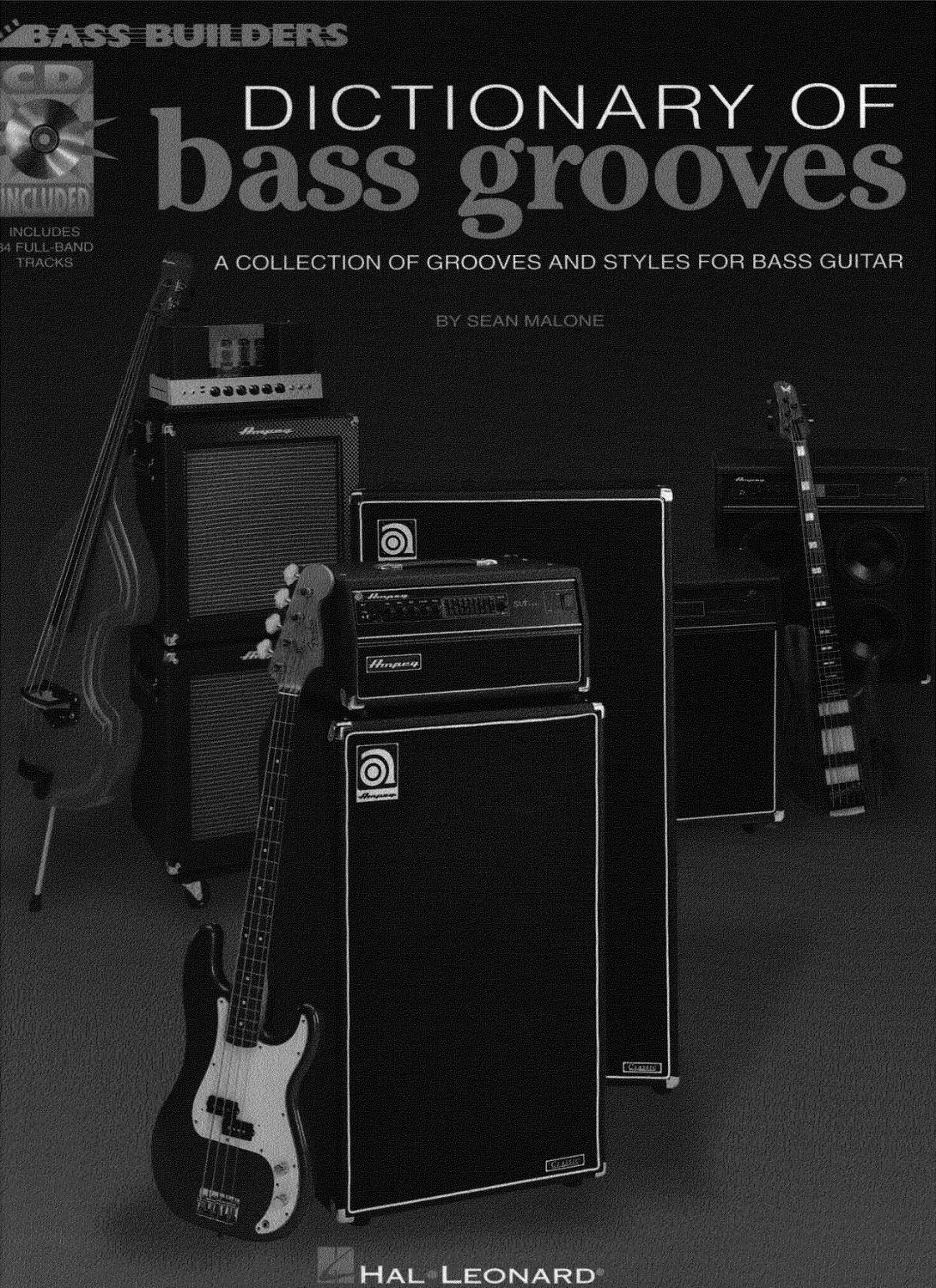


Author: Malone S.
Tags: music musical instruments guitar musical culture music theory
ISBN: 0-7935-8964-9
Year: 1998
Text
ИВНяНЙЗнйНи^ниНи
Hal.® Leonard
CORPORATION
ннимИИЦ^и^миНм^ш^^^к
иМмиииииИмНммИйм8ИмиВ11^Имм
wwwHheai'@ott4rd. .пит
ABOUT THE AUTHOR
Sean Malone has a B.A. in Composition and M.M. in Music Theory from the University of South Florida. He has
performed and recorded extensively in North America and Europe on bass and Chapman Stick. He has had interviews and
reviews of his recordings in magazines from North America, Europe, Japan, and Israel, including Bass Player, Bass
Frontiers, Guitar and Bass, Guitarist, Creem, Guitar Player, and many others.
Sean has dozens of recordings to his credit including Focus by Cynic (RoadRunner), Guitars That Rule the World
Volume 2 (Metal Blade), Working Man: A Tribute to Rush (Magna Carta), Bass Talk 5 (HotWire), Under the Red and White
Sky and The Closing of the Pale Blue Eyes by John Wesley (CNR/Arcade), Combination by Todd Grubbs (Apollon
International), Notes from the Underground (Guitar World), and his first solo CDs Gordian Knot (Sensory) and Cortlandt
(AudioImage). He has performed, taught, and recorded with artists such as Mike Portnoy, Trey Gunn, Reeves Gabrels, John
Myung, and Gary Willis. Sean has also taught at the National Guitar Summer Workshop in Connecticut and has written sev-
eral articles for Bass Frontiers Magazine.
Sean currently lives in Eugene, Oregon, where he continues his writing, session work, and music theory research.
ACKNOWLEDGMENTS
Thanks to:
All at Hal Leonard, DR Strings, Ampeg, and Bill Mason for the ear and the input.
Special thanks to the musicians whose expertise, talents, and advice made the audio examples possible: Bob Bunin—
guitar, Steve Connelly—guitar and pedal steel, Jack Owen—guitar, Sean Reinert—drums, Glenn Snelwar—guitar, Jim
Studnicki—guitar, and Ed Woltil—guitar.
Recorded at Hitmakers Studio, Sulphur Springs, Florida. Recorded by Bill Mason, mixed by Phil A. Delphia
Mastered at the Springs Theater by John Stephan.
CONTENTS
Page		Audio Track
4	Introduction
5	Rock/Pop
6	1950s Rock ’n’ Roll	1
8	1960s Rock	2
10	Hard Rock	3
12	Southern Rock	4
14	Progressive Rock	5
19	Alternative Rock	6
21	Punk Rock	7
23	Disco	8
26	Metal
27	Heavy Metal	9
30	Progressive Metal	10
32	Death Metal	11
35	Rhythm and Blues
36	Motown	12
38	R & В Shuffle	13
39	R & В Ballad	14
40	Jazz
41	Jazz Blues	15
42	Bebop	16
43	Modal Jazz	17
45	Fusion	18
47	Afro-Cuban
48	Salsa	19
49	Cha-Cha	20
50	Afro-Cuban 6/8	21
51	Bossa Nova	22
52	Samba	23
53	Rumba	24
53	Mambo	25
55	Afro-Caribbean
56	Reggae	26
57	Soca	27
58	Ska	28
60	Country
61	Country Western	29
61	Country Rock	30
63	Blues
64	Blues Shuffle	31
66	Blues Rock	32
68	Funk
69	Slap & Pop	33
70	Fingerstyle Funk	34
INTRODUCTION
Bassists are often expected to be musical chameleons who are familiar with many different styles of music. Having
knowledge of styles prepares you for almost any musical situation; a well-rounded bassist is an invaluable asset to pro-
ducers and recording studios. However, you don’t need to be a full-time session bassist to feel a need to aquaint yourself
with different styles of music. The enjoyment of playing music is augmented when you draw from a diverse palate of musi-
cal influences, be it in the recording studio or a practice room.
The purpose of this book is to introduce you to a wide variety of musical styles and to explore the role of the bass
within them. The concept behind this collection is to provide concise, hands-on examples which act as models that can be
applied in a more far-reaching manner to the particular style you are interested in. Whether you are trying to expand your
musical resources, or just explore other styles, this book can serve as a resource—a Dictionary of Bass Grooves.
What is a Groove?
The term groove means many things to many people, but there is an underlying thread which connects them all:
the “locked-in” feeling between a bassist and the rest of the rhythm section. The term is used as a noun (e.g. That’s a great
funk groove.), and also as a verb (e.g. This songs needs to groove better). So groove is something we perceive, and some-
thing we do. The word groove is meant to describe anything that’s regular and steady, from a rhythmically complex and
driving funk groove, to a slow and lilting country and western groove. As long as it’s tight, it grooves.
Style vs. Groove
In order to organize the grooves in this book, decisions as to what category they belong to where based on style.
You can’t really separate style from groove, but as you’ll see, some of the characteristics of the grooves depend on style
for their identity. For example, a salsa groove has well-defined characteristics in and of itself, independent of the context of
the music. One can play a salsa groove in salsa music, or apply the groove to rock, funk, jazz, etc. On the other hand, the
progressive rock example doesn’t really “groove” at all; rather, it’s a sample of rhythms, textures, and harmony that you
might expect to find in progressive rock.
Learning Styles
If we are afforded the luxury of time, repeated listening and exposure to music helps to subconsciously build our
musical vocabulary. Having a large palette of stylistic interests is not only personally satisfying, but can be professionally
rewarding as well. If, however, a last minute call comes for a country session, and you’ve never played country before, it
is essential to be able to zero in on what makes it country, or heavy metal, or bossa nova, etc. The harmony, technique and
tones descriptions for each example do just that: they identify features of the music that contribute to the style.
Format
Dictionary of Bass Grooves was designed to expose the reader to the distinguishing characteristics of a wide vari-
ety of styles. This book is not meant to be taken as an exhaustive survey, nor is it bassist or band specific (except in the
case of James Jamerson). The musical examples attempt to emulate each particular style, with idiomatic playing and com-
positional techniques.
Dictionary of Bass Grooves is divided into main categories, which are further divided into sub-categories. Each sec-
tion contains:
1.	Musical characteristics such as harmony, rhythm, etc.;
2.	Some of the techniques employed in performing them;
3.	Descriptions of the bass tones used by the players;
4.	A list of players who are noted within the style;
5.	A recorded audio example of the style;
You are encouraged to play along with the examples so you can immediately get a feel for the different grooves.
The symbols that appear with numbers by the written examples correspond to the track listing on the companion CD. All
examples are written for the four-string bass.
4
ROCK/ГОР
By the time Alan Freed coined the term “rock ’n’ roll”, a revolution in popular music had already begun. Rhythm and
blues had been transformed into a high energy mixture of drums, piano, guitar, and bass that took the youth of the
U.S. by storm. The music had an irrepressible pulse that launched countless dance crazes like the swim, the jerk,
and the mashed potato. Rhythm and pulse are the name of the game when it comes to rock, and they are vital elements
to all of the styles in this book. The term “rock ’n’ roll” is still in common usage, but it is more often meant to describe the
music of the fifties and early sixties. Today, the generic term “rock” is applied to a very wide spectrum of styles and sub-
styles, which are all considered popular (pop) music.
The bassist’s presence in popular music is as varied as the music itself. Bass guitar technology evolved with the
music, allowing basslines to come to the forefront in recordings and performances. With the advent of synthesizers, new
sounds and textures were explored, sometimes replacing the bassist altogether. What all of the styles of rock and pop
music seem to have in common is a driving, locked-in rhythm section that supports the rest of the ensemble. Sometimes
the bassist was given more room to explore, as in the case of progressive rock. Other times the bassist stayed in the
pocket in a more supportive role, as in southern rock. Either way, the bass is part of the foundation.
This section of the book has the most variety under one category. There’s no single “rock groove”, or “pop groove”,
so here is where style plays a large part in differentiating the examples. When reading this section, pay close attention
to what the styles have in common, and then eventually how they evolve and become varied. You will notice through-
out hese grooves that even when a new “style” emerges, it often borrows heavily from something in
the past.
1950s Rock ’n’ Roll	FEATURES
The rock ’n’ roll music of the 1950s heavily emphasized the rhythm section, often consisting of drums, bass and piano, with the guitar eventually emerging as an important con- tributor to rhythm and lead. The acoustic bass was prevalent, and played with a very percus- sive style, contributing to the overall groove of the rhythm section. Harmony: Fifties rock ’n’ roll centered around dominant seventh and minor seventh chords, employing the major, Mixolydian and minor modes. Diminished passing chords were utilized occasionally for transition. Bassists often outlined chord tones in a texture similar to a walking bassline, which created an undercurrent of motion, while at the same time supporting the groove. Technique: An upright was the bass of choice, since at that time there really wasn’t much to choose from. Bassists not only used the standard pizzicato technique of using two fingers to	Driving rhythm Bass lines outlining the harmony Walking bass-style texture Dominant and minor seventh chords Percussive pizzicato technique

pluck the strings—they sometimes cupped their hand and used it to play with a percussive slap. You can imitate this technique on an electric bass by having an exaggerated downstroke	BASSISTS
with your fingers, simultaneously “striking” and plucking the string. But remember: this was done to make the bass louder and may damage a speaker with today’s amplified electric basses. You might also try weaving a small cloth at the bridge of your bass to mimic a dull, thuddy sound.	Bill Black Arthur Blackman
Tones:	Norman Brown
Since recording techniques were in their infancy in the 1950s, the bass is often diffi- cult to hear. The common practice of recording an entire group was with only one microphone, and the bassist had to play as loud as possible just to be heard over the drums and other instruments. The sound was usually boomy, but had a very percussive quality as the large wooden body of the instrument moved a lot of air.	Joe Mauldin Gary Morrison
5
Rock/Pop
1950s Rock ’n’ Roll
E
J =220
6
Rock/Pop
7
Rock/Pop
FEATURES
More melodic bass lines i
Independent bass lines ,
Introduction of various :
modes
Distant-related keys
Bass was more present
in the mix
I_________________________I
BASSISTS
Jack Bruce
John Entwistle
Paul McCartney
Noel Redding
Bill Wyman
1960s Rock
Rock music of the 1960s quickly evolved with the advent of improved recording tech-
niques as well as advancements in electric instruments. Players became well known individ-
ually and in groups, instead of the singer always getting the spotlight. The electric bass had
arrived and redefined its presence in the groove.
Harmony:
The expanded harmony of sixties rock was an extension of chord progressions and
key relationships from the previous decade. There was an introduction of modal use such as
Lydian and Phrygian, distant-related keys (signatures that were more than one accidental
different), and increased melodic independence. The music was slowly gaining as much
importance as the vocalists and soloists it supported.
Technique:
Using a pick was popular, which was in part influenced by guitarists playing bass; it
was considered a bass guitar. Fingers were also used which produce a mellower tone.
Tones:
Technology was rapidly advancing in the areas of amplification, recording equipment,
and instruments. The bass was definitely more present in mixes, though the tone was often
thin. That was not always the rule, as in the case of the Beatles, with whom Paul McCartney
recorded some of the most memorable and influential bass lines of all time.
0 1960s Rock
E]
J =135(Л =J J1)
8
Rock/Pop
9
Rock/Pop
FEATURES
Hard Rock
Mixolydian and
pentatonic modes
Hard rock is one of the evolutions of rock ’n’ roll. Bands such as Led Zeppelin, Kiss,
and Van Halen borrowed from influences such as blues and rock, and turned up the volume
in the 1970s to create a heavier form of popular music. Hard rock brought about many inno-
vations in technique and composition, as players were becoming famous not only for the band
Blues based harmony ! they р|ауес| jn, but for their virtuosic talents as well. There is a wide variety of hard rock bands,
which harbor an even wider variety of styles. The bass was still part of the anchor, but began
Shadowed guitar riffs to venture out from its supportive role.
Shadowed guitar riffs
Strong bass line pulse
with the drums
Harmony:
Full range of tones
Hard rock saw a return to blues-based harmony at times, utilizing the blues scale as
well as the Mixolydian and pentatonic modes. The tritone (an interval of three whole steps)
was added to this vocabulary, and some groups employed the harmonic minor and Phrygian
mode to create a more exotic sound.
BASSISTS
Technique:
Michael Anthony
Pat Badger
Robert DeLeo
The pick was popular in hard rock though there were many fingerstyle players as well.
The bass was more present in the mix, but was mainly supportive, often shadowing guitar riffs.
Bass lines were a large part of the energy of a group, providing a strong pulse in conjunction
with the drums.
John Paul Jones
Tones:
Gene Simmons
Bass tones were varied—from loud, distorted full-bodied sounds to small, thin, and
midrange-oriented sounds. There was at times a “louder-is-better” mentality, sacrificing good
tone for volume.
ф Hard Rock
A]
J =135
10
Rock/Pop
11
R о с к / Р о р
FEATURES
Bass joining
the guitar on riffs
Simple harmony
Pentatonic modes
Supportive, simplified
grooves
Gritty tone
Southern Rock
Southern rock is a combination of hard rock and some elements of country and blues,
all with a southern sensibility. Groups like the Marshall Tucker Band, Lynyrd Skynard, and the
Outlaws popularized this style of music, incorporating slide guitars and a heavy dose of south-
ern pride. The heyday for Southern rock was the mid-1960s through the 1970s in the South-
eastern U.S. This style of music is still very popular today, though there seem to be fewer
bands that are purely “Southern rock” bands.
Harmony:
Southern rock utilizes both major and minor scales and chords as well as major and
minor pentatonic modes for soloing. Bass lines often join in with the guitar, playing riffs as
well as holding down the groove with supportive, root-oriented parts. Chord progressions are
largely key-oriented and repetitive.
BASSISTS	Technique:
Harvey Arnold	Finger and pick technique were both utilized.
Andy McKinney	Sounds:
Berry Oakley	The bass guitar didn’t get a lot of attention in Southern rock. The tones often empha- size a lot of midrange, especially if the player used a pick. Some bassists often had a gritty
Leon Wilkeson	sound—with a touch of distortion or fuzz—often times because of overloaded amps.
Allen Woody
0 Southern Rock
12
Rock/Pop
13
Rock/Pop
FEATURES
Extended song formats
Changing time
signatures
Melodic bass lines
Unconventional playing
techniques
Wide variety of
bass effects
BASSISTS
Geddy Lee
Tony Levin
Christ Squire
Roger Waters
John Wetton
Progressive Rock
The term “progressive” is not easy to define when it comes to a style of music. We
often have a notion of what it implies, but fall short of a clear-cut definition. From the 1960s
onward, every decade produced “progressive” musicians. Bands like King Crimson, Genesis,
Yes, Rush, and Gentle Giant played music that wasn’t necessarily suited for mainstream radio
or chart-topping record sales, due in large part to long and complicated songs that were chal-
lenging to the listener. What all progressive bands have in common is that they are all vastly
different, and that they continue to try and push the envelope of musicianship and what is con-
sidered “rock ’n’ roll.”
Harmony:
A steadfast rule of progressive rock is that there are no rules. Harmony can wander
all over the place—anywhere from Renaissance modality to free improvisation. There seems
to be an attempt in most progressive rock to pack in as much music as possible. It’s not
uncommon to encounter songs of twenty minutes or more in length, virtuosic playing, odd time
signatures, and extended solos. The scope of this book prevents an example that illustrates all
of these characteristics completely, but listen to the many different sections and how various
textures are expressed in each one.
Technique:
Since the nature of progressive rock was one of exploration, many new ways of
approaching technique were investigated. The bass was a more melodic instrument at times,
with a pick being used to play notes in the high register. Some bassists played instruments
with multiple necks, either with a fretted/fretless combination, or a bass/guitar combination.
Tony Levin’s introduction of the Chapman Stick® (an instrument that has a range similar to a
piano, played only by tapping on the strings) and more recently his Funk Fingers™ (shortened
drumsticks attached to the first and second fingers that are used to strike the strings) have
expanded the practices of conventional technique.
Tones:
Since progressive rock recordings span so much time, the sounds employed by
bassists were contingent on the current state of technology and instrument making. As extra-
ordinary as the explorations of new song forms, grooves, and harmony, so too were the inven-
tive sounds in which they were expressed. Effects such as distortion, phasers, delays, and the
Mutron™ brought the bass more to the forefront. The tone of the bass was sometimes gritty
and thin, especially in the hands of bassists who were known to take solos. Other bassists
preferred a softer, more languid tone which was well suited for flowing, melodic bass lines.
Progressive Rock
E
14
Rock/Pop
Em
e
15
Rock/Pop
E
16
Rock/Pop
17
Rock/Pop
FEATURES
I Distant-related harmony
Pick vs. fingers
Bass effects
Dynamic contrast
Supportive and
melodic bass lines
BASSISTS
Jeff Ament
D'Arcy
Mike Gordon
Mike Mills
Chris Novoselic
Alternative Rock
Alternative rock is a term that more accurately describes what the music isn’t rather
than what it is. Simply put, it is a style of music that purposely avoids mainstream pop formu-
las, targeting a social group that is dissatisfied with the corporate aspects of radio and popu-
lar music. There is a lot of diversity in alternative music—everything from dissonant, angry
“grunge,” to introspective spoken word. Alternative exploded in the nineties from the Northwest
and thrives today, though the inclusion of alternative artists into the genre is malleable due to
constantly changing criteria and mutable popular opinion from the underground.
Harmony:
Though at times repetitive and simple, alternative rock has provided some harm-
onic innovations, denying the expectations of generic top 40 harmony. The pentatonic modes
are still popular, and chord voicings are often power chords versus fully voiced harmony.
There is often a lot of dynamic contrast (loud and soft) as well as an emphasis on riffs.
Alternative rock takes chances harmonically, utilizing distant-related key areas.
Technique:
Picking technique seems to be more popular than using finger technique, as the music
is often aggressive in nature. A pick provides the means of playing harder and having a more
cutting sound.
Sounds:
Along with harmonic innovations, alternative bass players have employed many dif-
ferent kinds of tones. All kinds of effects such as distortion, phaser, wah-wah, and delay are
used to create textures that have never been heard before in “popular” music. Alternative
bassists seem not only concerned with their actual bass part, but also with the overall tone
and texture that the bass is providing.
18
Rock/Pop
ф Alternative Rock
A
19
Rock/Pop
20
Rock/Pop
Punk Rock	FEATURES
Of all the revolutions that rock ’n’ roll produced, none was as abrasive as punk rock. Punk began in the U.S. in New York City with artists such as The Ramones, Iggy Pop, and The New York Dolls. Despite being an American invention, punk’s stronghold was in England with artists such as the Sex Pistols, The Clash, and the Buzzcocks. British punks were rebelling against the social, economic, and musical climate of the 1970s, emphasizing indi- viduality and a do-it-yourself mentality. It was simple and powerful, making a high-energy statement that was easily accessible.	Aggressive picking technique Pentatonic modes Closely related chords
Harmony:	Brash tones
Pentatonic and Mixolydian modes as well as major and minor harmony are all found in punk rock. Modulation is rare, and most chords are closely related. There is a mixture of riffs and rhythm playing between guitar and bass, with the bass laying down simple, sup- portive grooves.	Simplified, supportive bass lines

Technique:	BASSISTS
Picking technique is used predominantly.	Fred Mills
Tones: Brash and up front in the mix to match the aggressiveness of the music, the bass was sometimes mildly distorted, often as the result of an overdriven amplifier. Tones were often thin and emphasized the midrange—due in part to recording technology at the time.	Dee Dee Ramone Derf Scratch Garth Smith
Sid Vicious
Punk Rock
21
Rock/Pop
N.C.	A5	N.C.	A5	N.C.
4---4—2----2 4 fl----0 0 0 0 0 0 0----5---5 4----4 2 0-----0 0 0 0 0 0 0----4---4—2----2 4 0
22
Rock/Pop
Disco	FEATURES
Disco lasted for about a decade in its prime, though it’s currently enjoying a resur- gence of interest. In the 1970s, artists such as The Bee Gees, Gloria Gaynor, The Village	Strong, dance-oriented
People, and КС & the Sunshine Band churned out hit after hit of energetic dance music. The	grooves
impact of disco was immense and happened quickly, causing non-disco artists to quickly add the style to their repertoire to maintain their fan base. Just as quickly as it appeared, disco	Octave patterns
went back underground as discotheques closed and radio stations stopped playing the music. What was once the single most important craze in the seventies is now considered by many	Seventh chord harmony
to be a musical stigma. Harmony: Though disco is often considered shallow and without message, the music still had some compositional depth to it. Dominant and minor seventh harmony provided a harmonic richness that augmented the emphasis on melody and groove. It was common to have string arrangements, and the advent of the synthesizer brought about unheard of textures.	Bass effects Fingers vs. picks
Technique:	Bernard Edwards
Disco marks the beginning of the bassist’s struggle with the synthesizer. Performers	Richard Finch
were using the warm analog patches of the Moog synthesizer, often times eliminating the need for a bassist. Fingers were favored over picks, as there was some dexterity needed to perform	Maurice Gibb
the ever-present octave bass patterns. Sounds: Bass tones were often thin, but very present in the mix. Some effects were used in an effort to match analog synthesizer patches that were being created, such as chorus, flanger, and phaser.	Nigel Harrison Marshall Jones
А]
J =130
23
Rock/Pop
24
Rock/Pop
Dm
Bb
|=Г [/ LF .......Ef £f f	f,f £.Г Г, Г Г ГI .................
----7------7----_7-------7—
5 5	5 5 5	5 5 5	5 5 5	8
----7-------7-------7------7—
-5—5--5 5 5---5 5 5---5 5 5---8
----8-------8-------8------8—
-6.6..6.6.6...6.6.6..6.6.6..8
F	Dm
-rfrn-rrMn-rfi I
10	10	10	10	|	10	- 10	10	10	|	7	7	7	7
-8-8-8-8-8-8-8-8-8-8-8-8- 8 8	8 8 8	8 8 8	8 8 8	8 5 5	5 5 5	5 8 8	5 5 5	5:
25
METAL
FEATURES
Fast tempos
Heavy, sometimes
distorted tones
Pick and three-finger I
technique '
Galloping bass lines
Detuning
BASSISTS
Geezer Butler
Cliff Burton
Steve Harris
Rudy Sarzo
Billy Sheehan
I I
Metal music is an extension of rock and hard rock. Some bands of the late 1970s are
considered to be metal bands in some form, but the genre as it’s known today start-
ed to thrive in the early 1980s. Metal has many different subcategories, such as pro-
gressive, death, heavy, glam, thrash, hardcore, speed, black, technical, and grindcore to
name a few. The evolution of metal music has brought about very fast tempos, blast beats,
extreme technicality, crushingly heavy tones, and singing that ranges from operatic to brutal,
guttural screaming. The appeal of metal is largely due to its high energy content and creates
a parallel with the emergence of punk in the seventies. Metal was not only a reaction to the
musical and social climate of the time, but continues to evolve today, producing some of the
most brutally challenging music to listen to.
The bassist’s role in metal music ranges from shadowing complex guitar riffs to cre-
ating a low, rumbling undercurrent that supports the singer and soloists. Metal bassists have
made many advancements in technique, sometimes a result of the need to keep up with gui-
tarists and drummers. Nonetheless, metal is an entire style of composition and performing
unto itself, that has produced some of the greatest bassists playing today.
The examples in this section focus on progressive metal, heavy metal, and death
metal. Though you might think that all three have a similar “sound,” that is where the com-
parison stops. Progressive metal leans towards chops and technicality; heavy metal is a more
“classic” metal sound which emphasizes a heavy texture versus demanding technique; and
death metal is the most extreme evolution of metal music.
Heavy Metal
Heavy metal developed out of a need for an aggressive, faster, and more distorted
kind of rock music. Earlier bands such as Black Sabbath, Motorhead, Saxon, Talus, and Deep
Purple set the stage for today’s metal bands with innovations in technique, guitar processing,
harmony, melody, and rhythm. Lead guitarists began developing soloing techniques that had
never been seen before, while rhythm guitarists were no longer just an extra player in the
band—they were now creating accompaniment styles that became very involved and com-
plex, as well as idiomatic to a myriad of styles and genres. Bassists, however, still were not
very much in the spotlight, often times settling for playing exactly what the guitarists were play-
ing, though a few bassists stood out with their melodic bass lines and athletic technique.
Harmony:
Heavy metal relied firmly on major and minor pentatonic scales and modes, as well
as on the more exotic sounding harmonic minor and Phrygian mode. The tritone was used
heavily for its particular sound in chords and riffs, and there was generally no restriction to the
type of chords used.
Technique:
Bassists used their fingers and picks, developing their technique in order to keep up
with fast tempos. Some bassists used three fingers on their picking hand which created a sig-
nature “gallop” to their bass lines.
Tones:
Heavy Metal bass tones are often very deep and full sounding. Distortion is often used
to create an even heavier sound in combination with the guitars. The four string bass is still
being used primarily, though it is sometimes detuned to create a deeper sound.
26
Metal
ф Heavy Metal
ш
J =130
27
Metal
28
Metal
Progressive Metal
Progressive metal is an off-shoot of heavy metal which is distinguished by its
extended song formats, changes in key and time signature, inclusion of keyboards, and
varied instrumentation. It borrows from progressive rock in its grandiose themes and orches-
trated textures, but differs in its faster tempos and heavy, distorted sounds. As in the case of
progressive rock, it’s difficult to define what makes it “progressive.” Something that all pro-
gressive bands have in common is the desire to expand upon what has come before them—
to write a new chapter in music and to discover more advanced ways of communicating their
musical ideas. Progressive metal has a small but devoted audience made up mainly of musi-
cians. Its popularity continues to grow in the underground scene.
Harmony:
Anything goes in progressive metal—from pure diatonic harmony, to exotic scales and
modes. One thing that is consistent is that the harmony does not usually stay in one place for
very long.
Technique:
Progressive bassists are often technically oriented players. Fingers are mostly used,
though you’ll occasionally find someone using a pick. Fingers allow more versatility than
picking, which is needed to accommodate ambitious basslines.
Sounds:
Bass tones are usually deep and full-bodied, with occasional distortion for heaviness.
Some effects are used, but done so sparingly, as the emphasis is on playing and technique
rather than texture.
FEATURES
Changing time and
key signatures
Technically challenging
: Melodically independent
Unrestricted harmony
Finger technique
BASSISTS
I Joe Dibiasc
Doug Keyser
John Myung
Peter Nordin
i Joey Vera
29
Metal
ф Progressive Metal
Drop D Tuning:	~
(T)=G (3)=A
(2)=D	(4)=D
30
Metal
ВЬ
Fade Out
31
Metal
FEATURES	Death Metal The following is a description of death metal by producer and engineer Scott Burns:
Fast tempos	“Dynamics are not a part of death metal; it’s loud in the beginning, middle, and end. It’s just sheer, guttural brutality—there is no singing involved.” There isn’t much to say that can more
Three finger and double picking technique	accurately describe this form of music, except that it is at the most extreme end of metal, and music in general. Though death metal is often maligned for its subject matter and on-stage antics, it remains as some of the most passionate and difficult music to play. Death metal has
Complex riffs	a strong international following, and though its popularity has already peaked, it’s sure to rein- vent itself as metal has over the last two decades.
Scooped-out tones	Harmony:
Detuning 111М|ММИ1и11ИММ1	Death metal has set its own standard for harmony employing the use of the tritone,
	distant related key areas, highly complex riffs, and extreme chromaticism. Diminished arpeg- gios and wholetone scales are often used as well.
BASSISTS	Technique:
Steve DiGiorgio	The pick is popular in death metal as well as fingerstyle, with three fingers often being
Shane Embury	used in order to articulate many notes at very fast tempos. Double picking is also popular, which seemingly doubles the amount of notes being played.
Chris Richards	Tones:
Frank Watkins	Bass tones are deep and sometimes distorted with a very “scooped-out” equalizer
Alex Webster	setting (removing the midrange). Bassists also detune their four-string basses as much as a
minor third or more to try and create as heavy a sound as possible.
ф Death Metal
И
J =185
32
Metal
--------1--------------3-------------------------------------3---.-----..	. .
3—0—0---0—0—3—0—L-O----0—0—1—0—1—0—L-3—0—0—-—0—0—3—0—L-0-----0—0—1—0—1—0-
4—4—4—4—4—4—7—7—7—7—7—7—6—6—6—6---6—6—9—9—9—9—9—9—5—5—5—5—5—5—5—5
4—4—4—4—4—4—7—7—7—7—7—7—6—6—g—6---6—6—9—9—9—9—9—9—3—3—3—3—3—3—3—3
33
Metal
------------------------------—з---------------i --------------
0---g---L3—о—g----g g—3—g—Lg—_—g—g—!---g—!-g—L3—g__g---g—3—3—g
34
AHYTHM AND BLUES
Rhythm and blues combines elements of blues, gospel, jazz, boogie-woogie, and pop
music with a strong backbeat and a deep groove. As the name implies, rhythm is the
name of the game. R&B arose in black communities during the post-swing era
(between 1945-1960), before the arrival of the Beatles. The term “rhythm and blues” was pop-
ularized in the late 1940s by Billboard Magazine, replacing the unfavored term “race music.”
R&B continues to evolve and is some of the most popular music in the United States, deserv-
ing of its own charts of record sales and airplay.
The examples in this section contain a shuffle feel, a ballad, and a groove in the style
of a man who single-handedly defined the Motown sound—James Jamerson. The shuffle
groove owes more to its feel than its choice of notes. Notice how the bassline is steady quar-
ter notes that anchor the rhythmic accents of the drums. The ballad example emphasizes how
the bass can have some melodic independence while still anchoring the band. The Motown
example shows some signature figures of James Jamerson.
Harmony:
Major, dominant, and minor seventh chords were primarily used, with the emphasis
on rhythm and melody. Scale choices ranged from major, minor, and pentatonic, in addition
to the Mixolydian mode. It is not unusual to have many key changes to closely and distantly
related key areas. The harmonic content of R&B is usually very rich, providing many possibil-
ities of inversion (a note other than the root played by the bass) and melodicism for the bassist.
Technique:
Fingerstyle playing is predominant, though the development of slap and pop tech-
nique added a new dimension to R&B.
Tones:
Early R&B featured low, thuddy bass tones—especially the tones of James Jamerson.
This added to the percussive and rhythmic feel of the bass in the mix. To duplicate this sound,
try weaving some string or a small cloth at the bridge of your bass. Modern R&B features
crystal-clear bass sounds due to state of the art recording technology and advancements in
instrument design.
FEATURES
Deep grooves
Melodic bass lines
Rhythmically active,
but supportive
Finger and thumbstyle
Dark, percussive tones
BASSISTS
Tommy Cogbill
James Jamerson
Jerry Jemmott
Chuck Rainey
Gerald Veasley
35
Rhythm
and
Blues
ф Motown
is
J =100
Cmaj7	F/G	Cmaj7
36
37
Rhythm
and
Blues
ф R & В Shuffle
И
J =75
Г Г If Г Г .....................j Г г IJ J U
C7	G7
г r VJ J hJ J J г г
D7	C7	G7	D7	G7
38
Rhythm
and
Blues
39
JAZZ
FEATURES
Seventh chords
Steady, walking
bass pulse
Warm, percussive tone
Melodic bass lines
Independent but
supportive bass lines
BASSISTS
Ron Carter
Paul Chambers
Charlie Haden
| Scott LaFaro
Charles Mingus
Jazz as we know it is a purely American art form, though its beginning was influenced by
the blues and African slave work songs and spirituals. The heritage of African music is
retained in jazz through its rhythmic elements and collective improvisation. Jazz is
based on song forms which have a melody (sometimes called the head) supported by a chord
progression. After the melody is performed, the form of the song is played continually (called
choruses) and the harmonic structure is used for soloists to improvise over the “changes”
(chords). The melody is then played again, signaling the end of the tune. Jazz songs that have
become staples of performers over the decades are called standards, all of which embody
chord progressions and melodies that are a part of a common vocabulary, defined by certain
eras and performers.
The blues form—chords built on the tonic (I), subdominant (IV), and dominant (V)
played in ten-, twelve-, to sixteen-measure lengths—was a holdover from blues and gospel
music. It can simultaneously be the easiest and the most difficult progression to play over, as
decades of musicians have tried to expand the blues progression to its limits. Each of the
three chords can be “substituted” with other chords, implying a different harmony and creat-
ing tension in the music. As the years rolled on, composers and soloists continued to add to
the harmonic vocabulary, eventually leading to the bebop revolution.
Bebop was music for musicians—characterized by harmonic complexity, fast tempos,
rhythmic dexterity, and seldom yielded to popular taste. Led by saxophonist Charlie Parker in
the 1940s, bebop became the music of choice in New York night clubs, producing some of the
world’s greatest jazz musicians.
In stark contrast to bebop is modal jazz. This type of jazz is based on linear and modal
qualities of improvisation and composition, rather than chordal and harmonic concepts. Tunes
were much slower and less technically demanding, creating a very open sound that allowed
improvisers a lot of room to experiment with exotic scales. Modal jazz presents its own chal-
lenge of maintaining interesting basslines and accompaniment, due to the sparse amount of
harmonic material.
The following three examples employ the walking bass technique—a steady pulse of
quarter notes that supports the harmony but provides linear independence. Jazz music is
often expressed in chord charts rather than written out basslines. The bassist must be aware
of what notes are in the chords and connect them with a line of varied contour, usually
playing chord tones on beats 1 and 3. There are many exceptions to that description, and
exposure to many different bassists will help you absorb the style.
Harmony:
Jazz harmony is based primarily on seventh chords of every quality. Modern jazz
more often employs extensions such as the 9th, 11th, and 13th, which give the bassist more
chord tone choices to use in the bassline. The difficulty of a tune is defined not so much by
the types of chords used, but how quickly and numerously they change in the composition.
Technique:
Fingers are used exclusively to provide a warm, percussive tone.
Tones:
The acoustic bass was, and still is, the bass of choice among purists. Even electric
basses are equalized to provide the warmest tone possible. The bass functions as the pulse
of the rhythm section, and plays the ultimate supportive role.
40
Jazz
ф Jazz Blues
41
Jazz
42
Jazz
Ф Modal Jazz
J =90(«П =J
43
Jazz
44
Jazz
Fusion
Jazz fusion is an umbrella term which encompasses many styles, but is traditionally
thought of as a combination of rock and jazz. Spearheaded in the 1970s by Weather Report,
fusion became more accessible to a large amount of listeners. This was no longer the tradi-
tional swing jazz that preceded it, but a combination of high energy rhythms and electric instru-
mentation. However, fusion still pays a large debt to the jazz masters of the past by retaining
compositional depth and instrumental dexterity.
Harmony:
Anything goes, including seventh chords and extensions (9th, 11th, 13th), and all
types of exotic and synthetic modes and scales, such as the octatonic scale and modes of the
melodic minor scale.
FEATURES
Combination of
rock and jazz
Dissonant harmony
Technically challenging
Four-, five-, and
six-string basses
Fretted and fretless
Technique:
Fingers are used predominantly, though you will find those who use a pick occasion-
ally. Some players utilize the slap and pop technique as well.
Sounds:
Tones vary from warm, fretless bass to deep and percussive fretted bass. The
five- and six-string basses have come to prominence in the last decade, and can often be
heard with a little bit of chorus or flange.
BASSISTS
Stanley Clark
Jimmy Haslip
Jaco Pastorius
John Pattitucci
Gary Willis
^Fusion
45
Jazz
46
AFflO-CUBAN
Afro-Cuban music (also called Latin music) has a long and rich history rooted in the
dance rhythms of Cuba, Brazil, Puerto Rico, and the Dominican Republic, that have
been mixed with influences from Africa, Western Europe, the Caribbean, and the
Americas. The generic term “Latin music” is often replaced with “salsa” (Spanish for sauce),
and meant to encompass a wide variety of rhythms and grooves.
Two important elements of salsa are the clave and tumbao. The clave (Spanish for
key) is the rhythmic foundation of salsa. It comes in two basic forms: the 2:3 son clave, and
the 3:2 son clave.
FEATURES
2:3 Son Clave
r r 1 If.
3:2 Son Clave
2:3 or 3:2 Clave
Heavily Syncopated
Unrestricted harmony
Repeated tumbao
i figures
I Acoustic or electric bass
PLAYERS
This rhythm is always present in the music—either implied or explicitly played. There
are variations of the clave, such as the rumba clave which displaces the last note in the “3”
measure by an eighth note. Choosing between the 2:3 or the 3:2 clave depends greatly on the
phrasing of the melody, and the interaction between the bass and percussion.
A tumbao traditionally refers to a repeated figure in the congas, but has also come to
described any repeated bass figure as well. Bass tumbaos are often, but not always, heavily
syncopated (emphasizing the weak part of the beat). Salsa is usually felt in 2 beats (cut time)
and the last half of beat two in the bass is often tied to the next downbeat, anticipating the next
chord change. This anticipation creates a lot of rhythmic variety when the piano or guitar waits
until the following downbeat to change chords, adding to the overall polyrhythmic feel of the
groove.
All of the audio examples for this section use the same chord progression so you can
concentrate on the sometimes subtle differences between bass lines. A single displaced note
or rhythm could mean an entirely different groove.
Harmony:
There are no restrictions to the harmonic make-up of Latin music. Salsa grooves can
be applied to any music, and it has been the combination of latin rhythms with jazz harmonies
that have brought this exciting music to a wider audience. “Cubop” was the name of an instru-
mental genre of the 1940s and 50s that merged bebop and Afro-Cuban music. The bass notes
that anticipate the change of harmony often land on the root or fifth of the following chord.
Technique:
Finger technique prevails in Latin music, though there are many great examples of
Afro-Cuban funk using the slap and pop technique as well. Traditionally, the bass is played
with strong and rhythmic pizzicato.
Tones:
Many salsa bassists prefer the acoustic bass for its rhythmic quality, but often play
electric uprights as well. The bass is very present in salsa and usually has a warm, round, and
fat tone.
I Sal Cuevas
Juan Formell
Lincoln Goines
| Andy Gonzales
i Israel “Cachao” Lopez
47
Afro
Cuban
ф Salsa
48
Afro
Cuban
49
Afro
Cuban
ф Afro-Cuban |
s
J. = 170
50
Afro
Cuban
ф Bossa Nova
я
J =65
51
Afro
Cuban
И
J =60
52
Afro
Cuban
ф Mambo
Ш
J =120
Gm
53
Afro
Cuban
54
AFRMARIBBEIN
The music of the Caribbean has a rich and varied history. Each island has its own par-
ticular style or groove, and various subtle variations of each. The music is a melting pot
of African rhythms and melodies, combined with Caribbean work songs that developed
into many diverse styles. Each style has its own unique characteristics, and this section takes
a look at three of them.
Reggae originated in the 1960s from the ghetto areas of Kingston, Jamaica. It is a
mixture of Jamaican folk music with American R&B and dance music. Artists such as Bob
Marley and the Waiters and Peter Tosh became recognized the world over. There was a prac-
tice with reggae recordings that involved using the same recorded groove for many different
songs and singers. Once a song was discovered to be popular, producers would find other
singers to perform different melodies over the same grooves, or “riddims.” Reggae is charac-
terized by emphasizing the off beats (beats 2 and 4) and strong bass hooks.
Soca is party music which originally emerged as a fusion of Indian and African
rhythms—due largely in part to the strong Indian heritage of Trinidad. The name soca itself
was a combination of soul and calypso, as was the music, which was heavily influenced by
American R&B. Soca music has now evolved into the definitive indigenous musical form of the
Eastern Caribbean. The music is part of the Caribbean culture that has spread throughout
North America and Europe. Soca music emphasizes beat two, creating a strong syncopation
that contributes to this very simple but deep groove.
Ska is a motley combination of local folk forms with calypso, R&B, swing, boogie woo-
gie, early rock ’n’ roll, and jazz. It was popularized in the 1960s but eventually fell out of favor
in the Caribbean. It was more upbeat than reggae, soca, or dancehall music, but eventually
slowed down, similar to the style of rock steady. During the late seventies, ska was fused with
the high energy stylings of British punk rock, creating a synthesis of traditional Jamaican
dance rhythms and the rebellious intensity of punk. Ska has become popular in the U.S. in the
1990s, particularly in the Northeast. Ska bass lines tend to be very active, melodic, and fre-
netic (like the rest of the music), often outlining the harmony.
Harmony:
Afro-Caribbean music uses predominantly major, minor, and seventh chords. Reggae
and soca harmony is usually pretty narrow and repetitive. They are, after all, forms of dance
music, with the emphasis more on the groove and the message. Basslines often used mel-
odic patterns to fill in the sparse chord texture, utilizing pentatonic modes as well as major and
minor scales.
Technique:
Fingerstyle technique is used mainly to help punctuate the rhythmic nature of
Caribbean basslines. The use of octaves and other intervals require string skipping, which is
easier to execute with fingers versus a pick.
Tones:
Bass tones are warm and round. There is some experimentation with effects such as
chorus and flange, but for the most part, basses are equalized with low end and some
midrange.
FEATURES
Mixture of Jamaican
music and R&B
j Melodic, independent
i bass lines
Pentatonic fills
Emphasis of the upbeat
 Warm and round tone
BASSISTS
Aston Barret
Earl Falconer
Ian Lewis
P-Nut
Robbie Shakespeare
55
Afro
Caribbean
«1‘=120(Л =J })
56
Afro
Caribbean
J =115
Afro
Caribbean
фЗка
и
J =170
58
Afro
Caribbean
59
COUNTRY
FEATURES
I Simple, supportive
bass lines
Diatonic harmony
i .
Fingers versus a pick
Round bass tone
| Very tight I
rhythm section
I
Country music developed in part from string bands that date back to the American fron-
tier. Instruments such as fiddle, banjo, guitar, mandolin, and autoharp were used to
perform traditional fiddle tunes, southern folk songs, and popular nineteenth-century
parlor songs. By the 1950s, country and western music became a popular form of entertain-
ment and a strong seller in a burgeoning record industry. There were famous singers and
instrumentalists that stayed rooted in the traditions of the past, while at the same time paving
a road to the future.
Though country music is considered simple for the most part, it is an excellent exam-
ple of how basslines should support the rest of the group. The bassist often plays half notes,
emphasizing the tonic and dominant pitches. Country depends on a very tight and solid rhythm
section, creating some of the deepest grooves in music today.
The first example in this section represents a more traditional country and western
sound and feel; the second is a more modern, electric form of country that crosses the border
of rock ’n’ roll. Notice that the bass lines have similar characteristics on paper, but sound quite
different in the context of their respective grooves.
BASSISTS
|	David Hungate
| Bob Moore
Ray Price
Cedric Rainwater
I Allen Williams
Harmony:
Country harmony is very diatonic, as it often is supporting a vocalist or instrument-
alist. Closely related keys and diatonic scales are used often, with occasional hints at
the blues scale. Basslines are very supportive with little melodic movement, and have a ten-
dency to shadow guitar riffs in modern country.
Technique:
Fingers are favored over a pick, though both are used. By muting with the palm of the
hand, you can emulate a more acoustic bass sound.
Tones:
Some of the best production is found in country music. Warm, full-bodied, well-
rounded bass sounds blend well with the rhythm section. Country session bassists often have
a collection of basses they bring to the studio. Each one has a particular tone, and the pro-
ducer might have a specific sound in mind for a song.
60
Country
В
J =120
E
ф Country Western
A
E
J =145
N.C.
G7
г

5-----5----3----2-----0----------------
----------------------•----1-----q----
----------------------3-
-------5-
3------
----------------5-
4----------3-----
----------------5
3----------3-----
61
Country
62
BLUES
The origins of blues music can be traced back to African work songs and field hollers, as
well as gospel, jug bands, jazz, and ragtime. Blues existed prior to the twentieth cen-
tury, but wasn’t called “blues” until the 1900s. Blues styles come in many forms: Delta,
Piedmont, Chicago, jump, and Memphis to name a few. A defining characteristic of the blues
that ties all of its variations together is the chord progression on which it’s based: I, IV, and V.
Blues music has two main components: the blues progression and the style in which it is
played, which is usually named from the region where it originated.
The progression itself can be found in many styles of music, such as rock, pop, jazz,
Caribbean, Afro-Cuban etc., and has been subject to many variations. The main structure
remains intact, usually grouped within twelve measures—hence the moniker “12-bar blues.”
Blues artists consider this type of music a way of life, depicting the hard times they and
others have fallen upon. If music is a universal language, then blues is a powerful dialect, spo-
ken especially throughout the South.
The examples in this section represent two kinds of grooves—a laid-back, more
traditional groove, and an upbeat blues/rock groove. The chord progression stays the same
(I, IV, and V), with the first example playing a more traditional line that supports the harmony
via chord tones. The second example is a more melodically active line that passes through
chord tones, creating a strong sense of motion.
Harmony:
Blues is defined in large part by its harmony: the I, IV and V chords. These are
usually dominant seventh chords, with their counterparts in minor used often as well.
The Mixolydian and pentatonic scales are used, in addition to (and most importantly) the
blues scale.
Technique:
Fingerstyle and picking technique are both widely used. Fingerstyle is best suited for
active or tricky lines, and can provide more dynamic variety and greater expression. Picking
technique is best suited for sharp and punctuated bass lines that need to cut through the rest
of the group.
Tones:
Bass tones in blues music are often dark and gritty, though this is not always true.
Since there are so many blues players out there, just about every tone imaginable has been
used. Listeners often focus on the soloist and the singer rather than the rhythm section, so the
bass doesn’t often get much attention. However, the bass should have a full tone, as it may
be the only instrument playing behind the soloist at times.
FEATURES
в
Chord progression
based on I, IV. V
Mixolydian and
pentatonic scales
| 10-. 12-, 14-and 16-
| bar forms
: Styles based on region
i from which they came
! Supportive bass lines
I_____________________
BASSISTS
Roscoe Beck
Willie Dixon
Duck Dunn
Karl Savareid
Tommy Shannon
63
Blues
ф Blues Shuffle
64
Blues
65
Blues
ф Blues Rock
66
Blues
67
FUNK
FEATURES
Deep and heavy
grooves
Fingerstyle and
thumbstyle
Staccato rhythms
Mixolydian mode
Use of the Mutron
BASSISTS
Bootsy Collins
Flea
Larry Graham
Rocco Prestia
Victor Wooten
Funk is difficult to describe in words because it’s not only a style of music—it’s also a
mentality, a sub-culture, and for some, a way of life. Funk peaked in the late 1970s, as
a combination of just about every style of music—R&B, rock, jazz, soul, you name it.
Funk absorbed its musical surroundings and preached a message of musical brotherhood.
Early Funk bands like Р-Funk, ConFunkShun, Kool and the Gang, and even the Average
White Band promoted a party atmosphere at concerts, inviting the listeners to join in on the
music making.
Funk is as popular today as it ever was and has seen decades of transition and meta-
morphosis. Disco was even considered an off-shoot of funk, due in part to the dance-heavy
aspects of the grooves. Today, funk has crossed over the borders of a wide variety of music.
There’s acid jazz, “Hollywood” funk, funk-rock, old-school, and many more. Funk is a bass
player’s heaven.
Above all else, rhythm is the most important element of funk. Drums, percussion, and
bass all contribute equally to the groove, and must be locked in and tight. Playing funk on bass
comes in two: fingerstyle and thumbstyle. Fingerstyle technique creates a very percussive and
rhythmic bassline, however there is no percussive “slapping” of the strings. The fingers are
continuously moving, locking in with the subdivided beat (usually the sixteenth note). Left and
right hand muting help to create staccato (short and accented) articulations. Fingerstyle funk
can be very demanding on the picking hand, and requires a lot of relaxed technique and sta-
mina.
Thumbstyle, or slap and pop, involves three main components:
1.	Slapping the strings with the thumb of the picking hand.
2.	Popping or plucking with the picking hand.
3.	Muting with the fretting hand.
This technique produces very percussive and rhythmic bass lines that create a deep groove
with the drums. The fretting hand also hammers notes at times, which can effectively double
the amount of playable notes.
The two examples in this section—one a fingerstyle example, the other a thumbstyle
example—utilize the same drum and accompaniment track so you can focus on the differ-
ences between the two techniques.
Harmony:
Funk utilizes a lot of dominant seventh harmony, as well as minor sevenths. There are
at times blues-based influences with the use of the Blues, pentatonic, and major and minor
scales. There isn’t a great deal of modulation, and if there is it is usually to closely related
keys. Funk features extended vamps, allowing soloists to improvise over the groove.
Technique:
Fingerstyle and thumbstyle are used. See the introduction to this section for a more
detailed description.
Tones:
Funk recordings have documented some of the greatest bass tones of all time. Tones
can be full and round for fingerstyle, or thin and trebly for thumbstyle. Bassists who play busy
lines often have a strong midrange presence in their tones which allows you to hear the notes
clearly. Effects like the Mutron helped define the seventies funk sound, and are becoming pop-
ular again.
68
Funk
69
Funk
ф Fingerstyle Funk
и
J =90
A7
-------------4 4 5 5------------------5.5.7.7-------------
---------------------X------------------------X.4.4.X.6.7.7 X—
3----4----l5-----------2 2 X 2 3 *-*35 5---------------5
70
Funk
71
Funk
-----4 4—5—s—--------------------------—5—7—7---—------------------
——.------------X-------------------= ------------X—6—6—S----5------
-(5)—5-----------2—2—2—2—3—X X 5 1——5---------------------8---8—5—5
------7—7	5	5 -----------------------—
---------------- —X—6—fr—5-----3—5—-----
^5)—5---™ -------------------8------8—5-
--5—5—4—4-----------------------
--------------X	4—4—4—6—7—7—x---
5----a-------------------------§.
72
DICTIONARY OF
Book $4.95, CD $10.00=Pkg $1495
Parts not sold separately
ISBN О-ТЧЗБ-ЙЧЬЦ-Ч
llillllll
о 11 “73999 95266 7
Ml nnRQCTRR
Hal Leonard