/
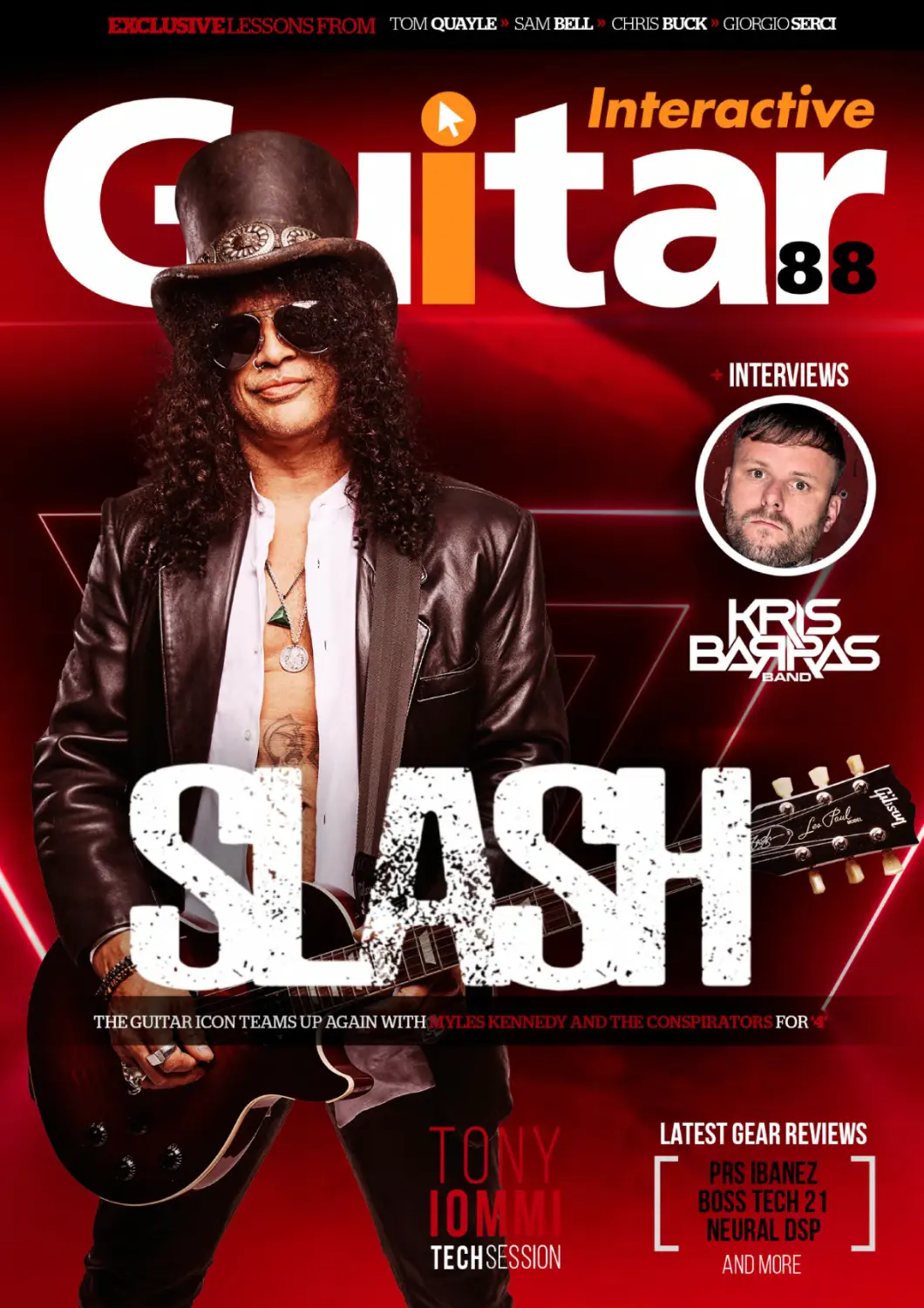


Tags: music guitar interactive magazine
Year: 2022
Text
                    02

Guitar Interactive Issue 88

www.guitarinteractivemagazine.com

03

88
Welcome to

Editor
// Jonathan Graham

Hello and welcome to issue 88 of Guitar Interactive Magazine!
Incredibly, it’s already been a
decade since Slash, Featuring Myles
Kennedy, and Conspirators released
their debut album—the landmark
Apocalyptic Love.’ Ever since, the
band—which, in addition to Slash
and singer Myles Kennedy also
includes bassist Todd Kerns, drummer Brent Fitz
and rhythm guitarist Frank Sidoris—has been on
one of the more impressive and unrelenting tears in
rock ‘n’ roll of recent times. Back with the equally
impressive ‘4,’ we catch up with one of the most
iconic and recognisable guitar players of all time, as
Gi talks to Slash.
Steamrolling through 2022, the Kris Barras Band
has returned with a brand-new album, ‘Death Valley
Paradise.’ Produced by Dan Weller (Enter Shikari,

Editor
Jonathan Graham
jonathan@guitarinteractivemagazine.com
Contributors
Jonathan Graham, Sam Bell, Nick Jennison

Bury Tomorrow, SiKth) and recorded at VADA
Studios in Alcester, they return heavier, darker, more
introspective but enormous at the same time. We
catch up with Kris in this exclusive interview.
If that’s not enough, Nick Jennison breaks down the
powerful phrasing and killer technique of metal icon
Tony Iommi, in this issue’s Tech Session.
As usual, with every issue, we have a whole host of
the latest and best gear reviews from around the
world of guitar, with our team of world-class gear
reviewers offering their unique insight, expertise, and
personality, which as always, I hope you will enjoy.
However, if that’s still not enough, don’t forget all of
our exclusive lessons from Tom Quayle, Sam Bell,
Chris Buck & Giorgio Serci.

Review crew
Nick Jennison, Tom Quayle, Sam Bell,
Rodney McG

USA Advertising Sales
Lisa Spiteri
LisaSpiteri@guitarinteractivemagazine.com

Columns
Tom Quayle, Sam Bell, Chris Buck &
Giorgio Serci

Design and layout
Simon Gibbs
simon@guitarinteractivemagazine.com

Advertising Manager
Helen Bavester
helen@guitarinteractivemagazine.com

Video Editors
James Masterton & Dave Kidd

Sound E
Dave Kid

Cameras
James M

Publishe
Guitar In

Publishi
Kim Wall

(c) Copyright 2022 Guitar Interactive Ltd. No part of this publication may be reproduced in any form or by any means without prior permission of the copyright owners. The views expressed in

04

Guitar Interactive Issue 88

GUITAR INTERACTIVE_WELCOME

Welcome to Guitar Interactive Issue 88

GET IN TOUCH Ask a question, share your ideas and let’s see what works!
iGuitarMag
Tweet your ideas and
thoughts here

facebook.com/
GuitarInteractive
Magazine

www.guitarinteractive
magazine.com

Keep up-to-date with the
latest from Gi

s
Masterton & Dave Kidd

ers
nteractive Ltd

Ad Index

Contact
Sales and Information line:
+ 44 (0)1708 757 337

Platinu
m

Pro EQ

A full-fe
atured
instru
accura
ment
te sonic
pream
p and
detail
With
DI that
for any
acoust
delive
acoust
ic and
rs
ic instru
bass modes
includi
ment.
ng full-ran
, it include
ge EQ,
s perfor
effects
XLR D.I.
mance
loop,
output
feature
volume
housed
s
boost,
in a road-r
and a
baleady
design
inform
.
ation

anced

For more

visit Fishm
an.co
m/Pla
tinum

Our advertisers.

Fax Line: +44 (0)1708 757 528
Address: Unit A, Chesham Close, Romford,
Essex, RM7 7PJ, UK

ing Director
ler

ARIA 57
CF MARTIN 21
ELIXIR 31
ERNIE BALL 15
EVENTIDE 71

FOX GEAR 75
MOOER 43&65
OVATION 101

ROTOSOUND 2&3
SPECTOR 117
TECH 21 NYC 33

PRS 49

Guitar Interactive are those of the contributors and not necessarily those of the Editor or Publisher.

www.guitarinteractivemagazine.com

Acous
ticPow
er

Engineering
dd & James Masterton

Full user access to our extensive
website and content

05

Reviews
THE

ISS U E 88

Contents
INTERVIEWS

010

At Guitar Interactive, we pride ourselves on bringing you in-depth
reviews and demonstrations for only the best products the world
of guitar and audio electronics has to offer.
If it’s in Gi, then it’s gear we’d buy! All of our written reviews and breakdowns
are
accompanied by a detailed video — so you can see and hear for yourself
if it’s
right for you.

62

Guitar Interactive Issue 85

SLASH:
We catch up with one of the most iconic
and recognisable guitar players of all
time, as Gi editor Jonathan Graham
talks exclusively with Slash.

KRIS
BARRAS:

026

Steamrolling through 2022, the Kris Barras Band has returned with a brand-new album, ‘Death Valley Paradise.’

06

Guitar Interactive Issue 88

REVIEWS - GUITARS,
AMPS & FX

TECH SESSION

038

TONY IOMMI
Nick Jennison

052_Ibanez AZ427P1PB
058_Vintage 25th Anniversary
Series V6HM Edition 2

TOM QUAYLE
Modern Guitar - Part 2

062_PRS Fiore Mark Lettieri
Signature Electric Guitar
068_DV Mark Eric Gales Combo

124

072_Orange Super Crush
078_Neural DSP Quad Cortex

SAM BELL

084_Tech 21 Paul Landers PL1
Signature Fly Rig

Extreme Shredding - Part 2

088_Boss HM-2W Heavy Metal
128

092_MixWave - Gojira: Mario
Duplantier Virtual Drum
Software

THE QUIETROOM
CHRIS BUCK

098_Breedlove David Starr Rise
Up Again Signature Model

Rock & Soul - Part 3

104_Vintage V880WK &
Vintage VE-440WK

132

THE BASSMENT
GIORGIO SERCI

110_Aria DMB-206 BK

Creative Fingerstyle - ‘African Sunset’

118_Eventide Tricerachorus

COLUMNS

114_Tech 21 Bass Fly Rig
138

www.guitarinteractivemagazine.com

07

Interviews

W
E
S
I
E
V
X
R

THE

L
C

Incredibly, it’s already been a decade since Slash, Featuring Myles Kennedy,
and Conspirators released their debut album—the landmark Apocalyptic
Love.’ Ever since, the band—which, in addition to Slash and singer Myles
Kennedy also includes bassist Todd Kerns, drummer Brent Fitz and
rhythm guitarist Frank Sidoris—has been on one of the more impressive
and unrelenting tears in rock ‘n’ roll of recent times. Back with the equally
impressive ‘4,’ we catch up with one of the most iconic and recognisable
guitar players of all time, as Jonathan Graham talks to Slash.
Steamrolling through 2022, the Kris Barras Band has returned with a brandnew album, ‘Death Valley Paradise.’  Produced by Dan Weller (Enter Shikari,
Bury Tomorrow, SiKth) and recorded at VADA Studios in Alcester, they
return heavier, darker, more introspective but enormous at the same time.
We catch up with Kris in this exclusive Gi interview.

08

Guitar Interactive Issue 88

V
I
E
S
I
N
U
L
T
N

ERVI EWS
www.guitarinteractivemagazine.com

ER

LU S I V E
C
I
EX

NT

RV I EW
E
T
S

GI88
IN-DEPTH CHATS WITH
GUITAR’S BIGGEST NAMES

09

X

C LU S I V
E
I
EX

INTERVIEWS_SLASH

Incredibly, it’s already been a decade since Slash, Featuring Myles Kennedy, and Conspirato
in addition to Slash and singer Myles Kennedy also includes bassist Todd Kerns, drummer B
unrelenting tears in rock ‘n’ roll of recent times. Back with the equally impressive ‘4,’ we catc
Graham talks to Slash. »

10

Guitar Interactive Issue 88

SLASH 4

ors released their debut album—the landmark Apocalyptic Love.’ Ever since, the band—which,
Brent Fitz and rhythm guitarist Frank Sidoris—has been on one of the more impressive and
ch up with one of the most iconic and recognisable guitar players of all time, as Jonathan

www.guitarinteractivemagazine.com

11

INTERVIEWS_SLASH

FOR

Slash, Featuring Myles Kennedy and the Conspirators, Living the
Dream is much more than just a catchy album title. From multiple highly-acclaimed records to rocking sold-out venues all over the world, this
act can clearly do no wrong. However, for all they’ve achieved and everywhere
they’ve gone, when it comes to this band, there are always new musical boundaries to push and fresh creative avenues to explore. Enter ‘4,’ the brand-new and
highly anticipated studio effort from SMKC. True to the band’s expanding
legacy, it’s everything you’ve come to expect from Slash, Myles, Todd, Brent and
Frank... but also unlike anything you’ve heard from them yet.
This time out, Slash says, they captured a certain “magic” –the sound of five musicians and bandmates listening to and playing off one another in the spirit of
live, in-the-moment collaboration. “It has a very spontaneous, fun kind of thing
to it, and I love that,” Slash says of ‘4.’ “That’s really the major difference on
this record –we did it more or less live, and the mistakes are all in there. It’s the
sound of the five of us just jamming together in one room.” Of course, he continues, “you can make an amazing album by recording the bass and drums and
putting the guitars on later and all that. But when you can capture that live rock
‘n’ roll spirit?It makes the whole thing really special.” And make no mistake: ‘4’
is special.
The album kicks off with the six-string clarion call of Slash’s Gibson Les Paul,
which cuts through the mix like a siren forewarning what’s to come–in this case,
opening track “The River is Rising,” one of the band’s toughest and most dynamic compositions to date. Unravelling via a menacing, tightly coiled riffs and
deep-in-the-pocket groove, the song builds to a trademark SMKC widescreen
chorus, featuring Kennedy’s vocals riding over waves of guitar melody before
stopping on a dime to break into a furious double-time instrumental sprint—
with Slash’s frenzied, nimble solo racing above, around, alongside and within his
bandmates’ full-throttle rhythm gallop. »

“Throughout, ‘4’ hits on a wide range of sou
laser-sharp musical focus and a lightning12

Guitar Interactive Issue 88

SLASH 4

unds, styles and moods and does it all with
-in-a-bottle sense of immediacy.”
www.guitarinteractivemagazine.com

13

INTERVIEWS_SLASH

“It grabs you right out of the gate,” Slash says. And from the chunky, deliberate stomp
of “Whatever Gets You By” to the slinky grooves and talk box-drenched guitar hooks of
“C’est La Vie,” the anthemic swell of “The Path Less Followed” to the cowbell-inflected
boogie-shake of “Actions Speak Louder Than Words,” and the grimy Aerosmith-Esque
funk of “April Fool” to the rampaging attack of “Call Off the Dogs,” ‘4’ never let’s go.
To be sure, this is SMKC like you’ve never heard them before. Need more evidence? See,
for starters, the exotica-tinged “Spirit Love,” which is introduced by a snaky Slash singlenote theme played on an electric sitar (but don’t worry –it’s still run through “a Marshall
at full blast,” Slash assures) and then erupts into a psychedelic fever dream fueled by a
crushing, circular riff. Says Kennedy, “Every time I hear the song, I see, like, a cobra
dancing in front of a snake charmer.”
Or, on the other end of the sonic spectrum, the bright-toned pop-rocker “Fill My
World,” a heart-on-sleeve love song –even if, Kennedy admits, it’s a love song about his
dog –that blooms with irresistible major-key melodies and one of Slash’s most liquid and
expressive solos to date. Or album closer “Fall Back to Earth,” a six-minute “epic,” to use
Slash’s word, awash in cinematic soundscapes and dramatic tonal shifts and anchored by
an indelible, at this point practically trademark, Slash guitar hook. »

Slash- Interview

14

Guitar Interactive Issue 88

SLASH 4

MARTIN

www.guitarinteractivemagazine.com

15

INTERVIEWS_SLASH

Slash - The River Is Rising (feat. Myles Kennedy
and The Conspirators) [Live at Studios 60]

Throughout, ‘4’ hits on a wide range of sounds, styles and moods and does it all with
laser-sharp musical focus and a lightning-in-a-bottle sense of immediacy. “Everybody
went into with the mindset of, ‘Okay, the red button’s being pressed, the tape machine is
rolling. Just do your best and don’t screw up!’” Kennedy says with a laugh. He likens the
process to creating a sonic snapshot: “You’re documenting a moment in time and letting things kind of fall where they may. It’s a different approach, but a very human one.”
That “different approach” is just one of several ways SMKC changed things up this time
out. Whereas the band recorded their previous two records in L.A. with Michael “Elvis”
Baskette, for ‘4’, they opted to relocate to Nashville to work with Grammy-winning producer Dave Cobb, known for helming rock and country projects from the likes of Chris
Stapleton, Jason Isbell, Rival Sons, and Shooter Jennings, among others.
“Dave and I had this great conversation where we talked about (famed producer and
engineer) Glyn Johns, recording live, spontaneity and first and second takes —all this
stuff that’s right up my alley,” Slash says. “Based on that conversation, I said, ‘Let’s do
this.’” The experience was, Slash continues, “really unique.” For starters, he says, “we had
to get to Nashville during the pandemic, and safely. So, I figured, ‘Well, we’ll just take a
tour bus.’ Which was an adventure unto itself.” Kennedy picks up the story. “We were
trying to be really careful given that things were still pretty risky. So, we met up in Las
Vegas, and before we got on the bus, we all got tested. Then when we got off the bus in
Nashville, we tested again. Before we stepped through the studio doors, we tested again.
We had all these protocols in place.”
The sessions for ‘4,’ which took place in Nashville’s legendary RCA Studio A—”it’s this
huge, historical room that used to be Chet Atkins’ studio,” Slash says, “I remember the
day before we went in, one of Dave Cobb’s assistant engineers said, “Oh, you guys will
be recording by tomorrow night,’” Kennedy recalls. “And I was like, really?” Really.
“That first day, we came in, lined the backline up with a couple of baffles and started
recording live, just like that,” Slash says. “We recorded two songs a day –vocals, guitars,
bass and drums–and we kept everything. Dave, just let us do our thing.” Within a week,
the band had roughly 90% of the music recorded. But everything came to a screeching
halt when Kennedy tested positive for Covid-19. »

16

Guitar Interactive Issue 88

SLASH 4

“That’s really the major difference
on this record –we did it more or less
live, and the mistakes are all in there.
It’s the sound of the five of us just
jamming together in one room.”

www.guitarinteractivemagazine.com

17

INTERVIEWS_SLASH
“I was the first to go down,” the singer says. In short order,
Kerns, Fitz and one of the house engineers followed suit. “We
were staying in an Airbnb in Nashville, and everybody had to
go into quarantine,” Slash recalls. “And I was sitting there going,
‘Maybe I should check into a hotel?’ But I wasn’t going to abandon my band just because they got sick.” Instead, they simply
moved the sessions to the Airbnb. “I ended up having to finish
three of the vocals – ‘Spirit Love,’ ‘Whatever Gets You By’, and
‘Fall Back to Earth’ in the pool house,” Kennedy says. “I tracked

my vocals on my laptop, and the
backing vocals there, too. Then w
studio.”

story.” It’s a story that, ten years in, only continues to progress.
“The thing about this group is it started out in one place, and it’s
evolved ever since,” Slash says. “And just when it seems like it’s
reaching a certain place, without really giving it much thought,
we’ll get together and naturally move on to another place from
there.”

redefine the sound.” And keep go
all kind of amazed and pleasantly
we’re still making records, and w
tinues. “But that’s because we do
really do like each other.” He lau
as watching people fistfight onsta
where people know that we’re in

This is certainly evident with ‘4.’ “I feel like in a lot of ways it’s a
continuation of what we do, but because of the way that it was
recorded, it’s also a progression,” Kennedy says. “The songs were
being captured and viewed through a different prism that helped

18

Guitar Interactive Issue 88

Slash, for his part, finished up gu
And despite his best efforts, he ev
Covid as well. In fact, Sidoris wa
managed to escape infection. “So
then laughs. “I was like, ‘You don

Slash concurs. “The Conspirator
band, and it’s been like that from
everybody just wants to get toget

en Todd came in and did all the
we sent the files to Dave at the

uitar overdubs at RCA Studio.
ventually tested positive for
as the only Conspirator who
o, I sent him home,” Slash says,
n’t have anything else to do any-

oing; they will. “I think we’re
y surprised that after a decade,
we’re all still in it,” Kennedy cono love what we’re doing, and we
ughs. “It may not be as exciting
age, but it’s certainly something
it for the long haul.”

rs is just such a simple, easy
m its inception. It’s a band where
ther and play, and there’s really

SLASH 4

way; get out of here. Stay away from this godforsaken place!’”
He continues, “It really was this whole crisis period. But we all
went through it together, so in a way, it was also a great bonding experience.” That experience is reflected, quite forthrightly,
in the sound of ‘4.’ “When I listen to a song like ‘The River is
Rising,’ by that point I was starting to get pretty sick,” Kennedy
says. “You can hear it in my voice, how congested I was. But
that’s part of what I think is really interesting about this record.
We just let those imperfections lay. Because it’s all part of the

not a lot of other stuff that gets in the way. We get the material
together, and we go for it, and once a run’s over, then we go and
do other things.”
“But we always come back to it,” Slash continues, “because we
love making these records and doing the tours and going out
and having a really good time. And as low pressure as that is, it’s
also super, super important to have that. We do it, and it’s fun.
And that’s why we’ll continue to do it.” »

www.guitarinteractivemagazine.com

19

INTERVIEWS_SLASH
Slash breaks down ‘4’ track by track.

“The River is Rising”
SLASH: There are two or three songs on the record that were written during the pandemic; everything else was written before. “The River is Rising” was one of the last songs
I wrote before we started pre-production, and because it was just so fresh and it had a
certain groove and energy to it, it was the first thing we really attacked. It’s actually the
newest song on the record. As for the double-time part, that was something that I came up
with and tagged onto the end of the arrangement. Then when we were over at RCA, Dave
Cobb suggested we do it right after the breakdown. So, we went straight into the fast part,
and I just started doing the guitar solo over it. It was one of those things where we were
jamming around, trying to fish out the arrangement, and it just happened.
Slash - Spirit Love (feat. Myles Kennedy and The
Conspirators) [Live at Studios 60]

“Whatever Gets You By”

SLASH: I love the riff –it’s one of my favourite things on the record. And the arrangements are really very simple. I had the riff, and I kept playing it and playing it, and when
I went in to record a demo, the next change spontaneously came out, and that’s what the
chorus ended up being. Just making it up on the spot and going, “Oh, that works.” But
it was really all about the groove and getting that sort of greasy, heavy stomp thing going.
And that was it. It came together super-fast after that.

“C’est La Vie”
SLASH: “C’est La Vie” is one that I remember from soundchecks–it might have been in
Australia, I’m not sure. But I had that main opening riff, and it all came together –the
verse, the chord changes, the bridge part –just jamming for an hour at soundchecks before every gig. When it came time to do the demo, it really followed the lines of what the
arrangement was out on the road. Then when we actually went in to record it, I’d had this
idea of doing the opening riff with a talkbox, although I hadn’t actually ever done it that
way. But when we started pre-production, I just put it on there, and that’s what you hear
on the record. »

20

Guitar Interactive Issue 88

SLASH 4

0 1 2 -2 8
MODERN DELUXE

0 0 -2 8
MODERN DELUXE
0 0 0 -1 8
MODERN DELUXE
D-45
MODERN DELUXE

TBA
NEW CLASSICS
HAVE ARRIVED.

scan me

Introducing All-New Modern Deluxe Models.
Martin has added seven new models to their popular Modern Deluxe Series, giving you
more body sizes and styles to choose from. If you’re looking for a guitar with state-ofthe-art features, modern playability, and that coveted vintage Martin tone, the Modern
Deluxe Series is for you. Find yours today at bit.ly/martinmoderndeluxe.

www.guitarinteractivemagazine.com

21

INTERVIEWS_SLASH

“The Path Less Followed.”
SLASH: It’s the oldest piece of music on the
record. We must have started playing that
riff at some point during World on Fire–at
least, I was playing it. The chord progression is really three chords that are transposed differently, but it allows for a certain
kind of melody even though it’s the same
three chords repeating over and over again.
I had that part forever, and I wouldn’t let
it go, but I never really got past those three
chords. Finally, at some point during the last
Conspirators tour, we developed the verses,
and then during the pandemic, sitting
around at home, I started to put together a
real arrangement. I made a demo, sent it to
Myles, and we got the song done.

“Actions Speak Louder
Than Words”
SLASH: It’s a pretty simple, straight-ahead
rock ‘n’ roll song, but the bridge is totally
left field. The song is something that was
written at soundcheck, with all of us just
sort of jamming and me coming up with
stuff by playing off the other guys. On the
record, it’s one of two songs I didn’t play
on a Les Paul –I used a Gibson ‘69 Reissue
Flying V that I got for Christmas one year.
I also used that guitar with the talkbox on
“C’est La Vie.” The guitar sounds really, really good, and it’s a little bit cleaner than my
regular Les Pauls. I love the way it sounds
on the solo on this one.

22

Guitar Interactive Issue 88

“Spirit Love”
SLASH: That’s one of the newer pandemic
songs. The riff itself was just a direct result of
the frustration of being stuck and not being
able to do anything for an extended period
of time. And the intro was influenced by
the main riff as well. It has almost a Middle
Eastern kind of feel or flavour to it. I wrote
it on guitar, but when I went in to record it,
I pulled out an electric sitar to play it at the
beginning. Normally I don’t pull out that
sitar because it can be very cliché sounding,
but it seemed appropriate for this one. And
we put it through a Marshall at full blast, so
it sounds a little like it’s almost dying.

“Fill My World”
SLASH: Musically, I came up with it at
my studio. It was just the opening riff, and
then the underlying chord changes started
to come out in my mind. I wasn’t really sure
if I was going to pursue it or not, but I had
to record it and make a demo. I thought
I didn’t know what the guys were gonna
think... Because it has a certain sentimental
kind of feel to it. But I sent it to Myles, and
he came back with this really heartfelt lyric.
I thought it was about all the loss we’ve been
suffering during this dark period, and then
he told me it was about his dog. [laughs] I
said, “Well, you know, everybody has had
somebody that they love affected by this,
so...”

SLASH 4

“April Fool”

“Fall Back to Earth”

SLASH: Another one that I think goes
back to the Living the Dream album tour.
It’s a cool riff, but it took a while to put
together. I’ve got a lot of tapes of us jamming it at soundchecks without knowing where to go after a certain point. But
then, when I got home and put together
an arrangement, it was actually pretty easy.
And it really came together when we went
into the studio. This is one of the songs
that DaveCobbhad a definite impact on.
Certain key elements were missing in the
demo, arrangement-wise, and he just went,
“We’ll connect that right there...” And I
was like, “Oh, yeah, that’s a good idea!”
[laughs] Sometimes, you just need that
other person that you can trust musically.
And if they have an idea, you can’t be too
precious to try it.

“Call Off the Dogs”
SLASH: This one was written pretty much
on the fly and in the spirit of the energy
of the whole project. You can’t overthink
something like this because it kills the
spirit. When we got into pre-production,
it came together fairly quickly –just jam it,
and that’s basically it. And I think it was
probably the last thing that we recorded in
the studio.

SLASH: After one of the Guns tour legs
was over, I went on safari in South Africa.
I took a guitar with me, and one night I
came up with the opening melody to this
one. So, the lick came first, but I had to
figure out where to go with it from there.
Then during the Living the Dreamtourthat
we had after that, I came up with the verse,
and Myles had some great ideas for that.
There was also a guitar melody part, which
initially was going to be an instrumental
part, but it ended up being the chorus.
There were all these different pieces, but
they seemed to relate to the same thing.
The song really came together in Nashville. We fleshed it out, and there were
harmony parts and things that just happened spontaneously in the studio. I hadn’t
actually planned them, and they weren’t
on the demo, but I did them while Dave
Cobb was in the bathroom.[laughs] He
came back. And I’d worked out this whole
harmony and everything. So, it took me a
minute to figure out where the song was
going to go, but I’m really happy with the
way it came out.
END <<

www.guitarinteractivemagazine.com

23

INTERVIEWS_SLASH

“To be sure, this is SMKC like you’ve
never heard them before...”

edy’
n
n
e
K
yles irators ‘4:
M
.
t
a
e
p
SlasnhdfThe Cons Tracklist
a
ing
s
i
R
s
I
ver
i
R
e
h
T
By
u
o
Y
s
Get
r
e
v
e
t
Vie
a
Wha
L
t
s
C’e
ed
w
o
l
l
o
F
Less
h
t
er
a
d
P
u
o
L
The
eak Words
p
S
s
n
Than
Actio
ve
o
L
t
i
r
i
Sp
orld
W
y
M
Fill
ol
April Fo
ogs
D
e
h
T
f
Call Of
rth
a
E
o
T
ck
a
B
l
l
a
F

24

Guitar Interactive Issue 88

SLASH 4

For more information , visit
slashonline.com

www.guitarinteractivemagazine.com

25

INTERVIEWS_KRIS BARRAS

DEATH V

a
r
a
P

Steamrolling through 2022, the Kris Barras Band has returned with a b
(Enter Shikari, Bury Tomorrow, SiKth) and recorded at VADA Studio
enormous at the same time. We catch up w

26

Guitar Interactive Issue 88

KRIS BARRAS DEATH VALLEY PARADISE

VALLEY
e
s
i
d

a

brand-new album, ‘Death Valley Paradise.’  Produced by Dan Weller
os in Alcester, they return heavier, darker, more introspective but
with Kris in this exclusive Gi interview. »

www.guitarinteractivemagazine.com

27

INTERVIEWS_KRIS BARRAS

‘DEATH

Paradise’ started life
as a song before it
was dissected and spread across the album. Death Valley is a place of extremes,
where living things are said to not be able
to survive. «To survive and thrive in those
circumstances and find your paradise in it.
For me, it sums up the journey I›ve been
through. As a musician, you were put into
a place where it was hard to survive, and
you had to do different things to keep it
moving.»
For 18 months, the world stood still, and
we realised that we didn’t have control
of ourselves anymore. “I had some really
dark times. I didn’t want to get out of bed.
I didn’t want to do anything. It was really
tough,” Barras says. “I’ve thrown every-

thing at this. It was tough not knowing if
I’d ever be able to do this again. What am
I going to do with my life? I’ve gone all-in.
If I’m not this, who am I?” he says.
For the ex-MMA/cage fighter, there was
only one way out, to re-focus. “Once
Covid hit, it was a case of “anything goes,”
and I don’t give a fuck anymore,” he says
with no preconceived plan for the album.
Barras decided to remove all shackles and
began collaborating with songwriters,
such as the heavyweights; Jonny Andrews
(Three Days Grace, Fozzy), Bob Marlette
(Alice Cooper, Airbourne, Rob Zombie), Blair Daly (Halestorm, Black Stone
Cherry) and Zac Maloy (Shinedown, Tyler
Bryant). »

Kris Barras - Interview

28

Guitar Interactive Issue 88

KRIS BARRAS DEATH VALLEY PARADISE

Kris Barras Band - These Voices
(Official Lyric Video)

www.guitarinteractivemagazine.com

29

INTERVIEWS_KRIS BARRAS

Kris Barras Band - My Parade
(Official Music Video)

Early 2020 was uncharted waters for all of
us. “At first, we thought, three weeks and
it’s over,” he says. “I went through a cycle.
At first, I tried to take it positively and then
reality set in. I’ve been fortunate in my life
in that I’ve been sad but never suffered from
anything that I would count as depression
until last year.”
One of the shining lights of the period was
co-writing. “It was a bit of a game-changer”,
he enthuses. Seeds of the songs had already
been sewn in late 2019. “There were a few
riffs we were playing around with on tour,
and a lot of those early songs were heavy. I
sat down with the label and said the stuff
I’m writing is heavier, and they were completely supportive. “In my teens, I was pretty

30

Guitar Interactive Issue 88

much only listening to Hard Rock and
Metal, so it feels completely natural and free.
More than ever, this album is me on an LP.
I do think I’ve gone a little bit darker and
deeper on it. Writing songs about topics I
haven’t done before.”
The album opener and first single, “Dead
Horses,” shakes the foundations by delving
into broken relationships, which steamrolls
into the crushing “Long Gone,” a tale of
letting go. The album’s high voltage calling
card is “My Parade,” - the bands’ protest
song. “It says this is my parade, but it’s collective; it’s our parade,» Barras says. «This is
my life, and this is how I›m gonna live it and
if you don’t like it. Fuck off.” »

GOOD TO GO

KRIS BARRAS DEATH VALLEY PARADISE

WHEN EVER WHERE VER
•

ELIXIR
A passion for playing means that inspiration can strike anytime, anywhere.
With Elixir® Strings you know that when you pick up your guitar it’s going
to sound great—time and time again. That’s because our featherweight
coating protects your strings from the elements, keeping corrosion away
and allowing your tone to sound great for longer, in any environment.

Elixir Strings. Performance-ready with long-lasting tone.
GORE, Together, improving life, ELIXIR, NANOWEB, POLYWEB, OPTIWEB, GREAT TONE • LONG LIFE, “e” icon, and designs are trademarks of W. L. Gore & Associates. ©2009-2021 W. L. Gore & Associates, Inc.

www.guitarinteractivemagazine.com

31

INTERVIEWS_KRIS BARRAS
They take an introspective look on “These
Voices.” “It’s that inner voice that is always telling you that you can’t do things and dragging
you down,” he says. “For me, it’s been quite
prevalent in my life over the past year.” They
submerge themselves in the melancholic and
haunting “Wake Me When It’s Over” whilst
venturing into the chaotic darkness documenting his mental health struggles on the thundering finale, “Chaos.”
The band features a new rhythm section of
Billy Hammett (Drums) and Kelpie Mackenzie (Bass) along with Kris Barras (Lead Vocals/
Guitar) and Josiah J. Manning (Rhythm Guitars/ Vocals). “The band on this album are a big
part of how it sounds. When we get in a room

and jam, everything just comes out heavier and
more angsty,” he says.
The Kris Barras band is set for an incredible 12
months ahead; They’ve just finished a sold-out
UK tour with Kentucky’s favourite sons Black
Stone Cherry, culminating with a show at the
world-famous Royal Albert Hall. Their biggest
headline tour to date begins in March 2022,
followed by playing the iconic Wembley Arena
in support of Thunder.
Kris Barras Band’ Death Valley Paradise’ is out
now worldwide via Mascot Records / Mascot
Label Group.
END <<

“This is my life, and this is how I’m gonna
live it and if you don’t like it. Fuck off.”

32

Guitar Interactive Issue 88

KRIS BARRAS DEATH VALLEY PARADISE

TECH 21

www.guitarinteractivemagazine.com

33

INTERVIEWS_KRIS BARRAS

D

IS

KR

AS
R
R

BA

N
BA

’
e
s
i
rad

a
P
y
lle

:
t
s
i
l
k
c
ra

a
V
h
t
a
e
D

T

ES
RS
O
H
NE
AD
GO
DE
G
DE
LON
RA
A
P
ES
MY
OIC
V
SE
IES
THE
EM
N
S E
OW
ED
KN
E
N
U
O
R
YO
VE
WH
O
VIL
E
D
T’S
E
N I
E
TAG
H
S
W
HO
E
NE
E M
OLI
K
S
A
W
E
GA
ND
Y M
A
R
S
BU
OS
TTE
E
HA
R
C
A
CIG

34

Guitar Interactive Issue 88

KRIS BARRAS DEATH VALLEY PARADISE

For more information , visit
krisbarrasband.com

www.guitarinteractivemagazine.com

35

Tech Session

O
I
N
S
T
S

E

THE

H
C

In each issue, the Guitar Interactive Tech Session shines the spotlight on
one of guitar’s biggest icons. These in-depth lessons look to break down
style, techniques and individual nuances that make these great players
stand out from the crowd in the form of a tailor-made composition.

SPONSORED BY

36

Guitar Interactive Issue 88

E

All Gi TECH SESSION are accompanied with full tablature and a backing track —
to help you learn, practice and utilise these new techniques in no time.

S
E
S
S
I
O
H

GI88
UNDERSTANDING WHAT
MAKES THE GREATS GREAT

ES

H

T

TEC
H
S

S E S S I ON

N
I

ON

S IO N T E C

n
n the
s

T

H SESS
C
E

37

S

www.guitarinteractivemagazine.com

TECH SESSION_TONY IOMMI

T
38

Guitar Interactive Issue 88

SPONSORED BY

TONY IOMMI TECH SESSION

Tech Session

In this issue’s Guitar Interactive Tech Session, Nick Jennison
breaks down the ferocious power and subtle nuances of the
Black Sabbath’s riff lord, Tony Iommi. »

www.guitarinteractivemagazine.com

39

TECH SESSION_TONY IOMMI

FORMED

in 1968 in
the iron heart
of industrial Birmingham, Black Sabbath
is one of the most influential rock bands
of all time. Put simply, without Black
Sabbath; there would likely be no heavy
metal. Set to the ominous sounds of driving rain and funeral bells, their eponymous debut opens with a sinister tritone
riff that paved the way for countless bands
to follow - and if the anecdotes are to be
believed, it almost didn’t happen.

Consisting of guitarist and main songwriter Tony Iommi, bassist Geezer Butler,
drummer Bill Ward and vocalist Ozzy
Osbourne, Black Sabbath started as a
psychedelic band named “Earth”. Despite
their best efforts and Iommi’s blues and
folk rock pedigree (having toured with
a number of successful acts, including a
brief stint in Jethro Tull), Earth was a flop.
Serendipitously, a cinema across the street
from the band’s rehearsal space was enjoying considerable success showing horror
movies. Geezer Butler noted that it was

Tony Iommi - Tech Session Performance

40

Guitar Interactive Issue 88

TONY IOMMI TECH SESSION

SPONSORED BY

“strange that people spend so much money
to see scary movies”, and that maybe if the
band started playing “scary music” more
people would come to watch them. The
band renamed themselves after the cinema’s
main feature - the 1963 Boris Karloff horror
classic Black Sabbath - and the rest is history.
General guidance:
Studying Iommi’s style is a great opportunity to work on tightening up your heavy
riffing, because rhythmic accuracy is crucial
to sounding authentic. Listen closely to
almost any early Black Sabbath track, and
you’ll notice that Tony Iommi’s massive riffs
are the tonal and rhythmic anchor amidst
the frenetic (occasionally chaotic) groves
of Butler and Ward. This is pretty much
the polar opposite to contemporaries Led
Zeppelin, with Bonham and Jones’s tight
rhythms underpinning Jimmy Page’s loose
swagger, but it’s no less impactful.
It’s worth noting that, despite the immense
weight of his tones, Tony Iommi’s touch is
light and controlled. Suffering an industrial
injury that severed the tips of his 2nd and
3rd fingers, Iommi compensated by tuning
his guitar down and switching to lighter
strings, which necessitates a more measured
pick attack - it also goes to show that you

don’t need big strings for big tones! Speaking of which…
Tone:
In the pursuit of authenticity, we used the
classic Iommi setup of a Gibson SG plugged
into a cranked Laney amp - in this case, the
LA30BL, which shares a lineage with the
Supergroup heads used by Tony throughout his career. We tried a number of boosts
and fuzzes and settled on a Gamechanger
Audio Plasma Pedal, which sounded suitably rough and ominous. In reality, though,
any guitar with two humbuckers will do the
trick, especially if you plug it into a vintagestyle British amp. You might consider using
a fuzz or a Rangemaster-style treble boost
(such as Laney’s TI Boost), but it’s not completely necessary.
One thing worth noting is that there’s not a
massive amount of bass in Iommi’s tone - in
fact, I rolled the bass to zero on our Laney
head. This lets the growling midrange speak
more clearly, and leaves plenty of room for
the rhythm section.
As far as guitar settings go, it’s the bridge
pickup with volume and tone up full for the
majority of this session, but for the cleaner
passages I switched to the neck pickup with
the volume already rolled back - a clever »

www.guitarinteractivemagazine.com

41

TECH SESSION_TONY IOMMI

way of getting your single-channel amp to
behave like a channel switching model simply by using your guitar’s controls.
Bars 1-4:
This first riff makes use of two classic Sabbath ideas: sliding power chords and tritone
riffs. The latter, sometimes referred to as
diabolus in musica, (Latin for “the devil in

42

Guitar Interactive Issue 88

music”) is a very sinister sounding interval
found three whole tones (or six frets) above
the root note - hence “tri-tone”. This device
is heard in so many of Iommi’s riffs, especially the intro to “Black Sabbath.”
You’ll need to barre across the E and A
strings on the 12th fret to make the pull-offs
work. Also, when you’re executing the trill in
bar 4, try starting slowly and increasing the
speed gradually. »

TONY IOMMI TECH SESSION

SPONSORED BY

MOOER

www.guitarinteractivemagazine.com

43

TECH SESSION_TONY IOMMI

Bars 5-12:
This riff is a tip of the hat to one of my favourite Sabbath riffs, “Sabbath Bloody Sabbath,” and makes use of sliding power chords
and play muted open string chugs. The palm
mutes aren’t as heavily muted as the ones
you’ll find in more modern metal styles rather, they’re a gentle dampening to create a
darker texture to contrast the chord stabs.

There’s a tricky little fill in bar 10 that introduces a “rudiment” you’ll see crop up fairly
often in this session - it’s two hammer-ons
between fingers 1 and 3, followed by a

“grace note” hammer-on using the same fingers. Spend a bit of time getting this fill right,
and you’ll find that a lot of the trickier ideas
in this session feel easier than you’d expect.
Bars 13-16:
An alternate riff, taking inspiration from
“Iron Man.” It moves us momentarily to the
key of B, with a chromatic figure is derived
from the B blues scale (with the addition of
an A# note). Notice we have another grace
note hammer-on on the A string.

Toni Iommi Tech Session Lead Parts

44

Guitar Interactive Issue 88

TONY IOMMI TECH SESSION

SPONSORED BY

Bars 17-24:

Bars 27-30:

This cleaner section draws on Iommi’s
jazzier stylings in “Sabbath Bloody Sabbath”
and “Planet Caravan,” alternating between
strummed major and minor 7th chords and
melodic phrases. If you’re using a guitar
with an SG-style control layout, flip to the
neck pickup with the volume rolled back to
clean up the tone - or just switch to a clean
sound.

This riff showcases a “parallel keys” approach
used in tracks like War Pigs: taking a riff (in
this case using the notes of the minor pentatonic scale) and moving it around the fretboard without making changing the fingering pattern (or the interval relationship) to
match the original key. The effect is a little
jarring, and very in keeping with the sinister
vibe we’re going for.

The sliding octaves are a little tricky, making use of the less common 3-fret shape.
The best way to deal with this shape is to fix
your hand into position and focus on the
positioning of either the first or fourth finger - the other finger will take care of itself.
Bars 25-26:
Another Sabbath Bloody Sabbath-inspired
riff here (I did say it’s one of my favourites!),
making use of low inverted power chords
for a dark and grinding effect. There are a
number of fingering possibilities for this riff
- I prefer to use a first finger barre for the
2nd fret notes and use both third and fourth
fingers together for the rest, but feel free
to experiment. Getting the palm mute just
right and releasing it at just the right time is
crucial to making this riff work.

Also, notice that the “hammer-on/grace
note” rudiment from bar 10 is back? This is
an example of how one musical phrase can
be repurposed to create a variety of interesting riffs and ideas.
Bars 31-34:
An ascending lead line inspired by “War
Pigs” which is fairly simple to execute, but
requires a little attention to the finer details.
For maximum authenticity, your vibrato
should be shallow and fast without sacrificing evenness. In terms of note choice, we’re
drawing from a hexatonic minor scale, made
up of the minor pentatonic scale with the
addition of a natural 2nd (in this case an
F#). This scale has a lot of the drama of
a full seven-note minor scale, but with a
slightly more open and spacious sound. It’s
also somewhat reminiscent of one of Iommi’s formative influences, Hank Marvin of
The Shadows. »

www.guitarinteractivemagazine.com

45

TECH SESSION_TONY IOMMI

Bars 35-36:
Solo time! Our first lick makes use of that
now familiar rudiment from bar 10, followed
by some bends from the root note of E up
to F# - effectively superimposing the B minor pentatonic scale over our home key of E
minor.
Take care with the “contour” of these bends.
Iommi makes use of a variety of bending approaches to add interest to his solos, and the
best way to get it right is by listening closely.
The bends in this first lick are “pre-bends”,
which involves bending the note to pitch
before it’s picked, before releasing it.
Bars 37-38:
We’re drawing from Iommi’s blues vocabulary
for this E minor pentatonic lick. The timing
can be a little tricky on the faster flourishes in
bar 38 - focus on landing the 14th fret bend
on time, and you should be ok.
Bars 39-40:
This lick is a tip of the hat to the solo from
“Paranoid” - one of Iommi’s best. It starts out
with a series of bends before transitioning
into a sequencing idea that cascades across
the top four strings. Many of Iommi’s faster
lines are composed of sequences like this, and

46

Guitar Interactive Issue 88

they serve to help the player and the listener
“make sense” of these quick flourishes.
Bars 41-42:
The last lick of our solo, making use of bends
to the natural 2nd one more time. There’s
also one more instance of the “hammer-on/
grace note” rudiment - which just goes to
show how many times you can afford to repeat the same phrase without sounding “predictable”.
The very last phrase makes use of some bluesy
double stops, with a first finger barre on the
12th fret of the G and B strings.
Bars 43-54:
A few bars of silence, before we hit one of
Iommi’s most iconic “tricks”: a behind-thenut bend on the open low E string, as heard
in the droning intro to Iron Man. It’s pretty
simple to execute - hit the low E string nice
and hard, and then push the string behind
the nut towards the surface of the headstock
firmly enough to make the bend happen.
Bars 55-58:
This triplet riff is inspired by “Children Of
The Grave,” and is deceptively tricky. The first

TONY IOMMI TECH SESSION

SPONSORED BY

challenge is getting the A and D strings to
ring out without the low E dominating the
sound. You can do this by slightly angling
your pick strokes, so they just graze the low
E while making firm contact with the A and
D strings.

minor scale from bars 31-34. You’re free to
use whatever fingering feels comfortable
with this one.

The second challenge is the timing of the
hammer-ons. The first one is a grace note,
while the second is part of a group of triplets. You might think of it as “bLA-da dada BA-da-da da-da”.

A series of unison bends bring this track to
a close. Rather than counting each bend
(there are 33 in total), it’s better to listen to
the drums for your cue to finish - you’ll hear
a big roll on the snare drum signalling that
the track is about to close.

Bars 59-66:
Another Shadows-inspired melodic phrase,
making use of two octaves of the hexatonic

Bars 67-75:

In case you’ r new to unison bends, the
idea is that you’ll be bending a note on one
string (in this case, the 15th fret on the »

Toni Iommi Tech Session Rhythm Parts

www.guitarinteractivemagazine.com

47

TECH SESSION_TONY IOMMI

B string) to match the pitch of a fretted note on the next string up (12th fret on
the high E). Don’t worry about matching the pitch to the cent - it’s the “beating”
sound between the two notes that gives these bends their “crackling” character.
So with that, we’ve reached the end of this session. I hope you’ve enjoyed this
exploration of Tony Iommi’s playing and songwriting style, and hopefully, you’ve
picked up a few ideas to use in your own songs and solos. See you in the next one!
END <<

48

Guitar Interactive Issue 88

BEST OF BOTH WORLDS

TONY IOMMI TECH SESSION

SPONSORED BY

© 2020 PRS Guitars / Photos by Marc Quigley

The PRS SE Hollowbody II Piezo provide musicians with the
versatility of wielding both acoustic and electrics tones in one
instrument. It’s designed with two discrete volume controls
(magnetics and piezo) that can be run to the same amp with
one cable – players can use the volume controls to blend the
pickups. Or, you can run two cables and have the magnetic
pickups go to your favorite amp while running the piezo signal
straight to the board for a huge sound. To find out more and to
hear how versatile this guitar is, go to www.prsguitars.com.

SPARE

www.guitarinteractivemagazine.com

49

Reviews
THE

At Guitar Interactive, we pride ourselves on bringing you in-depth
reviews and demonstrations for only the best products the world
of guitar and audio electronics has to offer.
If it’s in Gi, then it’s gear we’d buy! All of our written reviews and breakdowns are
accompanied by a detailed video — so you can see and hear for yourself if it’s
right for you.

50

Guitar Interactive Issue 88

GI87
GUITARS, AMPS
AND EFFECTS

RE

E

P RO D U C T

RO D U C T
P
D

ED

R

OM ME N
C
E
D

www.guitarinteractivemagazine.com

51

COM M E ND

REVIEWS_GUITAR REVIEW

Ibanez AZ427P1PB
With its eye-catching poplar burl top, scorching tone, and easy playability, the Ibanez
AZ427P1PB is a force to be reckoned with. This 7-string solid-body has a basswood
body that issues a balanced tone, and its ergonomic contours offer unmatched comfort, no matter if you’re sitting or standing. Plug it in, and the Seymour Duncan Hyperion humbuckers deliver precise, powerful tones—even under the highest gain settings.
The onboard dyna-MIX10 switching system provides ten different pickup combinations for limitless tonal exploration. Here’s Nick Jennison with the review.

IBANEZ’S

AZ series has
found favour with
players of every style, and with good reason.
They offer the legendary playability and versatility that Ibanez is known for but with a more
conservative aesthetic that’s less likely to get
you the “side-eye” from your fellow musicians
than, say, an RG.
Historically, if you’ve wanted a mid-priced
extended range guitar from Ibanez, you were
limited to their more “metal” offerings. Enter the AZ427P1PB - a seven string AZ from
the more affordable “Premium” line. Made
in Indonesia but sporting the same high-end
hardware and appointments found on the
Japanese-made “Prestige” line, this guitar is a
very tempting proposition for players looking for a truly pro-level seven-string without
breaking the bank.
Available in just one finish, the charcoal black
burst is eye-catching without being gaudy, and
there are few musical settings where this gui-

52

Guitar Interactive Issue 88

As you’d expect,
this thing is solid
as a rock and
laughs in the
face of even the
most violent
dives, flutters and
warbles.
tar won’t look at home. The poplar burl top is
gorgeous and a refreshing change to the usual
figured maple top that typically adorns this
type of guitar.
The roasted maple neck is exceptionally tactile, with a C-shaped profile and a comfortable
12” radius that sets it apart from the flatter,
thinner RG 7 string necks that you may be familiar with. It’s a meaty offering but not at all
cumbersome, and the 24 jumbo frets make »

COM M E ND

RE

ED

P RO D U C T

P RO D U C T

RE

ED

COM M E ND

.

THE REVIEWS IBANEZ AZ427P1PB

Ibanez AZ427P1PB
MSRP: (UK) £1129 / (US) $1933

The Breakdown

Vintage

Modern

Specialised

Versatile

Warm

Bright

Affordable

High-end

For fans of
Seven string girth.
Six-string playability.
Supreme versatility
For more information, please visit:
ibanez.com/eu/

www.guitarinteractivemagazine.com

53

REVIEWS_GUITAR REVIEW

bends, slides, and fast shreddy passages
feel effortless. One of the qualities I look
for in a seven string neck is how easy it
is to pick up and play without having to
spend too long adjusting to the presence
of the extra string, and I’m pleased to
report that the adjustment period for this
guitar was basically zero.
Tones come courtesy of a pair of Seymour Duncan Hyperion pickups, the
more aggressive of the AZ pickups. That’s
not to say that these pickups are superoverwound “metal” pickups - they’re

plenty hot but also very dynamic and full
of character. The bridge pickup will chug
with the best of them, but it also handles
more restrained styles with grace. The
neck pickup is full, throaty and articulate, with a killer soloing voice that tracks
fast picking and legato lines no matter
how much gain you have dialled up…
and these two tones are just the tip of the
iceberg!
The Dyna-MIX 10 switching system
offers no less than ten distinct tones,
ranging from full humbucking sounds to

Ibanez AZ427P1PB

54

Guitar Interactive Issue 88

THE REVIEWS IBANEZ AZ427P1PB

“I’m pleased to report that the
adjustment period for this guitar
was basically zero...”

sparkling single coils and everything in between. It’s possible to configure each pickup
as either a fat-sounding series humbucker, a
clangy and cutting split coil or an open and
airy parallel humbucker. In practice, we were

able to dial in convincing tones for country,
funk, slide, classic rock, fusion, metal… you
name it, the AZ427P1PB can handle it, and
all with the benefit of the extra range that low
B string affords. »

www.guitarinteractivemagazine.com

55

REVIEWS_GUITAR REVIEW

Seven strings and tremolo bridges - especially non-locking designs - typically don’t
go together terribly well, but the Gotoh T1572S bridge on this guitar is the perfect
balance of stability and sensitivity. Because of the extra string, it’s difficult to get a
floating tremolo to feel smooth and responsive without being too “wobbly” on low
chugs, but the balance is perfect here.
If you’re in the market for a pro-level 7-string that won’t look out of place on a pro
gig and won’t cost the earth, this is the guitar for you.
END <<

56

Guitar Interactive Issue 88

THE REVIEWS BC RICH WARLOCK EXTREME

SPARE
www.guitarinteractivemagazine.com

57

REVIEWS_GUITAR REVIEW

Vintage 25th Anniversary Series
V6HM Edition 2
Based on the very popular Vintage V6—with a stunningly striking and rare twotone Silver Burst finish—the Vintage 25th Anniversary Series limited edition
V6HM Edition 2 celebrates a milestone in the company’s history and is in honour of their 25th anniversary of guitar craftsmanship. Here’s Nick Jennison to
tell us more.

ONE

of the definitions of “vintage” in the guitar world is
“25 years old or older”. Well, with Vintage
celebrating its 25th anniversary, we can
now officially say that Vintage are vintage,
and there are presumably “vintage Vintage
Guitars guitars” out there somewhere…
Seriously though, Trev Wilkinson’s giant-killing guitars are celebrating 25 years of making
us all question why we’d bother spending a
fortune on custom shop instruments when
Vintage instruments are so so good for so
little money.
The V6HM is their much-lauded HSS “Stype” guitar, offered here in a gorgeous Silver
Burst finish to match the rest of the 25th-anniversary line. It’s a really striking look, with
cream plastic parts, cream single coils and a
cream-and-black zebra humbucker that gives
the illusion of a 3-single-coil configuration at
first glance.
Tones come courtesy of Wilkinson’s exceptional WOVaS single coils and WOHZBb

58

Guitar Interactive Issue 88

“The Silver Burst
finish looks
absolutely killer...”
humbucker. These pickups are fat, chimey
and full of classic character. HSS configurations are notoriously hard to balance, given
that humbuckers and single coils want to
“see” different pot values (500k and 250k,
respectively), but that’s absolutely not the
case here. This is even more apparent when
pulling the bridge tone control to split the
humbucker, giving you access to those classic
single-coil back pickup tones.
Now, on to my biggest personal issue with
this guitar: the neck. It’s basically Kryptonite
for me. It’s a finished maple fretboard with
low, old-school frets and a manly action…
and I just can’t play on it. Here’s the thing,
though, for fans of this type of guitar, this
neck will feel absolutely killer! It has a great
classic C profile with plenty of meat, and the
fretwork is immaculate. It’s definitely not a

THE REVIEWS VINTAGE 25TH ANNIVERSARY SERIES V6HM EDITION 2

COM M E ND

RE

ED

P RO D U C T

P RO D U C T

ED

RE

COM M E ND

Vintage 25th Anniversary
Series V6HM Edition 2
MSRP: (UK) £449 / (US) $TBC

The Breakdown

Vintage

Modern

Specialised

Versatile

Warm

Bright

Affordable

High-end

For fans of
AZ versatility.

RG playability.
Golden-era shred tones.
For more information, please visit:
vintageguitarsrus.com

www.guitarinteractivemagazine.com

59

REVIEWS_GUITAR REVIEW

shredder’s neck, but if you’re a player who
gets on with a finished fretboard and low
frets, it doesn’t get much better than this.
As you’d expect from a guitar bearing the
Wilkinson name, the hardware on the
V6HM is first class. Wilkinson bridges and
tuners are some of the best in the game, and
this guitar is no exception, with a smooth
tremolo action and rock-solid tuning thanks
to the 6-in-a-line E-Z-Lock locking tuners

and perfectly cut Graphtech NuBone nut.
If you’re looking for a pro-level, workhorse
guitar that can hang in just about any musical style and doesn’t cost the earth, you can’t
afford to sleep on the Vintage V6HM. The
Silver Burst finish looks absolutely killer
too, but with production strictly limited
in this livery, you’d better move fast if you
want one!
END <<

Vintage 25th Anniversary Series V6HM Edition 2

60

Guitar Interactive Issue 88

THE REVIEWS VINTAGE 25TH ANNIVERSARY SERIES V6HM EDITION 2

“As you’d expect from a
guitar bearing the Wilkinson
name, the hardware on the
V6HM is first class...”

www.guitarinteractivemagazine.com

61

REVIEWS_GUITAR REVIEW

Fiore Mark Lettieri Signature Electr
From his time with instrumental ensemble Snarky Puppy to countless studio
sessions and his acclaimed solo work, Mark Lettieri knows a thing or two about
guitars. Amid their constant journey to innovate the electric guitar, PRS decided
to tap into Mark’s vast experience and knowledge, a collaboration that resulted in
the Fiore. Here’s Nick Jennison to tell us more.

CAST

your mind back to January
2018. It’s the NAMM show,
and PRS and John Mayer have just dropped
the most controversial guitar of the last 10
years - the Silver Sky. For what is fundamentally quite a conservative three single-coil,
vintage-inspired instrument, it REALLY got
some people worked up. Well, three years
have passed, the Silver Sky is very much here
to stay, and PRS have just released their next
bolt-on, single-coil instrument: the Fiore.
Designed in collaboration with musical polymath Mark Leitteri, the Fiore looks similar in
silhouette to previous bolt-on models like the
DC-3 and Brent Mason signature, but with a
few notable cosmetic and functional differences. The most obvious is the lack of a pickguard
and pickup rings - a first for PRS’s flat-topped
bolt-on guitars. The result is very elegant, like
a classier update on a 90s Charvel.
The HSS layout is something that usually fills
me with dread, if I’m honest. Because humbuckers and single coils usually have very dras-

62

Guitar Interactive Issue 88

“I can’t overstate
the crazy
versatility on offer
here...”
tically different frequency content and output,
and that they usually like to “see” different put
values (typically a warm-sounding 250k pot to
take the edge off single coils vs a clearer 500k
pot for humbuckers). While it’s a great idea in
principle to have beefy humbucking tones in
the bridge position for gainy tones and vintage
single coils for everything else, but the reality
is usually a humbucker that’s way too loud and
dark, and single coils that are too quiet and
ear-piercingly bright. It’s an incredibly hard
pickup configuration to balance, but PRS has
absolutely nailed it. Part of this could be down
to the loud, thick-sounding single coils, which
are notably fuller and hotter than those found
on the Silver Sky (which are already meatier
than a typical Strat single-coil). »

THE REVIEWS PRS FIORE

COM M E ND

RE

ED

P RO D U C T

P RO D U C T

RE

ED

ric Guitar

COM M E ND

PRS Fiore
MSRP: (UK) £2599 / (US) $2499

The Breakdown

Vintage

Modern

Specialised

Versatile

Warm

Bright

Affordable

High-end

For fans of
Incredible versatility.
Best-in-class build quality.
Clean lines.
For more information, please visit:
prsguitars.com

www.guitarinteractivemagazine.com

63

REVIEWS_GUITAR REVIEW

All of the tones you’d hope to find on this
sort of guitar are there in abundance, with
great clarity and authority in all five pickup
selections. That’s not all though. The twotone controls have push-pull functions that
greatly expand the Fiore’s tonal palette. Pulling the bridge tone control switches the humbucker from series to parallel, which produces
an airy chime that’s somewhat reminiscent
of a Filtertron - it’s single coil-esque, but still
with the firm low end punch of a humbucker.
Pulling the second tone control gives access
to either neck and bridge pickups together, or
all three pickups at once.

I can’t overstate the crazy versatility on offer
here. The bridge humbucker alone can give
you either mid-forward PAF power or hollow
Gretsch clang, while the various single-coil
combinations offer everything from clean
Strat cluck in positions 2 and 4 (with the
humbucker parallel) to muscular Texas blues
in positions 2 and 5 (with the humbucker in
series), right through to two very convincing
Tele tones that cover everything from country
twang to Keef depending on how you set the
bridge pickup. It’s hard to conceive of a style,
a tone or a gig that this guitar couldn’t cover.
»

PRS Fiore

64

Guitar Interactive Issue 88

THE REVIEWS ARIA PRO II DM-206

ELIXIR

www.guitarinteractivemagazine.com

65

REVIEWS_GUITAR REVIEW

66

Guitar Interactive Issue 88

THE REVIEWS PRS FIORE

“I could take this guitar
blind into any gig, safe in the
knowledge that not only
could I achieve any tone I’m
ever likely to want..”

Playability is predictably excellent,
thanks to a super comfortable mapleon-maple neck and 22 tall-but-slim
frets. As many of you know, I’m a
PRS artist and love their guitars, but
their factory setup is usually a little stiff for my tastes. I was all set to
make my usual setup adjustments,
but honestly, the Fiore played “just
right” out of the box. It also balances
beautifully on either leg and feels
reassuringly weighty without being
heavy and cumbersome.

If (heaven forbid) all of my guitars
were lost to a bizarre gardening accident, and I had to choose just one
PRS guitar to replace an entire collection, the Fiore would be at the top of
the list. I could take this guitar blind
into any gig, safe in the knowledge
that not only could I achieve any
tone I’m ever likely to want, but that
I can play anything I’m ever likely to
want to play on it, too. I’ll be sad to
see this one go.
END <<

www.guitarinteractivemagazine.com

67

REVIEWS_AMP REVIEW

DV Mark Raw Dawg 60 Eric Gales Si

Following the amazing worldwide success of the Eric Gales Raw Dawg signature head,
game again with the Raw Dawg 60 Eric Gales Signature Combo. The ultimate portable
needing a tremendous clean, warm and dynamic amp—all in a small and cool looking

ERIC

Gales has taken the guitar
world by storm. His incredible phrasing, tone and performances have
captured the imaginations of Guitarists,
Musicians and Music Lovers everywhere. DV
mark has teamed up with Eric to bring us
a fantastic little combo amp that is sure to
appeal to many gigging musicians. Enter the
DV Mark’ Raw Dawg 60’.
This is a super light-weight combo amp
features a single channel, 60 watts, 6205
microtube preamp, 60-watt power amp
(Mark Proprietary Technology) and 1x12
DV Neo Speaker Gold. The channel itself is
simple, with a level, bass, mid, hi and reverb

knobs. These are super reactive and really
dramatically shape the tone of your guitar
or… pedals. And pedals are what this amp is
all about, Eric wanted to have an amp that
really complimented his pedalboard. Many
professional guitarists get all their main
sounds from pedals straight into a clean amp
with good headroom. Eric wanted to bring
us that in a compact size, with a speaker,
with the ability to really shape the tone on
the amp end. This is amazing when using
drive pedals particularly, often drive pedals
can sound dramatically different through
different clean amps depending on the
situation. However, the Raw Dawg 60

“The Raw Dawg 60 is the journey
musicians dream combo..!”

68

Guitar Interactive Issue 88

THE REVIEWS DV MARK RAW DAWG 60 ERIC GALES SIGNATURE

ED

RE

COM M E ND

The clean channel itself is incredibly lush sounding and
feeling to play through. There is a natural compression
to it thanks to the 6205 microtube preamp; the reverb is
also something to be admired. The voicing with everything set to noon is rich and punchy, a nice mix of classic and modern. And with how light the combo amp is
itself, it actually resonates incredibly well with the DV »

P RO D U C T

, the good people at DV Mark are raising their
tube-driven companion for all guitar players
cabinet. Here’s Sam Bell to tell us more.
gives us a lot of tonal flexibility to get the best out of our
pedal pallet.

COM M E ND

P RO D U C T

RE

ED

ignature

DV Mark Raw Dawg 60 Eric
Gales Signature
MSRP: (UK) £599 / (US) $TBC

The Breakdown

Vintage

Modern

Specialised

Versatile

Straightforward

High-end

Studio

Stadium

For fans of

Small amps that pack a punch
Inspiring tones
Lightweight
Eric Gales
instruments.
Not
spending
your life
savings
For
more
information,
please
visit:
dvmark.it

www.guitarinteractivemagazine.com

69

REVIEWS_AMP REVIEW

Neo Speaker. The tone fills the space perfectly. If this all isn’t enough, there’s an FX
loop, AUX-in and Headphone out. Plus, its
very reasonably priced considering how good
it sounds, how light it is and how it looks.
When coming up with the ratings for this
amp, the specialised vs versatile category is
hard for me to fathom. It’s both incredibly
specialised, as it’s a single channel, it’s designed for pedals. However, because of this, it

also has the potential to be incredibly versatile. So in this category, I’d say it’s subjective
to the user and what they wish to get from it.
If you’re a gigging musician looking for a
light, compact Combo amp with tons of
headroom and great EQ shaping possibilities.
I’d look no further than this in my humble
opinion; the Raw Dawg 60 is the journey
musicians dream combo! Check one out!
END <<

DV Mark – DV Mark Raw Dawg 60 Eric Gales Signature

70

Guitar Interactive Issue 88

THE REVIEWS DV MARK RAW DAWG 60 ERIC GALES SIGNATURE

JHS

www.guitarinteractivemagazine.com

71

REVIEWS_AMP REVIEW

ORANGE SUPER CRUSH 100

Nick Jennison reviews the Orange Super Crush 100 Combo Amplifier—a 1 x12-inch so
emulated power. Building off their successful Crush Pro, the Super Crush 100 compact
100-watt power amp that pair to make it sound like you’re really wailing on a giant tube
sive 3-band EQ, and Orange’s aggressive Dirty Channel, the Super Crush gives you plen
ing your overdrive to just the right level of classic Orange grit.

GUITARISTS

are superstitious creatures
by nature. If, for whatever cruel reason, you want
to make a guitar player recoil is completely unwarranted horror,
try uttering the following phrases: “Buffered bypass”. “Gauge
8s”. “Yngwie Malmsteen blues album”. Or the worst one of all “Solid-state amp”.
Yes, for some reason, the words “solid-state” have become synonymous in the minds of many guitar players with “the sound
of 1000 wasps being individually hacksawed to death”. Given
the crimes against tone that were the cheap “transistor” amps
of the 60s and 70s, it’s easy to see why. But, much like men’s
leisurewear, things have gotten quite a bit better in the last 50
years.
Enter the Orange Super Crush 100. It’s a recreation of the
legendary Orange Rockerverb 100 - a firebreathing, SoldanoEsque monster from the turn of the millennium - but using
solid-state technology in lieu of vacuum tubes… and it’s really
good! Available as either a 100w head or a 1x12 combo, it’s
a two-channel amp with a clean channel and a (really, really)
dirty channel, footswitchable reverb, a buffered effects loop and
a balanced, speaker-emulated XLR out. »

72

Guitar Interactive Issue 88

THE REVIEWS ORANGE SUPER CRUSH

P RO D U C T

RE

ED

P RO D U C T

COM M E ND

olid-state amplifier packing 100 watts of tubet design features a 2-channel JFET preamp and a
e amp. Equipped with four stages of gain, a pasnty of headroom on your clean tones while shap-

COM M E ND

ED

RE

Orange Super Crush
MSRP: (UK) £599 / (US) $699

The Breakdown

Vintage

Modern

Specialised

Versatile

Studio

Stage

Affordable

High-end

For fans of
Great classic gain and clean tones.
Simplicity.
Not having to visit the amp tech
every 12 months.
For more information, please visit:
orangeamps.com

www.guitarinteractivemagazine.com

73

REVIEWS_AMP REVIEW
In terms of operation, it’s typical Orange
simplicity. Orange has a knack of giving the
player just enough controls to get the tone
where you want it, and not a single knob
more. There’s volume, treble and bass for
the clean channel; gain, volume and threeband EQ for the dirty channel and a master
volume and reverb control. The effects loop,
footswitch jacks, speaker jacks and XLR
output are all around the back on the head,
but you can find them tucked away inside the
open back cab on the combo version. I won’t
lie, it’s a bit of a pain to get to these sockets

on the combo, and it might’ve been better to
mount them on the back.
So, what about the tone? In a word, it’s great,
and testimony to the fact that great amp tone
depends way more on circuit design than
one particular type of component. The clean
channel has that signature Orange midrange
push that sounds full and fruity with both
humbuckers and single coils. There’s plenty
of sparkle if you want it, but it’s also warm
enough to work as a really great pedal platform too. There isn’t a whole lot of breakup »

Orange Super Crush 100

74

Guitar Interactive Issue 88

THE REVIEWS ORANGE SUPER CRUSH

Don’t wait any longer....

SUBSCRIBE
JHS/SUBS
FOR FREE!
go to
www.guitarinteractivemagazine.com/subscribe
and sign up today!
www.guitarinteractivemagazine.com

75

REVIEWS_PICKUPS REVIEW
available on this channel, but cranking the volume does compress the front of the note a little
more in a very pleasing way.
The dirty channel picks up just past where the
clean channel leaves off, and at low gain ranges
you can get some of that AD30 purr. Start
cranking the gain control and you’ll find everything from Black Crowes to Black Sabbath to
Black Label Society. It’s not exactly a “modern”
gain sound, but there’s a crazy amount of satu-

76

Guitar Interactive Issue 88

ration on tap if you want it, and as powerful
as the EQ is, it’s really difficult to dial in a bad
sound - so much so that when I “dialled blind”
for the intro jam in the video that accompanies this review, I wound up with a setting that
had the bass up high and the mids turned way
down (scooping the mids on a solid-state amp?
Send for the inquisitor…).
The XLR output is a very handy addition that
allows you to either go direct to FOH or record

THE REVIEWS FISHMAN GREG KOCH GRISTLE-TONE P90 SIGNATURE PICKUPS

straight to your DAW without the hassle of
mixing up a cab. One slight oversight is that
the volume of the XLR out is controlled by the
amp’s master volume, meaning you can’t record
silently using the combo without unplugging
the internal speaker. That gripe aside, it’s a very
convincing sounding speaker simulation. The
closed-back model is warmer and fuller for
high gain sounds, while the open back mode
has an extended high end that might suit cleaner tones. In all honesty, I found the open back

mode to be a little harsh and sizzly, but the
closed-back setting sounded great - and ironically, sounded much more like the combo “in
the room”.
The Orange Super Crush 100 is a killer sounding amp that’s loud, light, affordable and versatile. Ok, it doesn’t have any hot little glass
bottles inside it, but that doesn’t stop it sounding all kinds of great.
END <<

www.guitarinteractivemagazine.com

77

REVIEWS_AMP REVIEW

Neural DSP Quad Cortex
The Quad Cortex floor processor from Neural DSP fuses high-precision studio guitar and bass tones with real-world gigging flexibility. This slim, selfcontained floor processor is powered by Quad-Core SHARC DSP and Neural’s
proven sound-modelling technology to bring today’s players the ultimate in
grab-and-go session accessibility. Inside, more than 50 amps, 1,000 cabs, and
70 stomps serve as building blocks for crafting your favourite rigs.
Nick Jennison tells us more.

IF

you’ve been in this industry long enough, you’ll’ve seen the waves of “amp-replacement” guitar tech come and go: each claiming to be the solution to the woes of the
valve amp user. First came solid-state amps; then digital rack units, the infamous “kidney
bean,” all culminating in the latest crop of modellers/profilers. As a bit of a “modelling sceptic”, even I have to admit that this current generation is pretty close to the real thing.

78

Guitar Interactive Issue 88

THE REVIEWS NEURAL DSP QUAD CORTEX

P RO D U C T
ED

RE

COM M E ND

Second, and more interesting in my opinion, is the
way the “capture” function works. On the surface, it’s
pretty similar - you connect the Quad Cortex to your
amp/pedal/microwave etc, it plays the sounds of whale
song and dial-up modems through your gear and
records the result. What sets it apart is the way the resulting sound is captured and interpreted by the Quad
Cortex. It uses a neural network that operates in »

P RO D U C T

Ok, let’s zoom out a bit here and talk about what
we’re looking at. The Neural DSP Quad Cortex is a
floor-format amp modeller with the ability to create
“captures” of your amp, pedals, speaker cabinet, etc.
“Sounds like pretty much every other modeller on the
market then”, right? Well, there are a few key differences that set the Quad Cortex apart from the crowd.
First of all, the processing power under the hood is
way, way in excess of anything else out there short of
a high-end studio computer. Running out of DSP is
a common problem with modern modellers, but with
four of the most powerful processors available providing the juice, you’ll never bump up against this with
the Quad Cortex.

COM M E ND

ED

Imagine my surprise when plugin mavens Neural
DSP announced they were venturing into the world
of hardware amp modelling with the Quad Cortex.
The queues to test the beta version at NAMM 2019
extended around the block, but when I finally had a
chance to sit down and try it on the Sunday afternoon
(literally while the stand was being disassembled!), I
was in full cynic mode …and you know what? I was
floored. The feel, tone and response was staggering.
I knew right then that I was dealing with something
special. Fast forward 18 months (and a global pandemic) and finally, it was time to review a production
model. Was it as good as I remembered? In a word,
yes.

RE

Neural DSP Quad Cortex
MSRP: (UK) £1599 / (US) $1849

The Breakdown

Specialised

Versatile

Affordable

High-end

Straightforward
Traditional

Feature-rich
Innovative

For fans of
Supremely lifelike amp capture
Processing power
Slick UIs

For more information, please visit:
neuraldsp.com/

www.guitarinteractivemagazine.com

79

REVIEWS_AMP REVIEW

a very similar manner to human hearing to
decode the Dr Who noises into something
that sounds like your rig, and the result
is unbelievably natural. The machines are
coming for us.
As if that wasn’t enough, because there’s
so much power on tap, you can have multiple captures active in a single preset. You
don’t have to capture your entire overdrive
> compressor > amp > cabinet signal chain
in one go: you can capture the individual
elements of your rig and put them together
in any way you’d like. If you want to have
the same fuzz capture feeding two different

80

Guitar Interactive Issue 88

amp captures, that’s no problem. Why not
make it four? Each with their own stereo
reverbs? The Quad Cortex won’t break a
sweat.
If that sounds a bit like hard work, don’t
worry. The Quad Cortex comes with a host
of factory captures that sound and feel incredible. I’ve owned a number of the amps
they’ve captured and playing these captures
felt so lifelike that I’m confident I could
tell you where the knobs were set. But if
amp models are more your speed, there are
a ton of those available too: all based on
Neural DSP’s award-winning plugins. It’s

THE REVIEWS NEURAL DSP QUAD CORTEX

“The Quad Cortex comes with
a host of factory captures that
sound and feel incredible...”

also a dream to edit, thanks to the gorgeous touch-screen display and the clever
footswitches that double as encoders. If delving through menus has put you off
modellers in the past, fear not: if you can operate a smartphone, you can operate the Quad Cortex. »

Neural DSP Quad Cortex

www.guitarinteractivemagazine.com

81

REVIEWS_PEDAL REVIEW

82

Guitar Interactive Issue 88

THE REVIEWS LINE 6 HELIX STOMP XL

On to the effects, and this is where the Quad Cortex falls slightly short, in my opinion. Don’t get me wrong, the included modulation effects, delays, and reverbs sound
very good, but they aren’t as “next-gen” sounding as the amp sims and captures are.
There’s also a significantly smaller selection than you’d get with some competitors.
That said, it’s very important to remember that this is a very new unit from a very
new company - there are no doubt going to be regular updates, with more toys for
you to play with.
I was a little concerned that I was too hyperbolic in the video portion of this review
when I announced “the future is here”, but on reflection, I stand by that statement.
I’ve never played a modeller that has sounded and felt as convincing as the Quad Cortex, and I’ve never been so tempted to retire my amps to the studio. If it can convince
a crusty rocker like me, I’m certain you’ll dig it too. I highly recommended.
END <<

www.guitarinteractivemagazine.com

83

REVIEWS_RIG REVIEW

Tech 21 Paul Landers PL1 Signature
The fire and fury of Paul Landers‘ virile tone are immortalized in the Tech 21 PL1
Fly Rig. Paul Landers has been a longtime user of Tech 21‘s SansAmp guitar gear—
notably the PSA and GT2—since the beginning of Rammstein‘s monumental career.
„I‘ve always been a no-amp guy,“ Landers says of his low-carry, laser-focused industrial guitar sounds heard on „Du Hast“ and other hits. The Paul Landers PL1 features
two distinct channels of SansAmp emulation, a host of essential FX, and 1/4“ and
XLR outputs, all at a size you can easily tuck under an arm in transit.
Nick Jennison tells us more.

IN

previous editions of Guitar Interactive Magazine, we‘ve looked at a
number of Tech 21‘s excellent Fly Rig units.
These little strips of tonal goodness offer guitar players all the tones they might need to
get through a gig with minimal fuss and the
smallest possible footprint.
As a rule, these pedals are crazy versatile
despite their minimal control set. With the
Paul Landers PL1 Signature Fly Rig, this is
not the case. This hyper-specialized tonal
toolkit is laser-focused on the crushing and

84

Guitar Interactive Issue 88

creepy tones that define Landers‘s work with
Rammstein.
It‘s a relatively simple beast, with a twochannel SansAmp amp sim, a boost for poking through a mix, a delay that doubles as a
vibrato, two choices of ambience and a tuner.
There‘s no fluff, no menus, just a highly
streamlined palate of devastating industrial
tones.
The SansAmp is the heart of the PL1, offering two channels that occupy the extreme
ends of the gain spectrum. “Wasser“ is clean-

THE REVIEWS TECH 21 PAUL LANDERS PL1 SIGNATURE FLY RIG

COM M E ND

ED

RE

COM M E ND

“There‘s no fluff, no
menus, just a highly
streamlined palate
of devastating
industrial tones...”

Tech 21 Paul Landers PL1
Signature Fly Rig
MSRP: (UK) £469 / (US) $475

The Breakdown

Straightforward

er-than clean, with a compressor to help keep things
fat and present, while „Feuer“ is a murderous mid2000s “Dual Rec” tone that sounds absolutely massive. If you‘re looking for tones that sit somewhere
between these two sounds, you‘re bang-bang out
of luck - but then again, if you‘re interested in this
pedal, you‘re probably not looking for the perfect
Klon clone.
There are independent high and low controls for
both channels, along with a mid control on the
“Feuer” channel, and these are very powerful without ever veering into “un-musical” territory. There‘s
also a mid-shift switch for that “Master Of Puppets”
vibe, and a bite switch for even more aggression.
The boost is a straightforward, clean boost that
comes after the SansAmp stage - it‘s there to offer
you more volume for solos, lead lines or anything
that needs to pop out of the mix. The punch switch
emphasizes the midrange for extra cut, which is crucial in a dense metal mix. »

P RO D U C T

P RO D U C T

ED

e Fly Rig

RE

Feature-rich

Specialised

Versatile

Affordable

High-end

Traditional

Innovative

For fans of
Massive industrial crunch.
Super clean cleans.
Travelling light.

For more information, please visit:
tech21nyc.com

www.guitarinteractivemagazine.com

85

REVIEWS_GUITAR REVIEW

The effects section is pared down to the
fewest possible options without being
restrictive. There are two different sized
„ambience“ settings for adding a little
air to your tone - if you‘re used to hearing these sounds in a stadium, these
subtle reverbs will get you that vibe in a
smaller room. The delay is a clean digital
delay with a tap tempo that‘s ideal for
leads, swells and song outros, and can
be swapped out for a creepy sounding
vibrato that‘s perfect for more sinister
moments.

In reality, the PL1 is as sonically specialized as it gets. You get crushing riffs, sparkling cleans…and that‘s it. If you want
spongy lead tones or edge-of-breakup
purr, this isn‘t the pedal for you. But
if you want massive slabs of metal and
shivers-down-the-spine creepy cleans, the
PL1 will satisfy your darkest urges.
END <<

Tech 21 PL1 Paul Landers Fly Rig

86

Guitar Interactive Issue 88

WANT TO FEATURE IN THE
NEXT GUITAR INTERACTIVE?
THE REVIEWS PAUL LANDERS PL1 SIGNATURE FLY RIG

IT’S SIMPLE. TO ADVERTISE...

PRS

Get in touch with our sales team and let them
help you book your advert.
Helen - UK AND EUROPE.
helen@guitarinteractivemagazine.com
T: +44 (0)7803 726 012

Lisa - USA .
lisaspiteri@guitarinteractivemagazine.com
T: 973-610-0441

www.guitarinteractivemagazine.com

87

REVIEWS_PEDAL REVIEW

Boss HM-2W Heavy Metal

Produced from 1983 to 1991, the BOSS HM-2 Heavy Metal is a true legend in the history
tone” with all knobs maxed is the defining voice of Swedish death metal, and the slight
on tracks from mainstream to shoegaze. After years of requests from hardcore HM-2 fa
ades later in a special Waza Craft edition. The HM-2W delivers the authentic analogue
with lots of modern refinements for enhanced performance. Nick Jennison reviews.

sounds terrible, and I
THIS pedal
absolutely love it. I love it so
much; I used it all over the upcoming Blitzkrieg single. Let me explain...

Released in 1983, the Boss HM-2 was designed to emulate the powerful midrange
grind of a cranked Marshall stack… and
failed miserably. The sound was raspy, buzzy
and blown out - the kind of sound that’ll get
you kicked off your wedding gig. The kind
of sound that will cause your nana considerable distress. The kind of sound that could
give birth to an entire genre - Swedish death
metal.
See, “terrible” can mean “extremely bad”,
but it can also mean “causing terror; sinister”.
“Sinister” is the word here. Everything about
this pedal is bleak, harsh and thoroughly un-

settling. It’s a perfect antidote to the all-toopretty metal tones we’ve become accustomed
to. It’s no wonder that bands like Entombed
and Dismember gravitated to this disgusting,
horrible sounding pedal set to its single usable setting - everything up full.
The Waza HM-2W is a loving recreation of
the original pedal but with some significant
updates for the modern guitar player. If you
want that “Swedish Chainsaw” tone, this
pedal will get you there with less hiss and
a more usable volume range for matching
up with your amp (you won’t need to hunt
down an old Marshall Valvestate to get “that
sound”) - but it also offers a whole range of
nasty tones for everyone else too.
Unlike the original, the entire gain range on
this pedal is actually usable, meaning you can

“For pure nastiness, this pedal is in a
league of its own...”
88

Guitar Interactive Issue 88

THE REVIEWS BOSS HM-2W HEAVY METAL

P RO D U C T

RE

ED

P RO D U C T

COM M E ND

of distortion pedals. Its signature “chainsaw
tly milder sides of its personality can be heard
ans, the iconic stomp is now reborn three decsound of the original in all its glory, coupled

COM M E ND

ED

RE

Boss HM-2W Heavy Metal
MSRP: (UK) £159 / (US) $193

The Breakdown

Straightforward

Feature Rich

Specialised

Versatile

Affordable

High-end

Tradiional

Innovative

For fans of
Death metal.
“Brutal” tone.
Upsetting your wedding band.

For more information, please visit:
boss.info

www.guitarinteractivemagazine.com

89

REVIEWS_PEDAL REVIEW

get that gnarly blown-out tone as a lowgain boost or just match it to your guitar’s
output. Likewise, you can actually use the
EQ on this pedal. It still does that special
tone with both knobs set to full, but the
drop off when turning the knob from 10
to 9.99 isn’t quite so drastic.
In addition to these updates, Boss has also
included a second “Custom” mode that
gives you more of everything: more gain,
more attack, more lows, more upper mids.
It also sounds a little smoother and more
“conventionally beautiful”, so if you want
some serious nastiness with a little more
authority, this mode will give it to you.

Like I say, this pedal is terrible in a very
special way. By design, tt’s sinister, disturbing, subversive and thoroughly nasty.
I’ve found myself reaching for it time and
time again in the studio for both exposed
“broken” sounds and for extra layers to add
some edge and filth to a guitar part that
sounds a bit too pretty on its own. If you’re
expecting smooth modern metal tones,
you won’t find them here, but for pure nastiness, this pedal is in a league of its own.
END <<

Boss HM-2W Heavy Metal

90

Guitar Interactive Issue 88

THE REVIEWS BOSS HM-2W HEAVY METAL

Like I say, this pedal is terrible in
a very special way...”

www.guitarinteractivemagazine.com

91

REVIEWS_PEDAL REVIEW

Mixwave - Mario Duplantier Gojira
Virtual Drum Software

Go from completely raw samples to mix-ready drums in just a click with the fully featu
Mario’s entire arsenal mix-ready out of the box. Featuring five drums with three differe
china options, all mixed at MixWave Studios. With an unprecedented amount of featur
Duplantier can live up to any task. Rodney McG reviews.

THE

concerns about being a one-trick pony piece
of sound gear to rest.

Usually a weak spot on many drum samplers, the Gojira drum set seems to be built
around defining not just its namesake but
being moulded into user-customizable
tones. The interface is clean and clear without a clutter of options making everything
easy to understand and access, but it definitely isn’t missing extensive customizing
ability. The samples used have exceptional
clarity and take modification and additional
processing exceptionally well.

The mixer is extensive and its controls offering just about every parameter you could
want to create realistic mix-ready tones out
of its sound engine. One of the exceptional
features is the ability to select a single drum
or a global selection of the entire kit with a
single switch to remove all processing and
just have the naked drums available. For
experienced drum sound professionals, this
is an exceptionally easy way to strip away
all processing and start from the bottom
up. A huge advantage is also the ability to
selectively choose one or more drums individually to remove the processing so that
you can make changes to one piece of a kit.
Being able to make individual selections
makes easy work of making small adjustments to a sound you may find exactly to
your taste and all other respects.

Mixwave Gojira signature
virtual drum set is a sample
bank built for the Kontact player. It’s modelled after the kit used by world-renowned
drummer Mario Duplantier from the metal
band Gojira.

The processing engine onboard is not something to be dismissed quickly. The mixing
options are definitely pro quality and capable of a wide variety of mix styles. A runthrough of the stock presets will put any

92

Guitar Interactive Issue 88

THE REVIEWS MIXWAVE - GOJIRA - MARIO DUPLANTIER VIRTUAL DRUM SOFTWARE

RE

ED

P RO D U C T

COM M E ND

ured and intuitive mixer-style interface. Get
ent snare options and nine cymbals with two
res, tools, and controls, MixWave: Gojira - Mario

COM M E ND

P RO D U C T

RE

ED

a

MixWave - Gojira - Mario
Duplantier Virtual Drum
Software
MSRP: $139

The Breakdown

Vintage

Modern

Specialised

Versatile

Straightforward

Feature-rich

Affordable

High-end

For fans of
Raw samples & mix-ready drums.
Intuitive mixer-style interface.
Gojira.

For more information, please visit:
mixwave.net

www.guitarinteractivemagazine.com

93

REVIEWS_PEDAL REVIEW
Making these options easy and on a single
switch is something I wouldn’t be surprised
to see other drum sample companies steal
from Miwave. The mixer page is well laid out
as well as the mapping for Midi drums. It
carries presets for other drum software such
as ezdrummer, BFD, Etc. Being able to remap and not have to completely adapt your
existing drum midis is a huge advantage.
It also offers quick and easy to understand
mapping for customizing your own electronic kit if necessary. Running through the
presets proved that even with all the mixing
for the set being done inside the drum sam-

pler, an extensive amount of sounds could be
achieved. The Gojira signature drums definitely live up to its namesake with its easeof-use excellent articulation, and thundering
sound.
Finding the right balance between extensive
options but not overwhelming interfaces and
cluttered screens seems to be the constant battle in the drum software market. Mixwave has
done an excellent job of finding that CenterPoint without sacrificing sound quality or pro
features.
END <<

Mixwave - Mario Duplantier Gojira Virtual Drum Software

94

Guitar Interactive Issue 88

THE REVIEWS MIXWAVE - GOJIRA - MARIO DUPLANTIER VIRTUAL DRUM SOFTWARE

“Being able to re-map and not
have to completely adapt your
existing drum midis is a huge
advantage...”

www.guitarinteractivemagazine.com

95

Quietroom
THE

At Guitar Interactive, we pride ourselves on bringing you in-depth
reviews and demonstrations for only the best products the world
of guitar and audio electronics has to offer.
If it’s in Gi, then it’s gear we’d buy! All of our written reviews and breakdowns are
accompanied by a detailed video — so you can see and hear for yourself if it’s
right for you.

96

Guitar Interactive Issue 88

GI88
W H E N O N LY
ACOUSTIC WILL DO

RE

E

P RO D U C T

RO D U C T
P
D

ED

R

OM ME N
C
E
D

www.guitarinteractivemagazine.com

97

COM M E ND

THE QUIETROOM_GUITAR REVIEW

Breedlove David Starr Rise Up
Again Signature Model
Rodney McG takes a closer look at Breedlove’s David Starr Rise Up Again Signature Model. Named after the song “Rise Up Again,” off Starr’s latest album
‘Beauty and Ruin,’ the guitar features the lyrics inlaid on the fretboard, sending
a much-needed hopeful message after a tumultuous year for many. With only
seven made, it is a rare opportunity for buyers to own a truly unique model
with the superior Breedlove acoustic craftsmanship and sound, complete with
an LR Baggs Anthem pickup.

BREEDLOVE

coustic Guitars have released their limited edition signature model for solo artist and John Oates collaborator David Starr. The David Starr signature contains a number of uncommon build specs and
options not commonly found in production acoustic guitars.
Starting with the top being a conventional choice of Sitka spruce, the back and sides are heavily flamed maple. The spruce and maple are both given a rich orange burst as well as the neck.
»

98

Guitar Interactive Issue 88

THE QUIET ROOM BREEDLOVE DAVID STARR RISE UP AGAIN SIGNATURE MODEL

COM M E ND

RE

ED

P RO D U C T

P RO D U C T

RE

ED

p

COM M E ND

Breedlove David Starr Rise Up
Again Signature Model
MSRP: $4999

The Breakdown

Traditional

Modern

Specialised

Versatile

Warm

Bright

Affordable

High-end

For fans of

Tremendous playability.
Rich tonal textures
Stunning looks.
For more information, please visit:
breedlovemusic.com

www.guitarinteractivemagazine.com

99

THE QUIETROOM_GUITAR REVIEW

The body contains a gloss finish, while the
neck has a smooth satin finish giving the
smooth, well worn naked wood feel. Also
interesting is the ebony bridge that is string
through. This option eliminates the need
for bridge pins, making changing strings
easier, faster and leaving behind concerns of
losing the pins during the process.
Also on board is the LR Baggs Anthem
pickup. The controls are set inside the top

portion of the soundhole, allowing easy
reach for adjustment. The mic and pickup
volume are both adjustable via wheel dials
on the face of the pickup. The output jack
is set in the rear strap pin.
The choice of maple and spruce, as opposed
to a more common wood like mahogany,
makes a defined, articulate and pronounced
tone. This offers a more balanced sound
and avoids the muddy low-end and »

Breedlove David Starr Rise Up Again Signature Model

100

Guitar Interactive Issue 88

G U I T A R S

THE QUIET ROOM BREEDLOVE DAVID STARR RISE UP AGAIN SIGNATURE MODEL

CELEBRITY
TRADITIONAL
PLUS
CS24P-FMYR-G

The Limited Edition
Flame Myrtlewood Top

A BRAND OF

www.guitarinteractivemagazine.com

ovationguitars
ovationguitarsofficial
theovationguitars
// ovationguitars.com

101

THE QUIETROOM_GUITAR REVIEW

overhyped boom when digging in or hitting hard, which can be common with
many large-sized or large-bodied acoustics. The neck being not only satin but
on the slimmer side and not having a massive width at the nut make it comfortable and quick feeling when playing fast or complex passages.
Certainly not lacking in low end, the concerto body shape that was chosen for
this series offers plenty of chamber surface area for acoustic projection and,
when combined with the maple, gives an optimum balance between projection

102

Guitar Interactive Issue 88

THE QUIET ROOM SHEERAN BY LOWDEN S04

and definition. Finally, the most prominent visual feature is the cursive phrase
“Rise up again” written in cursive inlay
across the centre of the fingerboard.
This phrase has special meaning for
David Starr and is a personal slogan of
great value for him; he chose to make
it a featured centrepiece of the guitar’s
visuals.
The Breedlove David Starr signature is
truly something different in the acoustic guitar offerings of late. If you’re
looking to check one out, you probably shouldn’t wait. It is a limited edition run. If there is no later production
model, when it’s gone, you are out of
luck.
END <<

The Breedlove David Starr signature
is truly something different in the
acoustic guitar offerings of late...”

www.guitarinteractivemagazine.com

103

THE QUIETROOM_GUITAR REVIEW

Vintage V880WK & Vintage V
There’s an aura of 1930s blues about the new Vintage Statesboro’ Whisky Sour
Series of acoustic and electro-acoustic guitars, designed in partnership with
English guitarist and blues historian Paul Brett. The new Vintage Statesboro’
Whisky Sour acoustic and electro-acoustic guitars (available in dreadnought,
concert and parlour body sizes) all share the same ‘bluesman on a budget’
theme, looking authentically cool in a satin matt, Whisky Sour finish highlighting the natural grain pattern of the all-mahogany construction and subtle
soundhole rosette. Nick Jennison reviews the Vintage V880WK & Vintage
VE-440WK Statesboro’ Whisky Sour.
there’s one positive that came from
the Great Depression-era in 1930s
America, it’s that it produced some great
music and some timeless guitar designs.
While the guitars from this era were likely
barely playable by modern standards, it’s
hard not to be inspired by the vibe of these
instruments and the legendary bluesmen and
women that played them.

IF

equipped VE440WK dreadnought model
and the smallest and cheapest guitar in the
range - the V880WK parlour. They’re both
all-mahogany instruments with the same
650mm/25.6” scale length, and finished
in the same gorgeous satin “Whisky Sour”
finish - a refreshing change from the sea of
anonymous spruce dreadnoughts that occupy
the budget acoustic space.

Designed in collaboration with British guitarist Paul Brett, the Vintage Statesboro line
of acoustic guitars pays homage to these
instruments in looks and tone at a price that
a working musician on a budget can afford.
They also offer modern playability and convenience without sacrificing the vibe that
makes those old guitars so special.

The V880WK parlour guitar is a delightfully
intimate playing experience. The smaller
body style produces less low end than its
bigger siblings, with a sweeter, more vocal
midrange that’s ideal for delta slide, delicate
fingerstyle and even classical styles. By contrast, the VE440WK dreadnought is bold
and rich sounding with plenty of projection
and powerful low end that’s perfect for more
heavy-handed styles like campfire strumming
or singer-songwriter style accompaniment.

Available in a variety of body styles, both
with and without electronics, we took
a look at the larger cutaway and pickup

104

Guitar Interactive Issue 88

THE QUIET ROOM VINTAGE V880WK & VINTAGE VE-440WK

COM M E ND

RE

ED

P RO D U C T

P RO D U C T

ED

VE-440WK

RE

COM M E ND

Vintage V880WK &
Vintage VE-440WK
MSRP: (V880WK) £125 / (VE440WK) £125

The Breakdown

VE880WK

Vintage

Modern

Specialised

Versatile

VE-440WK
Straightforward

Feature-rich

Affordable

High-end

For fans of
Smokey blues-tones.

Great depression-era vibes.
Exceptional value.

For more information, please visit:
vintageguitarsrus.com

www.guitarinteractivemagazine.com

105

THE QUIETROOM_GUITAR REVIEW

Electronics come courtesy of Vintage’s proprietary pickup system, which includes a
tuner, treble middle and bass controls and a
phase switch for defeating feedback on loud
stages. While I’m not a fan of “shouldermounted” preamps and generally prefer more
discreet designs that are hidden inside the

106

Guitar Interactive Issue 88

soundhole, this system isn’t terribly intrusive,
and it does sound very natural.
The playability on both of these guitars is
excellent, with a very comfortable action all
the way up to the dusty end and a slim neck
profile that feels great for both “thumb-over”

THE QUIET ROOM VINTAGE V880WK & VINTAGE VE-440WK

and “classical” hand positions. As you’d expect from Vintage, the fretwork is perfect
with no high frets, sharp ends or other anomalies that are all too common in guitars
at this price point.
These two guitars, along with the entire Statesboro range, offer absolutely outstanding value for money for the guitarist looking for some 1930s bluesman mojo on
a shoestring budget. They look great, play great, sound great and cost less than a
decent overdrive pedal. Honestly, there’s no excuse for NOT owning one!
END <<

Martin DJR-10 Vintage V880WK & Vintage VE-440WK

www.guitarinteractivemagazine.com

107

Bassment
THE

At Guitar Interactive, we pride ourselves on bringing you in-depth
reviews and demonstrations for only the best products the world
of guitar and audio electronics has to offer.
If it’s in Gi, then it’s gear we’d buy! All of our written reviews and breakdowns are
accompanied by a detailed video — so you can see and hear for yourself if it’s
right for you.

Sponsored by Rotosound

108

Guitar Interactive Issue 88

GI88
THE PLACE
FOR BASS

RE

E

P RO D U C T

RO D U C T
P
D

ED

R

OM ME N
C
E
D

www.guitarinteractivemagazine.com

109

COM M E ND

THE BASSMENT_PEDAL REVIEW

Aria DMB 206 Bass

Side by side with DM-206, Aria’s DMB-206 fully inherits the heritage and tradition of th
as updated specifications to suit modern players’ needs. Featuring a short-scale length
ly smaller and user-friendly for players with smaller hands—also ideal choice for the si
explore the bass. Sam Bell tells us more.

THE

time has come for me to
review my first bass here at
Guitar Interactive. Those who are regular
may know me as a Guitar player, so Bass
players, please take my opinion on this (as
with all reviews!) with a pinch of salt. Being a
Guitarist, however, I do create lots of music,

and when I write & record, I play bass, and
I think it is important for Guitarists to play
bass (and vice versa!) as it helps your overall
musicianship and no better than looking at
this short-scale groover.
In this issue, I took a look at the Aria DMB206; this is a retro style, short-scale bass from

Aria DMB 206 Bass

110

Guitar Interactive Issue 88

Sponsored by Rotosound

THE REVIEWS ARIA DMB-206 BK

COM M E ND

ED

RE

he original DM series as well
h, the entire body is physicalix-string players who want to

P RO D U C T

P RO D U C T

ED

RE

COM M E ND

Aria DMB-206 BK
MSRP: (UK) £419 / (US) $TBC

Aria, who makes affordable
& quality instruments. The
DMB is part of Arias’ Retro
Classics series, featuring
model lines that were originally launched in the 1960s.
The DMB206 features
a Basswood body, Maple
Neck, and Rosewood Fingerboard. The body design
features a double cutaway with a slightly
protruding lower
horn on the cutaway, which gives the
instrument a quirky
look. The neck has
20 frets and has a
scale length of 30
½ which can be
considered short
scale. This gives
the bass a unique
tone compared to a
standard »

The Breakdown

Vintage

Modern

Specialised

Versatile

Warm

Bright

Affordable

High-end

For fans of
Iconic looks.

Value for money.
Short-scale basses.
For more information, please visit:
ariaguitars.com

www.guitarinteractivemagazine.com

111

THE BASSMENT_PEDAL REVIEW

scale length four-string bass which can be
between 34 – 36 inches. It’s also important
to state the neck is a bolt-on neck with
four screw holes connecting the neck to the
body.
The electronics include two punchy Mini
Humbucker pickups, one volume, one tone
and one pickup selector that gives us three
position choices (neck, both, & bridge).
This is all offset with good solid chrome
hardware. The model I reviewed featured
the standard Black finish and white pickguard; however, the DMB 206 also comes
in Vintage White and a 3 Tone Sunburst.
All look fantastic!
How does it sound? If you’re into Rock,
Alternative styles, then the DMB206 will
be right up your street; the short scale
length emphasises a slightly more midrange tone that’s in your face and punchy.
Experimenting with different pedals and
amps, the humbuckers will give you the

112

Guitar Interactive Issue 88

clarity and punch you need for those styles.
In terms of playability, well… I’m a Guitarist playing a Bass; it’s perfect for me; it
doesn’t feel too far from a regular guitar
neck due to the short scale. The fretwork is
great, super smooth, no harsh edges on the
bass that I played and a very smooth fingerboard for moving around. As I’m not a
‘proper’ fingerstyle bass player, I’m not best
qualified to say how this instrument fares
with that style of playing; there are several
places on the pickups to rest a thumb, however, but it might not be standard as far as
I’m aware.
The verdict? If you’re a rocker or an alternative indie guru or a Guitarist looking
for a great sounding and playing bass – the
DMB 206 is well worth a look, it’s reasonably affordable, looks really cool, and it’s
built incredibly well considering the price.
Go check one out!
END <<

Sponsored by Rotosound

THE REVIEWS ARIA DMB-206 BK

www.guitarinteractivemagazine.com

113

THE BASSMENT_RIG REVIEW

Tech 21 Bass Fly Rig V2

The original Tech 21 Bass Fly Rig (introduced in 2014) was a true game-changer for players
hobbyists, and expanded into a series. Each Tech 21 Fly Rig is much more than a pedalboa
long and weighing just over 20 oz., each sleek, compact unit embodies an entire rig. At its c
possible to go direct to a PA, studio mixers and computer interfaces. Rodney McG tells us m

TECH

21’s Bass
Fly Rig
V2 is the newest iteration on
their all in one pedal format
solution. The Bass Fly Rig
V2 is designed to be a single
unit that covers everything
a bassist needs from preamp
to cab sim, effects, and direct
connections.
In the new era of ultra-lightweight touring and gigging,
the Bass Fly Rig V2 offers
an elegant solution for players who might

114

want their entire travel rig to
be able to be taken directly
on a flight or just put in the
front of a gig bag. This can
even eliminate the need to
check a bag.
Arriving at a gig with an
unpredictable backline, badly
taken care of amps, or antiquated gear that doesn’t cover
modern tones is an often
complained about issue that
Tech 21 has aimed to solve.

Guitar Interactive Issue 88

Proving that this is the design
focus, the Bass Fly Rig V2
comes with multiple adapters for the different variations
on power supply in different
countries. It’s also housed in
a sturdy metal casing, making it truly roadworthy.
The interface has four different selection sections available by footswitch.

Sponsored by Rotosound

THE REVIEWS TECH 21 BASS FLY RIG V2

COM M E ND

You are not limited to the onboard effects
as a loop is included as well.
To make sure your connection is solid and
performing its best, there is a pad for active
basses, and if you are clipping your signal,
the Chorus button will light up to alert
you.
Not initially obvious is the fact that there
are two different style SansAmp circuits on
board. One based on the original SansAmp
Bass Driver circuit, and one based on the
VT Bass series. These are switchable by the
Character switch.
The Octave function is deceptive in that
there are a lot more available tones than a
simple octave. By using the additional dials
for Range and Q, you can get wild, almost
synth-like effects and tones. It will fill up
many hours of tone experiments after you
dive in. »

ED
COM M E ND

First is a Compressor, followed by the
preamp / SansAmp section. Then an effects
section that includes an Octave, Fuzz, and
Chorus. Also on tap is a Tuner.

RE

in all categories, from touring pros to bedroom
ard. In a single pedal. And no board. Less than 13”
core is the all-analogue SansAmp, which makes it
more about the Tech 21 Bass Fly Rig V2.

P RO D U C T

P RO D U C T

ED

RE

Tech 21 Bass Fly Rig V2
MSRP: (UK) £355 / (US) $465

The Breakdown

Traditional

Modern

Specialised

Versatile

Straightforward
Affordable

Feature Rich
High-end

For fans of

Taking your sound anywhere.
Rugged, all-metal housing.
Robust EFX section
For more information, please visit:
tech21nyc.com

www.guitarinteractivemagazine.com

115

THE BASSMENT_RIG REVIEW

At the end of the unit, we have the
Chorus that does a great job of offering
more heavily modulated tones as well as
subtle and more atmospheric sounds. A
cab sim defeat switch is also on this end
of the board, allowing you to use just
the preamp and effects sections should
you want to go through the available
backline, etc.
Highlights here are the quiet switching
and solid construction. If you are go-

ing straight to a board, any loud pops
or noise when switching is an instant
disqualifier. The heavy-duty housing
means it can stand up to the beating
road gear inevitably suffers.
Having a solid wrapping to a wide
range of tones and options makes it a
one-stop, single-source processor for
live shows, travelling, and large and
small venue conditions.
END <<

Tech 21 Bass Fly Rig V2

116

Guitar Interactive Issue 88

Sponsored by Rotosound

THE REVIEWS MODERN VINTAGE MVP-62 SURF GREEN PRECISION

www.guitarinteractivemagazine.com

117

THE BASSMENT_PEDAL REVIEW

Eventide TriceraChorus Pedal

The TriceraChorus pedal from Eventide is a vintage-inspired tri-chorus stompbox that del
you crave for your guitar, bass, synth, strings, vocals, and beyond. Engineered with rich buc
MicroPitch detuning, the TriceraChorus offers a watery, customizable chorus sound like n

EVENTIDE

is the masters of taking a relatively simple concept and
throwing the entire kitchen sink at it: offering players every
option for tonal tweaker they could possibly want and several they didn’t know they wanted.
This is probably most evident in their flagship “do it all” H9, but no less apparent in their
deliciously deep “single effect” pedals like the Ultratap, MicroPitch and Black Hole. »

Eventide TriceraChorus Pedal

118

Guitar Interactive Issue 88

Sponsored by Rotosound

THE REVIEWS EVENTIDE TRICERACHORUS PEDAL

COM M E ND

ED

RE

COM M E ND

livers all of the syrupy-smooth deep modulation
cket brigade-style chorusing and Eventide’s
no other. Nick Jennison tells us more.

P RO D U C T

P RO D U C T

ED

RE

Eventide TriceraChorus
Pedal
MSRP: (UK) £299 / (US) $299

The Breakdown

Traiditional

Modern

Specialised

Versatile

Straightforward

Feature Rich

Affordable

High-end

For fans of

Classic tri-chorus sounds.
Swirly modulation effects.
Limitless options.

For more information, please visit:
eventideaudio.com

www.guitarinteractivemagazine.com

119

THE BASSMENT_PEDAL REVIEW

But surely a chorus pedal can’t be that
deep, right? Well, dear reader, if you
thought Eventide was going to give you a
sky blue box with speed and depth knobs,
you haven’t been paying attention. Inspired
by classic ‘70s and ‘80s rack units, the Tricerachorus has no less than three separate
chorus - one on the left, one on the right,
one up the middle. With chorus, vibrato
and chorale voices, a separate detune effect
and an extra chewy “swirl” mode, the possibilities with this pedal are endless.
Despite all of this complexity, the controls on the Tricerachorus are very intuitive indeed. You have master mix and rate
controls (the former doubling as a “mode”
control), a separate mix control for the
detune effect, and individual depth controls for the left, centre and right channels.
If you want to go deeper, you can access
another level of tweakery with the alternate control functions, activated with the
dedicated button next to the detune knob.
If you have a specific sound in mind, it’s
really easy to dial it in, but it’s much more
rewarding to just get stuck in and start
turning knobs.

120

Guitar Interactive Issue 88

Once you have your perfect wobble dialled in, you can save your settings to one
of five preset slots, which you can easily
recall with the right footswitch, or even
via MIDI if that’s your bag. You can also
connect an expression pedal which will allow you to “morph” between two different
settings in a single preset.
If you’re looking for the absolute deepest
and most expansive modulation sounds,
you’re going to want to check out the
“swirl” function. Activated with the right
footswitch, this mode adds a chewy, phaseshifted throb to your tone that reminds
me of 2000s era Incubus. It’s a very addictive sound, and having that extra “gear” of
modulation available at the tap of a footswitch is very cool.
The Eventide Tricerachorus is a killer
sounding chorus, vibrato and detune pedal,
but it’s also way, way more than that. If
you’re not afraid to get in and start tweaking, you’ll be rewarded with some of the
lushest, swirliest modulation you’ve ever
heard.
END <<

Sponsored by Rotosound

THE REVIEWS EVENTIDE TRICERACHORUS PEDAL

The Eventide Tricerachorus is a
killer sounding chorus, vibrato and
detune pedal...”

www.guitarinteractivemagazine.com

121

Columns

N
M
S
U
E
L
X

THE

L
C

Inside each and every issue, we have a host of exclusive lessons —
with our team of world-class contributors offering their unique
insight, knowledge and expertise to help you get the most out of
your own playing.
Also in this edition, Gi’s Jonathan Graham exclusively sits down with Adam
“Nergal” Darski of black metal pioneers: Behemoth.

122

Guitar Interactive Issue 88

V
I
S
E
U
C
L

GI88
CLASS IS BACK
IN SESSION

OL
www.guitarinteractivemagazine.com

123

T H E

Tom Quayle

C O L U M N

COLUMNS_TOM QUAYLE

124

Guitar Interactive Issue 88

COLUMNS MAKING CHROMATICISM SIMPLE

Making
Chromaticism
Simple
aspects of fusion and
Jazz playing can seem
very daunting at first and have an element
of the dark arts about them. The mysterious
and often over-complicated nature of concepts such as ‘playing outside’ and ‘chromatic
approach notes’ used by all Jazz and fusion
musicians, can seem like rocket science for
the uninitiated. However, there are ways to
develop your chromaticism that don’t involve
a membership with MENSA and a four-year
degree programme.

MANY

can become a complex art form – the point
is that it needn’t be in order to get started.
Chromatic playing is important because it
has become part of the vocabulary of Jazz/fusion playing and as such is required in order
to sound authentic within the genre. I often
hear many players who know countless scales
and arpeggios and can play them over complex chord changes but still sound like something is missing from their playing. Often it
is the chromaticism that is missing and the
effect is easy to hear.

Let’s define what we mean by chromaticism
and why it’s important. Playing chromatically doesn’t mean that we will simply be
playing a chromatic scale (a scale containing
all 12 notes available in western music). The
idea is to connect scale tones by adding in
some of the notes in between any scale notes
a tone apart. Let me emphasise that this is
a simplified concept and that chromaticism

For the purpose of this tutorial let’s take a
simple three note scale that most of you will
already know – the G major scale. This scale
is constructed from tones and semitones (two
fret and one fret gaps respectively). Whenever we find a tone or two fret gap we can play
the note in between to create a chromatic
effect. We call these extra notes ‘chromatic
additions’ to the scale. Some chromatic addi-

www.guitarinteractivemagazine.com

125

COLUMNS_TOM QUAYLE

Tom Quayle: Fusion Fundamentals

126

Guitar Interactive Issue 88

COLUMNS MAKING CHROMATICISM SIMPLE

tions sound better or smoother than others.
On the low E and A strings try adding in
the 6th fret with your third finger to create
the pattern, 3,5,6,7 on each string. In this
case the 6th fret is our ‘chromatic addition’.
Notice how smooth this sounds. On the D
and G strings simply fill in the gap between
the 5th and 7th frets giving you 4,5,6 and
7th frets. On the B and high E strings do the
same process filling in the 6th fret this time
giving us 5,6,7 and 8th frets.
Now you have a chromatic addition on every
string simply by filling in the gaps. Try playing right through the scale and resolve or finish back to the 7th fret on the high E string
(the note B). Notice that you can still hear
the sound of a G major scale even though
you’ve added in all of these chromatic notes.
I have given you some examples of how you

can utilise this idea in the video and improvised a solo using chromatic additions in A
Dorian (the same notes as G major).
Once you are used to the sound and technique required to play this new scale, feel free
to add in these chromatic notes as you and
your ear see fit. Try this technique with any
other scales you know simply filling in gaps
between any notes a tone apart to create a
more authentic fusion sound. See if you cam
spot this kind of technique in solos by players such as Greg Howe, Brett Garsed and T.J.
Helmerich.
Bear in mind that this is just the beginning
of your chromatic journey, so keep searching
for new sounds and I’ll see you next time.
END <<

www.guitarinteractivemagazine.com

127

COLUMNS_SAM BELL

PART2

E
M
E
EXTR
G
N
I
D
D
E
R
SH
with Sam Bell

Sam Bell continues his new and exclusive column on the
ultimate high energy playing.

HELLO

and welcome to the second instalment of my Extreme Shred column! I hope you have been having fun with some of the concepts
looked at in last issues lesson. Last time we took a look into a cool way of visualising 3
note per string scales that can be used to create legato lines that sound more ‘arpeggio’
based. We managed this by simply taking a 3 note per string scale and voicing it with 3
notes on a string followed by 1 note on the next etc. We called this technique 3-1-3 technique. I also spoke about how you can play these patterns with hybrid picking and legato
for an ultra-smooth sound that players such as Greg Howe and Guthrie Govan are known
for!
In this issue we are going to take some of these patterns and extend them with some tapping techniques and 4 note per string scales. Like I mentioned in the last column, this
is extreme shred guitar! So I won’t be talking too much about basic legato technique, I
will be speaking about how I came up with some of the licks and patterns and also some

128

Guitar Interactive Issue 88

COLUMNS SAM BELL EXTREME SHREDDING

www.guitarinteractivemagazine.com

129

COLUMNS_SAM BELL

details which I think are pretty cool! Please
refer to the video lesson and tab throughout
these descriptions for each lick. Let’s dive
right in!

Lick 1: Tap slides.

This lick uses a pattern that by itself outlines
an E Dominant 9th sound. However it can
be superimposed over other chords (like
many of these licks) to create different extension tones. I utilise tapped notes on the top
of the 3 note per string sections to extend
the pattern further up the neck. Using slides
on the tapped notes I can further extend this
pattern, now we have something that is more
like a 5-1-5 pattern as opposed to a 3-1-3.
We will be looking at some more extreme examples of this 5-1-5 idea in the next column,
but alas we must move onto the next idea.

Lick 2: Double taps.

This lick outlines a Dmaj9 tonality. Which
works very well over F#m7 as well. This
pattern has some double taps and tap slides
within it. When doing tapped slides it’s
important to focus on accuracy of the slide,
making sure you really homing in on the
note you are aiming for within the slide. It
can be hard to see where you are going when
doing tapped slides, so like most new ideas,
please practice slowly and aim for accuracy.
Double taps are self-explanatory, it takes a bit
of getting used to tapping twice for a wide
interval trill on the top notes however with a

130

Guitar Interactive Issue 88

bit of careful practice these double taps will
feel easy. My key bit of advice for these is to
keep your tapping light and accurate, aim
to tap near the fret wire as this is the most
sensitive place for a hammer on to sound
out when using hammering techniques. This
will mean you can lighten up and not ‘bear
down’ on the tapping too much which will
make this technique sound much quicker
and smoother.

Lick 3: 4 Note Per String
& Position Shifts.

This pattern is a long sequence that uses a
lot of mini ideas within the line to give it an
interesting contour. The main points in this
lick that I would like to address are the position shifts and the 4 note per string segment.
When practising position shifts, make sure
the first note that you slide into with your
index finger is rhythmically strong. Simply
practice each ‘segment’ of this line slowly up
to the first slide into note and aim for accuracy, once you have that down then add the
next segment and so on. You may also notice
the 4 note per string section, if you find the
stretch too much for this pattern you could
substitute it for a chromatic 4 note per string
idea for a fusion sound. Practising legato 4
note per string really helps with increasing
fretting hand strength and dexterity. And
it’s also great to be able to throw 4 note per
string ideas into your legato lines to create
interest or move to other areas of the neck.

COLUMNS SAM BELL EXTREME SHREDDING

Summary:
Like with most licks, I find it best to take what you want from them, what you feel would
benefit your own unique playing. So please whilst learning these licks, look for variations and
see if you can find some of your own twists, turns and phrasings! Have fun, keep practising
and I shall see you in the next issue of Guitar Interactive for some more extreme shred guitar
exploration!
END <<

Extreme Shredding - Part 2

www.guitarinteractivemagazine.com

131

COLUMNS_CHRIS
SAM BELL
BUCK

132

Guitar Interactive Issue 88

COLUMNS CHRIS
COLUMNS
BUCK’SNEW
- ROCK
SAM
& SOUL
BELL

Guitar Interactive Magazine regular, Sam Bell is back with
a brand new and exclusive column focused on getting the
most out rhythm guitar playing.

Having shared the stage with rock music
icons such as Slash and Ritchie Blackmore,
Chris Buck is one of the most exciting young
guitar players on the music scene today.
With his band Buck & Evans’ debut album
set for release in 2018, Guitar Interactive
Magazine is proud to welcome Chris’ brand
new column exploring the world of modern
rock and blues guitar playing. »

www.guitarinteractivemagazine.com

133

COLUMNS_CHRIS BUCK

Lesson 3: HENDRIX

I

Having shared the stage with rock
music icons such as Slash and Ritchie
Blackmore, Chris Buck is one of the
most exciting young guitar players on the
music scene today. With his band Buck &
Evans’ debut album set for release in 2018,
Guitar Interactive Magazine is proud to
welcome Chris’ brand new column exploring the world of modern rock and blues
guitar playing.
Having shared the stage with rock music
icons such as Slash and Ritchie Blackmore,
Chris Buck is one of the most exciting
young guitar players on the music scene
today. With his band Buck & Evans’ de-

134

Guitar Interactive Issue 88

but album set for release in 2018, Guitar
Interactive Magazine is proud to welcome
Chris’ brand new column exploring the
world of modern rock and blues guitar
playing.
It pains me to say it, but Hendrix wasn’t
love at first listen for me. Far from it in
fact. Comparative to the guitarists that first
inspired me to pick up a guitar, his playing
seemed imprecise; a little sloppy and rough
around the edges, especially on live recordings. For whatever reason, it didn’t resonate
with my 12-year-old self. Still, I think there
must have been some subconscious appreciation of his importance and influence as I

COLUMNS CHRIS BUCK’S - ROCK & SOUL

Chris Buck’s Rock & Soul Lesson 2

“...it’s the expression in those notes
that hit us where it hurts
or where we feel it most...”
absorbed what I felt I could at the time, before moving on to players whose style I found
more ‘consistent’ and more accessible to understand and ultimately, emulate. Slash, SRV,
Eric Clapton, Gary Moore and Rory Gallagher, to name a few.
Bizarrely, I don’t recall a defining moment that it really ‘clicked’ for me, but 15 years
on, it’s those very idiosyncrasies that now form the lynchpin of my love of Hendrix;
that loose, uniquely-Jimi approach to melody, harmony (and tuning...!) that make his

www.guitarinteractivemagazine.com

135

COLUMNS_CHRIS BUCK

“How different would have Van Halen’s
Panama sounded without a pick?”

recordings so wildly exciting, dynamic and
unpredictable. Most musicians spend a
lifetime striving for those rare of-the-moment seconds of spontaneity and fluidity
were the years of practice, dedication and
theoretical knowledge combine to produce
something infinitely more meaningful and

136

Guitar Interactive Issue 88

profound than the sum of their parts – a
connection to some higher power that Jimi
appeared to channel so effortlessly everytime he touched a guitar.
From a guitarist’s perspective, there are
so many things that it’s easy to be drawn

s

COLUMNS CHRIS BUCK’S - ROCK & SOUL

to when analysing Jimi’s playing and his
approach; his lead work, playing with his
teeth, behind his head, the twin Marshall
stacks turned up to 11, his use of effect
pedals…that it’s incredibly easy to overlook the thing that he did for at least 90%
of his time on stage or in the studio; play
rhythm. Except, like most things related to
Jimi, you couldn’t really call anything that
he played conventional, none more so than
his rhythm work. And for me, this is where
the true magic of his playing lies. If you
haven’t heard it, check out his version of
Bob Dylan’s Like a Rolling Stone live from
Winterland on YouTube; his chord work
underneath his singing is utterly mesmeric and every bit as melodic as the vocal
melody and later, his solo. Aside from an
impeccable sense of melody and groove,
the key to this was using his thumb (in
his case, on his right hand) to fret the bass
notes, leaving his index, middle, ring and
little finger free for more intricate harmony. The result is a freedom that more traditionally fingered barre chords (i.e. index
finger running along 5 or 6 of the strings)
doesn’t allow.
If using your thumb to fret bass notes is
not something you’ve attempted before, be
warned – it’s a somewhat alien concept at
first and may take some getting used to. I
can’t recall struggling at any great length
with the execution more than I did the
concept but at the time, it was the next
logical evolution of my playing; I knew
what it was that I was trying to emulate
and I knew how to achieve. Understanding

this and attempting to get to grips with it
was a reasonably seminal moment in my
development as a guitar player and really
helped define the path I took from that
point on; it changed my approach to the
role of not only chords but rhythm playing in general, blurring the boundaries
between what had prior been a very clearly
demarcated border between ‘rhythm playing’ and ‘solos’. It’s part of the broader
brush that Hendrix painted with, redefining what we thought of as the limitations
of guitar playing in the process.
This massively underappreciated facet of
his playing is one of the many reasons that
Jimi’s true legacy runs much deeper than
the showmanship, charred guitars and the
posthumous tie-dye t-shirts. His musicality
and poetic fluidity transcends his status as
the poster boy for 60s psychedelia and ensures his ability to inspire in a way like no
other musician, past or present. Listen to
Axis, and I can guarantee you’ll find something you’d previously missed...50 years
on. Little Wing says more about Jimi’s life
than he could have ever intended - a snapshot of perfection that’s over no sooner has
it begun.
END <<

www.guitarinteractivemagazine.com

137

THE QUIETROOM_GIORGIO SERCI

SPONSORED BY

138

Guitar Interactive Issue 88

SPONSORED BY

THE QUIET ROOM GIORGIO SERCI CREATIVE FINGERSTYLE

Study n.23
HELLO In this column, I would like to share a short composition of
there and welcome to Guitar Interactive’s Quiet Room.

mine called African Sunset, inspired by the beautifully rich and complex rhythmic
vocabulary found in African music, particularly from Mali.
One of my favourite aspects of African rhythms is the recurrent use of polyrhythms,
often morphing from binary to ternary rhythms, namely subdividing in multiples of 2
or 3. Furthermore, the juxtaposition of singing like melodies and heavily syncopated
and/or displaced rhythms or, what in western music are described as metric modulation, consisting of implying different meters at once.
This piece starts with a ‘chorale style’ intro, namely a harmonized hymn-like melody.
This is followed by the main theme, harmonized in thirds and super-imposed to an
ostinato bass figure, consisting of quartet notes. The guitar is to be tuned in drop D,
namely with the 6th down a tone to D. This will expand the range of the guitar in the
lower register, and it will also make a few chords easier to play, like for example the F
chord in bar 16 etc.

www.guitarinteractivemagazine.com

139

THE QUIETROOM_GIORGIO SERCI

The melody consists of a short repeated motif, rhythmically displaced; in other words,
whereas it’s firstly presented on the 1st beat
of the bar, this is repeated on the second beat
of the 2nd bar, creating an effective rhythmic
Dm13

C/E

Dm6
Add2/C#

Below is the harmonic content of the intro
and outro, described with chord symbols:

Fmaj7#11

The main theme navigates chords within Am
(Am, F, G, Dm11), and A harmonic minor
(E7).
This piece provides an opportunity to improve coordination skills, playing the bass
line with consistency and with the intended
dynamic variations, as well as presenting the
melody in a singing-like manner (cantabile),
while complementing it with harmonies,
often a third below.
As always, inversions have been utilised to
create melodic bass lines, which act as countermelodies in the lower register. This is
evident particularly in the intro/outro. The
term inversion refers to the way a harmonic
structure (a chord) is voiced or presented.
Triads can be voiced in three different positions/inversions:
a): Root position: root is lowest note in the
chord
b): 1st inversion: 3rd is the lowest note in the

140

tension and release, which feels like playing a
¾ over a 4/4.

Guitar Interactive Issue 88

%

chord – (b)
c): 2nd inversion: 5th is the lowest note in
the chord – (c)
Seventh chords could also be voiced as a 3rd
inversion (7th in the bass). For example D/C
= D7 3rd inversion, described by (d)
One of the technical hurdles of this piece is
the need to use keep the melody at the fore
or the arrangement. To do this, it may help
to sing it while playing it, to be sure we are
emphasising as needed.
As always, I would like to recommend researching the above-mentioned techniques in
order to be able to use these to compose your
own pieces. We have to allow ourselves to
make mistakes and reflect on the reasons why
we like, or not a particular sound, a chord
progression or modulation. Eventually, these
sounds will become part of your musical
lexicon and we should be able to use these
effectively and creatively.

THE QUIET ROOM GIORGIO SERCI CREATIVE FINGERSTYLE

SPONSORED BY

The picking-hand pattern is predominantly as
follows:

Intro:

(Please note E=low E string, e= high E string)

with index on fret 5 of G, middle f on fret
6 of B and little f on fret 7 of e, followed by
index (from previous barre’) on fret 5 of e.

‘p’ often plays the first two notes of each broken chord, as in bar 1 and ‘i, m, a’ follow.
Play each part in a relaxed and clear manner,
making sure your thumb is a little forward
compared to the ‘i, m, a’ fingers, in order to
prevent it from colliding with the ‘i’ finger. As
always, focus on attack and tonal consistency.
The melody and the supporting harmonies
will be played with the ‘i, m and a’ fingers, so
attack is needed to outline the melody.
Next we are going to look at the left hand
part (chord shapes):

Bar 1: (beat 1,2): Open D (6th), A, D (4th)

(beat 3,4): Middle f on fret 2 of D(6th), index
on fret 1 of B, little f on fret 3 of e and fret 1
of B again.

Bar 2: (beat 1,2): Open D (6th), A, D (4th),

middle f on fret 2 of G, open B and index on
fret 1 of e, followed by open B.

(beat 3,4): Ring f on fret 4 of A, index on fret

2 of G, open B and e, followed by fret 2 of G
again.

Giorgio Serci - Creative Fingerstyle

www.guitarinteractivemagazine.com

141

THE QUIETROOM_GIORGIO SERCI

Bar 3 and 4: Middle f on fret 3 of D(6th) ring

Bar 13: Open E, middle f on fret 2 of A, lit-

Bar 4, 5, 6, 7: Open A.

Bar 29 to 32: As previous 4 bars, but with an

f on fret 3 of A, little f on fret 3 of D with
index on fret 2 of G, open B and e, followed
by a ‘freely’ arpeggio of the upper chord
structure.

Section A:
Bar 8, 9, 10, 11: Open A, middle f on fret 2

tle f on fret 4 of D, index on fret 1of G, open
B and e. Next, play the natural harmonics
found on the 12th, 19th and either on the
5th fret or directly above the sound hole.
E7 on beat 2 of bar 31 (middle f on fret 2 of
D (6th) index on fret 1 of G and little f on
fret 3 of B.

of G, index on fret 1 of B, pull-off to open
G and B and ring f on fret 4 of G with middle f on fret 3 of B. This pattern is repeated,
displaced of one beat.

Section C:

Bar 12, 13, 14, 15: As previous 4 bars.

Section D:

Bar 16, 17, 18, 19: Similar pattern to the pre-

Bar 33 to 40: As from bar 8 to 15, apart from
landing on an Am in bar 39.

vious one but with the following fingering:
Ring f on fret 3 of D (6th), middle f on fret
2 of G, index on fret 1 of B. Pull-off to open
B, back to fret 1 of B. Open e, followed by
middle f on fret 2 of G and little f on fret 3
of B.

From bar 41 to 44: Play an Am, G, F and C

Next repeat section A, adding only a passing
note in the final bar (E on fret 2 of D 6th).

Bar 45 to 48: Similarly to the previous 4 bars,

Section B:

Bar 49: Open D (6th), A, ring f on fret 3 of

triads over an A pedal, with a triplet figure
displaced by one quaver (8th note). These
will be played with a 3/6 barre’ (the first 3
strings), on fret 5, 3, 1 and landing on C
major. These 4 bars are repeated.

alternate G and C major triad over an F, fret
3 of D (6th). Repeat these 4 bars twice.

Bar 25 to 28: As from bar 8 to 11 but over an
open D pedal.

D, open G, index on fret 1 of B and open E.
Hold this chord for another bar (a Fermata
sign was used to save space)

Repeat from the top and then play bar 13.

Bar 50: Middle f on fret 2od D (6th), index
on fret 1 of G and little f on fret 3 of B.

142

Guitar Interactive Issue 88

THE QUIET ROOM GIORGIO SERCI CREATIVE FINGERSTYLE

SPONSORED BY

Hold this chord for another bar as per bar 49.

Outro: As the intro but with a slightly different

When repeating any section twice or more,
you may want to play ‘sul ponticello’, (closer
to the bridge) or ‘sul tasto’ (over the frets) for
more contrasting results.

Congratulations, you have completed ‘African
Sunset’!

Make sure you highlight the melody (singing
is a great strategy to play the melody in more
assertive and singing-like manner)

Repeat from the Sign to the Coda.
RH pattern at the end.

As always, you will be able to download a
transcription by selecting the menu option in
this page.
I strongly recommend experimenting with a
few picking variations, changing the chords as
you wish in terms of voicing (higher or lower),
as well as trying the same picking pattern on
a different chord progression, or using a ‘capo’
on fret 2 for a brighter outcome.

Focus on minimum-movement approach, as
this will help delivering the piece in a more
accurate and consistent manner, while saving
energy.
This will complete this creative fingerstyle lesson.
I hope you will enjoy playing this classic tune
arranged for solo guitar and that this will give
you some ideas on how to write your own solo
guitar compositions and re-arrangements.
END <<

You can also find me on instagram on giorgio_serci
or twitter @giorgioserci as well as on facebook.com/
giorgiosercimusic

Until the next time Good-bye.
Check me out here at
www.giorgioserci.com

www.guitarinteractivemagazine.com

143

Go beyond just licks, and learn the secrets of
how to construct the perfect melodic guitar solo
packed with head-turning phrasing.
Improvisation guru Nick Jennison presents the key ingredients that make up modern blues,
progressive rock and minor blues guitar phrasing; including note choice, resolution and
nuance—combined into study solos to engage your ears as well as your fingers! Want to truly
master your craft? Then check out part one of this exclusive Guitar Interactive course.
Ever wondered what goes into writing a truly great melody? What about solos that take you
on a journey with them, like a story within a song? In this course, Nick Jennison guides you
through the process of creating the kind of evocative, memorable lines that are the hallmark of
not just great guitar players, but all great musicians.
The Ultimate Guide to Melody & Phrasing includes 50 examples of melodic development
exploring everything from note choice, intervals and melodic contour to timing, expression
and dynamics, along with and three full-length solo studies in three different styles: “Modern
Soul,” “Melodic Prog” and “Minor Blues.”
Each of these solo studies is accompanied by
note-for-note tuition, as well as a complete
masterclass explaining the rationale behind
the composition.
If you want to become a more musical player,
this is the course you’ve been waiting for.

‘Ultimate Guide - Part 1

Watch this entire course and more
incredible lesson content with a Gi Plus
subscription.

To find out more, visit: guitarinteractivemagazine.com/ gi-plus/

www.guitarinteractivemagazine.com

144