/



Text
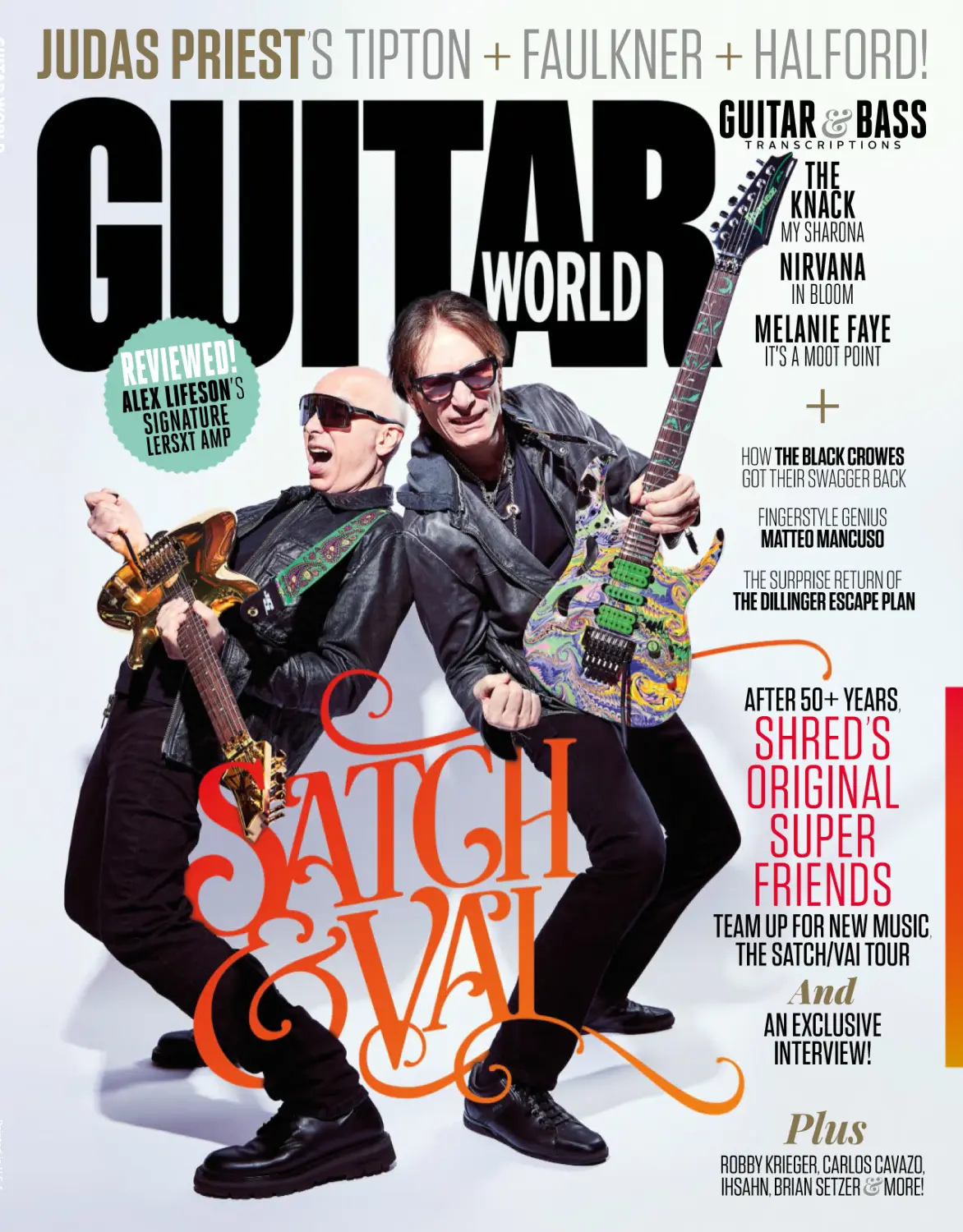
                    JUDAS PRIEST’S TIPTON + FAULKNER + HALFORD!
GUITAR & BASS
T R A N S C R I P T I O N S

THE
KNACK

MY SHARONA

NIRVANA
IN BLOOM

REVXILEIFWESEODN!’S

ALE
SIGNATUAMREP
LERSXT

MELANIE FAYE
IT’S A MOOT POINT

+

HOW THE BLACK CROWES
GOT THEIR SWAGGER BACK
FINGERSTYLE GENIUS
MATTEO MANCUSO
THE SURPRISE RETURN OF
THE DILLINGER ESCAPE PLAN

AFTER 50+ YEARS,

SHRED’S
ORIGINAL
SUPER
FRIENDS

TEAM UP FOR NEW MUSIC,
THE SATCH/VAI TOUR
And
AN EXCLUSIVE
INTERVIEW!

Plus

ROBBY KRIEGER, CARLOS CAVAZO,
IHSAHN, BRIAN SETZER & MORE!

WOODSHED
VOL. 45 |

NO. 6 |

JUNE 2024

LET’S GO TO
THE VIDEOTAPE!
I’M NOT SURE if anyone (besides me, of

course) gets the very old Warner Wolf
reference in my headline, but...
I’ve been spending a lot more time at GW’s
video studio in Manhattan lately — and so have
a few other people, including John 5, Marcus
King and Kerry King (It’s a shame we can’t
complete “the unrelated King collection” with
visits from the late B.B., Albert and Freddie, but
hey, we do the best we can). We’ve been ramping up our video output, which
took a major hit during Covid and never fully recovered; but things are looking
up (and our spiffy new cameras are making things look better than ever), and
you can see the results over on our YouTube channel. Be sure to check out our
two latest John 5 playthroughs — “Strung Out” and his cover of Les Paul &
Mary Ford’s “How High the Moon,” an unusual Zoom interview with Marty
Friedman that grew out of a two-page Tune-Up
in our March 2024 issue, and the one where Marcus King lists his five favorite Marcus King riffs!

EDITORIAL
EDITOR-IN-CHIEF Damian Fanelli
(damian.fanelli@futurenet.com)
SENIOR MUSIC EDITOR Jimmy Brown
TECH EDITOR Paul Riario
ASSOCIATE EDITORS Andy Aledort, Chris Gill
PRODUCTION EDITOR Jem Roberts
MUSIC TRANSCRIPTIONIST AND ENGRAVER Jeff Perrin
CONTRIBUTING WRITERS Gregory Adams, Richard Bienstock,
Joe Bonamassa, Andrew Daly, Joe Matera, Mark McStea, Alan Paul,
Amit Sharma, Josh Smith, Andy Timmons, Jon Wiederhorn

ART
SENIOR DESIGN DIRECTOR Mixie von Bormann
ADDITIONAL PAGE DESIGN Damian Fanelli
IMAGE MANIPULATION MANAGER Gary Stuckey
CUSTOM SATCH/VAI TYPEFACE Steve Mitchell

PHOTOGRAPHY
CONTRIBUTORS Getty Images, Alamy and other individually credited
photographers, public relations firms and agencies. All copyrights
and trademarks are recognized and respected.

VIDEO
VIDEO EDITOR Alan Chaput

ONLINE
DIGITAL EDITOR-IN-CHIEF Michael Astley-Brown
DIGITAL ASSOCIATE EDITOR Jackson Maxwell
DIGITAL STAFF WRITERS Matt Owen, Matt Parker

CIRCULATION
HEAD OF NEWSTRADE Tim Mathers

PRODUCTION
HEAD OF PRODUCTION Mark Constance
SENIOR AD PRODUCTION MANAGER Nicole Schilling
DIGITAL EDITIONS CONTROLLER Jason Hudson
PRODUCTION MANAGER Nola Cokely

ADVERTISING

CYNTHIA MOORHEAD (DF)

C L A U D I A S C H M I DT/ S K E TC H Y P E D A L S ( P E D A L )

CORRECTIONS:
>>> In the Eddie Kramer interview that appeared
in our April 2024 issue, the reporter transcribed
one of Kramer’s replies as follows: “I recall seeing
Jimmy Page come in and doing an overdub on
that song [referring to “You Really Got Me”]. What
Kramer actually said was, “I think on that song,
‘You Really Got Me’ — either ‘You Really Got Me’
or one of the others — I remember seeing Jimmy
Page come in and doing an overdub.”
>>> In a Tune-Up about Duane Betts that appeared in our October 2023 issue, we implied that former Allman Brothers Band guitarist Dickey Betts had
passed away. Although we immediately corrected the online version of the
story, the print correction has regretably slipped through the cracks until now.
— Damian Fanelli

We are committed to only using magazine paper that is derived from responsibly managed, certified forestry and chlorine-free manufacture. The paper in this magazine was sourced and produced from sustainable managed forests, conforming to strict environmental
and socioeconomic standards.
All contents ©2024 Future Publishing Limited or published under license. All rights reserved. No part of this magazine may be used, stored,
transmitted or reproduced in any way without the prior written permission of the publisher. Future Publishing Limited (company number
2008885) is registered in England and Wales. Registered office: Quay House, The Ambury, Bath BA1 1UA. All information contained in
this publication is for information only and is, as far as we are aware, correct at the time of going to press. Future cannot accept any
responsibility for errors or inaccuracies in such information. You are advised to contact manufacturers and retailers directly with regard to
the price of products/services referred to in this publication. Apps and websites mentioned in this publication are not under our control.
We are not responsible for their contents or any other changes or updates to them. This magazine is fully independent and not affiliated
in any way with the companies mentioned herein.
If you submit material to us, you warrant that you own the material and/or have the necessary rights/permissions to supply the material
and you automatically grant Future and its licensees a license to publish your submission in whole or in part in any/all issues and/or editions of publications, in any format published worldwide and on associated websites, social media channels and associated products. Any
material you submit is sent at your own risk and, although every care is taken, neither Future nor its employees, agents, subcontractors
or licensees shall be liable for loss or damage. We assume all unsolicited material is for publication unless otherwise stated, and reserve
the right to edit, amend, adapt all submissions.
GUITAR WORLD (ISSN 1045-6295) is published 13 times a year, monthly plus Holiday issue following December issue, by Future US, INC.,
135 West 41st Street, 7th Floor, New York, NY 10036. Phone: 212.378.0400. Fax: 917.281.4704. Web Site: www.futureplc.com. Periodicals postage paid at New York, NY, and additional mailing offices. Newsstand distribution is handled by CMG. Subscriptions: One-year
basic rate (12 issues) US: $17.95. Canada: US$42.95. Foreign: US$42.95. Canadian and foreign orders must be prepaid. Canadian price
includes postage and GST #R128220688. PMA #40612608. Subscriptions do not include newsstand specials. POSTMASTER: Send change
of address to Guitar World, P.O. Box 2024, Langhorne, PA 19047-9957. Ride-along enclosure in the following edition(s): None, Standard
enclosure: None. Returns: Pitney Bowes, P.O. Box 25542, London, ON N6C 6B2, Canada. Entire contents copyright 2024, Future PLC. All
rights reserved. Reproduction in whole or in part is prohibited. Future PLC is not affiliated with the companies or products covered in Guitar
World. Reproduction on the Internet of the articles and pictures in this magazine is illegal without the prior written consent of Guitar
World. Products named in the pages of Guitar World are trademarks of their respective companies. PRODUCED IN THE UNITED STATES OF
AMERICA. SUBSCRIBER CUSTOMER SERVICE: Guitar World Magazine Customer Care, P.O. Box 2024, Langhorne, PA 19047-9957. Email help@
magazinesdirect.com. BACK ISSUES: www.magazinesdirect.com REPRINTS: Future PLC, 135 West 41st Street, 7th Floor, New York, NY 10036.

10

GU I TA R WOR L D • J U N E 2024

ACCOUNT EXECUTIVE Robert Dye
732-241-7437, robert.dye@futurenet.com
ACCOUNT EXECUTIVE Jeff Donnenwerth
678-427-1535, jeff.donnenwerth@futurenet.com

CONSUMER MARKETING

ASSOCIATE DIRECTOR OF AUDIENCE DEVELOPMENT Sheri Taubes

MANAGEMENT
MANAGING DIRECTOR (MUSIC) Stuart Williams
GROUP EDITOR-IN-CHIEF Scott Rowley
HEAD OF DESIGN (MUSIC) Brad Merrett
SUBSCRIBER CUSTOMER SERVICE
Guitar World Magazine Customer Care, P.O. Box 2029,
Langhorne, PA 19047-9957, 1-800-456-6441
EMAIL: help@magazinesdirect.com, help@mymagazine.co.uk (renewals)
SUBSCRIPTION DELAYS: We rely on various delivery companies to get
your magazine to you, many of whom continue to be impacted by Covid.
We kindly ask that you allow up to seven days before contacting us —
at help@magazinesdirect.com — about a late delivery.
SINGLE-ISSUE SALES: www.magazinesdirect.com/guitarworld
PRINTER Kodi Collective
LICENSING Guitar World is available for licensing and syndication.
To find out more, contact us at licensing@futurenet.com or view our
available content at www.futurecontenthub.com.
HEAD OF PRINT LICENSING Rachel Shaw
GUITAR WORLD EDITORIAL/ADVERTISING OFFICES
347 W. 36th St., 17th Floor/Penthouse, New York, NY 10018
FUTURE US, INC.
135 W. 41st St., 7th Floor, New York, NY 10036, www.futureplc.com

©2024 Future PLC. All rights reserved. No part of this magazine
may be used or reproduced without the written permission of Future
PLC.

Future plc is a public company
quoted on the London Stock
Exchange (symbol: FUTR)
www.futureplc.com

Chief Executive Jon Steinberg
Non-Executive Chairman Richard Huntingford
Chief Financial and Strategy Officer Penny Ladkin-Brand
Tel +44 (0)1225 442 244

CON T EN TS
VOL. 45 |

NO. 6 |

JUNE 2024

28 BRIAN SETZER
Blown speakers, Gretsch guitars and how he stays inspired

32 CARLOS CAVAZO
GW catches up with the former Quiet Riot/Ratt guitarist

36 ROBBY KRIEGER
The Doors legend returns with a new band and album

40 MATTEO MANCUSO
The man of the hour discusses the techniques that have
made him one of the most exciting names in modern guitar

46 THE BLACK CROWES
Rich Robinson discusses the refreshing one-for-all mindset
of the reunited rock ’n’ roll juggernauts

52 JUDAS PRIEST
Glenn Tipton, Richie Faulkner and Rob Halford take us
behind the scenes of their latest creation, Invincible Shield

60 JOE SATRIANI & STEVE VAI
Find out why these guitar superstars have finally returned
to the novel concept of recording original music together

“It's a Moot Point”
by Melanie Faye

PAGE

86

“In Bloom”
by Nirvana

PAGE

94

“My Sharona”
by The Knack

PAGE

98

DEPARTMENTS
12 SOUNDING BOARD

82 COLUMNS

15 TUNE-UPS

Alex Skolnick, Ihshan, Office Dog,
Jeff Schroeder’s pedalboard, the Dillinger
Escape Plan, Sam Bam Koltun, Cameron
Griffin, Andy Aledort, the Schizophonics and
10 friendly Beatles/Stones collaborations

75 SOUNDCHECK

75. Lerxst CHI amp head & CHI 1x12 cabinet
77. Yamaha Pacifica Professional P12M
78. Endorphin.es Golden Master
Multiband Mastering Processor pedal
80. EarthQuaker Devices
Zoar Dynamic Audio Grinder
81. Boss Waza Craft BP-1w
Booster/Preamp

82. In Deep
by Andy Aledort
83. Tales from Nerdville
by Joe Bonamassa
84. Melodic Muse
by Andy Timmons
85. Live from Flat V
by Josh Smith

93 PERFORMANCE NOTES
110 POWER TOOLS

The Ibanez Tube Screamer is one of the
most popular stomp boxes of all time, used
by dozens of famous guitarists on hundreds
of well-known tracks — but the main reason for its perennial success is due to its
association with Stevie Ray Vaughan

COV E R PH OT O: J E N RO S E N S T E I N / J E N RO SE N ST E I N.COM

guitarworld.com

11

JEN ROSENSTEIN

TRANSCRIBED

SOUNDI NG BOARD
Got something you want to say? EMAIL US AT: GWSoundingBoard@futurenet.com
when guitar magazines put old
guys on many of their covers.
— Terry Kempler,
White Marsh, MD

Should new
guitarists start out
with an open tuning?

J E S S E W I L D/ F U T U R E ( A B O V E )

R O S S M A R I N O/ G E T T Y I M A G E S ( E V H )

[Editor’s note: The first six Sounding Board entries below are in
response to a question I posed in
my April 2024 Woodshed column:
Is it OK for new guitarists to start
with an open tuning, just so they
can hit the ground running and
play something “musical” right
out of the gate — or should everyone start with one of the more traditional routes? And yes, I’m paraphrasing a bit... —DF]
I just read your Woodshed piece
in GW Vol. 45, No. 4. I started
playing many years ago on a baritone ukulele, learning basic
chords from a Mel Bay book.
When my hands were big
enough to play a six-string acoustic guitar, my older sister showed
me more chords and some cool
songs by Neil Young and the Yardbirds. I’m 64 now (like the Beatles
song! Yikes!) and play those basic
chords to this day. My guess is
most kids and people setting out to
play guitar want to play songs by
the musicians and bands they like.
I learned eventually that many of
those songs are played in alternate tunings, but I think it’s better to struggle and learn playing in
standard tunings before branching out into open G, drop D, etc.
Even though Eddie played in drop

D, drop whatever, plus a few more
half steps (I am clueless), you can
still noodle around with his songs
in standard tuning. It’s fun, which
is the main reason we play! Trust
me, you’re not a “fuddy-duddy” —
or you wouldn’t be the editor-inchief of GW.
— Jon Feaver, Iowa City, IA
Great question! I’ve been starting
my grandson very gradually with
guitar. He is 11. I started him off on
double drop D because he can bar
chords across the top three strings
and lower three and make a chord.
I’ve been wondering if I’m doing
the right thing. Thanks for asking
the same question.
— Barry Lee Seip
Your initial response was the correct one. If they start off easy, they
won’t put in the work after the
fact… Or (and I’ve seen this) they
will just play their entire career
in that open tuning, which would
only work for a solo artist playing
originals.
— Dave Aaron
A person must have an intense
desire to learn guitar, and guitar tunings don’t matter. The first
year is the hardest, and the student must soldier through aching fingers. There is no easy way.
As for young people (I’m an old
fuddy-duddy), they need proper
inspiration, and it doesn’t help

I agree with you 100 percent. I’ve
been playing and growing with
playing rock guitar since age 14
(now 64), and only in the last few
years have I started exploring
open tunings. Inspired by Mike
Dawes, Devin Townsend and several others, it immediately opened
up (pun intended) creativity and
new avenues of play. I also rediscovered older material from
Foghat and Joe Walsh (open E),
the Rolling Stones, Bad Company,
CSNY and countless others —
finally realizing why it never quite
sounded right when I faked it with
standard tuning.
Not so short, but new players should absolutely be exposed
to alternate tunings; it may not be
for everyone, but it might unleash
the next Dawes or Devy to the guitar world!
— James “Chris” Swartz,
Port Townsend, WA
I just received my April 2024 GW
and was moved by your editorial. My short answer is, guitarists should be learning anything
they are hooked to! However, may
I humbly suggest you check Gordie Johnson’s YouTube channel? Gordie is a Canadian guitarist who uses a lot of open G tuning to play... blues, of course! But
he also uses it on reggae and rock.
And you know what? He plays
with banjo finger picks on double-neck guitars! And he sings at
the same time. He was involved in
Big Sugar, Grady and a lot of other
projects you may find interesting.
When I was young, I wanted to
play a double-neck and play Led
Zeppelin. So I bought one. When I
saw what Gordie played on a double-neck, I just sold mine. The guy
is incredible, and I wish I would
have learned about him when I
started to learn guitar. I have the
feeling I’d still have my double-

neck today.
It would be great to have some
Big Sugar tabs... and more Clutch
too! Thanks for all the good work.
— Joël G

Great to see NJ’s
Frank Infante in GW
I liked the article on Frank
Infante, a fellow New Jersey guitarist. I was happy he made great
music with Blondie, and now
I know which guitar parts he
played. I think most of us got the
wrong info on who played what. I
hope Frank puts out something.
— Linda Mancuso

Eddie in action
in 1986

Transcribe Eddie —
without a net!
Being that it’s Eddie’s birthday (January 26, 2024) and the
launch day for Wolf’s new EVH
SA-126 guitar, it would be cool if
you could [transcribe] Ed’s solo
from Van Halen’s Live Without a Net. This has to be the best
I’ve seen him live on video, and I
think everyone would love it. It’s
been a lifelong passion to see it
transcribed on sheet/tab music
for years now. I wish Hal Leonard would or could bring this cool
video out on sheet music like they
did years ago with 1993’s Live:
Right Here, Right Now. To most
Van Halen fans, this was Ed at the
top of his game.
— Dave Loveless

SEND LETTERS TO: Sounding Board, Guitar World/Future, 347 W. 36th St., Suite 1700, New York, NY 10018 or GWSoundingBoard@futurenet.com.
All subscription queries must be emailed to guitarworldmag@icnfull.com. Please do not email the Sounding Board with subscription matters.

12

GU I TA R WOR L D • J U N E 2024

STAY CONNECTED WITH GUITAR WORLD ON
AND GET THE LATEST GUITAR NEWS, INSIDER UPDATES, STAFF REPORTS AND MORE!

READER ART
OF THE MONTH

If you’ve created a drawing, painting or sketch
of your favorite guitarist and would like to
see it in an upcoming issue of Guitar World,
email GWSoundingBoard@futurenet.com
with a .jpg or screenshot of the image.
And (um, obviously...), please remember
to include your name!

S RV NUM B ER ONE BY MARK MARTIN

DEFENDERS

G EORG E HARRISON BY WAYNE HUSBAND

of the Faith

Jason Allwood
AGE: 46
HOMETOWN: Columbus, OH
GUITARS: Teles, Strats, Gibson L-00,
Gibson Les Paul Junior, baritone Telecaster
SONGS I’VE BEEN PLAYING: Originals
off the new Central Blues Co. album
GEAR I WANT MOST: Gibson SG Junior

Deus X

Ric Welch

AGE: 60
HOMETOWN: Lincoln Park, MI
GUITARS: Les Paul Custom, Epiphone
Les Paul Custom, Michael Kelly Custom
Patriot guitars
SONGS I’VE BEEN PLAYING: Music
by my band, StrengthBeyondYou —
and a lot of session work
GEAR I WANT MOST: Fractal Audio
Systems FM9

AGE: 67
TOWN: Chanhassen, MN
GUITARS: PRS Custom 24,
PRS Santana SE, ’86 Fender Strat
SONGS I’VE BEEN PLAYING: Jimi Hendrix
“Little Wing,” Stevie Ray Vaughan “Texas
Flood,” ZZ Top “Waiting for the Bus”
GEAR I WANT MOST: Lifetime supply
of D’Addario strings

(Photo: HeadshotsWOW)

Are you a Defender of the Faith? Send a photo, along with your answers to the questions above,
to GWSoundingBoard@futurenet.com. And pray!
guitarworld.com

13

INQUIRER:
ALEX SKOLNICK

17

18
OFFICE DOG

SAM BAM
KOLTUN

JEFF
SCHROEDER

THE DILLINGER
ESCAPE PLAN

19 20 22

CAMERON
GRIFFIN

24

ANDY
ALEDORT

26 27

28
BRIAN SETZER

Ihsahn, photographed
in Notodden, Norway,
January 22, 2020

Gear of the Dark

IHSAHN, THE EMPEROR MASTERMIND WHO TOOK HEAVY MUSIC TO NEW HEIGHTS,
ON THE MERITS OF TECHNOLOGY AND HOW EXTREME METAL STRUMMING
HAS A LOT IN COMMON WITH ACOUSTIC PLAYING

PHOTO BY KEVIN NIXON

By Amit Sharma
MANY OF US will remember getting our
first delay pedal, treasuring those fond
memories of how one clever little box can
make an unaccompanied guitar sound thicker, deeper and, on certain settings, almost
orchestral. For Norwegian musician Vegard
Sverre Tveitan, better known around the
world as Ihsahn — the man who pioneered
symphonic black metal in Emperor before
pursuing more atmospheric endeavors as a
solo artist — the first echoes he employed
were right outside his front door.

“I grew up on a farm with a lake in front
and mountains on the other side,” he says,
looking back on his earliest memories as a
musician. “I didn’t have a delay pedal as a
10-year-old, so I would take my amp onto
the veranda, and the mountains would
throw back echoes. I guess nature has
always been a big part of my music. We
tend to build on what we know and what’s
around us, taking influence from our surroundings. It’s a very primal part of human
nature.”

A lot has changed in music technology
since those formative years, Ihsahn admits,
pointing to how he’s chosen to move with
the times instead of linger in the shadows
of a sentimental past. On his latest selftitled album — which consists of 11 tracks
that exist in both metallic and orchestral
forms — he’s using amps that exist only
inside a computer and Aristides composite
guitars that contain no wood whatsoever.
Such concepts would have seemed rather
far-fetched to the young musician dragguitarworld.com

15

NEWS + NOTES

P R E V I O U S PA G E : D A I LY M I R R O R / M I R R O R P I X V I A G E T T Y I M A G E S ( S TO N E S/ B E AT L E S ' 6 4 )

T H I S PA G E : M I I K K A S K A F FA R I / R E D F E R N S

Ihsahn in action (with
his Aristides 060 North
Custom Ihsahn model)
in Hellsinki, Finland,
August 12, 2023

ging his amp onto that veranda.
“There were a lot of Neural DSP plugins, as well as digital Quad Cortex sounds,”
he says. “I see them as very practical tools
for capturing ideas and inspiration. It’s
a million miles from the little Fostex recorder I started with. I remember me and
my dad making our own cover of the Iron
Maiden song ‘Powerslave’ — the drums and
bass were from keyboards, I played guitar
and my dad sang over it. That’s where my
fascination with recording began.”
As for the Aristides guitars, which are
made out of a patented composite material
called Arium, it was Periphery guitarist
Mark Holcomb who alerted Ihsahn to the
Dutch company’s innovations. Skeptical
at first, as any player would be, further
investigation would reveal that their
instruments were more than up to scratch
— at least to his well-trained ears. It’s nice
to root for the underdog, Ihsahn smiles,
noting how they’re going against the grain
to produce futuristic guitars in an incredibly nostalgic business where the original
designs still inspire a great deal of romance
and loyalty.
“There have been attempts that gave
the whole composite thing a bad rep, but
Aristides pay so much attention to detail,”
he says. “I’ve been to the factory and seen
them throw away perfectly fine guitars just
because of a microscopic detail that might

16

GU I TA R WOR L D • J U N E 2024

slightly affect something years later. There
are no dead spots. They don’t warp or
detune when I travel. They’re truly flawless
instruments.”
It’s not like he’s turned his back on all
things analog and traditional, either. Blackstar, Marshall, Engl and Orange heads were
captured via a Two Notes Torpedo Captor
X. Pedals also came in handy, Ihsahn
preferring the more transparent boosts and
drives to those that come with a side order
of tonal coloration. “A lot of those pedals
can make your amp sound smaller, narrowing the frequency range down into something more nasal,” he says. “That’s why I
love the more invisible ones like the Tyler
Bryant signature TB Shakedown Special by
Rodenberg, the pedals MLC are making in
Poland and the Precision Drive by Horizon
Devices. They add rather than subtract;
they don’t mess with the original sound.”
The latest recordings aren’t just impressive in terms of production, however. It’s
the sheer scale of the guitarist and singer’s
labyrinthine compositions, grand in design
and ambition, that will leave just about
any listener stunned. The overwhelming
onslaught of violent musical extremes, at
times very reminiscent of Emperor at their
world-commanding best, also can offer its
own elements of hope and inner-peace.
“Isn’t that the case with all metal?”
Ihsahn says with a laugh. “We’ve all been

“We’ve all been
asked, ‘Why do you
listen to all that dark
music?’ The answer
is, ‘It makes me feel
really good!’”
asked, ‘Why do you listen to all that dark
music?’ And the answer is, ‘Well, it makes
me feel really fuckin’ good!’ The same goes
for horror movies; there’s an excitement
there. Or reading [Friedrich] Nietzsche
— he was so harsh and aggressive in his
language, but his words make you feel
amazing.”
And regardless of how intense the music
may seem, there’s a prevailing calmness in
its execution. The man speaking with us
today likens some of the frenetic-sounding
chordal work to how one might strum an
acoustic guitar, with a much looser attack
than its initial aggression may suggest.
Extreme metal can be so dense, he reasons,
especially from a rhythmic standpoint.
“You really have to outline the nuances
of the pulse in how you strum, almost exaggerating the subdivisions,” Ihsahn says.
“I perform those parts like I’m playing an
acoustic, staying relaxed and calm. I’ve
been using a new pick recently, the Dunlop
Ultex 1mm, which has been a game-changer for me. The sharp edge allows me to be
a lot more economical with my picking
and the material gives me the string attack
I want… which helps now I’m older and
turning down the gain!”

NEWS + NOTES

INQUIRER

ALEX SKOLNICK
THE GENRE-HOPPING TESTAMENT
GUITARIST TALKS FIRST GUITARS,
FIRST GIGS AND ONE PARTICULARLY
EMBARRASSING ON-STAGE MOMENT

What was the first song you
learned to play on the guitar?
The first full song I learned was “Act
Naturally” by the Beatles, as sung by
Ringo Starr, which is almost a country
song. Before that, the first thing I learned
on a guitar was the riff to “Day Tripper,”
also by the Beatles. I learned how to play
the notes by figuring out how to play it
down by the bridge of the guitar, which
gave it that surf quality. That was one of
the first experiences that gave me the
confidence to think that playing guitar
was something I could do and potentially
be good at. But at the time, I still didn’t
know the chords to “Day Tripper.”
What was your first gig?
I did my first gig with a band I still
play with today, Testament, though the
band was called Legacy back then. They
already had a show booked at a venue
that’s become pretty legendary — Ruthie’s
Inn in Berkeley. At the time, though, we
thought it was a place nobody was going
to remember in 10 or 20 years, yet it went
on to become a storied venue. The show
was already on the calendar and the
original guitar player had left the group,
so there was a lot of pressure on me. But
it was a very good incentive to improve
my playing skills very quickly.
Ever had an embarrassing
moment on stage?
There was one time in the late Eighties, during one of the first tours with
Testament. We were doing an open solo
segment where I’d play for a few minutes
by myself. One night as I was playing,
there was suddenly no sound! Usually
when that happens, the first thing you do
is check the cable and the amp, but everything was working. Eventually, we found

Alex Skolnick
performs in
Bologna, Italy,
in 2019

“Don’t try to sound
too much like
anybody else. It’s
a lesson you can’t
learn early enough”
the problem; the pickup had shorted out.
Here I was there on stage all on my own,
not knowing what to do. And this was a
heavy metal concert, so the crowd was
getting antsy and starting to chant and
boo. The band came back on, we switched
guitars and moved on — but at the time it
was really, really embarrassing.
What’s your current favorite
piece of gear?
My 1976 Gibson L-5. I don’t gig with it
because it’s one-of-a-kind and has a lot
of sentimental value. But I’ve written a
lot of songs on that guitar, songs I never
expected I’d write. I normally think of it as
something to play and to practice jazz on.
The guitar is from a time where the quality was really strong, so you can just play
it as is; it has a great tone too. It’s been
with me through thick and thin, through
several years of my life and through different musical projects.
The building is burning down.
What single guitar from your
collection would you save?
It would be that L-5. It’s interesting
because I’m better known for solid body
electrics, but you know what? Those feel
more replaceable somehow, while that
guitar feels very irreplaceable. There’s
also another guitar I got about a year ago,

a 1935 Gibson L-00 parlor guitar. It’s just
amazing. I almost always come up with a
song idea on that guitar. Having said that,
I’d probably grab both guitars — one in
the case, and one in my hand.
When was the last time you
practiced?
Last night, to prepare for all the shows I’ll
be doing this year, focusing particularly
for a show of instrumental music I’ll be
doing with Stu Hamm and Chad Wackerman. It is clearly the most challenging
show this year, so I was going over a song
called “Katahdin,” which was originally
on a recording with Stu, Steve Smith and
Frank Gambale [The Light Beyond, 2000].
What aspect of the guitar would
you like to be better at?
One thing I’m working on a lot lately is
playing unaccompanied. In the whole first
period of my professional experience, I
was playing with a band, and I got used
to the idea that there was always going
to be a drummer. Then, as I got more
interested in improvisation, I discovered
more players who had a strong enough
sense of rhythm and harmony to play
unaccompanied while still [keeping] the
music listenable. It’s taken a while, but
it’s something I work on often, and there’s
been a noticeable improvement.
What guitar-centric advice
would you give your younger
self if you had the chance?
Don’t stress, don’t try to keep up with
anybody else, and don’t try to sound too
much like anybody else. It’s a lesson you
can’t learn early enough.
— Joe Matera
guitarworld.com

17

A L E S S A N D R O B O S I O/ PA C I F I C P R E S S/ L I G H T R O C K E T V I A G E T T Y I M A G E S

What was your first guitar?
It was a classical guitar that I got
very cheap at a garage sale. It was very
difficult and challenging to play. I was
about 10 when I got it, and it lasted about
two years. Then I got an electric guitar
that looked like an imitation of a Teisco
Del Rey, and which was so thin, you could
probably break it with one hand!

NEWS + NOTES
“I want to prove
we’re not a
one-trick pony,”
Kane Strang says

Office Dog

FROM MELODIES TO OFF-KILTER RIFFS TO THE OCCASIONAL
WALL OF SOUND, NEW ZEALAND INDIE VETERAN KANE STRANG
DELIVERS THE SIX-STRING GOODS ON HIS TRIO’S DEBUT

L I A M TAY LO R

By Andrew Daly
NEW ZEALAND NATIVE Kane Strang
has been around for a bit, having
released his debut, A Pebble and a Paper
Crane, in 2013. Since then, he’s continued
releasing records, some of which are so
indie you’d be hard-pressed to find them.
But if you’re a newcomer, the name of
Strang’s game is creating all-consuming
music via crunchy chords and fuzzy
acoustics. “It’s about finding sounds that
enhance rather than distract,” he says. “I
like my guitar to sound big and wide, and I
record through two amps at once, panning
them in the mix.”
It seems that methodology was applied
to Office Dog — a band featuring Strang
(guitars), Rassani Tolovaa (bass) and
Mitchell Innes (drums) — and their new
album, Spiel, which showcases vintagesounding cuts like “Shade” and “The
Crater.” By the way, “sounding vintage isn’t
intentional,” Strang says. “But we do re-

18

GU I TA R WOR L D • J U N E 2024

cord with vintage mics in the same room,
which leads to a warm, nostalgic sound.”
In terms of gear, Strang tend to stick
with some old favorites. “I’ve been using
the same two guitars for a decade,” he
says. “I’ve got a Fender Strat from when
I was 16 — and a Larrivée acoustic. They
lend themselves to my love of uneasysounding chords and discordant notes.”
Listening to “Hand in Hand,” which
Strang says best demonstrates his style,
the joy in creating “uneasy” and “discordant” sounds is apparent. “I love to create
tension and pretty yet dark songs. But I’m
a sucker for a big outro and must force
myself not to make every song erupt.”
Given Strang’s penchant for existing
between bombast and restraint, Office
Dog’s next mission of supporting the everangular Dinosaur Jr. in support of Spiel is
well-timed. “It’s an honor,” Strang says.
“We’re playing the Town Hall in Auck-

“I want to keep
improving, and
the best way, aside
from writing songs,
is to talk to people
like J Mascis and
listen”
land, New Zealand. That’ll be huge. I hope
to win new fans and not make their wait
for J [Mascis] too painful. But I would love
to meet J; I want to keep improving, and
the best way, aside from writing songs, is
to talk to people like J and listen.”
Strang likes to ping-pong between projects, so who knows what’s next for him.
For the time being, he’s not looking beyond
the task at hand.
“We went from nearly self-releasing Speil to working with [Nashville
and Athens, Georgia-based] New West
Records,” he says. “So now I want to prove
we’re not a one-trick pony — and that we
have a lot more to say.”

NEWS + NOTES
“Tracii Guns and I became
close,” Sam Bam Koltun
says. “I’m extremely
grateful [to have] him
as a mentor”

Sam Bam
Koltun

HE’S ALREADY PLAYING WITH
FASTER PUSSYCAT, DOROTHY AND
BUDDERSIDE, BUT WE GET THE
FEELING THIS L.A.-BASED GUITARIST
COULD SQUEEZE A FEW MORE
BANDS INTO HIS SCHEDULE
By Andrew Daly
AT 28, SAM Bam Koltun is an odd

[to have] him as a mentor.”
Old guard aside, Koltun makes time
for musicians his age — specifically with
hard rocker Dorothy [aka Dorothy Martin],
whom he’s toured and sometimes recorded
with. “Dorothy and I connected on Instagram,” he says. “She messaged me that she
and Ace were friends, and we kept talking.
Ace brought me to the Viper Room one
night, and Dorothy was there. She liked
what she heard and asked me to join her
band. I’ve been there ever since.”
As a ’72 Black Beauty-wielding gun for
hire, Koltun lends his skills to other acts,
but he makes time for his own work, too,
with Budderside. “I joined a different version of Budderside,” he says. “But I’ve put
together a new lineup and am writing new
music, like ‘Good for Nothing,’ which is
hard-hitting and captures my intensity.”
But Koltun doesn’t have too much time

“Ace Von Johnson
asked if I wanted
to join Faster
Pussycat in 2019.
Five years later,
here I am!”
to devote, as he remains busy with Faster
Pussycat and Dorothy. He’s also joined
Tommy Henriksen’s [Alice Cooper] Crossbone Skully, so free time is at a premium.
“That doesn’t bother me,” he says. “I like to
keep moving. It’ll be across-the-board touring and new projects. I’ll work on my stuff,
but I can’t stress enough how grateful I am.
I’ll try to put on a good show and be ready.
You’ll see and hear a lot of me this year.”
guitarworld.com

19

P R O V I D E D/ P R

juxtaposition alongside the elder
statesmen he pals around with. But that’s
no bother. “It’s not too weird,” he says. “I
came up as a kid playing in bars when I was
12, so even then, the guys I played with
were older. I’m conditioned to working
with older musicians.”
That’s good news for him, as Koltun is
an integral part of Faster Pussycat, which
featured guitarists Brent Muscat and Ace
Von Johnson before him. “Ace is one of my
best friends,” Koltun says. “He was with
Faster, but when Tracii [Guns] recruited
him for L.A Guns, Ace asked if I wanted to
join Faster in 2019. Five years later, here I
am!”
For the Les Paul-slinging Koltun, Guns,
a fellow single-cut devotee, is of note, as he
and Koltun have become friends. “Tracii
has been so important. I’ve always loved
his playing, and when Ace got sick in 2022,
he asked me to fill in with L.A. Guns. Tracii
and I became close; I’m extremely grateful

NEWS + NOTES

MY PEDALBOARD
JEFF SCHROEDER

WHAT THE FORMER SMASHING PUMPKINS GUITARIST
SEES WHEN HE LOOKS DOWN
Interview by Andrew Daly

COURTESY OF JEFF SCHROEDER (BOARD)

S C OT T L E G ATO/ G E T T Y I M A G E S ( S C H R O E D E R )

“I HAD AN existential crisis with my

pedalboard after leaving the Smashing Pumpkins. I had nothing else besides
my touring rig based on my Revv Generator
120s and Line 6 Helix. My board is a work
in progress, but here’s what I’ve been using
lately.
“I took a modular approach using one
main board and one satellite. I wanted it to
be malleable without sacrificing tone. In
the summer of ’23, the Smashing Pumpkins
toured with Rival Sons, and I spent a lot of
time with their guitarist, Scott Holiday. Although simplified, the board I put together
is inspired by what he’s doing.
“My board’s heart is the Line 6 Helix
[multi-effects floor processor]. I use it in
many ways: straight into the PA using a
combination of pedal and amp models, the
Helix preamps into a power amp and cabinet, or strictly as an effects unit running
into standalone amps.
“I could easily use the Helix alone, but I
like incorporating other pedals, hence the
hybrid nature. The signal chain is: guitar
into Helix; the output of the Helix into a
PA or mixing console, into amps, or both.
Connected to the Helix are three separate
pedal chains, two mono and one stereo.
Effects Loop one contains a Mid-Fi Electronics Demo Tape Fuzz, an EarthQuaker
Devices Special Cranker [overdrive] and an
Analog Man modded Boss DS-1 [distortion].
“Effects Loop two contains three

20

GU I TA R WOR L D • J U N E 2024

EarthQuaker Devices pedals: the Aurelius
[Tri-Voice Chorus], Rainbow Machine
[Polyphonic Pitch Mesmerizer] and the
Afterneath [V2 Reverb]. Effects Loop three
and four are combined in stereo.
“Here are the pedals on the satellite
board: an EarthQuaker Devices Avalanche
Run [Stereo Reverb & Delay with Tap Tempo], Line 6 HX One [multi-effects floor processor], Eventide H90 [Harmonizer Multi

IF I HAD TO
CHOOSE ONLY
ONE PEDAL FOR
A FULL SHOW:
“I’d use my EarthQuaker Special
Cranker. It’s somewhere between
distortion and fuzz,
with enough gain to
play leads, and it has
a switch between
germanium and
silicon diodes. I can
roll my volume down
for clean, overdriven tones in the
Germanium mode,
even with the ‘More’
control set high.”

“I had an existential
crisis with my
pedalboard
after leaving
the Smashing
Pumpkins”
FX], Vongon Polyphrase [Stereo Echo and
Looping Device] and Vongon Ultrasheer
[Pitch Vibrato and Reverb]. The secondary
board is mainly for solo guitar playing.
“The wonderful thing about using Helix
as the heart of the board is I can insert
combinations of loops into the signal chain.
I have many signal chains within my Helix
presets that combine the effects within
Helix itself and the pedals. There are endless possibilities, and it’s easy to bypass
everything and go straight into a real or
modeled amp.”

Schroeder on
stage in Michigan,
September 6, 2023

NEWS + NOTES

The
Schizophonics
THESE ANTSY SAN DIEGO ROCKERS
PUT ON A SHOW YOU’RE NOT LIKELY
TO FORGET — AND ALL WITHOUT
THE AID OF A HIGH E STRING
THE SAN DIEGO-based Schizophonics

are one of those bands that, once
seen, are never forgotten. Singer/guitarist
Pat Beers literally throws himself into
every performance, careering around the
stage, combining elements of James
Brown, Wayne Kramer and Iggy Pop. To
the uninitiated, it often looks like Beers
isn’t even playing the guitar a lot of the
time, as a huge part of his technique relies
on the use of left-hand slurs and hammerons. “We’ve done tours where we’ve
opened for bigger bands, and audiences
who don’t know us would be messaging
that they couldn’t believe we’d have the
audacity to use backing tapes,” Beers says.
It’s clear from listening to Beers that
Jimi Hendrix must have been an influence somewhere down the line. “I had a
cassette of Are You Experienced, and that
was huge for me,” he says. “Jimi’s still my
favorite guitarist. His playing completely
floored me. My left hand does a lot of work
live, and I think that’s where you can see
the Hendrix influence — in the big bends
and hammer-ons. A few years later I really
got into the Stooges and the MC5 — their
songwriting, their riffs and the fact that

“Audiences who
don’t know us
would be messaging
that they couldn’t
believe we’d have
the audacity to use
backing tapes”
they were great performers.”
Beers’ choice of guitar is as unconventional as his approach to playing. “I have
a custom-made model by Bonser [Instruments] in San Diego,” he says. “It’s really
a Strat in disguise; it has a Strat neck with
jumbo frets and hot pickups by Seymour
Duncan. It’s a five-string guitar, since I
don’t use a high E string. That came from
when I broke a tuning peg, and I decided
to devote a year to really working on a
more linear left-hand approach. I just like
the sound of a fatter B string — played
higher up the neck — than a normal thin E

string. I plug into a Vox AC30 and a Boss
Blues Driver, which I leave on all the time
with a fairly low level of distortion. For
the solos, I kick on a Roger Mayer Axis
Fuzz.”
Given Beers’ frenetic live approach, he
admits to finding it difficult to rein things
in when in the studio. “I notice when I try
to play ‘normal,’ I can’t get the same kind
of weird bends and feel that I get when
playing live, so I try to reproduce that approach in the studio, although I’m obviously pretty limited in how much I can jump
around.” According to Beers, his wife Lety,
who plays drums in the band, is unfazed by
the prospect of him doing a serious injury
to himself. “I think she’s so used to it by
now, that if anything happened, she’d just
give me a look.” [Laughs]
The Schizophonics plan to go into the
studio in the near future to begin work on
their fourth album, having already tested
out a number of songs live. “Who knows if
they’ll make it to the album, but I always
like to put new songs into the show. I like
the idea of having some songs that don’t
appear on a record.”
guitarworld.com

21

P R O V I D E D/ P R

Lety Beers [left]
and Pat Beers

By Mark McStea

NEWS + NOTES

Through Infinity
and Beyond

The Dillinger Escape
Plan’s Dimitri Minakakis
[left] and Ben Weinman
on stage near the turn
of the century

BEN WEINMAN DISCUSSES THE UNEXPECTED RETURN
OF THE DILLINGER ESCAPE PLAN AND THE MAKING OF THEIR
LANDMARK DEBUT ALBUM, 1999’S CALCULATING INFINITY

P R O V I D E D/ P R

By Gregory Adams
BEN WEINMAN HADN’T planned on
playing Dillinger Escape Plan songs
in 2024. Back in 2017, the New Jersey
guitarist thought he’d concluded the
chaotic fusion extremists’ 20-year run at
the top of their game, specifically while
stomping out the irregular-shifting mosh of
“43% Burnt,” perhaps the band’s most
iconic bit of brutality. Since then, Weinman
has happily spent time scoring film
projects and thrashing rhythms with
crossover mainstays Suicidal Tendencies.
That all changes this June when Dillinger
celebrate the silver anniversary of their
manically experimental debut album,
1999’s Calculating Infinity, with a rare trio
of headlining dates in New York and a
warmup set at Pomona, California’s No
Values festival. Though the outfit’s
meter-defying return is highly anticipated,
Weinman had reservations about reviving
the Plan.
“I had no intentions of breaking up with
the thought of doing it again later as a reunion,” the guitarist says of Dillinger’s initial implosion. “As far as I was concerned,
when I walked offstage at the end of 2017, I
felt completely satisfied.”
What changed his mind was an opportunity to step onstage with the band’s original
all-rage howler, Dimitri Minakakis — a
high school friend who departed Dillinger
in 2001. A recent run of similarly nostalgic
shows supporting Suicidal Tendencies’
1983 self-titled debut also opened Weinman’s eyes to bringing Calculating Infinity
to a new generation of music fans. “As a fan
of Suicidal, it’s cool to be playing the songs
that were the start of everything and are
still very relevant — like ‘Institutionalized.’
And seeing the kids of the original fans going off at these shows was really inspiring.”
The roots of the Dillinger Escape Plan,
meanwhile, lay in a straight-forward Nineties hardcore band called Arcane, whom
the competitive Weinman admits weren’t
pushing the needle in their local basement
circuit. Citing a need to “put the pedal to
the metal,” the new plan was to obnoxiously smash drummer Chris Pennie’s
progressive concussive-ness against the
youthful rage bubbling within Weinman.
“I was angry. I wanted to vent everything
[into the music]. So, he was pushing me on

22

GU I TA R WOR L D • J U N E 2024

a technical side, and I was pushing him on
a more visceral side,” Weinman says.
While Dillinger Escape Plan’s self-titled
debut EP remained reasonably linear,
1998 breakthrough EP Under the Running
Board — their first release for Relapse
Records — dumped death metal, Seventies
jazz fusion, Afro-Cuban rhythms and the
complex electronic sculpting of Aphex
Twin “into a blender to make something
completely new.” The next year’s Calculating Infinity was a wide-scale sensory overload, where pieces like “Destro’s Secret”
peppered clean-channel jazz-bop around
the otherwise panicked polyrhythmia of
Weinman’s atonal, diminished dyad stacking. “We weren’t interested in someone
being able to tap their foot to it,” Weinman
says of Dillinger’s most quizzical frameworks. He’ll confess that he wasn’t quite
sure how to play most of it live, either.
“I wasn’t playing accurately in the
beginning; I was just going crazy,” he says
with a laugh. “As people became fans of
the band, though, I realized, ‘Oh shit…
they really want to hear what I recorded!’
It became a balance of visceral expression
and actually trying to play. It also became
kind of an unsaid requirement of whomever our second guitarist was: Help lock
this down, because Ben’s falling all over
the place. It was important that we glued
it all together, [rather than be] some kind
of WWE wrestling show.”
Dillinger Escape Plan were an intimidating live force — Weinman’s hazardous,
Jackson-swinging stage presence led to
numerous self-induced head wounds, a
rotator cuff injury and a skull fracture,
among other maladies — but they also
juxtaposed that reckless energy against
gleefully madcap musical references to
19th-century composer Julius Fučík. “A
misconception people had about us was
that we were super-serious, elitist, snobby
art jerks that put our nose up at typical
punk and metal bands, but most of the
bands we ended up touring with saw that
we were clowns,” he says in relation to
quoting the big top fanfare of “Entry of the
Gladiators’’ — the quintessential circus
music cue — in Calculating Infinity’s tapderanged “Sugar Coated Sour.”
Despite being the songwriter, Weinman

maintains he wasn’t much of a technical
player at first. Running Board co-guitarist
John Fulton, however, was a practiceobsessed musician who could handle any
obtuse scale blitz Weinman threw his way,
at least until Fulton quit the band to study
computer science. Weinman also fondly
recalls how founding bassist Adam Doll
was just as dialed into the mania, from a
performance perspective — sadly, a car
accident left the rhythm stringer paralyzed
from the chest down just before the
group hit the studio to cut Calculating
Infinity.
“The band had hoped that he would
eventually recover to the point where he
could play with us again, but we knew it
wasn’t going to be any time soon,” Weinman says of the tragedy. “We didn’t want

“I broke rules intentionally,
and I made it part of our vocabulary”

this thing to fall apart, so we had to go
forward so that there was something for
Adam to come back to. I was extremely
freaked out, because I did not have the
confidence that I could create this album
without these guys’ help. The level of playing on Calculating was an overcompensation for that, for sure — the nervousness of
not fulfilling my own expectations. It was
fueled by anxiety.”
Despite this, producer Steve Evetts managed to whip Weinman into shape while
obsessively multi-tracking guitars and
bass straight-to-tape at South River, New
Jersey’s Trax East studio [“No ProTools… no
cutting and pasting”]. While the guitarist’s
dexterous skills improved significantly,
an anxious feeling remained in the music.
Take the hyper-speed blast sections of

Calculating classics “43% Burnt” and
“Jim Fear,” where Weinman confoundingly complements frenetic phrases with a
seconded-layer just a semi-tone up.
“I broke rules intentionally, and I made
it part of our vocabulary,” he says of the
aesthetic. “It sounds out of tune, essentially, but almost every lead run on the record
was doubled with a half-step harmony; that
continued through the career of the band.
It sounded circus-y. Quirky. Uncomfortable. That, along with dissonant jazz scales
or diminished whole tones, became a major
ingredient of our sound.”
Weinman remembers keeping things
relatively low-gain to highlight the percussive complexity of his riffs, blending an
Ampeg VH-140C with an “uber-clean”
DI. He might’ve played a Jackson with

EMGs at some point, but he notes that
the record’s spanky-sounding cleans were
played on a piezo-loaded Parker Fly — and
he hasn’t seen one since. What was most
important to Weinman was harnessing his
stage-rage in a studio setting. “Steve Evetts
always said tone was in your hands, [and]
I beat the shit out of my guitars. I picked
very aggressively. Broke many strings. That
contributed to the sound of the album.”
Though Weinman handled most of
Calculating Infinity, guitarist Brian Benoit
joined the act mid-way through the making
of the album. They’d met in 1998 when
Dillinger were on tour with Benoit’s previous band, Jesuit. While that Virginia Beach
quartet were steeped in a sludge-heavy
sound, Weinman learned that Benoit had
chops to spare; that tour he offered to
join the band, should their situation ever
change. The next year he moved to New
Jersey and wrote a pivotal breakdown on
“Variations on a Cocktail Dress.” He was
fully ingrained in the lineup by 2002’s
Irony Is a Dead Scene EP.
The full Calculating-era lineup won’t
be reuniting in New York; Benoit retired
from full-time musicianship in 2004 after
suffering severe nerve damage in his hands
and neck; Pennie hasn’t played with them
since 2007. Weinman and Minakakis will
be joined by mid-’00s guitarist James Love,
bassist Liam Wilson and drummer Billy
Rymer. Dillinger Escape Plan’s founding
riffer, however, is grateful to get the chance
to revisit the period and reflect on the
formative chaos of the early days.
“We were siphoning gas to get from
show to show. We were playing coffee
shops and getting in trouble because Dimitri would get up on the counter and knock
over coffee machines, pissing off patrons…
All that stuff was so memorable and so
important.”
So far, Dillinger’s return is a limitedtime thing. Weinman’s main gig remains
with Suicidal Tendencies, who he’d joined
in 2018. Plans are in flux, but they’re
entertaining the idea of writing their first
album of originals since 2016’s World Gone
Mad. Considering the multiple legacies he’s
honoring, Weinman laughs when asked
whether he ever drops Dillinger-style
half-step harmonies into sacred Suicidal
thrashers like “Institutionalized.”
“Dean Pleasants is the lead guitar player
and has been for a very long time, but I do
have opportunities to do ad-libs,” he says.
“Suicidal encourages free expression and
improv. That’s what’s cool, the different
kinds of players — like gospel drummers,
or bass players that aren’t typically from
the metal world. It’s never frowned upon to
throw your own flavors in.”
guitarworld.com

23

NEWS + NOTES
[from left] Eric Clapton, John Lennon
and Keith Richards play “Yer Blues”
in December 1968
[facing] Paul McCartney and Mick Jagger
share a train carriage (first class, of course)
at London’s Euston Station in August 1967

Come Together

THE BEATLES VS. THE ROLLING STONES? NOT SO MUCH! HERE’S
OUR GUIDE TO 10 FRIENDLY — AND OCCASIONALLY EXCELLENT
— COLLABORATIONS BETWEEN TWO LEGENDARY BANDS
By Damian Fanelli
WAS THERE A rivalry between the

Beatles and the Rolling Stones in the
Sixties? Sure. Was it ever serious? Not
really. Is it something you’re gonna read
about in this story? Not at all. In fact, we’re
actually gonna head off in the opposite
direction and discuss 60 years’ (and
counting) worth of collaborations between
these two extremely influential British
bands, collaborations that — according to
the Stones’ Keith Richards — are the result
of a unique relationship.
“There’s always been an open door
between the Beatles and the Stones,”
Richards told Guitar Player while promoting the Stones’ 2023 album, Hackney
Diamonds, which — hey, whaddya know?

24

GU I TA R WOR L D • J U N E 2024

— features former Beatle Paul McCartney
on bass on one track. “We were the only
ones that knew what it’s like to have that
extreme kind of fame in the 1960s, so
that created a bond.” Come to think of it,
maybe that’s why Mick Jagger inducted
the Beatles into the Rock and Roll Hall of
Fame — or why Richards and McCartney
sometimes hang out together while on
vacation in places like Turks and Caicos.
Below, we’ve pinpointed 10 tracks on
which the Beatles and the Stones — as
bands or as solo artists — are somehow
connected. And, by the way, if you do want
to read about the Beatles/Stones rivalry, be
sure to check out John McMillian’s excellent Beatles vs. Stones (Simon & Schuster,

TH
HE
E P
P LL A
AY
YE
ER
RS
S
T
BEATLES
John Lennon / Paul McCartney /
George Harrison / Ringo Starr

STONES
Mick Jagger / Keith Richards /
Brian Jones / Mick Taylor / Ronnie
Wood / Bill Wyman / Charlie Watts

2013) or “Beatles vs. the Rolling Stones: A
History of Their Legendary Rivalry” over
at Variety.com.
“I Wanna Be Your Man”
The Rolling Stones
“THE BEATLES AND the Stones have been
basically joined together at the hips from
the beginning,” Richards told GP. “We were
totally different bands, but we knew each
other well.” So it makes perfect sense that
when Lennon and McCartney bumped

into the Stones (or Stones producer/manger Andrew Loog-Oldham, depending on
which version of the legend you subscribe
to) on a London street in October 1963,
they were invited to the Stones’ recording
session at De Lane Lea Studio. It turned out
the Stones were in the market for a commercial song, and John and Paul (especially
Paul) had just the thing, a feisty rootsrocker called “I Wanna Be Your Man.” Keef
& Co. recorded it, and — voila — they had
their first U.K. top 20 hit. The Beatles also
recorded it (for With the Beatles), and both
versions actually came out that November.

cause they were recorded around the same
time — May to July 1967 — back when the
Beatles, Stones, Kinks, Who, Small Faces,
Animals, Yardbirds, Moody Blues and every
other trending British band were hanging
out night after night at clubs like the Bag
O’Nails in London. We can just imagine the
semi-drunken conversations: “Hey, man!
We’re recording another single tomorrow.
Come on down and do some backin’ vocals!
It’ll be great!” Because that’s pretty much
what happened; Lennon and McCartney
sang backing vocals on the Stones’ “We
Love You” and “Dandelion,” which were
released as the A- and B-sides of a single in
August. And even though you can’t really
hear them, Richards and Jagger (and a
bunch of other famous people) joined in on
the chorus on the Beatles’ “All You Need Is
Love,” which came out in July.
One person you can definitely hear is
Brian Jones, who plays alto sax on the
Beatles’ “You Know My Name (Look Up
the Number),” which wasn’t unleashed
until 1970, almost a year after Jones’ death.
“Yer Blues”
The Dirty Mac
IN DECEMBER 1968, the Stones hosted a little

something called The Rolling Stones Rock
and Roll Circus, a concert film — directed
by Michael Lindsay-Hogg — that was shot
on a soundstage in front of a studio audience. The Stones performed a few tunes,
as did the Who, Jethro Tull (with Tony
Iommi), Taj Mahal, Marianne Faithfull and
a one-off supergroup called the Dirty Mac.
How super were they? Well, there was a
Beatle (Lennon), a Stone (Richards), Eric
Clapton (who was either still a member
of Cream or was a few days away from

“Far East Man”
Ronnie Wood / George Harrison
IN 1974, RONNIE Wood and George Harrison
co-wrote a song called “Far East Man” and
then proceeded to record their own respective versions of it. OK, we know what
you’re thinking: “Hey, Ronnie Wood wasn’t
a Rolling Stone in 1974!” OK, that’s true,
but we’ve got a pair of aces up our sleeve:
1. Wood (who became a Stone in 1975) was
deeply entrenched in the Stones’ inner
circle by 1974, having already taken part in
the original “It’s Only Rock ’n Roll (But I
Like It)” sessions in late ’73.
2. Harrison plays slide guitar on Wood’s
version, which also happens to feature
Mick Taylor — a bona-fide Stone — on bass.

“Dead Giveaway”
Ringo Starr
WOOD RECORDED “FAR East Man” for his

first solo album, I’ve Got My Own Album
to Do. It’s a star-studded affair featuring a
bunch of Wood’s famous friends, including Richards, Jagger, Taylor, Harrison,
Rod Stewart and David Bowie. It turns
out Ringo Starr was also a big fan of the
“famous friends” approach to recording
solo records, and Wood was one of several
friends who showed up when Ringo was
recording Stop and Smell the Roses, his 1981
album. Wood even brought a song with him
— the sneaky “Dead Giveaway” — which
he and Starr finished up in the studio, thus

giving birth to the universe’s only
Starkey/Wood composition.
“Love Letters”
Bill Wyman’s Rhythm Kings
HARRISON PLAYS SOME beautifully under-

stated slide guitar on this generally ignored
track by Bill Wyman’s Rhythm Kings, the
band Wyman formed after leaving the
Stones in the early Nineties. Although we’ll
probably never be able to pinpoint “George
Harrison’s final slide guitar guest appearance,” this track is certainly a contender,
since he died in November 2001, just a few
months after Wyman’s album (Double Bill)
was released. Other contenders include
Jim Capaldi’s “Anna Julia” and ELO’s
“Long Time Gone,” both of which were
also released in 2001.

“Bite My Head Off”
The Rolling Stones
PEOPLE WEREN’T NECESSARILY surprised
when they found out McCartney appeared
on the Stones’ Hackney Diamonds in 2023;
after all, there’s that whole “famous person
bond” thing that Richards was talking
about. But they might’ve been mildly
shocked that the song in question was the
snarling, nasty, punky “Bite My Head Off,”
which doesn’t exactly make you think of
McCartney, the guy who wrote “Yesterday,”
“Blackbird” and “Sweetest Little Show.”
“[Paul] had been doing some work with
[Hackney Diamonds producer] Andrew
Watt as well, and he happened to be around
and dropped by,” Richards told GP. “I don’t
even think he intended to play bass on a
track, but once he was there, I just said,
‘Come on, you’re in. You ain’t leaving until
you play!’ [Laughs] To be honest, if Paul
had come another day, he’d probably have
been on a different song. It wasn’t calculated. It just happened to be the flavor
of the month that day.”
guitarworld.com

25

V I C TO R B L A C K M A N / E X P R E S S/ G E T T Y I M A G E S

WE’VE LUMPED THESE tracks together be-

becoming a former member) and Mitch
Mitchell from the Jimi Hendrix Experience. They played two numbers — “Yer
Blues,” a song that had appeared on the
Beatles’ one-month-old White Album,
and something called “Whole Lotta Yoko”
— before disbanding forever. We should
probably mention that Lindsay-Hogg went
on to direct the Beatles’ Get Back/Let It Be
film just a month later.

M A R K A N D C O L L E E N H AY WA R D/ R E D F E R N S ( L E F T )

“We Love You”
“Dandelion”
The Rolling Stones
“All You Need Is Love”
“You Know My Name (Look Up
the Number)”
The Beatles

NEWS + NOTES
“To be successful, you’ve
gotta be like John Mayer,
but I have other dreams,”
Cameron Griffin says

Cameron
Griffin

THIS FORMER CONSTRUCTION
WORKER IS NO FAN OF THE MUSIC
BUSINESS; HE JUST WANTS TO PLAY
By Andrew Daly
CAMERON GRIFFIN HAS gone from

working in construction to being a
Grammy nominee for his work on Coco
Jones’ 2022 EP, What I Didn’t Tell You.
That’s pretty astounding, and he’s enjoyed
the ride, but he remains tempered.
“Being recognized is amazing,” he says.
“But I don’t like how the music business
is. To be successful, you’ve gotta be like
John Mayer, but I have other dreams. I
play guitar, but I’m not a ‘guitar player.’ I’m
Cameron, who plays guitar.”
The fact that Griffin doesn’t wholly
identify as a guitar player — despite having worked with Usher, Chris Brown and
others — seems hard to fathom. “All of this
— writing songs, guitar and producing —
came suddenly,” he says. “I never thought
about any of it until about four years ago.”
Four years ago, Griffin was a Los Angeles

P R O V I D E D/ P R

AXOLOGY
• GUITARS Mario Martin T-Style, Gretsch
[G6659TG] Broadkaster Jr., Fender Custom
Shop ’60s Fender Strat
• AMPS Bad Cat Black Cat 1x12
• EFFECTS Eventide H90 [Harmonizer],
Line 6 HX One [Adriatic Delay], Eventide
H9 [Max Harmonizer], J. Rockett Audio
Designs Tim Pierce [Signature Overdrive]

26

GU I TA R WOR L D • J U N E 2024

kid playing linebacker at UCLA and strumming his guitar in a dorm room. He’d been
at it for years, but guitar was just a hobby,
not his life’s work. Or so he thought.
“It was Covid,” he says. “My stuff with
Summer Walker [“Secret” by 21 Savage feat.
Summer Walker] came out in 2020 — and
[then] all these opportunities came along. I
evaluated the life I wanted and the trajectory. Once I jumped, I spent a lot of time
and energy on it. But Covid was the push; I
went for it after that.”
Griffin is even-keeled for someone who’s
had sudden success. He attributes this to
keeping things “smooth and intentional,”
adding, “I never want to be boastful; I don’t
like being the center of attention. Even my
guitar playing is like that — lots of melody
and nice chords; nothing crazy.”
Ready or not, Griffin is in the spotlight.

“I don’t like being
the center of
attention. Even my
guitar playing is like
that — lots of melody
and nice chords;
nothing crazy”
“The Grammys are huge,” he says. “I went
from construction work to this… It’s an
honor, but life isn’t about wins and losses.
It’s about looking forward. It’s easy to get
distracted. I reached my goals quickly, but
I’m not restricting myself, and I’ll focus not
just on guitar but all aspects of my business. It’s going to be interesting.”

NEWS + NOTES

“Andy Aledort is playing
his ass off, and the
guitar sounds are great,”
Warren Haynes says

Andy
Aledort

THE VETERAN GUITARIST’S NEW
ALBUM, IN A DREAM , FEATURES
TEXAS GREAT DAVID GRISSOM,
PLUS COVERS OF JIMI HENDRIX,
CREAM AND ALBERT KING
By Alan Paul

Sham,’ I dreamt I was jamming with Sam
the Sham of the Pharaohs. For ‘Hymn,’ in
the dream I was listening to a live Allman
Brothers album, and they were playing exactly what’s heard on the record. I woke up
and thought, ‘That’s not an Allman Brothers song!’ And the melody of ‘In a Dream’
was clear as a bell from the moment I woke
up. In a Dream seemed to be the perfect
name for the album.”
Albert King’s “Can’t You See What
You’re Doing to Me” features Texas guitar
great David Grissom. “Unexpectedly, David
walked into the studio, and I asked if he’d
play on a track. When he said yes, I showed
the guys the Albert tune specifically for
David, who said, ‘Anything by Mr. King is
good with me!’”
In a Dream has already earned praise
from a host of legendary players. Warren
Haynes says, “Andy’s playing his ass
off, and the guitar sounds are great. I

“When you wake up
with a song already
written, it makes
songwriting much
easier”
really love the harmonized slide guitars
on ‘Hymn’ as well as the jazzier tunes.
On ‘Moonwaves,’ I dig how he’s mixing
Hendrix and Zappa vibes.” Joe Satriani
adds, “Nice playing all over this album! The
cover of Jimi Hendrix’s ‘Pali Gap’ sounds
killer, and ‘Moonwaves’ is awesome.”
Finally, Steve Vai says, “In a Dream
reveals Andy’s authentic love of blues,
and it shines through in the atmosphere
he created. He is burning an old torch
in a new way and it works. It’s great to
have a record like this that captures that
authenticity.”
guitarworld.com

27

DEREK MCCABE

ANDY ALEDORT HAS been at the
pinnacle of American guitardom for
decades. He’s toured the world with Dickey
Betts, played with Double Trouble and the
Band of Gypsys, co-written a best-selling
biography of Stevie Ray Vaughan, jammed
with a who’s who of six-string greats from
Johnny Winter to Buddy Guy to Joe Perry,
and taught half the world to play guitar as
an instructor and journalist (Aledort is an
associate editor at GW; check out his latest
column on page 82). He is now coming into
his own as a solo artist, as evidenced by In a
Dream.
Aledort’s new album includes traces of
all the people he’s played with and written
about, from Jimi Hendrix, the Beatles and
Frank Zappa to John Scofield, Eric Clapton
and SRV. These and other influences are
integrated into a personal style that reflects
his deep immersion into the history of the
electric guitar and his own originality.
It’s fitting that three of the songs came
to Aledort in dreams, as they represent
a seamless merger of so many musical
ideas and traditions coming together in
his subconscious mind and emerging fully
hatched.
“When you wake up with a song already
written, it makes songwriting much easier,”
Aledort says with a laugh. “For ‘Cotton

NEWS + NOTES

The Devil’s Music

STRAY CATS LEGEND BRIAN SETZER DISCUSSES HIS SMOKIN’
LATEST, THE DEVIL ALWAYS COLLECTS , PLUS BLOWN SPEAKERS,
GEAR, RIFF WRITING AND HOW HE STAYS INSPIRED
By Andrew Daly

T

HROUGH IMAGERY STEEPED in
fast cars, flashy guitars and flaming
licks, since the earliest days of the
Stray Cats and later with his namesake
Orchestra, Brian Setzer has blazed a
trail of his own creation. It took a certain
level of fearlessness to play rockabilly in
the early Eighties, let alone have worldwide success. And it took an even greater
level of courage to pivot to swing and jive
in the Nineties, when grunge and Britpop,
propped up by MTV, reigned supreme.
“I don’t know if it was fearlessness — or
just me being stubborn,” Setzer says. “I’m
stubborn enough to refuse to follow along
with whatever is going on at the time. I’ve
always been someone who needs to follow
his own trail. Trends be damned — I can’t
follow them. I have to do what I want.
Rockabilly was ignored before the Stray Cats
started, so I feel proud to hold up that crown.
We brought it back in a big way and did it the
way we wanted. We didn’t just cover songs
from the Fifties; we wrote our own songs and
came up with riffs that wouldn’t have been
thought of in the Fifties. That’s my badge
right there; I wear it proudly.”
Setzer’s latest release is a blazing slice
of rockabilly called The Devil Always
Collects, the satisfying follow-up to 2021’s
Gotta Have the Rumble. He recently
opened up about the new record, his creative process and how he stays inspired
after all these decades.
Tell me about how The Devil Always
Collects got started.

TO N Y N E L S O N / F U T U R E

This album started like most of mine —
when I came up with a guitar riff. I came up
with the riff for “Rock Boys Rock.” It was
so simple that I was like, “Hasn’t this been
done before?” I went back to make sure, and
sure enough, it hadn’t been done before.
It always starts with the riffs, and then the
song will build from there. Then I’ll start
thinking, “It would be cool if I shouted,
‘rock boys, rock,’” which is pretty catchy. So
that’s how this record started, and it built
up from there similarly, like, with “Black
Leather Jacket,” as another example.
How do you keep from being
repetitive when writing riffs?

There’s no secret to it, really. I just need
to pick up the guitar and play. I just need
to play, even if it means stumbling around

28

GU I TA R WOR L D • J U N E 2024

with something I’ve already done. I might
be messing around with a riff I wrote 40
years ago, like “Stray Cat Strut,” because
it’s familiar. But then, suddenly, I’ll come
up with something new while doing that. I
can grab my guitar right now and play you
a riff you’ve probably never heard before,
just a little boogie-woogie [Brian grabs his
guitar and plays some boogie-woogie]. Can
you hear that? I know it’s random, but it’s
new. And even if there’s a mistake in there,
or it’s super flat, I can work on it, and
maybe it’ll become a riff. Sometimes the
mistakes are the riffs that stick.
How often would you say your riffs
are happy accidents rather than
premeditated?

Usually, it happens all at once. When I
turn the faucet on and write songs, it’ll
start to flow like crazy. People laugh at me;
I still use old cassette recorders and write
things down musically. Because being able
to record it doesn’t mean you can play it
back, right? So having it written down is
a great backup. That said, I have old riffs
lying around; I’ll pull out my old cassette
recorder, put it on at night, and say, “Hey,
there’s one. I wonder if I can use that
for something...” It’s kinda like having a
library full of riffs.
What’s your process for solos?

I usually go in with a rough outline
of what I want to do. But I don’t strictly
follow it, per se. Of course, when I play
the solo from “Stray Cat Strut” or “Rock
This Town,” I play them as I wrote them
because they’ve become trademarks. I
won’t ever change those because everyone knows them too well. But with other
songs, and when recording new songs,
a lot happens on the fly. I’ll usually have
some sort of roadmap where I know what
notes I want to hit, but how I connect
them is often improvised.
How do you decide what gear
you’re going to deploy?

Whatever sound I want to get must come
out of the Fender Bassman. So if I want
tremolo, I’ve got to get an outboard piece
of gear and bring it in because I can’t lose
my sound. It’s the same with reverb; if I
want to use a little reverb, I’ll have to hook
it up to the amp.

Brian Setzer
in Minneapolis
in 2019 with
a vintage
Gretsch White
Penguin

How about guitars? Is it always
hollowbodies, or do you mix in
others?

Usually, if I stray too far away from hollowbody guitars, I lose my sound. But I did end
up using a Gretsch Duo Jet on this album,
which is different. And I know; it’s still an
aggressive guitar, but it’s basically a solidbody. It has chambers, but it’s not a traditional hollowbody guitar. It kinda came out
of nowhere; it had been sitting around, and
I grabbed it, turned it up a little louder than
usual, and I was like, “There it is… there’s
the sound.” It’s almost like a Tele, soundwise, but a little different. The pickups
in the Duo Jet are single coil, though, so
there’s this old hi-fi sound to them.
Did using the Duo Jet inspire you
to venture down new avenues?

That’s a good question. You can get more
meat out of a solidbody guitar when you’re
up in the higher registers than with a
hollowbody. That’s just the way it is. And
I don’t do a lot of string-bending to the
extent where I’m bending up a whole step,
but I found that I could do more with the
Duo Jet. Anytime I’ve tried to do a lot of
string-bending on a hollowbody, it turns
into a violin-sounding instrument. It
doesn’t speak; it gets thinner. But with the
Duo Jet, it stays the same as it’s solid.
Buddy Guy recently sang the praises
of his Fifties Fender Bassman.
Is yours of the same vintage?

“So I’d blow the
speakers and
keep putting
bigger ones in,
and pretty soon,
you’ve got a
Marshall”

Mine is a ’63, so it’s the white Tolex
model. And the thing about the white
Tolex Bassman amps — the ones with the
big circuits — is they have a solid-state
rectifier, which tightens up the sound. But
the Bassman amps from the Fifties are different; they’re more squishy sounding. And
then you have the other ones, which are
the Blackface ones, which are too brittle. I
don’t play with a lot of overdrive, so I need
more of a clean sound; the ’63 white Tolex
sits right in the middle, and the circuitry is
right for what I need.

Is your Bassman all original,
or have you needed to replace
any components?

The good thing is I’ve got a few of them
now, so I don’t rely on just one. The ideal
thing to do is to keep them original, but I
haven’t always been able to do that. The
first thing that usually happens is you blow
the speakers, which happened a bunch of
times to me years back when I started to
become popular and play larger venues.
And the reason I blew the speakers is I
thought I needed to play louder, which I
didn’t. But that’s what I thought back then.
guitarworld.com

29

NEWS + NOTES

A familiar
sight —
Setzer with a
Gretsch 6120

So I’d blow the speakers and keep putting
bigger ones in, and pretty soon, you’ve got
a Marshall. [Laughs] I learned over the
years that louder is not always better. If you
can, you want to keep the original speakers, transformers and all that good stuff
without tampering with it.
Regarding not needing to play loud,
what was the moment of clarity?

It didn’t really happen for me until maybe
2019, after my ears were blown, and there
was a constant ringing in my head. [Laughs]
I had blown a speaker out, opened the back
of the cabinet and said, “Well, this is why
I played so loud. I’m always testing new
speakers to try and get a sound, and I’m
always turning it up louder.” I had a revelation that it doesn’t need to be that loud. It
took me a while to realize that I only need
to focus on plugging into the amp and getting a good — rather than a loud — sound.
If you do divert from the Bassman,
what’s your go-to?

I have this little Supro Thunderbolt
[S6420], and I’ve used it on several records.
They have a sweet sound and not as much
gain. With the Bassman, you need a lot of
volume coming out because it goes back
into the hollowbody guitar so that you can
play with sustain and feedback. It’s amazing, but you don’t get that with a solidbody.
The Supro doesn’t have quite that level of
overhead, but they’re darn close.
How do you reconcile your love for
rockabilly and swing while writing
new music?

I reconcile it in that I play it the same way
on guitar. There’s no difference to me. If
I play a chord or solo, I hear a saxophone
horn section in my mind. That’s just how
my ear deciphers things. So if I come up
with the solo, I see it as an idea for a horn
section. It’s the same process. And in doing
that, I play them the same way. I don’t omit
anything or lean in any different way.

TO N Y N E L S O N / F U T U R E

What’s the line of demarcation
between the player you are today
vs. your younger years?

I listen back to myself and how I played in
the early days, and man, there was some
pretty good stuff. A lot of times, I’m like,
“Oh, wow, what did I do there?” So I can’t
say I’ve gotten better in any way because
rock ’n’ roll is about energy and what
you’re putting out there. Some of that stuff
from the early days is pretty hard to beat.

The way you connect the chords
and phrases seems to have
advanced…

30

GU I TA R WOR L D • J U N E 2024

People often ask me, “What are you doing
between the chords as you go from A to
Z?” The best I can say is what I hear in my
head with chord substitutions — and the
in-between stuff — is that it’s something
you have to hear. I don’t think that’s something you can learn or that anyone tells you
about. You have to hear it yourself. I often
explain that to people, like a lightbulb goes
off. It’s like, “Oh, why wouldn’t you play
the Bb diminished before the D?” To use a
baseball analogy, it’s like how you have to
anticipate a curveball in the count before
the pitcher throws his two-seam fastball.
Still, unlocking the fretboard is
difficult for people. What was
the key for you?

Oh, no, it totally is. I don’t know that there’s
anyone who teaches guitar that doesn’t
speak about that — because it is hard. But
what unlocks it for me is just listening to

literally everything. There is not one type
of music that I exclusively listen to. What
I listen to at any given time can range from
roots music, jazz, country, swing, rock ’n’
roll, rockabilly, blues and anything else. But
that’s the main stuff; it’s a deep well.
How do you continue to stay
inspired?

That’s the magic of this; that’s what keeps
me coming back. I still feel like I have to
make new magic. I don’t want to keep holding the same microphone the same way all
the time. I don’t stop at the amp and put it
on the same volume each time, and I don’t
put an egg on a piece of toast the same way
each morning. Nothing new that I do will
sound exactly the same way; it’s a new piece
of magic. And even if I’m happy with it, it
just won’t happen that same way again… It
doesn’t work that way — but I’m okay with
that.

PA U L N AT K I N / G E T T Y I M A G E S

WATA L A S A N U M A / S H I N KO M U S I C / G E T T Y I M A G E S ( R H O A D S )

ALL RHOADS
LEAD TO
QUIET RIOT
“In a way, Randy Rhoads
indirectly got me the gig.
Apparently, Randy was
the one who told Kevin
DuBrow, ‘You should
check out this guy
Carlos Cavazo. A lot of
my students are talking
about him and saying
he’s really good. Give him
a call for Quiet Riot’”

CARLOS
GW catches up with the guitarist who replaced
Randy Rhoads in Quiet Riot, enjoyed massive success
with Metal Health and shared the stage
with Warren DeMartini in Ratt

A

By Andrew Daly

S ONE OF the early comers to
the buzzing hair metal scene,
Carlos Cavazo assumed the role
of lead guitarist for a reformed
Quiet Riot, setting off a chain reaction
of glammed-out excess.
Stepping out of the shadow of
Randy Rhoads and into the spotlight,

Cavazo — like many of his contemporaries would do later — infused classical and flamenco touches to Quiet
Riot’s mix. The result was a torrent
of madness on the backside of Quiet
Riot’s 1983 smash success, Metal
Health, skyrocketing the unassuming
six-stringer.

“A lot of people ask me if I had any
idea that Metal Health would be as
big as it was,” Cavazo says. “People
assume I knew we had this winner on
our hands, but honestly, I didn’t. I’m
still somewhat shocked that people
love it.”
There’s no denying that Quiet Riot
laid the blueprint for Eighties glam
excess, and Cavazo agrees. “I’ve heard
people say that we kicked it off, and
yeah, we probably did. We were there
initially and played a huge role. But
there were some other bands before
us, like Van Halen and Def Leppard.
Still, I think Quiet Riot pushed it over
the edge,” Cavazo says. “I didn’t think
of it back then; we were just doing
what we normally would, but looking
back, I would agree.”
Quiet Riot’s post-Rhoads era got off
to a hot start, but dysfunction undermined them. By the time the Nineties
rolled around, Cavazo had departed
for a spot alongside Warren DeMartini in Ratt.
“I loved sharing space with Warren,” Cavazo says. “Our styles worked
well together, and our songwriting and influences were similar. I’m
probably more of a speedy player,
while Warren is a more methodical,
thought-out kind of guy. Those differing styles gave us fresh textures.”
Things with Ratt fell apart, too. But
Cavazo is at peace, having left the dysfunction behind. After laying low for
years, Cavazo joined King Kobra and
recorded an album in 2023’s We Are
Warriors. Things are calmer now, the
expectations are lower and the pressures of personality disorders are in
the past. But considering his hiredgun status, one wonders if Cavazo
will stick around.
“I think so,” he says. “I’d keep
working with King Kobra. The biggest
thing is their egos aren’t out of control. They’re not ‘problem’ people, and
they don’t make life harder. That goes
a long way. But it depends on how well
accepted we are. King Kobra have
been around for a long time, but this
is a new lineup. You never know how
people will react.”
What sparked your interest in the
guitar?

Two words: the Beatles. When they

“I JUST LOVED THE MUSIC THE BEATLES WERE PLAYING, WHAT THEY DID AND ALL THE
32

GU I TA R WOR L D • J U N E 2024

PERSONALITIES // CARLOS CAVAZO
came out with [1964’s] A Hard Day’s
Night, my dad got me and my brother
that record. I was only eight. We were
really knocked out by it. I just loved the
music they were playing, what they did
and all the adventures they seemed to
have. I knew I wanted to do that, somehow, some way. The Beatles are what
led me to where I am now.
How did Snow, your pre-Quiet Riot
band, get together?

Snow formed around 1976. It went
through a bunch of lineups, and several
members filtered out before we ended
up with Doug Ellison on vocals and Stephen Quadros on drums, along with
my brother Tony and me. By 1977, we
had that lineup set, and that’s when we
started playing around the Hollywood
scene and making a name for ourselves.
Then, around 1978, we started playing
original music, which was the first time
I was involved in something like that.
Before that, we mostly played covers,
so writing my own music was an education. We achieved some pretty good
success in the L.A. area and were happy
with that when it ended. We didn’t get a
record deal, but we did manage to do
a self-titled EP, which we were proud
of.
What were your main takeaways
from that experience?

Honestly, with the EP, I probably
evolved more as a writer. The original
version of “Metal Health” was on that
Snow EP, but it was called “No More
Booze.” Me and my brother originally
wrote the song, and later on, when I was
in Quiet Riot, Kevin [DuBrow] loved it
when he heard it, leading to us redoing it on Metal Health. The music, lyrics and melodies were changed, but the
roots of it came from the Snow EP. So, if
anything, I became a better songwriter
through being part of Snow. I learned
a lot about the business side of things,
how things worked and what it took to
make it on the L.A. club scene.
What led you to join a reformed
Quiet Riot?

Snow had just broken up, and
we were moving all our shit out
of our house, trying to figure out
what to do. As that was happening, out of nowhere, I got a call

from Kevin, and he said, “Hey, man,
we’re looking for a new guitar player
for Quiet Riot. Would you be interested?” I thought about it for a second
and said, “Sure. I can come down and
see about it.” I went down, met the guys
and rehearsed six or seven songs, eventually morphing into tracks appearing on Metal Health. The chemistry was
cool immediately, and things between
us were great early on. Things changed,
but in those early days, everything was
great.
Did you feel pressure to match what
Randy Rhoads had done?

I was definitely comfortable doing what
I did best. People have to remember that
at the time, Randy’s work with Quiet
Riot was pretty unknown. As far as I was
concerned, I only knew Randy as the
guitar player for Ozzy [Osbourne]. So I
never felt any pressure to be or play like
Randy; I felt comfortable doing what I
had been doing on the club scene with
Snow. It seemed to work, and I think my
not being influenced by Randy was good
for the band and the record. But you
know, in a way, Randy indirectly got me
the gig; apparently, Randy was the one
who told Kevin, “Hey, you should check
out this guy Carlos. A lot of my students
are talking about him and saying he’s
really good. Give him a call for Quiet
Riot.” Kevin got a hold of me through
that grapevine. Thanks, Randy!
What are your memories of putting
Metal Health together?

I remember working on a lot of different
stuff early on. We had a lot of material; it
took time to get it all together and make
it what it is now. Before the album came
out in ’83, we recorded a lot of stuff. We
had a lot of battles with Spencer Proffer, the producer, about the album’s
direction. He’s the one who wanted us
to record [Slade’s] “Cum on Feel the
Noize” because he thought Kevin had
a similar voice to Noddy Holder. That
song became a big hit, but we were very
against it early on. We didn’t want any
cover tunes on Metal Health, so
Quiet Riot’s
that was a huge battle. But SpenKevin DuBrow
cer’s idea was obviously a good
[left] and Carlos
Cavazo perform
one, considering it became such
in Kalamazoo,
a big hit. Who knows what the
Michigan,
record would have done withMay 27, 1984
out that song in the charts?

How about the solo for “Metal
Health”?

After we reworked the Snow song,
“No More Booze,” and the lyrics and
melodies worked out, I tackled the solo.
I used Marshall amps and a combination of Jackson, Charvel and Gibson guitars. I think I used my Flying V for most
of it. I probably wasn’t the greatest guitar player back then. I was comfortable
playing live, but being good in the studio is a whole different game than being
good live. Now I had to try and do what
I was used to doing on stage in a studio, which was hard because there was
no crowd to inspire me. It took a lot of
takes, but I did the best I could with it.
As a guitar player, I feel you need a
good producer to help get the best out
of you, which Spencer did with me. It
wasn’t one inspired moment but a lot
of hard work and collaboration with
Spencer.
Why did Quiet Riot falter after
Metal Health?

That was the high point, and it was a
lot of pressure to keep up with Metal
Health. But I don’t think it was the
band’s fault; our producers and record
label always tried to push us in certain
directions that didn’t make sense. For
instance, the QR III record [1986] had
many songs that weren’t metal at all.
We should have stuck to our guns and
stayed true to what we were about. If we
had, we could have come up with way
better songs than what ended up on that
album. And it wasn’t for lack of trying;
we’d submit songs, and they’d say, “No,
we don’t like those. Go back to the drawing board and write some more.” They
were always trying to push us into a
more radio-friendly space, and that was
never the type of band Quiet Riot was.
Was it challenging to stay relevant?

Oh, it definitely was. There was such
a groundswell of incredible players,
and you had to always stay on top of
things. The good thing was that I read
music, so I was constantly learning licks
from books. I liked to read music and
always wanted to improve my playing.
I play classical, flamenco, Spanish guitar and stuff like that, adding a new flavor. It was a time when you had to constantly try to improve yourself. At the
same time, you had to keep your song-

ADVENTURES THEY SEEMED TO HAVE. I KNEW I WANTED TO DO THAT, SOMEHOW, SOME WAY”
guitarworld.com

33

writing good, too, because a lot of it is
songwriting. The truth is you can be
a poor guitar player but a great songwriter, make great money and have a
great career. You could also be a great
guitar player without a career because
you can’t write songs. I found that the
important thing was to find a balance
between both. I worked to be a great
guitar player and songwriter, which is
very hard.
Did Interjecting classical and
flamenco touches help?

I hoped it would set me apart from a
lot of people. But I think a lot of the
guys from that era, like Randy Rhoads,
Yngwie Malmsteen and even Eddie Van
Halen, were classically trained to some
degree. That style of music started to
wash over the entire era in the Eighties;
it was everywhere. Still, I always tried
to interject classical and Spanish-flavored things into my playing whenever
possible. I’d go with it if I felt it fit well
with the song. It had to fit the mood,
but some songs lend themselves to that,
which is good because I was so influenced by them.

C H E L S E A L A U R E N / G E T T Y I M A G E S ( C A R LO S )

PA U L N AT K I N / G E T T Y I M A G E S ( B A N D )

Did being labeled a “shredder”
bother you?

No, because I feel any label can be a
good thing. The way I look at it is if
they’re acknowledging you, you must
be doing something noteworthy. But I
couldn’t control any of that; I just tried
to focus on improving. I had good and
bad points and worked to highlight the
good ones and fix the bad ones. Plus,
if you were a good shredder, it was a
good idea to go for it and shred; it could
be what got you a career. As a guitar
player, you must focus on doing what
you’re good at and highlighting that. So
if someone wanted to give the label of
“shredder” or “melodic guitar player,”
that’s not something that ever bothered
me. I’d happily accept it.
Do you have any regrets from your
time with Quiet Riot?

Just the way the band basically fell
apart. We were up there with Def Leppard, Mötley Crüe and Bon Jovi, but
we dropped off the face of the earth
because of certain behaviors by certain members of the band, leading to

our demise. I wish there was “celebrity
control” back then to help people with
bad behavior problems. I don’t want to
mention any names or specific people;
I think everyone knows who I’m talking about.
Was Quiet Riot a case of missed
opportunity?

That band was definitely a missed
opportunity. We could have done much
more, like, way more, and it’s unfortunate. I was one of the primary songwriters in Quiet Riot, and it got to the
point where I didn’t want to bring my
best ideas to the table anymore because
any idea I brought into the band would
be ripped apart and end up being something I never intended it to be. I started
holding back my best songs and saving them.
What ended up happening was,
when I joined Ratt, a lot of the songs
I held back from Quiet Riot ended up
being on Ratt’s Infestation [2010]. I
brought them to the guys in Ratt, and
they didn’t rip it apart at all; they loved
my songs. It was great, like a whole different thing. At least, that’s how it was
at first. There are some personality
problems in Ratt, but the ones in Quiet
Riot were worse and screwed things up
badly.
How did you end up in Ratt?

I got a call from Warren [DeMartini];
he left a message. I missed the call, and
when I saw it was Warren, I was like,
“Oh, what does he want? There must
be some big party he wants to invite me
to.” But when I called him back, he told
me Ratt was looking for another guitar
player and was wondering if I’d want
to come down and hang out with them.
I went down, rehearsed and checked
it out. Things felt good between us,
and it ended up working out. I brought
some songs, they had some songs, and
we recorded Infestation. I liked working with those guys, and honestly, it was
more fun playing with Ratt than playing with Quiet Riot. I know the guys in
Ratt have their set of problems, but they
have a whole different set of problems
from Quiet Riot.
So why join Ratt if they also were
dysfunctional?

“THERE’S TOO MUCH WATER UNDER THAT BRIDGE. I GOT ALONG WITH THE GUYS, BUT…
34

GU I TA R WOR L D • J U N E 2024

PERSONALITIES // CARLOS CAVAZO
didn’t want to do it anymore, and I told
them I was done.

sound good and are super consistent in
terms of what you’ll get.

How did you end up with King Kobra?

Does being lumped in with hair metal
bother you?

Carmine [Appice] called and asked
me to record a song or two on the new
record. I said, “Sure. Why not?” I guess
they liked what I did because they
asked me, “Can you just do the whole
record?” Once again, I said, “Yeah, why
not?” It’s refreshing, and I like working
with those guys. I’ve worked with Carmine before on past projects and with
Paul [Shortino] many times over the
years, too.
What guitars are you using these
days?

Yes, they were and are dysfunctional,
and I’m sure Ratt will never happen
again because of everything that has
gone on. There’s too much water under
that bridge, and I guess too many bad
things happened. But you know, Ratt’s
dysfunction isn’t so much about ego;
it’s more business-related. Whereas
Quiet Riot is all ego-driven stuff. There
was a lot of one-upmanship, betrayal
and dark stuff that happened within
that bad. So in that way, Ratt is very
different. They had their own differences with each other because they’ve
been together longer, but I got along
with each of the guys in Ratt. But without going into too much detail, things
within Ratt were definitely weird.
What would you say was the final
nail in the coffin?

I’ve been using Gibson a lot. I still use
Jackson and Charvel but mainly Gibson
Flying V’s. I love them, and I’ve been
recording with them for a long time.
I still have the V that I got in the very
early Eighties, and that’s mainly what
I used on the new King Kobra record.
I love the sound of them and the way
they play. I don’t overthink it beyond
that. They fit what I’m doing, and I like
how they feel. They’re great guitars.
Do you keep your pickups stock,
or do you upgrade?

With the Gibson guitars, I leave the
stock pickups in there. I think they’re
humbuckers in there these days. But
with the Flying V that I got in the early
Eighties, I put DiMarzio pickups in
there. But their new ones sound so good
that I don’t feel I need to change them.
So the Gibson pickups are great, but as
far as the Jackson and Charvel guitars, I
still put DiMarzios in those guitars.

When they decided to fire Warren for
And what combination of amps are
you plugging into now?
whatever reason. I’m sure it was about
business, but that was not a great busiI am all about traditional tube amps.
ness move. Once Warren was
I’ve been using Soldano amps
fired, I didn’t see myself being
for the last 10 or 15 years, and
[top, from left]
Rudy Sarzo,
in Ratt anymore. I already went
they’re great. Aside from that,
Kevin DuBrow
through situations in Quiet Riot and Carlos Cavazo I like Marshalls because it’s
in action,
where they were dumping peohard to get rental Soldano amps
January 14, 1984
ple left and right, and I didn’t
when you’re on the road. I’d like
want to deal with that again. I
to take them out or rent them,
[bottom]
don’t want to be in a band where Cavazo on stage but they’re pretty rare custom
with Ratt in
the lineup is a revolving door. I
amps, so I don’t always have that
West Hollywood,
April
20, 2010
wanted to be the way we were,
option. I usually go with Marbut it got to the point where that
shall JCM900s because they’re
WEST
was no longer possible. So, I
the most readily available; they
HOLLYWOOD,

No, I don’t think it’s derogatory. Back
then, everybody went crazy with their
hairstyles. It really is true that it was
a competition to see who could have
the biggest hairstyle. [Laughs] We
really were hair metal bands, so no, it
doesn’t bother me. If anything, it’s a
funny term that maybe makes you giggle. If anything, I’m proud of my hair
metal heritage. I’m glad I still have my
hair! [Laughs] It’s a memory of a certain time, and I guess that decade will
never go away. People seem to love it,
which is not bad for those of us who
were there.
If Quiet Riot were to call out of the
blue, do you think you would ever
consider rejoining?

Oh, I don’t know. I try not to think too
much about it. I guess if they want to
continue, then that’s fine. One way to
look at it is that the current lineup continuing only helps the brand and helps
the name. But I don’t see myself doing
that anymore… I can’t imagine doing
it. I closed that chapter in my life and
moved on. It was so long ago, and so
much has happened. Going back seems
out of the question for the most part. I
jumped off that crazy train, and I don’t
know if I can get back on it.
Where do you go from here?

Truthfully, sometimes I don’t even care
about being in a band and touring anymore. At this point in my life, I’m sure I
will probably be doing something with
music, but exactly what that might
be isn’t clear. I don’t mind recording
records with people at this stage, but
as far as heavy touring, I don’t know
if I could do that anymore. I guess it
depends on who it’s with.
Beyond that, I’m sure I’ll make more
music, play more Spanish and classical
guitar, focus on making some interesting Latin music, and keep teaching guitar to my few students. It’s a lot of work
to go out there and fly around these
days. I’m still passionate about guitar,
but interested in winding down rather
than ratcheting up.

WITHOUT GOING INTO TOO MUCH DETAIL, THINGS WITHIN RATT WERE DEFINITELY WEIRD”
guitarworld.com

35

+

+
D

R

T

Y

-

S

I

X

+

+

R
O
W

N+
E
I

G

E

U

G

I

A

T

H

CH

P

R

4

A

E

2

T

U
O L

+
I
K

T

N

0

S

U

2

L

J

+

+

ROBBY KRIEGER BREAKS DOWN THE SOUL SAVAGES’ NEW ALBUM AND
EXPLAINS HIS STRUGGLES TO COME UP WITH HIS OWN SOUND DURING
HIS TIME WITH THE DOORS By Mark McStea Photos by Jill Jarrett

R

OBBY KRIEGER’S LEGENDARY status is assured,
having recorded six classic albums with the Doors
between 1967 and 1971, starting with their
eponymous debut and concluding with
L.A. Woman, due to the untimely death of
singer Jim Morrison. Krieger’s unique finger-picked, slide stylings are all over the
records, becoming as much a part of the
band’s signature sound as Ray Manzarek’s
keyboards. Krieger’s writing was equally
vital to the success of the band, coming up
with many of their most loved songs. The
Doors made two more albums, Other Voices
(1971) and Full Circle (1972), after Morri-

36

GU I TA R WOR L D • J U N E 2024

son’s death, working as a three-piece —
both strong albums that are often overlooked due to the absence of the charismatic Morrison.
Krieger had two short-lived bands —
Butts Band and Red Shift — through to the
end of the Seventies before moving into the
jazz-fusion arena in the Eighties with his
self-titled album released in 1985. By 1991,
he had formed his own touring band, the
Robby Krieger Band. With interest in the
Doors’ catalog always strong, Krieger succumbed to the inevitable in 2002, hooking
up with Manzarek to temporarily reform
the band under the banner Doors of the 21st
Century with Cult frontman Ian Astbury

on vocals.
Krieger has continued to record intermittently, with Cinematix in 2000 and Singularity in 2010, but he remains a fairly constant fixture on the live circuit, both as a
solo artist with his own band and as a special
guest with numerous rock legends, including Gov’t Mule and Alice In Chains. Krieger
has just released his first album since 2020’s
The Ritual Begins at Sundown. Shark Skin
Suit, the debut album for the newly formed
Robby Krieger and the Soul Savages, sees
Krieger returning to the all-instrumental,
jazz-fusion vibe of his earliest solo work.
The warm, organic feel of the record harks
back to the golden age of fusion.

“MY GREATEST WISH
IS TO BE ABLE TO
HAVE ONE OF THOSE
ALL-TIME GREAT
INSTRUMENTAL
HIT RECORDS, LIKE
'SAMBA PA TI'
OR SOMETHING”

“My original SG
was stolen,”
Krieger says. “I got
another ’67 years
later that I still use.
I don’t know what
I did with all the
guitars I had”

How did the album come about?

I’d just gotten over a cancer scare, and
a good friend of mine, Kevin Brandon,
who’d played bass on Singularity in 2010,
had just escaped near death. He’d been in
bed for a year. He wanted to play, so we got
together with another couple of friends,
Dale Alexander on drums and Ed Roth on
keyboards, and we started jamming for fun
at my studio in Glendale, California. Pretty
soon, Dale had to go back to Minneapolis,
so we ended up with Franklin Vanderbilt
on drums, who plays with Lenny Kravitz,
and that became the group.
Had you written anything beforehand,
or was everything created in the studio?

We went into the recording process without any set ideas. I find that to be the most
fun way to do it. Even way back with the
Doors, when we recorded L.A. Woman,
that’s how we did that record. We’d just
start playing in our rehearsal space and the
songs would come out somehow. We have
a pretty cool setup in my studio, including

38

GU I TA R WOR L D • J U N E 2024

“RIDERS ON THE STORM”
STARTED OFF AS A SURF TUNE
— THEN IT SOMEHOW
MORPHED INTO WHAT
IT BECAME”

some great state-of-the-art plug-ins combined with some really good old-school
equipment. The idea was to try to keep the
process and the sound as old-school as possible. We mainly played live together as we
recorded it.
There’s a cinematic feel to a lot of the
tracks. A lot of them sound like they
could have come from Seventies
detective shows.

You’re right, a lot of the stuff did sound like
it could’ve been from soundtracks, but we
didn’t think, as we were creating the album,
“Hey, let’s make it like a TV show or some-

thing.” It just seemed to come out that way.
I’d definitely like someone to pick up the
tracks for something like that. [Laughs]
“A Day in L.A.” sounded to us like it could
have come from a cool comedy score.
There are great guitar tones all over
the album. What are the main guitars
and amps we’re hearing?

Pretty much my ’67 Gibson SG with a 4x10
Fender Blues DeVille. There’s also a bit of
electric sitar on a couple of tracks. Most of
the delays were added after I’d laid down
the guitar tracks. I prefer to record with a
fairly straightforward sound and then, if

I want to add something, that’s an option.
But I’m not stuck with one particular effect
in case I change my mind later on.
The album feels like a throwback to the
golden age of jazz fusion, with a good
chunk of funk in the mix. What sort of
stuff influenced you?

I like all kinds of music, but for this album,
Kevin Brandon had played with Aretha
Franklin for years, and the other guys
had played with a lot of great jazz and
blues artists. I think that’s probably a large
part of what drove the overall feel of the
record.
The trademark of the great albums
from that era is that all the musicians
had great chops.

Exactly, and that’s what was so great working with the guys on this record, the way
they can push you to another level because
they’re all at the very top of their game.
The record has a bright, summery feel,
which is ironic as it came out in January!

I never actually thought about that — that’s
funny. Maybe if it takes a while for the
album to catch on, it’ll be just in time for
the summer. [Laughs]
You come up with a lot of strong melodies, some which could be vocal lines. Do
you ever think in terms of vocals when
you’re coming up with melodic ideas?

Mostly, the melodies come to me without
any notion of words in mind. If I do come
up with lyrics, it would be later — that’s
the way I always did it with the Doors.
My greatest wish is to be able to have one
of those all-time great instrumental hit
records, like [Santana’s] “Samba Pa Ti” or
something.

In terms of the production of the album,
there’s a lot of space around the instruments. What’s the secret to that?

You’re right about that, and it’s not easy
to do as these days everybody wants to fill
every space. I call it “dentist’s syndrome”
— the need to fill every hole. [Laughs]
These guys are all seasoned pros, and they
know when to play and when to lay back,
and I think, if there is a secret, it’s the ability to know when to let the music breathe.
There’s a real art to that, so I’m glad you
noticed that.
Your slide playing is unusual in that
you tend to avoid the traditional blues
clichés in favor of a more fluid, microtonal approach.

Yeah, ever since the Doors’ “Moonlight

Drive.” I don’t think anybody would have
thought of doing the slide part like that. I
always wanted to have my own sound. I do
think my slide playing is kind of different,
even though I can’t help being influenced
by Duane Allman and some of the greats of
slide. I think slide playing is the ultimate
way to express what you want to play, as
you’re not bound by the frets. Hopefully,
if you don’t mess it up [Laughs], if you’re
careful, you can really find some interesting, expressive nuances.
“Ricochet Rabbit” goes down the
Wes Montgomery route of voicing
the melody in octaves.

You can’t really play octaves without people thinking of Wes or George Benson.
That’s actually one of my favorite tracks on
the album. I was just fooling around with
the part and one of the guys said it sounded
like something we can work with. The
slide solo takes it to another place, though,
which I think is cool.
“Blue Brandino” finds quite a different
approach to the rest of the record, with a
grittier, hard-edged blues sound to your
guitar. Have you ever thought about a
straight blues album?

I wouldn’t mind trying something like that.
I love blues, but I think it’s hard to come
up with something a little different when
you’re restricted to playing blues.
What are the standout records when
you look back over your playing
with the Doors?

Definitely the first, self-titled album [from
1967], as we’d had months and months of
playing the stuff every night at the Whiskey. I think L.A. Woman is probably my
next favorite, mostly because of the way we
recorded it, as I say, as we were jamming
on a lot of the tracks until they became
songs. “Riders on the Storm” started off as
a surf tune — then it somehow morphed
into what it became. After Jim passed, we
did a couple of albums with John, Ray and
me. I think there were some great songs on
those albums, although they don’t get a lot
of attention.
Do you ever listen to the Doors’ albums?

No, not really, unless I’m planning to
include a song in one of my live shows that
I haven’t played for many years. I hear a lot
of our stuff on the radio all the time anyway. I think the songs still hold up pretty
good. What makes me say that is when I
look at the people who come to my live
shows and you’ve got original fans, plus a
big percentage of younger people who’ve

also discovered the band. They really seem
to be into what the Doors did.
What do you think of your own playing
from back then? Do you wish you’d done
things differently?

No, I don’t do that. In fact, I think it’s actually probably more the other way around,
where I’ll think, ‘Wow, how did I do that?”
[Laughs] I never actually sit down and practice as such these days, unless I’ve got some
shows coming up, when I will maybe do
that to a degree. [Laughs] I think I always
learn more new stuff when I’m playing gigs.
It seems that the pressure to create in the
moment can be very inspirational.
Do you still have many guitars from
the Sixties?

No, very few. I have about 30 guitars, but
only one is from when I was in the Doors,
and that’s my ’54 Les Paul Black Beauty,
which I used on the first couple of albums.
My original SG was stolen. I got another
’67 years later that I still use. I don’t know
what I did with all the guitars I had. They
weren’t collectable in those days, so I sold
them or gave them away or whatever. I
wish I hadn’t. [Laughs]
What keeps everything fresh and
stimulating for you after 60 years
of playing and touring?

In some ways it’s more exciting, because
in those days I was more in the background.
Jim was out front, and John, Ray and
I were in the background, in the shadows.
Nowadays, it’s the Robby Krieger Band,
and I’m expected to talk to the audience
and all that stuff, which is fun, but I
kind of wish I was still hidden away.
[Laughs]
What’s coming up for you?

I’ve got another album recorded and ready
to go, I’m just looking for a label. It’s an
instrumental reggae album. Phil Chen was
a good friend of mine; he played bass in
the Butts Band, which I formed with Ray
Manzarek and John Densmore in 1973.
We recorded our first, self-titled album in
Jamaica, which thrilled Phil, as he got a
chance to see a lot of his family members
who lived there. He was a great bass player,
playing with Jeff Beck, Rod Stewart and
other artists. He became very ill and passed
away at the end of 2021. Before he passed,
we had discussed and recorded an album
of instrumental reggae tracks. I’m looking for a label to release the record toward
the end of summer, so that will be my focus
once the promotion of the current album
finishes.

guitarworld.com

39

GUITAR WORLD

Sicilian guitar prodigy MATTEO
MANCUSO discusses the fingerstyle
techniques, arpeggios and tones that
have made him one of the most
exciting names in modern guitar
BY AMIT SHARMA /// PHOTOS BY PAOLO TERLIZZI

JUNE 2024

N

O ONE HAS lit up the guitar community — excluding Nuno
Bettencourt with his breathtaking “Rise” guitar solo last
year — quite like Matteo Mancuso. The 27-year-old Sicilian
released his first album, The Journey, last summer and would
be the first to admit his life has become a bit of a blur ever since, from the
onslaught of tutorial videos dissecting his fingerstyle method to ending
up as the most talked about musician at this year’s NAMM Show.
And although it’s his technique that will undoubtedly be responsible for forging a lot of those unforgettable first impressions, hitting the
same speeds Paul Gilbert and Al Di Meola are known for using just his
fingers, it’s the sheer sense of musicality that makes his debut full-length
such an electrifying listen from beginning to end. There are moments of
unbelievable virtuosity that nod to jazz fusion masterminds like Guthrie Govan and Greg Howe packed alongside the melodic grace one might
associate with Eric Johnson and the avant-garde tension typified by
Pat Metheny. In that sense, the Palermo-born Yamaha endorsee is very
much the full package. And this is just the start of his journey.
Like many rock players, it was the era-defining works of Jimi Hendrix, Ritchie Blackmore and Jimmy Page that first caught Mancuso’s ear.
His classical techniques, however, were inherited serendipitously — the
result of growing up around a musician father who’d often play nylonstring acoustics at home.

PAGE 40

He’s won the admiration of masters
like Al Di Meola, Joe Bonamassa
and Tosin Abasi, and Steve Vai has
declared the future of guitar
to be safe as long as people like
Mancuso Mancuso are around to keep
the evolutionary wheels turning

“I started out on electric because I actually wasn’t too interested in classical,” the
rising star says with a nervous laugh. “But
when I was young I always saw my dad playing classical acoustic. I ended up with a
strange combination — playing electric but
with my fingers, because I thought that’s
how you’re supposed to play. When I started,
I wasn’t really into jazz. My father helped me
more like a listener than a teacher. His job
was to drag me back in time and go back to
the source material. Django Reinhardt ended
up becoming one of my favorite players, and
I soon discovered that a lot of modern rock
players were borrowing ideas from jazz traditions. Everything was connected, in a way,
which is how I ended up blending those
influences into my own style.”
What were the defining qualities in
Reinhardt’s playing that inspired you?

It wasn’t so much about the scales. It was
the sense of storytelling to his solos. That’s
what I got out of it. He could take small
pieces of information and make them beautiful, you know? If you analyze his solos,
there’s not really a lot of scales or chords.
His leads are usually very simple, with some
arpeggios. There’s nothing fancy going on,
but he had this tone and touch. There was
a control he had over the melodic information that he chose to share. That’s actually
the most difficult thing to learn in terms of
improvising. His melodies were very effective and very simple. Just listen to “All of
Me” or “Minor Swing.” They’re not harmonically rich. Another player with the
same gift was Wes Montgomery. He could
improvise and make it sound like the part
was pre-written. That’s why they’re some
of the best players ever, at least for me.
You were only 16 when you uploaded
your first video to YouTube, a fingerstyle
cover of Racer X’s “Technical Difficulties” played on a Gibson SG.

I’m still not satisfied with how it came out.
The sound was bad and the playing wasn’t
that good. But at the time I was in a competitive mode. I wanted to learn other people’s
things and demonstrate that I was able to
do it. “Technical Difficulties” felt like a big
challenge, especially using just my fingers.
Then you started dabbling in the relentless rhythms of country rock, taking on
Brent Mason’s “Pick It Apart” and Guthrie Govan’s “Rhode Island Shred.” Again,
pieces that are not for the faint of heart.

It was just a matter of time in terms of
speed. I still practice a lot these days. The
goal for me was not to play fast, but to play
as accurately as possible. I wanted every-

42

GU I TA R WOR L D • J U N E 2024

thing to sound clean rather than fast from
the very start. The country stuff wasn’t as
hard to learn for me because those players
use a lot of hybrid picking, which is similar
to my fingerstyle approach. Some licks felt
familiar just because of that chicken picking technique. People like Brent Mason and
Johnny Hiland are incredible at that. And
like the gypsy jazz stuff, I wanted to absorb
the vocabulary rather than just absorb the
technique. If you understand the vocabulary you can improvise better. I learned a lot
of solos to get there. A perfect example of
a player who can do everything is Guthrie
Govan. He’s so versatile, and it was actually
him who turned me on to that approach.
After him, I learned about Brent, Johnny
and the other country pickers.
You also covered Pat Metheny’s
“Have You Heard,” which feels closer
to your own style. What did you pick up
from him?

Pat is one of my favorite composers. Anytime I’m composing with a classical guitar, he’s a really big influence — maybe too
much! He’s an incredible player. I think he
peaked with the Pat Metheny Group; those
are some of his most memorable tunes. Still
Life (Talking) [1987], for example, is one of
my favorite albums of all time. When I first

started working on jazz phrasing, there
were a lot of chromatic passages that I stole
from Pat, particularly the song “Have You
Heard.” I got a lot from that one tune! I also
love his clean tone; it’s very mellow.
You utilize two fingerstyle positions:
appoggiato, where the picking hand
is supported, and tocco libero, where
it is not.

When I’m trying to do something like
“Technical Difficulties,” basically threenotes-per-string Eighties shred stuff, I tend
to play more with the appoggiato technique, where the thumb is supported on
the string and three fingers pick each note
independently. It’s a mix of flamenco and
bass techniques, because bass players use
the same kind of position. Anything that’s
more scale-oriented, including pentatonic
stuff, will be played that way. For arpeggios,
tocco libero is more like the classical technique, with my wrist in line, which means
my thumb is available. I never use my pinky,
actually, so I only have nails on three fingers
and the thumb. And the three nails on my
fingers aren’t real; I use a product called gel
nails. You put them on your real nails and
they’re actually way stronger. My thumbnail is real, mainly because I don’t use
it as much as the three fingers.

“The goal for me
was not to play fast,
but to play as
accurately as possible.
I wanted everything
to sound clean
rather than fast
from the very start”

You tend to use simpler melodies over
complex chord progressions, like on
“Falcon Flight,” or more complex lines
over more straightforward progressions.
It’s all about balance, right?

That’s how I think about all composition
in general. You need to have balance. Complex chords call for simple melodies. And
then with the simpler movements, you can
experiment more with intricate melodic
ideas. I used my dad’s old Roland VG88 on
that song for the sitar parts. I really like that
sound and wanted to do an intro with a fadeout. It’s the shortest song on the album, so
I wanted to do something special.
How much do you think about theory
when improvising or composing solos?

The Pacifica is the best Strat you can buy at
that price in terms of quality. I think they
sound great. And now they have the Professional models, which are supposed to be
very good, though I haven’t actually tried
one yet. For the second album, I’d like to
do more songs like that, with the whammy
bar. Of course, Jeff Beck is a huge influence
whenever I’m using the bar. Nobody can
sound like him; it’s impossible. There was
only one Jeff Beck, and there will only ever
be one.

When I visualize the notes on the fretboard,
I prefer to focus on the chords rather than
the scales. A good way to look at it is to harmonize your scales. Take a major scale,
for example. I like to have all seven modes
available and divide the neck into seven different positions. If I’m playing in A minor,
I can think about E minor or C major. I try
to think about all the degrees of the scale, of
the key. If I want to go outside, I will think
about another scale in that key. On “Silk
Road,” I was thinking of Phrygian dominant
in F# or the diminished scale. I like the halfwhole iteration of that scale in particular.
Sometimes I use a bit of melodic minor as
well. But it all gets related to a chord; that’s
very important for me.

“Samba Party” is less moody and more
of a major-key fusion jam.

What would you say is the most
difficult to play lick on the record?

“Silk Road” is one of the more
well-known tracks from your record.
Interestingly, you chose to use a
Yamaha Pacifica on that one.

That’s actually one of my favorite tracks.
I’d have to listen to it again! I think there’s
I wanted to write a happy major song,
a part of “Silk Road” that’s really challengwith a lot of those chords. It’s one of the
ing. There are crazy licks everywhere, to be
brightest songs on the album. Some of the
honest. The “Blues for John” solo wasn’t
lines in the solo were stolen from Greg
easy. I wrote that song in tribute to John
Howe, particularly the tapping stuff. It
McLaughlin after falling in love with his
doesn’t actually have anything to do with
work in Mahavishnu Orchestra and on the
samba, funnily enough, except
Friday Night in San Francisco
Matteo Mancuso with
for the theme. But it sounded
his Yamaha Revstar Custom. album with Al Di Meola and
“It’s my go-to guitar
like a fun name to me. I can’t
Paco De Lucía. I wanted to outfor everything. It sounds
really label that song; it’s not
line the changes but also rock
amazing and is very
rock, fusion or jazz.
out. When you’re shredding,
reliable,” he says

you tend to do it in one scale, but on a song
like that, the chords are changing so you
have to keep an eye on them. It was quite
tricky, but it’s also a bluesy song, so there
are a lot of those Joe Bonamassa and Eric
Johnson-style ideas. “Polifemo” is difficult as well, especially live because it really
needs another instrument like a piano to do
the chords. I think it’s one of the songs that
suffers from the trio setup of my band —
it brings a lot of freedom, but songs like that
need a harmonic background that you can’t
quite get with a trio.
You recorded most of the album with
a Yamaha Revstar Custom fitted with
Lollar Imperial humbuckers. What is it
about that guitar and those pickups
that speak to you?

It’s my go-to guitar for everything. It sounds
amazing and is very reliable. That’s what
I brought with me for my first American
tour. To be honest, the Lollar pickups were
already fitted. I’m not much of a nerd when
it comes to pickups. I just liked the sound
and didn’t need to change them. But there
was a set I tried at NAMM that I ended
up loving — the PAF 59s by DiMarzio. I
thought they sounded incredibly good. I
don’t want much output on my neck pickup
because I only use it for clean sounds. I
don’t use it for distorted tones because it’s
too muddy and dark; I just use the bridge for
overdriven sounds. That DiMarzio seemed
to really do the job. It’s a pickup I’m really
interested in.
You used your dad’s old sunburst Strat
on some of the rhythm parts. What can
you tell us about it?

I think it’s just a standard American Strat
that my father bought in the Seventies, but
the guitar itself was made in the Sixties. I
think the year is 1968, so it’s a very old guitar. I really like the second and fourth positions on the pickup selector for rhythm
parts. I have tons of guitars at home, and
most of them are from my father.
I use the Revstar and Pacifica most of the
time — and there’s also a Ramirez classical guitar. But there’s plenty of other things
to choose from. There’s a goldtop Les Paul
Deluxe with mini humbuckers and a Black
Beauty that now has yellow binding from
years of aging. Both are from the Seventies.
I find Les Pauls too heavy; they’re not comfortable to play! I just stick with the Yamaha
models because of the sound and the relationship I have with them. There are no
restrictions with other guitars; it’s not like
I’ve been told I can’t use Fenders or Gibsons, but I think it’s better behavior for me
to stick with Yamahas for my videos.

guitarworld.com

43

“If you like
having an amp
behind you, go
with that... But
if you’re more
worried about
the consistency
of your tone,
digital gear
these days is
incredible”

You swear by digital gear live and in the
studio, mainly trusting in your Line 6
Helix. Does it all boil down to reliability?

Yeah! Digital amp modeling is so much
more reliable. I’m a lazy guy; I don’t want to
use tube amps. Of course, sometimes they
can sound incredibly good and way better than the simulations. But the advantage
of digital is that you can combine different
things, like two amps — or all these extra
effects — without problems. That’s why I
like to have an all-in-one pedalboard that
covers all my sounds. The tone is exactly the
same for every gig. You can’t do that with a
real amp, especially if you are renting them
— you have no idea what you might find
and what condition it will be in. That’s a
big issue for me. I think the main difference
between analog and digital isn’t the sound
— sometimes I can’t really tell the difference — but rather the experience on stage.
If you like having an amp behind you, go
with that. For some players that’s important. Digital amps can’t replace that feeling.
But if you’re more worried about the consistency of your tone, digital gear these days
is incredible.
Could that change? Say in five years time,
you’re playing bigger venues and starting to experience more high-end touring
with the personnel to take care of everything… Will we ever see you switch
to a multiple-amp rig like Eric Johnson
or Joe Bonamassa?

44

GU I TA R WOR L D • J U N E 2024

I don’t know, to be honest, because I’m so
comfortable with what I have now. I’m the
kind of person who sticks with what feels
easiest and most comfortable. And you have
to remember digital amps will continue to
get better and better. The only way it might
change is if I find an amp that cannot be
replicated at all through digital technology.
That would be the point where it could all
change, but it hasn’t happened yet.
You clearly have a very strong knowledge
of arpeggios across the fretboard. Which
ones do you find yourself using the most?

Most of them aren’t particularly strange,
they’re just the common ones we all use.
But I have a few tricks to sound unique. If
we’re in A minor, instead of playing an A
minor 7 arpeggio (A, C, E, G), I’ll play a C
major 7 arpeggio (C, E, G, B) starting on an
A note. That would be the 5th and 8th frets
on the low E string, the 7th fret on the A
string, the 5th and 9th frets on the D and G
strings, then the 8th fret on the B and 7th
on the high E. So it’s more like A minor 9,
which is a sound I really like. That’s a good
trick. I find it more interesting than the
usual minor and major arpeggios. Another
trick I use a lot is the pentatonic scale but
with some 5th intervals removed.
If you’re in E minor, it would be something like the 7th and 10th frets on the A
string, the 7th on the D, the 7th and 9th on
the G, the 10th on the B and then the 7th and
12th frets on the high E. I’ll play lines like

that in various positions across the neck. It
has a different flavor compared to regular
pentatonic ideas.
Legato lines can often feel very loose and
free, but a lot of your ideas have a strong
rhythmic backbone, similar to British
fusion guitarist Tom Quayle.

It’s been quite difficult to achieve that.
I’ve worked hard on my left hand because
I believe it to be more important than my
right. It’s responsible for the tone, bending, vibrato and more. If you have a bad lefthand technique, you won’t sound that good.
I like to keep my left hand relaxed and use a
lot of legato. I actually don’t like the sound
of everything picked, at least in most situations. On acoustic, however, there isn’t sustain like an electric guitar. That’s probably
when I’d choose to fingerpick every note.
Using distortion on an electric means I can
use a lot more legato. I love players like
Allan Holdsworth and Tom Quayle, who
are very legato-led.
What can we expect from album
number two?

I will use my Pacifica more on the next
album. I love the single-coil sound and the
whammy bar. It will probably be less jazzoriented and more like free composition. I
love Pat Metheny’s approach to harmony,
so it will be more in that direction. But I
can’t say for sure... that’s the beauty and the
mystery of a second album.

…

RICH ROBINSON
discusses the one-for-all
mindset of the reunited
BLACK CROWES,
what they look for in a
guitarist, and how the band’s
new album, HAPPINESS
BASTARDS, came together

…

ST ORY BY M A R K Mc ST E A & PHO T O GR A PH Y BY ROS S H A L F I N

HE BLACK CROWES have had a tumultu-

ous history. Numerous musicians have
passed through their ranks, and brothers Chris and Rich Robinson’s battles
with each other — verbal and physical —
are legendary. It’s been 40 years since the
earliest incarnation of the band first came
together. Only Rich and Chris remain
from Mr. Crowe’s Garden, the name the
band was using right up to the point that
they signed their record deal with Def
American in 1989. While the media often has reported on the volatility of inter-band relationships, the Robinson brothers have dealt
with the issue by adopting a real-world perspective on the immense
challenges that global success brings to a pair of teenagers, barely
out of school, who suddenly find the world at their feet.
Rich remembers how their life was turned upside down.
“By the time I was 18 and graduating high school, I’d written a
lot of the songs for that first album. But, you know, I’m a teenager.
What the fuck do I know about anything? All of a sudden, we put
this record out and it sells seven million copies and I’m gone for 12

46

years. We went from playing clubs in Atlanta to 12 people to playing
in Moscow with AC/DC in front of a million people. You go through
that in a period of 18 months, how do you handle that? People can
deal with failure, but in a way, it can actually be harder to deal with
success when it’s so big and comes so quickly.”
The band have just released their first album in 14 years, Happiness Bastards, a record that sees them revisit many of the elements
that made their first two albums — Shake Your Moneymaker (1990)
and The Southern Harmony and Musical Companion (1992) — essential listening for anyone who likes their rock ’n’ roll cut through
with a hefty dose of Southern swagger. Rich is excited at the prospect of taking the new record out on tour with the latest lineup of
the band, which includes their new guitarist, Nico Bereciartua, and
is feeling fired up about the long-term future of the Black Crowes.
Fans have been waiting a long time for a new album.

Yeah, it’s been a while. We had the luxury of a year and a half during Covid to start writing songs. We didn’t really plan on making
a record, per se; we just realized we were going to have an indefinite period of down time. I decided to start writing some songs, and
Chris did the same, then we traded our ideas back and forth, which

• GU I TA R WOR L D •

J U N E 2024

"PEOPLE CAN DEAL
WITH FAILURE,
but it can actually be
HARDER TO
DEAL WITH SUCCESS
when it's so big and
COMES SO QUICKLY"

The Black Crowes’ Chris [left]
and Rich Robinson, who’s wearing one
of his vintage Gibson ES-335s

was how it started. After that, we started
the Shake Your Moneymaker tour. By the
time we got to the end of the tour, we
knew it was the right time to do another
album.
Do you find it difficult to finish a record,
always tweaking and second-guessing
what you’ve done?

I’m very much a “leave well enough alone”
person. I believe in putting it down, then
saying it’s done, you know?
Do the songs change much once you
get into the studio?

Not really. The main things are always in
place; it’s usually just production ideas.
Arrangements never really change a lot.
We will maybe add more backing vocals or
something, but that’s really just extra sauce
on what we already have. We’re not averse
to a little exploration, but usually we know
what we’re aiming for.

"WE GOT SO BIG
so quick, and Chris
and I just GRABBED
AHOLD OF THAT
DRAGON and ran
with it; WE DIDN'T
LOOK BACK and
we DIDN'T THINK
ABOUT IT"

Did you record much that didn’t
make the cut?

There were a couple of extra songs, but
typically for us, an album is dictated by
the songs. We’ll know which ones work
together or sound right as a whole, and that
selection process almost looks after itself.
It’s all about the flow of the record and
making sure everything flows in the right
direction.
How do you and Nico divide your
guitar parts?

Firstly, there’s the meat of the song, which
is always pretty much what I do. I played
most of the solos on this record, which isn’t
something I typically did in the past, before
my solo stuff, so that was kind of cool. Nico
is a great slide player, so it’s a case of bringing him in to do what he does when the song
requires it. He really has an understanding
of how I play.
What were your main guitars and amps
on the album?

I used a few 335s — a ’51, a ’52 and a ’68. They
always sound great. I also used some Teles,
and I have a ’56 Les Paul Special that I used
a ton; it always sounds amazing. There was
a great ’59 TV Junior [TV Yellow Gibson Les
Paul Junior], a couple of Gretsches, including a White Falcon, plus a Zemaitis and a
Dan Armstrong. For amps, I started a small
amp company called Muswell. We make
one-off amps if someone calls to order one.
They’re based on a ’68 [Marshall] Bluesbreaker that I have, which is the best-sounding amp I’ve ever had. In fact, I used one of
the Muswells and the actual Bluesbreaker

48

GU I TA R WOR L D • J U N E 2024

for a few tracks. I also used an old white
Fender amp that was like a Princeton, some
Tweed Deluxes and the Silver Jubilee that
I’ve had since ’88. It was all over the first
album and subsequent tours.
What about Nico?

He uses an SG Custom a lot, plus another
straight SG and a great Les Paul. For amps,
he was playing a Super Reverb and an
Ampeg V Series.
The opening cut, “Bedside Manners,”
has a great stomping groove. It sounds
like it must have been a blast to record.

There’s a lot of energy in that song. It was
actually the last song I wrote for the album.
That was one of those songs that just came
very quickly, you know? As soon as I came
up with the intro, I was away and that was
it. It has a great vibe — I can’t wait to play
it live.

One line in the song — “With friends like
these, who needs enemies?” — seems to
be a pithy retort to various former band
members who’ve been coming out of the
woodwork to criticize you and Chris.

Yes, exactly. [Laughs] It’s pretty funny.

“Wanting and Waiting” has more than
a hint of “Jealous Again” in the verses,
which is a nice way to tie the album back
to the heart of the band’s music.

Yeah, I totally see that. It has a different
riff, though, which to me always makes me
think of AC/DC, that fucking drive. That’s
what it is, actually; it’s a driving song. That
was the first song I wrote for the record.
“Follow the Moon” has a hard-hitting riff
that’s almost redolent of Led Zeppelin.

Yeah, it does have some of that Zep punch.
There’s some Zeppelin and also the Grease
Band, who used to back Joe Cocker, and

As a result of that amazing level of success
and pressure, we spent most of our lives in
a toxic state of putting ourselves as brothers
second or even third, when it should have
been first. The fact that we stopped in 2013
definitely got us away from that place that
we were in prior to the split. It enabled me
to think about things and acknowledge that
it’s easy for me to blame Chris 100 percent,
and likewise — it’s easy for him to blame me
100 percent. That space definitely allowed
me to see how I could have done some
things differently.
Did the process of playing solo and then
forming Magpie Salute give you another
perspective on band dynamics?

Chris and Rich [right]
again, this time with
one of his handmade
Teye Guitars models
[next page] Rich with
a TV Yellow Gibson
Les Paul Junior

they made some records in their own right.
There’s something of their vibe in there as
well. That really cool Zeppelin-y chorus of
guitars always sounds great to me.
The solo on “Cross Your Fingers” has a
fantastically warm, creamy, neck-pickup
Les Paul tone.

That’s in open C. It’s a hard tuning to solo
in, though. The rhythm part is one thing,
but I can’t really switch guitars for the
solo, so it’s a little tricky. It was my ’68 Les
Paul goldtop. It was damaged in the floods
after Hurricane Sandy [2012]; I actually
lost about 70 guitars in that flood. I had it
restored by RS Guitarworks [in Winchester,
Kentucky], and it came back exponentially
better than it was. I don’t know how they
did that because they also worked on a 335
that was damaged, and it just wasn’t the
same guitar anymore, which wasn’t their
fault — it’s just the way the flood affected

the guitar. The goldtop, though, sounds and
plays better.
It’s strange to think that it’s been 40
years since you and Chris first teamed up
to form a band.

Yeah. We got big so quick, and Chris and
I just grabbed ahold of that dragon and
ran with it; we didn’t look back and we
didn’t think about it. I think that created
a dynamic unto itself. Not only a shift in
dynamic between Chris and me as brothers,
but also a shift in the band dynamic. How do
we — as incredibly young and naïve individuals who were totally unprepared for what
was happening to us — deal with the people
around us and their agendas?
Do you think the periods spent apart over
the years gave you a perspective that
enabled you to get back together again
with a new energy?

After doing four solo albums and two solo
EPs, then making two albums with Magpie
Salute, to have those same band problems
come back and [to experience] the same
toxic band members’ behaviors, I thought,
“Jesus, what the fuck is this? I might as well
be with my brother!” [Laughs] A lot of that
was the impetus for getting back together,
but when we did get back together, we
really made a point to say that we wanted
to do this right. We don’t want some sort of
money-grab, one-off tour. We agreed that if
we were going to do this again, we needed
to put our relationship first and start from
scratch. And also to find people who are
positive and support us, and who want to
succeed with us, instead of always trying to
tear it down.
Does it feel like you’re both in it
for the long haul this time?

Yeah, very much. The Magpie Salute was
done anyway. Marc [Ford] and I started it,
but old habits started to creep in, and some
toxic behaviors started happening, so I
didn’t want to deal with that stuff anymore.
This is where my heart is, this is my lifelong
body of work. With my brother, with this
past and this future — this is where I want
to be right now.
You’ve been through a lot of guitarists
in the band. What do you look for
in a guitarist?

Pretty much every position in the band
has been through varying personalities
and players. [Laughs] My belief is that the
song is king. You can put the best solo in
the world in an average song and nobody is
going to give a shit. You put an average solo
in a great song, and you’ve still got a great
song. You play with different musicians
and their contribution is a big part of making everything cohesive, but people’s personalities, their habits and their issues get
in the way, and it can’t always stay the same.

guitarworld.com

49

I always want someone to really serve the
song. Sometimes people are in it for themselves — “Look what I can do!” You have to
say, “Dude, put the guitar down; there’s a
song here.” [Laughs]
Guitarists often dedicate so much time
to improving their soloing skills that they
forget about mastering rhythm guitar,
learning how to groove, keeping things
tight and driving the song forward.

Absolutely. Think about it — if you solo
all the way through a song it just becomes
white noise. There’s a thing about that position of guitarist in our band, where I think
people don’t realize what the role is, and
they take it upon themselves to play too
much. Nico loves this band, he understands
and respects what we are and what we do,
and you can tell by his personality, his playing, his positivity and his friendship that he
gets it. I’m thrilled to have him in the band.
The same can be said about Culley [Symington], our new drummer. Again, he loves the
band, respects the history and understands
what he needs to do to lift the music. Same
with Erik [Deutsch], our keyboard player.
When we reference Simon Kirke or Ron
Wood, they know what we mean; it’s the
common language that moves the band forwards. Sven [Pipien, bass] and I have that
language, you know. I’m really happy with
where we are now as a band.
With the ever-changing personnel, does
it help keep things fresh or would you
prefer a long-term stable situation?

I guess that’s a yes and no answer. I would
rather have a consistent lineup for the long
haul. The changing keeps us on our toes,
but when you get a band that plays a hundred shows together, that’s when they start
sounding like a band and the magic happens. It’s cool to get a new person with a
new energy, but I would prefer to have a
stable lineup where we really forge something special together. It’s fine if someone
wants to move on; I want people in the band
who have reverence for the songs, people
who are happy and who want to be here.
It’s fascinating to watch you play through
some of your songs on YouTube. The
parts are extremely complex and dense.
Do you actually create the song in that
way?

Yeah, man. That’s how I’ve always written, and that’s what was so amazing about
Eddie Harsch [keyboards] back in the day.
He was such a gifted musician; he could
always just come in and fit. When there’s
that much going on in my guitar part, I can
see how that would be difficult. I always

50

GU I TA R WOR L D • J U N E 2024

wrote like Nick Drake — in my own mind.
He was always one of my favorite guitar
players; I was trying to fit Nick Drake into
Keith Richards’ playing. [Laughs] How do
you square those two things? That was what
I was trying to solve. The way Nick worked
wasn’t really that unlike someone like Mississippi Fred McDowell or Bukka White
or Furry Lewis for me. That symphony of
sound coming out of one guitar — that’s
how I always wrote. With Nico being a huge
Crowes fan, he’s aware of how the band fits
together, when to play, when to lay out or
whatever. He sees what a part needs. The
way that Chris sings off what I do rhythmically, that push and pull, is probably the
essence of our sound.
Do you think open G was what enabled
you to find that way of constructing
your parts and writing songs?

Well, to go deep into that tuning can be difficult. You can strum chords and they’ll
sound cool, but to go further and find interesting suspensions, that’s the key to that
sound. That set me on the path to the point
where I use about 15 different tunings now.
They range all over the place. The first open
tuning I used was E, which is what I used
to write “She Talks to Angels.” I’ve done a
lot of experimenting; I use an open C tuning with a C octave between the six and fifth
strings, which I used on a few songs on this
album. I came up with an open D7, which is
interesting. Of course, DADGAD is a great
one. There’s something about the timbre
of the way open tuning strings resonate. It
really inspires me.
Do you find it easy to get your head
into the different tunings when you’re
changing tunings so much, or does it
require a lot of focused thinking?

It definitely requires a focus, particularly if
you’re soloing. [Laughs] You can’t resort to
familiar patterns or places on the neck, so
it definitely keeps you on your toes. A lot of
the open tunings are difficult to solo in; you
can do cool things with the rhythm guitar
parts, but you can’t do any of the things that
you would typically do if you were soloing in standard tuning. I like the challenge,
though. If something sounds good, it makes
me want to dig in and figure it out.
Looking back over your catalog, what
are the highlights for you, and how do
you see Happiness Bastards fitting
in with that history?

Shake was the springboard for everything, and I love it and respect it, but I think
Southern Harmony was the first time that
we stepped into our own skin. We were

firing on all cylinders as a band; we’d just
come off 18 months on the road, playing
350 shows. We went right in to record that
album and made it in eight days. It’s live,
and it felt that way. I love that record for
that reason. Three Snakes [1996] is one of my
favorites. We weren’t trying to make a commercial record, and we sure as hell didn’t.
[Laughs] I also really like Lions [2001].
There’s some cool shit on that record.
Some people don’t like that album, but I
love it. “Lay It All on Me” is a great song,
and there’s “Soul Singing” — some great
stuff. I’m not thrilled with how the album
sounds, but I do like the songs. Warpaint
[2008] has some good songs, and I feel that
the new album fits perfectly in the midst of
those records. It’s not like all of a sudden
we have a DJ in the band, and we’ve gone
off on some bizarre tangent. It’s appropriate, it sounds classic but almost… modern wouldn’t be the word, but maybe fresh
would be the best way to describe it.
Is there another album in the pipeline?

We’re not thinking that far ahead at the
moment. We’re just thinking about the tour
and looking forward to playing some of the
new songs live for the first time. There’s a
tremendous energy about the band, and I
can’t wait to take that out on the stage.

Judas Priest’s
Richie Faulkner [left]
and Rob Halford
perform in Nashville,
March 23, 2022

G U I TA R W O R L D

J U N E 2 0 24

PAG E 5 3

JASON KEMPIN/GETTY IMAGES

JUDAS PRIEST'S
PRIEST’S RICHIE FAULKNER, ROB HALFORD
AND GLENN TIPTON DISCUSS THE INS AND OUTS
OF INVINCIBLE SHIELD , A BOLD NEW ALBUM
THAT LASHES OUT AT HUMAN FRAILTY

THEY PREPARE for the
release of their 19th album,
Invincible Shield, Judas
Priest are still pondering the
randomness of life and the
frailty of the human condition.
Since the release of their 2018’s blowtorch-to-the-face
record, Firepower, most of the guys in the band have
been anything but invincible. Vocalist Rob Halford
has battled and seems to have beaten prostate cancer;
guitarist Glenn Tipton continues to struggle with a debilitating case of Parkinson’s disease, which six years
ago ended his ability to tour. And lead guitarist Richie
Faulkner vividly remembers suffering an aortic aneurysm on September 26, 2021, while Priest were playing

the Louder Than Life festival in Louisville, Kentucky.
“It’s crazy to think I easily could have died then
and there,” says Faulkner, who assumed pole position
for the writing and recording of Invincible Shield and
worked closely with Tipton to voice guitar ideas the
guitar hero can no longer play. “If the hospital wasn’t
so close to the venue and they didn’t have one of the
leading heart surgery teams in the country, I definitely
wouldn’t have made it.”
Faulkner’s survival and rapid recovery has been
nothing short of miraculous, even with the intensive
follow-up procedures he underwent and the continued
precautions he has to undertake. “Overall, my chest and
everything is all fine,” Faulkner says. “I had to go back
in again in 2022 to have another open-heart procedure,

BY J O N W I E D E R H O R N

JUDAS
PRIEST:
TRACK BY
TRACK
Richie Faulkner
walks us through
Invincible Shield
“PANIC ATTACK”

“It’s the fastest song on the
record, and it’s a bulldozer. There
are synth drums, and then it goes
into a classic, fast, Priest-style
verse, which has heaviness, speed
and melody from Rob. The vocal
melody is great and there are
some progressive bits that are
in 7/8. There’s also a nice, long
guitar solo in there, and a solo
at the end as well. And there are
guitar harmonies there, so it’s got
everything I would associate with
Priest other than a clean guitar
part.”

“THE SERPENT
AND THE KING”

“It’s a real challenge to play
that bloody song. Again, it’s
one of those songs that took
on an intense vibe. Rob is doing
that shrieking, banshee type of
alpha voice he’s famous for. So,
anything else you come up with
to embellish the song has got to
match that intensity. Some of the
guitar parts are really heavy, and
they come crashing in. It’s fun
to play and it will be interesting
to see what we can do with it
live — if I can get the parts down
properly.”

“INVINCIBLE SHIELD”
“I think it’s the longest track on
the record. There are a lot of

54

GU I TA R WOR L D • J U N E 2024

but that’s all fine and cleared up. One of the only side
effects now is I have to play a bit more regularly. I’m not
a young man anymore. I can’t leave the guitar for two
weeks and then come back and be right up to speed. I
have to stay on top of my playing, and some of that is a
result of what happened. But as far as heart damage and
the aorta stuff around it, it’s all fixed. And everything is
kept at bay with medication. So, you never know what’s
around the corner, but hopefully I’m okay now.”
From the opening riff of the fast, urgent album opener “Panic Attack” to the pounding, riff-saturated “Giants
in the Sky,” a reference to deceased metal pioneers Ronnie James Dio and Lemmy Kilmister, Invincible Shield is
a burst of energy, perseverance and defiance. Reminiscent of Judas Priest’s classic Eighties albums Screaming
for Vengeance and Defenders of the Faith, but with the
contemporary production of Firepower, the new album
is all volume, aggression and sonic acrobatics, ranging
from the triumphant melodies of “Crown of Horns”
to the barreling, full-blown and rhythmically complex
“The Serpent and the King.” While Invincible Shield is a
powerful celebration of pure metal, it’s also a relentless,
brazen middle finger to mortality and severe illness.
“Sometimes, mortality brings out the best in people,”
says Halford, who was diagnosed with prostate cancer
during the pandemic, underwent a prostatectomy and
radiation therapy and has been cancer-free for two
years. “That kind of struggle with mortality is all over
this record because the instinct to survive is something
you channel into yourself as a person, and the things
you’ve been through and witnessed come across in your
music. These songs are on fire. They’re absolutely blazing because no matter what we’re up against, the Priest
will never curl up into a ball. We’re kicking and screaming, horns up and legs out — metal boots stomping all
over the place.”
During separate revealing Zoom interviews with
Faulkner and Halford, and an e-mail exchange with
Tipton, the songwriting trio of Judas Priest addressed
the obstacles they faced forging Invincible Shield, the
way they had to modify their creative process, how
their undying support for one another has brought
them closer, and Faulkner’s constant battle to evolve as
a player and composer and his unwillingness to settle
for anything short of topping his last great achievement.
Where do you see Invincible Shield in relation
to the rest of the band’s catalog?

RICHIE FAULKNER: People keep comparing this to oth-

er things we’ve done, and I understand their desire to
do that, but I think Invincible Shield is very much Priest
today. That classic sound is ingrained in everyone,
including me, but we always try to do something a little
bit different than what we’ve done before. And that
doesn’t come from some need to do something different,
it comes naturally. I think creative people naturally try
to do things that are new and inspiring to them. As a
musician, you have to scratch that creative itch and do
stuff that satisfies you.
ROB HALFORD: This is probably one of the most
definitive Priest metal albums we’ve done. I think it’s
a reflection of where we’re at now, and a continuation
from where we were with Firepower while making
references to other places in Priest’s history.

Richie, how do you see Invincible
Shield as a development of your
contributions to the band?

FAULKNER: As a guitar player, I’m

always thinking of how I can make
what I’m doing better than what
I did the last time. I focus a lot on
how I can make what I wrote more
appropriate and more valuable as
a musical statement. So maybe I’ll
construct the solos before recording
them. That’s something different
for me.

Is that what you did for Invincible
Shield?
FAULKNER: I constructed a few of

my leads early and brought them
into the studio. That gave me a foundation to work from. I still did about
70 percent of my solos in the studio,
but what I did was run through
one that’s improvised, and then run
through another I wrote. After a
couple takes, there are motifs that
become prominent, and that’s what I
build the whole solo around.

You’ve established yourself as
the lead guitarist for Judas Priest
without altering the band’s core
sound.

FAULKNER: After 13 years in Priest
playing both Glenn’s and K.K.
[Downing, former Priest guitarist]’s
stuff, everything they’ve done has
become a part of my style as well.
On a very intimate level, I’m playing
the “Painkiller” solo every night, so
that’s become a part of my vocabulary. So, I’m doing things like sweep
picking and some tapping, which is
new for me.

Did you want to write differently
than you have in the past?

FAULKNER: I’ve always been attract-

ed to slightly progressive elements,
and I think we’re all into that, so I
introduced some parts that were a
bit unconventional in that sense this
time. And if they didn’t tick the right
boxes, we left them on the shelf and
found something else that worked
better. But a lot of those parts stayed
in, which was exciting. Maybe they
were a little more progressive, maybe
they weren’t. The only rule was that
it had to sound like Judas Priest, and
that left a lot of room to explore.

Did you feel more comfortable
writing with the guys on Invincible
Shield than you did on Firepower?

“IT WILL BE
INTERESTING TO
SEE WHAT WE
CAN DO WITH IT
LIVE — IF I CAN
GET THE PARTS
DOWN PROPERLY”
GLENN TIPTON:
“I ALWAYS TRY
TO LOOK FORWARD
AND BE
OPTIMISTIC —
THAT'S HOW
I GO ABOUT MY
GUITAR PLAYING”

parts to it because sometimes
when you’re writing stuff, you
put down your ideas, and if you
have four or five ideas that come
to you at once, sometimes they
work well together. You might
think it’s one riff after the other,
but we always make sure everything fits together. You can make
three songs out of those kinds of
things, but for this one, we just
made one song out of all those
riffs, and it worked. It’s a little bit
progressive, with all the twists
and turns and the different parts.
The solo is inspired by Randy
Rhoads, and that’s a challenge to
play as well.”

“DEVIL IN DISGUISE”

“That came from an idea Rob had
about a Sweeney Todd character in Birmingham. I think they
called him Percy the Poisoner.
We thought Percy the Poisoner
was a silly name for a song, so
we changed it. The groove is very
much like ‘Killing Machine,’ so it’s
an upper mid-paced kind of song
that is both melodic and heavy.
For the guitars, I was playing
a real Ritchie Blackmore-style
groove, and as I was playing it,
things started to click. It became
evident it would work really well
for the song. It’s not really fast or
technical, but there are a lot of
bends. And sometimes that stuff
is more difficult to play than the
fast stuff. You’ve got to capture
the right vibe of the bends and
the feel of the solo and make it
interesting without being overly
flashy. I think I did that, so that’s
one of my favorite solos on the
record.”

“It is hard for me
to give 100 percent now
due to my Parkinson’s, so
Richie took more of the
load,” Glenn Tipton says

guitarworld.com

55

J A M E S H O D G E P H OTO G R A P H Y

“GATES OF HELL”

“I’ve been kicking this around for
a while. The intro is very similar to
a solo I played on ‘You’ve Got Another Thing Coming.” It’s the same
kind of register, but I changed
it around to make it something
different. It’s a bit more hard rock

than some of the other songs,
but when you play with Priest
you have that license to explore
those things because there’s been
those elements before in the past.
Someone told me it sounds a
bit more Eighties. I don’t know if
that’s true, but I love Priest stuff
from the Eighties like Hell Bent for
Leather and British Steel.”

“CROWN OF HORNS”

“I think this is probably the most
melodic track on the record,
akin to ‘Worth Fighting For’
from [2005’s] Angel of Retribution or ‘Never the Heroes’ [from
2018’s Firepower] — that type
of mid-paced melodic anthem.
There are some great melodies
in the middle eight, and the way
the intro starts is the way the
lead solo starts as well, so it has
this motif that recurs. It’s a little
different for me because it’s got a
bit of tapping, which I didn’t really
do before.”

“AS GOD IS
MY WITNESS”

“I sent a demo of this to Andy
Sneap. He said, ‘Ah, this one has
got to go on the album because
it’s a fast one.’ The working title
for it was ‘Shitlord.’ I don’t know
why; maybe I’ll use that name in
the future. But I remember Andy
saying, ‘Yeah, we’ve got to do
Shitlord!’ which was pretty funny.
That’s one of the songs I wrote
the solo for before we went into
the studio. It’s fast and there are
lots of quick riffs played with
alternate picking. I did all kinds
of stuff on the solo, from strong
melodies to fast runs, and even
some tapping. It’s full-on and it’s a
joy to play.”

“TRIAL BY FIRE”

“We wrote it during the Firepower sessions, but we never quite
got it right. There was something
about it that didn’t work. We
needed to put it away and return
to it. This time, we figured out a
way to make the song work. All
we needed to do was work on it a
little bit and make it flow better. I
love the way the drums fit around
the riff.”

“ESCAPE
FROM REALITY”

“That was one of Glenn’s ideas
that he worked on for a while.

56

GU I TA R WOR L D • J U N E 2024

FAULKNER: It was just a little differ-

ent. I went in thinking, “Okay, you’ve
got a bit of history with the band
now. You co-wrote two records with
them. How can you make this one
better?” I know better is a nebulous term, but for me, it’s got to be
better. I’m representing one of the
biggest and most influential heavy
metal bands in the world, and the
bar is higher. But that’s nothing new.
What’s different, obviously, is Glenn’s
situation is different now than it was
for the first two albums I did with
Priest. I knew I was going to have to
take on more of the guitar load.
Did you work more with Rob
than you did before?

FAULKNER: We did a lot together.

Rob and I would put ideas together
in the studio. Rob would usually
come in with a vocal idea and I’d find
something that worked with it on
guitar. At first, you might not know
what you’ve got, but a little way into
the creative process, the album takes
on its own character. And once you
recognize that character, you start
to embellish it. At the end, hopefully
you’ve got this monster that you can
unleash on the world. It’s exciting.
It’s scary, though.

What was scary about making Invincible Shield?

FAULKNER: Firepower was a really well-received record.

It was a big success. Now, how do you follow that?
They’ve done it before, but this was my first rodeo with
that kind of situation — following up something that’s
been really well received. That was a challenge, but it’s
a good challenge to have because you have to up the bar
on yourself.

Can’t you make yourself crazy constantly trying
to better yourself?

FAULKNER: Challenges are what make albums unique,

and there’s always a unique challenge for every album.
When I was younger, maybe it was financial constraints.
You didn’t have enough time in the studio, or the studio
wasn’t big enough, or didn’t work the way you wanted
it to. There are always challenges you have to work
around. With Angel of Retribution, I was getting my
studio bearings. And then we couldn’t record during a
pandemic. And then we had a tour, so we had to record
during the gaps in the tour. That was another challenge. But the challenges always happen right up until
the album is complete and you’re satisfied. Before that,
you’re always thinking it could be better or it’s not quite
right, so you work on it to embellish it or make it more
interesting.

Can you think of a particular challenge you faced
with a song on Invincible Shield?

FAULKNER: The original version of “Panic Attack” had

another slower part before the guitar solo. It was too
long. It didn’t feel right, so we took it out. When it’s
right, you know it’s right, but sometimes it’s hard to tell

ROB HALFORD:
“IT’S GLORIOUS
THAT WE’RE
STILL OUT
THERE. IF THAT
ISN'T THE
EMBODIMENT
OF METAL
NEVER DYING,
I DON’T KNOW
WHAT IS”
Faulkner and Halford
do their thing in
Ljubljana, Slovenia,
July 12, 2022. “We
did a lot together,”
Faulkner says. “Rob
and I would put ideas
together in the studio”

why it’s not right. One thing I always
think about is if it’s not grooving,
it’s not right. When it’s vibing, that’s
when you know you’ve finally gotten
it.
Glenn, you’ve been upfront about
how you can’t play the way you
used to because of Parkinson’s
disease, which must be terribly
frustrating. Did you change the
way you worked as a band to accommodate your condition?

MARIO SKRABAN/REDFERNS

GLENN TIPTON: No, the three of

us all worked together the same as
normal. However, it is hard for me
to give 100 percent now due to my
Parkinson’s so Richie took more of
the load. But I always try to look
forward and ahead and be optimistic
— that’s how I go about my guitar
playing.
FAULKNER: Writing-wise, when
we were in the room together, and
when Glenn had an idea, but he
couldn’t play it, he would communicate the idea to me and tell me what
to do. That might trigger a new idea
from me, so there was a lot of back
and forth. There were other ideas he
had that he could play, and he played
those.
TIPTON: I have to take each day as it

comes. Some days I feel strong, so I have a good day and
I can play more. And others I feel weak so I can’t really
play much.
HALFORD: Yes, but Glenn — his input, his validity, the
reference points that he makes with his hands — are all
over this album. So, as far as what this man stands for in
the life of Judas Priest, the relationship hasn’t changed
a bit. The only thing that’s changed is the way Parkinson’s has robbed him of his articulation on the guitar. So,
he has very, very carefully passed over certain feelings
toward the guitar passages to Richie. You’re hearing
guitars that make you think of Glenn because that’s the
way Glenn would perform. But it’s Richie playing a lot
of it. So Glenn is all over this album. He’s playing on a lot
of the songs, but those moments where he wasn’t able
to, Richie is picking up and carrying that metal torch for
Glenn.
Glenn, do you sit or hold the guitar differently
when you play, or play a lighter guitar?

TIPTON: No, I do everything the same and I still use my
same guitars — the Hamer Phantom Signature Model
and my Hamer Signature GTX. But I have to work very
hard to get the sounds I want these days. I did come up
with some guitar parts on my own, but when Richie was
involved, he took the ideas I put forward and improved
on them.

Richie, when you came in with a song, did Glenn work
with you on it or did you just record what you wrote?
FAULKNER: Glenn knows exactly how to make some-

thing sound like Priest. I might come in with an almost
complete song, and Glenn would suggest a little turnaround that was totally out of my school of thinking,
and it made the song better. And then there are a couple
of songs on the record, “Sons of Thunder” and “Escape
From Reality,” and those were primarily Glenn’s ideas,
and he had more to do with them. Obviously, it was a
challenge to make everything work, but I think we knew
how to handle it and we all worked together in a way that
was really rewarding.
HALFORD: What’s interesting about Richie is the way
I’ve watched him transform from the guitar player that
he was when he first became the lead guitarist for Judas
Priest for Redeemer of Souls, to the creative and empathetic musician he is today. Glenn mentored Richie, and
Richie loves Glenn so much that the understanding of everything Glenn has done with Priest has become a part of
who Richie is. And that understanding has been very profound. Over the past 10 or so years, Richie has matured
and blossomed as a guitarist so he has his own identity
— his own distinctive way of playing — and at the same
time, he’s been able to move to another place to pick up
for another guitar player. There are very few people that
can do that and do it so well and with such love and such
care and understanding, so that you get an extraordinary
performance whether Richie is playing something he
wrote or playing something for Glenn.
Richie, did you play all the leads on the album?

FAULKNER: Not all of them. Glenn could manage “Sons
of Thunder,” “Vicious Circle” and a couple others. But if
he couldn’t play something, I took the helm.

He wrote most of the song, and
it has a different texture to it
than the rest of the album. The
song is downtuned, and when
you downtune a song, it takes on
a different character. There’s a
darker atmosphere both lyrically
and sonically. I tried to match that
with the guitar parts. It’s even got
a bit of a ‘Killing Machine’ vibe in
the middle. I wrote the midsection, and in that part Rob did this
Ozzy, Birmingham-esque kind of
vocal treatment, which I love.”

“SONS OF THUNDER”

“That was the other song Glenn
brought in. It’s very Priest. Some
songs bring up certain imagery right away, and when you
hear ‘Sons of Thunder’ you can
imagine motorbikes roaring down
the freeway. There’s this real ‘Hell
Bent for Leather’ vibe to it. We all
stood around the microphone and
did gang vocals on the chorus to
give it a metal community-type
feel. There are two solos on that;
I did the first one, and the second
one is Glenn. His is short and
to the point; he has a talent for
getting everything that needs to
be said in the shortest possible
time. That’s the mark of a great
songwriter.”

“GIANTS IN THE SKY”

“It’s not completely downtuned.
It’s in drop D. Everything else is
in either E or Eb. So “Giants in
the Sky” has more of a bluesy,
riffy vibe. It’s about the legends
we’ve lost like Lemmy and Ronnie
James Dio. But the music they
made lives on. There’s an acoustic
part in the middle, which I played
on a nylon-string Spanish classical guitar. That kind of guitar is
what separates the men from the
boys because it doesn’t hide any
mistakes. The strings are tougher.
It took me probably a whole day
before we got the take that we
used — because it’s just hard,
man. I’m not that manly to play
those strings and be that precise.
Every pop and scrape and missed
note shows up, and it’s really
unforgiving. To be honest, I came
away from there thinking I should
play more acoustic guitar purely
to get my chops up, strengthen
my hands and make me a more
precise player. But I didn’t
really do that.”
— Jon Wiederhorn

guitarworld.com

57

Faulkner on stage at
the 37th Annual Rock
and Roll Hall of Fame
Induction Ceremony
in Los Angeles,
November 5, 2022

T H E O WA R G O/ G E T T Y I M A G E S F O R T H E R O C K A N D R O L L H A L L O F FA M E

Did you try to play those leads
in Glenn’s style?

FAULKNER: As a player, I’m so heavily influenced by Glenn anyway, but
I don’t play as much legato as him. I
come from the Zakk Wylde school of
picking, and Zakk picks every note.
I can’t do that, but I pick most of the
notes. There’s a little bit of legato
in my style, but there was definitely
more legato going on before. But
having said that, I did kind of take on
that role of playing a lot of Glenn’s
parts. If he couldn’t do it, I’d take on
that role. There’s stuff I played on
that’s unmistakably Tipton, both in
the composition and guitar technique. But that’s why he’s such a
vital and important part of Priest.

What guitar sound were you
shooting for on Invincible Shield? It
sounds very Priest, but as you said,
there’s something about the sound
that makes it very relevant today.

FAULKNER: Well, it’s a good old
Marshall JCM800 with a Tube
Screamer-type pedal in the front. It’s
a tried and tested approach when it
comes to the way we EQ my sound.
I’m quite a mid-heavy player, anyway. I think it gives the guitar extra
presence and character. But after I
recorded everything with my setup,
I sent the tracks to producer Andy
Sneap, and he re-amped them in his
studio because I’ve got no time for

58

GU I TA R WOR L D • J U N E 2024

RICHIE FAULKNER:
“THE ONLY RULE WAS THAT
IT HAD TO SOUND LIKE JUDAS
PRIEST, AND THAT LEFT A LOT
OF ROOM TO EXPLORE”
microphone placement, and Andy is a real authority on
that. So I sent him the DI tracks and he put them through
cabinets and amplifiers that he’s got. He was using 800s
and plexis to find that good, old Priest sound. There
aren’t many effects there, but there’s a bit of reverb and
delay that was done post-production. But at the heart of
it, it’s that Marshall sound through a Gibson Explorer
and one of my Flying Vs.
An Ibanez Tube Screamer is a go-to for blues and
other kinds of rock, but when you play it through a
tube amp it tightens up the low ends and provides
extra texture.

FAULKNER: You ramp up the distortion on the JCM800
and that’s the main sound. The Tube Screamer wasn’t an
Ibanez — it was a clone of a clone, a [Wampler] Tumnus
[overdrive] that I have in front of my amps on stage.

Would Invincible Shield be a good swan song
for Judas Priest, or will there be another album?

FAULKNER: Who knows? If this one’s well received and
there are enough ideas creatively to do another one, then
it’s possible. We’ll have to wait and see, really. At this moment, I’m out of ideas. I’ve got nothing left. That always
happens with me, and then I start coming up with things.
But where are these ideas going to come from? I don’t
know. But somehow, somewhere along the line, you start
building up ideas and songs. They come from somewhere.

After Firepower I was out of ideas and
then we somehow created Invincible
Shield. We’ll see what the future holds.
HALFORD: I think Richie is an endless well of guitar ideas, and Glenn
has vaults of riffs we’ve never used,
and a good riff will last forever. It’s
all about perspective and presentation. When you’ve got all that sorted
out, why stop? There’s a fire that’s
really burning right now and it has
been even before Invincible Shield
left the launch pad. Right now, we’re
focused on touring for the album,
but when we finish touring, what
are we going to do? Well, Priest has
always maintained its relevance and
importance in metal by showing you
what we can do next. And the other
thing is, I don’t like 19. It’s an odd
number. I’m an “even number” kind
of guy. I like 20. But the bottom line
is it’s absolutely glorious that we’re
still out there. Glenn’s still thriving
as a musician, and so is Richie after
what he went through with his heart
condition. I’m thriving after what I
went through with my cancer condition. If that isn’t the embodiment of
metal never dying and metal never
surrendering, then I don’t know
what is. There’s this importance in
our lives as musicians to never give
up and never give in, to also keep
pushing ahead and going toward the
metal torch on the horizon. That’s
what drives us.

E AGO ...
M
I
T
G
N
O
NAMED
S
AL
R
E
G
A
N
EE
ISLAND T
AI
G
V
N
E
O
L
V
O
E
T
TW
S
A
ND
A
I
EAR AND
N
Y
A
A
I
N
R
O
S
T
JOE SAO CALLED “REFLECTIOYNEARS LATER — THESE
F
D A DEM
CONCEPT
ND A HAL
E
A
H
0
T
5
O
N
RECORDE
T
A
H
ETURNING
— MORE T
R
Y
W
L
O
Y’VE EVEN
L
N
E
A
H
N
.”
I
T
F
F
D
E
N
R
HAL
A
A
,
S
OGETHER
PERSTAR
T
U
C
S
I
S
R
’EM TOUR
U
A
F
T
M
I
O
L
A
O
GU
N
I
W
G
ST-THE-T ROSENSTEIN
DING ORI
U
R
J
,
O
G
C
E
N
I
R
N
I
F
N
L
O
CO-HEAD BIENSTOCK PHOTOS BY JE
A
P
U
D
E
LIN
ARD
DS BY RICH
WOR

COVER STORY

JOE SATRIANI still remembers the first time he laid
eyes on STEVE VAI. It was 1972 in Carle Place, Long
Island, and at the time, Satriani, then just a teenager, was
already known around the neighborhood as a killer guitar
player — and maybe an even better guitar teacher.

Which is when Vai came knocking at his front door.
“It was your typical Long Island
afternoon,” Satriani says. “I open
the door and there’s this 12-year-old
kid, a stringless guitar in one hand, a
pack of strings in the other.” Suffice
it to say, Satriani wasn’t immediately
impressed. “I really didn’t know
him,” he says of Vai, “although I
knew and feared his older siblings.
When you’d see them walking down
the hallway at Carle Place High
School, you just moved to the side.
Impressive family, you know?”
Satriani laughs, then continues.
“So Steve shows up wanting to play
guitar, and I think he knew about
me because I had been teaching
another local kid, John Sergio, who
was Steve’s friend. John was a good
guy and a really good student, and
I probably never would’ve let Steve
in the door had he not said John’s
name. But I thought, ‘Okay, let’s see
what this is all about…’”
Needless to say, anyone who has
picked up a guitar or a Guitar World
magazine — or, for that matter,
has had even a nominal interest in
guitar-based music — over the past
40 years knows what this story is all
about. Today, Joe Satriani and Steve
Vai are two undisputed giants of the
six- (and seven-) string universe.
Their individual lists of accomplishments are too extensive, and
by this point well-known, to spend
time cataloging here, and it’s hardly
hyperbole to say that there are few,
if any, players in the post-Van Halen
world that have been so influential,
so successful and so beloved for so
long. Throughout the years, Satriani
and Vai have remained the closest

of friends, as well as each other’s biggest supporters and
public boosters. They have each pushed not just guitar
playing but guitar design into uncharted territories with
their various Ibanez signature models (Joe’s expansive
JS Series; Steve’s JEM, Universe and PIA ranges) and
have taken similar leaps with their respective pickup collaborations with DiMarzio. They have appeared on multiple Guitar World covers — on their own and together —
and graced stages throughout the world alongside other
guitarists on package tours like the long-running, Joe
Satriani-conceived G3.
Two things they have not done together? A coheadlining, just-the-two-of-’em tour, and writing and
recording original music. But that all changes this year,
as the pair have teamed up for the appropriately named
Satch-Vai tour, a first-ever outing that sees the guitarists
criss-crossing the U.S. for roughly three dozen performances. What’s more, in preparation for the run, they’ve
been working on something extra special: brand-new
instrumental music that, at the time of Guitar World’s interview, they report is close to completion. “It’s all right
there, on my computer,” Vai says, pointing to a workstation behind him in his home studio. Adds Satriani, “We
have three pieces that are 90 percent finished. We’ve
both got ridiculous schedules, so we’re not even thinking
about how impossible it is to get it done. But we’ll figure
it out.”
To be sure, even after all these decades, these two remain fully engaged in their musical pursuits. Satch spent
much of last year on the road in support of his 18th solo
album, The Elephants of Mars, and is deep in woodshedding mode for the Best of All Worlds 2024 summer tour,
where he will assume the herculean task of recreating
Eddie Van Halen’s guitar parts alongside Sammy Hagar,
Michael Anthony and Jason Bonham in a celebratory,
VH-focused show. As for Vai, he recently wrapped a
mammoth globetrotting run for his 2022
studio effort, Inviolate, a record and tour
Joe Satriani
that also saw him debut a brand-new,
[left] and
Steve Vai,
utterly mind-blowing guitar creation, the
photographed
in Los Angeles, Hydra, a three-necked monster featuring,
February 12,
among other components: seven- and
2024. “We’re
12-string guitars; a four-string ¾-scalehaving fun and
getting it done,” length bass; 13 harp strings; single-coil,
Satriani says
humbucking, piezo, MIDI and sustainer

pickups; half-fretless necks; floating
and hardtail bridges and much more.
Additionally, this past January, Vai
and Satriani, along with Eric Johnson, embarked on a short G3 U.S.
tour, reuniting the original trio that
headlined the inaugural 1996 run.
Turning his attention to the
Satch-Vai tour, Vai says, “I think in
the back of our minds someplace, we
felt it would’ve been kind of crazy
not to eventually do something like
this. Because while we’ve done G3
over the years, and we’ve been able
to record some things together — a
couple of guest spots here and there
on various records — it’s never been
just me and Joe before.” As for their
new collaborative music, he continues, “I think it’s all part of the path.
And it just organically came about:
‘Hey, since we’re doing this tour,
what if we fool around with some
co-creations?’ And I’m very eager
for the fans to hear these tracks. I
think they’re gonna love them.”
“We’re having fun and getting it
done,” Satriani adds.
“I’m just so glad it’s finally
happening,” Vai says, then laughs.
“Because by this point it’s something that has been percolating for, I
would say, 55 years.”
To celebrate this 55-years-in-themaking moment, Satriani and Vai sat
down with Guitar World to discuss
their unique companionship and,
now, collaboration. Over the course
of a wide-ranging interview, the two
expounded on their earliest days together, talked about their new tour
and music and picked their favorite
songs from one another. They also
looked at the state of the guitar
community today, mused on how
players can continue to “explore
the infinite” and explained why,
if you don’t know your guitar
notes, you don’t know… well,
you’ll see.

guitarworld.com

63

G U I TA R W O R L D

CM OO DV EELRS
guitarists:

Satch & Vai!

COVER STORY

JOE SATRIANI and STEVE
VAI discuss the guitars
they’re holding in six key
Guitar World covers from
the past. Along the way, we
learn about some guitar
thefts, loud photoshoots,
hair, pants and flexi-discs...
IN HONOR OF Joe Satriani and
Steve Vai’s third joint GW cover,
we’ve decided to present a special
“Satch and Vai” edition of Cover
Models, a recurring one-page
feature that we kicked off in our
April 2024 issue. That’s when we
track down GW cover stars from the
distant or recent past and ask them
to tell us about the guitars they’re
holding on their covers. This month,
we’d like to send out some big-time
thanks to Mike Mesker, Vai’s art
director, who contributed several
historical details concerning Vai’s
guitars.
Interviews:

Richard Bienstock

JOE SATRIANI
1. NOVEMBER 1989
Guitar World

Original photographer:

Neil Zlozower

What model guitar are you
playing in this photo?

SATRIANI: That’s my first Ibanez JS
prototype, which we called “Black
Dog.” It had a Roadstar neck and
a basswood 540 Radius body. By
the time of this photo it also had a

To state the obvious, you guys
have known each other for a
minute. But while you’ve crossed
musical paths over the years, this
is the first time you’ve ever done
a co-headlining tour or released
collaborative music. What led to
this moment?

JOE SATRIANI: It goes back to when

my son, ZZ [Satriani’s son is an
L.A.-based filmmaker], called me a
few years ago about what was then
the 25th anniversary of G3, saying he
wanted to document it. Everything
just sort of snowballed from there.

64

GU I TA R WOR L D • J U N E 2024

We went into making the documentary, and then getting
the idea to do a reunion tour [of the original 1996 G3
lineup with Satriani, Vai and Eric Johnson]. And then
Steve and I and all of our people started saying, “Hey,
we should just keep going.” The question was, how
do we keep going? And that became, “Let’s do some
shows… and maybe make some music too, while we
can.” So that’s how it started. Because I think we were
pretty deep in our own worlds prior to that. I know that,
like me, Steve has production books laying around his
desk with millions of ideas, and he’s always trying to figure out, “What year do I get to do this project?” We each
just keep going in our directions until someone knocks
on our shell and says, “Hey, come out and do something
with somebody else.”

DiMarzio FRED pickup in the bridge
and a PAF Pro in the neck. [Luthier]
Gary Brawer had done extensive
fret and fretboard work as well.

Why did you bring this
particular guitar to the shoot?

I started using it live in ’88 and used
it all over Flying in a Blue Dream
and throughout the Nineties. It was
one of my favorites to play at that
time because it had a very unique
feel and tone. Since it was a distressed, plain black guitar, I thought
a little artwork would improve the
look and give it a cool vibe. It was
featured on the back of the Flying
in a Blue Dream album, so it only
seemed right to bring it to the
photo session.

Did you use this guitar on any
notable recordings?

The first time I recorded with this
guitar would have been for “The
Crush of Love” on the Dreaming #11
live/studio EP. The song, recorded
and mixed by John Cuniberti,
featured Jeff Campitelli on drums,
along with my guitar, bass and keyboard work. It was first released on
a Guitar Player flexi-disc! I really got
to know the guitar during the Flying
in a Blue Dream album sessions in
’89, as it was my main guitar for
that album.

What do you love about this
guitar?

STEVE VAI: Amen to that. And I thought it was perfect
timing, really. Because this all started when we were
kids, and it’s just been such a nice journey along the
way. And Joe’s right — we both are very creative in the
little secrets we like to manifest. But at this point we’ve
done so much, and we’ve toured our own music by ourselves to the hilt. So you want to stretch out. You want
to do some different things.

Tell us about the new music you’ve been working on
together.

VAI: Well you know, there’s many ways to collaborate. I

was out on tour for the last year and a half, basically, so
it was a little difficult to wrap my brain around writing
a song. But I opened my email one day, and there were

This was the first guitar that I had
a chance to mold to fit my ideas
of melodic expression. I liked the
540 Radius body concept but
made a few changes to make it
even more comfortable to hold.
The compound fretboard radius
was essential to what I was trying
to achieve. That took months of
trial and error to figure out. The
techs at Ibanez, Steve Blucher at
DiMarzio and San Francisco luthier
Gary Brawer helped me every step
of the way. We played with fret
size, potentiometer values, high
pass filters, pickups, etc. Eventually, this prototype allowed me to
play melodies with extreme detail.
It responded to even the smallest
touch from my fingers.

Do you still own this guitar?

Yes, I do. However, after it was
stolen in San Francisco during a
short tour with Steve Miller, then

guitarworld.com

65

purchased back from the thieves,
it lost some of its mojo — and its
artwork! The thieves rubbed off
all the original art in an effort to
disguise it. I re-illustrated it a few
times since then, and it’s still in
my collection, but I don’t play it
much these days. I’ve made further
improvements to the JS line that
reflect a better functioning of the
instrument.

Do you recall anything about
this shoot?

CBS VIA GETTY IMAGES (BEN STILLER’S BLUE STEEL)

FUTURE (GW COVERS)

COVER STORY

Is this me doing my best “Magnum”
or “Blue Steel” look? I remember
this shoot because of my hair
styling, which was more a result
of desperation than choice. It was
an evening session in Hollywood
at Neil Zlozower’s studio, where
we shot the inside cover for Flying
in a Blue Dream and The Extremist, and countless other photos.
Neil is a force of nature; he always
pulls something new and iconic
out of you during his loud, raucous
photo sessions. At one point my
hair stopped cooperating and I
just brushed it off my forehead,
gave this funny look to Neil and he
snapped the photo. We all laughed
and agreed, “That’s the shot!”

2. NOVEMBER 1993
Guitar World

Original photographer:

Michael Sexton

What model guitar are you
playing in this photo?

The guitar I’m holding was my
favorite Donnie Hunt-illustrated JS
named “Blue Donnie.” He painted it
after I asked him to try using larger
characters and fewer colors. Donnie was a wild, inspired artist who
painted anything and everything in
his environment. He painted a lot of
my stage clothes for the first few
tours I did as a solo artist.

Why did you bring this guitar
to the shoot?
Since I knew the cover concept
before the shoot, I thought that

66

GU I TA R WOR L D • J U N E 2024

these two absolutely delicious tracks
that Joe had sketched, with quasifinished parts. And they’re just so
great. So we went back and forth
on various arrangement concepts.
Then he sent me the sessions with
his solos in them. Oh my goodness.
That’s a handful, I’ll tell you that.
It’s amazing. Then there’s also one
track that I kind of put together.
Overall, I’ll just say that at this age,
our true idiosyncrasies are really
shining in the music. And I think the
fans are going to love these tracks.
They’re very “Joe and Steve.”
Steve, this may be the first time
you’re releasing music together,
but it’s not the first time you’ve
recorded any. Supposedly, there’s
a two-track demo that you cut
together as teenagers, after you
had been taking lessons from Joe
for 18 months. You guys called the
recording “Reflections on a Year
and a Half.”
VAI: [to Satriani] Should I talk about

that?

SATRIANI: Yeah, yeah, sure. Why

not?

VAI: Well, I was taking lessons and

I would walk into Joe’s room — and
it was the coolest teenage Long
Island bedroom ever, because it
was festooned with huge rock ’n’
roll posters and beautiful stacks of
vinyl, with Jimi Hendrix’s The Cry of
Love usually at the front. And Joe’s
Kustom amps — the ones with the
kind of packing around the enclosure — and curly cables, which are
always fascinating. But he had this
two-track reel-to-reel recorder, and
that was the first time I was exposed
to anything in the world of engineering or recording or capturing music.
And Joe explained to me, “Well,
you can record something on one
track and then overdub on another
track…” I mean, that was like heaven
in a cup. So in one of my lessons, Joe
fired up this reel-to-reel. He had this
riff, I had been playing for about a
year and a half, and we recorded this
thing. Just two kids in a bedroom.
And it was a really cool, kind of
interesting, hard riff.
SATRIANI: I think that was a Sony
two-track I had?
VAI: Yep, it was. Go forward probably 15 years after that, Joe sent me
the little reel and he said, “Look
what I found.” And it was the
recording. I transferred it to digital,

and it just sat on the shelf for many,
many years. Until now. When the
idea came to work on new music
together, one of the tracks that Joe
sent me has a part in it that is a
chord progression that we used to
jam over endlessly when we were
kids. We’d go into his backyard and
sit back-to-back for four, five, six
hours and just play. It was the most
amazing, engaging musical experience I can remember. And one of the
chord changes we used to play on,
Joe incorporated it into one of the
new songs. So then I said, “I have
this tape. What would happen if I
took this and started to build something out of it?” And that original
recording is part of the contribution
to the song I’m constructing.
SATRIANI: It’s amazing. It absolutely
blew my mind. As soon as I heard
the riff, I remember telling Steve,
“Oh, I remember that!” I was fascinated with the intervals and trying
to figure out how to play something
like that. And of course, after I heard
it again I picked up the guitar and I
was like, “What?” It’s a really weird
riff.
VAI: It’s obtuse. And you know, when
I listen to the original tape I still
don’t know who’s playing what. But
I would assume that Joe’s playing
the riff, because I don’t think I was
capable of doing anything like that
back then. [Laughs]
Joe, what was it like having Steve
as a student?

SATRIANI: Well, my perspective on it

is probably so different from his, as
it is with all my students. When they
come to me with recollections they
remember things very clearly, and I
rarely remember what they remember. I tend to remember a musical
and a personality profile more than
specific moments or individual lessons. But the most important thing I
remember about Steve is that there
was a connection really early on, on
a couple of levels. One that I can’t
really put into words, but just feeling
really close to somebody that you’re
meeting for the first time. The other
was a really important lesson to
have as a young guitar player — and
something you don’t want to really
think about when you’re a teenager
and dreaming of becoming a rock
star — which was having some little
kid come in and totally blow you
away, where pretty soon you’re

Donnie’s Day of the Dead-inspired
artwork would fit right in. It was
perfect! Seeing those skeleton
figures on the body really helped
sell the photo.

Did you use this guitar on any
notable recordings?

Oddly enough, I can’t remember
what I used it on in the studio.
I started every Flying in a Blue
Dream tour show with it, and it
figured into The Extremist and Time
Machine tours.

What do you love about this
guitar?

The guitar looked and played great.
It was one of those rock-solid guitars that never seemed to need an
adjustment. It had a very balanced
tone as well, not wild or hot, just
even and balanced.

Do you still own this guitar?

Unfortunately, it is currently stolen.
We came back from a short tour
in the mid-Nineties only to find it
had been nicked from our storage
locker at the San Rafael, California,
facility that Metallica would ultimately take over. I would really like
it returned, please!

Do you recall anything about
this shoot?

This cover was fun to shoot, and
maybe a bit creepy, too. I was cool
with the idea that I was representing the end of “shred,” even though
we all knew it wasn’t true. But I’d
never had to pose “dead” before!
The alternate fold-out “Not!” cover
was a fun idea, but if you look at
who else is featured in the issue you
get a good sense of what was happening at that time. Lead guitarists
were taking a lot of flak for being,

guitarworld.com

67

well, lead guitarists! “Pay no attention to trends and just do what you
believe in” — that’s my credo.

STEVE VAI
3 . M AY 1 9 8 8
Guitar World

Original photographer:

John Livzey

What model guitar are you playing
in this photo?
VAI: A production prototype of the
Ibanez Jem77FP. The positioning
of the fabric pattern on the body is
somewhat unique because Ibanez
was still working on the positioning
variants for the production guitars.
The black area around the pickup
selector is indicative of my earliest
florals. Bonus note for JEM nerds: it
originally had a “wrist rest” installed
— like the earliest run of original
JEMs — before it was withdrawn
due to a patent dispute with Kahler.
Pads for the wrist rest are visible
either side of the trem.

COVER STORY

Why did you bring this guitar
to the shoot?

Because it was new. And also because this shoot had a dual purpose
as marketing collateral for Ibanez
and the launch of the floral JEM,
which came out after the initial
Loch Ness Green, Shocking Pink
and Desert Sun Yellow models.

Did you use this guitar on any
notable recordings?

It appears in the [David Lee Roth]
“Just Like Paradise” video, along
with the original Red Heart triple
neck. It’s unlikely it was used on a
recording. A different prototype
floral was used on the Skyscraper
tour [with Roth].

What do you love about
this guitar?

I have always felt that the floral

68

GU I TA R WOR L D • J U N E 2024

going, “Oh, man, this kid’s got more
than I’ve got.” [Laughs] That’s what
it was like with Steve. I mean, I’m
still struggling with that riff in “Reflections [on a Year and a Half ].” It’s
not getting any easier!

JEMs are the best-sounding JEMs.
Something about the fabric bonded
to the body somehow gives the
guitars a certain resonance.

Steve, you’ve said that at one of
your first lessons with Joe, he
actually sent you home.

Do you still own this guitar?

No. It’s unclear what happened to it.
Probably given away — or stolen.

VAI: Yes. And trust me when I tell

you this was probably one of the
most powerful, transformative
events in my life, because it wasn’t
just a simple surface-level kind of a
suggestion. It went very deep. And
Joe probably has no idea how deep.
But we have a tendency to create
identities for ourselves based on
what the world is telling us about
ourselves. And when I was young
and going to school, I was never very
sharp or bright in academics, you
know? So I never really felt I had the
ability to memorize things. I didn’t
want to do anything except play the
guitar. But I went to this one lesson
and Joe said, “Memorize every note
on the guitar. And when you come
back, you’ve gotta know it.”
It’s interesting, because when I
was leaving his house, in the back of
my mind was this old belief: “You’re
not gonna do that. You can’t. You
don’t have the retention or the intelligence to memorize all those notes
and know them immediately.” It was
a disbelief in myself. So then I went
back for my lesson the next week,
and I hadn’t learned the notes. I sit
down, and Joe goes, “Stop. Go home.
Don’t come back until you know
the notes. And thank you very much
— I’ll take your money.” Which
is another absolutely necessary
thing that I needed to understand.
[Laughs] And I still remember on my
lesson sheet from that day, he wrote,
“If you don’t know your notes, you
don’t know sh--!” That’s the way he
wrote it: S, H, space, space, exclamation point. And then a little picture
of a dagger.
SATRIANI: [Laughs] The dagger
part… I mean, can you imagine if a
teacher did that today?
VAI: But like I was saying, that
experience was transformative. I
remember on the walk home from
Joe’s house I had an epiphany: “You
are never, ever going to step into
that house again until you know
your lesson so hard.” And also, “You
can do it. Why do you think you

Do you recall anything about
this shoot?

can’t? Of course you can memorize the notes. As a matter of fact, you’re gonna know the notes so cold that
you’re never going to forget ’em.” It was a complete
reversal of my perspective of myself. And that flowed
into everything that happened in my life afterwards. I
know it sounds like a lot, but it was that memorable.
What we’ve been talking about here is the forming
of a deep bond between two musicians. Jumping
forward a bit, you recently wrapped a short G3
tour, which recreated the initial lineup from 1996.
Joe, when you conceived the G3 idea in the midNineties, it came out of the desire to foster more of
those types of bonds within the guitar community,
correct?
SATRIANI: Yes. Nowadays we have the internet, we

have social media. But the idea behind G3 came from
the fact that things were very antisocial, I suppose, in
our world. That was my perspective, at least. There
was a lot of competition, a lot of back-stabbing, a lot of
stupid, old-school entertainment rules that were keeping guitar players away from each other. I noticed that
there wasn’t any camaraderie at all. And I said, “Well,
there should be.”
I think that’s what Steve and I were thinking
about when we were kids playing in my backyard. We
thought, “This is gonna be great when we’ve got a few
more of us, and we’re all traveling around the world,
playing on stages, having a great time showing each
other how to play this, that, and the other thing.” But
it didn’t happen that way. We wound up on our separate islands, protected by our labels and managers, and
nobody was playing together. Also, I think the styles
of rock music that were popular in the early Nineties
didn’t really help solve that issue at all. So I started to
feel like, “Hey, maybe we should formalize something
that guitar players feel is a safe, fun place not only
for them, but for the audience that loves this stuff.
Where we can have fun with the guitar and celebrate
it, rather than compete with it.” That was really at the
heart of G3. And it took some convincing because, you
know, the Nineties were the Nineties.

It was photographed by John
Livzey in Los Angeles and later
used by Ibanez as the classic “High
Priest of Guitar” poster. Other
photos from the shoot appear in
the article.

4. JANUARY 1990
Guitar World

Original photographer:

Neil Zlozower

What model guitar are you
playing in this photo?

This is the second Ibanez Universe
prototype. I named this guitar “Bodhi,” and its collection number is
SV84. Interestingly, this guitar has
“Jem” on the headstock, because
this was made before the “Universe” name was decided on. It was
taken on the Whitesnake tour as a
spare, and at some point my tech,
Stan Schiller, covered the guitar
in adhesive green dots purchased
from Office Depot. The larger dots
eventually fell off the body, but
smaller dots remain stuck to the
pickguard.

Why did you bring this particular guitar to the shoot?
Probably because it was a brandnew guitar at the time of the
shoot. Most Whitesnake-era
cover photos were this guitar,
or the white UV eventually given
to Prince.

Do you feel that the guitar community is in a better
place nowadays?
SATRIANI: Now it’s fantastic, because so many players

have a venue. As a matter of fact, every player has their

guitarworld.com

69

Did you use this guitar on any
notable recordings?

The first prototype seven-string
was used on the Whitesnake
record. This black Universe sevenstring is the second prototype, and
I have used it on virtually every
recording I’ve played a seven-string
on throughout my catalog. It’s my
go-to seven-string.

What do you love about this
guitar?

This guitar is my favorite-sounding
Universe in my collection. It also
has the thinnest neck of all my
Universe guitars. It’s friendly to play,
and just seems to be one of those
instruments that came together
by the stars.

Do you still own this guitar?
Absolutely, and I still use it.

Do you recall anything about
this shoot?

COVER STORY

Shot by Neil Zlozower in Hollywood. I wore these pants quite a
bit during the Passion and Warfare
sessions. The shoot also included
photos of me and this guitar with
a Harley-Davidson chopper.

JOE SATRIANI
& STEVE VAI
5. APRIL 1990

Guitar World

Original photographer:

Neil Zlozower

What model guitar are you
playing in this photo?
VAI: I’m using one of the first

[Ibanez] Universe UV77MC
multicolor swirl prototypes.
SATRIANI: That’s one of two
original Ibanez JS chrome guitars.
It’s probably around the time I had
just received them. Eventually I got
a third one. The one in the photo

own venue. It’s a total democracy
out there, and it’s so easy for players
to interact with one another. If you
spend 24 hours on social media
checking out every guitar player
from every corner of the world, your
mind will be blown. And hopefully
it won’t make you give up. Hopefully
you go, “I’m inspired now.” Because,
really, what the internet is telling
us is that everyone is an individual
and everyone has something unique
to say. So you should take it all as
encouragement.
VAI: It’s hard for a lot of people to
understand what it was like before
the internet — even though it’s like
yesterday to us — but the whole
infrastructure of the music business
was completely different. You had
to spend a lot of money on renting a
studio to record. You had to have a
label interested in investing in you
and releasing your music. You had
to have agents that were willing to
book you based on promoters taking a chance. These days, you can
release your own music. You can
build your own story. If you have the
wherewithal, you can be completely
independent. It’s really wonderful
the way it’s changed. And as a result
of that, you’ve got people who are
sitting in their bedrooms motoring
away, and then uploading videos and
allowing all of us to bear witness to
what’s possible on the instrument.
And that’s encouraging and inspiring.
What I would also love to see
happen, because there’s one aspect
that’s missing from that, is the
personal, intimate connection with
another musician in the moment. I
would love to see technology evolve
to the point where it’s as easy to enter that space with somebody else as
it is to just sit alone. Because there’s
a big difference between sitting
alone or connecting with somebody.
But I think that’s on the way.
Here’s a “Joe and Steve” question:
Do each of you have a favorite
song from the other?
SATRIANI: Oh, wow. [looks at Vai]

What was the first tape that you
sent me? What was it called? It was
the one that had “Garbage Wrapped
in Skin” and all that stuff on there.
This is before [Vai’s 1984 debut solo
album] Flex-Able. I loved that.
VAI: I had, like, a little bossa nova
drum machine that [Frank] Zappa

70

GU I TA R WOR L D • J U N E 2024

gave me, and I didn’t know what I was doing. I would
just hang a mic in front of the [speaker] cabinet. I was
fascinated with the idea that I could go woo woo woo
woo and then hear it back. It was nasty stuff.
SATRIANI: You would feel dirty after listening to this
stuff! [Laughs] But then you’d go, “How crazy is this
person to create this soundscape?” It was like stepping
into an insane film, you know? It was so inspiring to see
Steve get into that space, to be able to create a world.
And of course he refined it, and then he made it beautiful. But it’s hard to pick just one song. There’s “For the
Love of God” [from 1990’s Passion and Warfare], which
is such a monumental piece of music. And I’m really
into the most recent album [Inviolate], because it’s so
expansive — in addition to the three-necked beast that
he plays on it. When Steve was sending me little video
clips of him in the studio playing the Hydra, in my head
I could see the little 12-year-old kid sitting in my bedroom taking his lessons. And then I thought, “Yeah, this
makes sense. I totally expected this!”
How about you, Steve?

VAI: Oh, there’s so many tracks of Joe’s that I love.

would be number one, the one we
call Chrome Boy. This was the really
early days of the JS model, and so
we were still toying with the kind of
wood we were using, the pickups,
everything was changing really fast.
And it was also only the second
time, I think, that I was out touring as a solo artist. So I was really
coming to grips with how to do an
instrumental guitar show and what
kind of gear I needed for it.

Why did you bring this particular guitar to the shoot?
SATRIANI: This was really my

first attempt to figure out how to
chrome a wood-body guitar. And
there were issues with it. With
one of them, we couldn’t stop the
chrome from buckling up off the
wood. It was a really big problem,
because it was dangerous. You
rubbed your skin against it, it would
just rip your hand open. But I had
this guitar, and Ibanez wanted
me to play it so I could give them
feedback.
VAI: It was new and eye-catching.
Many promo images for [Vai’s
1990 album] Passion and Warfare
featured this guitar. The guitar has
faded considerably since the shoot.

Did you use this guitar on any
notable recordings?

There’s a side of me that just loves listening to anybody play guitar, regardless of the proficiency, and
then there’s the critical side of me that listens to guitar
players with the same ears that listen to, you know, Jeff
Beck and Allan Holdsworth. I’m checking out form,
intonation and style. But the thing that always resonates
with me, no matter what, is inspired melody — melody
that comes from a place that’s unique and intimate to its
creator. And this is Joe’s world. He’s always been so eloquent in expressing his real musical intentions. I equate
him to Tom Waits, in a sense. Tom is just my favorite
artist, and it’s because he creates these atmospheres,
and every element of the atmosphere works within the
overall picture. Joe does the same thing. Completely different tools, obviously, but similar outcome.
With that in mind, the song of Joe’s that I’ll mention
is “Cryin’ ” [from Satriani’s 1992 album, The Extremist].
Just for the way that melody is so touching. You don’t
need those Matteo Mancuso-like chops to get the point
across, you know? The melody, and the way Joe plays it,
it’s just sublime. I get lost in it every time I hear it.
Turning our attention back to the upcoming Satch-

Vai tour, what can fans expect to
see that they haven’t seen before
from you two?

SATRIANI: Well, for starters, we’re

going to be performing original music together, which is something we
haven’t really figured out as far as
the staging part of it. But, you know,
if we build it, it will come. And that’s
kind of like the way I’m looking at
it. We’ve written the music, we’re
getting it recorded, and then once
it’s recorded, we’ll figure out how
to play it. Then once we know how
to play it, we’ll figure out where it
goes in the show, and so on and so
forth. But I never worry about those
details beforehand. Because then
you wouldn’t do anything.

As far as the staging goes, I envision Joe’s bedroom circa 1972 —
the posters, the Cry of Love

VAI: It was used here and there
on Passion and Warfare, and it
appears on the album’s cover with
the handle airbrushed out. And the
reason the one on the cover doesn’t
have the handle was because we
were going to offer it as a production model, and the production
model didn’t have the handle. So
we took it out of the photo. The
guitar also appears in Whitesnake’s
“Fool for Your Loving” music video.
SATRIANI: I’ve used Chrome Boy
continually. I toured with it for a
very long time. It was maybe after
[2001’s] Live in San Francisco that I
stopped. I think the second chrome
guitar, the one I called Pearly Gates,
because it had Pearly Gates pickups
in it, was stolen right around that
time. And so I decided to not bring
out the Chrome Boy anymore. It became the home guitar at that point.

What do you love about this
guitar?

SATRIANI: It looked really cool, and

I was very excited about it.

guitarworld.com

71

VAI: It was bold and colorful, and
launched the Ibanez Universe sevenstring into the public’s consciousness.

Do you still own this guitar?

SATRIANI: Yes, absolutely.
VAI: No. I gifted it to [pre-teen gui-

tar prodigy] Thomas McRocklin in
1990, as a thank-you for his appearance in the video for “The Audience
Is Listening.”

What do you recall about this
shoot?
SATRIANI: It was the Flying in a

Blue Dream period for me, and
Passion and Warfare for Steve. So
it was perfect timing for us.
VAI: Shot by Neil Zlozower at his
studio in Hollywood.
SATRIANI: When I’m looking at that
cover, in my head I can hear Neil
yelling at me, “Satriani, why’d you
bring that damn chrome guitar?
That thing’s gonna screw up my
lens!” [Laughs]

6. OCTOBER 2007
Guitar World

Original photographer:

COVER STORY

Travis Shinn

What model guitar are you
playing in this photo?

VAI: “Shapes,” the first Ibanez JEM

equipped with True Temperament
frets, received in 2007.
SATRIANI: That’s the JS1200. I had
a red ’66 Fender Electric XII, and
I took a picture of it and sent it to
Ibanez. I said, “Can we get something that’s like that, but a little
different, a little updated?”

Why did you bring this particular guitar to the shoot?
VAI: Like many photo shoots, I

brought one of the newest and
most interesting guitars that recently arrived at my studio.
SATRIANI: The 1200 would have

72

GU I TA R WOR L D • J U N E 2024

vinyl, all of it.

VAI: That’s right! Do the whole

thing — us sitting back-to-back, using curly cables and Kustom amps.
SATRIANI: I’ll have to get a wig…
VAI: [Laughs] But the new music
is one of the things I’m looking so
forward to. Because I think the
fans will see something that wasn’t
really represented as much indepth before, and that’s us playing
organized, written lines that aren’t
just simple melodies. I mean,
there’s some simple melodies,
of course, but really, we’re going
to have to sharpen our teeth on
playing these beautiful tapestries
together. And that’s different
from, say, G3. The G3 shows are
fantastic, but they’re more about
the communicative back and forth.
This is more like our DNA fused
together.
Since those days in Joe’s Carle
Place bedroom you’ve both accomplished so much in your
respective careers. And as we’re
seeing now, you’re still trying
new things. Where does that
desire to continue exploring with
your instrument and your music
come from?
VAI: I think it’s built into us by

universal design — to want to
achieve, to want to explore, to
want to expand. The creative
impulse in humans is very powerful, and it has a momentum to it. I
know that for me, that has never
gone away. I used to create lists
and lists of projects I wanted to do,
and I remember when I turned 50,
I looked at this list and I realized
there were maybe 150 projects on
it. And each one of them takes two
years, you know? And I was like,
“Okay…” I realized that as long as
I’m enjoying what I’m doing in the
now, then all will be well. So that’s
what I continue to do.
And that’s also keeping in mind
that, through time, there’s changes.
Especially with elite athletes,
virtuoso musicians, what have you,
there’s certain limitations. I know
I’ve experienced some physical
things over the years. But still,
within any parameter you can explore the infinite. Even if you have
one finger, it’s all there. So with
that attitude, I’ve learned to adjust,
but go deeper. That’s always been
my goal, and it continues to be.

How about you, Joe?

SATRIANI: I maybe noticed my physical limitations quite

early on. [Laughs] But one thing I really took to heart
was what I learned from Bill Westcott, our mutual music theory teacher at Carle Place High School. Bill was
the one who said to me, “You know, when you’re 18, 19,
it may turn out you’re not really very gifted, physically,

been kind of new at that time, too.
But it’s not unusual for me to bring
two or three guitars. I would usually
bring a white one, a black one and
a red one, because you never know
what looks the best.

Did you use this guitar on any
notable recordings?

VAI: I don’t recall. In some ways it
was a proof of concept for further
guitars that would receive True
Temperament necks, including both
EVO and FLO [two of Vai’s Ibanez
JEM models] for a time. I took this
guitar with me to road-test on the
2007 Sound Theories tour.
SATRIANI: It would have been
probably around [2010’s] Black
Swans and Wormhole Wizards, that
period, when I was using this guitar.
And I used it live extensively. But
the guitar had 22 frets, and eventually I went up to 24. So 2010 would
have been when I stopped using it
as a tour guitar because of that. I
had too many songs that needed 24
frets. Because if you put 24 frets on
a guitar, you’re gonna use ’em.
VAI: Guitar players are like that. You
give them 10 pedals, they’ll step on
all of ’em eventually!

What do you love about this
guitar?
VAI: Improved tuning all over
the neck!

on the instrument. But it doesn’t
mean that your brain can’t keep developing until you’re 80 years old.”
He said, “That’s what you should
be training — the musician up here
[points to his head]. Then your hands
will follow.” That’s really hard for
a teenager to understand, because
at that time in your life it’s all body,
you know? It’s just hormones and
flesh and blood. And then someone
says, “No, don’t pay attention to
your body — think!” [Laughs] It took
a while, but I realized Bill was so
right-on with that.
VAI: Bill was totally brilliant. So
much of what I learned about music
theory was fed by Bill, but at the
time I wasn’t applying it to the
guitar. Joe was taking the same class
from the same teacher, and he was
able to apply this musical informa-

tion to his instrument.

SATRIANI: What I discovered through that was that

composing was the thing I liked the most. As much
as I liked playing, I really liked writing music. I was
intrigued with harmony. I was dead-set on turning
it upside down, and playing chord progressions that
no one had thought of, and breaking the rules of, you
know, 18th-century counterpoint and everything else.
But that wasn’t going to come from my fingertips or
what size pick I was using. It was going to come from
how my brain was going to interpret my feelings about
what I wanted to express musically. That’s a really long
game to play. To embark on that journey of composing
is the longest game ever. Because it keeps going. And
as Steve said, it may turn out you’ve just got one finger
left, but you can still write the greatest thing ever. So
that’s been my focus right from the beginning. The rest
of it is just fun. And also annoying, because I’m 67 now
and I still play arpeggios exactly the same way now as I
did when I was 17. There’s been zero progress. Zero!
VAI: Oh, I don’t know about that. [Laughs] You should
hear you through my ears.

SATRIANI: It had the [DiMarzio]
PAF Joe pickup in the neck position, which allowed me to do more
melody and solo playing in the neck
position when I had a lot of distortion. Because I found that most
pickups there got a little boomy.
Which was okay for an eight-bar
solo or when you played clean. But
increasingly my gig got stranger
and stranger — I just played
melody/solo, melody/solo for, like,
three hours a night. So we started
to think about, well, what pickup
would service that better?

Do you still own this guitar?

VAI: Yes.
SATRIANI: I do. I think it may be

the only 1200 I have.

Do you recall anything about
this shoot?

SATRIANI: I remember people
started saying I looked like
Voldemort. [Laughs]

guitarworld.com

73

J U N E 2024

the gear
in review

77

YAMAHA

Pacifica
Professional P12M

78

ENDORPHIN.ES
Golden Master
Multiband Mastering
Processor pedal

80

EARTHQUAKER
DEVICES
Zoar Dynamic
Audio Grinder

81

BOSS
Waza Craft BP-1W
Booster/Preamp

Lerxst CHI head
and CHI 1x12 cabinet
By Chris Gill
ALEX LIFESON AND Mojotone joined forces
back in 2012 to produce the first Lerxst amplifier — the limited edition 25/50-watt OMEGA head
— based on the Marshall Silver Jubilee amps that
Lifeson used during the recording and touring cycles
for Rush’s Clockwork Angels album but featuring several circuit modifications, parts upgrades and handwired construction. The 15-watt 6V6-driven Lerxst
CHI combo followed shortly afterwards in 2015, offering a more affordable, lower-powered variation of
the OMEGA.
This year Lifeson and Mojotone have significantly
expanded the Lerxst lineup to include special

edition and regular production OMEGA amps, the
Limelight guitar, the By-Tor Boost/Drive pedal and
the new, more powerful 30-watt CHI combo plus a
CHI amplifier head. Many Lifeson fans will likely
consider the new CHI the ideal Goldilocks “just
right” amp out of the Lerxst lineup thanks to its cluband studio-friendly output and more wallet-friendly
price. We tested the CHI head along with a matching
CHI 1x12 extension cabinet.
Like the OMEGA, the CHI features a two-channel
design with shared EQ section based upon the Silver
Jubilee, but the power amp section’s 6L6 tubes give it
a different overall tonal and performance personality
than the OMEGA and Jubilee’s EL34 tubes, with less
dominant mids, brilliant treble, crystalline presence,
guitarworld.com

75

SOUNDCHECK

biting attack, more clean headroom
and more dynamic, less compressed
responsiveness when pushed into overdrive.
Controls consist of Presence, Bass, Middle
and Treble EQ that are shared by both
channels, Output Master to control overall
volume (also including a push/pull channel
switching function), Input Gain with a pull
diode “rhythm clip” setting and Lead Master
volume for adjusting the lead channel’s
output. An included footswitch also can be
used for channel switching. A single ¼-inch
input jack, power switch (no standby) and
“Starman” logo power indicator round out
the front panel features. Rear panel jacks
include a ¼-inch footswitch jack, serial
effects loop mono send and return jacks
(-10dB instrument level) and 16/8/8-ohm
speaker output jacks.
A Mojotone Greyhound 8-ohm 12-inch
speaker is loaded in the 1x12 CHI cabinet.
This is an oversized cabinet that measures
24 x 20 x 9 inches (width x height x
depth) and features an open-back design
that contributes to the CHI amp’s more
effervescent upper midrange and treble
tones and less aggressive bass. It’s built
from Baltic birch with ¼-inch finger joints
and is covered with Race Gray Tolex with
a Red Garnet Levant center stripe that
perfectly matches the CHI head’s cosmetic
appearance.
The CHI head’s 30-watt output delivers
ample volume levels for club and studio
applications that won’t blow out your
eardrums. It may lack the full/half power
functionality of the OMEGA head and Silver
Jubilee’s pentode/triode switch, but that’s
really not necessary as the amp delivers
satisfying clean and overdrive tones at lower
volumes.
I compared the CHI amp and cabinet to
my personal 1988 Marshall Jubilee 2554
50-watt combo. While the gain character
was often similar, especially with the Input
Gain’s “rhythm clip” gain engaged, the CHI
actually sounded much closer to my late
Seventies two-input Hiwatt 50-watt DR504

CHEAT
SHEET

76

STREET PRICE
$1,695 (CHI head);
$695 (CHI 1x12
cabinet)
MANUFACTURER
Lerxst Amps,
lerxstamps.com

GU I TA R WOR L D • J U N E 2024

head, thanks to its chiming upper mids
and overdrive characteristics that were
more Hiwatt-like chunk and crunch than
Marshall-style bark and growl. With a 335,
Strat and an SG plugged into the head, I
was able to dial-in tones that came damn
close to Lifeson’s late-Seventies/early
Eighties sounds, especially with a PastFX
Chorus Ensemble and/or an ElectroHarmonix Electric Mistress added to the
signal chain. Thanks to the CHI’s more airy
and shimmering upper mids and treble,
I also found that its clean tones matched
nicely with classic chorus and flanging
effects.
By modern amp standards, the
saturation at maximum gain is somewhat
PROS: A more affordable,
lower-watt version of Alex
Lifeson’s acclaimed Lerxst
OMEGA head; tones are actually a better match for Lifeson’s peak late Seventies/
early Eighties classic Rush
sounds; simple, straightforward controls make it easy
to dial-in desired tones; very
light weight.

mild. However, this means the tone never
gets overly compressed, attack remains
crisp and articulate and every note in a
chord maintains definition and clarity. The
bass is never dominant or flabby, which
helps a guitar maintain a prominent voice
in a band that doesn’t get lost in the mix.
The CHI head and cabinet setup costs
about $400 more than the CHI combo.
The CHI combo is the same size as CHI
1x12 extension cabinet and weighs about
three pounds less than the individual
head and cabinet together, but it’s much
easier to haul and load a separate head and
cabinet at a manageable 31 and 24 pounds,
respectively, than wrestle with a beastly
52-pound combo.

CONS: Both channels
share a single EQ section; lacks pentode/triode
switch found on OMEGA
amp.

THE BOTTOM LINE
Although the CHI’s design is
based on amps Lifeson used
later in his career, the CHI
sounds much closer to the
iconic early Rush tones that
most players would prefer
to duplicate.

Yamaha Pacifica
Professional P12M
By Paul Riario
IF THERE’S ONE thing that’s overshadowing

the stellar Yamaha Pacifica Professional guitar, it’s the startling price tag. It’s difficult to shake
the fact that the Pacifica — which many consider
the benchmark in budget electric guitars — now
arrives in a Professional version at a cost that
might be slightly out of reach for most players.
Even so, it would be a shame for that to be the only
reason to overlook this thoughtfully designed Superstrat that undeniably proves it’s a world-class
performance instrument through and through.
The Pacifica model has been around for decades, but if you look back far enough, you’ll find
that its evolution was rooted as a pro-level, custom
shop guitar that was built-to-order for top Los
Angeles session players. So, in essence, Yamaha’s
Pacifica Professional is a welcome return to form
as a premium instrument. If that sounds dubious,
you can rest assured that the Pacifica Professional’s build quality and specialized features are
on par with top-notch boutique brands like James
Tyler, Knaggs, Suhr and Tom Anderson.
First impressions are everything, and right off
the bat, the guitar feels profoundly comfortable in
your hands and rings out with a sizable resonance
acoustically. A lot of that has to do with its precise
Japanese craftsmanship and implementation of
Yamaha’s Acoustic Design technology — an advanced form of chambering that Brandon Soriano,
marketing manager of the Pacifica line, elaborates
on: “If you hear about chambering, you picture
someone just taking chunks of wood out. This is
different. We had scientists meticulously doing 3D
modeling and mapping out how to shape the body
and take certain parts out so that the whole thing
resonates as freely as possible.” And while this
kind of exactness puts the Pacifica a cut above the
rest, the perceivable standout comes in the form of
the new Reflectone pickups in an HSS configuration (with a push-pull coil split at the tone knob).
Yamaha partnered with Rupert Neve Designs, the
company renowned for its pro audio recording
consoles and preamps, to develop uniquely wound
pickups that cover an exceptionally wide tonal
response. The result is pickups unlike anything
I’ve experienced before. Though it may sound like
a fault, the Reflectone pickups lack coloration, but

CHEAT
SHEET

STREET PRICE:
$2,199.99
MANUFACTURER:
Yamaha,
usa.yamaha.com

SOUNDCHECK

For Paul’s demo of this guitar,
visit guitarworld.com/june2024

this is exactly what makes them extraordinary.
What you get in return is supreme balance and an
almost mastered, studio-quality polish between all
the pickup positions on the five-way selector — or
what Michael-Astley Brown, GW’s online EIC,
called a “pre-produced sound,” and I completely
agree. It’s the kind of fully realized humbucker
and single-coil tones that reveal the true nature of
your tube amp or guitar modeler with clarity.
Of course, playability across the Pacifica Professional is exceptional, with every aspect being
tangibly optimized for a balanced feel. Wrapping
your hand around the maple neck, you’ll find that
its comfortably rounded modern “C” profile with
a custom-tinted satin finish puts your playing
in a confident position for fluid movement. For
speed, a flat 10-14–inch compound fingerboard
radius keeps notes from choking out as you sprint
through the neck’s 22 stainless steel frets.
Even the generous beveled scoop along the
Pacifica’s alder body’s lower bout and
contoured neck heel allow for effortless navigation from top to bottom.
For hardware, the Gotoh 2-point
tremolo bridge combined with
Gotoh locking tuners is a premium
inclusion for steady vibrato throw
and steadfast tuning, and even the
smooth taper of the chrome volume
and tone knobs make the whole
guitar feel deluxe. As far as looks go,
I love that the Pacifica Professional
embraces its Japanese provenance. The
colorful finishes are based on album covers of the Japanese City Pop genre
that’s inspired by the California
music scene, which makes the guitar pop in bold colors.
In closing, some critics might
say there’s a stigma to it being
a Pacifica; however, I’ll counter
that Yamaha’s Revstar was a hidden gem until Matteus Mancuso
adopted it as his primary guitar.
Whether or not it takes a Mancuso to
change that perception is irrelevant, because, for my money, the Pacifica Professional
is an unparalleled instrument at all costs.

PROS: Japanese-made;
advanced chambering design
maximizes the guitar’s resonant qualities; Rupert Neve
Design Reflectone pickups offer
an ultra-wide and clear tonal
response; slim modern C neck
shape and compound radius
provide comfort and pitch-per-

fect bending; stainless steel frets will
last for a lifetime of
durability; rosewood
or maple fingerboard
options; colorful finishes.

CONS: Expensive.

THE BOTTOM LINE
The Yamaha Pacifica Professional
is the most sophisticated Pacifica
to date. It's a flagship model with
advanced chambering to enhance
resonance, and cutting-edge pickups for a super clear and ultrawide response that put it beyond
any guitar in its class.

guitarworld.com

77

SOUNDCHECK

CHEAT
SHEET
STREET PRICE:
295 Euros
MANUFACTURER:
Endorphin.es,
endorphines.squarespace.com
PROS: Multiband EQ, compression and mid/side processing
works equally well on single instruments or complete band mixes;
simple, straightforward design;
stores three presets; immaculate
professional studio sound quality.
CONS: More limited effectiveness in mono applications; firmware update requires computer
with a headphone output jack.
THE BOTTOM LINE: The
Endorphin.es Golden Master’s
multiband EQ, compression and
mid/side processing can dramatically improve the punch, dynamics and definition of guitar tones
processed with multiple effects as
well as the clarity and three-dimensional effect of a stereo soundfield.

78

GU I TA R WOR L D • J U N E 2024

Endorphin.es Golden Master
Multiband Mastering
Processor pedal
By Chris Gill
ONE OF THE greatest benefits of the

increasing power of digital technology is
how it has made the sound of high-end studio
processors both more affordable and convenient in compact stomp box formats. Most
studio-quality processors that have made the
transition to stage-worthy stomp boxes are
devices like compressors and EQs that are
typically used while tracking or mixing, but
with the new Golden Master Multiband Mastering Processor pedal Spain’s Endorphin.es
has brought sophisticated mastering technology to the stage as well.
Typically, mastering is the final stage of the
recording process where the entire stereo mix
is polished and perfected. The Golden Master pedal can certainly be used that way on a
band’s live stereo mix, but its multiband EQ,

compression and mid/side processing are also
very effective for providing individual instruments like keyboards/synths, bass and guitar
(particularly if the guitar is processed with several different effects in stereo) with a polished
studio “sheen.” Think of it as the “dude’s rug”
of effects — something that really ties the overall sound together.
The Golden Master separates audio into
three distinct frequency bands with approximate crossover points at 300Hz and 3kHz:
Low (20Hz to 300Hz), Mid (300Hz to 3kHz)
and High (3kHz to 20kHz). A Mode button allows users to select mid/side, compression and EQ sections with adjustable parameters controlled by the Low Band, Mid Band
and High Band knobs. The three individual
Low, Mid and High Band knobs provide -20dB
band isolation/+8dB boost in EQ mode, 50ms
to 14ms attack/1500ms to 150ms release/1:125

SOUNDCHECK

to 1:4 ration/-12dB to -20dB threshold in compressor mode, and centered stereo (narrower/
mono spread) to normal stereo to side stereo
(wider spread) in side/mid mode.
Other controls include a Threshold knob for
adjusting the threshold level of the compressors for all three bands at once, master Volume and Input Gain knobs, individual Mute
buttons for each band that can also isolate the
compressor on a single band to facilitate dialing in desired settings, and a button for switching between input and output VU meter LED
monitoring. Two footswitches are providing
for switching effect on/off bypass and scrolling
through three presets. Jacks consist of pairs of
¼-inch inputs and outputs for true stereo and
a ¼-inch expression pedal input that can be set
either to control EQ with an optional expression pedal or operate as an audio input for sidechain processing.
Just like how mastering is done at the end
of the production process after tracks are
recorded and mixed, the Golden Master is best
used at or towards the end of the signal chain.
Unlike typical EQ and compression pedals that
are typically used to shape or define a guitar’s
core tone prior to modulation effects, reverb,

and so on, the Golden Master Multiband Mastering Processor works best to refine the sound
of a guitar’s tone complete with effects processing. And while you can certainly use it in
mono, the Golden Master optimally works its
magic within a stereo soundfield which takes
advantage of its side/mid mode multiband processing.
For one of my tests I created a complex
sound using high-gain metal distortion pedal,
stereo analog chorus, stereo delay and stereo
reverb pedals with the Golden Master placed at
the end of the signal chain going into the input
of a pair of amps dialed to clean tones. With the
low band’s compressor set to a “heavy” 1:4 ratio
and Mid/Side dialed fully counterclockwise
to a centered/mono setting, the bass instantly
sounded more focused and powerful. By boosting the mid band’s EQ and dialing Mid/Side to
the middle for normal stereo, the mids allowed
the overall guitar tone to become more prominent in a mix with bass, drums and vocals.
With the high band’s Mid/Side control set fully
clockwise, the stereo spread sounded notably wider and more three-dimensional and the
guitar tone’s overall clarity was dramatically
improved.

THE
SPECS

CONTROLS: Volume,
Threshold, Input Gain, Low Band,
Mid Band, High Band
SWITCHES: VU in/out, Mode,
Low Band Mute, Mid Band Mute,
High Band Mute, Bypass footswitch,
Preset footswitch
JACKS: Input L, Input R,
Output L, Output R, Expression/
Sidechain, 9VDC center negative
barrel

guitarworld.com

79

SOUNDCHECK

Buzz Bin

EarthQuaker
Devices Zoar
Dynamic Audio
Grinder
By Paul Ria rio
WHAT THE HELL is a Zoar? One quick Google

search reveals it was a Biblical city — and that the
name roughly translates to “little” or “insignificant.”
Now, I don’t believe the folks at EarthQuaker Devices
are biblical scholars; nor do I believe they intended to
create a “little” or “insignificant” dirt pedal. But I’m pretty sure — judging by the illustrated hairy creature with
claws of doom on the pedal’s face — you’re gonna need
the Zoar Dynamic Audio Grinder when you’re down on
the killing floor.
EQD has been firing on all cylinders in sonic saturation with the recent releases of their Sunn O))) Life
Pedal V3, Special Cranker and Blumes stompboxes that
come loaded with colorful shades of fuzz, distortion and
overdrive that can blow the roof off. And while the Zoar
Dynamic Audio Grinder sounds like a gnashing, bloodthirsty animal, EQD’s description of it — and I’m paraphrasing here — as a “medium-high gain discrete distortion” that utilizes transistors and eschews opamps and
diodes to impart more viable touch-sensitivity for players,
all sounds very tame and nuanced to me. Still, compared
to the other dirt devices in EQD’s stable, the Zoar appears
to have the most tone-shaping capability with its six-knob
layout for Level and Gain, Weight and passive EQ set of
Bass, Middle and Treble. It all seems familiar except for
the Weight control, which introduces additional low-end
content and body into the circuit. Moreover, Weight also
shapes the characteristics of the gain structure depending
upon the type of guitar pickups employed, and where you
land with the rest of the five dials on its highly interactive
control set. The Zoar comes pedalboard-ready with topmounted jacks, red LED indicator, a silent Flexi-Switch
and 9- to 18-volt operation; and beneficially, running the
Zoar at 18 volts yields crisper dynamics, enhanced clarity
and quicker response.
Armed with a ’59 Les Paul Historic and a Hendrix
Strat, I ran the Zoar through my arsenal of classic amps,
including a Fender Deluxe Reverb, a Matchless DC-30
and a Marshall Jubilee. As I alluded to earlier, the Zoar
is less of a feral distorted beast and more of a domesti-

CHEAT
SHEET

80

STREET PRICE: $129
MANUFACTURER:
EarthQuaker Devices,
earthquakerdevices.com

GU I TA R WOR L D • J U N E 2024

cated drive with a broad range of fattened boost, crunchy
speaker breakup and muscular distortion. Touch sensitivity is spot-on; whether you’re heavy-handed or have a soft
touch, your pick attack is accentuated dramatically. As
far as the amount of gain found on the pedal goes, it’s only
after 3 o’clock on the Gain knob that the Zoar becomes
crisply distorted and approaches fuzz (if you dial back the
passive EQs), and if you push it this far, it sizzles like an
overdriven Fender amp pushed to its limits. It’s still a very
detailed drive that doesn’t get overly sludgy, and courtesy
of its Weight control, you can add some walloping lowend punch to your tone. I also enjoyed getting the Zoar
to sound very amp-like by cutting the Treble and boosting the Bass, Middle, Weight and Gain around 1 o’clock to
achieve that wonderful base tone of a Marshall or Orange
amp on steroids. In other words, the Zoar is a bit of a wild
animal that’s not overly ferocious; but it barks, it roars and
it bites, and I’m keeping it as a pet.

PROS: Wide dynamic range
of drive; from distortion to
overdrive, fat boost to speaker
breakup; crumbly grind to hi-fi
fuzz; 9V and 18V operation;
18V offers quick response and
clearer dynamics.

CONS:
No battery
operation.

THE BOTTOM LINE
The EQD Zoar Dynamic Audio
Grinder is a dynamic distortion
with amp-like character and an
interactive EQ and Weight control
that can sculpt varying degrees
of boost, saturated overdrive
and stabs of fuzz.

SOUNDCHECK

Boss Waza Craft BP-1W Booster/Preamp
By Ch ris G ill
WITH THE EXCEPTION of the limited

edition TB-2w Tone Bender (which
was anomalous in numerous ways), all of the
previous Boss Waza Craft pedals were based
on pre-existing Boss pedal models. The
BP-1W takes a radically different approach
by adopting specific elements of classic
Boss and Roland products — in this case the
preamp sections of the Boss CE-1 Chorus
Ensemble and Roland RE-201 Space Echo —
and reconfiguring them in the familiar Boss
compact pedal format.
For years, the glorious, natural-sounding overdrive guitar tones that resulted from
boosting the CE-1’s level or RE-201’s instrument volume control until the peak level
LED constantly glowed bright red were a
closely guarded tone secret. In fact, many
guitarists used these devices for their preamps alone without engaging their respective chorus/vibrato or tape echo/reverb
effects, such as John Frusciante (CE-1) and
Jonny Greenwood (RE-201).

CHEAT
SHEET

STREET PRICE:
$169.99
MANUFACTURER:
Boss,
boss.info

The BP-1W’s analog circuitry provides
the preamp tones of the CE-1 and RE-201 in
a pedalboard-friendly format without the
excessive bulk of those devices or impedance
mismatch issues that are optionally resolved
by placing a buffer before their inputs. The
BP-1W also includes a Natural setting that
provides a transparent/“clean”-sounding
boost effect.
Whereas the original CE-1 and RE-201
preamps only had level controls, the BP-1W
features both Level and Gain controls to
allow users to sculpt overdrive textures with
more precision. A Standard/Vintage buffer switch on the rear panel allows users to
replicate the rolled-off brightness and more
restrained dynamic response characteristics
of the original low-impedance, unbuffered
preamps (Vintage setting).
There isn’t an EQ control, but that’s basically the point. These preamps are so well
regarded because they deliver natural,
organic-sounding enhancement of guitar
PROS: Provides three distinct preamp tones with natural, organic character and expressive dynamics; the Buffer switch’s
Vintage setting duplicates the
darker, less dynamic character of
original low-impedance CE-1 and
RE-201 preamps; pairs well with a
wide variety of guitar/amp rigs.

tone. The RE setting boosts lower midrange
to provide more body and heft, while the CE
setting accents upper midrange and rolls
off the bass slightly for sparkling, glassy treble shimmer with rich harmonic overtones.
The Natural setting is satisfyingly transparent, retaining the rig’s overall tonal character
while making everything sound bigger and
bolder with as much or as little added overdrive grit and grind as one desires.
With the Level and Gain controls fully
maxed, the overdrive texture is delightfully
aggressive and gritty, but it never becomes
flat or compressed. Attack remains razorsharp and note-to-note definition is precise. The tone cleans up but retains body
and punch when the guitar’s volume knob is
backed down. Although the RE and CE settings aren’t 100 percent transparent, they
all sound quite natural, organic and flat-out
good regardless of the guitar/amp rig the
BP-1W is used with — an attribute very few
overdrive pedals possess.

CONS: No EQ
control (although
the inclusion of one
arguably would be
in conflict with this
pedal’s overall design
and purpose).

THE BOTTOM LINE
The BP-1W is particularly effective for delivering the full-bodied
character and responsive dynamics of an amp cranked up to its
sweet spot, but at manageable
volume levels for the stage, studio or practice.

guitarworld.com

81

COLUMNS

For video of this lesson, go to
guitarworld.com/june2024

IN DEEP

by Andy Aledort

THE ALBERT/
JIMI/STEVIE
SHUFFLE

FIG. 1

Laying solos deep
into a shuffle groove

82

GU I TA R WOR L D • J U N E 2024

FIG. 2

notes are sounded on the second eighth note
triplet on every beat. This rhythm carries
through to the beginning of bar 2. The lick
in bars 2 and 3 is similar to Stevie’s “Wall of
Denial” main riff.
Bar 4 is based on a well-known bass line
that can be heard on Hendrix’s “Jam 292.”
Bar 5 features sliding 6ths over A7, followed

by oblique bends. On the return to the E9,
the open high E string is used as a drone.
Through all these licks, strive to lay the solo
lines deep into the shuffle groove “pocket.”
Bars 9 and 10 feature a triadic Freddie
King-style lick over B7 and A7, and the solo
wraps up with 1st-position Lightnin’ Hopkins-style licks in E.

Andy Aledort’s 2024 album, In a Dream, can be found on all streaming
platforms and is also available for download from longsongrecords.
bandcamp.com

ALISON HASBACH

IN THE LAST few columns, we explored
an effective approach to strengthening our
sense of groove and time, for both rhythm
and lead playing. The first part of the exercise entails devising a repeating riff, or
vamp, that establishes the groove. The second part is to solo over that groove with an
ear towards locking into the rhythm part as
solidly as possible.
All our previous examples have been
four bars long. Now, our rhythm part will
be a 12-bar blues shuffle, over which I’ll
then improvise a solo. This rhythm part has
a pronounced triplet feel and is in the key
of E, along the lines of Albert King’s “Can’t
You See What You Are Doing to Me.” You’ll
hear the same groove and a nearly identical riff in Jimi Hendrix’s “Jam Back at the
House,” also known as “Beginnings,” as well
as Stevie Ray Vaughan’s “Wall of Denial.”
Therein lies the progression of this type of
groove, as Albert’s tune inspired Jimi, who
in turn inspired Stevie.
FIGURE 1 illustrates the rhythm part.
Following a one-beat pickup on the bottom
two strings, with the notes C# to E, bar 1
starts with an open low E note followed by
an upbeat accent on an E9 chord. The chord
is hit on another upbeat accent on beat 2
and is then sounded again on beat 3. On beat
4, a partial barre across the top three strings
at the 7th fret slides up to the 9th fret. Bar 2
is identical, except for beat 4, wherein the
C#-to-E pickup is recalled, followed by repeat of bars 1 and 2.
Bars 5 and 6 of the progression introduce
the IV (four) chord, A7, and bars 7 and 8
reprise the E9 pattern. Bar 9 sounds the V
(five) chord, B7, followed in bar 10 by the IV
chord, and the 12-bar form concludes with
two bars back on the I chord, E9.
FIGURE 2 presents the solo played over
this form. Like the rhythm part, it starts
with a one-beat pickup, C#-E-C#, followed
by licks based on the E blues scale (E, G,
A, Bb, B, D) played in 5th position, shifting
down to 4th position at the end of bar 1. The
groove of this riff is based on a variation
on three eighth notes per beat, as two 16th

COLUMNS

TALES FROM
NERDVILLE

For video of this lesson, go to
guitarworld.com/june2024

by Joe Bonamassa

THE KING’S
THING

FIG. 1

The genius of Albert King
FIG. 2

FIG. 3

FIG. 4

FIG. 5

FIG. 6

FIG. 7

FIG. 8

bends on the notes D, Eb and E.
When playing this way, I like picking
the strings with my thumb, as Albert would
primarily do. He also played “upside down”
— his guitar was strung for a right-handed
player, but he flipped it over and played
it left-handed. As a result, the thin strings
were near the top side of the fretboard. Because of this, he would pull them down to
bend them, instead of pushing them, which

produces a completely different sound.
Whenever I play a solo over a slow blues,
I’ll think, “What would Albert do?,” which
leads me to playing licks like those shown
in FIGURES 6 and 7. FIGURE 8 illustrates
an approach to emulating Albert’s style that
was taught to me by the great Larry McCray, starting with the index finger fretting
the G string and setting up the big vibratos
on the B string, fretted with the ring finger.

Joe Bonamassa is one of the world’s most popular blues-rock guitarists —
not to mention a top producer and de facto ambassador of the blues.

guitarworld.com

83

J E F F FA S A N O/ F U T U R E

ON MY LATEST release, Blues Deluxe Vol. 2,
I covered the Albert King classic “You Sure
Drive a Hard Bargain.” My guitar of choice
for the recording was a 1967 Gibson Flying
V in Sparkling Burgundy.
I once had the pleasure of having an audience with all three of Albert King’s main
Flying V’s: his 1959 Korina V, which is the
guitar he used to record “Blues Power”
at the Fillmore West; his early Seventies
custom-made Dan Erlewine V, which has
Albert’s name inlaid in the fretboard; and
his 1967 cherry red Flying V. The ’67 V may
be less well known than the other guitars
but it’s equally important, as rumor has
it that Albert used this instrument to cut
“Born Under a Bad Sign,” “Crosscut Saw”
and many other songs.
Warren Haynes once said, “Albert King
was the most immaculate blues guitar player because no one played like him before,
and everyone played like him after.” I totally
agree. You can’t listen to Albert and say, “He
got that lick from T-Bone Walker,” because
his sound and style are completely unique.
It may have been of some consequence
that Albert was originally a drummer and
can be heard on drums, credited as Albert
Nelson (his birth name) on recordings with
Jimmy Reed. Along with his innate sense of
melody, Albert’s sense of rhythm is perfect.
Albert’s great signature as a soloist was
his use of string bending, especially “overbends” beyond a whole step. For our version
of “Hard Bargain,” I used a few specific
approaches to emulate his sound. Played in
the key of B, with licks based primarily on
B minor pentatonic (B, D, E, F#, A), bar 1 of
FIGURE 1 features E, 1st string/12th fret,
bent up a whole step to F#. I then shift down
to 7th position to finish this “Albert approved” phrase.
In FIGURE 2, I begin in the same position, but starting on beat 4 of bar 2, I shift
up to 12th position and play two-step bends
from D on the B string’s 15th fret. Notice
how I catch the G string under the bending
finger here, resulting in double-stop bends.
FIGURE 3-5 offer more examples of these
kinds of Albert-style bend licks. Notice the
“stepped” bending at the end of bar 1 into
bar 2, as I combine half- and whole-step

COLUMNS

MELODIC
MUSE

For video of this lesson, go to
guitarworld.com/june2024

by Andy Timmons

GHOST IN
THE MACHINE

FIG. 1

How to balance melody
and technique, part 2

of my 24-bar outro solo in “Ghost of You,”
from the 2006 Andy Timmons Band album Resolution. It’s a fairly complex solo
that requires attention to detail: there are
some challenging passages built from long
streams of 32nd notes, which are tempered
by more melodic phrases articulated with
precise string bending techniques like
oblique bends and two-step “overbends.” So
let’s get back to it!
This month, we’ll cover bars 13-24,
shown here in FIGURE 1. As you recall,
bar 12 ended with a fast, repeating phrase
played up in 15th position and based on the
G minor pentatonic scale (G, Bb, C, D, F),
and that phrase “spills” into beat 1 of bar 13,
the first bar of this example.
On beat 2, I slide my fret-hand pinkie all
the way up to the high D note on the high
E string's the 22nd fret, which on beat 3
initiates a fast descending phrase, played
primarily in a rhythm of 32nd notes. This
descending phrase is based on G minor
pentatonic with the inclusion of the 2nd, or
9th, A, and continues for three full beats, all
the way up to beat 3 of bar 2. At this point,
the melodic sequences become more varied
as they ascend and descend, albeit still very
quickly with the rhythm of the lines switching to 16th-note triplets.
If you look closely at beat 3 of bar 2, you’ll
see that the “shape” of the triplet-based
melody repeatedly starts with a note on the
10th fret, first on the B string, followed by
the G and then the D string.
At bar 3, the chord progression moves
to F, and I acknowledge that in the solo by
sliding up to A, the major 3rd of F, and follow that with the other two notes of an F
major triad — the root, F and the 5th, C. On
beat 3 of this bar, I move back to blues-style
licks based on G minor pentatonic, and in
bar 5, I introduce a one-beat phrase built
from slides and pull-offs, which I then repeat on each beat through bars 5 and 6.
At bar 7, the F chord reappears, and once
again I reference it in the solo by playing
through the notes of the F major triad, this
time up in 13th position, an octave higher
than the F major triad in bar 3. This in turn
sets up another shift, up to 15th position,

84

GU I TA R WOR L D • J U N E 2024

and on the arrival of the C chord. I reference this with the notes Bb and E, repeatedly
bending and unbending the E note one half
step (E to F). The presence of the Bb note
alludes to a C7 chord sound (C, E, G, Bb).
At bar 21, we return to the tonic, Gm, and
here I begin a new phrase by overbending

an F note up two whole steps to A. On beat
2 of bar 22, I play chromatically descending 6ths on the A and G strings, an idea I
“borrowed” from Steve Lukather’s solo in
“Breakdown Dead Ahead.” I then conclude
the solo with repeating slides and bends that
lead up to progressively higher notes.

Andy Timmons is a world-renowned guitarist known for his work with
the Andy Timmons Band, Danger Danger and Simon Phillips. Check out his
new instructional course, “The Art of Story Telling.”

SIMONE CECHETTI

LAST MONTH, I broke down the first half

COLUMNS

LIVE FROM
FLAT V

For video of this lesson, go to
guitarworld.com/june2024

by Josh Smith

ANSWERING
THE CALL

FIG. 1

More on “call and response”
soloing
on a variety of the tools that I rely on to
strengthen the narrative content in my guitar solos. Not note choices, but a wider view
of the things that will help me to create better phrasing.
We’ve talked about repeating a melodic
phrase over and over to build tension in a
solo; about locking ourselves into a box and
forcing ourselves to play in a single position, which I like to refer to as “handcuffs;”
and last month we initiated our look into
the device commonly referred to as call and
response, whereby you play a phrase, listen
to it and then answer it with a different
phrase in a conversational way.
Let’s say you’ve arrived in the middle of
your solo, have already utilized all of these
approaches and are now looking to push
the boundaries even further. I find myself
in this situation often: I normally play in a
guitar-bass-drums trio, which allows me
a lot of creative freedom to musically go
wherever I like. So, when I’m three choruses into a solo, how can I continue to use
these tools to keep things interesting?
My approach is to be aware of what’s
happening rhythmically, dynamically and
phrasing-wise. Let’s say I’ve played over
the I (one) chord, A7, with the B.B. Kingstyle lick shown in FIGURE 1. This lick
is played in the 10th-position “B.B. box,”
with the A root note fretted with the index
finger on the B string’s 10th fret. I would
answer this with something like FIGURE
2, which is essentially the same idea with a
different ending.
When I hit the IV (four) chord, D7, one
approach would be to answer both of those
licks with something rhythmically similar
but melodically different, as in FIGURE 3.
Here, I’ve moved down to 5th-position A
minor pentatonic (A, C, D, E, G) and rely
on differently phrased bends from D to
E on the G string, demonstrated in bar 4.
This phrase pushes the narrative along by
introducing new rhythms and dynamics, as
I change my pick attack and hit the strings
harder. As the intensity increases, the “story” of the solo is developing. When I arrive
at the V (five) chord, E7, I’d be prompted

FIG. 2

FIG. 3

FIG. 4

FIG. 5

FIG. 6

to play something like FIGURE 4. This lick
starts with an aggressive phrase on the bottom strings, followed in bar 2 with ascending Ebdim7 voicings, which perfectly set up
a resolution back to A7, and the turnaround
to the V (five), E7, in bars 3 and 4.
When you listen to your favorite players
improvise, sometimes it seems like you almost know what they’re going to play next.

This is because they play so conversationally that you can anticipate where the lines
should go. FIGURES 5 and 6 offer another
example of presenting an idea and answering it in a sympathetic way.
Hey, this will be my last column for a
while, as I am headed back out on tour. I’ll
be back soon. Until then, I hope to see you
out on the road!

Josh Smith is a highly respected blues-country-jazz master and all-round
tone wizard. His latest album, Bird of Passage, is out now.

guitarworld.com

85

O L LY C U R T I S/ F U T U R E

THESE PAST FEW lessons have all focused

TRANSCRIPTIONS

“IT’S A MOOT POINT”
Melanie Faye

As heard on MELANIE FAYE EP
Composition by MELANIE FAYE • Transcribed by JEFF PERRIN

86

GU I TA R WOR L D • J U N E 2024

“IT’S A MOOT POINT”
COMPOSITION BY MELANIE FAYE
COPYRIGHT © 2020 MELANIE FAYE.
ALL RIGHTS RESERVED. USED BY PERMISSION.

guitarworld.com

87

TRANSCRIPTIONS

88

GU I TA R WOR L D • J U N E 2024

“ IT’S A MOOT POINT”

guitarworld.com

89

TRANSCRIPTIONS

90

GU I TA R WOR L D • J U N E 2024

“ IT’S A MOOT POINT”

guitarworld.com

91

TRANSCRIPTIONS

92

GU I TA R WOR L D • J U N E 2024

“ IT’S A MOOT POINT”

Performance Notes

HOW TO PLAY THIS MONTH’S SONGS By Jimmy Brown

“IT’S A MOOT POINT”
Melanie Faye

THIS SUBLIMELY
SOULFUL r&b song

showcases fingerstyle electric guitar
sensation Melanie
Faye’s highly creative and inventive approaches to
composition and technique, as well as her
musical depth and tasteful note choices for
voicing chords and playing melodies.
The guitarist crafted most of the song’s
parts by spinning colorful variations on the
four-chord progression introduced in bars
1 and 2. No doubt inspired in part by Jimi
Hendrix’s elegantly melodic rhythm playing
and Stevie Wonder’s sparse but harmonically rich keyboard chord voicing approach,
she mostly eschews the redundant octave
doubling of standard barre chords. Instead,
Melanie favors economical and sometimes
angular interval stacks that highlight the
chord’s essential root and major or minor
3rd, along with upper-structure chord
tones, such as the 7th and 9th, while mostly
avoiding the 5th, which is superfluous in
this jazz-informed style.
Faye arpeggiates most of the song’s
chords, using her thumb and fingers to pick
the strings. On beats 2 and 4 of most of the
bars, she’ll apply a funk-bass-like thumb
slap to her 4th string, muted by the fret
hand (indicated by an X). This produces a
pitchless, percussive accent on these backbeats, where a drummer would typically hit
the snare. When soloing, the guitarist will
sometimes join her pick-hand thumb and
index finger together, as if holding an invisible pick, and use the nail of her index finger
to brush the string downward or upward.
The quick 16th-note triplets in bar 38 are
articulated this way.
As the song’s repeating chord progression is in the concert key of F# major/D#
minor (note the use of a capo in the Gtr. 1
part), Melanie bases most of her solo lines,
which she overdubbed without a capo (see
the Gtr. 2 part) on the associated relative
major and minor pentatonic scales. Notice
how the guitarist makes expressive use of
vibrato, bends, hammer-ons, pull-offs and
especially finger slides, often venturing up
and down a single string to create slippery,
sitar-like melodies that bring to mind Derek
Trucks’ exciting slide playing.

“MY SHARONA”

“IN BLOOM”
Nirvana

The Knack

ALTERNATIVE/
PUNK ROCK leg-

end Kurt Cobain
had quite the knack
for coming up with
fairly simple yet musically compelling
and huge-sounding
guitar riffs that perfectly matched and supported his captivating vocals and sardonic
lyrics. This classic track from Nirvana’s
landmark second album, Nevermind, features the electric singer-songwriter’s signature use of shifting power chords and barre
chords and pronounced emphasis on dynamics, or contrasts in volume and texture,
varying his tone throughout the arrangement, from heavily distorted (intro and chorus sections) to clean with a chorusing effect
(last four bars of each verse), to both (guitar
solo), to nothing, completely laying out for
the first half of each verse.
Joined by bassist Krist Novoselic and
drummer Dave Grohl, Cobain comes crashing in on the downbeat of bar 1 with a progression of accented root-5th-octave power
chords on the bottom three strings, which
he peppers with fleeting, almost unnoticed
open-string strums (the open A, D and G
strings). These “all-purpose passing chords”
add a splash of chromatic color and dissonance to the proceedings while also conveniently giving the guitarist’s fret hand ample
time to move from chord to chord. In bar
4, the band introduces the song’s verse riff,
for which Cobain employs a different set of
chord shapes, again liberally using his open
strings as “fill.” Notice the difference in
timbre between the two different Bb5 chord
grips used in bars 1 and 4, even though the
notes are the same.
As if channeling the spirits of Jimi
Hendrix, Albert King and/or Stevie Ray
Vaughan, Cobain launches his psychedelic
guitar solo (Section E) with a series of wailing, angst-fueled double-stop bends on the
top two strings, for which he allows his
bending finger on the high E string (most
likely the ring finger, supported one fret
below by the middle) to “snag” the B string
and take it along for a gnarly, dissonant ride.
Interestingly, the guitarist kind of does the
opposite thing in bar 30, where he pulls the
B string downward after releasing a push
bend on the G string.

A POWER-POP

masterpiece, this
smash hit from
1979 features a
super catchy drum
beat and perfectly
matching bass riff,
playful vocals and
an inspired, extended guitar solo that takes
the song in a completely different and unexpectedly ambitious direction and builds it to
an exciting climax.
Combining the distinctive timbres of
their Fender Stratocaster and Gibson Les
Paul, guitarists Doug Feiger and Berton
Averre tightly double the song’s punchy
single-note G octaves riff. Notice the black
dots over the quarter-note rhythms in bars
9-11. These indicate that the G notes are
played staccato, as if they were eighth notes,
separated by rests. This is done by simply
loosening your fretting finger’s grip on the
string immediately after picking it.
The song’s first guitar solo (see section
D) serves as more of an ensemble interlude,
featuring chains of punchy, syncopated
chord accents interspersed with reprises of
the G octaves riff, over which Averre serves
up sassy improvised two-bar licks based on
the G minor pentatonic scale (G, B, C, D, F).
This brief musical detour is followed
by a third and final verse and chorus, which
could have very well wrapped up the song
in a short, sweet package. But instead, the
band then takes us on a “Free Bird”-like
outro jam where Averre cuts loose and
showcases his tasteful soloing chops and
improvisational prowess.
Notice how the guitarist begins his solo
(at section H) by initially acknowledging the
underlying C - G - F - G chord progression,
which he does by touching upon the triadic
chord tones in bars 62-65. He then launches
into a string of long, rhythmically dense
phrases and tension-building repetition
licks that are based on the C major pentatonic scale (C, D, E, G, A), liberally employing whole-step bends and pull-offs while
gradually working his way up the fretboard
to a climactic high C note in bar 92. Averre
bends up to this note from a whole step
below (Bb, at the 18th fret) and adds shimmering vibrato to it by repeatedly releasing
the bend slightly — by about a quarter step
— and re-bending it back up to C.
guitarworld.com

93

TRANSCRIPTIONS

“IN BLOOM”
Nirvana

As heard on NEVERMIND
Words and Music by KURT COBAIN • Transcribed by JEFF PERRIN

94

GU I TA R WOR L D • J U N E 2024

“IN BLOOM”
WORDS AND MUSIC BY KURT COBAIN.
COPYRIGHT © 1991 BMG RIGHTS MANAGEMENT (UK) LTD. AND THE END OF MUSIC.
ALL RIGHTS ADMINISTERED BY BMG RIGHTS MANAGEMENT (US), LLC.
ALL RIGHTS RESERVED. USED BY PERMISSION.
REPRINTED BY PERMISSION OF HAL LEONARD LLC.

guitarworld.com

95

TRANSCRIPTIONS

96

GU I TA R WOR L D • J U N E 2024

O 80%
T
P
U
E
V
A
S
SUBSCRIBE
S
T
IF
G
E
E
R
F
S
2
U
L
T
P
GE
AND

FREE
B4FMAG

GIFTS

ORDER FORM

COMPLETE ALL INFORMATION BELOW & RETURN WITH PAYMENT TO: GUITAR WORLD PO BOX 2029 LANGHORNE, PA 19047-9957

SUBSCRIBE TODAY

SHIP TO ADDRESS

BILL TO ADDRESS

FOR FASTEST SERVICE
CALL 1-800-456-6441

YES! THIS IS A GIFT SUBSCRIPTION

NAME (PLEASE PRINT)

AND MENTION CODE B4FMAG

PAYMENT ENCLOSED

(CHECK PAYABLE TO GUITAR WORLD)

24 PRINT ISSUES

FOR $43.99

ADDRESS

NAME (PLEASE PRINT)

CITY

ADDRESS

12 PRINT ISSUES
FOR $23.95

STATE

T-SHIRT SIZE
M

L

XL

XXL

ZIP

E-MAIL
Check here for news and offers from other Future brands.

CITY

STATE

ZIP

*Offer is valid on US orders only, visit us at magazinesdirect.com or call 1-800-289-9839 for international pricing and other subscription options. Free gifts are fulfilled once
payment is processed. T-shirt design may vary. Digital book will be emailed 7-10 days after payment is processed, device is not included. Your first issue and t-shirt will arrive 4-6
weeks after your payment is processed, please allow additional time for overseas deliveries. Newsstand cover price is $9.99, 12 issues annually.

TRANSCRIPTIONS

“MY SHARONA”
The Knack

As heard on GET THE KNACK
Words and Music by DOUG FIEGER and BERTON AVERRE • Transcribed by JEFF PERRIN

98

GU I TA R WOR L D • J U N E 2024

“MY SHARONA”
WORDS AND MUSIC BY DOUG FIEGER AND BERTON AVERRE.
COPYRIGHT © 1979 BY WISE BROTHERS MUSIC, LLC (BMI), EIGHTIES MUSIC (ASCAP) AND SMALL HILL MUSIC (ASCAP).
INTERNATIONAL COPYRIGHT SECURED. ALL RIGHTS RESERVED.
USED BY PERMISSION. REPRINTED BY PERMISSION OF HAL LEONARD LLC.

guitarworld.com

99

TRANSCRIPTIONS

100

GU I TA R WOR L D • J U N E 2024

“ MY SHARONA”

guitarworld.com

101

TRANSCRIPTIONS

102

GU I TA R WOR L D • J U N E 2024

“ MY SHARONA”

guitarworld.com

103

TRANSCRIPTIONS

104

GU I TA R WOR L D • J U N E 2024

“ MY SHARONA”

guitarworld.com

105

POWER TOOLS
BY CHRIS GILL

1982-85, 1993-PRESENT IBANEZ TS9 TUBE SCREAMER
CATEGORY: OVERDRIVE PEDAL

D AV I D C A U D E RY/ F U T U R E ( P E D A L )

L A R RY B U S A C C A / W I R E I M A G E

T

HE IBANEZ TUBE Screamer is one
of the most popular stomp boxes of all
time, used by dozens of famous guitarists on hundreds of well-known tracks
— but the main reason for its perennial success is overwhelmingly due to its association with Stevie Ray Vaughan.
If you’ve looked around for info on the
Tube Screamer model that Vaughan used,
you’ll likely see the first iteration TS808
lauded as the ne plus ultra version for
authentic SRV tone. This is usually repeated
ad infinitum by writers who haven’t done
thorough research or, even worse, by pedal
designers and vintage guitar dealers who
are likely more concerned about profit
than truth or historical accuracy. While
it is indeed true that Vaughan once used a
TS808, it was only for a very brief period
from late 1981 through early 1982, and he
never used an 808 on any of his officially
released recordings.
Vaughan’s actual Tube Screamer of
choice was the circa 1982-85 TS9 model.
Vaughan consistently used a TS9 on stage
and in the studio from mid-1982 through
mid-1988 on the bulk of his peak career output. The only exceptions are the In Step
and Family Style albums and the studio version of “Boot Hill” on The Sky Is Crying
where he used the TS10 Tube Screamers
that replaced the TS9s in his rig. Vaughan’s
use of the TS9 is exceptionally well documented in live photos and videos from 1982
onwards and numerous inventory, insurance and customs declaration documents.
If you’ve dug into Tube Screamer lore,
you’ve probably noticed obsessive ruminations about certain op amp chips like the
JRC-4558. Here’s another truth — Vaughan
wasn’t fussy about this kind of minutiae, so
you really shouldn’t be either. Many amateur pedal builders who have experimented
with swapping op amps admit that they can
hear only subtle differences between various op amps, if any. Usually the most notable contrasts in tone and character emerge
when the gain (drive control) is almost fully
boosted, which isn’t a setting that SRV used
on his TS9s anyway.
Rather, Vaughan dialed his TS9 with the
Level knob nearly or all the way up and with
the Drive knob nearly or all the way down
for a “clean” boost setting. He also liked the
pedal’s distinctive lower midrange emphasis. “I use the Tube Screamer because of

110

GU I TA R WOR L D • J U N E 2024

Vaughan particularly
liked how the Tube
Screamer enhanced the
vocal character of his
Vox V846 wah, so when
you hear him using
a wah, you can be sure
the Tube Screamer
is on too
the tone knob,” he told Frank Joseph in the
September 1983 issue of Guitar World. “You
can turn it on slightly to get a Guitar Slim
tone, which is how I use it.”
It should be noted that Vaughan engaged
his Tube Screamers very sparingly. For
example, on his debut Texas Flood album,
he used it only for his gritty solos on the title
track and “Testify,” and he didn’t use it at
all on David Bowie’s Let’s Dance. Vaughan
particularly liked how the Tube Screamer
enhanced the vocal character of his Vox
V846 wah, so anytime you hear Vaughan
using a wah you can be sure that the Tube
Screamer was on too.
You can spend hundreds or even
thousands on an original Eighties Tube
Screamer. Numerous pedal builders offer
Tube Screamer modifications, and dozens,
perhaps even hundreds, of Tube Screamer-

Stevie Ray Vaughan
in action in NYC,
June 1985
[left] An Ibanez TS9
Tube Screamer
photographed in 2012

SUGGESTED SETTING
SRV boost: Drive: 2-3.
Tone: 3-5, Level: 9-10
Tip: This setting works well with pretty
much any guitar and amp rig, but it
sounds especially good with a Strat or
Tele with a blackface Fender amp. The
TS9’s boosted low midrange and slightly
rolled off bass gives single-coil pickups
extra body, heft and definition that’s
particularly ideal for solos that cut
through the mix.

derived and -influenced stomp boxes are
available from boutique and mainstream
companies alike.
However, it’s truly hard to beat the TS9
reissue that Ibanez still offers today. It
sounds more than good enough, it’s affordably priced and it won’t break your heart
should it get stolen or ruined after some
boisterous barfly barfs Bourbon all over it.

9000

9001