/
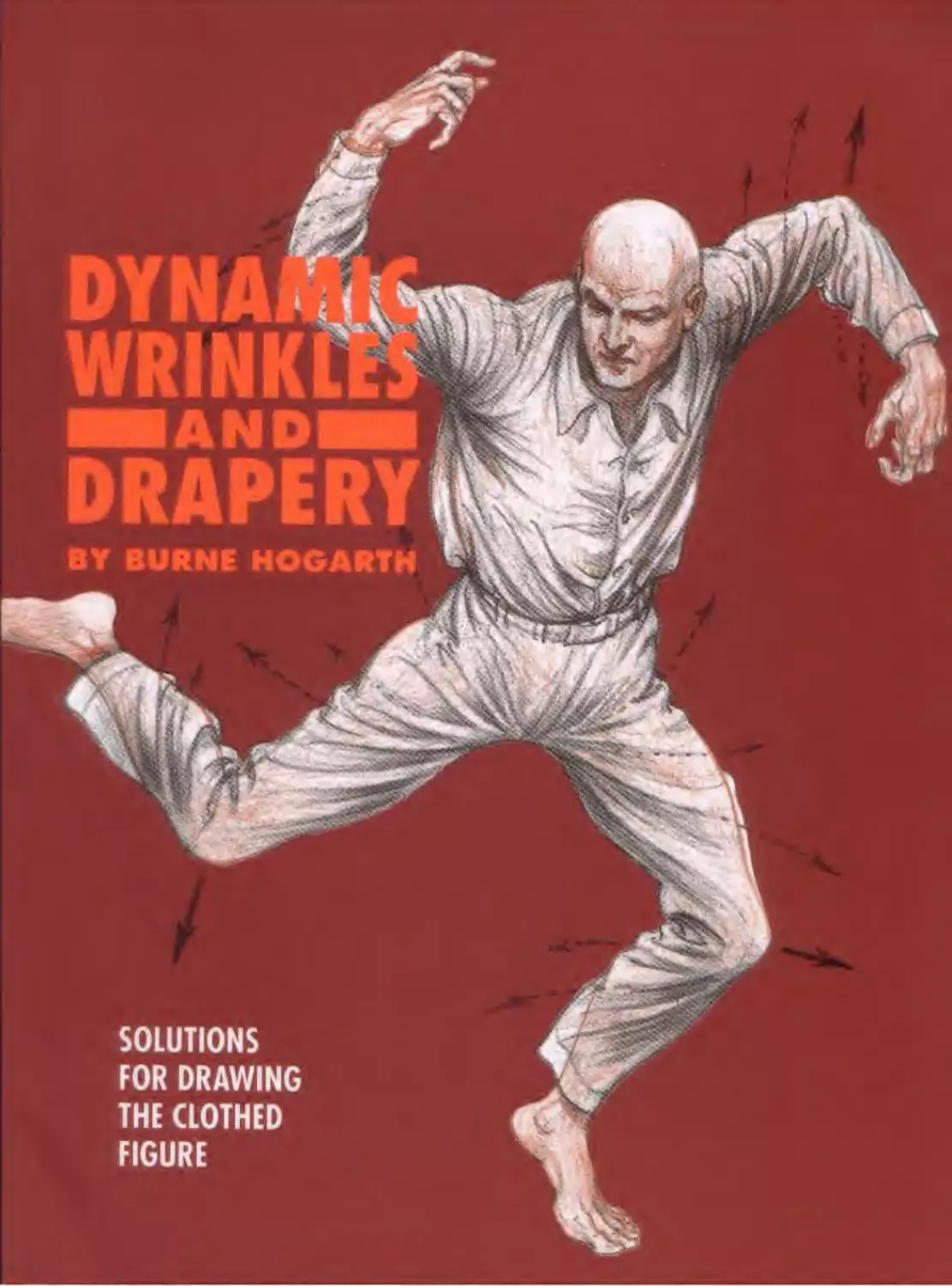


Author: Hogarth B.
Tags: human anatomy drawing fine art books on the art of drawing
ISBN: 0-8230-1587-4
Year: 1995

Text
                    DY№ ’ цл
WRINKl»
■ ANDHI
DRAPERY
BY BURNE HOGARTH
SOLUTIONS
FOR DRAWING
THE CLOTHED
FIGURE

DYNAMIC
WRINKLES
AND
DRAPERY

DYNAMIC
WRINKLES
■IANDH
DRAPERY
BY BURNE HOGARTH
W AT S О N - G U PT I L L PU В LI C ATI О N 5/N E W YORK

ACKNOWLEDGMENTS
This book is dedicated to my good triends;
Maurice Hom, a distinguished, seminal historian
of the comic narrative idiom and the graphic novel;
Richard Pryor, of Collector's Press, and his family,
Joanna and John, for their warmth, devotion, and
steadfast appreciation of the Ninth Art of our time;
Jack Iversen, one of the "old-timers" of the
animation form, for his idealism, energy, and
unflagging grit in pursuing and building his
Viking dream.
In the course of preparing this book, I incurred
a debt of gratitude first and foremost to Mary
Suffudy, Executive Editor of Watson-Guptill, for her
unreserved enthusiasm for and encouragement of
this project when hope for it seemed to have waned;
to her wise guidance and the judgment of Carl
Rosen in the editorial area and details of production,
and to Bob Fillie for his masterly projection of the
"look" and design of this book.
Special mention must be accorded to the
unnamed and unrecorded specialists, designers, and
illustrators of current and recent vintage in modes
of fashion—indeed, to fashion artists of earlier eras
and the scattered records of a more remote and
distant historical past of attire and dress in many
lands and diverse cultures—some found in obscure
print media, some in painting and sculpture
reproductions, going back to early classical times.
Much of this background reference matter 1 have
deliberately reworked and scrambled (like military
uniforms, for example) so that no specific
geographic, national, ethnic, or political provenance
can be attached or inferred. My sole objective is the
strict adherence to solving the problems of wrinkles
and folds. Other than that, I do not choose to make
claims of original insight; and my deep thanks go to
those image makers whose work unwittingly served
the narrow compass of my needs.

CONTENTS
Burne Hogarth
Dynamic Wrinkles and Drapery
Берн Хогарт
Динамика складок и драпировки
1995
Содержание
Предисловие - 8
Введение - 9
Глава 1. Понимание кинетических сил - 10
Глава 2. Складки прямого натяжения - 24
Глава 3. Складки сгиба - 40
Глава 4. Перекрёстные складки - 58
Глава 5. Компрессионные складки - 74
Глава 6. Фрагментационные складки - 84
Глава 7. Складки свисания и свисающие складки - 42
Глава 8. Складки ловушки и замыкающие складки - 102
Глава 9. Летучие складки - 110
Глава 10. Пассивные, инертные и лежащие складки - 126
Глава 11. Структура складок, текстуры и материалы - 134
Указатель - 143
https://archive.org/details/dynamic-wrinkles-and-drapery-burne-hogarth-english/page/n143/mode/2up
PREFACE	8
INTRODUCTION	9
Chapter 1.	UNDERSTANDING KINETIC FORCES	10
Chapter 2.	DIRECT THRUST WRINKLES	24
Chapter 3.	BEND WRINKLES	40
Chapter 4.	CROSSING WRINKLES	58
Chapter 5.	COMPRESSION WRINKLES	74
Chapter 6.	FRAGMENTATION WRINKLES	84
Chapter 7.	SWAG AND HANGING WRINKLES	92
Chapter 8.	TRAP AND CLOSURE WRINKLES	102
Chapter 9.	FLYING WRINKLES	110
Chapter 10.	PASSIVE, INERT AND LYING WRINKLES	126
Chapter 11.	WRINKLE PATTERNS, TEXTURES, AND MATERIALS 134
INDEX	143

PREFACE
In the course of a truly remarkable career
spanning some sixty-odd years, Burne Hogarth
has worn many hats in the worlds of art, art
education, and art publishing. Although he was
from the beginning a popular success, critical
acclaim was a long time coming. Thankfully, he has
now taken his place among the important artists of
the twentieth century.
Burne is most famous for his internationally
syndicated Sunday color page Tarzan (1937-1950)
but is probably most revered for lais contributions to
art education. Through his books on drawing and
his hands-on teaching, he has touched the lives of
countless thousands of art students. I truly believe
that he is one of the most influential figures in art
education today.
Burne has published five books on drawing,
beginning with Dynamic Anatomy in 1958. These
books are the definitive studies of five aspects of
drawing. This book, Burne's sixth, may well be the
most unique and information-packed of them all.
Begun as a study of the clothed figure and the
dynamic properties of drapery, the project
expanded to create a vocabulary and terminology
with which to address the clothed figure in art
education. This did not exist and was not generally
perceived as being needed. The clothed figure was a
chance encounter in most art school study
programs. Historically, the emphasis in drawing
was on the nude. This may well be a result of the
lack of terminology and vocabulary with which to
address the clothed figure,
The project expanded further to deal with
characterization, especially by means of gesture.
The people in these drawings are unique
individuals; personalities reflecting all the varied
aspects of contemporary society. As a matter of fact,
this book may be the best visual record of
contemporary society to date.
In the late fifties, I was just starting out on a
career in illustration and was teaching my first class
at the School of Visual Arts in New York. I had
graduated from Art Center College of Design the
previous year, and although I had experienced
immediate success as an illustrator, I was far from
sure of myself in the role of teacher. Burne Hogarth
was teaching in a classroom next to me and 1
couldn't help but overhear most of his lectures.
Hogarth has an awesome energy level and is not a
quiet man. He illustrated his lectures with giant
anatomical drawings done on the spot from
memory in an extraordinary and unique style of his
own invention. I had never seen anyone so clearly
define the human form before. Needless to say, I
learned a great deal about teaching from this
experience and I believe that Burne's commitment
and enthusiasm inspired me to take up a second
career in education which continues to this day.
When I returned to California many years later to
chair the illustration department at Art Center, the
main thing that I felt was missing was Burne
Hogarth. Burne was such a confirmed New Yorker,
it never occurred to me that I could lure him to
California. Happily, sometimes things work out.
Burne did move to California and did join our
faculty. He is a constant source of inspiration to the
department and 1 feel honored to have been asked
to write this preface.
Philip Hays
Chairman, Illustration Department
Art Center College of Design, Pasadena
8

INTRODUCTION
This book is essentially a study of the problems
and solutions related to drawing the clothed
human figure. 1 propose to deal with the
integral facts, details, and systems of wrinkles and
drapery as influenced by the movement and activity
of the human form.
One of the ironies of art education is that while a
great deal of attention is given to drawing and
painting the figure, figure in this context refers only
to the nude or unclothed form. Indeed, from the
very beginning of the learning process, the well-
held axiom is that basic art study proceeds
unquestionably from the representation of the
unclothed human form. That tacit principle is the
norm in private studios and group classes, as well
as in large art schools and colleges. If one can draw
the nude figure, doors are automatically open for
further study, the ability to draw nudes being
perceived as the foundation for all other developing
art skills. In subsequent study, drawing the nude
figure is also a constant preoccupation. It is the
central rationale and confirming activity for
advanced and master classes.
As a matter of course, in classes devoted to
painting, illustration, and fashion study, clothed
figures are presented. The figures are dressed in a
variety of costumes and styles of this year and
yesteryear. And surely, an instructor might
occasionally provide some salient information on
folds and drapery, but such instruction is sporadic.
In the average pattern of study, very little attention
is given to the systematic understanding of the
clothed figure, because there are no requirements in
the curriculum to propagate such a disciplined
program.
The irony is that in reality artwork depicting
clothed figures is far more common than work
showing nude figures. By merely making an across-
the-board scan of the art in various media, one will
observe that the overwhelming proportion use the
clothed figure. With this oversight in the education
of artists in mind, we hope to fill the gap by
revealing the secrets of wrinkles and drapery.
It is my contention that such a vital and
instrumental subject as wrinkles and drapery—the
analytical and kinetic factors of the clothed figure—
must be seen as integral to figure drawing. The
subject must be construed as the basic support stage
of the nude form. The stress-related anatomical
features of change, mobility, and action are best
shown through the interactive, sequential stage of
figure drawing that 1 describe in Dynamic Wrinkles
and Drapery.
Wrinkles and drapery are not independent,
exclusive agencies of form. The divisions of
wrinkles and folds in clothing worn on the body
should be conceived as a part of a coherent system
of movement and response. From this premise, any
garment can be regarded as a new skin, a looser,
variable cover that augments the nude substructure,
but is responsive to the underlying foundation below.
This book explains how and why wrinkles act the
way they do, focusing on the kinetic forces of
tension and thrust, the resistance factors of friction
and traction areas, and the counterforces of
retention and anchor points. Nine major systems of
wrinkles and drapery are discussed in detail, and
these systems are shown as they affect a variety of
textural materials and weaves, responding to bulk,
density, stiffness, and resilience.
After scrutinizing the basic interactions of
wrinkles and drapery and the nude form, we move
to the pursuit of problem solving in drawing the
clothed figure. This involves understanding the
clothed figure in terms of such individual,
behavioral, and socially oriented distinctions as
personality, age, sex, and status. Work and job-
related attire can help the artist to define social guise
and demeanor. These conditions all affect both the
movements of the body and the movements of the
clothing on the body, hence the patterns of wrinkles.
It is my hope that within the narrow limits of a
book, we present sufficient information to excite
interest and inspire awareness and understanding of
the nature of wrinkles and folds.
Now, let's get on with our work.
Burnt Hogarth
9

CHAPTER 1
UNDERSTANDING
KINETIC FORCES

The innate forces and stresses that arise in the human body are
revealed in the folds and creases of clothes. In order to understand
wrinkles and drapery in context of a wide variety of wearing
apparel, it is necessary first to understand specific kinetic forces
themselves. Kinetic forces, which are tied to the motion of a figure in
opposition to other natural forces, such as gravity, generate the stresses
from which wrinkles and folds develop. This combination of forces
acts on the various weaves and textures of dress, creating in effect
another form of skin, loose and free-acting as our real skin. This
artificial overlay, however, can act with a diversity not available to the
tightly bound flesh.
The casual observer would conclude that the body is capable of
producing an unlimited number of possible movements. Closer
inspection, however, would show that the apparently different kinds of
actions can be simplified into four fundamental types of movement.
These basic actions of the body forms are: extending, bending,
twisting, and rotating.
When the four basic actions of the body act on clothes and garments,
which obviously have their own weight, shape, and texture, a broader
interaction takes place with the external forces of gravity, weather, and
random events. Ibis combination of forces give rise to categorical
systems of wrinkles and folds. These systems are discussed in detail
later; for now, let's take a closer look at the four basic actions of the
body.
1.	Extending. The extension of forms, or the straightening and
stretching of the body parts, can be seen when the figure is in an erect,
elevated posture. The head, neck, and torso are said to be extended
when they are straightened; the legs and feet when straightened taut;
and the arms, hands, and fingers when stiffly stretched out.
2.	Bending. The bending of forms in the flexing or closing of parts can
be seen in the compression inward of the head to chest; the
compression of the rib cage toward the pelvis (at various angles); the
backward bending of the legs and the forward flexing of the arms; and
the closing and clenching of hands and fingers, feet and toes.
3.	Twisting. The torque and twist of forms can be seen
in the left and right turning of the head; the
twisting or wrenching of the chest against
the pelvis; the corkscrewing of the legs in the
hip socket and the spiraling of the arms in
the shoulder cup; and the turning and wrenching of
the wrists and ankles, fingers and toes, in small twists.
4.	Rotating. The rotation of forms can be seen in the wide gyration of
the outstretched arm from its pivot in the shoulder; the wide rotary
whirls of the leg from its pinion in the hip; the upward circular swirls
of the head, combined with neck forms; the wheeling around of the
pelvis and the leg base of the torso in large, windmilling curves; and
the wheeling and winding rotation of hands, and the reeling rotation
of dangling feet.
These gross motions of the body's members, in combination with each
other and external forces, create a remarkable sequence of wrinkle
systems in the coverings and garments that we choose to inhabit.
In the figures that follow, look for the broad differences in the
movements of forms in terms of the four basic actions of the body.

UNDERSTANDING KINETIC FORCES
The basic actions of the body mobilize the forces of tension and
thrust, which in turn energize wrinkles. Wrinkles are an expressive
indication of the force of actions. The actions performed by this male
figure are excessively strained and contrived. This is done to show the
expressive value of wrinkles in proportion to the straightness of the
members in extension.
The fully extended arms stretch outward to their limits, giving the
viewer a feeling for the strain and sweep of the figure. Similarly, the
extended legs convey the feel of forward motion, as they move through
the sequence of step, pace, stride, march, and advance. Note the upward
extension of the head and body, which lifts high along with the legs in
projection and the arms in elevation. As you observe these extensions of
the figure, try to identify with each of the drawings and feel your way
through the movements.
12

In this multiple-sequence side view of the male
figure, let your eye sweep the forms in kinetic
array. The legs portray captive moments of
stretching actions, and the arms rise to an
exaggerated elevation. Note also that the head
betrays an intense, spirited facial expression, while
the body remains poised and tense. Extending
actions dominate this drawing, but the movement
of the arms and legs upward and downward in
sequence relies on rotation at the shoulder and the
hip socket. Bending comes into play here at the
waist, as well as at the hip and shoulder.
13

UNDERSTANDING KINETIC FORCES
Here we have two figures in the
full extension of an overhead
body toss. Note the body thrust of
each figure. Their forms illustrate
the sum of the powerful forces at
work, as the bottom figure bends
forward, twisting his torso and
extending his limbs to hurtle the
extended figure through the air,
against gravity. Observe the
extensions of the stretched arms
and legs and the rigid, tense torso
forms, as well as the bending and
twisting that complete the flinging
action of the lower figure.
]4

Observe the two-phase flying figure of this
trapeze performer: Every form is in extension—
stretched, tense, and elongated to convey the flying
outward swings. The figure bends at the hips and
arcs his legs above his head with slingshot
acceleration to complete the flight. Now imagine the
extended swirling folds that would follow the speed
lines behind the body if this figure wore clothes!
15

UNDERSTANDING
KINETIC FORCES

Look closely at the two male athletic figures
(opposite) locked i dynamic balance: Virtually
all parts of the body that can express some aspect of
a sideways bend do so. Note the tipping and
compression of the two torsos; both also exhibit
torque or twisting. Now follow the bending of each
head—both tip away from the axial change in the
l>irtually every body form in the athletic figures
W below expresses some aspect of flexion,
compression, and bend. Note the inward
convergence and contraction of upper and lower
arms, hands and fingers, and the closure and
compression of upper and lower legs. The central
image of the two torsos present opposing bends:
hips. ( When we examine these bend motions in
The lower torso is developing a depressed frontal
the clothed figure in later chapters, a
remarkable rhythmic system will
prevail in the wrinkles.)
concavity, while the upper is forced into a backward
arched convexity. The same bending movement
occurs in the two heads: The lower head is moving
forward, the upper is projected backward.
17

UNDERSTANDING KINETIC FORCES
18

This back view of a dancing female figure shows
a multiple-sequence change of bending actions
in the arms and legs. The hands show a series of
actions including finger bends and wrist rotations.
The torso develops a deep back bend, as it
compresses and twists. The legs alternate between
extending and bending actions.
Again, the distinctive female form compels a
unique system of wrinkles in clothing. Imagine this
figure covered in lightweight swirling gowns and
skirts, creating undulant, loosely flowing forms.
This multiple-sequence figure presents the
extending actions of parts of the body. Jogging,
striding, vaulting, and leaping are shown in kinetic
leg movements. The upraised arms convey a sense
of upward motion, while the torso and head
describe twisting actions that convey a sense of
elevation and grace.
We'll see that there are marked differences in
the clothed forms of the female and male figures
because of the structural differences between the
sexes. This consequently influences wrinkle systems
and forms of drapery.
19

UNDERSTANDING KINETIC FORCES
Wrinkle systems in clothes, generated by the tour basic actions of the
body in conjunction with external forces, originate from areas of
retention called anchor points. These points describe the places where
clothes cling to or hold to the body. In the male figures shown here,
anchor points are found in seams, as well as in tight places throughout
the body, such as the armpits, the collar, the inner elbow and knee
creases, the midwaist cinch, the pubic underbody midline, the crotch
seam, the side groin creases, and the rear, deep buttock curves. In later
chapters, we see these anchor points working to define wrinkle origins.
20

The anchor points of wrinkle systems in the clothing of the female
figures shown here work the same as those of the male figures.
Clothing designed for men is often adapted for use as women's wear, so
the male figure's anchor points are often interchangeable with those of
the female figure.
For distinct women's styles, tire anchor points resolve down to
simpler systems of wrinkle origins. For example, where the dress or
skirt formation of clothing dominates, the direct anchor points for
clothes can be seen at the collar, shoulders, armpits, and elbows, as well
as at the waistline. The only difference from male anchor points is in the
emphasis on particular points.
21

UNDERSTANDING KINETIC FORCES
The wrinkles and creases in the
adult human face show a direct
correlation with the wrinkles and
folds of clothing and attire.
In the drawing of the smiling
woman, the basic point is to
remember that the kinetic factor of
facial tension, seen as an animated
stretch and lift of the mouth
comers and an apple-shaped
compression of the upper cheek
muscles, works much like the
wrinkles in an active body form.
The creases generated by the
action of the facial muscles will
subside when the emotional
energy of the smile passes.
The drawing of the older man
shows two qualities of wrinkles.
The first variant presents stress
wrinkles that identify a pattern
of immediate kinetic activity—
transient facial stress. The active
pattern is all at the left of the
drawing. The second system of
wrinkles, at right from top to
bottom, is a pattern of ingrained
wrinkles created by the
weathering of leathery skin. These
wrinkles are not created by active
stresses, but should be considered
leftover crease forms

The drawing of the native American shows
wrinkles derived from the aging process. The face
shows wrinkles that will not yield in passivity. Here
we see the exemplary complex of past action folds
and creases, much like the patterns of weaves and
garments. In fact, similar motifs are observable in
durable textures where kinetic stress forces interact
With external forces, such as weather and time.
23

CHAPTER 2
The direct thrusts of body
members acting on a variety
of clothing types are
responsible for the greatest
amount of wrinkle patterns. When
the members of the body extend
outward from the anchor points,
the thrust or pulling action
creates direct thrust wrinkles.
These wrinkles radiate along the
lines of force. They are also among
the most common of wrinkle
patterns, and they can be observed
in garments acted on by the direct
thrusts generated by walking,
stretching, and a number of other
activities, often involving the arms
and legs.
Direct thrust wrinkles, however,
do not usually result in the most
interesting of wrinkle patterns. 1
urge you to keep an open mind on
this point, since, in the final event,
you are the judge of what is best
and beautiful, and you prove it by
making personal choices of forms.
There is no higher law.
If you can define the sites of the
forces of tension, the pattern of the
wrinkles will follow. Study this
figure lunging against a door.
Note the anchor points: armpit,
midline crotch, and a mere coat
button (at the waist). This button
is central to the radial wrinkles of
the torso. The outward thrusts
emanating from the armpit appear
as long, spiral stretch curves on
the arm sleeve and on the coat
underneath (see arrows). Now see
the two sets of wrinkles that start
at the mid line crotch anchor. The
long arrows trace the path of the
forces influencing wrinkles on the
figure's pant leg at left, and the
foreshortened curved arrows
show those at right.
DIRECT
THRUST
WRINKLES
24

25

DIRECT THRUST WRINKLES
In the jacket worn by the man shown from
the front, the direct thrust wrinkle is the
response to a simple tension force. The
man's arms rise, revealing anchor points at
the seams in the armpits. The lifting action of
the arms drive wrinkles across both sleeves
to the outer outlines. The arrows indicate the
path of the force released by the movements;
part of the force goes to the collar; another
part, down under the front chest (see arrows
at right).
In the two sketches (top right) tracing
the movement of the figure's arm, the
pull on the sleeve increases (see
arrows). The wrinkles work to
show extension; not only do
they become deeper, they
become longer.
Observe the extension of
the arms in the same man
from behind (bottom). The
tension in both arms starts
from the armpit and curves upward to
the outer shoulder (see arrows). In the
multiple-sequence drawing of the arm at
right, the lifting action appears in three
stages: The wrinkle creases are somewhat
open in the lowest stage; at the middle stage,
the creases are tighter; at the highest stage, they
are tightly stretched thin and taut. Clearly, the
effort of extension has increased the force of the
direct thrust wrinkles (see arrows).
26

The series of movements shown here
in front and side views of a simply
attired man involve all members of the
body—arms, legs, torso, and head. Both
figures are going through the extension,
elongation, and elevation of the limbs.
The arrows following the lines of
force on the figures demonstrate a
fundamental rule for all wrinkles:
Wrinkles follow the flow of action. If
you can define the tensions in a figure
that generate the direction in which
forces are unleashed, the wrinkles
will follow.
Observe how in each case the
members of the body show the direct
thrust flow of wrinkles from the anchor
points toward the thrusts or pulls of
action. The arrows originate at the
anchor points of collars, armpits, belts,
and crotch, then go outward along the
lines of force.
27

DIRECT THRUST WRINKLES
Observe this male performer in
front and back views as he
exhibits the direct thrusts of ami
and leg extensions. First, let your
eye scan the figure as seen from
the front. Note the anchor points
at the armpits, collar, coat button,
and midline crotch. See how all
wrinkle systems extend outward
from each anchor along the lines
of tension forces of the specific
member of the body. Take special
note of the coat button: See how
wrinkles curve in every direction
outward from this axial anchor—
upward to the arms, downward
to the groin and legs.
28

The back-view figure shows the
same dynamics as the front-view
one: Observe the anchor points for
the garments in the armpits, collar,
and waist. The midline crotch
anchor is hidden in this view, but
it affects the wrinkle pattern
nonetheless. See also the same
uutward extension thrusts of
arms, legs, and torso, and follow
the remarkably similar coat curves
on the back collar (they curve
wider toward the rear shoulders).
Look further at the tension pulls
of the outstretched sleeves, then
note the strong tension pulls on
the stretched legs from the
crotch—this creates long,
outwardly radiating wrinkles. On
the outer side of the figure's leg at
left, we see several curves
competing against the inside
wrinkle tensions. These are
crossing wrinkles (see chap. 4).
29

DIRECT THRUST WRINKLES
By now, the anchors of the armpits, the waistline
belt cinch, and the midline crotch seam should
be familiar reference points. As we have seen, long
unimpeded wrinkles follow the actions of elongated
body forms as these forms extend from the anchor
points.
As you look at this leaping dancer, pay special
attention to the bent leg. Note that as the action
changes at the knee, so must the wrinkles change. In
this instance, the knee becomes a new anchor point.
30

In this multiple-sequence figure depicting extreme
arm and leg extensions, the logic of wrinkles as
they follow the flow of action is very clear. Check
the anchor points: armpits, collar, coat button at the
waist, midline crotch seam.
Observe the subtle rotation of hands, arms, legs,
and feet. Study the feet in detail. Note that the
shoes, at center, tend to turn inward, and when the
leg is fully extended, the shoes turn outward. See
also how the wrinkles are influenced by the position
of the shoes in each stage of the drawing.
31

32
DIRECT THRUST WRINKLES

A conditional rule'of wrinkles and folds is: Loose
material tends to wind, curve, and spiral in
active, free forms. Look carefully at the extended
members of this leaping dancer. They display
long, direct thrust wrinkles. Again we have
foreshortening of forms, notably in the advancing
leg at left, with wrinkles going into spiral curves.
Note the loose, wide sleeves and trousers, and see
also the free-flowing sash; virtually every garment
here moves with spiral wrinkles.
It should be clear by now that the direct thrust
wrinkle system is easily predictable. As long
members stretch and move, in whatever direction,
we can anticipate their course and pattern. As we
see in this drawing, the thrust force lines always
extend outward from the body along the arms
and legs.
An important subtlety to note when looking at
this drawing is that our viewpoint is angled toward
the left rear of the man in the tilted seat. The forms
look somewhat foreshortened and elliptically
curved. The rule is that the more the forms recede,
or become foreshortened, the more curved the
wrinkles become.
33

DIRECT THRUST WRINKLES
Two clowns give us a playful
look at long direct thrust
wrinkles in loose material and
foreshortened forms. The trouser
legs of both figures show kinetic
tensions in long spiral wrinkles
extending from crotch anchor
points to the ankles (see arrows).
The more closely fit sleeves
express tightly wound curls (see
arrows). Note the foreshortening
of the arms caused by perspective.
34

Let's look at a female figure in a
close-fitting skirt and blouse in
order to examine two-directional
direct thrust wrinkles. Observe the
rising angular folds moving from
the belt cinch toward the higher
shoulder (see arrows). Also note
the figure's high hip at right from
which wrinkle forces move
angularly down toward the lower
thigh at left and the knee (see
arrows). These two force patterns
are carried through the entire
figural stance.
The close-fitting outfit
immediately gives rhythmic sway
to the figure, involving the head
attitude, the uplifted shoulder
(which generates pull folds that
act to reveal the breast thrusts),
and the tight waistband tilted
downward (which permits the
arm and hand at left to support
the rise of the right hip, from
which curved wrinkles flow
toward the leftward knee and leg).
35

DIRECT THRUST WRINKLES
There are times when external
events produce extension wrinkles
of an unusual kind: In a football
scrimmage, a player grabs the jersey of the
ball carrier and holds tight. This sets the
main anchor point off the body of the ball
carrier. The hand of the player becomes the
anchor, acting like a hook, catch or snag.
The body of the ball carrier creates the
thrust away from the anchor point. The
result of these actions is an unusual cluster
of extension wrinkles that radiate toward
the ball carrier.
Let's put forward another rule: For a set
of wrinkles, the tight and narrow sequence
defines the anchor point; the wider set
radiating away from the anchor point
defines the direction of the thrust, as well
as the location of the action of tension
forces.
Here is a dancer in an unusual costume from Greco-
Roman times. It is interesting to note the figure's hand
gripping, at right, the garment. It acts as a displaced
anchor off the body.
The handhold creates a wide set of extension wrinkles
that fan out across the figure. Observe a second set of
wrinkles across the length of the arm at right. Taut
extension wrinkles also cover the shoulder at right and
appear on the head, face, and arm at left, as well as down
the back lower leg. A final set of swag and drag folds pull
across the floor at left.
These wrinkles look complicated, but they follow the
simple system of direct thrusts pulling away from anchor
points. The thinner wTinkles are generated at the anchor
points (see the hand at right and the one at left clutching
by the neck). The loose drape behind the figure is covered
with drag wrinkles created by the unattached anchor of
the floor. The tension forces act to create direct thrust
wrinkles that spread across the length of the figure, away
from the anchor points.

37

DIRECT THRUST WRINKLES
Tills young woman in a playsuit
clearly illustrates a typical
system of anchor points and direct
thrusts. Observe how the armpits,
collar, belt, and crotch seam act as
anchors. Note also the
foreshortening of members, which
results in direct thrust and spiral
curve wrinkles wrapping the
limbs. The breast curves and the
hip and buttock forms show the
force tensions that are pointed to
by direct thrust wrinkles (see
arrows). The wrinkle play
between the groin and the top of
the leg also produces direct thrust
creases. But the continuing
extension wrinkles on the lifted
leg work against the lower thigh
and buttock to produce wrinkles
in reverse (see arrows). This effect
is repeated in the figure's standing
support leg (see arrows).
38

Here we have two swordsmen in combat. From the foreground,
the attacker's extended right sword arm creates extension
wrinkles on the forward sleeve; the action creases spread backward
across the tunic, chest, and hips; the waistline sash intervenes, but
the backward movement continues in the braided cord as it swings
out and back; the force moves down the long wrinkles of the
extended leg. A long line of angular tension runs tlirough the
entire form of the figure. This angular force is reasserted in the
background figure; it presses up his leg at left, his tilted body, and
his uplifted arms. Both figures show taut extensions on raised
leftward arms; the rightward bent legs of each figure produce
forward and backward bend wrinkles (see chap. 3).
39

CHAPTER 3
BEND
Bend wrinkles, which are clearly direct
thrust wrinkles, occur when arms and
legs are bent at the elbows and knees.
They form short backward and forward
patterns. These two-way bend patterns are
usually seen to best advantage in clothing
WRINKLES
when the arms and legs are given full
exposition in design and situation.
A good example of such a situation is this
fracas, which has erupted at the Hound Dog
Saloon. Here we see two-way-thrust bend
wrinkles, as well as full-thrust long extension
wrinkles. Let's review the long extension
forms in this drawing. The man at right has
lashed out with a straight-leg kick at the belly
of his opponent. Wrinkles on the extended
leg of the attacking figure start from the deep
crotch anchor, which sends a series of close
thrust creases coursing across the thigh and
across the lower leg to the boot.
Three other extension patterns can be
seen on the double-phase figure in the
*4 center of the drawing. Note that the
X wrinkles formed on the extended
X arm and leg of the forward-bending
version of the figure, and the
outstretched arm on the
version of the body that is
< lurching backward, all
bear a similar dynamic
) pattern to the attacker's
. J kicking leg. Each series of
\ wrinkles emanates from a
Ж? seam anchor, armpit or crotch,
лу7 and each sequence of extension
wrinkles flows down the length of the
arm or leg, without interruption.
Now, let's return to our main concern of
the moment—bend wrinkles. There are ten
examples of bend-wrinkle patterns in this
drawing. Six arm bends and four leg bends
are included. Examine these examples
carefully, and then think about the following
basic principles that apply to bend wrinkles.
1. At the point of an elbow or knee bend,
clothing gets tight, and a bony elbow or knee
projection can be seen through the cloth.
2. Squeezed compression folds occur in the
bend areas of the elbows and knees. Observe
your own knee or elbow in a mirror.
3. Every bent-form system has both an
outward and an inward pattern; the median
point is the elbow or knee. The result is a
two-form angularity—a thrust and a reverse.
As you look at this drawing, remember that
wrinkles always follow the actions of forms
41

BEND WRINKLES
Bend wrinkles are a type of
the direct thrust wrinkle, as
they respond to the direct
forces of outward arm and leg
movements. The difference is
that bend wrinkles form only
when the extended members oJ
the body bend at the elbows
and knees, producing short,
two-way (backward and
forward)
thrust
patterns.
In these two examples of
bend wrinkles, the trousers go
forward with the upper legs
and backward with the lower
legs. The two-way wrinkles
produced are reactions to a
thrust force pushing at the
knees (see large arrows), which
are the midway points on the
legs. The lower leg wrinkles
tend to go backward from the
knee (see arrows). The upper
leg wrinkles go forward to the
knee (see arrows). Note how
these wrinkles move toward
the front from under the
buttock and the thigh.
As we move upward
to the belly and groin, we
see a set of curved creases
erupting outward to the rear
in both figures. This is the
result of the strong leg
thrust.
42

This active figure shows bend
movements in the arms and legs.
The arm and leg at left are backward
md up, while the arm and leg at right
ire forward and down. The wrinkle
systems on the top and bottom portions
if each limb, as divided by a joint,
ippear in opposing patterns.
The sequence begins with the thrust
orces at the elbow's and knees. Note
'he main direction of the thrust force
rushing at these bends (see large
arrows). The bent knees and elbows
give rise to the wrinkles on the limbs.
The directions of all the wrinkles
observed at once create the illusion of a
figure rotating in a clockwise direction.
43

BEND WRINKLES
Here is a multiple-action figure,
shown in a back view, that
describes two-way thrust bends in
the arms and legs. The overriding
characteristic of all forms of this
figure is the circling rhythmic
consistency among the two
parts of every arm or leg.
Examine each limb by
itself. Start on the curve
pattern of an upper leg or
upper arm, then follow
the dotted-line arrows
that move through the
entire limb's wrinkle
system. Note the curves of
the dotted lines; these reflect
the spiraling rhythm of the
form from beginning to end. Now
let your eye probe the central
body forms, such as the neck,
shoulders, and buttocks; each
picks up some part of the overall
circular flow.

The playful sport of piggyback provides an excellent opportunity
to illustrate two-way bend actions in which the arms and legs
produces double system of curve and spiral wrinkles on their
upper and lower portions.
The outward push of elbows and knees creates a midpoint
breach. This starts the reverse activity of an inward contrary stress,
whereby long wrinkles divide tn half on the inside of the limbs. The
midpoint breach compresses the inner elbow bend and back knee
bend areas. In each of the figures, the
dotted-line arrows show the forward
and reverse flow of action, with
the elbow or knee in the
middle of the position
change.
45

BEND WRINKLES
46

One of the most engaging qualities of two-way
bend wrinkles is the tendency to develop a
systematic pattern of flow, as in, for example, the
arms from shoulders to wrists and the legs from
the groin and crotch to the ankles.
In this juggler's stance, bend actions in the arms
and legs create the predictable spiraling pattern (see
arrows). The spirals spill outward invisibly onto the
upper forms; reversing, they move down to connect
on lower forms.
The midpoint sectors, the inner elbow and the
back knee bend areas, show the tight compression
creases. These blend and fuse the forces centrally,
which then separate again into diverse actions.
A dress will wrinkle quite differently from pants
and jackets, which tend to have short, two-way
bend wrinkles. Observe this female figure in a silken
gown of neoclassical attire. Long drape folds start
from her shoulder at left (and inclined head),
moving downward to produce an introductory
ensemble of rhythmic flow tensions.
The folds wind up the arm, circling the breast
and shoulder at right, then swinging down to the
exposed elbow and forward knee; here, the flow
reverses on the thigh and both knees in a swift
downward cascade angling toward the rear. The
course of leftward folds, like a curling wave, lifts,
breaking right, swirling around the extended ankle,
and spilling like a surging stream in a graceful
sweep and drift—coiling in final closure around
the water jar.
47

BEMO WRINKLES
Let's look at two interesting examples of radial wrinkles. First,
observe the full female figure in a leisure suit (above). Her bent
leg at left (see oval) shows the typical two-way thrust; the upper
leg creases forward, and the lower creases backward (see arrows).
The leg at right is straight with a high hip support. Note the hand
bulge in the pocket (see oval). This gives stress force to the entire
straight leg, causing all wrinkles to move downward in a
remarkable cascade of straight folds.
Next, look at the drawing of a woman's legs and lower torso
(left). Radial wrinkles around the abdomen start from the crotch
stress area. The knee thrust at right (see oval) initiates the radial
wrinkle forces in all directions on the leg.
48

Let's compare two varieties of bend wrinkles seen
in the clothing of the dancer and the drummer.
The typically masculine garb of the drummer,
shirtsleeves and trousers, cover separate arms and
legs. These clothes present a clearcut example of
two-way thrust wrinkles in the upper and lower
portions of the limbs. As the drummer's figure at
left shows, the outer leg bend, with the knee
forward, produces tight tension wrinkles from the
seat to the knee. The reverse action, moving from
knee to ankle, creates tension forces to the rear in a
The dancing figure's skirt shows two-way bend
wrinkles of a different sort. The overall skirt
covering the upper legs does not allow the hidden
inner wrinkle forces to appear on each leg. The
tension forces are clear only at the outer sides of the
skirt. The inner pull is an irregular sequence of
stress across the figure's front thigh at right to the
recessive tension of the back leg at left. Note how
the excess agitated material flies out at the rear
right; and the more so at the backward left where
the skirt is more active and voluminous. Observe
series of tight creases. Note the inward squeeze of
the tightly covered forms on the stretched bodice of
theshoeatthe ankle.
the sweater.
The drummer's taut body and arms have a direct
forward thrust through the belly and chest that is
carried up to the arms and hands. The wrinkle
sweep created by this action becomes one
system of ascending movement.
49

BEND WRINKLES
One important version of two-way bend wrinkles are
radial wrinkles, which become visible only when a
thrust force acts on a foreshortened frontal bend, as in the
example where the bent knee projects straight out to the
viewer. The oval on the front knee at right represents the
thrust area that releases a pressure pattern of radiating
wrinkles like spokes from an axle (see arrows). The
wrinkles tend to flow outward in the loose trouser cloth,
especially on the lower leg area, from knee to ankle.
Note that radial wrinkles as a group also tend to
appear from the anchor points where arms and legs
emerge. Observe how the radial wrinkles emerge from
the figure's armpits (see arrows), flowing across the
chest, shoulder, and arms. This wrinkle system also
develops at the crotch of the trousers; wrinkles
flow radially two ways up the groin and
outward onto both thighs. From there, the
wrinkles swing downward across the lower
legs, especially on the figure’s straight leg
at left.
The radial wrinkle pattern of the bent knee
repeats exactly on the bent elbows of the
arms, as they project backward from a foreshortened
space. The elbow (like the knee) is a central stress point
that forces loose sleeve material to flow around outward
and downward in a radial sequence of wrinkles.
Let's look at the woman for examples of stress points
that create radial wrinkles. In a three-quarter rear view
we see her arms in bend positions. The elbows project
toward us, creating the illusion of foreshortening. The
dotted ovals show the backward thrust of the elbows.
Howing curved wrinkles move outward radially from
the elbows and turn inward to the wrist. The flexible
skirt reveals the outward buttock pressure, and from
this area we can again observe large wrinkles flowing
around and downward on the striding leg.
Now locate the various elements at work in the
man's sleeve (top right box). See the elbow shown with
a dotted oval and the arrows given as guides for the
radial wrinkle system. To the left, back and shoulder
wrinkles emerge from under the armpit anchor.
An interesting radial wrinkle system emerges from
the belt across the middle of the bottom figure at right.
The armpit anchor initiates wrinkles in all directions.
Wrinkles curl upward from the chest. The groin squeeze
causes wrinkles to radiate downward to the left and
right like wheelspokes. Look at the thigh and knee,
where the knee front (see oval) shows the
forward pressure of the leg. Below, the
inside knee bend creates a cramped
radial wrinkle system on the rear
lower leg.
50

51

BEND WRINKLES
This trim figure demonstrates the
rhythmic wrinkle pattern created
when the left arm is bent down and
the right is bent up.
Observe that halfway down the
rib cage low sleeve anchor points for
both upper arms generate folds that
flare up and outward to the top of
each upper arm. Note that the right
arm shows an angular upward
course that moves from the elbow to
the wrist. The wrinkles (see arrows)
repeat this rising thrust force.
The left arm clearly shows a
reverse movement angling inward
and downward. The wrinkles here
(see arrows) express this downward¬
curving reverse passage. Yet each
side of the arm is covered with
balanced curves. See how the left-to-
right back curves move toward the
uplifted hip (left), then swing on the
round buttock contour, and drive
toward the inward cavity of the bent
right knee.
In sum, a good drawing is one that
conveys an overall sense of rhythmic
flow and coherence of form. The
design of wrinkles contributes
markedly to this result.
52

This three-quarter side view presents a kneeling
female figure attired in denim pants and bulky
outerwear jacket The forward thrust of the figure’s
bent knees in tight pants produces predictably
smooth, flattened surfaces on the top thighs and
knees of both legs. At the crotch-seam anchor
points, diverging wrinkles are sent up to
the groin and around the lower belly.
At mid torso, the tightness of the
jacket waistband and pants create
horizontal compression forces. The
wrinkles on the inner leg at right
come from the low inside crotch seam;
but the outside wrinkles of the leg at
left are formed in response to the stress
force at the buttock, and the forward stress on the
leg sends wrinkles driving to the knee. On the lower
sections of the legs, tight shin wrinkles flow
backward from the knee and circle up and around
the calf areas, ending at the cuffs.
Ordinarily, sleeve wrinkles are both numerous
and curved. This figure's bulky sleeves,
however, create relatively few wrinkles that
are thick and angular. Also note that the
armpit anchors are lowered into the sides
of the jacket, where the seams tend to
diverge, and wrinkles slip down to the
waistband area. Small wrinkles are thus
limited to the area around the waistband.
53

BEND WRINKLES
The soft-weave sweatsuit this young woman is wearing
permits coursing wrinkles to easily enfold the body
forms. The downwardly bent knee causes a group of
curving wrinkles to move from the outer hip at left to the
knee. The leg bend forces a reverse thrust into the back
knee area, causing creases and underleg folds that move
toward the elastic ankle band in the lower rear leg. Now,
higher on the straightened leg at right, two small, relaxed
wrinkles curve inward, revealing a rising contour of the
thigh, which descends gently behind the active
thrust of the bent knee.
The sway of the figure's hip at right
generates a wave of ripple folds moving up
toward the shoulder at left. This is the key to
the rhythmic design of the figure: a curve that
engages the wrinkles flowing up from the legs,
rising inward toward the sleeves and up to the
smiling face.
The sleeves themselves have no anchor other than
their connection at the side torso, just above the waist.
This excess creates a large winglike undersleeve that
subsides into a droop, or swag form, which is created
by the force of gravity.
These drawings of a cowgirl challenged by a bronc
present a complex of direct thrust wrinkles and bend
wrinkles. First, let's look at the large drawing at right.
The woman is being lifted high out of the saddle. Her
extended arm at right holds the reins, producing a
sequence of long, direct thrust wrinkles that curve inward
and follow the direction of thrust from shoulder to wrist.
54

AU other body forms are bent, creating short, two-
way thrusts. The foreshortened legs are covered
with spiraling wrinkles. Wrinkles in the upper
portion of the cowgirl's chaps are created by the
stress curves of the buttocks and outer leg acting on
the inner thigh at right, while stress wrinkles on the
inner thigh at left emerge from anchor points at the
crotch seam and groin. The two lower legs move
backward from the projecting knees, releasing a
back-spiraling wrinkle flow from the knees to the
boots. The side flaps of the fringed chaps fly
backward as the tossed figure begins to plunge
downward.
The small inset figure at left is a back-view
version of the larger drawing. The wrinkle systems
here tend to repeat those seen in the larger drawing.
For example, observe the long, direct thrust
wrinkles on the straight arm, and the shorter, two-
way thrust wrinkles on the bent members. From this
view, however, the bend wrinkles reverse direction.
They begin to swing frontward, moving over the
calf curves to the ankles.
55

BEND WRINKLES
56

The legs of this farmer show aspects of bend wrinkles in two
ways: His leg at right is clearly bent, but the leg at left is in an
ambiguous position. Let's look a little closer and compare both
legs in detail.
There's no doubt that the leg at right is bent. The knee juts
forward and is outlined by the cloth; wrinkles emerge from the
crotch seam and travel down toward the inner thigh and up the
groin. Also note the crease behind the knee bend; it creates a
downward flow of wrinkles from knee to ankle at the back of the
leg. In sum, the rules of the two-way thrust are in effect.
The leg at left, however, is apparently shown from the front,
creating the impresston of extension. Note, however, that the
knee bulge is given some emphasis, although it is not enhanced.
The rear knee crease appears as a depression between side
wrinkles above and below the knee. On the thigh, a group of folds
sweep from the crotch seam to the outer leg; al this midpoint, the
knee intervenes and wrinkles continue to the outside of the lower
leg. Observe the shaded tone on the lower leg at left. It is there to
enhance perspective, creating the illusion of depth. This illusion is
used to show that the leg is not really straight, but is bent slightly
backward.
The basic elements of both direct
and two-wav thrust wrinklescan
be seen in this example of a
frontiersman encountering a rattler.
The frontiersman has an extended
member—the pistol arm-—that is a
perfect example of the direct thrust
wrinkle pattern. This pattern is
repeated in buckskin garments of the
leaning body and the outstretched leg.
The more complicated bend
wrinkle system, created by the two-
way thrust, can be seen on the
figure's bent leg at left and bent arm
at right. Each of these forms show
the midpoint force tension, one at
the knee, the other at the elbow.
These midpoints initiate the angular
reversal of forms that create the
compression creases in the inner-
elbow sleeve break and ‘he back
knee bend. Also, two-wav thrust
wrinkles radiate across the thigh
and down the calf.
57

CHAPTER 4
CROSSING
WRINKLES

One of the most subtle and complex systems among
the patterns of wrinkles we are exploring are
crossing wrinkles.
Let's examine the basic mechanism of this system and
describe the crossing pattern in simple terms: Put your
hands together palms open; now, lace your fingers
together in an alternating, dove-tailing arrangement. This
weaving together of the fingers (interdigitation) is the basic
model for the crossing wrinkle pattern. Another way to see
this is to imagine the pattern a pair of skis leave in the
snow. This zigzag net work is something like a herringbone
design, and it is the basic pattern used in drawing crossing
wrinkles.
Crossing wrinkles generally occur in loose or open
material on active body forms. The tension that creates
crossing wrinkles comes from the intersection of two
competing wrinkle patterns that meet while traveling in
opposite directions—an example is seen in the stresses on a
pant leg that come from the pull of the two sides of a thigh.
The tension forces emanating from the left and right
outlines of the leg, going toward each other and
alternating inward, generate the classic crossing wrinkle.
The critical juncture in the formation of crossing
wrinkles comes when the patterns moving away from
two stress points move toward each other. In the
moment when a collision seems possible, the leading
edges of the wrinkle patterns tend to avoid direct
impact and simply swerve around the potential
meeting point. They then veer away from direct
contact, creating the crossing wrinkle's signature
zigzag pattern.
The crossed legs of this sailor getting positioned to
paint the hull of a freighter give us a chance to study two
different sets of crossing wrinkles. When one leg crosses
over another, friction drag forces act on the trousers.
As the top leg slides across the lower, note the upward
drag force working through the top leg from ankle to knee
to crotch on the underplane of the trouser. Note also the
minor wrinkles alternating with the major wrinkles of the
leg, including those on the tumed-up cuff. Conversely, the
bottom leg shows a downward friction drag: As the top leg
slides over it, the bottom trouser is pulled down, rubbing
against the top trouser as it is being pulled up. Observe
how two contrary drag forces affect both legs: The upper
becomes high and tight; the bottom, low and loose.
The loose blouse on the man reacts to the slight upward
rotation of the body and the direct upward and frontal
thrusts of the arms. These are fairly simple, single direction
tensions, except for those at the waistline, where the loose
material goes into crossing wrinkles. Throughout the
figure, the rolled-up cuffs of sleeves and trousers give us
the zigzag patterns of the crossing wrinkle.
59

CROSSING WRINKLES
Look for conflicting tension
forces in the drawing of the
male frontal figure. Observe how
wrinkles from outside and inside
the figure's straight leg at left
move toward the center of the leg
(see arrows). Note how the thigh
area of the figure's bent leg at
right shows stress forces of
alternating directions heading
inward to the knee bulge.
The two wrinkle sources acting
on each leg are not equal in
force because the figure is
moving with greater emphasis
on a particular side of a body
form. This force factor produces
stronger, deeper wrinkles from
one of the two sources, like those
on the outside of the figure's leg at
left. In general, one of the two
cross-stresses that create crossing
wrinkles is dominant and points
out the area of greatest activity-
To distinguish between the results
of the two stresses, which form
crossing wrinkles, we refer to
long side wrinkles as the result
of the major force, and short side
wrinkles as the result of the
minor force.
Once we understand major force
wrinkles, the minor and lesser folds
of the crossing wrinkle system are easy to
distinguish and to work through with
assurance.
In the drawing of the woman on the phone, note
the action of the upper torso and the leftward arm.
These forms move in an upward swing from left to
right. Now look at the major wrinkles, which
emphasize and reinforce this direction on the
shoulder and the body under the arm. Take note of
the minor wrinkles crossing from the opposite side
(right to left). Lower on the figure, the hips and legs
are in a force thrust position that moves the body
from left to right.
Each leg shows decisive strong folds originating
from the left. These are the major wrinkles. Once you
have observed these, note the shorter minor wrinkles,
which come in from the right side.
60

The leg lift of the female figure in the pant skirt presents a strong,
active stretch upward. This act causes a major stress force to emerge
from the crotch anchor point. It creates lines of force that move outward
and to the left. The force is greatest in the lower area of material, and
there is no opposition until material on the thigh area loosens (and the
bottom wrinkles lose force)—then the interaction of stresses begins. The
minor force from the outside of the thigh at left creates wrinkles coming
in and across, but they are checked from below. More wrinkles attempt
to come in and down from the outside but a second, weaker check also
comes from the long wrinkles going down the inside of the leg. The two
patterns interlace and bend until the tight belt cinch is reached and thin
circular wrinkles take over.
61

CROSSING WRINKLES
This confident swordsman in dueling garb
gives us an excellent example of several
systems of crossing wrinkles.
1.	Let's start with the legs and take special
note of the major wrinkle thrusts. The
striding leg at left motivates the major force
wrinkles; these start at the crotch anchor
point and travel in a sequence of long thrusts
down to the ankle. The weak minor wrinkles
make an appearance in the groin (the
belly at left); they split on the
thigh, getting smaller on the
way down as the major
folds get longer.
2.	On the straight leg
at right, the force
emanates from the
staunch hip at right,
which starts a long
sequence of major
wrinkles that move
angularly down toward
the inside leg. See the
small minor wrinkles
edging in rightward.
3.	The dueling garb is made of
loose material on which full,
billowing forms are easy to detect.
But note the wide elastic waistband.
The stress of the hip at right sends long
major wrinkles leftward; also, the
waistband's tight compression permits
only a few mirior wrinkles to cross in
from the left.
4.	Observe the sword-bearing arm and hand
at left as they make an inward rotating twist
with the blade. This inside turn generates
decisive left to right curve folds. The minor
folds from the bottom upward are less
emphatic. And the high shoulder rise at
left motivates an undersweep of the side
torso that travels down to the belt.
Compare these to the minor wrinkles
erupting from the belt
62

This seaman at work on a sailing vessel is in a
contra positional twist, with the torso moving
In the drawing, the upper torso, chest, and arms
show a dominant turn to the right. Remember that
the stronger directional forces produce the
dominant major wrinkles. Major force wrinkles
start on the arms and chest at left and move in long
thrusts to the right, curving upward (see arrows).
Shorter wrinkles interlace with these, going left.
But the lower hips and legs reverse the action.
Hip and leg forces start from right and make a
strong, aggressive set of wrinkles curving
leftward. The shorter interlacing swings
are minor force wrinkles, going
toward the right
(see arrows).
rightward and the legs going left. Crossing wrinkles
show on both of these body forms.
63

CROSSING WRINKLES
This drawing features a woman
pulling upward on the side of
her dress at right in response to
the playful dog. A strong
sequence of curved swag forms
travel across the front of the
garment. On the left side of the
drawing, drag tension reacts
against the right upward pull.
Observe that as these contrary
forces are about to collide they
weave past each other, lose force,
and retreat backward. The result is
the irregular herringbone pattern
of crossing wrinkles. The major
wrinkles are on the right; the
minor wrinkles, on the left. Note
also the straight pull of the plucky
dog's gambit. Slower fold curves
flow on the dress around the
strong tension created by this
external force.
64

The garment on this hiker, who has stopped to admire a butterfly,
is made of sturdy twill material, which tends to promote
wrinkling of an angular kind and to maintain a wrinkled state,
because of the cuff-tabs that shorten the sleeves and shorts.
The primary stress factors in this figure are the raised leg
and bent arm, both at left. The raised leg causes the
buttock to send strong forces toward the thigh,
creating a major wrinkle pattern. Similarly, the
shoulder is affected by the bent arm, sending major
wrinkles to the underarm area. These wrinkles then
curve high around the arm and back over the shoulder. /
See also the back and shoulder at right where the
wrinkles move from the waist toward the shoulder rise.
Note how pressure from the buttock at right creates
stress curves rightward below the belt. Also, the
straight leg (right) and the high hip create tight
curves that travel rightward from the crotch
to the outer leg contour.
The weaker, minor wrinkles on this	\ 1
figure’s clothes interlace with the	/
major folds in a herringbone pattern. z”"	\

CROSSING WRINKLES
6b

When crossing wrinkles appear on old clothes,
as seen on this workman, the folds and creases
seem to fall into established, repetitive patterns, as
if the clothes were "broken in." A subtle interior
plasticity is responsible for this "well-worn" look.
In the drawing, the figure shows certain
predefined contours in the belly and chest, the
sleeves, and the contours of legs. The arms, for
The forward leg of this girl dancing in a loose,
wide-spread skirt gives us an example of
virtually symmetrical crossing wrinkles. This leg is
central to our field of vision, and the left and right
force systems are of equal tension. This creates an
equal, two-sided sequence of crossing wrinkles. See
how the symmetry of the force curves work out; we
are hard put to decide which side is major or minor.
example, show crossing wrinkles, but the major and
minor wrinkles are not easy to tell apart because
of wear in the clothing.
The heavy workpants also admit to past
actions, especially on the trouser leg at right.
The wrinkles appear in diminished patterns
because of inhibited crossing forces. Only
in the lower bent leg at left do we see the
effects of strong body pressures that are
immediate and not left over from some
earlier wear.
The forces acting on tire loose, hand-held
wings of the skirt, however, are not equal.
The hand at left is raised higher and
farther out than the one at right,
creating more open, pulled-out
crossing wrinkles. The hand at right is
held lower and closer to the body,
and a balanced zigzag pattern is
immediately apparent. Despite
the similarities of the two
wrinkle systems that join to
create crossing wrinkles, we
are sure that the major force
comes from the right,
which is where the pull
tension occurs.

CROSSING WRINKLES
This dour-looking fellow, with legs drawn in two positions, gives us
several examples of crossing wrinkles.
1 he arms of our figure produce crossing wrinkles based on the stress
action of each bent member. The arm at left reaches forward, bends, and
rotates inward, as the hand is placed on the rear leg. These moves cause
a set of simple curves to emerge from the armpit anchor point. As the
arm bends and turns, crossing wrinkles take over on the outside sleeve,
while the inside folds tend to maintain the forward thrust.
The bend in the arm at right puts a major stress on the
underarm, leaving long wrinkles on the upper inside sleeve
(from the backward stress) long wrinkles on the bent
underarm. In contrast to these, short minor wrinkles appear
on the outer sleeve of the top of the arm and also on the
inner sleeve of the bottom forearm. These all join to form
typical crossing wrinkles.
Stress forces created by the torso send wrinkles
curving around the figure's collar and down into the
armpit al right, then out abruptly. The torso stress is
downward because it is linked to the coat button
anchor point; from there the tension goes rightward to
the hand in the pocket. Then, see how the major force
sends a long, straight wrinkle upward, ending just
before the back of the coat. On the thumb edge of the
hand, little fragmentary wrinkles echo the long thrust
higher. Meanwhile, the hand in the pocket sets up a
severe cross-barrier (running
angularly downward) to stop the
horizontal coat wrinkles at the
pocket bulge.
Both bent leg forms (outside left
and right) give us two-way thrust
wrinkles. As we examine the long
wrinkles, especially on the lower
legs, however, note the short minor
wrinkles playing alternately against
the long one coming from behind.
These work together to form crossing wrinkles.
The extended crossed legs (center) reveal a downward slide
of the top leg. The wrinkles below the knee are taut and pulled
upward because of the drag tension. But higher on the leg, where loose
material is pushed together, this array tends to form a zigzag pattern.
The extended lower leg is similar to the top, but its long wrinkles go
downward and forward, as the trouser is pressed by the top leg. Minor
wrinkles show on the contact area of two legs. The upper section of the
top leg has a dear forward thrust. This creates wrinkles on the top leg
that slide up and ones on the bottom leg that are forced down.
68

69

CROSSING WRINKLES
In this drawing two athletes are getting dressed in a
locker room after exercising. Let's look first at the
foreground figure and think about what happens to a
coat as one puts it on. Tire arms, one after the other, must
go into the sleeves. Then, before the coat gets settled on
the shoulders, there is a looseness in the collar. The right
arm is completely through its sleeve, and this man pulls
Now look at the
background figure,
who is further along
in terms of getting his
jacket on. His sleeves are
almost in place. Note the taut,
angular folds that spread from
the hand that acts as a firm anchor.
Cross wrinkles are present on the
cylindrical foreshortened arms, which
show curved interlaced forms. Note
as well the zigzag wrinkles on the
upper trousers, which begin in the
crotch anchor and are, quite clearly,
the result of tension caused by
outward-spreading legs.
Finally, you may be wondering
about the sweatshirt on the bag in,
the foreground and the socks
on the floor. These wrinkled
forms are of a different
order and will be
covered in chapter 10.
his lapel to help his left arm through its cuff. Now the
right sleeve is loosely set, but because the coat is still not
quite settled on the shoulder, the excess material
goes into a contracted sequence of cross! ng
wrinkles. As you will see, the major wrinkle
stress in the right sleeve comes forward
from the bottom of the sleeve to interlace
with a minor counterclockwise wrinkle
system. Small fragmentary wrinkles appear
from the outside of the arm and ease into the
wrinkles on the underside of the arm.
The back torso and shoulders are lively with
stress forms. See the strong curves down the
back that repeat the looping action of the collar,
hich curls from left to right in response to
the action of the uplifted arm. On the upper
bent trouser legs of this figure are
wrinkles with major folds that emanate
from the rear area of the trousers. The
lower legs of the trousers show
typical direct stress wrinkles.
70

When material is chemically
treated for water resistance, it
acquires a crisp texture. Strenuous
and active use of such material
results in crossing wrinkles that
tend to be thick and deep. Also,
angular forms with squarish
corners take the place of curves
when a change in direction of a
fold occurs.
In this drawing, the crossing
wrinkles in the arms and legs ol
the upper climbing figure reflect
the texture of the materials,
especially in angular crossing
wrinkles of the bodv jacket, which
appear to be the most pervasively
fractious and resistant to stresses.
The clothes of the lower figure
show a more flexible response to
this vigorous action. But even
here, if we look closely at the
reactive minor wrinkles (on the
leg at left, for example), the
cornering of wrinkle contours is
evident. Note the material on the
arms of the lower figure; observe
the stubborn, counteractive form
of this unyielding weave.
71

CROSSING WRINKLES
From another era, a cavalier dressed in leather,
suede, and homespun gives us vivid examples
of crossing wrinkles.
The jackboots of sturdy leather show thick
crossing wrinkles above the spurs at the ankles
and lower legs. These wrinkles are typically of a
compressed character; the major wrinkles head
frontward and are derived from the stress of the
strong forward movement of both legs. Minor
wrinkles come from the action of the rear ankles,
completing the zigzag pattern.
The deep, upwardly curved folds of the
pantaloon (under the top leg and gauntleted hand)
reveal the major stresses coming from the lower area
of the leg and knee. These are countered with short
minor folds going downward. The adjacent jacket is
covered with uneven crossing wrinkles because of
unequal forces in material over the leg, waist, and
chair. These wrinkles are responding to the weight
of the heavy sword.
The bent arm above shows a more predictable
crossing wrinkle system. The major wrinkles start
from the underarm, while the minor wrinkles
interlace h orn above to form the classic zigzag
pattern. See also the regularity of forces on the
foreshortened arm at right.
72

Seen in deep space, foreshortened forms (the arms
on both of these duelists, for example) display
crossing wrinkles that are tightly curled and circular
in character. Indeed, these close-knit, hooplike ring
patterns ideally represent the strong illusion of deep
space. Remember that when forms shorten, elliptical
patterns in clothes are replaced by circular curves.
2. Change of direction creates contrast. Look at the
background figure and study the effect of his left
arm and body as they seem to push through his
Haring cape.
Here are some other devices for suggesting
spatial recession.
L Form over form blocks and obstructs. In this
drawing, study the overlapping legs of the duelists
and the raised arm and overlapping head of the
foreground figure.
3. Straight, hard-edged forms played against curved
forms alter spatial perception. Note the hard-edged
blades crossing against the soft-edged curves of
ami, body, belt, and leg,
Can you find other examples
of devices used to convey the
illusion of deep space?

CHAPTER 5
COMPRESSION
WRINKLES
The compression wrinkle is
similar to the crossing wrinkle
in several ways; First, the
forces that activate compression
emanate from two directions on a
given member, moving left to
right; second, compression
wrinkles also interlace, forming
zigzag patterns; and third,
compression wrinkles are
composed of both major and
minor wrinkles, alternating folds
created by the stresses of greater
and lesser forces.
The unique aspect of
compression wrinkles is their
origin in the crush force, which
acts on fabric like the squeeze of
an accordion. The crush force
creates a distinct visual quality
that separates the compression
wrinkle from the crossing wrinkle.
The most common aspect of the
crossing wrinkle is its outward
pull (like the open movement of
an accordion). The action of the
compression wrinkle is just the
opposite; it is a contracting
movement that creates
corrugations—not extensions or
expansions.
The long gloves of an elegant
woman in evening dress present a
sequence of compression folds.
The high style of the gleaming
black satin gloves can be
depended on to provide the
compression wrinkles with a
fluent sweep of brilliant
highlights.
The folds and creases of the
gloves are closely aligned,
progressing with a regularity
akin to symmetry, so that they
become remarkably
decorative.

COMPRESSION WRINKLES
Probably the most common
object where we can observe
the compression wrinkle system
is a leather boot. The thickness and
resistance of leather make it a good
example, but the best reason to study
it is that it is a vertical sheath in
constant wear. The cylindrical tube of
leather, sagging downward to the ankle,
tends to generate the natural crush force
that forms sidelong, alternating ridges and
folds. This ridge formation may not be
regular, as seen in this example, but there
is no doubt about the effect of the sag and
collapse pattern that begins higher on the leg.
Predictably, as the sag widens on die ankle,
this looser section goes into a contraction
mode from top to bottom. The result is the
compression wrinkle pattern.
See also the compressed accordion crease
folds of the trouser section (top). This
compression group occurs because of a
similar crush force. In this case, the boot
pushes upward, causing a reverse crush
on the trouser material.
76

Compression wrinkles can be
observed all through the gear of
this armed man from an earlier era.
Let's pursue these examples from
the bottom up:
1.	Tire condensed corrugations at the
ankles reflect patterns seen in most
boots. But observe the loose, open
drop-folds of the leather tliigh
covers; these are induced by gravity.
They sag frontward around the knee.
2.	The leather breeches exhibit the
classic crossing wrinkle zigzag
pattern. However, the stance of the
unmoving figure permits the loose
thigh sections to sag and collapse
downward, creating a compression
wrinkle pattern similar to that of
the boot forms.
3.	On the sleeves, the loose material
creases in the bend action of the
elbows. Compression wrinkles are
produced as the arms squeeze the
material. This action works to initiate
corrugation in the upper and lower
parts of both arms.
4.	The cowl headpiece shows
condensed forms on the head, as well
as creased folds around the neck and
collar. These are all manifestations of
compression activity, as are the
fragmentary rifts on the tunic
around the belted waist.

COMPRESSION WRINKLES
Let's look at this figure relaxing
against a table. There are four
compression wrinkle patterns in
the man's attire:
1.	The first appears as a tight
series of compression zigzag folds
in the lower part of the figure's
arm at right. The forward crush
force, stopped at the pocket,
creates these folds.
2.	Now shift to the midsection of
the adjacent coat pocket, where
you have a light squeeze in the
waist area that pushes fragment
folds to the coat button.
3.	The forearm, receiving support
from the hip at right, is pushed
against the coat button, which
creates compression wrinkles just
under the open А-front of the
jacket and down the inside of the
leg at left. Note how the thigh
overlaps on the leg at right; it is
like an irregularly squeezed
accordion—closed inward, open
outward.
4.	Observe how the crush force
drops down the inside of the arm
at left; the entire sleeve is covered
with a downwardly shrinking
compression wrinkle pattern,
ending at the wrist.
78

Typical compression wrinkles come from active wear, such as those
we see as ankle and toe creases in a shoe or boot. But there are
crush forms that occur in clothing worn constantly in a damp or wet
environment. Also, by extended use over time, a fabric or material might
become impressed with wrinkles that will not fall out or alter. These,
too, are compression wrinkles, but of a different order, as we note in
the gear worn by this sea hand aboard a sailing vessel.
The boots reveal compressions of the expected kind at the ankles and
toes—in deep, alternating rifts and creases. But we can observe tight
compression wrinkles on the oilskin trousers, stubborn material that
deflects curves, but admits oblique, angular
changes in zigzag motifs. Compression creases
also appear in the sleeves, armpits, neck, and
body; these show in the heavy wool sweater,
and hat, which has thick weaves that are
susceptible to dampness and moisture.
Note also the compression in the canvas
bucket under the leg at right.
79

COMPRESSION WRINKLES
Compression wrinkles in the
clothes of this Spanish dancer
occur in the sag compression of
the boots. The tension of gravity
on the leather creates the sidewise
zigzag pattern and the inevitable
accordion-like corrugation.
Another set of compression
forms can be seen on the shoulder
at right in the narrowed folds of
the serape, but not on the vertical
folds lower down. This is because
the lower folds are opening up; on
the shoulder, the compression is
inward, and the wrinkles are
pushed together. Tire lift of the
arm causes a true crush force to
act on the high part of the
shoulder. But lower, near the
chest, the sleeve is being pulled
outward in an underarm stretch;
this part is not compression—it is
a tension force.
Are the blouse and skirt
performing compression? No!
These are pulled by the active
tension of leg force outward.
These are pull, not
compression, wrinkles.
The action of putting on a jacket
or coat—or taking off a
sweatshirt—gives us a rewarding
look at an interesting variety of
compression wrinkles. Let's
observe this drawing for the
varied moments of dress change.
1. The first man (front left) is
putting on a zipper jacket. Note
the grasp of hands on the jacket,
the cramp of the material on the
inside lining and outside leather
panel showing the pressure of
fingers. Most of the wrinkles
reflect this strong pull tension.
Note also the torque of the body in
the sweater, and the stride acting
from the crotch stress to the upper
legs, forming fragmented crossing
wrinkles. The sleeve on die arm at
left seems to be developing
compression forms; the arm action
is rearward, and deep creases are
turning into zigzag wrinkles.
80

2. The seated man, pulling a
sweatshirt over his head, shows good
examples of compression wrinkles.
See the convincing crush as he pulls
with his arm at left; there is an
overlapping of deep, loose folds. The
arm at right has loose compression
wrinkles, while the right back is
decidedly in a tight compression.
3. The man at rear left gets ready to
lift a turtleneck shirt over his head.
The forearm at right is being pulled
into place with the arm and hand at
left. Note the long wrinkles (on the
forearm at right). The rear part of this
arm is in a rare crush/squeeze mode.
4. Observe the man with a tie (rear
right). He is in an active state, so
most wrinkles are in thrust and
tension forms. Against these,
however, the arm sleeve at left is not
fully adjusted, and therefore shows a
sequence of passive compressions.
81

COMPRESSION WRINKLES

An action scene from an earlier era, where a
soldier clutches a flag, provides an unusual
example of compression wrinkles. The forceful
compression of the flag by the enclosing Fingers
creates an implosion that strangles the material in
crumpling inhibition, while the balance of the
banner weaves and slumps in deflated
malformation. The only other example of crush
forces at work appears on the leggings in a
long array of tight, interlacing wrinkles
from the knee to the ankle.
The figure as a whole, garbed in a
uniform with active, forceful stress
wrinkles, is in a violent upsurge
against fierce resistance, in which
all forms conspire in repulsions.
This drawing shows an eighteenth-century officer
wearing the top boots of the military horseman.
By now we can begin to anticipate the tight squeeze
forms and sidewise zigzag spread of compression
wrinkles at the ankles in leather boots. The knee and
calf muscles have impressed their forms on the
boots above the ankles. These, however, are not
compressions; these impressions only serve to show
that clothing, in any texture or material, is really just
another kind of body form, but with a new
surface.
Note the wrist creases in the soft leather
between the gloves and the cuffs of both
gauntlets. These, like ankle creases on
boots, tend to become permanently
impressed forms.
The compression wrinkle patterns in
the balance of the uniform appear as
small crush forms in the knee and
arm bend areas and at the
horizontal midwaist sash,
below the belt. All other
wrinkles respond to some
force aspect of tension,
which is not that of a
compression form.
83

’ v’’*, •••*--
FRAGMENTATION
WRINKLES

Fragmentation wrinkles do not occur tor
one reason only; that is, they don't occur
because of special kinetic forces alone.
These wrinkles develop for several reasons.
The basic cause of a fragmentation
wrinkle pattern lies in the decay of the
kinetic forces that energize other wrinkle
systems. In effect, fragmentation happens
when an action is uncertain, indecisive,
inconsistent, or perfunctory.
A second occasion for the development of
fragmentation comes when a garment has
been worn persistently for some time,
allowing sweat, soil, grime, or grease to get
worked into fabrics. These impurities tend
to reinforce the varieties of movements that
become impressed on the garment. Habitual
wrinkles move with new kinetic forces and
are ruptured by the impurities in the fabric
Incomplete forms work through the old, and
incoherence builds into fractionated
splinters of uncertain combinations.
When a variety of weaves, textures,
fabrics, and materials are involved in
clothing, we might see an effect on the
wrinkles pattern that leads to fragmentation.
All of these factors work together to create
the indecisive forms that make up
fragmentation wrinkles.
Let's look at the shirt of this blacksmith.
We have here an energetic pair of actions in
the arms—a drawing back of the hammer by
the arm at left, and the forward thrust of the
tongs and horseshoe by the arm at right.
Although these are decisive movements, the
shirt patterns alone seem inconclusive. The
figure's sleeve at left has more effective
wrinkles; the sleeve at right is somehow
unsure. The shirt front has a splintered
center area. This might be the result of
sweat, soil, and grime in the unwashed shirt
acting against certain ingrained movements.
The leather apron of the man is
instructive. See how its close fit on the body
has created an impressed pattern on the
waist. The legs, thighs, knees, and shins can
be read through the thick apron, which is
imposed on the lower body like the shape of
a hand on a glove. Further, the fragmentary
pattern of wrinkles on the belly and groin
are contrary to the leg actions—the stride of
the figure in this scene is not present. And
the wandering rifts between the legs of the
man almost appear to be a series of flow
wrinkles, as if he were lying on the ground.
85

FRAGMENTATION WRINKLES
86

The animal skins this man wears are not as
form fitting as clothing that is measured and cut
from loomed weaves. The furred skin is irregularly
patterned throughout, dry and resistant in texture, and
well-worn, showing body contours from constant use.
This skin is a medley of forms, but it is adequate for a
hunter in a "state of nature."
The belly and groin wrinkles seem to respond to
compression forces. Horizontal rifts are the effects of
crush and bend forces, but they are somew'hat
disjointed and inconsistent. A pattern of curling
spends a prolonged period living in his or her
clothes.
wrinkles winds from the thighs inward on the
long, irregular triangle of coarse-grained fur.
The fur has a tough, buckram-stiff group ot
warped curves that have not been activated
by any body movement. Also, the torso
covering is cut to no integral body design. The
raised arm is covered for w'armth; the arm with
the stick at left is open and geared for action.
The fur behind the thrusting straight leg is a
clump of superfluous, brushlike matter.
These serried, fragmentary wrinkles were
formed in times past, and their stiffness
is such that no action will change
their shape.
Compare the brittle, warped
quality of the fur skin on the
hunter and the soft,
pliable furry
hide of the
live bear cub. This wrill help
you feel the difference. The fur
on the man acts inconsistently with regard to
the body action. The fur on the cub directly
responds to the tight grip of the hunter.
This soldier's outfit is furrowed with a
multitude of crossing wrinkles. The systems,
however, are further riven through with
fragmentation forms. There is a predominant
wrinkle form, but the overall effect is one of
repetitious small-scale creases.
This tractive tendency is not typical of wrinkle
systems in most eases. But this can happen when
an individual, under force of circumstances.
Let's look at the chest area of the tunic: The
figure is in a passive stance, yet the
wrinkle system from the collar to the belt
area is cut through with folds and wrinkles
that suggest wrinkled clothing, rather
than clothing expressing an
immediate movement of a
special kind. This figure is
covered with a sequence of
past-action wrinkle fragments
left over from sleep, work,
weather, and conflict.
Wrinkles of past-action
fragmentation forms tend to
appear in clothing that molds
to the body of a figure. Long¬
term wear impresses such
clothing with the forms
of the body.
87

FRAGMENTATION WRINKLES

Here a racing skier wearing lightweight, wind-
resistant, water-repellent clothing begins a
grinding, blinding, powdery downhill descent
through a crystalline spray of ice and snow. During
his swift, lightning sweep to the finish, he and his
garments go through a swift sequence of angular,
kaleidoscopic jerks, bends, wrenches, pulls, and
surges, f ragmentation wrinkles (and compression
creases and rifts) are bound to occur when a figure
goes through fast and powerful motions of
changing direction. Spontaneous deviations and
aberrations in prevailing movement invariably
produce eccentric impulses in fabric.
Study this figure carefully, then imagine what
fragmented wrinkle patterns might occur as a
result of the jolting gyrations of a broncobuster;
or the shoving, jostling clash of a football
scrimmage on the goal line; or the dashing
urge and drive of a basketball player's dodge,
break, and toss for the hoop; or a free-for-all
melee of bashing players in a hockey game.
Imagine the characteristic sequences of.
fragmentation wrinkles in these
circumstances.
This baseball pitcher is about to deliver a fastball.
1 le has taken his stance, reared back on one leg,
lifted the other leg, tilting and balancing his body.
I le pauses momentarily; his pitching arm is drawn
back, his body bent at the waist. In a moment, his
eyes will shift to the batter and he'll wheel and
deliver the ball downward, in a blurred fast whip.
The ball will probably zip past the batter at well
over 90 miles per hour.
In this arrested moment before the throw, an
indecisive half-second generates a splintered
wrinkle sequence up the pitcher's entire left arm
The lifted left leg is just beginning to shift
downward, and the wrinkles on the thigh
reflect this motion. These wrinkles are getting
thin and detached, meager and indistinct.
Look al the pitching arm. You will see the
suggestion of a changing wrinkle pattern
that reflects, subtly, the change in the
direction of the arm's motion. Again, arrested,
split-second actions invariably result in
fragmented patterns.
8M

FRAGMENTATION WRINKLES
A wayfaring gypsy, road wise and heading for
shelter, gives us fragmentation wrinkles on
the shoulder cape at left. The arm itself has
ambiguous crossing wrinkles that dissolve into
rifts and breaks. The serape, draped over the
shoulders, abounds with elongated, subdivided
parts, while the patched, worn trousers reveal
the truncated, curved, ingrained pattern of
forms that have seen extended wear over
weary miles.
The total figuration of the garments
reveal outwardly the impressed inner
body mold of the figure, in
which the contours of the
clothes become the
image of the inner
form.
ад

In the cold, damp climate of northwestern
European lowlands, the traditional clothing of this
Netherlander is abundant in size and bulk. The
jacket, more form fitting than the trousers, shows
crossing wrinkles in eccentric zigzag patterns on the
arms and front body panel.
The loose-fitting sleeves show meandering, slack
wrinkles that are staggered with thick crests and
grooves that occasionally split into sectioned
fragments, but these are the exception. The
body of the coat, however, is covered with
fragmentation wrinkles. Note an indecisive
mingling of right-left wrinkles moving from
the armpit area at right. This group quickly
loses force as it travels lower, dissolving into
segments.
The broad pantaloons show a set of large, erratic
fragmentation wrinkles, different from any we
have yet encountered. The leg at left, for example,
shows a straightforward stance, but the cross-rifts
from thigh to the low crotch area are strange:
crossing wrinkles meander across the leg, drift
downward, and terminate in faltering, oblique
segments.
The staunch support leg at right is
covered with slow-paced curves. At
stages, they digress and break off. These
C trousers are, at best, misshapen.
4]

CHAPTER 7
SWAG AND
HANGING
WRINKLES
92

Swag and hanging wrinkles
should be considered together
because both types of wrinkle
systems are activated by the force
__ _	of gravity and
both are
found in
passive or
/ stationary forms.
The swag wrinkle is made
up of curved, downward-sagging
loops emanating from two-point
suspension anchors. Clearly,
gravity pulls the cloth into an
inverted arc shape as a result of
such suspension.
Hanging wrinkles are usually
straight forms that hang vertically
from one suspension anchor. The
most common pattern in the
hanging wrinkle system is the
organ-pipe fold, which resembles
many tubes lined up in a row.
Swag and hanging wrinkles are
created by the pose of this dancer.
Note the stationary posture of the
figure. The dancer is momentarily
balanced and unmoving. The
poised supporting leg gives us a
sequence of straight, vertical folds.
The folds classically have the
organ-pipe form. Here they start
out narrow around the hip-bulge
anchor point and are pulled
downward by gravity. Each fold
spreads out slightly at the lower
base of the skirt.
As the leg at right swings
upward and holds, the expanding
skirt forms a series of descending
loops. These loops become swag
wrinkles, which arch backward
from hip anchor points to the
lower leg and the heel anchors.
Note that the deep part of each
elliptical sweep develops a
vertical gravity wrinkle behind the
knee (see dotted arrow).

SWAG AND HANGING WRINKLES
The left side of this Roman-era figure shows
a straight organ-pipe fold sequence that is
developing because of the force of gravity.
The material coming from under the
breastplate expresses the firmness of the
shoulder anchor point.
The material clothing the figure works as
three layers: The top layer comes down to the
overfold at the knee; underneath, the middle
layer drops to the ankle and slips to the foot;
the bottom layer falls in narrow folds just
touching the base of the carving. These are all
varied examples of organ-pipe folds.
Can you spot any swag wrinkles in the
curved folds on the figure's side at right?
Direct tension wrinkles act on the body at
right, above the knee, but swag wrinkles are
lower down, curving below the knee. Here,
the retracted leg allows the material to hang
loose; gravity takes over, making the
downward sag of the cloth form uninhibited
swag wrinkles.
The walking woman (left) suspends a
lightweight skirt from her hand. Her arm
is set in an unmoving display gesture, while
the legs move alternately. If the space
between the hand and leg remains consistent
during her straight walk forward, the curved
swag wrinkles will maintain their pattern
(give or take some minor fluctuation). It must
be emphasized that these wrinkles depend
on the suspension anchors remaining at a
constant height.
In the figure shown from the back, swag
wrinkles start high on the rear hip curve and
buttock (right); this area acts as a broad
suspension anchor.
Leftward, the thumb and fingers resting on
the leg act as anchors in angular descent; a
sequence of other anchors continue
downward in traction, or drag, positions to
the knee. Between these anchors, left and
right, two-point swag curves emerge. Note
that the skirt bottom (by the rear leg at far
right) shows a final organ-pipe fold, or
hanging wrinkle. Do you see the similar
organ pipe forms on the skirt at far left?
44

95

SWAG AND HANGING WRINKLES
A display of drapery can appear as single,
complete swag wrinkles (see first three folds at
top). The wrinkles might also be incomplete swags
(see the folds below the third one), which are
actually crossing wrinkles.
Are all crossing wrinkles swag wrinkles? No!
Crossing wrinkles cease to be swag wrinkles when
forces other than gravity energize the folds. Usually
this motivation comes from the action of the human
form, and these strong forces violate the passive
force of gravity. This is what we see here.
This nineteenth-century French gown shows a
gathered section of the skirt material, tucked
under a belt loop at front, that produces a wide
spread of hanging wrinkles that graduate from large
display size at center to narrow, modest folds at the
sides of the figure, and they spread unobtrusively
across the floor.
Of the gathered material below the waist, the
graded bulge at right is a complex of compressed
crossing wrinkles. The material opposite tire bulge
is not gathered, but is allowed to fall in narrow,
tapered squeeze forms that descend modestly
to the side.
96

97

SWAG AND HANGING WRINKLES
98

This drawing of Joan of Arc in
medieval garb presents an
excellent sequence of organ-pipe
hanging wrinkles on the lower
skirt. One of the requirements for
the manifestation of these forms is
an open, free space. In the rear
area, for example, a functional
space exists where the tube widths
of wrinkles open to a wider extent
than those formed closer to the
leg; see how the tubes near the
sword are smaller and more
constrained.
The cape-flows to the rear of the
body are tubelike, but the motion
of the body and the raising of the
arms have upset the vertical
equilibrium. The forms thus cease
to be hanging wrinkles. In a
similar manner, the series of four
thick suspension forms on the
collar to the rear are also in a state
of fluctuation. Had they been still,
we would have seen them in a
completely passive hanging state.
The stance of this woman in
Russian attire conveys an
attitude of arrested action.
Let's study the effect: The leg at
left has halted, while the one at
right is on the move. The transient
leg at right has thrust wrinkles
with a compelling sweep. The side
motion in the skirt at right is
abruptly stopped by the center
drop fold in line with the inside
leg at left.
At this point, the stationary leg
forces a lapse into hanging
wrinkles in all the folds at left but
one. Follow the bottom pull of the
skirt (by the leg at right) that
disturbs the vertical folds at left.
See how the angular swing (just
left of the midline vertical break)
goes upward and seems to
generate unrest in the leftward
folds. This phenomenon of
instability tends to persist through
эд

SWAG AND HANGING WRINKLES
100

The courtly attire of this medieval gentlewoman
shows three main sets of hanging wrinkles.
1.	The center skirt produces straight, organ-pipe
hanging wrinkles, shown on the inner knee bend,
and long wrinkles coming from the waistline at
right. The waist cinch creates these.
2.	The leftward group of swag wrinkles, held waist-
high by the hand at left, produces accented curves
in three parts: those from behind the hip; on the
upper thigh; and from below the knee.
3.	The third set at right is essentially a two-part
swag wrinkle sequence, held by the higher hand at
right and curving to the rear waist. A close-placed
group of swag forms go halfway down the leg; from
there, a second group drops from the front skirt,
producing long, asymmetrical swag curves.
Note the apparent asymmetry of the swag curves
on both outside panels of fabric. These are not
theatrical curtain sequences: This woman is in
a moment of poised arrest. Her arms are held
(unevenly) for her balance; and the garment
shows the slight moment of pause.
Swag and hanging wrinkles can occur
simultaneously in a single garment.
In this example, a young woman going up
a step is attired in a midlength spring coat,
stops for a brief instant and turns—
something has caught her eye. The pause is
casual, but see how gracefully the force of
gravity transforms tills moment.
1. The torso turn at right, with the hand in
the pocket, creates anchor points at the back
shoulder and the front sleeve area. The force
of gravity produces alternate swag wrinkles
high in the rear, low in the front. These swag
folds have an emphatic elliptical shape. The
front curves seem be rounded—an elegant
distinction caused by the support leg under
the coat.
2. The shoulder at left slightly upraised
creates a series of vertical organ-pipe folds in
the open hang area. This is exactly where the
bent knee at left is flexed under the coat—a
most subtle maneu ver.
101

The premise of this wrinkle system
lies in the contrary character of
trap and closure wrinkles. These
wrinkles, both variations of a single
type called by many names, do not act
alone. A trap and closure wrinkle
system has a dual quality: it acts to
block, trap, or close off another
wrinkle, in close proximity, from
completion of its course. It can stop
more than one wrinkle at the same
time.
The trap and closure wrinkle system
is called by many terms, such as:
obstruction, surrounding, cinching,
choking, occluding, stopping, blocking,
yoking wrinkles, and so forth. We use a
particular term when it best applies to
the action behind the wrinkle. The
variation in this wrinkle system leads
to forms that are quite engaging, as
they make figures remarkably exciting
pictorially. The best way to make this
system clear is to show some examples
and conditions of trap formations.
The young woman in a sweatsuit
presents another version of trap and
closure wrinkles:
1.	Strong wrinkles moving upward
from the inside crotch reveal the power
of the vertical leg stretch. Downward
wrinkles from the ankle are blocked
from completion by the upward
pressure from below.
2.	Let's drift down and backward to the
bent elbow at right; a heavy overcurve
wrinkle encloses inwardly the elbow
bend. This is a trap in two directions,
closing off wrinkles in the upper sleeve
and choking off wrinkles from the
forearm (see arrows).
3.	Go to the upper inside sleeve: The
lower inside armpit wrinkle thrusting
to the chest area below the breast closes
off a series of wrinkles from the back
below. (In reverse, note the overfold
pocket trapping wrinkles going inside.)
4.	Now, shift to the lower bent knee at
left. The bottom thigh contour is
moving to the rear knee crease; this
curve chokes off the lower calf
wrinkles moving up from the rear.
102

CHAPTER 8
TRAP AND
CLOSURE
WRINKLES
103

TRAP AND CLOSURE WRINKLES
In the drawing of a seated young
woman, an arm overlaps a set of
chest wrinkles. Note the bottom
wrinkle of the arm (see top arrow)
passing to the front; this wrinkle is
cutting off, or trapping, the set of
chest wrinkles (see arrows going
left), keeping them from
completion. They are obstructed.
Now, look at the high groin
wrinkle of the leg (see large
arrow going left); it is blocking or
trapping a small wrinkle system,
preventing it from moving down
(see small arrows going right).
In the inset figure, see the arm bend
in the sleeve. The overfold curve at the
elbow is trapping the underfold-curve
wrinkles (follow the arrows). Now
observe the hand in the pocket of the
coat. The heavy pull-down at front sets
up two side, angular wrinkles that are
blocked by the pocket. But note also
how these two angular wrinkles are
blocking four small wrinkles (see
arrows) going upward.

When a garment is designed to set up an
overfold or overlap because of the contrary
action of a body member, high visual contrasts
are created.
In the example shown, the bent elbows are not
actions that would ordinarily claim attention, but
the shoulder overfold of the side bodice on the
left creates a strong obstruction against the
influx wrinkles (see arrows) on the sleeve at left.
The stretch of the cloth toward the right is even
more riveting; the horizontal angularity of folds
pulled taut (see arrows) by the arm bend is
particularly compelling as the wrinkles clash
against the cross-body fold. These are
remarkable traps.
Below the front belt, a swag of fabric cuts
crossing wrinkles (like a pinafore) from left to
right. It is an interesting design device. But w'hen
the lady stretches widely, the skirt comes alive
with a sequence of abrupt, concatenating folds.
These skirt forces come to sudden stops (see
arrows) when they reach the swag of fabric.
Note also the small wrinkles (above the swag)
trapped and enclosed below the belt. Finally,
see the hand in the skirt pocket at right: The
incoming skirt wrinkles (see arrows) break
against the crooked wrinkle that drops
to the right.
105

TRAP AND CLOSURE WRINKLES
When a section of fabric overlaps an integral part
of a garment, contrary folds occur. This causes
a breach of directional flow and wrinkle continuity.
Such an onset of opposition can be seen in the arm
bend at left of this spry young woman carrying a
loose cape. The draped arm lifts and bends inward
in front. Tire sweep of folds downward from the
shoulder to behind the forearm (see arrows) are
inhibited in their descent. The resistance comes
from the front blouse wrinkles (see arrows)
rising leftward to collide with the cape.	\
Observe the long, curved sweep of the
cape from the hand at left as it moves down
leftward, then reverses to the right in a fold.
This creates wrinkles that are in direct
confrontation with the cape curve above
(see arrows).
Now look at the elegant knee bend of the
woman. Follow the accented inner leg line.
The leg is in opposition to the winding,
reverse skirt flow (see arrows). Up at the
thigh, the skirt is overrun with descending
folds that assail the upwardly billowing skirt.
106

In this example, a woman takes a dancer's posture resting on pillows.
Her body can be seen as an interconnected complex of angular forms
that conspire to produce trap and closure wrinkles:
1. The upper torso area by the shoulder at left has a strong vertical
5. Now, come up to the
tight knee bend at left.
Here, a thick undercurve
wrinkle at the rear calf is
blocking off three
small wrinkles
(see arrows).
wrinkle at the armpit that acts as a barrier to the incoming arm
wrinkles of the upper sleeve (see arrows). Now' see the arm
bend also at left—the firm overcurve wrinkle from
under the upper arm blocks the forearm wrinkles
curling into the elbow bend.
2. Observe the belt at right. Several wrinkles go
upward to the breast bulge at left. The first wrinkle of
this series blocks the wrinkles moving down from the
right shoulder (see arrows).
3. A thick cross-fold going left to right at the belly and
groin of the leg at right blocks and chokes the smaller
wrinkles curving down from the belt (see arrows).
4. At the knee bend at right,
the leftward thigh
wrinkles (see arrows)
curl to the back knee
crease; two back
knee creases are
trapping the thigh
wrinkles.
107

TRAP AND CLOSURE WRINKLES
An overfold of overlapped cloth
is a prime example of the trap
wrinkle. This nineteenth-century
desert warrior shows why
manifold garments are a good
example to pursue:
4. Next, look leftward to the loose
fall of the body sash; the undulant
Z-form folds progressively block
the up-swing folds rising from
below.
1.	The upper arm at right, where
the rifle rests, displays an array of
curving wrinkles moving left (see
arrows) that are trapped suddenly
by an overfold crossing from left
to right.
2.	Adjacent to this arm, the cape at
right shows a two-phase trap (see
arrows) on its entire length. Note
first behind the arm then lower
(near the thigh) a Hip of the
bottom folds puts a closure stop
against the downsweep wrinkles
(see arrows).
3.	Look now at the results of a
long pull on the center skirt
(inside leg at right); the tight leg
wrinkles are inhibited from
completion bv the surging drop of
the skirt (see arrows).
5. Note the cape billow at the far
left; it traps the downswing of
wrinkles from under the arm. As
to the arm at left, see the upper
member where two overcurve
wrinkles are blocked by a swing
curve underneath (see arrows).

An explicit example of the closure and blocking
boundaries of wrinkle forces can be seen in this
man's turban.
bottom to the mid line break. The wrinkles here go
leftward and are trapped at the middle (see arrows).
Now, below the turban we have a cloth that
Let's start at the top and work dowrn: In the
tightly wound head cover, there are three integral
sections: The first section, at top left, traps all
wrinkles adjacent to the midline, a highly
curved boundary edge that ends in the
center forehead. The second section,
from the mid line to the rear, is
made up of a curved set of
wrinkles covering the rightward
area. The wrinkles head to the
midline (see arrows) and are
blocked. The third section is the
rest of the turban, from right
surrounds the face. It is cut off by the turban above;
hence, the edge of the turban is a closure device.
The cloth around the face is divided into four parts,
one on the right, three on the left. Note the
smaller, triangular middle section; it is
closed off by the cloth on the left and by
the horizontal sequence of curves
beginning at the brooch. Finally,
note that the curving boundary
of the cloth surrounding the
face acts as a blockade to stop
all wrinkles from below.
109

110
CHAPTER 9
FLYING
WRINKLES

Of all the wrinkle forms and
systems, the loose, open
flying wrinkles are among
the most exciting to observe. They
come in a wide variety of
exuberant, unimpeded
circumlocutions, vertiginous
perturbations, and buoyant
agitations.
Flying wrinkles express the
forces that give impetus to the
fabric of a garment. The
movement of air (or water) is
conveyed in the material to give
us a virtual "picture" of the
airstream (flying movements in
water appear similar to those
created by air, but water is a
denser medium, creating slower-
acting wrinkle patterns).
In the moment of activity,
complex wind forces are disclosed
in the forms of weaves and
materials that imitate the most
delicate and suggestive motions
and fluctuations of air currents.
Flying wrinkles are vivid,
momentary pictures of these
forces in three-dimensional space.
The forces that activate water
are the same as those that impart
motion to air. Water, however, is a
denser medium and is therefore
slower to act than air. Water
moves clothing material in slow,
circular pathways. It proceeds in
winding, spiral, corkscrews—a
Fruitlessly interacting series of
secondary twisting and turning
motions.
The figure swimming against a
current shows wave-like motions
in her garment—this is the crest-
and-trough sequence. Her hair
moves in twirls and whorls. The
sleeves have become elongated
crescent forms, moving in
backward cycloid sweeps. Now
observe the wavy, organ-pipe
forms of the tunic and skirt;
they churn and roil like
fronds of seaweed, and
the folds are carried back
like buoyantly drifting
vegetation.
ill

FLYING WRINKLES

Astrong ascending updraft over a cliff comes from
a crosswind. Pulsating circular gusts deflect the
air current that assails the garments of this woman
in exotic dress. The uneven wind rotation buffets
the lower garment with eddies and swirls, which
causes the fabric to gyrate and flutter. Note how the
skirt rises in leftward curling wave forms.
The angular airflow rises almost vertically on the
right, until the air disturbance cuts across the skirt.
The fabric begins to convulse higher, and the
increase of wind volume and pressure reaches the
cape, where the waves begin to chum the fabric. At
left, above the arm, the direct force of wind has
seized the voluminous cape and quickened the
cresting impulse.
The figure shown, here is of an adventurer in a
snowbound, icy landscape. He is caught in the
thrust force of a strong, churning wind that sends a
wrenching turbulence against the his gear and
heavy cape, which blows backward, billowing and
twisting, with buffeting swirls, as he leans into the
windstream.
This sequence is characterized by a release of
grinding wind energy that creates quivering, jarring
undulations, a surging wave pattern of gyrating
flow-tubes (in the cape), and throbbing
fluctuations, all of which are expressed horizontally
because of the violent wind draft.
113

FLYING WRINKLES

Flying wrinkles, like loose hanging wrinkles, need
room to expand; otherwise, they get choked off
by the body members.
In the subject at hand, an armed Viking warrior
issues a challenge to an intruder; the upflung arms
and the forward-moving body of the warrior causes
the cape to lift into the air against a vigorous
oncoming breeze. The rise of the widespread,
undulant, open folds on the left cape suggests the
rising air pressure there. The slower reaction of the
narrow cape folds at right, seen above the straight
leg (left), is in sharp contrast here. Note also a
nimble swoop upward, followed by the sudden
faltering slouch, at the cape's end. The entire
process helps us to sense the uneven concussive
encounter with the airstream.
Let's look at this situation in which a banner, held
aloft by a victorious warrior, responds to the
vigorous plunge of a rearing horse, The banner
catches the wind, coiling and twisting in its
embrace. A complex motion ensues, in which the
horse, reined in, rears backward. The curling billow
loses forward momentum (in part), ballooning out
in round, full swirls. Momentarily, forward energy
is inhibited; the flag overfolds, loses buoyancy, gets
heavy, and starts a downward sag.
The cape is late in responding; the backdraft
causes a primary swelling of the cape. When the
rider reins in the horse, the act of rearing puts the
cape in reflex; it is suddenly thrust forward, exactly
opposite to the direction of the wind flow.
Note the vagaries that heavy folds are bound to
undergo: air currents are deceptive and fabrics are
slow to react. These reactions are quite different
from the quick changes we see in wrinkles caused
by body movement.
115

FLYING WRINKLES
The meandering turbulence of air and water can be seen clearly in the
undulant spiraling of this silk ribbon. Let's follow the passage of the
ribbon in its route:
1.	At middle right, going counter-clockwise, see the left-right, up-down,
twist and wind, curl and coil wave forms.
2.	A winding sweep left makes a reverse right looping in serpentine
forms.
3.	At the left mid-section, a deep swirl curves right, high, and makes a
swift leftward drop, a quick overturn, and another left downsweep.
4.	On the flat surface of the ribbon, the coil expresses a strong elliptic
flow to the right.
116

In a vigorous leap, this dancing female figure
creates her own backward windsweep, which
produces the spiraling curves on the thin shirtwaist
and frames the forward breast pressures. The tight
belt girdling the waist marks a boundary for the
thrusting legs below, which initiate the forward
force and propagate the airstream, which seems to
be flowing backward.
The loose, lightweight skirt forms two patterns:
tight, organ-pipe folds on the inside legs; and
backward, open folds that billow out loosely.
Higher up, the hair, fluttering back, coils and twirls.
The confetti ribbon, released from the hands, lifts in
convoluted air loops.
117

FLYING WRINKLES

Water pressure acting on light material, as in this
example of an underwater swimmer, forces a thin
filmy sheath against the body and puts the figural forms
in sharp relief. This effect is similar to the appearance of
diaphanous drapery buffeted by the air.
Since water and air currents are both fluid, their
motions produce swirling folds, backward flowing loops,
and open curve forms. All of these effects show the
kinetic water forces enveloping the figure. Even
the hair locks curling back reflect the water
rhythms passing through. Note also the
swaying seaweed—its tendrils
weave and coil with the
water's motion.
In this stylized version of a courtly Asian
woman, the figure in lavish garments tends,
designwise, to respond to an unseen breeze
that stirs the sleeves, and lifts the silken stole,
gown, pendants, and tassels, in a delicate
orchestration of undulant configurations.
The total effect of this figure is the creation
of a languorous mood of a slow-motion world.
Technically, these sinuous curves are
devoid of gravity. The image thus
created is quite tranquil.
119

FLYING WRINKLES
In this illustration, a beleaguered youth throws an
armed adversary off his feet- Note how severa!»
things happen at once: The kilt of the youth twists
and flies back in undulant loops and waves; the
heavy cape of the tossed warrior, wheeling in the
air, flips about; wind driven, the cape opens and
spreads in two directions; the irregular fur kilt
covering the warrior's legs whips around in the air
in a gyrating flutter; the warrior ’s horned helmet
shakes loose as Ins hair tumbles in disarray; and,
lastly, the iron sword is wrenched loose, as the
heavy body pitches to the ground—it is whisked
backward, twirling against the prevailing air drift.
The sword is clearly not affected by the wind, but
responds to the force of gravity.
120

FLYING WRINKLES
This drawing presents a
young dancer performing
in an updraft of wind in an
open, upland meadow. The breeze
is fresh, moving along the ground
brush. Suddenly, a gust of wind
rises on the pasture (see lower
right). The flush zephyr picks
up the soft, yielding fabric,
spins it around (low, from
right to left). Buoyantly, the
air drift carries the skirt,
sash, and winding sheet into a
wheeling stream (rightward) of
serpentine folds. At left
(upward along the body)
rising billows (in and out,
up and down) surge high with
fluting wave-folds. There is a
momentary pause in the hand held
high. The breeze, in an ascending
flourish, lifts the sheet from the hand
with a vault, bounce, and a final salute
as it speeds away.
Note here the design of the drape
sequence and the movement of the
wrinkle flow. If you can see
the linear continuity of
these, you'll see the
direction of the
windstream.

Wind has a way of impressing its forces and
kinetic energies into damp fabrics. There
are times when wind (and water), more than
the actions of the body, shapes wrinkles,
using sculptural forces.
The strong forward stride
of the man wrapped in a
greatcoat and cape is certainly
a conditioning force in the
tension wrinkles of the
legs—and so are,
perhaps, the arm
movements. But
the general force
expression in the
coat and cape is
the result of the
oncoming, buffeting
wind. A spiral force
is generated by an
upward angular draft.
This draft comes from tire
lower left side of the scene.
The spiraling gusts whip the
backward furls of the cape in
a crescendo of left-to-right
pressures. This can be
described as a counter¬
clockwise turbulence.
If we study the total figure,
the general impression is of a
fluid spiral motion. In a strong,
high wind as this, the body itself
begins to conform to the adverse
force as the best way to negotiate a
forward progression, much like a
sailing vessel tacking in the wind.
123

FLYING WRINKLES
These dancers exhibit two kinds of flying wrinkles:
The lower foreground figure is moving directly
forward and down in an open leap. The flow of the
feathery garment follows the curving vault of the
dancer. Two force sequences show on the skirt front.
The front leg and thigh have strong reverse-fold
curls (forward and over). The curl changes on the
underthigh to a low backsweep because of vigorous
buffeting by the airstream. The rear section of the
skirt is all afterflow, motivated by the back leg
action. Air turbulence agitates the skirt bottom, but
a middle current raises the skirt folds in a high
rearward S-curve. The torso arch echoes the leg
forces and the buoyant rise of the skirt's curving
wrinkle system.
Tlie higher
dancing figure
imparts a feeling
contrary to her partner—there
appears to be an uneasy flounce
ruffling her voluminous skirt. The
forward Leg is in a rising leap mode,
sending a lively wrinkle trail snaking
frontward (see upper leg at right). On the thigh,
sweeps of skirt-folds lift and gyrate backward. The
leftward lower leg, however, expresses a heave action coming
from below. The move is rising, contradicting the forward surge, which
is the implied motion from the leg at right. This contrary act forces the
skirt forms to buckle, creating alternating compressive wave forms, or a
bounce sequence, of tortuous deviations.
If we compare the wrinkle systems of the two dancers, we find that
the first has a consistent sweep pattern, while the second is inhibited
because of the initial antithetical impulses given to the garment.
124

Flying wrinkles in the forms of
Lightweight weaves imitate the
most delicate and shifting motions
of air currents. In a sense, these
materials are vivid pictures of
these momentary forces.
Let's look at this figure of a
dancer, gowned in lightweight
silk She has just come to a stop
after a gyrating leap. There are
two major flow movements in this
fabric. The forces here in the
clothes are expressed in curves
that turn upward and
downward—both by wind
circulation. Observe the outward
flow of dress streamers. These coil
and sweep up and
down. The upsweep
curves are vigorous;
contrarily, the
downsweep curves tend
to show the drag of gravity.
Also note the zigzag
pattern of drift movement from
the top downward (starting high
on the lifted arm); work your gaze
down, left to right, right to left,
and so forth. Take in the form
sweeps outward on each side,
alternating across the figure. Think
of (he zigzag pattern as a turning
spiral as you scan downward.
Now; reverse the procedure: Start
at the floor and note the spiral
upward from the tail of the
garment.
Several similarities govern all
these wrinkle patterns: they have
no straight lines; they are airy and
have an outward drift; they flow,
undulate, spiral, billow, and
squeeze; and the forms appear like
streams, air currents, or, at times,
like slow-moving oil or syrup.
125

126
CHAPTER 10
PASSIVE
INERT/v
AND LYING
WRINKLES

Most of us have dropped a used napkin on a table,
crumpled and misshapen; left a dress, shirt, or pair of
pants on a chair, bed, or floor; or climbed out of bed in
the morning, roiling the bedclothes—without a moment's
thought as to what these wrinkle forms and systems look like
or what forces and actions generate their forms. These inactive
materials are, after ah, garments with wrinkles; even if they are
not worn, we cannot ignore them. They are as energy-driven as
other fabrics and garments are when they are worn. Bend your
thoughts to understand their patterns.
Passive, inert, and lying wrinkles usually appear in clothes
on a horizontal surface. They are created primarily bv the force
of gravity. If the flat character of the supporting surface of a
garment changes—bed, step, rock—then the direction and
character of support will affect the gravity response; the
garment will show the effect of angularity, verticality, or
irregularity in the wrinkle pattern. In most cases, these wrinkles
are given certain special qualities of form by past actions
imposed on fabrics, such as the balling up of a cloth napkin.
In this drawing of a figure lying on a bed, covered with a
sheet of lightweight muslin, the cloth extends to carry the five
stages of wrinkle patterns denoted in the following diagrams
imitating water activity. Compare the finished wrinkles in
this drawing with each of the specific diagrams.
2, Tile wa terfall effect from
the bed to the floor shows an
angular crossing wrinkle
overlap system with turbulence
beginning at right.
See if you can read the wave logic in all these patterns.
1. In the downward flow over rocks, we can identify
this sleeping figure. The
wrinkle pattern has
three flow directions:
leftward in curve
sweeps, under
the arm and
behind the head;
rightward at the
midsection with crossing
wrinkles; and leftward
again from the right section
with returning curves.
3.	Tire floor stage is marked by
basin turbulence and the
wavelike crest-and-trough pattern.
4.	In front, in the foreground on the
floor, we see the rolling effect of spiral
wave breaks; wrinkles spread in an S-
line of slowing forces.
5.	In the final foreground front space, fold forms
turn inward. We see corrugation compressions overfold
closures, and the simulation of foam curls, and at far left,
the collapse of a wave.
127

PASSIVE,
INERT, AND LYING WRINKLES
Passive, inert wrinkles frequently
assume the character of water
sequences in a landscape.
Here we have five diagrammatic
panels that attempt to explain the
underlying impulse and energy that can
help you to reconstruct the images of
the passive wrinkles. From top to
bottom, we see what could be water
flowing over rocks; a waterfall, rapidly
surging over a ledge; water flowing into
an extended basin; basin
turbulence, with swiftly
moving waves; and a
wave break on shore,
with rolling spirals and
foam curls dying on a
beach.
These examples are
actually all passive
wrinkles, forms without
motion in still cloth. We
see in them, however,
the implication of the
activity-states of the
hydro-dynamic
perception of water.
128

Thick and bulky fabrics, such wool blankets, or
those that are heavy and resistant, such as course¬
grained sailcloth, tweed, or carpet, can take the form
of a sequence of clumps if they are in a loose,
disorderly state; surprisingly, these passive clumps
can generate a composite aspect that has the
likeness and appearance of a landscape.
With such heavy, complex fabric as your subject,
how would you draw the wrinkle patterns and
systems? Let's approach the solution by
understanding that the varied folds and creases
have similarities to the topography of mountains.
You can create these lying wrinkles by drawing a
simple series of pyramidal forms ranging from flat
and wide to angular and high.
Look at the wide-framed diagram at upper left in
the drawing. The pyramidal forms describe the
basic shapes beneath the cloth "mountain range."
Now see the larger transposition of the pyramidal
forms into the background of creases and folds that
resemble piled-up sailcloth or heavy canvas. This is
where the magical transition takes place: The
pyramidal mountain range becomes a system of
large-scale passive, inert wrinkles and folds.
We can gain insight into the creation of passive,
inert, and lying wrinkles by relating them to
the pattern of water forces and wave forms that give
rise to alternating crest-and-trough motions, which
seem to be in ceaseless undulation.
Large sheets of fabrics that passively assume the
characteristics of waves are nylon sails, muslin and
percale bedsheets, broadcloth shirting and skirting,
cotton spreads and covering. These, when pulled,
stretched, or drawn out in lateral, sidelong tensions
produce the interesting result of alternating wave¬
flow patterns.
Note the framed drawing (upper left) of the
wave-flow system. The crest-and-trough motion of a
body of water forms the basis for a similar pattern
in the inert material shown below. These motions
are broad at the frontal space, and diminish as they
overlap in spatial recession toward the rear.
When we translate the simple waves into cloth,
we go from a linear sketch into a toned image. The
replica waves and wavelets pulse in the cloth—a
duplicate accord. Do you find the image of cloth
sheeting in an aquatic metaphor appealing and
relevant in these inert and passive wrinkles?
129

PASSIVE,
INERT, AND LYING WRINKLES
Let's pursue our analogy of parallel natural forces
and forms that give insight to the problems and
solutions of drawing inert and passive wrinkles
found in cloth.
In the case at hand, a soft, bulky comforter
presents wrinkle forms that need to be understood
and drawn creatively, rather than copied (which
frequently looks inexact and clumsy).
The character of this comforter (see lower
drawing) can be described as a series of
lava-flow forms, These develop in a
progression of layers, a piling up
of fold upon fold in thick, soft,
overlapped strata, pushing thrust
forces one over the other.
In the upper drawing, note the build-up
of these soft terraces (see arrows). The arrows
describe the directional flow: Those going left slow
with vertical piling, and those moving right slide
into reverse stretching. It is amazing to see the
results of lava-flow action: at top, the cushion-like
pile-up and spillover; at lower middle and right,
the swift advance, like a mudslide; at left, the
corrugated build-up and the slow-down to a
dead stop.
What we imagine makes this solution possible:
the use of soft substances like pudding, oatmeal,
paste, or mud. These are all lava analogues that
can lead to an acceptable result.
130

his drawing of a ship's sail, made of thick,
weather-resistant canvas, shows a coarse weave
layered in horizontal folds with heavy creases. The
sail appears slow-moving, lumpish, and
burdensome. The image to bear in mind is the
resemblance of the cloth to flowing lava.
Part of the development of a convincing form is
the care in drawing that should disclose a response
to surfaces and such conditional encounters as the
droop and fall-off of the canvas (at left). In another
example, note the two large drops of cloth (at right),
the rear squat form with two-way creased folds; at
front, the longer, more vertical form shows a
weaving curl with a leftward turn toward the front
and across the foreground space. In the center folds
over the wooden chest, we can relate the curved
bank of tiered overfolds with rifted strata of hot
lava. This artwork is not a copy of anything, but
arises from a desire to turn the imagined form into a
plausible visual image.
T31

PASSIVE, INERT, AND LYING WRINKLES
Let's examine this drawing of
a pair of crumpled jeans
resting partly on a case. The
jeans lie at an angle going
from lower left to upper
right. A fragmented
sequence of crossing
wrinkles runs sideways
to the diagonal trouser
flow. Note the irregular
overfold of the compressed
lower areas. What does this
evidence say?
Imagine that you are
holding up the trousers at
the belt; then you casually
let them drop onto the case.
This is a reconstruction of
the action that could have
produced the result
shown here.
Examine the shadowy depression near the belt
loop—that's where your hand grasped the pants.
Further, we can infer from the collapsed overfolds
that the trousers were allowed to sag to the floor.
Also, the act of dropping the trousers apparently
included a sideways movement that gave rise to
the crossing wrinkles.
This is what might have occurred here. Scan this
result slowly and piecemeal. What do you imagine
is the act that produced this result? Do you agree
with the reasons given here?
132

If you want to see a remarkably broad collection of
wrinkle systems in one place, try looking at an
unmade bed. Study and absorb the information
from one of these, and you will quickly join the class
of advanced artists.
This unmade bed shows several past-action
phenomena:
1.	At the left upper edge of the bed, several small
half-circle rifts form a seat impression. The wrinkles
move in water-ripple formations; clearly someone
sat here.
2.	The head impress on each pillow, centrally
located, has the effect of a round weight dropped
onto a soft lump of clay; the irregular impressions
on the pillows' sides reflect hand thrusts and
sidewise pushes from arms and shoulders.
3.	The central section of the large, thick bedcover is
roiled and convoluted downward like a rolling sea
wave in cross-overfolds.
4.	The front bedcover shows a serried slippage like a
vertical waterfall drop; the front right comer section
(on the bed and floor) shows a slow overlap set of
undulant compression folds like a lava flow
spreading fanwise on the floor.
5.	Last, the bedsheet, at the rear right comer, has
sidewall tucks and pulls, a tight compression
sequence occurring in an irregular vertical array.
133

At the bottom of all wrinkles and folds, no matter what systems
or variations we may study, the clear fact is that the form
wrinkles take depends on the kind of material, the cloth or
fabric, that permits their forces and tensions to act in the
garments. There are basically two kinds of cloth—the soft,
yielding, and flexible materials, which produce curves, arches,
and bends; and the stiff, inflexible, and unyielding, which
compel angles, breaks, and corners. The soft material
produces spiral forms, while the non-resilient
material lends itself
to hard-edged, angular wrinkles.
The majority of wrinkles tend to be
generated in the form of spiral
curves. I am convinced that
this reflects tire universal
results of the expenditure
of energy. The universe
and every manifestation in
it is energy-driven into
spiral configurations.
These spiral forces are
present in everything from
galactic spirals, the wheeling of
stars, planets in their orbits,
churning currents of the oceans,
turbulent wind and weather, growing
leaves on branches and twining vines
and tendrils, shells, pine cones, the curling
growth of hair in our scalps to the corresponding
energies that flow in clothes in
the spiral systems of wrinkles and folds.
The spiral wrinkle is quite versatile in showing the foreshortening
or advancement of forms in a drawing.
The ovoid frame (center) presents a bent arm; the upper arm slants
down and turns inward (see arrows). The forearm has a pronounced
forward-left foreshortening, with alternating wrinkles (see arrows)
giving decisive clues to the inward direction.
The full figure (left) shows a number of spiral clusters that project
twist sequences. The lifted arm at left turns up and inward to the hair; at
right, the bent arm is tinning down to the hip. The upper body projects a
rise to the left and suggests rotation rightward, linking the entire arm¬
body system to the bent arm and hip at right. This is the main drive of
the figure's action.
Note that the real force of the figure is in the extended leg at right
performing a dominant override action against the subordinate leg at
left. See the strong, assertive spiral swinging left to the curling skirt base.
These spirals effectively abort the swings of the under leg passage (by
trap and closure forms) and give energy to the extended leg with its
curve repetitions.
In the frame at far right we see a review of the flying wrinkle: There
is virtually no flying wrinkle other than the spiral form. Angularity
has no place here. A corresponding element in these forms is the open,
off-the-body fold. In the drawing, note the narrow spirals in the body
of the dress; compare these with the flaring wind-driven undulations
of the skirt.
134

WRINKLE PATTERNS,
TEXTURES, AND
MATERIALS
135
CHAPTER 11

WRINKLE
PATTERNS, TEXTURES, AND MATERIALS
When spiral folds are foreshortened,
the S-line pattern is intensified.
Elongation is inhibited, and the
curves, under and over, are
made more pronounced. Two
examples here show the process.
1. The arm in the upper frame
shows characteristic crest-and-
trough S-line curves in the
wrinkles. Follow the long, flat
curve-sweep on the bottom
of the sleeve. Compare this
wrrinkle to the curves at
the top of the sleeve. The
higher folds are more
accented with alternation
and flow.
2. Observe the cape of
the woman. The arm
holding the compact
is bent at the elbow,
moving in two
directions—towa rd
us, from the shoulder;
and away, from the
elbow to the hand. Note the
curves of wrinkles on both arm
directions; they are round, curling
over and inward, turning inside the
cape. The deep sweeps going downward
from the arm to the rear shoulder at right
(see arrows) are ail foreshortened, giving
vigor to the action. See also the flow
swirls of the scarf and the cape. Most
important, however, are the cape spirals
looping over the arm; note how the arm is
felt in the cape, showing spiral curves
moving in two directions.
136

The spiral wrinkle that moves on our clothes depends on
the presence of fairly loose material and a weave of
flexible cloth. Let's look at this example of a young woman
in a soft, flannel nightgown. This garment discloses three
manifestations of the undulant, spiral-curve system:
1, Tire swirls on the forward leg at left reveal the form of the
leg underneath the material —the cylindrical, tapered leg
masses in diagonal tension-thrust leg turns. This is a clothed
body form wrinkle group.
2. The central open sheet of fabric shows us flying
spiral folds that are air-driven forms (not body
energized).
3. The hand at right holding the
garment produces spiral folds in
midair; the cloth is suspended
away from the body; the
undulant curves are spiral
swag wrinkles.
137

WRINKLE PATTERNS,
TEXTURES, AND MATERIALS
We have looked at loose,
flexible fabrics and
garments that show curves,
spirals, and convolute forms.
Now, let's look at a garment that
shows hard-edged, angular wrinkles.
Here we see a raincoat made of
unyielding material of the kind that
includes synthetic fabrics infused with
water-resistant substances. This loose-fitting
garment exposes wedge-shaped, angular,
crossing wrinkles. They appear in an
alternating, sectioned order. The arms, for
example, convey consistent compressions
from virtually every angle of view—front,
side, or back. The action of forces in the
body of the coat and the anchor points
describe subdivided, prismatic elements.
These are characteristics that we associate
with starched cloth, crumpled paper, or
crinkled tinfoil.
138

Lightweight synthetic fabrics with a metallic
appearance seem especially susceptible to erratic
subdivision and cleavage. These fabrics have a shiny,
brittle quality that resembles aluminum foil, yet they
are tough and tenacious and have a structural
resistance that makes them useful for a variety of
active endeavors.
In the drawing of a young woman dressed in a
metallicized athletic suit, going through fast form
changes with a skipping rope. The wrinkle patterns
tend to erupt, crush, and crumple in lightning fast
springs. The wrinkles move in triangular, prismatic
changes of direction, creating a splintered,
kaleidoscopic effect—but no curves, swings, or swag
formations, as in the twirling rope, are present.
ф
ж
139

WRINKLE PATTERNS, TEXTURES, AND MATERIALS
In this drawing, a young
female comic performs a
routine wearing a form-fitting
blouse and a skirt made of glove
soft leather. The various
stresses in the blouse and
skirt appear as tightly
compressed sequences,
not one of which
shows a dominant
thrust force. Instead,
we see a number of
fragments.
Leather material
retains a certain
resistance to impulse
and tension. Once the
resistance has been
breached, however, the
firm, structured material
tends to resist smoothing
out and will not lose the
impress of the past action or
movement (this also true of
denim, tweed, canvas, and monk's
cloth). These textures continue to
bear evidence of former activily —
not only the first set of actions, but
several.
When these sets of past
impressions interact, as in the
leather dress, we see a medley
of disjunctive, subdivided
parts, a fragmentation
system of short creases,
rifts, and overlaid
corrugations.
140

Midway between the heavy,
tough, unyielding features of
rubber, leather, and canvas and
the lightweight, resilient weaves
of silks, satins, rayons, and nylons
are the fine-haired, furred coats,
jackets, and coverings of mink,
sable, ermine, muskrat, and
beaver. In the drawing of the
young woman attired in a three-
quarter-length mink coat, we have
a garment of fine texture that
shows soft, flowing folds and
yielding drape lines on the body
and legs. Still, good as they are,
the pelts tend to resist fine
wrinkles, especially on the
sleeves where arm bends are
tight. Furs produce stubborn
cornering and angular wedging
of the creases at the inner arm
bends, much like lea ther and
rubber.
When we consider the bulky,
thick-haired, or curly variety of
furred garments, such as
sheepskin, seal, raccoon, fox, and
badger, we put them at the most
rough-textured end of the scale.
Pelt thickness and fleece padding
is extreme and cumbersome in
these furs, producing an awkward
garment. The furred vestment is
often seductive and appears
sophisticated; the pity is that
creatures of the wild pay with
their Lives for such a shallow
and meretricious aim.
141

WRINKLE PATTERNS, TEXTURES, AND MATERIALS
In the category of stubborn, resistant material, rubber
and rubberized fabrics rank among the most recalcitrant
of the tenacious substances. The elastic ability to spring
back and recover is where rubber garments get their
inherent strength.
In the drawing of the casting fisherman, the thick
rubber hip boots tend to resist curvature, which is the
usual response to pressure, tension, and thrust. This
aspect of angularity recurs in whatever phase of action
we choose to study. The inherent tendency' of this
dense and weighty fabric to show breaks,
creases, fissures, oblique crooks, digressions,
is much like leather, thick outerwear coats,
tent covering, and raingear.
In the boots pictured, the logic of
action in each leg is hard to judge
from the indirect and erratic
directions of the wrinkle systems
in the fabric. What wrinkles
would you see if these were a
pair of trousers? Unlike cloth
garments, rubbery material
is unpredictable, and it
tends to defeat the stresses
and behavior of ordinary
fabrics and weaves.

INDEX
Accordion crease, 76,80
Age wrinkles, 23
Air pressure, 115
Airstream, 111, 113,115,116,117,119, 120,122, 124,
125, 137
Anchor points, 20-21
Angular wrinkles, 65, 70, 71, 134,138
Arms
bent, 17,19,41,43,44, 45, 47, 52, 57, 65, 68,106
extension, 12, 13,14, 19,26, 28, 29, 31,39,41, 57
rotation, 31, 62
Arrested action, 99
Ascending movement, 49
Backward movement, 39
Bend, 10
kinetic forces, 13,14,17
wrinkles, 30,39, 41-57
Body, basic actions of, 10
Bounce sequence, 124
Breast thrust, 35,38
Close-off, 102
Closure device, 109
Compression activity, 77
Compression wrinkles, 47, 53, 75-83
Corrugations, 75, 77, 80
Crest-and-trough, 111
Crossing wrinkles, 29, 59-73, 96
Crotch anchor point, 38,41, 53, 57,61, 62, 70
Crush force, 75,83
Curving wrinkles, 54
Denser medium, 111
Direct thrust wrinkles, 24-39, 54
Displaced anchor, 36
Dissolving wrinkles, 90
Drag wrinkles, 36
Drape folds, 47
Drape sequence, 122
Dress, drape folds of, 47
Drift movement, zigzag, 125
Dynamic balance, 17
Elbows, bent, 41, 42, 43,45,47, 50, 77, 105, 136
Erratic fragmentation wrinkles, 91
Extension, 10
impression of, 57
kinetic force, 12, 13,14,15
wrinkles, 26, 27, 28,29, 31,36, 38, 39,41
Fabric
canvas, 131
fur, 87,141
leather, 72, 76, 77, 79, 80, 83, 85,140
metallic, 139
rubber, 142
soft/flexible, 134, 136,137
thick weave, 79
water-resistant, 138
wave-flow patterns on, 129
Face wrinkles, 22, 23
Flow of action, 27, 31
Flow-tubes, 113
Ructua tion, 99,113
Flying wrinkles, 111-25,134
Foreshortened forms
crossing wrinkles, 73
spiral wrinkles, 33,34,38,134, 136
Foreshortened space, 50
Forward crush force, 78
Forward thrust, 53
Fragmentation wrinkles, 85-91
Friction drag forces, 59
Fur, 87, 141
Gloves, compression folds, 75
Gravity
devoid of, 119
force of, 94,101, 120,127
tension of, 80
Hand
anchor point, 36
rotation, 31
Hanging wrinkles, 93-102
Head
bend, 17
extension, 12,13
Herringbone pattern, 59, 64, 65
143

Hip rotation, 13
Impressed pattern, 85
Impurities, fabric, 85
Inert/passive wrinkles, 70,127-33
Inner body mold, 90
Interior plasticity, 67
Irregular herringbone pattern, 64
Irregular sequence, 49
Kinetic forces, 10,12-23
decay of, 85
Kinetic leg movements, 19
Kinetic water forces, 119
Knees, bent, 41,42, 43,45, 47, 49, 50, 53, 54,57,
106,107
Landscape, passive wrinkles as, 129
Lava-flow forms, 130,131
Leather, 72, 76, 77, 79, 80,83, 85,140
Leftover crease forms, 22
Legs
bent, 17,19, 30, 41, 43,44,45, 47, 49, 54, 57, 60, 68
crossed, 59,68
extension, 12,13,14, 28, 29, 31, 39,41
raised, 65
rotation, 31
Long extension forms, 41
Loose material, 33
Major force wrinkles, 60, 62, 63, 75
Metallic fabric, 139
Midpoint force tension, 57
Minor force wrinkles, 60, 63, 75
Organ-pipe fold, 93,94,99,101, 111, 117
Outward extension, 29
Overlapped cloth, 81,105,106,108
Passive/inert wrinkles, 70,127-33
Past action, 67, 87,127,133,140
Permanently impressed forms, 83
Poised arrest, 101
Pulling action, 24
Radial wrinkles, 48, 50
Reconstruction of action, 128
Repetitive patterns, 67
Reverse movement, 52
Rhythmic sway, 35
Ripple folds, 54
Rotation, 10
kinetic force, 19
wrinkles, 31
Rounded front curve, 101
Rubber, 142
Sag and collapse pattern, 76, 80
Shoes, 31, 49, 79
Shoulder rotation, 13
Sideways bend, 17
Sleeve wrinkles, 50, 53, 54, 57, 68,80, 85, 91
S-line curves, 136
Smile, 22
Spatial recession, 73
Spiral forces, 123,134
Spiral wrinkles, 33, 34, 38, 55,116,117,125,134,
136,137
Splintered wrinkle sequence, 89
Straight folds, 48
Stress forms, 70
Swag wrinkles, 93-102
Symmetrical crossing wrinkles, 67
Tension force, 26
Thrust force lines, 33
Transient facial stress, 22
Trap and closure wrinkles, 102-9
Twisting, 10
kinetic force, 14
Two-point swag curves, 94
Two-way thrust wrinkles, 42,44,45, 47,49, 50,
57, 68
Undulations, 113,116,120
Waterflow, 111, 116,117,119,127, 128
Well-worn look, 67
Wind, 111, 113,115, 120,122,123
Wrinkle origins, 20, 21
Wrinkles
anchor points, 20-21
angular, 65, 70, 71,134,138
bend, 30, 39,41-57
compression, 47, 53, 75-83
crossing, 29, 59-73,96
direct thrust, 24-39, 54
fabric type and (see Fabric)
facial, 22,23
flow of action and, 27,31
flying, 111-25,134
fragmentation, 85-91
gender and,19
passive/inert, 70,127-33
spiral, 33, 34,38, 55,116,117,125,134,136,137
swag and hanging, 93-102
trap and closure, 102-9
WrLst rotation, 19
Zigzag pattern, 67,68, 70, 72, 75, 77, 78, 80,91,125
144

$22.50
U.S.A.
52250>
CONTENTS
UNDERSTANDING KINETIC FORCES
DIRECT THRUST WRINKLES
BEND WRINKLES
CROSSING WRINKLES
COMPRESSION WRINKLES
FRAGMENTATION WRINKLES
SWAG AND HANGING WRINKLES
TRAP AND CLOSURE WRINKLES
FLYING WRINKLES
PASSIVE, INERT, AND LYING WRINKLES
WRINKLE PATTERNS, TEXTURES, AND MATERIALS
Dynamic Wrinkles and Drapery is
the latest book in Burne Hogarth’s
continuing exploration of the problems
and solutions involving the study of
the human figure. Through a series of
extraordinary drawings and diagrams,
Hogarth, famous for his “dynamic” style,
shows how to depict wrinkles, folds, and
drapery. His basic idea is that an accurate
rendering of wrinkle patterns depends on
understanding how the actions of a figure
provoke any material. Thoroughly covering
a subject often overlooked, this book is a
landmark in the art instruction field, both
for its clear expression of a hitherto
difficult-to-explain topic and for its
informative and entertaining
illustrations.
ISBN 0-6230-1587-4
Burne Hogarth is one of the founders
of the School of Visual Arts in New York
City, where he served as Coordinator
of Curriculum, Design, and Art History.
His famed lecture demonstrations of
anatomy and drawing provided the mate¬
rial for his books, including Dynamic
Anatomy, Dynamic Figure Drawing-,
Dynamic Light and Shade: Drawing the
Human Head-, and Drawing Dynamic
Hands, all published by Watson-
Guptill Publications.
Hogarth received his educa¬
tion and art background in
Chicago, where he started a
diversified professional career
that embraces over fifty years
of experience in art education
fine art, illustration, advertising, and
newspaper art. He achieved worldwide
recognition with his illustrations for the
Sunday newspaper comic '‘Tarzan" and
has since published Tarzan of the Apes
and Jungle Tales of Tarzan in book
form, His cartoons, drawings, prints,
and paintings have been exhibited
at the Musee des Arts Decoratifs
of the Louvre in Paris
A past president of the National
Cartoonists Society (NCS) and
member of its Board of Governors,
Hogarth was awarded the NCS
Silver Plaque Reuben for the best in
illustration and advertising in 1974,
1975, and 1976. He was also named
artist of the year in 1975 at the
Pavilion of Humor in Montreal,
Canada. In 1986 he received the
lifetime Caran D’Ache Award in
Lucca, Italy, and in 1988 was
awarded the Lauriers D’Or by the Cesar
Society in Paris. In May 1989 Hogarth
was awarded the Premio Especial by the
Seventh International Salon of Humor in
Barcelona, Spain, and he received the
Grandmaster or Comic Art Bronze Trophy
prize at the German Comics Fair in
Cologne in 1990.
Burne Hogarth teaches analytical fig¬
ure drawing at the Art Center College of
Design in Pasadena, California, and
makes his home in Los Angeles.
Jacket design by Bob Fillie. Graphlti Graphics
WATSON-GUPTILL PUBLICATIONS
770 Broadway.
New York, NY 10003
9 780823 015870