/


























































Text
                    BURNE HOGARTH
V
\
\

Ss4-95 U.S.A.
$31.00 Canada
BURNE HOGARTH
DYNAMIC ANATOMY
REVISED AND EXPANDED EDITION
FOREWORD BY TODD MCFARLANT
Praised by critics and teachers alike for
more than 40 years, Burne Hogarth's
Dynamic Anatomy is recognized worldwide
as the classic text on artistic anatomy.
Now revised, expanded to include 65
never-before-published drawings from
the Hogarth archives, and completely
redesigned, this award-winning
reference explores the expressive structure of
the human form specifically from the
artist's, rather than the medical
anatomist's, point of view.
The 350 remarkable illustrations—150
now in full color—explain the proportions
and anatomical details of male and female
figures in motion and at rest, always
stressing the living form in space. Meticulous
diagrams and fascinating action studies
examine the rhythmic relationship of
muscles and their effect upon surface forms.
Still other drawings help artists understand
foreshortening and how to establish the
figure convincingly in deep space. In
addition, the text provides a historical overview
that includes works by Michelangelo,
Picasso, and other master artists.
Dynamic Anatomy presents a
comprehensive, detailed study of the human
figure as artistic anatomy. By emphasizing
the relationship of mass to movement,
this time-honored book goes far beyond
the factual and technical elements of
anatomy to give readers the practical
methods they need to draw human figures
that come alive on paper.
BURNE HOGARTH (1911-1996) enjoyed
a remarkable career that spanned more
than 60 years and engaged him in the
worlds of fine art, illustration, advertising,
art education, and publishing. He achieved
worldwide recognition with his
illustrations for the internationally syndicated
Sunday feature comic strip Tarzan, which
he drew from 1937 to 1950. He is also
known for his illustrated adaptations of
the Edgar Rice Burroughs novels Tarzan
of the Apes and Jungle Tales of Tarzan. A
cofounder of the School of Visual .Aits in
New \fark, Hogarth was one of the most
influential figures in art education and
remains so today.
OTHER TITLES BY
BURNE HOGARTH:
Drawing the Human Head
(ISBN 0-8230-1376-6)
Drawing Dynamic Hands
(ISBN 0-8230-1368-5)
Dyna mic Figu re Dra wing
(ISBN 0-8230-1577-7)
Dynamic Light and Shade
(ISBN 0-8230-1581-5)
Dynamic Wrinkles and Drapery
(ISBX 0-«230-15fl7-4)
PRAISE FOR BURNE HOGARTH:
"Mention the name "Burnt" Hogaith' to .tin
illusuatoi urn ill his or htr salt, and tli
-ntist iimiK'dMLt'h iliink-. iii (hiiamif luist-
in- tension-filled muscular I: utos and
1 -aiuihil. Hoi in -•Tiahbin^ in
"Tl1.1t same illusuaior then idaiwos
ihe bookshell next to his dra1 iui; l.iblt-
.hkI re even single one ul IIn'_,ai ill's
books—all ol them dog-i arod.
'The* if ->at on rm lioi>kshi-U that 11 n
foi 1 vi ,ii
—Bart Sears, art director and comic book artist,
CrossCeneration Comics, Inc.
"Bui no Hogarth is a mastri of inaiomy and
limine dr'ttinj; Ihiiamii Antttnmi is fine ol
the .lfl-liino host books for loarnin., how 10
rira i anatomy and gaining an understand
inir of liask" muscle strut tine and human
piopoiuon. The 110 iimlfi ial in 1I1U cdi
noil make- llie hook oxen moie \aluabk*
lhan tioi it should in considered an
essential pail til 1I10 ait siudoiii's library.
—Andy Smith, comic book artist and
author of Drawing Dynamic Comics
"When ed tc write a bluil tin
iditii oi Bui" Hi" in Ihi
fil Tin In 'A Ihi
ilunal itini nl 1 Lists
l).l\i bi.tr 1 in ll ivu ' had ill in i ill ll li-
tinii— 1 f mini fji-sisrllei 1 in hatcl-
thtii in papeib n—I ly mi all
lm nt ilii-i ih ilu ill i
inir ablt" 10 imp]o\i upon that l"
■■nil idchlinnal J I |ia h nid unit
11 1 1 pl,n i-nit-i 0 blai
and' nun
iic\ belt pub ished ill. ing .. intisl in
lullfol.
Uaclun Biiiiii lit ;:nlh , j
sltHl l lull It nil I f fill tun he has left in
[h* lo of lit .anil li.v imIhi html
hisdyn nut diawii ;*>tii liiih aimm
inft net 111 tli 1 1111 11 nit level slmuld
uicj'Uic ell a" his wcjik 011 the ton it
-nip l'i . \\ an uidt -d fiirlimatc 10
lla hail sut h 11 an ant'iii" us
— Joe Kubert, founder, The \oc Ktibcrt
School of Cai loon and Graphic Art and
author of Superheroes: Joe Hubert's
Wonderful World of Comics
Cover design by Eric Baker
Eric Baker Design Associates
Watson-Guptill Publications
770 Broadway
New York, NY 10003
wwyv. watsongup till, com
ISBN 0-8230-1552-1
9 '780823"015528
52495

BURNE HOGARTH
DYNAMIC
ANATOA v
i

X
'.- '-^•s:
^
if
¥

EVISED AND EXPANDED
BURNE HOGARTH
DYNAMIC
\NA OM\
WATSON-GUPTILL PUBLICATIONS / NFVV YORK

-tt
To w\ sous
Mithfifl Robin Ilagarih, Rtthatd Paul Jlogarlh,
and Ross David Hogarth
Irxl set id l<)-poim \inv ISusJutuIU*; r:iplions in rt-poini Ak/.idrn/ (jioii'sL
DfM^iifi: ( lnidv (jdklsuiii. Elk Hakt i l>t*Mj»i i Associates
IVodut-lion \ktnai>rr" IkriiH" Campbell
Re\ision F.ditor: Marian Appellor
0*p\rijj;lu l2W% |>v Elmne I Idjf.Liili l)vn;unir Media Worldwide I I .C
This ie\isrd and expanded edition firxi published in l»o();', bv WaistJii-Ouplill PiibheaHoii.s.
Nieken Business Medi;i. a division ol I be Nielsen Couipanv, 770 Eiroadwav N\-H" York. M\ ](MH>:> mvw-u;itsiinijfuptill.<.-oiii
l-'irsl edition '.liardiovd) iQ^N I'lisi paperback edinon i<)()f>
LIGKAKVOI COJNtiKJiSS CONTROL NI'MRKR: -,'CHjy; | (JE;{()8 JMiN lOMh^^H^yM lSKN l-{■ 971H- Ci-.S-^O- 1 Tyyj>- l-H
All riirlus reserved
Ku [mi L ol I In* publication may be reproduced or used in tui\ hum oj by ;mv means—graphic, eJe< iroim . in' met liiinn al
iiu hiding photocopying, retnrdim*. uipm^. 01 infoimaliou siora<;e and retrieval systems—uithcMii iviilirn
permission IVum Riirue Il<>»ai[|i Dynamic Media Worldwide I I (\ ivwwhuinehogai 1 li.rom. and tbe publisher.
Bunii' I lo^arih'3,1 and. Bmne I Ingarlh s .111 instruction series litle I hiiauiit Anatomv1 are trademarks and 01 st-rvuemaiks
owned b\ Kiiuir Hogarth Dvnamit Media W01 Idviidc I !.(., and used bv permission.
Manufactured in Hem!* konu Firsl prrnliu*r, j(ny\
I H *"* 7 ^ l) l ■ U) tni(>^ °7

FORFWORD 7
PREFACE 9
ACKNOWLEDGMENTS 12
I.
THE DUALISM OF ART
* D SCIENCE p^is
II.
TOWARD THE LIBERATING
CRITERIA OF ART p^
III.
THE FIGURE IN ART
HISTORICALLY DEVELOPED P
IV
OBSERVATIONS ON
CHANGING PROPORTIONS „,
V.
DETAILS OF ANATOMY,
VI.
NINE PRINCIPLES OF
FORESHORTENING p^
BIR1 lOGRAPHY 248
INDEX 250

)
%~
r
■v

FOREWORD
of Burnc Hogarth in 1977,
when I was sixteen. I had decided to take the potential career path of being a comic book
artist and was consuming literally thousands of comic books, trying to teach myself how to
do supeiheio-tvpe drawings. I'p to that point, all I had done was doodle incessantly in the
corners of my homework pages and during science classes.
Vs 1 studied the work of some of the influential comic book artists
of the time, one thing became appaient: 1 lacked the technical knowledge (>r how the
human body actually worked, lei alone how to move a character within the page. Cleaily I
needed to acquire that knowledge if T hoped to create work samples worthy of sending to
the comic book companies in search of a job.
One dav T went io a bookstore and happened to come across a copy
of Runie Hogarth's Dynamic Avatomy. It provided rav skill level in drawing with a jump-
start, teaching me how the human bod\ was constructed through information laid out in
fait ly simple terms that made sense to a sixteen-year-old artist. Once I started putting the
building blocks of the human body together and became familiar with how to construct
male and female figures from ail) given angle, 1 then had to conquer the next level: I had
to learn where the muscles and bones weni, how to establish correct proportions, and how
to make the figure relate convincingly to the sunoimding space. Hogarth's book showed
me how to foreshorten and how to twist and tuin the human form, transforming my work
into what he called "dynamic." During the vears Hogarth drew the comic strip Tarztin, he
often depicted the scantily clad hero swinging from vine to vine in the jungle, and his mas-
ten of the human figure in motion obviously evolved through his own work in comics, his
studies, and through decades of teaching.
When eventuallv I broke into the comic book business, I continued
to come hack to the lessons I had learned from studying Hogarth's book. Now that I have
enjoyed some success in the field, people often ask who ray comic book influences were. I
give them a handful of names of current and pioneering artists, but ahvavs credit Burne
1 logarth as the one who most directly taught me how to actually move iconic figures on a
page and lum to stage them in melodramatic fashion. It's terrific for me to be able to sit
back now and watch as a whole new generation of budding artists becomes exposed to the
same teachings that so richly rewarded me. 1 hope all of" you who read this book find the
information it i ontains as valuable and inspiring as I did. 1 wish you good luck, and would
like to thank Mr. Hogarth for his legacy.
i mm Met \ Ki.ANi-:
Spawn creator and former Spider-Man artist
l7l

, Si'
\
"•«^

PREFACE
is concerned with the artistic
anatomy of human form, not medical analomv. Il proposes to deal with anatomical lorm
and structure ioi the understanding of the figure in foieshorlcning and depth of space,
for corrective discipline in drawing and. perhaps, to add new information !o the interiela-
tionship of its masses and its movement.
Traditionallv, ihe major emphasis of anatomy texls for artists has
been lo reveal and explain muscuhu dissection and skeletal structure from the position
of the laboratory medical anatomist. A finclv integrated and voluminous literature
already exists dealing with the myology and osteology of the ligiue, including, in some
examples, the types of joints and their articular surfaces, the deep ligaments and
membranes attaching die hones, and cross-sections through the body at various points
describing veins, arteries, nerves, and organs, as well as muscle and bone. These are
scholarh and studious projections in the Yesalian iradilion, and have served to keep the
Renaissance lieiitagc of the figure alive in art. As such, they have informed new art
students of the need to know more than the caprices of Tads and stvles, and the successful
imitation of current mannerisms.
Rather than 1 epeal die fine bodv of work already accomplished,
(hi1- book will take for granted the existence of skeletal structure and deep mvologi-
ral descriptions in other literatuie, and respectfully advises the readei 10 consult
them for such purposes. Here, we shall attempt to woi k out solutions to some of the
problem1^ that evolve out of anatomical structure, but the stress will he on the
relationships of masses in figure movement and how these affeci surface form and visual
observation in drawing. We shall be seeking insights into the enchantment of the
living figure, not the dissected one.
There is an interesting corollary to this approach. Historical
evidence has il that when Andieas Yesalius began his monumental work on anatoun, I)e
human/ corporis fabrica, some foui hundred years ago, he approached the great Venetian
master Titian to produce the latge number of plates required for the volume. I he unrivaled
artistry of these anatomical descriptions, executed bv Titian and some of his students, has
never been equaled in similar works. \ow an intriguing problem comes up. Yesalius
obviously knew a gieat deal more than Titian about internal medical anatomy. Yesalius, hailed
as the Refbimei of Anatomv. was in the process of making new discovmesm. anatomical
structure that i'iiian could not have learned beforehand. How did it happen that Titian, a
master in art, knew heller than \'-\rtliu$ the visual description and correct delineation of
anatomical human form? Titian was able lo master artistic, form in spite of his incomplete
knowledge ofniedic.il structure. Cleaih, it would seem a thorough knowledge of internal
h)l

DYNAMIC iNATOAfl
—-sfS.-lk"
/ \
\^
■A.
<.—
"-%■ v
//
•*:i-.:
>
anatomy is no ultimate guarantee of'superb artistic performance. Even today, as new medical
texts are being prepared, doctors of medicine and laboraiorv specialists seek ont individuals
who are artists first, rather than doctors, to develop the artistic descriptions of lesearch.
Knowledge of anistic anatomy does not rule out knowledge
ol'medical anatomy. One enhances and refines the other, as the above evidence shows. They both
exist within the same spectrum of ideas, of" analysis, and investigation of human form. But
their direction and activities ai e different. Medical anatomy dissects, separates, and divides
the human system, region b\ region, into sections, divisions, segments, units, and
fragments into the finer microscopic details of foims, to the very cell structure itself. Artistic
anatomy visualizes, combines, and fuses the whole from the parts. Medical anatomy is the
informational background 10 its activity of blending, correlating, and synthesizing visual
experience, objective analysis, and personal expression into an embodied corpuscular
whole. It was undoubtedly this understanding thai Titian brought to Vesalins' l)e jabrica.
The studv of the anatomical figure should be pursued in this light,
as a learning discipline in art preparation, even in the modern idioms. Condemnation of
anatomy has tended to set up a philislinism in certain circles of modernism that uncritically
decries history, traditions, and past judgments as academic restriction office expression.

"Free expression." however, does not necessarily mean balanced judgment or good art.
The figiue in an has ahvavs been the focal cenicr in visual communication fiom the begin
ning of an to the present day. Its forms have been many and varied the world over, but its
anatomiral form has been the imiquelv developed expression oi Western civilization.
Nowhere in the history of cultures has this particular form been so assiduously advanced
and persistently studied as it has in the countries where science and discovery of naiural
process form the basis of the culture. To trace its development from the present into the
classical atrd antique worlds is to reveal concurrently ihe greatest achievements in the
historv of mankind. Anatomical man, premised first as the artistic form of early piescientific
Western thought in Greece, gave rise to the profound medical, physiological, and
biological discoveries in our lime. The study of this figure by the art slndent today is a great,
enlightening adventure, and must be seen in the context of new discoveries affecling the
life of modern man in the areas of time/space, fission and fusion of matter, microbiology,
chemotherapy, psychotherapy, and a host of other lines of investigation.
The art process, then, is not simply countless, uncontrolled free
expressions, but ii is die result of historical understanding and experience formed into
a freely expressed, clarified judgment. Behind it is the labor or preparation, ol sifting,
searching, shaping, and striving through many artistic disciplines—one of which is
anatomy—to reach a stage of maturity. But maturity is not the final stage. Indeed, it is the
inaugural stage; it marks the end of the forming stage, and introduces the period of creative
growth, the stage or fertility.
In loclav's world, artistic digression from the anatomical figure and
ils traditional virtues is no discredit to the creative function. The new flights of t eason,
however', must spring from Rrm ground in order to express the tiew complexities. If the new
paths of disco\er\ lead from the thoroughfares of the old, who shall deny the indispens-
ability of both? Who shall denv the link ol'Ycsalius with Galen, of Einstein with Newton,
of Salk with Pasteur, of Picasso with Giotto?
In art. as in other fields, experimentation is the root of growth.
Bui its cultural soil is intelligent prepaiation. If the soil is barren, the root withers and
the future of art is lost.
If this book in am wav encourages and prepares the student of art
to win his achievements with integrity, if it helps to develop his direction and shape bis
creative objective, it will have won its validity in the general progress of art.
Ill RIS'E HO OAK JH
Nno York, May 1, 1958
(ill

ACKNOWLEDGMENTS
as this volume goes to press that the
creation of a hook has inan\ labors in it besides the author's. It would be
difficult to report on the problems encountered fiom its first vision to hs final re\ision. To
do so would reward the reader with its burdens lather than its pleasures. Htm ever, a
special debt of gratitude must be mentioned here to those persons and organizations who
have contributed substaniialJv lo its completion.
1 extend mv wannest thanks and sincere appreciation to Miss Elsa
Lichtenstein of Barnes & Noble, who fiisi saw its possibilities and proclaimed them
fulsoiuclv; lo Mr. Norman Kent, editor of American Ailisl magazine, who cleared the track
and green-lighted the wav; to Mr. Edward M. Allen, editor of Watson-Cuptill Publications,
a gentleman of rare charm and patience whose generous understanding encouraged and
guided it from beginning to end; to William Gnu, Jose I.lorente, Diedrich Toborg, and
Marvin Hi.ssman for their unstinting assistance in consultation, photography, and
production; to Kuiilio Squeglio of Ameiiran Artist magazine for the major contribution and
guidance in design, layout, and typography; to mv wife. Constance, who, as her name
implies, with enduring foibearance made the typewriter and the mamisi.i jpt a significant
part of hei many household chores.
Further, I wish to express sincere appreciation to those museums
and organizations that gave generous assistance and permission for the use of artworks
from iheir collections: to the New York Acadetm of Medicine for the use of the Yesalian
prints, which it published in conjunction with the University of Munich in the special
edition of 1934, from the original 1513 wood blocks, under the title Andrea? Ycsalii'. Bruxrtkmis
hones Anatoiii/aie; to the Museum of Modern Art for permission to reproduce from its
collection the works of Boccioth, Braquc, Kaiidinskv, Klee. Leger, Matisse, Picasso, Rodin, and
Tchelilchew: lo the Metiopolilan Museum of Art for permission to reproduce Irom its
collections the works of antiquity and the intervening eras, including the examples oi Pollock
and Percira; lo the American Museum of Natural History for permission to reproduce the
examples o[ Paleolithic and primitive art: and to the Dclius Gallerc of New York.
Finally, I wi.sh to extend siitcerest thanks to the School of Visual Arts
in New' York City, in whose encouraging and experimental atmosphere manv of the ideas in
this book were explored, and to the school's faculty and students, who asked pro\ocative
questions in response to the increasing student demand Ibi an answer to the relevant and
proper study of anatomy in the light of past ti aditions and contemporary idioms of art.
BllRXF. HOC A Kill
1V58
ll2|

ACKNOWLEDGMENTS TOR Till-". REVISED
WD EXPAN'Dl-D EDITION
Vs Dyiifimii Drawing nezirs its fiftieth year in print, we are proud to .see the publication of
a revised and expanded edition of Uunic Hogarth's award-winning classic. This first title- in
the dynamic drawing series now appeals with newh discovered artwork from the Hogarth
archives that adds and restores illustrations in their original, breathtaking colors.
On behalf of the Hogarth familv and1 Burue Hogarth Dynamic
Media Worldwide LI C, we would like to acknowledge several people, without whom this
project would not have been possible.
First and foremost we would like to thank our friend and legal
advisee David B. Smallman. L'sq. His concerted efforts and dedication lo the legacy ol
Bui ne 1 logarlh created the opportunity for this hook to reach fruition.
We thank fockl M< Farlane—a brilliant artist in his mvn right—
for his generous and thoughtful foreword to this edition of Dynamic Anatomy, which
introduces the book to a new generation of artists.
We also expiess our gratitude to Burne Hogarth's longstanding
publisher, Watson-Giiptill, for bringing about a new edition of this timeless work. Finally,
we each thank family members Siephanie, Ham, Kris, and Brach Todd Hogarth for tlieii
love, support, and insights, all of which kept us on track during the past several ycais.
We hope this revised and expanded edition inspires students and
artists around the world. Enjoy!
MICH All HOG\RT1I
RICHARD HOC \ RT1I
ROSS HOC: \ K 111
Spring 200 3
l'3l

DV.V.I.IIIC. A.VA'i'OWV
MUSCULAR DESCRIPTION.
WOODCUT UNKNOWN
FOLLOWER OF TITIAN.
FROM ANDREAS VESALIUS
(1514-I564J DE HUMANI
CORPORIS FABRICA.

PREMISE
THE DUALISM
OF ART
AND SCIENCE
In the (own of Padua, hardly twenty miles from the great
seaport of Venice, a young man i.s about to deliver a lecture. It is late in the year and a
brisk wind is blowing. A large concourse of students and observers has gathered to
watch him. His subject is anatomy and they are here to see a dissection. A smile flits
across hi.s intense face. He is new here and alrcadv his demonstrations have received
wide acclaim and respect.
The excited mrirmnr of voices quiets as he steps down from his chair high on
a dais before die semicircular bank of benches in the hall. He moves confidently toward
a long center table with its array of instruments. A year earlier he had cieated a sth among
his colleagues bv arrogantly rejecting the help of "demonstrators" and "ostensors" in the
practice' of dissection. To him. ihe piaclire of dissection is ail. and the anatomical
discovery oT man as the living reflection of God is worthy of the highest personal dedication.
Hi.s dark eyes lix on the subject before him. Ii is a cadaver, the corpse of a
criminal, and it has not been very well preserved. It is held in a standing position with a pulley
rope looped around the back of the head, supported from a beam at the ceiling. He
reaches foi a knife. I lis high forehead with its tight mils gleams in the sallow light as he bends
forward. His hand is sure. He has done this many times before, from his earliest davs in
his lather's house in Brussels, to his student days in Lortvain and at the Lniversity of Paris,
he has done this. Now, as Professor of Surgery appointed bv the Senate of Venice to the
University of Padua the veai before, he is about to peiform another dissection.
But this time it is different. The voting Professor of Surgery is engaged in a
search. It is a time of knowledge, enlightenment, and invention. It is a time of voyaging and
discovery. And this time he has embarked on a voyage of discovery all his own.
1*5 >
I.

jmf.vt.im w.wo.ui
DISSECTED FIGURE.
WOODCUT. UNKNOWN
FOLLOWER OF TITIAN.
FROM ANDREAS VESALIUS
(1514-1564),
DE HUMAN!
CORPORIS FABRICA.
<lf>}

1IIK DUALISM OF ART AKT) SCIENCE
He is Fully conscious of his purpose. He knows well the importance of his task.
In his mind's eve parade the great figures of classical antiquity—Hippocrates, Aristotle,
Hcrophilns. Galen—those exalted men whose observations have laid the basis for his
undertaking. Earlier in the vear he had published with instantaneous success his
fugitive sheets, the Tabulae sex. Now he is afire with an idea. With his keen eye, sharp knife,
and steady hand he will cut through the veil of time and mystic belief and lay open the
matiix of man. Below the layers of skin and tissue he will observe and record the
structure of human form.
Knife in hand, he reaches out and makes a swift longitudinal incision from rib
cage to pubis in the body of the cadaver.
The young man, Professor of Surgery at Padua, is but twenty-four years old. His
name is Andreas Wesel, but in the Latinate convention of that day, we know him as Andreas
Vesalius. (n four years' time, his work
will be done. In four years' time, he will
have produced some seven works in text
and graphic illustration published under
the title De humani corporis fabrica—The
Structure, of the Human Body. He will be
twenty-eight years old. but he will have
swept away for all time the obscurantism
of almost two thousand years of
philosophical inertia. He will be called the
Reformer of Anatomy, and he will take
his place in history as ushering in the
modern scientific era of medical and
physiological discovery.
A brisk wind blew in Padua
that day. But another wind was blowing—the wind of humanism and new science, the
Renaissance—blowing across the length and breadth of Europe. In that era a three-
pronged assault would be launched against the bastions of scholastic conservatism and
academic rigidity. The Platonic-Aristotelian construct of the universe would be rent by Francis
Bacon's description of scientific logic and empirical method in the Novum arganwn; the
geostatic cosmology would be torn asunder and made heliocentric in Nicholas
Copernicus' De revuhUitmibw arbium coelestium; myth and speculation would be foievtn
dispelled in human anatomy in Andreas Vesalius' De humani corporis fabrica. Macrocosm
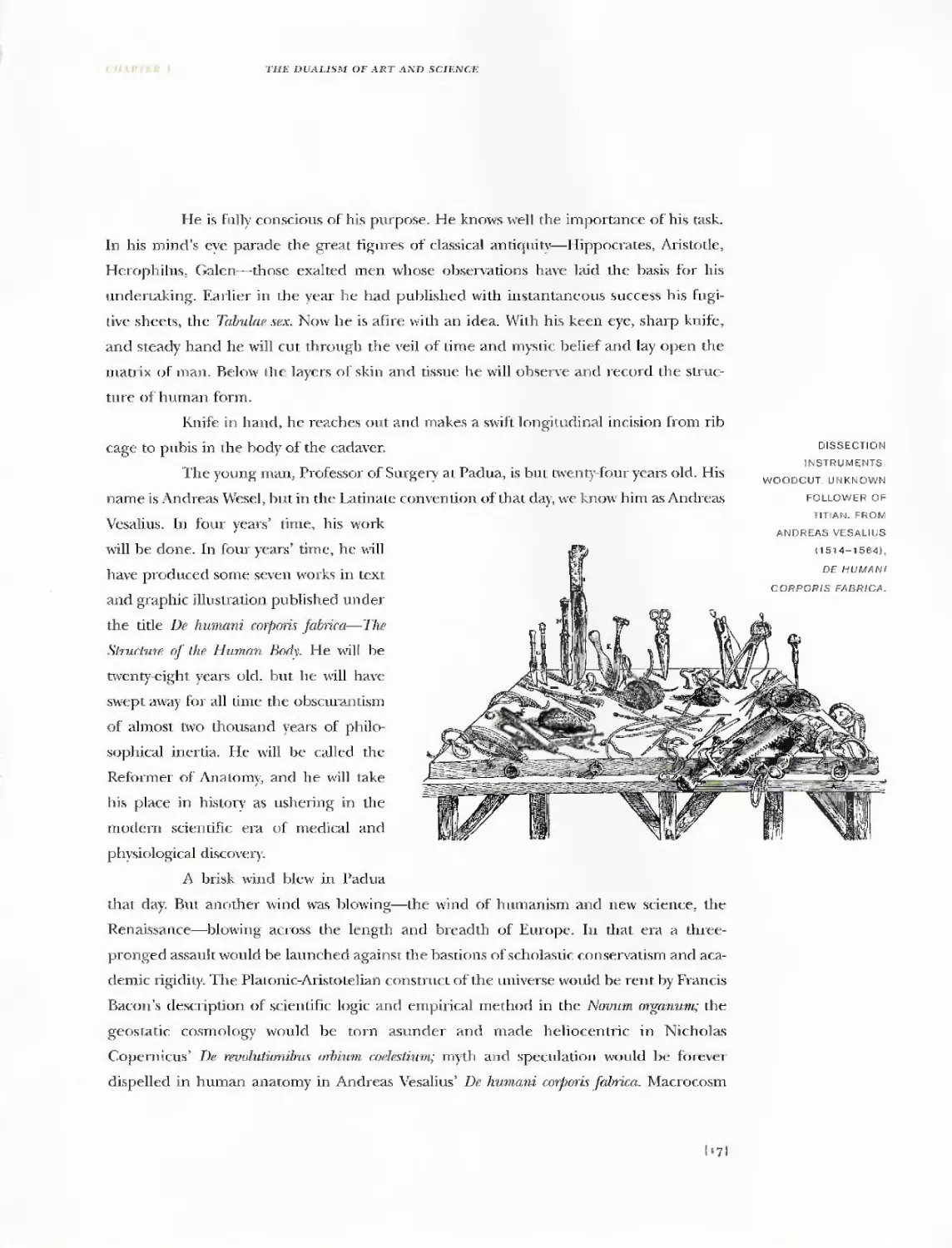
DISSECTION
INSTRUMENTS
WOODCUT UNKNOWN
FOLLOWER OF
TITIAN. FROM
ANDREAS VESALIUS
(1514-1564),
DE HUMANI
CORPORIS FABRICA.

nrsAMic iNATOin
and microcosm—the deterministic mover of the universe superimposed on the
predestined behavior of man—held together in a fixed logic, of idealist dogma, would
come crashing down. Renaissance thought, from that day to this, would introduce a new
advance in the rational powers of man, and new light would be shed on the
phenomenology of natural causation. The Augean stables of the mind would be reach for the Tiber.
Thc scientific revolution of the sixteenth century was an intellectual
breakthrough of such magnitude as lo compare with the greatest achievements in human
history. Not since the rise of Greek civilization had its like occurred. Renaissance humanism
had signalized the end of the Middle Ages, and the hierarchy of social formalism was
crumbling. The emancipation of the individual from feudal servility presaged the dawn of
democratic institutions. The age of science had begun and the early outlines of modern
man had appeared on the stage of history.
Profound as the breakthrough was in medicine, mathematics, physics, astronomy,
and natural science, the achievement in art was equally spectacular and dramatic. The
Renaissance inaugurated an entirely new concept in expressive form. It was not so much a
change in subject matter as it was a working out of new solutions to older problems. The
themes were scriptural still, but the stress, the emphasis of its approach, was the portraval
of religious ideas as episodes in human history. God as man and man as humanity were
extolled as the aim of art. The impact focused on die deeply felt human experiences of the
dines, and revealed the personal significance of faith. In this sense, the new art ceased to
be withdrawn, austere, symbolic, essentially decorative in character. Instead, it became an
innately human, warmly imagistie, pictorial art. Tt served a moral purpose through
education and reason, rather than through fear and obedience. Scientific discovery,
breakdown of feudal barriers in social structure, and the increased importance of the individual
persona led to the profound metamorphosis in Renaissance art.
Fundamental to this change was the naturalistic representation of the human
figure, the primacy of anatomical man. From this premise, concepts of form, space, and
design structure in the two-dimensional flat surface of the picture were subjected to the
rationale of scientific method and analysis. Thus, the investigation in medical anatomy and
physiology through human dissection led to a powerful insight in artistic anatomy and the
rectitude of human form; the mathematics of navigation turd exploration, contributing a
geometry of space instead of planes, touched off the development of visual perspective in
the control and measurement of the third dimension; the new heliocentric astronomy
<i8l

THE DVALISM OF ART 4.\'« SCIENCE
Sib..
Jk£
/:.*.
V**:
/
/
-^'■'-A
-. W
Mr
■-- -'--.;
CX
B5^.
"**^-
4
i
7
JU.
■«■ y\
-V^T^
if.
""*■- - ".'■'. - •'■■ ,
*■>! »»■-
■;n:%- t?^
jf,
^*i"
■ .St."-. ^
.#
r
/>
K
^
-J*
J.,:
"^^ ,■■_■ -v- V
* ;%&
CREATION OF ADAM (DETAIL). FRESCO.
MICHELANGELO (1475-1564)
ITALIAN. SISTINE CHAPEL CEILING,
VATICAN, ROME.
fig!

DYNAMIC AN.\ 1 f).Vf 1
projected motion of the body and dynamic foreshortening of the figure in deep space;
celestial mechanics, theories of the interaction of mass, space, and energy in physics,
provided weight and solidity of form, and shot through diagonal tensions and thrusts in design
structure; the gravitational iicld of the planetary system put the ground plane into the
picture (objectively analyzed for the first time in history); interest in natural science produced
an awareness of botanical form, correct description of animals, and atmospheric recession
in landscape and environment.
The revolution in art, concurren t with the revolution in science, was directed
toward one overriding aim. The artists of the Renaissance gave visual expression to reason
and nature in the birth of human form. Elemental man, his surge and drive, his passion
and repose, pulsed and beat in the supernova of the intellect, the transcendent mirror of
the age. What made the sixteenth century so remarkable was its departure from the
stultified application of static conventions. Its essential idea was an expanding aesthetic,
concentrated on the observation of man's continuity with the unity of nature. Thus, very
shortly, the dynamics of their concepts led them from one discovery to another in their
penetration of human experience. Empirical science and natural process became an
ongoing philosophical principle of art.
According to the new criteria, the strictures in earlier Gothic art were held up
for close scrutiny and revaluation. The austere iconography dissolved in a proliferation of
concrete experiences and physical realities. The human figure was the first to change.
Slowly the individual emerged. Cimabue, Giotto, Masaccio felt him—his suffering, his
ecstasy, his terror. Anatomy galvanised the wooden forms to life; nerve and sinew writhed
with energy-; the man of hope, of tumultuous passion and grandeur surged on the scene.
The Creation of Adam in Michelangelo's Sistine fresco is the appropriate analogue of the
time. The seasons, the weather, the time of day; youth and age, manhood and womanhood,
birth and death; the growth of things, the cycle of life began to appear in art. Leonardo,
Raphael, Giorgione, Titian. Tintoretto saw the mysteries of nature, atmosphere and light,
serenity and tenderness, poignancy and pathos. In the West, the moral principles and
ethical values in personal behavior prevailed in the van Eycks, van der Weyden, Bosch, Diirer,
Grunewald, Brueghel, and El Greco.
The seventeenth century, pressing closely on, took a new leap into the future of
the individual in art. A quickening process of scientific research, transitions in society, and
new philosophical concepts brought forth the human portrait, individual man in his
ordinary environment and specific locale, f he baroque era, projecting the great age of
portraiture and the landscape in art, realized in visual terms the discoveries of Galileo,
(20)

THh nUAIISit Or 4.RT AX1> •SCIENCE
Kepler, Descartes, and Newton on the mechanics of motion and universal gravitation,
geometry of motion, optics, and the spectrum of light. In the philosophy of Hobbes,
Descartes, and Spinoza it sustained and exemplified the importance of relative human
intelligence, basing universal law on science. Coincidental with these, the solo instrument,
the aria, the recitative proclaimed the individual consciousness in music. Tn its portrayal of
human warmth, baroque art synthesized the pulse of anatomical man with Harvey's
discovery of the circulation of the blood.
The baroque was an art of realism, the realism of human personality, the
insight into the character of man. In its genre, its grace, its elegance, it had the essential
"human touch." In its air and space were the flashes of the daily lives, the activity, the
work. But its tour de force was its play and counterplay of light. In its chiaroscuro was
revealed the human drama, the moods, the lightning and thunder of the emotions of its
people, the living people. In Velazquez, in Rubens were the courtlv, the refined, the ease
and grace, the jov of life. In Vcrmeer and de Hooch, the gesture, the tilt of head, the
eyes in greeting—in response, in reflection, in repose. In Hals, the laughter of men and
women, the cry of children. In Rembrandt, the poor, the lame, the bent, the bemused;
the stertorous sounds, the cough, the suspended breath of trailing wonder and doubt;
the sustained, pervasive sense of time, the unutterable poignancy of life. And always the
landscape—the fields, the clouds, the sky; the locale of house and garden; the things
of work and rest.
The dualism of art and science, from its inception in the Renaissance, had
created a cyclical system of broadening aesthetic dimensions. As the boundaries in scien
tifk and human activit\ widened, so did the boundaries of artistic endeavor. The process of
intersection and correlation in religious, social, and human affairs had been an accepted
premise in the progress of art for more than two hundred years. Now a stasis began to set
in, an imperceptible slowing of the process. With the rise of powerful monarchies in the
conflict and consolidation of power, the dualism of ai t and science began to show a
cleavage. What has been called the rococo period in art of the eighteenth century was, in
efferl, a crisis in the relationship of art to the progress of the individual in his time—a
concept that the baroque era profoundly fulfilled in its awareness of human worth. In Francis
Bacon's words summarizing the aspirations of the preceding periods, the works of the
Renaissance and the baroque eras stand revealed: "On the observation of nature we shall
build a system for the general amelioration of mankind."
Toward the end of the seventeenth century scientific pursuit had begun to shift
from an act of faith in the improvement of mankind to an increase in scope as an activity

Dynamic: anatomy
s&»
THE VENOUS SYSTEM.
WOODCUT. UNKNOWN
FOLLOWER OF TITIAN.
FROM ANDREAS VESALIUS
(1614-1564). DE HUMAN!
CORPORIS FABRICA.
■mm
Hi

THIl DUALISM Ol- ART ANV SCIENCE
of enterprise and a utility in commerce. Leibniz, philosopher, mathematician, and adviser
to Frederick 1 of Prussia, extolled this view with decisive clarity; the role of science is
necessary as an instrument of policy in the perpetuation of the state. The dualism of art
and science in the earlv eighteenth century was in tension and transition. Concepts of the
figure developed generally along three broad lines of expression. The art of the nobility
and aristocracy presented a mixture of thinly disguised, taut contradictions. As spatial
volume and recession of planes moved deeper, thematic concepts declined into the
superficial, the shallow, and the banal. Color and brushwork intensified and became more vivid,
while form became fugitive and insubstantial. Rococo an in the aristocratic mode had
become a plaything of princes, a decor of palaces, a reflection of opulence. It had become
an art of adornment, of miniatures, of preciosity in intimate decoration. It had become
an extension of effete and courtlv refinement, of mvthical-classic concoctions, of fool-the-
eye pictures and hallucinosis of vision.
It was in the middle class, in the growing commercial power of the bourgeois,
where the firm note was struck. Here, the aristocratic leadership yielded to the burgeoning
prestige of middle-class taste and patronage. In portrait, landscape, and still life were
presented the substantial new class and its ways. Because it was a section of society mainly
concerned with mercantile interests, the themes of home, surroundings, and family
interest—landscape and still life—gained in importance as subjects of art. Aristocratic
efflorescence waned in the sensuous fulrninations of Van Dyck, Fragonard, Watteau,
Boucher, Tiepolo, and Gainsborough. It surrendered to the less spectacular, more vital
products of Constable, Hogardi, Ronrney. Raeburn, Chardin, and Turner. In America,
the broad stream of social movement influenced the orderly art of Coplev, Stuart,
West, and Trumbull.
BuL the dislocations of life in the eighteenth century brought out a third
movement in art, a line of argument, as it were, of satirical criticism and savage social
commentary. Investigations of science in new fields in physiology, enibrvology, and
microscopy, as well as observations of phenomena in human affairs, led to liberalism, free
thought, and social examination in caustic art and literature. Art became both literary in
subject matter and naturalistic in treatment, in Greuze and Longhi. Rut emotionalized
exaggeration and caricature of the figure was its end product, and its most energetic
expositor was William Hogarth.
The end of the era gave rise to a series of social shocks that had deep
repercussions on the development of art. Scientific invention produced the Industrial Revolution;
social invention produced the American Democracy arrd the French Republic; artistic
123I

D V.V.4 MIC .4 MA TO If \
invention produced the pictorial reportage of immediate human events and advanced
the movement toward modern realism and political canooning. Gova, like the towering,
brooding Colossus of his etching, turning to look backward at the past, was about to move
into the future of a new age with the thunderous intensity of a new concept of theme,
form, and stvle. At the apex of his powers. Goya crossed the bridge of a new century, a new
age in .society, and a new art. The link had been forged; the eighteenth centurv rushed into
the nineteenth; and a conscious symbolism of subjective emotionality and distortion
showed itself in the human figure.
It was left to the Napoleonic era to fix irreversibly the lines of demarcation
between the earlier leanings of the genie realist baroque and the aristocratic rococo baroque
into two antagonistic movements; the academic respectability of Napoleonic-classicist art and
the genre libenarianism of romantic-realist art. The tendency to concentrate on subject
matter and argument of viewpoint in thematic material gave both movements the characteristic
of immediacy in the portrayal of events. As such, personalized adventure and melodrama
became an important feature of art, and in this they were the forerunners of modern
magazine illustration. The two movements were notably marked by the recurring thrusls and
couiitcrthrLists of their diverse positions throughout: the Napoleonic era. Essentially, it was a
contest for the opinions oi men; the drive toward egalitarian nationalism against
conservative authoritarianism. On the one hand were Gova. Gericault, Delacroix, Daumier, Forain;
on the other. Cms, David, Meissonier, Ingres.
The principle of art and science as a dual relationship had been undergoing
an estrangement. Now, a dislocation was evident. The fracture between an and science
was the reflection of a deepening dichotomy within the general field of science itself.
Scientific pursuits had become largely an activity of commercial enterprise, sanctioned and
supported through ihe benevolent authority of the state (Leibniz's view realized);
academies of science, especially in the physical and normative sciences, were the proper official
bodies through which the leading figures pursued their endeavors and received official
recognition and commendation; refinement of observations, verification, and
quantification in proof of earlier accepted theories were the dominant, recognized lines of inquiry
in the controlled academies. However, new scientific inquiries and discoveries in the
humanist-Baconian tradition, as well as investigations leading to the emerging human and
social sciences, had no official sanction or status, and were \iewcd with suspicion and
hostility. Findings in the progress of the individual were frequently not considered science
at all. They were bitterly fought in academic circles. Bricfh. we may observe the acrimony
directed against such familiar figures as Darwin, Huxley, Pasteur, and Freud.
1*41

lHt. DIAL1SM Ot AR1 1AI) SCJiACA
Aii almost identical correlation emerged in cultural and artistic circles. Toward
the latter half of the nineteenth century, the academy of ari, with its proud reliance on
state sanction, arrogantly rejected those artists (in France especially) who did not adhere
to the well-defined strictures of ncoclassicisi concepts in thematic material. Technique,
manner, form, and style. Critical romanticism, stringent realism, and commonplace
impressionism were held up to ridicule and disfavor as extolling llie crude, the vulgar, the
gauche in ait. The rebellion against the academy was precisely in those areas of greatest
academic divergence from the humanist-Baconian traditions in art, in revealing the
human condition of the times. Academic denial, lack of patronage, and public disaffection
led to poverty, disoiieniation, and alienation among the artists of the period. Extremes
of personal rebellion, bohemianism, escapism, and mental breakdown wracked their lives.
Toward the end of the centitrv, the Prussian invasion of France, the downfall of the
decadent monarchy of Louis Napoleon, and the crisis in the emergence of the Third
Republic brought the artist and his art 10 a mining point in history.
In the on rushing tempo of the industrial age and the weltering disorder in
personal life, the artist seized upon two exponents of the importance of the individual as
aii answer to his social rejection and moral anguish. The late nineteenth centurv posed ihe
riddle of man's existence in a historical frame of reference. Is man free or determined? In
the eighteenth century, the artist beliexed man to be free to think, to reason, to determine
his own existence in nature. Now, in the nineteenth centurv, this belief was challenged
head-on in the confluence of shocks and crises. The alienated artist saw himself as a unit
of life in a mechanistic, determined, materialistic world. His answer was to seize upon two
concepts of the individual: Bergson's philosophy of vitalism, asserting the life force in the
individual to be a positive, conscious act of will in governing his present existence; and
Freud's psychological investigations into the character structure and personality behavior
of the individual, revealed in conscious and subconscious states of being. He saw an answer
to the dilemma in his personal existence and artistic creation. In assuming the principles
of Bergson and Freud, he constructed a self-contained, introverted, esoteric world. In the
anguish of his soul and the torment of his psyche, he created a spiritual-psychological
unity, an intuitional-emotional autonoim.
Go\a, the progenitor of the modern movement, had reaffirmed the humanist
objective to the harsh realities of life in symbolic form, expiesshe line, and emotional
power. But the impact of the intervening years had left their mark on the progeny of the
protean Goya. Postimpressionism, fauvism, cubism, expressionism, seeking refuge from
the responsibilities imposed by the technological complexities of the twentieth centurv,
',23!

DYNAMIC ANATOMY
withdrew into a subjective world of egostatic calm, intellectual repose, voluntaristic
excitement, and psychoneurotic release. The long road of achievement in art, of communication
to men, resolved through the unity of art and science, had come to the edge of a precipice.
The dualism was finally ruptured. The crevasse of despair opened up a gulf of conflicting
states of experience, of frustration and anxiety, introspection and empathy, conscious and
unconscious strivings, disjunctive, half-realized momentary appearances and esoteric
symbols of experiences. Anatomical form, the ground plane, principles of reason, spatial
structure, control of depth—the world of art presented through empirical perception and
objective criteria—were at a point of no return. The primal form in art, the figure of man
had become a prisoner of the ego. held incommunicado in a noiigravitaiioiial space
void. The artist had rejected science in art.
| 26)

■ .■. v* ■•■■■*.'i * - T-$rC- ■ -- ■ - - -
***** **.- -■■'■'i- *9®^*^>W"
3T
^
4
■ ' "c:,* ":

II.
OLEMIC
TOWARD THE
LIBERATING
CRITERIA OF ART
, i'i hi on any day of the week except legal
holidavs. ihe typical art museum anywhere in the country is open for yisiiors. The entrance
hall usually leads the average aficionado of art through a scries of galleries in orderly
progression from one imposing collection 10 another, presenting the visual histoi) of
civilization, the drama of the human mind. As far back as man could reason, bis works are
there: evidence of the Neolithic, the dawn of civilizations, the antique remains of dvnasti<
power, the classical traditions, the intervening lines of humanist development, the
Renaissance and baroque flowering, to ihe most rerent acquisitions of modern and
contemporary art; they are all there, more or less, in periodic array. As he progresses
leisurely through the halls, the visitor is led through a process of transitions in the ages of
man. He is hardly aware of the changes, vet their impact, gradual and moving, is not lost
on him. He correlates the concrete visions of the past into a stirring processional of events.
As he reaches the modern age. his eye is delighted with the radiance, the
luminosity, and jov of impressionism. Yet he is vaguely disturbed bv its unmannerly
sketchy appearance, its random sponianeiiy, its lack of finish, its seeming amateurishness.
Tlien, as he crosses the threshold to the new art, to postimpressionism and beyond, deep
into cubism, expressionism, abstraction, and surrealism—their derivations and deviations—
the alarm hells begin to ring in his head, the sirens and the fireworks go off, and our
aficionado of an—who is not a snob, by die wa\—is left in a morass of helpless confusion and
dismav. The even tenor of his mood is disrupted in the colorific visual violence, the
aesthetic assault from the walls. The simple progression is gone; the contact with life is
demolished in a pyrotechnic profusion of unrecognizable fuhninaiions.
f*9l

DYNAMIC ANATOMY
In the art of the past, there seemed to be no line of visual expression our
visitor to the museum could not follow. No matter how far back, even to Paleolithic cave art,
he could trace the thread, the primitive urge, the historic need, the humankind- At times,
the line stretched thin and tenuous; at others, strong and firm. But always it was there for
him to see, a long unbroken line of human succession, linking a vast reach of time,
twenty thousand years of change. Now in his own time, in the day when the visitor and modern
man have arrived at a new age of invention and discovery, recognizing the demand of every
human need and the promised fulfillment of ever)' human dream, the historic line of art
communication in human understanding, imperative now more than ever before, has
broken down. The new art that thundered down at our receptive visitor to the museum is filled
with an eclectic diversity of forms—biomorphic, kinemorphic, psychomorphic,
mechanoinorphic—all of them intensely personal, subjective expressions of inner states of
being. The figure in art, the highest expression of man's visual creative powers, the subject
of twentv thousand years of painstaking search, has been reduced to a number, a cipher,
an esoteric symbol, a kinesthetic impulse driven by a primitive-emotional urge. Today,
anatomical man, for all artistic purposes, is dead.
Art, in the mid-twentieth century, is in a period of critical transition. We are
seeing today an extraordinary concentration of effort and energy in the visual arts never
before experienced at anv time in history. Never has there been so widespread an
interest, never have so many individuals participated actively in its creation. Never have we
had so much contact with art of all kinds—art from the dim reaches of time, art from
across the oceans, art of primitive peoples; art from the past great eras to the modern era;
fine art, commercial art, industrial art, technical art, experimental art, psychological art,
leisure art, amateur art. It would appear we are seeing a great, new Renaissance in visual
art, for in the volume of art cieatioii we are witnessing a cultural phenomenon of the
first magnitude.
In the frontiers of knowledge and culture, art may be said to be in its heyday
of exploration. The exploratory fervor of the sixteenth century, using new logic, new
mathematics, new science, opened the unknown areas of the world to commerce and
physical contact of peoples and brought out a treasure of artworks to the Western world, which
only now. in the twentieth century, is being experienced by artists in our time. Like the
riches of the East in an earlier day, this influx of art is beginning to be seen, felt, and
assimilated. The day of global exploration is accomplished. Now has begun the day of cultural
exploration, some five hundred years later. Yet never has there been so much confusion in
the arts as diere is today
l3°!

IHI'IH (I
TOWARD THE IIBF.RATI'vG CRIILRIA OFAKT
The twentieth-centurv artist appears to be in a state of conflict and disorder. He
has a world of art to explore, yet he shows no pmpose, no goals. lie seems to have lost his
sense of direction as he ranges across the uncharted art frontiers. He has rejected the
compass; he has thrust aside standards, criteria, definitions; he has renounced science as a tool
in the discovery and development of art. He has rejected the human need to relate, to
communicate the results of discovery.
If we recognize it is the mission of science to define with clarity and precision
the workings of the universe, to relate with order and hannony the new concepts of time,
space, and energy into new and better ways oflife, we reach the conclusion that science is
the most powerful instrumentality in the progress of man. To the artist, however, science
is considered an invasion, a hindrance, a stricture upon his free and personal
interpretation of the world. He sees the scientist as an intellectual instrument—precise, logical,
mathematical, mechanical. He sees himself as a sensitive organ of feeling, emotion,
inspiration, and intuition. As a result, the artist rejects science and scientific thinking in the
projection of art. Art to be pure, he reasons, must be devoid of science; feeling is not precise;
emotion is nol mechanical; inspiration is not logical; intuition is not measurable—the
artist is no scientist. Attempting to distinguish the work of art from other works oflife as a
(S'l

DYS'AMIC ASAIOMY
refinement of cultural endeavor, distinct and separate from the ordinary and commonplace
necessities, the artist has in effect said that science prods and pushes with the workaday
things to build a better mousetrap, while he, the emotionally endowed aesthete, represents
the inspirational work, rhe filtered aesthetic reflex of societv, the fine arts. It is a neai trick
of turning the tables; the bobeniian wastrel and garret outcast, through intellectual
legerdemain and bootstrap levitation, has become an individual of a pure kiud. In this
suite, he rises above plebeian strivings to a position of sophisticated recognition aud social
grandeur, and from this remote pinnacle surveys the marketplace mediocrity below.
How devastating and destructive a view this is can be gauged by the fact that in
every other area of modern life, in every field of endeavor, science merges easily,
compatibly, productive!)—except in the visual arts. Only here is the view held—by artists of all
idioms, indeed, the whole of contemporary societv—that science and art do not mix, that
they are mutually contradictious, irreconcilable. Yet this is a distortion of the truth, a
delusion, a self-imposed deception, a retreat from life.
The dislocation of art and science has never been so apparent as it is today,
almost a hundred years from the time it Fust revealed a disturbance in the continutt) of art
communication. The impressionist rebellion, the last flower of the humanist spirit of the
Renaissance, still exhibiting its attachment to scientilir precepts in its spectral light and its
recorded observations of the momentary life of the people, their work, recreation, and
leisure, was too weak a movement to triumph over the entrenched authority of the
regressive trench Academv. When ir withered and died after twenty years of frustration and social
exile, the deep space of the picture plane became a barren shell; the landscape closed
down into a two-dimensional decorative pattern of shapes; the vibrant pulsating figure, the
human analogue, shrank and hardened into an artifact, a constructed intellectual object;
the artist's emotional power and insight in human affairs subsided into symbolic outcrop-
pings of tenuous moments of excitation, apprehension, or despair.
In their seizure upon the "immediate'" and the "personal," the followers after
the impressionists disengaged themselves from every known principle of spatial structure
and design. They withdrew from earlier concepts of form, value, color, and image. They
worked toward the total rejection of the Academy. In their hatred of the "academic," they
extirpated the scientific legacy of art,, carefully nurtured and marshaled over fifty centuries
of historic development, and erased it in a short span of fifty years. In then need to rebel
against the "academic,'" they rebelled against science. They proclaimed the distinction of
the "tine arts" and gave it to societv as a new description, uniquely different from
academic art or the utilitarian commercial art. They picsented to the entire contemporary
lS*l

J OH iPD TTII-. I IM.RATTXC. CRTTKRT\ OF ART
generation of societv and the artists who followed Lire doctrine that "art" was above
scientific discipline, above definitions and criteria. The need to communicate in art, to be
responsible for the exchange of art experience into htiman experience, was consideied to
be an anachronistic demand of aggressive academic vulgarity, and was held beneath
contempt. The rebellion against the "sterile," the "mechanical," the "academic"—truly a
human crv of anguish—bad become a distortion and a delusion. The fine artist had turned
his back on reality. He became an incoherent high priest of good taste, an absolute arbiter
of egocentric mirror-image art, a mclancholv, involuted microcosm turned in upon itself
to an inevitable dead end.
Yet the impulse to art is mi question ablv the impulse to life. The art process and
the life process are an indissoluble entitv. The components of one are the components of the
other. Thev raav be uneven, but never alien; thev may be out of joint, but never out of union.
The need to create, to svnthesi/e experience, is a primal force in art. Because it is the
133!
rwo men.
LITHOGRAPH.
FERNAND L.EGER
(1861 1955)
FRENCH. COLLECTION
MUSEUM OF MODERN ART
NEW YORK (GIFT OF
EDGAR KAUFMANN JR)

mrwAnir. 4wiowy
distilled essence of perception and experience, art needs its adherence to life. But the
work of art of today needs, more than e\er before, the energizing transfusion of
commonly .shared experiences. It needs a conscious agreement with the cross-fertilizing, wider
empirical objective.
Artists of todav stand at the crossroads of immense opportunities and
possibilities. What thev ha\e discarded earlier in the scientific discipline of art as academic,
inhibitory, and repressive of free expression they now subsiitute, strangely, with new
science! In their search for a new basis of art without restraints, thev lav hold on the
world's storehouse of art, which they now have at their command. They feel the impact
of new scientific fields and attempt to resolve these in visual terms. Virtually the entire
gamut of human and social discovery, scientific and technical advances have found their
place in the free interplay of the design structure. Never in the entire history of art have
so many variations of art expression occurred in a single given era. The range of
concepts and movements is truly enormous; even as this is being written, new ones are
being born. The listing of a few at random is to indicate the multiplicity of reactions to
the technical-scientific-analytical age.
Thus, starting with impressionism, wc have: pointillisni, neoimpressionism,
postimpressionism, fauvism, cubism (analytical and synthetic), expressionism (three
schools, perhaps more), Orphism, surrealism, abstraction, dadaism, futurism, nonob-
jectivism, neoplasticism, constructivism, purism, Bauhaus, primitivism, social realism,
dynamism, abstract expressionism, abstract surrealism, mobiles, stabiles—and on and
on, et cetera. The list seems endless. In these definitions can be seen some, of the
descriptive leads to the larger environment of the age, where the art form has
attempted to embrace psychology and psychoanalysis, natural history, biology, chemistry, physics,
kinetics, mechanics, engineering, archaeology, anthropology, microscopy, telescopy, etc. In
the Fission and fusion of two-dimensional space, the artist uses science pragmatically, expe-
rientiallv, without whole concepts. Nevertheless, it forms the basis of his art. But it is not a
complete art. For, in the practice of it, the artist simultaneously rejects the existence and
influence of any scientific rigor, control, criterion, or standard. His art, perforce, without
objective direction, releases a welter of exquisitely personal, eclectic minutiae.
If we quickly scan the art horizon and examine the amazing output of art
today, we find endless experiments in textures; inconclusive shapes, masses, forms;
positive and negative space; tensions of line and mass; contrasts in color; line variations;
eclectic working together of art old and new; cell structure; automatic writing—endless,
precious, purist variations, powerless io come to grips with itself, to proclaim any
I34J

1 \ p 11 • II
fO\%ARD THE LIBIlRATIXC, CRITERIA OF ART
direction or value judgment for others. The figure in art—always the touchstone of the an
of any era—has become the visual admission of the artist's failure to tope with the ethical-
moral, social-human needs of our time. It is a symbol of dislocation and depersonalization;
the ideograph of the alienated man, insecure, lonely, without fiber; the portrait of the
artist, the autograph of the author.
Probably the most disturbing phenomenon in the art of the current century, a
result of the dislocation in die dualism of art and science, is the profoundly pervasive
indifference of the whole contemporary generation of artists to formulate a clear-cut definition
of art itself. The obscurantism, the evasive arguments and denials, the lack of anv direct,
forthright statement, is evidence of a deep-going crisis in art. With the exception of a few
scholars, nowhere in the field of art has there appeared a challenging assertion to sav what
art is in our time.
In the social arena of modern living, the most engaging diversion is the
extensive practice of generalized and personal analysis. Because we live in a technical-
scientiftc-analytical age of calculating machines and statistical truths, we respond to the
powerful pressures of analytical behavior—to define, to clarify, to identify. It is a great
game of analysis; dissection and decortication of the underlying mechanisms in every'
segment of the social structure, from psychoanalysis 10 social .surgery. We practice the
analytical game everywhere except in the. fine arts. Heie, in die arts, the emotional fog rolls
in, intellectual inertia overtakes us, and the cultural swamp remains undefined,
unexplored. Words like style and taste have no clear meaning except, perhaps, in commercial
usage. And the special caste terminology—feeling, intuition, inspiration, perception,
creativity—arc ritualistic ceremonial expressions of artists, undefiled by simple definitions
except in the laboratories of clinical psychologists.
The special word art is a sacred temple, a mysterious inner sanctum of artistic
pursuit, where magical intellectual powers interact with primordial outpourings of the
irrational subconscious. Paraphrasing Thucvdides, who has put it abruptly: When common,
everyday words lose their definitions and meanings, there is a general crisis in a given field.
To go further, when ail terminology has lost its power to convey sense, idea, or meaning
of art expression, then the artist, the art field, the whole cultural endeavor, is conflicted,
confused, and disordered; it becomes a chaotic wasteland, a lost continent of the culture.
The net result has been to let loose a carnival of art dilettantism and chi-chi art
sophistication concealed behind an imposing front of synthetic rhetoric, aesthetic lyricism,
and emotional bathos. The state of art today is such that it can now be performed bv tyros
and amateurs with virtually no study, preparation, or training. In galleries and exhibitions,
135)

(M NAiUC ANATOMi
;"*■/
KJi.
r - -r-^
"vj
DOLL CARRIAGE
PAUL KLEE
(i 879-1940) SWISS
COLLECTION MUSEuM
OF MODERN ART-
r:<r
'-\
ft
^^—** iv- * '. IfCS^-?
V*
-^
;Ar
f36!

i. Il\l'l ll< II
J'OUAKC lliii LIBLRATIXf, t Rl 1 LR1 A Ot Ml
the amateur aesthete can now compeie on equal terms with the seasoned, knowledgeable
master with such facility that hardly anyone, frequently not even art. connoisseurs and
critics, can tell good art from bad art, amateur art from professional art. When the quest for
hre\ity and simplicity has been reduced to infantile primitivism, we have losi the validity of
concepts; when the creative urge to reveal life has been distorted into a waywaid surge of
undirected energy, we ha\e lost control of direction and experimentation; when the search
for clarity and order has been diverted to piecing out a meaningless jargon of amateur
misbehavior, we have lost, our artistic heritage; when the need for definitions, standards,
and criteria has been seduced by vacuous emotional mumblings, we have seen the
perversion of the philosophy of art and aesthetics. When the artist has surrendered his status, his
authoiitv, his principles, his professionalism, then the amateur has taken over, and the
jungle is upon us.
The problem of the amateur in art is really the problem of the artist in society.
To say that the amateur has invaded the arts, and that the fine ails are becoming an
amateur art, is to say that the artist has defaulted in his obligation to the social environment.
But this view alone does not face the issue squarely, for it would force the conclusion that
die artist alone is responsible for the neglect and deterioration of art. To sav that the artist
has rejected the norms of living, has removed himself from society, has turned away from
reality to promote his inner personal image of life and art-foi-ait's-sake isolationism, is to
say the exile prefers the desert, the suicide enjoys cutting his veins, the tortured man
relishes his anguished cries for help. In truth, these are but the pathetic attempts of the
withered, truncated man to become a whole man. The issue at hand is really a dual
problem; it is not only the artist's inbreeding and involution—it is also society's forced
estrangement and neglect of the artist, li there is a crisis in art, a disintegration of its moral
fiber, a decay of its historical precepts and philosophical virtues, it is because societv fast has
disavowed and disabled it as an intellectual resource, a cultural necessity, a social and
educative force. It has refused its permission to be integrated with the technological, scientific
advances in our time, except as a utilitarian, commercial, ancillary art. To engage a solution
on this basis needs a moral reawakening of societv and a conceptual reworking of ail.
The reestablishmem of self-control in the artist and social respect for art
devolves on creating again a new dualism of art and science in the twentieth century, flic
obscure terminology must be clarified and attached to commonly shared associations;
personal values must be defined according to generalized experience; the personal subjective
purpose must be widened to embrace the broader social goal. The immediate and urgent
necessity, the first order of the day, is to redefine the old word ail. The cliches, the
<37l

D J ,V.\ MIC: AXA TO 41V
nonsense, must be stripped off. Art must have a new interpretation, infused with new
meanings and values, in order to find its equal place with other positive cultural pursuits
in out time. It must mean as much to the population as medicine, surgery, bacteriology—
or physics, engineering, architecture—or steak, mashed potatoes, apple pie. It must be
executed so ably and understood so well that it will stand strong and firm as a skyscraper
does when it is done well—or it will collapse in ruins when it is not. Art must be refined
into a critical intellectual loo] to meet these challenges. New cutting edges must be given
to die old "saw," fine-honed and sharp, diamond-hard and tough, to stand up under the
friction and abrasion of life. To be "art," it should be made responsible for communication
of its ideas and concepts; it should reflect the life and times of the artist, his integrity, his
ethics, his democratic ideals in the progress of man; it should show his developed skill and
judgment in projecting significant, expressive form; it should reveal invention and
originality in transmitting the aesthetic experience; and, above all, it should arise out of die
environment, the social-human-scientific culture base as the controlling factor in its creation.
This does not mean that strictures or rigid conventions must be placed on the
artist; nor does it say that experimentation or freedom in personal expression should be
curtailed or abrogated: nor does it propose that there is only one wav of seeing the world
around us, one outlook, one style or method of approach. It does not ask the artist to obey
or be subservient to any fixed rule, regulation, dogma, or tradition. It does not set up
absolutes of authority or impose conditioned reflexes of conformism. However, it does ask
the artist to respect and rely on the positive norms, values, and traditions that still operate
and still function in the study and preparation of the artist, thai still apply in the cultural
background of modern art creation. These should be seen as the educative resource, the
imperative precondition for the survival and growth of art.
Socrates, we are told, attempting to probe into the nature of law. speaks of the
laws of men as a response to the social pressures that, arise out of human conditions in the
natural environment. And therefore, he argues with penetrating insight, to understand the
nature of law we must first understand the law of nature. The liberating principle of art lies
precisely here, in the Socratic approach to the conjoined relationship of two mutually
attracted, interacting forces—man and nature, nature and man. This synergistic, principle, if
we can refer to it as such, argues for a relationship of ideas, in Toynbee's words, in a
context of challenge and response, response and challenge. It seizes upon diverse attitudes of
thought, probing for intrinsic attributes of contraction and expansion, refinement and
extension; it enlarges the field of intellectual vision, and refines the area of critical judgment;
it tends to limit subjective bias and mental myopia.
(38}

i f.WII
ron\RU rut: iihfkai i.\c; aitrit.RiA <ti- iki
ff we apply the principle to one of the central problems of art. the presence of
the amateur in the fine arts, wc might uncover these provocative correlations: To
understand the amateur of art, vve must first understand the art of the amaieur; to recognize the
professional of art, we must recognize the art of the professional: to explain the presence
of the amateur in professional art, we must explain the presence of the professional in
amateur art. Suddenly, the critical questions rise to the surface: In how many ways is
professional art an amateur art? Can professional art be easily imitated by the amateur?
The way is open for other challenging assertions. For instance, that much-abused old habit,
skill: To discover the skill in art. let us first discover the art in skill. Or: To ask where the
old traditions are in modern art, we must first ask where the modem is in the old art. This
is not a mere game of idea inversions or word juggling. If it were, the new statement of
ideas in reverse would not be so sticky with uneasy, astringent meanings that quickly leap
to mind. Nor is this a conclusive demonstration posed as an answer to the problems of
art. It is an exercise of reason, an analytical approach in the examination of hitherto
unassailable notions. It might be seen as the first incision in cliche and slogan surgery to
arrest the deterioration in art.
A new dualism of art and science, if we can agree on the premise as
indispensable to art today (as it was in the Renaissance), must again seek to introduce commonly
understood criteria and standards. Wc must reestablish certain major links with the past as
historical background, consistent with art progress today. We must incorporate the old
traditions that arc still viable, still alive today. But which are the living traditions and how
can we be sure? Let us apply the synergistic principle and make an incision.
Our civilization is predominantly an advanced technical age of science. It
developed its abundant greatness from earlier civilizations and beginnings. Now. a
question: Where do the earlier civilizations appear in the modern age of science? We must
first ask, where does the modern age of science appear in earlier civilizations? The
answer seems clear: in those civilizations that have made scientific contributions. The
reason we search out the older civilizations, and attach their findings to ours, is a scientific
reason. This is true historically for our humanist-democratic institutions as well.
Therefore, the answer to the older traditions in modern art lies in the context of the
larger framework; those old art traditions that tend to live on have survived for a hwmarusl-
democralic scientific reason.
Where modern art has precisely been interested in the art of the world's
cultures, across the seas and in the past, is the human reason, the scientific reason. But it has
done this willy-nilly, capriciously, driven by impulse rather than direction. It has chosen,
13'J I

L) V V 4 AfIC A.V.-l 7 O.VJ 1
through uncritical acceptance of the nineleeuth-cenUuv artists' liostiliiy and rage against
die amilibertarian French Academv. to continue the disparagement of the scientific,
human anatomical figure as a sterile, mechanical, academic regression in art. li
pronounces anatomical man dead in art. Anaiomv as a ris^or, a discipline in the refinement
and skill of art, is debased in practice, siud\, and education. The word miatomicalis today
FIGURE. WOODCUT
UNKNOWN FOLLOWER
OF TITIAN FROM
ANDREAS VESALIUS
(IS'4-1564).
DE HUMANI
CORPORIS FABRICA.
(4»(

TOWARD THE T.TBER.XTIM. (.KI//-.KJA OI- Alt!
a tern) of contempt, and is made synonymous with "academic" in art circles. The i ejection
of the anatomical figure as a control has weakened the supportive structure of art, and one
after another, scientific criteria are torn loose and discarded. The attempts to attach "new
science" in art are essentially peripheral, tangential, quasi-scientific, makeshift
concoctions; partially realized, fragmentary developments. Art, by these new values, has become
the undisciplined arena of the romantic delinquent and die playboy amateur, while die
hard-working professional Fights for his life. And, sadly, the term modern- in an is the target
now of the unconcealed contempt and scorn of the population.
Because this polemic underscores the need to return to rational definitions of
the entire nomenclature of art and the reworking of substantive new standards, the return
of the human anatomical figure to the lexicon of art is a major condition toward the
establishment of a new dualism of art and science. The premise of the human figure does not
propose a restatement of medical anatomy. To rediscover Vesalius is uo twentieth-century
triumph; Vesalian anatomy must be given back to Vesalhis. An advance in anatomy for art
must be made in artistic anatomy. Muscle and bone structure must be left off where they
inhibit or destroy understanding of surface form, artistic and expressive form. The
anatomical figure of art must make a contiibution to the dynamics of the living figure, of
interrelationship of masses in motion, of insights into the figure to be used by artists and
students of art, not medical students and surgeons. Because life lodav is so complex and
varied, multiplying its dimensions with every passing day, the sincere, creative artist must
be quick to react with keen insight and increased awareness to the changing profile of
contemporary life. Because he must show versatility, flexibility, and diversification in
experimental behavior, he must base himself securely on the human root, the warm kinship of
his scientific brother, the consanguine association with the larger social environment.
For whatever it is worth, this book proposes that it must be done in new ways,
whatever they may be. witii respect for the human figure, the artistic ethic, the scientific
precept, the human goal.
I4'l

' ■' I
' *
\
\
\

OVERVIEW
# THE FIGURE
IN ART
HISTORICALLY
DEVELOPED
'•■ nvnvi'R m «i ^ i!) of the historical development of art generally, the
human figure presents the deepest insight into the social-cultural concepts of art, from
aboriginal tribal culture to the most advanced civilizations, past or present. If art can be
seen as the refined endeavor of human aspirations, the figure in art is its most important
expressive concern ration. The inherent problem in its artistic invention, whatever its
cultural source, is the attempt by the artist to resolve his physical experience and aesthetic
perception into a meaningful, significant visual form. But the limitations of his social-
cultural viewpoint interpose a mental screen between the countless physical experiences
and his capacity to absorb them. Thus, the artist's perceptions are refined into a
condensed aesthetic form—the art style of his social environment. To speak of a style in the
narrow sense of the individual artist is to discover personal mannerisms and techniques
in the application of tools and media to surfaces and materials in an individualized,
expressive way. Attributes of this kind are easily distinguished and are firmly imbedded in
personal works of art as much as the autograph or signature of the artist is part of the art.
lb enlarge the field of definition, however, to embrace generations of artists in a
sociological framework of culture, thai is, a given era in art, is to speak of the general art stvle
of the time. If the analogy of the personal signature or handwriting holds for the
individual artist, then the basic language constiuction, generalized expressions, idioms,
and colloquialisms could be said to belong to all the people of his period as well as to the
artist. Thus, to explain the art stvlc of an era, an overview is taken of the historical matrix
of the period, the major events and their impacts on living process and thought process,
and their general influences on artists. These are broadly chiseled, in bas-relief, as ii
were, to present the procession of the human figure in limited, significant, visual
conceptions of art.
(43)

oyxamm: amtow
SURVIVAL MAN: THE FIGURE OF NECESSITY
I'FRtOD Upper Paleolithic: Age (Old Stone Age), in Western Europe;
Aurigriacian Period if'iKi _>u,«iort b.( -h»'»'hj b.i .
backgkol nd The figuie of Paleolithic man is one of stern necessity, of hardship
and privation in a primitive, antagonistic environment. The figure he painted on the walls of
his cave or carved on artifacts of use were mostly animals—more important to him than
human figure-.. They are figures that arise out of the immediate and pressing need to surmount
the daily attrition of want, scarcity, and hunger. Because early man lived a life of personal
privation, he created concretely real, objectively important figures of animals, his figures of
necessity for survival. Figures of himself were small, nonpersonalizcd, and unimportant. To
him, his cave animals were dimensionalh real, as real as Paleolithic man saw them in physical
existence. They are not idea, spirit, or soul, but ejuended living embodiment in actual reality.
o'-r
rfH-
#
###*
- -tv^g^
KS
/>*
*
:&;&.
, i-i
■^■V->;
Il4l

T1P-J IK III
THf ilf. CRf l\ 1RT friSTOJRJCALi-J" iJi'l'tJ-OPED
/"^
1 fc-J ^7^/A <> <
\
\
0 3 \3
&
O
u>
HAND SILHOUETTES
SUPtRIMPOShD OVER
bllSON (UtTAIL FROM
A CAVE PAINTING)
SOUTHERN FRANCE
COURTESY OF
,HE AMERICAN
MUSEUM OF
NATURAL HISTORY.
WILLENDORF VENUS.
STONE STATUETTE.
KRENS LOWER AUSTRIA.
COURTESY OF
THE AMERICAN
MUSEUM OF
NATURAL HISTORY.
•S*^*V*!*£
To him, what cmtld not be experienced through concrete physical contact could not be depicted; the
depiction itself was the parallel extended physical reality. These figures are as much reality to
a primitive, pragmatic inind. and essent.ialh alive, as reflections in water are ali\e, as lootprints
arc along the muddy banks of a stream, as the imprint of a hand is in soft clay, as the shape of
buttocks or boclv forms are when they are pressed into soft earth. Early man must have
observed these phenomena of immediate, concrete
impressions, thus, they are the first recognizable
visual realizations of "form" in graphic experience in
the. history of the human race. To see his footprints as
moving, as real, as his other-same-self, to see animals
leave footprints and bodyprints as well, led to the
higher recognition of tracing the process on the walls
of his cave. Thev are. therefore, not magical but
starkly real, other-sanie-self depictive paintings of
immediate, concurrent physical actuality; to drive an arrow
into the animal figure ensured the success of the
ensuing hunt.
attributes Cave art shows in no way
abstract, symbolic, or expressive figures. They do
not in any way approach the modern simplification
of form; nor do they in anv sense employ
refinement or stvli/ation of idea. Thev are the very best

DVJV.41HIC ANATOMY
the caveman could do. His animals look more dimensionally real because he saw them as
large, powerful, and vitally important to his survival. His human figures are nondimen-
sional and flat because of his dimly realized, undeveloped concept of self in a small,
nonindividuated tribal culture. Works such as these are the prehistoric antecedents of
primitive magic figures, and they survive in the present day through superstitious ritual
practice in the analogous use of voodoo figures, hate effigies, and devil dolls.
ANCESTRAL MAN: THE FIGURE OF MAGIC
period Neolithic Age (New Stone Age), widespread in Europe, Africa, Asia,
the Americas; persists in many areas today . iui io,r jooo
background The figure of ancestral man is a magical entity, endowed with
supernatural qualities, animated with spirits of powerful ancestors and forces of nature.
Modern primitive man. like his earlier counterpart, artempts to control nature under
difficult and disparate conditions of life. With his ceremonial figures, idols, masks, totems,
and charms, used in spirit-worship rituals, he hopes to exercise control over life and
death; famine, disease, and war; fertility, bounty, atid harvest. The figure of magic is used
to control cause and effect in nature, ft is a survival of the life process after death, and a
return of the spirit powers into the life process.
attributes Ancestral man is not the living figure of actual existence as the
figure of necessity is in cave art. Because it is a ceremonial figure, animated with qualities
of supernatural existence, it is formal and strict according to ritual conventions and
traditions. It is a depictive symbol rather than an image; it leans to simplified form, rather
than the real. Its forms are undifferentiated, impersonal reductions into an abstract, rigid
format, generally symmetrical, static, and severe. Frequently, such forms may show a wide
variety of decorative motifs, but it is not decoration for aesthetic reasons or intrinsic
embellishment. Rather, it is a decoration of meaning, purpose, and use, consistent with
the original purpose of the ritual Figure itself—that is, to enlarge upon its magical
properties, its ability to control nature. Because the random forces of nature are unpredictable
and frequently disastrous, the figure of magic often shows severity, fear, tenor, and
demonic violence. More often, such Figures are inscrutable and remote, enigmatic as are
the imponderable natural forces. They are humorless as a whole; but when they show
humor, it is a terrible kind, arising from cruelty, irrationality, and retribution for misdeeds
and misbehavior toward the spirits.
(46f

CHAPTER III
THE. intiURK IN ART HISTORICALLY DEVKI.OPkD
A.
,^-
, \ \
V-t
mm
CEREMONIAL
ELEPHANT MASK AND
ANTELOPE MASK.
WOOD. BAPENDE, BELGIAN
CONGO. COURTESY OF
THE AMERICAN MUSEUM
OF NATURAL HISTORY.
!*<>
}'
"'-«.*:
^SC^a,
'It
T
r
IBEGI (TWIN) FIGURE.
FETISH FIGURE KEPT BY
A SURVIVING TWIN TO
APPEASE THE SPIRIT OF
HIS DEAD SIBLING. WOOD
STATUETTE. YORUBA,
NIGERIA. COURTESY OF
THE AMERICAN MUSEUM
OF NATURAL HISTORY
b"-irSr
1. ■ • • Jfc, » ^
as*
«■>
V _"^S'
%
%*■
it?
-■*■ ■"
v a
M7l

DYNAMIC AVATOMY
ETERNAL MAN: THE FIGURE OF IMMORTALITY
period Bronze Age, in Europe, Middle East. Asia. Americas; Egyptian, Xear
Eastern, Indian, Chinese, Early American civilizations
background The emergence of powerful, stable, comple\ societies, the carh
civilizations from their tribal Neolithic forerunners, rests largeh on four major de\elop-
ments in society: the discover)- of seeds to manage crop growing and farming; the doines-
licaiion and herding of animals to control a continuous food supply: knowledge of the
seasons and development of a calendai" to regulate farming and fertilitv; and die ability to
work metals into tools and artifacts for work, war, building, and worship. Thus, the need to
exercise magic in the control of random forces of nature through powerful ancestor
spirits was sublimated into a more developed belief in orderly, competent nature gods. The
advance in human existence brought marked changes in religion: from ancestor spirits to
nature gods, from occasional ritual practice to organized religious worship, from shamans
and witch doctors to priests and god-kings, from control of spirits for the needs of men to
religious behavior of men toward gods. The figure of eternal man thus changed from an
ancestral totemic figure representing a tribal spirit to an immortal god image representing
a spiritual activating power in the orderly process of nature.
attributes The figure of immortality tends to symbolize the fields of human
activity and belief. They show stable, developed, seminaturalistic forms, formal and static
within iheii' closed contours, fhey tend to be architectonic in structure and symmetrical
KING CHEPHREN
WI1M THE FALCON.
FROM THE MORTUARY
TEMPLE AT GIZEH GRAY
DIORITE STATUE.
FOURTH DYNASTY EGYPT
COURTESY OF
THE METROPOLITAN
MUSEUM OF ART.
-. <»
■■ «***
"-
M
*c
V
U«)

I HI: M(.i KI: JA ARi HJi / OKiC'AJXl 111 VLLVFL11
WINGED EAG E-
HEADED BEING. FROM
THE PALACE OF
AStHuR-NASIR-APAL II
ALABASTER RELIEF.
NIMRUD, ASSVRIA.
COURTFSY OF
THE METROPOLITAN
MUSEUM OF ART
V
CYCLADIC FIGURE OF
A WOMAN OR GODDESS
MARBLE STATUETTE
THIRL MILLENNIUM. B.C
CYCLADES ISLANDS
AEGEAN AREA. COURTESY
OF THE METRODOLITAN
MUSLJM OF ART.

1>Y\AMIC .l.VATOM I
in design, and project an enduring eternal appearance. Characteristically, they are
frequently made of durable stone and metals. Their placement in great temples, shrines,
sanctums, and recessed niches gives them a frontal, abstract, somewhat unnatural look.
Because they are part of the sacred structure that houses them, their position in closed
places and their frontalitv of forms show thev were meant to be seen from one viewing
directum only. Portraits of great pj icsts and rmal god figures are symbolic portraits subsumed
within the depiction of the god image with whom they are identified and whose worship
the) supervise. It is largely in this age that extensive decoration develops i epi eseiiting
natural forces thai the gods control. These are largely two-dimensional, symmetrical symbols
revealing the bounty of plants and crops, fertility of animals, power and capability in war.
YAMANTAKA, LORD OF
THE UNIVFRSE, WIT"
HIS SHAKTI BRONi;
STATUETTL. TIBET.
COURTESY OF
THE METROPOLITAN
MUStUM OF ART.
I.V>I

HM'ltK (II '111: 1-IGUKV l\ ART IlISlORICAl t.Y Dl:\ Et.OPl.n
IDEAL MAN: THE FIGURE OF PERFECTION
PKRion Age of Idealism, in southeastern Europe: Greek and Roman
civilizations U iu<\ noo F,.( |;
background The transition irom the dynastic authoritarian civilizations to
the socially and culturally more advanced civilizations of Greece and Rome rests on the
emerging relative importance of the individual, the persona, in society. Greece, sitting
astride the Mediterranean strategically close to three continents, became an early great
maritime power, inviting trade, migration of peoples, and cultural contact into its orbit.
LEFT:
APHRODITE.
ANCIENT REPLICA
1 >- «-.---*
"*"-*■_ ' -*"*''
3» *» t- "^ ■** OF A GREEK WORK.
^ , "■ ■ - MARBLE STATUE.
jj, "* COURTESY OF THE
*!? METROPOLITAN
MUSEUM Or ART
RIGHT
MEDICI VENUS.
REPLICA OF ORIGINAL
IN THE UFFIZ
GALLERY, FLORENCE
MARBLE STATUE
GREECE.
COURTESY OF THE
METROPOLITAN
MUSEUM OF ART.

WiXAMIl A \ 4 Toil V
These gave rise to the freer, more flexible, dynamic social institutions in the Hellenistic
world of soldier-citizens, democratic government, and political equality. As individualism
developed in Greece and in her later Roman prototype, rational, prescientific observations
of nature grew, and belief in the unity of man and gods in nature evoked, predicated on
the existence of Ltni\ei7>al truth. Religion changed from the worship of nature gods to
worship of the virtues and goodness of nature in gods. They believed in the Idea of the Good,
the creative cause of the universe and ideal, perfect stales of being, and laid emphasis on
harmony, mathematical order, and perfection of the universal world, in coexistence and
unitv with the personal world.
ATTRiBi.'TF.s Greek and Roman art ilius attempted to realize ideas of
perfection in men and women as gods, derived from the real, empirically observed world of
nature and universal truth. The figure of perfection is. therefore, constituted as a living
figure, conceived according to reasoned mathematical proportions of ideal criteria. Because
they are mortal and physical, these figures show carefuUv observed, personalized human
form. Their attached god-ideal virtues, however, give then) a symbolic grace, elegance, and
charm, sustained in an aura of ideal serenity and dignity. Surface form is correct, refined,
tactile, and sensual, projecting heroic attributes rather than the commonplace. The Greek
figure of perfection differs from the structured rvvo-dimeiisional fromality of Egyptian art
in the living movement of the body, supple athletic form, resilient tensile grace,
dynamically balanced in three-dimensional spatial depth—the art-style representation of
individual impoitance in Hellenistic society.

Tin: yic.TRF. t.\ mr nisi oricai.i r ijiv i;i oj-mj
ORAL MAN: THE FIGURE OF PIETY
period The Middle Ages, in Europe; Western civilization (Early Christian,
Gothic, Scholastic periods)
background The decline of Rotuau institutions and Hellenistic culture
after the fall olthe empire left Europe in a state of anarchy and decay. It was supplanted
by medieval culture in the rise ol feudalism, the revival of learning in the church, and
the de\clopment of urban centers and trade in small principalities and duchies. The
acceptance and spread of Christian doctrine brought, cohesion in languages, thought,
and culture in the West, in spite of the serfdom of people, waning princes, and chaotic
conditions of life. Christianity replaced paganism and pantheism with a monotheistic
moral religion, based on the belief that the phenomena of nature are the works of
Divine Authority, that man is the reflection of God. Emphasis was placed on the viriu-
-r.^-*—-—
crucifixion
WITI THE VIRGIN . \) . » -l . X ~'X
t > - <-. *-s » C
AND ST. JOHi',. it -i ■ ' - ?.;
, T* * V I ■ ^
BRONZE PLAQUE ' -', % " "- '* / -J- • i'±\ ;' il
ELEVENTH CENTURY - _ _.-■'! /.A^-' ■'-■ - j!
COURTESY C= THE j " *,' Jt» " %£ .Ji* = ": * " ,-T ^-^
MtTROPOLITAN 1 •' i.'A "' - ' * ?K-' l|
"Tt X t - $ -I1
MUSEUM OF ART
,'S
■ -Art -/-^ Mfc.... fPLi. *
; ,,1,, , :/.y ^. f .^
'U-
■ /
n
i~ *
****-„
f53l

DVV.l.W/C ANATOVi
oris, good life: man must choose between good and evil, the moral and immoral, if he
is to be judged for his reward in heaven or punishment in hell. The goal of man's life
was the good of his soul- his earthly bodv was the agency thiough which he would recent
the exentual judgment. The mind of medieval man was ahvavs fixed on moral values and
thoughts of life after death. Belief in the Second Coming of Christ as the first millennium
drew near was a powerful influence on him; the old prophecies of doom and apocalvplic
disaster filled his thoughts with the visions and anguish of the Lasr Judgment. The ascetic
life, the austere outlook, deep pietv, and acts of faith in response to the warnings of
earthly sin and eternal punishment, were characteristic of the culture of the age.
attributes Ihc figure of moral man, developed under the aegis of the
church, was a tenseh severe, deeply emotive projection showing extremes of fear, terror,
spiritual torment, and religious ecstasy; otherwise, it presented an expressionless,
austerely pious, ascetic spirituality in a withdrawn acceptance of fate. Because these figures
are frequently seen in niches, panels, portals, gateways, and arches, they tend to be
elongated and structured in the shallow, enclosed places assigned to them. In form,
they are strict, wooden, stylized, symbolic distortions. The feudal hierarchy in society
often rellects the hierarchy of figure sizes and figure positions according to their relative
religious significance. Thus, Christ and the saints are shown much larger in scale than
the worshipers below them. The tier perspective of this period is a product of feudal
strictures and conventions. The isolation of shapes in their encapsulated spaces
produces closed-in forms, abstract patterns within the limited depth of field. They are
iconographic symbols in meaning and purpose; as such, while they serve a decorative
end, they promulgate the idea that the church is haven and refuge from the evils of
earthly existence.
154)

CHAPTER III
THE IIGl'RF. IX \RT HISTORICALLY DKYTLOPFIi
ABOVE:
TR ^IYCH IVORY
FOURTEENTH
CE TURY ITALIAN
COURTESY OF
THE METROPOLITAN
MUSEUM OF ART
RIGHT-
THE LAST 1UDGMENT
OIL ON WOOD
JAN VAN EYCK (D. 11-51)
FLEMISH. COLJRTE;
OF THE ME_R0POlITAN
MUSEUM OF ART

L>1A IWC AXATOMV
■NIVERSAL MAN. THE FIGURE OF PASSION
PFRioi) Age of Humanism, in Europe; Renaissance era
background Revival of learning in scholastic thought of the Middle Ages,
advanced by the church in the spread of Christian belief, sought to regain the cultural
heritage of Greece and Rome after the dark period in Europe. Idealism in philosophy,
rationalism in thought, and individualism in societv were merged in the Chiistian moral
doctrine of the good life and the equality of men in the eyes of God. Scholastic philosophy-
propounded the humanist belief that faith and science could exist together for the
betterment of mankind. The objective of the Renaissance, therefore, was to strive for an
increased awareness of the processes of nature a.s a discovery of the works of God. An
inevitable chain of progress in the life of men developed. The observation of nature ushered
in the scientific age. Discoveries of the objective world, man and his place in nature, led to
challenging concepts that ultimately assailed the conservatism of secular and religious
authority. Growth of science, imention, exploration, productivity, nationalism, and new
wealth brought the emerging individual consciousness 10 a crossroads in history and in art.
The modern age had been born.
ATTRiBtnts In the figure of humanism, the Renaissance artists saw man as a
monumental form, a figure of grandeur and hope, siiflused with the longings, the
strivings, and the passions of universal mankind. Still reflecting its medieval influences in
the moral life, it moved to a new stage in aesthetic and emotive power from its precursor.
In its correct anatomical forms, vital and writhing with energy, it symbolized life as il might
be. It showed a consanguinity with reason and nature, with belief in God, with faith iu man.
In figure structure, it projected tensions and diagonal thrusts acrons great flexible
arabesques of linear movement. Surfaces tended to be perfected according to the classical
Greek ideal; linear contours were tactile, showing supple, muscular grace and anatomical
claritv; form was heroic and strove for the monumental; soliditv and enduring significance
above and beyond ordinary experience were its functional aim. The Renaissance figure in
1561

Till. FTGVRE IK AKT lit* lUKICM.l.Y 1>L\ l-i.Ol't D
sculpture was never meant to be seen from one position only, but in the round, in a three-
dimensional space. Iii painting, it was ghen its eternal, awe-inspiring effect through its
architectonic structure, its symmetry and spatial balance, while its panoramic universality
presented the moving, aspiring transcendental man ol hope and passion.
V
^
T.^m'J
3. - T:
V*
4~
.V v
-Tf;
STUDIES FOR THE
LIBYAN SIBYL
RED CHALK.
MICHELANGELO
(1475-1564). ITALIAN.
COURTESY OF THE
METROPOLITAN
MUSEUM OF ART.
THE ANNUNCIATION.
CHALK WI1H GOUACHE.
CORREGGIO tl 489-1 534)
ITALAN COURTESY
OF THE METROPOLITAN
MUSEUM OF ART
^^*V-'>^,'i"
1571

DYXAMK. 1V.4JOMV
NDIVIDUAL MAN: THE FIGURE OF PERSONALITY
PFRton Age of Fnlightcmneiit, in Furope; baroque era
Hit \ II «l— "f
background The growing fcrvoi of nationalism, the increasing reliance on
rational thought, and1 the advancing importance of the individual marked the culminating ten
sions ami crises of absolute royal power and orthodox religions authority in the baroque era.
The continuing movement in exploration, scientific progress and invention, the Refoi mation,
the growth of mercantilism, and the diffusion of wealth in the rise of the powerful merchant-
bourgeois class gave the Renaissance-humanist aspirations a new surge forward. Libertarian
ideals caught the imagination of men everywhere: in England, the Glorious Revolution; in the
New World, the American democracy: in Fiance, the First Republic. The art of the period
reflected the unease and the changing character of the times. It was an art based impoilantlv
on the human individual, on naturalism in outlook, on realism in insight. It was essentially an
art of the portrait: the monumental in art was reduced to a representation of genre man in his
social milieu; the heroic symbolic generalization was particularized to embrace the ordinary-
personal image. The feminine figure appeared for the first time in history as a nonideali/ed.
emotional, living, pulsating foim, respected as an equal to her contemporary opposite in art.
The landscape evolved as a correlated entity with the portrait of the individual in hi.-,
substantive background. The courtly, the refined, the ordinary people prevailed. The moods of nature
fused with the raooris of man; the flux of season, weather and lime of day coincided with the
drama of feelings, emotions, and passions. Ihe spectacle of the natural physical world merged
in endless continuity with the individual human world.
attributks The art of the baroque emphasized chiaroscuro light on human
fugitive skin surfaces, as distinguished from arbitrary monumental hemic sculpture form. It
developed plasticity of surfaces as well as tartilitv of contours. In color, it changed the dense,
monochromatic values of darkness into the luminous, chromatic transparencies of shadows.
It produced the atmosphericitv of spatial volume in conjunction with the planimetric
recession of perspective. It created the surge toward the momentan and the spontaneous, the
emotive and the expressive in human depiction, as differentiated from the stable and the
controlled, the devotional and the significant in the enduring Renaissance tableaux.
Symmetry and formalism were supplanted b\ dynamic imbalance and nonformality. The
linear contour, the impeccable surface in painting, gave vvav to diffusion of edges, and brushed-
in painterly surfaces. Sincerity, sympathy, motion, and vitalitv of human personality was the
goal of the baroque in a time of dynamism and tension in human affairs.
!■>»!

C.HAPU'U III THL HGl'RL I \ ART UtSTOiUCA I I 1 mvpmPF.I)
k:
%
1
v* **.
A ..$" a-^r V's
.-■; ^ ^
_ - - \^i£ -■
V
-- u
■^-v*- , i
...■-"- "«■ . .f
THE MERRY
COMPANY.
OIL ON CANVAS
FRANS HALS
(1580 1666). DUTCH
COURTESY OF THE
METROPOLITAN
MUSEUM OF ART
;,/. ■- * ■■■■ v
OLD WOMAN
CUTTING HER NAILS.
OIL ON CANVAS.
REMBRANDT VAM RUN
;1606 1669) DUTCH.
COURTESY OF THE
METROPOLITAN
. ^ -. _ .. MJSfcUM OF ART.
'-jr>?
(59l

Ill VI VIlC A.YArOMV
ERSONAL MAN: THE FIGURE OF PATHOS
riiRion Industrial Age. in Europe; romantic, realist, impressionist periods
backgroi xd The results of eighteeiith-centurv rationalism, free thought, and
scientific and social progress brought the productivity of the machine age vsith iis new
techniques in communication, commercial expansion, and competition between nations and
social classes to produce conflicts and crises in the leading countries of Europe. Heavy blows
were directed against conservatism in government and social institutions; in France,
especially, Napoleonic authoritarianism provoked the bitterest antagonism. The art of the era
developed tendencies to nonconformism; patronage was held out to those artists who reflected
conservative viewpoints and academic traditions: those who defied the strictures were
rejected and scorned. Resistance gave ivav to rebellion in subject mailer and stvle, in unorthodox,
nonacademic experimentation, in subjective, emotive leanings. Archaeological discoveries,
impelled by the fruits of Napoleonic conquest, anthropological beginnings in research of
early cultures, growth of public museums and collections of historical, exotic, and Oi ieutal art
gave impulse 10 new expressive forms and independent movements in art. In the artist's desire
for respect, to maintain personal dignity, to espouse libertarian views, to work freely without
restraints, he sought release in rebellion, isolation in personal self-torn ire and exile, escape in
bohemian dissolution, and exclusion in intellectual withdrawal and emotional fantasy.
attkibutfs The art of this period reveals a diversity of figure interpretations.
While the portrait continues, it is not a major force as it was in the baroque. Figures tend
to be minimized within the landscape; the landscape becomes a major activity; and there is
a new tendency to paint still life as the increasing concentration in subject matter. It is as if
the artist needs some reassuring sense of stability, order, security, and serenity from the
difficult afflictions he has to bear. The figure of realism gives distinction and validity to
nineteenth-century art. While romantic painting stresses man's ideals and hopes, realist
painting shows his human condition, his personal life, his pathos, suffering, and resolve to
struggle against adversity. Its subjects are the lowly, the commonplace, the plebeian; the
distorted, the lame, the grotesque; the clown, the beggar, the prostitute. It seeks beauts of the
inner person, not of the outer appearances. It reveals nobility, grace, and human warmth
and tenderness through toil, trouble, and attrition. Movements tend to turn inward, forms
close and contract. The Renaissance explosive surge and expansion wither and shrink in
realist form. Hope is converted into grim determination. Baroque concentration on facial
importance congeals in realism to a gesture, a movement of the body, a fitful contraction
«><>}

Itlt nc;l Kl- JA AK7 (IJA7 0KIfi-lI.LV DEVLLOPCn
of lense hands and feei. Realism gains its immense power of pathos from its tormented forms
locked in ineffable human poignancv. The figure ofimprcssionism, while different in foim,
conceals a similar astringent outlook in its light and atmospheric radiance. It tells of the case
and relaxation of the ordinary people; thev arc responsive to their leisure, yet in their
momentary impulses and spontaneous reactions to the thrusts of the industrial era. thev are
bystanders, spectators, and yearning seekers in a disjointed world oi simulated pleasuie.
: &\
t, ' i--
X
<Vt
■* \-^
I
*
\J
DOW QUIXOTE AND
SANCHO PANZA.
CHARCOAL WITH INK.
HONORE DAIJMJER
(1B0B-1879). FRENCH.
COURTESY OF
THE METROPOLTAN
MUSEUM OF ART.
" ' t
OLD COURTESAN.
BRONZE STATUE
AU(3USTE RODIN (1840-1917).
FRENCH. COURTESY
OF THE METROPOLITAN
MUSEUM OF ART.
;*&*
'■* -ssSi 'Jr.
#M
THE /tRT/ST'S MOTHER.
CONTE CRAYON.
GEORGES SEURAT
(1859-1891). FRENCH.
COURTESY OF THE
METROPOLITAN
MUSEUM OF ART
|(il|

DVYAIjUC .1.V1TOU1
ANALYTICAL MAN: THE FIGURE OF INTROSPECTION
period Technical-Scieiitific-Analytical Age, in Europe and America;
modern era (postimpressionism, cubism, expressionism, surrealism, abstraction, etc.—
twentieth century)
background 1'hc modern era in art may he said to begin in the laie
nineteenth century m France with the defeat of Louis \Tapoleon, the occupation of France by
German forces, and die creation of the Third Republic. It is no accident ihat France, wliich
had been hailed earlier as the leading exponent of culture and the arts in Europe, should
become the birthplace of the new modernism in art. The rejected, disenchanted inheritor
of a proud cultural past, publicly disinherited and humiliated, unleashed his creative
energies into a multiplicity of concepts and forms, far bevond the comprehension of the
public and press of his time. With the exception of a few sympathizers, he was derided and
downgraded to virtual isolation from society. The turn of rhe new century, which saw a
further increase in invention and technological growth, also saw great concentrations ol
nationalist powei and irredentist rivalries, which eventualh spilled over into revolution
and world war. Caught up in the cataclvsm of e\ents, the artist sought refuge within
himself. Henceforth, the artist gave primacy to his subjective, emottonalistic, existential
tendencies. The end of impressionism saw the decline of the objeriivc visual image in art.
Objectivity dissolved into subjectivity-; images and appearances turned into symbols and
essences; empirical realism vapori/ed into egocentric, analytical art. The touchstone of
modern art lies in its dual personality of spontaneous, impulsive, vohmiaristic activity
joined with the psychological, subconscious well-spring of feeling and emotion.
A r i'ribi. riis. In broad scope, there appear to be four main currents of figure
concepts in modern art, which may be said to have motive power to project imter stairs
oj'being in expiessivc form. These mav not be totally definitive or inclusive, but they
are presented here for purposes of general understanding. They are the syrteslhetic; the
kinesHwIir; the nyptesthetic; and the cerebrestheiic, as described and illustrated in the
following pages.
(6*1

I HI- FICfRl IS AH'J Hl^IDRIt.Al l.Y DtVhl.OPt.l)
> s\nesthetic The scnsatc-reaction form, evolved from sense reactions
induced bv emotive experiences of pleasure feelings. energy drives, and primitive
sensual urges.
ODALISQUE WITH A
MOORISH CHAIR
INK. HENHI MATISSE
(1B69-1954).
FRLNCH. COLLECTION
MUSEUM OF MODERN
ART NEW YORK
(BEQUEST OF
LILLIE P BLISS)
H
FOUR BALLET DANCERS.
INK. PABLO PICASSO
(1881 -1873).
SPANISH. COLLECTION
MUSEUM OF
MODFRN ART NEW YORK
(GIFT OF MRS. JOHN D
ROCKEFEI _ER JR )
I*33l

DYNAMIC AK.\TOMY
> KiNF.STHtTic The physical reflex form, induced by nourational
physical reflexes or neuromuscular excitation through feelings of tension, irritation,
agitation, or aimovanee.
STUDY.
PEN AND INK
WASSILV KANDINSKY
(1B66 1944) RUSSIAN.
COLLECTION
MUSEUM OF MODER'J
ART NrW YORK.
AUTUMN RHYTHM.
OIL ON CANVAS
JACKSON POLLOCK
(1912-19561
AMERICAN.
COURTESY OF
THE METROPOLITAN
MUSEUM OF ART.
|f>0

till: Ht.lRl: IV 41(1 HIS lOKKM.I V IlKVri.OPEn
> cavr i i:si in-, lie The empathy-anxiety form, derived from anxiety and
pain in withdrawn, hidden feelings of frustration, fear, and despair, to anguish, chaos,
and dread.
STATES OF MIND-Ti-tE FAREWELLS.
THOSE WHO STAY. THOSE WHO GO.
PENCIL UMEERTO B0CC10NI
(13S2-1B16). ITALIAN
COLLECTION MUSEUM OF MODERN ART,
NEW YORK (GIFT OF VICO BAER).
•:■ ^Mt^r^&^
*• . ? .>',"" -x ■-. C£
itHfe
v *
o-'- ^-
HEAD OF AUTUMN.
INK.
PAVEL TCHELITCHLW
(1 898-1957)
AMERICAN. COLLECTION
MUSEUM OF MODERN
APT HEW VORK
(GIFT OF LINCOLN
KIRSTEIN).
' ' ^?1 Zi \
**"» ..4'/. M* £$'
'f' m
■A
.'t
i^.-)i

T)Y\AAflC A.V.11UHV
-> ckrkhresthetic The intellectual reasoned form, revealed through a
reasoned process of logic to arrive at time-space relativity of forms, wit-play interrelationship
of shapes, mechanics of structure, dynamics, and design.
MAN WITH GUITAR.
OIL ON CANVAS
GEORGES BRAOUE
(1882-1863). FRENCH.
COLLECTION MUSEUM OF
MODERN ART, NEW YORK
{BEQUEST OF
LILLIE P. BJSS).
BELOW:
DAYBREAK.
OIL ON CAMVAS.
IRENE RICE PEREIRA
(1907-1971). AMERICAN.
COURTESY OF THE
METROPOLITAN MUSt-UM
OF ART (GIFT OF
EDWARD I. GALLAGHER JR
1955 THE EDWARD
J0SEDH GALLAGHER III
MEMORIAL COLLECTION)
\-?£~ «• . 3* ,
lf>6}

TUF riGl'R}-' IN Alii HISIOItH.AI.lY liUVKI.OPKl)
Art and artists may be analyzed according to their major characteristics and
siniplv grouped as the following summan shows. While not all-inclusive, thev are:
> The synesthetic: impressionism, fauvism. Blue Rider expressionism—Monet,
Renoir, Matisse, Derain, Marc, etc.
> The kinesthetic: abstraction, futurism—Kandinskj, Roccioni, etc.
> The crvptesthetic: postimpressionism. Die Briicke expressionism, surrealism,
dadaism—Munch, Ensor, Rouan.lt, van Gogh, Gauguin, Picasso, Kirchncr,
Nolde, Klce, Chagall, Dalf, etc.
> The cerebresthetic: cubism, constructivism, n on objectivism, purism—Picasso,
Braque. Gris. Mulevich, Mondrian. Gabo. etc.
Frequently, individual works of an mav have aspects of more than one of the
above form characteristics, such as works by Elisor, Kokoschka, Picasso, and others. The
reader is asked to investigate for himself where older art persists with additional
refinements, in Maillol, Lachaise, Lehmbruck, Epstein, Orozco, Rivera: or where new and old
unite, as in de Ghirico: or where the new goes into further transitions in the involutions of
abstract impressionism, abstract surrealism, abstract expressionism.
Tn summary, w!e mav arrive at the conclusion that the new modernism in ait
has attempted to remove the general objective experience from the figure concepts of
older art, and has let it become an artifact of the mind rind the emotions. To understand
this premise will give meaning and insight to the esoteric inventions of the figure in the
art of today.
I67I

X.
I ik
\
-%
**"» ..
.*> .■".■
^ ^
t
5«gKS
-£v"
\

rv
ROPORTIONS
vND MEASUREMENTS
OBSERVATIONS ON
CHANGING PROPORTIONS
>r of the human figuie is equivalent, so to speak, to
the foot-rule in measurement the axiom in geometry, the polestar in navigation- li
proclaims the universal human norm, the ideal crileiion of discipline in art. But to speak of
an ideal criterion in the figure is to take a fixed position similar to laying out a Procrustean
bed of human proportions. It presents the uneasy choice of chopping the figure or
stretching it 10 lit, without regard to the relative individual expression. It lies in the ambiguous
position of being absolutely right in general and totally incorrect in particular.
Traditionally aud historically, the figure has long been established as seven
and one-half heads in length. Ever since the artists of Greece developed its proportions
some twenty-four hunched \eais ago, it has asserted its authority b,i.->ed on the rational
order of geometry correlated with the ultimate ideal of absolute universal truih. The
sculptures of Phidias were held concomitant with the architecture of Ictinus and
Callicrates. These were developed from the mathematics of Pythagoras and were
embodied in the Platonic-Aristotelian world svstem of the Idea of the Good. Thus, the
ideal human constiuct and the perfect aicliitectural structure were concehed as
universal architectonic entities; the purity and perfection of the one was consistent with
the order and harmony of the other.
Certainly, the artists of Rome recognized the superbly stable values of the
Hellenistic svstem and defined the Roman canon of proportions accoidiug to the
Greek authority. In the Renaissance revival of art and learning, fifteentli-ccnturv artists
sought 10 advance the spirit of humanism in the tradition of Flellenism. Da Vinci and
Diiier souehi to rediscover the Greek canons in the litrlit of new knowledge. And
because the Renaissance was the dawn statue of die modern scientific era, the Greek
(Ik, i

P\.\A,\[It. WMOMT
figure has tended to survive in art today unchanged as the ideal criterion of human
proportions, seven and one-half heads in length.
However, while we may understand the survival of the Greek tradition, the
values of modern life impose gi eat misgivings on the acceptance of the old system. In
the fifteenth century, even the meticulous Dtirer gave up his quest when he found that
the ideal figure did not. suit his art, while Michelangelo, and El Greco later, discarded
it altogether to favor giantism and elongation in their figures of humanity and
devotion. We live in a sharply contrasted world of semantics, relativiu, and speed. More than
ever, the new needs in art contiadict the old figure. To maintain a fixed canon of
proportion is to continue to believe in the fixed stars, the finite universe, and zero as the
end of a quantity. It would rule out of existence such ideas as below' zeio. second sight,
listening with the third ear. the fourth dimension, the sixth sense, the fifty-minute
hour, (he minute that seems a year, and the expanding universe. It would rule out
Picasso and cubism. Kandin.sk> and abstraction, van Gogh, Matisse, Chagall, Barlach,
and Soniiiie, as well as primitive art.
We are faced with a contradiction. Why advance a standard of proportion foi
the figure at all? If the unstable dimensions of life are changing the relationships in an
so quickly, perhaps the only reliable index in art is the artist'^ own personal judgment.
Why not let the creatoi of art he the sole judge and arbiter of its rules, including pio-
portion? Well, hardly; even here we face a final judgment as absolute as the former, for
it would enshrine as principle the chaos of unlimited personal opinions against the
concept of agreed collective experience.
The course is somewhere in the middle ground. A figure proportion is necessary
to art: but it must, first, be a proportion of its own era, and second, it must respond to the
aiiist's problems in his time. That is to say, from the fii?>t it must be a figure not of demigods,
nature gods, or gods of nature, but of modern aspiration, inspiration, and human nature. It
should be a figure of the general agiremenl in the culture, like a statistical average in which
everyone has his part. Second, as to the artist's problems, proportion should be used in the
learning stage of art. not its goal. It should be understood as a point of departure, like; the
Greenwich meridian; it should lead to new expressive adventures in the sequence of artistic
growth. It is, therefore, a student's proportion, not a master's, as it was in Greece. It is meant
to be a preparatory stage only in creative invention and is proposed as a measure of common
sense in figure skill for the student in ait, not an imposition upon the master of art.
The premise advanced here is a principle of preparation, not a Procrustean
canon of proportions. It is no absolute; no fixed or rigid determinant, no terminus;
1701

CHAPTER IV
OBSERVATIONS ON CHANGING PROPORTIONS
\
\
(7U

VI",V. 1 MIC -IMlOWn
even the polestar is not one star but five, the magnetic field wanders from its polar axis,
and the sphere we live on is an imperfect oblate mass.
Thus, the contemporary figure pioportion for the art student should be an
affirmaiive vic\\ of artistic proportion developed f 10111 the admiration, affection, and
enthusiasm of the population as a whole. It should be die athlete, the outdoorsman, the
man ol recreation. It should be compounded of nutrition, vitamins, and health. It
should lake its physical attributes from die fields of hygiene, physiology, and medicine,
ll should be a figure of endurance, vitalitv, and \igor. In short, it should be the
prototype of die. best standards of twentieth-century civilization, not the Greek, Roman, or
Renaissance. The figure proportion this anatonu advances is. therefore,.measured bv a
standard of eight and three-quarter heath for the length of the figure as the conlemporau
phvsical ideal of our time.
If we multiph this proportion with the length of the average mature phvsical
head of almost nine inches, this figure will reach a height of approximately six feet lour
inches—certainlv not without its prototvpes in modern life tocla\. Consider the contiast
using the Greek c.iiterion: nmltiplving the seven-and-a-half-head figure with the head
length abo\e. the Greek ideal figure of perfection teaches a towering five feet Jive inches
in aduli reality, hardly the height of a high school sophomore today!
Fortunately, the canons of proportion are not irreversible, and the only
absolutes iliat are known 10 exist lie in their definitions onlv. For the art .student who
musi experiment, who must behave crcarive.lv, rhis must be reassuring. However, one
word of caution: To behave creativelv in art means behavior with skill; and skill comes
from discipline, not derangement. The artist who knows the rules—and proportion is
one of them—knows where to bend and how to break them.
ENERAL PROPORTIONS AND MEASUREMENTS OF THE FIGURE
The figure advanced here departs from the traditional length of sex en and
one-half heads, and is established at eight and three-quarter heads for the total figure
length. Using the head as a unit of measurement to determine the Figure's proportions,
the divisions are as follows:
{/•-d

Otfil:K\ Al H>\.S OS Clll \.\GI-Sf: I'KOfOK I 1<)\ s
Tin; FRONi torso Tin re heads long, from a line drawn across ihe .shoulders
to the pubic arch, it divides (a) across the baseline of the pectorals; (b) across ihf line
of the umbilicus, or navel; (c) across the line of the pubic arch.
rat; back torso Three and a half heads long, from a line drawn across the
shoulders to the base of the buttocks, it dhides (a) across the baseline of the shoulder
blades; (b) across a line drawn through the centci of the exiermrs oblique muscles (the
line of the navel in Iront); (c) across the line of die coccyx bone al the base of the spine
(the line of the pubic arch in front); (d) across ihe line of the base of the bullocks.
1731

DYNAMIC AMTOMI
^K fK
V
/
\
.V"
V* :. ■ *■ j
iHK .neck One-half head long in the erect position, from the point of the
chin to the pit of the neck.
hie arm Two and three-fourths heads long, from the collarbone
attachment to the wrist, it divides at the elbow across the line of ihe umbilicus. The wrist lies
on the position of the great trochanter, across the line of the pubic arch in front and
the coccyx bone in rhe rear. The hand length adds three-fourths of a head to the arm;
thus, the total length of the arm is three and a half heads.
I74l

OBS&Ri AllOYS U\ CHASGl.SU PROPOR1 JOVS
tiif i.f.c". Four heads long, from the great trochanter to the high inner ankle
bone, it divides midpoini ar the knee. The foot adds one-fourth of a head to the length;
thus, the total length of the leg is four and one fourth heads.
THt: hand Three-quarters of a head in length, or the distance from the
point of the chin to the hairline; the width is oiie-quarier of a head wide, or the distance
from the base of the nose to the point of the chin.
THf rooT The foot length is equal to the length of the forearm, or one and
a third heads long: the width at the front of die fool is one-half head wide.
The finer details of measurement in the body are developed in chapier .5, "Details
of Anatomy," and ate integrated with the specilic descriptions of each of the figure sections.
175)

"- ■ v.. *. '
■» ."
. - \% ■
*;.--•<>".
'**? ,:':i.
-~
"S|
#

V
MASSES
MEASUREMENTS AND
INTERRELATIONSHIP
OF FORMS
DETAILS OF ANATOMY
THE HEAD
tjhk great masses The head consists of two major masses: the cranial mass
or ball of the head and the tapered cylinder of the face. Each has a strongly developed
form ai its base. The ball of the head ends in a curved ridge of bone just over the eyes—
the frontal 1 idge or visor of the brow. The tapered cylinder of die lace ends in the curved
ridge of the lower mandible, the horseshoe of the jaw.
> MKASi'RhME&Ts Seen in side view, the cranial mass ends at the biidge of
the nose under the visor of the brow, halfway down the length of the head, from the top of
the crown to the base of the chin. To the rear, the occipital bulge on the head ends lower,
on a line midway between brow and chin, drawn across the skull.
i proportions Fioin the front, the head is ovoid in shape. From ihe side,
two such egg shapes superimpose one over the other. Seen in front view, the width of the
head is two-thirds the length; dividing the head lengthwise in equal hahes, from crown to
chin, will pi oduce iwo parts of the width of the head. One of these parts spaced three times
in the length of die head will achieve the proportion of the egg mass, a ratio of 2:?>— two
parts width, three parts length. From ihe side view, using the superimposed egg shapes,
one upright, the other on its side joined at the top. ihe head consists of three triangular
equal parts: jaw hinge to middle of the crown, jaw hinge to bridge of the nose.
1771

Di'.VA.ifrr. A.v-umrv
'--^gg
m*:-
' 5-^£,
wt;
^ytz&h?;
£&#
■^CH'
T7-/" tr
~74 ;
m*
" £?: V -
*r- - r *j^
* ... j ■ »--.... h . *; .... ^*rt-^*: ^~^~ i' .■■■
¥*
-»->v^**
"*w
\r
THE BASIC SHAPES OF THE HEAD:
THE CRANIAL MASS AND
THE CYLINDER OF THE FACt
!?«}

CHAPTER V DETAILS Of ANATOMY
THE GREAT MASSES, DOWN VIEW,
THE MASSES IN DEVELOPMENT,
THREE-QUARTER VIEW.
#%;;^x
'*- .t-V>"~
^
X
^i&'- %.
= ^f%^ "...
r
r*s.
\
\
\
41
t
SKULL STRUCTURE OF THE HEAD
BIDE VIEW. THE
FACIAL AREA IS ONE^THIRD THE
ENTIRE HEAD MASS.
PROPORTIONS OF
THE HEAD, FRONT VIEW.
179)

dynamic asatomy
ihi. sicondakv massks In general, there are nine imporiant secondary
masses in the head, all of lliem concentrated in the facial area. Thev arc: (l) the brow
ridge; (2) the tapered wedge ol'lhe nose: (3) the cheekbone: (4) ihe eye socket; (5) the
barrel of the motuh: (b) the box of the chin; (7) the angle of the lower jaw, or jaw point;
(8) die side arch of the cheekbone; (9) the shell of the eai.
> mi:asvki \n xts (1) The brow ridge is al mid-distance from oovvn to chin.
(2) The wedge of the nose is at midpoint on the face from brow to chin. (c3) The
cheekbone ends on a line drawn across die base of the nose. (4) The eve sockei opens ai the
brow ridge and ends on a line drawn ai midpoint across the nose (5) The barrel of the
motuh begins at the nose base and ends two-thirds the length down from nose 10 chin. The
width of the barrel ends at points drawn directly under the centers of the eve sockets, (b)
The box of the chin occupies the remaining ihird from nose to chin base. (7) The angle of
the jaw, the jaw point, lies on a line drawn across the lower lip of the month barrel. (8) The
side arch of the cheekbone angles up from die cheekbone and attaches at the ear (in a line-
drawn across ihe bottom of the e\e socket. (9) The shell of the ear, fixed behind the jaw. lies
across the positions of the brow ridge and base of the nose.
THE GREAT MASSES OF
THF HEAD WITH THE
SECOMDARV MASSES ADDED,
THREE-OUARTfcR VIEW
\
I So,

DFI.UI.S Ob AV-irOMl
POSITIONING OF III SECONDARE FACIAL MASSES.
{8i}

nV.\4M/C ANATOMY
- - VJ:w»i- N
S^j^v--- -V-
*>
Y.
Ai.
LOCATION OF THE FACIAL
MASSES IN VARIABLE
VIEWS OF ,HE HEAD.
THE BROW AT MIDPOINT
ESTABLISHES THE
PLACEMENT OF
SMALLER FORMS
V
x
v*.^\
\
-■/■■{.*■■
I
is*.
(8a

/is

DVKAMIC .-l.V.l / ()M\
■f*
C
3\
l>.
\
points TO Ki ulhber iv i)R.\wi\C (1) The nose is as wide as an eve length.
(l2) The head, front view; ai ihe brow is five eve lengths across the width. (3) The ear is tilted
slightly back, at a lifteen-degree angle; it swings like a gate slightly forward from its
attachment {4) The bridge oi the nose, the slant of the eye socket, the groove of the cheekbone
toward its base, and the point of the jaw all lie on a forty-five-degree angle from the center of
the head. However, when seen from a three-quarter view, the angle widens slightly as it curves
around die head. {5) The lower lip is recessed under the upper lip; the lower dentine is a
smaller arch than ihe upper. (6) The lower eyelid is less arched than ihe upper; the upper
eyelid lies on a wider curve of the eyeball. (7) The base of the nose, base of the cheekbone, base
of the ear lobe, and base of the skull rtlw/iyslie on a line drawn across the head, from am angle
of view. (S) The undcr-scrtion of the jaw, seen from below, slopes down from the chin to the
neck at a fifteen-degi ee angle; it looks like the wide end of a funnel jammed into the horse
shoe of the jaw. (9) Note well: To place the eye correctly in its socket, start the corner of the
e\e on a line drawn directly above the end of the nostril; this will hold for any view of the head.
l«4l

DI-. / rt 11 .1 <>!■ A.WJOAJ1
\
-'_'. :'"S*
V Ji
\
*
s
* .\
lKr,l

JJV.Y-l MIC. A VI IT) VI"
the MO\ tMUKT ok thk head To wlate the head from a Full from \iew to a
three-quarter or seven-eighths turn, including the side position, the first problem that
presents itself is the amount of the back of the head to be drawn in at specific stages of the
rotation. The solution can be developed easrh using the following procedure: (a) Firsl
draw a full front view of the head shape, with no details. Now draw in die bisecting centers,
vertical and horizontal lines, dividing the head in equal parts in both directions, (b) To
make the head turn, place a new center line down the length at a three-quarter position
from die first center line, (c) Measure the distance between the old and new cenlerlinc.
This is die amount of turn, or rotation, of the head, (d) Take this exact measure and place
on the head at the back. This will give the correct amount of shape to the skull
corresponding to the amount of turn.
If the turn is increased, the increased amount will be added. Try it first right
turn, then left. Notice that if the turn goes to the full side view, ii will gain exactly at
the back of the head what has been lost from the front. The same system can be
applied to the up-and-down movement of the head. The change ofline across the brow
horizontally, when moved down to a new placement, will be measured and added to
the top of the head.
-+r~=7&
j
\
\
ir^- ^
n_/

DP.IAII.S OF ANA l'OM\
We must take note of a second problem in the rotation of the head—the
placement of the jawline on the head as il turns. Notice, as the head moves, in whatever
position it is drawn, the jawline tends to remain stable, fhe head as an upright ovoid mass,
rotating on the neck, retains a constant width across the head as it turns. The jawline width,
therefore, will not change, no matter how much is added 10 Ihe back of the head.
f--
» :
I.
¥
* O^ ..:
'- - -rt*<N. >■;.,-..
'^§s
i.',: . ■ ■ v
***■
;?■*-
^s.
» >
.--$:
IT-
-i
^„.v
v. ^fc
'.f-
.* \
■"■■■1a
*v
*j
»* *
*•:
\
\
*gp*:.;-
t-
V
1871

nr\,u«c Ax.iToxri
Let us consider a third problem in rotation—the side plane of Ihc head, the form
edge, moving from the temporal arch down the corner of the brow and cheekbone to the
side of the chin. Obserie bow this edge tends to divide the front and side of the face along
■it cy
a line drawn almost exactly in half between ihc lengthwise centerline of the face and the
jawline. It will do diis in whatever turn position the head has been drawn because of the
constant curves across the frontal mass of the face.
-N,
#'
**
\
*>-
V
%
%
\
X
fan)

DETAILS Ol- AKATO\lY
UKTAILS Ol- THE FAC.F: THI'. FtATURl'.S
> i m: lye The eveball, almost as large as a golf ball, in the human head is an
exposed internal organ of the bodv protected b\ great stnictiires of bone, the brow ridgc
(superciliary arch) and the cheekbone (zygomatic bone). It is suspended from ihe roof of
the eve socket (orbit). The eyelids curve like short visors on the eye; ihe upper curves wider
across the fuller circumference of the orb, while the lower turns on a shorter arc. around
the base area. Seen from a side view, the lower lid lies angled down almost iortv-Jive degi ees
fiom the upper lid. Surrounding the eve is the orbicularis muscle, enclosing and circling
the orbit. It gives little shape, however, to the sin face form of socket and cheekbone.
I»9l

nij\'*M7f .l.V.rCOMT
THE EYELIDS
APPEAR AS VISORS
SURROUNDING
THE ORB
S£:. /
THE EYE POSITION,
SIDE VIEVv, STARTS
ON A LINE
DRAWN UP FROM
THE NOSTR L WING.
l9«l

CHA1TER V
IJF7 1JZ.S Ot A\AIl)M1
'■?■:■
\
"*,. V-
V.
sx.
,*'■—/ ^
-v
\*_
'&'
:yz"
THE AXIS OF THE EYE
THE UPPER LID ARCHES
HIGH INSIDE THE SOCKET
WHILE THE LOWER LID
CURVES TO THE OUTSIDE
OF THE SOCKET.
l9]l

DYXAMH, A,\'AIl>\fi
•IPS
THE EYE IS DEEPLY
SET WITHIN THE
SURROUNDING
STRUCTURES Or
T.Ht BROW AND
CHEEKBONE.
I '
"**£
\' ■
\
£\
X
V
z^T
X
\
V'\
<y*>

rjKTtJI.S OF l.VtTOAJV
-.{•.*'
U
A «fi
193!

nYKAMtC A.\l IOMY
the sose The nose consists of four important masses: the upper nasal
mass, tapered and wedged into the cartilaginous (alar) ball of the nose, and the two wings
(ala) of the nostrils. The ball of the nose swings into a furrowed hook (septum) under the
base and meets tbe pillars of the tipper lip. The nostril wings, moving from the ball of the
nose, flare out to the sides, the length of an e\e apart. The nostril cavities are triangulated
in shape and should be drawn large enough to accommodate the thickness of a finger.
(94l

DLIAlfS (JJ- AHA'IOMY
<^
y
\
i
4
X -»
f^t
\
"V
■N —'
\
4-
I i.
I
THE TAPERED
WEDGE MASS
OF THE NOSE
IN VARIOUS
HEAD POSITIONS
f93l

m.\ um: 4.\.4T(Uii
mZ^X?:
^■^M^"- ~ ,.-
>-2?-%m<3*.
!&/
*-v
"^ ■*.
. ^a^Sw1"..
-v.*f:;
>K'
$&i
fi
ry
\''&
'v>
**„* "'
-. ' ' .A'
-# r- ■•
C;V
$?. '
-.'<??« f..
• t .':.-?*-
'■■■■.■i?C:
4
U... ~"H*
s^.*^?-*.
jLjft,-.*-
^*3fe!- '''■•*— ■
^f^r
,!t
\
*
■^•■^
_i- .*,#*•
**?
■>i-
.',/£ ?: ■-.
^
*v.-:
'S "'*.
r,.
V
^
'«/
(901

DETAILS O)' AyATOiSY
■%Vsv^
THE HOOK OF
THE NOSE (SEPTUM)
DESCENDS
LOWER THAN THE
NOSTRIL WINGS
r- ^
V
i
% \
;VS
.. *,59s*L^>
C**^
"^r%

DYXWIIC AXATOMY
> THE urs The lips are surrounded by a sphincter muscle (orbicularis oris}
and attach at the sides of the month to the buccinator muscle, which crosses horizontally
from the jaw. The upper lip, wider than the lower, is .shaped like a flattened M. The groove of
the M (philtrum) thrusts forward like the prow of a ship (tubercle). The lower lip is
developed like an extended W. The center frioove receives the tubercle of the tippei lip, while the
arms of the W form two elliptical lobes. Both lips have thinly edged margins that rim their forms.
Ml

Uh 1 VfJ.S OF A\ 1IO 1/1
1 , i-
\
■■.*!.■■ . o
■'.^V,
K: ..-.'^
\
%
>■
.- :•■■■-- sr1
J- :■ V*
\
"^■^
:?\.
>^
■n*'
199)

DYNAMIC AS'ATOMY
> vhe ear Ihe ear is shaped like a shell, wider at the top rim, narrower al
the lobe. It consists of four major shapes: the outer, wider rim (helix), the inner rim (anti-
helix), the cover of die car opening (tragus), and the lobe (lobule). The ear can be
divided into equal thirds lengthwise: first, at the upper rim where it enters the bowl of the
ear; second, the length of the tragus; third, the flesh}- lobe. The inner rim is divided at the
top into two arms and shaped like a bent Y. Emphasis in drawing should be given to the
hard forms of the cartilage, and softened on the fleshy lobe. The bowl of the ear should be
drawn large enough to accommodate a thumb.
J&r
(too)

(HAI'IF.R V
DETAILS (>/■ ANATOMY
./£.■
V
THE EAR DIVIDES
INTO EQUAL
THIRDS LENGTHWISE.
-A-
^
X
V
"3l£
'V N
. &•
■& ,
i
,v ■ * ■ ■',
'&$»
■*.-■%■■■ x-'.
\

1>\ !\AM1C l,\.ll(J.VI
i hk major ui'scle MAssi.s The muscle masses thai give shape to the face are
grouped for simplicity in drawing and articulation of form. The strong masseter muscle,
locking in the angle of the jaw from the cheekbone, controls the form of the wide part of
the cheek, it completes the forty-live-degree contour line of the inner orbit of the
dropping eye, from the bridge of the nose, obliquely across the face, to the jaw point. The
zygomatic muscle starts angularly down fiom the from of the cheekbone to the outer
upper curve of the month. The crease around the mouth is the edge of this mtisclc. The
buccinator completes the crease at the tight knot in the corner of the mouth and mores
across to the jaw. under the masseter. Because it is deep-set, it shows as a depressed area in
the middle of the lower cheek. The triangularis, at the wide outer part of the < bin, moves
from the corner of the mouth to the front jaw. The quadratus starts under the lower lip
and slants toward the triangularis on the front jaw protrusion. The cleft in the chin is thus
exposed. The temporal arch, the somewhat hollow area of the temple, lies above the
zygomatic or cheekbone arch and to the side of the brow ridee. Although it is filled in with a
broad flat mass—the temporal muscle—it is still depressed enough to receive the bulge of
the upper palm of the hand. The forward edge of this muscle clearly exposes the temporal
line, the side plane oi the forehead.
1. .EMPORAl.
•2. FRONTALIS
3 ZYGOMATIC ARCH
4. ORBICULARIS OCULI
5. MASSETER
6. ZYGOMATICUS
7. vjfcclCULARIS ORIS
8. BJCCINATOR
9 TRIANGULARIS
10 OUADRATUS
1 1. WLNTALIS
|ios(

i>k i uu or <.\ ncM/i
'.3
5
\V
CV\
- 8
(9^
- 10 ■
( 11

DYNAMIC. A.\A fOMY
wrinkles uji- riiK i acl Wrinkling in the face can be generalized into a system
of three major patterns: the frontal, the oblique, and the lateral. Yhc frontal group starts
centrally around the nose, circles the chin, and drops on the under structure of die jaw into
the neck. The upward movement from the nose forms a sharp compression at the bridge
and moves in deep furrows to the forehead, bending slightly outward. The oblique gnmip
moves from the inside orbil of the eve obliquelv down the center of the cheek, cuts across
the center of the jaw, and turns under the middle undcrsurface of the neck. On the brow,
it rings the bulge of the frontal sinus above the eve and forms a curved movement across
the middle of the forehead- The lateral group starts at the ouiei corner of the eye, the
crow's-feet, and .spreads backward to the ear, down to the masseter muscle and around the
jaw point to the neck. Upward, the crow's-feei wheel around the outer edge of tire brow
and thrust high in thin wrinkles toward the front forehead. These are the major wrinkle
patterns, usually developed in the deep recesses of bone and channels between muscles.
Variations according to age and muscular flacciditv will account for refinements in the
drawing of particular individuals.

Vv
\
<f:;
\ -'
'' r

V
'■a "- :.

CllATTIR V
ni;j \ji,.s of ahatomy
:,Kl
:".-' iiM*
* ■■• >*. ;-,;■
^ . ■'
1107}

OYNAMIC AtoATOMl
facial changes and CHARACTERIZATION Inform structure, the head
generally shows three basic shapes or variations: the long head, or dolichocephalic; the round
head, or mesocephalic; and the broad bead, or brachycephalic. These are the variants
from which die artist can observe individual minor characteristics. We may observe that
long heads generally show elongations of form in nose, ears, and chin, and that broad
heads reveal squared, broad forms. However, individual differences show a remarkable
variet}' of digressions from accepted ideas of form. The individual has his unique qualities,
and these should be observed against the background of general knowledge. The variety
of heads presented here shows how the study of the individual has dictated the
interpretation of character and the manner of expression.
fioS}

CHAPTER V*
DETAILS OF ANATOMY
:-&-
* *
THE THREE BASIC HEAD TYPES:
BROAD (BRACHYCEPHALIC); ROUND
(MESOCEPHALIC);
AND LDNG (DOLICHOCEPHALiC).
^4
T'.\L --.
|lot)|

Vr«
"•*
■<»'" '
*■*'
4,?>
&>
U
'-$, .<> v , ;*
^5J~ ~.
';^.^V^ .
■' v-if\'
rt„t
*
,.% fc.""
T
^ -
A
**e*
JJ
!* "-.i*
iVi":;s^-.
^::iw
.23* ■
ft.
4j-
' V -;..
V
V
MEXICAN WOMAN
WATERCO^OR.
i.

r,M.
y
7>
>- s,-t.
t
.i
<
BcETHOVEN.
INK AND WASH

~h?&
5", -
<
■r'" -:
.--."^
C^
■■**
vp
■"^V.
J**
r^
.-*&,.*.
.<=*
i\
-K
**'■
4 *
■> "
iWs^eL,
->" . r
■• —•> r*: ,
.-■-* r '
■ ;* t- ~~ " ^:
-■■
■■■**-
$
'*
-w
1
,. . 5*i
"^ i -asr,
■.-■\
&
\
!W *
OLD MAN
INK THROUGH WATER
^
-■^

HI- Y.-Hi.."> ()/■ -i.\ 1 Ul.Mi
\ '^^
V
-£.'•
>^'
l*b;. "-
1 l«-
*<
}-
-feS^sep. ->-
ft-
-^=V
^ ,a
^ S^jg^^-
£«■->
*-*«
■l!
•- -fa.""-
\
\ \v^-
Y
* *>
'A
^
;>x.
^
%

DVSAMK. AVAIOUY
PATRIARCH PASTEL
f-:~
&.-.U. *"
* S
;w
T?-" ' *<*._.
■ -*; *
Sj?
4T
*vSc"
--■ r - Mr
:^,_g.f
,:^ ;.--<*,
;.*i
«^
V-.t V''

i)i;j -ui-.s at \\ 1 io.ui
BLIND MAN INK AND COLOR
f
< X
^ w
V
/ '

■ -N.
•%)
'-■^s
^T1
s#
«*»
"f
V-
X';
#1
v^v
-.$ '^
.&**
Us
■'A
m-
As
^
■V 1;.
^
.,v,';j.v;A' :.'■
fc \ iv V
i
"»i
^
*%>
^s
ft
^s
-If

I»:IAU.S ()1 A\.\TOMY
(oprosiTn
NEGRO. INK SCRIBBLE
TECHNIC IE.
JAKE. COLORED INK.
V.

dy\amk: -i-vitow
AE NECK
th i- masses The column of the neck originates at the base of the skull and curves
back and downward in a large arc 10 a position ending at the collarbones. Quite low in the
back of the neck, the projecting spinous process, a hard tuberosity of bone, can be fell with
the palm in the middle recess between the shoulder muscles. This projection identifies the
beginning of the rib cage to the rear, fo the front, the column ends at the occlusion of the
clavicles, the collarbones at ihe pit of the neck. The neck column consists of five important
masses. They give shape and form to the neck. When they arc drawn badly, the form is
destroyed. Further, the cervical \ertebrae, the seven neck bones, have no external form-
producing effect whatsoever. The five neck shapes are: the middle tracheal funnel, starting
from the wide slope under the jaw and tapering to the upper box of the larynx (the Adam's
apple), and wedging into the pit of the neck: the two winding side masses of the ster-
nomastoid, moving out from behind the ear to the front collarbones; and the two back
neck muscles, the upper arms of the irapezins, attached to the base of the skull and
widening onto the back shoulders. These groups are easilv observed and retain their- distinctive
forms in all manner of views. The trapezius, seen fron tally, has a deep fos\a. or trench,
between its thick Ibrm and the collarbone.
1. DIGASTRIC ANTERIOR
2. SUBMAXILLARY GLAND
3. STYLOHYOID AND DIGASTRIC POSTERIOR
4. HYOGLOSSLS
5. LARYNX
6. OMOHYOID
7. SI ERNOHYOID
8. STERNOMASTOID
S. TRAPEZIUS
10 IEVATOR SCAPULAE
H OMOHYOID
12 CLAVICLE
In8|

DETAILS <)T .IX.irOW
-i 2
3 i
—: 6
H. 10
12
[>>9l

jji \.\mk: .u vroiiv
mkasi khMhXTs In the erect figure, the neck from the front is one-half a head
in length from the jaw lo the pit of the neck. From a side view, the neck meets the jaw
midpoint between the chin contour and the jaw point. The width of the neck froniallv is not
quite as wide as the jaw. However, on the line of the Adam's apple, just under tile jaw. the
steiuomasioids begin to compress while the trapezius broadens across the shoulder area.
THF MAJvjR
MASSES
Or THF NECK
-*\
V
\
**. \i
£
V
lluul

Dl;l A l J..S Ob l.\ 4 1 U M1
.>y^-
TH= SEVENTH CEHViCAL
VERTEBRA POSITIONED
ACROSS T^E LINE
0<= THE SHOULDERS.
W J
V.
•i
y ,
* _ V
„ -;r
-■■ .'?
".*
■/ /
■ *8
> • ■<
.;.
d .
_, i-jfft-:
**
.V \
* * ■ - \
\
-■-: «)>V.
m
•^
;/;?
-»
^Ml
-^
¥i
J3
1*.
AY
4: • v*
.■»,
{
\
J -J
x
^r1
-,;#
.<?-■ '..i■-■■■■
■*>^' --y 'I
;il
(121]
,A
.,^

nv.VAWK .1.V.1TO.W)
points to RfMi'MBLR ex drawing The head in turning, twisting, and streiching
movements coiistant.lv pulls the neck with ii as it moves. It is wise, therefore, to observe the
position of the chin and its direction in the drawing. The neck, as a rule, invariabh follows
the action position of the chin. If die head twists, the neck will twist to follow the chin.
Because the above is true, the box of the larynx will tend to remain centrally
located just under the jaw arch. Now, observe carelully: A line starting from the center of
the nose, and drawn through the center of the lips, will continue down and drop onto the
box of the larynx. This will invariabh occur in almost nm posiiiou of the head, from
ordinan to extreme views, up or down. Thus, great contiol of head and neck lelationship
can be mastered without difficulty in placement.
The head on the column of the neck acts like a floating, bobbing cork on unlet.
The movement of the body tends to upset the head. But the head, controlling the activity
of the body, acts like a gyroscope to oppose the movement of the upper torso. Tt is a good
idea, therefore, lo balance the head generalh in opposition to the action of the torso,
unless, of course, the head must be shown otherwise for some special reason.

di:iaii.s oc.n.vjwn
*N
^
'?■ >£ -.
^ - \.
\
\
*../"-
\
\\
\lil-j\

nv\A inc: --l.v.i i <>m\
HE TTRSO
thi uppiK i ouso masses The upper thoracic mass of the torso, the ribca^e, is
shaped like a wedged box; broad across the collarbones, it descends and compiesses to the rib
base above the elbows. The eniiie wedge is balanced like a bos. tipped backward on its edge
at a fifteen-degree tilt. The entire length in this position is one and two-tliirds heads long. The
iront slope of the chest is thrust forward the length of a head to the diaphragm arch and
tapers two-thirds of a head to the base of the cage. The back slope on the trapezius is thrust
only two-thirds of a head backward, and compresses one full head length down to die rib base.
V <:.
Iia4l

CHAPTER V
DETAILS OF ANATOMY
V*-.-
T?-
F
*%*■ %j&
■*..
%
±w*%
" !?■"■>!;
■"V •
*M
> ?* if
x-=
THE FORWARD
SLOPE OF
THE UPPER
TORSO MASS.
11*5>

DY\.\M1C AV.-llO.m
THF FRONT TORSO
DESCEMDS A HEAD
LENGTH TO THE
DIAPHRAGM ARCH
\
*' -V:
^V
\
X
/ — ■
X
r**^
:- t

■ '[
7*"
Aivo.ii vv .10 vrivrm

DYNAMIC ANATOMY
THE STEEP
DESCENT OF THE
BACK TORSO
FROM THE SHORT
SHOULDER LINE.
\v
Jh--.
t
(
';r&
,-■ ^
<fy.
■r
rj
1128}

Di. iAJi.s of .i.v.i rauv
[in. low MR tokso mask The lower mass oflhe torso, the pelvic mass, is shaped
like a llaitened wedge box. narrow at ihc waist and wider at the buttocks. The mass is
tipped forward ar the abdomen and slopes backward at a fifteen-degree angle, opposing
and hahnicin"" the movement of the rib cage. The two masses are separated by a space one-
half a head in length, from the rib cage 10 pehic girdle.
■;y £§?.;
*?
'■ W-. ' , . ■ ,x»|i "
&*.w* ••'''■ t. v.<v
V3&?**
'£■■
■i *■
THE BACKWARD
IILT OF
THE PELVIC MASS
|12(,|

J)! .\AM!(. .1\A7(I1/V
ji^n

DETAILS Or ANATOMY
THE MID-AXIAl.
REGION OF THE
TORSO: THE PELVIC
MASS BALANCES
AND OPPOSES
THE UPPER TORSO
IN MOVEMENT.
--■«v':VTlil.fc
1131)

T> Y\ A if IC 4 .\A TOX1Y
Ttir major muscle MAsM'.s The front torso contains five important muscle
mas?>cs: the two pectoral chest masses, divided centrally by the sternum; the abdominal
mass, rccrns abdominis, the sheath of the internal organs, divided into three tiers
horizontally and two columns vertically by the linea alba, revealing six sections; and the side-
support muscles connecting ribs and pelvis, the two exicrnus oblique masses. The smaller
muscles of the ribs, the serratus anterior group, lie transversely on the ribs under the
pectorals. With the arms down, five serratus slots may be seen. With the arms tip, a sixth
becomes visible on either side of the rib cage, high up under the borders of the pectorals
in line with the nipples.
1. SPLENIUS CAPITIS
1. STERNOMASTOII)
3. TRAPEZIUS
4. DELTOID
5. LEVATOR SCAPUI AE
6. OMOHYOID
7. CLAVICLE
3 RICEPS
9. STERNUM
10 TERES MAJOR
1 1. PECTORALIS MAJOR
12 LATISSIMJS DORSI
13 SERRATUS ANTERIOR
14 LINEA ALBA
15 RECTUS ABDOMINIS
16 UMBILICUS
17. EXTERNUS OBLIQUE
1G INSUINAL LIGAMENT
I 13S |

DKTA1I.S Of ANATOMY
10
\
12
15
('331

-(2)
-Q
<*;
v5;
e J
Hs;
-111
-fie i
-i^
-lis;
1. SUPERCILIARY ARCH
S. ZYGOMATIC BONE
3. STERNOMASTOID
4. MASSETER
5. TRAPEZIJS
6. SEVENTH CERVICAL VERTEBRA
7. ACROMION
8 DELTOID
9. TRAPEZIUS
10. INFRASPINATUS
1 1. TERES MINOR
12. TERES MAJOR
13. TRICEPS-LATERAL HEAD
14. TRICEPS-LONG HEAD
15. LATISSIMUS DORS1
16. SACROSPINALIS
17. OLECRANON
IE. EXTERNUS OBLIQUE
19. ILIAC CREST
20. GLUTEUS MEDIUS
21 GLUTEUS MAXIMUS
22. TRICERS-MED1AL HEAD
'23. BRACHIALIS
24, ANCONEUS
25. BICEPS
26 BRACHIALIS
27. PALMARIS LONGUS
28. FLEXOR CARPI RADIALIS
28. EXTENSOR CARPI ULNARIS
30. FLtXOR CARPI ULNARIS
31. EXTENSOR DIGITORUM
32. E>; TENSOR CARPI RADIALIS BREVIS
33. BRACHIORADIAUS
34. EXTENSOR CARPI RADIALIS LONGUS
U3.1I

pti.AJJ.S OJMVliTOIl
The baek torso comprises foui leen large muscle groups, seven on each side of the
spine. These are: the kite-shaped trapezius high up on the back, connecting skull and
shoulder blades and tapering into the spine; the latissimus dorsi, or sling muscles,
attaching high under the arm and descending to the back of the pelvis; the externus obliques,
continuing from the front and anchoring on the airh of the peh is; (he saci'ospinalis
columns, the erectors of the spine, centrally located in the lower middle of the back; the
gluteus medius masses, buttiessing the inside cuives of the hip arches at the sides; the
gluteus maximus masses, the buttocks, thrusting from the inside tear of the peh is and sacrum
and attaching into the legs; and, finalh, the muscle groups on the shoulder blades, the
deltoid, infraspinatus, teres minor, and teres major, all of them crossing to the arm.
13
"I
23
i24
10
V ly
i 2
I 3
I 15
'27
28'-
29
30 -
6 r
-f 5
(29 i
' 31 !
..32.
15
( 8
I
11
12
13
I
15^
14
-3d
20 -
20
'.30
■ 34

l>y\AMIC IXITOWV
Mi- am. KhMM.N rs The toiso, front view, measures overall three heads in length,
while die back torso measures three and one-half heads in length. The front
measurements divide thus: from a line drawn across die collarbones to the base of the pectorals,
one head length: from the pectoral line to the umbilicus, or navel, a second head length;
from the navel to the pubic arch, a third head length. The lower visceral mass of the
abdominis fronlallv can be seen as a head shape within the pelvic basin.
The measurements ol the back torso show these divisions: from a line drawn across
die extreme widths of the shouldei blades to die base points of the blades, one head
length; from the points to the mid-position of the externns oblique muscles, a second head
length (it will be noted that this line is drawn Irom across the navel position, front;: from
this mid-position to the end of the spine, or coccyx bone (the pubic arch reai), a third
head length; and from the coccyx to the base of the buttocks, one-hallTicad length.
~:-^
, ^'-;\\..,'
\
/
v
..\
\ ^
i
\
t
(■ .1
A
(i:;(")[

,'?
.•vm?™?**
fc
%■?
*^
*% ^
^ i-
Vlf
■,-*.
*
=*
■j
^3«
>. ;*
v\
■~"'-!i*r*/S?''
Sib-*
: t
ssi£;:
'V,
f '7
7 JS
.i;
^
^?i
k
* _*
i*

DiXAHTC «.4(r»fV
points to remkmber in drauixg The entire group of back muscles can be
easily positioned with the M diagram of the back. Ihe large M should be placed on the back
rib cage at a height just lowei than the shoulders and drawn down to ihe shoulder blade
points. Ihe arms of the M idcntifv the edges of the shoulder blades. The blades can thus
be affixed. The inside of the M, the deep V, is the tapered line of the trapezius. Thus, the
mass of trapezius above easily lalls into place. The side latissimus masses can now be laid
in under the arms of the M to the inner v. The middle lower groups, erectors and obliques,
descend and widen from under the point of the inner V. Location and placement of
muscle masses with this device will produce facility in the drawing of foreshortened or extreme
views of the back in body movement.
fi3»i

\
>i' - -^ .f^-;'!?-
■ ."?:
'V;-?:,.v .-;
IS* ^---is,. ...
". . ** \.
■ ^
>s
•T^ --
.■■
*:
t-1
= **
"* «■
&-.^
'*
"**'■"'.''Js»hH& -rt* '
X
■*. hi
-SV:-
'* 4, >■
'.
i,-.-
. *V
,.:; ■/
:; 1W
*J,t ■■■•v
;*=$ -A"
; Ijv *-■*„/■'■>
■?",;'■ V- '#v':'
. *:V- #
,*
,!*~ v
■-?■*
-■■»«■■
;;-H^
u ■ ■■
.-..£..',.
-m*
,H "'
;
■^v
'-^
■_-■
!;*
«lJ
*v'
^ ^rjSPV' W-~
N
'f.- J\
-A
'-?., V-
I

i
!

DETAILS OF ANATOMY
The i'ront torso at the shoulders and collarbones has the appearance of a sloping
diamond shape. In cliffic uh views, across or down, this shape enables the artist to locate the
neck tunneling in and to place the origin oi arms across the shoulders.
V. Kl
Xi.
^■^
■l J;
^4 V*V
k
V
v\
U4'l

Dy.v-i.wrr. .-tv.rcmry
To place the scrratiis imiscles on the rib cage correctly, a line drawn from the pit of the
neck through the nipple will cross rhc pectorals and rib cage at a curving forty-five-degree angle
to the base of the ribs. This line, below the pectorals, holds the five serratus slots in place.
114^1

\
^
"IZ^

ni\AMK 4j\.17().in
The collarbones, seen together, have the appearance of a coat hanger turned
upside down. Taken separately, the form of each clavicle presc-nis an elongated S line
of movement from any viewing posiiion.
-'. K
*>» ' i
v.
■X.
\
A^
A-*-
v
1 *
X
.^-'t- •
: ■*>>£,-
- i^Ty'
■■v
■-1 ■
. -
^ "
\ t J'
4tN
-feA
Vx \ .
*■ • v
i ' 1
*-L '. ■
'*vth<- "■;
1Vjv ■
-.-"**.
i '*■■*-*
■a
. "V
i;
i ■
j"
. _ %_
■ ■ -\.
*v
^•3
.""3P -■
■ '*
l'44l

1)1, I AILS Of .iNA'1'OMV
The pelvic mass, rear view, has a distincl butterfh shape in drawing. The two upper
wings are (he gluteus medius masses tinder the iliac, or pehic, curves. The lower wings are
the gluteus maxiiuus, or buttock masses. In ihe separations of the upper and lower wings,
the great trochanter protrusions of the leg bones appear.
i
K
<
- —•>*
:'&
•' "«
iHDl

Dl .\'.\.IH(. .AM lOMi
The shoulder blades should be understood as a floating anchor of bone on the
back. This '"anchor" attaches to the arm bone and moves freeh, swinging 0r sliding like a
gate with even movement of the arm. When the arm is np, the acromion, the high ridge
of the blade, swings down: when the arm is down, the acromion swings tip.
holt- well: The entire muscle mass of the upper torso around the body has one
major function—to move the arras. The mid-axial mass, front and rear, bends, twists, or sta-
22 bili/es the two torso masses. The lower torso mass, below the pehic girdle, activates the legs.
21 '
23
24
25
,26
28
29
31
33 :
'32
.35 '
37
1,36.
11 V
I 38 J
39 J
,18>
16
■ '9
45
47
42
,43
- 48

1)1 1AII.S Of A.Vl I'OUV
1. EXTENSOR DIGITORUM
2. EXTENSOR CARPI ULNARIS
3 ANCONEUS
4 OLECRANON
5. BRACHIALIS
6 TRICEPS
7. ACROMION
8. DELTOID
9. INFRASPINATUS
10. TRAPEZIUS
11 INFRASPINATUS
12. TERES MINOR
13. TERES MAJOR
14. LATISSIMUS DORSI
15. SACROSPINALIS
16. EXTERNUS OBLIQUE
17 GLUTEUS MEDIUS
18. SACRUM
19. GLUTEUS MAXIMUS
20. VASTUS EXTERNUS
21. EXTENSOR POLJCIS BREVIS
22. ADDUCTOR POLJCIS LOMGUS
23. EXTENSOR CARPI RADIALIS BREVIS
24. EXTENSOR CAR]-1 RADIALIS LONCUS
25. BRACHIORAD1AI IS
26. BICEPS
27. STERNOMASTOID
28. DELTOID
29. TRICEPS- LATERAL HEAD
30. BRACHIALIS
31. BICEPS
32. BRACHIORADIAL S
33. EXTENSOR CARPI RADIALIS LON6US
34. EXTENSOR CARP RADIALIS RRFVIS
35. EXTENSOR DIGITORUM
36. EXTENSOR CARPI ULNARIS
37. ULNAR HEAD
38. FLEXOR CARPI J NARIS
39. ANCONEUS
40. OLECRANON
41. TRICEPS-LONG HEAD
42. SERRATUS ANTERIOR
43. LATISSIMUS DORSI
44. RECTUS ABDOMINIS
45. li_IAC CREST
46. EXTERNUS OBLIQUE
47. GLUTEUS MEDIUS
48. GREAT TROCHANTER
49. TENSOR FASCIAF LATAE
50. RECTUS FEMORIS
51. SARTORIUS

\
'-f ... V"**.--
X

ii >ru " i
Dl-.lilIJi Ot 4>vVi<J.\n
V
V,
1
V
i
\
(149)

7
■v
^5ex
~*k
A
': \
\
^
%
*.--.
\
\
"V

DI'.IAltS Oh 1\1/()V1
THE ARM
riiK ujm'fr arm The upper arm is a rather flat elongated tapered form from
shoulder to elbow, surmounted by a broad, high mass of muscle. The member consists of
three major muscle masses: the biceps Iron tally, with the brachialis as a component for
bending die lower member; (he triceps 10 (he rear for suaighiening it: and the deltoid to
the side, high up—the shoulder mass—for raising the entire arm. The thrust of shapes on
the upper arm presents a constant opposition: The biceps and triceps move frontward and
backward, while the deltoid, higher up, tluusls sideuard and upward. The deltoid maybe
compared to the gluteus masses of the lower torso. Each group elevates its lower member.
The deltoid raises ihe arm front, side, and back; the glutei raise the leg side and rear only
' \
r u

dy.\amh j.v.rmui'
Tin-- lower arm The. lower arm presents a rounrih developed tapered mass
from elbow to the flattened form of the wrist. The masses of the forearm lie opposed to the
tipper arm masses, moving generally from outside to inside against the torso. The loiearm
consists of three important musi le groups: the tinder forearm group, the flexors, for
bending the palm and clenching the lingers: the outer forearm group, the extensors, for
stiaightening the palm and opening the fingers; and die brachioradialis group, the
supinators, attached 10 the upper elbow on the outside of the arm and descending the length of
the foreaim to die inside of the wrist, lor rotating the palm of the hand outward. A fourth
smaller muscle, the pronator, originates on the inner elbow projection of the humerus and
crosses to the forearm to perform rotation of the palm inward ro the body.
1.
2
3
4
6
6.
7.
8.
9.
10
11
12
INTEROSSEUS
LUNATF , IMMINENCE
FXTENSDR POLLICIS BREVIS
ABDUCTOR POLLICIS LONGUS
LXTENSOR CARPI 3ADIALIS 3R^VIS
EXTENSOR CARPI RADIALIS 1 ONCUS
BRACHIORADIALIS
BRACHIAlIS
BICEPS
DLLTOID
CLAVICLE
ADDUCTOR POL JCIS
13
14.
15
16.
17.
18.
19
20.
21.
22.
23.
ABDUCTOR FO1 LICIS BREVIS
PALMARIS LONGLS
FLEXOR CARPI RADlALI.-;
PRONATOR TtRES
MFDIAL EPlCOUDYLL.
BRACHIALl
TRICEPS MEDIAL HEAD
TERES MAjOR
PECTORALIS MAoOR
,-ATISSIMLIS DORSI
SERRATUS ANTERIOR
' 10
14
15 '
I Id
IS.i
20 '
22 •
. 23 ■

V
'•*
V,
^
V
V
,-/
%•*
V

m \4.UJC LV.17()HV
INTEROSSEUS
ULN--\F HEAD
EXIENSOR DIGITORUM
F\TENSOR CARPI UlNARIS
FLEXOR CARPI UL'jARIS
OLECRANON
BRACI ,ALIS
TRICEPS
DELTOID
/ :romion
trapezius
i f (aspiima'us
extensor =0llicl6 orev
abductor pollicis longus
extf ,sor carpi radialis brevis
extensor carpi radialis longus
brachioradialis
BICE JS
..13
!5
17
IS
I'341
12

H DICTA11. S O V A SA TOM 1'
.23
22 24
■ 21
1. TRICEPS-LONG HEAD
2. TRICEPS-LATERAL HEAD
3. 1RICEPS-MEDIAL HEAD
4. BRACHIAlIS
t> MtDIAL EP1CONDVLE
B. OLECRANON
7. F _EXOR CARPI RADIALIS
8. PALMARIS LONGUS
•J. FLEXOR CARPI ULNARIS
10 EXTERNUS OBLIOUE
1 1 ILIAC 2y EST
12 GLUTEUS MEDIIIS
13 GRLAT TROCHANTER
14. ABDUCTOR POLL1CIS LONGUS
15. EXTENSOR CAR°I RADIALIS LONGUS
16. BRAChiORADIALIS
17. ,JKONATOR TERES
1E. LATISSIMUS DORSI
19. BICEPS
20. DFLTOID
21. TERES MAJOR
22. tRES MINOR
23. ACROMION
24. INFRASPINATUS
20
2 F
-! IE
13 >--

i
<
12
13'
15
I
6 I
10
-; ii
1 CLAVICLE
2 DLLTOID
3 TRICEPS
4. BRACHIALIS
5. LATERAL EPICONDYLE
6. OLECRANON
7. EXTENSOR CARH RADIALIS BREVIS
6. EXTENSOR DIGITORUM
B. ABDUCTOh? POLLICIS LONGUS
10. L; TENSOR POLLICIS BRFVIS
1 I. LUNATE PROMINENCE
12. B CEPS
13 br^ACHICRADIA IS
14. ExlLNSOR CARPI RADIALIS LONGUS
15. ^LFXOR CARPI RADIALIS
16. N.TLROSSEUS
17 ADDUCTOR POLLICIS

IJI-.'l'4/r.S OF .l.V.tTOilfV
1. TRAPEZIUS
2. CLAVICLE
3. DELTOID
4. TRICEPS-LONG HEAD
5 TRICEPS-LATERAL HEAD
e b;ceps
7. BRACHIALIS
8 BRACIMORADIALIS
9 EXTENSOR CARPI RADIALIS LONGUS
10 OLECRANON
1 J . ANCONEUS
12
'3.
M.
15.
16.
17.
18.
19.
20.
?1.
22
BRACHIORADIALIS
EXTENSOR CARPI RADIAL IS LONGUS
EXTENSOR CARPI RADIALIS BREVIS
EXTENSOR DIGIIORUM
EXTENSOR CARPI ULNARIS
FLEXOR CARPI Ul NARlS
TERES MAJOR
ULNAR HEAD
PECTORAUS MAjOR
LATSSIMUS DORSI
SERRATUS ANTERIOR
('7)
' 6 I
.5 )
10:
V
' 2
12'
13 1
'0
. 14
-{15)
20
I22 J

l>Y\AiII( A\A!OMl
10,
12

ULJAILii Or .WATOMY
Ht AST kf.ments The upper arm, starting at the shoulder girdle, drops to a line
drawn across the torso from the umbilicus through the mid-position of the cxtcrnus
oblique. Thus, the bend of the elbow lines up with the navel. From this position, the lower
arm moves down to the wrist at a point in line with the great trochanter, the bony
prominence Irjoh on the side of the leg. This point lies on the line drawn across the lower torso
from the pubic arch (front) to the coccyx bone (rear). We must note that the deltoid
muscle is fully ;i head-length deep on the side of the arm, and this position lie.s across the
line of the base of the pectorals on the chest (front) and across the base of the shoulder
blades (rear). The biceps muscle in the front upper arm is one head in length from
pectoral to forearm. The entire arm mav be said to be two and three-quarters heads in length,
from shoulder height to wrist. Willi the hand added, the arm is three and a half heads long.
1. ABDUCTOR DIGITI QUI Ti
2. ULNA BONE
3. LUNATE PROMINENCE
4. RADIUS BONE
□ tXTENSOR POLlICIS DREVIS
6 abductor pollicis longus
7. cxtensor cash ulnaris
8 flexor carpi ulnaris
9 ..xtensor digitoruw
10 extensor carpi radialis previs
11 anconeus
12 exten.sol carpi rad alis long uk
13 olecranon
fc
I

DYKAMIt: 1.Y4JOMV
thk ixbom The elbow presents a large, triangulated protruding surface at the
bark joint of die arm. The backward projeciion, or olecranon—the elbow protrusion of
the ulna—is a broad, hooked form that arts as a locking device in straightening' the arm.
It narrows to a thin wedge. On either side of this prominence, the tipper arm bone, the
humerus, opens a fossa to receive it. The humerus base has two large side projections, both
of which are visible from the rear; the innei is larger and more dominant. The elbow area
thus formed, with its side points wide and hook thrust back, appears visually like an
in\erred pyramid support. The head of the radius, seen on the side tipper forearm, is hardh
visible under the arched mound of the brachioradialis muscle.
I

CHAPTER V
DLTAILS OF ANATOMY
^V
\
c ■■■
A
tr
*t
■;"' I
^:.
-#ft
■\
■■■^•^
^
^
?■*
I161I

OYNAMir. ANATOMV
foin is to KT-'MtMiiiiR in DRAWING The Hat part of the wrist is locked to the
flat part of the palm. It never changes. Thus, as the arm turns, the palm turns.
The rum of the palin on the forearm can complete a full half circle, 01 a 180-
degree arc of movement from supination to pronation.
The flexor muscle mass on the under forearm is separated from the upper
extensor mass bv the line of ihe ulna, the bony edge running from the elbow to the outside head
of the wrist.
The arms have tremendous freedom of movement To understand their capacity
for activity, the arms must be understood to attach to rhc bodv not ai the shoulders, but
into the: pit of the neck. The clavicles, therefore, are really additional extensions to the arm
lengths; thus, the complex of bone lengths produces a mechanism with an unusual ability
for movement.
!l()2|

DFIMI.S Of J,\~\IOMY
I DELTOID
2. PLcTORALlS MAJOR
3. BICEPS
4. 1RICEPS
5. BRACHIALIS
6 BRACHIORADIALIS
7. EXTENSOR CARPI RADIALIS LONGUS
8 FXIENSOR CARPI RADIALIS BREVIS
S. ABDUCTOR POL ICIS LONGUS
10 EXTENSOR POL Ids BREVIS
11. EXTENSOR DIGI'ORUM
12. EXTENSOR CARPI ULNARIS
13. GLUTEUS MEDIUS
14. ILIAC CREST
16
15.
16.
17.
'3.
'9
20
01
22
'2'A
24.
26.
27.
26.
GLUTEUS MAXIMUS
TRAPEZIUS
ACROMION
CLAVICLE
PRONATOR TERES
FLEXOR CARPI RADIALIS
PALMARIS LONGUS
INTEROSSEUS
INFRASPINATUS
TERES MINOR
ItKts MAJOI
LATI3SIMUS DORSI
EXTERNUS OBLIQUE
FLEXOR CARPI ULNARIS
"J '
10
(6
;i7'
T
' 1 )
9 J
-1 22 )
-121
20
IS
11)
^)
— (i)
— ' 5 ^
!7J
/v
23
24 J
.23
..24)
16 i
'' 25)
K
MH
1 6 >
[ 11 y
5 1
V 7
9 ; 7 -
110'
I. 12 1- ■
(l3>
-(3)
(e
7=^—! 7 J
i271
i ——<• ^1)
-K^)
:.28
l 15
114
li63}

J)l X.ASfll. A V.4.TOM1
THE HAND
THt massks ok THt hani) The palm of the hand is a flat, square-shaped wedge
of form, somewhat thicker and wider at the wrist, and slightly narrower and thinner at the
fingers. "J.he palmar side has three mounded masses: the thenar group, or ball of the
thumb; the hvpothenar prominence above the little finger; and the lumbrical pads across
the base of the palm. A deep, triangulated hollow lies hi the center of the palm. The
interosseus muscles are below, but they present little surface appearance. The dorsal, or
back, view of the palm presents a hard, bony surface, dominated by the series of tendons
moving down from wrist to fingers across the projecting ramp of knuckles.
Two muscle forms are visible on the back palm: the rather large interosseus
muscle between thumb arid forefinger, and the abducior minimi muscle on the outer edge of
the palm above the little finger.
The fingers show no muscular masses; their undersiirfaces are soft and padded for
gripping and clenching, while their top surfaces are quite skeletal, revealing marked
protrusions of ihe knuckle capsules.
The wrist bones on the back surface of the palm show a major mound when the palm
is Hexed; the lunate or semilunar carpal bone, lying between the ocrlusion of the radius and
ulna at the wrist. Over this mound, die ramp of extensor tendons descends 1.0 the fingei's.
fi<M!

1)1:1 AllS 111- AWM1MY
i^r
^
«- *./ -v
ft»
¥
{■Or,}

I 1
10
; 2 '-
12
13 i
-.14 I
15
6 I
?J-
(>)"
-IIS)
-/l9''
(9 V-t
(20
1 FLEXOR DIGITORUM SUBLIMIS
2 FLEXOR CARPI ULNARIS
3 PISirORM BONE
4 PALMARIS BREVIS
5 OPPONENS DIGITI OUINTI
6 FLEXOR DIGITI OUINTI BREVIE
7. ABDUCTOR DIGri QU1NTI
6 LJMBRICALS
9 TENDONS-FLLXOR DIGITORUM SUBLIMIT
10. EXTENSOR POLLICIS BREVIS
11. ABDUCIOR POLLICIS LONGUS
12. FLEXOR CARPI RADIALIS
13. PALMARIS LONGUS
14. OPPONENS POLlICIS
15. ABDUCTOR POLLICIS BREVIS
16. FLEXOR POLLICIS BREVIS
17. TENDON-FLEXOR POLLICIS LONGUS
1E. ADDUCTOR POLLICIS
19. INTEROSSEUS
20. FINGLR PAD
(l66|

V
10
F
12
H 13
I—(\A
16
8
9
10
1 1.
12
13
TENDON-EXTENSOR CARP! ULNARIS
ULNA BONE
clEXOR CARPI ULNARIS
ANNULAR LIGAMENT
TFNDONS-EXTENSOR DIGITORUM
ABDUCTOF DIGITI OUINFI
HFAD-F FTH METACARPAl
BASE-FIFTH PROXIMAL PHALANX
STYLOID PROCESS-RADIUS c!ONE
LUNATE PROMINENCE
TENDON -EXTE-JSOR POLLICIS LONGUS
TENDON-EX,ENSOR "OLLICIS BREVIS
INTEROSSEUS MUSCLES
KNUCKLE CAPSULF
PROXIMAL PHALANX [Ij
MEDIAN PHALANX fll)
TERMINAL PHALAN" l II;
!l«7l

i13
14
\
IE
-I 16
2 i-
a.H
i / ■
& , -
', 9
10
— - 18
11
" 1. ANNULAR LIGAMENT
2. LuNATE PROMINENCE
!J2, 3. ENDON-EXTENSOR CARPI RADIALIS BREVIS
4 TENDON -EXTENSOR POLLICIS LONGUS
5 TENDON-EXTENSOR CARPI RADIALIS LONGUS
6. IMTEROSSEUS MUSCLES
7. TENDON-EXTENSOR DIGITORUM
8 ADDUCTOR POLLICIS
9. I JMBR1CAL
10. PROXIMAL PHALANX (lj
11. MEDIAN PHALANX. (II)
12. TERMINAL PHALANX (III)
13. ABDUCTOR POLLICIS LONGUS
11. FXTENSOR POLJCJS BREVIS
15. T_EXOR CARPI RADIALIS
16. PALMARIS LONGUS
17. TRAPEZIUM CARPAL BONE
16. UPPONENS POLLICIS
19. FINGER PADS
IlliS)

h/-
(2
{3h
11;
-®
(13)
-(14'
I 15
16)
-17)
VV "
[Wh
1 FLEXOR CARPI JLNARIS
2 FLEXOR DIGITORUM SUBLIMIS
3. PISIFORM BONE
4. OPPONENS POLLICIS
5. FLEXOR DIGITI OUINTI BREVIS
6. PALMARIS BREVIS
7. ABDUCTOR POLLICIS BREVIS
6. FLEXOR DOLLICIS BREVIS
9. ABDUCTOR DIGITI QUINTI
10. ADDUCTOR POLLICIS
1 1. EXTENSOR CARPI ULNARIS
12 JLNAR HtAD
13. TRIQUETRUM CARPAL BONE
14. TENDON-EXTENSOR CARPI ULNARIS
16 HAMATE CARPAL BONE
16 TENDONS-EXTENSOR DIGITORUM
17 INTEROSSEUS MUSCLES
[l6<)|

[) YSA MIC -1 .\".\ TOM 1
measlremlx is The length of the hand measures three-quarters the length of a
head, or the distance from chin to hairline on the face; the width of the hand measures
the disuuice from nose to chin. The linger lengths derive (lieu measurements according
to the middle third linger of the hand. It is the longest linger and is equal to the length of
the palm. Thus, using the middle linger as a norm, the lengths of the index finger and the
fourth finger end al the base of the fingernail of the middle fingei, while the iittle finger
ends at the second finger joint ol the fourth linger. The thumb wedge starts in the mid-
position of the palm. The first joint lines up with the knuckles of the palm and then ends
at the position of the first knuckle of the index finger.
Each finger section, with the exception of the thumb, divides at two-thirds the
length of a preceding section. For instance, in the index finger, the first .section, phalanx I,
is a third longer than the middle section, phalanx fl—or the other wav around: Phalanx II
is two-ihitds as long as phalanx I; the smallest, phalanx III, is therefore uvo-thirds as long-
as phalanx Tf. I his measuring system applies to all the four fingers of the hand. The
thumb, however, is simpler: Its two sections, phalanges I and 11, are of equal lengths.
Fingernail lengths lie across the midpoint of the terminal linger sections, phalanx
III of each finger, including the thumb.
\ V

OF i AILS (11- A\AlO\l\
|i7>>

DYNAMIC ANATOMY
activi l'Y O) rut. hand The hand may be said to have three kinds of activity:
rhythm, developed from a relationship of the parts in structure and form; action, developed
from the capability of the hand to operate in a specific manner; and movement, developed
from the visual pattern of behavior in the action of the hand.
> rhythm (1) From a side position looking across the lop of the hand, the palm
and fingers have a wavelike rhythm. The wave rhythm can be observed on the entire length
of the forearm, rising over the wrist, dropping down the palm, rising over the finger, down
again, and up the lift of die fingei tip. The undersurfa.ee of arm and hand follow.s this wave
motion exactly. Frequently, the diniculiy in drawing the hand lies in the rigiditv of fingers
and palm. When the hand appears mechanical and lifeless, the wave rhythm will restore
the living quality of the Viand in drawing. (2) A second rhythm effect of the hand is the
arched or domed rhythm of the palm of the hand. The palm is never Hat. Thus, the fingers
lie across the curved dome of the palm; the high point is equal to the middle finger and
curves away on both sides to the thumb and little finger. This arch can be observed easily
from a fingertip view into the palm. Note how low the thumb appears from this view.
(3) Looking down on the top, or dorsal, view of the hand, the fingers look like spokes of a
wheel radiating from the hub in the top of the wrist. Seen this way, the longest, middle,
THE WAVE RHYTHM OF
FINGERS, SIDE VIEW.
■ x.
U72}

ntTMIS or ANATOMY
THE ARCHED
OR DOMED RHYTHM
EFFECT OF THE
PALM FINGERTIP VIEW
finger is qtiite straight. The other fingers, no matter how spread, tend to curve in toward
the middle finger. Only the thumb seems to arch away from the center finger. (4) Study a
section of a fingci, a phalanx from a top view. The knuckle joints widen, while the shank
between narrows. Thus, from this view, a symmetrical rhythm of widening and narrowing
on all fingers can be observed. The thumb sliows the effect most clearly.
I'73!

DYSAillC AWTOMY
THE SYMMETRICAL
RHYT IM: WIDFNING
AND NARROWING
OF BONE FORMS.
FINGERS TEND TO
CURVE 'M TOWARD THE
LONG MIDDLE FINGER.
I'741

> \t;iio\' (1) In the flexing action of the lingers, nil fingers close to an angle of
ninci) degrees, or a right-angle bend at the knuckles. In closing a fist, each finger closes
ihe joints to the ninety-degree square corner position. (1) The wist in flexion can be beni
to a ninety-degree angle. This is not quite true, however, if the fist is closed. (3) In
clenching the fist, the last three fingers of the hand close into the hollow triangle of the palm.
The index fingei closes into the thumb. Thus, the index finger in a fisi is alwavs more
forward than the closure of the other three fingers. (4) In closing and unclosing the hand,
l'7.il

DYSAMIC A\ATOM\
the little linger folds first. The others follow in order, to the lhumb, which is the last to
close. In unclosing, the order is reversed; the thumb unfolds first, the little finger last.
(5) The thumb, from a. closed position against the forefinger, swings outward to a ninety-
degree angle with the palm. An extension of the angle in drawing may appear quite
abnormal. (6) The thumb, in opposition to the palm, crosses in its extreme position to the
little finger. Beyond this line tr cannot go.
\
^
U76I

m V-1AJIC .1VATOJJ1
THE ORDER OF
CLOSING THF FINGERS
t
) \
^■J/, , -
V
r
V
»r
1. cLElOR CARPI CI NARIS
2. TENDON EXTENSOR CARPI ULNARIS
3. ULN/l^ HEAD
1 TE DON-PALMARIS LQNGUS
5. TRIOUETRUM BONE
S. PiSIFORM BONE
ABDUCTOR DIGITI QUINTI
3. PALMARiS BREVIS
9. FLEXOR OIQITI QUINTl BREVIS
10 TENDONS-FLEXOR DIOITORUr-/ SUBLIMIS
1 1 0DPONENS OIGITI QUINTI
12. PROX1MAI PHALANX (I)
13. MEDIAN PHALANX (II)
14. TERMINAI PHALANX till)
15. TENDONS-FLf XQR DIG TORUM SUBLIMIS
16. 'ENDON-ABDUCTCR POLLICIS LOfJGLJS
17. F' EXOR CARPI RADIALIS
1B. OPPOKiENS POLLiCIS
19. ABDUCTOR POLLICIS BREVIS
90 PALMAR APONEUROSIS
21. FLEXOR POLLI llj BREVIS
22, TEMDON FLEXOR POLLICIS LON&US
23 ADDUCTOR POLLICIS
24. TEROSSEUS
25. LJMB='ICALS
26 FINGER PADS
^^^^
'}<■'
7f,
X
.^V
V4£

%
fc?*
>
y

( 2 '-
U)-
J5
16
-^17
I 4 .'-
-,18 !
il2 i
! 13 I-
-Tl9^
i?
-120
[2\-
22 >
', 23 '■
1 q
: 10 c
.24
.25,1
26 1
-(26)
(14 1
U79l

IH MMrC iA.lTOMV
> movement (I) When the hand closes, the visual pattern in folding and
unfolding the fingers is a spiraling movement. The observation ol this movement, as well
as the ordej of closing and opening, will enable the artist to invent positions of the hand
that are natural and acceptable. Finger posiiions and lengths of phalanges may be easily
related in drawings requiring deep foreshortening of finger forms. (2) The position of the
thumb, with respect to die other fingers, lies in a tipped-over relationship to the
horizontal direction of the others. Thus, if the four fingers were piano keys on a keyboard, the
thumb would appear to have slipped off and lie angled on its side. The tipped line of the
thumb is generally at a forty-five-degrec angle. Tn a drawing problem, the palm line should
be established first. The thumb may then be added in its angle relationship to the palin.
The lingers that follow will present no difficult). (3) The pattern of die knuckles from a
top view of the hand shows a curvilinear movement: a series of elliptical curves moving
across palm knuckles and finger knuckles, to a very tight ellipse curve on the fingertips.
Notice bow the spread of fingers opens the ellipse pattern to a (latter parabolic arc.
'\
"\
THE TIPPED POSITION
OF THE THUMB.
<l8o}

details of .\N.-\rmn
V
voin i s ro rkmkmbkr in drawing (;i) To orient the eve in drawing the
foreshortened hand, the palm raa; be seen as a thick, arched wedge of coconut, with the
fingers pushed into the thick end like rods. Looking into one of the finger rods, note how thc
kiiuckles seen on end give the appearance of a chain of beads, one overlapping the other.
(b) Place your hand befoie vou on a table, with the fingers slightly spread,
touching the surface. Viewing from the back of die hand, observe how the thumb lies
across the same position in depth with the little finger. Without moving the parts, lift the
hand and look under. The middle fingers angle down awavfrom the eye. The thumb and
little finger are now virtually ereel, and of equal lengih.Twm die hand and study the
position, palm up. To draw a view of the hack of the hand, with an under palm surface, the
thumb and little finger rawnfml be related as equal in length and position in space, file
others descend from these, sloping into the depth of space.
11811

PY\AMIC .IX.IIOV1
^m<'s
*L
hfe)

m iails oi i.\Aioin
(c) To place the hand correctly on the arm. the hand will be seen to thrust
away from the bodv, while the arm moves toward the body. This tendency oi" thrust is
equivalent to the stance of feet pointing awav from the body line. It is similar to the
position of loes in animals. This idea is especially important in deep foreshonening of
the hand and aim.
(d) In relating hand and arm together, observe bow the inside contour of the
index linger passes through the palm to the inside ronlour of the ioreai m. The view
looking on top ol the palm is easv enough to understand. However, try looking into the hand
from the fingertips. To draw (his view may be troublesome. Relating hand and arm is sim
pfificcl if the contour check is used.
(c) Another check line is the little linger contour lining up with the outer
contour of the arm. Here, the ulnar head in ibe wrisi is directly in line with die hide finger
knuckle of the palm. Thev are equal in line and height. Thus, thickness of palm and arm
and placement of the top bones are accounted for in difficult views.
(f'l To place the thumb in the palm, notice how the index finger and thumb
line come together high up in the wrist, where the arm joins the palm. This angle-
relationship should he used whenever the thumb presents a placement problem in drawing.
(;jf) Fingeis are webbed below the knuckles of the palm, on the undersinface of
the hand. Top surface form will thus override the lower webbed base.
/*-
(i»3l

I>i ,\AMI(. *.\_lTO.\M"
m
s\
A
/
'[ £Y'
j
n ■
J..-
^
'i-V
V
\ \
118.(1

CHAPTER V
DETAILS OF ANATOMY
/
J>
THE IMDEX
FINGER-RADIUS LINE,
AND THE LITTLE
FINGER-ULNAR LINE.
I,- f
*</
~A
■^..C.^'
&H:
■■■■- '-,'■ *^f:
f>«5l

dvv.ij/h. i.v-no.vi
■ HE LEG
i he ippi'.k llc; massi's The upper leg presents a roundlv formed tapered
cylinder, somewhat Hal on the inner leg area, but markedly broad at the trochanter and
^impressed toward the knee. The upper leg, front view, consists of five major muscle masses
and two minor masses. The leg, for clarification, originates high in die pelvic girdle at the
iliac crest. Thus, the: from upper leg masses ai e: gluteus medius, filling the space between
the iliac crest and the trochanter; the powerful side mass below the trochanter, vastus
externns, sending its tendon to the kneecap; rectus femoris. the long middle column
descending vertically from the anterior pelvis across the patella to the tibia; the \astus
interims, starting on the middle inside aiea of the leg and tinning lower, to form a
common tendon with rectus femoris and vastus extermis; and the adductor and pectineus
group, high inside the leg, moving inio the pelvis at the groin Hue. The two smaller
masses, tensor fascia and sartorius, both originating on the high anterioi point of the pelvis,
divide right and lelt. Tensor swings outside to an attachment jusr below the trochanter,
wiiile sartoiius, the longest muscle in the bodv. winds down the inside leg channel beside
rectus and vastus interims, around the knee to the inside upper tibia.

21
-I 3 '
5 i-
5 I
£3'
24
1 '0 j
17
i.ll
.12 -
16
■25
26
. 15
'27
i 13 '
20.!-
10
16
.15
13
.14 ■
RfcCTUS ABDOMINIS
CXTFONUS OBLIQUE
GLUTEUS MEDIUS
RECTUS FEMOR1S
ENSUI; FASCIAE LAlAt
VASTUS EXTLRNUS
GLUTEUS MAXIMUS
PATELLA
GASTROCNEMIUS
SOLEUS
TIBIALIS ANTERIOR
^bRO''.H„S LONGUS
LATERA- MALLEOLUS
MFOIAI MALLEOLUS
15. SOLEUS
16. GASTROCNEMIUS
17 SARTOF I J
18. MEDIAL CONDYLE-FEMUR
19 MEDIAL CONDYLE T JIA
20. TIBIAL TUBEROSITY
21. ILIAC Cft-.~T
22. LIOPSOAS
23. PECT1NEUS
24. ADDUCTOR LONGUS
25- VASTUS INTFRNUS
26. LATERAL CONDYLE-FEMUR
27. LATERAL CONDYLE-TIBIA
I1K7!

m ViAflfJ A!V.\ mil!
\
v ^%>\ - ■ i'j-1' ' '■:- P ■ ?• ■■ -.' ™ - -' ■ j. •
,?\\?« *■■■ jiS .%; -.'-. -V- <•■■;-
&*r
V
\< --■■
s ■ ^
■:m
W\\.
THE OUTE? I EG MASSES
PRESENT MARKEDLY
COMPRESSED
OR TAPERED FORMS
[1*8}

RETAflS Of ANATOin
It
/- *
"*
i
M V
7"--
?\i
■'J. ^?
\;
0
l*
sl
\XrC\
W>
{189I

23
iiv\ nr/(.' AXAi o.ui
21
■ 25
'.26
27
: 7
i 29 :
31
es;
30 :
32
33,
10:
16
15
14,
. 17
,20
19
J, 18
34
i 15
13 I
22
I '()<>!

m r\ii.s 01 a.xatomy
1. SACROSPINALIS
•1. LXTERNUS OBLIOUE
s. gluteus mcdius
4. SACRUM
5. GLUTEUS MAXIMUS
6. BICEPS FLMORIS
7 RFCTUS FEMORIS
8. VASTUS FXTERNUS
8. ,-IBULA HEAD
10 GASTROCNEMIUS
1 1. TENDON ACHILLES
12. EXTENSOR DIGITORUM BREVIS
13. LATERAL MALLEOLUS
14. PEROHfc IS LONGUS
15. SOLEUS
16. TIBIALIS ANTERIOR
17. LATERAL CON DYLE-TIBIA
18. TIBIAL TUBEROSITY
19. PATELLA
20. LATERAL CONDYLF-FFMUR
PI. MEDI ..I MALLEOL JS
22. CALCANtUM
23. SERRATUS ANTERIOR
24. LAilSSIMUS DORSI
25. ILIAC CRiST
26. GREAT TROCHANTER
27. TENSOR TASCIAF LATAF
28. ADDUCTOR LONGUS
29. 5ARTORIUS
30. GRACILIS
31. SEMIMEMBRANOSUS
32. SEMITEMDINOSUS
33. VASTUS INTERNUS
34. TIBIA
1. C^TEJS MEDILJS
2. SACRUM
3 GREAT TROCHANTER
4 -ENSOR FASCIAL LATAE
5. GLUTEUS MAXIMUS
6. VASTUS EXTERNUS
7. BICEPS rEMORIS
8. oEM.TENDINOSvjS
9. SEMIMEMBRANOSUS
10. GRACII 3
1 l. POPLITEAL FOSSA
13. FIBULA 1 EAD
13. GASTROCNEMIUS
14. SOLFUS
15. TEND IN ACHILLES
16. PERONEUS LONGUS
17. LATERAL MALLEOLUS
18. CALCANEUM
19. BURSA

1>Y\AMIC AiVriO.VJV
fn rear view, the leg consists of five large masses: the two pelvic masses, glutens
medins and maxinnis. described earlier as ihe bnrterflv forms locked in the hip and lower
spine; the middle complex of liamsiring muscles, the outer biceps femoris, moving from
under the buttock down to the fibula head of the outside lower leg, and the inner
hamstring group, semitendinosus. semimembranosus, and gracilis, descending to the inside
tibia below the knee; then vastus interims, appearing slightly at the 1cm ei inside leg behind
rhe hamstring r.enclons; and finally, vastus externus, now seen partially at the broad outer
contour of the back leg.
THE HTGH-LOW
BUTTOCK LINE OF
THE SUPPORTING
LEG AND THE
RELAXED LEG.
J
(
8
\
?
■M,
■3-. -
\w
/ -
■ y
•>V;.<
vfX
i
i-
\
#
^
\
i
119^1

A
\
THE GREAT
■TROCHANTER
PROTRUSION ALWAYS
LIES IN THE SIDE
PLA E OF THE LE6
V TV
\
i
v.
S:.H ■
,/
1
.^: • t:
A
A a ,/AfA
'ivA
" ■■'^Ss*"rw
***!*#** '
1V--.S * ■«*■"■
V*

1)
19
(51
I 4
20
21 '
■,22
GLUTEUS MEDIUS
2 GREAT TROCHANTER
3 TENSOR FASCIAE LATAE
4 VASTUS EX'ERNUS
5 BICEPS FEMORlS
6. POPLITEAL FOSSA
7. PATELLA
8. GASTROCNEMIUS
9. TENDON ACH.LLES
10. BURSA
1 1. CALCANEUS
12. SOLtUS
13. LATERAL MALLEOLUS
14 EXTENSOR DIGITORUM BREVlS
15 PERONtUS LDN6US
16 EXTERNUS OBLIQUE
17. ILIAC CREST
IB. SACRUM
19 GLUTEUS HAXIMUS
20. SEMIMEMBRANOSUS
21. SEMITENDINOSUS
J.J.. GRACILIS
23 FIBULA HEAD
'23
I 7
>)"
v«>
-(b)
'. 10 J-
-.13
-'■ 14 I
1,15,
(13 V
All)
(11V-
O94)

,
', 3 .
T
2 J 1
T
!21
, 12,1
'. 6
■ 7
'23 J
■ 13'
(11 ,
-(24;
25
(27:
-f26,
28:
(12
! 4
2>
f 13/
; 1 ,
&
(10)-
-'2a
130'
19
fVi.
1R
31:
^19.
-4 32
(15J
"6
10.
1 1.
LATERAL CON DYLE-r E Wl U R
TENDON-VASTUS EX'ERNUS
TENDON-REC'US FEMORIS
VASTUS INTERNUS
PATELLA
FIBULA HEAD
MEDIAL CONDYLE FEMUR
MEDIAL AND LATERAL CON DY _hS-l I Bl A
TIBIAL TUBEROSITY
SARTORIUS
RECTUS FEMORIS
12 VASTUS EX1ERNUS
13 GASTROCNEMIUS
■4. LAT'RAL CONDYLE-TIBIA
1 5 PATELLAR FAT
16. MEDIAL CONDYLE-TIBIA
'7 ADDUCTOR LONGUS
18. GRACILIS
19 SOLEUS
,J0 MEDIAL MALLEOLUS
21 EXTERNUE OBLIQUE
22. BICEPS FEMORIS
23. tensor fasciae latae
24. peroneus longus
25. gluteus meoius
26. tibialis anterior
27. great trochanter
28 biccps femoris
29. gluteus maximus
30. extensor digitorum
31. lateral malleolus
32. extensor digitorum brevis
1»95)

1)1 \,\MU. A.\ \ I »«V
THt LOWER LEG
CURVES DECISIVELY
INWARD ON [HE
TIBIA BONE LINE.
nil' row']- r i.r.c; mass ks The tapered mass of the lower leg generally has a club-
like appearance, bulged and wide at the calf and quicklv compressed toward the ankle.
The frontal area is rather flat compared to the great bulge of the rear area.
The fowei leg. front view, consists of six long muscle forms: inside the tibia, or
shinbone, the soleus muscle appears briefly and moves downward behind the inner ankle
bone into the heel; to the back of the soleus, the inner gasliocnemius, or calf muscle,
bulges from the mid-leg and passes upward to the femur condvle behind the knee; the
long central muscle, libialis anterioi, starts at the high onier condyle of the tibia and drops
toward the ankle to the instep of the foot; at die side edge of tibialis, peroneus moves down
the leg and passes behind the outer ankle bone into the base of the foot; however, between
/
t.
^v. /i
V-
yf&
\
V
,---' *r r
'■\
'\
c
<
y
ir
■■? -?
T
.— i
(ic,(i>

DETAILS OF A\.\ lO\t\
tibialis and peroneus, a slot opens on the middle let;, and the large extensor group widens
to send its tendons over ihe arch of the foot to die toes: now sulcus reappears slightly
outside petonetis; last, the outer gastrocnemius thrusts out from the mid-leg and rises high
behind the knee to the outer condyle of the femur.
In rear view ihe lower leg presents five masses, three large and two smaller ones.
The laige masses are the two great heads of tin: calf muscles, divided cennalh and locked
into the condyles of ihe femur base; thev descend to the midpoint of the lower leg, where
they join iheir common tendon, the achillcs, a mass bv itself that drops to the bursa of the
r.alcaneum, or heel bone. The two smaller masses are the soleus muscle, inner and outer,
emerging from the sides of the calf muscles and passing inside the tendon to the heel.
{'!)7l

DYXAMIl. .l.V.WCOTl
A special note must be made of the hollow area behind the knee, the popliteal
fossa, where the hamstring tendons widen to permit the calf tendons to attach to the
femur. This fossa is somewhat depressed even when covered by muscle and membranous
tissue. The quadrilateral hollow permits the leg to bend in deep squatting posiiions.
I19SI

DF.TAII.S Of W4TOW1
\
■^e
<£"
^
■J-'
-~1;-.
>
IN THE STANCE OF
THE FEET THE FOOT
LINE POINTS OUTWARD
FROM THE LEG LINE
s. '.
'; v
■A-. >
"■**
111)9 f

nr\A \nc ,t.v.\iowi
jjie Kisi!■■.!-■ \nji> -\NKLt (a) flic bone formation of the knee consists of seven
prominences: six symmetrical protrusions and one offset protrusion. The large
prominences of the fie mm base and the tibia head form the large box of the knee with their
conchies set out at the four corners. Tu the center of the group of four, the patella, or
kneecap, thrusts forward. Below the bo\. in the tibia, a smaller projection rises, the libial
tuberosity. Thus, a system of six bone form* appears, in a double triangular pattern, one
under the other, lb the lower outside position of the tibia, the seventh projection, the
fibula head, develops in line with the libial tuberosity.
(b) The ankle is a locked structure oJ the lower tibia and fibula and presents the
appearance of a large wrench. The ankle is the powerful gripping bead that holds the foot
secure. The great bonv projections are the inner malleolus of the tibia and the outer
malleolus of the fibula. The inner ankle lies highei than the outer, thus presenting
a fifteen-degree drop from the inside bone to the outside bone. The lekilionship
nevo changes.

<£
-'■.*&-■■; '3N*--;
■*
it
^~^ti
jjT :■■ ■.■- ' .;^'*v3-"-,.Ti> i1**!*
:c
-^^vS>VS"
«
■-&*'■;
Sl*-
^
^'V^
.^r
,^
W
*;;,
^»
*?Ti
%
^
■•■.v
I'*
'l^sy*
J&=,..
W.^W^s
N.
■ -a:
.**'-?.
■■»
«
a*
■V,
at
>:.-.
«fc
r
>"£ assr
Sir^-^t
,%,
vlv
»?-s -^ ^^
$ -ST5**-
THt ANKLE AS
A WF INCH GRIPS
AND LOCKS THE
ARCh OF ".F FOOT.
X

DYNAMIC. ANATOMY
■x--:
>*.-
A.
A"'1
w
\
■**■' ' ".r ■ :.'."■ ■
.a ~i
-Vv-.&-
(aoa)

DF.TAISS Ol- AHA I OMY
MUSUKKMEXT5 The upper leg, from trochanter to kneecap, is two heads in
length, f he lower leg. from kneecap to foot, is also two heads in length. The height of the
foot liom the inside anklebone is one-fourth of a head in length. Thus, in all, the entire
leg is four and one-quarter heads long. The inside contour of the upper leg mass divides
at the midpoint where the adductor meets the sartorius and vastus internus. The inside
contour of the lower leg also divides at the mid-position, separating the calf bulge from the
soleus muscle. The buttock enters the femur in the rear upper leg one-half a head below
the trochanter and coccyx line.
t-
*.' V
A
\
\r- ' „
\
• ■---■ u'-

I>V\.\ W1C AX\1 1>M\
points 10 RF\i).\ir.FR in drawing (a) The visual shape of the entire front view
of the leg looks like an elongated, tapered B. Ihe flat line of the B lies on the inside leg as
a control line for the contours of forms rliat touch ii. Thev push toward it and recede, vet
almost never override the line, even in deep, foreshortened views of the front or hack leg.
The outer B identities the iapered compressions 10 the knee and ankle on the contour line.
(bj The visual shape of the leg seen in side view is an elongated S line. The upper
curve identifies the rectus, or thigh bulge, 10 the fiont, nhile the lower curve identifies the
pouch of ihe calf muscle Lo the rear, hi drawing ihe leg in side view, lading in the visual S
first will produce a quick, nannal result.
(c) The majoi bone of die lower leg is the tibia. It conditions the direction of the
entire lower mass, in front view, it always appears to i m\e inward to the hodv line from the
knee to the ankle. To straighten this line would make the leg look like a piece of pipe,
unnatural and grotesque.
(cl) Slurlv all ihe muscle masses of (he outside leg contour with respect to the
masses of the inside leg contour. The outside masses are higher across a corresponding
group of the inside contotu. The line of relationship drops from the high om.side forms to
the lower inside forms along the entire length of the leg. Observe ihe position of the calf
masses outside and inside. See the positions of vastus extern us and interims. They follow
the pattern of angled descent, as do all the others. This paliern coniiuues until the ankle
is reached, and here the angle relationship is reversed on the bones. The drawing musi
show these iiileirelationships no mailer how7 well the anatomy is delined.
(e) A great bow, like that of an archer, appeals as a visual pattern of movement down
the entire front of the leg. h can be seen 10 start at the hip front, move along the sartorial
channel, swing around the inside of the knee, and curve on the tibia channel to the ankle.
This line will help form the major inside contour of the leg. and will aid in muscle placement.
/
■ \
) -
v
w>
V
b»4l

'\
r>KT.\n.s or t.vi ifji;i
;\'- ■■
.-* -■-,-»■■
*1
%K- J. ■.-.. ,*s
*-: .;;x«
r^;m,-- "jv
At
&
X~
\
V
\
U v.*S.>.
idS'^
***J>r&
V
Y
• ?:
. ^Kh"*
S^S:
I 2<>Sl

DY\A\1IC 4NA10WV
*V
\i
i
i'f
i ,• *■:
-,:i:
\
■■"-..&.
%
U
THE BOW LINE
OF the LEG THE SARTORIUS
TIBIA CHANNEL
THE TROCHANTER-ANKLE
VERTICAL RELATIONSHIP
l\ THE DEEP SQUATTING
POSITION OF THE LEG,
|so6|

H« DElAIUi OF AMl'OMI'
(f) When the leg bends to a deep squatting position, the trochanter and outer
anklebone lie one under the other. The heel is pressed against the buttock, and the
baseline of the foot can be seen to curve onto the curve of the buttock line. In deep views of
Ihe leg in this position, these checkpoints will establish correct placement of the lengths of
the leg. Now, observe carefully: As the leg opens, first slightly, then wider, the equal lengths
of upper and lower leg form a scries of isosceles triangles—that is, equal-sided
triangles—when the trochanter and anklebones are connected with a line. This device will
establish correctly the lengths of the leg in any position in drawing. The device can be
used for the arm as well.
{207}

13
Ml \ \MI( .\ \.\ lOtlt
12
11
1
- 10:
13 '
12
16
17
2C
10
19
18
22
14 -
i 24)
125
[ FXTH.'NJS OBLIOUF
3. ILIAC CREST
3. GLUTEUS MEDiUS
1. GLUT! JS MAXIMUS
5 GREAT TROCHANTER
6 RECTUS FEMORIS
l. TENSOR FASCIA^ LA1AE
3 VASTLY TXTEF. 1US
& FIBULA HEAD
in GASTROCNEMI
I" 50LEUS
12 PERONbJS LONGUS
13 "FNDON AChli_i.ES
14 _ATERAL MALLEOLUS
15. EXTENSOR DIGITORUM BREVIS
1 fi MEDIAL MALLFOL S
17. EXTENSOR DIGITORUM
1G. 1 BIALIS ANTERIOR
19. TIRIAL TJBEROSITY
20. ILIOTIBIAL BAND
21 PATEL! A
22. VASTUS INTFRNUS
53. niCEPS EEMORIS
24. BURSA
25. CALCANFUM
\->U*\

3 I
^V
I 10 h
1.25)
1,20 .
21 19
M I
H12,
4 13
'■ 26 .
15 1-
16.i-
EXTERNUS OBLiOUE
ILIAC CREST
GLUTEUS MEDIUS
SACRUM
GLUTEUS MAXIMU5
VASTUS EXTFRNUS
BICEPS FEMORIS
FIBULA HEAD
GASTROCNEMIUS
SOLEUS
DERONcUSLONGUS
1JNDON ACHILLES
LATERAL MALLEOLUS
14 tXTENSOR DIGITORUM BREVIS
15 BURSA
16 CALCANEUM
17. POPLITEAL FOSSA
18. SEMITENDINOSUS
IS. SEMIMEMBRANOSUS
20. GRACILIS
21 ADDUCTOR LONGUS
22. HATELLA
23. VASTUS INTERN IS
24. MEDIAL CONDYLE-FEMUR
25 "TIBIALIS ANTERIOR
26. MEDIAL MALLEOLUS
1^9)

m .v.iMif: .iv limn
THE FOOT
thf massks oi- i in- foot There are three major masses in the foot: the heel
platform; the arch; and the front platform, die sole, which is divided in half to form the from
and middle soles of the loot. The heel and middle sole proude a pedestal base for die
column of the figure, while the arch acts as a spring device to absorb pressure shock to the bod).
The front sole of the toes acts as a gripping and pushing device in walking and running.
The top of the foot is quite hard and bonv. with the arch distinctly extruded from
the base. The outer form on the sole of the foot contacts the ground surface along the
entire length from heel to toes. The inner foot touches the surface mainly at the toe
and heel, with the instep arch off the ground. I'hus, with the feet together, an elliptical
pediment is formed, with a hollow center area to support the bodv column.
The sole of the foot, padded and cushioned, consists of four generalized masses:
the calcaneum, ur heel: the outer ridge of padded musi le. ihe abductors, from heel to the
little loe; the large, cushioned mass of himbricah and ^hort flexors grouped behind the
four toes; and the large, padded bulge beliind the hallux, or big toe. The insiep is high
and cushioned, and under its surface, the long abductor group spans the length of the
foot from the big toe to the heel.

nm.\n.s or .i\.i inuj
CARVING THE ARCH AND
INSTFP ESTAB ISHES
THE VERTICAL AND HORIZONTAL
PLANES OF THE FOOT.
\ *
:-i
."T" -i-jfe
* t,"
V
*
in)

/)yviii;c ivAiYHiv
■:.v
The locked arch in the wrench of the ankle consisis of the tarsal bones. The majoi
bone here is the talus, a saddle of bone protruding from the wrench, which starts the arch
over which the ramp of extensor tendons distend to the toes.
A small muscle mass located on the outer side of the arch, just in front of the ankle-
bone, may be observed. This is the small extensor muscle group, virtualh the onlv muscle
mass visible on the top of the foot.
X
',r\
A
s
"■'-'\r-':A '
"£f
t ■

>*
\
-x .
«<sf-

16
17
\
.20
\
21
'.12
13 t
' 22
15
1 1 tNDON ACHILLES
9. PERONEUS BREVIS
3 PERONEUS L0N3US
4. F'RULA BONE
5. TRANSVERSE LIGAMENT
6. BURSA
7. L iTFRAL MALLEOLUS
S CAlCANLUM
9 EXTENSOR DIGITORUM OREVIS
10. ABDUCTOR D'~l. OUINT
1 1 lENDON-PERONEUS TERTlUS
15. F FThl METATARSAL
13. ABDUCTOR DIGITI OUINT
14. SOLE PAD
15 TOE PADS
16. PERONEUS TERTlUS
17. TA^LS TARSAL BONE
IE. CRUCIATF I IGAMFNT
19. TENDON-TIBIALIS ANTERIOR
20. TLNDONS EXTENSOR DIGITORUM
SI TENDONS-EXTENSOR DIGITORUM BREVIS
22. INTEROSSEUS

—. 13
5
.16
19
■ 20
12'
21
,22
1 21
21
'23
.24
22
1 TIBIA BONE
2 TRANSVERSE IfiAMEN
3. IALUS TARSAL BONE
4. NAVICULAR ARSAL BONE
5. EXTENSOR HALLUCIS BREVIS
6. """ENDON TmiATS ANi PRIOR
7. CUNEIFORM TARSAL BONE ( <
8. INTEROSSEUS
9. TENDONS-EXTFNSOR DIGFORUM
10. PROXIMAI PHALANX M)
1 1 MLUIAN PHALANX (111
12 TERMINAL PHALANX (III!
13 FLEXOR DIGirORUM LONGUS
18
20
J1.
22.
23
24
25
FLEXOR HALLUCIS LONGUS
SOLEUS
TENDO'. ACHILLES
MEDIAL MALLEOLUS
BURSA
LACINIATE LIGAMENT
CALCANEUM
ABDUCTOR HALLUCIS
BOLL PAD
INTEROSSEUS
FIRST METATARSAL
TOE PAD

DYNAMIC AAWJO.Ul
MUsiKKMKNTS The lengtli of the foot is the length of the forearm. In another
context, it is one and one-diird heads in leufftli. The width of the fool, from the big toe to
the little toe, is half a head.
The length of the foot divides into four equal sections: (a) the heel, from back to
front; (b) the instep; (c) the ball of the big toe; (d) the big toe (both phalanges).
The ankle joins the foot ai a vertical point over the front of the heel. Its height
at the inner anklebone is equal to the length of the heel, or one-fourth the length of the
foot, f he smallest toe, on the out.side of the fool, ends at the line drawn across the
beginning of rhe big toe.
/
, f
-; -3?
■-JS&
\
£*

i>j-:r.irr..s or .iv.iTOjfv
v:
THE HEEL POSITION
BEGINS ON A
LINE DIRECTLY BELOW
THE ANKlEBONE.
T^
* ^\
X
.if
*\
Sk
V
v., /
&.
"V, fe

ni\y\M!C \*ATOMY
poixts TO kkmemeer tx dkawinc; (a) The stance of the feet almost invariably
points off the center bod\ line. As the legs thrust inward to the center, the foot reverses the
direction and points outward. With the heels together, the toes point out to form a liflv-
degree angle; at the extreme position, ihey may form a ninety-degree angle.
(b) In drawing the foot, remember to carve the arch and the instep immediately. This
will locate major forms of the fool for later refinement.
(c) The top of the foot forms a long ski slope from arch to toes. Place this line first
to define the rhvthm movement of the top surface.
(d) To define the bottom surface easily, lay in a simple footprint first. Refinement
and development of forms will follow quickly.
(e) The heel bone has a broad knob above it. This is the bursa, which creates the
dual form of the heel contour.
(f) The small toes of the fool have a different rhuliin movement from the big toe.
The big toe tends to swing up in an upthrnst movement, while the smaller loes tend to press
and grip the ground surface. Note the middle sections of the small toes. The dropped,
almost vertical plane here contrasts sharply with the upward movement of the big toe.
(g) The foot is much like a hand: it is modified to give support to the body, as the
hand is modified to act as a tool. The basic forms, however, are quite similar, and the
identities of one should help the understanding of the otbei.
J

DF.lAll.S (>!■ .A.VAJOM1
THE STANCE OF
FE"T FRONT
AND REAR VIEWS
>v
\>
V
U"9>

Dl \ lAJIC AA.l rc>MY
X
^
**?>«
V
gjt*
■■*■* '¥:
, i.
V
\
m
.*.
&"*
!i\V
'^^
^>M
.-^m^
.-,%?'*}&
*r^-
•^-ssu
r-
\
1220!

RET If/..S Ol- .AN WOW
THE JPWARri
THRJST Oh THfc
BIG TOE AND
THE DROPPED
M JDLE SECTIONS
OF ThF SMALL TOES.
v#--
1 . 7 -VS-
\
n
W-"
\\,-:
A H-
^
- -\
_5K *
%
4'
v
|2-l}

\$
^
■"-^
*N,

VI.
"HE FIGURE IN
)EPTH OF SPACE
NINE PRINCIPLES OF
FORESHORTENING
i in "i on the figure in foreshortening, il must be noted at
the outset that the principles set down here are not meant to he seen as rigid formulations,
nor are ihey meant to be used in an inflexible manner. They are to be inteipreted as
broadly as possible within the context of a given stvle or convention of drawing. They rnav
be enlarged upon, modified, or discarded as the artist desires. I'heir reason for inclusion
here is analytical and descriptive onlv. Thev are aids toward developing an understanding
of form and to reinforce the artist's command of the depth of space in the picture.
Artisrs throughout history have sought ways to make the flat working surface
intrude and extrude, advance and recede. The illusionistic. principles of light and shade to
produce form, linear visual perspective, and figure foreshortening have been great
discoveries toward the solutions of depth on the two-dimensional surface. The human apparatus of
vision, the eve, cannot see depth. The third dimension is a perception factor (if experience
judgment, developed through physical contiict and body movement in the objective world of
reality. If we could see depth as a three-dimensional realitv, it would be possible to view the
lop, bottom, side, and back of an object simultaneously, as a hand experiences depth when it
holds a ball in its grasp. If the eye could do this, no photograph, ordinary or stereoscopic, no
drawing, however well modeled, could make us believe the existence of flat suriace form—
as the hand does not believe it when if reaches out to louch photographic form. Thus, in
drawing the figure, the artist who desires a translation of a depth idea, whether he leans to
the traditional or modern, from da Vinci to Picasso, should equip himself with tried and
fundamental disciplines of depth illusion before he seeks to exaggerate, distort, or invent new
perceptions of the real. The nine principles are offered in this light: to enhance claritv of
observation in the artistic perception of depth toward making valid judgments of form.
(2231

m \amic lv.uouv
PRINCIPLE 1
OVFRi.APtUNG SlIAPrS TO \( HI EVE RKCKSSIllN AND AD\ A.MCEMENT OF
form Forms will appear to advance or recede in space regardless of size or shape if the
contour of one form is clearly intercepted, or overlapped b\ another. Experience and a com-
moiisen.se understanding of near and far relationships will produce the illusion of spatial
position. However, observe that when contours of forms are tangent, i.e., when their
outlines are not overlapped but merelv continue the contour line, the result will be a confusion
of the depth of space. Neiihei form, the from or rear, will appeal" to advance or recede.

\i\y j'KyN<.iy'Lh"<i or FORKSHOttri:.\i.\c.
RINCIPLE 2
CYi.iXDRiCAi forms BKeoMi. circular i\ KOHKSHok i kmi\G Iii the
foreshortening' of generalh nlindrical bodv forms, the width of a form will remain constant
as its length shortens in depth. Therefore, as a leg or arm is seen on end or in deep space,
the effect produced is a circular shape around the width of the form as the cvlinder
length disappears.

D Y'iWl MIC 4 NATOMY
(sa6[

,\/.\7-. fMSCII'It.S Oh KIRKSHOKJESIKG
RINCIPLE 3
1'OSITIONING THE JOINTS AT DETERMINED LENGTHS BEFORE FILLING IN
the forms between THEM To achieve extreme views of depth in body fonris such as
legs and arms moving directly in or om of the flat surface, Lhe positions of the joints—hip,
knee, ankle, shoulder, elbow, wrist—should be set down first at the required lengths. The
forms may then be lilled in between the joints without distorting the view or stretching out
the given form bevond its normal appearance in the drawing.

nVNAll/C A.V.1TOMI'
RINCIPLE 4
siiaei" (;o\ii'ki-.ssion or i \[jr.RiD kohms jo achikvf m-.ri> forksiiort-
knin(; When forms are seen on end in deep space, the change in contour from one form
to another will be sudden and abrupt. The effect produced will be a ballooning out of large
form and quick tapering 01 wedging' toward stnall form. The outline, moving with a sharp
compiession of form over the shortened length, w-ill produce die illusion of great depth.
V
(
'■;.
I ■
\
\
^
V
^
4*'' ■!. 1 - ':
i'
fe^ -.'■
' V'-.j»*-*r!
ttiw
.,,%gg
'£
m
f.
■L
|2*«l

_\-j v* /'rjycipov Oi foia:sHHKi'j\i.\(;
: 2H<j}

DYNAMIC AX A IOMV
PRINCIPLE 5
tjsivt; arbjikaky vallks ox receding plaxes Forms that are shaded
tend to piodnce a recession in depth of plane. When forms move away from the eye, shade
or value on the receding area will heighten the effect of depth. On rounded
surfaces, barreling or turning the stroke enhances ihe artist's ability to project the
spherical compression of tapered forms.
,% ■-,
wir «.
>w
% -f
.*- ■■ » :■
2 -c '-' '
." i ." r.
$*.:.* -l.i::
■"$n ..J:
^S -V^:
■m£;-
'-'- -V:
■i'
.:
.- i
:■) *
*■£■
^ t
If-.-8?
/;■:■
i v y<■■
\
,1
Si
°li»
*■?»
,.■*'
vTJ
1230}

r ■ ■ ■ ntvi
N 'E PR ' ■ S OFF* ; l-Tt, WC
r
***'
?- '. -
■ &*
vv
:•/•
■* :■-"■
-i"-.
■B -. «s.
b-,.
XV,
vi V..
v- "W
■ 'V\
■«/ .-
1.
.-*'■:.
^-s-
-,"%' V
"■*■*
v~'
k,
i ■: J-
"
^
V - -
- S:
" '-'$ -
,-*;£&
. ■ ■-'T'tS1
■<r-«£**
-r #
,. 7''^-t.:l
1,
I231}

nwAlllt .i.vuo.Mi
\
SK
^ ^
".
\
- >" H
■;■■■ m
■ ■ -?■--
'^; %
...J.
. -"' J
' '.;
_ "■=-
*■' .?*■
1'
#
■J-.iV*
^*-
..>£
^
iv
';l
i, s
^ vV
«#
*v*i, ;
> >r
''!* -^ J
-\
V
/
'■£
■ V
::
■ -*?
-'-«.■ ■ ii-
:?..-'
■,*■.
r- -
f-A
$:
*
:i
$
V :
<,'i
'•-i.
t°J
^
...Lj-
»"■■
3*
:;
-. >>
f^
■}:J?
■Ji ,
ui£ ...■
-t ■ '■'-■

MM-. I'RI.Vf II-1.H& Or FDKtSHOKTF.VfVf;
**
\
l«:Wl

DWAWIC AS ATOMY
R1NCIPLE 6
USING PERSPECTIV K ELLIPSES IN" FORESHORTENING, WITH A JO!;\ I' AS A
pivot To maintain a proportionate length of a mcmhf r, whaiever its position in depth, a
perspective circle or ellipse may be set up using the joint as a pivot, or center of movement
Thus, in an arm. from whichever viewing position the ellipse is seen, the measurements may
be taken from the shoulder—the pivot—to the midway point, the elbow, and thence to the
outer rim of the circle, the hand position. In this sense die arm length is a radius of a circle,
however the circle may appear to be seen in a depth of space. The arm length, when placed
at any position of a radius in the perspective circle, i.e., the length from shoulder to hand,
will achieve a variety of positions. The series as a whole will produce a windmilling effect.
This principle may be applied to a leg, though with limited results.
1*341

CHAPTER VI
NINE PRINCIPLES OF FORESHORTENING
\
/
"s.-
\
v
u. - \
Vv^v v

1)1 .\AMll. lVll'Ol/l
RINC1PLE 7
proji.c; ri\;o THi-. siDv. virw 01 rut i-ku-rk ro \c;hikvi ihk fork-
siiOETi-.xKD ncrRi: When the problem of visualizing die Figure in deep space cannot
be resohed. a side vino, or casil) understood profile of head or bodv, should be drawn in
first. Tipping the figure forward or backward will produce a view from above or below,
respectively Once the side view key drawing has been developed, projeciion lines drawn
horizontally out lo a drawing alongside the first will give the kev positions of important
parts of die bodv in exnrth the same positions in the depth of space. Filling in form deiails
afterward will present no problem once the proportionate positions are found.
<-':U>l

\l\l' rRlM.IPI.fS OI fORISIlOl!/ I;\i\(.
J
1
) ~~
s.
^N \
X
\
i"'
i
\
>7-

/)} XAMtC .IVITOWV
PRINCIPLE 8
TRACKING PERSPFCTIYE TO HOI D CORRKCT PROPORTIONS IX DEEP VIFWS
OF the figukf When the figure has been sketched in as a visual comprehenshe, bodv
forms may then be blocked in simple surfaces using a system of parallel perspective lines
to hold the positions of planes correctly. If the figure is seen from a height, whether
standing or moving, the placement of the feet as they walk or arms as thcv move rnav be related
to the ground plane without difficulty when die perspective svstem is applied to track the
members as seen in depth. An entire ground plane with objects may be added from the
original perspective of the figure. Thus, the figure drawn in first will lend its perspective to
an entire pictorial development in correct relationship throughout.
<2i«l
\
r

CHAPTER VI
NINE PRINCIPLES OF FORESHORTENING
-y
^
On"
A
^
^
ia39l

m .vtiiiif .ivi mm
RINCIPLE 9
iMKRiACiM, i ill ■ joivi to iTis: ADVANC.ixc MOiBCU When parts of the
body bend (fingers, arms, legs), two hums are presented moving in opposite directions:
the advancing member and the weeding member. The joint in between—an dhow, knee,
or knuckle—must be placed oi drawn interlaced upon the advancing member. Violation
of the premise usually results in a complete ctnilusion of movement, and the direction of
the member will appear to mo\e in reverse.
|-40)

h
\
\
w
» :*.
m>: w.
*2\. $
*%.
"*\, >
£ *.
"$/
'&f-
\
M "■-£'.•*"
#1
>X t
' 1

i}\.\.\.\llt .l.\.ll().Ul
142
43
[45) &*■
'.41
.38
39 t
40
34
■33
37
!36i
i.35
'31 I
5 \-
6 r- ■
. 7
1 STERNOMASTOID
2 TRAPEZIUS
3 DELTOID
4 EXTENSOR CARPI ULNARIS
5 EXTENSOR DI61T0RUM
6 EXTENSOR CARPI HADIALlS BREVIS
7 FLEXOR CARPI ULNARIS
8. EXTENSOR CARPI RADIALIS LONGUS
9 BRACHIORADIALIS
10 TRICEPS
1 ' GLUTfcUS MrDIUS
12 GLUItUS MAXIMUS
13 GREAT TROCHANTER
14 TENSOR FASCIAE LATAE
16 BICEPS FEMOR1S
16. VASTUS E>. 1LRNUS
17 FIBlll A HFAIJ
16. PERONEUS LONGUS
19. SOLEUS
'JO LATrRAL MA LEOLUS
21. EXTENSOR >IGlTORUM BREVIS
21. CALCANEUM
23. TE .TjON ACHILLES
24. GASTROCNEMIUS
25. SEMIMEMBRANOSUS
26. SEMITENDINOSUS
27. BICEPS FEMORIS
26. GLUTEUS MAXIMUS
10
■30 '
29
12'
13
I 28
14
15
-I 27
26
25
2S. GLUTEUS MED „S
30 EXTERNUS OB-IQUE
31. SACROSRlNALIS
32. LAT1S3IMUS DORSI
33. TERES MAJOR
34 PALMARIS LONGUS
35. FLEXOR CARP1 ULNARIS
36 EXTENSOR CARPI ULNARIS
37. ANC01MFUS
38 OLECRANON
39 BRAC H KLIS
40 BICEPS
41 TRICEPS
45 DELTOID
43 TERES MINOR
44 INFRASPINATUS
45 TRAPEZIUS
-V.24
19'
20
|s.|*l

15
I 47)
m
'.44
r
-r*
H 9,
M>
'. 2
I*
-4 15
ii y-
v°
40
/
17.
'39
H 17
' 38
( 5
6 /"
14
13
12
'.20
(22 1-
.B>
19 — ■
21 y-
(10)
Mj
1. PECTORALIS MAJOR
2. TELTOID
3. BICEPS
4. CRACHIALIS
5. BRACHIORADiALIS
6. FXTENSOR CAR°I RADIALIS L0N6US
7. EXTENSOR CARPI RADIALIS BREVIS
6. ABDUCTOR POLLICIS LONGUS
9. EXTENSOR POLLICIS BREVIS
10 INTEROSSEUS
11 ABDUCTOR POLLICIS BREVIS
12 plEXOR CARPI RADIALlS
13 PALMARIS LONGLIS
14 PRONATOR TERES
15 TRICEPS
16 RECTUS ABDOMINIS
17. EXTERNUS OBJGUE
18. GLUTEUS MFDIUS
19 Rl CTUS FEMOR 3
20. TENSOR FASCIAF LATAE
21. VASTUS EXTERNUS
23-
24 '
2E
26 '
■.30
H28,
22. GLUTEUS MAXIMUS
23. GASTROCNEMIUS
24. SOLEUS
25 "ERONEUS LONGUS
26 TIBIALIS ANTERIOR
27 _ATERAL MALLEOLUS
28 MEDIAL MALLEOLOUS
2fi.SOLEUS
30 GASTROCNEMIUS
3' GRACILIS
32 SARTORIUS
33 VASTUS INTERNUS
34 PATELLA
35 TIBIAL TUBEROSITY
36 ADDUCTOR LONGUS
'31
32 -
»N
35
-(20
-37,
■ 36
■ 21
19
\
23
:25
24
•26
,29 I
3,. PECTINEUS
36. UMBILICUS
39. SERRATUS ANTERIOR
40. LATISSIMUS DORSI
41. TERES MAJOR
42. EXTENSOR DIGITORUM
43. ANCONEUS
44. OMOHYOID
45. LEVATOR SCAPULAE
46. TRAPEZIUS
47 STERNOMASTOID
l = 13l

D\ \'4Mi(. .IM'KUIl
(34^!
133")
32,
130,1
1. DELTOID
2. DLCTORALIS M„JOR
3. RICEPS
4 BRACHULIS
5. BRACHIORADIALIS
6. TRICEPS
7. EXTENSOR CARPI RADIALIS LONGUS
8. EXTENSOR CARPI RADIALIS BREVIS
9. EXTENSOR DIGITORUM
10. EXTENSOR CARPI ULNARIS
1 1. FLEXOR CARPI ULNARIS
12. EXTERNUS OBLIQUE
13. GLUTEUS MEDIUS
t4. GLUTEUS MAXIMUS
15. GREAT TROCHANTER
16. TENSOR FASCIAE LATAE
17_ VASTUS FXTERN'JS
18. RECTUS FEMORIS
19. GASTROCNEMIUS
20. SOLEUS
21. PERONEUS LONGUS
22. TIBIA_IS ANTERIOR
23. PATELLA
24 VASTUS INTERNUS
25 SOLEUS
26 PERONEUS LONGUS
27. BURSA OF CALCANEUM
28 EXTENSOR DIGITORUM BREVIS
29 BICEPS PEMORIS
30 TRAPEZIUS
31 STERNOIvlASTOlO
32 DELTOID
33 BRACH10RADIA IS
34 EXTEN50R CARPI RADIALIS LONGUS
35. EXTENSOR CARPI RADIALIS BREVIS
36. ABDUCTOR POLLICIS LONGUS
37. EXTENSOR POLLICIS BREVIS
3B. INTEROSSEUS
39. EXTENSOR CARPI ULNARIS
—, 10.f
' I 1 ''■ '^=jL
'12V
13 '
15 '
16 :-
(17/
U
'.MO
(29')
,2y-
124
'.23
23;
lU
:.2ej-
26;
-'44)

',36
138
'39
,41
--- v
(.45
_
43;
46 j
—(40;
-'44
-(42;
.48 I
-, 49 .
-" 50
' 51
1 52
i53
H. 54 1
-•, 55,
56'
58
59
:eo
r 6i
02
v65
64
40. FXTFNSOR DIGITORUM
41. EXTENSOR CARPI RADIALIS BREVIS
42 EXTFNSOR CARPI RADIALIS LONGUS
43 BRACHIORADIALIS
44. BRACHIALIS
45. BICFPS
46. TRICEPS
47. DELTOID
4(3. TRAE3ZIUS
49 INFRASPINATUS
50. TERES MINOR
51. TFRES MAJOR
52. LATISSIMuS DORS
53 TRICEPS
54. BRACHIALIS
55. EXTERNUS OBLIQUE
56. SACROSPI1MALIS
rj7. GLUTEUS MEDIUS
5B SACRUM
58 GLUTEUS MAXIMUS
50 VASTUS EXTERNUS
61. BICEPS FEMORIS
62. SEMITENDiNOSUS
63. semimembranosus
64. gracilis
65. aoductor longus
66 gastrocnemius
67 tendon achilles
68. SOLEUS
6S. PERONEUS LONGUS
70 LATERAL MALLEOLUS
71 EXTENSOR DIGITORUM BREVIS
72 CALCANEUM
73 PATELLA
74 SARTORIUS
75 SOLEUS
76. TIBIALIS ANTERIOR
77. GASTROCNEMIUS
78 MEDIAL MALLEOLUS
..65
■ 73
i66
[•lb
-(78^
-I 76 i
.77
-J 67 }
'.68
71;
72"

m A.UIK. AXATOMY
1. EXTENSOR CARPI ULNARIS
2. EXTENSOR POLJCIS BREVIS
3. ABDUCTOR POLLiCIS LONG JS
4. EXTENSOR CARPI RADlALlS BRFVIS
5. EXTENSOR DIGITORUM
6. DELTOID
7 BICEPS
8. ^XIENSOR CARPI RADIALIS LONGUS
S. LATERAL FEMORAL CONDYLE
10. PATELLA
I 1 FIB JLA HEAD
12. MEDIAL TEMORAL CONDYLE
13 TIBIAL TUBEROSITY
14. SARTORiuS
15. GASTROCNEMIUS
16. ADDUCTOR LONGUS
17. GRACILIS
18. RECTUS FEMORIS
18 VASTUS EXTERNUS
20 VASTUS INTERNUS
21. GASTROCNEMIUS
22. LATERAL FEMORAL CONDYLE
23. MEDIAL FEMORAL CONDYLE
24. PATELLA
25. LATERAL TIBIAL CONDYLE
26. MEDIAL TIBIAL CONDYLE
27. TRAPEZIUS
26. OMOHYOID
29. DELTOID
30. IKICEPS-L.ONG HEAD
31. TRICEPS-LATERAL HEAD
32. BICEPS
33. BRACHIA1 IS
34. OLECRANON
35. BRACHIORADIALIS
36 EXTENSOR CARPI RADIALIS LONGUS
37 EXTEMSOR CARP RADIALIS BREVIS
38. EXTENSOR DIGITORUM
39. FlEXOR CARPI ULNARIS
40. TERES MAJOR
41 STERNOMASTOID
42. CECTORALIS MAJOR
43. ^ATISSIMUS DORS
44 SERRATUS ANTERIOR
45 FLEXOR CARFI ULNAR 3
46 ANCONEUS
47 RECTUS ABDOMINIS
48 C FCRANON
48. RECTUS FEMORIS
50. EXTERNUS OBLIQUE
51. VASTUS EXTERNUS
52. TENSOR FASCIAE LATAE
53. GASTROCNEMIUS
54 GLUTEJS MEDIUS
55. SOLEUS
56. IBIALIS ANTERIOR
57. GREAT TROCHANTER
58. G' UTEUS MA'<llvlUS
59 SG^LJS
60 EXTENSOR DIGITORUM LONGUS
61 MEDIAL MALLEOLUS
62 LATFRAL MALLEOLUS
63 EXTENSOR DIGITORUM BREVIS
(246|

28
',27 I
.32
30
29
I
I
31
33
!
'35
-36
39
■37
.40
■ 38
,43
3 i-
45
46
.48
IO
.121-
13 ■
. '4 i
18 L-
i 19 ■
.20)-
21
1 22>
(24.
23}
25 i
I 26 i
52
-:53
! 54
55)
.57
'58
60
■61
-^62
■63
('-'47}

dynamic a\ai awi
BIBLIOGRAPHY
(Editor's note: All book sources listed here are cited from the original 19:58 edition of
Dynamic Anatomy, with a few editorial corrections. Subsequent editions and printings of
these- lilies may still be available. For further guidance, consult your local public library
system or the Libran of Congress )
Arnhcim, Rudolph. Art and Visual Pnrcption. Bcikele) and Los Angeles: University of
California Press, 1954.
Ban, Alfred H. Jr., ed. Masters o] Modern Art. New York: Museum ot Modern Ail, 1954.
. What Is Modern Painting? New York: Museum of Modern Art, 19-13.
Beck, William S. Modern Science and. the Nature of Life. New York: Harcottrt Brace, 1957.
Boas, Franz. Primitive Art. New York: Dover, 1955.
Bowk. Wilhehn, and Jaime Sabartes. Pahh Picasso. New York: Ham- X. Abrams, 1955.
Brash,J. C, and E. B. Jainieson. Cunningham's Textbook of Anatomy. London:
Oxford Iniversm Press, 1943.
Bridgman, George B. The Unman Machine. Pelhanr. N.Y.: Bridgman Publishers. 1939.
Cheney, Sheldon. The S/orx of Modern Art. New Yoik: Viking, 1951.
Clark, Kenneth. The \~iule. New York: Pantheon, 1956.
Conch. Herbert Newell, and Russel M. Gecr. Classical Civilization. Xeu York:
Prentice Hall, 1940.
Frankel, Charles. The Case for Modem Man. New York: Harper and Brothers. 1956.
Fremantle, Anne, et ak. eds. The (heat Ages of Western Philosophy. Boston:
Houghton-Mifflin, 1957.
Goldscheidei, I.udwig. Milhelattgelo Drawings. London: Phaidon, 1951.
Hall, A. R. The Scientific Revolution, 1500-1X00. Boston: Beacon Press, 1956.
Tlaiton, Richard G. Figure Drawing. London: < lhapman and Hall, 1949.
Hauser, Arnold. The Social History of Art. New York: Knopf, 1952
Heklei. Anion. Creek and Roman Portraits. London: William Hememann. 1912.
llogben, Lancelot. From Cave Painting to Comic Strip. New York: Chanticleer Press, 1949.
I low ells. William. Hack of History. New York: Donbleday, 1957.
Hoyle, Fred. The \alure of the Universe. New York: Harper and Brothers, 1950.
Kasner, Edward, and James Newman. Mathematics and the Imagination. New York:
Simon and Schuster, 1940.
Massachusetts Institute of Technology Committee for the Studv of the Visual Arts,
1952-54. Art Education for Scientist and Engineer. Cambridge, Mass.:
Committee Report, 1957.
U|K)

Mcer, Frederik van der. Atlas of Western Civilization. English version b) P. A. Birrell.
Amsterdam: Elsevier, 1956.
Myers, Bernard S. Art and Civilization. New York: McGraw-Hill, 1957.
National Geographic Society. Fveryday Life in Ancient Times. Washington, D.C:
National (Geographic, 1953.
. Indians of the Americas. Washington, D.C: National Geographic, 1955.
Raynal. Maurice. History of Modern Painting. Geneva: Skira, 1949.
. Modern Painting. Geneva: Skira, 1956.
Read, Herbert. The Philosophy of Modern Art. New York: Meridian Books, 1955.
Rewald, John. The History of Impressionism. New York: Museum of Modern Art. 1946.
Robinson, James II. The Mind in the Making. New York and London:
Harper and Broth ere, 1921.
Sachs, Paul J. Modern Prints & Drawings. New York: Knopf, 1951.
Saimdeis. J. B. de C. M., and Charles D. O'Mallev Illustrations from the
Works of Andreas Yesalius of Brussels. Cleveland: World Publishing Company, 1950.
Schidei, Fritz. An Alias of Anatomy for Artists. New York: Dover, 1947.
Segy, Ladislas. African Sculpture Speaks. New York: A. A. Wyn, 1952.
Sliahn, Ben. Phe Shape of Content. Cambridge, Mass.: Hanard University Press, 1957.
Sherrington, Sir Charles. Man on His Xatitre. Garden Citv, N.Y.: Doubleday, 1953.
Singer. Charles. The Evolntimi of Anatomy. New York: Knopf. 1925.
Taylor, Francis Henry. Fifty Centiaies of Art. New York: Harper and Brothers, 1954.
Tylor, Edward Burnett. Primitive Culture. New York: Brentano's, 1924.
Vanderpoel. John H. The Human Figure. Chicago: Inland Printer Company, 1919.
Venturi, Lioncllo. Italian Painting. Geneva: Skira. 1950.
Visser. H. F. E. Asiatic Ait. New York and Amslcidam: Seven Arts Rook SoeieU, 1952.
Waddingum, C. II. The Scientific Attitude. London: Pelican, 1948.
Webei, Alfred. History of Philosophy. Translated by Frank Thillv. With "Philosophy Since
1860" by Ralph Barton Perry. New York and Chicago: Charles Scribner's Sons, 1925.
Wells, H. G. The Outline of History. New York: Macmillan, 1921.
Wcltllsh, Gene. The Origins of Art. Indianapolis: Rohbs-MerrilL 1953.
Whitehead, Alfred North. Science and lite Modern World. Lowell Lectures, 1925.
New York: Macmillan, 1947.
Wolfilin, Heinrich. Principles oj Art History. New York: Dover, 1932.
l-l'j!

;>i \.\mh iMiour
Abdominal mass. 132
\hductor (ligili cjiiinti muscle. 158. lOti.
167, 169, 179, 214
Alxliicloi liallnns muscle, 21.3
Abdnrior Tninimi muscle. 11)4
Abductor pullicis muscle
brevis, 152, 166. 169, 179. 243
longus. 1.), 146, 1.12, 151, 13."), 156, 158,
11)3. 166. 168. 179. 213, 2-14, 247
\ihillcMcuck>ii. 190, 191. 194. 197. 208. 209.
214,213,212,243
Acromion. 134. 13.1. I Hi. Ill, 133. 163
«;ui] s apple (larynx), 118, 119. J2(1. 122
Adductor longus mus< k-, 1ST. 190. 193.2(19,
243, 243 247
AddlKtoi pollk is muscle. 132. 13(i. 106, 168.
Hi9. 179
Ala and .il.ir cartilage. 94
Ainaicin in an, 33. 37. 39
\uainim
rejection ol, 10, Id-I!
sciemilit j evolution and. 18, 20
Ves.ilian,9 10, I4: 15 17.22. 10,41
Anconeus muscle, 133, 111). 1.37. 1:38.
242.243,217
Ankli-. 7.3, 200. 21(i
Ajchoffooi. 210, 212
Arm, 130-61
hand ltlalion. 183
lunei, 132
measurements, 71. 159
movement. MO. 1112
inu.stlc.s. 131-38
propoi-tious. 74
uppei. 151. 1.39
An
dislocation of science aud. 29-35. 39-11
dudlisiM ol science and, 13-20. 41
ledefinihon of, 37-38
return to Ycsalian analomv 10-11
svneitrislir pnnciple in, 38-39
Si'r nhn iigurc in art: Modern ,<n
Hack muscles. 134-33. 1.38
Baton, Francis, 17. 21, 2.3
Baioquc art, 20-21. 3839
IVrivsoii. J]enri. 25
Biceps femoi is uiustlc, 190. 191, 192. 194, 193,
2(1*. 209, 242, 211, 245
Bit eps must It. E33. 131, 140, 1,31,
132, 134, 155, 156, 1:37, 159, 103, 242, 243,
244. 243. 247
Bocciuni, dnberto. 63
Brachialis muscle, 135, 116. 151, 152. 151,
155. 150. 157, 103, 242. 2)3. 2+4. 243. 247
Biachioiadiahs muscle, 135. IK), 152. 154, 155,
156, 137, I GO, 103. 212, 213, 244, 245. 247
.; D r ■
Biadiyrlicphnlk head type, 108. 109
Biaquc. Georges. 60
Bronze \«e art. 18-50
Brow ricljjc. 80. 89, 102
Bin < iiialur muscle 98 102.103
Bursa 191. 19 I. 197. 208, 209, 21 1, 215,
218. 244
Buttocks, 73. 129. 135. 136. 1 1.5, 192. 203
Calcaneum lionc, 190, 191. 194. 197. 208,
209. 210.2! 1.215.242. 241
Cai~pal bone
hamate. 169
semilunar. 164
trapezium. 168
incfliietniui. 169
Ca\c ,ui. 3(1. 41-16
Cert l)iesthetic limine concept, 66, 67
(k*r\ical vertebrae. 118
seieiilh. 121, 134, 135
Characterization. 108 17
Cheekbone. 80. 89. 102
< hurosctiro, 21. 58
Chin, 80, 102. 120. 122
Clavicle bone, 118. 119, 133, 111, 152, 136.
157, 162. 103
('occ\:x bone, 73, 74. 130. 1:39
Collarbone. 74, 118. 121. 144
Sep aha Clavicle bone
Copeinicns. Nicholas. 17
( onei>f»"io. 37
Cranial mass, 77, 7S. 79
Clow's leel, 104
Crvptesthctic figure concept. 65. (i7
Cubism, 25, 29, 34. 62
Cylindrical ion-shortening, 225
Dauiiiicr, llonore, 61
/)/* humfitti farpoits ffibtim (Yesalicis), 1 7
Deltoid muscle. 133. 131. 133. 1)6, 152, 134. 1.35.
156, 157. 159. 163. 212, 213. 244. 245. 247
Demures. 84
Dosrarte.i, Rene. 21
Diaphragm arch, 12 I 126
Digastric, muscle. 119
Dolichocephalic head \\pe. 108. 109
Diner. Albrcclu.OO. 70
Far, 80, 100-101
Flbow. 132. 159. 160-02
Sir also Olecranon
El Gii-to, 70
Fpicondvle. medial. 132. 1.35
Fxpicssionism, 25. 29. 31, 62, 67
Lxiensor carpi radialis muscle
brevis. 13.5, 1 hi, 152, 1.34, 150. 157. 138.
103, 108. 242. 243. 241. 245. 247
Kr,o!

lungus. 135, 116, 151, 155, 156. 157, 138,
163, 168, 242. 243, 244, 24."), 247
Kxiensor cm pi vihirii is muscle, 13.3. 146. 154,
157, 158, 103, 166. 169, 179, 212, 211. 247
Exlensoi digiloiinn mtisekL, 135, I 16, 154, 150,
I57_ 158, 163, 107, 108, 109, 195, 208, 21 4,
215, 2 12, 213, 2 II. 21."), 217
brcvis. 190. 19 I. 19:"). 208. 209. 214. 2 12.
244, 84j, 247
lont>"us, 247
L\:cteiisor liallucis brcvis muscle, 215
F.xlensoi pollitis muscle
brevis. 116, 152. I,r>4, 150 163 166. 167.
168.213. 211.217
longiis, IS. ! Hi. 152. 167, 179
F.xlensoi Ecndons, 164
Fxtenius oblique muscle, 73, 132. 133, 134.
135, 136. 146. 153. 139, 163, 187. 19(1. 191,
195, 208. 2(19. 2 12, 2 13. 244. 243, 247
Eie. 89-93
hall. HO
crow's-fccl, 104
lids, 84. 89, 90
poMlic.ni (il, 9(1
socket, 80, 81, 89
Fat e
cliai"acteri/.alion, 1(18-17
mcasuicmcnts. 80. 84
muscles of, 102-3
placement of smaller forms. 82
\vi inkles of, i(M
ScY also 1 lead: sftt'njir [mtum
Feet. -Vv Font
Femoral condyle. !9(i, 197, 200
lateral, 187, 190, 193,247
medial, 187. 195. 209. 247
Feudalism, 53, 54
Fibula bone, 200. 211
Fibula bead. 190, 191, 192, 19). 195. 200. 208.
209, 242 247
Figure in ait. 1 1. 43-68
baroque. 38 59
15iou/.e Age, 48-30
Creek and Roman. 51-52
Industrial Age, 60-61
medieval, 33-55
modeln, 30. 62-07
Meolithir, 16-47
Paleolithic, 11-lb
Re i iai.s-.a i k c, 5(>57
Fingernail. 170
Finder pads. 166. 1(>S. 179
Fingers, 161, 170, 172-73. 175-76. 180
FIcxoi raipi radians muscle. 135, 152. 155,
156. 163, 1 (Mi. 168, 179. 243
Flexor carpi ulnaris muscle. 135, 146. 154,
155. 157, 158. 163, 166. 167, 169. 179,
242. 244, 247
Fkxoi iligiti quinii bie\is muscle, 160,
169, 179
Flexor digitorum muscle
loutjus. 215
stihlimis. 166, 169, 179
Flcxni hallucis lontxus tnu.sek-, 2)5
Flexor polhcis muscle
brevis, l(')6, 169, 179
longus, 179
Fool, 210-21
an hoi', 210, 212
masses ok 210
measurements, 75. 216
proportions, 75
stance of. 218. 219
Forehead. 102, 101
Foreshortening. 223-41
cylindrical forms in, 225
joints, interlacing. 240
joints, positioning. 227
o\ci lapping shapes in, 224
peispective ellipses in, 234
perspective in, 238
shaded forms in, 230
side \ie\v in, 236
tapered forms, compression of, 228, 230
French Academy. 25, 32. 40
Freud. Sigmimd, 25
Fi on talis muscle. 1"3
Gastrocnemius muscle, 187, 190, 191, 191, 193,
195, 20S. 209. 212, 2 13, 211, 215. 247
Glutens maximus iiinstle, 135. 1 13. I 16;
103.187. 190. ]!)!, 192, 194, 195, 2118.
209. 242. 243. 244. 245, 247
Glutens mcdiiis muscle, 135. 1 15, I 16, l.r>5,
163, 186. 187, 190, 191. 192. 194, 195,
208. 209. 242, 243. 244, 245. 247
Gova. Francisco. 2 I. 25
G.ai ilis must le, 190. 191, 191, 195. 209. 2 13.
245, 247
Great trochanter muscle. 75. 146, 155, 159,
190. 191. 193. 194. 195. 208, 242. 244, 247
Gieekail, 51-52. 69-70
Hamstring mustle. 192
I-Iaud, 161-85
;uii\ii\ ol 172-78
masses of. 16 1
measurements, 75, 171*
movement of. 180
palm of. 152, 162, 164, 172, 181
position of, 181, 183
proportions. 75
Head
cranial mass. 77, 78, 79
facial masses, 80, 81.82

DYNAMIC UVUOArV
rneflsurcmcnt-s, /1
movement of, 86-88. 122
neck relationship, 122
proportions. 77. 79
shapes, 108-9
side plane of. BR
See aho Face
Heel. .SVf Calcancum
Humanism. IK, 32. 39, 56. 69
Humerus bone, 152, 160
Hvn«lossus miisde, 119
Iliac crest, 134, 116, 155. 103. ISfi, 187, 190,
194, 208,209
Iliopsoas muscle, 187
lliotibial band. 2(18
Impicssionism, 25. 32. 34, 61, 62, 67
Industrial Age, 00-1 jI
Infraspinatus muscle. 134, 135, I4G. 154, !55.
163, 242. 243
Intemsscus muscle, 132, 154, 156, 163, 1(54.
166, 167, 168. 169, 179. 214, 215, 243. 2-
Ja.it, 80, 84, 102, 120. 122
Jawline, placement oi". 87
Jaw point, SO. 102, 120
Joints in foreshortening
interlacing of, 240
positioning of, 227
Kandinsky, Uassilv HI, 6-1
Kinesthetic figure concept, 64, 67
Knee, 75. 201)
Kneecap. SerPatella
Knuckles, 164, 167, 17:1, 180, 181
Larvns: (Adam's apple), 118. 119, 120. 122
Latissinius dorsi muscle, 133, 134, 133. 138,
146. 152. 155, 157, 163. 190. 242.
213, 245, 247
Leg, 186-209
ankle, 200
contour of, 204
knee, 200
lover leg masses, 19(5-98
measurements, 75. 203
movement. 207
proportions, 75
real view. 192-94. 197-98
upper leg masses, 186
1-eger, Fernancl, 33
Leibni?. Gottfried Willie!in. 23. 24
Levator scapulae muscle, ] 19, 133, 243
I igamems
annulai, 167, 168
cmciatc, 214
laeiniate, 215
transverse, 21 1. 215
l.inea alba muscle, 132, 133
Lips, 84, 98-99
Lobe of ear, 84, 100
I uuibrical muscle. 166. 168, 179
Lunate prominence, 152. 156, 158. 167, 168
Malleolus, 200
lateral. 187, 190, 191, 194, 195, 208. 209.
214,242.243,245, 247
medial, 187. 190. 195, 208, ?()9. 215. 243.
245,247
Masseter muscle. 102. 10.3. 104, 131, 135
Matisse. Henri, 63
Measurements. 72-75
aim, 71. 159
facial masses, 80. 84
figure. 69. 72-75
foot, 75, 216
hand, 75, 170
head. 77
leg, 75. 203
neck, 74 120
torso. 73. 136
Medieval art, 53-55
Jlerualis muscle, 103
Mesocephalie bead tvpc, 108. 109
Metatarsal bone, 214. 215
Michelangelo, 19. 20. 57. 70
Modern art
hv amateurs, 35, 37. 39
figure concepts in, 62-07
movements in, 3-k35
icjection of anatomical figuie- 30. 39-4!
i ejection ol srience, 31-33
Muul'., 80, 81. 98-99. 102
Movement
of arm, 14(1, 162
of back, 138
of hand. 162, 18(1
of head, 86-88, 122
of leg, 207
ol neck, 122
of torso. 122. 116
Muscles
abductoi tligin qmnii, 158, 166. 167, 169,
179, 214
abductor Ualluus, 215
abductor minimi, 164
abductoi polhci.s
hrevis, 152, 166, 169, 179, 243
Iongns. 146. 152. 154. 155. 156, 158, 163,
166, 168 179.211,247
adductor longus, 187, 190. 195,209,243,
215. 247
adductor pollicis. 152, 156, 166, 168,
109. 179
{■2h->\

anconeus, 135, I 16, 157. 158, 212. 243, 217
biceps. 133. 135. 14ti, 151, 152, 154, 155,
156, 157, 159, 163, 242. 243, 244, 245, 247
biceps lemons, 190, 191, 192. 191, 195.
208, 209. 242. 244
brachial!*, 135, 14fi. 151, 152, 154, 155,
156, 157, 163. 212, 213. 244. 245, 247
brachioradialis. 135, 1)6. 152, 154. 155,
156, 157, 160, 163, 242, 243, 244, 245, 247
buccinator. 98, 102, 103
deltoid, 133, 134, 135, 146, 152, 151, 15a,
156. 157, 159, 163, 242. 243. 244. 245, 247
digastrir, I 19
extensor carpi radialis
brevis, 135, 146, 152, 154, 156, 157, 158,
163, 168. 242. 243, 244, 245
longus, 1.35, 116, 152, 154. 155. 156, 137,
138, 163. 168, 212, 213, 214, 215. 217
extensor cai"pi ulnaris, 135, 116. 154, 157.
158, 163, 169, 179, 242, 244, 247
extensor digitomm, 135, ! 46, 154, 156,
157, 15a, 163, 167, 168, 169, 190, 208, 214.
215. 242. 243, 244, 245, 247
brevis. 190, 194, 195. 208, 209. 211. 212.
245, 247
longus. 247
extensor hallucis brevis, 215
extensor pollicis
bicvis, 146, 152,156. 163. 166, 167.168. 217
longus, 14b, 152, 167, 168, 179
cxternus oblique, 73, 132, 133, 131, 135,
136, 146, 155, 159, 163. 187. 190, 194. 195,
208, 209, 242, 243, 244. 243
flexor carpi radialis, 135, 152, 155, 156,
163, 166, 168, 179.243
flexoi carpi ulnaris, 135. 146. 154, 155,
157, 158, 163, 166, 167, 169, 179, 244, 247
llcxoi digiti quinri brevis, 166, 169, 179
flexor digitorurn
longus, 215
sublimis. 166, 169, 179
llexiji hallucis Umgus. 215
llexor pollicis
brevis, 166, 169, 179
longus, 179
frontalis, 103
gastrocnemius. 187. 190, 191, 194. 195, 196.208.
209, 242, 243, 244, 245, 247
gluteus niaxiuius, 135, 1 15, 146, 163, 187,
190, 191. 192. 194, 195, 208. 209. 242.
243, 244, 245
glutens medius, 135, 143, 146, 155, 16.3,
186, 187, 190, 191, 192, 194, 195, 208.
209, 242,243,241,215
gracilis. 190, 191. 192, 194, 195.209.
243, 245, 247
gieal Uuchanter, 75, 146, 155, 139, 190.
191, 193, 194, 195. 208. 242, 244
hamstring. 192
hyoglossus 119
iliopsoas, 187
infraspinatus, 131, 135. 146, 154, 155, 163.
242. 245
interossrus, 152. 154, 156, 163, 164, 166, 167,
168, 169, 179,214,215.244
latissimus doisi, 133,134. 135, 138, 146, 132,
157, 163, 190, 242, 243, 245, 247
In ami scapulae. 119, 133.243
lincaalba, 132, 133
lumbrical, 166, 168, 179
masseter, 102, 103, 104, 134, 135
mentalis, 103
omohyoid, 119. 133 247
opponens digiti ojuinti, 166, 179
opponens pollkis. 166. 168, 169, 179
orbicularis. 89
oculi, 103
oris. 9S, 103
pal mans
brevis. 166, 169, 179
lonjms, 134, 152, 155. 163, 166, 168,
179,213
pectmeus, 187. 213
pectoralis major, 133. 152, 157, 163. 243.
244. 247
peronens
brevis, 211
longus, 187, 190, 191, 194, 193, 196,
208, 209, 242, 244. 245
tertius, 214
pionaloi teies, 152, 155, 163, 213
quaclratus, 102. 103
rectus abdominis, 132. 133. 146. 187, 243, 247
rectus femoris, 146, 186, 187, 190, 195, 208,
243, 244, 247
sacrospinalis, 134. 135, 146, 190,242, 245
sanorius, 146, 187, 190, 195, 243, 245, 247
semimembranosus, 190, 191, 192, 194. 209.
242, 245
semirendinosus. 190. 191. 192. 194. 209.
242, 245
serratus, 142
autenoi, 132. 133, 146, 152. 157,
! 90, 243, 247
sok-ns, 187, 190, 191. 194, 193, 196, 197,208,
209, 215. 242, 243, 211, 245
splenitis capitis, 133
sternohyoid. 119
sternomastoid, 118, 119, 120, 133, 134. 135,
146, 242, 243, 244, 247
stvlohvoid, 119
temporal, 102, 103
tensor fasciae latae, 146. 187, 190, 191. 194.
195, 208, 242, 243, 244, 247
teres major, 134, 135, 152, 135, 157, 163,
242. 243, 245, 247
K53l

m.v.i.iiic. .iv.i'fmjv
Leres minor, 131, J35, 13.">. 163. 242. 24.1
tibialis anterior, 187. 190. 195, 196. 208.
209. 214, 215,214, 24.")
Irape/uis. U.S. 119. 120. 124, 133. J3I. 13.).
138. I4C>. J.-il, 1.-.7, 103. 212. 243. 2-11.
21.1,2-17
triangularis. 102. 10:5
niccps, 140, 151. 154, 150, 212. 243
lateral head. 13-1, 135. I 16. 155. l-">7. 217
longhead, 134. 135. 140. 155. 137. 247
medial head. 135. 152, 155
umbilicus. 133
vastus exlernus. 140. 186, 187, 192, 194.
193. 204, 208, 209, 242, 243, 2 l.r). 247
vastus imcimis, 187. 204, 208. 209, 247
zygomatic, 11)2. 103
Napoleonic ci*i. 2-1, 1)0
Naliiialisiu, 38
Nave!. .See L mbilkus
Nrrk, 118-23
cervical vei tcbrat, 118, 121
hums, 118. 120
measurements, 7-1. 120
movement of, 122
musiles. 118-19
pit of, 118, 120
proportions. 74
Neolithic mi, 40-17
Nose, 94-97
ball of. 94
bridge of. 84, 102, KM
book of, 97
nostrils, 91. 97
wrilgr of. 80. 93
Nostrils, 94, 97
Octipital bulge, 77
Olecranon. 134. 133. I4fi. 13 . 133. 13fi. 157.
158, 100, 242.2-17
Omohyoid muscle. 119, 133. 243, 247
Oppuueus ili^iti qninti muscle. 166. 179
Oppnnens pcdliris iiui.sc.lc, 100. J08. 109. 179
Orbicularis muscle. 89
oculi. 103
oris, 98. 103
Overlapping shapes, in foreshortening, 221
Paleolithic art, 30. 4M(i
ralm.n apoiiecuosis, 179
Pahnaris muscle
brevis. 165. 109, 179
loiigiis, 134, 132, 15."), 103, 166, Ib8, 179,
242, 243
Patella bone. 187, 190, 194. 195. 200. 208, 209,
243, 244, 215, 247
Patellar fat. 195
Pectineus muscle. 18;. 2 13
Pertoralis major muscle, 133. 152, 157, 103,
243, 214: 247
Pectoia! mass, 132
Pcciorals, 73, 132, W.I
Pelvic basin. 130
Pelvic triidle, 129, 11(3. 180
Pehic mass. 129. 130. 131. 145
Pereirii, Irene Ric e, 00
Pcroneus muscle
brevis. 21)
lousrus. 187, 190, 191, 19-r, 193. 190.208,
209. 214. 242. 243, 244, 245
tcitms. 214
Perspective, in foreshortcnim*, 238
Perspective ellipses, in loreslionenmg, 234
Hialam., 170. 173
median [1]), 107. 108, 179. 215
pioxima! (I), 107. 108. 179. 215
terminal (111), 107. 108, 179, 215
Phidias. 09
Picasso, Pablo. 03
Pisiform bone-, 100. 169. 179
Polloc k. Jackson. 04
Popliteal fossa. 191, 191, 198,209
Pronator teres muscle, 132, 155, 213
Proportions. 72-75
Pubic arch. 73, 71, 130, 159
Pviha^oras. 09
Ot tacit ami muscle. 102. 103
Radius bone. 158, 100. 164, 107
Rationalism, 58. 00
Realism. 21,21. 25, 38. 00-01
Rectus abdominis muscle, 132. 133, 146,
187, 243. 247
Rectus lemoiis muscle, 14G. 180, 187, 190,
19.5.208,243. 24-1. 217
Rembrandt. 21. 59
Renaissance art, 18-20. 21. 32, 50-57. 09
Rib cage, 118. 121, 129, 132, 142
Rococo ai I, 23
Rodin, Ausriiste. 61
Roman art. 51-52. 09
Romanticism. 24, 25, 00
Sat i ospmalis muscle, 134. 135. 146. 190.
2-12, 213
Sacrum. 140. 190, 191, 194. 209. 244
Sat-toriu.s muscle, I 16, 187. 190, 195. 213,
245.217
Scientific revolution. 18
.Semimembranosus muscle, 190. 191. 192,
194, 209, 242, 245
Scmiteiidinosus muscle. 190, 191, 192, 194,
f^li