/























Similar




Text
                    THE STORY OP CIVILIZATION
II
WILL DURANT
A History of Greek Government, Industry, Manners,
Morals, Religion, Philosophy, Science, Literature and Art
from the Earliest Times to the Roman Conquest

BY WILL DURANT
The Story of Philosophy
Transition
The Pleasures of Philosophy
Adventures in Genius
The Story of Civilization
by will and ariel durant
I. Our Oriental Heritage
II. The Life of Greece
III. Caesar and Christ
IV. The Age of Faith
V. The Renaissance
VI. The Reformation
VII. The Age of Reason Begins
VIII. The Age of Louis XIV
IX. The Age of Voltaire
X. Rousseau and Revolution

THE STORY OF CIVILIZATION: PART II
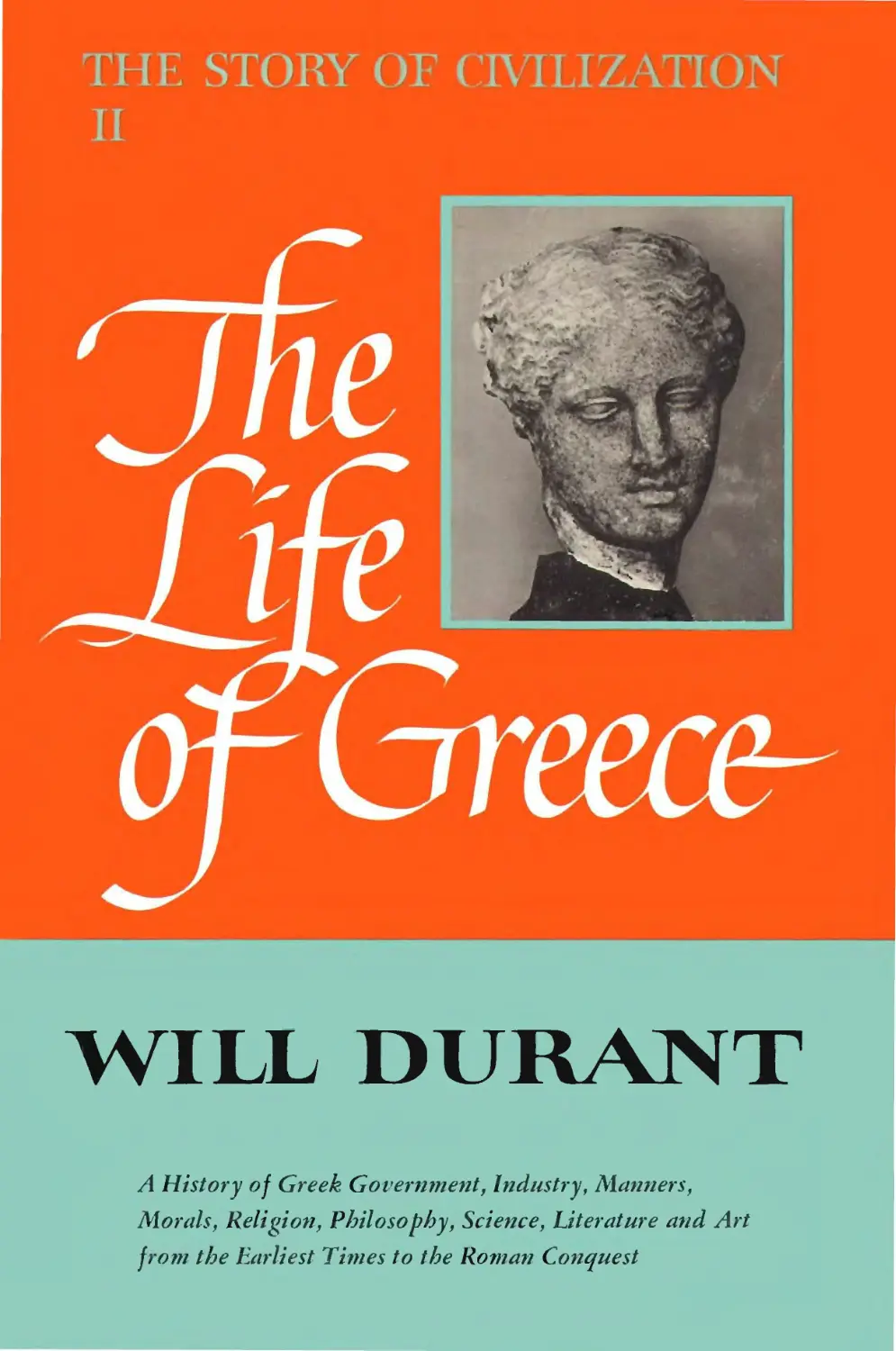
THE LIFE
of GREECE
Being a history of Greek civilization from the begin-
nings, and of civilization in the Near East from the
death of Alexander, to the Roman conquest; with an
introduction on the prehistoric culture of Crete.
By Will Durant
SIMON AND SCHUSTER
NEW YORK

TWENTY-THIRD PRINTING
MANUFACTURED IN THE UNITED STATES OF AMERICA
BY THE HADDON CRAFTSMEN, INC., SCRANTON, PA.

TO MY FRIEND
MAX SCHOTT

Preface
MY purpose is to record and contemplate the origin, growth, maturity,
and decline of Greek civilization from the oldest remains of Crete
and Troy to the conquest of Greece by Rome. I wish to see and feel this
complex culture not only in the subtle and impersonal rhythm of its rise and
fall, but in the rich variety of its vital elements: its ways of drawing a living
from the land, and of organizing industry and trade; its experiments with
monarchy, aristocracy, democracy, dictatorship, and revolution; its man-
ners and morals, its religious practices and beliefs; its education of children,
and its regulation of the sexes and the family; its homes and temples, markets
and theaters and athletic fields; its poetry and drama, its painting, sculpture,
architecture, and music; its sciences and inventions, its superstitions and
philosophies. I wish to see and feel these elements not in their theoretical
and scholastic isolation, but in their living interplay as the simultaneous
movements of one great cultural organism, with a hundred organs and a
hundred million cells, but with one body and one soul.
Excepting machinery, there is hardly anything secular in our culture that
does not come from Greece. Schools, gymnasiums, arithmetic, geometry,
history, rhetoric, physics, biology, anatomy, hygiene, therapy, cosmetics,
poetry, music, tragedy, comedy, philosophy, theology, agnosticism, skepti-
cism, stoicism, epicureanism, ethics, politics, idealism, philanthropy, cyni-
cism, tyranny, plutocracy, democracy: these are all Greek words for cul-
tural forms seldom originated, but in many cases first matured for good or
evil by the abounding energy of the Greeks. All the problems that disturb
us today— the cutting down of forests and the erosion of the soil; the eman-
cipation of woman and the limitation of the family; the conservatism of the
established, and the experimentalism of the unplaced, in morals, music, and
government; the corruptions of politics and the perversions of conduct; the
conflict of religion and science, and the weakening of the supernatural sup-
ports of morality; the war of the classes, the nations, and the continents; the
revolutions of the poor against the economically powerful rich, and of the
rich against the politically powerful poor; the struggle between democracy
and dictatorship, between individualism and communism, between the East
and the West— all these agitated, as if for our instruction, the brilliant and
vii

PREFACE
turbulent life of ancient Hellas. There is nothing in Greek civilization that
does not illuminate our own.
We shall try to see the life of Greece both in the mutual interplay of its
cultural elements, and in the immense five-act drama of its rise and fall. We
shall begin with Crete and its lately resurrected civilization, because appar-
ently from Crete, as well as from Asia, came that prehistoric culture of
Mycenae and Tiryns which slowly transformed the immigrating Achaeans
and the invading Dorians into civilized Greeks; and we shall study for a
moment the virile world of warriors and lovers, pirates and troubadours,
that has come down to us on the rushing river of Homer's verse. We shall
watch the rise of Sparta and Athens under Lycurgus and Solon, and shall
trace the colonizing spread of the fertile Greeks through all the isles of the
Aegean, the coasts of Western Asia and the Black Sea, of Africa and Italy,
Sicily, France, and Spain. We shall see democracy fighting for its life at
Marathon, stimulated by its victory, organizing itself under Pericles, and
flowering into the richest culture in history; we shall linger with pleasure
over the spectacle of the human mind liberating itself from superstition, cre-
ating new sciences, rationalizing medicine, secularizing history, and reach-
ing unprecedented peaks in poetry and drama, philosophy, oratory, history,
and art; and we shall record with melancholy the suicidal end of the Golden
Age in the Peloponnesian War. We shall contemplate the gallant effort of
disordered Athens to recover from the blow of her defeat; even her decline
will be illustrious with the genius of Plato and Aristotle, Apelles and Prax-
iteles, Philip and Demosthenes, Diogenes and Alexander. Then, in the wake
of Alexander's generals, we shall see Greek civilization, too powerful for its
little peninsula, bursting its narrow bounds, and overflowing again into Asia,
Africa, and Italy; teaching the cult of the body and the intellect to the
mystical Orient, reviving the glories of Egypt in Ptolemaic Alexandria, and
enriching Rhodes with trade and art; developing geometry with Euclid at
Alexandria and Archimedes at Syracuse; formulating in Zeno and Epicurus
the most lasting philosophies in history; carving the Aphrodite of Melos, the
Laocoon, the Victory of Samothrace, and the Altar of Pergamum; striving
and failing to organize its politics into honesty, unity, and peace; sinking
ever deeper into the chaos of civil and class war; exhausted in soil and loins
and spirit; syrrendering to the autocracy, quietism, and mysticism of the
Orient; land at last almost welcoming those conquering Romans through
whom dying Greece would bequeath to Europe her sciences, her philoso-
phies, her letters, and her arts as the living cultural basis of our modern
world.
viii

Acknowledgments
I am grateful to Mr. Wallace Brock-
way for his scholarly help at every stage
of this work; to Miss Mary Kaufman,
Miss Ethel Durant, and Mr. Louis Du-
rant for aid in classifying the material;
to Miss Regina Sands for her expert
preparation of the manuscript; and to
my wife for her patient encouragement
and quiet inspiration.
I am deeply indebted to Sir Gilbert
Murray and to his publishers, the Ox-
ford University Press, for permission to
quote from his translations of Greek
drama. These translations have enriched
English literature.
I am also indebted to the Oxford Uni-
versity Press for permission to quote
from its cxceUentOxfordBook of Greek
Verse in Translation.
W.D.
ix

Notes
ON THE USE OF THIS BOOK
i. This book, while forming the second part of the author's Story of Civili-
zation, has been written as an independent unit, complete in itself. The next
volume will probably appear in 1943 under the title of Caesar and Christ—
a history of Roman civilization and of early Christianity.
2. To bring the book into smaller compass, reduced type (like this) has been used
for technical or recondite material. Indented passages in reduced type are quo-
tations.
3. The raised numbers in the text refer to the Notes at the end of the vol-
ume. Hiatuses in the numbering of the notes are due to last minute curtail-
ments.
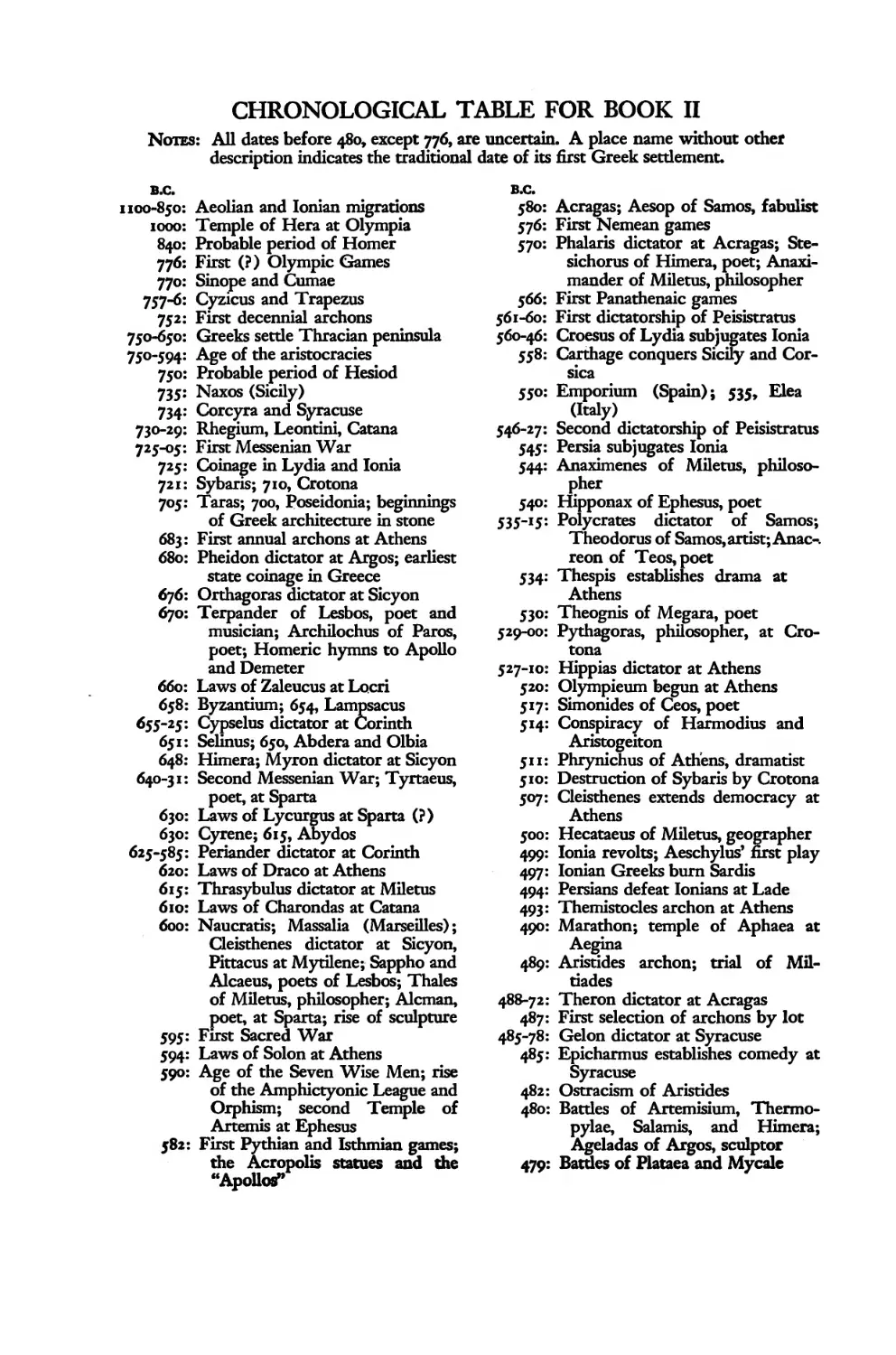
4. The chronological table given at the beginning of each period is designed
to free the text as far as possible from minor dates and royal trivialities. All
dates are B.C. unless otherwise stated or evident.
5. The maps at the beginning and the end of the book show nearly all the
places referred to in the text. The glossary defines all unfamiliar foreign
words used, except when these are explained where they occur. The starred
titles in the bibliography may serve as a guide to further reading. The index
pronounces ancient names, and gives dates of birth and death where known.
6. Greek words have been transliterated into our alphabet according to the
rules formulated by the Journal of Hellenic Studies; certain inconsistencies
in these rules must be forgiven as concessions to custom; e.g., Hieron, but
Plato(n); Hippodameia, but Alexandr{e)ia.
7. In pronouncing Greek words not established in English usage, a should
be sounded as in father, e as in neigh, i as in machine, as in bone, u as in
June, y like French u or German ii, at and ei like en in aisle, ou as in route,
c as in car, ch as in chorus, g as in go, z like dz in adze.

Table of Contents
booki: AEGEAN PRELUDE: 3500-1000 b.c.
Chronological Table 2
Chapter I. Crete 3
1. The Mediterranean 3
11. The Rediscovery of Crete.... 5 2. Society , 10
in. The Reconstruction of a 3. Religion 13
Civilization 8 4. Culture 14
1. Men and Women 8 iv. The Fall of Cnossus 20
Chapter II. Before Agamemnon 24
1. Schliemann 24 m. Mycenaean Civilization 30
11. In the Palaces of the Kings.... 27 iv. Troy 33
Chapter III. The Heroic Age 37
1. The Achaeans 37
11. The Heroic Legends 38 4. The Arts 52
in. Homeric Civilization 44 5. The State 53
1. Labor 44 iv. The Siege of Troy 55
2. Morals 47 v. The Home-Coming 59
3. The Sexes 50 vi. The Dorian Conquest 62
book n: THE RISE OF GREECE: 1000-480 b.c.
Chronological Table 66
Chapter IV. Sparta 67
1. The Environment of Greece 6y
11. Argos 70
m. Laconia 72 5. The Spartan Code 81
1. The Expansion of Sparta.. 73 6. An Estimate of Sparta 86
2. Sparta's Golden Age 74 iv. Forgotten States 88
3. Lycurgus 77 v. Corinth 89
4. The Lacedaemonian vi. Megara 92
Constitution 79 vn. Aegina and Epidaurus 95

TABLE OF CONTENTS
Chapter V. Athens 98
1. Hesiod's Boeotia 98
11. Delphi 104
m. The Lesser States 105
iv. Attica 107
1. The Background of
Athens 107
2. Athens under the
Oligarchs 109
3. The Solonian Revolution.. 1 1 2
4. The Dictatorship of
Peisistratus 1 19
5. The Establishment of
Democracy 123
Chapter VI. The Great Migration 127
1. Causes and Ways 127
11. The Ionian Cyclades 129
m. The Dorian Overflow 133
iv. The Ionian Dodecapolis 134
1. Miletus and the Birth of
Greek Philosophy 134
v.
VI.
2.Polycrates of Samos 141
3. Heracleitus of Ephesus 143
4. Anacreon of Teos 148
5. Qiios, Smyrna, Phocaea....i5o
Sappho of Lesbos 1 5 1
The Northern Empire 1 56
Chapter VII. The Greeks in the West 159
I. The Sybarites 159 iv. From Italy to Spain 168
11. Pythagoras of Crotona 161 v. Sicily 169
ra. Xenophanes of Elea 167 vi. The Greeks in Africa 173
Chapter VIII. The Gods of Greece 175
1. The Sources of Polytheism.. 1 75 iv. Worship 192
II. An Inventory of the Gods.... 177 v. Superstitions 195
1. The Lesser Deities 177 vi. Oracles 197
2. The Olympians 180 vn. Festivals 199
ra. Mysteries 188 vin. Religion and Morals 200
Chapter IX. The Common Culture of Early Greece 203
L Individualism of the State 203
n. Letters 204
in. Literature 207
iv. Games 211
v. Arts 217
1. Vases 218
2. Sculpture 221
3. Architecture 223
4. Music and the Dance 226
5. The Beginnings of the
Drama 230
vi. Retrospect 233
Chapter X. The Struggle for Freedom 234
1. Marathon 234 ra. Xerxes 237
n. AristidesandThemistocles....236 iv. Salamis 239
xii

TABLE OF CONTENTS
book in: THE GOLDEN AGE: 480-399 b.c.
Chronological Table 244
Chapter XL Pericles and the Democratic Experiment 245
1. The Rise of Athens 245
n. Pericles 248 2. Law 257
in. Athenian Democracy 254 3. Justice 259
1. Deliberation 254 4. Administration 263
Chapter XII. Work and Wealth in Athens 268
1. Land and Food 268 iv. Freemen and Slaves 276
11. Industry 270 v. The War of the
in. Trade and Finance 272 Classes 280
Chapter XIII. The Morals and Manners of the Athenians 287
1. Childhood 287
11. Education 288 vn. Greek Friendship 301
in. Externals 291 vin. Love and Marriage 302
iv. Morals 293 ix. Woman 305
v. Character 296 x. The Home 307
vi. Premarital Relations 299 xi. Old Age 310
Chapter XIV. The Art of Periclean Greece 313
1. The Ornamentation of Lifc.313 iv. The Builders 327
11. The Rise of Painting 3 15 1. The Progress of
in. The Masters of Sculpture 318 Architecture 327
1. Methods 318 2. The Reconstruction of
2. Schools 32 1 Athens 329
3. Pheidias 324 3. The Parthenon 332
Chapter XV. The Advancement of Learning 337
1. The Mathematicians 337
n. Anaxagoras 339 in. Hippocrates 342
Chapter XVI. The Conflict of Philosophy and Religion 349
1. The Idealists 349 v. Socrates 364
11. The Materialists 352 i.The Mask of Silenus 364
in. Empedocles 355 2. Portrait of a Gadfly 367
iv. The Sophists 358 3. The Philosophy of
Socrates 370
Chapter XVII. The Literature of the Golden Age 374
1. Pindar 374 v. Euripides 400
11. The Dionysian Theater 377 i.The Plays 400
ra. Aeschylus 383 2. The Dramatist 41 1
iv. Sophocles 391 3. The Philosopher 413
xiii

TABLE OF CONTENTS
Chapter XVII— continued
2. Aristophanes and the
4. The Exile 417 Radicals 424
vi. Aristophanes 420 3. The Artist and the
1. Aristophanes and the Thinker 428
War 420 vii. The Historians 430
Chapter XVIII. The Suicide of Greece 437
1. The Greek World in the iv. Alcibiades 443
Age of Pericles 437 v. The Sicilian Adventure 445
11. How the Great War Began.439 VI - The Triumph of
in. From the Plague to the Sparta 448
Peace 441 vn. The Death of Socrates 452
BOOK IV
THE DECLINE AND FALL OF GREEK FREEDOM
399-322 B.C.
Chronological Table 458
Chapter XIX. Philip 459
1. The Spartan Empire 459 iv. The Rise of Syracuse 470
11. Epaminondas 461 v. The Advance of Mace-
iii. The Second Athenian donia 475
Empire 463 vi. Demosthenes 478
Chapter XX. Letters and Arts in the Fourth Century 482 _
1. The Orators 482 iv. Apelles 491
11. Isocrates 485 v. Praxiteles 494
in. Xenophon 488 vi. Scopas and Lysippus 497
Chapter XXL The Zenith of Philosophy 500
1. The Scientists 500 4. The Moralist 517
11. The Socratic Schools 503 5. The Utopian 519
1. Aristippus 503 6. The Lawmaker 522
2. Diogenes 505 iv. Aristotle 524
in. Plato 509 1. Wander- Years 524
1. The Teacher 509 2. The Scientist 526
2. The Artist 513 3. The Philosopher 531
3. The Metaphysician 515 4. The Statesman 534
Chapter XXII. Alexander 538
1. The Soul of a Conqueror 538 in. The Death of a God 547
n. The Paths of Glory 542 iv. The End of an Age 552
xiv

TABLE OF CONTENTS
bookv: THE HELLENISTIC DISPERSION: 322-146 b.c.
Chronological Table 555
Chapter XXIII. Greece and Macedon 557
1. The Struggle for Power 557 rv. Revolution in Sparta 568
11. The Struggle for Wealth 561 v. The Ascendancy of
in. The Morals of Decay 565 Rhodes 570
Chapter XXIV. Hellenism and the Orient 572
1. The Seleucid Empire 572 m. Pergamum 578
11. Seleucid Civilization 574 rv. Hellenism and the Jews 579
Chapter XXV. Egypt and the West 585
1. The Kings' Register 585 in. Alexandria 592
11. Socialism under the iv. Revolt 596
Ptolemies 587 v. Sunset in Sicily 598
Chapter XXVI. Books ...600
1. Libraries and Scholars 600
31. The Books of the Jews 603 iv. Theocritus *. 608
in. Menander 606 v. Polybius 612
Chapter XXVII. The Art of the Dispersion 616
1. A Miscellany 616 in. Sculpture 621
11. Painting 618 iv. Commentary 625
Chapter XXVIII. The Climax of Greek Science 627
1. Euclid and Apollonius 627 Eratosthenes 634
11. Archimedes 628 iv. Theophrastus, Herophilus,
in. Aristarchus, Hipparchus, Erasistratus 637
Chapter XXIX. The Surrender of Philosophy 640
1. The Skeptical Attack 640 in. The Stoic Compromise 650
n. The Epicurean Escape 644 rv. The Return to Religion 657
Chapter XXX. The Coming of Rome 659
1. Pyrrhus 659
11. Rome the Liberator 661 in. Rome the Conqueror 664
Epilogue: Our Greek Heritage 667
Glossary of Foreign Words 672
Bibliography 673
Notes 680
Pronouncing and Biographical Index 709
xv

List of Illustrations
(Illustration Section follows page 334)
Cover design: Hygiaea, Goddess of Health
Fig. 1. Hygiaea, Goddess of Health
Fig. 2. The Cup-Bearer
Fig. 3. The "Snake Goddess"
Fig. 4. Wall Fresco and "Throne of Minos"
Fig. 5. A Cup from Vaphio
Fig. 6. Mask of "Agamemnon"
Fig. 7. Warrior, from temple of Aphaea at Aegina
Fig. 8. Theater of Epidaurus
Fig. 9. Temple of Poseidon
Fig. 10. A Krater Vase, with Athena and Heracles
Fig. 11. The Portland Vase
Fig. 12. The Fran§ois Vase
Fig. 13. A Kore, or Maiden
Fig. 14. The "Choiseul-Gouffier Apollo"
Fig. 15. Pericles
Fig. 16. Epicurus
Fig. 17. Orpheus, Eurydice, and Hermes
Fig. 18. "Birth of Aphrodite"
Fig. 19. "Ludovisi Throne," right base
Fig. 20. "Ludovisi Throne," left base
Fig. 21. The Diadumenos
Fig. 22. Apollo Sauroctonos
Fig. 23. The Discus Thrower
Fig. 24. The "Dreaming Athena"
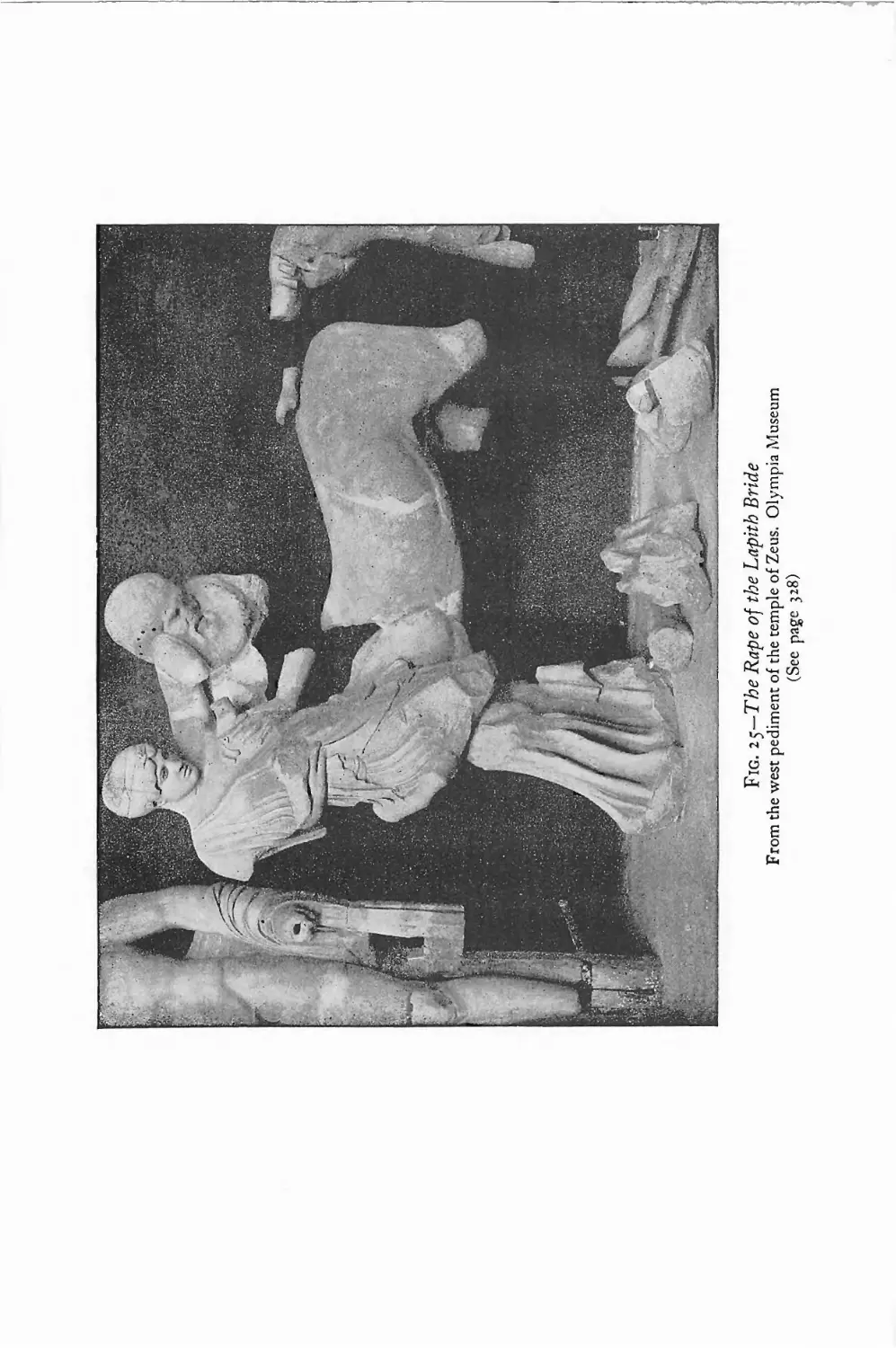
Fig. 25. The Rape of the Lapith Bride
Fig. 26. Stela of Damasistrate
Fig. 27. Heracles and Atlas
Fig. 28. Nike Fixing Her Sandal
Fig. 29. Propylaea and temple of Nike Apteros
Fig. 30. The Charioteer of Delphi
Fig. 31. A Caryatid from the Erechtheum
Fig. 32. The Parthenon
xvii

LIST OF ILLUSTRATIONS
Fig. 33. Goddesses and "Iris"
Fig. 34. "Cecrops and Daughter"
Fig. 35. Horsemen, from the West Frieze of the Parthenon
Fig. 36. Sophocles
Fig. 37. Demosthenes
Fig. 38. A Tanagra Statuette
Fig. 39. The Mausoleum of Halicarnassiis
Fig. 40. Relief from the Mausoleum of Halicarnassus
Fig. 41. The "Aphrodite of Cnidus"
Fig. 42. The Nike of Paeonius
Fig. 43. The Hermes of Praxiteles
Fig. 44. Head of Praxiteles' Hermes
Fig. 45. The Doryphoros of Polycleitus
Fig. 46. Head of Meleager
Fig. 47. Head of a Girl
Fig. 48. The Apoxyomenos
Fig. 49. The Raging (or Dancing) Maenad
Fig. 50. A Daughter of Niobe
Fig. 51. The Aphrodite of Cyrene
Fig. 52. The Demeter of Cnidus
Fig. 53. Altar of Zeus at Pergamum
Fig. 54. Frieze from the Altar of Zeus at Pergamum
Fig. 55. The Battle of Issus
Fig. 56. The Laocoon
Fig. 57. The Farnese Bull
Fig. 58. The "Alexander" Sarcophagus
Fig. 59. The Aphrodite of Melos
Fig. 60. The Venus de' Medici
Fig. 61. The "Victory of Samothrace"
Fig. 62. Hellenistic Portrait Head
Fig. 63. The "Old Market Woman"
Fig. 64. The Prize Fighter
Maps of the Hellenistic World, Ancient Greece and the Aegean, and
Ancient Italy and Sicily will be found on the inside covers.
xvin

BOOK I
AEGEAN PRELUDE
35OO-IOOO B.C.

CHRONOLOGICAL TABLE FOR BOOK I
Notes: All dates are approximate. Individuals are placed at their time of flourishing, which
is assumed to be about forty years after their birth; their dates of birth and death, where
possible, are given in the index. Dates of rulers are for their reigns. A question mark before
an entry indicates a date given only by Greek tradition.
b.c. 9000:
3400-3000:
3400-2100:
3400-1200:
3000-2600:
3000:
2870:
2600-2350:
2350-2100:
2200-1200:
2 100-1950:
2100-1600
1950-1600:
1900:
1600-1500:
1600-1200:
1582:
1 500-1400:
1450-1400:
1433:
1400- 1 200:
1313:
1300-1100:
1283:
1 261-1209:
1250:
1 250-1 183:
1225:
1213:
1200:
1192-1183:
1 176:
X104:
Neolithic Age in Crete
Early Minoan, Helladic, Cycladic, I
Neolithic Age in Thessaly
Bronze Age in Crete
Early Minoan, Helladic, Cycladic, II
Copper mined in Cyprus
First known settlement at Troy
Early Minoan, Helladic, Cycladic, III
Middle Minoan, Helladic, Cycladic, I
Bronze Age in Cyprus
Middle Minoan, Helladic, Cycladic, II; first series of Cretan palaces
Chalcolithic Age in Thessaly
Middle Minoan, Helladic, Cycladic, III
Destruction of first series of Cretan palaces
Late Minoan, Helladic (Mycenaean), Cycladic, I; second series of
Cretan palaces
Bronze Age in Thessaly
? Foundation of Athens by Cecrops
Late Minoan, Helladic (Mycenaean), Cycladic, II
Destruction of second series of Cretan palaces
? Deucalion and the Flood
Late Minoan, Helladic (Mycenaean), Cycladic, III; palaces of Tiryns
and Mycenae
? Foundation of Thebes by Cadmus
Age of Achaean domination in Greece
? Coming of Pelops into Elis
? Heracles
Theseus at Athens; Oedipus at Thebes; Minos and Daedalus at
Cnossus
"Sixth city" of Troy; age of the Homeric heroes
? Voyage of the Argonauts
? War of the Seven against Thebes
? Accession of Agamemnon
? Siege of Troy
? Accession of Orestes
? Dorian invasion of Greece

CHAPTER I
Crete
I. THE MEDITERRANEAN
AS we enter the fairest of all waters, leaving behind us the Atlantic and
,/jl Gibraltar, we pass at once into the arena of Greek history. "Like
frogs around a pond," said Plato, "we have settled down upon the shores
of this sea." 1 Even on these distant coasts the Greeks founded precarious,
barbarian-bound colonies many centuries before Christ: at Hemeroscopium
and Ampurias in Spain, at Marseilles and Nice in France, and almost every-
where in southern Italy and Sicily. Greek colonists established prosperous
towns at Cyrene in northern Africa, and at Naucratis in the delta of the
Nile; their restless enterprise stirred the islands of the Aegean and the coasts
of Asia Minor then as in our century; all along the Dardanelles and the Sea
of Marmora and the Black Sea they built towns and cities for their far-
venturing trade. Mainland Greece was but a small part of the ancient Greek
world.
Why was it that the second group of historic civilizations took form on
the Mediterranean, as the first had grown up along the rivers of Egypt,
Mesopotamia, and India, as the third would flourish on the Atlantic, and as
the fourth may appear on the shores of the Pacific? Was it the better climate
of the lands washed by the Mediterranean? There, then as now,* winter
rains nourished the earth, and moderate frosts stimulated men; there, almost
all the year round, one might live an open-air life under a warm but not
enervating sun. And yet the surface of the Mediterranean coasts and islands
is nowhere so rich as the alluvial valleys of the Ganges, the Indus, the Tigris,
the Euphrates, or the Nile; the summer's drought may begin too soon or last
too long; and everywhere a rocky basis lurks under the thin crust of the
dusty earth. The temperate north and the tropic south are both more fertile
than these historic lands where patient peasants, weary of coaxing the soil,
more and more abandoned tillage to grow olives and the vine. Aiid at any
moment, along one or another of a hundred faults, earthquakes might split
the ground beneath men's feet, and frighten them into a fitful piety. Climate
did not draw civilization to Greece; probably it has never made a civiliza-
tion anywhere.

4 THELIFEOF GREECE (CHAP. I
What drew men into the Aegean was its islands. The islands were beauti-
ful; even a worried mariner must have been moved by the changing colors
of those shadowed hills that rose like temples out of the reflecting sea. To-
day there are few sights lovelier on the globe; and sailing the Aegean, one
begins to understand why the men who peopled those coasts and isles came
to love them almost more than life, and, like Socrates, thought exile bitterer
than death. But further, the mariner was pleased to find that these island
jewels were strewn in all directions, and at such short intervals that his ship,
whether going between east and west or between north and south, would
never be more than forty miles from land. And since the islands, like the
mainland ranges, were the mountaintops of a once continuous territory that
had been gradually submerged by a pertinacious sea, 8 some welcome peak
always greeted the outlook's eye, and served as a beacon to ships that had as
yet no compass to guide them. Again, the movements of wind and water
conspired to help the sailor reach his goal. A strong central current flowed
from the Black Sea into the Aegean, and countercurrents flowed northward
along the coasts; while the northeasterly etesian winds blew regularly in the
summer to help back to their southern ports the ships that had gone to fetch
grain, fish, and furs from the Euxine Sea.* Fog was rare in the Mediter-
ranean, and the unfailing sunshine so varied the coastal winds that at almost
any harbor, from spring to autumn, one might be carried out by a morning,
and brought back by an evening, breeze.
In these propitious waters the acquisitive Phoenicians and the amphibious
Greeks developed the art and science of navigation. Here they built ships
for the most part larger or faster, and yet more easily handled, than any
that had yet sailed the Mediterranean. Slowly, despite pirates and harassing
uncertainties, the water routes from Europe and Africa into Asia— through
Cyprus, Sidon, and Tyre, or through the Aegean and the Black Sea— became
cheaper than the long land routes, arduous and perilous, that had carried so
much of the commerce of Egypt and the Near East. Trade took new lines,
multiplied new populations, and created new wealth. Egypt, then Meso-
potamia, then Persia withered; Phoenicia deposited an empire of cities along
the African coast, in Sicily, and in Spain; and Greece blossomed like a
watered rose.
* The Greeks called the Mediterranean Ho Pontos, the Passage or Road, and euphemisti-
cally termed the Black Sea Ho Pontos Euxeinos— the Sea Kindly to Guests— perhaps because it
welcomed ships from the south with adverse currents and winds. The broad rivers that fed
it, and the frequent mists that reduced its rate of evaporation, kept the Black Sea at a higher
level than the Mediterranean, and caused a powerful current to rush through the narrow
Bosporus (Ox-ford) and the Hellespont into the Aegean. The Sea of Marmora was the
Propontis, Before the Sea.

CHAP, i) CRETE 5
II. THE REDISCOVERY OF CRETE
"There is a land called Crete, in the midst of the wine-dark sea, a fair, rich
land, begirt with water; and therein are many men past counting, and ninety
cities." 4 When Homer sang these lines, perhaps in the ninth century before
our era,* Greece had almost forgotten, though the poet had not, that the
island whose wealth seemed to him even then so great had once been
wealthier still; that it had held sway with a powerful fleet over most of the
Aegean and part of mainland Greece; and that it had developed, a thousand
years before the siege of Troy, one of the most artistic civilizations in his-
tory. Probably it was this Aegean culture— as ancient to him as he is to us—
that Homer recalled when he spoke of a Golden Age in which men had
been more civilized, and life more refined, than in his own disordered time.
The rediscovery of that lost civilization is one of the major achievements
of modern archeology. Here was an island twenty times larger than the
largest of the Cyclades, pleasant in climate, varied in the products of its
fields and once richly wooded hills, and strategically placed, for trade or
war, midway between Phoenicia and Italy, between Egypt and Greece.
Aristotle had pointed out how excellent this situation was, and how "it had
enabled Minos to acquire the empire of the Aegean." 6 But the story of
Minos, accepted as fact by all classical writers, was rejected as legend by
modern scholars; and until sixty years ago it was the custom to suppose, with
Grote, that the history of civilization in the Aegean had begun with the
Dorian invasion, or the Olympic games. Then in a.d. 1878 a Cretan mer-
chant, appropriately named Minos Kalokairinos, unearthed some strange
antiquities on a hillside south of Candia.t The great Schliemann, who had
but lately resurrected Mycenae and Troy, visited the site in 1886, an-
nounced his conviction that it covered the remains of the ancient Cnossus,
and opened negotiations with the owner of the land so that excavations
might begin at once. But the owner haggled and tried to cheat; and Schlie-
mann, who had been a merchant before becoming an archeologist, with-
drew in anger, losing a golden chance to add another civilization to history.
A few years later he died. 8
In 1893 a British archeologist, Dr. Arthur Evans, bought in Athens a
number of milkstones from Greek women who had worn them as amulets.
He was curious about the hieroglyphics engraved upon them, which no
scholar could read. Tracing the stones to Crete, he secured passage thither,
• All dates in this volume are b.c. unless otherwise stated or obviously aj>.
t The modern capital, now officially renamed Heracleum.

6 THELIFEOF GREECE ( CHAP. I
and wandered about the island picking up examples of what he believed to
be ancient Cretan writing. In 1895 he purchased a part, and in 1900 the re-
mainder, of the site that Schliemann and the French School at Athens had
identified with Cnossus; and in nine weeks of that spring, digging feverishly
with one hundred and fifty men, he exhumed the richest treasure of modern
historical research— the palace of Minos. Nothing yet known from an-
tiquity could equal the vastness of this complicated structure, to all appear-
ances identical with the almost endless Labyrinth so famous in old Greek
tales of Minos, Daedalus, Theseus, Ariadne, and the Minotaur. In these and
other ruins, as if to confirm Evans' intuition, thousands of seals and clay
tablets were found, bearing characters like those that had set him upon the
trail. The fires that had destroyed the palaces of Cnossus had preserved
these tablets, whose undeciphered pictographs and scripts still conceal the
early story of the Aegean.*
Students from many countries now hurried to Crete. While Evans was
working at Cnossus, a group of resolute Italians— Halbherr, Pernier, Savig-
noni, Paribeni— unearthed at Hagia Triada (Holy Trinity) a sarcophagus
painted with illuminating scenes from Cretan life, and uncovered at Phaestus
a palace only less extensive than that of the Cnossus kings. Meanwhile two
Americans, Seager and Mrs. Hawes, made discoveries at Vasiliki, Mochlos,
and Gournia; the British— Hogarth, Bosanquet, Dawkins, Myres— explored
Palaikastro, Psychro, and Zakro; the Cretans themselves became interested,
and Xanthoudidis and Hatzidakis dug up ancient residences, grottoes, and
tombs at Arkalochori, Tylissus, Koumasa, and Chamaizi. Half the nations
of Europe united under the flag of science in the very generation in which
their statesmen were preparing for war.
How was all this material to be classified— these palaces, paintings, statues,
seals, vases, metals, tablets, and reliefs?— to what period of the past were they
to be assigned? Precariously, but with increasing corroboration as research
went on and knowledge grew, Evans dated the relics according to the depth
of their strata, the gradation of styles in the pottery, and the agreement of
Cretan finds, in form or motive, with like objects exhumed in lands or deposits
whose chronology was approximately known. Digging down patiently beneath
Cnossus, he found himself stopped, some forty-three feet below the surface, by
the virgin rock. The lower half of the excavated area was occupied by remains
characteristic of the Neolithic Age— primitive forms of handmade pottery with
simple linear ornament, spindle whorls for spinning and weaving, f at-buttocked
• Evans labored brilliantly at Cnossus for many years, was knighted for his discoveries, and
completed, in 1936, his monumental four-volume report, The Palace of Minos.

CHAP, i) CRETE J
goddesses of painted steatite or clay, tools and weapons of polished stone, but
nothing in copper or bronze.* Classifying the pottery, and correlating the
remains with those of ancient Mesopotamia and Egypt, Evans divided the post-
neolithic and prehistoric culture of Crete into three ages— Early, Middle, and
Late Minoan— and each of these into three periods.t
The first or lowest appearance of copper in the strata represents for us,
through a kind of archeological shorthand, the slow rise of a new civilization
out of the neolithic stage. By the end of the Early Minoan Age the Cretans
learn to mix copper with tin, and the Bronze Age begins. In Middle Minoan
I the earliest palaces occur: the princes of Cnossus, Phaestus, and Mallia
build for themselves luxurious dwellings with countless rooms, spacious
storehouses, specialized workshops, altars and temples, and great drainage
conduits that startle the arrogant Occidental eye. Pottery takes on a many-
colored brilliance, walls are enlivened with charming frescoes, and a form of
linear script evolves out of the hieroglyphics of the preceding age. Then,
at the close of Middle Minoan II, some strange catastrophe writes its cynical
record into the strata; the palace of Cnossus is laid low as if by a convulsion
of the earth, or perhaps by an attack from Phaestus, whose palace for a time
is spared. But a little later a like destruction falls upon Phaestus, Mochlos,
Gournia, Palaikastro, and many other cities in the island; the pottery is
covered with ashes, the great jars in the storerooms are filled with debris.
Middle Minoan III is a period of comparative stagnation, in which, per-
haps, the southeastern Mediterranean world is long disordered by the
Hyksos conquest of Egypt. 9
In the late Minoan Age everything begins again. Humanity, patient
under every cataclysm, renews its hope, takes courage, and builds once
more. New and finer palaces rise at Cnossus, Phaestus, Tylissus, Hagia
Triada, and Gournia. The lordly spread, the five-storied height, the luxuri-
ous decoration of these princely residences suggest such wealth as Greece
would not know till Pericles. Theaters are erected in the palace courts, and
gladiatorial spectacles of men and women in deadly combat with animals
amuse gentlemen and ladies whose aristocratic faces, quietly alert, still live
• Since the earliest layer of copper implements at Cnossus may be dated, by correlation
with the remains of neighboring cultures, about 3400 b.c., i.e., about 5300 years ago, and since
the neolithic strata at Cnossus occupy some fifty-five per cent of the total depth from surface
to rock, Evans calculated that the Neolithic Age in Crete had lasted at least 4500 years before
the coming of metals— approximately from 8000 to 3400. Such calculations of time from
depth of strata are, of course, highly problematical; the rate of deposition may change from
age to age. Allowance has been made for a slower rate after the abandonment of Cnossus as
an urban site in the fourteenth century b.c. 7 No paleolithic remains have been found in Crete.
t For the approximate duration of these epochs cf . the Chronological Table on p. 2.

8 THE LIFE OF GREECE (CHAP. I
for us on the bright frescoes of the resurrected walls. Wants are multiplied,
tastes are refined, literature flourishes; a thousand industries graciously per-
mit the poor to prosper by supplying comforts and delicacies to the rich.
The halls of the king are noisy with scribes taking inventories of goods dis-
tributed-or received; with artists making statuary, paintings, pottery, or re-
liefs; with high officials conducting conferences, hearing judicial appeals, or
dispatching papers stamped with their finely wrought seals; while wasp-
waisted princes and jeweled duchesses, alluringly decollete, crowd to a
royal feast served on tables shining with bronze and gold. The sixteenth and
fifteenth centuries before our era are the zenith of Aegean civilization, the
classic and golden age of Crete.
m. THE RECONSTRUCTION OF A CIVILIZATION
If now we try to restore this buried culture from the relics that remain-
playing Cuvier to the scattered bones of Crete— let us remember that we are
engaging upon a hazardous kind of historical television, in which imagina-
tion must supply the living continuity in the gaps of static and fragmentary
material artificially moving but long since dead. Crete will remain inwardly
unknown until its secretive tablets find their Champollion.
1. Men and Women
As we see them self-pictured in their art, the Cretans curiously resemble
the double ax so prominent in their religious symbolism. Male and female
alike have torsos narrowing pathologically to an ultramodern waist. Nearly
all are short in stature, slight and supple of build, graceful in movement,
athletically trim. Their skin is white at birth. The ladies, who court the
shade, have fair complexions conventionally pale; but the men, pursuing
wealth under the sun, are so tanned and ruddy that the Greeks will call them
(as well as the Phoenicians) Phoinikes— the Purple Ones, Redskins. The
head is rather long than broad, the features are sharp and refined, the hair
and eyes are brilliantly dark, as in the Italians of today; these Cretans are
apparently a branch of the "Mediterranean race."* The men as well as the
women wear their hair partly in coils on the head or the neck, partly in ring-
• Current anthropology divides post-neolithic Europeans into three types, respectively pre-
ponderating in north, central, and southern Europe: (i) "Nordic" man— long-headed, tall,
and fair of skin and eyes and hair; (2) "Alpine" man— broad-headed, of medium height, with
eyes tending to gray and hair to brown; and (3) "Mediterranean" man— long-headed, short,
and dark. No people is exclusively any of these "races."

CHAP, i) CRETE 9
lets on the brow, partly in tresses falling upon the shoulders or the breast.
The women add ribbons for their curls, while the men, to keep their faces
clean, provide themselves with a variety of razors, even in the grave. 10
The dress is as strange as the figures. On their heads— most often bare—
the men have turbans or tam-o'-shanters, the women magnificent hats of our
early twentieth-century style. The feet are usually free of covering; but
the upper classes may bind them in white leather shoes, which among
women may be daintily embroidered at the edges, with colored beads on
the straps. Ordinarily the male has no clothing above the waist; there he
wears a short skirt or waistcloth, occasionally with a codpiece for modesty.
The skirt may be slit at the side in workingmen; in dignitaries and ceremo-
nies it reaches in both sexes to the ground. Occasionally the men wear
drawers, and in winter a long outer garment of wool or skins. The clothing
is tightly laced about the middle, for men as well as women are resolved to be
—or seem— triangularly slim. n To rival the men at this point, the women of
the later periods resort to stiff corsets, which gather their skirts snugly
around their hips, and lift their bare breasts to the sun. It is a pretty custom
among the Qretans that the female bosom should be uncovered, or revealed
by a diaphanous chemise;" no one seems to take offense. The bodice is
laced below the bust, opens in a careless circle, and then, in a gesture of
charming reserve, may close in a Medici collar at the neck. The sleeves are
short, sometimes puffed. The skirt, adorned with flounces and gay tints,
widens out spaciously from the hips, stiffened presumably with metal ribs
or horizontal hoops. There are in the arrangement and design of Cretan
feminine dress a warm harmony of colors, a grace of line, a delicacy of taste,
that suggest a rich and luxurious civilization, already old in arts and wiles.
In these matters the Cretans had no influence upon the Greeks; only in
modern capitals have their styles triumphed. Even staid archeologists have
given the name La Parisienne to the portrait of a Cretan lady with pro-
fulgent bosom, shapely neck, sensual mouth, impudent nose, and a persua-
sive, provocative chanp; she-sits saucily before us today as part of a frieze
in which high personages gaze upon some spectacle that we shall never see. M
The men of Crete are evidently grateful for the grace and adventure
that women give to life, for they provide them with costly means of en-
hancing their loveliness. The remains are rich in jewelry of many kinds:
hairpins of copper and gold, stickpins adorned with golden animals or flow-
ers, or heads of crystal or quartz; rings or spirals of filigree gold mingling
with the hair, fillets or diadems of precious metal binding it; rings and
pendants hanging from the ear, plaques and beads and chains on the breast,

IO THE LIFE OF GREECE ( CHAP. I
bands and bracelets on the arm, finger rings of silver, steatite, agate, car-
nelian, amethyst, or gold. The men keep some of the jewelry for them-
selves: .if they are poor they carry necklaces and bracelets of common
stones; if they can afford it they flaunt great rings engraved with scenes of
battle or the chase. The famous Cupbearer wears on the biceps of his left
arm a broad band of precious metal, and on the wrist a bangle inlaid with
agate. Everywhere in Cretan life man expresses his vainest and noblest
passion— the zeal to beautify.
This use of man to signify all humanity reveals the prejudice of a patri-
archal age, and hardly suits the almost matriarchal life of ancient Crete. For
the Minoan woman does not put up with any Oriental seclusion, any purdah
or harem; there is no sign of her being limited to certain quarters of the
house, or to the home. She works there, doubtless, as some women do even
today; she weaves clothing and baskets, grinds grain, and bakes bread. But
also she labors with men in the fields and the potteries, she mingles freely
with them in the crowds, she takes the front seat at the theater and the
games, she sweeps through Cretan society with the air of a great lady
bored with adoration; and when her nation creates its gods it is more often
in her likeness than in man's. Sober students, secretly and forgivably
enamored of the mother image in their hearts, bow down before her relics,
and marvel at her domination. 1 *
2. Society
Hypothetically we picture Crete as at first an island divided by its moun-
tains among petty jealous clans which live in independent villages under
their own chiefs, and fight, after the manner of men, innumerable territorial
wars. Then a resolute leader appears who unites several clans into a
kingdom, and builds his fortress palace at Cnossus, Phaestus, Tylissus, or
some other town. The wars become less frequent, more widespread, and
more efficient in killing; at last the cities fight for .the entire island, and
Cnossus wins. The victor organizes a navy, dominates the Aegean, sup-
presses piracy, exacts tribute, builds palaces, and patronizes the arts, like an
early Pericles. 19 It is as difficult to begin a civilization without robbery as it
is to maintain it without slaves.*
The power of the king, as echoed in the ruins, is based upon force, re-
• The usually cautious and accurate Thucydides writes: "The first person known to us by
tradition as having established a navy is Minos. He made himself master of what is now
called the Hellenic Sea, and ruled over the Cyclades. ... He did his best to put down piracy
in those waters, a necessary step to secure the revenues for his own use." 10

CHAP, i) CRETE II
ligion, and law. To make obedience easier he suborns the gods to his use:
his priests explain to the people that he is descended from Velchanos, and
has received from this deity the laws that he decrees; and every nine years,
if he is competent or generous, they reanoint him with the divine authority.
To symbolize his power the monarch, anticipating Rome and France,
adopts the* (double) ax and the fleur-de-lis. To administer the state he em-
ploys (as the litter of tablets suggests) a staff of ministers, bureaucrats, and
scribes. He taxes in kind, and stores in giant jars his revenues of grain, oil,
and wine; and out of this treasury, in kind, he pays his men. From his throne
in the palace, or his judgment seat in the royal villa, he settles in person such
litigation as has run the gauntlet of his appointed courts; and so great is his
reputation as a magistrate that when he dies he becomes in Hades, Homer
assures us, the inescapable judge of the dead.* We call him Minos, but we
do not know his name; probably the word is a title, like Pharaoh or Caesar ',
and covers a multitude of kings.
At its height this civilization is surprisingly urban. The Iliad speaks of
Crete's "ninety cities," and the Greeks who conquer them are astonished
at their teeming populations; even today the student stands in awe before
the ruined mazes of paved and guttered streets, intersecting lanes, and count-
less shops or houses crowding about some center of trade or government in
all the huddled gregariousness of timid and talkative men. It is not only
Cnossus that is great, with palaces so vast that imagination perhaps exag-
gerates the town that must have been the chief source and beneficiary of
their wealth. Across the island, on the southern shore, is Phaestus, from
whose harbor, Homer tells us, "the dark-prowed ships are borne to Egypt
by the force of the wind and the wave."" The southbound trade of Minoan
Crete pours out here, swelled by goods from northern merchants who ship
their cargoes overland to avoid a long detour by perilous seas. Phaestus
becomes a Cretan Piraeus, in love with commerce rather than with art. And
yet the palace of its prince is a majestic edifice, reached by a flight of steps
forty-five feet wide; its halls and courts compare with those at Cnossus; its
central court is a paved quadrangle of ten thousand square feet; its megaron,
or reception room, is three thousand square feet in area, larger even than
the great Hall of the Double Ax in the northern capital.
Two miles northwest is Hagia Triada, in whose "royal villa" (as archeo-
logical imagination calls it) the Prince of Phaestus seeks refuge from the
summer heat. The eastern end of the island, in Minoan days, is rich in small
towns: ports like Zakro or Mochlos, villages like Praesus or Pseira, resi-
dential quarters like Palaikastro, manufacturing centers like Gournia. The

12 THE LIFE OF GREECE (CHAP. I
main street in Palaikastro is well paved, well drained, and lined with spa-
cious homes; one of these has twenty-three rooms on the surviving floor.
Gournia boasts of avenues paved with gypsum, of homes built with mortar-
less stone, of a blacksmith's shop with extant forge, of a carpenter shop with
a kit of tools, of small factories noisy with metalworking, shoemaking, vase-
making, oil refining, or textile industry; the modern workmen who excavate
it, and gather up its tripods, jars, pottery, ovens, lamps, knives, mortars,
polishers, hooks, pins, daggers, and swords, marvel at its varied products
and equipment, and call it he mechanike polis—"xhz town of machinery." 28
By our standards the minor streets are narrow, mere alleys in the style of a
semitropical Orient that fears the sun; and the rectangular houses, of wood
or brick or stone, are for the most part confined to a single floor. Yet some
Middle Minoan plaques exhumed at Cnossus show us homes of two, three,
even five stories, with a cubicle attic or turret here and there; on the upper
floors, in these pictured houses, are windows with red panes of unknown
material. Double doors, swinging on posts apparently of cypress wood,
open from the ground-floor rooms upon a shaded court. Stairways lead to
the upper floors and the roof, where the Cretan sleeps when the nights are
very warm. If he spends the evening indoors he lights his room by burning
oil, according to his income, in lamps of clay, steatite, gypsum, marble, or
bronze.* 4
We know a trifle or two about the games he plays. At home he likes a
form of chess, for he has bequeathed to us, in the ruins of the Cnossus palace,
a magnificent gaming board with frame of ivory, squares of silver and gold,
and a border of seventy-two daisies in precious metal and stone. In the fields
he takes with zest and audacity to the chase, guided by half -wild cats and
slender thoroughbred hounds. In the towns he patronizes pugilists, and on
his vases and reliefs he represents for us a variety of contests, in which light-
weights spar with bare hands and kicking feet, middleweights with plumed
helmets batter each other manfully, and heavyweights, coddled with
helmets, cheekpieces, and long padded gloves, fight till one falls exhausted
to the ground and the other stands above him in the conscious grandeur
of victory. 95
But the Cretan's greatest thrill comes when he wins his way into the
crowd that fills the amphitheater on a holiday to see men and women face
death against huge charging bulls. Time and again he pictures the stages of
this lusty sport: the daring hunter capturing the bull by jumping astride its
neck as it laps up water from a pool; the professional tamer twisting the
animal's head until it learns some measure of tolerance for the acrobat's
annoying tricks; the skilled performer, slim and agile, meeting the bull in

CHAP, i) CRETE 13
the arena, grasping its horns, leaping into the air, somersaulting over its back,
and landing feet first on the ground in the arms of a female companion who
lends her grace to the scene" Even in Minoan Crete this is already an an-
cient art; a clay cylinder from Cappadocia, ascribed to 2400 B.C., shows a
bull-grappling sport as vigorous and dangerous as in these frescoes." For a
moment our oversimplifying intellects catch a glimpse of the contradictory
complexity of man as we perceive that this game of blood-lust and courage,
still popular today, is as oM as civilization.
3. Religion
The Cretan may be brutal, but he is certainly religious, with a thoroughly
human mixture of fetishism and superstition, idealism and reverence. He wor-
ships mountains, caves, stones, the number 3, trees and pillars, sun and moon,
goats and snakes, doves and bulls; hardly anything escapes his theology. He
conceives the air as filled with spirits genial or devilish, and hands down to
Greece a sylvan-ethereal population of dryads, sileni, and nymphs. He does
not directly adore the phallic emblem, but he venerates with awe the genera-
tive vitality of the bull and the snake. 88 Since his death rate is high he pays devout
homage to fertility, and when he rises to the notion of a human divinity he pic-
tures a mother goddess with generous mammae and sublime flanks, with rep-
tiles creeping up around her arms and breasts, coiled in her hair, or rearing
themselves proudly from her head. He sees in her the basic fact of nature—
that man's greatest enemy, death, is overcome by woman's mysterious power,
reproduction; and he identifies this power with deity. The mother goddess
represents for him the source of all life, in plants and animals as well as in men;
if he surrounds her image with fauna and flora it is because these exist through
her creative fertility, and therefore serve as her symbols and her emanations.
Occasionally she appears holding in her arms her divine child Velchanos, whom
she has borne in a mountain cave." Contemplating this ancient image, we see
through it Isis and Horus, Ishtar and Tammuz, Cybele and Attis, Aphrodite and
Adonis, and feel the unity of prehistoric culture, and the continuity of religious
ideas and symbols, in the Mediterranean world.
The Cretan Zeus, as the Greeks call Velchanos, is subordinate to his mother
in the affections of the Cretans. But he grows in importance. He becomes the
personification of the fertilizing rain, of the moisture that in this religion, as in
the philosophy of Thales, underlies all things. He dies, and his sepulcher is
shown from generation to generation on Mt. Iouktas, where the majestic profile
of his face can still be seen by the imaginative traveler; he rises from the grave
as a symbol of reviving vegetation, and the Kouretes priests celebrate with
dances and clashing shields his glorious resurrection. 80 Sometimes, as a god of
fertility, he is conceived as incarnate in the sacred bull; it is as a bull that he

14 THE LIFE OF GREECE ( CHAP. I
mates in Cretan myth with Minos' wife Pasiphae, and begets by her the mon-
strous Minos-bull, or Minotaur.
To appease these deities the Cretan uses a lavish rite of prayer and sacrifice,
symbol and ceremony, administered usually by women priests, sometimes by
officials of the state. To ward off demons he burns incense; to arouse a negli-
gent divinity he sounds the conch, plays the flute or the lyre, and sings, in
chorus, hymns of adoration. To promote the growth of orchards and the fields,
he waters trees and plants in solemn ritual; or his priestesses in nude frenzy
shake down the ripe burden of the trees; or his women in festal procession carry
fruits and flowers as hints and tribute to the goddess, who is borne in state in
a palanquin. He has apparently no temple, but raises altars in the palace court,
in sacred groves or grottoes, and on mountaintops. He adorns these sanctu-
aries with tables of libation and sacrifice, a medley of idols, and "horns of con-
secration" perhaps representative of the sacred bull. He is profuse with holy
symbols, which he seems to worship along with the gods whom they signify:
first the shield, presumably as the emblem of his goddess in her warrior form;
then the cross— in both its Greek and its Roman shapes, and as the swastika— cut
upon the forehead of a bull or the thigh of a goddess, or carved upon seals, or
raised in marble in the palace of the king; above all, the double ax, as an instru-
ment of sacrifice magically enriched with the virtue of the blood that it sheds,
or as a holy weapon unerringly guided by the god, or even as a sign of Zeus
the Thunderer cleaving the sky with his bolts." 1
Finally he offers a modest care and worship to his dead. He buries them in
clay coffins or massive jars, for if they are unburied they may return. To keep
them content below the ground he deposits with them modest portions of food,
articles for their toilette, and clay figurines of women to tend or console them
through all eternity. Sometimes, with the sly economy of an incipient skeptic,
he substitutes clay animals in the grave in place of actual food. If he buries a
king or a noble or a rich trader he surrenders to the corpse a part of the precious
plate or jewelry that it once possessed; with touching sympathy he buries a set
of chess with a good player, a clay orchestra with a musician, a boat with one
who loved the sea. Periodically he returns to the grave to offer a sustaining
sacrifice of food to the dead. He hopes that in some secret Elysium, or Islands
of the Blest, the just god Rhadamanthus, son of Zeus Velchanos, will receive
the purified soul, and give it the happiness and the peace that slip so elusively
through the fingers in this earthly quest.
4. Culture
The most troublesome aspect of the Cretan is his language. When, after the
Dorian invasion, he uses the Greek alphabet, it is for a speech completely alien

CHAP, i) CRETE 1$
to what we know as Greek, and more akin in sound to the Egyptian, Cypriote,
Hittite, and Anatolian dialects of the Near East. In the earliest age he confines
himself to hieroglyphics; about 1800 B.C. he begins to shorten these into a linear
script of some ninety syllabic signs; two centuries later he contrives another
script, whose characters often resemble those of the Phoenician alphabet; per-
haps it is from him, as well as from the Egyptians and the Semites, that the
Phoenicians gather together those letters they will scatter throughout the Med-
iterranean to become the unassuming, omnipresent instrument of Western civ-
ilization. Even the common Cretan composes, and like some privy councilor,
leaves on the walls of Hagia Triada the passing inspirations of his muse. At
Phaestus we find a kind of prehistoric printing: the hieroglyphs of a great disk
unearthed there from Middle Minoan III strata are impressed upon the clay
by stamps, one for each pictograph; but here, to add to our befuddlement, the
characters are apparently not Cretan but foreign; perhaps the disk is an impor-
tation from the East. 88
The clay tablets upon which the Cretan writes may some day reveal to us
his accomplishments in science. He has some astronomy, for he is famed as a
navigator, and tradition hands down to Dorian Crete the ancient Minoan cal-
endar. The Egyptians acknowledge their indebtedness to him for certain medi-
cal prescriptions, and the Greeks borrow from him, as the words suggest, such
aromatic and medicinal herbs as mint (mintha), wormwood (apsinthon), and an
ideal drug (daukos) reputed to cure obesity without disturbing gluttony. 88 But
we must not mistake our guessing for history.
Though the Cretan's literature is a sealed book to us, we may at least contem-
plate the ruins of his theaters. At Phaestus, about 2000, he builds ten tiers of
stone seats, running some eighty feet along a wall overlooking a flagged court;
at Cnossus he raises, again in stone, eighteen tiers thirty-three feet long, and,
at right angles to them, six tiers from eighteen to fifty feet in length. These
court theaters, seating four or five hundred persons, are the most ancient play-
houses known to us— older by fifteen hundred years than the Theater of Diony-
sus. We do not know what took place on those stages; frescoes picture audiences
viewing a spectacle, but we cannot tell what it is that they see. Very likely it is
some combination of music and dance. A painting from Cnossus preserves a
group of aristocratic ladies, surrounded by their gallants, watching a dance by
gaily petticoated girls in an olive grove; another represents a Dancing Woman
with flying tresses and extended arms; others show us rustic folk dances, or the
wild dance of priests, priestesses, and worshipers before an idol or a sacred tree.
Homer describes the "dancing-floor which once, in broad Cnossus, Daedalus
made for Ariadne of the lovely hair; there youths and seductive maidens join
hands in the dance . . . and a divine bard sets the time to the sound of the lyre." 8 *
The seven-stringed lyre, ascribed by the Greeks to the inventiveness of Ter-

l6 THE LIFE OF GREECE (CHAP. I
pander, is represented on a sarcophagus at Hagia Triada a thousand years before
Terpander's birth. There, too, is the double flute, with two pipes, eight holes,
and fourteen notes, precisely as in classical Greece. Carved on a gem, a woman
blows a trumpet made from an enormous conch, and on a vase we see the
sistrum beating time for the dancers' feet.
The same youthful freshness and lighthearted grace that animate his dances
and his games enliven the Cretan's work in the arts. He has not left us, aside
from his architecture, any accomplishments of massive grandeur or exalted
style; like the Japanese of samurai days he delights rather in the refinement of
the lesser and more intimate arts, the adornment of objects daily used, the
patient perfecting of little things. As in every aristocratic civilization, he
accepts conventions in the form and subject of his work, avoids extravagant
novelties, and learns to be free even within the limitations of reserve and taste.
He excels in pottery, gem cutting, bezel carving, and reliefs, for here his micro-
scopic skill finds every stimulus and opportunity. He is at home in the working
of silver and gold, sets all the precious stones, and makes a rich diversity of
jewels. Upon the seals that he cuts to serve as official signatures, commercial
labels, or business forms, he engraves in delicate detail so much of the life and
scenery of Crete that from them alone we might picture his civilization. He
hammers bronze into basins, ewers, daggers, and swords ornamented with floral
and animal designs, and inlaid with gold and silver, ivory and rare stones. At
Gournia he has left us, despite the thieves of thirty centuries, a silver cup of
finished artistry; and here and there he has molded for us rhytons, or drinking
horns, rising out of human or animal heads that to this day seem to hold the
breath of life.
As a potter he tries every form, and reaches distinction in nearly all of them.
He makes vases, dishes, cups, chalices, lamps, jars, animals, and gods. At first,
in Early Minoan, he is content to shape the vessel with his hands along lines
bequeathed to him from the Neolithic Age, to paint it with a glaze of brown
or black, and to trust the fire to mottle the color into haphazard tints. In
Middle Minoan he has learned the use of the wheel, and rises to the height of
his skill. He makes a glaze rivaling the consistency and delicacy of porcelain;
he scatters recklessly black and brown, white and red, orange and yellow, crim-
son and vermilion, and mingles them happily into novel shades; he fines down
the clay with such confident thoroughness that in his most perfect product— the
graceful and brightly colored "eggshell" wares found in the cave of Kamares
on Mt. Ida's slopes—he has dared to thin the walls of the vessel to a millimeter's
thickness, and to pour out upon it all the motifs of his rich imagination. From
2100 to 1950 is the apogee of the Cretan potter; he signs his name to his work,
and his trade-mark is sought throughout the Mediterranean. In the Late Minoan
Age he brings to full development the technique of faience, and forms the

CHAP, i) CRETE \J
brilliant paste into decorative plaques, vases of turquoise blue, polychrome god-
desses, and marine reliefs so realistic that Evans mistook an enamel crab for a
fossil. 85 Now the artist falls in love with nature, and delights to represent on
his vessels the liveliest animals, the gaudiest fish, the most delicate flowers, and
the most graceful plaints. It is in Late Minoan I that he creates his surviving
masterpieces, the Boxers' Vase and the Harvesters' Vase: in the one he presents
us crudely with every aspect and attitude of the pugilistic game, adding a zone
of scenes from the bull-leaper's life; in the other he follows with fond fidelity
a procession probably of peasants marching and singing in some harvest fes-
tival. Then the great tradition of Cretan pottery grows weak with age, and the
art declines; reserve and taste are forgotten, decoration overruns the vase in
bizarre irregularity and excess, the courage for slow conception and patient
execution breaks down, and a lazy carelessness called freedom replaces the
finesse and finish of the Kamares age. It is a forgivable decay, the unavoidable
death of an old and exhausted art, which will lie in refreshing sleep for a thou-
sand years, and be reborn in the perfection of the Attic vase.
Sculpture is a minor art in Crete, and except in bas-relief and the story of
Daedalus, seldom graduates from the statuette. Many of these little figures are
stereotyped crudities seemingly produced by rote; one is a delightful snapshot in
ivory of an athlete plunging through the air; another is a handsome head that
has lost its body on the way down the centuries. The best of them excels
in anatomical precision and in vividness of action anything that we know from
Greece before Myron's time. The strangest is the Snake Goddess of the Boston
Museum— a sturdy figure of ivory and gold, half mammae and half snakes; here
at last the Cretan artist treats the human form with some amplitude and success.
But when he essays a larger scale he falls back for the most part upon animals,
and confines himself to painted reliefs, as in the bull's head in the Heracleum
Museum; in this startling relic the fixed wild eyes, the snorting nostrils, the
gasping mouth, and the trembling tongue achieve a power that Greece itself
will never surpass.
Nothing else in ancient Crete is quite so attractive as its painting. The sculp-
ture is negligible, the pottery is fragmentary, the architecture is in ruins; but
this frailest of all the arts, easy victim of indifferent time, has left us legible and
admirable masterpieces from an age so old that it slipped quite out of the mem-
ory of that classic Greece of whose painting, by contrast so recent, not one
original remains. In Crete the earthquakes or the wars that overturned the
palaces preserved here and there a frescoed wall; and wandering by them we
molt forty centuries and meet the men who decorated the rooms of the Minoan
kings. As far back as 2500 they make wall coatings of pure lime, and conceive
the idea of painting in fresco upon the wet surface, wielding the brush so
rapidly that the colors sink into the stucco before the surface dries. Into the

l8 THE LIFE OF GREECE ( CHAP. I
dark halls of the palaces they bring the bright beauty of the open fields; they
make plaster sprout lilies, tulips, narcissi, and sweet marjoram; no one viewing
these scenes could ever again suppose that nature was discovered by Rousseau.
In the museum at Heracleum the Saffron Picker is as eager to pluck the crocus
as when his creator painted him in Middle Minoan days; his waist is absurdly
thin, his body seems much too long for his legs; and yet his head is perfect, the
colors are soft and warm, the flowers still fresh after four thousand years. At
Hagia Triada the painter brightens a sarcophagus with spiral scrolls and queer,
almost Nubian figures engrossed in some religious ritual; better yet, he adorns
a wall with waving foliage, and then places in the midst of it, darkly but vividly,
a stout, tense cat preparing to spring unseen upon a proud bird preening its
plumage in the sun. In Late Minoan the Cretan painter is at the top of his
stride; every wall tempts him, every plutocrat calls him; he decorates not merely
the royal residences but the homes of nobles and burghers with all the lavish-
ness of Pompeii. Soon, however, success and a surfeit of commissions spoil him;
he is too anxious to be finished to quite touch perfection; he scatters quantity
about him, repeats his flowers monotonously, paints his men impossibly, con-
tents himself with sketching outlines, and falls into the lassitude of an art that
knows that it has passed its zenith and must die. But never before, except per-
haps in Egypt, has painting looked so freshly at the face of nature.
All the arts come together to build the Cretan palaces. Political power,
commercial mastery, wealth and luxury, accumulated refinement and taste
commandeer the architect, the builder, the artisan, the sculptor, the potter,
the metalworker, the woodworker, and the painter to fuse their skills in pro-
ducing an assemblage of royal chambers, administrative offices, court
theaters, and arenas, to serve as the center and summit of Cretan life. They
build in the twenty-first century, and the twentieth sees their work de-
stroyed; they build again in the seventeenth, not only the palace of Minos
but many other splendid edifices at Cnossus, and in half a hundred other
cities in the thriving island. It is one of the great ages in architectural
history.
The creators of the Cnossus palace are limited in both materials and men.
Crete is poor in metal and quite devoid of marble; therefore they build with
limestone and gypsum, and use wood for entablatures, roofs, and all columns
above the basement floor. They cut the stone blocks so sharply that they
can put them together without mortar. Around a central court of twenty
thousand square feet they raise to three or four stories, with spacious stair-
ways of stone, a rambling maze of rooms— guardhouses, workshops, wine
press, storerooms, administrative offices, servants' quarters, anterooms, re-
ception rooms, bedrooms, bathrooms, chapel, dungeon, throne room, and a

CHAP. I) CRETE 19
"Hall of the Double Ax"; adding near by the conveniences of a theater, a
royal villa, and a cemetery. On the lowest floor they plant massive square
pillars of stone; on the upper floors they use circular columns of cypress,
tapering strangely downward, to support the ceilings upon smooth round
capitals, or to form shady porticoes at the side. Safe in the interior against
a gracefully decorated wall they set a stone seat, simply but skillfully
carved, which eager diggers will call the throne of Minos, and on which
every tourist will modestly seat himself and be for a moment some inches a
king. This sprawling palace in all likelihood is the famous Labyrinth, or
sanctuary of the Double Ax (labrys) , attributed by the ancients to Daedalus,
and destined to give its name in af tertime to any maze— of rooms, or words,
or ears.* 38
As if to please the modern spirit, more interested in plumbing than in
poetry, the builders of Cnossus install in the palace a system of drainage
superior to anything else of its kind in antiquity. They collect in stone con-
duits the water that flows down from the hills or falls from the sky, direct it
through shafts to the bathroomsf and latrines, and lead off the waste in
terra-cotta pipes of the latest style— each section six inches in diameter and
thirty inches long, equipped with a trap to catch the sediment, tapering at
one end to fit into the next section, and bound to this firmly with a necking
of cement. 88 Possibly they include an apparatus for supplying running hot
water to the household of the king.f 39
To the complex interiors the artists of Cnossus add the most delicate
decorations. Some of the rooms they adorn with vases and statuettes, some
with paintings or reliefs, some with huge stone amphorae or massive urns,
some with objects in ivory, faience or bronze. Around one wall they run a
limestone frieze with pretty triglyphs and half rosettes; around another a
panel of spirals and frets on a surface painted to simulate marble; around
another they carve in high relief and living detail the contests of man and
bull. Through the halls and chambers the Minoan painter spreads all the
glories of his cheerful art: here, caught chattering in a drawing room, are
Ladies in Blue, with classic features, shapely arms, and cozy breasts; here
* The ascription of rooms is, of course, highly conjectural. It should be added that nearly
all the exhumed decorations of the palace have been removed to the museum at Heracleum or
elsewhere, while much of what remains in site has been tastelessly restored.
t It is no longer agreed that the square depressions found in the floors of some rooms were
baths; they have no outlets, and are made of gypsum, which water would gradually dissolve.* 7
$ Mosso found similar drainage pipes in the villa at Hagia Triada. "One day, after a heavy
downpour of rain, I was interested to find that all the drains acted perfectly, and I saw the
water flow from the sewers, through which a man could walk upright. I doubt if there is any
other instance of a drainage system acting after four thousand years." 40

20 THE LIFE OF GREECE (CHAP. I
are fields of lotus, or lilies, or olive spray; here are Ladies at the Opera, and
dolphins swimming motionlessly in the sea. Here, above all, is the lordly
Cupbearer, erect and strong, carrying some precious ointment in a slim blue
vase; his face is chiseled by breeding as well as by art; his hair descends in a
thick braid upon his brown shoulders; his ears, his neck, his arm, and his
waist sparkle with jewelry, and his costly robe is embroidered with a grace-
ful quatrefoil design; obviously he is no slave, but some aristocratic youth
proudly privileged to serve the king. Only a civilization long familiar with
order and wealth, leisure and taste, could demand or create such luxury and
such ornament.
IV. THE FALL OF CNOSSUS
When in retrospect we seek the origin of this brilliant culture, we find
ourselves vacillating between Asia and Egypt. On the one hand, the Cretans
seem kin in language, race, and religion to the Indo-European peoples of
Asia Minor; there, too, clay tablets were used for writing, and the shekel
was the standard of measurement; there, in Caria, was the cult of Zeus
Labrandeus, i.e., Zeus of the Double Ax (labrys) ; there men worshiped the
pillar, the bull, and the dove; there, in Phrygia, was the great Cybele, so
much like the mother goddess of Crete that the Greeks called the latter
Rhea Cybele, and considered the two divinities one. 40 * And yet the signs of
Egyptian influence in Crete abound in every age. The two cultures are at
first so much alike that some scholars presume a wave of Egyptian emigra-
tion to Crete in the troubled days of Menes. 41 The stone vases of Mochlos
and the copper weapons of Early Minoan I are strikingly like those found
in Proto-Dynastic tombs; the double ax appears as an amulet in Egypt, and
even a "Priest of the Double Ax"; the weights and measures, though Asiatic
in value, are Egyptian in form; the methods used in the glyptic arts, in
faience, and in painting are so similar in the two lands that Spengler reduced
Cretan civilization to a mere branch of the Egyptian. 42
We shall not follow him, for it will not do, in our Search for the continu-
ity of civilization, to surrender the individuality of the parts. The Cretan
quality is distinct; no other people in antiquity has quite this flavor of
minute refinement, this concentrated elegance in life and art. Let us believe
that in its racial origins the Cretan culture was Asiatic, in many of its arts
Egyptian; in essence and total it remained unique. Perhaps it belonged to
a complex of civilization common to all the Eastern Mediterranean, in
which each nation inherited kindred arts, beliefs, and ways from a wide-
spread neolithic culture parent to them all. From that common civilization

CHAP, i) CRETE 21
Crete borrowed in her youth, to it she contributed in her maturity. Her
rule forged an order in the isles, and her merchants found entry at every
port. Then her wares and her arts pervaded the Cyclades, overran Cyprus,
reached to Caria and Palestine, 43 moved north through Asia Minor and its
islands to Troy, reached west through Italy and Sicily to Spain, 44 penetrated
the mainland of Greece even to Thessaly, and passed through Mycenae and
Tiryns into the heritage of Greece. In the history of civilization Crete was
the first link in the European chain.
We do not know which of the many roads to decay Crete chose; perhaps
she took them all. Her once famous forests of cypress and cedar vanished;
today two thirds of the island are a stony waste, incapable of holding the
winter rains. 46 Perhaps there too, as in most declining cultures, population
control went too far, and reproduction was left to the failures. Perhaps, as
wealth and luxury increased, the pursuit of physical pleasure sapped the
vitality of the race, and weakened its will to live or to defend itself; a nation
is born stoic and dies epicurean. Possibly the collapse of Egypt after the
death of Ikhnaton disrupted Creto-Egyptian trade, and diminished the
riches of the Minoan kings. Crete had no great internal resources; her
prosperity required commerce, and markets for her industries; like modern
England she had become dangerously dependent upon control of the seas.
Perhaps internal wars decimated the island's manhood, and left it disunited
against foreign attack. Perhaps an earthquake shook the palaces into ruins,
or some angry revolution avenged in a year of terror the accumulated
oppressions of centuries.
About 1450 the palace of Phaestus was again destroyed, that of Hagia
Triada was burned down, the homes of the rich burghers of Tylissus dis-
appeared. During the next fifty years Cnossus seems to have enjoyed the
zenith of her fortune, and a supremacy unquestioned throughout the
Aegean. Then, about 1400, the palace of Cnossus itself went up in flames.
Everywhere in the ruins Evans found signs of uncontrollable fire— charred
beams and pillars, blackened walls, and clay tablets hardened against time's
tooth by the conflagration's heat. So thorough was the destruction, and so
complete the removal of metal even from rooms covered and protected by
debris, that many students suspect invasion and conquest rather than earth-
quake.* 48 In any case, the catastrophe was sudden; the workshops of artists
*If archeological chronology would permit the deferment of this conflagration to the
neighborhood of 1250 it would be convenient to interpret the tragedy as an incident in the
Achaean conquest of the Aegean preliminary to the siege of Troy.

22 THELIFEOF GREECE (CHAP. I
and artisans give every indication of having been in full activity when death
arrived. About the same time Gournia, Pseira, Zakro, and Palaikastro were
leveled to the ground.
We must not suppose that Cretan civilization vanished overnight. Palaces
were built again, but more modestly, and for a generation or two the pro-
ducts of Crete continued to dominate Aegean art. About the middle of the
thirteenth century we come at last upon a specific Cretan personality— that
King Minos of whom Greek tradition told so many frightening tales. His
brides were annoyed at the abundance of serpents and scorpions in his seed;
but by some secret device his wife Pasiphae eluded these, 47 and safely bore
him many children, among them Phaedra (wife of Theseus and lover of
Hippolytus) and the fair-haired Ariadne. Minos having offended Poseidon,
the god afflicted Pasiphae with a mad passion for a divine bull. Daedalus
pitied her, and through his contrivance she conceived the terrible Minotaur.
Minos imprisoned the animal in the Labyrinth which Daedalus had built at
his command, but appeased it periodically with human sacrifice.* 8
Pleasanter even in its tragedy is the legend of Daedalus, for it opens one
of the proudest epics of human history. Greek story represented him as
an Athenian Leonardo who, envious of his nephew's skill, slew him in a
moment of temperament, and was banished forever from Greece. He found
refuge at Minos' court, astonished him with mechanical inventions and
novelties, and became chief artist and engineer to the king. He was a great
sculptor, and fable used his name to personify the graduation of statuary
from stiff, dead figures to vivid portraits of possible men; the creatures made
by him, we are informed, were so lifelike that they stood up and walked
away unless they were chained to their pedestals. 40 But Minos was peeved
when he learned of Daedalus' connivance with Pasiphae's amours, and con-
fined him and his son Icarus in the maze of the Labyrinth. Daedalus
fashioned wings for himself and Icarus, and by their aid they leaped across
the walls and soared over the Mediterranean. Disdaining his father's coun-
sel, proud Icarus flew too closely to the sun; the hot rays melted the wax on
his wings, and he was lost in the sea, pointing a moral and adorning a tale.
Daedalus, empty-hearted, flew onto Sicily, and stirred that island to civiliza-
tion by bringing to it the industrial and artistic culture of Crete.* 80
# Pausanias, father of all Baedekers, credits Daedalus with several statues, mostly of wood,
and a marble relief of Ariadne dancing, as all extant in the second century aj>. q The Greeks
never doubted the reality of Daedalus, and the experience of Schliemann warns us to be
skeptical even of our skepticism. Old traditions have a way of being easily rejected by one
generation of scholars, and laboriously confirmed by the next.

CHAP, i) CRETE 23
More tragic still is the story of Theseus and Ariadne. Minos, victorious
in a war against youthful Athens, exacted from that city, every ninth year,
a tribute of seven girls and seven young men, to be devoured by the
Minotaur. On the coming of the third occasion for this national humiliation
the handsome Theseus— his father King Aegeus reluctantly consenting— had
himself chosen as one of the seven youths, for he was resolved to slay the
Minotaur and end the recurrent sacrifice. Ariadne pitied the princely
Athenian, loved him, gave him a magic sword, and taught him the simple
trick of unraveling thread from his arm as he penetrated the Labyrinth.
Theseus killed the Minotaur, followed the thread back to Ariadne, and took
her with him on his flight from Crete. On the isle of Naxos he married her
as he had promised, but while she slept he and his companions sailed treach-
erously away.* 68
With Ariadne and Minos, Crete disappears from history till the coming
of Lycurgus to the island, presumably in the seventh century. There are
indications that the Achaeans reached it in their long raid of Greece in the
fourteenth and thirteenth centuries, and Dorian conquerors settled there
towards the end of the second millennium before Christ. Here, said many
Cretans and some Greeks, 68 Lycurgus, arid in less degree Solon, had found
the model for their laws. In Crete as in Sparta, after the island had come
under Dorian sway, the ruling class led a life of at least outward simplicity
and restraint; the boys were brought up in the army, and the adult males ate
together in public mess halls; the state was ruled by a senate of elders, and
was administered by ten kosmoi or orderers, corresponding to the ephors
of Sparta and the archons of Athens." It is difficult to say whether Crete
taught Sparta, or Sparta Crete; perhaps both states were the parallel results
of similar conditions— the precarious life of an alien military aristocracy
amid a native and hostile population of serfs. The comparatively enlight-
ened law code of Gortyna, discovered on the walls of that Cretan town in
a.d. 1884, belongs apparently to the early fifth century; in an earlier form
it may have influenced the legislators of Greece. In the sixth century
Thaletas of Crete taught choral music at Sparta, and the Cretan sculptors
Dipoenus and Scyllis instructed the artists of Argos and Sicyon. By a
hundred channels the old civilization emptied itself out into the new.
* The Athenians counted all this as history. They treasured for centuries, by continually
repairing it, the ship in which Theseus had sailed to Crete, and used it as a sacred vessel in
sending envoys annually to the feast of Apollo at Delos.

CHAPTER II
Before Agamemnon
I. SCHLIEMANN
IN the year 1822 a lad was born in Germany who was to turn the spade-
work of archeology into one of the romances of the century. His father
had a passion for ancient history, and brought him up on Homer's stories
of the siege of Troy and Odysseus' wanderings. "With great grief I heard
from him that Troy had been so completely destroyed that it had disap-
peared without leaving any trace of its existence." 1 At the age of eight,
having given the matter mature consideration, Heinrich Schliemann an-
nounced his intention to devote his life to the rediscovery of the lost city.
At the age of ten he presented to his father a Latin essay on the Trojan War.
In 1836 he left school with an education too advanced for his means, and
became a grocer's apprentice. In 1841 he shipped from Hamburg as cabin
boy on a steamer bound for South America. Twelve days out the vessel
foundered; the crew was tossed about in a small boat for nine hours, and
was thrown by the tide upon the shores of Holland. Heinrich became a
clerk, and earned a hundred and fifty dollars a year; he spent half of this on
books, and lived on the other half and his dreams. 8 His intelligence and
application had their natural results; at twenty-five he was an independent
merchant with interests on three continents; at thirty-six he felt that he had
enough money, retired from commerce, and gave all his time to archeology.
"In the midst of the bustle of business I had never forgotten Troy, or the
agreement I had made with my father to excavate it." 8
In his travels as a merchant he had made it a practice to learn the language
of each country he traded with, and to write in that language the current
pages of his diary.* By this method he learned English, French, Dutch,
Spanish, Portuguese, Italian, Russian, Swedish, Polish, and Arabic. Now
he went to Greece, studied the language as a living speech, and was soon

CHAP. Il) BEFORE AGAMEMNON 25
able to read both ancient and modern Greek as fluently as German.*
Henceforth, he declared, "I should find it impossible to live anywhere but
on classical soil." 8 Since his Russian wife refused to leave Russia, he adver-
tised for a Greek wife, laid down precise specifications for the position, and
at the age of forty-seven chose a bride of nineteen from among the photo-
graphs he received. He married her almost at sight, and unwittingly in the
ancient style of purchase; her parents charged him for her a price com-
mensurate with their conception of his fortune. When his new wife bore
him children he reluctantly consented to baptize them, but solemnized the
ceremony by laying a copy of the Iliad upon their heads and reading a
hundred hexameters aloud. He named them Andromache and Agamemnon,
called his servants Telamon and Pelops, and christened his Athenian home
Bellerophon. 7 He was an old man mad about Homer.
In 1870 he went to the Troad— the northwest corner of Asia Minor—
and made up his mind, against all current scholarly opinion, that Priam's
Troy lay buried under the hill called Hissarlik. After a year of negotiations
he secured permission from the Turkish Government to explore the site;
he engaged eighty laborers, and set to work. His wife, who loved him for
his eccentricities, shared his toil in the earth from sunrise to sunset. All
winter long an icy gale from the north drove a blinding dust into their
eyes, and swept with such violence through the cracks of their frail cottage
that no lamp could be kept lit in the evening. Despite the fire in the hearth
the water froze nearly every night. "We had nothing to keep us warm
except our enthusiasm for the great work of discovering Troy." 8
A year passed before they were rewarded. Then, blow by blow, a work-
man's pick exposed a large copper vessel, and this, opened, revealed an
astonishing treasure of some nine thousand objects in silver and gold. The
canny Schliemann hid the find in his wife's shawl, dismissed his workmen
to an unexpected siesta, hurried to his hut, locked the door, spread out the
precious things on the table, linked each one fondly with some passage in
* "In order to acquire quickly the Greek vocabulary," Schliemann writes, "I procured a
modern Greek translation of Paul et Virginie, and read it through, comparing every word
witji its equivalent in the French original. When I had finished this task I knew at least one
half the Greek words the book contained; and after repeating the operation I knew them all,
or nearly so, without having lost a single minute by being obliged to use a dictionary. . . . Of
the Greek grammar I learned only the declensions and the verbs, and never lost my precious
time in studying its rules; for as I saw that boys, after being troubled and tormented for eight
years and more in school with the tedious rules of grammar, can nevertheless none of them
write a letter in ancient Greek without making hundreds of atrocious blunders, I thought the
method pursued by the schoolmasters must be altogether wrong. ... I learned ancient Greek
as I would have learned a living language." 6

26 THE LIFE OF GREECE (CHAP. II
Homer, adorned his wife with an ancient diadem, and sent messages to his
friends in Europe that he had unearthed "the Treasury of Priam." 9 No one
would believe him; some critics charged him with having placed the objects
where he found them; and at the same time the Sublime Porte sued him for
taking gold from Turkish soil. But scholars like Virchow, Dorpf eld, and
Burnouf came to the site, verified Schliemann's reports, and carried on the
work with him until one buried Troy after another was uncovered, and the
problem was no longer whether Troy had existed, but which of the nine
Troys exhumed had been the Ilios of the Iliad.
In 1876 Schliemann resolved to confirm the epic from another direction—
to show that Agamemnon too was real. Guided by Pausanias' classic de-
scription of Greece,* he sank thirty-four shafts at Mycenae in the eastern
Peloponnesus. Turkish officials interrupted the work by claiming half of
the material that he had found at Troy. Unwilling to let the precious
"Treasury of Priam" lie unseen in Turkey, Schliemann clandestinely dis-
patched the objects to the State Museum at Berlin, paid the Porte five times
more damages than were required of him, and resumed his digging at
Mycenae. Again he was rewarded; and when he saw his workers carrying
up to him skeletons, pottery, jewelry, and golden masks, he telegraphed
joyfully to the King of Greece that he had discovered the tombs of Atreus
and Agamemnon. 10 In 1884 he moved on to Tiryns and, guided again by
Pausanias, unearthed the great palace and cyclopean walls that Homer had
described. 31
Seldom had any man done so much for archeology. He had the faults
of his virtues, for his enthusiasm drove him into a reckless haste that de-
stroyed or confused many exhumed objects in order to reach at once the
goal that he sought; and the epics that had inspired his labors misled him
into thinking that he had discovered Priam's hoard at Troy, and the tomb
of Agamemnon at Mycenae. The world of scholarship doubted his reports,
and the museums of England, Russia, and France long refused to accept as
genuine the relics that he had found. He consoled himself with vigorous
self-appreciation, and went on digging courageously until disease struck
him down. In his last days he hesitated whether to pray to the God of
Christianity or to the Zeus of classic Greece. "To Agamemnon Schliemann,
best beloved of sons, greeting!" he writes. "I am very glad that you are
going to study Plutarch, and have finished Xenophon ... I pray Zeus the
Father and Pallas Athene that they will grant you a hundred returns of the
* Pausanias traveled through Greece about aj>. 160, and described it in his Periegesis, of
Tour.

CHAP, n) BEFORE AGAMEMNON 2^
day in health and happiness."" He died in 1890, worn out by climatic
hardships, scholastic hostility, and the incessant fever of his dream.
Like Columbus he had discovered a world stranger than the one he
sought. These jewels were older by many centuries than Priam and
Hecuba; these graves were not the tombs of the Atridae, but the ruins of
an Aegean civilization, on the Greek mainland, as ancient as the Minoan
Age in Crete. Unknowingly Schliemann had proved Horace's famous line—
vixerunt fortes ante Agamemnona— "there lived many brave men before
Agamemnon."* Year by year, as Dorpfeld and Muller, Tsountas and
Stamatakis, Waldstein and Wace dug more widely into the Peloponnesus,
and still others explored Attica and the islands, Euboea and Boeotia, Phocis
and Thessaly, the soil of Greece gave up the ghostly relics of a culture
before history. Here too men had been lifted from barbarism to civilization
by the passage from nomadic hunting to settled agriculture, by the replace-
ment of stone tools with copper and bronze, by the conveniences of writ-
ing and the stimulus of trade: Civilization is always older than we think;
and under whatever sod we tread are the bones of men and women who
also worked and loved, wrote songs and made beautiful things, but whose
names and very being have been lost in the careless flow of time.
n. IN THE PALACES OF THE KINGS
On a long low hill five miles east of Argos and a mile north of the sea,
stood, in the fourteenth century before our era, the fortress-palace of
Tiryns. Today one reaches its ruins by a pleasant ride from Argos or
Nauplia, and finds them half lost amid quiet fields of corn and wheat. Then,
after a little climb up prehistoric stone steps, the traveler stands before the
cyclopean walls built, said Greek tradition, for the Argive prince Proetus,
two centuries before the Trojan War.f Even then the town itself was old,
• Towards the end of his life Dorpfeld and Virchow almost convinced him that he had
found the remains not of Agamemnon but of a far earlier generation. After many heartaches
Schliemann took the matter good-naturedly. "What?" he exclaimed, "so this is not Agamem-
non's body, these are not his ornaments? All right, let's call him Schulze"; and thereafter
they always spoke of "Schulze." 18
t The Greeks gave the name Cyclopean to such structures as in their mythical fancy could
have been built only by giants like the one-eyed Titans called Cyclopes (Round-Eyes), who
labored at the forges of Hephaestus in the volcanoes of the Mediterranean. Architecturally
the term implied large unmortared stones, unhewn or roughly cut, and filled in at the joints
with pebbles laid in clay. Tradition added that Proetus had imported celebrated masons,
called Cyclopes, from Lycia.

28 THE LIFE OF GREECE (CHAP. II
having been founded, said ancient memory, by the hero Tiryns, son of
Argus of the hundred eyes, in the infancy of the world. 14 Proteus, the story
went on, gave the palace to Perseus, who ruled Tiryns with the dusky
Andromeda as his queen.
The walls that protected the citadel rose froiru twenty-five to fifty feet
in height, and were so thick that at several places they contained spacious
galleries, vaulted and arched with immense overlapping horizontal slabs.
Many of the stones still in place measure six feet in length by three in
breadth and depth; the smallest of them, said Pausanias, "could hardly be
moved by a pair of mules." 15 Within the walls, behind a propylon or gate-
way that set a style for many an acropolis, lay a broad paved court bounded
with colonnades; and around this, as at Cnossus, was a medley of rooms
gathered about the megaron— a hall of state thirteen hundred square feet
in area, with a pavement of painted cement, and a ceiling supported by four
columns enclosing a hearth. Here, in contrast to merry Crete, was estab-
lished a lasting principle of Greek architecture— the separation of the
women's quarters, or gynaeceum, from the chambers of the men. The
king's room and the queen's room were built side by side, but, so far as the
remains reveal, they were eremitically sealed against intercommunication.
Of this palace-castle Schliemann found only the ground plan, the column
bases, and portions of the wall. At the foot of the hill were the remnants of
stone or brick houses and bridges, and some fragments of archaic pottery;
there, in prehistoric days, the town of Tiryns huddled for protection below
the palace walls. We must picture the life of Bronze Age Greece as moving
insecurely around and within such feudal fortresses.
Ten miles farther north, perhaps in the fourteenth century before Christ,
Perseus (if we wish to believe Pausanias 16 ) built Mycenae— the greatest
capital of prehistoric Greece. Here too, around a forbidding citadel, a
town of several villages grew, housing a busy population of peasants, mer-
chants, artisans, and slaves, who had the happiness of eluding history. Six
hundred years later Homer called Mycenae "a well-built city, broad-
avenued and abounding in gold." 17 Despite a hundred despoiling genera-
tions some parts of these also cyclopean walls survive, to attest the imme-
morial cheapness of labor and uneasiness of kings. In a corner of the wall
is the famous Lion Gate, where, carved upon a stone triangle over a massive
lintel, two royal beasts, now worn and headless, dumbly stand guard over
a grandeur that is gone. On the acropolis beyond are the ruins of the
palace. Again, as at Tiryns and Cnossus, we can trace the divisions of throne
room, altar room, storerooms, bathroom, and reception rooms. Here once

CHAP, n) BEFORE AGAMEMNON 29
were painted floors, columned porticoes, frescoed walls, and majestic flights
of stairs.
Near the Lion Gate, in a narrow area enclosed by a ring of erect stone
slabs, Schliemann's workers dug up nineteen skeletons, and relics so rich
that one could forgive the great amateur for seeing in these shafts the burial
chambers of the children of Atreus. Had not Pausanias described the royal
graves as "in the ruins of Mycenae"? 1 * Here were male skulls with crowns
of gold, and golden masks on the bones of the face; here were osseous ladies
with golden diadems on what had been their heads; here were painted vases,
bronze caldrons, a silver rhyton, beads of amber and amethyst, objects of
alabaster, ivory, or faience, heavily ornamented daggers and swords, a gam-
ing board like that at Cnossus, and almost anything in gold— seals and rings,
pins and studs, cups and beads, bracelets and breastplates, vessels of toilette,
even clothing embroidered with thin plates of gold. 19 These were assuredly
royal jewels, royal bones.
In the hillside opposite the acropolis Schliemann and others discovered
nine tombs altogether (jiff erent from these "shaft graves." Leaving the road
that comes down from the citadel, one enters at the right a corridor lined
with walls of large, well-cut stones. At the end is a plain portal, once
adorned with slim cylindrical columns of green marble, now in the British
Museum; above it is a simple lintel of two stones, one extending thirty feet
and weighing 1 1 3 tons. Within, the traveler finds himself under a dome,
or tholos, fifty feet high and as many wide; the walls are built of sawn blocks
Reinforced with decorative bronze rosettes; each stratum of stones overlaps
the one beneath, until the uppermost layer closes the top. This strange
structure, Schliemann thought, was the tomb of Agamemnon, and a smaller
tholos near by, discovered by his wife, was at once described as the tomb of
Clytaemnestra. All the "beehive" tombs at Mycenae were found empty;
thieves had anticipated the archeologists by several centuries.
These gloomy ruins are the reminders of a civilization as ancient to
Pericles as Charlemagne to ourselves. Current opinion dates the shaft graves
near to 1600 B.C. (some four hundred years before the traditional age of
Agamemnon), and the beehive tombs about 1450; but prehistoric chronol-
ogy is not a precision tool. We do not know how this civilization began,
nor what people it was that built towns not only at Mycenae and Tiryns
but at Sparta, Amyclae, Aegina, Eleusis, Chaeronea, Orchomenos, and
Delphi. Probably, like most nations, it was already composite in stock and
heritage; Greece was as diverse in blood before the Dorian invasion (1 100
B.C.) as England before the Norman Conquest. So far as we can guess, the

30 THE LIFE OF GREECE (CHAP. II
Mycenaeans were akin to the Phrygians and Carians of Asia Minor, and to
the Minoans of Crete. 20 The lions of Mycenae have a Mesopotamian coun-
tenance; this ancient motif probably came through Assyria and Phrygia to
Greece. 20 * Greek tradition called the Mycenaeans "Pelasgi" (possibly mean-
ing People of the Sea—pelagos), and pictured them as coming down from
Thrace and Thessaly into Attica and the Peloponnesus in a past so distant
that the Greeks termed them autochthonoi— aborigines. Herodotus ac-
cepted this account, and ascribed the Olympian gods to a Pelasgic origin,
but he "could not say with any certainty what the language of the Pelasgi
was." 21 No more can we.
Doubtless these autochthonoi were themselves late-comers into a land
that had suffered cultivation since neolithic days; there are no aborigines. In
their turn they too were overrun; for in the later years of Mycenaean his-
tory, towards 1600, we find many indications of a cultural-commercial, if
not a military-political, conquest of the Peloponnesus by the products or
emigrants of Crete. 23 The palaces at Tiryns and Mycenae, except for the
gynaeceum, were designed and decorated in the Minoan manner; Cretan
vases and styles reached into Aegina, Chalcis, and Thebes; Mycenaean
ladies and goddesses adopted the charming fashions of Crete, and the art
revealed in the later shaft graves is unmistakably Minoan. 23 Apparently it
was this stimulating contact with a higher culture that lifted Mycenae to the
peak of its civilization.
ni. MYCENAEAN CIVILIZATION
The remains of this culture are too fragmentary to give us a picture as dis-
tinct as those that take form in the ruins of Crete or the poetry of Homer. Life
on the mainland was a little nearer to the hunting stage than in Crete. The bones
of deer, wild boars, goats, sheep, hares, oxen, and pigs among the Mycenaean
leavings— not to speak of fishbones and marine shells— indicate an appetite al-
ready Homeric, and unfriendly to the Cretan waist. Here and there the relics
reveal the strange contemporaneity of "ancient" and "modern" modes— obsidian
arrowheads lying beside a hollow bronze drill apparently used in boring dowel
holes into stones. 84
Industry was less advanced than in Crete; there are no signs on the mainland
of such industrial centers as Gournia. Trade grew slowly, for the seas were
troubled with pirates, including the Mycenaeans; the kings of Mycenae and
Tiryns had Cretan artists engrave for them, on their vases and rings, a proud
record of their achievements in piracy. 25 To protect themselves against other

CHAP, n) BEFORE AGAMEMNON 31
pirates they built their cities inland, far enough from the sea to guard against
sudden attack, close enough to take readily to their ships. Lying on the road
from the Axgolic Gulf to the Isthmus of Corinth, Tiryns and Mycenae were
well situated both to plunder traders with feudal tolls, and to set out occasion-
ally on buccaneering raids. Seeing Crete grow rich on orderly trade, Mycenae
learned that piracy— like its civilized offspring, tariff dues— can strangle com-
merce and internationalize poverty; it reformed, and allowed piracy to subside
into trade. By 1400 its mercantile fleet was strong enough to defy the sea power
of Crete; it refused to ship its Africa-bound goods across the island, but sent
them directly to Egypt; possibly this was the cause, or result, of a war that ended
in the destruction of the Cretan citadels.
The wealth that grew from this trade was not accompanied by any com-
mensurate culture visible in the remains. Greek tradition credited the Pelasgians
with having learned the alphabet from Phoenician traders. At Tiryns and
Thebes some jars have been found bearing unintelligible characters, but no clay
tablets, or inscriptions, or documents have been discovered; probably when
Mycenae decided to be literate it used perishable writing materials, as the
Cretans did in their final period; and nothing has been preserved. In art the
Mycenaeans followed Cretan models, and so faithfully that archeology suspects
them of importing their major artists from Crete. But after Cretan art declined,
painting flourished vigorously on the mainland. The decorative designs of
borders and cornices are of the first order, and persist into classic Greece, while
the surviving frescoes indicate a keen feeling for moving life. The Ladies in the
Box are splendid dowagers, who might adorn any opera promenade today and
be in full fashion of coiffure and gowns; they are more alive than the stiffly
conscious Ladies in the Chariot, who are out for an afternoon drive in the park.
Better still is the Boar Hunt, a fresco from Tiryns: the boar and the flowers
are unconvincingly conventional, the incredibly pink hounds are disfigured with
stylized spots of scarlet, black, or blue, and the hind quarters of the plunging
boar taper away into the likeness of some high-heeled maiden falling from her
palace bower; nevertheless the chase is real, the boar is desperate, the dogs are
in fast flight through the air, and man, the most sentimental and terrible of all
beasts of prey, stands ready with his murderous spear.* One may suspect from
such samples the active and physical life of the Mycenaeans, the proud beauty
of their women, the vivid adornment of their palaces.
The highest art of Mycenae was in metals. Here the mainland equaled Crete,
and dared to use its own forms and decoration. If Schliemann did not quite
find, the bones of Agamemnon, he found their weight in silver and gold: jewelry
of many kinds, in spendthrift quantities; stud buttons worthy of any king;
intaglios alive with scenes of hunting, war, or piracy; and a cow's head in shining
silver, with horns and frontal rosette of gold— at any moment one expects from

3^ THE LIFE OF GREECE (CHAP. II
it the plaintive mooing to which Schliemann, never at a loss for explanations,
traced the name Mycenae (Miikenai).* 7 The finest of these metal relics from
Tiryns and Mycenae are two bronze daggers inlaid with electron and burnished
gold, and elegantly engraved with wildcats chasing ducks, and lions pursuing
leopards or fighting men. 29 Most peculiar of all the remains are the golden masks,
apparently laid over the faces of dead royalty. One mask 80 looks for all the world
like the face of a cat; however, the gallant Schliemann ascribed it not to Qy-
taemnestra but to Agamemnon.
The unquestioned masterpieces of Mycenaean art were found neither at
Tiryns nor at Mycenae but in a tomb at Vaphio, near Sparta, where a minor
prince once emulated the magnificence of the northern kings. Here, amid
another treasure of jewelry, were two thin cups of beaten gold, simply formed
and yet worked with the loving patience of all great art. The craftsmanship is
so like the best Minoan that most students are inclined to attribute these cups
to some Cretan Cellini; but it would be a pity to deprive the Mycenaean cul-
ture of its most perfect memorials. The subject— the snaring and taming of a
bull— seems characteristically Cretan; and yet the frequency with which such
scenes are engraved upon Mycenaean rings and seals or painted upon the
palace walls shows that the bull sport was as popular on the mainland as on
the island. On one of the cups the bull is caught in a net of heavy rope; his
mouth and nostrils gape with breathless anger and fatigue as he struggles to
get free and imprisons himself the more; while on the other side a second bull
gallops off in terror, and a third charges at a cowboy who catches it bravely
by the horns. On the companion cup the captured bull is being led away;
as we turn the vessel around we see him already reconciled to the restraints of
civilization, and engaged, as Evans puts it, in "amorous conversation" with a
cow, 81 Many centuries were to pass before such skillful work would appear
again in Greece.
The Mycenaean himself, as well as most of his art, is found in the tombs; for
he folded and buried his dead in uncomfortable jars, and seldom cremated them
as the Heroic Age would do. Apparently he believed in a future life, for many
objects of use and value were placed in the graves. For the rest Mycenaean
religion, so far as it reveals itself to us, gives every evidence of Cretan origin
or kinship. Here as in Crete are the double ax, the sacred pillar, the holy dove,
and the cult of a mother goddess associated with a young male deity, presumably
her son; and here again are attendant divinities in the form of snakes. Through
all the transformations of religion known to us in Greece the mother goddess
has remained. After the Cretan Rhea came Demeter, the Mater Dolorosa of the
Greeks; after Demeter the Virgin Mother of God. Today, standing on the
ruins of Mycenae, one sees, in the little village below, a modest Christian church.
Grandeur is gone; simplicity and consolation remain. Civilizations come and

CHAP.n) BEFORE AGAMEMNON 33
go; they conquer the earth and crumble into dust; but faith survives every
desolation.
After the fall of Cnossus Mycenae prospered as never before; the rising
wealth of the "Shaft Grave Dynasty" raised great palaces upon the hills of
Mycenae and Tiryns. Mycenaean art took on a character of its own, and
captured the markets of the Aegean. Now the commerce of the mainland
princes reached eastward into Cyprus and Syria, southward through the
Cyclades to Egypt, westward through Italy to Spain, northward through
Boeotia and Thessaly to the Danube; and found itself balked only at Troy.
Like Rome absorbing and disseminating the civilization of Hellas, so
Mycenae, won by the culture of dying Crete, spread the Mycenaean phase
of that culture throughout the Mediterranean world.
IV. TROY
Between the Greek mainland and Crete 220 islands dot the Aegean, forming
a circle around Delos, and therefore called the Cyclades. Most of them are
rugged and barren, precarious mountain survivals of a land half drowned in the
sea; but some were rich enough in marble or metal to be already busy and
civilized, as the world goes, long before Greek history comes into our view.
In 1896 the British School of Athens dug into the soil of Melos at Phylakopi
and found tools, weapons, and pottery remarkably akin, age by age, to the
Minoan; and a like research in other islands has built up a prehistoric picture
of the Cyclades conforming in time and character, though never comparable
in artistic excellence, with the bioscope of Crete. The Cyclades were cramped
for land, totaling less than a thousand square miles among them, and proved,
like classic Greece, incapable of uniting under one political power. By the sev-
enteenth century B.C. the little isles had passed in government and art, even,
here and there, in language and writing, under Cretan domination. Then, in
the final period (1400- 1200), the imports from Crete fell away, and the islands
increasingly took their pottery and their styles from Mycenae.
Moving eastward into the Sporades (Scattered) Islands, we find in Rhodes
another prehistoric culture of the simpler Aegean type. In Cyprus the rich
deposits of copper that gave the island its name brought it a measure of wealth
throughout the Bronze Age (3400-1200), but its wares* remained crude and
undistinguished before the coming of Cretan influence. Its population, pre-
dominantly Asiatic, used a syllabic script akin to the Minoan, and worshiped a
* Sedulously collected by General di Cesnola, and now in the Metropolitan Museum of
Art in New York.

34 THE LIFE OF GREECE (CHAP.TI
goddess apparently descended from the Semitic Ishtar, and destined to become
the Aphrodite of the Greeks, 88 After 1600 the metal industry of the island
developed rapidly; the mines, owned by the royal government, exported copper
to Egypt, Crete, and Greece; the foundry at Enkomi made famous daggers,
and the potters sold their globular bowls from Egypt to Troy. The forests were
cut into timber, and cypress from Cyprus began to compete with the cedars
of Lebanon. In the thirteenth century Mycenaean colonists founded the col-
onies that were to become the Greek cities of Paphos, sacred to Aphrodite, and
Qtium, birthplace of the Stoic Zeno, and Cyprian Salamis, where Solon paused
in his wanderings to replace chaos with law.
From Cyprus Mycenaean trade and influence crossed to Syria and Caria,
and thence, as well as by other "rowing-stones," they moved up the coasts
and islands of Asia until they reached Troy. There, on a hill separated by
three miles from the sea, Schliemann and Dorpf eld found nine cities, super-
imposed each upon its predecessor, as if Troy had had nine lives.
(1) In the lowest strata were the remains of a neolithic village coming
down to 3000 B.C. Here were walls of rough stones, mortared with mud;
clay whorls, bits of worked ivory, tools of obsidian, and pieces of hand-
poHshed black pottery. (2) Above this lay the ruins of the Second City,
which Schliemann believed to have been Homer's Troy. Its enclosing
walls, like those of Tiryns and Mycenae, were of cyclopean stones; at in-
tervals there were fortresses, and at the corners great double gates, of which
two are well preserved. Some houses survive to a height of four feet, their
walls built of brick and wood upon a stone foundation. The red-painted
pottery, wheel-turned but crude, indicates a life span for this city from
approximately 2400 to 1900. Bronze has replaced stone for tools and
weapons, and jewelry abounds; but the statuettes are unprepossessingly
primitive. The Second City was apparently destroyed by fire; signs of con-
flagration are numerous, and persuaded Schliemann that this was the work
of Agamemnon's Greeks.
(3-5) Above the "Burnt City" are the relics of three successive hamlets,
small and poor, and negligible in archeological content. (6) About 1600
another city rose on the historic hill. Through the passionate haste of his
work, Schliemann mixed the objects of this stratum with those of the
second, and dismissed the Sixth City as an unimportant "Lydian settle-
ment." 88 But Dorpfeld, continuing the excavations after Schliemann's
death, and for a time with Schliemann's money, 84 revealed a town consider-
ably larger than the Second, ornate with substantial buildings in dressed
stone, and enclosed by a thirty-foot wall of whose four gates three remain.

CHAP, n) BEFORE AGAMEMNON 35
In the ruins were monochrome vases of finer workmanship than before,
vessels like the "Minyan" ware of Orchomenos, and potsherds so like those
found at Mycenae that Dorpfeld considered them to be importations from
that city, and therefore contemporary with the Shaft Grave Dynasty
(1400- 1 200). On these and other shifting grounds current opinion iden-
tifies the Sixth City with Homer's Troy,* 85 and assigns to it the "Treasury
of Priam" that Schliemann thought he had found in the Second City— six
bracelets, two goblets, two diadems, a fillet, sixty earrings, and 8700 other
pieces, all in gold. 38 The Sixth City too, we are assured, perished by fire,
shortly after 1 200. Greek historians traditionally assigned the siege of Troy
to 1194-1184 B.C.f
Who were the Trojans? An Egyptian papyrus mentions certain "Dar-
denui" as among the allies of the Hittites at the battle of Kadesh (1287) ; it
is likely that these were the ancestors of the "Dardenoi" who in Homer's
terminology are one with the Trojans. 37 Probably these Dardani were of
Balkan origin, crossed the Hellespont in the sixteenth century with the
kindred Phrygians, and settled in the lower valley of the Scamander"
Herodotus, however, identified the Trojans with the Teucrians, and the
Teucrians, according to Strabo, were Cretans who settled in the Tread,}
perhaps after the fall of Cnossus. 40 Both Crete and the Troad had a sacred
Mt. Ida, the "many-f ountained Ida" of Homer and Tennyson. Presumably
the region was subject at various times to political and ethnic influences
from the Hittite hinterland. All in all, the excavations indicate a civilization
partly Minoan, partly Mycenaean, partly Asiatic, partly Danubian. Homer
represents the Trojans as speaking the same language and worshiping the
same gods as the Greeks; but later Hellenic imagination preferred to think
of Troy as an Asiatic city, and of the famous siege as the first known episode
in an endless contest between Semite and Aryan, East and West.* 1
More significant than the racial complexion of its people was the strategic
•Dr. Carl Blegen, field director of the University of Cincinnati excavations at Troy
(193 if), believes that these have shown that Troy VI was destroyed about 1300, probably by
earthquake, and that upon its ruins rose the Seventh City, which he calls Priam's Troy.
Dorpfeld prefers to call this Troy Vlb. Cf. Journal of Hellenic Studies, LV1> 156.
t (7) Troy VH was a small unfortified settlement, which occupied the site till (8) Alex-
ander the Great, in 334, built upon it Troy VIII in homage to Homer. (9) About the begin-
ning of the Christian era the Romans built Novum Ilium, or New Troy, which survived till
the fifth century aj>.
t The name Troy was traced by Greek tradition to the eponymous hero Tros, father of
Ilus, father of Laomedon, father of Priam. 88 Hence the variant names of the city— Troas, Ilios,
Won, Ilium. An eponymous hero, or eponym, is a probably legendary person to whom a
social or political group attributes its origin and name. The Dardani, for example, believed
or pretended that they were descended from Dardanus, son of Zeus; so the Dorians traced
themselves to Dorus, the Ionians to Ion, etc.

36 THELIFEOF GREECE (CHAP. II
position of Troy near the entrance to the Hellespont and the rich lands
about the Black Sea. Throughout history that narrow passage has been the
battleground of empires; the siege of Troy was the Gallipoli adventure of
1 194 B.C. The plain was moderately fertile, and precious metals lay in the
soil to the east; but this alone would hardly account for the wealth of Troy,
and the tenacious attack of the Greeks. The city was admirably placed to
levy tolls upon vessels wishing to pass through the Hellespont, while it was
too far inland to be conveniently assailed from the sea: "perhaps it was this,
and not Helen's face, that launched a thousand ships upon Ilium. On a like-
lier theory the southward current and winds in the strait persuaded mer-
chants to unload their cargoes at Troy and ship them overland into the
interior; from the charges exacted for this service Troy may have derived
its wealth and power. 48 In any case the city's trade grew rapidly, as may be
judged from the varied provenance of its remains. From the lower Aegean
came copper, olive oil, wine, and pottery; from the Danube and Thrace
came pottery, amber, horses, and swords; from distant China came so great
a rarity as jade. 44 In return Troy brought from the interior, and exported,
timber, silver, gold, and wild asses. Seated proudly behind their walls, the
"horse-taming Trojans" dominated the Troad, and taxed its trade on land
and sea.
The picture that we derive from the Iliad of Priam and his household is
one of Biblical grandeur and patriarchal benevolence. The King is polyg-
amous, not as a diversion but as a royal responsibility to continue his high
breed abundantly; his sons are monogamous, and as well behaved as the
fictitious Victorians— excepting, of course, the gay Paris, who is as innocent
of morals as Alcibiades. Hector, Helenus, and Troilus are more likable than
the vacillating Agamemnon, the treacherous Odysseus, and the petulant
Achilles; Andromache and Polyxena are as charming as Helen and Iphi-
genia; and Hecuba is a shade better than Clytaemnestra. All in all, the
Trojans, as pictured by their enemies, seem to us less deceitful, more de-
voted, better gentlemen, than the Greeks who conquered them. The con-
querors themselves felt this in later days; Homer had many a kind word to
say for the Trojans, and Sappho and Euripides left no doubt as to where
their sympathies and admiration lay. It was a pity that these noble Dardans
stood in the way of an expanding Greece which, despite its multitude of
faults, would in the end bring to this and every other region of the Mediter-
ranean a higher civilization than they had ever known.

CHAPTER III
The Heroic Age
I. THEACHAEANS
MODEST Hittite tablets from Boghaz Keui, of approximately 1325
B.C., speak of the "Ahhijava" as a people equal in power to the
Hittites themselves. An Egyptian record towards 122 1 B.C. mentions the
"Akaiwasha" as joining other "Peoples of the Sea" in a Libyan invasion of
Egypt, and describes them as a roving band "fighting to fill their bellies." 1
In Homer the Achaeans are, specifically, a Greek-speaking people of south-
ern Thessaly ; a often, however, because they had become the most powerful
of the Greek tribes, Homer uses their name for all the Greeks at Troy.
Greek historians and poets of the classic age called the Achaeans, like the
Pelasgians, autochthonous— native to Greece as far back as memory could
recall; and they assumed without hesitation that the Achaean culture de-
scribed in Homer was one with that which has here been termed Myce-
naean. Schliemann accepted this identification, and for a brief while the
world of scholarship agreed with him.
In 1 90 1 an unusually iconoclastic Englishman, Sir William Ridgeway, 8
upset this happy confidence by pointing out that though Achaean civiliza-
tion agreed with the Mycenaean in many ways, it differed in vital particu-
lars. ( 1 ) Iron is practically unknown to the Mycenaeans; the Achaeans are
familiar with it. (2) The dead in Homer are cremated; in Tiryns and
Mycenae they are buried, implying a different conception of the afterlife.
(3) The Achaean gods are the Olympians, of whom no trace has been found
in the culture of Mycenae. (4) The Achaeans use long swords, round
shields, and safety-pin brooches; no objects of such form appear in the
varied Mycenaean remains. (5) There are considerable dissimilarities in
coiffure and dress. Ridgeway concluded that the Mycenaeans were Pelas-
gians, and spoke Greek; that the Achaeans were blond "Celts," or Central
Europeans, who came down through Epirus and Thessaly from 2000 on-
ward, brought with them the worship of Zeus, invaded the Peloponnesus
about 1400, adopted Greek speech and many Greek ways, and established
37

38 THELIFEOF GREECE ( CHAP. Ill
themselves as feudal chieftains ruling from their fortress-palaces a sub-
jugated Pelasgian population.
The theory is illuminating, even if it must be substantially modified.
Greek literature says nothing of an Achaean invasion; and it would not be
wise to hang a rejection of so unanimous a tradition upon a gradual in-
crease in the use of iron, a change in modes of burial or coiffure, a lengthen-
ing of swords or rounding of shields, or even a safety pin. It is more likely
that the Achaeans, as all classic writers supposed, were a Greek tribe that,
in its natural multiplication, expanded from Thessaly into the Peloponnesus
during the fourteenth and thirteenth centuries, mingled their blood with the
Pelasgo-Mycenaeans there, and, towards 1250 B.C., became the ruling
class/ Probably it was they who gave Greek to the Pelasgians, instead of
receiving it from them. In such place names as Corinth and Tiryns, Parnas-
sus and Olympia,* we may have echoes of a Creto-Pelasgo-Mycenaean
tongue.* In the same manner, presumably, the Achaeans superimposed their
mountain and sky gods upon the "chthonic" or subterranean deities of the
earlier population. For the rest there is no sharp line of separation between
the Mycenaean culture and that later phase of it, the Achaean, which we
find in Homer; the two ways of life seem to have mingled and melted into
one. Slowly, as the amalgamation proceeded, Aegean civilization passed
away, dying in the defeat of Troy, and Greek civilization began.
H. THE HEROIC LEGENDS
The legends of the Heroic Age suggest both the origins and the destinies
of the Achaeans. We must not ignore these stories; for though a sanguinary
fancy enlivens them, they may contain more history than we suppose; and
they are so bound up with Greek poetry, drama, and art that we should be
at a loss to understand these without them.t
• And in such Greek words as sesamon (sesame), kyparissos (cypress), hyssopos (hyssop),
ornos (wine), sandalon (sandal), chalkos (copper), thalassa (sea), molybdos (lead), zephyros
(zephyr), kybernao (steer), sphongos (sponge), laos (people), labyrinthis y dithyrambos,
khharis (zither), syrinx (flute), and paian (paean).
t 'Terseus . . . Heracles . . . Minos, Theseus, Jason ... it has been common in modern times
to regard these and the other heroes of this age ... as purely mythical creations. The later
Greeks, in criticizing the records of their past, had no doubt that they were historical per-
sons who actually ruled in Argos and other kingdoms; and after a period of extreme skepti-
cism many modern critics have begun to revert to the Greek view as that which explains the
evidence most satisfactorily. . . . The heroes of the tales, like the geographical scenes in which
they moved, are real."- Cambridge Ancient History, II, 478. We shall assume that the major
legends are true in essence, imaginative in detail.

CHAP, in) THE HEROIC AGE 39
Hittite inscriptions mention an Atarissyas as King of the Ahhijavas in the
thirteenth century B.C.; he is probably Atreus, King of the Achaeans. In
Greek story Zeus begat Tantalus, King of Phrygia,* who begat Pelops, who
begat Atreus, who begat Agamemnon. Pelops, being exiled, came to Elis
in the western Peloponnesus about 1283, and determined to marry Hip-
podameia, daughter of Oenomaus, Elis' king. The east pediment of the
great temple of Zeus at Olympia still tells us the story of their courtship.
The King made a practice to test his daughter's suitors by competing with
them in a chariot race: if the suitor won he would receive Hippodameia;
if he lost he was put to death. Several suitors had tried, and had lost both
race and life. To reduce the risks Pelops bribed the King's charioteer,
Myrtilus, to remove the linchpins from the royal chariot, and promised
to share the kingdom with him if their plan succeeded. In the contest that
ensued the King's chariot broke down, and he was killed. Pelops married
Hippodameia and ruled Elis, but instead of sharing the kingdom with
Myrtilus he threw Myrtilus into the sea. As Myrtilus sank he laid an
ominous curse upon Pelops and all his descendants.
Pelops' daughter married Sthenelus, son of Perseus and King of Argos;
the throne passed down to their son Eurystheus, and, after the latter's death,
to his uncle Atreus. Atreus' sons Agamemnon and Menelaus married
Clytaemnestra and Helen, daughters of King Tyndareus of Lacedaemon;
and when Atreus and Tyndareus died, Agamemnon and Menelaus between
them ruled all the eastern Peloponnesus from their respective capitals at
Mycenae and Sparta. The Peloponnesus, or Island of Pelops, came to be
called after their grandfather, whose descendants had quite forgotten the
curse of Myrtilus.
Meanwhile the remainder of Greece was also busy with heroes, usually
founding cities. In the fifteenth century before our era, said Greek tradi-
tion, the iniquity of the human race provoked Zeus to overwhelm it with a
flood, from which one man, Deucalion, and his wife Pyrrha, alone were
saved, in an ark or chest that came to rest on Mt. Parnassus. From Deuca-
lion's son Hellen had come all the Greek tribes, and their united name,
Hellenes. Hellen was grandfather of Achaeus and Ion, who begot the
* Tantalus angered the gods by divulging their secrets, stealing their nectar and ambrosia,
and offering them his son Pelops, boiled and sliced. Zeus put Pelops together again, and
punished Tantalus, in Hades, with a raging thirst; Tantalus was placed in the midst of a lake
whose waters receded whenever he tried to drink of them; over his head branches rich in
fruit were hung, which withdrew when he sought to reach them; a great rock was suspended
above him, which at every moment threatened to fall and crush him. 7

40 THE LIFE OF GREECE ( CHAP. Ill
Achaean and Ionian tribes, which, after many wanderings, peopled re-
spectively the Peloponnesus and Attica. One of Ion's descendants, Cecrops,
with the help of the goddess Athena, founded (on a site whose acropolis
had already been settled by Pelasgians) the city that was named after her,
Athens. 8 It was he, said the story, that gave civilization to Attica, instituted
marriage, abolished bloody sacrifices, and taught his subjects to worship the
Olympian gods— Zeus and Athena above the rest.
The descendants of Cecrops ruled Athens as kings. The fourth in line
was Erechtheus, to whom the city, honoring him as a god, would later
dedicate one of its loveliest temples. His grandson, Theseus, about 1250,
merged the twelve demes or villages of Attica into one political unity, whose
citizens, wherever they lived, were to be called Athenians; perhaps it was
because of this historic synoikismos y or municipal cohabitation, that Athens,
like Thebes and Mycenae, had a plural name. It was Theseus who brought
order and power to Athens, ended the sacrifice of her children to Minos,
and gave her people security on the roads by slaying the highwayman
Procrustes, who had liked to stretch or cut the legs of his captives to make
them fit his bed. After Theseus' death Athens worshiped him, too, as a god.
As late as 476, in the skeptical age of Pericles, the city brought the bones of
Theseus from Scyros and deposited them as sacred relics in the temple of
Theseus.
To the north, in Boeotia, a rival capital had equally stirring traditions,
destined to become the very substance of Greek drama in the classic age.
Late in the fourteenth century B.C. the Phoenician or Cretan or Egyptian
prince Cadmus founded the city of Thebes at the meeting of the roads that
cross Greece from east to west and from north to south, taught its people
letters, and slew the dragon (perhaps an ancient phrase for an infecting
or infesting organism) that hindered the settlers from using the waters of
the Areian spring. From the dragon's teeth, which Cadmus sowed in the
earth, sprang armed men who, like the Greeks of history, attacked one
another until only five survived; these five, said Thebes, were the founders
of her royal families. The government established itself on a hill citadel
called the Cadmeia, where in our own time a "palace of Cadmus" has been
unearthed.* There, after Cadmus, reigned his son Polydorus, his grand-
son Labdacus, and his great-grandson Laius, whose son Oedipus, as all the
world knows, slew his father and married his mother. When Oedipus died
* Assigned to 1400-1200 b.c. It contained fragments of writing in undeciphered characters,
probably of Cretan lineage.

CHAP, in) THE HEROIC AGE 41
his sons quarreled over the scepter, as is the habit of princes. Eteocles
drove out Polynices, who persuaded Adrastus, King of Argos, to attempt
his restoration. Adrastus tried (ca. 12 13), in the famous war of the Seven
(Allies) against Thebes, and again sixteen years later in the war of the
Epigoni, or sons of the Seven. This time both Eteocles and Polynices were
killed, and Thebes was burned to the ground.
Among the Theban aristocrats was one Amphitryon, who had a charm-
ing wife, Alcmene. Her Zeus visited while Amphitryon was gone to the
wars; and Heracles (Hercules) was their son.* Hera, who did not relish
these jovial condescensions, sent two serpents to destroy the babe in the
cradle; but the boy grasped one in each hand and strangled them both;
therefore he was called Heracles, as having won glory through Hera.
Linus, oldest name in the history of music, tried to teach the youth how to
play and sing; but Heracles did not care for music, and slew Linus with the
lyre. When he grew up— a clumsy, bibulous, gluttonous, kindly giant— he
undertook to kill a lion that was ravaging the flocks of Amphitryon and
Thespius. The latter, King of Thespiae, offered his home and his fifty
daughters to Heracles, who rose to the occasion manfully. 10 He slew the
lion, and wore its skin as his garb. He married Megara, daughter of Creon
of Thebes, and tried to settle down; but Hera sent a madness upon him, and
unwittingly he killed his own children. He consulted the oracle at Delphi,
and was instructed to go and live at Tiryns and serve Eurystheus, the
Argive king, for twelve years; after which he would become an immortal
god. He obeyed, and carried out for Eurystheus his famous twelve labors, f
Released by the king, Heracles returned to Thebes. He performed many
* "Zeus," says Diodorus, "made that night three times its normal length; and by the magni-
tude of the time expended on the procreation he presaged the exceptional might of the
child." 8
t He strangled the lion that troubled the flocks at Nemea; he destroyed the many-headed
hydra that ravaged Lerna; he captured a fleet stag and carried it to Eurystheus; he caught a
wild boar from Mt. Eurymanthus and carried it to Eurystheus; in one day he cleansed all the
stables of Augeas' three thousand oxen by diverting the rivers Alpheus and Peneus into the
st' lis— and paused long enough in Elis to establish the Olympic games; he destroyed the
murderous Stymphalian birds of Arcadia; he captured the mad bull that was devastating
Crete, and carried it on his shoulders to Eurystheus; he caught and tamed the man-eating
horses of Diomedes; he slew nearly all the Amazons; he set up two confronting promontories
as the "Pillars of Hercules" at the mouth of the Mediterranean, captured the oxen of Geryon
and brought them through Gaul, across the Alps, through Italy, and across the sea to
Eurystheus; he found the apples of the Hesperides, and for a while held up the earth for
Atlas; he descended into Hades, and delivered Theseus and Ascalaphus from torment.— The
Hesperides, daughters of Atlas, had been entrusted by Hera with the golden apples given her
by Gaea {Earth) at her wedding with Zeus. The apples were guarded by a dragon, and con-
ferred semidivine qualities upon those who ate them.

42 THE LIFE OF GREECE ( CHAP, in
other exploits; he joined the Argonauts, sacked Troy, helped the gods to
win their battle against the giants, freed Prometheus, brought Alcestis back
to life, and, now and then, killed his own friends by accident. After his
death he was worshiped as hero and god; and since he had had countless
loves, many tribes claimed him as their progenitor.*
His sons made their home at Trachis in Thessaly; but Eurystheus, fear-
ing lest they depose him in revenge for the unnecessary labors that he had
laid upon their father, ordered the Trachinian king to exile them from
Greece. The Heracleidae (i.e., children of Heracles) found refuge in
Athens; Eurystheus sent an army to attack them, but they defeated and
killed him. When Atreus came against them with another force, Hyllus,
one of the sons, offered to fight any of Atreus' men in single combat, on
condition that if he won, the Heracleidae should receive the kingdom of
Mycenae; if he lost, the Heracleidae would depart and not return for fifty
years, after which time their children were to receive Mycenae. 13 He lost,
and led his partisans into exile. Fifty years later a new generation of Hera-
cleidae returned; it was they, not the Dorians, said Greek tradition, who,
being resisted in their claims, conquered the Peloponnesus, and put an end
to the Heroic Age.
If the tale of Pelops and his descendants suggests the Asia Minor origin
of the Achaeans, the theme of their destiny is struck in the story of the
Argonauts. Like so many of the legends that served as both the historical
tradition and the popular fiction of the Greeks, it is an excellent narrative,
with all the elements of adventure, exploration, war, love, mystery, and
death woven into a fabric so rich that after the dramatists of Athens had
almost worn it bare it was rewoven into a very passable epic, in Hellenistic
days, by Apolloriius of Rhodes. It begins in Boeotian Orchomenos on the
harsh note of human sacrifice, like Agamemnon's tragedy. Finding his land
stricken with famine, King Athamas proposed to offer his son Phrixus to
the gods. Phrixus learned of the plan and escaped from Orchomenos with
his sister Helle, riding with her through the air on a ram with a golden
fleece. But the ram was unsteady, and Helle fell off and was drowned in
the strait which after her was called the Hellespont. Phrixus reached land
* This amazing "culture hero," Diodorus thought, was a primitive engineer, a prehistoric
Empedocles; the legends told about him meant that he had cleansed the springs, cleaved
mountains, changed the courses of rivers, reclaimed waste areas, rid the woods of dangerous
beasts, and made Greece a habitable land. u In another aspect Heracles is the beloved son of
god who suffers for mankind, raises the dead to life, descends into Hades, and then ascends
into heaven.

CHAP.m) THE HEROIC AGE 43
and found his way to Colchis, at the farther end of the Black Sea; there he
sacrificed the ram and hung up its fleece as an offering to Ares, god of war.
Aietes, King of Colchis, set a sleepless dragon to watch the fleece, for an
oracle had said that he should die if a stranger carried it off; and to better
assure himself he decreed that all strangers coming to Colchis should be
put to death. His daughter Medea, who loved strange men and ways, pitied
the wayfarers who entered Colchis, and helped them to escape. Her father
ordered her to be confined; but she fled to a sacred precinct near the sea,
and lived there in bitter brooding till Jason found her wandering on the
shore.
Some twenty years before (Greek chronologists said about 1245),
Pelias, son of Poseidon, had usurped the throne of Aeson, King of Iolcus
in Thessaly. Aeson's infant son Jason had been hidden by friends, and had
grown up in the woods to great strength and courage. One day he ap-
peared in the market place, dressed in a leopard skin and armed with two
spears, and demanded his kingdom. But he was simple as well as strong,
and Pelias persuaded him to undertake a heavy task as the price of the
throne— to recover the Golden Fleece. So Jason built the great ship Argo
(the Swift), and called to the adventure the bravest spirits in Greece.
Heracles came, with his beloved companion Hylas; and Peleus, father of
Achilles; Theseus, Meleager, Orpheus, and the fleet-footed maiden Atal-
anta. As the vessel entered the Hellespont it was halted, seemingly by some
force from Troy, for Heracles left the expedition to sack the city and kill
its King Laomedon, and all his sons but Priam.
When, after many tribulations, the Argonauts reached their goal, they
were warned by Medea of the death that awaited all strangers in Colchis.
But Jason persisted; and Medea agreed to help him gain the Fleece if he
would take her to Thessaly and keep her as his wife until he died. He
pledged himself to her, captured the Fleece with her aid, and fled back to
his ship with her and his men. Many of them were wounded, but Medea
quickly healed them with roots and herbs. When Jason reached Iolcus he
again asked for the kingdom, and Pelias again delayed. Then Medea, by
the arts of a sorceress, deceived the daughters of Pelias into boiling him
to death. Frightened by her magic powers, the people drove her and
Jason from Iolcus, and debarred him forever from the throne. 13 The rest
belongs to Euripides.
A myth is often a bit of popular wisdom personified in poetic figures, as
the story of Eden suggests the disillusionment of knowledge and the liabili-

44 THE LIFE OF GREECE ( CHAP. Ill
ties of love; legend is often a fragment of history swelling with new fictions
as it rolls down the years. It is probable that in the generation before the
historic siege of Troy the Greeks had tried to force their way through the
Hellespont and open the Black Sea to colonization and trade; the story of
the Argonauts may be the dramatized memory of that commercial explora-
tion; and the "golden fleece" may refer to the woolen skins or cloths an-
ciently used in northern Asia Minor to catch particles of gold carried down
by the streams. 14 A Greek settlement was actually made, about this time,
on the island of Lemn6s, not far from the Hellespont. The Black Sea proved
inhospitable despite its propitiating name, and the fortress of Troy rose
again after Heracles' visitation to discourage adventures in the strait. But
the Greeks did not forget; they would come again, a thousand ships in-
stead of one; and on the plain of Ilion the Achaeans would destroy them-
selves to free the Hellespont.
III. HOMERIC CIVILIZATION
How shall we reconstruct the life of Achaean Greece (i 300-1100 B.C.)
out of the poetry of its legends? Our chief reliance must be upon Homer,
who may never have existed, and whose epics are younger by at least three
centuries than the Achaean Age. It is true that archeology has surprised
the archeologists by making realities of Troy, Mycenae, Tiryns, Cnossus,
and other cities described in the Iliad, and by exhuming a Mycenaean
civilization strangely akin to that which spontaneously takes form between
the lines of Homer; so that our inclination today is to accept as real the
central characters of his fascinating tales. None the less, it is impossible to
say how far the poems reflect the age in which the poet lived, rather than
the age of which he writes. We shall merely ask, then, what did Greek
tradition, as gathered together in Homer, conceive the Homeric Age to be?
In any case we shall have a picture of Hellas in buoyant transit from the
Aegean culture to the civilization of historic Greece.
1. Labor
The Achaeans (i.e., the Greeks of the Heroic Age) impress us as less civ-
ilized than the Mycenaeans who preceded them, and more civilized than the
Dorians who followed them. They are above all physical— the men tall and
powerful, the women ravishingly lovely in an unusually literal sense. Like the
Romans a thousand years after them, the Achaeans look down upon literary

CHAP, m) THE HEROIC AGE 45
culture as effeminate degeneration; they use writing under protest, and the
only literature they know is the martial lay and unwritten song of the trouba-
dour. If we believe Homer we must suppose that Zeus had realized in Achaean
society the aspiration of the American poet who wrote that if he were God he
would make all men strong, and all women beautiful, and would then himself
become a man. Homeric Greece is kalligynaikd*- -it is a dream of fair women.
The men too are handsome, with their long hair and their brave beards; the
greatest gift that a man can give is to cut off his hair and lay it as an offering
upon the funeral pyre of his friend. 18 Nakedness is not yet cultivated; both
sexes cover the body with a quadrangular garment folded over the shoulders,
tied with a clasp pin, and reaching nearly to the knees; the women may add a
veil or a girdle, and the men a loincloth—which, as dignity increases, will evolve
into drawers and trousers. The well to do go in for costly robes, such as that
which Priam brings humbly to Achilles in ransom for his son. 17 The men are
barelegged, the women bare-armed; both wear shoes or sandals outdoors, but
are usually barefoot within. Both sexes wear jewelry, and the women and
Paris anoint the body with "rose-scented oil." 18
How do these men and women live? Homer shows them to us tilling the soil,
sniffing with pleasure the freshly turned dark earth, running their eyes with
pride along the furrows they have ploughed so straight, winnowing the wheat,
irrigating the fields, and banking up the streams against the winter floods; 10 he
makes us feel the despair of the peasant whose months of toil are washed out
by "the torrent at the full that in swift course shatters the dykes, neither can
the long line of mounds hold it in, nor the walls of the fruitful orchards stay
its sudden coming." 20 The land is hard to farm, for much of it is mountain, or
swamp, or deeply wooded hill; the villages are visited by wild beasts, and hunt-
ing is a necessity before it becomes a sport. The rich are great stockbreeders,
raising cattle, sheep, pigs, goats, and horses; one Erichthonius keeps three thou-
sand brood mares with their foals. 21 The poor eat fish and grain, occasionally
vegetables; warriors and the rich rely upon great portions of roast meat; they
breakfast on meat and wine. Odysseus and his swineherd eat, between them,
a small roast pig for luncheon, and a third of a five-year-old hog for dinner."
They have honey instead of sugar, meat fat instead of butter; instead of bread
they eat cakes of grain, baked large and thin on a plate of iron or a hot stone.
The diners do not recline, as the Athenians will do, but sit on chairs; not at
a central table but along the walls, with little tables between the seats. There
are no forks, spoons, or napkins, and only such knives as the guests may carry;
eating is managed with the fingers. 38 The staple drink, even among the poor
and among children, is diluted wine.
The land is owned by the family or the clan, not by the individual; the father
administers and controls it, but he r^nnot sell it.* 4 In the Iliad great tracts are

4<S THE LIFE OF GREECE (CHAP, m
called the King's Commons or Demesne (temenos) ; in effect it belongs to the
community, and in its fields any man may pasture his flocks. In the Odyssey
these common lands are being divided, and sold to— or appropriated by— rich
or strong individuals; the commons disappears in ancient Greece precisely as in
modern England. 25
The soil might yield metal as well as food; but the Achaeans neglect to mine
the earth, and are content to import copper and tin, silver and gold, and a
strange new luxury, iron. A shapeless mass of iron is offered as a precious prize
at the games held in honor of Patroclus, 28 it will make, says Achilles, many an
agricultural implement. He says nothing of weapons, which are still of bronze. 81
The Odyssey describes the tempering of iron,* but that epic probably belongs
to a later age than the Iliad.
The smith at his forge and the potter at his wheel work in their shops; other
Homeric craftsmen— saddlers, masons, carpenters, cabinetmakers— go to work
at the home that has ordered their product. They do not produce for a market,
for sale or profit; they work long hours, but leisurely, without the sting and
stimulus of visible competition. 29 The family itself provides most of its needs;
everyone in it labors with his hands; even the master of the house, even the
local king, like Odysseus, makes bed and chairs for his home, boots and saddles
for himself; and unlike the later Greeks he prides himself on his manual skill.
Penelope, Helen, and Andromache, as well as their servant women, are busy
with spinning, weaving, embroidery, and household cares; Helen seems lovelier
when she displays her needlework to Telemachus 80 than when she walks in
beauty on the battlements of Troy.
The craftsmen are freemen, never slaves as in classic Greece. Peasants may
in emergency be conscripted to labor for the king, but we do not hear of serfs
bound to the soil. Slaves are not numerous, nor is their position degraded; they
are mostly female domestics, and occupy a position in effect as high as that of
household servants today, except that they are bought and sold for long terms
instead of for precariously brief engagements. On occasion they are brutally
treated; normally they are accepted as members of the family, are cared for in
illness or depression or old age, and may develop a humane relation of affection
with master or mistress. Nausicaa helps her bondwomen tp wash the family
linen in the stream, plays ball with them, and altogether treats them as com-
panions. 81 If a slave woman bears a son to her master, the child is usually free. 8 "
Any man, however, may become a slave, through capture in battle or in piratical
raids. This is the bitterest aspect of Achaean life.
Homeric society is rural and local; even the "cities" are mere villages nestling
against hilltop citadels. Communication is by messenger or herald, or, over
• "When a smith tempers in cold water a great ax or an adze, it gives off a hissing; this is
what gives iron its strength." 23

CHAP.ni) THEHEROICAGE 47
long distances, by signal fires flashing from peak to peak. 83 Overland traffic is
made difficult and dangerous by roadless mountains and swamps and bridgeless
streams. The carpenter makes carts with four wheels boasting of spokes and
wooden tires; even so most goods are carried by mules or men. Trade by sea is
easier, despite pirates and storms; natural harbors are numerous, and only on the
perilous four-day trip from Crete to Egypt does the ship lose sight of land. Usu-
ally the boat is beached at night, and crew and passengers sleep on trusty land.
In this age the Phoenicians are still better merchants and mariners than the
Greeks. The Greeks revenge themselves by despising trade, and preferring
piracy.
The Homeric Greeks have no money, but use, as media for exchange, ingots
of iron, bronze, or gold; the ox or cow is taken as a standard of value. A gold
ingot of fifty-seven pounds is called a talent (talanton, weight). 84 Much barter
remains. Wealth is computed realistically in goods, especially cattle, rather than
in pieces of metal or paper that may lose or alter their value at any moment
through a change in the economic theology of men. There are rich and poor
in Homer as in life; society is a rumbling cart that travels an uneven road; and
no matter how carefully the cart is constituted, some of the varied objects in
it will sink to the bottom, and others will rise to the top; the potter has not
made all the vessels of the same earth, or strength, or fragility. Already in the
second book of the Iliad we hear the sound of the class war; and as Thersites
flies oratorically at Agamemnon we recognize an early variation on a persistent
theme. 85
2. Morals
As we read Homer the impression forms that we are in the presence of
a society more lawless and primitive than that of Cnossus or Mycenae.
The Achaean culture is a step backward, a transition between the brilliant
Aegean civilization and the Dark Age that will follow the Dorian conquest.
Homeric life is poor in art, rich in action; it is unmeditative, buoyant, swift;
it is too young and strong to bother much about manners or philosophy.
Probably we misjudge it by seeing it in the violent crisis or disorderly
aftermath of war.
There are, it is true, many tender qualities and scenes. Even the warriors
are generous and affectionate; between parent and child there is a love as
profound as it is silent. Odysseus kisses the heads and shoulders of the
members of his family when, after their long separation, they recognize
him; and in like manner they kiss him. 88 Helen and Menelaus weep when
they learn that this noble lad, Telemachus, is the son of the lost Odysseus
who fought so valiantly for them." Agamemnon himself is capable of tears

48 THE LIFE OF GREECE (CHAP. HI
so abundant that they remind Homer of a stream pouring over rocks. 88
Friendships are firm among the heroes, though possibly a degree of sexual
inversion enters into the almost neurotic attachment of Achilles to Patroclus,
especially to Patroclus dead. Hospitality is lavish, for "from Zeus are all
strangers and beggars," 88 Maids bathe the foot or the body of the guest,
anoint him with unguents, and may give him fresh garments; he receives
food and lodging if he needs them, and perhaps a gift. 40 "Lo," says "fair-
cheeked Helen," as she places a costly robe in Telemachus , hands, "I too
give thee this gift, dear child, a remembrance of the hands of Helen, against
the day of thy longed-for marriage, for thy bride to wear." 41 It is a picture
that reveals to us the human tenderness and fine feeling that in the Iliad
must hide themselves under the panoply of war.
Even war does not thwart the Greek passion for games. Children and
adults engage in skillful and difficult contests, apparently with fairness and
good humor; Penelope's suitors play draughts, and throw the disk or jave-
lin; the Phaeacian hosts of Odysseus play at quoits, and a strange medley
of ball and dance.* When the dead Patroclus has been cremated, according
to Achaean custom, games are played that set a precedent for Olympia—
foot races, disk-throwing, javelin-throwing, archery, wrestling, chariot
races, and single combat fully armed; all in excellent spirit, except that only
the ruling class may enter, and only the gods may cheat. 48
The other side of the picture is less pleasing. As a prize for the chariot
race Achilles offers "a woman skilled in fair handiwork"; and on the
funeral pyre horses, dogs, oxen, sheep, and human beings are sacrificed to
keep the dead Patroclus well tended and fed. 44 Achilles treats Priam with
fine courtesy, but only after dragging Hector's body in mangled ignominy
around the pyre. To the Achaean male, human life is cheap; to take it is
no serious matter; a moment's pleasure can replace it. When a town is
captured the men are killed or sold into slavery; the women are taken as
concubines if they are attractive, as slaves if they are not. Piracy is still a
respected occupation; even kings organize marauding expeditions, plunder
towns and villages, and enslave their population; "Indeed," says Thucyd-
ides, "this came to be the main source of livelihood among the early Hel-
* "Then Alcinous ordered Halias and Laodamas to dance, by themselves, for never did
any one dare join himself with them. They took in their hands the fine ball, purple-dyed . . .
and played. The first, bending his body right back, would hurl the ball towards the shadowy
crowds, while the other in his turn would spring high into the air and catch it gracefully
before his feet touched the ground. Then, after they had made full trial of tossing the ball
high, they began passing it back and forth between them, all the while they danced upon the
fruitful earth.'* -

CHAP. Hi) THE HEROIC AGE 49
lenes, no disgrace being yet attached to such an occupation," 45 but some
glory; very much as, in our times, great nations may conquer and subjugate
defenseless peoples without loss of dignity or righteousness. Odysseus is in-
sulted when he is asked is he a merchant, "mindful of the gains of his
greed"; 48 but he tells with pride how, on his return from Troy, his provisions
having run low, he sacked the city of Ismarus and stored his ships with
food; or how he ascended the river Aegyptus "to pillage the splendid fields,
to carry off the women and little children, and to kill the men. ,,4T No city
is safe from sudden and unprovoked attack.
To this lighthearted relish for robbery and slaughter the Achaeans add
an unabashed mendacity. Odysseus can hardly speak without lying, or
act without treachery. Having captured the Trojan scout Dolon, he and
Diomed promise him life if he will give them the information they require;
he does, and they kill him. 48 It is true that the other Achaeans do not quite
equal Odysseus in dishonesty, but not because they would not; they envy
and admire him, and look up to him as a model character; the poet who
pictures him considers him a hero in every respect; even the goddess Ath-
ena praises him for his lying, and counts this among the special charms for
which she loves him. "Cunning must he be and knavish," she tells him,
smiling, and stroking him with her hand, "who would go beyond thee in
all manner of guile, aye, though it were a god that met thee. Bold man,
crafty in counsel, insatiate in deceit, not even in thine own land, it seems,
wast thou to cease from guile and deceitful tales, which thou lovest from
the bottom of thine heart." 49
In truth we ourselves are drawn to this heroic Munchausen of the ancient
world. We discover some likable traits in him, and in the hardy and subtle
people to which he belongs. He is a gentle father, and in his own kingdom
a just ruler, who "wrought no wrong in deed or word to any man in the
land." "Never again," says his swineherd, "shall I find a master so kind,
how far soever I go, not though I come again to the house of my father
and mother!" 80 We envy Odysseus his "form like unto the immortals,"
his frame so athletic that though nearing fifty he throws the disk farther
than any of the Phaeacian youths; we admire his "steadfast heart," his "wis-
dom like to Jove's"; 81 and our sympathy goes out to him when, in his
despair of ever seeing again "the smoke leaping up from his own land," he
yearns to die, or when, in the midst of his perils and sufferings, he steels
himself with words that old Socrates loved to quote: "Be patient now, my
soul; thou hast endured still worse than this."" He is a man of iron in body
and mind, yet every inch human, and therefore forgivable.

50 THE LIFE OF GREECE (CHAP, m
The secret of the matter is that the Achaean's standard of judgment is
as different from ours as the virtues of war differ from those of peace. He
lives in a disordered, harassed, hungry world, where every man must be
his own policeman, ready with arrow and spear, and a capacity for look-
ing calmly at flowing blood. "A ravening belly," as Odysseus explains,
"no man can hide. . . . Because of it are the benched ships made ready that
bear evil to foeman over the unresting sea." 58 Since the Achaean knows
little security at home, he respects none abroad; every weakling is fair play;
the supreme virtue, in his view, is a brave and ruthless intelligence. Virtue
is literally virtus, manliness, arete, the quality of Ares or Mars. The good
man is not one that is gentle and forbearing, faithful and sober, industrious
and honest; he is simply one who fights bravely and well. A bad man is
not one that drinks too much, lies, murders, and betrays; he is one that is
cowardly, stupid, or weak. There were Nietzscheans long before Nietzsche,
long before Thrasymachus, in the lusty immaturity of the European
world.
3. Sexes
Achaean society is a patriarchal despotism tempered with the beauty and
anger of woman, and the fierce tenderness of parental love.* Theoretically
the father is supreme: he may take as many concubines as he likes, t he may
offer them to his guests, he may expose his children on the mountaintops to
die, or slaughter them on the altars of the thirsty gods. Such paternal omnip-
otence does not necessarily imply a brutal society, but only one in which
the organization of the state has not yet gone far enough to preserve so-
cial order; and in which the family, to create sucl\order, needs the powers
that will later be appropriated by the state in a nationalization of the right
to kill. As social organization advances, paternal authority and family unity
decrease, freedom and individualism grow. In practice the Achaean male
is usually reasonable, listens patiently to domestic eloquence, and is devoted
to his children.
Within the patriarchal framework the position of woman is far higher
in Homeric than it will be in Periclean Greece. In the legends and the
* There are vestiges of an earlier and "matriarchal" condition: before Cecrops, said
Athenian tradition, "children did not know their own father"-i.e., presumably, descent was
reckoned through the mother; and even in Homeric days many of the gods especially wor-
shiped by Greek cities were goddesses— Hera at Argos, Athena at Athens, Demeter and
Persephone at Eleusis— with no visible subordination to any male deity. 6 *
t Theseus had so many wives that an historian drew up a learned catalogue of them."

CHAP. Ill) THE HEROIC AGE $1
epics she plays a leading role, from Pelops' courtship of Hippodameia to
Iphigenia's gentleness and Electra's hate. The gynaeceum does not confine
her, nor does the home; she moves freely among men and women alike,
and occasionally shares in the serious discourse of the men, as Helen does
with Menelaus and Telemachus. When the Achaean leaders wish to fire
the imagination of their people against Troy they appeal not to political
or racial or religious ideas, but to the sentiment for woman's beauty; the
loveliness of Helen must put a pretty face upon a war for land and trade.
Without woman the Homeric hero would be a clumsy boor, with nothing
to live for or die for; she teaches him something of courtesy, idealism, and
softer ways.
Marriage is by purchase, usually in oxen or their equivalent, paid by the
suitor to the father of the girl; the poet speaks of "cattle-bringing maidens." 88
The purchase is reciprocal, for the father usually gives the bride a substan-
tial dowry. The ceremony is familial and religious, with much eating,
dancing, and loose-tongued merriment. "Beneath a blaze of torches they led
the brides from their chambers through the city, and loud rose the bridal
song. The young men whirled in the dance, and high among them did
sound the flute and the lyre"; 57 so changeless are the essentials of our life.
Once married, the woman becomes mistress in her home, and is honored
in proportion to her children. Love in the truest sense, as a profound mutual
tenderness and solicitude, comes to the Greeks, as to the French, after
marriage rather than before; it is not the spark thrown off by the contact
or nearness of two bodies, but the fruit of long association in the cares and
industries of the home. The Homeric wife is as faithful as her husband is
not. There are three adulteresses in Homer— Clytaemnestra, Helen, and
Aphrodite; but they do injustice to the mortal average, if not to the divine.
Formed out of this background, the Homeric family (barring the enor-
mities of legends that play no part in Homer) is a wholesome and pleasing
institution, rich in fine women and loyal children. The woijien function not
only as mothers but as workers; they grind the grain, card the wool, spin,
weave, and embroider; they do little sewing, since garments are mostly
without seams; and cooking is normally left to men. Amid these labors
they bear and rear children, heal their hurts, pacify their quarrels, and
teach them the manners, morals, and traditions of the tribe. There is no
formal education, apparently no teaching of letters, no spelling, no gram-
mar, no books; it is a boy's Utopia. The girl is taught the arts of the home,
the boy those of the chase and war; he learns to T sh and swim, to till the
fields, set snares, handle animals, aim the arrow and the lance, and take

$1 THE LIFE OF GREECE (CHAP. Ill
care of himself in all the emergencies of a half -lawless life. When the
oldest boy grows up to manhood he becomes, in the absence of his father,
the responsible head of the family. When he marries he brings his bride
to his father's home, and the rhythm of the generations is renewed. The
individual members of the family change with time, but the family is the
lasting unit, surviving perhaps for centuries, and forging in the turbulent
crucible of the home the order and character without which all government
is in vain.
4. The Arts
The Achaeans leave to merchants and lowly scribes the art of writing, which
has presumably been handed down to them from Mycenaean Greece; they pre-
fer blood to ink and flesh to clay. In all of Homer there is but one reference to
writing, 68 and there in a characteristic context; a folded tablet is given to a mes-
senger, directing the recipient to kill the messenger. If the Achaeans have time
for literature it is only when war and marauding allow a peaceful interlude; the
king or prince gathers his retainers about him for a feast, and some wandering
minstrel, stringing the lyre, recounts in simple. verse the exploits of ancestral
heroes; this is, for the Achaeans, both poetry and history. Homer, perhaps
wishing like Pheidias to engrave his own portrait upon his work, tells how
Alcinous, King of the Phaeacians, calls for such song in entertaining Odysseus.
"Summon hither the divine minstrel, Demodocus; for to him above all others
has the god granted skill in song. . . . Then the herald drew near, leading the
good minstrel, whom the Muse loved above all other men, and gave him both
good and evil; of his sight she deprived him, but gave him the gift of sweet
song.
The only art except his own that interests Homer is toreutics^the hammer-
ing of metals into plastic forms. He says nothing of painting or sculpture, but
calls up all his inspiration to describe the scenes inlaid or damascened upon
Achilles' shield, or raised in relief upon Odysseus' brooch. He speaks briefly
but illuminatingly about architecture. The common dwelling in Homer is
apparently of sun-dried brick with a footing of stone; the floor is ordinarily of
beaten earth, and is cleaned by scraping; the roof is of reeds overlaid with clay,
and slopes only enough to carry off the rain. The doors are single or double,
and may have bolts or keys. 60 In the better dwellings the interior walls are of
painted stucco, with ornamental border or frieze, and are hung with weapons,
shields, and tapestries. There is no kitchen, no chimney, no windows; an open-
ing in the roof of the central hall lets out some of the smoke that may rise from
the hearth; the rest finds its way through the door, or settles in soot on the walls.
Rich establishments have a bathroom; others content themselves with a tub.

CHAP.m) THE HEROIC AGE 53
The furniture is of heavy wood, often artistically carved and finished; Icmalius
fashions for Penelope an armchair set with ivory and precious metals; and
Odysseus makes for himself and his wife a massive bedstead designed to last
for a century.
It is characteristic of the age that its architecture ignores temples and spends
itself upon palaces, just as Periclean architecture will neglect palaces and lavish
itself upon temples. We hear of the "sumptuous home of Paris, which that
prince had built with the aid of the most cunning architects in Troy"; 61 of King
Alcinous' great mansion, with walls of bronze, frieze of blue-glass paste, doors
of silver and gold, and other features that may belong rather to poetry than to
architecture; we hear something of Agamemnon's royal residence at Mycenae,
and a great deal about Odysseus' palace at Ithaca. This has a front court, paved
in part with stone, surrounded by a palisade or plastered wall, and adorned
with trees, stalls for horses, and a heap of steaming dung on which Odysseus'
dog Argos makes his bed in the sun.* A large pillared porch leads to the house;
here the slaves sleep and often the visitors. Within, an anteroom opens upon
a central hall supported by pillars, and sometimes lighted not only by the open-
ing in the roof, but by a narrow clerestory or open space between the archi-
trave and the eaves. At night braziers burning on tall stands give an unsteady
illumination. In the center of the hall is the hearth, around whose sacred fire
the family gathers in the evening for warmth and good cheer, and debates the
ways of neighbors, the willfulness of children, and the vicissitudes of states.
5. The State
How are these passionate and vigorous Achaeans ruled? In peace by
the family, in crisis by the clan. The clan is a group (genos, literally a
genus) of persons acknowledging a common ancestor and a common chief-
tain. The citadel of the chieftain is the origin and center of the city; there,
as his force subsides into usage and law, clan after clan gathers, and makes
a political as well as a kinship community. When the chieftain desires some
united action from his clan or city, he summons its free males to a public
assembly, and submits to them a proposal which they may accept or reject,
but which only the most important members of the group may propose
to change. In this village assembly— the one democratic element in an
essentially feudal and aristocratic society— skilled speakers who can sway
the people are valuable to the state; already, in old Nestor, whose voice
"flows sweeter than honey from his tongue," 62 and in wily Odysseus, whose
words fall "like snowflakes upon the people," 68 we have the beginnings of
• Argos dies of joy on recognizing his master after twenty years' separation.

54 THE LIFE OF GREECE (CHAP. Ill
that stream of eloquence which will reach greater heights in Greece than
in any other civilization, and will finally submerge it in ruin.
When all the clans must act at once the chieftains follow the lead of the
strongest of their number as king, and report to him with their armies of
freemen and attendant slaves. Those chieftains who are nearest to the
king in residence and respect are called the King's Companions; they will
be called that again in Philip's Macedonia and in Alexander's camp. In their
boule, or council, the nobles exercise full freedom of speech, and address
the king as merely and temporarily first among equals. Out of these insti-
tutions—public assembly, council of nobles, and king— will come, in a hun-
dred varieties and under a thousand shibboleths and phrases, the constitu-
tions of the modern Western world.
The powers of the king are nprrowly limited and very wide. They are
limited in space, for his kingdom is small. They are limited in time, for
he may be deposed by the Council, or by a right which the Achaeans read-
ily recognize— the right of the stronger. Otherwise his rule is hereditary,
and has only the vaguest boundaries. He is above all a military commander,
solicitous for his army, without which he might be found in the wrong.
He sees to it that it is well equipped, well fed, well trained; that it has poi-
soned arrows," 4 lances, helmets, greaves, spears, breastplates, shields, and
chariots. So long as the army defends him he is the government— legisla-
ture, executive, judiciary. He is the high priest of the state religion, and
sacrifices for the people. His decrees are the laws, and his decisions are
final; there is as yet no word for law." Below him the Council may sit occa-
sionally to judge grave disputes; then, as if to set a precedent for all courts,
it asks for precedents, and decides accordingly. Precedent dominates law
because precedent is custom, and custom is the jealous older brother of law.
Trials of any kind, however, are rare in Homeric society; there are hardly
any public agencies of justice; each family must defend and revenge itself.
Violence abounds.
To support his establishment the king does not levy taxes; he receives,
now and then, "gifts" from his subjects. But he would be a poor king if
he depended upon such presents. His chief income is derived, presumably,
from tolls on the plunder that his soldiers and his ships gather on land or
sea. Perhaps that is why, late in the thirteenth century, the Achaeans are
found in Egypt and Crete; in Egypt as unsuccessful buccaneers, in Crete
as passing conquerors. Then, suddenly, we hear of them inflaming their
people with a tale of humiliating rape, collecting all the forces of all the
tribes, equipping a hundred thousand men, and sailing in a vast and un-

CHAP. Ill) THE HEROIC AGE 55
paralleled armada of a thousand ships to try their fortunes against the spear-
head of Asia on the plains and hill of Troy.
IV. THE SIEGE OF TROY
Was there such a siege? We only know that every Greek historian, and
every Greek poet, and almost every temple record or legend in Greece,
took it for granted; that archeology has placed the ruined city, generously
multiplied, before our eyes; and that today, as until the last century, the
story and its heroes are accepted as in essence real." An Egyptian inscrip-
tion of Rameses III reports that "the isles were restless" toward 1 196 b.c.; w
and Pliny alludes to a Rameses "in whose time Troy fell." 88 The great
Alexandrian scholar Eratosthenes, on the basis of traditional genealogies
collated late in the sixth century before Christ by the geographer-historian
Hecataeus, calculated the date of the siege as 1 194 B.C.
The ancient Persians and Phoenicians agreed with the Greeks in tracing
the great war to four abductions of beautiful women. The Egyptians, they
said, stole Io from Argos, the Greeks stole Europa from Phoenicia, and
Medea from Colchis; did not a just balancing of the scales require that
Paris should abduct Helen? #6e Stesichorus in his penitent years, and after
him Herodotus and Euripides, refused to admit that Helen had gone to
Troy; she had only gone to Egypt, under constraint, and had merely waited
there a dozen years for Menelaus to come and find her; besides, asked
Herodotus, who could believe that the Trojans would fight ten years for
one woman? Euripides attributed the expedition to excess population in
Greece, and the consequent urge to expansion™ so old are the youngest
excuses of the will to power.
Nevertheless it is possible that some such story was used to make the
adventure digestible for the common Greek; men must have phrases if they
are to give their lives. Whatever may have been the face and shibboleth of
the war, its cause and essence lay, almost beyond doubt, in the struggle of
two groups of powers for possession of the Hellespont and the rich lands
lying about the Black Sea. All Greece and all western Asia saw it as a
decisive conflict; the little nations of Greece came to the aid of Agamemnon,
and the peoples of Asia Minor sent repeated reinforcements to Troy. It
was the beginning of a struggle that would be renewed at Marathon and
• Helen, it need hardly be said, was the daughter of Zeus, who, in the form of a swan,
seduced Leda, wife of Sparta's King Tyndareus.

'5& THE LIFE OF GREECE (CHAP. 1*1
Salamis, at Issus and Arbela, at Tours and Granada, at Lepanto and
Vienna. . . .
Of the events and aftermath of the war we can relate only what the
poets and dramatists of Greece have told us; we accept this as rather litera-
ture than history, but all the more for that reason a part of the story of
civilization; we know that war is ugly, and that the Iliad is beautiful. Art
(to vary Aristotle) may make even terror beautiful— and so purify it— by
giving it significance and form. Not that the form of the Iliad is perfect;
the structure is loose, the narrative is sometimes contradictory or obscure,
the conclusion does not conclude; nevertheless the perfection of the parts
atones for the disorder of the whole, and with all its minor faults the story
becomes one of the great dramas of literature, perhaps of history.
(i)* At the opening of the poem the Greeks have already besieged Troy for
nine years in vain; they are despondent, homesick, and decimated with disease.
They had been delayed at Aulis by sickness and a windless sea; and Agamem-
non had embittered Clytaemnestra, and prepared his own fate, by sacrificing
their daughter Iphigenia for a breeze. On the way up the coast the Greeks had
stopped here and there to replenish their supplies of food and concubines; Aga-
memnon had taken the fair Chryseis, Achilles the fair Briseis. A soothsayer
now declares that Apollo is withholding success from the Greeks because Aga-
memnon has violated the daughter of Apollo's priest, Chryses. The King
restores Chryseis to her father, but, to console himself and point a tale, he com-
pels Briseis to leave Achilles and take Chryseis' place in the royal tent. Achilles
convokes a general assembly, and denounces Agamemnon with a wrath that
provides the first word and the recurring theme of the Iliad. He vows that
neither he nor his soldiers will any longer stir a hand to help the Greeks.
(n) We pass in review the ships and tribes of the assembled force, and (m)
see bluff Menelaus engaging Paris in single combat to decide the war. The two
armies sit down in civilized truce; Priam joins Agamemnon in solemn sacrifice
to the gods. Menelaus overcomes Paris, but Aphrodite snatches the lad safely
away in a cloud and deposits him, miraculously powdered and perfumed, upon
his marriage bed. Helen bids him return to the fight, but he counterproposes
that they "give the hour to dalliance." The lady, flattered by desire, yields,
(rv) Agamemnon declares Menelaus victor, and the war is apparently ended;
but the gods, in imitative council on Olympus, demand more blood. Zeus votes
for peace, but withdraws his vote in terrified retreat when Hera, his spouse,
directs her speech upon him. She suggests that if Zeus will agree to the destruc-
tion of Troy she will allow him to raze Mycenae, Argos, and Sparta to the
• Parenthetical numbers indicate books of the Iliad.

CHAP. Ill) THE HEROIC AGE 57
ground. The war is renewed; many a man falls pierced by arroXxr, lance, or
sword, and "darkness enfolds his eyes."
(v) The gods join in the merry slicing game; Ares, the awful god of war, is
hurt by Diomed's spear, "utters a cry as of nine thousand men," and runs off
to complain to Zeus, (vi) In a pretty interlude the Trojan leader Hector, before
rejoining the battle, bids good-by to his wife Andromache. "Love," she whis-
pers to him, "thy stout heart will be thy death; nor hast thou pity of thy child
or me, who shall soon be a widow. My father and my mother and my brothers
all are slain; but, Hector, thou art father to me and mother, and thou art the
husband of my youth. Have pity, then, and stay here in the tower." "Full well
I know," he answers, "that Troy will fall, and I foresee the sorrow of my breth-
ren and the King; for them I grieve not; but to think of thee a slave in Argos
unmans me almost. Yet, even so, I will not shirk the fight." 71 His infant son
Astyanax, destined shortly to be flung over the walls to death by the victorious
Greeks, screams in fright at Hector's waving plumes, and the hero removes his
helmet that he may laugh, weep, and pray over the wondering child. Then he
strides down the causeway to the battle, and (vn) engages Ajax, King of Salamis,
in single combat. They fight bravely, and separate at nightfall with exchange
of praise and gifts— a flower of courtesy floating on a sea of blood, (vin) After
a day of Trojan victories Hector bids his warriors rest.
Thus made harangue to them Hector; and roaring the Trojans ap-
plauded.
Then from the yoke loosed their war-steeds sweating, and each by
his chariot
Tethered his horses with thongs. And then they brought from the
city,
Hastily, oxen and goodly sheep; and wine honey-hearted
Gave them, . . . and corn from the houses.
Firewood they gathered withal; and then from the plain to the
heavens
Rose on the winds the sweet savor. And these by the highways
of battle
Hopeful sat through the night, and many their watchfires burning.
Even as when in the sky the stars shine out round the night-orb,
Wondrous to see, and the winds are laid, and the peaks and the
headlands
Tower to the view, and the glades come out, and the glorious heaven
Stretches itself to its widest, and sparkle the stars multitudinous,
Gladdening the heart of the toil-wearied shepherd— even as count-
less

5& THE LIFE OF GREECE (CHAP. HI
Twixt the black ships and the river of Xanthus glittered the watch-
fires
Built by the horse-taming Trojans by Ilium.
Meanwhile the war-wearied horses, champing spelt and white barley,
Close by their chariots, waited the coming of fair-throned Dawn™
(ix) Nestor, King of Elian Pylus, advises Agamemnon to restore Briseis to
Achilles; he agrees, and promises Achilles half of Greece if he will rejoin the
siege; but Achilles continues to pout, (x) Odysseus and Diomed make a two-
man sally upon the Trojan camp at night, and slay a dozen chieftains, (xi)
Agamemnon leads his army valiantly, is wounded, and retires. Odysseus, sur-
rounded, fights like a lion; Ajax and Menelaus cleave a path to him, and save
him for a bitter life, (xii-xiii) When the Trojans advance to the walls that the
Greeks have built about their camp (xiv) Hera is so disturbed that she resolves
to rescue the Greeks. Oiled, perfumed, ravishingly gowned, and bound with
Aphrodite's aphrodisiac girdle, she seduces Zeus to a divine slumber while
Poseidon helps the Greeks to drive the Trojans back, (xv) Advantage fluc-
tuates; the Trojans reach the Greek ships, and the poet rises to a height of
fervid narrative as the Greeks fight desperately in a retreat that must mean death.
(xvi) Patroclus, beloved of Achilles, wins his permission to lead Achilles'
troops against Troy; Hector slays him, and (xvn) fights Ajax fiercely over the
body of the youth, (xvm) Hearing of Patroclus' death, Achilles at last resolves
to fight. His goddess-mother Thetis persuades the divine smithy, Hephaestus,
to forge for him new arms and a mighty shield, (xix) Achilles is reconciled
with Agamemnon, (xx) engages Aeneas, and is about to kill him when Poseidon
rescues him for Virgil's purposes, (xxi) Achilles slaughters a host of Trojans,
and sends them to Hades with long genealogical speeches. The gods take up
the fight: Athena lays Ares low with a stone, and when Aphrodite, going for
a soldier, tries to save him, Athena knocks her down with a blow upon her
fair breast. Hera cuffs the ears of Artemis; Poseidon and Apollo content them-
selves with words, (xxn) All Trojans but Hector fly from Achilles; Priam and
Hecuba counsel Hector to stay behind the walls, but he refuses. Then sud-
denly, as Achilles advances upon him, Hector takes to his heels. Achilles pur-
sues him three times around the walls of Troy; Hector makes a stand, and is
killed.
(xxm) In the subsiding finale of the drama Patroclus is cremated with ornate
ritual. Achilles sacrifices to him many cattle, twelve captured Trojans, and his
own long hair. The Greeks honor Patroclus with games, and (xxiv) Achilles
drags the corpse of Hector behind his chariot three times around the pyre.
Priam comes in state and sorrow to beg for the remains of his son. Achilles

CHAP, in) THE HEROIC AGE 59
relents, grants a truce of twelve days, and allows the aged king to take the
cleansed and anointed body back to Troy.
V. THE HOME-COMING
Here the great poem suddenly ends, as if the poet had used up his share
of a common story, and must leave the rest to another minstrel's lay. We
are told by the later literature how Paris, standing beside the battle, slew
Achilles with an arrow that pierced his vulnerable heel, and how Troy fell
at last through the stratagem of the wooden horse.
The victors themselves were vanquished by their victory, and returned
in jveary sadness to their longed-for homes. Many of them were ship-
wrecked, and some of these, stranded on alien shores, founded Greek col-
onies in Asia, the Aegean, and Italy. 78 Menelaus, who had vowed that he
would kill Helen, fell in love with her anew when the "goddess among
women" came to him in the calm majesty of her loveliness; gladly he took
her back to be his queen again in Sparta. When Agamemnon reached
Mycenae he "clasped his land and kissed it, and many were the hot tears
that streamed from his eyes." 74 But during his long absence Clytaemnestra
had taken his cousin Aegisthus for husband and king; and when Agamem-
non entered the palace they slew him.
Sadder still was the home-coming of Odysseus; and here probably an-
other Homer has told the tale in a poem less powerful and heroic, gentler
and pleasanter, than the Iliad* Odysseus, says the Odyssey, is shipwrecked
on the island of Ogygia, a fairyland Tahiti, whose goddess-queen Calypso
holds him as her lover for eight years while secretly he pines for his wife
Penelope and his son Telemachus, who pine for him at Ithaca.
(i) Athena persuades Zeus to bid Calypso let Odysseus depart. The goddess
flies to Telemachus, and hears with sympathy the youth's simple tale: how
the princes of Ithaca and its vassal isles are paying court to Penelope, seeking
through her the throne, and how meanwhile they live gaily in Odysseus' palace,
and consume his substance, (n) Telemachus bids the suitors disperse, but they
laugh at his youth. Secretly he embarks upon the sea in search of his father,
while Penelope, mourning now for both husband and son, holds off the suitors
* Very probably the narrative in this instance has less basis in history than the Iliad. The
legend of the long-wandering mariner or warrior, whose wife cannot recognize him on his
return, is apparently older than the story of Troy, and appears in almost every literature."
Odysseus is the Sinuhe, the Sinbad, the Robinson Crusoe, the Enoch Arden or the Greeks.
The geography of the poem is a mystery that still exercises leisurely minds.

60 THE LIFE OP GREECE (CHAP. HI
by promising to wed one of them when she has completed her web— of which
she unweaves at night as much as she has woven by day. (in) Telemachus visits
Nestor at Pylus and (iv) Menelaus at Sparta, but neither can tell him where
to find his father. The poet paints an attractive picture of Helen settled and
subdued, but still divinely beautiful; she has long since been forgiven her sins,
and remarks that when Troy fell she had grown tired of the city anyway.*
(v) Now for the first time Odysseus enters the tale. "Sitting on the shore"
of Calypso's isle, "his eyes were dry of tears, and his sweet life ebbed away, as
he longed mournfully for his return. By night indeed he would sleep by
Calypso's side perforce in the hollow caves, unwilling beside the willing nymph,
but by day he would sit on the rocks and the sands, rocking his soul with tears
and groans, and looking over the unresting sea." 78 Calypso, having detained him
one night more, bids him make a raft and set out alone.
(vi) After many struggles with the ocean, Odysseus lands in the mythical
country of Phaeacia (possibly Corcyra-Corfu), and is found by the maiden
Nausicaa, who leads him to the palace of her father, King Alcinous. The lass
falls in love with the strong-limbed, strong-hearted hero, and confides to her
companions: "Listen, my white-armed maidens. . . . Erewhile this man seemed
to me uncomely, but now he is like the gods that keep wide heaven. Would
that such a one might be called my husband, dwelling here, and that it might
please him here to abide." 79 (vn-vni) Odysseus makes so good an impression
that Alcinous offers him Nausicaa's hand. Odysseus excuses himself, but is glad
to tell the story of his return from Troy.
(ix) His ships (he tells the King) were borne off their course to the land
of the Lotus-Eaters, who gave his men such honey-sweet lotus fruit that many
forgot their homes and their longing, and Odysseus had to force them back
to their ships. There they sailed to the land of the Cyclopes, one-eyed giants
who lived without law or labor on an island abounding in wild grain and fruit.
Caught in a cave by the Cyclop Polyphemus, who ate several of his men,
Odysseus saved the remnant by lulling the monster to sleep with wine, and
then burning out his single eye. (x) The wanderers took again to the sea, and
came to the land of the Laestrygonians; but these, too, were cannibals, and only
Odysseus' ship escaped them. He and his mates reached next the isle of Aenea,
where the lovely and treacherous goddess Circe lured most of them into her
cave with song, drugged them, and turned them into swine. Odysseus was
about to slay her when he changed his mind and accepted her love. He and
his comrades, now restored to human form, remained with Circe a full year.
• After her death, said Greek tradition, she was worshiped as a goddess. It was a common
belief in Greece that those who spoke ill of her were punished by the gods; even Homer's
blindness, it was hinted, came upon him because he had lent his song to the calumnious notion
that Helen had eloped to Troy, instead of being snatched off to Egypt against her will."

CHAP, m) THE HEROIC AGE 6t
(xi) Setting sail again, they came to a land perpetually dark, which proved to
be the entrance to Hades; there Odysseus talked with the shades of Agamem-
non, Achilles, and his mother, (xn) Resuming their voyage, they passed the
island of the Sirens, against whose seductive strains Odysseus protected his men
by putting wax into their ears. In the straits (Messina?) of Scylla and Charyb-
dis his ship was wrecked, and he alone survived, to live for eight long years
on Calypso's isle.
(xra) Alcinous is so moved with sympathy by Odysseus' tale that he bids
his men row Odysseus to Ithaca, but to blindfold him lest he learn and reveal
the location of their happy land. On Ithaca the goddess Athena guides the
wanderer to the hut of his old swineherd Eumaeus, who (xiv), though not
recognizing him, receives him with Gargantuan hospitality, (xv) When Telem-
achus is led by the goddess to the same hut Odysseus (xvi) makes himself
known to his son, and both "wail aloud vehemently." He unfolds to Telem-
achus a plan for slaying all the suitors, (xvn-xvni) In the guise of a beggar
he enters his palace, sees the wooers feasting at his expense, and rages inwardly
when he hears that they lie with his maidservants at night even while court-
ing Penelope by day. (xix-xx) He is insulted and injured by the suitors, but
he defends himself with vigor and patience, (xxi) By this time the wooers have
discovered the trick of Penelope's web, and have forced her to finish it. She
agrees to marry whichever or them can string Odysseus' great bow— which
hangs on the wall— and shoot an arrow through the openings of twelve axes
ranged in line. They all try, and all fail. Odysseus asks for a chance, and suc-
ceeds, (xxn) Then with a wrath that frightens everyone, he casts off his dis-
guise, turns his arrows upon the suitors, and, with the help of Telemachus,
Eumaeus, and Athena, slays them all. (xxin) He finds it hard to convince
Penelope that he is Odysseus; it is difficult to surrender twenty suitors for one
husband, (xxrv) He meets the attack of the suitors' sons, pacifies them, and
re-establishes his kingdom.
Meanwhile in Argos the greatest tragedy in Greek legend was pursuing
its course. Orestes, son of Agamemnon, grown to manhood and aroused
by his bitter sister Electra, avenged their father by murdering their mother
and her paramour. After many years of madness and wandering Orestes
ascended the throne of Argos-Mycenae (ca. 1176 b.c.) and later added
Sparta to his kingdom.* But from his accession the house of Pelops began
to decline. Perhaps the decline had begun with Agamemnon, and that
• Sir Arthur Evans has found, in a Mycenaean tomb in Boeotia, engravings representing a
young man attacking a sphinx, and a youth killing an older man and a woman. He believes
that these refer to Oedipus and Orestes; and as he ascribes these engravings to ca. 1450 B.G,
he argues for a date for Oedipus and Orestes some two centuries earlier than the epoch tenta-
tively assigned to these characters in the text. 00

6l THE LIFE OF GREECE (CHAP. Ill
vacillating chieftain had used war as a means of uniting a realm that was
already falling to pieces. But his victory completed his ruin. For few
of his chieftains ever returned, and the kingdoms of many others had lost
all loyalty to them. By the end of the age that had opened with the siege
of Troy the Achaean power was spent, the blood of Pelops was exhausted.
The people waited patiently for a saner dynasty.
VI. THE DORIAN CONQUEST
About the year 1 104 b.c. a new wave of immigration or invasion came
down upon Greece from the restlessly expanding north. Through IUyria
xtid Thessaly, across the Corinthian Gulf at Naupactus, and over the Isthmus
at Corinth, a warlike people, tall, roundheaded, letterless, slipped or
marched or poured into the Peloponnesus, mastered it, and almost com-
pletely destroyed Mycenaean civilization. We guess at their origin and
their route, but we know their character and their effect. They were still
in the herding and hunting stage; now and then they stopped to till the
soil, but their main reliance was upon their cattle, whose need for new
pasturage kept the tribes ever on the move. One thing they had in un-
heard-of quantity— iron. They were the emissaries of the Hallstatt* cul-
ture to Greece; and the hard metal of their swords and souls gave them a
merciless supremacy over Achaeans and Cretans who still used bronze to
kill. Probably from both west and east, from Elis and Megara, they came
down upon the separate little kingdoms of the Peloponnesus, put the ruling
classes to the sword, and turned the Mycenaean remnant into helot-serfs.
Mycenae and Tiryns went up in flames, and for some centuries Argos be-
came the capital of Pelops' isle. On the Isthmus the invaders seized a com-
manding peak— the Acrocorinthus— and built around it the Dorian city of
Corinth. 80 *' The surviving Achaeans fled, some of them into the mountains
of the northern Peloponnesus, some into Attica, some overseas to the islands
and coasts of Asia. The conquerors followed them into Attica, but were
repulsed; they followed them to Crete, 81 and made final the destruction of
Cnossus; they captured and colonized Melos, Thera, Cos, Cnidus, and
Rhodes. Throughout the Peloponnesus and Crete, where the Mycenaean
culture had most flourished, the devastation was most complete.
This terminal catastrophe in the prehistory of Aegean civilization is what
modern historians know as the Dorian conquest, and what Greek tradi-
• A town in Austria whose iron remains have given its name to the first period of the
Iron Age in Europe.

CHAP, in) THE HEROIC AGE 63
tion called the Return of the Heracleidae. For the victors were not con-
tent to record their triumph as a conquest of a civilized people by bar-
barians; they protested that what had really happened was that the de-
scendants of Heracles, resisted in their just re-entry into the Peloponnesus,
had taken it by heroic force. We do not know how much of this is his-
tory, and how much is diplomatic mythology designed to transform a
bloody conquest into a divine right. It is difficult to believe that the Dorians
were such excellent liars in the very youth of the world. Perhaps, as dis-
putants will never allow, both stories were true: the Dorians were con-
querors from the north, led by the scions of Heracles.
Whatever the form of the conquest, its result was a long and bitter inter-
ruption in the development of Greece. Political order was disturbed for
centuries; every man, feeling unsafe, carried arms; increasing violence dis-
rupted agriculture and trade on land, and commerce on the seas. War
flourished, poverty deepened and spread. Life became unsettled as families
wandered from country to country seeking security and peace. 83 Hesiod
called this the Age of Iron, and mourned its debasement from the finer
ages that had preceded it; many Greeks believed that "the discovery of
iron had been to the hurt of man." 83 The arts languished, painting was
neglected, statuary contented itself with figurines; and pottery, forgetting
the lively naturalism of Mycenae and Crete, degenerated into a lifeless
"Geometrical Style" that dominated Greek ceramics for centuries.
But not all was lost. Despite the resolution of the invading Dorians to
keep their blood free from admixture with that of the subject population—
despite the racial antipathies between Dorian and Ionian that were to
incarnadine all Greece— there went on, rapidly outside of Laconia, slowly
within, a mingling of the new stocks with the old; and perhaps the addi-
tion of the vigorous seed of Achaeans and Dorians with that of the more
ancient and volatile peoples of southern Greece served as a powerful bio-
logical stimulant. The final result, after centuries of mingling, was a new
and diverse people, in whose blood "Mediterranean," "Alpine," "Nordic,"
and Asiatic elements were disturbingly fused.
Nor was Mycenaean culture entirely destroyed. Certain elements of the
Aegean heritage— instrumentalities of social order and government, ele-
ments of craftsmanship and technology, modes and routes of trade, forms
and objects of worship, 84 ceramic and toreutic skills, the art of fresco paint-
ing, decorative motives and architectural forms— maintained a half-stifled
existence through centuries of violence and chaos. Cretan institutions, the
Greeks believed, passed down into Sparta* and the Achaean assembly

64 THE LIFE OF GREECE (CHAP. Ill
remained the essential structure of even democratic Greece. The Myce-
naean megaron probably provided the ground plan of the Doric temple, 88 to
which the Dorian spirit would add freedom, symmetry, and strength. The
artistic tradition, slowly reviving, lifted Corinth, Sicyon, and Argos to an
early Renaissance, and made even dour Sparta, for a while, smile with art
and song; it nourished lyric poetry through all this historyless Dark Age;
it followed Pelasgian, Achaean, Ionian, Minyan exiles in their flight-migra-
tion to the Aegean and Asia, and helped the colonial cities to leap ahead of
their mother states in literature and art. And when the exiles came to the
islands and Ionia they found the remains of Aegean civilization ready to
their hands. There, in old towns a little less disordered than on the Con-
tinent, the Age of Bronze had kept something of its ancient craft and
brilliance; and there on Asiatic soil would come the first reawakening of
Greece.
In the end the contact of five cultures— Cretan, Mycenaean, Achaean,
Dorian, Oriental— brought new youth to a civilization that had begun to
die, that had grown coarse on the mainland through war and plunder, and
effeminate in Crete through the luxury of its genius. The mixture of races
and ways took centuries to win even a moderate stability, but it contributed
to produce the unparalleled variety, flexibility, and subtlety of Greek
thought and life. Instead of thinking of Greek culture as a flame that shone
suddenly and miraculously amid a dark sea of barbarism, we must conceive
of it as the slow and turbid creation of a people almost too richly endowed
in blood and memories, and surrounded, challenged, and instructed by war-
like hordes, powerful empires, and ancient civilizations.

BOOK II
THE RISE OF GREECE
IOOO-480 B.C.

CHRONOLOGICAL TABLE FOR BOOK II
Notes: All dates before 480, except 776, are uncertain. A place name without other
description indicates the traditional date of its first Greek settlement.
B.C.
1100-850
1000:
840:
776:
770:
757-6:
752
750-650:
750-594
750:
735
734:
730-29:
725-05
725
721
705
683:
680:
676:
670:
660:
658:
655-25:
651:
648:
640-31:
630:
630:
625-585:
620:
615:
610:
600:
595:
594=
590:
582:
Aeolian and Ionian migrations
Temple of Hera at Olympia
Probable period of Homer
First (?) Olympic Games
Sinope and Cumae
Cyzicus and Trapezus
First decennial archons
Greeks settle Thracian peninsula
Age of the aristocracies
Probable period of Hesiod
Naxos (Sicily)
Corcyra and Syracuse
Rhegium, Leontini, Catana
First Messenian War
Coinage in Lydia and Ionia
Sybaris; 710, Crotona
Taras; 700, Poseidonia; beginnings
of Greek architecture in stone
First annual archons at Athens
Pheidon dictator at Argos; earliest
state coinage in Greece
Orthagoras dictator at Sicyon
Terpander of Lesbos, poet and
musician; Archilochus of Paros,
poet; Homeric hymns to Apollo
and Demeter
Laws of Zaleucus at Locri
Byzantium; 654, Lampsacus
Cypselus dictator at Corinth
Selinus; 650, Abdera and Olbia
Himera; Myron dictator at Sicyon
Second Messenian War; Tyrtaeus,
poet, at Sparta
Laws of Lycurgus at Sparta (?)
Cyrene; 615, Abydos
Periander dictator at Corinth
Laws of Draco at Athens
Thrasybulus dictator at Miletus
Laws of Charondas at Catana
Naucratis; Massalia (Marseilles);
Cleisthenes dictator at Sicyon,
Pittacus at Mytilene; Sappho and
Alcaeus, poets of Lesbos; Thales
of Miletus, philosopher; Alcman,
poet, at Sparta; rise of sculpture
First Sacred War
Laws of Solon at Athens
Age of the Seven Wise Men; rise
of the Amphictyonic League and
Orphism; second Temple of
Artemis at Ephesus
First Pythian and Isthmian games;
the Acropolis statues and the
"Apollos*
B.C.
580:
576:
570:
566:
561-60:
560-46:
558:
550:
546-27:
545:
544:
540:
535-15:
534-*
530:
529-00:
527-10:
520:
517:
514:
511:
510:
507:
500:
499:
497:
494:
493:
490:
489:
488-72:
487:
485-78:
485:
482:
480:
479:
Acragas; Aesop of Samos, fabulist
First Nemean games
Phalaris dictator at Acragas; Ste-
sichorus of Himera, poet; Anaxi-
mander of Miletus, philosopher
First Panathenaic games
First dictatorship of Peisistratus
Croesus of Lydia subjugates Ionia
Carthage conquers Sicily and Cor-
sica
Emporium (Spain); 535, Elea
(Italy)
Second dictatorship of Peisistratus
Persia subjugates Ionia
Anaximenes of Miletus, philoso-
pher
Hipponax of Ephesus, poet
Poly crates dictator of Samos;
Theodorus of Samos, artist; Anac-.
reon of Teos, poet
Thespis establishes drama at
Athens
Theognis of Megara, poet
Pythagoras, philosopher, at Cro-
tona
Hippias dictator at Athens
Olympieum begun at Athens
Simonides of Ceos, poet
Conspiracy of Harmodius and
Aristogeiton
Phrynichus of Athens, dramatist
Destruction of Sybaris by Crotona
Cleisthenes extends democracy at
Athens
Hecataeus of Miletus, geographer
Ionia revolts; Aeschylus' first play
Ionian Greeks burn Sardis
Persians defeat Ionians at Lade
Themistocles archon at Athens
Marathon; temple of Aphaea at
Aegina
Aristides archon; trial of Mil-
tiades
Theron dictator at Acragas
First selection of archons by lot
Gelon dictator at Syracuse
Epicharmus establishes comedy at
Syracuse
Ostracism of Aristides
Battles of Artemisium, Thermo-
pylae, Salamis, and Himera;
Ageladas of Argos, sculptor
Battles of Plataea and Mycale

CHAPTER IV
Sparta
I. THE ENVIRONMENT OF GREECE
1ET us take an atlas of the classic world* and find our way among the neigh-
j bors of ancient Greece. By Greece ', or Hellas^ we shall mean all lands oc-
cupied, in antiquity, by peoples speaking Greek.
We begin where many invaders entered— over the hills and through the val-
leys of Epirus. Here the ancestors of the Greeks must have tarried many a
year, for they set up at Dodona a shrine to their thundering sky-god Zeus; as
late as the fifth century the Greeks consulted the oracle there, and read the
divine will in the clangor of caldrons or the rustling leaves of the sacred oak. 1
Through southern Epirus flowed the river Acheron, amid ravines so dark and
deep that Greek poets spoke of it as the portal or very scene of Hell. In Homer's
day the Epirots were largely Greek in speech and ways; but then new waves
of barbarism came down upon them from the north, and dissuaded them from
civilization.
Farther up the Adriatic lay Illyria, sparsely settled with untamed herdsmen
who sold cattle and slaves for salt. 3 On this coast, at Epidamnus (the Roman
Dyrrachium, now Durazzo), Caesar disembarked his troops in pursuit of Pom-
pey. Across the Adriatic the expanding Greeks snatched the lower coasts from
the native tribes, and gave civilization to Italy. (In the end those native tribes
would sweep back upon them, and one tribe, almost barbarous till Alexander's
time, would swallow them up, along with their motherland, in an unprecedented
empire.) Beyond the Alps ranged the Gauls, who were to prove very friendly
to the Greek city of Massalia (Marseilles); and at the western end of the
Mediterranean lay Spain, already half civilized and fully exploited by the
Phoenicians and Carthaginians when, about 550, the Greeks established their
timid colony at Emporium (Ampurias). On the coast of Africa, menacingly
opposite Sicily, was imperial Carthage, founded by Dido and the Phoenicians,
tradition said, in 813; no mere village, but a city of 700,000 population, monopo-
lizing the commerce of the western Mediterranean, dominating Utica, Hippo,
and three hundred other towns in Africa, and controlling prosperous lands,
mines, and colonies in Sicily, Sardinia, and Spain. This fabulously wealthy
metropolis was fated to lead the Oriental thrust against Greece in the west,
as Persia would lead it in the east.
• Or the maps inside the covers of this book.
67

68 THE LIFE OF GREECE (CHAP. IV
Farther east on the African coast lay the prosperous Greek city of Cyrene,
against a dark Libyan hinterland. Then Egypt. It was the belief of most Greeks
that many elements of their civilization had come to them from Egypt; their
legends ascribed the foundation of several Greek cities to men who, like Cadmus
and Danaus, had come from Egypt, or had brought Egyptian culture to Greece
by way of Phoenicia or Crete. 8 Under the Saite kings (663-525) Egyptian
commerce and art revived, and the ports of the Nile were for the first time
opened to Greek trade. From the seventh century onward many famous Greeks
— Thales, Pythagoras, Solon, Plato, and Democritus may serve as examples-
visited Egypt, and were much impressed by the fullness and antiquity of its
culture. Here were no barbarians, but men who had had a mature civilization,
and highly developed arts, two thousand years before the fall of Troy. "You
Greeks," said an Egyptian priest to Solon, "are mere children, talkative and
vain, and knowing nothing of the past."* When Hecataeus of Miletus boasted
to the Egyptian priests that he could trace his ancestry through fifteen gen-
erations to a god, they quietly showed him, in their sanctuaries, the statues of
345 high priests, each the son of the preceding, making 345 generations since
the gods had reigned on earth. 8 From the Egyptian cults of Isis and Osiris, in
the belief of Greek scholars like Herodotus and Plutarch, came the Orphic
doctrine of a judgment after death, and the resurrection ritual of Demeter and
Persephone at Eleusis. 6 Probably in Egypt, Thales of Miletus learned geometry,
and Rhoecus and Theodoras of Samos picked up the art of hollow casting in
bronze; in Egypt the Greeks acquired new skills in pottery, textiles, metalwork-
ing, and ivory; 7 there, as well as from the Assyrians, Phoenicians, and Hittites,
Greek sculptors took the style of their early statues— flat-faced, slant-eyed,
closefisted, straight-limbed, stiff;* in the colonnades of Sakkara and Beni-Hasan,
as well as in the remains of Mycenaean Greece, Greek architects found part
of their inspiration for the fluted column and the Doric style. 8 And as Greece
in its youth learned humbly from Egypt, so, when it was exhausted, it died,
one might say, in the arms of Egypt; at Alexandria it merged its philosophies,
its rites, and its gods with those of Egypt and Judea, in order that they might
find a resurrected life in Rome and Christianity.
Second only to Egypt's was the influence of Phoenicia. The enterprising
merchants of Tyre and Sidon acted like a circulating medium in the transmis-
sion of culture, and stimulated every Mediterranean region with the sciences,
techniques, arts, and cults of Egypt and the Near East. They excelled and
perhaps instructed the Greeks in the building of ships; they taught them better
methods in metalworking, textiles, and dyes; 9 they played a part, with Crete
and Asia Minor, in passing on to Greece the Semitic form of the alphabet that
had been developed in Egypt, Crete, and Syria. Farther east, Babylonia gave
• Cf. the seated Chares from Miletus in the British Museum, or the Head of Cleobis by
Polymedes in the museum at Delphi

CHAP.IV) SPARTA 69
to the Greeks its system of weights and measures, 10 its water clock and sun-
dial," its monetary units of obol, mina, and talent, 12 its astronomical principles,
instruments, records, and calculations, its sexagesimal system of dividing the
year, the circle^ and the four right angles that are subtended by a circle at its
center, into 360 parts, each of the 360 degrees into 60 minutes, and each of the
minutes into 60 seconds; it was presumably his acquaintance with Egyptian and
Babylonian astronomy that enabled Thales to predict an eclipse of the sun."
Probably from Babylonia came Hesiod's notion of Chaos as the origin of all
things; and the story of Ishtar and Tammuz is suspiciously like those of Aphro^
dite and Adonis, Demeter and Persephone.
Near the eastern end of the commercial complex that united the classic world
lay the final enemy of Greece. In some ways— though few— the civilization of
Persia was superior to that of contemporary Hellas; it produced a type of gentle-
man finer than the Greek in every respect except that of intellectual keenness
and education, and a system of imperial administration that easily excelled the
clumsy hegemonies of Athens and Sparta, and lacked only the Greek passion
for liberty.— From Assyria the Ionian Greeks took a measure of skill in animal
statuary, a certain thickness of figure and flatness of drapery in their early sculp-
ture, many decorative motives in friezes and moldings, and occasionally a style
of relief, as in the lovely stela of Aristion. 14 — Lydia maintained intimate relations
with Ionia, and its brilliant capital, Sardis, was a clearinghouse for the traffic
in goods and ideas between Mesopotamia and the Greek cities on the coast.
The necessities of an extensive trade stimulated banking, and caused the Lydian
government, about 680, to issue a state-guaranteed coinage. This boon to trade
was soon imitated and improved by the Greeks, and had effects as momentous
and interminable as those that came from the introduction of the alphabet.—
The influence of Phrygia was older and subtler. Its mother goddess, Cybele,
entered directly and deviously into Greek religion, and its orgiastic flute music
became that "Phrygian mode" so popular among the populace, and so dis-
turbing to the moralists, of Greece. From Phrygia this wild music crossed the
Hellespont into Thrace, and served the rites of Dionysus. The god of wine was
the chief gift of Thrace to Greece; but one Thracian city, Hellenized Abdera,
sought to even the balance by giving Greece three philosophers— Leucippus,
Democritus and Protagoras. It was from Thrace that the cult of the Muses
passed down into Hellas; and the half-legendary founders of Greek music-
Orpheus, Musaeus, and Thamyris— were Thracian singers and bards.
From Thrace we move southward into Macedonia, and our cultural circum-
vallation of Greece is complete. It is a picturesque land, with a soil once rich
in minerals, plains fertile in grain and fruit, and mountains disciplining a hardy
stock that was destined to conquer Greece. The mountaineers and peasants
were of mixed race, predominantly Illyrian and Thracian; perhaps they were

70 THELIFEOF GREECE (CHAP. IV
akin to the Dorians who conquered the Peloponnesus. The ruling aristocracy
claimed Hellenic lineage (from Heracles himself), and spoke a dialect of Greek.
The earlier capital, Edessa, stood on a vast plateau between the plains that
stretched to Epirus and the ranges that reached to the Aegean. Farther east lay
Pella, capital-to-be of Philip and Alexander; and near the sea was Pydna, where
the Romans would conquer the conquering Macedonians, and win the right
to transmit Greek civilization to the Western world.
This, then, was the environment of Greece: civilizations like Egypt,
Crete, and Mesopotamia that gave it those elements of technology, science,
and art which it would transform into the brightest picture in history;
empires like Persia and Carthage that would feel the challenge of Greek
commerce, and would unite in a war to crush Greece between them into
a harmless vassalage; and, in the north, warlike hordes recklessly breeding,
restlessly marching, who would sooner or later pour down over the moun-
tain barriers and do what the Dorians had done— break through what
Cicero was to call the Greek border woven on the barbarian robe,* 5 and
destroy a civilization that they could not understand. Hardly any of these
surrounding nations cared for what to the Greeks was the very essence of
life— liberty to be, to think, to speak, and to do. Every one of these peoples
except the Phoenicians lived under despots, surrendered their souls to super-
stition, and had small experience of the stimulus of freedom or the life of
reason. That was why the Greeks called them all, too indiscriminately,
barbaroi, barbarians; a barbarian was a man content to believe without rea-
son and to live without liberty. In the end the two conceptions of life —
the mysticism of the East and the rationalism of the West— would fight for
the body and soul of Greece. Rationalism would win under Pericles, as
under Caesar, Leo X, and Frederick; but mysticism would always return.
The alternate victories of these complementary philosophies in the vast
pendulum of history constitute the essential biography of Western civiliza-
tion.
II. ARGOS
Within this circle of nations little Greece expanded until its progeny
peopled nearly every Mediterranean shore. For the gaunt hand that
stretched its skeletal fingers southward into the sea was but a small part of
the Greece whose history concerns us. In the course of their development
the irrepressible Hellenes spread into every isle of the Aegean, into Crete,
Rhodes, and Cyprus, into Egypt, Palestine, Syria, Mesopotamia, and Asia
Minor, into the Sea of Marmora and the Black Sea, into the shores and

CHAP. IV) SPARTA 71
peninsulas of the north Aegean, into Italy, Gaul, Spain, Sicily, and northern
Africa. In all these regions they built city-states, independent and diverse,
and yet Greek; they spoke the Greek tongue, worshiped Greek gods, read
and wrote Greek literature, contributed to Greek science and philosophy,
and practiced democracy in the Greek aristocratic way. They did not
leave Greece behind them when they migrated from their motherland, they
carried it with them, even the very soil of it, wherever they went. For
nearly a thousand years they made the Mediterranean a Greek lake, and the
center of the world.
The most discouraging task faced by the historian of classic civilization
is that of weaving into one pattern and story these scattered members of the
body of Greece.* We shall attempt it by the pleasant method of a tour:
with a map at our elbow and no expenditure but of the imagination, we
shall pass from city to city of the Greek world, and observe in each center
the life of the people before the Persian war— the modes of economy and
government, the activities of scientists and philosophers, the achievements
of poetry, and the creations of art.f The plan has many faults: the geo-
graphical sequence will not quite agree with the historical; we shall be
leaping from century to century as well as from isle to isle; and we shall
find ourselves talking with Thales and Anaximander before listening to
Homer and Hesiod. But it will do us no harm to see the irreverent Iliad
against its actual background of Ionian skepticism, or to hear Hesiod's dour
plaints after visiting the Aeolian colonies from which his harassed father
came. When at last we reach Athens we shall know in some measure the
rich variety of the civilization that it inherited, and which it preserved so
bravely at Marathon.
If we begin at Argos, where the victorious Dorians established their govern-
ment, we find ourselves in a scene characteristically Greek: a not too fertile
plain, a small and huddled city of little brick-and-plaster houses, a temple on
the acropolis, an open-air theater on the slope of the hill, a modest palace here
and there, narrow alleys and unpaved streets, and in the distance die inviting
and merciless sea. For Hellas is composed of mountains and ocean; majestic
scenery is so usual there that the Greeks, though moved and inspired by it,
seldom mention it in their books. The winter is wet and cold, the summer hot
and dry; sowing is in our autumn, reaping is in our spring; rain is a heavenly
* "To write the history of Greece at almost any period without dissipating the interest is a
task of immense difficulty . . . because there is no constant unity or fixed center to which the
actions and aims of the numerous states can be subordinated or related."— Bury, Ancient
Greek Historians, p. 22.
t To avoid returning too often to the same scene, the architectural history of minor cities
will be carried in these chapters (Book 11) down to the death of Alexander (323).

72 THE LIFE OF GREECE (CHAP. IV
blessing, and Zeus the Rain Maker is god of gods. The rivers are short and
shallow, torrents for a winter spell, dry smooth pebbles in the summer heat.
There were a hundred cities like Argos in the gamut of Greece, a thousand
like it but smaller; each of them jealously sovereign, separated from the rest
by Greek pugnacity, or dangerous waters, or roadless hills.
The Argives ascribed the foundation of their city to Pelasgic Argus, the
hero with a hundred eyes; and its first flourishing to an Egyptian, Danaus, who
came at the head of a band of "Danaae" and taught the natives to irrigate their
fields with wells. Such eponyms are not to be scorned; the Greeks preferred
to end with myth that infinite regress which we must end with mystery. Under
Temenus, one of the returning Heracleidae, Argos grew into the most power-
ful city of Greece, bringing Tiryns, Mycenae, and all Argolis under its sway.
Towards 680 the government was seized by one of those tyrannoi, or dictators,
who for the next two centuries became the fashion in the larger cities of Greece.
Presumably Pheidon, like his fellow dictators, led the rising merchant class-
allied in a passing marriage of convenience with the commoners— against a land-
owning aristocracy. When Aegina was threatened by Epidaurus and Athens
Pheidon went to its rescue and took it for himself. He adopted— probably from
the Phoenicians— the Babylonian system of weights and measures, and the
Lydian plan of a currency guaranteed by the state; he established his mint on
Aegina, and the Aeginetan "tortoises" (coins marked with the island's symbol)
became the first official coinage in continental Greece."
Pheidon's enlightened despotism opened a period of prosperity that brought
many arts to Argolis. In the sixth century the musicians of Argos were the
most famous in Hellas; 17 Lasus of Hermione won high place among the lyric
poets of his time, and taught his skill to Pindar; the foundations were laid of that
Argive school of sculpture which was to give Polycleitus and its canon to
Greece; drama found a home here, in a theater with twenty thousand seats;
and architects raised a majestic temple to Hera, beloved and especially wor-
shiped by Argos as the goddess-bride who renewed her virginity every year. 18
But the degeneration of Pheidon's descendants— the nemesis of monarchy— and
a long series of wars with Sparta weakened Argos, and forced it at last to yield
to the Lacedaemonians the leadership of the PeloponneSus. Today it is a quiet
town, lost amid its surrounding fields; remembering vaguely the glories of its
past, and proud that in all its long history it has never been abandoned.
m. LACONIA
South of Argos, and away from the sea, rise the peaks of the Parnon
range. They are beautiful, but still more pleasing to the eye is the Eurotas
River that runs between them and the taller, darker, snow-tipped range
of Taygetus on the west. In that seismic valley lay Homer's "hollow

CHAP.IV) SPARTA 73
Lacedaemon," a plain so guarded by mountains that Sparta, its capital,
needed no walls. At its zenith Sparta ("The Scattered") was a union of
five villages, totaling some seventy thousand population. Today it is a
hamlet of four thousand souls; and hardly anything remains, even in the
modest museum, of the city that once ruled and ruined Greece*
1. The Expansion of Sparta
From that natural citadel the Dorians dominated and enslaved the south-
ern Peloponnesus. To these long-haired northerners, hardened by moun-
tains and habituated to war, there seemed no alternative in life but con-
quest or slavery; war was their business, by which they made what seemed
to them an honest living; the non-Dorian natives, weakened by agriculture
and peace, were in obvious need of masters. So the kings of Sparta, who
claimed a continuous lineage from the Heracleidae of 1 104, first subjected
the indigenous population of Laconia, and then attacked Messenia. That
land, in the southwestern corner of the Peloponnesus, was relatively level
and fertile, and was tilled by pacific tribes. We may read in Pausanias how
the Messenian king, Aristodemus, consulted the oracle at Delphi for ways
to defeat the Spartans; how Apollo bade him offer in sacrifice to the gods
a virgin of his own royal race; how he put to death his own daughter, and
lost the war. 10 (Perhaps he had been mistaken about his daughter*) Twer
generations later the brave Aristomenes led the Messenians in heroic revolt
For nine years their cities bore up under attack and siege; but in the end
the Spartans had their way. The Messenians were subjected to an annual
tax of half their crops, and thousands of them were led away to join the
Helot serfs.
The picture that we are to form of Laconian society before Lycurgus
has, like some ancient paintings, three levels. Above is a master class of
Dorians, living for the most part in Sparta on the produce of fields owned
by them in the country and tilled for them by Helots. Socially between,
geographically surrounding, the masters and the Helots were the Perioeci
("Dwellers Around"): freemen living in a hundred villages in the moun-
tains or on the outskirts of Laconia, or engaged in trade or industry in the
towns; subject to taxation and military service, but having no share in
the government, and no right of intermarriage with the ruling class. Low-
est and most numerous of all were the Helots, so named, according to
Strabo, from the town of Helus, whose people had been among the first
to be enslaved by the Spartans. 10 By simple conquest of the non-Dorian
population or by importing prisoners of war, Sparta had made Laconia a

74 THE LIFE OF GREECE (CHAP. IV
land of some 224,000 Helots, 120,000 Perioeci, and 32,000 men, women,
and children of the citizen class.**
The Helot had all the liberties of a medieval serf. He could marry as
he pleased, breed without forethought, work the land in his own way, and
live in a village with his neighbors, undisturbed by the absentee owner of
his lot, so long as he remitted regularly to this owner the rental fixed by the
government. He was bound to the soil, but neither he nor the land could
be sold. In some cases he was a domestic servant in the town. He was
expected to attend his master in war, and, when called upon, to fight for
the state; if he fought well he might receive his freedom. His economic
condition was not normally worse than that of the village peasantry in the
rest of Greece outside of Attica, or the unskilled laborer in a modern city.
He had the consolations of his own dwelling, varied work, and the quiet
friendliness of trees and fields. But he was continually subject to martial
law, and to secret supervision by a secret police, by whom he might at any
moment be killed without cause or trial."
In Laconia, as elsewhere, the simple paid tribute to the clever; this is a
custom with a venerable past and a promising future. In most civilizations
this distribution of the goods of life is brought about by the normally
peaceful operation of the price system: the clever persuade us to pay more
for the less readily duplicable luxuries and services that they offer us than
the simple can manage to secure for the more easily replaceable necessaries
that they produce. But in Laconia the concentration of wealth was effected
by irritatingly visible means, and left among the Helots a volcanic dis-
content that in almost every year of Spartan history threatened to upset
the state with revolution.
2. Sparta's Golden Age
In that dim past before Lycurgus came, Sparta was a Greek city like the
rest, and blossomed out in song and art as it would never do after him.
Music above all was popular there, and rivaled man's antiquity; for as far
back as we can delve we find the Greeks singing. In Sparta, so frequently
at war, music took a martial turn— the strong and simple "Doric mode";
and not only were other styles discouraged, but any deviation from this
Doric style was punishable by law. Even Terpander, though he had quelled
a sedition by his songs, was fined by the ephors, and his lyre nailed mute
to the wall, because to suit his voice, he had dared to add another string
• These figures, of course, are conjectural, being based upon a few hints and many assump-
tions.

CHAP.IV) SPARTA J 5
to the instrument; and in a later generation Timotheus, who had expanded
Terpander's seven strings to eleven, was not allowed to compete at Sparta
until the ephors had removed from his lyre the scandalously extra strings ."
Sparta, like England, had great composers when she imported them.
Towards 670, supposedly at the behest of the Delphic oracle, Terpander
was brought in from Lesbos to prepare a contest in choral singing at the
festival of the Carneia. Likewise Thaletas was summoned from Crete about
620; and soon after came Tyrtaeus, Alcman, and Polymnestus. Their
labors went mostly to composing patriotic music and training choruses to
sing it. Music was seldom taught to individual Spartans; 24 as in revolution-
ary Russia, the communal spirit was so strong that music took a corporate
form, and group competed with group in magnificent festivals of song and
dance. Such choral singing gave the Spartans another opportunity for dis-
cipline and mass formations, for every voice was subject to the leader. At
the feast of the Hyacinthia King Agesilaus sang obediently in the place
and time assigned to him by the choral master; and at the festival of the
Gymnopedia the whole body of Spartans, of every age and sex, joined in
massive exercises of harmonious dance and antistrophal song. Such occa-
sions must have provided a powerful stimulus and outlet to the patriotic
sentiment.
Terpander (i.e., "Delighter of Men") was one of those brilliant poet-
musicians w\o inaugurated the great age of Lesbos in the generation before
Sappho. Tradition ascribed to him the invention of scolia or drinking
songs, and the expansion of the lyre from four to seven strings; but the
heptachord, as we have seen, was as old as Minos, and presumably men
had sung the glories of wine in the forgotten adolescence of the world.
Certainly he made a name for himself at Lesbos as a kitharoedos—i.c, a com-
poser and singer of musical lyrics. Having killed a man in a brawl, he was
exiled, and found it convenient to accept an invitation from Sparta. There,
it seems, he lived the remainder of his days, teaching music and training
choruses. We are told that he ended his life at a drinking party: while he
was singing— perhaps that extra note which he had added at the top of the
scale— one of his auditors threw a fig at him; which, entering his mouth
and his windpipe, choked him to death in the very ecstasy of song. 85
Tyrtaeus continued Terpander's work at Sparta during the Second Mes-
senian War. He came from Aphidna— possibly in Lacedaemon, probably
in Attica; certainly the Athenians had an old jok§ about the Spartans, that
when the latter were losing the Second War they were saved by a lame
Attic schoolmaster, whose songs of battle woke up the dull Spartans, and
stirred them to victory.* 9 Apparently he sang his own songs to the flute

76 THE LIFE OF GREECE (CHAP. IV
in public assembly, seeking to transform martial death into enviable glory.
"It is a fine thing," says one of his surviving fragments, "for a brave man
to die in the front rank of those who fight for their country. . . . Let each
one, standing squarely on his feet, rooted to the ground and biting his lips,
keep firm. . . . Foot to foot, shield to shield, waving plumes mingling and
helmets clashing, let the warriors press breast to breast, each sword and
spear-point meeting in the shock of battle." 27 Tyrtaeus, said the Spartan
King Leonidas, "was an adept in tickling the souls of youth." 28
Alcman sang in the same generation, as friend and rival of Tyrtaeus, but
in a more varied and earthly strain. He came from far-off Lydia, and some
said that he was a slave; nevertheless the Lacedaemonians welcomed him,
not having yet learned the xenelasia, or hatred of foreigners, which was to
become part of the Lycurgean code. The later Spartans would have been
scandalized at his eulogies of love and food, and his roster of Laconia's noble
wines. Tradition ranked him as the grossest eater of antiquity, and as an
insatiable pursuer of women. One of his songs told how fortunate he was
that he had not remained in Sardis, where he might have become an emas-
culate priest of Cybele, but had come to Sparta, where he could love in
freedom his golden-haired mistress Megalostrata. 28 He begins for us that
dynasty of amorous poets which culminates in Anacreon, and he heads
the list of the "Nine Lyric Poets" chosen by Alexandrian critics as the best
of ancient Greece.* He could write hymns and paeans as well as songs of
wine and love, and the Spartans liked especially the parthenia, or maiden
songs, which he composed for choruses of girls. A fragment now and then
reveals that power of imaginative feeling which is the heart of poetry:
Asleep lie mountain-top and mountain-gully, shoulder also and
ravine; the creeping things that come from the dark earth, the beasts
that lie upon the hillside, the generation of the bees, the monsters
in the depths of the purple sea; all lie asleep, and with them the
tribes of the winging birds. f°
• Alcman, Alcaeus, Sappho, Stesichorus, Ibycus, Anacreon, Simonides, Pindar, Bacchylides.
t How strangely similar this is— as if one feeling united two poets across twenty-five cen-
turies—to Goethe's 'Wanderer's Night-Song":
Uber alien Gipfeln O'er all the hill-tops
1st Ruh, Is quiet now,
In alien Wipfeln In all the tree-tops
Spurest du Hearest thou
Kaum einen Hauch; Hardly a breath;
Die vogelein schweigen im Walde. The birds are asleep in the trees.
Warte nur, balde Wait; soon like these
Ruhest du auch. 81 Thou, too, shalt rest. 8 "

CHAP. IV) SPARTA 77
We may judge from these poets that the Spartans were not always Spar-
tans, and that in the century before Lycurgus they relished poetry and the
arts as keenly as any of the Greeks. The choral ode became so closely
associated with them that when the Athenian dramatists wrote choral lyrics
for their plays they used the Doric dialect, though they wrote the dialogue
in the Attic speech. It is hard to say what other arts flourished in Lace-
daemon in those halcyon days, for even the Spartans neglected to preserve
or record them. Laconian pottery and bronze were famous in the seventh
century, and the minor arts produced many refinements for the life of
the fortunate few. But this little Renaissance was ended by the Messenian
Wars. The conquered land was divided among the Spartans, and the
number of serfs was almost doubled. How could thirty thousand citizens
keep in lasting subjection four times their number of Perioeci, and seven
times their number of Helots? It could be done only by abandoning the
pursuit and patronage of the arts, and turning every Spartan into a soldier
ready at any moment to suppress rebellion or wage war. The constitution
of Lycurgus achieved this end, but at the cost of withdrawing Sparta, in
every sense but the political, from the history of civilization.
3. Lycurgus
Greek historians from Herodotus onward took it for granted that Lycur-
gus was the author of the Spartan code, just as they accepted as historical
the siege of Troy and the murder of Agamemnon. And as modern scholar-
ship for a century denied the existence of Troy and Agamemnon, so today
it hesitates to admit the reality of Lycurgus. The dates assigned to him
vary from 900 to 600 B.C.; and how could one man take out of his head the
most unpleasant and astonishing body of legislation in all history, and
impose it in a few years not only upon a subject population but even upon
a self-willed and warlike ruling class? 88 Nevertheless it would be pre-
sumptuous to reject on such theoretical grounds a tradition accepted by
all Greek historians. The seventh century was peculiarly an age of per-
sonal legislators — Zaleucus at Locris (ca. 660), Draco at Athens (620),
and Charondas at Sicilian Catana (ca. 610)— not to speak of Josiah's dis-
covery of the Mosaic code in the Temple at Jerusalem (ca. 621). Prob-
ably we have in these instances not so much a body of personal legislation
as a set of customs harmonized and clarified into specific laws, and named,
for convenience's sake, from the man who codified them and in most cases

78 THE LIFE OF GREECE (CHAP. IV
gave them a written form.* We shall record the tradition, while remem-
bering that it has in all likelihood personified and foreshortened a process
of change, from custom to law, that required many authors and many-
years.
According to Herodotus, 84 Lycurgus, uncle and guardian of the Spartan
King Charilaus, received from the oracle at Delphi certain rhetra, or edicts,
which were described by some as the laws of Lycurgus themselves, or by
others as a divine sanction for the laws that he proposed. Apparently the
legislators felt that to alter certain customs, or to establish new ones, the
safest procedure would be to present their proposals as commands of the
god; it was not the first time that a state had laid its foundations in the sky.
Tradition further relates that Lycurgus traveled in Crete, admired its insti-
tutions, and resolved to introduce some of them into Laconia. 85 The kings
and most of the nobles grudgingly accepted his reforms as indispensable
to their own security; but a young aristocrat, Alcander, resisted violently,
and struck out one of the legislator's eyes. Plutarch tells the story with his
usual simplicity and charm:
Lycurgus, so far from being daunted or discouraged by this acci-
dent, stopped short, and showed his disfigured face, and eye beaten
out, to his countrymen. They, dismayed and ashamed at the sight,
delivered Alcander into his hands to be punished. . . . Lycurgus, hav-
ing thanked them, dismissed them all, excepting only Alcander; and
taking him with him into his house, neither did nor said anything
severely to him, but . . . bade Alcander to wait upon him at table.
The young man, who was of an ingenuous temper, without murmur-
ing did as he was commanded; and being thus admitted to live with
Lycurgus, he had an opportunity to observe in him, besides his gen-
tleness and calmness of temper, an extraordinary sobriety and an
indefatigable industry; and so, from being an enemy, became one
of his most zealous admirers, and told his friends and relations that
he was not that morose and ill-natured man they had taken him for,
but the one mild and gentle character of the world. 68
Having completed his legislation, Lycurgus (says a probably legendary
coda to his story) pledged the citizens not to change the laws till his return.
Then he went to Delphi, retired into seclusion, and starved himself to death,
"thinking it a statesman's duty to make his very death, if possible, an act
of service to the state." 87
# Lycurgus, however, was believed to have forbidden the writing of his laws.

CHAP.IV) SPARTA 79
4. The Lacedaemonian Constitution
When we attempt to specify the reforms of Lycurgus the tradition be-
comes contradictory and confused. It is difficult to say which elements
of the Spartan code preceded Lycurgus, which were created by him or
his generation, and which were added after him. Plutarch and Polybius 88
assure us that Lycurgus redistributed the land of Laconia into thirty thou-
sand equal shares among the citizens; Thucydides 89 implies that there was
no such distribution. Perhaps old properties were left untouched, while
the newly conquered land was equally divided. Like Cleisthenes of Sicyon
and Cleisthenes of Athens, Lycurgus (viz., the authors of the Lycurgean
constitution) abolished the kinship organization of Laconian society, and
replaced it with geographical divisions; in this way the power of the old
families was broken, and a wider aristocracy was formed. To prevent the
displacement of this landowning oligarchy by such mercantile classes as
were gaining leadership in Argos, Sicyon, Corinth, Megara, and Athens,
Lycurgus forbade the citizens to engage in industry or trade, prohibited
the use or importation of silver or gold, and decreed that only iron should
be used as currency. He was resolved that the Spartans (i.e., the landown-
ing citizens) should be left free for government and war.
It was a boast of ancient conservatives 40 that the Lycurgean constitution
endured so long because the three forms of government— monarchy, aris-
tocracy, and democracy— were united in it, and in such proportions that
each element neutralized the others against excess. Sparta's monarchy was
really a duarchy, since it had concurrently two kings, descending from
the invading Heraclids. Possibly this strange institution was a compromise
between two related and therefore rival houses, or a device to secure
without absolutism the psychological uses of royalty in maintaining social
order and national prestige. Their powers were limited: they performed
the sacrifices of the state religion, headed the judiciary, and commanded
the army in war. In all matters they were subordinate to the Senate; and
after Plataea they lost more and more of their authority to the ephors.
The aristocratic and predominant element of the constitution resided in
the Senate, or gerousia, literally and actually a group of old men; normally
citizens under sixty were considered too immature for its deliberations.
Plutarch gives their number as twenty-eight, and tells an incredible story
of their election. When a vacancy occurred candidates were required to
pass silently and in turn before the Assembly; and he who was greeted
with the loudest and longest shouts was pronounced elected. 41 Perhaps this

80 THE LIFE OF GREECE ( CHAP. IV
was thought to be a realistic and economical abbreviation of the fuller
democratic process. We do not know which of the citizens were eligible
to such election; presumably they were the homoioi, or equals, who owned
the soil of Laconia, had served in the army, and brought their quota of
food to the public mess. 4 * The Senate originated legislation, acted as a
supreme court in capital crimes, and formulated public policy.
The Assembly, or apella, was Sparta's concession to democracy. Appar-
ently all male citizens were admitted to it upon reaching the age of thirty;
some eight thousand males were eligible in a population of 376,000. It met
on each day of the full moon. All matters of great public moment were
submitted to it, nor could any law be passed without its consent. Few
laws, however, were ever added to the Lycurgean constitution; and these
the Assembly might accept or reject, but not discuss or amend. It was
essentially the old Homeric public meeting, listening in awe to the council
of chiefs and elders, or to the army-commanding kings. Theoretically sov-
ereignty resided in the apella; but an amendment made to the constitution
after Lycurgus empowered the Senate, if it judged that the Assembly had
decided "crookedly," to reverse the decision.* 8 When an advanced thinker
asked Lycurgus to establish a democracy Lycurgus replied, "Begin, my
friend, by setting it up in your own family."**
Cicero compared the five ephors (i.e., overseers) to the Roman tribunes,
since they were chosen annually by the Assembly; but they corresponded
more to the Roman consuls, as wielding an administrative power checked
only by the protests of the Senate. The ephorate existed before Lycurgus,
and yet is not mentioned in such reports of his legislation as have reached
us. By the middle of the sixth century the ephors had become equal in
authority to the kings; after the Persian War they were practically supreme.
They received embassies, decided disputes at law, commanded the armies,
and directed, absolved, or punished the kings.
The enforcement of the government's decrees was entrusted to the army
and the police. It was the custom of the ephors to arm certain of the
younger Spartans as a special and secret police (the krypteia) , with the right
to spy upon the people, and, in the case of Helots, to kill at their discretion.**
This institution was used at unexpected times, even to do away with Helots
who, though they had served the state bravely in war, were feared by the
masters as able and therefore dangerous men. After eight years of the
Peloponnesian War, says the impartial Thucydides,
the Helots were invited by a proclamation to pick out those of their
number who claimed to have most distinguished themselves against

CHAP.IV) SPARTA 8l
the enemy, in order that they might receive their freedom; the object
being to test them, as it was thought that the first to claim their free-
dom would be the most high-spirited and the most apt to rebel.
As many as two thousand were selected accordingly, who crowned
themselves and went round the temples, rejoicing in their new free-
dom. The Spartans, however, soon afterwards did away with them,
and no one ever knew how each of them perished. 46
The power and pride of Sparta was above all in its army, for in the
courage, discipline, and skill of these troops it found its security and its
ideal. Every citizen was trained for war, and was liable to military service
from his twentieth to his sixtieth year. Out of this severe training came
the hoplites of Sparta— those close-set companies of heavy-armed, spear-
hurling citizen infantry that were the terror even of the Athenians, and
remained practically undefeated until Epaminondas overcame them at
Leuctra. Around this army Sparta formed its moral code: to be good was
to be strong and brave; to die in battle was the highest honor and happi-
ness; to survive defeat was a disgrace that even the soldier's mother could
hardly forgive. "Return with your shield or on it," was the Spartan
mother's farewell to her soldier son. Flight with the heavy shield was
impossible.
5. The Spartan Code
To train men to an ideal so unwelcome to the flesh it was necessary to
take them at birth and form them by the most rigorous discipline. The
first step was a ruthless eugenics: not only must every child face the
father's right to infanticide, but it must also be brought before a state
council of inspectors; and any child that appeared defective was thrown
from a cliff of Mt. Taygetus, to die on the jagged rocks below. 47 A further
elimination probably resulted from the Spartan habit of inuring their
infants to discomfort and exposure. 48 Men and women were warned to
consider the health and character of those whom they thought of marry-
ing; even a king, Archidamus, was fined for marrying a diminutive wife.®
Husbands were encouraged to lend their wives to exceptional men, so that
fine children might be multiplied; husbands disabled by age or illness were
expected to invite young men to help them breed a vigorous family.
Lycurgus, says Plutarch, ridiculed jealousy and sexual monopoly, and called
it "absurd that people should be so solicitous for their dogs and horses
as to exert interest and pay money to procure fine breeding, and yet keep

82 THE LIFE OF GREECE (CHAP. IV
their wives shut up, to be made mothers only by themselves, who might
be foolish, infirm, or diseased." In the general opinion of antiquity the
Spartan males were stronger and handsomer, their women healthier and
lovelier, than the other Greeks. 80
Probably more of this result was due to training than to eugenic birth.
Thucydides makes King Archidamus say: "There is little difference" (at
birth, presumably) "between man and man, but the superiority lies with
him who is reared in the severest school." 61 At the age of seven the Spartan
boy was taken from his family and brought up by the state; he was en-
rolled in what was at once a military regiment and a scholastic class, under
a paidonomos, or manager of boys. In each class the ablest and bravest
boy was made captain; the rest were instructed to obey him, to submit to
the punishments he might impose upon them, and to strive to match or
better him in achievement and discipline. The aim was not, as at Athens,
athletic form and skill, but martial courage and worth. Games were played
in the nude, under the eyes of elders and lovers of either sex. The older
men made it their concern to provoke quarrels among the boys, individu-
ally and in groups, so that vigor and fortitude might be tested and trained;
and any moment of cowardice brought many days of disgrace. To bear
pain, hardship, and misfortune silently was required of all. Every year, at
the altar of Artemis Orthia, some chosen youths were scourged till their
blood stained the stones. 62 At twelve the boy was deprived of undercloth-
ing, and was allowed but one garment throughout the year. He did not
bathe frequently, like the lads of Athens, for water and unguents made
the body soft, while cold air and clean soil made it hard and resistant.
Winter and summer he slept in the open, on a bed of rushes broken from
the Eurotas' banks. Until he was thirty he lived with his company in bar-
racks, and knew none of the comforts of home.
He was taught reading and writing, but barely enough to make him
literate; books found few buyers in Sparta, 68 and it was easy to keep up with
the publishers. Lycurgus, said Plutarch, wished children to learn his laws
not by writing but by oral transmission and youthful practice under care-
ful guidance and example; it was safer, he thought, to make men good by
unconscious habituation than to rely upon theoretical persuasion; a proper
education would be the best government. But such education would have
to be moral rather than mental; character was more important than intel-
lect. The young Spartan was trained to sobriety, and some Helots were
compelled to drink to excess in order that the youth might see how foolish
drunkenness can be." He was taught, in preparation for war, to forage

CHAP.IV) SPARTA 83
in the fields and find his own food, or starve; to steal in such cases was per-
missible, but to be detected was a crime punishable by flogging" If he
behaved well he was allowed to attend the public mess of the citizens, and
was expected to listen carefully there so that he might become acquainted
with the problems of the state, and learn the art of genial conversation.
At the age of thirty, if he had survived with honor the hardships of youth,
he was admitted to the full rights and responsibilities of a citizen, and sat
down to dine with his elders.
The girl, though left to be brought up at home, was also subject to regu-
lation by the state. She was to engage in vigorous games— running, wres-
tling, throwing the quoit, casting the dart— in order that she might become
strong and healthy for easy and perfect motherhood. She should go naked
in public dances and processions, even in the presence of young men, so
that she might be stimulated to proper care of her body, and her defects
might be discovered and removed. "Nor was there anything shameful in
the nakedness of the young women," says the highly moral Plutarch; "mod-
esty attended them, and all wantonness was excluded." While they danced
they sang songs of praise for those that had been brave in war, and heaped
contumely upon those that had given way. Mental education was not
wasted upon the Spartan girl.
As to love, the young man was permitted to indulge in it without preju-
dice of gender. Nearly every lad had a lover among the older men; from
this lover he expected further education, and in return he offered affection
and obedience. Often this exchange grew into a passionate friendship that
stimulated both youth and man to bravery in war. 59 Young men were
allowed considerable freedom before marriage, so that prostitution was
rare, and hetairai here found no encouragement. 57 In all of Lacedaemon we
hear of only one temple to Aphrodite, and there the goddess was repre-
sented as veiled, armed with a sword, and bearing fetters on her feet, as if
to symbolize the foolishness of marrying for love, the subordination of
love to war, and the strict control of marriage by the state.
The state specified the best age of marriage as thirty for men and twenty
for women. Celibacy in Sparta was a crime; bachelors were excluded from
the franchise, and from the sighi-efcpublic processions in which young men
and women danced in the nude. According to Plutarch the bachelors them-
selves were compelled to march in public, naked even in winter, singing a
song to the effect that they were justly suffering this punishment for hav-
ing disobeyed the laws. Persistent avoiders of marriage might be set upon
at any time in the streets by groups of women, and be severely handled.

84 THELIFEOF GREECE (CHAP. IV
Those who married and had no children were only less completely dis-
graced; and it was understood that men who were not fathers were not
entitled to the respect that the youth of Sparta religiously paid to their
elders. 88
Marriages were usually arranged by the parents, without purchase; but
after this agreement the bridegroom was expected to carry off the bride by
force, and she was expected to resist; the word for marriage was harpadzein,
to seize. 89 If such arrangements left some adults still unmarried, several men
might be pushed into a dark room with an equal number of girls, and be
left to pick their life mates in the darkness; 60 the Spartans thought that such
choosing would not be blinder than love. It was usual for the bride to stay
with her parents for a while; the bridegroom remained in his barracks, and
visited his wife only clandestinely; "in this relation," says Plutarch, "they
lived a long time, insomuch that they sometimes had children by their wives
before even they saw their faces by daylight." When they were ready for
parentage custom allowed them to set up a home. Love came after mar-
riage rather than before, and marital affection appears to have been as strong
in Sparta as in any other civilization. 61 The Spartans boasted that there was
no adultery among them, and they may have been right, for there was
much freedom before marriage, and many husbands could be persuaded
to share their wives, especially with brothers. 83 Divorce was rare. The
Spartan general Lysander was punished because he left his wife and wished
to marry a prettier one. 68
All in all,' the position of woman was better in Sparta than in any other
Greek community. There more than elsewhere she preserved her high
Homeric status, and the privileges that survived from an early matrilinear
society. Spartan women, says Plutarch, 64 "were bold and masculine, over-
bearing to their husbands . . . and speaking openly even on the most im-
portant subjects." They could inherit and bequeath property; and in the
course of time— so great was their influence over men— nearly half the real
wealth of Sparta was in their hands. 68 They lived a life of luxury and liberty
at home while the men bore the brunt of frequent war, or dined on simple
fare in the public mess.
For every Spartan male, by a characteristic ordinance of the constitution,
was required from his thirtieth to his sixtieth year to eat his main meal
daily in a public dining hall, where the food was simple in quality and
slightly but deliberately inadequate in amount. In this way, says Plutarch,

CHAP.IV) SPARTA 85
the legislator thought to harden them to the privations of war, and to keep
them from the degeneration of peace; they "should not spend their lives
at home, laid on costly couches at splendid tables, delivering themselves
up to the hands of their tradesmen and cooks, to fatten them in corners
like greedy brutes, and to ruin not their minds only but their very bodies,
which, enfeebled by indulgence and excess, would stand in need of long
sleep, warm bathing, freedom from work, and, in a word, of as much care
and attendance as if they were continually sick."" To supply the food for
this public meal each citizen was required to contribute to his dining club,
periodically, stated quantities of corn and . other provisions; if he failed
in this his citizenship was forfeited.
Normally, in the earlier centuries of the code, the simplicity and asceti-
cism to which Spartan youth was trained persisted into later years. Fat
men were a rarity in Lacedaemon; there was no law regulating the size of
the stomach, but if a man's belly swelled indecently he might be publicly
reproved by the government, or banished from Laconia. 67 There was little
of the drinking and the revelry that flourished in Athens. Differences of
wealth were real, but hidden; rich and poor wore the same simple dress—
a woolen peplos, or shirt, that hung straight from the shoulders without
pretense to beauty or form. The accumulation of movable riches was diffi-
cult; to lay up a hundred dollars' worth of iron currency required a large
closet, and to remove it, nothing less than a yoke of oxen. 68 Human greed
remained, however, and found an outlet in official corruption. Senators,
ephors, envoys, generals, and kings were alike purchasable, at prices befit-
ting their dignity. 68 When an ambassador from Samos displayed his gold
plate at Sparta, King Cleomenes I had him recalled lest the citizens be spoiled
by alien example. 70
The Spartan system, fearful of such contamination, was inhospitable
beyond precedent. Foreigners were rarely welcomed. Usually they were
made to understand that their visits must be brief; if they stayed too long
they were escorted to the frontier by the police. The Spartans themselves
were forbidden to go abroad without permission of the government, and
to dull their curiosity they were trained to a haughty exclusiveness that
would not dream that other nations could teach them anything. 71 The sys-
tem had to be ungracious in order to protect itself; a breath from that
excluded world of freedom, luxury, letters, and arts might topple over
this strange and artificial society, in which two thirds of the people were
serfs, and all the masters were slaves.

86 THE LIFE OF GREECE (CHAP. IV
6. An Estimate of Sparta
What type of man, and what kind of civilization, did this code produce?
First of all, a man of strong body, at home with hardship and privation.
A luxury-loving Sybarite remarked of the Spartans that "it was no com-
mendable thing in them to be so ready to die in the wars, since by that
they were freed from much hard labor and miserable living." 73 Health was
one of the cardinal virtues in Sparta, and sickness was a crime; Plato's heart
must have been gladdened to find a land so free from medicine and democ-
racy. And here was courage; only the Roman would equal the Spartan's
record for fearlessness and victory. When the Spartans surrendered at
Sphacteria, Greece could hardly believe it; it was unheard of that Spartans
should not fight to the last man; even their common soldiers, on many
occasions, killed themselves rather than survive defeat. 78 When the news
of the Spartan disaster at Leuctra— so overwhelming that in effect it put an
end to Sparta's history— was brought to the ephors as they presided over
the Gymnopedia games, the magistrates said nothing, but merely added,
to the roster of the holy dead whom the games honored, the names of the
newly slain. Self-control, moderation, equanimity in fortune and adver-
sity—qualities that the Athenians wrote about but seldom showed— were
taken for granted in every Spartan citizen.
If it be a virtue to obey the laws, the Spartan was virtuous beyond most
men. "Though the Lacedaemonians are free," the ex-king Demaratus
told Xerxes, "yet they are not free in all things; for over them is set law
as a master, whom they fear much more than thy people fear thee." 74 Sel-
dom—probably never again except in Rome and medieval Jewry— has a peo-
ple been so strengthened by reverence for its laws. Under the Lycurgean
constitution Sparta, for at least two centuries, became always stronger.
Though it failed to conquer Argos or Arcadia, it persuaded all the Pelo-
ponnesus except Argos and Achaea to accept its leadership in a Peloponne-
sian League that for almost two hundred years (560-380) kept the peace in
Pelops' isle. All Greece admired Sparta's army and government, and
looked to it for aid in deposing burdensome tyrannies. Xenophon tells
of "the astonishment with which I first noted the unique position of Sparta
among the states of Hellas, the relatively sparse population, and at the
same time the extraordinary power and prestige of the community. I was
puzzled to account for the fact. It was only when I came to consider the
peculiar institutions of the Spartans that my wonderment ceased." 71 Like
Plato and Plutarch, Xenophon was never tired of praising Spartan ways.

CHAP.IV) SPARTA 87
Here it was, of course, that Plato found the outlines of his Utopia, a little
blurred by a strange indifference to Ideas. Weary and fearful of the vul-
garity and chaos of democracy, many Greek thinkers took refuge in an
idolatry of Spartan order and law.
They could afford to praise Sparta, since they did not have to live in it.
They did not feel at close range the selfishness, coldness, and cruelty of the
Spartan character; they could not see from the select gentlemen whom
they met, or the heroes whom they commemorated from afar, that the
Spartan code produced good soldiers and nothing more; that it made vigor
of body a graceless brutality because it killed nearly all capacity for the
things of the mind. With the triumph of the code the arts that had flour-
ished before its establishment died a sudden death; we hear of no more
poets, sculptors, or builders in Sparta after 550.* Only choral dance and
music remained, for there Spartan discipline could shine, and the individ-
ual could be lost in the mass. Excluded from commerce with the world,
barred from travel, ignorant of the science, the literature, and the philoso-
phy of exuberantly growing Greece, the Spartans became a nation of excel-
lent hoplites, with the mentality of a lifelong infantryman. Greek travelers
marveled at a life so simple and unadorned, a franchise so jealously con-
fined, a conservatism so tenacious of every custom and superstition, a cour-
age and discipline so exalted and limited, so noble in character, so base in
purpose, and so barren in result; while, hardly a day's ride away, the Athe-
nians were building, out of a thousand injustices and errors, a civilization
broad in scope and yet intense in action, open to every new idea and eager
for intercourse with the world, tolerant, varied, complex, luxurious, inno-
vating, skeptical, imaginative, poetical, turbulent, free. It was a contrast
that would color and almost delineate Greek history.
In the end Sparta's narrowness of spirit betrayed even her strength of
soul. She descended to the sanctioning of any means to gain a Spartan aim;
at last she stooped so far to conquer as to sell to Persia the liberties that
Athens had won for Greece at Marathon. Militarism absorbed her, and
made her, once so honored, the hated terror of her neighbors. When she
fell, all the nations marveled, but none mourned. Today, among the
scanty ruins of that ancient capital, hardly a torso or a fallen pillar sur-
vives to declare that here there once lived Greeks.
• Gitiadas adorned a temple of Athena with excellently wrought bronze plates; Bathycles
of Magnesia built the stately throne of Apollo at Amyclae; and Theodoras of Samos built for
Sparta a famous town hall. After that Spartan art, even by imported artists, is hardly heard
or any more.

88 THE LIFE OF GREECE ( CHAP. IV
IV. FORGOTTEN STATES
Northward from Sparta the valley of the Eurotas reaches across the
frontier of Laconia into the massed mountains of Arcadia. They would
be more beautiful if they were not so dangerous. They have not welcomed
the narrow roads cut out of their rock slopes, and seem to threaten gloom-
ily all disturbers of these Arcadian retreats. No wonder the conquering
Dorians and Spartans were both baffled here, and left Arcadia, like Elis
and Achaea, to the Achaean and Pelasgian stocks. Now and then the trav-
eler comes upon a plain or a plateau, and finds flourishing new towns like
Tripolis, or the remains of ancient cities like Orchomenos, Megalopolis,
Tegea, and Mantinea, where Epaminondas won both victory and death.
But for the most part it is a land of scattered peasants and shepherds, living
precariously with their flocks in these grudging hills; and though after
Marathon the cities awoke to civilization and art, they hardly enter the
story before the Persian War. Here in these perpendicular forests once
roamed the great god Pan.
In southern Arcadia the Eurotas almost meets a yet more famous river.
Swiftly the Alpheus wears its way through the Parrhasian range, meanders
leisurely into the plains of Elis, and leads the traveler to Olympia. The
Elians, Pausanias tells us, 78 were of Aeolic or Pelasgic origin, and came
from Aetolia across the bay. Their first king, Aethlius, was father of that
Endymion whose beauty so allured the moon that she closed his eyes in
a perpetual sleep, sinned at leisure, and had by him half a hundred daugh-
ters. Here, where the Alpheus joins the Cladeus flowing from the north,
was the holy city of the Greek world, so sacred that war seldom disturbed
it, and the Elians had the boon of a history in which battles were replaced
by games. In the angle of the merging streams was the Altis, or hallowed
precinct, of Olympian Zeus. Wave after wave of invaders stopped here
to worship him; periodically, in later days, their delegates returned to be-
seech his help and enrich his fane; from generation to generation the tem-
ples of Zeus and Hera grew in wealth and renown, until the greatest archi-
tects and sculptors of Greece were brought together, after the triumph
over Persia, to restore and adorn them in lavish gratitude. The shrine of
Hera went back to iooo B.C.; its ruins are the oldest temple remains in
Greece. Fragments of thirty-six columns and twenty Doric capitals sur-
vive to show how often and how variously the pillars were replaced. Orig-
inally, no doubt, they were of wood; and one shaft of oak still stood when
Pausanias came there, notebook in hand, in the days of the Antonines.

CHAP.IV) SPARTA 89
From Olympia one passes by the site of the ancient capital, Elis, into Achaea.
Hither some of the Achaeans fled when the Dorians took Argos and Mycenae.
Like Arcadia it is a land of mountains, along whose slopes patient shepherds
drive their flocks up or down as the seasons change. On the western coast is
the still-thriving port of Patras, of whose women Pausanias said that they were
"twice as numerous as the men, and devoted to Aphrodite if any women
are." 77 Other cities huddled against the hills along the Corinthian Gulf— Aegium,
Helice, Aegira, Pellene— now almost forgotten, but once alive with men,
women, and children, every one of whom was the center of the world.
V. CORINTH
A few more mountains, and the traveler re-enters, in Sicyon, the area of
Dorian settlement. Here, in 676, one Orthagoras taught the world a trick
of politics that aftercenturies would use. He explained to the peasants that
they were of Pelasgic or Achaean stock, while the landowning aristocracy that
exploited them was descended from Dorian invaders; he appealed to the racial
pride of the dispossessed, led them in a successful revolution, made himself
dictator, and established the manufacturing and trading classes in power.*
Under his able successors, Myron and Cleisthenes, these classes made Sicyon
a semi-industrial city, famous for its shoes and its pottery, though still named
from the cucumbers that it grew.
Farther east is the city that should have been, by all geographic and
economic omens, the richest and most cultured center in Greece. For
Corinth, on the isthmus, had an enviable position. It could lock the land
door to or upon the Peloponnesus; it could serve and mulct the overland
trade between northern and southern Greece; and it had harbors and ship-
ping on both the Saronic and the Corinthian Gulf. Between these seas it
built a lucrative Diolcos ("a slipping through")— a wooden tramway along
which ships were drawn on rollers over four miles of land.f Its fortress
was the impregnable Acrocorinthus, a mountain peak two thousand feet
high, watered by its own inexhaustible spring. Strabo has described for us
the stirring sight from the citadel, with the city spread out on two bright
• So in 1789 Camille Desmoulins, from his cafe rostra, urged the Gauls to overthrow their
German (Frankish) aristocracy.
t The Diolcos was a grateful alternative to merchants who distrusted the rough waters ofT
Cape Malea on the sea route to the western Mediterranean. The tramway was sturdy enough
to carry the usual trading vessel of Greek times; indeed, Augustus transported his fleet over
the Diolcos in pursuit of Antony and Cleopatra after the battle of Actium, and a Greek
squadron was similarly carried over as late as ad. 883. ra Periander planned in his day to cut
the canal that now joins the two gulfs, but his engineers found it too great a task. 70

90 THE LIFE OF GREECE ( CHAP. IV
terraces below, the open-air theater, the great public baths, the colonnaded
market place, the gleaming temples, and the protective walls that reached
to the port of Lechaeum on the northern gulf. At the very summit of the
mount, as if to symbolize a major industry of the city, was a temple to
Aphrodite. 80
Corinth had a history stretching back to Mycenaean times; even in
Homer's day it was famous for its wealth. 81 After the Dorian conquest
kings ruled it, then an aristocracy dominated by the family of the Bacchia-
dae. But here, too, as in Argos, Sicyon, Megara, Athens, Lesbos, Miletus,
Samjos, Sicily, and wherever Greek trade flourished, the business class, by
revolution or intrigue, captured political power; this is the real meaning
of the outbreak of "tyrannies" or dictatorships in seventh-century Greece.
About 655 Cypselus seized the government. Having promised Zeus the
entire wealth of Corinth if he succeeded, he laid a ten per cent tax on all
property each year, and gave the proceeds to the temple, until, after a
decade, he has fulfilled his vow, while leaving the city as rich as before.™
His popular and intelligent rule, through thirty years, laid the basis of
Corinthian prosperity. 83
His ruthless son, Periander, in one of the longest dictatorships in Greek
history (625-585), established order and discipline, checked exploitation,
encouraged business, patronized literature and art, and made Corinth for
a time the foremost city in Greece. He stimulated trade by establishing a
state coinage, 84 and promoted industry by lowering taxes. He solved a
crisis of unemployment by undertaking great public works, and establishing
colonies abroad. He protected small businessmen from the competition
of large firms by limiting the number of slaves that might be employed by
one man, and forbidding their further importation. 88 He relieved the
wealthy of their surplus gold by compelling them to contribute to a colos-
sal golden statue as an ornament for the city; he invited the rich women
of Corinth to a festival, stripped them of their costly robes and jewels, and
sent them home with half their beauty nationalized. His enemies were
numerous and powerful; he dared not go out without a heavy guard, and
his fear and seclusion made him morose and cruel. To protect himself
against revolt he acted on the cryptic advice of his fellow dictator Thrasy-
bulus of Miletus, that he should periodically cut down the tallest ears of
corn in the field. #8e His concubines preyed upon him with accusations of
his wife, until in a temper he threw her downstairs; she was pregnant, and
died of the shock. He burnt the concubines alive, and banished to Corcyra
• Cf. the periodical "purges" in Communist Russia, 1935-38.

CHAP.IV) SPARTA 91
his son Lycophron, who so grieved for his mother that he would not
speak to his father. When the Corcyreans put Lycophron to death Per-
iander seized three hundred youths of their noblest families and sent them
to King Alyattes of Lydia, that they might be made eunuchs; but the
ships that bore them touched at Samos, and the Samians, braving Periander's
anger, freed them. The dictator lived to a ripe old age, and after his death
was numbered by some among the Seven Wise Men of ancient Greece. 87
A generation after him the Spartans overthrew the dictatorship at Cor-
inth and set up an aristocracy— not because Sparta loved liberty, but be-
cause she favored landowners against the business classes. Nevertheless it
was upon trade that the wealth of Corinth was based, helped now and
then by the devotees of Aphrodite, and the Panhellenic Isthmian games.
Courtesans were so numerous in the city that the Greeks often used cor-
inthiazomai as signifying harlotry. 88 It was a common matter in Corinth
to dedicate to Aphrodite's temple women who served her as prostitutes,
and brought their fees to the priests. One Xenophon (not the leader of
the Ten Thousand) promises the goddess fifty hetairai, or courtesans, if
she will help him to victory in the Olympic games; and the pious Pindar,
celebrating this triumph, refers to the vow without flinching. 89 "The Tem-
ple of Aphrodite," says Strabo, 80 "was so rich that it owned more than a
thousand temple slaves, courtesans whom both men and women had
dedicated to the goddess. And therefore it was also on account of these
women that the city was crowded with people and grew rich; for instance,
the ship captains freely squandered their money here." The city was
grateful, and looked upon these "hospitable ladies" as public benefactors.
"It is an ancient custom at Corinth," says an early author quoted by Athen-
aeus, 81 "whenever the city addresses any supplication to Aphrodite ... to
employ as many courtesans as possible to join in the supplication." The
courtesans had a religious festival of their own, the Aphrodisia, which they
celebrated with piety and pomp. M St. Paul, in his First Epistle to the
Corinthians, 88 denounced these women, who still in his time plied there
their ancient trade.
In 480 Corinth had a population of fifty thousand citizens and sixty thou-
sand slaves— an unusually high proportion of freemen to slaves. 84 The
quest for pleasure and gold absorbed all classes, and left little energy for
literature and art. We hear of a poet Eumelus in the eighth century, but
Corinthian names seldom grace Greek letters. Periander welcomed poets
at his court, and brought Arion from Lesbos to organize music in Corinth.
In the eighth century the pottery and bronzes of Corinth were famous;

92 THE LIFE OF GREECE (CHAP. IV
in the sixth her vase painters were at the top of their profession in Greece.
Pausanias tells of a great cedar chest, in which Cypselus hid from the
Bacchiadae, and upon which artists carved elegant reliefs, with inlays of
ivory and gold. 86 Probably it was in the age of Periander that Corinth
raised to Apollo a Doric temple famous for its seven monolithic columns,
five of which still stand to suggest that Corinth may have loved beauty in
more forms than one. Perhaps time and chance were ungrateful to the city,
and her annals fell to be written by men of other loyalties. The past would
be startled if it could see itself in the pages of historians.
VI. MEGARA
Megara loved gold as much as Corinth did, and like her thrived on com-
merce; it had, however, a great poet, in whose verses the ancient city lives as
if its revolutions were one with our own. Standing at the very entrance
to the Peloponnesus, with a port on either gulf, it was in a position to bar-
gain with armies and levy tolls upon trade; to which it added a busy tex-
tile industry manned with men and women who, in the honest phraseology
of the day, were called slaves. The city flourished best in the seventh and
sixth centuries, when it disputed the commerce of the isthmus with Cor-
inth; it was then that it sent out, as trading posts, colonies as fax-flung as
Byzantium on the Bosporus and Megara Hyblaea in Sicily. Wealth
mounted, but the clever gathered it so narrowly into their hands that the
mass of the people, destitute serfs amid plenty, 96 listened readily to men
who promised them a better life. About 630 Theagenes, having decided
to become dictator, praised the poor and denounced the rich, led a starv-
ing mob into the pastures of the wealthy breeders, had himself voted a
bodyguard, increased it, and with it overthrew the government. 97 For a
generation Theagenes ruled Megara, freed the serfs, humbled the mighty,
and patronized the arts. Towards 600 the rich deposed him in turn; but a
third revolution restored the democracy, which confiscated the property
of leading aristocrats, commandeered rich homes, abolished debts, and
passed a decree requiring the wealthy to refund the interest that had been
paid them by their debtors. 98
Theognis lived through these revolutions, and described them in bitter
poems that might be the voice of our class war today. He was, he. tells
us (for he is our sole authority on this subject) , a member of an ancient and
noble family. He must have grown up in comfortable circumstances, for
he was guide, philosopher, and lover to a youth named Cyrnus, who be-

CHAP.IV) SPARTA 93
came one of the leaders of the aristocratic party. He gives Cyrnus much
advice, and asks merely love in return. Like all lovers he complains of
short measure, and his finest extant poem reminds Cyrnus that he will
achieve immortality only through Theognis' poetry:
Lo, I have given thee wings wherewith to fly
Over the boundless ocean and the earth;
Yea, on the lips of many shalt thou lie,
The comrade of their banquet and their mirth.
Youths in their loveliness shall bid thee sound
Upon. the silver flute's melodious breath;
And when thou goest darkling underground
Down to the lamentable house of death,
Oh, yet not then from honor shalt thou cease,
But wander, an imperishable name,
Cyrnus, about the seas and shores of Greece,
Crossing from isle to isle the barren main.
Horses thou shalt not need, but lightly ride,
Sped by the Muses of the violet crown,
And men to come, while earth and sun abide,
Who cherish song shall cherish thy renown.
Yea, I have given thee wings, and in return
Thou givest me the scorn with which I burn."
He warns Cyrnus that the injustices of the aristocracy may provoke a
revolution:
Our state is pregnant, shortly to produce
A rude avenger of prolonged abuse.
The commons hitherto seem sober-minded,
But their superiors are corrupt and blinded.
The rule of noble spirits, brave and high,
Never endangered peace and harmony.
The supercilious, arrogant pretense
Of feeble minds, weakness and insolence;
Justice and truth and law wrested aside
By crafty shifts of avarice and pride;
These are our ruin, Cyrnus!— never dream
(Tranquil and undisturbed as it may seem)
Of future peace or safety to the state;
Bloodshed and strife will follow soon or late.* 100
• The ascription of this poem, and of those quoted below, to certain periods in Theognis'
life is hypothetical.

94 THE LIFE OF GREECE (CHAP. IV
The revolution came; Theognis was among the men exiled by the tri-
umphant democracy, and his property was confiscated. He left his wife
and children with friends, and wandered from state to state— Euboea,
Thebes, Sparta, Sicily; at first welcomed and fed for his poetry, then
lapsing into a bitter and unaccustomed poverty. Out of his resentment he
addresses to Zeus the questions which Job would ask of Yahweh:
Blessed, almighty Jove! with deep amaze
I view the world, and marvel at thy ways
How can you reconcile it to your sense
Of right and wrong, thus loosely to dispense
Your bounties on the wicked and the good?
How can your laws be known or understood? 101
He becomes bitter against the leaders of the democracy, and prays to
this inscrutable Zeus for the boon of drinking their blood. 102 In the first
known use of this metaphor he likens the state of Megara to a ship whose
pilot has been replaced by disorderly and unskilled mariners. 108 He argues
that some men are by nature abler than others, and that therefore aristoc-
racy in some form is inevitable; already men had discovered that majorities
never rule. He uses hoi agathoi, the good, as synonymous with the aristo-
crats, and hoi kakoi, the bad, base, worthless, as signifying the common
people. 10 * These native differences, he thinks, are ineradicable; "no amount
of teaching will make a bad man good," 105 — though he may merely mean
here that no training can turn a commoner into an aristocrat. Like all good
conservatives he is strong for eugenics: the evils of the world are due not
to tne greed of the "good" but to their misalliances and their infertility. 106
He plots with Cyrnus another counterrevolution; he argues that even if
one has taken a vow of loyalty to the new government it is permissible
to assassinate a tyrant; and he pledges himself to work with his friends
until they have taken full vengeance upon their foes. m Nevertheless, after
many years of exile and loneliness, he bribes an official to let him return to
Megara. 107 He is revolted at his own duplicity, and writes lines of despair
that hundreds of Greeks would quote:
Not to be born, never to see the sun-
No worldly blessing is a greater one!
And the next best is speedily to die,
And lapt beneath a load of earth to lie. 108
In the end we find him back in Megara, old and broken, and promising,
for safety's sake, never again to write of politics. He consoles himself with

CHAP.IV) SPARTA 95
wine and a loyal wife, 109 and does his best to learn at last the lesson that
everything natural is forgivable.
Learn, Cyrnus, learn to bear an easy mind;
Accommodate your humor to mankind
And human nature; take it as you find.
A mixture of ingredients good and bad-
Such are we all, the best that can be had.
The best are found defective, and the rest,
For common use, are equal to the best.
Suppose it had been otherwise decreed,
How could the business of the world proceed?"
VII. AEGINA AND EPIDAURUS
Across the bay from Megara and Corinth earthquake had raised, or left, one
of their earliest rivals in industry and trade— the island of Aegina. There, in
Mycenaean times, a prosperous city developed, whose graves gave up much
gold. m The conquering Dorians found the land too barren for tillage, but
admirably placed for commerce. When the Persians came the island knew
only an aristocracy of tradesmen, eager to sell the excellent vases and bronzes
produced in their shops for the slaves whom they imported in great number
to work in their factories, or for sale to the cities of Greece. Aristotle, about
350, calculated that Aegina had a population of half a million, of whom 470,000
were slaves. m Here the first Greek coins were made, and the Aeginetan weights
and measures remained standard in Greece till its conquest by Rome.
That such a commercial community could graduate from wealth to art was
revealed when, in 181 1, a traveler discovered in a heap of rubbish the vigorous
and finely carved figures that once adorned the pediment of the temple of
Aphaea. Of the temple itself twenty-two Doric columns stand, still bearing
their architrave. Probably the Aeginetans built it shortly before the Persian
War; for though its architecture is classic, its statuary shows many traces of
the archaic, semi-Oriental style. Possibly, however, it wgs raised after Salamis;
for the statuary, which represents Aeginetans overcoming Trojans, may sym-
bolize the perennial conflict between Greece and the Orient, and the recent
victory won by the Greek fleet under the very brows of Aegina at Salamis.
To that fleet the little island contributed thirty ships; and one of these, after
the victory, was awarded by the Greeks the first prize for bravery.
A pleasant boat ride takes the traveler from Aegina to Epidaurus, now a
village of five hundred souls, but once among the most famous cities of

$6 THE LIFE OF GREECE (CHAP. IV
Greece. For here— or rather ten miles out in a narrow gorge among the
loftiest mountains of the Argolic peninsula— was the chief home of Ascle-
pius, the hero-god of healing. "O Asclepius!" Apollo himself had said
through his oracle at Delphi, "thou who art born a great joy to all mortals,
whom lovely Coronis bare to me, the child of love, at rocky Epidaurus." 118
Asclepius cured so many people— even raising a man from the dead— that
Pluto, god of Hades, complained to Zeus that hardly anyone was dying
any more; and Zeus, who would hardly know what to do with the human
race if it were not for death, destroyed Asclepius with a thunderbolt. 1 *
But the people, first in Thessaly, then in Greece, worshiped him as a savior
god. At Epidaurus they raised to him the greatest of his temples, and therfc
die physician-priests who from him were called Asclepiads established a
sanitarium known throughout Hellas for its success in treating disease. Epi-
daurus became a Greek Lourdes; pilgrims flocked to it from every part
of the Mediterranean world, seeking what to the Greeks seemed the great-
est boon of all— health. They slept in the temple, submitted hopefully to the
regimen prescribed, and recorded their cures, which they believed to be
miraculous, on stone tablets that still lie here and there among the ruins of
the sacred grove. It was out of the fees and gifts of these patients that Epi-
daurus built its theater, and the stadium whose seats and goals still lie in
the lap of the neighboring hills, and the lovely tholos— a circular, colon-
naded building whose surviving fragments, preserved in the little museum,
are among the most exquisitely carved marbles in Greece. Today such
patients go to Tenos in the Cyclades, where the priests of the Greek Church
heal them 135 as those of Asclepius healed their forerunners two thousand
five hundred years ago. And the gloomy peak where once the people of
Epidaurus sacrificed to Zeus and Hera is now the sacred mount of St. Elias.
TTie gods are mortal, but piety is everlasting.
What the student looks for most eagerly at Epidaurus is not the leveled
ruins of the Asclepium. The land is well wooded here, and he does not see
the perfect theater that he is seeking until a turn in the road spreads it out
against the mountainside in a gigantic fan of stone. Polycleitus the Younger
built it in the fourth century before our era, but even to this day it is almost
completely preserved. As the traveler stands in the center of the orchestra,
or dancing place— a spacious circle paved with stone— and sees before him
fourteen thousand seats in rising tiers, so admirably designed that every
seat directly faces him; as his glance follows the radiating aisles that rise in
swift straight lines from the stage to the trees of the mountain slope above;
as he speaks quietly to his friends on the farthest, highest seats, two hun-

CHAP. IV) SPARTA 97
dred feet away, and perceives that his every word is understood: then he
visions Epidaurus in the days of its prosperity, sees in his mind's eye the
crowds coming out in gay freedom from shrine and city to hear Euripides,
and feels, more than he can ever express, the vibrant, plein-air life of ancient
Greece.

CHAPTER V
Athens
I. HESIOD's BOEOTIA
EAST of Megara the road divides— south to Athens, north to Thebes.
Northward the route is mountainous, and draws the traveler up to
the heights of Mt. Cithaeron. Far to the west Parnassus is visible. Ahead,
across lesser heights and far below, is the fertile Boeotian plain. At the foot
of the hill lies Plataea, where 100,000 Greeks annihilated 300,000 Persians.
A little to the west is Leuctra, where Epaminondas won his first great vic-
tory over the Spartans. Again a little west rises Mt. Helicon, home of the
Muses and Keats's "blushful Hippocrene"— that famous fountain, the
Horse's Spring, which, we are assured, gushed forth when the hoof of the
winged steed Pegasus struck the earth as he leaped toward heaven. 1 Directly
north is Thespiae, always at odds with Thebes; and close by is the fountain
in whose waters Narcissus contemplated his shadow— or, another story
said, that of the dead sister whom he loved.*
In the little town of Ascra, near Thespiae, lived and toiled the poet
Hesiod, second only to Homer in the affection of the classic Greeks. Tra-
dition gave 846 and 777 as the dates of his birth and death; some modern
scholars bring him down to 650; 8 probably he lived a century earlier than
that.* He was born at Aeolian Cyme in Asia Minor; but his father, tired
of poverty there, migrated to Ascra, which Hesiod describes as "miserable
in winter, insufferable in summer, and never good" 5 — like most of the places
in which men live. As Hesiod, farm hand and shepherd boy, followed his
flocks up and down the slopes of Helicon he dreamed that the Muses
breathed into his body the soul of poetry. So he wrote and sang, and won
prizes in musical contests, 6 even, some said, from Homer himself. 7
Loving like any young Greek the marvels of mythology, he composed*
a Theogony, or Genealogy of the Gods, of which we have a thousand halt-
ing lines, giving those dynasties and families of deities which are as vital
to religion as the pedigrees of kings are to history. First he sang of the
* So all classical antiquity believed except some Boeotian literati of the second century
AJ)., who questioned Hesiod's authorship. 8
98

CHAP.V) ATHENS 99
Muses themselves, because they were, so to speak, his neighbors on Heli-
con, and in his youthful imagination he could almost see them "dancing
with delicate feet" on the mountainside, and "bathing their soft skins" in
the Hippocrene. 9 Then he described not so much the creation as the pro-
creation of the world— how god begot god until Olympus overflowed. In
the beginning was Chaos; "and next broad-bosomed Earth, ever secure
seat of all the immortals"; in Greek religion the gods live on the earth or
within it, and are always close to men. Next came Tartarus, god of the nether
world; and after him Eros, or Love, "fairest of the gods." 10 Chaos begot
Darkness and Night, which begot Ether and Day; Earth begot Mountains
and Heaven, and Heaven and Earth, mating, begot Oceanus, the Sea. We
capitalize these names, but in Hesiod's Greek there were no capitals, and
for all we know he meant merely that in the beginning was chaos, and
then the earth, and the inners of the earth, and night and day and the sea,
and desire begetting all things; perhaps Hesiod was a philosopher touched
by the Muses and personifying abstractions into poetry; Empedocles would
use the same tricks a century or two later in Sicily. 11 From such a theology
it would be but a step to the natural philosophy of the Ionians.
Hesiod's mythology revels in monsters and blood, and is not averse to
theological pornography. Out of the mating of Heaven (Uranus) and
Earth (Ge or Gaea) came a race of Titans, some with fifty heads and a
hundred hands. Uranus liked them not, and condemned them to gloomy
Tartarus. But Earth resenting this, proposed to them that they should kill
their father. One of the Titans, Cronus, undertook the task. Then "huge
Ge rejoiced, and hid him in ambush; in his hand she placed a sickle with
jagged teeth, and suggested to him all the stratagem. Then came vast
Heaven, bringing Night [Erebus] with him, and, eager for love, brooded
around Earth, and lay stretched on all sides." Thereupon Cronus mutilated
his father, and threw the flesh into the sea. From the drops of blood that
fell upon the earth came the Furies; from the foam that formed around the
flesh as it floated on the waters rose Aphrodite.* 13 The Titans captured
Olympus, deposed Heaven-Uranus, and raised Cronus to the throne.
Cronus married his sister Rhea, but Earth and Heaven, his parents, having
predicted that he would be deposed by one of his sons, Cronus swallowed
them all except Zeus, whom Rhea bore secretly in Crete. When Zeus grew
up he deposed Cronus in turn, forced him to disgorge his children, and
plunged the Titans back into the bowels of the earth. 18
Such, according to Hesiod, were the births and ways of the gods. Here,
* From aphros, foam. The final syllable is of uncertain derivation.

IOO THE LIFE OF GREECE (CHAP. V
too, is the tale of Prometheus, Far-Seer and Fire-Bringer; here, in tedious
abundance, are some of the divine adulteries that enabled so many Greeks,
like Mayflower Americans, to trace their pedigrees to the gods— one would
never have guessed that adultery could be so dull. We do not know how
far these myths were the popular outgrowth of a primitive and almost sav-
age culture, and how far they are due to Hesiod; few of them are men-
tioned in the healthy pages of Homer. It is possible that some measure of
the disrepute into which these tales brought the Olympians in days of
philosophical criticism and moral development is to be ascribed to the
gloomy fancy of Ascra's bard.
In the only poem universally conceded to Hesiod he descends from
Olympus to the plains, and writes a vigorous georgic of the farmer's life.
The Works and Days takes the form of a long reproof and counsel to the
poet's brother Perseus, who is so strangely pictured that he may be only a
literary device. "Now will I speak to thee with good intent, thou exceed-
ing foolish Perseus." 14 This Perseus, we are told, has cheated Hesiod of
Hesiod's inheritance; and now the poet, in the first of known sermons on
the dignity of labor, tells him how much wiser honesty and toil are than
vice and luxurious ease. "Behold, thou mayest choose vice easily, even in
heaps; for the path is plain, and she dwells very near. But before excellence
the immortal gods have placed the sweat of toil; long and steep is the road
that leads to her, and rough it is at first; but when you reach the height
then truly is it easy, though so hard before."* So the poet lays down rules
for diligent husbandry, and the proper days for plowing, planting, and
reaping, in rough saws that Virgil would polish into perfect verse. He
warns Perseus against drinking heavily in summer, or dressing lightly in
winter. He draws a chilly picture of winter in Boeotia— the "keenly pierc-
ing air that flays the steers," the seas and rivers tossed about by the north-
ern wind, the moaning forests and crashing pines, the beasts "shunning the
white snow" and huddling fearfully in their folds and stalls. 18 How cozy
then is a well-built cottage, the lasting reward of courageous and prudent
toil! There the domestic tasks go on despite the storm; then a wife is a
helpmate indeed, and repays a man for the many tribulations she has
caused him.
Hesiod cannot quite make up his mind about helpmates. He must have
been a bachelor or a widower, for no man with a living wife would have
spoken so acridly of woman. It is true that at the end of our fragment of
the Theogony the poet begins a chivalrous Catalogue of Women, recount-
ing the legends of those days when heroines were as numerous as men, and

CHAP.V) ATHENS IOt
most of the gods were goddesses. But in both of his major works he tells
with bitter relish how all human ills were brought to man by the beautiful
Pandora. Angered by Prometheus' theft of fire from Heaven, Zeus bids the
gods mold woman as a Greek gift for man. He
bade Hephaestus with all speed mix earth with water, and endue it
with man's voice and strength, and to liken in countenance to im-
mortal goddesses the fair, lovely beauty of a maiden. Then he bade
Athena teach her how to weave the highly wrought web, and golden
Aphrodite to shed around her head grace, and painful desire, and
cares that waste the limbs; but to endue her with a dog-like mind
and tricky manners he charged the messenger Hermes. . . . They
obeyed Zeus . . . and the herald of the gods placed within her a
winning voice; and this woman he called Pandora, because all who
dwelt in Olympian mansions bestowed on her a gift, a mischief to
Zeus presents Pandora to Epimetheus, who, though he has been warned
by his brother Prometheus not to accept gifts from the gods, feels that he
may, yield to beauty this once. Now Prometheus has left with Epimetheus
a mysterious box, with instructions that it should under no circumstances
be opened. Pandora, overcome with curiosity, opens the box, whereupon
ten thousand evils fly out of it and begin to plague the life of man, while
Hope alone remains. From Pandora, says Hesiod, "is the race of tender
women; from her is a pernicious race; and tribes of women, a great hurt,
dwell with men, helpmates not of consuming poverty but of surfeit. . . .
So to mortal men Zeus gave women as an evil. ,wa
But alas, says our vacillating poet, celibacy is as bad as marriage; a lonely
old age is a miserable thing, and the property of a childless man reverts
at his death to the clan. So, after all, a man had better marry— though not
before thirty; and he had better have children— though not more than one,
lest the property be divided.
When full matureness crowns thy manhood's pride,
Lead to thy mansion the consenting bride;
Thrice ten thy sum of years the nuptial prime,
Nor fall far short, nor far exceed the time . . .
A virgin choose, that morals chaste imprest
By this wise love may stamp her yielding breast.
Some known and neighboring damsel be thy prize;
And wary bend around thy cautious eyes,
Lest by a choice imprudent thou be found

IOZ THE LIFE OF GREECE (CHAP. V
The merry mock of aU the dwellers round.
No better lot has Providence assigned
Than a fair woman with a virtuous mind;
Nor can a worse befall than when thy fate
Allots a worthless, feast-continuing mate.
She with no touch of mere material flame
Shall burn to tinder thy care-wasted frame;
Shall send a fire thy vigorous bones within
And age unripe in bloom of years begin."
Before this Fall of Man, says Hesiod, the human race lived through
many happy centuries on the earth. First the gods, in the days of Cronus
(Virgil's Saturnia regno), had made a Golden Race of men, who were
themselves as gods, living without toil or care; of its own accord the earth
bore ample food for them, and nourished their rich flocks; they spent
many a day in joyous festival, and never aged; and when at last death came
to them, it was like a painless and dreamless sleep. But then the gods, with
divine whimsicality, made a Silver Race, far inferior to the first; these indi-
viduals took a century to grow up, lived through a brief maturity of suf-
fering, and died. Zeus made then a Brazen Race, men with limbs and
weapons and houses of brass, who fought so many wars with one another
that "black Death seized them and they quitted the bright sunlight." Zeus
tried again and made the Heroic Race, which fought at Thebes and Troy;
when these men died "they dwelt with carefree spirit in the Isles of the
Blest." Last and worst came the Iron Race, mean and corrupt, poor and
disorderly, toiling by day and wretched by night; sons dishonoring parents,
impious and stingy to the gods, lazy and factious, warring among them-
selves, taking and giving bribes, distrusting and maligning one another, and
grinding the faces of the poor; "Would," cries Hesiod, "that I had not been
born in this age, but either before or after it!" Soon, he hopes, Zeus will
bury this Iron Race under the earth. 20
Such is the theology of history with which Hesiod explains the poverty
and injustice of his time. These ills he knew by sight and touch; but the
past, which the poets had filled with heroes and gods, must have been
nobler and lovelier than this; surely men had not always been as poor and
harassed and petty as the peasants whom he knew in Boeotia. He does not
realize how deeply the faults of his class enter into his own outlook,
how narrow and earthly, almost commercial, are his views of life and
labor, women and men. What a fall this is from the picture of human

CHAP.V) ATHENS IO3
affairs in Homer, as a scene of crime and terror, but also of grandeur and
nobility! Homer was a poet, and knew that one touch of beauty redeems
a multitude of sins; Hesiod was a peasant who grudged the cost of a wife,
and grumbled at the impudence of women who dared to sit at the same
table with their husbands. 21 Hesiod, with rough candor, shows us the ugly
basement of early Greek society— the hard poverty of serfs and small
farmers upon whose toil rested all the splendor and war sport of the aris-
tocracy and th^ kings. Homer sang of heroes and princes for lords and
ladies; Hesiod knew no princes, but sang his lays of common men, and
pitched his tune accordingly. In his verses we hear the rumblings of those
peasant revolts chat would produce in Attica the reforms of Solon and the
dictatorship a* Peisistratus.*
In Boeotia, as in the Peloponnese, the land was owned by absentee nobles
who dwelt in or near the towns. The most prosperous of the cities were
built around Lake Copais, now dry but once supplying a complex system
of irrigation tunnels and canals. Late in the Homeric Age this tempting
region was invaded by peoples who took their name from that Mt. Boeon,
in Epirus, near which they had had their home. They captured Chaeronea
(near which Philip was to put an end to Greek liberty), Thebes, their
future capital, and finally the old Minyan capital, Orchomenos. These
and other towns, in classic days, joined under the leadership of Thebes
in a Boeotian Confederacy, whose common affairs were managed by annu-
ally chosen boeotarchs, and whose peoples celebrated together at Coronea
the festival of Panboeotia.
It was the custom of the Athenians to laugh at the Boeotians as dull-
witted, and to attribute this obtuseness to heavy eating and a moist and
foggy climate— very much as the French used to diagnose the English.
There may have been some truth in this, for the Boeotians play an unpre-
possessing part in Greek history. Thebes, for example, aided the Persian
invaders, and was a thorn in the side of Athens for centuries. But in the
other side of the scales we place the brave and loyal Plataeans, plodding
Hesiod and soaring Pindar, the noble Epaminondas and the completely
lovable Plutarch. We must beware of seeing Athens' rivals only through
Athens' eyes.
# History knows nothing of Hesiod's death. Legend tells how, at the age of eighty, he
seduced the maiden Clymene; how her brother killed him and threw his body into the sea;
and how Clymene bore as his son the lyric poet Stesichorus— who, however, was born in
Sicily."

104 THE LIFE OF GREECE (CHAP. V
II. DELPHI
From Plutarch's city, Chaeronea, one passes at the continuous risk of his
life over a dozen mountains into Phocis, to reach, on the very slope of
Parnassus, the sacred city of Delphi. A thousand feet below is the Crisaean
plain, bright with the silver leaves of ten thousand olive trees; five hundred
feet farther down is an inlet of the Corinthian Gulf; ships move with the
stately, silent slowness of distance over waters deceptively motionless. Be-
yond are other ranges, clothed for a moment in royal purple by the setting
sun. At a turn in the road is the Castalian Spring, framed in a gorge of per-
pendicular cliffs; from the heights, legend said (adding another fable to
his own) , the citizens of Delphi hurled the wandering Aesop; over them,
says history, Philomelus the Phocian drove the defeated Locrians in the
Second Sacred War.* 23 Above are the twin peaks of Parnassus, where the
Muses dwelt when they tired of Helicon. Greeks who climbed a hundred
tortuous miles to stand on this mountainside— poised on a ledge between
mist-shrouded heights and a sunlit sea, and surrounded on every side with
beauty or terror— could hardly doubt that beneath these rocks lived some
awful god. Time and again earthquake had rumbled here, frightening away
the plundering Persians, and a century later the plundering Phocians, and
a century later the plundering Gauls; it was the god protecting his shrine.
As far back as Greek tradition could reach, worshipers had gathered here
to find in the winds among the gorges, or the gases escaping from the earth,
the voice and will of deity. The great stone that nearly closed the cleft
from which the gases came was, to the Greeks, the center of Greece, and
therefore the omphalos, as they called it, the umbilicus or very navel of
the world.
Over that navel they built their altars, in older days to Ge, Mother Earth,
later to her bright conqueror Apollo. Once a terrible serpent had guarded
the gorge, holding it against men; Phoebus had slain him with an arrow,
and, as the Pythian Apollo, had become the idol of the shrine. There,
when an earlier temple was destroyed by fire (548), the rich Alcmaeonids,
aristocrats exiled from Athens, rebuilt it with funds subscribed by all
Greece and augmented by their own; they gave it a fagade of marble, sur-
* Twice the Greeks waged Sacred Wars over the perquisites of Apollo's temple: once in
505-85, when the southern Greeks put an end to the exacting of greedy tolls by the people of
neighboring Cirrha from pilgrims passing to Delphi through their port; and again hi 356-46,
when an allied Greek army under Philip of Macedon ousted the Phocians who had captured
Delphi and appropriated the temple funds. The first war led to the neutralization of Delphi
and the establishment of the Pythian games; the second led to the Macedonian conquest of
Greece.

CHAP.V) ATHENS IO5
rounded it with a Doric peristyle, and supported it with Ionic colonnades
within; seldom had Greece seen so magnificent a shrine. A Sacred Way
wound up the slope to the sanctuary, adorned at every step with statues,
porticoes, and "treasuries"— miniature temples built in the sacred precincts
(at Olympia, Delphi, or Delos) by Greek cities as repositories for their
funds, or as their individual tributes to the god. A hundred years before
the battle of Marathon, Corinth and Sicyon raised such treasuries at Del-
phi; later, Athens, Thebes, and Cyrene rivaled them, Cnidus and Siphnos
surpassed them. Amid them all, as a reminder that Greek drama was a
part of Greek religion, a theater was built into the face of Parnassus. Far
above all the rest was a stadium, where Greece practiced its favorite wor-
ship of health, courage, beauty, and youth.
Imagination pictures the scene in the days of Apollo's festival— fervent
pilgrims crowding the road to the sacred city, filling noisily the inns and
tents thrown up to shelter them, passing curiously and skeptically among
the booths where subtle traders displayed their wares, mounting in religious
procession or hopeful pilgrimage to Apollo's temple, laying before it their
offering or sacrifice, chanting their hymns or saying their prayers, sitting
awed in the theater, and plodding up half a thousand trying steps to wit-
ness the Pythian games or gaze in wonder at mountains and sea. Life once
passed this way in all its eagerness.
III. THE LESSER STATES
In the western mainlands of Greece life was content to be rural and subdued
throughout Greek history— and is so today. In Locris, Aetolia, Acarnania, and
Aeniania men were too close to primitive realities, too far from the quickening
currents of communication and trade, to have time or skill for literature,
philosophy, or art; even the gymnasium and the theater, so dear to Attica,
found no home here; and the temples were artless village shrines stirring no
national sentiment. At long intervals modest towns arose, like Amphissa in
Locris, or Aetolian Naupactus, or little Calydon, where once Meleager had
hunted the boar with Atalanta.* On the west coast near Calydon is the modern
Mesolongion, or Missolonghi, where Marco Bozzaris fought and Byron died.
* A wild boar having devastated the fields of Calydon, Meleager, sen of Calydon's King
Oeneus, organized a hunt for it, with such aides as Theseus, Castor and Pollux, Nestor, Jason,
and the fair-faced, fleet-footed Atalanta. Several heroes were slain by the boar, but Atalanta
shot it and Meleager killed it. Atalanta, sought by many wooers in her Arcadian home,
agreed to marry any one of them that could outrun her, but those who lost were to be put
to death. Hippomenes won by dropping as he ran the three golden apples of the Hesperides
given him by Aphrodite; Atalanta stooped to pick them, and lost the race. Of Meleager's
secret love for Atalanta, and his tragic death, the reader may learn in Swinburne's Atalanta
in Calydon.

I(>6 THE LIFE OF GREECE (CHAP. V
Between Acarnania and Aetolia runs the greatest river of Hellas— the Ache-
lous, which the imaginative Greeks worshiped as a god, and appeased with
prayer and sacrifice. Near its sources in Epirus rises the Spercheus, along
whose banks in the little state of Aeniania once lived the pre-Homeric Achaeans,
and a small tribe called Hellenes, whose name, by the whims of usage, was
adopted by all the Greeks. Towards the east lay Thermopylae, called "Hot
Gates" because of its warm sulphur springs and its narrow strategic pass, from
north to south, between mountains and the Malic Gulf. Then over Mt. Othrys
and through Achaea Phthiotis one descends into the great plains of Thessaly.
Here at Pharsalus Caesar's weary troops wiped out the forces of Pompey.
Nowhere else in Greece were the crops so rich as in Thessaly, or the horses
so spirited, or the arts so poor. Rivers ran from all directions into the Peneus,
making a fertile alluvial soil from the southern boundary of the state to the
foot of the northern ranges. Through these mountains the Peneus slashes its
way across Thessaly to the Thracian Sea. Between the peaks of Ossa and Olym-
pus it carves the Vale of Tempe (i.e., a cutting), where for four miles the angry
river is hemmed in by precipitous cliffs rising a thousand feet above the stream.
Along the great rivers were many cities— Pherae, Crannon, Tricca, Larisa,
Gyrton, Elatea— ruled by feudal barons living on the toil of serfs. Here, in
the extreme north, is Mt. Olympus, tallest of Greek peaks, and home of the
Olympian gods. On its northern and eastern slopes lay Pieria, where the Muses
had dwelt before they moved to Helicon.* Southward, and along the gulf, ran
Magnesia, piling up mountains from Ossa to Pelion.
Beginning a few miles across the strait from Magnesia, the great island of
Euboea stretches its length along the shores of the mainland between inner
gulfs and outer Aegean, and pivots itself on a peninsula at Chalcis that almost
binds it to Boeotia. The island's backbone is a range that continues Olympus,
Ossa, Pelion, and Othrys, and ends in the Cyclades. Its coastal plains were rich
enough to lure Ionians from Attica in the days of the Dorian invasion, and to
lead to its conquest by Athens in 506 on the plea that Athens, if blockaded at
the Piraeus, would starve without Euboean grain. Neighboring deposits of
copper and iron and banks of murex shells gave Chalcis its wealth and its name;
for a time it was the chief center of the metallurgical industry in Greece, mak-
ing unrivaled swords and excellent vases of bronze. The trade of the island,
helped by one of the first Greek coinages, passed out from Chalcis, enriched
its citizens, and led them to found commercial colonies in Thrace, Italy, and
Sicily. The Euboean system of weights and measures became almost universal
in Greece; and the alphabet of Chalcis, given to Rome by the Euboean colony
* Hence the wise counsel of Alexander Pope's philosophical doggerel:
A little learning is a dangerous thing;
Drink deep or taste not the Pierian spring.* 4

CHAP.V) ATHENS 10?
of Italian Cumae, became through Latin the alphabet of modern Europe. A
few miles to the south of Chalcis was its ancient rival, Eretria. There Menede-
mus, a pupil of Plato, established a school of philosophy, but for the rest neither
Eretria nor Chalcis wrote its name very distinctly into the record of Greek
thought or art.
From Chalcis a bridge, lineal descendant of the wooden span built in 41 1 B.C.,
leads the traveler across the Euripus strait back into Boeotia. A few miles south
on the Boeotian coast lay the little town of Aulis, where Agamemnon sacrificed
his daughter to the gods. In this region once lived an insignificant tribe, the
Graii, who joined the Euboeans in sending a colony to Cumae, near Naples;
from them the Romans gave to all the Hellenes whom they encountered the
name Graici, Greeks; and from that circumstance all the world came to know
Hellas by a term which its own inhabitants never applied to themselves. 25 Far-
ther south is Tanagra, whose poetess Corinna won the prize from Pindar about
500 B.C., and whose potters, in the fifth and fourth centuries, would make the
most famous statuettes in history. Five miles south again and we are in Attica.
From the peaks of the Parnes range we can make out the hills of Athens.
IV. ATTICA
1. The Background of Athens
The very atmosphere seems different— clean, sharp, and bright; each
year here has three hundred sunny days. We are at once reminded of
Cicero's comment on "Athens' clear air, which is said to have contributed
to the keenness of the Attic mind." 28 Rain falls in Attica in autumn and
winter, but seldom in summer. Fog and mist are rare. Snow falls about
once a year in Athens, four or five times a year on the surrounding moun-
taintops. 37 The summers are hot, though dry and tolerable; and in the low-
lands, in ancient days, malarial swamps detracted from the healthiness of
the air. 28 The soil of Attica is poor; nearly everywhere the basic rock lies
close to the surface, and makes agriculture a heartbreaking struggle for the
simplest goods of life.* Only adventurous trade, and the patient culture
of the olive and the grape, made civilization possible in Attica.
It is all the more surprising that on this arid peninsula so many towns
should have appeared. They are everywhere: at every harbor along the
coast, in every valley among the hills. An active and enterprising people
'Attica," says Thucydides (i, 1), "because of the poverty of its soil, enjoyed from a very
>te Deriod freedom from faction f?l and invasion."
remote period freedom from faction [?] and invasion.

I08 THE LIFE OF GREECE (CHAP. V
had settled Attica in or before neolithic days, and had hospitably received
and intermarried with Ionians— a mixture of Pelasgo-Mycenaeans and
Achaeans 28 *— fleeing from Boeotia and the Peloponnesusin the face of the
northern migrations and invasions. Here was no conquering alien race
exploiting a native population, but a complex Mediterranean stock, of
medium stature and dark features, directly inheriting the blood and cul-
ture of the old Helladic civilization, proudly conscious of its indigenous
quality, 28 and excluding from its national sanctuary, the Acropolis, those
half -barbarian upstarts, the Dorians. 30
Relationships of blood gave them their social organization. Each family
belonged to a tribe, whose members claimed the same divine heroic ances-
tor, worshiped the same deity, joined in the same religious ceremony,
had a common archon (governor) and treasurer, owned together certain
communal lands, enjoyed among themselves the rights of intermarriage
and bequest, accepted obligations of mutual aid, vengeance, and defense,
and slept at last in the tribal burial place. Each of the four tribes of Attica
was composed of three phratries or brotherhoods, each phratry of thirty
clans or gentes (gene), and each clan, as nearly as possible, of thirty heads
of families. 81 This kinship classification of Attic society lent itself not only
to military organization and mobilization, but to so clannish an aristocracy
of old families that Cleisthenes had to redistribute the tribes before he could
establish democracy.
Each town or village was probably in origin the home of a clan, and some-
times took its name from the clan, or from the god or hero whom it wor-
shiped, as in the case of Athens. The traveler entering Attica from eastern
Boeotia would come first to Oropus, and receive no very favorable impres-
sion; for Oropus was a frontier town, as terrifying to the tourist as any
such today. "Oropus," says Dicaearchus (?) about 300 B.C., "is a nest of
hucksters. The greed of the customhouse officials here is unsurpassed, their
roguery inveterate and bred in the bone. Most of the people are coarse and
truculent in their manners, for they have knocked the decent members
of the community on the head." 32 From Oropus southward one moved
through a close succession of towns: Rhamnus, Aphidna, Deceleia (a strate-
gic point in the Peloponnesian War), Acharnae (home of Aristophanes'
pugnacious pacifist Dicaeopolis), Marathon, and Brauron— in whose great
temple stood that statue of Artemis which Orestes and Iphigenia had
brought from the Tauric Chersonese, and where, every four years, as much
of Attica as could come joined in the piety and debauchery of the Brauronia,
or feast of Artemis. 83 Then Prasiae and Thoricus; then the silver-mining
region of Laurium, so vital in the economic and military history of Athens;

CHAP.V) ATHENS IO9
then, at the very point of the peninsula, Sunium, on whose cliffs a lovely
temple rose as a guide to mariners and their hopeful offering to the incal-
culable Poseidon. Then up the western coast (for Attica is half coast, and
its very name is from aktike, coastland) past Anaphlystus to the isle of
Salamis,* home of Ajax and Euripides; then to Eleusis, sacred to Demeter
and her mysteries; and then back to the Piraeus. Into this sheltered port,
neglected before Themistocles revealed its possibilities, ships were to bring
the goods of all the Mediterranean world for the use and pleasure of Athens.
The barrenness of the soil, the nearness of the coast, the abundance of har-
bors lured the people of Attica into trade; their courage and inventiveness
won for them the markets of the Aegean; and out of that commercial em-
pire came the wealth, the power, and the culture of Athens in the Periclean
age.
2. Athens under the Oligarchs
These towns of Attica were not only the background but the mem-
bers of Athens. We have seen how, according to Greek belief, Theseus
with a benevolent "synoecism" had brought the people of Attica into one
political organization, with one capital, f Five miles from the Piraeus, and
in a nest of hills— Hymettus, Pentelicus, and Parnes— Athens grew around
the old Mycenaean acropolis; and all the landowners of Attica were its
citizens. The oldest families, and those with the largest holdings, wielded
the balance of power; they had tolerated the kingship when disorder threat-
ened, but when quiet and stability returned they reasserted their feudal
domination of the central government. After King Codrus had died in
heroic self-sacrifice against the invading Dorians, J they announced (so the
story went) that no one was good enough to succeed him, and replaced
the king with an archon chosen for life. In 752 they limited the tenure of
the archonship to ten years, and in 683 to one. On the latter occasion they
divided the powers of the office among nine archons: an archon eponymos,
who gave his name to the year as a means of dating events; an archon basileus,
who bore the name of king but was merely head of the state religion; a
polemarchos, or military commander; and six thesmothetai, or lawmakers.
As in Sparta and Rome, so in Athens the overthrow of the monarchy repre-
sented not a victory for the commons, or any intentional advance towards
* Probably named by the Phoenicians from shalam, peace; cf. Salem. 84
t Tradition placed this event in the thirteenth century b.c; but the union of Attica under
Athens could hardly have been completed before 700, since the "Homeric" Hymn to
Demeter, composed about that date, speaks of Eleusis as still having its own king. 85
% A possibly legendary event attributed by tradition to 1068 b.c.

HO THE LIFE OF GREECE (CHAP. V
democracy, but a recapture of mastery by a feudal aristocracy—one more
swing of the pendulum in the historical alternation between localized and
centralized authority. By this piecemeal revolution the royal office was
shorn of all its powers, and its holder was confined to the functions of a
priest. The word king remained in the Athenian constitution to the end
of its ancient history, but the reality was never restored. Institutions may
with impunity be altered or destroyed from above if their names are left
unchanged.
The Eupatrid oligarchs— i.e., the well-born ruling few— continued to
govern Attica for almost five centuries. Under their rule the population
was divided into three political ranks: the hippes, or knights, who owned
horses* and could serve as cavalry; the zetigitai, who owned a yoke of
oxen and could equip themselves to fight as hoplites or heavy-armed troops;
and the thetes, hired laborers who fought as light-armed infantry. Only the
first two were accounted citizens; and only the knights could serve as
archons, judges, or priests. After completing their term of office the
archons, if no scandal had tarnished them, became automatically and for
life members of the boule or Council that met in the cool of the evening
on the Areopagus, or Ares' hill, chose the archons, and ruled the state.
Even under the monarchy this Senate of the Areopagus had limited the
authority of the king; now, under the oligarchy, it was as supreme as its
counterpart in Rome. 88
Economically the population fell again into three groups. At the top
were the Eupatrids, who lived in relative luxury in the towns while slaves
and hired men tilled their holdings in the country, or merchants made
profits for them on their loans. Next in wealth were the demiurgoi, or pub-
lic workmen— i.e., professional men, craftsmen, traders, and free laborers.
As colonization opened up new markets, and coinage liberated trade, the
rising power of this class became the explosive force that under Solon and
Peisistratus won for it a share in the government, and under Cleisthenes
and Pericles raised it to the zenith of its influence. Most of the laborers
were freemen; slaves were as yet in the minority, even in the lower
classes. 37 — Poorest of all were the georgoi, literally land workers, small peas-
ants struggling against the stinginess of the soil and the greed of money-
lenders and baronial lords, and consoled only with the pride of owning a
bit of the earth.
Some of these peasants had once held extensive tracts; but their wives had
been more fertile than their land, and in the course of generations their
* The mark of a gentleman then, as in the days of Roman equites, French chevaliers, and
English cavaliers.

CHAP. V) ATHENS III
holdings had been divided and redivided among their sons. The collective
ownership of property by clan or patriarchal family was rapidly passing
away, and fences, ditches, and hedges marked the rise of jealously indi-
vidual property. As plots became smaller and rural life more precarious,
many peasants sold their lands— despite the fine and disfranchisement that
punished such sales— and went to Athens or lesser towns to become traders
or craftsmen or laborers. Others, unable to meet the obligations of owner-
ship, became tenant tillers of Eupatrid estates, hectemoroi y or "share-crop-
pers" who kept a part of the produce as their pay. 38 Still others struggled
on, borrowed money by mortgaging their land at high rates of interest,
were unable to pay, and found themselves attached to the soil by their
creditors, and working for them as serfs. The holder of the mortgage
was considered to be the hypothetical owner of the property until the
mortgage was satisfied, and placed upon the mortgaged land a stone slab
announcing this ownership. 39 Small holdings became smaller, free peasants
fewer, great holdings greater. "A few proprietors," says Aristotle, "owned
all the soil, and the cultivators with their wives and children were liable
to be sold as slaves," even into foreign parts, "on failure to pay their rent"
or their debts.* Foreign trade, and the replacement of barter with coin-
age, hurt the peasant further; for the competition of imported food kept
the prices of his products low, while the prices of the manufactured arti-
cles that he had to buy were determined by forces beyond his control, and
rose inexplicably with every decade. A bad year ruined many farmers,
and starved some of them to death. Rural poverty in Attica became so great
that war was welcomed as a blessing: more land might be won, and fewer
mouths would have -to be fed. 41
Meanwhile, in the towns, the middle classes, unhindered by law, were
reducing the free laborers to destitution, and gradually replacing them with
slaves.* 8 Muscle became so cheap that no one who could afford to buy it
deigned any longer to work with his hands; manual labor became a sign of
bondage, an occupation unworthy of freemen. The landowners, jealous
of the growing wealth of the merchant class, sold abroad the corn that
their tenants needed for food, and at last, under the law of debt, sold the
Athenians themselves. 48
For a time men hoped that the legislation of Draco would remedy these
evils. About 620 this thesmothete, or lawmaker, was commissioned to cod-
ify, and for the first time to put into writing, a system of laws that would
restore order in Attica. So far as we know, the essential advances of his
code were a moderate extension, among the newly rich, of eligibility to
the archonship, and the replacement of feud vengeance with law: here*.

112 THE LIFE OF GREECE (CHAP. V
after the Senate of the Areopagus was to try all cases of homicide. The last
was a basic and progressive change; but to enforce it, indeed to persuade
vengeful men to accept it as more certain and severe than their own re-
venge, he attached to his laws penalties so drastic that after most of his
legislation had been superseded by Solon's he was remembered for his
punishments rather than for his laws. Draco's code congealed the cruel
customs of an unregulated feudalism; it did nothing to relieve debtors of
slavery, or to mitigate the exploitation of the weak by the strong; and
though it slightly extended the franchise it left to the Eupatrid class full
control of the courts, and the power to interpret in their own way all laws
and issues affecting their interests. 4 * The owners of property were pro-
tected more zealously than ever before; petty theft, even idleness, was
punished in the case of citizens with disfranchisement, in the case of others
with death.* 48
As the seventh century drew to a close the bitterness of die helpless poor
against the legally entrenched rich had brought Athens to the edge of revo-
lution. Equality is unnatural; and where ability and subtlety are free, in-
equality must grow until it destroys itself in the indiscriminate poverty
of social war; liberty and equality are not associates but enemies. The con-
centration of wealth begins by being inevitable, and ends by being fatal.
"The disparity of fortune between the rich and the poor," says Plutarch,
"had reached its height, so that the city seemed to be in a truly dangerous
condition, and no other means for freeing it from disturbances . . . seemed
possible but a despotic power." 46 The poor, finding their situation worse
with each year— the government and the army in the hands of their mas-
ters, and the corrupt courts deciding every issue against them 47 — began to
talk of a violent revolt, and a thoroughgoing redistribution of wealth. 48 The
rich, unable any longer to collect the debts legally due them, and angry
at the challenge to their savings and their property, invoked ancient laws, 49
and prepared to defend themselves by force against a mob that seemed
to threaten not only property but all established order, all religion, and all
civilization.
3. The Solonian Revolution
It seems incredible that at this juncture in Athenian affairs, so often re-
peated in the history of nations, a man should have been found who, with-
out any act of violence or any bitterness of speech, was able to persuade
the rich and the poor to a compromise that not only averted social chaos
# "Those that stole a cabbage or an apple were to suffer even as villains that committed
sacrilege or murder."— Plutarch, Solon.

CHAP.V) ATHENS II3
but established a new and more generous political and economic order for
the entire remainder of Athens' independent career. Solon's peaceful revo-
lution is one of the encouraging miracles of history.
His father was a Eupatrid of purest blood, related to the descendants of
King Codrus and, indeed, tracing his origin to Poseidon himself. His
mother was cousin to the mother of Peisistratus, the dictator who would
first violate and then consolidate the Solonian constitution. In his youth
Solon participated lustily in the life of his time: he wrote poetry, sang the
joys of "Greek friendship," 50 and, like another Tyrtaeus, stirred the peo-
ple with his verses to conquer Salamis. 61 In middle age his morals improved
in inverse ratio to his poetry; his stanzas became dull, and his counsel excel-
lent. "Many undeserving men are rich," he tells us, "while their betters are
poor. But we will not exchange what we are for what they have, since the
one gift abides while the other passes from man to man." The riches of the
rich "are no greater than his whose only possessions are stomach, lungs and
feet that bring him joy, not pain; the blooming charms of lad or maid;
and an existence ever in harmony with the changing seasons of life." 68
Once, when a sedition occurred in Athens, he remained neutral, luckily
before his own reputed legislation making such caution a crime. 63 But he did
not hesitate to denounce the methods by which the wealthy had reduced
the masses to a desperate penury. 64
If we may believe Plutarch, Solon's father "ruined his estate in doing
benefits and kindnesses to other men." Solon took to trade, and became
a successful merchant with far-flung interests that gave him wide experi-
ence and travel. His practice was as good as his preaching, for he ac-
quired among all classes an exceptional reputation for integrity. He was
still relatively young— forty-four or forty-five— when, in 594, representa-
tives of the middle classes asked him to accept election nominally as archon
eponymos, but with dictatorial powers to soothe the social war, establish
a new constitution, and restore stability to the state. The upper classes,
trusting to the conservatism of a moneyed man, reluctantly consented.
His first measures were simple but drastic economic reforms. He disap-
pointed the extreme radicals by making no move to redivide the land;
such an attempt would have meant civil war, chaos for a generation, and
the rapid return of inequality. But by his famous Seisachtheia, or Removal
of Burdens, Solon canceled, says Aristotle, "all existing debts, whether
owing to private persons or to the state";* 55 and at one blow cleared Attic
lands of all mortgages. All persons enslaved or attached for debt were
* Probably this did not apply to commercial debts in which personal servitude was not
involved. 58

114 THELIFEOF GREECE (CHAP. V
released; those sold into servitude abroad were reclaimed and freed; and
such enslavement was forbidden for the future. It was characteristic of
humanity that certain of Solon's friends, getting wind of his intention to
cancel debts, bought on mortgage large tracts of land, and later retained
these without paying the mortgages; this, Aristotle tells us with a rare
twinkle in his style, was the origin of many fortunes, that were later "sup-
posed to be of immemorial antiquity." 57 Solon was under suspicion of
having connived at this and of having profited by it, until it was discovered
that as a heavy creditor he himself had lost by his law. 88 The rich protested
unanswerably that such legislation was confiscation; but within a decade
opinion became almost unanimous that the act had saved Attica from
revolution. 80
Of another Solonian reform it is difficult to speak with clearness or cer-
tainty. Solon, says Aristotle, "superseded the Pheidonian measures"—that
is, the Aeginetan coinage theretofore used in Attica— "by the Euboic sys-
tem on a larger scale, and made the mina, # which had contained seventy
drachmas, now contain a hundred." 60 According to Plutarch's fuller ac-
count, Solon "made the mina, which before passed for seventy-three drach-
mas, go for a hundred, so that, though the number of pieces in a payment
was equal, the value was less; which proved a considerable benefit to those
that were to discharge great debts, and no loss to the creditors." 61 Only the
genial and generous Plutarch could devise a form of inflation that would
relieve debtors without hurting creditors— except that doubtless in some
cases half a loaf is better than none.t
More lasting than these economic reforms were those historic decrees
that created the Solonian constitution. Solon prefaced them with an act
of amnesty freeing or restoring all persons who had been jailed or ban-
ished for political offenses short of trying to usurp the government. He
went on to repeal, directly or by implication, most of Draco's legislation;
the law concerning murder remained."" It was in itself a revolution that the
laws of Solon were applied without distinction to all freemen; rich and
* For the value of Athenian coins, see below, Chap. XII, sect. in.
f Grote and many others interpreted Plutarch's statement to mean that Solon had depre-
ciated the currency by twenty-seven per cent and had thereby given relief to landlords who,
themselves debtors to others, were deprived of the mortgage returns upon which they had
depended for meeting their obligations. 62 Such inflation, however, would have fallen as a
second blow upon those landlords who had lent sums to merchants; if it helped any class, it
helped these merchants rather than the landlords or the peasants— whose mortgages had
already been forgiven. Possibly Solon had no thought of debasing the currency, but wished
merely to substitute, for a monetary standard that had been found convenient in trading with
the Peloponnesus, another that would facilitate trade with the rich and growing markets of
Ionia, where the Euboic standard was in common use. 68

CHAP.V) ATHENS 115
poor were now subject to the same restraints and the same penalties. Rec-
ognizing that his reforms had been made possible by the support of the
mercantile and industrial classes and signified their accession to a substan-
tial share in the government, Solon divided the free population of Attica
into four groups according to their wealth: first, the pentacosiomedimni,
or five-hundred-bushel men, whose annual income reached five hundred
measures of produce, or the equivalent thereof;* second, the hippes y whose
income was between three and five hundred measures; third, the zeugitai,
with incomes between two and three hundred measures; and fourth, the
thetes, all other freemen. Honors and taxes were determined by the same
rating, and the one could not be enjoyed without paying the other; fur-
thermore, the first class was taxed on twelve times, the second class on
ten times, the third class on only five times, the amount of its annual in-
come; the property tax was in effect a graduated income tax. 68 The fourth
class was exempt from direct taxation. Only the first class was eligible to
the archonship or to military commands; the second class was eligible to
lower offices and to the cavalry; the third was privileged to join the heavy-
armed infantry; the fourth was expected to provide the common soldiers
of the state. This peculiar classification weakened the kinship organiza-
tion upon which the oligarchy had rested its power, and established the
new principle of "timocracy"— government by honor or prestige as frankly
determined by taxable wealth. A similar "plutocracy" prevailed, through-
out the sixth and part of the fifth century, in most of the Greek colonies.
At the head of the new government Solon's code left the old Senate
of the Areopagus, a little shorn of its exclusiveness and powers, open
now to all members of the first class, but still with supreme authority over
the conduct of the people and the officers of the state. 66 Next below it he
created a new boule y a Council of Four Hundred, to which each of the
four tribes elected a hundred members; this Council selected, censored, and
prepared all business that could be brought before the Assembly. Beneath
this oligarchic superstructure, ingratiating to the strong, Solon, perhaps
with good will aforethought, placed fundamentally democratic institutions.
The old ekklesia of Homer's day was brought back to life, and all citizens
were invited to join in its deliberations. This Assembly annually elected,
from among the five-hundred-bushel men, the archons who heretofore had
been appointed by the Areopagus; it could at any time question these offi-
cers, impeach them, punish them; and when their terms expired it scruti-
• A medimnus— about one and a half bushels— was considered equivalent to one drachma
to money.

Il6 THE LIFE OF GREECE (CHAP. V
nized their official conduct during the year, and could debar them, if it
chose, from their usual graduation into the Senate. More important still,
though it did not seem so, was the admission of the lowest class of the citi-
zens to full parity with the higher classes in being eligible to selection by
lot to the heliaea—2. body of six thousand jurors that formed the various
courts before which all matters except murder and treason were tried, and
to which appeal could be made from any action of the magistrates. "Some
believe," says Aristotle, "that Solon intentionally introduced obscurity
into his laws, to enable the commons to use their judicial power for their
own political aggrandizement"; for since, as Plutarch adds, "their differ-
ences could not be adjusted by the letter, they would have to bring all
their causes to the judges, who were in a manner masters of the laws." 67
This power of appeal to popular courts was to prove the wedge and citadel
of Athenian democracy.
To this basic legislation, the most important in Athenian history, Solon
added a miscellany of laws aimed at the less fundamental problems of the
time. First he legalized that individualization of property which custom
had already decreed. If a man had sons he was to divide his property among
them at his death; if he died childless he might bequeath to anyone the
property that in such cases had heretofore reverted automatically to the
clan. 68 With Solon begins, in Athens, the right and law of wills. Himself
a businessman, Solon sought to stimulate commerce and industry by open-
ing citizenship to all aliens who had a skilled trade and came with their
families to reside permanently at Athens. He forbade the export of any
produce of the soil except olive oil, hoping to turn men from growing sur-
plus crops to practicing an industry. He enacted a law that no son should
be obliged to support a father who had not taught him some specific trade. 69
To Solon— not to the later Athenians— the crafts had their own rich honor
and dignity.
Even into the dangerous realm of morals and manners Solon offered
laws. Persistent idleness was made a crime, and no man who lived a life
of debauchery was permitted to address the Assembly. 70 He legalized and
taxed prostitution, established public brothels licensed and supervised by
the state, and erected a temple to Aphrodite Pandemos from the revenues
"Hail to you, Solon!" sang a contemporary Lecky. "You bought public
women for the benefit of the city, for the benefit of the morality of a city
that is full of vigorous young men who, in the absence of your wise insti-
tution, would give themselves over to the disturbing annoyance of the bet-
ter women." 71 He enacted the un-Draconian penalty of a hundred drachmas

CHAP.V) ATHENS 1 17
for the violation of a free woman, but anyone who caught an adulterer in
the act was allowed to kill him there and then. He limited the size of
dowries, wishing that marriages should be contracted by the affection of
mates and for the rearing of children; and with childlike trustfulness he
forbade women to extend their wardrobes beyond three suits. He was
asked to legislate against bachelors, but refused, saying that, after all, "a
wife is a heavy load to carry." 72 He made it a crime to speak evil of the
dead, or to speak evil of the living in temples, courts, or public offices, or
at the games; but even he could not tie the busy tongue of Athens, in which,
as with us, gossip and slander seemed essential to democracy. He laid it down
that those who remained neutral in seditions should lose their citizenship,
for he felt that the indifference of the public is the ruin of the state. He
condemned pompous ceremonies, expensive sacrifices, or lengthy lamen-
tations at funerals, and limited the goods that might be buried with the
dead. He established the wholesome law— a source of Athenian bravery
for generations— that the sons of those who died in war should be brought
up and educated at the expense of the government.
To all of his laws Solon attached penalties, milder than Draco's but still
severe; and he empowered any citizen to bring action against any person
whom he might consider guilty of crime. That his laws might be the bet-
ter known and obeyed he wrote them down in the court of the archon
basileus upon wooden rollers or prisms that could be turned and read.
Unlike Lycurgus, Minos, Hammurabi, and Numa, he made no claim that
a god had given him these laws; this circumstance, too, revealed the temper
of the age, the city, and the man. Invited to make himself a permanent
dictator he refused, saying that dictatorship was "a very fair spot, but there
was no way down from it." 73 Radicals criticized him for failing to estab-
lish equality of possessions and power; conservatives denounced him for
admitting the commons to the franchise and the courts; even his friend
Anacharsis, the whimsical Scythian sage, laughed at the new constitution,
saying that now the wise would plead and the fools would decide. Besides,
added Anacharsis, no lasting justice can be established for men, since the
strong or clever will twist to their advantage any laws that are made; the
law is a spider's web that catches the little flies and lets the big bugs escape.
Solon accepted all this criticism genially, acknowledging the imperfections
of his code; asked had he given the Athenians the best laws, he answered,
"No, but the best that they could receive" 7 — the best that the conflicting
groups and interests of Athens could at that time be persuaded conjointly
to accept. He followed the mean and preserved the state; he was a good

Il8 THELIFEOF GREECE (CHAP. V
pupil of Aristotle before the Stagirite was born. Tradition attributed to
him the motto that was inscribed upon the temple of Apollo at Delphi—
meden agan, nothing in excess; 15 and all Greeks agreed in placing him among
the Seven Wise Men.
The best proof of his wisdom was the lasting effect of his legislation.
Despite a thousand changes and developments, despite intervening dic-
tatorships and superficial revolutions, Cicero could say, five centuries later,
that the laws of Solon were still in force at Athens. 78 Legally his work
marks the end of government by incalculable and changeable decrees, and
the beginning of government by written and permanent law. Asked what
made an orderly and well-constituted state, he replied, "When the people
obey the rulers, and the rulers obey the laws." 77 To his legislation Attica
owed the liberation of its farmers from serfdom, and the establishment of a
peasant proprietor class whose ownership of the soil made the little armies
of Athens suffice to preserve her liberties for many generations. When,
at the close of the Peloponnesian War, it was proposed to limit the fran-
chise to freeholders, only five thousand adult freemen in all Attica failed
to satisfy this requirement. 78 At the same time trade and industry were
freed from political disabilities and financial inconveniences, and began that
vigorous development which was to make Athens the commercial leader
of the Mediterranean. The new aristocracy of wealth put a premium upon
intelligence rather than birth, stimulated science and education, and pre-
pared, materially and mentally, for the cultural achievements of the Golden
Age.
In 572, at the age of sixty-six, and after serving as archon for twenty-two
years, Solon retired from office into private life; and having bound Athens,
through the oath of its officials, to obey his laws unchanged for ten years, 79
he set out to observe the civilizations of Egypt and the East. It was now,
apparently, that he made his famous remark— "I grow old while always
learning." 80 At Heliopolis, says Plutarch, he studied Egyptian history and
thought under the tutelage of the priests; from them, it is said, he heard
of the sunken continent Atlantis, whose tale he told in an unfinished epic
which two centuries later would fascinate the imaginative Plato. From
Egypt he sailed to Cyprus and made laws for the city that in his honor
changed its name to Soli.* Herodotus 81 and Plutarch describe with miracu-
lous memory his chat at Sardis with Croesus, the Lydian king: how this
• Diogenes Laertius tells this story rather of Soli in Cilicia— the town whose preservation
of old Greek speech into Alexander's day led to the word solecism.

CHAP.V) ATHENS 119
paragon of wealth, having arrayed himself in all his paraphernalia, asked
Solon did he not account him, Croesus, a happy man; and how Solon, with
Greek audacity, replied:
The gods, O King, have given the Greeks all other gifts in mod-
erate degree; and so our wisdom, too, is a cheerful and a homely,
not a noble and kingly, wisdom; and this, observing the numerous
misfortunes that attend all conditions, forbids us to grow insolent
upon our present enjoyment, or to admire any man's happiness that
may yet, in course of time, suffer change. For the uncertain future
has yet to come, with every possible variety of fortune; and him
only to whom the divinity has continued happiness unto the end do
we call happy; to salute as happy one that is still in the midst of
life and hazard we think as little safe and conclusive as to crown and
proclaim as victorious the wrestler that is yet in the ring. 8 *
This admirable exposition of what the Greek dramatists mean by hybris
—insolent prosperity— has the ring of Plutarch's eclectic wisdom; we can
only say that it is better phrased than Herodotus' report, and that both
accounts belong, presumably, to the realm of imaginary conversations. Cer-
tainly both Solon and Croesus, in the manner of their deaths, justified the
skepticism of this homily. Croesus was dethroned by Cyrus in 546, and
(if we may rephrase Herodotus with Dante) knew the bitterness of re-
membering, in his misery, the happy time of his splendor, and the stern
warning of the Greek. And Solon, returning to Athens to die, saw in his
last years the overthrow of his constitution, the establishment of a dictator-
ship, and the apparent frustration of all his work.
4. The Dictatorship of Peisistratus
The conflicting groups which he had dominated for a generation had
resumed, upon his departure from Athens, the natural play of politics and
intrigue. As in the passionate days of the French Revolution, three parties
struggled for power: the "Shore," led by the merchants of the ports, who
favored Solon; the "Plain," led by the rich landowners, who hated Solon;
and the "Mountain," a combination of peasants and town laborers who
still fought for a redistribution of the land. Like Pericles a century later,
Peisistratus, though an aristocrat by birth and fortune, manners and tastes,
accepted the leadership of the commons. At a meeting of the Assembly
he displayed a wound, claiming that it had been inflicted upon him by

120 THE LIFE OF GREECE (CHAP. V
the enemies of the people, and asked for a bodyguard. Solon protested;
knowing the subtlety of his cousin, he suspected that the wound had been
self-inflicted, and that the bodyguard would open the way to a dictator-
ship. "Ye men of Athens," he warned them, "I am wiser than some of you,
and braver than others: wiser than those of you who do not perceive
the treachery of Peisistratus, and braver than those who are aware of it, but
out of fear hold their peace." 83 Nevertheless the Assembly voted that
Peisistratus should be allowed a force of fifty men. Peisistratus collected
four hundred men instead of fifty, seized the Acropolis, and declared a dic-
tatorship. Solon, having published to the Athenians his opinion that "each
man of you, individually, walketh with the tread of a fox, but collectively
ye are geese," 84 placed his arms and shield outside his door as a symbol of
resigning his interest in politics, and devoted his last days to poetry.
The wealthy forces of the Shore and the Plain united for a moment and
expelled the dictator (556). But Peisistratus secretly made his peace with
the Shore, and, probably with their connivance, re-entered Athens under
circumstances that seemed to corroborate Solon's judgment of the collec-
tive intelligence. A tall and beautiful woman, arrayed in the armor and
costume of the city's goddess Athena, and seated proudly in a chariot, led
the forces of Peisistratus into the city, while heralds announced that the
patron deity of Athens was herself restoring him to power (550). "The
people of the city, fully persuaded," says Herodotus, "that the woman
was the veritable goddess, prostrated themselves before her, and received
Peisistratus back." 85 The leaders of the Shore turned against him again
and drove him into a second exile (549) ; but in 546 Peisistratus once more
returned, defeated the troops sent out against him, and this time main-
tained his dictatorship for nineteen years, during which the wisdom of
his policies almost redeemed the picturesque unscrupulousness of his means.
The character of Peisistratus was a rare union of culture and intellect,
administrative vigor and personal charm. He could fight ruthlessly, and
readily forgive; he could move in the foremost cijrrents of the thought
of his time, and govern without the intellectual's vacillation of purpose and
timidity of execution. He was mild of manner, humane in his decisions,
and generous to all. "His administration," says Aristotle, "was temperate,
and showed the statesman rather than the tyrant." 88 He made few reprisals
upon regenerate enemies, but he banished irreconcilable opponents, and
distributed their estates among the poor. He improved the army and built
up the fleet as security against external attack; but he kept Athens out of
war, and maintained at home, in a city so recently disturbed by class hos-

CHAP.V) ATHENS III
tility, such order and content that it was common to say that he had
brought back the Golden Age of Cronus' reign.
He surprised everyone by making little change of detail in the Solonian
constitution. Like Augustus he knew how to adorn and support dictator-
ship with democratic concessions and forms. Archons were elected as
usual, and the Assembly and the popular courts, the Council of Four Hun-
dred and the Senate of the Areopagus met and functioned as before, except
that the suggestions of Peisistratus found a very favorable hearing. When
a citizen accused him of murder he appeared before the Senate and offered
to submit to trial, but the complainant decided not to press the charge.
Year by year the people, in inverse proportion to their wealth, became
reconciled to his rule; soon they were proud of him, at last fond of him.
Probably Athens had needed, after Solon, just such a man as Peisistratus:
one with sufficient iron in his blood to beat the disorder of Athenian life
into a strong and steady form, and to establish by initial compulsion those
habits of order and law which are to a society what the bony structure
is to an animal— its shape and strength, though not its creative life. When,
after a generation, the dictatorship was removed, these habits of order and
the framework of Solon's constitution remained as a heritage for democ-
racy. Peisistratus, perhaps not knowing it, had come not to destroy the
law but to fulfill it.
His economic policies carried on that emancipation of the people which
Solon had begun. He settled the agrarian question by dividing among the
poor the lands that belonged to the state, as well as those of banished aris-
tocrats; thousands of dangerously idle Athenians were settled upon the
soil; and for centuries afterward we hear of no serious agrarian discontent
in Attica." He gave employment to the needy by undertaking extensive
public works, building a system of aqueducts and roads, and raising great
temples to the gods. He encouraged the mining of silver at Laurium, and
issued a new and independent coinage. To finance these undertakings he
laid a ten per cent tax upon all agricultural products; later he seems to have
reduced this to 5 per cent. 88 He planted strategic colonies on the Dar-
danelles, and made commercial treaties with many states. Under his rule
trade flourished, and wealth grew not among a few only, but in the com-
munity as a whole. The poor were made less poor, the rich not less rich.
That concentration of wealth which had nearly torn the city into civil
war was brought under control, and the spread of comfort and oppor-
tunity laid the economic bases of Athenian democracy.
Under Peisistratus and his sons Athens was physically and mentally trans-

122 THE LIFE OF GREECE (CHAP. V
formed. Till their time it had been a second-rate city in the Greek world,
lagging behind Miletus, Ephesus, Mytilene, and Syracuse in wealth and cul-
ture, in vitality of life and mind. Now new buildings of stone and marble
reflected the radiance of the day; the old temple of Athena on the Acropo-
lis was beautified with a Doric peristyle; and work was begun on that tem-
ple of Olympian Zeus whose stately Corinthian columns, even in their
ruins, brighten the road from Athens to her port. By establishing the Pana-
thenaic games and giving them a Panhellenic character, Peisistratus brought
to his city not honor only, but the stimulus of foreign faces, competition,
and ways; under his rule the Panathenaea became the great national fes-
tival, whose impressive ceremonial still moves on the frieze of the Par-
thenon. To his court, by public works and private beneficence, Peisistratus
attracted sculptors, architects, and poets; in his palace was collected one
of the earliest libraries of Greece. A committee appointed by him gave
to the Iliad and the Odyssey the form in which we know them. Under his
administration and encouragement Thespis and others lifted drama from
a mummers' mimicry to a form of art ready to be filled out by the great
triumvirate of the Athenian stage.
The "tyranny" of Peisistratus was part of a general movement in the
commercially active cities of sixth-century Greece, to replace the feudal
rule of a landowning aristocracy with the political dominance of the mid-
dle class in temporary alliance with the poor.* Such dictatorships were
brought on by the pathological concentration of wealth, and the inabil-
ity of the wealthy to agree on a compromise. Forced to choose, the poor,
like the rich, love money more than political liberty; and the only political
freedom capable of enduring is one that is so pruned as to keep the rich
from denuding the poor by ability or subtlety and the poor from robbing
the rich by violence or votes. Hence the road to power in Greek commer-
cial cities was simple: to attack the aristocracy, defend the poor, and
come to an understanding with the middle classes. 89 Arrived at power,
the dictator abolished debts, or confiscated large estates, taxed the rich to
finance public works, or otherwise redistributed the overconcentrated
wealth; and while attaching the masses to himself through such measures,
he secured the support of the business community by promoting trade with
state coinage and commercial treaties, and by raising the social prestige of
the bourgeoisie. Forced to depend upon popularity instead of hereditary
• The word tyrant had come from Lydia, perhaps from the town of Tyrrha, meaning a
fortress; probably it is a distant cousin to our word tower (Gk. tyrris) . Apparently it was
applied first to Gyges, the Lydian king.

CHAP.V) ATHENS 123
power, the dictatorships for the most part kept out of war, supported reli-
gion, maintained order, promoted morality, favored the higher status of
women, encouraged the arts, and lavished revenues upon the beautification
of their cities. And they did all these things, in many cases, while pre-
serving the forms and procedures of popular government, so that even
under despotism the people learned the ways of liberty. When the dictator-
ship had served to destroy the aristocracy the people destroyed the dic-
tatorship; and only a few changes were needed to make the democracy of
freemen a reality as well as a form.
5. The Establishment of Democracy
When Peisistratus died, in 527, he left his power to his sons; his wisdom
had survived every test except that of parental love. Hippias gave promise
of being a wise ruler, and for thirteen years continued the policies of his
father. Hipparchus, his younger brother, was harmlessly, though expen-
sively, devoted to love and poetry; it was at his invitation that Anacreon
and Simonides came to Athens. The Athenians were not quite pleased
to see the leadership of the state pass down without their consent to the
young Peisistratids, and began to realize that the dictatorship had given
them everything but the stimulus of freedom. Nevertheless Athens was
prosperous, and the quiet reign of Hippias might have gone on to a peace-
ful close had it not been for the unsmooth course of true Greek love.
Aristogeiton, a man of middle age, had won the love of the young
Harmodius, then, says Thucydides, 90 "in the flower of youthful beauty."
But Hipparchus, equally careless of gender, also solicited the lad's love.
When Aristogeiton heard of this he resolved to kill Hipparchus and at the
same time, in self -protection, to overthrow the tyranny. Harmodius and
others joined him in the conspiracy (514). They murdered Hipparchus as
he was arranging the Panathenaic procession, but Hippias eluded them
and had them slain. To complicate the tale a courtesan Leaena, mistress
of Harmodius, died bravely under torture, having refused to betray the
surviving conspirators; if we may believe Greek tradition, she bit off her
tongue and spat it in the face of her torturers to make sure that she would
not answer their questions. 81
Though the people lent no visible support to this revolt, Hippias was
frightened by it into replacing his hitherto mild rule with a regime of sup-
pression, espionage, and terror. The Athenians, strengthened by a gen-
eration of prosperity, could afford now to demand the luxury of liberty;

«4 THE LIFE OF GREECE (CHAP. V
gradually, as the dictatorship grew harsher, the cry for freedom grew
louder; and Harmodius and Aristogeiton, who had conspired for love and
passion rather than for democracy,* were transformed by popular imagina-
tion into the martyrs of liberty. Off in Delphi the Alcmaeonids, who had
been re-exiled by Peisistratus, saw their opportunity, raised an army, and
marched upon Athens with the announced intention of deposing Hippias.
At the same time they bribed the Pythian oracle to tell all Spartans who
consulted her that Sparta must overthrow the tyranny at Athens. Hippias
successfully resisted the forces of the Alcmaeonids; but when a Lacedae-
monian army joined them he withdrew to the Areopagus. Seeking the
security of his children in the event of his own death, he sent them secretly
out of Athens; but they were captured by the invaders, and Hippias, as
the price of their safety, consented to abdication and exile (510). The
Alcmaeonids, led by the courageous Cleisthenes,t entered Athens in tri-
umph; and on their heels came the banished aristocrats, prepared to cele-
brate the return of their property and their power.
In the election that ensued, Isagoras, representing the aristocracy, was
chosen to be chief archon. Cleisthenes, one of the defeated candidates,
aroused the people to revolt, overthrew Isagoras, and set up a popular
dictatorship. The Spartans again invaded Athens, seeking to restore Isa-
goras; but the Athenians resisted so tenaciously that the Spartans retired,
and Cleisthenes, the Alcmaeonid aristocrat, proceeded to establish democ-
racy (507).
His first reform struck at the very framework of Attic aristocracy—
those four tribes and 360 clans whose leadership, by centuries of tradi-
tion, was in the hands of the oldest and richest families. Cleisthenes abol-
ished this kinship classification, and replaced it with a territorial division into
ten tribes, each composed of a (varying) number of demes. To prevent
the formation of geographical or occupational blocs, such as the old parties
of Mountain, Shore, and Plain, each tribe was to be composed of an equal
number of demes, or districts, from the city, from the coast, and from the
interior. To offset the sanctity that religion had given to the old division,
religious ceremonies were instituted for each new tribe or deme, and a
famous ancient hero of the locality was made its deity or patron saint.
Freemen of foreign origin, who had rarely been admitted to the franchise
under the aristocratic determination of citizenship by descent, now auto-
* One would not be surprised to learn that they represented a resentful aristocracy, like
Brutus and Cassius in Rome. Brutus, too, became the hero of a revolution, after eighteen cen-
turies had obscured his history.
t Grandson of Cleisthenes, dictator of Sicyon.

CHAP.V) ATHENS 12$
matically became citizens of the demes in which they lived. At one stroke
the roll of voters was almost doubled, and democracy secured a new sup-
port and a broader base.
Each of the new tribes was entitled to name one of the ten stratdgoi,
or generals, who now joined the polemarch in command of the army;
and each tribe elected fifty members of the new Council of 501 which now
replaced Solon's Council of Four Hundred and assumed the most vital
powers of the Areopagus. These councilors were chosen for a year's term,
not by election but by lot, from the list of all citizens who had reached
the age of thirty and had not already served two terms. In this strange
inauguration of representative government both the aristocratic principle
of birth and the plutocratic principle of wealth were overridden by the new
device of the lot, which gave every citizen an equal chance not only to
vote, but to hold office in the most influential branch of the government.
For the Council so elected determined all matters and proposals to be
submitted for approval or rejection to the Assembly, reserved to itself
various judicial powers, exercised wide administrative functions, and super-
vised all officials of the state.
The Assembly was enlarged by the access of new citizens, so that a full
meeting of its membership would have meant an attendance of approxi-
mately thirty thousand men. All these were eligible for service in the hel-
iaea, or courts; but the fourth class, or thetes, were still, as under Solon,
ineligible to individual office. The powers of the Assembly were enlarged
by the institution of ostracism, which Cleisthenes seems to have added
as a protection for the young democracy. At any time, by a majority of
votes written secretly upon potsherds (ostraka), the Assembly, in a quorum
of six thousand members, might send into exile for ten years any man who
in its judgment had become a danger to the state. In this way ambitious
leaders would be stimulated to conduct themselves with circumspection
and moderation, and men suspected of conspiracy could be disposed of
without the law's delay. The procedure required that the Assembly should
be asked, "Is there any man among you whom you think vitally dangerous
to the state? If so, whom?" The Assembly might then vote to ostracize any
one citizen— not excepting the mover of the motion.* Such exile involved
no confiscation of property, and no disgrace; it was merely democracy's
way of cutting off the "tallest ears of corn." 92 Nor did the Assembly abuse
its power. In the ninety years between the introduction of ostracism and its
disuse at Athens, only ten persons were banished by it from Attica.
• A similar institution was used at Argos, Megara, and Syracuse.

1*6 THE LIFE OF GREECE (CHAP. V
One of these, we are told, was Cleisthenes himself. But in truth we do
not know his later history; it was absorbed and lost in the brilliance of his
work. Beginning with a thoroughly unconstitutional revolt, he had estab-
lished, in the face of the most powerful families in Attica, a democratic con-
stitution that continued in operation, with only minor changes, to the end
of Athenian liberty. The democracy was not complete; it applied only to
freemen, and still placed a modest property limitation upon eligibility to
individual office.* But it gave all legislative, executive, and judicial power
to an Assembly and a Court composed' of the citizens, to magistrates ap-
pointed by and responsible to the Assembly, and to a Council for whose
members all citizens might vote, and in whose supreme authority, by the
operation of the lot, at least one third of them actually shared for at least
a year of their lives. Never before had the world seen so liberal a fran-
chise, or so wide a spread of political power.
The Athenians themselves were exhilarated by this adventure into sov-
ereignty. They realized that they had undertaken a difficult enterprise, but
they advanced to it with courage and pride, and, for a time, with unwonted
self-restraint. From that moment they knew the zest of freedom in action,
speech, and thought; and from that moment they began to lead all Greece
in literature and art, even in statesmanship and war. They learned to re-
spect anew a law that was their own considered will, and to love with
unprecedented passion a state that was their unity, their power, and their
fulfillment. When the greatest empire of the age decided to destroy these
scattered cities called Greece, or to lay them under tribute to the Great
King, it forgot that in Attica it would be opposed by men who owned the
soil that they tilled, and who ruled the state that governed them. It was for-
tunate for Greece, and for Europe, that Cleisthenes completed his work,
and Solon's, twelve years before Marathon.
* A property qualification was placed upon the franchise in the earlier stages of American
and French democracy.

CHAPTER VI
The Great Migration
I. CAUSES AND WAYS
IN carrying the story of Sparta and Athens down to the eve of Mara-
thon we have sacrificed the unity of time to the unity of place. It is
true that the cities of the mainland were older than the Greek settlements
in the Aegean and Ionia, and that these cities, in many cases, sent out the
colonies whose life we must now describe. But, by a confusing inversion
of normal sequences, several of those colonies became greater than their
mother cities, and preceded them in the development of wealth and art. The
real creators of Greek culture were not the Greeks of what we now call
Greece, but those who fled before the conquering Dorians, fought des-
perately for a foothold on foreign shores, and there, out of their Myce-
naean memories and their amazing energy, made the art and science, the
philosophy and poetry that, long before Marathon, placed them in the
forefront of the Western world. Greek civilization was inherited by the
parent cities from their children.
There is nothing more vital in the history of the Greeks than their rapid
spread throughout the Mediterranean.* They had been nomadic before
Homer, and all the Balkan peninsula had seemed fluid with this movement,
but the successive Greek waves that broke upon the Aegean isles and the
western coasts of Asia were stirred up above all by the Dorian invasion.
From every part of Hellas men went out in search of homes and liberty
beyond the grasp of the enslaving conquerors. Political faction and family
feud in the older states contributed to the migration; the defeated some-
times chose exile, and the victors gave every encouragement to their exodus.
Some of the Greek survivors of the Trojan War stayed in Asia; others,
through shipwreck or adventure, settled in the islands of the Aegean; some,
reaching home after a perilous journey, found their thrones or their wives
occupied, and returned to their ships to build new homes and fortunes
abroad. 2 In mainland Greece, as in modern Europe, colonization proved
a blessing in varied ways: it provided outlets for surplus population and
• Cf. Pater: "Perhaps the most brilliant and animating episode in the entire history of
Greece—its early colonization." 1
127

128 THE LIFE OF GREECE (CHAP. VI
adventurous spirits, and safety valves against agrarian discontent; it estab-
lished foreign markets for domestic products, and strategic depots for the
import of food and minerals. In the end it created a commercial empire
whose thriving interchange of goods, arts, ways, and thoughts made pos-
sible the complex culture of Greece.
The migration followed five main lines— Aeolian, Ionian, Dorian, Euxine,
Italian. The earliest began in the northern states of the mainland, which
were the first to feel the brunt of the invasions from the north and the west.
From Thessaly, Phthiotis, Boeotia, and Aetolia, throughout the twelfth
and eleventh centuries, a stream of immigrants moved slowly across the
Aegean to the region about Troy, and founded there the twelve cities of
the Aeolian League. The second line took its start in the Peloponnesus,
whence thousands of Mycenaeans and Achaeans fled on the "Return of the
Heraclids." Some of thei.i settled in Attica, some in Euboea; many of them
moved out into the Cyclades, ventured across the Aegean, and established
in western Asia Minor the twelve cities of the Ionian Dodecapolis. The
third line was followed by Dorians who overflowed the Peloponnesus into
the Cyclades, conquered Crete and Cyrene, and set up a Dorian Hexapolis
around the island of Rhodes. The fourth line, starting anywhere in Greece,
settled the coast of Thrace, and built a hundred cities on the shores of the
Hellespont, the Propontis, and the Euxine Sea. The fifth line moved west-
ward to what the Greeks called the Ionian Isles, thence across to Italy and
Sicily, and finally to Gaul and Spain.
Only a sympathetic imagination or a keen recollection of our own
colonial history can visualize the difficulties that were surmounted in this
century-long migration. It was an adventure of high moment to leave the
land consecrated by the graves of one's ancestors and guarded by one's
hereditary deities, and go forth into strange regions unprotected, pre-
sumably, by the gods of Greece. Therefore the colonists took with them
a handful of earth from their native state to strew upon the alien soil, and
solemnly carried fire from the public altar of their mother city to light the
civic fire at the hearth of their new settlement. The chosen site was on or
near a shore, where ships— the second home of half the Greeks— might serve
as a refuge from attack by land; better still if it were a coastal plain pro-
tected by mountains that provided a barrier in the rear, an acropolis for
defense in the town, and a promontory-sheltered harbor in the sea; best
of all if such a haven could be found on some commercial route, or by a
river mouth that received the products of the interior for export or ex-
change; then prosperity was only a matter of time. Good sites were nearly

CHAP.Vl) THE GREAT MIGRATION 129
always occupied, and had to be conquered by stratagem or force; the
Greeks, in such matters, recognized no morals loftier than our own, In
some cases the conquerors reduced the prior inhabitants to slavery, with
all the irony of pilgrims seeking freedom; more often they made friends
of the natives by bringing them Greek gifts, charming them with a su-
perior culture, courting their women, and adopting their gods; the colonial
Greeks did not bother about purity of race, 8 and could always find in their
teeming pantheon some deity sufficiently like the local divinity to facilitate
a religious entente. Above all, the colonists offered the products of the
Greek handicrafts to the natives, secured grain, cattle, or minerals in return,
and exported these throughout the Mediterranean— preferably to the me-
tropolis, or mother city, from which the settlers had come, and to which
they retained for centuries a certain filial piety.
One by one these colonies took form, until Greece was no longer the
narrow peninsula of Homeric days, but a strangely loose association of
independent cities scattered from Africa to Thrace and from Gibraltar to
the eastern end of the Black Sea. It was an epochal performance for the
women of Greece; we shall not always find them so ready to have children.
Through these busy centers of vitality and intelligence the Greeks spread
into all of southern Europe the seeds of that subtle and precarious luxury
called civilization, without which life would have no beauty, and history
no meaning.
II. THE IONIAN CYCLADES
Sailing south from the Piraeus along the Attic coast, and beajtfng east
around Sunium's templed promontory, the traveler reaches the little isle
of Ceos, where, if we may believe the incredible on the authority of Strabo
and Plutarch, "there was once a law that appears to have commanded those
who were sixty years of age to drink hemlock, in order that the food might
be sufficient for the rest," and "there was no memory of a case of adultery
or seduction over a period of seven hundred years." 4
Perhaps that is why her greatest poet exiled himself from Ceos after
reaching middle age; he might have found it difficult to attain, at home,
the eighty-seven years that Greek tradition gives him. All the Hellenic
world knew Simonides at thirty, and when he died, in 469, he was by
common consent the most brilliant writer of his time. His fame as poet
and singer won him an invitation from Hipparchus, codictator of Athens,

I 3° THE LIFE OF GREECE ( CHAP. VI
at whose court he found it possible to live in amity with another poet,
Anacreon. He survived the war with Persia, and was chosen again and
again to write epitaphs for memorials of the honored dead. In his old age
he lived at the court of Hieron I, dictator of Syracuse; and his repute was
then so high that in 475 he made peace in the field between Hieron and
Theron, dictator of Acragas, as hostilities were about to begin. 6 Plutarch,
in his perennially pertinent essay on "Should Old Men Govern?" tells us
that Simonides continued to win the prize for lyric poetry and choral
song into very old age. When finally he consented to die he was buried
at Acragas with the honors of a king.
He was a personality as well as a poet, and the Greeks denounced and
loved him for hfs vices and eccentricities. He had a passion for money,
and his muse was dumb in the absence of gold. He was the first to write
poetry for pay, on the ground that poets had as much right to eat as anyone
else; but the practice was new to Greece, and Aristophanes echoed the
resentment of the public when he said that Simonides "would go to sea on
a hurdle to earn a groat." 6 He prided himself on having invented a system of
mnemonics, which Cicero adopted gratefully; 7 its essential principle lay
in arranging the things to be remembered into some logical classification
and sequence, so that each item would naturally lead to the next. He was
a wit, and his sharp repartees passed like a mental currency among the
cities of Greece; but in his old age he remarked that he had often repented
of speaking, but never of holding his tongue. 8
We are surprised to find, in the extant fragments of a poet so widely
acclaimed and so liberally rewarded, that indispersible gloom which broods
over so much of Greek literature after Homer— in whose days men were
too active to be pessimists, and too violent to be bored.
Few and evil are the days of our life; but everlasting will be our
sleep beneath the earth. . . . Small is the strength of man, and in-
vincible are his errors; grief treads upon the heels of grief through
his short life; and death, whom no man escapes, hangs over him at
last; to this come good and bad alike. . . . Nothing human is ever-
lasting. Well said the bard of Chios that the life of man is even as
that of a green leaf; yet few who hear this bear it in mind, for hope
is strong in the breast of the young. When youth is in flower, and
the heart of man is. light, he nurses idle thought, hoping he will never
grow old or die; nor does he think of sickness in good health. Fools
are they who dream thus, nor know how short are the days of our
youth and our life. 9

CHAP.Vl) THE GREAT MIGRATION 131
No hope of Blessed Isles comforts Simonides, and the divinities of Olympus,
like those of Christianity in some modern verse, have become instruments
of poetry rather than consolations of the soul. When Hieron challenged
him to define the nature and attributes of God he asked for a day's time
to prepare his answer, and the next day begged for two days more, and
on each occasion doubled the period that he required for thought. When
at last Hieron demanded an explanation, Simonides replied that the longer
he pondered the matter the more obscure it became. 10
Out of Ceos came not only Simonides, but his nephew and lyric succes-
sor Bacchylides, and, in Alexandrian days, the great anatomist Erasistratus.
We cannot say so much for Seriphos, or Andros, or Tenos, or Myconos,
or Sicinos, or Ios. On Syros lived Pherecydes (ca. 550), who was reputed
to have taught Pythagoras, and to have been the first philosopher to write
in prose. On Delos, said Greek story, Apollo himself had been born. So
sacred was the island as his sanctuary that both death and birth were for-
bidden within its borders; those about to give birth or to die were hurriedly
conveyed from its shores; and all known graves were emptied that the
island might be purified. 11 There, after the repulse of the Persians, Athens
and her Ionian allies would keep the treasure of the Delian Confederacy;
there, every fourth year, the Ionians met in pious but convivial assemblage
to celebrate the festival of the handsome god. A seventh-century hymn
describes the "women with fine girdles," 12 the eager merchants busy at their
booths, the crowds lining the road to watch the sacred procession; the
tense ritual and solemn sacrifice in the temple; the joyous dances and choral
hymns of Delian and Athenian maidens chosen for their comeliness as well
as their song; the athletic and musical contests, and the plays in the thea-
ter under the open sky. Annually the Athenians sent an embassy to Delos
to celebrate Apollo's birthday; and no criminal might be executed in Ath-
ens until this embassy's return. Hence the long interval, so fortunate for
literature and philosophy, between the conviction of Socrates and his exe-
cution.
Naxos is the largest, as Delos is almost the smallest, of the Cyclades. It
was famous for its wine and its marble, and became rich enough, in the
sixth century, to have its own navy and its own school of sculpture. South-
east of Naxos lies Amorgos, home of the unamiable Semonides, whose
ungallant satire on women has been carefully preserved by man-written
history.* To the west lies Paros, almost composed of marble; its citizens
* Semonides compares women now to foxes, asses, pigs, and the changeful sea, and swears
that no husband has ever passed through a day without some word of censure from his
wife."

I3 2 THE LIFE OF GREECE (CHAP. VI
made their homes of it, and Praxiteles found there the translucent stone
which he would carve and polish into the warmth and texture of human
flesh. On this island, about the end of the eighth century, Archilochus was
born, son of a slave woman, but one of the greatest lyric singers of Greece.
A soldier's fortune led him north to Thasos where, in a battle with the
natives, he found his heels more valuable than his shield; he took to the
one and abandoned the other, and lived to turn many a merry quip about
his flight. Back in Paros he fell in love with Neobule, daughter of the rich
Lycambes. He describes her as a modest lass with tresses falling over her
shoulders, and sighs, as so many centuries have sighed, "only to touch her
hand." 14 But Lycambes, admiring the poet's verses more than his income,
put an end to the affair; whereupon Archilochus aimed at him and Neobule
and her sister such barbs of satiric verse that all three of them, legend as-
sures us, hanged themselves. Archilochus turned his back sourly upon the
"figs and fishes" of Paros, and became again a soldier of fortune. Finally,
his heels having failed him, he was killed in battle against the Naxians.
We learn from his poems that he was a man of rough speech to both
friends and foes, with a disappointed lover's penchant for adultery." We
picture him as an inspired pirate, a melodious buccaneer coarse in prose
and polished in verse; taking the iambic meter already popular in folk songs
and fashioning it into short and stinging lines of six feet; this was the
"iambic trimeter" that would become the classic medium of Greek tragedy.
He experimented gaily with dactylic hexameters, trochaic tetrameters, and
a dozen other meters,* and gave to Greek poetry the metrical forms that
it would keep to the end. Only a few broken lines survive, and we must
accept the word of the ancients that he was the most popular of all Greek
poets after Homer. Horace loved to imitate his technical diversities; and
the great Hellenistic critic, Aristophanes of Byzantium, when asked which
of Archilochus' poems he liked best, voiced in two words the feeling of
Greece when he answered, "The longest." 19
A morning's sail west of Paros is Siphnos, famous for its mines of silver
and gold. These were owned by the people through their government.
The yield was so rich that the island could set up at Delphi the Siphnian
Treasury with its placid caryatides, erect many another monument, and yet
distribute a substantial balance among the citizens at the end of every
•Longfellow's Evangeline, his Hiawatha, and the final line of each stanza in Childe
Harold's Pilgrimage, by Byron, may serve as examples respectively of dactylic hexameter,
trochaic tetrameter, and iambic trimeter.

CHAP.Vl) THE GREAT MIGRATION 133
year. 17 In 524 a band of freebooters from Samos landed on the island and
exacted a tribute of a hundred talents— the equivalent of $600,000 today.
The rest of Greece accepted this heroic robbery with the equanimity and
fortitude with which men are accustomed to bear the misfortunes of their
friends.
III. THE DORIAN OVERFLOW
The Dorians, too, colonized the Cyclades, and tamed their warlike spirits
to terrace the mountain slopes patiently, that the parsimonious rain might
be held and coaxed to nourish their crops and vines. In Melos they took over
from their Bronze Age predecessors the quarrying of obsidian, and made the
island so prosperous that the Athenians, as we shall see, spared no pains to
Melos to win its support in the struggle with Sparta. Here, in 1820, was found
that Aphrodite of Melos* which is now the most famous statue in the Western
world.
Moving east and then south, the Dorians conquered Thera and Crete, and
from Thera sent a further colony to Cyrene. A few of them settled in Cyprus,
where, from the eleventh century, a small colony of Arcadian Greeks had
struggled for mastery against the old Phoenician dynasties. It was one of these
Phoenician kinglets, Pygmalion, of whom legend told how he so admired an
ivory Aphrodite carved by his hands that he fell in love with it, begged the
goddess to give it life, and married his creation when the goddess complied. 18
The coming of iron probably lessened the demand for Cyprian copper, and
left the island off the main line of Greek economic advance. The cutting of
the timber by the natives to burn the copper ore, by the Phoenicians for ships
and by the Greeks for agricultural clearings, slowly transformed Cyprus into
the hot and half-barren derelict that it is today. The art of the island, like
its population, was in the Greek period a medley of Egyptian, Phoenician, and
Hellenic influences, and never attained a homogeneous character of its own.t
The Dorians were but a minority of the Greek population in Cyprus; but
in Rhodes and the southern Sporades and on the adjoining mainland they
became the ruling class. Rhodes prospered in the centuries between Homer
and Marathon, though its zenith would not come till the Hellenistic age. On a
promontory jutting out from Asia, Dorian settlers developed the city of Cnidus,
* Or, as we know it, from the Roman name of the goddess and the Italian name of the
island, the Venus de Milo.
tCf. Case XIII of the Cesnola Collection of Cyprian Antiquities in the Metropolitan
Museum of Art, New York. A bilingual tablet unearthed by British scholars in 1868 enabled
them to decipher Cypriote writing as a dialect of Greek expressed by syllabic signs; but the
results have not added anything of interest to universal history.

134 THE LIFE OF GREECE (CHAP.VI
well situated to be a port of the coastal trade. Here the astronomer Eudoxus
would be born, and the lystorian (or fabulist) Ctesias, and that Sostratus who
was to build the Pharos at Alexandria. Here, among the ruins of ancient tem-
ples, would be found the sad and matronly Demeter of the British Museum.
Opposite Cnidus lay the island of Cos, home of Hippocrates and rival of
Cnidus as a center of Greek medical science. Apelles the painter would be born
here, and Theocritus the poet. A little to the north, on the coast, was Hali-
carnassus, birthplace of Herodotus and royal seat, in Hellenistic days, of the
Carian King Mausolus and his fond Artemisia. This city, with Cos and Cnidus
and the chief towns of Rhodes (Lindus, Camirus, and Ialysus) formed the
Dorian Hexapolis, or Six Cities, of Asia Minor— weak rivals, for a time, of the
Twelve Cities of Ionia.
IV. THE IONIAN DODECAPOLIS
1. Miletus and the Birth of Greek Philosophy
Running northwest of Caria for some ninety miles was the strip of moun-
tainous coastland, twenty to thirty miles wide, anciently known as Ionia.
Here, said Herodotus, "the air and climate are the most beautiful in the
whole world." 19 Its cities lay for the most part at the mouths of rivers, or
at the ends of roads, that carried the goods of the hinterland down to
the Mediterranean for shipment everywhere.
Miletus, southernmost of the Ionian Twelve, was in the sixth century the
richest city of the Greek world. The site had been inhabited by Carians
from Minoan days; and when, about iooo B.C., the Ionians came there from
Attica, they found the old Aegean culture, though in a decadent form,
waiting to serve as the advanced starting point of their civilization. They
brought no women with them to Miletus, but merely killed the native
males and married the widows; 90 the fusion of cultures began with a fusion
of blood. Like most of the Ionian cities, Miletus submitted at first to kings
who led them in war, then to aristocrats who owned the land, then to
"tyrants" representing the middle class. Under the dictator Thrasybulus,
at the beginning of the sixth century, industry and trade reached their peak,
and the growing-wealth of Miletus flowered forth in literature, philosophy,
and art. Wool was brought down from the rich pasture lands of the
interior, and turned into clothing in the textile mills of the city. Taking
a lesson from the Phoenicians and gradually bettering their instruction,
Ionian merchants established colonies as trading posts in Egypt, Italy, the

CHAP.Vl) THE GREAT MIGRATION 135
Propontis, and the Euxine. Miletus alone had eighty such colonies, sixty
of them in the north. From Abydos, Cyzicus, Sinope, Olbia, Trapezus, and
Dioscurias, Miletus drew flax, timber, fruit, and metals, and paid for these
with the products of her handicrafts. The wealth and luxury of the city
became a proverb and a scandal throughout Greece. Milesian merchants,
overflowing with profits, lent money to enterprises far and wide, and to
the municipality itself. They were the Medici of the Ionian Renaissance.
It was in this stimulating environment that Greece first developed two
of its most characteristic gifts to the world— science and philosophy. The
crossroads of trade are the meeting place of ideas, the attrition ground of
rival customs and beliefs; diversities beget conflict, comparison, thought;
superstitions cancel one another, and reason begins. Here in Miletus, as
later in Athens, were men from a hundred scattered states; mentally active
through competitive commerce, and freed from the bondage of tradition
by long, absences from their native altars and homes. Milesians themselves
traveled to distant cities, and had their eyes opened by the civilizations of
Lydia, Babylonia, Phoenicia, and Egypt; in this way, among others, Egyp-
tian geometry and Babylonian astronomy entered the Greek mind. Trade
and mathematics, foreign commerce and geography, navigation and astron-
omy, developed hand in hand. Meanwhile wealth had created leisure;
an aristocracy of culture was growing up in which freedom of thought
was tolerated because only a small minority could read. No powerful
priesthood, no ancient and inspired text limited men's thinking; even the
Homeric poems, which were to become in some sense the Bible of the
Greeks, had hardly taken yet a definite form; and in that final form their
mythology was to bear the imprint of Ionian skepticism and scandalous
merriment. Here for the first time thought became secular, and sought
rational and consistent answers to the problems of the world and man.*
Nevertheless the new plant, mutation though it was, had its roots and
ancestry. The hoary wisdom of Egyptian priests and Persian Magi, per-
haps even of Hindu seers, the sacerdotal science of the Chaldeans, the
poetically personified cosmogony of Hesiod, were mingled with the natu-
ral realism of Phoenician and Greek merchants to produce Ionian philoso-
phy. Greek religion itself had paved the way by talking of Moira, or Fate,
as ruler of both gods and men: here was that idea of law, as superior to
incalculable personal decree, which would mark the essential difference
between science and mythology, as well as between despotism and democ-
• Similar movements, however, appeared in India and China in this sixth century b.c.

I36 THE LIFE OF GREECE (CHAP. VI
racy. Man became free when he recognized that he was subject to law.
That the Greeks, so far as our knowledge goes, were the first to achieve
this recognition and this freedom in both philosophy and government is
the secret of their accomplishment, and of their importance in history.
Since life proceeds by heredity as well as by variation, by stabilizing cus-
tom as well as by experimental innovation, it was to be expected that the
religious roots of philosophy would form as well as feed it, and there should
remain in it, to the very end, a vigorous element of theology. Two cur-
rents run side by side in the history of Greek philosophy: one naturalistic,
the other mystical. The latter stemmed from Pythagoras, and ran through
Parmenides, Heracleitus, Plato, and Cleanthes to Plotinus and St. Paul; the
other had its first world figure in Thales, and passed down through Anaxi-
mander, Xenophanes, Protagoras, Hippocrates, and Democritus to Epicurus
and Lucretius. Now and then some great spirit— Socrates, Aristotle, Marcus
Aurelius— merged the two currents in an attempt to do justice to the un-
formulable complexity of life. But even in these men the dominant strain,
characteristic of Greek thought, was the love and pursuit of reason.
Thales was born about 640, probably at Miletus, reputedly of Phoeni-
cian parentage, 21 and derived much of his education from Egypt and the
Near East; here, as if personified, we see the transit of culture from East
to West. He appears to have engaged in business only so far as to provide
himself with the ordinary goods of life; everyone knows the story of his
successful speculation in oil presses.* For the rest he gave himself to study,
with the absorbed devotion suggested by the tale of his falling into a ditch
while watching the stars. Despite his solitude, he interested himself in the
affairs of his city, knew the dictator Thrasybulus intimately, and advo-
cated the federation of the Ionian states for united defense against Lydia
and Persia. 38
To him tradition unanimously ascribed the introduction of mathematical
and astronomical science into Greece. Antiquity told how, in Egypt, he
calculated the heights of the pyramids by measuring their shadows when
a man's shadow equaled his height. Returning to Ionia, Thales pursued the
fascinatingly logical study of geometry as a deductive science, and demon-
* Let Aristotle tell the story: "They say that Thales, perceiving by his skill in astrology
(astronomy) that there would be great plenty of olives that year, while it was yet winter
hired at a low price all the oil presses in Miletus and Chios, there being no one to bid against
him. But when the season came for making oil, many persons wanting them, he all at once
let them upon what terms he pleased; and raising a large sum of money by that means, con-
vinced them that it was easy for philosophers to be rich if they chose it." 38

CHAP. VI ) THE GREAT MIGRATION 137
strated several of the theorems later collected by Euclid.* As these theorems
founded Greek geometry, so his studies of astronomy established that sci-
ence for Western civilization, and disentangled it from its Oriental asso-
ciations with astrology. He made several minor observations, and startled
all Ionia by successfully predicting an eclipse of the sun for May 28, 585
B.C., 25 probably on the basis of Egyptian records and Babylonian calcula-
tions. For the rest his theory of the universe was not appreciably superior
to the current cosmology of the Egyptians and the Jews. The world, he
thought, was a hemisphere resting on an endless expanse of water, and the
earth was a flat disk floating on the flat side of the interior of this hemisphere.
We are reminded of Goethe's remark that a man's vices (or errors) are
common to him with his epoch, but his virtues (or insights) are his own.
As some Greek myths made Oceanus the father of all creation, 28 so
Thales made water the first principle of all things, their original form and
their final destiny. Perhaps, says Aristotle, he had come to this opinion
from observing "that the nutriment of everything is moist, and that . . .
the seeds of everything have a moist nature; . . . and that from which every-
thing is generated is always its first principle." 27 Or perhaps he believed
that water was the most primitive or fundamental of the three forms— gas,
liquid, solid— into which, theoretically, all substances may be changed.
The significance of his thought lay not in reducing all things to water, but
in reducing all things to one; here was the first monism in recorded history.
Aristotle describes Thales' view as materialistic; but Thales adds that
every particle of the world is alive, that matter and lif e are inseparable and
one, that there is an immortal "soul" in plants and metals as well as in
animals and men; the vital power changes form, but never dies. 28 Thales
was wont to say that there is no essential difference between living and
dead. When someone sought to nettle him by asking why, then, he chose
life instead of death, he answered, "Because there is no difference." 2 *
In his old age he received by common consent the title of sophos, or sage;
and when Greece came to name its Seven Wise Men it placed Thales first.
Being asked what was very difficult, he answered, in a famous apophthegm,
"To know thyself." Asked what was very easy, he answered, "To give
advice." To the question, what is God? he replied, "That which has
neither beginning nor end." Asked how men might live most virtuously
• That a circle is bisected by its diameter; that the angles at the base of any isosceles tri-
angle are "similar" (i.e., equal) ; that the angle in a semicircle is a right angle; that the op-
posite angles formed by two intersecting straight lines are equal; that two triangles having
two angles and one side respectively equal are themselves equal. 94

I38 THE LIFE OF GREECE (CHAP.VI
and justly, he answered, "If we never do ourselves what we blame in
others." 80 He died, says Diogenes Laertius, 81 "while present as a spectator
at a gymnastic contest, being worn out with heat and thirst and weakness,
for he was very old."
Thales, says Strabo, 83 was the first of those who wrote on physiologia—
i.e., on the science of nature (physis), or on the principle of being and de-
velopment in things. His work was vigorously advanced by his pupil
Anaximander, who, though he lived from 611 to 549 B.C., expounded a
philosophy surprisingly like that which Herbert Spencer, trembling before
his own originality, published in a.d. i860. The first principle, says Anaxi-
mander, was a vast Indefinite-Infinite (apeiron), a boundless mass possessing
no specific qualities, but developing, by its inherent forces, into all the varied
realities of the universe.* This animate and eternal but impersonal and
unmoral Infinite is the only God in Anaximander's system; it is the unvary-
ing and everlasting One, as distinguished from the mutable evanescent Many
of the world of things. (Here stems the metaphysics of the Eleatic School
—that only the eternal One is real.) From this characterless Infinite are born
new worlds in endless succession, and to it in endless succession they return
as they evolve and die. In the primordial Infinite all opposites are con-
tained—hot and cold, moist and dry, liquid and solid and gas . . . ; in devel-
opment these potential qualities become actual, and make diverse and definite
things; in dissolution these opposed qualities are again resolved into the
Infinite. (A source for Heracleitus as well as for Spencer.) In this rise
and fall of worlds the various elements struggle with one another, and
encroach upon each other as hostile opposites. For this opposition they
pay with dissolution; "Things perish into those from which they have been
born."
Anaximander, though he too can be guilty of astronomic bizarteries for-
givable in an age without instruments, advanced on Thales by conceiving
the earth as a cylinder freely suspended in the center of the universe, and
sustained only by being equidistant from all things. 84 The sun, moon, and
stars, he thought, moved in circles around the earth. To illustrate all this
Anaximander, probably on Babylonian models, constructed at Sparta a
gnomon, or sundial, on which he showed the movement of the planets, the
• Cf. Spencer's definition of evolution as substantially a change from "indefinite, incoherent
homogeneity to a definite, coherent heterogeneity." 88

CHAP.Vl) THE GREAT MIGRATION I39
obliquity of the ecliptic,* and the succession of solstices, equinoxes, and
seasons. 38 With the collaboration of his fellow Milesian, Hecataeus, he
established geography as a science by drawing— apparently upon a tablet
of brass— the first known map of the inhabited world. t
In its earliest form, said Anaximander, the earth was in a fluid state;
external heat dried some of it into land, and evaporated some of it into
clouds; while the variations of heat in the atmosphere so formed caused
the motions of the winds. Living organisms arose by gradual stages from
the original moisture; land animals were at first fishes, and only with the
drying of the earth did they acquire their present shape. Man too was once
a fish; he could not at his earliest appearance have been born as now, for
he would have been too helpless to secure his food, and would have been
destroyed. 88
A slighter figure is Anaximander's pupil Anaximenes, whose first prin-
ciple was air. All other elements are produced from air by rarefaction,
which gives fire, or by condensation, which forms progressively wind,
cloud, water, earth, and stone. As the soul, which is air, holds us together,
so the air, or pneuma, of the world is its pervasive spirit, breath, or God."
Here was an idea that would ride out all the storms of Greek philosophy,
and find a haven in Stoicism and Christianity.
This heyday of Miletus produced not only the earliest philosophy, but
the earliest prose, and the first historiography, in Greece.J Poetry seems
natural to a nation's adolescence, when imagination is greater than knowl-
edge, and a strong faith gives personality to the forces of nature in field,
wood, sea, and sky; it is hard for poetry to avoid animism, or for animism
to avoid poetry. Prose is the voice of knowledge freeing itself from imag-
ination and faith; it is the language of secular, mundane, "prosaic" affairs;
it is the emblem of a nation's maturity, and the epitaph of its youth. Up
to this time (600) nearly all Greek literature had taken a poetic form; edu-
cation had transmitted in verse the lore and morals of the race; even early
philosophers, like Xenophanes, Parmenides, and Empedocles, gave their
* The ecliptic (so called because eclipses of the sun and moon take place in it) is the great
circle made by the apparent annual path of the sun through the heavens. Since the plane of
this circle or ecliptic is also the plane of the earth's orbit, the obliquity of the ecliptic is the
oblique angle (about 23 °) between the plane of the earth's equator and the plane of its
orbit around the sun.
t The Egyptians had drawn maps, but of limited districts.
% The wise reader will always supply the word known after such words as earliest and
first.

I40 THE LIFE OF GREECE (CHAP. VI
systems a poetic dress. Just as science was at first a form of philosophy,
struggling to free itself from the general, the speculative, the unverifiable,
so philosophy was at first a form of poetry, striving to free itself from
mythology, animism, and metaphor.
It was therefore an event when Pherecydes and Anaximander expounded
their doctrines in prose. Other men of the age, whom the Greeks called logo-
graphoi— reason writers, prose writers— began to chronicle in the new medium
the annals of their states; so Cadmus (550) wrote a chronicle of Miletus, Eu-
gaeon wrote of Samos, Xanthus wrote of Lydia. Towards the end of the cen-
tury Hecataeus of Miletus advanced both history and geography in epochal
works— the Historiai, or Inquiries, and the Ges periodos, or Circuit of the Earth.
The latter divided the known planet into two continents, Europe and Asia,
and included Egypt in Asia; if (as many doubt) the existing fragments are
genuine, it was especially informative about Egypt, and provided a rich field
for unacknowledged poaching by Herodotus. The Histories began with a
skeptical blast: "I write what I consider to be the truth; for the traditions of
the Greeks seem to me many and ridiculous." Hecataeus accepted Homer as
history, and swallowed some tales with his eyes shut; nevertheless he made an
honest effort to distinguish fact from myth, to trace real genealogies, and to ar-
rive at a credible history of the Greeks. Greek historiography was old when the
"Father of History" was born.
To Hecataeus and the other logographoi who appeared in this age in most
of the cities and colonies of Hellas, historia* meant any inquiry into the facts
of any matter, and was applied to science and philosophy as well as to historiog-
raphy in the modern sense. The term had a skeptical connotation in Ionia;
it signified that the miracle stories of gods and demigod heroes were to be
replaced with secular records of events, and rational interpretations of causes
and effects. In Hecataeus the process begins; in Herodotus it advances; in
Thucydides it is complete.
The poverty of Greek prose before Herodotus is bound up with the
conquest and impoverishment of Miletus in the very generation in which
prose literature began. Internal decay followed the custom of history in
smoothing the path of the conqueror. The growth of wealth and luxury
made epicureanism fashionable, while stoicism and patriotism seemed anti-
quated and absurd; it became a byword among the Greeks that "once upon
a time the Milesians were brave." 88 Competition for the goods of the earth
• From histor or istor, knowing; a euphonism for id-tor, from the root id in eidenat, to
know; cf. our wit and wisdom. Story is a shortened form of history.

CHAP.Vl) THE GREAT MIGRATION 141
became keener as the old faith lost its power to mitigate class strife by giv-
ing scruples to the strong and consolations to the weak. The rich, support-
ing an oligarchic dictatorship, became a united party against the poor,
who wanted a democracy. The poor secured control of the government,
expelled the rich, collected the remaining children of the rich on thresh-
ing floors, set oxen upon them, and had them trampled to death. The
rich returned, recaptured power, coated the leaders of the democracy with
pitch, and then burnt them alive. 89 De nobis fabula narrabitur. When, about
560, Croesus began to subject to Lydian rule the Greek coast of Asia from
Cnidus to the Hellespont, Miletus saved its independence by refusing to
help her sister states. But in 546 Cyrus conquered Lydia, and without
much difficulty absorbed the faction-torn cities of Ionia into the Persian
Empire. The great age of Miletus was over. Science and philosophy, in
the history of states, reach their height after decadence has set in; wisdom
is a harbinger of death.
2. Poly crates of Samos
Across the bay from Miletus, near the outlets of the Maeander, stood the
modest town of Myus, and the more famous city of Priene. There, in the
sixth century, lived Bias, one of the Seven Wise Men. As Hermippus said,
the Seven Wise Men were seventeen; for different Greeks made different
lists of them, most frequently agreeing upon Thales, Solon, Bias, Pittacus
of Mytilene, Periander of Corinth, Chilon of Sparta, and Cleobolus of Lin-
dus in Rhodes. Greece respected wisdom as India respected holiness, as
Renaissance Italy respected artistic genius, as young America naturally re-
spects economic enterprise. The heroes of Greece were not saints, or
artists, or millionaires, but sages; and her most honored sages were not
theorists but men who had made their wisdom function actively in the
world. The sayings of these men became proverbial among the Greeks,
and were in some cases inscribed in the temple of Apollo at Delphi. Peo-
ple liked to quote, for example, the remarks of Bias— that the most unfor-
tunate of men is he who has not learned how to bear misfortune; that men
ought to order their lives as if they were fated to live both a long and
a short time; and that "wisdom should be cherished as a means of traveling
from youth to old age, for it is more lasting than any other possession."*
West of Priene lay Samos, second largest of Ionia's isles. The capital
stood on the southeastern shore; and as one entered the well-protected har-

I4 2 THE LIFE OF GREECE ( CHAP. VI
bor, passing the famous red ships of the Samian fleet, the city rose as if in
tiers on the hill: first the wharves and shops, then the homes, then the
fortress-acropolis and the great temple of Hera; and behind these a succes-
sion of ranges and peaks rising to a height of five thousand feet. It was a
sight to stir the patriotism of every Samian soul.
The zenith of Samos came in the third quarter of the sixth century, under
Polycrates. The revenues from the busy port enabled the dictator to end
a dangerous period of unemployment by a program; of public works that
called forth the admiration of Herodotus. The greatest of these under-
takings was a tunnel that carried the city's water supply 4500 feet through
a mountain; we catch some idea of Greek ability in mathematics and engi-
neering when we learn that the two bores, begun at opposite ends, met in
the center with an error of eighteen feet in direction and nine in height.* 41
Samos had been a cultured center long before Polycrates. Here, about
590, the fabulous Aesop had been the Phrygian slave of the Greek Iadmon.
An unconfirmed tradition tells how Iadmon freed him, how Aesop traveled
widely, met Solon, lived at the court of Croesus, embezzled the money
that Croesus had commissioned him to distribute at Delphi, and met a vio-
lent death at the hands of the outraged Delphians. 43 His fables, largely
taken from Eastern sources, were well known at Athens in the classic age;
Socrates, says Plutarch, put them into verse.* 3 Though their form was
Oriental, their philosophy was characteristically Greek. "Sweet are the
beauties of Nature, the earth and sea, the stars, and the orbs of sun and
moon. But all the rest is fear and pain,"" especially if one embezzles. We
can still meet him in the Vatican, where a cup from the Periclean age rep-
resents him with half -bald head and Vandyke beard, listening profitably to
a merry fox. 45
The great Pythagoras was born in Samos, but left it in 529 to live at Cro-
tona in Italy. Anacreon came from Teos to sing Polycrates' charms and
to tutor his son. The greatest figure at the court was the artist Theodoras,
che Leonardo of Samos, Jack-of-all-trades and master of most. The Greeks
ascribed to him, perhaps as a cloture on research, the invention of the level,
the square, and the lathe; 48 he was a skilled engraver of gems, a metalworker,
stoneworker, woodworker, sculptor, and architect. He took part in de-
signing the second temple of Artemis at Ephesus, built a vast skias, or
pavilion, for Sparta's public assemblies, helped to introduce clay modeling
• Similar enterprises today make both ends meet with an error of only a few inches, or
none.

CHAP.Vl) THE GREAT MIGRATION 143
into Greece, and shared with Rhoecus the honor of bringing from Egypt
or Assyria to Samos the hollow casting of bronze. 47 Before Theodoras the
Greeks had made crude bronze statues by riveting plates of the metal to a
"bridge" of wood; 48 now they were prepared to produce such masterpieces
in bronze as the Charioteer of Delphi and the Discus Thrower of Myron.
Samos was famous also for its pottery; Pliny recommends it to us by
telling us that the priests of Cybele would use nothing but Samian potsherds
in depriving themselves of their manhood.* 8
3. Heracleitus of Ephesus
Across the Caystrian Gulf from Samos stood Ionia's most famous city—
Ephesus. Founded about iooo by colonists from Athens, it prospered by
tapping the trade of both the Cayster and the Maeander. Its population, its
religion, and its art contained a strong Eastern element; the Artemis wor-
shiped there began and ended as an Oriental goddess of motherhood and
fertility. Her renowned temple had many deaths, and almost as many
resurrections. On the site of an ancient altar twice built and twice de-
stroyed, the first temple was erected about 600, and was probably the
earliest important edifice in the Ionic style. The second temple was raised
about 540, partly through the generosity of Croesus; Paeonius of Ephesus,
Theodoras of Samos, and Demetrius, a priest of the shrine, shared in de-
signing it. It was the largest Greek temple that had yet been built, and
was ranked without dispute among the Seven Wonders of the World.*
The city was known not only for its temple but for its poets, its philoso-
phers, and its expensively gowned women. 61 Here, as early as 690 B.C., lived
Callinus, the earliest known elegiac poet of Greece. Far greater and uglier
was Hipponax, who, towards 550, composed poems so coarse in subject,
obscure in language, pointed in wit, and refined in metrical style, that all
Greece began to talk about him, and all Ephesus to hate him. He was short
and thin, lame and deformed, and completely disagreeable. Woman, he
tells us, in one of his surviving fragments, brings two days of happiness to
a man— "one when he marries her, the other when he buries her." 53 He
was a ruthless satirist, and lampooned every notable in Ephesus from the
•The other six were the Hanging Gardens of Babylon, the Pharos at Alexandria, the
Colossus of Rhodes, the Pheidian Zeus at Olympia, the tomb of Mausolus at Halicarnassus,
and the Pyramids. Pliny describes the second temple as 425 feet long by 225 feet wide, with
127 columns sixty feet in height— several of them adorned or disfigured with reliefs. 8 * Com-
pleted in 420 B.C. after more than a century of labor, it was destroyed by fire in 356.

144 THE LIFE OF GREECE (CHAP. VI
lowest criminal to the highest priest of the temple. When two sculptors,
Bupalus and Athenis, exhibited an elegant caricature of him he attacked
them with such corrosive verse that some of it has proved more durable
than their stone, and sharper than the teeth of time. "Hold my coat," says
a typically polished morsel; "I shall hit Bupalus in the eye. I am ambidex-
trous, and I never miss my aim." 68 Tradition said that Hipponax died by
suicide; but perhaps this was only a universal wish.
The most illustrious son of Ephesus was Heracleitus the Obscure. Born
about 530, he belonged to a noble family, and thought that democracy was
a mistake. "There are many bad but few good," he said (11 1*), and "one
man to me is as ten thousand if he be the best" (113). But even aristocrats
did not please him, nor women, nor scholars. "Abundant learning," he
wrote with genial particularity, "does not form the mind; if it did it would
have instructed Hesiod, Pythagoras, Xenophanes and Hecataeus" (16).
"For the only real wisdom is to know that idea which by itself will govern
everything on every occasion" (19). So he went off, like a Chinese sage,
to live in the mountains and brood over the one idea that would explain
all things. Disdaining to expound his conclusions in words intelligible to
common men, and seeking in obscurity of life and speech some safety
from individuality-destroying parties and mobs, he expressed his views in
pithy and enigmatical apophthegms On Nature, which he deposited in the
temple of Artemis for the mystification of posterity.
Heracleitus has been represented in modern literature as building his
philosophy around the notion of change; but the extant fragments hardly
support this interpretation. Like most philosophers he longed to find the
One behind the Many, some mind-steadying unity and order amid the
chaotic flux and multiplicity of the world. "All things are one," he said,
as passionately as Parmenides (1); the problem of philosophy was, what is
this one? Heracleitus answered, Fire. Perhaps he was influenced by the
Persian worship of fire; probably, as we may judge from his identification
of Fire with Soul and God, he used the term symbolically as well as liter-
ally, to mean energy as well as fire; the fragments permit no certainty.
"This world . . . was made neither by a god nor by man, but it ever was,
and is, and shall be, ever-living Fire, in measures being kindled and in
measures going out" (20). Everything is a form of Fire, either in Fire's
"downward path" through progressive condensation into moisture, water,
•The parenthetical numbers refer to the fragments of Heracleitus as numbered by
Bywater.

CHAP.Vl) THE GREAT MIGRATION I45
and earth; or in its "upward path" from earth to water to moisture to
Fire.**
Though he finds a consoling constancy in the Eternal Fire, Heracleitus
is troubled by its endless transformations; and the second nucleus of his
thought is the eternity and ubiquity of change. He finds nothing static
in the universe, the mind, or the soul. Nothing is, everything becomes; no
condition persists unaltered, even for the smallest moment; everything is
ceasing to be what it was, and is becoming what it will be. Here is a new
emphasis in philosophy: Heracleitus does not merely ask, like Thales, what
things are, but, like Anaximander, Lucretius, and Spencer, how they be-
came what they are; and he suggests, like Aristotle, that a study of the sec-
ond question is the best approach to the first. The extant apophthegms do
not contain the famous formula, panta rei, ouden menei—'zll things flow,
nothing abides"; but antiquity is unanimous in attributing it to Heracleitus. 68
"You cannot step twice into the same river, for other waters are ever flow-
ing on to you" (41); "we are and we are not" (81); here, as in Hegel, the
universe is a vast Becoming. Multiplicity, variety, change are as real as
unity, identity, being; the Many are as real as the One. CT The Many are the
One; every change is a passage of things towards or from the condition of
Fire. The One is the Many; in the very heart of Fire flickers restless change.
Hence Heracleitus passes to the third element in his philosophy— the
unity of opposites, the interdependence of contraries, the harmony of
strife. "God is day and night, winter and summer, war and peace, surfeit
and hunger" (36). "Good and bad are the same; goodness and badness
are one" (57-8); "life and death are the same; so are waking and sleeping,
youth and age" (78). All these contraries are stages in a fluctuating move-
ment, moments of the ever-changing Fire; each member in an opposing
pair is necessary to the meaning and existence of the other; reality is the
tension and interplay, the alternation and exchange, the unity and har-
* Possibly Heracleitus had in mind a nebular hypothesis: the world begins as fire (or heat
or energy), it becomes gas or moisture, which is precipitated as water, whose chemical residue,
after evaporation, forms the solids of the earth. 65 Water and earth (liquid and solid) are two
stages of one process, two forms of one reality (25). "All things are exchanged for Fire, and
Fire for all things" (22). All change is a "pathway down or up," a passage from one to
another form— now more, now less, condensed— of energy or Fire. "The path upwards and
downwards is one and the same" (69); rarefaction and condensation are movements in an
eternal oscillation of change; all things are formed on the downward and condensing or on
the upward and rarefying pathway of reality from Fire and back to Fire; all forms are modes
of one underlying energy. In Spinoza's language: Fire or energy is the eternal and omni-
present substance, or basic principle; condensation and rarefaction (the downward and up-
ward paths) are its attributes; its modes or specific forms are the visible things of the world.

1+6 THE LIFE OF GREECE (CHAP.V1
mony, of opposites. "They understand not how that which is at variance
with itself agrees with itself. There sits attunement of opposite tensions,
like that of the bow and the harp" (45). As the tension of the string,
loosened or drawn taut, creates the harmony of vibrations called music
or a note, so the alternation and strife of opposites creates the essence
and meaning and harmony of life and change. In the struggle of organism
with organism, of man with man, of man with woman, of generation with
generation, of class with class, of nation with nation, of idea with idea, of
creed with creed, the warring opposites are the warp and woof on the
loom of life, working at cross-purposes to produce the unseen unity and
hidden concord of the whole. "From things that differ comes the fairest
attunement" (46) ; any lover will understand.
All three of these principles— fire, change, and the tension unity of con-
traries—enter into Heracleitus' conception of soul and God. He smiles at
men who "seek in vain to purify themselves from blood-guiltiness by de-
filing themselves with blood" (130), or who "offer prayers to these statues
here— as if one should try to converse with houses; such men know noth-
ing of the real nature of gods" (126). Nor will he admit personal im-
mortality; man too, like everything else, is a changeful and fitful flame,
"kindled and put out like a light in the night" (77). Even so, man is Fire;
the soul or vital principle is part of the eternal energy in all things; and
as such it never dies. Death and birth are arbitrary points taken in the
current of things by the human analyzing mind; but from the impartial
standpoint of the universe they are merely phases in the endless change of
forms. At every instant some part of us dies while the whole lives; at every
second one of us dies while Life lives. Death is a beginning as well as an
ending; birth is an ending as well as a beginning. Our words, our thoughts,
even our morals, are prejudices, and represent our interests as parts or
groups; philosophy must see things in the light of the whole. "To God all
things are beautiful and good and right; men deem some things wrong
and some right" (61).
As the soul is a passing tongue of the endlessly changing flame of life,
so God is the everlasting Fire, the indestructible energy of the world. He
is the unity binding all opposites, the harmony of all tensions, the sum and
meaning of all strife. This Divine Fire, like life (for the two are every-
where and one), is always altering its form, always passing upward or
downward on the ladder of change, always consuming and remaking
things; indeed, some distant day, "Fire will judge and convict all things"
(26), destroy them, and make way for new forms, in a Last Judgment

CHAP.Vl) THE GREAT MIGRATION 147
or cosmic catastrophe. Nevertheless, the operations of the Undying Fire
are not without sense and order; if we could understand the world as a
whole we should see in it a vast impersonal wisdom, a Logos or Reason or
Word (65); and we should try to mold our lives into accord with this
way of Nature, this law of the universe, this wisdom or orderly energy
which is God (91). "It is wise to hearken not to me, but to the Word"
(1), to seek and follow the infinite reason of the whole.
When Heracleitus applies to ethics these four basic concepts of his
thought— energy, change, the unity of opposites, and the reason of the
whole— he illuminates all life and conduct. Energy harnessed to reason,
wedded to order, is the greatest good. Change is not an evil but a boon;
"in change one finds rest; it is weariness to be always toiling at the same
things and always beginning afresh" (72-3). The mutual necessity of con-
traries makes intelligible and therefore forgivable the strife and suffering
of life. "For men to get all they wish is not the better thing; it is disease
that makes health pleasant; evil, good; hunger, surfeit; toil, rest" (104).
He rebukes those who desire an end of strife in the world (43); without
this tension of opposites there would be no "attunement," no weaving of
the living web, no development. Harmony is not an ending of conflict, it
is a tension in which neither element definitely wins, but both function in-
dispensably (like the radicalism of youth and the conservatism of old age).
The struggle for existence is necessary in order that the better may be
separated from the worse, and may generate the highest. "Strife is the
father of all and the king of all; some he has marked out to be gods, and
some to be men; some he has made slaves, and some free" (44). In the
end, "strife is justice" (62) ; the competition of individuals, groups, species,
institutions, and empires constitutes nature's supreme court, from whose
verdict there is no appeal.
All in all, the philosophy of Heracleitus, concentrated for us now in 130
fragments, is among the major products of the Greek mind. The theory
of the Divine Fire passed down into Stoicism; the notion of a final con-
flagration was transmitted through Stoicism to Christianity; the Logos, or
reason in nature, became in Philo and Christian theology the Divine Word,
the personified wisdom with which or through whom God creates and
governs all things; in some measure it prepared for the early modern view
of natural law. Virtue as obedience to nature became a catchword of
Stoicism; the unity of opposites revived vigorously in Hegel; the idea of
change came back into its own with Bergson. The conception of strife
and struggle as determining all things reappears in Darwin, Spencer, and

I48 THE LIFE OF GREECE (CHAP.VI
Nietzsche— who carries on, after twenty-four centuries, the war of Hera-
cleitus against democracy.
We know almost nothing of Heracleitus' life; and of his death we have
only an unsupported story in Diogenes Laertius, which may illustrate the
prosaic ends to which our poetry may return:
And at last becoming a complete misanthrope, he used to spend
his time walking about the mountains, feeding on grasses and plants;
and in consequence of these habits he was attacked by the dropsy,
and so he returned to the city, and asked the physicians, in a riddle,
whether they were able to produce a drought after wet weather.
And as they did not understand him, he shut himself up in a stable
for oxen, and covered himself with cow dung, hoping to cause the
wet to evaporate from him by the warmth that this produced. And
as he did himself no good in this way, he died, having lived seventy
years.™
4. Anacreon of Teos
Colophon, a few miles north of Ephesus, derived its name, presumably,
from the hill on whose slope it rose.* Xenophanes the anticlerical, born
among them about 576, described the Colophonians as "richly clothed in
purple garments, proud of their luxuriously dressed hair wet with costly
and sweet-smelling oils"; vanity has a long history. 80 Here, and perhaps at
Smyrna, the poet Mimnermus (610) sang, for a people already infected
with the languid pessimism of the East, his melancholy odes of fleeting
youth and love. He lost his heart to Nanno, the girl who accompanied his
songs with the plaintive obbligato of the flute; and when she rejected his
love (perhaps on the ground that a poet married is a poet dead), he im-
mortalized her with a sheaf of delicate elegiac verse.
We blossom like the leaves that come in Spring,
What time the sun begins to flame and glow,
And in the brief span of youth's gladdening
Nor good nor evil from the gods we know;
But always at the goal dark spirits stand
Holding, one grievous Age, one Death, within her hand.*
• Gk. kolophoriy hill; cf. Latin collis, Eng. ML Because the cavalry of die city was famous
for giving the "finishing touch" to a defeated force, the word kolophon became in Greek a
synonym for the final stroke, and passed into our language as a publisher's symbol, originally
placed at the end of a book. 10

CHAP. Vl) THE GREAT MIGRATION I49
A more famous poet lived a century later in the near-by town of Teos.
Anacreon wandered much, but in Teos he was born (563) and died (478).
Many a court sought him, for among his contemporaries only Simonides
rivaled him in fame. We find him joining a band of emigrants to Thracian
Abdera, serving as soldier for a campaign or two, abandoning his shield in
the poetic fashion of the time, and thereafter content to brandish a pen;
spending some years at the court of Polycrates in Samos; brought thence
in official state, on a fifty-oared galley, to grace the palace of Hipparchus
in Athens; and at last, after the Persian War, returning to Teos to ease
his declining years with song and drink. He paid for his excesses by living
to a great age, and died at eighty-five, we are told, of a grape pit sticking
in his throat. "
Alexandria knew five books of Anacreon, but only disordered couplets
remain. His subjects were wine, women, and boys; his manner was one
of polished banter in tripping iambics. No topic seemed impure in his
impeccable diction, or gross in his delicate verse. Instead of the vulgar
virulence of Hipponax, or the trembling intensity of Sappho, Anacreon
offered the urbane chatter of a court poet who would play Horace to any
Augustus that pleased his fancy and paid for his wine. Athenaeus thinks
that his tipsy songs and changeful loves were a pose; 88 perhaps Anacreon
hid his fidelities that he might be interesting to women, and concealed his
sobriety to augment his fame. A choice legend tells how, in his cups, he
stumbled against a child and abused it with harsh words, and how, in his
age, he fell in love with this lad and did penance with doting praise. 84 His
Eros was ambidextrous, and reached impartially for either sex; but in his
later years he gallantly gave the preference to women. "Lo, now," says
a pretty fragment, "golden-haired Love strikes me with his purple ball, and
calls me forth to play with a motley-slippered maid. But she hails from
lofty Lesbos, and so finds fault with my white hair, and goes a-searching
for other prey."** A wit of a later age wrote for Anacreon's grave a reveal-
ing epitaph:
All-enchanting nurse of the wine, O Vine, grow lush and long
above the tomb of Anacreon. So shall the tippling friend of neat
liquor, who thrummed in night-long revel the lute of a lover of lads,
yet sport above his buried head the glorious cluster of some teem-
ing bough, and be wet evermore with the dew whose delicious scent
was the breath of his mild old mouth. 68

I5O THE LIFE OF GREECE (CHAP.VI
5. Chios, Smyrna, Phocaea
From Teos the mainland staggers westward in vacillating bays and promon-
tories until, across ten miles of sea, the traveler reaches Chios. Here, amid
groves of figs and olives, and Anacreontic vines, Homer may have spent his
youth. Wine making was a major industry in Chios, and used many slaves;
in 431 the island had 30,000 freemen, 100,000 slaves. 67 Chios became a clearing-
house for slaves; slave dealers bought the families of insolvent debtors from
their creditors, and purchased boys to make eunuchs of them for the palaces
of Lydia and Persia. 68 In the sixth century Drimachus led his fellow slaves in
revolt, defeated all armies sent against him, established himself in a mountain
fastness, levied toll upon the richer citizens by discriminating robbery, offered
them "protection" for a consideration after our own fashion, terrified them
into dealing more justly with their slaves, gave his voluntarily severed head to
his friends so that they might claim the reward that had been promised for it,
and was worshiped for centuries afterward as the patron deity of slaves: 69 here*
is an excellent epic for some Spartacus of the pen. Art and literature flourished
amid the wealth and bondage of Chios; here the Homeridae, a guild and succes-
sion of bards, had their seat; here Ion the dramatist and Theopompus the his-
torian would be born; here Glaucus (tradition said) discovered, about 560, the
technique of welding iron; here Archermus and his sons, Bupalus and Athenis,
made the finest statuary in sixth-century Greece.
Returning to the mainland, the traveler passes by the sites of Erythrae and
Qazomenae— birthplace of Pericles' teacher and friend, Anaxagoras. Farther
east, on a well-sheltered inlet, is Smyrna. Settled by Aeolians as far back as
ioi5 TO it was changed by immigration and conquest into an Ionian city. Already
famous in the days of Achilles, sacked by Alyattes of Lydia about 600 B.C.,
destroyed again and again, and recently by the Greeks in a.d. 1924, Smyrna,
rivaling Damascus in age, has known all the vicissitudes of history.* The re-
mains of the ancient town suggest its rich and varied life; a gymnasium, an
acropolis, a stadium, and a theater have been dug out of the earth. The avenues
were broad and well paved; temples and palaces adorned them; the main
street, called Golden, was famous throughout Greece.
The northernmost of Ionia's cities was Phocaea, still functioning as Fokia.
The river Hermus connected it almost with Sardis itself, and gave it a lucrative
advantage in the commerce of the Greeks with Lydia. Phocaean merchants
undertook distant voyages in the search for markets; it was they who brought
Greek culture to Corsica, and founded Marseilles.
•Today, under the name of Ismir (this and Smyrna are probably connected with the
ancient trade in myrrh), it is the second city of Turkey in population, and the largest in
Asia Minor*

CHAP.Vl) THE GREAT MIGRATION 151
Such were the Twelve Cities of Ionia, seen superficially as if in an hour's
flight through space and time. Though they were too competitive and
jealous to form a union for mutual defense, their citizens acknowledged
some solidarity of background and interest, and met periodically on the
promontory of Mycale near Priene, in the great festival of the Panionium.
Thales begged them to form a sympolity in which every adult male would
be a citizen both of his city and of a Panionian union; but commercial
rivalries were too strong, and led rather to internecine wars than to politi-
cal unity. Hence, when the Persian attack came (546-5), the alliance im-
provised for defense proved rootlessly weak, and the Ionian cities came
under the power of the Great King. Nevertheless this spirit of independ-
ence and rivalry gave to the Ionian communities the stimulus of competi-
tion and the zest of liberty. It was under these conditions thatJonia devel-
oped science, philosophy, history, and the Ionic capital, while at the same
time it produced so many poets that the sixth century in Hellas seems
almost as fertile as the fifth. When Ionia fell her cities bequeathed their
culture to the Athens that had fought to save them, and transmitted to it
the intellectual leadership of Greece.
V, SAPPHO OF LESBOS
Above the Ionian Dodecapolis lay the twelve cities of mainland Aeolis,
settled by Aeolians and Achaeans from northern Greece soon after the fall
of Troy had opened Asia Minor to Greek immigration. Most of these
cities were small, and played a modest role in history; but the Aeolian isle
of Lesbos rivaled the Ionian centers in wealth, refinement, and literary
genius. Its volcanic soil made the island a very garden of orchards
and vines. Of its five cities Mytilene was the greatest, almost as rich,
through its commerce, as Miletus, Samos, and Ephesus. Towards the end
of the seventh century a coalition of the mercantile classes with the poorer
citizens overthrew the landed aristocracy, and made the brave, rough Pit-
tacus dictator for ten years, with powers like those of his friend and fellow
Wise Man, Solon. The aristocracy conspired to recapture power, but
Pittacus foiled them and exiled their leaders, including Alcaeus and Sappho,
first from Mytilene and then from Lesbos itself.
Alcaeus was a roistering firebrand who mingled politics with poetry
and made every other lyric raise the tocsin of revolt. Of aristocratic birth,
he attacked Pittacus with a lusty scurrility that merited the crown of ban-
ishment. He molded his own poetic forms, to which posterity gave the

152 THE LIFE OF GREECE (CHAP. VI
name "alcaics"; and every stanza, we are told, had melody and charm. For
a while he sang of war, and described his home as hung with martial tro-
phies and accouterments; 71 however, when his own chance for heroism
came he threw away his shield, fled like Archilochus, and complimented
himself lyrically on the valor of his discretion. Occasionally he sang of
love, but dearest to his pen was the wine for which Lesbos was as famous
as for its poetry. Nim chre methusthen, he advises us: nunc bibamus, let
us drink deeply; in summer to cool our thirst, in autumn to put a bright
color upon death, in winter to warm our blood, in spring to celebrate
nature's resurrection.
The rain of Zeus descends, and from high heaven
A storm is driven,
And on the running water-brooks the cold
Lays icy hold.
Then up! beat down the winter, make the fire
Blaze higher and higher;
Mix wine as sweet as honey of the bee
Abundantly;
Then drink, with comfortable wool around
Your temples bound.
We must not yield our hearts to woe, or wear
With wasting care;
For grief will profit us no whit, my friend,
Nor nothing mend;
But this is our best medicine, with wine fraught
To cast out thought. 73
It was his misfortune— though he bore it with lighthearted unconscious-
ness—to have among his contemporaries the most famous of Greek women.
Even in her lifetime all Greece honored Sappho. "One evening over the
wine," says Stobaeus, "Execestides, the nephew of Solon, sang a song of
Sappho's which his uncle liked so much that he bade the boy teach it to
him; and when one of the company asked, What for?' he answered, 'I
want to learn it and die!' " 7S Socrates, perhaps hoping for similar lenience,
called her "The Beautiful," and Plato wrote about her an ecstatic epigram:
Some say there are Nine Muses. How careless they are!
Behold, Sappho of Lesbos is the Tenth! 7 '
"Sappho was a marvelous woman," said Strabo; "for in all the time of which
we have record I do not know of any woman who could rival her even

CHAP.Vl) THE GREAT MIGRATION 153
in a slight degree in the matter of poetry."™ As the ancients meant Homer
when they said "the Poet," so all the Greek world knew whom men
signified when they spoke of "the Poetess."
Psappha, as she called herself in her soft Aeolic dialect, was born at
Eresus, on Lesbos, about 612; but her family moved to Mytilene when
she was still a child. In 593 she was among the conspiring aristocrats whom
Pittacus banished to the town of Pyrrha; already at nineteen she was play-
ing a part in public life through politics or poetry. She was not known
for beauty: her figure was small and frail, her hair and eyes and skin were
darker than the Greeks desired; 78 but she had the charm of daintiness, deli-
cacy, refinement, and a brilliant mind that was not too sophisticated to
conceal her tenderness. "My heart," she says, "is like that of a child." 17 We
know from her verses that she was of a passionate nature, one whose words,
says Plutarch, "were mingled with flames"; 78 a certain sensuous quality gave
body to the enthusiasms of her mind. Atthis, her favorite pupil, spoke of her
as dressed in saffron and purple, and garlanded with flowers. She must
have been attractive in her minuscule way, for Alcaeus, exiled with her
to Pyrrha, soon sent her an invitation to romance. "Violet-crowned, pure,
sweet-smiling Sappho, I want to say something to you, but shame prevents
me." Her answer was less ambiguous than his proposal; "If thy wishes
were fair and noble, and thy tongue designed not to utter what is base,
shame would not cloud thine eyes, but thou wouldst speak thy just de-
sires." 79 The poet sang her praises in odes and serenades, but we hear of
no further intimacy between them.
Perhaps they were separated by Sappho's second exile. Pittacus, fear-
ing her maturing pen, banished her now to Sicily, probably in the year
591, when one would have thought her still a harmless girl. About this time
she married a rich merchant of Andros; some years later she writes: "I have
a little daughter, like a golden flower, my darling Cleis, for whom I would
not take all Lydia, nor lovely Lesbos." 80 She could afford to reject the
wealth of Lydia, having inherited that of her husband on his early death.
After five years of exile she returned to Lesbos, and became a leader of the
island's society and intellect. We catch the glamour of luxury in one of her
surviving fragments: "But I, be it known, love soft living, and for me
brightness and beauty belong to the desire of the sun." 81 She became deeply
attached to her young brother Charaxus, and was vexed to her finger tips
when, on one of his mercantile journeys to Egypt, he fell in love with the
courtesan Doricha, and, ignoring his sister's entreaties, married her. w
Meanwhile Sappho too had felt the fire. Eager for an active life, she

154 THE LIFE OF GREECE (CHAP.V1
had opened a school for young women, to whom she taught poetry, music,
and dancing; it was the first "finishing school" in history. She called her
students not pupils but hetairai— companions; the word had not yet ac-
quired a promiscuous connotation. Husbandless, Sappho fell in love with
one after another of these girls. "Love," says one fragment, "has shaken
my mind as a down-rushing wind that falls upon the oak-trees." 88 "I loved
you, Atthis, long ago," says another fragment, "when my own girlhood was
still all flowers, and you seemed to me an awkward little child." But then
Atthis accepted the attentions of a youth from Mytilene, and Sappho ex-
pressed her jealousy with unmeasured passion in a poem preserved by
Longinus and translated haltingly into "sapphic" meter by John Adding-
ton Symonds:
Peer of gods he seemeth to me, the blissful
Man who sits and gazes at thee before him,
Close beside thee sits, and in silence hears thee
Silverly speaking,
Laughing love's low laughter. Oh, this, this only
Stirs the troubled heart in my breast to tremble!
For should I but see thee a little moment,
Straight is my voice hushed;
Yea, my tongue is broken, and through and through me,
*Neath the flesh, impalpable fire runs tingling.
Nothing see mine eyes, and a voice of roaring
Waves in my ear sounds;
Sweat runs down in rivers, a tremor seizes
All my limbs, and paler than grass in autumn,
Caught by pains of menacing death, I falter,
Lost in the love-trance.* 8 *
Atthis' parents removed her from the school; and a letter ascribed to
Sappho gives what may be her account of the parting.
She (Atthis?) wept full sore to leave me behind, and said: "Alas,
how sad our lot! Sappho, I swear 'tis against my will I leave you."
And I answered her: "Go your way rejoicing, but remember me,
for you know how I doted upon you. And if you remember not,
oh, then I will remind you of what you forget, how dear and beau-
tiful was the life we led together. For with many a garland of violets
• Swinburne has given us a better example of the meter, and described Sappho's love, in a
Profoundly beautiful poem called "Sapphics" ("All the night came not upon my eyelids"), in
oems and Ballads.

CHAP.Vl) THE GREAT MIGRATION 155
and sweet roses mingled you have decked your flowing locks by my
side, and with many a woven necklet, made of a hundred blossoms,
your dainty throat; and with unguent in plenty, both precious and
royal, have you anointed your fair young skin in my bosom. And
no hill was there, nor holy place, nor water-brook, whither we did
not go; nor ever did the teeming noises of the early spring fill any
wood with the medley-song of the nightingales but you wandered
thither with me." 88
After which, in the same manuscript, comes the bitter cry, "I shall never
see Atthis again, and indeed I might as well be dead." This surely is the
authentic voice of love, rising to a height of sincerity and beauty beyond
good and evil.
The later scholars of antiquity debated whether these poems were ex-
pressions of "Lesbian love," or merely exercises of poetic fancy and im-
personation. It is enough for us that they are poetry of the first order,
tense with feeling, vivid with imagery, and perfect in speech and form,
A fragment speaks of "the footfall of the flowering spring"; another of
"Love the limb-loosener, the bitter-sweet torment"; another compares the
unattainable love to "the sweet apple that reddens on the end of the bough,
the very end of the bough, which the gatherers missed, nay missed not,
but could not reach so far." 88 Sappho wrote of other topics than love,
and used, even for our extant remains, half a hundred meters; and she her-
self set her poems to music for the harp. Her verse was collected into nine
books, of some twelve thousand lines; six hundred lines survive, seldom
continuous. In the year 1073 of our era the poetry of Sappho and Alcaeus
was publicly burned by ecclesiastical authorities in Constantinople and
Rome. 87 Then, in 1897, Grenfell and Hunt discovered, at Oxyrhynchus in
the Fayum, coffins of papier-mache, in whose making certain scraps of old
books had been used; and on these scraps were some poems of Sappho. 88
Male posterity avenged itself upon her by handing down or inventing
the tale of how she died of unrequited love for a man. A passage in Suidas^
tells how "the courtesan Sappho"— usually identified with the poetess-
leaped to death from a cliff on the island of Leucas because Phaon the
sailor would not return her love. Menander, Strabo, and others refer to
the story, and Ovid recounts it in loving detail; 60 but it has many earmarks
of legend, and must be left hovering nebulously between fiction and fact.
In her later years, tradition said, Sappho had relearned the love of men.
Among the Egyptian morsels is her touching reply to a proposal of mar-

l$6 THE LIFE OF GREECE (CHAP.VI
riage: "If my breasts were still capable of giving suck, and my womb
were able to bear children, then to another marriage-bed not with trembling
feet would I come. But now on my skin age has brought many lines, and
Love hastens not to me with his gift of pain"— and she advises her suitor
to seek a younger wife. 91 In truth we do not know when she died, or how;
we know only that she left behind her a vivid memory of passion, poetry,
and grace; and that she shone even above Alcaeus as the most melodious
singer of her time. Gently, in a final fragment, she reproves those who
would not admit that her song was finished:
You dishonor the good gifts of the Muses, my children, when
you say, "We will crown you, dear Sappho, best player of the clear,
sweet lyre." Know you not that my skin is all wrinkled with age,
and my hair is turned from black to white? . . . Surely as starry
Night follows rose-armed Dawn and brings darkness to the ends of
the earth, so Death tracketh everything living, and catcheth it in the
end. 89
VI. THE NORTHERN EMPIRE
North of Lesbos is little Tenedos, whose women were accounted by some
ancient travelers to be the most beautiful in Greece. 08 Then one follows the
adventurous Hellenes into the northern Sporades: to Imbros, and Lemnos, and
Samothrace. The Milesians, seeking to control the Hellespont, founded, about
560, the still-living town of Abydos on its south shore;* here Leander and
Byron swam the straits, and Xerxes' army crossed to Europe on a bridge of
boats. Farther eastward the Phocaeans setded Lampsacus, birthplace of Epi-
curus. Within the Propontis lay two groups of islands: the Proconnesus, rich
in the marble that gave the Propontis its current name, the Sea of Marmora;
and the Arctonnesus, on whose southernmost tip the Milesians established in
757 the great port of Cyzicus. Along the coast rose one Greek city after an-
other: Panormus, Dascylium, Apameia, Cius, Astacus, Chalcedon. Up through
the Bosporus the Greeks advanced, hungry for metals, grain, and trade, found-
ing Chrysopolis (now Scutari) and Nicopolis-'city of victory." Then they
made their way along the southern shore of the Black Sea, depositing towns
at Heracleia, Pontica, Tieum, and Sinope-a city splendidly adorned, says
Strabo, 94 with gymnasium, agora, and shady colonnades; Diogenes the Cynic
was not above being born here. Then Amisus, Oenoe, Tripolis, and Trapezus
(Trebizond, Trabzon)— where Xenophon's Ten Thousand shouted with joy
at the sight of the longed-for sea. The opening up of this region to Greek
• Nearly all the cities mentioned in this chapter are still in existence, though under altered
names*

CHAP.Vl) THE GREAT MIGRATION I57
colonization, perhaps by Jason, later by the Ionians, gave the mother cities the
same outlet for surplus population and trade, the same resources in food, silver,
and gold, that the discovery of America gave to Europe at the beginning of
modern times. 85
Following the eastern shores of the Euxine northward into Medea's Colchis,
the Greeks founded Phasis and Dioscurias, and Theodosia and Panticapaeum
in the Crimea. Near the mouths of the Bug and the Dnieper they established
the city of Olbia (Nikolaev) ; at the mouth of the Dniester, the town of Tyras;
and on the Danube, Troesmis. Then, moving southward along the west shore
of the Black Sea, they built the cities of Istrus (Constanta, Kustenje), Tomi
(where Ovid died), Odessus (Varna), and Apollonia (Burgas). The histori-
cally sensitive traveler stands appalled at the antiquity of these living towns; but
today's residents, engrossed in the tasks of their own generation, are undis-
turbed by the depth of the centuries that lie silent beneath them.
Then again at the Bosporus the Megarians, about 660, built Byzantium*—
yesterday Constantinople, now Istanbul. Even before Pericles this strategic
port was becoming what Napoleon would call it at the Peace of Tilsit— the key
to Europe; in the third century B.C. Polybius described its maritime position as
"more favorable to security and prosperity than that of any other city in the
world known to us." 07 Byzantium grew rich by exacting tolls from passing ves-
sels, and exporting to the Greek world the grain of southern Russia ("Scythia")
and the Balkans, and the fish that were netted with shameful ease as they
crowded through the narrow straits. It was its curving form, and the wealth
derived from this fishing industry, that gave the city its later name, the "Golden
Horn." Under Pericles Athens dominated Byzantine polities, levied tolls there
to fill her treasury in time of emergency, and regulated the export of grain from
the Black Sea as a contraband of war. 68
Along the northern or Thracian shore of the Propontis the Greeks built towns
at Selymbria, Perinthus (Eregli), Bisanthe, Callipolis (Gallipoli), and Sestus.
Later settlements were established on the southwestern coast of Thrace at Aph-
rodisias, Aenus, and Abdera— where Leucippus and Democritus would pro-
pound the philosophy of atomistic materialism. Off the coast of Thrace lay
the island of Thasos, "bare and ugly as a donkey's back in the sea," Archilochus
described it, 09 but so rich in gold mines that their proceeds paid all the expenses
of the government. On or near the eastern coast of Macedonia Greek gold-
seekers, chiefly Athenians, founded Neapolis and Amphipolis— whose capture
by Philip would lead to the war in which Athens was to lose her liberty. Other
Greeks, mostly from Chalcis and Eretria, conquered and named the three-fin-
gered peninsula of Chalcidice, and by 700 had established thirty towns there,
• The name was probably taken from Byzas, a native king. 98

I58 THE LIFE OF GREECE (CHAP.VI
several of them destined to play a role in Greek history: Stageirus (birthplace
of Aristotle), Scione, Mende, Potidaea, Acanthus, Cleonae, Torone, and Olyn-
thus— captured by Philip in 348 and known to us now through the oratory
of Demosthenes. Recent excavations at Olynthus have unearthed a town of
considerable extent, with many houses of two stories and some of twenty-five
rooms. In the time of Philip Olynthus appears to have had 60,000 inhabitants;
we may judge from this figure for a minor city the abounding fertility and
energetic expansion of the pre-Periclean Greeks.
Finally, between Chalcidice and Euboea, Ionian migrants peopled the Eu-
boean Isles— Gerontia, Polyaegos, Icos, Peparethos, Scandile, Scyros. The orbit
of empire in east and north had come full turn, the circuit was complete; Greek
enterprise had transformed the islands of the Aegean and the coasts of Asia
Minor, the Hellespont, the Black Sea, Macedonia, and Thrace into a busy net-
work of Hellenized cities, throbbing with agriculture, industry, trade, politics,
literature, religion, philosophy, science, art, eloquence, chicanery, and venery.
It only remained to conquer another Greece in the West, and build a bridge
between ancient Hellas and the modern world.

CHAPTER VII
The Greeks in the West
I. THE SYBARITES
SKIRTING Sunium again, our ship of fancy, sailing westward, finds
Cythera, island haunt of Aphrodite, and therefore the goal of Wat-
teau's Embarkation.* There, about a.d. 160, Pausanias saw "the most holy
and ancient of all the temples that the Greeks have built to Aphrodite"; 1 and
there, in 1887, Schliemann dug its ruins out of the earth. 2 Cythera was the
southernmost of the Ionian Islands that bordered the west coast of Greece,
and so named because Ionian immigrants settled them; Zacynthos, Cephal-
lenia, Ithaca, Leucas, Paxos, and Corcyra made the rest. Schliemann thought
that Ithaca was the island of Odysseus, and vainly sought under its soil
some confirmation of Homer's tale; 8 but Dorpfeld believed that Odysseus'
home was on rocky Leucas. From the cliffs of Leucas, as an annual sacri-
fice to Apollo, the ancient Leucadians, says Strabo, were in the habit of
hurling a human victim; but being men as well as theologians, they merci-
fully attached to him powerful birds whose wings might break his fall: 4
probably the story of Sappho's leap is bound up with memories of this
rite. Corinthian colonists occupied Corcyra (Corfu) about 734 B.C., and
soon became so strong that they defeated Corinth's navy and established
their independence. From Corcyra some Greek adventurers sailed up the
Adriatic as far as Venice; some made small settlements on the Dalmatian
coast and in the valley of the Po; 8 others crossed at last through fifty miles
of stormy water to the heel of Italy.
They found a magnificent shore line, curved into natural harbors and
backed by a fertile hinterland that had been almost neglected by the
aborigines. 6 The Greek invaders took possession of this coastal region
by the ruthless law of colonial expansion— that natural resources unex-
ploited by the native population will draw in, by a kind of chemical attrac-
tion, some other people to exploit them and pour them into the commerce
and usage of the world. From Brentesium (Brindisi) the newcomers,
chiefly Dorian, traversed the heel of the peninsula to establish a major city
• Watteau's painting, Embarkation for Cythera^ symbolized the spirit of the upper classes
in eighteenth-century France, which had shed just enough theology to be epicurean.
159

l6o THE LIFE OF GREECE (CHAP. VII
at Taras— the Roman Tarentum (Taranto) .* There they grew olives, raised
horses, manufactured pottery, built ships, netted fish, and gathered mus-
sels to make a purple dye more highly valued than the Phoenician. 8 As in
most of the Greek colonies, the government began as an oligarchy of land-
owners, passed under dictators financed by the middle class, and enjoyed
vigorous and turbulent intervals of democracy. Here the romantic Pyrrhus
would land, in 281 b.c, and undertake to play Alexander to the West.
Across the Tarentine Gulf a new wave of immigrants, mostly Achaeans,
founded the cities of Sybaris and Crotona. The murderous jealousy of
these kindred states illustrates the creative energy and destructive passions
of the Greeks. Trade between eastern Greece and western Italy had a
choice of two routes, one by water, the other in part by land. Ships fol-
lowing the water route touched at Crotona, and exchanged many goods
there; thence they passed to Rhegium, paid tolls, and moved cautiously
through pirate-ridden seas and the swirling currents of the Messina Straits
to Elea and Cumae— the northernmost Greek settlement in Italy. To avoid
these tolls and perils, and a hundred extra miles of rowing and sailing, mer-
chants who chose the other route unloaded their cargoes at Sybaris, car-
ried them overland some thirty miles to the western coast at Laus, and
reshipped them to Poseidonia, whence they were marketed into the in-
terior of Italy.
Strategically situated on this line of trade, Sybaris prospered until it had
(if we may believe Diodorus Siculus 9 ) 300,000 population and such wealth
as few Greek cities could match. Sybarite became a synonym for epicurean.
All physical labor was performed by slaves or serfs while the citizens,
dressed in costly robes, took their ease in luxurious homes and consumed
exotic delicacies, t Men whose work was noisy, such as carpenters and
smiths, were forbidden to practice their crafts within the confines of the
city. Some of the roads in the richer districts were covered with awnings
as a protection against heat and rain. u Alcisthenes of Sybaris, says Aris-
totle, had a robe of such precious stuffs that Dionysius I of Syracuse later
sold it for 120 talents ($720,000) - 12 Smyndyrides of Sybaris, visiting Sicyon
to sue for the hand of Cleisthenes' daughter, brought with him a thousand
servants."
• The traditional dates for the founding of the Greek cities in the West are given in the
Chronological Table. These dates were taken by Thucydides from the old logographer
Antiochus of Syracuse; they are highly uncertain, and MaharTy believed that the Sicilian
foundations came later than those in Italy. Thucydides' chronology, however, has still many
supporters. 7
t Cooks or confectioners who invented new dishes or sweets— Athenaeus reports— were
allowed to patent them for a year. 10 Perhaps Athenaeus mistook caricature for history.

CHAP.VIl) THE GREEKS IN THE WEST l6l
All went well with Sybaris until it slipped into war with its neighbor
Crotona (510). We are unreliably informed that the Sybarites marched
out to battle with an army of 300,000 men. 1 * The Crotoniates, we are fur-
ther assured, threw this force into confusion by playing the tunes to which
the Sybarites had taught their horses to dance. 16 The horses danced, the
Sybarites were slaughtered, and their city was so conscientiously sacked
and burned that it disappeared from history in a day. When, sixty-five
years later, Herodotus and other Athenians established near the site the
new colony of Thurii, they found hardly a trace of what had been the
proudest community in Greece.
II. PYTHAGORAS OF CROTONA
Crotona lasted longer; founded about 710 B.C., it is, as Crotone, still
noisy with industry and trade. It had the only natural harbor between Taras
and Sicily, and could not forgive those ships that discharged their cargoes
at Sybaris. Enough trade remained to give the citizens a comfortable pros-
perity, while a wholesome defeat in war, a long economic depression, a
brisk climate, and a certain Dorico-Puritan mood in the population con-
spired to keep them vigorous despite their wealth. Here grew famous ath-
letes like Milo, and the greatest school of medicine in Magna Grecia.*
Perhaps it was its reputation as a health resort that drew Pythagoras to
Crotona. The name means "mouthpiece of the Pythian" oracle at Delphi;
many of his followers considered him to be Apollo himself, and some laid
claim to having caught a flash of his golden thigh. 17 Tradition assigned his
birth to Samos about 580, spoke of his studious youth, and gave him thirty
years of travel. "Of all men," says Heracleitus, who praised parsimoni-
ously, "Pythagoras was the most assiduous inquirer." 18 He visited, we are
told, Arabia, Syria, Phoenicia, Chaldea, India, and Gaul, and came back
with an admirable motto for tourists: "When you are traveling abroad
look not back at your own borders";" prejudices should be checked at
every port of entry. More surely he visited Egypt, where he studied with
the priests and learned much astronomy and geometry, and perhaps a lit-
tle nonsense. 20 Returning to Samos and finding that the dictatorship of
Polycrates interfered with his own, he migrated to Crotona, being now
over fifty years of age. 81
There he set up as a teacher; and his imposing presence, his varied learn-
ing, and his willingness to receive women as well as men into his school,
•The name given by the Romans to the Greek cities in southern Italy.

l6l THE LIFE OF GREECE ( CHAP. VII
soon brought him several hundred students. Two centuries before Plato
he laid down the principle of equal opportunity for both sexes, and did not
merely preach it but practiced it. Nevertheless he recognized natural dif-
ferences of function; he gave his women pupils considerable training in
philosophy and literature, but he had them instructed as well in maternal
and domestic arts, so that the "Pythagorean women" were honored by
antiquity as the highest feminine type that Greece ever produced. 88
For the students in general Pythagoras established rules that almost
turned the school into a monastery. The members bound themselves by
a vow of loyalty, both to the Master and to one another. Ancient tradi-
tion is unanimous that they practiced a communistic sharing of goods while
they lived in the Pythagorean community. 28 They were not to eat flesh,
or eggs, or beans. Wine was not forbidden, but water was recommended—
a dangerous prescription in lower Italy today. Possibly the prohibition
of flesh food was a religious taboo bound up with the belief in the trans-
migration of souls: men must beware of eating their ancestors. Probably
there were dispensations, now and then, from the letter of these rules;
English historians in particular find it incredible that the wrestler Milo,
who was a Pythagorean, had become the strongest man in Greece without
the help of beef 4 — though the calf that became a bull in his arms* managed
well enough on grass. The members were forbidden to kill any animal
that does not injure man, or to destroy a cultivated tree. They were to
dress simply and behave modestly, "never yielding to laughter, and yet
not looking stern. ,, They were not to swear by the gods, for "every man
ought so to live as to be worthy of belief without an oath." They were
not to offer victims in sacrifice, but they might worship at altars that were
unstained with blood. At the close of each day they were to ask them-
selves what wrongs they had committed, what duties they had neglected,
what good they had done*
Pythagoras himself, unless he was an excellent actor, followed these rules
more rigorously than any student. Certainly his mode of life won for
him such respect and authority among his pupils that no one grumbled
at his pedagogical dictatorship, and autos epha—ipse dixit— "he himself has
said it"— became their formula for affinal decision in almost any field of con-
duct or theory. We are told, with touching reverence, that the Master
never drank wine by day, and liyfed for the most part on bread and honey,
with vegetables as dessert; that his robe was always white and spotless;
• Cf . Chap. DC, sect, iv, below.

CHAP.VIl) THE GREEKS IN THE WEST 163
that he was never known to eat too much, or to make love; that he never
indulged in laughter, or jests, or stories; that he never chastised any one,
not even a slave* Timon of Athens thought him "a juggler of solemn
speech, engaged in fishing for men"; 27 but among his most devoted followers
were his wife Theano and his daughter Damo, who had facilities for com-
paring his philosophy with his life. To Damo, says Diogenes Laertius, "he
entrusted his Commentaries, and charged her to divulge them to no person
out of the house. And she, though she might have sold his discourses for
much money, would not abandon them, for she thought obedience to her
father's injunctions more valuable than gold; and that, too, though she was
a woman.
Initiation into the Pythagorean society required, in addition to purifica-
tion of the body by abstinence and self-control, a purification of the mind
by scientific study. The new pupil was expected to preserve for five years
the "Pythagorean silence' , — i.e., presumably, to accept instruction without
questions or argument— before being accounted a full member, or being
permitted to "see" (study under?) Pythagoras. 29 The scholars were ac-
cordingly divided into exoterici, or outer students, and esoterici, or inner
members, who were entitled to the secret wisdom of the Master himself.
Four subjects composed the curriculum: geometry, arithmetic, astronomy,
and music. Mathematics came first;* not as the practical science that the
Egyptians had made it, but as an abstract theory of quantities, and an ideal
logical training in which thinking would be compelled to order and clarity
by the test of rigorous deduction and visible proof. Geometry now defi-
nitely received the form of axiom, theorem, and demonstration; each step
in the sequence of propositions raised the student to a new platform, as the
Pythagoreans put it, from which he might view more widely the secret
structure of the world. 81 Pythagoras himself, according to Greek tradition,
discovered many theorems: above all, that the sum of the angles within
any triangle equals two right angles, and that the square of the hypotenuse
of a right-angled triangle equals the sum of the squares of the other two
sides. Apollodorus tells us that when the Master discovered this theorem
he sacrificed a hecatomb— a hundred animals— in thanksgiving; 82 but this
would have been scandalously un-Pythagorean.
From geometry, inverting the modern order, Pythagoras passed to arith-
• The Pythagoreans appear to have been the first to use the word mathematike with the
meaning of mathematics-, before them it had been applied to the learning (mathema) of any-
thing. 10

164 THE LIFE OF GREECE (CHAP. VII
metic— not as a practical art of reckoning, but as the abstract theory of
numbers. The school seems to have made the first classification of num-
bers into odd or even, prime or factorable; 88 it formulated the theory
of proportion, and through this and the "application of areas" created a
geometrical algebra. 8 * Perhaps it was the study of proportion that led
Pythagoras to reduce music to number. One day, as he passed a black-
smith's shop, his ear was attracted by the apparently regular musical inter-
vals of the sounds that came from the anvil. Finding that the hammers were
of different weights, he concluded that tones depend upon numerical ratios.
In one of the few experiments which we hear of in classical science, he took
two strings of equal thickness and equal tension, and discovered that if
one was twice as long as the other they sounded an octave when he plucked
them; if one was half again the length of the other they gave a fifth (do,
sol) ; if one was a third longer than the other they gave a fourth (do, fa) ^
in this way every musical interval could be mathematically calculated and
expressed. Since all bodies moving in space produce sounds, whose pitch
depends upon the size and speed of the body, then each planet in its orbit
about the earth (argued Pythagoras) makes a sound proportioned to its
rapidity of translation, which in turn rises with its distance from the earth;
and these diverse notes constitute a harmony or "music of the spheres,"
which we never hear because we hear it all the time. 88
The universe, said Pythagoras, is a living sphere, whose center is the
earth. The earth too is a sphere, revolving, like the planets, from west to
east. The earth, indeed the whole universe, is divided into five zones-
arctic, antarctic, summer, winter, and equatorial. More or less of the moon
is visible to us according to the degree in which that half of it which is
facing the sun is also turned toward the earth. Eclipses of the moon are
caused by the interposition of the earth, or some other body, between the
moon and the sun. 87 Pythagoras, says Diogenes Laertius, "was the first
person to call the earth round, and to give the name of kosmos to the
world." 88
Having with these contributions to mathematics and astronomy done
more than any other man to establish science in Europe, Pythagoras pro-
ceeded to philosophy. The very word is apparently one of his creations.
He rejected the term sophia, or wisdom, as pretentious, and described his
own pursuit of understanding as philosophia— the love of wisdom. 89 In the
sixth century philosopher and Pythagorean were synonyms. 40 Whereas
Thales and the other Milesians had sought the first principle of all things

CHAP.VIl) THE GREEKS IN THE WEST 165
in matter, Pythagoras sought it in form. Having discovered numerically
regular relations and sequences in music, and having postulated them in the
planets, he made the philosopher's leap at unity by announcing that such
numerically regular relations and sequences existed everywhere, and that
the essential factor in everything was number. Just as Spinoza would argue*
that there were two worlds—one the people's world of things perceived
by sense, the other the philosopher's world of laws and constancies per-
ceived by reason— and that only the second world was permanently real;
so Pythagoras felt that the only basic and lasting aspects 6i anything were
the numerical relationships of its parts, t Perhaps health was a proper mathe-
matical relationship, or proportion, in the parts or elements of the body.
Perhaps even the soul was number.
At this point the mysticism in Pythagoras, nurtured in Egypt and the
Near East, disported itself freely. The soul, he believed, is divided into
three parts: feeling, intuition, and reason. Feeling is centered in the heart,
intuition and reason in the brain. Feeling and intuition belong to animals as
well as men;J reason belongs to man alone, and is immortal* 2 After death
the soul undergoes a period of purgation in Hades; then it returns to earth
and enters a new body in a chain of transmigration that can be ended only
by a completely virtuous life. Pythagoras amused, or perhaps edified, his
followers by telling them that he had been in one incarnation a courtesan, in
another the hero Euphorbus; he could remember quite distinctly his adven-
tures at the siege of Troy, and recognized, in a temple at Argos, the armor
that he had worn in that ancient life. 48 Hearing the yelp of a beaten dog, he
went at once to the rescue of the animal, saying that he distinguished in its
cries the voice of a dead friend.** We catch again a glimpse of the trade in
ideas that bound sixth-century Greece, Africa, and Asia when we reflect
that this idea of metempsychosis was at one and the same time capturing
the imagination of India, of the Orphic cult in Greece, and of a philo-
sophical school in Italy.
We feel the hot breath of Hindu pessimism mingling, in the ethics of
* In the fragment "On the Improvement of the Intellect."
f Science tries to reduce all phenomena to quantitative, mathematical, verifiable statements;
chemistry describes all things in terms of symbols and figures, arranges the elements mathe-
matically in a periodic law, and reduces them to an intra-atomic arithmetic of electrons;
astronomy becomes celestial mathematics, and physicists seek a mathematical formula to
cover the phenomena of electricity, magnetism, and gravitation; some thinkers of our time
have tried to express philosophy itself in mathematical form.
J We should note, in passing, that Pythagoras, slightly anticipating Pasteur, denied spon-
taneous generation, and taught that all animals are born from other animals through "seeds."* 1

l66 THE LIFE OF GREECE (CHAP. VII
Pythagoras, with the clear, bright air of Plato. The purpose of life in the
Pythagorean system is to gain release from reincarnation; the method is
through virtue; and virtue is a harmony of the soul within itself and with
God. Sometimes this harmony can be artificially induced, and the Pytha-
goreans, like Greek priests and doctors, used music to heal nervous disorders.
More often harmony comes to the soul through wisdom, a quiet under-
standing of underlying truths; for such wisdom teaches a man modesty,
measure, and the golden mean. The opposite way— the way of discord, ex-
cess, and sin— leads by inevitable fate to tragedy and punishment; justice is a
"square number," and sooner or later every wrong will be "squared" with
an equivalent penalty. 46 Here in germ are the moral philosophies of Plato
and Aristotle.
Pythagorean politics is Plato's philosophy realized before its conception.
According to the common tradition of antiquity the school of Pythagoras
was a communistic aristocracy: men and women pooling their goods, edu-
cated together, trained to virtue and high thinking by mathematics, music,
and philosophy, and offering themselves as the guardian rulers of the state.
Indeed it was Pythagoras' effort to make his society the actual government
of his city that brought ruin upon himself and his followers. The initiates
entered so actively into politics, and took so decidedly the aristocratic side,
that the democratic or popular party of Crotona, in an ecstasy of rage,
burned down the house in which the Pythagoreans were gathered, killed
several of them, and drove the rest out of the city. Pythagoras himself, in
one account, was captured and slain when, in his flight, he refused to tread
upon a field of beans; another story lets him escape to Metapontum, where
he abstained from food for forty days and— perhaps feeling that eighty years
were enough— starved himself to death.* 6
His influence was lasting; even today he is a potent name. His society
survived for three centuries in scattered groups throughout Greece, pro-
ducing scientists like Philolaus of Thebes and statesmen like Archytas,
dictator of Taras and friend of Plato. Wordsworth, in his most famous
ode, was an unconscious Pythagorean. Plato himself was enthralled by the
vague figure of Pythagoras. At every turn he takes from him— in his scorn
of democracy, his yearning for a communistic aristocracy of philosopher-
rulers, his conception of virtue as harmony, his theories of the nature and
destiny of the soul, his love of geometry, and his addiction to the mysticism
of number. All in all, Pythagoras was the founder, so far as we know them,
of both science and philosophy in Europe— an achievement sufficient for any
man.

CHAP. VIl) THE GREEKS IN THE WEST l6j
HI. XENOPHANES OF ELEA
West of Crotona lies the site of ancient Locri. The colony was founded,
says Aristotle, by runaway slaves, adulterers, and thieves from Locris in main-
land Greece; but perhaps Aristotle had an Old World disdain for the New.
Suffering disorder from the defects of their qualities, the colonists applied to
the oracle at Delphi for advice, and were told to get themselves laws. Pos-
sibly Zaleucus had instructed the oracle, for about 664 he gave to Locri
ordinances which, as he said, Athena had dictated to him in a dream. This
was the first written code of laws in the history of Greece, though not the
first to be handed down by the gods. The Locrians liked it so well that they
required any man who wished to propose a new law to speak with a rope
around his neck, so that, if his motion failed, he might be hanged with a minimum
of public inconvenience.*"
Rounding the toe of Italy northward, the traveler reaches flourishing Reggio,
founded by the Messenians about 730 under the name of Rhegion, and known
to the Romans as Rhegium. Slipping through the Straits of Messina— probably
the "Scylla and Charybdis" of the Odyssey— one comes to where Laus stood;
and then to ancient Hyele, the Roman Velia, known to history as Elea because
Plato wrote it so, and because only its philosophers are remembered. There
Xenophanes of Colophon came about 510, and founded the Eleatic School.
He was a personality as unique as his favorite foe, Pythagoras. A man of
dauntless energy and reckless initiative, he wandered for sixty-seven years, he
tells us, 48 "up and down the land of Hellas," making observations and enemies
everywhere. He wrote and recited philosophical poems, denounced Homer
for his impious ribaldry, laughed at superstition, found a port in Elea, and
obstinately completed a century before he died.* 9 Homer and Hesiod, sang
Xenophanes, "have ascribed to the gods all deeds that are a shame and a dis-
grace among men— thieving, adultery, and fraud." 60 But he himself was not a
pillar of orthodoxy.
There never was, nor ever will be, any man who knows with cer-
tainty the things about the gods. . . . Mortals fancy that gods are born,
and wear clothes, and have voice and form like themselves. Yet if
oxen and lions had hands, and could paint and fashion images as men
do, they would make the pictures and images of their gods in their
own likeness; horses would make them like horses, oxen like oxen.
Ethiopians make their gods black and snub-nosed; Thracians* give
• The Greeks were so fond of this fable that they told it also of the laws of Catana and
Thurii. The plan was especially pleasing to Michel de Montaigne, and may not have outlived
its utility.

l68 THE LIFE OF GREECE (CHAP. VII
theirs blue eyes and red hair. . . . There is one god, supreme among
gods and men; resembling mortals neither in form nor in mind. The
whole of him sees, the whole of him thinks, the whole of him hears.
Without toil he rules all things by the power of his mind.*
This god, says Diogenes Laertius, 53 was identified by Xenophanes with the
universe. All things, even men, taught the philosopher, are derived from earth
and water by natural laws, 63 Water once covered nearly all the earth, for
marine fossils are found far inland and on mountaintops; and at some future
time water will probably cover the whole earth again." Nevertheless all change
in history, and all separateness in things, are superficial phenomena; beneath the
flux and variety of forms is an unchanging unity, which is the innermost reality
of God.
From this starting point Xenophanes' disciple, Parmenides of Elea, proceeded
to that idealistic philosophy which was in turn to mold the thought of Plato
and Platonists throughout antiquity, and of Europe even to our day.
IV. FROM ITALY TO SPAIN
Twenty miles north of Elea lay the city of Poseidonia— the Roman Paestum
—founded by colonists from Sybaris as the main Italian terminus of Milesian
trade. Today one reaches it by a pleasant ride from Naples through Salerno.
Suddenly, by the roadside, amid a deserted field, three temples appear, majes-
tic even in their desolation. For the river, by blocking its own mouth here
with centuries of silt, has long since turned this once healthy valley into a
swamp, and even the reckless race that tills the slopes of Vesuvius has fled
in despair from these malarial plains. Fragments of the ancient walls remain;
but better preserved, as if by solitude, are the shrines that the Greeks raised,
in modest limestone but almost perfect form, to the gods of the corn and the
sea. The oldest of the buildings, lately called the "Basilica," was more likely
a temple to Poseidon; men who owed their living to the fruit and commerce
of the Mediterranean dedicated it to him towards the middle of this amazing
sixth century B.C., which created great art, literature, and philosophy from Italy
to Shantung. The inner as well as the outer colonnades remain, and attest the
columnar passion of the Greeks. The following generation built a smaller tem-
ple, also Dorically simple and strong; we call it the "temple of Ceres," but we
do not know what god sniffed the savor of its offerings. A yet later generation,
just before or after the Persian War, 65 erected the greatest and best-proportioned
of the three temples, probably also to Poseidon— fittingly enough, since from
its porticoes one gazes into the inviting face of the treacherous sea. Again
almost everything is columns: a powerful and complete Doric peristyle with-

CHAP. VIl) THE GREEKS IN THE WEST 1 69
out, and, within, a two-storied colonnade that once upheld a roof. Here is one
of the most impressive sights in Italy; it seems incredible that this temple, better
preserved than anything built by the Romans, was the work of Greeks almost
five centuries before Christ. We can imagine something of the beauty and
vitality of a community that had both the resources and the taste to raise such
centers for its religious life; and then we can conjure up less inadequately the
splendor of richer and vaster cities like Miletus, Samos, Ephesus, Crotona,
Sybaris, and Syracuse.
Slightly north of where Naples stands today adventurers from Chalcis, Ere-
tria, Euboean Cyme, and Graia founded, about 750, the great port of Cumae,
oldest of Greek towns in the West. Taking the products of eastern Greece
and selling them in central Italy, Cumae rapidly acquired wealth, colonized
and controlled Rhegium, obtained command of the Straits of Messina, and
excluded from them, or subjected to heavy tolls, the vessels of cities not leagued
with it in trade. 66 Spreading southward, the Cumaeans founded Dicaearchia—
which became the Roman port of Puteoli (Pozzuoli)— and Neapolis, or New
City, our Naples. From these colonies Greek ideas as well as goods passed into
the crude young city of Rome, and northward into Etruria. At Cumae the
Romans picked up several Greek gods— Apollo and Heracles especially— and
bought for more than they were worth the scrolls in which the Cumaean Sibyl
—the aged priestess of Apollo— had foretold the future of Rome.
Near the beginning of the sixth century the Phocaeans of Ionia landed on
the southern shore of France, founded Massalia (Marseilles), and carried Greek
products up the Rhone and its branches as far as Aries and Nimes. They made
friends and wives of the natives, introduced the olive and the vine as gifts to
France, and so familiarized southern Gaul with Greek civilization that Rome
found it easy to spread its kindred culture there in Caesar's time. Ranging along
the coast to the east, the Phocaeans established Antipolis (Antibes), Nicaea
(Nice), and Monoecus (Monaco). Westward they ventured into Spain and
built the towns of Rhodae (Rosas), Emporium (Ampurias), Hemeroscopium,
and Maenaca (near Malaga). The Greeks in Spain flourished for a while by
exploiting the silver mines of Tartessus; but in 535 the Carthaginians and
Etruscans combined their forces to destroy the Phocaean fleet, and from that
time Greek power in the western Mediterranean waned.
V. SICILY
We have left not quite to the last the richest of all the regions colonized
by the Greeks. To Sicily nature had given what she had withheld from
continental Greece— an apparently inexhaustible soil fertilized by rain and

170 THE LIFE OF GREECE (CHAP. VII
lava, and producing so much wheat and corn that Sicily was thought to be
if not the birthplace at least a favorite haunt of Demeter herself. Here were
orchards, vineyards, olive groves, heavy with fruit; honey as succulent as
Hymettus', and flowers blooming in their turn from the beginning to the
end of the year. Grassy plains pastured sheep and cattle, endless timber
grew in the hills, and the fish in the surrounding waters reproduced faster
than Sicily could eat them.
A neolithic culture had flourished here in the third millennium before
Christ, a bronze culture in the second; even in Minoan days trade had bound
the island with Crete and Greece. 57 Towards the end of the second millen-
nium three waves of immigration broke upon Sicilian shores: the Sicans
came from Spain, the Elymi from Asia Minor, the Sicels from Italy. 68 About
800 the Phoenicians established themselves at Motya and Panormus (Paler-
mo) in the west. From 735 on* the Greeks poured in, and in quick succes-
sion founded Naxos, Syracuse, Leoritini, Messana (Messina), Catana, Gela,
Himera, Selinus, and Acragas. In all these cases the natives were driven
from the coast by force of arms. Most of them retired to till the mountain-
ous interior, some became slaves to the invaders, so many others inter-
married with the conquerors that Greek blood, character, and morals in
Sicily took on a perceptible native tint of passion and sensuality. 89 The
Hellenes never quite conquered the island; the Phoenicians and Carthagin-
ians remained predominant on the west coast, and for five hundred years
periodic war marked the struggle of Greek and Semite, Europe and Africa,
for the possession of Sicily. After thirteen centuries of domination by Rome
that contest would be resumed, in the Middle Ages, between Norman and
Saracen.
Catana was distinguished for its laws, the Lipari Islands for their communism,
Himera for its poet, Segesta, Selinus, and Acragas for their temples, Syracuse
for its power and wealth. The laws that Charondas gave to Catana, a full gen-
eration before Solon, became a model for many cities in Sicily and Italy, and
served to create public order and sexual morality in communities unprotected
by ancient mores and sacred precedents. A man might divorce his wife, or a
wife her husband, said Charondas, but then he or she must not marry anyone
younger than the divorced mate. 00 Charondas, according to a typically Greek
tale, forbade the citizens to enter the assembly while armed. One day, how-
ever, he himself came to the public meeting forgetfully wearing his sword.
When a voter reproached him for breaking his own law he answered, "I will
rather confirm it," and slew himself. 81
* Or perhaps a generation later; cf. note to p. 160 above.

CHAP.Vn) THE GREEKS IN THE WEST 171
If we wish to visualize the difficulties of life in colonies carved out by violent
conquest we need only contemplate the curious communism of the Lipari—
i.e., the Glorious— Islands, which lie to the north of eastern Sicily. Here, about
580, some adventurers from Cnidus organized a pirate's paradise. Preying upon
the commerce about the Straits, they brought the booty to their island lairs
and shared it with exemplary equality. The land was owned by the com-
munity, a part of the population was assigned to till it, and the products were
distributed in like shares to all the citizens. In time, however, individualism
reasserted itself: the land was divided into plots individually owned, and life
resumed the uneven tenor of its competitive way.
On the northern coast of Sicily lay Himera, destined to be the Plataea of the
West. There Stesichorus, "Maker of Choruses," at a time when the Greeks
were tiring of epics, recast into the form of choral lyrics the legends of the
race, and gave even to Helen and Achilles the passing novelty of "modern
dress." As if to bridge the gap between the dying epic and the future novel,
Stesichorus composed love stories in verse; in one of these a pure and timid
lass dies of unrequited love, in the style of Provencal madrigals or Victorian
fiction. At the same time he opened a pathway for Theocritus by writing a
pastoral poem on the death of the shepherd Daphnis, whose love for Chloe was
to be the main business of the Greek novel in the Roman age. Stesichorus had
his own romance, and with no less a lady than Helen herself. Having lost his
sight, he attributed this calamity to his having handed down the tale of Helen's
infidelity; to atone to her (for she was now a goddess) he composed a "pal-
inode," or second song, assuring the world that Helen had been kidnaped by
force, had never yielded to Paris, had never gone to Troy, but had waited
intact in Egypt until Menelaus came to rescue her. In his old age the poet
warned Himera against giving dictatorial power to Phalaris of Acragas.* Being
unheeded, he moved to Catana, where his monumental tomb was one of the
sights of Roman Sicily.
West of Himera lay Segesta, of which nothing remains but a peristyle of
unfinished Doric columns weirdly rising amid surrounding weeds. To find
Sicilian architecture at its best we must cross the island southward to the
once great cities of Selinus and Acragas. During its tragic tenure of life from
its establishment in 651 to its destruction by Carthaginians in 409, Selinus raised
to the silent gods seven Doric temples, immense in size but of imperfect work-
manship, covered with painted plaster and decorated with crude reliefs. The
demon of earthquake destroyed these temples at a date unknown, and little
survives of them but broken columns and capitals sprawling on the ground.
• He cast his warning into the form of a fable. A horse, annoyed by the invasion of a stag
into its pasturage, asked a man to help it punish the poacher. The man promised to do this if
the horse would allow him to bestride it javelin in hand. The horse agreed, the stag was
frightened away, and the horse found that he was now a slave to the man.

17^ THE LIFE OF GREECE (CHAP. VH
Acragas, the Roman Agrigentum, was in the sixth century the largest and
richest city in Sicily. We picture it rising from its busy wharves through a
noisy market place to the homes on the slope of the hill, and the stately acrop-
olis whose shrines almost lifted their worshipers to the sky. Here, as in most
of the Greek colonies, the landowning aristocracy yielded power to a dictator-
ship representing chiefly the middle class. In 570 Phalaris seized the government,
and secured immortality by roasting his enemies in a brazen bull; he was par-
ticularly pleased by a contrivance that made the agonized cries of his victims
sound through a mechanism of pipes like the bellowing of the animal. 89 Never-
theless it was to him and a later dictator, Theron, that the city owed the politi-
cal order and stability that permitted its economic development. The mer-
chants of Acragas, like those of Selinus, Crotona, and Sybaris, became the
American millionaires of their time, upon whom the lesser plutocrats of older
Greece looked with secret envy and compensatory scorn; the new world, said
the old, was interested in size and show, but had no taste or artistry. The
temple of Zeus at Acragas unquestionably sought size, for Polybius describes it
as "second to none in Greece in dimensions and design"; 68 we cannot directly
judge its beauty, for wars and earthquakes destroyed it. A generation later,
in the age of Pericles, Acragas raised more modest structures. One of them,
the temple of Concord, survives almost completely, and of the temple of Hera
there remains an impressive colonnade; enough in either case to show that
Greek taste was not confined to Athens, and that even the commercial west
had learned that "size is not development."— In Acragas the great Empedocles
would be born; and perhaps it was there, and not in Etna's crater, that he
would die.
Syracuse began as it is today— a village huddled on the promontory of
Ortygia. As far back as the eighth century Corinth had sent colonists,
armed with righteousness and superior weapons, to seize the little peninsula,
which was then perhaps an island. They built or widened the connection
with the mainland of Sicily, and drove most of the Sicels into the interior.
They multiplied with all the rapidity of a vigorous people on a resource-full
soil; in time their city became the largest in Greece, with a circumference
of fourteen miles and a population of half a million souls. An aristocracy of
landholders was overthrown about 495 by a revolt of the unfranchised plebs
in alliance with the enslaved Sicels. The new democracy, if we may believe
Aristotle, 64 proved incapable of establishing an orderly society, and in 485
Gelon of Gela, by a program of enlightened treachery, set up a dictatorship.
Like many of his kind he was as able as he was unscrupulous. Scorning all
moral codes and political restraints, he transformed Ortygia into an im-
pregnable fortress for his government, conquered Naxos, Leontini, and

CHAP.VIl) THE GREEKS IN THE WEST 173
Messana, and taxed all eastern Sicily to make Syracuse the most beautiful of
Greek capitals. "In this way," says Herodotus, sadly, "Gelon became a
great king." #as
He redeemed himself, and became the idolized Napoleon of Sicily when,
as Xerxes' fleet moved upon Athens, the Carthaginians sent an armada only
less numerous than the Persian to wrest the island paradise from the Greeks.
The fate of Sicily was joined with that of Greece when in the same month-
tradition said on the same day— Gelon faced Hamilcar at Himera, and
Themistocles confronted Xerxes at Salamis.
VI. THE GREEKS IN AFRICA
The Carthaginians had reason to be disturbed, for even on the north coast of
Africa the Greeks had established cities and were capturing trade. As early as
630 the Dorians of Thera had sent a numerous colony to Cyrene, midway
between Carthage and Egypt. There, on the desert's edge, they found good
soil, with rain so abundant that the natives spoke of the site as the place
where there was a hole in the sky. The Greeks used part of the land for pas-
turage, and exported wool and hides; they grew from the silphium plant a
spice that all Greece was eager to buy; they sold Greek products to Africa,
and developed their own handicrafts to such a point that Cyrenaic vases ranked
among the best. The city used its wealth intelligently, and adorned itself with
great gardens, temples, statuary, and gymnasiums. Here the first famous epi-
curean philosopher, Aristippus, was born, and here, after much wandering, he
returned to found the Cyrenaic School.
Within Egypt itself, normally hostile to any foreign settlement, the Greeks
gained a foothold, at last an empire. About 650 the Milesians opened a "factory,"
or trading post, at Naucratis on the Canopic branch of the Nile. Pharaoh Psam-
tik I tolerated them because they made good mercenaries, while their commerce
provided rich prey for his collectors of customs revenues.* 7 Ahmose II gave
them a large measure of self-government. Naucratis became almost an indus-
trial city, with manufactures of pottery, terra cotta, and faience; still more it
became an emporium of trade, bringing in Greek oil and wine, and sending
out Egyptian wheat, linen, and wool, African ivory, frankincense, and gold.
Gradually, amid these exchanges, Egyptian lore and techniques in religion,
* "Gelon of Syracuse," says Lucian, "had disagreeable breath, but did not find it out him-
self for a long time, no one venturing to mention such a circumstance to a tyrant. At last a
foreign woman who had a connection with him dared to tell him; whereupon he went to his
wife and scolded her for never having, with all her opportunities of knowing, warned him
of it; she put in the defense that as she had never been familiar or at close quarters with any
other man, she had supposed all men were like that." 66 He was disarmed.

174 THE LIFE OF GREECE (CHAP. VH
architecture, sculpture, and science flowed into Greece, while in return Greek
words and ways entered Egypt, and paved the way for Greek domination in
the Alexandrian age.
If in imagination we take a merchant vessel from Naucratis to Athens,
our tour of the Greek world will be complete. It was necessary that we
should make this long circuit in order that we might see and feel the extent
and variety of Hellenic civilization. Aristotle described the constitutional
history of 158 Greek city-states, but there were a thousand more. Each con-
tributed in commerce, industry, and thought to what we mean by Greece.
In the colonies, rather than on the mainland, were born Greek poetry and
prose, mathematics and metaphysics, oratory and history. Without them,
and the thousand absorbing tentacles which they stretched out into the old
world, Greek civilization, the most precious product in history, might never
have been. Through them the cultures of Egypt and the Orient passed into
Greece, and Greek culture spread slowly into Asia, Africa, and Europe.

CHAPTER VIII
The Gods of Greece
I. THE SOURCES OF POLYTHEISM
WHEN we look for unifying elements in the civilization of these scat-
tered cities we find essentially five: a common language, with local
dialects; a common intellectual life, in which only major figures in literature,
philosophy, and science are known far beyond their political frontiers; a
common passion for athletics, finding outlet in municipal and interstate
games; a love of beauty locally expressed in forms of art common to all the
Greek communities; and a partly common religious ritual and belief.
Religion divided the cities as much as it united them. Under the polite
and general worship of the remote Olympians lay the intenser cults of local
deities and powers who served no vassalage to Zeus. Tribal and political
separatism nourished polytheism, and made monotheism impossible. In the
early days every family had its own god; to him the divine fire burned un-
extinguished at the hearth, and to him offerings of food and wine were made
before every meal. This holy communion, or sharing of food with the god,
was the basic and primary act of religion in the home. Birth, marriage, and
death were sanctified into sacraments by ancient ritual before the sacred
fire; and in this way religion suffused a mystic poetry and a stabilizing
solemnity over the elemental events of human life. In like manner the gene,
the phratry, the tribe, and the city had each its special god. Athens wor-
shiped Athena, Eleusis Demeter, Samos Hera, Ephesus Artemis, Poseidonia
Poseidon. The center and summit of the city was the shrine of the city god;
participation in the worship of the god was the sign, the privilege, and the
requisite of citizenship. When the city marched out to war it carried the
form and emblem of its god in the forefront of the troops, and no im-
portant step was taken without consulting him through divination. In re-
turn he fought for the city, and sometimes seemed to appear at the head or
above the spears of the soldiers; victory was the conquest not only of a city
by a city but of a god by a god. The city, like the family or the tribe, kept
always burning, at a public altar in the prytaneum or town hall, a sacred fire
symbolizing the mystically potent and persistent life of the city's founders
175

176 THE LIFE Ofr GREECE (CHAP. VIII
and heroes; and periodically the citizens partook of a common meal before
this fire. Just as in the family the father was also the priest, so in the
Greek city the chief magistrate or archon was the high priest of the state
religion, and all his powers and actions were sanctified by the god. By this
conscription of the supernatural, man was tamed from a hunter into a
citizen.
Liberated by local independence, the religious imagination of Greece
produced a luxuriant mythology and a populous pantheon. Every object
or force of earth or sky, every blessing and every terror, every quality-
even the vices— of mankind was personified as a deity, usually in human
form; no other religion has ever been so anthropomorphic as the Greek.
Every craft, profession, and art had its divinity, or, as we should say, its
patron saint; and in addition there were demons, harpies, furies, fairies,
gorgons, sirens, nymphs, almost as numerous as the mortals of the earth.
The old question— is religion created by priests?— is here settled; it is in-
credible that any conspiracy of primitive theologians should have begotten
such a plethora of gods. It must have been a boon to have so many deities,
so many fascinating legends, sacred shrines, and solemn or joyous festivals.
Polytheism is as natural as polygamy, and survives as long, suiting well all
the contradictory currents of the world. Even today, in Mediterranean
Christianity, it is not God who is worshiped, so much as the saints; it is
polytheism that sheds over the simple life the inspiring poetry of consola-
tory myth, and gives to the humble soul the aid and comfort that it would
not venture to expect from a Supreme Being unapproachably awful and
remote.
Each of the gods had a mythos, or story, attached to him, which ac-
counted for his place in the city's life, or for the ritual that honored him.
These myths, rising spontaneously out of the lore of the place and the
people, or out of the inventions and embellishments of rhapsodists, became
at once the faith and the philosophy, the literature and the history of the
early Greek; from them came the subjects that adorned Greek vases, and
suggested to artists countless paintings, statues, and reliefs. Despite the
achievements of philosophy and the attempts of a few to preach a mono-
theistic creed, the people continued to the end of Hellenic civilization to
create myths, and even gods. Men like Heracleitus might allegorize the
myths, or like Plato adapt them, or like Xenophanes denounce them; but
when Pausanias toured Greece five centuries after Plato he found still alive
among the people the legends that had warmed the heart of the Homeric
age. The mythopoetic, theopoetic process is natural, and goes on today as

CHAP.VHl) THE GODS OF GREECE 177
always; there is a birth rate as well as a death rate of the gods; deity is like
energy, and its quantity remains, through all vicissitudes of form, approxi-
mately unchanged from generation to generation.
H. AN INVENTORY OF THE GODS
1. The Lesser Deities
We shall force some order and clarity upon this swarm of gods if we arti-
ficially divide them into seven groups: sky-gods, earth-gods, fertility-gods, ani-
mal gods, subterranean gods, ancestor or hero gods, and Olympians. "The names
of all of them," as Hesiod said, "it were troublesome for a mortal man to tell." 1
(i) Originally, so far as we can make out, the great god of the invading
Greeks, as of the Vedic Hindus, was the noble and various sky itself; it was
probably this sky-god who with progressing anthropomorphism became Uranus,
or Heaven, and then the "cloud-compelling," rain-making, thunder-herding
Zeus. 2 In a land surfeited with sunshine and hungry for rain, the sun, Helios, was
only a minor deity. Agamemnon prayed to him, 8 and the Spartans sacrified
horses to him to draw his flaming chariot through the skies;* the Rhodians, in
Hellenistic days, honored Helios as their chief divinity, flung annually into the
sea four horses and a chariot for his use, and dedicated to him the famous
Colossus;* and Anaxagoras almost lost his life, even in Periclean Athens, for say-
ing that the sun was not a god, but only a ball of fire. Generally, however, there
was little worship of the sun in classic Greece; still less of the moon (Selene);
least of all, of the planets or the stars.
(2) The earth, not the heavens, was the home of most Greek gods. And first
the earth itself was the goddess Ge or Gaea, patient and bountiful mother, preg-
nant through the embrace of raining Uranus, the sky. A thousand lesser deities
dwelt on the earth, in its waters, or in its surrounding air: spirits of sacred trees,
especially the oak; Nereids, Naiads, Oceanids, in rivers, lakes, or the sea; gods
gushing forth as wells or springs, or flowing as stately streams like the Maeander
or the Spercheus; gods of the wind, like Boreas, Zephyr, Notus, and Eurus, with
their master Aeolus; or the great god Pan, the horned, cloven-footed, sensual,
smiling Nourisher, god of shepherds and flocks, of woods and the wild life lurk-
ing in them, he whose magic flute could be heard in every brook and dell, whose
startling cry brought panic to any careless herd, and whose attendants were
* Phaethon (the Brilliant) , son of Helios, begged for the thrill of driving the sun's chariot
across the heavens. He drove it recklessly, nearly set the world on fire, was struck by light-
ning, and fell into the sea. Perhaps the Greeks meant this tale, like that of Icarus, to serve as
a sermon to youth.

178 THE LIFE OF GREECE (CHAP. VIII
merry fauns and satyrs, and those old satyrs called sileni, half goat and half
Socrates. Everywhere in nature there were gods; the air was so crowded with
spirits of good or evil that, said an unknown poet, "There is not one empty chink
into which you could push the spike of a blade of corn." 6
(3) The most mysterious and potent force in nature being reproduction, it
was natural that the Greeks, like other ancient peoples, should worship the prin-
ciple and emblems of fertility in man and woman along with their worship of
fertility in the soil. The phallus, as symbol of reproduction, appears in the rites
of Demeter, Dionysus, Hermes, even of the chaste Artemis. 6 In classical sculp-
ture and painting this emblem recurs with scandalous frequency. Even the
Great Dionysia, the religious festival at which the Greek drama was played, was
introduced by phallic processions, to which Athenian colonies piously sent
phalli. 7 Doubtless such festivals lent themselves to much lusty humor, as one
may judge from Aristophanes; but all in all the humor was healthy, and perhaps
served the purpose of stimulating Eros and promoting the birth rate. 8
The more vulgar side of this fertility cult was expressed in the Hellenistic and
Roman periods by the worship of Priapus, born of an amour between Dionysus
and Aphrodite, and popular with vase painters and the mural artists of Pompeii.
A lovelier variation of the reproductive theme was the veneration of goddesses
representing motherhood. Arcadia, Argos, Eleusis, Athens, Ephesus, and other
localities gave their greatest devotion to feminine deities, often husbandless; such
goddesses presumably reflect a primitive matrilinear age before the coming of
marriage; 8 the enthronement of Zeus as Father God over all gods represents the
victory of the patriarchal principle.* The probable priority of women in agri-
culture may have helped to give form to the greatest of these mother deities,
Demeter, goddess of the corn or the tilled earth. One of the most beautiful of
Greek myths, skillfully narrated in the Hymn to Demeter once attributed to
Homer, tells Jiow Demeter's daughter Persephone, while gathering flowers, was
kidnaped by Pluto, god of the underworld, and snatched down to Hades. The
sorrowing mother searched for her everywhere, found her, and persuaded Pluto
to let Persephone live on the earth nine months in every year— a pretty symbol
for the annual death and rebirth of the soil. Because the people of Eleusis be-
friended the disguised Demeter as she "sat by the way, grieved in her inmost
heart," she taught them and Attica the secret of agriculture, and sent Triptole-
mus, son of Eleusis' king, to spread the art among mankind. Essentially it was
the same myth as that of Isis and Osiris in Egypt, Tammuz and Ishtar in Baby-
lonia, Astarte and Adonis in Syria, Cybele and Attis in Phrygia. The cult of
motherhood survived through classical times to take new life in the worship of
Mary the Mother of God.
* Note the absence of mother goddesses in such strongly patriarchal societies as Judea,
Islam, and Protestant Christendom.

CHAP. Vm) THE GODS OF GREECE 179
(4) Certain animals, in early Greece, were honored as semideities. Greek
religion was too anthropomorphic, in its sculptural age, to admit the divine
menageries that we find in Egypt and India; but a vestige of a less classical past
appears in the frequent association of an animal with a god. The bull was sacred
because of its strength and potency; it was often an associate, disguise, or symbol
of Zeus and Dionysus, and perhaps preceded them as a god. 10 In like manner the
"cow-eyed Hera" may once have been a sacred cow. 11 The pig too was holy
because of its fertility; it was associated with the gentle Demeter; at one of her
festivals, the Thesmophoria, the sacrifice was ostensibly of a pig, possibly to it. 1 *
At the feast of the Diasia the sacrifice was nominally to Zeus, really to a sub-
terranean snake that was now dignified with his name. 13 Whether the snake was
holy as supposedly deathless, or as a symbol of reproductive power, we find it
passing down as a deity from the snake-goddess of Crete into fifth-century
Athens; in the temple of Athena, on the Acropolis, a sacred serpent dwelt to
whom, each month, a honey cake was offered in appeasing sacrifice. In Greek
art a snake is often seen about the figures of Hermes, Apollo, and Asclepius; 15
under the shield of Pheidias' Athene Parthenos was wreathed a mighty serpent;
the Farnese Athena is half covered with snakes. 16 The snake was often used as a
symbol or form of the guardian deity of temple or home; 17 perhaps because it
prowled about tombs it was believed to be the soul of the dead. 13 The Pythian
games are thought to have been celebrated, at first, in honor of the dead python
of Delphi.
(5) The most terrible of the gods were under the earth. In caves and clefts
and like nether chambers dwelt those chthonian or earthly deities whom the
Greeks worshiped not by day with loving adoration, but at night with apotro-
paic rites of riddance and fear. These vague nonhuman powers were the real
autochthonoi of Greece, older than the Hellenes, older perhaps than the Myce-
naeans, who probably transmitted them to Greece; if we could trace them to
their origin we might find that they were the vengeful spirits of the animals
that had been driven into the forests or under the soil by the advance and multi-
plication of men. The greatest of these subterranean deities was called Zeus
Chthonios; but Zeus here meant merely god. 10 Or he was called Zeus Meilichios,
the Benevolent God; but here again the words were deceptive and propitiatory,
for this god was a fearful snake.— Brother to Zeus was Hades, lord of the under-
world that took his name. To placate him the Greeks called him Pluto, the giver
of abundance, for he had it in his power to bless or blight the roots of all things
that grew in the soil.* Still more ghostly and terrible was Hecate, an evil spirit
that came up from the lower world and brought misfortune, through her evil
• Plutus, god of wealth, was a form of Pluto. In early Greece wealth took chiefly the form
of corn either growing in the earth or stored in the earth in jars, in either case under Pluto's
protection. 10

l8o THE LIFE OF GREECE ( CHAP. VIII
eye, to all whom she visited. The less learned Greeks sacrificed puppies to
keep her away. 31
(6) Before the classical age the dead were regarded as spirits capable of good
and evil to men, and were appeased with offerings and prayer. They were not
quite gods, but the primitive Greek family, like the Chinese, honored its dead
beyond any deity. 23 In classical Greece these vague ghosts were more dreaded
than loved, and were propitiated with aversion rituals, as in the festival of
Anthesteria. The worship of heroes was an extension of the cult of the dead.
Great, noble, or beautiful men or women could be raised by the gods to im-
mortal life and become minor deities. So the people of Olympia offered annual
sacrifice to Hippodameia; Cassandra was worshiped at Laconian Leuctra, Helen
at Sparta, Oedipus at Colonus. Or a god might descend into the body of a
mortal, and transform him with divinity; or the god might cohabit with a mortal
and beget a hero-god, as Zeus with Alcmena begot Heracles. Many cities,
groups, even professions, traced their origin to some god-born hero; so the
physicians of Greece looked back to Asclepius. The god was once a dead man,
ancestor, or hero; the temple was originally a tomb; the church is still in most
lands a shelter for relics of the sacred dead. In general the Greeks made less
distinction between men and gods than we do; many of their gods were as
human, except in birth, as our saints, and as close to their worshipers; and though
they were called Immortals, some of them, like Dionysus, could die.
2. The Olympians
All these were the less famous, though not necessarily the less honored,
gods of Greece. How is it that we hear so little of them in Homer, and so
much of the Olympians? Probably because the gods of Olympus entered
with the Achaeans and Dorians, overlaid the Mycenaean and chthonian
deities, and conquered them as their worshipers were conquered. We see
the change in action at Dodona and Delphi, where the older god of the
earth, Gaea, was displaced in the one case by Zeus, in the other by Apollo.
The defeated gods were not wiped out; they remained, so to speak, as sub-
ject deities, hiding bitterly underground, but still revered by the common
people, while the victorious Olympians received on their mountaintop the
worship of the aristocracy; hence Homer, who composed for the elite, says
almost nothing of the nether gods. Homer, Hesiod, and the sculptors
helped the political ascendancy of the conquerors to spread the cult of the
Olympians. Sometimes the minor gods were combined or absorbed into the
greater figures, or became their attendants or satellites, very much as minor
states were now and then attached or subjected to greater ones; so the satyrs

CHAP. Vin) THE GODS OF GREECE l8l
and sileni were given to Dionysus, the sea nymphs to Poseidon, the moun-
tain and forest sprites to Artemis. The more savage rites and myths faded
out; the chaos of a demon-haunted earth yielded to a semiorderly divine
government that reflected the growing political stability of the Greek
world.
At the head of this new regime was the majestic and patriarchal Zeus. He
was not first in time; Uranus and Cronus, as we have seen, preceded him;
but they and the Titans, like Lucifer's hosts, were overthrown.* Zeus and
his brothers cast lots to divide the world amongst them; Zeus won the sky,
Poseidon the sea, Hades the bowels of the earth. There is no creation in
this mythology: the world existed before the gods, and the gods do not
make man out of the slime but beget him by union among themselves, or
with their mortal offspring; God is literally the Father in the theology of
the Greeks. Nor are the Olympians omnipotent or omniscient; each limits
the other, or even opposes the other; any one of them, especially Zeus, can
be deceived. Nevertheless they acknowledge his suzerainty, and crowd his
court like the retainers of a feudal lord; and though he consults them on
occasion, and now and then yields his preference to theirs, 23 he frequently
puts them in their place. 24 He begins as a sky-and-mountain-god, provider
of the indispensable rain.t Like Yahweh he is, among his earlier forms, a
god of war; he debates with himself whether to end the siege of Troy or
"make the war more bloody," and decides for the latter course. 26 Gradually
he becomes the calm and mighty ruler of gods and men, bestriding Olympus
in bearded dignity. He is the head and source of the moral order of the
world; he punishes filial neglect, guards family property, sanctions oaths,
pursues perjurers, and protects boundaries, hearths, suppliants, and guests.
At last he is the serene dispenser of judgment whom Pheidias carves for
Olympia.
His one failing is the youthful readiness with which he falls in love. Not
having created women, he admires them as wonderful beings, bearing even
to the gods the inestimable gifts of beauty and tenderness; and he finds it
beyond him to resist them. Hesiod draws up a long list of the divine amours
and their glorious offspring. 27 His first mate is Dione, but he leaves her in
* This struggle between Zeus and his aides against the Titans became for the Greeks a
symbol of the conquest of barbarism and brute strength by civilization and reason, and
offered a frequent subject for art.
t The name Zeus is probably akin to the Latin dies, our day, and may come from an Indo-
European root di 9 meaning to shine. Jupiter is Zeu-pater, Zeus the father; hence the geni-
tive Dios. Today the haunts and peaks once sacred to Zeus are named, or dedicated to, St.
Elias, the rain-giving saint of the Greek Church. 35

l82 THE LIFE OF GREECE (CHAP. VIII
Epirus when he moves to Thessalian Olympus. There his first wife is
Metis, goddess of measure, mind, wisdom. Gossip says that her children
will dethrone him; therefore he swallows her, absorbs her qualities, and be-
comes himself the god of wisdom. Metis is delivered of Athena within him,
and his head has to be cut open that Athena may be born. Lonely for loveli-
ness, he takes Themis for his mate, and begets by her the twelve Hours;
then he takes Eurynome, and begets the three Graces; then Mnemosyne, and
engenders the nine Muses; then Leto, and fathers Apollo and Artemis; then
his sister Demeter, and has Persephone; finally, having sown his wild oats,
he weds his sister Hera, makes her Queen of Olympus, and receives from
her Hebe, Ares, Hephaestus, and Eileithyia. But he does not get along well
with Hera. She is as old a god as he, and more honored in many states; she
is the patron deity of matrimony and motherhood, protectress of the mar-
riage tie; she is prim and grave and virtuous, and frowns upon his escapades;
moreover, she is an excellent shrew. He thinks of beating her, 28 but finds it
easier to console himself with new amours. His first mortal mate is Niobe;
his last is Alcmena, who is descended from Niobe in the sixteenth genera-
tion.* He loves also, with Greek impartiality, the handsome Ganymede,
and snatches him up to be his cupbearer on Olympus.
It was natural that so fertile a father should have some distinguished chil-
dren. When Athena was, born in full development and armament from the
head of Zeus she provided the literature of the world with one of its most
hackneyed similes. She was an appropriate goddess for Athens, consoling
its maids with her proud virginity, inspiring its men with martial ardor, and
symbolizing for Pericles the wisdom that belonged to her as the daughter of
Metis and Zeus. When Pallas the Titan tried to make love to her she slew
him, and added his name to hers as a warning to other suitors. To her
Athens dedicated its loveliest temple and its most splendid festival.
More widely worshiped than Athena was her comely brother Apollo,
bright deity of the sun, patron of music, poetry, and art, founder of cities,
maker of laws, god of healing and father of Asclepius, "far-darting" archer
and god of war, successor to Gaea and Phoebef at Delphi as the holiest
oracle of Greece. As god of the growing crops he received tithe offerings
at harvest time, and in return he radiated his golden warmth and light from
Delos and Delphi to enrich the soil. Everywhere he was associated with
order, measure, and beauty; and whereas in other cults there were strange
* It should be added, in justice to the dead, that these adventures were probably invented
by the poets, or by tribes anxious to trace their lineage to the greatest of the gods.
tFrom Phoebe he took the name Phoebus, "inspired."

CHAP. VIIl) THE GODS OF GREECE 183
elements of fear and superstition, in the worship of Apollo, and in his great
festivals at Delphi and Delos, the dominant note was the rejoicing of a
brilliant people in a god of health and wisdom, reason and song.
Happy, too, was his sister Artemis (Diana), maiden goddess of the chase,
so absorbed in the ways of animals and the pleasures of the woods that she
had no time for the love of men. She was the goddess of wild nature, of
meadows, forests, hills, and the sacred bough. As Apollo was the ideal
of Greek youth, so Artemis was the model of Greek girlhood— strong,
athletic, graceful, chaste; and yet again she was the patroness of women in
childbirth, who prayed to her to ease their pains. At Ephesus she kept her
Asiatic character as a goddess of motherhood and fertility. In this way the
ideas of virgin and mother became confused in her worship; and the Chris-
tian Church f ound it wise, in the fifth century of our era, to attach the rem-
nants of this cult to Mary, and to transform the mid- August harvest festival
of Artemis into the feast of the Assumption. 29 In such ways the old is pre-
served in the new, and everything changes except the essence. History,
like life, must be continuous or die; character and institutions may be
altered, but slowly; a serious interruption of their development throws them
into national amnesia and insanity.
A thoroughly human figure in this pantheon was the master craftsman of
Olympus, that lame Hephaestus whom the Romans knew as Vulcan. At
first he seems a pitiful and ridiculous figure, this insulted and injured Quasi-
modo of the skies; but in the end our sympathies are with him rather than
with the clever and unscrupulous gods who maltreat him. Perhaps in early
days, before he became so human, he had been the leaping spirit of the fire
and the forge. In the Homeric theogony he is the son of Zeus and Hera;
but other myths assure us that Hera, jealous of Zeus's unaided delivery of
Athena, gave birth to Hephaestus without the aid of any male. Seeing him
to be ugly and weak, she cast him down from Olympus. He found his way
back, and built for the gods the many mansions in which they dwelt.
Though his mother had dealt so cruelly with him, he showed her all kind-
ness and respect, and defended her so zealously in one of her quarrels with
Zeus that the great Olympian seized him by the leg and hurled him down to
the earth. A whole day Hephaestus fell; at last he landed on the island of
Lemnos, and hurt his ankle; certainly thereafter (before that, says Homer)
he was painfully lame. Again he found his way back to Olympus. In his
resounding workshops he built a mighty anvil with twenty huge bellows,
made the shield and armor of Achilles, statues that moved of their own
accord, and other very wonderful things. The Greeks worshiped him as

184 THE LIFE OF GREECE (CHAP. VIII
the god of all metal trades, then of all handicrafts, and pictured the vol-
canoes as the chimneys of his subterranean forges. It was his misfortune
that he married Aphrodite, for it is difficult for beauty to be virtuous.
Learning of her affair with Ares, Hephaestus fashioned a trap that fell upon
the lovers as they loved; and then the limping deity had his lame revenge
by bringing his fellow gods to look in laughter upon the bound divinities
of love and war. But to Hermes, Homer tells us, Apollo said:
"Hermes, son of Zeus . . . wouldst thou in sooth be willing, even
though ensnared with strong bonds, to lie on a couch by the side
of golden Aphrodite?" Then the messenger answered him: "Would
that this might befall, Lord Apollo, that thrice as many bonds
inextricable might clasp me about, and that ye gods— aye, and all the
goddesses, too— might be looking on, but that I might sleep by the
side of golden Aphrodite." 80
Ares (Mars) was never distinguished for intelligence or subtlety; his
business was war, and even the charms of Aphrodite could not give him
the thrill that came to him from lusty and natural killing. Homer calls him
"the curse of men," and tells with pleasure how Athena laid him low with a
stone; "he covered, as he lay, seven acres of the field." 31 Hermes (Mercury)
is more interesting. In origin he is a stone, and from the cult of sacred
stones his worship is derived; the stages of his evolution are still visible.
Then he is the tall stone placed upon graves, or he is the daimon, or spirit,
in this stone. Then he is the boundary stone or its god, marking and guard-
ing a field; and because his function there is also to promote fertility, the
phallus becomes one of his symbols. Then he is the herm or pillar— with
carved head, uncarved body, and prominent male member— which was
placed before all respectable houses in Athens; 32 we shall see how the mutila-
tion of these hermae on the eve of the expedition against Syracuse provided
the proximate cause for the ruin of Alcibiades and Athens. Again he is the
god of wayfarers and the protector of heralds; their characteristic staff, or
caduceus, is one of his favorite insignia. As god of travelers he becomes a
god of luck, trade, cunning, and gain, therefore an inventor and guarantor
of measures and scales, a patron saint of perjurers, embezzlers, and thieves. 88
He is himself a herald, bearing the billets and decrees of Olympus from god
to god or man, and he moves on winged sandals with the speed of an angry
wind. His running-about gives him a lithe and graceful form, and prepares
him for Praxiteles. As a swift and vigorous youth he is the patron saint of
athletes, and his shamelessly virile image has a place in every palaestra. 84 As

CHAP.Vin) THE GODS OF GREECE 185
herald he is the god of eloquence; as celestial interpreter he is the first of a
long hermeneutical line. One of the "Homeric" Hymns tells how, in his
youth, he stretched strings across a tortoise shell, and so invented the lyre.
Finally it comes his turn to appease Aphrodite; and their offspring, we are
told, 85 is a delicate hermaphrodite, sharing their charms and named from
their names.
It was characteristic of Greece that in addition to deities of chastity, vir-
ginity, and motherhood it should have a goddess of beauty and love. Doubt-
less in her Near-Eastern origins, and in Cyprus her half -Oriental home,
Aphrodite was first of all a mother goddess; to the end of her tenure she
remained associated with reproduction and fertility in the whole realm of
plant, animal, and human life. But as civilization developed, and increasing
security obviated the need for a high birth rate, the esthetic sense was left
free to see other values in woman than those of multiplication, and to make
Aphrodite not only the embodiment of the ideal of beauty, but the deity
of all heterosexual pleasure. The Greeks worshiped her in many forms: as
Aphrodite Urania, the Heavenly, the goddess of chaste or sacred love; as
Aphrodite Pandemos, the Popular, the goddess of profane love in all its
modes; and even as Aphrodite Kallipygos, the Venus of the Lovely Nates."
At Athens and Corinth the courtesans built temples to her as their patron
saint. At the beginning of April various cities in Greece celebrated her
great festival, the Aphrodisia; and on that occasion, for those who cared to
take part, sexual freedom was the order of the day. 87 She was the love
goddess of the sensual and passionate south, ancient rival of Artemis, the
love goddess of the cold and hunting north. Mythology, almost as ironic as
history, made her the wife of the crippled Hephaestus, but she consoled
herself with Ares, Hermes, Poseidon, Dionysus, and many a mortal like
Anchises and Adonis.* To her, in competition with Hera and Athena, Paris
awarded the golden apple as the prize of beauty. But perhaps she was never
really beautiful until Praxiteles reconceived her, and gave her the loveliness
for which Greece could forgive all her sins.
* The myth of Adonis is one more variation on the vegetation theme— the annual death
and resurrection of the soil. This handsome youth was desired by both Aphrodite and
Persephone, the goddesses of love and of death. Ares, jealous of Adonis' success with
Aphrodite, disguised himself as a wild boar and killed him. The anemone was born of
Adonis' blood, and rivers of poetry from Aphrodite's grief. Zeus persuaded the goddesses
to divide Adonis' time and attentions by leaving him for half a year with Persephone in
Hades, and restoring him for half a year to earthly life and love. In Phoenicia, Cyprus, and
Athens the death of the boy was commemorated in the festival of the Adonia; women carried
images of the Lord (for such was the meaning of his name), loudly bewailed his death, and
triumphantly celebrated his resurrection. 88

l8<S THE LIFE OF GREECE (CHAP. VHI
To the legitimate or illegitimate children of Zeus we must add, as major
Olympians, his sister Hestia, goddess of the hearth, and his unruly brother
Poseidon. This Greek Neptune, secure in his watery realms, considered
himself fully the equal of Zeus. Even landlocked nations worshiped him,
for he commanded not only the sea but the rivers and the springs; it was
he who guided the mysterious subterranean streams, and made earthquakes
with tidal waves. 88 To him Greek mariners prayed, and raised appeasing
temples on perilous promontories.
Subordinate deities were numerous even on Olympus, for there was no
end to personifications. There was Hestia (the Roman Vesta), goddess of
the hearth and its sacred fire. There was Iris, the rainbow, sometimes
messenger for Zeus; Hebe, goddess of youth; Eileithyia, who helped women
in childbirth; Dike or Justice; Tyche, Chance; and Eros, Love, whom
Hesiod made the creator of the world, whom Sappho called "a limb-dis-
solving, bitter-sweet, impracticable wild beast." 40 There was Hymeneus,
the Marriage Song; Hypnos, Sleep; Oneiros, Dream; Geras, Old Age; Lethe,
Oblivion; Thanatos, Death, and others beyond naming. There were nine
Muses to inspire artists and poets: Clio for history, Euterpe for lyric poetry
accompanied by the flute, Thalia for comic drama and idyllic poetry,
Melpomene for tragedy, Terpsichore for choral dance and song, Erato for
love verse and mimicry; Polymnia for hymns, Urania for astronomy, Cal-
liope for epic poetry. There were three Graces, and their twelve attendants,
the Hours. There was Nemesis, who meted out good and evil to men, and
visited with disaster all who were guilty of hy bris— insolence in prosperity.
There were the terrible Erinnyes, the Furies who left no wrong un-
revenged; the Greeks with deprecating euphemism called them Well-
Wishers, Eumenides. And finally there were the Moirai, the Fates or
Allotters who regulated inevitably the affairs of life, and ruled, some said,
both gods and men. In that conception Greek religion found its limit, and
flowed over into science and law.
We have left for the last the most troublesome, the most popular, the
most difficult to classify, of all the Greek gods. Only late in his career was
Dionysus received into Olympus. In Thrace, which gave him as a Greek
gift to Greece, he was the god of liquor brewed from barley, and was
known as Sabazius; in Greece he became a god of wine, the nourisher and
guardian of the vine; he began as a goddess of fertility, became a god of
intoxication, and ended as a son of god dying to save mankind. Many figures
and legends were mingled to make his myth. The Greeks thought of him as

CHAP.Vm) THE GODS OF GREECE. 187
Zagreus, "the horned child" borne to Zeus by his daughter Persephone.
He was the best beloved of his father, and was seated beside him on the
throne of heaven. When the jealous Hera incited the Titans to kill him,
Zeus, to disguise him, changed him into a goat, then a bull; in this form,
nevertheless, the Titans captured him, cut his body into pieces, and boiled
them in a caldron. Athena, like another Trelawney, saved the heart, and
carried it to Zeus; Zeus gave it to Semele, who, impregnated with it, gave to
the god a second birth under the name of Dionysus.*
Mourning for Dionysus' death, and joyful celebration of his resurrection,
formed the basisjoLa_ritual extremely widespread among the Greeks. In
springtime, when the vine was bursting into blossom, Greek women went
up into the hills to meet the reborn god. For two days they drank without
restraint, and like our less religious bacchanalians, considered him witless
who would not lose his wits. They marched in wild procession, led by
Maenads, or mad women, devoted to Dionysus; they listened tensely to the
story they knew so well, of the suffering, death, and resurrection of their
god; and as they drank and danced they fell into a frenzy in which all bonds
were loosed. The height and center of their ceremony was to seize upon
a goat, a bull, sometimes a man (seeing in them incarnations of the god) ; to
tear the live victim to pieces in commemoration of Dionysus' dismember-
ment; then to drink the blood and eat the flesh in a sacred communion
whereby, as they thought, the god would enter them and possess their souls.
In that divine enthusiasmt they were convinced that they and the god be-
came one in a mystic and triumphant union; they took his name, called
themselves, after one of his titles, Bacchoi, and knew that now they would
never die. Or they termed their state an ecstasis, a going out of their souls
to meet and be one with Dionysus; thus they felt freed from the burden
of the flesh, they acquired divine insight, they were able to prophesy, they
were gods. Such was the passionate cult that came down from Thrace into
Greece like a medieval epidemic of religion, dragging one region after
another from the cold and clear Olympians of the state worship into a faith
and ritual that satisfied the craving for excitement and release, the longing
for enthusiasm and possession, mysticism and mystery. The priests of
* Diodorus Siculus, as early as 50 b.c., interpreted the tale as a vegetation myth. Zagreus,
the vine, is a child of Demeter, the earth, fertilized by Zeus, the rain. The vine, like the god,
is cut (pruned) to give it new life; and the juice of the grape is boiled to make wine. Each
year, under nourishing rains, the vine is reborn. 41 Herodotus found so many resemblances
between the myths of Dionysus and Osiris that he identified the two gods in one of the first
essays in comparative religion.**
tFrom entheoSy "a god within"; "enthusiasm" originally meant possession by a god.

l88 THE LIFE OF GREECE ( CHAP. VIII
Delphi and the rulers of Athens tried to keep the cult at a distance, but
failed; all they could do was to adopt Dionysus into Olympus, Hellenize
and humanize him, give him an official festival, and turn the revelry of his
worshipers from the mad ecstasy of wine among the hills into the stately
processions, the robust songs, and the noble drama of the Great Dionysia.
For a while they won Dionysus over to Apollo, but in the end Apollo
yielded to Dionysus' heir and conqueror, Christ.
HI. MYSTERIES
There were essentially three elements and stages in Greek religion: chthonian,
Olympian, and mystic. The first was probably of Pelasgo-Mycenaean origin,
the second probably Achaeo-Dorian, the third Egypto- Asiatic. The first wor-
shiped subterranean, the second celestial, the third resurrected, gods. The
first was most popular among the poor, the second among the well to do, the
third in the lower middle class. The first predominated before the Homeric
age, the second in it, the third after it. By the time of the Periclean Enlight-
enment the most vigorous element in Greek religion was the mystery. In the
Greek sense a mystery was a secret ceremony in which sacred symbols were
revealed, symbolic rites were performed, and only initiates were the wor-
shipers. Usually the rites represented or commemorated, in semidramatic form,
the suffering, death, and resurrection of a god, pointed back to old vegetation
themes and magic, and promised the initiate a personal immortality.
Many places in Greece celebrated such mystic rites, but no other place in
this respect could rival Eleusis. The mysteries there were of pre-Achaean
origin, and appear to have been originally an autumn festival of plowing and
sowing.* 8 A myth explained how Demeter, rewarding the people of Attica for
their kindness to her in her wanderings, established at Eleusis her greatest tem-
ple, which was destroyed and rebuilt many times during the history of Greece.
Under Solon, Peisistratus, and Pericles the festival of Demeter at Eleusis was
adopted by Athens, and raised to higher elaboration and pomp. In the Lesser
Mysteries, held near Athens in the spring, candidates for initiation underwent
a preliminary purification by self-immersion in the waters of the Ilissus. In Sep-
tember the candidates and others walked in grave but happy pilgrimage for
fourteen miles along the Sacred Way to Eleusis, bearing at their head the
image of the chthonian deity Iacchus. The procession arrived at Eleusis under
torchlight, and solemnly placed the image in the temple; after which the day
was ended with sacred dances and songs.
The Greater Mysteries lasted four days more. Those who had been purified
with bathing and fasting were now admitted to the lesser rites; those who had

CHAP. VIIl) THE GODS OF GREECE 189
received such rites a year before were taken into the Hall of Initiation, where
the secret ceremony was performed. The mystai, or initiates, broke their fast
by participating in a holy communion in memory of Demeter, drinking a holy
mixture of meal and water, and eating sacred cakes. What mystic ritual was
then performed we do not know; the secret was well kept throughout antiquity,
under penalty of death; even the pious Aeschylus narrowly escaped condem-
nation for certain lines that might have given the secret away. The ceremony
was in any case a symbolic play, and had a part in generating the Dionysian
drama. Very probably the theme was the rape of Persephone by Pluto, the
sorrowful wandering of Demeter, the return of the Maiden to earth, and the
revelation of agriculture to Attica. The summary of the ceremony was the
mystic marriage of a priest representing Zeus with a priestess impersonating
Demeter. These symbolic nuptials bore fruit with magic speed, for it was soon
followed, we are told, by a solemn announcement that "Our Lady has borne
a holy boy"; and a reaped ear of corn was exhibited as symbolizing the fruit
of Demeter's labor— the bounty of the fields. The worshipers were then led
by dim torchlight into dark subterranean caverns symbolizing Hades, and,
again, to an upper chamber brilliant with light, representing, it appears, the
abode of the blessed; and they were now shown, in solemn exaltation, the holy
objects, relics, or icons that till that moment had been concealed. In this
ecstasy of revelation, we are assured, they felt the unity of God, and the
oneness of God and the soul; they were lifted up out of the delusion of
individuality, and knew the peace of absorption into deity. 44
In the age of Peisistratus the mysteries of Dionysus entered into the Eleu-
sinian liturgy by a religious infection: the god Iacchus was identified with
Dionysus as the son of Persephone, and the legend of Dionysus Zagreus was
superimposed upon the myth of Demeter. 45 But through all forms the basic
idea of the mysteries remained the same: as the seed is born again, so may the
dead have renewed life; and not merely the dreary, shadowy existence of Hades,
but a life of happiness and peace. When almost everything else in Greek
religion had passed away, this consoling hope, reunited in Alexandria with that
Egyptian belief in immortality from which the Greek had been derived, gave
to Christianity the weapon with which to conquer the Western world.
In the seventh century there came into Hellas, from Egypt, Thrace, and
Thessaly, another mystic cult, even more important in Greek history than
the mysteries of Eleusis. At its source we find, in the age of the Argonauts,
the obscure but fascinating figure of Orpheus, a Thracian who "in culture,
music, and poetry," says Diodorus, "far surpassed all men of whom we have
a record." 48 Very probably he existed, though all that we now know of
him bears the marks of myth. He is pictured as a gentle spirit, tender, medi-

19© THE LIFE OF "GHEECE ( CHAP. VIII
tative, affectionate; sometimes a musician, sometimes a reforming ascetic
priest of Dionysus. He played the lyre so well, and sang to it so melodi-
ously, that those who heard him almost began to worship him as a god;
wild animals became tame at his voice, and trees and rocks left their places
to follow the sound of his harp. He married the fair Eurydice, and almost
went mad when death took her. He plunged into Hades, charmed Perseph-
one with his lyre, and was allowed to lead Eurydice up to life again on
condition that he should not look back upon her until the surface of the
earth was reached. At the last barrier anxiety overcame him lest she should
no longer be following; he looked back, only to see her snatched down once
more into the nether world. Thracian women, resenting his unwillingness
1 console himself with them, tore him to pieces in one of their Dionysian
revels; Zeus atoned for them by placing the lyre of Orpheus as a constella-
tion among the stars. The severed head, still singing, was buried at Lesbos
in a cleft that became the site of a popular oracle; there, we are told, the
nightingales sang with especial tenderness/ 7
In later days it was claimed that he had left behind him many sacred
songs; and perhaps it was so. At the behest of Hipparchus, says Greek
tradition, a scholar named Onomacritus, about 520, edited these as the
Homeric lays had been edited a generation before. In the sixth century,
or earlier, these hymns had acquired a sacred character as divinely inspired,
and formed the basis of a mystical cult related to that of Dionysus but far
superior to it in doctrine, ritual, and moral influence. The creed was essen-
tially an affirmation of the passion (suffering), death, and resurrection of
the divine son Dionysus Zagreus, and the resurrection of all men into a
future of reward and punishment. Since the Titans, who had slain Diony-
sus, were believed to have been the ancestors of man, a taint of original sin
rested upon all humanity; and in punishment for this the soul was enclosed
in the body as in a prison or a tomb. But man might console himself by
knowing that the Titans had eaten Dionysus, and that therefore every man
harbored, in his soul, a particle of indestructible divinity. In a mystic sacra-
ment of communion the Orphic worshipers ate the raw flesh of a bull as a
symbol of Dionysus to commemorate the slaying and eating of the god,
and to absorb the divine essence anew. 48
After death, said Orphic theology, the soul goes down to Hades, and
must face judgment by the gods of the underworld; the Orphic hymns and
ritual, like the Egyptian Book of the Dead, instructed the faithful in the
art of preparing for this comprehensive and final examination. If the ver-
dict was guilty there would be severe punishment. One form of the doctrine

CHAP. VIIl) THE GODS OF GREECE 191
conceived this punishment as eternal/ 9 and transmitted to later theology the
notion of hell. Another form adopted the idea of transmigration: the soul
was reborn again and again into lives happier or bitterer than before accord-
ing to the purity or impurity of its former existence; and this wheel of
rebirth would turn until complete purity was achieved, and the soul was
admitted to the Islands of the Blest. 60 Another variant offered hope that
the punishment in Hades might be ended through penances performed in
advance by the individual, or, after his death, by his friends. In this way
a doctrine of purgatory and indulgences arose; and Plato describes with
almost the anger of a Luther the peddling of such indulgences in the Athens
of the fourth century B.C.:
Mendicant prophets go to rich men's doors and persuade them
that they have a power committed to them of making atonement for
their sins or those of their fathers by sacrifices or charms. . . . And
they produce a host of books written by Musaeus and Orpheus . . .
according to which they perform their ritual, and persuade not only
individuals but whole cities that expiations and atonements may be
made by sacrifices and amusements [ceremonies?] which fill a vacant
hour, and are equally at the service of the living and the dead. The
latter [ceremonies] they call mysteries, and these redeem us from
the Pains of Hell; but if we neglect them no one knows what awaits
us. 51
Nevertheless there were in Orphism idealistic trends that culminated in
the morals and monasticism of Christianity. The reckless looseness of the
Olympians was replaced by a strict code of conduct, and the mighty Zeus
was slowly dethroned by the gentle figure of Orpheus, even as Yahweh was
to be dethroned by Christ. A conception of sin and conscience, a dualistic
view of the body as evil and of the soul as divine, entered into Greek
thought; the subjugation of the flesh became a main purpose of religion, as
a condition of the release for the soul. The brotherhood of Orphic initiates
had no ecclesiastical organization and no separate life; but they were dis-
tinguished by the wearing of white garments, the avoidance of flesh food,
and a degree of asceticism not usually associated with Hellenic ways. They
represented, in several aspects, a Puritan Reformation in the history of
Greece. Their rites encroached more and more upon the public worship
of the Olympian gods.
The influence of the sect was extensive and enduring. Perhaps it was
here that the Pythagoreans took their diet, their dress, and their theory of

19* THE LIFE OF GREECE (CHAP. VTO
transmigration; it is worthy of note that the oldest Orphic documents now
extant were found in southern Italy ." Plato, though he rejected much in
Orphism, accepted its opposition of body and soul, its puritan tendency,
its hope of immortality. Part of the pantheism and asceticism of Stoicism
may be traced to an Orphic origin. The Neo-Platonists of Alexandria pos-
sessed a large collection of Orphic writings, and based upon them much
of their theology and their mysticism. The doctrines of hell, purgatory, and
heaven, of the body Versus the soul, of the divine son slain and reborn, as
well as the sacramental eating of the body and blood and divinity of the
god, directly or deviously influenced Christianity, which was itself a mys-
tery religion of atonement and hope, of mystic union and release. The
basic ideas and ritual of the Orphic cult are alive and flourishing amongst
us today.
rv. WORSHIP
Greek ritual was as varied as the kinds of deities that it honored. The
chthonian gods received a gloomy ritual of appeasement and riddance, the
Olympians a joyful ritual of welcome and praise. Neither form of cere-
mony required a clergyman: the father acted as priest for the family, the
chief magistrate for the state. Life in Greece was not as secular as it has
been described; religion played a major part in it everywhere, and each
government protected the official cult as vital to social order and political
stability. But whereas in Egypt and the Near East the priesthood dominated
the state, in Greece the state dominated the priesthood, took the leader-
ship of religion, and reduced the clergy to minor functionaries in the tem-
ples. The property of the temples, in real estate, money, and slaves, was
audited and administered by officials of the state. 68 There were no sem-
inaries for the training of priests; anyone could be quietly chosen or ap-
pointed priest if he knew the rites of the god; and in many places the office
was let out to the highest bidder. 64 There was no hierarchy of priestly caste;
the priests of one temple or state had usually no association with those of
another. 65 There was no church, no orthodoxy, no rigid creed; religion con-
sisted not in professing certain beliefs, but in joining in the official ritual; 68
any man might have his own creed provided that he did not openly deny
or blaspheme the city's gods. In Greece church and state were one.
The place of worship could be the domestic hearth, the municipal hearth
in the city hall, some cleft in the earth for a chthonian deity, some temple
for an Olympian god. The precincts of the temple were sacred and

CHAP. VIIl) THE GODS OF GREECE 193
inviolable; here the worshipers met, and here all pursued persons, even if
tainted with serious crime, could find sanctuary. The temple was not for
the congregation but for the god; there, in his home, his statue was erected,
and a light burned before it which was not allowed to die. Often the peo-
ple identified the god with the statue; they washed, dressed, and tended
the image carefully, and sometimes scolded it for negligence; they told
how, at various times, the statue had sweated, or wept, or closed its eyes. w
In the temple records a history was kept of the festivals of the god, and
of the major events in the life of the city or group that worshiped him;
this was the source and first form of Greek historiography.
The ceremony consisted of procession, chants, sacrifice, prayer, and
sometimes a sacred meal. Magic and masquerade, tableaux and dramatic
representations might be part of the procession. In most cases the basic
ritual was prescribed by custom, and every movement of it, every word
of the hymns and prayers, was preserved in a book kept sacred by the
family or the state; rarely was any syllable or action altered, or any rhythm;
the god might not like or comprehend the novelty. The living speech
changed, the ritual speech remained as before; in time the worshipers ceased
to understand the words they used, 68 but the thrill of antiquity supplied the
place of understanding. Often the ceremony outlasted even the memory
of the cause that had prompted it; then new myths were invented to explain
its establishment: the myth or creed might change, but not the ritual. Music
was essential to the whole process, for without music religion would be
difficult; music generates religion as much as religion generates music. Out
of the temple and processional chants came poetry, and the meters that
later adorned the robust profanity of Archilochus, the reckless passion of
Sappho, and the scandalous delicacies of Anacreon.
Having reached the altar— usually in front of the temple— the worshipers
sought with sacrifice and prayer to avert the wrath or win the aid of their
god. As individuals they might offer almost anything of value— statues, re-
liefs, furniture, weapons, caldrons, tripods, garments, pottery; when the
gods could make no use of such articles the priests could. Armies might
offer part of their spoils, as Xenophon's Ten Thousand did in their retreat. 69
Groups would offer the fruits of the field, the vines or the trees; more often
an animal appetizing to the god; sometimes, on occasions of great need, a
human being. Agamemnon offered Iphigenia for a wind; Achilles slaugh-
tered twelve Trojan youths on the pyre of Patroclus; 60 human victims were
hurled from the cliffs of Cyprus and Leucas to satiate Apollo; others were
presented to Dionysus in Chios and Tenedos; Themistocles is said to have

194 THE LIFE OF GREECE (CHAP. VIII
sacrificed Persian captives to Dionysus at the battle of Salamis; 61 the Spar-
tans celebrated the festival of Artemis Orthia by flogging youths, some-
times to death, at her altar; 62 in Arcadia Zeus received human sacrifice till
the second century A.D.; 68 at Massalia, in time of pestilence, one of the poorer
citizens was fed at public expense, clad in holy garments, decorated with
sacred boughs, and cast over a cliff to death with prayers that he might
bear punishment for all the sins of his people. 64 In Athens it was the cus-
tom, in famine, plague, or other crisis, to offer to the gods, in ritual mimicry
or in actual fact, one or more scapegoats for the purification of the city;
and a similar rite, mimic or literal, was annually performed at the festival
of the Thargelia.* 65 In the course of time human sacrifice was mitigated
by restricting its victims to condemned criminals, and dulling their senses
with wine; finally it was replaced by the sacrifice of an animal. When, on
the night before the battle of Leuctra (371 B.C.), the Boeotian leader Pe-
lopidas had a dream that seemed to demand a human sacrifice at the altar
as the price of victory, some of his councilors advised it, but others pro-
tested against it, saying "that such a barbarous and impious obligation could
not be pleasing to any Supreme Beings; that typhons and giants did not
preside over the world, but the general father of gods and mortals; that it
was absurd to imagine any divinities and powers delighting in slaughter
and sacrifice of men." 68
Animal sacrifice, then, was a major step in the development of civilization.
The beasts who bore the brunt of this advance in Greece were the bull,
the sheep, and the pig. Before any battle the rival armies sent up sacrifices
in proportion to their desired victory; before any assembly in Athens the
meeting place was purified by the sacrifice of a pig. The piety of the peo-
ple, however, broke down at the crucial point: only the bones and a little
flesh, wrapped in fat, went to the god; the rest was kept for the priests and
the worshipers. To excuse themselves the Greeks told how,, in the days
of the giants, Prometheus had wrapped the edible portions of the sacri-
ficial animal in skin, and the bones in fat, and had asked Zeus to choose
which he preferred. Zeus had "with both hands" chosen the fat. It was
true that Zeus was enraged upon finding that he had been deceived; but he
had made his choice, and must abide by it forever. 69 Only in sacrifice to
the chthonian gods was everything surrendered to the deity, and the entire
animal burnt to ashes in a holocaust; the divinities of the lower world were
•These victims in Athens were called pharmakoi, which meant originally magicians;
pharmakon meant a magic spell or formula, then a healing drug. 69 The question whether the
pharmakoi were really slain is in dispute; but there is little doubt that the sacrifice was
originally literal."

CHAP. Vin) THE GODS OF GREECE 195
more feared than those of Olympus. No common meal followed a chthonic
sacrifice, for that might tempt the god to come and join the feast. But
after sacrifice to the Olympians the worshipers, not in awed atonement to
the god but in joyous communion with him, consumed the consecrated
victim; the magic formulas pronounced over it had, they hoped, imbued it
with the life and power of the god, which would now pass mystically into
his communicants. In like manner wine was poured upon the sacrifice, and
then into the cups of the worshipers, who drank, so to speak, with the
gods.™ In the thiasoi, or fraternities, into which so many trade and social
groups in Athens were organized, this idea of divine communion in a com-
mon religious meal formed the binding tie. 71
Animal sacrifice continued throughout Greece until ended by Chris-
tianity, 73 which wisely substituted for it the spiritual and symbolical sacri-
fice of the Mass. In some measure prayer too became a substitute for
sacrifice; it was a clever amendment that commuted offerings of blood into
litanies of praise. In this gentler way man, subject to chance and tragedy at
every step, consoled and strengthened himself by calling to his aid the
mysterious powers of the world.
V. SUPERSTITIONS
Between these upper and nether poles of Greek religion, the Olympian and
the subterranean, surged an ocean of magic, superstition, and sorcery; behind
and below the geniuses whom we shall celebrate were masses of people poor
and simple, to whom religion was a mesh of fears rather than a ladder of hope.
It was not merely that the average Greek accepted miracle stories— of Theseus
rising from the dead to fight at Marathon, or of Dionysus changing water into
wine: 78 such stories appear among every people, and are part of the forgivable
poetry with which imagination brightens the common life. One could even
pass over the anxiety of Athens to secure the bones of Theseus, and of Sparta to
bring back from Tegea the bones of Orestes; 7 * the miraculous power officially
attributed to these relics may well have been part of the technique of rule.
What oppressed the pious Greek was the cloud of spirits that surrounded him,
ready and able, he believed, to spy upon him, interfere with him, and do him
evil. These demons were always seeking to enter into him; he had to be on
his guard against them at all times, and to perform magical ceremonies to dis-
perse them.
This superstition verged on science, and in some measure forecast our germ
theory of disease. All sickness, to the Greek, meant possession by an alien

196 THE LIFE OF GREECE (CHAP. VIII
spirit; to touch a sick person was to contract his uncleanliness or "possession";
our bacilli and bacteria are the currently fashionable forms of what the Greeks
called keres or little demons. 78 So a dead person was "unclean"; the keres had
gotten him once for all. When the Greek left a house where a corpse lay, he
sprinkled himself with water, from a vessel placed for such purposes at the
door, to drive away from himself the spirit that had conquered the dead man. w
This conception was extended to many realms where even our bacteriophobia
would hardly apply it. Sexual intercourse rendered a person unclean; so did
birth, childbirth, and homicide (even if unintentional). Madness was posses-
sion by an alien spirit; the madman was "beside himself." In all these cases a
ceremony of purification was considered necessary. Periodically homes, tem-
ples, camps, even whole cities were purified, and very much as we disinfect
them— by water, smoke, or fire. 77 A bowl of clean water stood at the entrance
to every temple, so that those who came to worship might cleanse themselves, 78
perhaps by a suggestive symbolism. The priest was an expert in purification; he
could exorcise spirits by striking bronze vessels, by incantations, magic, and
prayer; even the intentional homicide might, by adequate ritual, be purified. 70
Repentance was not indispensable in such cases; all that was needed was to get
rid of the evil possessive demons; religion was not so much a matter of morals as
a technique of manipulating spirits. Nevertheless the multiplication of taboos
and purificatory rites produced in the religious Greek a state of mind surpris-
ingly akin to the Puritan sense of sin. The notion that the Greeks were immune
to the ideas of conscience and sin will hardly survive a reading of Pindar and
Aeschylus.
Out of this belief in an enveloping atmosphere of spirits came a thousand
superstitions, which Theophrastus, successor to Aristotle, summarized in one
of his Characters:
Superstitiousness would seem to be a sort of cowardice with re-
spect to the divine. . . . Your Superstitious Man will not sally forth
for the day till he have washed his hands and sprinkled himself at the
Nine Springs, and put a bit of bay-leaf from a temple in his mouth.
And if a cat cross his path he will not proceed on his way till some
one else be gone by, or he have cast three stones across the street.
Should he espy a snake in his house, if it be one of the red sort he
will call upon Dionysus; if it be a sacred snake he will build a shrine
then and there. When he passes one of the smooth stones set up at
crossroads he anoints it with oil from his flask, and will not go his
ways till he have knelt down and worshiped it. If a mouse gnaw a
bag of his meal, he will off to the wizard and ask what he must do;
and if the advice be, "Send the bag to the cobblers to be patched,"
he neglects the advice and frees himself of the ill by rites of aversion.

CHAP.Vm) THE GODS OF GREECE 197
... If he catches sight of a madman or an epileptic, he shudders and
spits into his bosom. 80
The simpler Greeks believed, or taught their children to believe, in a great
variety of bogies. Whole cities were disturbed, at short intervals, by "portents"
or strange occurrences, like deformed births of animals or men. 81 The belief in
unlucky days was so widespread that on such days no marriage might take
place, no assembly might be held, no courts might meet, no enterprise might
begin. A sneeze, a stumble, might be reason for abandoning a trip or an under-
taking; a minor eclipse could stop or turn back armies, and bring great wars
to a disastrous end. Again, there were persons gifted with the power of
effective cursing: an angered parent, a neglected beggar might lay upon one
a curse that would ruin one's life. Some persons possessed magic arts; they
could mix love philters or aphrodisiacs, and could by secret drugs reduce a
man to impotence or a woman to sterility. 83 Plato did not consider his Laws
complete without an enactment against those who injure or slay by magic arts. 88
Witches are not medieval inventions; note Euripides' Medea, and Theocritus'
Simaetha. Superstition is one of the most stable of social phenomena; it re-
mains almost unchanged through centuries and civilizations, not only in its
bases but even in its formulas.
VI. ORACLES
In a world so crowded with supernatural powers, the events of life seemed
to depend upon the will of demons and gods. To discover that will the
curious Greeks consulted soothsayers and oracles, who divined the future
by reading the stars, interpreting dreams, examining the entrails of animals,
or observing the flight of birds. Professional soothsayers hired themselves
out to families, armies, and states; 84 Nicias, before setting out upon the
expedition to Sicily, engaged a troop of sacrificers, augurs, diviners; 88 and
though not all generals were as pious as this great slaveowner, nearly all
were as superstitious. Men and women appeared who claimed inspiration
and clairvoyance; in Ionia particularly certain women called Sibyls (i.e.,
the Will of God) issued oracles believed by millions of Greeks. 88 From
Erythrae the Sibyl Herophila was said to have wandered through Greece
to Cumae in Italy, where she became the most famous of her kind, and lived,
we are told, a thousand years. Athens, like Rome, had a collection of
ancient oracles, and the government maintained in the prytaneum men
skilled in their interpretation. 87
Public oracles were set up at many temples in all parts of Greece; but
the most famous and honored were in early days the oracle of Zeus at

198 THE LIFE OF GREECE (CHAP. VIII
Dodona, and in the historical period that of Apollo at Delphi. "Barbarians"
as well as Greeks consulted this oracle; even Rome sent messengers to ask
or suggest the will of the god. Since the power of divination was supposed
to belong particularly to the intuitive sex, three priestesses, each at least
half a century old, were trained to consult Apollo through the medium of
a trance. From a hollow in the earth below the temple came a peculiar
gas, ascribed to the eternal decomposition of the python that Apollo had
slain there; the officiating priestess, called Pythia, took her seat on a high
tripod over this cleft, inhaled the divine stench, chewed narcotic laurel
leaves, fell into delirium and convulsions, and, thus inspired, uttered in-
coherent words which the priests translated to the people. Very often the
final reply admitted of diverse, even contrary, interpretations, so that the
infallibility of the oracle was maintained whatever the event. 88 Possibly the
priests were no less puppets than the priestesses; sometimes they accepted
bribes; 88 and in most cases the voice of the oracle harmonized melodiously
with the dominant influence in Greece. 90 Nevertheless, where external pow-
ers did not constrain them, the priests taught valuable lessons of moderation
and political wisdom to the Greeks. Though they condoned human sac-
rifice even after the moral sense of Greece had begun to revolt against it,
and made no protest against the immoralities of Olympus, they aided the
establishment of law, encouraged the manumission of slaves, and bought
many slaves in order to give them liberty. 91 They were not in advance
of Greek thought, but they did not hinder it by doctrinal intolerance. They
gave a helpful supernatural sanction to necessary Greek policies, and pro-
vided some degree of international conscience and moral unity for the scat-
tered cities of Greece.
Out of this unifying influence came the oldest known confederation of
Greek states. The Amphictyonic League was originally the religious alli-
ance of the peoples "dwelling around" the sanctuary of Demeter near Ther-
mopylae. The chief constituent states were Thessaly, Magnesia, Phthiotis,
Doris, Phocis, Boeotia, Euboea, and Achaea. They met semiannually, in
spring at Delphi, in autumn at Thermopylae. They bound themselves never
to destroy one another's cities, never to allow the water supply of any
member city to be shut off, never to plunder— or permit to be plundered—
the treasury of Apollo at Delphi, and to attack any nation that violated
these pledges. Here was the outline of a League of Nations; an outline
whose completion was prevented by the natural fluctuations of wealth and
power among states, and the inherent rivalries of men and groups. Thessaly
formed a bloc of vassal states, and permanently dominated the League. 8 '

CHAP.VIIl) THE GODS OF GREECE 199
Other amphictyonies were established; Athens, for example, belonged to
the Amphictyony of Calauria; and the rival leagues, while promoting peace
within their membership, became against other groups vast instruments of
intrigue and war.
Vn. FESTIVALS
If it could not end war Greek religion succeeded in alleviating the routine
of economic life with numerous festivals. "How many victims offered to
the gods! " cried Aristophanes; "how many temples, statues . . . sacred pro-
cessions! At every moment of the year we see religious feasts and gar-
landed victims" of sacrifice. 93 The rich paid the cost, the state provided the
theorika, or divine funds, to pay to the populace the price of admission to
the games or plays that distinguished the holyday.
The calendar at Athens was essentially a religious calendar, and many months
were named from their religious festivals. In the first month, Hecatombaion
(July- August), came the Cronia (corresponding to the Roman Saturnalia),
when masters and slaves sat down together to a joyful feast; in the same month,
every fourth year, occurred the Panathenaea, when, after four days of varied
contests and games, the entire citizenship formed a solemn and colorful pro-
cession to carry to the priestess of Athena the sacred peplos, a gorgeously
embroidered robe which was to be placed upon the image of the city's god-
dess; this, as all the world knows, was the theme that Pheidias chose for the
frieze of the Parthenon. In the second month, Metageitnion, came the Meta-
geitnia, a minor festival in honor of Apollo. In the third month, Boedromion,
Athens sallied forth to Eleusis for the Greater Mysteries. The fourth month,
Pyanepsion, celebrated the Pyanepsia, the Oscophoria, and the Thesmophoria;
in this the women of Athens honored Demeter Thesmophoros (the Lawgiver)
with a strange chthonian ritual, parading phallic emblems, exchanging obsceni-
ties, and symbolically going down to Hades and returning, apparently as magi-
cal ceremonies to promote fertility in the soil and man. 94 Only the month of
Maimakterion had no festival.
In the month of Poseideon Athens held the Italoa, a feast of first fruits; in
Gamelion the Lenaea, in honor of Dionysus. In Anthesterion came three
important celebrations: the Lesser or preparatory Mysteries; the Diasia, or sac-
rifice to Zeus Meilichios; and, above all, the Anthesteria, or Feast of Flowers.
In this three-day spring festival to Dionysus wine flowed freely, and every-
body was more or less drunk; 95 there was a competition in wine drinking, and
the streets were alive with revelry. The king-archon's wife rode on a car be-
side the image of Dionysus, and was married to it in the temple as a symbol

200 THE LIFE OF GREECE (CHAP. VIII
of the union of the god with Athens. Beneath this jolly ritual ran a somber
undertone of fear and propitiation of the dead; the living ate a solemn meal in
commemoration of their ancestors, and left for them pots full of food and
drink. At the end of the feast the people chased the spirits of the departed
from the house with a formula of exorcism: "Out of the door with you, souls!
Anthesteria is over"— words that became a proverbial phrase for dismissing
importunate beggars.*
In the ninth month, Elaphebolion, came the Great Dionysia, established by
Peisistratus in 534; in that year Thespis inaugurated the drama at Athens as
part of the festival. It was the end of March, spring was in the air, the sea was
navigable, merchants and visitors crowded the city and swelled the attendance
at the ceremonies and the plays. All business was suspended, all courts were
closed; prisoners were released to let them share in the festivities. Athenians
of every age and class, brilliantly attired, took part in the procession that brought
the statue of Dionysus from Eleutherae and placed it in his theater. The rich
drove chariots, the poor marched on foot; a long train of animals followed
as destined gifts for the gods. Choruses from the towns of Attica joined or
competed in song and dance.— In the tenth month, Munychion, Athens cele-
brated the Munychia, and Attica, every fifth year, celebrated the Brauronia
in honor of Artemis. In Thargelion occurred the Thargelia, or feast of the
grain harvest. In the twelfth month, Skirophorion, came the festivals of Skiro-
phoria, Arretophoria, Dipolia, and Bouphonia. Not all these feasts were annual;
but even for a four-year period they represented a grateful relief from daily toil.
Other states had similar holidays; and in the countryside every sowing and
every harvest was greeted with festal conviviality. Greater than all these were
the Panhellenic festivals, the panegyreis, or universal gatherings. There were
the Panionia on Mycale, the feast of Apollo at Delos, the Pythian festival at
Delphi, the Isthmian at Corinth, the Nemean near Argos, the Olympic in
Elis. These were the occasions of interstate games, but basically they were
holydays. It was the good fortune of Greece to have a religion human enough
—in later days humane enough— to associate itself joyfully and creatively with
art, poetry, music, and games, even, at last, with morality.
Vni. RELIGION AND MORALS
At first sight Greek religion does not seem to have been a major influ-
ence for morality. It was in origin a system of magic rather than of ethics,
and remained so, in large measure, to the end; correct ritual received more
* In many parts of Europe the people still believe that the ghosts of the dead return to
earth yearly, and must be entertained in a "Feast of All Souls " w

CHAP.Vm) THE GODS OF GREECE 201
emphasis than good conduct, and the gods themselves, on Olympus or on
earth, had not been exemplars of honesty, chastity, or gentleness. Even
the Eleusinian Mysteries, though they offered supernatural hopes, made
salvation depend upon ritual purifications rather than upon nobility of life.
"Pataikion the thief," said the sarcastic Diogenes, "will have a better
fate after his death than Agesilaus or Epaminondas, for Pataikion has been
initiated at Eleusis." 87 i
Nevertheless, in the more vital moral relations Greek religion came
subtly to the aid of the race and the state. The purification ritual, however
external in form, served as a stimulating symbol of moral hygiene. The
gods gave a general, if vague and inconstant, support to virtue; they
frowned upon wickedness, revenged themselves upon pride, protected the
stranger and the suppliant, and lent their terror to the sanctity of oaths.
Dike, we are told, punished every wrong, and the awful Eumenides pur-
sued the murderer, like Orestes, to madness or death. The central acts and
institutions of human life— birth, marriage, the family, the clan, the state-
received a sacramental dignity from religion, and were rescued from the
chaos of hasty desire. Through the worship or honoring of the dead, the
generations were bound together in a stabilizing continuity of obligations,
so that the family was not merely a couple and their children, or even a
patriarchal assemblage of parents, children, and grandchildren, but a holy
union and sequence of blood and fire stretching far into the past and the
future, and holding the dead, the living, and the unborn in a sacred unity
stronger than any state. Religion not only made the procreation of children
a solemn duty to the dead, but encouraged it through the fear of the child-
less man that no posterity would inter him or tend his grave. So long as
this religion kept its influence, the Greek people reproduced themselves
vigorously, and as plentifully among the best as among the worst; and in
this way, with the help of a merciless natural selection, the strength and
quality of the race were maintained. Religion and patriotism were bound
together in a thousand impressive rites; the god or goddess most revered in
public ceremony represented the apotheosis of the city; every law, every
meeting of the assembly or the courts, every major enterprise of the army
or the government, every school and university, every economic or politi-
cal association, was surrounded with religious ceremony and invocation. In
all these ways Greek religion was used as a defense by the community and
the race against the natural egoism of the individual man.
Art, literature, and philosophy first strengthened this influence, and then
weakened it. Pindar, Aeschylus, and Sophocles poured their own ethical

202 THE LIFE OF GREECE (CHAP. VIII
fervor or insight into the Olympian creed, and Pheidias ennobled the gods
with beauty and majesty; Pythagoras and Plato associated philosophy with
religion, and supported the doctrine of immortality as a stimulus to morals.
But Protagoras doubted, Socrates ignored, Democritus denied, Euripides
ridiculed the gods; and in the end Greek philosophy, hardly willing it,
destroyed the religion that had molded the moral life of Greece.

CHAPTER IX
The Common Culture of Early Greece
I. THE INDIVIDUALISM OF THE STATE
THE two rival zeniths of European culture— ancient Hellas and Renais-
sance Italy— rested upon no larger political organization than the city-
state. Geographical conditions presumably contributed to this result in
Greece. Everywhere mountains or water intervened; bridges were rare
and roads were poor; and though the sea was an open highway, it bound
the city with its commercial associates rather than with its geographical
neighbors. But geography does not altogether explain the city-state. There
was as much separatism between Thebes and Plataea, on the same Boeotian
plain, as between Thebes and Sparta; more between Sybaris and Crotona
on the same Italian shore than between Sybaris and Syracuse. Diversity of
economic and political interest kept the cities apart; they fought one an-
other for distant markets or grain, ,or formed rival alliances for control
of the sea. Distinctions of origin helped to divide them; the Greeks consid-
ered themselves to be all of one race, 1 but their tribal divisions— Aeolian,
Ionian, Achaean, Dorian— were keenly felt, and Athens and Sparta disliked
each other with an ethnological virulence worthy of our own age. Differ-
ences of religion strengthened, as they were strengthened by, political divi-
sions. Out of the unique cults of locality and clan came distinct festivals
and calendars, distinct customs and laws, distinct tribunals, even distinct
frontiers; for the boundary stones limited the realm of the god as well as
of the community; cujus regio, ejus religio. These and many other factors
united to produce the Greek city-state.
It was not a new administrative form: we have seen that there were city-
states in Sumeria, Babylonia, Phoenicia, and Crete hundreds or thousands
of years before Homer or Pericles. Historically the city-state was the vil-
lage community in a higher stage of fusion or development— a common
market, meeting ground, and judgment seat for men tilling the same hin-
terland, belonging to the same stock, and worshiping the same god. Po-
litically it was to the Greek the best available compromise between those
two hostile and fluctuating components of human society— order and lib-
203

204 THE LIFE OF GREECE (CHAP. IX
erty; a smaller community would have been insecure, a larger one tyran-
nical. Ideally— in the aspirations of philosophers— Greece was to consist
of sovereign city-states co-operating in a Pythagorean harmony. Aristotle
conceived the state as an association of freemen acknowledging one gov-
ernment and capable of meeting in one assembly; a state with more than
ten thousand citizens, he thought, would be impracticable. In the Gi*fcek
language one word— polis— sufficed for both city and state.
All the world knows that this political atomism brought to Hellas many
a tragedy of fraternal strife. Because Ionia was unable to unite for defense
it fell subject to Persia; because Greece, despite confederacies and leagues,
was unable to stand together, the freedom which it idolized was in the
end destroyed. And yet Greece would have been impossible without the
city-state. Only through this sense of civic individuality, this exuberant
assertion of independence, this diversity of institutions, customs, arts, and
gods, was Greece stimulated, by competition and emulation, to live human
life with a zest and fullness and creative originality that no other society
had ever known. Even in our own times, with all our vitality and variety,
our mechanisms and powers, is there any community of like population or
extent that pours into the stream of civilization such a profusion of gifts
as flowed from the chaotic liberty of the Greeks?
II. LETTERS
Nevertheless there were common factors in the life of these watchfully
separatist states. As far back as the thirteenth century b.c. we find one lan-
guage throughout the Greek peninsula. It belonged to the "Indo-European"
group, like Persian and Sanskrit, Slavonic and Latin, German and English;
thousands of words denoting the primary relations or objects of life have com-
mon roots in these tongues, and suggest not only the predispersion antiquity
of the things denoted, but the kinship or association of the peoples who used
them in the dawn of history.* It is true that the Greek language was diversi-
fied into dialects— Aeolic, Doric, Ionic, Attic; but these were mutually intelli-
gible, and yielded, in the fifth and fourth centuries, to a koine dialektos, or
common dialect, which emanated principally from Athens, and was spoken
by nearly all the educated classes of the Hellenic world. Attic Greek was a
noble tongue, vigorous, supple, melodious; as irregular as any vital speech, but
lending itself readily to expressive combinations, delicate gradations and dis-
* Cf. in addition to numerals and family terms, such words as Sanskrit dam (as) (house),
Greek domos. Latin domus, English tim-ber; dvaras, thyra, fores, door; venas, (f)oinos,
vsnum, *wine\ nous, nous, navis, nave; aksbas, axon, axis, axle; iugam, zygon, iugum, yoke, etc.

CHAP.IX) THE COMMON CULTURE OF EARLY GREECE 205
tinctions of meaning, subtle philosophical conceptions, and every variety of
literary excellence from the "many-billowed surge" of Homer's verse to the
placid flow of Plato's prose.*
Greek tradition attributed the introduction of writing into Greece to Phoe-
nicians in the fourteenth century B.C., and we know nothing to the contrary.
The oldest Greek inscriptions, dating from the eighth and seventh centuries,
show a close resemblance to the Semitic characters on the ninth-century Moabite
stone. 8 These inscriptions were written, in Semitic fashion, from right to left;
sixth-century inscriptions (e.g., at Gortyna) were made alternately from right
to left and from left to right; later inscriptions are from left to right through-
out, and certain letters are turned around accordingly, as 3 and 3 to B and E.
The Semitic names for the letters were adopted with minor modifications^
but the Greeks made several basic changes. Above all, they added vowels,
which the Semites had omitted; certain Semitic characters denoting consonants
or breathings were used to represent a, e, i, o, and u. Later the Ionians added
the long vowels eta (long e) and o-mega (long or double o). Ten different
Greek alphabets struggled for ascendancy as part of the war of the city-states;
in Greece the Ionian form prevailed, and was transmitted to eastern Europe,
where it survives today; in Rome the Chalcidian form was adopted from Cumae
to become the Latin alphabet, and ours. The Chalcidic alphabet lacked the
long e and o, but, unlike the Ionian, retained the Phoenician vau as a con-
sonant (a v with approximately the sound of w) ; hence the Athenians called
wine oinos 9 the Chalcidians called it voinos, the Romans called it vinum, we
call it wine. Chalcis kept the Semitic koppa or q, and passed it on to Rome and
ourselves; Ionia abandoned it, content with k. Ionia represented L as A, Chalcis
as L; Rome straightened up the latter form and gave it to Europe. The Ionians
used P for R, but in Greek Italy the P sprouted a tail, and became R.*
The earliest uses of writing in Greece were probably commercial or religious;
apparently priestly charms and chants are the mother of poetry, and bills of
lading are the father of prose. Writing split into two varieties: the formal for
literary or epigraphic purposes, the cursive for ordinary use. There were no
accents, no spaces between words, no punctuation points; 5 but a change of
topic was marked off by a horizontal dividing stroke called the paragraphos—
i.e., a sign "written on the side." The materials used to receive writing were
various: at first, if we may believe Pliny, leaves or the bark of trees; 6 for inscrip-
* We do not know how ancient Greek was pronounced. 2 The accents that trouble us so
much were seldom used by the classical Greeks, but were inserted into ancient texts by
Aristophanes of Byzantium in the third century b.c. These accents should be ignored in
reading Greek poetry.
fCf. Greek alpha, Phoenician aleph (bull); beta, beth (tent); gamma, gimel (camel);
delta, daleth (door); e-psilon, he (window); zeta, zain (lance); beta, kbeth (paling); iotas
yod (hand), etc.

206 THE LIFE OF GREECE (CHAP. IX
tions, stone, bronze, or lead; for ordinary writing, clay tablets as in Mesopo-
tamia;* then wooden tablets covered with wax, which were popular, in retro-
spect, with schoolboys; 7 for more permanent purposes papyrus, which the
Phoenicians brought from Egypt, and (in the Hellenistic and Roman periods)
parchment, made from the skins or membranes of goats or sheep. A metal
stylus was used on wax tablets; on papyrus or parchment a reed dipped in ink.
Wax writing was erased with the flat butt of the stylus, ink with a sponge; so
the poet Martial sent a sponge with his poems to his friend, so that they might
be wiped out with a stroke. 8 Many a critic will mourn the passing of this
courtesy.
In no field have the old words so regularly come down to us as in that of
writing. Taper y of course, is papyrus, and once again, in the cycle of fashion,
the substance is a compressed plant. A line of writing was a stichos or row;
the Latins called it a versus or verse— i.e., a turning back. The text was written
in columns upon a strip of papyrus or parchment from twenty to thirty feet
long, wound about a stick. Such a roll was called a biblos, from the Phoenician
city, so named, whence papyrus came to Greece. A smaller roll was called
biblion; our Bible was originally ta biblia, the rolls.t When a roll formed part
of a larger work it was called a tomos, or cutting. The first sheet of a roll was
called the protokollon—i.t.^ the first sheet glued to the stick. The edgesj of the
roll were smoothed with pumice and sometimes colored; if the author could
affor&the expense, or the roll contained important matter, it might be wrapped
in a diphthera (membrane), or, as the Latins called it, a vellum. Since a large
roll would be inconvenient for handling or reference, literary works were
usually divided into several rolls, and the word biblos, or book, was applied
not to each work as a whole, but to each roll or part. These divisions were
seldom made by the author; later editors divided the Histories of Herodotus
into nine books, the Peloponnesian War of Thucydides into eight, Plato's Re-
public into ten, the Iliad and the Odyssey into twenty-four. Since papyrus was
costly, and each copy had to be written by hand, books were very limited in
the classic world; it was easier than now to be educated, though as hard as now
to be intelligent. Reading was not a universal accomplishment; most knowk
edge was handed down by oral tradition from one generation or craftsman to
the next; most literature was read aloud by trained reciters to persons who
learned through the ear.§ There was no reading public in Greece before the
seventh century; there were no Greek libraries till those collected by Polycrates
*Graphei7ij which we translate to write, originally meant to engrave.
t The Latins called a roll volumen— wound up.
% Latin jrontes, whence our frontispiece.
§ Though we have been eye-minded since the development of printing, and writing is
seldom read aloud, style and punctuation are still formed with a view to easy breathing in
the reader, and a rhythmic sound in the words. Probably our descendants will be ear-
minded again.

CHAP.IX) THE COMMON CULTURE OF EARLY GREECE 207
and Peisistratus in the sixth. In the fifth century we hear of the private libraries
of Euripides and the archon Eucleides; in the fourth, of Aristotle's. We know
of no public library before Alexandria's, none in Athens till Hadrian. 10 Pferhaps
the Greeks of Pericles' day were so great because they did not have to read
many books, or any long one.
III. LITERATURE
Literature, like religion, divided and united Greece. The poets sang in
their local dialects, and often of their native scenes; but all Hellas listened
to the more eloquent voices, and stirred them now and then to broader
themes. Time and prejudice have destroyed too much of this early poetry
to let us feel its wealth and scope, its reputed vigor of utterance and finish
of form; but as we move through the isles or cities of sixth-century Greece
our wonder rises at the abundance and excellence of Greek literature be-
fore the Periclean age. The lyric poetry reflected an aristocratic society in
which feeling, thought, and morals were free so long as they observed the
amenities of breeding; this style of urbane and polished verse tended to
disappear under the democracy. It had a rich variety of structure and
meter, but seldom shackled itself with rhyme; poetry meant to the Greeks,
feeling imaginatively and rhythmically expressed.*
While the lyric singers tuned their lyres to love and war, the wander-
ing bards, in great men's halls, recited in epic measures the heroic deeds
of the race. Guilds of "rhapsodes" f built up through generations a cycle
of lays centering around the sieges of Thebes and Troy and the homing
of the warriors. Song was socialized among these minstrels; each stitched
his story together from earlier fragments, and none pretended to have com-
posed a whole sequence of these tales. In Chios a clan of such rhapsodes
called themselves Homeridae, and claimed descent from a poet Homer
who, they said, was the author of the epics that they recited throughout
eastern Greece. 31 Perhaps this blind bard was but an eponym, the imag-
inary ancestor of a tribe or group, like Hellen, Dorus, or Ion. 12 The Greeks
of the sixth century attributed to Homer not only the Iliad and the Odyssey
but all the other epics then existing. The Homeric poems are the oldest
epics known to us; but their very excellence, as well as their many refer-
ences to earlier bards, suggest that the surviving epics stand at the end of a
long line of development from simple lays to lengthy "stitched" songs. In
• Rhyme was mosdy confined to oracles and religious prophecies,
t From raptein, to stitch together, and oide, a song.

208 THE LIFE OF GREECE ( CHAP. IX
sixth-century Athens— possibly under Solon, 18 probably under Peisistratus—
a governmental commission selected or collated the Iliad and the Odyssey
from the epic literature of the preceding centuries, assigned them to Homer,
and edited— perhaps wove— them into substantially their present shape"
It is one of the miracles of literature that poems so complex in origin
achieved in the end so artistic a result. It is quite true that both in language
and in structure the Iliad falls considerably this side of perfection: that
Aeolian and Ionic forms are mingled as if by some polyglot Smyrnan, and
that the meter requires now one dialect and now the other; that the plot is
marred by inconsistencies, changes of plan and emphasis, and contradic-
tions of character; that the same heroes are killed two or three times over
in the course of the tale; that the original theme— the wrath of Achilles and
its results— is interrupted and obscured by a hundred episodes apparently
taken from other lays and sewn into the epic at every seam. Nevertheless,
in its larger aspects the story is one, the language is powerful and vivid, the
poem is all in all "the greatest that ever sounded on the lips of men." 15 Such
an epic could have been begun only in the active and exuberant youth of
the Greeks, and could have been completed only in their artistic maturity.
Its characters are nearly all warriors or their women; even the philosophers,
like Nestor, put up an enviably good fight. These individuals are intimately
and sympathetically conceived; and perhaps the finest thing in all Greek
literature is the unbiased manner in which we are made to feel now with
Hector and now with Achilles. In his tent Achilles is a thoroughly unheroic
and unlikable figure, complaining to his mother that his luck does not befit
his semidivinity, and that Agamemnon has stolen his plum, the unhappy
Briseis; letting the Greeks die by the thousands while he eats and pouts
and sleeps in his ship or his tent; sending Patroclus unaided to death, and
then rending the air with unmanly lamentations. When finally he goes
into battle he is not stirred by patriotism but mad with grief over the loss
of his friend. In his rage he loses all decency, and sinks to savage cruelty
with both Lycaon and Hector. In truth he is an undeveloped mind, un-
settled and uncontrolled, and overshadowed with prophecies of death.
"Nay, friend," he says to the fallen Lycaon, who sues for mercy, "die like
another! What wouldst thou vainly weeping? Patroclus died, who was far
better than thou. Look upon me! Am I not beautiful and tall, and sprung
of a good father, and a goddess the mother that bare me? Yet, lo, Death
is over me, and the mighty hand of Doom. There cometh a dawn of day,
a noon or an evening, and a hand that I know not shall lay me dead.'" 9
So he stabs the unresisting Lycaon through the neck, flings the body into

CHAP. IX) THE COMMON CULTURE OF EARLY GREECE 209
the river, and makes one of those grandiose speeches that adorn the slaugh-
ter in the Iliad, and laid the foundation for oratory among the Greeks.
Half of Hellas worshiped Achilles for centuries as a god; 17 we accept him,
and forgive him, as a child. At the worst he is one of the supreme creations
of the poetic mind.
What carries us along through the Iliad when we do not have to study
or translate it is not merely these characterizations, so numerous and diverse,
nor merely the flow and turmoil of the tale, but the rushing splendor of the
verse. It must be admitted that Homer repeats as well as nods; it is part
of his plan to recall as in refrain certain epithetis and lines; so he sings with
fond repetition, of Emos d'erigeneia phone rhododactylos Eos— "when ap-
peared the morning's daughter, rosy-fingered Dawn." 18 But if these are
flaws they are lost in the brilliance of the language, and the wealth of similes
that now and then, amid the shock of war, calm us with the quiet beauty
of peaceful fields. "As when flies in swarming myriads haunt the herds-
man's stalls in spring time, when new milk has filled the pails— in such vast
multitudes mustered the long-haired Greeks upon the plain." 1 * Or '
As when, among
The deep dells of an arid mountain-side,
A great fire burns its way, and the thick wood
Before it is consumed, and shifting winds
Hither and thither sweep the flames— so ranged
Achilles in his fury through the field
From side to side, and everywhere o'ertook
His victims, and the earth ran dark with blood. 30
The Odyssey is so different from all this that from the outset one suspects
its separate authorship. Even some of the Alexandrian scholars suggested
this, and all the critical authority of Aristarchus was required to hush the
dispute. 21 The Odyssey agrees with the Iliad in certain standard phrases—
"owl-eyed Athena," "long-haired Greeks," "wine-dark sea," "rosy-fingered
Dawn"— which may have been taken from the same hoard and poetical
tradition into which the authors of the Iliad had dipped their pens. But the
Odyssey contains an array of words apparently brought into use after the
Iliad was composed. 23 In the second epic we hear frequently of iron, where
the earlier one spoke of bronze; we hear of writing, of private property in
land, of freedmen and emancipation— none of which are mentioned in the
Iliad; the very gods and their functions are different. 88 The meter is the
same dactylic hexameter, as in all the Greek epics; but the style and spirit

2IO THE LIFE OF GREECE (CHAP. IX
and substance are so far from the Iliad that if one author wrote both poems
he was a paragon of complexity and a master of all moods. The new poet
is more literary and philosophical, less violent and warlike, than the old;
more self-conscious and meditative, leisurely and civilized; so gentle, in-
deed, that Bentley thought the Odyssey had been composed for the special
benefit of women. 24
Whether here too we have poets rather than a poet is harder to say
than in the case of the Iliad. There are signs of suture, but the stitching
seems more skillful than in the older epic; the plot, though devious, turns
out in the end to be remarkably consistent, worthy almost of contemporary
fictioneers. From the beginning the conclusion is foreshadowed, every
episode advances it, and its coming binds all the books into a whole. Prob-
ably the epic was built upon pre-existing lays, as in the case of the Iliad;
but the work of unification is far more complete. We may conclude with
a high degree of diffidence that the Odyssey is a century younger than the
Iliad, and is predominantly the work of one man.
The characters are less vigorously and vividly conceived than in the
Iliad. Penelope is shadowy, and never quite emerges from behind her loom
except in the end, when a moment of doubt, perhaps of regret, flits through
her mind at the return of her master. Helen is clearer, and unique; here
the launcher of a thousand ships and the cause of ten thousand deaths is
still "a goddess among women," maturely lovely in her middle age, gentler
and quieter than before, but as proud as ever, and taking gracefully for
granted all the attentions that hedge in a queen. 26 Nausicaa is a pretty essay
in the male understanding of women; we hardly expected so delicate and
romantic a picture from a Greek. Telemachus is uncertainly drawn, in-
fected with hesitation as by some Hamlet touch; but Odysseus is the most
complete and complex portrait in Greek poetry. All in all, the Odyssey is
a fascinating novel in engaging verse, full of tender sentiment and adven-
turous surprise; more interesting, to an unwarlike and aging soul, than the
majestic and bloody Iliad.
These poems— sole survivors of a long succession of epics— became the
most precious element in the literary heritage of Greece. "Homer" was
the staple of Greek education, the repository of Greek myth, the source
of a thousand dramas, the foundation of moral training, and— strangest of
all— the very Bible of orthodox theology. It was Homer and Hesiod, said
Herodotus (probably with some hyperbole), who gave definite and human
form to the Olympians, and order to the hierarchy of heaven." There is
much that is magnificent in Homer's gods, and we come to like them for

CHAP.IX) THE COMMON CULTURE OF EARLY GREECE 211
their failings; but scholars have long since detected in the poets who pic-
tured them a rollicking skepticism hardly befitting a national Bible. These
deities quarrel like relatives, fornicate like fleas, and share with mankind
what seemed to Alexander the stigmata of mortality— the need for love and
sleep; they do everything human but hunger and die. Not one of them
could bear comparison with Odysseus in intelligence, with Hector in hero-
ism, with Andromache in tenderness, or with Nestor in dignity. Only a
poet of the sixth century, versed in Ionian doubt, could have made such
farcelings of the gods. 27 It is one of the humors of history that these epics,
in which the Olympians have essentially the function of comic relief, were
reverenced throughout Hellas as props of respectable morality and belief.
Eventually the anomaly proved explosive; the humor destroyed the belief,
and the moral development of men rebelled against the superseded morals
of the gods.
IV. GAMES
Religion failed to unify Greece, but athletics— periodically— succeeded.
Men went to Olympia,, Delphi, Corinth, and Nemea not so much to honor
the gods— for these could be honored anywhere— as to witness the heroic
contests of chosen athletes, and the ecumenical assemblage of varied Greeks.
Alexander, who could see Greece from without, considered Olympia the
capital of the Greek world.
Here under the rubric of athletics we find the real religion of the Greeks
—the worship of health, beauty, and strength. "To be in health," said
Simonides, "is the best thing for man; the next best, to be of form and nature
beautiful; the third, to enjoy wealth gotten without fraud; and the fourth,
to be in youth's bloom among friends." 278 "There is no greater glory for a
man as long as he lives," said the Odyssey? "than that which he wins by his
own hands and feet." Perhaps it was necessary for an aristocratic people,
living among slaves more numerous than themselves and frequently called
upon to defend their soil against more populous nations, to keep in good
condition. Ancient war depended upon physical vigor and skill, and these
were the original aim of the contests that filled Hellas with the noise of
their fame. We must not think of the average Greek as a student and lover
of Aeschylus or Plato; rather, like the typical Briton or American, he was
interested in sport, and his favored athletes were his earthly gods.
Greek games were private, local, municipal, and Panhellenic. Even the
fragmentary remains of antiquity reveal an interesting range of sports.

212 THE LIFE OF GREECE (CHAP. IX
A relief in the Athens Museum shows on one side a wrestling match, on
another a hockey game. 29 Swimming, bareback riding, throwing or dodging
missiles while mounted, were not so much sports as general accomplish-
ments of all citizens. Hunting became a sport when it ceased to be a neces-
sity. Ball games were as varied then as now, and as popular; at Sparta the
terms ballplayer and youth were synonyms. Special rooms were built in
the palaestra for games of ball; these rooms were called sphairisteria, and
the teachers were sphcdristai. On another relief we see men bouncing a
ball against the floor or the wall, and striking it back with the flat of the
hand; 80 we do not know whether the players did this in turn as in modern
handball. One ball game resembled Canadian lacrosse, being a form of
hockey played with racquets. Pollux, writing in the second century of our
era, describes it in almost modern terms:
Certain youths, divided into two equal groups, leave in a level
place— which they have prepared and measured— a ball made of
leather, about the size of an apple. They rush at it, as if it were a
prize lying between them, from their fixed starting-points. Each
of them has in his right hand a racquet (rhabdon) . . . ending in a
sort of flat bend whose center is woven with gut strings . . . plaited
like a net. Each side strives to be the first to drive the ball to the op-
posite end of the ground from that allotted to them. 81
The same author pictures a game in which one team tries to throw a ball
over or through an opposed group, "until one side drives the other back
over their goal line." Antiphanes, in an imperfect fragment from the
fourth century B.C., describes a "star": "When he got the ball he de-
lighted to give it to one player while dodging another; he knocked it away
from one and urged on another with noisy cries. Outside, a long pass, be-
yond him, overhead, a short pass. . . . ,,aa
From these private sports came local and incidental games, as after the
death of a hero like Patroclus, or the successful issue of some great enter-
prise, like the march of Xenophon's Ten Thousand to the sea. Then came
municipal games, in which the contestants represented various localities and
groups within one city-state. Almost but not quite international were the
quadrennial Panathenaic games, established by Peisistratus in 566; here the
entries were mostly from Attica, but outsiders were welcomed. Besides
the usual athletic events there were chariot races, a torch race, a rowing
race, musical competitions for voice, harp, lyre, and flute, dances, and
recitations, chiefly from Homer. Each of the ten divisions of Attica was

CHAP.IX) THE COMMON CULTURE OF EARLY GREECE 213
represented by twenty-four men chosen for their health, vigor, and good
looks; and a prize was awarded to the most impressive twenty-four for "fine
manhood." 88
Since athletics were necessary for war, and yet would die without com-
petitions, the cities of Greece, to provide the highest stimulus, arranged
Panhellenic games. The oldest of these were organized as a regular quad-
rennial event at Olympia in 776 B.C.— the first definite date in Greek history.
Originally confined to Eleans, within a century they were drawing entries
from all Greece; by 476 the list of victors ranged from Sinope to Marseilles.
The feast of Zeus became an international holyday; a truce was proclaimed
to all wars in Greece for the month of the festival, and fines were levied
by the Eleans upon any Greek state in whose territory a traveler to the
games suffered molestation. Philip of Macedon humbly paid a fine because
some of his soldiers had robbed an Athenian en route to Olympia.
We picture the pilgrims and athletes starting out from distant cities, a
month ahead of time, to come together at the games. It was a fair as well
as a festival; the plain was covered not only with the tents that sheltered
the visitors from the July heat, but with the booths where a thousand con-
cessionaires exposed for sale everything from wine and fruit to horses and
statuary, while acrobats and conjurors performed their tricks for the crowd.
Some juggled balls in the air, others performed marvels of agility and skill,
others ate fire or swallowed swords: modes of amusement, like forms of
superstition, enjoy a reverend antiquity. Famous orators like Gorgias,
famous sophists like Hippias, perhaps famous writers like Herodotus, de-
livered addresses or recitations from the porticoes of the temple of Zeus.
It was a special holiday for men, since married women were not allowed
to attend the festival; these had their own games at the feast of Hera.
Menander summed up such a scene in five words: "crowd, market, acro-
bats, amusements, thieves." 34
Only freeborn Greeks were allowed to compete in the Olympic games.
The athletes (from athlos, a contest) were selected by local and municipal
elimination trials, after which they submitted for ten months to rigorous
training under professional paidotribai (literally, youth rubbers) and gym-
nastai. Arrived at Olympia, they were examined by the officials, and took
an oath to observe all the rules. Irregularities were rare; we hear of
Eupolis bribing other boxers to lose to him, 85 but the penalty and dishonor
attached to such offenses were discouragingly great. When everything
was ready the athletes were led into the stadium; as they entered, a hferald
announced their names and the cities that had entered them. All the con-

214 THE LIFE OF GREECE (CHAP. IX
testants, whatever their age or rank, were naked; occasionally a girdle
might be worn at the loins. 38 Of the stadium itself nothing remains but the
narrow stone slabs toed by the runners at the starting point. The 45,000
spectators kept their places in the stadium all day long, suffering from in-
sects, heat, and thirst; hats were forbidden, the water was bad, and flies
and mosquitoes infested the place as they do today. Sacrifices were offered
at frequent intervals to Zeus Averter of Flies. 87
The most important events were grouped together as the pentathlon, or
five contests. To promote all-around development in the athlete each entry
in any of these events was required to compete in all of them; to secure
the victory it was necessary to win three contests out of the five. The
first was a broad jump; the athlete held weights like dumbbells in his hands,
and leaped from a standing start. Ancient writers assure us that some
jumpers spanned fifty feet; 88 but it is not necessary to believe everything
that we read. The second event was throwing the discus, a circular plate
of metal or stone weighing about twelve pounds; the best throws are said
to have covered a hundred feet. 89 The third contest was in hurling the
javelin or spear, with the aid of a leather thong attached to the center of
the shaft. The fourth and principal event of the group was the stadium
sprint— i.e., for the length of the stadium, usually some two hundred yards.
The fifth contest was wrestling. It was a highly popular form of competi-
tion in Greece, for the very name palaistra was taken from it, and many
a story was told of its champions.
Boxing was an ancient game, almost visibly handed down from Minoan
Crete and Mycenaean Greece. The boxers practiced with punching balls
hung on a level with the head and filled with fig seeds, meal, or sand. In
the classic age of Greece (i.e., the fifth and fourth centuries), they wore
"soft gloves" of oxhide dressed with fat and reaching almost to the elbow.
Blows were confined to the head, but there was no rule against hitting a man
who was down. There were no rests or rounds; the boxers fought till one
surrendered or succumbed. They were not classified by weight; any man
of any weight might enter the lists. Hence weight was an asset, and boxing
degenerated in Greece from a competition in skill into a contest in brawn.
In the course of time, as brutality increased, boxing and wrestling were
combined into a new contest called the pankration, or game of all powers.
In this everything but biting and eye-gouging was permitted, even to a
kick in the stomach.* Three heroes whose names have come down to us
won by breaking the fingers of their opponents; 41 another struck so fero-

CHAP.Ex) THE COMMON CULTURE OF EARLY GREECE 215
ciously with straight extended fingers and strong sharp nails that he pierced
the flesh of his adversary and dragged out his bowels. 42 Milo of Crotona
was a more amiable pugilist. He had developed his strength, we are told,
by carrying a calf every day of its life until it was a full-grown bull. Peo-
ple loved him for his tricks: he would hold a pomegranate so fast in his
fist that no one could get it from him, and yet the fruit was uninjured; he
would stand on an oiled quoit and resist all efforts to dislodge him; he
would tie a cord around his forehead and burst the cord by holding his
breath and so forcing blood to his head. In the end he was destroyed by
his virtues. "For he chanced," says Pausanias, "on a withered tree, into
which some wedges had been driven to separate the wood, and he took
it into his head to keep the wood apart with his hands. But the wedges
slipped out, he was imprisoned in the tree, and became a prey to the
wolves." 48
In addition to the pentathlon sprint, there were other foot races at the
games. One was for four hundred yards, another for twenty-four stadia,
or 2 % miles; a third was an armed race, in which each runner carried a
heavy shield. We have no knowledge of the records made in these races;
the stadium differed in length in different cities, and the Greeks had no
instruments for measuring small intervals of time. Stories tell of a Greek
runner who could outdistance a hare; of another who raced a horse from
Coronea to Thebes (some twenty miles) and beat it; and of how Pheidip-
pides ran from Athens to Sparta— 150 miles— in two days 44 and, at the cost
of his life, brought to Athens the news of the victory at Marathon, twenty-
four miles away. But there were no "marathon races" in Greece.
In the plain below the stadium Olympia built a special hippodrome for
horse races. Women as well as men might enter their horses, and, as now,
the prize went to the owner and not to the jockey, though the horse was
sometimes rewarded with a statue. 45 The culminating events of the games
were the chariot races, with two or four horses running abreast. Often ten
four-horse chariots competed together; and as each had to negotiate twenty-
three turns around the posts at the ends of the course, accidents were the
chief thrill of the game; in one race with forty starters a single chariot fin-
ished. We may imagine the tense excitement of the spectators at these
contests, their wordy arguments about their favorites, their emotional aban-
donment as the survivors rounded the last turn.
When the toils of five days were over the victors received their rewards.
Each bound a woolen fillet about his head, and upon this the judges placed

2l6 THE LIFE OF GREECE ( CHAP. IX
a crown of wild olive, while a herald announced the name and city of the
winner. This laurel wreath was the only prize given at the Olympic games,
and yet it was the most eagerly contested distinction in Greece. So im-
portant were the games that not even the Persian invasion stopped them;
and while a handful of Greeks withstood Xerxes' army at Thermopylae the
customary thousands watched Theagenes of Thasos, on the very day of
the battle, win the pancratiast's crown. "Good heavens!" exclaimed a Per-
sian to his general; "what manner of men are these against whom you have
brought us to fight?— men who contend with one another not for money
but for honor!" 46 He, or the Greek inventor of the tale, did the Greeks
too much credit, and not merely because the Greeks should on that day
have been at Thermopylae rather than at Olympia. Though the direct prize
at the games was little, the indirect rewards were great. Many cities voted
substantial sums to the victors on their return from their triumphs; some
cities made them generals; and the crowd idolized them so openly that
jealous philosophers complained. 47 Poets like Simonides and Pindar were
engaged by the victor or his patrons to write odes in his honor, which were
sung by choruses of boys in the procession that welcomed him home;
sculptors were paid to perpetuate him in bronze or stone; and sometimes
he was given free sustenance in the city hall. We may judge the cost of
this item when we learn, on questionable authority, that Milo ate a four-
year-old heifer, and Theagenes an ox, in a day. 48
The sixth century saw the peak of the splendor and popularity of ath-
letics in Greece. In 582 the Amphictyonic League established the Pythian
games in honor of Apollo at Delphi; in the same year the Isthmian games
were instituted at Corinth in honor of Poseidon; six years later the Nemean
games were inaugurated to celebrate tfie Nemean Zeus; and all three occa-
sions became Panhellenic festivals. Together with the Olympic games they
formed a periodos, or cycle, and the great ambition of a Greek athlete was
to win the crown at all of them. In the Pythian games contests in music
and poetry were added to the physical competitions; and indeed such musi-
cal tilts had been celebrated at Delphi long before the establishment of the
athletic games. The original event was a hymn in honor of Apollo's vic-
tory over the Delphic python; in 582 contests were added in singing, and
in playing the lyre and the flute. Similar musical contests were held at
Corinth, Nemea, Delos, and elsewhere; for the Greeks believed that by
frequent public competitions they could stimulate not only the ability of
the performer but the taste of the public as well. The principle was ap-

CHAP.IX) THE COMMON CULTURE OF EARLY GREECE 217
plied to almost every art— to pottery, poetry, sculpture, painting, choral
singing, oratory, and drama. 40 In this way and others the games had a pro-
found influence upon art and literature, and even upon the writing of his-
tory; for the chief method of reckoning time, in later Greek historiography,
was by Olympiads, designated by the name of the victor in the one-stadium
foot race. The physical perfection of the all-around athlete in the sixth
century generated that ideal of statuary which reached its fullness in Myron
and Polycleitus. The nude contests and games in the palaestra and at the
festivals gave the sculptor unequaled opportunities to study the human
body in every natural form and pose; the nation unwittingly became mod-
els to its artists, and Greek athletics united with Greek religion to generate
Greek art.
V. ARTS
Now that we come at last to the most perfect products of Greek civ-
ilization we find ourselves tragically limited in the quantity of the remains.
The devastation caused in Greek literature by time and bigotry and mental
fashions is negligible compared with the destruction of Greek art. One
classic bronze survives— the Charioteer of Delphi; one classic marble statue
—the; Hermes of Praxiteles; not one temple— not even the Theseum— has
come down to us in the form and color that it had for ancient Greece.
Greek work in textiles, in wood, in ivory, silver 1 , or gold, is nearly all gone;
the material was too perishable or too precious to escape vandalism and
time. We must reconstruct the ship from a few planks of the wreckage.
The sources of Greek art were the impulses to representation and deco-
ration, the anthropomorphic quality of Greek religion, and the athletic
character and ideal. The early Greek, like other primitives, when he out-
grew the custom of sacrificing living beings to accompany and serve the
dead, buried carved or painted figures as substitutes. Later he placed images
of his ancestors in his home; or he dedicated in the temple likenesses of
himself, or of those whom he loved, as votive figurines that might magically
win for their models the protection of the god. Minoan religion, Myce-
naean religion, even the chthonic cults of Greece, were too vague and im-
personal, sometimes too horrible and grotesque, to lend themselves to
esthetic form; but the frank humanity of the Olympian gods, and their
need of temple homes for their earthly stays, opened a wide road for sculp-
ture, architecture, and a hundred ancillary arts. No other religion— pos-
sibly excepting Catholicism— has so stimulated and influenced literature and

2l8 THE LIFE OF GREECE (CHAP. IX
art: almost every book or play, statue or building or vase, that has come
down to us from ancient Greece touches upon religion in subject, purpose,
or inspiration.
But inspiration alone would not have made Greek art great. There was
needed a technical excellence rising out of cultural contacts and the trans-
mission and development of crafts; indeed art to the Greek was a form
of handicraft, and the artist grew so naturally out of the artisan that Greece
never quite distinguished them. There was needed a knowledge of the
human body, as in its healthy development the norm of proportion, sym-
metry, and beauty; there was needed a sensuous, passionate love of beauty,
that would hold no toil too great that might give to the living moment
of loveliness a lasting form. The women of Sparta placed in their sleeping
chambers figures of Apollo, Narcissus, Hyacinthus, or some other hand-
some deity, in order that they might bear beautiful children. 60 Cypselus
established a beauty contest among women far back in the seventh cen-
tury; and according to Athenaeus this periodical competition continued
down to the Christian era. 51 In some places, says Theophrastus, "there are
contests between the women in respect of modesty and good manage-
ment . . . ; and also there are contests about beauty, as for instance ... in
Tenedos and Lesbos." 62
1. Vases
There was a pretty legend in Greece that the first cup was molded upon
Helen's breast. 53 If so, the mold was lost in the Dorian invasion, for what pot-
tery has come down to us from early Greece does not remind us of Helen.
The invasion must have profoundly disturbed the arts, impoverishing crafts-
men, scattering schools, and ending for a time the transmission of technology;
for Greek vases after the invasion begin again with primitive simplicity and
crudity, as if Crete had never lifted pottery into an art.
Probably the rough mood of the Dorian conquerors, using what survived of
Minoan-Mycenaean techniques, produced that Geometric style which domi-
nates the oldest Greek pottery after the Homeric age. Flowers, scenery, and
plants, so luxuriant in Cretan ornament, were swept away, and the stern spirit
that made the glory of the Doric temple contrived the passing ruin of Greek
pottery. The gigantic jars that characterize this period made small pretense to
beauty; they were designed to store wine or oil or grain rather than to interest a
ceramic connoisseur. The decoration was almost all by repeated triangles,
circles, chains, checkers, lozenges, swastikas, or simple parallel horizontal lines;
even the human figures that intervened were geometrical— torsos were triangles,
thighs and legs were cones. This lazy style of ornament spread through Greece,

CHAP.IX) THE COMMON CULTURE OF EARLY GREECE 219
and determined the form of the Dipylon vases* at Athens; but on these enor-
mous containers (usually made to receive the human dead) black silhouettes of
mourners, chariots, and animals were drawn, however awkwardly, between the
pattern's lines. Towards the end of the eighth century more life entered into
the painting of Greek pottery; two colors were used for the ground, curves re-
placed straight lines, palmettes and lotuses, prancing horses and hunted lions
took form upon the clay, and the ornate Oriental succeeded the bare Geometric
style.
An age of busy experimentation followed. Miletus flooded the market with
its red vases, Samos with its alabasters, Lesbos with its black wares, Rhodes
with its whites, Clazomenae with its grays, and Naucratis exported faience and
translucent glass. Erythrae was famous for the thinness of its vases, Chalcis
for brilliance of finish, Sicyon and Corinth for their delicate "Proto-Corinthian"
scent bottles and elaborately painted jugs like the Chigi vase in Rome. A kind
of ceramic war engaged the potters of the rival cities; one or another of them
found purchasers in every port of the Mediterranean, and in the interior of
Russia, Italy, and Gaul. In the seventh century Corinth seemed to be winning;
its wares were in every land and hand, its potters had found new techniques of
incision and coloring, and had shown a fresh inventiveness in forms. But about
550 the masters of the Ceramicus— the potters' quarter on the outskirts of Ath-
ens—came to the front, threw off Oriental influence, and captured with their
Black-Figure ware the markets of the Black Sea, Cyprus, Egypt, Etruria, and
Spain. From that time onward the best ceramic craftsmen migrated to Athens
or were born there; a great school and tradition formed as through many gen-
erations son succeeded father in the art; and the making of fine pottery became
one of the great industries, finally one of the conceded monopolies, of Attica.
The vases themselves, now and then, bear pictures of the potter's shop, the
master working with his apprentices, or watchfully supervising the various
processes: mixing the pigments and the clay, molding the form, painting the
ground, engraving the picture, firing the cup, and feeling the happiness of those
who see beauty taking form under their hands. More than a hundred of these
Attic potters are known to us; but time has broken up their masterpieces, and
they are only names. Here on a drinking cup are the proud words, Nikosthenes
me poiesen— "Nicosthenes made me." 588 A greater than he was Execias, whose
majestic amphora is in the Vatican; he was one of many artists encouraged by
patronage and peace under the Peisistratids. From the hands of Clitias and Ergo-
timus came, about 560, the famous Francois vase, found in Etruria by a French-
man of that name, and now treasured in the Archeological Museum at Florence
—a great mixing bowl covered with row upon row of figures and scenes from
Greek mythology. 54 These men were the outstanding masters of the Black-
*So called because they were found chiefly near the Double Gate of the city at the
Ceramicus.

220 THE LIFE OF GREECE (CHAP. IX
Figure style in sixth-century Attica. We need not exaggerate the excellence of
their work; it cannot compare, either in conception or in execution, with the best
work of the Tang or Sung Chinese. But the Greek had a different aim from
the Oriental: he sought not color but line, not ornament but form. The figures
on the Greek vases are conventional, stylized, improbably magnificent in the
shoulders and thin in the legs; and as this continued through the classic age, we
must assume that the Greek potter never dreamed of realistic accuracy. He
was writing poetry, not prose, speaking to the imagination rather than the eye.
He limited himself in materials and pigments: he took the fine red clay of the
Ceramicus, quieted its color with yellow, carefully engraved the figures, and
filled out the silhouettes with brilliant black glaze. He transformed the earth
into a profusion of vessels that wedded beauty and use: hydria, amphora,
oenochoe, kylix, krater, lekythos— i.e., water jug, two-handled jar, wine bowl,
drinking cup, mixing bowl, and unguent flask. He conceived the experiments,
created the subjects, and developed the techniques that were taken up by
bronzeworkers, sculptors, and painters; he made the first essays in foreshort-
ening, perspective, chiaroscuro, and modeling; 55 he paved the way for statuary
by molding terra-cotta figures in a thousand themes and forms. He freed his
own art from Dorian geometry and Oriental excess, and made the human figure
the source and center of its life.
Towards the last quarter of the sixth century the Athenian potter tired of
black figures on a red ground, inverted the formula, and created that Red-
Figure style which ruled the markets of the Mediterranean for two hundred
years. The figures were still stiff and angular, the body in profile with the
eyes in full view; but even within these limits there was a new freedom, a wider
scope, of conception and execution. He sketched the figures upon the clay with
a light point, drew them in greater detail with a pen, filled in the background
with black, and added minor touches with colored glaze. Here, too, some of
the masters made lasting names. One amphora is signed, "Painted by Euthym-
ides, son of Pollias, as never Euphronius" 56 — which was to challenge Euphro-
nius to equal it. Nevertheless this Euphronius is still rated as the greatest potter
of his age; to him, some think, belongs the great krater on which Heracles
wrestles with Antaeus. To his contemporary Sosias is attributed one of the
most famous of Greek vases, whereon Achilles binds the wounded arm of
Patroclus; every detail is lovingly carried out, and the silent pain of the young
warrior has survived the centuries. To these men, and now nameless others,
we owe such masterpieces as the cup in whose interior we see Dawn mourn-
ing over her dead son, and the hydria, in the Metropolitan Museum of Art at
New York, that shows a Greek soldier, perhaps Achilles, plunging his lance
into a fair and not breastless Amazon. It was before such a vase as one of these
that John Keats stood enthralled one day, until its "wild ecstasy" and "mad
pursuit" fired his brain with an ode greater than any Grecian urn.

CHAP.IX) THE COMMON CULTURE OF EARLY GREECE 221
2. Sculpture
The Greek settlement of western Asia, and the opening of Egypt to Greek
trade towards 660 B.C., allowed Near Eastern and Egyptian forms and methods
of statuary to enter Ionia and European Greece. About 580 two Cretan sculp-
tors, Dipoenus and Scyllis, accepted commissions at Sicyon and Argos, and
left behind them there not only statues but pupils; from this period dates a
vigorous school of sculpture in the Peloponnese. The art had many purposes:
it commemorated the dead first with simple pillars, then with herms whose
head alone was carved, then with forms completely chiseled in the round, or
with funeral-stelae reliefs; it made statues of victorious athletes, first as types,
later as individuals; and it was encouraged by the lively imagination of Greek
faith to make countless images of the gods.
Until the sixth century its material was most frequently wood. We hear a
great deal of the chest of Cypselus, dictator of Corinth. According to Pau-
sanias, it was made of cedar, inlaid with ivory and gold, and adorned with com-
plicated carvings. As wealth increased, wooden statues might be covered, in
whole or part, by precious materials; indeed it was thus that Pheidias made
his chryselephantine (i.e., gold and ivory) statues of Athene Parthenos and
the Olympian Zeus. Bronze rivaled stone as sculptural material to the end of
classical art. Few ancient bronzes have survived the temptation to melt them
down, but we may judge from the perhaps too ministerial Charioteer of the
Delphi Museum (ca. 490) how near to perfection the art of hollow casting
had been carried since Rhoecus and Theodorus of Samos had introduced it
into Greece. The most famous group in Athenian statuary, the Tyrannicides
(Harmodius and Aristogeiton), was cast in bronze by Antenor at Athens shortly
after the expulsion of Hippias. Many forms of soft stone were used before the
sculptors of Greece undertook to mold harder varieties with hammer and
chisel; but once they had learned the art they almost denuded Naxos and Paros
of marble. In the archaic period (1100-490) the figures were often painted;
but towards the end of that age it was found that a better effect could be
secured, in representing the delicate skin of women, by leaving the polished
marble without artificial tint.
The Greeks of Ionia were the first to discover the uses of drapery as a sculp-
tural element. Egypt and the Near East had left the clothing rigid— a vast
stone apron nullifying the living form; but in sixth-century Greece the sculp-
tors introduced folds into the drapery, and used the garment to reveal that
ultimate source and norm of beauty, the healthy human body. Nevertheless
the Egypto-Asiatic influence remained so strong that in most archaic Greek
sculpture the figure is heavy, graceless, and stiff; the legs are strained even, in
repose; the arms hang helpless at the sides; the eyes have the almond form, and

222 THE LIFE OF GREECE ( CHAP. IX
occasionally an Oriental slant; the face is stereotyped, immobile, passionless.
Greek statuary, in this period, accepted the Egyptian rule of frontality— i.e.,
the figure was made to be seen only from the front, and so rigidly bisymmetri-
cal that a vertical line would pass through the nose, mouth, navel, and genitals
with never a right or left deviation, and no flexure of either motion or rest.
Perhaps convention was responsible for this dull rigidity: the law of the Greek
games forbade a victor to set up a portrait statue of himself unless he had won
all contests in the pentathlon; only then, the Greeks argued, would he achieve
the harmonious physical development that would merit individual modeling. 67
For this reason, and perhaps because, as in Egypt, religious convention before
the fifth century governed the representation of the gods, the Greek sculptor
confined himself to a few poses and types, and devoted himself to their mastery.
Two types above all won his study: the youth, or kouros, nearly nude, slightly
advancing the left leg, with arms at the side or partly extended, fists closed,
countenance quiet and stern; and the kore, or maiden, carefully coiffured, mod-
estly posed and draped, one hand gathering up the robe, the other offering
some gift to the gods. History till lately called the kouroi "Apollos," but they
were more probably athletes or funerary monuments. The most famous of
the type is the Apollo of Tenea; the largest, the Apollo of Sunium; the most
pretentious, the Throne of Apollo at Amyclae, near Sparta. One of the finest
is the small Strang] or d Apollo in the British Museum; finer still is the Choiseul-
Gouffier Apollo, a Roman copy of an early fifth-century original. 68 To at least
the male eye the korai are more pleasing: their bodies are gracefully slender,
their faces are softened with a Mona Lisa smile, their drapery begins to escape
the stiffness of convention; some of them, like those in the Athens Museum
would be called masterpieces in any other land; 69 one of them, which we may
call the Kore of Chios,* is a masterpiece even in Greece. In them the sensuous
Ionian touch breaks through the Egyptian immobility and Dorian austerity of
the "Apollos." Archermus of Chios created another type, or followed lost
models, in the Nike, or Victory 9 of Delos; out of this would come the lovely
Nike of Paeonius at Olympia, the Winged Victory of Samothrace, and, in
Christian art, the winged figures of cherubim. 60 Near Miletus unknown sculp-
tors carved a series of draped and seated females for the temple of the Branchi-
dae, figures powerful but crude, dignified but ponderous, profound but deadt
Sculpture in relief was so old that a pretty legend could undertake to de-
scribe its origin. A lass of Corinth drew upon a wall the outline of the shadow
that the lamplight cast of her lover's head. Her father Butades, a potter, filled
in the outline with clay, pressed the form to hardness, took it down, and baked
* No. 682 in the National Museum at Athens.
t Now in the British Museum; there are copies in the Metropolitan Museum in New York.
The Branchidae were the hereditary priests of the temple.

CHAP.IX) THE COMMON CULTURE OF EARLY GREECE 22}
it; so, Pliny assures us, bas-relief was born. 81 The art became even more im-
portant than sculpture in the adornment of temples and graves. Already in
520 Aristocles made a funeral relief of Aristion, which is one of the many
treasures of the Athens Museum.
Since reliefs were nearly always painted, sculpture, relief, and painting were
allied arts, usually handmaids to architecture; and most artists were skilled in
all four forms. Temple moldings, friezes, metopes, and pediment backgrounds
were usually painted, while the main structure was ordinarily left in the natural
color of the stone. Of painting as a separate art we have only negligible remains
from Greece; but we know through passages in the poets that panel painting,
with colors mixed in melted wax, was already practiced in the days of Anacre-
on.* 8 Painting was the last great art to develop in Greece, and the last to die.
All in all, the sixth century failed to rise, in any Greek art except architecture,
to the boldness of conception or the perfection of form attained in the same
age by Greek philosophy and poetry. Perhaps artistic patronage was slow to
develop in an aristocracy still rural and poor, or in a business class too young
to have graduated from wealth to taste. Nevertheless the age of the dictators
was a period of stimulation and improvement in every Greek art— above all,
under Peisistratus and Hippias in Athens. Towards the end of this period
the old rigidity of sculpture began to thaw, the rule of frontality was broken
down; legs began to move, arms to leave the side, hands to open up, faces to
take on feeling and character, bodies to bend in a variety of poses revealing new
studies in anatomy and action. This revolution in sculpture, this animation of
stone with life, became a major event in Greek history; the escape from fron-
tality was one of the signal accomplishments of Greece. Egyptian and Oriental
influences were set aside, and Greek art became Greek,
3. Architecture
The science of building recovered slowly from the Dorian invasion, and
redeemed beyond its deserts the Dorian name. Across the Dark Age from
Agamemnon to Terpander, the Mycenaean megaron transmitted the essentials
of its structure to Greece; the rectangular shape of the building, the use of
columns within and without, the circular shaft and simple square capital, the
triglyphs and metopes of the entablature, were all preserved in the greatest
achievement of Greek art, the Doric style. But whereas Mycenaean architecture
was apparently secular, devoted to palaces and homes, classical Greek archi-
tecture was almost entirely religious. The royal megaron was transformed into
a civic temple as monarchy waned and religion and democracy united the affec-
tions of Greece in honoring the personified city in its god.

224 THE LIFE OF GREECE ( CHAP. IX
The earliest Greek temples were of wood or brick, as befitted the poverty
of the Dark Age. When stone became the orthodox material of temple build-
ing the architectural features remained as set by timber construction; the
rectangular naos or temple proper, the circular shafts, the "master-beam" archi-
traves, the beam-end triglyphs, the gabled roof, confessed the wooden origin
of their form; even the first Ionic spiral was apparently a floral figure painted
upon a block of wood. 88 The use of stone increased as Greek wealth and travel
grew; the transition was most rapid after the opening of Egypt to Greek trade
about 660 B.C. Limestone was the favored material of the new styles before the
sixth century; marble came in towards 580, at first for decorative portions, then
for facades, finally for the entire temple from base to tiles.
Three "orders" of architecture were developed in Greece: the Doric, the
Ionic, and, in the fourth century, the Corinthian. Since the interior of the
temple was reserved for the god and his ministrants, and worship was held
outside, all three orders devoted themselves to making the exterior impressively
beautiful. They began at the ground, usually in some elevated place, with the
stereobate— two or three layers of foundation stone in receding steps. From the
uppermost layer, or stylobate, rose directly, without individual base, the Doric
column— "fluted" with shallow, sharp-edged grooves, and widening perceptibly
at the middle in what the Greeks called entasis, or stretching. Furthermore, the
Doric column tapered slightly towards the top, thereby emulating the tree,
and successfully contradicting the Minoan-Mycenaean style. (An undiminished
shaft— worse yet, one that tapers downward— seems top-heavy and graceless to
the eye, while the wider base heightens that sense of stability which all archi-
tecture should convey. Perhaps, however, the Doric column is too heavy, too
thick in proportion to its height, too stolidly engrossed in sturdiness and
strength.) Upon the Doric column sat its simple and powerful capital: a "neck-
ing" or circular band, a cushionlike echinus, and, topmost, a square abacus to
spread the supporting thrust of the pillar beneath the architrave.
While the Dorians were developing this style from the megaron, modified
probably by acquaintance with the Egyptian "proto-Doric" colonnades of Der-
el-Bahri and Beni-Hasan, the Ionian Greeks were altering the same fundamental
form under Asiatic influence. In the resultant Ionic order a slender column rose
upon an individual base, and began at the bottom, as it ended at the top, with
a narrow fillet or band; its height was usually greater, and its diameter smaller,
than in the Doric shaft; the upward tapering was scarcely perceptible; the
flutings were deep, semicircular grooves separated by flat edges. The Ionic
capital was composed of a narrow echinus, a still narrower abacus, and between
them— almost concealing them— emerged the twin spirals of a volute, like an
infolded scroll— a graceful element adapted from Hittite, Assyrian, and other
Oriental forms. 64 These characteristics, together with the elaborate adornment

CHAP. IX) THE COMMON CULTURE OF EARLY GREECE 225
of the entablature, described not only a style but a people; they represented
in stone the Ionian expressiveness, suppleness, sentiment, elegance, and love of
delicate detail, even as the Doric order conveyed the proud reserve, the massive
strength, the severe simplicity of the Dorian; the sculpture, literature, music,
manners, and dress of the rival groups differed in harmony with their archi-
tectural styles. Dorian architecture is mathematics, Ionian architecture is poetry,
both seeking the durability of stone; the one is "Nordic," the other Oriental;
together they constitute the masculine and feminine themes in a basically har-
monious form.
Greek architecture distinguished itself by developing the column into an ele-
ment of beauty as well as a structural support. The essential function of the
external colonnade was to uphold the eaves, and to relieve the walls of the
naos, or inner temple, from the outward thrust of the gabled roof. Above the
columns rose the entablature— i.e., the superstructure of the edifice. Here again,
as in the supporting elements, Greek architecture sought a clear differentiation,
and yet an articulated connection, of the members. The architrave— the great
stone that connected the capitals— was in the Doric order plain, or carried a
simple painted molding; in Ionic it was composed of three layers, each project-
ing below, and was topped with a marble cornice segmented with a confusing
variety of ornamental details. Since the sloping beams that made the frame-
work of the roof in the Doric style came down, and were secured, between
two horizontal beams at the eaves, the united ends of the three beams formed—
at first in wood, then imitatively in stone— a triglyph or triply divided surface.
Between each triglyph and the next a space was left as an open window when
the roof was of wood or of terra-cotta tiles; when translucent marble tiles
were used these metopes, or "seeing-between" places, were filled in with mar-
ble slabs carved in low relief. In the Ionic style a band or frieze of reliefs might
run around the upper outer walls of the naos or cella; in the fifth century both
forms of relief— metopes and frieze— were often used in the same building, as
in the Parthenon. In the pediments— the triangles formed by the gabled roof
in front and rear— the sculptor found his greatest opportunity; the figures here
might be drawn out in high relief and enlarged for view from below; and the
cramped corners, or tympana, tested the subtlest skill. Finally, the roof itself
might be a work of art, with brilliantly colored tiles and decorative rain-dis-
posing acroteria, or pinnacle figures, rising from the angles of the pediments.
All in all, there was probably a surplus of sculpture on the Greek temple, be-
tween the columns, along the walls, or within the edifice. The painter also
was involved: the temple was colored in whole or in part, along with its statues,
moldings, and reliefs. Perhaps we do the Greeks too much honor today, when
time has worn the paint from their temples and divinities, and ferrous strains
have lent to the marble natural and incalculable hues that set off the brilliance

226 THE LIFE OF GREECE (CHAP. IX
of the stone under the clear Greek sky. Some day even contemporary art may
become beautiful.
The two rival styles achieved grandeur in the sixth century, and perfection
in the fifth. Geographically they divided Greece unevenly: Ionic prevailed in
Asia and the Aegean, Doric on the mainland and in the west. The salient
achievements of sixth-century Ionic were the temples of Artemis at Ephesus,
of Hera at Samos, and of the Branchidae near Miletus; but only ruins survive
of Ionic architecture before Marathon. The finest extant buildings from the sixth
century are the older temples of Paestum and Sicily, all in the Doric style.
The ground plan remains of the great temple built at Delphi, between 548 and
512, from the designs of the Corinthian Spintharus; it was destroyed by earth-
quake in 373, was rebuilt on the same plan, and in that form still stood when
Pausanias made his tour of Greece. Athenian architecture of the period was
almost wholly Doric: in this style Peisistratus began, about 530, the gigantic
temple of the Olympian Zeus, on the plain at the foot of the Acropolis. After
the Persian conquest of Ionia in 546, hundreds of Ionian artists migrated to
Attica, and introduced or developed the Ionic style in Athens. By the end of
the century Athenian architects were using both orders, and had laid all the
technical groundwork for the Periclean age.
4. Music and the Dance
The word mousike among the Greeks meant originally any devotion to
any Muse. Plato's Academy was called a Museion or Museum— i.e., a place
dedicated to the Muses and the many cultural pursuits which they patron-
ized; the Museum at Alexandria was a university of literary and scientific
activity, not a collection of museum pieces. In the narrower and modern
sense music was at least as popular among the Greeks as it is among our-
selves today. In Arcadia all freemen studied music to the age of thirty;
everyone knew some instrument; and to be unable to sing was accounted
a disgrace. 65 Lyric poetry was so named because, in Greece, it was com-
posed to be sung to the accompaniment of the lyre, the harp, or the flute.
The poet usually wrote the music as well as the words, and sang his own
songs; to be a lyric poet in ancient Greece was far more difficult than to
compose, as poets do today, verses for silent and solitary reading. Before
the sixth century there was hardly any Greek literature divorced from
music. Education and letters, as well as religion and war, were bound up
with music: martial airs played an important part in military training, and
nearly all instruction of the memory was through verse. By the eighth

CHAP.IX) THE COMMON CULTURE OF EARLY GREECE 227
century Greek music was already old, with hundreds of varieties and forms.
The instruments were simple, and were based, like our vaster armory
of sound, upon percussion, wind, or strings. The first class were not popu-
lar. The flute was favored at Athens until Alcibiades, laughing at his music
master's inflated cheeks, refused to play so ridiculous an instrument, and
set a fashion against it among Athenian youth. (Besides, said the Athenians,
the Boeotians surpassed them with the flute, which branded the art as a
vulgar one. 66 ) The simple flute, or aulos, was a tube of cane or bored wood
with a detachable mouthpiece and from two to seven finger holes into
which movable stopples might be inserted to modify the pitch. Some play-
ers used the double flute— a "masculine" or bass flute in the right hand and
a "feminine" or treble flute in the left, both held to the mouth by a strap
around the cheeks, and played in simple harmony. By attaching the flute
to a distensible bag the Greeks made a bagpipe; by uniting several gradu-
ated flutes they made a syrinx, or Pipe of Pan; by extending and opening
the end, and closing the finger holes, they made a salpinx, or trumpet. 67
Flute music, says Pausanias, 68 was usually gloomy, and was always used
in dirges or elegies; but the auletridai— the flute-playing geisha girls of
Greece— do not seem to have purveyed gloom. String music was confined
to plucking the strings with finger or plectrum; bowing was unknown. 69
The lyre, phorminx, or kithara were essentially alike— four or more strings
of sheep gut stretched over a bridge across a resonant body of metal or tor-
toise shell. The kithara was a small harp, used for accompanying narrative
poetry; the lyre was like a guitar, and was chosen to accompany lyric
poetry and songs.
The Greeks told many strange tales of how the gods— Hermes, Apollo,
Athena— had invented these instruments; how Apollo had pitted his lyre
against the pipes and flutes of Marsyas (a priest of the Phrygian goddess
Cybele), had won— unfairly, as Marsyas thought— by adding his voice to
the instrument, and had topped the performance by having poor Marsyas
flayed alive: so legend personified the conquest of the flute by the lyre.
Prettier stories were told of ancient musicians who had established or devel-
oped the musical art: of Olympus, Marsyas' pupil, who, towards 730, in-
vented the enharmonic scale;* of Linus, Heracles' teacher, who invented
Greek musical notation and established some of the "modes"; 70 of Orpheus,
Thracian priest of Dionysus; and of his pupil Musaeus, who said that "song
# A scale employing quarter tones; e.g., E E' F A B B' C E-where the accent indicates a
quarter tone above the preceding note.

228 THE LIFE OF GREECE ( CHAP. IX
is a sweet thing to mortals." 71 These tales reflect the probable fact that
Greek music derived its forms from Lydia, Phrygia, and Thrace.* 78
Song entered into almost every phase of Greek life. There were dithyrambs
for Dionysus, paeans for Apollo, hymns for any god; there were enkomia, or
songs of praise, for rich men, and epinikia, or songs of victory, for athletes;
there were symposiaka, skolia, erotika, hymenaioi, elegiai, and threnoi for din-
ing, drinking, loving, marrying, mourning, and burying; herdsmen had their
bukolika, reapers their lityerses y vinedressers their epilenia, spinners their iouloi y
weavers their elinoi. 17 And then as now, presumably, the man in the market or
the club, the lady in the home and the woman of the streets, sang songs not quite
as learned as Simonides'; vulgar music and polite music have come down dis-
tantly together through the centuries.
The highest form of music, in the belief and practice of the Greeks, was
choral singing; to this they gave the philosophical depth, the structural com-
plexity, the emotional range, which in modern music tend to find place in the
concerto or the symphony. Any festival— a harvest, a victory, a marriage, a holy-
day— might be celebrated with a chorus; and now and then cities and groups
would organize great contests in choral song. The performance was in most
cases prepared far in advance: a composer was appointed to write the words
and music, a rich man was persuaded to pay the expense, professional singers
* The music of Hellas was played in a variety of scales far more numerous and complex
than ours. Our diatonic scale makes no smaller division than the half tone, and twelve half
tones constitute our octave; the Greeks used quarter tones, and had forty-five scales of eigh-
teen notes apiece. 73 These scales were in three groups: the diatonic scales, based upon the
tetrachord EDCB; the chromatic, upon E C* C B; and the enharmonic, upon E C Cb B.
From the Greek scales, by simplification, came those of medieval church music, and, through
these, our own.
Within the diatonic tetrachord seven modes (harmoniai) were produced by tuning the
strings to alter the position of the semitones in the octave. The most important modes were
the Dorian (E F G A B C D E), martial and grave though in a minor key; the Lydian
(C D E F G A B C) , tender and plaintive though in a major key; and the Phrygian (D E F
GABCD), minor in key, and orgiastically passionate and wild. 74 It is amusing to read of
the violent controversies concerning the musical, ethical, and medical effects, restorative or
disastrous* which the Greeks— chiefly the philosophers— ascribed to these half-tone variations.
Dorian music, we are told, made men brave and dignified, the Lydian made them sentimental
and weak, the Phrygian made them excited and headstrong. Plato saw effeminate luxury and
gross immorality as the offspring of most music, and wished to banish all instrumental per-
formances from his ideal state. Aristotle would have had all youths trained in the Dorian
mode. 75 Theophrastus had a good word to say even for the Phrygian mode; serious diseases,
he tells us, can be made painless by playing a Phrygian air near the affected part. 76
Greek musical notation used not ovals and stems on a staff of lines, but the letters of the
alphabet, varied by inversion or transversion, augmented by dots and dashes to make sixty-
four signs, and placed above the words of the song. A few scraps of such notation have
come down to console us for the loss of the rest; they indicate melodies akin rather to
Oriental than to European strains, and would be more bearable to the Hindus, the Chinese, or
the Japanese than to our dull Occidental ears, untrained to quarter tones.

CHAP.IX) THE COMMON CULTURE OF EARLY GREECE 229
were engaged, and the chorus was carefully trained. All the singers sang the
same note, as in the music of the Greek Church today; there was no "part song"
except that in later centuries the accompaniment was played a fifth above or
below the voice, or ran counter to it; this is as near as the Greeks seem to have
come to harmony and counterpoint.™
The dance in its highest development was woven into one art with choral
singing, just as many forms and terms of modern music were once associated
with the dance;* and dancing rivaled music in age and popularity among the
Greeks. Lucian, unable to trace its earthly beginnings, sought the origins of
the dance in the regular motions of the stars. 80 Homer tells us not only of the
dancing floor made by Daedalus for Ariadne, but of an expert dancer among
the Greek warriors at Troy, Meriones, who, dancing while he fought, could
never be found by any lance. 81 Plato described orchesis, or dancing, as "the
instinctive desire to explain words by gestures of the entire body"— which is
rather a description of certain modern languages; Aristotle better defined the
dance as "an imitation of actions, characters, and passions by means of postures
and rhythmical movements." 82 Socrates himself danced, and praised the art as
giving health to every part of the body; 88 he meant, of course, Greek dancing.
For the Greek dance was quite different from ours. Though in some of
its forms it may have served as a sexual stimulant, it rarely brought men into
physical contact with women. It was an artistic exercise rather than a walking
embrace, and, like the Oriental dance, it used arms and hands as much as legs
and feet. 84 Its forms were as varied as the types of poetry and song; ancient
authorities listed two hundred. 88 There were religious dances, as among the
Dionysiac devotees; there were athletic dances, like Sparta's Gymnopedia, or
Festival of Naked Youth; there were martial dances, like the Pyrrhic, taught to
children as part of military drill; there was the stately hyporchema, a choral
hymn or play performed by two choirs of which one alternately sang or danced
while the other danced or sang; there were folk dances for every major event
of life and every season or festival of the year. And as for everything else,
there were dance contests, usually involving choral song.
All these arts— lyric poetry, song, instrumental music, and the dance-
were closely allied in early Greece, and formed in many ways one art.
As time went on, and already in the seventh century, specialization and
professionalism set in. The rhapsodes abandoned song for recitation, and
separated narrative verse from music. 88 Archilochus sang his lyrics without
accompaniment, 87 and began that long degeneration which at last reduced
• The word foot, as meaning part of a verse, owes its origin to the dance that accompanied
the song; 70 orchestra, to the Greek, meant a dancing platform, usually in front of the stage.

230 THE LIFE OF GREECE ( CHAP. EX
poetry to a fallen angel silent and confined. The choral dance broke up
into singing without dancing, and dancing without singing; for, as Lucian
put it, "The violent exercise caused shortness of breath, and the song suf-
fered for it." 88 In like manner there appeared musicians who played
without singing, and won the applause of devotees by their precise and
rapid execution of quarter tones. 89 Some famous musicians, then as now,
engrossed the receipts; Amoebeus, harpist and singer, received a talent
($6000) each time that he performed. 90 The common player, doubtless,
lived from hand to mouth, for the musician, like other artists, belongs to a
profession that has had the honor of starving in every generation.
The highest repute went to those who, like Terpander, Arion, Alcman,
or Stesichorus, were skilled in all forms, and wove choral song, instrumental
music, and the dance into a complex and harmonious whole probably more
profoundly beautiful and satisfying than the operas and orchestras of today.
The most famous of these masters was Arion. About him the Greeks told
the tale how, on a voyage from Taras to Corinth, the sailors stole his money,
and then gave him a choice between being stabbed to death or drowned.
Having sung a final song, he dived into the sea, and was carried on the back
of a dolphin (perhaps his harp) to the shore. It was he who, chiefly at
Corinth and towards the close of the seventh century, transformed the
inebriated singers of impromptu Dionysiac dithyrambs into a sober
and trained "cycle" chorus of fifty voices, singing in strophe and antis-
trophe, with arias and recitatives as in our oratorios. The theme was usu-
ally the suffering and death of Dionysus; and in honor of the god's tradi-
tional attendants the chorus was dressed in goatlike satyr guise. Out of this,
in fact and name, came the tragic theater of the Greeks.
5. The Beginnings of the Drama
The sixth century, already distinguished in so many fields and lands,
crowned its accomplishments by laying the foundations of the drama. It
was one of the creative moments in history; never before, so far as we
know, had men passed from pantomime or ritual to the spoken and secular
play.
Comedy, says Aristotle, 91 developed "out of those who led the phallic
procession." A company of people carrying sacred phalli, and singing
dithyrambs to Dionysus, or hymns to some other vegetation god, consti-
tuted, in Greek terminology, a komos, or revel. Sex was essential, for the
culmination of the ritual was a symbolic marriage aimed at the magic stim-
ulation of the soil; 93 hence in early Greek comedy, as in most modern com-

CHAP.IX) THE COMMON CULTURE OF EARLY GREECE 23I
edies and novels, marriage and presumptive procreation form the proper
ending of the tale. The comic drama of Greece remained till Menander
obscene because its origin was frankly phallic; it was in its beginnings a
joyous celebration of reproductive powers, and sexual restraints were in
some measure removed. It was a day's moratorium on morals; free speech
(parrhasia) was then particularly free; 03 and many of the paraders, dressed
in Dionysian satyr style, wore a goat's tail and a large artificial phallus of
red leather as part of their costume. This garb became traditional on the
comic stage; v was a matter of sacred custom, religiously observed in
Aristophanes; indeed, the phallus continued to be the inseparable emblem
of the clown i«nt.l the fifth century of our era in the West, and the last
certury of th . Byzantine Empire in the East. * Along with the phallus,
in the Old Comedy, went the licentious kordax dance. 85
Strange to say, it was in Sicily that the rustic vegetation revel was first
transformed into the comic drama. About 560 one Susarion of Megara
Hyblaea, near Syracuse, developed the processional mirth into brief plays
of rough satire and comedy. 96 From Sicily the new art passed into the
Peloponnesus and then into Attica; comedies were performed in the vil-
lages by traveling players or local amateurs. A century passed before the
authorities— to quote Aristotle's phrase 97 — treated the comic drama seriously
enough to give it (465 B.C.) a chorus for representation at an official fes-
tival.
Tragedy— tragoidia, or the goat song— arose in like manner from the
mimic representations, in dancing and singing, of satyrlike Dionysian rev-
elers dressed in the costume of goats. 98 These satyr plays remained till
Euripides an essential part of the Dionysian drama; each composer of a
tragic trilogy was expected to make a concession to ancient custom by
offering, as the fourth part of his presentation, a satyr play in honor of
Dionysus. "Being a development of the satyr play," says Aristotle, 99 "it
was quite late before tragedy rose from short plots and comic diction to
its full dignity." Doubtless other seeds matured in the birth of tragedy;
perhaps it took something from the ritual worship and appeasement of the
dead. 100 But essentially its source lay in mimetic religious ceremonies like
the representation, in Crete, of the birth of Zeus, or, in Argos and Samos,
his symbolic marriage with Hera, or, in Eleusis and elsewhere, the sacred
mysteries of Demeter and Persephone, or, above all, in the Peloponnesus
and Attica, the mourning and rejoicing over the death and resurrection of
Dionysus. Such representations were called dromena— things performed;
drama is a kindred word, and means, as it should, an action. At Sicyon
tragic choruses, till the days of the dictator Cleisthenes, commemorated,

232 THE LIFE OF GREECE ( CHAP. IX
we are told, the "sufferings of Adrastus," the ancient king. At Icaria,
where Thespis grew up, a goat was sacrificed to Dionysus; perhaps the
"goat song" from which tragedy derived its name was a chant sung over
the dismembered symbol or embodiment of the drunken god. m The Greek
drama, like ours, grew out of religious ritual.
Hence the Athenian drama, tragic and comic, was performed as part
of the festival of Dionysus, under the presidency of his priests, in a theater
named after him, by players called "the Dionysian artists." The statue of
Dionysus was brought to the theater and so placed before the stage that
he might enjoy the spectacle. The performance was preceded by the sac-
rifice of an animal to the god. The theater was endowed with the sanctity
of a temple, and offenses committed there were punished severely as sac-
rileges rather than as merely crimes. Just as tragedy held the place of
honor on the stage at the City Dionysia, so comedy held the foreground
at the festival of the Lenaea; but this festival too was Dionysian. Perhaps
originally the theme, as in the drama of the Mass, was the passion and
death of the god; gradually the poets were allowed to substitute the suffer-
ings and death of a hero in Greek myth. It may even be that in its early
forms the drama was a magic ritual, designed to avert the tragedies it por-
trayed, and to purge the audience of evils, in a more than Aristotelian sense,
by representing these as borne and finished with by proxy. 102 In part it was
this religious basis that kept Greek tragedy on a higher plane than that
of the Elizabethan stage.
The chorus as developed for mimetic action by Arion and others became
the foundation of dramatic structure, and remained an essential part of
Greek tragedy until the later plays of Euripides. The earlier dramatists
were called dancers because they made their plays chiefly a matter of choral
dancing, and were actually teachers of dancing. 103 Only one thing was
needed to turn these choral representations into dramas, and that was the
opposition of an actor, in dialogue and action, to the chorus. This inspira-
tion came to one of these dancing instructors and chorus trainers, Thespis
of Icaria— a town close to the Peloponnesian Megara, where the rites of
Dionysus were popular, and not far from Eleusis, where the ritual drama
of Demeter, Persephone, and Dionysus Zagreus was annually performed.
Helped no doubt by the egoism that propels the world, Thespis separated
himself from the chorus, gave himself individual recitative lines, developed
the notion of opposition and conflict, and offered the drama in its stricter
sense to history. He played various roles with such verisimilitude that when
his troupe performed at Athens, Solon was shocked at what seemed to him
a kind of public deceit, and denounced this newfangled art as immoral 104 — a

CHAP.IX) THE COMMON CULTURE OF EARLY GREECE 233
charge that it has heard in every century. Peisistratus was more imagina-
tive, and encouraged the competitive performance of dramas at the Diony-
sian festival. In 534 Thespis won the victory in such a contest. The new
form developed so rapidly that Choerilus, only a generation later, produced
160 plays. When, fifty years after Thespis, Aeschylus and Athens returned
victorious from the battle of Salamis, the stage was set for the great age in
the history of the Greek drama.
VI. RETROSPECT
Looking back upon the multifarious civilization whose peaks have been
sketched in the foregoing pages, we begin to understand what the Greeks
were fighting for at Marathon. We picture the Aegean as a beehive of busy,
quarrelsome, alert, inventive Greeks, establishing themselves obstinately in
every port, developing their economy from tillage to industry and trade,
and already creating great literature, philosophy, and art. It is amazing
how quickly and widely this new culture matured, laying in the sixth cen-
tury all the foundations for the achievements of the fifth. It was a civiliza-
tion in certain respects finer than that of the Periclean period— superior in
epic and lyric poetry, enlivened and adorned by the greater freedom and
mental activity of women, and in some ways better governed than in the
later and more democratic age. But even of democracy the bases had been
prepared; by the end of the century the dictatorships had taught Greece
enough order to make possible Greek liberty.
The realization of self-government was something new in the world;
life without kings had not yet been dared by any great society. Out of
this proud sense of independence, individual and collective, came a power-
ful stimulus to every enterprise of the Greeks; it was their liberty that
inspired them to incredible accomplishments in arts and letters, in science
and philosophy It is true that a large part of the people, then as always,
harbored and loved superstitions, mysteries, and myths; men must be con-
soled. Despite this, Greek life had become unprecedentedly secular; poli-
tics, law, literature, and speculation had one by one been separated and
liberated from ecclesiastical power. Philosophy had begun to build a nat-
uralistic interpretation of the world and man, of body and soul. Science,
almost unknown before, had made its first bold formulations; the elements
of Euclid were established; clarity and order and honesty of thought had
become the ideal of a saving minority of men. A heroic effort of flesh and
spirit rescued these achievements, and the promise they held, from the dead
hand of alien despotism and the darkness of the Mysteries, and won for
European civilization the trying privilege of freedom.

CHAPTER X
The Struggle for Freedom
I. MARATHON
"TN the reigns of Darius, Xerxes, and Artaxerxes," says Herodotus,
A "Greece suffered more sorrows than in twenty generations before." 1
The Greek nation had to pay the penalty of its development; spreading
everywhere, it was bound sooner or later to come into conflict with a major
power. Using water as their highway, the Hellenes had opened up a trade
route that extended from the eastern coast of Spain to the farthest ports of
the Black Sea. This European water route— Greco-Italian-Sicilian— com-
peted more and more with the Oriental land and water route— Indo-Perso-
Phoenician; and thereby arose a lasting and bitter rivalry in which war, by
all human precedents, was inevitable, and in which the battles of Lade,
Marathon, Plataea, Himera, Mycale, the Eurymedon, the Granicus, Issus,
Arbela, Cannae, and Zama were merely incidents. The European system
won against the Oriental partly because transport by water is cheaper
than transport by land, and partly because it is almost a law of history that
the rugged, warlike north conquers the easygoing, art-creating south.
In the year 5 1 2 Darius I of Persia crossed the Bosporus, invaded Scythia,
and, marching westward, conquered Thrace and Macedon. When he re-
turned to his capitals he had enlarged his realm to embrace Persia, Afghanis-
tan, northern India, Turkestan, Mesopotamia, northern Arabia, Egypt,
Cyprus, Palestine, Syria, Asia Minor, the eastern Aegean, Thrace, and
Macedonia; the greatest empire that the world has yet seen had overex-
tended itself to include and awaken its future conqueror. Only one im-
portant nation remained outside this vast system of government and trade,
and that was Greece. By 510 Darius had hardly heard of it outside Ionia.
"The Athenians," he asked— "who are they?" 2 About 506 the dictator
Hippias, deposed by revolution at Athens, fled to the Persian satrap at
Sardis, begged for help in regaining his power, and offered, in that event,
to hold Attica under the Persian dominion.
To this temptation there was added in 500 a timely provocation. The
Greek cities of Asia Minor, under Persian rule for half a century, suddenly
dismissed their satraps and declared their independence, Aristagoras of
234

CHAP. X) THE STRUGGLE FOR FREEDOM 235
Miletus went to Sparta to enlist its aid, without success; he passed on to
Athens, mother city of many Ionian towns, and pleaded so well that the
Athenians sent a fleet of twenty ships to support the revolt. Meanwhile
the Ionians were acting with a chaotic vigor characteristic of the Greeks;
each rebel city raised its own troops, but kept them under separate com-
mand; and the Milesian army, led with more bravery than wisdom, marched
upon Sardis and burned the great city to the ground. The Ionian Confed-
eracy organized a united fleet, but the Samian contingent secretly made
terms with the Persian satrap, and when, in 494, the Persian navy met the
Ionian at Lade, in one of the major sea battles of history, the half hundred
ships of the Samians sailed away without fighting, and many other con-
tingents followed their example. 8 The defeat of the Ionians was com-
plete, and Ionian civilization never quite recovered from this physical and
spiritual disaster. The Persians laid siege to Miletus, captured it, killed the
males, enslaved the women and children, and so completely plundered
the city that Miletus became from that day a minor town. Persian rule was
re-established throughout Ionia, and Darius, resentful of Athenian inter-
ference, resolved to conquer Greece. Little Athens, as the result of her
generous assistance to her daughter cities, found herself face to face with
an empire literally a hundred times greater than Attica.
In the year 491 a Persian fleet of six hundred ships under Datis struck
across the Aegean from Samos, stopped on the way to subdue the Cyclades,
and reached the coast of Euboea with 200,000 men. Euboea submitted after
a brief struggle, and the Persians crossed the bay to Attica. They pitched
their camp near Marathon, because Hippias had advised them that in that
plain they could use their cavalry, in which they were overwhelmingly
superior to the Greeks. 4
All Greece was in turmoil at the news. The Persian arms had never yet
been defeated, the advance of the Empire had never yet been stopped;
how could a nation so weak, so scattered, so unused to unity, hold back
this wave of Oriental conquest? The northern Greek states were loath
to resist so monstrous a power; Sparta hesitatingly prepared, but allowed
superstition to delay its mobilization; little Plataea acted quickly, and sent
a large proportion of its citizens by forced marches to Marathon. At
Athens Miltiades freed and enlisted slaves as well as freemen, and led them
over the mountains to the battlefield. When the rival armies met, the
Greeks had some twenty thousand men, the Persians probably one hundred
thousand. 8 The Persians were brave, but they were accustomed to indi-
vidual fighting, and were not trained for the mass defense and attack of

236 THE LIFE OF GREECE (CHAP. X
the Greeks. The Greeks united discipline with c6urage, and though they
committed the folly of dividing the command among ten generals, each
supreme for a day, they were saved by the example of Aristides, who
yielded his leadership to Miltiades.* Under this blunt soldier's vigorous
strategy the small Greek force routed the Persian horde in what was not
only one of the decisive battles, but also one of the most incredible vic-
tories, of history. If we may accept Greek testimony on such a matter,
6,400 Persians, but only 192 Greeks, fell at Marathon. After the battle
was over the Spartans arrived, mourned their tardiness, and praised the
victors.
II. ARISTIDES AND THEMISTOCLES
The strange mixture of nobility and cruelty, idealism and cynicism, in
Greek character and history was illustrated by the subsequent careers of
Miltiades and Aristides. Inflated by the praise of all Greece, Miltiades
asked the Athenians to equip a fleet of seventy ships, to be under his un-
checked command. When the ships were ready Miltiades led them to
Paros, and demanded of its citizens one hundred talents ($600,000) on
pain of wholesale death. The Athenians recalled him and fined him fifty
talents; but Miltiades died soon after, and the fine was paid by his son
Cimon, the future rival of Pericles. 8
The man who had yielded place to him at Marathon survived the pit-
falls of success. Aristides was in life and manners a Spartan at Athens.
His quiet, staid character, his modest simplicity and undiscourageable hon-
esty won him the title of the Just; and when, in a drama of Aeschylus',
the passage occurred—
For not at seeming just, but being so,
He aims; and from his depth of soil below
Harvests of wise and prudent counsels grow-
all the audience turned to look at Aristides, as the living embodiment of the
poet's lines.* When the Greeks captured the camp of the Persians at Mara-
thon, and found great wealth in their tents, Aristides was left in charge
of it, and "neither took anything for himself, nor suffered others to do
it"; 10 and when, after the war, the allies of Athens were induced to con-
tribute annually to the treasury of Delos as a fund for common defense,
Aristides was chosen by them to fix their payments, and none protested
his decisions. Nevertheless, he was more admired than popular. Though

CHAP.X) THE STRUGGLE FOR FREEDOM 237
a close friend of Cleisthenes, who had so extended democracy, he was of
the opinion that democracy had gone far enough, and that any further
empowerment of the Assembly would lead to administrative corruption
and public disorder. He exposed malfeasance wherever he found it, and
made many enemies. The democratic party, led by Themistocles, used
Cleisthenes' recently established device of ostracism to get rid of him, and
in 482 the only man in Athenian history that was at once famous and hon-
est was exiled at the height of his career. All the world knows— though
again it may be only a fable— how Aristides inscribed his own name on the
ostracon for a letterless citizen who did not know him, but who, with the
resentment of mediocrity for excellence, was tired of hearing him called
the Just. When Aristides learned of the decision he expressed the hope
that Athens would never have occasion to remember him. u
The historian is constrained to admit that the public men of Athens were
properly equipped with the unscrupulousness that sometimes enters into
statesmanship. As much as Alcibiades at a later age, Themistocles was a
very flame of ability; "he has a claim on our admiration quite extraordinary
and unparalleled," says the always moderate Thucydides. 13 Like Miltiades,
he saved Athens, but could not save himself; he could defeat a great em-
pire, but not his own lust for power. "He received reluctantly and care-
lessly ," says Plutarch, "instructions given him to improve his manners and
behavior, or to teach him any pleasing or graceful accomplishment; but
whatever was said to improve him in sagacity, or in the management of
affairs, he would give attention to beyond his years, confident in his nat-
ural capacity for such things." 18 It was Athens' misfortune that both
Themistocles and Aristides fell in love with the same girl, Stesilaus of Ceos,
and that their animosity outlived the beauty that had aroused it." Neverthe-
less it was Themistocles whose foresight and energy prepared for, and
carried through, the victory of Salamis— the most crucial battle in Greek
history. As far back as 493 he had planned and begun a new harbor for
Athens at the Piraeus; now, in 482, he persuaded the Athenians to forego
a distribution of money due them from the proceeds of the silver mines at
Laurium, and to devote the sum to the building of a hundred triremes.
Without this fleet there could have been no resistance to Xerxes.
III. XERXES
Darius I died in 485, and was succeeded by Xerxes I. Both father and
son were men of ability and culture, and it would be an error to think of

238 THE LIFE OF GREECE (CHAP. X
the Greco-Persian War as a contest between civilization and barbarism.
When Darius, before invading Greece, sent heralds to Athens and Sparta
to demand earth and water as symbols of submission, both cities had put
the heralds to death. Troubled by portents, Sparta now repented of this
violation of international custom, and asked for two citizens to go to
Persia and surrender themselves to any punishment that the Great King
might exact in retribution. Sperthias and Bulis, both of old and wealthy
families, volunteered, made their way to Xerxes, and offered to die in
atonement for the killing of Darius' messengers. Xerxes, says Herodotus, 1 *
"answered with true greatness of soul that he would not act like the
Lacedaemonians, who, by killing the heralds, had broken the laws which
all men held in common. As he had blamed such conduct in them, he
would never be guilty of it himself."
Xerxes prepared leisurely but thoroughly for the second Persian attack
upon Greece. For four years he collected troops and materials from all
the provinces of his realm; and when, in 481, he at last set forth, his army
was probably the largest ever assembled in history before our own cen-
tury. Herodotus reckoned it, without moderation, at 2,641,000 fighting
men, and an equal number of engineers, slaves, merchants, provisioners,
and prostitutes; he tells us, with perhaps a twinkle in his eye, that when
Xerxes' army drank water whole rivers ran dry. 18 It was, naturally and
fatally, a highly heterogeneous force. There were Persians, Medes, Baby-
lonians, Afghans, Indians, Bactrians, Sogdians, Sacae, Assyrians, Armenians,
Colchians, Scyths, Paeonians, Mysians, Paphlagonians, Phrygians, Thra-
cians, Thessalians, Locrians, Boeotians, Aeolians, Ionians, Lydians, Carians,
Cilicians, Cypriotes, Phoenicians, Syrians, Arabians, Egyptians, Ethiopians,
Libyans, and many more. There were footmen, cavalrymen, chariots, ele-
phants, and a fleet of transports and fighting triremes numbering, accord-
ing to Herodotus, 1207 ships in all. When Greek spies were caught in the
camp, and a general ordered their execution, Xerxes countermanded the
order, spared the men, had them conducted through his forces, and then
set them free, trusting that when they had reported to Athens and Sparta
the extent of his preparations, the remainder of Greece would hasten to
surrender."
In the spring of 480 the great host reached the Hellespont, where
Egyptian and Phoenician engineers had built a bridge that was among the
most admired mechanical achievements of antiquity. If again we may fol-
low Herodotus, 674 ships of trireme or penteconter size were distributed
in two rows athwart the strait, each vessel facing the current, and moored

CHAP. X) THE STRUGGLE FOR FREEDOM 239
with a heavy anchor. Then the builders stretched cables of flax or papyrus
over each row of ships from bank to bank, bound the cables to every ship,
and made them taut with capstans on the shore. Trees were cut and sawn
into planks, and these, laid across the cables, were fastened to them and
to one another. The planks were covered with brushwood, and this with
earth, and the whole was trodden down to resemble a road. A bulwark
was erected on each side of the causeway high enough to keep animals from
taking fright at sight of the sea. M Nevertheless many of the beasts, and
some of the soldiers, had to be driven by the lash to trust themselves to
the bridge. It stood the burden well, and in seven days and nights the
entire host had passed over it successfully. A native of the region, seeing
the spectacle, concluded that Xerxes was Zeus, and asked why the master
of gods and men had taken so much trouble to conquer little Greece when
he might have destroyed the presumptuous nation with one thunderbolt.*
The army marched overland through Thrace and down into Macedonia
and Thessaly, while the Persian fleet, hugging the coasts, avoided the
storms of the Aegean by passing southward through a canal dug by forced
labor across the isthmus at Mt. Athos to the length of a mile and a quarter.
Wherever the army ate two meals, we are told, the city that fed it was
utterly ruined; Thasos spent four hundred silver talents— approximately a
million dollars— in playing host to Xerxes for a day. 20 The northern Greeks,
even to the Attic frontier, surrendered to fear or bribery, and allowed their
troops to be added to Xerxes' millions. Only Plataea and Thespiae, in the
north, prepared to fight.
IV. SALAMIS
How can we imagine, today, the terror and desperation of the south-
ern Greeks at the approach of this polyglot avalanche? Resistance seemed
insane; the loyal states could not muster one tenth of Xerxes' force. For
once Athens and Sparta worked together with single mind and heart.
Delegates were sped to every city in the Peloponnesus to beg for troops
or supplies; most of the states co-operated; Argos refused, and never lived
down her disgrace. Athens fitted out a fleet that sailed north to meet the
Persian armada, and Sparta dispatched a small force under King Leonidas
to halt Xerxes for a while at Thermopylae. The two navies met at Arte-
misium, off the northern coast of Euboea. When the Greek admirals saw
the overwhelming number of the enemy's vessels they were of a mind to
withdraw. The Euboeans, fearing a descent of the Persians upon their

24O THE LIFE OF GREECE (CHAP. X
shores, sent to Themistocles, commander of the Athenian contingent, a
bribe of thirty talents ($180,000) on condition that he persuade the Greek
leaders to fight; he succeeded by sharing the bribe. 21 With characteristic
subtlety Themistocles had sailors inscribe upon the rocks messages to the
Greeks in the Persian fleet begging them to desert, or in any case not to
fight against their motherland; he hoped that if the Ionians saw these words
they would be moved by them, and that if Xerxes saw and understood
them, the King would not dare to use Hellenes in the battle. All day the
rival fleets fought, until night put an end to the engagement before either
side could win; the Greeks then retired to Artemisium, the Persians to
Aphetae. Considering the inequality of numbers, the Greeks justifiably
looked upon the battle as a victory. When news came of the disaster at
Thermopylae the surviving Greek fleet sailed south to Salamis, to provide
a refuge for Athens.
Meanwhile Leonidas, despite the most heroic resistance in history, had
been overwhelmed at the "Hot Gates," not so much by the bravery of the
Persians as by the treachery of Hellenes. Certain Greeks from Trachis not
only betrayed to Xerxes the secret of the indirect route over the moun-
tains, but led the Persian force by that approach to attack the Spartans in
the rear. Leonidas and his three hundred elders (for he had chosen only
fathers of sons to go with him, lest any Spartan family should be extin-
guished) died almost to the last man. Of the two Spartan survivors one
fell at Plataea, the other hanged himself for shame. 23 The Greek historians
assure us that the Persians lost 20,000, the Greeks 300. 23 Over the tomb of
the latter heroes was placed the most famous of Greek epitaphs: "Go,
stranger, and tell the Lacedaemonians that we lie here in obedience to their
laws." 24
When the Athenians learned that no barrier now remained between
Athens and the Persians, proclamation was made that every Athenian should
save his family as best he could. Some fled to Aegina, some to Salamis, some
to Troezen; some of the men were enlisted to fill up the crews of the fleet
that was returning from Artemisium. Plutarch paints 25 a touching picture
of how the tame animals of the city followed their masters to the shore, and
howled when the overladen vessels drew off without them; one dog, be-
longing to Pericles' father, Xanthippus, leaped into the sea and swam
alongside his ship to Salamis, where it died of exhaustion. 28 We may judge
of the excitement and passion of those days when we learn that an Athenian
who. in the Assembly, advised surrender, was killed there and then, and

CHAP. X) THE STRUGGLE FOR FREEDOM 241
that a crowd of women went to his house and stoned his wife and children
to death. 1 " When Xerxes arrived he found the city almost deserted, and
gave it over to pillage and fire.
Soon afterward the Persian fleet, twelve hundred strong, entered the
Bay of Salamis. Against it were ranged three hundred Greek triremes,
still under divided command. The majority of the admirals were op-
posed to risking an engagement. Resolved to force action upon the Greeks,
Themistocles resorted to a stratagem that would have cost him his life
had the Persians won. He sent a trusted slave to Xerxes to tell him that the
Greeks were intending to sail away during the night, and that the Per-
sians could prevent this only by surrounding the Greek fleet. Xerxes ac-
cepted the advice, and on the next morning, with every escape blocked, the
Greeks were compelled to give fight. Xerxes, seated in state at the foot of
Mt. Aegaleus, on the Attic shore across from Salamis, watched the action,
and noted the names of those of his men who fought with especial bravery.
The superior tactics and seamanship of the Hellenes, and the confusion of
tongues, minds, and superfluous ships among the Orientals, finally decided
the issue in favor of Greece. According to Diodorus the invaders lost two
hundred vessels, the defenders forty; but we do not have the Persian side of
the story. Few of the Greeks, even from the lost ships, died; for being
all excellent swimmers, they swam to land when their boats foundered. 39
The remnant of the Persian fleet fled to the Hellespont, and the subtle
Themistocles sent his slave again to Xerxes to say that he had dissuaded the
Greeks from pursuit. Xerxes left 300,000 men under command of Mar-
donius, and with the rest of his troops marched back in humiliation to
Sardis, a large part of his force dying of pestilence and dysentery on the
way.
In the same year as Salamis— possibly, as the Greeks would have it, on the
same day (September 23, 480 B.C.)— the Greeks of Sicily fought the Car-
thaginians at Himera. We do not know that the Phoenicians of Africa were
acting in concert with those who supported Xerxes and so largely manned
his fleet; perhaps it was only a coincidence that Greece found itself as-
saulted in east and west at once." In the traditional account Hamilcar, the
Carthaginian admiral, arrived at Panormus with 3000 ships and 300,000
troops; he proceeded thence to lay siege to Himera, where he was met by
Gelon of Syracuse with 55,000 men. After the fashion of Punic generals,
Hamilcar stood aside from the battle, and burned sacrificial victims to his
gods as the contest raged; when his defeat became evident he threw him-

242 THE LIFE OF GREECE (CHAP. X
self into the fire. A tomb was erected to him on the site; and there his
grandson Himilcon, seventy years afterwards, slaughtered 3000 Greek cap-
tives in revenge. 80
A year later (August, 479) the liberation of Greece was completed by
almost simultaneous engagements on land and sea. Mardonius , army, liv-
ing leisurely on the country, had pitched its camp near Plataea on the
Boeotian plain. There, after two weeks of waiting for propitious omens, a
Greek force of 1 10,000 men, led by the Spartan king Pausanias, joined issue
with them in the greatest land battle of the war. The non-Persians in the
invading force had no heart for the conflict, and took to flight as soon as
the Persian contingent, which bore the point of the attack, began to waver.
The Greeks won so overwhelming a victory that (according to their his-
torians) they lost but 159 men, while of the Persian force 260,000 were
slain.* On the same day, the Greeks aver, a Greek squadron met a Persian
flotilla off the coast of Mycale, the central meeting place of all Ionia.
The Persian fleet was destroyed, the Ionian cities were freed from Persian
rule, and control of the Hellespont and the Bosporus was won by the
Greeks as they had won it from Troy seven hundred years before.
The Greco-Persian War was the most momentous conflict in European
history, for it made Europe possible. It won for Western civilization the
opportunity to develop its own economic life— unburdened with alien trib-
ute or taxation— and its own political institutions, free from the dictation of
Oriental kings. It won for Greece a clear road for the first great experi-
ment in liberty; it preserved the Greek mind for three centuries from the
enervating mysticism of the East, and secured for Greek enterprise full
freedom of the sea. The Athenian fleet that remained after Salamis now
opened every port in the Mediterranean to Greek trade, and the commer-
cial expansion that ensued provided the wealth that financed the leisure
and culture of Periclean Athens. The victory of little Hellas against such
odds stimulated the pride and lifted up the spirit of its people; out of very
gratitude they felt called upon to do unprecedented things. After cen-
turies of preparation and sacrifice Greece entered upon its Golden Age.
•These figures from Herodotus 81 are presumably an outburst of patriotic imagination.
Plutarch, trying to be impartial, raises the Greek loss to 1360, and Diodorus Siculus, though
always generous with numbers, lowers the Persian loss to icOjOooj 83 but even Plutarch and
Diodorus were Greeks.

BOOK in
THE GOLDEN AGE
480-399 B.C.

CHRONOLOGICAL TABLE FOR BOOK III
Note: Where no city is named for a person, "of Athens" is understood.
B.C.
478:
478-67:
478:
477=
472:
469:
468:
467:
464-54:
463-31:
462:
461:
460:
459-54 :
458:
456:
454-
450:
448:
447-3i:
445:
443:
442:
440:
438:
437:
435-34:
433:
432:
431-04:
431-24:
430:
429:
428:
Pindar of Thebes, poet
Hieron I dictator at Syracuse
Pythagoras of Rhegium, sculptor
Delian Confederacy founded
Polygnotus, painter; Aeschylus'
Persae
Birth of Socrates
Cimon defeats Persians at the
Eurymedon; first contest between
Aeschylus and Sophocles
Bacchylides of Ceos, poet; Aeschy-
lus' Seven against Thebes
Helot revolt; siege of Ithome
Public career of Pericles
Ephialtes limits the Areopagus; pay
for jurors; Anaxagoras at Athens
Cimon ostracized; Ephialtes killed
Empedocles of Acragas, philosopher;
Aeschylus' Promotheus Bound
Athenian expedition to Egypt fails
Aeschylus' Oresteia; the Long Walls
Temple of Zeus at Olympia; Pae-
onius of Mende, sculptor
Delian treasury removed to Athens
Zeno of Elea, philosopher; Hippoc-
rates of Chios, mathematician;
Callimachus develops the Corinthi-
an order; Philolaus of Thebes, as-
tronomer
Peace of Callias with Persia
The Parthenon
Leucippus of Abdera, philosopher
Herodotus of Halicarnassus, his-
torian, joins colonists founding
Thurii (Italy); Gorgias of Leon-
tini, Sophist
Sophocles' Antigone; Myron of
Eleutherae, sculptor
Protagoras of Abdera, Sophist
Pheidias' Athene Parthenos; Eurip-
ides' Alcestis
The Propylaea
War between Corinth and Corcyra
Alliance of Athens and Corcyra
Revolt of Potidaea; trials of Aspasia,
Pheidias, and Anaxagoras
Peloponnesian War
Euripides' Medea, Andromache, and
Hecuba; Sophocles' Electra
Plague at Athens; trial of Pericles
Death of Pericles; Cleon in power;
Sophocles' Oedipus the King
Revolt of Mytilene; Euripides' Hip-
polytus; death of Anaxagoras
B.C.
427: Embassy of Gorgias at Athens;
Prodicus and Hippias, Sophists
425: Siege of Sphacteria; Aristophanes'
Acharnians
424: Brasidas takes Amphipolis; exile of
Thucydides, historian; Aristopha-
nes' Knights
423: Aristophanes' Clouds; Zeuxis of He-
raclea and Parrhasius of Ephesus,
painters
422: Aristophanes' Wasps; death of Cleon
and Brasidas
421: Peace of Nicias; Aristophanes' Peace
420: Hippocrates of Cos, physician; De-
mocritus of Abdera, philosopher;
Polycleitus of Sicyon, sculptor
420-04: The Erechtheum
419: Lysias, orator
418: Spartan victory at Mantinea; Eurip-
ides' Ion
416: Massacre at Melos; Euripides' Elec-
traO)
415-13: Athenian expedition to Syracuse
415: Mutilation of the Hermae; disgrace
of Alcibiades; Euripides' Trojan
Women
414: Siege of Syracuse; Aristophanes'
Birds
413: Athenian defeat at Syracuse; Eurip-
ides' Iphigenia in Tauris
412: Euripides' Helen and Andromeda
411: Revolt of the Four Hundred; Aris-
tophanes' Lysistrata and Thesmo-
phoriazusae
410: Restoration of the democrary; vic-
tory of Alcibiades at Cyzicus
408: Timotheus of Miletus, poet and
musician; Euripides' Orestes
406: Athenian victory at Arginusae; deaths
of Euripides and Sophocles; Eurip-
ides' Bacchae and Iphigenia in
Aulis
405-367: Dionysius I dictator at Syracuse
405: Spartan victory at Aegospotami;
Aristophanes' Frogs
404: End of the Peloponnesian War; rule
of the Thirty at Athens
403: Restoration of the democracy
401: Defeat of Cyrus II at Cunaxa; retreat
of Xenophon's Ten Thousand;
Sophocles Oedipus at Col onus
399: Trial and death of Socrates

CHAPTER XI
Pericles and the Democratic
Experiment
I. THE RISE OF ATHENS
iC 'T*HE period which intervened between the birth of Pericles and the
A death of Aristotle," wrote Shelley, 1 "is undoubtedly, whether con-
sidered in itself or with reference to the effect which it has produced upon
the subsequent destinies of civilized man, the most memorable in the history
of the world." Athens dominated this period because she had won the
allegiance—and the contributions— of most Aegean cities by her leadership
in saving Greece; and because, when the war was over, Ionia was impov-
erished and Sparta was disordered by demobilization, earthquake, and in-
surrection, while the fleet that Themistocles had created now rivaled with
the conquests of commerce its victories at Artemisium and Salamis.
Not that the war was quite over: intermittently the struggle between
Greece and Persia continued from the conquest of Ionia by Cyrus to the
overthrow of Darius III by Alexander. The Persians were expelled from
Ionia in 479, from the Black Sea in 478, from Thrace in 475; and in 468
a Greek fleet under Cimon of Athens decisively defeated the Persians on
land and sea at the mouth of the Eurymedon.* The Greek cities of Asia
and the Aegean, for their protection against Persia, now (477) organized
under Athenian leadership the Delian Confederacy, and contributed to a
common fund in the temple of Apollo on Delos. Since Athens donated
ships instead of money, it soon exercised, through its sea power, an effective
control over its allies; and rapidly the Confederacy of equals was trans-
formed into an Athenian Empire.
In this policy of imperial aggrandizement all the major statesmen of
Athens— even the virtuous Aristides and later the impeccable Pericles-
joined with the unscrupulous Themistocles. No other man had deserved
so well of Athens as Themistocles, and no one was more resolved than he
to be repaid for it. When the Greek leaders met to give first and second
• A river in Pamphylia, in southern Asia Minor.
245

246 THE LIFE OF GREECE ( CHAP. XI
awards to those men who had most ably defended Greece in the war, each
of them voted for himself first, and for Themistocles second. It was he
who set the course of Greek history by persuading Athens that the road
to supremacy lay not on land but on the sea, and not by war so much as
by trade. He negotiated with Persia, and sought to end the strife between
the old and the young empire in order that unimpeded commerce with Asia
might bring prosperity to Athens. Under his prodding the men, even the
women and children, of Athens raised a wall around the city, and another
around the ports at the Piraeus and Munychia; under his lead, carried for-
ward by Pericles, great quays, warehouses, and exchanges were erected at
the Piraeus, providing every convenience for maritime trade. He knew
that these policies would arouse the jealousy of Sparta, and might lead to
war between the rival states; but he was stirred on by his vision of Athens'
development, and his confidence in the Athenian fleet.
His aims were as magnificent as his means were venal. He used the navy
to force tribute from the Cyclades, on the ground that they had yielded
too quickly to the Persians, and had lent Xerxes their troops; and he appears
to have accepted bribes to let some cities off . a For like considerations he
arranged the recall of exiles, sometimes keeping the money, says Timocreon,
though he had failed to obtain the recall. 8 When Aristides was placed in
charge of the public revenue he found that his predecessors had embezzled
public funds, and not least lavishly Themistocles. 4 Toward 47 1 the Athe-
nians, fearing his unmoral intellect, passed a vote of ostracism upon him,
and he sought a new home in Argos. Shortly thereafter the Spartans found
documents apparently implicating Themistocles, in the secret correspond-
ence of their regent Pausanias, whom they had starved to death for enter-
ing into traitorous negotiations with Persia. Happy to destroy her ablest
enemy, Sparta revealed these papers to Athens, which at once sent out an
order for Themistocles' arrest. He fled to Corcyra, was denied refuge
there, found brief asylum in Epirus, and thence sailed secretly to Asia,
where he claimed from Xerxes' successor some reward for restraining the
Greek pursuit of the Persian fleet after Salamis. Lured by Themistocles'
promise to help him subjugate Greece, 5 Artaxerxes I received him into his
counsels, and assigned the revenues of several cities for his maintenance.
Before Themistocles could carry out the schemes that never let him rest
he died at Magnesia in 449 B.C., at the age of sixty-five, admired and disliked
by all the Mediterranean world.
After the passing of Themistocles and Aristides the leadership of the
democratic faction at Athens descended to Ephialtes, and that of the oli-

CHAP.Xl) PERICLES AND THE DEMOCRATIC EXPERIMENT 247
garchic or conservative faction to Cimon, son of Miltiades. Cimon had most
of the virtues that Themistocles lacked, but none of the subtlety that abil-
ity must depend upon for political success. Unhappy amid the intrigues of
the city, he secured command of the fleet, and consolidated the liberties
of Greece by his victory at the Eurymedon. Returning to Athens in glory,
he at once lost his popularity by advising a reconciliation with Sparta. He
won the Assembly's reluctant consent to lead an Athenian force to the aid
of the Spartans against their revolted Helots at Ithome; but the Spartans
suspected the Athenians even when bringing gifts, and so clearly distrusted
Cimon's soldiers that these returned to Athens in anger, and Cimon was
disgraced. In 461 he was ostracized at the instigation of Pericles, and the
oligarchic party was so demoralized by his fall that for two generations
the government remained in the hands of the democrats. Four years later
Pericles, repentant (or, rumor said, enamored of Cimon's sister Elpinice),
secured his recall, and Cimon died with honors in a naval campaign in
Cyprus.
The leader of the democratic party at this time was a man of whom we
know strangely little, and yet his activity was a turning point in the his-
tory of Athens. Ephialtes was poor but incorruptible, and did not long
survive the animosities of Athenian politics. The popular faction had been
strengthened by the war, for in that crisis all class divisions among freemen
had for a moment been forgotten, and the saving victory at Salamis had
been won not by the army— which was dominated by the aristocrats— but
by the navy, which was manned by the poorer citizens and controlled by
the mercantile middle class. The oligarchic party sought to maintain its
privileges by making the conservative Areopagus the supreme authority in
the state. Ephialtes replied by a bitter attack upon this ancient senate.*
He impeached several of its members for malfeasance, had some of them
put to death, 7 and persuaded the Assembly to vote the almost complete
abolition of the powers that the Areopagus still retained. The conservative
Aristotle later approved this radical policy, on the ground that "the trans-
fer to the commons of the judicial functions that had belonged to the
Senate appears to have been an advantage, for corruption finds an easiei
* Grote's statement, written about 1850, of the case against the Areopagus recalls certain
criticisms of the Supreme Court of the United States in 1937. "The Areopagus, standing
alone in the enjoyment of a life-tenure, appears to have exercised an undefined and extensive
control which long continuance had gradually consecrated. It was invested with a kind of
religious respect. . . . The Areopagus also exercised a supervision over the public assembly,
taking care that none of the proceedings . . . should be such as to infringe the established laws
of the country. These were powers immense, undefined, not derived from any formal grant
of the people." 8

M^ THE LIFE OF GREECE ( CHAP. XI
material in a small number than in a large one." 8 But the conservatives
of the time did not see the issue so calmly. Ephialtes, having been found
unpurchasable, was assassinated in 461 by an agent of the oligarchy, 9 and
the perilous task of leading the democratic party passed down to the aris-
tocratic Pericles.
II. PERICLES
The man who acted as commander in chief of all the physical and spir-
itual forces of Athens during her greatest age was born some three years
before Marathon. His father, Xanthippus, had fought at Salamis, had led
the Athenian fleet in the battle of Mycale, and had recaptured the Helles-
pont for Greece. Pericles' mother, Agariste, was a granddaughter of the
reformer Cleisthenes; on her side, therefore, he belonged to the ancient
family of the Alcmaeonids. "His mother being near her time," says Plu-
tarch, "fancied in a dream that she was brought to bed of a lion, and a few
days after was delivered of Pericles— in other respects perfectly formed,
only his head was somewhat longish and out of proportion"; 10 his critics
were to have much fun with this very dolicocephalic head. The most
famous music teacher of his time, Damon, gave him instruction in music,
and Pythocleides in music and literature; he heard the lectures of Zeno the
Eleatic at Athens, and became the friend and pupil of the philosopher
Anaxagoras. In his development he absorbed the rapidly growing culture
of his epoch, and united in his mind and policy all the threads of Athenian
civilization— economic, military, literary, artistic, and philosophical. He
was, so far as we know, the most complete man that Greece produced.
Seeing that the oligarchic party was out of step with the time, he at-
tached himself early in life to the party of the demos— i.e., the free popu-
lation of Athens; then, as even in Jefferson's day in America, the word
"people" carried certain proprietary reservations. He approached politics
in general, and each situation in it, with careful preparation, neglecting no
aspect of education, speaking seldom and briefly, and praying to the gods
that he might never utter a word that was not to the point. Even the comic
poets, who disliked him, spoke of him as "the Olympian," who wielded
the thunder and lightning of such eloquence as Athens had never heard
before; and yet by all accounts his speech was unimpassioned, and ap-
pealed to enlightened minds. His influence was due not only to his intelli-
gence but to his probity; he was capable of using bribery to secure state
ends, but was himself "manifestly free from every kind of corruption, and

CHAP.Xl) PERICLES AND THE DEMOCRATIC EXPERIMENT 249
superior to all considerations of money"; 11 and whereas Themistocles had
entered public office poor and left it rich, Pericles, we are told, added noth-
ing to his patrimony by his political career" It showed the good sense of
the Athenians in this generation that for almost thirty years, between 467
and 428, they elected and re-elected him, with brief intermissions, as one
of their ten strategoi or commanders; and this relative permanence of office
not only gave him supremacy on the military board, but enabled him to
raise the position of strategos autokrator to the place of highest influence
in the government. Under him Athens, while enjoying all the privileges of
democracy, acquired also the advantages of aristocracy and dictatorship.
The good government and cultural patronage that had adorned Athens in
the age of Peisistratus were continued now with equal unity and decisive-
ness of direction and intelligence, but also with the full and annually re-
newed consent of a free citizenship. History through him illustrated again
the principle that liberal reforms are most ably executed and most perma-
nently secured by the cautious and moderate leadership of an aristocrat
enjoying popular support. Greek civilization was at its best when democ-
racy had grown sufficiently to give it variety and vigor, and aristocracy
survived sufficiently to give it order and taste.
The reforms of Pericles substantially extended the authority of the peo-
ple. Though the power of the heliaea had grown under Solon, Cleisthenes,
and Ephialtes, the lack of payment for jury service had given the well to
do a predominating influence in these courts. Pericles introduced (451) a
fee of two obols (34 cents), later raised to three, for a day's duty as juror,
an amount equivalent in each case to half a day's earnings of an average
Athenian of the time. 13 The notion that these modest sums weakened the
fiber and corrupted the morale of Athens is hardly to be taken seriously,
for by the same token every state that pays its judges or its jurymen would
long since have been destroyed. Pericles seems also to have established
a small remuneration for military service. He crowned this scandalous
generosity by persuading the state to pay every citizen two obols annu-
ally as the price of admission to the plays and games of the official festivals;
he excused himself on the ground that these performances should not be a
luxury of the upper and middle classes, but should contribute to elevate
the mind of the whole electorate. It must be confessed, however, that
Plato, Aristotle, and Plutarch— conservatives all— were agreed that these
pittances injured the Athenian character."
Continuing the work of Ephialtes, Pericles transferred to the popular
courts the various judicial powers that had been possessed by the archons

25O THE LIFE OF GREECE (CHAP. XI
and magistrates, so that from this time the archonship was more of a
bureaucratic or administrative office than one that carried the power of
forming policies, deciding cases, or issuing commands. In 457 eligibility to
the archonship, which had been confined to the wealthier classes, was ex-
tended to the third class, or zeugitai; soon thereafter, without any legal
form, the lowest citizen class, the thetes, made themselves eligible to the
office by romancing about their income; and the importance of the thetes
in the defense of Athens persuaded the other classes to wink at the fraud."
Moving for a moment in the opposite direction, Pericles (451) carried
through the Assembly a restriction of the franchise to the legitimate off-
spring of an Athenian father and an Athenian mother. No legal marriage
was to be permitted between a citizen and a noncitizen. It was a measure
aimed to discourage intermarriage with foreigners, to reduce illegitimate
births, and perhaps to reserve to the jealous burghers of Athens the material
rewards of citizenship and empire. Pericles himself would soon have rea-
son to regret this exclusive legislation.
Since any form of government seems good that brings prosperity, and
even the best seems bad that hinders it, Pericles, having consolidated his
political position, turned to economic statesmanship. He sought to reduce
the pressure of population upon the narrow resources of Attica by estab-
lishing colonies of poor Athenian citizens upon foreign soil. To give work
to the idle, 16 he made the state an employer on a scale unprecedented in
Greece: ships were added to the fleet, arsenals were built, and a great
corn exchange was erected at the Piraeus. To protect Athens effectively
from siege by land, and at the same time to provide further work for the
unemployed, Pericles persuaded the Assembly to supply funds for con-
structing eight miles of "Long Walls," as they were to be called, connect-
ing Athens with the Piraeus and Phalerum; the effect was to make the city
and its ports one fortified enclosure, open in wartime only to the sea—
on which the Athenian fleet was supreme. In the hostility with which un-
walled Sparta looked upon this program of fortification the oligarchic
party saw a chance to recapture political power. Its secret agents invited the
Spartans to invade Attica and, with the aid of an oligarchic insurrection, to
put down the democracy; in this event the oligarchs pledged themselves
to level the Long Walls. The Spartans agreed, and dispatched an army
which defeated the Athenians at Tanagra (457); but the oligarchs failed
to make their revolution. The Spartans returned to the Peloponnesus emp-
ty-handed, dourly awaiting a better opportunity to overcome the flourish-
ing rival that was taking from them their traditional leadership of Greece.

CHAP.Xl) PERICLES AND THE DEMOCRATIC EXPERIMENT 25I
Pericles rejected the temptation to retaliate upon Sparta, and instead,
devoted his energies now to the beautification of Athens. Hoping to make
his city the cultural center of Hellas, and to rebuild the ancient shrines—
which the Persians had destroyed— on a scale and with a splendor that would
lift up the soul of every citizen, he devised a plan for using all the genius
of Athens' artists, and the labor of her remaining unemployed, in a bold
program for the architectural adornment of the Acropolis. "It was his
desire and design," says Plutarch, "that the undisciplined mechanic multi-
tude . . . should not go without their share of public funds, and yet should
not have these given them for sitting still and doing nothing; and to this
end he brought in these vast projects of construction." 17 To finance the
undertaking he proposed that the treasury accumulated by the Delian
Confederacy should be removed from Delos, where it lay idle and in-
secure, and that such part of it as was not needed for common defense
should be used to beautify what seemed to Pericles the legitimate capital
of a beneficent empire.
The transference of the Delian treasury to Athens was quite acceptable
to the Athenians, even to the oligarchs. But the voters were loath to spend
any substantial part of the fund in adorning their city— whether through
some qualm of conscience, or through a secret hope that the money might
be appropriated more directly to their needs and enjoyment. The oli-
garchic leaders played upon this feeling so cleverly that when the matter
neared a vote in the Assembly the defeat of Pericles' plan seemed certain.
Plutarch tells a delightful story of how the subtle leader turned the tide.
" 'Very well,' said Pericles; 'let the cost of these buildings go not to your
account but to mine; and let the inscription upon them stand in my name.'
When they heard him say this, whether it were out of a surprise to see
the greatness of his spirit, or out of emulation of the glory of the works,
they cried aloud, bidding him spend on . . , and spare no cost till all were
finished."
While the work proceeded, and Pericles' especial protection and sup-
port were given to Pheidias, Ictinus, Mnesicles, and the other artists who
labored to realize his dreams, he lent his patronage also to literature and
philosophy; and whereas in the other Greek cities of this period the strife
of parties consumed much of the energy of the citizens, and literature
languished, in Athens the stimulus of growing wealth and democratic free-
dom was combined with wise and cultured leadership to produce the Golden
Age. When Pericles, Aspasia, Pheidias, Anaxagoras, and Socrates attended
a play by Euripides in the Theater of Dionysus, Athens could see visibly

*$1 THE LIFE OF GREECE (CHAP. XI
the zenith and unity of the life of Greece— statesmanship, art, science,
philosophy, literature, religion, and morals living no separate career as in
the pages of chroniclers, but woven into one many-colored fabric of a
nation's history.
The affections of Pericles wavered between art and philosophy, and he
might have found it hard to say whether he loved Pheidias or Anaxagoras
the more; perhaps he turned to Aspasia as a compromise between beauty
and wisdom. For Anaxagoras he entertained, we are told, "an extraor-
dinary esteem and admiration." 18 It was the philosopher, says Plato, 19 who
deepened Pericles into statesmanship; from long intercourse with Anaxag-
oras, Plutarch believes, Pericles derived "not merely elevation of purpose
and dignity of language, raised far above the base and dishonest buffoon-
eries of mob eloquence, but, besides this, a composure of countenance, and
a serenity and calmness in all his movements, which no occurrence whilst
he was speaking could disturb." When Anaxagoras was old, and Pericles
was absorbed in public affairs, the statesman for a time let the philosopher
drop out of his life; but later, hearing that Anaxagoras was starving, Pericles
hastened to his relief, and accepted humbly his rebuke, that "those who
have occasion for a lamp supply it with oil." 20
It seems hardly credible, and yet on second thought most natural, that
the stern "Olympian" should have been keenly susceptible to the charms
of woman; his self-control fought against a delicate sensibility, and the
toils of office must have heightened in him the normal male longing for
feminine tenderness. He had been many years married when he met
Aspasia. She belonged to— she was helping to create— the type of hetaira
that was about to play so active a part in Athenian life: a woman rejecting
the seclusion that marriage brought to the ladies of Athens, and preferring
to live in unlicensed unions, even in relative promiscuity, if thereby she
might enjoy the same freedom of movement and conduct as men, and par-
ticipate with them in their cultural interests. We have no testimony to
Aspasia's beauty, though ancient writers speak of her "small, high-arched
foot," "her silvery voice," and her golden hair. 21 Aristophanes, an unscrupu-
lous political enemy of Pericles, describes her as a Milesian courtesan who
had established a luxurious brothel at Megara, and had now imported some
of her girls into Athens; and the great comedian delicately suggests that
the quarrel of Athens with Megara, which precipitated the Peloponnesian
War, was brought about because Aspasia persuaded Pericles to revenge
her upon Megarians who had kidnaped some of her personnel.* But Axis-

CHAP.Xl) PERICLES AND THE DEMOCRATIC EXPERIMENT 253
tophanes was not an historian, and may be trusted only where he himself
is not concerned.
Arriving in Athens about 450, Aspasia opened a school of rhetoric and
philosophy, and boldly encouraged the public emergence and higher edu-
cation of women. Many girls of good family came to her classes, and some
husbands brought their wives to study with her. 23 Men also attended her
lectures, among them Pericles and Socrates, and probably Anaxagoras,
Euripides, Alcibiades, and Pheidias. Socrates said that he had learned from
her the art of eloquence, 84 and some ancient gossips would have it that the
Statesman inherited her from the philosopher. 85 Pericles now found it
admirable that his wife had formed an affection for another man. He of-
fered her her freedom in return for his own, and she agreed; she took a
third husband, 26 while Pericles brought Aspasia home. By his own law
of 45 1 he could not make her his wife, since she was of Milesian birth; any
child he might have by her would be illegitimate, and ineligible to Athenian
citizenship. He seems to have loved her sincerely, even uxoriously, never
leaving his home or returning to it without kissing her, and finally willing
his fortune to the son that she bore him. From that time onward he fore-
went all social life outside his home, seldom going anywhere except to the
agora or the council hall; the people of Athens began to complain of his
aloofness. For her part Aspasia made his home a French Enlightenment
salon, where the art and science, the literature, philosophy, and statesman-
ship of Athens were brought together in mutual stimulation. Socrates mar-
veled at her eloquence, and credited her with composing the funeral ora-
tion that Pericles delivered after the first casualties of the Peloponnesian
War. 27 Aspasia became the uncrowned queen of Athens, setting fashion's
tone, and giving to the women of the city an exciting example of mental
and moral freedom.
The conservatives were shocked at all this, and turned it to their pur-
poses. They denounced Pericles for leading Greeks out to war against
Greeks, as in Aegina and Samos; they accused him of squandering public
funds; -finally, through the mouths of irresponsible comic dramatists abus-
ing the free speech that prevailed under his rule, they charged him with
turning his home into a house of ill fame, and having relations with the
wife of his son. 88 Not daring to bring any of these matters to open trial,
they attacked him through his friends. They indicted Pheidias for em-
bezzling, as they alleged, some of the gold assigned to him for his chrysele-
phantine Athena, and apparently succeeded in convicting him; they in-

254 THE LIFE OF GREECE (CHAP. XI
dieted Anaxagoras on the ground of irreligion, and the philosopher, on
Pericles' advice, fled into exile; they brought against Aspasia a like writ
of impiety (graphe asebeias) , complaining that she had shown disrespect
for the gods of Greece. 29 The comic poets satirized her mercilessly as a
Deianeira who had ruined Pericles,* and called her, in plain Greek, a concu-
bine; one of them, Hermippus, doubtless in turn a dishonest penny, ac-
cused her of serving as Pericles' procuress, and of bringing f reeborn women
to him for his pleasure. 80 At her trial, which took place before a court of
fifteen hundred jurors, Pericles spoke in her defense, using all his elo-
quence, even to tears; and the case was dismissed. From that moment (432)
Pericles began to lose his hold upon the Athenian people; and when, three
years later, death came to him, he was already a broken man.
m. ATHENIAN DEMOCRACY
1. Deliberation
These strange indictments suffice to show how real was the limited de-
mocracy that functioned under the supposed dictatorship of Pericles. We
must study this democracy carefully, for it is one of the outstanding experi-
ments in the history of government. It is limited, first, by the fact that only
a small minority of the people can read. It is limited physically by the
difficulty of reaching Athens from the remoter towns of Attica. The
franchise is restricted to those sons, of two free Athenian parents, who
have reached the age of twenty-one; and only they and their families
enjoy civil rights, or directly bear the military and fiscal burdens of
the state. Within this jealously circumscribed circle of 43,000 citizens
out of an Attic population of 315,000, political power, in the days of
Pericles, is formally equal; each citizen enjoys and insists upon isonorma and
isegoria— equal rights at law and in the Assembly. To the Athenian a citi-
zen is a man who not only votes, but takes his turn, by lot and rote, as mag-
istrate or judge; he must be free, ready, and able to serve the state at any
time* No one who is subject to another, or who has to labor in order to
live, can have the time or the capacity for these services; and therefore the
manual worker seems to most Athenians unfit for citizenship, though, with
human inconsistency they admit the peasant proprietor. All of the 1 15,000
* Deianira, wife of Heracles, caused his death by presenting Kim with a poisoned robe.
Cf. Sophocles' Trachinian Women.

CHAP.Xl) PERICLES AND THE DEMOCRATIC EXPERIMENT 255
slaves of Attica, all women, nearly all workingmen, all of the 28,500 "met-
ics" or resident aliens,* and consequently a great part of the trading class,
are excluded from the franchise, f
The voters are not gathered into parties, but are loosely divided into fol-
lowers of the oligarchic or the democratic factions according as they oppose
or favor the extension of the franchise, the dominance of the Assembly, and
the governmental succor of the poor at the expense of the rich. The active
members of each faction are organized into clubs called hetaireiai, com-
panionships. There are clubs of all kinds in Periclean Athens— religious
clubs, kinship clubs, military clubs, workers' clubs, actors' clubs, political
clubs, and clubs honestly devoted to eating and drinking. The strongest
of all are the oligarchic clubs, whose members are sworn to mutual aid in
politics and law, and are bound by a common passionate hostility to those
lower enfranchised ranks that press upon the toes of the landed aristocracy
and the moneyed merchant class. 81 Against them stand the relatively demo-
cratic party of small businessmen, of citizens who have become wage work-
ers, and of those who man the merchant ships and the Athenian fleet; these
groups resent the luxuries and privileges of the rich, and raise up to leader-
ship in Athens such men as Cleon the tanner, Lysicles the sheep dealer,
Eucrates the tow seller, Cleophon the harp manufacturer, and Hyperbolus
the lampmaker. Pericles holds them off for a generation by a subtle mix-
ture of democracy and aristocracy; but when he dies they inherit the gov-
ernment and thoroughly enjoy its perquisites. From Solon to the Roman
conquest this bitter conflict of oligarchs and democrats is waged with ora-
tory, votes, ostracism, assassination, and civil war.
Every voter is of right a member of the basic governing body— the
ekklesia, or Assembly; there is at this level no representative government.
Since transportation is difficult over the hills of Attica, only a fraction of
the eligible members ever attend any one meeting; there are rarely more
than two or three thousand. Those citizens who live in Athens or at the
Piraeus come by a kind of geographical determinism to dominate the As-
sembly; in this way the democrats gain ascendancy over the conservatives,
who are for the most part scattered among the farms and estates of Attica.
The Assembly meets four times a month, on important occasions in the
agora, in the Theater of Dionysus, or at the Piraeus, ordinarily in a semi-
circular place called the Pnyx on the slope of a hill west of the Areopagus;
• The Greek word, metoikoi, means "sharing the home."
t The figures are from Gomme, A. W., The Population of Athens in the Fifth and Fourth
Centuries B.C., pp. 21, 26, 47. They are frankly conjectural. The total figure includes, the
wives and minor children of the citizens.

256 THE LIFE OF GREECE (CHAP. XI
in all these cases the members sit on benches under the open sky, and the
sitting begins at dawn. Each session opens with the sacrifice of a pig to
Zeus. It is usual to adjourn at once in case of a storm, earthquake, or
eclipse, for these are accounted signs of divine disapproval. New legislation
may be proposed only at the first session of each month, and the member
who offers it is held responsible for the result of its adoption; if these are
seriously evil another member may within a year of the vote invoke upon
him the graphe paranoTfwn, or writ of illegality, and have him fined, dis-
franchised, or put to death; this is Athens* way of discouraging hasty legis-
lation. By another form of the same writ a new proposal may be checked
by a demand that before its enactment one of the courts shall pass upon
its constitutionality— i.e., its agreement with existing law. 83 Again, before
considering a bill, the Assembly is required to submit it to the Council of
Five Hundred for preliminary examination, very much as a bill in the
American Congress, before discussion of it on the floor, is referred to a
committee presumed to have especial knowledge and competence in the
matter involved. The Council may not reject a proposal outright; it may
only report it, with or without a recommendation.
Ordinarily the presiding officer opens the Assembly by presenting a
probouleuma, or reported bill. Those who wish to speak are heard in the
order of their age; but anyone may be disqualified from addressing the
Assembly if it can be shown that he is not a landowner, or is not legally
married, or has neglected his duties to his parents, or has offended public
morals, or has evaded a military obligation, or has thrown away his shield
in battle, or owes taxes or other money to the state. 88 Only trained orators
avail themselves of the right to speak, for the Assembly is a difficult audi-
ence. It laughs at mispronunciations, protests aloud at digressions, expresses
its approval with shouts, whistling, and clapping of hands, and, if it strongly
disapproves, makes such a din that the speaker is compelled to leave the
bema, or rostrum. 84 Each speaker is allowed a given time, whose lapse is
measured by a clepsydra or water clock. 85 Voting is by a show of hands
unless some individual is directly and specially affected by the proposal,
in which case a secret ballot is taken. The vote may confirm, amend, or
override the Council's report on a bill, and the decision of the Assembly
is final. Decrees for immediate action, as distinct from laws, may be en-
acted more expeditiously than new legislation; but such decrees may with
equal expedition be canceled, and do not enter into the body of Athenian
law.
Above the Assembly in dignity, inferior to it in power, is the boule, or

CHAP.Xl) PERICLES AND THE DEMOCRATIC EXPERIMENT 257
Council. Originally an upper house, it has by the time of Pericles been
reduced in effect to a legislative committee of the ekklesia. Its members
are chosen by lot and rote from the register of the citizens, fifty for each
of the ten tribes; they serve for a year only, and receive, in the fourth cen-
tury, five obols per day. Since each councilor is disqualified for re-election
until all other eligible citizens have had a chance to serve, every citizen,
in the normal course of events, sits on the boule for at least one term during
his life. It meets in the bouleuterion, or council hall, south of the agora,
and its ordinary sessions are public. Its functions are legislative, executive,
and consultative: it examines and reformulates the bills proposed to the
Assembly; it supervises the conduct and accounts of the religious and ad-
ministrative officials of the city; it controls public finances, enterprises, and
buildings; it issues executive decrees when action is called for and the As-
sembly is not in session; and, subject to later revision by the Assembly, it
controls the foreign affairs of the state.
To perform these varied tasks the Council divides itself into ten prytanies,
or committees, each of fifty members; and each prytany presides over the
Council and the Assembly for a month of thirty-six days. Every morn-
ing the presiding prytany chooses one of its members to serve as chairman
of itself and the Council for the day; this position, the highest in the state,
is therefore open by lot and turn to any citizen; Athens has three hun-
dred presidents every year. The lot determines at the last moment which
prytany, and which member of it, shall preside over the Council during the
month or the day; by this device the corrupt Athenians hope to reduce
the corruption of justice to the lowest point attainable by human charac-
ter. The acting prytany prepares the agenda, convokes the Council, and
formulates the conclusions reached during the day. In this way, through
Assembly, Council, and prytany, the democracy of Athens carries out
its legislative functions. As for the Areopagus, its powers are in the fifth
century restricted to trying cases of arson, willful violence, poisoning, or
premeditated murder. Slowly the law of Greece has been changed "from
status to contract," from the whim of one man, or the edict of a narrow
class, into the deliberate agreement of free citizens.
2. Law
The earliest Greeks appear to have conceived of law as sacred custom,
divinely sanctioned and revealed; themis* meant to them both these customs and
• I.e., what is laid down, from ti-the?m 9 1 place; cf. our doom in its early sense of law, and
the Russian duma.

258 THE LIFE OF GREECE (CHAP. XI
a goddess who (like India's Rita or China's Tao or Tien) embodied the moral
order and harmony of the world. Law was a part of theology, and the oldest
Greek laws of property were mingled with liturgical regulations in the ancient
temple codes. 88 Perhaps as old as such religious law were the rules established by
the decrees of tribal chieftains or kings, which began as force and ended, in time,
as sanctities.
The second phase of Greek legal history was the collection and co-ordination
of these holy customs by lawgivers (thesmothetai) like Zaleucus, Charondas,
Draco, Solon; when such men put their new codes into writing, the thesmoi,
or sacred usages, became nomoi, or man-made laws.* In these codes law freed
itself from religion, and became increasingly secular; the intention of the agent
entered more fully into judgment of the act; family liability was replaced by
individual responsibility, and private revenge gave way to statutory punishment
by the state. 87
The third step in Greek legal development was the accumulative growth of
a body of law. When a Periclean Greek speaks of the law of Athens he means
the codes of Draco and Solon, and the measures that have been passed— and not
repealed— by the Assembly or the Council. If a new law contravenes an old
one, the repeal of the latter is prerequisite; but scrutiny is seldom complete,
and two statutes are often found in ludicrous contradiction. In periods of excep-
tional legal confusion a committee of nomothetai, or law determiners, is chosen
by lot from the popular courts to decide which laws shall be retained; in such
cases advocates are appointed to defend the old laws against those who propose
to repeal them. Under the supervision of these nomothetai the laws of Athens,
phrased in simple and intelligible language, are cut upon stone slabs in the
King's Porch; and thereafter no magistrate is allowed to decide a case by an
unwritten law.
Athenian law makes no distinction between a civil and a criminal code, except
that it reserves murder cases for the Areopagus, and in civil suits leaves the
complainant to enforce the court's decree himself, going to his aid only if he
meets with resistance. 88 Murder is infrequent, for it is branded as a sacrilege as
well as a crime, and the dread of feud revenge remains if the law fails to act.
Under certain conditions direct retaliation is still tolerated in the fifth century;
when a husband finds his mother, wife, concubine, sister, or daughter in illicit
relations he is entitled to kill the male offender at once. 89 Whether a killing is
intentional or not it has to be expiated as a pollution of the city's soil, and the
rites of purification are painfully rigid and complex. If the victim has granted
pardon before dying, no action can be brought against the killer. 40 Beneath the
* In Periclean Athens the name thesmothetai was given to the six minor archons who
recorded, interpreted, and enforced the laws; in Aristotle's day they presided over the
popular courts.

CHAP.Xl) PERICLES AND THE DEMOCRATIC EXPERIMENT 259
Areopagus are three tribunals for homicide cases, according to the class and
origin of the victim, and according as the act was intentional, or excusable, or
not. A fourth tribunal holds court at Phreattys on the coast, and tries those
who, while exiled for unpremeditated homicide, are now charged with another
and premeditated murder; being polluted by the first crime, they are not allowed
to touch Attic soil, and their defense is conducted from a boat near the shore.
The law of property is uncompromisingly severe. Contracts are rigorously
enforced; all jurors are required to swear that they "will not vote for an
abolition of private debts, or for a distribution of the lands or houses belong-
ing to Athenians"; and every year the head archon, on taking office, has procla-
mation made by a herald that "what each possesses he shall remain possessor
and absolute master thereof." 41 The right of bequest is still narrowly limited.
Where there are male children the old religious conception of property, as
bound up with a given family line and the care of ancestral spirits, demands that
the estate should automatically pass to the sons; the father owns the property
only in trust for the family dead, living, and to be born. Whereas in Sparta (as
in England) the patrimony is indivisible and goes to the eldest son, in Athens
(very much as in France) it is apportioned among the male heirs, the oldest
receiving a moderately larger share than the others.* 3 As early as Hesiod we
find the peasant limiting his family in Gallic fashion, lest his estate be ruinously
divided among many sons. 43 The husband's property never descends to the
widow; all that remains to her is her dowry. Wills are as complex in Pericles'
day as in our own, and are couched in much the same terms as now. 44 In this
as in other matters Greek legislation is the basis of that Roman law which in turn
has provided the legal foundations of Western society.
3. Justice
Democracy reaches the judiciary last of all; and the greatest reform ac-
complished by Ephialtes and Pericles is the transfer of judicial powers from
the Areopagus and the archons to the heliaea. The establishment of these
popular courts gives to Athens what trial by jury will win for modern
Europe. The heliaea* is composed of six thousand dicasts, or jurors, annu-
ally drawn by lot from the register of the citizens; these six thousand are
distributed into ten dicasteries, or panels, of approximately five hundred
each, leaving a surplus for vacancies and emergencies. Minor and local
cases are settled by thirty judges who periodically visit the demes or coun-
ties of Attica. Since no juror may serve more than a year at a time, and
* Stricdy, heliaea is the name of the place where the courts met, and was so called (from
helios, sun) because the sessions were held in the open air.

260 THE LIFE OF GREECE (CHAP. XI
eligibility is determined by rotation, every citizen, in the average of chance,
becomes a juror every third year. He does not have to serve, but the
payment of two— later three— obols per day obtains an attendance of two
or three hundred jurors for each panel. Important cases, like that of
Socrates, may be tried before vast dicasteries of twelve hundred men. To
reduce corruption to a minimum, the panel before which a case is to be
tried is determined by lot at the last minute; and as most trials last but a
day we do not hear much of bribery in the courts; even the Athenians find
it difficult to bribe in a moment three hundred men.
Despite expedition, the courts of Athens, like courts the world over, are usu-
ally behind their calendar, for the Athenians itch to litigate. To cool this
fever public arbitrators are chosen by lot from the roster of citizens who have
reached their sixtieth year; the parties to a dispute submit their complaint and
defense to one of these, again chosen by lot at the last minute; and each party
pays him a small fee. If he fails to reconcile them he gives his judgment,
solemnized by an oath. Either party may then appeal to the courts, but these
usually refuse to hear minor cases that have not been submitted to arbitration.
When a case is accepted for trial the plea is entered or sworn to, the witnesses
make their depositions and swear to them, and all these statements are presented
to the court in written form. They are sealed in a special box, and at a later
date they are opened and examined, and judgment is given, by a panel chosen
by lot. There is no public prosecutor; the government relies upon private citi-
zens to accuse before the courts anyone guilty of serious offenses against morals,
religion, or the state. Hence arises a class of "sycophants," who make such
charges a regular practice, and develop their profession into an art of black-
mail; in the fourth century they earn a good living by bringing— or, better,
threatening to bring— actions against rich men, believing that a popular court
will be loath to acquit those who can pay substantial fines.* The expenses of
the courts are mostly covered by fines imposed upon convicted men. Plaintiffs
who fail to substantiate their charges are also fined; and if they receive less
than a fifth of the jurors' votes they are subject to a lashing, or to a penalty of
a thousand drachmas ($1000) . Each party in a trial usually acts as his own lawyer,
and has to make in person the first presentation of his case. But as the com-
plexity of procedure rises, and litigants detect in the jurors a certain sensitivity
to eloquence, the practice grows of engaging a rhetor or orator, versed in the
law, to support the complaint or defense, or to prepare, in his client's name and
* Crito, rich friend of Socrates, complained that it was difficult for one who wished to mind
his own business to live at Athens. "For at this very time," he said, "there are people bring-
ing actions against me, not because they have suffered any wrongs from me, but because they
think that I would rather pay them a sum of money than have the trouble of law proceed-
ings.""

CHAP.Xl) PERICLES AND THE DEMOCRATIC EXPERIMENT l6l
character, a speech that the client may read to the court. From these special
rhetor-pleaders comes the lawyer. His antiquity in Greece appears from a
remark in Diogenes Laertius that Bias, Wise Man of Priene, was an eloquent
pleader of causes, who always reserved his talents for the just side. Some of
these lawyers are attached to the courts as exegetai, or interpreters; for many
of the jurors have no more legal knowledge than the parties to the case.
Evidence is ordinarily presented in writing, but the witness must appear and
swear to its accuracy when the grammateus, or clerk of the court, reads it to
the jurors. There is no cross-examination. Perjury is so frequent that cases are
sometimes decided in the face of explicit sworn evidence. The testimony of
women and minors is accepted only in murder trials; that of slaves is admitted
only when drawn from them by torture; it is taken for granted that without
torture they will lie. It is a barbarous aspect of Greek law, destined to be out-
done in Roman prisons and Inquisition chambers, and perhaps rivaled in the
secret rooms of police courts in our time. Torture, in Pericles' day, is forbidden
in the case of citizens. Many masters decline to let their slaves be used as wit-
nesses, even when their case may depend upon such testimony; and any per-
manent injury done to a slave by torture must be made good by those who
inflicted it."
Penalties take the form of flogging, fines, disfranchisement, branding, con^
fiscation, exile, and death; imprisonment is seldom used as a punishment. It is a
principle of Greek law that a slave should be punished in his body, but a free-
man in his property. A vase painting shows a slave hung up by his arms and
legs, and mercilessly lashed. 47 Fines are the usual penalty for citizens, and are
assessed on a scale that opens the democracy to the charge of fattening its purse
through unjust condemnations. On the other hand a convicted person and his
accuser are in many cases allowed to name the fine or punishment that they
think just; and the court then chooses between the suggested penalties. Mur-
der, sacrilege, treason, and some offenses that seem minor to us are punished
with both confiscation and death; but a prospective death penalty may usually
be avoided before trial by voluntary exile and the abandonment of property.
If the accused disdains flight, and is a citizen, death is inflicted as painlessly as
possible by administering hemlock, which gradually benumbs the body from
the feet upward, killing when it reaches the heart. In the case of slaves the
death penalty may be effected by a brutal cudgeling.* 8 Sometimes the con-
demned, before or after death, may be hurled over a cliff into a pit called the
barathron. When a sentence of death is laid upon a murderer it is carried out
by the public executioner in the presence of the relatives of the victim, as a
concession to the old custom and spirit of revenge.
The Athenian code is not as enlightened as we might expect, and advances
only moderately upon Hammurabi's. Its basic defect is the limitation of legal

262 THE LIFE OF GREECE ( CHAP. XI
rights to freemen constituting hardly a seventh of the population. Even free
women and children are excluded from the proud isonomia of the citizens;
metics, foreigners, and slaves can bring suit only through a patron citizen.
Sycophantic blackmail, frequent torture of slaves, capital punishment for minor
offenses, personal abuse in forensic debate, the diffusion and weakening of
judicial responsibility, the susceptibility of jurors to oratorical displays, their in-
ability to temper present passions with a knowledge of the past or a wise calcula-
tion of the future— these are black marks against a system of law envied
throughout Greece for its comparative mildness and integrity, and sufficiently
dependable and practical to give to Athenian life and property that orderly pro-
tection which is so necessary for economic activity and moral growth. One test of
Athenian law is the reverence that nearly every citizen feels for it: the law is
for him the very soul of his city, the essence of its beneficence and strength.
The best judgment of the Athenian code is the readiness with which other Greek
states adopt a large part of it. "Everyone would admit," says Isocrates, "that
our laws have been the source of very many and very great benefits to the life
of humanity." 49 Here for the first time in history is a government of laws and
not of men.
Athenian law prevails throughout the Athenian Empire of two million souls
while that Empire endures; but for the rest Greece never achieves a common
system of jurisprudence. International law makes as sorry a picture in fifth-
century Athens as in the world today. Nevertheless external trade requires
some legal code, and commercial treaties (symbola) are described by Demos-
thenes as so numerous in his time that the laws governing commercial disputes
"are everywhere identical." 60 These treatises establish consular representation,
guarantee the execution of contracts, and make the judgments given in one
signatory nation valid in the others. 61 This, however, does not put an end to
piracy, which breaks out whenever the dominant fleet is weakened, or relaxes
its watchfulness. Eternal vigilance is the price of order as well as of liberty;
and lawlessness stalks like a wolf about every settled realm, seeking some point
of weakness which may give it entry. The right of a city to lead foraging
expeditions upon the persons and property of other cities is accepted by some
Greek states so long as no treaty specifically forbids it. 63 Religion succeeds in
making temples inviolable unless used as military bases; it protects heralds and
pilgrims to Panhellenic festivals; it requires a formal declaration of war before
hostilities, and the granting of a truce, when asked, for the return and burial
of the dead in battle. Poisoned weapons are avoided by general custom, and
prisoners are usually exchanged or ransomed at the recognized tariff of two
minas— later one mina ($100)— each; 83 otherwise war is nearly as brutal among
the Greeks as in modern Christendom. Treaties are numerous, and are solemn-
ized with pious oaths; but they are almost always broken. Alliances are fre-

CHAP.Xl) PERICLES AND THE DEMOCRATIC EXPERIMENT 263
quent, and sometimes generate lasting leagues, like the Delphic Amphictyony
in the sixth century and the Achaean and Aetolian Leagues in the third. Occa-
sionally two cities exchange the courtesy of isopoliteia, by which each gives to
the other's freemen the rights of citizenship. International arbitration may be
arranged, but the decisions arrived at in such cases are as often as not rejected
or ignored. Towards foreigners the Greek feels no moral obligation, and no
legal one except by treaty; they are barbaroi*— not quite "barbarians," but out-
siders—aliens speaking outlandish tongues. Only in the Stoic philosophers of the
cosmopolitan Hellenistic era will Greece rise to the conception of a moral code
embracing all mankind.
4. Administration
As early as 487, perhaps earlier, the method of election in the choice
of archons is replaced by lot; some way must be found to keep the rich
from buying, or the knaves from smiling, their way into office. To render
the selection less than wholly accidental, all those upon whom the lot falls
are subjected, before taking up their duties, to a rigorous dokimasia, or
character examination, conducted by the Council or the courts. The can-
didate must show Athenian parentage on both sides, freedom from physi-
cal defect and scandal, the pious honoring of his ancestors, the perform-
ance of his military assignments, and the full payment of his taxes; his whole
life is on this occasion exposed to challenge by any citizen, and the pros-
pect of such a scrutiny presumably frightens the most worthless from the
sortition. If he passes this test the archon swears an oath that he will prop-
erly perform the obligations of his office, and will dedicate to the gods a
golden statue of life-size if he should accept presents or bribes. 54 The fact
that chance is allowed to play so large a part in the naming of the nine
archons suggests the diminution which the office has suffered since Solon's
day; its functions are now in the nature of administrative routine. The
archon basileus, whose name preserves the empty title of king, has become
merely the chief religious official of the city. Nine times yearly the archon
is required to obtain a vote of confidence from the Assembly; his actions
and judgments may be appealed to the boule or the heliaea; and any citizen
may indict him for malfeasance. At the end of his term all his official acts,
accounts, and documents are reviewed by a board of logistai responsible to
• The word is cousin to the Sanskrit barbara and the Latin balbus, both of which mean
stammering; cf. our babble. The Greeks implied by barbaros rather strangeness of speech
than lack of civilization, and used barbarismos precisely as we, following them, use barbarism
—to mean an alien or quasi-alien distortion of a nation's idiom.

264 THE LIFE OF GREECE (CHAP. XI
the Council; and severe penalties, even death, may avenge serious miscon-
duct. If the archon escapes these democratic dragons he becomes, at the
end of his year of office, a member of the Areopagus; but this, in the fifth
century, is a well-nigh empty honor, since that body has lost nearly all
its powers.
The archons are but one of many committees which, under the direction
and scrutiny of the Assembly, the Council, and the courts, administer the
affairs of the city. Aristotle names twenty-five such groups, and estimates
the number of municipal officials at seven hundred. Nearly all of these
are chosen annually by lot; and since no man may be a member of the same
committee twice, every citizen may expect to be a city dignitary for at
least one year of his life. Athens does not believe in government by ex-
perts.
More importance is attached to military than to civil office. The ten
strategoi, or commanders, though they too are appointed for a year only,
and are at all times subject to examination and recall, are chosen not by
lot but by open election in the Assembly. Here ability, not popularity, is
the road to preferment; and the ekklesia of the fourth century shows its
good sense by choosing Phocion general forty-five times, despite the fact
that he isjhe most unpopular man in Athens and makes no secret of his
scorn for the crowd. The functions of the strategoi expand with the growth
of international relations, so that in the later fifth century they not only
manage the army and the navy, but conduct negotiations with foreign
states, and control the revenues and expenditures of the city. The com-
mander in chief, or strategos autokrator, is therefore the most powerful man
in the government; and since he may be re-elected year after year, he can
give to the state a continuity of purpose which its constitution might other-
wise render impossible. Through this office Pericles makes Athens for a
generation a democratic monarchy, so that Thucydides can say of the
Athenian polity that though it is a democracy in name it is really govern-
ment by the greatest of the citizens.
The army is identical with the electorate; every citizen must serve, and
is subject, until the age of sixty, to conscription in any war. But Athenian
life is not militarized; after a period of youthful training there is little of
martial drill, no strutting of uniforms, no interference of soldiery with the
civilian population. In active service the army consists of light-armed in-
fantry, chiefly the poorer citizens, carrying slings or spears; the heavy-
armed infantry, or hoplites, those prosperous citizens who can afford armor,
shield, and javelin; and the cavalry of rich men, clad in armor and helmet,

CHAP.Xl) PERICLES AND THE DEMOCRATIC EXPERIMENT l6$
and equipped with lance and sword. The Greeks excel the Asiatics in mili-
tary discipline, and perhaps owe their achievements to a striking combina-
tion of loyal obedience on the battlefield with vigorous independence in
civil affairs. Nevertheless there is no science of war among them, no definite
principles of tactics on strategy, before Epaminondas and Philip. Cities are
usually walled, and defense is— among the Greeks as among ourselves—
more effective than offense; otherwise man might have no civilization to
record. Siege armies bring up great beams suspended by chains, and, draw-
ing the beams back, drive them forward against the wall; this is as far as
siege machinery develops before Archimedes. As for the navy, it is kept
up by choosing, each year, four hundred trierarchs, rich men whose privi-
lege it is to recruit a crew, equip a trireme with materials supplied by the
state, pay for its building and launching, and keep it in repair; in this way
Athens supports in peacetime a fleet of some sixty ships. 66
The maintenance of the army and the navy constitutes the chief expen-
diture of the state. Revenues come from traffic tolls, harbor dues, a two
per cent tariff on imports and exports, a twelve-drachma annual poll tax
on metics, a half-drachma tax on f reedmen and slaves, a tax on prostitutes,
a sales tax, licenses, fines, confiscations, and the imperial tribute. The tax
on farm produce, which financed Athens under Peisistratus, is abandoned
by the democracy as derogatory to the dignity of agriculture. Most taxes
are farmed out to publicans, who collect them for the state and pocket a
share as their profit. Considerable income is derived from state ownership
of mineral resources. In emergencies the city resorts to a capital levy, the
rate rising with the amount of property owned; by this method, for exam-
ple, the Athenians in 428 raise two hundred talents ($1,200,000) for the
siege of Mytilene. Rich men are also invited to undertake certain leiturgiai,
i.e., public services, such as equipping embassies, fitting out ships for the
fleet, or paying for plays, musical contests, and games. These "liturgies"
are voluntarily undertaken by some of the wealthy, and are forced by pub-
lic opinion upon others. To add to the discomfort of the well to do, any
citizen assigned to a liturgy may compel any other to take it from him,
or exchange fortunes with him, if he can prove the other to be richer than
himself. As the democratic faction grows in power it finds ever more
numerous occasions and reasons for using this device; and in return the
financiers, merchants, manufacturers, and landed proprietors of Attica
study the arts of concealment and obstruction, and meditate revolution.
Excluding such gifts and levies, the total internal revenue of Athens in
the time of Pericles amounts to some four hundred talents ($2,400,000) a

266 THE LIFE OF GREECE (CHAP. XI
year; to which is added six hundred talents of contributions from subjects
and allies. This income is spent without any budget, or advance estimate
and allocation of funds. Under Pericles' thrifty management, and despite
his unprecedented expenditures, the treasury shows a growing surplus,
which in 440 stands at 9700 talents ($58,200,000); a pretty sum for any
city in any age, and quite extraordinary in Greece, where few states— in
the Peloponnesus none— have any surplus at all. 56 In cities that have such
a reserve it is deposited, usually, in the temple of the city's god— at Athens,
after 434, in the Parthenon. The state claims the right to use not only this
surplus, but, as well, the gold in the statues which it raises to its god; in
the case of Pheidias' Athene Parthenos this amounts to forty talents ($240,-
000), and is so affixed as to be removable. 67 In the temple the city keeps also
its "theoric fund," from which it makes the payments annually due the
citizens for attendance at the sacred plays and games.
Such is Athenian democracy— the narrowest and fullest in history: nar-
rowest in the number of those who share its privileges, fullest in the direct-
ness and equality with which all the citizens control legislation, and
administer public affairs. The faults of the system will appear vividly as its
history unfolds; indeed, they are already noised about in Aristophanes. The
irresponsibility of an Assembly that may without check of precedent or
revision vote its momentary passion on one day, and on the next day its
passionate regret, punishing then not itself but those who have misled it;
the limitation of legislative authority to those who can attend the ekklesia;
the encouragement of demagogues and the wasteful ostracism of able men;
the filling of offices by lot and rotation, changing the personnel yearly and
creating a chaos of government; the disorderliness of faction perpetually
disturbing the guidance and administration of the state— these are vital de-
fects, for which Athens will pay the full penalty to Sparta, Philip, Alexan-
der, and Rome.
But every government is imperfect, irksome, and mortal; we have no
reason to believe that monarchy or aristocracy would govern Athens bet-
ter, or longer preserve it; and perhaps only this chaotic democracy can
release the energy that will lift Athens to one of the peaks of history. Never
before or since has political life, within the circle of citizenship, been so
intense or so creative. This corrupt and incompetent democracy is at least
a school: the voter in the Assembly listens to the cleverest men in Athens,
the juror in the courts has his whs sharpened by the taking and sifting of
evidence, the holder of office is molded by executive responsibility and

CHAP.Xl) PERICLES AND THE DEMOCRATIC EXPERIMENT l6j
experience into a deeper maturity of understanding and judgment; "the
city," says Simonides, "is the teacher of the man." 58 For these reasons, it
may be, the Athenians can appreciate, and thereby call into existence, Aes-
chylus and Euripides, Socrates and Plato; the audience at the theater has
been formed in the Assembly and the courts, and is ready to receive the
best. This aristocratic democracy is no laissez-faire state, no mere watch-
man of property and order; it finances the Greek drama, and builds the
Parthenon; it makes itself responsible for the welfare and development of
its people, and opens up to them the opportunity ou monon tou zen, alia
tou eu zen— "not only to live, but to live well." History can afford to for-
give it all its sins.

CHAPTER XII
Work and Wealth in Athens
I. LAND AND FOOD
AT the base of this democracy and this culture lies the production and
jljL distribution of wealth. Some men can govern states, seek truth, make
music, carve statues, paint pictures, write books, teach children, or serve
the gods because others toil to grow food, weave clothing, build dwellings,
mine the earth, make useful things, transport goods, exchange them, or
finance their production or their movement. Everywhere this is the foun-
dation.
Supporting all society is the peasant, the poorest and most necessary of
men. In Attica he has at least the franchise; only citizens are permitted to
own land, and nearly all peasants own the soil that they till. Clan control
of the land has disappeared, and private ownership is solidly established.
As in modern France and America, this great class of small proprietors is a
steadying conservative force in a democracy where the propertyless city
dwellers are always driving toward reform. The ancient war between the
country and the city— between those who want high returns for agricul-
ture and low prices for manufactured goods, and those who want low
prices for food and high wages or profits in industry— is especially con-
scious and lively in Attica. Whereas industry and trade are accounted
plebeian and degrading by the Athenian citizen, the pursuits of husbandry
are honored as the groundwork of national economy, personal character,
and military power; and the freemen of the countryside tend to look down
upon the denizens of the city as either weakling parasites or degraded
slaves. 1
The soil is poor: of 630,000 acres in Attica a third is unsuitable for cul-
tivation, and the rest is impoverished by deforestation, meager rainfall,
and rapid erosion by winter floods. The peasants of Attica shirk no toil—
for themselves or their handful of slaves— to remedy this dry humor of the
gods; they gather the surplus flow of headwaters into reservoirs, dike the
channels of the streams to control the floods, reclaim the precious humus
of the swamps, build thousands of irrigation canals to bring to their thirsty
fields the trickle of the rivulets, patiently transplant vegetables to improve
268

CHAP. XIl) WORK AND WEALTH IN ATHENS 269
their size and quality, and let the land lie fallow in alternate years to regain
its strength. They alkalinize the soil with salts like carbonate of lime, and
fertilize it with potassium nitrate, ashes, and human waste; 3 the gardens and
groves about Athens are enriched with the sewage of the city, brought by
a main sewer to a reservoir outside the Dipylon, and led thence by brick-
lined canals into the valley of the Cephisus River. 8 Different soils are mixed
to their mutual benefit, and green crops like beans in flower are plowed
in to nourish the earth. Plowing, harrowing, sowing, and planting are
crowded into the brief days of the fall; the grain harvest comes at the end
of May, and the rainless summer is the season of preparation and rest. With
all this care Attica produces only 675,000 bushels of grain yearly— hardly
enough to supply a quarter of its population. Without imported food
Periclean Athens would starve; hence the urge to imperialism, and the
necessity for a powerful fleet.
The countryside tries to atone for its parsimonious grain by generous
harvests of olives and grapes. Hillsides are terraced and watered, and asses
are encouraged to make the vine more fruitful by gnawing off the twigs. 4
Olive trees cover many a landscape in Periclean Greece, but it is Peisistratus
and Solon who deserve the credit for introducing them. The olive tree
takes sixteen years to come to fruit, forty years to reach perfection; with-
out the subsidies of Peisistratus it might never have grown on Attic soil;
and the devastation of the olive orchards in the Peloponnesian War will
play a part in the decline of Athens. To the Greek the olive has many
uses: one pressing gives oil for eating, a second, oil for anointing, a third,
oil for illumination; and the remainder is used as fuel. 5 It becomes Attica's
richest crop, so valuable that the state assumes a monopoly of its export, and
pays with it and wine for the grain that it must import.
It forbids altogether the export of figs, for these are a main source of
health and energy in Greece. The fig tree grows well even in arid soil;
its spreading roots gather whatever moisture the earth will yield, and its
stinted foliage offers scant surface for evaporation. Furthermore, the hus-
bandman learns from the East the secret of caprification: he hangs branches
of the wild male goat fig (caprificus) among the boughs of the female cul-
tivated tree, and relies upon gall wasps to carry the fertilizing pollen of the
male into the fruit of the female, which then bears richer and sweeter figs.
These products of the soil—cereals, olive oil, figs, grapes, and wine— are
the staples of diet in Attica. Cattle rearing is negligible as a source of food;
horses are bred for racing, sheep for wool, goats for milk, asses, mules, cows,
and oxen for transport, but chiefly pigs for food; and bees are kept as pro-

270 THE LIFE OF GREECE ( CHAP. XII
viders of honey for a sugarless world. Meat is a luxury; the poor have it
only on feast days; the heroic banquets of Homeric days have disappeared.
Fish is both a commonplace and a delicacy; the poor man buys it salted and
dried; the rich man celebrates with fresh shark meat and eels. 6 Cereals
take the form of porridge, flat loaves, or cakes, often mixed with honey.
Bread and cake are seldom baked at home, but are bought from women
peddlers or in market stalls. Eggs are added, and vegetables— particularly
beans, peas, cabbage, lentils, lettuce, onions, and garlic. Fruits are few;
oranges and lemons are unknown. Nuts are common, and condiments
abound. Salt is collected in salt pans from the sea, and is traded in the in-
terior for slaves; a cheap slave is called a "salting," and a good one is "worth
his salt." Nearly everything is cooked and dressed with olive oil, which
makes an excellent substitute for petroleum. Butter is hard to keep in
Mediterranean lands, and olive oil takes its place. Honey, sweetmeats, and
cheese provide dessert; cheesecakes are so fancied that many classic treatises
are devoted to their esoteric art. 7 Water is the usual drink, but everyone
has wine, for no civilization has found life tolerable without narcotics or
stimulants. Snow and ice are kept in the ground to cool wine in the hot
months. 8 Beer is known but scorned in Periclean days. All in all, the Greek
is a moderate eater, and contents himself with two meals daily. "Yet there
are many," says Hippocrates, "who, if accustomed to it, can easily bear
three full meals a day." 9
II. INDUSTRY
Out of the earth come minerals and fuels as well as food. Lighting is provided
by graceful lamps or torches— burning refined olive oil, or resin—or by candles.
Heat is derived from dry wood or charcoal, burning in portable braziers. The
cutting of trees for fuel and building denudes the woods and hills near the towns;
already in the fifth century timber for houses, furniture, and ships is imported.
There is no coal.
Greek mining is not for fuels but for minerals. The soil of Attica is rich in
marble, iron, zinc, silver, and lead. The mines at Laurium, near the southern
tip of the peninsula, are in the phrase of Aeschylus "a fountain running silver" 10
for Athens; they are a main support of the government, which retains all sub-
soil rights, and leases the mines to private operators for a talent ($6000) fee
and one twenty-fourth of the product yearly." In 483 a prospector discovers
the first really profitable veins at Laurium, and a silver rush takes place to the
region of the mines. Only citizens are allowed to lease the properties, and only
slaves perform the work. The pious Nicias, whose superstition will help to

CHAP.Xn) WORK AND WEALTH IN ATHENS 271
ruin Athens, makes $170 a day by leasing a thousand slaves to the mine oper-
ators at a rental of one obol (17 cents) each per day; many an Athenian
fortune is made in this way, or by lending money to the enterprise. The slaves
in the mine number some twenty thousand, and include the superintendents
and engineers. They work in ten-hour shifts, and the operations continue
without interruption, night and day. If the slave rests he feels the foreman's
lash; if he tries to escape he is attached to his work by iron shackles; if he runs
away and is captured his forehead is branded with a hot iron. 12 The galleries
are but three feet high and two feet wide; the slaves, with pick or chisel and
hammer, work on their knees, their stomachs, or their backs. 1 * The broken ore
is carried out in baskets or bags handed from man to man, for the galleries are
too narrow to let two men pass each other conveniently. The profits are enor-
mous: in 483 the share received by the government is a hundred talents ($600,-
000)— a windfall that builds a fleet for Athens and saves Greece at Salamis. Even
for others than the slaves there is evil in this as well as good; the Athenian
treasury becomes dependent upon the mines, and when, in the Peloponnesian
War, the Spartans capture Laurium the whole economy of Athens is upset.
The exhaustion of the veins in the fourth century co-operates with many other
factors in Athenian decay. For Attica has no other precious metal in her soil.
Metallurgy advances with mining. The ore at Laurium is crushed in huge
mortars with a heavy iron pestle worked by slave power; then it goes to mills
where it is ground between revolving stones of hard trachyte; then it is sized
by screening; the material that passes through the screen is sent to an ore
washer, where jets of water are discharged from cisterns upon inclined rec-
tangular tables of stone covered with a smooth thin coat of hard cement; the
current is turned at sharp angles, where pockets snare the metal particles. The
collected metal is thrown into small smelting furnaces equipped with blowers
to raise the heat; at the bottom of each furnace are openings through which
the molten metal is drawn. Lead is separated from the silver by heating the
molten metal on cupels of porous material and exposing it to the air; by this
simple process the lead is converted into litharge, and the silver is freed. The
processes of smelting and refining are competently performed, for the silver
coins of Athens are ninety-eight per cent pure. Laurium pays the price of the
wealth it produces, as mining always pays the price for metal industry; plants
and men wither and die from the furnace fumes, and the vicinity of the works
becomes a scene of dusty desolation. 1 *
Other industries are not so toilsome. Attica has many of them now, small in
scale but remarkably specialized. It quarries marble and other stones, it makes
a thousand shapes of pottery, it dresses hides in great tanneries like those owned
by Cleon, rival of Pericles, and Anytus, accuser of Socrates; it has wagon-
makers, shipbuilders, saddlers, harness makers, shoe manufacturers; there are
saddlers who make only bridles, and shoemakers who make only men's or

2^^ THE LIFE OF GREECE (CHAP. XII
women's shoes. 15 In the building trades are carpenters, molders, stonecutters,
metalworkers, painters, veneerers. There are blacksmiths, swordmakers, shield-
makers, lampmakers, lyre tuners, millers, bakers, sausage men, fishmongers—
everything necessary to an economic life busy and varied, but not mechanized
or monotonous. Common textiles are still for the most part produced in the
home; there the women weave and mend the ordinary clothing and bedding
of the family, some carding the wool, some at the spinning wheel, some at the
loom, some bent over an embroidery frame. Special fabrics come from work-
shops, or from abroad— fine linens from Egypt, Amorgos, and Tarentum, dyed
woolens from Syracuse, blankets from Corinth, carpets from the Near East and
Carthage, colorful coverlets from Cyprus; and the women of Cos, late in the
fourth century, learn the art of unwinding the cocoons of the silkworm and
weaving the filaments into silk. M In some homes the women become so highly
skilled in textile arts that they produce more than their families can use; they
sell the surplus at first to consumers, then to middlemen; they employ helpers,
freedmen or slaves; and in this way a domestic industry develops as a step to a
factory system.
Such a system begins to take form in the age of Pericles. Pericles himself,
like Alcibiades, owns a factory." No machinery is available, but slaves can be
had in abundance; it is because muscle power is cheap that there is no incentive
to develop machinery. The ergasteria of Athens are rather workshops than
factories; the largest of them, Cephalus' shield factory, has 120 workmen,
Timarchus' shoe factory has ten, Demosthenes' cabinet factory twenty, his
armor factory thirty. 18 At first these shops produce only to order; later they
manufacture for the market, and finally for export; and the spread and abun-
dance of coinage, replacing barter, facilitates their operations. There are no
corporations; each factory is an independent unit, owned by one or two
men; and the owner often works beside his slaves. There are no patents; crafts
are handed down from father to son, or are learned by apprentices; the
Athenians are exempted by law from caring for the old age of parents who
have failed to teach them a trade.* Hours are long but work is leisurely;
master and man labor from dawn to twilight, with a siesta at summer noons.
There are no vacations, but there are some sixty workless holydays every year.
III. TRADE AND FINANCE
When an individual, a family, or a city creates a surplus, and wishes to
exchange it, trade begins. The first difficulty here is that transport is costly,
for roads are poor, and the sea is a snare. The finest road is the Sacred Way
from Athens to Eleusis; but this is mere dirt, and is often too narrow to let
vehicles pass. The bridges are precarious causeways formed by earthen

CHAP. XIl) WORK AND WEALTH IN ATHENS 273
dikes, which as likely as not have been washed away by floods. The usual
draft animal is the ox, who is too philosophical to enrich the trader that de-
pends upon him for transport; wagons are fragile, and always break down,
or get bogged in the mud; it is better to pack the goods on the back of a
mule, for he goes a trifle faster, and does not take up so much of the road.
There is no postal service in Greece, even for the governments; they are con-
tent with runners, and private correspondence must wait the chance of using
these. Important news can be flashed by fire beacons from hill to hill, or
sent by carrier pigeons. 30 There are inns here and there on the road, but
they are favored by robbers and vermin; even the god Dionysus, in Aris-
tophanes, inquires of Heracles for "the eating-houses and hostels where
there are the fewest bugs." 21
Sea transport is cheaper, especially if voyages are limited, as most of them
are, to the calm summer months. Passenger tariffs are low: for two drach-
mas ($2) a family can secure passage from the Piraeus to Egypt or the
Black Sea, 23 but ships do not cater to passengers, being made to carry goods
or wage war or do either at need. The main motive power is wind upon
a sail, but slaves ply the oars when the wind is contrary or dead. The small-
est seagoing merchant vessels are triaconters with thirty oars, all on one
level; the penteconter has fifty. Back about 700 the Corinthians launched
the first trireme, with a crew of two hundred men plying three banks or
tiers of oars; by the fifth century such ships, beautiful with their long and
lofty prows, have grown to 256 tons, carry seven thousand bushels of
grain, and become the talk of the Mediterranean by making eight miles an
hour. 28
The second problem of trade is to find a reliable medium of exchange.
Every city has its own system of weights and measures, and its own indi-
vidual coinage; at every one of a hundred frontiers one must transvalue
all values skeptically, for every Greek government except the Athenian
cheats by debasing its coins. 24 "In most cities," says an anonymous Greek,
"merchants are compelled to ship goods for the return journey, for they
cannot get money that is of any use to them elsewhere." 25 Some cities mint
coins of electrum— a compound of silver and gold— and rival one another in
getting as little gold as possible into the mixture. The Athenian govern-
ment, from Solon onward, helps Athenian trade powerfully by establishing
a reliable coinage, stamped with the owl of Athena; "taking owls to Athens"
is the Greek equivalent of "carrying coals to Newcastle." 28 Because Athens,
through all her vicissitudes, refuses to depreciate her silver drachmas, these
"owls" are accepted gladly throughout the Mediterranean world, and tend

274 THE LIFE OF GREECE (CHAP. XII
to displace local currencies in the Aegean. Gold at this stage is still an
article of merchandise, sold by weight, rather than a vehicle of trade;
Athens mints it only in rare emergencies, usually in a ration to silver of 14
to i. 27 The smallest Athenian coins are of copper; eight of these make an
obol— a coin of iron or bronze, named from its resemblance to nails or spits
(obeliskoi). Six obols make a drachma, i.e., a handful; two drachmas make
a gold stater; one hundred drachmas make a mina; sixty minas make a tal-
ent. A drachma in the first half of the fifth century buys a bushel of grain,
as a dollar does in twentieth-century America.* 28 There is no paper money
in Athens, no government bonds, no joint-stock corporations, no stock
exchange.
But there are banks. They have a hard struggle to get a footing, for those
who have no need for loans denounce interest as a crime, and the philoso-
phers agree with them. The average fifth-century Athenian is a hoarder;
if he has savings he prefers to hide them rather than entrust them to the
banks. Some men lend money on mortgages, at 16 to 18 per cent; some
lend it, without interest, to their friends; some deposit their money in tem-
ple treasuries. The temples serve as banks, and lend to individuals and
states at a moderate interest; the temple of Apollo at Delphi is in some
measure an international bank for all Greece. There are no private loans
to governments, but occasionally one state lends to another. Meanwhile
the money-changer at his table (trapeza) begins in the fifth century to re-
ceive money on deposit, and to lend it to merchants at interest rates that
vary from 12 to 30 per cent according to the risk; in this way he becomes
a banker, though to the end of ancient Greece he keeps his early name of
trapezite, the man at the table. He takes his methods from the Near East,
improves them, and passes them on to Rome, which hands them down to
modern Europe. Soon after the Persian War Themistocles deposits sev-
enty talents ($420,000) with the Corinthian banker Philostephanus, very
much as political adventurers feather foreign nests for themselves today;
this is the earliest known allusion to secular— nontemple— banking. Towards
the end of the century Antisthenes and Archestratus establish what will
become, under Pasion, the most famous of all private Greek banks. Through
such trapezitai money circulates more freely and rapidly, and so does more
work, than before; and the facilities that they offer stimulate creatively the
expansion of Athenian trade.
* In this volume an obol is reckoned as equivalent in buying power to 17 cents in United
States currency in 1938, a drachma as $1, a talent as $6000. These equivalents are only
approximate, for prices rose throughout Greek history; cf. section V of this chapter.

CHAP. XIl) WORK AND WEALTH IN ATHENS 275
Trade, not industry or finance, is the soul of Athenian economy. Though
many producers still sell directly to the consumer, a growing number of
them require the intermediary of the market, whose function it is to buy
and store goods until the consumer is ready to purchase them. In this
way a class of retailers arises, who peddle their wares through the streets,
or in the wake of armies, or at festivals or fairs, or offer them for sale in
shops or stalls in the agora or elsewhere in the town. To the shops come
freemen or metics or slaves to haggle with tradesmen and buy for the
home. One of the severest disabilities suffered by the "free" women of
Athens is that custom does not allow them to shop ."
Foreign commerce advances even faster than domestic trade, for the
Greek states have learned the advantages of an international division of
labor, and each specializes in some product; the shieldmaker, for example,
no longer goes from city to city at the call of those who need him, but
makes his shields in his shop and sends them out to the markets of the classic
world. In one century Athens moves from household economy— wherein
each household makes nearly all that it needs— to urban economy— wherein
each town makes nearly all that it needs— to international economy— where
each state is dependent upon imports, and must make exports to pay for
them. The Athenian fleet for two generations keeps the Aegean clear of
pirates, and from 480 to 430 commerce thrives as it never will again until
Pompey suppresses piracy in 67 B.C. The docks, warehouses, markets,
and banks of the Piraeus offer every facility for trade; soon the busy
port becomes the chief center of distribution and reshipment for the
commerce between the East and the West. "The articles which it is
difficult to get, one here, one there, from the rest of the world," says
Isocrates, "all these it is easy to buy in Athens." 80 "The magnitude of our
city," says Thucydides, "draws the produce of the world into our harbor,
so that to the Athenian the fruits of other countries are as familiar a luxury
as those of his own. ,m From the Piraeus merchants carry the wine, oil,
wool, minerals, marble, pottery, arms, luxuries, books, and works of art
produced by the fields and shops of Attica; to the Piraeus they bring grain
from the Byzantium, Syria, Egypt, Italy, and Sicily, fruit and cheese from
Sicily and Phoenicia, meat from Phoenicia and Italy, fish from the Black
Sea, nuts from Paphlagonia, copper from Cyprus, tin from England, iron
from the Pontic coast, gold from Thasos and Thrace, timber from Thrace
and Cyprus, embroideries from the Near East, wools, flax, and dyes from
Phoenicia, spices from Cyrene, swords from Chalcis, glass from Egypt,
tiles from Corinth, beds from Chios and Miletus, boots and bronzes from

2j6 THE LIFE OF GREECE (CHAP. XII
Etruria, ivory from Ethiopia, perfumes and ointments from Arabia, slaves
from Lydia, Syria, and Scythia. The colonies serve not only as markets,
but as shipping agents to send Athenian goods into the interior; and though
the cities of Ionia decay in the fifth century because the trade that once
passed there is diverted to the Propontis and Caria during and after the
Persian War, Italy and Sicily replace them as outlets for the surplus prod-
ucts and population of mainland Greece. We may estimate the amount
of Aegean commerce from the return of 1200 talents from a 5 per cent
tax laid in 413 upon the imports and exports of the cities in the Athenian
Empire, indicating a trade of $144,000,000 a year.
The danger lurking in this prosperity is the growing dependence of
Athens upon imported grain; hence her insistence upon controlling the
Hellespont and the Black Sea, her persistent colonizing of the coasts and
isles on the way to the straits, and her disastrous expeditions to Egypt in
459 and to Sicily in 415. It is this dependence that persuades Athens to
transform the Confederacy of Delos into an empire; and when, in 405,
the Spartans destroy the Athenian fleet in the Hellespont, the starvation
and surrender of Athens are inevitable results. Nevertheless it is this trade
that makes Athens rich, and provides, with the imperial tribute, the sinews
of her cultural development. The merchants who accompany their goods
to all quarters of the Mediterranean come back with changed perspective,
and alert and open minds; they bring new ideas and ways, break down
ancient taboos and sloth, and replace the familial conservatism of a rural
aristocracy with the individualistic and progressive spirit of a mercantile
civilization. Here in Athens East and West meet, and jar each other from
their ruts. Old myths lose their grasp on the souls of men, leisure rises,
inquiry is supported, science and philosophy grow. Athens becomes the
most intensely alive city of her time.
IV. FREEMEN AND SLAVES
Who does all this work? In the countryside it is done by citizens, their
families, and free hired men; in Athens it is done partly by citizens, partly
by freedmen, more by metics, mostly by slaves. The shopkeepers, artisans,
merchants, and bankers come almost entirely from the voteless classes. The
burgher looks down upon manual labor, and does as little of it as he may.
To work for a livelihood is considered ignoble; even the professional prac-
tice or teaching of music, sculpture, or painting is accounted by many

CHAP. Xn) WORK AND WEALTH IN ATHENS 277
Greeks "a mean occupation."* Hear blunt Xenophon, who speaks, how-
ever, as a proud member of the knightly class:
The base mechanic arts, so called ... are held in ill repute by civ-
ilized communities, and not unreasonably; seeing they are the ruin
of the bodies of all concerned in them, workers and overseers alike,
who are forced to remain in sitting postures or to hug the gloom,
or else to crouch whole days confronting a furnace. Hand in hand
with physical enervation follows apace an enfeebling of soul, while
the demand which these base mechanic arts make on the time of those
employed in them leaves them no leisure to devote to the claims of
friendship and the state. 88
Trade is similarly scorned; to the aristocratic or philosophical Greek it is
merely money-making at the expense of others; it aims not to create goods
but to buy them cheap and sell them dear; no respectable citizen will engage
in it, though he may quietly invest in it and profit from it so long as he
lets others do the work. A freeman, says the Greek, must be free from
economic tasks; he must get slaves or others to attend to his material con-
cerns, even, if he can, to take care of his property and his fortune; only
by such liberation can he find time for government, war, literature, and
philosophy. Without a leisure class there can be, in the Greek view, no
standards of taste, no encouragement of the arts, no civilization. No man
who is in a hurry is quite civilized.
Most of the functions associated in history with the middle class are in
Athens performed by metics— freemen of foreign birth who, though in-
eligible to citizenship, have fixed their domicile in Athens. For the most
part they are professional men, merchants, contractors, manufacturers,
managers, tradesmen, craftsmen, artists, who, in the course of their wan-
dering, have found in Athens the economic liberty, opportunity, and stim-
ulus which to them is far more vital than the vote. The most important
industrial undertakings, outside of mining, are owned by metics; the ceram-
ic industry is theirs completely; and wherever middlemen can squeeze
themselves in between producer and consumer they are to be found. The
law harasses them and protects them. It taxes them like citizens, lays
"liturgies" upon them, exacts military service from them, and adds a poll
tax for good measure; it forbids them to own land or to marry into the
family of a citizen; it excludes them from its religious organization, and
•Plutarch, Pericles. Zimmern, The Greek Commonwealth, 272, and Ferguson, Greek
Imperialism, 61, feel that the Athenian disdain for manual labor has been exaggerated; but
c£. Glotz, Ancient Greece at Work s 160.

278 THE LIFE OF GREECE ( CHAP. XII
from direct appeal to its courts. But it welcomes them into its economic
life, appreciates their industry and skill, enforces their contracts, gives them
religious freedom, and guards their wealth against violent revolution. Some
of them flaunt their riches vulgarly, but some of them, too, work quietly
in science, literature, and the arts, practice law or medicine, and create
schools of rhetoric and philosophy. In the fourth century they will pro-
vide the authors and subject of the comic drama, and in the third they
will set the cosmopolitan tone of Hellenistic society. They itch for citi-
zenship, but they love Athens proudly, and contribute painfully to finance
her defense against her enemies. Through them, chiefly, the fleet is main-
tained, the empire is supported, and the commercial supremacy of Athens
is preserved.
Mingled with the metics in political disabilities and economic oppor-
tunities are the freedmen— those who once were slaves. For though it is
inconvenient to liberate a slave, since usually he must be replaced by an-
other, yet the promise of freedom is an economical stimulus to a young
slave; and many Greeks, as death approaches, reward their most loyal
slaves with manumission. The slave may be freed through ransoming by
relatives or friends, as in the case of Plato; or the state, indemnifying his
owner, may free him for service in war; or he himself may save his obols
until he can buy his liberty. Like the metic, the freedman engages in in-
dustry, trade, or finance; at the lowest he may do for pay the work of a
slave, at the top he may become a magnate of industry. Mylias manages
Demosthenes' armor factory; Pasion and Phormio become the richest
bankers in Athens. The freedman is especially valued as an executive, for
no one is more severe with slaves than the man who has come up from
slavery, 83 and has known only oppression all the days of his life.
Beneath these three classes— citizens, metics, and freedmen— are the 115,-
000 slaves of Attica.* They are recruited from unransomed prisoners of
war, victims of slave raids, infants rescued from exposure, wastrels, and
criminals. Few of them in Greece are Greeks. The Hellene looks upon
foreigners as natural slaves, since they so readily give absolute obedience
to a king, and he does not account the servitude of such men to Greeks as
•The figure is Gomme's, I.e. Possibly the number was much greater: Suidas, on the
authority of a speech uncertainly attributed to Hypereides in 338, gives the number of adult
male slaves alone as 1 50,000 ; M and according to the unreliable Athenaeus the census of Attica
by Demetrius Phalereus about 317 gave 21,000 citizens, 10,000 metics and freedmen, and
400,000 slaves. Timaeus about 300 reckoned the slaves of Corinth at 460,000, and Aristotle,
about 340, those of Aegina at 47o,ooo. 85 Perhaps these high figures are due to including slaves
transiently offered for sale in the slave marts of Corinth, Aegina, and Athens.

CHAP.XIl) WORK AND WEALTH IN ATHENS 279
unreasonable. But he balks at the enslavement of a Greek, and seldom
stoops to it. Greek traders buy slaves as they would merchandise, and
offer them for sale at Chios, Delos, Corinth, Aegina, Athens, and wherever
else they can find purchasers. The slave dealers at Athens are among the
richest of the metics. In Delos it is not unusual for a thousand slaves to
be sold in a day; Cimon, after the battle of the Eurymedon, puts 20,000
prisoners on the slave market. 88 At Athens there is a mart where slaves
stand ready for naked inspection and bargaining purchase at any time.
They cost from half a mina to ten minas ($50 to $1000). They may be
bought for direct use, or for investment; men and women in Athens find it
profitable to buy slaves and rent them to homes, factories, or mines; the
return is as high as 33 per cent. 37 Even the poorest citizen has a slave or
two; Aeschines, to prove his poverty, complains that his family has only
seven; rich homes may have fifty. 88 The Athenian government employs
a number of slaves as clerks, attendants, minor officials, or policemen; many
of these receive their clothing and a daily "allowance" of half a drachma,
and are permitted to live where they please.
In the countryside the slaves are few, and are chiefly women servants
in the home; in northern Greece and most of the Peloponnesus serfdom
makes slavery superfluous. In Corinth, Megara, and Athens slaves do most
of the manual labor, and women slaves most of the domestic toil; but
slaves do also a great part of the clerical, and some of the executive work,
in industry, commerce, and finance. Most skilled labor is performed by
freemen, freedmen or metics; and there are no learned slaves as there will
be in the Hellenistic period and in Rome. The slave is seldom allowed to
bring up children of his own, for it is cheaper to buy a slave than to rear
one. If the slave misbehaves he is whipped; if he testifies he is tortured;
when he is struck by a freeman he must not defend himself. But if he
is subjected to great cruelty he may flee to a temple, and then his master
must sell him. In no case may his master kill him. So long as he labors
he has more security than many who in other civilizations are not called
slaves; when he is ill, or old, or there is no work for him to do, his master
does not throw him upon public relief, but continues to take care of him.
If he is loyal he is treated like a faithful servant, almost like a member of
the family. He is often allowed to go into business, provided he will pay
his owner a part of his earnings. He is free from taxation and from mili-
tary service. Nothing in his costume distinguishes him, in fifth-century
Athens, from the freeman; indeed the "Old Oligarch" who about 425
writes a pamphlet on The Polity of the Athenians complains that the slave

280 THE LIFE OF GREECE ( CHAP. XII
does not make way for citizens on the street, that he talks freely, and acts
in every detail as if he were the equal of the citizen. 39 Athens is known for
mildness to her slaves; it is a common judgment that slaves are better off in
democratic Athens than poor freemen in oligarchic states.* Slave revolts,
though feared, are rare in Attica. 41
Nevertheless the Athenian conscience is disturbed by the existence of
slavery, and the philosophers who defend it reveal almost as clearly as those
who denounce it that the moral development of the nation has outrun its
institutions. Plato condemns the enslavement of Greeks by Greeks, but
for the rest accepts slavery on the ground that some people have under-
privileged minds. 42 Aristotle looks upon the slave as an animate tool, and
thinks that slavery will continue in some form until all menial work can
be done by self -operating machines. 43 The average Greek, though kind to
his slaves, has no notion of how a cultured society can get along without
slavery; to abolish slavery, he feels, it would be necessary to abolish Athens.
Others are more radical. The Cynic philosophers condemn slavery out-
right; their successors, the Stoics, will condemn it more politely; Euripides
again and again stirs his audiences by sympathetic pictures of war-captured
slaves; and the sophist Alcidamas goes about Greece preaching, unmolested,
the doctrine of Rousseau almost in the words of Rousseau: "God has sent
all men into the world free, and nature has made no man a slave." 44 But
slavery goes on.
V. THE WAR OF THE CLASSES
The exploitation of man by man is less severe in Athens and Thebes than
in Sparta or Rome, but it is adequate to the purpose. There are no castes
among the freemen in Athens, and a man may by resolute ability rise to any-
thing but citizenship; hence, in part, the fever and turbulence of Athenian
life. There is no tense class distinction between employer and employee
except in the mines; usually the master works beside his men, and personal
acquaintance dulls the edge of exploitation. The wage of nearly all arti-
sans, of whatever class, is a drachma for each actual day of work; 45 but un-
skilled workers may get as low as three obols (50 cents) a day. 46 Piecework
tends to replace timework as the factory system develops; and wages begin
to vary more widely. A contractor may hire slaves from their owner for
a rental of one to four obols a day. 47 We may estimate the buying power
of these wages by comparing Greek prices with our own. In 414 a house
and estate in Attica cost twelve hundred drachmas; a medirnnus, or 1 1 / 2

CHAPtXIl) WORK AND WEALTH IN ATHENS 28l
bushels, of barley costs a drachma in the sixth century, two at the close of
the fifth, three in the fourth, five in the time of Alexander; a sheep costs
a drachma in Solon's day, ten to twenty at the end of the fifth century; 48 in
Athens as elsewhere currency tends to increase faster than goods, and prices
rise. At the close of the fourth century prices are five times as high as at the
opening of the sixth; they double from 480 to 404, and again from 404
to 330."
A single man lives comfortably on 120 drachmas ($120) a month; 60 we
may judge from this the condition of the worker who earns thirty drachmas
per month, and has a family. It is true that the state comes to his relief in
times of great stress, and then distributes corn at a nominal price. But he
observes that the goddess of liberty is no friend to the goddess of equality,
and that under the free laws of Athens the strong grow stronger, the rich
richer, while the poor remain poor.* 51 Individualism stimulates the able,
and degrades the simple; it creates wealth magnificently, and concentrates
it dangerously. In Athens, as in other states, cleverness gets all that it can,
and mediocrity gets the rest. The landowner profits from the rising value
of his land; the merchant does his best, despite a hundred laws, to secure
corners and monopolies; the speculator reaps, through the high rate of
interest on loans, the lion's share of the proceeds of industry and trade.
Demagogues arise who point out to the poor the inequality of human
possessions, and conceal from them the inequality of human economic
ability; the poor man, face to face with wealth, becomes conscious of his
poverty, broods over his unrewarded merits, and dreams of perfect states.
Bitterer than the war of Greece with Persia, or of Athens with Sparta, is, in
all the Greek states, the war of class with class.
In Attica it begins with the conflict between the new rich and the landed
aristocracy. The ancient families still love the soil, and live for the greater
part on their estates. Division of the patrimony through many generations
has made the average holding small 63 (the rich Alcibiades has only seventy
acres), and the squire in most cases labors personally on the soil, or in the
management of his property. But though the aristocrat is not rich, he is
proud; he adds his father's name to his own as a title of nobility, and he
remains aloof as long as he can from the mercantile bourgeoisie which is
capturing the wealth of Athens' growing trade. His wife, however, cries
for a city home and the varied life and opportunities of the metropolis; his
•The great fortunes of Greek antiquity were of course modest in amount by modern
standards. Callias, the wealthiest of the Athenians, is said to have had two hundred talents
($1,200,000); Nicias, one hundred. 62

282 THE LIFE OF GREECE (CHAP. XII
daughters wish to live in Athens and snare rich husbands; his sons hope to
find hetairai there and to give gay parties in the style of the nouveaux riches.
As the aristocrat cannot compete in luxury with the merchants and manu-
facturers, he accepts them, or their children, as sons-in-law or daughters-
in-law; they are anxious to climb, and willing to pay. The upshot is a union
of the rich in land with the rich in money, and the formation of an upper
class of oligarchs, envied and hated by the poor, angry at the excesses and
extravagance of democracy, and fearful of revolution.
It is the insolence of the new wealth that brings on the second phase of
the class war— the struggle of the poorer citizens against the rich. Many
of the bourgeoisie flaunt their wealth like Alcibiades, but few others can
so charm the "mechanic multitude" by dramatic audacity and elegance of
person or speech. Young men conscious of ability and frustrated with
poverty translate their personal need for opportunity and place into a gen-
eral gospel of revolt; and intellectuals eager for new ideas and the applause
of the oppressed formulate for them the aims of their rebellion. 54 They call
not for the socialization of industry and trade but for the abolition of debts
and the redistribution of the land— among the citizens; for the radical move-
ment in fifth-century Athens is confined to the poorer voters, and never
dreams, at this stage, of liberating the slaves, or letting the metics in on
the reallotment of the soil. The leaders talk of a golden past in which all
men were equal in possessions, but they do not wish to be taken too literally
when they speak of restoring that paradise. It is an aristocratic communism
that they have in mind— not a nationalization of the land by the state, but
an equal sharing of it by the citizens. They point out how unreal is the
equality of the franchise in the face of mounting economic inequality; but
they are resolved to use the political power of the poorer citizenry to per-
suade the Assembly to sluice into the pockets of the needy— by fines litur-
gies, confiscations, and public works 55 — some of the concentrated wealth of
the rich. 58 And to give a lead to future rebels they adopt red as the sym-
bolic color of their revolt"
In the face of this threat the rich band themselves in secret organizations
pledged to take common action against what Plato, despite his communism,
will call the "monstrous beast" of the aroused and hungry mob. 58 The free
workers also organize— have at least since Solon organized— themselves into
clubs (eranoi, thiasoi) of stonemasons, marble cutters, woodworkers, ivory-
workers, potters, fishermen, actors, etc.; Socrates is a member of a sculptor's
thiasos*** But these groups are not so much trade-unions as mutual benefit
^- ■■
• The sculptors and architects of Greece formed a guild of builders, with their own re-
ligious mysteries, and became the forerunners of the Freemasons of later Europe."

CHAP.XII) WORK AND WEALTH IN ATHENS 283
societies: they come together in meeting places called synods or synagogues,
have banquets and games, and worship a patron deity; they make payments
to sick members, and contract collectively for specific enterprises; but they
do not enter visibly into the Athenian class war. The battle is fought on
the fields of literature and politics. Pamphleteers like the "Old Oligarch"
issue denunciations or defenses of democracy. The comic poets, since their
plays require rich men to finance their production, are on the side of the
drachmas, and pour ridicule upon the radical leaders and their Utopias. In
the Ecclesiazusae (392) Aristophanes introduces us to the lady communist
Praxagora, who makes an oration as follows:
I want all to have a share of everything, and all property to be in
common; there will no longer be either rich or poor; no longer shall
we see one man harvesting vast tracts of land, while another has not
ground enough to be buried in. ... I intend that there shall only be
one and the same condition of life for all I shall begin by making
land, money, everything that is private property, common to all. . . .
Women shall belong to all men in common. 01
"But who," asks Blepyrus, "will do the work?" "The slaves," is her reply.
In another comedy, the Plutus (408), Aristophanes allows Poverty, who
is threatened with extinction, to defend herself as the necessary goad to
human toil and enterprise:
I am the sole cause of all your blessings, and your safety depends
upon me alone. . . . Who would wish to hammer iron, build ships,
sew, turn, cut up leather, bake bricks, bleach linen, tan hides, or
break up the soil with the plow and garner the gifts of Demeter if
he could live in idleness and free from all this work? ... If your sys-
tem [communism] is applied . . . you will not be able to sleep in a
bed, for no more will ever be manufactured; nor on carpets, for
who would weave them if he had gold? 83
The reforms of Ephialtes and Pericles are the first achievement of the
democratic revolt. Pericles is a man of judgment and moderation; he does
not wish to destroy the rich but to preserve them and their enterprise by
easing the condition of the poor; but after his death (429) the democracy
becomes so radical that the oligarchic party conspires again with Sparta,
and makes in 41 1, and once more in 404, a rich man's revolution. Never-
theless, because wealth is great in Athens and trickles down to many, and
because fear of a slave uprising gives the citizenry pause, the class war in
Athens is milder, and sooner reaches a working compromise, than in Greek
states where the middle class is not strong enough to mediate between rich

284 THE LIFE OF GREECE (CHAP. XII
and poor. At Samos, in 412, the radicals seize the government, execute
two hundred aristocrats, banish four hundred more, divide up the lands
and houses among themselves, 68 and develop another society like that which
they have overthrown. At Leontini, in 422, the commoners expel the
oligarchs, but soon afterward take to flight. At Corcyra, in 427, the oli-
garchs assassinate sixty leaders of the popular party; the democrats seize
the government, imprison four hundred aristocrats, try fifty of them before
a kind of Committee of Public Safety, and execute all fifty at once; seeing
which a considerable number of the surviving prisoners slay one another,
others kill themselves, and the rest are walled up in the temple in which
they have sought sanctuary, and are starved to death. Thucydides describes
the class war in Greece in a timeless passage:
During seven days the Corcyraeans were engaged in butchering
those of their fellow-citizens whom they regarded as their enemies;
and although the crime imputed was that of attempting to put down
the democracy, some were slain also for private hatred, others by
their debtors because of the monies owed to them. Death thus raged
in every shape, and as usually happens at such times, there was no
length to which violence did not go; sons were killed by their
fathers, and suppliants were dragged from the altar or slain upon it.
. . . Revolution thus ran its course from city to city, and the places
where it arrived last, from having heard what had been done before,
carried to a still greater excess the refinement of their inventions
. . . and the atrocity of their reprisals. . . . Corcyra gave the first
example of these crimes ... of the revenge exacted by the governed
—who had never experienced equitable treatment, or, indeed, aught
but violence from their rulers— when their hour came; of the iniqui-
tous resolves of those who desired to get rid of their accustomed pov-
erty, and ardently coveted their neighbors' goods; and the savage and
pitiless excesses into which men who had begun the struggle not
in a class but in a party spirit, were hurried by their passions. . . .
In the confusion into which life was now thrown in the cities,
human nature, always rebelling against the law and now its master,
gladly showed itself ungoverned in passion, above respect for jus-
tice, and the enemy of all superiority. . . . Reckless audacity came
now to be considered the courage of a loyal ally; prudent hesitation,
specious cowardice; moderation was held to be a cloak for unman-
liness; ability to see all sides of a question was accounted inability
to act on any. . . .
The cause of all these evils was the lust for power arising from
greed and ambition. . . . The leaders in the cities, each provided

CHAP. XIl) WORK AND WEALTH IN ATHENS 285
with the fairest professions, on the one side with the cry of the
political equality of the people, on the other of a moderate aris-
tocracy, sought prizes for themselves in those public interests which
they pretended to cherish; and, recoiling from no means in their
struggle for ascendancy, engaged in the direst excesses. . . . Reli-
gion was in honor with neither party, but the use of fair phrases
to arrive at guilty ends was in high reputation. . . . The ancient sim-
plicity into which honor so largely entered was laughed down, and
disappeared; and society became divided into Camps in which no
man trusted his fellow. . . . Meanwhile the moderate part of the
citizens perished between the two, either for not joining in the
quarrel, or because envy would not suffer them to escape. . . . The
whole Hellenic world was convulsed. 64
Athens survives this turbulence because every Athenian is at heart an
individualist, and loves private property; and because the Athenian govern-
ment finds a practicable medium between socialism and individualism in a
moderate regulation of business and wealth. The state is not afraid to regu-
late: it sets a limit upon the size of dowries, the cost of funerals, and the
dress of women; 65 it taxes and supervises trade, enforces fair weights and
measures and honest quality so far as the ingenuity of human rascality per-
mits; 66 it limits the export of food, and enacts sharp laws to govern and
chasten the practices of merchants and tradesmen. It watches the grain
trade carefully, and legislates severely against corners— even to the death
penalty— by forbidding the purchase of more than seventy-five bushels of
wheat at a time; it interdicts loans on outgoing cargoes unless the return
shipment is to bring grain to the Piraeus; it requires that all corn loaded by
vessels owned in Athens shall be brought to the Piraeus; and it prohibits
the export of more than a third of any corn cargo that reaches that port. 67
By keeping a reserve of grain in state-owned storehouses, and pouring this
upon the market when prices rise too rapidly, Athens sees to it that the
price of bread shall never be exorbitant, that millionaires shall not be cre-
ated out of the hunger of the people, and that no Athenian shall starve. 68 The
state regulates wealth through taxation and liturgies, and persuades or com-
pels rich men to supply funds for the fleet, the drama, and the theoric pay-
ments that enable the poor to attend the plays and the games. For the rest
Athens protects freedom of trade, private property, and the opportunity
to profit, deeming them the necessary implements of human liberty, and
the most powerful stimuli to industry, commerce, and prosperity.
Under this system of economic individualism tempered with socialistic

286 THE LIFE OF GREECE (CHAP. XII
regulation, wealth accumulates in Athens, and spreads sufficiently to pre-
vent a radical revolution; to the end of ancient Athens private property
remains secure. The number of citizens with a comfortable income doubles
between 480 and 43 1 ™ the public revenue grows, public expenditures rise,
and yet the treasury is full beyond any precedent in Greek history. The
economic basis of Athenian freedom, enterprise, art, and thought is firmly
laid, and will bear without strain every extravagance of the Golden Age
except the war by which all Greece will be ruined.

CHAPTER XIII
The Morals and Manners
of the Athenians
I. CHILDHOOD
EVERY Athenian citizen is expected to have children, and all the forces
of religion, property, and the state unite to discountenance childlessness.
Where no offspring comes, adoption is the rule, and high prices are paid for
prepossessing orphans. At the same time law and public opinion accept infanti-
cide as a legitimate safeguard against excess population and a pauperizing frag-
mentation of the land; any father may expose a newborn child to death either
as doubtfully his, or as weak or deformed. The children of slaves are seldom
allowed to live. Girls are more subject to exposure than boys, for every
daughter has to be provided with a dowry, and at marriage she passes from
the home and service of those who have reared her into the service of those
who have not. Exposure is effected by leaving the infant in a large earthenware
vessel within the precincts of a temple or in some other place where it can soon
be rescued if any wish to adopt it. The parental right to expose permits a
rough eugenics, and co-operates with a rigorous natural selection by hardship
and competition to make the Greeks a strong and healthy people. The philoso-
phers almost unanimously approve of family limitation: Plato will call for the
exposure of all feeble children, and of those born of base or elderly parents; 1
and Aristotle will defend abortion as preferable to infanticide." The Hippo-
cratic code of medical ethics will not allow the physician to effect abortion,
but the Greek midwife is an experienced hand in this field, and no law impedes
her.* 8
On or before the tenth day after birth the child is formally accepted into
the family with a religious ritual around the hearth, and receives presents and
a name. Usually a Greek has but one name, like Socrates or Archimedes; but
since it is customary to call the eldest son after the paternal grandfather, repe-
tition is frequent, and Greek history is confounded with a multiplicity of Xeno-
phons, Aeschineses, Thucydideses, Diogeneses, and Zenos. To avoid ambiguity
the father's name or the place of birth may be added, as with Kimon Miltiadou
* We have no evidence of contraceptive devices among the Greeks. 4
287

288 THE LIFE OF GREECE ( CHAP. XIII
— Cimon son of Miltiades— or Diodorus Siculus—Dio&oms of Sicily; or the prob-
lem may be solved by some jolly nickname, like Callimedon- The Crab. 6
Once the child is so accepted into the family it cannot lawfully be exposed,
and is reared with all the affection that parents lavish upon their children in
every age. Themistocles describes his son as the real ruler of Athens; for he,
Themistocles, the most influential man in the city, is ruled by his wife, who is
ruled by their child. 6 Many an epigram in The Greek Anthology reveals a ten-
der parental love:
I wept at the death of my Theonoe, but the hopes centered in
our child lightened my sorrows. And now envious Fate has be-
reaved me of the boy as well. Alas! I am cheated of thee, my
child, all that was left to me. Persephone, hear this cry of a father's
grief, and lay the child upon his dead mother's breast. 7
The tragedies of adolescence are eased with many games, some of which will
survive the memory of Greece. On a white perfume vase made for a child's
grave a little boy is seen taking his toy cart with him down to Hades. 8 Babies
have terra-cotta rattles containing pebbles; girls keep house with their dolls,
boys fight great campaigns with clay soldiers and generals, nurses push children
on swings or balance them on seesaws, boys and girls roll hoops, fly kites, spin
tops, play hide-and-seek or blindman's buff or tug of war, and wage a hundred
merry contests with pebbles, nuts, coins, and balls. The marbles of the Golden
Age are dried beans shot from the fingers, or smooth stones shot or tossed into
a circle to dislodge enemy stones and come to rest as near as possible to the
center. As children approach the "age of reason"— seven or eight— they take
up the game of dice by throwing square knucklebones (astragali), the highest
throw, six, being counted the best. 9 The games of the young are as old as the
sins of their fathers.
II. EDUCATION
Athens provides public gymnasiums and palaestras, and exercises some loose
supervision over teachers; but the city has no public schools or state universi-
ties, and education remains in private hands. Plato advocates state schools, 10 but
Athens seems to believe that even in education competition will produce the
best results. Professional schoolmasters set up their own schools, to which
freeborn boys are sent at the age of six. The name paidagogos is given not
to the teacher but to the slave who conducts the boy daily to and from school;
we hear of no boarding schools. Attendance at school continues till fourteen
or sixteen, or till a later age among the well to do. u The schools have no desks
but only benches; the pupil holds on his knee the roll from which he reads or

CHAP. XIIl) THE MORALS AND MANNERS OF THE ATHENIANS 289
the material upon which he writes. Some schools, anticipating much later fash-
ions, are adorned with statues of Greek heroes and gods; a few are elegantly
furnished. The teacher teaches all subjects, and attends to character as well
as intellect, using a sandal.* 13
The curriculum has three divisions— writing, music, and gymnastics; eager
modernists will add, in Aristotle's day, drawing and painting. 14 Writing includes
reading and arithmetic, which uses letters for numbers. Everyone learns to
play the lyre, and much of the material of instruction is put into poetical and
musical form. 15 No time is spent in acquiring any foreign language, much less
a dead one, but great care is taken in learning the correct usage of the mother
tongue. Gymnastics are taught chiefly in the gymnasium and the palaestra, and
no one is considered educated who has not learned to wrestle, swim, and use
the bow and the sling.
The education of girls is carried on at home, and is largely confined to
"domestic science." Outside of Sparta girls take no part in public gymnastics.
They are taught by their mothers or nurses to read and write and reckon, to
spin and weave and embroider, to dance and sing and play some instrument. A
few Greek women are well educated, but these are mostly hetairai; for respect-
able ladies there is no secondary education, until Aspasia lures a few of them
into rhetoric and philosophy. Higher education for men is provided by pro-
fessional rhetors and sophists, who offer instruction in oratory, science, philoso-
phy, and history. These independent teachers engage lecture halls near the
gymnasium or palaestra, and constitute together a scattered university for pre-
Platonic Athens. Only the prosperous can study under them, for they charge
high fees; but ambitious youths work by night in mill or field in order to be
able to attend by day the classes of these nomadic professors.
When boys reach the age of sixteen they are expected to pay special atten-
tion to physical exercises, as fitting them in some measure for the tasks of war.
Even their sports give them indirectly a military preparation: they run, leap,
wrestle, hunt, drive chariots, and hurl the javelin. At eighteen they enter upon
the second of the four stages of Athenian life (pais, ephebos, aner, geron— child,
youth, man, elder), and are enrolled into the ranks of Athens' soldier youth,
the epheboi.t Under moderators chosen by the leaders of their tribes they are
trained for two years in the duties of citizenship and war. They live and eat
together, wear an impressive uniform, and submit to moral supervision night
and day. They organize themselves democratically on the model of the city,
meet in assembly, pass resolutions, and erect laws for their own governance;
* In one of the pictures at Pompeii, probably copied from the Greek, we see a pupil sup-
ported upon the shoulders of another, and held at his heels by a third, while the teacher flogs
him."
tThis institution, however, cannot yet be traced back beyond 336 b.c.

*9° THE LIFE OF GREECE (CHAP. XIII
they have archon*, strategoi, and judges." For the first year they are schooled
with strenuous drill, and hear lectures on literature, music, geometry, and rhet-
oric. 17 At nineteen they are assigned to garrison the frontier, and are entrusted
for two years with the protection of the city against attack from without and
disorder within. Solemnly, in the presence of the Council of Five Hundred,
with hands stretched over the altar in the temple of Agraulos, they take the
oath of the young men of Athens:
I will not disgrace the sacred arms, nor will I abandon the man
next to me, whoever he may be. I will bring aid to the ritual of the
state, and to the holy duties, both alone and in company with many.
I will transmit my native commonwealth not lessened, but larger
and better than I have received it. I will obey those who from time
to time are judges; I will obey the established statutes, and what-
ever other regulations the people shall enact. If anyone shall attempt
to destroy the statutes I will not permit it, but will repel him both
alone and with all. I will honor the ancestral faith. 33
The epheboi are assigned a special place at the theater, and play a prominent
role in the religious processions of the city; perhaps it is such young men
that we see riding so handsomely on the Parthenon frieze. Periodically they
exhibit their accomplishments in public contests, above all in the relay torch
race from the Piraeus to Athens. All the city comes out for this picturesque
event, and lines the four-and-a-half -mile road; the race is run at night, and the
way is not illuminated; all that can be seen of the runners is the leaping light of
the torches that they carry forward and pass on. When, at the age of twenty-
one, the training of the epheboi is completed, they are freed from parental
authority, and formally admitted into the full citizenship of the city.
Such is the education— eked out by lessons learned in the home and in the
street— that produces the Athenian citizen. It is an excellent combination of
physical and mental, moral and esthetic, training, of supervision in youth with
freedom in maturity; and in its heyday it turns out young men as fine as any
in history. After Pericles theory grows and beclouds practice; philosophers
debate the goals and methods of education— whether the teacher should aim
chiefly at intellectual development or at moral character, chiefly at practical
ability or the promotion of abstract science. But all agree in attaching the
highest importance to education. When Aristippus is asked in what way the
educated are superior to the untutored he answers, "as broken horses are to
the unbroken"; and Aristotle to the same question replies, "as the living are
to the dead." At least, adds Aristippus, "If the pupil derives no other good,
he will not, when he attends the theater, be one stone upon another." 10

CHAP. Xni) THE MORALS AND MANNERS OF THE ATHENIANS 291
III. EXTERNALS
The citizens of Athens, in the fifth century, are men of medium height,
vigorous, bearded, and not all as handsome as Pheidias' horsemen. The
ladies of the vases are graceful, and those of the stelae have a dignified
loveliness, and those molded by the sculptors are supremely beautiful; but
the actual ladies of Athens, limited in their mental development by an almost
Oriental seclusion, are at best as pretty as their Near Eastern sisters, but no
more. The Greeks admire beauty even beyond other nations, but they do
not always embody it. Greek women, like others, find their figures a little
short of perfection. They lengthen them with high cork soles on their
shoes, pad out deficiencies with wadding, compress abundances with lacing,
and support the breasts with a cloth brassiere. *"
The hair of the Greeks is usually dark; blondes are exceptional, and much
admired; many women, and some men, dye their hair to make it blonde,
or to conceal the grayness of age. 29 Both sexes use oils to help the growth
of the hair and to protect it against the sun; the women, and again some
men, add perfumes to the oil. 28 Both sexes, in the sixth century, wear the
hair long, usually bound in braids around or behind the head. In the fifth
century the women vary their coiffure by knotting the hair low on the
nape of the neck, or letting it fall over the shoulders, or around the neck
and upon the breast. The ladies like to bind their hair with gay ribbons,
and to adorn these with a jewel on the forehead. 24 After Marathon the men
begin to cut their hair; after Alexander they will shave their mustaches
and beards with sickle-shaped razors of iron. No Greek ever wears a
mustache without a beard. The beard is neatly trimmed, usually to a point.
The barber not only cuts the hair and shaves or trims the beard, but he
manicures his customer and otherwise polishes him up for presentation;
when he has finished he offers him a mirror in the most modern style. 85 The
barber has his shop, which is a center for the "wineless symposia" (as
Theophrastus calls them) of the local gossips and gadflies; but he often
works outside it under the sky. He is garrulous by profession; and when
one of his kind asks King Archelaus of Macedon how he would like to have
his hair cut the king answers, "In silence." 28 The women also shave here
and there, using razors or depilatories of arsenic and lime.
Perfumes— made from flowers, with a base of oil— are numbered in the
• Plutarch tells a pretty story of how an epidemic of suicide among the women of Miletus
was suddenly and completely ended by an ordinance decreeing that self-slain women should
be carried naked through the marketplace to their burial. 91

292 THE LIFE OF GREECE (CHAP. XIII
hundreds; Socrates complains that men make so much use of them. 27 Every
lady of class has an armory of mirrors, pins, hairpins, safety pins, tweezers,
combs, scent bottles, and pots for rouge and creams. Cheeks and lips are
painted with sticks of minium or alkanet root; eyebrows are penciled with
lampblack or pulverized antimony; eyelids are shaded with antimony or
kohl; eyelashes are darkened, and then set with a mixture of egg white and
gum ammoniac. Creams and washes are used for removing wrinkles,
freckles, and spots; disagreeable applications are kept on the face for hours
in the patient lust to seem, if one cannot be, beautiful. Oil of mastic is em-
ployed to prevent perspiration, and specific perfumed unguents are ap-
plied to various parts of the body; a proper lady uses palm oil on the face
and breast, marjoram on the eyebrows and hair, essence of thyme on the
throat and knees, mint on the arms, myrrh on the legs and feet. 28 Against
this seductive armament men protest to as much effect as in other ages. A
character in Athenian comedy reproves a lady in cosmetic detail: "If you
go out in summer, two streaks of black run from your eyes; perspiration
makes a red furrow from your cheeks to your neck; and when your hair
touches your face it is blanched by the white lead." 20 Women remain the
same, because men do.
Water is limited, and cleanliness seeks substitutes. The well to do bathe
once or twice daily, using a soap made of olive oil mixed with an alkali
into a paste; then they are anointed with fragrant essences. Comfortable
homes have a paved bathroom in which stands a large marble basin, usually
filled by hand; sometimes water is brought by pipes and channels into the
house and through the wall of the bathroom, where it spouts from a metal
nozzle in the shape of an animal's head, and falls upon the floor of a small
shower-bath enclosure, whence it runs out into the garden. 80 Most people,
unable to spare water for a bath, rub themselves with oil, and then scrape
it off with a crescent-shaped strigil, as in Lysippus' Apoxyomenos. The
Greek is not fastidiously clean; his hygiene is not so much a matter of
indoor toilette as of abstemious diet and an active outdoor life. He seldom
sits in closed homes, theaters, churches, or halls, rarely works in closed
factories or shops; his drama, his worship, even his government, proceed
under the sun; and his simple clothing, which lets the air reach every part
of his body, can be thrown aside with one swing of the arm for a bout of
wrestling or a bath of sunshine.
Greek dress consists essentially of two squares of cloth, loosely draped
about the body, and seldom tailored to fit the individual; it varies in minor
detail from city to city, but remains constant for generations. The chief

CHAP. XIIl) THE MORALS AND MANNERS OF THE ATHENIANS 293
garment at Athens is for men the chiton, or tunic, for women the peplos,
or robe, both made of wool. If the weather requires it these may be cov-
ered with a mantle (himation) or cloak (chlamys), suspended like them
from the shoulders, and falling freely in those natural folds that so please
us in Greek statuary. In the fifth century clothing is usually white; women,
rich men, and gay youths, however, go in for color, even for purple and
dark red, and colored stripes and embroidered hems; and the women may
bind a colored girdle about the waist. Hats are unpopular on the ground
that they keep moisture from the hair and so make it prematurely gray; 81
the head is covered only in traveling, in battle, and at work under the hot
sun; women may wear colored kerchiefs or bandeaux; workers sometimes
wear a cap and nothing else. 82 Shoes are sandals, high shoes, or boots; usu-
ally of leather, black for men, colored for women. The ladies of Thebes,
says Dicaearchus, "wear low purple shoes laced so as to show the bare
feet." 38 Most children and workingmen dispense with shoes altogether; and
no one bothers with stockings. 84
Both sexes announce or disguise their incomes with jewelry. Men wear at
least one ring; Aristotle wears several. 85 The walking sticks of the men
may have knobs of silver or gold. Women wear bracelets, necklaces, dia-
dems, earrings, brooches and chains, jeweled clasps and buckles, and some-
times jeweled bands about the ankles or the upper arms. Here, as in most
mercantile cultures, luxury runs into excess among those to whom wealth
is a novelty. Sparta regulates the headdress of its ladies, and Athens for-
bids women to take more than three dresses on a journey. 88 Women smile
at these restrictions, and, without lawyers, get around them; they know
that to most men and to some women dress makes the woman; and their
behavior in this matter reveals a wisdom gathered through a thousand cen-
turies.
IV. MORALS
The Athenians of the fifth century are not exemplars of morality; the
progress of the intellect has loosened many of them from their ethical tra-
ditions, and has turned them into almost unmoral individuals. They have
a high reputation for legal justice, but they are seldom altruistic to any
but their children; conscience rarely troubles them, and they never dream
of loving their neighbors as themselves. Manners vary from class to class;
in the dialogues of Plato life is graced with a charming courtesy, but in the
comedies of Aristophanes there are no manners at all, and in public oratory

294 THE LIFE OF GREECE (CHAP. XIII
personal abuse is relied upon as the very soul of eloquence; in such matters
the Greeks have much to learn from the time-polished "barbarians" of
Egypt or Persia or Babylon. Salutation is cordial but simple; there is no
bowing, for that seems to the proud citizens a vestige of monarchy; hand-
shaking is reserved for oaths or solemn farewells; usually the greeting is
merely Chaire— "Rejoice"— followed, as elsewhere, by some brilliant re-
mark about the weather. 87
Hospitality has lessened since Homeric days, for travel is a little more
secure than then, and inns provide food and shelter for transients; even so
it remains an outstanding virtue of the Athenians. Strangers are welcomed
though without introduction; if they come with letters from a common
friend, they receive bed and board, and sometimes parting gifts. An in-
vited guest is always privileged to bring an uninvited guest with him.
This freedom of entry gives rise in time to a class of parasites— parasitoi—
a word originally applied to the clergy who ate the "corn left over" from
the temple supplies. The well to do are generous givers in both public
and private philanthropy; the practice as well as the word is Greek. Char-
ity— charitas, or love— is also present; there are many institutions for the
care of strangers, the sick, the poor, and the old. 88 The government provides
pensions for wounded soldiers, and brings up war orphans at the expense
of the state; in the fourth century it will make payments to disabled work-
men. 89 In periods of drought, war, or other crisis, the state pays two obols
(34 cents) a day to the needy, in addition to the regular fees for attendance
at the Assembly, the courts, and the plays. There are the normal scandals;
a speech of Lysias concerns a man who, though on public relief, has rich
men for his friends, earns money by his handicraft, and rides horses for
recreation."
The Greek might admit that honesty is the best policy, but he tries every-
thing else first. The chorus in Sophocles' Philoctetes expresses the tender-
est sympathy for the wounded and deserted soldier, and then takes advan-
tage of his slumber to counsel Neoptolemus to betray him, steal his weapons,
and leave him to his fate. Everyone complains that the Athenian retailers
adulterate their goods, give short weight and short change despite the gov-
ernment inspectors, shift the fulcrum of their scales towards the measur-
ing weights,** and lie at every opportunity; the sausages, for example, are
accused of being dogs. 41 A comic dramatist calls the fishmongers "assas-
sins"; a gentler poet calls them "burglars." 49 The politicians are not much
better; there is hardly a man in Athenian public life that is not charged with
crookedness; 48 an honest man like Aristides is considered exciting news, al-

CHAP. XIIl) THE MORALS AND MANNERS OF THE ATHENIANS 295
most a monstrosity; even Diogenes' daytime lantern does not find another.
Thucydides reports that men are more anxious to be called clever than
honest, and suspect honesty of simplicity. 4 * It is an easy matter to find
Greeks who will betray their country: "At no time/' says Pausanias, "was
Greece wanting in people afflicted with this itch for treason."* 5 Bribery is
a popular way to political advancement, criminal impunity, diplomatic ac-
complishments; Pericles has large sums voted to him for secret uses, pre-
sumably for lubricating international negotiations. Morality is strictly
tribal; Xenophon, in a treatise on education, frankly advises lying and rob-
bery in dealing with the enemies of one's country.* 8 The Athenian envoys
at Sparta in 432 defend their empire in plain terms: "It has always been the
law that the weaker should be subject to the stronger ... no one has ever
allowed the cry for justice to hinder his ambition when he had a chance
of gaining anything by might"* 7 — though this passage, and the supposed
speech of the Athenian leaders at Melos,* 8 may be exercises of Thucydides'
philosophical imagination, inflamed by the cynical discourses of certain
Sophists; it would be as fair to judge the Greeks from the unconventional
ethics of Gorgias, Callicles, Thrasymachus, and Thucydides as it would
be to describe the modern European by the brilliant bizarreries of Machia-
velli, La Rochefoucauld, Nietzsche, and Stirner— not saying how fair that
would be. That something of this superiority to morals is an active in-
gredient in the Greek character appears in the readiness with which the
Spartans agree with the Athenians on these mooted points of morals. When
the Lacedaemonian Phoebidas, despite a treaty of peace, treacherously
seizes upon the citadel of Thebes, and the Spartan King Agesilaus is ques-
tioned about the justice of this action, he replies: "Inquire only if it is
useful; for whenever an action is useful to our country it is right." Time
and again truces are violated, solemn promises are broken, envoys are
slain.* 9 Perhaps, however, the Greeks differ from ourselves not in conduct
but in candor; our greater delicacy makes it offensive to us to preach what
we practice.
Custom and religion among the Greeks exercise a very modest restraint
upon the victor in war. It is a regular matter, even in civil wars, to sack
the conquered city, to finish off the wounded, to slaughter or enslave all
unransomed prisoners and all captured noncombatants, to burn down the
houses, the fruit trees, and the crops, to exterminate the live stock, and to
destroy the seed for future sowings. 80 At the opening of the Peloponnesian
War the Spartans butcher as enemies all Greeks whom they find on the
sea, whether allies of Athens or neutrals; 61 at the battle of Aegospotami,

296 THE LIFE OF GREECE (CHAP. Xm
which closes the war, the Spartans put to death three thousand Athenian
prisoners 62 — almost the selected best of Athens' depleted citizenry. War of
some kind— of city against city or of class against class— is a normal condi-
tion in Hellas. In this way the Greece that defeated the King of Kings turns
upon itself, Greek meets Greek in a thousand battles, and in the course
of a century after Marathon the most brilliant civilization in history con-
sumes itself in a prolonged national suicide.
V. CHARACTER
If we are still attracted to these reckless disputants it is because they
cover the nakedness of their sins with an exhilarating vigor of enterprise
and intellect. The nearness of the sea, the opportunities of trade, the free-
dom of economic and political life form the Athenian to an unprecedented
excitability and resilience of temper and thought, a very fever of mind and
sense. What a change from the Orient to Europe, from the drowsy
southern regions to these intermediate states where winter is cold enough
to invigorate without dulling, and summer warm enough to liberate with-
out enfeebling body and soul! Here is faith in life and man, a zest of living
never rivaled again until the Renaissance.
Out of this stimulating milieu comes courage, and an impulsiveness all
the world away from the sophrosyne— self-control— which the philosophers
vainly preach, or the Olympian serenity which young Winckelmann and
old Goethe will foist upon the passionate and restless Greeks. A nation's
ideals are usually a disguise, and are not to be taken as history. Courage and
temperance— andreia, or manliness, and the meden agan, or "nothing in ex-
cess" of the Delphic inscription— are the rival mottoes of the Greek; he
realizes the one frequently enough, but the other only in his peasants,
philosophers, and saints. The average Athenian is a sensualist, but with
a good conscience; he sees no sin in the pleasures of sense, and finds in
them the readiest answer to the pessimism that darkens his meditative inter-
vals. He loves wine, and is not ashamed to get drunk now and then; he
loves women, in an almost innocently physical way, easily forgives him-
self for promiscuity, and does not look upon a lapse from virtue as an
irremediable disaster. Nevertheless he dilutes two parts of wine with three
of water, and considers repeated drunkenness an offense against good taste.
Though he seldom practices moderation he sincerely worships it, and for-
mulates more clearly than any other people in history the ideal of self-
mastery.

CHAP.Xm) THE MORALS AND MANNERS OF THE ATHENIANS 297
The Athenians are too brilliant to be good, and scorn stupidity more
than they abominate vice. They are not all sages, and we must not pic-
ture their woman as all lovely Nausicaas or stately Helens, or their men as
combining the courage of Ajax with Nestor's wisdom; history has remem-
bered the geniuses of Greece and has ignored her fools (except Nicias) ;
even our age may seem great when most of us are forgotten, and only
our mountain peaks have escaped the obscurity of time. Discounting the
pathos of distance, the average Athenian remains as subtle as an Oriental,
as enamored of novelty as an American; endlessly curious and perpetually
mobile; always preaching a Parmenidean calm and always tossed upon a
Heracleitean sea. No people ever had a livelier fancy, or a readier tongue.
Clear thought and clear expression seem divine things to the Athenian; he
has no patience with learned obfuscation, and looks upon informed and
intelligent conversation as the highest sport of civilization. The secret of
the exuberance of Greek life and thought lies in this, that to the Greek,
man is the measure of all things. The educated Athenian is in love with
reason, and seldom doubts its ability to chart the universe. The desire to
know and understand is his noblest passion, and as immoderate as the rest.
Later he will discover the limits of reason and human effort, and by a nat-
ural reaction will fall into a pessimism strangely discordant with the char-
acteristic buoyancy of his spirit. Even in the century of his exuberance
the thought of his prof oundest men— who are not his philosophers but his
dramatists— will be clouded over with the elusive brevity of delight and
the patient pertinacity of death.
As inquisitiveness generates the science of Greece, so acquisitiveness es-
tablishes and dominates its economy. "Love of wealth wholly absorbs men,"
says Plato, with the exaggeration usual in moralists, "and never for a mo-
ment allows them to think of anything but their own private possessions;
on this the soul of every citizen hangs suspended." 83 The Athenians are
competitive animals, and stimulate one another with nearly ruthless rivalry.
They are shrewd, and give the Semites a close run in cunning and strata-
gem; they are every bit as stiff-necked as the Biblical Hebrews, as pug-
nacious, obstinate, and proud. They bargain virulently in buying and sell-
ing, argue every point in conversation, and, when they cannot make war
upon other countries, quarrel among themselves. They are not given to
sentiment, and disapprove of Euripides' tears. They are kind to animals
and cruel to men: they regularly use torture upon unaccused slaves, and
sleep heartily, to all appearances, after slaughtering a cityful of noncom-
batants. Nevertheless they are generous to the poor or the disabled; and

298 THE LIFE OF GREECE (CHAP. XIII
when the Assembly learns that the granddaughter of Aristogeiton the
tyrannicide is living in destitution on Lemnos, it provides funds to bring
her to Athens and to give her a dowry and a husband. The oppressed and
hunted of other cities find a sympathetic refuge in Athens.
In truth the Greek does not think of character in our terms. He aspires
neither to the conscience of the good bourgeois, nor to the sense of honor
of the aristocrat. To the Greek the best life is the fullest one, rich in
health, strength, beauty, passion, means, adventure, and thought. Virtue is
arete, manly— literally and originally, martial— excellence (Ares, Mars) ; pre-
cisely what the Romans called vir-tus, man-liness. The Athenian ideal man
is the kalokagathos, who combines beauty and justice in a. gracious art of
living that frankly values ability, fame, wealth, and friends as well as vir-
tue and humanity; as with Goethe, self -development is everything. Along
with this conception goes a degree of vanity whose candor is hardly to our
taste: the Greeks never tire of admiring themselves, and announce at every
turn their superiority to other warriors, writers, artists, peoples. If we
wish to understand the Greeks as against the Romans we must think of
the French vs. the English; if we wish to feel the Spartan spirit as opposed
to the Athenian we must think of the Germans vs. the French.
All the qualities of the Athenians come together to make their city-state.
Here is the creation and summation of their vigor and courage, their
brilliance and loquacity, their unruliness and acquisitiveness, their vanity
and patriotism, their worship of beauty and freedom. They are rich in
passions but poor in prejudices. Now and then they tolerate religious in-
tolerance, not as a check upon thought but as a weapon in partisan politics,
and as a bound to moral experimentation; otherwise they insist upon a
degree of liberty that seems fantastically chaotic to their Oriental visitors.
But because they are free, because, ultimately, every office is open to
every citizen, and each is ruled and ruler in turn, they give half their fives
to their state. Home is where they sleep; they live in the market place, in
the Assembly, in the Council, in the courts, in the great festivals, athletic
contests, and dramatic spectacles that glorify their' city and its gods. They
recognize the right of the state to conscript their persons and their wealth
for its needs. They forgive its exactions because it gives more opportunity
for human development than man has ever known before; they fight for it
fiercely because it is the mother and guardian of their liberties. "Thus," says
Herodotus, "did the Athenians increase in strength. And it is plain enough,
not from this instance only but from many examples, that freedom is an
excellent thing; since even the Athenians, who,, while they continued un-

CHAP. XIIl) THE MORALS AND MANNERS OF THE ATHENIANS 299
der the rule of dictators, were not a whit more valiant than any of their
neighbors, no sooner shook off the yoke than they became decidedly the
first of all." 54
VI. PREMARITAL RELATIONS
In morality, as in alphabet, measures, weights, coinage, costume, music, as-
tronomy, and mystic cults, classic Athens seems more Oriental than European.
The physical basis of love is accepted frankly by both sexes; the love philters
that anxious ladies brew for negligent men have no merely Platonic aim. Pre-
marital chastity is required of respectable women, but among unmarried men
after the ephebic period there are few moral restraints upon desire. The great
festivals, though religious in origin, are used as safety valves for the natural
promiscuity of humanity; sexual license on such occasions is condoned in the
belief that monogamy may be more easily achieved during the balance of the
year. No stigma is attached in Athens to the occasional intercourse of young
men with courtesans; even married men may patronize them without any
greater moral penalty than a scolding at home and a slightly tarnished repu-
tation in the city. 68 Athens officially recognizes prostitution, and levies a tax
upon its practitioners."
With a career so open to talent, harlotry becomes in Athens, as in most other
cities of Greece, a well-plied profession with many specialties. The lowest
order of them, the pornai, live chiefly at the Piraeus, in common brothels
marked for the convenience of the public with the phallic symbol of Priapus.
An obol secures admission to these houses, where the girls, so lightly clad that
they are called gymnai (naked), allow their prospective purchasers to examine
them like dogs in a kennel. A man may strike a bargain for any period of time,
and may arrange with the madam of the house to take a girl to live with him
for a week, a month, or a year; sometimes a girl is hired out in this way to two
or more men, distributing her time among them according to their means. 61
Higher than these girls in the affection of the Athenians are the auletrides, or
flute-players, who, like the geisha of Japan, assist at "stag" entertainments, pro-
vide music and gaiety, perform dances artistic or lascivious, and then, if prop-
erly induced, mingle with the guests and spend the night with them. 83 A few
old courtesans may stave off destitution by developing training schools for
such flute girls, and teaching them the science of cosmetic adornment, personal
transfiguration, musical entertainment, and amorous dalliance. Tradition hands
down carefully from one generation of courtesans to another, like a precious
heritage, the arts of inspiring love by judicious display, holding it by coy re-
fusal, and making it pay. 68 Nevertheless some of the auletrides, if we may take
Lucian's word for it from a later age, have tender hearts, know real affection

300 THE LIFE OF GREECE (CHAP. XIH
and ruin themselves, Camille-like, for their lovers' sakes. The honest courtesan
is an ancient theme hoary with the dignity of age.
The highest class of Greek courtesans is composed of the hetairai— literally,
companions. Unlike the pornai, who are mostly of Oriental birth, the hetairai
are usually women of the citizen class, who have fallen from the respectability
or fled from the seclusion required of Athenian maids and matrons. They live
independently, and entertain at their own homes the lovers whom they lure.
Though they are mostly brunettes by nature, they dye their hair yellow in
the belief that Athenians prefer blondes; and they distinguish themselves, appar-
ently under legal compulsion, by wearing flowery robes. 64 By occasional read-
ing, or attending lectures, some of them acquire a modest education, and amuse
their cultured patrons with learned conversation. Thais, Diotima, Thargelia,
and Leontium, as well as Aspasia, are celebrated as philosophical disputants, and
sometimes for their polished literary style. 65 Many of them are renowned for
their wit, and Athenian literature has an anthology of hetairai epigrams. 68
Though all courtesans are denied civil rights, and are forbidden to enter any
temple but that of their own goddess, Aphrodite Pandemos, a select minority
of the hetairai enjoy a high standing in male society at Athens; no man is
ashamed to be seen with these; philosophers contend for their favors; and an
historian chronicles their history as piously as Plutarch. 67
In such ways a number of them achieve a certain scholastic immortality.
There is Clepsydra, so named because she accepts and dismisses her lovers by
the hourglass; Thargelia, who, as the Mata Hari of her time, serves the Per-
sians as a spy by sleeping with as many as possible of the statesmen of Athens; 68
Theoris, who consoles the old age of Sophocles, and Archippe, who succeeds
her about the ninth decade of the dramatist's life; 68 Archeanassa, who amuses
Plato, 70 and Danae and Leontium, who teach Epicurus the philosophy of
pleasure; Themistonoe, who practices her art until she has lost her last tooth and
her last lock of hair; and the businesslike Gnathaena, who, having spent much
time in the training of her daughter, demands a thousand drachmas (f iooo) as
the price of the young lady's company for a night. 71 The beauty of Phryne is
the talk of fourth-century Athens, since she never appears in public except
completely veiled, but, at the Eleusinian festival, and again on the feast of
the Poseidonia, disrobes in the sight of all, lets down her hair, and goes to
bathe in the sea. 78 For a time she loves and inspires Praxiteles, and poses for
his Aphrodites; from her, too, Apelles takes his Aphrodite Anady omene™ So
rich is Phryne from her loves that she offers to rebuild the walls of Thebes if
the Thebans will inscribe her name on the structure, which they stubbornly
refuse to do. Perhaps she asks too large an honorarium from Euthias; he re-
venges himself by indicting her on a charge of impiety. But a member of the
court is one of her clients, and Hypereides, the orator, is her devoted lover;

CHAP. XIIl) THE MORALS AND MANNERS OF THE ATHENIANS 3OI
Hypereides defends her not only with eloquence but by opening her tunic
and revealing her bosom to the court. The judges look upon her beauty, and
vindicate her piety. 7 *
Lais of Corinth, says Athenaeus, "appears to have been superior in beauty to
any woman that had ever been seen." 78 As many cities as claimed Homer dis-
pute the honor of having witnessed her birth. Sculptors and painters beg her
to pose for them, but she is coy. The great Myron, in his old age, persuades
her; when she disrobes he forgets his white hair and beard, and offers her all
his possessions for one night; whereupon she smiles, shrugs her rounded shoul-
ders, and leaves him statueless. The next morning, burning with readolescence,
he has his hair trimmed, and his beard cut off; he puts on a scarlet robe and a
golden girdle, a chain of gold around his neck and rings on all his fingers. He
colors his cheeks with rouge, and perfumes his garments and his flesh. He
seeks out Lais, and announces that he loves her. "My poor friend," she re-
plied, seeing through his metamorphosis, "you are asking me what I refused to
your father yesterday." 78 She lays up a great fortune, but does not refuse her-
self-to poor but comely lovers; she restores the ugly Demosthenes to virtue by
asking ten thousand drachmas for an evening, 77 and from the well-to-do Aris-
tippus she earns such sums as scandalize his servant; 78 but to the penniless
Diogenes she gives herself for a pittance, being pleased to have philosophers
at her feet. She spends her wealth generously upon temples, public buildings,
and friends, and finally returns, after the custom of her kind, to the poverty of
her youth. She plies her trade patiently to the end; and when she dies she is
honored with a splendid tomb as the greatest conqueror that the Greeks have
ever known. 78
VII. GREEK FRIENDSHIP
Stranger than this strange entente between prostitution and philosophy is
the placid acceptance of sexual inversion. The chief rivals of the hetairai are
the boys of Athens; and the courtesans, scandalized to the very depths of their
pockets, never tire of denouncing the immorality of homosexual love. Mer-
chants import handsome lads to be sold to the highest bidder, who will use
them first as concubines and later as slaves; 80 and only a negligible minority of
males think it amiss that the effeminate young aristocrats of the city should
arouse and assuage the ardor of aging men. In this matter of genders Sparta
is as careless as Athens; when Alcman wishes to compliment some girls he calls
them his "female boy-friends." 81 Athenian law disfranchises those who receive
homosexual attentions, 82 but public opinion tolerates the practice humorously;
in Sparta and Crete no stigma of any kind is attached to it; 88 in Thebes it is
accepted as a valuable source of military organization and bravery. The great-
est heroes in the fond remembrance of Athens are Harmodius and Aristogeiton,

3<>2 THE LIFE OF GREECE (CHAP. XIII
tyrannicides and lovers; the most popular in Athens in his day is Alcibiades,
who boasts of the men who love him; as late as Aristotle "Greek lovers" plight
their troth at the tomb of Iolaus, comrade of Heracles; 8 * and Aristippus de-
scribes Xenophon, leader of armies and hardheaded man of the world, as infat-
uated with young Cleinias. 85 The attachment of a man to a boy, or of a boy to
a boy, shows in Greece all the symptoms of romantic love— passion, piety,
ecstasy, jealousy, serenading, brooding, moaning, and sleeplessness. 88 When
Plato, in the Phaedrus, talks of human love, he means homosexual love; and the
disputants in his Symposium agree on one point— that love between man and
man is nobler and more spiritual than love between man and woman. 87 A simi-
lar inversion appears among the women, occasionally among the finest, as in
Sappho, frequently among the courtesans; the auletrides love one another more
passionately than they love their patrons, and the pornaia are hothouses of
Lesbian romance. 88
How shall we explain the popularity of this perversion in Greece? Aristotle
attributes it to fear of overpopulation, 89 and this may account for part of the
phenomenon; but there is obviously a connection between the prevalence of both
homosexuality and prostitution in Athens, and the seclusion of women. After
the age of six the boys of Periclean Athens are taken from the gynaeceum in
which respectable women spend their lives, and are brought up chiefly in com-
panionship with other boys, or men; little opportunity is given them, in their
formative and almost neutral period, to know the attractiveness of the tender
sex. The life of the common mess hall in Sparta, of the agora, gymnasium, 'and
palaestra in Athens, and the career of the ephebos, show the youth only ,the
male form; even art does not announce the physical beauty of woman until
Praxiteles. In married life the men seldom find mental companionship at home;
the rarity of education among women creates a gulf between the sexes, and
men seek elsewhere the charms that they have not permitted their wives to
acquire. To the Athenian citizen his home is not a castle but a dormitory;
from morning to evening, in a great number of cases, he lives in the city, and
rarely has social contacts with respectable women other than his wife and daugh-
ters. Greek society is unisexual, and misses the disturbance, grace, and stimu-
lation that the spirit and charm of women will give to Renaissance Italy and
Enlightenment France.
VIII. LOVE AND MARRIAGE
Romantic love appears among the Greeks, but seldom as the cause of
marriage. We find little of it in Homer, where Agamemnon and Achilles
frankly think of Chryseis and Briseis, even of the discouraging Cassandra,
in terms of physical desire. Nausicaa, however, is a warning against too

CHAP. XIIl) THE MORALS AND MANNERS OF THE ATHENIANS 303
broad a generalization, and legends as old as Homer tell of Heracles and
Iola, of Orpheus and Eurydice. The lyric poets, again, talk abundantly of
love, commonly in the sense of amorous appetite; stories like that which
Stesichorus tells of a maiden dying for love 90 are exceptional; but when
Theano, wife of Pythagoras, speaks of love as "the sickness of a long-
ing soul," 91 we feel the authentic note of romantic rut. As refinement
grows, and superimposes poetry upon heat, the tender sentiment becomes
more frequent; and the increasing delay that civilization places between
desire and fulfillment gives imagination leisure to embellish the object of
hope. Aeschylus is still Homeric in his treatment of sex; but in Sophocles
we hear of "Love" who "rules at will the gods," #9a and in Euripides many
a passage proclaims Eros' power. The later dramatists often describe a
youth desperately enamored of a girl. 63 Aristotle suggests the real quality
of romantic adoration when he remarks that "lovers look at the eyes of the
beloved, in which modesty dwells." 04
Such affairs in classic Greece lead rather to premarital relations than to
matrimony. The Greeks consider romantic love to be a form of "posses-
sion" or madness, and would smile at anyone who should propose it as a
fit guide in the choice of a marriage mate. 06 Normally marriage is arranged
by the parents as in always classic France, or by professional matchmakers, 09
with an eye not to love but to dowries. The father is expected to provide
for his daughter a marriage portion of money, clothing, jewelry, and per-
haps slaves. 07 This remains to its end the property of the wife, and reverts
to her in case of a separation from her husband— a consideration that dis-
courages divorce by the male. Without a dowry a girl has little chance of
marriage; therefore where the father cannot give it to her the relatives
combine to provide it. Marriage by purchase, so frequent in Homeric days,
has by this means been inverted in Periclean Greece: in effect, as Euripides'
Medea complains, 08 the woman has to buy her master. The Greek, then,
marries not for love, nor because he enjoys matrimony (for he prates end-
lessly about its tribulations) , but to continue himself and the state through a
wife suitably dowered, and children who will ward off the evil fate of
an untended soul. Even with these inducements he avoids wedlock as long
• Cf. Antigone, 78 if.:
When Love disputes His prey he seeks
He carries his battles! Over the billow,
Love, he loots Pastoral haunts he preys among.
The rich of their chattels! Gods are deathless, and they
By delicate cheeks Cannot elude his whim;
On maiden's pillow And oh, amid us whose life's a day,
Watches he all die night-time long; Mad is the heart that broodeth him!"*

304 THE LIFE OF GREECE (CHAP. XIII
as he can. The letter of the law forbids him to remain single, but the law
is not always enforced in Periclean days; and after him the number of
bachelors mounts until it becomes one of the basic problems of Athens. 89
There are so many ways of being amused in Greece! Those men who
yield marry late, usually near thirty, and then insist upon brides not much
older than fifteen. 100 "To mate a youth with a young wife is ill," says a
character in Euripides; "for a man's strength endures, while the bloom of
beauty quickly leaves the woman's form." 101
A choice having been made, and the dowry agreed upon, a solemn be-
trothal takes place in the home of the girl's father; there must be witnesses,
but her own presence is not necessary. Without such a formal betrothal
no union is valid in Athenian law; it is considered to be the first act in the
complex rite of marriage. The second act, which follows in a few days, is
a feast in the house of the girl. Before coming to it the bride and bride-
groom, in their separate homes, bathe in-ceremonial purification. At the
feast the men of both families sit on one side of the room, the women
on the other; a wedding cake is eaten, and much wine is drunk. Then the
bridegroom escorts his veiled and white-robed bride— whose face he may
not yet have seen— into a carriage, and takes her to his father's dwelling
amid a procession of friends and flute-playing girls, who light the way
with torches and raise the hymeneal chant. Arrived, he carries the girl
over the threshold, as if in semblance of capture. The parents of the youth
greet the girl, and receive her with religious ceremony into the circle of
the family and the worship of its gods; no priest, however, takes any part
in the ritual. The guests then escort the couple to their room with an
epithalamion, or marriage-chamber song, and linger boisterously at the
door until the bridegroom announces to them that the marriage has been
consummated.
Besides his wife a man may take a concubine. "We have courtesans for
the sake of pleasure," says Demosthenes, "concubines for the daily health
of our bodies, and wives to bear us lawful offspring and be the faithful
guardians of our homes": 102 here in one startling sentence is the Greek view
of woman in the classic age. Draco's laws permit concubinage; and after
the Sicilian expedition of 415, when the roll of citizens has been depleted
by war and many girls cannot find husbands, the law explicitly allows
double marriages; Socrates and Euripides are among those who assume this
patriotic obligation. 103 The wife usually accepts concubinage with Oriental
patience, knowing that the "second wife," when her charms wear off, will
become in effect a household slave, and that only the offspring of the first

CHAP. XIIl) THE MORALS AND MANNERS OF THE ATHENIANS 305
wife are accounted legitimate. Adultery leads to divorce only when com-
mitted by the wife; the husband in such case is spoken of as "carrying
horns" (keroesses), and custom requires him to send his wife away." 4 The
law makes adultery by woman, or by a man with a married woman, pun-
ishable with death, but the Greeks are too lenient to concupiscence to en-
force this statute. The injured husband is usually left to deal with the
adulterer as he will and can— sometimes killing him in flagrante delicto,
sometimes sending a slave to beat him, sometimes contenting himself with
a money indemnity. 105
For the man divorce is simple; he may dismiss his wife at any time, with-
out stating the cause. Barrenness is accepted as sufficient reason for divorcing
a wife, since the purpose of marriage is to have children. If the man is sterile,
law permits, and public opinion recommends, the reinforcement of the
husband by a relative; the child born of such a union is considered to be
the son of the husband, and must tend his departed soul. The wife may
not at will leave her husband, but she may ask the archons for a divorce
on the ground of the cruelty or excesses of her mate. 106 Divorce is also al-
lowed by mutual consent, usually expressed in a formal declaration to the
archon. In case of separation, even where the husband has been guilty
of adultery, the children remain with the man. 107 All in all, in the matter of
sex relations, Athenian custom and law are thoroughly man-made, and
represent an Oriental retrogression from the society of Egypt, Crete, and
the Homeric Age.
IX. WOMAN
As surprising as anything else in this civilization is the fact that it is
brilliant without the aid or stimulus of women. With their help the Heroic
Age achieved splendor, the age of the dictators a lyric radiance; then, al-
most overnight, married women vanish from the history of the Greeks,
as if to confute the supposed correlation between the level of civilization
and the status of woman. In Herodotus woman is everywhere; in Thucyd-
ides she is nowhere to be seen. From Semonides of Amorgos to Lucian,
Greek literature is offensively repetitious about the faults of women; and
towards the close of it even the kindly Plutarch repeats Thucydides: 108
"The name of a decent woman, like her person, should be shut up in the
house." 109
This seclusion of woman does not exist among the Dorians; presumably
it comes from the Near East to Ionia, and from Ionia to Attica; it is part

306 THE LIFE OF GREECE ( CHAP. XIII
of the tradition of Asia. Perhaps the disappearance of inheritance through
the mother, the rise of the middle classes, and the enthronement of the
commercial view of life enter into the change: men come to judge women
in terms of utility, and find them especially useful in the home. The
Oriental nature of Greek marriage goes with this Attic purdah; the bride
is cut off from her kin, goes to live almost as a menial in another home,
and worships other gods. She cannot make contracts, or incur debts be-
yond a trifling sum; she cannot bring actions at law; and Solon legislates
that anything done under the influence of woman shall have no validity
at law." When her husband dies she does not inherit his property. Even
physiological error enters into her legal subjection; for just as primitive
ignorance of the male role in reproduction tended to exalt woman, so the
male is exalted by the theory popular in classic Greece that the generative
power belongs only to man, the woman being merely the carrier and
nurse of the child. m The older age of the man contributes to the subordina-
tion of the wife; he is twice her years when he marries her, and can in some
degree mold her mind to his own philosophy. Doubtless the male knows
too well the license allowed to his sex in Athens to risk his wife or daugh-
ter at large; he chooses to be free at the cost of her seclusion. She may, if
properly veiled and attended, visit her relatives or intimates, and may take
part in the religious celebrations, including attendance at the plays; but for
the rest she is expected to stay at home, and not allow herself to be seen
at a window. Most of her life is spent in the women's quarters at the rear
of the house; no male visitor is ever admitted there, nor does she appear
when men visit her husband.
In the home she is honored and obeyed in everything that does not con-
travene the patriarchal authority of her mate. She keeps the house, or
superintends its management; she cooks the meals, cards and spins the wool,
makes the clothing and bedding for the family. Her education is almost
confined to household arts, for the Athenian believes with Euripides that a
woman is handicapped by intellect. 113 The result is that the respectable
women of Athens are more modest, more "charming" to men, than their
like in Sparta, but less interesting and mature, incapable of being com-
rades to husbands whose minds have been filled and sharpened by a free
and varied life. The women of sixth-century Greece contributed signifi-
cantly to Greek literature; the women of Periclean Athens contribute
nothing.
Toward the end of the period a movement arises for the emancipation
of woman. Euripides defends the sex with brave speeches and timid innu-

CHAP. XIIl) THE MORALS AND MANNERS OF THE ATHENIANS 307
endoes; Aristophanes makes fun of them with boisterous indecency. The
women go to the heart of the matter and begin to compete with the
hetairai in making themselves as attractive as the progress of chemistry-
will permit. "What sensible thing are we women capable of doing?" asks
Cleonica in Aristophanes' Lysistrata. "We do nothing but sit around with
our paint and lipstick and transparent gowns, and all the rest of it." 113 From
41 1 onward female roles become more prominent in Athenian drama, and
reveal the growing escape of women from the solitude to which they have
been confined.
Through it all the real influence of woman over man continues, making
her subjection largely unreal. The greater eagerness of the male gives
woman an advantage in Greece as elsewhere. "Sir," says Samuel Johnson,
"nature has given woman so much power that the law cannot afford to
give her more." 11 * Sometimes this natural sovereignty is enhanced by a
substantial dowry, or an industrious tongue, or uxorious affection; more
often it is the result of beauty, or the bearing and rearing of fine children,
or the slow fusion of souls in the crucible of a common experience and
task. An age that can portray such gentle characters as Antigone, Alcestis,
Iphigenia, and Andromache, and such heroines as Hecuba, Cassandra, and
Medea, could not be unaware of the highest and the deepest in woman.
The average Athenian loves his wife, and will not always try to conceal it;
the funeral stelae reveal surprisingly the tenderness of mate for mate, and
of parents for children, in the intimacy of the home. The Greek Anthol-
ogy is vivid with erotic verse, but it contains also many a touching epigram
to a beloved comrade. "In this stone," says one epitaph, "Marathonis laid
Nicopolis, and bedewed the marble chest with tears. But it was of no
avail. What profit hath a man whose wife is gone, and who is left solitary
on earth?" 1 "
X. THE HOME
The Greek family, like the Indo-European household in general, is composed
of the father, the mother, sometimes a "second wife," their unmarried daugh-
ters, their sons, their slaves, and their sons' wives and children and slaves. It
remains to the end the strongest institution in Greek civilization, for both in
agriculture and in industry it is the unit and instrument of economic produc-
tion. The power of the father in Attica is extensive, but much narrower than
in Rome. He can expose the newborn child, sell the labor of his minor sons
and unwedded daughters, give his daughters in marriage, and, under certain
conditions, appoint another husband for his widow."* But he cannot, in Athe-

308 THE LIFE OF GREECE ( CHAP. XIII
nian law, sell the persons of his children; and each son, on marrying, escapes
from parental authority, sets up his own home, and becomes an independent
member of the gene.
The Greek house is unpretentious. The exterior is seldom more than a stout
blank wall with a narrow doorway, dumb witnesses to the insecurity of Greek
life. The material is sometimes stucco, usually sun-baked brick. In the city the
houses are crowded together in narrow streets; often they rise to two stories,
occasionally they are tenements housing several families; but nearly every citi-
zen owns an individual home. Dwellings in Athens are small till Alcibiades sets
a fashion of magnificence; there is a democratic taboo, reinforced by aristo-
cratic precaution, against display; and the Athenian, living for the most part in
the open air, does not endow the home with the significance and affection that
it receives in colder zones. A rich house may have a colonnaded porch facing
the street, but this is highly exceptional. Windows are a luxury, and are con-
fined to the upper story; they have no panes, but may be closed with shutters,
or screened with lattices against the sun. The entrance door is ordinarily made
of double leaves, turning upon vertical pivots running into the threshold and
the lintel. On the door of many well-to-do houses is a metal knocker, often in
the form of a ring in a lion's mouth. n7 The entrance hallway, except in the
poorer dwellings, leads into an aule, or uncovered court, commonly paved with
stones. Around the court may run a columned portico; in the center may be
an altar, or a cistern, or both, perhaps also adorned with columns, and paved
with a mosaic floor. Light and air come to the house chiefly through this
court, for upon it open nearly all the rooms; to pass from one room to another
it is usually necessary to enter the portico or the court. In the shade and
privacy of the court and the portico much of the family's life is lived, and much
of its work is done.
Gardens are rare in the city, and are confined to small areas in the court or
behind the house. Country gardens are more spacious and numerous; but the
scarcity of rain in summer, and the cost of irrigation, make gardens a luxury
in Attica. The average Greek has no Rousseauan sensitivity to nature; his moun-
tains are still too troublesome to be beautiful, though his poets, despite its
dangers, intone many paeans to the sea. He is not sentimental about nature, so
much as animistically imaginative; he peoples the woods and streams of his
country with gods and sprites, and thinks of nature as not a landscape but a
Valhalla; he names his mountains and rivers from the divinities that inhabit them;
and instead of painting nature directly he draws or carves symbolic images of
the deities that in his poetic theology give it life. Not till Alexander's armies
bring back Persian ways and gold will the Greek build himself a pleasure gar-
den or "paradise." Nevertheless, flowers are loved in Greece as much as any-
where, and gardens and florists supply them all the year round. Flower girls

CHAP. XIIl) THE MORALS AND MANNERS OF THE ATHENIANS 309
peddle roses, violets, hyacinths, narcissi, irises, myrtles, lilacs, crocuses, and
anemones from house to house. Women wear flowers in their hair, dandies
wear them behind the ear; and on festal occasions both sexes may come forth
with flower garlands, lei-like, around the neck. 118
The interior of the house is simple. Among the poor the floors are of hard-
ened earth; as income rises this basis may be covered with plaster, or paved with
flat stones or with small round stones set in cement, as in the Near East im-
memorially; and all this may be covered with reed mats or rugs. The brick
walls are plastered and whitewashed. Heating, which is needed for only three
months of the year, is furnished by a brazier whose smoke has to find a way out
through the door to the court. Decoration is minimal; but at the end of the
fifth century the homes of the rich may have pillared halls, walls paneled with
marble or painted imitations of it, mural paintings and tapestries, and ceiling
arabesques. Furniture is scanty in the average home— some chairs, some chests,
a few tables, a bed. Cushions take the place of upholstery on chairs, but the
seats of the rich may be carefully carved, and inlaid with silver, tortoise, or
ivory. Chests serve as both closets and chairs. Tables are small, and usually
three-legged, whence their name trapezai; they are brought in and removed with
the food, and are hardly used for other purposes; writing is done upon the
knee. Couches and beds are favorite objects for adornment, being often inlaid
or elaborately carved. Leather thongs stretched across the bedstead serve as a
spring; there are mattresses and pillows, and embroidered covers, and com-
monly a raised headrest. Lamps may be hung from the ceiling, or placed upon
stands, or take the form of torches elegantly wrought.
The kitchen is equipped with a great variety of iron, bronze, and earthen-
ware vessels; glass is a rare luxury, not made in Greece. Cooking is done over
an open fire; stoves are a Hellenistic innovation. Athenian meals are simple,
like the Spartan and unlike the Boeotian, Corinthian, or Sicilian; but when hon-
ored guests are expected it is customary to engage a professional cook, who
is always male. Cooking is a highly developed art, with many texts and heroes;
some Greek cooks are as widely known as the latest victor in the Olympic
games. To eat alone is considered barbarous, and table manners are looked
upon as an index of a civilization's development. Women and boys sit at meals
before small tables; men recline on couches, two on each. The family eats to-
gether when alone; if male guests come, the women of the family retire to
the gynaeceum. Attendants remove the sandals or wash the feet of the guests
before the latter recline, and offer them water to cleanse their hands; some-
times they anoint the heads of the guests with fragrant oils. There are no
knives or forks, but there are spoons; solid food is eaten with the fingers. Dur-
ing the meal the fingers are cleaned with scraps or crumbs of bread; after it
with water. Before dessert the attendants fill the cup of each guest from a

3IO THE LIFE OF GREECE ( CHAP. XIII
krater, or mixing bowl, in which wine has been diluted with water. Plates are
of earthenware; silver plate appears as the fifth century ends. Epicures grow
in number in the fourth century; one Pithyllus has coverings made for his
tongue and fingers so that he may eat food as hot as he likes. 119 There are a few
vegetarians, whose guests make the usual jokes and complaints; one diner flees
from a vegetarian feast for fear that he will be offered hay for dessert. 120
Drinking is as important as eating. After the deipnon, or dinner, comes the
symposion, or drinking together. At Sparta as well as at Athens there are
drinking clubs whose members become so attached to one another that such
organizations become potent political instruments. The procedure at banquets
is complicated, and philosophers like Xenocrates and Aristotle think it desirable
to set down laws for them. 121 The floor, upon which uneaten material has been
thrown, is swept clean after the meal; perfumes are passed around, and much
wine. The guests may then dance, not in pairs or with the other sex (for
usually only males are invited), but in groups; or they may play games like
kottabos;* or they may match poems, witticisms, or riddles, or watch profes-
sional performers like the female acrobat in Xenophon's Symposium, who tosses
twelve hoops at once and then dances somersaults through a hoop "set all
around with upright swords." 1 * 3 Flute girls may appear, play, sing, dance, and
love as arranged for. Educated Athenians prefer, now and then, a symposium
of conversation, conducted in an orderly manner by a symposiarch chosen by
a throw of the dice to act as chairman. The guests take care not to break up
the talk into small groups, which usually means small talk; they keep the con-
versation general, and listen, as courteously as their vivacity will permit, to each
man in turn. So elegant a discourse as that which Plato offers us is doubtless the
product of his brilliant imagination; but probably Athens has known dialogues
as lively as his, perhaps profounder; and in any case it is Athenian society that
suggests and provides the background. In that exciting atmosphere of free wits
the Athenian mind is formed.
XI. OLD AGE
Old age is feared and mourned beyond wont by the life-loving Greeks. Even
here, however, it has its consolations; for as the used-up body is returned like
worn currency to the mint, it has the solace of seeing, before it is consumed,
the fresh new life through which it cheats mortality. It is true that Greek his-
tory reveals cases of selfish carelessness or coarse insolence towards the old.
Athenian society, commercial, individualistic, and innovating, tends to be un-
kind to old age; respect for years goes with a religious and conservative society
• This consisted in throwing liquid from a cup so that it would strike some small object
placed at a distance.

CHAP. XIIl) THE MORALS AND MANNERS OF THE ATHENIANS 3U
like Sparta's, while democracy, loosening all bonds with freedom, puts the
accent on youth, and favors the new against the old. Athenian history offers
several instances of children taking over their parents' property without proof
of imbecility in the elders;" 3 but Sophocles rescues himself from such an action
simply by reading to the court some passages from his latest play. Athenian
law commands that sons shall support their infirm or aged parents;" 4 and public
opinion, which is always more fearful than the law, enjoins modesty and respect
in the behavior of the young towards the old. Plato takes it for granted that
a well-bred youth will be silent in the presence of his seniors unless he is asked
to speak." 5 There are in the literature many pictures of modest adolescence, as
in the earlier dialogues of Plato or the Symposium of Xenophon; and there are
touching stories of filial devotion, like that of Orestes to Agamemnon, and of
Antigone to Oedipus.
When death comes, every precaution is taken that the soul of the departed
shall be spared all avoidable suffering. The body must be buried or burned;
else the soul will wander restlessly about the world, and will revenge itself
upon its negligent posterity; it may, for example, reappear as a ghost, and bring
disease or disaster to plants and men. Cremation is more popular in the Heroic
Age, burial in the classic. Burial was Mycenaean, and will survive into Chris-
tianity; cremation apparently entered Greece with the Achaeans and the Dorians,
whose nomad habits made impossible the proper care of graves. One or the
other is so obligatory among Athenians that the victorious generals at Argi-
nusae are put to death for allowing a severe storm to deter them from recover-
ing and burying their dead.
Greek burial customs carry on old ways into the future. The corpse is
bathed, anointed with perfumes, crowned with flowers, and dressed in the fin-
est garments that the family can afford. An obol is placed between the teeth
to pay Charon, the mythical boatman who ferries the dead across the Styx to
Hades.* The body is placed in a coffin of pottery or wood; to "have one foot
in the coffin" is already a proverb in Greece." 8 Mourning is elaborate: black
garments are worn, and the hair, or part of it, is shorn as a gift for the dead.
On the third day the corpse is carried on a bier in procession through the
streets, while the women weep and beat their breasts; professional wailers or
dirge singers may be hired for the occasion. Upon the sod of the covered
grave wine is poured to slake the dead soul's thirst, and animals may be sacrificed
for its food. The mourners lay wreaths of flowers or cypress upon the tomb," 7
and then return home to the funeral feast. Since the departed soul is believed
to be present at this feast, sacred custom requires that "of the dead nothing but
good" shall be spoken;" 8 this is the source of an ancient saw, and perhaps of
the unfailing lauds of our epitaphs. Periodically the children visit the graves
# It was the custom among the Greeks to carry small change in the mouth.

312 THE LIFE OF GREECE (CHAP. XIII
of their ancestors, and offer them food and drink. After the battle of Plataea,
where the Greeks of many cities have fallen, the Plataeans pledge themselves
to provide for all the dead an annual repast; and six centuries later, in the days
of Plutarch, this promise will still be performed.
After death the soul, separated from the body, dwells as an insubstantial
shade in Hades. In Homer only spirits guilty of exceptional or sacrilegious
offense suffer punishment there; all the rest, saints and sinners alike, share an
equal fate of endless prowling about dark Pluto's realm. In the course of Greek
history a belief arises, among the poorer classes, in Hades as a place of expiation
for sins; Aeschylus pictures Zeus as judging the dead there and punishing the
guilty, though no word is said about rewarding the good. 129 Only rarely do
we find mention of the Blessed Isles, or the Elysian Fields, as heavens of eternal
happiness for a few heroic souls. The thought of the gloomy fate awaiting
nearly all the dead darkens Greek literature, and makes Greek life less bright
and cheerful than is fitting under such a sun.

CHAPTER XIV
"It
The Art of Periclean Greece
I. THE ORNAMENTATION OF LIFE
is beautiful," says a character in Xenophon's Economics,
to see the footgear ranged in a row according to its kind; beautiful
to see garments sorted according to their use, and coverlets; beau-
tiful to see glass vases and tableware so sorted; and beautiful, too,
despite the jeers of the witless and flippant, to see cooking-pots
arranged with sense and symmetry. Yes, all things without excep-
tion, because of symmetry, will appear more beautiful when placed
in order. All these utensils will then seem to form a choir; the
center which they unite to form will create a beauty that will be
enhanced by the distance of the other objects in the group. 1
This passage from a general reveals the scope, simplicity, and strength
of the esthetic sense in Greece. The feeling for form and rhythm, for
precision and clarity, for proportion and order, is the central fact in Greek
culture; it enters into the shape and ornament of every bowl and vase,
of every statue and painting, of every temple and tomb, of every poem
and drama, of all Greek work in science and philosophy. Greek art is rea-
son made manifest: Greek painting is the logic of line, Greek sculpture is
a worship of symmetry, Greek architecture is a marble geometry. There
is no extravagance of emotion in Periclean art, no bizarrerie of form, no
striving for novelty through the abnormal or unusual;* the purpose is not to
represent the indiscriminate irrelevancy of the real, but to catch the il-
luminating essence of things, and to portray the ideal possibilities of men.
The pursuit of wealth, beauty, and knowledge so absorbed the Athenians
that they had no time for goodness. "I swear by all the gods," says one
of Xenophon's banqueters, "that I would not choose the power of the
Persian king in preference to beauty." 8
The Greek, whatever the romanticists of less virile ages may have fancied
of him, was no effeminate esthete, no flower of ecstasy murmuring mys-
• Fbilokdoumen mef euteleias, says Thucydides' Pericles: "We love beauty without ex-
travagance.""
3u

3*4 THE LIFE OF GREECE (CHAP. XIV
teries of art for art's sake; he thought of art as subordinate to life, and of
living as the greatest art of all; he had a healthy utilitarian bias against any
beauty that could not be used; the useful, the beautiful, and the good were
almost as closely bound together in his thought as in the Socratic philoso-
phy.* In his view art was first of all an adornment of the ways and means
of life: he wanted his pots and pans, his lamps and chests and tables and
beds and chairs to be at once serviceable and beautiful, and never too ele-
gant to be strong. Having a vivid "sense of the state," he identified him-
self with the power and glory of his city, and employed a thousand artists
to embellish its public places, ennoble its festivals, and commemorate its
history. Above all, he wished to honor or propitiate the gods, to express
his gratitude to them for life or victory; he offered votive images, lavished
his resources upon his temples, and engaged statuaries to give to his gods
or his dead an enduring similitude in stone. Hence Greek art belonged
not to a museum, where men might go to contemplate it in a rare moment
of esthetic conscience, but to the actual interests and enterprises of the
people; its "Apollos" were not dead marbles in a gallery, but the likenesses
of beloved deities; its temples no mere curiosities for tourists, but the homes
of living gods. The artist, in this society, was not an insolvent recluse in
a studio, working in a language alien to the common citizen; he was an
artisan toiling with laborers of all degrees in a public and intelligible task.
Athens brought together, from all the Greek world, a greater concourse of
artists, as well as of philosophers and poets, than any other city except
Renaissance Rome; and these men, competing in fervent rivalry and co-
operating under enlightened statesmanship, realized in fair measure the
vision of Pericles.
Art begins at home, and with the person; men paint themselves before they
paint pictures, and adorn their bodies before building homes. Jewelry, like
cosmetics, is as old as history. The Greek was an expert cutter and engraver
of gems. He used simple tools of bronze— plain and tubular drills, a wheel, and
a polishing mixture of emery powder and oil; 5 yet his work was so delicate and
minute that a microscope was probably required in executing the details, and
is certainly needed in following them. 6 Coins were not especially pretty at
Athens, where the grim owl ruled the mint. Elis led all the mainland in this
field, and towards the close of the fifth century Syracuse issued a dekadrachma
that has never been surpassed in numismatic art. In metalwork the masters of
Chalcis maintained their leadership; every Mediterranean city sought their iron,
copper, and silver wares. Greek mirrors were more pleasing than mirrors by
• "Among the ancients," said Stendhal, "the beautiful is only the high relief of the useful.'' 4

CHAP. XIV) THE ART OF PERICLEAN GREECE 315
their nature can frequently be; for though one might not see the clearest of
reflections in the polished bronze, the mirrors themselves were of varied and
attractive shapes, often elaborately engraved, and upheld by figures of heroes,
fair women, or gods.
The potters carried on the forms and methods of the sixth century, with
their traditional banter and rivalry. Sometimes they burnt into the vase a word
of love for a boy; even Pheidias followed this custom when he carved upon
the finger of his Zeus the words, "Pantarkes is fair. m In the first half of the
fifth century the red-figure style reached its apex in the Achilles and Penthesilea
vase, the Aesop and the Fox cup in the Vatican, and the Berlin Museum Orpheus
among the Thracians. More beautiful still were the white lekythoi of the mid-
century; these slender flasks were dedicated to the dead, and were usually
buried with them, or thrown upon the pyre to let their fragrant oils mingle with
the flames. The vase painters ventured into individuality, and sometimes fired the
clay with subjects that would have startled the staid masters of the Archaic
age; one vase allows Athenian youths to embrace courtesans shamelessly; an-
other shows men vomiting as they come from a banquet; other vases do what
they can for sex education. 8 The heroes of Periclean vase painting— Brygus,
Sotades, and Meidias— abandoned the old myths, and chose scenes from the life
of their times, delighting above all in the graceful movement of woman and
the natural play of the child. They drew more faithfully than their prede-
cessors: they showed the body in three-quarters view as well as in profile; they
produced light and shade by using thin or thick solutions of the glaze; they
modeled the figures to show contours and depth, and the folds of feminine
drapery. Corinth and Sicilian Gela were also centers of fine vase painting in
this age, but no one questioned the superiority of the Athenians. It was not
the competition of other potters that overcame the artists of the Ceramicus; it
was the rise of a rival art of decoration. The vase painters tried to meet the
attack by imitating the themes and styles of the muralists; but the taste of the
age went against them, and slowly, as the fourth century advanced, pottery
resigned itself to being more and more an industry, less and less an art.
II. THE RISE OF PAINTING
Four stages vaguely divide the history of Greek painting. In the sixth cen-
tury it is chiefly ceramic, devoted to the adornment of vases; in the fifth it is
chiefly architectural, giving color to public buildings and statues; in the fourth
it hovers between the domestic and the individual, decorating dwellings and
making portraits; in the Hellenistic Age it is chiefly individual, producing easel
pictures for private purchasers. Greek painting begins as an offshoot of draw-
ing, and remains to the end a matter essentially of drawing and design. In its

3*6 THELIFEOF GREECE (CHAP. XIV
development it uses three methods: fresco, or painting upon wet plaster; tem-
pera, or painting upon wet cloth or boards with colors mixed with the white
of eggs; and encaustic, which mixed the colors with melted wax; this is as near
as antiquity comes to painting in oils. Pliny, whose will to believe sometimes
rivals that of Herodotus, assures us that the art of painting was already so ad-
vanced in the eighth century that Candaules, King of Lydia, paid its weight in
gold for a picture by Bularchus;' but all beginnings are mysteries. We may
judge the high repute of painting in Greece from the fact that Pliny gives it
more space than to sculpture; and apparently the great paintings of the classic
and Hellenistic periods were as much discussed by the critics, and as highly
regarded by the people, as the most distinguished specimens of architecture or
statuary. 10
Polygnbtus of Thasos was as famous in fifth-century Greece as Ictinus or
Pheidias. We find him in Athens about 472; perhaps it was the rich Cimon
who procured him commissions to adorn several public buildings with murals.*
Upon the Stoa, which thereafter was called Poecile, or the Painted Portico, and
which, three centuries later, would give its name to the philosophy of Zeno,
Polygnotus depicted the Sack of Troy— -not the bloody massacre of the night of
victory, but the somber silence of the morning after, with the victors quieted by
the ruin around them, and the defeated lying calm in death. On the walls of
the temple of the Dioscuri he painted the Rape of the Leucippidae, and set a
precedent for his art by portraying the women in transparent drapery. The
Amphictyonic Council was not shocked; it invited Polygnotus to Delphi, where,
in the Lesche, or Lounge, he painted Odysseus in Hades, and another Sack of
Troy. All these were vast frescoes, almost empty of landscape or background,
but so crowded with individualized figures that many assistants were needed to
fill in with color the master's carefully drawn designs. The Lesche mural of
Troy showed Menelaus' crew about to spread sail for the return to Greece; in
the center sat Helen; and though many other women were in the picture, all
appeared to be gazing at her beauty. In a corner stood Andromache, with
Astyanax at her breast; in another a little boy clung to an altar in fear; and in
the distance a horse rolled around on the sandy beach. 13 Here, half a century
before Euripides, was all the drama of The Trojan Women. Polygnotus refused
to take pay for these pictures, but gave them to Athens and Delphi out of the
generosity of confident strength. All Hellas acclaimed him: Athens conferred
citizenship upon him, and the Amphictyonic Council arranged that wherever
he went in Greece he should be (as Socrates wished to be) maintained at the
public expense. 18 All that remains of him is a little pigment on a wall at Delphi
to remind us that artistic immortality is. a moment in geological time.
•He repaid Cimon by making love to his sister Elpinice, and painting her portrait as
Laodicea among the women of Troy. n

CHAP.XIV) THE ART OF PERICLEAN GREECE 317
About 470 Delphi and Corinth established quadrennial contests in paint-
ing as part of the Pythian and Isthmian games. The art was now sufficiently
advanced to enable Panaenus, brother (or nephew) of Pheidias, to make
recognizable portraits of the Athenian and Persian generals in his Battle of
Marathon. But it still placed all figures in one plane, and made them of ora
stature; it indicated distance not by a progressive diminution of size and
a modeling with light and shade, but by covering more of the lower half
of the farther figures with the curves that represented the ground. Towards
440 a vital step forward was taken. Agatharchus, employed by Aeschylus
and Sophocles to paint scenery for their plays, perceived the connection
between light and shade and distance, and wrote a treatise on perspective
as a means of creating theatrical illusion. Anaxagoras and Democritus took
up the idea from the scientific angle, and at the end of the century Apollo-
dorus of Athens won the name of skiagraphos % or shadow painter, because
he made pictures in chiaroscuro— i.e., in light and shade; hence Pliny spoke
of him as "the first to paint objects as they really appeared.""
Greek painters never made full use of these discoveries; just as Solon
frowned upon the theatrical art as a deception, so the artists seem to have
thought it against their honor, or beneath their dignity, to give to a plane
surface the appearance of three dimensions. Nevertheless it was through
perspective and chiaroscuro that Zeuxis, pupil of Apollodorus, made him-
self the supreme figure in fifth-century painting. He came from Heracleia
(Pontica? ) to Athens about 424; and even amid the noise of war his coming
was considered an event. He was a "character," bold and conceited, and he
painted with a swashbuckling brush. At the Olympic games he strutted
about in a checkered tunic on which his name was embroidered in gold; he
could afford it, since he had already acquired "a vast amount of wealth"
from his paintings. 16 But he worked with the honest care of a great artist,
and when Agatharchus boasted of his own speed of execution, Zeuxis said
quietly, "I take a long time." 18 He gave away many of his masterpieces, on
the ground that no price could do them justice; and cities and kings were
happy to receive them.
He had only one rival in his generation— Parrhasius of Ephesus, almost as
great and quite as vain. Parrhasius wore a golden crown on his head, called
himself "the prince of painters," and said that in him the art had reached per-
fection. 17 He did it all in lusty good humor, singing as he painted. 18 Gossip
said that he had bought a slave and tortured him to study facial expression in
pain for a picture of Prometheus; 19 but people tell many stories about artists.
Like Zeuxis he was a realist; his Runner was portrayed with such verisimili-

3l8 THELIFEOFGREECE ( CHAP XIV
tude that those who beheld it expected the perspiration to fall from the pic-
ture, and the athlete to drop from exhaustion. He drew an immense mural
of The People of Athens, representing them as implacable and merciful,
proud and humble, fierce and timid, fickle and generous— and so faithfully
that the Athenian public, we are informed, realized for the first time its own
complex and contradictory character. 20
A great rivalry brought him into public competition with Zeuxis. The
latter painted some grapes so naturally that birds tried to eat them. The
judges were enthusiastic about the picture, and Zeuxis, confident of victory,
bade Parrhasius draw aside the curtain that concealed the Ephesian's paint-
ing. But the curtain proved to be a part of the picture, and Zeuxis, hav-
ing himself been deceived, handsomely acknowledged his defeat. Zeuxis
suffered no loss of reputation. At Crotona he agreed to paint a Helen for
the temple of Lacinian Hera, on condition that the five loveliest women of
the city should pose in the nude for him, so that he might select from each
her fairest feature, and combine them all in a second goddess of beauty. 21
Penelope, too, found new life under his brush; but he admired more his
portrait of an athlete, and wrote under it that men would find it easier to
criticize him than to equal him. All Greece enjoyed his conceit, and talked
about him as much as of any dramatist, statesmen, or general. Only the
prize fighters outdid his fame.
HI. THE MASTERS OF SCULPTURE
L Methods
None the less painting remained slightly alien to the Greek genius, which
loved form more than color, and made even the painting of the classic age
(if we may judge it from hearsay) a statuesque study in line and design
rather than a sensuous seizure of the colors of life. The Hellene delighted
rather in sculpture: he filled his home, his temples, and his graves with terra-
cotta statuettes, worshiped his gods with images of stone, and marked the
tombs of his departed with stelae reliefs that are among the commonest and
most moving products of Greek art. The artisans of the stelae were simple
workers who carved by rote, and repeated a thousand times the familiar
theme of the quiet parting, with clasped hands, of the living from the dead.
But the theme itself is noble enough to bear repetition, for it shows classic
restraint at its best, and teaches even a romantic soul that feeling speaks

CHAP.XIV) THE ART OF PERICLEAN GREECE 319
with most power when it lowers its voice. These slabs show us the dead
most often in some characteristic occupation of life—a child playing with a
hoop, a girl carrying a jar, a warrior proud in his armor, a young woman
admiring her jewels, a boy reading a book while his dog lies content but
watchful under his chair. Death in these stelae is made natural, and there-
fore forgivable.
More complex, and supreme in their kind, are the sculptural reliefs of this
age. In one of them Orpheus bids a lingering farewell to Eurydice, whom
Hermes has reclaimed for the nether world; 22 in another Demeter gives to Trip-
tolemus the golden grain by v which he is to establish agriculture in Greece;
here some of the coloring still adheres to the stone, and suggests the warmth
and brilliance of Greek relief in the Golden Age. 28 Still more beautiful is The
Birth of Aphrodite, carved on one side of the "Ludovisi Throne"* by an un-
known sculptor of presumably Ionian training. Two goddesses are raising
Aphrodite from the sea; her thin wet garment clings to her form and reveals
it in all the splendor of maturity; the head is semi- Asiatic, but the drapery of
the attendant deities, and the soft grace of their pose, bear the stamp of the
sensitive Greek eye and hand. On another side of the "throne" a nude girl
plays the double flute. On a third side a veiled woman prepares her lamp for
the evening; perhaps the face and garments here are even nearer to perfection
than on the central piece.
The advance of the fifth-century sculptor upon his forebears is impressive.
Frontality is abandoned, foreshortening deepens perspective, stillness gives
place to movement, rigidity to life. Indeed, when Greek statuary breaks
through the old conventions and shows man in action, it is an artistic revolu-
tion; rarely before, in Egypt or the Near East, or in pre-Marathon Greece,
has any sculpture in the round been caught in action. These developments
owe much to the freshened vitality and buoyancy of Greek life after
Salamis, and more to the patient study of motile anatomy by master and
apprentice through many generations. "Is it not by modeling your works
on living beings," asks Socrates, sculptor and philosopher, "that you make
your statues appear alive? . . . And as our different attitudes cause the play
of certain muscles of our body, upwards or downwards, so that some are
contracted and some stretched, some wrung and some relaxed, is it not by
expressing these efforts that you give greater truth and verisimilitude to
your works? ,,ai The Periclean sculptor is interested in every feature of the
• A block of marble discovered in Rome in 1887 when the Villa Ludovisi was torn down.
The original is in the Museo delle Terme in Rome; there is a good copy in the Metropolitan
Museum of Art in New York.

320 THE LIFE OF GREECE (CHAP. XIV
body— in the abdomen as much as the face, in the marvelous play of the
elastic flesh over the moving framework of the bones, in the swelling of
muscles, tendons, and veins, in the endless wonders of the structure and
action of hands and ears and feet; and he is fascinated by the difficulty of
molding the extremities. He does not often use models to pose for him in a
studio; for the most part he is content to watch the men stripped and active
in the palaestra or on the athletic field, and the women solemnly marching
in the religious processions, or naturally absorbed in their domestic tasks.
It is for this reason, and not through modesty, that he centers his studies of
anatomy upon the male, and in his portraits of women substitutes the re-
finements of drapery for anatomical detail— though he makes the drapery as
transparent as he dares. Tired of the stiff skirts of Egypt and archaic Greece
he loves to show feminine robes agitated by a breeze, for here again he
catches the quality of motion and life.
He uses almost any workable material that comes to his hand— wood,
ivory, bone, terra cotta, limestone, marble, silver, gold; sometimes, as in the
chryselephantine statues of Pheidias, he uses gold on the raiment and ivory
for the flesh. In the Peloponnesus bronze is the sculptor's favorite material,
for he admires its dark tints as well adapted to represent the bodies of men
tanned by nudity under the sun; and— not knowing the rapacity of man— he
dreams that it is more durable than stone. In Ionia and Attica he prefers
marble; its difficulty stimulates him, its firmness lets him chisel it safely, its
translucent smoothness seems designed to convey the rosy color and deli-
cate texture of a woman's skin. Near Athens the sculptor discovers the
marble of Mt. Pentelicus, and observes how its iron content mellows with
time and weather into a vein of gold glowing through the stone; and with
the obstinate patience that is half of genius he slowly carves the quarries
into living statuary. When he works in bronze the fifth-century sculptor
uses the method of hollow casting by the process of cire perdu, or lost wax:
i.e., he makes a model in plaster or clay, overlaps it with a thin coat of "wax,
covers it all with a mold of plaster or clay perforated at many points, and
places the figure in a furnace whose heat melts the wax, which runs out
through the holes; then he pours molten bronze into the mold at the top till
the metal fills all the space before occupied by the wax; he cools the figure,
removes the outer mold, and files and polishes, lacquers or paints or gilds,
the bronze into the final form. If he prefers marble he begins with the un-
shaped block, unaided by any system of pointing;* he works freehand, and
* A method of indicating the depth to which, at various points, a block of sculptural ma-
terial is to be cut by a carver before the artist takes it in hand. This process came into use in
Hellenistic Greece.* 5

CHAP.XIV) THE ART OF PERICLEAN GREECE 321
for the most part guides himself by the eye instead of by instruments; 29 blow
by blow he removes the superfluous until the perfection that he has con-
ceived takes shape in the stone, and, in Aristotle's phrase, matter becomes
form.
His subjects range from gods to animals, but they must all be physically
admirable; he has no use for weaklings, for intellectuals, for abnormal types,
or for old women or men. He does well with the horse, but indifferently
with other animals. He does better with women, and some of his anony-
mous masterpieces, like the meditative young lady holding her robe on her
breast in the Athens Museum, achieve a quiet loveliness that does not lend
itself to words. He is at his best with athletes, for these he admires without
stint, and can observe without hindrance; now and then he exaggerates their
prowess, and crosses their abdomens with incredible muscles; but despite
this fault he can cast bronzes like that found in the sea near Anticythera,
and alternatively named an Ephebos, or a Perseus whose hand once held
Medusa's snake-haired head. Sometimes he catches a youth or a girl ab-
sorbed in some simple and spontaneous action, like the boy drawing a thorn
from his foot.* But his country's mythology is still the leading inspiration
of his art. That terrible conflict between philosophy and religion which
runs through the thought of the fifth century does not show yet on the
monuments; here the gods are still supreme; and if they are dying they are
nobly transmuted into the poetry of art. Does the sculptor who shapes in
bronze the powerful Zeus of Artemisiumf really believe that he is model-
ing the Law of the World? Does the artist who carves the gentle and sor-
rowful Dionysus of the Delphi Museum know, in the depths of his inarticu-
late understanding, that Dionysus has been shot down by the arrows of
philosophy, and that the traditional features of Dionysus' successor, Christ,
are already previsioned in this head?
2. Schools
If Greek sculpture achieved so much in the fifth century, it was in part
because each sculptor belonged to a school, and had his place in a long
lineage of masters and pupils carrying on the skills of their art, checking the
extravagances of independent individualities, encouraging their specific
abilities, disciplining them with a sturdy grounding in the technology and
achievements of the past, and forming them, through this interplay of talent
• In the Capitoline Museum, Rome; probably a copy of a fifth-century Greek original,
t In the Athens Museum; reproduced in the Metropolitan Museum of Art.

322 THE LIFE OF GREECE ( CHAP. XIV
and law, into a greater art than often comes to genius isolated and unruled.
Great artists are more frequently the culmination of a tradition than its
overthrow; and though rebels are the necessary variants in the natural his-
tory of art, it is only when their new line has been steadied with heredity
and chastened with time that it generates supreme personalities.
Five schools performed this function in Periclean Greece: those of
Rhegium, Sicyon, Argos, Aegina, and Attica. About 496 another Pythago-
ras of Samos settled at Rhegium, cast a Philoctetes that won him Mediter-
ranean fame, and put into the faces of his statues such signs of passion, pain,
and age as shocked all Greek sculptors till those of the Hellenistic period
decided to imitate him. At Sicyon Canachus and his brother Aristocles car-
ried on the work begun a century earlier by Dipoenus and Scyllis of Crete*
Callon and Onatas brought distinction to Aegina by their skill with bronze;
perhaps it was they who made the Aegina pediments. At Argos Ageladas
organized the transmission of sculptural technique in a school that reached
its apex in Polycleitus.
Coming from Sicyon, Polycleitus made himself popular in Argos by de-
signing for its temple of Hera, about 422, a gold and ivory statue of the
matron goddess, which the age ranked second only to the chryselephantine
immensities of Pheidias.* At Ephesus he joined in a competition with
Pheidias, Cresilas, and Phradmon to make an Amazon for the temple of
Artemis; the four artists were made judges of the result; each, the story
goes, named his own work best, Polycleitus' second best; and the prize was
given to the Sicyonian.f 27 But Polycleitus loved athletes more than women
or gods. In the famous Diadumenos (of which the best surviving copy is in
the Athens Museum) he chose for representation that moment in which the
victor binds about his head the fillet over which the judges are to place the
laurel wreath. The chest and abdomen are too muscular for belief, but the
body is vividly posed upon one foot, and the features are a definition of
classic regularity. Regularity was the fetish of Polycleitus; it was his life
aim to find and establish a canon or rule for the correct proportion of every
part in a statue; he was the Pythagoras of sculpture, seeking a divine mathe-
matics of symmetry and form. The dimensions of any part of a perfect
body, he thought, should bear a given ratio to the dimensions of any one
part, say the index finger. The Polycleitan canon called for a round head,
broad shoulders, stocky torso, wide hips, and short legs, making all in all a
• We have perhaps an echo of its majesty in the noble head of Juno in the British Museum*
reputed to be a copy from Polycleitus.
t Perhaps an Amazon in the Vatican is a Roman copy of this work.

CHAP.XIV) THE ART OF PERICLEAN GREECE 323
figure rather of strength than of grace. The sculptor was so fond of his
canon that he wrote a treatise to expound it, and molded a statue to illustrate
it. Probably this was the Doryphoros, or Spear Bearer, of which the Naples
Museum has a Roman copy; here again is the brachycephalic head, the
powerful shoulders, the short trunk, the corrugated musculature overflow-
ing the groin. Lovelier is the Westmacott Ephebos of the .British Museum,
where the lad has feelings as well as muscles, and seems lost in a gentle medi-
tation on something else than his own strength. Through these figures the
canon of Polycleitus became for a time a law to the sculptors of the Pelopon-
nesus; it influenced even Pheidias, and ruled till Praxiteles overthrew it with
that rival canon of tall, slim elegance which survived through Rome into
the statuary of Christian Europe.
Myron mediated between the Peloponnesian and the Attic schools. Born
at Eleutherae, living at Athens, and (says Pliny 28 ) studying for a while with
Ageladas, he learned to unite Peloponnesian masculinity with Ionian grace.
What he added to all the schools was motion: he saw the athlete not, like
Polycleitus, before or after the contest, but in it; and realized his vision so
well in bronze that no other sculptor in history has rivaled him in portray-
ing the male body in action. About 470 he cast the most famous of athletic
statues— the Discobolos or Discus Thrower* The wonder of the male
frame is here complete: the body carefully studied in all those movements
of muscle, tendon, and bone that are involved in the action; the legs and
arms and trunk bent to give the fullest force to the throw; the face not dis-
torted with effort, but calm in the confidence of ability; the head not heavy
or brutal, but that of a man of blood and refinement, who could write books
if he would condescend. This chef-d'oeuvre was only one of Myron's
achievements; his contemporaries valued it, but ranked even more highly
his Athena and Marsyas\ and his Ladas. Athena here is too lovely for the
purpose; no one could guess that this demure virgin is watching with calm
content the flaying of the defeated flutist. Myron's Marsyas is George
Bernard Shaw caught in an unseemly but eloquent pose; he has played for
the last time, and is about to die; but he will not die without a speech. Ladas
was an athlete who succumbed to the exhaustion of victory; Myron por-
trayed him so realistically that an old Greek, seeing the statue, cried out:
"Like as thou wert in life, O Ladas, breathing forth thy panting soul, such
* The Museo delle Terme has the torso of a fine marble copy by a Roman artist. The
Munich Antiquarium has a late copy in bronze; the Metropolitan Museum of Art has a copy
uniting the Vatican torso with the head from the Palazzo Lancelotti.
t There is a good copy of the Lateran copy in the Metropolitan Museum of Art.

3 2 4 THE LIFE OF GREECE (CHAP. XIV
hath Myron wrought thee in bronze, stamping on all thy body thine eager-
ness for the victor's crown." And of Myron's Heifer the Greeks said that
it could do everything but moo. 20
The Attic or Athenian school added to the Peloponnesians and to Myron
what woman gives to man— beauty, tenderness, delicacy, and grace; and
because in doing this it still retained a masculine element of strength, it
reached a height that sculpture may never attain again. Calamis was still a
little archaic, and Nesiotes and Critius, in casting a second group of Tyran-
nicides, did not free themselves from the rigid simplicity of the sixth cen-
tury; Lucian warns orators not to behave like such lifeless figures. But
when, about 423, Paeonius of Thracian Mende, after studying sculpture at
Athens, made for the Messenians a Nike, or Victory, he touched heights of
grace and loveliness that no Greek would reach again until Praxiteles; and
not even Praxiteles would surpass the flow of this drapery, or the ecstasy of
this motion.*
3. Pheidias
From 447 to 438 Pheidias and his aides were absorbed in carving the
statues and reliefs of the Parthenon. As Plato was first a dramatist and then
became a dramatic philosopher, so Pheidias was first a painter and then be-
came a pictorial sculptor. He was the son of a painter, and studied for a
while under Polygnotus; from him, presumably, he learned design and com-
position, and the grouping of figures for a total effect; from him, it may be,
he acquired that "grand style" which made him the greatest sculptor in
Greece. But painting did not satisfy him; he needed more dimensions. He
took up sculpture, and perhaps studied the bronze technique of Ageladas.
Patiently he made himself master of every branch of his art.
He was already an old man when, about 438, he formed his Athene
Parthenos, for he depicted himself on its shield as aged and bald, and not
unacquainted with grief. No one expected him to carve with his own hands
the hundreds of figures that filled the metopes, frieze, and pediments of the
Parthenon; it was enough that he superintended all Periclean building, and
designed the sculptural ornament; he left it to his pupils, above all to
Alcamenes, to execute the plans. He himself, however, made three statues
* The Nike was pieced together from fragments unearthed by the Germans at Olympia in
1890, and is now in the Olympia Museum.— Almost as beautiful are the Nereids, or Sea
Maidens, which were found headless among the ruins of a monument in Lycian Xanthus,
and are now in the British Museum. The Greek spirit had penetrated even into non-Greek
Asia.

CHAP. XIV) THE ART OF PERICLEAN GREECE 325
of the city's goddess for the Acropolis. One was commissioned by Athenian
colonists in Lemnos; it was of bronze, a little larger than life, and so deli-
cately molded that Greek critics considered this Lemnian Athena the most
beautiful of Pheidias' works.* 30 Another was the Athene Promachos, a
colossal bronze representation of the goddess as the warlike defender of her
city; it stood between the Propylaea and the Erechtheum, rose with its
pedestal to a height of seventy feet, and served as a beacon to mariners
and a warning to enemies. t The most famous of the three, the Athene
Parthenos, stood thirty-eight feet high in the interior of the Parthenon, as
the virgin goddess of wisdom and chastity. For this culminating figure
Pheidias wished to use marble, but the people would having nothing less
than ivory and gold. The artist used ivory for the visible body, and forty-
four talents (2545 lbs.) of gold for the robe; 83 furthermore, he adorned it
with precious metals, and elaborate reliefs on the helmet, the sandals, and
the shield. It was so placed that on Athena's feast day the sun would shine
through the great doors of the temple directly upon the brilliant drapery
and pallid face of the Virgin. J
The completion of the work brought no happiness to Pheidias, for some
of the gold and ivory assigned to him for the statue disappeared from his
studio and could not be accounted for. The foes of Pericles did not over-
look this opportunity. They charged Pheidias with theft, and convicted
him.§ But the people of Olympia interceded for him, and paid his bail of
forty (?) talents, on condition that he come to Olympia and make a chrys-
elephantine statue for the temple of Zeus; 34 they were glad to trust him with
more ivory and gold. A special workshop was built for him and his assistants
near the temple precincts, and his brother Panaenus was commissioned to
decorate the throne of the statue and the walls of the temple with paint-
ings. 35 Pheidias was enamored of size, and made his seated Zeus sixty feet
high, so that when it was placed within the temple critics complained that
the god would break through the roof if he should take it into his head to
stand up. On the "dark brows" and "ambrosial locks" 30 of the Thunderer,
Pheidias placed a crown of gold in the form of olive branches and leaves; in
* No authentic copy remains.
t It was carried off to Constantinople about aj>. 330, and appears to have been destroyed in
a riot there in 1203. 81
$ If we may judge from the "Lenormant" and "Varvaka" models of this statue that are
preserved in the Athens Museum, we should not have cared much for the Athene Parthenos.
The first has a stout frame and a swollen face, and the breast of the second is crawling with
sacred snakes.
§ Ca. 438. There is much uncertainty about the date, and about the sequence of events in
the later years of Pheidias* life. 88

3 2 ^ THE LIFE OF GREECE ( CHAP. XIV
the right hand he set a small statue of Victory, also in ivory and gold; in the
left hand a scepter inlaid with precious stones; on the body a golden robe
engraved with flowers; and on the feet sandals of solid gold. The throne
was of gold, ebony, and ivory; at its base were smaller statues of Victory,
Apollo, Artemis, Niobe, and Theban lads kidnaped by the Sphinx. 87 The
final result was so impressive that legend grew around it: when Pheidias had
finished, we are told, he begged for a sign from heaven in approval; where-
upon a bolt of lightning struck the pavement near the statue's base— a sign
which, like most celestial messages, admitted of diverse interpretations.*
The work was listed among the Seven Wonders of the World, and all who
could afford it made a pilgrimage to see the incarnate god. Aemilius Paullus,
the Roman who conquered Greece, was struck with awe on seeing the
colossus; his expectations, he confessed, had been exceeded by the
reality. 88 Dio Chrysostom called it the most beautiful image on earth, and
added, as Beethoven was to say of Beethoven's music: "If one who is heavy-
laden in mind, who has drained the cup of misfortune and sorrow in life,
and whom sweet sleep visits no more, were to stand before this image, he
would forget all the griefs and troubles that befall the life of man." 89 "The
beauty of the statue," said Quintilian, "even made some addition to the
received religion; the majesty of the work was equal to the god."*
Of Pheidias' last years there is no unchallenged account. One story pic-
tures him as returning to Athens and dying in jail;* 1 another lets him stay in
Elis, only to have Elis put him to death in 432;° there is not much to choose
between these denouements. His pupils carried on his work, and attested
his success as a teacher by almost equaling him. Agoracritus, his favorite,
carved a famous Nemesis; Alcamenes made an Aphrodite of the Gardens
which Lucian ranked with the highest masterpieces of statuary, t" The
school of Pheidias came to an end with the fifth century, but it left Greek
sculpture considerably further advanced than it had found it. Through
Pheidias and his followers the art had neared perfection at the very moment
when the Peloponnesian War began the ruin of Athens. Technique had
been mastered, anatomy was understood, life and movement and grace had
been poured into bronze and stone. But the characteristic achievement of
Pheidias was the attainment and definitive expression of the classic style, the
"grand style" of Winckelmann: strength reconciled with beauty, feeling
with restraint, motion with repose, flesh and bone with mind and soul.
Here, after five centuries of effort, the famed "serenity" so imaginatively
* Nothing remains of this Zeus but fragments of the pedestal,
t A Draped Venus in the Louvre may be a copy of this statue.

CHAP.XIV) THE ART OF PERICLEAN GREECE 327
ascribed to the Greeks was at least conceived; and the passionate and turbu-
lent Athenians, contemplating the figures of Pheidias, might see how nearly,
if only in creative sculptury, men for a moment had been like gods.
IV. THE BUILDERS
1. The Progress of Architecture
During the fifth century the Doric order consolidated its conquest of Greece.
Among all the Greek temples built in this prosperous age only a few Ionic
shrines survive, chiefly the Erechtheum and the temple of Nike Apteros on the
Acropolis. Attica remained faithful to Doric, yielding to the Ionic order only
so far as to use it for the inner columns of the Propylaea, and to place a frieze
around the Theseum and the Parthenon; perhaps a tendency to make the Doric
column longer and slenderer reveals a further influence of the Ionic style. In
Asia Minor the Greeks imbibed the Oriental love of delicate ornament, and
expressed it in the complex elaboration of the Ionic entablature, and the creation
of a new and more ornate order, the Corinthian. About 430 (as Vitruvius tells
the tale) an Ionian sculptor, Callimachus, was struck by the sight of a basket
of votive offerings, covered with a tile, which a nurse had left upon the tomb
of her mistress; a wild acanthus had grown around the basket and the tile;
and the sculptor, pleased with the natural form so suggested, modified the
Ionic capitals of a temple that he was building at Corinth, by mingling acanthus
leaves with the volutes." Probably the story is a myth, and the nurse's basket
had less influence than the palm and papyrus capitals of Egypt in generating the
Corinthian style. The new order made little headway in classic Greece; Ictinus
used it for one isolated column in the court of an Ionic temple at Phigalea, and
towards the end of the fourth century it was used for the choragic monument
of Lysicrates. Only under the elegant Romans of the Empire did this delicate
style reach its full development.
All the Greek world was building temples in this period. Cities almost bank-
rupted themselves in rivalry to have the fairest statuary and the largest shrines.
To her massive sixth-century edifices at Samos and Ephesus Ionia added new
Ionic temples at Magnesia, Teos, and Priene. At Assus in the Troad Greek
colonists raised an almost archaic Doric fane to Athena. At the other end of
Hellas Crotona built, about 480, a vast Doric home for Hera; it survived till
1600, when a bishop thought he could make better use of its stones. 46 To the
fifth century belong the greatest of the temples at Poseidonia (Paestum),
Segesta, Selinus, and Acragas, and the temple of Asclepius at Epidaurus. At
Syracuse the columns still stand of a temple raised to Athena by Gelon I, and
partly preserved by its transformation into a Christian church, At Bassae, near

328 THE LIFE OF GREECE ( CHAP. XIV
Phigalea in the Peloponnesus, Ictinus designed a temple of Apollo strangely
different from his other masterpiece, the Parthenon; here the Doric periptery
enclosed a space occupied by a small naos and a large open court surrounded
by an Ionic colonnade; and around the interior of this court, along the inner
face of the Ionic columns, ran a frieze almost as graceful as the Parthenon's,
and having the added virtue of being visible.*
At Olympia the Elian architect Libon, a generation before the Parthenon,
raised a rival to it in a Doric shrine to Zeus. Six columns stood at each end,
thirteen on either side; perhaps too stout for beauty, and unfortunate in their
material— a coarse limestone coated with stucco; the roof, however, was of
Pentelic tiles. Paeonius and Alcamenes, Pausanias tells us,* 6 carved for the
pediments powerful figures^ portraying on the eastern gable the chariot race
between Pelops and Oenomaus, and on the western gable the struggle of Lapiths
and centaurs. The Lapiths, in Greek legend, were a mountain tribe of Thes-
saly. When Pirithous, their king, married Hippodameia, daughter of King
Oenomaus of Pisa in Elis, he invited the centaurs to the wedding feast. The
centaurs dwelt in the mountains about Pelion; Greek art represented them as
half man and half horse, possibly to suggest their untamed woodland nature, or
because the centaurs were such excellent horsemen that each man and his mount
seemed to be one animal. At the feast these horsemen got drunk, and tried to
carry off the Lapith women. The Lapiths fought bravely for their ladies, and
won. (Greek art never tired of this story, and perhaps used it to symbolize
the clearing of the wilderness from wild beasts, and the struggle between the
human and the bestial in man.) The figures on the east pediment are archaically
stiff and still; those on the west seem hardly of the same period, for though
some of them are crude, and the hair is stylized in ancient fashion, they are alive
with action, and show a mature grasp of sculptural grouping. Startlingly beau-
tiful is the bride, a woman of no fragile slenderness, but of a full-bodied love-
liness that quite explains the war. A bearded centaur has one arm around her
waist, one hand upon her breast; she is about to be snatched from her nuptials,
and yet the artist portrays her features in such calm repose that one suspects
him of having read Lessing or Winckelmann; or perhaps, like any woman, she
is not insensitive to the compliment of desire. Less ambitious and massive, but
more delicately finished, are the extant metopes of the temple, recounting cer-
tain labors of Heracles; one, wherein Heracles holds up the world for Atlas,
stands out as a work of complete mastery. Heracles here is no abnormal giant,
rock-ribbed with musculature, but simply a man of full and harmonious devel-
opment. Before him is Atlas, whose head would adorn the shoulders of Plato.
At the left is one of Atlas' daughters, perfect in the natural beauty of healthy
* Thirty-eight of the columns remain, the walls of the naos, and parts of the inner colon-
nade. Fragments of the frieze are in the British Museum,
t Now in the Olympia Museum,

CHAP.XIV) THE ART OF PERICLEAN GREECE 329
womanhood; perhaps the artist had some symbolism in mind when he showed
her gently helping the strong man to bear the weight of the world. The spe-
cialist finds some faults of execution and detail in these half-ruined metopes;
but to an amateur observer the bride, and Heracles, and the daughter of Atlas,
are as near to perfection as anything in the history of sculptural relief.
2. The Reconstruction of Athens
Attica leads all Greece in the abundance and excellence of its fifth-cen-
tury building. Here the Doric style, which tends elsewhere to a bulging
corpulence, takes on Ionian grace and elegance; color is added to line, orna-
ment to symmetry. On a dangerous headland at Sunium those who risked
the sea raised to Poseidon a shrine of which eleven columns stand. At Eleusis
Ictinus designed a spacious temple to Demeter, and under Pericles' persua-
sion Athens contributed funds to make this edifice worthy of the Eleusinian
festival. At Athens the proximity of good marble on Mt. Pentelicus and in
Paros encouraged the artist with the finest of building materials. Seldom,
until our periods of economic breakdown, has a democracy been able or
willing to spend so lavishly on public construction. The Parthenon cost
seven hundred talents ($4,200,000); the Athene Parthenos (which, how-
ever, was a gold reserve as well as a statue) cost $6,000,000; the unfinished
Propylaea, $2,400,000; minor Periclean structures at Athens and the Piraeus,
$18,000,000; sculpture and other decoration, $16,200,000; altogether, in
the sixteen years from 447 to 43 1, the city of Athens voted $57,600,000 for
public buildings, statuary, and painting. 47 The spread of this sum among
artisans and artists, executives and slaves, had much to do with the pros-
perity of Athens under Pericles.
Imagination can picture vaguely the background of this courageous ad-
venture in art. The Athenians, on their return from Salamis, found their
city almost wholly devastated by the Persian occupation; every edifice of
any value had been burned to the ground. Such a calamity when it does not
destroy the citizens as well as the city, makes them stronger; the "act of
God" clears away many eyesores and unfit habitations; chance accomplishes
what human obstinacy would never allow; and if food can be found
through the crisis, the labor and genius of men create a finer city than be-
fore. The Athenians, even after the war with Persia, were rich in both labor
and genius, and the spirit of victory doubled their will for great enterprise.
In a generation Athens was rebuilt; a new council chamber rose, a new

33<> THE LIFE OF GREECE ( CHAP. XIV
piytaneum, new homes, new porticoes, new walls of defense, new wharves
and warehouses at a new port. About 446 Hippodamus of Miletus, chief
town-planner of antiquity, laid out a new Piraeus, and set a new style, by
replacing the old chaos of haphazard and winding alleys with broad, straight
streets crossing at right angles. On an elevation a mile northwest of the
Acropolis unknown artists raised that smaller Parthenon known as the
Theseum, or temple of Theseus.* Sculptors filled the pediments with
statuary and the metopes with reliefs, and ran a frieze above the inner
columns at both ends. Painters colored the moldings, the triglyphs, metopes,
and frieze, and made bright murals for an interior dimly lit by light shining
through marble tiles, t
The finest work of Pericles' builders was reserved for the Acropolis, the
ancient seat of the city's government and faith. Themistocles began its re-
construction, and planned a temple one hundred feet long, known there-
fore as the Hecatompedon. After his fall the work was abandoned; the
oligarchic party opposed it on the ground that any dwelling for Athena, if
it was not to bring bad luck to Athens, must be built upon the site of the
old temple of Athene Polias (i.e., Athena of the City) , which the Persians
had destroyed. Pericles, caring nothing about superstitions, adopted the
site of the Hecatompedon for the Parthenon, and, though the priests pro-
tested to the end, went on with his plans. On the southwestern slope of the
Acropolis his artists erected an Odeum, or Music Hall, unique in Athens
for its cone-shaped dome. It offered a handle to conservative satirists, who
thenceforth referred to Pericles' conical head as his odeion, or hall of song.
The Odeum was built for the most part of wood, and soon succumbed to
time. In this auditorium musical performances were presented, and the
Dionysian dramas were rehearsed; and there, annually, were held the con-
tests instituted by Pericles in vocal and instrumental music. The versatile
statesman himself often acted as a judge in these competitions.
The road to the summit, in classical days, was devious and gradual, and
was flanked with statues and votive offerings. Near the top was a majes-
tically broad flight of marble steps, buttressed with bastions on either side.
•The name is a mistake, since this temple, erected in 425, could not have been the
Theseum to which, in 469, Cimon brought the supposed bones of Theseus; but time sanc-
tifies error as well as theft, and the traditional name is commonly retained for lack of a
certain designation.
tThe Theseum is the best preserved of all ancient Greek buildings; even so it lacks its
marble tiles, its murals, its interior statuary, its pedimental sculptures, and nearly all of its
external coloring. The metopes are so badly damaged that their reliefs are almost undis-
tinguishable.

CHAP.XIV) THE ART OF PERICLEAN GREECE 331
On the south bastion Callicrates raised a miniature Ionic temple to Athena
as Nike Apteros, or the Wingless Victory.* Elegant reliefs (partly pre-
served in the Athens Museum) adorned the external balustrade with figures
of winged Victories bringing to Athens their far-gathered spoils. These
Nikai are in the noblest style of Pheidias, less vigorous than the massive god-
desses of the Parthenon, but even more graceful in motion, and more deli-
cate and natural in their protrayal of drapery. The Victory tying her
sandals deserves her name, for she is one of the triumphs of Greek art.
At the top of the Acropolis steps Mnesicles built, in elaboration of
Mycenaean pylons, an entrance with five openings, before each of which
stood a Doric portico; these colonnades in time gave to the whole edifice
their name of Propylaea, or Before the Gates. Each portico carried a
frieze of triglyphs and metopes, and was crowned with a pediment. Within
the passageway was an Ionic colonnade, boldly inserted within a Doric
form. The interior of the northern wing was decorated with paintings by
Polygnotus and others, and contained votive tablets (pinakes) of terra cotta
or marble; hence its name of Pinakotheka, or Hall of Tablets. A small south
wing remained unfinished; war, or the reaction against Pericles, put a stop
to the work, and left an ungainly mass of beautiful parts as a gateway to
the Parthenon.
Within these gates, on the left, was the strangely Oriental Erechtheum.
This, too, was overtaken by war: not more than half of it was finished when
the disaster of Aegospotami reduced Athens to chaos and poverty. It was
begun after Pericles' death, under the prodding of conservatives who feared
that the ancient heroes Erechtheus and Cecrops, as well as the Athena of
the older shrine, and the sacred snakes that haunted the spot, would punish
Athens for building the Parthenon on another site. The varied purposes of
the structure determined its design, and destroyed its unity. One wing was
dedicated to Athene Polias, and housed her ancient image; another was
devoted to Erechtheus and Poseidon. The naos or cella, instead of being
enclosed by a unifying peristyle, was here buttressed with three separate
porticoes. The northern and eastern porches were upheld by slender Ionic
* Statues of Nike, or Victory, were often made without wings, so that she might not be
able to abandon the city. The temple was pulled down by the Turks in a.d. 1687 to make a
fortress. Lord Elgin rescued some slabs of the frieze and sent them to the British Museum.
In 1835 the stones of the temple were put together again; the restored building was replaced
on the original site, and terra-cotta casts were substituted for the missing parts of the badly
damaged frieze.

?3 2 THE LIFE OF GREECE ( CHAP. XIV
columns as beautiful as any of their kind.* In the northern porch was a
perfect portal, adorned with a molding of marble flowers. In the cella was
the primitive wooden statue of Athena, which the pious believed had fallen
from heaven; there, too, was the great lamp whose fire was never extin-
guished, and which Callimachus, the Cellini of his time, had fashioned of
gold and embellished with acanthus leaves, like his Corinthian capitals. The
south portico was the famous Porch of the Maidens, or Caryatids, t These
patient women were descended, presumably, from the basket bearers of the
Orient; and an early caryatid at Tralles, in Asia Minor, betrays the Eastern—
probably the Assyrian— origin of the form. The drapery is superb, and the
natural flexure of the knee gives an impression of ease; but even these sub-
stantial ladies seem hardly strong enough to convey that sense of sturdy
and reliable support which the finest architecture gives. It was an aberra-
tion of taste that Pheidias would probably have forbidden.
3. The Parthenon
In 447 Ictinus, aided by Callicrates, and under the general supervision of
Pheidias and Pericles, began to build a new temple for Athene Parthenos.
In the western end of the structure he placed a room for her maiden priest-
esses, and called it the room "of the virgins"— ton parthenon; and in the
course of careless time this name of a part, by a kind of architectural met-
aphor, was applied to the whole. Ictinus chose as his material the white
marble of Mt. Pentelicus, veined with iron grains. No mortar was used;
the blocks were so accurately squared and so finely finished that each stone
grasped the next as if the two were one. The column drums were bored
to let a small cylinder of olivewood connect them, and permit each drum to
be turned around and around upon the one below it until the meeting sur-
faces were ground so smooth that the division between drums was almost
invisible. 49
* These columns, rather than those of the Parthenon, set the style for later architecture.
The foot of each was modulated into the stylobate by an "Attic base" of three members,
articulated by fillets or bands. The top of the column was graduated into the voluted capital
by a band of flowers. The entablature had a richly decorated molding, a frieze of black
stone, and, under the cornice, a series of reliefs. The egg-and-dart and honeysuckle orna-
ment of the molding was as carefully carved as the sculpture; the artists were paid as much
for a foot of such molding as for a figure in the frieze. 48
t This term was applied to the figures by the Roman architect Vitruvius, from the name
given to the priestesses of Artemis at Caryae in Laconia. The Athenians called them simply
koraiy or Maidens.

CHAP.XIV) THE ART OF PERICLEAN GREECE 333
The style was pure Doric, and of classic simplicity. The design was rec-
tangular, for the Greeks did not care for circular or conical forms; hence
there were no arches in Greek architecture, though Greek architects must
have been familiar with them. The dimensions were modest: 228 x 10 1 x 65
feet. Probably a system of proportion, like the Polycleitan canon, prevailed
in every part of the building, all measurements bearing a given relation to
the diameter of the column. 60 At Poseidonia the height of the column was
four times its diameter; here it was five; and the new form mediated success-
fully between Spartan sturdiness and Attic elegance. Each column swelled
slightly (three quarters of an inch in diameter) from base to middle, tapered
toward the top, and leaned toward the center of its colonnade; each corner
column was a trifle thicker than the rest. Every horizontal line of stylobate
and entablature was curved upward towards its center, so that the eye
placed at one end of any supposedly level line could not see the farther half
of the line. The metopes were not quite square, but were designed to ap-
pear square from below. All these curvatures were subtle corrections for
optical illusions that would otherwise have made stylobate lines seem to
sink in the center, columns to diminish upward from the base, and corner
columns to be thinner and outwardly inclined. Such adjustments required
considerable knowledge of mathematics and optics, and constituted but one
of those mechanical features that made the temple a perfect union of science
and art. In the Parthenon, as in current physics, every straight line was a
curve, and, as in a painting, every part was drawn toward the center in
subtle composition. The result was a certain flexibility and grace that
seemed to give life and freedom to the stones.
Above the plain architrave ran an alternating series of triglyphs and
metopes. In the ninety-two metopes were high reliefs recounting once
more the struggle of "civilization" against "savagery" in the wars of Greeks
and Trojans, Greeks and Amazons, Lapiths and centaurs, giants and gods.
These slabs are clearly the work of many hands and unequal skills; they do
not match in excellence the reliefs of the cella frieze, though some of the
centaur heads are Rembrandts in stone. In the gable pediments were statu-
ary groups carved in the round and in heroic size. In the east pediment, over
the entrance, the spectator was allowed to see the birth of Athena from the
head of Zeus. Here was a powerful recumbent "Theseus,"* a giant capable
of philosophical meditation and civilized repose; and a fine figure of Iris, the
female Hermes, with drapery clinging and yet blown by the wind— for
* The naming of the Parthenon figures is mostly conjectural.

334 THE LIFE OF GREECE ( CHAP. XIV
Pheidias considers it an ill wind that does not disturb some robe. Here also
was a majestic "Hebe," the goddess of youth, who filled the cups of the
Olympians with nectar; and here were three imposing "Fates." In the left
corner four horses' heads— eyes flashing, nostrils snorting, mouths foaming
with speed— announced the rising of the sun, while in the right corner the
moon drove her chariot to her setting; these eight are the finest horses in
sculptural history. In the west pediment Athena contested with Poseidon
the lordship of Attica. Here again were horses, as if to redeem the forked
absurdity of man; and reclining figures that represented, with unrealistic
magnificence, Athens' modest streams. Perhaps the male figures are too
muscular, and the female too spacious; but seldom has statuary been grouped
so naturally, or so skillfully adjusted to the narrowing spaces of a pediment.
"All other statues," said Canova, with some hyperbole, "are of stone; these
are of flesh and blood."
More attractive, however, are the men and women of the frieze. For 525
feet along the top of the outer wall of the cella, within the portico, ran this
most famous of all reliefs. Here, presumably, the youths and maids of
Attica are bearing homage and gifts to Athena on the festival day of the
Panathenaic games. One part of the procession moves along the west and
north sides, another along the south side, to meet on the east front before
the goddess, who proudly offers to Zeus and other Olympians the hospital-
ity of her city and a share of her spoils. Handsome knights move in graceful
dignity on still handsomer steeds; chariots support dignitaries, while simple
folk are happy to join in on foot; pretty girls and quiet old men carry olive
branches and trays of cakes; attendants bear on their shoulders jugs of sacred
wine; stately women convey to the goddess the peplos that they have woven
and embroidered for her in long anticipation of this holy day; sacrificial vic-
tims move with bovine patience or angry prescience to their fate; maidens
of high degree bring utensils of ritual and sacrifice; and musicians play on
their flutes deathless ditties of no tone. Seldom have animals or men been
honored with such painstaking art. With but two and a quarter inches of
relief the sculptors were able, by shading and modeling, to achieve such an
illusion of depth that one horse or horseman seems to be beyond another,
though the nearest is raised no farther from the background than the rest. 61
Perhaps it was a mistake to place this extraordinary relief so high that men
could not comfortably contemplate it, or exhaust its excellence. Pheidias
excused himself, doubtless with a twinkle in his eye, on the ground that the
gods could see it; but the gods were dying while he carved.
Beneath the seated deities of the frieze was the entrance to the inner

Fig, \—Hygiaea, Goddess of Health
Athens Museum
(See page 499)

*T*r~* »T II pi ^ jp n i i m H |p
Fig. 2— The Cup-Beaver
From the Palace of Minos.
Heraclcum Museum
(Sec page 20)
Fig. -x-The "Snake Goddess"
Boston Museum
(Sec page 17)

w>*rv
•W'.'" L -'. , " i ^: ! . , i>v,' .' TO/
~ £
*3
I

Fig. 5— A Cup from Vaphio
Athens Museum
(See page 32)
Fig. 6— Mask of "Agamevmon"
Athens Museum
(See page 32)

Fig. j— Warrior, from temple of Aphaea at Aegma
.Munich Glyptothck
(Sec page 95)

U3
hs

■ff\
ff
-."-'■'•■vv]-'v'
o E "
£ 2 &
I
s

r
L
Fig. io— A Krater Vase, With Athena and Heracles
Louvre, Paris
(See page 220)

k
h
o
fe <
■ft!
£~
t-i CO

Fig. 13— A Kore ) or Maiden
Acropolis Museum, Athens
(See page 222)
Ftg. i^—The "Choiseid-Goufjiei
Apollo"
Acropolis Museum, Athens
('Sec page 222)

c
g
Vi g OC
I
b/j
pa

Fig. ij— Orpheus, Eur y dice, and Hermes
Naples Museum
(See page 319)

£
o
^ y— I t*\
OQ
h
to J
- be
J3 C/D

<5S
e 1
§ i 2
S £>
l^ bo
t3 o —
3 ( s
hi

o >
§5 Qj
CV> ~*k
g ^
^
"Sop
CM
S fel
pr S — * ^
C3
O-
*S ^ C
h - i
is^
CO
r» P
. ^
C C*
l—i t-»
fe |
S»
Q>
&?!

Fig. 23— The Discus Thrower. Rowan copy, after Myron (?)
Musco delle Terme, Rome
(See page 323)

Fig. 24— The "Dreaming Athena" 1
An anonymous relief, probably of the fifth century.
Acropolis Museum, Athens
(Sec page 319)

M-^i&v 1 -'
«
. >£?*£ v
*-
^
^
^
:%■ "
Q I "
^S |
$ C ~"
"Hi 8
7<£
VO
*W;*
«S
-v- ■ '"''"
o
fcu
■*5J .

Fig. 28— Nike Fixing Her Sandal
From the temple of Nike Apteros. Acropolis Museum. Athens
(Sec page 331)

Q*
§

Fig. -$o—The Charioteer of Delphi
Delphi Museum
(Sec page 221)
Fig. 3 i—A Caryatid from the Erechtheznn
British .Museum
(Sec pngc 332)

i> §P
o
£

Fig. 33- Goddesses and '7m"
Ease pcdiincnr of die Parthenon. British Museum
(See page 333)
Fig, ^— u C.e crops and Daughter"
West pediment of the Parthenon. British Museum
(See page 334)

*3
fc. g
B 2T
9i r*
■8-S g

ft!
I
g

o
Q
C3

:■/ ft
^
V
Fig. 38— A Tanagra Statuette
Metropolitan Museum, New York
(Sec page 492)

•^j'T&mi^rm £1 ?> \m u fy ft rv4-^-^ ;i — v^ m Vi M* ■ Lg vi * U :,7r L • •••'
Sflfcfi,
L^fk^ ^ ^ V y^ ^r^r ' ' ? J';" ' ':"
•- V:^'^;:"
^^IWR
raw
T' , t ii i i ' " aa ? r " ! i f ^auBEra y , .^j^^;x :^j" : ^j_iji^a4ww,'
i
■*£
: ML;
Fig. 39— 77.i£' A'lmisolarin of Hnlicarvasms
A reconstruction. After Adler
(Sec page 494)

oil
«-5 Si ^
s g o
"=r. j= o.
^ £ Pi
I
o

>. & a
u
^J o
^
+J r*
^ c
s> &
c;
r£
bn
^a- P
£.■
a
a
*> ^
v*?
^
i
i
^
6
P*h

Fig. 43— The Hermes of Praxiteles
Olympia Museum
(See page 496)

£J
^ Q>
G -ex ~
^
^ ^ 5
a
a
a
C/5
The
repr
1 ^
«k"^
*a?
UP
f*<
o
1
tf 1
^J
^K^g^yj
"■■• "^5
1
P^^
/ ^ppf*
i a .~ .■
^ o

o
o
Cb 2 o
</} CD
bo '■-,
■i j i
^ n i
SO
53
>
2 g

Fig. *i$—The Apoxyomenos. A Roman copy, after Lysippus (?)
Vatican, Rome
(Sec page 498)

« s
^
^
be
K O
A oo
5 *3
be
c^f§
g

Fig. 51— The Aphrodite of Cyrene
Museo delle Terme. Rome

Fig. 52— The Demeter of Cmdus
British Museum
(Sec page 499)

Fig. 53— Altar of Zens at Vergamum
A reconstruction. State Museum, Berlin
(See page 618)

<3
PL,
N :
^ p
0) C/3
? 00
■ Si
I

^
«3
U
2

Ftg. 56— The Laocoon
Vatican, Rome
(See page 622)

Fig. 57—The Farnese Bull
Naples Museum
(Sec page 623)

8,
<2
^2
§*
Q>
<^>
b B
CO 3
^ a
3
r/-\
^> *>
VO
~s J£
O
§ "a-
? i
^> .5
on
CL
<l>
CO
^ C
►^ o
1
oo
u^
g
£

^
<^
^ ft*
■ u
<>j o
"t2 g
*>*.
rt-
s E
\f!
c.
^ C'
OJ;
£x JH
s_
g o
h'fi
C^
1 E
o £
fa
g<2
I
: j£

Pig, 6i—The u Victory of Samothrace"
Louvre, Paris
("See page ^24)

"T**
0jpi|V I ')«!'
Fig. 62— Hellenistic Portrait Head
Naples Museum

'•^MM
^ PC
rC v
hn
^- 2
NO &
■A-
VO
c-r
*-M
c
VO
"^H
p
<u
</l
b£
"tt p «"
h
o
O

» * np '-r .V '— .' • ' ' ' s ".*/>•>'• '- ' ■<•■ ■ ?■ *' * s J V ' -'

CHAP.XIV) THE ART OF PERICLEAN GREECE 335
temple. The interior was relatively small; much of the space was taken up
by two double-storied Doric colonnades that supported the roof, and
divided the naos into a nave and two aisles; while in the western end Athene
Parthenos blinded her worshipers with the gold of her raiment, or fright-
ened them with her spear and shield and snakes. Behind her was the Room
of the Virgins, adorned with four columns in the Ionic style. The marble
tiles of the roof were sufficiently translucent to let some light into the nave,
and yet opaque enough to keep out the heat; moreover, piety, like love,
deprecates the sun. The cornices were decorated with careful detail, sur-
mounted with terra-cotta acroteria, and armed with gargoyles to carry off
the rain. Many parts of the temple were painted, not in subdued colors but
in bright tints of yellow, blue, and red. The marble was washed with a
stain of saffron and milk; the triglyphs and parts of the molding were blue;
the frieze had a blue background, the metopes a red, and every figure in
them was colored. 62 A people accustomed to a Mediterranean sky can bear
and relish brighter hues than those that suit the clouded atmosphere of
northern Europe. Today, shorn of its colors, the Parthenon is most beauti-
ful at night, when through every columned space come changing vistas of
sky, or the ever worshipful moon, or the lights of the sleeping city mingling
with the stars.*
Greek art was the greatest of Greek products; for though its masterpieces
have yielded one by one to the voracity of time, their form and spirit still
survive sufficiently to be a guide and stimulus to many arts, many genera-
tions, and many lands. There were faults here, as in all that men do. The
* The Parthenon, like the Erechtheum and the Theseum, was preserved through its use as a
Christian church; it needed no great change of name, being in each case dedicated to the
Virgin. After the Turkish occupation in 1456 it was transformed into a mosque, and acquired
a minaret. In 1687, when the Venetians besieged Athens, the Turks used the temple to store
each day's supply of powder for their artillery. The Venetian commander, so informed,
ordered his gunners to fire upon the Parthenon. A shell pierced the roof, exploded the
powder, and laid half the building in ruins. After capturing the city Morosini tried also to
take the pediment statuary, but his workmen dropped and smashed the figures in lowering
them. In 1800 Lord Elgin, British ambassador to Turkey, secured permission to remove a
part of the sculptures to the British Museum, on the ground that they would be safer there
than at Athens against weather and war. His spoils included twelve statues, fifteen metopes,
and fifty-six slabs of the frieze. The Museum's expert on sculpture advised against buying
this material; it was only after ten years of negotiations that the Museum agreed to pay
$175,000 for them, which was less than half what Lord Elgin had spent in securing and
transporting them. 63 A few years later, during the Greek War of Independence (1821-1830),
the Acropolis was twice bombarded, and much of the Erechtheum was destroyed. 64 Some
metopes of the Parthenon are still in place; a few slabs of the frieze are in the Athens
Museum, and a few others in the Louvre. The citizens of Nashville, Tennessee, have built
a replica of the Parthenon, in the same dimensions as the original, with like materials, and, so
far as our knowledge goes, with the same decorations and coloring; and the Metropolitan
Museum of Art contains a small hypothetical reproduction of the interior.

336 THE LIFE OF GREECE (CHAP. XIV
sculpture was too physical, and rarely reached the soul; it moves us more
often to admire its perfection than to feel its life. The architecture was
narrowly limited in form and style, and clung across a thousand years to the
simple rectangle of the Mycenaean megaron. It achieved almost nothing in
secular fields; it attempted only the easier problems of construction, and
avoided difficult tasks like the arch and the vault, which might have given it
greater scope. It held up its roofs with the clumsy expedient of internal and
superimposed colonnades. It crowded the interior of its temples with statues
whose size was out of proportion to the edifice, and whose ornamentation
lacked the simplicity and restraint that we expect of the classic style.*
But no faults can outweigh the fact that Greek art created the classic
style. The essence of that style— if the theme of this chapter may be restated
in closing— is order and form: moderation in design, expression, and decora-
tion; proportion in the parts and unity in the whole; the supremacy of rea-
son without the extinction of feeling; a quiet perfection that is content with
simplicity, and a sublimity that owes nothing to size. No other style but
the Gothic has had so much influence; indeed, Greek statuary is still the
ideal, and until yesterday the Greek column dominated architecture to the
discouragement of more congenial forms. It is good that we are freeing
ourselves from the Greeks; even perfection becomes oppressive when it
will not change. But long after our liberation is complete we shall find in-
struction and stimulus in that art which was the life of reason in form, and
in that classic style which was the most characteristic gift of Greece to
mankind.
•One might also note the lack of order in the arrangement of the buildings on the
Acropolis, or in the sacred enclosure at Olympia; but it is difficult to say whether this dis-
order was a defect of taste or an accident of history.

CHAPTER XV
The Advancement of Learning
THE cultural activity of Periclean Greece takes chiefly three forms-
art, drama, and philosophy. In the first, religion is the inspiration; in
the second it is the battleground; in the third it is the victim. Since the
organization of a religious group presumes a common and stable creed,
every religion sooner or later comes into opposition with that fluent and
changeful current of secular thought that we confidently call the progress
of knowledge. In Athens the conflict was not always visible on the surface,
and did not directly affect the masses of the people; the scientists and the
philosophers carried on their work without explicitly attacking the popular
faith, and often mitigated the strife by using the old religious terms as sym-
bols or allegories for their new beliefs; only now and then, as in the indict-
ments of Anaxagoras, Aspasia, Diagoras of Melos, Euripides, and Socrates,
did the struggle come out into the open, and become a matter of life and
death. But it was there. It ran through the Periclean age like a major theme,
played in many keys and elaborated in many variations and forms; it was
heard most distinctly in the skeptical discourses of the Sophists and in the
materialism of Democritus; it sounded obscurely in the piety of Aeschylus,
in the heresies of Euripides, even in the irreverent banter of the conservative
Aristophanes; and it was violently recapitulated in the trial and death of
Socrates. Around this theme the Athens of Pericles lived its mental life.
I. THE MATHEMATICIANS
Pure science, in fifth-century Greece, was still the handmaiden of philosophy,
and was studied and developed by men who were philosophers rather than
scientists. To the Greeks higher mathematics was an instrument not of prac-
tice but of logic, directed less to the conquest of the physical environment than
to the intellectual construction of an abstract world.
Popular arithmetic, before the Periclean period, was almost primitively
clumsy.* One upright stroke indicated i, two strokes 2, three 3, and four 4; 5,
10, 100, 1000, and 10,000 were expressed by the initial letter of the Greek word
* On later (possibly Periclean) arithmetical notation cf. Chap. XXVIII, sect. 1, below.
337

338 THE LIFE OF GREECE (CHAP. XV
for the number— pente, deka, hekaton y chilioi, myrioi. Greek mathematics never
achieved a symbol for zero. Like our own it betrayed its Oriental origin by
taking from the Egyptians the decimal system of counting by tens, and from
the Babylonians, in astronomy and geography, the duodecimal or sexagesimal
system of counting by twelves or sixties, as still on our clocks, globes, and
charts. Probably an abacus helped the people with the simpler calculations.
Fractions were painful for them: to work with a complex fraction they reduced
it to an accumulation of fractions having 1 as their common numerator; so
§| was broken down into £ + i + te + Jz- 1
Of Greek algebra we have no record before the Christian era. Geometry,
however, was a favorite study of the philosophers, again less for its practical
value than for its theoretical interest, the fascination of its deductive logic, its
union of subtlety and clarity, its imposing architecture of thought. Three
problems particularly attracted these mathematical metaphysicians: the squar-
ing of the circle, the trisection of the angle, and the doubling of the cube.
How popular the first puzzle became appears in Aristophanes' Birds, in which
a character representing the astronomer Meton enters upon the stage armed
with ruler and compasses, and undertakes to show "how your circle may be
made a square"— i.e., how to find a square whose area will equal that of a given
circle. Perhaps it was such problems as these that led the later Pythagoreans to
formulate a doctrine of irrational numbers and incommensurable quantities.*
It was the Pythagoreans, too, whose studies of the parabola, the hyperbola, and
the ellipse prepared for the epochal work of Apollonius of Perga on conic
sections. 3 About 440 Hippocrates of Chios (not the physician) published the
first known book on geometry, and solved the problem of squaring the lune.t
About 420 Hippias of Elia accomplished the trisection of an angle through the
quadratrix curve. 8 About 410 Democritus of Abdera announced that "in con-
structing lines according to given conditions no one has ever surpassed me, not
even the Egyptians;" 4 he almost made the boast forgivable by writing four
books on geometry, and finding formulas for the areas of cones and pyramids."
All in all, the Greeks were as excellent in geometry as they were poor in arith-
metic. Even into their art geometry entered actively, making many forms of
ceramic and architectural ornament, and determining the proportions and cur-
vatures of the Parthenon.
* Irrational numbers are those that cannot be expressed by either a whole number or a
fraction, like the square root of 2. Incommensurable quantities are those for which no third
quantity can be found which bears to each of them a relation expressible by a rational num-
ber, like the side and diagonal of a square, or the radius and circumference of a circle.
t A moonlike figure made by the arcs of two intersecting circles.

CHAP. XV) THE ADVANCEMENT OF LEARNING 339
II. ANAXAGORAS
It was part of the struggle between religion and science that the study of
astronomy was forbidden by Athenian law at the height of the Periclean
age.* At Acragas Empedocles suggested that light takes time to pass from
one point to another. 7 At Elea Parmenides announced the sphericity of the
earth, divided the planet into five zones, and observed that the moon always
has its bright portion turned toward the sun. 8 At Thebes Philolaus the
Pythagorean deposed the earth from the center of the universe, and reduced
it to the status of one among many planets revolving about a "central fire."
Leucippus, pupil of Philolaus, attributed the origin of the stars to the in-
candescent combustion and concentration of material "drawn onward in
the universal movement of the circular vortex." 10 At Abdera Democritus,
pupil of Leucippus and student of Babylonian lore, described the Milky
Way as a multitude of small stars, and summarized astronomic history as
the periodical collision and destruction of an infinite number of worlds. 11
At Chios Oenopides discovered the obliquity of the ecliptic. 11 * Nearly
everywhere among the Greek colonies the fifth century saw scientific de-
velopments remarkable in a period almost devoid of scientific instruments.
But when Anaxagoras tried to do similar work at Athens he found the
mood of the people and the Assembly as hostile to free inquiry as the friend-
ship of Pericles was encouraging. He had come from Clazomenae about
480 B.C., at twenty years of age. Anaximenes so interested him in the stars
that when someone asked him the object of life he answered, "The investi-
gation of sun, moon, and heaven." 13 He neglected his patrimony to chart
the earth and the sky, and fell into poverty while his book On Nature was
acclaimed by the intelligentsia of Athens as the greatest scientific work of
the century.
It carried on the traditions and speculations of the Ionian school. The
universe, said Anaxagoras, was originally a chaos of diverse seeds (sper-
mata), pervaded by a nous, or Mind, tenuously physical, and akin to the
source of life and motion in ourselves. And as mind gives order to the chaos
of our actions, so the World Mind gave order to the primeval seeds, setting
them into a rotatory vortex,* and guiding them toward the development of
organic forms. 18 This rotation sorted the seeds into the four elements— fire,
air, water, and earth— and separated the world into two revolving layers, an
outer one of "ether," and an inner one of air. "In consequence of this violent
* This is the Vortex that Aristophanes, in The Clouds, so effectively satirized as Socrates'
substitute for Zeus.

34° THE LIFE OF GREECE (CHAP. XV
whirling motion, the surrounding fiery ether tore away stones from the
earth, and kindled them into stars." 14 The sun and the stars are glowing
masses of rock: "The sun is a red-hot mass many times larger than the
Peloponnesus."" When their revolving motion wanes, the stones of the
outer layer fall upon the earth as meteors. 16 The moon is an incandescent
solid, having on its surface plains, mountains, and ravines" it receives its
light from the sun, and is of all heavenly bodies the nearest to the earth. 18
"The moon is eclipsed through the interposition of the earth ... the sun
through the interposition of the moon." 19 Probably other celestial bodies are
inhabited like the earth; upon them "men are formed, and other animals
that have life; the men dwell in cities, and cultivate fields as we do." 20 Out
of the inner or gaseous layer of our planet successive condensations pro-
duced clouds, water, earth, and stones. Winds are due to rarefactions of
the atmosphere produced by the heat of the sun; "thunder is caused by
the collision of clouds, and lightning by their friction." 21 The quantity of
matter never changes, but all forms begin and pass away; in time the moun-
tains will become the sea. 22 The various forms and objects of the world
are brought into being by increasingly definite aggregations of homo-
geneous parts (homoiomeria) ." All organisms were originally generated
out of earth, moisture, and heat, and thereafter from one another. 24 Man
has developed beyond other animals because his erect posture freed his
hands for grasping things. 28
These achievements— the foundation of meteorology, the correct ex-
planation of eclipses, a rational hypothesis of planetary formation, the dis-
covery of the borrowed light of the moon, and an evolutionary conception
of animal and human life— made Anaxagoras at once the Copernicus and
Darwin of his age. The Athenians might have forgiven him these apergus
had he not neglected his nous in explaining the events of nature and history;
perhaps they suspected that this nous, like Euripides' deus ex vmchiTia, was
a device for saving the author's skin. Aristotle notes that Anaxagoras sought
natural explanations everywhere. 28 When a ram with a single horn in the
center of its forehead was brought to Pericles, and a soothsayer interpreted
it as a supernatural omen, Anaxagoras had the animal's skull cleft, and
showed that the brain, instead of filling both sides of the cranium, had
grown upward towards the center, and so had produced the solitary horn. 67
He aroused the simple by giving a natural explanation of meteors, and re-
duced many mythical figures to personified abstractions. 29
The Athenians took him good-humoredly for a time, merely nicknaming
him nous. 9 But when no other way could be found of weakening Pericles,

CHAP.XV) THE ADVANCEMENT OF LEARNING 341
Cleon, his demagogic rival, brought a formal indictment of impiety against
Anaxagoras on the charge that he had described the sun (still to the people
a god) as a mass of stone on fire; and pursued the case so relentlessly that
the philosopher, despite Pericles' brave defense of him, was convicted.*
Having no taste for hemlock, Anaxagoras fled to Lampsacus on the Helles-
pont, where he kept himself alive by teaching philosophy.t When news
was brought to him that the Athenians had condemned him to death, he
said, "Nature has long since condemned both them and me. ,m He died a
few years later, aged seventy-three.
The backwardness of the Athenians in astronomy was reflected in their cal-
endar. There was no general Greek calendar: every state had its own; and
each of the four possible points for beginning a new year was adopted some-
where in Greece; even the months changed their names across frontiers. The
Attic calendar reckoned months by the moon, and years by the sun. 84 As twelve
lunar months made only 360 days, a thirteenth month was added every second
year to bring the calendar into harmony with the sun and the seasons. 88 Since
this made the year ten days too long, Solon introduced the custom of having
alternate months of twenty-nine and thirty days, arranged into three weeks
(dekades) of ten (occasionally nine) days each; 88 and as an excess of four days
still remained, the Greeks omitted one month every eighth year. In this incred-
ibly devious way they at last arrived at a year of 365 54 days.J
Meanwhile a modest degree of progress was made in terrestrial science.
Anaxagoras correctly explained the annual overflow of the Nile as due to the
spring thaws and rains of Ethiopia. 88 Greek geologists attributed the Straits of
Gibraltar to a cleaving earthquake, and the Aegean isles to a subsiding sea. 89
Xanthus of Lydia, about 496, surmised that the Mediterranean and the Red
Sea were formerly connected at Suez; and Aeschylus noted the belief of his
time that Sicily had been torn asunder from Italy by a convulsion of the earth. 40
Scylax of Caria (521-485) explored the whole coast of the Mediterranean and
the Black Sea. No Greek seems to have dared so adventurous a voyage of dis-
covery as that which the Carthaginian Hanno, with a fleet of sixty ships, led
through Gibraltar some 2600 miles down the west coast of Africa (ca. 490).
Maps of the Mediterranean world were common in Athens at the end of the
fifth century. Physics, so far as we know, remained undeveloped, though the
curvatures of the Parthenon show considerable knowledge of optics. The
* Ca. 434. 80 Another account places the trial in 450. 81
t According to a rival story he was imprisoned at Athens, and was awaiting the fatal cup
when Pericles arranged his escape. 82
$ Herodotus remarks on the superior calendar of the Egyptians. 87 From Egypt the Greeks
took the gnomon, or sundial, and from Asia the clepsydra, or water clock, as their instru-
ments for measuring time.

34 2 THE LIFE OF GREECE ( CHAP. XV
Pythagoreans, towards 450, announced the most lasting of Greek scientific
hypotheses— the atomic constitution of matter. Empedocles and others ex-
pounded a theory of the evolution of man from lower forms of life, and de-
scribed the slow advance of man from savagery to civilization.* 1
III. HIPPOCRATES
The epochal event in the history of Greek science during the Periclean
age was the rise of rational medicine. Even in the fifth century Greek
medicine was in large measure bound up with religion, and the treatment
of disease was still practiced by the temple priests of Asclepius. This tem-
ple therapy used a combination of empirical medicine with impressive ritual
and charms that touched and released the imagination of the patient; pos-
sibly hypnosis and some form of anesthesia were also employed.* 2 Secular
medicine competed with this ecclesiastical medicine. Though both groups
ascribed their origin to Asclepius, the profane Asclepiads rejected religious
aids, made no claim to miraculous cures, and gradually placed medicine
upon a rational basis.
Secular medicine, in fifth-century Greece, took form in four great
schools: at Cos and Cnidus in Asia Minor, at Crotona in Italy, and in Sicily.
At Acragas Empedocles, half philosopher and half miracle man, shared
medical honors with the rational practitioner Acron. 43 As far back as 520
we read of the physician Democedes, who, born at Crotona, practiced
medicine in Aegina, Athens, Samos, and Susa, cured Darius and Queen
Atossa, and returned to spend his last days in the city of his birth.* 4 At
Crotona, too, the Pythagorean 1 school produced the most famous of Greek
physicians before Hippocrates. Alcmaeon has been called the real father
of Greek medicine,* 6 but he is clearly a late name in a long line of secular
medicos whose origin is lost beyond the horizons of history. Early in the
fifth century he published a work On Nature {peri physeos)— the usual
title, in Greece, for a general discussion of natural science. He, first of the
Greeks, so far as we know, located the optic nerve and the Eustachian
tubes, dissected animals, explained the physiology of sleep, recognized the
brain as the central organ of thought, and defined health Pythagoreanly as
a harmony of the parts of the body.** At Cnidus the dominating figure was
Euryphron, who composed a medical summary known as the Cnidian Sen-
tences, explained pleurisy as a disease of the lungs, ascribed many illnesses
to constipation, and became famous for his success as an obstetrician.* 7 An
unmerry war raged between the schools of Cos and Cnidus; for the

CHAP.XV) THE ADVANCEMENT OF LEARNING 343
Cnidians, disliking Hippocrates' penchant for basing "prognosis" upon
general pathology, insisted upon a careful classification of each ailment,
and a treatment of it on specific lines. In the end, by a kind of philosophical
justice, many of the Cnidian writings found their way into the Hippo-
cratic Collection.
As we see Hippocrates in Suidas' thumbnail biography, he appears as the
outstanding physician of his time. He was born in Cos in the same year
as Democritus; despite their far-separated homes the two became great
friends, and perhaps the "laughing philosopher" had some share in the
secularization of medicine. Hippocrates was the son of a physician, and
grew up and practiced among the thousands of invalids and tourists who
came to "take the waters" in the hot springs of Cos. His teacher, Herodicus
of Selymbria, formed his art by accustoming him to rely upon diet and
exercise rather than upon drugs. Hippocrates won such repute that rulers
like Perdiccas of Macedon and Artaxerxes I of Persia were among his
patients; and in 430 Athens sent for him to try his hand at staying the great
plague. His friend Democritus shamed him by completing a century, while
the great physician died at the age of eighty-three.
Nothing in medical literature could be more heterogeneous than the
collection of treatises anciently ascribed to Hippocrates. Here are text-
books for physicians, counsels for laymen, lectures for students, reports of
researches and observations, clinical records of interesting cases, and essays
by Sophists interested in the scientific or philosophical aspects of medicine.
The forty-two clinical records are the only examples of their kind for the
next seventeen hundred years; and they set a high standard of honesty by
confessing that in sixty per cent of the cases the disease, or the treatment,
proved fatal. 48 Of all these compositions only four are by general consent
from the pen of Hippocrates— the "Aphorisms," the "Prognostic," the
"Regimen in Acute Diseases," and the monograph "On Wounds in the
Head"; the remainder of the Corpus Hippo craticum is by a variety of
authors ranging from the fifth to the second century b.c. 49 There is a fair
amount of nonsense in the assortment, but probably not more than the
future will find in the treatises and histories of the present day. Much of
the material is fragmentary, and takes a loose aphoristic form verging now
and then upon Heracleitean obscurity. Among the "Aphorisms" is the
famous remark that "Art is long, but time is fleeting." 60
The historical role of Hippocrates and his successors was the liberation
of medicine from both religion and philosophy. Occasionally, as in the
treatise on "Regimen," prayer is advised as an aid; but the page-by-page

344 THE LIFE OF GREECE ( CHAP. XV
tone of the Collection is a resolute reliance upon rational therapy. The
essay on "The Sacred Disease" directly attacks the theory that ailments
are caused by the gods; all diseases, says the author, have natural causes.
Epilepsy, which the people explained as possession by a demon, is not
excepted: "Men continue to believe in its divine origin because they are
at a loss to understand it. . . . Charlatans and quacks, having no treatment
that would help, concealed and sheltered themselves behind superstition,
and called this illness sacred in order that their complete ignorance might
not be revealed." 51 The mind of Hippocrates was typical of the Periclean
time spirit— imaginative but realistic, averse to mystery and weary of myth,
recognizing the value of religion, but struggling to understand the world
in rational terms. The influence of the Sophists can be felt in this move
for the emancipation of medicine; and indeed, philosophy so powerfully
affected Greek therapy that the science had to fight against philosophical
as well as theological impediments. Hippocrates insists that philosophical
theories have no place in medicine, and that treatment must proceed by
careful observation and accurate recording of specific cases and facts. He
does not quite realize the value of experiment; but he is resolved to be
guided by experience. 6 "
The natal infection of Hippocratic medicine with philosophy appears in
the once famous doctrine of "humors." The body, says Hippocrates, is com-
pounded of blood, phlegm, yellow bile, and black bile; that man enjoys the
most perfect health in whom these elements are duly proportioned and min-
gled; pain is the defect or excess of one "humor," or its isolation from the
rest. 68 This theory outlived all the other medical hypotheses of antiquity; it
was abandoned only in the last century, and perhaps survives by transmigra-
tion in the doctrine of hormones or glandular secretions today. Since
the behavior of the "humors" was considered subject to climate and diet,
and the most prevalent ailments in Greece were colds, pneumonia, and
malaria, Hippocrates (?) wrote a brief treatise on "Airs, Waters, Places"
in relation to health. "One may expose oneself confidently to cold," we
are told, "except after eating or exercise. ... It is not good for the body
not to be exposed to the cold of winter." 84 The scientific physician, wherever
he settles, will study the effects, upon the local population, of the winds
and the seasons, the water supply and the nature of the soil.
The weakest point in Hippocratic medicine was diagnosis. There was,
apparently, no taking of the pulse; fever was judged by simple touch, and
auscultation was direct. Infection was understood in the case of scabies,
ophthalmia, and phthisis." The Corpus contains excellent clinical pictures

CHAP.XV) THE ADVANCEMENT OF LEARNING 345
of epilepsy, epidemic parotitis, puerperal septicemia, and quotidian, tertian,
and quartan fevers. There is no mention in the Collection of smallpox,
measles, diphtheria, scarlet fever, or syphilis; and no clear mention of ty-
phoid fever. 86 The treatises on "Regimen" move towards preventive medi-
cine by advocating "prodiagnosis"— an attempt to catch the first symptoms
of a disease, and nip it in the bud. 67 Hippocrates was particularly fond of
"prognosis": the good physician, he believed, will learn by experience to
foresee the effects of various bodily conditions, and be able to predict from
the first stages of a disease the course that it will follow. Most diseases
reach a crisis in which either the illness or the patient comes to an end;
the almost Pythagorean calculation of the day on which the crisis should
appear was a characteristic element of Hippocratic theory. If in these
crises the natural heat of the body can overcome the morbid matter and
discharge it, the patient is cured. In any cure nature— i.e., the powers and
constitution of the body— is the principal healer; all that the physician can
do is to remove or reduce the impediments to this natural defense and
recuperation. Hence Hippocratic treatment makes little use of drugs, but
depends chiefly upon fresh air, emetics, suppositories, enemas, cupping,
bloodletting, fomentations, ointments, massage, and hydrotherapy. The
Greek pharmacopoeia was reassuringly small, and consisted largely of pur-
gatives. Skin troubles were treated with sulphur baths, and by adminis-
tering the oil of dolphin livers. 68 "Live a healthy life," Hippocrates
advises, "and you are not likely to fall ill, except through epidemic or acci-
dent. If you do fall ill, proper regimen will give you the best chance of
recovery." 69 Fasting was often prescribed, if the strength of the patient
allowed; for "the more we nourish unhealthy bodies the more we injure
them." 60 In general "a man should have only one meal a day, unless he have
a very dry belly." 61
Anatomy and physiology made slow progress in Greece, and owed much
of this to the examination of animal entrails in the practice of augury. A
little brochure "On the Heart," in the Hippocratic Collection, describes
the ventricles, the gieat vessels, and their valves. Syennesis of Cyprus and
Diogenes of Crete wrote descriptions of the vascular system, and Diogenes
knew the significance of the pulse. 62 Empedocles recognized that the heart
is the center of the vascular system, and described it as the orgam by which
the pneuma, or vital breath (oxygen?), is carried through the blood vessels
to every part of the body. 68 The Corpus, following Alcmaeon, makes the
brain the seat of consciousness and thought; "Through it we think, see,
hear, and distinguish the ugly from the beautiful, the bad from the good." 64

34<> THE LIFE OF GREECE (CHAP. XV
Surgery was still for the most part an unspecialized activity of advanced
general practitioners, though the armies had surgeons on their staffs. 68 The
Hippocratic literature describes trephining operations, and its treatment for
dislocations of shoulder or jaw are "modern" in everything except anes-
thesia. 66 A votive tablet from the temple of Asclepius at Athens shows a
folding case containing scalpels of various forms. 67 The little museum at
Epidaurus has preserved for us ancient forceps, probes, scalpels, catheters,
and specula essentially like those that are used today; and certain statues
there are apparently models illustrating methods for reducing dislocations
of the hip. 68 The Hippocratic treatise "On the Physician" gives detailed
directions for the preparation of the operating room, the arrangement of
natural and artificial light, the cleanliness of the hands, the care and use
of instruments, the position of the patient, the bandaging of wounds,, etc. 69
It is clear from these and other passages that Greek medicine in Hippoc-
rates' days had made great advances, technically and socially. Heretofore
Greek physicians had migrated from city to city as need called them, like
the Sophists of their time or the preachers of our own. Now they settled
down, opened iatreia— "healing places," or offices— and treated patients there
or at the patients' homes. 70 Women physicians were numerous, and were
usually employed for diseases of their sex; some of them wrote authoritative
treatises on the care of the skin and the hair. 71 The state exacted .no public
examination of prospective practitioners, but required satisfactory evidence
of an apprenticeship or tutelage to a recognized physician. 73 City govern-
ments reconciled socialized with private medicine by engaging doctors to
attend to public health, and to give medical treatment to the poor; the
best of 'such state physicians, like Democedes, received two talents ($12,-
000) a year. 73 There were, of course, many quacks and, as always, an in-
exhaustible supply of omniscient amateurs. The profession, as in all gen-
erations, suffered from its dishonest or incompetent minority; 74 and like
other peoples the Greeks revenged themselves upon the uncertainties of
medicine by jokes almost as endless as those that wreak their vengeance
upon marriage.
Hippocrates raised the profession to a higher standing by his emphasis
on medical ethics. He was a teacher as well as a practitioner, and the famous
oath ascribed to him may have been designed to ensure the loyalty of the
student to his instructor.*
# The oath is regarded as deriving from the Hippocratic school rather than from the
master himself; but Erotian, writing in the first century aj>., attributes it to Hippocrates.™

CHAP.XV) THE ADVANCEMENT OF LEARNING 347
The Hippocratic Oath
I swear by Apollo Physician, by Asclepius, by Hygiaea, by Pana-
cea, and by all the gods and goddesses, making them my witnesses,
that I will carry out, according to my ability and judgment, this oath
and this indenture. To hold my teacher in this art equal to my own
parents; to make him partner in my livelihood; when he is in need
of money to share mine with him; to consider his family as my own
brothers, and to teach them this art, if they want to learn it, with-
out fee or indenture; to impart precept, oral instruction, and all
other instruction to my own sons, to the sons of my teacher, and
to indentured pupils who have taken the physician's oath, but to
nobody else. I will use treatment to help the sick according to my
ability and judgment, but never with a view to injury and wrong-
doing. Neither will I administer a poison to anybody when asked
to do so, nor will I suggest such a course. Similarly I will not give
to a woman a pessary to cause abortion. But I will keep pure and
holy both my life and my art. I will not use the knife, not even,
verily, on sufferers from stone, but I will give place to such as are
craftsmen therein. Into whatsoever houses I enter I will enter to
help the sick, and I will abstain from all intentional wrongdoing
and harm, especially from abusing the bodies of man or woman,
bond or free. And whatsoever I shall see or hear in the course of
my profession, as well as outside my profession in my intercourse
with men, if it be what should not be published abroad, I will never
divulge, holding such things to be holy secrets. Now if I carry out
this oath, and break it not, may I gain forever reputation among all
men for my life and for my art; but if I transgress it and for-
swear myself, may the opposite befall me. 76
The physician, Hippocrates adds, should maintain a becoming exterior,
keeping his person clean and his clothing neat. He must always remain
calm, and must make his behavior inspire the patient with confidence. 77 He
must
keep a careful watch over himself, and . . . say only what is abso-
lutely necessary. . . . When you enter a sick man's room, bear in
mind your manner of sitting, reserve, arrangement of dress, decisive
utterance, brevity of speech, composure, bedside manners . . . self-
control, rebuke of disturbance, readiness to do what has to be done.
... I urge you not to be too unkind, but to consider carefully your
patient's superabundance or means. Sometimes give your services

34^ THE LIFE OF GREECE (CHAP. XV
for nothing; and if there be an opportunity of serving a stranger
who is in financial straits, give him full assistance. For where there
is love of man, there is also love of the art. ra
If, in addition to all this, the physician studies and practices philosophy, he
becomes the ideal of his profession; for "a physician who is a lover of wis-
dom is the equal of a god." 79
Greek medicine shows no essential advance upon the medical and surgi-
cal knowledge of Egypt a thousand years before the various Fathers of
Medicine; in the matter of specialization the Greek development seems to
have fallen short of the Egyptian. From another point of view we must
hold the Greeks in high esteem, for not until the nineteenth century of our
era was any substantial improvement made upon their medical practice or
theory. In general, Greek science went as far as could be expected with-
out instruments of observation and precision, and without experimental
methods. It would have done better had it not been harassed by religion
and discouraged by philosophy. At a time when many young men in
Athens were taking up with enthusiasm the study of astronomy and com-
parative anatomy, the progress of science was halted by obscurantist legis-
lation, and the persecutions of Anaxagoras, Aspasia, and Socrates; while
the famous "turning around" of Socrates and the Sophists from the exter-
nal to the internal world, from physics to ethics, drew Greek thought from
the problems of nature and evolution to those of metaphysics and morals.
Science stood still for a century while Greece succumbed to the charms
of philosophy.

CHAPTER XVI
The Conflict of Philosophy
and Religion
I. THE IDEALISTS
THE age of Pericles resembled our own in the variety and disorder of
its thought, and in the challenge that it offered to every traditional
standard and belief. But no age has ever rivaled that of Pericles in the num-
ber and grandeur of its philosophical ideas, or in the vigor and exuberance
with which they were debated. Every issue that agitates the world today
was bruited about in ancient Athens, and with such freedom and eagerness
that all Greece except its youth was alarmed. Many cities— above all, Sparta
—forbade the public consideration of philosophical problems, "on account
of the jealousy and strife and profitless discussions" (says Athenaeus) "to
which they give rise." 1 But in Periclean Athens the "dear delight" of
philosophy captured the imagination of the educated classes; rich men
opened their homes and salons in the manner of the French Enlighten-
ment; philosophers were lionized, and clever arguments were applauded
like sturdy blows at the Olympic games. 2 When, in 432, a war of swords
was added to the war of words, the excitement of the Athenian mind be-
came a fever in which all soberness of thought and judgment was consumed.
The fever subsided for a time after the martyrdom of Socrates, or was
dissipated from Athens to other centers of Greek life; even Plato, who
had known the very height and crisis of it, became exhausted after sixty
years of the new game, and envied Egypt the inviolable orthodoxy and
quiet stability of its thought. No age until the Renaissance would know
such enthusiasm again.
Plato was the culmination of a development that began with Parmenides;
he played Hegel to Parmenides' Kant; and though he scattered condemna-
tion lavishly, he never ceased to reverence his metaphysical father. In the
little town of Elea, on the western coast of Italy, 450 years before Christ,
there began for Europe that philosophy of idealism which was to wage
349

35° THE LIFE OF GREECE (CHAP. XVI
through every subsequent century an obstinate war against materialism.*
The mysterious problem of knowledge, the distinction between noumenon
and phenomenon, between the unseen real and the unreal seen, was flung
into the caldron of European thought, and was to boil or simmer there
through Greek and medieval days until, in Kant, it would explode again
in a philosophical revolution.
As Kant was "awakened" by Hume, so Parmenides was aroused to
philosophy by Xenophanes; perhaps his was one of many minds stirred by
Xenophanes' declaration that the gods were myths, and that there was only
one reality, which was both world and God. Parmenides studied with the
Pythagoreans also, and absorbed something of their passion for astronomy.
But he did not lose himself in the stars. Like most Greek philosophers he
was interested in living affairs and the state; Elea commissioned him to
draw up for it a code of laws, which it liked so well that its magistrates were
thenceforth required to decide all cases by that code. 8 Possibly as a recrea-
tional aside in a busy life he composed a philosophical poem On Nature,
of which some 160 verses survive, enough to make us regret that Par-
menides did not write prose. The poet announces, with a twinkle in 'his
eye, that a goddess has delivered to him a revelation: that all things are one;
that motion, change, and development are unreal— phantasms of superficial,
contradictory, untrustworthy sense; that beneath these mere appearances
lies an unchanging, homogeneous, indivisible, indissoluble, motionless unity,
which is the only Being, the only Truth, and the only God. Heracleitus
said, Panta ret, all things change; Parmenides says, Hen ta panta, all things
are one, and never change. At times, like Xenophanes, he speaks of this
One as the universe, and calls it spheroidal and finite; at times, in an idealis-
tic vision, he identifies Being with Thought, and sings, "One thing are
Thinking and Being,"* as if to say that for us things exist only in so far
as we are conscious of them. Beginning and end, birth and death, forma-
tion and destruction, are of forms only; the One Real never begins and
never ends; there is no Becoming, there is only Being. Motion, too, is un-
real, it assumes the passage of something from where it is to where there
is nothing, or empty space; but empty space, Not Being, cannot be; there is
no void; the One fills every nook and cranny of the world, and is forever
at rest.t
* The Hindus had seen the problem long before, and were to remain Parmenideans to the
end; perhaps the antisensationism of the Upanishads had penetrated through Ionia or
Pythagoras to Parmenides.
t This strains the imagination; but almost in Parmenidean fashion we speak of a table as at
rest though it is composed (we are told) of the most excitably mobile "electrons." Par-
menides saw the world as we see the table; the electron would see the table as we see the
world.

CHAP. XVl) THE CONFLICT OF PHILOSOPHY AND RELIGION 351
It was not to be expected that men would listen patiently to all this;
and apparently the Parmenidean Rest became the target of a thousand
metaphysical assaults. The significance of Parmenides' subtle follower,
Zeno of Elea, lay in an attempt to show that the ideas of plurality and mo-
tion were, at least theoretically, as impossible as Parmenides' motionless One.
As an exercise in perversity, and to amuse his youth, Zeno published a book
of paradoxes, of which nine have come down to us, and of which three will
suffice. First, said Zeno, any body, in order to move to point A, must reach
B, the middle of its course toward A; to arrive at B it must reach C, the
middle of its course toward B; and so on to infinity. Since an infinity of
time would be required for this infinite series of motions, the motion of
any body to any point is impossible in a finite time. Second, as a variant
of the first, swift-footed Achilles can never overtake the leisurely tortoise;
for as often as Achilles reaches the point which the tortoise occupied, in
that same moment the tortoise has moved beyond that point. Third, a fly-
ing arrow is really at rest; for at any moment of its flight it is at only one
point in space, that is, is motionless; its motion, however actual to the
senses, is logically, metaphysically unreal.* 5
Zeno came to Athens about 450, perhaps with Parmenides, and set the
impressionable city astir by his skill in reducing any kind of philosophical
theory to absurd consequences. Timon of Phlius described
The two-edged tongue of mighty Zeno, who,
Say what one would, would argue it untrue. 8
This pre-Socratic gadfly was (in the relative sense which our ignorance of
the past compels us to give to such phrases) the father of logic, as Par-
menides was for Europe the father of metaphysics. Socrates, who de-
nounced Zeno's dialectical method, 9 imitated it so zealously that men had
to kill him in order to have peace of mind. Zeno's influence upon the
skeptical Sophists was decisive, and in the end it was his skepticism that
triumphed in Pyrrho and Carneades. In his old age, having become a man
"of great wisdom and learning," 10 he complained that the philosophers had
taken too seriously the intellectual pranks of his youth. His final escapade
was more fatal to him: he joined in an attempt to depose the tyrant Nearches
at Elea, was foiled and arrested, tortured and killed. 11 He bore his suffer-
ings bravely, as if to associate his name so soon with the Stoic philosophy.
• The discussion of these paradoxes has gone on from Plato 6 to Bertrand Russell, 7 and may
continue as long as words are mistaken for things. The assumptions that invalidate the puzzles
are that "infinite" is a thing instead of merely a word indicating the inability of the mind to
conceive an absolute end; and that time, space, and motion are discontinuous, i.e., are com-
posed of separate points or parts.

35* THE LIFE OF GREECE (CHAP. XVI
II. THE MATERIALISTS
As Parmenides' denial of motion and change was a reaction against the
fluid and unstable metaphysics of Hercleitus, so his monism was a counter-
blast to the atomism of the later Pythagoreans. For these had developed the
number theory of their founder into the doctrine that all things are com-
posed of numbers in the sense of indivisible units." When Philolaus of
Thebes added that "all things take place by necessity and by harmony/' 1 *
everything was ready for the Atomic school in Greek philosophy.
About 435 Leucippus of Miletus came to Elea, and studied under Zeno;
there, perhaps, he heard of the number atomism of the Pythagoreans, for
Zeno had aimed some of his subtlest paradoxes at this doctrine of plurality."
Leucippus finally settled in Abdera, a flourishing Ionian colony in Thrace.
Of his direct teaching only one fragment remains: "Nothing happens
without a reason, but all things occur for a reason, and of necessity." 1 *
Presumably it was in answer to Zeno and Parmenides that Leucippus de-
veloped the notion of the void, or empty space; in this way he hoped to
make motion theoretically possible as well as sensibly actual. The uni-
verse, said Leucippus, contains atoms and space and nothing else. Atoms
tumbling about in a vortex fall by necessity into the first forms of all things,
like attaching itself to like; in this way arose the planets and the stars. 1 * All
things, even the human soul, are composed of atoms.
Democritus was the pupil or associate of Leucippus in developing the
atomistic philosophy into a rounded system of materialism. His father was
a man of wealth and position in Abdera; 17 from him, we are told, Democritus
inherited a hundred talents ($600,000), most of which he spent in travel. 18
Unconfirmed stories send him as far as Egypt and Ethiopia, Babylonia,
Persia, and India. 10 "Among my contemporaries," he says, "I have traveled
over the largest portion of the earth in search of things the most remote, and
have seen the most climates and countries, and heard the largest number
of thinkers."* 30 At Boeotian Thebes he stopped long enough to imbibe
the number atomism of Philolaus. 29 Having spent his money he became
a philosopher, lived simply, devoted himself to study and contemplation,
and said, "I would rather discover a single demonstration" (in geometry)
"than win the throne of Persia." 28 There was some modesty in him, for
he shunned dialectic and discussion, founded no school, and sojourned in
Athens without making himself known to any of the philosophers there. 2 *
• "To the wise and good man," he writes, "the whole earth is his fatherland." 11

CHAP. XVl) THE CONFLICT OF PHILOSOPHY AND RELIGION 353
Diogenes Laertius gives a long list of his publications in mathematics,
physics, astronomy, navigation, geography, anatomy, physiology, psychol-
ogy, psychotherapy, medicine, philosophy, music, and art. 85 Thrasyllus
called him pentathlos in philosophy, and some contemporaries gave him
the very name of Wisdom (sophia)" His range was as wide as Aristotle's,
his style as highly praised as Plato's. 81 Francis Bacon, in no perverse mo-
ment, called him the greatest of ancient philosophers. 28
He begins, like Parmenides, with a critique of the senses. For practical
purposes we may trust them; but the moment we begin to analyze their
evidence we find ourselves taking away from the external world layer
after layer of the color, temperature, flavor, savor, sweetness, bitterness,
and sound that the senses lay upon it; these "secondary qualities" are in our-
selves or in the total process of perception, not in the objective thing; in
an earless world a falling forest would make no noise, and the ocean,
however angry, would never roar. "By convention {nomos) sweet is
sweet, bitter is bitter, hot is hot, cold is cold, color is color; but in truth
there are only atoms and the void." 28 Hence the senses give us only obscure
knowledge, or opinion; genuine knowledge comes only by investigation
and thought. "Verily, we know nothing. Truth is buried deep. . . . We
know nothing for certain, but only the changes produced in our body by
the forces that impinge upon it." 80 All sensations are due to atoms dis-
charged by the object and falling upon our sense organs. 81 All senses are
forms of touch. 8 *
The atoms that constitute the world differ in figure, size, and weight;
all have a tendency downward; in the resultant rotatory motion like atoms
combine with like and produce the planets and the stars. No now y or in-
telligence, guides the atoms, no Empedoclean "love" or "hate" assorts
them, but necessity— the natural operation of inherent causes— rules over
all. 88 There is no chance; chance is a fiction invented to disguise our
ignorance. 84 The quantity of matter remains always the same; none is
ever created, none ever destroyed; 85 only the atom combinations change.
Forms, however, are innumerable; even of worlds there is probably an
"infinite" number, coining into being and passing away in an interminable
pageantry. 88 Organic beings arose originally from the moist earth. 87 Every-
thing in man is made of atoms; the soul is composed of tiny, smooth, round
atoms, like those of fire. Mind, soul, vital heat, vital principle, are all one
and the same thing; they are not confined to men or animals, but are

354 THE LIFE OF GREECE (CHAP. XVI
diffused throughout the world; and in man and other animals the mental
atoms whereby we think are distributed throughout the body.* 88
Nevertheless these fine atoms that constitute the soul are the noblest and
most wonderful part of the body. The wise man will cultivate thought,
will free himself from passion, superstition, and fear, and will seek in con-
templation and understanding the modest happiness available to human
life. Happiness does not come from external goods; a man "must become
accustomed to finding within himself the sources of his enjoyment."* 8
"Culture is better than riches. . . . No power and no treasure can outweigh
the extension of our knowledge." 48 Happiness is fitful, and "sensual pleasure
affords only a brief satisfaction"; one comes to a more lasting content by
acquiring peace and serenity of soul (ataraxia), good cheer (euthttmia),
moderation (metriotes), and a certain order and symmetry of life (biou
syrrnnetrid) ." We may learn much from the animals— "spinning from the
spider, building from the swallow, singing from the nightingale and the
swan"; 45 but "strength of body is nobility only in beasts of burden, strength
of character is nobility in man." 48 So, like the heretics of Victorian England,
Democritus raises upon his scandalous metaphysics a most presentable ethic.
"Good actions should be done not out of compulsion but from conviction;
not from hope of reward, but for their own sake. ... A man should feel
more shame in doing evil before himself than before all the world." 47
He illustrated his own precepts, and perhaps justified his counsels, by
living to the age of a hundred and nine, or, as some say, to merely ninety,
years. 48 Diogenes Laertius relates that when Democritus read in public his
most important work, the megas diakosrrtos, or Great World, the city of
Abdera presented him with a hundred talents ($600,000) ; but perhaps Ab-
dera had depreciated its currency. When someone asked the secret of his
longevity, he answered that he ate honey daily, and bathed his body with
oil. 40 Finally, having lived long enough, he reduced his food each day, de-
cermined to starve himself by easy degrees. 60 "He was exceedingly old,"
says Diogenes, 61
and appeared to be at the point of death. His sister lamented that
he would die during the festival of the Thesmophoria, which would
prevent her from discharging her duties to the goddess. So he bade
her be of good cheer, and to bring him hot loaves (or a little honey*")
every day. And by applying these to his nostrils he kept himself
# Lucretius attributes a kind of psychophysical parallelism to "the great Democritus," who
laid it down that the atoms of body and the atoms of mind are placed one beside one
alternately in pairs, and so link the frame together." 89

CHAP. XVl) THE CONFLICT OF PHILOSOPHY AND RELIGION 355
alive over the festival. But when the three days of the feast were
passed he expired without any pain, as Hipparchus assures us, hav-
ing lived one hundred and nine years.
His city gave him a public funeral, and Timon of Athens praised him. 83
He founded no school; but he formulated for science its most famous hy-
pothesis, and gave to philosophy a system which, denounced by every
other, has survived them all, and reappears in every generation.
m. EMPEDOCLES
Idealism offends the senses, materialism offends the soul; the one explains
everything but the world, the other everything but life. To merge these
half-truths it was necessary to find some dynamic principle that could medi-
ate between structure and growth, between things and thought. Anaxagoras
sought such a principle in a cosmic Mind; Empedocles sought it in the
inherent forces that made for evolution.
This Leonardo of Acragas was born in the year of Marathon, of a wealthy
family whose passion for horse racing gave no promise of philosophy. He
studied for a while with the Pythagoreans, but in his exuberance he
divulged some of their esoteric doctrine, and was expelled. 54 He took very
much to heart the notion of transmigration, and announced with poetic
sympathy that he had been "in bygone times a youth, a maiden, and a
flowering shrub; a bird, yes, and a fish that swims in silence through the
deep sea." 55 He condemned the eating of animal food as a form of canni-
balism; for were not these animals the reincarnation of human beings? 58
All men, he believed, had once been gods, but had forfeited their heavenly
place by some impurity or violence; and he was certain that he felt in his
own soul intimations of a prenatal divinity. "From what glory, from what
immeasurable bliss, have I now sunk to roam with mortals on this earth!" 57
Convinced of his divine origin, he put golden sandals upon his feet, clothed
his body with purple robes, and crowned his head with laurel; he was, as
he modestly explained to his countrymen, a favorite of Apollo; only to
his friends did he confess that he was a god. He claimed supernatural pow-
ers, performed magic rites, and sought by incantations to wrest from the
other world the secrets of human destiny. He offered to cure diseases by
the enchantment of his words, and cured so many that the populace half
believed his claims. Actually he was a learned physician fertile in sug-
gestions to medical science, and skilled in the psychology of the medical

35^ THE LIFE OF GREECE (CHAP. XVI
art. He was a brilliant orator; he "invented," says Aristotle, 88 the principles
of rhetoric, and taught them to Gorgias, who peddled them in Athens.
Hfc was an engineer who freed Selinus from pestilence by draining marshes
and changing the courses of streams. 89 He was a courageous statesman who,
though himself an aristocrat, led a popular revolution against a narrow
aristocracy, refused the dictatorship, and established a moderate democ-
racy. 60 He was a poet, and wrote On Nature and On Purifications in such
excellent verse that Aristotle and Cicero ranked him high among the poets,
and Lucretius complimented him with imitation. "When he went to the
Olympic games," says Diogenes Laertius, "he was the object of general
attention, so that there was no mention made of anybody else in com-
parison with him." 61 Perhaps, after all, he was a god.
The 470 lines that survive give us only hazardous intimations of his
philosophy. He was an eclectic, and saw some wisdom in every system.
He deprecated Parmenides' wholesale rejection of the senses, and welcomed
each sense as an "avenue to understanding." 68 Sensation is due to effluxes
of particles proceeding from the object and falling upon the "pores" (poroi)
of the senses; therefore light needs time to come from the sun to us. 64 Night
is caused by the earth intercepting the rays of the sun. 65 All things are com-
posed of four elements— air, fire, water, and earth. Operating upon these
are two basic forces, attraction and repulsion, Love and Hate. The end-
less combinations and separations of the elements by these forces produce
the world of things and history. When Love or the tendency to combine
is dominant, matter develops into plants, and organisms take higher and
higher forms. Just as transmigration weaves all souls into one biography,
so in nature there is no sharp distinction between one species or genus and
another; e.g., "Hair and leaves and the thick feathers of birds, and the
scales that form on tough limbs, are the same thing." 68 Nature produces
every kind of organ and form; Love unites them, sometimes into monstrosi-
ties that perish through maladaptation, sometimes into organisms capable
of propagating themselves and meeting the conditions of survival* All
higher forms develop from lower forms. 70 At first both sexes are in the
same body; then they become separated, and each longs to be reunited
with the other.* 71 To this process of evolution corresponds a process of
dissolution, in which Hate, or the force of division, tears down the com-
plex structure that Love has built. Slowly organisms and planets revert
to more and more primitive forms, until all things are merged again in a
• Perhaps Plato poached here for Aristophanes' speech in the Symposium.

CHAP. XVl) THE CONFLICT OF PHILOSOPHY AND RELIGION 357
primeval and amorphous mass. 7 * These alternating processes of develop-
ment and decay go on endlessly, in each part and in the whole; the two
forces of combination and separation, Love and Hate, Good and Evil, fight
and balance each other in a vast universal rhythm of Life and Death. So
old is the philosophy of Herbert Spencer. 78
The place of God in this process is not clear, for in Empedocles it is
difficult to separate fact from metaphor, philosophy from poetry. Some-
times he identifies deity with the cosmic sphere itself, sometimes with the
life of all life, or the mind of all mind; but he knows that we shall never
be able to form a just idea of the basic and original creative power. "We
cannot bring God near so as to reach him with our eyes and lay hold of him
with our hands. . . . For he has no human head attached to bodily members,
nor do two branching arms dangle from his shoulders; he has neither feet
nor knees nor any hairy parts. No; he is only mind, sacred and ineffable
mind, flashing through the whole universe with swift thoughts." 7 * And
Empedocles concludes with the wise and weary counsel of old age:
Weak and narrow are the powers implanted in the limbs of men;
many the woes that fall on them and blunt the edge of thought;
short is the measure of the life in death through which they toil.
Then are they borne away; like smoke they vanish into air; and
what they dream they know is but the little that each hath stumbled
upon in wandering about the world. Yet boast they all that they
have learned the whole. Vain fools! For what that is, no eye hath
seen, no ear hath heard, nor can it be conceived by the mind of
man.™
In his last years he became more distinctly a preacher and prophet, ab-
sorbed in the theory of reincarnation, and imploring his fellow men to
purge away the guilt that had exiled them from heaven. With the assorted
wisdom of Buddha, Pythagoras, and Schopenhauer he warned the human
race to abstain from marriage, procreation, 78 and beans. 77 When, in 415,
the Athenians besieged Syracuse, Empedocles did what he could to help
its resistance, and thereby offended Acragas, which hated Syracuse with
all the animosity of kinship. Banished from his native city, he went to the
mainland of Greece and died, some say, in Megara. 78 But Hippobotus, says
Diogenes Laertius, 79 tells how Empedocles, after bringing back to full life
a woman who had been given up for dead, rose from the feast that cele-
brated her recovery, disappeared, and was never seen again. Legend said
that he had leaped into Etna's fiery mouth so that he might die without
leaving a trace behind him, and thereby confirm his divinity. But the

358 THE LIFE OF GREECE (CHAP. XVI
elemental fire betrayed him; it flung up his brazen slippers and left them,
like heavy symbols of mortality, upon the crater's edge. 80
IV. THE SOPHISTS
It is a reproof to those who think of Greece as synonymous with Athens,
that none of the great Hellenic thinkers before Socrates belonged to that
city, and only Plato after him. The fate of Anaxagoras and Socrates indi-
cates that religious conservatism was stronger in Athens than in the col-
onies, where geographical separation had broken some of the bonds of
tradition. Perhaps Athens would have remained obscurantist and intolerant
to the point of stupidity had it not been for the growth of a cosmopolitan
trading class, and the coming of the Sophists to Athens.
The debates in the Assembly, the trials before the heliaea, and the rising
need for the ability to think with the appearance of logic and to speak
with clarity and persuasion, conspired with the wealth and curiosity of an
imperial society to create a demand for something unknown in Athens
before Pericles— formal higher education in letters, oratory, science, philos-
ophy, and statesmanship. The demand was met at first not by the organi-
zation of universities but by wandering scholars who engaged lecture halls,
gave there their courses of instruction, and then passed on to other cities
to repeat them. Some of these men, like Protagoras, called themselves
sophistai—i.t., teachers of wisdom. 81 The word was accepted as equivalent
to our "university professor," and bore no derogatory connotation until
the conflict between religion and philosophy led to conservative attacks
upon the Sophists, and the commercialism of certain of them provoked
Plato to darken their name with the imputations of venal sophistry that now
cling to it. Perhaps the general public entertained a vague dislike for these
teachers from their first appearance, since their costly instruction in logic
and rhetoric could be bought only by the well to do, and gave these an
advantage in trying their cases before the courts. 82 It is true that the more
famous Sophists, like most skilled practitioners in any field, charged all
that their patrons could be persuaded to pay; this is the final law of prices
everywhere. Protagoras and Gorgias, we are told, demanded ten thousand
drachmas ($10,000) for the education of a single pupil. But lesser Sophists
were content with reasonably moderate fees; Prodicus, famous through-
out Greece, asked from one to fifty drachmas for admission to his courses. 88
Protagoras, the most renowned of the Sophists, was born in Abdera a

CHAP. XVl) THE CONFLICT OF PHILOSOPHY AND RELIGION 359
generation before Democritus. In his lifetime he was the better known
of the two, and the more influential; we surmise his repute from the furore
created by his visits to Athens.* 84 Even Plato, who was not often intention-
ally fair to the Sophists, respected him, and described him as a man of
high character. In the Platonic dialogue that is named after him Protagoras
makes a much better showing than the argumentative young Socrates; here
it is Socrates who talks like a Sophist, and Protagoras who behaves like
a gentleman and a philosopher, never losing his temper, never jealous of
another's brilliance, never taking the argument too seriously, and never
anxious to spea'c. He admits that he undertakes to teach his pupils pru-
dence in priva f t and public matters, the orderly management of home and
family, the art of rhetoric or persuasive speaking, and the ability to under-
stand and direct affairs of state. 88 He defends his high fees by saying that
it is his custom, when a pupil objects to the sum asked, to agree to receive
as adequate whatever amount the pupil may name as just in a solemn
statement before some sacred shrine 87 — a rash procedure for a teacher who
doubted the existence of the gods. Diogenes Laertius accuses him of being
the first to "arm disputants with the weapon of sophism," a charge that
would have pleased Socrates; but Diogenes adds that Protagoras "was also
the first to invent that sort of argument which is called Socratic" 88 — which
might not have pleased Socrates.
It was but one of his many distinctions that he founded European gram-
mar and philology. He treated of the right use of words, says Plato, 89 and
was the first to distinguish the three genders of nouns, and certain tenses
and moods of verbs. 00 But his chief significance lay in this, that with him,
rather than with Socrates, began the subjective standpoint in philosophy.
Unlike the Ionians he was less interested in things than in thought— i.e., in
the whole process of sensation, perception, understanding, and expression.
Whereas Parmenides rejected sensation as a guide to truth, Protagoras, like
Locke, accepted it as the only means of knowledge, and refused to admit
any transcendental— suprasensual— reality. No absolute truth can be found,
said Protagoras, but only such truths as hold for given men under given
conditions; contradictory assertions can be equally true for different per-
sons or at different times. 01 All truth, goodness, and beauty are relative
and subjective; "man is the measure of all things— of those that are, that
they are, and of those that are not, that they are not." 02 To the historical
eye a whole world begins to tremble when Protagoras announces this sim-
ple principle of humanism and relativity; all established truths and sacred
•These probably occurred in 451-45, 432, 422, and 415. 86

360 THE LIFE OF GREECE (CHAP. XVI
principles crack; individualism has found a voice and a philosophy; and the
supernatural bases of social order threaten to melt away.
The far-reaching skepticism implicit in this famous pronouncement might
have remained theoretical and safe had not Protagoras applied it for a mo-
ment to theology. Among a group of distinguished men in the home of
the unpopular freethinker, Euripides, Protagoras read a treatise whose first
sentence made a stir in Athens. "With regard to the gods I know not
whether they exist or not, or what they are like. Many things prevent our
knowing: the subject is obscure, and brief is the span of our mortal life." 88
The Athenian Assembly, frightened by that ominous prelude, banished
Protagoras, ordered all Athenians to surrender any copies they might have
of his writings, and burned the books in the market place. Protagoras fled
to Sicily, and, story tells us, was drowned on the way. 94
Gorgias of Leontini carried on this skeptical revolution, but had the
good sense to spend most of his life outside of Athens. His career was typi-
cal of the union between philosophy and statesmanship in Greece. Born
about 483, he studied philosophy and rhetoric with Empedocles, and be-
came so famous in Sicily as an orator and a teacher of oratory that in 427
he was sent by Leontini as an ambassador to Athens. At the Olympic games
of 408 he captivated a great crowd by an address in which he appealed to
the warring Greeks to make peace among themselves in order to face with
unity and confidence the resurrected power of Persia. Traveling from city
to city, he expounded his views in a style of oratory so euphuistically ornate,
so symmetrically antithetical in idea and phrase, so delicately poised be-
tween poetry and prose, that he had no difficulty in attracting students who
offered him a hundred minas for a course of instruction. His book On
Nature sought to prove three startling propositions: ( 1 ) Nothing exists; (2)
if anything existed it would be unknowable; and (3) if anything were
knowable the knowledge of it could not be communicated from one person
to another.* 95 Nothing else remains of Gorgias' writings. After enjoying
the hospitality and fees of many states he settled down in Thessaly, and had
the wisdom to consume most of his great fortune before his death. 96 He
lived, as all authorities assure us, to at least one hundred and five; and an
ancient writer tells us that "though Gorgias attained to the age of one hun-
dred and eight, his body was not weakened by old age, but to the end of his
life he was in sound condition, and his senses were those of a youth.""
•These propositions, aiming to discredit the transcendentalism of Parmenides, meant: (1)
Nothing exists beyond the senses; (2) if anything existed beyond the senses it would be un-
knowable, for all knowledge comes through the senses; (3) if anything suprasensual were
knowable, the knowledge of it would be incommunicable, since all communication is through
the senses.

CHAP. XVI) THE CONFLICT OF PHILOSOPHY AND RELIGION 361
If the Sophists together constituted a scattered university, Hippias of Elis
was a university in himself, and typified the polymath in a world where
knowledge was not yet so vast as to be clearly beyond the grasp of one
mind. He taught astronomy and mathematics, and made original contribu-
tions to geometry; he was a poet, a musician, and an orator; he lectured on
literature, morals, and politics; he was an historian, and laid the foundations
of Greek chronology by compiling a list of victors at the Olympic games;
he was employed by Elis as an envoy to other states; and he knew so many
arts and trades that he made with his own hands all his clothing and orna-
ments. 88 His work in philosophy was slight but important: he protested
against the degenerative artificiality of city life, contrasted nature with law,
and called law a tyrant over mankind." Prodicus of Ceos carried On the
grammatical work of Protagoras, fixed the parts of speech, and pleased the
elders with a fable in which he represented Heracles choosing laborious
Virtue instead of easy Vice. 100 Other Sophists were not so pious: Antiphon
of Athens followed Democritus into materialism and atheism, and defined
justice in terms of expediency; Thrasymachus of Chalcedon (if we may
take Plato's word for it) identified right with might, and remarked that the
success of villains cast doubt upon the existence of the gods. 101
All in all, the Sophists must be ranked among the most vital factors in
the history of Greece. They invented grammar and logic for Europe;
they developed dialectic, analyzed the forms of argument, and taught men
how to detect and practice fallacies. Through their stimulus and example
reasoning became a ruling passion with the Greeks. By applying logic to
language they promoted clarity and precision of thought, and facilitated
the accurate transmission of knowledge. Through them prose became a
form of literature, and poetry became a vehicle of philosophy. They ap-
plied analysis to everything; they refused to respect traditions that could
not be supported by the evidence of the senses or the logic of reason; and
they shared decisively in a rationalist movement that finally broke down,
among the intellectual classes, the ancient faith of Hellas. "The common
opinion" of his time, says Plato, derived "the world and all animals and
plants . . . and inanimate substances from . . . some spontaneous and unin-
telligent cause. ,,loa Lysias tells of an atheistic society that called itself the
kakodaimoniotai, or Devils' Club, and deliberately met and dined on holy-
days set apart for fasting. 108 Pindar, at the opening of the fifth century,
accepted the oracle of Delphi piously; Aeschylus defended it politically;
Herodotus, about 450, criticized it timidly; Thucydides, at the end of the
century, openly rejected it. Euthyphro complained that when in the As-

362 THE LIFE OF GREECE ( CHAP. XVI
sembly he spoke of oracles, the people laughed at him as an antiquated
fool. 104
The Sophists must not be blamed or credited for all of this; much of it
was in the air, and was a natural result of growing wealth, leisure, travel,
research, and speculation. Their role in the deterioration of morals was
likewise contributory rather than basic; wealth of itself, without the aid
of philosophy, puts an end to puritanism and stoicism. But within these
modest limits the Sophists unwittingly quickened disintegration. Most of
them, barring a thoroughly human love of money, were men of high char-
acter and decent life; but they did not transmit to their pupils the tradi-
tions or the wisdom that had made or kept them reasonably virtuous despite
their discovery of the secular origin and geographical mutability of morals.
Their colonial derivation may have led them to underestimate the value
of custom as a peaceful substitute for force or law in maintaining morality
and order. To define morality or human worth in terms of knowledge,
as Protagoras did a generation before Socrates, 106 was a heady stimulus to
thought, but an unsteadying blow to character; the emphasis on knowledge
raised the educational level of the Greeks, but it did not develop intelli-
gence as rapidly as it liberated intellect. The announcement of the relativity
of knowledge did not make men modest, as it should, but disposed every
man to consider himself the measure of all things; every clever youth could
now feel himself fit to sit in judgment upon the moral code of his people,
reject it if he could not understand and approve it, and then be free to
rationalize his desires as the virtues of an emancipated soul. The distinc-
tion between "Nature" and convention, and the willingness of minor
Sophists to argue that what "Nature" permitted was good regardless of
custom or law, sapped the ancient supports of Greek morality, and en-
couraged many experiments in living. Old men mourned the passing of
domestic simplicity and fidelity, and the pursuit of pleasure or wealth
unchecked by religious restraints. 106 Plato and Thucydides speak of think-
ers and public men who rejected morals as superstitions, and acknowledged
no right but strength. This unscrupulous individualism turned the logic
and rhetoric of the Sophists into an instrument of legal chicanery and
political demagogy, and degraded their broad cosmopolitanism into a cau-
tious reluctance to defend their country, or an unprejudiced readiness to
sell it to the highest bidder. The religious peasantry and the conservative
aristocrats began to agree with the common citizen of the urban democracy
that philosophy had become a danger to the state.
Some of the philosophers themselves joined in the attack upon the Soph-

CHAP. XVl) THE CONFLICT OF PHILOSOPHY AND RELIGION $6%
ists. Socrates condemned them (as Aristophanes was to condemn Socrates)
for making error specious with logic and persuasive with rhetoric, and
scorned them for taking fees. 107 He excused his ignorance of grammar
on the ground that he could not afford the fifty-drachma course of Prodi-
cus, but only the one-drachma course, which gave merely the rudiments. 108
In an ungenial moment he used a merciless and revealing comparison:
It is believed among us, Antiphon, that it is possible to dispose of
beauty or of wisdom alike honorably or dishonorably; for if a per-
son sells his beauty for money to anyone that wishes to purchase it,
men call him a male prostitute; but if anyone makes a friend of
a person whom he knows to be an honorable and worthy admirer,
we regard him as prudent. In like manner those who sell their wis-
dom for money to any that will buy, men call sophists, or, as it
were, prostitutes of wisdom; but whoever makes a friend of a person
whom he knows to be deserving, and teaches him all the good that
he knows, we consider him to act the part which becomes a good
and honorable citizen. 109
Plato could afford to agree with this view, being a rich man. Isocrates be-
gan his career with a speech Against the Sophists, became a successful pro-
fessor of rhetoric, and charged a thousand drachmas ($1000) for a course. 110
Aristotle continued the attack; he defined a Sophist as one who "is only
eager to get rich off his apparent wisdom,"" 1 and accused Protagoras of
"promising to make the worse appear the better reason." 1 "
The tragedy was deepened by the fact that both sides were right. The
complaint about fees was unjust: short of a state subsidy no other way
was then open to finance higher education. If the Sophists criticized tra-
ditions and morals it was, of course, with no evil intent; they thought that
they were liberating slaves. They were the intellectual representatives of
their time, sharing its passion for the free intellect; like the Encyclopedists
of Enlightenment France they swept away the dying past with magnifi-
cent elan, and did not live long enough, or think far enough, to establish
new institutions in place of those that loosened reason would destroy. In
every civilization the time comes when old ways must be re-examined if
the society is to readjust itself to irresistible economic change; the Sophists
were the instrument of this re-examination, but failed to provide the states-
manship for the readjustment. It remains to their credit that they power-
fully stimulated the pursuit of knowledge, and made it fashionable to think.
From every corner of the Greek world they brought new ideas and chal-
lenges to Athens, and aroused her to philosophical consciousness and ma-

364 THE LIFE OF GREECE (CHAP. XVI
turity. Without them Socrates, Plato, and Aristotle would have been
impossible.
V. SOCRATES
1. The Mask of Silenus
It is pleasant to stand at last face to face with a personality apparently
so real as Socrates. But when we consider the two sources upon which we
must rely for our knowledge of Socrates we find that one of them, Plato,
writes imaginative dramas, that the other, Xenophon, writes historical nov-
els, and that neither product can be taken as history. "They say," writes
Diogenes Laertius, "that Socrates having heard Plato read the Lysis, cried
out, *0 Heracles! what a number of lies the young man has told about
me!' For Plato had set down a great many things as sayings of Socrates
which he had never said."" 8 Plato does not pretend to limit himself to fact;
probably it never occurred to him that the future might have scant means
of distinguishing, in his work, imagination from biography. But he draws
so consistent a picture of his master throughout the Dialogues, from
Socrates' youthful timidity in the Parmemdes and his insolent loquacity in
the Protagoras to the subdued piety and resignation of the Phaedo, that if
this was not Socrates, then Plato is one of the greatest character creators in
all literature. Aristotle accepts as authentically Socratic the views attrib-
uted to Socrates in the Protagoras?" Recently discovered fragments of an
Alcibiades written by Aeschines of Sphettos, an immediate disciple of
Socrates, tend to confirm the portrait given in the earlier dialogues of Plato,
and the story of the philosopher's attachment to Alcibiades. 326 On the other
hand, Aristotle classes Xenophon's Memorabilia and Banquet as forms of
fiction, imaginary conversations in which Socrates becomes, more often
than not, a mouthpiece for Xenophon's ideas.* 118 If Xenophon honestly
played Eckermann to Socrates' Goethe we can only say that he has care-
fully collected the master's safest platitudes; it is incredible that so virtuous
a man should have upset a civilization. Other ancient writers did not make
the old sage into such a saint; Aristoxenus of Tarentum, about 318, re-
ported, on the testimony of his father— who claimed to have known Socrates
—that the philosopher was a person without education, "ignorant and
debauched"; 117 and Eupolis, the comic poet, rivaled his rival Aristophanes
* So in Book III of the Memorabilia Socrates is made to expound the principles of military
strategy.

CHAP. XVl) THE CONFLICT OF PHILOSOPHY AND RELIGION 365
in abusing the great gadfly . M Making due discount for polemic vitriol it
is at least clear that Socrates was a man, hated and loved beyond any other
figure of his time.
His father was a sculptor, and he himself was said to have carved a
Hermes, and three Graces that stood near the entrance to the Acropolis. 13 *
His mother was a midwife: it was a standing joke with him that he merely
continued her trade, but in the realm of ideas, helping others to deliver
themselves of their conceptions. One tradition describes him as the son of a
slave; 130 it is improbable, for he served as a hoplite (a career open only to
citizens), inherited a house from his father, and had seventy minas ($7000)
invested for him by his friend Crito; 1 * for the rest he is represented as
poor. 128 He paid much attention to the training of the body, and was usu-
ally in good physical condition. He made a reputation for himself as a
soldier during the Peloponnesian War: in 432 he fought at Potidaea, in 424
at Delium, in 422 at Amphipolis. At Potidaea he saved both the life and
the arms of the young Alcibiades, and gave up in the youth's favor his claim
to the prize for valor; at Delium he was the last Athenian to give ground
to the Spartans, and seems to have saved himself by glaring at the enemy;
even the Spartans were frightened. In these campaigns, we are told, he
excelled all in endurance and courage, bearing without complaint hunger,
fatigue, and cold."* At home, when he condescended to stay there, he
worked as a stonecutter and statuary. He had no interest in travel, and
seldom went outside the city and its port. He married Xanthippe, who
berated him for neglecting his family; he recognized the justice of her
complaint," 5 and defended her gallantly to his son and his friends. Mar-
riage disturbed him so little that he seems to have taken an additional wife
when the mortality of males in the war led to the temporary legalization
of polygamy. 158
All the world knows the face of Socrates. Judging precariously from
the bust in the Museo delle Terme at Rome, it was not typically Greek; 1 * its
spacious spread, its flat, broad nose, its thick lips, and heavy beard suggest
rather Solon's friend of the steppes, Anacharsis, or that modern Scythian,
Tolstoi. "I say," Alcibiades insists, even while protesting his love, "that
Socrates is exactly like the masks of Silenus, which may be seen sitting in
the statuaries' shops, having pipes and flutes in their mouths; and they are
made to open in the middle, and there are images of gods inside them. I
say also that he is like Marsyas the satyr. You will not deny, Socrates,
that your face is that of a satyr." 130 Socrates raises no objection; to make

366 THE LIFE OF GREECE ( CHAP. XVI
matters worse he confesses to an unduly large paunch, and hopes to reduce
it by dancing. 131
Plato and Xenophon agree in describing his habits and his character. He
was content with one simple and shabby robe throughout the year, and
liked bare feet better than sandals or shoes. 133 He was incredibly free from
the acquisitive fever that agitates mankind. Viewing the multitude of arti-
cles exposed for sale in the market place, he remarked, "How many things
there are that I do not want!" 123 — and felt himself rich in his poverty. He
was a model of moderation and self-control, but all the world away from
a saint. He could drink like a gentleman, and needed no timid asceticism to
keep him straight.* He was no recluse; he liked good company, and let the
rich entertain him now and then; but he made no obeisance to them, could
get along very well without them, and rejected the gifts and invitations of
magnates and kings." 5 All in all he was fortunate: he lived without working,
read without writing, taught without routine, drank without dizziness,
and died before senility, almost without pain.
His morals were excellent for his time, but would hardly satisfy all the
good people who praise him. He "took fire" at the sight of Charmides, but
controlled himself by asking if this handsome lad had also a "noble soul." 189
Plato speaks of Socrates and Alcibiades as lovers, and describes the philoso-
pher "in chase of the fair youth." 1 * 7 Though the old man seems to have
kept these amours for the most part Platonic, he was not above giving advice
to homosexuals and hetairai on how to attract lovers. 188 He gallantly prom-
ised his help to the courtesan Theodota, who rewarded him with the invi-
tation: "Come often to see me." 139 His good humor and kindliness were so
unfailing that those who could stomach his politics found it simple to put up
with his morals. When he had passed away Xenophon spoke of him as "so
just that he wronged no man in the most trifling affair ... so temperate that
he never preferred pleasure to virtue; so wise that he never erred in distin-
guishing better from worse ... so capable of discerning the character of
others, and of exhorting them to virtue and honor, that he seemed to be such
as the best and happiest of men would be." li0 Or, as Plato put it, with mov-
ing simplicity, he "was truly the wisest, and justest, and best of all the men
whom I have ever known." 141
• "So far as drinking is concerned" Xenophon makes Socrates say, "wine does of a truth
*moisten the soul' and lull our griefs to sleep. . . . But I suspect that men's bodies fare like
those of plants When God gives the plants water in floods to drink they cannot stand up
straight or let the breezes blow through them; but when they drink only as much as they
enjoy they grow up straight and tall, and come to full and abundant fruitage." 18 *

CHAP.XVl) THE CONFLICT OF PHILOSOPHY AND RELIGION 367
2. Portrait of a Gadfly
Being curious and disputatious he became a student of philosophy, and
was for a time fascinated by the Sophists who invaded Athens in his youth.
There is no evidence that Plato invented the fact as well as the content of
Socrates' meetings with Parmenides, Protagoras, Gorgias, Prodicus, Hip-
pias, and Thrasymachus; it is likely that he saw Zeno when the latter came
to Athens about 450, and that he was so infected with Zeno's dialectic
that it never left him. 142 Probably he knew Anaxagoras, if not in person
then in doctrine; for Archelaus of Miletus, pupil of Anaxagoras, was for a
time the teacher of Socrates. Archelaus began as a physicist and ended as
a student of morals; he explained the origin and basis of morals on ration-
alistic lines, and perhaps turned Socrates from science to ethics. 148 By all
these avenues Socrates came to philosophy, and thenceforth found his
"greatest good in daily converse about virtue, examining myself and others;
for a life unscrutinized is unworthy of a man."* So he went prowling among
men's beliefs, prodding them with questions, demanding precise answers and
consistent views, and making himself a terror to all who could not think
clearly. Even in Hades he proposed to be a gadfly, and "find out who is
wise, and who pretends to be wise and is not." 1 " He protected himself from
a similar cross-examination by announcing that he knew nothing; he knew
all the questions, but none of the answers; he modestly called himself an
"amateur in philosophy." 145 What he meant, presumably, was that he was
certain of nothing except man's fallibility, and had no hard and fast system
of dogmas and principles. When the oracle at Delphi, to Chaerephon's
alleged inquiry, "Is any man wiser than Socrates?" gave the alleged reply,
"No one," 148 Socrates ascribed the response to his profession of ignorance.
From that moment he set himself to the pragmatic task of getting clear
ideas. "For himself," he said, "he would hold discourse, from time to time,
on what concerned mankind, considering what was pious, what impious;
what was just, what unjust; what was sanity, what insanity; what was
courage, what cowardice; what was the nature of government over men,
and the qualities of one skilled in governing them; and touching on other
subjects ... of which he thought that those who were ignorant might justly
be deemed no better than slaves." 147 To every vague notion, easy generali-
zation, or secret prejudice he pointed the challenge, "What is it?" and asked
for precise definitions. It became his habit to rise early and go to the mar-
ket place, the gymnasiums, the palaestras, or the workshops of artisans, and
# De anexetastos bios ou biotos anthropo.—Vhxo^ Apology, 37.

368 THE LIFE OF GREECE (CHAP. XVI
engage in discussion any person who gave promise of a stimulating intelli-
gence or an amusing stupidity. "Is not the road to Athens made for con-
versation?" he asked. 148 His method was simple: he called for the definition
of a large idea; he examined the definition, usually to reveal its incomplete-
ness, its contradictoriness, or its absurdity; he led on, by question after
question, to a fuller and juster definition, which, however, he never gave.
Sometimes he proceeded to a general conception, or exposed another, by
investigating a long series of particular instances, thereby introducing a
measure of induction into Greek logic; sometimes, with the famous So-
cratic irony, he unveiled the ridiculous consequences of the definition or
opinion he wished to destroy. He had a passion for orderly thinking, and
liked to classify individual things according to their genus, species, and
specific difference, thereby preparing for Aristotle's method of definition
as well as for Plato's theory of Ideas. He liked to describe dialectic as the
art of careful distinctions. And he salted the weary wastes of logic with a
humor that died an early death in the history of philosophy.
His opponents objected that he tore down but never built, that he re-
jected every answer but gave none of his own, and that the results de-
moralized morals and paralyzed thought. In many cases he left the idea
that he had set out to clarify more obscure than before. When a resolute
fellow like Critias tried to question him he turned his reply into another
question, and at once recaptured the advantage. In the Protagoras he off ers
to answer instead of asking, but his good resolution lasts but a moment;
whereupon Protagoras, being an old hand at the game of logic, quietly with-
draws from the argument. 1 * 9 Hippias rages at Socrates' elusiveness: "By
Zeus!" he cries, "you shall not hear [my answer] until you yourself declare
what you think justice to be; for it is not enough that you laugh at others,
questioning and confuting everybody, while you yourself are unwilling
to give a reason to anybody, or to declare your opinion on any subject." 150
To such taunts Socrates replied that he was only a midwife like his mother.
"The reproach which is often made against me, that I ask questions of
others and have not the wit to answer them myself, is very just. The reason
is that the god compels me to be a midwife, but forbids me to bring forth" 10
—a deus ex machina worthy of his friend Euripides.
In many ways he resembled the Sophists, and the Athenians applied the
name to him without hesitation, and usually without reproach. 153 Indeed,
he was often a Sophist in the modern sense: he was rich in crafty dodges
and argumentative tricks, slyly changed the scope or meaning of terms,
drowned the problem in loose analogies, quibbled like a schoolboy, and

CHAP. XVl) THE CONFLICT OF PHILOSOPHY AND RELIGION 369
beat the wind bravely with words. 1 " The Athenians might be excused for
giving him hemlock, since there is no pest like a conscious logician. In
four points he differed from the Sophists: he despised rhetoric, he wished
to strengthen morality, he did not profess to teach anything more than the
art of examining ideas, and he refused to take pay for his instruction—
though he appears to have accepted occasional help from his rich friends. 164
With all his irritating faults his students loved him deeply. "Perhaps," he
says to one of them, "I may be able to assist you in the pursuit of honor and
virtue, from being mutually disposed to love; for whenever I conceive a
liking for persons I devote myself with ardor, and with my whole mind,
to love them, and be loved by them in return, regretting their absence and
having mine regretted by them, and longing for their society while they
long for mine." 165
Aristophanes' Clouds represents the pupils of Socrates as forming a school
with a regular meeting place; and a passage in Xenophon lends some color
to this conception. 168 Usually he is pictured as teaching wherever he found
a pupil or a listener. But no common doctrine united his followers; they
differed so widely among themselves that they became the leaders of the
most diverse philosophical schools and theories in Greece— Platonism, Cyni-
cism, Stoicism, Epicureanism, Skepticism. There was the proud and humble
Antisthenes, who took from his master the doctrine of simplicity in life
and needs, and founded the Cynic school; perhaps he was present when
Socrates said to Antiphon: "You seem to think that happiness consists in
luxury and extravagance; but I think that to want nothing is to resemble
the gods, and that to want as little as possible is to make the nearest approach
to the gods." 167 There was Aristippus, who derived from Socrates' placid
acceptance of pleasure as a good the doctrine which he later developed at
Cyrene, and which Epicurus would preach at Athens. There was Eucleides
of Megara, who sharpened the Socratic dialectic into a skepticism that
denied the possibility of any real knowledge. There was the young Phaedo,
who had been reduced to slavery, and had been ransomed by Crito at the
behest of Socrates; Socrates loved the lad, and "made him a philosopher." 168
There was the restless Xenophon who, though he gave up philosophy for
soldiering, testified that "nothing was of greater benefit than to associate
with Socrates, and to converse with him, on any occasion, on any subject
whatever." 169 There was Plato, upon whose vivid imagination the sage made
so lasting an impression that the two minds are mingled forever in philo-
sophical history. There was the rich Crito, who "looked upon Socrates
with the greatest affection, and took care that he should never be in want

37° THE LIFE OF GREECE (CHAP. XVI
of anything." 160 There was the dashing young Alcibiades, whose infidelities
were to discredit and endanger his teacher, but who now loved Socrates
with characteristic abandon, and said:
When we hear any other speaker, even a very good one, his words
produce absolutely no effect upon us in comparison, whereas the
very fragments of your words, Socrates, even at second hand, and
however imperfectly reported, amaze and possess the souls of every
man, woman and child who comes within hearing of them. ... I am
conscious that if I did not shut my ears against him and fly from
the voice of the siren, he would detain me until I grew old sitting
at his feet. ... I have known in my soul, or in my heart . . . that
greatest of pangs, more violent in ingenuous youth than any ser-
pent's tooth, the pang of philosophy. . . . And you, Phaedrus, you,
Agathon, you, Eryximachus, you, Pausanias, you, Aristodemus, you,
Aristophanes, all of you, and I need not say Socrates himself, have
all had experience of the same madness and passion for philosophy. 161
There was the oligarchic leader Critias, who enjoyed Socrates' quips
against democracy, and helped to incriminate him by writing a play in
which he described the gods as the invention of clever statesmen who used
them as night watchmen to frighten men into decency. 162 And there was
the son of the democratic leader Anytus, a lad who preferred to hear
Socrates discourse rather than to attend to his business, which was dealing
in leather. Anytus complained that Socrates had unsettled the boy with
skepticism, that the boy no longer respected his parents or the gods; more-
over, Anytus resented Socrates' criticisms of democracy.* 163 "Socrates,"
says Anytus, "I think you are too ready to speak evil of men; and if you
will take my advice, I would recommend you to be careful. Perhaps there
is no city in which it is not easier to do men harm than to do them good;
and this is certainly the case at Athens." 165 Anytus bided his time.
3. The Philosophy of Socrates
Behind the method was a philosophy, elusive, tentative, unsystematic,
but so real that in effect the man died for it. At first sight there is no
Socratic philosophy; but this is largely because Socrates, accepting the
relativism of Protagoras, refused to dogmatize, and was certain only of his
ignorance.
•Possibly, as Plutarch and Athenaeus assure us, Anytus loved Alcibiades, who rejected
him for Socrates. 184

CHAP. XVl) THE CONFLICT OF PHILOSOPHY AND RELIGION 371
Though condemned for irreligion, Socrates gave at least lip service to the
gods of his city, participated in its religious ceremonies, and was never
known to utter an impious word. 16 * He professed to follow, in all important
negative decisions, an inner daimonion which he described as a sign from
heaven. Perhaps this spirit was another play of the Socratic irony; if so, it
was remarkably well sustained; and it is but one class of many appeals, in
Socrates, to oracles and dreams as messages from the gods. 187 He argued that
there were too many instances of amazing adaptation and apparent design
to allow us to ascribe the world to chance or any unintelligent cause. On
immortality he was not so definite; he pleads for it tenaciously in the Phaedo y
but in the Apology he says, "Were I to make any claim to be wiser than
others, it would be because I do not think that I have any sufficient knowl-
edge of the other world, when in fact I have none." 108 In the Cratylus he
applies the same agnosticism to the gods: "Of the gods we know nothing." 18 *
He advised his followers not to dispute of such matters; like Confucius, he
asked them did they know human affairs so well that they were ready to
meddle with those of heaven? 170 The best thing to do, he felt, was to
acknowledge our ignorance, and meanwhile to obey the oracle at Delphi,
which, when asked how one should worship the gods, answered, "Accord-
ing to the law of your country." 171
He applied this skepticism even more rigorously to the physical sciences.
One should study them only so far as to guide his life; beyond that they
are an inscrutable maze; each mystery, when solved, reveals a deeper
mystery. 173 In his youth he had studied science with Archelaus; in his
maturity he turned from it as a more or less plausible myth, and interested
himself no longer in facts and origins but in values and ends. "He dis-
coursed," says Xenophon, "always of human affairs." 17 * The Sophists had
also "turned around" from natural science to man, and had begun the study
of sensation, perception, and knowledge; Socrates went further inward to
study human character and purpose. "Tell me, Euthydemus, have you ever
gone to Delphi?" "Yes, twice." "And did you observe what is written on
the temple wall— Know thyself?" "I did." "And did you take no thought
of that inscription, or did you attend to it, and try to examine yourself,
and ascertain what sort of character you are?" 175
Philosophy, therefore, was for Socrates neither theology nor metaphysics
nor physics, but ethics and politics, with logic as an introduction and a
means. Coming at the close of the Sophistic period, he perceived that the
Sophists had created one of the most critical situations in the history of any
culture— the weakening of the supernatural basis of morals. Instead of a

37^ THE LIFE OF GREECE (CHAP. XVI
frightened return to orthodoxy, he moved forward to the prof oundest ques-
tion that ethics can ask: is a natural ethic possible? Can morality survive
without supernatural belief? Can philosophy, by molding an effective secu-
lar moral code, save the civilization which its freedom of thought has
threatened to destroy? When, in the Euthyphro, Socrates argues that the
good is not good because the gods approve of it, but that the gods approve
of it because it is good, he is proposing a philosophical revolution. His con-
ception of good, so far from being theological, is earthly to the point of
being utilitarian. Goodness, he thinks, is not general and abstract, but spe-
cific and practical, "good for something." Goodness and beauty are forms
of usefulness and human advantage; even a dung basket is beautiful if it is
well formed for its purpose. 176 Since (Socrates thought) there is nothing
else so useful as knowledge, knowledge is the highest virtue, and all vice
is ignorance 178 — though "virtue" {arete) here means excellence rather than
sinlessness. Without proper knowledge right action is impossible; with
proper knowledge right action is inevitable. Men never do that which they
know to be wrong— i.e., unwise, injurious to themselves. The highest good
is happiness, the highest means to it is knowledge or intelligence.
If knowledge is the highest excellence, Socrates argues, aristocracy is the
best form of government, and democracy is nonsense. "It is absurd," says
Xenophon's Socrates, "to choose magistrates by lot where no one would
dream of drawing lots for a pilot, a mason, a flute-player, or any craftsman
at all, though the shortcomings of such men are far less harmful than those
that disorder our government." 179 He condemns the litigiousness of the
Athenians, their noisy envy of one another, the bitterness of their political
factions and disputes: "On these accounts," he says, "I am constantly in the
greatest fear lest some evil should happen to the state too great for it to
bear." 180 Nothing could save Athens, he thought, except government by
knowledge and ability; and this was no more to be determined by voting
than the qualifications of a pilot, a musician, a physician, or a carpenter.
Nor should power or wealth choose the officials of the state; tyranny and
plutocracy are as bad as democracy; the reasonable compromise is an
aristocracy in which office would be restricted to those mentally fit and
trained for it. m Despite these criticisms of Athenian democracy Socrates
recognized its advantages, and appreciated the liberties and opportunities
that it gave him. He smiled at the tendency of some followers to preach
a "return to Nature," and adopted towards Antisthenes and the Cynics the
same attitude that Voltaire would take towards Rousseau— that with all its

CHAP. XVl) THE CONFLICT OF PHILOSOPHY AND RELIGION 373
faults civilization is a precious thing, not to be abandoned for any primeval
simplicity. 188
Nevertheless the majority of the Athenians looked upon him with irri-
tated suspicion. The orthodox in religion considered him to be the most
dangerous of the Sophists; for while he observed the amenities of the
ancient faith he rejected tradition, wished to subject every rule to the
scrutiny of reason, founded morality in the individual conscience rather
than in social good or the unchanging decrees of heaven, and ended with
a skepticism that left reason itself in a mental confusion unsettling to every
custom and belief. To him, as well as to Protagoras and Euripides, praisers
of the past like Aristophanes attributed the irreligion of the age, the dis-
respect of the young for the old, the loosened morals of the educated classes,
and the disorderly individualism that was consuming Athenian life. Though
Socrates refused to support the oligarchic faction, many of its leaders were
his pupils or his friends. When one of them, Critias, led the oligarchs in a
rich man's revolution and a ruthless terror, democrats like Anytus and
Meletus branded Socrates as the intellectual source of the oligarchic reac-
tion, and determined to remove him from Athenian life.
They succeeded, but they could not destroy his immense influence. The
dialectic he had received from Zeno was passed down through Plato to
Aristotle, who turned it into a system of logic so complete that it remained
unaltered for nineteen hundred years. Upon science his influence was
injurious: students were turned away from physical research, and the doc-
trine of external design offered no encouragement to scientific analysis.
The individualist and intellectualist ethic of Socrates had a modest share,
perhaps, in undermining Athenian morals; but its emphasis on conscience
as above the law became one of the cardinal tenets of Christianity.
Through his pupils the many suggestions of his thought became the sub-
stance of all the major philosophies of the next two centuries. The most
powerful element in his influence was the example of his life and charac-
ter. He became for Greek history a martyr and a saint; and every genera-
tion that sought an exemplar of simple living and brave thinking turned
back to nourish its ideals with his memory. "In contemplating the man's
wisdom and nobility of character," said Xenophon, "I find it beyond my
power to forget him, or, in remembering him, to refrain from praising him.
And if, among those who make virtue their aim, any one has ever been
brought into contact with a person more helpful than Socrates, I count that
man worthy to be called most blessed." 135

CHAPTER XVII
The Literature of the Golden Age
I. PINDAR
NORMALLY the philosophy of one age is the literature of the next: the
ideas and issues that in one generation are fought out on the field of re-
search and speculation provide in the succeeding generation the background of
drama, fiction, and poetry. But in Greece the literature did not lag behind the
philosophy; the poets were themselves philosophers, did their own thinking, and
were in the intellectual vanguard of their time. That same conflict between
conservatism and radicalism which agitated Gr^ek religion, science, and philoso-
phy found expression also in poetry and drama, even in the writing of history.
Since excellence of artistic form was added, in Greek letters, to depth of specu-
lative thought, the literature of the Golden Age reached heights never touched
again until the days of Shakespeare and Montaigne.
Because of this burden of thought, and the decay of royal or aristocratic
patronage, the fifth century was less rich than the sixth in lyric poetry as an
independent art. Pindar is the transition between the two periods: he inherits
the lyric form, but fills it with dramatic magnificence; after him poetry breaks
through its traditional limits, and, in the Dionysian drama, combines with
religion, music, and the dance to make a greater vehicle for the splendor and
passion of the Golden Age.
Pindar came of a Theban family that traced its lineage back to primitive
times, and claimed to include many of the ancient heroes commemorated in his
verse. His uncle, an accomplished flutist, passed down to Pindar much of his
love for music, and something of his skill. For advanced musical instruction the
parents sent the boy to Athens, where Lasus and Agathocles taught him choral
composition. Before he was twenty— i.e., by 502— he returned to Thebes, and
studied with the poetess Corinna. Five times he competed against Corinna in
public song, and five times was beaten; but Corinna was very pleasing to be-
hold, and the judges were men. 1 Pindar called her a sow, Simonides a crow,
himself an eagle. 3 Despite this myopia his reputation rose so high that his fel-
low Thebans soon concocted a story that told how once, as the young poet
slept in the fields, some bees had settled upon his lips, and had left their honey
there. 8 Soon he was handsomely commissioned to write odes in honor of
princes and rich men; he was the guest of noble families in Rhodes, Tenedos,
374

CHAP.XVIl) THE LITERATURE OF THE GOLDEN AGE 375
Corinth, and Athens, and for a time lived as royal bard at the courts of Alexan-
der I of Macedon, Theron of Acragas, and Hieron I of Syracuse. Usually his
songs were paid for in advance, very much as if a city should in our days en-
gage a composer to celebrate it with an original composition for chorus and
dance, and to conduct the performance himself. When Pindar returned to
Thebes, towards his forty-fourth year, he was acclaimed as Boeotia's greatest
gift to Greece.
He worked painstakingly, composing the music for each poem, and often
training a chorus to sing it. He wrote hymns and paeans for deities, dithyrambs
for the festivals of Dionysus, parthenaia for maidens, enkomia for celebrities,
skolia for banquets, threnoi, or dirges, for funerals, and epinikia, or songs of
victory, for winners at the Panhellenic competitions. Of all these only forty-
five odes remain, named after the games whose heroes they honored. Of these
odes, again, only the words survive, none of the music; in judging them, we
are in the position of some future historian who, having the librettos of Wag-
ner's operas but nothing of the scores, should list him as a poet rather than a
composer, and should rank him by the words that once attended upon his
harmonies. Or if we picture some Chinese scholar, unfamiliar with Christian
story, reading in one evening, in lame translation, ten Bach chorals divorced from
their music and ritual, we shall measure our justice to Pindar. When read today,
ode after ode, in the silence of the study, he is beyond comparison the dreariest
outpost in the classical landscape.
Only the analogy of music can explain the structure of these poems. To
Pindar, as to Simonides and Bacchylides, the form to be followed in an epinician
ode was as compulsory as sonata form in the sonatas and symphonies of modern
Europe. First came the statement of the theme— the name and story of the
athlete who had gained the prize, or of the nobleman whose horses had drawn
their chariot to victory. In general Pindar celebrates "the wisdom of man, and
his beauty, and the splendor of his fame." 4 In truth he was not much interested
in his formal subject; he sang in praise of runners, courtesans, and kings, and
was willing to accept any promptly paying tyrant as a patron saint 6 if the occa-
sion gave scope to his rich imagination and his proudly intricate verse. His
topic might be anything from a mule race to the glory of Greek civilization in
all its variety and spread. He was loyal to Thebes, and not more inspired than
the Delphic oracle when he defended Theban neutrality in the Persian War;
but later he was ashamed of his error, and went out of his way to praise the
leader of the Greek defense as "renowned Athens, rich, violet-crowned, worthy
of song, bulwark of Hellas, god-protected city." 8 The Athenians are said to
have given him ten thousand drachmas ($10,000) for the dithyrambs, or pro-
cessional song, in which these lines occurred; 7 Thebes, we are less reliably
informed, fined him for his implied reproof, and Athens paid the fine. 6

37<* THE LIFE OF GREECE (CHAP. XVII
The second part of a Pindaric ode was a selection from Greek mythology.
Here Pindar was discouragingly lavish; as Corinna complained, he "sowed with
the whole sack rather than with the hand." 9 He had a high conception of the
gods, and honored them as among his best clients. He was the favorite poet
of the Delphic priesthood; during his life he received many privileges from
them, and after his death his spirit was, with Caledonian generosity, invited to
share in the first fruits offered at Apollo's shrine. 10 He was the last defender of
the orthodox faith; even the pious Aeschylus seems wildly heretical beside him;
Pindar would have been horrified by the blasphemies of Prometheus Bound.
Sometimes he rises to an almost monotheistic conception of Zeus as "the All,
governing all things and seeing all things." 11 He is a friend of the Mysteries,
and shares the Orphic hope of paradise. He preaches the divine origin and
destiny of the individual soul, 12 and offers one of the earliest descriptions of a
Last Judgment, a Heaven, and a Hell. "Immediately after death the lawless spir-
its suffer punishment, and the sins committed in this realm of Zeus are judged
by One who passeth sentence stern and inevitable."
But in sunshine ever fair
Abide the good, and all their nights and days
An equal splendor wear.
And never as of old with thankless toil
For their poor empty needs they vex the soil,
And plough the watery seas;
But dwelling with the glorious gods in ease
A tearless life they pass,
Whose joy on earth it was
To keep their plighted word. But, far from these,
Torments the rest sustain too dark for human gaze."
The third and concluding section of a Pindaric ode was usually a word of
moral counsel. We must not expect any subtle philosophy here; Pindar was no
Athenian, and had probably never met or read a Sophist; his intellect was con-
sumed in his art, and no force remained for original thought. He was satisfied
to urge his victorious athletes or princes to be modest in their success, and to
show respect for the gods, their fellow men, and their own best selves. Now
and then he mingled reproof with praise, and dared to warn Hieron against
greed" but neither was he afraid to say a kind word for that most maligned
and loved of all goods— money. He abhorred the revolutionists of Sicily, and
warned them almost in the words of Confucius: "Even for the feeble it is an
easy thing to shake a city to its foundation, but it is a sore struggle to set it in
its place again." 15 He liked the moderate democracy of Athens after Salamis,
but sincerely believed aristocracy to be the least harmful of all forms of gov-
ernment. Ability, he thought, lies in the blood rather than in schooling, and

CHAP. XVIl) THE LITERATURE OF THE GOLDEN AGE 377
tends to appear in families that have shown it before. Only good blood can
prepare a man for those rare deeds that ennoble and justify human life. "Things
of a day! What are we and what not? A dream about a shadow is man; yet
when some god-given splendor falls, a glory of light comes over him, and his
life is sweet.""
Pindar was not popular in his lifetime, and for some centuries yet he will
continue to enjoy the lifeless immortality of those writers whom all men praise
and no one reads. While the world was moving forward he asked it to stand
still, and it left him so far behind that though younger than Aeschylus he seems
older than Alcman. He wrote a poetry as compact, involved, and devious as
Tacitus' prose, in an artificial and deliberately archaic dialect of his own, in
meters so elaborate that few poets have ever cared to follow them,* and so
varied that only two of the forty-five odes have the same metrical form. He is
so obscure, despite the naivete of his thought, that grammarians spend a life-
time unraveling his Teutonic constructions, only to find, beneath them, a mine
of sonorous platitudes. If despite these faults, and his frigid formality, and
turgid metaphors, and tiresome mythology, some curious scholars are still per-
suaded to read him, it is because his narratives are swift and vivid, his simple
morality is sincere, and the splendor of his language lifts to a passing grandeur
even the humblest themes.
He lived to the age of eighty, secure in Thebes from the turmoil of Athenian
thought. "Dear to a man," he sang, "is his own home city, his comrades and
his kinsmen, so that he is well content. But to foolish men belongeth a love
for things afar." 17 Ten days before his end (442), we are told, he sent to ask
the oracle of Ammon, "What is best for man?"— to which the Egyptian oracle
answered, like a Greek, "Death." 18 Athens put up a statue to him at the public
cost, and the Rhodians inscribed his seventh Olympian ode— a panegyric of
their island-in letters of gold upon a temple wall. When, in 335, Alexander
ordered rebellious Thebes to be burned to th® ground he commanded his
soldiers to leave unharmed the house in which Pindar had lived and died.
n. THE DIONYSIAN THEATER
The story is told in the Lexicon of Suidas 19 that during the performance
of a play by Pratinas, about 500 B.C., the wooden benches upon which the
auditors sat gave way, injuring some, and causing such alarm that the
Athenians built, on the southern slope of the Acropolis, a theater of stone,
• A notable exception is Dryden's Alexander's Feast.

378 THE LIFE OF GREECE (CHAP. XVII
which they dedicated to the god Dionysus.* In the next two centuries
similar theaters rose at Eretria, Epidaurus, Argos, Mantinea, Delphi, Tauro-
menium (Taormina), Syracuse, and elsewhere in the scattered Greek world.
But it was on the Dionysian stage that the major tragedies and comedies
were first played, and fought out the bitterest phase of that war, between
the old theology and the new philosophy, which binds into one vast process
of thought and change the mental history of the Periclean age.
The great theater is, of course, open to the sky. The fifteen thousand
seats, rising in a fanlike semicircle of tiers toward the Parthenon, face Mt.
Hymettus and the sea; when the persons of the drama invoke the earth and
the sky, the sun and the stars and the ocean, they are addressing realities
which most of the audience, as it listens to the speech or chant, can
directly see and feel. The seats, originally of wood, later of stone, have no
backs; many people bring cushions; but they sit through five plays in a day
with no other known support for their spines than the unaccommodating
knees of the auditors behind them. In the front rows are a few marble seats
with backs for the local high priests of Dionysus and the officials of the
city.t At the foot of the auditorium is an orchestra, or dancing space, for
the chorus. At the rear of this is a small wooden building known as the
skene, or scene, which serves to represent now a palace, now a temple, now
a private dwelling, and probably also to house the players while off stage. $
There are such simple "properties"— altars, furniture, etc.— as the story may
require; in the case of Aristophanes' Birds there are important adjuncts of
scenery and costume; 20 and Agatharchus of Samos paints backgrounds in
such a way as to produce the illusion of distance. Several mechanical de-
vices help to vary the action or the place. § To show an action that has
transpired within the skene, a wooden platform (ekkyklema) may be
wheeled out, and have human figures arranged on it in a tableau suggestive
• This was not the Theater of Dionysus that tourists see today; the surviving structure was
built under the direction of the Finance Minister Lycurgus about 338. Some parts of it are
conjecturally traced back to 421; some others appear to have been added in the first and third
centuries after Christ.
t This and the remarks about the stage presume that the theater built by Lycurgus followed
the general plan of the structure that it replaced.
$ Whether the action took place on the roof of the skene, or upon the proskenion, or
proscenium, before it, is uncertain; perhaps the action moved from one level to the other as
the location of the story changed.
§ A drop curtain was used in the Roman period, being lowered into a crevice at the begin-
ning of a scene, and raised at the end; but our extant plays from the fifth century give no
evidence of this, and apparently rely on choral interludes to serve the purpose of a curtain
between the "acts."

CHAP.XVIl) THE LITERATURE OF THE GOLDEN AGE 379
of what has occurred; so a corpse may be on it, with the murderers holding
bloody weapons in their hands; it is against the traditions of the Greek
drama to represent violence directly on the stage. At either side of the
proscenium is a large, triangular, upright prism that turns on a pivot; each
face of the prism has a different scene painted on it; and by revolving these
periaktoi the background can be altered in a moment. A still stranger
apparatus is the mechane, or machine, a crane with pulley and weights; it is
placed upon the skene at the left, and is used to lower gods or heroes from
heaven down to the stage, or to raise them back to heaven, or even to
exhibit them suspended in the air. Euripides in particular is fond of using
this mechanism to let down a god— a deus ex machina, as the Romans put
it— who piously unties the knot of his agnostic plays.
The tragic drama at Athens is not a secular or perennial affair, but part
of the annual celebration of the feast of Dionysus.* From among many
plays offered to the archon a few are selected for performance. Each of
the ten tribes or demes of Attica chooses one of its rich citizens to serve
as choragus, i.e., director of the chorus; it is his privilege to pay the cost of
training the singers, dancers, and actors, and to meet the other expenses of
presenting one of the compositions. Sometimes a choragus spends a for-
tune upon scenery, costumes, and "talent"— in this way every play financed
by Nicias obtains a prize; 21 some other choragi economize by hiring second-
hand robes from dealers in theatrical costumes. 22 The actual training of the
chorus is usually undertaken by the dramatist himself.
The chorus is in many ways the most important as well as the most
costly part of the spectacle. Often it gives its name to the drama; and
through it, for the most part, the poet expresses his views on religion and
philosophy. The history of the Greek theater is a losing struggle of the
chorus to dominate the play: at first the chorus is everything; in Thespis
and Aeschylus its role diminishes as the number of actors increase; in the
drama of the third century it disappears. Usually the chorus is composed
not of professional singers but of amateurs chosen from the civic roster of
the tribe. They are all men, and number, after Aeschylus, fifteen. They
dance as well as sing, and move in dignified procession across the long and
narrow stage, interpreting through the poetry of motion the words and
moods of the play.
Music holds in the Greek drama a place second only to the action
and the poetry. Usually the dramatist composes the music as well as the
• Plays were also presented during the lesser Dionysia, or Lenaea, usually at the Piraeus;
and at various times in the local theaters of the Attic towns.

380 THE LIFE OF GREECE (CHAP. XVII
words." Most of the dialogue is spoken or declaimed; some of it is chanted
in recitative; but the leading roles contain lyrical passages that must be
sung as solos, duets, trios, or in unison or alternation with the chorus.* 4 The
singing is simple, without "parts" or harmony. The accompaniment is usu-
ally given by a single flute, and accords with the voices note for note; in
this way the words can be followed by the audience, and the poem is not
drowned out in the song. These plays cannot be judged by reading them
silently; to the Greeks the words are but a part of a complex art form
that weaves poetry, music, acting, and the dance into a profound and
moving unity.*
Nevertheless the play is the thing, and the prize is awarded less for the
music than for the drama, and less for the drama than for the acting; a
good actor can make a success of a middling play. 2a The actor— who is
always a male— is not disdained as in Rome, but is much honored; he is
exempt from military service, and is allowed safe passage through the lines
in time of war. He is called hypokrites, but this word means answerer— i.e.,
to the chorus; only later will the actor's role as an impersonator lead to the
use of the word as meaning hypocrite. Actors are organized in a strong
union or guild called the Dionysian Artists, which has members through-
out Greece. Troupes of players wander from city to city, composing their
own plays and music, making their own costumes, and setting up their own
stages. As in all times, the incomes of leading actors are very high, that of
secondary actors precariously low; 27 and the morals of both are what might
be expected of men moving from place to place, fluctuating between lux-
ury and poverty, and too high-strung to be capable of a stable and normal
life.
In both tragedy and comedy the actor wears a mask, fitted with a resonant
mouthpiece of brass. The acoustics of the Greek theater, and the visibility
of the stage from every seat, are remarkable; but even so it is found ad-
visable to reinforce the voice of the actor, and help the eye of the distant
spectator to distinguish readily the various characters portrayed. All subtle
play of vocal or facial expression is sacrificed to these needs. When real
individuals are represented on the stage, like the Euripides of* the Eccle-
* Music continued to play a central role in the culture of the classic period (480-323). The
great name among the fifth-century composers was Timotheus of Miletus; he wrote nomes
in which the music dominated the poetry, and represented a story and an action. His ex-
tension of the Greek lyre to eleven strings, and his experiments in complex and elaborate
styles, provoked the conservatives of Athens to such denunciation that Timotheus, we are
told, was about to take his own life when Euripides comforted him, collaborated with him,
and correctly prophesied that all Greece would soon be at his feet. 86

CHAP. XVIl) THE LITERATURE OF THE GOLDEN AGE 381
siaztisae and the Socrates of the Clouds, the masks imitate, and largely cari-
cature, their actual features. The masks have come down into the drama
from religious performances, in which they were often instruments of ter-
ror or humor; in comedy they continue this tradition, and are as grotesque
and extravagant as Greek fancy can make them. Just as the actor's voice
is strengthened and his countenance enlarged by the mask, so his dimen-
sions are extended with padding, and his height is enhanced by an onkos,
or projection on his head, and by kothornoi, or thick-soled shoes, on his
feet. All in all, as Lucian puts it, the ancient actor makes a "hideous and
appalling spectacle.'-
The audience is as interesting as the play. Men and women of all ranks
are admitted, 29 and after 420 all citizens who need it receive from the state
the two obols required for entrance. Women sit apart from men, and
courtesans have a place to themselves; custom keeps all but the looser ladies
away from comedy. 80 It is a lively audience, not less or more mannerly
than such assemblages in other lands. It eats nuts and fruit and drinks wine
as it listens; Aristotle proposes to measure the failure of a play by the amount
of food eaten during the presentation. It quarrels about seats, claps and
shouts for its favorites, hisses and groans when it is displeased; when moved
to more vigorous protest it kicks the benches beneath it; if it becomes
angry it may frighten an actor off the stage with olives, figs, or stones. 81
Aeschines is almost stoned to death for an offensive play; Aeschylus is
nearly killed because the audience believes that he has revealed some secrets
of the Eleusinian Mysteries. A musician who has borrowed a supply of
stones to build a house promises to repay it with those that he expects to
collect from his next performance. 88 Actors sometimes hire a claque to
drown out with applause the hisses they fear, and comic actors may throw
nuts to the crowd as a bribe to peace. 83 If it wishes, the audience can by
deliberate noise prevent a drama from continuing, and compel the per-
formance of the next play; 84 in this way a long program may be shortened
within bearing.
There are three days of drama at the city Dionysia; on each day five plays
are presented— three tragedies and a satyr play by one poet, and a comedy
by another. 85 The performance begins early in the morning and continues
till dusk. Only in exceptional cases is a play performed twice in the Theater
of Dionysus; those who have missed it there may see it in the theaters of
other Greek cities, or with less splendor on some rural stage in Attica.
Between 480 and 380 some two thousand new dramas are performed at
Athens. 88 In early times the prize for the best tragic trilogy was a goat, for

382 THE LIFE OF GREECE (CHAP. XVII
the best comedy a basket of figs and a jug of wine; but in the Golden Age
the three prizes for tragedy and the single prize for comedy take the form
of grants of money by the state. The ten judges are chosen by lot in the
theater itself on the first morning of the competition, out of a large list of
candidates nominated by the Council. At the end of the last play each of
the judges writes his selections for first, second, and third prizes upon a
tablet; the tablets are placed in an urn, and an archon draws out five tablets
at random. These five judgments, summed up, constitute the final award,
and the other five are destroyed unread; no one, therefore, can know in
advance who the judges are to be, or which of them will really judge.
Despite these precautions there is some corruption or intimidation of
judges. 87 Plato complains that the judges, through fear of the crowd, almost
always decide according to the applause, and argues that this "theatroc-
racy" is debasing both the dramatists and the audience. 88 When the contest
is over the victorious poet and his choragus are crowned with ivy, and
sometimes the victors set up a monument, like the choragic monument of
Lysicrates, to commemorate their triumph. Even kings compete for this
crown.
The size of the theater and the traditions of the festival determine in
large measure the nature of the Greek drama. Since nuances cannot be
conveyed by facial expression or vocal inflection, subtle character portraits
are rare in the Dionysian theater. The Greek drama is a study of fate, or
of man in conflict with the gods; the Elizabethan drama is a study of action,
or of man in conflict with man; the modern drama is a study of character,
or of man in conflict with himself. The Athenian audience knows in ad-
vance the destiny of each person represented, and the issue of each action;
for religious custom is still strong enough in the fifth century to limit the
theme of the Dionysian drama to some story from the accepted myths and
legends of the early Greeks.* There is no suspense and no surprise, but,
instead, the pleasures of anticipation and recognition. Dramatist after
dramatist tells the same tale to the same audience; what differs is the poetry,
the music, the interpretation, and the philosophy. Even the philosophy,
before Euripides, is determined in large measure by tradition: throughout
•There were a few dramas about later history; of these the only extant example is
Aeschylus' Persian Women. About 493 Phrynichus presented The Fall of Miletus; but the
Athenians were so moved to grief by contemplating the capture of their daughter city by
the Persians that they fined Phrynichus a thousand drachmas for his innovation, and forbade
any repetition of the play. 89 There are some indications that Themistocles had secretly
arranged for the performance as a means of stirring up the Athenians to active war against
Persia."

CHAP.XVn) THE LITERATURE OF THE GOLDEN AGE 383
Aeschylus and Sophocles the prevailing theme is the nemesis of punish-
ment, by jealous gods or impersonal fate, for insolent presumption and
irreverent pride (Joybris) ; and the recurring moral is the wisdom of con-
science, honor, and a modest moderation (aidos). It is this combination of
philosophy with poetry, action, music, song, and dance that makes the
Greek drama not only a new form in the history of literature, but one that
almost at the outset achieves a grandeur never equaled again.
III. AESCHYLUS
Not quite at the outset; for as many talents, in heredity and history, pre-
pare the way for a genius, so some lesser playwrights, who may here be
forgotten with honor, intervened between Thespis and Aeschylus. Per-
haps it was the successful resistance to Persia that gave Athens the pride
and stimulus necessary to an age of great drama, while the wealth that came
with trade and empire after the war provided for the costly Dionysian con-
tests in dithyrambic singing and the choral play. Aeschylus felt both the
stimulus and the pride in person. Like so many Greek writers of the fifth
century, he lived as well as wrote, and knew how to do as well as to speak.
In 499, at the age of twenty-six, he produced his first play; in 490 he and
his two brothers fought at Marathon, and so bravely that Athens ordered
a painting to commemorate their deeds; in 484 he won his first prize at
the Dionysian festival; in 480 he fought at Artemisium and Salamis, and
in 479 at Plataea; in 476 and 470 he visited Syracuse, and was honored at
the court of Hieron I; in 468, after dominating Athenian literature for a
generation, he lost the first prize for drama to the youthful Sophocles; in
467 he recaptured supremacy with his Seven against Thebes; in 458 he won
his last and greatest victory with the Oresteia trilogy; in 456 he was again
in Sicily; and there, in that year, he died.
It took a man of such energy to mold the Greek drama into its classic
form. It was Aeschylus who added a second actor to the one drawn out
from the chorus by Thespis, and thereby completed the transformation
of the Dionysian chant from an oratorio into a play.* He wrote seventy
(some say ninety) dramas, of which seven remain. Of these, the earliest
* Though in Aeschylus the actors were only two, the roles they played in a drama were
limited only in the sense that no more than two characters could be on the stage at once.
The leader of the chorus was sometimes individualized into a third actor. Minor characters-
attendants, soldiers, etc.— were not counted as actors.

384 THE LIFE OF GREECE (CHAP. XVII
three are minor works;* the most famous is the Prometheus Bound; the
greatest make up the Oresteia trilogy.
The Prometheus Bound, too, may have been part of a trilogy, though
no ancient authority vouches for this. We hear of a satyr play by Aeschy-
lus called Prometheus the Fire Bringer; but it was produced apart from
the Prometheus Bound, in a quite different combination. 41 Fragments sur-
vive of a Prometheus Unbound by Aeschylus; these are well-nigh mean-
ingless, but anxious scholars assure us that if we had the full text we
should find Aeschylus answering satisfactorily all the heresies which the
extant play puts into the hero's lines. Even so it is noteworthy that an
Athenian audience, at a religious festival, should have put up with the
Titan's blasphemies. As the play opens we find Prometheus being chained
to a rock in the Caucasus by Hephaestus at the command of a Zeus irate
because Prometheus has taught men the art of fire. Hephaestus speaks:
High-thoughted son of Themis, who is sage!
Thee loath I loath must rivet fast in chains
Against this rocky height unclomb by man,
Where never human voice nor face shall find
Out thee who lov'st them; and thy beauty's flower,
Scorched in the sun's clear heat shall fade away.
Night shall come up with garniture of stars
To comfort thee with shadow, and the sun
Disperse with retrickt beams the morning frosts;
But through all dangers sense of present woe
Shall vex thee sore, because with none of them
There comes a hand to free. Such fruit is plucked
From love of man! . . . For Zeus is stern,
And new-made kings are cruel. 43
Hanging helpless on the crag, Prometheus hurls defiance to Olympus,
and recounts proudly the steps by which he brought civilization to primi-
tive men, who till then
lived like silly ants beneath the ground
In hollow caves unsunned. There came to them
No steadfast sign of winter, nor of spring
Flower-perfumed, nor of summer full of fruit;
* The Suppliant Women is of the primitive type, in which the chorus predominates; The
Persians is also mostly choral, and vividly describes the battle of Salamis; the Seven against
Thebes was the third play in a trilogy that told the story of King Laius and his queen
Jocasta, the patricide and incest of their son Oedipus, and the conflict between the sons of
Oedipus for the Theban throne.

CHAP.XVIl) THE LITERATURE OF THE GOLDEN AGE 385
But blindly and lawlessly they did all things,
Until I taught them how the stars do rise
And set in mystery, and devised for them
Number, the inducer of philosophies,
The synthesis of letters, and besides,
The artificer of all things, memory
That sweet muse-mother. I was first to yoke
The servile beasts. . . .
And none but I originated ships. . . .
And I,
Who did devise for mortals all these arts,
Have no device left now to save myself .**
The whole earth mourns with him. "There is a cry in the waves of the
sea as they fall together, and a groaning in the deep; a wail comes up from
the cavern realms of death." All the nations send their condolences to this
political prisoner, and bid him remember that suffering visits all: "Grief
walks the earth, and sits down at the feet of each by turns." But they do
nothing to free him. Oceanus advises him to yield, "seeing that who reigns,
reigns by cruelty instead of right"; and the chorus of Oceanids, daughters
of the sea, wonder whether humanity deserves to be suffered for with
such a crucifixion. "Nay, thine was a helpless sacrifice, O beloved. . . .
Didst thou not see the race of men, how little in effort and energy, dream-
ers bound in chains?" 44 Nevertheless they so admire him that when Zeus
threatens to hurl him down into Tartarus they stay by him, and face
with him the thunderbolt that blasts them and Prometheus into the abyss.
But Prometheus, being a god, is denied the easement of death. In the lost
conclusion of the trilogy he is raised up from Tartarus to be again chained
to a mountain rock, and a vulture is commissioned by Zeus to gnaw out
the Titan's heart. The heart grows by night as fast as the vulture consumes
it by day; in this way Prometheus suffers through thirteen generations of
men. Then the kindly giant Heracles kills the vulture, and persuades
Zeus to free Prometheus. The Titan repents, makes his peace with Omnipo-
tence, and places upon his finger the iron ring of necessity.
In this simple and powerful trilogy Aeschylus set the theme of Greek
drama—the struggle of human will against inescapable destiny— and the
theme of the life of Greece in the fifth century— the conflict between re-
bellious thought and traditional belief. His conclusion is conservative, but
he knows the case for the rebel, and gives it all his sympathy; not even in
Euripides shall we find so critical a view of Olympus. This is another

386 THE LIFE OF GREECE (CHAP. XVH
Paradise Lost in which the Fallen Angel, despite the poet's piety, is the
hero of the tale. Probably Milton often recalled Aeschylus' Titan when he
composed such eloquent speeches for Satan. Goethe was fond of this play,
and used Prometheus as a mouthpiece in irreverent youth; Byron made him
the model of nearly all his selves; and Shelley, always at odds with fate,
brought the story back to life in Prometheus Unbound, where the rebel
never yields. The legend hides a dozen allegories: suffering is the fruit of
the tree of knowledge; to know the future is to gnaw one's heart away;
the liberator is always crucified; and in the end one must accept limits,
man muss entsagen, must accomplish his purpose within the nature of
things. This is a noble theme, and helps the majestic language of Aeschylus
to make the Prometheus a tragedy in the "grand style." Never has the
war between knowledge and superstition, enlightenment and obscurantism,
genius and dogma, been more powerfully pictured, or lifted to a higher
reach of symbol and utterance. "The other productions of the Greek
tragedians," said Schlegel, "are so many tragedies; but this is Tragedy her-
self.""
Nevertheless the Oresteia is greater still— by common consent the finest
achievement in Greek drama, perhaps in all drama." It was produced in
458, probably two years after Prometheus Bound, and two years before
the author's death. The theme is the fateful breeding of violence by vio-
lence, and the inescapable punishment, through generation after genera-
tion, of insolent pride and excess. We call it a legend but the Greeks, per-
haps rightly, called it history. The story, as told by each of the greater
dramatists of Greece, might be called The Children of Tantalus, for it was
he, the Phrygian king so recklessly proud in his wealth, who began the
long chain of crime, and called down the vengeance of the Furies, by steal-
ing the nectar and ambrosia of the gods, and giving the divine food to
Pelops, his son; in every age some men acquire more wealth than befits a
man, and use it to spoil their children. We have seen how Pelops, by foul
means, won the throne of Elis, slew his accomplice, and married the daugh-
ter of the king whom he had deceived and killed. By Hippodameia he had
three children: Thyestes, Aerope, and Atreus. Thyestes seduced Aerope;
Atreus, to avenge his sister, served up his brother's children to him at a
banquet; whereupon Aegisthus, son of Thyestes by Thyestes' daughter,
vowed vengeance upon Atreus and his line. Atreus had two sons, Aga-
memnon and Menelaus. Agamemnon married Clytaemnestra, and had by
her two daughters, Iphigenia and Electra, and one son, Orestes. At Aulis,

CHAP.XVIl) THE LITERATURE OF THE GOLDEN AGE 387
where his ships were becalmed on the way to Troy, Agamemnon, to the
horror of Clytaemnestra, sacrificed Iphigenia to induce the winds to blow.
While Agamemnon besieged Troy, Aegisthus courted his brooding wife,
won her, and plotted with her to kill the King. It is at this point that
Aeschylus takes up the tale.
The news has come to Argos that the war is over, and proud Agamem-
non— "robed in steel, and armies trembled at his wrath"— has landed on
Peloponnesian shores, and is approaching Mycenae. A Chorus of Elders
appears before the royal palace, and in ominous chant recalls Agamem-
non's abandonment of Iphigenia:
In that which Must Be he armed him slowly,
And a strange wind within his bosom tossed,
A wind of dark thought, unclean, unholy;
And he rose up, daring to the uttermost.
For men are boldened by a Blindness, straying
Toward base desire, which brings grief hereafter,
Yea, and itself is grief.
So this man hardened to his own child's slaying,
As help to avenge him for a woman's laughter,
And bring his ships relief. . . .
With violence and a curb's voiceless wrath
Her stole of saffron to the ground she threw,
And her eye with an arrow of pity found its path
To each man's heart that slew:
A face in a picture, striving amazedly;
The little maid who danced at her father's board,
The innocent voice man's love came never nigh,
Who joined to his her little paean-cry
When the third cup was poured/ 7
Agamemnon's herald enters to announce the coming of the King. Aes-
chylus realizes with fine imagination the joy of the simple soldier as he
sets foot, after a long absence, upon his native soil; now, says the herald,
"I am ready, if God will, to die." He describes to the Chorus the terror
and filth of the war, the rain that sent a moisture into the bones, the vermin
that multiplied in the hair, the breathless heat of Ilion's summer, and the
winter so cold that all the birds fell dead. Clytaemnestra comes from the
palace, somber, nervous, and yet proud, and orders rich hangings to be
strewn for Agamemnon's path. The King enters in the royal chariot,

388 THE LIFE OF GREECE (CHAP. XVII
escorted by his troops, and erect in the pride of victory. Behind him is
another chariot, bearing the darkly beautiful Cassandra, Trojan princess
and prophetess, the resentful slave of Agamemnon's lust, who bitterly pre-
dicts his punishment, and gloomily foresees her own death. With clever
speech Clytaemnestra recounts to the King her years of longing for this
return. "For you indeed the rushing fountains of my tears have run dry,
and there is no drop left. But in my eyes, worn with late watching, you
may see how I sorrowed for the signals of your victory that ever tarried;
and in my disturbed sleep I started at the faint buzzing of the gnat's wing,
for I dreamt of you long tales of woe, crowded into a short moment of
repose." 48 He suspects her sincerity, and reproves her dourly for the lavish
outlay of broidered hangings under his horses' feet; but he follows her
into the palace, and Cassandra resignedly accompanies him. Through an
intense pause in the action the Chorus intones softly a song of evil premoni-
tion. Then from within comes the cry towards which every line of the
drama has moved, the death cry of Agamemnon slain by Aegisthus and
Clytaemnestra. The portals open; Clytaemnestra is shown with ax in hand
and blood on her brow, standing triumphant over the corpses of Cassandra
and the King; and the Chorus chants the end:
Would God that suddenly,
With no great agony,
No long sick-watch to keep,
My hour would come to me,
My hour, and presently
Bring the eternal, the
Unwaking Sleep,
Now that my Shepherd, he
Whose love watched over me,
Lies in the deep.* 9
The second play in the trilogy, the Choephorae, or Libation Bearers,
takes its title from the chorus of women who bring offerings to the grave
of the King. Clytaemnestra has sent her young son Orestes to be reared
in distant Phocis, hoping that he may forget his father's death. But old
men there teach him the ancient law of vengeance: "The shed drop doth
crave new blood"; the state, in those dark days, left the punishment of mur-
der to the dead man's kin; and men believed that the soul of the slain would
know no peace till he had been avenged. Orestes, haunted and horrified
with the thought of his mission— to kill his mother and Aegisthus— comes
secretly to Argos with his comrade Pylades, seeks out his father's tomb,

CHAP.XVIl) THE LITERATURE OF THE GOLDEN AGE 389
and lays upon it a lock of his hair. Hearing the approach of the Libation
Bearers, the young men withdraw, and listen in fascination as Electra,
Orestes' brooding sister, comes with the women, stands over the grave,
and calls upon Agamemnon's spirit to arouse Orestes to avenge him. Orestes
reveals himself; and from her bitter heart she pours into his simple mind
the thought that he must kill their mother. The youths, disguised as mer-
chants, proceed to the royal palace; Clytaemnestra softens them with hos-
pitality; but when Orestes tests her by saying that the boy she sent to
Phocis is dead, he is shocked to see a secret joy hiding in her grief. She
calls Aegisthus to share with him the news that the avenger whom they
feared is no more. Orestes slays him, drives his mother into the palace, and
comes out a moment later already half insane with the consciousness that
he is a matricide.
While I am still not mad I here declare
To all who love me, and confess, that I
Have slain my mother. 80
In the third play Orestes is pursued, in the poet's externalization of the
boy's wild fancy, by the Erinnyes, or Furies, whose task it is to punish
crime; and from their euphemistic, deprecatory title, the Eumenides, or
Well- Wishers, the play derives its name. Orestes is an outcast, shunned
by all men; wherever he goes the Furies hang over him as black ghosts
crying out for his blood. He flings himself upon the altar of Apollo at
Delphi, and Apollo comforts him; but the shade of Clytaemnestra rises from
the earth to urge the Furies not to desist from torturing her son. Orestes
goes to Athens, kneels before Athena's shrine, and cries out to her for de-
liverance. Athena hears him, and calls him "perfect by suffering." When
the Erinnyes protest she summons them to try Orestes' case before the
Council of the Areopagus; the concluding scene shows this strange trial,
symbolical of the replacement of blood revenge with law. Athena, god-
dess of the city, presides; the Furies state the case for vengeance against
Orestes, and Apollo defends him. The court divides evenly; Athena casts
the deciding ballot in favor of Orestes, and declares him free. She
solemnly establishes the Council of the Areopagus as henceforth the su-
preme court of Attica, whose swift condemnation of the murderer shall
free the land from feuds, and whose wisdom will guide the state through
the dangers that beset every people. The goddess by her fair speech ap-
peases die disappointed Furies, and so wins them that their leader says,
"This day a new Order is born."

39° THE LIFE OF GREECE (CHAP. XVII
After the Iliad and the Odyssey, the Oresteia is the highest achievement
in Greek literature. Here is a breadth of conception, a unity of thought
and execution, a power of dramatic development, an understanding of
character, and a splendor of style which in their sum we shall not find
again before Shakespeare. The trilogy is as closely knit as the three acts
of a well-designed drama; each part foreshadows and requires the next with
logical inevitability. As play succeeds play the terror of the theme
grows until we begin dimly to realize how deeply this story must have
moved the Greeks. It is true that there is too much talk, even for four
murders; that the lyrics are often obscure, their metaphors exaggerated,
their language sometimes heavy and rough and strained. Nevertheless these
chorals are supreme in their kind, full of grandeur and tenderness, elo-
quent with their plea for a new religion of forgiveness, and for the virtues
of a political order that was passing away.
For the Oresteia is as conservative as the Prometheus is radical, though
only two years seem to have separated them in time. In 462 Ephialtes de-
prived the Areopagus of its powers; in 461 he was assassinated; in 458
Aeschylus offered in the Oresteia a defense of the Council of the Areopagus
as the wisest body in the Athenian government. The poet was now full
of years, and could understand the old more easily than the young; like
Aristophanes he longed for the virtues of the men of Marathon. Athenaeus
would have us believe that Aeschylus was a great drinker; 61 but in the
Oresteia he is a Puritan preaching a sermon in buskins on sin and its pun-
ishment, and the wisdom born of suffering. The law of hybris and nemesis
is another doctrine of karma, or of original sin; every evil deed will be
found out, and be avenged in one life or another. In this way Greek
thought made its trial at reconciling evil with God: all suffering is due to
sin, even if it is the sin of a generation that is dead. The author of Prome-
theus was no naive pietist; his plays, even in the Oresteia, are studded with
heresies; he was attacked for revealing ritual secrets, and was saved only
by the intercession of his brother Ameinias, who bared before the Assem-
bly the wounds he had received at Salamis. 52 But Aeschylus was con-
vinced that morality, to hold its own against unsocial impulse, required
supernatural sanctions; he hoped that
One there is who heareth on high-
Some Pan or Zeus, some seer Apollo—
And sendeth down, for the law transgressed,
The Wrath of the Feet that fdllow.?

CHAP.XVIl) THE LITERATURE OF THE GOLDEN AGE 391
—i.e., the Furies of conscience and retribution. Therefore he speaks with a
solemn reverence for religion, and makes an effort to reach beyond poly-
theism to the conception of one God.
Zeus, Zeus, whate'er He be,
If this name He love to hear,
This He shall be called of me.
Searching earth and sea and air
Refuge nowhere can I find
Save Him only, if my mind
Will cast off, before it die,
The burden of this vanity. 5 *
He identifies Zeus with the personified Nature of Things, the Law or Rea-
son of the World; "The Law that is Fate and the Father and All-compre-
hending are here met together as one." 65
Perhaps these concluding lines of his masterpiece were his last words
as a poet. Two years after the Oresteia we find him again in Sicily. Some
believe that the audience, being more radical than the judges, did not like
the trilogy; but this hardly accords with the fact that the Athenians, a few
years later, and directly contrary to custom, decreed that his plays might
be repeated in the Theater of Dionysus, and that a chorus should be granted
to anyone who offered to produce them. Many did, and Aeschylus con-
tinued to win prizes after his death. Meanwhile in Sicily, says an old story >
an eagle had killed him by dropping a tortoise upon his bald head, mistak-
ing it for a stone. 66 There he was buried over his own epitaph, so strangely
silent about his plays, so humanly proud of his scars:
Beneath this stone lies Aeschylus;
Of his noble prowess the grove of Marathon can speak,
Or the long-haired Persian, who knows it well.
IV. SOPHOCLES
The first prize for tragedy was won from Aeschylus in 468 by a new-
comer, aged twenty-seven, and bearing a name that meant the Wise and
Honored One. Sophocles was the most fortunate of men, and almost the
darkest of pessimists. He came from Colonus, a suburb of Athens, and
was the son of a sword manufacturer, so that the Persian and Peloponnesian
Wars, which impoverished nearly all Athenians, left the dramatist a com-
fortable income.* 7 In addition to wealth he had genius, beauty, and good

39 2 THE LIFE OF GREECE (CHAP. XVII
health. He won the double prize for wrestling and music— a combination
that would have pleased Plato; his skill as a ballplayer and a harpist enabled
him to give public performances in both fields; and after the battle of
Salamis it was he who was chosen by the city to lead the nude youths of
Athens in a dance and song of victory. 58 Even in later years he was hand-
some; the Lateran Museum statue shows him old and bearded and rounded,
but still vigorous and tall. He grew up in the happiest age of Athens; he
was the friend of Pericles, and held high offices under him; in 443 he was
Imperial Treasurer; in 440 he was one of the generals who commanded
the Athenian forces in Pericles' expedition against Samos— though it
should be added that Pericles preferred his poetry to his strategy. After
the Athenian debacle in Syracuse he was appointed to the Committee of
Public Safety; 59 and in this capacity he voted for the oligarchical constitu-
tion of 411. His character pleased the people more than his politics; he
was genial, witty, unassuming, pleasure-loving, and endowed with a charm
that atoned for all his errors. He had a fancy for money 60 and boys, 61 but
in his old age he turned his favor to courtesans. 82 He was very pious, and
occasionally filled the office of priest. 68
He wrote 1 1 3 plays; we have only seven, and do not know the order
in which they were produced. Eighteen times he won the first award at
the Dionysian, twice at the Lenaean, festivals; he received his first prize
at twenty-five, his last at eighty-five; for thirty years he ruled the Athenian
stage more completely than Pericles contemporaneously ruled Athens. He
increased the number of actors to three, and played a role himself until he
lost his voice. He (and after him Euripides) abandoned the Aeschylean
form of trilogy, preferring to compete with three independent plays.
Aeschylus was interested in cosmic themes that overshadowed the persons
of his drama; Sophocles was interested in character, and was almost mod-
ern in his flair for psychology. The Trachinian Women is on its surface
a sensational melodrama: Deianeira, jealous of her husband and Heracles'
love for Iola, sends him unwittingly a poisoned robe, and, when it con-
sumes him, kills herself; what draws Sophocles here is not the punishment
of Heracles, which would have seemed central to Aeschylus— nor even
the passion of love, which would have attracted Euripides— but the psy-
chology of jealousy. So in the Ajax no attention is paid to the mighty
deeds of the hero; what lures the author is the study of a man going mad.
In the Philoctetes there is almost no action, but a frank analysis of injured
simplicity and diplomatic dishonesty. In the Electra the story is as slight
as it is old; Aeschylus was fascinated by the moral issues involved; Sopho-

CHAP. XVIl) THE LITERATURE OF THE GOLDEN AGE 393
cles almost ignores them in his eagerness to study with psychoanalytic ruth-
lessness the young woman's hatred of her mother. The play has given its
name to a neurosis once widely discussed, as Oedipus the King has pro-
vided a name for another.
Oedipus Tyrannus is the most famous of Greek dramas. Its opening
scene is impressive: a motley throng of men, women, boys, girls, and in-
fants sit before the royal palace in Thebes, carrying boughs of lsmrel and
olive as symbols of supplication. A plague has fallen upon the city, and
the people have gathered to beg King Oedipus to offer some appeasing
sacrifice to the gods. An oracle announces that the plague will leave
Thebes with the unknown assassin of Laius, the former king. Oedipus lays
a bitter curse upon the murderer, whoever he may be, whose crime has
brought such misery to Thebes. This is a perfect instance of that method
which Horace advised, of plunging in medias res, and letting explanations
enter afterward. But the audience, of course, knew the story, for the tale
of Laius, Oedipus, and the Sphinx was part of the folklore of the Greeks.
Tradition said that a curse had been laid upon Laius and his children be-
cause he had introduced an unnatural vice into Hellas; 64 the consequences
of this sin, ruining generation after generation, formed a typical theme
for Greek tragedy. Laius and his queen Jocasta, said an oracle, woula
have a son who would slay his father and marry his mother. For once
in the world's history two parents wanted a girl for their first child. But
a son came; and to avoid fulfillment of the oracle he was exposed on the
hills. A shepherd found him, called him Oedipus from his swollen feet,
and gave him to the king and queen of Corinth, who reared him as their
son. Grown to manhood, Oedipus learned, again from the oracle, that he
was destined to kill his father and marry his mother. Believing the king
and queen of Corinth to be his parents, he fled from that city and took
the road to Thebes. On the way he met an old man, quarreled with him,
and slew him, not knowing that the old man was his father. Nearing
Thebes he encountered the Sphinx, a creature with the face of a woman,
the tail of a lion, and the wings of a bird. To Oedipus the Sphinx pre-;
sented its renowned riddle: "What is that which is four-footed, three-
footed, and two-footed?" All who failed to answer correctly were de-
stroyed by the Sphinx; and the terrified Thebans, longing to clear the
highway of this monster, had vowed to have as their next king whoever
should solve the riddle, for the Sphinx had agreed to commit suicide if any-
one answered it. Oedipus replied: "Man; for as a child he crawls on four
feet, as an adult he walks on two, and as an old man he adds a cane." It was

394 THE LIFE OF GREECE ( CHAP. XVII
a lame answer, but the Sphinx accepted it, and loyally plunged to its death.
The Thebans hailed Oedipus as their savior, and when Laius failed to return
they made the newcomer king. Obeying the custom of the land, Oedipus
married the queen, and had by her four children: Antigone, Polynices,
Eteocles, and Ismene. In the second scene in Sophocles' play— the most
powerful scene in Greek drama— an old high priest, commanded by Oedi-
pus to reveal, if he can, the identity of Laius' murderer, names Oedipus
himself. Nothing could be more tragic than the King's reluctant and ter-
rified realization that he is the slayer of his father and the mate of his
mother. Jocasta refuses to believe it, and explains it away as a Freudian
dream: "It has been the lot of many men in dreams," she reassures Oedi-
pus, "to think themselves partners of their mother's bed; but he passes
through life most easily to whom these things become trifles." 65 When
the identification is complete she hangs herself; and Oedipus, mad with
remorse, gouges out his own eyes, and leaves Thebes as an exile, with only
Antigone to help him.
In Oedipus at Colonus, the second play of an unintentional trilogy,*
the former king is a white-haired outcast leaning upon his daughter's arm
and begging his bread from town to town. He comes in his wandering to
shady Colonus, and Sophocles takes the opportunity to sing to his native
village, and its faithful olive groves, an untranslatable song which ranks
high in Greek poetry:
Stranger, where thy feet now rest
In this land of horse and rider,
Here is earth all earth excelling,
White Colonus here doth shine.
Of tenest here, and homing best
Where the close green coverts hide her,
Warbling her sweet mournful tale,
Sings the melodious nightingale . . .
Fresh with heavenly dews, and crowned
With earliest white in shining cluster,
Each new morn the young narcissus
Blooms. . . .
And a marvelous herb of the soil grows here,
Whose match I never had heard it sung
In the Dorian Isle of Pelops near
Or in Asia far hath sprung.
• Oedipus the King, Oedipus at Colonus, and Antigone were produced separately.

CHAP.XVIl) THE LITERATURE OF THE GOLDEN AGE 395
'Tis a plant that flourishes unsubdued,
Self-engendering, self -renewed,
To her armed foes' dismay:
That never so fair but in this land bloomed,—
With the grey-blue silvery leaf soft-plumed,
Her nurturing Olive-Spray.
No force, no ravaging hand shall raze it,
In youth so rash or in age so wise,
For the orb of Zeus in heaven surveys it,
And blue-grey light of Athena's eyes. 68
An oracle has foretold that Oedipus will die in the precincts of the Eu-
menides; and when he learns that he is now in their sacred grove at Colonus
the old man, having found no loveliness in life, thinks that here it would
be sweet to die. To Theseus, King of Athens, he speaks lines that sum up
with clairvoyant insight the forces that were weakening Greece— the decay
of the soil, of faith, of morals, and of men:
Only to gods in heaven
Comes no old age, nor death of anything;
All else is turmoiled by our master Time.
The earth's strength fades, and manhood's glory fades,
Faith dies, and unfaith blossoms like a flower.
And who shall find in the open streets of men,
Or secret places of his own heart's love,
One wind blow true forever? 87
Then, seeming to hear the call of a god, Oedipus bids a tender farewell to
Antigone and Ismene, and walks into the dark grove, Theseus alone ac-
companying him.
Going on
A little space we turned. And lo, we saw
The man no more; but he, the King,* was there,
Holding a hand to shade his eyes, as one
To whom there comes a vision drear and dread
He may not bear to look upon. . . .
What form of death
He died, knows no man but our Theseus only
But either some one whom the gods had sent
To guide his steps, or else the abyss of earth
In friendly mood had opened wide its jaws
•Theseus.

39<* THE LIFE OF GREECE (CHAP. XVII
Without one pang. And so the man was led
With naught to mourn for— did not leave the world
As worn with pain and sickness; but his end,
If any ever was, was wonderful/ 8
The last play in the sequence, but apparently the first of the three to be
composed, carries the faithful Antigone to her grave. Hearing that her
brothers Polynices and Eteocles are warring for the kingdom, she hurries
back to Thebes in the hope of bringing peace. But she is ignored, and
the brothers fight to their death. Creon, ally of Eteocles, seizes the throne,
and, as punishment for Polynices* rebellion, forbids his burial. Antigone,
sharing the Greek belief that the spirit of the dead is tortured so long as
the corpse is not interred, violates the edict and buries Polynices. Mean-
while the chorus sings one of the most renowned of Sophocles' odes:
Many wohders there be, but naught more wondrous than man.
Over the surging sea, with a whitening south wind wan,
Through the foam of the firth man makes his perilous way;
And the eldest of deities, Earth that knows not toil or decay,
Ever he furrows and scores, as his team, year in year out,
With breed of the yoked horse the ploughshare turneth about.
The light-witted birds of the air, the beasts of the weald and the
wood,
He traps with his woven snare, and the brood of the briny flood.
Master of cunning he: the savage bull, and the hart
Who roams the mountain free, are tamed by his infinite art;
And the shaggy rough-maned steed is broken to bear the bit.
Speech, and the wind-swift speed of counsel and civic wit,
He hath learned for himself all these; and the arrowy rain to fly,
And the nipping airs that freeze, 'neath the open winter sky.
He hath provision for all; fell plague he hath learned to endure;
Safe whate'er may befall: yet for death he hath found no cure. 89
Antigone is condemned by Creon to be buried alive. Creon's son Haemon
protests against the awful sentence, and, being repulsed swears to his
father "thou shalt never more set eyes upon my face." Here for a moment
love plays a part in a Sophoclean tragedy and the poet intones to Eros a
hymn long remembered in antiquity:
Love resistless in fight, all yield at a glance of thine eye;
Love who pillowed all night on a maiden's cheek doth lie;

CHAP. XVIl) THE LITERATURE OF THE GOLDEN AGE 397
Over the upland folds thou roamest, and the trackless sea.
Love the gods captive holds; shall mortals not yield to thee? 10
Haemon disappears; and in search for him Creon orders his soldiers to open
the cave in which Antigone has been entombed. There they find Antigone
dead and beside her Haemon, resolved to die.
We looked, and in the cavern's vaulted gloom
I saw the maiden lying strangled there,
A noose of linen twined about her neck;
And hard beside her, clasping her cold form,
Her lover lay bewailing his dead bride . . .
When the King saw him, with a terrible groan
He moved towards him, crying, "O my son,
What hast thou done? What ailed thee? What mischance
Has reft thee of thy reason? Oh, come forth,
Come forth, my son; thy father supplicates."
But the son glared at him with tiger eyes,
Spat in his face, and then, without a word,
Drew his two-hilted sword and smote, but
Missed his father flying backwards. Then the boy,
Wroth with himself, poor wretch, incontinent,
Fell on his sword and drove it through his side
Home; but, yet breathing, clasped in his lax arms
The maid, her pallid cheek incarnadined
With his expiring gasps. So there they lay
Two corpses, one in death"
The dominant qualities of these plays, surviving time and translation,
are beauty of style and mastery of technique. Here is the typically "clas-
sic" form of utterance: polished, placid, and serene; vigorous but restrained,
dignified but graceful, with the strength of Pheidias and the smooth deli-
cacy of Praxiteles. Classic too is the structure; every line is relevant, and
moves towards that moment in which the action finds its climax and its
significance. Each of these plays is built like a temple, wherein every part
is carefully finished in detail, but has its proper and subordinate place in
the whole; except that the Philoctetes lazily accepts the deus ex machina
(which is a jest in Euripides) as a serious solution of a knotty plot. Here,
as in Aeschylus, the drama moves upward towards the hybris of some
crowning insolence (as in Oedipus' bitter curse upon the unknown mur-
derer); turns around some anagnorisis or sudden recognition, some
peripeteia or reversal of fortune; and moves downward toward the nemesis

398 THE LIFF OF GREECE (CHAP. XVU
of inevitable punishment. Aristotle, when he wished to illustrate perfection
of dramatic structure, always referred to Oedipus the King, and the two
plays that deal with Oedipus illustrate well the Aristotelian definition of
tragedy as a purging of pity and terror through their objective presentation.
The characters are more clearly drawn than in Aeschylus, though not as
realistically as in Euripides. "I draw men as they ought to be drawn," said
Sophocles, "Euripides draws them as they are" 72 — as if to say that drama
should admit some idealization, and that art should not be photography. But
the influence of Euripides appears in the argumentativeness of the dialogue
and the occasional exploitation of sentiment; so Oedipus wrangles unroyally
with Teiresias, and, blinded, gropes about touchingly to feel the faces of
his daughters. Aeschylus, contemplating the same situation, would have
forgotten the daughters and thought of some eternal law.
Sophocles, too, is a philosopher and a preacher, but his counsels rely less
than those of Aeschylus upon the sanctions of the gods. The spirit of the
Sophists has touched him, and though he maintains a prosperous orthodoxy,
he reveals himself as one who might have been Euripides had he not been
so fortunate. But he has too much of the poet's sensitivity to excuse the
suffering that comes so often undeserved to men. Says Lyllus, over
Heracles' writhing body:
We are blameless, but confess
That the gods are pitiless.
Children they beget, and claim
Worship in a father's name,
Yet with apathetic eye
Look upon such agony. 78
He makes Jocasta laugh at oracles, though his plays turn upon them
creakingly; Creon denounces the prophets as "all a money-getting tribe";
and Philoctetes asks the old question, "How justify the ways of Heaven,
finding Heaven unjust?'"* Sophocles answers hopefully that though the
moral order of the world may be too subtle for us to understand it, it is
there, and right will triumph in the end. 75 Following Aeschylus, he iden-
tifies Zeus with this moral order, and comes even more closely to mono-
theism. Like a good Victorian he is uncertain of his theology, but strong
in his moral faith; the highest wisdom is to find that law which is Zeus, the
moral compass of the world, and follow it.
Oh, may my constant feet not fail,
Walking in paths of righteousness.

CHAP.XVIl) THE LITERATURE OF THE GOLDEN AGE 399
Sinless in word and deed,
True to those eternal laws
That scale forever the high steep
Of heaven's pure ether, whence they sprang:
For only in Olympus is their home,
Nor mortal wisdom gave them birth;
And howsoe'er men may forget,
They will not sleep. 70
It is the pen of Sophocles, but the voice of Aeschylus, faith making the last
stand against unbelief. In this piety and resignation we see the figure of
Job repentant and reconciled; but between the lines we catch premonitions
of Euripides.
Like Solon, Sophocles counts that man most blessed who has never been
born, and him next happiest who dies in infancy. A modern pessimist has
taken pleasure in translating the somber lines of the chorus on the death of
Oedipus, lines that reflect a world-weariness brought on by old age, and
the bitter fratricide of the Peloponnesian War:
What man is he that yearneth
For length unmeasured of days?
Folly mine eye discerneth
Encompassing all his ways.
For years over-running the measure
Shall change thee in evil wise:
Grief draweth nigh thee; and pleasure,
Behold it is hid from thine eyes.
This to their wage have they
Which overlive their day. . . .
Thy portion esteem I highest
Who wast not ever begot;
Thine next, being born, who diest
And straightway again art not.
With follies light as the feather
Doth Youth to man befall;
Then evils gather together,
There wants not one of them all-
Wrath, envy, discord, strife,
The sword that seeketh life.
And sealing the sum of trouble
Doth tottering Age draw nigh,
Whom friends and kinsfolk fly;

400 THE LIFE OF GREECE (CHAP. XVII
Age, upon whom redouble
All sorrows under the sky. . . .
And he that looseth from labor
Doth one with other befriend,
Whom bride nor bridesmen attend,
Song, nor sound of the tabor,
Death that maketh an end. 77
Every scholastic gossip knows that Sophocles consoled his old age with
the hetaira Theoris, and had offspring by her. 78 His legitimate son Iophon,
fearing, perhaps, that the poet would bequeath his wealth to Theoris'
child, brought his father to court on a charge of financial incompetence.
Sophocles read to the jury, as evidence of his mental clarity, certain cho-
ruses from the play which he was writing, probably the Oedipus at Colonics;
whereupon the judges not only acquitted him, but escorted him to his
home. 79 Born many years before Euripides, he lived to put on mourning
for him; and then, in that same year 406, he too died. Legend tells how,
as the Spartans besieged Athens, Dionysus, god of the drama, appeared to
Lysander and obtained a safe-conduct for the friends of Sophocles, who
wished to bury him in the sepulcher of his fathers at Deceleia. The Greeks
rendered him divine honors, and the poet Simmias composed for him a
quiet epitaph:
Creep gently, ivy, ever gently creep,
Where Sophocles sleeps on in calm repose;
Thy pale green tresses o'er the marble sweep,
While all around shall bloom the purple rose.
There let the vine with rich full clusters hang,
Its fair young tendrils flung around the stone;
Due meed for that sweet wisdom which he sang,
By Muses and by Graces called their own.
V. EURIPIDES
1. The Plays
As Giotto rough-hewed the early path of Italian painting, and Raphael
subdued the art with a quiet spirit into technical perfection, and Michel-
angelo completed the development in works of tortured genius; as Bach
with incredible energy forced open a broad road to modern music, and

CHAP.XVIl) THE LITERATURE OF THE GOLDEN AGE 4OI
Mozart perfected its form in melodious simplicity, and Beethoven com-
pleted the development in works of unbalanced grandeur; so Aeschylus
cleared the way and set the forms for Greek drama with his harsh verse
and stern philosophy, Sophocles fashioned the art with measured music
and placid wisdom, and Euripides completed the development in works of
passionate feeling and turbulent doubt. Aeschylus was a preacher of almost
Hebraic intensity; Sophocles was a "classic" artist clinging to a broken
faith; Euripides was a romantic poet who could never write a perfect play
because he was distracted by philosophy. They were the Isaiah, Job, and
Ecclesiastes of Greece.
Euripides was born in the year— some say on the day— of Salamis, prob-
ably on the island itself, to which, we are told, his parents had fled for
refuge from the invading Medes. 80 His father was a man of some property
and prominence in the Attic town of Phyla; his mother was of noble fam-
ily, 81 though the hostile Aristophanes insists that she kept a grocer's shop
and hawked fruit and flowers on the street. In later life he lived on Salamis,
loving the solitude of its hills, and its varied prospects of blue sea. Plato
wished to be a dramatist and became a philosopher; Euripides wished to
be a philosopher and became a dramatist. He "took the entire course of
Anaxagoras," says Strabo; 88 he studied for a while with Prodicus, and was
so intimate with Socrates that some suspected the philosopher of having
a hand in the poet's plays. 88 The whole Sophistic movement entered into
his education, and through him captured the Dionysian stage. He became
the Voltaire of the Greek Enlightenment, worshiping reason with destruc-
tive innuendo in the midst of dramas staged to celebrate a god.
The records of the Dionysian Theater credit him with seventy-five plays,
from The Daughters of Pelias in 455 to The Bacchae in 406; eighteen sur-
vive, and a medley of fragments from the rest.* Their subject matter tells
again the legends of the early Greeks, but with a note of skeptical pro-
test sounding timidly and then boldly between the lines. The Ion presents
the reputed founder of the Ionian tribes in a delicate dilemma: the oracle
of Apollo declares Xuthus to be his father, but Ion discovers that he is the
son of Apollo, who seduced his mother and then palmed her off on Xuthus;
can it be, Ion asks, that the noble god is a liar? In Heracles and Alcestis
the mighty son of Zeus and Alcmena is described as a good-natured drunk-
ard, with the appetite of Gargantua and the brains of Louis XVI. The
* The major plays appeared in approximately the following order: Alcestis, 438; Medea,
431; Hippolytus, 428; Andromache, 427; Hecuba, ca. 425; Electra, ca. 416; The Trojan
Women, 415; Ipbigenia in Tauris, ca. 413; Orestes, 408; Iphigenia in Aulis, 40^; The Bac-
chae, 40*.

402 THE LIFE OF GREECE (CHAP. XVII
Alcestis recounts the unprepossessing story of how the gods, as a condition
of allowing further life to Admetus (king of Thessalian Pherae), required
that some other should consent to die in his stead. His wife offers herself
as a sacrifice, and bids him a hundred-line farewell, which he hears with
magnanimous patience. Alcestis is carried out for dead; but Heracles, be-
tween solitary drinking bouts and banquets, goes forth, argues and brow-
beats Death into relinquishing Alcestis, and brings her back alive. The
play can be understood only as a subtle attempt to make the legend ridicu-
lous.*
The Hippolytus applies with more finesse and grace the same method
of reduction to the absurd. The handsome hero is a youthful huntsman
who vows to Artemis, virgin goddess of the chase, that he will always be
faithful to her; will ever shun women, and will find his greatest pleasure in
the woods. Aphrodite, incensed by this insulting celibacy, pours into the
heart of Phaedra, Theseus* wife, a mad passion for Hippolytus, Theseus' son
by the Amazon Antiope. Here is the first love tragedy in extant literature,
and here at the outset are all the symptoms of love at the crisis of its fever:
Phaedra, rejected by Hippolytus, languishes and fades to the point of
death. Her nurse, suddenly become a philosopher, muses with Hamlet-
like skepticism about a life beyond the grave:
Yet all man's life is but ailing and dim,
And rest upon the earth comes never.
But if any far-off state there be,
Dearer than life to mortality,
The hand of the Dark hath hold thereof,
And mist is under and mist above.
And some are sick for life, and cling
On earth to this nameless and shining thing;
For other life is a fountain sealed,
And the deeps below us are unrevealed,
And we drift on legends forever. 84
The nurse bears a message to Hippolytus that Phaedra's bed will welcome
him; he, knowing that she is his father's wife, is horrified, and bursts into one
of those passages that earned Euripides a reputation for misogyny:
Oh God, why hast thou made this gleaming snare,
Woman, to dog us on the happy earth?
* It was presented in 438 as the fourth play in a group by Euripides; perhaps it was intended
as a half-serious satyr play rather than as a half-comic tragedy. In Balaustion's Adventure
Browning, with generous simplicity, has taken the play at its face value.

CHAP.XVIl) THE LITERATURE OF THE GOLDEN AGE 403
Was it thy will to make man, why his birth
Through love and woman?"
Phaedra dies; and in her hand her husband finds a note saying that Hippo-
lytus seduced her. Theseus wildly calls upon Poseidon to slay Hippolytus.
The youth protests his innocence, but is not believed. He is driven out of
the land by Theseus; and as his chariot passes along the shore a sea lion
emerges from the waves and pursues him; his horses run away, upset the
chariot, and drag the entangled Hippolytus (i.e., "torn by horses") over
the rocks to a mangled death. And the chorus cries out, in lines that must
have startled Athens,
Ye gods that did snare him,
Lo, I cast in your faces
My hate and my scorn!
In the Medea Euripides forgets for a while his war against the gods, and
transforms the story of the Argonauts into his most powerful play. When
Jason reaches Colchis, the royal princess Medea falls in love with him,
helps him to get the Golden Fleece, and, to shield him, deceives her father
and kills her brother. Jason vows eternal love to her, and takes her back
with him to Iolcus. There the almost savage Medea poisons King Pelias
to secure the throne that Pelias promised to Jason. Since the law of Thes-
saly forbids him to marry a foreigner, Jason lives with Medea in unwedded
love, and has two children by her. But in time he tires of her barbarian
intensity, looks about him for a legal wife and heir, and proposes to marry
the daughter of Creon, King of Corinth. Creon accepts him, and exiles
Medea. Medea, brooding upon her wrongs, speaks one of the famous
passages of Euripides in defense of woman:
Of all things upon earth that bleed and grow,
A herb most bruised is woman. We must pay
Our store of gold, hoarded for that one day,
To buy us some man's love; and lo, they bring
A master of our flesh! There comes the sting
Of the whole shame. And then the jeopardy,
For good or ill, what shall that master be
Home never taught her that— how best to guide
Toward peace the thing that sleepeth at her side.
And she who, laboring long, shall find some way
Whereby her lord may bear with her, nor fray
His yoke too fiercely, blessed is the breath
That woman draws! Else let her pray for death.

404 THE LIFE OF GREECE (CHAP. XVII
Her lord, if he be wearied of her face
Within doors, gets him forth; some merrier place
Will ease his heart; but she waits on, her whole
Vision enchained on a single soul.
And then they say 'tis they that face the call
Of war, while we sit sheltered, hid from all
Peril! False mocking! Sooner would I stand
Three times to face their battles, shield in hand,
Than bear one child. 88
Then follows the terrible story of her revenge. She sends to her rival, in
pretended reconciliation, a set of costly robes; the Corinthian princess puts
one on, and is consumed in fire; Creon, trying to rescue her, is burned to
death. Medea kills her own children and drives off with their dead bodies
before Jason's eyes. The chorus chants a philosophic end:
Great treasure halls hath Zeus in heaven,
From whence to man strange dooms be given,
Past hope or fear.
And the end men looked for cometh not,
And a path is there where no man thought:
So hath it fallen here.
The remaining plays turn for the most part upon the tale of Troy. In
Helen we get the revised version of Stesichorus and Herodotus: 87 the Spar-
tan queen does not elope with Paris to Troy; she is carried against her will
to Egypt, and chastely awaits her master there; all Greece, Euripides sug-
gests, has been hoodwinked by the legend of Helen in Troy. In lphigenia
in Aulis he pours into the old story of Agamemnon's sacrifice a profusion
of sentiment new to the Greek drama, and a Lucretian horror of the
crimes to which the ancient faith persuaded men. Aeschylus and Sophocles
had also written on this theme, but their plays were soon forgotten in the
brilliance of this new performance. The arrival of Clytaemnestra and her
daughter is visioned with Euripidean tenderness; Orestes, "yet a wordless
babe," is present to witness the superstitious murder that will dictate his
destiny. The girl is all shyness and happiness as she runs to greet the King:
Iphig. Fain am I, father, on thy breast to fall,
After so long! Though others I outrun—
For oh, I yearn for thy face!— be not wroth . . .
So glad to see me— yet what troubled look!
Agcmu On kings and captains weigheth many a care.

CHAP.XVIl) THE LITERATURE OF THE GOLDEN AGE 405
Iphig. This hour be mine— this one! Yield not to care!
Agam. Yea, I am all thine now; my thoughts stray not . . .
Iphig. And yet— and yet— thine eyes are welling tears!
Agam. Yea, for the absence yet to come is long.
Iphig. I know not, know not, dear my sire, thy meaning.
Agam. Thy wise discernment stirs my grief the more.
Iphig. So I may please thee, folly will I talk. 88
When Achilles comes she finds that he knows nothing of their supposed
marriage; instead she learns that the army is impatient for her sacrifice.
She throws herself at Agamemnon's feet, and begs for her life.
I was thy first-born— first I called thee Sire,
And sat, thy child, upon thy knees the first;
And we exchanged sweet charities of life.
And this was thy discourse with me— "My child,
Shall I behold thee happy in the home
Of thy liege lord and husband, as befits?"
And nestling in the beard which now I clasp
A suppliant, I made answer unto thee:
"I too will welcome thee, when grey with years,
In the sweet shelter of my home, my Sire,
And with fond fostering recompense thy love."
Such were our words, which I remember well;
But thou f of gettest, and wouldst take my life. 89
Clytaemnestra denounces Agamemnon's surrender to a savage ritual, and
utters a threat that contains many tragedies— "Constrain me not to turn
traitress to thee." She encourages Achilles' attempt to rescue the girl, but
Iphigenia, changing her mood, refuses to escape.
Hear the thing that flashed upon me, mother, as I thought hereon:
Lo, I am resolved to die; and fain am I that this be done
Gloriously— that I thrust ignoble thoughts away. . . .
Unto me all mighty Hellas looks; I only can bestow
Boons upon her— sailing of her galleys, Phrygia's overthrow,
Safety for her daughters from barbarians in the days to come,
That the ravisher no more may snatch them from a happy home,
When the penalty is paid for Paris' outrage, Helen's shame.
All this great deliverance I in death shall compass, and my name,
As of one who gave to Hellas freedom, shall be blessing-crowned. 90
When the soldiers come for her she forbids them to touch her, and moves
of her own accord to the sacrificial pyre.

4°6 THE LIFE OF GREECE (CHAP. XVII
In the Hecuba the war is over; Troy has been taken, and the victors are
apportioning the spoils. Hecuba, widow of King Priam, sends her young-
est son Polydorus with a treasure of gold to Priam's friend Polymnestor,
King of Thrace. But Polymnestor, thirsting for the gold, slays the boy
and throws his corpse into the sea; it is cast up on the shores of Ilion, and
is brought to Hecuba. Meanwhile the shade of dead Achilles holds the
winds from blowing the Greek fleet homeward till he has received in
human sacrifice the fairest of Priam's daughters, Polyxena. The Greek
herald, Talthybius, comes to take the girl from Hecuba. Finding her
prostrate, disheveled, and distraught who had so recently been a queen,
he utters some lines of Euripidean doubt:
What shall I say, Zeus? —that thou look'st on men?
Or that this fancy false we vainly hold
For naught, who deem there is a race of gods,
While chance controlleth all things among men?"
The next act of the composite drama takes the form of The Trojan
Women. It was produced in 415, shortly after the Athenian destruction
of Melos (416), and almost on the eve of the expedition that aimed to
conquer Sicily for the Athenian Empire. It was at this moment that
Euripides, shocked by the massacre in Melos and by the brutal imperialism
of the proposed attack upon Syracuse, dared to present a powerful plea
for peace, a brave portrayal of victory from the standpoint of the de-
feated, "the greatest denunciation of war in ancient literature." 92 He be-
gins where Homer ends— after the capture of Troy. The Trojans lie dead
after a general slaughter, and their women, bereaved to madness, pass down
from their ruined city to be the concubines of the victors. Hecuba enters
with her daughters Andromache and Cassandra. Polyxena has already
been sacrificed, and now Talthybius comes to lead Cassandra to Aga-
memnon's tent. Hecuba falls to the ground in grief. Andromache tries
to console her, but she too breaks down, as clasping the little prince
Astyanax to her breast, she thinks of his dead father.
Andromache. And I . . . long since I drew my bow
Straight at the heart of good fame; and I know
My shaft hit; and for that am I the more
Fallen from peace. All that men praise us for,
I loved for Hector's sake, and sought to win.
I knew that always, be there hurt therein
Or utter innocence, to roam abroad

CHAP.XVIl) THE LITERATURE OF THE GOLDEN AGE 407
Hath ill report for women; so I trod
Down the desire thereof, and walked my way
In mine own garden. And light words and gay
Parley of women never passed my door.
The thoughts of mine own heart— I craved no more-
Spake with me, and I was happy. Constantly
I brought fair silence and a tranquil eye
For Hector's greeting, and watched well the way
Of living, where to guide and where obey . . .
One night— aye, men have said it— maketh tame
A woman in a man's arms. O shame, shame!
What woman's lips can so forswear her dead,
And give strange kisses in another's bed?
Why, not a dumb beast, not a colt will run
In the yoke untroubled, when her mate is gone . . .
O my Hector! best beloved
That, being mine, wast all in all to me,
My prince, my wise one, O my majesty
Of valiance! No man's touch had ever come
Near me, when thou from out my father's home
Didst lead me and make me thine . . . And thou art dead,
And I war-flung to slavery and the bread
Of shame in Hellas, over bitter seas!
Hecuba, dreaming of some distant revenge, bids Andromache accept her
new master graciously, that he may allow her to rear Astyanax, and that
Astyanax may some day restore the house of Priam and the splendor of
Troy. But the Greeks have thought of this too; and Talthybius comes
to announce that Astyanax must die: " 'Tis their will thy son from this
crested wall of Troy be dashed to death." He tears the child from its
mother's arms, and Andromache, holding it for a last moment, bids it an
hysterical farewell.
Go, die, my best beloved, my cherished one,
In fierce men's hands, leaving me here alone.
Thy father was too valiant; that is why
They slay thee. . . .
And none to pity thee! . . . Thou little thing
That curlest in my arms, what sweet scents cling
AH round thy neck! Beloved, can it be
All nothing, that this bosom cradled thee
And fostered, all the weary nights wherethrough

408 THE LIFE OF GREECE (CHAP. XVII
I watched upon thy sickness, till I grew
Wasted with watching? Kiss me. This one time;
Not ever again. Put up thine arms, and climb
About my neck; now kiss me, lips to lips . . .
Oh, ye have found an anguish that outstrips
All tortures of the East, ye gentle Greeks! . . .
Quick, take him; drag him; cast him from the wall,
If cast ye will! Tear him, ye beasts, be swift!
God hath undone me, and I cannot lift
One hand, one hand, to save my child from death.
She becomes delirious, and swoons; soldiers carry her away. Menelaus
appears, and bids his soldiers bring Helen to him. He has sworn that he
will kill her, and Hecuba is comforted at the thought that punishment is
at last to find Helen.
I bless thee, Menelaus, I bless thee,
If thou wilt slay her! Only fear to see
Her visage, lest she snare thee and thou fall!
Helen enters, untouched and unafraid, proud in the consciousness of her
beauty.
Hecuba. And comest thou now
Forth, and hast decked thy bosom and thy brow,
And breathest with thy lord the same blue air,
Thou evil heart? Low, low, with ravaged hair,
Rent raiment, and flesh shuddering, and within,
Oh, shame at last, not glory for thy sin. . . .
Be true, O King; let Hellas bear the crown
Of justice. Slay this woman
Menelaus. Peace, aged woman, peace. . . . {To the soldiers)
Have some chambered galley set for her,
Where she may sail the seas. . . .
Hecuba. A lover once, will always love again.
As Helen and Menelaus leave, Talthybius returns, bearing the dead body
of Astyanax.
Talth. Andromache . . . hath charmed these tears into mine eyes,
Weeping her fatherland, as o'er the wave.
She gazed, speaking words to Hector's grave.
Howbeit, she prayed us that due rites be done
For burial of this babe. . . . And in thine hands
She bade me lay him, to be swathed in bands

CHAP.XVIl) THE LITERATURE OF THE GOLDEN AGE 409
Of death and garments . . . {Hecuba takes the body.)
Hecuba. Ah, what a death hath found thee, little one! . • .
Ye tender arms, the same dear mold have ye
As his. . . . And dear proud lips, so full of hope,
And closed forever! What false words ye said
At daybreak, when ye crept into my bed,
Called me kind names, and promised, "Grandmother,
When thou art dead, I will cut close my hair
And lead out all the captains to ride by
Thy tomb." Why didst thou cheat me so? 'Tis I,
Old, homeless, childless, that for thee must shed
Cold tears, so young, so miserably dead.
Dear God! the pattering welcomes of thy feet,
The nursing in my lap; and oh, the sweet
Falling asleep together! All is gone.
How should a poet carve the funeral stone
To tell thy story true? "There lieth here
A babe whom the Greeks feared, and in their fear
Slew him." Aye, Greece will bless the tale it tells! . . .
Oh, vain is man,
Who glorieth in his joy and hath no fears,
While to and fro the chances of the years
Dance like an idiot in the wind! . . . (She wraps the child in the
burial garments.)
Glory of Phrygian raiment, which my thought
Kept for thy bridal day with some far-sought
Queen of the East, folds thee for evermore . . . w
In the Electra the ancient theme is far advanced. Agamemnon is dead,
Orestes is in Phocis, and Electra has been married off by her mother to a
peasant whose simple fidelity, and awe of her royal descent, survive her
brooding negligence of him. To her, wondering will Orestes never find
her, Orestes comes, bidden by Apollo himself (Euripides drives this point
home) to avenge Agamemnon's death. Electra stirs him on; if he will not
kill the murderers she will. The lad finds Aegisthus and slays him, and
then turns upon his mother. Clytaemnestra is here a subdued and aging
woman, gray-haired and frail, haunted by the memory of her crimes, at
once fearing and loving the children who hate her; asking, but not beg-
ging, for mercy; and half reconciled to the penalty of her sins. When the
killing is over Orestes is overcome with horror.
Sister, touch her again,
Oh, veil the body of her,

4*0 THE LIFE OF GREECE (CHAP. XVH
Shed on her raiment fair,
And close that death-red stain.—
Mother! And didst thou bear,
Bear in thy bitter pain,
To life, thy murderer? 94
The final act of the drama, in Euripides, is called Iphigenia in Tauris—
i.e., Iphigenia among the Tauri. Artemis, it now appears, substituted a
deer for Agamemnon's daughter on the pyre at Aulis, snatched the girl
from the flames, and made her a priestess at the shrine of Artemis among
the half -savage Tauri of the Crimea. The Tauri make it a rule to sacrifice
to the goddess any stranger who sets foot unasked upon their shores; and
Iphigenia is the unhappy, brooding ministrant who consecrates the vic-
tims. Eighteen years of separation from Greece and those she loved have
dulled her mind with grief. Meanwhile the oracle of Apollo has promised
Orestes peace if he will capture from the Tauri the sacred image of
Artemis, and bring it to Attica. Orestes and Pylades set sail, and at last
reach the land of the Tauri, who gladly accept them as gifts of the sea for
Artemis, and hurry them off to be slain at her altar. Orestes, exhausted,
falls in an epileptic fit at Iphigenia's feet; and though she does not recog-
nize him, she is overwhelmed with pity as she sees the two comrades, in the
fairest years of youth, faced with death.
Iphig. To none is given
To know the coming nor the end of woe;
So dark is God, and to great darkness go
His paths, by blind chance mazed from our ken.
Whence are ye come, O most unhappy men? . . .
What mother then was yours, O strangers, say,
And father? And your sister, if you have
A sister: both at once, so young and brave
To leave her brotherless. . . .
Orestes. Would that my sister's hand could close mine eyes!
Iphig. Alas, she dwelleth under distant skies,
Unhappy one, and vain is all thy prayer.
Yet, oh, thou art from Argos; all of care
That can be I will give, and fail thee not.
Rich raiment to thy burial shall be brought,
And oil to cool thy pyre in golden floods,
And sweet that from a thousand mountain buds
The murmuring bee hath garnered, I will throw
To die with thee in fragrance.

CHAP.XVn) THE LITERATURE OF THE GOLDEN AGE 4II
She promises to save them if they will carry back to Argos the message
which she bids them store in their memories.
Iphig. Say, "To Orestes, Agamemnon's son,
She that was slain in Aulis, dead to Greece
Yet quick, Iphigenia, sendeth peace."
Orestes. Iphigenia! Where? Back from the dead?
Iphig. 'Tis L But speak not, lest thou break my thread.
"Take me to Argos, brother, ere I die."
Orestes wishes to clasp her in his arms, but the attendants forbid it; no
man may touch the priestess of Artemis. He declares himself Orestes, but
she cannot believe him. He convinces her by recalling the tales Electra
told them.
Iphig. Is this the babe I knew,
The little babe, light-lifted like a bird? . . .
Argos land, O hearth and holy flame
That old Cyclopes lit,
1 bless ye that he lives, that he is grown,
A light and strength, my brother and mine own;
I bless your name for it. 06
They offer to rescue her, and in turn she helps them to capture the image
of Artemis. By her subtle ruse they reach their ship safely, and carry
the statue to Brauron; there Iphigenia becomes a priestess, and there, after
her death, she is worshiped as a deity. Orestes is released from the Furies,
and knows some years of peace. The thirst of the gods is sated, and the
drama of The Children of Tantalus is complete.
2. The Dramatist
We must agree with Aristotle that these plays, from the viewpoint of
dramatic technique, fall short of the standards set by Aeschylus and
Sophocles. 80 The Medea, the Hippolytus, and The Bacchae are well
planned, but even they cannot compare with the structural integrity of the
Oresteia, or the complex unity of Oedipus the King. Instead of plunging at
once into the action, and explaining its antecedents gradually and naturally
in the course of the story, Euripides employs the artificial expedient of a
pedagogical prologue, and, worse still, puts it sometimes into the mouth
of a god. Instead of showing us the action directly, which is the function
of drama, he too often introduces a messenger to describe the action, even

4tl THE LIFE OF GREECE (CHAP. XVII
when no violence is involved. Instead of making the chorus a part of the
action he transforms it into a philosophical aside, or uses it to interrupt
the development with lyrics always beautiful, but often irrelevant. In-
stead of presenting ideas through action, he sometimes displaces action with
ideas, and turns the stage into a school for speculation, rhetoric, and argu-
ment. Too often his plots depend upon coincidences and "recognition"—
though these are well arranged and dramatically presented. Most of the
plays (like a few by his predecessors) end with intervention by the deus
ex machina, the god from the crane— a device that can be forgiven only
on the assumption that for Euripides the real play ended before this
theophany, and the god was let down to provide the orthodox with a
virtuous conclusion to what would otherwise have been a scandalous per-
formance. 97 With such prologues and epilogues the great humanist won
the privilege of presenting his heresies on the stage.
The material, like the form, is a medley of genius and artifice. Euripides
is above all sensitive, as every poet must be; he feels the problems of man-
kind intensely, and expresses them with passion; he is the most tragic and
the most human of all dramatists. But his feeling is too frequently senti-
mentality; his "droppings of warm tears" 88 are too easily released; he loses
no chance to show a mother parting from her children, and wrings all
possible pathos out of every situation. These scenes are always moving,
and sometimes are described with a power unequaled in tragedy before
or since; but they descend occasionally to melodrama, and a surfeit of vio-
lence and horror, as at the close of the Medea. Euripides is the Byron and
Shelley and Hugo of Greece, a Romantic Movement in himself.
He easily surpasses his rivals in the delineation of character. Psychologi-
cal analysis replaces with him, even more than with Sophocles, the opera-
tion of destiny; he is never weary of investigating the morals and motives
of human conduct. He studies a great variety of men, from Electra's peasant
husband to the kings of Greece and Troy; no other dramatist has drawn
so many types of women, or drawn them with such sympathy; every shade
of vice and virtue interests him, and is realistically portrayed. Aeschylus
and Sophocles were too absorbed in the universal and eternal to see the
temporal and the particular clearly; they created profound types, but
Euripides creates living individuals; neither of the older men, for example,
realized Electra so vividly. In these plays the drama of the conflict with
fate yields more and more to the drama of situation and character, and the
way is prepared by which, in the following centuries, the Greek stage will
be captured by the comedy of manners under Philemon and Menander.

CHAP.XVIl) THE LITERATURE OF THE GOLDEN AGE 413
3. The Philosopher
But it would be foolish to judge Euripides chiefly as a playwright; his
ruling interest is not dramatic technique but philosophical inquiry and
political reform. He is the son of the Sophists, the poet of the Enlighten-
ment, the representative of the radical younger generation that laughed
at the old myths, flirted with socialism, and called for a new social order
in which there should be less exploitation of man by man, of women by
men, and of all by the state. It is for these rebel souls that Euripides writes;
for them he adds his skeptical innuendoes, and inserts a thousand heresies
between the lines of supposedly religious plays. He covers his tracks with
pious passages and patriotic odes; he presents a sacred myth so literally
that its absurdity is manifest and yet his orthodoxy cannot be impeached;
he gives the body of his plays over to doubt, but surrenders the first and
last words to the gods. His subtlety and brilliance, like those of the French
Encyclopedists, is due in some part to the compulsion laid upon him to
speak his mind while saving his skin.
His theme is that of Lucretius—
Tantum religio potuit suadere malorum
—so great are the evils to which religion has led men: oracles that breed
violence upon violence, myths that exalt immorality with divine example,
and shed supernatural sanctions upon dishonesty, adultery, theft, human
sacrifice, and war. He describes a soothsayer as "a man who speaks few
truths but many lies"; 89 he calls it "sheer folly" to chart the future from
the entrails of birds; 100 he denounces the whole apparatus of oracles and
divination. 101 Above all he resents the immoral implications of the legends:
Men shall know there is no God, no light
In heaven, if wrong to the end shall conquer right. . . .
Say not there be adulterers in heaven,
Nor prisoner gods and gaolers: long ago
My heart hath named it vile, and shall not alter. . . .
These tales be false, false as those feastings wild
Of Tantalus, and gods that tare a child.
This land of murderers to its gods hath given
Its own lust. Evil dwelleth not in heaven. . . .
All these
Are dead unhappy tales of minstrelsy. 101
Sometimes such passages are softened with hymns to Dionysus, or psalms

4H THE LIFE OF GREECE (CHAP. XVH
of pantheistic piety; but occasionally a character extends the Euripidean
doubt to all the gods:
Doth some one say that there be gods above?
There are not, no, there are not. Let no fool,
Led by the old false fable, thus deceive you.
Look at the facts themselves, yielding my words
No undue credence; for I say that kings
Kill, rob, break oaths, lay cities waste by fraud,
And doing thus are happier than those
Who live calm pious lives day after day. 108
He begins his lost Melanippe with a startling couplet—
Zeus, if there be a Zeus,
For I know of him only by report-
whereupon the audience, we are told, rose to its feet in protest. A,nd he
concludes:
The gods, too, whom mortals deem so wise,
Are nothing clearer than some winged dream;
And all their ways, like man's ways, but a stream
Of turmoil. He who cares to suffer least,
Not blind as fools are blinded by a priest,
Goes straight ... to what death, those who know him know. 104
The fortunes of men, he thinks, are the result of natural causes, or of
aimless chance; they are not the work of intelligent supernatural beings. 106
He suggests rational explanations of supposed miracles; Alcestis, for exam-
ple, did not really die, but was sent off to burial while still alive; Heracles
caught up with her before she had time to die. 109 He does not clearly tell
us what his belief is, perhaps because he feels that the evidence does not
lend itself to clear belief; but his most characteristic expressions are those
of the vague pantheism that was now replacing polytheism among the
educated Greeks.
Thou deep Base of the World, and thou high Throne
Above the World, whoe'er thou art, unknown
And hard of surmise, Chain of Things that be,
Or Reason of our Reason; God to thee
1 lift my praise, seeing the silent road
That bringeth justice ere the end be trod
To all that breathes and dies. 107

CHAP.XVIl) THE LITERATURE OF THE GOLDEN AGE 415
Social justice is the minor theme of his songs; like all sympathetic spirits
he longs for a time when the strong will be more chivalrous to the weak,
and there will be an end to misery and strife. 108 Even in the midst of war,
with all its compulsion to a patriotic belligerency, he presents the woes and
horrors of war with unsparing realism.
How are ye blind,
Ye treaders down of cities, ye that cast
Temples to desolation, and lay waste
Tombs, the untrodden sanctuaries where lie
The ancient dead; yourselves so soon to die. 109
He gnaws his heart out at the sight of Athenians fighting Spartans for half
a century, each enslaving the other, and both killing off their best; and he
indites in a late play a touching apostrophe to peace:
O Peace, thou givest plenty as from a deep spring; there is no
beauty like unto thine; no, not even among the blessed gods. My
heart yearneth within me, for thou tarriest; I grow old and thou re-
turnest not. Shall weariness overcome mine eyes before they see
thy bloom and thy comeliness? When the lovely songs of the
dancers are heard again, and the thronging feet of them that wear
garlands, shall grey hairs and sorrow have destroyed me utterly?
Return, thou holy one, to our city; abide not far from us, thou
that quencheth wrath. Strife and bitterness shall depart if thou art
with us; madness and the edge of the sword shall flee from our
doors. 109 *
Almost alone among the great writers of his time he dares to attack
slavery; during the Peloponnesian War it became obvious that most slaves
were such not by nature but by the accidents of life. He does not recog-
nize any natural aristocracy; environment rather than heredity makes the
man. The slaves in his dramas play important parts, and often speak his
finest lines. With the imaginative sympathy of a poet he considers women.
He knows the faults of the sex, and exposes them so realistically that
Aristophanes was able to make him out a misogynist; but he did more than
any other playwright of antiquity to present the case for women, and to
support the dawning movement for their emancipation Some of his plays
are almost modern, post-Ibsen studies in the problems of sex, even of sexual
perversion. 110 He describes men with realism, but women with gallantry;
the terrible Medea gets more compassion from him than he accords to
the heroic but unfaithful Jason. He is the first dramatist to make a play

4I<S THE LIFE OF GREECE (CHAP. XVII
turn upon love; his famous ode to Eros in the lost Andromeda was mouthed
by thousands of young Greeks:
Love, our Lord, of gods and men the king,
Either teach not how beauteous beauty is,
Or help poor lovers, whom like clay thou moldest,
Through toil and labor to a happy end. m
Euripides is naturally a pessimist, for every romantic becomes a pessimist
when reality impinges upon romance. "Life," said Horace Walpole, "is a
comedy to those who think, a tragedy to those who feel." 132 "Long ago,"
says our poet,
1 looked upon man's days, and found a grey
Shadow. And this thing more I surely say
That those of all men who are counted wise,
Strong wits, devisers of great policies,
Do pay the bitterest toll. Since life began
Hath there in God's eye stood one happy man?" 8
He wonders at the greed and cruelty of men, the resourcefulness of evil,
and the obscene indiscriminateness of death. At the beginning of the Alcestis
Death says, "Is it not my function to take the doomed?"— to which Apollo
answers, "No; only to dispatch those who have ripened into full old age."
When death comes after life has been fully lived it is natural, and does not
offend us. "We should not lament our fate if, like the harvests that follow
each other in the passage of the years, one generation of men after another
flowers, fades, and is carried off. So it is ordered in the course of Nature;
and we must not be dismayed by anything that is rendered inevitable by
her laws." 114 His conclusion is stoicism: "Do thou endure as men must,
chafing not." m Now and then, following Anaximenes and anticipating the
Stoics, he consoles himself with the thought that the spirit of man is part
of the divine Air or pneuma, and will, after death, be preserved in the Soul
of the World. 1 "
Who knows if that be life which we call death,
And life be dying?— save alone that men
Living bear grief, but when they yield their breath
They have no sorrow then, and grieve no more."*

CHAP.XVIl) THE LITERATURE OF THE GOLDEN AGE 417
4. The Exile
The man whom we picture from these plays resembles sufficiently the
sitting statue in the Louvre, and the busts at Naples, to let us believe that
these are faithful copies of authentic Greek originals. The bearded face
is handsome, but overwrought with meditation, and softened with a ten-
der melancholy. His friends agreed with his enemies that he was gloomy,
almost morose, not given to conviviality or laughter, and spending his later
years in the seclusion of his island home. He had three sons, and derived
some happiness from their childhood. 1 " He found solace in books, and
was the first private citizen in Greece, so far as we know, to collect a sub-
stantial library.* 119 He had excellent friends, including Protagoras and
Socrates; the latter, who ignored other dramas, said that to see a play
by Euripides he would walk to the Piraeus— a serious matter for a stout
philosopher. The younger generation of emancipated souls looked up to
him as their leader. But he had more enemies than any other writer in
Greek history. The judges, who felt themselves bound, presumably, to
protect religion and morals from his skeptical arrows, crowned only five
of his efforts with victory; even so it was liberal of the archon basileus to
admit so many Euripidean plays to a religious stage. Conservatives in all
fields looked upon the dramatist as responsible with Socrates for the
growth of unbelief among Athenian youth. Aristophanes declared war
upon him at the outset in The Acharnians, satirized him with hilarious cari-
cature in The Thesmophoriazusae, and, in the year after the poet's death,
continued the attack in The Frogs; nevertheless, we are told, the tragic and
the comic dramatist were on friendly terms to the end. 120 As for the audi-
ence, it denounced his heresies and crowded to his plays. When, at line
612 of the Hippolytus, the young hunter said, "My tongue hath sworn,
but my mind remains unbound," the crowd protested so loudly against
what seemed to be an outrageously immoral proposition that Euripides
had to rise in his seat and comfort them with the assurance that Hippolytus
would suffer edifyingly before the story closed— a safe promise for almost
any character in Greek tragedy.
• There had already been royal or state libraries in Greece, as we have seen; and such
collections in Egypt can be traced back to the Fourth Dynasty. A Greeks library consisted of
scrolls arranged in pigeonholes in a chest. Publication meant that an author had allowed his
manuscript to be copied, and the copies to be circulated; thereafter further copies could be
made without permission or "copyright." Copies of popular works were numerous, and not
costly; Plato tells us in the Apology that Anaxagoras' treatise On Nature could be bought
for a drachma ($1). Athens, in the age of Euripides, became the chief center of the book
trade in Greece.

418 THE LIFE OF GREECE (CHAP. XVII
About 410 he was indicted on a charge of impiety; and soon afterward
Hygiaonon brought against him another suit, involving much of the poet's
fortune, and adduced Hippolytus' line as proof of Euripides' dishonesty.
Both accusations failed; but the wave of public resentment that met The
Trojan Women led Euripides to feel that he had hardly a friend left in
Athens. Even his wife, it is said, turned against him because he could not
join in the martial enthusiasm of the city. In 408, at the age of seventy-
two, he accepted the invitation of King Archelaus to be his guest in the
Macedonian capital. At Pella, under the protection of this Frederick— who
had no fears for the orthodoxy of his people— Euripides found peace and
comfort; there he wrote the almost idyllic lphigenia in Aulis, and the pro-
found religious play, The Bacchae. Eighteen months after his arrival he
died, attacked and dismembered, said pious Greeks, by the royal hounds. 131
A year later his son produced the two dramas at the city Dionysia, and
the judges gave them the first prize. Even modern scholars have thought
that The Bacchae was Euripides' apology to Greek religion; 122 and yet the
play may have been intended as a bitter allegory of Euripides' treatment
by the public of Athens. It is the story of how Pentheus, King of Thebes,
was torn to pieces by a mob of female Dionysian orgiasts, led by his own
mother Agave because he had denounced their wild superstition and in-
truded upon their revelry. It was no invention; the tale belonged to the
religious tradition; the dismemberment and sacrifice of an animal, or of
any man who dared to attend the ceremonies, was part of the Dionysian
rite; and this powerful drama, by returning for its plot to the legend of
Dionysus, bound Greek tragedy at its culmination with Greek tragedy
at its birth. The play was composed among the Macedonian mountains
which it describes in lyrics of unfailing power; and perhaps it was intended
for performance in Pella, where the Bacchic cult was especially strong.
Euripides enters with surprising insight into the mood of religious ecstasy,
and puts into the mouths of the Bacchantes psalms of passionate devotion;
it may indeed be that the old poet had gone to the limits of rationalism and
beyond it, and recognized now the frailty of reason, and the persistency
of the emotional needs of women and men. But the story does dubious
honor to the Dionysian religion; its theme is once more the evils that may
come of superstitious creeds.
The god Dionysus visits Thebes in disguise as a Bacchus, or incarnation
of himself, and preaches the worship of Dionysus. The daughters of Cad-
mus reject the message; he hypnotizes them into pious ecstasy, and they

CHAP.XVIl) THE LITERATURE OF THE GOLDEN AGE 419
go up into the hills to worship him with wild dances. They clothe them-
selves with the skins of animals, girdle themselves with snakes, crown them-
selves with ivy, and suckle the young of wolves and deer. The Theban
king Pentheus opposes the cult as hostile to reason, morals, and order, and
imprisons its preacher, who bears his punishment with Christian gentle-
ness. But the god in the preacher asserts himself, opens the prison walls,
and uses his miraculous power to hypnotize the young ruler. Under this
influence Pentheus dresses himself as a woman, climbs the hills, and joins
the revelers. The women discover that he is a man, and tear him limb from
limb; his own mother, drunk with "possession," carries Pentheus' severed
head in her hands, thinking it the head of a lion, and sings a song of triumph
over it. When she comes to her senses and sees that it is the head of her
son, she is revolted with the cult that intoxicated her; and when Dionysus
says, "Ye mocked me, being God; this is your wage," she answers, "Should
God be like a proud man in his rage?" The last lesson is the same as the
first; even in his dying play the poet remained Euripides.
After his death he achieved popularity even in Athens. The ideas for
which he had fought became the dominant conceptions of the following
centuries, and the Hellenistic age looked back to him and to Socrates as
the greatest intellectual stimuli that Greece had ever known. He had
dealt with living problems rather than "dead tales of minstrelsy," and it
took the ancient world a long time to forget him. The plays of his prede-
cessors slipped into oblivion while his own were repeated in every year,
and wherever the Greek world had a stage. When, in the collapse of that
expedition to Syracuse (415) whose failure had been forecast in The Trojan
Women, the captive Athenians faced a living death as chained slaves in the
quarries of Sicily, those were given their freedom (Plutarch tells us) who
could recite passages from the plays of Euripides. 128 The New Comedy
molded itself upon his dramas, and grew out of them; one of its leaders,
Philemon, said, "If I were sure that the dead have consciousness, I would
hang myself to see Euripides." 124 The revival of skepticism, liberalism, and
humanitarianism in the eighteenth and nineteenth centuries made Euripides
almost a contemporary figure, more modern than Shakespeare. All in all,
only Shakespeare has equaled him; and Goethe did not think so. "Have all
the nations of the world since Euripides," asked Goethe of Eckermann,
"produced one dramatist worthy to hand him his slippers?" 135 Not more
than one.

4 2 <> THE LIFE OF GREECE (CHAP. XVII
VI. ARISTOPHANES
1. Aristophanes and the War
Greek tragedy is more somber than the Elizabethan, because it seldom
employs that principle of comic relief by which, through a humorous
interruption of the tragical, the auditor's tolerance for tragedy is increased.
The Greek playwright preferred to keep his tragic drama on a persistently
high plane, and relegated comedy to a "satyr" play which carried no seri-
ous import, but allowed the excited emotions of the audience to subside into
humor and ease. In the course of time the comic drama declared its inde-
pendence of tragedy, and a day was allotted to it, at the Dionysian festivals,
when the entire program consisted of three or four comedies, written by
different authors, played in succession, and competing for a separate prize.
Comedy, like oratory, had its first Greek bloom in Sicily. About 484
there came to Syracuse from Cos a philosopher, physician, poet, and drama-
tist, Epicharmus, who expounded Pythagoras, Heracleitus, and rationalism
in thirty-five comedies, of which only occasional quotations remain. Twelve
years after Epicharmus' arrival in Sicily the Athenian archon allowed its
first chorus to comedy. The new art developed rapidly under the stimulus
of democracy and freedom, and became the principal medium, in Athens,
of moral and political satire. The wide license of speech permitted to
comedy was a tradition of the Dionysian phallic procession. The abuse
of this freedom led in 440 to a law against personal attacks in comedy; but
this prohibition was repealed three years later, and full freedom of criticism
and abuse continued even during the Peloponnesian War. The Greek
comedy took the place, as political critic, of a free press in modern democ-
racies.
We hear of many comic dramatists before Aristophanes, and the great
Rabelais of antiquity even condescended to praise some of them when
the smoke of his battles with them had cleared away. Cratinus was the
mouthpiece of Cimon, and made rabid war against Pericles, whom he
called "the squill-headed God Almighty"; 128 merciful time has spared us
the necessity of reading him. Another forerunner was Pherecrates, who,
about 420, satirized, in The Wild Men, those Athenians who professed to
dislike civilization and to long for a "return to nature": so old are the brave
innovations of our youth. The ablest competitor of Aristophanes was
Eupolis; they at first co-operated, then quarreled and parted, after which
they satirized each other vigorously, but still agreed in attacking the demo-

CHAP.XVIl) THE LITERATURE OF THE GOLDEN AGE 421
cratic party. If comedy throughout the fifth century was hostile to democ-
racy, it was partly because poets like money and the aristocracy was rich,
but chiefly because the function of Greek comedy was to amuse with
criticism, and the democratic party was in power. Since the leader of the
democracy, Pericles, was sympathetic to new ideas like the emancipation
of woman and the development of a rationalist philosophy, the comic
dramatists ranged themselves, with suspicious unanimity, against all forms
of radicalism, and called for a return to the ways and reputed morals of
the "Men of Marathon." Aristophanes became the voice of this reaction,
as Socrates and Euripides were the protagonists of the new ideas. The con-
flict between religion and philosophy captured the comic stage.
Aristophanes had some excuse for liking aristocracy, since he came of
a cultured and prosperous family, and appears to have owned land in
Aegina. His very name was a patent of nobility, meaning "the best made
manifest." Born about 450, he was in the springtime of life when Athens
and Sparta began that war which was to be a bitter theme of his plays.
The Spartan invasion of Attica compelled him to abandon his country
estate and come to live in Athens. He disliked city life, and resented
the sudden demand upon him to hate Megarians, Corinthians, and Spar-
tans; he denounced this conflict of Greek killing Greek, and called, in play
after play, for peace.
After the death of Pericles in 429 supreme power in Athens passed into
the hands of the rich tanner, Cleon, who represented those commercial
interests that wanted a "knock-out blow"— i.e., the utter destruction of
Sparta as a competitor for the mastery of Greece. In a lost play, The
Babylonians (426), Aristophanes subjected Cleon and his policies to such
stinging ridicule that the burly strategos prosecuted him for treason, and
had him fined. Two years later Aristophanes revenged himself by pre-
senting The Knights. Its leading character was Demos (i.e., the People),
whose major-domo was called the Tanner; everyone understood the trans-
parent allegory, including Cleon, who saw the play. The satire was so
sharp that no actor would play the part of the Tanner for fear of political
misfortune, whereupon Aristophanes took the role himself. Nicias (the
name of the superstitious leader of the oligarchic faction) announces that
an oracle has told him that the next ruler of Demos' house will be a sausage-
seller. Such a huckster comes along, and the slaves hail him as "Chief that
shall be of our glorious Athens!" "Prithee," says the Sausage-Seller, "let
me go wash my tripes . . . you make a fool of me." But one Demosthenes
assures him that he has just the qualifications for ruling the people—is he

422 THE LIFE OF GREECE (CHAP. XVII
not a rascal, and free from all education? The Tanner, fearing that he is
to be deposed, protests his services and his loyalty to Demos; no one ex-
cept the harlots, he urges, has done so much for Demos as he. There is
the usual Aristophanic burlesque: the Sausage-Seller belabors the Tanner
with tripe, and primes himself for an oratorical contest in the Assembly
by eating garlic. A contest in adulation ensues, to see which of the can-
didates can praise Demos the more lavishly, and "deserve better of Demos
and his belly." The rivals bring a feast of good things and lay them before
Demos like a platter of pre-election promises. The Sausage-Seller proposes
that as a test of their honesty each candidate's locker shall be searched. In
the Tanner's locker a heap of succulent dainties is found, in particular a
massive cake, from which he has cut only a tiny slice for Demos (a refer-
ence to a current charge that Cleon had embezzled state funds). The Tan-
ner is dismissed, and the Sausage-Seller becomes the ruler of Demos' house.
The Wasps (422) continues the satire on democracy in a milder and
weaker vein; the chorus is composed of idle citizens— dressed as wasps—
who seek to make an obol or two every day by serving as jurymen, in
order that they may, by listening to "sycophants" and levying confiscatory
fines, vote the money of the rich into the coffers of the state and the pockets
of the poor. But Aristophanes' ruling interest in these early plays is to
ridicule war and promote peace. The hero of The Acharnians (425) is
Diceopolis ("Honest Citizen"), a farmer who complains that his land has
been devastated by armies, so that he can no longer live by squeezing wine
from his vineyards. He sees no reason for war, and is clear that he him-
self has no quarrel with the Spartans. Tired of waiting for the generals
or the politicians to make peace, he signs a personal treaty with the Lace-
daemonians; and when a chorus of war-patriotic neighbors denounces him
he replies:
Well, the very Spartans even, I've my doubts and scruples whether
They've been totally to blame, in every instance, altogether.
Chorus. Not to blame in every instance? Villain, vagabond, how
dare ye,
Talking treason to our faces, to suppose that we will spare ye?
He agrees to let them kill him if he cannot prove that Athens is as much
to blame for the war as Sparta. His head is laid upon a chopping block,
and he begins his argument. Presently an Athenian general enters, defeated,
blustering, and profane; the Chorus is disgusted with him, and releases
Diceopolis, who pleases all by selling a wine called Peace. It was a play

CHAP.XVIl) THE LITERATURE OF THE GOLDEN AGE 423
of considerable audacity, possible only among a people trained to hear the
other side. Taking advantage of the parabasis or digression in which the
custom of comedy allowed the author to address the audience through the
chorus or one of the characters, Aristophanes explained his function as a
comic gadfly among the Athenians:
Never since our poet presented comedies has he praised himself
upon the stage. . . . But he maintains that he has done you much that
is good. If you no longer allow yourselves to be too much hood-
winked by strangers or seduced by flattery, if in politics you are
no longer the ninnies you once were, it is thanks to him. Formerly,
when delegates from other cities wanted to deceive you, they had
but to style you "the people crowned with violets"; at the word
"violets" you at once sat erect on the tips of your bums. Or if, to
tickle your vanity, some one spoke of "rich and sleek Athens," he
would get all, because he spoke of you as he would have of anchovies
in oil. In cautioning you against such wiles, the poet has done you
great service. 127
In The Peace (42 1 ) the poet was triumphant: Cleon was dead, and Nicias
was about to sign for Athens a treaty pledging peace and friendship with
Sparta for fifty years. But a few years later hostilities were resumed; and
in 41 1 Aristophanes, abandoning hope in his fellow citizens, invited the
women of Greece to end the bloodshed. As the Lysistrata opens, the ladies
of Athens, while their men are still asleep, gather at dawn in council near
the Acropolis. They agree to withhold the comforts of love from their
spouses until these come to terms with the enemy; and they send an em-
bassy to the women of Sparta to invite their co-operation in this novel
campaign for peace. The men, awake at last, call to the women to come
home; when these refuse, the men besiege them, but the attackers are
repulsed with pails of hot water and torrents of speech. Lysistrata ("Dis-
solver of Armies") reads the men a lesson:
During the wars of old we bore with you. . . . But we observed
you carefully; and oftentimes, when we were at home, we used to
hear that you had decided some matter badly. When we inquired
about it, the men would answer, "What's that to you? Be silent."
And we asked, "How is it, husband, that you men manage these
affairs so foolishly?"
The leader of the men answers that women must keep out of public matter?
because they cannot manage the treasury. (As they debate, some of the
women steal away to their husbands, muttering Aristophanic excuses.)

424 THE LIFE OF GREECE (CHAP. XVII
Lysistrata replies, "Why not? The wives have long had the management
of their husbands' purses, to the great advantage of both." She argues so
well that the men are finally persuaded to call a conference of the warring
states. When the delegates are gathered, Lysistrata arranges that they
shall have all the wine they can drink. Soon they are in a happy mood,
and the long-delayed treaty is signed. The chorus ends the play with a
paean to peace.
2. Aristophanes and the Radicals
Behind the disintegration of Athenian public life, in the view of Aris-
tophanes, lay two basic evils: democracy and irreligion. He agreed with
Socrates that the sovereignty of the people had become a sovereignty of
politicians; but he was convinced that the skepticism of Socrates, Anaxag-
oras, and the Sophists had helped to loosen those moral bonds which had
once made for social order and personal integrity. In The Clouds he
made uproarious fun of the new philosophy. An old-fashioned gentleman
by the name of Strepsiades, who is looking for an argument that may jus-
tify him in repudiating his debts, is delighted to hear that Socrates operates
a Thinking Shop where one may learn to prove anything, even if it is false.
He finds his way to the "School of Very Hard Thinkers." In the middle
of the classroom he sees Socrates suspended from the ceiling in a basket,
engrossed in thought, while some of the students are bent down with
noses to the ground.
Strep. What are those people doing, stooping so oddly?
Student. They are probing the secrets that lie deep as Tartarus.
Strep. But why— excuse me, but— their hind quarters— why are
they stuck up so strangely in the air?
Stud. Their other ends are studying astronomy.
{Strepsiades asks Socrates for lessons.)
Socr. By what gods do you swear? For the gods are not a cur-
rent coin with us. (Points to the chorus of clouds.) These are the
real gods.
Strep. But come, is there no Zeus?
Socr. There is no Zeus.
Strep. But who makes it rain, then?
Socr. These clouds. For have you ever seen rain without clouds?
But if it were Zeus he ought to rain in fine weather as well as when
clouds appear. . . .

CHAP.XVIl) THE LITERATURE OF THE GOLDEN AGE 425
Strep. But tell me, who is it that thunders? This makes me trem-
ble.
Socr. These clouds, as they roll, thunder.
Strep. How?
Socr. When they are full of water, and are driven along, they
fall heavily upon each other, and burst with a clap.
Strep. But who drives them? Is it not Zeus?
Socr. Not at all; the ethereal Vortex drives them on.
Strep. So the greatest of gods is Vortex. But what makes the
clap of thunder?
Socr. I will teach you from your own case. Were you ever,
after being stuffed with broth at a festival, later disturbed in your
stomach, and did a tumult suddenly rumble through you?
In another scene Pheidippides, son of Strepsiades, meets in personifica-
tion Just Argument and Unjust Argument. The first tells him that he
must imitate the stoic virtues of the men of Marathon, but the other
preaches to him the new morality. What good, asks Unjust Argument,
have men ever gained by justice, or virtue, or moderation? For one hon-
est successful and respected man there can always be found ten dishonest
successful and respected men. Consider the gods themselves: they lied,
stole, murdered, and committed adultery; and they are worshiped by all
the Greeks. When Just Argument doubts that most successful men have
been dishonest, Unjust Argument asks him:
Come now, from what class do our lawyers spring?
/. A. Well— from the blackguards.
U. A. Surely. Tell me, again, what are our tragic poets?
/. A. Blackguards.
17. A. And our public orators?
/. A. Blackguards all.
U. A. Now look about you. (Turning and pointing to the audi-
ence.) Which class among our friends here seems the most numer-
ous? (/. A. gravely examines the audience.)
J. A. The blackguards have it by a large majority.
Pheidippides is so apt a pupil of Unjust Argument that he beats his father,
on the ground that he is strong enough to do it and enjoys it; and besides,
he asks, "Did you not beat me when I was a boy?" Strepsiades begs for
mercy in the name of Zeus, but Pheidippides informs him that Zeus no
longer exists, having been replaced by Vortex. The enraged father runs
out into the streets, and calls upon all good citizens to destroy this new

426 THE LIFE OF GREECE (CHAP. XVII
philosophy. They attack and burn down the Thinking Shop, and Socrates
barely escapes with his life.
We do not know what part this comedy played in the tragedy of
Socrates. It was brought out in 423, twenty-four years before the famous
trial. Its good-humored satire does not seem to have offended the philoso-
pher; we are told that he stood throughout the performance, 128 to give his
enemies a better shot. Plato pictures Socrates and Aristophanes as friends
after the performance; Plato himself recommended the play to Dionysius
I of Syracuse as a jolly extravaganza, and maintained his own friendship
with Aristophanes even after his master's death. 129 Of the three accusers
of Socrates in 399 one, Meletus, was a child when the comedy was pre-
sented, and another Anytus, was on friendly terms with Socrates after the
play. 180 Probably the later circulation of the play as literature did the sage
more harm than its original performance; Socrates himself, in Plato's re-
port of his defense, referred to the play as one of the major sources of
that bad reputation which was prejudicing his case with the jurors.
There was another target in Athens at which Aristophanes aimed his
satire; and in this case the mood was one of implacable hostility. He dis-
trusted the skepticisms of the Sophists, the moral, economic, and political
individualism that was undermining the state, the sentimental feminism
that was agitating the women, and the socialism that was arousing the
slaves. All these evils he saw at their clearest in Euripides; and he resolved
to destroy with laughter the influence of the great dramatist upon the
mind of Greece.
He began in 41 1 with a play which he called The Thesmophariazusae,
from the women who celebrated in sexual exclusiveness the feast of Deme-
ter and Persephone. The assembled devotees discuss the latest quips of
Euripides against their sex, and plan revenge. Euripides gets wind of the
proceedings, and persuades his father-in-law Mnesilochus to dress as a
woman and enter the meeting to defend him. The first complainant alleges
that the tragic dramatist has deprived her of a living: formerly she made
wreaths for the temples, but since Euripides has shown that there are no
gods, the temple business has been ruined. Mnesilochus defends Euripides
on the ground that his worst sayings about women are visibly and audibly
true, and are mild compared with what women themselves know to be
their faults. The ladies suspect that this traducer of the sex cannot be a
woman; they tear off Mnesilochus' disguise, and he saves himself from
dismemberment only by snatching a babe from a woman's arms and

CHAP.XVn) THE LITERATURE OF THE GOLDEN AGE 427
threatening to kill it if they touch him. As they nevertheless attack him,
he unwraps the child, and finds that it is a wineskin disguised to escape the
collector of internal revenue. He proposes to cut its throat just the same,
much to the distress of its owner. "Spare my darling!" she cries; "or at
least bring a bowl, and if it must die, let us catch its blood." Mnesilochus
solves the problem by drinking the wine, and meanwhile sending an appeal
to Euripides for rescue. Euripides appears in various parts from his plays
—now as Menelaus, now as Perseus, now as Echo— and finally arranges
Mnesilochus' escape.
The Frogs (405) returns to the assault despite Euripides' death. Diony-
sus, god of the drama, is dissatisfied with the surviving playwrights of
Athens, and descends to Hades to bring back Euripides. As he is ferried
over to the lower world a choir of frogs greets him with a croaking chorus
that must have provided a month's catchword for young Athenians. Aris-
tophanes pokes much fun at Dionysus in passing, and boldly parodies the
Mysteries of Eleusis. When the god arrives in Hades he finds Euripides
attempting to unseat Aeschylus as king of all dramatists. Aeschylus accuses
Euripides of spreading skepticism and a dangerous casuistry, and of cor-
rupting the morals of Athenian women and youth; ladies of refinement,
he says, have been known to kill themselves through shame at having heard
Euripides' obscenities. A pair of scales is brought in, and each poet throws
into it lines from his plays; one mighty phrase of Aeschylus (here the
satire strikes the older poet too) tips the scale against a dozen of Euripides.
At last Aeschylus proposes that the younger dramatist shall leap into one
scale with wife, children, and baggage, while he will guarantee to find a
couplet that will outweigh them all. In the end the great skeptic loses the
contest, and Aeschylus is brought back to Athens as victor.* This oldest
known essay in literary criticism received the first prize from the judges,
and so pleased the audience that another performance of it was given a
few days afterward.
In a middling play called The Ecclesiazusae (393)— i.e., The Assembly-
women—Aristophanes turned his laughter upon the radical movement in
general. The ladies of Athens disguise themselves as men, pack the Assem-
bly, outvote their husbands, brothers, and sons, and elect themselves rulers
of the state. Their leader is a fiery suffragette, Praxagora, who berates her
sex as fools for letting themselves be ruled by such dolts as men, and pro-
poses that all wealth shall be divided equally among the citizens, leaving
the slaves uncontaminated with gold. The attack upon Utopia takes a
• Possibly a reference to the repetition of Aeschylus' plays.

4*8 THE LIFE OF GREECE (CHAP. XVII
more graceful form in Aristophanes' masterpiece, The Birds (414). Two
citizens who despair of Atheiis climb up to the abode of the birds, hoping
to find there an ideal life. With the help of the birds they build, between
earth and heaven, a Utopian city, Nephelococcygia, or Cloud-Cuckoo-
Land. The birds, in a chorus as lyrically perfect as anything in the tragic
poets, apostrophize mankind:
Ye children of man, whose life is a span,
Protracted with sorrow from day to day,
Naked and featherless, feeble and querulous,
Sickly calamitous creatures of clay,
Attend to the words of the sovereign birds,
Immortal, illustrious lords of the air,
Who survey from on high, with a merciful eye,
Your struggles of misery, labor, and care.
The birds plan to intercept all communication between the gods and men;
no sacrifices shall be allowed to mount to heaven; soon, say the reformers,
the old gods will starve, and the birds will be supreme. New gods are in-
vented in the image of birds, and those conceived in the image of men
are deposed. Finally an embassy comes from Olympus, seeking a truce;
the leader of the birds agrees to take as his wife the handmaiden of Zeus,
and the play ends in a happy marriage.
3. The Artist and the Thinker
Aristophanes is an unclassifiable mixture of beauty, wisdom, and filth.
When the mood is upon him he can write lyrics of purest Greek serene,
which no translator has ever yet conveyed. His dialogue is life itself, or
perhaps it is swifter, racier, more vigorous than life dares be. He belongs
with Rabelais, Shakespeare, and Dickens in the lusty vitality of his style;
and like theirs his characters give us more keenly the shape and aroma of
the time than all the works of the historians; no one who has not read
Aristophanes can know the Athenians. His plots are ridiculous, and are
put together with an almost extempore carelessness; sometimes the main
theme is exhausted before the play is half through, and the remainder limps
forward on the crutches of burlesque. The humor is generally of a low
order; it cracks and groans with facile puns, drags itself out to tragic
lengths, and too often depends upon digestion, reproduction, and excre-
tion. In The Acharnians we hear of a character who eases himself con-

CHAP.XVIl) THE LITERATURE OF THE GOLDEN AGE 429
tinuously for eight months;" 1 in The Clouds the major forms of human
waste are mingled with sublime philosophy; 182 every second page offers us
rumps, wind, bosoms, gonads, coitus, pederasty, onanism; everything is
here. 133 He charges his old rival, Cratinus, with nocturnal incontinence. 13 *
He is the most contemporary of ancient poets, for nothing is so timeless as
obscenity. Coming to him after any other Greek author— worst of all,
after Euripides— he seems depressingly vulgar, and we find it difficult to
imagine the same audience enjoying them both.
If we are good conservatives we can stomach all this on the ground
that Aristophanes attacks every form of radicalism, and upholds devotedly
every ancient virtue and vice. He is the most immoral of all Greek writers
known to us, but he hopes to make up for it by attacking immorality. He
is always found on the side of the rich, but he denounces cowardice; he
lies pitilessly about Euripides, living and dead, but he assails dishonesty;
he describes the women of Athens as unbelievably coarse, but he exposes
Euripides for defaming them; he burlesques the gods so boldly* that in
comparison with the pious Socrates we must picture him as an hilarious
atheist— but he is all for religion, and accuses the philosophers of under-
mining the gods. Yet it took real courage to caricature the powerful Cleon,
and to paint the faults of Demos to Demos' face; it took insight to see,
in the trend of religion and morals from sophistic skepticism to epicurean
individualism, a basic danger to the life of Athens. Perhaps Athens would
have fared better if it had taken some of his advice, moderated her im-
perialism, made an early peace with Sparta, and mitigated with aristocratic
leadership the chaos and corruption of post-Periclean democracy.
Aristophanes failed because he did not take his own counsels seriously
enough to observe them himself. His excesses of pornography and abuse
were partly responsible for the law forbidding personal satire; and though
the law was soon repealed, the Old Comedy of political criticism died
before the death of Aristophanes (385), and was replaced, even in his later
plays, by the Middle Comedy of manners and romance. But the vitality
of the Greek comic theater disappeared along with its extravagance and
brutality. Philemon and Menander rose and passed and were forgotten,
while Aristophanes survived all changes of moral and literary fashions to
come down to our own time with eleven of his forty-two plays intact.
Even today, despite all difficulties of understanding and translation, Aris-
tophanes is alive; and, if we hold our noses, we can read him with profane
delight.
• Some of the gods, he tells us, keep brothels in heaven."*

430 THE LIFE OF GREECE (CHAP. XVII
VII. THE HISTORIANS
Prose was not completely forgotten in this heyday of dramatic poetry.
Oratory, stimulated by democracy and litigation, became one of the pas-
sions of Greece. As early as 466 Corax of Syracuse wrote a treatise, Techne
Logon (The Art of Words), to guide the citizen who wished to address
an assembly or a jury; here already are the traditional divisions of an ora-
tion into introduction, narrative, argument, subsidiary remarks, and perora-
tion. Gorgias brought the art to Athens, and Antiphon used the ornate
style of Gorgias in speeches and pamphlets devoted to oligarchical propa-
ganda. In Lysias Greek oratory became more natural and vivid; but it was
only in the greatest statesmen, like Themistocles and Pericles, that the pub-
lic address rose above all visible artifice, and proved the effectiveness of
simple speech. The new weapon was sharpened by the Sophists, and so
thoroughly exploited by their pupils that when the oligarchic party seized
power in 404 it forbade the further teaching of rhetoric. 188
The great achievement of Periclean prose was history. In a sense it was
the fifth century that discovered the past, and consciously sought for a
perspective of man in time. In Herodotus historiography has all the charm
and vigor of youth; in Thucydides fifty years later, it has already reached
a degree of maturity which no later age has ever surpassed. What separates
and distinguishes these two historians is the Sophist philosophy. Herodotus
was the simpler, perhaps the kindlier, certainly the more cheerful spirit.
He was born in Halicarnassus about 484, of a family exalted enough to
participate in political intrigue; because of his uncle's adventures he was
exiled at the age of thirty-two, and began those far-reaching travels that
supplied the background for his Histories. He passed down through Phoe-
nicia to Egypt, as far south as Elephantine; he moved west to Cyrene, east
to Susa, and north to the Greek cities on the Black Sea. Wherever he went
he observed and inquired with the eye of a scientist and the curiosity of a
child; and when, about 447, he settled down in Athens, he was armed with
a rich assortment of notes concerning the geography, history, and man-
ners of the Mediterranean states. With these notes, and a little plagiarizing
of Hecataeus and other predecessors, he composed the most famous of all
historical works, recording the life and history of Egypt, the Near East,
and Greece from their legendary origins to the close of the Persian War.
An ancient story tells how he read parts of his book publicly at Athens
and Olympia, and so pleased the Athenians with his account of the war.

CHAP. XVIl) THE LITERATURE OF THE GOLDEN AGE 43 1
and their exploits in it, that they voted him twelve talents ($60,000)— which
any historian will consider too pleasant to be true. 137
The introduction announces the purpose of the book in grand style:
This is a presentation of the Inquiries {Historiai) of Herodotus
of Halicarnassus, to the end that time may not obliterate the great
and marvelous deeds of the Hellenes and the Barbarians; and espe-
cially that the causes for which they waged war with one another
may not be forgotten.
Since all the nations of the eastern Mediterranean are brought into the
narrative, the book is, in a limited sense, a "universal history," much broader
in its scope than the narrow subject of Thucydides. The story is uncon-
sciously unified by the contrast of barbarian despotism with Greek democ-
racy, and moves, though by halting steps and confusing digressions, to a
foreshadowed and epic end at Salamis. The purpose is to record "wondrous
deeds and wars," 188 and in truth the tale sometimes recalls Gibbon's regret-
table misunderstanding of history as "little more than the register of the
crimes, follies, and misfortunes of mankind." 139 Nevertheless Herodotus,
though he speaks in only the most incidental way of literature, science,
philosophy, and art, finds room for a thousand interesting illustrations of
the dress, manners, morals, and beliefs of the societies he describes. He
tells us how Egyptian cats jump into the fire, how the Danubians get
drunk on smells, how the walls of Babylon were built, how the Massagetae
eat their parents, and how the priestess of Athena at Pedasus grew a mighty
beard. He presents not only kings and queens, but men of all degrees; and
women, who are excluded from Thucydides, enliven these pages with their
scandals, their beauty, their cruelties, and their charm.
There is, as Strabo says, "much nonsense in Herodotus"; 1 * but our his-
torian, like Aristotle, covers a vast field, and has many opportunities to err.
His ignorance is as wide as his learning, his credulity is as great as his wis-
dom. He thinks that the semen of Ethiopians is black, 141 accepts the legend
that the Lacedaemonians won battles because they had brought the bones
of Orestes to Sparta, 143 and reports incredible figures for the size of Xerxes'
army, the casualties of the Persians, and the almost woundless victories of
the Greeks. His account is patriotic, but not unjust; he gives both sides
of most political disputes,* signalizes the heroism of the invaders, and tes-
tifies to the honor and chivalry of the Persians. When he depends upon
• Cf . the imaginative but excellent discussion of monarchy, aristocracy, and democracy,
in iii, 80-2.

43 2 THE LIFE OF GREECE (CHAP. XVII
foreign informants he makes his greatest mistakes; so he thinks that
Nebuchadrezzar was a woman, that the Alps are a river, and that Cheops
came after Rameses III. But when he deals with matters that he has had
a chance to observe in person he is more reliable, and his statements are
increasingly confirmed as our knowledge grows.
He swallows many superstitions, records many miracles, quotes oracles
piously, and darkens his pages with omens and auguries; he gives the dates
of Semele, Dionysus, and Heracles; and presents all history, like a Greek
Bossuet, as the drama of a Divine Providence rewarding the virtues and
punishing the sins, crimes, and insolent prosperity of men. But he has his
rationalistic moments, perhaps having heard the Sophists in his later years:
he suggests that Homer and Hesiod gave name and form to the Olympian
deities, that custom determines men's faiths, and that one man knows as
much as another about the gods; 148 having accepted Providence as the final
arbiter of history, he puts it aside, and looks for natural causes; he com-
pares and identifies the myths of Dionysus and Osiris in the manner of a
scientist; he smiles tolerantly at some tales of divine intervention, and offers
a possible natural explanation; 144 and he reveals his general method with a
twinkle in his eye when he says: "I am under obligation to tell what is re-
ported, but I am not obliged to believe it; and let this hold for every nar-
rative in this history." 148 He is the first Greek historian whose works have
come down to us; and in that sense Cicero may be forgiven for calling him
the Father of History. Lucian, like most of the ancients, ranked him above
Thucydides. 14 *
Nevertheless the difference between the mind of Herodotus and that of
Thucydides is almost the difference between adolescence and maturity.
Thucydides is one of the phenomena of the Greek Enlightenment, a
descendant of the Sophists as Gibbon was a spiritual nephew of Bayle and
Voltaire. His father was a rich Athenian who owned gold mines in Thrace;
his mother was a Thracian of distinguished family. He received all the
education available in Athens, and grew up in the odor of skepticism. When
the Peloponnesian War broke out he kept a record of it from day to day.
In 430 he suffered from the plague. In 424, aged thirty-six (or forty), he
was chosen one of two generals to command a naval expedition to Thrace.
Because he failed to lead his forces to Amphipolis in time to relieve it from
siege, he was exiled by the Athenians. He spent the next twenty years
of his life in travel, especially in the Peloponnesus; to this direct acquaint-
ance with the enemy we owe something of the impressive impartiality

CHAP.XVIl) THE LITERATURE OF THE GOLDEN AGE 433
that distinguishes his book. The oligarchic revolution of 404 ended his
exile, and he returned to Athens. He died— some say by murder— in or
before 396, leaving unfinished his History of the Peloponnesian War.
He begins it simply:
Thucydides, an Athenian, wrote the history of the war between
the Peloponnesians and the Athenians from the moment that it
broke out, believing that it would be an important war, and more
worthy of relation than any that had preceded it.
He opens his introductory narrative where Herodotus left off, at the
close of the Persian War. It is a pity that the genius of the greatest Greek
historians saw nothing worthier of relation in Greek life than its wars.
Herodotus wrote partly with an eye to entertain the educated reader;
Thucydides writes to furnish information for future historians, and the
guidance of precedent for future statesmanship. Herodotus wrote in a loose
and easygoing style, inspired perhaps by the rambling epics of Homer;
Thucydides, like one who has heard the philosophers, the orators, and the
dramatists, writes in a style often involved and obscure because it attempts
to be at once brief, precise, and profound, a style occasionally spoiled by
Gorgian rhetoric and embellishment, but sometimes as terse and vivid as
Tacitus, and rising, in the more crucial moments, to a dramatic power as
intense as anything in Euripides; nothing in the dramatists can surpass the
pages that describe the expedition to Syracuse, the vacillations of Nicias,
and the horrors that followed his defeat. Herodotus ranged from place
to place and from age to age; Thucydides forces his story into a rigid
chronological frame of seasons and years, sacrificing the continuity of his
narrative. Herodotus wrote in terms of personalities rather than processes,
feeling that processes operate through personalities; Thucydides, though
he recognizes the role of exceptional individuals in history, and occasion-
ally lightens his theme with a portrait of Pericles or Alcibiades or Nicias,
leans rather to impersonal recording and the consideration of causes, de-
velopments, and results. Herodotus wrote of far-off events reported to
him in most cases at second or third hand; Thucydides speaks often as an
eyewitness, or as one who has spoken with eyewitnesses, or has seen the
original documents; in several instances he gives the documents concerned.
He has a keen conscience for accuracy; even his geography has been veri-
fied in detail. He seldom passes moralistic judgments upon men or events;
he lets his patrician scorn of Athenian democracy get the better of him in
picturing Cleon, but for the greater part he keeps himself aloof from his

434 TR E LIFE OF, GREECE (CHAP. XVH
story, gives the facts with fairness to both sides, and recounts the story of
Thucydides' brief military career as if he had never known, much less been,
the man. He is the father of scientific method in history, and is proud of
the care and industry with which he has worked. "On the whole," he says,
with a glance at Herodotus,
the conclusions I have drawn from the proofs quoted may, I believe,
be safely relied on. Assuredly they will not be disturbed either by
the lays of a poet displaying the exaggeration of his craft, or by
the compositions of the chroniclers that are attractive at truth's
expense— the subjects they treat being out of the reach of evidence,
and time having robbed most of them of historical value by en-
throning them in the region of legend. Turning from these, we
can rest satisfied with having proceeded upon the clearest data,
and having arrived at conclusions as exact as can be expected in
matters of such antiquity. . . . The absence of romance in my his-
tory will, I fear, detract somewhat from its interest; but if it be
judged useful by those inquirers who desire an exact knowledge of
the past as an aid to the interpretation of the future— which, in the
course of human affairs, must resemble, if it does not reflect, the
past— I shall be content. In fine, I have written my work not as an
essay which is to win the applause of the moment, but as a possession
for all time." 7
Nevertheless, he yields accuracy to interest in one particular: he has a
passion for putting elegant speeches into the mouths of his characters. He
frankly admits that these orations are mostly imaginary, but they help
him to explain and vivify personalities, ideas, and events. He claims that
each speech represents the substance of an address actually given at the
time; if this is true, all Greek statesmen and generals must have studied
rhetoric with Gorgias, philosophy with the Sophists, and ethics with Thrasy-
machus. The speeches have all the same style, the same subtlety, the same
realism of view; they make the laconic Laconian as windy as any Sophist-
bred Athenian. They put the most undiplomatic arguments into the mouths
of diplomats,* and the most compromising honesty into the words of gen-
erals. The "Funeral Oration" of Pericles is an excellent essay on the virtues
of Athens, and comes with fine grace from the pen of an exile; but Peri-
cles was famous for simplicity of speech rather than for rhetoric; and
Plutarch spoils the romance by saying that Pericles left nothing written,
and that of his sayings hardly anything was preserved. 148
* E.g., the speech of Alcibiades at Sparta, vi, 20.89.

CHAP.XVIl) THE LITERATURE OF THE GOLDEN AGE 435
Thucydides has defects corresponding to his virtues. He is as severe as
a Thracian, and lacks the vivacity and wit of the Athenian spirit; there is
no humor in his book. He is so absorbed in "this war, of which Thucydides
is the historian" (a proudly recurring phrase) that he has an eye only for
political and military events. He fills his pages with martial details, but
makes no mention of any artist, or any work of art. He seeks causes sedu-
lously, but seldom sinks beneath political to economic factors in the de-
termination of events. Though writing for future generations, he tells us
nothing of the constitutions of the Greek states, nothing of the life of the
cities, nothing of the institutions of society. He is as exclusive towards
women as towards the gods; he will not have them in his story; and he
makes the gallant Pericles, who risked his career for a courtesan advocate
of feminine freedom, say that "a woman's best fame is to be as seldom as
possible mentioned by men, either for censure or for praise." 149 Face to face
with the greatest age in the history of culture, he loses himself in the logic-
chopping fluctuations of military victory and defeat, and leaves unsung
the vibrant life of the Athenian mind. He remains a general even after he
has become an historian.
We are grateful for him, nevertheless, and must not complain too much
that he did not write what he did not undertake to write. Here at least is an
historical method, a reverence for truth, an acuteness of observation, an
impartiality of judgment, a passing splendor of language and fascination
of style, a mind both sharp and profound, whose ruthless realism is a tonic
to our naturally romantic souls. Here are no legends, no myths, and no
miracles. He accepts the heroic tales, but tries to explain them in natural-
istic terms. As for the gods, he is devastatingly silent; they have no place
in his history. He is sarcastic about oracles and their safe ambiguity, 160 and
scornfully exposes the stupidity of Nicias in relying upon oracles rather
than knowledge. He recognizes no guiding Providence, no divine plan,
not even "progress"; he sees life and history as a tragedy at once sordid
and noble, redeemed now and then by great men, but always relapsing into
superstition and war. In him the conflict between religion and philosophy
is decided; and philosophy wins.
Plutarch, and Athenaeus refer to hundreds of Greek historians. Nearly
all of them but Herodotus and Thucydides, in the Golden Age, have been
covered up by the silt of time; and of the later historians only paragraphs
remain. The case is no different with the other forms of Greek literature.
Of the hundreds of tragic dramatists who won prizes at the Dionysia, we

43<* THE LIFE OF GREECE , (CHAP. XVII
have a few plays by three; of the many comic writers we have one; of the
great philosophers we have two. All in all, not more than one-twentieth
survives from the critically acclaimed literature of fifth-century Greece;
and from the earlier and later centuries even less. 151 Most of what we have
comes from Athens; the other cities, as we can tell from the philosophers
that they sent to Athens, were fertile in genius too, but their culture was
sooner engulfed by barbarism from without and from below, and their
manuscripts were lost in the disorder of revolution and war. We must
judge the whole from the fragments of a part.
Even so it is a rich heritage, if not in quantity (but who has absorbed
it all?), surely in form. Form and order are the essence of the classic style
in literature as well as in art: the typical Greek writer, like the Greek artist,
is never satisfied with mere expression, but longs to give .form and beauty
to his material. He cuts his matter down to brevity, rearranges it into clar-
ity, transforms it into a complex simplicity; he is always direct, and seldom
obscure; he shuns exaggeration and bias, and even when he is romantic in
feeling he struggles to be logical in thought. This persistent effort to sub-
ordinate fancy to reason is the dominant quality of the Greek mind, even
of Greek poetry. Therefore Greek literature is "modern," or rather con-
temporary; we find it hard to understand Dante or Milton, but Euripides
and Thucydides are kin to us mentally, and belong to our age. And that
is because, though myths may differ, reason remains the same, and the
life of reason makes brothers of its lovers in all times, and everywhere.

CHAPTER XVIII
The Suicide of Greece
I. THE GREEK WORLD IN THE AGE OF PERICLES
1ET us, before facing the melancholy spectacle of the Peloponnesian War,
j glance at the Greek world outside of Attica. Our knowledge of these
other states in this period is so fragmentary that we are left to assume— what
we cannot prove— that they shared to a minor degree in the cultural blossoming
of the Golden Age.
In 459 Pericles, anxious to control Egyptian grain, sent a great fleet to expel
the Persians from Egypt. The expedition failed, and thereafter Pericles adopted
the policy of Themistocles— to win the world by commerce rather than by
war. Throughout the fifth century Egypt and Cyprus continued under Per-
sian rule. Rhodes remained free, and the merger of its three cities into one in
408 prepared it to become in the Hellenistic period one of the richest commer-
cial centers in the Mediterranean. The Greek cities of Asia preserved their
independence, won at Mycale in 479, until the destruction of the Athenian
Empire left them helpless again before the tribute collectors of the Great King.
The Greek colonies in Thrace and on the Hellespont, the Propontis, and the
Euxine prospered under Athenian domination, but were impoverished by the
Peloponnesian War. Under Archelaus Macedonia passed out of barbarism and
became one of the powers of the Greek world: good roads were laid down, a
disciplined army was formed out of the hardy mountaineers, a handsome new
capital was built at Pella, and many Greek geniuses, like Timotheus, Zeuxis,
and Euripides, found welcome at the court. Boeotia in this period produced
Pindar, and gave to Greece, in the Boeotian Confederacy, an unappreciated
example of how independent states might live in peace and co-operation.
In Italy the Greek cities suffered from frequent wars, and from Athenian
ascendancy in maritime trade. In 443 Pericles sent out a group of Hellenes,
gathered from different states, to establish near the site of Sybaris the new col-
ony of Thurii, as an experiment in Panhellenic unity. Protagoras drew up a
code of laws for the city, and Hippodamus the architect laid out the streets
on a rectangular plan that was to be widely imitated in the following centuries.
Within a few years the colonists divided into factions according to their origin,
and most of the Athenians, probably including Herodotus, went back to
Athens.
437

43^ THE LIFE OF GREECE (CHAP. XVIII
Sicily, always turbulent but always fertile, continued to grow in wealth and
culture. Selinus and Acragas built massive temples; and under Theron Acragas
became so rich that Empedocles remarked: "The men of Acragas devote them-
selves wholly to luxury as if they were to die tomorrow, but they furnish their
houses as if they were to live forever," 1 Gelon I, when he died in 478, left
Syracuse a system of administration almost as effective as that which Napoleon
bequeathed to modern France. Under his brother and successor, Hieron I, the
city became a center not only of trade and wealth, but of literature, science,
and art. There, too, luxury reached dizzy heights: Syracusan banquets became
a byword for extravagance, and "Corinthian girls" were so numerous in the
city that any man who slept at home was considered a saint. 3 The citizens were
quick of mind and sharp of tongue; they enjoyed good oratory to their ruin,
and crowded to hear, in their magnificent open-air theater, the comedies of
Epicharmus and the tragedies of Aeschylus.* Hieron was a tyrant of bad
temper and good will, cruel to his enemies and generous to his friends. He
opened his court and purse to Simonides, Bacchylides, Pindar, and Aeschylus,
and with their help made Syracuse for a moment the intellectual capital of
Greece.
But man cannot live on art alone. The Syracusans thirsted for the wine of
freedom, and after the death of Hieron they deposed his brother and set up a
limited democracy. The other Greek cities in the island took courage and
likewise expelled their dictators; the trading classes overthrew the landowning
aristocracies, and established a commercial democracy superimposed upon a
system of ruthless slavery. After some sixty years, war ended this interlude of
liberty as it had ended another through Gelon I. In 409 the Carthaginians, who
had kept alive through three generations the memory of Hamilcar's defeat at
Himera, invaded Sicily with an armada of fifteen hundred ships and twenty
thousand men under Hamilcar's grandson, Hannibal. He laid siege to Selinus,
which had become pacific under prosperity, and had neglected to keep its
defenses in repair. The surprised city appealed for help to Acragas and Syra-
cuse, whose comfortable citizens responded with Spartan leisureliness. Selinus
was taken, all the survivors were massacred and mutilated, and the city became
a part of the Carthaginian Empire. Hannibal proceeded to Himera, captured
it with ease, and put three thousand prisoners to torture and death to appease
the shade of his grandfather. A plague decimated his troops and took off Hanni-
bal himself as they besieged Acragas, but his successor mollified the gods of
Carthage by burning alive his own son as an offering. The Carthaginians took the
city, took Gela and Camarina, and marched on toward Syracuse. The terrified
Syracusans, interrupted in their banquets, gave absolute power to their ablest
•The theater was probably built under Hieron I (478-67), and rebuilt under Hieron II
(270-16). Much of it survives; and many ancient Greek dramas have been staged in it in
our century.

CHAP.XVIH) THE SUICIDE OF GREECE 439
general, Dionysius. But Dionysius made peace with the Carthaginians, ceded
to them all southern Sicily, and used his troops to establish a second dictator-
ship (405). It was not all treachery. Dionysius knew that resistance was use-
less; he surrendered everything but his army and his city, and resolved to
strengthen both until he too, like Gelon, could expel the invaders from Sicily.
n. HOW THE GREAT WAR BEGAN
Just as the simple soul must picture deity in the form of a man, so the
simple citizen must conceive the causes of war to be personal— usually one
person. Even Aristophanes, like some gossips of his time, would have it
that Pericles brought on the Peloponnesian War by attacking Megara,
because Megara had offended Aspasia. 8
It is probable that Pericles, who had not hesitated to conquer Aegina, had
dreamed of completing Athens' control of Greek trade by dominating not
only Megara but Corinth, which was to Greece what Istanbul is to the
eastern Mediterranean today— a door and a key to half a continent's trade.
But the basic cause of the war was the growth of the Athenian Empire,
and the development of Athenian control over the commercial and political
life of the Aegean. Athens allowed free trade there in time of peace,
but only by imperial sufferance; no vessel might sail that sea without her
consent. Athenian agents decided the destination of every vessel that left
the grain ports of the north; Methone, starving with drought, had to ask
Athens' leave to import a little corn.* Athens defended this domination
as a vital necessity; she was dependent upon imported food, and was deter-
mined to guard the routes by which that food came. In policing the ave-
nues of international trade Athens performed a real service to peace and
prosperity in the Aegean, but the process became more and more irksome
as the pride and wealth of the subject cities grew. The funds that these
had contributed for defense against Persia were being used for the adorn-
ment of Athens, even for the financing of Athenian wars upon other
Greeks. 5 Periodically the assessment had been increased until it was now,
in 432, some 460 talents ($2,300,000) per year. Athens reserved to Athe-
nian courts the right to try all cases, arising within the Confederacy, that
involved Athenian citizens or major crimes. If any city resisted, it was
reduced by force; so Pericles with efficient dispatch suppressed rebellions
in Aegina (457), Euboea (446), and Samos (440). If we may believe
Thucydides, the democratic leaders at Athens, while making liberty the
idol of their policy among Athenians, frankly recognized that the Con-

440 THE LIFE OF GREECE (CHAP. XVHI
federacy of free cities had become an empire of force. "You should re-
member," says Thucydides' Cleon to the Assembly (427), "that your
empire is a despotism exercised over unwilling subjects who are always con-
spiring against you; they do not obey in return for any kindness which
you do them to your own injury, but only in so far as you are their master;
they have no love for you, but they are held down by force." 6 The inherent
contradiction between the worship of liberty and the despotism of empire
co-operated with the individualism of the Greek states to end the Golden
Age.
The resistance to Athenian policy came from nearly every state in
Greece. 7 Boeotia fought off at Coronea (447) the attempt of Athens to
include it in the Empire. Some subject cities, and others that feared to
become subject, appealed to Sparta to check the Athenian power. The
Spartans were not eager for war, knowing the strength and valor of the
Athenian fleet; but the old racial antipathy between Dorian and Ionian
inflamed them, and the Athenian custom of establishing in every city
democracies dependent upon the Empire seemed to the landowning oli-
garchy of Sparta a threat to aristocratic government everywhere. For a
time the Spartans contented themselves with supporting the upper classes
in every city, and slowly forging a united front against Athens.
Surrounded by enemies abroad and at home, Pericles worked for peace
and prepared for war. The army, he calculated, could protect Attica, or
all of Attica's population gathered within Athens' walls; and the navy
could keep open the routes by which Euxine or Egyptian grain might
enter Athens' walled port. It was his judgment that no real concessions
could be made without endangering that supply of food; it seemed to him,
as now to England, a choice between empire and starvation. Nevertheless
he sent envoys to all the Greek states, inviting them to an Hellenic Con-
ference which would seek a peaceful solution of the problems that were
leading to war. Sparta refused to attend, feeling that her acceptance would
be construed as an acknowledgment of Athenian hegemony, and at her
secret suggestion 8 so many other states rejected the invitation that the
project fell through. Meanwhile, says Thucydides, in a sentence that ex-
plains much history, "The Peloponnesus and Athens were both full of
young men whose inexperience made them eager to take up arms." 9
These basic factors being present, the coming of war awaited some
provocative incident. In 435 Corcyra, a Corinthian colony, declared itself
independent of Corinth; and presently she joined the Athenian Confeder-
acy for protection. Corinth sent a fleet to reduce the island; Athens, ap-

CHAP.XVIIl) THE SUICIDE OF GREECE 44I
pealed to by the victorious democrats of Corcyra, sent a fleet to help them.
An indecisive battle took place, in which the navies of Corcyra and Athens
fought against those of Megara and Corinth. In 432 Potidaea, a city in
Chalcidice tributary to Athens but Corinthian in blood, attempted to expel
the Athenian power. Pericles sent an army to besiege it, but its resistance
continued for two years, and weakened the military resources and prestige
of Athens. When Megara gave further help to Corinth Pericles ordered
all Megarian products excluded from the markets of Attica and the Empire.
Megara and Corinth appealed to Sparta; Sparta proposed to Athens a repeal
of this Megarian decree; Pericles agreed on condition that Sparta permit
foreign states to trade with Laconia. Sparta refused; instead, she laid down
as a prerequisite to peace, that Athens should acknowledge the full inde-
pendence of all Greek cities— i.e., that Athens should surrender her Em-
pire. Pericles persuaded the Athenians to reject this demand; and Sparta
declared war. 10
DDE. FROM THE PLAGUE TO THE PEACE
Nearly all Greece ranged itself on one or the other side. Every state in
the Peloponnesus except Argos supported Sparta; so did Corinth, Megara,
Boeotia, Locris, and Phocis. Athens, at the outset, had the half-hearted help
of the Ionian and Euxine cities and the Aegean isles. Like the World War
of our own time, the first phase of the struggle was a contest between sea
power and land power. The Athenian fleet laid waste the coastal towns
of the Peloponnesus, while the Spartan army invaded Attica, seized the
crops, and ruined the soil. Pericles called the population of Attica within
the walls of Athens, refused to let his troops go out to battle, and advised
the excited Athenians to bide their time and wait for their navy to win
the war.
His calculations were strategically sound, but they ignored a factor that
almost decided the conflict. The crowding of Athens led (430) to a plague
—probably malaria"— which raged for nearly three years, killing a fourth
of the soldiers and a great number of the civilian population.* The people,
desperate with the combined sufferings of epidemic and war, accused Peri-
cles of responsibility for both. Cleon and others indicted him on the
charge of misusing public funds; since he had apparently employed state
money to bribe the Spartan kings to peace, he was unable to give a satis-
factory accounting; he was convicted, deposed from office, and fined the
• Cf. Lucretius' powerful description of this plague in De Rerwn Natura, vi, 1 138-1286.

44 2 THE LIFE OF GREECE (CHAP. XVIII
enormous sum of fifty talents ($300,000). About the same time (429) his
sister and his two legitimate sons died of the plague. The Athenians, find-
ing no leader to replace him, recalled him to power (429); and, to show
their esteem for him, and their sympathy in his bereavement, they over-
rode a law that he himself had passed, and bestowed citizenship upon the
son that ^spasia had borne to him. But the aging statesman had himself
been infected by the plague; he grew weaker day by day, and died within
a few months after his restoration to office. Under him Athens had reached
her zenith; but because that height had been attained in part through the
wealth of an unwilling Confederacy, and through a power that invited
almost universal hostility, the Golden Age was unsound in its foundations,
and was doomed to disaster when Athenian statesmanship failed in the
strategy of peace.
Perhaps, as Thucydides suggests, Athens might have come through to
victory nevertheless, if it had pursued to the end the Fabian policy laid
down by Pericles. But his successors were too impatient to carry out a
program that required a proud self-control. The new masters of the demo-
cratic party were merchants like Cleon the dealer in leather, Eucrates the
rope seller, Hyperbolus the lampmaker; and these men demanded an active
war on land as well as sea. Cleon was the ablest of them, the most elo-
quent, unscrupulous, and corrupt. Plutarch describes him as "the first ora-
tor among the Athenians that pulled off his cloak and smote his thigh when
addressing the people"; 12 Cleon made it a point, says Aristotle, to appear
on the rostrum in the garb of a workingman. 13 He was the first in a long
line of demagogues that ruled Athens from the death of Pericles to the loss
of Athenian independence at Chaeronea (338).
Cleon's ability was proved in 425 when the Athenian fleet besieged a
Spartan army on the island of Sphacteria, near Messenian Pylus. No
admiral seemed capable of taking the stronghold; but when the Assembly
gave Cleon charge of the siege (half hoping that he would be killed in
action), he surprised all by carrying through the attack with a skill and
courage that forced the Lacedaemonians to an unprecedented surrender.
Sparta, humbled, offered peace and alliance in return for the captured men,
but Cleon's oratory persuaded the Assembly to reject the offer and con-
tinue the war. His hold on the populace was strengthened by a proposal,
easily carried, that the Athenians should henceforth pay no taxes to the
support of the war, but should finance it by raising the tribute exacted of
the subject cities in the Empire (424). In these cities, as in Athens, the
policy of Cleon was to get as much money out of the rich as he could find.

CHAP. XVXIl) THE SUICIDE OF GREECE 443
When the upper classes of Mytilene rebelled, overthrew the democracy,
and declared Lesbos free of allegiance to Athens (429), Cleon moved that
all adult males in the disaffected city be put to death. The Assembly—
perhaps a mere quorum— agreed, and sent a ship with orders to that effect
to Paches, the Athenian general who had put down the revolt. When
word of the ruthless edict got about Athens the steadier heads called for
another meeting of the Assembly, secured the repeal of the decree, and
dispatched a second ship which reached Paches just in time to prevent
a massacre. Paches sent to Athens a thousand ringleaders, who, at Cleon's
suggestion, and in accordance with the custom of the age, were all put
to death. 14
Cleon redeemed himself by dying in battle against the Spartan hero
Brasidas, who was capturing one after another of the cities subject or allied
to Athens in the mainland north. It was in this campaign that Thucydides
lost his naval commission and his Athenian residence by coming up too
tardily to the relief of Amphipolis, which commanded the gold mines of
Thrace. Brasidas having died in the same campaign, Sparta, left leaderless
in the face of a threatened Helot revolt, offered peace again; and Athens,
for once taking the advice of the oligarchic leader, signed the Peace of
Nicias (42 1 ) . The rival cities not only declared the war ended, but signed
an alliance for fifty years; and Athens committed herself to go to the help
of Sparta should the Helots rise. 16
IV. ALCIBIADES
Three factors turned this pledge of a half century of friendship into a
brief truce of six years: the diplomatic corruption of the peace into "war
by other means"; the rise of Alcibiades as the leader of a faction that
favored renewed hostilities; and the attempt of Athens to conquer the
Dcjrian colonies in Sicily. Sparta's allies refused to sign the agreement; they
fell away from Sparta as now a weakened state, and transferred their
alliance to Athens. Alcibiades, while keeping Athens formally at peace,
maneuvered them into a war with Sparta, and united them in battle against
her at Mantinea (418). Sparta won, and Greece relapsed into an angry
truce.
Meanwhile Athens sent a fleet to the Dorian isle of Melos to demand
its entrance as a subject state into the Athenian Empire (416). According
to Thucydides, who here probably sinks the historian into the sophistical
philosopher or the revengeful exile, the Athenian envoys gave no other

444 THE LIFE OF GREECE (CHAP. XVIII
reason for their aetion than that might is right. "Of the gods we believe,
and of men we know, that by a necessary law of their nature they rule
wherever they can. And it is not as if we were the first to make this
law, or to act upon it; we found it existing before, and shall leave it to exist
forever after us; all we do is to make use of it, knowing that you and
everybody else, having the same power as we have, would do the same as
we do." 18 The Melians refused to yield, and announced that they would
put their trust in the gods. Later, as irresistible reinforcements came to
the Athenian fleet, they surrendered at the discretion of the conquerors.
The Athenians put to death all adult males who fell into their hands, sold
the women and children as slaves, and gave the island to five hundred
Athenian colonists. Athens rejoiced in the conquest, and prepared to illus-
trate in a living tragedy the theme of her dramatists, that a vengeful nemesis
pursues all insolent success.
Alcibiades was one of those who, in the Assembly, defended the reso-
lution condemning the male population of Melos to death." His support
for any motion usually sufficed to carry it, for he was now the most famous
man in Athens, admired for his eloquence, his good looks, his versatile
genius, even his faults and crimes. His father, the rich Cleinias, had been
killed at the battle of Coronea; his mother, an Alcmaeonid and near rela-
tive of Pericles, had persuaded the statesman to bring up Alcibiades in his
home. The boy was troublesome, but intelligent and brave; at twenty he
fought beside Socrates at Potidaea, and at twenty-six at Delium (424). The
philosopher seems to have felt a warm attachment for the youth, and
called him to virtue, says Plutarch, with words that "so overcame Alci-
biades as to draw tears from his eyes, and disturb his very soul. Yet some-
times he would abandon himself to flatterers, when they proposed to him
varieties of pleasure, and would desert Socrates, who would then pursue
him as if he had been a fugitive slave." 18
The wit and pranks of the young man became the shocked and fas-
cinated gossip of Athens. When Pericles reproved his immodest dogma-
tism by saying that he too had talked cleverly in his youth, Alcibiades
answered, "Pity I couldn't have known you when your brain was at its
best." 1 * Purely to meet the challenge of his fellow roisterers, he publicly
struck in the face one of Athens' richest and most powerful men, Hip-
ponicus. The next morning he entered the house of the frightened mag-
nate, bared his body, and begged Hipponicus to scourge him in punishment.
The old man was so overwhelmed that he gave the youth his daugh-
ter Hipparete in marriage, with a dowry of ten talents; Alcibiades per-

CHAP. XVIIl) THE SUICIDE OF GREECE 445
suaded him to double it, and spent most of it on himself. He lived on a
scale of luxury never known in Athens before. He filled his home with
costly furniture, and engaged artists to paint pictures on the walls. He
kept a stud of racing horses, and often won the chariot race at Olympia;
once his entries took the first, second, and fourth prizes in one contest,
whereupon he feasted the whole Assembly. 20 He fitted out triremes, and
paid the expenses of choruses; and when the state called for war contribu-
tors his donations topped all the rest. Free from any inhibition of con-
science, convention, or fear, he frolicked through youth and early manhood
with such animal spirits that all Athens seemed to enjoy his happiness.
He lisped a little, but with a charm that made all fashionable young
men lisp; he wore a new cut of shoe, and soon all the gilded youth of the
city were- wearing "Alcibiades shoes." He violated a hundred laws and
injured a hundred men, but no one dared bring him before a court. His
popularity with the hetairai was so general that he wore on his golden
shield an Eros with a thunderbolt, as if to announce his victories in love. 81
His wife, after bearing his infidelities with patience, returned to her father's
house, and prepared to sue for divorce; but when she appeared before the
archon Alcibiades caught her up in his arms and carried her home through
the market place, no one venturing to oppose him. Thereafter she gave
him full freedom, and contented herself with the crumbs of his love; but
her early death suggests a heart broken by his inconstancy.
Entering politics after the death of Pericles, he found only one rival—
the rich and pious Nicias. But Nicias favored the aristocracy, and peace;
therefore Alcibiades set himself to favor the commercial classes, and
preached an imperialism that touched Athenian pride; the Peace of Nicias
was sufficiently discredited in his eyes by bearing his rival's name. In 420
he was elected one of the ten generals, and began those ambitious schemes
that led Athens back into war. When the Assembly acclaimed him Timon
the misanthrope rejoiced, predicting great calamities. 22
V. THE SICILIAN ADVENTURE
It was the imagination of Alcibiades that ruined the work of Pericles.
Athens had recovered from the plague and the war, and trade was again
bringing her the wealth of the Aegean. But the law of every being 1 is self-
development; no ambition, no empire, is ever content. Alcibiades dreamed
of carving out a new realm for Athens in the rich cities of Italy and Sicily;
there Athens would find grain, materials, and men; there she would control

44<S THE LIFE OF GREECE (CHAP. XVIII
the foreign food supply of the Peloponnesus; there she might double the
tribute that was making her the greatest city in Greece. Only Syracuse
could rival her; and that was a thought hard for Athens to bear. If she
could take Syracuse all the western Mediterranean would fall into her lap,
and a splendor would come to Athens such as even Pericles had not con-
ceived.
In 427 Sicily, imitating the mainland, had divided into warring camps,
one led by Dorian Syracuse, the other by Ionian Leontini. Leontini sent
Gorgias to Athens to seek help, but Athens was then too weak to respond.
Now, in 416, Segesta dispatched envoys to Athens to say that Syracuse
was planning to subjugate all Sicily, make the island Dorian in government,
and supply food and money to Sparta should the great war be renewed.
Alcibiades leaped to his opportunity. He argued that the Sicilian Greeks
were hopelessly divided, even within each city; that it would be a simple
matter— given a little courage— to annex the whole island to the Empire;
that the Empire must continue to grow, or begin to decay; and that a little
war now and then was a necessary training for an imperial race. 88 Nicias
pled with the Assembly not to listen to any man whose personal extrava-
gance tempted him to wild schemes of aggrandizement; but the eloquence
of Alcibiades and the imagination of a people now dangerously free from
moral scruples won the day. The Assembly declared war against Syra-
cuse, voted funds for a vast armada, and, as if to ensure defeat, divided the
command between Alcibiades and Nicias.
Preparations went on with the characteristic fever of war, and the occa-
sion of the fleet's departure was awaited as a patriotic festival. But shortly
before this appointed day a strange occurrence shocked a city that had
lost much of its piety but none of its superstitions. Some unknown per-
sons, under cover of night, had knocked off the noses, ears, and phalli from
the figures of the god Hermes that stood before public buildings and many
private dwellings as an emblem of fertility and a guardian of the home.
An excited investigator brought forward the unreliable evidence of aliens
and slaves that the prank had been perpetrated by a drunken party of Alci-
biades' friends, led by Alcibiades himself. The young general protested
his innocence, and demanded to be tried at once, that he might be con-
victed or cleared before the departure of the fleet; but his enemies, fore-
seeing his acquittal, succeeded in postponing the trial. And so in 415 the
great flotilla set sail, led by a timid pacifist who hated war, and by an
audacious militarist whose genius of leadership was frustrated by the di-

CHAP. XVIIl) THE SUICIDE OF GREECE 447
vided command, and the dread, among the crews, that he had incurred the
enmity of the gods.
The fleet had been gone some days when new evidence, as unreliable
as before, was brought out to the effect that Alcibiades and his friends
had participated in an impious mimicry of the Eleusinian Mysteries. Urged
on by an enraged populace, the Assembly sent the swift galley Salaminia
to overtake Alcibiades and bring him back for trial. Alcibiades accepted
the summons and went aboard the Salcmrinia; but when the vessel stopped
at Thurii he secretly made his way to shore, and escaped. The Athenian
Assembly, baffled, pronounced judgment of exile upon him, with confisca-
tion of all his property, and a decree of death in case the Athenians should
ever capture him. Bitter at the thought that his plans for empire and glory
had been frustrated by a condemnation which he continued to call unjust,
Alcibiades took refuge in the Peloponnesus, and, appearing before the
Spartan Assembly, proposed to help Sparta defeat Athens and establish
there an aristocratic government. "As for democracy," Thucydides makes
him say, "the men of sense among us knew what it was, and I perhaps as
well as any, as I have the more cause to complain of it; but there is nothing
new to be said of a patent absurdity." 24 He advised them to send a fleet to
help Syracuse and an army to capture Deceleia— an Attic town whose pos-
session should give Sparta military command of everything in Attica but
Athens. The silver mines at Laurium would cease to finance Athenian re-
sistance, and the subject cities, foreseeing the defeat of Athens, would stop
their payment of tribute. Sparta took his advice.
The intensity of his own resolution appeared in the completeness with
which he, so accustomed to luxury, took up the Spartan way of life. He
became frugal and reserved, eating coarse food, wearing a rough tunic and
no shoes, bathing in the Eurotas winter and summer, and observing all
Lacedaemonian laws and customs faithfully. Even so his good looks and
personal fascination ruined his plans. The Queen fell in love with him,
bore him a son, and proudly whispered to her friends that he was the father.
He excused himself to his intimates on the ground that he could not resist
the chance to establish his race as kings over Laconia. King Agis, who had
been away with the army, started home, and Alcibiades conveniently se-
cured a commission in a Spartan squadron that was sailing to Asia. The
King disowned the child and sent out secret orders for the assassination of
Alcibiades; but the latter's friends warned him, and he escaped and joined
the Persian admiral Tissaphernes at Sardis.

44^ THE LIFE OF GREECE (CHAP. XVIII
At the other end of the war front Nicias was encountering a resistance
which only Alcibiades' genius for strategy and intrigue could have over-
come. Nearly all of Sicily came to the aid of Syracuse. In 414 a Spartan
fleet under Gylippus helped the Sicilian navy to bottle up the Athenian
ships in the harbor of Syracuse, cutting them off from any supply of food.
A final chance to escape was lost because of an eclipse of the moon, which
frightened Nicias and many of his soldiers into awaiting an opportunity
more satisfactory to the gods. On the next day, however, they found
themselves surrounded, and were forced to give battle. They were de-
feated, first on sea and then on land. Nicias, though ill and weak, fought
bravely, and at last surrendered to the mercy of the Syracusans. He was
at once put to death; and the surviving Athenians, almost all of the citizen
class, were sent to die at hard labor in the quarries of Sicily, where they
tasted the fate of the men who for generations had worked the mines of
Laurium.
VI. THE TRIUMPH OF SPARTA
The disaster broke the spirit of Athens. Nearly half the citizen body was
now enslaved or dead; half the women of the citizen class were in effect
widows, and the children were orphans. The funds that Pericles had ac-
cumulated in the treasury were almost exhausted; in another year the last
penny would be gone. Thinking the fall of Athens imminent, the subject
cities refused further tribute; most of her allies abandoned her, and many
flocked to the side of Sparta. In 413 Sparta, claiming that the "fifty years"
peace had been repeatedly violated by Athens, renewed the war. The
Lacedaemonians now took and fortified Deceleia; the supply of food from
Euboea and of silver from Laurium stopped; the slaves in the mines at
Laurium revolted, and went over to the Spartans in a body of twenty thou-
sand men. Syracuse sent an army to join in the attack; and the Persian
King, seeing an opportunity to avenge Marathon and Salamis, provided
funds for the growing Spartan fleet, on the shameful understanding that
Sparta would assist Persia in regaining mastery over the Greek cities of
Ionia. 28
It was a proof of Athenian courage, ana of the vitality of Athenian
democracy, that Athens stood off her enemies for ten years more. The
government was put upon an economical footing, taxes and capital levies
were collected to build a new fleet, and within a year of the defeat at
Syracuse Athens was ready to contest Sparta's new mastery of the sea.

CHAP. XVIIl) THE SUICIDE OF GREECE 449
Just as recovery seemed assured, the oligarchic faction, which had never
favored the war, and, indeed, looked to a Spartan victory to revive aris-
tocracy in Athens, organized a revolt, seized the organs of government,
and set up a supreme Council of Four Hundred (411). The Assembly,
cowed by the assassination of many democratic leaders, voted its own abdi-
cation. The rich supported the rebellion as the only way of controlling
the class war that had crossed the lines of the war between Athens and
Sparta— much as the struggle of the middle classes against aristocracy
united the liberal factions in England and America in the American Revo-
lution. Once in power, the oligarchs sent envoys to make peace with
Sparta, and secretly prepared to admit the Spartan army into Athens. Mean-
while Theramenes, leader of a center party of moderate aristocrats, led a
counterrevolution, and replaced the Four Hundred— which had ruled some
four months— with a Council of Five Thousand (411). For a brief while
Athens enjoyed that combination of democracy and aristocracy which
seemed to Thucydides and Aristotle 20 (aristocrats both) to have been the
best and fairest government that Athens had known since Solon. But the
second revolt, like the first, had forgotten that Athens depended for its
food and life upon its navy, whose personnel, barring a few leaders, had
been disfranchised by both revolutions. Incensed at the news, the sailors
announced that unless the democracy were restored they would besiege
Athens. The oligarchs waited hopefully for a Spartan army; the Spartans
as usual were tardy; the new government took to its heels, and the vic-
torious democrats restored the old constitution (41 1).
Alcibiades had secretly supported the oligarchic revolt, hoping that it
might smooth a way for his return to Athens. Now the re-empowered
democracy, perhaps ignorant of these intrigues, but knowing how badly
Athens had fared since his exile, called him home with a promise of amnesty.
Deferring his triumph at Athens, he took charge of the fleet at Samos, and
moved into action with a celerity and success that brought Athens a brief
moment of happiness. Speeding through the Hellespont, he met and
completely destroyed a Spartan fleet at Cyzicus (410). After a year's
siege he captured Chalcedon and Byzantium, and thereby restored Athens'
control of the food supply from the Bosporus. Sailing back south he en-
countered another Spartan squadron near the isle of Andros, and defeated
it with ease. Returning now (407) to Athens, he was welcomed with uni-
versal acclaim: his sins were forgotten, only his genius was remembered,
and Athens' desperate need of an able general. 27 But Athens, while cele-
brating his victories, neglected to send him money for the pay of his crews.

45° THE LIFE OF GREECE (CHAP. XVIII
Once again Alcibiades* lack of moral scruple ruined him. Leaving the
greater number of his vessels at Notium (near Ephesus) in command of
one Antiochus, with strict instructions to stay in port and under no cir-
cumstances to give battle, he himself went with a small force to Caria
to raise funds for his men by something less than due process of law.
Antiochus, itching for fame, left his haven and challenged a Spartan flotilla
under Lysander. Lysander accepted the taunt, killed Antiochus in a hand-
to-hand fight, and sank or captured most of the Athenian ships (407).
When news of this catastrophe came to Athens the Assembly acted with
characteristic haste; it censured Alcibiades for leaving his fleet, and removed
him from command. Alcibiades, fearing now both Athens and Sparta, fled
to a refuge in Bithynia.
Desperate, the Athenians ordered that the gold and silver in the statues
and offerings on the Acropolis should be melted down for the building of a
new flotilla of 150 triremes, and offered freedom to those slaves, and citi-
zenship to those aliens, who would fight for the city., The new armada
defeated a Spartan fleet off the Arginusae Islands (south of Lesbos) in 406,
and Athens again thrilled with the news of victory. But the Assembly
was furious when it learned that its generals* had allowed the crews of
twenty-five ships, sunk by the enemy, to drown in a storm. Hotheads •
protested that these souls, for lack of proper burial, would wander rest-
lessly about the universe; and accusing the survivors of negligence in not
attempting a rescue, they proposed that the eight victorious generals (in-
cluding the son of Pericles by Aspasia) should be put to death. Socrates,
who happened to be a member of the presiding prytany for the day, re-
fused to put the motion to a vote. It was presented and passed over his
protests, and the sentence was carried out with the same precipitation with
which it had been decreed. A few days later the Assembly repented, and
condemned to death those who had persuaded it to execute the generals.
Meanwhile the Spartans, weakened by the defeat, offered peace again; but
the Assembly, moved by the oratory of the drunken Cleophon, refused. 88
Led now by second-rate men, the Athenian fleet sailed north to meet the
Spartans under Lysander in the Sea of Marmora. From his hiding place
in the hills Alcibiades saw that the Athenian ships had taken up a strategi-
cally perilous position at Aegospotami, near Lampsacus. He risked his life
to ride down to the shore and advise the Athenian admirals to seek a more
sheltered place; but they distrusted his counsel, and reminded him that he
was no longer in command. On the next day the decisive battle was fought;
* The term strategos was applied to naval as well as military commanders.

CHAP. XVm) THE SUICIDE OF GREECE 45 1
all but eight of the 208 Athenian ships were scuttled or taken, and Lysander
ordered the execution of three thousand Athenian captives. 29 Learning that
Lysander had issued orders for his assassination, Alcibiades sought refuge
in Phrygia with the Persian general Pharnabazus, who assigned him a cas-
tle and a courtesan. But the Persian King, persuaded by Lysander, ordered
Pharnabazus to kill his guest. Two assassins besieged Alcibiades in his cas-
tle, and set fire to it; he came out naked and desperate, seeking the privilege
of fighting for his life; but before his sword could touch his assailants he
was pierced by their arrows and javelins. He died at the age of forty-six,
the greatest genius and most tragic failure in the military history of Greece.
Lysander, now absolute master of the Aegean, sailed down from city to
city, overthrowing the democracies and setting up oligarchic governments
subject to Sparta. Entering the Piraeus unresisted, he proceeded to block-
ade Athens. The Athenians resisted with their accustomed bravery, but
within three months their stock of food was exhausted, and the streets were
full of dead or dying men. Lysander gave Athens bitter and yet lenient
terms: he would not, he said, destroy a city that had in time past performed
such honorable services for Greece, nor would he enslave its population;
but he demanded the leveling of the Long Walls, the recall of the oligarchic
exiles, the surrender of all but eight of the surviving Athenian ships, and a
pledge to support Sparta actively in any further war. Athens protested,
and yielded.
Supported by Lysander, and led by Critias and Theramenes, the return-
ing oligarchs seized the government, and established a Council of Thirty
to rule Athens (404) . These Greek Bourbons had learned nothing; they
confiscated the property and alienated the support of many rich merchants;
they plundered the temples, sold for three talents the wharves of the
Piraeus which had cost a thousand, 80 exiled five thousand democrats, and
put fifteen hundred others to death; they assassinated all Athenians who
were distasteful to them politically or personally; they put an end to free-
dom of teaching, assemblage, and speech, and Critias himself, once his
pupil, forbade Socrates to continue his public discourses. Seeking to com-
promise the philosopher to their cause, the Thirty ordered him and four
others to arrest the democrat Leon. The others obeyed, but Socrates re-
fused.
All the sins of the democracy were forgotten as the crimes of the oli-
garchs increased and multiplied. The number of men, even of substantial
means, who began to seek an end to this bloody tyranny grew from day
to day. When a thousand armed democrats under Thrasybulus approached

45 2 THE LIFE OF GREECE (CHAP. XVIII
the Piraeus, the Thirty found that hardly any but their immediate partisans
could be persuaded to fight for them. Critias organized a small army, went
out to battle, and was defeated and killed. Thrasybulus entered Athens, and
restored the democracy (403). Under his guidance the Assembly behaved
with unwonted moderation: it decreed death for only the highest surviving
leaders of the revolution, and allowed them to escape this sentence by exile;
it declared a general amnesty to all others who had supported the oli-
garchs; it even repaid to Sparta the hundred talents that the ephors had
lent to the Thirty. 81 These acts of humanity and statesmanship gave to
Athens at last the peace that she had not known for a generation.
VII. THE DEATH OF SOCRATES
Strange to say, the only cruelty of the restored democracy was com-
mitted upon an old philosopher whose seventy years should have put him
beyond the possibility of being a, danger to the state. But among the lead-
ers of the victorious faction was the same Anytus who years before had
threatened to revenge himself upon Socrates for dialectical slights and the
"corruption" of his son. Anytus was a good man: he had fought bravely
under Thrasybulus, had saved the lives of oligarchs who had been taken
captive by his soldiers, had been instrumental in arranging the amnesty,
and had left in undisturbed enjoyment of his property those to whom it
had been sold after confiscation by the Thirty. But his generosity failed
when it came to Socrates. He could not forget that when he had gone into
exile his son had stayed in Athens with Socrates, and had become a drunk-
ard. 82 It did not appease Anytus to observe that Socrates had refused to
obey the Thirty, and (if we may take Xenophon's word for it) had de-
nounced Critias as a bad ruler. 88 To Anytus it seemed that Socrates, more
than any Sophist, was an evil influence both on morals and on politics; he
was undermining the religious faith that had supported morality, and his
persistent criticism was weakening the belief of educated Athenians in the
institutions of democracy. The murderous tyrant Critias had been one of
Socrates' pupils; the immoral and treasonable Alcibiades had been his lover;
Charmides, his early favorite, had been a general under Critias, and had
just died in battle against the democracy.* It seemed fitting to Anytus
that Socrates should leave Athens, or die.
The indictment was brought forward by Anytus, Meletus, and Lycon
* Critias and Alcibiades had left the tutelage of Socrates early in his career as a teacher,
not liking the restraints which he preached to them.**

CHAP. XVIIl) THE SUICIDE OF GREECE 453
in 399, and read as follows: "Socrates is a public offender in that he does
not recognize the gods that the state recognizes, but introduces new
demoniacal beings" (the Socratic daimonion) ; "he has also offended by cor-
rupting the youth."* 85 The trial was held before a popular court, or dikas-
terion, of some five hundred citizens, mostly of the less educated class. We
have no means of knowing how accurately Plato and Xenophon have re-
ported Socrates' defense; we do,know that Plato was present at the trial, 87
and that his account of Socrates' "apology" agrees in many points with
Xenophon's. Socrates, says Plato, insisted that he believed in the state { gods,
even in the divinity of the sun and moon. "You say first that I do not be-
lieve in gods, and then again that I believe in demigods. . . . You might as
well affirm the existence of mules, and deny that of horses and asses." 88 And
then he referred sadly to the effects of Aristophanes' satire:
I have had many accusers, who accused me of old, and their false
charges have continued during many years; and I am more afraid
of them than of Anytus and his associates. . . . For they began
when you were children, and took possession of your minds with
their falsehoods, telling of one Socrates, a wise man, who speculated
about the heavens above, and searched into the earth beneath, and
made the worse appear the better cause. These are the accusers
I dread; for they are the circulators of this rumor, and their hearers
are too apt to fancy that speculators of this sort do not believe in
the gods. And they are many, and their charges against me are of
ancient date, and they made them in days when you were impres-
sionable—in childhood, or perhaps in youth— and the cause when
heard went by default, for there was none to answer. And hardest of
all, their names 'I do not know and cannot tell, unless in the chance
case of a comic poet. . . . That is the nature of the accusation, and
that is what you have seen yourselves in the comedy of Aristoph-
anes. 89
He lays claim to a divine mission to teach the good and simple life, and
no threat will deter him.
Strange, indeed, would be my conduct, O men of Athens, if I
who, when I was ordered by the generals whom you chose to com-
mand me at Potidaea and Amphipolis and Delium, remained where
• Croiset believed that the real cause of the indictment was the hostility of the Attic
peasantry to anyone who cast doubt upon the state gods. One of the chief markets for cattle
was provided by the pious who bought the animals to offer in sacrifice; any decrease in faith
would lessen this market. Aristophanes, in this interpretation, was the mouthpiece of these
peasants, before whom his plays, if successful, would be repeated. 88

454 THE LIFE OF GREECE (CHAP. XVIII
they placed me, like any other man, facing death— if, I say, now
when, as I conceive and imagine, God orders me to fulfil the philoso-
pher's mission of searching into myself and other men, I were to
desert my post through fear of death. ... If you say to me, Socrates,
this time we will let you off, but upon one condition, that you are
not to inquire and speculate in this way any more ... I should
reply: Men of Athens, I honor and love you; but I shall obey God
rather than you, and while I have life and strength I shall never cease
from the practice and teaching of philosophy, exhorting anyone
whom I meet, after my manner, and convincing him, saying: O
my friend, why do you, who are a citizen of the great and mighty
and wise city of Athens, care so much about laying up the great-
est amount of money and honor and reputation, and so little about
wisdom and truth? Wherefore, O men of Athens, I say to you, do
as Anytus bids, and either acquit me or not; but whatever you
do, know that I shall never alter my ways, not even if I have to die
many times.*
The judges appear to have interrupted him at this point, and to have
bidden him desist from what seemed to them insolence; but he continued
in even haughtier vein.
I would have you know that if you kill such a one as I am, you
will injure yourselves more than you will injure me. . . . For if you
kill me you will not easily find another like me, who, if I may use
such a ludicrous figure of speech, am a sort of gadfly, given to the
state by the God; and the state is like a great and noble steed who
is tardy in his motions owing to his very size, and requires to be
stirred into life. . . . And as you will not easily find another like me,
I would advise you to spare me.* 1
The sentence of guilty was pronounced upon him by the small majority
of sixty; had his defense been more conciliatory it is likely that he would
have been acquitted. He had the privilege of proposing an alternative pen-
alty in place of death. At first he refused to make even this concession; but
on the appeal of Plato and other friends, who underwrote his pledge, he
offered to pay a fine of thirty minas ($3000). The second polling of the
jury condemned him by eighty more votes than the first.* 8
It still remained open to him to escape from the prison; Crito and other
friends (if we may follow Plato) prepared the way with bribery,* 6 and prob-
ably Anytus had hoped for such a compromise. But Socrates remained
himself to the last. He felt that he had but a few more years to live, and

CHAP. XVIIl) THE SUICIDE OF GREECE 455
that "he relinquished only the most burdensome part of life, in which all
feel their powers of intellect diminished." 48 Instead of accepting Crito's
proposal he examined it from an ethical point of view, discussed it dia-
lectically, and played the game of logic to the end. 47 His disciples visited
him daily in his cell during the month between his trial and his execution,
and he seems to have discoursed with them calmly until the final hour.
Plato pictures him as fondling the hair and head of the young Phaedo, and
saying, "Tomorrow, Phaedo, I suppose that these fair locks will be cut"—
in mourning.* 8 Xanthippe came in tears, with their youngest child in her
arms; he comforted her, and asked Crito to have her escorted home. "You
die undeservedly," said an ardent disciple; "Would you, then," Socrates
answered, "have me deserve death?" 49
After he was gone, says Diodorus, 60 the Athenians regretted their treat-
ment of him, and put his accusers to death. Suidas makes Meletus die by
public stoning. 61 Plutarch varies the tale: the accusers became so unpopular
that no citizen would light their fires, or answer their questions, or bathe
in the same water with them; so that they were at last driven in despair to
hang themselves. 82 Diogenes Laertius reports that Meletus was executed,
Anytus exiled, and a bronze statue put up by Athens in memory of the
philosopher. 68 We do not know if these stories are true.*
The Golden Age ended with the death of Socrates. Athens was ex-
hausted in body and soul; only the degradation of character by prolonged
war and desperate suffering could explain the ruthless treatment of Melos,
the bitter sentence upon My tilene, the execution of the Arginusae generals,
and the sacrifice of Socrates on the altar of a dying faith. All the founda-
tions of Athenian life were disordered: the soil of Attica had been devas-
tated by the Spartan raids, and the slow-growing olive trees had been
burned to the ground; the Athenian navy had been destroyed, and control
of trade and the food supply had been lost; the state treasury was empty,
and private fortunes had been taxed almost to extinction; two thirds of the
citizen body had been killed. The damage done to Greece by the Persian
invasions could not compare with the destruction of Greek life and prop^
erty by the Peloponnesian War. After Salamis and Plataea Greece was left
poor, but exalted with courage and pride; now Greece was poor again,
and Athens had suffered a wound to her spirit which seemed too deep to
be healed.
* Grote 6 * doubts them, and they are rendered dubious by the efforts of Plato and Xenophon
to defend Socrates' reputation. But these accounts were generally accepted in antiquity
(eg., by Tertullian and Augustine 85 ), and accord admirably with the habits of the Athenians.

456 THE LIFE OF GREECE (CHAP. XVIII
Two things sustained her: the restoration of democracy under men of
judgment and moderation, and the consciousness that during the last sixty-
years, even during the War, she had produced such art and literature as
surpassed the like product of any other age in the memory of man. Anaxag-
oras had been exiled and Socrates had been put to death; but the stimulus
that they had given to philosophy sufficed to make Athens henceforth, and
despite herself, the center and summit of Greek thought. What before
had been formless tentatives of speculation were now to mature into great
systems that would agitate Europe for centuries to come; while the hap-
hazard provision of higher education by wandering Sophists was to be re-
placed by the first universities in history— universities that would make
Athens, as Thucydides had prematurely called her, "the school of Hellas."
Through the bloodshed and turmoil of conflict the traditions of art had not
quite decayed; for many centuries yet the sculptors and architects of Greece
were to carve and build for all the Mediterranean world. Out of the despair
of her defeat Athens lifted herself with startling virility to new wealth,
culture, and power; and the autumn of her life was bountiful.

BOOK IV
THE DECLINE AND FALL OF GREEK FREEDOM
399-322 B.C.

CHRONOLOGICAL TABLE FOR BOOK IV
B.C.
399-60:
397-
396:
395^
394 :
?393:
391-87:
391:
390:
387:
386:
383:
380:
379^
378-54-
375:
37^
37i-
370:
3<57-57:
367:
362:
361:
360:
359:
357-46:
357-46:
356-46:
356:
355=
Agesilaus king at Sparta
War between Syracuse and Carthage
Aristippus of Cyrene and Antis-
thenes of Athens, philosophers
Athens rebuilds the Long Walls
Battles of Coronea and Cnidus
Plato's Apology; Xenophon's Memo-
rabilia; Aristophanes' Ecclesiazusae
Dionysius subjugates south Italy
Isocrates opens his school
Evagoras Hellenizes Cyprus
Peace of Antalcidas, or King's Peace;
Plato visits Archytas of Taras,
mathematician, and Dionysius I
Plato founds the Academy
Spartans occupy Cadmeia at Thebes
Isocrates' Panegyricus
Pelopidas and Melon liberate Thebes
Second Athenian Empire
Theaetetus, mathematician
Diogenes of Sinope, philosopher
Epaminondas victorious at Leuctra
Diocles of Euboea, embryologist;
Eudoxus of Cnidus, astronomer
Dionysius II dictator at Syracuse;
Dion plans reforms
Plato visits Dionysius II
Epaminondas wins and dies at Man-
tinea
Plato's third visit to Syracuse
Praxiteles of Athens and Scopas of
Paros, sculptors; Ephorus of Cvme
and Theopompus of Chios, histo-
rians
Philip II regent in Macedonia
War between Athens and Macedonia
Exile of Dionysius II
Second Sacred War
Birth of Alexander the Great; burn-
ing of second temple at Ephesus;
Isocrates' On the Peace
Isocrates' Areopagiticus
B.C.
354: Assassination of Dion
353-49: The Mausoleum at Halicarnassus
351: Demosthenes' Philippic 1
349: Philip attacks Olynthus; Demos-
thenes' Olynthiacs 1 and 11
348: Heracleides of Pontus, astronomer;
Speusippus succeeds Plato as head
of the Academy
346: Demosthenes' On the Peace; Isoc-
rates' Letter to Philip
344: Timoleon rescues Syracuse; Demos-
thenes' Philippic II
343: Trial and acquittal of Aeschines
342-38: Aristotle tutor of Alexander
340: Timoleon defeats the Carthaginians
338: Philip defeats Athenians at Chaero-
nea; death of Isocrates
336: Assassination of Philip; accession of
Alexander and Darius III
335: Alexander burns down Thebes, and
begins his Persian campaigns
334: Aristotle opens the Lyceum; battle
of the Granicus; choragic monu-
ment of Lysicrates
333: Battle of Issus
332: Siege and capture of Tyre; surrender
of Jerusalem; foundation of Alex-
andria
331: Battle of Gaugamela (Arbela); Alex-
ander at Babylon and Susa
330: Apelles of Sicyon, painter; Lysip-
pus of Argos, sculptor; Aeschines'
Against Ctesiphon; Demosthenes'
On the Crown
329-8: Alexander invades central Asia
327: Deaths of Cleitus and Callisthenes
327-5: Alexander in India
325: Voyage of Nearchus
324: Exile of Demosthenes
323: Death of Alexander; Lamian War
322: Deaths of Aristotle, Demosthenes,
and Diogenes

CHAPTER XIX
Philip
I. THE SPARTAN EMPIRE
SPARTA now assumed for a spell the naval mastery of Greece, and
offered to history another tragedy of success brought low by pride.
Instead of the freedom which she had promised to the cities once subject
to Athens, she levied upon them an annual tribute of a thousand talents
($6,000,000), and established in each of them an aristocratic rule con-
trolled by a Lacedaemonian harmost, or governor, and supported by a
Spartan garrison. These governments, responsible only to the distant eph-
ors, practiced such corruption and tyranny that soon the new empire was
hated more intensely than the old.
In Sparta itself the influx of money and gifts from oppressed cities and
obsequious oligarchs strengthened the internal forces that had long been
leading to decay. By the fourth century the ruling caste had learned
how to add private luxury to public simplicity, and even the ephors had
ceased, except in outward show, to observe the Lycurgean discipline. Much
of the land, by dowries and bequests, had fallen into the hands of women;
and the wealth so accumulated gave to the Spartan ladies— free from the
care of male children— an ease of life and morals hardly befitting their
name. 1 The repeated division of some estates had impoverished many
families to a point where they could no longer contribute their quota to
the public mess, and therefore lost the rights of citizenship; while the for-
mation of large properties through intermarriage and legacies had created
in the few remaining "Equals" a provocative concentration of wealth.*
"Some Spartans," Aristotle writes, "own domains of vast extent, the oth-
ers have nearly nothing; all the land is in the hands of a few." 8 The dis-
franchised gentry, the excluded Perioeci, and the resentful Helots made a
population too restless and hostile to permit the government to engage,
on any large scale of space or time, in those external military operations
which imperial rule required.
Meanwhile civil war among the Persians was affecting the fortunes of
* The homoioi, or Equals, numbered eight thousand in 480, two thousand in 371, seven
hundred in 341."
459

460 THE LIFE OF GREECE (CHAP. XIX
Greece. In 401 the younger Cyrus rebelled against his brother Artaxerxes
II, enlisted Sparta's aid, and recruited an army from the thousands of Greek
and other mercenaries left idle in Asia by the sudden termination of the
Peloponnesian War. The two brothers met at Cunaxa, between the con-
verging Tigris and Euphrates; Cyrus was defeated and slain, and all of his
army was captured or destroyed except a contingent of twelve thousand
Greeks whose quickness of mind and foot enabled them to escape into
the interior of Babylonia. Hunted by the King's forces, the Greeks chose,
in their rough democratic way, three generals to lead them to safety.
Among these was Xenophon, once a pupil of Socrates, now a young sol-
dier of fortune, destined to be remembered above all by the Anabasis, or
Ascent, in which he later described with engaging simplicity the long "Re-
treat of the Ten Thousand" up along the Tigris and over the hills of Kur-
distan and Armenia to the Black Sea. It was one of the great adventures
in human history. We are amazed at the inexhaustible courage of these
Greeks, fighting their way on foot, day by day for five months, through
two thousand miles of enemy country, across hot and foodless plains, and
over perilous mountain passes covered with eight feet of snow, while armies
and guerrilla bands attacked them in the rear and in front and on either
flank, and hostile natives used every device to kill them, or mislead them,
or bar their way. As we read this fascinating story, made so dull for us
in youth by the compulsion to translate it, we perceive* that the most im-
portant weapon for an army is food, and that the skill of a commander lies
as much in finding supplies as in organizing victory. More of these Greeks
died from exposure and starvation than from battle, though the battles
were as numerous as the days. When at last the 8600 survivors sighted the
Euxine at Trapezus (Trebizond), their hearts overflowed.
As soon as the vanguard got to the top of the mountains, a great
cry went up. And when Xenophon and the rear guard heard it
they imagined that other enemies were attacking in front—for ene-
mies were following behind them. . . . They pushed ahead to lend
aid, and in a moment they heard the soldiers shouting, "The sea!
the sea!" and passing the word along. Then all the troops of the
rear guard likewise broke into a run, and the pack animals began
racing ahead. . . . And when all had reached the summit, then in-
deed they fell to embracing one another, and generals and captains
as well, with tears in their eyes.*
For this was a Greek sea, and Trapezus a Greek city; they were safe now,
and could rest without fear of death surprising them in the night. The

CHAP. XIX) PHILIP 461
news of their exploit resounded proudly through old Hellas, and en-
couraged Philip, two generations later, to believe that a well-trained Greek
force could be relied upon to defeat a Persian army many times its size.
Unwittingly Xenophon opened the way for Alexander.
Perhaps this influence was already felt by Agesilaus, who in 399 had
succeeded to the throne of Sparta. Persia might have been persuaded to
overlook Sparta's aid to Cyrus. But to the ablest of the Spartan kings a
war with Persia seemed only an interesting adventure, and he set out with
a small force to free all Greek Asia from Persian rule.* When Artaxerxes
II learned that Agesilaus was easily defeating all Persian troops sent against
him, he dispatched messengers with abundant gold to Athens and Thebes
to bribe these cities into declaring war upon Sparta. 6 The effort readily
succeeded, and after nine years of peace the conflict between Athens and
Sparta was renewed. Agesilaus was recalled from Asia to meet, and barely
defeat, the combined forces of Athens and Thebes at Coronea; but in the
same month the united fleets of Athens and Persia under Conon destroyed
the Spartan navy near Cnidus, and put an end to Sparta's brief domina-
tion of the seas. Athens rejoiced, and set to work energetically, with funds
supplied by Persia, to rebuild her Long Walls. Sparta defended herself by
sending an envoy, Antalcidas, to the Great King, offering to surrender the
Greek cities of Asia to Persian rule if Persia would enforce among the
mainland Greeks a peace that would protect Sparta. The Great King
agreed, withdrew his financial support from Athens and Thebes, and com-
pelled all parties to sign at Sardis (387) the "Peace of Antalcidas," or the
"King's Peace." Lemnos, Imbros, and Scyros were conceded to Athens,
and the major Greek states were guaranteed autonomy; but all the Greek
cities of Asia, along with Cyprus, were declared the property of the King.
Athens signed under protest, knowing that this was the most disgraceful
event in Greek history. For a generation all the fruits of Marathon were
lost; the Greek states of the mainland remained free in name, but in effect
the power of Persia had engulfed them. All Greece looked upon Sparta
as a traitor, and waited eagerly for some nation to destroy her.
II. EPAMINONDAS
As if to strengthen this feeling, Sparta assumed the authority to interpret
and enforce the King's Peace among the Greek states. To weaken Thebes
* "In what respect," he asked, "is the 'Great King* greater than I, unless he is more upright
and self-restrained?" 8

462 THE LIFE OF GREECE (CHAP. XIX
she insisted that the Boeotian Confederacy violated the autonomy clause
of the treaty, and must be dissolved. With this excuse the Spartan army
set up in many Boeotian cities oligarchic governments favorable to Sparta
and in several cases upheld by Spartan garrisons. When Thebes protested,
a Lacedaemonian force captured her citadel, the Cadmeia, and established
an oligarchy subject to Spartan domination. The crisis aroused Thebes
to unwonted heroism. Pelopidas and six companions assassinated the four
"Laconizing" dictators of Thebes, and reasserted Theban liberty. The
Confederacy was reorganized, and named Pelopidas its leader, or boeotarch.
Pelopidas called to his aid his friend and lover Epaminondas, who trained
and led the army that reduced Sparta to her ancient isolation.
Epaminondas came of a distinguished but impoverished family which
proudly traced its origin to the dragon's teeth sown by Cadmus a thousand
years before. He was a quiet man, of whom it was said that no one talked
less or knew more. 7 His modesty and integrity, his almost ascetic life, his
devotion to his friends, his prudence in counsel, his courage and yet self-
restraint in action, endeared him to all the Thebans despite the military
discipline to which he subjected them. He did not love war, but he was
convinced that no nation could lose all martial spirit and habits and yet
maintain its freedom. Elected and many times re-elected boeotarch, he
warned those who proposed to vote for him: "Bethink yourselves once
more; for if I am made general you will be compelled to serve in my
army. ,,8 Under his command the lax Thebans were drilled into good sol-
diers; even the "Greek lovers" who were so numerous in the city were
formed by Pelopidas into a "Sacred Band" of three hundred hoplites, each
of whom was pledged to stand by his friend, in battle, to the death.
When a Spartan army of ten thousand troops under King Cleombrotus
invaded Boeotia, Epaminondas met it at Leuctra, near Plataea, with six
thousand men, and won a victory that influenced the political history of
Greece and the military methods of Europe. He was the first Hellene to
make a careful study of tactics; he counted on facing odds in every battle,
and concentrated his best fighters upon one wing for offense, while the
remainder were ordered to follow a policy of defense; in this way the
enemy, advancing in the center, could be disordered by a flank attack on
its left. After Leuctra Epaminondas and Pelopidas marched into the Pelo-
ponnesus, freed Messenia from its century-long vassalage to Sparta, and
founded the city of Megalopolis as a stronghold for all Arcadians. Even
into Laconia the Theban army descended— an event without precedent for
hundreds of years past. Sparta never recovered from her losses in this

CHAP. XIX) PHILIP 463
campaign: "She could not stand up against a single defeat," says Aristotle,
"but was ruined through the small number of her citizens." 9
Winter coming, the Thebans withdrew to Boeotia. Epaminondas, over-
reaching himself in typical Greek style, began to dream now of establish-
ing a Theban Empire to replace the unity that Athenian or Spartan lead-
ership had once given to Greece. His plans involved him in a war with the
Athenians; and Sparta, thinking to rehabilitate herself, made an alliance with
Athens. The hostile armies met at Mantinea in 362. Epaminondas won, but
was killed in action by Gryllus, son of Xenophon. The brief hegemony of
Thebes left no permanent boon to Hellas; it liberated Greece from the
despotism of Sparta, but failed, like its predecessors, to create beyond
Boeotia a coherent unity; and the conflicts that it engendered left the
Greek states disordered and weakened when Philip came down upon them
from the north.
III. THE SECOND ATHENIAN EMPIRE
Athens made a final attempt to forge such a unity. Through her rebuilt
walls and fleet, the dependability of her coinage, her long-established facili-
ties for finance and trade, she slowly won back commercial supremacy
in the Aegean. Her former subjects and allies had learned from the wars
of the last half century the need for a larger security than individual sov-
ereignty could bring; and in 378 the majority of them combined again
under Athens' leadership. By 370 Athens was once more the greatest power
in the eastern Mediterranean.
Industry and trade were now the substance of her economic life. The
soil of Attica had never been propitious to common tillage; patient labor
had made it fruitful through tending the olive tree and the vine; but the
Spartans had destroyed these, and few of the peasants were willing to wait
half a generation for new olive orchards to yield. Most of the farmers of
prewar days were dead; many of the survivors were too discouraged to
go back to their ruined holdings, and sold them at low prices to absentee
owners who could afford long-term investments. In this way, and through
the eviction of peasant debtors, the ownership of Attica passed into a few
families, who worked many of the large estates with slaves. 10 The mines
at Laurium were reopened, fresh victims were sent into the pits, and new
riches were transmuted 6ut of silver ore and human blood. Xenophon v
proposed a genial plan whereby Athens might replenish her treasury
through the purchase of ten thousand slaves and their lease to the con-

464 THE LIFE OF GREECE (CHAP. XIX
tractors at Laurium. Silver was mined in such abundance that the supply
of the metal outran the production of goods, prices rose faster than wages,
and the poor bore the burden of the change.
Industry flourished. The quarries at Pentelicus and the potteries in the
Ceramicus had orders from all the Aegean world. Fortunes were made
by buying cheap the products of domestic handicraft or small factories,
and selling them dear in the home market or abroad. The growth of com-
merce and the accumulation of wealth in money instead of in land rapidly
multiplied the number of bankers in Athens. They received cash or valu-
ables for safekeeping, but apparently paid no interest on deposits. Soon
discovering that under normal conditions not all deposits were reclaimed
at once, the bankers began to lend funds at substantial rates of interest,
providing, at first, money instead of credit. They acted as bail for clients,
and made collections for them; they lent money on the security of land
or precious articles, and helped to finance the shipment of goods. Through
their aid, and even more through speculative loans by private individuals,
the merchant might hire a ship, transport his goods to a foreign market, and
buy there a return cargo— which, on reaching the Piraeus, remained the
property of the lenders until the loan was repaid. 12 As the fourth century
progressed, a real credit system developed: the bankers, instead of advancing
cash, issued letters of credit, money orders, or checks; wealth could now
pass from one client to another merely by entries in the banker's books. 13
Businessmen or bankers issued bonds for mercantile loans, and every large
inheritance included a number of such bonds. Some bankers, like the ex-
slave Pasion, developed so many connections, and acquired by a dis-
criminating honesty so widespread a reputation for reliability, that their
bond was honored throughout the Greek world. Pasion's bank had many
departments and employees, mostly slaves; it kept a complex set of books,
in which every transaction was so carefully recorded that these accounts
were usually accepted in court as indisputable evidence. Bank failures were
not uncommon, and we hear of "panics" in which bank after bank closed
its doors. 14 Serious charges of malfeasance were brought against even the
most prominent banks, and the people looked upon the bankers with that
same mixture of envy, admiration, and dislike with which the poor favor
the rich in all ages. 15
The change from landed to movable wealth produced a feverish strug-
gle for money, and the Greek language had to invent a word, pleoftexia, to
denote this appetite for "more and more," and another word, chrematistike,
for the busy pursuit of riches. Goods, services, and persons were increas-

CHAP. XIX) PHILIP 465
ingly judged in terms of money and property. Fortunes were made and
unmade with a new rapidity, and were spent in lavish displays that would
have shocked the Athens of Pericles. The nouveaux riches (the Greeks had
a name for them— neoplutoi) built gaudy houses, bedecked their women
with costly robes and jewels, spoiled them with a dozen servants, and
made it a principle to feed their guests with none but expensive drinks and
foods. 18
In the midst of this wealth poverty increased, for the same variety apd
freedom of exchange that enabled the clever to make money allowed the
simple to lose it faster than before. Under the new mercantile economy
the poor were relatively poorer than in the days of their serfdom on the
land. In the countryside the peasants laboriously turned their sweat into
a little oil or wine; in the towns the wages of free labor were kept down
by the competition of slaves. Hundreds of citizens depended for their
maintenance upon the fees paid for attendance at the Assembly or the
courts; thousands of the population had to be fed by the temples or the
state. The number of voters (not to speak of the general population) who
had no property was in 43 1 some forty-five per cent of the electorate; in
355 it had mounted to fifty-seven per cent." The middle classes, which
had provided by their aggregate number and power a balance between the
aristocracy and the commons, had lost much of their wealth, and could
no longer mediate between the rich and the poor, between an unyielding
conservatism and a Utopian radicalism; Athenian society divided itself into
Plato's "two cities"— "one the city of the poor, the other of the rich, the
one at war with the other." 18 The poor schemed to despoil the rich by
legislation or revolution, the rich organized themselves for protection
against the poor. The members of some oligarchic clubs, says Aristotle,
took a solemn oath: "I will be an adversary of the people" (i.e., the com-
mons), "and in the Council I will do it all the evil that I can." 18 "The rich
have become so unsocial," writes Isocrates, about 366, "that those who
own property had rather throw their possessions into the sea than lend aid
to the needy, while those who are in poorer circumstances would less
gladly find a treasure than seize the possessions of the rich." 20
In this conflict more and more of the intellectual classes took the side
of the poor. 21 They disdained the merchants and bankers whose wealth
seemed to be in inverse proportion to their culture and taste; even rich
men among them, like Plato, began to flirt with communistic ideas. Peri-
cles had used colonization as a safety valve to reduce the intensity of the
class struggle; 22 but Dionysius controlled the west, Macedonia was expand-

466 THE LIFE OF GREECE (CHAP. XIX
ing in the north, and Athens found it ever more difficult to conquer and
settle new lands. Finally the poorer citizens captured the Assembly, and
began to vote the property of the rich into the coffers of the state, for
redistribution among the needy and the voters through state enterprises
and fees. 23 The politicians strained their ingenuity to discover new sources
of public revenue. They doubled the indirect taxes, the customs dues on
imports and exports, and the hundredth on real-estate transfers; they con-
tinued the extraordinary taxes of war time into peace; they appealed for
"voluntary" contributions, and laid upon the rich ever new opportunities
("liturgies") to finance public enterprises from their private funds; they
resorted every now and then to confiscations and expropriations; and they
broadened the field of the property-income tax to include lower levels of
wealth. 84 Any man burdened with a liturgy could by law compel another
to take it over if he could prove that the other was wealthier than he, and
had borne no liturgy within two years. To facilitate the collection of rev-
enue the taxpayers were divided into a hundred "symmories" (cosharers) ;
the richest members of each group were required to pay, at the opening
of each tax year, the whole tax due from the group for the year, and were
left to collect during the year, as best they could, the shares due from the
other members of the group. The result of these imposts was a wholesale
hiding of wealth and income. Evasion became universal, and as ingenious
as taxation. In 355 Androtion was appointed to head a squad of police em-
powered to search for hidden income, collect arrears, and imprison tax
evaders. Houses were entered, goods were seized, men were thrown into
jail. But the wealth still hid itself, or melted away. Isocrates, old and rich,
and furious at being saddled with a liturgy, complained in 353: "When I
was a boy, wealth was regarded as a thing so secure as well as admirable that
almost everyone affected to own more property than he actually possessed.
. . . Now a man has to be ready to defend himself against being rich as if
it were the worst of crimes." 25 In other cities the process of decentralizing
wealth was not so legal: the debtors of Mytilene massacred their creditors
en masse, and excused themselves on the ground that they were hungry;
the democrats of Argos (370) suddenly fell upon the rich, killed twelve
hundred of them, and confiscated their property. The moneyed families of
otherwise hostile states leagued themselves secretly for mutual aid against
popular revolts. The middle classes, as well as the rich, began to distrust
democracy as empowered envy, and the poor began to distrust it as a sham
equality of votes stultified by a gaping inequality of wealth. The increas-
ing bitterness of the class war left Greece internally as well as internation-

CHAP. XIX) PHILIP 467
ally divided when Philip pounced down upon it; and many rich men in
the Greek cities welcomed his coming as the alternative to revolution.*
Moral disorder accompanied the growth of luxury and the enlighten-
ment of the mind. The masses cherished their superstitions and clung to
their myths; the gods of Olympus were dying, but new ones were being
born; exotic divinities like Isis and Amnion, Atys and Bendis, Cybele and
Adonis were imported from Egypt or Asia, and the spread of Orphism
brought fresh devotees to Dionysus every day. The rising and half -alien
bourgeoisie of Athens, trained to practical calculation rather than to mystic
feeling, had little use for the traditional faith; the patron gods of the city
won from them only a formal reverence, and no longer inspired them with
moral scruples or devotion to the state.* Philosophy struggled to find in
civic loyalty and a natural ethic some substitute for divine commandments
and a surveillant deity; but few citizens cared to live with the simplicity of
Socrates, or the magnanimity of Aristotle's "great-minded man."
As the state religion lost its hold upon the educated classes, the individual
freed himself more and more from the old moral restraints— the son from
parental authority, the male from marriage, the woman from motherhood,
the citizen from political responsibility. Doubtless Aristophanes exagger-
ated these developments; and though Plato, Xenophon, and Isocrates agreed
with him, they were all conservatives who might be relied upon to trem-
ble at any doings of the growing generation. The morals of war improved
in the fourth century, and a wave of Enlightenment humanitarianism fol-
lowed the teachings of Euripides and Socrates, and the example of Ages-
ilaus. 87 But sexual and political morality continued to decline. Bachelors
and courtesans increased in fashionable co-operation, and free unions
gained ground on legal marriage. 28 "Is not a concubine more desirable than
a wife?" asks a character in a fourth-century comedy. "The one has on her
side the law that compels you to retain her, no matter how displeasing she
may be; the other knows that she must hold a man by behaving well, or
else look for another." 29 So Praxiteles and then Hypereides lived with
Phryne, Aristippus with Lais, Stilpo with Nicarete, Lysias with Metaneira,
the austere Isocrates with Lagiscium. 80 "The young men," says Theopom-
pus, with a moralist's exaggeration, "spent all their time among flute-girls
and courtesans; those who were a little older devoted themselves to gam-
• "Now that a certain portion of mankind " says Plato (Laws, 948), "do not believe at all
in the existence of the gods — a rational legislation ought to do away with the oaths of the
parties on either side."

4<58 THE LIFE OF GREECE (CHAP. XIX
bling and profligacy; and the whole people spent more on public banquets
and entertainments than on the provision necessary for the well-being of
the state." 81
The voluntary limitation of the family was the order of the day, whether
by contraception, by abortion, or by infanticide. Aristotle notes that some
women prevent conception "by anointing that part of the womb upon
which the seed falls with oil of cedar, or ointment of lead, or frankincense
commingled with olive oil."*" The old families were dying out; they
existed, said Isocrates, only in their tombs; the lower classes were multiply-
ing, but the citizen class in Attica had fallen from 43,000 in 431 to 22,000
in 400 and 21,000 in 3 1 3.^ The supply of citizens for military service suf-
fered a corresponding decrease, partly from the dysgenic carnage of war,
partly from the reduced number of those who had a property stake in the
state, partly from unwillingness to serve; the life of comfort and domes-
ticity, of business and scholarship, had replaced the Periclean life of exer-
cise, martial discipline, and public office. 84 Athletics were professionalized;
the citizens who in the sixth century had crowded the palaestra and the
gymnasium were now content to exert themselves vicariously by witness-
ing professional exhibitions. Young men received some grounding, as
epheboi, in the art of war; but adults found a hundred ways of escaping mili-
tary service. War itself had become professionalized by technical compli-
cations, and required the full time of specially trained men; citizen soldiers
had to be replaced with mercenaries— an omen that the leadership of Greece
must soon pass from statesmen to warriors. While Plato talked of philoso-
pher kings, soldier kings were growing up under his nose. Greek mer-
cenaries sold themselves impartially to Greek or "barbarian" generals, and
fought as often against Greece as for her; the Persian armies that Alexan-
der faced were full of Greeks. Soldiers shed their blood now not for a
fatherland, but for the best paymaster that they could find.
Making honorable exceptions for the archonship of Eucleides (403) and
the financial administration of Lycurgus (338-26), the political corruption
and turbulence that had followed the death of Pericles continued during
the fourth century. According to the law, bribery was punished with
death; according to Isocrates, 85 it was rewarded with military and political
preferment. Persia had no difficulty in bribing the Greek politicians to
make war upon other Greek states or upon Macedon; at last even Demos-
• On a similar use of olive oil in our own time, cf. Himes, Medical History of Contracep-
tion, 80.

CHAP. XIX) PHILIP 4^9
thenes illustrated the morals of his time. He was one of the noblest of one
of the lowest groups in Athens— the rhetors or hired orators who in this
century became professional lawyers and politicians. Some of these men,
like Lycurgus, were reasonably honest; some of them, like Hypereides,
were gallant; most of them were no better than they had to be. If we may
take Aristotle's word for it, many of them specialized in invalidating wills. 86
Several of them laid up great fortunes through political opportunism and
reckless demagogy. The rhetors divided into parties, and tore the air with
their campaigns. Each party organized committees, invented catchwords,
appointed agents, and raised funds; those who paid the expenses of all this
frankly confessed that they expected to "reimburse themselves doubly. ,,8T
As politics grew more intense, patriotism waned; the bitterness of faction
absorbed public energy and devotion, and left little for the city. The con-
stitution of Cleisthenes and the individualism of commerce and philosophy
had weakened the family and liberated the individual; now the free indi-
vidual, as if to avenge the family, turned around and destroyed the state.
In or near 400 the triumphant democrats, to insure the presence of the
poorer citizens at the ekklesia and thereby to prevent its domination by
the propertied classes, extended state payment to attendance at the Assem-
bly. At first each citizen received an obol ( 1 7 cents) ; as the cost of living
rose this was increased to two obols, then to three, until in Aristotle's time
it stood at a drachma ($ 1 ) per day. 38 It was a reasonable arrangement, for the
ordinary citizen towards the end of the fourth century, earned a drachma
and a half for a day's work; he could not be expected to leave his employ-
ment without some recompense. The plan soon gave the poor a majority
in the Assembly; more and more the well to do, despairing of victory,
stayed home. It was of no use that a revision of the constitution in 403 con-
fined the power of legislation to a body of five nomothetai, or lawmakers,
selected from the citizens chosen by lot for jury service; this new group
also inclined to the side of the commons, and its interposition lowered the
prestige and authority of the more conservative Council. Perhaps in con-
sequence of the payment for attendance, the level of intelligence in the
Assembly seems to have fallen in the fourth century— though our authori-
ties for this are prejudiced reactionaries like Aristophanes and Plato. 89
Isocrates thought that the Assembly should be paid by Athens' enemies
to meet frequently, since it made so many mistakes. 40
These mistakes cost Athens both her empire and her freedom. The same
lust for wealth and power that had undermined the first Confederacy now
wrecked the second. After the fall of Sparta at Leuctra Athens felt that

47<> THE LIFE OF GREECE ( CHAP. XIX
it might again expand. In organizing the new empire she had pledged her-
self not to permit the appropriation of land outside of Attica by Athenian
subjects." Now she conquered Samos, the Thracian Chersonese, and the
cities of Pydna, Potidaea, and Methone on the coasts of Macedonia and
Thrace, and colonized them with Athenian citizens. The allied states pro-
tested, and many of them withdrew from the Confederation. Methods of
coercion and punishment that had been used and had failed in the fifth
century were used, and failed, again. In 357 Chios, Cos, Rhodes, and By-
zantium declared a "Social War" of rebellion. When two of Athens'
ablest generals, Timotheus and Iphicrates, judged it unwise to give battle
in a storm to the rebel fleet in the Hellespont, the Assembly indicted them
for cowardice. Timotheus was fined the impossible sum of one hundred
talents ($600,000), and fled; Iphicrates was acquitted, but never served
Athens again. The rebels fought off all attempts to subdue them, and in
355 Athens signed a peace acknowledging their independence. The great
city was left without allies, without leaders, without funds, and without
friends.
Possibly subtler factors entered into the weakening of Athens. The life
of thought endangers every civilization that it adorns. In the earlier stages
of a nation's history there is little thought; action flourishes; men are direct,
uninhibited, frankly pugnacious and sexual. As civilization develops, as
customs, institutions, laws, and morals more and more restrict the opera-
tion of natural impulses, action gives way to thought, achievement to
imagination, directness to subtlety, expression to concealment, cruelty to
sympathy, belief to doubt; the unity of character common to animals and
primitive men passes away; behavior becomes fragmentary and hesitant,
conscious and calculating; the willingness to fight subsides into a disposi-
tion to infinite argument. Few nations have been able to reach intellectual
refinement and esthetic sensitivity without sacrificing so much in virility
and unity that their wealth presents an irresistible temptation to impecuni-
ous barbarians. Around every Rome hover the Gauls; around every Athens
some Macedon.
IV. THE RISE OF SYRACUSE
Despite a full measure of political turbulence, Syracuse, throughout the
fourth century, was one of the richest and most powerful cities in Greece.
Dionysius I, unscrupulous, treacherous, and vain, was the most capable
administrator of his time. By turning the island of Ortygia into a fortress-

CHAP.XIX) PHILIP 471
residence for himself, and walling in the causeway that bound it with the
mainland, he had rendered his position almost immune to attack; and by
doubling the pay of his soldiers, and leading them to easy victories, he
secured from them a personal loyalty that kept him on the throne for
thirty-eight years. Having established his government, he changed his
early policy of severity to one of conciliatory mildness, and a kind of
egalitarian despotism.* He gave choice tracts of land to his officers and
his friends, and (as a military measure) assigned nearly all the residences
on Ortygia and the causeway to his soldiers; all the remaining soil of Syra-
cuse and its environs he distributed equally among the population, free and
slave. Under his guidance Syracuse flourished, though he taxed the peo-
ple almost as severely as the Assembly taxed the Athenians. When the
women became too ornate Dionysius announced that Demeter had ap-
peared to him in a dream and bidden him order all feminine jewelry to be
deposited in her temple. He obeyed the goddess, and the women for the
most part obeyed him. Soon afterward he "borrowed" the jewelry from
Demeter to finance his campaigns. 48
For at the bottom of all his plans lay the resolve to expel the Carthaginians
from Sicily. Envious of Hannibal's resort to battering machines in the siege
of Selinus, Dionysius gathered into his service the best mechanics and engi-
neers of western Greece, and set them to improve the tools of war. These
men invented, among many new engines of offense and defense, the katapeltes,
or catapult, for throwing heavy stones and similar projectiles; this and other
military innovations passed from Sicily to Greece, and were taken up by
Philip of Macedon. A call was sent out for mercenaries, and the armorers of
Syracuse manufactured in unheard-of quantities weapons and shields to fit the
habits and skills of each group of soldiers engaged. Land battles among the
Greeks had heretofore been fought by infantry. Dionysius organized a large
body of cavalry, and here, too, gave hints to Philip and Alexander. At the
same time he poured funds into the building of two hundred ships, mostly
quadriremes or quinqueremes; in speed and power this was such an armada as
Greece had never seen.t
* When he condemned the Pythagorean Phintias (less correctly Pythias) to death for con-
spiracy, Phintias asked leave to go home for a day to settle his affairs. His friend Damon (not
the music master of Pericles and Socrates) offered himself as hostage, and volunteered to
suffer death in case Phintias should not return. Phintias returned; and Dionysius, as sur-
prised as Napoleon at any sincere friendship, pardoned Phintias, and begged to be admitted
into so steadfast a comradeship.* 3
t A bireme was a galley with two banks or decks of oars; a trireme, quadrireme, or quin-
quereme probably had not three, four, or five banks of oars, but so many men on each bench,
handling so many oars through one oarlock or port.

47 2 THE LIFE OF GREECE (CHAP. XJX
By 397 all was ready, and Dionysius sent an embassy to Carthage to demand
the liberation of all Greek cities in Sicily from Carthaginian rule. Anticipating
a refusal, he invited these cities to expel their foreign governments. They did;
and still enraged by the memory of Hannibal's massacres, they put to death,
with tortures seldom used by Greeks, all Carthaginians who fell into their hands.
Dionysius did his best to stop the carnage, hoping to sell the captives as slaves.
Carthage ferried over a vast army under Himilcon, and war went on at inter-
vals in 397, 392, 383, and 368. In the end Carthage recovered all that Dionysius
had won from her, and after the bloodshed matters stood as before.
Whether through lust for power, or feeling that only a united Sicily could
end Carthaginian rule, Dionysius had meanwhile turned his arms against the
Greek cities in the island. Having subjugated them, he crossed over into Italy,
conquered Rhegium, and mastered all southwest Italy. He attacked Etruria
and took a thousand talents from its temple at Agylla; he planned to plunder
the shrine of Apollo at Delphi, but time did not permit. Greece mourned that
in the same year (387) liberty had fallen in the west, and in the east had been
sold to Persia by the King's Peace. Three years before, Brennus and the Gauls
had stood in triumph at the gates of Rome. Everywhere the barbarians on the
fringe of the Greek world were growing stronger; and the ravages of Dionys-
ius in southern Italy paved the way for the conquest of its Greek settlements
first by the surrounding natives, and then by the half-barbarous Romans. At
the next Olympic games the orator Lysias called upon Greece to denounce
the new tyrant. The multitude attacked the tents of Dionysius' embassy, and
refused to hear his poetry.
The same despot who, after capturing Rhegium, offered freedom to its
inhabitants if they would bring him nearly all their hoarded wealth as
ransom, and then, when the wealth had been surrendered, sold them as
slaves, was a man of wide culture, not prouder of his sword than of his
pen. When the poet Philoxenus, asked by the dictator for his opinion of
the royal verses, pronounced them worthless, Dionysius sentenced him to
the quarries. The next day the King repented, had Philoxenus released,
and gave a banquet in his honor. But when Dionysius read more of his
poetry, and asked Philoxenus to judge it, Philoxenus bade the attendants
take him back to the quarries. 44 Despite such discouragements Dionysius
patronized literature and the arts, and was pleased for a moment to enter-
tain Plato, who was then (387) traveling in Sicily. According to a wide-
spread tradition reported by Diogenes Laertius, the philosopher con-
demned dictatorship. "Your words," said Dionysius, "are those of an old
dotard." "Your language," said Plato, "is that of a tyrant." Dionysius, we

chap.xix) philip 473
are told, sold him into slavery, but the philosopher was soon ransomed
by Anniceris of Cyrene. 45
The dictator's life was ended not by any of the assassins whom he feared,
but by his own poetry. In 367 his tragedy, The Ransom of Hector, re-
ceived first prize at the Athenian Lenaea. Dionysius was so pleased that
he feasted with his friends, drank much wine, fell into a fever, and died.
The harassed city, which had borne with him as an alternative to sub-
jection by Carthage, accepted hopefully the succession of his son to the
throne. Dionysius II was now a youth of twenty-five, weak in body and
mind, and therefore, thought the crafty Syracusans, likely to give them a
mild and negligent rule. He had able advisers in Dion his uncle, and Philistius
the historian. Dion was a man of wealth, but also a lover of letters and
philosophy, and a devoted disciple of Plato. He became a member of the
Academy, and lived, at home and abroad, a life of philosophical simplicity.
It occurred to him that the malleable youth of the new dictator offered an
opportunity of establishing, if not quite the Utopia that Plato had described
to him, 48 at least a constitutional regime capable of uniting all Sicily for
the expulsion of the Carthaginian power. At Dion's suggestion Dionysius
II invited Plato to his court, and submitted himself to Plato's tutoring.
Doubtless the young autocrat put his best foot forward, and concealed
from his teacher that addiction to drink and lechery 47 which had drawn
from his father the prediction that the dynasty would die with his son.
Deceived by the youth's apparent willingness, Plato led him towards
philosophy by its most difficult approaches— mathematics and virtue. The
ruler was told, as Confucius had told the Duke of Lu, that the first princi-
ple of government is good example, that to improve his people he must
make himself a model of intelligence and good will. All the court began
to study geometry, and to stand in diplomatic awe over figures traced in
the sand. But Philistius, eclipsed by Plato's ascendancy, whispered to the
dictator that all this was merely a plot by which the Athenians, who had
failed to conquer Syracuse with an army and a fleet, would capture it
through a single man; and that Plato, having taken the impregnable citadel
with diagrams and dialogues, would depose Dionysius and put Dion on
the throne. Dionysius saw in these whispers an excellent escape from
geometry. He banished Dion, confiscated his property, and gave Dion's
wife to a courtier whom she feared. Despite the dictator's protestations
of affection, Plato left Syracuse and joined Dion in Athens. Six years later

474 THE LIFE OF GREECE (CHAP. XK
he returned at the King's invitation, and pled for Dion's recall. Dionysius
refused, and Plato resigned himself to the Academy. 48
In 357 Dion, poor in funds but rich in friends, recruited in mainland
Greece a force of eight hundred men, and sailed for Syracuse. Landing
secretly, he found the people eager to aid him. With one battle— in which,
though he was now fifty, his own heroic fighting turned the tide— he so
completely defeated the army of Dionysius that the frightened youth fled
to Italy. At this juncture, with Greek impulsiveness, the Syracusan As-
sembly that he had convened removed Dion from command, lest he should
make himself dictator. Dion withdrew peaceably to Leontini; but the
forces of Dionysius, liking this turn of events, made a sudden attack upon
the popular army, and defeated it. The leaders who had deposed him sent
appeals to Dion to hurry back and take charge. He came, won another
victory, forgave the men who had opposed him, and then announced a
temporary dictatorship as necessary to order. Despite the advice of his
friends he refused a personal guard, being "quite ready to die," he said,
"rather than live perpetually on the watch against friends and foes alike." 49
Instead he maintained, amid surroundings of wealth and power, his accus-
tomed modesty of life. For though, says Plutarch,
all things had now succeeded to his wish, yet he desired not to enjoy
any present advantage of his good fortune. ... He was content
with a very frugal and moderate competency, and was indeed the
wonder of all men, that when not only Sicily and Carthage but all
Greece looked to him as in the height of prosperity, and no man
living greater than he, no general more renowned for valor and
success, yet in his guard, his attendance, his table, he seemed as if
he rather communed with Plato in the Academy than lived among
hired captains and paid soldiers, whose solace of their toils and dan-
gers it is to eat and drink their fill, and enjoy themselves plentifully
every day. 80
If we may credit Plato, it was Dion's aim to establish a constitutional
monarchy, to reform Syracusan life and manners on the Spartan model,
to rebuild and unify the enslaved or desolate Greek cities of Sicily, and
then to expel the Carthaginians from the island. But the Syracusans had
set their hearts on democracy, and were no more hungry for virtue than
either Dionysius. A friend of Dion murdered him, and chaos broke loose.
Dionysius hurried home, recaptured Ortygia and the government, and
ruled with the bitter cruelty of a despot deposed and restored.
Undeserved fates come sometimes to individuals, but rarely to nations.

CHAP. XIX) PHILIP 475
The Syracusans appealed for aid to their mother city, Corinth. The call
came at a time when a Corinthian of almost legendary nobleness was wait-
ing for a summons to heroism. Timoleon was an aristocrat who so loved
liberty that when his brother Timophanes tried to make himself tyrant
of Corinth, Timoleon killed him. Cursed by his mother and brooding
over his deed, the tyrannicide withdrew to a woodland retreat, shunning
all men. Hearing nevertheless of Syracuse's need, he came out of his re-
tirement, organized a small force of volunteers, sailed to Sicily, and de-
ployed his little band with such strategy that the royal army yielded after
a brief taste of his generalship, and without killing any one of his men.
Timoleon gave the humbled tyrant money enough to take himself to
Corinth, where Dionysius spent the remainder of his life teaching school
and sometimes begging his bread. 61 Timoleon re-established democracy,
tore down the fortifications that had made Ortygia a buttress of tyranny,
repulsed a Carthaginian invasion, restored freedom and democracy in the
Greek cities, and made Sicily for a generation so peaceful and prosper-
ous that new settlers were drawn to it from every part of the Hellenic
world. Then, refusing public office, he retired to private life; but the
island democracies, appreciating his wisdom and integrity, submitted all
major matters to his judgment, and freely followed his advice. Two
"sycophants" having indicted him on a charge of malfeasance, he insisted,
over the protests of a grateful people, on being tried without favor accord-
ing to the laws, and thanked the gods that freedom of speech and equality
before the law had been restored in Sicily. When he died (337) all Greece
looked upon him as one of the greatest of her sons.
V. THE ADVANCE OF MACEDONIA
While Timoleon was restoring democracy for its last respite in ancient
Sicily, Philip was destroying it on the mainland. Macedonia, despite the
cultural hospitality of Archelaus, was still for the most part a barbarous
country of hardy but letterless mountaineers when Philip came to the
throne (359); indeed, to the end of its career, though it used Greek as its
official language, it contributed no author, or artist, or scientist, or philoso-
pher, to the life of Greece.
Having lived for three years with the relatives of Epaminondas in
Thebes, Philip had imbibed there a modicum of culture and a wealth of
military ideas. He had all the virtues except those of civilization. He was

47^ THE LIFE OF GREECE (CHAP. XIX
strong in body and will, athletic and handsome, a magnificent animal try-
ing, now and then, to be an Athenian gentleman. Like his famous son he
was a man of violent temper and abounding generosity, loving battle as
much, and strong drink more. Unlike Alexander he was a jovial laugher,
and raised to high office a slave who amused him. He liked boys, but liked
women better, and married as many of them as he could. For a time he
tried monogamy with Olympias, the wild and beautiful Molossian prin-
cess who gave him Alexander; but later his fancy traveled, and Olympias
brooded over her revenge. Most of all he liked stalwart men, who could
risk their lives all day and gamble and carouse with him half the night.
He was literally (before Alexander) the bravest of the brave, and left a
part of himself on every battlefield. "What a man!" exclaimed his great-
est enemy, Demosthenes. "For the sake of power and dominion he had an
eye struck out, a shoulder broken, an arm and a leg paralyzed." 88 He had
a subtle intelligence, capable of patiently awaiting his chance, and of mov-
ing resolutely through difficult means to distant ends. In diplomacy he was
affable and treacherous; he broke a promise with a light heart, and was
always ready to make another; he recognized no morals for governments,
and looked upon lies and bribes as humane substitutes for slaughter. But
he was lenient in victory, and usually gave the defeated Greeks better
terms than they gave one another. All who met him— except the obstinate
Demosthenes— liked him, and ranked him as the strongest and most inter-
esting character of his time.
His government was an aristocratic monarchy in which the king's pow-
ers were limited by the duration of his superior strength of arm or mind,
and by the willingness of the nobles to support him. Eight hundred feudal
barons made up the "King's Companions"; they were great landowners
who despised the life of cities, crowds, and books; but when, with their
consent, the King announced a war, they came out of their estates physi-
cally fit and drunkenly brave. In the army they served as cavalry, riding
the sturdy horses of Macedonia and Thrace, and trained by Philip to fight
in a close formation that could change its tactics at once and as one at the
commander's word. Beside these was an infantry of rugged hunters and
peasants, arrayed in "phalanxes": sixteen rows of men pointing their lances
over the heads— or resting them on the shoulders— of the rows ahead of
them, making each phalanx an iron wall. The lance, twenty-one feet long,
was weighted at the rear, so that when held aloft it projected fifteen feet
forward. As each row of soldiers marched three feet before the next, the
lances of the first five rows projected beyond the phalanx, and the lances

CHAP.XK) PHILIP 477
of the first three rows had a greater reach than the six-foot javelin of the
nearest Greek hoplite. The Macedonian soldier, after hurling his lance,
fought with a short sword, and protected himself with a brass helmet, a
coat of mail, greaves, and a lightweight shield. Behind the phalanx came
a regiment of old-fashioned archers, who shot their arrows over the heads
of the lancers; then came a siege train with catapults and battering rams.
Resolutely and patiently— playing Frederick William I to Alexander's Fred-
erick—Philip drilled this army of ten thousand men into the most power-
ful fighting instrument that Europe had yet known.
With this force he was determined to unify Greece under his leadership;
then, with the help of all Hellas, he proposed to cross the Hellespont and
drive the Persians out of Greek Asia. At every step toward this end he
found himself running counter to the Hellenic love of freedom; and in
trying to overcome this resistance he almost forgot the end in the means.
His first move brought him into conflict with Athens, for he sought to win
possession of the cities that Athens had acquired on the Macedonian and
Thracian coasts; these cities not only blocked his way to Asia, they also
controlled rich gold mines and a taxable trade. While Athens was ab-
sorbed in the "Social War" that ended her second empire, Philip seized
Amphipolis (357), Pydna, and Potidaea (356), and answered the protests
of Athens with fine compliments to Athenian literature and art. In 355
he took Methone, losing an eye in the siege; in 347, after a long campaign
of chicanery and bravery, he captured Olynthus. He now controlled all
the European coast of the north Aegean, had an income of a thousand
talents a year from the mines of Thrace, 68 and could turn his thoughts to
winning the support of Greece.
To finance his campaigns he had sold thousands of captives— many of
them Athenians— into slavery, and had lost the good will of Hellenes. It
was fortunate for him that during these years the Greek states were exhaust-
ing themselves in a second "Sacred War" (356-46) over the spoliation of
the Qelphic treasury by the Phocians. The Spartans and Athenians fought
for the Phocians, the Amphictyonic League— Boeotia, Locris, Doris, Thes-
saly— fought against them. Losing, the Amphictyonic Council besought
the help of Philip. He saw his opportunity, came swiftly down through
the open passes, overwhelmed the Phocians (346), was received into the
Delphic Amphictyony, was acclaimed as the protector of the shrine, and
accepted an invitation to preside over all the Greeks at the Pythian games.
He cast his eyes upon the divided states of the Peloponnesus, and felt that
he could win all of them except weakened Sparta to accept him as leader

47§ THE LIFE OF GREECE (CHAP. XIX
in a Greek Confederacy that might free all Greeks in the east and the
west. But Athens, listening at last to Demosthenes, saw in Philip not a
liberator but an enslaver, and decided to fight for the jealous sovereignty
of the city-state, and the preservation of that free democracy which had
made her the light of the world.
VI. DEMOSTHENES
The Vatican statue of the great orator is one of the masterpieces of
Hellenistic realism. It is a careworn face, as if every advance of Philip
had cut another furrow into the brow. The body is thin and wearied;
the aspect is that of a man who is about to make a final appeal for a cause
that he considers lost; the cyts reveal a restless life, and foresee a bitter
death.
His father was a manufacturer of swords and bedf rames, who bequeathed
to him a business worth some fourteen talents ($84,000). Three execu-
tors administered the property for the boy, and squandered it so generously
on themselves that when Demosthenes reached the age of twenty (363) he
had to sue his guardians to recover the remains of his inheritance. He
spent most of this in fitting out a trireme for the Athenian navy, and then
settled down to earn his bread by writing speeches for litigants. He could
compose better than he could speak, for he was weak in body and defective
in articulation. Sometimes, says Plutarch, he prepared pleas for both the
opposed parties to a dispute. Meanwhile, to overcome his impediments,
he addressed the sea with a mouth full of pebbles, or declaimed as he ran
up a hill. He worked hard, and his only distractions were courtesans and
boys. "What can one do with Demosthenes? " his secretary complained.
"Everything that he has thought of for a whole year is thrown into con-
fusion by one woman in one night." 54 After years of effort he became
one of the richest lawyers at the Athenian bar, learned in technicalities,
eonvincing in discourse, and flexible in morals. He defended the banker
Phormio against precisely such charges as he had brought against his
guardians, took substantial fees from private persons for introducing and
pressing legislation, and never answered the accusation of his colleague
Hypereides that he was receiving money from the Persian King to stir up
war against Philip.* 8 At his zenith his fortune was ten times as large as that
which his father had left him.
Nevertheless he had the integrity to suffer and die for the views that h;

CHAP. XIX) PHILIP 479
was paid to defend. He denounced the dependence of Athens upon mer-
cenary troops, and insisted that the citizens who received money from the
theoric fund should earn it by serving in the army; his courage rose to the
point of demanding that this fund should be used not to pay citizens to
attend religious ceremonies and plays, but to organize a better force for
the defense of the state.* He told the Athenians that they were degenerate
slackers who had lost the military virtues of their progenitors. He refused
to admit that the city-state had stultified itself with faction and war, and
that the times called for the unity of Greece; this unity, he warned, was
a phrase to conceal the subjugation of Greece to one man. He detected
the ambitions of Philip from their first symptoms, and begged the Athenians
to fight to retain their allies and colonies in the north.
Against Demosthenes and Hypereides and the party of war stood
Aeschines and Phocion and the party of peace. Very likely both sides were
bribed, the one by Persia, the other by Philip, 67 and both were sincerely
moved by their own agitation. Phocion was by common consent the most
honest statesman of his time— a Stoic before Zeno, a philosophical product
of Plato's Academy, an orator who so despised the Assembly that when
it applauded him he asked a friend, "Have I not unconsciously said some-
thing bad?" 58 Forty-five times he was chosen strategos, far surpassing the
record of Pericles; he served ably as a general in many wars, but spent
most of his life in advocating peace. His associate Aeschines was no stoic,
but a man who had risen from bitter poverty to a comfortable income. His
youth as a teacher and an actor helped him to become a fluent speaker, the
first Greek orator, we are told, to speak extempore with success; 60 his
rivals wrote out their speeches in advance. Having served with Phocion
in several engagements, he adopted Phocion's policy of compromising with
Philip instead of making war; and when Philip paid him for his efforts his
enthusiasm for peace became an edifying devotion.
Twice Demosthenes indicted Aeschines on the charge of receiving
Macedonian gold, and twice failed to convict him. Finally, however, the
martial eloquence of Demosthenes, and the southward advance of Philip,
persuaded the Athenians to forego for a time the distribution of the theoric
fund, and to employ it in war. In 338 an army was hastily organized, and
marched north to face the phalanxes of Philip at Boeotian Chaeronea. Sparta
• The theoric (i.e., spectacle) fund had now been extended to so many festivals as almost
to pauperize a large part of the citizenry. "The Athenian Republic," says Glotz, "had be-
come a mutual benefit society, demanding from one class the wherewithal to support
another."" The Assembly had made it a capital crime to propose any diversion of this rund
to other purposes.

480 THE LIFE OF GREECE (CHAP.XIX
refused to help, but Thebes, feeling Philip's fingers at her throat, sent her
Sacred Band to fight beside the Athenians. Every one of its three hundred
members died on that battlefield. The Athenians fought almost as bravely,
but they had waited too long, and were not equipped to meet so novel an
army as the Macedonian. They broke and fled before the sea of lances
that moved upon them, and Demosthenes fled with them. Alexander, Phil-
ip's eighteen-year-old son, led the Macedonian cavalry with reckless cour-
age, and won the honors of a bitter day.
Philip was diplomatically generous in victory. He put to death some of
the anti-Macedonian leaders in Thebes, and set up his partisans there in
oligarchic power. But he freed the two thousand Athenian prisoners that
he had taken, and sent the charming Alexander and the judicious Antipater
to offer peace on condition that Athens recognize him as the general of all
Greece against the common foe. Athens, which had expected harsher terms,
not only consented, but passed resolutions showering compliments upon
the new Agamemnon. Philip convened at Corinth a synedrion, or assem-
bly, of the Greek states, formed them (except Sparta) into a federation
modeled on the Boeotian, and outlined his plans for the liberation of Asia.
He was unanimously chosen commander in this enterprise; each state
pledged him men and arms, and promised that no Greek anywhere should
fight against him. Such sacrifices were a small price to pay for his distance.
The results of Chaeronea were endless. The unity that Greece had failed
to create for itself had been achieved, but only at the point of a half-alien
sword. The Peloponnesian War had proved Athens incapable of organiz-
ing Hellas, the aftermath had shown Sparta incapable, the Theban hegem-
ony in its turn had failed; the wars of the armies and the classes had worn
out the city-states, and left them too weak for defense. Under the circum-
stances they were fortunate to find so reasonable a conqueror, who pro-
posed to withdraw from the scene of his victory, and leave to the con-
quered a large measure of freedom. Indeed Philip, and Alexander after
him, watchfully protected the autonomy of the federated states, lest any one
of them, by absorbing others, should grow strong enough to displace Mace-
don. One great liberty, however, Philip took away— the right of revolu-
tion. He was a frank conservative who considered the stability of property
an indispensable stimulus to enterprise, and a necessary prop to government.
He persuaded the synod at Corinth to insert into the articles of federation
a pledge against any change of constitution, any social transformation, any
political reprisals. In each state he lent his influence to the side of property,
and put an end to confiscatory taxation.

CHAP. XDC) PHILIP 481
He had laid his plans well, except for Olympias; in the end his fate was
determined not by his victories in the field but by his failure with his wife.
She frightened him not only by her temper but by participating in the
wildest Dionysian rites. One night he found a snake lying beside her in
bed, and was not reassured by being told that it was a god. Worse, Olym-
pias informed him that he was not the real father of Alexander; that on
the night of their wedding a thunderbolt had fallen upon her and set her
afire; it was the great god Zeus-Ammon who had begotten the dashing
prince. Discouraged by such varied competition, Philip turned his amours
to other women; and Olympias began her revenge by telling Alexander the
secret of his divine paternity. 60 One of Philip's generals, Attalus, made
matters worse by proposing a toast to Philip's expected child by a second
wife, as promising a "legitimate" (i.e., completely Macedonian) heir to the
throne. Alexander flung a goblet at his head, crying, "Am I, then, a bas-
tard?" Philip drew his sword against his son, but was so drunk that he
could not stand. Alexander laughed at him: "Here," he said, "is a man
preparing to cross from Europe into Asia, who cannot step surely from
one couch to another." A few months later one of Philip's officers, Pau-
sanias, having asked redress from PKilip for an insult from Attalus, and
receiving no satisfaction, assassinated the King (336). Alexander, idolized
by the army and supported by Olympias,* seized the throne, overcame
all opposition, and prepared to conquer the world.
* Who was suspected of having urged on Pausanias.

CHAPTER XX
Letters and Arts
in the Fourth Century
I. THE ORATORS
THROUGH all this turmoil literature reflected the declining virility
of Greece. Lyrical poetry was no longer the passionate expression
of creative individuals, but a polite exercise of salon intellectuals, a learned
echo of schoolday tasks. Timotheus of Miletus wrote an epic, but it did
not accord with an argumentative age, and remained as unpopular as his
early music. Dramatic performances continued, but on a more modest
scale and in a lower key. The impoverishment of the public treasury and
the weakened patriotism of private wealth reduced the splendor and sig-
nificance of the chorus; more and more the dramatists contented them-
selves with unrelated musical intermezzi in place of choruses organically
united with the play. The name of the choragus disappeared from public
notice, then the name of the poet; only the name of the actor remained.
The drama became less and less a poem, more and more a histrionic exhibi-
tion; it was an era of great actors and small dramatists. Greek tragedy had
been built upon religion and mythology, and required some faith and piety
in its auditors; it naturally faded away in the twilight of the gods.
Comedy prospered as tragedy decayed, and took over something of
the subtlety, refinement, and subject matter of the Euripidean stage. This
Middle Comedy (400-323) lost its taste or courage for political satire pre-
cisely when politics most needed a "candid friend"; possibly such satire
was forbidden or the audience was weary of politics now that Athens
was ruled by second-rate men. The general retirement of the fourth-cen-
tury Greek from public to private life inclined his interest from affairs
of state to those of the home and the heart. The comedy of manners ap-
peared; love began to dominate the scene, and not always by its virtue;
the ladies of the demimonde mingled on the boards with fishwives, cooks,
and bewildered philosophers— though the honor of the protagonists and the
dramatist was saved by a marriage at the end. These plays were not coars-
ened by Aristophanes' vulgarity and burlesque, but neither were they
482

CHAP. XX) LETTERS AND ARTS IN THE FOURTH CENTURY 483
vitalized by his exuberance and his imagination. We know the names, and
have none of the works, of thirty-nine poets of the Middle Comedy; but
we may judge from their fragments that they did not write for the ages.
Alexis of Thurii wrote 245 plays, Antiphanes 260. They made hay while
the sun shone, and died with its setting.
It was a century of orators. The rise of industry and trade turned men's
minds to realism and practicality, and the schools that once had taught
the poems of Homer now trained their pupils in rhetoric. Isaeus, Lycurgus,
Hypereides, Demades, Deinarchus, Aeschines, Demosthenes were orator-
politicians, leaders of political factions, masters of what the Germans have
called the Advokatenrepublik. Similar men appeared in the democratic
interludes of Syracuse; the oligarchic states did not suffer them. The
Athenian orators were clear and vigorous in language, averse to ornate
eloquence, capable, now and then, of noble patriotic flights, and given
to such dishonesty of argument and abusiveness of speech as would not be
tolerated even in a modern campaign. The heterogeneous quality of the
Athenian Assembly and the popular courts had a debasing as well as a
stimulating effect upon Greek oratory, and through it upon Greek litera-
ture. The Athenian citizen enjoyed bouts of oratorical invective almost
as much as he enjoyed a prize fight; when a duel was expected between
such word warriors as Aeschines and Demosthenes, men came from dis-
tant villages and foreign states to hear them. Often the appeal was to pridd
and prejudice; Plato, who hated oratory as the poison that was killing
democracy, defined rhetoric as the art of governing men by addressing their
feelings and passions.
Even Demosthenes, with all his vigor and nervous intensity, his frequent
ascent to passages of patriotic fervor, his withering fire of personal attack,
his clever and relieving alternation of narrative and argument, the care-
fully rhythmic quality of his language, and the overwhelming torrent of
his speech— even Demosthenes strikes us as a little less than great. He laid
the secret of oratory in acting (hypocrisis), and so believed this that he
rehearsed his speeches patiently, and recited them before a mirror. He
dug himself a cave and lived in it for months, practicing secretly; in these
periods he kept one half of his face shaved to deter himself from leaving
his retreat. 1 On the rostrum he contorted his figure, whirled round and
round, laid his hand upon his forehead as in reflection, and often raised
his voice to a scream. 2 All this, says Plutarch, "was wonderfully pleasing
to the common people, but by well-educated persons, as, for example, by
Demetrius of Phalerum, it was looked upon as mean, humiliating, and

484 THE LIFE OF GREECE (CHAP. XX
unmanly." We are amused by Demosthenes' histrionics, amazed by his
self-esteem, confused by his digressions, and appalled by his ungracious
scurrility. There is little wit in him, little philosophy. Only his patriotism
redeems him, and the apparent sincerity of his despairing cry for freedom.
The historic climax of Greek oratory came in 330. Six years before,
Ctesiphon had carried through the Council a preliminary proposal to award
Demosthenes a crown or wreath in appreciation not only of his states-
manship but of his many financial gifts to the state. To keep this honor
from his rival, Aeschines indicted Ctesiphon on the ground (technically
correct) of having introduced an unconstitutional proposal. The case of
Ctesiphon, repeatedly postponed, finally came to trial before a jury of five
hundred citizens. It was, of course, a cause celebre; all who could came,
even from afar, to hear it; for in effect the greatest of Athenian orators was
fighting for his good name and his political life. Aeschines spent little time
attacking Ctesiphon, but turned his assault upon the character and career
of Demosthenes, who replied in kind with his famous speech On the Crown.
Every line of the two orations still vibrates with excitement, and is hot
with the hatred of enemies brought face to face in war. Demosthenes,
knowing that offense is better than defense, charged that Philip had chosen
the most corruptible of the orators as his mouthpieces in Athens. Then
he etched in acid a life portrait of Aeschines:
I must let you know who this man really is who embarks upon
vituperation so glibly . . . and what is his parentage. Virtue? You
renegade!— what have you or your family to do with virtue? . . .
Where did you get your right to talk about education? . . . Shall
I relate how your father was a slave who kept an elementary school
near the Temple of Theseus, and how he wore shackles on his legs
and a timber collar round his neck, or how your mother practiced
daylight nuptials in an outhouse? . . . You helped your father in
the drudgery of a grammar school, grinding the ink, sponging the
benches, sweeping the room, holding the position of a menial. . . .
After getting yourself enrolled on the register of your parish— no
one knows how you managed it, but let that pass— you chose a most
gentlemanly occupation, that of clerk and errand-boy to minor
officials. After committing all the offenses with which you reproach
other people, you were relieved of that employment. . . . You en-
tered die service of those famous players, Simylus and Socrates, bet-
ter known as the Growlers. You played small parts to their lead,
picking up figs and grapes and olives, and making a better living
out of those missiles than by all the battles you fought for dear life.

CHAP. XX) LETTERS AND ARTS IN THE FOURTH CENTURY 485
For there was no truce or armistice in the warfare between you
and your audience. . . .
Compare, then, Aeschines, your life and mine. You taught read-
ing, I attended school. You danced, I was choragus. . . . You were
a public scribe, I a public orator. You were a third-rate actor, I
a spectator at the play. You failed in your part, and I hissed you."
It was a powerful speech; not a model of order and courtesy, but so
eloquent with passion that the jury acquitted Ctesiphon by a vote of five
to one. In the following year the Assembly voted Demosthenes the dis-
puted crown. Aeschines, unable to pay the fine that was automatically
levied upon so unsuccessful a persecution, fled to Rhodes, where he made
a precarious living by teaching rhetoric. An old tradition says that Demos-
thenes sent him money to alleviate his poverty. 4
n. ISOCRATES
This duel of oratory has been loudly lauded and devoutly studied in every
generation. But in truth it represents almost the nadir of Athenian politics;
we cannot see nobility in this street-corner contest in vituperation, this mean
quarrel for public praise between two secret recipients of foreign gold. Isocrates
is a little more attractive, and carries down into the fourth century something
of the grandeur of the fifth. Born in 436, he lived till 338, and died with
Greek liberty. His father had made a fortune by manufacturing flutes; he
gave his son every educational advantage, even sending him to study rhetoric
with Gorgias in Thessaly. The Peloponnesian War, and the example of Alcibi-
ades, ruined the flute business, and destroyed the family fortune; Isocrates had
to go forth and earn his living by the sweat of his pen. He began by writing
speeches for others, and thought of becoming an orator. But he suffered from
shyness and a weak voice, and a strong distaste for the crudities of political strife.
He abominated the demagogues who had captured the Assembly, and shrank
for a time into a quiet pedagogic life.
In 391 he opened the most successful of Athenian schools of rhetoric. Stu-
dents came to him from all the Greek world; perhaps their variety of origin
and outlook helped to form his Panhellenic philosophy. He thought that all
other teachers were on the wrong track. In a pamphlet Against the Sophists
he denounced both those who professed to turn any numbskull into a pundit
for three or four minas, and those who, like Plato, hoped to prepare men for
government by training them in science and metaphysics. As for himself, he
admitted that he could get results only when the student possessed some natural
talent. He would not teach metaphysics or science, for these, he argued, were

486 THE LIFE OF GREECE (CHAP. XX
hopeless inquiries into insoluble mysteries. Nevertheless, he gave the name of
philosophy to the instruction provided in his school. The curriculum centered
upon the arts of writing and speaking, but these were taught in connection with
literature and politics; 5 Isocrates offered, as we should say, a cultural course as
opposed to the mathematical course given in Plato's Academy. The art of
speech was the goal, as being then the chief medium of public advancement;
the Athenian state was governed by argument. So Isocrates taught his pupils
the use of words: how to arrange them in the clearest order, in rhythmic but
not metrical sequence, in polished but not ornate diction, in smooth transitions
of sound and thought,* in balanced clauses and cumulative periods; such prose,
he believed, would please the refined ear as much as poetry. Out of this
school came many leaders of the Demosthenic age: Timotheus the general,
Ephorus and Theopompus the historians, Isaeus, Lycurgus, Hypereides, and
Aeschines the orators, Speusippus the successor of Plato, and, some say, Aris-
totle himself. 9
Isocrates was not content with forming great men; he wished to play some
part in the affairs of his time. Unable to be either an orator or a statesman, he
became a pamphleteer. He addressed long speeches to the Athenian public, to
leaders like Philip, or to the assembled Greeks at the PanheRenic games; in-
stead of delivering these he published them, and thereby unconsciously invented
the essay as a literary form. Twenty-nine of his discourses remain, and rank
among the most interesting survivals of Greek antiquity. His first great pro-
nouncement, the Panegyricus^ struck the theme of all his thought— the theme
of his old master Gorgias— a call to Greece to forget its little sovereignties, and
become a state. Isocrates was a proud Athenian— "So far has our city distanced
the rest of mankind in thought and speech that her pupils have become the
teachers of all the world." But he was a prouder Greek; to him, as to the
Hellenistic age, Hellenism meant not membership in a race, but participation
in a culture; and that culture, he felt, was the finest that men had yet created
anywhere.' But all around this culture were "barbarians"— in Italy, Sicily,
Africa, Asia, and what we should now call the Balkans. It saddened him to
see the barbarians becoming stronger, and Persia consolidating her control of
fonia, while the Greek states consumed themselves in civil war.
For many as are the ills that are incident to the nature of man,
we have ourselves invented more than those that nature lays upon
us, by engendering wars and factions among ourselves. . . . Against
these ills no one has ever protested; and people are not ashamed to
weep over the calamities that have been fabricated by the poets,
• E.g., Isocrates— and most Greek writers after him— counted it a literary sin to end one
word, and begin the next, with a vowel.
t So named because addressed to the panegyris, or General Assembly (pan-agora) of the
Greeks, at the hundredth Olympiad.

CHAP. XX) LETTERS AND ARTS IN THE FOURTH CENTURY 487
while they view complacently the real sufferings, the many terrible
sufferings, that result from our state of war; and they are so far
from feeling pity that they even rejoice more in each other's sor-
rows than in. their own blessings. 8
If the Greeks must fight, why not fight a real enemy? Why not drive the
Persians back to their plateau? A small detachment of Greeks, he prophesied,
would defeat a large army of Persians. 9 Such a holy war might at last give unity
to Greece; and the choice was between Greek unity or triumphant barbarism.
Two years arter publishing this appeal (378) Isocrates, turning theory into
practice, toured the Aegean with his ex-pupil Timotheus, and helped to for-
mulate the tern > of the second Athenian Confederacy. The rise and fall of this
neiv hope of u- :ty formed one more disappointment in his long life. In a brave
ai .d vigorous pamphlet On the Peace he condemned Athens for again corrupt-
ing an alliance into an empire, and called upon her to sign a peace that would
assure every Greek state against Athenian encroachments. "What we call em-
pire is in reality misfortune, for by its very nature it depraves all who have to
do with it." 10 Imperialism, he said, had ruined democracy by teaching Athenians
to live on foreign tribute; losing that, they now wished to live on state contri-
butions, and exalted to the highest offices those who promised them most.
Whenever you deliberate on the business of the state you dis-
trust and dislike men of superior intelligence, and cultivate in-
stead the most depraved of the orators who come before you; you
prefer . . . those who are drunk to those who are sober, those who
are witless to those who are wise, and those who dole out the public
money to those who perform public services at their own expense. 11
In his next address, the Areopagiticus, he spoke more leniently of democracy.
"We sit around in our shops denouncing the present order," says a timeless pas-
sage, "but we perceive that even badly constituted democracies are responsible
for fewer disasters than are oligarchies." 12 Had not Sparta made a worse mis-
tress for Greece than Athens had been?— and, "Have not we all of us, because
of the madness of the Thirty, become greater enthusiasts for democracy than
those who occupied Phyle?"* 1 * But Athens had ruined itself by carrying to
excess the principles of liberty and equality, by "training the citizens in such
fashion that they looked upon insolence as democracy, lawlessness as liberty,
impudence of speech as equality, and license to do what they pleased as hap-
piness." 14 All men are not equal, and should not be equally free to hold office.
The institution of the lot, Isocrates felt, had lowered disastrously the level of
Athenian statesmanship. Better than this "mob rule" was the "timocracy" of
Solon and Cleisthenes; for then amiable ignorance and eloquent venality had
• Thrasybulus, Anytus, and the other restorers of democracy in 404.

4^8 THE LIFE OF GREECE ( CHAP. XX
less chance of being raised to leadership; able men rose naturally to the top,
and the Areopagus, receiving them after their term of office, became auto-
matically the mature brain of the state.
In 346, when Athens came to terms with Philip, Isocrates, now ninety, ad-
dressed an open letter to the Macedonian King. He foresaw that Philip would
make himself master of Greece, and begged him to use his power not as a ty-
rant, but as the unifier of autonomous Greek states in a war for the liberation
of Greece from the King's Peace, and of Ionia from Persian rule. The war
party denounced the letter as a surrender to despotism, and for seven years
Isocrates held his pen. He spoke once more in 339, addressing his pamphlet
to the Greeks who were gathering for the Panathenaic games. The Fanathe-
naicus is a weak and prolix repetition of the Panegyricus; the style trembles in
the old man's hand; but it is an astonishing performance for one who was only
three years short of a century. Then in 338 came Chaeronea; Athens was de-
feated, but Isocrates' dream of a unified Greece was about to come true. A
late Greek tradition says that when the news came he forgot about Philip
and unity, and thought only of his native city humiliated, the days of her glory
ended; and that, at the age of ninety-eight, having at last lived long enough,
he starved himself to death. 16 We do not know if this is true; but Aristotle tells
us that within five days after Chaeronea, Isocrates was dead.
m. XENOPHON
The influence of "the old man eloquent" 16 upon the statesmen of his time
is open to doubt, but his influence upon letters was immediate and enduring.*
It was felt first by the historians. Xenophon and others imitated his sketch of
Evagoras,t and biography became a popular form of Greek literature, cul-
minating in the gossipy masterpieces of Plutarch. To one of his pupils, Ephorus
of Cyme, Isocrates committed the task of writing a general history of Greece—
a record not of any one state, but of Greece as a whole. Ephorus carried out
the assignment so well that his contemporaries ranked his Universal History with
the books of Herodotus. To another pupil, Theopompus of Chios, Isocrates
committed the field of recent events; Theopompus covered it in his Hellenica
and Philippica, lively and rhetorical works highly praised by his contemporaries.
About 340 Dicaearchus of Messana wrote a history of Greek civilization under
the title of Bios Hellados—The Life of Greece; so ancient is our present enter-
prise, even, by chance, to its name.
* Cicero, Milton, Massillon, Jeremy Taylor, and Edmund Burke formed their prose style
upon the balanced clauses and long periods of Isocrates.
t The enlightened dictator who had imported Greek culture into Cyprus, 410-387.

CHAP. XX) LETTERS AND ARTS IN THE FOURTH CENTURY 489
The only one of the fourth-century historians who has survived is Xeno-
phon. Diogenes Laertius describes him in his youth:
Xenophon was a man of great modesty, and as handsome as can
be imagined. They say that Socrates met him in a narrow lane, and
put his stick across it, and prevented him from passing by, asking
where all kinds of necessary things were sold. And when Xenophon
had answered him, he asked, again, where men were made good and
virtuous. And as Xenophon did not know, Socrates said, "Follow
me, then, and learn." And from that time forth Xenophon became
a follower of Socrates."
He was among the more practical of Socrates' students. He liked his
master's fascinating sleight-o'-mind, and loved him as a philosophic saint.
But he enjoyed action as well as thought, and became a soldier of fortune
while some other scholars, as Aristophanes disdainfully put it, were "meas-
uring the air." 18 About the age of thirty he took service under the younger
Cyrus, fought at Cunaxa, and led the Ten Thousand to safety. At Byzan-
tium he joined the Spartans in their war against Persia, captured a wealthy
Mede, accepted a rich ransom for him, and lived on it for the rest of his life.
He became a friend and admirer of the Spartan King Agesilaus, and made
him the subject of a worshipful biography. Returning to Greece with
Agesilaus after Athens had declared war upon Sparta, he chose to be loyal
to him rather than to his city; whereupon Athens decreed him an exile, and
confiscated his property. He fought on the side of the Lacedaemonians at
Coronea, and received as a reward an estate at Scillus in Elis, then under
Spartan domination. There he spent twenty years as a country gentle-
man, farming, hunting, writing, and bringing up his sons sternly on the
Spartan plan. 19
To his banishment we owe the varied works that lifted him to the front
rank among the authors of his time. He wrote as his mood inclined him,
about breaking in dogs, managing horses, training a wife, educating princes,
fighting with Agesilaus, or raising revenues for Athens. In the Anabasis,
with the fresh style of one who had seen or done the things he described,
he told the thrilling (but quite uncorroborated) story of the Ten Thou-
sand's long trek to the sea. In the Hellenica he took up the history of
Greece where Thucydides had left off, and brought it down to the battle
of Mantinea, in which his own son Gryllus died fighting bravely after slay-
ing Epaminondas. The book is a dreary chronicle, in which history is con-
ceived as an endless chain of battles, a vain logic-chopping alternation of
victory and defeat. The style is lively, the character sketches are vivid; but

49° THE LIFE OF GREECE (CHAP. XX
the facts are judiciously chosen to prove the superiority of Spartan ways.
Superstition, which disappeared from history in Thucydides, returns with
Xenophon, and supernatural agency is invoked to explain the trajectory of
events. With like simplicity or duplicity, the Memorabilia transforms Soc-
rates into a monster of perfection, orthodox in religion, in ethics, in gender-
less love, in everything except that scorn for democracy which particularly
endeared him to the banished and Laconizing Xenophon. Still more unre-
liable is the Banquet, which reports conversations alleged to have occurred
when Xenophon was a child.
In the OeconomicuSy however, Xenophon speaks in his own right, and
with such frank conservatism that we are charmed despite ourselves. Asked
for instruction in agriculture, Socrates modestly confesses his ignorance,
but recalls the advice and example of the rich landowner Ischomachus. The
latter voices the knightly Xenophon's disdain for any occupation except
husbandry and war. He expounds not only the secrets of successful tillage,
but the art of managing one's property and one's wife. In pages that for
a moment rival the grace of Plato, Ischomachus tells how he taught his
bride— only half his age— the business of caring for the home, keeping all
things in place, governing her servants with kindness but without familiar-
ity, and building a good name for herself not through artificial beauty but
through a faithful performance of her obligations as wife, mother, and
friend. In the view of Ischomachus-Xenophon marriage is an economic as
well as a physical association, and decays when the silent partner does all
the work. Perhaps the readiness with which the young bride accepts all
this is merely the devout wish of a general who won no victories on the
domestic battlefield; but we should be willing to believe everything in the
account except the tale of how Ischomachus, with but a moment's reason-
ing, persuaded his wife to abandon powder and rouge. 20
Having expounded the art of marriage, Xenophon describes in the Cyro-
paedia (i.e., The Education of Cyrus) his ideals of schooling and govern-
ment, as if in answer to Plato's Republic. Cleverly adapting fictitious biog-
raphy to the uses of philosophy, he gives an imaginary account of the
training, career, and administration of Cyrus the Great. He makes the story
dramatically personal, enlivens it with dialogue, and decorates it with the
oldest romantic love story in extant literature. He almost ignores cultural
education, and concentrates upon making the boy a healthy, able, and
honorable man; the youth learns the virile sports, the arts of war, the habit
of silent obedience, and finally the capacity for effective and persuasive
command over subordinates. The best government, Xenophon thinks, is

CHAP.XX) LETTERS AND ARTS IN THE FOURTH CENTURY 491
an enlightened monarchy supported and checked by an aristocracy de-
voted to agricultural and military pursuits. He admires the laws of Persia
for rewarding good as well as punishing evil, 21 and points out to the in-
dividualistic Greeks, from the example of Persia, the possibility of uniting
many cities and states in an empire enjoying internal order and peace.
Xenophon began, like Philip, with a vision of conquest; he ends, like Alex-
ander, captivated by the people whom he thought to conquer.
He is a masterly storyteller, but a middling philosopher. He is an ama-
teur in everything but war; he considers a hundred subjects, but always
from the viewpoint of a general. He exaggerates the virtues of order and
has not a word to say for liberty; we may judge from this how far disorder
had gone in Athens. If antiquity ranked him with Herodotus and Thucyd-
ides it must have been because of his style— the fresh charm of its Attic
purity, the harmonious flow of a prose that Cicero called "sweeter than
honey," 22 the human touches of personality, the transparent simplicity of
language that allows the reader to see through the clear medium the
thought or subject in hand. Xenophon and Plato stand to Thucydides and
Socrates in the same relation as Apelles and Praxiteles to Polygnotus and
Pheidias— the culmination of artistry and grace after an age of creative
originality and power.
IV. APELLES
The highest excellence of the fourth century lay not in literature but in
philosophy and art. In art, as in politics, the individual liberated himself from
the temple, the state, the tradition, and the school. As patriotic devotion yielded
to private loyalties, architecture took on a more modest scale, and became
increasingly secular; the great choral forms of music and dance made way for
private performances by professionals; painting and sculpture continued to
adorn public buildings with the representation of gods or noble human types,
but at the same time they entered upon that service and portrayal of living
individuals which characterized the succeeding age. Where cities could still
afford to patronize art on a national scale it was because— like Cnidus, Hali-
carnassus, or Ephesus— they had not been deeply touched by war, or, like
Syracuse, had found in natural resources and governmental order the means of
a rapid recovery.
On the mainland architecture marked time. In 338 Lycurgus rebuilt the
Theater of Dionysus, the Stadium, and the Lyceum; and under his adminis-
tration Philon raised an impressive arsenal at the Piraeus. As the tendency to
a delicate refinement increased, the Doric order became less fashionable, its*

49 2 THE LIFE OF GREECE (CHAP. XX
stem simplicity finding no counterpart in the soul; the Ionic style rose in
popularity, and served as an architectural analogue to Praxiteles' elegance and
Plato's charm; while the Corinthian order made modest conquests in the; Tower
of the Winds and the choragic monument of Lysicrates. At Arcadian Tegea
Scopas raised a temple of Athena in all three styles— one colonnade Doric,
another Ionic, another Corinthian 28 — and beautified it with statuary from his
own masculine hand.
Vaster and more famous was the third temple of Artemis at Ephesus. The
second temple had burned down on the day of Alexander's birth in 356, a coin-
cidence which, says the usually kindly Plutarch, Hegesias of Magnesia "made
the occasion of a conceit frigid enough to have stopped the conflagration." 8 *
The new building was begun soon afterward, and was completed by the end
of the century. Alexander offered to bear the whole cost of the work if his
name as donor were recorded on the edifice; but the proud Greeks of Ephesus
refused for the disarming (or possibly satirical) reason that "it was not meet
for one god to build a temple to another." 20 Nevertheless, Alexander's favorite
architect, Dinocrates, designed the temple, on a scale that made it the largest
in Hellas. Thirty-six of the columns were carved with bas-reliefs by various
sculptors, including the ubiquitous Scopas; one sculptured column drum sur-
vives in the British Museum, as if to prove by its drapery alone that Greek
sculpture was still near the height of its curve. The heads of the figures are
not immobile and idealized types, but individualized faces alive with feeling
and character— a premonition of Hellenistic realism.
At the opposite extreme of size the fourth century distinguished itself in
terra-cotta statuettes. Boeotian Tanagra made its name synonymous with little
figures in baked and unglazed clay, cast in generalized types but then molded
and painted by hand into a thousand individual shapes quick with the color
and variety of common life. As in earlier centuries, painting was called in to aid
other arts; but now it acquired an independent status and dignity, and its mas-
ters received commissions from all the Greek world. Pamphilus of Amphipolis,
who taught Apelles, refused to take any pupil for less than twelve years, and
charged $6000 for the course. Mnason, dictator of Locrian Elatea, paid ten
minas for each of the hundred figures in a battle scene by Aristides of Thebes,
making $100,000 for one painting; and the same enthusiast gave Asclepiodorus
$360,000 for a panel of the twelve major Olympians. Lucullus paid $12,000
for a copy of the portrait that Pausias of Sicyon had painted of Menander's
mistress Glycera/ 8 A picture by Apelles, says Pliny, sold for a sum equal to the
treasuries of whole cities.* 7
"Apelles of Cos," says the same enthusiastic amateur, "surpassed all the
other painters who either preceded or succeeded him. Singlehanded, he

CHAP. XX) LETTERS AND ARTS IN THE FOURTH CENTURY 493
contributed more to painting than all the others together." 28 Apelles must
have been supreme in his day and art, since he could afford the rare extrava-
gance of praising other painters. Learning that his greatest rival, Protog-
enes, was living in poverty, Apelles sailed for Rhodes to visit him. Pro-
togenes, unwarned, was not in his studio when Apelles came. An old
woman attendant asked Apelles whom she should name as visitor when her
master returned. Apelles replied only by taking a brush and tracing upon a
panel, with one stroke, an outline of exceeding fineness. When Protogenes
came back the old woman regretted that she could not tell him the name of
his departed visitor; but Protogenes, seeing the outline and noting its deli-
cacy, exclaimed: "Only Apelles could have drawn that line." Then he
drew a still finer line within that of Apelles, and bade the woman show it if
the stranger should return. Apelles came, marveled at the absent; Protog-
enes' skill, but drew, between the two lines, a third of such slenderness and
grace that when Protogenes saw it he confessed himself surpassed, and
rushed to the harbor to detain and welcome Apelles. The panel was trans-
mitted as a masterpiece from generation to generation, until it was bought
by Julius Caesar and perished in the fire that destroyed his palace on the
Palatine Hill. Anxious to awaken the Greek world to Protogenes' worth,
Apelles asked him what he wanted for some of his paintings; Protogenes
mentioned a modest sum, but Apelles offered him, instead, fifty talents
($300,000), and then circulated a report that he intended to sell these works
as his own. The Rhodians, aroused to a better appreciation of their artist,
paid Protogenes more than the sum Apelles had named, and kept the pic-
tures among the public treasures of the city. 29
Apelles meanwhile had captured the plaudits of the Greek world by his
painting of Aphrodite Anadyomene—\.t., Aphrodite rising from the sea.
Alexander sent for him, and sat for many portraits. The young conqueror
was not satisfied with the representation of his horse Bucephalus in one of
these pictures, and had the animal brought closer to the panel for compari-
son. Bucephalus, looking at the picture, whinnied; whereupon Apelles
remarked, "Your Majesty's horse seems to know more about painting than
you do." 80 On another occasion, when the King was holding forth about
art in Apelles' studio, Apelles begged him to talk of anything else, lest the
boys who were grinding the colors should laugh at him. Alexander took
it good-naturedly; and when he engaged the artist to paint his favorite con-
cubine, and Apelles fell in love with her, the King sent her to him as a gift"
—Over his finished pictures Apelles painted a thin coat of varnish, which
preserved the colors, softened their glare, and yet made them livelier than

494 THE LIFE OF GREECE (CHAP. XX
before. He worked to the last, and death came upon him while he was once
more delineating the eternal Aphrodite.
V. PRAXITELES
The sculptural masterpiece of the period was the great mausoleum dedi-
cated to King Mausolus of Halicarnassus. Nominally a satrap of Persia,
Mausolus had extended his personal sway over Caria and parts of Ionia and
Lycia, and had used his rich revenues to build a fleet and beautify his capi-
tal. When he died (353), his devoted sister and wife, Artemisia, held a
famous oratorical contest in his honor, and summoned the best artists of
Greece to collaborate upon a tomb that should be a fitting memorial to his
genius. She was a queen by nature as well as by marriage; when the Rho-
dians took advantage of the King's death to invade Caria, she 'defeated them
by clever strategy, captured their fleet and their capital, and soon brought
the rich merchants to terms. 32 But her grief over the death of Mausolus
weakened her, and she died two years after him, before she could see the
completed monument that was to give a word to every Western tongue.
Slowly Scopas, Leochares, Bryaxis, and Timotheus raised a rectangular
tomb of white marble slabs over a base of bricks, covered it with a pyram-
idal roof, and adorned it with thirty-six columns and a wealth of statu-
ary and reliefs. A statue of Mausolus,* calm and strong, was found among
the ruins of Halicarnassus by the English in 1857. Still more finished in
workmanship is a frieze* showing again the struggle of Greeks and Ama-
zons. These men, women, and horses are among the chefs-d'oeuvres of
the world's bas-reliefs. The Amazons are not masculine females built for
battle; they are women of a voluptuous beauty that should have tempted
the Greeks to something gentler than war. The Mausoleum took its place,
with the third temple at Ephesus, among the Seven Wonders of the World.
In many respects sculpture now reached its apogee. It lacked the stimu-
lus of religion, and fell short of the majestic power of the Parthenon pedi-
ments; but it took a new inspiration from feminine grace, and achieved a
loveliness never equaled before or since. The fifth century had modeled
nude men and draped women; the fourth preferred to carve nude women
and clothed men. The fifth century had idealized its types, and had cast
or chiseled the harassed life of man into an emotionless repose; the fourth
century tried tc realize in stone something of human individuality and
* Now in the British Museum.

CHAP. XX) LETTERS AND ARTS IN THE FOURTH CENTURY 495
feeling. In male statuary the head and face took on more importance,
the body less; the study of character replaced the idolatry of muscle;
portraits in stone became the fashion for any subject who could pay.
The body abandoned its stiff, straight pose, and leaned at ease upon a
stick or tree; and the surface was modeled to let in the living play of light
and shade. Anxious for realism, Lysistratus of Sicyon, apparently first
among the Greeks, fitted a plaster mold upon the subject's face, and made
a preliminary cast. 33
The representation of sensuous beauty and grace came to perfection in
Praxiteles. All the world knows that he courted Phryne, and gave a lasting
form to her loveliness, but no one knows when he was born or when he
died. He was both the son and father of sculptors named Cephisodotus, so
that we picture him as the climax of a family tradition of patient artistry.
He worked in bronze as well as marble, and won such repute that a dozen
cities competed for his services. About 360 Cos commissioned him to carve
an Aphrodite; with Phryne's help he did, but the Coans were scandalized
to find the goddess quite nude. Praxiteles mollified them by making an-
other Aphrodite, clothed, while Cnidus bought the first. King Nicomedes
of Bithynia offered to pay the heavy public debt of the city in return for
the statue, but Cnidus preferred immortality. Tourists came from every
nook of the Mediterranean to see the work; critics pronounced it the finest
statue yet made in Greece, and gossip said that men had been stirred to
amorous frenzy by viewing it.* 84
As Cnidus achieved fame through the Aphrodite, so the little town of
Thespiae in Boeotia, birthplace of Phryne, attracted travelers because
Phryne had dedicated there a marble Eros by Praxiteles. For she had asked
of him, as a proof of his love, the most beautiful of the works in his studio.
He wished to leave the choice to her; but Phryne, hoping to discover his
own estimate, ran to him one day with news that his studio was on fire;
whereupon he cried out, "I am lost if my Satyr and my Eros are burned." 85
Phryne chose the Eros, and gave it to her native town.f Eros, once the cre-
ator god of Hesiod, became in Praxiteles' conception a delicate and dreamy
youth, symbolizing the power of love to capture the soul; he had not yet
become the mischievous and sportive Cupid of Hellenistic and Roman art.
Presumably the Satyr of the Capitoline Museum in Rome, known to us
• A Roman copy in the Vatican corresponds to the representation of the statue on ex-
humed Cnidian coins.
fNero had it brought to Rome, where it perished in the conflagration of a.d. 64. The
Vatican Cupid of Centocelle may be a copy.

49^ THE LIFE OF GREECE (CHAP. XX
as Hawthorne's Marble Faun, is a copy of the work that Praxiteles pre-
ferred to his Eros. Some have thought that a torso in the Louvre is part of
the original itself . M The satyr is represented as a well-formed and happy
lad, whose only animal element is his long and pointed ears. He is resting
lazily against a tree trunk, with one foot crossed behind the other. Seldom
has marble conveyed so fully the sense of idle ease; all the charming care-
lessness of boyhood is in the relaxed limbs and trustful face. Perhaps the
limbs are too rounded and soft; Praxiteles looked too long at Phryne to be
able to model a man. The Apollo Sauroctonus— Apollo the Lizard-Killer—
is so feminine that we are half inclined to class him with the hermaphrodites
that abound in Hellenistic statuary.
Pausanias remarks with regrettable brevity that among the statues in
the Heraeum at Olympia was "a stone Hermes carrying Dionysus as a
babe, by Praxiteles." 87 German excavators digging on the site in 1877
crowned their labors by finding this figure, buried under centuries of rub-
bish and clay. Descriptions, photographs, and casts miss the quality of the
work; one must stand before it in the little museum at Olympia, and
clandestinely pass the fingers over its surface, to realize the smooth and
living texture of this marble flesh. The messenger god has been entrusted
with the task of rescuing the infant Dionysus from the jealousy of Hera,
and taking him to the nymphs who are to rear him in secret. Hermes
pauses on the way, leans against a tree, and holds up a cluster of grapes
before the child. The infant is crudely done, as if the inspiration of the
artist had been exhausted on the older god. The right arm of the Hermes
is gone, and parts of the legs have been restored; the remainder is appar-
ently as it came from the sculptor's hand. The firm limbs and broad chest
show a healthy physical development; the head is in itself a masterpiece,
with its aristocratic shapeliness, its chiseled refinement of features, and its
curly hair; and the right foot is perfect where perfection in statuary is
rare. Antiquity considered this a minor work; we may judge from this
the artistic wealth of the age.
Another passage in Pausanias 88 describes a marble group set up by Praxit-
eles in Mantinea. Excavation has found the base alone, bearing the figures
of three Muses, carved probably by the pupils rather than by the master.
If we put together the references in extant Greek writings to statues by
Praxiteles, we find some forty major works; 89 and these were doubtless but
a part of his abundant production. We miss in the remains the sublimity
and strength, the dignity and reverence of Pheidias; the gods have made
way for Phryne, and the great issues of national life have been put aside

CHAP. XX) LETTERS AND ARTS IN THE FOURTH CENTURY 497
for private love. But no sculptor has ever surpassed the sureness of Praxit-
eles' technique, the almost miraculous power to pour into hard stone ease
and grace and the tenderest sentiment, sensuous delight and woodland
joyousness. Pheidias was Doric, Praxiteles is Ionic; in him again we have
a premonition of that cultural conquest of Europe which was to follow
Alexander's victories.
VI. SCOPAS AND LYSIPPUS
Scopas played Byron to Pheidias' Milton and Praxiteles' Keats. We know
nothing about his life except through his works, which are the real biography
of any man; but even of his works we know none with certainty. The stocky
and pugnacious heads of the statues that are attributed to him, or of the
copies that are ascribed to his originals, stamp him as a man of passionate
individuality and force. At Tegea, as we have seen, he served as both archi-
tect and sculptor, showing a versatility and power unsurpassed in all the cen-
turies between Pheidias and Michelangelo. Excavations have found only a few
fragments of a pediment, chiefly two badly damaged heads marked by a brachy-
cephalic roundness, and a moody distant look, which are typical of Scopas'
work; together with a battered and masculine figure of Atalanta. Strangely
like these remains is the Meleager head in the Villa Medici at Rome; here again
are the full cheeks, the sensual lips, the brooding eyes, the slightly projecting
ridge of the forehead above the nose, and the half-disheveled curly hair; perhaps
it is a Roman copy of a Meleager set up by Scopas as part of a group represent-
ing the Calydonian hunt. Another head, in the Metropolitan Museum at New
York, is almost surely by Scopas, or copied from him; blunt and powerful, and
yet handsome and intelligent, it is one of the most characterful remains of
ancient statuary.
At Elis, says Pausanias/ Scopas cast "a brazen statue of the Pandemian
Aphrodite sitting on a brazen he-goat." At Sicyon he made a marble Heracles,
of which, perhaps, we have a Roman copy in the Lansdowne House at London:
the body a relapse into Polycleitan stylized musculature, the head small and
rounds-usual, the face almost as refined as in Praxiteles. He paused long
enough at Megara, Argos, Thebes, and Athens to make statues that Pausanias
saw there five centuries later; and perhaps he had a hand in rebuilding the sanc-
tuary at Epidaurus. Crossing the Aegean, he made an Athena and a Dionysus
for Cnidus, and played a major role in the sculptures of the Mausoleum. Going
north, he carved one of the column drums of the third temple at Ephesus. At
Pergamum he made a colossal seated Ares; at Chrysa in the Troad he set up an
Apollo Smintheus to scare mice from the fields. He contributed to the fame

49§ THE LIFE OF GREECE (CHAP. XX
of Samothrace with an Aphrodite; and in far-off Byzantium he carved a Bac-
chante of which the Dresden Albertinum may have a Roman copy in the
Raging Maenad. This marble statuette, though only eighteen inches high, is
worthy of a great artist— powerful in figure, magnificent in drapery, unique in
pose, alive with anger, and beautiful from every side. Pliny refers to many
other statues by Scopas, which in his day stood in the palaces of Rome: an
Apollo probably copied in the Apollo Citharoedus of the Vatican; a group of
Poseidon, Thetis, Achilles, and Nereids, "an admirable piece of workmanship,"
says Pliny, "even if it had taken a whole life to complete it"; and a "naked
Aphrodite, sufficient to establish the renown of any city." 41
All in all, these works, if a judgment may be based upon a few hypothetical
survivals, suggest for Scopas a rank very near to Praxiteles. Here is originality
without extravagance, strength without brutality, and a dramatic portrayal of
impulse, emotion, and mood, without disfigurement by any strained intensity.
Praxiteles loved beauty, Scopas was drawn to character; Praxiteles wished to
reveal the grace and tenderness of womanhood, the buoyant health and gaiety
of youth; Scopas chose to portray the pains and tragedies of life, and ennobled
them with artistic representation. Perhaps, if we had more of his works, we
should place him second only to Pheidias.
Lysippus of Sicyon began as a humble artisan in brass. He longed to be an
artist, but could not afford a teacher; he took courage, however, when he heard
Eupompus the painter announce that for his part he would imitate nature her-
self, not any artist. 43 Lysippus thereupon turned his face to the study of living
beings, and formed a new canon of sculptural proportions to replace the stern
rule of Polycleitus; he made the legs longer and the head shorter, extended the
limbs into the third dimension, and gave the figure more vitality and ease.
His Apoxyomenos is a vagrant son of the Diadumenos; Polycleitus' athlete bound
a fillet above his brow, Lysippus' scrapes the oil and dust from his arm with
a bronze strigll, and achieves a greater slenderness and grace. More attractive
and alive, if we judge from the marble copy in the Delphi Museum, was his
portrait of Agias, a young Thessalian nobleman. Once free, Lysippus struck
out into new fields, abandoning the type for the individual, the conventional
for the impressionistic,* and almost creating portrait sculpture among the
Greeks. Philip interrupted his wars and amours to sit for Lysippus; Alexander
was so pleased with the artist's busts of him that he made him the official royal
sculptor, as he had given the exclusive right to Apelles to paint his likeness, and
to Pyrgoteles to engrave it upon gems.
Some of the finest sculptural remains of the fourth century are anony-
• Other artists, said Lysippus, in a sentence that would have pleased Manet, made men as
they were, while he made them "as ihey appeared" 49

CHAP.XX) LETTERS AND ARTS IN THE FOURTH CENTURY 499
mous: the bronze statue of a youth found in the sea near Marathon, an
ancient copy of a fourth-century Hermes of Andros, and a modest, pen-
sive, delicate Hygiaea found at Tegea*— all three in the Athens Museum;
and in the Boston Museum, from Chios, a profoundly beautiful Head
of a Girl. To this period, so far as we can make out, belong most of the
Niobid figures that came to Rome from Asia Minor in the days of Augus-
tus, and are now scattered among the museums of Europe. And perhaps
to this age must be assigned the originals of three Aphrodites in the Praxit-
elean tradition: the hesitant Venus of Capua in the Naples Museum, the
Vatican's Crouching Venus, and the modest Venus of Aries in the Louvre.
Greater than these in mature beauty and quiet depth of feeling is the
seated Demeter found at Cnidus in 1858, and now among the noblest fig-
ures in the British Museum. The subject is uncertain; perhaps it is merely
the finest funerary piece that has come down to us from antiquity; per-
haps it represents the corn goddess as a water dolorosa, silently mourning
the rape of Persephone. The emotion is conveyed with classic restraint;
all the tenderness of motherhood, and its silent resignation, are in the face
and eyes. This and the Hermes, and not those ingratiating Aphrodites^
are the living sculptural masterpieces of fourth-century Greece.
* This lovely head, which has been used as symbol and first illustration for this volume,
was stolen from the little museum at Tegea, and, after nine years' search, was found in a
granary in a village of Arcadia by Alexandre Philadelpheus, the gracious curator of the
National Museum at Athens. Both the subject and the period are uncertain; but the Prax-
itelean style seem to date it in the fourth century. M. Philadelpheus considers it "the pearl
of the National Museum."

CHAPTER XXI
The Zenith of Philosophy
I. THE SCIENTISTS
COMPARED with the bold advance of the fifth century, and the revolu-
tionary achievements of the third, science in the fourth marked time,
and contented itself, in great part, with recording its accumulations. Xenocrates
wrote a history of geometry, Theophrastus a history of natural philosophy,
Menon a history of medicine, Eudemus histories of arithmetic, geometry, and
astronomy. 1 The problems of religion, morals, and politics appearing to be
more vital and pressing than the problems of nature, men turned with Socrates
from the objective study of the material world to a consideration of the soul
and the state.
Plato loved mathematics, dipped his philosophy into it deeply, dedicated the
Academy to it, almost, in Syracuse, gave a kingdom for it. But arithmetic was
for him a half-mystical theory of number; geometry was not a measuring of
the earth, it was a discipline of pure reason, a portal to the mind of God. Plu-
tarch tells of Plato's "indignation" at Eudoxus and Archytas for carrying on
experiments in mechanics, "as the mere corruption and annihilation of the one
good of geometry, which was thus shamefully turning its back upon the un-
embodied objects of pure intelligence to recur to sensation, and to ask help . . .
from matter." In this way, Plutarch continues, "Mechanics came to be sepa-
rated from geometry, and, repudiated or neglected by philosophers, took its
place as a military art." 3 Nevertheless, in his own abstract way, Plato served
mathematics well. He redefined the point as the beginning of a line, 8 formu-
lated a rule for finding square numbers that are the sum of two squares,* and
invented or developed mathematical analysis 6 — i.e., the proof or disproof of a
proposition by considering the results that follow from assuming it; the reductio
ad absurdum is one form of this method. The emphasis on mathematics, in the
curriculum of the Academy, helped the science if only by training such crea-
tive pupils as Eudoxus of Cnidus and Heracleides of Pontus.
Plato's friend Archytas, besides being seven times chosen strategos of Taras,
and writing several tracts of Pythagorean philosophy, developed the mathe-
matics of music, doubled the cube, and wrote the first known treatise on me-
chanics. Antiquity credited him with three epochal inventions— the pulley, the
screw, and the rattle; the first two laid the foundations of machine industry, the
500

CHAP. XXl) THE ZENITH OF PHILOSOPHY 5OI
third, says the grave Aristotle, "gave children something to occupy them, and
so prevented them from breaking things about the house." 8 In this same age
Dinostratus "squared the circle" by using the quadratrix curve. His brother
Menaechmus, a pupil of Plato, founded the geometry of conic sections,*
doubled the cube, formulated the theoretical construction of the five regular
solids,t advanced the theory of irrational numbers, and gave the world a famous
phrase. "O King," he said to Alexander, "for traveling over the country there
are both royal roads and roads for common citizens; but in geometry there is
one road for all."t 8
The great name in fourth-century science is Eudoxus, who helped Praxiteles
to give Cnidus a niche in history. Born there about 408, he set out at the age
of twenty-three to study medicine with Philistion at Locri, geometry with
Archytas at Taras, and philosophy with Plato at Athens. He was poor, and
lived cheaply at the Piraeus, whence he walked to the Academy every scholastic
day. After a stay in Cnidus he went to Egypt and spent sixteen months study-
ing astronomy with the priests of Heliopolis. We find him next in Propontine
Cyzicus, lecturing on mathematics. At the age of forty he moved with his
pupils to Athens, opened there a school of science and philosophy, and for a
time rivaled Plato. Finally he returned to Cnidus, set up an observatory, and
was entrusted with the task of giving the city a new code of laws.
His contributions to geometry were fundamental. He invented the theory
of proportion^ and most of the propositions, transmitted to us in the fifth book
of Euclid; and he devised the method of exhaustion which made it possible to
calculate the area of the circle and the volume of the sphere, the pyramid, and
the cone; without this preliminary work Archimedes would have been im-
possible. But the absorbing interest of Eudoxus was in astronomy. We catch
the spirit of the scientist in his remark that he would gladly be consumed like
Phaethon if he might thereby discover the nature, size, and form of the sun. 10
The word astrology was then used to include what we call astronomy, but
Eudoxus advised his pupils to ignore the Chaldean theory that a person's for-
tune could be told by noting the position of the stars at the time of his birth.
He longed to reduce all celestial motions to fixed laws; and in his Phainomena—
which antiquity considered its greatest book on astronomy— he laid the founda-
tion for the scientific predicton of the weather.
• The Greeks defined conic sections as the figures— ellipse, parabola, and hyperbola— pro-
duced by cutting an acute-angled, a right-angled, and an obtuse-angled cone with a plane
perpendicular to an element. 7 Modern mathematics adds the cirqle and intersecting lines.
fThe tetrahedron (pyramid), hexahedron (cube), octahedron, dodecahedron, and icosa-
hedron— convex solids enclosed by four, six, eight, twelve, or twenty regular polygons.
£ The Royal Roads, or King's Highways, usually referred to the great roads of the Persian
Empire. The story is told also of Euclid and Ptolemy I. 8a
§ One of his favorite problems was to find the "golden section"— i.e., to divide a line at such
a point that the whole line should have the same proportion to the larger part as the larger to
the smaller.

502 THE LIFE OF GREECE (CHAP. XXI
His most famous theory was a brilliant failure. He suggested that the universe
was composed of twenty-seven transparent and therefore invisible spheres, re-
volving in diverse directions and at various speeds about the center of the earth;
and that the heavenly bodies were fixed upon the periphery or shell of these
concentric spheres. The system now seems fantastic, but it was one of the first
attempts to give a scientific explanation of celestial behavior. In accord with
it Eudoxus calculated with considerable accuracy (if we may rashly take our
present "knowledge" of these matters as a norm) the synodic and zodiacal pe-
riods of the planets.* The theory did more than any other in antiquity to
stimulate astronomic research.
Ecphantus of Syracuse wrote, about 390: "The earth moves about its own
center in an eastward direction." 13 Heracleides of Pontus, one of the great
polymaths of antiquity— the author of famous works on grammar, music, poetry,
rhetoric, history, geometry, logic, and ethics— took up the suggestion, or ad-
vanced it independently, arguing that instead of the whole universe revolving
about the earth, the relevant phenomena can be explained by supposing that
the earth itself rotates daily upon its axis. 13 Venus and Mercury, said Heracleides,
revolve around the sun. For one brilliant moment, perhaps, Heracleides antici-
pated Aristarchus and Copernicus, for we read in the fragments of Geminus
(ca. 70 B.C.) : "Heracleides of Pontus said that, even on the assumption that the
earth moves in a certain way, while the sun is in a certain way at rest, the
apparent irregularity with reference to the sun can be saved." 14 We shall prob-
ably never know just what Heracleides meant.
Meanwhile a modest progress was being made in the sciences. In geography
Dicaearchus of Messana, the biographer of Greece, measured the height of
mountains, established the circumference of the earth at some thirty thousand
miles, and noted the influence of the sun upon the tides. In 325 Nearchus, one
of Alexander's generals, sailed from the mouth of the Indus along the southern
coast of Asia to the Euphrates; his log, partly preserved in Arrian's Indica"
was one of the classics of ancient geography. Geodesy— the measurement of
land surfaces, elevations, depressions, positions, and volumes— had already been
christened (geodaisia) as distinct from geometry. 36 Philistion of Italian Locri,
at the beginning of the century, practiced animal dissection, and called the
heart the main regulator of life, the seat of the pneuma, or soul. Diodes of
* The synodic period of a heavenly body is the time between two successive conjunctions
of it with the sun, as seen from the earth; the zodiacal period is the time between two succes-
sive appearances of a heavenly body in the same part of the sky as imaginatively divided into
the twelve signs of the zodiac. Eudoxus' figure for the synodic period of Saturn was 390 days,
ours is 378; for Jupiter, 390, ours 399; for Mars, 260, ours 780; for Mercury, no (one manu-
script says 116), ours 116; for Venus, 570, ours 584. The zodiacal period given by Eudoxus
for Saturn was 30 years, our figure, 29 years, 166 days; for Jupiter, 12 years, our figure, n
years, 315 days; for Mars, 2 years, our figure, 1 year, 322 days; for Mercury and Venus, 1
year, our figure, 1 year. 11

CHAP. XXl) THE ZENITH OF PHILOSOPHY 503
Euboean Carystus, about 370, dissected the womb of animals, described human
embryos of twenty-seven to forty days, advanced anatomy, embryology, gyne-
cology, and obstetrics, and scotched a favorite Greek error by announcing that
both sexes contribute "seed" to form the embryo. 17 A second Aspasia became
one of the famous physicians of fourth-century Athens, renowned for her work
in women's diseases, surgery, and other branches of medicine. 18 And lest medi-
cal science should lower the death rate too fast for the means of subsistence,
Aeneas Tacticus, the Arcadian, published about 360, in time for Philip and
Alexander, the first Greek classic on the art of war.
IT. THE SOCRATIC SCHOOLS
1. Aristippus
If it was a middling age in science the fourth century was the heyday
of philosophy. The early thinkers had propounded vague cosmologies;
the Sophists had doubted everything but rhetoric; Socrates had raised a
thousand questions and answered none; now all the seeds that had been
planted in two hundred years sprouted into great systems of metaphysical,
ethical, and political speculation. Athens, too poor to maintain its state
medical service, nevertheless opened private universities that made it, as
Isocrates said, the "school of Hellas," the intellectual capital and arbiter
of Greece. Having weakened the old religion, the philosophers struggled
to find in nature and reason some substitute for it as a prop of morals and
a guide to life.
They explored first the paths opened up by Socrates. While the Soph-
ists relapsed for the most part into the teaching of rhetoric, and disap-
peared as a class, the pupils of Socrates became the storm centers of vio-
lently divergent philosophies. Eucleides of Megara, who had often traveled
to Athens to hear Socrates, stirred up his native city with "a rage of dis-
putes," as Timon of Athens phrased it, 19 and developed the dialectic of
Zeno and Socrates into an eristic, or art of argument, that questioned
every conclusion, and led in the next century to the skepticism of Pyrrho
and Carneades. After Eucleides' death his brilliant disciple Stilpo led the
Megarian school more and more towards the Cynic point of view: since
every philosophy can be refuted, wisdom lies not in metaphysical specu-
lation but in such simple living as will liberate the individual from depend-
ence upon the external factors in well-being. When, after the sack of
Megara, Demetrius Poliorcetes inquired how much Stilpo had lost, the

5°4 THE LIFE OF GREECE ( CHAP. XXI
sage replied that he had never possessed anything but knowledge, and no
one had taken this away. 20 In his later years he numbered among his stu-
dents the founder of the Stoic philosophy, so that the Megarian school
may be said to have begun with one Zeno, and ended with another.
The elegant Aristippus, after Socrates' death, traveled to various cities,
spent some time with Xenophon at Scillus but more with Lais in Corinth, 21
and then settled down to found a school of philosophy in his native Cy-
rene, on the coast of Africa. The wealth and luxury of the upper classes
in the half-Oriental city had formed his habits, and he agreed most with
that part of his master's doctrine which called happiness the greatest good.
Handsome in figure, refined in manners, clever in speech, he made a way
for himself everywhere. Shipwrecked and penniless in Rhodes, he went
to a gymnasium, discoursed, and so fascinated the men there that they
provided him and his companions with all comforts; whereupon he re-
marked that parents should arm their children with such wealth that even
after a shipwreck it should be able to swim to land with its owner. 28
His philosophy was simple and candid. Whatever we do, said Aristip-
pus, is done through hope of pleasure or fear of pain— even when we im-
poverish ourselves for our friends, or give our lives for our generals.
Therefore, by common consent, pleasure is the ultimate good, and every-
thing else, including virtue and philosophy, must be judged according to
its capacity to bring us pleasure. Our knowledge of things is uncertain;
all that we know directly and surely is our feelings; wisdom, then, lies in
the pursuit not of abstract truth but of pleasurable sensations. The keen-
est pleasures are not intellectual or moral, they are physical or sensual;
therefore the wise man will seek physical delights above all. Nor will he
sacrifice a present good to a conjectural future good; only the present
exists, and the present is probably as good as the future, if not better; the
art of life lies in plucking pleasures as they pass, and making the most of
what the moment gives. 23 The use of philosophy is that it may guide us
not away from pleasures, but to the most pleasant choice and use of them.
It is not the ascetic who abstains that is pleasure's master, but rather the
man who enjoys pleasures without being their slave, and can prudently
distinguish between those that endanger him and those that do not; hence
the wise man will show a discriminating respect for public opinion and
the laws, but will seek as far as possible "to be neither the master nor the
slave of any man."* 4
If it is a credit to a man that he practices what he preaches, Aristippus
deserves some honor. He bore poverty and riches with equal grace, but

CHAP.XXl) THE ZENITH OF PHILOSOPHY $°5
made no pretense to impartiality between them. He insisted on being
paid for his instructions, and did not hesitate to flatter tyrants to gain his
end. He smiled patiently when Dionysius I spat upon him: "A fisherman,"
he said, "must put up with more moisture than this to catch even a smaller
fish." 25 When a friend reproached him for kneeling before Dionysius
he answered that it was not his fault if the King "had his ears in his feet";
and when Dionysius asked him why philosophers haunt the doors of the
rich, but the rich do not frequent the presence of philosophers, he replied,
"Because the first know what they want but the second do not." 28 Never-
theless he despised men who pursued wealth for its own sake. When the
rich Phrygian Simus displayed to him an ornate house paved with marble,
Aristippus spat in his face; and when Simus protested he excused himself
on the ground that he could not find, amid all this marble, "a more suit-
able place to spit in." 27 Having made money, he spent it lavishly on good
food, good clothing, good lodging, and (as they seemed to him) good
women. Being reproved for living with a courtesan, he answered that he
had no objection to living in a house, or sailing in a ship, that other men
had used before him. 28 When his mistress said to him, "I am in a family
way by you," he replied, "You can no more tell that it was I, than you
could tell, after going through a thicket, which thorn had scratched you." 29
People liked him despite his honest ways, for he was a person of pleasant
manner, refined culture (pace Simus), and kindly heart. Doubtless his
blunt hedonism was in part due to his delight in scandalizing the respect-
able sinners of the town. He gave himself away by reverencing Socrates,
loving philosophy,* and confessing that the most impressive spectacle in
life is the sight of a virtuous man steadily pursuing his course in the midst
of vicious people. 81 Before his death (356) he remarked that the greatest
legacy he was leaving to his daughter Arete was that he had taught her
"to set a value on nothing that she can do without" 82 — a strange surrender
to Diogenes. She succeeded him as head of the Cyrenaic school, wrote
forty books, had many distinguished pupils, and earned from her city an
honorable epitaph— "The Light of Hellas." 88
2. Diogenes
Antisthenes agreed with the conclusion, but not the arguments, of this
philosophy, and drew out of the same Socrates an ascetic theory of life.
• Those who omit philosophy from their education, said Aristippus, "are like the suitors of
Penelope; they . . . find it easier to win over the maidservants than to marry the mistress."*

$06 THE LIFE OF GREECE ( CHAP. XXI
The founder of the Cynic school was the son of an Athenian citizen and
a Thracian slave. He fought bravely at Tanagra in 426. He studied for
a time with Gorgias and Prodicus, and then set up his own school; but
having heard Socrates discourse, he went over— taking his pupils with
him— to learn the wisdom of the older man. Like Eudoxus he lived at the
Piraeus, and walked to Athens nearly every day— four or five miles each
way. Perhaps he was present when Socrates (or Plato) discussed with a
complaisant interlocutor the problem of pleasure.
Socr. Do you think that the philosopher ought to care about
the pleasures of . . . eating and drinking?
Simwnas. Certainly not.
Socr. And what do you say of the pleasures of love— should he
care about them?
Sim. By no means.
Socr. And will he think much of the other ways of indulging
the body— for example, the acquisition of costly raiment, or sandals,
or other adornments of the body? Instead of caring about these does
he not rather despise anything beyond what nature needs?
Sim. I should say that the true philosopher would despise them. 84
This is the essence of the Cynic philosophy: to reduce the things of
the flesh to bare necessities in order that the soul may be as free as possible.
Antisthenes took the doctrine literally, and became a Greek Franciscan
without theology. Aristippus' motto was, "I possess, but am not possessed";
Antisthenes' was, "I do not possess, in order not to be possessed." He had
no property, 85 and dressed in so ragged a cloak that Socrates twitted him:
"I can see your vanity, Antisthenes, through the holes of your cloak." 8 *
Aside from this his only weakness was the writing of books, of which he
left ten; one of them was a history of philosophy. After Socrates died
Antisthenes resumed his role as teacher. He chose as his lecture center the
gymnasium Cynosarges (Dogfish) because it was maintained for people
of low, or alien, or illegitimate birth; the name Cynic became attached to
the school rather from the place than from the creed. 87 Antisthenes dressed
like a workman, took no pay for his teaching, and preferred the poor for
his pupils; anyone unwilling to practice poverty and hardship was driven
away by Antisthenes' tongue or his club.
He refused at first to take Diogenes as a pupil; Diogenes insisted, bore
insult patiently, was received, and made his teacher's doctrine famous
throughout Hellas by living it completely. Antisthenes had been half

CHAP.XXl) THE ZENITH OF PHILOSOPHY $0^
slaye in origin; Diogenes was a bankrupt banker from Sinope. Diogenes
had begged from actual want, and was pleased to learn that this was a
part of virtue and wisdom. He adopted the beggar's garb, wallet, and
staff, and for a time made his home in a tub or cask in the court of the
temple of Cybele at Athens. 88 He envied the simple life of animals, and
tried to imitate it; he slept on the ground, ate what he could find wherever
he found it, and (we are assured) performed the duties of nature and the
rites of love in the sight of all. 88 Seeing a child drink from its hands, he threw
away his cup. 40 Sometimes he carried a candle or a lantern, saying that he
was looking for a man. 41 He injured no one, but refused to recognize laws,
and announced himself, long before the Stoics, a kosmopolites, or Citizen of
the World. He traveled leisurely, and we hear of him living for a time in
Syracuse. On one of his journeys he was captured by pirates, who sold him
as a slave to Xeniades of Corinth. When his owner asked him what he could
do, he answered, "Govern men." Xeniades made him tutor of his sons and
manager of his household, in which capacities Diogenes did so well that his
master called him "a good genius," and took his advice in many things.
Diogenes continued to live his simple life, so consistently that he became,
next to Alexander, the most famous man in Greece.
He was something of a poseur, and evidently relished his renown. He
had a gift for debate, and his namesake reports that he never lost an argu-
ment. 49 He called freedom of speech the greatest of social goods, and made
much use of it, with coarse humor and unfailing wit. He rebuked a woman
who knelt with head to the ground before a holy image: "Are you not
afraid," he asked her, "to be in so indecent an attitude, when some god may
be behind you, for every place is full of them?" 48 When he saw the son of a
courtesan throw a stone at a crowd he warned him, "Take care lest you hit
your father." 44 He disliked women, and despised men who^behaved like
them; when a richly dressed and perfumed young Corinthian asked him a
question he said, "I will not answer you until you tell me whether you are
a boy or a girl." 46 All the world knows the story of how Alexander, at
Corinth, came upon Diogenes lying in the sun. "I am Alexander the Great
King," said the ruler. "I am Diogenes the dog," said the philosopher. "Ask
of me any favor you choose," said the King. "Stand out of the sun," an-
swered Diogenes. "If I were not Alexander," said the young warrior, "I
would be Diogenes"; 48 but we do not hear that the philosopher returned
the compliment. The two men died, we are asked to believe, on the same
day in 323: Alexander at Babylon in his thirty-third year, Diogenes at
Corinth in his nineties. 47 The Corinthians placed a marble dog over his

5°8 THE LIFE OF GREECE ( CHAP. XXI
grave; and Sinope, which had banished him, raised a monument to his
memory.
Nothing could be clearer than the Cynic philosophy. It dallied with
logic only long enough to dismiss as moonshine that theory of Ideas with
which Plato was bewildering the intellectuals of Athens. Metaphysics, too,
seemed to the Cynics a vain game; we should study nature not in order to
explain the world, which is impossible, but that we may learn the wisdom
of nature as a guide to life. The only real philosophy is ethics. The aim of
life is happiness; but this is to be found not in the pursuit of pleasure but in
a simple and natural life, independent as possible of all external aids. For
though pleasure is legitimate if it results from one's own labor and effort,
and is not followed by remorse, 48 yet it so often eludes us in the chase, or
disappoints us when captured, that it may more wisely be called an evil
than a good. A modest and virtuous life is the only road to abiding content;
wealth destroys peace, and envious desire, like a rust, eats away the soul.
Slavery is unjust but unimportant; the sage will find it as easy to be happy
in bondage as in freedom; only internal freedom counts. The gods, said
Diogenes, gave man an easy existence, but man has complicated it by itch-
ing for luxuries. Not that the Cynics put much faith in the gods. When a
priest explained to Antisthenes how many good things the virtuous will
enjoy after death, he asked, "Why, then, do you not die?" 49 Diogenes
smiled at the Mysteries, and remarked of the offerings set up in Samothrace
by those who had survived shipwreck, "The offerings would have been
much more numerous if those who were lost had offered them instead of
those who were saved." 60 Everything in religion but the practice of virtue
seemed to the Cynics superstition. Virtue must be accepted as its own re-
ward and should not depend upon the existence or justice of the gods.
Virtue consists in eating, possessing, and desiring as little as possible, drink-
ing only water, and injuring no one. Asked how to defend oneself against
an adversary, Diogenes answered, "By proving honorable and upright." 61
Only sexual desire seemed reasonable to the Cynics. They avoided mar-
riage as an external bond, but patronized prostitutes. Diogenes advocated
free love and a community of wives, 68 and Antisthenes, seeking independ-
ence in everything, complained that he could not satisfy his hunger as
solitarily as he could assuage his lust. 58 Having accepted sexual desire as
normal and natural, like hunger, the Cynics professed themselves unable
to understand why men should be ashamed to satisfy the one appetite, like
the other, in public." 4 Even in death a man should be independent, choos-

CHAP. XXl) THE ZENITH OF PHILOSOPHY 509
ing for it his own place and time; suicide is legitimate. Diogenes, some
say, killed himself by holding his breath."
The Cynic philosophy was part of a "back-to-nature" movement which
arose in fifth-century Athens as a reaction of maladjustment to an irksomely
complex civilization. Men are not civilized by nature, and bear the re-
straints of ordered life only because they fear punishment or solitude.
Diogenes stood to Socrates in somewhat the same relation as Rousseau to
Voltaire: he thought that civilization was a mistake, and that Prometheus
had deserved his crucifixion for bringing it to mankind." The Cynics, like
the Stoics and Rousseau, idealized "nature peoples"; 67 Diogenes tried to eat
meat raw because cooking was unnatural. 88 The best society, he thought,
would be one without artifices or laws.
The Greeks smiled upon the Cynics, and tolerated them as medieval so-
ciety tolerated its saints. After Diogenes the Cynics became a religious
order without religion; they made a rule of poverty, lived on alms, tem-
pered their celibacy with promiscuity, and opened schools of philosophy.
They had no homes, but taught and slept in the street or the temple por-
ticoes. Through Diogenes' disciples, Stilpo and Crates, the Cynic doctrine
passed down into the Hellenistic age, and formed the basis of Stoicism.
The school disappeared as an entity about the end of the third century; but
its influence remained strong in the Greek tradition, and perhaps reap-
peared in the Essenes of Judea and the monks of early Christian Egypt.
How far all these movements were influenced by, or influenced, similar
sects in India, scholarship cannot yet say. The "back-to-nature" devotees
of our own day are the intellectual descendants of those men and women
of Oriental or Greek antiquity who, tired of unnatural and cramping re-
straints, thought that they could turn and live with the animals. No full
life is without a touch of this urban fantasy.
m. PLATO
1. The Teacher
Even Plato was moved by the Cynic ideal. In the second book of the
Republic 59 he describes with relish and sympathy a communistic and nat-
uralistic Utopia. He rejects it, and goes on to portray a "second-best"
state; but when he comes to picture his philosopher-kings we find the Cynic
dream— of men without property and without wives, dedicated to plain liv-

5IO THE LIFE OF GREECE (CHAP. XXI
ing and high philosophy— capturing the citadel of the finest imagination in
Greek history. Plato's plan for a communistic aristocracy was the brilliant
endeavor of a rich conservative to reconcile his scorn of democracy with
the radical idealism of his time.
He came of a family so ancient that on his mother's side his pedigree went
back to Solon, and on his father's side to the early kings of Athens, even
to Poseidon, god of the sea. 60 His mother was the sister of Charmides and
the niece of Critias, so that opposition to democracy was almost in his blood.
Named Aristocles— "best and renowned"— the youth distinguished himself
in almost every field: he excelled in the study of music, mathematics, rhet-
oric, and poetry; he charmed the women, and doubtless the men, with his
good looks; he wrestled at the Isthmian games, and was nicknamed Tiaton,
or broad, because of his robust frame; he fought in three battles, and won
a prize for bravery. 61 He wrote epigrams, amorous verses, and a tragic
tetralogy; he was hesitating between poetry and politics as a career when,
at the age of twenty, he succumbed to the fascination of Socrates. He must
have known him before, since the great gadfly had long been a friend of
his uncle Charmides; but now he could understand Socrates' teaching, and
enjoy the sight of the old man tossing ideas, like an acrobat, into the air,
and impaling them on the prongs of his questioning. He burned his poems,
forgot Euripides, athletics, and women, and followed the master as if under
an hypnotic spell. Perhaps he took notes every day, feeling with an artist's
sensitivity the dramatic possibilities of this grotesque and lovable Silenus.
Then, when Plato was twenty-three, came the tory revolution of 404,
led by his own relatives; the tense days of the oligarchic terror, and the
brave defiance of the Thirty by Socrates; the death of Critias and Char-
mides, the restoration of the democracy, the trial and death of Socrates:
all the world seemed to collapse about the once carefree youth, and he
fled from Athens as if it were a haunted city. He found some comfort
at Megara in the home of Eucleides, and then at Cyrene, perhaps with Aris-
tippus; thence he appears to have gone to Egypt and studied the mathemati-
cal and historical lore of the priests. 63 About 395 he was back in Athens,
and a year later fought for the city at Corinth. About 387 he set forth
again, studied the Pythagorean philosophy with Archy tas at Taras and with
Timaeus at Locri, passed over to Sicily to see Mt. Etna, formed a friend-
ship with Dion of Syracuse, was introduced to Dionysius I, was sold into
slavery, and was back safe in Athens in 386. With the three thousand
drachmas raised to reimburse his ransomer, and which Anniceris refused,
Plato's friends now bought for him a suburban recreation grove named

CHAP. XXl) THE ZENITH OF PHILOSOPHY 511
from its local god Academus; 628 and there Plato founded the university that
was destined to be the intellectual center of Greece for nine hundred
years.*
The Academy was technically a religious fraternity, or thiasos, dedi-
cated to the worship of the Muses. The students paid no fees, but as they
came for the most part from upper-class families their parents could be
expected to make substantial donations to the institution; rich men, says
Suidas, "from time to time bequeathed in their wills, to the members of the
school, the means of living a life of philosophic leisure." 63 Dionysius II was
reported to have given Plato eighty talents ( $480,000) 64 — which might ex-
plain the philosopher's patience with the King. The comic poets of the time
satirized the students as affected in their manners and overnice in their
dress— with elegant caps and canes, and a short cloak or academic gown; 65
so old are the manners of Eton, and the black robes of scholarship. Women
were admitted to the student body, for Plato remained to this extent a radi-
cal, that he was an ardent feminist. The chief studies were mathematics and
philosophy. Over the portal was a warning inscription— medeis ageometre-
tos eisito— "Let no one without geometry enter here"; perhaps a consider-
able measure of mathematics formed a requirement for admission. Most
of the mathematical advances of the fourth century were made by men
who had studied in the Academy. The mathematical course included arith-
metic (theory of number), advanced geometry, "spheric" (astronomy),
"music" (probably including literature and history), law, and philosophy. 68
Moral and political philosophy came last, if Plato followed the advice which
—half justifying Anytus and Meletus— he puts into the mouth of Socrates:
Socr. You know that there are certain principles about justice
and good which were taught us in childhood; and under their pa-
rental authority we have been brought up, obeying and honoring
them.
Glaucon. That is true.
Socr. And there are also opposite maxims and habits of pleasure
which flatter and attract our soul, but they do not influence those
who have any sense of right, and who continue to honor the maxims
of their fathers and obey them.
Gl. True.
Socr. Now, when a man is in this state, and the questioning spirit
asks what is fair and honorable, and he answers as the law directs, and
* It was not the first university: the Pythagorean school of Crotona, as far back as 520, had
offered a variety of courses to a united scholastic community; and the school of Isocrates
antedated the Academy by eight years.

5* 2 THE LIFE OF GREECE (CHAP. XXI
then arguments come and refute the word of the legislator, and
he is driven into believing that nothing is fair any more than foul,
or just and good any more than the opposite, and the same of all his
time-honored notions, do you think that he will still honor and obey
them?
GL That is impossible.
Socr. And when he ceases to think them honorable and natural
as heretofore, and he fails to discover the true, can he be expected
to pursue any life other than that which flatters his desires?
GL He cannot.
Socr. And from being an observer of the law he is converted into
a lawless person?
GL Unquestionably. . . .
Socr. Therefore every care must be taken in introducing our
thirty-year-old citizens to dialectic. . . . They must not be allowed
to taste the dear delight too early; that is one thing specially to be
avoided; for young men, as you may have observed, when they first
get the taste in their mouths, argue for amusement, and are always
contradicting and refuting others in imitation of those who refute
them; they are like puppy-dogs, who delight to tear and pull at all
who come near them.
GL Yes, that is their great delight.
Socr. And when they have made many conquests and received
defeats at the hands of many, they violently and speedily get into
a way of not believing anything that they believed before, and
hence . . . philosophy has a bad name with the rest of the world.
GL That is very true.
Socr. But when a man begins to get older, he will no longer be
guilty of that sort of insanity; he will follow the example of the
reasoner who is seeking for truth, and not of the eristic who is
contradicting for the sake of amusement; and the greater considera-
tion of his character will increase and not diminish the honor of the
pursuit.* 1
Plato and his aides taught by lecturing, by dialogue, and by setting prob-
lems to the students. One problem was to find "the uniform and ordered
movements by the assumption of which the apparent motions of the planets
can be accounted for"; 68 possibly Eudoxus and Heracleides derived some
stimulus from these tasks. The lectures were technical, and sometimes dis-
appointed those who had hoped for practical gain; but pupils like Aristotle,
Demosthenes, Lycurgus, Hypereides, and Xenocrates were deeply influ-
enced by them, and in many cases published the notes they had taken.

CHAP. XXl) THE ZENITH OF PHILOSOPHY 513
Antiphanes said humorously that just as, in a far northern city, words froze
into ice as they were spoken, and were heard in the summer when they
thawed, so the words spoken by Plato to his students in their youth were
finally understood by them only in their old age. 60
2. The Artist
Plato himself professed never to have v/ritten any technical treatises, 70
and Aristotle refers to the teaching in the Academy as Plato's "unwritten
doctrine." 71 How far this differed from the teaching of the Dialogues we
do not know.* Probably these were undertaken originally as a recreation,
and in a half -humorous vein. 73 It is one of the playful ironies of history that
the philosophical works most reverenced and studied in European and
American universities today were composed in an attempt to make philoso-
phy intelligible to the layman by binding it up with a human personality.
It was not the first time that philosophical dialogues had been written;
Zeno of Elea and several others had used this method, 78 and Simon of Ath-
ens, a leather cutter, had published, in dialogue, a report of the Socratic
conversations held in his shop. 74 It was in Plato a literary, not an historical,
form; he did not pretend to give accurate accounts of conversations held
thirty or fifty years before, nor even to keep his references consistent.
Gorgias, as well as Socrates, was astounded to hear the words that the young
dramatist-philosopher had put into his mouth. 75 The Dialogues were writ-
ten independently of one another, and perhaps at long intervals; we must
not be shocked by slips of memory, much less by changes of view. There
is no design unifying the whole, except as the continuing search of a visibly
developing mind for a truth which it never finds, f
The Dialogues are cleverly and yet poorly constructed. They vivify
the drama of ideas, and build up a coherent and affectionate portrait of
Socrates; but they seldom achieve unity or continuity, they often wander
from subject to subject, and they are frequently cast into a clumsily indirect
mood by being presented as narrative reports, by one man, of other men's
* Certain passages in Aristotle suggest a different understanding of Plato— especially of the
theory of Ideas— than that which we get from the Dialogues.
tThe thirty-six Dialogues cannot be dated or authoritatively classified. We may arbi-
trarily divide them into ( 1 ) an early group— chiefly the Apology, Crito, Lysis, Ion, Charmides,
Cratylus, Euthyphro, and Euthydemus; (2) a middle group— chiefly Gorgias, Protagoras,
Phaedo, Symposium, Phaedrus, and Republic; and (3) a later group— chiefly Parmenides,
Theaetetus, Sophist, Statesman, Philebus, Timaeus, and Laws. The first group was probably
composed before the age of thirty-four, the second before forty, the third after sixty, the
interval being devoted to the Academy. 78

5*4 THE LIFE OF GREECE ( CHAP. XXI
conversations. Socrates tells us that he has "a wretched memory," 77 and
then recites to a friend, verbatim, fifty-four pages of a discussion which
he had carried on in his youth with Protagoras. Most of the Dialogues are
weakened by the absence of vigorous interlocutors capable of saying to
Socrates something other than "yes" or its equivalent. But these faults are
lost in the clear brilliance of the language, the humor of situation, expres-
sion, and idea, the living world of varied characters humanly realized, and
the frequent opening of windows into a profound and noble mind. We
may judge the value that the ancients unconsciously put upon these Dia-
logues when we consider that they are the most complete product that
has come down to us from any Greek author. Their form entitles them
to as high a place in the annals of literature as their content has given them
in the history of thought.
The earlier Dialogues are excellent examples of the youthful "eristic"
condemned in the passage quoted a while back, but they are redeemed by
the charming pictures they give of Athenian youth. The Symposium is the
masterpiece of its genre, and the best introduction to Plato; its dramatic
rmse en scene ("Imagine," says Agathon to his servants, "that you are our
hosts, and that I and the company are your guests" 78 ), its living picture of
Aristophanes, "hiccoughing because he had eaten too much," its lively epi-
sode of the drunken and scandalous Alcibiades, above all, its subtle com-
bination of merciless realism in the portrayal of Socrates with the loftiest
idealism in his conception of love— these qualities make the Symposium one
of the peaks in the history of prose. The Phaedo is more subdued, and more
beautiful; here the main argument, however weak, is honest, and gives its
opponents a fair chance; the style flows more smoothly over a scene whose
noble calm overcomes its tragedy, making the death of Socrates come as
quietly as the turn of a river out of sight around a bend. Part of the dia-
logue of the Phaedrus takes place on the banks of the Ilissus, while Socrates
and his pupil are cooling their feet in the stream. Greatest of all dialogues,
of course, is the Republic, being the fullest exposition of Plato's philosophy,
and in its earlier parts a dramatic conflict of personalities and ideas. The
Parmenides is the worst specimen of empty logic-chopping in all literature,
and the bravest example in the history of philosophy of a thinker irrefutably
refuting his own most beloved doctrine— the theory of Ideas. Then, in the
later Dialogues, the artistry of Plato wanes, Socrates fades from the pic-
ture, metaphysics loses its poetry, politics its youthful ideals; until, in the
Laws, the weary inheritor of all the culture of many-sided Athens surren-

CHAP. XXl) THE ZENITH OF PHILOSOPHY 515
ders to the lure of Sparta, and gives up freedom, and poetry, and art, and
philosophy itself.
3. The Metaphysician
There is no system in Plato, and if here, for order's sake, his ideas are
summarized under the classic heads of logic, metaphysics, ethics, esthetics,
and politics, it should be remembered that Plato himself was too intense
a poet to shackle his thought in a frame. Because he is a poet he has most
difficulty with logic; he wanders about seeking definitions, and loses his
way in perilous analogies; "then we got into a labyrinth, and, when we
thought we were at the end, came out again at the beginning, having still
to see as much as ever." 79 He concludes: "I am not certain whether there
is such a science of science" as logic "at all." 80 Nevertheless he makes a
beginning. He examines the nature of language, and derives it from imi-
tative sound. 81 He discusses analysis and synthesis, analogies and fallacies;
he accepts induction, but prefers deduction; 83 he creates, even in these pop-
ular dialogues, technical terms— essence, power, action, passion, generation
—which will be useful to later philosophy; he names five of the ten "cate-
gories" that will make up part of Aristotle's fame. He rejects the Sophist
view that the senses are the best test of truth, that the individual "man is
the measure of all things"; if that were so, he argues, any man's, any
sleeper's, any madman's, any baboon's report of the world would be as good
as any other. 88
All that the "rabble of the senses" gives us is a Heracleitean flux of
change; if we had only sensations, we should never have any knowledge or
truth at all. Knowledge is possible through Ideas, through generalized
images and forms that mold the chaos of sensation into the order of
thought. 84 If we could be conscious only of individual things thought would
be impossible. We learn to think by grouping things into classes according
to their likenesses, and expressing the class as a whole by a common noun;
mem enables us to think of all men, table of all tables, light of every light
that ever shone on land or sea. These Ideas (ideai, eida) are not objective
to the senses but they are real to thought, for they remain, and are un-
changed, even when all the sense objects to which they correspond
are destroyed. Men are born and die, but man survives. Every individual
triangle is only imperfectly a triangle, sooner or later passes away, and
therefore is relatively unreal; but triangle— the form and law of all triangles

516 THE LIFE OF GREECE (CHAP. XXI
—is perfect and everlasting. 85 All mathematical forms are Ideas, eternal and
complete;* everything that geometry says of triangles, circles, squares,
cubes, spheres would remain true, and therefore "real," even if there had
never been, and never would be, any such figures in the physical world.
Abstractions also are real in this sense; individual acts of virtue have a
brief existence, but virtue remains as a permanent reality for thought, and
an instrument of thought; so with beauty, largeness, likeness, and so forth;
these are as real to the mind as beautiful, large, or like things are real to
the sense. 87 Individual acts or things are what they are by partaking of, and
more or less realizing, these perfect forms or Ideas. The world of science
and philosophy is composed not of individual things, but of Ideas;*!" 88 his-
tory, as distinct from biography, is the story of man; biology is the science
not of specific organisms, but of life; mathematics is the study not of con-
crete things but of number, relation, and form independently of things and
yet as valid for all things. Philosophy is the science of Ideas.
Everything in Plato's metaphysics turns upon the theory of Ideas. God,
the Prime Mover Unmoved, or Soul of the World, 81 moves and orders all
things according to the eternal laws and forms, the perfect and changeless
Ideas which constitute, as the Neo-Platonists would say, the Logos, or
Divine Wisdom or Mind of God. The highest of the Ideas is the Good.
Sometimes Plato identifies this with God himself; 62 more often it is the guid-
ing instrument of creation, the supreme form towards which all things are
drawn. To perceive this Good, to vision the molding ideal of the creative
process, is the loftiest goal of knowledge. 08 Motion and creation are not
mechanical; they require in the world, as in ourselves, a soul or principle
of life as their originative power. 94
Only that which has power is real; 85 therefore matter is not basically real
* In his later years Plato tried to prove the Pythagorean converse, that all Ideas are mathe-
matical forms. 88
t Cf. Carrel: "For modern scientists, as for Plato, Ideas are the sole reality." 89 Cf. Spinoza:
"I do not understand, by the series of causes and real entities, a series of individual mutable
things, but rather the series of fixed and eternal things. For it would be impossible for human
weakness to follow up the series of individual mutable things, not only because their number
surpasses all counting, but because . . . the existence of particular things has no connection
with their essence, and is not an eternal truth." (In order that the geometry of triangles may
be true, it is not necessary that any particular triangle should exist.) "However, there is no
need that we should understand the series of individual mutable things, for their essence ... is
only to be found in fixed and eternal things, and from the laws inscribed in those things as
their true codes, according to which all individual things are made and arranged." 90 Note that
in Plato's theory of Ideas Heracleitus and Parmenides are reconciled: Heracleitus is right, and
flux is true, in the world of sense; Parmenides is right, and changeless unity is true, in the
world of Ideas.

CHAP.XXl) THE ZENITH OF PHILOSOPHY 517
(to me on) , but is merely a principle of inertia, a possibility waiting for God
or soul to give it specific form and being according to some Idea. The soul
is the self -moving force in man, and is part of the self -moving Soul of all
things. 86 It is pure vitality, incorporeal and immortal. It existed before the
body, and has brought with it from antecedent incarnations many memories
which, when awakened by new life, are mistaken for new knowledge. All
mathematical truths, for example, are innate in this way; teaching merely
arouses the recollection of things known by the soul many lives ago. 07 After
death the soul or principle of life passes into other organisms, higher or
lower according to the deserts it has earned in its previous avatars. Per-
haps the soul that has sinned goes to a purgatory or hell, and the virtuous
soul goes to the Islands of the Blest. 08 When through various existences the
soul has been purified of all wrongdoing, it is freed from reincarnation, and
mounts to a paradise of everlasting happiness.* 98
4. The Moralist
Plato knows that many of his readers will be skeptics, and for a while
he struggles to find a natural ethic that shall stir men's souls to righteous-
ness without relying on heaven, purgatory, and hell. 101 The Dialogues of
his middle period turn more and more from metaphysics to morals and poli-
tics: "The greatest and fairest sort of wisdom by far is that which is con-
cerned with the ordering of states and families." 102 The problem of ethics
lies in the apparent conflict between individual pleasure and social good.
Plato presents the problem fairly, and puts into the mouth of Callias as
strong an argument for selfishness as any immoralist has ever given. 103 He
recognizes that many pleasures are good; intelligence is needed to discrim-
inate between good and harmful pleasures; and for fear that intelligence
may come too late we must inculcate in the young a habit of temperance,
a sense of the golden mean. 104
The soul or principle of life has three levels or parts— desire, will, and
thought; each part has its own virtue— moderation, courage, and wisdom;
to which should be added piety and justice— the fulfillment of one's obli-
gations to his parents and his gods. Justice may be defined as the co-opera-
tion of the parts in a whole, of the elements in a character, or of the people
in a state, each part performing its fittest function properly. 105 The Good
* How much of this Hindu-Pythagorean-Orphic doctrine of immortality was protective
coloration it is hard to say. Plato presents it half playfully, as if it were merely a useful
myth, a poetic aid to decency. 100

5*8 THE LIFE OF GREECE (CHAP. XXI
is neither reason alone nor pleasure alone, but that mingling of them, in pro-
portion and measure, which produces the Life of Reason. 106 The supreme
good lies in pure knowledge of the eternal forms and laws. Morally "the
highest good ... is the power or faculty, if there be such, which the soul
has of loving the truth, and of doing all things for the sake of truth." 107 He
who so loves truth will not care to return evil for evil; 108 he will think it bet-
ter to suffer injustice than to do it; he will "go forth by sea and land to
seek after men who are incorruptible, whose acquaintance is beyond price.
. . . The true votaries of philosophy abstain from all fleshly lusts; and when
philosophy offers them a purification and release from evil, they feel that
they ought not to resist her influence; to her they incline, and whither she
leads they follow her." 109
Plato had burned his poems, and lost his religious faith. But he remained
a poet and a worshiper; his conception of the Good was suffused with
esthetic emotion and ascetic piety; philosophy and religion became one in
him, ethic and esthetic were fused. As he grew older he became incapable
of seeing any beauty apart from goodness and truth. He would censor, in
his ideal state, all art and poetry that might seem to the government to
have an immoral or unpatriotic tendency; all rhetoric and all nonreligious
drama would be barred; even Homer— seductive painter of an immoral
theology— would have to go. The Dorian and Phrygian modes of music
might be allowed; but there must be no complicated instruments, no vir-
tuosos making "a beastly noise" with their technical displays, 110 and no radi-
cal novelties.
The introduction of a new kind of music must be shunned as im-
periling the whole state, for styles of music are never disturbed
without affecting the most important political institutions. . . . The
new style, gradually gaining a lodgment, quietly insinuates itself
into manners and customs, and from these it . . . goes on to attack
laws and constitutions, displaying the utmost impudence, until it
ends by overturning everything." 1
Beauty, like virtue, lies in fitness, symmetry, and order. A work of art
should be a living creature, with head, trunk, and limbs all vitalized and
unified by one idea." 2 True beauty, thinks our passionate puritan, is intel-
lectual rather than physical; the figures of geometry are "eternally and ab-
solutely beautiful," and the laws whereby the heavens are made are fairer
than the stars. 118 Love is the pursuit of beauty, and has three stages, accord-
ing as it is love of the body, or of the soul, or of truth. Love of the body,
between man and woman, is legitimate as a means to generation, which is

CHAP. XXl) THE ZENITH OF PHILOSOPHY 519
a kind of immortality; 114 nevertheless this is a rudimentary form of love,
unworthy of a philosopher. Physical love between man and man, or woman
and woman, is unnatural, and must be suppressed as frustrating reproduo
tion. 115 This can be done by sublimating it in the second or spiritual stage
of love: here the older man loves the younger because his comeliness is a
symbol and reminder of pure and eternal beauty, and the younger loves the
older because his wisdom opens a way to understanding and honor. But
the highest love is "the love of the everlasting possession of the Good," that
love which seeks the absolute beauty of the perfect and eternal Ideas or
forms. 110 This, and not fleshless affection between man and woman, is
"Platonic love"— the point at which the poet and the philosopher in Plato
merge in the passionate desire for understanding, an almost mystic longing
for the Beatific Vision of the law and structure and life and goal of the
world.
For he, Adeimantus, whose mind is fixed upon true being, has
no time to look down upon the affairs of men, or to be filled with
jealousy and enmity in the struggle against them; his eye is ever
directed towards fixed and immutable principles, which he sees
neither injuring nor injured by one another, but all in order mov-
ing according to reason; these he imitates, and on these, so far as
he can, he will mold his life." 7
5. The Utopian
Nevertheless he is interested in the affairs of men. He sees a social
vision too, and dreams of a society in which there shall be no corruption,
no poverty, no tyranny, and no war. He is appalled at the bitterness of
political faction in Athens, "strife and enmity and hatred and suspicion
forever recurring." 118 Like a blue blood, he despises the plutocratic oli-
garchy, "the men of business . . . pretending never so much as to see those
whom they have already ruined, inserting their sting— that is, their money—
into anybody else who is not on his guard against them, and recovering the
principal sum many times over: this is the way in which they make drones
and paupers to abound in the state." 119 "And then democracy comes into
being, after the poor have conquered their opponents, slaughtering some
and banishing some, while to the remainder they give an equal share of
freedom and power." 120 The democrats turn out to be as bad as the pluto-
crats: they use the power of their number to vote doles to the people and
offices to themselves; they flatter and pamper the multitudes until liberty

520 THE LIFE OF GREECE ( CHAP. XXI
becomes anarchy, standards are debased by omnipresent vulgarity, and
manners are coarsened by unhindered insolence and abuse. As the mad
pursuit of wealth destroys the oligarchy, so the excesses of liberty destroy
democracy.
Socr. In such a state the anarchy grows and finds a way into pri-
vate houses, and ends by getting among the animals and infecting
them. . . . The father gets accustomed to descend to the level of
his sons . . . and the son to be on a level with his father, having no
fear of his parents, and no shame. . . . The master fears and flatters
his scholars, and the scholars despise their masters and tutors. . . .
Young and old are alike, and the young man is on a level with the
old, and is ready to compete with him in word or deed; and old
men . . . imitate the young. Nor must I forget to tell of the liberty
and equality of the two sexes in relation to each other. . . . Truly,
the horses and asses come to have a way of marching along with all
the rights and dignities of freemen ... all things are just ready to
burst with liberty. . . .
Adeimantus. But what is the next step? . . .
Socr. The excessive increase of anything often causes a reaction
in the opposite direction. . . . The excess of liberty, whether in states
or individuals, seems only to pass into slavery . . . and the most aggra-
vated form of tyranny arises out of the most extreme form of
liberty. 121
When liberty becomes license, dictatorship is near. The rich, afraid that
democracy will bleed them, conspire to overthrow it; 123 or some enterpris-
ing individual seizes power, promises everything to the poor, surrounds
himself with a personal army, kills first his enemies and then his friends
"until he has made a purgation of the state," and establishes a dictatorship. 138
In such a conflict of extremes the philosopher who preaches moderation
and mutual understanding is like "a man fallen among wild beasts"; if he is
wise he will "retire under the shelter of a wall while the hurrying wind
and the storm go by." 124
Some students, in such crises, take refuge in the past, and write history;
Plato takes refuge in the future, and models a Utopia. First, he fancies, we
must find a good king who will let us experiment with his people. Then
we must send away all the adults except those necessary to maintain order
and teach the young, for the ways of their elders would corrupt the young
into an image of the past. To all the young, of whatever sex or class, twenty
years of education will be given. It will include the teaching of myths—

CHAP. XXl) THE ZENITH OF PHILOSOPHY 521
not the immoral myths of the old faith, but new myths that may tame the
soul into obedience to parents and the state.* At twenty all are to be given
physical, mental, and moral tests. Those that fail will become the economic
classes of our state— businessmen, workingmen, farmers; they will have
private property, and different degrees of wealth (within limits) according
to their ability; but there will be no slaves. The survivors of the first test
will receive ten further years of education and training. At thirty they
will be tested again. Those that fail will become soldiers; they shall have
no private property, and shall not engage in business, but shall live in a
military communism. Those that pass the second test will now (and none
before) take up for five years the study of "divine philosophy" 125 in all its
branches, from mathematics and logic to politics and law. At thirty-five
the survivors, with all their theory on their heads, will be flung into the
practical world to earn their living and make themselves a place. At fifty
such of them as are still alive shall become, without election, members of
the guardian or ruling class.
They shall have all powers, but no possessions. There will be no laws;
all cases and issues will be decided by the philosopher-kings according to
a wisdom untrammeled by precedent. Lest they abuse these powers, they
shall have no property, no money, no families, no permanent individual
wives; the people will hold the power of the purse, the soldiers the power
of the sword. Communism is not democratic, it is aristocratic; the common
soul is incapable of it; only soldiers and philosophers can bear it. As for
marriage, it must in all classes be strictly regulated by the guardians as a
eugenic sacrament: "The best of either sex should be united with the best
as often as possible, and the inferior with the inferior; and they are to rear
the offspring of one sort of union, but not of the other; for this is the only
way of keeping the flock in prime condition." 128 All children are to be
brought up by the state, and given equal educational opportunity; classes
are not to be hereditary. Girls shall have an equal chance with boys, and
no office in the state shall be closed to women because they are women.
By this combination of individualism, communism, eugenics, feminism, and
aristocracy Plato thinks that a society might be produced in which a
philosopher would be glad to live. And he concludes: "Until philosophers
are kings, or the kings and princes of this world have the spirit and power
of philosophy . . . cities will never cease from ill, nor the human race." m
• I.c, Plato concludes that a natural ethic is inadequate.

522 THE LIFE OF GREECE ( CHAP. XXI
6. The Lawmaker
He thought that he had found such a prince in Dionysius II. He felt,
like Voltaire, that monarchy has this advantage over democracy, that in a
monarchy the reformer has only to convince one man. 128 To make a better
state "you would assume a dictator young, temperate, quick at learning,
having a good memory, courageous, of a noble nature . . . and fortunate;
his good fortune must be that he is the contemporary of a great legislator,
and that some happy chance brings them together." 129 It was, as we have
seen, an unhappy chance.
In his declining years, still longing to be a legislator, Plato offered a third-
best state. The Laws, besides being the earliest extant classic of European
jurisprudence, is an instructive study in the senile aftermath of youthful
romanticism. The new city, says Plato, must be placed inland, lest foreign
ideas undermine its faith, foreign trade its peace, and foreign luxuries its
self-contained simplicity. 130 The number of free citizens shall be limited to
the conveniently divisible number of 5040; in addition to these will be their
families and their slaves. The citizens shall elect 360 guardians, divided
into groups of thirty, each group administering the state for a month. The
360 shall choose a Nocturnal Council of twenty-six, which shall meet at
night and legislate on all vital affairs. 181 These councilors shall allot the land
in equal, indivisible, and inalienable parcels among the citizen families. The
guardians "shall provide against the rains doing harm instead of good to
the land . . . and shall keep them back by works and ditches, and make"
irrigation "streams furnish even to the dry places plenty of water." 182 To
control the growth of economic inequality, trade is to be held to a mini-
mum; no gold or silver is to be kept by the people, and there shall be no
lending of money at interest;" 3 everyone is to be discouraged from living
by investment, and is to be encouraged to live as an active farmer on the
land. Any man who acquires more than four times the value of one share
of land must surrender the surplus to the state; and severe limits are to be
placed upon the power of bequest. 184 Women are to have equal educational
and political opportunity with men. 135 Men must marry between thirty
and thirty-five, or pay heavy annual fines; 136 and they are to beget children
for only ten years. Drinking and other public amusements are to be regu-
lated to preserve the morals of the people. 187
To accomplish all this peaceably there must be complete state control
of education, publication, and other means of forming public opinion and
personal character. The highest official in the state is to be the minister of

CHAP.XXl) THE ZENITH OF PHILOSOPHY 523
education. Authority will replace liberty in education, for the intelligence
of children is too undeveloped to excuse us for leaving to them the guid-
ance of their own lives. Literature, science, and the arts are to be under
censorship; they will be forbidden to express ideas which the councilors
consider hurtful to public morals and piety. Since obedience to parents and
the laws can be secured only through supernatural sanctions and aids, the
state shall determine what gods are to be worshiped, and how, and when.
Any citizen who questions this state religion is to be imprisoned; if he per-
sists he is to be killed. 138
A long life is not always a blessing; it would have been better for Plato
to have died before writing this indictment of Socrates, these prolegomena
to all future Inquisitions. His defense would be that he loved justice more
than truth; that his aim was to abolish poverty and war; that he could do
this only by strict state control of the individual; and that this required
either force or religion. The degenerative Ionian looseness of Athenian
morals and politics, he thought, would be cured only by the Dorian disci-
pline of the Spartan code. Through all of Plato's thought runs the fear of
the abuses of freedom, and the conception of philosophy as the policeman
of the people and the regulator of the arts. The Laws offers the surrender
of a dying Athens that had completely lived to a Sparta that, ever since
Lycurgus, had been dead. When Athens' most famous philosopher could
find so little to say for freedom Greece was ripe for a king.
Looking back over this body of speculation we are surprised to see how
fully Plato anticipated the philosophy, the theology, and the organization
of medieval Christianity, and how much of the modern Fascist state. The
theory of Ideas became the "realism" of the Scholastics— the objective real-
ity of "universals." Plato is not only a pra-existent Christlich, as Nietzsche
called him, but a pre-Christian Puritan. He distrusts human nature as evil,
and thinks of it as an original sin tainting the soul. He breaks up into an
evil body and a divine spirit 129 that unity of body and soul which had been
the educated Greek ideal of the sixth and fifth centuries; like a Christian
ascetic he calls the body the tomb of the soul. He takes from Pythagoras
and Orphism an Oriental faith in transmigration, karma, sin, purification,
and "release"; he adopts, in his last works, the other-worldly tone of a con-
verted and repentant Augustine. One would almost say that Plato was not
Greek if it were not for his perfect prose.
He remains the most likable of the Greek thinkers because he had the
attractive faults of his people. He was so sensitive that like Dante he could
see perfect and eternal beauty behind the imperfect and temporal form;

5 2 4 THE LIFE OF GREECE ( CHAP. XXI
he was an ascetic because at every moment he had to rein in a rich and
impetuous temperament. 140 He was a poet possessed by imagination, allured
by every whimsy of thought, enthralled by the tragedy and comedy of
ideas, flushed with the intellectual excitement of the free mental life of
Athens. But it was his fate that he was a logician as well as a poet; that he
was the most brilliant reasoner of antiquity, subtler than Zeno of Elea or
Aristotle; that he loved philosophy more than he loved any woman or any
man; and that in the end, like Dostoevski's Grand Inquisitor, he concluded
to a suppression of all free reasoning, a conviction that philosophy must
be destroyed in order that man may live. He himself would have been the
first victim of his Utopias.
IV. ARISTOTLE
1. Wander-Years
When Plato died Aristotle built an altar to him, and gave him almost
divine honors; for he had loved Plato even if he could not like him. He
had come to Athens from his native Stageirus, a small Greek settlement in
Thrace. His father had been court physician to Philip's father, Amyntas
II, and (if Galen was not mistaken) had taught the boy some anatomy be-
fore sending him to Plato. 141 The two rival strains in the history of thought
—the mystical and the medical— met and warred in the conjunction of the
two philosophers. Perhaps Aristotle would have developed a thoroughly
scientific mind had he not listened so long to Plato (some say for twenty
years); the doctor's son struggled in him with the Puritan's pupil, and
neither side won; Aristotle never quite made up his mind. He gathered
about him scientific observations sufficient for an encyclopedia, and then
tried to force them into the Platonic mold in which his scholastic mind
had been formed. He refuted Plato at every turn because he borrowed
from him on every page.
He was an earnest student, and soon caught the eye of his master. When
Plato read at the Academy his treatise on the soul, Aristotle, says Diogenes
Laertius, "was the only person who sat it out, while all the rest rose up
and went away." 142 After Plato's death (347) Aristotle went to the court
of Hermeias, who had studied with him at the Academy and had raised
himself from slavery to be the dictator of Atarneus and Assus in upper
Asia Minor. Aristotle married Hermeias' daughter Pythias (344), and was

CHAP. XXl) THE ZENITH OF PHILOSOPHY $2$
about to settle in Assus when Hermeias was assassinated by the Persians,
who suspected him of planning to help Philip's proposed invasion of
Asia. 148 Aristotle fled with Pythias to near-by Lesbos, and spent some time
there in studying the natural history of the island. 144 Pythias died after giv-
ing him a daughter. Later Aristotle married, or lived with, the hetaira
Herpyllis; 146 but he maintained to the end a tender devotion to the memory
of Pythias, and at his death asked that his bones be laid beside hers; he was
not quite the emotionless bookworm that one might picture from his works.
In 343 Philip, who probably had known him as a youth at Amyntas' court,
invited him to undertake the education of Alexander, then a wild lad of
thirteen. Aristotle came to Pella and labored at the task for four years.
In 340 Philip commissioned him to direct the restoration and repeopling
of Stageirus, which had been laid waste in the war with Olynthus, and to
draw up a code of laws for it; all of which he accomplished to the satisfac-
tion of the city, which commemorated its re-establishment by him in an
annual holiday. 148
In 334 he returned to Athens, and— probably aided by funds from Alex-
ander—opened a school of rhetoric and philosophy. He chose as its home
the most elegant of Athens' gymnasiums, a group of buildings dedicated to
Apollo Lyceus (God of Shepherds), surrounded with shady gardens and
covered walks. In the morning he taught advanced subjects to regular stu-
dents; in the afternoon he lectured to a more popular audience, probably
on rhetoric, poetry, ethics, and politics. He collected here a large library,
a zoological garden, and a museum of natural history. The school came to
be called the Lyceum, and the group and its philosophy were named Peri-
patetic from the covered walks (peripatoi) along which Aristotle liked to
move with his students as he discoursed. 147 A sharp rivalry developed be-
tween the Lyceum, whose students were mostly of the middle class, the
Academy, which drew its membership largely from the aristocracy, and
the school of Isocrates, which was frequented chiefly by colonial Greeks.
The rivalry was eased in time by the emphasis of Isocrates on rhetoric, of
the Academy on mathematics, metaphysics, and politics, and of the Lyceum
on natural science. Aristotle set his pupils to gathering and co-ordinating
knowledge in every field: the customs of barbarians, the constitutions of the
Greek cities, the chronology of victors in the Pythian games and the Athe-
nian Dionysia, the organs and habits of animals, the character and distri-
bution of plants, and the history of science and philosophy. These re-
searches became a treasury of data upon which he drew, sometimes too
confidently, for his varied and innumerable treatises.

520 THE LIFE OF GREECE (CHAP. XXI
For the layman he wrote some twenty-seven popular dialogues, which
Cicero and Quintilian considered equal to Plato's; it was chiefly by these
that he was known in antiquity. 1 * 8 These dialogues were among the casual-
ties of the barbarian conquest of Rome. What remains to us is a mass of
technical, highly abstract, and inimitably dull works rarely referred to by
ancient scholars, and apparently composed, in the last twelve years of his
life, of notes made for his lectures by himself, or from his lectures by his
pupils. These technical compendiums were not known outside the Lyceum
until they were published by Andronicus of Rhodes in the first century
B.C." 9 Forty of them survive, but Diogenes Laertius mentions 360 more—
probably brief monographs. In these ashes of scholarship we must seek
the once living thought that in later ages won for Aristotle the title of The
Philosopher. We must approach him expecting no brilliance like Plato's
and no wit like Diogenes', but only a rich argosy of knowledge, and such
conservative wisdom as befits the friend and pensioner of kings.*
2. The Scientist
Aristotle has traditionally been considered as primarily a philosopher.
Perhaps this is a mistake. Let us, if only for a fresh view, consider him
chiefly as a scientist.
His curious mind is interested, to begin with, in the process and tech-
nique of reasoning; and so acutely does he analyze these that his "Organon,"
or Instrument— the name given after his death to his logical treatises— be-
came the textbook of logic for two thousand years. He longs to think
clearly, though he seldom, in his extant works, succeeds; he spends half his
time defining his terms, and then feels that he has solved the problem.
Definition itself he defines definitively as the specification of an object or
idea by naming the genus or class to which it belongs ("man is an animal")
* The most important of the extant treatises may be arranged under six heads:
I. logic: Categories, Interpretation, Prior Analytics, Posterior Analytics, Topics, Soph-
ist Reasonings.
II. science:
1. Natural Science: Physics, Mechanics, On the Heavens, Meteorology.
2. Biology: History of Animals, Parts of Animals, Movements of Animals, Locomo-
tion of Animals, Reproduction of Animals.
3. Psychology: On the Soul, Little Essays on Nature.
HI. Metaphysics.
IV. esthetics: Rhetoric, Poetics.
V. ethics: Nicomachean Ethics, Eudemian Ethics.
VL politics: Politics, The Constitution of Athens.

CHAP. XXl) THE ZENITH OF PHILOSOPHY 527
and the specific difference that distinguishes it from all other members of
that class ("man is a rational animal"). It is characteristic of his methodical
way that he arranged in ten "categories" the basic aspects under which
anything may be considered: substance, quantity, quality, relation, place,
time, position, possession, activity, passivity— a classification that some
writers have found an aid in the amplification of their flagging thought.
He accepts the senses as the only source of knowledge. Universals are
generalized ideas, not innate but formed from many perceptions of like
objects; they are conceptions, not things." He lays down resolutely, as
the axiom of all logic, the principle of contradiction: "It is impossible for
the same attribute at once to belong and not to belong to the same thing
in the same relation." 151 He exposes the fallacies into which sophists fall or
lure us. He criticizes his predecessors for having drawn the universe, or
their theories of it, out of their heads, instead of devoting themselves to
patient observation and experiment. 168 His ideal of deductive reasoning is
the syllogism— a trio of propositions of which the third follows necessarily
from the others; but he recognizes that a syllogism, to avoid begging the
question, must presuppose a wide induction to make its major premise prob-
able. Though in his philosophical treatises he too often loses himself in
deductive reasoning, he lauds induction, accumulates in his scientific works
a mass of specific observations, and occasionally records his own or others'
experiments.* With all his errors he is the father of scientific method, and
the first man known to have organized co-operative scientific research.
He takes up science where Democritus left it, and dares to enter every
field. He is weakest in mathematics and physics, and confines himself there
to a study of first principles. He seeks in the Physics not new discoveries
but clear definitions of the terms used— matter, motion, space, time, con-
tinuity, infinite, change, end. Motion and space are continuous, they are
not made up, as Zeno assumed, of small indivisible moments or parts; the
"infinite" exists potentially, but not actually. 1 " He feels, though he does
nothing to solve, the problems that were to arouse Newton— inertia, gravity,
motion, velocity; he has some idea of the parallelogram of forces, and states
the law of the lever: "The moving weight will more easily move" (the
object) "the farther away it is from the fulcrum." 154
He argues that the heavenly bodies— certainly the earth— are spherical,
for only a spherical earth could explain the shape of the moon when it is
* E.g., in the Reproduction of Animals (iv. 6.1) he refers to the regrowth of the eyes when
experimentally cut out in young birds; and he rejects the theory that the right testicle pro-
duces male, and the left testicle female, offspring, by showing that a man whose right testicle
had been removed had continued to have children of either sex.

5 2 8 THE LIFE OF GREECE (CHAP. XXI
eclipsed by the intervention of the earth between it and the sun. 165 He has
an admirable sense of geological time; periodically but imperceptibly, he
tells us, the sea is replaced by land and land by the sea; 156 countless nations
and civilizations have appeared and disappeared, whether through swift
catastrophe or slow time: "Probably every art and philosophy has been
repeatedly developed to the utmost and has perished again." 1 * 7 Heat is the
chief agent of geological and meteorological changes. He hazards explana-
tions of clouds, fog, dew, frost, rain, snow, hail, wind, thunder, lightning,
the rainbow, and meteors. His theories are often bizarre; but the epochal
importance of the little treatise on meteorology is that it invokes no super-
natural agencies, but seeks to account for the apparent whims of the
weather through natural causes operating in certain sequences and regu-
larities. Natural science could go no further until invention gave it instru-
ments of greater scope and precision in observation and measurement.
It is in biology that Aristotle is most at home, observes most widely and
abundantly, and makes the most mistakes. The consolidation of previous
discoveries in the final establishment of this vital science is his supreme
achievement. With the help of his pupils, he gathered data on the fauna
and flora of the Aegean countries, and brought together the first scientific
collections of animals and plants. If we may follow Pliny, 158 Alexander gave
orders to his hunters, gamekeepers, fishermen, and others to supply Aristotle
with whatever species and information he might request. The philosopher
apologizes for his interest in lowly things: "In all natural objects there lies
some marvel, and if any one despises the contemplation of the lower ani-
mals, he must despise himself." 159
He classifies the animal kingdom into enoAma and anaima— blooded and
bloodless— approximately corresponding to our "vertebrates" and "inverte-
brates." He subdivides the bloodless animals into testaceans, crustaceans,
mollusks, and insects; the sanguineous into fishes, amphibians, birds, and
mammals. He covers an impressively vast and varied field: organs of diges-
tion, excretion, sensation, locomotion, reproduction, and defense; the types
and ways of fishes, birds, reptiles, apes, and hundreds of other groups; their
pairing seasons and their methods of bearing and rearing their young; the
phenomena of puberty, menstruation, conception, pregnancy, abortion,
heredity, twins; the habitats and migrations of animals, their parasites and
diseases, their modes of sleep and hibernation. . . . He gives an excellent
account of the life of the bee." He is full of queer incidental observations:
that the blood of oxen coagulates more rapidly than that of most other ani-

CHAP.XXl) THE ZENITH OF PHILOSOPHY 529
mals; that some male animals, especially the goat, have been known to give
milk; that "in both sexes the horse is the most salacious of animals after
man.
He is particularly interested in the reproductive structures and habits
of animals, and marvels at the multiplicity of ways in which nature achieves
the continuance of species, "preserving the type when she is unable to pre-
serve the individual"; 162 in this field his work remained unequaled until the
last century. The life of animals moves about two foci— eating and pro-
creation. 163 "The female has an organ which must be regarded as an ovary,
for it contains that which at first is undifferentiated egg, and which be-
comes by differentiation many eggs."f 16 * The female element contributes
to the embryo material and food, the male element contributes energy and
movement; the female is the passive element, the male is the activating
agent. 165 Aristotle rejects the opinions of Empedocles and Democritus, that
the sex of the embryo is determined by the temperature of the womb, or
by the preponderance of one reproductive element over the other, and then
reformulates the theories as his own: "Whenever the formative (male)
principle fails to gain the upper hand, and from deficient warmth fails prop-
erly to cook the material and so fashion it into its own shape, then will this
material pass over into ... the female." 169 "Sometimes," he adds, "women
bring forth three or even four children, especially in certain parts of the
world. The largest number ever brought forth is five, and such an occur-
rence has been witnessed on several occasions. There was once upon a
time a woman who had twenty children at four births; and most of them
grew up." 16T
He anticipates many theories of nineteenth-century biology. He be-
lieves that the organs and characteristics of the embryo are formed by tiny
particles (the "gemmules" of Darwin's "pangenesis") that pass from every
part of the adult into the reproductive elements. 168 Like Von Baer he
teaches that in the embryo the characters belonging to the genus appear
first, those belonging to the species second, those belonging to the indi-
vidual third. 169 He states a principle on which Herbert Spencer prided him-
self, that the fertility of organisms, by and large, varies inversely as the
complexity of their development. 170 His description of the chick embryo
shows him at his best:
* References in the History of Animals indicate that Aristotle prepared a volume of ana-
tomical sketches, and that some of them were reproduced on the walls of the Lyceum; his
text uses letters, in modern style, to refer to various organs or points in the drawings.
t Aristotle failed to distinguish between ovaries and uterus; but his description was not
materially bettered before the work of Stensen in 1669.

530 THE LIFE OF GREECE ( CHAP. XXI
If you wish, try this experiment. Take twenty or more eggs and
let them be incubated by two or more hens. Then each day, from
the second to that of hatching, remove an egg, break it, and examine
it. • • . With the common hen the embryo becomes first visible after
three days. . . . The heart appears like a speck of blood, beating and
moving as though endowed with life; and from it two veins with
blood in them pass in a convoluted course, and a membrane carry-
ing bloody fibers from the vein-ducts now envelops the yolk. . . .
When the egg is ten days old, the chick and all its parts are distinctly
visible. 171
The human embryo, Aristotle believes, develops like the chick: "In the
same way the infant lies within its mother's womb . . . for the nature of the
bird can be likened to that of man." 172 His theory of analogous organs en-
ables him to see the animal world as one: "A nail is the analogue of a claw,
a hand of a crab's nipper, a feather of a fish's scale." 178 At times he comes
close to a doctrine of evolution:
Nature proceeds little by little from things lifeless to animal life
in such a way that it is impossible to determine the exact line of de-
marcation. . . . Thus, next after lifeless things in the upward scale
comes the genus of plants, relatively lifeless as compared with ani-
mals, but alive as compared with corporeal objects. There is in
plants a continuous scale of ascent towards the animal. There are
certain objects in the sea concerning which one would be at a loss
to determine whether they be animal or vegetable. . . . The sponge
is in every respect like a vegetable. . . . Some animals are rooted,
and perish if detached In regard to sensibility, some animals give
no sign of it, others indicate it obscurely. . . . And so throughout
the animal scale there is a graduated differentiation. 17 *
Ke considers the ape an intermediate form between man and other vivip-
arous animals. 175 He rejects Empedocles' notion of the natural selection
of accidental mutations; there is no fortuity in evolution; the lines of devel-
opment are determined by the inherent urge of each form, species, and
genus to develop itself to the fullest realization of its nature. There is
design, but it is less a guidance from without than an inner drive or
"entelechy"* by which each thing is drawn to its natural fulfillment.
Intermingled with these brilliant suggestions there are (as might be ex-
pected from the hindsight of twenty-three centuries) errors so numerous,
and some so gross, that we are warranted in suspecting that the zoological
works of Aristotle have suffered some admixture of his own notes with
•From echo, I have-tefox, my goal or purpose-^!, within.

CHAP. XXI ) THE ZENITH OF PHILOSOPHY 53I
those of his students. 178 The History of Animals is a mine of mistakes. We
learn there that mice die if they drink in summer; that elephants suffer
from only two diseases— catarrh and flatulence; that all animals but man
develop rabies when bitten by a mad dog; that eels are generated spon-
taneously; that only men have palpitation of the heart; that the yolk of
several eggs shaken together collects into the middle; that eggs float in
strong brine. 177 Aristotle knows the internal organs of animals better than
those of men, for neither he nor Hippocrates seems to have overridden
religious taboos and practiced human dissection. 178 He thinks that man has
only eight ribs, that women have fewer teeth than men, 179 that the heart lies
higher than the lungs, that the heart and not the brain is the seat of sensa-
tion, #1S0 that the function of the brain is (literally) to cool the blood." 1
Finally he (or some ponderous proxy) carries the theory of design to
depths that make the judicious smile. "It is evident that plants are created
for the sake of animals, and animals for the sake of men." "Nature has made
the buttocks for repose, since quadrupeds can stand without fatigue, but
man needs a seat." 182 And yet even this last passage reveals the scientist: the
author takes it for granted that man is an animal, and seeks natural causes
for the anatomical differences between beasts and men. All in all, the
History of Animals is Aristotle's supreme work, and the greatest scientific
product of fourth-century Greece. Biology waited twenty centuries for
its equal.
3. The Philosopher
Whether through a sincere piety, or through a cautious respect for the
opinions of mankind, Aristotle becomes less of a scientist and more of a meta-
physician as he turns to the study of man. He defines the soul (psyche), or
vital principle as "the primary entelechy of an organism"— i.e., the organism's
inherent and destined form, its urge and directon of growth. The soul is not
something added to, or residing in, the body, it is coextensive with the body;
it is the body itself in its "powers of self-nourishment, self-growth, and self-
decay"; it is the sum of the functions of the organism; it is to the body as vision
is to the eye. 183 Nevertheless, this functional aspect is basic; it is the functions
that make the structures, the desires that mold the organs, the soul that forms
the body: "All natural bodies are organs of the soul."! 184
The soul has three grades— nutritive, sensitive, and rational. Plants share
* He was misled by the insensitivity of cerebral tissue to direct stimulus.
t'The soul" Aristotle adds in a startling idealistic aside, "is in a certain way all existing
things; for all things are either perceptions or thoughts." 188 Having bowed to Berkeley,
Aristotle also bows to Hume: "Mind is one and continuous in the sense in which the process
of thinking is so; and thinking is identical with the thoughts which are its parts." 161

53 2 THE LIFE OF GREECE (CHAP. XXI
with animals and men the nutritive soul— the capacity for self -nourishment and
internal growth; animals and men have in addition the sensitive soul— the capacity
for sensation; the higher animals as well as men have the "passive rational"
soul— the capacity for the simpler forms of intelligence; man alone has the
"active rational" soul— the capacity to generalize and originate. This last is a
part or emanation of that creative and rational power of the universe which is
God; and as such it cannot die. 187 But this immortality is impersonal; what
survives is the power, not the personality; the individual is a unique and mortal
compound of nutritive, sensitive, and rational faculties; he achieves immortality
only relatively, through reproduction, and only impersonally, through death.*
*
Just as the soul is the "form" of the body, so God is the "form" or "entelechy"
of the world— its inherent nature, functions, and purposes.! All causes! at last
go back to the First Cause Uncaused, all motions to the Prime Mover Un-
moved; we must assume some origin or beginning for the motion and power
in the world, and this source is God. As God is the sum and source of all
motion, so he is the sum and goal of all purposes in nature; he is the Final, as
well as the First, Cause. Everywhere we see things moving to specific ends;
the front teeth grow sharp to cut food, the molars grow flat to grind it; the
eyelid winks to protect the eye, the pupil expands in the dark to let in more
light; the tree sends its roots into the earth, its shoots toward the sun. 189 As the
tree is drawn by its inherent nature, power, and purposes toward the light,
so the world is drawn by its inherent nature, power, and purposes, which are
God. God is not the creator of the material world, but its energizing form;
he moves it not from behind, but as an inner direction or goal, as something be-
loved moves the lover. 190 Finally, says Aristotle, God is pure thought, rational
soul, contemplating itself in the eternal forms that constitute at once the essence
of the world, and God.
The purpose of art, like that of metaphysics, is to capture the essential
form of things. It is an imitation or representation of lif e,** 1 but no mechani-
cal copy; that which it imitates is the soul of the matter, not the body or
matter itself; and through this intuition and mirroring of essence even the
representation of an ugly object may be beautiful. Beauty is unity, the
* Other interpretations of Aristotle's contradictory pronouncements on this point are
possible. The text follows the Cambridge Ancient History, VI, 345; Grote, Aristotle, II, 233;
and Rohde, Psyche, 493.
fThe essential aspect of anything, in Aristode as in Plato, is the "form" (eidos), not the
matter which is formed; the matter is not the "real being," but a negative and passive poten-
tiality which acquires specific existence only when actuated and determined by form.
$ Every effect, says Aristode, is produced by four causes: material (the component stuff),
efficient (the agent or his act), formal (the nature of the thing), and final (the goal). He
gives a peculiar example: "What is the material cause of a man? The menses" (i.e., the pro-
vision of an ovum) . "What is the efficient cause? The semen" (i.e., the act of insemination) .
"What is the formal cause? The nature" (of the agents involved) . "What is the final cause?
The purpose in view."" 8

CHAP. XXl) THE ZENITH OF PHILOSOPHY 533
co-operation and symmetry of the parts in a whole. In drama this unity
is primarily a unity of action; the plot must concern itself with one action
chiefly, and may admit other actions only to advance or illuminate this cen-
tral tale. If the work is to be of high excellence the action must be noble
or heroic. "Tragedy," says Aristotle's celebrated definition, "is a repre-
sentation of an action that is heroic and complete and of a certain magni-
tude, by means of language enriched with all kinds of ornament ... it rep-
resents men in action, and does not use narrative; and through pity and
fear it brings relief to these and similar emotions." 1 * 3 By arousing our pro-
f oundest feelings, and then quieting them through a subsiding denouement,
the tragic drama offers us a harmless and yet soul-deepening expression of
emotions that might otherwise accumulate to neurosis or violence; it shows
us pains and sorrows more awful than our own, and sends us home dis-
charged and cleansed. In general there is a pleasure in contemplating any
work of true art; and it is the mark of a civilization to provide the soul
with works worthy of such contemplation. For "nature requires not only
that we should be properly employed, but that we should be able to enjoy
our leisure in an honorable way." 198
What, then, is the good life? Aristotle answers, with frank simplicity,
that it is the happy life; and he proposes to consider, in his Ethics* not
(like Plato) how to make men good, but how to make them happy. All
other things than happiness, he thinks, are sought with some other end in
view; happiness alone is sought for its own sake. 194 Certain things are neces-
sary to lasting happiness: good birth, good health, good looks, good luck,
good reputation, good friends, good money, and goodness. 198 "No man
can be happy who is absolutely ugly." 199 "As for those who say that he who
is being tortured on the wheel, or falls into great misfortunes, is happy pro-
vided only he be good, they talk nonsense." 197 Aristotle quotes, with a can-
dor rare in philosophers, the answer of Simonides to Hieron's wife, who
had asked whether it was better to be wise or to be rich: "Rich, for we see
the wise spending their time at the doors of the rich." 198 But wealth is
merely means; it does not of itself satisfy anyone but the miser; and since
it is relative, it seldom satisfies a man long. The secret of happiness is action,
the exercise of energy in a way suited to a man's nature and circumstances.
Virtue is a practical wisdom, an intelligent appraisal of one's own good. 199
Usually it is a golden mean between two extremes; intelligence is needed
• The Nicomachean Ethics (so called because edited by Aristotle's son Nicomachus) and
the Politics were originally one book. The plural title forms— ta ethika and ta politika—were
used by the Greek editors to suggest the treatment of various moral and political problems;
and these forms have been retained in the English adoption of the words.

534 THE LIFE OF GREECE (CHAP. XXI
to find the mean, and self-control (enkrateia, inner strength) to practice it.
"He who is angry at what and with whom he ought," says a typically
Aristotelian sentence, "and further, in right manner and time, and for a
proper length of time, is praised." 200 Virtue is not an act but a habit of doing
the right thing. At first it has to be enforced by discipline, since the young
cannot judge wisely in these matters; in time that which was the result of
compulsion becomes a habit, "a second nature," and almost as pleasant as
desire.
Aristotle concludes, quite contrary to his initial placing of happiness in
action, that the best life is the life of thought. For thought is the mark or
special excellence of man, and "the proper work of man is a working of
the soul in accordance with reason." 201 "The most fortunate of men is he
who combines a measure of prosperity with scholarship, research, or con-
templation; such a man comes closest to the life of the gods." 203 "Those who
wish for an independent pleasure should seek it in philosophy, for all other
pleasures need the assistance of men." 203
4. The Statesman
As ethics is the science of individual happiness, so politics is the science
of collective happiness. The function of the state is to organize a society
for the greatest happiness of the greatest number. "A state is a collective
body of citizens sufficient in themselves for all the purposes of life." 20 * It is
a natural product, for "man is by nature a political animal" 205 — i.e., his in-
stincts lead him to association. "The state is by nature prior to the family
and the individual": man as we know him is born into an already organized
society, which molds him in its image.
Having collected and studied, with his students, 158 Greek constitu-
tions,* Aristotle divided them into three types: monarchy, aristocracy, and
timocracy— government respectively by power, by birth, and by excel-
lence. Any one of these forms may be good according to time, place, and
circumstance. "Though one form of government may be better than oth-
ers," reads a sentence which every American should memorize, "yet there
is no reason to prevent another from being preferable to it under particular
conditions." 208 Each form of government is good when the ruling power
seeks the good of all rather than its own profit; in the contrary case each
is bad. Each type, therefore, has a degenerate analogue when it becomes
government for the governors instead of for the governed; then monarchy
* Only one of these studies survives— the Athenaion Politeia, found in 189 1. It is an admir-
able constitutional history of Athens.

CHAP.XXl) THE ZENITH OF PHILOSOPHY 535
lapses into despotism, aristocracy into oligarchy, timocracy into democracy
in the sense of rule by the common man. 207 When the single ruler is good
and able, monarchy is the best form of government; when he is a selfish
autocrat we have tyranny, which is the worst form of government. An
aristocratic government may be beneficial for a time, but aristocracies tend
to deteriorate. "Noble character is now seldom found among those of
noble birth, most of whom are good for nothing Highly gifted families
often degenerate into maniacs, as, for example, the descendants of Alcibi-
ades and the elder Dionysius; those that are stable often degenerate into
fools and dullards, like the descendants of Cimon, Pericles, and Socrates." 208
When aristocracy decays it is usually replaced by a plutocratic oligarchy,
which is government by wealth. This is better than the despotism of a king
or a mob; but it gives power to men whose souls have been cramped by
the petty calculations of trade, or the villainous taking of interest, 209 and
issues, as like as not, in the conscienceless exploitation of the poor. 210
Democracy—which here means government by the demos, by the com-
mon citizen— is just as dangerous as oligarchy, for it is based upon the pass-
ing victory of the poor over the rich in the struggle for power, and leads
to a suicidal chaos. Democracy is at its best when it is dominated by peasant
proprietors; it is at its worst when ruled by the urban rabble of mechanics
and tradesmen. 211 It is true that the "multitude judge of many things better
than any one person, and that from their numbers they are less liable to
corruption, as water is from its quantity." 2 " But government requires spe-
cial ability and knowledge; and "it is impossible for one who lives the life
of a mechanic or hired servant to acquire excellence" 218 — i.e., good charac-
ter, training, and judgment. All men are created unequal; "equality is just,
but only between equals"; 21 * and the upper classes will as readily make sedi-
tions if an unnatural equality is enforced, as the lower classes will rebel
when inequality is unnaturally extreme.* 215 When a democracy is dom-
inated by the lower classes the rich are taxed to provide funds for the poor.
"The poor receive it and again want the same supply, while the giving it is
like pouring water into a sieve." 217 And yet a wise conservative will not let
people starve. "The true patriot in a democracy ought to take care that
the majority are not too poor ... he should endeavor that they may enjoy
perpetual plenty; and as this is also advantageous to the rich, what can be
saved out of the public money should be divided among the poor in such
quantity as may enable each of them to buy a little field." 210
* Even slavery is legitimate, Aristotle thinks: as it is right that the mind should rule the
body, so it is just that those who excel in intelligence should rule those who excel only in
strength. 216

53<* THE LIFE OF GREECE (CHAP. XXI
Having thus given back almost as much as he took away, Aristotle offers
some modest recommendations, not for a Utopia but for a moderately
better society.
We proceed to inquire what form of government and manner of
life is best for communities in general, not adapting it to that su-
perior virtue which is above the reach of the common people, or
that education which only every advantage of nature and fortune
can furnish, nor to those imaginary plans which may be formed at
pleasure; but to that mode of life which the greater part of mankind
can attain to, and that government which most cities may establish. 219
. . . Whoever would establish a government upon community of
goods ought to consult the experience of many years, which would
plainly enough inform him whether such a scheme is useful; for al-
most all things have already been found out. 220 . . . What is common
to many is taken least care of; for all men have greater regard for
what is their own than for what they possess in common with
others. 221 ... It is necessary to begin by assuming a principle of general
application, viz., that the part of the state which desires the con-
tinuance of the new constitution ought to be stronger than that
which does not.* 22 ... It is plain, then, that those states are best
instituted wherein the middle classes are a larger and more formid-
able part than either the rich or the poor. . . . Whenever the num-
ber of those in the middle state has been too small, those who were
the more numerous, whether the rich or the poor, always over-
powered them, and assumed to themselves the administration of
public affairs. . . . When either the rich get the better of the poor,
or the poor of the rich, neither of them will establish a free state. 228
To avoid these illiberal dictatorships from above or below, Aristotle pro-
poses a "mixed constitution" or "timocracy"— a combination of aristocracy
and democracy, in which the suffrage will be restricted to landowners, and
a strong middle class will be the balance wheel and pivot of power. "The
land ought to be divided into two parts, one of which should belong to the
community in general, the other to the individuals separately." 22 * All the
citizens will own land; they "are to eat at public tables in certain com-
panies"; and only they shall vote or bear arms. They will constitute a small
minority— ten thousand at most— of the population. "None of them should
be permitted to exercise any mechanic employment or live by trade, for
these are ignoble, and destroy excellence." 226 But "neither should they be
husbandmen; . . . the husbandmen should be a separate order of people"—
presumably slaves. The citizens will elect the public officials, and hold each

CHAP. XXl) THE ZENITH OF PHILOSOPHY 537
to account at the end of his term. "Laws, properly enacted, should define
the issue of all cases as far as possible, and leave as little as possible to the
discretion of the judges. . . . ,,22a "It is better that law should rule than any
individual. ... He who entrusts any man with the supreme power gives it
to a wild beast, for such his appetites sometimes make him; passion influ-
ences those who are in power, even the very best of men; but law is reason
without desire." 227 The state so constructed shall regulate property, in-
dustry, marriage, the family, education, morals, music, literature, and art.
"It is even more necessary to take care that the increase of the people
should not exceed a certain number ... to neglect this is to bring cer-
tain poverty upon the citizens." 228 "Nothing imperfect or maimed shall be
brought up." 229 Out of these sound foundations will grow the flowers of
civilization and tranquillity. "Since the highest virtue is intelligence, the
pre-eminent duty of the state is not to train the citizens to military excel-
lence, but to educate them for the right use of peace." 280
It is unnecessary to sit in judgment upon Aristotle's work. Never before,
so far as we know, had anyone reared so impressive an edifice of thought.
When a man covers a vast field many errors may be forgiven him if the
result adds to our comprehension of life. Aristotle's faults— or those of the
volumes that we perhaps wrongly count as the considered product of his
pen— are too obvious to need retailing. He is a logician, but is quite capable
of bad reasoning; he lays down the laws of rhetoric and poetry, but his
books are a jungle of disorder, and no breath of imagination stirs their
dusty leaves. And yet, if we penetrate this verbiage we find a wealth of
wisdom, and an intellectual industry that opened many paths in the country
of the mind. He did not quite found biology, or constitutional history, or
literary criticism— there are no beginnings— but he did more for them than
any other ancient whom we know. To him science and philosophy owe
a multitude of terms that in their Latin forms have facilitated learned com-
munication and thought— principle, maxim, faculty, mean, category, energy,
motive, habit, end. . . . He was, as Pater called him, "the first of the School-
men"; 281 and his long ascendancy over philosophical method and speculation
suggests the fertility of his ideas and the depth of his insight. His treatises
on ethics and politics stand above every rival in fame and influence. When
all deductions have been made he still remains "the master of those who
know," an encouraging testimony to the elastic range of the human in-
tellect, and a comforting inspiration to those who labor to bring man's
scattered knowledge together into perspective and understanding.

CHAPTER XXII
Alexander
I. THE SOUL OF A CONQUEROR
THE intellectual career of Aristotle, after he left his royal pupil, par-
alleled the military career of Alexander; both lives were expressions
of conquest and synthesis. Perhaps it was the philosopher who instilled into
the mind of the youth that ardor for unity which gave some grandeur to
Alexander's victories; more probably that resolve descended to him from
his father's ambitions, and was fused into a passion by his maternal blood.
If we would understand Alexander we must always remember that he bore
in his veins the drunken vigor of Philip and the barbaric intensity of Olym-
pias. Furthermore, Olympias claimed descent from Achilles. Therefore
the Iliad had a special fascination for Alexander; when he crossed the Helles-
pont he was, in his interpretation, retracing the steps of Achilles; when he
conquered Hither Asia he was completing the work that his ancestor had
begun at Troy. Through all his campaigns he carried with him a copy of
the Iliad annotated by Aristotle; often he placed it under his pillow at night
beside his dagger, as if to symbolize the instrument and the goal.
Leonidas, an austere Molossian, trained the boy's body, Lysimachus
taught him letters, Aristotle tried to form his mind. Philip was anxious that
Alexander should study philosophy, "so that," he said, "you may not do
a great many things of the sort that I am sorry to have done." 1 To some
extent Aristotle made a Hellene of him; through all his life Alexander ad-
mired Greek literature, and envied Greek civilization. To two Greeks
sitting with him at the wild banquet at which he slew Cleitus he said, "Do
you not feel like demigods among savages when you are sitting in com-
pany with these Macedonians?" 2
Physically, Alexander was an ideal youth. He was good in every sport:
a swift runner, a dashing horseman, a brilliant fencer, a practiced bowman,
a fearless hunter. His friends wished him to enter the foot races at Olympia;
he answered that he would be willing, if his opponents were kings. When
all others had failed to tame the giant horse Bucephalus, Alexander suc-
ceeded; seeing which, says Plutarch, Philip acclaimed him with prophetic
words: "My son, Macedonia is too small for you; seek out a larger empire,
538

CHAP. XXn) ALEXANDER 539
worthier of you." 8 Even on the march his wild energy found vent in shoot-
ing arrows at passing objects, or in alighting from, and remounting, his
chariot at full speed. When a campaign lagged he would go hunting and,
unaided and on foot, face any animal in combat; once, after an encounter
with a lion, he was pleased to hear it said that he had fought as though it
had been a duel to decide which of the two should be king/ He liked hard
work and dangerous enterprises, and could not bear to rest. He laughed
at some of his generals, who had so many servants that they themselves
could find nothing to do. "I wonder," he told them, "that you with your
experience do not know that those who work sleep more soundly than
those for whom other people work. Have you yet to learn that the great-
est need after our victories is to avoid the vices and the weaknesses of those
whom we have conquered?" 6 He grudged the time given to sleep, and said
that "sleep and the act of generation chiefly made him sensible that he was
mortal." 8 He was abstemious in eating, and, until his last years, in drinking,
though he loved to linger with his friends over a goblet of wine. He
despised rich foods, and refused the famous chefs who were offered him,
saying that a night march gave him a good appetite for breakfast, and a
light breakfast gave him an appetite for dinner. 7 Perhaps in consequence
of these habits his complexion was remarkably clear, and his body and
breath, says Plutarch, "were so fragrant as to perfume the clothes that he
wore." 8 Discounting the flattery of those who painted or carved or en-
graved his likeness, we know from his contemporaries that he was hand-
some beyond all precedents for a king, with expressive features, soft blue
eyes, and luxuriant auburn hair. He helped to introduce into Europe the
custom of shaving the beard, on the ground that whiskers offered too
ready a handle for an enemy to grasp. 8a In this little item, perhaps, lay his
greatest influence upon history.
Mentally he was an ardent student, who was too soon consumed with
responsibilities to reach maturity of mind. Like so many men of action,
he mourned that he could not be also a thinker. "He had," says Plutarch,
"a violent thirst and passion for learning, which increased as time went
on. . . . He was a lover of all kinds of reading and knowledge," and it was
his delight, after a day of marching or fighting, to sit up half the night con-
versing with scholars and scientists. "For my part," he wrote to Aristotle,
"I had rather surpass others in the knowledge of what is excellent, than in
the extent of my power and dominion." 9 Possibly at Aristotle's suggestion
he sent a commission to explore the sources of the Nile, and he gave funds
generously for a variety of scientific inquiries. Whether a longer life would

54° THE LIFE OF GREECE ( CHAP. XXII
have brought him to Caesar's clear intelligence, or the subtle understand-
ing of Napoleon, is to be doubted. Royalty found him at twenty, after
which warfare and administration absorbed him; in consequence he re-
mained uneducated to the end. He could talk brilliantly, but fell into a
hundred errors when he wandered from politics and war. With all his cam-
paigns he seems never to have gained such acquaintance with geography as
the science of his time could have given him. He rose at times above the
narrowness of dogma, but remained to the last a slave to superstition. He
put great confidence in the soothsayers and astrologers that crowded his
court; before the battle of Arbela he spent the night performing magic
ceremonies with the magician Aristander, and offered sacrifices to the god
Fear; he who faced all men and beasts with a very ecstasy of courage was
"easily alarmed by portents and prodigies," even to changing important
plans. 10 He could lead many thousands of men, could conquer and rule
millions, but he could not control his own temper. He never learned to
recognize his own faults or limitations, but allowed his judgment to be
soaked and drowned in praise. He lived in a frenzy of excitement and
glory, and so loved war that his mind never knew an hour of peace.
His moral character hovered between similar contradictions. He was
at bottom sentimental and emotional, and had, we are told, "melting eyes";
he was moved sometimes beside himself by poetry and music; he played
the harp with great feeling in his early youth. Teased about this by Philip,
he abandoned the instrument, and thereafter, as if to overcome himself,
refused to listen to any but martial airs. n Sexually he was almost virtuous,
not so much on principle as by preoccupation. His incessant activity, his
long marches and frequent battles, his complex plans and administrative
burdens, used up his resources, and left him little appetite for love. He
took many wives, but as a sacrifice to statesmanship; he was gallant to
ladies, but preferred the company of his generals. When his aides brought
a beautiful woman to his tent late at night he asked her, "Why at this
time?" "I had to wait," she replied, "to get my husband to bed." Alex-
ander dismissed her, and rebuked his servants, saying that because of them
he had narrowly escaped becoming an adulterer. 12 He had many of the
qualities of a homosexual, and loved Hephaestion to madness; but when
Theodoras of Taras offered to sell him two boys of great beauty he sent
the Tarentine packing, and begged his friends to tell him what baseness
of soul he had shown that anyone should make such a proposal to him. 13 He
gave to friendship the tenderness and solicitude that most men give to love.
No statesman known to us, much less any general, ever surpassed him in

CHAP.XXn) ALEXANDER 541
simple trustfulness and warmheartedness, in open sincerity of affection and
purpose, or in generosity even to acquaintances and enemies. 1 * Plutarch
remarks "upon what slight occasions he would write letters to serve friends."
He endeared himself to his soldiers by his kindliness; he risked their lives,
but not heedlessly; and he seemed to feel all their wounds. As Caesai for-
gave Brutus and Cicero, and Napoleon Fouche and Talleyrand, so Alex-
ander forgave Harpalus, the treasurer who had absconded with his funds
and had returned to beg forgiveness; the young conqueror reappointed him
treasurer to all men's astonishment, and apparently with good results."
At Tarsus, in 333, Alexander being ill, his physician Philip offered him a
purgative drink. At that moment a letter was brought to the King from
Parmenio, warning him that Philip had been bribed by Darius to poison
him. Alexander handed the letter to Philip, and as the latter read it, Alex-
ander drank the draught— with no ill effect. His reputation for generosity
helped him in his wars; many of the enemy allowed themselves to be taken
prisoner, and cities, not fearing to be sacked, opened their gates at his com-
ing.— Nevertheless, the Molossian tigress was in him, and it was his bitter
fate to be ruined by his occasional paroxysms of cruelty. Having taken
Gaza by siege and assault, and infuriated by its long resistance, Alexander
caused the feet of Batis, its heroic commandant, to be bored, and brazen
rings passed through them; then, intoxicated with memories of Achilles,
he dragged the now dead Persian, tied by cords to the royal chariot, at
full speed around the city. 18 His increasing resort to drink as a means of
quieting his nerves led him more and more frequently, in his last years,
to outbreaks of blind ferocity, followed by brooding fits of violent remorse.
One quality in him dominated all the rest— ambition. As a youth he had
fretted over Philip's victories: "Father," he complained to his friends, "will
get everything done before we are ready, and will leave me and you no
chance of doing anything great and important." 17 In his passion for achieve-
ment he assumed every task, and faced every risk. At Chaeronea he was
the first man to charge the Theban Sacred Band; at the Granicus he indulged
to the full what he called his "eagerness for encountering danger." 18 This,
too, became an uncontrollable passion; the sound and sight of battle intoxi-
cated him; he forgot then his duties as a general, and plunged ahead into
the thickest of the fight; time and again his soldiers, fearful of losing him,
had to plead with him to go to the rear. He was not a great general; he
was a brave soldier whose obstinate perseverance marched on, with boyish
heedlessness of impossibilities, to unprecedented victories. He supplied the
inspiration; probably his generals, who were able men, contributed organi-

54 2 THE LIFE OF GREECE (CHAP. XXD
zation, training, tactics, and strategy. He led his troops by the brilliance
of his imagination, the fire of his unstudied oratory, the readiness and sin-
cerity with which he shared their hardships and griefs. Without question
he was a good administrator: he ruled with kindness and firmness the wide
domain which his arms had won; he was loyal to the agreements which he
signed with commanders and cities; and he tolerated no oppression of his
subjects by his appointees. Amid all the excitement and chaos of his cam-
paigns he kept clearly at the center of his thoughts the great purpose that
even his death would not defeat: the unification of all the eastern Mediter-
ranean world into one cultural whole, dominated and elevated by the ex-
panding civilization of Greece.
II. THE PATHS OF GLORY
On his accession Alexander found himself at the head of a tottering
empire. The northern tribes in Thrace and Illyria revolted; Aetolia, Acar-
nania, Phocis, Elis, Argolis renounced their allegiance; the Ambraciotes ex-
pelled the Macedonian garrison; Artaxerxes III boasted that he had insti-
gated the killing of Philip, and that Persia now had nothing to fear from
the immature stripling of twenty who had succeeded to the throne. When
the glad tidings of Philip's death reached Athens, Demosthenes donned fes-
tal garb, placed a garland of flowers upon his head, and moved in the As-
sembly that a crown of honor should be voted to the assassin Pausanias. 1 *
Within Macedonia a dozen factions conspired against the young King's life.
Alexander rose to the situation with a decisive energy that ended all
internal opposition, and set the tempo of his career. Having arrested and
decapitated the chief plotters at home, he marched south into Greece (336),
and within a few days reached Thebes. The Greek states hastened to renew
their allegiance; Athens sent him a profuse apology, voted him two crowns,
and conferred upon him divine honors. Alexander, appeased, declared all
dictatorships abolished in Greece, and decreed that each city should live
in freedom according to its own laws. The Amphictyonic Council con-
firmed him in all the rights and honors that it had given to Philip; and a
congress of all Greek states except Sparta, meeting. at Corinth, proclaimed
him captain general of the Greeks, and promised to contribute men and
supplies for the Asiatic campaign. Alexander returned to Pella, put the
capital in order, and then marched north to suppress the rebellion of the
barbarian tribes (335). With Napoleonic swiftness he led his troops as far
as the modern Bucharest, and planted his standards upon the northern bank

CHAP. XXn) ALEXANDER 543
of the Danube. Then, hearing that the Illyrians were advancing upon
Macedonia, he marched two hundred miles through Serbia, surprised the
invaders in the rear, defeated them, and drove the remnant back to their
mountains.
But in the meantime a rumor had stirred Athens that Alexander had been
killed in fighting on the Danube. Demosthenes called for a war of inde-
pendence, and felt justified in accepting large sums from Persia to further
his plans. At his instigation Thebes revolted, killed the Macedonian offi-
cials left there by Alexander, and besieged the Macedonian garrison in the
Cadmeia. Athens sent help to Thebes, and invited Greece and Persia to
join in an alliance against Macedon. Alexander, furious over what seemed
to him not a passion for freedom but the crudest ingratitude and treachery,
marched his weary troops down again into Greece. Reaching Thebes after
thirteen days, he defeated the army sent out against him. He left the fate
of the defenseless city to her ancient enemies— Plataea, Orchomenos, Thes-
piae, and Phocis; they voted that Thebes should be burned to the ground,
and her inhabitants sold as slaves. Hoping to give other rebels a lesson,
Alexander signed the order, but stipulated that the victorious troops should
spare the home of Pindar, and the lives of priests and priestesses, and of all
Thebans who could prove that they had opposed the revolt. Later he
looked back with shame upon this violent revenge, and "was sure to grant
without the least difficulty whatsoever any Theban asked of him." 20 He
atoned in part by his leniency with Athens; he forgave her violation of the
pledges made to him a year before, and did not press his demand for the sur-
render of Demosthenes and the other anti-Macedonian leaders. To the end
of his life he nfiaintained an attitude of respect and affection for Athens: he
dedicated on 'the Acropolis various spoils from his Asiatic victories, sent
back to Athens the Tyrannicide statues that Xerxes had taken away, and
remarked, after an arduous campaign, "O ye Athenians, will you believe
what dangers I incur to merit your praise?" 21
Having received again the allegiance of all the Greek states except Sparta,
Alexander returned to Macedonia, and prepared for the invasion of Asia.
He found his state treasury almost empty, with a deficit of five hundred
talents ($3,000,000) as a legacy from Philip's reign. 23 He borrowed eight
hundred talents, and set out to conquer not the world but his debts. He
had hoped to fight Persia as the champion of all Hellas, but he knew that
half of Greece was praying that he would soon be killed. It was reported
that the Persians could muster a million men; Alexander's expeditionary
force did not exceed thirty thousand infantry and five thousand cavalry.

544 THE LIFE OF GREECE (CHAP. XXII
Nevertheless the new Achilles, leaving twelve thousand soldiers under
Antipater to guard Macedonia and watch Greece, set out in 334 upon the
most daring and romantic enterprise in the history of kings. He would live
eleven years more, but would never see home or Europe again. While his
army crossed the Hellespont from Sestos to Abydos, he himself chose to
land at Cape Sigeum, and retrace what he believed to have been Agamem-
non's path to Troy. At every step he quoted to his comrades passages from
the Iliad, which he knew almost by heart. He anointed the reputed tomb
of Achilles, crowned it with garlands, and ran naked around it according
to the custom of antiquity. "Happy Achilles!" he exclaimed, "to have had
in life so faithful a friend, and, after his death, so famous a poet to celebrate
him." 28 He vowed now to carry through to a successful end that long
struggle, between Europe and Asia, which had begun at Troy.
It is not necessary to our purpose to tell again the story of his victories.
He met the first Persian contingent at the river Granicus, and overwhelmed
it. There Cleitus saved his life by severing the arm of the Persian who was
about to strike Alexander from behind; a whimsical student might build
upon such events an accidental interpretation of history. After giving his
men a rest he marched down into Ionia, offering the Greek cities demo-
cratic self-government under his protectorate. Most of them opened their
gates without resistance. At Issus he met the main force of the Persians,
600,000 men, under Darius III. Once more he won by using his cavalry for
attack, his infantry for defense. Darius fled, leaving his purse and his family
behind him, to be treated the one with gratitude, the other with chivalry.
After peaceably taking Damascus and Sidon Alexander laid siege to Tyre,
which was harboring a large Phoenician squadron in the pay of Persia.
The ancient city resisted so long that when at last he captured it Alexander
lost his head and allowed his men to massacre eight thousand Tyrians, and
to sell thirty thousand as slaves. Jerusalem surrendered quietly, and was
well treated; Gaza fought till every man in the city was dead and every
woman raped.
The triumphant march of the Macedonians was resumed through the
Sinai desert into Egypt, where, when he showed a tactful respect for the
country's gods, Alexander was welcomed as a divinely sent liberator from
Persian rule. Knowing that religion is stronger than politics, he crossed
another desert to the oasis of Siwa, and paid his respects to the god Am-
nion— his very father if Olympias could be believed. The pliant priests
crowned him Pharaoh with the ancient rites, and so eased the way for the
Ptolemaic dynasty. Returning to the Delta, Alexander conceived or ap-

CHAP.XXIl) ALEXANDER 545
proved the idea of building a new capital at one of the Nile's many mouths;
perhaps the Greek merchants at near-by Naucratis suggested it as pro-
viding a more convenient depot for the enlarged Greek trade that might
now be expected between Egypt and Greece. He marked out the orbit
of the walls of Alexandria, the outline of the principal streets, and the sites
for temples to the Egyptian and Grecian gods; further details he left to his
architect, Dinocrates.*
Marching back into Asia, he met the vast polyglot army of Darius at
Gaugamela, near Arbela, and was dismayed by their multitude; he knew
that one defeat would cancel all his victories. His soldiers comforted him:
"Be of good cheer, Sire; do not fear the great number of the enemy, for
they will not be able to stand the very smell of goat that clings to us." 25
He spent the night in reconnoitering the ground on which he was to give
battle, and in offering sacrifices to the gods. His victory was decisive. The
disorderly hosts of Darius could make no headway against the phalanxes, and
knew not how to defend themselves against the swift and incalculable dashes
of the Macedonian cavalry; they broke and fled, and Darius was not the
last to go. While Darius' generals assassinated him as a coward, Alexander
received the submission of Babylon, partook of its wealth, distributed some
of it to his soldiers, but charmed the city by making obeisance to its gods,
and decreeing the restoration of its sacred shrines. By the end of the year
(33 1 ) he had reached Susa, whose population, still remembering the ancient
glory of Elam, welcomed him as a deliverer. He protected the city from
pillage, but comforted his troops by dividing among them some of the fifty
thousand talents ($300,000,000) that he found in Darius' vaults. To the
people of Plataea he sent a substantial sum because they had so bravely
resisted the Persians in 480; and to the Greek cities of Asia he appears to
have remitted the "donations" that he had elicited from them at the outset
of his campaign. 26 And he announced proudly to the Greeks of the world
that they were now completely free from Persian rule.
Hardly stopping to rest at Susa, he marched over mountains in the
depth of winter to seize Persepolis; and so rapidly did he move that he was
in Darius' palace before the Persians could conceal the royal treasury. Here
again his good judgment left him, and he burned the magnificent city to
the ground. His soldiers looted the houses, ravaged the women, and killed
* Dinocrates had pleased Alexander by proposing to carve Mt. Athos— six thousand feet
high— into a figure of Alexander standing waist deep in the sea, holding a city in one hand
and a harbor in the other. 34 The project was never carried out.

54^ THE LIFE OF GREECE ( CHAP. XXII
the men. Perhaps they had been infuriated by seeing, on their approach
to the town, eight hundred Greeks who, for various reasons, had suffered
mutilation at the hands of Persians by the cutting off of legs, arms, or
ears, or the gouging out of the eyes. Alexander, moved to tears by the
sight, gave them lands, and assigned dependents to work for them.
Still insatiate, he attempted now what Cyrus the Great had failed to ac-
complish—the subjugation of the tribes that hovered on the eastern borders
of Persia. Perhaps in his simple geography he hoped to find, beyond that
mystic East, the ocean that would serve as a natural frontier for his con-
quered realm. Entering Sogdiana, he came upon a village inhabited by the
descendants of those Branchidae who, in 480, had surrendered to Xerxes
the treasures of their temple near Miletus. Fevered with the thought that
he was revenging the pillaged god, he ordered all the inhabitants slain, in-
cluding the women and children— visiting the sins of the fathers upon the
fifth generation. His campaign in Sogdiana, Ariana, and Bactriana was
bloody and bootless; he achieved some victories, found some gold, and left
enemies everywhere behind him. Near Bokhara his men captured Bessus,
who had slain Darius. Alexander, suddenly making himself the avenger of
the Great King, had Bessus whipped almost to death, had his nose and ears
cut off, and then sent him to Ecbatana, where he was executed by having
his arms tied to one, and his legs to the other, of two trees that had been
drawn together by ropes, so that when the ropes were cut the trees pulled
the body to pieces. 27 At every new remove from Greece Alexander was
becoming less and less a Greek, more and more a barbarian king.
The year 327 found him passing over the Himalayas into India. Vanity
conspired with curiosity to lead him into such distant territory; his gen-
erals advised against it, his army obeyed him unwillingly. Crossing the
Indus, he defeated King Porus, and announced that he would continue to
the Ganges. But his soldiers refused to go farther. He pled with them,
and for three days, like a scion of Achilles, pouted in his tent; but they had
had enough. Sadly he turned back, loath to face west again, and forced his
way through hostile tribes with such personal bravery that his soldiers wept
at their inability to realize all his dreams. He was the first to scale the walls
of the Mallians; after he and two others had leaped into the city the ladders
broke, and they found themselves alone amidst the enemy. Alexander
fought till he sank exhausted by his wounds. Meanwhile his troops had
made their way into the town, and soldier after soldier sacrificed his life
to protect the fallen King. When the battle was over Alexander was carried
to his tent, and his veterans kissed his garments as he passed. After three

CHAP.XXn) ALEXANDER 547
months of convalescence he renewed his march along the Indus, and at last
reached the Indian Ocean. There he sent on part of his forces by water
under Nearchus, who skillfully accomplished the long voyage in unfamiliar
seas. Alexander himself led the rest of his army northwest along the coast
of India and through the desert of Gedrosia (Baluchistan), where the suf-
ferings of his men rivaled those of Napoleon's army on the return from
Moscow. Heat killed thousands, thirst killed more. A little water was
found, and was brought to Alexander, but he deliberately poured it out
upon the ground. 28 When thp remnants of his force reached Susa some ten
thousand had died, and Alexander was half insane.
m. THE DEATH OF A GOD
He had now spent nine years in Asia, and he had changed the continent
by his victories less than it had transformed him by its ways. He had been
told by Aristotle to treat Greeks as freemen, "barbarians" as slaves. But
he had been surprised to find among the Persian aristocrats a degree of
refinement and good manners not often seen in the turbulent democracies
of Greece; he admired the manner in which the Great Kings had organized
their empire, and wondered how his rough Macedonians could replace
such governors. He concluded that he could give some permanence to his
conquests only by reconciling the Persian nobles to his leadership, and
using them in administrative posts. More and more charmed by his new
subjects, he abandoned the idea of ruling over them as a Macedonian, and
conceived himself as a Greco-Persian emperor governing a realm in which-
Persians and Greeks would be on an equal footing, and would peaceably
mingle their culture and their blood. The long quarrel of .Europe and Asia
would end in a wedding feast.
Already thousands of his soldiers had married native women, or were
living with them; should he not do likewise, marry the daughter of Darius,
and reconcile the nations by begetting a king who would unite both dynas-
ties in his veins? He had already married Roxana, a Bactrian princess; but
this was a negligible impediment. He broached the plan to his officers,
and suggested that they, too, should take Persian wives. They smiled at
his hopes of uniting the two nations, but they had been a long time away
from home, and the Persian ladies were beautiful. So in one great nuptial
at Susa (324) Alexander married Statira, daughter of Darius III, and Pary-
satis, daughter of Artaxerxes III, attaching himself in this way to both

54** THE LIFE OF GREECE (CHAP. XXII
branches of Persian royalty, while eighty of his officers took Persian brides.
Thousands of similar marriages were soon afterward celebrated among the
soldiers. Alexander gave each officer a substantial dowry, and paid the
debts of the marrying soldiers— which amounted (if we may believe Ar-
rian) to twenty thousand talents ($i 20,000,000) .^ To further this union
of peoples he opened lands in Mesopotamia and Persia to Greek colonists,
thereby reducing the pressure of population in some of the Greek states,
and mitigating the class war; now began those Hellenized Asiatic cities
which were to be a vital part of the Seleucid Empire. At the same time he
drafted thirty thousand Persian youths, had them educated on Greek lines,
and taught them the Greek manual of war.
Possibly his wives had something to do with his rapid adoption of Orien-
tal ways; possibly it was a failure of modesty, or a part of his plan. "In
Persia," says Plutarch, "he first put on the barbaric" (i.e., foreign) "dress,
perhaps with the view of making the work of civilizing the Persians easier,
as nothing gains more upon men than a conformity to their customs. . . .
However, he followed not the Median fashion . . . but taking a middle way
between the Persian mode and the Macedonian, so contrived his habit that
it was not so flaunting as the one, and yet more pompous and magnificent
than the other." 80 His soldiers saw in this change the conquest of Alexan-
der by the Orient; they felt that they had lost him, and they mournfully
missed the signs of solicitude and affection which he had once showered
upon them. The Persians made every obeisance to him, and flattered him
to his heart's content; the Macedonians, themselves softened by Oriental
luxury, grumbled at the tasks that he laid upon them, forgot his beneficence,
murmured of desertion, and even plotted against his life. He began to pre-
fer the society of the Persian grandees.
His culminating apostasy, or diplomacy, was his announcement of his
own divinity. In 324 he sent word to all the Greek states except Mace-
donia (where the insult to Philip might have aroused resentment) that he
wished hereafter to be publicly recognized as the $on of Zeus-Ammon.
Most of the states complied, feeling it to be merely a form; even the ob-
stinate Spartans agreed, saying, "Let Alexander be a god if he wants to."
It was not so much for a man to be a god in the Greek sense of the term;
the chasm between humanity and deity was not as wide then as it was to
become in modern theology; several Greeks had overleaped it, like Hip-
podameia, Oedipus, Achilles, Iphigenia, and Helen. The Egyptians had
always thought of their Pharaohs as gods; if Alexander had neglected to
rank himself similarly the Egyptians might have been disturbed by so bold

CHAP.XXn) ALEXANDER 549
a violation of precedent. The priests at Siwa, Didyma, and Babylon, who
were believed to have special sources of information in this field, had all
assured him of his divine origin. That (as Grote thought 81 ) Alexander actu-
ally believed himself to be a god in a more than metaphorical sense is quite
unlikely. It is true that after his self-deification he became increasingly
irritable and arrogant; that he sat on a golden throne, wore sacred vest-
ments, and sometimes adorned his head with the horns of Ammon. 88 But
when he was not playing his divinity for world stakes he smiled at his own
honors. Being injured by an arrow, he remarked to some friends, "This,
you see, is blood, and not such ichor as flows from the wounds of the
Immortals." 88 That he had not taken too seriously his mother's tale of the
thunderbolt appears from his flaming anger at Attalus' imputations on his
birth, and his remark about the need of sleep as distinguishing man from
the gods. Even Olympias laughed when she heard that Alexander had
made her legend official. "When," she asked, "will Alexander stop slander-
ing me to Hera?" 84 Despite his godhead Alexander continued to offer sac-
rifice to the gods— an unheard-of thing for a divinity. Plutarch and Arrian,
able to judge the matter as Greeks, took it for granted that Alexander deified
himself as a means to easier rule over a superstitious and heterogeneous
population. 85 Doubtless he felt that the task of unifying two hostile worlds
would be facilitated by the reverence which the common people would
give him if his claims to divinity were accepted by the upper classes. Per-
haps, indeed, he thought to overcome the disruptive diversity of faiths in
his empire by providing, in his own person, the beginning of a sacred myth
and a common unifying faith.*
The Macedonian officers could not fathom Alexander's policy. The
Greek spirit had touched them to the point of mental emancipation, but
not to the point of philosophical toleration; they found it humiliating to
prostrate themselves, as he now demanded, in approaching the King. One
of his bravest officers, Philotas, son of his ablest and most favored general,
Parmenio, entered into a conspiracy to kill the new god. Alexander got
wind of it, had Philotas arrested, and wrung from him by torture a confes-
sion implicating his own father. Philotas was forced to repeat the confes-
sion before the soldiers, who, in accord with their custom in such cases, at
once stoned him to death; Parmenio was executed by messenger as prob-
* Lucian gives the ancient view in one of his Dialogues of the Dead: "Philip. You cannot
deny that you are my son, Alexander; if you had been Amnion's son you would not have
died. Alex. I knew all the time that you were my father. I only accepted the statement of
the oracle because I thought it was good policy. . . . When the barbarians thought they had a
god to deal with, they gave up the struggle; which made their conquest an easy matter." 88

55° THE LIFE OF GREECE (CHAP. X30I
ably guilty, and in any case a presumptive enemy. From that moment to
the end, the relations between Alexander and his army became increas-
ingly strained— the troops ever more discontent, the King ever more sus-
picious, severe, and lonely.
His solitary exaltation and the growing multitude of his cares inclined him
to seek forgetfulness in heavy draughts of wine. At a banquet in Samarkand
Cleitus, who had saved his life at the Granicus, drank himself into such
candor as to tell Alexander that his victories had been won by his soldiers
rather than by him, and that Philip's achievement had been much greater.
Alexander, equally drunk, rose to strike him, but Ptolemy Lagus (soon to
be ruler of Egypt) hurried Cleitus away. Cleitus, however, had more to
say; he escaped from Ptolemy, and went back to finish his tirade. Alexan-
der hurled a lance at him and killed him. Overcome with remorse, the
King secluded himself for three days, refused to eat, fell into hysteria, and
tried to end his own life. Soon afterward Hermolaus, a page whom Alex-
ander had unjustly punished, formed another conspiracy against him. The
boy was apprehended, and under torture made a confession incriminating
Aristotle's nephew Callisthenes. The latter, who was accompanying the
expedition as official historian, had already offended the King by refusing
to prostrate himself before him, openly criticizing him for his Oriental
ways, and boasting that Alexander would be known to posterity only
through Callisthenes the historian. Alexander had him put in prison, where,
seven months later, he died.* This incident put an end to the friendship
between Alexander and Aristotle, who had for years been risking his life
to defend Alexander's cause in Athens.
In the end the discontent in the army verged on open mutiny. When
the King announced that he would send back to Macedon the oldest of
the soldiers, each richly paid for his services, t he was shocked to hear many
muttering that they wished he would dismiss them all, since, being a god,
he had no need of men to realize his purposes. He ordered the leaders of
the sedition executed, and then addressed to his troops an affecting (but
probably apocryphal) speech 89 in which he reminded them of all that they
had done for him, and he for them, and asked which of them could show
more scars than he, whose body bore the marks of every weapon used in
war. Finally he gave them all permission to go home: "Go back and report
* There are conflicting stories about his guilt and his death. 87 He left three main works:
Hellenica, a history of Greece from 387 to 337; a History of the Sacred War, and a History
of Alexander.
t Each of them, Arrian assures us, received a talent in addition to his pay— which continued
till he reached his home. 88

CHAP.XXn) ALEXANDER 551
that you deserted your king and left him to the protection of conquered
foreigners." Then he retired to his rooms, and refused to see anyone. His
soldiers, stricken with remorse, came and lay down before the palace, say-
ing that they would not leave till he had forgiven them and reaccepted them
into his army. When at last he appeared they broke into tears and insisted
on kissing him; and after being reconciled with him they went back to
their camp shouting a song of thanksgiving.
Deceived by this show of affection, Alexander dreamed now of further
campaigns and victories; he planned the subjugation of hidden Arabia,
sent a mission to explore the Caspian regions, and thought of conquering
Europe to the Pillars of Hercules. But his strong frame had been weak-
ened by exposure and drink, and his spirit by the conspiracies of his officers
and the mutinies of his men. While the army was in Ecbatana his dearest
companion, Hephaestion, fell sick and died. Alexander had loved him so
much that when Darius' queen, entering the conqueror's tent, bowed first
to Hephaestion, thinking him Alexander, the young King said, graciously,
"Hephaestion is also Alexander" 40 — as if to say that he and Hephaestion
were one. The two often shared one tent, and drank from one cup; in
battle they fought side by side. Now the King, feeling that half of him
had been torn away, broke down in uncontrolled grief. He lay for hours
upon the corpse, weeping; he cut off his hair in mourning, and for days
refused to take food. He sentenced to death the physician who had left
the sick youth's side to attend the public games. He ordered a gigantic
funeral pile to be erected in Hephaestion's memory, at a cost, we are told,
of ten thousand talents ($60,000,000), and sent to inquire of the oracle of
Ammon whether it was permitted to worship Hephaestion as a god. In
his next campaign a whole tribe was slain, at his orders, as a sacrifice to
Hephaestion's ghost. The thought that Achilles had not long survived
Patroclus haunted him like a sentence of death.
Back in Babylon, he abandoned himself more and more to drink. One
night, reveling with his officers, he proposed a drinking match. Promachus
quaffed twelve quarts of wine, and won the prize, a talent; three days later
he died. Shortly afterward, at another banquet, Alexander drained a goblet
containing six quarts of wine. On the next night he drank heavily again;
and cold weather suddenly setting in, he caught a fever, and took to his bed.
The fever raged for ten days, during which Alexander continued to give
orders to his army and his fleet. On the eleventh day he died, being in the
thirty-third year of his age (323). When his generals asked him to whom he
left his empire he answered, "To the strongest."* 1

55 2 THE LIFE OF GREECE ( CHAP. XXII
Like most great men he had been unable to find a successor worthy of
him, and his work fell unfinished from his hands. Even so his achievement
was not only immense, but far more permanent than has usually been sup-
posed. Acting as the agent of historical necessity, he put an end to the era
of city-states, and, by sacrificing a substantial measure of local freedom,
created a larger system of stability and order than Europe had yet known.
His conception of government as absolutism using religion to impose peace
upon diverse nations dominated Europe until the rise of nationalism and
democracy in modern times. He broke down the barriers between Greek
and "barbarian," and prepared for the cosmopolitanism of the Hellenistic
age; he opened Hither Asia to Greek colonization, and established Greek
settlements as far east as Bactria; he united the eastern Mediterranean world
into one great web of commerce, liberating and stimulating trade. He
brought Greek literature, philosophy, and art to Asia, and died before he
could realize that he had also made a pathway for the religious victory of
the East over the West. His adoption of Oriental dress and ways was the
beginning of Asia's revenge.
It was just as well that he died at his zenith; added years would almost
surely have brought him disillusionment. Perhaps if he had lived he might
have been deepened by defeat and suffering, and might have learned— as
he was beginning— to love statesmanship more than war. But he had under-
taken too much; the strain of holding his swollen realm together, and
watching all its parts, was probably disordering his brilliant mind. Energy
is only half of genius; the other half is harness; and Alexander was all
energy. We miss in him— though we have no right to expect— the calm
maturity of Caesar, or the subtle wisdom of Augustus. We admire him as
we admire Napoleon, because he stood alone against half the world, and
because he encourages us with the thought of the incredible power that lies
potential in the individual soul. And we feel a natural sympathy for him,
despite his superstitions and his cruelties, because we know that he was at
least a generous and affectionate youth, as well as incomparably able and
brave; that he fought against a maddening heritage of barbarism in his
blood; and that through all battles and all bloodshed he kept before his
eyes the dream of bringing the light of Athens to a larger world.
IV. THE END OF AN AGE
When the news of his death reached Greece, revolts against the Mace-
donian authority broke out everywhere. Theban exiles in Athens organized

CHAP. XXIl) ALEXANDER 553
a force of patriots, and besieged the Macedonian garrison in the Cadmeia.
In Athens itself, where many had prayed for an end to Alexander, the anti-
Macedonian party, feeling that its prayers had been heard, crowned them-
selves with garlands and feasted over the death of him whom they had
courted as a god— singing, says Plutarch, "triumphant songs of victory, as
if by their own valor they had vanquished him." 42
For a moment Demosthenes was in his glory. He had not fared well dur-
ing Alexander's campaigns: he had been convicted of accepting a heavy
bribe from Harpalus, and had been flung into jail; he had been allowed to
escape, and had lived nine months of fretting exile in Troezen. Now he
was recalled, and was sent as envoy to the Peloponnesus to raise allies for
Athens in a war of liberation. A united force marched north, met Antipa-
ter at Crannon, and was destroyed. The old soldier, who lacked Alexan-
der's sensitivity to Athenian culture, laid the most arduous terms upon the
city, requiring it to pay the cost of the war, to receive a Macedonian gar-
rison, to abandon its democratic constitution and courts, to disfranchise and
deport to colonial settlements all citizens (12,000 out of 2 1,000) possessing
less than two thousand drachmas' worth of property, and to surrender
Demosthenes, Hypereides, and two other anti-Macedonian orators. De-
mosthenes fled to Calauria and took refuge in a temple sanctuary. Sur-
rounded by Macedonian pursuers, he drank a phial of poison, and died be-
fore he could drag himself out of the sacred court.
The same tragic year saw the end of Aristotle. He had long been un-
popular in Athens: the Academy and the school of Isocrates disliked him as
a critic and a rival, while the patriots looked upon him as a leader of the
pro-Macedonian party. Advantage was taken of Alexander's death to
bring an accusation of impiety against Aristotle; heretical passages from
his books were brought in as evidence; he was charged with having offered
divine honors to the dictator Hermeias, who, being a slave, could not have
been a god. Aristotle quietly left the city, saying that he would not give
Athens a chance to sin a second time against philosophy. 43 He withdrew
to the home of his mother's family in Chalcis, leaving the Lyceum in the
care of Theophrastus. The Athenians passed sentence of death upon him,
but had neither opportunity nor need to execute it. For either through a
stomach illness aggravated by his flight, or, as some say, 44 by taking poison,
Aristotle died a few months after leaving Athens, in the sixty-third year
of his age. His will was a model of kindly consideration for his second
wife, his family, and his slaves.

554 THE LIFE OF GREECE (CHAP. XXII
The death of Greek democracy was both a violent and a natural death,
in which the fatal agents were the organic disorders of the system; the
sword of Macedon merely added the final blow. The city-state had proved
incapable of solving the problems of government: it had failed to preserve
order within, and defense without; despite the appeals of Gorgias, Isocrates,
and Plato for some Dorian discipline to tame Ionian freedom, it had dis-
covered no way of reconciling local autonomy with national stability and
power; and its love of liberty had seldom interfered with its passion for
empire. The class war had become bitter beyond control, and had turned
democracy into a contest in legislative looting. The Assembly, a noble
body in its better days, had degenerated into a mob hating all superiority,
rejecting all restraint, ruthless before weakness but cringing before power,
voting itself every favor, and taxing property to the point of crushing
initiative, industry, and thrift. Philip, Alexander, and Antipater did not
destroy Greek freedom; it had destroyed itself; and the order that they
forged preserved for centuries longer, and disseminated through Egypt and
the East, a civilization that might otherwise have died of its own tyrannous
anarchy.
And yet, had oligarchy or monarchy done any better? The Thirty had
committed more atrocities against life and property in the few months of
their power than the democracy in the preceding hundred years. 46 And
while democracy was producing chaos in Athens, monarchy was producing
chaos in Macedonia— a dozen wars of succession, a hundred assassinations,
and a thousand interferences with freedom— with no redeeming glory of
literature, science, philosophy, or art. The weakness and smallness of the
state in Greece had been a boon to the individual, if not in body, certainly
in soul; that freedom, costly though it was, had generated the achieve-
ments of the Greek mind. Individualism in the end destroys the group,
but in the interim it stimulates personality, mental exploration, and artistic
creation. Greek democracy was corrupt and incompetent, and had to die.
But when it was dead men realized how beautiful its heyday had been;
and all later generations of antiquity looked back to the centuries of
Pericles and Plato as the zenith of Greece, and of all history.

BOOK V
THE HELLENISTIC DISPERSION
322-146 B.a
CHRONOLOGICAL TABLE FOR BOOK V
B.C.
348-39:
339-14:
323-285:
322-288:
321:
320:
319:
318:
317-07:
316:
315-OI:
3H:
314-270:
312-198:
312-280:
311:
310:
307:
307-287:
306:
306-02:
Speusippus head of the Academy
Xenocrates head of the Academy
Ptolemy I (Soter) founds Ptolemaic
dynasty in Egypt
Judea made a satrapy of Syria
Theophrastus head of the Lyceum
Partition of Alexander's empire;
Menander's first play
Ptolemy I captures Jerusalem; Pyr-
rho of Elis and Crates of Thebes,
philosophers
Philemon and the New Comedy
Aristoxenus of Tarentum, theorist
of music
Demetrius of Phalerum in power at
Athens
Cassander King of Macedonia
Antigonus I (Cyclops) King of
Macedonia
Antigonus I proclaims freedom of
Greece; Zeno comes to Athens
Polemo head of the Academy
Judea under the Ptolemies
Seleucus I (Nicator) establishes
Seleucid Empire
Hamilcar invades Sicily
Agathocles, dictator of Syracuse,
invades Africa
Law against the philosophers
Demetrius Poliorcetes King of
Macedonia
Epicurus opens his school at Athens
War between Cassander and De-
metrius Poliorcetes for mastery of
Greece
B.C.
305: Timaeus of Tauromenium, histo-
rian
301: Zeno opens his school at the Stoa;
Seleucus I founds Antioch; Lysim-
achus defeats Antigonus I at Ipsus
300: Euclid of Alexandria, mathemati-
cian; Euhemerus, rationalist
295-72: Pyrrhus King of the Molossians
290: Rhodian school of sculpture
288-70: Strato head of the Lyceum
285-46: Ptolemy II (Philadelphus) ; Alex-
andrian Museum and Library
285: Zenodotus head of the Library;
Herophilus of Chalcedon, anat-
omist
283-39: Antigonus II (Gonatas) King of
Macedonia
280: Aristarchus of Samos, astronomer;
rise of Achaean League; Pyrrhus
helps Tarentum against Rome
280-62: Antiochus I (Soter) Seleucid em-
peror
280-79: Gauls invade Macedonia and
Greece
279: Pyrrhus invades Sicily
278: The Colossus of Rhodes
277: Gauls invade Asia Minor
275: Aratus of Soli, poet
271: Timon of Phlius, satirist
270: Callimachus of Alexandria and
Theocritus of Cos, poets; Berosus
of Babylon, historian
270-69: Crates of Athens head of the
Academy
270-16: Hieron II Dictator of Syracuse

CHRONOLOGICAL TABLE FOR BOOK V
B.C.
269-41: Arcesilaus head of the Middle
Academy
266-61: Chremonidean War
261 : Antigonus II takes Athens
261-47: Antiochus II (Theos) Seleucid em-
peror
261-32: Cleanthes head of the Stoa
260: Herodas of Cos, poet
258: Erasistratus of Ceos, physiologist
257-180: Aristophanes of Byzantium, philol-
ogist
251: Aratus of Sicyon frees his city
250: Arsaces founds kingdom of Parthia;
the Laocoon; Manetho, Egyptian
historian; Lycophron of Chalcis,
poet
247: Ajrchimedes of Syracuse, scientist
247-26: Seleucus II (Callinicus)
246-21: Ptolemy II (Euergetes I)
243: Aratus leads Achaean League
against Macedonia
242: Agis IV attempts reforms in Sparta
240: Apollonius of Rhodes, poet
239-29: Demetrius II King of Macedonia
235-197: Attalus I establishes kingdom of
Pergamum
235-195: Eratosthenes librarian at Alexandria
232-07: Chrysippus head of the Stoa
229: Aratus trees Athens
229-21: Antigonus III (Doson) King of
Macedonia
226-24: Reforms of Cleomenes III in Sparta
226-23: Seleucus III (Soter)
225: Earthquake destroys Rhodes
223-187: Antiochus III (the Great) Seleucid
emperor
221: Antigonus III defeats Cleomenes III
at Sellasia
221-179: Philip V King of Macedonia
221-03: Ptolemy IV (Philopator)
220: Apollonius of Perga, mathematician
217: Ptolemy IV defeats Antiochus III at
Raphia
215: Alliance of Philip V and Hannibal
214-05: First Macedonian War with Rome
212: Marcellus takes Syracuse; death of
Archimedes
210: Sicily becomes a Roman province
208: Zeno of Tarsus, philosopher
207: Revolution of Nabis in Sparta
205: Egypt a Roman protectorate
203-181: Ptolemy V (Epiphanes)
200-197: Second Macedonian War
200: Diogenes of Seleucia, philosopher
B.C.
197:
197-160:
196:
195-80:
190:
189:
187-75:
181-45:
180:
179-68:
175-63:
175-38:
174:
173:
171-68:
168:
167:
166:
165:
163-62:
162-50:
161:
160:
160-39:
157:
155-
150-45:
150:
146:
Battle of Cynoscephalae
Zenith of Pergamum under Eu-
menes II
Flamininus proclaims freedom of
Greece; foundation of Pergamene
Library
Aristophanes of Byzantium libra-
rian at Alexandria
The Farnese Bull
Romans defeat Antiochus III at
Magnesia
Philopoemen abolishes Lycurgean
constitution in Sparta
Seleucus IV (Philopator)
Ptolemy VI (Philometor)
Great altar of Pergamum; Aristar-
chus of Samothrace librarian at
Alexandria
Perseus King of Macedonia
Antiochus IV (Epiphanes) Seleucid
emperor
Mithradates I King of Parthia
Antiochus IV rebuilds Olympieum
Carneades head of New Academy
Third Macedonian War
Aemilius Paullus defeats Perseus at
Pydna; Antiochus IV despoils the
Temple at Jerusalem
Deportation of the Achaeans, in-
cluding Polybius, historian
First rising of the Maccabees; Book
of Daniel
Judas Maccabee restores the Temple
services
Antiochus V (Eupator) Seleucid
emperor
Demetrius I (Soter) Seleucid em-
peror
Judas Maccabee makes treaty with
Rome
Defeat and death of Judas Mac-
cabee
Attalus n King of Pergamum
Judea becomes an independent
priestly state
Carneades in Rome
Alexander Balas, Seleucid emperor
Hipparchus of Nicaea and Seleucus
of Seleucia, astronomers; Moschus
of Smyrna, poet
Mummius sacks Corinth; Greece
and Macedonia become a province
of Rome

CHAPTER XXIII
Greece and Macedon
I. THE STRUGGLE FOR POWER
HISTORIANS divide the past into epochs, years, and events, as
thought divides the world into groups, individuals, and things; but
history, like nature, knows only continuity amid change: historia non facit
saltum— history makes no leaps. Hellenistic Greece did not feel Alexan-
der's death as "the end of an age"; it looked upon him as the beginning of
"modern" times, and as a symbol of vigorous youth rather than a factor in
decay; it was convinced that it had now entered upon its richest maturity,
and that its leaders were as magnificent as any in the past except the in-
comparable young King himself. 1 In many ways it was right. Greek civ-
ilization did not die with Greek freedom; on the contrary it conquered new
areas and spread in three directions as the formation of vast empires broke
down the political barriers to communication, colonization, and trade.
Still enterprising and alert, the Greeks moved by hundreds of thousands
into Asia and Egypt, Epirus and Macedon; and not only did Ionia flower
again, but Hellenic blood, language, and culture made its way into the
interior of Asia Minor, into Phoenicia and Palestine, through Syria and
Babylonia, across the Euphrates and the Tigris, even to Bactria and India.
Never had the Greek spirit shown more zest and courage; never had Greek
letters and arts won so wide a victory.
Perhaps that is why historians are wont to end their histories of Greece
with Alexander; after him the extent and complexity of the Greek world
baffle any unified view or continuous narrative. There were not only
three major monarchies— Macedonia, Seleucia, and Egypt; there were a
hundred Greek city-states, of all degrees of independence; there was a maze
of alliances and leagues; there were half-Greek states in Epirus, Judea,
Pergamum, Byzantium, Bithynia, Cappadocia, Galatia, Bactria; and in the
west were Greek Italy and Sicily, torn between aging Carthage and youth-
ful Rome. Alexander's rootless empire was too loosely bound together by
language, communication, customs, and faith to survive him. He had left
not one but several strong men behind him, and none could be content
with less than sovereignty. The size and diversity of the new realm dis-
557

55** THE LIFE OF GREECE (CHAP. XXIII
missed all thought of democracy; self-government, as the Greeks under-
stood it, presupposed a city-state whose citizens could come periodically
to a common meeting place; and besides, had not the philosophers of demo-
cratic Athens denounced democracy as the enthronement of ignorance,
envy, and chaos? Alexander's successors— who were therefore termed
Diadochi— had been Macedonian chieftains, long accustomed to rule by the
sword; democracy, except as the occasional consultation of their aides,
never entered their heads. After some minor trials at arms which disposed
of lesser contenders, they divided the empire into five parts (321)— An-
tipater taking Macedonia and Greece, Lysimachus Thrace, Antigonus Asia
Minor, Seleucus Babylonia, and Ptolemy Egypt. They did not bother to
call a confirming synod of the Greek states. From that moment, except
for some fitful interludes in Greece, and the aristocratic republic of Rome,
monarchy ruled Europe until the French Revolution.
The basic principle of democracy is freedom inviting chaos; the basic prin-
ciple of monarchy is power inviting tyranny, revolution, and war. From Philip
to Perseus, from Chaeronea to Pydna (338-168), the foreign and civil wars of the
city-states were supplemented by the external and internal wars of the king-
doms, for the perquisites of government tempted a hundred generals to contests
for thrones. Violence was as popular, condottieri as numerous and brilliant, in
Hellenistic Greece as in Renaissance Italy. When Antipater died Athens re-
volted again, and put to death old Phocion, who had ruled it as justly as possible
in Antipater's name. Cassander, Antipater's son, recaptured the city for Macedon
(318), widened the franchise to holders of a thousand drachmas, and left as
his regent the philosopher, scholar, and dilettante Demetrius of Phalerum,
who gave the city ten years of prosperity and peace. Meanwhile Antigonus I
("Cyclops") dreamed of uniting all of Alexander's empire under his one eye; he
was defeated at Ipsus (301) by a coalition, and lost Asi^ Minor to Seleucus I.
His son Demetrius Poliorcetes ("Taker of Cities") liberated Greece from Mace-
donian rule, gave Athens twelve years more of democracy, was lodged as the
grateful city's guest in the Parthenon, brought courtesans to live with him there, 1
drove some young men to desperation by his amorous attentions,* won a brilliant
naval victory over Ptolemy I at Cyprus (308), besieged Rhodes for six years
with new siege instruments but without success, made himself king of Macedon
(294), ended Athenian liberty with a garrison, fell into ever new wars, was de-
feated and captured by Seleucus, and drank himself to death.
* Damocles, sought out everywhere by Demetrius and at last about to be captured, killed
himself by plunging into a caldron of boiling water.* We must not misjudge the Athenians
from one such instance of virtue.

CHAP.XXIIl) GREECE AND MACEDON 559
Four years later (279), taking advantage of the disorder brought on by
the struggle for power in the eastern Mediterranean, a horde of Celts, or
"Gauls," under Brennus* marched down through Macedonia into Greece.
Brennus, says Pausanias, "pointed out the weak state of Greece, the im-
mense wealth of her cities, the votive offerings in the temples, the great
quantities of silver and gold." 4 At the same time a revolution broke out
in Macedonia under the leadership of Apollodorus; part of the army joined
in, and helped the angry poor in their periodical revenge of despoiling the
rich. The Gauls, doubtless guided by a Greek, found their way through
secret passes around Thermopylae, killed and plundered indiscriminately,
and advanced upon the rich temple at Delphi. Repulsed there by a Greek
force and a storm that in Greek belief was Apollo's defense of his shrine,
Brennus retreated and killed himself in shame. The surviving Gauls crossed
over into Asia Minor. "They butchered all the males," writes Pausanias,
and likewise old women, and babes at their mothers' breasts; they
drank the blood, and feasted on the flesh of infants that were fat.
High-spirited women, and maidens in their flower, committed sui-
cide . . . those that survived were subjected to every kind of outrage.
. . . Some of the women rushed upon the swords of the Gauls, and
voluntarily courted death; to others death came from absence of food
or sleep, as these merciless barbarians ravished them in turn, and
wreaked their lusts upon them whether dying or dead.t 5
After suffering years of such devastation, the Greeks of Asia bought off
the invaders, and persuaded them to retire into northern Phrygia (where
their settlements become known as Galatia), Thrace, and the Balkans.
For two generations the Gauls levied fear tribute from Seleucus I and the
Greek cities of the Asiatic coasts and the Black Sea; Byzantium alone paid
them $240,000 a year 4* As the emperors and generals of Rome were to be
occupied, in the third century after Christ, in repelling barbarian inroads,
so the kings and generals of Pergamum, Seleucia, and Macedonia gave much
of their resources and energies, in the third century before Christ, to driv-
ing back the recurring waves of Celtic invasion. Throughout its history
ancient civilization lived on the edge of a sea of barbarism that repeatedly
threatened to inundate it. The stoic courage of citizens perpetually pre-
* Not the Brennus who had invaded Italy in 390 b.c.
f We have no Gallic version of these matters, nor any "barbarian" account of Greek inva-
sions into Asia, Italy, or Sicily.
£ In the following pages, to allow for the rise of prices in the Hellenistic age, the talent
will be reckoned as equivalent to $3000 in the United States of 1939.

5<50 THE LIFE OF GREECE (CHAP. XXIII
pared had once kept back the peril; but stoicism was dying in Greece pre-
cisely at the time that devised its classic formulation and its name.
Antigonus II, son of Demetrius Poliorcetes and called "Gonatas" for
reasons now unknown, drove the Gauls out of Macedonia, put down the
revolt of Apollodorus, and ruled Macedonia with ability and moderation
for thirty-eight years (277-39). He gave generously to literature, science,
and philosophy, brought poets like Aratus of Soli to his court, and formed
a lifelong friendship with Zeno the Stoic; he was the first of that very
discontinuous line of philosopher-kings which ended in Marcus Aurelius.
Nevertheless it was during his reign that Athens made a last bid for free-
dom. In 267 the nationalist party came into power under the leadership
of a young pupil of Zeno's, Chremonides. It secured the aid of Egypt,
ousted the Macedonian troops, and announced the liberation of Athens.
Antigonus came down at his leisure and recaptured the city (262), but
dealt with it as became one who respected philosophy and old age. He
established garrisons in the Piraeus, on Salamis, and at Sunium, and en-
joined Athens from engaging in alliances or wars; for the rest he left the
city completely free.
Other Greek states were solving in other ways the problem of recon-
ciling liberty with order. About 279 little Aetolia, peopled like Macedon
with half -barbarous and never-conquered mountaineers, began to organize
the cities of northern Greece— chiefly those of the Delphic Amphictyony—
into the Aetolian League; and about the same time the Achaean League
of Patrae, Dyme, Pellene, and other towns attracted to its membership many
cities of the Peloponnese. In either league the constituent municipalities
kept control of all local government, but surrendered their armed forces
and foreign relations to a federal council, and a strategos, elected by such
of the citizens as could attend the annual assembly at Aegium in Achaea,
or at Thermus in Aetolia. Each league maintained peace, and established
common-measures, weights, and coinages throughout its area— an achieve-
ment in co-operation that makes the third century in some ways politically
superior to the age of Pericles.
The Achaean League was transformed into a first-class power by Aratus
of Sicyon. At the age of twenty this new Themistocles freed Sicyon from
its dictator by a night attack with a handful of men. By eloquence and
subtle negotiation he persuaded all the Peloponnesus except Sparta and Elis
to join the League, which chose him as its strategos annually for ten years
(245-35). With a few hundred men he secretly entered Corinth, scaled the
almost inaccessible Acrocorinthus, routed the Macedonian troops, and re-

CHAP. XXIIl) GREECE AND MACEDON 561
stored the city to freedom. Passing on to the Piraeus, he bribed the Mace-
donian garrison to surrender, and announced the liberation of Athens. From
that moment to the Roman conquest Athens enjoyed a unique self-gov-
ernment—militarily powerless, but left inviolate by the Hellenistic states
because her universities had made her the intellectual capital of the Greek
world. Athens turned to philosophy, and contentedly disappeared from
political history.
Now at the height of their power, the two leagues began to weaken
themselves by war with each other and class war within. In 220 the Aetoli-
an League, with Sparta and Elis, fought the bitter "Social" War against
the Achaean League and Macedon. Aratus, the defender of freedom, was
also the protector of wealth; in each city the League supported the party
of property. The poorer citizens complained that they could not afford
to attend the distant assemblies of the League, and were thereby in effect
disfranchised; they were skeptical of a liberty that meant the full privilege
of the clever and the strong to exploit the simple and the weak; more and
more they gave their applause to demagogues who called for a redistribu-
tion of the land. Like the rich of a century before, the poor began to favor
Macedonia against their own governments.
Macedonia, however, was ruined by the honesty of Antigonus III. He
had assumed power as regent for his stepson, Philip, and had promised to
surrender the throne upon Philip's coming of age. The cynics of the time
called him "Doson"— the Promiser— apparently because they took it for
granted that he was lying. But he kept his word, and in 22 1 Philip V, aged
seventeen, began a long reign of intrigue and war. He was a man of cour-
age and capacity, but of unscrupulous subtlety. He seduced the wife of
Aratus' son, poisoned Aratus, killed his own son on suspicion of con-
spiracy, and arranged banquets of poisoned wine for those who stood in
the way of his plans. 7 He enlarged and enriched Macedonia, and left it
more populous and prosperous than for one hundred and fifty years past.
But in 215, fearful of the growing power of Rome, he made the historic
mistake of allying himself with Hannibal and Carthage. A year later Rome
declared war upon Macedonia, and began the conquest of Greece.
n. THE STRUGGLE FOR WEALTH
Athenaeus, who is as reliable as any gossip, tells us that Demetrius of
Phalerum, about 3 10, took a census of Athens, and reported 2 1,000 citizens,
10,000 metics or aliens, and 400,000 slaves. 8 The last figure is incredible,

5& 2 THE LIFE OF GREECE (CHAP. XXIII
but we know nothing that contradicts it. Very probably the number of
rural slaves had grown; estates were becoming larger, and were being
worked more and more by slaves under a slave overseer managing for an
absentee landlord. 9 Under this system a more scientific agriculture devel-
oped; Varro knew fifty Greek manuals of the art. But the processes of
erosion and deforestation had already gutted much of the land. Even in
the fourth century Plato had expressed the belief that rain and flood, in
the flow of time, had carried away much of the arable surface of Attica;
the surviving hills, in his metaphor, were a skeleton from which the flesh
had been washed away. 10 Many areas of Attica were in the third century
so denuded of topsoil that their ancient farms were abandoned. The for-
ests of Greece were vanishing, and timber, like food, had to be brought in
from abroad. 11 The mines at Laurium were worn out and almost deserted;
silver could be gotten more cheaply from Spain; and the gold mines of
Thrace, which had once poured their wealth into Athens, now enriched
the treasury and beautified the coinage of Macedon.
While the source of a virile and independent citizenry was drying up in
the villages, industry and the class war were progressing in the towns. Small
factories, and the slaves in them, were growing in number at Athens, as in
all the larger cities of the Hellenistic world. Slave dealers accompanied
the armies, bought unransomed captives, and sold them at three or four
minas ($ 1 50 or $200) a head in the great slave markets of Delos and Rhodes.
Some scruples, moral or economic, were felt about this ancient institution.
A humanitarian sentiment arose as a by-product of philosophy; the cos-
mopolitan spirit of the age was negligent of racial distinctions; and casual
hired labor, which could be thrown upon public relief whenever it ceased
to be privately profitable, was in many circumstances cheaper than slave
labor that had to be continuously maintained." Towards the close of this
period there was a substantial rise in manumissions.
Commerce languished in the older cities, but flourished in the new. The
Greek ports of Asia and Egypt grew at the expense of the Piraeus; and
even on the mainland it was Chalcis and Corinth that caught the swelling
currents of Hellenistic trade. Through these strategically situated and well-
equipped centers, as through Antioch, Seleucia, Rhodes, Alexandria, and
Syracuse, a busy stream of merchants flowed, spreading a cosmopolitan
and skeptical point of view. Bankers multiplied, and lent not only to traders
and proprietors but to cities and governments." Some cities, like Delos and
Byzantium, had public or national banks holding government funds and
managed by state officials. 14 In 324 Antimenes of Rhodes organized the

CHAP.XXin) GREECE AND MACEDON 563
first known system of insurance by guaranteeing owners, for a premium
of eight per cent, against loss from the flight of their slaves. 1 * The release
of Persian accumulations and the quickened circulation of capital reduced
the rate of interest to ten per cent in the third century and seven per cent
in the second. Speculation was widespread, but not organized. Some
manipulators sought to raise prices by limiting production; there were
advocates of restricting crops to keep up the purchasing power of the
farming community. 16 Prices in general were high, again because of the
Achaemenid treasuries that Alexander had poured into the currency of
the world; but at the same time, and partly by the same cause, trade was fa-
cilitated, production was stimulated, and prices gradually fell back to a nor-
mal range. The wealth of the wealthy grew beyond any precedent in
Greek history. Homes became palaces, furniture and carriages more sump-
tuous, servants more numerous; dinners became orgies, and women became
show windows of their husbands' prosperity. 17
Wages lagged behind rising prices, and rapidly followed their fall. They
could support a single man only, and made for celibacy, pauperism, and
depopulation; they left a diminishing economic distance between free
worker and slave. Employment was irregular, and thousands of men aban-
doned the mainland cities for mercenary soldiering abroad, or to hide their
poverty in rural isolation. 18 The Athenian government relieved the desti-
tute with grants of corn; the rich amused them with free tickets to cele-
brations and games. The wealthy stinted in wages but were generous in
charity; often they lent money to their cities without interest, or rescued
them from bankruptcy with large gifts, or built public works out of their
private funds, or endowed temples or universities, or paid handsomely for
the statues or the poems that published their features or their largess. The
poor organized themselves into unions for mutual aid, but they could do
little against the power and cleverness of the rich, the conservatism of the
peasants, and the readiness of otherwise rival governments and leagues to
exchange armed assistance in suppressing revolts. 19 The freedom of un-
equal ability to accumulate or starve brought on again, as in Solon's days,
an extreme concentration of wealth. The poor lent readier ear to socialistic
gospels; their spokesmen called for the cancellation of debts, the redivision
of the land, and the confiscation of large fortunes; the boldest now and then
proposed the liberation of the slaves. 20
The decay of religious belief promoted the growth of compensatory
Utopias: Zeno the Stoic described an ideal communism in his Republic
(ca. 300), and his follower Iambulus (ca. 250) inspired Greek rebels with

564 THE LIFE OF GREECE (CHAP. XXIII
a romance in which he described a Blessed Isle in the Indian Ocean (per-
haps Ceylon) ; there, he reported, all men were equal, not only in rights but
in ability and intelligence; all worked equally, and shared equally in the
product; all took equal part, turn by turn, in administering the govern-
ment; neither wealth nor poverty existed there, nor any war of the classes;
nature produced fruit abundantly of her own accord, and men lived in
harmony and universal love. 20a
Some governments nationalized certain industries: Priene took over the
saltworks, Miletus the textile factories, Rhodes and Cnidus the potteries;
but the governments paid as low wages as the private employer, and
squeezed all possible profit from the labor of their slaves. The gulf between
rich and poor widened; 21 the class war became bitterer than before. Every
city, young or old, echoed with the hatred of class for class, with uprisings,
massacres, suppressions, banishments, and the destruction of property and
life. When one faction won it exiled the other and confiscated its goods;
when the exiles returned to power they revenged themselves in kind, and
slaughtered their enemies; imagine the stability of an economic system
subject to such decerebrations and disturbances. Some ancient Greek cities
were so devastated by class strife that industry and men fled irom them,
grass grew in the streets, cattle came there to graze. 22 Polybius, writing
about 150 B.C., describes certain timeless phases of the war from the view-
point of a rich conservative:
When they (the radical leaders) have made the populace ready
and greedy to receive bribes, the virtue of democracy is destroyed,
and it is transformed into a government of violence and the strong
hand. For the mob, habituated to feed at the expense of others, and
to have its hopes of a livelihood in the property of its neighbors, as
soon as it has found a leader sufficiently ambitious and daring, . . .
produces a reign of violence. Then come tumultuous assemblies,
massacres, banishments, redivisions of land. 28
It was war and class war that weakened mainland Greece to the point
of being easily overcome by Rome. The bitter ruthlessness of the victors—
the destruction of crops, vineyards, and orchards, the razing of farmhouses,
the selling of captives into slavery— ruined one locality after another, and
left an empty shell for the ultimate enemy. A land so wasted by strife, by
erosion, deforestation, and the listless tillage of impoverished tenants or
slaves, could not compete with the alluvial plains of the Orontes, the
Euphrates, the Tigris, and the Nile. The northern cities were no longer

CHAP. XXIIl) GREECE AND MACEDON 565
on the great routes of trade; they had lost their navies, and could not con-
trol the sources and avenues of the grain supply that Athens and Sparta
had mastered in their imperial days. The centers of power, even of lit-
erary and artistic creation, passed back again to Asia and Egypt, from
which, a thousand years before, Greece had humbly learned her letters and
her arts.
m. THE MORALS OF DECAY
The failure of the city-state accelerated the decay of the orthodox re-
ligion; the gods of the city had proved helpless to defend it, and had for-
feited belief. The population was intermingled with foreign merchants
who had no share in the city's civic or religious life, and whose amused
skepticism spread among the citizens. The mythology of the ancient local
gods survived among the peasantry and the simple townsfolk, and in the
official rites; the educated used it for poetry and art, the half-liberated
attacked it bitterly, the upper classes supported it as an aid to order, and
discountenanced open atheism as bad taste. The growth of large states
brought on a sympolity of the gods and made for a vague monotheism,
while philosophers strove to formulate pantheism for the literate in a man-
ner not too obviously incompatible with orthodox belief. About 300
Euhemerus of Messana in Sicily published his Hiera Anagrapha (literally
Holy Scriptures, or Records), in which he argued that the gods were
either personified powers of nature, or, more often, human heroes deified
by popular imagination or gratitude for their benefits to mankind; that
myths were allegories, and that religious ceremonies were originally exer-
cises in commemoration of the dead. So Zeus was a conqueror who had
died in Crete, Aphrodite was the founder and patroness of prostitution,
and the story of Cronus eating his children was only a way of saying that
cannibalism had once existed on the earth. The book had a sharply atheis-
tic effect in third-century Greece.* 238
Skepticism, however, is uncomfortable; it leaves the common heart and
imagination empty, and the vacuum soon draws in some new and encour-
aging creed. The victories of philosophy and Alexander cleared the way
for novel cults. Athens in the third century was so disturbed by exotic
faiths, nearly all of them promising heaven and threatening hell, that Epi-
curus, like Lucretius in first-century Rome, felt called upon to denounce
religion as hostile to peace of mind and joy of life. The new temples, even
• Perhaps it reflected and aided the Hellenistic deification of kings.

566 THE LIFE OF GREECE ( CHAP. XXIII
in Athens, were now usually dedicated to Isis, Serapis, Bendis, Adonis, or
some other alien deity. The Eleusinian mysteries flourished, and were imi-
tated in Egypt, Italy, Sicily, and Crete; Dionysus Eleutherios— the Lib-
erator—remained popular until he was absorbed into Christ; Orphism won
fresh devotees as it renewed contact with the Eastern faiths from which it
had sprung. The old religion had been aristocratic, and had excluded for-
eigners and slaves; the new Oriental cults accepted all men and women,
alien or bond or free, and held out to all classes the promise of eternal life.
Superstition spread while science reached its apogee. Theophrastus' por-
trait of the Superstitious Man reveals how frail was the film of culture
even in the capital of enlightenment and philosophy. The number seven
was unspeakably holy; there were seven planets, seven days of the week,
seven Wonders, seven Ages of Man, seven heavens, seven gates of hell.
Astrology was rejuvenated by commerce with Babylonia; people took it
for granted that the stars were gods who ruled in detail the destinies of
individuals and states; character, even thought, was determined by the star
or planet under which one had been born, and would therefore be jovial,
or mercurial, or saturnine; even the Jews, the least superstitious of all peo-
ples, expressed good wishes by saying Mazzol-tov— "May your planet be
favorable/' 24 Astronomy fought for its life against astrology, but finally
succumbed in the second century a.d. And everywhere the Hellenistic
world worshiped Tyche, the great god Chance.
Only an act of persistent imagination, or a gift for observation, can en-
able us to realize what it means to a nation to have its traditional religion
die. Classic Greek civilization had been built upon a patriotic devotion to
the city-state, and classic morality, though rooted in folkways rather than
in faith, had been powerfully reinforced by supernatural belief. But now
neither faith nor patriotism survived in the educated Greek; civic frontiers
had been erased by empires; and the growth of knowledge had secularized
morals, marriage, parentage, and law. For a time the Periclean Enlighten-
ment helped morality, as in modern Europe; humanitarian feelings were
developed, and aroused— ineffectually— a keener resentment against war;
arbitration grew among cities and men. Manners were more polished,
argument more urbane; courtesy trickled down, as in our Middle Ages,
from the courts of the kings, where it was a matter of personal safety and
royal prestige; when the Romans came Greece was amazed at their bad
manners and blunt ways. Life was more refined; women moved about in it
more freely, and stimulated the males to unwonted elegance. Men shaved
now, especially in Byzantium and Rhodes, where the laws forbade it as
effeminate. 85 But the pursuit of pleasure consumed the adult life of the

CHAP. XXIIl) GREECE AND MACEDON 567
upper classes. The old problem of ethics and morals— to reconcile the nat-
ural epicureanism of the individual with the necessary stoicism of the state
—found no solution in religion, statesmanship, or philosophy.
Education spread, but spread thin; as in all intellectual ages it stressed
knowledge more than character, and produced masses of half-educated
people who, uprooted from labor and the land, moved about in unplaced
discontent like loosened cargo in the ship of state. Some cities, like Miletus
and Rhodes, established public— i.e., government-supported— schools; at Te-
os and Chios boys and girls were educated together, with an impartiality
that only Sparta had shown.* The gymnasium developed into a high school
or college, with classrooms, lecture hall, and library. The palaestra flour-
ished, and proved popular in the East; but public games had degenerated
into professional contests, chiefly boxing, in which strength counted for
more than skill; the Greeks, who had once been a nation of athletes, became
now a nation of spectators, content to witness rather than to do.
Sexual morality was relaxed even beyond the loose standards of the
Periclean age. Homosexualism remained popular; the youth Delphis "is in
love," says Theocritus' Simaetha, "but whether for a woman or for a man
I cannot say." 37 The courtesan still reigned: Demetrius Poliorcetes levied a
tax of two hundred and fifty talents ($750,000) upon the Athenians, and
then gave it to his mistress Lamia on the ground that she needed it for
soap; which led the angry Athenians to remark how unclean the lady must
be. 88 Dances of naked women were accepted as part of the mores, and
were performed before a Macedonian king. 29 Athenian life was portrayed
in Menander's plays as a round of triviality, seduction, and adultery.
Greek women participated actively in the cultural pursuits of the time,
and contributed to letters, science, philosophy, and art. Aristodama of
Smyrna gave recitals of her poetry throughout Greece, and received many
honors. Some philosophers, like Epicurus, did not hesitate to admit women
into their schools. Literature began to stress the physical loveliness of
woman rather than her worth and charm as a mother; the literary cult of
feminine beauty arose in this period alongside the poetry and fiction of
romantic love. The partial emancipation of woman was accompanied by a
revolt against wholesale maternity, and the limitation of the family became
the outstanding social phenomenon of the age. Abortion was punishable
only if practiced by a woman against the wish of her husband, or at the
instigation of her seducer. When a child came it was in many cases exposed.
Only one family in a hundred, in the old Greek cities, reared more than one
daughter: "Even a rich man," reports Poseidippus, "always exposes a daugh-
ter." Sisters were a rarity. Families with no child, or only one, were

568 THE LIFE OF GREECE (CHAP. XXIII
numerous. Inscriptions enable us to trace the fertility of seventy-nine
families in Miletus about 200 B.C.: thirty-two had one child, thirty-one had
two; altogether they had one hundred and eighteen sons and twenty-eight
daughters. 80 At Eretria only one family in twelve had two sons; hardly
any had two daughters. Philosophers condoned infanticide as reducing the
pressure of population; but when the lower classes took up the practice on
a large scale, the death rate overtook the birth rate. Religion, which had
once frightened men into fertility lest their dead souls be untended, no
longer had the power to outweigh considerations of comfort and cost. In
the colonies immigration replaced the old families; in Attica and the Pelo-
ponnesus immigration trickled down to a negligible figure, and population
declined. In Macedonia Philip V forbade the limitation of the family, and
in thirty years raised the man power of the country fifty per cent; 81 we may
judge from this how widespread the practice of limitation had become,
even in half-primitive Macedon. "In our time," wrote Polybius about
150 B.C.,
the whole of Greece has been subject to a low birth rate and a gen-
eral decrease of the population, owing to which cities have become
deserted and the land has ceased to yield fruit. . . . For as men had
fallen into such a state of luxury, avarice, and indolence that they did
not wish to marry, or, if they married, to rear the children born to
them, or at most but one or two of them, so as to leave these in afflu-
ence and bring them up to waste their substance— the evil insensibly
but rapidly grew. For in cases where, of one or two children, the one
was carried off by war and the other by sickness, it was evident that
the houses must have been left empty . . . and by small degrees cities
became resourceless and feeble."
IV. REVOLUTION IN SPARTA
Meanwhile that concentration of wealth, which everywhere in Greece
was enflaming the eternal conflict of classes, produced in Sparta two at-
tempts at revolutionary reform. Isolated by its mountain barriers, Sparta
had maintained its independence, had fought back the Macedonians, and
had bravely defeated the immense army of Pyrrhus (272). But the greed
of the strong generated from within the ruin that enemy forces had failed
to bring from without. The Lycurgean laws against alienating the land
from the family by sale, or dividing it in bequests, had been abrogated,®
and the fortunes made by Spartans in empire or war had gone to buying
• Perhaps because the latter had led to family limitation, as in modern France.

CHAP.XXIIl) GREECE AND MACEDON 569
up the soil. 88 By 244 the 700,000 acres of Laconia were owned by one hun-
dred families, 84 and only seven hundred men had preserved the rights of
citizenship. Even these no longer ate in common; the poor could not make
the necessary contribution, while the rich preferred to feast in private. A
large majority of the families that had once enjoyed the franchise had sunk
into poverty, and called for a cancellation of debts and a redivision of the
land.
It is to the credit of monarchy that the attempt to reform this condition
came from the Spartan kings. In 242 Agis IV and Leonidas succeeded to
the dual throne. Convinced that Lycurgus had meant the land to be equally
divided among all freemen, Agis proposed to redistribute it, to annul all
debts, and to restore the semicommunism of Lycurgus. Those landowners
whose property was mortgaged supported the move for cancellation; but
when the measure had been passed they resisted violently the remaining
elements of Agis' reforms. At the instigation of Leonidas, Agis was mur-
dered, along with his mother and his grandmother, both of whom had vol-
unteered to surrender their great estates for division among the people. In
this royal drama the noblest characters were women. Chilonis, daughter
of Leonidas, was the wife of Cleombrotus, who supported Agis. When
Leonidas was exiled, and Cleombrotus seized his throne, Chilonis left her
triumphant husband to share her father's banishment; when Leonidas re-
captured power and exiled Cleombrotus, Chilonis chose exile with her hus-
band. 88
Leonidas, to get the rich property of Agis' widow into his family, com-
pelled her to marry his son Cleomenes. But Cleomenes fell in love with
his wife, and imbibed from her the ideas of the dead king. When he came
to the throne as Cleomenes III he resolved to carry out Agis* reforms.
Having won over the army by his courage in war, and the people by the
simplicity of his life, he abolished the oligarchic ephorate on the ground
that Lycurgus had never sanctioned it; he killed fourteen resisters, exiled
eighty, canceled all debts, divided the land among the free population, and
restored the Lycurgean discipline. Not content, he set out to conquer
the Peloponnese for the revolution. The proletariat everywhere hailed
him as a liberator, and many towns surrendered to him gladly; he took
Argos, Pellene, Phlius, Epidaurus, Hermione, Troezen, at last even rich
Corinth. The ferment of his program spread: in Boeotia the payment of
debts was abandoned, and the state appropriated funds to appease the poor;
in Megalopolis the philosopher Cercidas pled with the rich to aid the
needy before revolution destroyed all wealth." When Cleomenes invaded
Achaea and defeated Aratus all upper-class Greece trembled for its prop-

57° THE LIFE OF GREECE ( CHAP. XXIII
erty. Aratus appealed to Macedonia. Antigonus Doson came down, over-
whelmed Cleomenes at Sellasia (221), and restored the oligarchic regime
in Lacedaemon. Cleomenes fled to Egypt, tried and failed to win the help
of Ptolemy III, tried and failed to rouse the Alexandrians to revolution,
and killed himself. 87
The class war continued. A generation after Cleomenes the people of
Sparta overthrew the government, and set up a revolutionary dictatorship.
Philopoemen, who had succeeded Aratus as head of the Achaean League,
invaded Laconia, and restored the rule of property. As soon as Philopoe-
men had gone the people rose again, and set up Nabis as dictator (207).
Nabis was a Syrian Semite who had been captured in war and sold into
slavery at Megalopolis; smarting under suppressed ability, he had revenged
himself by organizing a revolt among the Helots. Now he gave Spartan
citizenship to all freemen, and freed all the Helots with one word. When
the rich obstructed him he confiscated their wealth and cut off their heads.
The news of his doings went abroad, and he found it a simple matter, with
the help of the poorer classes, to conquer Argos, Messenia, Elis, and part
of Arcadia. Everywhere he nationalized large estates, redistributed the
land, and abolished debts. 88 The Achaean League, unable to overthrow
him, appealed to Rome for aid. Flamininus came, but Nabis offered so
resolute a resistance that the Roman accepted a truce by which Nabis was
to release the imprisoned rich, but would retain his power. At this juncture
Nabis was assassinated by an agent of the Aetolian League (192). 89 Four
years later Philopoemen marched in again, propped up the oligarchs, abol-
ished the Lycurgean regimen, and sold three thousand of Nabis' followers
into slavery. The revolution was ended, but so was Sparta; it continued
to exist, but it played no further part in the history of Greece.
V. THE ASCENDANCY OF RHODES
Frightened by the violence of faction and drawn by the movements of popu-
lation, trade and capital passed from the mainland and sought new havens in the
Aegean. Delos, once rich through Apollo, flourished in the second century as a
free port under the protection of Rome and the management of Athens. The
little isle was crowded with alien merchants, business offices, palaces and hovels,
and the diverse temples of exotic faiths.
Rhodes reached her zenith in the third century, and was then by common
consent the most civilized and beautiful city in Hellas. Strabo described the
great port as "so far superior to all others in harbors, roads, walls, and improve-

CHAP.XXIIl) GREECE AND MACEDON 571
ments that I am unable to speak of any other city as equal to it, or even as almost
equal to it."" Situated at one of the crossroads of the Mediterranean, in a posi-
tion to take advantage of that expanding trade which Alexander's conquests had
made possible between Europe, Egypt, and Asia, Rhodes' spacious harbors re-
placed Tyre and the Piraeus as a port of reshipment for goods, and as a clearing-
house for the organization and financing of commerce in the eastern sea. Her
merchants established a profitable reputation for honesty, her banks and her
government for stability, in a world of treachery and change; her powerful
fleet, manned by her citizens, cleared the Aegean of pirates, maintained an equal
security for the merchant vessels of all nations, and established a code of mari-
time law so ably devised and so widely accepted that it governed Mediterranean
trade for centuries, and passed down into the marine law of Rome, Constanti-
nople, and Venice.
Having freed herself from Macedonian domination by her heroic resistance.*)
Demetrius Poliorcetes (305), Rhodes steered successfully through the troubled
politics of the age by maintaining a wise neutrality, or by going to war only to
check the growth of an aggressor state, or to preserve the freedom of the seas.
She united many of the Aegean cities in an "Island League," and exercised her
presidency so fairly that no one questioned her right to lead. Her government—
an aristocracy resting on a democratic base as in republican Rome— ruled the
synoecized cities of Lindus, Camirus, Ialysus, and Rhodes with skill and com-
parative justice, gave to alien residents such privileges as Athens had never
yielded to her metics, protected a large population of slaves so well that when in
danger it dared to arm them, and laid upon the rich men of the city the obliga-
tion to take care of the poor. 41 The state met its expenses by a two per cent tax
upon imports and exports. It lent money generously, sometimes without inter-
est, to cities in distress.
When Rhodes herself was physically ruined by an earthquake (225), all the
Greek world came to her aid, for everyone recognized that her disappearance
from the Aegean would lead to commercial and financial chaos. Hieron II sent
one hundred gold talents ($300,000), and set up in the restored city a statuary
group showing the people of Rhodes being crowned by the people of Syracuse.
Ptolemy III sent three hundred talents* of silver; Antigonus III sent three thou-
sand, together with great quantities of timber and pitch for building; his queen
Chryseis gave three thousand talents of lead, and 150,000 bushels of corn. Seleu-
cus III sent 300,000 bushels of corn and ten fully equipped quinqueremes. "As
for the towns that contributed each according to its means," says Polybius, "it
would be difficult to enumerate them."* 8 It was a bright interlude in the dark
annals of political history, one of the rare occasions when all the Greek world
thought and acted as one.
• A Greek talent weighed fifty-eight pounds avoirdupois.

CHAPTER XXIV
Hellenism and the Orient
I. THE SELEUCID EMPIRE
AS we move from the mainland through the Aegean into the Greek set-
A dements in Asia and Egypt we are surprised to find a fresh and flour-
ishing life, and we perceive that the Hellenistic age saw not so much the
decay as the dissemination of Greek civilization. From the end of the
Peloponnesian War a stream of Greek soldiers and immigrants had entered
Asia. Alexander's conquests widened this stream by offering new oppor-
tunities and avenues to Hellenic enterprise.
Seleucus, called "Nicator" (Victor), was distinguished among Alexander's
generals as a man of courage, imagination, and unscrupulous generosity. It was
characteristic of him that he gave his second wife, the beautiful Stratonice, to his
son Demetrius when he learned that the boy was pining away for love of her.
Antigonus I, challenging the allotment of Babylonia to Seleucus, set out to con-
quer for himself all the Near East; Seleucus and Ptolemy I defeated him at Gaza
in 3 12. From that moment the house of Seleucus dated the Seleucid Empire, and
a new era— a mode of reckoning that survived in western Asia till Mohammed.
Seleucus united under his scepter the old kingdoms and cultures of Elam,
Sumeria, Persia, Babylonia, Assyria, Syria, Phoenicia, and, at times, Asia Minor
and Palestine. At Seleucia and Antioch he built capitals richer and more popu-
lous than any ever known in mainland Greece. For Seleucia he chose a site near
the aged Babylon and the future Baghdad, almost at the junction of the Eu-
phrates and the Tigris; it was conveniently located to attract commerce between
Mesopotamia and the Persian Gulf and beyond; within half a century it had a
population of 600,000 souls— a motley mass of Asiatics dominated by a minority
of Greeks.* Antioch was similarly situated on the Orontes, not too far from its
mouth to be reached by ocean shipping, yet sufficiently inland to be safe from
naval attack, to tap the fertile fields of the river valley ; and to draw the Mediter-
ranean trade of northern Mesopotamia and Syria. Here the later Seleucid em-
perors established their residence, until under Antiochus IV it became the
wealthiest city of Seleucid Asia, adorned with temples, porticoes, theaters, gym-
• On this site Professor Leroy Waterman in 193 1 exhumed tablets indicating that one of
the richest citizens of Seleucia had avoided the payment of taxes for twenty-five years. 1
57*

CHAP.XXIV) HELLENISM AND THE ORIENT 573
nasiums, palaestras, flower gardens, landscaped boulevards, and parks so beauti-
ful that the Garden of Daphne was known throughout Greece for its laurels and
cypresses, its fountains and streams.
Seleucus I was assassinated in 281, after thirty-five years of beneficent and
popular rule. From his death his empire began to disintegrate, torn with geo-
graphical and racial divisions, violent struggles for the throne, and barbarian
invasions on every side. Antiochus I Soter (Savior) fought gallantly against the
Gauls. Antiochus II Theos (the God) lived in a perpetual intoxication, as if
again to illustrate the gamble of hereditary monarchy; his wife Laodice began
that chain of intrigue which disrupted and finally ruined the royal house.
Antiochus III the Great was a man of capacity and culture; his bust in the Louvre
shows a Greco-Macedonian with the courage of Macedon and the intelligence of
Greece. He recaptured by untiring war most of the territory which the empire
had lost since Seleucus I. He established a library at Antioch, and promoted the
literary movement that culminated in Meleager of Gaza at the close of the
second century. He preserved the Greek custom of municipal autonomy, writ-
ing to the cities that "if he should order anything contrary to the laws they
should pay no attention, but assume that he had acted in ignorance."* He was
ruined by ambition, imagination, and a flair for love. In 2 17 he was defeated by
Ptolemy IV at Raphia, and lost Phoenicia, Syria, and Palestine; he consoled him-
self by a victorious expedition into Bactria and India (208), duplicating the ex-
ploits of Alexander. Lured by Hannibal into helping him against Rome, he
landed an army in Euboea, fell in love at fifty with a pretty maid of Chalcis,
courted her honorably, married her elaborately, forgot the war, and spent the
winter enjoying his happiness. 8 The Romans defeated him at Thermopylae,
drove him into Asia Minor, and overwhelmed him at Magnesia. Restless, he
plunged into another eastern campaign, and died in its course (187), after a reign
of thirty-six years.
His son Seleucus IV loved peace, administered the empire with economy and
wisdom, and was assassinated in 175. At that time his younger brother was serv-
ing as archon at Athens, where he had gone to study philosophy. Hearing of
Seleucus' death, he organized an army, marched to Antioch, deposed the assassin,
and took the throne (175). Antiochus IV was both the most interesting and
the most erratic of his line, a rare mixture of intellect, insanity, and charm. He
governed his kingdom ably despite a thousand injustices and absurdities. He
allowed his delegates to abuse their power, and gave his mistress authority over
three cities. He was generous and cruel without judgment, often forgiving or
condemning by whim, surprising simple folk with costly gifts, and tossing
money with a child's ecstasy among the crowds in the street. He loved wine,
women, and art; he drank to excess, and left his royal seat, at banquets, to dance
naked with the entertainers, or to carouse with wastrels;* he was a Bohemian

574 THE LIFE OF GREECE (CHAP. XXIV
whose dream of power had come true. He despised the solemnity and trappings
of the court, played practical jokes upon his dignitaries, and disguised himself to
know the luxury of anonymity; it delighted him to mingle with the people and
overhear their comments on the King. He liked to wander among the shops of
the artisans, watching and studying the work of engravers and jewelers, and dis-
cussing with them the technical details of their craft. He felt a sincere enthusi-
asm for Greek art, literature, and thought. He made Antioch for a century the
art center of the Greek world; he paid artists handsomely to set up statuary and
temples in other cities of Hellas; he redecorated the shrine of Apollo at Delos,
built a theater for Tegea, and financed the completion of the Olympieum at
Athens. Having lived fourteen impressionable years in Rome, he had imbibed a
taste for republican institutions; and as if to foreshadow Augustus, it pleased
iiis humor and policy to clothe his monarchical power in the forms of republican
freedom. The chief effect of his passion for things Roman was the introduction
of gladiatorial games in Antioch, his capital. The people resented the brutal
sport, but Antiochus won them over by lavish and spectacular displays; when
they became accustomed to the butchery he considered their degeneration a
personal victory. It was characteristic of him that he began as an ardent follower
of the Stoics, and ended as an easy convert to the Epicureans. He enjoyed his
own qualities so keenly that he labeled his coins Antiochus Theos Epiphanes—
the God Made Manifest. Overreaching himself in the manner of his imagina-
tive kind, he attempted in 169 to conquer Egypt. He was succeeding when
Rome, herself a candidate for the Egyptian plum, ordered him to retire from
African soil. Antiochus asked time to consider; but the Roman envoy, Popilius,
drew a circle in the sand around Antiochus, and bade him decide before stepping
over its line. Antiochus yielded in fury, plundered the Temple at Jerusalem to
restore his treasury, sought glory like his father in a campaign against the eastern
tribes, and died in Persia on the way, of epilepsy, madness, or disease.*
H. SELEUCID CIVILIZATION
The function of the Seleucid Empire in history was to give to the Near East
that economic protection and order which Persia had provided before Alex-
ander, and which Rome would restore after Caesar. Despite the wars, revolu-
tions, spoliations, and corruption normal to human affairs, that function was
performed. The Macedonian conquest broke down a thousand barriers of gov-
ernment and speech, and invited the East and the West to fuller economic
exchange. The result was a brilliant resurrection of Greek Asia. While division
and strife, the poverty of the soil, and the migrations of trade routes ruined the
mainland, the comparative unity and peace preserved by the Seleucids encour-
aged agriculture, commerce, and industry. The Greek cities of Asia were no

CHAP. XXIV) HELLENISM AND THE ORIENT 575
longer free to make revolutions or experiments; homonoia, Harmony, was en-
forced by the kings, and was literally worshiped by the people as a god. 6 Old
cities like Miletus, Ephesus, and Smyrna had a second blooming.
The valleys of the Tigris, the Euphrates, the Jordan, the Orontes, the Maean-
der, the Halys, and the Oxus were fertile then beyond the conception of present
imagination, obsessed with the vision of the deserts and rocky wastes that cover
so much of the Near East after two thousand years of erosion, deforestation,
and neglectful tenant tillage. 7 The soil was irrigated by a system of canals main-
tained under the supervision of the state. The land was owned by the king, or his
nobles, or the cities, or the temples, or private individuals; in all cases the labor
was performed by serfs transmitted with the soil in bequest or sale. The govern-
ment considered as national property all the riches contained in the earth, 8 but
did little to exploit them. Trades, and even cities, were now highly specialized.
Miletus was a busy textile center; Antioch imported raw materials and turned
them into finished goods. Some large factories, manned with slaves, achieved a
modest degree of mass production for the general market. 8 But domestic con-
sumption lagged behind production; the people were so poor that no adequate
home market encouraged large-scale industry.
Commerce was the life of Hellenistic economy. It made the great fortunes,
built the great cities, and employed a growing proportion of the expanding
population. Money transactions now almost completely replaced the barter
that had survived for four centuries the coinage of Croesus. Egypt, Rhodes,
Seleucia, Pergamum, and other governments issued currencies sufficiently stable
and similar to facilitate international trade. Bankers provided public and private
credit. Ships were larger, made four to six knots per hour, and shortened voyages
by crossing the open sea. On land the Seleucids developed and extended the
great highways left as part of Persia's legacy to the East. Caravan routes con-
verged from inner Asia upon Seleucia, and opened out thence to Damascus,
Berytus (Beirut), and Antioch. Enriched by trade, and enriching it in turn,
populous centers rose there and at Babylon, Tyre, Tarsus, Xanthus, Rhodes,
Halicarnassus, Miletus, Ephesus, Smyrna, Pergamum, Byzantium, Cyzicus,
Apamea, Heracleia, Amisus, Sinope, Panticapaeum, Olbia, Lysimacheia, Abydos,
Thessalonica (Salonika), Chalcis, Delos, Corinth, Ambracia, Epidamnus (Duraz-
zo), Taras, Neapolis (Naples), Rome, Massalia, Emporium, Panormus (Paler-
mo), Syracuse, Utica, Carthage, Cyrene, and Alexandria. One busy web of
trade bound together Spain under Carthage and Rome, Carthage under Hamil-
car, Syracuse under Hieron II, Rome under the Scipios, Macedonia under the
Antigonids, Greece under the Leagues, Egypt under the Ptolemies, the Near
East under the Seleucids, India under the Mauryas, and China under the Hans.
The routes from China passed through Turkestan, Bactria, and Persia, or over
the Aral, Caspian, and Black Seas. The routes from India passed through Af-

576 THE LIFE OF GREECE (CHAP. XXIV
ghanistan and Persia to Seleucia, or through Arabia and Petra to Jerusalem and
Damascus, or across the Indian Ocean to Adana (Aden), then through the Red
Sea to Arsinoe (Suez), and thence to Alexandria. It was for control of the last
two routes that the Seleucid and Ptolemaic dynasties fought those "Syrian
Wars" that finally weakened them both to the point of falling vassal to Rome.
The Seleucid monarchy, inheriting the Asiatic tradition, was absolute; no
assembly limited its power. The court was planned on the Oriental style, with
chamberlains and lace, eunuchs and uniforms, incense and music; only the
speech and the inner dress remained Greek. The nobles were not half-inde-
pendent chieftains as in Macedonia or medieval Europe, but administrative or
military appointees of the king. It was this structure of monarchy that passed
down from Persia through the Seleucids and Sassanids to the Rome of Diocletian
and the Byzantium of Constantine. Knowing that their power, in an alien scene,
rested upon the loyalty of the Greek population, the Seleucid kings labored to
restore the old Greek cities and to establish new ones. Seleucus I founded nine
Seleucias, six Antiochs, five Laodiceas, three Apameas, one Stratonice; and his
successors imitated him to the best of their lesser ability. Cities grew and multi-
plied as in nineteenth-century America.
Through them the Hellenization of western Asia proceeded, on the sur-
face, at a rapid pace. The process, of course, was old; it had begun with the
Great Migration, and the Hellenistic Dispersion was in part the Renaissance
of Ionia, a return of Greek civilization to its early Asiatic homes. Even
before Alexander Greeks had held high offices in the Persian Empire, and
Greek merchants had dominated the trade routes of the nearer East. Now
the opening of political, commercial, and artistic opportunities drew from
old Greece, Magna Graecia, and Sicily an emigrant flow of adventurers,
settlers, scribes, soldiers, traders, doctors, scholars, and courtesans. Greek
sculptors and engravers made statues and coins for Phoenician, Lycian,
Carian, Cilician, Bactrian kings. Greek dancing girls became the rage of
Asiatic ports. 10 Sexual immorality took on a Greek grace, and Greek pa-
laestras and gymnasiums aroused in some Orientals an unwonted devotion
to athletics and baths. Cities secured new water supplies and drainage sys-
tems; avenues were paved and cleaned. Schools, libraries, and theaters
stimulated reading and literature; collegians (epheboi) and university stu-
dents roamed the streets and played their ancient pranks upon one another
and the populace. No one was counted cultured unless he understood
Greek and could enjoy the plays of Menander and Euripides. This imposi-
tion of Greek civilization upon the Near East is one of the startling phe-
nomena of ancient history; no change so swift and far-reaching had ever

CHAP.XXIV) HELLENISM AND THE ORIENT 577
been seen in Asia. We know too little of its details and its results. We are
poorly informed about the literature, philosophy, and science of Seleucid
Asia; if we find in it few figures of prime magnitude— Zeno the Stoic, Seleu-
cus the astronomer, and, in the Roman period, Meleager the poet and
Poseidippus the polymath— we cannot be sure that there were not many
more. It was a flourishing culture, full of variety, refinement, and verve,
and as fertile in art as any preceding age. Never before, so far as our knowl-
edge goes, had a civilization achieved so wide a spread and such complex
unity amid so many diverse environments. For a century western Asia
belonged to Europe. The way was prepared for the Pax Romana, and the
embracing synthesis of Christendom.
But the East was not conquered. It was too deepiy and anciently itself
to yield its soul. The masses of the people continued to speak their native
tongues, to pursue their long-accustomed ways, and to worship their ances-
tral gods. Beyond the Mediterranean coasts the Greek veneer grew thin,
and such Hellenic centers as Seleucia on the Tigris were Greek islands in
an Oriental sea. There was no such fusion of races and cultures as Alex-
ander had dreamed of; there were Greeks and Greek civilization on the
top, and a medley of Asiatic peoples and cultures underneath. The quali-
ties of the Greek intellect made no entry into the Oriental mind; the energy
and love of novelty, the zest for worldliness and the passion for perfection,
the expressiveness and individualism of the Greek effected no change in
the Oriental character. On the contrary, as time moved on, Eastern ways
of thought and feeling surged up from below into the ruling Greeks, and
through them flowed westward to transform the "pagan" world. In Baby-
lon the patient Semitic merchant and the temple banker regained ascend-
ancy over the volatile Hellene, preserved the cuneiform writing, and forced
back the Greek language into second place in the business world. Astrol-
ogy and alchemy corrupted Greek astronomy and physics; Oriental mon-
archy proved more powerful than Greek democracy, and finally im-
pressed its form upon the West; Greek kings and Roman emperors became
gods in the manner of the East, and the Asiatic theory of the divine right
of kings passed down through Rome and Constantinople into modern
Europe. Through Zeno the East insinuated its quietism and fatalism into
Greek philosophy; through a hundred channels it poured its mysticism and
its piety into the vacuum left by the decay of the orthodox Greek faith.
The Greek readily accepted the gods of the Orient as essentially identical
with his own; but as the Greek did not really believe, and the Asiatic did,
the Oriental god survived while the Greek god died. Artemis of the Ephe-

57^ THE LIFE OF GREECE (CHAP. XXIV
sians became again an Eastern maternity goddess, with a dozen breasts.
Babylonian, Phoenician, and Syrian cults captured great numbers of the
invading Hellenes. The Greeks offered the East philosophy, the East of-
fered Greece religion; religion won because philosophy was a luxury for
the few, religion was a consolation for the many. In the rhythmic historic
alternation of belief and unbelief, mysticism and naturalism, religion and
science, religion returned to power because it recognized the secret help-
lessness and loneliness of man, and gave him inspiration and poetry; a dis-
illusioned, exploited, war-wearied world was glad to believe and hope again.
The least expected and most profound effect of Alexander's conquest was
the Orientalization of the European soul.
m. PERGAMUM
The gradual absorption of the Greeks by Asia weakened the Seleucid
power, and generated independent kingdoms on the edge of the Hellen-
istic world. As early as 280 Armenia, Cappadocia, Pontus, and Bithynia set
up their own monarchies; and soon the Greek cities of the Black Sea fell
subject to Asiatic rule. Bactria and Sogdiana broke away about 250. In
247 Arsaces, chief of the Parni— an Iranian nomad tribe— killed the Seleucid
governor of Persia and set up the kingdom of Parthia, destined to plague
Rome for centuries. In 282 Philataerus, entrusted by Lysimachus with the
care of nine thousand talents and the fortified hill of Pergamum in Asia
Minor, appropriated the money and declared his independence. His nephew
Eumenes I absorbed Pitane and Atarneus, and made Pergamum a sovereign
monarchy (262). Attalus I earned the gratitude of Greek Asia by driving
back the Gauls who had penetrated to his city walls (230); his eldest son,
Eumenes II, continued his competent rule, but shocked Greece by calling
in the aid of Rome against Antiochus III. After their defeat of Antiochus
at Magnesia the Romans gave Eumenes nearly all of Asia Minor. His
brother and successor, Attalus II, distrusted the power of his sons to keep
Pergamum free, and at his death (139) bequeathed his kingdom to Rome.
The little state did what it could to redeem the treachery of its birth and
growth by making itself the rival of Alexandria as a center of art and
learning. The wealth that came from the mines, vines, and cornfields, from
the manufacture of woolens, parchments, and perfumes, from the making
of bricks and tiles, and the mastery of north Aegean trade went not only
to maintain a strong army and navy, but to encourage literature and art.
The Pergamene kings believed that government and private business could

CHAP. XXIV) HELLENISM AND THE ORIENT 579
fruitfully compete, supplying a mutual check on inefficiency and greed.
The king cultivated large tracts of land with slaves, and operated, though
not as monopolies, many factories, quarries, and mines. Under this unique
system wealth increased and multiplied. Pergamum became an ornate capi-
tal, famous for its altar to Zeus, its luxurious palaces, its library and theater,
its palaestras and baths; even its public lavatories upheld the municipal
pride." The library was second only to Alexandria's in the number of its
volumes and the repute of its scholars; and the pinakotheka housed, for
the public enjoyment, a great collection of paintings. For half a century
Pergamum was the finest flower of Hellenic civilization.
Meanwhile the House of Seleucus had fallen into decay. The rise of
independent kingdoms almost confined its power to Mesopotamia and
Syria. Parthia, Pergamum, Egypt, and Rome patiently labored to weaken
the dynasty by supporting pretenders at every succession, and fomenting
faction and civil war. In 153, just as Demetrius I was restoring vigor to
the Seleucid government, Rome collected mercenaries from every quarter
to bolster up the false claims of a Smyrnean adventurer to the throne.
Pergamum and Egypt joined in the attack; Demetrius fought and died
heroically, and the Seleucid power fell into the hands of the worthless
Alexander Balas, the puppet of his mistresses and of Rome.
IV. HELLENISM AND THE JEWS
The history of Judea in the Hellenistic age turns on two conflicts: the
external struggle between Seleucid Asia and Ptolemaic Egypt for Palestine,
and the internal struggle between the Hellenic and the Hebraic ways of
life. The first conflict is dead history, and may be briefly dismissed; Matthew
Arnold believed the second conflict to be one of the lasting cleavages of
human feeling and thought. In the original division of Alexander's empire
Judea (i.e., Palestine south of Samaria) had been awarded to Ptolemy. The
Seleucids never accepted this decision; they saw themselves separated from
the Mediterranean, and coveted the wealth that might come from the
trade that passed through Damascus and Jerusalem. In the resultant wars
Ptolemy I won, and Judea remained subject to the Ptolemies for more
than a century (312-198). It paid an annual tribute of eight thousand tal-
ents, but despite this burden the land prospered. Judea was left a large
measure of self-government under the hereditary high priest of Jerusalem
and the Great Assembly. This gerousia, or Council of Elders, which Ezra

580 THE LIFE OF GREECE (CHAP. XXIV
and Nehemiah had formed two centuries back, became both a senate and a
supreme court. Its seventy or more members were chosen from the heads
of the leading families, and from the most learned scholars (Soferim) of the
land. Its regulations— the Dibre Soferim— set the pattern of orthodox Juda-
ism from the Hellenistic age to our own.
The basis of Judaism was religion: the idea of a surveillant and uphold-
ing deity entered into every phase and moment of Jewish life. Morals and
manners were ordained by the gerousia in strictness and detail. Entertain-
ments and games were few and restrained. Intermarriage with non-Jews
was forbidden; so were celibacy and infanticide. Hence the Jews bred
abundantly, and reared all their children; despite war and famine their
numbers grew throughout antiquity, until in the time of Caesar there were
some seven million Jews in the Roman Empire. The bulk of the popula-
tion, before the Maccabean era, was agricultural. The Jews were not yet a
nation of traders; even as late as the first century a.d. Josephus wrote: "We
are not a commercial people"; 13 the great trading peoples of the age were
the Phoenicians, the Arabs, and the Greeks. Slavery existed in Judea as
elsewhere, but the class war was relatively mild. Art was undeveloped;
only music flourished. The flute, the drum, the cymbal, the "ram's horn"
or trumpet, the lyre, and the harp were used to accompany the single voice,
the folk song, or the solemn religious antiphons. Jewish religion scorned the
concessions of Greek ritual to popular imagination; it would have nothing
to do with images, oracles, or birds' entrails; it was less anthropomorphic
and superstitious, less colorful and joyful, than the religion of the Greeks.
Face to face with the naive polytheism of Hellenic cults, the rabbis chanted
the sonorous refrain still heard in every Jewish synagogue: Shammai Israel,
Adonai eleenu, Adonai echod— "Hear, O Israel: the Lord is our God, the
Lord is one."
Into this simple and puritan life the invading Greeks brought all the
distractions and temptations of a refined and epicurean civilization. Around
Judea was a ring of Greek settlements and cities: Samaria, Neapolis
(Shechem), Gaza, Ascalon, Azotus (Ashdod), Joppa (Jaffa), Apollonia,
Doris, Sycamina, Polis (Haifa) , and Acco (Acre) . Just across the Jordan
was a leagued decapolis of Greek cities: Damascus, Gadara, Gerasa, Dium,
Philadelphia, Pella, Raphia, Hippo, Scythopolis, and Canetha. Each of
these had Greek institutions and establishments— temples to Greek gods
and goddesses, schools and academies, gymnasiums and palaestras, and nude
games. From such cities, and from Alexandria, Antioch, Delos, and
Rhodes, Greeks and jews came to Jerusalem, bringing the infection of

CHAP.XXIV) HELLENISM AND THE ORIENT 581
a Hellenism devoted to science and philosophy, art and literature, beauty
and pleasure, song and dance, drinking and feasting, athletics and courte-
sans and handsome boys, along with a gay sophistication that questioned
all morals, and an urbane skepticism that undermined all supernatural be-
lief. How could Jewish youth resist these invitations to delight, this easy
liberation from a thousand irksome restraints? Young wits among the
Jews began to laugh at the priests as moneygrubbers, and at their pious
followers as fools who allowed old age to come upon them without having
ever known the pleasures, luxuries, and subtleties of life. Rich Jews were
also won over, for they could afford to yield to temptation. Jews who
sought appointment from Greek officials felt it the part of policy to speak
the Greek language, to live in the Greek way, even to say a few kind
words to the Greek gods.
Against this powerful assault upon both the intellect and the senses three
forces defended the Jews: the persecution under Antiochus IV, the pro-
tection of Rome, and the power and prestige of a Law believed to be
divinely revealed. Like antibodies gathering to attack an infection, the more
religious among the Jews formed themselves into a sect called Chasidim—
the Pious. They began (about 300 B.C.) with a simple pledge to avoid wine
for a given period; later, by the inevitable psychology of war, they went
to the extremes of Puritanism, and frowned upon all physical pleasure as a
surrender to Satan and the Greeks. The Greeks marveled at them, and
classified them with the strange "gymnosophists," or nude ascetic philoso-
phers, whom Alexander's army had come upon in India. Even the common
Jew deprecated the severe religiosity of the Chasidim, and sought for some
middle way. Perhaps a compromise would have been reached had it not
been for the attempt of Antiochus Epiphanes to force Hellenism upon
Judea by persuasion of the sword.
In 198 Antiochus III defeated Ptolemy V, and made Judea a part of
the Seleucid Empire. Tired of the Egyptian yoke, the Jews supported
Antiochus, and welcomed his capture of Jerusalem as a liberation. But
his successor, Antiochus IV, thought of Judea as a source of revenue; he
was planning great campaigns, and needed funds. He ordered the Jews
to pay in taxes one third of their grain crops and one half of the fruit of
their trees. 14 Ignoring the usual inheritance of the office, he appointed as
high priest the sycophantic Jason, who represented the Hellenizing party
in Jerusalem and sought permission to establish Greek institutions in Judea.
Antiochus heard him gladly, for he was disturbed by the diversity and
persistence of Oriental cults in Greek Asia, and dreamed of unifying his

5^2 THE LIFE OF GREECE (CHAP. XXIV
polyglot empire through one law and one faith. When Jason went about
these matters with insufficient haste Antiochus replaced him with Menelaus,
who gave him larger promises and a fatter bribe. 15 Under Menelaus Yahweh
was identified with Zeus, Temple vessels were sold to raise funds, and in
some Jewish communities sacrifices were offered to Hellenic deities. A
gymnasium was opened in Jerusalem, and Jewish youths, even priests, took
part, naked, in athletic games; some young Jews, in the ardor of their Hel-
lenism, underwent operations to remedy the physiological shortcomings
that might reveal their race. 18
Shocked by these developments, and feeling their religion challenged in
its very existence, the majority of the Jewish people went over to the side
and view of the Chasidim. When Antiochus IV was expelled from Egypt
by Popilius (168), the news reached Jerusalem in the form of a report that
he had been killed. The rejoicing Jews deposed his appointees, massacred
the leaders of the Hellenizing party, and cleansed the Temple of what they
felt to be pagan abominations. Antiochus, not dead but humiliated, money-
less, and convinced that the Jews had obstructed his campaign against
Egypt and were conspiring to return Judea to the Ptolemies, 17 marched up
to Jerusalem, slaughtered Jews of either sex by the thousand, desecrated
and looted the Temple, appropriated for the royal coffers its golden altar,
its vessels, and its treasuries, restored Menelaus to supreme power, and
gave orders for the compulsory Hellenization of all Jews (167). He
commanded that the Temple be rededicated as a shrine to Zeus, that a
Greek altar be built over the old one, and that the usual sacrifices be re-
placed with a sacrifice of swine. He forbade the keeping of the Sabbath or
the Jewish festivals, and made circumcision a capital crime. Throughout
Judea the old religion and its rites were interdicted, and the Greek ritual
was made compulsory on pain of death. Every Jew who refused to eat
pork, or who was found possessing the Book of the Law, was to be jailed
or killed, and the Book wherever found was to be burned." Jerusalem itself
was put to the flames, its walls were destroyed, and its Jewish population
was sold into slavery. Foreign peoples were brought in to resettle the site,
a new fortress was built upon Mt. Zion, and a garrison of troops was left
in it to rule the city in the name of the King. 19 At times, it seems, Antiochus
thought of establishing and requiring the worship of himself as a god. 20
The orgy of persecution became intensified as its proceeded. There is
always, in any society, a minority whose instincts rejoice in the permission
to persecute; it is a release from civilization. The agents of Antiochus,
having put an end to all visible expression of Judaism in Jerusalem, passed
like a searching fire into the towns and villages. Everywhere they gave

CHAP.XXIV) HELLENISM AND THE ORIENT 583
the people a choice between death and participation in Hellenic worship,
which included the eating of sacrificial swine. 21 All synagogues and Jew-
ish schools were closed. Those who refused to work on the Sabbath were
outlawed as rebels. On the day of the Bacchanalia the Jews were com-
pelled to deck themselves with ivy like the Greeks, to take part in the
processions, and to sing wild songs in honor of Dionysus. Many Jews
conformed to the demands, waiting for the storm to pass. Many others
fled into caves or mountain retreats, lived on clandestine gleanings from
the fields, and resolutely carried on the ordinances of Jewish life. The
Chasidim circulated among them, preaching courage and resistance. A
detachment of royal troops, coming upon some caves in which thousands
of Jews— men, women, and children— were hiding, ordered them to come
forth. The Jews refused; and because it was the Sabbath, they would not
move the stones that might have blocked the entrance to the caves. The
soldiers attacked with fire and sword, killing many of the refugees and
asphyxiating the remainder with smoke. 23 Women who had circumcized
their newborn sons were cast with their infants over the city walls to
death. 28 The Greeks were surprised to find the strength of the old faith;
not for centuries had they seen such loyalty to an idea. The stories of
martyrdom went from mouth to mouth, filled books like the First and
Second Maccabees, and gave to Christianity the prototypes of its martyrs
and its martyrology. Judaism, which had been near assimilation, became
intensified in religious and national consciousness, and withdrew into a
protective isolation.
Among the Jews who in those days fled from Jerusalem were Mattathias
—of the family of Hasmonai, of the tribe of Aaron— and his five sons—
Johannan Caddis, Simon, Judas, Eleazar, and Jonathan. When Apelles, an
agent of Antiochus, came to Modin, where these six had sought refuge,
he summoned the inhabitants to repudiate the Law and sacrifice to Zeus.
The aged Mattathias came forward with his sons and said: "Even should
all the people in the kingdom obey the order to depart from the faith of
their fathers, I and my sons will abide by the Covenant of our ancestors."
As one of the Jews approached the altar to make the required sacrifice
Mattathias slew him, and slew also the King's commissioner. Then he said
to the people: "Whoever is zealous for the Law, and wishes to support the
Covenant, let him follow me." 2 * Many of the villagers retired with him and
his sons to the mountains of Ephraim; and there they were joined by a
small band of young rebels, and by such of the Chasidim as were still alive.
Soon afterward Mattathias died, having designated as captain of his band

584 THE LIFE OF GREECE (CHAP. XXIV
his son Judas, called Maccabee.* Judas was a warrior whose courage
equaled his piety; before every battle he prayed like a saint, but in the hour
of battle "he was like a lion in his rage." The little army "lived in the
mountains after the manner of beasts, feeding on herbs." Every now and
then it descended upon a neighboring village, killed backsliders, pulled
down pagan altars, and "what children soever they found uncircumcized,
those they circumcized valiantly." 25 These things being reported to An-
tiochus, he sent an army of Syrian Greeks to destroy the Maccabean force.
Judas met them in the pass of Emmaus; and though the Greeks were
trained mercenaries fully armed, and Judas' band was poorly armed and
clad, the Jews won a complete victory (166). Antiochus sent a larger
force, whose general was so confident that he brought slave merchants
with him to buy the Jews whom he expected to capture, and posted in
the towns the prices that he would ask. 20 Judas defeated these troops at
Mizpah, and so decisively that Jerusalem fell into his hands without resist-
ance. He removed all pagan altars and ornaments from the Temple,
cleansed and rededicated it, and restored the ancient service amid the ac-
claim of the returning orthodox Jews (164)^
As the regent Lysias advanced with a new army to recapture the capi-
tal, the news came— this time true— that Antiochus was dead (163). De-
siring to be free for action elsewhere, Lysias offered the Jews full religious
freedom on condition that they lay down their arms. The Chasidim con-
sented, the Maccabeans refused; Judas announced that Judea, to be safe
from further persecutions, must achieve political as well as religious lib-
erty. Intoxicated with power, the Maccabeans now took their turn at
persecution, pursuing the Hellenizing faction vengefully not only in
Jerusalem but in the -cities that bordered the frontier. 27 In 161 Judas de-
feated Nicanor at Adasa, and strengthened himself by making an alliance
with Rome; but in the same year, fighting against great odds at Elasa, he
was slain. His brother Jonathan carried on the war bravely, but was him-
self killed at Acco (143). The only surviving brother, Simon, supported
by Rome, won from Demetrius II, in 142, an acknowledgment of Judean
independence. By popular decree Simon was appointed both high priest
and general; and as these offices were made hereditary in his family, he
became the founder of the Hasmonean dynasty. The first year of his
reign was counted as the beginning of a new era, and an issue of coinage
proclaimed the heroic rebirth of the Jewish state.
• Usually but uncertainly interpreted as "The Hammer."
tThe anniversary of this Rededication (Hanukkah) is still celebrated in nearly every
Jewish home.

CHAP TER XXV
Egypt and the West
I. THE KINGS' REGISTER
THE smallest but richest morsel of Alexander's legacy was allotted to
the ablest and wisest of his generals. With characteristic loyalty—
perhaps as a visible sanction of his authority— Ptolemy, son of Lagus,
brought the body of the dead king to Memphis, and had it entombed in
a sarcophagus of gold. # He brought with him al^o Alexander's occasional
mistress Thais, married her, and had by her two sons. He was a plain,
blunt soldier, capable both of generous feeling and of realistic thinking.
While other inheritors of Alexander's realm spent half their lives in war,
and dreamed of undivided sovereignty, Ptolemy devoted himself to con-
solidating his position in an alien country, and to promoting Egyptian
agriculture, commerce, and industry. He built a great fleet, and made
Egypt as secure against naval attack as nature had made it almost unassail-
able by land. He helped Rhodes and the Leagues to preserve their inde-
pendence of Macedon, and so won the title of Soter. Only when, after
eighteen years of labor, he had firmly organized the political and economic
life of his new realm did he call himself king (305). Through him and his
successor Greek Egypt established its rule over Cyrene, Crete, the Cy-
clades, Cyprus, Syria, Palestine, Phoenicia, Samos, Lesbos, Samothrace, and
the Hellespont. In his old age he found time to write astonishingly truth-
ful commentaries on his campaigns, and to establish, about 290, the Mu-
seum and Library that were to make the fame of Alexandria. In 285, feeling
his eighty-two years, he appointed his second son, Ptolemy Philadelphus,
to the throne, yielded the government to him, and took his place as a subject
in the young king's court. Two years later he died.
Already the fertile valley and delta had poured great wealth into the
royal treasury. Ptolemy I, to give a dinner to his friends, had had to bor-
row their silver and rugs; Ptolemy II spent $2,500,000 on the feast that
climaxed his coronation. 8 The new Pharaoh was a convert to the philoso-
* Ptolemy Philadelphus had the sarcophagus removed to Alexandria. Ptolemy Cocces
melted down the gold for his use, and exposed the mortal remains of Alexander in a glass
coffin. 1
585

586 THE LIFE OF GREECE (CHAP. XXV
phy of Cyrene, and was resolved to enjoy each monochronos hedone—
every pleasure that the moment gave. He ate himself into obesity, tried a
variety of mistresses, repudiated his wife, and finally married his sister
Arsinoe. 3 The new queen ruled the Empire and managed its wars while
Ptolemy II reigned among the chefs and scholars of his court. Following
and improving upon the example of his father, he invited to Alexandria as
his guests famous poets, savants, critics, scientists, philosophers, and artists,
and made his capital beautiful with architecture in the Greek style. Dur-
ing his long reign Alexandria became the literary apd scientific capital of
the Mediterranean, and Alexandrian literature flourished as it would never
do again. Nevertheless Philadelphus was unhappy in his old age; his gout
and his cares increased with the extent of his wealth and his power. Look-
ing out from his palace window he saw and envied a beggar who lay at ease
in the sun on the harbor dunes, and he mourned, "Alas, that I was not born
one of these!"* Haunted by the fear of death, he sought in the lore of
Egyptian priests the magic elixir of eternal life. 5
He had so enlarged and lavishly financed the Museum and Library that
later history named him as their founder. In 307 Demetrius of Phalerum,
expelled from Athens, had taken refuge in Egypt. Ten years later we find
him at the court of Ptolemy I. It was he, apparently, who suggested to
Ptolemy Soter that the capital and the dynasty might be made illustrious
by establishing a Museum— i.e., a House of the Muses— i.e., of the arts and
sciences— which would rival the universities of Athens. Inspired, probably,
by Aristotle's industry in collecting and classifying books, knowledge, ani-
mals, plants, and constitutions, Demetrius appears to have recommended
the erection of a group of buildings capable not only of sheltering a great
collection of books, but also of housing scholars who would devote their
lives to research. The plan appealed to the first two Ptolemies; funds were
provided, and the new university slowly took form near the royal palaces.
There was a general mess hall, where the scholars seem to have had their
meals; there was an exedra, or lecture hall, a court, a cloister, a garden,
an astronomical observatory, and the great Library. The head of the entire
institution was technically a priest, since it was formally dedicated to the
Muses as actual goddesses. Living in the Museum were four groups of
scholars: astronomers, writers, mathematicians, and physicians. All of these
men were Greeks, and all received a salary from the royal treasury. Their
function was not to teach, but to make researches, studies, and experi-
ments. In later decades, as students multiplied about the Museum, its mem-
bers undertook to give lectures, but the Museum remained to the end an

CHAP. XXV) EGYPT AND THE WEST 587
Institute for Advanced Studies rather than a university. It was, so far as we
know, the first establishment ever set up by a state for the promotion of
literature and science. It was the distinctive contribution of the Ptolemies
and Alexandria to the history of civilization.
Ptolemy Philadelphus died in 246, after a long and largely beneficent
reign. Ptolemy III Euergetes (Well-Doer) was another Thothmes III,
intent on conquering the Near East; he took Sardis and Babylon, marched
as far as India, and so effectually disorganized the Seleucid Empire that it
crumbled at the touch of Rome. We shall not follow the record of his
wars, for though t^.ere is drama in the details of strife, there is a dreary
eternity in its causes and results; such history becomes a menial attendance
upon the vicissitudes of power, in which victories and defeats cancel one
another into a resounding zero. Euergetes' young wife Berenice gave
thanks for his successes by dedicating a lock of her hair to the gods; the
poets celebrated the story, and the astronomers lauded her to the skies
by naming one of the constellations Coma Berenices— Berenice's Hair.
Ptolemy IV Philopator so loved his father that he imitated his wars and
his triumphs. But his victory over Antiochus III at Raphia (217) had
been won with native troops— their first use by any Ptolemy; and the
Egyptians, now armed and conscious of their strength, began from this
time onward to break down the authority of the Greeks on the Nile.
Philopator gave himself to amusement, spent much time on his spacious
pleasure boat, introduced the Bacchanalia into Egypt, and half persuaded
himself that he was descended from Dionysus. In 205 his wife was killed
by his mistress; and shortly afterward Philopator himself passed away. In
the ensuing chaos Philip V of Macedon and Antiochus III of Seleucia were
about to dismember and absorb Egypt when Rome— with which the sec-
ond Ptolemy had made a treaty of friendship— entered upon the scene, de-
feated Philip, sent Antiochus packing, and made Egypt a Roman protec-
torate (205).
II. SOCIALISM UNDER THE PTOLEMIES
By far the most interesting aspect of Ptolemaic Egypt is its extensive
experiment in state socialism. Royal ownership of the land had long been
a sacred custom in Egypt; the Pharaoh, as king and god, had full right to
the soil and all that it produced. The fellah was not a slave, but he could
not leave his place without the permission of the government, and he was
required to turn over the larger part of his crops to the state. 8 The Ptole-

5^8 THE LIFE OF GREECE (CHAP. XXV
mies accepted this system, and extended it by appropriating the great tracts
which, under previous dynasties, had belonged to the Egyptian nobles or
priests. A great bureaucracy of governmental overseers, supported by
armed guards, managed all Egypt as a vast state farm. 7 Nearly every peasant
in Egypt was told by these officials what soil to till and what crops to
grow; his labor and his animals could at any time be requisitioned by the
state for mining, building, hunting, and the making of canals or roads;
his harvest was gauged by state measurers, registered by the scribes,
threshed on the royal threshing floor, and conveyed by a living chain of
fellahs into the granaries of the king. 8 There were exceptions to the sys-
tem: the Ptolemies allowed the farmer to own his house and garden; they
resigned the cities to private property; and they gave a right of leasehold
to soldiers whose services were rewarded with land. But this leasehold
was usually confined to areas which the owner agreed to devote to vine-
yards, orchards, or olive groves; it excluded the power of bequest, and
might at any time be canceled by the king. As Greek energy and skill
improved these cleruchic (shareholders') lands, a demand arose for the
right to transmit the property from father to son. In the second century
such bequest was permitted by custom, but not by law; in the last cen-
tury before Christ it was recognized by law, 9 and the usual evolution from
common property to private property was complete.
Doubtless this system of socialism had been evolved because the condi-
tions of tillage in Egypt required more co-operation, more unison of action
in time and space, than individual ownership could be expected to provide.
The amount and character of the crops to be sown depended upon the
extent of the annual inundation, and the efficiency of irrigation and drain-
age; these matters naturally made for central control. Greek engineers
in the employ of the government improved the ancient processes, and ap-
plied a more scientific and intensive agriculture to the land. The ancient
shaduf was replaced by the noria, a large wheel sometimes forty feet in
diameter, equipped with buckets hanging freely on the interior rim; at the
top of the revolution each bucket was tilted by an obstructing bar, and
emptied its contents into an irrigation reservoir; better still, the "screw of
Archimedes" and the pump of Ctesibius* raised water with a speed un-
known before the Ptolemies. 10 The centralization of economic manage-
ment in the hands of the government, and the institution of forced labor,
made possible great public works of flood control, road construction, irri-
gation, and building, and prepared the way for the engineering feats of
# See Chap. XXVII below.

CHAP.XXV) EGYPT AND THE WEST 589
Rome. Ptolemy II drained Lake Moeris, and turned its bed into a great
tract of fertile land for distribution among the soldiers. In 285 he began
to restore the canal from the Nile near Heliopolis to the Red Sea near
Suez; 11 Pharaoh Necho and Darius I had built and rebuilt this, but twice
the shifting sands had choked it up, as in a century they would do again.
Industry operated under similar conditions. The government not only
owned the mines, but either worked them itself, or appropriated the ore"
The Ptolemies opened up valuable gold deposits in Nubia, and had a stable
gold coinage. They controlled the copper mines of Cyprus and Sinai.
They had a monopoly of oil— derived not from the soil but from plants
like linseed, croton, and sesame. The government fixed, each year, the
amount of land to be sown to such plants; it took the whole produce at its
own price; it extracted the oil in state factories through great beam presses
worked by serfs; it sold the oil to retailers at its own price, and excluded
foreign competition by a heavy tariff; its profit ranged from seventy to
three hundred per cent." Apparently there were similar governmental sub-
sidies in salt, natron (carbonate of soda used as soap), incense, papyrus, and
textiles; there were some private textile factories, but they had to sell all
their product to the state." Minor industries were left in private hands; the
state merely licensed and supervised them, bought a large share of their
output at fixed prices, and taxed a good part of the profits into the royal
treasury. Handicrafts were carried on by ancient guilds, whose members
were by tradition bound to their trade, their village, even to their domi-
cile" Industry was well developed; chariots, furniture, terra cotta, carpets,
cosmetics were produced in abundance; glass blowing and the weaving of
linen were Alexandrian specialties. Invention was more advanced in Ptole-
maic Egypt than in any economy before imperial Rome's; the screw chain,
the wheel chain, the cam chain, the ratchet chain, the pulley chain, and the
screw press were all in use;" and the chemistry of dyes had progressed to
the point of treating cloths with diverse reagents which brought forth,
from immersion in one dye, a variety of fast colors. 17 In general the fac-
tories of Alexandria were worked by slaves, whose low cost of mainte-
nance enabled the Ptolemies to undersell in foreign trade the products of
Greek handicraft."
All commerce was controlled and regulated by the government; retail
traders were usually state agents distributing state goods." All caravan
routes and waterways were owned by the state. Ptolemy II introduced
the camel into Egypt, and organized a camel post to the south; this carried
only governmental communications, but these included nearly all the com-

59° THE LIFE OF GREECE (CHAP. XXV
mercial correspondence of the country. The Nile was busy with passen-
ger and freight traffic, apparently under private management subject to
state regulation. 20 For the Mediterranean trade the Ptolemies built the
largest commercial fleet of the time, with vessels of three hundred tons
burden. 81 The warehouses of Alexandria invited world trade; its double
harbor was the envy of other cities; its lighthouse was one of the Seven
Wonders.* The fields, factories, and workshops of Egypt supplied a great
surplus, which found markets as far east as China, as far south as central
Africa, as far north as Russia and the British Isles. Egyptian explorers sailed
down to Zanzibar and Somaliland, and told the world about the Troglodytes
who lived along the east African coast on sea food, ostriches, carrots, and
roots. 84 To break the Arab hold on Indian trade with the Near East,
Egyptian ships sailed directly from the Nile to India. Under the wise en-
couragement of the Ptolemies Alexandria became the leading port of re-
shipment for Eastern merchandise destined for the markets of the Medi-
terranean.
This flowering of commerce and industry was quickened by excellent
banking conveniences. Payment in kind survived to some degree, as a
legacy from ancient Egypt; and the grain of the royal treasuries was used
as part of the bank reserve; but deposits, withdrawals, and transfers of
grain might be made on paper instead of being physically performed* Be-
side this modified barter rose a complex money economy. Banking was a
government monopoly, but its operations might be delegated to private
firms. 89 Bills were paid by drafts on bank balances; banks lent money at
interest, and paid the accounts of the royal treasury. The central bank, at
Alexandria, had branches in all the important towns. Never in known his-
tory had agriculture, industry, commerce, and finance reached so rich, so
unified, and so brutal a development.
The masters and beneficiaries of this system were the free Greeks of the capi-
tal. At the head of all was the Pharaoh-god-king. From the viewpoint of the
Greek population the Ptolemy was truly a Soter or Savior, a Euergetes or Bene-
factor; he gave them a hundred thousand places in the bureaucracy, endless eco-
• Sostratus of Cnidus designed it for Ptolemy II, at a cost of eight hundred talents (about
82,400,000) " It rose in several setbacks to a height of four hundred feet; it was covered with
white marble and adorned with sculptures in marble and bronze; above the pillared cupola
that contained the light rose a twenty-one-foot statue of Poseidon. The flame came from the
burning of resinous wood, and was made visible, probably by convex metal mirrors, to a
distance of thirty-eight miles. 88 The structure was completed in 279 b.c, and was destroyed
in the thirteenth century aj>. The island of Pharos, on which it stood, is now the Ras-et-Tin
quarter of Alexandria;, the site of the lighthouse has been covered by the sea.

CHAP. XXV) EGYPT AND THE WEST 591
nomic opportunities, unprecedented facilities for the life of the mind, and a
wealthy court as the source and center of a luxurious social life. Nor was the
king an incalculable despot. Egyptian tradition combined with Greek law to
build up a system of legislation which borrowed from, and improved upon, the
Athenian code in every respect except freedom. The edicts of the king had full
legal force; but the cities enjoyed considerable self-government, and the Egyp-
tian, Greek, and Jewish population lived each under its own system of law, chose
its own magistrates, and pled before its own courts. 27 A Turin papyrus gives us
the record of an Alexandrian lawsuit; the issues are precisely defined, the evi-
dence is carefully presented, precedents are summarized, and the final judgment
is given with judicial impartiality. Other papyri preserve Alexandrian wills, and
reveal the antiquity of legal forms: "This is the will of Peisias the Lycian, son of
X, of sound mind and deliberate intention." 38
The Ptolemaic was the most efficiently organized government in the Hellenis-
tic world. It took its national form from Egypt and Persia, its municipal form
from Greece, and passed them on to Imperial Rome. The country was divided
into nomes or provinces, each administered by appointees of the king. Nearly
all these officials were Greek. The idea of Alexander, that Greek and Oriental
or Egyptian should live and mingle on equal terms, was forgotten as unlucrative;
the valley of the Nile became frankly a conquered land. The Greek overseers
brought an advanced technology and management to the economic life of
Egypt, and enormously expanded the wealth of the nation; but they took the
increase. The state charged high prices for the products which it controlled,
and barred competition with a tariff-wall; hence olive oil that cost twenty-one
drachmas in Delos cost fifty-two in Alexandria. Everywhere the government
took rentals, taxes, customs, and tolls, sometimes labor and life itself. The
peasant paid a fee to the state for the right to keep cattle, for the fodder that he
fed them, and for the privilege of grazing them on the common pasture land.
The private owner of gardens, vineyards, or orchards paid a sixth— under Ptol-
emy II a half— of his produce to the state. 29 All persons except soldiers, priests,
and government officials paid a poll tax. There were taxes on salt, legal docu-
ments, and bequests; a five per cent tax on rentals, a ten per cent tax on sales, a
twenty-five per cent levy on all fish caught in Egyptian waters, a toll on goods
passing from village to town, or along the Nile; there were high export as well
as import duties at all Egyptian ports; there were special taxes to maintain the
fleet and the lighthouse, to keep the municipal physicians and police in good
humor, and to buy a gold crown for every new king; 80 nothing was overlooked
that could fatten the state. To keep track of all taxable products, income, and
transactions the government maintained a swarm of scribes, and a vast system of
personal and property registration; to collect the taxes it farmed them out to
specialists, supervised their operations, and held their possessions as security till

59 2 THE LIFE OF GREECE ( CHAP. XXV
the returns were in. The total revenue of the Ptolemies, in money and kind, was
probably the greatest gathered by any government between the fall of Persia
and the ascendancy of Rome.
in. ALEXANDRIA
Most of this wealth came to Alexandria. The nome capitals and a few
other towns were also prosperous, with paved and lighted streets, police
protection, and a good water supply; but nothing quite so "modern" as
Alexandria had ever been seen before. Strabo describes it in the first cen-
tury a.d. as over three miles long and a mile wide; Pliny reckons the city
wall as fifteen miles in length. 81 Dinocrates of Rhodes and Sostratus of
Cnidus laid out the city on the rectangular plan, with a central avenue one
hundred feet wide running from east to west, crossed by an equally wide
avenue from north to south. Each of these thoroughfares, and probably
some others, was well lighted at night, and was kept cool during the
day by mile after mile of shaded colonnades. Of the four quarters into
which the main arteries divided the city the westernmost, Rhacotis, was
occupied chiefly by Egyptians; the northeast portion formed the Jewish
quarter; the southeast corner, or Brucheum, contained the royal palace, the
Museum, the Library, the tombs of the Ptolemies, the sarcophagus of Alex-
ander (the Hotel des Invalides of the age), the arsenal, the chief Greek
temples, and many spacious parks. One park had a portico six hundred
feet in length; another contained the royal zoological collection. In the
center of the city were the administrative buildings, the government store-
houses, the courthouse, the main gymnasium, and a thousand shops and
bazaars. Outside the gates were a stadium, a hippodrome or race track, an
amphitheater, and a vast cemetery known as the Necropolis, or City of the
Dead. 88 Along the beach ran a succession of bathing establishments and
resorts. A dike or mole, called Heptastadium because it was seven stadia
long, connected the city with the island of Pharos, and made two harbors
out of one. Behind the city lay Lake Mareotis, which provided ports and
outlets for the traffic on the Nile; here the Ptolemies kept their pleasure
boats and took their royal ease.*
The population of Alexandria about 200 b.c. was as varied as in a mod-
ern metropolis: from four to five hundred thousand Macedonians, Greeks,
•Hardly anything but a few catacombs and pillars have been preserved from ancient
Alexandria. Its remains lie direcdy under the present capital, making excavation expensive;
probably they have sunk beneath the water level; and parts of the old city have been covered
t>y the Mediterranean.

CHAP. XXV) EGYPT AND THE WEST 593
Egyptians, Jews, Persians, Anatolians, Syrians, Arabs, and negroes.* 88 The
growth of commerce had swelled the lower middle class, and filled the
cosmopolitan capital with a busy, talkative, litigious crowd of shopkeepers
and traders, always on the alert for a bargain, and with no prejudice in
favor of honesty. At the top were the Macedonians and the Greeks, liv-
ing in such luxury as astonished the Roman ambassadors who were ap-
pointed to the court in 273. Athenaeus recounts the delicacies that bur-
dened the tables and digestions of the master class, 8 * and Herodas writes:
"Alexandria is the house of Aphrodite, and everything is to be found
there— wealth, playgrounds, a large army, a serene sky, public displays,
philosophers, precious metals, fine young men, a good royal house, an
academy of science, exquisite wines, and beautiful women."* 5 Alexandria's
poets were discovering the literary value of virginity, and its novelists
would soon make it the theme and final casualty of many a tale; but the
city was notorious for the generosity of its women and the number of its
stepdaughters of joy; Polybius complained that the finest private homes
in Alexandria belonged to courtesans. 86 Women of all classes moved freely
through the streets, shopped in the stores, and mingled with the men. Some
of them made a name for themselves in literature and scholarship. 87 The
Macedonian queens and ladies of the court, from Ptolemy IFs Arsinoe to
Antony's Cleopatra, took an active part in politics, and served policy rather
than love with their crimes; but they retained sufficient charm to arouse the
men to unprecedented gallantry, at least in poetry and prose, and brought
into Alexandrian society an element of feminine influence and grace un-
known in classic Greece.
Probably a fifth of Alexandria's population was Jewish. As far back
as the seventh century there had been Hebrew settlements in Egypt; many
Jewish traders had entered in the wake of the Persian conquest. Alexander
had urged Jews to emigrate to Alexandria, and had, according to Josephus,
offered them equal political and economic rights with the Greeks. 88 Ptol-
emy I, after taking Jerusalem, carried with him into Egypt thousands of
Jewish captives, who were freed by his successor; 88 at the same time he
invited well-to-do Hebrews to establish their homes and businesses in
Alexandria/ By the beginning of the Christian era there were a million
Jews in Egypt." A large number of these lived in the Jewish quarter of
the capital. It was no ghetto, for the Jews were free to live in any quarter
but the Brucheum, which was restricted to official families and their servi-
• The population of Alexandria in 1927 was 570,000.

594 THE LIFE OF GREECE ( CHAP. XXV
tors. They chose their own gerousia or senate, and followed their own
worship. In 169 the high priest Onias III built a great temple at Leontopolis,
a suburb of Alexandria, and Ptolemy VI, his personal friend, assigned the
revenues of Heliopolis for its maintenance. Such temples served as schools
and meeting places as well as for religious services; hence they were called
by the Greek-speaking Jews synagogai, i.e., places of assembly. Since
few Egyptian Jews after the second or third generation in Egypt knew
Hebrew, the reading of the Law was followed by an interpretation in
Greek. Out of these explanations and applications rose the custom of
preaching a sermon on a text; and out of the ritual came the first forms
of the Catholic Mass. 4 *
This religious and racial separation combined with economic rivalries to
arouse, towards the end of this period, an anti-Semitic movement in Alex-
andria. The Greeks and Egyptians alike were habituated to the union of
church and state, and frowned upon the cultural independence of the Jews;
furthermore, they felt the competition of the Jewish artisan or business-
man, and resented his energy, tenacity, and skill. When Rome began to
import Egyptian grain it was the Jewish merchants of Alexandria who car-
ried the cargoes in their fleets.* 28 The Greeks, perceiving their failure to
Hellenize the Jews, feared for their own future in a state where the majority
remained persistently Oriental, and bred so vigorously. Forgetting the leg-
islation of Pericles, they complained that the Jewish law forbade mixed
marriages, and that the Jews for the most part kept to themselves. Anti-
Semitic literature multiplied. Manetho, the Egyptian historian, gave cur-
rency to the story that the Jews had been expelled from Egypt, centuries
back, because they had been afflicted with scrofula or leprosy." Feeling
mounted on both sides until, in the first century of the Christian era, it
broke out into destructive violence.
The Jews did what they could to allay the resentment against their
amixia— their social separation— and their success. Though they clung to
their religion they spoke Greek, studied and wrote about Greek literature,
and translated their sacred books and their histories into Greek. To ac-
quaint the Greeks with the Jewish religious tradition, and to enable the
Jew who knew no Hebrew to read his own scriptures, a group of Alexan-
drian Jewish scholars began, probably under Ptolemy II, a Greek transla-
tion of the Hebrew Bible. The kings favored the undertaking in the hope
that it would make the Jews of Egypt more independent of Jerusalem, and
would lessen the flow of Jewish-Egyptian funds to Palestine. Legend told
how Ptolemy Philadelphus, at the suggestion of Demetrius of Phalerum,

CHAP,XXV) EGYPT AND THE WEST 595
had invited some seventy Jewish scholars to come from Judea about 250
to translate the scriptures of their people; how the King had lodged each
of them in a separate room on Pharos, and had kept them without inter-
communication until each had made his own rendering of the Pentateuch;
how all the seventy versions, when finished, agreed word for word, prov-
ing the divine inspiration of the text and of the translators; how the King
rewarded the scholars with costly presents of gold; and how from these
circumstances the Greek version of the Hebrew Bible came to be known
as the hermeneia kata tons hebdomekonta— the Interpretation according to
the Seventy— -in Latin, Interpretatio Septuaginta (sc. Seniorum)— in a word,
the "Septuagint."*" Whatever the process of translation, the Pentateuch
seems to have appeared in Greek before the close of the third century, and
the Prophetic books in the second. 46 This was the Bible used by Philo and
St. Paul.
The process of Hellenization in Egypt failed as completely with the
natives as with the Jews. Outside of Alexandria the Egyptians sullenly
maintained their own religion, their own dress or nudity, their own im-
memorial ways. The Greeks thought of themselves as conquerors, not
as fellow men; they did not bother to build Greek cities south of the Delta,
or to learn the language of the people; and their laws did not recognize the
marriage of an Egyptian with a Greek. Ptolemy I tried to unite the Greek
and native faiths by identifying Serapis and Zeus; later Ptolemies encour-
aged the cult of themselves as gods to offer a common and convenient ob-
ject of worship to their heterogeneous population; but those Egyptians
who were not courting office paid little attention to these artificial cults.
The Egyptian priests, shorn of their wealth and power, and dependent for
their sustenance upon grants of money from the state, waited patiently for
the Greek wave to recede. In the end it was not Hellenism that won in
Alexandria, but mysticism; now were laid the foundations of Neo-Platonism
and the medley of promissory cults that competed for the Alexandrian soul
in the centuries that surrounded the birth of Christ. Osiris as Serapis became
the favorite god of the later Egyptians, and of many Egyptian Greeks; Isis
regained popularity as the goddess of women and motherhood. When
Christianity came neither the clergy nor the people found it impossible to
change Isis into Mary, and Serapis into Christ.
• The story was based upon a letter purporting to have been written by one Aristeas in
the first century a.d. The letter was proved spurious by Hody of Oxford in 1684.**

59^ THE LIFE OF GREECE (CHAP. XXV
IV. REVOLT
The lesson of Ptolemaic socialism is that even a government may ex-
ploit. Under the first two Ptolemies the system worked reasonably well:
great engineering enterprises were completed, agriculture was improved,
marketing was brought into order, the overseers behaved with a modest
measure of injustice and partiality, and though the exploitation of mate-
rials and men was thorough, its profits went in large degree to develop
and adorn the country, and to finance its cultural life. Three factors ruined
the experiment. The Ptolemies went to war, and spent more and more of
the people's earnings upon armies, navies, and campaigns. After Philadel-
phus there was a rapid deterioration in the quality of the kings; they ate
and drank and mated, and allowed the administration of the system to fall
into the hands of rascals who ground every possible penny out of the poor.
The fact that the exploiters were foreigners was never forgotten by the
Egyptians, nor by the priests who dreamed of the fleshpots of Egypt that
their class had enjoyed before the Persian and Greek domination.
The Ptolemaic conception of socialism was essentially one of intensified
production rather than of wide distribution. The fellah received enough
of his product to keep him alive, but not enough to encourage him in his
work or in the business of rearing a family. Generation after generation
the government's exactions grew. The system of detailed national control
became intolerable, like the relentlessly watchful eye of a despotic parent.
The state lent seed-corn to the peasant to plant his crop, and then bound
him to the farm until the harvest was in. No peasant might use any of his
own product until all his debts had been paid to the state. The fellah was
patient, but even he began to grumble. By the second century a substantial
part of the soil had been abandoned for lack of peasants to work it; the
cleruchs or lessees of royal land could get no tenants to till it for them;
they tried to do it themselves, but were not up to the task; gradually the
desert crept back upon civilization. In the gold mines of Nubia the slaves
worked naked in dark and narrow galleries, in cramping positions, loaded
with chains, and encouraged by the whip of the overseer; their food was
poor, not even enough to keep them alive; thousands of them succumbed
from malnutrition and fatigue; and the only welcome event in their lives
was death. 47 The common laborer in the factories received one obol (nine
cents) a day, the skilled worker two or three. Every tenth day was a day
of rest.
Complaints multiplied, and strikes grew more frequent: strikes among

CHAP.XXV) EGYPT AND THE WEST 597
the miners, the quarrymen, the boatmen, the peasants, the artisans, the
tradesmen, even the overseers and the police; strikes seldom for better pay,
since the toilers had ceased to hope for this, but of simple exhaustion and
despair. "We are worn out," says a papyrus record of one strike; "we will
run away"— i.e., seek sanctuary in a temple.* 8 Nearly all the exploiters were
Greeks, nearly all the exploited were Egyptians or Jews. The priests
clandestinely appealed to the religious feelings of the natives, while the
Greeks resented any concession made to Jews or Egyptians by the gov-
ernment. In the capital the populace was bribed by state bounties and
spectacles, but it was excluded from the royal quarter, was watched by a
large military force, and was allowed no voice in national aff airs; in the end
it became an irresponsible and violent mob. 49 In 2 16 the Egyptians revolted,
but were put down; in 189 they revolted again, and the mutiny continued
for five years. The Ptolemies won for a time by the force of their army,
and by raising their contributions to the priests; but the situation had be-
come impossible. The country had been milked to depletion, and even the
exploiters felt that nothing remained.
Disintegration set in on every side. The Ptolemies passed from natural
to unnatural vice, from intelligence to stupidity; they married with a free-
dom and haste that forfeited the esteem of their people; luxury unfitted
them for war or government, at last even for thought. Lawlessness and
dishonesty, incompetence and hopelessness, the absence of competition
and of the stimulus that comes from ownership, lowered year by year
the productivity of the land. Literature waned, creative art died; after
the third century Alexandria added little to either. The Egyptians lost
respect for the Greeks; the Greeks, if such a thing can be believed, lost
respect for themselves. Year by year they forgot their own language, and
spoke a corrupt mixture of Greek and Egyptian; more and more of them
married their sisters, after native custom, or married into Egyptian families
and were absorbed; thousands of them worshiped Egyptian gods. By the
second century the Greeks had ceased to be the dominant race even politi-
cally; the Ptolemies, to preserve their authority, had adopted the Egyptian
faith and ritual, and had increased the power of the priests. As the kings
sank into epicurean ease the clergy reasserted its leadership, and won back
year by year the lands and privileges which the earlier Ptolemies had taken
away. 60 The Rosetta Stone, dated 196 B.C., describes the coronation cere-
monies of Ptolemy V as following almost completely the Egyptian forms.
Under Ptolemy V (203-181) and Ptolemy VI (181-145) dynastic feuds
absorbed the energies of the royal house, while Egyptian agriculture and

59** THE LIFE OF GREECE (CHAP. XXV
industry decayed. Order and peace were not restored until Caesar, as a
mere incident in his career, took Egypt with hardly a blow, and Augustus
made it a province of Rome (30 B.C.).
V, SUNSET IN SICILY
The Hellenistic age faced east and south, and almost ignored the west. Cy-
rene prospered as usual, having learned that it is better to trade than to war; out
of it, in this period, came Callimachus the poet, Eratosthenes the philosopher,
and Carneades the philosopher. Greek Italy was worried and weakened by the
double challenge of multiplying natives and rising Rome, while Sicily lived in
daily fear of the Carthaginian power. Twenty-three years after the coming of
Timoleon a rich man's revolution suppressed the Syracusan democracy, and put
the government into the hands of six hundred oligarchic families (320). These
divided into factions, and were in turn overthrown by a radical revolution in
which four thousand persons were killed and six thousand of the well to do
were sent into banishment. Agathocles won dictatorship by promising a can-
cellation of debts and a redistribution of the land. 61 So, periodically, the concen-
tration of wealth becomes extreme, and gets righted by taxation or by revolu-
tion.
After forty-seven years of chaos, during which the Carthaginians repeatedly
invaded the island, and Pyrrhus came, won, lost, and went, Syracuse by un-
merited good fortune fell into the power of Hieron II, the most beneficent of
the many dictators thrown up by the passions and turbulence of the Sicilian
Greeks. Hieron ruled for fifty-four years, says the astonished Polybius, "with-
out killing, exiling, or injuring a single citizen, which indeed is the most remark-
able of all things." 69 Surrounded by all the means of luxury, he led a modest and
temperate life, and lived to the age of ninety. On several occasions he wished
to resign his authority, but the people begged him to retain it. 63 He had the good
judgment to make an alliance with Rome, and thereby kept the Carthaginians at
bay for half a century. He gave the city order and peace, and considerable free-
dom; he executed great public works, and without oppressive taxation left a full
treasury at his death. Under his protection or patronage Archimedes brought
ancient science to its culmination, and Theocritus sang, in the last perfect Greek,
the loveliness of Sicily and the expected bounty of its king. Syracuse became
now the most populous and prosperous city in Hellas. 64
Hieron amused his leisure by watching his artisans, under the supervision of
Archimedes, construct for him a pleasure boat that embodied all the shipbuilding
art and science of antiquity. It was half a stadium (407 feet) in length; it had a
sport deck with a gymnasium and a large marble bath, and a shaded garden deck

CHAP.XXV) EGYPT AND THE WEST 599
with a great variety of plants; it was manned by six hundred seamen in twenty
groups of oars, and could carry in addition three hundred passengers or marines;
it had sixty cabins, some with mosaic floors, and doors of ivory and precious
woods; it was elegantly furnished in every part, and was adorned with paintings
and statuary. It was protected against attack by armor and turrets; from each
of the eight turrets great beams extended, with a hole at the end through which
large stones could be dropped upon enemy vessels; throughout its length Archi-
medes constructed a great catapult capable of hurling stones of three talents'
weight (174 pounds), or arrows twelve cubits (eighteen feet) long. It could
carry 3900 tons of cargo, and itself weighed a thousand tons. Hieron had hoped
to use it in regular service between Syracuse and Alexandria; but finding it too
large for his own docks, and extravagantly expensive to maintain, he filled it with
corn and fish from Sicily's abounding fields and seas, and sent it, vessels and con-
tents, as a gift to Egypt, which was suffering an unusual dearth of corn. 65
Hieron died in 216. He had wished to establish a democratic constitution be-
fore his death, but his daughters prevailed upon his dotage to bequeath his
power to his grandson. 66 Hieronymus turned out to be a weakling and a scoun-
drel; he abandoned the Roman alliance, received envoys from Carthage, and
permitted them to become in effect the rulers of Syracuse. Rome, not abounding
in corn, prepared to fight Carthage for the wealth of an island that had never
learned to govern itself. All the Mediterranean world, like a decaying fruit, pre-
pared to fall into the hands of a greater and more ruthless conqueror than Greek
history had ever known.

CHAPTER XXVI
Books
I. LIBRARIES AND SCHOLARS
IN every field of Hellenistic life except the drama we find the same
phenomenon— Greek civilization not destroyed but dispersed. Athens
was dying, and the Greek settlements of the west, barring Syracuse, were
in decay; but the Greek cities of Egypt and the East were at their material
and cultural zenith. Polybius, a man of wide experience, historical knowl-
edge, and careful judgment, spoke, about 148 B.C., of "the present day,
when the progress of the arts and sciences has been so rapid"; 1 the words
have a familiar ring. Through the dissemination of Greek as a common
tongue a cultural unity was now established which would last in the east-
ern Mediterranean for nearly a thousand years. All men of education in
the new empires learned Greek as the medium of diplomacy, literature, and
science; a book written in Greek could be understood by almost any edu-
cated non-Greek in Egypt or the Near East. Men spoke of the oikoumene,
or inhabited world, as one civilization, and developed a cosmopolitan out-
look less stimulating but perhaps more sensible than the proud and narrow
nationalism of the city-state.
For this enlarged audience thousands of writers wrote hundreds of thou-
sands of books. We know the names of eleven hundred Hellenistic au-
thors; the unknown are an incalculable multitude. A cursive script had
developed to facilitate writing; indeed, as early as the fourth century B.C.
we hear of systems of shorthand whereby "certain vowels and consonants
can be expressed by strokes placed in various positions." 3 Books were writ-
ten on Egyptian papyrus until Ptolemy VI, hoping to check the growth
of the library at Pergamum, forbade the export of the material from Egypt.
Eumenes II countered by encouraging the mass production of the treated
skins of sheep and calves, which had long been used for writing purposes
in the East; and soon "parchment," from the city and the name of Perga-
mum, rivaled paper as a vehicle of communication and literature.
Books having grown to such numbers, libraries became a necessity.
These had existed before as the luxury of Egyptian or Mesopotamian
600

CHAP.XXVl) BOOKS 601
potentates; but apparently Aristotle's library was the first extensive pri-
vate collection. We may conjecture its size and worth from the fact that
he paid $18,000 for that part of it which he bought from Plato's successor
Speusippus. Aristotle bequeathed his books to Theophrastus, who be-
queathed them (287) to Neleus, who took them to Scepsis in Asia Minor,
where they were buried, says tradition, to escape the literary cupidity of
the Pergamene kings. After almost a century of this damaging interment
the volumes were sold about 100 b.c. to Apellicon of Teos, an Athenian
philosopher. Apellicon found that many passages had been eaten away
by the damp; he made new copies, filling in the gaps as intelligently as he
could; 8 this may explain why Aristotle is not the most fascinating philoso-
pher in history. When Sylla captured Athens (86) he appropriated Apelli-
con's library and transported it to Rome. There the Rhodian scholar
Andronicus reordered and published the texts of Aristotle's works*— an
event almost as stimulating in the history of Roman thought as the redis-
covery of Aristotle was to prove in the awakening of medieval philosophy.
The adventures of this collection suggest the debt that literature owes
to the Ptolemies for establishing and maintaining, as part of the Museum,
the famous Alexandrian Library. Ptolemy I began it, Ptolemy II com-
pleted it, and added a smaller library in the suburban sanctuary of Serapis.
By the end of Philadelphus' reign the number of rolls had reached 532,000
—making probably 100,000 books in our sense of this word. 5 For a time
the enlargement of this collection rivaled the strategy of power in the
affections of the Egyptian kings. Ptolemy III ordered that every book
brought to Alexandria should be deposited with the Library; that copies
should be made, the owner to receive the copy, the Library to retain the
original. The same autocrat asked Athens to lend him the manuscripts of
Aeschylus, Sophocles, and Euripides, and deposited $90,000 as security for
their return; he kept the originals, sent back copies, and told the Athenians
to keep his money as a forfeit. 6 The ambition to possess old books became
so widespread that men arose who specialized in dyeing and spoiling new
manuscripts to sell them as antiquities to collectors of first editions. 7
The Library soon eclipsed the rest of the Museum in importance and
interest. The office of librarian was one of the highest in the king's gift,
and included the obligation of tutoring the crown prince. The names
of these librarians have been preserved, with variations, in different manu-
scripts; the latest list 8 gives, as the first six, Zenodotus of Ephesus, Apol-
lonius of Rhodes, Eratosthenes of Cyrene, Apollonius of Alexandria, Aris-
tophanes of Byzantium, and Aristarchus of Samothrace; their diversity of

602 THE LIFE OF GREECE (CHAP. XXVI
origin suggests again the unity of Hellenistic culture. Quite as important
as these was the poet and scholar Callimachus, who classified the collec-
tion in a catalogue running to one hundred and twenty rolls. We picture a
corps of copyists, presumably slaves, making duplicates of precious orig-
inals, and a hive of scholars separating the materials into groups. Some
of these men wrote histories of various departments of literature or science,
others edited definitive editions of the masterpieces, others composed com-
mentaries on these texts for the enlightenment of laity and posterity.
Aristophanes of Byzantium effected a literary revolution by separating
the clauses and sentences of the ancient writings with capitals and marks
of punctuation; and it was he who invented the accents that so disturb
us in reading Greek. Zenodotus began, Aristophanes advanced, Aristarchus
completed, the recension of the Iliad and the Odyssey, establishing the
present text, and illuminating its obscurities in learned scholia. By the end
of the third century the Museum, the Library, and their scholars had
made Alexandria, in everything but philosophy, the intellectual capital
of the Greek world.
Doubtless other Hellenistic cities had libraries. Austrian archeologists
have exhumed the remains of an ornate municipal library at Ephesus, and
we hear of a great library being consumed in the destruction of Carthage
by Scipio. But the only one that evoked comparison with Alexandria's
was that of Pergamum. The kings of this transient state looked with
enlightened envy upon the cultural enterprises of the Ptolemies. In 196
Eumenes II established the Pergamene Library, and brought to its halls
some of the finest scholars of Greece. The collection grew rapidly; when
Antony presented it to Cleopatra to replace that part of the Alexandrian
Library which was burned in the uprising against Caesar in 48 B.C., it num-
bered some 200,000 rolls. Through this library, and the Attic taste of the
Attalid kings, Pergamum became, towards the end of the Hellenistic pe-
riod, the center of a purist school of Greek prose, which considered no
word clean that had not come down from classic days. To the enthusiasm
of these classicists we owe the preservation of the chef-d'oeuvres of Attic
prose.
It was above all an age of intellectuals and scholars. Writing became
a profession instead of a devotion, and generated cliques and coteries whose
appreciation of talent varied inversely as the square of its distance from
themselves. Poets began to write for poets, and became artificial; scholars
began to write for scholars, and became dull. Thoughtful men felt that
the creative inspiration of Greece was nearing exhaustion, and that the

CHAP. XXVl) BOOKS 603
most lasting service they could render was to collect, shelter, edit, and
expound the literary achievements of a bolder time. They established the
methods of textual and literary criticism in almost all its forms. They
tried to sift out the best from the mass of existing manuscripts, and to guide
the reading of the people; they made lists of "best books," the "four heroic
poets," the "nine historians," the "ten lyric poets," the "ten orators," etc. 9
They wrote biographies of great writers and scientists; they gathered and
saved the fragmentary data which are now all that we know concerning
these men. They composed outlines of history, literature, drama, science,
and philosophy; 1 * some of these "short cuts to knowledge" helped to pre-
serve, some replaced and unwittingly obliterated the original works that
they summarized. Saddened by the degeneration of Attic Greek into the
Orientalized "pidgin" Greek of their time, Hellenistic scholars compiled
dictionaries and grammars, and the Library of Alexandria, in the manner
of the French Academy, issued edicts on the correct usage of the ancient
tongue. Without their learned and patient "ant industry" the wars, revo-
lutions, and catastrophes of two thousand years would have destroyed even
those "precious minims" which have been transmitted to us as the ship-
wrecked legacy of Greece.
II. THE BOOKS OF THE JEWS
Through all the turmoil of the time the Jews maintained their traditional
love of scholarship, and produced more than their share of the lasting
literature of the age. To this period belong some of the finest portions of
the Bible. Near the close of the third century a Jewish poet (or poetess?)
composed the lovely Song of Songs: here is all the artistry of Greek verse
from Sappho to Theocritus, but with something undiscoverable in any
Greek author of the time— an intensity of imagination, a depth of feeling,
and an idealist devotion strong enough to welcome the body, as well as
the soul, of love, and to turn the flesh itself into spirit. Partly in Jerusalem,
mostly in Alexandria, partly in other cities of the eastern Mediterranean,
Hellenistic Jews wrote— in Hebrew, Aramaic, or Greek— such masterpieces
as Ecclesiastes, Daniel, part of Proverbs and Psalms, and most of the greater
Apocrypha. They composed histories like Chronicles, novelettes like
Esther and Judith, and idyls of family life like the Book of Tobit. The
Soferim changed the Hebrew script from the old Assyrian to the square
Syrian style, which has remained to this day. n Since most of the Jews in the
Near East now spoke Aramaic rather than Hebrew, the scholars explained

604 THE LIFE OF GREECE (CHAP. XXVI
the Scriptures in brief Aramaic Targums, or interpretations. Schools
were opened for the study of the Torah, or Law, and the explanation of its
moral code to growing youth; such explanations, commentaries, and illus-
trations, handed down from teacher to pupil across the generations, sup-
plied in a later age most of the material of the Talmud.
By the close of the third century the scholars of the Great Assembly
had completed the editing of the older literature, and had closed the canon
of the Old Testament; 12 it was their judgment that the age of the prophets
was ended, and that literal inspiration had ceased. The result was that many
works of this epoch, full of wisdom and beauty, lost the chance of divine
collaboration, and fell into the unfortunate category of Apocrypha.* The
two books of Esdras may owe something of their literary excellence to
King James' translators; but these can hardly be credited with the touch-
ing account of how Esdras asked the angel Uriel to explain why the wicked
prosper, the good suffer, and Israel is in bondage; to which the angel an-
swers, in powerful similes and yet simple speech, that it is not given to the
part to understand or judge the whole.
The prologue of Ecclesiasticus describes it as a Greek translation, com-
pleted in 132, of discourses written in Hebrew two generations before by
the translator's grandfather, Jesus the son of Sirach. This Joshua ben Sirach
was both a scholar and a man of affairs; after seeing something of the world
through travel he had settled down to make his home a school for students;
and to them he delivered these essays on the wisdom of life. 13 He denounces
the rich Jews who have abandoned their faith to cut a better figure in the
Gentile world; he warns youth against the courtesans who wait for it every-
where; and he offers the Law as still the best guide amid the evils and pit-
falls of the world. But he is no puritan. Unlike the Chasidim he has a good
word to say for harmless pleasure; and he protests against the mystics who
reject medicine on the ground that all maladies, having come from God,
can be cured by God alone. The book is rich in epigrams, of which the
most renowned brings together the rod and the child. "The number of
whippings laid to his account," said Renan, "must be incalculable."" It
is a noble book, wiser and kinder than Ecclesiastes.
* The Old Testament Apocrypha (lit. hidden) are those books that were excluded from
the Jewish canon of the Old Testament as uninspired, but were included in the Roman
Catholic Vulgate-i.e., the Latin translation, by St. Jerome, of the Hebrew and Greek texts
of the Bible. The chief O. T. Apocrypha are Ecclesiasticus, I and II Esdras, and I and II
Maccabees. The apocalyptic (i.e., revealing) books are those that purport to contain pro-
phetic divine revelations; such writings began to appear about 250 b.c, and continued into
the Christian era. Some apocalypses, like the Book of Enoch, are considered apocryphal and
uncanonical; others, like the Book of Revelation, are considered canonical.

CHAP.XXVl) BOOKS 605
In the twenty-fourth chapter of Ecclesiasticus we are told that "Wisdom
is the first product of God, created from the beginning of the world." Here
and in the first chapter of Proverbs are the earliest Hebrew forms of the
doctrine of the Logos— Wisdom as a "demiurge," or intermediate creator,
delegated by God to design the world. This hypostatizing of Wisdom as
personified intelligence becomes a dominating idea of Jewish theology in
the last centuries before Christ. Alongside of it runs increasingly the con-
ception of personal immortality. In the Book of Enoch, written appar-
ently by several authors in Palestine between 170 and 66 B.C., the hope of
heaven has become a vital need; the success of wicked power and the mis-
fortunes of a pious and loyal people could no longer be borne unless that
hope might be entertained; without it life and history seemed to be the
work of Satan rather than of God. A Messiah will come who will estab-
lish the Kingdom of Heaven on earth, and will reward the virtuous with
everlasting happiness after death.
In the Book of Daniel the whole terror of the age of Antiochus IV finds
a voice. About 166, when the faithful had been persecuted to the death
for their beliefs, and ever larger enemies were advancing upon the Macca-
bean band, one of the Chasidim, probably, undertook to rekindle the cour-
age of the people by describing the sufferings and prophecies of Daniel
in the days of Nebuchadrezzar in Babylon. Copies of the book passed
secretly among the Jews; it was given out as the work of a prophet who
had lived three hundred and seventy years before, had borne greater trials
than any Jew under Antiochus, had emerged victorious, and had predicted
a like triumph for his race. And even if the virtuous and faithful found
indifferent fortune here, their reward would come at the Last Judgment,
when the Lord would welcome them into a heaven of unending happiness,
and plunge their persecutors into everlasting hell.
All in all, the extant Jewish writings of this period may be described as
a mystic or imaginative literature of instruction, edification, and consola-
tion. To the Jews of earlier ages life itself had been enough, and religion
was not a flight from the world but a dramatization of morals by the poetry
of faith; a powerful God, ruling and seeing all things, would reward vir-
tue and punish vice in this existence on earth. The Captivity had shaken
this belief, the restoration of the Temple had renewed it; it broke down
under the bludgeoning of Antiochus. Pessimism now had a clear field;
and in the writings of the Greeks the Jews found the most eloquent ex-
posures of the injustices and tragedies of life. Meanwhile Jewish contact
with Persian ideas of heaven and hell, of a struggle between good and evil,

606 THE LIFE OF GREECE (CHAP. XXVI
and the final triumph of good, offered an escape from the philosophy of
despair, and perhaps the ideas of immortality that had come down from
Egypt to Alexandria, and those that had animated the mysteries of Greece,
co-operated to inspire in the Jews of the Greek and Roman periods that
consoling hope which bore them up through all the vicissitudes of their
Temple and their state. From these Jews, and from the Egyptians, Per-
sians, and Greeks, the idea of eternal reward and punishment would flow
down into a new and stronger faith, and help it to win a disintegrating
world.
III. MENANDER
Like the other arts, the drama enjoyed in this age its greatest quantitative pros-
perity. Every city, almost every third-rate town, had its theater. The actors,
better organized than ever, were in great demand, enjoyed high fees, and lived
with characteristic superiority to the morals of their time. Dramatists continued
to turn out tragedies, but, whether by accident or good taste, tradition has
covered them with oblivion's balm. The mood of Hellenistic Athens, like ours
today, preferred the lighthearted, lightheaded, sentimental, happy-ending stories
of the New Comedy. Of this, too, only fragments remain; but we have some
discouraging samples of it in the pilferings of Plautus and Terence, who com-
posed their plays by translating and adapting Hellenistic comedies. The high
concerns of state and soul that aroused Aristophanes are in the New Comedy
put aside as too perilous for the literary neck; usually the theme is domestic or
private, and traces the devious roads by which women are led to generosity, and
men nevertheless to matrimony. Love enters upon its triumphant career as
master of the boards; a thousand damsels in distress cross the stage, but achieve
honor and wedlock in the end. The old phallic dress is abandoned, and the old
phallic bawdiness; but the story circles narrowly about the virginity of the
leading lady, and virtue plays as small a role in it as in our daily press. Since the
actors wore masks, and the number of masks was limited, the comic dramatist
wove his plots of intrigue and mistaken identity around a few stock characters
whom the audience was always delighted to recognize— the cruel father, the
benevolent old man, the prodigal son, the heiress mistaken for a poor girl, the
bragging soldier, the clever slave, the flatterer, the parasite, the physician, the
priest, the philosopher, the cook, the courtesan, the procuress, and the pimp.
The masters of this comedy of manners in third-century Athens were Phi-
lemon and Menander. Of Philemon hardly anything survives except the echo
of his renown. The Athenians liked him better than Menander, and gave him
more prizes; but Philemon had raised to high excellence the art of organizing a
claque. Posterity, being ignored in the subsidy, reversed the judgment, and gave

CHAP. XXVl) BOOKS 6oj
the crown to Menander's bones. This Congreve of Athens was a nephew of the
fertile dramatist Alexis of Thurii, the pupil of Theophrastus, and the friend of
Epicurus; from them he learned the secrets of drama, philosophy, and tran-
quillity. He almost realized Aristotle's ideal: he was handsome and rich, con-
templated life with serenity and understanding, and took his pleasures like a
gentleman. He was an inconstant lover, content to repay Glycera's devotion by
touching her name with immortality. When Ptolemy I invited him to Alex-
andria he sent Philemon in his stead, saying, "Philemon has no Glycera"; Gly-
cera, who had suffered much, rejoiced at having triumphed over a king." There-
after, we are assured, he lived faithfully with her until, at the age of fifty-two, he
died of a cramp while swimming at the Piraeus (292). 16
His first play, as if announcing a new epoch, appeared in the year that fol-
lowed Alexander's death. Thereafter he wrote one hundred and four comedies,
eight of which won the first prize. Some four thousand lines remain, all in brief
fragments except for a papyrus discovered in Egypt in 1905; this contains half
of the Epitrepontes, or The Arbitrants, and has lowered Menander's reputation.
We shall waste our reproaches if we complain that the themes of these plays are
as monotonous as those of Greek sculpture, architecture, and pottery; we must
remind ourselves that the Greeks judged a work not by the story it told— which
is a child's criterion— but by the manner of its telling. What the Greek mind
relished in Menander was the neat polish of his style, the philosophy concen-
trated in his wit, and so realistic a portrayal of common scenes that Aristophanes
of Byzantium asked, "O Menander, O Life, which of you imitated the other?" 17
In a world that had fallen forfeit to soldiers nothing remained, in Menander's
view, but to contemplate human affairs as a spectator indulgent but uninvolved.
He notes the vanities and vacillations of woman, but concedes that the average
wife is a blessing. The action of The Arbitrants turns in part upon a rejection of
the double standard; 18 and of course one play is about the virtuous prostitute
who, like Dumas' Lady of the Camellias, refuses the man whom she loves in order
to get him respectably married to a profitable wife. 19 Lines that are now proverbs
appear in the fragments, like "Evil communications corrupt good manners"
(quoted by St. Paul 20 ), and "Conscience makes cowards of the bravest men";*
some credit Menander with the original of Terence's famous line— Homo sum,
humani nil a me alienum puto—"l am a man, and consider nothing human to be
alien to me." Occasionally we come upon jewels of insight, as in "Everything
that dies dies by its own corruption; all that injures is within" -™ or in these typical
verses, prophetic of Menander's early death:
Whom the gods love, die young; that man is blest
Who, having viewed at ease this solemn show
Of sun, stars, ocean, fire, doth quickly go
Back to his home with calm uninjured breast.

608 THE LIFE OF GREECE ( CHAP. XXVI
Be life or short or long, 'tis manifest
Thou ne'er wilt see tilings goodlier, Parmeno,
Than these; then take thy sojourn here as though
Thou wert some playgoer or wedding guest,
The sooner sped, the saf elier to thy rest.
Well-furnished, foe to none, with strength at need,
Shalt thou return; while he who tarries late
Faints on the road out-worn, with age oppressed,
Harassed by foes whom life's dull tumults breed;
Thus ill dies he for whom death long doth wait. 28
IV. THEOCRITUS
When Philemon died (262) Greek comedy, and in large measure Athenian
literature, died with him. The theater flourished, but it produced no master-
pieces that time or scholarship thought fit to preserve; and the repetition of old
comedies— chiefly those of Menander and Philemon— more and more crowded
out original productions. As the third century ended, the spirit of the gay so-
ciety that had generated the New Comedy died away, and was replaced in
Athens by the serious mood of the philosophical schools. Other cities, Alex-
andria in particular, tried to transplant the dramatic art, but failed.
The great Library and the scholars whom it had attracted set the tone of Alex-
andrian literature. Books had to meet the tastes of a learned and critical audi-
ence, sophisticated by science and history. Even poetry became erudite, and
tried to cover up the poverty of its fancy with recondite allusions and subtle
turns of phrase. Callimachus wrote dead hymns to dead gods, pretty epigrams
that sparkled for a day, judicious eulogies like The Lock of Berenice, and a
didactic poem on Causes (Aitia) which contained much learned lore from ge-
ography, mythology, and history, and one of the earliest love stories in literature.
Acontius, hero of this tale, is incredibly handsome, and Cydippe is painfully
beautiful; they fall in love at first sight, are opposed by their money-minded
parents, threaten suicide, half die of broken hearts, and finally end the romance
with marriage; this is the story that a million poets and novelists have told since
then, and which a million more will tell. It must be added, however, that in one
of his epigrams Callimachus returned to more orthodox Greek tastes:
Drink now, and love, Democrates; for we
Shall not have wine and boys eternally. 84
His only rival in his century was his pupil Apollonius of Rhodes. When the
student poached upon the master's verses and competed for the favor of the
Ptolemies, the two men quarreled in life and print, and Apollonius returned to

CHAP. XXVl) BOOKS 609
Rhodes. He proved his courage by writing, in an age that preferred brevity, a
very passable epic, the Argonautica. Callimachus dismissed it with an epigram—
"A big book is a big evil"— of whose truth the reader may find an instance at
close hand. In the end Apollonius was rewarded; he received the coveted ap-
pointment of librarian, and even persuaded some of his contemporaries to read
his epic. It still survives, and contains an excellent psychological study of
Medea's love; but it is not indispensable to a modern education.*
The rise of pastoral poetry betrays almost statistically the growth of an
urban civilization. The Greeks of earlier centuries had said little about
the beauty of the countryside because most of them had once lived on
farms or near them, and knew the lonely hardships, as well as the quiet
beauty, of rural life. Doubtless the Alexandria of the Ptolemies was as hot
and dusty as Alexandria is today, and the Greeks who lived in it looked
back with idealizing memory upon the hills and fields of their motherland;
the great city was just the place to breed bucolic poetry. Thither came,
about 276, a confident young man with the pleasant name of Theocritus.
He had begun life in Sicily, and had continued it in Cos; he had returned
to Syracuse to seek the patronage of Hieron II, and had failed; but he
could never forget the beauty of Sicily, its mountains and flowers, its coasts
and bays. He moved to Alexandria, composed a panegyric on Ptolemy II,
and won the passing favor of the court. For some years he seems to have
lived amid royalty and scholarship, while his melodious pictures of coun-
try life made him popular among the sophisticates of the capital. His
Praxinoa describes the terror of Alexandria's crowded streets:
O Heavens, what a mob! I can't imagine
How we're to squeeze through, or how long it'll take;
An ant-heap is nothing to this hurly-burly . . .
O Gorgon, darling, look!— what shall we do?
The royal cavalry! Don't ride us down!
Eunoa, get out of the way! 28
How could a man with the soul of a poet and memories of Sicily be
happy in such an environment? He praised the King for bread, but fed
his spirit on fancies of his native island, and perhaps of Cos; he envied the
simple life of the shepherd pacing with his placid animals grassy slopes
overlooking sunny seas. In this mood he perfected the idyl— the eidyllion
or little picture— and gave it the connotation that it keeps today, of a rustic
cameo or a poetic tale. Only ten of the thirty-two pieces that have come
• Virgil copied it in form, sometimes in substance, sometimes line for line, in the Aeneid™

^ IO THE LIFE OF GREECE (CHAP. XXVI
down to us from Theocritus are pastoral poetry; but these have set a half-
rural stamp- upon the name that covers them all. Here at last nature en-
tered Greek literature, not as a goddess merely, but as the living and lov-
able features of the earth. Never before had Greek literature conveyed
so feelingly the secret sense of kinship that stirs the soul with gratitude and
affection for rocks and streams, water and soil and sky.
But another theme reaches even more deeply into the heart of Theocritus
—romantic love. He is still a Greek, indites two lyrics (xii and xxix) to
homosexual friendship, and tells with vivid sentiment the story of Heracles
and Hylas (xiii)— how the giant, "who withstood the ferocity of the lion,
loved a youth and taught him like a father everything by which he might
become a good and illustrious man; nor would he leave the lad at dawn,
or noon, or evening, but sought continually to fashion him after his own
heart, and to make him a right yoke-fellow with him in mighty deeds."
A more famous idyl (i) rehearses Stesichorus' tale of Daphnis the Sicilian
shepherd, who piped and sang so well that legend made him the inventor
of bucolic (i.e., cow-tending) poetry. For a while Daphnis watched his
herd, and envied their amorous play. When the first hair had sprouted on
his lip a divine nymph fell in love with him, and had him for her mate.
But as the price of her favors, she made him swear that he would never
love another woman. He tried hard to keep his vow, and succeeded till a
king's daughter became enamored of his youth and gave herself to him in
the fields. Aphrodite saw it, and revenged her fellow goddess by making
Daphnis waste away with unrequited love. As he died he bequeathed his
pipe to Pan in a song to which the narrator adds a haunting refrain:
"Master, approach; take to thee this fair pipe
Bedded in wax that breathes of honey still,
Bound at the lips with twine. For Love has come
To hale me off unto the house of Death."
Muses, forego, forego the pastoral song.
"Now let the briar and the thisde flower
With violets, and the fair narcissus bloom
On junipers; let all things go awry,
And pines grow pears, since Daphnis is for death.
Let stags pursue the hounds, and from the hills
The screeching owls outsing the nightingales."
Muses, forego, forego the pastoral song.

CHAP.XXVl) BOOKS 6ll
So said he then— no more. And Aphrodite
Was fain to raise him; but the Destinies
Had spun his thread right out. So Daphnis went
Down-stream; the whirlpool closed above his head,
The head of him whom all the Muses loved,
Of him from whom the Nymphs were not estranged.
Muses, forego, forego the pastoral song.* 1
The second idyl continues the theme of love, but in a fiercer mood.
Simaetha, maid of Syracuse, seduced and deserted by Delphis, seeks to
command his love by filters and charms; if she fails she is resolved to poison
him. Standing under the stars she tells Selene, goddess of the moon, with
what hot jealousy she saw Delphis walking with his comrade.
Scarce had we reached the midpoint -of the road by the dwelling of
Lycon,
Delphis when I beheld with Eudanippus advancing:
Blonder of cheek and chin were the youths than yellowing ivy,
Yea, and their breasts far brighter of sheen than thou, O Selene,
Showing they just had come from the noble toil of the wrestlers.
Think on my love, and think whence it came, thou Lady Selene.
I, when I saw, how I raged, how the flame took hold of my bosom,
Burned my love-lost heart! My beauty waned, and no longer
Watched I the pomp as it passed; nor how I returned to my home-
stead
Knew I, for some fell bane, some parching disease had undone me.
Ten days, stretched on my bed, and ten nights dwelt I in anguish.
Think on my love, and think whence it came, thou Lady Selene.
Often the bloom of my flesh grew dry and yellow as dye-wood,
Yea, and the hairs of my head fell off, and of all that I once was
Naught but skin was left, and bones; and to whom did I not turn,
Whose road left I unsought where an old crone chanted a love-
charm?
Still no solace I found, and time sped ever a-flying.
Think on my love, and think whence it came, thou Lady Selene.
The third idyl introduces us to the nymph Amaryllis, and her unattain-
able charms; the fourth to the shepherd Corydon, the seventh to the poetic
goatherd Lycidas— names destined to be invoked by a thousand poets again
from Virgil to Tennyson. These rustics are idealized, and speak the most

6l2 THE LIFE OF GREECE (CHAP. XXVI
exquisite Greek; any one of them can sing hexameters lovelier than
Homer's; but we learn to accept their incredible gifts as a tolerable con-
vention when we surrender to the plaintive lilt of their songs. Theocritus
redeems their reality with the smell of their jackets and the occasional
obscenity of their thoughts; a lusty vein of humor salts their sentiment,
and makes them men. All in all, this is the most perfect Greek poetry writ-
ten after Euripides, the only extant Hellenistic verse that has the breath
of life.
V. POLYBIUS
If the Hellenistic age inspired but one great poet, it produced an un-
precedented quantity and variety of prose. It invented the imaginary con-
versation, the essay, and the encyclopedia; it continued the tradition of
writing brief and vivid biographies; and in the Roman sequel Greek litera-
ture would add the sermon and the novel. Oratory was a dying mode, for
it had depended upon the game of politics, litigation before popular courts,
and the democratic right to talk. The letter became a favorite vehicle,
for both communication and literature; now were established the epistolary
forms and phrases that we find in Cicero, and even the famous exordium
dear to our grandfathers: "Hoping that this finds you as well as it leaves
me.
Historiography flourished. Ptolemy I, Aratus of Achaea, and Pyrrhus of
Epirus wrote memoirs of their campaigns, establishing a tradition that cul-
minated in Caesar. The Egyptian high priest Manetho wrote in Greek
an Aigyptiaka, or Annals of Egypt, which bundled the Pharaohs somewhat
arbitrarily into those dynasties that classify them to this day. Berosus, high
priest of the Chaldeans, dedicated to Antiochus I a history of Babylon
based upon the cuneiform records. Megasthenes, ambassador of Seleucus
I to Chandragupta Maurya, startled the Greek world, about 300, with a
book on India. "There is among the Brahmans," said a suggestive passage,
"a sect of philosophers who . . . hold that God is the Word, by which they
mean not articulate speech but the discourse of reason"; 29 here again was
that doctrine of Logos which was destined to make such an impress upon
Christian theology. Timaeus af Tauromenium (Taormina), having been
exiled from Sicily by Agathocles (317), traveled widely in Spain and
Gaul, and then settled down in Athens to write a history of Sicily and the
West. He was an industrious student, so anxious to include everything that
some of his rivals called him "an old ragpicker." 30 He labored to arrive at

CHAP. XXVl) BOOKS 613
an accurate chronology, and hit upon the scheme of dating events by
Olympiads. He criticized his predecessors severely, and was lucky enough
to die before seeing the brutal attack made upon his work by Polybius. 31
The greatest of the Hellenistic historians, and the only Greek fit to
make a triad with Herodotus and Thucydides, was born at Megalopolis, in
Arcadia (208). His father, Lycortas, was one of the leading men of the
Achaean League, being ambassador to Rome in 189 and strategos in 184.
The boy was brought up in the odor of politics, was trained as a soldier
under Philopoemen, fought in the Roman campaign against the Gauls in
Asia Minor, was associated with his father on an embassy to Egypt (181),
and was made the League's hipparchos, or commander of the cavalry, in
169.** He paid for his prominence: when the Romans punished the League
for supporting Perseus against them they took a thousand leading Achaeans
to Rome as hostages, and Polybius was among them (167). For sixteen
years he suffered exile, and at times, he tells us, "utter loss of spirit and
paralysis of mind." 83 But the younger Scipio befriended him, introduced
him to the Scipionic circle of educated Romans, and persuaded the Sen-
ate, when it was scattering the other exiles throughout Italy, to let Polybius
live with him in Rome. He accompanied Scipio on many campaigns, gave
him valuable military advice, explored for him the coasts of Spain and
Africa, and stood beside him at the burning of Carthage (146). He had
received his freedom in 151, and in 149 he was employed as the represen-
tative of Rome in arranging a modus vivendi between the cities of Greece
and their distant master, the Roman Senate. He must have performed this
ungrateful task well, for several cities honored him with monuments—
though one can never tell in what tense man's gratitude is felt. Having
lived through sixty full years of action, he retired to write a Treatise on
Tactics , a Life of Philopoemen, and his immense Histories. He died like a
gentleman by falling from his horse as he was returning from a hunt, at the
age of eighty-two.
No man ever wrote history from a wider background of education,
travel, and experience. His work was conceived on a grand scale, and pro-
posed to tell the story, not only of Greece but of "the whole world"
(i.e., the Mediterranean nations) from 221 to 146 B.C. "Such is the plan I
propose; but all depends upon Fortune's granting me a life long enough to
execute it." 3 * He rightly felt that the center of political history, in the pe-
riod which he covered, lay in Rome; he gave his book unity by making
Rome the focus of its events, and studying with a diplomat's curiosity the
methods by which Rome, with British casualness, had mastered the Medi-

614 THE LIFE OF GREECE (CHAP. XXVI
terranean world. 85 He admired the Romans intensely, for he had seen them
in their greatest epoch, and had known chiefly the best of them in Scipio's
group; they had, he felt, just those qualities that were fatally lacking in
Greek character and government. Himself an aristocrat, and befriended by
aristocrats, he had no sympathy with what seemed to him mere mob rule in
the later stages of Greek democracy. Political history appeared to him to be
a repetitious cycle of monarchy (or dictatorship), aristocracy, oligarchy,
democracy, and monarchy. The best escape from this cycle, he thought,
was through a "mixed constitution" like that of Lycurgus or Rome— an
enfranchised but limited citizenry choosing its own magistrates, but
checked by the power of a continuous and aristocratic senate. 38 It was from
this viewpoint that he wrote down the record of his times.
Polybius is "the historians' historian" because he is as interested in his
method as in his subject. He likes to talk about his plan of procedure, and
philosophizes at every opportunity. Humanly he pictures his own quali-
fications as ideal. He insists that history should be written by those who
have seen— or have directly consulted others who have seen— the events to
be described. He denounces Timaeus for having relied on his ears rather
than his eyes, and tells with pride of his own travels in search of data,
documents, and geographical veracity; he reminds us how, in returning
from Spain to Italy, he crossed the Alps by the same pass that Hannibal had
used, and how he went down into the very toe of Italy to decipher an
inscription left by Hannibal in Brutium. 37 He proposes to make his history
as accurate as "the magnitude of the work and its comprehensive treat-
ment" will allow; 38 and he succeeds, so far as we can say, better than any
other Greek except Thucydides. He argues that the historian should have
been a man of affairs, versed in the actual processes of statesmanship, poli-
tics, and war; otherwise he will never understand the behavior of states or
the course of history. 89 He is a realist and a rationalist; he pierces the moral
phrases of diplomats to the actual motives of policy. It amuses him to
observe how easily men can be deceived, singly or en masse, and even
repeatedly by the same tricks/ "What is good," says a scandalous presage
of Machiavelli, "very seldom coincides with what is advantageous, and few
are those who can combine the two and adapt them to each other."* 1 He
accepts the Stoic theology of a Divine Providence, but he merely pities
the popular cults of his day, and smiles at stories of supernatural interven-
tion/ 2 He recognizes the role of chance in history, and the occasional
efficacy of great men, 48 but he is resolved to lay bare the factual and often
impersonal chain of causes and effects, so that history may be a lantern of

CHAP. XXVl) BOOKS 6l$
understanding held up to the present and the future. 44 "There is no more
ready corrective of conduct than knowledge of the past"; and "the sound-
est education and training for a life of active politics is the study of his-
tory"; 45 "it is history, and history alone, which, without involving us in
actual danger, will mature our judgment and prepare us to take right views,
whatever may be the crisis or the posture of affairs." 46 The best method
of history, he thinks, will be that which sees the life of a nation as an or-
ganic unity, and weaves the story of each part into the life history of the
whole. "He who believes that by studying isolated histories he can acquire
a just view of history as a whole is, as it seems to me, much in the case of
one who, after having looked at the dissevered limbs of an animal once
alive and beautiful, fancies he has been as good as an eyewitness of the
creature itself in all its action and grace." 47
Of the forty books into which Polybius divided his Histories, time has
preserved five, and the epitomists have rescued substantial fragments of
the rest. It is a great pity that the execution of this vast conception is
marred by degenerate Greek, peevish critiques of other historians, an almost
exclusive preoccupation with politics and war, and an absurd segmenta-
tion of the narrative into Olympiads, giving the history of all the Mediter-
ranean nations in each four-year period, and leading to exasperating digres-
sions and a baffling discontinuity. Sometimes, as in the story of Hannibal's
invasion, Polybius mounts to drama and eloquence, but he reacts so strongly
against the florid rhetoric popular among his immediate predecessors that
he makes it a point of honor to be dull. 48 "No one," said an ancient critic,
"ever read him through." 49 The world has almost forgotten him; but his-
torians will long continue to study him because he was one of the greatest
theorists and practitioners of historiography; because he dared to take a
wide view and write a "universal history"; and because, above all, he un-
derstood that mere facts are worthless except through their interpretation,
and that the past has no value except as our roots and our illumination.

CHAPTER XXVII
The Art of the Dispersion
I. A MISCELLANY
THE decline of Greek civilization was longest deferred in the sphere
of art. Here the Hellenistic age bears comparison, not only in fer-
tility but even in originality, with any period in history. Certainly the
minor arts suffered no deterioration. Skilled workers in wood, ivory, sil-
ver, and gold were scattered throughout the expanded Greek world. The
engraving of gems and coins now reached its highest excellence; as far east
as Bactria Hellenized kings lavished art upon their currency, and in the
west the dekadrachma of Hieron II might be defended as the finest coin
in numismatic record. Alexandria became famous for its goldsmiths and
silversmiths, whose artistry rivaled the faultless style of its poets; for its de-
lightful cameos— precious stones or shells carved in colored relief; for its
blue or green faience, its skillfully glazed pottery, its delicately designed
and many-colored glass. The Portland Vase, very likely a product of
Alexandria, shows this art at its best: elegant figures cut into a layer of
milk-white glass superimposed upon a body of blue glass; this is, so to speak,
the Josiah Wedgwood masterpiece of antiquity.*
Music remained popular in all classes of the population. Scales and modes
changed in the direction of refinement and novelty; 1 transient discords were
admitted into harmony; instruments and compositions increased in com-
plexity. 3 Towards 240, at Alexandria, the old "pipes of Pan" were en-
larged into an organ of bronze pipes; and about 175 Ctesibius improved this
into an organ operated by a combination of water and air and enabling
the player to control vast waves of sound. We know nothing more of its
construction; but we shall see how rapidly it developed, in Roman days,
into the organ of Christian and modern times. 8 Instruments were combined
into orchestras, and semisymphonic performances of purely instrumental
music, sometimes in five movements, were given in the theaters of Alex-
andria, Athens, and Syracuse/ Professional virtuosos rose to great prom-
inence, and to a social standing commensurate with their high fees. About
• It derives its name from the Duke of Portland, who bought it in Rome. It is now in the
British Museum.
616

CHAP.XXVIl) THE ART OF THE DISPERSION 6lJ
318 Aiistoxenus of Taras, a pupil of Aristotle, wrote a small treatise, Har-
monics, which became the classic ancient text in musical theory. Aristox-
enus was a very serious man, and like most philosophers he did not enjoy
the music of his time. Athenaeus represents him as saying, in words that
many generations have heard: "We also, since the theaters have become
completely barbarized, and since music has become utterly ruined and
vulgar— we, being but a few, will recall to our minds, sitting by ourselves,
what music used to be." 5
The architecture of the Hellenistic age cannot impress us, for time has leveled
it away with indiscriminate hostility. And yet we know, from literature and the
remains, that the Greek building art spread its sway in this period from Bactria
to Spain. The mutual influence of Greece and the Orient brought in a mixture
of styles: the colonnade and the architrave invaded inner Asia, while the arch,
the vault, and the cupola entered the West; even so ancient an Hellenic center
as Delos raised Egyptian and Persian capitals. The Doric order seemed too stern
and stiff for an age that loved refinement and ornament; it gave ground city by
city, while the ornate Corinthian style advanced to its highest excellence. The
secularization of art kept pace with the secularization of government, law,
morals, letters, and philosophy; stoas, porticoes, market places, courts, assembly
rooms, libraries, theaters, gymnasiums, and baths began to crowd out the
temples, and regal or private palaces gave a new outlet to Greek design and
decoration. Domestic interiors were adorned with paintings, statues, and wall
reliefs. Private gardens surrounded the more palatial homes. Royal parks, gar-
dens, lakes, and pavilions were built in the capitals, and were usually opened to
public use. Town planning developed as a sister art to architecture; streets were
laid out on Hippodamus' rectangular scheme, with main avenues as wide as
thirty feet— an ample width for horse-and-chariot days. Smyrna boasted of
paved thoroughfares, 8 but presumably most Hellenistic streets were trampled
dirt, and knew all the vicissitudes of mud.
Fine buildings developed beyond any precedent. At Athens, in the second
century, the lofty Corinthian columns of the Olympieum were set up, and the
general design of the extended edifice, the most magnificent in Athens, was
hid down by the Roman architect Cossutius— a strange inversion of Rome's
usual dependence upon the artists of Greece. Livy described this temple of the
Olympian Zeus as the only structure he had seen that could be a fit dwelling for
the god of gods. 7 Sixteen columns of it stand— the most beautiful existing speci-
mens of the Corinthian style. At Eleusis the dying piety of Athens and the
genius of Philon completed the majestic temple of the Mysteries which Pericles
had begun on a site already sacred in Mycenaean times; only fragments are left,

6l8 THE LIFE OF GREECE (CHAP. XXVII
but some of them show Greek design and carving still at their best. At Delos
the French have excavated the ground plan of Apollo's sanctuary, and have re-
vealed a city once crowded with edifices devoted to commerce or the protec-
tion of a hundred Greek or foreign gods. At Syracuse Hieron II raised many
impressive buildings, and restored and enlarged the extant municipal theater; to
this day we may read his name on its stones. In Egypt the Ptolemies adorned
Alexandria with edifices that gave the city a reputation for beauty, but no sign
of them survives. Ptolemy III erected at Edfu a temple which is the noblest
architectural relic of the Grecian occupation, and his successors built or rebuilt
the temple of Isis at Philae. In Ionia new homes were given to the gods at Mi-
letus, Priene, Magnesia, and elsewhere; the third temple of Artemis at Ephesus
was finished about 300 B.C. A still vaster fane was raised by the architects
Paeonius and Daphnis at Didyma, near Miletus, in honor of Apollo (332 B.C.—
a.d. 41); some drums of the superb Ionic columns still remain. At Pergamum
Eumenes II made his capital the talk of Greece by building, among many noble
structures, that famous Altar to Zeus which the Germans exhumed in 1878, and
have skillfully reconstructed in the Pergamum Museum in Berlin. A majestic
flight of steps mounted between two porticoes to a spacious colonnaded court;
and around one hundred and thirty feet of the base ran a frieze as supreme in its
period as that of the Mausoleum in the fourth century, or the Parthenon in the
fifth. Never had Greece been so handsomely adorned; and never had the en-
thusiasm of its citizens and the skill of its artists transformed with such splendor
so many habitations of men.
II. PAINTING
Painting is usually the last great art to mature in a civilization; in the
early stages of a culture it is subordinated to religious architecture and stat-
uary, and it acquires independence only when private life and private
wealth invite the decoration of the home or the commemoration of a name.
The death of democracy having weakened the sense of the state, the in-
dividual returned to domestic consolations. Rich men built themselves pala-
tial residences, and gave high fees to artists who could adorn a fountain or
brighten a wall. Alexandria used painting on glass as one form of mural
ornament; all Hellenistic cities employed for this purpose movable panels
of wood; princes and magnates preferred to have immense pictures painted
on detachable marble slabs. Pausanias describes a prodigious number of
paintings seen by him in his tour of Greece, but nothing of this flourishing
art has cheated time except some faded tints on pottery or stone. We are
left to guess at its quality from the pale and middling copies found at
Pompeii, Herculaneum, and Rome.

CHAP.XXVIl) THE ART OF THE DISPERSION 619
Greece continued to rank its painters as high as its sculptors and archi-
tects, perhaps higher. It paid them American commissions, and told a thou-
sand fond stories about their lives. Ctesicles of Ephesus, failing to receive
a desired boon from Queen Stratonice, painted her romping with a fisher-
man, exhibited the picture, and then took ship to safety; Stratonice, because
"the likenesses of the two figures were so admirably expressed," forgave
him and let him, return. 8 When Aratus took Sicyon he ordered all portraits
of its past dictators destroyed; one dictator, Archestratus, had been shown
by Melanthus (a fourth-century painter) beside his chariot, and so vividly
that the artist Neacles entreated Aratus to spare the picture; Aratus con-
sented, on condition that the figure of Archestratus be replaced by some
less offensive form. 9 Protogenes, says Strabo, painted a satyr with a par-
tridge so realistically that live partridges called to it; the painter finally
blotted out the bird so that people might appreciate the excellence of his
satyr. 10 The same artist, Pliny tells us, applied four coats of paint to his
most famous picture, lalysus (supposed founder of the town of that name
in Rhodes), so that when time wore out the uppermost layer the colors
might still be fresh and clear. Vexed by his inability to represent with
sufficient verisimilitude the foam that dripped from the mouth of lalysus'
dog, Protogenes lost his temper and hurled a sponge at the picture, willing
to destroy it; the sponge, of course, struck just at the right place, and,
when it fell, left a blotch of color marvelously like the foam of a panting
hound. When Demetrius Poliorcetes besieged Rhodes he refrained from
setting fire to the town lest this painting be destroyed. During the siege
Protogenes continued at work in his village studio, in the direct line of the
Macedonian advance. Demetrius sent for him and asked why he had not,
like the other villagers, taken refuge within the city walls. "Because I
know," answered Protogenes, "that you are waging war with the Rhodians,
and not with the arts." The King assigned a guard to protect him, and
neglected the siege to watch the artist work. 11
Hellenistic painters knew the tricks of perspective, foreshortening, light-
ing, and grouping. Though they used landscapes only as background and
decoration, and rendered them (if we may judge from the Pompeian cop-
ies) in a lifeless and conventional way, they at least realized the existence of
nature, and brought it into art at the same time that Theocritus was im-
porting it into poetry. But they were so interested in man and all his works
that they had little time for trees and flowers. Their predecessors had
painted only the gods and the rich; the Hellenistic artists were fascinated
by anything human, and discovered that an ugly subject might make a

6lO THE LIFE OF GREECE (CHAP. XXVII
beautiful painting, or at least a handsome fee. They turned to common
life with a Dutch zest, and delighted in picturing barbers, cobblers, prosti-
tutes, seamstresses, donkeys, deformed men, or peculiar animals. To these
genre pictures they added representations of still life— cakes and eggs, fruit
and vegetables, fish and game, wine and all the paraphernalia of its ancient
ritual. Sosus of Pergamum amused his contemporaries by imitating, in a
deceptively realistic floor mosaic, an unswept floor still littered with the
leavings of a feast. 13 The sedate were scandalized, and denounced these
glorifiers of common things as pornographoi and rhyparographoi— por-
tray ers of obscenity and filth. In Thebes the representation of ugly objects
was forbidden by law. 18
Certain larger masterpieces of the age were rescued not from anonymity but
from oblivion by the lava of Vesuvius. A fresco found at Ostia is apparently a
weak copy of a Hellenistic original; we know it as The Aldobrandini Wedding
from the Italian family to which it belonged before it found a place in the
Vatican. Aphrodite, Rubensianly robust, warms up the courage of the timid
bride while the bridegroom, needing no prodding, waits impatiently beside the
couch; finer than these central personages is a graceful woman playing some
hymeneal strain on a faded lute. A Pompeian mural, traced uncertainly to a
third-century Greek original, shows Achilles, with Patroclus beside him, angrily
surrendering Briseis to Agamemnon's lust. The figures in these paintings seem
to our wont and taste more ample than beautiful; we are accustomed to less body
and longer legs; but it must be conceded that ancient artists knew Greek men
and women better than we shall ever know them. Time has taken the bloom
from these works; only an act of historical imagination can restore the brilliance
and freshness that doubtless were once the admiration of multitudes and kings.
More impressive are certain Roman mosaics that have apparently been de-
rived from Hellenistic paintings. Mosaic was an old art in Egypt and Mesopo-
tamia; the Greeks took it over, and lifted it to the peak of its history. A paint-
ing was divided by lines into little squares, and tiny cubes of marble were so
colored that when put together they reproduced the picture in a form surpris-
ingly durable; several mosaics, though trodden by innumerable feet through
many centuries, still retain their color and tell their ancient tale. The Battle of
Isms, found in the House of the Faun at Pompeii, and dubiously connected with
a fourth-century Greek painting by Philoxenus,* is composed of approximately
1,500,000 stones, each some two or three millimeters square, the whole mosaic
measuring eight by sixteen feet. It was badly injured by the earthquake and
eruption that overwhelmed Pompeii in a.d. 79, but enough remains to attest the
skill and vigor of the work. Alexander, black and disheveled with the heat and
* This mosaic, and the Achilles and Briseis, are in the Naples Museum.

CHAP.XXVIl) THE ART OF THE DISPERSION 6ll
filth of war, is leading the attack, and has ridden his Bucephalus to within a few
feet of the chariot that carries Darius. A Persian grandee has flung himself be-
tween the kings, and has received Alexander's lance in his body. Darius, ignor-
ing his own danger— for the conqueror's next lance is aimed at him— leans from
his chariot towards his fallen friend, his face full of anxiety and grief. Persian
cavalrymen rush up to rescue their ruler, and Alexander's weapon stays poised
in the air. The representation of complex emotions in Darius' face is the out-
standing accomplishment of the work; but the most attractive head in the com-
position is that of Alexander's horse. There is no greater mosaic than this.
in. SCULPTURE
Never has statuary been more abundant than in the Hellenistic age.
Temples and palaces, homes and streets, gardens and parks were crowded
with it; every phase of human life, and many aspects of the plant and animal
world, were represented in it; portrait busts immortalized for a moment
dead heroes and living celebrities; at last even abstractions like Fortune,
Peace, Calumny, or the Nick of Time, became concrete in stone. Euty-
chides of Sicyon, a pupil of Lysippus, molded for Antioch a famous Tyche,
or Forttme, to serve as the incarnation of the city's soul and hope. The sons
of Praxiteles— Timachus and Cephisodotus— carried on the refined tradition
of Athenian sculpture; and in the Peloponnesus Damophon of Messene
scaled the heights of fame with a colossal group of Demeter, Persephone,
and Artemis. But most of the new sculptors followed the line of least starva-
tion to the palaces and courts of Greco-Oriental magnates and kings.
Rhodes, in the third century, developed a school of sculpture character-
istically its own. There were a hundred colossal statues in the island, any
one of which, says Pliny," would have made a city famous. The greatest
of them was the bronze colossus of the sun-god Helios, set up in successive
blocks by Chares of Lindus about 280. Chares, says a naive tradition, com-
mitted suicide when the cost seriously exceeded his estimate; and Laches,
also of Lindus, completed the work. It did not bestride the harbor, but rose
near it to a height of one hundred and five feet. Its dimensions might sug-
gest that Rhodian taste ran to display and size; but perhaps the Rhodians
proposed to use it as a lighthouse and a symbol. If we may believe a poem in
The Greek Anthology™ the statue held a light aloft, and symbolized the
freedom that Rhodes enjoyed— a curious anticipation of a famous statue in a
modern port.* It was, of course, included among the Seven Wonders of the
World. "This statue," Pliny reports,
• The Statue of Liberty is one hundred and fifty-one feet high from base to torch.

622 THE LIFE OF GREECE (CHAP. XXVII
was thrown down by an earthquake fifty-six years after it was
erected. Few men can clasp the thumb in their arms, and its fingers
are larger than most statues. When the limbs are broken asunder vast
caverns are seen yawning in the interior. Within it, too, are to be
seen large masses of rock by whose weight the artist steadied it while
in process of erection. It is said that it was twelve years in the mak-
ing, and that three hundred talents were spent upon it— a sum raised
from the engines of war abandoned by Demetrius after his futile
siege.* 16
Almost as famous in history was another product of the Rhodian school,
the Lao co on. Pliny saw it in the palace of the Emperor Titus; it was found
in the ruins of the Baths of Titus in a.d. 1506, and is almost certainly the
original work of Agesander, Polydorus, and Athenodorus, who carved it out
of two blocks of marble in the second or first century B.C. 13 Its discovery
stirred Renaissance Italy and profoundly impressed Michelangelo, who
tried, without success, to restore the lost right arm of the central figure, t
Laocoon was a Trojan priest who, when the Greeks sent the wooden horse
to Troy, advised against receiving it, saying (says Virgil), Timeo Danaos
et dona ferentes—"! fear the Greeks even when they bring gifts." 19 To
punish his wisdom Athena, who favored the Greeks, commissioned two
serpents to kill him. They seized first upon his two sons, seeing which
Laocoon rushed to their aid, only to be caught in the coils; in the end all
three were crushed, and died from the venom of the fangs. The sculptors
took the liberty assumed by Virgil (and, in the Philoctetes, by Sophocles)
to describe pain vigorously, but the result does not accord with the natural
repose of stone. In literature, and usually in life, pain passes; in the Laocoon
the cry of agony has been given an unnatural permanence, and the specta-
tor is not so moved as by Demeter's silent grief .J What nevertheless evokes
our admiration is the mastery of design and technique; the musculature is
exaggerated, but the old priest's limbs, and the bodies of his sons, are
molded with dignity and restraint. Perhaps if we had known the story
before seeing the group we should have been as impressed as Pliny, who
thought this the greatest achievement of ancient plastic art. 80
* It remained where it fell till a.d. 653, when the Saracens sold the materials. Nine hundred
camels were required to remove them"
t The restored arm in the Vatican is the work of Bernini, well done in detail, but ruinous
to the centripetal unity of the composition. Winckelmann nevertheless liked the group so
well that Lessing was aroused, by reading him, to write a book of esthetic criticism around
it, and occasionally about it.
t In the Demeter of the British Museum.

CHAP.XXVIl) THE ART OF THE DISPERSION 623
Many other Greek centers had flourishing schools of sculpture in this under-
estimated age. Alexandria turned over its soil and its buildings too often in the
long course of its history to preserve the works that Greek artists made for the
Ptolemies. The sole important survivor is the serene Nile of the Vatican, humor-
ously supported by sixteen water babies symbolizing the sixteen cubits of die
river's annual rise. At Sidon Greek sculpture cut for unknown dignitaries a
series of sarcophagi of which the best, misnamed the Sarcophagus of Alexander,
is the pride of the Constantinople Museum. Its carving is equal, on a smaller
scale, to that of the Parthenon frieze; the figures are handsome and well propor-
tioned; the action is vigorous but clear, and the soft tints that still cling to the
stone exemplify the aid that Greek painting gave to Greek sculpture. At Tralles,
in Caria, about 150 B.C., Apollonius and Tauriscus cast for Rhodes a colossal
bronze group now known as the Farnese Bull: two handsome youths are lashing
the lovely Dirce to the horns of a wild bull, because she has ill-treated their
mother Antiope— who looks on in repulsively calm satisfaction.* At Pergamum
Greek sculptors cast in bronze several battle groups, which Attalus first dedi-
cated in his capital to celebrate his repulse of the Gauls. To express the debt
which all Greek culture felt to Athens, and perhaps to spread his fame, Attalus
presented marble replicas of these figures to be set up on the Athenian Acropolis.
Fragmentary marble copies have survived in The Dying Gaul of the Capitoline
Museum, in the miscalled Faetus and Arria\—2i Gaul who, preferring death to
capture, kills first his wife and then himself— and in several smaller pieces now
scattered through Egypt and Europe. Perhaps to the same group belongs a
Dead Amazon^ impeccably molded in every detail except the incredibly per-
fect breasts. These figures show a classic restraint in the expression of emotion;
the conquered men suffer the extremes of pain and grief, but die without opera;
and the conquerors have allowed the artists to portray the virtues, as well as the
defeat, of their enemies. There is no sign here of any falling off in power of
conception, accuracy of anatomical observation, or skill and patience of tech-
nique. Almost as perfect is the great relief that ran along the base of the Altar of
Zeus on the Acropolis of Pergamum, and told again the story of the war be-
tween the gods and the giants— presumably a modest allegory for Pergamenes
and Gauls. The work is overcrowded, and sometimes theatrically violent; but
some figures stand out as in the best tradition of Greek art. The headless Zeus
is carved with the strength of Scopas, and the goddess Hecate is a lyric of grace
and beauty amid the terror and carnage of war.
• The original is lost. A Roman marble copy of the third century a.d. was found in the
sixteenth century in the Baths of Caracalla, was repaired by Michelangelo, was housed for a
time in the Palazzo Farnese, and is now in the Naples Museum.
t In the Museo delle Terme at Rome.
$ In the Naples Museum.

624 THE LIFE OF GREECE (CHAP.XXVn
The age was rich in now anonymous masterpieces that almost call the roll of
the major gods. The majestic Head of Zeus found at Otricoli, and the Ludovisi
Hera now in the Museo delle Terme so pleased the young Goethe that he took
casts of them with him to Germany as, so to speak, the authentic autographs of
Jove and Juno. The once acclaimed Apollo Belvedere* is academically cold and
lifeless; and yet, two centuries ago, it set Winckelmann aflame. 21 A world away
from this smooth weakling is the Farnese Heracles, copied by Glycon of Athens
from an original attributed to Lysippus— all muscle in the overdone body, all
weariness, kindliness, and wonder in the face— as if power was asking itself its
never answered question: what should be its goal? Of Aphrodite the age had
representatives only less numerous than her devotees; several of these statues
have survived, mostly through Roman copies. The Aphrodite of Melos—xhe
Venus de Milo of the Louvre— is apparently an original Greek work of the
second century B.C. It was found on the island of Melos in 1820, near a pedestal
fragment bearing the letters— sandros; perhaps Agesander of Antioch carved
this modest nudity. The face is not as delicately fair as that which forms the
symbol of this volume, but the figure itself is a poem of that health whose
natural flower is beauty; the wasp waist finds no encouragement in this full
body and these sturdy hips. Not so near perfection, but still pleasant to the eye,
are the Capitoline Verms and the Venus de Medici.f Candidly and disarmingly
sensual is the Venus Callipyge, or Venus of the Lovely Buttocks,! who drapes
her charms to reveal them, and turns to admire her nates in the pool. More im-
pressive than any of these is the superb Nike, or Victory of Samothrace, found
there in 1863, and now the sculptural masterpiece of the Louvre.§ The goddess
of victory is shown as if alighting in full flight upon the prow of a swiftly mov-
ing ship and leading the vessel on to attack; her great wings seem to pull the
craft along in the face of the breeze that confuses her robes. Again the Greek
conception of woman as no mere delicacy, but as a strong mother, dominates
the work; this is not the frail and passing beauty of youth, but the lifelong call
of the woman to the man to lift himself up to achievement, as if the artist had
wished to illustrate the last lines of Goethe's Faust. The civilization that could
conceive and carve this figure was yet far from dead.
The gods were not the chief interest of the sculptors who brightened the eve-
ning of Greek art. These men looked upon Olympus as a quarry of subjects,
and no more. When that quarry had been worn down by repetition they turned
* So called from the pavilion in the Vatican where the statue was formerly placed.
t In the Capitoline Museum at Rome, and the Uffizi at Florence.
$ In the Naples Museum.
§ It was formerly described as a dedication set up by Demetrius Poliorcetes in 305 to com-
memorate his defeat of Ptolemy I off Cyprian Salamis in 306; but recent discussion tends to
connect it with the battle of Cos (ca. 258), in which the fleets of Macedonia, Seleucia, and
Rhodes defeated Ptolemy II. 23

CHAP.XXVIl) THE ART OF THE DISPERSION 625
to the earth and took delight in representing the wisdom and loveliness, the
strangeness and absurdities of human life. They carved or cast impressive heads
of Homer, Euripides, and Socrates. They made a number of smooth and deli-
cate Hermaphrodites, whose equivocal beauty arrests the eye in the Archeolog-
ical Museum at Constantinople, or the Borghese Gallery in Rome, or the Louvre.
Children offered refreshingly natural poses, like the boy who removes a thorn
from his foot, and another who struggles with a goose,* and— finest of this class—
the trustful Praying Youth attributed to Lysippus' pupil Boethus.t Or the sculp-
tors went to the woods and depicted sylvan sprites like the Barberini Faun of
Munich, or hilarious satyrs like the Drunken Silenus of the Naples Museum.
And here and there, with jolly frequency, they inserted among their figures the
rosy cheeks and impish pranks of the god of love.
IV. COMMENTARY
This sudden irruption of humor into the once formal sanctuaries of
Greek sculpture is a distinctive mark of Hellenistic art. Every museum has
preserved from the ruins of the age some laughing faun, some singing Pan,
some rioting Bacchus, some urchin serving as a fountain with alarming
indecency. Perhaps the return of Greek art to Asia restored to it the
variety, feeling, and warmth which it had almost lost in its classic subordi-
nation to religion and the state. Nature, which had been adored, began now
to be enjoyed. Not that classic moderation disappeared: the Youth of
Subiaco in the Museo delle Terme, the Sleeping Ariadne of the Vatican,
the Sitting Maiden of the Palace of the Conservatori continue the delicate
tradition of Praxiteles; and in Athens, throughout this period, many sculp-
tors fought the "modernistic" tendencies of their time by deliberately
going back to fourth- and fifth-century styles, even, now and then, to the
archaic dignity of the sixth. But the spirit of the age was for experiment,
individualism, naturalism, and realism, with a strong countercurrent toward
imagination, idealism, sentiment, and dramatic effect. Artists carefully
followed the progress of anatomy, and worked more from models in
studios; sculptors carved their figures to be seen not only from in front,
but from all sides. They used novel materials— crystal, chalcedony, topaz,
glass, dark basalt, black marble, porphyry— to imitate the pigment of
Negroes or the ruddy faces of satyrs illumined with wine.
Their fertility of invention equaled their mastery of technique. They
• Both in the Vatican.
t In the State Museum, Berlin.

626 THE LIFE OF GREECE (CHAP. XXVII
were tired of repeating types; they anticipated Ruskin's criticism,* and
were resolved to show the reality and individuality of the persons and
objects they portrayed. They no longer confined themselves to the perfect
and the beautiful, to athletes, heroes, and gods; they made genre pictures
or terra cottas of workingmen, fishermen, musicians, market men, jockeys,
eunuchs; they sought unhackneyed subjects in children and peasants, in
characterful features like those of Socrates, in bitter old men like Demos-
thenes, in powerful, almost brutal faces like that of Euthydemus the Greco-
Bactrian king, in desolate derelicts like the Old Market Woman of the
Metropolitan Museum in New York; they recognized and relished the
variety and complexity of life. They did not hesitate to be sensual; they
were not parents anxious about the chastity of their daughters, nor phil-
osophers disturbed by the social consequences of an epicurean individual-
ism; they saw the charms of the flesh, and carved them into a beauty that
might for a while laugh at wrinkles and time. Freed from the conventions
of the classic age, they indulged themselves in tender sentiment, and pic-
tured, possibly with sincere feeling, shepherds dying of undisillusioned love,
pretty heads lost in romantic reverie, mothers fondly contemplating their
children: these, too, seemed to them a part of the reality they would record.
And finally they faced the facts of pain and grief, of tragic catastrophes and
untimely death; and they resolved to find a place for them in their repre-
sentation of human life.
No student with a mind of his own will join in any sweeping judgment
about Hellenistic decay; a general conclusion to this effect serves too easily
as an excuse for ending the story of Greece before the task is done. We feel
in this period a slackening of creative impulse, but we are compensated by
the lavish abundance of an art now completely master of its tools. Youth
cannot last forever, nor are its charms supreme; the life of Greece, like
every life, had to have a natural subsidence, and accept a ripe old age. De-
cadence had set in, it had bitten into religion, morals, and letters, and had
left its stigmata upon individual works here and there; but the impetus of
the Greek genius kept Greek art, like Greek science and philosophy, near
their zenith to the end. And never in its isolated youth had the Greek
passion for beauty, or the Greek power and patience to embody it, spread
so triumphantly, or with such rich stimulation and result, into the sleeping
cities of the East. There Rome would find it, and pass it on.
* "There is no personal character in Greek art-abstract ideas of youth and age, strength and
swiftness, virtue and vice— yes; but there is no individuality." 23 Ruskin thought only of fifth-
and fourth-century Greek art, just as Winckelmann and Lessing knew chiefly the art of the
Hellenistic age.

CHAPTER XXVIII
The Climax of Greek Science
I. EUCLID AND APOLLONIUS
THE fifth century saw the zenith of Greek literature, the fourth the
flowering of philosophy, the third the culmination of science. The
kings proved more tolerant and helpful to research than the democracies.
Alexander sent to the Greek cities of the Asiatic coast camel loads of Bab-
ylonian astronomical tablets, most of which were soon translated into Greek;
the Ptolemies built the Museum for advanced studies, and gathered the sci-
ence as well as the literature of the Mediterranean cultures into the great
Library; Apollonius dedicated his Conies to Attalus I, and under the pro-
tection of Hieron II Archimedes drew his circles and reckoned the sand.
The fading of frontiers and the establishment of a common language, the
fluid interchange of books and ideas, the exhaustion of metaphysics and the
weakening of the old theology, the rise of a secularly minded commercial
class in Alexandria, Rhodes, Antioch, Pergamum, and Syracuse, the mul-
tiplication of schools, universities, observatories, and libraries, combined
with wealth, industry, and royal patronage to free science from philosophy,
and to encourage it in its work of enlightening, enriching, and endangering
the world.
About the opening of the third century— perhaps long before it— the tools of
the Greek mathematician were sharpened by the development of a simpler no-
tation. The first nine letters of the alphabet were used for the digits, the next
letter for 10, the next nine for 20, 30, etc., the next for 100, the next for 200, 300,
and so forth. Fractions and ordinals were expressed by an acute accent after the
letter; so, according to the context, i stood for one tenth or tenth; and a small 1
under a letter indicated the corresponding thousand. This arithmetical short-
hand provided a convenient system of computation; some extant Greek papyri
crowd complicated calculations, ranging from fractions to millions, into less
space than similar reckonings would require in our own numerical notation.*
Nevertheless the greatest victories of Hellenistic science were in geometry.
To this period belongs Euclid, whose name would for two thousand years pro-
* These papyri are not older than Alexandria; but since they use the primitive digamma to
represent 6, it is probable that the alphabetical notation antedated the Hellenistic age.
627

628 THE LIFE OF GREECE (CHAP. XXVIII
vide geometry with a synonym. All that we know of his life is that he opened a
school at Alexandria, and that his students excelled all others in their field; that
he cared nothing about money, and when a pupil asked, "What shall I profit
from learning geometry?" bade a slave give him an obol, "since he must make a
gain out of what he learns"; 1 that he was a man of great modesty and kindliness;
and that when, about 300, he wrote his famous Elements, it never occurred to
him to credit the various propositions to their discoverers, because he made no
pretense at doing more than to bring together in logical order the geometrical
knowledge of the Greeks.* He began, without preface or apology, with simple
definitions, then postulates or necessary assumptions, then "common notions" or
axioms. Following Plato's injunctions, he confined himself to such figures and
proofs as needed no other instruments than ruler and compasses. He adopted and
perfected a method of progressive exposition and demonstration already familiar
to his predecessors: proposition, diagrammatic illustration, proof, and conclu-
sion. Despite minor flaws the total result was a mathematical architecture that
rivaled the Parthenon as a symbol of the Greek mind. Actually it outlived the
Parthenon as an integral form; for until our own century the Elements of Euclid
constituted the accepted textbook of geometry in nearly every European uni-
versity. One must go to the Bible to find a rival for it in enduring influence.
A lost work of Euclid, the Conies, summarized the studies of Menaechmus,
Aristaeus, and others on the geometry of the cone. Apollonius of Perga, after
years of study in Euclid's school, took this treatise as the starting point of his
own Comes, and explored in eight "books" and 387 propositions the properties
of the curves generated by the intersection of a cone by a plane. To three of
these curves (the fourth being the circle) he gave their lasting names— parabola,
ellipse, and hyperbola. His discoveries made possible the theory of projectiles,
and substantially advanced mechanics, navigation, and astronomy. His exposi-
tion was laborious and verbose, but his method was completely scientific; his
work was as definitive as Euclid's, and its seven extant books are to this day the
most original classic in the literature of geometry.
II. ARCHIMEDES
The greatest of ancient scientists was born at Syracuse about 287 B.C.,
son of the astronomer Pheidias, and apparently cousin to Hieron II, the most
enlightened ruler of his time. Like many other Hellenistic Greeks who
were interested in science and could afford the expense, Archimedes went
to Alexandria; there he studied under the successors of Euclid, and derived
* Books I and II summarize the geometrical work of Pythagoras; Book III, Hippocrates of
Chios; Book V, Eudoxus; Books IV, VI, XI, and XII, the later Pythagorean and Athenian
geometricians. Books VII-X deal with higher mathematics.

CHAP. XXVIIl) THE CLIMAX OF GREEK SCIENCE 629
an inspiration for mathematics that gave him two boons— an absorbed life
and a sudden death. Returning to Syracuse, he devoted himself monas-
tically to every branch of mathematical science. Often, like Newton, he
neglected food and drink, or the care of his body, in order to pursue the
consequences of a new theorem, or to draw figures in the oil on his body,
the ashes on the hearth, or the sand with which Greek geometers were wont
to strew their floors. 2 He was not without humor: in what he considered
his best book, The Sphere and the Cylinder, he deliberately inserted false
propositions (so we are assured), partly to play a joke upon the friends to
whom he sent the manuscript, partly to ensnare poachers who liked to ap-
propriate other men's thoughts. 8 Sometimes he amused himself with puzzles
that brought him to the verge of inventing algebra, like the famous Cattle
Problem that so beguiled Lessing;* sometimes he made strange mechanisms
to study the principles on which they operated. But his perennial interest
and delight lay in pure science conceived as a key to the understanding of
the universe rather than as a tool of practical construction or expanding
wealth. He wrote not for pupils but for professional scholars, communi-
cating to them in pithy monographs the abstruse conclusions of his research.
All later antiquity was fascinated by the originality, depth, and clarity of
these treatises. "It is not possible," said Plutarch, three centuries later, "to
find in all geometry more difficult and intricate questions, or more simple
and lucid explanations. Some ascribe this to his natural genius; others think
that these easy and unlabored pages were the result of incredible effort and
toil."'
Ten of Archimedes' works survive, after many adventures in Europe and
Arabia. (1) The Method explains to Eratosthenes, with whom he had formed a
friendship in Alexandria, how mechanical experiments can extend geometrical
knowledge. This essay ended the ruler-and-compass reign of Plato and opened
the door to experimental methods; even so it reveals the different mood of
ancient and modern science: the one tolerated practice for the sake of theoretical
understanding, the other tolerates theory for the sake of possible practical re-
sults. (2) A Collection of Lemmas discusses fifteen "choices," or alternative
hypotheses, in plane geometry. (3) The Measurement of a Circle arrives at a
value between 3% and 3 1 %i for x— the ratio of the circumference to the diame-
ter of a circle— and "squares the circle" by showing, through the method of ex-
haustion, that the area of a circle equals that of a right-angled triangle whose
perpendicular equals the radius, and whose base equals the circumference, of the
circle. (4) The Quadrature of the Parabola studies, by a form of integral cal-
culus, the area cut off from a parabola by a chord, and the problem of finding

63O THE LIFE aF GREECE ( CHAP. XXVIII
the area of an ellipse. (5) On Spirals defines a spiral as the figure made by a
point moving from a fixed point at a uniform rate along a straight line which is
revolving in a plane at a uniform rate about the same fixed point; and finds the
area enclosed by a spiral curve and two radii vectores by methods approximating
differential calculus. (6) The Sphere and the Cylinder seeks formulas for the
volume and surface area of a pyramid, a cone, a cylinder, and a sphere. (7) On
Conoids and Spheroids studies the solids generated by the revolution of conic
sections about their axes. (8) The Sand-Reckoner passes from geometry to
arithmetic, almost to logarithms, by suggesting that large numbers may be repre-
sented by multiples, or "orders," of 10,000; by this method Archimedes expresses
the number of grains of sand which would be needed to fill the universe— assum-
ing, he genially adds, that the universe has a reasonable size. His conclusion,
which anyone may verify for himself, is that the world contains not more than
sixty-three "ten-million units of the eighth order of numbers"— or, as we should
put it, io 68 . References to lost works of Archimedes indicate that he had also
discovered a way of finding the square root of nonsquare numbers. (9) On
Plane Equilibriums applies geometry to mechanics, studies the center of gravity
of various bodily configurations, and achieves the oldest extant formulation of
scientific statics. (10) On Floating Bodies founds hydrostatics by arriving at
mathematical formulas for the position of equilibrium of a floating body. The
work begins with the then startling thesis that the surface of any liquid body at
rest and in equilibrium is spherical, and that the sphere has the same center as
the earth.
Perhaps Archimedes was led to the study of hydrostatics by an incident
almost as famous as Newton's apple. King Hieron had given to a Syracusan
Cellini some gold to be formed into a crown. When the crown was de-
livered it weighed as much as the gold; but some doubt arose whether the
artist had made up part of the weight by using silver, keeping the saved
gold for himself. Hieron turned over to Archimedes his suspicion and the
crown, presumably stipulating that the one should be resolved without
injuring the other. For weeks Archimedes puzzled over the problem. One
day, as he stepped into a tub at the public baths, he noticed that the water
overflowed according to the depth of his immersion, and that his body
appeared to weigh— or press downward— less, the more it was submerged.
His curious mind, exploring and utilizing every experience, suddenly for-
mulated the "principle of Archimedes"— that a floating body loses in weight
an amount equal to the weight of the water which it displaces. Surmising
that a submerged body would displace water according to its volume, and
perceiving that this principle offered a test for the crown, Archimedes (if
we may believe the staid Vitruvius) dashed out naked into the street and

CHAP. XXVIIl) THE CLIMAX OF GREEK SCIENCE 63I
rushed to his dwelling, crying out "Eureka! eureka!"— I have found it! I
have found it! Home, he soon discovered that a given weight of silver,
since it had more volume per weight than gold, displaced more water, when
immersed, than an equal weight of gold. He observed also that the sub-
merged crown displaced more water than a quantity of gold equaling the
crown in weight. He concluded that the crown had been alloyed with
some metal less dense than gold. By replacing gold with silver in the gold
weight which he was using for comparison, until the compound displaced
as much water as the crown, Archimedes was able to say just how much
silver had been used in the crown, and how much gold had been stolen.
That he had satisfied the curiosity of the King did not mean so much to
him as that he had discovered the law of floating bodies, and a method for
measuring specific gravity. He made a planetarium representing the sun,
the earth, the moon, and the five planets then known (Saturn, Jupiter, Mars,
Venus, and Mercury), and so arranging them that by turning a crank one
could set all these bodies in motions differing in direction and speed; 6 but
he probably agreed with Plato that the laws that govern the movements of
the heavens are more beautiful than the stars.* In a lost treatise partly
preserved in summaries, Archimedes so accurately formulated the laws of
the lever and the balance that no advance was made upon his work until
a.d. 1 586. "Commensurable magnitudes," said Proposition VI, "will balance
at distances inversely proportional to their gravities" 8 — a useful truth whose
brilliant simplification of complex relationships moves the soul of a scientist
as the Hermes of Praxiteles moves the artist. Almost intoxicated with the
vision of power which he saw in the lever and the pulley, Archimedes an-
nounced that if he had a fixed fulcrum to work with he could move any-
thing: "Pa bo, kai tan gan kino" he is reported to have said, in the Doric
dialect of Syracuse: "Give me a place to stand on, and I will move the
earth." 9 Hieron challenged him to do as well as say, and pointed to the
difficulty which his men were experiencing in beaching a large ship in the
royal fleet. Archimedes arranged a series of cogs and pulleys in such wise
that he alone, sitting at one end of the mechanism, was able to draw the
fully loaded vessel out of the water onto the land. 10
Delighted with this demonstration, the King asked Archimedes to design
some engines of war. It was characteristic of the two men that Archimedes,
* Cicero saw the apparatus two centuries later, and marveled at its complex synchronism.
"When Gallus moved the globe," he writes, "it was actually true that the moon was always
as many revolutions behind the sun on the bronze contrivance as would agree with the num-
ber of days it was behind it in the sky. Thus the same eclipse of the sun happened on the
glob* as would happen in actuality." 7

<*3 2 THE LIFE OF GREECE (CHAP. XXVIII
having designed them, forgot them, and that Hieron, loving peace, never
used them. Archimedes, says Plutarch,
possessed so high a spirit, so profound a soul, and such treasures of
scientific knowledge, that though these inventions had now obtained
for him the renown of more than human sagacity, he yet would not
deign to leave behind him any writing on such subjects; but, repudi-
ating as sordid and ignoble . . . every sort of art that lends itself to
mere use and profit, he placed his whole affection and ambition in
those purer speculations where there can be no reference to the
vulgar needs of life— studies whose superiority to all others is unques-
tioned, and in which the only doubt can be whether the beauty and
grandeur of the subjects examined, or the precision and cogency of
the methods and means of proof, most deserve our admiration. 11
But when Hieron was dead Syracuse became embroiled with Rome, and
the doughty Marcellus assailed it by land and sea. Though Archimedes was
now (212) a man of seventy-five, he superintended the defense on both
fronts. Behind the walls that protected the harbor he set up catapults able to
hurl heavy stones to a considerable distance; their rain of projectiles was so
devastating that Marcellus retreated until he could advance by night. But
when the ships were seen near the shore the sailors were harassed by bowmen
who shot at them through the holes that Archimedes' aides had pierced in
the wall. Moreover, the inventor had arranged within the walls great
cranes which, when the Roman vessels came within reach, were turned by
cranks and pulleys so as to drop upon the ships heavy weights of stone or
lead that sank many of them. Other cranes, armed with gigantic hooks,
grasped vessels, lifted them into the air, dashed them against the rocks, or
plunged them end-foremost into the sea.* 12 Marcellus withdrew his fleet,
and put his hopes in an attack by land. But Archimedes bombarded the
troops with large stones thrown by catapults to such effect that the Romans
fled, saying that they were being opposed by gods; and they refused to ad-
vance again. 1 * "Such a great and marvelous thing," comments Polybius,
"does the genius of one man show itself to be when properly applied. The
Romans, strong both by sea and by land, had every hope of capturing the
town at once if one old man of Syracuse were removed; as long as he was
present they did not venture to attack." 15
Abandoning the idea of taking Syracuse by storm, Marcellus resigned
• Lucian is our earliest, and not quite reliable, authority for the story that Archimedes set
Roman ships on fire by concentrating the sun's rays upon them through the use of great

CHAP. XXVIIl) THE CLIMAX OF GREEK SCIENCE 633
himself to a slow blockade. After a siege of eight months the starving city
surrendered. In the slaughter and pillage that followed Marcellus gave
orders that Archimedes should not be injured. During the sack a Roman
soldier came upon an aged Syracusan absorbed in studying figures that he
had traced in the sand. The Roman commanded him to present himself at
once to Marcellus. Archimedes refused to go until he had worked out his
problem; he "earnestly besought the soldier," says Plutarch, "to wait a little
while, that he might not leave what he was at work upon inconclusive and
imperfect, but the soldier, nothing moved by this entreaty, instantly killed
him." ie When Marcellus heard of it he mourned, and did everything in
his power to console the relatives of the dead man. 17 The Roman general
erected to his memory a handsome tomb, on which was engraved, in ac-
cordance with the mathematician's expressed wish, a sphere within a cylin-
der; to have found formulas for the area and volume of these figures was, in
Archimedes' view, the supreme achievement of his life. He was not far
wrong; for to add one significant proposition to geometry is of greater
value to humanity than to besiege or defend a city. We must rank Archi-
medes with Newton, and credit him with "a sum of mathematical achieve-
ment unsurpassed by any one man in the world's history." 1 *
But for the abundance and cheapness of slaves Archimedes might have
been the head of a veritable Industrial Revolution. A treatise on Mechanical
Problems wrongly attributed to Aristotle, and a Treatise on Weights
wrongly ascribed to Euclid, had laid down certain elementary principles of
statics and dynamics a century before Archimedes. Strato of Lampsacus,
who succeeded Theophrastus as head of the Lyceum, turned his deter-
ministic materialism to physics, and (about 280) formulated the doctrine
that "nature abhors a vacuum." 10 When he added that "a vacuum can be
created by artificial means," he opened the way to a thousand inventions.
Ctesibius of Alexandria (ca. 200) studied the physics of siphons (which
had been used in Egypt as far back as 1500 B.C.), and developed the force
pump, the hydraulic organ, and the hydraulic clock. Archimedes probably
improved— and unwittingly gave his name to— the ancient Egyptian water
screw, which literally made water flow uphill. 20 Philon of Byzantium, about
150, invented pneumatic machines, and various engines of war. 81 The
steam engine of Heron of Alexandria, which came after the Roman con-
quest of Greece, brought this period of mechanical development to a climax
and close. The philosophical tradition was too strong; Greek thought went
back to theory, and Greek industry contented itself with slaves. The

634 THE LIFE OF GREECE (CHAP. XXVIII
Greeks were acquainted with the magnet, and the electrical properties of
amber, but they saw no industrial possibilities in these curious phenomena.
Antiquity unconsciously decided that it was not worth while to be modern.
III. ARISTARCHUS, HIPPARCHUS, ERATOSTHENES
Greek mathematics owed its Hellenistic stimulus and blossoming to
Egypt, Greek astronomy to Babylon. Alexander's opening of the East led
to a resumption and extension of that trade in ideas which, three centuries
earlier, had assisted at the birth of Greek science in Ionia. To this fresh
contact with Egypt and the Near East we may ascribe the anomaly of
Greek science reaching its height in the Hellenistic age, when Greek litera-
ture and art were in decline.
Aristarchus of Samos was a bright interregnum in the rule of the geo-
centric theory over Greek astronomy. He burned with such zeal that he
studied almost all its branches, and achieved distinction in many of them. 22
In his only extant treatise, On the Sizes and Distances of the Sun and the
Moon* there is no hint of heliocentricism; on the contrary it assumes that
the sun and the moon move in circles about the earth. But Archimedes'
Sand-Reckoner explicitly credits Aristarchus with the "hypothesis that the
fixed stars and the sun remain unmoved; the earth revolves about the sun
in the circumference of a circle, the sun lying in the middle of the orbit"; 24
and Plutarch reports that Cleanthes the Stoic held that Aristarchus should
be indicted for "putting the Hearth of the Universe" (i.e., the earth) "in
motion." 25 Seleucus of Seleucia defended the heliocentric view, but the
opinion of the Greek scientific world decided against it. Aristarchus himself
seems to have abandoned his hypothesis when he failed to reconcile it with
the supposedly circular movements of the heavenly bodies; for all Greek
astronomers took it for granted that these orbits were circular. Perhaps a
distaste for hemlock moved Aristarchus to be the Galileo as well as the
Copernicus of the ancient world.
It was the misfortune of Hellenistic science that the greatest of Greek
astronomers attacked the heliocentric theory with arguments that seemed
* Aristarchus estimated the volume of the sun as three hundred (it is over a million) times
that of the earth—an estimate that seems low to us, but would have astonished Anaxagoras or
Epicurus. He calculated the diameter of the moon as one third that of the earth— an error of
eight per cent— and our distance from the sun as twenty (it is almost four hundred) times
our distance from the moon. "When the sun is totally eclipsed" reads one proposition, "the
sun and the moon are then comprehended by one and the same cone, which has it? vertex at
our eye."*

CHAP.XXVIIl) THE CLIMAX OF GREEK SCIENCE 635
irrefutable before Copernicus. Hipparchus of Nicaea (in Bithynia) , despite
what seems to us an epoch-making blunder, was a scientist of the highest
type— endlessly curious to know, devotedly patient in research, and so
carefully accurate in observation and report that antiquity called him "the
lover of truth." 20 He touched and adorned nearly every field of astrono-
my, and fixed its conclusions for seventeen centuries. Only one of his many
works remains— a commentary on the Phainomena of Eudoxus and Aratus
of Soli; but we know him from Claudius Ptolemy's Almagest (ca. a.d. 140),
which is based upon his researches and calculations; "Ptolemaic astronomy''
should be called Hipparchian. He improved, probably on Babylonian
models, the astrolabes and quadrants that were the chief astronomical instru-
ments of his time. He invented the method of determining terrestrial posi-
tions by lines of latitude and longitude, and tried to organize the astrono-
mers of the Mediterranean world to make observations and measurements
that would fix in these terms the location of all important cities; political
disturbances frustrated the plan until Ptolemy's more orderly age. His
mathematical studies of astronomic relations led Hipparchus to formulate
a table of sines, and thereby to create the science of trigonometry. Helped,
no doubt, by the cuneiform records which had been brought from Baby-
lonia, he determined with approximate accuracy the length of the solar,
lunar, and sidereal years. He reckoned the solar year as 365 1 4 days minus
4 minutes and 48 seconds— an error of 6 minutes according to current calcu-
lations. His time for a mean lunar month was 29 days, 1 2 hours, 44 minutes,
and 2 y 2 seconds— less than a second away from the accepted figure." He
computed, with impressive approximation to modern measurements, the
synodic periods of the planets, the obliquity of the ecliptic and of the
moon's orbit, the apogee of the sun, and the horizontal parallax of the
moon. 28 He estimated the distance of the moon from the earth as 250,000
miles— an error of only five per cent.
Armed with all this knowledge, Hipparchus concluded that the geocen-
tric view better explained the data than did the hypothesis of Aristarchus;
the heliocentric theory could not stand mathematical analysis except by
supposing an elliptical orbit for the earth, and this supposition was so un-
congenial to Greek thought that even Aristarchus does not appear to have
considered it. Hipparchus verged upon it by his theory of "eccentrics,"
which accounted for the apparent irregularities in the orbital velocities of
the sun and the moon by suggesting that the centers of the solar and lunar
orbits were slightly to one side of the earth. So near did Hipparchus come

^3^ THE LIFE OF GREECE (CHAP. XXVIII
to being the greatest theorist, as well as the greatest observer, among ancient
astronomers.
Watching the sky night after night, Hipparchus was surprised one eve-
ning by the appearance of a star where he was sure there had been none
before. To certify later changes he made, about 129 B.C., a catalogue, a
map, and a globe of the heavens, giving the positions of 1080 fixed stars in
terms of celestial latitude and longitude— an immense boon to subsequent
students of the sky. Comparing his chart with that which Timochares had
made 166 years before, Hipparchus calculated that the stars had shifted
their apparent position some two degrees in the interval. On this basis he
made the subtlest of his discoveries*— the precession of the equinoxes— the
slight advance, day by day, of the moment when the equinoctial points
come to the meridian, f He calculated the precession as thirty-six seconds
per year; the current estimate is fifty.
We have displaced from his chronological position between Aristarchus
and Hipparchus a scholar whose ecumenical erudition won him the nick-
names of Pentathlos and Beta— because he attained distinction in many fields,
and ranked second only to the best in each. Tradition gave Eratosthenes
of Cyrene exceptional teachers: Zeno the Stoic, Arcesilaus the skeptic, Cal-
limachus the poet, Lysanias the grammarian. By the age of forty his repu-
tation for varied knowledge was so great that Ptolemy III made him head
of the Alexandrian Library. He wrote a volume of verse, and a history of
comedy. His Chronographia sought to determine the dates of the major
events in Mediterranean history. He wrote mathematical monographs, and
devised a mechanical method for finding mean proportions in continued
proportion between two straight lines. He measured the obliquity of the
ecliptic at 2 3 c 5 1', an error of one half of one per cent. His greatest achieve-
ment was his calculation of the earth's circumference as 24,662 miles; 80 we
compute it at 24,847. Observing that at noon on the summer solstice the
sun at Syene shone directly upon the deep surface of a narrow well, and
learning that at the same moment the shadow of an obelisk at Alexandria,
some five hundred miles north, showed the sun to be approximately 7 1 / 2 °
away from the zenith as measured on the meridian of longitude that con-
• If it was not taken from his Babylonian predecessor Kidinnu. 30
fThe equinoxes (lit., equal nights) are those two days of the year when the sun in its
annual apparent motion crosses the equator northward (our vernal, Argentina's autumnal,
equinox) , or southward (our autumnal equinox) , making day and night equal for a day. The
equinoctial points are those points in the sky where the equator of the celestial sphere inter-
sects the ecliptic.

CHAP. XXVIIl) THE CLIMAX OF GREEK SCIENCE 637
nected the two cities, he concluded that an arc of 7 Y 2 ° on the earth's cir-
cumference equaled five hundred miles, and that the entire circumference
would equal 360-7-7.5X500, or 24,000 miles.
Having measured the earth, Eratosthenes proceeded to describe it. His
Geographica brought together the reports of Alexander's surveyors, of
travelers like Megasthenes, voyagers like Nearchus, and explorers like
Pytheas of Massalia, who, about 320, had sailed around Scotland to Nor-
way, and perhaps to the Arctic Circle. 81 Eratosthenes did not merely depict
the physical features of each region, he sought to explain them through the
action of water, fire, earthquake, or volcanic eruption." He bade the Greeks
abandon their provincial division of mankind into Hellenes and barbarians;
men should be divided not nationally but individually; many Greeks, he
thought, were scoundrels, many Persians and Hindus were refined, and the
Romans had shown a greater aptitude than the Greeks for social order and
competent government. 38 He knew little of northern Europe or northern
Asia, less of India south of the Ganges, nothing of south Africa; but he was,
so far as we know, the first geographer to mention the Chinese. "If," said
another significant passage, "the extent of the Atlantic Ocean were not an
obstacle, we might easily pass by sea from Iberia (Spain) to India, keeping
in the same parallel." 84
IV. THEOPHRASTUS, HEROPHILUS, ERASISTRATUS
Zoology never rose again in antiquity to the level that it had reached in Aris-
totle's History of Animals. Probably by an agreed division of labor his successor
Theophrastus wrote a classic treatise, The History of Plants, and a more theo-
retical discussion called The Causes of Plants. Theophrastus loved gardening,
and knew every aspect of his subject. In many ways he was more scientific than
his master, more careful of his facts, and more orderly in his exposition; a book
without classification, he said, was as untrustworthy as an unbridled horse. 88 He
divided all plants into trees, bushes, shrubs, and herbs, and distinguished the chief
parts of a plant as root, stem, branch, twig, leaf, flower, and fruit—a classifica-
tion not improved on till a.d. 1561. 86 "A plant," he wrote, "has the power of
germination in all its parts, for it has life in them all The methods of genera-
tion of plants are these: spontaneous, from a seed, a root, a piece torn off, a
branch, a twig, pieces of wood cut up small, or from the trunk itself."* 1 He had
no clear idea of sexual reproduction in plants, except in a few species like the fig
tree or the date palm; here he followed the Babylonians in describing fertiliza-
tion and caprification. He discussed the geographical distribution of plants, their
industrial uses, and the climatic conditions most conducive to their health. He

638 THE LIFE OF GREECE (CHAP. XXVIII
studied the minutiae of half a thousand species with an accuracy of detail aston-
ishing in an age that had no microscope. Twenty centuries before Goethe he
recognized that the flower is a metamorphosed leaf. 88 He was a naturalist in more
ways than one, stoutly rejecting the supernatural explanations current in his day
for certain curiosities of botany. 88 He had all the inquisitiveness of a scientist,
and did not think it beneath his dignity as a philosopher to write monographs on
stones, minerals, weather, winds, weariness, geometry, astronomy, and the physi-
cal theories of the pre-Socratic Greeks. 40 "If there had been no Aristotle," says
Sarton, "this period would have been called the time of Theophrastus." 41
Theophrastus' ninth "book" summarized all that the Greeks knew about the
medicinal properties of plants. One passage hinted at anesthesia in describing
"dittany, a plant especially useful for labor in women; people say that either it
makes labor easy, or it stops the pains." 48 Medicine progressed rapidly in this age,
perhaps because it had to keep pace with the novel and multiplying diseases of
a complex urban civilization. The Greek study of Egyptian medical lore stimu-
lated a fresh advance. The Ptolemies were ruthlessly helpful; they not only per-
mitted the dissection of animals and cadavers, but turned over some condemned
criminals for vivisection. 48 Under these encouragements human anatomy be-
came a science, and the absurdities into which Aristotle had fallen were substan-
tially reduced.
Herophilus of Chalcedon, working at Alexandria about 285, dissected the eye
and gave a good account of the retina and the optic nerves. He dissected the
brain, described the cerebrum, the cerebellum, and the meninges, left his name
in the torcular Herophili,* and restored the brain to honor as the seat of thought.
He understood the role of the nerves, originated their division into sensory and
motor, and separated the cranial from the spinal nerves. He distinguished
arteries from veins, discerned the function of the arteries as carrying blood from
the heart to various parts of the body, and in effect discovered the circulation
of the blood nineteen centuries before Harvey. 44 Following a suggestion of the
Coan physician Praxagoras, he included the taking of the pulse in diagnosis, and
used a water clock to measure its frequency. He dissected and described the
ovaries, the uterus, the seminal vesicles, and the prostate gland; he studied the
liver and the pancreas, and gave to the duodenum the name that it still bears. 45
"Science and art," wrote Herophilus, "have nothing to show, strength is incap-
able of effort, wealth is useless, and eloquence is powerless, where there is no
health." 4 -
Herophilus was, so far as we can now judge, the greatest anatomist of an-
tiquity, and Erasistratus was the greatest physiologist. Born in Ceos, Erasistratus
studied in Athens, and practiced medicine in Alexandria about 258 B.C. He dis-
* A confluence of blood sinuses in the dura mater, or outer membrane of the brain,

CHAP. XXVIIl) THE CLIMAX OF GREEK SCIENCE 639
tinguished more carefully than Herophilus between cerebrum and cerebellum,
and made experiments on living subjects to study the operation of the brain. He
described and explained the working of the epiglottis, the lacteal vessels of the
mesentery, and the aortic and pulmonary valves of the heart. He had some no-
tion of basal metabolism, for he devised a crude respiration calorimeter.* 7 Every
organ, said Erasistratus, is connected with the rest of the organism in three
ways— by artery, vein, and nerve. He sought to account for all physiological
phenomena by natural causes, rejecting any reference to mystical entities. He
discarded the humoral theory of Hippocrates, which Herophilus had retained.
He conceived the art of medicine as prevention through hygiene rather than as
cure through therapy; he opposed the frequent use of drugs and bloodletting,
and relied upon diet, bathing, and exercise. 48
Such men made Alexandria the Vienna of the ancient medical world. But
there were great schools of medicine also at Tralles, Miletus, Ephesus, Per-
gamum, Taras, and Syracuse. Many cities had a municipal medical service; the
physicians so employed received a modest salary, but were honored for making
no distinction between rich and poor, free and slave, and for devoting themselves
to their work at any time and risk. Apollonius of Miletus fought the plague in
near-by islands without reward; when all the doctors of Cos were laid low by
an epidemic which they had labored to control, others came to their rescue from
neighboring towns. Many public decrees of gratitude were issued to Hellenistic
physicians; and though ancient jests railed at mercenary incompetence, the great
profession kept high that standard of ethics which had come down to it from
Hippocrates as its most precious inheritance.

CHAPTER XXIX
The Surrender of Philosophy
THREE strains merged in Greek philosophy: the physical, the meta-
physical, and the ethical. The physical culminated in Aristotle, the
metaphysical in Plato, the ethical in Zeno of Citium. The physical develop-
ment ended in the separation of science from philosophy in Archimedes
and Hipparchus; the metaphysical ended in the skepticism of Pyrrho and
the later Academy; the ethical remained until Epicureanism and Stoicism
were conquered or absorbed by Christianity.
I. THE SKEPTICAL ATTACK
Amid this spreading Hellenistic culture Athens— mother of much of it,
mistress of most of it— retained her leadership in two realms: the drama and
philosophy. The world was not too busy with war and revolutions, new
sciences and new religions, the love of beauty and the quest of gold, to
spare some time for the unanswerable but inescapable problems of truth
and error, matter and mind, freedom and necessity, nobility and baseness,
life and death. From all the cities of the Mediterranean young men made
their way, often through a thousand hardships, to study in the halls and
gardens where Plato and Aristotle had left almost living memories.
At the Lyceum the industrious Theophrastus of Lesbos carried on the
empirical tradition. The Peripatetics were scientists and scholars rather
than philosophers; they devoted themselves to specialist research in zoology,
botany, biography, and the history of science, philosophy, literature, and
law. In his thirty-four years of leadership (322-288) Theophrastus ex-
plored many fields, and published four hundred volumes dealing with al-
most every subject from love to war. His pamphlet "On Marriage" severely
handled the female sex, and was severely handled in turn by Epicurus' mis-
tress Leontium, who wrote a learned and devastating reply. 1 Nevertheless
it is to Theophrastus that Athenaeus attributes the tender sentiment that "it
is through modesty that beauty becomes beautiful." 2 Diogenes Laertius de-
scribes him as "a most benevolent man, and very affable"; so eloquent that
640

CHAP.XXIX) THE SURRENDER OF PHILOSOPHY 641
his original name was forgotten in that which Aristotle gave him, meaning
that he spoke like a god; so popular that two thousand students flocked to
his lectures, and Menander was among his most faithful followers. 8 Pos-
terity preserved with especial care his book of Characters, not because it
created a literary form, but because it sharply satirized the faults that all
men ascribe to other men. Here is the Garrulous Man who "begins with a
eulogy of his wife, relates the dream he had the night before, tells dish by
dish what he had for supper," and concludes that "we are by no means the
men we were" in former times. And here is the Stupid Man who "when
he goes to the play, is left at the end fast asleep in an empty house . . . after a
hearty supper he has to get up in the night, returns only half awake, misses
the right door, and is bitten by his neighbor's dog."*
One of the few events in Theophrastus' life was the issuance of a state
decree (307) requiring the Assembly's approval in the selection of leaders
for the philosophical schools. About the same time Agnonides indicted
Theophrastus on the old charge of impiety. Theophrastus quietly left
Athens; but so many students followed him that the storekeepers com-
plained of a ruinous fall in trade. Within a year the decree was annulled,
the indictment was withdrawn, and Theophrastus returned in triumph to
preside over the Lyceum almost till his death at eighty-five. "All Athens,"
we are told, attended his funeral. The Peripatetic school did not long sur-
vive him: science left impoverished Athens for affluent Alexandria, and the
Lyceum, which had dedicated itself to research, subsided into a penurious
obscurity.
Meanwhile Speusippus had succeeded Plato, and Xenocrates Speusippus,
at the Academy. Xenocrates governed the school for a quarter of a cen-
tury (339-314), and brought new credit to philosophy by the honorable
simplicity of his life. Absorbed in study and teaching, he left the Academy
but once a year, to see the Dionysian tragedies; when he appeared, says
Laertius, "the turbulent and quarrelsome rabble of the city made way for
him to pass." 6 He refused all fees, and became so poor that he was on the
verge of being imprisoned for taxes when Demetrius of Phalerum paid his
arrears and had him freed. Philip of Macedon said that among the many
Athenian ambassadors sent to him Xenocrates was the only one who proved
incorruptible. His reputation for virtue annoyed Phryne. Pretending that
she was being pursued, she took refuge in his house; and seeing that he had
but one bed she asked if she might share it with him. He consented, we are
told, out of humane considerations; but he proved so cold to her entreaties
and her charms that she fled from his bed and board, and complained to

642 THE LIFE OF GREECE (CHAP. XXIX
her friends that she had found a statue instead of a man." Xenocrates would
have no mistress but philosophy.
With his death the metaphysical strain in Greek thought neared exhaus-
tion in the very grove that had been its shrine. The successors of Plato
were mathematicians and moralists, and spent little time on the abstract
questions that had once agitated the Academy. The skeptical challenges of
Zeno the Eleatic, the subjectivism of Heracleitus, the methodical doubt of
Gorgias and Protagoras, the metaphysical agnosticism of Socrates, Aristip-
pus, and Eucleides of Megara resumed control of Greek philosophy; the
Age of Reason was over. Every hypothesis had been conceived, aired, and
forgotten; the universe had preserved its secret, and men had grown weary
of a search in which even the most brilliant minds had failed. Aristotle had
agreed with Plato on only one point— the possibility of acquiring ultimate
truth. 7 Pyrrho voiced the suspicions of his time in suggesting that it was
above all on this point that they had both been mistaken.
Pyrrho was born at Elis about 360. He followed Alexander's army to
India, studied under the "Gymnosophists" there, and perhaps learned from
them something of the skepticism for which his name became a synonym.
Returning to Elis he lived in serene poverty as a teacher of philosophy. He
was too modest to write books, but his pupil Timon of Phlius, in a series of
Silloi or Satires, sent Pyrrho's opinions abroad into the world. These opin-
ions were basically three: that certainty is unattainable, that the wise man
will suspend judgment and will seek tranquillity rather than truth, and that,
since all theories are probably false, one might as well accept the myths and
conventions of his time and place. Neither the senses nor reason can give us
sure knowledge: the senses distort the object in perceiving it, and reason is
merely the sophist servant of desire. Every syllogism begs the question, for
its major premise assumes its conclusion. "Every reason has a correspond-
ing reason opposed to it"; 8 the same experience may be delightful or un-
pleasant according to circumstance and mood; the same object may seem
small or large, ugly or beautiful; the same practice may be moral or immoral
according to where and when we live; the same gods are or are not, accord-
ing to the different nations of mankind; everything is opinion, nothing is
quite true. It is foolish, then, to take sides in disputes, or to seek some other
place or mode of living, or to envy the future or the past; all desire is delu-
sion. Even life is an uncertain good, death not a certain evil; one should
have no prejudices against either of them. Best of all is a calm acceptance:
not to reform the world, but to bear with it patiently; not to fever our-
selves with progress, but to content ourselves with peace. Pyrrho tried

CHAP.XXIX) THE SURRENDER OF PHILOSOPHY 643
sincerely to live this half -Hindu philosophy. He conformed humbly with
the customs and worship of Elis, made no effort to avoid dangers or prolong
his life, 9 and died at the age of ninety. His fellow citizens so approved of
him that in his honor they exempted philosophers from taxation.
By the irony of time it was the followers of Plato who carried forward
this attack upon metaphysics. Arcesilaus, who became head of the "Middle
Academy" in 269, transformed Plato's rejection of sense knowledge into a
skepticism as complete as Pyrrho's, and probably under Pyrrho's influ-
ence. 10 "Nothing is certain," said Arcesilaus, "not even that." n When he
was told that such a doctrine made life impossible he answered that life had
long since learned to manage with probabilities. A century later a still more
vigorous skeptic took charge of the "New Acadejny," and pressed the doc-
trine of universal doubt to the point of intellectual and moral nihilism.
Carneades of Cyrene, coming to Athens like a Greek Abelard about 193,
made life bitter for Chrysippus and his other teachers by arguing with
galling subtlety against every doctrine that they taught. As they had
undertaken to make him a logician he used to say to them (turning the
tables on Protagoras): "If my reasoning is right, well and good; if it is
wrong, give me back my tuition fee." 13 When he set up shop for himself
he lectured one morning for an opinion, the next morning against it, prov-
ing each so well as to destroy both; while his pupils, and even his biog-
rapher, sought in vain to discover his real views. He undertook to refute
the materialistic realism of the Stoics by a Platonic-Kantian critique of sen-
sation and reason. He attacked all conclusions as intellectually indefensible,
and bade his students be satisfied with probability and the customs of their
time. Sent to Rome by Athens as one of an embassy ( 1 55) , he shocked the
Senate by speaking one day in defense of justice, and on the morrow de-
riding it as an impracticable dream: if Rome wished to practice justice it
would have to restore to the nations of the Mediterranean all that it had
taken from them by superior force." On the third day Cato had the embassy
sent home as a danger to public morals. Perhaps Polybius, who was then a
hostage with Scipio, heard these addresses or of them, for he speaks with the
anger of a practical man against those philosophers
who in the discussions of the Academy have trained themselves in
extreme readiness of speech. For some of them, in their efforts to
puzzle the minds of their hearers, resort to such paradoxes, and are so
fertile in inventing plausibilities, that they wonder whether or not it
is possible for those in Athens to smell eggs roasted in Ephesus, and
are in doubt whether all the time they are discussing the matter in

644 THE LIFE OF GREECE (CHAP.XXEC
the Academy they are not lying in their beds at home and composing
this discourse in a dream. . . . From this excessive love of paradox
they have brought all philosophy into disrepute. . . . They have im-
planted such a passion in the minds of our young men that they never
give even a thought to the ethical and political questions that really
benefit students of philosophy, but spend their lives in the vain at-
tempt to invent useless absurdities. 1 *
H. THE EPICUREAN ESCAPE
Though he described for many ages the theorist who loses his life in the
cobwebs of speculation, Polybius was wrong in supposing that moral prob-
lems had lost their lure for the Greek mind. It was precisely the ethical
strain that in this period replaced the physical and the metaphysical as the
dominant note in philosophy. Political problems were indeed in abeyance,
for freedom of speech was harassed by the presence or memory of royal
garrisons, and national liberty was implicitly understood to depend upon
quiescence. The glory of the Athenian state had departed, and philosophy
had to face what to Greece was an unprecedented divorce between politics
and ethics. It had to find a way of life at once forgivable to philosophy and
compatible with political impotence. Therefore it conceived its problem
no longer as one of building a just state, but as that of forming the self-
contained and contented individual.
The ethical development now took two opposite directions. One fol-
lowed the lead of Heracleitus, Socrates, Antisthenes, and Diogenes, and
expanded the Cynic into the Stoic philosophy; the other stemmed from
Democritus, leaned heavily on Aristippus, and drew out the Cyrenaic into
the Epicurean creed. Both of these philosophical compensations for re-
ligious and political decay came from Asia: Stoicism from Semitic panthe-
ism, fatalism, and resignation; Epicureanism from the pleasure-loving
Greeks of the Asiatic coast.
Epicurus was born at Samos in 341 . At twelve he fell in love with philoso-
phy; at nineteen he went to Athens and spent a year at the Academy. Like
Francis Bacon he preferred Democritus to Plato and Aristotle, and took from
him many bricks for his own construction. From Aristippus he learned the
wisdom of pleasure, and from Socrates the pleasure of wisdom; from Pyrrho
he took the doctrine of tranquillity, and a ringing word for it— ataraxia. He
must have watched with interest the career of his contemporary Theodorus

CHAP. XXIX) THE SURRENDER OF PHILOSOPHY 645
of Cyrene, who preached an unmoralistic atheism so openly in Athens that
the Assembly indicted him for impiety 15 — a lesson that Epicurus did not for-
getc Then he returned to Asia and lectured on philosophy at Colophon,
Mytilene, and Lampsacus. The Lampsacenes were so impressed with his
ideas and his character that they felt qualms of selfishness in keeping him
in so remote a city; they raised a fund of eighty minas ($4000), bought a
house and garden on the outskirts of Athens, and presented it to Epicurus as
his school and his home. In 306, aged thirty-five, Epicurus took up his resi-
dence there, and taught to the Athenians a philosophy that was Epicurean
in name only. It was a sign of the growing freedom of women that he wel-
comed them to his lectures, even into the little community that lived about
him. He made no distinctions of station or race; he accepted courtesans as
well as matrons, slaves as well as freemen; his favorite pupil was his own
slave, Mysis. The courtesan Leontium became his mistress as well as his
pupil, and found him as jealous a mate as if he had secured her by due proc-
ess of law. Under his influence she had one child and wrote several books,
whose purity of style did not interfere with her morals. 16
For the rest Epicurus lived in Stoic simplicity and prudent privacy. His
motto was lathe biosas— "live unobtrusively." He took part dutifully in the
religious ritual of the city, but kept his hands clear of politics, and his spirit
free from the affairs of the world. He was content with water and a little
wine, bread and a little cheese. His rivals and enemies charged that he
gorged himself when he could, and became abstemious only when over-
eating had ruined his digestion. "But those who speak thus are all wrong,"
Diogenes Laertius assures us; and he adds: "There are many witnesses of the
unsurpassable kindness of the man to everybody— both his own country,
which honored him with statues, and his friends, who were so numerous
that they could not be contained in whole cities." 17 He was devoted to his
parents, generous to his brothers, and gentle to his servants, who joined with
him in philosophical studies. 18 His pupils looked upon him, says Seneca, as a
god among men; and after his death their motto was: "Live as though the
eye of Epicurus were upon thee."
Between his lessons and his loves he wrote three hundred books. The
ashes of Herculaneum preserved for us some fragments of his central work,
On Nature; Diogenes Laertius, the Plutarch of philosophy, handed down
three of his letters, and late discoveries have added a few more. Above all,
Lucretius enshrined the thought of Epicurus in the greatest of philosophical
poems.

6^6 THE LIFE OF GREECE (CHAP. XXIX
Perhaps already conscious that Alexander's conquest was letting loose
upon Greece a hundred mystic cults from the East, Epicurus begins with
the arresting proposition that the aim of philosophy is to free men from
fear— more than anything else, from the fear of gods. He dislikes religion
because, he thinks, it thrives on ignorance, promotes it, and darkens life
with the terror of celestial spies, relentless furies, and endless punishments.
The gods exist, says Epicurus, and enjoy, in some far-off space among the
stars, a serene and deathless life; but they are too sensible to bother with
the affairs of so infinitesimal a species as mankind. The world is not de-
signed, nor is it guided, by them; how could such divine Epicureans have
created so middling a universe, so confused a scene of order and disorder,
of beauty and suffering? 19 If this disappoints you, Epicurus adds, console
yourself with the thought that the gods are too remote to do you any more
harm than good. They cannot watch you, they cannot judge you, they
cannot plunge you into hell. As for evil gods, or demons, they are the un-
happy fantasies of our dreams.
Having rejected religion, Epicurus goes on to reject metaphysics. We
can know nothing of the suprasensual world; reason must confine itself to
the experience of the senses, and must accept these as the final test of truth.
All the problems that Locke and Leibnitz were to debate two thousand
years later are here settled with one sentence: if knowledge does not come
from the senses, where else can it come from? And if the senses are not the
ultimate arbiter of fact, how can we find such a criterion in reason, whose
data must be taken from the senses?
Nevertheless the senses give us no certain knowledge of the external
world; they catch not the objective thing itself, but only the tiny atoms
thrown off by every part of its surface, and leaving upon our senses little
replicas of its nature and form. If, therefore, we must have a theory of the
world (and really it is not altogether necessary), we had better accept
Democritus' view that nothing exists, or can be known to us, or can even
be imagined by us, except bodies and space; and that all bodies are com-
posed of indivisible and unchangeable atoms. These atoms have no color,
temperature, sound, taste, or smell; such qualities are created by the corpus-
cular radiations of objects upon our sense organs. But the atoms do differ
in size, weight, and form; for only by this supposition can we account for
the infinite variety of things. Epicurus would like to explain the operation
of the atoms on purely mechanical principles; but as he is interested in ethics
far more than in cosmology, and is anxious to preserve free will as the
source of moral responsibility and the prop of personality, he abandons

CHAP. XXIX) THE SURRENDER OF PHILOSOPHY 647
Democritus in mid-air, and supposes a kind of spontaneity in the atoms:
they swerve a bit from the perpendicular as they fall through space, and so
enter into the combinations that make the four elements, and through them
the diversity of the objective scene. 80 There are innumerable worlds, but
it is unwise to interest ourselves in them. We may assume that the sun and
the moon are about as large as they appear to be, and then we can give our
time to the study of man.
Man is a completely natural product. Life probably began by spontane-
ous generation, and progressed without design through the natural selection
of the fittest forms. 21 Mind is only another kind of matter. The soul is a
delicate material substance diffused throughout the body. 23 It can feel or
act only by means of the body, and dies with the body's death. Despite all
this we must accept the testimony of our immediate consciousness that the
will is free; else we should be meaningless puppets on the stage of life. It is
better to be a slave to the gods of the people than to the Fate of the philoso-
phers. 23
The real function of philosophy, however, is not to explain the world,
since the part can never explain the whole, but to guide us in our quest of
happiness. "That which we have in view is not a set of systems and vain
opinions, but much rather a life exempt from every kind of disquietude." 84
Over the entrance to the garden of Epicurus was the inviting legend:
"Guest, thou shalt be happy here, for here happiness is esteemed the high-
est good." Virtue, in this philosophy, is not an end in itself, it is only an
indispensable means to a happy life. 25 "It is not possible to live pleasantly
without living prudently, honorably, and justly; nor to live prudently,
honorably, and justly without living pleasantly." 28 The only certain propo-
sitions in philosophy are that pleasure is good, and that pain is bad. Sensual
pleasures are in themselves legitimate, and wisdom will find some room for
them; since, however, they may have evil effects, they need such discrimi-
nating pursuit as only intelligence can give.
When, therefore, we say that pleasure is the chief good we are not
speaking of the pleasures of the debauched man, or those that lie in
sensual enjoyment . . . but we mean the freedom of the body from
pain, and of the soul from disturbance. For it is not continued drink-
ings and revels, or the enjoyment of female society, or feasts of fish
or other expensive foods, that make life pleasant, but such sober con-
templation as examines the reasons for choice and avoidance, and puts
to flight the vain opinions from which arises most of the confusion
that troubles the soul*

64S THE LIFE OF GREECE (CHAP. XXIX
In the end, then, understanding is not only the highest virtue, it is also
the highest happiness, for it avails more than any other faculty in us to avoid
pain and grief. Wisdom is the only liberator: it frees us from bondage to
the passions, from fear of the gods, and from dread of death; it teaches us
how to bear misfortune, and how to derive a deep and lasting pleasure from
the simple goods of life and the quiet pleasures of the mind. Death is not so
frightful when we view it intelligently; the suffering it involves may be
briefer and slighter than that which we have borne time and again during
our lives; it is our foolish fancies of what death may bring that lend to it so
much of its terror. And consider how little is needed to a wise content-
fresh air, the cheapest foods, a modest shelter, a bed, a few books, and a
friend. "Everything natural is easily procured, and only the useless is cost-
ly." 28 We should not fret our lives out in realizing every desire that comes
into our heads: "Desires may be ignored when our failure to accomplish
them will not really cause us pain." 29 Even love, marriage, and parentage
are unnecessary; they bring us fitful pleasures, but perennial grief. 30 To
accustom ourselves to plain living and simple ways is an almost certain road
to health. 81 The wise man does not burn with ambition or lust for fame; he
does not envy the good fortune of his enemies, nor even of his friends; he
avoids the fevered competition of the city and the turmoil of political
strife; he seeks the calm of the countryside, and finds the surest and deepest
happiness in tranquillity of body and mind. Because he controls his ap-
petites, lives without pretense, and puts aside all fears, the natural "sweet-
ness of life" (hedone) rewards him with the greatest of all goods, which is
peace.
This is a likably honest creed. It is encouraging to find a philosopher who
is not afraid of pleasure, and a logician who has a good word to say for the
senses. There is no subtlety here, and no warm passion for understanding;
on the contrary Epicureanism, despite its transmission of the atomic theory,
marks a reaction from the brave curiosity that had created Greek science
and philosophy. The prof oundest defect of the system is its negativity: it
thinks of pleasure as freedom from pain, and of wisdom as an escape from
the hazards and fullness of life; it provides an excellent design for bachelor-
hood, but hardly for a society. Epicurus respected the state as a necessary
evil, under whose protection he might live unmolested in his garden, but he
appears to have cared little about national independence; indeed, his school
seems to have preferred monarchy to democracy, as less inclined to perse-

CHAP.XXIX) THE SURRENDER OF PHILOSOPHY 649
cute heresy 88 — an arresting inversion of modern beliefs. Epicurus was ready
to accept any government that offered no hindrance to the unobtrusive
pursuit of wisdom and companionship. He dedicated to friendship the de-
votion that earlier generations had given to the state. "Of all the things that
wisdom provides for the happiness of the whole life, by far the most im-
portant is friendship." 88 The friendships of the Epicureans were proverbial
for their permanence; and the letters of the master abound in expressions of
ardent affection." His disciples returned this feeling with Greek intensity.
Young Colotes, on first hearing Epicurus speak, fell on his knees, wept, and
hailed him as a god. 85
For thirty-six years Epicurus taught in his garden, preferring a school to a
family. In the year 270 he was brought down with the stone. He bore the
pains stoically, and on his deathbed found time to think of his friends. "I
write to you on this happy day which is the last of my life. The obstruction
of my bladder, and the internal pains, have reached the extreme point, but
there is marshaled against them the delight of my mind in thinking over
our talks together. Take care of Metrodorus' children in a way worthy of
your lifelong devotion to me and to philosophy." 38 He willed his property
to the school, hoping "that all those who study philosophy may never be in
want ... so far as our power to prevent it may extend." 87
He left behind him a long succession of disciples, so loyal to his memory
that for centuries they refused to change a word of his teaching. His most
famous pupil, Metrodorus of Lampsacus, had already shocked or amused
Greece by reducing Epicureanism to the proposition that "all good things
have reference to the belly" 88 — meaning, perhaps, that all pleasure is physio-
logical, and ultimately visceral. Chrysippus countered by calling the Gas-
trology of Archestratus "the metropolis of the Epicurean philosophy." 89
Popularly misunderstood, Epicureanism was publicly denounced and pri-
vately accepted in wide circles throughout Hellas. So many Hellenizing
Jews adopted it that Apikoros was used by the rabbis as a synonym for
apostate. 40 In 173 or 155 two Epicurean philosophers were expelled from
Rome on the ground that they were corrupting youth. 41 A century later
Qcero asked, "Why are there so many followers of Epicurus?" 42 and Lu-
cretius composed the fullest and finest extant exposition of the Epicurean
system. The school had professed adherents until the reign of Constantine,
some of them, by their lives, degrading the name of the master to mean
"epicure," others faithfully teaching the simple maxims into which he had
once condensed his philosophy: "The gods are not to be feared; death can-
not be felt; the good can be won; all that we dread can be conquered." 48

65O THE LIFE OF GREECE (CHAP.XXtK
III. THE STOIC COMPROMISE
Since an increasing number of Epicurus' followers interpreted him as
counseling the pursuit of personal pleasure, the essential problem of ethics—
what is the good life?— had reached not a solution but only a new formula-
tion: how can the natural epicureanism of the individual be reconciled with
the stoicism necessary to the group and the race?— how can the members of
a society be inspired to, or frightened into, the self-control and self-sacrifice
indispensable to collective survival? The old religion could no longer fulfill
this function; the old city-state no longer lifted men up to self-f orgetfulness.
Educated Greeks turned from religion to philosophy for an answer; they
called in philosophers to advise or console them in the crises of life; they
asked from philosophy some world view that would give to human existence
a permanent meaning and value in the scheme of things, and that would
enable them to look without terror upon the certainty of death. Stoicism
is the last effort of classical antiquity to find a natural ethic. Zeno tried once
more to accomplish the task in which Plato had failed.
Zeno was a native of jCitium in Cyprus. The city was partly Phoenician,
chiefly Greek; Zeno is frequently called a Phoenician, sometimes an Egyp-
tian; he was almost certainly of mixed Hellenic and Semitic parentage. 44
Apollonius of Tyre describes him as thin, tall, and dark; his head was bent
to one side, and his legs were weak; Aphrodite, though Hephaestus was no
better, would have surrendered him to Athena. Having no distractions, he
rapidly amassed wealth as a merchant; when he first came to Athens, we
are told, he had over a thousand talents. According to Diogenes Laertius
he was shipwrecked on the Attic coast, lest his fortune, and arrived in
Athens, about 3 14, almost destitute. 45 Sitting down by a bookseller's stall he
began to read Xenophon's Memorabilia, and was soon fascinated by the
character of Socrates. "Where are such men to be found today?" he asked.
At that moment Crates, a Cynic philosopher, passed by. "Follow that man,"
the bookseller advised him. Zeno, aged thirty, enrolled in Crates' school,
and rejoiced in having discovered philosophy: "I made a prosperous voy-
age," he said, "when I was wrecked." 48 Crates was a Theban who had
turned over his fortune of three hundred talents to his fellow citizens and
had taken up the ascetic life of a Cynic mendicant. He denounced the
sexual looseness of his time, and counseled hunger as a cure for love. His
pupil Hipparchia, having plenty to eat, fell in love with him, and threatened
to kill herself unless her parents gave her to him. They begged Crates to
dissuade her, which he tried to do by laying his beggar's wallet at her feet,

CHAP. XXIX) THE SURRENDER OF PHILOSOPHY 65I
saying: "This is all my fortune; think now what you are doing." Undis-
couraged, she left her rich home, donned the beggar's garb, and went to live
with Crates in free love. Their nuptials, we are informed, were consum-
mated in public, but their lives were models of affection and fidelity *
Zeno was impressed by the stern simplicity of the Cynic life. The fol-
lowers of Antisthenes had now become the Franciscan monks of antiquity,
vowed to poverty and abstinence, sleeping in any natural shelter that they
came upon, and living upon the alms of people too industrious to be saints.
Zeno took from the Cynics the outlines of his ethic, and did not conceal his
debt. In his first book, The Republic, he was so far under their influence
that he espoused an anarchist communism in which there should be no
money, no property, no marriage, no religion, and no laws. 48 Recognizing
that this Utopia and the Cynic regimen offered no practicable program of
life, he left Crates and studied for a time with Xenocrates at the Academy,
and with Stilpo of Megara. He must have read Heracleitus receptively, for
he incorporated into his own thought several Heracleitean ideas— the Divine
Fire as the soul of man and of the cosmos, the eternity of law, and the re-
peated creation and conflagration of the world. But it was his custom to say
that he owed most of all to Socrates, as the f ountainhead and ideal of the
Stoic philosophy.
After many years of humble tutelage Zeno at last, in 301, set up his own
school by discoursing informally as he walked up and down under the
colonnades of the Stoa Poecile, or Pointed Porch. He welcomed poor and
rich alike, but discouraged the attendance of young men, feeling that only
mature manhood could understand philosophy. When a youth talked too
much Zeno informed him that "the reason why we have two ears and only
one mouth is that we may hear more and talk less."" Antigonus II, when in
Athens, attended Zeno's classes, became his admiring friend, sought his ad-
vice, seduced him into momentary luxury, and invited him to come and
live as his guest in Pella. Zeno excused himself and sent his pupil Persaeus
instead. For forty years* he taught in the Stoa, and lived a life so consistent
with his teachings that "more temperate than Zeno" became a proverb in
Greece. Despite his intimacy with Antigonus the Athenian Assembly gave
him the "keys to the walls," and voted him a statue and a crown. The de-
cree read:
Whereas Zeno of Citium has passed many years in our city in the
study of philosophy, being in all other respects a good man (sic),
* All dates for Zeno are disputed; the sources are contradictory. Zeller concludes to 350
for his birth and 260 for his death." 9

6$2 THE LIFE OF GREECE (CH AP. XXIX
and also exhorting all the young men who have sought his company
to the practice of temperance; making his own life a model of the
greatest excellence ... it has been resolved by the people to honor
Zeno ... to present him with a golden crown . . . and to build him a
tomb in the Ceramicus at the public expense."
"He died," says Laertius, "in the following manner," reputedly in his nine-
tieth year. <r VVhen he was going out of his school he tripped and broke a
toe. Striking the ground with his hand, he repeated a line from the Niobe:
*I come; why- call me so?* And immediately he strangled himself." 88
His work at the Stoa was carried on by two Asiatic Greeks— by Cleanthes
of Assus and then by Chrysippus of Soli. Cleanthes was a pugilist who came
to Athens with four drachmas, worked as a common laborer, refused public
relief, studied for nineteen years under Zeno, and lived a life of industry
and ascetic poverty. Chrysippus was the most learned and prolific of the
school; he gave the Stoic doctrine its historic form by expounding it in 750
books, which Dionysius of Halicarnassus held up as models of learned dull-
ness. After him Stoicism spread throughout Hellas, and found its greatest
exponents in Asia: in Panaetius of Rhodes, Zeno of Tarsus, Boethus of Sidon,
and Diogenes of Seleucia. Out of the casual fragments that survive from a
once voluminous literature we must piece together a composite picture of
the most widespread and influential philosophy in the ancient world.
It was probably Chrysippus who divided the Stoic system into logic,
natural science, and ethics. Zeno and his successors prided themselves on
their contributions to logical theory, but the streams of ink that flowed
from them on this subject have left no appreciable residue of enlightenment
or use.* The Stoics agreed with the Epicureans that knowledge arises only
out of the senses, and placed the final test of truth in such perceptions as
compel the assent of the mind by their vividness or their persistence. Ex-
perience, however, need not lead to knowledge; for between sensation and
reason lies emotion or passion, which may distort experience into error even
as it distorts desire into vice. Reason is the supreme achievement of man, a
seed from the Logos Spermatikos, or Seminal Reason, that made and rules
the world.
The world itself, like man, is at once completely material and inherently
divine. Everything that the senses report to us is material, and only ma-
* Except in certain additions to terminology, like the word logic itself. Zeno's pupil Aristo
likened logicians to people eating lobsters, who take a great deal of trouble for a little morsel
of meat concealed in much shell. 68

CHAP. XXIX) THE SURRENDER OF PHILOSOPHY 653
terial things can cause or receive action. Qualities as well as quantities, vir-
tues as well as passions, soul as well as body, God as well as the stars, are
material forms or processes, differing in degrees of fineness, but essentially
one. 54 On the other hand all matter is dynamic, full of tensions and powers,
perpetually engaged in diffusion or concentration, and animated by an in-
ternal and eternal energy, heat, or fire. The universe lives through innumer-
able cycles of expansion and contraction, development and dissolution;
periodically it is consumed in a grand conflagration, and slowly it takes
form again; then it passes through all its previous history, even in minutest
detail;* for the chain of causes and effects is an unbreakable circle, an end-
less repetition. All events and all acts of will are determined; it is as im-
possible for anything to happen otherwise than it does as it is for some-
thing to come out of nothing; any break in the chain would disrupt the
world.
God, in this system, is the beginning, the middle, and the end. The Stoics
recognized the necessity of religion as a basis for morality; they looked with
a genial tolerance upon the popular faith, even upon its demons and its
divination, and found allegorical interpretations to bridge the chasm be-
tween superstition and philosophy. They accepted Chaldean astrology as
essentially correct, and thought of earthly affairs as in some mystic and
continuous correspondence with the movements of the stars 55 — one phase of
that universal sympatheia by which whatever happened to any part affected
all the rest. As if preparing not only an ethic but a theology for Christian-
ity, they conceived the world, law, life, the soul, and destiny in terms of
God, and defined morality as a willing surrender to the divine will. God,
like man, is living matter; the world is his body, the order and law of the
world are his mind and will; the universe is a gigantic organism of which
God is the soul, the animating breath, the fertilizing reason, the activating
fire. 50 Sometimes the Stoics conceive God in impersonal terms; more often
they picture him as a Providence designing and guiding the cosmos with
supreme intelligence, adjusting all its parts to rational purposes, and making
everything redound to the use of virtuous men. Cleanthes identifies him
with Zeus in a monotheistic hymn worthy of Ikhnaton or Isaiah:
Thou, O Zeus, art praised above all gods: many are thy names and
thine is all power for ever.
The beginning of the world was from thee: and with law thou rul-
est over all things.
* We are relieved to learn that some of the Stoics were not quite certain on this point.

654 THE LIFE OF GREECE (CHAP.XXIX
Unto thee may all flesh speak: for we are thy offspring.
Therefore will I raise a hymn unto thee: and will ever sing of thy
power.
The whole order of the heavens obeyeth thy word: as it moveth
around the earth:
With little and great lights mixed together: how great art thou,
King above all for ever!
Nor is anything done upon the earth apart from thee: nor in the
firmament, nor in the seas:
Save that which the wicked do: by their own folly.
But thine is the skill to set even the crooked straight: what is with-
out fashion is fashioned and the alien akin before thee.
Thus hast thou fitted together all things in one: the good with the
evil:
That thy word should be one in all things: abiding for ever.
Let folly be dispersed from our souls: that we may repay thee the
honor wherewith thou hast honored us:
Singing praise of thy works for ever: as becometh the sons of
Man is to the universe as microcosm to macrocosm; he too is an organism
with a material body and a material soul. For whatever moves or influences
the body, or is moved or influenced by the body, must be corporeal. The
soul is a fiery breath or pnewna diffused through the body, just as the world
soul is diffused through the world. At death the soul survives the body, but
only as an impersonal energy. At the final conflagration the soul will be
reabsorbed, like Atman into Brahman, into that ocean of energy which is
God.
Since man is a part of God or Nature, the problem of ethics can be easily
solved: goodness is co-operation with God, or Nature, or the Law of the
World. It is not the pursuit or enjoyment of pleasure, for such pursuit sub-
ordinates reason to passion, often injures the body or the mind, and seldom
satisfies us in the end. Happiness can be found only through a rational ad-
justment of our aims and conduct to the purposes and laws of the universe.
There is no contradiction between the good of the individual and the good
of the cosmos, for the law of well-being in the individual is identical with
the law of Nature. If evil comes to the good man it is only temporary, and
is not really evil; if we could understand the whole we should see the good

CHAP. XXEX) THE SURRENDER OF PHILOSOPHY 6$S
behind whatever evil appears in the parts.* The wise man will study science
only sufficiently to find the law of Nature, and will then adapt his life to
that Law. Zen kata physin, to live according to Nature— this is the pur-
pose and sole excuse of science and philosophy. Almost in Newman's words
Cleanthes surrenders his will to God's:
Lead me, O God, and thou my Destiny,
To that one place which you will have me fill.
I follow gladly. Should I strive with thee,
A recreant, I needs must follow still.*
The Stoic, therefore, will shun luxury and complexity, economic or po-
litical strife; he will content himself with little, and will accept without
complaint the difficulties and disappointments of life. He will be indiffer-
ent to everything but virtue and vice— to sickness and pain, good or ill re-
pute, freedom or slavery, life or death. He will suppress all feelings that
may obstruct the course or question the wisdom of Nature: if his son dies
he will not grieve, but will accept Fate's decree as in some hidden way the
best. He will seek so complete an apatheia, or absence of feeling, that his
peace of mind will be secure against all the attacks and vicissitudes of for-
tune, pity, or love.f He will be a hard teacher and a stern administrator.
Determinism does not imply indulgence; we must hold ourselves, and others,
morally responsible for every action. When Zeno beat his slave for steal-
ing, and the slave, having a little learning, said, "But it was fated that I should
steal," Zeno answered, "And that I should beat you."" 1 The Stoic looks
upon virtue as its own reward, and as an absolute duty or categorical impera-
tive, derived from his participation in divinity; and he will console himself,
in misfortune, by remembering that in following the divine law he becomes
an incarnate god. 62 When he is tired of life, and can leave it without injur-
ing others, he will have no scruples against suicide. Cleanthes, having
reached his seventieth year, entered upon a long fast; and then, saying that
he would not go back after coming halfway, continued it until he died. 68
The Stoic, however, is not unsocial, neither so proud of poverty as the
Cynic, nor so enamored of solitude as the Epicurean. He accepts marriage
and the family as necessary, though he has no praise for romantic love; he
• Wars, said Chrysippus, are a useful corrective of overpopulation, and bedbugs do us the
service of preventing us from oversleeping. 68
t Chrysippus proposed to limit the care of dead relatives to the simplest and quietest burial;
it would be still better, he thought, to use their flesh as food. 00

656 THE LIFE OF GREECE (CHAP.XXIX
dreams of a Utopia in which all women will be in common. 64 He accepts the
state, even monarchy; he has no fond memories of the city-state, and con-
siders the average man a dangerous simpleton; he prefers the Antigonids to
King Mob. In truth he cares little for any government; he wishes that all
men might be philosophers, so that laws would be unnecessary; he thinks
of perfection not, as Plato and Aristotle did, in terms of the good society,
but in terms of the good man. He may take part in political affairs, and will
support every move, however modest, toward human freedom and dignity;
but he will not fetter his happiness to place or power. He may give his life
for his country, but he will reject any patriotism that hinders his loyalty to
all mankind; he is a citizen of the world. Zeno, in whose veins, as we have
seen, there probably flowed both Greek and Semitic blood, longed like
Alexander for a breaking down of racial and national barriers, and his in-
ternationalism reflects Alexander's passing unification of the eastern Medi-
terranean world. Ultimately, Zeno and Chrysippus hoped, all those war-
ring states and classes would be replaced by one vast society in which there
would be no nations, no classes, no rich or poor, no masters or slaves; in
which philosophers would rule without oppression, and all men would be
brothers as the children of one God. 65
Stoicism was a noble philosophy, and proved more practicable than a
modern cynic would expect. It brought together all the elements of Greek
thought in a final effort of the pagan mind to create a system of morals ac-
ceptable to the classes that had abandoned the ancient creed; and though
it naturally won only a small minority to its standard, those few were every-
where the best. Like its Christian counterparts, Calvinism and Puritanism,
it produced the strongest characters of its time. Theoretically it was a mon-
strous doctrine of an isolated and pitiless perfection. Actually it created
men of courage, saintliness, and good will like Cato the Younger, Epictetus,
and Marcus Aurelius; it influenced Roman jurisprudence in building a law
of nations for non-Romans; and it helped to hold ancient society together
until a new faith came. The Stoics lent countenance to superstition, and
had an injurious effect upon science; but they saw clearly the basic prob-
lem of their age— the collapse of the theological basis of morals— and they
made an honest attempt to bridge the gap between religion and philosophy.
Epicurus won the Greeks, Zeno won the aristocracy of Rome; and to the
end of pagan history the Stoics ruled the Epicureans, as they always will.
When a new religion took form out of the intellectual and moral chaos of
the dying Hellenistic world, the way had been prepared for it by a philoso-

CHAP.XXIX) THE SURRENDER OF PHILOSOPHY 657
phy that acknowledged the necessity of faith, preached an ascetic doctrine
of simplicity and self-restraint, and saw all things in God.
IV. THE RETURN TO RELIGION
The conflict between religion and philosophy had now seen three stages:
the attack on religion, as in the pre-Socratics; the endeavor to replace re-
ligion with a natural ethic, as in Aristotle and Epicurus; and the return to
religion in the Skeptics and the Stoics— a movement that culminated in
Neo-Platonism and Christianity. A like sequence has occurred more than
once in history, and may be taking place today. Thales corresponds to
Galileo, Democritus to Hobbes, the Sophists to the Encyclopedists, Protag-
oras to Voltaire; Aristotle to Spencer, Epicurus to Anatole France; Pyrrho
to Pascal, Arcesilaus to Hume, Carneades to Kant, Zeno to Schopenhauer,
Plotinus to Bergson. The chronology resists the analogy, but the basic line
of development is the same.
The age of the great systems gave way to doubt in the ability of reason
either to understand the world or to control the impulses of men into order
and civilization. The skeptics were such not in the Humian but in the
Kantian sense: they doubted philosophy as well as dogma, sapped the
foundations of materialism, and advised a quiet acceptance of the ancient
cult; in Pyrrho, as in Pascal, skepticism led not from but to religion, and
Pyrrho himself ended as the venerated high priest of his city. The Epi-
curean abandonment of politics for ethics, the flight from the state to the
soul, could only represent a moment in the return of the pendulum; and
the concentration on individual salvation paved the way for a religion that
would appeal to the individual rather than to the state. There were many
who could not find in life the consolations that had satisfied Epicurus;
poverty, misfortune, disease, bereavement, revolution, or war overtook
them, and all the counsels of the sage left them empty-souled. Hegesias of
Cyrene, though he started like Epicurus from the standpoint of the Cyre-
naics, concluded that life has in it more pain than pleasure, more grief than
joy, and that the only logical outcome of a naturalistic philosophy is
suicide.* Philosophy, like a prodigal daughter, after bright adventures and
dark disillusionments, gave up the pursuit of truth and the quest of happi-
ness, returned repentant to her mother, religion, and sought again in faith
the foundations of hope and the sanctions of charity.
* He argued the point so eloquently that a wave of suicides rose in Alexandria, and Ptole-
my II had to banish him from Egypt. 68

658 THE LIFE OF GREECE (CHAP. XXIX
Stoicism, while seeking to construct a natural ethic for the intellectual
classes, sought to preserve the old supernatural aids for the morality of the
common man, and, as time went on, gave a more and more religious color
to its own metaphysical and ethical thought. Zeno denied any real existence
to the popular gods, 67 but a generation later Cleanthes proposed to prosecute
Aristarchus for heresy. Zeno offered no personal immortality, but Seneca
spoke of heavenly bliss in terms almost identical with those of the Eleusinian
and Christian faiths. 68 After Zeno Stoicism became a theology rather than a
philosophy, and nearly every proposition in it took a theological form.
The greater part of the system was composed of arguments about the ex-
istence and nature of God, the emanation of the world from God, the real-
ity of Providence, the correspondence of virtue with the divine will, the
brotherhood of man under the fatherhood of God, and the final return of
the world to God. In this philosophy we find the sense of sin that was to
play so stern a role in primitive and in Protestant Christianity, the lofty in-
clusiveness that as in the new religions welcomed all races and ranks, and a
celibate asceticism that derived from the Cynics and culminated in a long
line of Christian monks. From Zeno of Tarsus to Paul of Tarsus was but a
step, which would be taken on the road to Damascus.
Many components of the Stoic creed were Asiatic in origin, some were
specifically Semitic* In essentials Stoicism was one elemental phase of the
Oriental triumph over Hellenic civilization. Greece had ceased to be
Greece before it was conquered by Rome.

CHAPTER XXX
The Coming of Rome
I. PYRRHUS
"W 7 HO is so worthless or indolent," Polybius demands to know, "as
V V not to wish to understand by what means and under what system
of polity the Romans in less than fifty-three years have succeeded in sub-
jecting the whole inhabited world to their sole government— a thing unique
in history? Who is so passionately devoted to other studies as to regard
anything of greater moment than the acquisition of this knowledge?" 1 It is
a permissible inquiry, which may engage us later; but there have been so
many conquests since Polybius wrote that we cannot spend much time on
any of them. We have tried to show that the essential cause of the Roman
conquest of Greece was the disintegration of Greek civilization from within.
No great nation is ever conquered until it has destroyed itself. Deforesta-
tion and the abuse of the soil, the depletion of precious metals, the migration
of trade routes, the disturbance of economic life by political disorder, the
corruption of democracy and the degeneration of dynasties, the decay of
morals and patriotism, the decline or deterioration of the population, the
replacement of citizen armies by mercenary troops, the human and physical
wastage of fratricidal war, the guillotining of ability by murderous revo-
lutions and counterrevolutions— all these had exhausted the resources of
Hellas at the very time when the little state on the Tiber, ruled by a ruthless
and farseeing aristocracy, was training hardy legions of landowners, con-
quering its neighbors and competitors, capturing the food and minerals of
the western Mediterranean, and advancing year by year upon the Greek
settlements in Italy. These ancient communities, once proud of their
wealth, their sages, and their arts, had been impoverished by war, by the
depredations of Dionysius I, and by the growth of Rome as a rival center
of trade. The native tribes that, centuries before, had been enslaved by the
Greeks or pushed back into the hinterland, increased and multiplied while
their masters cultivated comfort through infanticide and abortion. Soon
the native stocks were contesting the control of southern Italy. The Greek
cities turned to Rome for help; they were helped, and absorbed.
659

660 THE LIFE OF GREECE ( CHAP. XXX
Taras, frightened by the growth of Rome, called to its aid the dashing young
king of Epirus. In that picturesque and mountainous country, known to us as
southern Albania, Greek culture had kept a precarious footing ever since the
Dorians had raised a shrine to Zeus at Dodona.* In 295 Pyrrhus, who traced his
ancestry to Achilles, became king of the Molossians, the dominant Epirote tribe.
He was handsome and brave, a despotic but popular ruler. His subjects thought
that he could cure the spleen by pressing his right foot upon their prostrate
backs; nor was anyone so poor as to be refused his ministrations. 2 When the
Tarentines appealed to him he saw an alluring opportunity: he would conquer
Rome, the danger in the West, as Alexander had conquered Persia, the danger in
the East; and he would prove his genealogy by his courage. In 28 1 he crossed the
Ionian (Adriatic) Sea with 25,000 infantry, three thousand horse, and twenty
elephants; the Greeks had taken elephants as well as mysticism from India. He
met the Romans at Heracleia, and won a "Pyrrhic victory": his losses were so
great, and his resources in men and materials were now so small, that when an
aide complimented him on his success he created an historic phrase by replying
that another such triumph would ruin him. 8 The Romans sent Caius Fabricius
to treat with him for an exchange of prisoners. At supper, says Plutarch,
amongst all sorts of things that were discoursed of, but more par-
ticularly Greece and its philosophers, Cineas [the Epirote diplomat]
spoke of Epicurus, and explained the opinions his followers hold
about the gods and the commonwealth, and the objects of life, plac-
ing the chief happiness of man in pleasure, and declining public
affairs as an injury and disturbance of a happy life, removing the gods
afar off both from kindness or anger, or any concern for us at all, to
a life wholly without business and flowing in pleasures. Before he
had done speaking, "O Hercules!" Fabricius cried out to Pyrrhus,
"may Pyrrhus and the Samnitest entertain themselves with opinions
as long as they are at war with us." 4
Impressed by the Romans, and despairing of adequate aid from the Greeks of
Italy, Pyrrhus dispatched Cineas to Rome to negotiate peace. The Senate was
about to agree when Appius Claudius, blind and dying, had himself carried into
the senate house and protested against making peace with a foreign army on
Italian soil. Frustrated, Pyrrhus fought again, won another suicidal victory at
Asculum, and then, hopeless of success against Rome, sailed to Sicily with the
generous resolve to free it from the Carthaginians. There he drove the Cartha-
ginians back with reckless heroism; but whether it was that the Sicilian Greeks
* Italian archeologists in 1929 unearthed at Butrinto (the ancient Buthrotum) numerous
architectural and sculptural remains of Greek and Roman civilization, including a Greek
theater of the third century b.c.
t The strongest of Rome's enemies in Italy.

CHAP.XXX) THE COMING OF ROME 66l
were too timid to rally to him, or that he governed them as willfully as any
tyrant, he received so little support that he had to abandon the island after a
three years' campaign, making the prophetic remark, "What a battlefield I am
leaving to Carthage and Rome!" Arriving with depleted forces in Italy, he was
defeated at Beneventum (275), where for the first time the light-armed and
mobile cohorts proved their superiority to the unwieldy phalanxes, and thereby
wrote a chapter in military history. 8 Pyrrhus returned to Epirus, says the philo-
sophical Plutarch,
after he had consumed six years in these wars; and though unsuc-
cessful in his affairs, yet preserved his courage unconquerable among
all these misfortunes, and was held, for military experience and per-
sonal valor and enterprise, above all the other princes of his time;
but what he got by brave actions he lost again by vain hopes, and by
new desires of what he had not, kept nothing of what he had. 8
Pyrrhus went out now to fresh wars, and was killed with a tile by an old woman
in Argos. In that same year (272) Taras yielded to Rome.
Eight years later Rome began her century-long struggle against Carthage for
the mastery of the western Mediterranean. After a generation of fighting
Carthage ceded to Rome Sardinia, Corsica, and the Carthaginian portions of
Sicily. In the Second Punic War Syracuse made the mistake of siding with
Carthage, whereupon Marcellus starved it into surrender. The victors plundered
the city so thoroughly that it never recovered. Marcellus "removed to Rome,"
says Livy, "the ornaments of Syracuse— the statues and pictures in which it
abounded. . . . The spoils were almost greater than if Carthage itself had been
taken." 7 By 210 all Sicily had fallen forfeit to Rome. The island was trans-
formed into a granary for Italy, and relapsed into an agricultural economy in
which nearly all the work was done by hopeless slaves. Industries were discour-
aged, trade was limited, wealth was sluiced off to Rome, and the free population
withered away. Sicily disappeared from the history of civilization for a thou-
sand years.
n. ROME THE LIBERATOR
At every step the expansion of Rome was aided by the mistakes of her
enemies. In the year 230 two Romans were sent to Scodra, capital of
Illyria (northern Albania) to remonstrate against the attacks of Illyrian
pirates upon Roman shipping. Queen Teuta, who had been allowed to
share the spoils, answered that "it was contrary to the custom of the Illyrian
rulers to hinder their subjects from winning booty from the sea." 8 When
one envoy threatened war Teuta had him killed. Pleased with so inex-

662 THE LIFE OF GREECE ( CHAP. XXX
pensive an excuse for seizing the Dalmatian eoast, Rome dispatched an ex-
pedition which reduced Illyria to a Roman protectorate almost as easily in
229 B.C. asin a.d. 1939. Corcyra (Corfu), Epidamnus (Durazzo), and other
Greek settlements became Roman dependencies. Since Greek trade had
also suffered from Illyrian piracy, Athens, Corinth, and the two leagues
applauded Rome as a deliverer, accepted her ambassadors, and admitted the
Romans to participation in the Eleusinian mysteries and the Isthmian games.
In 2 16 Hannibal annihilated the Roman army at Cannae, and marched up
to the gates of Rome. While Rome faced the greatest crisis in the history
of the republic, Philip V, King of Macedon, signed an alliance with Han-
nibal and prepared to invade Italy (214). In the conference at Naupactus
(213) the Aetolian delegate Agelaus appealed for the unity of all Greeks, in
this First Macedonian War, against the rising power in the west:
It would be best of all if the Greeks never made war upon each
other, but regarded it as the highest favor in the gift of the gods
could they always speak with one heart and voice, and marching
arm in arm like men fording a river, repel barbarian invaders and
unite in preserving themselves and their cities. . . . For it is evident
that whether the Carthaginians beat the Romans or the Romans the
Carthaginians in this war, it is not in the least likely that the victors
will be content with the sovereignty of Italy and Sicily, but they are
sure to come here and extend their ambitions beyond the bounds of
justice. Therefore I implore you all to secure yourselves against this
danger, and I address myself especially to King Philip. For you, Sire,
the best security is, instead of exhausting the Greeks and making
them an easy prey to the invader, on the contrary to take thought for
them as for your own body, and to attend to the safety of every
province of Greece as if it were part and parcel of your own do-
minions. 9
Philip heard him politely, and became for a moment the idol of Greece.
But his treaty with Hannibal, if we may believe the too patriotic Livy,
specified that in return for Philip's attack upon Italy, Carthage, if success-
ful in the present war, would help Philip to subdue all mainland Greece to
Macedonia. 10 Perhaps because the terms of such an agreement became
known to the Greek states, most of them, including Agelaus' Aetolian
League, entered into a pact with Rome against Macedon, and kept Philip so
harassed at home that his invasion of Italy was indefinitely postponed. In
20? Rome signed a treaty with Philip so that she might give all her attention

CHAP. XXX) THE COMING OF ROME 663
to Hannibal, and three years later the elder Scipio overwhelmed the Car-
thaginian at Zama. As the last great century of Greek civilization came to
an end Egypt, Rhodes, and Pergamum appealed to Rome for help against
Philip. Rome responded by inviting the Second Macedonian War. Op-
posed by nearly all of Greece as well as by Rome, Philip fought with the
ferocity of a beast at bay. He used every treachery, stole whatever he found
to his purpose, and treated captives with such cruelty that every man in
Abydos, when Philip's siege was proving irresistible, killed his wife and
children and then himself. 11 In 197 Titus Quinctius Flamininus, a patrician
of the type that made Polybius a pro-Roman enthusiast, so overwhelmed
Philip at Cynoscephalae that suddenly all Macedonia— indeed, all Greece-
lay at the mercy of Rome. To the disgust of his Aetolian allies (who
claimed that they had won the battle), Flamininus, after exacting severe
indemnities and appropriating a shipload of spoils, allowed the safely
weakened Philip to keep his throne, on the ground that Macedonia was
needed as a bulwark against the barbarians in the north.
The Roman general had learned Greek at Tarentum (as Rome called
Taras), and had known the fascination of Greek literature, philosophy, and
art. It was apparently his sincere resolve to liberate the Greek city-states
from Macedonian domination, and to give them every opportunity to live
in freedom and peace. Having with some difficulty convinced the Roman
commissioners that this was a wise policy, he went to the Isthmian games at
Corinth (196), where all the important Greek world was gathered (each
man telling the next, says Polybius, what the Romans would do now) , and
announced through a herald: "The Senate of Rome, and Titus Quinctius
the proconsul, having overcome King Philip and the Macedonians, leave
the following people free, without garrisons, subject to no tribute, and gov-
erned by their own laws: the Corinthians, Phocians, Locrians, Euboeans,
Phthiotic Achaeans, Magnesians, Thessalians, and Perrhaebians"— i.e., all
those mainland Greeks who were not already free. The greater part of the
assemblage, unable to credit so unprecedented an act of liberality, cried out
that the announcement should be repeated. When the herald read it again,
"such a mighty burst of cheering arose," says Polybius, "that those who
listen to the tale today cannot easily conceive what it was." 13 Many doubted
the sincerity of the declaration, and looked for a trick behind it; but Fla-
mininus that day began the removal of Roman troops from Corinth, and by
194 his entire army was back in Italy. Greece hailed him as "Savior and
Liberator," and entered happily upon its last days of freedom.

664 THE LIFE OF GREECE ( CHAP. XXX
HI. ROME THE CONQUEROR
The Aetolians were not satisfied with these arrangements. Some of the
cities that Rome had freed had once been under Aetolian domination, and
were not now restored to the League. The Second Macedonian War was
hardly over when the Aetolians invited Antiochus III to rescue Greece from
Rome. Pergamum and Lampsacus, caught between the restless Gauls on
the north and the expanding Seleucid power on the south, appealed to Rome
for help against Antiochus. The Senate sent its ablest general, Publius Scipio
Africanus, victor of Zama. With a few legions and the troops of Eumenes
II, the Roman generals defeated Antiochus at Magnesia, and turning north-
ward, drove back the Gauls. The Romans extended their protection over
nearly all the Mediterranean coast of Asia, and then returned to Italy.
Eumenes was grateful, but mainland Greece denounced him as a traitor to
Hellas for calling in the barbarous Romans against his fellow Greeks.
For fickle Greece already regretted that she had ever accepted the favors
of her rude rescuer from the west. It was observed that though Flamininus
and his successors had given Greece freedom, they had taken in payment—
from any city that had supported Philip or Antiochus or the Aetolians— so
much booty that the Greeks dreaded another such liberation. For three
days, in Flamininus' triumph, the spoils of his Grecian campaign passed in
continuous train before the eyes of Rome: on the first day arms, armor, and
innumerable statues of marble or bronze; on the second day 18,000 pounds
of silver, 3,714 pounds of gold, and 100,000 silver coins; on the third day
1 14 coronets. 18 Moreover, the Romans had supported, and now through
their representatives continued actively to support, the moneyed classes in
Greece against the poorer citizens, and had forbidden all manifestations of
class war. The Greeks did not want peace at such a price; they wished to
be free to settle their own disputes, and to give play to national territorial
ambitions; they could not bear changelessness. Soon the rival leagues were
at odds, and faction ran rife everywhere. Each city or group laid conflicting
claims before the Roman Senate; the Senate dispatched commissions to in-
vestigate and adjudicate; the Greeks denounced this interference as vas-
salage. The chains of foreign control were invisible but real; year after year
the Greeks— all but the rich— felt them more sharply, and prayed for an end
to this freedom. The Senate began to listen to those of its members who
contended that there would never be order or quiet in Greece until Rome
took full control.
In 179 Philip V died, and his eldest son Perseus, not without bloodshed,

CHAP.XXX) THE COMING OF ROME 665
inherited his throne. Seventeen years of peace had restored the economy
of Macedon, and had raised up a fresh generation of youths for the jaws of
war. Perseus negotiated an alliance with Seleucus IV, and married Seleucus'
daughter; Rhodes joined the alliance, and sent a great fleet to escort the
bride. All Greece rejoiced, and saw in Perseus a living hope against the
power of Rome. Eumenes II, fearful for the independence of Pergamum,
journeyed to Rome and urged the Senate, for its own sake, to destroy
Macedon. On his way home he was almost killed in a private quarrel. It
suited Rome to interpret the brawl as a plot of Perseus to assassinate the
king; and a patriotic exchange of diplomatic recriminations announced the
Third Macedonian War. Only Epirus and Illyria had the courage to help
Perseus; the Greek states sent him secret letters of sympathy, but did noth-
ing. In 168 Aemilius Paulus annihilated the Macedonian army at Pydna,
destroyed seventy Macedonian cities, banished their upper classes to Italy,
and quartered the kingdom into four autonomous but tributary republics,
among which all trade and intercourse were forbidden. Perseus was im-
prisoned in Italy, and died of maltreatment in two years. Epirus was devas-
tated, and 100,000 Epirots were sold into slavery at a dollar a head. 1 * Rhodes,
which had played no active part in the war, was punished by the liberation
of her possessions on the Asiatic coast, and by the establishment of a com-
petitive and free port at Delos. The private papers of Perseus were cap-
tured, and all Greeks who had offered him aid or comfort were banished or
jailed. A thousand of the Achaean League's most prominent representa-
tives, including Polybius, were deported to Italy; they remained in exile
there for sixteen years, during which seven hundred of them died. The ad-
miration of Greece for Rome the liberator had never been so intense as was
now the Greek hatred of Rome the conqueror.
The severity of the victors had unwilled results. The weakening of
Rhodes ended her policing of the Aegean, and revived a trade-destroying
piracy. The removal of so many aristocrats left the field open to radical
leadership in the cities of the Achaean League, and the class war enjoyed
one of its bitterest periods. The rich clung to the protection of Rome, the
poor demanded the expulsion both of the rich and of the Roman power.
In 150 the surviving Achaean exiles returned from Italy, and joined in the
demand for the repudiation of Roman authority in Greece. To weaken the
Achaean power Rome sent to Greece a commission that ordered Corinth,
Orchomenos, and Argos to secede from the League. The ladies of Corinth
replied by emptying pails of refuse upon the heads of the commissioners."
In 146 the League voted for a war of liberation, hoping that Rome's cam-

666 THE LIFE OF GREECE (CHAP. XXX
paigns in Spain and Africa would divert her energies and incline her to a
complaisant peace. A fever of patriotism swept the cities of the League.
Slaves were freed and armed, a moratorium on debts was proclaimed, and
land was promised to the poor, while the unhappy rich, trembling between
socialism and Rome, reluctantly contributed their jewelry and their money
to the cause of freedom. Athens and Sparta remained aloof, but Boeotia,
Locria, and Euboea committed themselves bravely to the war. The repub-
lics of Macedonia joined in open revolt against Rome.
The angry Senate sent over an army under Mummius and a fleet under
Metellus. Their combined forces overcame all resistance, and in 146 Mum-
mius captured Corinth, the citadel of the League. Whether to destroy a
commercial rival in the east as the younger Scipio was in that year destroy-
ing Carthage in the west, or to give rebellious Greece a lesson after the
fashion of Alexander at Thebes, the rich city of merchants and courtesans
was put to the flames, all the men were slaughtered, and all the women and
children were sold into slavery. Mummius carried off to Italy whatever
wealth could be moved, including the works of art with which the Corinthi-
ans had adorned their cities and their homes. Polybius tells how Roman
soldiers used world-famous paintings as boards for their games of draughts
or dice. The League was dissolved, and its leaders were put to death.
Greece and Macedonia were united into one province under a Roman gov-
ernor. Boeotia, Locris, Corinth, and Euboea were subjected to annual
tribute; Athens and Sparta were spared, and were allowed to remain under
their own laws. The party of property and order was upheld everywhere,
and all attempts to wage war, or make revolutions, or change the constitu-
tion, were proscribed. The turbulent cities had at last found peace.

EPILOGUE
Our Greek Heritage
GREEK civilization was not dead; it had yet several centuries of life
before it; and when it died* it bequeathed itself in an incomparable
legacy to the nations of Europe and the Near East. Every Greek colony
poured the elixir of Greek art and thought into the cultural blood of the
hinterland— into Spain and Gaul, Etruria and Rome, Egypt and Palestine,
Syria and Asia Minor, and along the shores of the Black Sea. Alexandria
was the port of reshipment for ideas as well as goods: from the Museum and
the Library the works and views of Greek poets, mystics, philosophers, and
scientists were scattered through scholars and students into every city of
the Mediterranean concourse. Rome took the Greek heritage in its Hellen-
istic form: her playwrights adopted Menander and Philemon, her poets
imitated the modes, measures, and themes of Alexandrian literature, her arts
used Greek craftsmen and Greek forms, her law absorbed the statutes of
the Greek cities, and her later imperial organization was modeled upon the
Greco-Oriental monarchies: Hellenism, after the Roman conquest of
Greece, conquered Rome even as the Orient was conquering Greece.
Every extension of Roman power spread the ferment of Hellenic civiliza-
tion. The Byzantine Empire wedded Greek to Asiatic culture, and passed
on some part of the Greek inheritance to the Near East and the Slavic north.
The Syrian Christians took up the torch and handed it to the Arabs, who
carried it through Africa to Spain. Byzantine, Moslem, and Jewish scholars
conveyed or translated the Greek masterpieces to Italy, arousing first the
philosophy of the Schoolmen and then the fever of the Renaissance. Since
that second birth of the European mind the spirit of Greece has seeped so
thoroughly into modern culture that "all civilized nations, in all that con-
cerns the activity of the intellect, are colonies of Hellas" today, t 1
If we include in our Hellenic heritage not only what the Greeks in-
vented but what they adapted from older cultures and transmitted by these
* We may arbitrarily date this at a.d. 325, when Constantine founded Constantinople, and
Christian Byzantine civilization began to replace the "pagan" Greek culture in the eastern
Mediterranean.
t Increased knowledge of Egyptian and Asiatic civilization compels extensive modification
of Sir Henry Maine's classic hyperbole: "Except the blind forces of nature, nothing moves in
this world which is not Greek in its origin." 8
667

668 THE LIFE OF GREECE
EPILOGUE
diverse routes to our own, we shall find that patrimony in almost every
phase of modern life. Our handicrafts, the technique of mining, the essen-
tials of engineering, the processes of finance and trade, the organization of
labor, the governmental regulation of commerce and industry— all these
have come down to us on the stream of history from Rome, and through
Rome from Greece. Our democracies and our dictatorships alike go back
to Greek exemplars; and though the widened reach of states has evolved a
representative system unknown to Hellas, the democratic idea of a govern-
ment responsible to the governed, of trial by jury, and of civil liberties of
thought, speech, writing, assemblage, and worship, have been profoundly
stimulated by Greek history. These things above all distinguished the Greek
from the Oriental, and gave him an independence of spirit and enterprise
that made him smile at the obeisances and inertia of the East.
Our schools and universities, our gymnasiums and stadiums, our athletics
and Olympic games, trace their lineage to Greece. The theory of eugenic
mating, the conception of self -containment and of self-control, the cult of
health and natural living, the pagan ideal of a shameless enjoyment of every
sense, found their historic formulations in Greece. Christian theology and
practice (the very words are Greek) stem in large part from the mystery
religions of Greece and Egypt, from Eleusinian, Orphic, and Osirian rites;
from Greek doctrines of the divine son dying for mankind and rising from
the dead; from Greek rituals of religious procession, ceremonial purifica-
tion, holy sacrifice, and the sacred common meal; from Greek ideas of hell
demons, purgatory, indulgences, and heaven; and from Stoic and Neo-Pla-
tonic theories of the Logos, creation, and the final conflagration of the
world. Even our superstition is indebted to Greek bogies, witches, curses,
omens, and unlucky days. And who could understand English literature,
or one ode of Keats, without some tincture of Greek mythology?
Our literature could hardly have existed without the Greek tradition.
Our alphabet came from Greece through Cumae and Rome; our language is
littered with Greek words; our science has forged an international language
through Greek terms; our grammar and rhetoric, even the punctuation and
paragraphing of this page, are Greek inventions. Our literary genres are
Greek^the lyric, the ode, the idyl, the novel, the essay, the oration, the
biography, the history, and above all the drama; again nearly all the words
are Greek. The terms and forms of the modern drama— tragedy, comedy,
and pantomime— are Greek; and though Elizabethan tragedy is unique, the
comic drama has come down almost unchanged from Menander and Phile-
mon through Plautus and Terence, Ben Jonson and Moliere. The Greek
dramas themselves are among the richest portions of our inheritance.

EPILOGUE OUR GREEK HERITAGE 669
Nothing else in Greece seems so foreign to us as its music; and yet modern
music (until its return to Africa and the Orient) was derived from medieval
chants and dances, and these went back in part to Greece. The oratorio
and the opera owe something to the Greek choral dance and drama; and the
theory of music, so far as we know, was first explored and expounded by the
Greeks from Pythagoras to Aristoxenus. Our debt is least in painting; but
in the art of fresco a direct line can be traced from Polygnotus through
Alexandria and Pompeii, Giotto and Michelangelo, to the arresting murals
of our own day. The forms and much of the technique of modern sculpture
are still Greek, for upon no other art has the Hellenic genius stamped itself
so despotically. We are only now freeing ourselves from the fascination of
Greek architecture; every city in Europe and America has some temple of
commerce or finance whose form or columnar f ajade came from the shrines
of Greek gods. We miss in Greek art the study of character and the por-
trayal of the soul, and its infatuation with physical beauty and health leaves
it less mature than the masculine statuary of Egypt or the profound paint-
ing of the Chinese; but the lessons of moderation, purity, and harmony em-
bodied in the sculpture and architecture of the classic age are a precious
heirloom for our race.
If Greek civilization seems more akin and "modern" to us now than that
of any century before Voltaire, it is because the Hellene loved reason as
much as form, and boldly sought to explain all nature in nature's terms.
The liberation of science from theology, and the independent development
of scientific research, were parts of the heady adventure of the Greek
mind. Greek mathematicians laid the foundations of trigonometry and
calculus, they began and completed the study of conic sections, and they
brought three-dimensional geometry to such relative perfection that it re-
mained as they left it until Descartes and Pascal. Democritus illuminated
the whole area of physics and chemistry with his atomic theory. In a mere
aside and holiday from abstract studies Archimedes produced enough new
mechanisms to place his name with the highest in the records of invention.
Aristarchus anticipated and perhaps inspired Copernicus;* and Hipparchus,
through Claudius Ptolemy, constructed a system of astronomy which is one
of the landmarks in cultural history. Eratosthenes measured the earth and
mapped it. Anaxagoras and Empedocles drew the outlines of a theory of
evolution. Aristotle and Theophrastus classified the animal and plant king-
doms, and almost created the sciences of meteorology, zoology, embryolo-
gy, and botany. Hippocrates freed medicine from mysticism and philo-
* Copernicus knew of Aristarchus' heliocentric hypothesis, for he mentioned it in a para-
graph that disappeared from later editions of his book. 8

67G THE LIFE OF GREECE EPILOGUE
sophical theory, and ennobled it with an ethical code; Herophilus and
Erasistratus raised anatomy and physiology to a point which, except in
Galen, Europe would not reach again till the Renaissance. In the work of
these men we breathe the quiet air of reason, always uncertain and unsafe,
but cleansed of passion and myth. Perhaps, if we had its masterpieces entire,
we should rate Greek science as the most signal intellectual achievement of
mankind.
But the lover of philosophy will only reluctantly yield to science and art
the supreme places in our Grecian heritage. Greek science itself was a child
of Greek philosophy— of that reckless challenge to legend, that youthful
love of inquiry, which for centuries united science and philosophy in one
adventurous quest. Never had men examined nature so critically and yet so
affectionately: the Greeks did no dishonor to the world in thinking that it
was a cosmos of order and therefore amenable to understanding. They in-
vented logic for the same reason that they made perfect statuary: harmony,
unity, proportion, form, in their view, provided both the art of logic and
the logic of art. Curious of every fact and every theory, they not only estab-
lished philosophy as a distinct enterprise of the European mind, but they
conceived nearly every system and every hypothesis, and left little to be
said on any major problem of our life. Realism and nominalism, idealism
and materialism, monotheism, pantheism, and atheism, feminism and com-
munism, the Kantian critique and the Schopenhaurian despair, the primitiv-
ism of Rousseau and the immoralism of Nietzsche, the synthesis of Spencer
and the psychoanalysis of Freud— all the dreams and wisdom of philosophy
are here, in the age and land of its birth. And in Greece men not only talked
of philosophy, they lived it: the sage, rather than the warrior or the saint,
was the pinnacle and ideal of Greek life. Through all the centuries from
Thales that exhilarating philosophical bequest has come down to us, inspir-
ing Roman emperors, Christian Fathers, Scholastic theologians, Renaissance
heretics, Cambridge Platonists, the rebels of the Enlightenment, and the
devotees of philosophy today. At this moment thousands of eager spirits
are reading Plato, perhaps in every country on the earth.
Civilization does not die, it migrates; it changes its habitat and its dress,
but it lives on. The decay of one civilization, as of one individual, makes
room for the growth of another; life sheds the old skin, and surprises death
with fresh youth. Greek civilization is alive; it moves in every breath of
mind that we breathe; so much of it remains that none of us in one lifetime
could absorb it all. We know its defects— its insane and pitiless wars, its
stagnant slavery, its subjection of woman, its lack of moral restraint, its

EPILOGUE OUR GREEK HERITAGE 67 1
corrupt individualism, its tragic failure to unite liberty with order and peace.
But those who cherish freedom, reason, and beauty will not linger over
these blemishes. They will hear behind the turmoil of political history the
voices of Solon and Socrates, of Plato and Euripides, of Pheidias and Prax-
iteles, of Epicurus and Archimedes; they will be grateful for the existence
of such men, and will seek their company across alien centuries. They will
think of Greece as the bright morning of that Western civilization which,
with all its kindred faults, is our nourishment and our life.
TO THOSE WHO HAVE COME THUS FAR:
THANK YOU FOR YOUR UNSEEN BUT EVER FELT COMPANIONSHIP.

Glossary
Apergus— instinctive insights.
Bizarreries— strange or extravagant expressions or actions.
Bourgeoisie— the middle classes.
Cujus regio ejus religio— the religion of the region must be that of the ruler.
De nobis fabula narrabitur— about us the story will be told.
Deus ex machina— the god from the machine.
Elan— spirited vitality.
In medias res— into the middle of things, or into the heart of the subject.
La Parisienne— -The Parisian Woman.
Mater Dolorosa— The Sorrowful Mother.
Mise en scene— the surrounding situation.
Nouveaux riches— the newly rich.
Oikoumene (sc. ge)— the inhabited world.
Pace— despite, begging the pardon of.
Pinakotheka— picture gallery.
Plein air— open air.
Pornaia— brothels.
Soferim— scholars.
67a

Bibliography
Of Books Referred to in Text or Notes
The starred volumes are recommended for further study.
Adams, B.: The New Empire. N. Y., 1903.
•Aeschylus: The Oresteia. Tr. G. Murray. London, 1928.
Anderson, W. J., and Spiers, R. P.: The Architecture of Greece and Rome.
London, 1902.
Aristophanes: The Eleven Comedies. 2V. N. Y., 1928.
Aristophanes: The Frogs, and Three Other Plays. Tr. Frere, etc., Every-
man Library.
Aristotle: Art of Rhetoric. Loeb Classical Library.
Aristotle: Metaphysics. 2v. Loeb Library.
Aristotle: Metaphysics. Tr. M'Mahon. London, 1857.
Aristotle: Nicomachean Ethics. Tr. Chase. Everyman Library.
Aristotle (?): Oeconomica and Magna Moralia. Loeb Library.
Aristotle: On the Constitution of Athens. Tr. E. Poste. London, 189 1.
Aristotle: Physics. 2v. Loeb Library.
Aristotle: Poetics. Loeb Library.
•Aristotle: Politics. Tr. Lindsay. Everyman Library.
Aristotle: Works. Tr. Smith and Ross. Oxford, 193 1.
Arnold, M.: Essays in Criticism. A. L. Burt, N. Y., n.d.
Arrian: Anabasis of Alexander; Indica. London, 1893.
Athenaeus: The Deipnosophists, or Banquet of the Learned. 3V. London, 1854.
•Bacon, F.: Philosophical Works. Ed. J. M. Robertson. London, 1905.
Baedeker, K.: Greece. Leipzig, 1909.
Baikie, J.: The Sea-Kings of Crete. London, 1926.
Bakewell, G: Source Book in Ancient Philosophy. N. Y., 1909.
Ball, W. W. R.: Short Account of the History of Mathematics. London, 1888.
Baron, S. W.: Social and Religious History of the Jews. 3V. N. Y., 1937.
Bebel, A.: Woman under Socialism. N. Y., 1923.
Becker, W. A.: Charicles. Tr. Metcalfe. London, 1886.
Benson, E. F.: Life of Alcibiades. N. Y., 1929.
Bentwich, N.: Hellenism. Phila., 19 19.
Berry, A.: Short History of Astronomy . N. Y., 1909.
Bevan,E.R.: House of Seleucus. 2v. London, 1902.
Bevan, E. R., and Singer, C, eds.: The Legency of Israel. Oxford, 1927.
Bible, The
Blakeney, J. A.: Smaller Classical Dictionary. Everyman Library.
Botsford, G. W.: The Athenian Constitution. N. Y., 1893.
Botsford, G. W., and Sihler, E. G.: Hellenic Civilization. N. Y., 1920.
673

674 THE LIFE OF GREECE
Breccia, E.: Alexandrea ad Aegyptum. Bergamo, 1922.
Briffault, R.: The Mothers. 3V. N.Y., 1927.
Browne, H.: Handbook of Homeric Study. London, 1908.
Bury, J. B.: Ancient Greek Historians. N. Y., 1909.
•Bury, J. B.: History of Greece. London, 193 1.
Calhoun, G. M.: Business Life of Ancient Athens. Chicago, 1926.
Cambridge Ancient History (CAH): Vols. I- VIII. N. Y., 1924k
Capes, W.: University Life in Ancient Athens. N. Y., 1922.
Carpenter, E.: Pagan and Christian Creeds. N. Y., 1920.
Carrel, A.: Man the Unknown. N.Y., 1935.
Carroll, N.: Greek Women. Phila., 1908.
Childe, V. G.: Dawn of European Civilization. N. Y., 1925.
Cicero: DeFinibus. Loeb Library.
Cicero: De Natura Deorum. Loeb Library.
Cicero: DeRePublica. Loeb Library.
Cicero: Tusculan Disputations. Loeb Library.
Cook, A. B.: Zeus. Cambridge Univ. Press, 19 14.
Cotterill, H. B.: History of Art. 2v. N. Y., 1922.
Coulanges, F. de: The Ancient City. Boston, 1901.
Curtius,E.: Griechische Geschichte. 3V. Berlin, 1887^
Day, C: History of Commerce. London, 1926.
Demosthenes: On the Crown, etc. Loeb Library.
Dewey, John, etc.: Studies in the History of Ideas. N. Y., 1935.
Dickinson, G. L.: The Greek View of Life. N.Y., 1928.
Diodorus Siculus: Library of History. 3V. Loeb Library.
Diodorus Siculus: Historical Library. 2 v. London, 18 14.
•Diogenes Laertius: Lives and Opinions of the Eminent Philosophers. Lon-
don, 1853.
Draper, J. W.: History of the Intellectual Development of Europe. 2v. N. Y.,
1876.
Dupreel, E.: La Legende Socratique. Bruxelles, 1922.
Dyer,T. H.: Ancient Athens. London, 1873.
Ellis, H.: Studies in the Psychology of Sex. 6v. Phila., 191 1.
Encyclopaedia Britannica, 14th ed. N. Y., 1929.
Euripides: Electra. Tr. G.Murray. Oxford, 1907.
Euripides: Iphigenia in Tauris. Tr. G.Murray. Oxford, 1930.
♦Euripides: Medea. Tr. G.Murray. Oxford, 19 12.
Euripides: Text and tr. by A. S. Way. 4V. Loeb Library.
•Euripides: Trojan Women. Tr. G.Murray. Oxford, 19 14,
Evans, Sir A.: The Palace of Minos. 4V. in 6. London, 192 if.
Farnell, L. R.: Greece and Babylon. Edinburgh, 191 1.
Ferguson, W. M.: Greek Imperialism. Boston, 1913.

BIBLIOGRAPHY 675
Flickinger, R.C.: The Greek Theatre. Chicago, 19 18.
Frazer, Sir J. G.: Adonis, Attis, Osiris. 1935.
Frazer, Sir J. G.: The Dying God. N. Y., 1935.
Frazer, Sir J. G.: The Magic Art. 2v. N. Y., 1935.
Frazer, Sir J. G.: The Scapegoat. N. Y., 1935.
Frazer, Sir J. G.: Spirits of the Corn and of the Wild. 2v. N. Y., 1935.
Frazer, Sir J. G.: Studies in Greek Scenery, Legend, and History. London,
1931.
Freeman, E. A.: The Story of Sicily. N. Y., 1892.
Gardiner, E. N.: Athletics of the Ancient World. Oxford, 1930.
Gardiner, Percy: New Chapters in Greek History. N. Y., 1892.
Gardiner, Percy: Principles of Greek Art. N. Y., 19 14.
Gardner, E. A.: Ancient Athens. N. Y., 1902.
Gardner, E. A.: Handbook of Greek Sculpture. London, 1920.
Gardner, E. A.: Six Greek Sculptors. London, 19 10.
Garrison, F. H.: History of Medicine. Phila., 1929.
Gibbon, E.: The Decline and Fall of the Roman Empire. 6v. Everyman Li-
brary.
Glotz,G.: Aegean Civilization. N. Y., 1925.
Glotz, G.: Ancient Greece at Work. N. Y., 1926.
Glotz, G.: The Greek City. London, 1929.
Glover, T. R.: Democracy in the Ancient World. Cambridge, Eng., 1927.
Goethe, J. W. von: Poetical Works. N. Y., 1902.
Gomme, A.W.: Population of Athens. Oxford, 1933.
Graetz, H.: History of the Jews. 6v. Phila., 189 if.
Greek Anthology: Tr. Shane Leslie. N.Y., 1929.
Greek Anthology: Tr. R. G. MacGregor. London, n.d.
Greek Dramas: Tr. E. B. Browning, etc. N. Y., 191 2.
Grote, G.: Aristotle. 2V. London, 1872.
Grote, G.: History of Greece. 12 v. Everyman Library.
Grote, G.: Plato and the Other Companions of Socrates. 3V. London, 1875.
Haggard, H.W.: Devils, Drugs, and Doctors. N.Y., 1929.
Haigh,A.E.: The Attic Theatre. Oxford, 1907.
Hall, H. R.: Civilization of Greece in the Bronze Age. N. Y., 1927.
Hall, M. P.: Encyclopedic Outline of Masonic, Hermetic, Qabbalistic, and
Rosicrucian Symbolical Philosophy. San Francisco, 1928.
Harrison, J. E.: Prolegomena to the Study of Greek Religion. Cambridge,
Eng., 1922.
Harrison, J. E.: Themis. Cambridge, Eng., 1927.
Heath, Sir T.: Aristarchus of Samos. Oxford, 19 13.
Heath, Sir T.: History of Greek Mathematics. 2 v. Oxford, 192 1.
Heitland, W. E.: Agricola: A Study of Agriculture and Rustic Life in the
Greco-Roman World. Cambridge, Eng., 192 1.
Heracleitus on the Universe. Tr. W. H. S. Jones. Loeb Library.

ty^ THE LIFE OF GREECE
Herodes (Herodas), Cercidas, and the Greek Choliambic Poets. Loeb Li-
brary.
♦Herodotus: History. Tr. G. Rawlinson. 4V. London, 1862.
Hesiod, Callimachus, and Theognis: Works. London, 1856.
Himes,N. E.: Medical History of Contraception. Baltimore, 1936.
Hippocrates: Works. 4V. Loeb Library.
Hobhouse, L. T.: Morals in Evolution. N.Y., 1916.
Hogarth, D. G.: Ionia and the East. Oxford, 1909.
*Homer: Iliad. Tr. W. C. Bryant. Boston, 1898.
Homer: Iliad. Text and tr. by A. T. Murray, 2v. Loeb Library.
*Homer: Odyssey. Text and tr. by A. T. Murray, zv. Loeb Library.
Isocrates: Works. 2v. Loeb Library.
Jewish Encyclopedia. N. Y., 1901.
Jones, H. S.: Ancient Writers on Greek Sculpture. London, 1895.
Jones, W.H.S.: Malaria and Greek History. Manchester, Eng., 1909.
Josephus,F.: Works. 2 v. Boston, 181 1.
Journal of Hellenic Studies. London, i882f.
Keller, A. G.: Homeric Society. N. Y., 1902.
Kirstein,L.: Dance: A Short History. N.Y., 1935.
Kohler, C: History of Costume. N.Y., 1928.
Lacroix,P.: History of Prostitution. 2v. N.Y., 1931.
Lange, F. E.: History of Materialism. N. Y., 1925.
Lessing, G. E.: Laocoon. London, 1874.
Lewes, G. H.: Aristotle. A Chapter in the History of Science. London, 1864.
Linforth,I.M.: Solon the Athenian. Berkeley, Cal., 19 19.
Lippert,J.: Evolution of Culture. N. Y., 193 1.
Litchfield, F.: Illustrated History of Furniture. Boston, 1922.
•Livingstone, R.W.: The Greek Genius. Oxford, 191 5.
Livingstone, R. W., ed.: The Legacy of Greece. Oxford, 1924.
Livy: History of Rome. 6v. Everyman Library.
Locy,W. A.: Growth of Biology. N.Y., 1925.
Longinus: On the Sublime. Loeb Library.
Lucian: Works. 4V. Oxford, 1905.
*Lucretius: DeRerumNatura. Loeb Library.
Ludwig,E.: Schliemann. Boston, 193 1.
LyraGraeca: 3V. Loeb Library.
Mahaffy, J. P.: Empire of the Ptolemies. London, 1895.
Mahaffy,J.P.: Greek Life and Thought. London, 1887.
Mahaffy, J. P.: History of Classical Greek Literature. 4V. London, 1908.
Mahaffy, J. P.: Old Greek Education. N. Y., n.d.
Mahaffy, J. P.: Progress of Hellenism in Alexander's Empire. Chicago, 1905.

BIBLIOGRAPHY 677
•Mahaffy, J. P.: Social Life in Greece. London, 1925.
Mahaffy, J. P.: What Have the Greeks Done for Modern Civilization? N. Y.,
1909.
Mason, W. A.: History of the Art of Writing. N. Y., 1920.
McClees, H.: Daily Life of the Greeks and Romans. N. Y., 1928.
McCrindle,J. W.: Ancient India as Described by Megasthenes and Arrian.
Calcutta, 1877.
Menander: Principal Fragments. Loeb Library.
Meyer, E.: Geschichte des Altertums. 4V. Stuttgart, 1884^
Mommsen, T.: History of Rome. 5V. London, 190 1.
Muller, K. O.: The Dorians. 2v. Oxford, 1830.
Muller-Lyer, F.: Evolution of Modern Marriage. N. Y., 1930.
Muller-Lyer,F.: The Family. N.Y., 193 1.
Murray, A. S.: History of Greek Sculpture. 2 v. London, 1890.
Murray, G.: Aristophanes. N.Y., 1933.
*Murray,G.: Euripides and His Age. N.Y., 1913.
Murray, G.: Five Stages of Greek Religion. Oxford, 1930.
*Murray,G.: History of Ancient Greek Literature. N.Y., 1927.
Murray, G.: Rise of the Greek Epic. Oxford, 1924.
Naples Museum, Guide to the Archeological Collections. Naples, 1935.
Nietzsche, F.: Early Greek Philosophy. N. Y., 191 1.
Nilsson,M.: History of Greek Religion. Oxford, 1925.
Norwood, R.: The Greek Drama. N. Y., 1920.
Olmstead, A.: History of Assyria. N. Y., 1923.
Ovid: Heroides and Amores. Loeb Library.
Ovid: Metamorphoses. Loeb Library.
Owen, J.: Evenings with the Sceptics. 2 v. London, 188 1.
*Oxford Book of Greek Verse in Translation. Oxford, 1938.
Oxford History of Music: Introductory Volume. Oxford, 1929.
Oxforder Buch Deutschen Dichtung. Oxford, 1936.
Pater, W.: Plato and Platonism. London, 19 10.
Pausanias: Description of Greece. 2v. London, 1886.
Pfuhl,E.: Masterpieces of Greek Drawing and Painting. London, 1926.
Philostratus: Lives of the Sophists. Loeb Library.
*Pijoan,J.: History of Art. 3V. N.Y., 1927.
Pindar: Odes. Loeb Library.
Plato: Dialogues. Tr.Jowett. 4V. N.Y., n.d.
Plato: Epistles. Loeb Library.
Pliny: Natural History. 6v. London, 1855.
*Plutarch: Lives. 3V. Everyman Library.
Plutarch: Moralia. Vols. I-III. Loeb Library.
Pohlmann, R. von: Geschichte der Sozialen Frage und des Sozialismus in der
antiken Welt. 2v. Miinchen, 1925.

678 THE LIFE OF GREECE
Polybius: Histories. 6v. Loeb Library.
Pratt, W.S.: History of Music. N.Y., 1927.
Quintilian: Institutio Oratoria. 4V. Loeb Library.
Ramsay, Sir Wm.: Asianic Elements in Greek Civilization. New Haven, 1928.
Randall-MacIver, D.: Greek Cities in Italy and Sicily. Oxford, 193 1.
Reinach, S.: Orpheus: A History of Religions. N. Y., 1930.
Renan, E.: History of the People of Israel. 5V. N. Y., 1 888.
Richter, G.: Handbook of the Classical Collection. Metropolitan Museum Of
Art,N. Y., 1922.
Rickard,T.A.: Man and Metals. 2v. N.Y., 1932.
Ridder, A., and Deonna, W.: Art in Greece. N. Y., 1927.
Ridgeway,SirWm.: Early Age of Greece. Cambridge, Eng., 190 1.
Robinson, D. M.: Sappho and Her Influence. Boston, 1924.
Rodenwaldt,G.: Die Kunst der Antike. Berlin, 1927.
Rohde,E.: Psyche. N.Y., 1925.
Rostovtzeff, M.: History of the Ancient World. 2v. Oxford, 1930.
Rostovtzeff,M.: Social and Economic History of the Roman Empire. Ox-
ford, 1926.
Russell, B.: Principles of Mathematics. 2V. London, 1903.
*Sachar, A. L.: History of the Jews. N. Y., 1932.
Sarton, G.: Introduction to the- History of Science. Baltimore, 1930.
Schlegel, A.W.: Lectures on Dramatic Art and Literature. London, 1846.
Schliemann,H.: Ilios. N. Y., 1 88 1.
Schliemann, H.: Mycenae. N. Y., 1878.
Sedgwick, W. T., and Tyler, H. W.: Short History of Science. N. Y., 1927.
Semple, E. G: Geography of the Mediterranean Region. N. Y., 193 1.
Sexti Empirici Opera Graece et Latine. 2 v. Leipzig, 1840.
Seymour, T. D.: Life in the Homeric Age. N. Y., 1907.
Shotwell, J. T.: Introduction to the History of History. N. Y., 1936.
Singer, C. E.: Studies in the History and Method of Science. Vol. II. Oxford,
1921.
Smith, G.E.: Human History. N.Y., 1929.
Smith, Wm.: Dictionary of Greek and Roman Antiquities. Boston, 1859.
*Sophocles: Tragedies. Tr. Plumptre. London, 1867.
Sophocles: Plays. 2V. Loeb Library.
Spencer, H.: First Principles. N.Y., 1910.
Spengler, O.: Decline of the West. 2 v. N.Y., i926f.
Spinoza, B.: Ethics and De Emendatione Intellectus. Everyman Library.
Strabo: Geography. 8v. Loeb Library.
Sumner, W.G.: Folkways. Boston, 1906.
Sumner, W. G., and Keller, A. G.: The Science of Society. 3V. New Haven,
1928.

BIBLIOGRAPHY 679
Swinburne, A. C: Poems. Phila.,n.d.
•Symonds, J. A.: Studies of the Greek Poets. London, 1920.
Taine, H.: Lectures on Art. N.Y., 1875.
Tarn,W.W.: Hellenistic Civilization. London, 1927.
Taylor, A. E.: Plato. N.Y., 1936.
Theocritus, Bion, and Moschus: Poems. London, 1853.
Theophrastus: Characters. Loeb Library.
Thompson, Sir E. M.: Introduction to Greek and Latin Paleography. Oxford,
1912.
*Thucydides: History of the Peloponnesian War. Everyman Library.
Toutain,J.: Economic Life of the Ancient World. N. Y., 1930.
Tucker, T.G.: Life in Ancient Athens. Chautauqua, N. Y., 19 17.
Tylor, E.B.: Anthropology. N. Y., 1906.
Ueberweg, F.: History of Philosophy. 2v. N. Y., 1871.
Usher, A. P.: History of Mechanical Inventions. N. Y., 1929.
Verrall, A. W.: Euripides the Rationalist. Cambridge, Eng., 191 3.
Vinogradoff, Sir P.: Outlines of Historical Jurisprudence. 2v. Oxford, 1922.
Virgil: Works. 2v. Loeb Library.
Vitruvius: On Architecture. 2 v. Loeb Library.
Voltaire, F. M. A. de: Works. 22V. N. Y., 1927.
Ward, GO.: The Ancient Lowly. 2 v. Chicago, 1907.
Warren, H.L.: Foundations of Classic Architecture. N.Y., 19 19.
Waxman,M.: History of Jewish Literature. 3V. N. Y., 1930.
*Weigall, A.: Alexander the Great. N. Y., 1933.
Weigall,A.: Sappho of Lesbos. N. Y., 1932.
Westermarck, E.: History of Human Marriage. 3V. London, 192 1.
Westermarck, E.: Origin and Development of the Moral Ideas. 2 v. London,
1917L
Whewell, Wm.: History of the Inductive Sciences. 2 v. N. Y., 1859.
Whibley, L.: Companion to Greek Studies. Cambridge, Eng., 19 16.
♦Williams, H. S.: History of Science. 5V. N.Y., 1909.
Winckelmann,J.: History of Ancient Art. 4V. in 2. Boston, 1880.
Wright, F. A.: History of Later Greek Literature. N. Y., 1932.
Xenophon: Works. Loeb Library.
Xenophon: Memorabilia. Phila., 1899.
Xenophon: Minor Works. London, 19 14.
Zeitlin,S.: History of the Second Jewish Commonwealth. Phila., 1933.
Zeller,E.: Socrates and the Socratic Schools. London, 1877.
Zeller, E.: Stoics, Epicureans, and Sceptics. London, 1870.
Zimmern, A.: The Greek Commonwealth. Oxford, 1924.

Notes
The full tide of a book is given only at the first reference to it. Later references may be
filled out by consulting the Bibliography. In references to modern works a Roman number
(in capitals) indicates the volume, the Arabic number the page. In references to classical
texts the Roman number (in small letters) indicates the "book" or main division; the Arabic
number indicates the section, the marginal division, or the verse. Where sections are long a
subdivision is indicated by an Arabic number after a period.
CHAPTER I
i. Plato, Works, Jowett tr.; Phaedo, 109.
2. Semple, Ellen, Geography of the Medi-
terranean Region, N. Y., 193 1, 99, 507.
3. Evans, Sir Arthur, Palace of Minos,
London, 192 if, I, 20.
4. Homer, Odyssey, tr. A. T. Murray,
Loeb Classical Library, London, 1927,
xix, 172-7.
5. Aristotle, Politics, 1271b.
6. Ludwig, Emil, Schliemann, Boston, 193 1,
264-5; Glotz, G., Aegean Civilization,
N. Y., 1925, 14; Cambridge Ancient His-
tory (hereafter referred to as CAH), N.
Y., i924f, I, 138.
7. Evans, I, 13; Hall, H. R., Civilization of
Greece in the Bronze Age, N. Y., 1927,
24; Glotz, 30-1, 67, 348; CAH, I, 589-90.
8. Evans, I, 26.
9. Ibid., I, 27; Glotz, 38, 40; CAH, I, 597-8.
10. Glotz, 60-4; Baikie, Jas., Sea-Kings of
Crete, London, 1926, 212-3.
11. Hall, 27; Glotz, 68-73.
12. Kohler, Carl, History of Costume, N.
Y., 1928, frontispiece; Evans, III, 49.
13. CAH, I, 596; Glotz, 65-6, 75-8, 311, and
fig. 6.
14. Cf. Evans, III, 227.
19. Glotz, 147-8; CAH, II, 437.
20. Thucydides, History of the Pelopon-
nesian War, Everyman Library, I, 14;
cf. Herodotus, History, tr. Rawlinson,
London, 1862, vii, 170, and Diodorus
Siculus, Library of History, v, 78.
21. Strabo, Geography, Loeb Library, x,
4.8; Glotz, 149; Evans, I, 2, IV, p. xxii;
CAH, II, 442; Homer, Odyssey, xi, 568-
70.
22. Ibid., iii, 296.
23. Glotz, 139-42, 173-4; Baikie, 120, 129-31.
24. Evans, I, facing 305, III, i3f; CAH, I,
591, 605, II, 432; Glotz, 106-9, l6 3"4»
Baikie, 97.
25. Evans, I, facing 472; Glotz, 169-70, 293.
26. Evans, III, 213; Hall, 15; Glotz, 294-6,
312-3.
27. Evans, I, 15.
28. Ibid., 151; Glotz, 229, 237-41, 248-9, 255;
Farnell, L. R., Greece and Babylon,
Edinburgh, 191 1, 228; Nilsson, M. P.,
History of Greek Religion, Oxford,
1925, 13, questions any worship of the
bull in Crete.
29. Glotz, 146, 244-7; Evans, IV, 468-9.
30. Ibid.; Glotz, 252-4.
31. Ibid., 231-8, 265-70, 273-4; Farnell, 125;
Reinach, S., Orpheus, N. Y., 1930, 83;
Nilsson, 13, 16; CAH, II, 444-5.
32. Mason, W. A., History of the Art of
Writing, N. Y., 1920, 315-23, 331; Evans,
I, 15, 124^ IV, xx, 959; Glotz, 150, 196,
371-7, 381-7; Encyclopaedia Britannic a,
14th ed., I, 213; CAH, II, 437; Whibley,
L., Companion to Greek Studies, Cam-
bridge U. P., 19 1 6, 26.
33. Glotz, 165, 388; Baikie, 238.
34. Homer, Iliad, xviii, 590.
35. Glotz, 174, 321.
36. Evans, I, 342-4; Evans in Baikie, 71;
Reinach, 82; Pliny, Natural History,
London, 1855, xxxvi, 19; Glotz, 108.
37. Hall, 102.
38. Evans, I, 142, III, 252-3; Burrows, R. M.,
in Baikie, 99, and Semple, 570.
39. Evans, III, 116-22.
40. In Baikie, 129.
40a. Evans, Sir Arthur, "The Minoan and
Mycenaean Element in Hellenic Life,"
Journal of Hellenic Studies, XXXII
(191 2), 277^ Hall, 27.
41. Evans, Palace of Minos, I, 17.
42. Ibid., 16-7; Smith, Human History, 378-
90; Hall, 25; Glotz, 191 -3, 209; Spengler,
Oswald, Decline of the West, N. Y.,
1926-8, II, 88.
43. Strabo, xiv, 2.27; Evans, "Minoan and
Mycenaean Element," 283.
680

CHAP. Il)
NOTES 68 1
44. Herodotus, vii, 170; CAH, II, 475;
Smith, G. E., 398.
45. Baedeker, K., Greece, Leipzig, 1909, 417.
46. CAH, I, 442-3.
47. Himes, Norman, Medical History of
Contraception, Baltimore, 1936, 187.
48. Grote, G., History of Greece, Every-
man Library, I, 190; Frazer, Sir Jas.,
Dying God, N. Y., 1935, 71.
49. Diodorus, iv, 76.
50. Ibid., 79; Ovid, Metamorphoses, Loeb
Library, viii, 18 if.
51. Pausanias, Description of Greece, Lon-
don, 1886, ix, 40.
52. Plutarch, Lives, "Theseus"; Homer,
Odyssey, xi, 321-5.
53. E.g., Polybius, Histories, Loeb Library,
vi, 45.
54. Strabo, x, 4.16-22.
CHAPTER II
1. Schliemann, H., llios, N. Y., 1881, 3.
2. Ibid., 9.
3. Ibid., 17.
4. Ludwig, p. ix.
5. Schliemann, 14-15.
6. Ludwig, 137.
7. Ibid., 132-3, 153, 183,234.
8. Schliemann, 26.
9. Ibid., 41; Ludwig, 139, 165.
10. Schliemann, H., Mycenae, N. Y., 1878,
101-2.
11. Homer, Iliad,, ii, 559.
12. Ludwig, 284.
13. Ibid., 256-7.
14. Pausanias, ii, 25.
15. Warren, H. L., Foundations of Classic
Architecture, N. Y., 191 9, 124-5; Pausa-
nias, ii, 25.
16. Ibid., ii, 15.
17. Iliad, ii, 59, vii, 180; Odyssey, iii, 305.
18. Pausanias, ii, 16.
19. Schliemann, Mycenae, 2931"; CAH, II,
452-3; Glotz, 46; Enc. Brit., XVI, 38.
20. Hall, 1; Nilsson, 11; Glotz, 31-2; Whib-
ley, 27.
20a. Murray, A. S., History of Greek Sculp-
ture, London, 1890, I, 61.
21. Herodotus, ii, 53, 57.
22. Pausanias, vii, 2-3; Hall, 11.
23. Ibid.; Glotz, 47; Evans, I, 23; CAH, I,
608.
24. Lippert, J., Evolution of Culture, N. Y.,
1931, 171.
25. Glotz, 47-8.
26. These frescoes are all in the National
Museum at Athens. They are repro-
duced in Rodenwaldt, G., Kunst der
Antike, Berlin, 1927, 143L
27. Schliemann, llios, 281-3.
29. National Museum, Athens; Evans, III,
121; Rodenwaldt, 148-9.
30. Nat. Mus., Athens; Rodenwaldt, 152.
31. Evans, III, 183; Glotz, 338.
32. Gardiner, P., New Chapters in Greek
History, N. Y., 1892, 178; Evans, "Mi-
noan and Mycenaean Element," 283;
Mason, 327-8; Farnell, 97-8.
33. Schliemann, llios, 587.
34. Ludwig, 280. He was later financed by
Kaiser Wilhelm II.
35. CAH, II, 489-90.
36. Schliemann, llios, 453-505; Enc. Brit.,
XXII, 502-3.
37. CAH, II, 488; Schliemann, llios, 123.
38. Bury, J. B., History of Greece, London,
1931,46; CAH, II, 487.
39. Iliad, xx, 23of.
40. Herodotus, ii, 118; Strabo, xiii, 1.48.
41. Murray, G., Rise of the Greek Epic,
Oxford, 1924, 49.
42. Ramsay, Sir W., Asianic Elements in
Greek Civilization, Yale U. P., 1928, 109.
43. Berard, M., in Semple, 699; Murray,
Epic, 38.
44. Schliemann, llios, 240, 253; Bury, 48;
Glotz, 197, 217.
CHAPTER III
1. CAH, II, 276-83; Glotz, 90.
2. Iliad, ii, 681.
3. Ridge way, Sir Wm., Early Age of
Greece, Cambridge U. P., 1901, 88-00,
337, 630, 682-4, etc.
4. CAH, II, 473; Hall, 248, 289.
5. Bury, 6; Glotz, 386-7.
6. Nilsson, 61.
7. Odyssey, xi, 582f ; Diodorus, iv, 77.
8. Thucydides, i, 1.3, ii, 6.15.
9. Diodorus, iv, 9.
10. One form of the legend tells how Her-
acles triumphed over fifty virgins in a
single night.— Athenaeus, Deipnosoph-
ists, or Banquet of the Learned, London,
1854, *uh 4> Pausanias, ix, 27,
11. Diodorus, iv, 35, 53.
12. Ibid., iv, 57-8.
13. Ibid., iv, 41-8.
14. CAH, II, 475, III, 662.
15. Iliad, ii, 683, iii, 75.

25-
682
1 6. Ibid., xxiii, 198.
17. xxiv, 228.
i&. xxiv, 186.
19. xviii, 541, xxi, 257; Keller, A. G., Ho-
meric Society, N. Y., 1902, 78.
20. Iliad, v, 87-9.
21. Glotz, G., Ancient Greece at Work, N.
Y., 1926, 36.
22. Odyssey, xx, 72.
23. Seymour, T. D., Life in the Homeric
Age, N. Y., 1907, 234, 209-10.
24. Glotz, Ancient Greece, 38; Ridge way in
Botsford, G. W., Athenian Constitution,
N. Y., 1895, 82.
Ibid., 35; Pohlmann, R. von, Geschichte
der sozialen Frage und des Sozialismus
in der antiken Welt, Miinchen, 1925, I,
29; Browne, H., Handbook of Homeric
Study, London, 1908, 209; Seymour, 235,
273; Bury, 54.
Iliad, xxiii, 826.
Ibid., xiii, 341.
Glotz, Ancient Greece, 45.
Ibid., 42; Calhoun, G. M., Business Life
of Ancient Athens, Chicago, 1926, 13.
Odyssey, xv, 821".
Ibid., vi, 115.
xiv, 202.
Aeschylus, Agamemnon, 28 if.
Iliad, xix, 247.
Ibid., ii, 2iof.
Odyssey, xxi, 224-5.
Ibid., iv, 184.
Iliad, ix, 74.
Odyssey, vi, 207.
Ibid., iv, 20; ix, 267-8.
XV, 82f.
viii, 37of.
Gardiner, E. N., Athletics of the An-
cient World, Oxford, 1930, 27; Mahaffy,
J. P., Social Life in Greece, N. Y., 1925,
5 1 -
Gardiner, E. N., 21-3; Iliad, xxiii, i66f.
Thucydides, i, 1.5.
Odyssey, viii, i58f.
Ibid., ix, 39f.
Iliad, x, 383.
Odyssey, xiii, 287-95. #
Ibid., ii, 234, iv, 690, xiv, 1 38-141.
Ibid., i, 87, viii, 14; Iliad, ii, 169.
Odyssey, i, 57-9; Iliad, xx, 18.
Odyssey, xvii, 280.
Athenaeus, xiii, 2; Harrison, Jane, Prole-
gomena to the Study of Greek Religion,
Cambridge U. P., 1922, 260-2.
Athenaeus, xiii, 4.
THE LIFE OF GREECE
(CHAP. IV
27.
28.
29.
30.
3i-
32-
33-
34-
35-
36.
37-
38.
39-
40.
41.
42.
43-
44-
45-
4 6.
47.
48.
49.
50.
5*-
52-
53-
54-
SS>
$6. Iliad, xviii, 593.
57. Ibid., xviii, 490.
58. vi, 169.
59. Odyssey, i, 153, 325, viii, 43-64, xxi,
406-8.
60. Ibid., xxi, 46.
61. Iliad, vi, 313-7.
62. Ibid., i, 249.
63. iii, 222.
64. Murray, Epic, 129.
6$. Sumner, W. G., and Keller, A. G., Sci-
ence of Society, New Haven, 1928, I,
658.
66. CAH, II, 478; Murray, Epic, 174.
67. Whibley, 30.
68. Pliny, xxxvi, 64.
69. Grote, I, 77.
70. Plutarch, De Stoicorum Repugnantiis,
32, in Bakewell, C. M., Source Book in
Ancient Philosophy, N. Y., 1909, 278.
71. Iliad, vi, 406.
72. Ibid., viii, 542.
73. CAH, III, 670.
74. Odyssey, iv, 521.
75. Butcher and Lang, Odyssey, N. Y., 1927,
introd., xxiv.
77. Seymour, 73.
78. Odyssey, v, 15 1-8.
79. Ibid., vi, 239.
80. Nilsson, 4-5.
81. Odyssey, xix, 177.
82. Thucydides, i, 1.2.
83. Herodotus, i, 68.
84. Evans, IV, 477, 959.
85. Pausanias, iii, 2.
86. Ridder, A. de, and Deonna, W., Art in
Greece, N. Y., 1927, 167.
CHAPTER IV
1. Plato, Phaedrus, 244; Frazer, Magic Art,
N. Y., 1935, II, 358; Reinach, Orpheus,
98; CAH, II, 629.
2. Grote, IV, 196.
3. Mahaffy, J. P., What Have the Greeks
Done for Civilization?, N. Y., 1909, 11.
4. Plato, Timaeus, 22-3.
5. Herodotus, ii, 143.
6. Ibid., ii, 53, 81, 123; Diodorus, i, 96; Har-
rison, Prolegomena, 574-5.
7. Herodotus, ii, 109; Strabo, xvii, 3; Dio-
dorus, i, 69; Smith, G. E., 417-8; Ridder,
7> 34 1 -
8. Ibid.; Smith, 418-22; Warren, Founda-
tions, 193-4.

CHAP.IV)
NOTES 683
10.
11.
12.
13-
14.
15-
16.
17.
18.
19.
20.
21.
22.
*3-
24.
25.
26.
27.
28.
29.
30.
3»*
32.
33-
34.
35.
36.
Glotz, Ancient Greece, 128; Day, G,
History of Commerce, London, 1926, 14.
Olmstead, A. T., History of Assyria, N.
Y., 1923* 537 : .
Herodotus, ii, 109.
Grote, IV, 124.
Heath, Sir Thos., History of Greek
Mathematics, Oxford, 1921, 1, 44, II, 21;
CAH, IV, 539.
Ridder, 340; Anderson, W. J., and
Spiers, R. P., Architecture of Greece
and Rome, London, 1902, 49; Gardner,
E. A., Handbook of Greek Sculpture,
London, 1920, 51-2.
Cook, A. B., Zeus, Cambridge U. P.,
191* 777-
Strabo, viii, 6; CAH, III, 540-2; Grote,
HI,o6.
Herodotus, iii, 131.
Gardner, E. A., Handbook, 365.
Pausanias, iv, 6-14.
Strabo, viii, 5.4.
Miiller, K. O., in Rawlinson's Herodo-
tus, vii, 234n. The calculation is for 480
b.c, Meyer, Ed., Geschichte des Alter-
thums, Stuttgart, 1884^ III, §§263-4, g* ves
the population of Laconia ca. 470 as 12,-
000 Spartans (4000 adult males), 80,000
Perioeci, and 190,000 Helots.
CAH, V, 7.
Plutarch, Spartan Institutions, in Lyra
Graeca, London, 1928, III, 287; Mahaffy,
Social Life, 451; Cicero, in Cotterill, H.
B., History of Art, N. Y., n.d., I, 61.
Grote, IV, 264.
Greek Anthology, ix, 488, in Lyra Gra-
eca, I, 29.
Grote, ni, 195; Murray, Sir G., History
of Ancient Greek Literature, N. Y.,
1927, 80.
In Ridder, 106.
Grote, III, 195.
Mahaffy, J. P., History of Classical
Greek Literature, London, 1908, 1, 189;
Lacroix, Paul, History of Prostitution,
N. Y., 1931,1, 149-50.
Alcman, Frag. 36 in Lyra Graeca, I, 77.
Das Oxf order Buch Deutschen Dich-
tung, Oxford, 1936, 117.
Goethe, J. W. von, Poetical Works, tr.
Cobb, N. Y., 1902, 61.
Glover, T. R., Democracy in the An-
cient World, Cambridge U. P., 1927, 84.
Herodotus, i, 6$.
Aristotle, Politics, 1271b.
Plutarch, "Lycurgus."
37. Ibid.
38. Ibid.; Polybius, vi, 48.
39. Thucydides, i, 6.
40. E.g., Polybius, vi, 10.
41. Plutarch, "Lycurgus."
42. Glotz, Ancient Greece, 88.
43. Coulanges, Fustel de, Ancient City, Bos-
ton, 1901, 460.
44. Plutarch, Lc.
45. Ibid., Grote, III, 148.
46. Thucydides, iv, 14.
47. Coulanges, 294; Glotz, G., Greek City,
London, 1929, 300; Carroll, M.,' Greek
Women, Phila., 1908, 136.
48. Mahaffy, J. P., Old Greek Education,
N. Y., n.d., 10.
49. Hesiod, Callimachus, and Theognis,
Works, tr. Banks and Frere, London,
1856, 44m.
$o. Plutarch, Lc; Grote, III, 157; Muller-
Lyer, F., Family, N. Y., 193 1, 45.
51. Thucydides, i, 3.
52. Nilsson, 94.
53. Mahaffy, Greek Education, 46.
54. Plutarch, "Demetrius."
55. Xenophon, Anabasis, Loeb Library, iv,
6.15.
56. Symonds, J. A., Greek Poets, London,
1920, 159.
57. Becker, W., Charicles, London, 1886,
246, 297.
58. Carroll, 138-40; Weigall, A., Sappho of
Lesbos, N. Y., 1932, 103.
59. Plutarch, "Lycurgus"; Lippert, 301.
60. Athenaeus, xiii, 2.
61. Whibley, 613.
62. Grote, III, 155-6; Sumner, W. G., Folk-
ways, Boston, 1906, 351.
63. Athenaeus, xiii, 2.
64. Plutarch, "Numa and Lycurgus Com-
pared."
6$. Aristotle, Politics, 1270a; Grote, HI, 153-
7; Briffault, R., Mothers, N. Y., I, 399.
66. Plutarch, "Lycurgus"; Glotz, Ancient
Greece, 89.
67. Athenaeus, xii, 74.
68. Plutarch, Lc.
69. Grote, HI, 131, DC, 298; Rawlinson's
Herodotus, iii, 14811, calls the roll of
Spartan venality.
70. Herodotus, iii, 148.
71. Grote, III, 132, 158.
72. Plutarch, "Pelopidas.*
73. E.p., Herodotus, i, 82.
74. Ibid., vii, 104.

684
THE LIFE OF GREECE
75
76,
77-
78.
79'
80.
81.
82.
83.
84.
85.
86.
87.
89.
90.
91.
92.
93«
94.
95-
96.
97-
98.
99.
100.
101.
102.
103.
104.
105.
106.
107.
108.
109.
no.
III.
112.
113.
Xenophon, "Constitution of the Lace-
daemonians," in Minor Works, London,
1914, i, 1.
Pausanias, v, 1.
Ibid., vii, 21.
Frazer, Sir J., Studies in Greek Scenery,
Legend, and History, London, 1931,
Pausanias, ii, 1; Glotz, Ancient Greece,
116.
Strabo, viii, 6.21.
Iliad, ii, 570.
Aristotle (?), Economics, Loeb Library,
ii, 2.
Aristotle, Politics, 1315b.
Enc. Brit., XVI, 616. Others attribute
the first Corinthian coinage to Cypse-
lus; cf. CAH, III, 552.
Glotz, Greek City, 113, Ancient Greece,
86; Weigall, Sappho, 46.
Plutarch, Moralia, Loeb Library, 147D.
Herodotus, iii, 50-3; Diogenes Laertius,
Lives and Opinions of the Eminent Phil-
osophers, London, 1853, "Periander."
Aristophanes, The Eleven Comedies, N.
Y., 1908, Frogs, 133; Lacroix, I, no.
Pindar, Odes, Loeb Library, Frag. 122.
Strabo, viii, 6.20.
Athenaeus, xiii, 32.
Ibid., 33.
St. Paul, I Cor. vi, 15-18.
Semple, 669.
Pausanias, vi, 17-19; Litchfield, F., His-
tory of Furniture, Boston, 1922, 13.
CAH, in, 554.
Glotz, Greek City, 113.
Grote, III, 264-5.
Theognis, 237, in Dickinson, G. L.,
Greek View of Life, N. Y., 1918, 186.
Theognis in Hesiod, Callimachus, and
Theognis, Works, 444-5.
Ibid., 448, 11. 373f.
Ibid., 11. 3491*.
Symonds, 161.
Botsford, G. W., and Sihler,, E. G.,
Hellenic Civilization, N. Y., 1920, 198-9;
Coulanges, 369.
Symonds, 162.
Theognis in Hesiod, etc., 442.
Ibid., 470-1, 447-8, 489-90.
479-81.
477,491-2.
454-5.
Ridgeway, 33.
Calhoun, 30-1; Semple, 669.
Pausanias, ii, 26.
(CHAP. V
1 14. Pindar, Pythian iii, 47-58.
115. Gardner, E. A., Ancient Athens, N. Y.,
1902,431.
CHAPTER V
1. Strabo, viii, 6.21; ix, 2.25.
2. Pausanias, ix, 31.
3. Mahaffy, Greek Literature, I, 117.
4. Enc. Brit., XI, 529.
5. Hesiod, Works and Days, 640.
6. Ibid., 655.
7. Gardiner, E. N., Athletics, 30.
8. Pausanias, ix, 31; cf. Mahaffy, Greek
Literature, I, 125; CAH, IV, 474; Grote,
I, 12.
9. Hesiod, Theogony, ir6.
10. Ibid., i2of.
11. Nilsson, 185-6.
12. Theogony, i66f.
13. Ibid.,735f.
14. Works and Days, 285.
15. Ibid., 286f.
16. 504f.
17. 54f.
18. Theogony, 585^
19. Works and Days, 695^
20. Ibid., io9f.
21. Mahaffy, Social Life, 72.
22. Mahaffy, Greek Literature, 54.
23. Diodorus, xvi, 28; Frazer, Studies, 374-5.
24. Pope, A., Essay on Man.
25. Bury, 95; CAK, III, 619. Others (Mur-
ray, Epic, 43, and Enc. Brit., XII, 575)
derive the Graii from Epirus.
26. Cicero, De Fato, 7.
27. Baedeker, xxvii; Zimmern, A., Greek
Commonwealth, Oxford, 1924, 38.
28. Hippocrates, Worki^ Loeb Library, In-
troductory Essay I to Vol. II, by W. H.
S. Jones; cf. Jones, W. H. S., Malaria
and Greek History, Manchester U. P.,
1909.
29. Isocrates, Works, Loeb Library, Pan-
egyricus, 24.
30. Ridder, 122.
31. Grote, III, 270-4; Vinogradoff, Paul,
Outlines of Historical Jurisprudence,
Oxford, 1922, II, 85-6.
32. Frazer, Studies, 58-9.
33. Aristophanes, I, 196, editor's note.
34. Baedeker, 104.
35. CAH, III, 579-80.
36. Aristotle, Constitution of Athens, Lon-
don, 1 89 1, sect. 57; Grote, III, '200; Cou-
langes, 3? I*

CHAP. Vl)
NOTES
685
37-
38.
39-
40.
41.
4 2 -
43-
44.
45.
46.
47-
48.
49.
50.
5*-
52-
53-
54-
55-
56.
57-
58.
59-
60.
61.
62.
63.
64.
65.
66.
67.
68.
69.
70.
7i-
72-
73-
74-
75-
Meyer, Ed., in Zimmern, 396.
Aristotle, Constitution, 2, says that these
"sixth-sharers" paid one-sixth of their
product to the owner, and Plutarch
("Solon") follows him; but recent schol-
arship inclines to believe that the sixth
part was the amount kept, not paid. Cf.
Bury, 174; Glotz, Greek City, 102.
Botsford, Athenian Constitution, 141.
Aristotle, Constitution, 2.
Glotz, Ancient Greece, 61, 80, Greek
City, 102.
Glotz, Ancient Greece, 71.
CAH, IV, 33.
Ibid.
Grote, III, 293-4; Coulanges, 418.
Plutarch, "Solon."
Botsford, Constitution, 143.
Pohlmann, 158; Glotz, Ancient Greece,
7i.
Glotz, Greek City, 119.
Plutarch, Amatorius, 751c, in Linforth,
I. M., Solon the Athenian, Berkeley,
Cal., 1 9 19, 156-7.
Diog. L., "Solon," ii.
Plutarch, "Solon."
Diog. L., "Solon," ix.
Aristotle, Constitution, 5; Grote, III,
313; Botsford, 158.
Aristotle, 6, 12.
CAH, IV, 38.
Aristotle, 6.
Plutarch, "Solon."
Grote, III, 319.
Aristotle, 10.
Plutarch, I.e.
Grote, III, 316; Mahaffy, What Have
the Greeks Done for Civilization?, 186.
CAH, IV, 134; Bury, 183.
Plutarch, l.c.
Aristotle, 12; Grote, III, 331-2.
Plutarch, l.c.
Ibid.; Aristotle, 9.
Coulanges, 420; CAH, IV, 43; Grote, II,
350.
Plutarch, l.c.
Diog. L., "Solon," vii.
Athenaeus, xiii, 25; Lacroix, I, 68-70;
Bebel, A., Woman under Socialism, N.
Y., 1923, 35.
Plutarch, I.e.; Grote, III, 351; Tucker,
T. G., Life in Ancient Athens, Chau-
tauqua, N. Y., 191 7, 159.
Plutarch.
Ibid.
Diog. L., "Solon," xvi.
76.
77.
78.
79-
80.
81.
82.
83.
84.
85.
86.
87.
88.
89.
90.
91.
92.
11.
12.
13-
14.
15-
16.
17-
18.
19.
20.
21.
22.
23'
24.
25-
26.
Grote, m, 344.
Diog. L., l.c.
Enc. Brit., XX, 955.
Herodotus, i, 29.
Plato, Amatores, 133, in Linforth, 130.
Herodotus, i, 30.
Plutarch, l.c.
Diog. L., "Solon," iii.
Diodorus, ix, 20.
Herodotus, i, 60; Athenaeus, xiii, 89.
Aristotle, Constitution, 16.
Glotz, Greek City, 121.
Calhoun, 29.
Aristotle, Politics, 1310a.
Thucydides, vi, 19.
Athenaeus, xiii, 70; Lacroix, I, 153.
Aristotle, Politics, 1300b.
CHAPTER VI
Pater, W., Plato and Platonism, London,
1910, 246.
Thucydides, i, 1.
CAH, n, 558.
Strabo, x, $.6; Plutarch, Moralia, Loeb
Library, 249D.
Lyra Graeca, II, 639.
Aristophanes, Peace, 695.
Cicero, De Oratione, ii, 86, in Lyra
Graeca, II, 306.
Lyra Graeca, II, 257.
Ibid., Ill, 297, 339; tr. J. A. Symonds,
Greek Poets, 155, 167.
Cicero, De Natura Deorum, Loeb Li-
brary, i, 22.
Thucydides, iii, 103.
Glotz, Ancient Greece, 113.
Botsford and Sihler, 188.
Carroll, 99.
CAH, IV, 483.
Symonds, 169.
Herodotus, iii, 57.
Ovid, Metamorphoses, Loeb Library, x,
243.
Herodotus, i, 142.
Ibid., i, 146.
Ibid., i, 170; Diog. L., "Thales."
Aristotle, Poetics, Loeb Library, 1259a.
Diog. L., "Thales," iii-viii; Plutarch,
"Solon."
Heath, Greek Mathematics, I, 130; Ueb-
erweg, F., History of Philosophy, N. Y.,
1871, 1, 34-5.
Heath, I, 137; Herodotus, i, 74.
Aristotle, Metaphysics^ tr. M'Mahon.
London, 1857, *» 3*

686
27. Ibid.
28. Diog. L., "Thales," iii.
29. Ibid., "Thales," viii.
30. Ibid.
31. Ibid., "Thales," xii.
32. Strabo, xiv, 4.7.
33. Spencer, First Principles of a New Sys-
tem of Philosophy, N. Y., 1910, 367.
34. Bakewell, 5.
35. Heath, II, 38; Grote, V, 94.
36. Bakewell,6.
37. Aristotle, Metaphysics, i, 3; Bakewell, 7;
CAH, IV, 554.
38. Athenaeus, xii, 26, xiii, 29, xiv, 20.
39. Ibid., xii, 26.
40. Diog. L., "Bias," i-iv.
41. CAH, IV, 92-3.
42. Herodotus, ii, 134.
43. Plutarch, Moralia, 16C
44. Leslie, Shane, Greek Anthology, N. Y.,
1929, x, 123.
45. Pfuhl, Ernst, Masterpieces of Greek
Drawing and Painting, London, 1926,
Fig- 79-
46. Sarton, Geo., Introduction to the His-
tory of Science, Baltimore, 1930, 1, 7>
47. Pausanias, viii, 14; Glotz, Ancient Greece,
132; Jones, H. Stuart, Ancient Writings
on Greek Sculpture, London, 1895, 24-5.
48. Ridder, 174.
49. Pliny, xxxv, 46.
50. Ibid.,xxxvi, 21.
51. Athenaeus, xii, 29.
52. Carroll, 102.
53. Frag. 78 in Herodes, Cercidas, and the
Greek Choliambic Poets, Loeb Library,
55-
54. Diog. L. in Heracleitus, On the Uni-
verse, Loeb Library, 464.
55. Cf. Mahaffy, What Have the Greeks?,
219.
56. Bakewell, 33.
57. Nietzsche, F., Early Greek Philosophy,
N. Y., 191 1, 103-4.
58. Diog. L., "Heracleitus," v.
59. Strabo, xiv, 1.28; Weigall, Sappho, 155;
Webster's Dictionary, s.v. colophon.
60. Weigall, 186; Symonds, 150.
61. Tr. in Harrison, Prolegomena, 173.
62. Lyra Graeca, III, 636, II, 126, 131.
63. Athenaeus, x, 33.
64. Lyra Graeca, II, 125, 139.
65. Ibid., 145, frag. 15.
66. Greek (Palatine) Anthology, vii, 24.
67. Diodprus, xx, 84.
THE LIFE OF GREECE
(chap, vn
68. Herodotus, viii, 105; Glotz, Ancient
Greece, 85.
69. Athenaeus, vi, 88-90; Ward, C. O., An-
cient Lowly, Chicago, 1907, 1, 1231".
70. Eratosthenes in Grote, II, 159.
71. Lyra Graeca, I, 333; Athenaeus, xiv, 23.
72. Tr. by Symonds, 197.
73. Stobaeus, Anthology, xxix, 58, in Lyra
Graeca, I, 141.
74. Greek Anthology, ix, 506.
75. Strabo, xiii, 2.3.
76. Ovid, Heroides, Loeb Library, xv, 31;
scholiast on Lucian, lmag., 18, in Lyra
Graeca, I, 160.
77. Weigall, Sappho, 76.
78. Ibid., 175.
79. Symonds, 196.
80. Weigall, 86.
81. Lyra Graeca, I, 437.
82. Athenaeus, xii, 69.
83. Weigall, 119.
84. Longinus, On the Sublime, Loeb Li-
brary, ix, 15.
85. Berliner Klassikertexte, p. 9722, in Lyra
Graeca, I, 239.
86. Murray, Greek Literature, 92; Weigall,
173, 90; Robinson, D. M., Sappho and
Her Influence, Boston, 1924, 58.
87. Mahaffy, Greek Literature, I, 202.
88. Weigall, 321.
89. Suidas, Lexicon, s.v., Phaon, in Lyra
Graeca, I, 153; Strabo, x, 2.8.
90. Ovid, Heroides, xv.
91. Oxyrhynchus Papyrus 1 231, in Weigall,
291.
92. Lyra Graeca, I, 435.
93. Athenaeus, xiii, 89.
94. Strabo, xii, 3.1 1.
95. Ramsay, Asianic Elements, 1 18.
96. Diodorus, iv, 49.
97. Polybius, iv, 38.
98. Semple, 72-3, 214.
99. Murray, Greek Literature, 86.
CHAPTER VH
1. Pausanias, iii, 23.
2. Ludwig, 266; Cook, Zeus, 776.
3. Schliemann, llios, 41.
4. Strabo, x, 2.9.
5. Journal of Hellenic Studies, LVI, 170-
89, London, 18821".
6. Grote, IV, 150-1.
7. Mahaffy, Greek Literature, 1, 97-8; /. H.
Studies, LV, 138.

CHAP. VIIl)
9-
10.
ii.
12.
13-
15-
16.
17-
18.
19.
Randall-Maclver, D., Greek Cities in
Italy and Sicily, Oxford, 193 1, 75; CAH,
UI, 676.
Diodorus, iii, 9.
Athenaeus, xii, 20.
Ibid., xii, 15, 17.
Ibid., 58.
Herodotus, vi, 1 27.
Grote, IV, 168.
Athenaeus, xii, 19.
Diog. L., "Pythagoras," ix.
Enc. Brit., XV1I1, 802.
Diog. L., "Pythagoras," I— iii, xvii; Heath,
Greek Math., I, 4.
Cicero, De Finibus, Loeb Library, v, 29,
87; Diodorus, i, 98.
Cicero, Tusculan Disputations, Loeb Li-
brary, i, 16; De Re Publica, Loeb Li-
brary, ii, 15.
Carroll, 299, 307, 310.
Diog. L., "Pythagoras," viii.
Ibid., "Pythagoras," xix, vii, xviii; Grote,
V, 103.
Diog. L., "Pythagoras," xix.
Ibid., "Pyth.," xviii.
Grote, V, 100-1.
Diog. L., "Pyth.," xxii; Cook, Zeus, 1.
Diog. L., "Pyth.," viii.
Heath, I, 10.
Proclus, in Heath, I, 141.
Diog. L., "Pyth.," xi.
Whibley, 229.
Heath, I, 70, 85, 145.
Whewell, W., History of the Inductive
Sciences, N. Y., 1859, I, 106; Oxford
History of Music, Oxford U. P., 1929,
Introductory Volume, 3.
Aristotle, Works, ed. Smith and Ross,
Oxford, 193 1, De Coelo, ii, 9; Metaphys-
ics, i, 5; Oxford History of Music, 27;
Heath, I, 165, II, 107.
37. Heath, II, 65, 1 19; Berry, A., Short His-
tory of Astronomy, N. Y., 1909, 24.
38. Diog. L., "Pyth.," xxv.
39. Ibid., 9, Introd., xviii.
40. Livingstone, R. W., Legacy of Greece,
Oxford, 1924, 59.
41. Diog. L., "Pyth.," xix.
42. Ibid.
43. Rohde, Erwin, Psyche, N. Y., 1925, 375;
Pater, Plato, 54.
44. Greek Anthology, vii, 1 20.
45. Aristotle, Nicomachean Ethics, v, 8.
46. Diog. L., "Pvth.," xxi.
47. Grote, IV, 154-8; CAH, IV, 115-6.
48. Frag. 24 in Whibley, 89.
22.
23-
24.
2 5-
26.
2 7-
28.
29.
30.
3i-
32.
33-
34-
35-
36.
NOTES 687
49. Heath, II, 52; MahafTy, Greek Liu, I,
138.
50. Frag. 7 in Bakewell, 9.
51. Frags. 14-5, 5-7, 1-3, in Bakewell, 8.
52. Diog. L., "Xenophanes," iii.
53. Frags. 9-10.
54. Bakewell, 10-11.
$$. Warren, Foundations, 241; but Kolde-
wey (ibid.) places it about 450.
$6. Randall-Maclver, 9-10.
57. Childe, V. G. ? Dawn of European Civili-
zation, N. Y., 1925, 93-100.
58. Thucydides, vi, 18; Diodorus, v, 2.
59. Grote, IV, 149.
60. Freeman, E. A., Story of Sicily, N. Y.,
1892, 6$.
61. Ibid.
62. Polybius, xii, 25.
63. Ibid., ix, 27.
64. Ibid., v, 2.
6$. Herodotus, vii, 156.
66. Lucian, Works, tr. H. W. and F. G.
Fowler, Oxford, 1905, "Hermotimus,"
34-
67. Glotz, Ancient Greece, 116; Draper, J.
W., History of the Intellectual Develop-
ment of Europe, N. Y., 1876, 1, 52.
CHAPTER VIII
1. In CAH, II, 610.
2. Cf. Sophocles, Oedipus at Colonus, 1470;
Cook, Zeus, passim.
3. Iliad, iii, 277.
4. Frazer, Magic Art, I, 315.
5. Murray, G., Five Stages of Greek Re-
ligion, Oxford U. P., 1930, 50.
6. Nilsson, 91; Farnell, Greece and Bab-
ylon, 228.
7. Nilsson, 91-2; Heracleitus in Bakewell,.
29.
8. Murray, G., Aristophanes: A Study, N.
Y., 1933' 6 -
9. Harrison, Jane, Prolegomena, 293; Glotz,
Aegean Civilization, 391-2; Briffault,
Mothers, III, 145.
10. Murray, Five Stages, 35-6; Reinach,
S., Orpheus, 86; Frazer, Sir J., Spirits of
the Corn and of the Wild, N. Y., 1935,
1,4..
11. Whibley, 387.
12. Murray, Five Stages, 31.
13. Ibid., 29, 33; Harrison, Prolegomena, pp.
viii and 28.
15. Harrison, 18.
16. Rodenwaldt, 315.

688
THE LIFE OF GREECE
(CHAP. IX
*7«
18.
19.
20.
21.
22.
2 3-
24.
25-
26.
27.
28.
29.
30.
3i-
32-
33-
34-
35-
36.
37.
38.
39-
40.
41.
42.
43-
44.
45-
46.
47-
48.
49.
50.
51-
52.
53-
54-
55-
5 6.
57-
58.
59-
Sophocles, Philoctetes, 1327-9; Harrison,
2 9 yf.
Ibid., 325.
Rohde, 159.
Nilsson, 123.
Rohde, 297.
Ibid., 172.
Seymour, 98; Odyssey, i, 65 f; Iliad, iv,
i4f.
Ibid., viii, 17-27.
Semple, 529.
Iliad, xv\, 6$ if.
Hesiod, Theogony, SSyL
Iliad, xv, 17.
Frazer, iWagitf Art, I, 14-15.
Iliad, v'm, 3301*.
Ibid., xx, 46, xxi, 406.
Smith, Wm., Dictionary of Greek and
Roman Antiquities, Boston, 1859, 6o 3«
CAH, II, 637; Glotz, Ancient Greece,
112; Blakeney, M. A., ed., Smaller Class-
ical Dictionary, Everyman Library, 258.
CAH,l.c.
Diodorus, iv, 6.
Athenaeus, xii, 80.
Gardner, P., New Chapters, 157.
Frazer, Sir J., Adonis, Attis, Osiris, N.
Y., 1935, 226; Gardner, New Chapters,
157.
Semple, 43-4.
In Symonds, 204.
Diodorus, iii, 62.
Herodotus, ii, 49-57.
Nilsson, 86; CAH, IV, 527.
Ibid., 535.
Rohde, 220; Gardner, New Chapters,
385.
Diodorus, iv, 25.
Harrison, Prolegomena, 465.
Reinach, 88; CAH, IV, 536-8; Harri-
son, 432; Murray, Greek Literature, 6$\
Carpenter, Edw., Pagan and Christian
Creeds, N. Y., 1920, 64.
Harrison, p. xi.
Ibid., 588; Nilsson, 221; Rohde, 344.
Plato, Republic, ii, 364-5.
Harrison, 572.
Whibley, 402.
Nilsson, 247.
Symonds, 495.
Dickinson, G. L., Greek View of Life,
N. Y., 1928, 1.
Grote, II, 1 01 -2.
Coulanges, 223.
Xenophon, Anabasis, v, 34.
60. Iliad, xxi, 27; xxiii, 22, 175.
61. Pausanias, iv, 9, vii, 19; CAH, II, 621.
62. Pausanias, iii, 16; Plutarch, "Lycurgus";
Nilsson, 94.
63. CAH, II, 618; Grote, I, m.
64. Frazer, Sir J., Scapegoat, N. Y., 1935,
253; Harrison, 107.
6$. Aristophanes, Frogs, 734, and scholiast;
Rohde, 296; Harrison, 103; Nilsson, 87;
Frazer, Scapegoat, 253.
66. Harrison, 108.
67. Murray, G., Epic, 12-13, 3 I 7> Harrison,
103.
68. Plutarch, "Pelopidas."
69. Hesiod, Theogony, 557^
70. Odyssey, iii, 338-41; CAH, II, 626.
71. Farnell, 237.
72. Harrison, 501.
73. Diodorus, iii, 66.
74. Grote, 1, 145-6.
75. Harrison, 167.
76. Nilsson, 82-3; Rohde, 163.
77. Coulanges, 213; Rohde, 295-6.
78. Nilsson, 83.
79. Ibid., 85.
80. Theophrastus, Characters, Loeb Library,
xvi.
81. Plutarch, "Solon."
82. Sophocles, Trachinian Women, 584; La-
croix, I, 117; Becker, 381.
83. Plato, Laws, 933; Harrison, 139.
84. Herodotus, ix, 95.
85. Coulanges, 291.
86. Carroll, 270; Rohde, 292.
87. Coulanges, 289.
88. Grote, III, 38-9; Benson, E. F., Life of
Alcibiades, N."Y., 1929, 83.
89. Herodotus, v, 63, vi, 66; Grote, V, 431.
90. Ibid., Ill, 127.
91. CAH, III, 627-8.
92. Ibid., 604.
93. In Coulanges, 288.
94. Harrison, 121; Frazer, Spirits of the
Corn, II, 17.
95. Harrison, 32.
96. Frazer, Spirits of the Corn, I, 30.
97. Rohde, 239.
CHAPTER DC
1. Herodotus, viii, 144.
2. Mahaffy, Greek Literature, IV, 24.
3. Enc.Brit.,I,6$i.
4. Mason, W. A.. History of the Art of
Writing, 344.

CHAP. TX)
NOTES
5. Mahaffy, Old Greek Education, 49; 48.
Thompson, Sir E. M., Introduction to
Greek and Latin Palaeography, Oxford, 49.
1912, 58.
6. Pliny, xiii, 11.
7. Shotwell, J. T., Introduction to the His- 50.
tory of History, N. Y., 1936, 30; Becker,
i62n. 51.
8. Thompson, 39, 43; Mahaffy, I.e., 51. 52.
9. Becker, 274. 53.
10. Shotwell, 32. 53a.
1 1. Mahaffy, Greek Literature, I, 25-8.
12. Grote, II, 245; Murray, Epic, 238.
13. Diog. L., "Solon," ix. 54.
14. Grote, II, 245; Murray, Epic, 147. $$•
15. Ibid., 258. 56.
16. Iliad, xxii, 106-13, tr. G. Murray. 57.
17. Ramsay, Asianic Elements, 289.
18. Iliad, i, 477, etc. 58.
19. Ibid., ii, 469-73. 59.
20. Ibid., xx, 490, tr. Bryant.
21. Mahaffy, Greek Literature, I, 35, 81. 60.
Aristarchus of Samothrace wrote ca. 180 61.
B.C. 62.
22. Browne, 92.
23. Glotz, Aegean Civilization, 393; Ward, 63.
I, 41; Grote, II, 306-7.
24. Briffault, Mothers, I, 411. 64.
25. Odyssey, iv, 120-36.
26. Herodotus, ii, 53.
27. Curtius, Ernst, Griechische Geschichte, 6$.
Berlin, 18871, I, 126, in Robertson, J. M., 66.
Short History of Free Thought, Lon- 67.
don, 1914, I, 127; Mahaffy, Social Life,
352; Murray, Epic, 267. 68.
27a. Symonds, 187. 69.
28. Odyssey, viii, 146. 70.
29. Rodenwaldt, 233. 71.
30. Gardiner, Athletics, 230. 72.
31. Mahaffy, Greek Education, 18. 73.
32. Gardiner, Athletics, 234. 74.
33. Tucker, 222.
34. In Zimmern, 316. 75.
3 5 . Pausanias, v, 2 1 . 76.
36. Ibid., i, 44. 77.
37. Gardner, New Chapters, 291.
38. Ibid., 294. 78.
39. Ibid. 79.
40. Gardiner, Athletics, mf. So.
41. Pausanias, vi, 4. 81.
42. Ibid., viii, 40. 82.
43. Ibid., vi, 14. 83.
44. Herodotus, iii, 106. 84.
45. Pausanias, vi, 13. 85.
46. Herodotus, viii, 26. 86.
47. Grote, III, 352-3. 87.
689
Athenaeus, x, 1; Gardiner, Athletics,
54-5-
Ferguson, W. M., Greek Imperialism,
Boston, 191 3, 58-9; Haigh, A. E., Attic
Theatre, Oxford, 1907, 3.
Winckelmann, J., History of Ancient
Art, Boston, 1880, II, 288.
Athenaeus, xiii, 90.
Ibid.
Symonds, 73.
. Richter G., Handbook of the Classical
Collection, Metropolitan Museum of
Art, N. Y., 1922, 76.
Rodenwaldt, 234.
Ridder, 171.
Pfuhl, 38.
Ridder, 181; Murray, A. S., Greek
Sculpture, I, 11.
Rodenwaldt, 247.
Cf. Pijoan, J., History of Art, N. Y.,
1927, 1, figs. 351-2.
Ibid., p. 229.
Pliny, xxxv, 151.
Cotterill, H. B., History of Art, N. Y.,
1922, 99-100.
Anderson and Spiers, 42; CAH, IV,
603-8.
Livingstone, Legacy of Greece, 412;
Warren, 277-80; Smith, G. E., 422;
CAH, IV, 99.
Polybius, iv, 20-1; Athenaeus, xiv, 22.
Lacroix, 1, 122.
Pratt, W. S., History of Music, N. Y.,
1927, 53-
Pausanias, x, 7.
Mahaffy, Social Life, 456.
Diodorus, iii, 67.
Lyra Graeca, III, 582.
Strabo, x, 3.17.
Oxford History of Music, 8.
Ibid.; Pratt, S5> Mahaffy, What Have
the Greeks?, 143; id., Social Life, 463-5.
Aristotle, Politics, 1342b.
Athenaeus, xiv, 18.
Ibid., 10; Lyra Graeca, II, 498; Symonds,
180; Glotz, Ancient Greece, 279.
Oxford History of Music, 1, 30.
Haigh, 311.
Lucian, "Of Pantomime."
Ibid.
In Kirstein, L., Dance, N. Y., 1935, 26.
Athenaeus, i, 37.
Kirstein, 28-30.
Ibid., 30.
Athenaeus, xiv, 12, 32.
Lyra Graeca, III, 630.

690
88. Lucian, Lc.
89. Mahaffy, Social Life, 464-5.
90. Athenaeus, xiv, 17.
91. Aristotle, Poetics, iv; Murray, Aristoph-
anes, 3.
92. Enc. Brit., VII, 582.
93. Aristotle, Politics, 1336b.
94. Murray, I.e.; id., Greek Literature, 212;
Haigh, 292; Sumner, W. G., Folkways,
447.
95. Axistophanes, Eleven Comedies, I, 327
and editor's note; Kirstein, 38.
96. Enc. Brit., VII, 584.
97. Aristotle, Poetics, v, 3.
98. CAH,V, 117.
99. Aristotle, Poetics, iv, 17.
ioo. Ridgeway in Harrison, 76; Sumner and
Keller, III, 2109.
101. Enc. Brit., VII, 582.
102. Ibid., 583.
103. Athenaeus, i, 39.
104. Diog. L., 28, "Solon," xi.
CHAPTER X
1. Herodotus, vi, 98.
2. Grote, V, 16.
3. Ibid., 22.
4. Herod., vi, 102.
5. Rawlinson, app. to Herod., vi; Grote, V,
58; Pausanias, x, 20.
6. Plutarch, "Aristides."
8. Herod., vi, 132-6.
9. Plutarch, I.e.
10. Ibid.
11. Ibid.
12. Thucydides, i, 5.138.
13. Plutarch, "Themistocles."
14. Plutarch, "Aristides."
15. Herod., vii, 133-7.
16. Ibid., 184-6, 196.
17. Ibid., 146.
18. Ibid., 33-6.
19. Ibid., 56.
20. Athenaeus, iv, 27; Herod., vii, 118-9.
21. Ibid., viii, 4-6.
22. vii, 231-2.
23. viii, 24.
24. Greek Anthology, vii, 249; Strabo, ix,
4,12-16.
25. Plutarch, "Themistocles.
26. Mahaffy, Social Life, 223. Mahaffy con-
siders the story a legend, but no lover of
dogs will doubt it.
27. Herod., ix, 4-5.
18. Ibid., viii, 89.
THE LIFE OF GREECE
(CHAP. X
29. Grote, V, 3i6f, and Freeman, 77, believe
that the two actions were concerted;
CAH, IV, 378, doubts it.
30. Grote, V, 3 19-20.
31. Herod., ix, 70.
32. Rawlinson, note to Herod., Lc.
CHAPTER XI
1. Shelley, P. B., "On the Manners of the
Ancients," quoted by Livingstone, Leg-
acy, 251.
2. Herod., viii, 1 1 1- 1 2.
3. Oxford Book of Greek Verse in Trans-
lation, Oxford, 1938, 534; Plutarch,
"Themistocles."
4. Plutarch, "Aristides."
5. Thucydides, i, 5.
6. Grote, VI, 6-7.
7. Aristotle, Constitution, 25.
8. Ibid., 41.
9. Plutarch, "Pericles"; Grote, VII, 16;
CAH, V, 72.
10. Plutarch, Lc.
11. Ibid.
12. Ibid.
13. Glotz, Greek City, 241.
14. Plato, Gorgias, 515; Aristotle, Constitu-
tion, 27; Plutarch, I.e.
15. CAH, V, 100; Glotz, 210.
16. Glotz, 131.
17. Plutarch, Lc.
18. Ibid.
19. l?hto,Phaedrus,ijo.
20. Plutarch, Lc.
21. Carroll, 197.
22. Aristophanes, Acharnians, 514^ Athe-
naeus, xiii, 25-6.
23. Lacroix, I, 154; Carroll, 200.
24. Plato, Menexenus, 236; Carroll, 311;
Benson, 58.
25. Lacroix, I, 156.
26. Plutarch, I.e.
27. Plato, I.e.; Benson, 57-8.
28. Plutarch, l.c.
29. Benson, 58.
30. Plutarch.
31. Plato, Theaetetus, 79, Republic, ii, 8,
Laws, ix, 3; Thucydides, iii, 52; Mahaffy,
Social Life, 178-9; Grote, VI, 305-6.
32. Botsford, 222.
33. Glotz, Greek City, 156; Carroll, 442.
34. Tucker, 251-2.
35. Isocrates, Antidosis, 320.
36. Coulanges, 248.

CHAP.Xn)
37-
38.
39-
40.
42.
43-
44.
45-
46.
47-
48.
49.
50.
5i.
52.
53-
54-
55-
56.
57-
58.
10.
11.
12.
13.
14.
15.
16.
17.
18.
19.
20.
Tylor, E. B., Anthropology, N. Y., 1906,
217.
Vinogradoff, II, 61-2.
Aristotle, Constitution, 57.
Glotz, Greek City, 236.
Glotz, Ancient Greece, 153.
Botsford, 53-4.
Glotz, Greek City, 297.
Cf. Aristotle's will in Diog. L., 185,
"Aristotle," ix.
Xenophon, Memorabilia, tr. Watson,
Phila., 1899, x, 2.9.
Murray, Greek Literature, 328.
Glotz, Ancient Greece, 281.
Tucker, 263.
Isocrates, Antidosis, 79.
Enc. Brit., X, 829.
Glotz, Ancient Greece, 316.
Glotz, Greek City, 263.
Herod., v, 77; Aristotle, Ethics, v, 7.
Glotz, Greek City, 220.
Zimmern, 290; Ferguson, 69.
CAH, V, 29; Grote, II, 55-7.
Thucydides, ii, 6.
Lyra Graeca, II, 337.
CHAPTER XII
Xenophon, Economicus, iv-vi, in Minor
Works.
Ibid., xviii, 2.
Semple, 407, 414, 421.
Pausanias, ii, 38.
Zimmern, 52-4.
Aristophanes, II, 245; Athenaeus, vii, 43,
5of.
Ibid., xiv, 51.
Xenophon, Memorabilia, ii, 1.
Hippocrates, "Regimen in Acute Dis-
eases," xxviiif .
Aeschylus, Persian Women, 238.
Aristotle, Constitution, 47; Baedeker,
123.
CAH, V, 16.
Rickard, T. A., Man and Metals, N. Y.,
*93 2 > I> 37<5; Calhoun, 142-3.
Ibid., 154-6.
Glotz, Ancient Greece, 225.
Semple, 678-9.
Ibid., 668.
Glotz, 205.
Vitruvius, On Architecture, Loeb Li-
brary, ii, 6.3.
Aeschylus, Agamemnon, 2781"; Herod.,
ix, 3; Thucydides, viii, 26.
NOTES 691
21. Aristophanes, Frogs, in Eleven Come-
dies, II, 194.
22. Plato, Gorgias, 511.
23. Glotz, 294.
24. Ibid., 233.
25. In Zimmern, 307.
26. Lucian, "Nigrinus," 1.
27. CAH, V, 22.
28. Zimmern, 218; CAH, V,&
29. Zimmern, 283.
30. Isocrates, Panegyricus, 42.
31. Thucydides, ii, 6.
32. Xenophon, Economicus, iv, 2.
33. Glotz, 218.
34. Gomme, A. W., Population of Athens
in the $th and 4th Centuries B.C., Ox-
ford, 1933, 21.
35. Athenaeus, vi, 103; Becker, 361.
36. Semple, 667; Glotz, 192-3.
37. Ibid., 208.
38. Aeschines, Epistle 12, in Becker, 361;
CAH, V, 8.
39. In Botsford and Sihler, 225.
40. Glotz, 196.
41. Dickinson, 119; Ward, I, 93.
42. CAH, VI, 529-30.
43. Aristotle, Ethics, viii, 13.
44. Murray, Epic, 16; CAH, VI, 529.
45. CAH, V, 25.
46. Aristophanes, Ecclesiazusae, 307.
47. Ward, 1, 98.
48. CAH, V, 12, 25.
49. Glotz, 237.
50. Ibid., 286.
51. Toutain, J., Economic Life of the An-
cient World, N. Y., 1930; Introduction
by Henri Berr, p. xxiii.
52. CAH, V, 32.
53. Semple, 425.
54. Glotz, 163.
55. Tucker, 251.
56. Coulanges,45i.
57. Ward, 1, 424.
58. Glotz, 148.
59. Ward, I, 88, II, 48, 76, 263, 342.
60. Hall, M. P., Encyclopedic Outline of
Masonic, Hermetic, Qabbalistic, and
Rosicrucian Symbolical Philosophy, San
Francisco, 1928, 64.
61. Aristophanes, II, 37 if.
62. Ibid., 44of.
63. Thucydides, viii, 24.
64. Ibid., iii, 10, slightly transposed.
65. Aristotle (? ) , Economics, iii, 15.
66. Glotz, 296.
67. Ibid., 298.

692
68. Ibid., 298; Lysias, Against the Grain-
Dealers, xxii, in Botsford and Sihler, 426;
Semple, 365, 663; Zimmern, 362.
69. Glotz, 169.
CHAPTER XIII
1. Plato, Republic, 459L
2. Aristotle, Politics, 1335.
3. Haggard, H. W., Devils, Drugs, and
Doctors, N. Y., 1929, 19.
4. Himes, 82, 96. Coitus interruptus was
apparently a popular method of family
limitation throughout antiquity.
5. Athenaeus, xiv, 3.
6. Plutarch, "Themistocles" Moralia, 185D.
7. Greek Anthology, vii, 387.
8. McClees, H., Daily Life of the Greeks
and Romans, N. Y., 1928, 41; Metropoli-
tan Museum of Art.
9. Ibid., 41; Becker, 223; MahafTy, Greek
Education, 16, 19; Weigall, Sappho, 200.
10. Plato, Laws, vii, 84.
11. Plato, Protagoras, 326.
12. MahafTy, op. cit., 39.
13. Becker, 224.
14. Winckelmann, II, 296.
15. Plato, Protagoras, 325.
16. Aristotle, Constitution, 42.
17. Gardner, Ancient Athens, 483; Mahaf-
fy, op. cit., 76.
18. Lycurgus, Against Leocrates, 75-89, in
Botsford and Sihler, 478. On its authen-
ticity cf. MahafTy, op. cit., 71.
19. Diog. L., "Aristippus," iv, "Aristotle," xi.
20. Tucker, 173; Weigall, 184.
21. Plutarch, Moralia, 249B.
22. CAH, II, 22-3.
23. Becker, 456.
24. Carroll, 172.
25. Tucker, 125-7.
26. Ibid.
27. Plutarch, Moralia, 228B; Athenaeus, xv,
34-
28. Weigall, 189, 206-7; Carroll, 173.
29. Eubulus, Flower Girls, in Tucker, 173-4,
and Lacroix, I, 101-2.
30. Weigall, 187.
31. Athenaeus, xv, 45.
32. Glotz, 278.
33. Wright, F. A., History of Later Greek
Literature, N. Y., 1932, 19.
34. Zimmern, 215.
35. Tucker, 120.
36. Coulanges, 294.
37. Greek Anthology, x, 125.
THE LIFE OF GREECE
(chap, xm
38. Voltaire, Works, N. Y., 1927, IV, 71.
39. Thucydides, ii, 6; MahafTy, Social Life,
295; Hobhouse, L. Y., Morals in Evolu-
tion, N. Y., 19 1 6, 347; Glotz, Greek
City, 131.
40. Vinogradoff, II, 54-5.
40a. Aristotle, in Sedgwick and Tyler,
Short History of Science, N. Y., 1927,
102.
41. Glotz, Ancient Greece, 290; Becker,
280; Tucker, 150.
42. Ibid., 123.
43. Grote, V, 53.
44. Thucydides, ii, 10.82.
45. Pausanias, vii, 9-10; Plutarch, "Artax-
erxes II."
46. Xenophon, Cyropaedia, Loeb Library, I
6.27.
47. Thucydides, i, 3.76.
48. Ibid., v, 17.
49. Ibid., iii, 9.34.
50. Ibid., v, 32.116; vi, 20.95; Polybius, iii, 86;
Coulanges, 275.
51. Thucydides, ii, 7.67.
52. Plutarch, "Alcibiades."
53. Plato, Laws, viii, 831.
54. Herod., v, 78.
58. Aristophanes, EccL, 720; Becker, 241.
59. Ibid., 243.
61. Demosthenes, Against Neaera; Becker,
244.
62. Lacroix, I, 124, 129.
63. Ibid., 112.
64. Ibid., 85.
6$. BrifTault, II, 340.
66. MahafTy, Greek Life and Thought,
London, 1887, 72.
67. Lacroix, 1, 88.
68. CAH, V, 175.
69. Lacroix, 1, 166.
70. Ibid., 162.
71. Becker, 248.
72. Athenaeus, xiii, 59.
73. Ibid.
74. Ibid., 58.
75. Ibid., 52.
76. Lacroix, 1, 180.
77. Ibid., 179.
78. Athenaeus, xiii, 54.
79. Lacroix, 1, 182-3.
80. Ibid., 145-6.
81. Ellis, H., Studies in the Psychology of
Sex, Phila., 191 1, VI, 134.
82. Murray, Aristophanes, 45.
83. Plutarch, "Lycurgus"; Strabo, x, 4.21.

CHAP. XIV)
NOTES
693
84. Plutarch, "Pelopidas."
85. Diog. L., "Xenophon," vL
86. Cf . Plato, Lysis, 204.
87. Plato, Symposium, i8of, 192.
88. Lacroix, I, 118, 126.
89. Bebel, 37; Hime, 52.
90. Whibley, 612.
91. Carroll, 307.
92. Sophocles, Trachinian Women, 443,
92a. Tr. by J. S. Phillimore in Oxford Book
of Greek Verse in Translation, $6j.
93. Becker, 473.
94. Athenaeus, xiii, 16.
95. Sumner, Folkways, 362; Becker, 473.
96. Tucker, 83.
97. Carroll, 164.
98. Euripides, Medea, 233.
99. Coulanges, 63, 293; Becker, 475; Brif-
fault, II, 336.
100. Zimmern, 334, 343.
101. Euripides, Aeolus, 22.
102. Demosthenes, Against Neaera; Smith,
Wm., Dictionary, 349, s.v., Concubium.
103. Glotz, Greek City, 296; Zimmern, 340.
Zeller, Ed., Socrates and the Socratic
Schools, London, 1877, 62, questions the
story and the law.
104. Westermarck, E., History of Human
Marriage, London, 1921, III, 319; Becker,
497; Lyra Graeca, II, 135.
105. Lacroix, I, 114; Enc. Brit., X, 828; Beck-
er, 496.
106. Tucker, 84; Westermarck, op. cit., 319;
Lacroix, I, 143.
107. Westermarck, La; Coulanges, 119.
108. Thua, ii, 6.
109. Lacroix, I, 143.
1 10. Becker, 464; Tucker, 83-4.
in. Sumner, Folkways, 497; Briffault, I, 405.
112. Tucker, 156.
113. Aristophanes, Lysistrata, 421".
114. In Tucker, 84.
1 15. Greek Anthology, vii, 340.
116. Botsford and Sihier, 51.
117. Tucker, 90-6.
118. Semple, 490-1.
119. Athenaeus, i, 10.
120. Greek Anthology, xi, 413.
121. Athenaeus, v, 2.
122. Xenophon, Banquet, ii, 8.
123. Mahaffy, Social Life, 120-1.
124. Coulanges, 422.
125. Plato, Republic, iv, 425.
126. Tucker, 270.
127. Semple, La
128. Rohde, 167.
129. Harrison, Prolegomena, 600; Wester-
marck, E., Origin and Development of
the Moral Ideas, London, 1917-24, 1, 715.
7-
8.
9-
10.
11.
12.
13-
14.
15-
16.
17.
18.
19.
20.
21.
23-
24-
25.
26.
27-
28.
29.
30.
3«-
32.
33-
34-
35-
36.
37-
38.
39-
CHAPTER XIV
Xenophon, Economicus, viii, 19L
Thua, ii, 640.
Xenophon, Banquet, iv, 11.
In Ridder, 48.
Usher, A. P., History of Mechanical In-
ventions, N. Y., 1929, 106-7.
Cf . the gems in the Fourth Room of the
Classical Collection, Metropolitan Mu-
seum of Art, New York.
Pfuhl, 5 .
Ridder, 287.
Pliny, xxxv, 34.
Mahaffy, Social Life, 449-50; Ridder, 19.
Plutarch, "Cimon."
Pausanias, x, 25.
Pliny, xxxv, 35; Winckelmann, II, 296.
Pliny, xxxv, 36.
Ibid.
Plutarch, "Pericles."
Pliny, Lc.
Athenaeus, xii, 62.
Murray, A. S., 1, 13.
Pliny, I.e.
Cicero, De Invent., ii, 1, in Murray, A.
S., I, 12. Pliny, La, places the story in
Acragas.
National Museum, Naples; Guide to the
Archeological Collections, Naples, 1935,
11.
National Museum, Athens.
Xenophon, Memorabilia, iii, 10.7.
Ridder, 177.
Gardner, Greek Sculpture, 20-1.
Pliny, xxxiv, 19.
Ibid.
Pijoan, I, 254.
Cf. Lucian, "A Portrait Study," in
Works, III, 15-16.
Jones, H. S., Ancient Writers on Greek
Sculpture, 78.
Glotz, Ancient Greece, 231.
Cf. Jones, op. cit., 76; Gardner, Greek
Sculpture, 284; Frazer, Studies in Greek
Scenery, 411; CAH, V, 479.
Pijoan, I, 269.
Pausanias, v, 11; Strabo, viii, 3.30.
Iliad, i, 528. "
Pausanias, v, 11.
Polybius, xxx, 10.
Frazer, op. cit., 293.

694
THE LIFE OF GREECE
(CHAP. XV
40.
41.
42.
43-
44-
45-
46.
47.
49.
50.
5i-
53-
54-
10.
11.
ua,
12.
*3-
14.
*S-
16.
17-
18.
19.
20.
21.
22.
Quintilian, Institutes, Loeb Library, xii,
10*7.
Plutarch, "Pericles."
Scholiast on Aristophanes, Peace, 605, in
Jones, op. cit., 76.
Lucian, I.e.
Vitruvius, iv, 1.8.
Cotterill, I, 75.
Pausanias, v, 10.
Zimmern, 411. Grote (VI, 70) makes a
smaller estimate ($18,000,000) for the
architectural works in Athens proper.
Warren, 156.
Ibid., 331.
Vitruvius, iii, 5.
Ruskin, Aratra Pentelici, 174; in Gard-
ner, Ancient Athens, 338; Gardner,
Greek Sculpture, 324.
Warren, 327, 339-41; Mahaffy, What
Have the Greeks?, 130.
Ludwig, i39f.
Warren, 310-11; Gardner, Ancient
Athens, 258.
CHAPTER XV
Heath, Greek Mathematics, 1, 46; Whib-
ley, 228-9.
Heath, 1, 150.
Sarton, 92.
Sedgwick and Tyler, 33.
Heath, I, 176, 178.
CAH, V, 383.
Heath, I, 93.
Diog. L., 384, "Parmenides," ii; Sarton,
85.
Aristotle, De Coelo, ii, 13; Heath, Sir
Thos., Aristarchus of Samos, Oxford,
1913, 94.
Diog. L., 389, "Leucippus," iii.
Ibid., 390; Heath, Aristarchus, 125.
. Sarton, 92.
Heath, 78.
Anaxagoras, frags. 12 and 16, in Bake-
well, 51; Ueberweg, I, 63-5; CAH, IV,
570.
Heath, 81.
Ibid., 82.
Ueberweg, 1, 66.
Diog. L., 59-60, "Anaxagoras," iv.
Heath, 128.
Ibid., 79.
Anaxagoras, frag. 4, in Bakewell, 49.
Diog. L., I.e.
Frags. 5 and 17, in Bakewell, 50; Diog.
L., I.e.
*3'
24.
25-
26.
27-
28.
29.
30.
3i-
32.
33-
34-
35-
36.
37.
38.
39-
40.
41.
42.
43-
44-
45-
46.
47-
48.
49.
50.
5«-
52.
53-
54-
55-
56.
57.
58.
59-
Frag. 9, in Bakewell, 51; Aristotle, Meta-
physics, i, 3, De Coelo, iii, 3, De Genera-
tione et Corruptione, i, 1; Lucretius, De
Rerum Natura, Loeb Library, i, 8301".
Diog. L., I.e.
Aristotle, De Partibus Animalium y i, 10,
iv, 10.
Aristotle, Metaphysics, i, 4.
Nilsson, 274.
Diog. L., 61, "Anaxagoras," viii; Robert-
son, J. M., I, 153.
Plutarch, "Pericles."
Murray, Greek Literature, 159.
CAH, IV, 569-70.
Heath, Greek Math., I, 172.
Diog. L., 61, "Anaxagoras," ix.
Geminus in Heath, Aristarchus, 275.
Herod., ii, 4, and Rawlinson's note;
Whibley,7i.
Grote, II, 29-30.
Herod., ii, 4.
Sarton, 83.
Semple, 35-7.
Ibid.
Cf. Sect. Ill of Chap. XVI, below; and
cf. Aeschylus, Prometheus Bound, 442-
506.
Gardner, New Chapters, 269.
Sarton, 83.
Herod., iii, 125-38.
Sarton, 77.
Ibid.; Livingstone, Legacy, 209.
Sarton, 102.
Garrison, F. H., History of Medicine,
Phila., 1929, 95.
Hippocrates, Works, I, Introd., by W.
H. S. Jones.
Ibid., IV, "Aphorisms," I
"The Sacred Disease"; "Airs, Waters,
Places," xxii.
Hippocrates, Works, II, Introd., viii; I,
Introd., xxiv; Garrison, 94.
Ibid., IV, "The Nature of Man," iv, 10.
Ibid., "Regimen III " lxviii.
Livingstone, 234.
Garrison, 94; Hippocrates I, Introd., lvi.
IV, Introd., viii.
Harding, T. S., in Medical Journal and
Record, Aug., 1, 1928.
Hippocrates, IV, Introd., vii. Hippoc-
rates settles a very ancient problem
when he writes: "It is best for flatulence
to pass without noise and breaking,
though it is better for It to pass even
with noise than to be intercepted and
accumulated internally." — Works, IV,
"Prognostic," 11.

CHAP. XVl)
NOTES
6 95
60. In Livingstone, 235.
61. Hippocrates, IV, "Regimen III," lxviii.
62. Sarton, 96.
63. Livingstone, 208.
64. Hippocrates, II, "The Sacred Disease,"
xvii.
65. Xenophon, "Constitution of the Lace-
daemonians," xiii, 6; Mahaffy, Social
Life, 293; Becker, 380; Garrison, 91;
Hippocrates, Works, I, 299.
66. Garrison, 97; Livingstone, 225.
67. Ibid., 240.
68. I am indebted, for an explanation of the
material at Epidaurus, to Dr. A. A.
Smith, of Hastings, Neb.
69. Livingstone, 225.
70. Plato, Laws, iv, 720.
71. Carroll, 324-5; Mahaffy, Social Life, 297.
72. Xenophon, Memorabilia, iv, 2; Garrison,
91; Becker, 376.
73. Ibid., 291; Garrison, 90; Plato, States-
man, 259.
74. Hippocrates, II, "Law," i, and Introd. to
Essay VI.
75. I, 291-5.
76. Ibid., 299.
77. Becker, 379.
78. Hippocrates, II, "Decorum," vii; "Pre-
cepts," vi.
79. "Decorum," v.
CHAPTER XVI
1. Athenaeus, xiii, 92.
2. Plato, Protagoras, 334, 339.
3. Symonds, 116; Owen, John, Evenings
with the Sceptics, London, 1881, 1, 177.
4. Bakewell, 11.
5. Ibid., 22; the conclusion is rephrased.
6. Plato, Parrnenides, 127.
7. Russell, B., Principles of Mathematics,
London, 1903, I, 347.
8. Plutarch, "Pericles."
9. Plato, I.e.
10. Diog. L.> "Zeno," iv.
n. Ibid.
12. Tredennick, H., introd. to Aristotle,
Metaphysics, Loeb Library, xvii; CAH,
IV, 575-6.
13. Heath, Aristarchus, 105.
14. Tredennick, I.e.
15. Leucippus, frag. 2 in Bakewell, 7.
16. Diog. L., "Leucippus," i-iii.
17. Lange, F. E., History of Materialism, N.
Y., 1925, 15.
18. Diog. L., "Democritus " ii-iii.
19.
20.
21.
22.
23-
24.
25.
26.
27.
28.
29.
30.
3i.
32.
33.
34.
35.
36.
37.
38.
39-
42.
43.
44.
45.
46.
47.
48.
49.
50.
5*-
52.
53-
54.
55-
S 6.
57.
58.
59-
60.
61.
63.
64.
65.
68.
69.
70.
7i.
72.
Ibid.
Lange, 17.
Ueberweg, 1, 71.
Enc. Brit., XVII, 39.
Grote, G., Plato and the Other Com-
panions of Socrates, London, 1875, 1, 68;
Bakewell, 62.
Robertson, J. M., I, 158; Lange, 17.
Diog. L., "Democritus," xiii.
Heath, Greek Math., I, 176.
Cicero, De Oratore, i, 1 1 ; Ueberweg, I,
68; Grote, Plato, I, 68, 96.
Bacon, F., Philosophical Works, ed.
Robertson, London, 1905, 96, 471-2, 650.
Democritus, frag. O (Diels) in Bake-
well, 60.
Frags. 117 and 9 in Bakewell, 59, slightly
rephrased.
Ueberweg, I, 70.
Lange, 27.
Ueberweg, I, 69-70; Grote, Plato, I, 77.
Ibid., 76.
Diog. L., "Democritus," xii.
Heath, Aristarchus, 26, 127.
Ueberweg, I.e.
Grote, Plato, I, 78.
Lucretius, iii, 370.
In Plutarch, Moralia, 81.
Owen, I, 149.
Lange, 31; Diog. L., "Democritus," xii;
Ueberweg, I.e.
Frag. 154a in Bakewell, 62.
Frag. 57.
In Owen, I, 149.
Ueberweg, I, 68.
Athenaeus, ii, 26.
Ibid.; Lucretius, iii, 1039.
Diog. L., "Democritus," xi.
Athenaeus, I.e.
Diog. L., "Democritus," viii.
Id., "Empedocles," ii.
In Symonds, 1 27.
Murray, Greek Literature, 76.
Symonds, 127.
Diog. L., "Empedocles," iii.
Ibid., "Empedocles," xi.
Ibid.; Symonds, 131.
Diog. L., "Empedocles," ix.
CAH, IV, 563.
Aristotle, De Anlvia, ii, 6; De Sensu, vi.
Symonds, 143.
Empedocles, frag. 82 in Bakewell, 45.
In Aristotle, De Coelo, iii, 2.
Ueberweg, I, 62.
Symonds, 143.
Frags. 17 and 35 in Bakewell, 44-5.

696
THE LIFE OF GREECE
(CHAP. XVI
Cf. Frazer, Spirits of the Corny H 303.
Frags. 133-4 in Bakewell, 46.
Symonds, 137.
Livingstone, 46.
Symonds, 135.
Diog. L., "Empedocles " x.
Ibid., "Empedocles," xi.
Ibid.; Symonds, 131.
Plato, ProtagoraSy 316.
Grote, History, VI, 46.
CAH,V, 24, 377-8.
Plato, Protagoras, 309-10.
Ueberweg, I, 74.
Plato, Protag., 311.
Ibid., 328.
Diog. L., "Protagoras," iv.
Plato, Phaedrus, i6j.
Ueberweg, 1, 75; Sarton, 88.
Euripides, frag. 189, quoted by Rohde,
438.
Plato, Theaetetus, 160; Bakewell, 67;
Lange, 42.
Diog. L., l.c; Bakewell, 67.
Diog. L., La; Ueberweg, 1, 74.
Bakewell, 67.
Isocrates, Antidosis, 155.
Philostrarus, Lives of the Sophists, Loeb
Library, §494.
Grote, VIII, 343.
Ueberweg, 1, 77.
Philostratus, 483.
Plato, Republic, i, 3361"; Oxyrhynchus
Papyri xi, 1364, in Vinogradov, II, 29;
Murray, Greek Literature, 161.
Plato, Sophist, 265.
Murray, Aristophanes, 142.
Ibid.
Murray, Greek Literature, 160.
Zeller, 36.
Plato, Gorgias, 502.
Plato, Cratylus, 584.
Xenophon, Memorabilia, i, 6.13.
Plutarch, Dec. Orat., iv, in Becker, 235.
Aristotle, Soph. Elenchis, i, 1.165.
Grote, VIII, 326.
Diog. L., "Plato," xxv.
Aristotle, Ethics, 1109, n 16, 1144, 1164.
Livingstone, 79.
CAH, VI, 303.
Plutarch, De Malig. Herod., ix, 856, in
Dupreel, E., La Legende Socratique,
Bruxelles, 1922, 415.
118. Mahaffy, Social Life, 205-6.
119. Pausanias, i, 22.
120. Diog. L., "Socrates," iv.
121. CAH, V, 386.
73-
74-
75-
76.
77.
78.
79.
80.
81.
82.
83.
84.
85.
86.
87.
88.
89.
90.
91.
92.
93-
94.
95.
96.
97.
98.
99.
100.
101.
102.
103.
104.
105.
106.
107.
108.
109.
no.
III.
112.
113.
II4.
115.
Il6.
117.
122.
I24.
I25.
128.
I29.
130.
13*.
132.
*33-
134.
135-
136.
137-
138.
139.
140.
141.
142.
143.
144.
145.
146.
147.
148.
149.
150.
151.
152.
153.
154.
*55-
156.
157-
r 5 8.
159.
160.
161.
162.
163.
164.
165.
166.
167,
168
Plato, Apology, 23; Republic, 337; Xen-
ophon, Memor ^ i, 2.1.
Plato, Symposium, 220-1.
Republic, 549.
Aristotle in Djog. L., "Socrates," x.
Cf. McClure, M., in Dewey, J., and
Others: Studies in the History of Ideas,
Columbia U. P., 1935, II, 31.
Plato, Symposium, 214.
Xenophon, Banquet, ii, 19.
Plato, Phaedrus, 229.
Diog. L., "Socrates," ix.
Xenophon, Banquet, ii, 24.
Diog. L., l.c.
Plato, Charmides, 154-5.
Id., Protagoras, 309.
Id., Lysis, 206; Xenophon, Memor., iii,
11.
Ibid.
Ibid., iv, 8.
Plato, Phaedo, end.
CAH, V, 387-8.
Diog. L., "Socrates," iii; Robertson, J.
M., I, 160.
Plato, Apology, 41.
Xenophon, Banquet, i, 5.
Diog. L., "Socrates," xviii.
Xenophon, Memor., i, 2.16.
In Pater, 179.
Plato, Protag., 338, 361.
Xenophon, iv, 4.9.
Plato, Theaetetus, 150.
Grote, VII, 92; Mahaffy, Greek Educa-
tion, 84.
Cf., e.g., Charmides, 159, 161; Protag.,
331, 350; Lysis, passim.
Diog. L., "Crito," i.
Xenophon, ii, 6.28.
Ibid., i, 6.
Ibid.
Diog. L., "Socrates," xiv.
Xenophon, iv, 1.1.
Diog. L„ "Crito," i.
Plato, Symposium, 215, 218.
Sextus Empiricus, Opera, Leipzig, 1840,
Adversus Mathematicos, ix, 54; Bots-
ford and Sihler, 369; Nilsson, 269; Sy-
monds, 390.
Zeller, 205, 208.
Athenaeus, xii, 534.
Plato, Meno, 94.
Xenophon, Memor., i, 1.2; i, 3.4; ii, 6.8;
iv, 7.10; Plato, Symposium, 220; Phaedo,
118; Apology, 21.
Zeller, 82.
Plato, Apology, 29.

CHAP. XVIl) NOTES
169. Id., Cratylus, 425. ^ 37*
170. Xenophon, Memor., i, i.nf. 38.
171. Ibid., iv, 3.16. 39*
173. iv, 7. 40-
174. i,i.i6. 4 1 -
175. iv, 2.24. 4 2 «
176. iii, 8.3; iv, 5.9.
178. iii, 9.5.
179. i, 2.9. 43-
180. iii, 5.15-17. 44-
181. iv,6.i2. 45*
182. CAH,VI,309.
183. Xenophon, Apology, end.
CHAPTER XVn
1. Pausanias, ix, 22. 46.
2. Lyra Graeca, III, 9; II, 264.
3. Pausanias, ix, 23. 47.
4. Pindar, Olympic Ode xiv, 5.
5. Olympic Odes i-ii. 48.
6. Frag. 76 in Pindar, Odes, p. 557.
7. CAH,IV,5ii. 49.
8. Symonds, 214. 50.
9. Lyra Graeca, III, 7. 51.
10. Pausanias, ix, 23. 52.
11. Olympic i 9 64. 53.
12. Frag. 131. 54.
13. Olympic ii, 56f, tr. C. J. Billson, in Ox- 55 ,
ford Book of Greek Verse in Transla- 5 6.
Hon, 294. 57.
14. Pindar, Pythian Ode i, 81. 58.
15. Pythian iv, 272
16. Pythian viii, 92, tr. G. Murray.
17. Paean iv, 32.
18. Symonds, 216. 59.
19. S.v. Pratinas, Lyra Graeca, III, 49.
20. Aristophanes, II, 82, editor's note. 60.
21. Haigh, 37. 61.
22. Ibid., 64. 62.
23. Mahaffy, Social Life, 469; Symonds, 380. 63.
24. Haigh, 266. 64.
25. Lyra Graeca, III, 283. 6$.
26. Aristotle, Rhetoric, Loeb Library, iii, 1. 66.
27. Ward, II, 311.
28. Lucian, "Of Pantomime," 27.
29. Haigh, 325-7. 67.
30. Ibid., 327, 335.
31. Flickinger, R. G, Greek Theater and Its 68.
Drama, University of Chicago Press, 69.
1918, 132. 70-
32. Haigh, 343. 7i.
33. Ibid., 345; Norwood, Greek Drama, 83. 72.
34. Haigh, 344. 73-
35. Ibid., 12, 24. 74*
36. Ferguson, 50. 75*
697
Haigh, 34,
Plato, Laws, 659, 700.
Herod., vi, 21.
CAH,IV,i72.
Haigh, 15.
Aeschylus, Prometheus Bound, i8f, tr.
Elizabeth Barrett Browning, in Greek
Dramas, N. Y., 191 2, pp. 5-6.
Ibid., 11. 459f .
Tr. in Murray, Greek Literature, 219.
Schlegel, A. W., Lectures on Dramatic
Art and Literature, London, 1846, 93.
On the "paradox of Prometheus Bound,"
—an antitheistic play by the most pious
of Greek dramatists, cf. Journal of
Hellenic Studies, LIII, 4of, and LIV, i4f.
Mahaffy, Social Life, 150; Symonds, 260;
Murray, Greek Literature, 221.
Aeschylus, Agamemnon, 11. 2i8f, tr. G.
Murray, Oresteia, p. 44.
Tr. by Milman in Mahaffy, Social Life,
152.
Agamemnon, i44sf, Oresteia, p. 100.
Choephoroe, 1024^ Oresteia, 183.
Athenaeus, i, 39.
Schlegel, 95.
Agamemnon, 11. 55L
Ibid., 160.
Eumenides, end.
Murray, Greek Literature, 215.
Botsford and Sihler, 34.
Athenaeus, i, 37; Schlegel, 97; Taine, H.,
Lectures on Art, N. Y., 1901, II, 483;
Plumptre, E. H., Introd. to Tragedies of
Sophocles, London, 1867, p. xxxvii.
Sophocles, Works, tr. F. Storr, Loeb Li-
brary, I, Introd., viii.
Symonds, 278.
Athenaeus, xiii, 81.
Mahaffy, Greek Literature, II, 57.
Murray, Greek Literature, 234.
Symonds, 290.
Sophocles, Oedipus the King, 98of.
Oedipus at Colonus, 668f, tr. Walter
Headlam, Oxford Book of Greek Verse
in Translation, 378.
Oedipus at Colonus, 6ojf, tr. Murray,
Greek Literature, 249.
Oed. Col., i648f, tr. Murray.
Antigone, 332^ tr. Storr.
Ibid., 786f .
Ibid., i22of.
Murray, Greek Literature, 238.
Trachinian Women, u6$i.
Philoctetes, 451-2.
Electra, 473^

6 9 8
76. Oedipus the King, $6$f.
77. Oed. Col., 1 21 if, slightly transposed, tr.
A. E. Housman, in Oxford Book of
Greek Verse in Translation, 378. Cf . to
like effect Oedipus the King, 1187-95
and 1529-30.
78. Athenaeus, xiii, 61.
79. Symonds, 278.
80. Mahaffy, Greek Literature, II, 97.
81. Murray, Gk. Lit., 251.
82. Strabo, xiv, 1.36.
83. Diog. L., "Socrates," ii.
84. Euripides, Hippolytus, 191-7, in Mur-
ray, Gk. Lit., 12.
85. Murray, op. cit., 34.
86. Euripides, Medea, 41 of, tr. G. Murray,
Oxford, 191 2, p. 15.
87. Herod., ii, 120.
88. lphigenia in Aulis, 636-54, tr. A. S. Way,
Loeb Library.
69. lph. in Aulis, tr. Webb in Mahaffy, So-
cial Life, 202-4.
90. lph. in Aulis, 1369-84, tr. A. S. Way.
91. Hecuba, 4881", tr. Way.
92. Murray, Gk. Lit., 137.
93. Trojan Women, tr. G. Murray, Oxford,
1914.
94. Euripides, Electra, tr. Murray, Oxford,
1907* P- 77-
95. Euripides, lphigenia in Tauris, tr. Mur-
ray, Oxford, 1930.
96. Aristotle, Poetics, xiii, 4.
97. Verrall, A. W., Euripides the Rational-
ist, Cambridge Univ. Press, 191 3, 178 and
passim.
98. Elizabeth Barrett Browning referred to
"Euripides the human, with his drop-
pings of warm tears."
99. lph. in Aulis, 957.
ioo. Helen, 744^ tr. Way.
10 1. Ion, 374-8; lph. in T., 570-5; Electra, 400;
Bacchae, 255-7; Hippolytus, 1059; Rob-
ertson, I, 162.
102. Euripides, Electra, tr. Murray, p. 37;
Heracles, 1341; lph. in T., 386.
103. Bellerophontes, 293, tr. Symonds, 368;
cf. Helen, 1137.
104. lph. in T., tr. Murray, p. 32.
105. Helen, 1688.
106. Verrall, 79.
107. Trojan Women, 884.
108. Hecuba, 282.
109. Trojan Women, prologue.
109a. Cresphontes, frag.
1 10. Hippolytus and the lost Stheneboea and
Chrysippw.
THE LIFE OF GREECE
(CHAP. XVIII
in.
112.
113.
114.
115.
116.
117.
118.
119.
120.
121.
122.
123.
124.
125.
126.
127.
128.
129.
130.
131.
132.
*33-
134-
135-
136.
137-
138.
139.
140.
141.
142.
143.
144.
145.
146.
147.
148.
149.
150.
151.
Andromeda, 135, tr. Symonds, 363.
Norwood, 311.
Euripides, Medea, tr. Murray, p. 67.
Frag. 157 in Rohde, 438.
Electra, tr. Murray, p. 78.
Rohde, 437.
An uncertain frag. tr. Symonds, 367.
A frag, in Symonds, 366.
Aristophanes, Frogs, 552; Athenaeus, i,
41.
Symonds, 426.
Mahaffy, Gk. Lit., II, 98.
Pater, 122.
Plutarch, "Nicias."
Greek Anthology, ix, 450.
Quoted by Murray, Euripides and His
Age, N. Y., 1913, 10.
Murray, Gk. Lit., 277.
Aristophanes, I, 117.
Haigh, 260.
Murray, Aristophanes, 102.
Zeller, 203.
Aristophanes, I, 91.
Ibid., 314, 319.
E.g., Thesmophoriazusae II, 286;
Knights, 1, 1 1 ; Ecclesiazusae, II, 378.
Knights, I, 31.
Peace, 1, 194. In The Birds he calls Her-
acles a bastard (I, 173); and in The
Frogs he makes Dionysus a coward, an
onanist, a lecher, and a clown.
Philostratus, 483.
Lucian, "Herodotus and Aetion," 1;
Bury, J. B., Ancient Greek Historians,
N. Y., 1909, 6y, Mahaffy, Gk. Lit., II, 18;
Murray, Gk. Lit., 134.
Herod., i, 1.
Gibbon, Ed., Decline and Fall of the
Roman Empire, Everyman Library, I,
77, ch. iii.
Strabo, xvii, 1.52.
Herod., iii, 101.
Ibid., i, 68.
iii, 38; ii, 3.
E.g., vii, 189, 191.
vii, 152.
Lucian, l.c.
Thuc, i, 1.2 1-23.
Mahaffy, Social Life, 208.
Thuc, 11, 45.
Ibid., viii, 24; ii, 17.
Murray, Gk. Lit., 1.
CHAPTER XVin
1. Diog. L., "Empedocles " vii.
2. Athenaeus, xii, 34.

CHAP. XIX)
NOTES
699
3. Aristophanes, Achamians, I, in.
4. Glotz, Ancient Greece, 314.
5. Grote, V, 390.
6. Thuc, iii, 37.
7. Ibid., i, 3.75.
8. Plutarch, "Pericles.**
9. Thuc, ii, 6.8.
io. Ibid., i, 2.58-65; i, 5.139-46.
1 1. Jones, W. H. S., Malaria and Greek His-
tory, 132.
12. Plutarch, "Tiberius Gracchus."
13. Aristotle, Constitution, 28.
14. Thuc, iii, 949-50.
15. Ibid., v, 15.22-3.
16. v, 17.84L
17. Plutarch, "Alcibiades."
18. Ibid.
19. Xenophon, Memor., i, 246.
20. Athenaeus, i, 5.
21. Benson, Alcibiades, 125.
22. Plutarch, I.e.
23. Thuc,vi, 18.18.
24. Ibid., 20.89.
25. viii, 24.18.
26. viii, 26.97; Aristotle, Constitution, 33.
27. Xenophon, Hellenica, Loeb Library, i,
4.13.
28. Aristotle, Constitution, 34.
29. Plutarch, "Lysander."
30. Isocrates, Areopagiticus, 66.
31. Aristotle, op. cit., 40.
32. Murray, Gz. Lit., 176.
33. Xenophon, Memor., i, 2.32,
34. Grote, IX, 63.
35. Ueberweg, I, 81.
36. In Reinach, 96.
37. Plato, Apology, 38.
38. Ibid., 27.
39. 18.
40. 29.
41. 30.
42. Diog. L., "Socrates," xxi.
45. Plato, Crito.
46. Xenophon, Memor., iv, 8.1.
47. Plato, Phaedo, 59-60.
48. Ibid., 89.
49. Xenophon, Apology, 28.
50. Diodorus, xiv, 37.
51. In Zeller, 201.
52. Plutarch, De Invid., 6, in Zeller, 201.
53. Diog. L., "Socrates," xxiii.
54. Grote, IX, 88.
$$. Tertullian, Apology, 14, and Augustine,
City of God, viii, 3, in Zeller, 201.
CHAPTER XIX
1. Aristotle, Physics, Loeb Library, 1269-
70; Plutarch, "Lysander," "Lycurgus."
2. Glotz, Greek City, 300.
3. Aristotle, Physics, 1270.
4. Xenophon, Anabasis, iv, 7-22.
5. Plutarch, Moralia, 190F.
6. Plutarch, "Agesilaus."
7. Plutarch, Moralia, 39.
8. Ibid., 192C.
9. Aristotle, Physics, 1270.
10. Glotz, Ancient Greece, 199.
11. Xenophon, "On the Revenues," in
Minor Works.
12. Calhoun, 46-8, 93-4, 101.
13. Glotz, Anc. G., 304; CAH, VI, 72.
14. Calhoun, 109.
15. Ibid., 116; Glotz, 306.
16. Glotz, Greek City, 311; Anc. G., 201.
17. Glotz, Gk. City, 312-3.
18. Plato, Republic, iv, 422.
19. Aristotle, Politics, 13 10.
20. Isocrates, Archidamus, 67. Isocrates was
writing of the Peloponnesian Greeks,
but probably had his fellow Athenians
in mind.
21. Pohlmann, I, 147.
22. Plato, Laws, v, 736.
23. Vinogradoff, II, 113; Glotz, Gk. City,
318.
24. Vinogradoff, II, 205.
25. Isocrates, Antidosis, 159.
26. Glotz, Gk. City, 323; Rostovtzeff, M.,
Social and Economic History of the
Roman Empire, Oxford, 1926, 2; id..
History of the Ancient World, Oxford,
1928, II, 362; Coulanges, 493.
27. Mahaffy, Social Life, i6j, 273.
28. Glotz, Gk. City, 296.
29. Ibid.
30. Athenaeus, xiii, 38f ; Lacroix, I, 168.
31. Athenaeus, xii, 43.
32. Aristotle, Historia Animallum, 583a.
33. Gomme, 18, 26, 47; Athenaeus, vi, 272;
Muller-Lyer, Family, 203; Grote, IV
338.
34. Xenophon, Hellenica, vi, 1.5.
35. Isocrates, On the Peace, 50.
36. Aristotle, Problems, 29, in Vinogradoff,
II, 67.
37. Demosthenes in Glotz, Gk. City, 216.
38. Aristotle, Constitution, 41.
39. Aristophanes, Clouds, 991; Plato, The-
aetetus, 173.
40. Isocrates, op. cit., 59.

700
4i.
4 2.
43-
44.
45-
THE LIFE OF GREECE
46.
47-
48.
49.
50.
5i-
52-
53-
54-
55-
56.
57-
58.
59-
60.
1.
2.
3-
4-
5-
6.
7-
8.
9-
10.
11.
12.
*3-
14.
15-
16.
17-
18.
19.
20.
21.-
22,
23-
24.
*5-
Grote, XI, 198.
Diodorus, x, 4.
Aristotle (?), Economics, ii, 2.20.
Lyra G., Ill, 366.
Diog. L., "Plato," xiv; Plutarch, "Dion";
Diodorus, xv, 7; Grote, XI, 34-5. Tay-
lor, A. E., Plato, N. Y., 1936, 5, questions
the story.
Plato, Epistles, Loeb Library, vii.
Athenaeus, x, 47.
Plutarch, I.e.
Plato, I.e.
Plutarch, I.e.
Athenaeus, xii, 58.
In Weigall, Alexander the Great, N. Y.,
1933, 19.
Adams, Brooks, New Empire, N. Y.,
1903, 36.
Athenaeus, xiii, 63.
Mahaffy, Social Life, 425-7,
Glotz, Gk. City, 339.
Philostratus, 507.
Plutarch, "Phocion."
Philostratus, 61.
Plutarch, "Alexander."
CHAPTER XX
Plutarch, "Demosthenes"; Moralia, 6.
Mahaffy, Gk. Lit., IV, 137.
Demosthenes, On the Crown, Loeb Li-
brary, 126, 258-9, 265.
Murray, Gk. Lit., 362.
Isocrates, Antidosis, 48.
Grote, G., Aristotle, London, 1872, I,
31; Murray, 344.
Isocrates, Panegyricus, 49.
Ibid., 167.
Ibid., 160.
Isocrates, On the Peace, 94.
Ibid., 13.
Isocrates, Areopagiticus, 15, 70.
On the Peace, 109.
Areopag., 20.
Pausanias, i, 18; so Lucian and Philo-
stratus; cf. Murray, 350.
Milton's phrase for Isocrates.
Diog. L., "Xenophon," i-ii.
Aristophanes, Clouds, 225.
Plutarch, Moralia, 212B.
Xenophon, Economicus, x, 1-10.
Ibid., xiv, 7.
Quoted by Shotwell, 180.
Pausanias, viii, 45.
Plutarch, "Alexander."
CotteriH, I, io8n.
(CHAP. XX
26. Pliny, xxxv, 36, 40; Winckelmann, I, 219.
27. Pliny, xxxv, 32.
28. Ibid., xxxv, 36.
29. Ibid.
30. Aelian, Varia Historia, ii, 3, in Weigall,
Alexander, 136.
31. Pliny, l.c.
32. Vitruvius, ii, 8.14.
35. Pausanias, i, 20.
36. Gardner, Greek Sculpture, 397.
37. Pausanias, v, 17.
38. Ibid., viii, 9.
39. They are listed in Murray, A. S., II, 253-
4. Pliny alone mentions 28.
40. Pausanias, vi, 25.
41. Pliny, xxxvi, 41.
42. Ibid., xxxiv, 19.
43. Ibid.
CHAPTER XXI
1. Sarton, 127.
2. Plutarch, "Marcellus."
3. Aristotle, Metaphysics, i, 9.
4. Plato, Hippias Major, 303.
5. Sarton, 113.
6. Aristotle, Politics, 1340.
7. Sedgwick, 76.
8. Heath, Greek Math., I, 209, 233, 252.
8a. Ibid., 354.
9. Diog. L., "Eudoxus," i-iii; Strabo, ii,
5.14; Heath, I, 320; id., Aristarchus, 192;
Grote, Plato, I, i24n; Ball, W. R., Short
History of Mathematics, London, 1888,
41.
10. Heath, I, 323.
11. Heath, Aristarchus, 208.
12. Sarton, 118.
13. Ibid., 141.
14. Heath, Aristarchus, 276.
15. Heath, 1, 16.
16. Arrian, Indica, London, 1893, chaps, xx-
xlii.
17. Sarton, 120-1.
18. Carroll, 325.
19. In Zeller, 266.
20. Zeller, 277.
21. Athenaeus, xiii, 55.
22. Vitruvius, ii, 6.1.
23. Athenaeus, xii, 63.
24. Zeller, 357, 361.
25. Ibid., 362b.
26. Diog. L., "Aristippus," iv.
27. Ibid.
28. Ibid.
29. Ibid.

CHAP. XXl)
33-
34-
35-
36.
37-
38.
39-
40.
fi.
42.
44-
45-
46.
47-
48.
49.
50.
53-
54-
55-
56.
57-
58.
59-
60.
61.
62.
62a.
63.
64.
65.
66.
67.
68.
69.
70.
7i-
72.
73-
74-
75-
76.
77.
78.
79-
Ibid.
Zeller, 367.
Carroll, 313.
Ibid.
Plato, Phaedo, 64.
Xenophon, Banquet, iii, 8.
Diog. L., "Antisthenes," iv.
Murray, Five Stages, 1 16.
Diog. L., "Diogenes," iii.
Ibid., iii, vi; Zeller, 32611.
Diog. L., "Diogenes," vi.
Ibid.
Ibid., x.
Ibid., vi.
Ibid.
Weigall, Alexander, 103.
Arrian, Anabasis of Alexander, vii, 2;
Diog. L., "Diogenes," vi.
Ibid., xi.
Zeller, 308.
Diog. L., "Antisthenes," iv.
Ibid., "Diogenes," vi.
Plutarch, Moralia, 21F.
Diog. L., l.c.
Zeller, 319.
Ibid., 326.
Diog. L., "Diog." xi.
Murray, Five Stages, 118.
Pohlmann, 86-91.
Zeller, 317.
Plato, Republic, 372.
Diog. L., "Plato," i.
Ibid., v, x.
viii-ix; Cicero, De Finibus, v, 29.
, Plutarch, De Exilio, 10, in Capes, W.
W., University Life in Ancient Athens,
N. Y., 1922, 32.
Suidas, Lexicon, s.v. Plato, in Mahaffy,
Greek Education, 122.
Diog. L., "Plato," xi.
Mahaffy, op. cit., 128; Grote, Plato, I,
125.
Heath, 1, 11.
Plato, Republic, 539.
Heath, Aristarchus, 141.
Plutarch, Moralia, 79.
Plato, Epistles, vii, 531.
Taylor, 503.
Cf. Epistles, vii, 541.
Athenaeus, xi, 112.
Diog. L., "Cimon," i-iii, "Plato," xxxii.
Athenaeus, xi, 113.
Taylor, 20.
Plato, Protag., 334.
Symposium, 175.
Euthyphro, 292.
NOTES 701
80. Charmides, 169.
81. Cratylus.
82. Phaedo, 106.
83. Theaetetus, 161.
84. Ibid., 158; Epistles, vii, 344.
85. Aristotle, Meta., i, $-6; iii, 2; xiii, 4;
Cratylus, 440.
86. Aristotle, Meta., i, 9.16, etc.
87. Plato, Phaedo, 6$.
88. Ibid., 74-5, Theaetetus, 185-7.
89. Carrel, Alexis, Man the Unknown, N.
Y., 1935, 236.
90. Spinoza, De Emendatione Intellectus,
Everyman Library, p. 259.
91. Phaedrus, 245.
92. Philebus, 22.
93. Rep., 505.
94. Laws, 966; Phaedo, 96.
95. Sophist, 247.
96. Phaedrus, 245; Philebus, 30.
97. Meno, 81-2.
98. Gorgias, 523.
99. Phaedo, 69, 80-5, uo v 114; Rep,, 6i5f;
Timaeus, 43-4.
00. Phaedo, 91, 114.
01. Rep., 365.
02. Symp., 209.
03. Gorgias, 482.
04. Ibid., 495; Rep., 619; Philebus, 66.
05. Rep., 441, 587.
06. Philebus, 64-6.
07. Ibid., 57-8.
08. Cr/Vo, 49.
09. Ibid.; L#utf, 951; Phaedo, 82.
10. Aristotle, Poetics, i, 4.
11. Rep., 424.
12. Quoted by Symonds, 411.
13. Philebus, 51; Rep., 529.
14. Symp., 206.
15. Laws, 636.
16. Symp., 201; Phaedrus, i^tf.
17. Rep., 500.
18. Epistles, vii, 337.
19. Rep., 555.
20. Ibid., 557.
21. 562.
22. 565.
23. 567.
24. 496.
25. Phaedrus, 239.
26. Rep., 459.
27. 473.
28. Statesman, 297; Epistles, vu, 3370
29. Laws, y 10.
30. Ibid., 704.
31. 968.

702
THE LIFE OF GREECE
(CHAP. XXII
132.
'33-
134.
135*
136.
*37-
138.
139.
140.
141.
142.
143.
144.
145.
146.
147.
148.
149.
150.
151.
152.
153-
154.
l 55-
156.
157-
158.
159.
160.
161.
162.
163.
164.
165.
166.
167.
168.
169.
170.
171.
172.
173-
174.
175-
176.
177-
178.
179.
180.
181.
761.
182. Aristotle, Politics, 1256b; Lewes, 322.
742.
183. Aristotle, On the Soul, ii, 1.
744,922-3.
184. Ibid., ii, 4.
785.
185. iii, 8.
72i>774-
186. iii, 7.
672.
187. Reprod. An., ii, 3.
885, 908-9.
188. Meta., viii, 44.
Phaedo, 66.
189. Physics, ii, 8.
Pater, 126.
190. Meta., ix, 7.
Laws, 7.
191. Poetics, i, 3.
Diog. L., "Plato," xxv.
192. Ibid.,vi, 2.
Calhoun, 125-7.
193. Politics, 1137b.
Locy, W. A., Growth of Biology, N. Y.,
194. Ethics, 1097b, 1176b.
1925, 27.
195. Rhetoric, i, 5.4, where, in a long list of
Athenaeus, xiii, $6.
things necessary for happiness, virtue
Grote, Aristotle, I, 8.
comes in a poor last.
Diog. L., "Aristotle," iv.
196. Ethics, 1099a.
Grote, Aristotle, 1, 43.
197. Ibid., 1153b.
Murray, Greek Epic, 99; CAH, VI, 333.
198. Rhetoric, ii, 16.2.
Aristotle, Meta., iii, 6.7-9.
199. Ethics, 1178a.
Ibid., iv, 3.8.
200. Ibid., 1125b.
Aristotle, On Generation, i, 2.
201. 1098a.
Physics, v, 3; vii, 1.
202. 1178b.
Aristotle, Mechanics, iii, 848-50.
203. Politics, 1267a.
On the Heavens, ii, 14.
204. Ibid., 1275b.
Meteorology, i, 14.
205. 1253a.
Meta., xii, 8.21.
206. 1296b.
Pliny, viii, 16.
207. Ethics, n6oab.
Aristotle, Parts of Animals, i, 5.
208. Rhetoric, ii, 15.3.
History of Animals, v, 21-2; ix, 39-40.
209. Politics, 1258b.
Ibid., vi, 22.
210. Ibid., 1281a.
Aristotle (?), Economics, i, 3; a typical-
211. 1318b.
ly Aristotelian sentence in a work long
212. 1286a.
attributed to Aristotle, but probably
213. 1278a.
from a later hand.
214. 1280a.
History of Animals, viii, 2.
215. 1266b.
Reproduction of Animals, i, 15.
216. 1254b.
Ibid., i, 21.
217. 1320a.
iv, 1.
218. Ibid.
Hist. An., vii, 4.
219. 1295a.
Reprod. An., ii, 1.
220. 1264a.
Ibid., ii, 3.
221. 1261b.
ii, 12.
222. 1296b.
Hist. An., vi, 2-3.
223. 1296a.
Ibid.
224. 1330a.
*'.?:
225. 1329b.
viii, 1.
226. Rhetoric, i, 1.7.
Ueberweg, 1, 167.
227. Politics, 1287a.
Sedgwick, 14.
228. Ibid., 1265b.
Lewes, G. H., Aristotle: a Chapter in
229. 1335b.
the History of Science, London, 1864,
230. In Ueberweg, 1, 177.
284, 36i;Lange, 81.
231. Pater, 141.
Lewes, 159.
Aristotle, Hist. An., ii, 3.
CHAPTER XXn
Parts of Animals, ii, 7.
1. Plutarch, Moralia, 1 78F.
Sarton, 128.
2. Mahaffy, Greek Life and Thought, 18.

CHAP. XXIIl)
NOTES 703
3. Plutarch, "Alexander."
7. Polybius, iv, 77; Pausanias, ii, 9, vii, 7;
4. Weigall, Alexander, 235.
Plutarch, "Aratus."
5. Ibid.
8. Athenaeus, vi, 103.
6. Plutarch, l.c.
9. Heitland, W. E., Agricola, Cambridge
7. Plutarch, Moralia, 127B.
University Press, 192 1, 124-5.
8. Id., "Alexander."
10. Plato, Critias, in.
8a. Id., Moralia, 180 A.
11. Rostovtzeff, M., History of the Ancient
9. Id., "Alexander."
World, Oxford, 1930, 1, 320.
10. Ibid.; Arrian, i, 17.
12. Cf. Tarn, W. W., Hellenistic Civiliza-
11. Weigall, 50.
tion, London, 1927, 90.
12. Plutarch, Moralia, 179E.
13. Vinogradoff, II, 108-9.
13. Id., "Alexander."
14. Glotz, Ancient Greece, 366.
14. Arrian, vii, 28.
15. Ibid., 364.
15. Ibid., iii,6.
16. Ibid.
16. Grote, History, XI, 85.
17. Ibid., 331-3; Tarn, 95.
17. Weigall, 58.
18. Tarn, 102; Heitland, 63; Glotz, 359.
18. Arrian, i, 3.
19. CAH, VII, 740.
19. Weigall, 97.
20. Ibid.
20. Plutarch, "AJexander."
20a. Ibid., 265, 741; Tarn, 104.
21. Ibid.
21. Ibid., 34.
22. Arrian, vii, 9.
22. Glotz, 333.
23. Plutarch, l.c.
23. Polybius, vi, 9; vii, 10; xv, 21; Glotz,
24. Vitruvius, ii, 2.
Greek City, 323.
25. Plutarch, Moralia, 180C.
23a. Diodorus Sic, V, 41-6.
26. CAH, VI, 384.
24. Bentwich, Norman, Hellenism, Phila.,
27. Arrian, iv, 7.
1919, 62.
28. Ibid., vi, 26.
25. Athenaeus, xiii, 18.
29. vii, 4.
26. Tarn, 82.
30. Plutarch, "Alexander."
27. Theocritus, Idyl ii.
31. Grote, XII, 89.
28. Lacroix, I, 138-9.
32. Athenaeus, xii, 53.
29. Athenaeus, in Becker, 344.
33. Plutarch, Moralia, 1 80D.
30. Glotz, Ancient Greece, 298; Tarn, 86.
34. Weigall, 146.
31. Ibid., 88.
35. Plutarch, "Alexander"; Arrian, vii,
29. 32. Polybius, xxxvi, 17.
36. Lucian, Dialogues of the Dead, xiv,
33. Plutarch, "Agis."
37. Cf. Arrian, iv, 9-1 1.
34. Glotz, Ancient Greece, 346.
38. Ibid., vii, n.
35. Plutarch, l.c.
39. vii, 9-10.
36. CAH, VII, 755.
40. ii, 12.
37. Polybius, ii, 52; v, 38; Pausanias, ii, 9.
41. Plutarch, "Alexander"; Arrian, vii,
26. 38. Coulanges, 467.
42. Plutarch, l.c.
39. Pausanias, viii, 50.
43. Grote, Aristotle, I, 23.
40. Strabo, xiv, 2.5.
44. Diog. L., "Aristotle," vii.
41. Ibid.
45. Thrasybulus in Grote, History,
VIII, 42. Polybius, v, 88.
263.
ruADTTD wnr
CHAPTER XXin
1. MahafTy, Greek Life and Thought, pp.
xxxv, 112.
2. Ibid., $6-, Plutarch, "Demetrius."
3. Ibid.
4. Pausanias, x, 19.
5. Ibid., 22.
6. Livy, T. L., History of Rome, xxxviii,
16; CAH, VH, 103-7,
1. Meeting of the Oriental Institute, Chi-
cago, Mar. 29, 1932.
2. Plutarch, Moralia, 183F.
3. Polybius, xx, 8.
4. Ibid., xxi, 3-7; xxx, 26.
5. Ibid., xxix, 27; xxxi, 9; Bevan, E. R.,
House of Seleucus, London, 1902, II,
131, 158.
6. Rostovtzeff, Social and Economic His-
tory of the Roman Empire, 3; Tarn, 79.

704
j. Toutain, 102-3.
8. Glotz, Ancient Greece, 353.
9. Rostovtzeff, Roman Empire, 3; id., An-
cient World, I, 368-70; Glotz, 321.
10. Glotz, Greek City, 383.
11. Tarn, 254.
13. Josephus, Against Apion, I, 60; Bevan,
35; Tarn, 209.
14. CAH, VII, 193.
15. Sachar, A. L., History of the Jews, N.
Y., 1932, 102. Cf. Zeitlin, S., History
of the Second Jewish Commonwealth,
Phila., 1933, i8f, or CAH, VIII, 5oif, for
an economic interpretation of these in-
trigues.
16. Graetz, H., History of the Jews, Phila.,
i89if, I, 445-6; Zeitlin, 18.
17. Bevan, I, 171; Mahaffy, J. P., Empire of
the Ptolemies, London, 1895, 341.
18. CAH, VIII, 507-8.
19. I Mace, i; Josephus, Works, Boston,
181 1, I, 438; Antiquities of the Jews,
xii, 5.
20. Bevan, II, 154.
21. I Mace, v-vi; Bevan, 174.
22. IMacc,ii.
23. Ibid., vi.
24. Ibid., ii.
25. Ibid.,ii-v.
26. Sachar, 104.
27. Bevan II, 183, 223.
CHAPTER XXV
1. Breccia, E., Alexandrea ad Aegyptum,
Bergamo, 1922, 96; Strabo, xvii, 1.8.
2. Mahaffy, Empire, 104; Greek Life, 204.
3. Athenaeus, xiii, 37.
4. Mahaffy, Empire, 162.
5. Draper, I, 190.
6. Tarn, 148; CAH, VII, 137.
7. Ibid., 27; Rostovtzeff, Roman Empire,
259.
8. Tarn, 149-51, 155; Glotz, Ancient
Greece, 345.
9. Ibid., 343.
10. Usher, 80, 85.
11. Strabo, xvii, 1.25.
12. Glotz, Ancient Greece, 353.
13. Tarn, 152; Usher, 75.
14. Glotz, I.e.
15. Rostovtzeff, Roman Empire, 432.
16. Usher, 79, 119.
17. Pliny, xxxv, 42.
18. kostovtzeff, Ancient World, I, 373;
Tarn, 102; Glotz, 350.
THE LIFE OF GREECE
(CHAP. XXV
19. Tarn, 155.
20. Botsf ord and Sihler, 597.
21. Athenaeus, v, 36.
22. Pliny, xxxvi, 18.
23. Breccia, 107.
24. Tarn, 198.
25. Calhoun, 130. .
26. CAH, VIII, 662.
27. Mahaffy, Greek Life, 182.
28. Mahaffy, What Have the Greeks?, 195-7.
29. Tarn, 153; CAH, VII, 28.
30. Ibid., 139-40; Tarn, 153; Mahaffy, Em-
pire, 182, 213; Breccia, 42.
31. Breccia, 69.
32. Strabo, xvii, 1.8-10; Tarn, 146.
33. Glotz, 336.
34. Athenaeus, iii, 47.
35. Herodas, Mimiambi, i.
36. Lacroix, 1, 124.
37. Carroll, 326.
38. Graetz, 1, 418; Mahaffy, Empire, 86.
39. Josephus, Antiquities, xii, 1-2.
40. Zeitlin, 6-8; Bevan, I, 165.
41. Bentwich, 36.
42. Renan, E., History of the People of
Israel, N. Y., 1888, IV, 194; V, 189.
42a. Graetz, I, 504.
43. Bevan and Singer, Legacy of Israel, Ox-
ford, 1927, 32.
44. Josephus, Antiquities, xii, 2; Sarton, 151.
45. Sachar, 109.
46. Enc. Brit., XX, 335; Tarn, 177.
47. Glotz, Ancient Greece, 356; Tarn, 204.
48. Tarn, 158.
49. Mahaffy, Greek Life, 208.
50. Rostovtzeff, Roman Empire, 264.
51. Glotz, Greek City, 323.
52. Polybius, vii, 8.
53. Ibid.
54. Randall-Maclver, 138-9.
S$. Athenaeus, v, 40.
$6. Livy,xxiv,4.
CHAPTER XXVI
1. Polybius, ix, 2.
2. Thompson, 71.
3. Strabo, xiii, 1.54.
4. Grote, Aristotle, $o.
5. Breccia, 47.
6. Ibid., 48.
7. Mahaffy, Empire, 208.
8. Oxyrhynchus Papyri X, 1241, p. 99;
Breccia, 44.
9. Tarn, 238; Symonds, 21.
10. Tarn, 237; Mahaffy, 511.

CHAP. XXVIl)
ii. Waxman, M., History of Jewish Litera-
ture, N. Y., 1930, 1, 48.
12. Ibid., 49.
13. Ibid., 21.
14. Renan, IV, 258.
15. Lacroix, 1, 166-7.
16. Wright, 22.
17. CAH,VII,22 7 .
18. Menander, Arbitrants, 679-85.
19. Bacchis in the Phormio.
20. St. Paul, I Cor., xv, 33.
21. Tarn, 219.
22. Frag. 40 in Murray, Aristophanes, 223.
23. Translation by Symonds, 454.
24. Ibid., 526.
25. Murray, Greek Literature, 381; Mahaf-
fy, Greek Literature, I, 166; id., Progress
of Hellenism in Alexander's Empire,
Chicago, 1905, 112.
26. Theocritus, xv, tr. Lindsay, in Oxford
Book of Greek Verse, 564.
27. Theocritus, i, 123-42; tr. Sir Wm. Mar-
ris, Oxford Book, 543.
28. Tarn, 52.
29. Frag. 54 in McCrindle, J. W., Ancient
India, Calcutta, 1877, 120.
30. Bury, Greek Historians, 188.
3:. Polybius, xii, 25, 27, etc.
32. Ibid., xxxiv, 6; xxxviii, 6.
33. xxx, 32.
34. iii, 2.
35. vi, 2.
3(S - lb 3#
37. iii. 48, 59; xii, 25; Shotwell, 199.
38. xvi, 20.
39. xii, 28.
40. v,75.
41. xxi, 32.
42. xvi, 12.
43. vi,4 3 .
44. iii, 31.
45. i, 1.
46. 1,35; 1,1.
47- |t4-
48. ix, 1 ; ii, 56.
49. Dionysius of Halicarnassus in CAH,
VIII, 10.
CHAPTER XXVn
1. Athenaeus, xiv, 33.
2. Mahaffy, Social Life, 467-8, 475-6.
3. Vitruvius, ix, 9; x, 13; Athenaeus, iv, 75;
Oxford History of Music, Introd. Vol.,
26.
4. Mahaffy, 455; id., Greek Life, 382.
5-
6.
7-
8.
9-
10.
11.
12.
'3-
14.
15-
16.
*7-
18.
19.
20.
21.
22.
23.
NOTES 705
Athenaeus, xiv, 31.
Strabo, xiv, 1.37.
In Gardner, Ancient Athens, 486.
Pliny, xxxv, 40.
Plutarch, "Aratus."
Strabo, xiv, 2.5.
Pliny, xxxv, 36.
Ibid., xxxv, 37; xxxvi, 60.
Lessing, G. E., Lao coon, London, 1874,
Pliny, xxxiv, 18.
Greek Anthology, vi, 171.
Pliny, l.c.
Bostock's note, ibid.
Winckelmann, I, 229.
Virgil, Aeneid, ii, 49.
Pliny, xxxvi, 4.
Winckelmann, II, 325.
CAH, VIII, 675.
In Gardner, E. A., Six Greek Sculptors,
London, 1910, 6.
CHAPTER XXVIII
Stobaeus, in Heath, Greek Mathematics,
1*357-
Plutarch, "Marcellus."
Ball, W. W. R., Short History of Mathe-
matics, London, 1888, 64.
Ibid., 66-7.
Plutarch.
Cicero, Tusc. Disp., i, 25.
Cicero, Rep., i, 14.
Singer, C, Studies in the History of Sci-
ence, Oxford, 192 1, II, 502.
Heath, II, 18.
Plutarch.
Ibid.
Polybius, viii, 5; Livy, xxiv, 34.
Heath, l.c.
Plutarch.
Polybius, l.c.
Plutarch.
Livy, xxv, 31.
Heath, II, 20.
Sarton, 184; Usher, 44.
Ibid., 80.
Ibid., 41; Sarton, 184, 195.
Vitruvius, i, 1.16.
Heath, Aristarchus of Samos, 3 10, 383.
Ibid., 302.
Heath, Greek Math., II, 2.
Williams, H. S., History of Science,
N. Y., 1909, I, 233.
Heath, Aristarchus, 296-7; CAH, VII,
311.
Enc. Brit., XI, 583.
2.
3-
4-
5-
6.
7-
8.
9-
10.
11.
12.
13.
14.
15.
16.
17.
18.
19.
20.
21.
22.
*3-
24-
25-
26.
27.
28.

706
29. Tarn, 230.
30. Heath, Aristarchus, 339-40.
31. Sarton, 144; Glotz, Ancient Greece, 375.
32. Strabo, i, 3.3.
33. Ibid., 1,4.7-9.
34. Ibid., i, 4.6.
35. Wright, 14.
36. Garrison, 102.
37. Theophrastus, History of Plants, ii, 1.1,
in Livingstone, Legacy, 178.
38. Locy, 37.
39. Grote,II, 17.
40. Sarton, 143.
41. Ibid., 126.
42. In Wright, 14.
43. Celsus, De Artibus, i, 4, in Botsford and
Sihler, 631.
44. Botsford and Sihler, 631.
45. Sarton, 159; Garrison, 153.
46. Sextus, Empiricus, Adv. Math., xi, 50, in
Livingstone, 201.
47. Garrison, 103.
48. Sarton, 159-60.
CHAPTER XXIX
1. Carroll, 316.
2. Athenaeus, xiii, 90.
3. Diog. L., "Theophrastus," iv-xi.
4. Theophrastus, Characters, Loeb Li-
brary, 1929, iii, xiv, etc.
5. Diog., "Xenophanes," iiL
6. Ibid., iii-v, x.
7. Aristotle, Anal. Post., ii, 19.
8. Diog., "Pyrrho," viii.
9. Ibid.', iii.
10. Zeller, E., Stoics, Epicureans and Scep-
tics, London, 1870, 99.
11. Ibid., 503.
12. Wright, 128.
13. Ueberweg,1, 136.
14. Polybius, xii, 26.
15. Diog., "Aristippus," xii-xiv.
16. Lacroix, 1, 160-1.
17. Diog., "Epicurus," v.
18. Ibid., vi-viii.
19. Lucretius, v, 196; ii, 1090; Lucian, "Zeus
Tragoedus," in Works, III, 97.
20. Lucretius, ii, 292; Plutarch, Moralia,
964C.
21. Cicero, Nat. Deor., i, 20.
22. Diog., "Epicurus," xxiv.
23. Ibid., xxvii; Murray, Greek Religion,
168.
24. Diog., xxv.
25. Athenaeus, xii, 67.
THE LIFE OF GREECE
(CHAP. XXIX
26.
27.
28.
29.
30.
31-
32-
33-
34-
35.
36.
37-
38.
39-
40.
4i.
42.
43-
44-
45-
46.
47.
48.
49.
50.
5*-
52-
53-
54-
55-
5 6.
57-
58.
59-
60.
61.
62.
63.
64.
65.
66.
67.
68.
Diog., xxxL
Ibid., xxvii.
Ibid.
Ibid.,xxxi, 31.
Ibid., xxvi.
Ibid., xxvii.
Zeller, 464.
Diog., xxxi, 28.
Cf. Frags. 165, 186, 194, and 213 in Mur-
ray, 130.
Murray, 138.
Frag. 138 in Murray, 141.
Diog.,x.
Athenaeus, vii, 11.
Becker, 325.
Jewish Enc, art. "Apikoros"; Bentwich,
77-
Zeller, 388.
Cicero, De Fin., i, 7.25.
In Murray, Greek Literature, 372.
Diog., "Zeno," i-ii.
Ibid., xi, v.
Ibid., v.
Ibid., "Crates," i-iv; "Hipparchia," i-ii;
Zeller, Socrates, 326n.
Diog., "Zeno," xxviii-xxix.
Ibid., xiv.
Zeller, Stoics, 37m
Diog., "Zeno," ix.
Ibid., xxvii. Lucian, Lactantius, and
Stobaeus tell the same story; cf. Zeller.
40.
Zeller, 59.
Ibid., 121.
Cicero, Nat. Deor., ii, 7.
Diog., "Zeno," lxviii-lxxvii.
Tr. by Pater, 50.
Plutarch, De Stoic. Repug., xxi, 4, in
Zeller, 178; but Plutarch was intensely
prejudiced against the Stoics.
Oxford Book of Greek Verse, 535.
Zeller, 288.
Diog., "Zeno," xix.
Ibid., briv.
Zeller, 316.
Diog., lxvi.
Zeller, 303.
Cicero, Tusc. Disp., i, 34.83.
Zeller, 327.
Ibid., 207.
CHAPTER XXX
1. Polybius, i, 1.
2. Plutarch, "Pyrrhus."
3. Ibid.

CHAP. XXX)
NOTES
707
4. Ibid.
5. Mommsen, T., History of Rome, Lon-
don, 1901, II, 5.
6. Plutarch, l.c.
7. Livy,xxv,40, 31.
8. Poly bius, ii, 8.
9. Ibid., v, 103.
10. Livy, xxiii, 33.
11. Polybius, xvi, 30; Livy, xxxi, 18.
12. Polybius, xviii, 45.
13. Livy, xxxiv, 52.
14. Tarn, 29.
15. Strabo, viii, 6.23.
16. Polybius, xxxix, 2; Strabo, l.c.
EPILOGUE
1. Symonds,579.
2. Rede Lecture for 1875, in Symonds, 578.
3. Enc. Brit., H, 344.

Index
I am indebted for this index to the careful scholarship of Air. Herbert Winer. The diacritical
marks follow Webster's Dictionary.— W. D.
Aahmes (a'-mez) II, King of Egypt (reigned
570-526 b.c), 173
Aaron (a'-ron),583
abacus, 338
Abdera (ab-de'-ra), 69, 149, 157, 352, 354, 358
Abelard, Pierre, French philosopher (1079-
1 142), 643
abortion, 287, 468, 567
Abydos (a-bl'-dos), 135, 156, 544, 575, 663
Academus (ak-a-de'-miis), 511
Academy, 226, 473, 474, 479, 486, 500, 501,
511-513, 524, 525, 553, 640, 641, 642, 644, 651
Acanthus (a-kan'-thiis) , 158
Acarnania (ak'-ar-na'-ni-a) , 105, 106, 542
Acco (a'-ko), 580, 584
Achaea (a-ke'-a) , 86, 88, 89, 198, 560, 569, 66$
Achaean League, 560-561, 570, 585, 613, 66$-
666
Achaeans, 21*, 23, 37-38, 40, 42, 44-55, 62, 63,
64, 89, 106, 108, 128, 151, 160, 180, 203, 311,
613
Achaemenidae (ak'-e-men'-I-de), 563
Achaeus (a-ke'-iis), 39
Acharnae (a-kar'-ne), 108
Acharnians (a-kaV-ni-anz), The (Aristopha-
nes), 417, 422, 428
Achelous (aV-e-lo'-iis), 106
Acheron (ak'-er-6n),67
Achilles (a-kll'-ez), 36, 43, 45, 46, 48, 52, $6,
58-59, 61, 150, 171, 183, 193, 208-209, 220,
302, 405, 406, 538, 541, 544, 546, 548, 551,
620, 660
Achilles and Briseis, 620*
Achilles and Penthesilea (pen'-the-si-le'-a),
315 .
Acontius (ak6n'-te-us),6o8
Acragas (a'-kra-gus) , 130, 170, 171, 172, 327,
339, 342, 355, 357, 438
Acre (a'-ker), 580, see also Acco
Acrocorinthus (aV-ro-ko-rin'-thus), 62, 89,
560
Acron (a'-kron), physician (fl. 5th century
B.c.),34 2
Acropolis (a-krop'-o-lis) (Athens), 108, 120,
122, 178, 226, 251, 325, 330-331, 3<*5, 377*450,
543, 623
Acropolis (Pergamum),623
Actium (ak'-ti-um),89t
actors, 232, 379, 380-381, 383, 606
Adana (a'-da-na), 576
Adasa (a-das'-a),584
Adeimantus (a-di-man'-tus) , 520
Aden (a'-den), 575, see also Adana
Admetus (ad-me'-tus),402
Adonia (a-do'-ni-a), 185*
Adonis (a-do'-nis), 13, 69, 178, 185, 467, $66
Adrastus (a-dras'-tus) , 41, 232
Adriatic Sea, 67, 159, 660
adultery, in Homeric society, 51; in Sparta,
84; in Athens, 117, 305
Advokatenrepublik, 483
Aegaleus (e'-ga-le'-us),Mt., 241
Aegean (e-je'-an) Islands, 3-4, 6, 8, 22, 27, 33,
59, 62, 70, 127, 128, 134, 158, 233, 234, 245,
441, 528, 570
Aegean Sea, 4, 5, 6, 10, 33, 70, 71, 106, 109,
128, 274, 275, 439, 445, 451, 463, 477, 571, 572,
578, 66$
Aegeus (e'-jus),23
Aegina (e-ji'-na), 29, 30, 72, 95, 240, 253, 279,
322, 342, 439
Aegira (e-ji'-ra), 89
Aegisthus (e-jis'-thus), 59, 386, 387, 388, 389,
409
Aegium (e'-ji-iim),89, 560
Aegospotami (e'-gos-pot'-a-mi), 295, 331, 450
Aegyptus (e-jip'-tus), 49
Aenea (e-ne'-a), 60
Aeneas (e-ne'-as), 58
Aeneas Tacticus (tak'-ti-cus) , writer (4th
century b.c), 503
Aeneid (e-ne'-id), The (Virgil), 609*
Aeniania (e'-ne-an'-i-a), 105, 106
Aenus (e'-niis), 157
Aeolia (e'-6-li-a), 71, 128* 150, 151, 203, 238;
dialect, 204
Aeolian League, 128
Aeolus (e'-6-lus), 177
709

7IO INDEX
Aerope (a-eV-6-pe), 386
Aeschines (es'-ki-nez), orator (389-314 B.c),
279, 381, 479, 483, 484-485* 486
Aeschines, philosopher (5th century b.c),
364
Aeschylus (es'-ki-lus), tragic poet (525-456
b.c), 189, 196, 201, 211, 233, 236, 267, 270,
303, 312, 317, 337, 361, 376, 377, 379, 381,
383-39^ 392, 397, 398, 399» 4 01 * 4<>4* 4 12 , 4 2 7*
438, 601
Aeson (e'-sun),43
Aesop (e'-sop), fabulist (fl. 560 b.c), 104, 142
Aesop and the Fox, 315
Aethlius (eth'-li-us) , 88
Aetolia (e-to'-li-a), 88, 105, 106, 128, 542, 560,
663, 664
/ etolian League, 560-561, 570, 585, 662, 664
Afghanistan, 234, 238, 575-576
Africa, 3, 4, 31, 67, 68, 129, 165, 170, 173-1741
241, 486, 590, 613, 637, 666, 667, 669
afterlife, in Crete, 14; in Mycenae, 32; in
Egypt, 68; according to Pythagoras, 165;
according to Bacchoi, 187-188; in Athens,
3 1 1-3 1 2; according to Empedocles, 357; ac-
cording to Plato, 517
Against the Sophists (Isocrates), 363, 485
Agamemnon (ag'-a-mem'-non) , 24, 25, 26,27,
29, 3** 32, 34* 3°\ 39, 42, 47, 53, 55, 5<5, 5**59*
61-62, 77, 107, 177, 193, 208, 223, 302, 311,
386-388, 389, 4°4-4°5» 4 o6 i 4°9, 4 10 , 480, 544,
620
Agamemnon (Aeschylus), 387-388
Agariste (ag'-a-ris'-te), mother of Pericles,
248
Agatharchus, painter (5th century b.c), 317,
378
Agathocles (a-gath'-6-klez), tyrant of Syra-
cuse (361? -289 b.c), 598, 612
Agathocles, musician (5th century b.c), 374
Ageladas (a'-je-la'-das), sculptor (fl. 5th cen-
tury b.c), 323*324
Agathon (ag'-a-thon) , tragic poet (ca. 448-400
b.c), 370, 5*4
Agave (a-ga'-ve), 418
aged, treatment of, 3 10-3 11
Agelaus (a'-je-la'-us), statesman (3rd century
B.C.), 662
Agesander (aj'-e-san'-der) , sculptor (fl. 1st
century b.c), 622, 624
Agesilaus (a-jes'-i-la'-us) II, King of Sparta
(ca. 444-361 b.c), 75, 201, 295, 461, 467, 489
Agias (a'-ji-as),498
Agis (a'-jis) II, King of Sparta (reigned 427-
398b.c.),447
Agis IV, King of Sparta (reigned 244-240
b.c), 569
Agnonides, Athenian (4th century b.c), 641
agnosticism, 371
Agoracritus (ag'-o-rak'-ri-tus) , sculptor (fl.
5th century b.c), 326
Agraulos (a-gro'-los) , 290
agriculture, in Achaean society, 45; in Ath-
ens, 268-269, 562; in Egypt, 588
Agrigentum (ag'-ri-jen'-tum), 172, see also
Acragas
Agylla (a-jll'-a),472
Anhijava (a-he'-ya-va) , 37, 39
Ahmose II, see Aahmes II
Aietes (I-e'-tez) , 43
Aigyptiaka (l'-gip-te'-i-ka) (Manetho), 612
"Airs, Waters, Places" (Hippocrates), 344
Ajax (a'-jaks), 57, 58, 109, 297
Ajax (Sophocles), 392
Akaiwasha (a-ki'-wa-sha) , 37
Albania, 660
Albertinum (Dresden) , 498
Alcaeus (al-se'-iis), lyric poet (620-580 b.c),
76*, 151-152* ! 53» *55> 156
alcaics, 152
Alcamenes (al-kam'-e-nez) , sculptor (fl. 5th
century b.c), 324, 326, 328
Alcander, 78
Alcestis (al-ses'-tis), 42, 307, 402, 414
Alcestis (Euripides), 401-402, 416
Alcibiades (al'-si-bi'-a-dez), politician and
general (450-404 b.c), 36, 184, 227, 237, 253,
272, 281, 282, 302, 308, 364, 365, 366, 370, 433,
443-448, 449-45i» 452, 485, 514, 535
Alcibiades (Aeschines of Sphettos), 364
Alcidamas (al-sid'-a-mas) , philosopher and
rhetorician (fl. 4th century b.c), 280
Alcinous (al-sm'-o-iis), 48*, 52, 53, 60, 61
Alcisthenes (al-sis'-the-nez) of Sybaris, 160
Alcmaeon (alk-me'-dn), 342, 345
Alcmaeonids (alk-me'-6-nidz) , 104, 124,444
Alcman (alk'-man), lyric poet (7th century
b.c), 66, 76-77, 230, 301, 377
Alcmene (alk-me'-ne), 41, 180, 182, 401
Aldobrandini Wedding, The, 620
Alexander I, King of Macedonia (d. 455 b.c),
375
Alexander III the Great, King of Macedonia
(356-323 b.c), 35t, 52, 67, 70, 160, 211, 245,
266, 281, 291, 308, 377, 461, 468, 471, 476,
477, 480-481, 491, 492, 493, 497, 498, 501,
503* 507* 525* 5 2 8, 538-554* 557* 558, 5<*3>
5*5* 57i* 572, 573* 574* 57°\ 577* 578, 579,
581, 585, 591, 592, 593, 607, 620-621, 627, 634,
637, 642, 646, 656, 660, 666
Alexander Balas, King of Syria (reigned 150*
146B.C.), 579
Alexander's Feast (Dryden), 377*

INDEX
711
Alexandria, 45, 68, 76, 134, 149, 174, 189, 192,
207, 209, 226, 545, 562, 575, 576, 578, 579, 580,
585, 586-587, 589, 590, 591, 592-595* 597* 599*
601, 602, 603, 606, 607, 608, 609, 616, 618, 623,
627, 628, 636, 638, 639, 641, 669
Alexis (a-lek'-sis) of Thurii, comic dramatist
(fl. 3rd century B.C.), 483, 607
algebra, 164, 338
Alighieri, Dante, Italian poet (1 265-1321),
119,436,523
Almagest (al'-ma-jest) (Ptolemy), 635
alphabet, Cretan, 14-15; Greek, 14, 205; Phoe-
nician, 15; Pelasgian, 31; Semitic, 68; Eu-
boean, 106
Alpheus (al-fe'-us) River, 4 it, 88
Alpine man, 8*, 63
Alps, 67, 430, 614
Altar of Zeus, 618, 623
Altis (al'-tis),88
Alyattes (al-i-at'-ez) , King of Lydia (617-560
b.c), 91, 150
Amaryllis (am'-a-ril'-is), 611
Amasis (a'-ma-sis) II, see Aahmes II
Amazon, 322
Amazons, 4 if, 220, 333, 494
Ambracia (am-bra'-shi-a) , 542, 575
Ameinias (a-mi'-ne-as) , brother of Aeschy-
lus, 390
Amenhotep (a'-men-ho'-tep) IV, King of
Egypt (reigned i375?-i358? B.C.), 21, 653
America, 157, 449, 513, 576, 669
American Revolution, 449
Amisus (a-me'-siis), 156, 575
amixia, 594
Ammon (am'-6n), 377, 467, 481, 544, 548, 549,
551
Amoebeus (a-me'-be-us), musician, 230
Amorgos (a-mor'-gos), 131, 272
Amphictyonic (am-fik'-ti-6n'-ik) Council,
316,477,542
Amphictyonic League, 198, 216, 477
Amphipolis (am-fip'-6-lis) , 157, 365,432, 443,
477
Amphissa (am-fis'-a), 105
Amphitryon (am-fit'-ri-on), 41
Ampurias (am-pdbr'-i-as), 3, 67, 169
amulets, 5, 20
Amyclae (a-ml'-kle), 29, 87*, 222
Amyntas (a-min'-tas) II, King of Macedonia
(reigned 393~3 6 9 B - c -), 5 2 4» 5 2 5
Anabasis (a-na'-ba-sis) (Xenophon), 460, 489
Anacharsis (an'-a-kaV-sis) , scholar (fl. 6th
century B.C.), 117, 365
Anacreon (a-naV-re-6n),poet (560-475 b.c),
76, 123, 130, 142, 148-149, 193, 223
Anaphlystus (an'-a-fuY-tus) , 109
Anatolia (an-a-to'-H-a) , 15, 593
anatomy, 345, 502-503, 531, 638-639
Anaxagoras (an'-ak-sag'-6-ras), philosopher
(5oo?-428 b.c), 150, 177, 248, 251, 252, 253,
254* 3i7. 337* 339-341* 348, 355, 358, 367, 401,
424, 456, 669
Anaximander (an-ak'-si-man'-der) , philoso-
pher (ca. 610-546 b.c), 71, 136, 138-139, 140,
145
Anaximenes (an-ak'-sim'-e-nez) , philosopher
(fl. 6th century B.C.), 139, 339, 416
ancestor worship, 177, 180
Anchises (an-ki'-sez) , 185
andreia (an-dri'-a), 296
Andromache (an-drom'-a-ke) , 25,46, 57, 211,
307, 316, 406-408
Andromache (Euripides), 401*
Andromeda (an-drom'-e-da) , 28
Andromeda (Euripides), 416
Andronicus (an-dron'-i-kiis) of Rhodes,
Greek philosopher in Rome (fl. 1st cen-
tury b.c), 526, 601
Andros (an'-dros), 131, 153,449
Androtion (an-dro'-tl-on) „ historian (4th
century b.c.) , 466
anesthesia, 342, 638
animal worship, in Crete, 13, 20; in Mycenae,
32; in Grecian religion, 177, 179
animism, 139, 177, 193
Anniceris (an-ni'-ce-ris) of Cyrene, philoso-
pher (4th century b.c), 473, 510
Antaeus (an-te'-us), 220
Antalcidas (an-tal'-si-das) , Spartan statesman
(fl. 387 b.c.),46i
Antenor (an-te'-nor) , sculptor (fl. 6th cen-
tury B.C.), 221
Anthesteria (an'-thes-te'-ri-a), 180, 199-200
Anthesterion (an-thes-te'-ri-6n) , 199
anthropomorphism, 176, 177, 179
Antibes (an'-teb), 169, see also Antipolis
Anticychera (an'-ti-si-the'-ra) , 321
Antigone (an-tig'-o-ne) , 307, 311, 394-397
Antigone (Sophocles), 303*, 396-397
Antigonids, 575, 656
Antigonus (an-tig'-6-nus) I Cyclops, King
of Asia (382-301 B.c), 558, 572
Antigonus II Gonatas, King of Macedonia
(319-239 b.c), 560,651
Antigonus III Doson, King of Macedonia (d.
220B.C.), 561, 570, 571
Antimenes (an-ti'-me-nez) of Rhodes, bank-
er (4th century b.c.) , 562-563
Antioch (an'-ti-6k), 562, 572, 573, 574, 575,
576, 580, 621, 627

7 12 INDEX
Antiochus (an-tT-d-kus), I Soter, King of
Syria (reigned 280-261 b.c), 572, 573, 612
Antiochus II Theos, King of Syria (reigned
261-246 b.c), 573
Antiochus III the Great, King of Syria
(reigned 224-187 b.c), 573, 578, 581, 587,
664
Antiochus IV Epiphanes, King of Syria
(2oo?-i64 b.c), 572, 573-574* 581, 582, 5^3*
584, 605
Antiochus, Athenian general (d. 407 b.c),
450
Antiochus of Syracuse, historian (fl. 420 b.c),
160*
Antiope (an-ti'-6-p6) , 402, 623
Antipater (an-tip'-a-ter) , Regent of Mace-
donia (?-3io b.c), 480, 544, 553, 554, 558
Antiphanes (an-tif'-a-nez) , comic dramatist
(fl. 4th century b.c), 212, 483, 513
Antiphon (an'-ti-fon) of Athens, orator (480-
411 b.c),36i, 363, 369,430
Antipolis (an-ti'-po-lis) , 169
anti-Semitism, 582-584, 594
Antisthenes (an-tls'-thfc-nez) of Cyrene, phi-
losopher (444-365 b.c), 369, 372, 505-506,
508,644,651
Antisthenes, banker (5th century b.c), 274
Antonines, 88
Antoninus, Marcus Aurelius, Roman em-
peror and philosopher (121-180), 136, 560,
656
Antonius, Marcus, Roman general (83-30
B.c),89t, 593»6o2
Anytus (a-ni'-tus), politician (fl. 5th century
b.c), 271, 370, 373, 426, 452, 454, 455, 511
Apamea (ap'-a-me'-a), 156, 575, 576
apella, see Assembly (Sparta)
Apelles (a-pel'-ez), painter (fl. 330 b.c), 134,
300, 49 2 ~494» 498
Apelles, envoy of Antiochus IV, 583
Apellicon of Teos, bibliophile (d. 84 B.c),
601
Aphaea (a-fe'-a), 95
Aphetae (a-fS'-te), 240
Aphidna (a-fid'-na), 75, 108
"Aphorisms" (Hippocrates), 343
Aphrodisia (af'-ro-diz'-i-a), 91, 185
Aphrodisias (city), 157
Aphrodite (af'-ro-dT-te), 13, 34, 51, $6, 58,
69, 83, 89, 90, 91, 99, 101, 105*, 133, 159, 178,
184, 185, 319, 402, 494, s^St 6 I0 » 6 2 °i 6 2 4i
650; Kallipygos, 185; Pandemos, 116, 185,
300, 497; Urania, 185
Aphrodite (Praxiteles), 495
Aphrodite (Scopas),498
Aphrodite Anadyomene (Apelles), 300, 493
Aphrodite of Melos, 133, 624
Aphrodite of the Gardens (Alcamenes), 326
Apocrypha (a-pok'-ri-fa), 603,604
Apollo (a-pol'-6), 23*, 5 6, 58, 73, 8 7 # , 92, 96,
104-105, 118, 131, 141, 159, 161, 169, 179, 180,
182-183, 184, 188, 193, 198, 199, 200, 216, 218,
227, 228, 245, 274, 326, 328, 355, 376, 389, 401,
409, 410, 416, 472, 559, 570, 574, 618; Lyceus,
Apollo (Scopas), 498
Apollo Belvedere, 624
Apollo Citharoedus, 498
Apollo of Sunium, 222
Apollo of Tenea, 222
Apollo Sauroctonus (so-rok'-to-nus) (Prax-
iteles), 406
Apollo Smintheus (Scopas), 497
Apollodorus (a-pol'-o-do'-riis), painter (fl.
5th century b.c), 317
Apollodorus, historian and mythographer
(2nd century b.c), 163
Apollodorus, Macedonian revolutionary (3rd
century b.c), 559, 560
Apollonia (a'-pol-o'-ni-a), 157, 580
Apollonius (ap'-6-lo'-ni-us) of Alexandria,
grammarian (fl. 1st century aj>.), 601
Apollonius of Miletus, physician (fl. 2nd cen-
tury b.c), 639
Apollonius of Perga, geometer (3rd century
b.c.),3 3 8,627,628
Apollonius of Rhodes, poet and grammarian
(3rd century b.c), 42, 601, 608-609
Apollonius of Tralles, sculptor (fl. 2nd cen-
tury b.c), 623
Apollonius of Tyre, 650
Apoxyomenos (ap-ok'-se-om'-e-nas) (Lysip-
pus), 292,498
Apology (Plato), 371, 417*, 513*
Appius Claudius, see Claudius, Appius
aqueducts, 121, 142
Arabia, 161, 234, 238, 276, 551, 576, 580, 590,
593, 629, 667
Aral Sea, 575
Aramaic, 603
Aratus (a-raV-us) of Sicyon, statesman (271-
213 b.c), 560-561, 569-570, 612, 619
Aratus of Soli, didactic poet (315-245 b.c),
560, 635
Arbela (ar-be'-la), 56, 234, 540, 545
Arbitrants, The (Menander) 607-608
arboriculture, in Cyprus, 34, 133; in Chios,
150; in Attica, 269, 463; in Egypt, 588
Arcadia (ar-ka'-di-a), 4 if, 86, 87, 89, 133, 178,
194, 226, 462, 499*, 570, 613

INDEX
7»3
Arcesilaus (aV-ses-i-la'-us), philosopher (316-
241 b.c.),636,643, 657
Archeanassa (aV-ke-a-nas'-a) , courtesan, 300
Archelaus (ar'-ke-la'-us), King of Macedonia
(reigned 413-399 B.C.), 291, 418, 437, 475
Archelaus of Miletus, philosopher (fl. 5th
century b.c), 367, 371
Archeological Museum (Constantinople), 623,
625
Archeological Museum (Florence), 219
archeology, 5-6, 24-27, 34-35, 44
Archermus (ar-ker'-miis) , sculptor (6th cen-
tury B.C.), 150, 222
Archestratus (aV-ke-stra'-tus) , banker (5th
century B.c), 274
Archestratus, poet (fl. 330 b.c), 649
Archestratus, tyrant of Sicyon, 619
Archidamus (ar'-ki-da'-mus) , King of Sparta,
81,82
Archilochus (ar-kll'-o-kus) , lyric poet (714?-
676 b.c), 132, 152, 157, 193, 229
Archimedes (ar'-ki-me'-dez) , scientist (287?-
212 b.c), 265, 501, 588, 598-599, 627, 628-634,
640, 669, 671
Archippe, courtesan, 300
architecture, in Crete, 7, 11-12, 18-19; in
Tiryns, 27-28; in Mycenae, 28-30; in Troy,
34-35; in Homeric society, 52-53; in Ath-
ens, 122, 308; in Sicily, 171, 172; in 7th and
6th centuries, 223-226; in Periclean age,
327-336; in 4th century, 491-492; in Hellen-
istic age, 617-618
archon basileus, 109, 117, 263-264
archon eponymos, 109
archon polemarchos, 109
archon thesmothetai, 109*, in, 258
archonship, 23, 108, 109-110, 115-116, 121, 249-
250, 263-264
Archytas, philosopher and scientist (428-347
b.c), 166, 500, 501, 510
Arctic Circle, 637
Arctonnesus (ark'-to-ne'-sus) , 156
arenas, see stadiums
Areopagiticus (ar'-e-6'-pa-ji'-ti-kus) (Isocra-
tes), 487-488
Areopagus (aV-e-6p'-a-gus), no, 115, 124,
125, 247, 255, 257, 258, 259, 264, 390, 488
Ares (a'-rez), 50, 57, 58, 182, 184, 185
Ares (Scopas),497
Arete (a-re'-te), daughter of Aristippus, 505
arete, 298, 372
Arginusae (ar'-ji-mi'-se), 311, 450, 455
Argo (ar'-g6),43
Argolic (ar-gdl'-Hc) Gulf, 31,96
Argolis (ar'-go-lis), 72, 542
Argonautica ( Apollonius of Rhodes) , 609
Argonauts (aV-go-nots), 42-43, 44, 189, 403
Argos (aV-gos), 23, 27, 39, 41, 50*, 55, $6, 61,
62, 64, 70-72, 79, 86, 89, 90, 125*, 165, 178,
200, 221, 231, 239, 246, 322, 378, 441, 466,
497» 5<59> 570, 661, 665
Argus (aV-gus), 28, 72
Ariadne (ar'-i-ad'-ne), 6, 15, 23, 229
Ariana, 546
Arion (a-ri'-dn), poet of Lesbos (7th century
B.c),9i, 230, 232
Aristaeus (aV-is-te'-us) , mathematician (4th
century b.c), 628
Aristagoras (ar'-is-tag-o-ras) , Regent of Mi-
letus (d. 497 b.c), 234-235
Aristander (ar'-is-tan'-der) , soothsayer (4th
century b.c) , 540
Aristarchus (ar'-is-tar'-kus) of Samos, as-
tronomer (fl. 280-264 b.c), 502, 634, 635,
636, 658, 669
Aristarchus of Samothrace, grammarian and
critic (220-143 b.c), 209, 601, 602
Aristeas, 595*
Aristides (aV-is-ti'-dez) , statesman and gen-
eral (?-468? b.c), 236-237, 245, 246, 294
Aristides of Thebes, painter (4th century
B.C.),492
Aristion, stela of, 69, 223
Aristippus (arMs-tip'-us) of Cyrene, philoso-
pher (435?-35 6? B -C-), i73» 2 9o» 3© 1 * 3 02 »
369, 467, 504-505, 506, 510, 644
Aristo (ar-is'-to) of Chios, Stoic philosopher
(fl. 250 b.c), 652*
Aristocles (ar-is'-to-klez) , see Plato
Aristocles, sculptor (6th century b.c), 223
Aristocles, sculptor (5th century b.c), 322
aristocracy, in Sparta, 79-80; in Corinth, 91;
in Attica, 108; in Miletus, 134; in Athens,
281-282
Aristodama (ar-is'-to-da'-ma) of Smyrna,
poetess (4th century b.c) , 567
Aristodemus (ar-is'-to-de'-mus) , King of
Messenia (8th century b.c), 73
Aristogeiton (ar-is'-to-jl'-ton) , tyrannicide
\6th century b.c), 123-124, 221, 298, 301
Aristomenes (aV-is-td'-me-nez), 73
Aristophanes (ar'-is-tof '-a-nez) , comic dram-
atist (448?-38o? b.c), 108, 130, 178, 199,
231, 252-253, 266, 273, 283, 293, 307, 337, 363,
364, 370, 373, 390, 401, 415, 417, 420-429, 439,
453, 467, 469, 482, 489, 5 14, 606
Aristophanes of Byzantium, grammarian and
critic (257-180? b.c), 132, 205*, 601, 602,
607

7H
INDEX
Aristotle (ar'-is-tot'-l), philosopher (384-322
b.c), 5, $6, 95, IIX » "3, "4, "<*, II8 , I20 »
136, 137, 158, 160, 166, 167, 172, 174, 196,
204, 207, 228*, 229, 230, 231, 245, 247, 249,
278*, ?8o, 287, 289, 293, 302, 303, 310, 321,
340, 353, 35<*> 3^3, 3<*4> 3^8, 373, 3«i, 398,
411, 431, 442, 449, 459, 463, 465, 467, 468,
469, 486, 488, 501, 512, 513, 515, 524-537,
538, 539, 547, 550, 553, 5* 6 > 6 ° l > &>7, ^
638, 640, 641, 642, 644, 656, 657, 669
Aristotle (Grote),532*
Aristoxenus (aV-is-tok'-se-nus) of Tarentum,
philosopher and writer on music (fl. 4th
century B.C.), 364, 617, 669
arithmetic, 163-164, 337-338, 500, 627, 630
Arkalochori (aV-ko-lo-kor'-e), 6
Ark of the Covenant, 583
Aries, 169
Armenia, 238, 460, 578
army, in Crete, 23; in Homeric society, 54-55;
in Sparta, 77, 80, 81; in Athens,- 264-265; in
Macedonia, 476-477
army equipment, 264-265, 471, 476-477; tactics,
in Sparta, 81; in Athens, 265; in Thebes,
462; in Macedonia, 476-477
Arnold, Matthew, English critic (1822-1888),
579
Arretophoria (ar'-e-to-for'-i-a), 200
Arrian, Flavius, historian (ioo?-i70?), 502,
548, 549, 550*
Arsaces (aV-sa-sez), founder of kingdom of
Parthia (248? b.c), 578
Arsinoe (ar-sin'-6-e), Queen of Egypt (285
b.c.),586,593
Arsinoe (city), 576
Artaxerxes (ar'-tak-surk'-sez) I, King of Per-
sia (d. 425 b.c), 234, 246, 343
Artaxerxes II, King of Persia (d 361 b.c),
460, 461
Artaxerxes III, King of Persia (reigned 359-
338 B.C.), 54**547
Artemis (ar'-te-mis), 58, 108, 142, 143, 175,
178, 181, 182, 183, 185, 200, 226, 322, 326,
402, 410, 411, 577; Orthia (or'-thi-a), 82,
194
Artemisia (aV-te-rniz'-i-a), consort of Mau-
solus, Prince of Caria (fl. 350 b.c), 134, 494
Artemisium (aV-te-mish'-i-um), 239-240, 245;
383
arts, in Crete, 8-10, 16-20; in Tiryns and My-
cenae, 30-33; in Homeric society, 52-53;
after Dorian invasion, 63; in Sparta, 74-77,
87; in Corinth, 91-92; in Athens, 122; in 7th
and 6th centuries, 217-233; in Periclean age,
313-336; in Syracuse, 438; in 4th century,
491-499; in Judea, 580; in Hellenistic age,
616-626
arts, patronage of, 10, 251-252,472
Aryans, 35
Ascalaphus (as-kal'-a-fus),4if
Ascalon (as'-ka-16n),58o
asceticism, 85, 191, 192, 509
Asclepiads (as-kle'-pi-adz),96, 342
Asclepiodorus (as-kle'-pi-o-dor'-us), painter
(4th century b.c), 492
Asclepius (as-Me'-pi-us), 96, 179, 180, 182,
327, 342, 346
Ascra (as'-kra), 98, 100
Asculum, 660
Ashdod, 580, see Azotus
Asia, 4, 20, 34, 35, $5, 59, <* 2 , 63, 127, 140, 165,
i74> 437, 4^1, 4^7, 477, 4&>, 486, 525, 543,
544, 545, 547, 55h 557, 55*> 5<* 2 , 5*5, 57**
572, 575-577, 578, 579, 617, <* 2 5, 637, 644,
645, 664
Asia Minor, 3, 20, 25, 42, $5^ 68, 70, 98, 128,
151, 158, 170, 234, 499, 551, 557, 558, 559,
57 2 ,573,578, 601, 613,667
Aspasia (as-pa'-shi-a) of Miletus, consort of
Pericles (470? -410 b.c), 251, 252-253, 254,
289, 300, 337, 348, 439, 442, 450
Assembly (Athens), 115-116, 1 10-120, 121,
125, 126, 237, 240, 247, 250, 251, 254, 255-256,
257, 263, 264, 266, 298, 358, 360, 442, 443,
445, 44°*, 447, 449, 45<>, 4^6, 469, 479, 4«3, 554,
645,651
Assembly (Sparta), 79, 80, 447, 452
Assembly (Syracuse), 474
Assus, 327, 524, 525, 652
Assumption, feast of the, 183
Assyria, 30, 68, 69, 224, 238, 572, 603
Astacus (as'-ta-kiis), 156
Astarte (as-tar'-te), 178
astrology, 137, 566,653
astronomy, 15, 69, 135, 137, 163-164, 339, 501-
502,566,631,634-637
Astyanax (as-tT-a-naks), 57, 316, 406-409
asylum, right of, 192-193, 262
Atalanta (aV-a-lan'-ta), 43, 105, 497
Atalanta in Calydon (Swinburne), 105*
atar curia, 644
Atarissyas (aV-ar-is'-i-as), King of the Ahhi-
javas, 39
Atarneus (a-taV-ne-us), 524, 578
Athamus (ath'-a-mas),42
atheism, 644-645
Athena (a-the'-na), 26, 40, 49, 50*, 58, 59, 61,
87*, 101, 120, 122, 167, 175, 179, 182, 183,
184, 185, 187, 199, 227, 273, 323, 327, 331,
332, 333, 334, 389, 43i, 492, 622, 650
Athena (Scopas), 497
Athena and Marsyas (Myron), 323

INDEX
715
Athenaeus (ath'-^-ne'-us), grammarian (fl.
2nd century), 91, 149, i6of, 218, 278*, 301,
349, 370*, 390, 435, 561, 593, 617, 640
Athene Parthenos (a-the'-ne paY-the-nos)
(Pheidias), 179, 221, 253, 266, 324, 325, 329
Athene Polias, 330, 331
Athene Fromachos (pro'-ma-kos) (Pheidias),
325
Athenian Confederacy, 439-440, 442, 469, 470,
487
Athenis (a-the'-nis) , sculptor (6th century
b.c), 144, x 5°
Athenodorus (a-the'-no-dorMis) , sculptor
(2nd? century b.c.) , 622
Athens (ath'-enz), 5, 23*, 40, 42, 50*, 69, 71,
72, 77, 79, 81, 82, 86, 87, 90, 98-126, 127, 131,
135, 149, 151, 157, 172, 173, 174, 175, 177,
178, 179, 182, 184, 185, 188, 191, 194, 195,
197, 199, 200, 203, 204, 207, 208, 215, 219,
221, 223, 226, 227, 232, 233, 234, 235, 236-
237, 238, 239-241, 242, Chapters XI, XII,
XIII, and XIV passim, 337, 339, 341, 342, 349,
35 1 , 356, 357, 358, 359, 360, 363, 368-369,
372, 375, 381, 430, 433, 436, 437, 439-456,
459, 461, 463-470, 477, 478-480, 481, 485-
488, 489, 491, 497, 503, 507, 509, 510, 514,
519, 523, 524, 525, 542, 543, 552-554, 558,
560, 561-562, 563, 565, $66, 570, 573, 574,
586, 591, 600, 601, 606-607, 608, 612, 616,
617, 623, 625, 638, 640, 641, 643, 644, 645,
650, 651, 652, 662, 666
Athens Museum, 212, 222, 223, 321, 322, 331,
49 °.
athletics, in Homeric society, 48; in Sparta,
82-83; in social structure, 21 1-2 17
Athos (ath'-6s), Mt., 239, 545*
Atlantic Ocean, 3, 637
Atlantis, 118
Atlas (at'-las), 4 it, 328-329
Atman (aY-man),054
atomic theory, 342, 352, 353-354, 646-647
Atossa (a-tos'-a), daughter of Cyrus the
Great, and wife of Cambyses, Smerdis, and
Darius Hystaspis (6th century b.c), 342
Atreus (a'-trobs), 26, 27, 29, 39, 42, 386
Attalus (aV-a-lus) I, King of Pergamum
(reigned 241-197 b.c), 578, 623, 627
Attalus II Philadelphus, King of Pergamum
(reigned 159-138 B.C.), 578
Attalus, Macedonian general (4th century
b.c.),48i, 549
Atthis (ath'-is), 154
Attica (af-i-ka), 17, 27, 30, 40, 62, 74, 75, 77,
103, 106, 107-126, 128, 129, 134, 178, 188,
189, 200, 212, 220, 226, 231, 250, Chapter
XII passim, 320, 322, 323, 324, 329-335, 440,
441, 447, 470, 562, 568; dialect, 204
Attic pottery, 219-220
Attis (af-is), 13, 178, 467
Atys (a'-tis), see Attis
Augeas (6-je'-as), 41 1
Augustine, Saint (354-430), 455*, 523
Augustus (Caius Julius Caesar Octavianus),
Roman emperor (63 b.c.-a.d. 14), 89!, 121,
149, 499, 55*i 598
auletrides, 299-300
Aulis (o'-lis), $6, 107, 386, 410
Aurelius, Marcus, see Antoninus, Marcus
Aurelius
Austria, 62*, 602
Azotus (a-zo'-tus), 580
B
Babylon (bab'-i-16n) , 294, 431, 507, 545, 549,
55*, 575, 577, 587, 605, 612, 627, 634
Babylonia (bab'-i-16'-ni-a) , 68-69, 72, 135, 178,
203, 238, 460, 557, 558, 566, 572, 578, 635
Babylonians, The (Aristophanes), 421
Bacchae (bak'-e), The (Euripides), 401, 411,
418
Bacchanalia (bak'-a-na'-li-a) , 583, 587
Bacchante (Scopas),498
Bacchantes (ba-kan'-tez), 418
Bacchiadae (ba-ld'-a-de) , 90, 92
Bacchoi (ba'-koi), 187
Bacchus (bak'-iis) , 625, see also Dionysus
Bacchylides (ba-kfl'-i-dez) , poet (ca. 505-450
b.c.),76*, 131,375,438
Bach, Johann Sebastian, German composer
(i685-i75o),375, 400
back-to-nature movement, 372, 509
Bacon, Francis, Baron Verulam, Viscount St.
Albans, English philosopher (1 561 -1626),
353, 644
Bactria (bak'-tri-a), 238, 552, 557, 573, 575,
576, 578, 616, 617
Bactriana, 546
Baer, Karl Ernst von, Estonian naturalist and
embryologist (1792-1876), 529
Baghdad (bag-dad'), 572
Balaustiorts Adventure (Browning), 402*
Balkans, 35, 127, 157, 486, 559
ball games, 212
Baluchistan (ba-ldb'-chi-stan') , 547, see also
Gedrosia
banking, 274, 464, 562-563, 575, 590
Banquet (Xenophon), 364
barbarian (in Greek sense) , defined, 70
Barberini Faun, 625
barbers, 291
barter, 47, 575
Basilica (ba-sH'-i-ka), 168

7*6 INDEX
bas-relief, in Crete, 16-17, 19-20; in 7th and
6th century, 222-223; m Periclean age, 319;
in 4th century, 494
Bassae, 327-328
Baths of Caracalla, 623*
Baths of Titus, 622
Bathycles (bath'-i-klez) of Magnesia, sculp-
tor (fl. 550 B.C.), 87*
Batis (ba'-tls) , general of Gaza (4th century
b.c), 541
Battle of Issus, 620-621
Battle of Marathon (Panaenus), 317
Bayle, Pierre, French philosopher and critic
(1647-1706), 432
beauty contests, 218
Beethoven, Ludwig van, German composer
(1770-1827), 326, 401
Beirut (ba-root*), 575, see also Berytus
Bellerophon (be-leV-o-fon) , 25
Bendis (ben'-dis), 467, $66
Beneventum, 661
Beni-Hasan (ba'-ne-ha'-san) , 68, 224
Bentinck, William Henry Cavendish, 3rd
Duke of Portland (1738-1809), 616*
Bentley, Richard, English critic and classical
scholar (1662-1742), 210
Berenice (beV-e-nT-se), Queen of Egypt
( 2 8?-7o), 587
Bergson, Henri, French philosopher, 147, 657
Berkeley, George, Irish metaphysician (1685-
i753)i 53it
Berlin Museum, 26, 315, 618
Bernini, Giovanni Lorenzo, Italian painter,
sculptor, and architect (1 598-1680), 622f
Berosus (be-ro'-sus) , Chaldean priest and
chronicler (fl. 3rd century b.c), 612
Berytus (ber-i'-tus) , 575
Bessus, satrap of Bactria under Darius III (fl.
331 b.c), 546
Bias (bi'-as) of Priene, one of the Seven Sages
(fl. ca. 570 b.c), 141, 261
Bible, 36, 135, 206, 210, 211, 594-595* 603, 628
biblos, 206
biology, 139, 502, 528-531
Bios Hellados (be'-6s hel'-a-dos) (Dicaear-
chus),488
Birds, The (Aristophanes), 338, 378, 428
birth control, 287, 468, 567-568
Birth of Aphrodite, The, 319
Bisanthe (bi-zan'-the), 157
Bithynia (bi-thin'-i-a), 450, 557, 578
black-figure ware, 219-220
Black Sea, 3, 4, 36, 43, 44, $$, 7°i I28 » I2 9» *35i
*5°\ *57> 15% 2I 9 234* 2 45» 275* 276, 43°, 437*
440, 441, 460, 559, 575, 578, 667
Blegen, Carl W., American archeologist, 35*
Blepyrus (blep'-i-rus), 283
Boar Hunt, 31
Boedromion (bo'-e-dro'-mi-on), 199
Boeon (be'-6n),Mt., 103
boeotarch, 462
Boeotia (be-6'-shi-a), 27, 33, 40-42, 61*, 98-
103, 106, 107, 108, 128, 198, 227, 238, 437,
440, 441, 462, 463, 477, 495, 569, 666
Boeotian Confederacy, 103, 437, 462
Boethus (bo-e'-thus) of Sidon, philosopher
(1st century b.c), 652
Boethus, sculptor (2nd century b.c), 625
Boghaz Keui (bo-gaz' ku-e), 37
Bokhara (bo-ka'-ra), 546
Book of the Law, 581, 582, 583, 594
Book of the Dead, 190
books, 206-207, 600-606
Boreas (bo'-re-as), 177
Borghese Gallery (Rome), 625
Bosanquet, Robert Carr, English archeolo-
gist, 6
Bosporus (bos'-por-us), 4*, 92, 156, 157, 234;
242, 449
Bossuet, Jacques Benigne, French bishop of
Meaux, and pulpit orator (1627-1704), 432
Boston Museum of Fine Arts, 17, 499
botany, 637-638
boule (bdb'-le), 54, no, 115, 256-257, 263
bouleuterion, 257
Bouphonia (bdo-f o'-ni-a) , 200
Bourbons, 451
Boxers' Vase, 17
boxing, 12, 214-215
Bozzaris, Marco, Greek patriot (1 788-1 823),
105
Brahman (bra'-man) , 654
Brahmans, 612, see also India
Branchidae (bran-kl'-de) , 222, 226, 546
Brasidas (bras'-i-das) , Spartan general (P-422
b.c.),443
Brauron, 108,411
Brauronia (bro-ro'-ni-a) , 108, 200
Brazen Race (Theogony), 102
Brennus, Gaulish leader, invader of Italy (fl.
39ob.c.),472
Brennus, Gaulish leader (fl. 279) , 559
Brentesium (bren-te'-zi-iim) , 159
bridges, 238-239, 272-273
Brindisi, 159, see also Brentesium
Briseis (bri-se'-is) , $6^ 58, 208, 302, 620
British Isles, 590
British Museum, 29, 68*, 134, 222, 322*, 492,
494*, 499, 616*, 622^:
British School of Athens, 33

Bronze Age, in Crete, 7; in Mycenae, 28; in
Srorus, 33; in Achaean society, 64; in
elos, 133
bronzework, in Crete, 16; in Homeric so-
ciety, 46; in Sparta, 77; in Samos, 143; in
7th and 6th centuries, 221; in Periclean age,
314-315
Browning, Robert, English poet (1812-1889),
402*
Brucheum (broo'-ke-um), 592, 593
Bruttium (broo'-ti-um) , 614
Brutus, Marcus Junius, Roman politician (85-
42B.c.),i24*,54i
Bryaxis (bri-ak'-sis) , sculptor (fl. 350 b.c),
494
Brygus (bri'-gus), potter, (fl. 5th century
b.c), 3*5
Bucephalus (bu-sef '-a-lus) , 493, 538, 621
Bucharest, 542
Buddha, 357
Bug River, 157
building trade, 18-19, 122, 272
Bularchus, painter (8th century b.c), 316
Bulis, Spartan envoy (5th century b.c.), 238
bullfights, 12-13, 32
Buonarotti, Michelangelo, Italian artist (1475-
1564), 400, 497, 622, 623*, 669
Bupalus (bu'-pa-ius), sculptor (6th century
B.C.), 144, 150
Burgas, 157, see also Apollonia
burial, in Crete, 14; in Mycenae, 32; in Ho-
meric society, 48; in Athens, 31 1-3 12
Burke, Edmund, English statesman and ora-
tor (i729-i797>,488*
Burnouf, Eugene, French Orientalist (1801-
1852), 26
burnt offerings, 194-195
Butades (bu'-ta-dez) of Sicyon, first Greek
modeler in clay (7th century b.c.), 222
Buthrotum (bu-thro'-tum) , 660*
Butrinto, see Buthrotum
Byron, George Gordon, Baron, English poet
(1788-1824), 105, 156, 386, 412, 497
Byzantine Empire, 231, 667
Byzantium (bi-zan'-shi-um)",92, 157, 275, 449,
470, 489, 498, 557, 559, 562, 566, 575, ,576
Byzas (bi'-zas), supposed founder of Byzan-
tium (u\657B.a) 7 i57*
Cadmeia (kad-me'-a), 40, 462, 543, 553
Cadmus (kad'-mus), 40, 68, 418, 462
Cadmus of Miletus, logographer (fl. 550
b.c), 140
Caesar, Caius Julius, Roman general, states-
man, and historian (100-44 b.c), 67, 70,
106, 169, 493, 54°» 55*i 574» 5^o, 598, 602, 612
INDEX 717
Calamis, Athenian sculptor (5th century b.c),
324
Calauria (ka-lo'-ri-a) , 199, 553
Calaurian Amphictyony, 199
Caledonia, 376
calendar, Minoan, 15; Athenian, 199-200, 341
Callias (ka'-li-as), statesman and profligate
(fl. 371 b.c), 281*, 517
Callicles (kal'-i-klez), Sophist (5th century
B.C.),295
Callicrates (ka-lnV-ra-tez) , architect (fl. 5th
century b.c), 331, 332
Callimachus (ka-lim'-a-kus) , Athenian sculp-
tor (fl. 5th century b.c), 327, 332
Callimachus of Cyrene, poet and grammarian
(3 20? -240? b.c), 598, 602, 608-609, 636"
Callinus (ka-H'-nus) of Ephesus, elegiac poet
(fl. 700B.C.), 143
Calliope (ka-li'-6-pe) , 186
Callipolis (ka-lip'-6-lis), 157
Callisthenes (ka-lis'-the-nez) , philosopher and
historian (ca. 360-327 b.c), 550
Callon, sculptor (5th century b.c), 322
Calvinism, 6$6
Calydon (kaT-i-don) , 105
Calypso (ka-lip'-so), 59, 60, 61
Camarina (ka'-ma-ri'-a),438
Cambridge Ancient History, The, 532*
Cambridge University, 670
Camirus (ka-mi'-rus), 134, 571
Canachus (kan'-a-kus), sculptor (6th century
B.C.),322
canals, 575, 589
Candia (kan'-di-a),5
Candaules, King of Lydia, (8th century b.c),
316
Canetha (ka-ne'-tha), 580
Cannae (kan'-e), 234,662
Canopus (ka-no'-pus), 173
Canova, Antonio, Italian sculptor(i757-i822),
334
Capitoline Museum (Rome), 321*, 495, 623,
62 4 f
Capitoline Venus, 624
Cappadocia (kap'-a-do'-shl-a) , 13, 557, 578
capnflcation, 269
Captivity, 605
Caria (ka'-re-a), 20, 30, 34, 134, 238, 276, 450,
494, 576, 623
Carneades (kar-ne'-a-dez), orator and phi-
losopher (213-129 B.c), 351, 503, 598, 643,
657
Carneia (kar-ne'-ya),75
Carrel, Alexis, American surgeon, born in
France, 516*

7 i8
INDEX
Carthage (kar'-thij), 67, 70, 169, 170, 171, 173,
241-242, 272, 438-439, 471, 472, 474, 557, 561,
575, 598, 599, 602, 613, 660-661, 662, 666
Caryatids (kar'-i-aV-idz) , Porch of the, 332
Carystus (ka-ris'-tus) , 503
Caspian Sea, 551, 575
Cassander, King of Macedonia (ca. 350-297
B.C.), 558
Cassandra (ka-san'-dra) , 180, 302, 307, 388,
406
Cassius Longinus, Caius, Roman politician
(d. 42 b.c), 124
Castalian Spring, 104
Castor (kas'-ter), 105*
Catalogue of Women (Hesiod), 100-102
Catana (ka-ta'-na), 77, 167*, 170, 171
Categories (Aristotle), 526*
Catholicism, 217, 594
Cato, Marcus Porcius (the Elder), Roman
statesman (234-149 b.c), 643
Cato, Marcus Porcius (the Younger), Roman
statesman (95-46 b.c), 6$6
Caucasus, 384
Causes (Callimachus) , 608
Causes of Plants, The (Theophrastus) , 637
Cayster (kT-ster) River, 143
Caystrian Gulf, 143
Cecrops (se'-krops), 40, 50*, 331
celibacy, 83
Cellini, Benvenuto, Italian artist in metal and
writer (1500-1571), 32, 332, 630
Celts, 37, 559, see also Gaul
censorship, 117,523
centaurs, 328, 333
Ceos (ke'-6s), 129-13 1
Cephallenia (kye'f al-ye-ne'-a) , 159
Cephalus (sef '-a-lus) , Athenian businessman
(fl. 5th century b.c), 272
Cephesus (se-fi'-sus) River, 269
Cephisodotus (sef '-i-sod'-6-tus), sculptor, and
father of Praxiteles (fl. 400 b.c), 495
Cephisodotus, sculptor, and son of Praxiteles
(fl. 4th century b.c), 621
ceramics, in Crete, 6-7, 16-17; in Mycenae,
31; in Cyprus, 34; in Troy, 35; after Dorian
invasion, 63; in Sparta, 77; in Samps, 143;
in 7th and 6th centuries, 218-220; in Peri-
clean age, 315; in Hellenistic age, 616
Ceramicus (seY-a-mi'-kus) , 219, 220, 315, 464
Cercidas (seY-si-das) , philosopher of Mega-
lopolis (3rd century b.c), 569
Ceres (se'-rez), 168, see also Demeter
Cesnola, Luigi Palma di, Count, Italian-
American archeologist (183 2- 1904), 33*
Ceylon, 564
Chaerephon (ker'-o-fnn), Athenian, 367
Chaeronea (ker'-o-ne'-a) , 29, 103, 104, 442,
479, 480, 488, 541, 558
Chalcedon (kal'-se-don) , 156, 449
Chalcidice (kal-sid'-i-se) , 157-158,441
Chalcis (kal'-sis), 30, 106, 107, 157, 169, 219,
2 75» 3i4» 553. 562, 573, 5755 alphabet, 205
Chaldeans, 135, 161, 653
Chamaizi (ka-mi'-ze), 6
Champollion, Jean Francois, French Egypt-
ologist ( 1 790- 1 83 2 ) , 8
Chance, see Tyche
Chandragupta Maurya (chan'-dra-goop'-ta
maw'-re-ya), King of Magadha (321-296
b.c), 612
Chaos, 69, 99
Characters (Theophrastus), 196-197,641
Charaxus (kaV-ak-sus) , brother of Sappho
(fl. 600 b.c), 153
Chares (ka'-rez),68*
Chares of Lindus, sculptor (fl. 280 b.c), 621
Charilaus (ka'-ri-la'-us) , King of Sparta (9th?
century b.c), 78
Charioteer of Delphi, 143, 217, 221
chariot races, 48, 212, 215
charity, 294, 563
Charlemagne, see Charles I
Charles I, King of France and Emperor of
the West (742-814), 29
Charmides (kar-ml'-dez) , philosopher (5th
century b.c), 366, 452, 510
Charmides (Plato) ,513*
Charon (ka'-ron) ,311
Charondas (ka-ron'-das) , Sicilian lawgiver
(fl. 6th century b.c), 77, 170, 258
Charybdis (ka-rib'-dis) , 61, 167
Chasidim (ha-se'-dim), 581, 582, 583, 584, 604,
605
chemistry, 589
Cheops (ke'-ops) , King of Egypt (fl. ca. 3700
B.C),432
Chersonese (kur'-so-nez) in Taurus, 108
Chersonese in Thrace, 470
Chigi vase, 219
children, position of, in Homeric society, 47,
51-52; in Sparta, S2-83; in Athens, 287-288
Chilon (ld'-lon) of Sparta, one of the Seven
Sages (fl. ca. 6th century b.c), 141
Chilonis (ld-lo'-nis) , wife of Cleombrotus III
(3rd century b.c), 569
China, 36, 135*, 180, 220, 575, 590, 637, 669
Chios (ki'-6s), 150, 193, 207, 275, 279, 470, 499,
567
Chloe (klo'-e),i7i
Choephoroe (ko-ef-6-re) (Aeschylus), 388-
389

INDEX
719
Choerilus (ker'-i-lus) , tragic poet (fl. 524
b.c), 233
Choiseul-Gouffier (shwa-zel gouf-ya) Apollo,
222
choragus, 379, 482
choral ode, 77
choral singing, 228-229, 2 3°
chorus, in drama, 232, 379, 412
Chremonides (kre-mon'-i-dez) statesman (3rd
century B.C.), 560
Christ, 188, 191, 321, $66, 595
Christianity, 26, 68, 131, 139, 147, 176, 178*,
183, 189, 191, 192, 195, 311, 373, 523, 577,
583, 595> 640, 653, 657, 658
Chronicles, Books of, 603
Chronographia (Eratosthenes) , 636
Chrysa (kri'-sa) , 497
Chryseis (kri-se'-is) , $6, 302
Chryseis, Queen of Macedonia (3rd century
B.C.), 571
Chryses (kri'-sez), $6
Chrysippus (kri-sip'-us) , Stoic philosopher
(ca. 280-206 b.c), 643, 649, 652, 6$$*, 6$6
Chrysopolis, 156
chthonic worship, 38, 177, 179-180, 188, 194-
. I0 *
Cicero, Marcus Tullius, Roman orator and
man of letters (106-43 b.c), 70, 80, 107,
118, 130, 356, 432, 488*, 491, 526, 541, 612,
631*, 649
Cilicia (si-lish'-i-a), 118*, 238, 576
Cimon (si'-mon), Athenian statesman and
general (510-449 B.C.), 236, 245, 247, 279,
316,420,535
Cineas (sin'-e-as) of Thessaly, minister of
Pyrrhus (fl. 280 b.c.) , 660
Circe (sur'-se),6o
circumcision, 582, 584
Cirrha, (sir'-a), 104*
Cithaeron (si-the'-ron) , Mt., 98
Citium (ki'-ti-um) , 34, 650
citizenship, in Sparta, 79-80, 570; in Athens,
no, 116, 124-125, 250, 254
city planning, 330, 592, 617
city-state, 71, 174, 203-204, 554
Cius (ke'-us), 156
Cladeus (kla'-da-us) River, 88
clans, in Crete, 10; in Homeric society, 45,
53-54; in Attica, 108; abolishment of, in
Athens, 124, 268
classes, in Homeric society, 46; in Sparta, 73-
74; in Athens, iio-iii, 276-280; see also
metics, slaves, freemen, etc.
class war, in Homeric society, 47; in Athens,
1 1 2-1 14, 280-286, 465-467; in 4th and 3rd
centuries, 562-564; in Sparta, 569-570
Claudius, Appius, Roman statesman (fl. 300
B.C.), 660
Claudius Ptolemy, see Ptolemy (Claudius
Ptolemaeus)
Clazomenae (kla-zom'-e-ne) , 150, 219, 339
Cleanthes (kle-an'-thez) , Stoic philosopher
(30o?-22o? b.c), 136, 634, 652, 653-654, 6$$,
658
Cleinias (kli'-ni-as) , father of Alcibiades (d.
447 b.c), 444
Cleinias, friend of Xenophon, 302
Cleis, daughter of Sappho, 153
Cleisthenes (klis'-the-nez) of Athens, states-
man (fl. ca. 507 b.c), 79, 108, no, 124-126,
237, 248, 249, 469, 487
Cleisthenes, tyrant of Sicyon (6th century
b.c), 79, 89, i24t, 160, 231
Cleitus, Macedonian general (d. 328 b.c).
538, 544. 550
Cleobolus (kle'-6-bu'-lus) of Lindus in Rhodes,
one of the Seven Sages (fl. 6th century
b.c), 141
Cleombrotus (kle'-6m-bro'-tus) II, King of
Sparta (reigned 380-371 b.c), 462
Cleombrotus III, King of Sparta (reigned
243-240 b.c), 569
Cleomenes (kle-6m'-e-nez) I, King of Sparta
(reigned 520-490 b.c), 85
Cleomenes III, King of Sparta (reigned 235-
220 b.c), 569-570
Cleon (kle'-6n), Athenian demagogue and
general (d. 422 b.c), 255, 271, 341, 421-422,
423, 429, 433, 440, 441, 442-443
Cleonae (kle-6'-ne), 158
Cleopatra, Queen of Egypt (69-30 b.c), 891*,
593, 602
Cleophon (kle'-6-fon) , Athenian demagogue
(fl. 411-404 b.c), 255, 450
Clepsydra (klep'-si-dra) , courtesan, 300
cleruchies, 250, 588
climate, 3, 21, 107
Clio (klr-6), 186
Clitias (kli'-ti-as) , potter, (fl. 560 B.C.), 219
clothing, in Crete, 9; of Achaeans, 37, 45; in
Homeric society, 51; in Sparta, 85; in
Athens, 292-293
Clouds y The (Aristophanes), 339*, 369, 381,
424-428, 429
clubs, 255, 282-283, 310
Clymene (klim'-e-ne), 103*
Clytaemnestra (kli'-tem-nes'-tra) , 29, 32, 3d,
39. 5h 56*1 59. 386-389, 404-W, 409
Cnidian Sentences (Euryphron) , 342
Cnidus (nl'-dus), 62, 105, 133-134* I 4 I » l 7 l
342, 461, 491, 495, 497, 499, 501. 564

720
INDEX
Gnossus (nos'-us), 5-8, 10-13, 15, 18-23, 28, 29,
33, 35, 44, 47
Codrus, legendary King of Athens (fl. 1068
B.c), 109, 113
coinage, in LyJia, 69; in Argos, 72; in Cor-
inth, 90; in Aegina, 95, 114; in Athens, 114,
121, 273-274, 314; in Syracuse, 314; in Elis,
314; in Seleucid Empire, 575
Colchis (kdl'-kis) , 43, 55, 157, 238, 403
Collection of Lemmas (Archimedes), 629
colonization, 3, 34, 59, 70-71, 106, 121, 127-
129, 133-135, 156-158, 159-160, 168-169, 170,
173
Colonus (kd-lo'-nus), 180, 391
Colophon (kol'-o-fon), 148,645
Colossus of Rhodes, 143*, 177
Colotes (ko-lo'-tez) of Lampsacus, philoso-
pher (3rd century b.c), 649
Columbus, Christopher, Genoese explorer
(i446?-i5o6),27
columniation, 68, 169, 221, 224-225, 327, 492,
617-618
Coma Berenices, 587
comedy, 230-231, 420-429, 482-483, 606-608
Commentaries (Pythagoras), 163
common land, see property, community
common mess, in Crete, 23; in Sparta, 83, 84-
*5 ' .
communication, :n Homeric society, 46-47;
in Egypt, 589-590
communism, in Pythagorean society, 166; in
Lipari Islands, 170, 171; in plays of Aris-
tophanes, 283; in Athens, 465; in philoso-
phy of Plato, 509-510, 520
Concord, temple of, 172
concubinage, in Homeric society, 48, 50; in
Athens, 304-305; in 4th century, 467; in
Hellenistic age, 567
Confucius, Chinese philosopher (551-478
b.c), 371, 376, 473
Congress (United States of America), 256
Congreve, William, English dramatist (1670-
1729), 607
Conies (Apollonius of Perga) , 627, 628
Conies (Euclid), 628
Conon (ko'-non), Athenian general (fl. 400
b.c), 461
conscription in army, 264
Conservatory Palace of, 625
Constanta, 157, see also Istrus
Constantine the Great, Roman emperor (272-
337), 576,649, 667*
Constantinople, 155, 157, 571, 577, 667*, see
also Byzantium
constitutional law, in Sparta, 79-81, 86; in
Athens, under Draco, 1 1 1-1 1 2, under Solon,
114-118
Constitution of Athens, The (Aristotle),
5*\ 534*
contraception, 468
contracts, 259
cooking, in Homeric society, 51; in Athens,
309
Copais (ko'-pis) , Lake, 103
Copernicus, Nikolaus, Polish astronomer
(1473-1543), 340, 5° 2 , 6 34, ^35, 669
Corax of Syracuse, rhetorician (fl. 466 B.C.),
430
Corcyra (kor-si'-ra), 60,90-91, 159, 246, 284,
440-441, 662
Corfu (kor-fdo'), 60, 159, 662, see also Cor-
cyra
Corinna (ko-rln'-a), lyric poetess (fl. 5th
century b.c), 107, 374, 376
Corinth (kor'-inth), 38, 62, 64, 79, 89-92, 105,
159, 172, 185, 200, 211, 216, 219, 221, 272,
275, 2 79, 3i5, 375, 439, 44°-44 J , 474, 480,
504, 507, 510, 542, 560-561, 562, 569, 575,
662, 663, 666
Corinth, Gulf of, 62, 89, 104
Corinth, Isthmus of, 31, 62
Corinthian order (architecture), 122, 224,
327, 492, 617
Corinthians I (St. Paul), 91
Coronea (kor'-o-ne'-a) , 103, 215, 440, 444,
461,489
Coronis (ko-ro'-nis) , 96
Corpus Hippocraticum, 343-345
Corsica, 150, 661
Cory don (kor'-i-don) ,611
Cos (kos), 62, 134, 272, 342, 343, 470, 495, 609,
639
cosmetics, 292
cosmogony, 98-103, 135, 137, 138, 139, 144-145.
168
cosmology, in philosophy of Thales, 137; of
Anaximander, 138-139; of Heracleitus, 144-
145; of Pythagoras, 164; of Anaxagoras,
339-340; of Parmenides, 350; of Leucippus,
353; of Empedocles, 356-357; of Epicurus,
646; of Stoics, 652-653
cosmopolitanism, 362, 562, 600
Cossutius (ko-sdb'-ti-us) , Roman architect
(2nd century b.c), 617
Council of Athens, see boule
Council of Elders (Judea) , 579-580
Council of Five Hundred, 256, 263, 264, 200
Council of 501, 125, 126
Council of Five Thousand, 449
Council of Four Hundred (6th century), 115,
121,125
Council of Four Hundred (411 b.c), 449
Council of Thirty, 451-452, 510, 554

INDEX
7 2I
courtesans, see hetairai, also concubinage,
also prostitution
courts, in Crete, 11; in Athens, 116, 125, see
also heliaea
Crannon (kra'-un), 106, 553
Crates (kra'-tez) of Thebes, Cynic philoso-
pher (4th century B.C.), 509, 650-651
Cratinus (kra-tl'-nus) , comic dramatist (ca.
520-423 B.C.), 420, 429
Cratylus (kra'-ti-lus) (Plato/ , 371,513*
credit system, 464
cremation, 3 1 1
Creon (kre'-6n) of Corinth, 403-404
Creon of Thebes, 41, 396-397, 398
Cresilas (kres'-i-las) , sculptor (fl. 450 b.c),
3"
Crete (kret), 5-23, 28, 30, 31, 32, 33, 34, 35,
47, 54, 62, 63, 64, 68, 70, 75, 78, 128, 133, 170,
179, 203, 218, 231, 301, $66, 585
crime, in Sparta, 83; in Athens, 116-117, 258
Crimea, 157
Crisaea (kri-se'-a), 104
Critias (krit'-i-as), Athenian orator, poli-
tician, and suthor (d. 403 b.c), 368, 370,
373»45i-452»5io
Critius, sculptor (fl. 5th century b.c), 324
Crito (kri'-to), Athenian, 260*, 365, 369, 454-
455
Crito (Plato), 513*
Croesus (kre'-sus), King of Lydia (fl. 560
b.c), 118-119, 141, 142, 143, 575
Croiset, Alfred (1 845-1923) and Maurice,
French classical scholars, 453*
Cronia, 199
Cronus (kro'-nus), 99, 102, 121, 181, $6$
Crotona (kro-to'-na), 142, 160, 161, 166, 167,
169, 172, 203, 318, 327, 342
Crotone (kro-to'-ne), 161, see also Crotona
Crouching Venus, 499
Crusoe, Robinson, 59*
Ctesias (te'-si-as) , physician and historian (fl.
5th century b.c), 134
Ctesibius (te-sib'-i-us) of Alexandria, inven-
tor (fl. 2nd century b.c), 588, 616, 633
Ctesicles (tes'-i-klez) of Ephesus, painter
(3rd century b.c), 619
Ctesiphon (tes'-i-fon) Athenian orator (4th
century b.c), 484-485
Cumae (ku'-me), 107, 160, 169, 197, 205, 668
Cunaxa (ku-nak'-sa), 460, 489
Cupbearer, 10, 20
Cupid of Centocelle, 4951
currents, around Aegean Islands, 4; in Bos-
porus, 4*
curriculum, of Pythagorean school, 163-164;
in Athenian schools, 289; in Academy, 511-
5"
custom, in religion, 193; in Athens (law),
257-258; in morality, 295-296
Cuvier, Georges, Baron, French naturalist
(i769-i832),8
Cybele (sib'-e-le), 13, 20, 69, 76, 143, 178, 227,
467, 507
Cyclades (sik'-la-dez) , 5, 10*, 21, 33, 96, 106,
128, 129-133, 235, 246, 585
Cyclopes (si-klo'-pez) , 27ft 60
Cydippe (si-dip'-e) , 608
Cyme (sP-me) in Aeolia, 98
Cyme in Euboea, 169
Cynicism, 280, 369, 372, 503, 506-509, 644, 650-
651
Cynosarges (sin'-6-sar'-jez),5o6
Cynoscephalac (sm'-os-sef'-a-le) , 663
Cyprus (sl'-priis), 4, 15, 21, 33-34, 70, 118, 133,
185, 193, 219, 234, 238, 247, 272, 275, 437,
461, 558, 585, 589, 650
Cypselus (sip'-se-lus), tyrant of Corinth (fl.
6$ 5-625 b.c), 90, 92, 218, 221
Cyrenaic School, 173, 504-505, 586, 644
Cyrene (si-re'-ne), 3, 68, 105, 128, 133, 173,
275. 430. 5<>4» 5io, 575* 5*5> 59®
Cyrnus (ser'-nus) , 92-95
Cyropaedia (Xenophon), 490-491
Cyrus the Great, King of Persia (d. 529 b.c) ,
119,141,245,490,546
Cyrus the Younger, Persian prince (d. 401
b.c), 460, 461, 489
Cythera (si-the'-ra) , 159
Cyzicus (siz'-i-kus) , 135, 156, 449, 501, 575
Daedalus (ded'-a-lus) , 6, 15, 17, 19, 22, 229
Dalmatia, 159, 662
Damascus, 150, 544, 575, 576, 579, 580
Damo (da'-mo), daughter of Pythagoras, 163
Damocles (dam-6-klez) , 558*
Damon (da'-mon) of Athens, musician and
Sophist (fl. 5th century b.c), 248
Damon of Syracuse, Pythagorean (4th cen-
tury b.c), 471*
Damophon of Messene, sculptor (2nd cen-
tury b.c), 621
Danae (dan'-a-e), courtesan, 300
Danaus (dan'-a-us), 68, 72
dancing, in Crete, 13, 15; in Homeric society
48, 51; in Sparta, 83; contests, 212; in 7th
and 6th centuries, 229-230; in drama, 232
Dancing Woman, 15
Daniel, Book of, 603, 605
Dante, see Alighieri, Dante
Danube River, 33, 36, 40, 157, 431, 543
Daphnis (daf'-nis), 171,610
Daphnis, architect, 618

722
INDEX
Dardanelles (daV-da-nelz') , 3, 121
Dardani (daY-da-nl) , 35, 36
Dardanus (dar'-da-nus),35t
Darius (da-ri'-us) I, King of Persia (558?-
486? B.c), 234, 2 35» 2 37» 2 38, 34 2 , 5 8 9
Darius III, King of Persia (reigned 336-331
B.C.), 245, 541, 544, 545, 546, 547, 551, 621
Darkness (deity), 99
Darwin, Charles Robert, English naturalist
(1809-1882), 147,340,529
Dascylium (das-ki'-li-um) , 156
Datis (da'-tis), Persian satrap (5th century
b.c), 235
Daughters of Pelias, The (Euripides) , 401
Dawkins, Richard MacGillivray, English
archeologist, 6
Day (deity), 99
Dead Amazon, 623
Death, see Thanatos
debts, cancellation of, 11 3-1 14, 569
Deceleia (de'-se-le-a), 108, 400, 447, 448
decimal system, 338
Deianeira (dl-a-ni'-ra), 254, 392
Deinarchus (di'-nar'-kus) , orator (361-291
b.c), 483
Delian Confederacy, 131, 245, 251, 276
Delium (de'-li-um), 365,444
Delos (de'-los), 23*, 33, 105, 131, 182, 183,
200, 222, 236, 245, 251, 279, 562, 570, 574,
575, 580, 591, 617, 618, 66$
Delphi (del'-fi), 29, 68*, 78, 104-105, 118, 124,
132, 141, 142, 179, 180, 182, 183, 188, 198,
200, 211, 216, 274, 316, 317, 321, 472, 477,
559
Delphi Museum, 221, 498
Delphic Amphictyony, 263, 477, 560
Delphic oracle, 41, 73, 75, 78, g6, 167, 182,
198, 361, 367, 376
Delphis (del'-fis) , 567, 61 1
Demades (dem'-a-dez) , orator and dema-
gogue (380-318 B.C.), 4 8 3
demagogy, 281, 442
Demaratus (de'-mar-a'-tfis) , King of Sparta
(reigned 510-491 b.c), 86
demes, 40, 124, 259
Demesne (de-man') (King's Commons), 46
Demeter (de-me'-ter) , 32, 50*, 68, 69, 109,
170, 175, 178, 179, 182, 188, 189, 198, 231,
232, 319, 329, 426, 471, 622; Thesmophoros,
199
Demeter, 134, 499, 622$
Demeter, Persephone, and Artemis (Damo-
phon),62i
Demetrius, priest (fl. 540 b.c.) , 143
Demetrius I Soter, King of Syria (reigned
162-150 b.c), 579
Demetrius II Nicator, King of Syria (reigned
146-142 and 128-125 b.c), 584
Demetrius Phalereus (fa-le'-re-us) , Attic
orator (345?-283? b.c), 278*, 483, 558, 561,
586, 594, 641
Demetrius I Poliorcetes (pol'-i-dr-se'-tez) ,
King of Macedonia (337-283 b.c), 503, 55%,
560, 567, 571, 619, 624§
demiurgoi, 1 10
Democedes (de-mo'-se-dez), physician (fl.
522B.c),3 4 2, 346
democracy, in Sparta, 80; in Athens, 121, 123-
126, 246-248, 554; in Syracuse, 172; under
Pericles, 248-267, 276-286; in philosophy of
Plato, 519-520; in philosophy of Aristotle,
*35
Democritus (de-mok'-ri-tus), philosopher
(46o?-362? B.c), 68, 69, 136, 157, 202, 317,
337. 338, 339, 343, 35 2 ~355, 358, 361, 527,
529, 644, 646-647, 657, 669
Demodocus (de-mod'-6-kus),52
Demosthenes (de-mos'-the-nez), orator and
statesman (3 84? -3 2 2 b.c), 158, 272, 278,
301, 304, 468-469, 476, 478-480, 483-4 8 5, 5 12 ,
54 2 , 543, 553, 626
De Rerum Natura (Lucretius), 441*
Descartes, Rene, French philosopher (1596-
1650), 669
Desmoulins, Camille, French revolutionist
(1760-1794), 89*
Deucalion (du-ka'-li-on) , 39
deus ex machina (de'-us eks maV-i-na) , 340,
3^8, 379, 397, 4 12
Devils' Club, 361
Diadochi (di-ad'-o-ke) , 558
Diadumenos (di-a-du'-men-os) (Polycleitus) ,
322,498
Diagoros (di-ag'-o-ras) of Melos, poet and
philosopher (5th century b.c), 337
dialectics, 351, 367-368, 503
dialects, 15, 204
Dialogues (Plato), 364, 513-515, 517
Dialogues of the Dead (Lucian) , 549*
Diana, 183, see Artemis
Diasia (de-az'-I-a) , 179, 199
Dibre Soferim (de'-bra so'-fe-rim), 580
Dicaearchus (di'-se-ark'-us) , Peripatetic phi-
losopher (fl. 320 b.c), 108, 488, 502
Dicaeopolis (di'-se-op'-o-lis) , 108
Dickens, Charles, English novelist (1812-
1870), 428
dictatorship, in Argos, 72; in Sicyon, 89; in
Corinth, 90; of Peisistratus, 1 19-123; in
Miletus, 134; in Samos, 142; in Lesbos, 151;
in Sicily, 172-173; in philosophy of Plato,
520; in philosophy of Aristotle, 535

INDEX
7*3
Dido (dI'-do),67
Didyma (did'-i-ma),549, 618
diet, of Athenians, 270
Dike (di'-ke), 186,201
Dinocrates (di-nok'-ra-tez) , architect (4th
century B.C.), 492, 545, 59 2
Dinostratus (di-nos'-tra-tus) , matliematician
(4th century B.C.), 501
Dio Chrysostom, Sophist and rhetorician (40-
115), 326
Diodes (dT-6-klez) of Carystus, physician
(fl. 4th century b.c) , 502-503
Diocletian (Caiun Aurelius Valerius Diocleti-
anus), Roman emperor (245-313), 576
Diodorus Siculus (di'-o-do'-rus sik'-u-lus),
historian (fl. 1st century b.c) , 41*, 42*, 160,
1S7*, 189, 241, 242*, 455
Diogenes (dl'-6j'-e-nez) , Cynic philosopher
(4i2?-323 B.C.), 156, 201, 295, 301, 506-509,
526, 644
Diogenes Apolloniates, natural philosopher
(fi. 460 b.c), 345
Diogenes Laertius, writer (2nd century a.d.),
118*, 138, 148, 163, 164, 168, 261, 353, 354,
356, 357» 359, 364, 455, 472, 489, 524, 526,
640, 641, 645, 650, 652
Diogenes of Seleucia (the Babylonian) , Stoic
philosopher (2nd century b.c), 652
Diolcos, 89
Diomedes (di'-o-me'-dez) , 4if, 49, 57, 58
Dion (di'-6n), tyrant of Syracuse (408-353
b.c), 473-474, 510
Dione (di-o'-ne), 181
Dionysia (di'-6-nish'-i-a) , 178, 188, 200, 229,
232, 233, 379*, 381, 392, 4 ! 8, 420, 435, 525
Dionysian Artists, 380
Dionysius (di'-6-nish'-i-iis) I, tyrant of Syra-
cuse (430? -367 b.c), 160, 426, 439, 465, 470-
473,5 5,5io,535,659
Dionysius II, tyrant of Syracuse (fl. 367 b.c) ,
473-475,5",522
Dionysius of Halicarnassus, historian (54?-
7? B.C.),652
Dionysus (di'-o-nl'-sus) , 69, 178, 179, 180,
181, 185, 186-188, 189, 100, 193, 194, 195,
196, 199-200, 227, 228, 230, 232, 233, 273,
321, 330, 375, 378, 379, 400, 413 418-419,
427, 432, 4^7, 49<5, 5<5<5, 583, 587
Dionysus, 321
Dionysus (Scopas) , 497
Dionysus, Theater of, 15, 232, 251, 255, 377-
383, 39i, 401, 49*_
Dioscuri (di'-os-kroo'-ri) , 316, see also Castor
and Pollux
Dioscurias (dl'-os-kdbr'-i-as) , 135, 157
Diotima (de-dt'-i-ma), courtesan, 300
Dipoenus (di-poi'-nus) , Cretan sculptor (fl.
580 b.c), 23, 221, 322
Dipolia (di-po'-li-a) , 200
Dipylon (dip'-i-16n) , 219, 269
Dirce (dur'-se), 623
Discobolos (dis-ko'-bo-las) see Discus
Thrower
Discus Thrower (Myron), 143, 323
discus throwing, 48, 214
Dium (de'-um) , 580
divination, 175, 197, 198
Divine Fire, 144-147, 651
divine rule, 11, 577, 595
Divine Word, 147
division of labor, 275
divorce, in Sparta, 84; in Sicily, 170; in
Athens, 305
Dnieper River, 157
Dniester River, 157
Dodecapolis (do'-de-kap'-o-lis) (Ionian), 128,
134-151
Dodona (do-do'-na), 67, 180, 198, 660
Dorpfeld, Wilhelm, German archeologist,
26, 27, 34, 35*, 159
dokimasia, 263
Dolon (do'-lon) , 49
Dorian (do'-ri-an) invasion, 5, 14, 29-30, 47,
62-64, 90, 106, 127, 133-134, 218, 223
Dorians, 23, 35k 42, 44, 62-64, 70, 71, 73, 77,
88, 89, 95, 108, 109, 127, 128, 133-134, ! 73>
180, 203, 305, 311, 523, 660; dialect, 204
Doric (dor'-ik) mode (music), 74, 228*, 518
Doric order (architecture), 68, 88, 92, 105,
122, 168, 171, 223, 224-225, 226, 327, 328,
3 2 9, 33 1 , 333, 49 I -49 2 , 617
Doricha (dor'-i-ka), courtesan, 153
Doris (do'-ris), 198,477, 580
Dorus (do'-riis), 35^:, 207
Doryphoros (dor-if'-o-riis) , see Spear Bearer
Dostoevski, Feodor Mikhailovich, Russian
novelist (1821-1881), 524
double ax, 8, n, 14, 19, 20, 32
drachma, 114, 273-274
Draco (dra'-ko), Athenian lawgiver (7th
century b.c), 77, in, 114, 117, 258, 304
drainage system, in Crete, 7, 19; in Athens,
269; in Near East, 576; in Egypt, 588
drama, in Argos, 72; in Athens, 122; in re-
ligion, 178, 189, 193, 200; origins of, 230-
233; in Golden Age, 379-429; in 4th cen-
tury, 482-483; in Hellenistic age, 606-608
Draped Venus, 326*
Dream, see Oneiros
Drimachus (drim'-a-kus) , revolutionary (6th
century b.c), 150

724 INDEX
drinking, by Achaeans, 45; in Sparta, 82; in
Athens, 270, 310
drought, 3
drunkenness, in Sparta, 82; in Athens, 270
Drunken Silenus, 625
Dryden, John, English poet and dramatist
063i-i7Oo),377*
Dumas, Alexandre, fils, French dramatist and
novelist (1824- 1895), 607
Durazzo, 67, 575, 662, see also Epidamnus
Dying Gaul, The, 623
Dyme (di'-me),56o
Dyrrachium (de-rak'-i-u), 67, see also Epim-
amnus
E
Earth (deity) 99, see also Gaea
earthquakes, 3, 17, 21, 35*, 104, 571
earth worship, in Crete, 13, 15; of Achaeans,
38; in common religion, 177-178
Ecbatana (ek-baV-a-na), 546, 551
Ecclesiastes, 401, 603, 604
Ecclesiasticus, 604-605
Ecclesiazusae (e-kle'-zi-a'-zu-se), The (Aris-
tophanes), 283, 380-381, 427
Eckermann, Johann Peter, German author
(1792-1854), 364, 419
Ecphantus of Syracuse, geographer (fl. 390
B.C.),502
Eden, 43-44
Edessa (e-des'-a) , 70
Edfu(ed'-fdd),6i8
education, in Homeric society, 51; in Sparta,
82-83; in Athens, 288-290, 306; in 3rd cen-
tury, 567
EgyP^ h 4> 5» 7» "» *5» 18, 20, 21, 31, 33, 34,
35» 37> 47» 54* 55, 68, 69, 70, 72, 118, 133,
134, 135, 136, 140, 161, 165, 173-174, 178,
189, 192, 219, 221, 222, 234, 238, 272, 275,
276, 294, 319, 348, 430, 437, 440, 467, 501,
509, 510, 544-545* 548, 554» 557» 55*, 5&>»
562, 565, 5*6, 570, 57*> 572» 574* 575, 579»
582, 585-598, 599, 600, 606, 607, 618, 620,
634, 663, 667, 668, 669
Eileithyia (l'-li-thi'-ya) , 182, 186
ekklesia (e-kla'-zi-a), 115, 255, 257, 264, 266,
469
ekkyklema, 378-379
Elam (e'-lam), 545, 572
Elaphebolion (eT-a-fe-bo'-li-6n), 200
Elasa (e-laY-a),584
Elatea (eT-a-te'-a), 106,492
Elea (e'-le-a), 160, 167-168, 339, 349, 350
Eleatic School, 138, 167-168, 340-350
Eleazar Maccabeus, Jewish patriot (2nd cen-
tury B.c), 583
elections, in Sparta, 79-80; in Athens, 115-116,
125, 257, 263
Electra (e-lek'-tra) , 51, 61, 386, 389, 409, 411,
Electra (Euripides), 401*, 409-410
Electra (Sophocles), 392-393
electrum, 273
Elements (Euclid), 628
Elephantine (el'-e-f an-ti'-ne) , 430
Eleusinian (el'-u-sin'-i-an) mysteries, 68, 188-
189, 199, 201, 300, 381, 427, 447, 508, 617,
662, 668
Eleusis (e-lu'-sis), 29, 50*, 68, 109, 175, 178,
188, 189, 199, 201, 231, 272, 329, 617
Eleutherae (e-hi'-thS-re), 200, 323
Elgin, Thomas Bruce, seventh Earl of, British
diplomat (1766-1841), 331*, 335*
Elis (e'-lis), 39, 4if, 62, 88, 89, 200, 213, 314,
326, 328, 361, 497, 542, 560, 561, 570, 642,
643
Elizabethan drama, 382, 420, 668
Elpinice (el-pi'-ni-se), sister of Cimon (5th
century b.c), 247, 316*
Elymi (el'-i-mi), 170
Elysian (e-lizh'-an) Fields, 14, 312
Embarkation for Cythera (Watteau), 159
embryology, 503, 529-530
Emmaus (e-ma'-us),584
Empedocles (em-ped'-6-klez) , philosopher
(500-430? b.c), 42*, 99, 139, 172, 339, 342,
345» 355-358, 438, 529. 530, 669
Emporium (em-po'-ri-um) , 67, 169,575
Encyclopedists, 363, 413, 657
Endymion (en-dim'-i-6n),88
engineering, 142, 500, 588-589
England, 21, 26, 29, 46, 75, 275, 298, 440, 449
engraving, in Crete, 16; in Mycenae, 30; in
Homeric society, 52; in Periclean age, 314;
in Hellenistic age, 616
Enkomi (en-ko'-me), 34
Enoch, Book of, 604*, 605
Enoch Arden, 59*
entelechy, 530, 532
Epaminondas (e-pam'-i-non'-das), Theban
statesman and general (ca. 420-362 B.c), 81,
88, 98, 103, 201, 265, 462-463, 475, 489
epheboi, 289-290
Ephebos, 321
Ephesus (ef'-e-sus), 122, 142, 143-148, 151,
i<*9, i75» x 78, 183, 226, 327, 491, 492, 497,
575» 577-578, 602, 618, 639
Ephialtes (ef'-e-aT-tez), Athenian statesman
(d. 461 b.c), 246-248, 249, 259, 283, 390
ephorate, 23, 80, 569
Ephorus (ef-6-riis) of Cyme, historian (ca.
400-330 b.c.) , 486, 488

INDEX
7*5
Ephraim (e'-fra-im) (place), 583
Epicharmus (ep'-i-kaV-mus) , comic poet (ca.
540-450 B.c), 420, 438
epics, 44, 207-21 1, 609
Epictetus (ep'-ik-te'-tus), Roman Stoic phi-
losopher (60-120), 6$6
Epicureanism, 369, 640, 644-649
Epicurus (ep'-i-ku'-rus), philosopher (342?-
270 b.c), 136, 156, 3°°, 3 6 9> 5 6 5i 5 6 7, &>7»
640, 644-649, 650, 657, 671
Epidamnus (ep'-i-dam'-niis) , 67, 575, 662
Epidaurus (ep'-i-do'-rus) , 72, 95-97, 327, 346,
378, 497, 569
Epigoni (e-pig'-6-ni),4i
Epimetheus (ep'-i-me'-thus) , 101
Epirus (e-pi'-rus) , 37, 67, 70, 103, 106, 181,
246, 557, 660, 661, 66$
Equals, see homoioi
equinoxes, precession of, 636
Erasistratus (er'-a-sis'-tra-tus) , physician and
anatomist (fl. 3rd century B.C.), 131, 638-
639, 670
Erato (er'-a-to), 186
Eratosthenes (er'-a-tos'-the-nez) , geometer
and astronomer (276?-i95? B.C.), $$, 598,
601, 629, 636-637, 669
Erebus (eV-e-biis) , 99
Erechtheum (eV-ek-the'-um), 325, 327, 331-
332
Erechtheus (e-rek'-thus) , 40, 331
Eregli (er'-e-gle') , 157, see also Perinthus
Eresus (e'-re-sus), 153
Eretria (e-re'-tri-a), 107, 157, 169, 378, 568
ergasteria, 272
Ergotimus (er-got/-i-mus) , potter (fl. 560
b.c), 219
Erichthonius (eV-ik-tho'-ni-us), 45
Erinnyes (e-rin'-i-ez) , 186, 389, see also Furies
Eros (er'-os), 99, 178, 186, 303, 416, 495
Eros (Praxiteles) , 495, 496
Erythrae (eV-i-thre) , 150, 197,219
Eryximachus (er'-ik-sim'-a-kus) , 370
Esdras (ez'-dras) , 604
esoterici, 163
essays, 486-488
Essenes (e-senz') , 509
Esther, 603
esthetics, of Plato, 518-519; of Aristotle, 532-
533
Eteocles (e-te'-6-klez), 41, 394, 396
Ether (deity) , 99
ethics, in philosophy of Heracleitus, 147; of
Pythagoras, 165-166; of medical profession,
346-348; of Democritus, 354; of Socrates,
372; of Cynics, 508; of Plato, 517; of Aris-
totle, 533-534; of Epicurus, 646-648; of
Stoics, 6$^-6$6
Ethiopia, 167, 238, 276, 341, 431
ethnology, 107-108
Etna, Mt., 172, 357, 510
Eton, 511
Etruria (e-trobr'-i-a) , 169, 219, 276, 472, 667
Etruscans, 169, see also Etruria
Euboea (u-be'-a), 27, 94, 106, 128, 158, 198.
235, 239, 439i 448» 573, 666
Eucleides (u-kli'-dez), archon (fl. 403 b.c),
468
Eucleides of Megara, philosopher (ca. 450-
374 b.c). 207, 369, 503, 510, 642
Euclid (u'-klid), geometrician (fl. 3rd cen-
tury b.c), 137, 501, 627-628, 633
Eucrates (u'-kra-tez) , demagogue (fl. 5th
century b.c), 255, 442
Eudemian Ethics (Aristotle), 526*
Eudemus (u-de'-mus) of Rhodes, philoso-
pher (fl. 4th century b.c), 500
Eudoxus (u-dok'-siis) , astronomer (409? -353?
b.c), 134, 500, 501-502, 506, 512, 628*
Eugaeon (u-je'-6n) , writer, 140
eugenics, 81-82, 521
Euhemerus (u-hem'-er-us) of Messana, my-
cologist (fl. 300 B.C.), $6$
Eumaeus (u-me'-us),6i
Eumelus (u'-mel-iis), Corinthian poet (8th
century b.c), 91
Eumenes (ii'-me-nez) I, King of Pergamum
(fl. 263 b.c), 578
Eumenes II, King of Pergamum (reigned
197-159 b.c), 578, 600, 602, 618, 664, 66$
Eumenides (u-men'-I-dez) , 186, 201, 389, 395
Eumenides (Aeschylus), 389
Eupatrids (u-pat/-ridz) , no, in, 112
Euphorbus (u-f or'-bus) , 165
Euphrates (u-fra'-tez) River, 3, 460, 502, 557,
564, 57 2 > 575
Euphronius (u-fro'-ni-us) , potter (6th-5th
century b.c), 220
Eupolis (u'-po-lis) , comic dramatist (ca. 446-
411 b.c), 364-365, 420-421
Eupolis, boxer, 213
Eupompus, painter (4th century b.c), 498
Euripides (u-rip'-i-dez), tragic dramatist (480-
406 b.c), 36, 43, $$, 97, 109, 197, 202, 207,
231, 232, 25^, 253, 267, 280, 297, 303, 304,
306, 316, 337, 340, 360, 368, 373, 379, 380,
382, 385, 392, 398, 399, 400-419, 421, 426-
427, 429, 433, 436, 437, 467, 482, 510, 576,
601, 612, 625, 671
Euripus (u-ri'-pus), 107
Europa (u-ro'-pa) , $$
Europe, 4, 6, 8*, 26, 50, 129, 140, 157, 170, 174,
274, 349, 456, 497, 513, 544, 547, 55 l > 55^
558, $66, 571, 576, 577, 629, 637, 667, 669,
670

726 INDEX
Eurotas (u-ro'-tas) River, 72, 82, 88, 447
Euras (u'-rus), 177
Eurydice (u-rid'-i-se) , 190, 303, 319
Eurymanthus (u'-ra-man'-thus) , Mt., 41 1
Evirymedon (u-rim'-e-don) River, 234, 245,
*47i 2 79
Eurynome (u-rin'-o-me), 182
Euryphron (u'-ri-fron) , physician (5th cen-
tury B.C.), 342
Eurystheus (u-ris'-thus) , 39, 41, 42
Euterpe (u-tur'-pe), 186
Euthias (u'-thi-as) , 300
Euthydemus (u'-thi-de'-mus) I, King of Bac-
tria (fl. 230 B.C.), 626
Euthydemus, .71
Euthydemus (Plato), 513*
Euthymides (u'-thi'-mi-dez) , potter (6th cen-
tury B.C.), 220
Euthyphro (u'-thi-fro) , soothsayer (5th cen-
tury B.C.), 361-362
Euthyphro (Plato), 372, 513*
Eutychides (u-tnV-i-dez) of Sicyon, sculptor
(4th century B.C.), 621
Euxine Sea, see Black Sea
Evagoras (e-vag'-o-ras), King of Salamis
(reigned 410-374 b.c), 488
Evangeline (Longfellow), 132*
Evans, Sir Arthur John, British archeologist,
5-7, 17,21,32,61*
evolution, 139, 340, 342, 355, 356-357* 53<>
excavations, at Crete, $-6', at Troy, 25-27, 34-
36; at Tiryns, 27-28; at Mycenae, 28-32; at
Melos, 33; at Ephesus, 602
Execestides (ags'-e-ses'-ti-dez) , nephew of
Solon (6th century b.c), 152
Execias (ags-e'-si-as) , potter (6th century
b.c), 219
exegetai, 261
exile, 261
exoterici, 163
exploitation of poor, in, 280-281, 596-597
Ezra, 579
Fabian (Quintus Fabius Maximus), Roman
general (fl. 210 b.c), 442
fables, 142, 171*
Fabricius (Caius Fabricius Luscinus), Roman
general and statesman (fl. 280 b.c) , 660
factories, in Crete, n; in Athens, 272, 280,
464; in 3rd century, 562; in Seleucid Em-
pire, 575; in Egypt, 589
faience, 16-17, 19, 616
Fall of Miletus, The (Phrynichus), 382*
family, position of, in Homeric society, 45,
50, 51-52; break-up of, under Lycurgus, 79;
in Athens, 108, 307-308; in early Greece,
201; in 3rd century, 567-568
Farnese Athena, 179
Farnese Bull (Apollonius and Tauriscus), 623
Farnese Heracles (Glycon), 624
Farnese Palace, Rome, 623*
Fascism, 523
Fates, 135, 186, 334, see also Moirai
father, the, in Homeric society, 50-51; in re-
ligion, 192; in Athens, 307-308
fauns, 178
Faust (Goethe), 624
Fayum (fi-yoom'), 155
fellah, 587, 596
feminism, 253
fertility worship, in Crete, 13; in Mycenae,
32; in common religion, 177, 178, 199
fertilization, 269
festivals, 199-200
fetishism, 13
finance, 274
fines, 260, 261
fire, in Crete, 2 1 ; as means of communication,
47, 273; of Prometheus, 100
first principle, 137, 138, 139, 144-146
fishing, in Mycenae, 30; in Achaean society,
45; in Taras, 160; in Athens, 270
Flamininus, Titus Quinctius, Roman general
and statesman (ca. 228-174 B.C.), 570, 663,
664
flood, in Greek myth, 39; in Achaean civili-
zation, 45; in Attica, 268
flood control, 268, 588-589
flowers, 308-309
f og>4
Fokia, 150, see also Phocaea
food, in Crete, 14; of Achaeans, 45; in Sparta,
85; in Sybaris, 160; in Athens, 269-270
foot races, 48, 214, 215
footwear, in Crete, 9; of Achaeans, 45; in
Athens, 293
Fouche, Joseph, Duke of Otranto, French
revolutionary and minister of police (1763-
1820), 541
France, 3, 11, 26, 169, 298, 302, 363, 438
France, Anatole, French critic and novelist
(i844-i924),657
Franciscans, 506, 651
Francois vase, 219
Frederick William I, King of Prussia (1688-
1740), 477
Frederick II the Great, King of Prussia (1712-
1786), 70, 418,477
freedmen, 276, 278
freedom of speech, 54, 231

INDEX
727
freemen, in Homeric society, 46; in Sparta,
73-74; in Athens, iio-iii, 124-125, 262, 276-
277
French Academy, 603
French Revolution, 1 19, 558
French School at Athens, 6
frescoes, in Crete, 7, 17-18; in Mycenae, 31;
in Periclean age, 316
Freud, Sigmund, Austrian psychoanalyst, 394,
670
friezes, in Crete, 19; in Mycenae, 3 1 ; in Ho-
meric society, 52
Frogs (Aristophanes)', 417, 427
"Funeral Oration" (Pericles), 434
Furies, 99, 186, 386
furniture, of Achaeans, 45; in Homeric so-
ciety, 53; in Athens, 309
Gadara, 580
Gaea (je'-a),4it, 99, 104, 177, 180, 182
Galatia (ga-la'-shi-a) , 557, 559
Galen (ga'-len), Claudius, physician and med-
ical writer (130-200?), 524, 670
Galilei, Galileo, Italian astronomer (1564-
1642), 634, 657
Gallic invasion, 559
Gallipoli, 36, 157, see also Callipolis
Gamelion (ga-me'-li-on) , 199
games, in Crete, 12; in Homeric society, 48;
in Sparta, 82, 83; in Athens, 122; in fes-
tivals, 109-200; in common culture, 211-217;
of children, 288
Ganges (gan'-jez) River, 3, 546, 637
Ganymede (gan'-i-med) , 182
Garden of Daphne, 573
gardens, 269, 308-309, 617
Gargantua, 401
Gastrology (Archestratus) , 649
Gaugamela (go'-ga-me'-la) , 545
Gaul, 67, 71, 104, 128, 161, 169, 219, 470, 472,
559, 5^0, 578, 612, 613, 623, 664, 667
Gaza (ga'-za), 541, 544, 572, 580
Ge (je), see Gaea
Gedrosia (ge-dro'-zi-a) , 547
Gela (jaMa), 170, 315,438
Gelon (je'-lon) of Gela, tyrant of Syracuse
(d. 478 b.c), 172-173* 241, 3 2 7, 438, 439
geocentric theory, 634, 635
Geographica (Eratosthenes), 637
geography, 135, 139, 140, 502,637
geology, 527-528
Geometrical style, 63, 218-219
geometry, 135, 136-137, 163, 338, 500-501, 628,
629-630
georgoi, 1 10
Geras (jeV-as), 186
Gerasa (je-ras'-a),58o
Germany, 24
germ theory of disease, 195-196
Gerontia ( j e-ron'-ti-a ) , 1 58
gerousia (je-rdb'-zhi-a), jee Senate (Sparta)
gerousia (Jews in Alexandria), 594
Geryon (je'-ri-6n),4it
Gesperiodos (gaz pe-re'-o-dos) (Hecataeus),
140
Gibbon, Edward, English historian (1737-
1794), 431,432
Gibralter, 3, 129, 341
Gibralter, Straits of, see Pillars of Hercules
Giotto di Bondone, Italian painter (1276?-
1337?), 400, 669
Gitiadas (ji-tT-a-das), 87*
Glaucon (gl6'-kon) , 5 1 1 -5 1 2
Glaucus (glo'-kiis), ironworker (fl. 7th cen-
tury b.c), 150
Glotz, Gustave, French historian, 479*
Glycera (gli-si'-ra), courtesan, 492, 607
Glycon (gli'-kon) of Athens, sculptor (fl. 1st
century b.c.) , 624
glygtic art, in Crete, 16, 20; in Mycenae, 31-
32; in Periclean age, 314; in Hellenistic age,
616
Gnathaena (na-the'-na) , courtesan, 300
God, 131, 137, 138, 139, 144-147, 168, 176, 181,
189, 35<>, 357* 516-517, 532, 604, 605, <*53-
654, 655, 656, 658
gods, 11, 13-14, 37, 98-102, 175-202, 467, 565-
$66
Goethe, Johann Wolfgang von, German
author (1749-1832), 76t, 137, 296, 298, 3°4»
386, 419, 624, 638
Golden (street), 150
Golden Age (Homer), 5
Golden Fleece, 43-44, 403
Golden Race (Theogony), 102
Gomme, A. W., British classical scholar, 255!.
278*
Gorgias (gor'-ji-as), orator (485?~38o?), 213,
295, 356, 358, 3^0, 367, 43°, 433, 434, 44*.
485, 486, 506, 513, 554, 642
Gorgias (Plato) ,513*
Gortyna (gor-ti'-na) , 23, 205
Gothic style, 336
Gournia (gdbr'-ni-a) , 6, 7, 11, 16, 22, 30
government, of Crete, 10-11; of Mycenae, 30"
31; in Homeric society, 53-55; of Sparta,
79-81; of Athens, 114-118, 255-263; of
Rhodes, 571; of Seleucid Empire, 575; of
Pergamum, 57^-579; oi Egypt, 587-592
Graces, 182, 186
Graces (Socrates), 365

728 INDEX
Graia (gri'-a), 169
Graii (gri'-e),io7
grammar, 359, 361
grammateus, 261
Granada, $6
Grand Inquisitor, 524
Granicus (gra-ni'-kus) River, 234, 541, 544,
550
graphe paranomon, 256
Great Assembly (Judea), 579, 604
Greater Mysteries, 188-189, 199
Great World (Democritus), 354
Greek Anthology, The, 288, 307, 621
Greek Orthodox Church, 229
Greeks, derivation of name, 107
Greek War of Independence, 335*
Grenf ell, Bernard Pyne, English papyrologisc
(i869-i926),i55
Grote, George, English historian (1794-1871),
5, ii4 # , 247 # ,455 # ,532 # , 549
Gryllus (grfl'-us), son of Xenophon (d. 362
b.c), 463, 489
guilds, 150, 207, 380, 589
Gylippus (ji-Hp'-us), Spartan general (5th
century b.c), 448
gymnasiums, 150, 288-289, 567, 582
gymnastics, in Sparta, 75, 82-83; in Athens,
289-290
Gymnopedia (gim'-n6-pa'-di-a), 75, 86, 229
gymnosophists, 581, 642
gynaeceum, 302, 309
Gyrton (jer'-ton), 106
H
Hades (ha'-dez), 11, 39*, 4it, 4 2# » 6l » 6 7» 9°\
165, 178, 179, 181, 189, 190, 199, 311, 312, 367
Hadrian, Roman emperor (76-138), 207
Haemon (he'-mon), 396-397
Hagia Triada (ha-ge'-a tre-a'-da) (Holy
Trinity), 6, 7, 11, 15, 16, 18, i9t, 21
Haifa (hl'-fa), 580, see also Polis
Halbherr, F., Italian archeologist, 6
Halias, 48*
Halicarnassus (hal'-i-kar-naV-us) , 134, 430,
49*» 494» 575
Hall of the Double Ax, 11, 19
Hall of Initiation, 189
Hallstatt culture, 62
Halys (hal'-is) River, 575
Hamburg, 24
Hamilcar Barca, Carthaginian general (3rd
century b.c.), 575
Hamilcar (ha-mfl'-kar), Carthaginian gen-
eral (5th century b.c), 173, 241-242, 438
Hamlet, 210,402
Hammurabi, King of Babylon (reigned ca.
1 955-191 3 b.c.), 117, 261
handicrafts, 46, 589
Han Dynasty, 575
Hanging Gardens, 143*
Hannibal (han'-i-bal), Carthaginian general
(5th century b.c.), 438, 471, 472
Hannibal, Carthaginian general (247-183 b.c.),
561,573,614,615,662-663
Hanno of Carthage, navigator (fl. 500 b.c),
34i
Hanukkah, 584!
Harmodius (har-mo'-di-us) , tyrannicide (6th
century b.c), 123-124, 221, 301
Harmonics (Aristoxenus),6i7
Harpalus, treasurer (4th century b.c), 541,
553
Harvesters' Vase, 17
harvest festivals, 17
Harvey, William, English anatomist and
physician (1578-1657), 638
Hasmonai (haz'-mo-nl) , 583, 584
Hatzidakis, Joseph, Greek archeologist, 6
Hawes, Harriet Boyd, American archeolo-
gist, 6
Hawthorne, Nathaniel, American writer
( 1 804-1 864), 496
headdress, in Crete, 8-9; of Achaeans, 37, 45;
in Athens, 291
Head of a Girl, 499
Head of Cleobis, 68*
Head of Zeus, 624
heating, 270, 309
Heaven (deity), 99, 10 1, 177
Hebe (he'-be), 182, 186, 334
Hebrew (language), 594, 603, 604
Hebrews, 297, 593
Hecataeus (hek'-a-te'-us) of Miletus, histo-
rian and geographer (fl. 6th~5th century
b.c), 55, 68, 139, 140, 144, 430
Hecate (heV-a-te), 179-180, 623
Hecatombaion (hek'-a-tom-be'-on) , 199
Hecatompedon (hek'-a-tom'-pe-don) , 330
hectemoroi, 1 1 1
Hector (hek'-ter), 36, 48, 57-59, 208, 211
Hecuba (heV-u-D), 27, 36, 58, 307, 406
Hecuba (Euripides), 401*, 406
Hegel, Georg Wilhelm, German philosopher
(1770-1831), 145, 147, 349
Hegesias (he-je'-si-as) of Cyrene, philoso-
pher, 657
Hegesias of Magnesia, rhetorician and histo-
rian (fl. 300 b.c), 492
Heifer (Myron), 324
Helen, 36, 39, 46, 47, 48, 51, $$, $6, 59, 60, 171,
180, 210, 218, 297, 316, 408, 548

INDEX
729
Helen (Euripides), 404
Helen (Zeuxis),3i8
Helenus (hel'-e-nus), 36
heliaea, 116, 125, 126, 249, 259-261, 263, 358
Helice (heT-i-se),89
Helicon (hel'-i-kon) , Mt., 98, 99, 104, 106
heliocentric theory, 634, 635
Heliopolis (he'-li-6p'-6-lis), 118, 501, 589
Helios (he'-li-ds), 177, 621
Hell, see Hades
HeUe(hel'-e),42
Hellen (heT-en), 39-40, 207
Hellenes (hel'-enz), derivation of name, 39,
106
Hellenica (Callisthenes) , 550*
Hellenica (Theopompus),488
Hellenica (Xenophon), 489-490
Hellenic Conference, 440
Hellenic Sea, io # , see Aegean Sea
Hellenistic age, 133, 177, 178, 315, 557-666
Hellespont (hel'-es-pont), 4*, 35, 36, 42, 43,
44, 55, 69, 128, 141, 156, 158, 238, 241, 242,
248, 276, 437, 449, 477, 538, 544, 585
Helots (he'-lotz), 73-74, 77, 80-81, 82, 247,
443, 459, 570
Hems (he'-lus),73
Hemeroscopium (he'-mer-d-sko'-pi-um), 3,
169
Hephaestion, Macedonian general (d. 324
b.c.), 540, 551
Hephaestus (he-fes'-tus), 27t, 58, 101, 182,
183-184, 185, 384, 650
Heptastadium, 592
Hera (he'-ra), 41, 50*, 56, 58, 72, 88, 142, 172,
175, 179, 182, 183, 185, 187, 213, 226, 231,
318,322,327,490,549
Heracleia (heV-a-kle'-a), 156, 317, 575, 660
Heracleidae (heV-a-klT-de), 41, 63, 72, 73, 79,
128
Heracleides of Pontus, philosopher (fl. 4th
century b.c), 500, 502
Heracleitus (heV-a-kll'-tus) , philosopher (fl.
500 b.c), 136, 138, 143-148, 161, 176, 350,
35*, 5", 515, 642, 644, 651
Heracles (heV-a-klez), 3 8t, 41-42, 43, 44, 63,
70, 169, 180, 220, 227, 273, 302, 303, 328-
329, 361, 385, 392, 398, 402, 414, 432, 610
Heracles (Euripides), 401
Heracles (Scopas),497
Heracleum (her'-a-kle / -um),5t
Heracleum Museum, 18, 19*
Heraclids, see Heracleidae
Heraeum (hfc-re'-iim), 496
Herculaneum (hur'-ku-la'-ne-um), 618, 645
Hercules, see Heracles
herding, among Achaeans, 45; among Dorians,
62; in Attica, 269
hermaphrodite, 185
Hermaphrodites, 625
Hermeias (her-mi'-as), philosopher and ty-
rant of Atarneus (4th century B.C.), 524-
5*5, 553
Hermes (hur'-mez), 101, 178, 179, 184-185,
"7, 319, 333, 44<5, 49<S
Hermes (Praxiteles), 217, 496, 631
Hermes (Socrates), 365
Hermes of Andros, 499
Hermione (hur-mT-6-ne) (city), 72, 569
Hermippus (her-mip'-us), comic poet (5th
century b.c), 141, 254
Hermolaus (her-mo-la'-us), Macedonian con-
spirator (4th century b.c), 550
Hermus River, 150
hero worship, 177, 180
Herodas (heV-o-das), writer of mimes (d.
300B.c),593
Herodicus (her-6d'-i-kus) , physician (5th
century b.c), 343
Herodotus (he-r6d'-6-tus) , historian (ca.
484? -425 b.c), 30, 35, 55, 68, 77, 78, 118-
119, 134, 140, 142, 161, 173, 187*, 206, 210,
213, 234, 238, 242*, 298-299, 305, 316, 341$,
361, 404, 430-432, 433, 434, 435, 437, 488,
491, 613
Heroic Age, 32, 37-64, 305, 311
Heroic Race (Theogony), 102
Heron (he'-ron) of Alexandria, mathema-
tician and mechanician (fl. 1st century
b.c), 633
Herophila (he-rof'-i-la) , (sibyl), 169, 197
Herophilus (he-rof'-i-lus) of Chalcedon, anat-
omist (fl. 300 b.c), 638, 639, 670
Herpyllis (her-pH'-is), consort of Aristotle,
525
Hesiod (he'-si-dd), epic poet (ca. 800 b.c),
63, 69, 71, 98-103, 135, 144, 167, 180, 181,
186, 210, 259, 432, 495
Hesperides (hes-peV-i-dez), 4if, 105*
Hestia (hes'-ti-a), 186
hetairai (hfc-tT-rl), 83, 154, 300-301
hetaireiai, 255
Hexapolis (heks-ap'-6-lis) (Dorian), 128, 134
Hiawatha (Longfellow), 132*
Hiera Anagrapfia (he-e-ra an-a'-graf-a) (Eu-
hemerus), 565
hieroglyphics, 5-6^ 7, 15
Hieron (hi'-e-ron) I, tyrant of Syracuse
(reigned 478-4*7 B -c), 130, i3*» 375, 37*,
383, 438, 533
Hieron II, tyrant of Syracuse (reigned 270-
216 b.c), 438*, 571, 575, 598-599, &>9, 6i6,
618, 627, 628, 630, 631-632

73<> INDEX
Hieronymus (hi'-er-on'-i-mus)* tyrant of
Syracuse (2nd century B.C.), 599
Himalaya Mts., 546
Himera (him'-er-a), 170, 171, 173, 234, 241,
Himes, Norman, medical historian, 468*
Himilcon, Carthaginian general (4th century
B.C.),242,472
Hindus, 135, 165, 177, 350*, 637,643
Hipparchia, consort of Crates (4th century
b.c), 650-651
Hipparchus (hi-par'-kus), tyrant of Athens
(ca. 555-514 b.c), 123, 129, 149, 190
Hipparchus of Nicaea, astronomer (160?-
125? b.c), 635, 640, 669
Hipparete (hi'-par-e'-te), wife of Alcibiades
(5th century b.c), 444
hippeSy no, 115
Hippias (hip'-i-as), tyrant of Athens (d. 490
b.c), 123-124, 221, 223, 234, 235
Hippias of Elis, Sophist (fl. 5th century b.c.),
213, 338, 361, 367, 368
Hippo (hip'-6), 67, 580
Hippocrates (hi-pok'-ra-tez), physician (460-
359 or 377? b.c), i34» J 36, 270, 34 2 "348,
531, 639, 669
Hippocrates of Chios, mathematician (fl. 440
b.c.),338, 628*
Hippocratic Oath, 287, 347
Hippocrene (hip'-6-kren), 98, 99
Hippodameia (hip'-6-da-mi'-a), 39, 51, 180,
328, 386, 548
Hippodamus (hip'-6-dam'-us) of Miletus,
architect (5th century b.c), 330, 437, 617
hippodrome, 215
Hippolytus (hi-pol'-I-tus), 22, 402-403, 418
Hippolytus (Euripides), 401*, 402-403, 411,
417
Hippomenes (hl-pom'-e-nez) , 105
Hipponax (hl-po'-naks) of Ephesus, poet (fl.
6th century b.c), 143-144* *49
Hipponicus (hi-pon'-i-kus), Athenian gen-
eral (d. 424 B.C.), 444
Hissarlik (his-saV-lik), 25
Historiai (Hecataeus), 140
Histories (Herodotus), 206, 430-431
Histories (Polybius) , 613, 615
historiography, 139-140, 193, 430-436, 488-
491, 612-615
History of Alexander (Callisthenes),55o*
History of Animals (Aristotle), 526*, 529*,
53 1 * 637
History of Plants, The (Theophrastus), 637
History of the Peloponnesian War (Thucyd-
ides), 206, 433-435
History of the Sacred War (Callisthenes),
550*
Hittites, 15, 35, 37, 39, 68, 224
Hobbes, Thomas, English philosopher (1588-
i<S79)> 657
Hody, Humphrey, English divine (1650-
1707), 595*.
Hogarth, David George, English archeologist
(i862-i927),6
Holland,. 24
hollow casting, 68, 143, 221, 320
Homer (ho'-mer), epic poet (fl. 9th cen-
tury), 5, 11, 15, 24, 25, 26, 28, 30, 34, 35, 36,
37, 38, 44-55, 59, 60*, 67, 71, 72, 80, 90, 100,
103, 127, 130, 132, 133, 135, 140, 153, 159,
167, 178, 180, 184, 203, 205, 207-211, 229,
301, 302-303, 312, 406, 432, 433, 483, 518,
612, 625
Homeric civilization, 44-55, 103, 115, 176,
188, 303
Homeric Hymns, 185, 190
Homeridae (h6-meV-i-de), 150, 207
homicide, 112, 196, 258-259
homoioi, 80, 459
homonoia, 575
homosexuality, in Homeric society, 48; in
Sparta, 83; in Teos, 149; in Athens, 301-
302; in 3rd century, 567
hoplites (hop'-lits), 81, 87, 264
Horace (Quintus Horatius Flaccus), Latin
poet (65-8 b.c), 27, 132, 149,^93
horse races, 215
Horns (ho'-riis), 13
hospitality, in Homeric society, 48; in Sparta,
85; in Athens, 263, 294
Hours, 182, 186
House of the Faun, 620
housing, in Crete, n- 12, 18-19; in Mycenae,
28; in Troy, 34; in Homeric society, 52-53;
in Athens, 308-310
Hugo, Victor, French writer (1802-1885), 412
humanism, 359-360
human sacrifice, 23, 40, 73, 193-194
Hume, David, Scottish historian and philoso-
pher (1711-1776), 350, 5311, 657
Hunt, Arthur Surridge, English classical
scholar, 155
hunting, in Mycenae, 30; in Achaean society,
45; in Dorian society, 62; as a sport, 212
Hyacinthia (hi'-a-kin'-thi-a),75
Hyacinthus (hi'-a-sin'-thus),2i8
hybris y 119, 186, 383, 390, 397
hydrostatics, 630-631
Hyele (ya'-le), i67,*eeElea
Hygiaea (hi'-ji-e'-a),499
Hygiaonon (hr-je-i'-non),4i8
hygiene, 82-83, 86, 196, 201, 292
Hyksos conquest, 8
Hylas (hi'-las),43,6io

HyUus(lu!'-us),42
Hymeneus (hi'-me-ne'-us) , 186
Hymettus (hl-met'-us), Mt., 109, 170, 378
Hymn to Demeter, 109!, 178
Hyperbolus (hi-per'-b6-lus), demagogue (d.
411 b.c.), 255, 442
Hypereides (hi'-per-i'-dez) , orator (390-322
b.c), 278*, 300-301, 467, 469, 478, 479, 483,
486, 512, 553
Hypnos ftup'-nos), 186
hyporchema, ng
I
Iacchus (I-ak'-us), 188, 189, see also Diorysus
Iadmon (yad'-mon), master of Aesop (6th
century b.c), 142
Ialysus (yal'-i-sis) (city), 134, 571
Ialysus (founder of city), 619
Ialysus (Protogenes),6i9
iambic trimeter, 132
Iambulus (yam'-bu-lus) , philosopher (fl. 250
b.c), 563-564
iatreia, 346
Iberia, 637, see also Spain
Ibsen, Henrik, Norwegian dramatist (1828-
1906), 415
Ibycus (Ib'-I-kus), poet (6th century b.c),
Icaria (e'-ka-re'-a),232
Icarus (nV-a-rus), 22, 177*
Icmalius (ik-mal'-i-iis),53
Icos (e'-kos), 158
Ictinus (Ik-ti'-nus), architect (fl. 5th century
b.c), 251, 316, 327, 328, 329, 332
Ida, Mt., 16, 35
idealism, in Cretan religion, 13; in philosophy,
349-351
Ideas (Plato), 87, 368, 508, 515-517, 519, 523
idolatry, 13-14
idyls, 609-612
Ikhnaton (nV-na-ton), see Amenhotep IV
Iliad, 11, 25, 26, 36, 44, 45-46, 47, 48, 56-59,
71, 122, 206, 207-211, 390, 538, 544, 601
llion (i'-li-dn), see Troy
Ilios (l'-li-os), see Troy
Ilissus (fl'-i-sus) River, 188, 514
Ilium (l'-li-um), see Troy
illumination, in Crete, 12; in Homeric so-
ciety, 53; in Athens, 270
Illyria (i-llr'-i-a) , 62, 67, 69, 542, 543, 661-
661,66$
Ilus (r-lus),35$
Imbros (lm'-bros), 156, 461
immortality, 532, 605
imperialism, 245-246, 437, 430-441, 445-44^
470
INDEX 73I
income tax, 115, 466
India, 3, 135% 141, 161, 165, 179, 234, 238.
54<S-547, 557, 573, 575, 5*«» 587, 59<>, 612,
637, 642, 660
Indian Ocean, 547, 564, 576
Indica (Arrian), 502
Indo-Europeans, 20
Indus (In'-dus) River, 3, 502, 546, 547
Industrial Revolution, 633
industry, in Crete, 7-8, 21; in Mycenae, 30-
31; in Cyprus, 34; in Homeric society, 46;
in Athens, 270-272, 463-464; in 3rd century,
562-564; in Seleucid Empire, 575; in Egypt,
589-590
industries, nationalization of, 564, 589
infanticide, in Homeric society, 50; in Sparta,
81-82; in Athens, 287, 468; in 3rd century
567-568
inflation, 1 14
initiation rites, 163, 189
inns, 273
Inquisition, 523
insurance, 563
interior decorating, 19-20, 309
intermarriage of races, of Dorians, 63
international law, 262-263, 264
Interpretation according to the Seventy, 595
Invalides, Hotel des, 592
inventions, 142, 471, 500, 588, 589, 631-632,
633
Io (i'-6),55
Iola (I-6'-la),303
Iolaus (i'-6-la'-us),302
Iolcus (i-6T-kus),43,403
Ion (i'-6n), 35$, 39-40, 207, 401
Ion (Euripides), 401
Ion (Plato), 513*
Ion of Chios, poet (5th century b.c.), 150
Ionia (i-6'-ni-a), 69, 129-133, 134-151, 159,
169, 197, 204, 221, 226, 234, 242, 245, 276,
305, 320, 327, 441, 448, 486, 494, 523, 544,
557, 576, 618, 634
Ionian Confederacy, 235
Ionians, 35^:, 40, 63, 64, 69, 71, 106, 108, 127,
128, 131, 157, 203, 235, 238; dialect, 204; al-
phabet, 205
Ionic order (architecture), 105, 143, 224-225,
226, 327, 328, 329, 492, 618
Iophon (I'-o-fon), tragic poet, son of Sopho-
cles (fl. 428 B.C.), 400
Ios (P-ds), 131
Iouktas (yook'-tas), Mt., 13
Iphicrates (I-fik'-ra-tez) , Athenian general
(fl. 4th century b.c), 470
Iphigenia (lf'-I-je-nl-a), 36, 51, $6, 108, 193,
307, 386, 387, 404-405, 410-41 1, 548

73* INDEX
lphigenia in Aulis (Euripides), 401*, 404-405,
418
lphigenia in Tauris (Euripides), 401*, 410-
411
Ipsus (ip'-sus),558
Iran, 578
Iris, 186, 333
Iron Age, 62*, 63
Iron Race (Theogony), 102
irrigation, by Achaeans, 45; in Boeotia, 103;
in Attica, 268; in Egypt, 588; in Near East,
575
Isaeus (I-se'-us), orator (fl. 4th century b.c),
483,486
Isagoras, archon of Athens (6th century b.c),
124
Isaiah, 401, 653
Ischomachus (is-kom'-a-kus), 490
isegoria, 254
Ishtar (ish'-tar), 13, 34, 69, 178
Isis (I-sis), 13, 68, 178, 467, 566, 595, 618
Islam, 178*
Island League, 571
Isles of the Blest, 14, 102, 191, 517
Ismarus (Is'-mar-as),49
Ismene (Is-me'-ne), 394-395
Ismir, 150*
Isocrates (I-sok'-ra-tez) , orator and rheto-
rician (436-338 b.c), 262, 27$, 363, 465, 466,
467, 468, 469, 485-488, 503, 51 1 # , 525, 553,
554
isonomia, 254, 262
isopoliteia, 263
Israel, 604
Issus (Is'-iis), $6, 234, 544
Istanbul, 157, 439, see also Byzantium
Isthmian games, 200, 216, 317, 662, 663
Istrus, 157
Italoa (it'-a-lo'-a), 199
Italy, 3, 5, 21, 33, 59,67, 71, 106, 128, 134, 141,
159, 160, 165, 167, 168-169, 170, 192, 203,
219, 275, 276, 302, 437, 445, 472, 486, 557,
558, 566, 598, 613, 614, 622, 659, 660-661,
662, 66$, 666, 667
Ithaca (Ith'-a-ka), 53, 59, 61, 159
Ithome (i-tho'-me), 247
Jaffa, 580, see also Joppa
James I, King of England (1566-1625), 604
Japan, 16, 299
Jason (ja'-sun), 38!, 43> i<>5 # » *57> 403"4<>4»
4*5
Jason, high priest of Jerusalem (2nd century
b.c), 581-582
Jefferson, Thomas, President of U. S. (1743-
1826), 248
Jerome, Saint, Latin Father of the Church
(340? -420), 604*
Jerusalem, 77, 544, 574, 576, 579, 580, 581,
582, 583, 584, 593, 594, 603
jewelry, in Crete, 9-10; in Mycenae, 32; in
Troy, 34-35; of Achaeans, 45; in Athens,
293,3H
Jews, 86, 137, 566, 579-584, 591, 592, 593-595,
597, 603-606, 649, 667
Job, 94, 399, 401
Jocasta (jd-kas'-ta), 384*, 393-394, 39»
Johannan Caddis, Jewish patriot (2nd cen-
tury b.c), 583
Johnson, Samuel, English lexicographer and
writer (1709- 1784), 307
Jonathon Maccabeus, Jewish patriot (2nd
century b.c), 583, 584
Jonson, Ben, English dramatist (i573?-i637>,
668
Joppa, 580
Jordan River, 575, 580
Josephus (j6-se'-fus), Flavius, Jewish histo-
rian (37?-95?)> 58°>593
Josiah, King of the Jews (d. 608 b.c), 77
Judaism, 580, 582, 583
Judas Maccabeus, Jewish patriot (2nd cen-
tury b.c), 583, 584
Judea, 68, 178*, 509, 557, 570-584, 595
Judith, 603
Jupiter, see Zeus
jurisprudence, in Crete, 11; in Homeric so-
ciety, 54; in Sparta, 80; in Athens, 112, 116,
249-250, 259-263
jury system, 1 16, 249, 259-260
Justice, see Dike
Kadesh (ka'-desh), 35
kalokagathos, 298
Kalokairinos, Minos, Cretan merchant and
archeologist, 5
Kamares (ka-ma'-res), 16-17
Kant, Immanuel, German philosopher (1724-
1804), 349, 350, 643, 657, 670
karma, 390, 523
Keats, John, English poet (1 795-1 821), 98,
220, 497, 668
kereSy 196
Kidinnu (ki-din'-db), Babylonian astrono-
mer, 636*
kingship, in Crete, 10-11; in Homeric society,
54-55; in Athens, 109; see also monarchy
King's Companions, in Homeric society, 54;
in Macedonia, 476
King's Peace, 461, 472, 488
King's Porch, 258
kitchen utensils, 300-310

INDEX
733
knights, see hippes
Kmghts (Aristophanes), 421-422
koine dialektos (common dialect), 204
Kore (ko'-re) of Chios, 222
kosmoi, 23
Koumasa (koo-maz'-a) , 6
Kouretes (kdb-re'-tez), 13
krypteia, see secret police
Kurdistan, 460
Kiistenje, 157, see also Istrus
Labdacus (lab'-da-kus), 40
labor organizations, 282-283, 5^9
Labyrinth (lab'-i-rmth), 6, 19, 22, 23
Lacedaemon (las'-e-de'-mon), see Sparta
Laches (la'-kez) of Lindus, sculptor (fl. 3rd
century B.C.), 621
Laconia (la-ko'-ni-a), 63, 72-87, 88, 441, 447,
462, 569, 570
Ladas (la'-das) (Myron), 323-324
Lade (la'-de), 234, 235
Ladies at the Opera, 20
Ladies in Blue, 19
Ladies in the Box, 31
Ladies in the Chariot, 31
Lady of the Camellias, 607
Laenas, Caius Popilius, Roman statesman (fl.
172 b.c.), 574, 582
Laestrygonia (les'-tri-go'-ni-a),6o
Lagiscium (la-gis'-ki-um) , courtesan, 467
Lagus (la'-giis), Macedonian general (4th
century b.c), 585
Lais (la'-is), courtesan, 301, 467, 504
Laius (la'-i-iis), 40, 384*, 393
Lamia (la-mi'-a) , courtesan, 567
Lampsacus (lamp'-sa-kus), 156, 341, 450, 645,
664
Lancelotti Palace, Rome, 323*
land routes, see trade routes
landownership, of Achaeans, 45-46; in Sparta,
73-74, 568-569; under Lycurgus, 79; in Ath-
ens, 1 1, 268; in Egypt, 587-588
language, of Crete, 14-15; of Achaeans, 37-
38; common, 204-205
Lansdowne House, London, 497
Laocoon, 622
Lao co on, 622
Laodamas (la-6'-da-mas) , 48
Laodice (la-od'-i-se), Queen of Syria (3rd
century b.c), 573
Laodicea (la-6d'-i-se'-a) , 576
Laomedon (la-6m'-6-don), 35^, 43
La Parisienne, 9
Lapiths, 328, 333
Larisa (la-ris'-a), 106
La Rochefoucauld, Francois de, Duke,
French writer and moralist (161 3-1680),
Last Judgment, 146-147, 190, 376, 605
Lasus (la'-sus) of Hermione, poet (b. ca. 548
B.C.), 7**374
Lateran Museum, 392
Latin, 107, 204, 205
Laurium (lor'-i-um), 108, 121, 270-27 i r 447,
448, 463-464, 562
Laus (la'-us), 160, 167
law, in Crete, 11, 23; code of Gortyna, 23; in
Homeric society, 54; in Sparta, 77-81; code
of Draco, 111-112; reforms of Solon, 113-
118; as ethics, 135; origins of, 167; in Ca-
tana, 170; in Athens, 257-259; in philosophy
of Plato, 522-523; in Egypt, 591
lawmaking, 256
Laws (Plato), 197, 467*, 513*, 514-515* 5"-
523
lawyers, 261
Leaena (le-e'-na) , courtesan, 123
League of Nations, 198
Leander (le-an'-der) , 156
Lebanon (leb'-a-non) , 34
Lechaeum (le-ke'-um),9o
Lecky, William Edward Hartpole, Irish ra-
tionalist and historian (183 8- 1903), 116
Leda (le'-da), 55*
legends, of Minos, 5; of Heroic Age, 38-44;
in Iliad y 56-59; in Odyssey, 59-61
Leibnitz, Gottfried Wilhelm, German phi-
losopher and mathematician (1646-17 16),
646
Lemnian Athena (Pheidias), 325
Lemnos (lem'-nos), 44, 156, 183, 325, 461
Lenaea (le-ne'-a), 199, 232, 379*, 392, 473
Leo X (Giovanni de' Medici), Pope (1475-
1520,70
Leochares (l£-6k'-a-rez), sculptor (fl. 4th
century b.c), 494
Leon, 45 1
Leonardo da Vinci, Italian artist (1452-15 19),
22, 142, 355
Leonidas (le-6n'-i-das) I, King of Sparta
(reigned 491-480 B.C.), 76, 239
Leonidas II, King of Sparta (d. 236 b.c), 569
Leonidas, athletic instructor (4th century
b.c.),538
Leontini (le'-6n-ti'-rie) , 170, 172, 284, 360,
446, 474
Leontium, courtesan, 300, 640, 645
Leontopolis (le'-6n-top'-6-lis) , 594
Lepanto (la-pan'-to) , $6
Lerna (lur'-na),4it
Lesbianism, 154-155, 302

734 INDEX
Lesbos (leV-bos), 75, 90, 91, 149, 151-15^
190, 218, 219, 443, 525, 544, 585
Lesche (leV-ke),3i6
Lesser Mysteries, 188, 199
Lessing, Gotthold Ephraim, German critic
and dramatist (1729-1781), 328, 622!, 626*,
629
Lethe (le'-the), 186
Leto (le'-to), 182
letters, 204-207, 483-491, 612
Leucas (ldo'-kas), 155, 159, 193
Leucippus (lu-sip'-us) of Miletus, philoso-
pher (fl. 5th century B.C.), 69, 157, 339, 352
Leuctra (iuk'-tra), 81, 86, 98, 180, 194, 462,
469
Lexicon (Suidas),377
liberty, ideal of, 69; in Athens, 123-124, 204,
298
Liberty, Statue of, 621*
Libon (le'-bon), architect (fl. 460 B.C.), 328
libraries, 206-207, 417, 579, 600-603
Library, Alexandria, 585, 586, 592, 601-602,
603, 608, 627, 636, 667
Libya (lib'-i-a), 37, 68, 238
Life of Pbilopoemen (Polybius), 613
Lindus, 134,571
Linus (li'-nus),4i,227
Lion Gate, 28, 29
Lipari (lip'-a-re) Islands, 170, 171
literary criticism, 603
literature, in Crete, 15; of Achaeans, 44-45; in
Homeric society, 52; in early Greece, 207-
211; in Golden Age, 374-436; in 4th cen-
tury, 482-491; of Jews, 603-606; in Hellen-
istic age, 606-615
Little Essays on Nature (Aristotle), 526*
liturgies, 265, 379, 466
Livy (Titus Livius), Roman historian (59
b.c.-a.d. 17), 617, 661, 662
loans, 274, 464
Lock of Berenice, The (Callimachus) , 608
Locke, John, English philosopher (163 2- 1704),
359,646
Locomotion of Animals (Aristotle), 526*
Locri (lo'-kri), 167, 238, 501, 510
Locris (lo'-kris), 77, 104, 105, 167, 441, 477,
666
logic, 351, 361, 515, 5*6-5 2 7* 652
logistaiy 263
logography, 140
Logos, 147, 605, 612, 668
Longfellow, Henry Wadsworth, American
poet (1807-1882), 132*
Longinus, Dionysius Cassius, philosopher
and critic (2i3?-273), 154
Long Walls, 250, 451, 461
Lotus-Eaters, 60
Louis XVI, King of France (1638-17 15), 401
Lourdes, 96
Louvre, 326*, 417, 496, 499, 573, 624, 625
Love, see Eros
Lu, Duke of, 473
Lucian (lu'-shan), satirical author (120?-
200?), 229, 299, 305, 324, 326, 381, 432, 549 # ,
632*
Lucifer, 181
Lucretius (Titus Lucretius Cams), Roman
poet (96-55 b.c), 136, 145, 354*, 356, 413,
441*, 565,645, 649
Lucullus, Lucius Licinius, Roman consul and
general (110-56 b.c), 492
Ludovisi Hera, 624
Ludovisi Throne, 319
Luther, Martin, Leader of German Reforma-
tion (1483-1546), 191
Lycambes (li-kam'-bez) , (8th century b.c),
Lycaon (ll-ka'-on), 208
Lyceum, 491, 525, 526, 553, 633, 640, 641
Lycia (lish'-i-a), 27!, 494, 576
Lycidas (lis'-i-das),6n
Lycon (H'-kon), Athenian politician (fl. 5th
century b.c), 452
Lycophron (U'-ko-fron), son of Periander
(fl. 6th century b.c), 91
Lycortas (li-kor'-tas) , statesman (2nd cen-
tury b.c), 613
Lycurgus (li'-kur'-gus) , Spartan lawgiver (fl.
9th century b.c), 23, 73, 74, 76, 77-78, 79,
80, 81, 82, 86, 117, 459, 523, 568, 569, 614
Lycurgus, orator (396-325 b.c), 468, 469,
483, 486, 491, 512
Lydia (lid'-i-a), 69, 72, 76, 122*, 135, 136,
140, 141, 150, 153, 228, 238, 276
Lydian mode (music), 228*
Lyllus (lfl'-us), 398
Lysander (H-san'-der) , Spartan statesman and
general (d. 395 b.c), 84, 400, 450-451
Lysanias (H-san'-i-as), grammarian (3rd cen-
tury b.c), 636
Lysias (lis'-I-as), orator (450-380 b.c), 361,
430, 467, 472
Lysias, Regent of Syria (fl. 165 b.c), 584
Lysicles (H'-si-klez) , demagogue (5th cen-
tury b.c) , 255
Lysicrates (li-sik'-ra-tez), choragic monu-
ment to, 327, 382, 492
Lysimacheia (li-sim'-a-kP-a) , 575
Lysimachus (li-sim'-a-kus) , Macedonian gen-
eral (36i?-28i b.c), 538, 558, 578
Lysippus (li-sip'-iis) of Sicyon, sculptor (fl.
4th centtwv b<c>, 292, 498, 62* 624 6zs

INDEX
735
Lysis (li'-sis) (Mato), 364, 513*
Lysistrata (li-sis'-tra-ta) (Aristophanes), 307,
423-424
Lysistratus, sculptor (fl. 4th century b.c),
495
M
Maccabeans, 584, 605
Maccabees I and II, 583
Macedonia (mas'-e-do'-ni-a) , 54, 69-70, 157,
158, 234» 2 39» 437> 4^5» 4 68 , 47<>» 475*478,
480-481, 538, 542, 543, 544, 547, 548, 552-
553* 554» 557» 558, 559» 5 6 °-5<5i, 562, 568,
570, 575» 576, 5*5> 592-593* 662-663, 66$, 666
Macedonian Wars, 662, 663, 664, 66$
Machiavelli, Niccolo di Bernardo, Florentine
statesman and political writer (1469-1527),
295, 614
Maeander River, 141, 143, 177, 575
Maenaca (mi-nak'-a), 169
Magi, 135
magic, 193, 197, 200
magistracy, see jurisprudence
Magna Graecia (mag'-na gre'-shi-a), 161, 576
Magnesia, 106, 198, 246, 327, 573, 578, 618, 664
MahafTy, John Pentland, British divine and
author (1839-1919), 160*
Maimakterion (mi'-mak-te'-ri-on), 199
Maine, Henry James Sumner, English jurist
and historian (182 2- 1888), 667!
Malaga, 169
Malea (ma'-li-a), Cape, Sgf
Malic Gulf, 106
Mallia, 7, 546
Manet, £douard, French painter (183 2- 1883),
498*
Manetho (man'-£-tho) , Egyptian historian
(fl. 250B.c.),594, 612
manners, in Homeric society, 47-48, 51; in
Athens, 11 6- 117, 291-312; in Hellenistic age,
566-$6j
Mantinea (man'-ti-ne'-a), 88, 378, 443, 463,
489, 496
manumission, 278, 562
maps, 139, 341
Marathon (mar'-a-thon) , $$, 71, 87, 88, 105,
108, 126, 127, 133, 195, 215, 226, 233, 234-
236, 248, 291, 296, 383, 448, 461, 499
Marble Faun (Hawthorne), 496
Marcellus, Marcus Claudius, Roman general
(268? -208 b.c), 632-633, 661
Marcus Aurelius, see Antoninus, Marcus
Aurelius
Mardonius (mar-do'-ni-us) , Persian com-
mander (479 b.c), 241, 242
Mark Antony, see Antonius, Marcus
Mareotis (mar'-e-6'-tis), Lake, 592
markets, 275-276
Marmora (mar'-mo-ra) , Sea of, 3, 4*, 70,
156, 450
marriage, in Troy, 36; institution of, 40; in
Homeric society, 51; in Sparta, 81-82, 83-
84; in Athens, 117, 250, 302-305; in 4th cen-
tury, 467
Marriage Song, see Hymeneus
Mars, see Ares
Marseilles, 3, 67, 150, 169, 213
Marsyas (mar'-si-as) , 227, 323, 365
Martial (Marcus Valerius Martialis), Latin
epigrammatist (40? -102?), 206
Mary, mother of Jesus, 178, 183, 595
masks, 29, 32, 380-381, 606
Mass (ritual), 195, 232, 594
Massagetae (mas'-a-je'-te),43i
Massalia (ma-sa'-li-a) , 67, 169, 194, 575
Massillon, Jean Baptiste, French pulpit orator
(i663-i742), 4 88*
mass production, 575
Mata Hari, World War spy, 300
materialism, 350, 352-355
mathematics, 135, 163-164, 337-338, 500-501,
627-628, 629-630
Mattathias (maV-a-thi'-as) , Jewish patriot
(2nd century B.C.), 583
Maurya (maw'-re-ya) Dynasty, 575
Mausoleum (Halicarnassus) , 494, 497, 618
Mausolus (maw'-so-lus) , King of Caria
(reigned 377-353 »-c), 134, i43 # >494
Measurement of a Circle, The (Archimedes) ,
629
mechane, 379
Mechanical Problems (Archimedes), 633
mechanics, 500, 527, 630, 631
Mechanics (Aristotle), 526*
Medea (me-de'-a), 43, $$, 157, 197, 303, 307,
403-404, 415, 609
Medea (Euripides), 401*, 403-404, 411, 412
meden agan, 296
Medes, 238
Medical History of Contraception (Himes) ,
468*
Medici, 135
medicine, in Crete, 15; in Epidaurus, 96;
under Hippocrates, 342-348; in 4th century,
502-503; in Hellenistic age, 638-639
Mediterranean race, 8, 63, 108
Mediterranean Sea, 3-4, 7, 13, 16, 20, 22, 33,
36, 67, 68, 127, 129, 168, 169, 219, 242, 273,
276, 431, 439, 446, 456, 463, 542, 552, 559,
571, 572, 577, 579, 590, 599, 600, 603, 615,
627, 640, 6$6, 659, 661, 664, 667

736 INDEX
mediums of exchange, in Homeric society,
47; origin of, 69; in Argos, 72; in Sparta,
79; in Athens, 114, 273-274; in Seleucid Em-
pire, 575; see also coinage
Medusa (m£-du'-sa) ,321
Megalopolis (meg'-a-16p'-6-lIs), 88, 462, 569,
570,613
Megalostrata (meg'-al-a-stra-ta), consort of
Alcman (7th century b.c), 76
Megara (meg'-a-ra), 41, 62, 79, 90, 92-95, 98,
125*, 157, 232, 252, 279, 439, 441, 497, 510
Megara Hyblaea (hib-le'-a), 92, 231
Megarian school, 503-504
Megasthenes (me-gas'-the-nez), ambassador
and writer (flL 300 b.c.), 612, 637
Meidias (mi'-di-as), potter (fl. 5th century
B.c.),3i5
Melanippe (mel'-an-ip'-pe) (Euripides), 414
Melanthus (me-lan'-thus), painter (4th cen-
tury b.c), 619
Meleager (mel'-e-a'-jer), 43, 105
Meleager, epigrammatist (fl. 1st century b.c),
573,576
Meleager (Scopas),497
Meletus (me-le'-tus), tragic poet (5th cen-
tury b.c), 373, 426, 452, 455, 511
Melos (me'-los), 33, 62, 133, 406, 443-444, 455,
624
Melpomene (mel-p6m'-6-ne), 186
Memorabilia (Xenophon), 364, 490, 650
Memphis, 585
Menaechmus (me-nak'-mus) , philosopher and
geometrician (fl. 4th century b.c), 501, 628
Menander (me-nan'-der) , comic dramatist
(343-291 B.C.), 155, 213, 231, 4 I2 > 4 2 9» 49 2 >
567, 576, 606-608, 641, 667, 668
Mende (men'-de), 158
Menedemus (me'-ne-de'-mus) , philosopher
(35o- 2 77 B - c -)» I0 7
Menelaus (men'-e-la'-us), 39, 47, 51, 55, $6,
58, 59, 60, 171, 316, 386, 408
Menelaus, high priest of Jerusalem (2nd cen-
tury b.c), 582
Menes (me'-nez), possibly Egypt's first king
(ca. 3500 b.c), 20
Menon (men'-dn) , medical historian (fl. 4th
century B.c), 500
mercenaries, 468
merchant class, in Argos, 72; in Athens, 122,
255; in Sicily, 172
merchant marine, 590
Mercury, 184, see Hermes
Meriones (me-re'-6n-ez),229
Mesolongion (me'-sd-16ng'-ge , -6n), see Mis-
solonghi
Mesopotamia (meV-6-p6-tl'-mi-a), 3, 7, 30,
69, 70, 234, 548, 572, 579, 620
Messana (me-sa'-na), 170, 172
Messenia (me-se'-ni-a), 73, 462, 570
Messenian Wars, 75, 77
Messiah, 605
Messina (me-se'-na), 170
Messina, Straits of, 160, 167, 169, 171
Metageitnia (meV-a-git'-ni-a) , 199
Metageitnion (met'-a-git'-ni-on), 199
metallurgy, in Crete, 7; in Athens, 271
metalwork, in Crete, 16; in Mycenae, 31-32;
in Homeric society, 52; in Dorian society,
62; in Periclean age, 314-315
Metaneira (met'-a-ni'-ra), courtesan, 467
metaphysics, 137, 138, 144-145, 165-166, 508,
515-517,646
Metaphysics (Aristotle), 526*
Metapontum, 166
Metellus (Quintus Caecilius Metellus Mace-
donicus), Roman general (fl. 148 b.c), 666
metempsychosis, 13, 68, 165, 187-188, 189, 191,
311-312,355,357,517
meteorology, 340, 528
Meteorology (Aristotle) , 526*
meter, 132, 154
Method, The (Archimedes), 629
Methone (me-tho'-ne), 439, 470, 477
metics, 255, 262, 277-278
Metis (me'-tls), 182
Meton (me'-ton), astronomer (fl. 5th cen-
tury B.a), 338
Metrodorus of Lampsacus, philosopher (d.
277 b.c), 649
Metropolitan Museum of Art (New York),
33*, i33t, 220, 319*, 32if, 323*, 497, 626
Michelangelo, see Buonarotti, Michelangelo
Middle Academy, 643
Middle Ages, 170, $66
Middle Comedy, 429, 482-483
Miletus (ml-le'-tus), 68*, 90, 122, 134-141, 151,
156, 169, 173, 219, 222, 226, 235, 275, 546,
564, 567, 568, 575, 618, 639
militarism, in Crete, 23; in Sparta, 81, 82-83
Milo (mT-16) of Crotona, athlete (6th cen-
tury b.c), 161, 162, 215, 216
Miltiades (mfl-tT-a-dez) , Athenian general
and statesman (d. 488 b.c), 235-236, 237,
247
Milton, John, English poet (1608-1674), 386,
436, 488*, 497
Mimnermus (mim-ner'-mus) , elegiac poet
(fl. 630-600 B.a), 148
mina, 114, 274
mining, in Cyprus, 33; by Achaeans, 46; in
Attica, 121, 270-271, 463-464; in Egypt, 589

INDEX
737
Minoan Ages, 7-8, 11, 12, 13, 15-21, 27, 30, 32,
33, 35, 134, 170
Minos (mi'-nos), 6, 10*, 11, 18, 19, 22-23, 38f,
40, 75> "7
Minotaur (min'-6-t6r), 6, 14, 22, 23
Minyans (min'-i-anz) v 35, 64, 103
miracles, 195
mirrors, 314-315
Missolonghi (mis'-o-long'-ge) , 105
Mizpah (miz'-pa),584
Mnason, tyrant of Elatea (fl. 4th century
B.C.),492
mnemonics, 130
Mnemosyne (ne-mos'-i-ne) , 182
Mnesicles (nes'-i-klez), architect (fl. 437 b.c.),
25i,33i
Mnesilochus, father-in-law of Euripides (5th
century b.c.), 426-427
Moabite stone, 205
Mochlos, 6, 7, 11, 20
Modin, 5^3
Moeris (mer'-is) , Lake, 589
Mohammed, 572
Moirai (moi'-ri), 135, 186
Moliere (Jean Baptiste Poquelin), French
dramatist (1622-1673), 668
Molossians, 660
Monaco, 169, see also Monoecus
monarchy, in Crete, 10-11; in Sparta, 79; in
Athens, 109; in Miletus, 134; in Seleucid
Empire, 576
money, see mediums of exchange; see also
coinage
monism, 137
Monoecus (mo-ne'-kus) , 169
monogamy, in Troy, 36; in Sparta, 81-82; in
Athens, 304
monopoly, 269, 589-590
monotheism, 175, $6$^ 580, 653-654, 6$5, 6$6
Montaigne, Michel de, French philosopher
and essayist (1533-1592), 167*, 374
moon worship, 13, 177
morality, in Homeric society, 47-50; in Spar-
ta, 81-85, 86; in Athens, 116-117, 287, 293-
305; and religion, 200-202; in 4th century,
467-468; in philosophy of Plato, 517-519;
of Aristotle, 533-534; in 3rd century, $65-
568
mortgage laws, 11 3-1 14
Mosaic code, 77
mosaics, 620-621
Moscow, 547
Moslems, 667
Mosso, Angelo, Italian scholar, 10$
mother, the, in Crete, 10; in Homeric society,
50*; in Athens, 307; see also woman, posi-
tion of
Motya (mot'-ya), 170
Mountain (political party), 119, 124
Mountains (deity), 99
mourning, $11-312
Movements of Animals (Aristotle), 526*
Mozart, Wolfgang Amadeus, Austrian com-
poser (1756-1791), 401
Mummius, Lucius, Roman statesman and
general (fl. 2nd century B.C.), 666
Munich Antiquarium, 323*, 625
Munychia (mu-nlk'-i-a) (festival), 200
Munychia (port), 246
Munychion (mu-nik'-i-on), 200
Musaeus (mu-ze'-us), 69, 191, 227
Museo delle Terme (Rome), 319% 323*, 365,
623f, 624, 625
Muses, 69, 98, 99, 104, 106, 182, 186, 226, 496,
511,586
Museum (Alexandria), 226, 585, 586-587, 592,
601, 602, 627, 667
music, in Crete, 14, 15-16; of Achaeans, 45; in
Homeric society, 52; in Phrygia, 69; in
Sparta, 74-77; in Pythagorean school, 163-
164, 166; in religion, 193; contests, 212, 216;
in common culture, 226-230; in Athenian
education, 289; in drama, 379-380; in Judea,
580; in Hellenistic age, 616-617
musical instruments, 15-16, 74-75, 227, 580,
616
Mycale (mik'-a-le), 151, 200, 234, 242, 248,
437
Mycenae (mi-se'-ne), 5, 21, 26, 28-33, 34» 35»
37i 38, 39* 4°, 42, 44, 47i 53, 5°\ 59, ^ <**,
63, 64, 68, 72, 89, 90, 108, 127, 128, 179, 180,
223, 311
Mycenaean order (architecture), 331, 336
Myconos (mT-k6-n6s), 131
Mylias (mil'-i-as), Athenian businessman (4th
century b.c), 278
Myres, John Linton, English archeologist, 6
Myron (mi'-ron), sculptor (fl. ca. 450 b.c),
17, 217, 301, 323-324
Myron, tyrant of Sicyon (6th century b.c),
89
Myrtilus (mu'-tl-liis), 39
Mysia (nush'-i-a), 238
Mysis (mi'-sis), slave of Epicurus (3rd cen-
tury b.c.), 645
mysteries, 188-192
mysticism, 136, 165-166, 188-192
Mytilene (mif-i-le'-ne), 122, 151, 153, 265,
443* 455i 4 66 i 6 45
mythology, 98-100, 135, 176-188, 56$
Myus (mT-us),i4i

73«
INDEX
N
Nabis (na'-bis), tyrant of Sparta (fl. 207
b.c.),57°
Naiads (na'-adz), 177
Nanno, beloved of Mimnermus (7th century
B.C.), 148
Naples, 107, 168, 169, 417, 575; see also Ne-
apolis
Naples Museum, 323, 499, 620*, 623*, 624k
625
Napoleon I, Emperor of the French (1769-
1821), 157, 173, 438, 540, 541, 542, 547, 552
Narcissus (nar-sis'-iis), 98, 218
Nashville, Tennessee, 335*
naturalism, 136, 340
Naucratis (no'-kra-tis) , 3, 173, 174, 219, 545
Naupactus (naw-pak'-tus), 62, 105,662
Nauplia (no'-pli-a) , 27
Nausicaa (no-snV-a-a), 46, 60, 210, 297, 302
navigation, 4, 47, 135
navy, of Crete, 5, 10; of Mycenae, 31; in Ho-
meric society, 54-55; of Athens, 241, 246,
250, 265, 275, 449; of Sparta, 448; of Egypt,
585
Naxos (naV-sos), 23, 131, 170, 172, 221
Neacles (ne'-6-klez) , painter (fl. 3rd century
B.C.), 619
Neapolis (ne-ap'-6-lis) (Naples), 157, 169,
Neapolis (Shechem),58o
Nearches (ne-ar'-kez), tyrant of Elea (5th
century B.C.), 351
Nearchus, Macedonian general (4th century
B.c.),502,547,637
Near East, 4, 68, 136, 192, 221, 272, 274, 275,
305, 319, 430, 572, 574* 575, 587, 590, 600,
603, 634, 667
Nebuchadrezzar II, King of Babylon (reigned
605-562 b.c), 432, 605
Necho (ne'-ko), King of Egypt (reigned 610-
594B.c.),589
Necropolis (ne-krop'-6-lis), 592
Nehemiah, governor of Judea (465-424 b.c),
580
Neleus, philosopher (3rd century b.c), 601
Nemea (ne'-me-a), 4if, 211
Nemean games, 200, 216
Nemesis (nem'-e-sis), 186, 390, 397
Nemesis (Agoracritus),326
Neobule (ne-6b'-u-le), beloved of Archi-
lochus (7th century b.c), 132
Neolithic Age, in Crete, 6-7, 16; in Sicily, 170
Neo-Platonism, 192, 516, 595, 657, 668
Neoptolemus (ne'-6p-tdl'-e-mus) , 294
Nephelococcygia (nef'-e-lo-kok-slj'-i-a) , 428
Neptune, 186, see also Poseidon
Nereids (ne'-r£-idz), 177
Nereids, 324*
Nesiotes (nes-i-6'-tez), sculptor (5th century
B.C.),324
Nestor (neV-tor), 53, 58, 60, 105*, 208, 211,
297
New Academy, 643
New Comedy, 419, 606, 608
Newman, John Henry, Cardinal, English the-
ologian (1801-1890), 655
Newton, Isaac, English philosopher and
mathematician (1642-1727), 527, 629, 630,
633
Nicaea (ni-se'-a), 169
Nicanor (ni-ka'-nor), governor of Judea (2nd
century b.c), 584
Nicarete (ni-ka-re'-te) , courtesan, 467
Nice, 3, 169
Nicomachean Ethics (Aristotle), 526*, 533-
534
Nicias (nish'-i-as), statesman and general (d.
413 b.c), 197, 270-271, 281*, 297, 379, 421,
4 2 3, 433, 435,445,44*5, 448
Nicomedes (ni-kom'-i-dez) I, King of Bi-
thynia (reigned 278-250 b.c), 495
Nicopolis (ni-kop'-6-lis), 156
Nicosthenes (ni-kos'-the-nez) , potter (6th
century b.c), 219
Nietzsche, Friedrich Wilhelm, German phi-
losopher ( 1 844-1900), 50, 148, 295, 523, 670
Night (deity), 99
Nike (ne'-ke) (Achermus), 222
Nike (Paeonius), 222,324
Nike Apteros, 327, 331
Nikolaev, 157, see also Olbia
Nile River, 3, 68, 173, 341, 539, 544"545, 5 6 4»
587, 589, 59°, 59i, 592
Nile, 623
Nimes, 169
Nine Lyric Poets, 76
Niobe (ni'-6-be), 182, 326
Niobe, 652
Nocturnal Council (Plato), 522
nomes, 591
nomoi, 258
nomothetai, 258, 469
Nordic man, 8 # , 63
Norman Conquest, 29
Normans, 170
Norway, 637
Notium (no'-ti-um),450
Notus (no'-tus), 177
nous, 339, 340
Novum Ilium (no'-wum fl'-i-um), 35t
Nubia (nu'-bi-a), 18, 589, 596
nudity, in Sparta, 82, 83

INDEX
Numa Pompilius, King of Rome (reigned
715-672 b.c), 117
number relations, 165, 166
numerals, 627
nymphs, 181
oaths, 290
Oblivion, see Lethe
obol, 274
Oceanids (6-se'-a-nidz) , 177, 385
Oceanus (6-se'-a-niis) , 99, 1 37, 385
Odessus, 157
Odeum (o-de'-iim), 330
Odysseus (6-dis'-us), 24, 36, 45, 47, 48, 49-50,
5h 53, 5 8 » 59, 6( >-6i, 159, 2I <>> 2I *
Odysseus in Hades (Polygnotus) , 316
Odyssey (od'-i-si), 46, 59-61, 122, 167, 206,
207-211, 390, 602
Oeconomicus (Xenophon), 313, 490
Oedipus (ed'-i-pus), 40-41, 61*, 180, 311, 384*,
393-39<S, 398, 548
Oedipus at Colonus (Sophocles), 394-396, 400
Oedipus the King (Sophocles) , 393-394, 398,
411
Oeneus (e'-nus), 105*
Oenoe (e'-no-e), 156
Oenomaus (e-ndm'-a-iis) , 39, 328
Oenopides (e-nop'-i-dez) of Chios, astrono-
mer (5th century b.c), 339
Ogygia (6-jij'-i-a),59
oil refining, 589
Olbia, 135, 157, 575
Old Age, see Geras
Old Comedy, 231, 429
Old Market Woman, 616'
"Old Oligarch," 279-280, 283
Old Testament, 604
oligarchy, 109-112, 247, 255, 449
olive culture, see arboriculture
Olympia (6-lim'-pi-a) , 38, 39, 40, 48, 88, 89,
105, 180, 181, 211, 213-216, 222, 325, 328,
43°, 445, 49<5, 538
Olympiads, 217, 613, 615
Olympians (gods), 177, 180-188, 195, 210-
211, 467
Olympias, Queen of Macedonia (d. 316 B.C.),
476, 481, 538, 544, 549
Olympic games, 5, 4if, 91, 200, 213-216, 317,
349, 472, 668
Olympieum (o-lim'-pi-e'-um) 574, 617
Olympus (6-lrni'-pus), Mt., 30, 37, 5 6, 99,
106, 131, 175, 181, 182
Olympus, musician (8th century b.c), 227
Olynthus (6-lIn'-thus), 158,477, 525
739
Onatas (6-na'-tas), sculptor (5th century
b.c), 322
Oneiros (6-nT-rds), 186
Onias III, high priest of Jerusalem (2nd cen-
tury b.c), 594
On Conoids and Spheroids X Archimedes), 630
On Floating Bodies (Archimedes), 630
"On Marriage" (Theophrastus) , 640
On Nature (Alcmaeon), 342
On Nature ( Anaxagoras) , 339, 417*
On Nature (Empedocles), 356
On Nature (Epicurus), 645
On Nature (Gorgias), 360
On Nature (Heracleitus) , 144
On Nature (Parmenides), 350
Onomacritus (o'-no-mak'-ri-tiis) , scholar (520
b.c), 190
On Plane Equilibriums (Archimedes) , 630
On Purifications (Empedocles), 356
On Spirals (Archimedes) , 630
On the Crown (Demosthenes) , 484-485
"On the Heart" (Corpus Hippocraticum) ,345
On the Heavens (Aristotle), 526*
"On the Improvement of the Intellect" (Py-
thagoras), 165*
On the Peace (Isocrates), 487
"On the Physician" (Corpus Hippocrat-
icum), 346
On the Sizes and Distances of the Sun and
the Moon (Aristarchus), 634
On the Soul (Aristotle), 526*
ontology, in philosophy of Thales, 137; of
Anaximander, 138; of Heracleitus, 145-146;
of Pythagoras, 165; of Anaxagoras, 339; of
Parmenides, 350; of Empedocles, 357; of
Plato, 515-517; of Epicurus, 646; of Stoics,
652-653
"On Wounds in the Head" (Hippocrates),
343
optics, 638
oracles, 197-199
oratory, 53-54, 256, 360, 430, 483-485
orchestra, 378
Orchomenos (dr-kom'-e-nos) , 29, 35, 42, 88,
103, 543, 66$
Oresteia (o'-res-te'-ya) (Aeschylus), 383, 384,
386-391,411
Orestes (6-res'-tez),6i, 108, 195, 201, 311, 386,
388-389, 404, 409-411, 431
Orestes (Euripides), 401*
"Organon" (Aristotle), 526-527
Orientalization, 577-578
Oriental style (architecture), 219
Orontes (6-ron'-tez) River, 564, 572, 575
Oropus (o-ro'-pus), 108

74<> INDEX
Orpheus (dr'-fus), 43, 69, 189-190, 191, 227,
3<>3> 3i9
Orpheus among the Thr actons, 315
Orphism, 68, 165, 190-192, 467, 523, 566, 668
Orthagoras (or-thag'-o-ras), tyrant of Sicyon
(£1. 676 b.c), 89
Ortygia (6r-tij'-i-a) , 172, 47°"47i, 474. 475
Oscophoria, 199
Osiris (6-si'-ris), 68, 178, 187*, 432, 595, 668
Ossa (6s'-a),Mt., 106
Ostia (6s'-tya),62o
ostracism, 125-126, 237, 246, 247, 266
Othrys (oth'-ris), Mt., 106
Otricoli (6-trik'-6-Ie),624
Ovid (Publius Ovidius Naso), Latin poet (43
B.C.-A.D. 17), 155, 157
Oxus (ok'-sus) River, 575
Oxyrhynchus (ok'-si-ring'-kus) , 155
Paches (pa'-kez), Athenian general (5th cen-
tury b.c.) , 443
Pacific Ocean, 3
pacifism, 406, 415
Paeonia (pe-6'-ni-a),238
Paeonius of Ephesus, architect (6th century
b.c), 143
Paeonius, architect, 618
Paeonius (pe-6'-ni-us) of Mende, sculptor
(fl. 5th century b.c), 324, 328
Paestum (pes'-tum), 168, 226, see also Posei-
donia
Paetus (pe-e'-tus) and Arria (a-re'-a),623
painting, in Crete, 17-18, 19-20; in Mycenae,
31; in 6th century, 223; in Periclean age,
315-318; in 4th century, 492-494; in Hel-
lenistic age, 618-621
palaces, in Crete, 6-8, 11, 12, 18-20; in Tiryns
and Mycenae, 27-30; in Homeric society,
53
Palace of Minos, The (Evans), 6*
palaestras, 212, 288-289, 567
Palaikastro (pal'-I-kas'-tro) , 6, 7, 11, 12, 22
Palatine Hill, 493
Palermo, 170, 575, see also Panormus
Palestine, 21, 70, 234, 557, 572, 573, 579, 585,
594, 605, 667
Pallas (pal'-as),i82
Pallas Athene, see Athena
Pamphilus (pam'-fl-liis), painter (4th cen-
tury b.c), 492
Pamphylia (pam-fH'-i-a),245*
Pan (pan), 88, 177, 610, 616, 625
Panaenus (pa-ne'-nus), painter (5th century
B.c.),3i7, 325
Panaetius (pa-ne'-shi-us) of Rhodes, Stoic
philosopher (ca. 185-noB.c), 652
Panathenaea (pan'-ath-e-ne'-a), 122, 123, 199,
212-213,334
Panathenaicus (pan'-a-the-na'-i-kus) (Isocra-
tes),488
Panboeotia (pan'-be-6'-shi-a), 103
Pandora (pan-do'-ra) , 101
panegyreis, 200
Panegyricus (pan'-e-jir'-i-kus) (Isocrates),
486-487, 488
Panhellenic games, 91, 200, 211, 213, 216, 262
Panhellenism, 485
Panionia (pan'-I-o'-ni-a) , 200
Panionium (pan'-I-6-m-um), 151
pankration, 214-215
Panormus (pa-nor'-mus) , 156, 170, 241, 575
pantheism, 414, $6$
Panticapaeum (pan'-te-ka-pe'-iim) , 157, 575
paper, 8, 206
Paphlagonia (paf'-la-go'-ni-a), 238, 275
Paphos (pa'-fos),34
papyrus, 206, 591, 600
Paradise Lost (Milton), 386
paradox, in philosophy, 145, 351
parasites, 294
parchment, 206, 600
Paribeni, Italian archeologist, 6
Paris, son of Priam, 36, 53, $5^ 5^ 59. W, 185,
404
parks, 592, 617
Parmenides (par-men'-i-dez) of Elea, philoso-
pher (6th century B.C.), 136, 139, 144, 168,
339. 349. 350-351, 352, 353* 35<5, 359, 3*7,
516*
Parmenides (Plato), 364, 513*, 514
Parmenio (par-me'-ni-6), Macedonian gen-
eral (400-330 b.c), 541, 549
Parnassus (par-naV-us), Mt., 38, 39, 98, 104,
105
Parnes (par'-nes) Mts., 109
Parni, 578
Parnon Mts., 72, 107
Paros (pa'-ros), 131-132, 221, 236, 329
Parrhasian Mts., 0%
Parrhasius (pa-ra'-shi-us) , painter (fl. 400
b.c), 317-318
Parthenon (par'-the-non) , 122, 199, 225, 266,
267, 290, 324-325, 327, 328, 329, 330, 331,
332-335, 378, 494» 558* 618, 623, 628
Parthia (par'-thi-a) , 578, 579
Parts of Animals (Aristotle), 526*
Parysatis (par-is'-a-tis) , 547
Pascal, Blaise, French philosopher and mathe-
matician (1623-1662), 657, 669

INDEX
74*
Pasion (pa'-sl-6n), banker (5th century B.C.),
274, 278, 464
Pasiphae (pa-sif'-a'-e), 14, 22
Pasteur, Louis, French chemist (1822-1895),
165*
pastorals, 171, 609-612
Pataikion (pa-tT-ke-on), thief (5th century
B.C.), 201
Pater, Walter, English essayist and critic
(1839-1894), 127*, 537
Patrae (paV-re), 89, 560
Patras, see Patrae
patrimony, 259, 281
patriotism, 201, $66
Patroclus (pa-tro'-klus), 46, 48, 58, 193, 208,
212, 220,551,620
Paul, Saint, Apostle to the Gentiles (?-67?),
91,136,595,607,658
Paid et Virginie (Bernardin de Saint-Pierre),
Paullus, Aemilius, Roman general (229-160
b.c), 326, 66$
Pausanias (po-sa'-ni-as), traveler and to-
pographer (fl. 2nd century aj>.), 22*, 26,
28, 29, 73, 88, 89, 92, 159, 176, 215, 221, 226,
227, 295, 328, 496, 497, 559, 618
Pausanius, King of Sparta (fl. 479 b.c), 242,
246
Pausanias, Macedonian officer (fl. 336 B.c),
481, 542
Pausias (po'-se-as) of Sicyon, painter (4th
century b.c), 492
Pax Romana, 577
Paxos (paV-sos), 159
Peace, The (Aristophanes), 423
Peace of Antalcidas, see King's Peace
Peace of Nicias, 443, 445
Pedasus (ped'-a-sus),43i
Pegasus (peg'-a-sus),98
Peisistratids, 123, 219, see also Hippias and
Hipparchus, tyrants of Athens
Peisistratus (pi-sls'-tra-tus), Athenian tyrant
(605-527 b.c), 103, no, 113, 1 19-123, 124,
188, 189, 200, 207, 208, 212, 223, 226, 233,
249, 265, 269
Pelasgi (pe-laz'-ji), 30, 31, 37-38, 40, 64, 88,
108
Peleus (pe'-lus),43
Pelias (pe'-li-as),43, 403
Pelion (pe'-li-6n) Mts., 106, 328
Pella (pel'-a), 70, 418, 437, 525, 542, 580, 651
Pellene (pe-le'-ne), 89, 560, 569
Pelopidas (pe-16p'-i-das) , Theban general (d.
364 b.c.), 194, 462
Peloponnesian League, 86
Peloponnesian War, 80, 108, 118, 252, 253,
269, 295, 326, 365, 391, 399, 415, 4 2 °» 43 2 »
437, 441-452, 455» 4&>» 480, 4 8 5t 57*
Peloponnesus (peP-6-pd-ne'-sus), 26, 27, 30,
37, 38, 39, 40, 42, 62, 63, 70, 72, 73, 86, 89,
92, 108, 128, 221, 231, 266, 320, 323, 432,
441, 446, 447, 462, 477, 553, 560, 568, 569,
621
Pelops (pe'-lops), 39, 42, 51, 61, 62, 86, 328,
386
Penelope (p£-nel'-6-pfc), 46, 48, 53, 59-60,
61, 210, 318
Peneus (pe-ne'-iis) River, 41ft 106
pentacosiomedimni, 1 15
Pentateuch, 595
pentathlon, 214
Pentelicus (pen-teT~i-kus), Mt., 109, 320, 328
329, 332, 464
Pentheus (pen'-thus), 418, 419
People of Athens, The (Parrhasius), 318
Peparethos (pe'-par-e'-thos), 158
Perdiccas (per-duV-as) II, King of Macedo-
nia (reigned 454-413 B.C.), 343
perfumes, 291-292
Pergamene Library, £79, 602
Pergamum (pur'-ga-mum), 557, 559, 575, 578-
579, 600, 601, 602, 618, 623, 627, 639, 663,
664, 66$
periaktoiy 379
Periander (per'-i-an-der) , tyrant of Corinth
(625-585 b.c), 89t, 90-9 1 * 9 2 t 14 1
Periclean age, 50, 53, 109, 142, 172, 177, 188,
207, 226, 242, 248-456, 560, $66
Pericles (peV-i-klez), Athenian statesman
(495?-429 b.c), 7, 10, 29, 40, 70, no, 119,
150, 157, 182, 188, 203, 207, 236, 245, 246,
247, 248-254, 255, 259, 264, 271, 272, 283,
295» 3»4» 3 2 5» 33<>» 33*. 34<>, 34*» 39*. 4 2 <>»
421, 430, 433, 434, 435, 437, 439, 440, 441-
442, 444, 445, 448, 450, 468, 479, 535, 554,
594* 6l 7
Periegesis (peV-i-e-je'-sis) (Pausanias), 26*
Perinthus, 157
Perioeci (per'-i-e'-si), 73-74, 77, 459
Peripatetic school, 525, 640, 641
Pernier, L., Italian archeologist, 6
Persaeus (per-se'-us), philosopher and writer
(3rd century b.c), 651
persecution, religious, 581, 582-583
Persephone (per-sef'-6-ne), 50*, 54*, 68, 69,
72, 73, 178, 182, 185*, 187, 189, 190, 231,
232, 426, 499
Persepolis (per-sep'-6-lis) , 545-546
Perseus (pur'-sus), 28, 38!, 39
Perseus, King of Macedonia (reigned 178-168
B.C.), 558, 613, 66^-66$

74 2 INDEX
Perseus (in Works and Days), 100
Perseus, 321
Persia, 4, $5, <*7, 69, 70, 71, 87, 95, 98, 103, 104,
130, 131, 135, 136, 141, 150, 194, 203, 234-
236, 238, 245, 246, 294, 437, 439, 448, 459,
461, 468, 472, 477, 479, 486-487, 489, 491,
494* 5*5, 54*» 543, 544, 545"54<S, 547, 548,
572, 574. 575. 57*1 578. 59i» 592, 593, 606,
637, 660
Persian Gulf, 572
Persian War, 80, 88> 95, 149, 151, 168, 173, 216,
226, 238-242, 274, 276, 329, 375, 391, 430,
433
Persian Women, The (Aeschylus), 382*, 384*
Petra (pe'-tra), 576
Phaeacian (fe-a'-shan), 48, 49, 52
Phaedo (fe'-do) of Elis, philosopher (5th-
4th century B.C.), 369, 455
Phaedo (Plato), 364, 371, 513*, 514
Phaedra (fe'-dra), 22, 402-403
Phaedrus (fe'-drus), Athenian (5th century
b.c.),37°
Phaedrus (Plato), 302, 513*, 514
Phaestus (fes'-tus), 6, 7, 10, 11, 15, 21
Phaethon (fa'-e-thon), 177*, 501
Phainomena (Eudoxus), 501, 635
phalanx, 476-477
Fhalaris (fal'-e-ris), tyrant of Acragas (570-
554B.C.), 171, i7 2
Phalerum (fa-le'-rum), 250
phallic worship, 13, 178, 199, 231
Phaon (fa'-6n), sailor (7th century B.C.), 155
Pharnabazus (faV-na-ba'-zus) Persian general
(5th-4th century b.c.) , 45 1
Pharos (fa'-ros), 134, 143*, 590*, 592, 595
Pharsalus (far-sa'-lus), 106
Phasis (fa'-sis), 157
Pheidias (fl'-di-as), sculptor (ca. 490-432
B.C.), 52, 181, 199, 202, 221, 251, 252, 253,
291, 315, 316, 317, 320, 322, 323-327, 331,
332, 334, 397, 49i, 49<5, 497, 498, 671
Pheidias, astronomer (4th-3rd century b.c.),
628
Pheidippides (fi-dip'-i-dez), courier (490
b.c), 215
Pheidippides (in Clouds), 425-426
Pheidon (fi'-don), King of Argos (748 b.c.),
72, "4
Pherae (fe'-re), 106
Pherecrates (fe-rek'-ra-tez), dramatist (fl.
438 b.c), 420
Pherecydes (fer'-e-si'-dez) of Syros, philoso-
pher (fl. 6th century b.c), 131, 140
Phigalea (fe'-ga-le'-ya), 327, 328
Philadelpheus, Alexandre, museum curator,
499*
Philadelphia, 580
Philae (fi'-le), 618
philanthropy, 294, 563
Philataerus (fH'-a-te'-rus), founder of Perga-
mene kingdom (3rd century b.c), 578
Philebus (fi-le'-bus) (Plato), 513*
Philemon (fi-le'-mon), dramatist (361-263
b.c), 412, 419, 429, 606, 607, 608, 667, 668
Philip, physician (3rd century b.c), 541
Philip II, King of Macedonia (382-336 b.c.),
54, 70, 103, 104*, 157, 158, 213, 265, 266,
461, 463, 467, 471, 475-478, 479-48i, 484,
486, 488, 491, 498, 503, 524, 525, 538, 540*
54i, 542, 543, 548, 55°, 554, 55*> 641
Philip V, King of Macedonia (220-179 b.c.),
561, 568, 587, 662-663, 664
Philippica (Theopompus), 488
Philistion (fi-lls'-te-dn), physician (4th cen-
tury b.c), 501, 502
Philistius, historian (432-356 b.c.), 473
Philoctetes (Pythagoras), 322
Philoctetes (ffl'-6k-te'-tez) (Sophocles), 294,
392,397,622
Philo Judaeus, Jewish philosopher (20 b.c-
aj>. 54), 147, 595
Philolaus (fi-lo-la'-us) of Thebes, philosopher
(D.480B.C.), 166, 339,352
philology, 359
Philomelus (fi-ldm'-S-lus), Phocian general
(4th century b.c.), 104
Philon (fi'-lon), architect (4th century b.c),
491, 617
Philon of Byzantium, mechanician (fl. 146
b.c), 633
Philopoemen (fH'-d-pe'-men), general and
statesman (252?-i83 b.c), 570, 613
philosophy, of Anaxagoras, 339-341; of An-
aximander, 138-139; of Anaximenes, 139;
of Antisthenes, 505-506; of Aristippus, 503-
505; of Aristotle, 524-537; of Diogenes,
506-509; of Empedocles, 355-358; of Epi-
cureans, 644-649; of Heracleitus, 144-148;
of Isocrates, 485-488; of idealists, 349-351;
of materialists, 352-355; origins of, 135-136;
of Parmenides, 350; of Plato, 509-524; of
Pythagoras, 164-166; and return to religion,
657-658; of scientists, 500-503; of Skeptics,
640-644; of Socrates, 364-373; of Sophists,
358-364; of Stoics, 650-657; of Thales, 136-
138; of Xenophanes, 167-168; of Zeno of
Elea, 351
Philostephanus (fil'-6-stef'-a-nus) of Corinth,
banker (5th century b.c), 274
Philotas (fi-16'-tas), son of Parmenio (330
B.c), 549

Philoxenus (fi-16ks'-e-nus) , painter (fl. 4th
century b.c), 620
Philoxenus, poet (435-380 b.c), 472
Phintias (fin'-ti-as) , Pythagorean (4th cen-
tury B.c.), 471*
Phlius (fli'-us), 569
Phocaea (fo-se'-a), 150, 156, 169
Phocion (fo'-shi-6n), Athenian statesman
and general (402-317 b.c), 264, 479, 558
Phocis (fo'-sis), 17, 104, 198, 441, 477, 542, 543
Phoebe (fe'-be), 182
Phoebidas (fe'-bi-das) , Spartan general (4th
century b.c), 295
Phoebus (fe'-bus), 104
Phoenicia (fe-nish'-i-a), 4, 5, 55, 68, 135, 161,
203, 275, 544. 557, 57 2 , 573, 57*, 57 8 , 5*5
Phoenicians, 4, 8, 15, 31 47, 55, 67, 68, 70, 72,
109*, 133, 134, 170, 205, 238, 580
Phormio, banker (4th century b.c), 278, 478
Phradmon, sculptor (5th century b.c), .322
phratries, 108, 175
Phreattys (fre-a'-tis) , 259
Phrixus (frik'-siis), 42-43
Phrygia (frij'-i-a), 20, 30, 35, 39, 69, 178, 228,
23M5i,559
Phrygian mode (music), 69, 228*, 518
Phryne (fri'-ne), courtesan (4th century
b.c), 300-301, 467, 495, 496, 641-642
Phrynichus (frm'-i-kus) , dramatic poet (fl.
6th-5th century b.c), 382*
Phthiotis (thl-o'-tls), 106, 128, 198
Phyla (fi'-la), 401
Phylakopi (ffl-6-kop'-e), 33
physics, 138, 341, 500, 527, 630-631, 633-634
Physics (Aristotle), 526, 527
physiology, 138, 345, 502-503, 531, 639
Pieria (pl-er'-i-a) , 106
Pillars of Hercules, 4if, 551
Pinakotheka (pln'-a-ko-the'-ka) , 331, 579
Pindar (pm'-dar), poet (522-448? b.c), 72,
76*, 91, 103, 107, 196, 201, 216, 361, 374-377,
437,438,543
Pindaric odes, 375-377
piracy, id, 30-31, 47, 48-49, 54, 171, 2$2, 275
Piraeus (pl-re'-us), 11, 106, 109, 129, 237, 246,
250, 255, 275, 285, 290, 299, 329, 451, 452,
464, 491, 501, 506, 560, 561, 562, 571, 607
Pirithous (pl-rith'-o-us) , 328
Pitane (pi-tan'-e) , 578
Pittacus (pit'-a-kus) , tyrant of Mytilene (650-
570 b.c), 141, 151, 153
Plain (political party), 1 19-120, 124
Plataea (pla-te'-a), 79, 98, 103, 171, 203, 234,
235, 239, 240, 242, 312, 383, 455, 462, 543, 545
INDEX 743
Plato (pla'-to), philosopher (427?-347 b.c),
3, 68, 86, 87, 107, 118, 136, 152, 162, 166,
167, 168, 176, 191, 197, 202, 205, 206, 211,
226, 228*, 229, 249, 252, 267, 278, 280, 282,
287, 288, 293, 297, 300, 302, 310, 311, 324,
349, 353, 358, 359, 3°% 3<*2, 3<*3, 3°4, 3<*6,
367, 368, 369, 373, 382, 392, 401, 417*, 426,
453, 454, 455, 4<*5, 4<*7, 4*8, 4*9, 472-474
483, 485, 486, 49°» 49 1 , 492, 500, 501, 5°&,
509-524, 526, 533, 554, 5 62 , 601, 628, 629,
631, 640, 641, 642, 643, 644, 650, 6$6, 670,
671
Plautus, Titus Maccius, Roman dramatist
(254?-i84 b.c), 606, 668
Pliny the Elder (Caius Plinius Secundus),
Roman naturalist and encyclopedist (23-
79), 55^ H3, 205, 223, 316, 317, 323, 492,
498, 528, 592, 619, 621, 622
Plotinus (pl6-tP-nus), Egyptian philosopher
(205?-27o?), 136,657
plumbing, 22, 52
Plutarch (ploo'-tark), historian (46? -120?),
26, 68, 78, 79, 81, 82, 83, 84, 85, 86, 103,
IO4, 112, IE 3, II4, Il6, II8-II9, I29, I30,
I42, 237, 2^0, 242*, 248, 249, 25I, 252, 29I*,
300, 305, 312, 370*, 419, 434, 435, 442, 444,
455, 474, 478, 483-484, 488, 492, 500, 538,
539, 54i, 548, 549, 553, 629, 632, 633, 634,
645, 660, 661
Pluto (pldb f -t6), 96, 178, 179, 189, 312
Plutus (pldb'-riis), see Pluto
Plutus (Aristophanes), 283
Pnyx (niks), 255
Po River, 159
Poems and Ballads (Swinburne), 154*
Poetics (Aristotle), 526*
poetry, of Alcaeus, 151-152; of Anacreon,
149; of Apollonius of Rhodes, 608-609; of
Archilochus, 132; of Callimachus, 608;
contests, 216; in early Greece, 139-140; of
Hesiod, 98-103; of Homer, 44, 52, 207-211;
of Jews, 603; in Megara, 92-95; of Mim-
nermus, 148; and music, 226; origin of,
193; of Pindar, 375-377; of Sappho, 153-
156; of Simonides, 1 30-131; in Sparta, 74-
77; of Stesichorus, 171; of Theocritus, 609-
612
police, 466
Polis (po'-lis), 580
politics, Pythagorean, 166; of Plato, 519-521;
of Aristotle, 534-537
Politics (Aristotle), 526*, 533*
Polity of the Athenians, The (Old Oligarch),
279
Pollias, potter, (6th century b.c), 220
Pollux (pol'-uks) (mythology), 105*

744 INDEX
Pollux, Julius, grammarian (2nd century aj>.),
Polyaegos (poP-i-e'-gos) , 158
Polybius (po-lib'-i-us), historian (ca. 202-
120 B.C.), 79, 157, 172, 564, 568, 572, 593,
598, 600, 613-615, 632, 643-644, 659, 663,
66$, 666
Polycleitus (pol'-i-klT-tiis) , sculptor (fl. 430
b.c.),72, 217, 322-323,498
Polycleitus the Younger, sculptor (4th cen-
tury b.c), 96
Polycrates (po-lfiY-ra-tez), tyrant of Samos
(r- 515-5 l 5 B - c -)» 141-143* i49» 161, 206
Polydorus (pol'-i-do'-rus), 40
Polydorus, mythological King of Thebes, 406
Polydorus, sculptor (1st century b.c), 622
polygamy, in Troy, 36; in Sparta, 81-82; in
Athens, 304-305 .
Polygnotus (pol'-ig-no'-tus) of Thasos,
painter (fl. 465 b.c), 316, 324, 331, 491, 669
Polymedes (pol-i-me'-dez), sculptor (archaic
Seriod) , 68*
ymnestor (pol'-im-nes'-tor) , 406
Polymnestus, poet and musician (7th cen-
tury b.c), 75
Polymnia (p6-lim'-ni-a) , 186
Polynices (poP-i-nT-sez), 41, 394, 496
Polyphemus (pol'-i-fe'-mus), 60
polytheism, 175-177
Folyxena (po-lik'-se-na) , 36,406
Pompeii, 18, 178, 618, 620, 669
Pompey the Great (Cneius Pompeius Mag-
nus), Roman general (106-48 b.c), 67, 106
Pontica, 156
Ifontus (pon'-tus), 275, 578
Pope, Alexander, English poet (1688- 1744),
106*
Popilius, see Laenas, Caius Popilius
population, of Crete, 11; of Carthage, 67; of
Sparta, 73; of Corinth, 91; of Aegina, 95;
of Chios, 150; of Sybaris, 160; of Syracuse,
172; of Athens, 254-255, 561; of Alexandria,
5p-593
Population of Athens in the Fifth and Fourth
Centuries B.C., The (Gomme, A. W.),255t
porcelain, see ceramics
pornai, 299, 300
pornography, 428-429
Portland, Duke of, see Bentinck, William
Henry
Portland Vase, 616
Porus (por'-us) King of India (ca. 325 b.c),
546
Poseidippus (pos'-I-dip'-iis) , ♦ dramatist (fl.
3rd century b.c), 567
Poseidippus, epigrammatist (ca. 270 b.c), 577
Poseidon (p6-sT-d6n), 22, 43, 58, 109, 113,
168, 175, 181, 185, 186, 216, 329, 331, 334,
403, 510
Poseidonia (po'-sl-do'-ni-a) , 160, 168, 175,
300, 327* 333
Poseidon, Thetis, Achilles, and Nereids (Sco-
pas),498
postal service, 273, 589-590
Posterior Analytics (Aristotle), 526*
Potidaea (potM-de'-a) , 158, 365, 441, 444,
470, 477
pottery, see ceramics
poverty, in Athens, 110-112, 465; in 4th and
3rd centuries, 563
Pozzuoli, 169, see also Puteoli
Praesus (pre'-siis), 11
Prasiae (pras'-i-e), 108
Pratinas (pra'-tin-as), tragic poet (fl. 500
b.c), 377
Praxagora (praks-ag'-o-ra) , 283,427
Praxagoras, physician (fl. 3rd century b.c),
638
Praxinoa (praks-m'-6-a), 609
Praxiteles (praks-it/-e-lez), sculptor (fl. 340
b.c), 132, 184, 185, 217, 300, 302, 323, 324,
397, 467, 491, 492, 495-497* 498, 501, 621,
625, 671
prayer, 14, 193, 195
Praying Youth (Boethus), 625
premarital relations, in Sparta, 84; in Athens,
299-301
Priam (pri'-am), 25, 26, 27, 35, 36, 43, 45, 48,
$6, 58-59* 406, 407
Priapus (pri-a'-pus), 178, 299
Priene (pri-e'-ne), 141, 151, 327, 564, 6j8
priests, 11, 13-14, 176, 192-195* 198, 595
printing, 15
Prior Analytics (Aristotle), 526*
probouleuma, 256
Proconnesus (pro'-kon-ne'-sus) , 156
Procrustes (pro-krus'-tez),40
Prodicus (pro'-di-kus) of Ceos, humanist
(5th century B.C.), 358, 361, 363, 367, 401,
506
Proetus (pro-e'-tus), 27-28
professionalism, in sports, 12-13, 468, 567
"Prognostic" (Hippocrates), 343
Promachus (pro'-ma-kiis) , Macedonian gen-
eral (4th century b.c), 551
Prometheus (pro-me'-thus),42, 100, 101, 194,
317, 384-385
Prometheus Bound (Aeschylus), 376, 384-
386, 390
Prometheus the Fire Bringer (Aeschylus),
384
Prometheus Unbound (Aeschylus), 384

Prometheus Unbound (Shelley), 386
property, community, in Homeric society,
46; in Athens, 1 1 1 ; in Egypt, 588
Prophetic books, 595
Propontis, 4*, 128, 135, 156, 157, 276,437
Propylaea (prop'-i-le'-a) , 325, 327, 329, 331
prose, 130-140, 430-436, 486-491, 612-615
prostitution, in Sparta, 83; in Corinth, 91; in
Athens, 116, 299-301, 467-468; in 3rd cen-
tury, 567; in Alexandria, 593
Protagoras (pro-tag'-o-ras), philosopher (481-
411 b.c), 136, 358-360, 361, 362, 363, 367,
368, 370, 373, 417, 437, 514, 642, 643, 657
Protagoras (Plato), 364, 368, 513*
Protestantism, 658
Protogenes (pr6-toj'-e-nez), painter (fl. 330-
3oob.c.),493» 619
proverbs, 141, 607
Proverbs, 603
Provencal madrigals, 171
prytaneum, 175, 197
prytanies, 125, 257
Psalms, Book of, 603
Psamtik (psam'-tik) I, King of Egypt, Prince
of Sals (663-609 b.c), 173
Pseira (si'-ra), 11, 22
Psyche (si'-ke) (Rohde), 532*
psychology, 145-147,531-532,647
Psychro (sl'-kro), 6
Ptolemies, 544, 575, 579, 582, 588, 589, 590,
592, 596, 597, 601, 602, 608, 609, 618, 623,
627, 638
Ptolemy (tol'-e-mi) I Soter, King of Egypt
(367-285 b.c), 550, 55** 57 2 » 579» 5*5* 586,
593, 595» 6ol » 607* 6l2 » 62 4§
Ptolemy II Philadelphus, King of Egypt
(309-247 b.c), 585-587* 589» 590*, 59i, 593,
594-595, 50i 601, 609, 624§, 657*
Ptolemy III Euergetes I, King of Egypt
(reigned 246-221 b.c), 570, 571, 587, 601,
618, 636
Ptolemy IV Philopator, King of Egypt
(reigned 221-204 B »c), 573
Ptolemy V Epiphanes, King of Egypt
(reigned 204-181 b.c), 581, 597
Ptolemy VI Philometor, King of Egypt (181-
145 b.c), 594, 597,600
Ptolemy (Claudius Ptolemaeus), Greco-
Egyptian astronomer, geographer, and
geometer at Alexandria (fl. 2nd century
b.c.),635, 669
public baths, 90
public works, in Corinth, 90; in Athens, 121,
250, 251; in Samos, 142; in Egypt, 588-589
Punic Wars, 66 1 •
INDEX 745
punishment, in Sparta, 83-84; in Athens, 112,
1 1 6- 1 17, 261; in religion, 290-291
purdah, 306
purification rites, 194, 196, 201
Puritan Reformation, 191
Puritans, 196, 390, 523, 581, 656
Puteoli, 169
Pyanepsia (pi'-a-nep'-si-a), 199
Pyanepsion (pl'-a-nep'-si-on), 199
Pydna (pid'-na), 70, 470, 477, 558, 66$
Pygmalion (pig-ma'-li-dn), 133
Pylades (pll'-a-dez) , 388-389, 410
Pylus (pi'-lus) in Elis, 58, 60
Pylus in Messena, 442
Pyramids, 143*
Pyrrha (pir'-a), 39, 153
Pyrrho (pir'-6), philosopher (365-275 b.c),
351, 503, 640, 642-643, 644, 657
Pyrrhus (pir'-us), King of Epirus (318-272
b.c), 160, 568, 598, 612, 660-661
Pythagoras (pi-thag'-o-ras) , philosopher (6th
century b.c), 68, 69, 131, 136, 142, 144, 161-
166, 167, 191, 202, 204, 303, 338, 355, 357, 500,
511*, 523, 628*, 669
Pythagoras of Rhegium, sculptor (5th cen-
tury b.c), 322
Pythagorean society, 166
Pytheas (pith'-e-as) of Massalia, navigator and
geographer (4th century b.c), 637
Pythian games, 104*, 105, 179, 200, 216, 317,
477, 5^5
Pythian oracle, 124, 161, 198, see also Delphic
oracle
Pythias, wife of Aristotle (4th century b.c),
5 2 4-525
Pythocleides (pith'-6-kli'-dez), musician and
poet (5th century b.c), 248
Quadrature of the Parabola, The (Archime-
des), 629-630
2uarrying, 133, 271, 464
Juintilian (Marcus Fabius Quintilianus) ,
Roman rhetorician and critic (35?-ioo?),
326, 526
Rabelais, Francois, French physician and
writer (1490? -1553), 420, 428
race origins, of Cretes, 20; of Mycenaeans,
29-30; of "Trojans, 35; of Achaeans, 39-40;
of Macedonians. 69-70; of Argives, 72; of
Athenians, 107-108; common to all Greeks,
203
Raging Maenad, 498

746 INDEX
rainfall on Mediterranean coasts, 3; in At-
tica, 107, 268
Rameses (ram'-£-sez) III, King of Egypt
(reigned 1204-1172 b.c), 55, 432
Ransom of Hector y The (Dionysius), 473
Rape of the Leucippidae (lu-si'-pi-de) (Pol-
ygnotus),3i6
Raphael Sanzio, Italian painter (1483-1520),
400
Raphia (ra-fe'-a), 573, 580, 587
Ras-et-Tin, 590*
rationalism, 70, 414
red-figure ware, 220, 315
Red Sea, 576, 589
redistribution of land, under Lycurgus, 79;
under Peisistratus, 121; in Athens, 466; in
Sparta, 569
Reggio, 167, see Rhegium
"Regimen in Acute Diseases" (Hippocrates),
3.4?, 345
religion, in Crete, 13-14; in Mycenae, 32; in
Cyprus, 33-34; in Homeric society, 54; in
Sparta, 79; in Athens, 124, 467; and philoso-
phy, 135-136; in social structure, 175-202;
in art, 217-218; in law, 258; as protection,
262; in 4th and 3rd centuries, 565-566; in
Judea, 580; in Egypt, 595; in Epicureanism,
646; in Stoicism, 653-654; return to, 657-658
Rembrandt van Rijn, Dutch painter (1606-
1669), 333
Renaissance, 203, 296, 349, 558, 576, 622, 667,
670
Renan, Ernest, French Orientalist, author,
and critic (1823-1892), 604
Reproduction of Animals (Aristotle), 526*,
527*
reproduction worship, 13, 177, 178, 179
Republic (Plato), 206, 490, 509, 513*, 514
Republic (Zeno), 563,651
Revelation, Book of, 604*
revenge, in Homeric society, 54; in Athens,
112
revenue, 265-266, 439, 466
revolution, in Sicyon, 89; of Solon, 11 2-1 19;
of Aristogeiton, 124; in Samos, 284; in
Leontini, 284; in Corcyra, 285-286; in Spar-
ta, 568-570; in Egypt, 597
Rhacotis (ra-ko'-tis), 592
Rhadamanthus (rad'-a-man'-tmis), 14
Rhamnus, 108
rhapsodes, 207, 229
Rhea (re'-a), 20, 32, 99; see also Cybele
Rhegion, 167, see Rhegium
Rhegium, 160, 169, 322, 472
rhetoric, 356," 430, 485-486
Rhetoric (Aristotle), 526*
rhetors, 260-261, 469
Rhodae (ro'-di), 169
Rhodes (rodz), 33, 62, 70, 128, 133, 134, 177,
"9, 374, 437, 47<>, 493, 55*, 5*2, 5<*4, 5**,
567, 570-57 1 * 575, 580, 5*5, <k>9, 619, 621,
623, 627, 663, 665
Rhoecus (re'-kus), architect and sculptor (fl.
640B.c.),68, 143, 221
Rhone River, 169
rhyme, 207
Ridgeway, William, Sir, English archeologist,
37
Rita, 258
rituals, 13-14, 175, 177, 187, 188-189, 190-191,
192-195, 199-200, 201
roads, in Arcadia, 88; in Athens, 121, 272; in
Seleucid Empire, 575
Rome, 11, 14, 33, 35f, 44, 68, 70, 80, 86, 106,
109, 155, 169, 170, 197, 198, 205, 255, 266,
274, 280, 298, 314, 323, 470, 472, 499, 526,
557, 558, 5^1, 564, 5*6, 570, 57 1, 573, 574,
575, 576, 577, 578, 579, 5&>, 581, 584, 5«7,
589, 59 1 , 59 2 , 593, 594, 59®, 599, 60 1 , ^3,
614, 618, 626, 632, 637, 643, 649, 656, 658,
659-666, 667, 668
Room of the Virgins, 335
Rosas, 169, see Rhodae
Rosetta Stone, 597
Rousseau, Jean Jacques, French philosopher
(1712-1778), 18, 280, 308, 372, 509, 670
Roxana, wife of Alexander the Great (d. 310
b.c.), 547
Rubens, Peter Paul, Flemish painter (1577-
1640), 620
Runner (Parrhasius) , 317-318
Ruskin, John, English author and art critic
(1819-1900), 626
Russell, Bertrand, English philosopher and
writer, 351*
Russia, 25, 26, 75, 157, 219, 590
Sabazius (sa-ba'-zi-us) , 186
Sacae (sa'-se), 238
Sack of Troy (Polygnotus) , 316
Sacred Band, 462, 480, 541
"Sacred Disease, The" (Hippocrates), 344
Sacred Wars, 104, 477
Sacred Way (Athens to Eleusis), 188, 272
Sacred Way (of temple of Apollo), 105
sacrifice, in Crete, 13-14; in Homeric society,
54; at Delphi, 105; in religious structure,
193-195
Saffron Picker, 18
St. Elias, Mt., 96, i8if
Saite (sa'-It) Age (Egypt), 68

INDEX
747
Sakkara (sa-ka'-ra), 68
Salaminia (sal'-a-mm'-i-a) , 447
Salamis (sal'-a-mis), 34, $6, 95, 109, 113, 173,
! 94» 2 33, 2 37, 2 39" 2 4i» 2 4 2 » 2 45, 2 4 6 » 2 47>
248, 271, 319, 383, 392, 401, 431, 448, 455,
560
Salerno, 168
Salonika, 575, see also Thessalonica
Samaria (sa-mar'-i-a) , 579, 580
Samarkand (sam'-er-kandO , 550
Samos (sa'-mos), 68, 85, 90, 91, 133, 140, 141-
143, 149, 151, 161, 169, 175, 219, 226, 231,
2 35» 2 53, 2 84, 3 2 7» 34 2 » 439, 449, 47<>, 5*5,
644
Samothrace (sam'-6-thras), 156, 222,498,508,
5*5
Sand-Reckoner, The (Archimedes), 630, 634
Sanskrit, 204
sapphic meter, 154
"Sapphics" (Swinburne), 154*
Sappho (saf'-o), poet (7th century B.C.), 36,
75, 76*, 149, 151-156, 159, 186, 193, 302, 603
Saracens, 170, 622*
sarcophagi, 6, 16, 18, 623
Sarcophagus of Alexander, 623
Sardinia (sar-dui'-i-a) , 67, 661
Sardis (saV-dis), 69, 76, 118, 234, 235, 447,
461, 587
Saros (sa'-ros), Gulf of, 89
Sarton, George Alfred Leon, historian of sci-
ence, 638
Sassanid (sas'-sa-nid) Dynasty, 576
Satan, 581, 605
Saturnalia (saV-er-na'-li-a) , 199
Satyr (Praxiteles), 495
satyr plays, 231, 384, 420
satyrs, 178, 180
Savignoni, Italian archeologist, 6
Scamander River, 35
Scandile (skan'-di-le) , 158
Scepsis (skep'-sis), 601
Schlegel, August Wilhelm, critic (1767- 1849),
386
Schliemann, Heinrich, German archeologist
(1822-1890), 5, 6, 22*, 24-29, 32, 34, 35, 159
Scholastics, 523, 667, 670
schools, 288-289, 567, 604
Schopenhauer, Arthur, German philosopher
(1788-1860), 357, 657, 670
science, in Crete, 15; origins of, 135-136; in
7th and 6th centuries, 136-139; of Pythag-
oras, 164; in Periclean age, 337-348; in 4th
century, 5°°-5°3; of Aristotle, 526-531; in
Hellenistic age, 627-639
scientific method, 527
Scillus (sfl'-us) in Elis, 489, 504
Scione (si-6'-n£), 158
Scipio Aemilianus Africanus Minor, Publius
Cornelius, Roman general (185-129 B.C.),
602, 613, 614, 643, 666
Scipio Africanus Major, Publius Cornelius,
Roman general (237-183 B.C.), 663, 664
Scipio family, 575
Scodra, 661
Scopas (sko'-pas), sculptor (4th century b.c),
492, 494, 497-498, 623
Scotland, 637
scribes, in Crete, 8, 11; in Homeric society,
52; in Egypt, 588, 591
Scriptures, 604, see Bible
sculpture, in Crete, 17; in Mycenae, 28, 31;
in Troy, 34; Egyptian and early Greek, 68;
in 7th and 6th centuries, 221-223; in Peri-
clean age, 318-327; in 4th century, 492, 494-
499; in Hellenistic age, 621-625
Scutari, 156, see Chrysopolis
Scylax (ski'-laks) of Caria, historian (6th«5th
centuries b.c), 341
Scylla (sfl'-a), 61, 167
Scyllis, Cretan sculptor (fl. 580 b.c), 23, 221,
3 22
Scyros (ske'-ios), 40, 158, 461
Scythia (sith'-i-a), 157, 234, 238, 276
Scythopolis, 580
Seager, Richard B., American archeologist, 6
secret ballot, 256
secret police, in Sparta, 74, 80-81
Segesta (se-jes'-ta), 171, 327, 446
Seisachtheia (sl-zak'-thi-a') (Solon), 11 3-1 14
Selene (se-le'-ne), 177, 611
Seleucia (se-lu'-shi-a) , 557, 559, 562, 572-573,
575, 576, 577, 587
Seleucid Empire, 548, 572-578, 579, 581, 587,
664
Seleucus (se-lu'-kus) I Nicator, King of Syria
(365-281 b.c), 558, 559, 57 2 "573, 57^, <* 12
Seleucus III Soter, King of Syria (reigned
227-223 b.c), 571
Seleucus IV Philopator, King of Syria
(reigned 187-176 b.c), 573, 66$
Seleucus, astronomer (3rd century b.c), 577,
634
Selinus (se-H'-nus) , 170, 171, 172, 327, 356,
438, 47i
Sellasia (se-la'-shi-a), 570
Selymbria, 157, 343
Semele (sem'-e-le), 187, 432
Semites, 15, 34, 35, 170, 205, 297
Semonides (se-mon'-i-dez) of Amorgos, poet
(fl. 650 b.c), 131, 305
Senate (Athens), no, 112, 115, 116, 121, 247

748 INDEX
Senate (Rome), 613, 643, 660, 663, 664, 665,
666
Senate (Sparta), 79-80
senate of elders (Crete) , 23
Seneca, Lucius Annaeus, Roman philosopher
and writer (4 b.c.-aj). 65), 645, 658
separatism, 203-204
Serapis (se-ra'-pis), $66, 595, 601
Serbia, 543
serfdom, in Homeric society, 46; in Sparta,
73-74; in Athens, 1 1 1 ; in Sybaris, 160
Seriphos (se-re'-fos), 131
Seven against Thebes, 41
Seven Against Thebes (Aeschylus), 383, 384*
Seven Wise Men, 91, 118, 137, 141
Seven Wonders of the World, 143^ 326, 494,
590, 621
sexagesimal system, 69, 338
Shakespeare,William, English poet and dram-
atist (1564-1616), 132*, 374, 390, 419, 428
Shantung, 168
shaving, 539-566
Shaw, George Bernard, Irish dramatist and
critic, 323
Shechem, see Neapolis (Shechem)
shekel, 20
Shelley, Percy Bysshe, English poet (1792-
1822), 245, 386, 412
shipping, in Aegean, 4; at Troy, 36; at Ath-
ens, 273, 275-276
ships and shipbuilding, in Phoenicia, 4; in
Athens, 273; in Syracuse, 471, 598-599
Shore (political party), 11 9- 120, 124
shorthand, 600
"Should Old Men Govern?" (Plutarch), 130
sibyls, 169, 197
Sicans, 170
Sicels (sis'-elz), 170, 172
Sicily, 3, 4, 21, 22, 67, 71, 90, 92, 106, 128,
153, 161, 169-173, 197, 226, 231, 241-242,
2 75i 276, 34 2 » 3<5<>» 37<>, 39i» 4*9i 4 2 <>i 43^-
439» 443» 445-446, 448, 47 I "475* 4«6, 510*
557, 566, 576, 598-599, 609, 61 2, 660-661
Sicinos (si'-kin-6s), 131
sickness, theory of, 195-196
Sicyon (sik'-i-on), 23, 64, 79, 89, 90, 105, 160,
219,221,231,322,497,560
Sidon (si'-don) , 4, 68, 544, 623
Sigeum (si-je'-um), Cape, 544
sileni, 178, 180
Silenus (si-le'-niis) , 365, 510
Silloi (Timon of Phlius) , 642
Silver Race (Theogony), 102
Simaetha (si-me'-tha) , 197,567,611
Simmias, philosopher and poet (5th-4th cen-
turies b.c), 400, 506
Simon Maccabeus, Jewish patriot (2nd cen-
tury b.c.) , 583, 584
Simon, disciple of Socrates (5th-4th centuries
B.c.),5i3
Simonides (sl-mon'-i-dez) of Ceos, poet (ca.
556-468 b.c), 76*, 123, 129-131, 149, 211,
216, 228, 267, 374, 375, 438, 533
Simus (si'-mus), Phrygian (4th century b.c),
sin, idea of, 196, 390
Sinai, 544, 589
Sinbad, 59*
singing, in Crete, 14; in Homeric society, 52;
in Sparta, 74-77; in social structure, 228-230
Sinope (sin'-6-pe), 135, 156, 213, 507, 508, 575
Sinuhe, 59*
Siphnian Treasury, 132
Siphnos (sef'-nos), 105, 132-133
Sirach, Joshua ben, Jewish philosopher (2nd
century b.c), 604
Sirens, 61
Sitting Maiden, 625
Siwa (se'-wa), 544, 549
skene, 378, 379
Skepticism, 360, 369, $65, 640-644
Skirophoria (skir'-o-fo'-rl-a) , 200
Skirophorion (skir'-o-fo'-ri-on) , 200
sky worship, 13, 38, 177
slavery, in Crete, 10, 23; in Homeric society,
46, 48; in Sparta, 73-75; in Athens, 11, 254-
255, 271, 278-280; in Chios, 150; in Sybaris,
160; influence of oracles upon, 198; in 4th
century, 562; in Judea, 580; in Egypt, 589
slave trade, 150, 279, 562
Slavonic, 204
Sleep, see Hypnoc
Sleeping Ariadne, 625
Smyndyrides (smin-di'-ri-dez) of Sybaris (5th
century b.c), 160
Smyrna, 148, 150, 208, 575, 617
Snake Goddess, 17
socialism, 285-286, 587-592, 596
Social War (357) , 470, 477
Social War (220), 561
Socrates (sok'-ra-tez) , philosopher (469-399
b.c), 4, 49, 131, 136, 142, 152, 178, 202, 229,
251, 253, 260, 267, 271, 282, 292, 304, 314,
3 1 * 3*9» 337* 348, 349» 359» 3<* 2 » 363,
364-373> 381, 4 0I » 4*7» 4*9» 4 2 *» 4 2 4-4 2 <*, 4 2 9»
444, 450, 451, 45 2 -456, 460, 467, 489, 490,
491, 500, 503-509, 510, 5"-5* 2 i 5*3* 5*4»
520, 523, 535, 625, 626, 644, 650, 651, 671
Socratic schools, 503-509
Soferim, 580, 603

Sogdiana (sog'-di-a'-na), 238, 546, 578
sou, fertility of, in Crete, 3; in Attica, 107,
268-269, 463; in Sicily, 170; erosion of, 268,
562
Soli (so'-li), 118,652
Solon (so'-lon), Athenian lawgiver (640-558
b.c), 23, 34, 68, 103, no, 1 1 2-1 19, 120, 121,
125, 126, 141, 142, 151, 152, 170, 188, 208,
232, 249, 255, 258, 269, 273, 281, 282, 306,
3 I 7».3*5, 399* 449» 4^7* 5™* 5 6 3» 671
Somaliland, 590
Song of Songs, 603
Sophism, 295, 337, 344, 351, 358-364, 367, 368-
369, 413, 430, 434, 456, 503, 515, 657
Sophist (Plato), -513*
Sophist Reasonings (Aristotle), 526*
Sophocles (sdf'-6-klez), dramatist* (496? -406
b.c), 201, 300, 303, 311, 317, 383, 391-400,
401, 404, 412, 601, 622
sophrosyne, 296
Sosias (so'-si-as), potter (6th century b.c.),
220
Sostratus (sos'-tra-tus) of Cnidus, architect
(4th-3rd century B.C.), 134, 590*, 592
Sosus (so'-sus) of Pergamum, painter, 620
Sotades (so'-ta-dez) , potter (5th century b.c),
315
soul, 137, 139, 144, 146, 165, 190, 311-312,416-
417,516-517,531-532,654
South America, 24
Spain, 3, 4, 21, 33, 67, 71, 128, 169, 170, 219,
234, 562, 575, 612, 613, 614, 617, 637, 666, 667
Sparta (spaV-ta), 23, 29, 32, 39, 56, 59» <*o>
61, 63, 64, 67-97, 98, 109, 124, 127, 133, 138,
177, 180, 194, 195, 203, 215, 218, 229, 235,
236, 238, 239-240, 245, 246, 247, 250, 251,
266, 271, 276, 280, 283, 289, 295-296, 298,
301, 306, 349, 365, 421, 440, 441, 442-443,
446, 447, 448-452* 459-4<*3» 4<*9» 477» 479"
480, 487, 489, 515, 523, 542, 543, 548, 560,
561, 565, 567, 568-570, 666
Spartacus, Thracian revolutionary (fl. 71
b.c), 150
Spartan code, 78, 81-85, 87
Spear Bearer (Polycleitus), 323
Spencer, Herbert, English philosopher (1820-
1903)* 138, i45» *47» 357, 5 2 9> 657, 670
Spengler, Oswald, German philosopher, 20
Spercheus (sper'-ki-us) River, 106, 177
Sperthias (speV-thi-us), Spartan (5th century
b.c), 238
Speusippus (spu-sip'-us), philosopher (4th
century b.c), 486, 601, 641
Sphacteria (sfak-te'-ri-a), 86, 442
Sphere and the Cylinder, The (Archimedes),
629, 630
INDEX 749
Sphinx, 326, 393-394
spinning, in Crete, 6; in Homeric society, 46;
in Athens, 272; see also textiles
Spinoza, Baruch, Dutch Jewish philosopher
(1632-1677), 145*, 165,516*
Spintharus (spin-tha'-rus) of Corinth, archi-
tect (6th century b.c), 226
Sporades (spor'-a-dez) Islands, 33, 133, 156
spring festivals, 13, 187-188, 199-200
Stadium (Athens), 491
stadiums, in Crete, 12; in Epidaurus, 96; in
Delphi, 105; in Smyrna, 150? in Olympia,
214
Stageirus (sta-ji'-rus), 158, 524, 525
Stamatakis, Greek archeologist, 27
Statesman (Plato), 513*
Statira (sta-tT-ra), sister and wife of Darius
III (d. 33iB.c.),547
statuary, see sculpture
stelae, 318-319
Stensen, Nicolaus, Danish anatomist (1638-
1686), 520t
Stesichorus (ste-sik'-6-rus) , poet (ca. 640-555
B.C.), 55* 7 6# , ">3 # » 17 1 * 2 3<>» 3°3» 4<>4> 6l °
Stesilaus (stes'-i-la'-us) of Ceos (5th century
B.C.),237
Sthenelus (sten'-e-liis) , 39
Stilpo (stfl'-po), philosopher (380-300 B.C.),
4<*7» 5<>3-504» 509» 651
Stirner, Max, German individualist (1806-
1856), 295
Stoa Poecile (sto'-a poi'-ki-le), 316, 651
Stobaeus, Joannes, compiler of ancient writ-
ings (a.d. 500), 152
Stoicism, 139, 147, 192, 280, 369, 416, 504, 509,
640, 644, 650-658
stonework, in Crete, 16, 18-19; in Troy, 34-35
Strabo (stra'-bo>, geographer (63? b.c.-a.d.
24 ? )» ?5» 73. 89, 91, 129, 138, 152-153* ^S*
15b *59» 401, 43 *» 570, 59*. 619
Strangford Apollo, 222
strategoi, 125, 249, 264
strategos autokrator, 264
Strato (stra'-to) of Lampsacus; Peripatetic
philosopher (fl. 288 b.c), 633
Stratonice (stra-ton'-i-se), wife of Seleucus I
(4th-3rd century b.c), 572, 619
Stratonice (city), 576
streets, in Crete, 12; in Smyrna, 150, 617; in
Alexandria, 592
Strepsiades (strep-si'-a-dez), 424-425
strikes, 596-597
Styx (sdks),3ii
Sublime Porte, 26
Suez, 576, 589
suicide, 6$$^ 657

75° INDEX
Suidas, lexicographer (ca. aj>. 970), 155, 278*,
343*377.4551 5"
Sulla, Lucius Cornelius, Roman dictator (138-
78 B.c), 601
Sumeria (sdd-me'-re-a), 203, 572
sundial, 69, 138
Sung (sobng) Dynasty, 220
Sumum, 109, 129, 159, 329, $60
sun worship, 13
superstition, 13-14, 195-197, 467, 490, $66
Suppliant Women, The (Aeschylus), 384*
surgery L 346, 503
Susa (soo'-sa), 342, 430, 545, 547
Susarion, comic poet (fl. 580 b.c), 231
swastika, 14
Swinburne, Algernon Charles, English poet
(1837-1909), 105*, 154*
Sybaris (sib'-a-ris) , 160-161, 168, 169, 172, 203,
437
Sybarites (sib'-a-rlts), 86, 1 50-161
Sycamina (si-kam'-I-na), 580
sycophancy, 260, 262
Syene (si-e'-ne), 636
Syennesis (sl-en'-e-sis) of Cyprus, physician
(5th century b.c), 345
Sylla, see Sulla, Lucius Cornelius
syllogism, 527, 642
symbolism, in religion, 13-14, 195, 199-200
symmories, 466
Symonds, John Addington, English man of
letters (1 840-1 893), 154
symposion, 310
Symposium (Plato), 302, 356*, 513*, 514
Symposium (Xenophon), 310, 311
synoikismos, 40
Syracuse, 122, 125*, 169, 170, 172-173, 184,
203, 272, 314, 327, 357, 378, 383, 406, 419,
420, 433, 43M39» 44<*-44 8 » 470-475* 483»
491, 500, 507, 510, 562, 571, 575, 598-599»
600, 609, 616, 618, 627, 628, 629, 632, 639,
661
Syria, 33, 34, 68, 70, 161, 178, 234, 238, 275,
276, 557* 572* 573, 578, 579, 585, 593, 603, 667
Syrian "\Yars, 576
Syros (sT-ros), 131
table manners, 309-310
taboos, 106
Tacitus, Publius Cornelius, Roman historian
(aj>. 55-120), 377, 433
talent (weight), 47
Talleyrand-Perigord, Charles Maurice de,
Prince de Benevent, French statesman
(1754-1838), 541
Talmud, 604
Talthybius (tal-thib'-i-us), 406-409
Tammuz (tam'-mdbz), 13, 69, 178
Tanagra (tan'-a-gra), 107, 250, 492, 506
Tang (tang) Dynasty, 220
Tantalus (tan'-ta-lus), 39
Tao (dou), 258
Taormina (ta'-6r-me'-na), 378, 612, see also
Tauromenium
Taranto (ta'-ran-to), 160, see also Taras
Taranto, Gulf of, 160
Taras, 160, 161, 230, 500, 510, 575, 639, 660,
661, 663
Tarentum, 160, 272, 663, see also Taras
Targum (tar'-gum), 604
Tarsus (tar'-siis), 541, 575
Tartarus (tar'-ta-rus) , 99, 385
Tartessus (tar-tes'-us), 169
Tauri (to'-rl) , 410
Tauriscus (tor-IsMriis) of Rhodes, sculptor
(2nd century b.c), 623
Tauromenium (tor'-o-me'-ni-um), 378, 612
taxation, in Crete, 11; in Corinth, 90; in
Athens, 115, 121, 265, 439, 466; in Rhodes,
571; in Egypt, 591
tax farming, 265, 591-592
Taygetus Mts., 72, 81
Taylor, Jeremy, English bishop and author
(i6i3-i667), 4 88*
Techne Logon (Corax), 430
Tegea (te'-je-a), 88, 195, 492, 497, 499, 574
Teiresias (ti-re'-si-as) , 398
Telamon (teT-a-mon), 28
Telemachus (te-lem'-a-kiis) , 46, 47, 48, 51, 59-
60, 61, 210
Temenus (tem'-e-niis) , 72
Tempe (tem'-pe), Vale of, 106
temperature, along Mediterranean coasts, 3;
of Attica, 107
Temple, 77, 574, 582, 584, 605, 606
temples, of Aphrodite, 90-91; of Apollo, 92,
104-105, 118, 328, 618; of Artemis, 142, 143,
226, 322, 492, 618; of Athena, 122, 327, 492;
in Athens, 121; as banks, 274; of Branchidae,
222, 226; of Ceres, 168; of Concord, 172; in
Crete, 14; Doric, origin of, 64; in Hellen-
istic age, 617-618; of Hera, 72, 88, 142, 172,
226, 322, 327; of Isis, 618; in Periclean age,
327-328; of Poseidon, 109, 168-169; in Seli-
nus, 171; in 7th and 6th centuries, 224-226;
of Theseus, 40; worship, 192-195; of Zeus,
88, 122, 172, 226, 325, 328, 617, 618
Tenedos (ten'-i-dos) , 156, 193, 218, 374
Tennyson, Alfred, Baron, English poet (1809-
1892), 35, 611
Tenos (te'-nos), 96, 131
Ten Thousand, 91, 156, 193, 212, 460-461, 489

Teos (te'-6s), 142, 148-149, 150, 327, 567
Terence (Publius Terentius Afer), Roman
comic dramatist (190-159 B.C.), 606, 607, 668
Terpander (tur-pan'-der) , musician and poet
(n. 7th century b.c), 16, 74-75, 223, 230
Terpsichore (tiirp-slk'-o-re) , 186
terra cottas, 220, 492, 626
Tertullian (Quintus Septimius Florens Ter-
tullianus), Latin Father of the Church
(160-230), 455*
Teucrians (tu'-kri-anz) , 35
Teuta (tu'-ta), Queen of lllyria Cfl. 230 b.c),
661
textiles, in Crete, 12; in Megara, 92; in Mi-
letus, 134; in Atb/sns, 272
Thais (tha'-is), co\rtesan (4th century b.c),
300, 585
Thales (tha'-lez) of Miletus, philosopher and
scientist (640-546 b.c), 13, 68, 69, 71, 136-
138, 141, 145, 151, 164, 657, 670
Thaletas (tha-le'-tas) , musician and poet (7th
century? b.c), 23, 75
Thalia (tha-H'-a), 186
Thamyris (tham'-i-ris) , 69
Thanatos (than'-a-tos) , 186,416
Thargelia (thar-ge'-li-a) (festival), 194, 200
Thargelia, courtesan, 300
Thargelion (thar-geMI-6n) , 200
Thasos (tha'-sos), 132, 157, 239, 275
Theaetetus (the'-a-te'-tus) (Plato), 513*
Theagenes (the-a'-je-nez) , tyrant of Megara
(fl. 630 b.c) , 92
Theagenes, athlete (6th century b.c) , 216
Theano (the'-a-no) , wife of Pythagoras (6th
century b.c), 163, 303
theaters, in Crete, 7, 15; in Argos, 72; in
Corinth, 90; in Epidaurus, 96-97; in Delphi,
105; in Smyrna, 150; origins of, 232; of
Dionysus, 377-379; in Syracuse, 438
Thebes (thebz), 30, 31, 40-41, 94, 98, 102, 103,
105, 203, 207, 215, 280, 300, 301, 339, 352,
374, 461-463, 480, 497, 542, 543, 552, 620, 666
Themis (the'-mis), 182
themis, 257-268
Themistocles (the-mis'-to-ldez) , general and
statesman (527?-46o? b.c), 109, 173, 193-
*94» 237, 240, 241, 242, 245-246, 247, 249,
*74» 33°, 430, 437, 5&>
Themistonoe (the'-mis-ton'-6-e) , courtesan,
300
Theocritus (thfc-ok'-rl-tus) , poet (fl. 3rd cen-
tury b.c), 134, 171, 197, 567, 598, 603, 609-
612,619
Theodoras of Cyrene, philosopher (4th~3rd
century b.c.) , 644-645
INDEX 751
Theodoras of Samos, architect (6th century
b.c), 68, 87*, 142-143, 221
Theodoras of Taras (4th century b.c.) , 540
Theodosia, 157
Theodota, courtesan, 366
Theognis (the-dg'-nis) of Megara, poet (fl.
6th century b.c) , 92-95
Theogony (Hesiod), 98-103
Theophrastus (the'-6-fras'-tus) , philosopher
(372-287 b.c), 196-197, 218, 228*, 291, 500,
553, 601, 607, 633, 637-638, 640-641, 669
Theopompus of Chios, historian (b. 380 b.c),
150, 467-468, 486, 488
theoric fund, 199, 249, 266, 469, 479*
Theoris (the-or'-is) , courtesan, 300, 400
Thera (the'-ra), 62, 133, 173
Theramenes (the-ram'-e-nez), statesman (d
403 b.c), 449,451
Thermopylae (ther-mop'-i-le), 106, 198, 216,
239, 240, 559, 573
Thermus, 560
Theron (the'-ron), tyrant of Acragas (5th
century b.c), 130, 172, 375,438
Thersites (ther-sl'-tez) , 47
Theseum (the-se'-um), 217, 327, 330
Theseus (the'-siis), 6, 23, 38f, 40, 41 1, 43, 50*,
105*, 109, 195, 333, 395, 402-403
thesmoi, 258
Thesmophoria (thes'-mo-fo'-ri-a), 109
Thesmophoriazusae (thes'-mo-fo'-ri-az'-u-se)
(Aristophanes), 417, 426-427
Thespiae (thes'-pi-e), 41, 98, 239, 495, 543
Thespis (thes'-pis) , poet, originator of trage-
dy (A. 535 b.c), 122, 232, 233, 379, 383
Thespius (thes'-pi-us) , 41
Thessalonica (thes'-a-16n'-I-ka) , 575
Thessaly (thes'-a-li) , 21, 27, 30, 33, 37, 38, 42,
43, 62, 96, 106, 128, 189, 198, 238, 360, 477
thetesy no, 115, 125, 250
Thetis (the'-tis), 58
thiasoi, 195,282, 511
Thoricus (thor'-i-kus) , 108
Thothmes (thoth'-mez) III, King of Egypt
(reigned 1515-1461 b.c), 587
Thrace (thras), 30, 36, 69, 106, 128, 129, 157,
158, 186, 189, 228, 234, 238, 239, 245, 275, 432,
437,470, 477, 524, 542, 55*> 559, 5<*2
Thracian Sea, 106
Thrasybulus (thras'-i-bu'-lus) , patriot and
military leader (fl. 411-391 B.C.), 451-452
Thrasybulus, tyrant of Miletus (6th century
b.c),9o, 134, 136
Thrasyllus (thra-sH'-iis) , military leader (5th
century b.c), 353

75*
INDEX
Thrasymachus (thra-sim'-a-kus), Sophist and
rhetorician (fl. 5th century b.c.), 50, 295,
3^1, 3<*7i 434
Throne of Apollo, in
Thucydides (thu-sid'-S-dez), historian (ca.
471-399 b.c), io # , 48-49, 79, 82, 107*, 123,
140, 160*, 206, 237, 264, 275, 284-285, 295,
305, 3i3 # > 3^i, 3 62 » 430* 43»» 43*-435> 43 6 »
439-440, 442, 443-444» 447» 449. 45^ 4«9»
490, 491, 613, 614
Thurii (thoo'-ri-e) , 161, 167*, 437, 447
Thyestes (thi-es'-tez), 386
Tiber River, 659
Tieum (te'-um), 156
Tigris (tT-gris) River, 3, 460, 557, 564, 572,
575
Tilsit, Peace of, 157
Timachus (rim'-a-kiis) , sculptor <4th-3rd
century b.c), 621
Timaea, Queen of Sparta (5th century b.c),
447
Timaeus (ti-me'-us), historian (345-250 b.c),
278*, 510, 612-613, 614
Timaeus (Plato), 513*
Timarchus, businessman (5th century b.c),
272
Timochares (tim-o-ka'-rez), astronomer (3rd
century b.c), 636
timocracy, 115, 487, 536-537
Timocreon (tl-mo'-kri-on), lyric poet (fl.
5th century b.c.) , 246
Timoleon (ti-mo'-le-un), statesman and gen-
eral (411-337 b.c), 475, 598
Timon (ti'-mon) of Athens (fl. 5th century
b.c), 163, 355, 445, 503
Timon of Phlius, Skeptic philosopher (320-
230 B.C.), 351, 642
Timophanes (tim-6f'-e-nez), revolutionary
(4th century b.c), 475
Timotheus (ti-m6'-th6-us), Athenian general
(d. 354 b.c), 470, 486, 487
Timotheus, poet and musician (447-357 b.c),
75, 380*, 437, 482
Timotheus, sculptor (4th century b.c), 494
Tiryns (ti'-rinz), 21, 26, 27-30, 31, 32, 33, 34,
37, 38, 41, 44, 62, 72
Tissaphernes (tf s'-a-fur'-nez) , Persian general
(d. 395B.c.),447
Titans, 27t, 09, 181, 187, 190
Titus Flavius Sabinus Vespasianus, Roman
emperor (40-80,622
Tobit, Book of, 603
Tolstoi, Leo Nikolaevich, Count, Russian
novelist (1828-1910), 365
tombs, in Mycenae, 29, 32
Tomi (to'-me), 157
tools, in Crete, 7, 12; in Troy, 34
Topics (Aristotle), 526*
Torah,6o4
Torone (tor-6'-ne), 158
Tours (city), $6
Tower of the Winds, 482
toys, 288
Trachinian Women, The (Sophocles), 392
Trachis (trak'-is), 42, 240
trade, in Crete, 4, 11, 21; in Mycenae, 30-31;
in Troy, 36; in Homeric society, 47; pro-
hibition of, in Sparta, 79; in Corinth, 91; in
Megara, 92; in Athens, 116, 121, 272-276,
464; in Miletus, 134-135; in Sybaris, 160; in
Africa, 173; in 4th and 3rd centuries, 562-
563; in Rhodes, 571; in Seleucid Empire,
575; in Egypt, 589-590
trade organizations, 195
trade routes, 4, 11, 160, 575-576
tragedy, 231-233, 384-391, 39*-4<x>» 401-416,
533
Tralles (tral'-ez), 332, 623, 639
transport, 273
trapezite, 274
Trapezus (trap'-e-zus) , 135, 156, 460
Treasury of Priam, 26, 35
treaties, commercial, 121, 262
Treatise on Tactics (Polybius), 613
Treatise on Weights (Archimedes), 633
Trebizond, see Trapezus
trials, 260-261
tribes, of Attica, 108; in Athens, 124; and re-
ligion, 175
tribunals, 259
Tricca (tre'-ka), 106
trigonometry, 635
Tripolis (trip'-6-lis), 88, 156
Triptolemus (trip-t6P-e-mus), 319
Troad (tro'-ad), 25, 35, 36, 327, 497
Troesmis (trez'-mus), 157
Troezen (tre'-zen), 240, 553, 569
Troglodytes (trog'-lo-ditz) , 590
Trouus (tro'-i-lus), 36
Trojan Women, The (Euripides), 310, 401*,
406-409, 418, 419
Tros (tros),35t
Troy(troi), 5, 21, 24-27, 33-36, 37, 38, 42,
44, 46, 51, 53, 55-59, 60, 62, 68, 77, 102, 127,
128, 151, 165, 171, 181, 207, 229, 242, 333,
387, 404, 406, 538, 544
Tsountas, C. T., Greek archeologist, 27
Turin, 591
Turkestan, 234, 575
Turkey, 25, 26, 150*
Tyche (tf'-ke), 186, $66
Tyche (Eutychides), 621

Tylissus (ti-lis'-us), 6, 7, 10, 21
Tyndareus (tih-da'-re-us), 39, 55*
Tyrannicides (Antenor),22i
Tyrannicides (Nesiotes and Critius), 324
tyranny, see dictatorship
tyrant, derivation of term in Greek sense,
122*
Tyras (ti'-ras), 157
Tyre (tir), 4, 68, 544, 571, 575
Tyrrha (tlr'-a), 122*
Tyrtaeus (tur-te'-us) , elegiac poet (fl. 7th
century b.c), 75-76, 113
U
UfEzi Museum (Florence), 624!
Universal History (Ephorus) , 488
universities, 503, 5 10-5 11
Upanishads, 350*
Urania (u-ra'-ni-a) , 186
Uranus (u'-ra-nus) , 99, 177, 181
Uriel, 604
Utica (u'-ti-ka), 67, 575
utopianism, 509, 519-521, 522-523
Valhalla, 308
Vaphio (vaf'-i-6), 32
Varna, see Odessus
Varro, Marcus Terentius, Roman scholar
(116-27 B.C.), 562
vases, see ceramics
Vasiliki,6
Vatican, 142, 219, 315, 478, 495*, 498, 499, 620,
622f, 623, 624*, 625
Vedism, 177
Velchanos (vel'-ka-nos), 11, 13, 14, see also
Zeus
Velia (va'-li-a), 167
Venice, 159, 571
Venus Callipyge (ka-lip'-i-je) , 624
Venus de* Medici, 624
Venus de Milo, see Aphrodite of Melos
Venus of Aries, 499
Venus of Capua, 499
Vesta (ves'-ta), 186
Vesuvius, Mt., 168, 620
Victorian novel, 171
Victory, 326, 531
Victory (Callicrates) , 331
Victory of Samothrace, 624
Vienna, 56, 639
Villa Medici (Rome), 497
Vinci, Leonardo da, see Leonardo da Vinci
Virchow, Rudolf, German pathologist (1821-
1902), 26, 27 #
INDEX 753
Virgil (Publius Virgilius Maro), Roman poet
(70-19 b.c), 58, 100, 102, 609, 611, 622
viticulture, 3, 150, 269
Vitruvius Pollio, Marcus, Roman architect
and engineer (1st century b.c.), 327, 332!,
630
vivisection, 502-503, 638
Voltaire, Francois Marie Arouet de, French
philosopher (1694- 1778), 37 2 » 4 OI » 43 2 » 5°9»
522, 657, 669
voting by lot, 116, 254, 257, 263, 264
Vulcan, 183, see Hephaestus
Vulgate, Roman Catholic, 604*
W
Wace, Alan John Bayard, English archeolo-
gist, *7
wages, 280-281, 563
Waldstein, C, English archeologist, 27
walls, in Tiryns and Mycenae, 27-29; in
Troy, 34; in Athens, 246, 250
Walpole, Horace, 4th Earl of Orford, Eng-
lish author (1717-1797), 416
"Wanderer's Night-Song" (Goethe), 76f
war, in Homeric society, 54-55; in Sparta, 74,
77, 81; in Athens, 262, 295-296, 468
Wasps (Aristophanes), 422
water clock, 69, 256
Waterman, Leroy, archeologist, 572*
water routes, see trade routes
water supply, 142, 576
Watteau, Antoine, French painter (1684-
1721), 159
wealth, influence of trade on, 4; of Crete, $>
11; of Troy, 36; concentration of, in Sparta,
74, 85, 459; of Athens, 110-112, 121, 464-
465; concentration of, in Athens, 281-282
weapons, in Crete, 7, 12, 16; in Mycenae, 32;
in Cyprus, 34; in Troy, 34; of Achaeans,
37, 46; in Syracuse, 471
weaving, in Crete, 6, 10; in Homeric society,
46; in Athens, 272; see also textiles
Wedgwood, Josiah, English potter (1730-
1795), 616
weights and measures, in Crete, 20; in Ho-
meric society, 47; origins of, in Greece, 69;
in Argos, 72; in Aegina, 95; in Euboea, 106;
in Athens, 273-274
Westmacott Ephebos (Polycleitus), 323
Wild Men, The (Pherecrates) , 420
wills, 116, 259, 591
Winckelmann, Johann Joachim, German
archeologist and art historian (1717-1768),
296, 326, 328, 62 2f, 624, 626*
winds, around Aegean, 4; around Crete, 11

754
INDEX
Winged Victory, 222
Wingless Victory, see Nike Apteros
woman, position of, in Crete, 10; in Ho-
meric society, 50-51; in Sparta, 83-84; in
Athens, 252, 253, 299-301, 302, 305-307; in
4th and 3rd centuries, 567; in Alexandria,
593
woodwork, in Crete, 18
World War, 441
Wordsworth, William, English poet (1770-
1850), 166
Works and Days (Hesiod), 100
wrestling, 48, 214-215
writing, Cretan, 6, 15, 20; in Cyprus, 33; in
Homeric society, 52; early Greek, 205-206;
in schools, 289; Hellenistic Greek, 600
writing materials, in Crete, 6, 15; in Mycenae,
31; in Homeric society, 52; in early Greece,
205-206; in Hellenistic age, 600
Xanthippe (zan-thi'-pe), wife of Socrates
(5th-4th century B.C.), 365, 455
Xanthippus, father of Pericles, Athenian gen-
eral (fl. 479 b.c), 240, 248
Xanthoudicfis, S., Greek archeologist, 6
Xanthus (zan'-thus), historian (fl. 450 B.C.),
140,341
Xanthus (city), 575
Xanthus River, 58
xenelasia (zen'-e-la'-zhi-a), 76, 263; see also
hospitality
Xeniades (zen-i'-a-dez) of Corinth, merchant
(fl. 4th century b.c), 507
Xenocrates(ze-nok'-ra-tez) , philosopher (396-
314 b.c), 310, 500, 512, 641-642, 651
Xenophanes (ze-nof'-a-nez), philosopher and
poet (fl. 536 b.c), 136, 139, 144, 148, 167-
168, 176, 350
Xenophon (zen'-6-fon), historian and gen-
eral (445-355 b-c.), 26, 86, 156, 193, 212,
2 77, 2 95, 3<>2» 3 Jo* 3*3, 3*4, 3^, 3*9, 37 *,
372, 373, 452, 453, 460-461, 463, 467, 488-
491, 504, 650
Xenophon, athlete (5th century B.C.), 91
Xerxes (zurk'-sez) I, King of Persia (reigned
485-465 b.c), 86, 156, 173, 216, 234, 237-241,
246, 431, 543, 546
Xuthus (zu'-thus), 401
Y
Yahweh (ya'-we), 94, 181, 191, 582
Youth of Subiaco, 625
Zacynthos (za-kin'-thos) , 159
Zagreus (za'-griis), 187, 189, 232
Zakro, 6, 11, 22
Zaleucus (za-lu'-kus) of Locri, lawgiver (fl.
66ob.c.),77, 167, 258
Zama (za'-ma), 234, 663, 664
Zanzibar, 590
Zeller, Eduard, German theologian and phi-
losopher (1814-1908), 651*
Zeno (ze'-no), Stoic philosopher (ca. 336-
264 b.c), 34, 316, 479, 504, 560, 563, 576,
636, 640, 650-652, 655, 656, 657, 658
Zeno, Eleatic philosopher (fl. 475 B.C.), 248,
35i, 352, 3<S7> 373, 5<>3t 5i3, 5*4* 527, 642
Zeno of Tarsus, Stoic philosopher (3rd cen-
tury b.c), 652
Zenodotus (zen-6d'-6-tus) of Ephesus, gram-
marian and critic (fl. 280 b.c), 601, 602
Zephyr (zef'-er), 177
zeugitaiy no, 115, 250
Zeus (zus), 13, 14, 20, 26, 35$, 37, 39, 40, 41,
45, 481 55*i 5 6 , 57, 5*> 59, 67, 72, 88, 00, 94,
96, 99, 101, 102, 122, 172, 175, 177, 178, 179,
180, 181-182, 183, 186, 187, 189, 190, 191,
194, 197, 213, 214, 216, 226, 231, 239, 256,
312, 328, 333, 334, 376, 384, 385, 391, 398,
401, 481, 548, $6$, 579, 582, 583, 595, 617,
6 53-654» 660; Chthonios, 179; Labrandeus,
20; Meilichios, 179, 199
Zeus, 623
Zeus (Pheidias), 143*, 221, 315, 325-326
Zeus of Artemisium, 321
Zeuxis (zmV-sis), painter (fl. 430 B.C.), 317,
318,437
Zion, Mt., 582
zoology, 528, 530-53«, 639

About the Authors
WILL DURANT was born in North Adams, Massachusetts, in 1885. He was
educated in the Catholic parochial schools there and in Kearny, New Jersey,
and thereafter in St. Peter's (Jesuit) College, Jersey City, New Jersey, and
Columbia University, New York. For a summer he served as a cub reporter
on the New York Journal, in 1907, but finding the work too strenuous for his
temperament, he settled down at Seton Hall College, South Orange, New
Jersey, to teach Latin, French, English, and geometry (1 907-n). He entered
the seminary at Seton Hall in 1909, but withdrew in 191 1 for reasons which he
has described in his book Transition. He passed from this quiet seminary to the
most radical circles in New York, and became (1911-13) the teacher of the
Ferrer Modern School, an experiment in libertarian education. In 191 2 he
toured Europe at the invitation and expense of Alden Freeman, who had be-
friended him and now undertook to broaden his borders.
Returning to the Ferrer School, he fell in love with one of his pupils, resigned
his position, and married her (191 3). For four years he took graduate work
at Columbia University, specializing in biology under Morgan and Calkins
and in philosophy under Woodbridge and Dewey. He received the doctorate
in philosophy in 19 17, and taught philosophy at Columbia University for one
year. In 19 14, in a Presbyterian church in New York, he began those lectures
on history, literature, and philosophy which, continuing twice weekly for
thirteen years, provided the initial material for his later works.
The unexpected success of The Story of Philosophy (1926) enabled him to
retire from teaching in 1927. Thenceforth, except for some incidental essays,
Mr. and Mrs. Durant gave nearly all their working hours (eight to fourteen
daily) to The Story of Civilization. To better prepare themselves they toured
Europe in 1927, went around the world in 1930 to study Egypt, the Near
East, India, China, and Japan, and toured the globe again in 1932 to visit
Japan, Manchuria, Siberia, Russia, and Poland. These travels provided the back-
ground for Our Oriental Heritage (1935) as the first volume in The Story of
Civilization. Several further visits to Europe prepared for Volume II, The Life
of Greece (1939) and Volume III, Caesar and Christ (1944). In 1948, six months
in Turkey, Iraq, Iran, Egypt, and Europe provided perspective for Volume IV,
The Age of Faith (1950). In 1951 Mr. and Mrs. Durant returned to Italy to
add to a lifetime of gleanings for Volume V, The Renaissance (1953); and in
1954 further studies in Italy, Switzerland, Germany, France, and England
opened new vistas for Volume VI, The Reformation (1957).

ABOUT THE AUTHORS
Mrs. Durant's share in the preparation of these volumes became more and
more substantial with each year, until in the case of Volume VII, The Age of
Reason Begins ( 1961 ), it was so pervasive that justice required the union of both
names on the title page. The name Ariel was first applied to his wife by Mr.
Durant in his novel Transition (1927) and in his Mansions of Philosophy (1929)
— now reissued as The Pleasures of Philosophy.
The authors hope to present Volume EX in 1964 or 1965 as The Age of
Voltaire (1715-56), and Volume X, the concluding work in the series, as
Rousseau and Revolution (1756-89).

THE STORY OF CIVILIZATION
"Magnificent and mommientaF
-THE NEW YORK TIMES
by Will Durant
i. OUR ORIENTAL HERITAGE [1935]
A History of Asiatic Civilization
11. THE LIFE OF GREECE [1939]
A History of Greek Civilization irom 1 200 to 146 b.c.
hi. CAESAR AND CHRIST [1944]
A History of Roman Civilization and of Christianity to a.d. 325
iv. THE AGE OF FAITH [1950]
A History of Medieval Civilization from Constantine to Dante
v. THE RENAISSANCE [1953]
A History of Civilization in Italy from Petrarch to Titian
vi. THE REFORiMATION [ 1957]
A History of European Civilization from Wyclif to Calvin: 1 300-1 564
by Will and Ariel Durant
vii. THE AGE OF REASON BEGINS [ 1961 ]
A History of European Civilization from Elizabeth
to Galileo : 1 5 5 8- 1 64 2
viii. THE AGE OF LOUIS XIV [1963]
A History of European Civilization from the Accession
to the Death of Louis XIV: 1648-17 15
ix. THE AGE OF VOLTAIRE [1965]
A History of European Civilization from the French Regency
to the Seven Years' War: 1 7 1 5-1 756
x. ROUSSEAU AND REVOLUTION [1967]
A History of European Civilization from the Seven Years' War
to the Fall of the Bastille : 1 7 5 6- 1 7 89